Neuroarchaeologists Uncover Iberian Origin of Unusual Alzheimer’s Gene Mutation

Alzheimers in IberiaNeuroarchaeologists, a term I haven’t heard before, but one we’ll likely hear into the future.  Genetics, neurology, genealogy, population genetics….they are all becoming intermixed today solving puzzles that are so complex that just a few years ago, there would have been no prayer of solving them at all.

Take early onset Alzheimers, for example.  Keep in mind that this type of Alzheimer’s is only one of several, and much about this disease remains unknown, but for this particular kind of Alzheimer’s disease, this breakthrough is monumental, as is the fact that they can trace it to the Iberian peninsula in the 16th century.

The history of our ancestors truly is in our genes.

This research was performed at the University of California at Santa Barbara and published this month in Alzheimer’s and Dementia, the Journal of the Alzheimer’s Association.  Unfortunately, the academic article is behind a paywall.

Researchers tested more than 100 family members who have the disease.  While many predictably showed onset signs of the disease as expected about age 45, some appeared to be protected by as much as a decade.  The question was what was protecting these people and does that protective mechanism have relevance for the rest of the people afflicted by Alzheimer’s disease.  The answer isn’t yet evident, and research continues, but the process they used to identify this mutation is fascinating.

The team worked with historians and genealogists and using records as old as 1540, managed to track this family, along with their mutation, to a single individual from the Iberian peninsula about the time that Spanish Conquistadors were colonizing Columbia in the early 1500s.

They may call this new field neuroarchaeology, but I think it’s more neurogenealogy, unless they’re excavating graves someplace.  But I bet they think neuroarchaeology just sounds more scientific.  So, want to get assistance with your genealogy….having a dread disease, or being a politician….either one will help immensely.

______________________________________________________________

Disclosure

I receive a small contribution when you click on some of the links to vendors in my articles. This does NOT increase the price you pay but helps me to keep the lights on and this informational blog free for everyone. Please click on the links in the articles or to the vendors below if you are purchasing products or DNA testing.

Thank you so much.

DNA Purchases and Free Transfers

Genealogy Services

Genealogy Research

Family Tree DNA’s Family Finder Match Matrix Released

Wow, today is a great day in genetic genealogy-land.  After the conference in Houston, which ended just a month ago today, a small group met with the Family Tree DNA team and explained what we, as users, need, and why.  We walked through lots of scenarios and everyone did a lot of explaining.  The whiteboard was full.  We were hopeful.

Bennett made a commitment, publicly, at the conference, to do whatever it took.  However, I never expected this feature, the Family Finder Match Matrix, which was very high on the priority list, to make it out the door this soon.  Less than one month later.  Hats off to the Family Tree DNA team!  YOU ROCK!!!

Why is this so important?  Because you have two halves to your chromosome, and there is no magic zipper to divide Mom’s half from Dad’s half.  So you’re going to match with people who come from Mom’s side, Dad’s side, and some who just happen to match because of random recombination.  The best way to figure this out is to see which of your matches match each other as well.

So, in a nutshell, here’s how this works.

  • If your matches match you, but not your other matches as revealed in the “In Common With” feature, they are questionable matches.  To find who you match in common with one of your matches, use this crossover icon on your matches page:

ftdna 12-4

  • If your matches match you and each other, then they are very likely important genealogical matches.
  • If your matches match you and each other, and you can identify the lineage based on which of your cousins or other family members they match, you’ve got a hugely valuable piece of information.  I discussed this in yesterday’s article, Chromosome Mapping aka Ancestor Mapping.

Here’s the release today from Family Tree DNA.  And even better news, they have promised to keep us apprised on new features to come ON A WEEKLY BASIS!!!

From Family Tree DNA:

Today, we are happy to release our new BETA Family Finder – Matrix page. The Matrix tool can tell you if two or more of your matches match each other. This is most useful when you discover matches with wholly or partly overlapping DNA segments on the Family Finder – Chromosome Browser page.

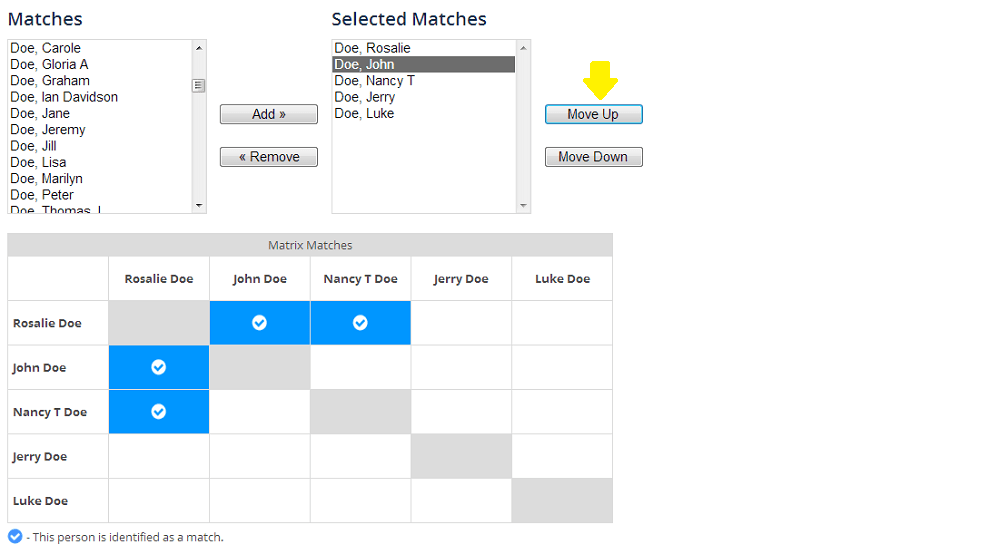
Due to privacy concerns, the suggested relationship of your two matches (if related) is not revealed. However, we can tell you whether they are related according to our Family Finder program. To use it, you select up to 10 names from the Match list on the left side of the page and add them to the Selected Matches list on the right side of the page. A grid will populate below the lists. It will indicate whether there is a match (a blue check mark) or there is not a match (an empty white tile).

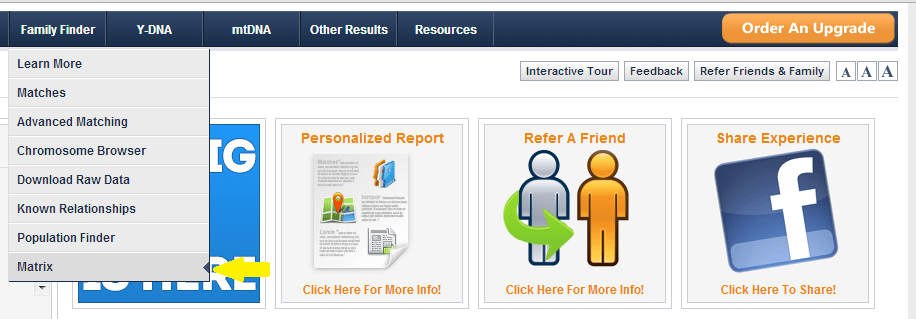
You access the BETA Family Finder – Matrix page through the Family Finder menu in your myFTDNA account.

matrix 1

The page starts out with two list areas: Matches and Selected Matches. You add Matches to the Selected Matches list by clicking on a name and then on the Add button.

matrix 2

Here is a screenshot of the BETA Family Finder – Matches page with a few matches added to the Selected Matches list.

matrix 3

You can change the order of names in the matrix by clicking on a name and then either the Move Up or the Move Down button.

Matrix 4

To remove someone from the Selected Matches list, click on their name and then the Remove button.

______________________________________________________________

Disclosure

I receive a small contribution when you click on some of the links to vendors in my articles. This does NOT increase the price you pay but helps me to keep the lights on and this informational blog free for everyone. Please click on the links in the articles or to the vendors below if you are purchasing products or DNA testing.

Thank you so much.

DNA Purchases and Free Transfers

Genealogy Services

Genealogy Research

Chromosome Mapping aka Ancestor Mapping

This article really should be called “Identifying Prodigal Great-Grandpa by Ancestor Mapping Your Chromosomes,” because that’s what we’re going to be doing.  It’s fun to map your ancestors to your chromosomes, but there is also a purpose and benefit to be derived.  So you can have guilt-free fun because you’re being productive too!  Oh, and yes, you can work on finding Prodigal Great-Grandpa.

I constantly receive questions similar to this:

“How can I find the identity of my mother’s mother’s father?  My great-grandmother went to her grave with this secret.  That’s one eighth of my ancestry.  What can I do?  How can I find out?”

The answer is that it’s not easy, but it is sometimes possible.  Note the word sometimes.  A good part of the definition of “sometimes” is how willing you are to do the requisite work and if you are lucky or not.  Luck favors those who work hard.  And let’s face it, you’ll never know if you don’t try.  I mean, Prodigal Great-Grandpa is not going to text you from the other side with his name and date of birth.

What we’re going to do is basically work through a process of elimination.  The term for what we are going to do is called chromosome mapping your ancestors or more simply, chromosome mapping or ancestor mapping. In essence, you are going to map your own chromosomes based on which ancestor contributed that part of your DNA.

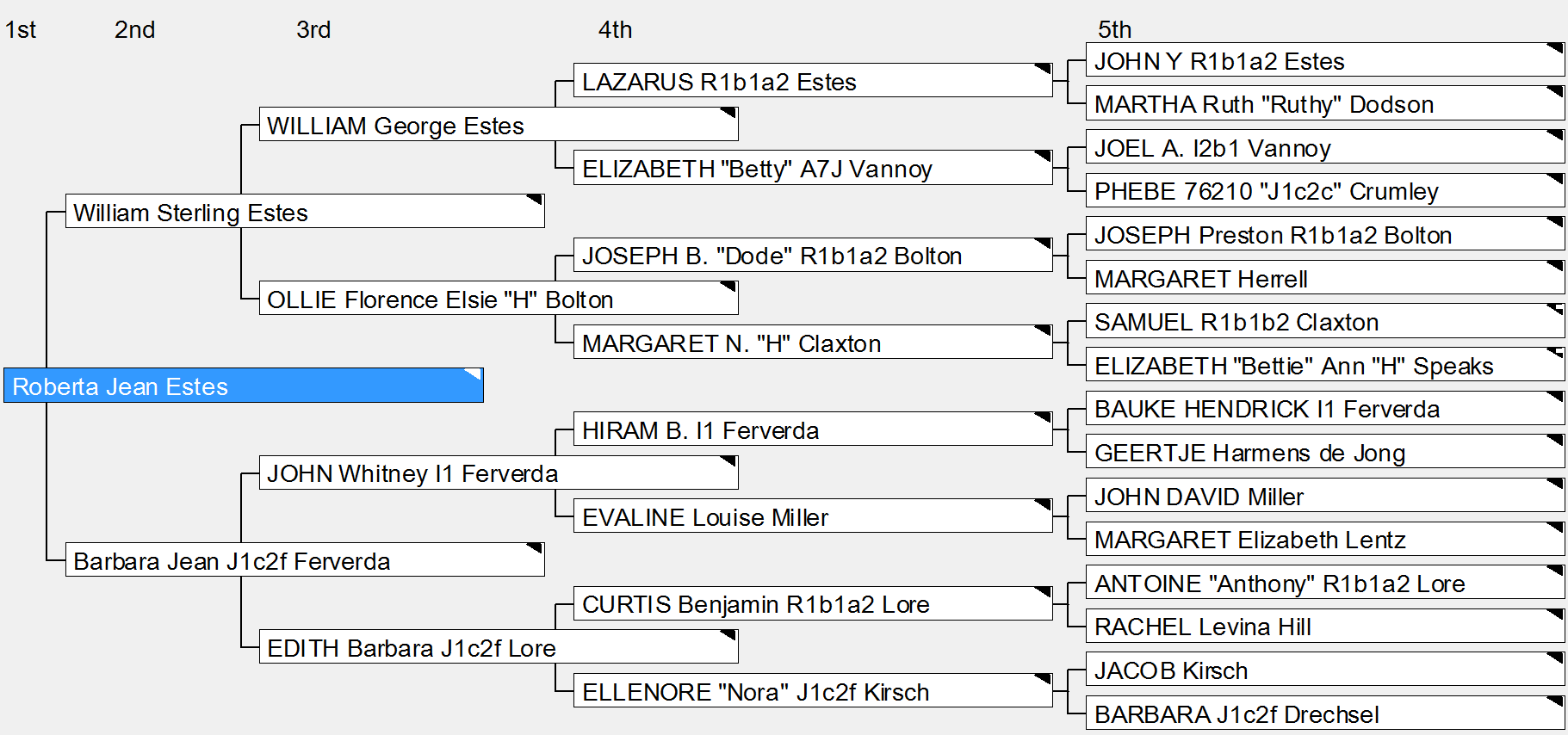
I have simplified this process greatly in order to explain the concept in a way you can easily follow.  I’m going to use my own pedigree chart as an example.  We’ll pretend we don’t know the identity of Curtis Benjamin Lore.  And yes, for those of you wondering, all of these people are deceased.

Mapping pedigree chart

I realize that you are going to have more than the 32 autosomal matches shown on my example spreadsheet.  You’re also not going to be able to find common ancestry with many of your matches due to things like dead ends, incorrect ancestry, segments identical by state (IBS) or DNA that comes from older ancestors that is not recognizable today after name changes in many generations when descended through females.  There are lots of reasons why you might not be able to find genealogy matches.  It’s the other matches, the ones where you can decipher and determine your common ancestor that help a great deal, and that is where we’ll focus.  These are the ones that matter and the keys to identifying Prodigal Great-Grandpa.

In my example here, we live in a perfect world.  We are looking to map the DNA of my 8 great-grandparents in order to figure out the identity of mother’s mother’s father.  Of course, there is no Y-DNA to test in this instance, so we must rely on autosomal DNA.  Ok, so maybe it’s not such a perfect world.  In a perfect world, you’d be a male trying to find the identity of your father’s father’s father and you could test your own Y-DNA – but then we wouldn’t have a good story nor would we need autosomal DNA.  And most people aren’t that fortunate.

Three generations isn’t that far back – or four – if you count yourself as the first generation.  If you’re quite lucky, you can test one or both of your parents, and maybe even a grandparent or great-aunt or uncle.  Failing that, you should be able to find some cousins from your various lines to test.  This entire exercise will be much MUCH easier for you if you can test multiple people descended from each of the 4 couples involved because you’ll be able to tell which lines your matches do, and don’t, match based on which cousins they also match.  Take DNA test kits to family reunions!

Obviously, you won’t be able to test anyone directly descended from your unknown great-grandfather, except perhaps his children.  The more of his children you can test, either directly or through their children, if deceased, the better your chance of identifying your Prodigal Great-Grandfather because each child inherits some different DNA from their parents.  In my case, we’re going to presume that there are no other known children, other than my grandmother.  So how do we find Prodigal Great-Grandpa?

First, download all of your matches with corresponding segment data from your testing vendor, either 23andMe or Family Tree DNA, into a spreadsheet.  Ancestry does not allow you to do this, which is a significant drawback in terms of testing at Ancestry.  You can do this today at 23andMe and at Family Tree DNA most easily by utilizing www.dnagedcom.com download software.  You can also do this directly at Family Tree DNA on the Chromosome Browser page.

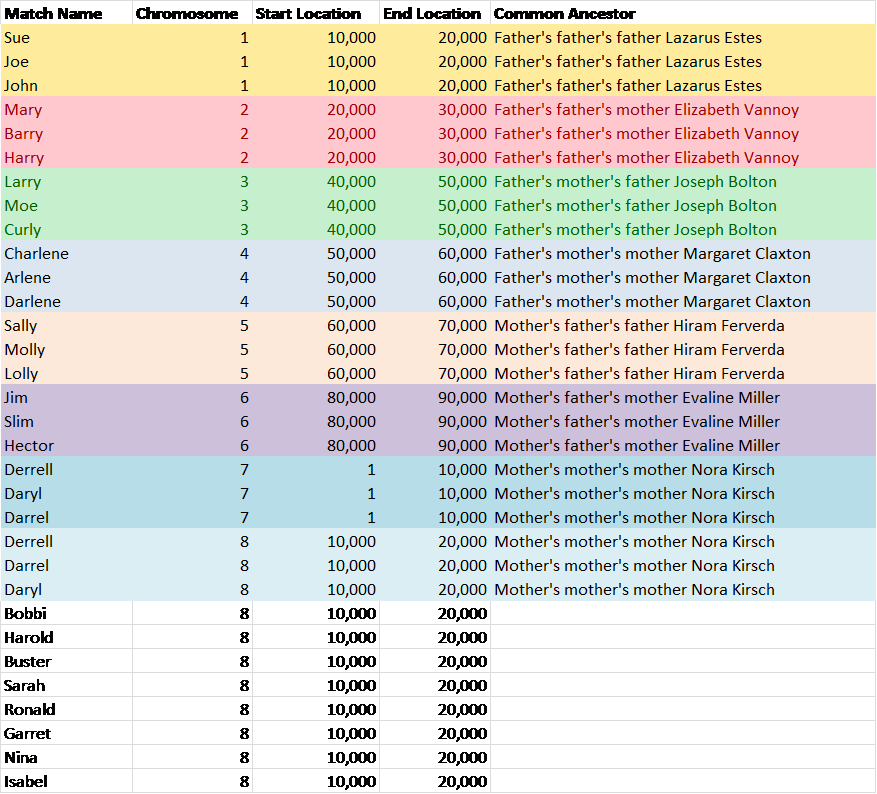
Your spreadsheet will look something like this, but without the colors.  That’s what you’ll be adding, along with the Common Ancestor column.

Mapping spreadsheet

Step 1 – Identify a common ancestor with those individuals you match on common DNA segments.  This is really two steps, the common ancestor part, and the common DNA segment part.  If these people are on your match list, we already know you have a common DNA segment over the vendor’s match threshold.  The presumption here is that if you have 3 people that match on the same segment from the same ancestor, that’s a confirmed “yes” that this particular DNA segment is descended from that ancestor.  You can also label these with only two confirmed descendants from the same ancestor, but I like to see three to be sure, especially if here is any doubt whatsoever that you’re dealing with the same ancestral family.  For example, if you are dealing with 2 people who carry the same surname from the same location, but you can’t quite find the common ancestor – you’ll need 3 matches to identify this segment.

In this case, I was able to test cousins so I know that on chromosome 1, Sue, Joe and John all match me on the same segment and they are all descended from Lazarus Estes.  I know this because one of them descends from Lazarus Estes and his wife, Elizabeth Vannoy, but the other two, Joe and John descend from an Estes upstream of Lazarus, let’s say, his father, John Y. Estes, through another child, which allows me to positively identify this segment as coming not just from the couple, Lazarus Estes and Elizabeth Vannoy, but from Lazarus specifically.

I’ve colored this segment mustard to represent Lazarus and so that you can visually see the difference between the 8 ancestors we’re working with.

2.  Repeat the same process with your other matches, hopefully utilizing cousins, to identify DNA segments of your other ancestors.  I’m only showing a very small subset of all of my DNA on my spreadsheet, and all matches are the exact same 10,000 cM blocks and only on one chromosome, for illustration purposes, but as you work through your matches, you’ll be able to color more and more of your DNA and assign it to different ancestral couples.  Each of your chromosomes will have different colors as different parts of each chromosome come from different ancestors.

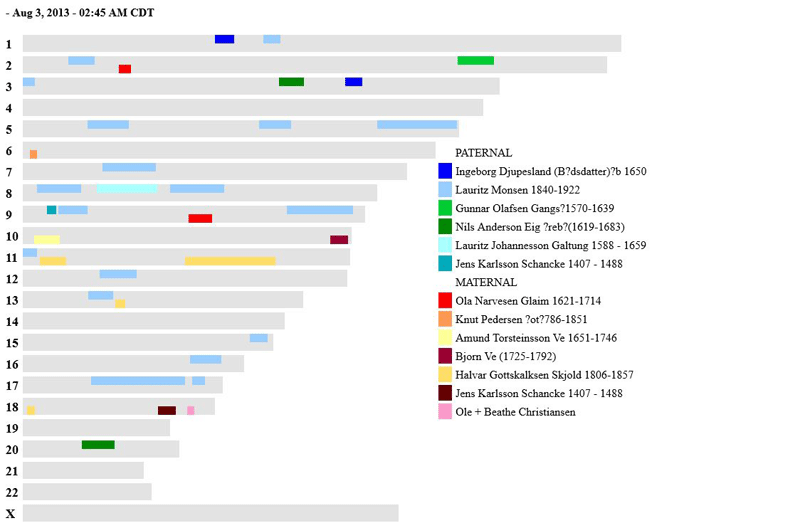
Kitty Cooper released a tool to utilize AFTER you do this hard grunt-work part that paints a pretty picture of your ancestors mapped on to your various chromosomes.  Here’s her example.  Notice that each chromosome has 2 sides, Mom’s and Dad’s inheritance side.  We’re going to use that to our advantage and it’s one facet of how we’re going to find Prodigal Great-Grandpa .

mapping kitty cooper

In my case (not this example), I have several segments that I can’t identify to a particular couple, but I can assign it to a group.  This is my Acadian group and is terribly admixed because of extensive intermarriage.  I also have a “Mennonite” segment labeled in the same way for the same reason.  So while I don’t know specifically who, I do know where and that helps a lot too.  But in our perfect world in our example, we don’t have any of that.

3. Now that I have most of my genome colored in and assigned to ancestors, except for Prodigal Great-Grandpa, I can see where all new matches fall.  Let’s say I get a new match on chromosome 1 in the segments between 10,000 and 20,000 and they also match Sue, Joe and John.  Even if the new match is an adoptee and has no genealogy, I can tell them which line they descend from.  And let me tell you, there is no greater gift.  This is exactly how we told new cousin Loujean she descended from the Younger line.

However, if someone matches me on this chromosome 1 segment but NOT Sue, Joe and John, since Sue,Joe, John and I all match on the entire segment from 10,000-20,000, then the new match has to be matching me on my other parent’s side (or is IBS – identical by state, a circumstantial match.)  Never forget that you have two “sides” to each chromosome – Mom’s and Dad’s (except for the X chromosome in males which we are not addressing here.)

4.  The only part of my match spreadsheet left uncolored, since this is a perfect world, would be the part that would probably come from my Prodigal Great-Grandfather.  So let’s look at chromosome 8 and map it.

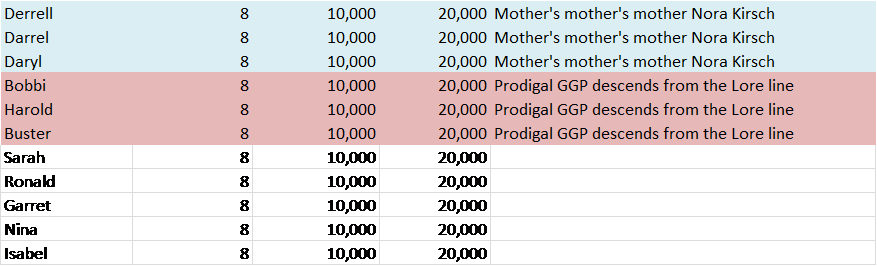
What we don’t know, and have to determine, is whether or not some of these parts of chromosome 8 really belong to ancestors identified in color above.  However, remember that we are dealing with fairly close matches, only 3 generations, and in some cases, only 2 generations, depending on which cousins tested.  So let’s say you found several cousins to test because grandma had a large family.  Based on the test results of several of your aunts and uncles along with other people descended from great-grandma’s ancestral lines, you are able to map most of the DNA of your great-grandmother.  In this case, we mapped this segment of chromosome 8 to my three cousins, Derrell, Darrell and Daryl.  (Yes, I really do have those cousins.)

The result is that now I have 8 matches that do match me, and based on other cousin matches, do descend from Great-Grandma/Great-Grandpa but don’t match the Derrell trio indicating Great-Grandma’s line.  What this tells me is that the people who aren’t assigned, because they don’t match my cousins Derrell, Daryl and Darrel, or any other distant groups, must then be from Prodigal Great-Grandpa’s side or are “problem matches.”  Problem matches are those that are IBS (Identical by State) or have a technical issue and we’re not going to deal with that here, because this is a perfect world and we’re only concerned with people whose genealogy we have and that match each other.  By this definition, problem matches are automatically eliminated.  So let’s look at the 8 people above who don’t match me or the Derrell cousins on Great-Grandma’s/Great-Grandpa’s side, beginning with Bobbi and ending with Isabel.

5.  Now we turn to genealogy.  We know that these 8 people all share a common ancestral line with Prodigal Great-Grandpa, we just don’t know who that is.  Let’s say that of this group, we discover that Bobbi, Harold and Buster are all related to each other, and glory be, they all know who their common ancestor is, or at least the common ancestral line.  Let’s say that Bobbi and Buster are first cousins in the Lore line and that Harold matches them closely as well, but he is descended from a Lore ancestor further upstream from Bobbi and Buster.  Therefore, we can now say, positively, that Prodigal Great-Grandpa descended somehow from the Lore line.

We still don’t know how Sarah, Ronald, Garret, Nina and Isabel connect to Prodigal Great-Grandpa, and that’s OK.  We can simply leave them uncolored for now.  We can select a color for Bobbi, Harold and Buster and assign then to Prodigal Great-Grandpa who descends from the Lore line.

Mapping PGG Lore

6.  Now it’s time for that luck to kick in.  We don’t know that Prodigal Great-Grandpa carried the surname Lore.  His mother could have been a Lore, or any of his ancestors.  All we have is a common surname and a common ancestor between three people who all match me on the same segment.  So, let’s assemble a tree of our cousins to see if we can narrow the scope of maybe who and where and then let’s get busy with the census and other records.  Geography is important.  Begatting requires proximity and many times, we can find the begatter in the neighborhood.  Also, check your genealogy software data base for this surname.  You may find the surname in an allied line.  Remember, families married their neighbors and often intermarried as well.

Sure enough, look there, in our perfect world, we discover that Nora Kirsch is working in her parents inn named the Kirsch House on the Ohio River in 1880.  The Kirsch House was also a boarding house, and a restaurant and pub.  One of their boarders in 1880 was none other than Benjamin Lore.  Hmmm.  Surely makes you wonder.  Further research on Benjamin Lore shows that he was a wildcat oilfield well driller working in the county where Nora lived and became something of a local legend for discovering the “Blue Lick” water well.  Well, now we have a name, proximity and maybe an opportunity.

7.  Well, peachy, but what next?  Further research on Benjamin Lore shows that he was married in the census, but where was his wife?  In previous census records, we find Benjamin Lore in Warren County, PA with his parents.  In the Warren County records, we find that he married Mary Bills, and additional research shows in 1880 a Mary Lore with 2 children, but no husband.  Court records show they later divorced, with 4 children.  Find those children!!!  They are the key to confirming the identity of Benjamin Lore as Prodigal Great-Grandpa.  If Benjamin’s other children had children about the same time as grandmother, each line should have 3 generations between Benjamin and the current generation.  Benjamin’s great-grandchildren through his first wife would be half-second cousins to me which would be the same as second cousins once removed.  They of course would be a generation closer to my mother whose DNA I also happen to have.

ISOGG has a wonderful Autosomal DNA Statistics page, and here you can see that second cousins once removed would share about 1.5% of their DNA in what is hopefully a large enough segment to match some of the cousins that have already tested.   My mother’s generation, first cousins once removed would share approximately 6.25%.

Mapping cousin chart

Benjamin’s descendants through his first wife may not match all of my cousins, but they will, hopefully, match some of the descendants of Prodigal Great-Grandpa, confirming, as best we can, that Benjamin Lore was grandmother’s father.  The best litmus test of course is how closely they would match the closest generations, like mother or great-aunts/uncles, if they were living.

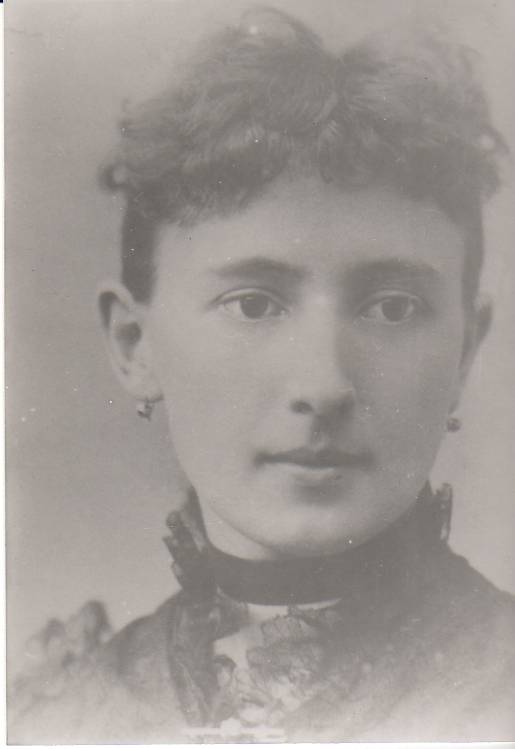
Full Disclosure Note:  I used my own ancestors for purposes of illustration, even though Curtis Benjamin Lore (shown at right) was not prodigal in quite the way I portrayed in this article, well, at least not from my family’s perspective.  However, he was no saint Lore, CBeither and he may well have other descendants looking for him in this exact situation.  Aside from what we do know, there is the rumor of an illegitimate son showing up on his widow’s doorstep looking for him, albeit, a little too late.  We know that Curtis Benjamin (known as C.B.) Lore did marry Nora Kirsch in Dearborn County, Indiana, in 1888.  These photos are their “wedding photos” but interestingly, there is no photo of them together.

We also know that Curtis Benjamin Lore married Mary Bills in Warren County, PA., had four Lore children, 3 males (Sid, John Curtis and Herbert Judson Lore) and one female (Maud who married a Hendrickson), none of whom we have never been able to find.  Also, Curtis Benjamin Lore was not divorced from Mary until, ahem, after he was married to Nora Kirsch when Mary filed for divorce on the grounds of desertion.Kirsch, Nora

Apparently, his marriage to Nora Kirsch (pictured at right) fell, literally, according to the secret family story, into the “shotgun” category, so one has to understand that his choice of marriage versus death was fairly defensible.  I’m sure Nora’s father, a crusty old Civil War veteran, had no idea that he was already married or Curtis Benjamin would have been on the business end of that shotgun and marriage would not have been a choice.

The family took great care that this “uncomfortable” shotgun marriage situation never be discovered, to the point of falsifying the marriage date in the family Bible and also by “adjusting” the birth of the child by a year, also recorded incorrectly in the family Bible.  Were it not for the fact that I checked the church records in Dearborn County, I would never have discovered the discrepancy.  A child cannot be baptized months before it is born.  I might note that it was only AFTER this discovery that my mother was forthcoming with the “family secret” about the shotgun wedding.  Birth certificates were not issued at that time and my grandmother’s delayed birth certificate was issued based on the falsified family Bible information.

Benjamin probably would not have been bothered by this revelation at all, given what we know about him, but I’m sure Nora’s parents rolled over in their grave once or twice when I made the discovery and now that I’m, ugh, discussing it, and publicly at that.

Rogues and handsome scoundrels.  They are colorful and interesting aren’t they and provide a great amount of spice for family stories.  Hopefully these tools will help you find yours!!!

______________________________________________________________

Disclosure

I receive a small contribution when you click on some of the links to vendors in my articles. This does NOT increase the price you pay but helps me to keep the lights on and this informational blog free for everyone. Please click on the links in the articles or to the vendors below if you are purchasing products or DNA testing.

Thank you so much.

DNA Purchases and Free Transfers

Genealogy Services

Genealogy Research

23andMe Suspends Health-Related Genetic Tests

23andme suspends health

We seem to have part of the answer as to what 23andMe will be doing in the short term.  Tonight when I went to the 23andMe site, I was greeted with this message.

In case it’s too small to read, it says:

Welcome to 23andMe.

At this time, we have suspended our health-related genetic tests to comply immediately with the U.S. Food and Drug Administration’s directive to discontinue new consumer access during our regulatory review process.

We are continuing to provide you with both ancestry-related genetic tests and raw genetic data, without 23andMe’s interpretation.

If you are an existing customer please click the link below and then go to the health page for additional information. If you are a customer that purchased before 11/22/13, you will still have access to your health-related results.

We remain firmly committed to fulfilling our long-term mission to help people everywhere have access to their own genetic data and have the ability to use that information to improve their lives.

Upon entering the site, please confirm you understand the new changes in our services.

I understand that 23andMe only sells ancestry reports and raw genetic data at this time. I understand 23andMe will not provide health-related reports.  However, 23andMe may provide health-related results in the future, dependent upon FDA marketing authorization.

I clicked on “I Understand” and was then taken to the normal sign on screen where their test kit is marketed solely as a genetic genealogy kit, with all mention of health removed.

23andme suspends 3

After signing on, the health button on the main page is gone, but by clicking on “My Results” I can still see the Health Overview and proceed from there.  They mentioned additional information on the Health page, but I did not see anything additional.  Perhaps more is yet to come.

23andme suspends health 2

I do notice that the Research Surveys, Health Profile, and Key Health Recommendations are still present and the health reports/interpretation portions are still there in my account.  I was a customer prior to November 22, 2013.  But still, I’m surprised that all of the health surveys and questions remain.  They are clearly still data-gathering with their existing clients, so obviously hopeful about the FDA resolution.

23andme suspends 4

It appears that the genetic genealogy portion is “safe,” for now, although we don’t know what the future holds for 23andMe as they move through the regulatory process with the FDA.  I also wonder if the genetic genealogy marketspace, which has never been a priority to them, can financially sustain them long enough to complete the FDA process.  Part of that answer would likely rest upon how long the process takes and the depth of their pockets.  So far, they are 5 years and counting, but we don’t know how far along they are in the process.  Perhaps additional information will be forthcoming as the deadline of December 13, 15 or 16, depending on how you count, approaches.

I would still suggest downloading your information, just in case, and I wouldn’t wait until the last minute.  No matter how well intentioned they are, they may find themselves in a situation where they cannot provide extensive notification about impending changes.

______________________________________________________________

Disclosure

I receive a small contribution when you click on some of the links to vendors in my articles. This does NOT increase the price you pay but helps me to keep the lights on and this informational blog free for everyone. Please click on the links in the articles or to the vendors below if you are purchasing products or DNA testing.

Thank you so much.

DNA Purchases and Free Transfers

Genealogy Services

Genealogy Research

400,000 Year Old DNA from Spain Sequenced

Atapuerca Cave Remains

Talk about record shattering.  400,000 year old DNA has now been sequenced, and that quite handily breaks the previous 100,000 year old record.  The only problem is that these ancient and archaic people weren’t staying where they were supposed to.  Well, that’s “supposed to” according to the story we thought we knew.  Obviously, we didn’t know, and ancient DNA is only beginning to tell the story, which isn’t at all like we thought it would be.

Before now, Neanderthals were thought to have settled in the west, meaning Europe primarily, and Denisovans in the East, in Siberia.  This is due to where bones have been found and the DNA sequenced from just a few.  However, this new find from a cave in Atapuerca, Spain changes all of that.  These people were not closely related to Neanderthal, who were later found in Germany, but instead are related to the Denisovans, their remains found some 4000 miles east, per mitochondrial DNA, meaning their direct matrilineal line.  However, even though they are related, they are distantly related.

Yesterday the mitochondrial sequence appeared on GenBank, after the release of the paper.  According to Ian Logan, this new sequence has just over 500 mutations, about half of which can be matched with Denisovan and the other half are unique.  So while the Denisovan and this new sequence do share a maternal ancestor, they are many, many generations distant.  Of course, that would be expected, because they are about 350,000 years apart too in terms of time, or a meager 14,000 generations.

What does this mean?  The scientists don’t know for sure.  Perhaps these Atapuerca Cave people were the ancestors of Denisovans and Neanderthals.  Perhaps the Denisovan mitochondrial DNA “washed out” over generations in the Neanderthal or maybe not enough Neanderthal remains have been located and sequenced.  Neither Neanderthal nor Denisovan mitochondrial DNA has been found in any living humans or relatively contemporary burials, meaning not outside of Neanderthals and Denisovans.  In short, we need more skeletons and more DNA to reveal more information about our ancient ancestors.  It opens the possibility that modern humans are but a small sprig on the larger and quite ancient Denisovan/Neanderthal Eurasian tree.  We don’t know where modern humans fit in all of this, but according to autosomal genetic results, everyone with either European or Asian heritage carries some of them in all of us, just not the mitochondrial line.  We are just beginning this journey of discovery.

For more, access the Science article, Dienekes Anthrolpology Blog and John Hawks blog.  The academic article in Nature, A mitochondrial genome sequence of a hominin from Sima de los Huesos, by Meyer et all is behind a paywall.

______________________________________________________________

Disclosure

I receive a small contribution when you click on some of the links to vendors in my articles. This does NOT increase the price you pay but helps me to keep the lights on and this informational blog free for everyone. Please click on the links in the articles or to the vendors below if you are purchasing products or DNA testing.

Thank you so much.

DNA Purchases and Free Transfers

Genealogy Services

Genealogy Research

23andMe Pulls Affiliate Marketing Program

alarmYou know those ads you see everyplace on the internet for 23andMe?  Well, you won’t anymore.  23andMe has cancelled their affiliate marketing program according to an e-mail sent to affiliates yesterday.

23andMe Affiliate Program Update

We are writing to let you know that 23andMe is suspending its affiliate program at this time.

We appreciate all the work you have done with us and sincerely hope we will be able to work together again in the future.

Today we have set all our publisher accounts, including yours, to expire from our Commission Junction program. After the standard 7 day grace period, you will stop receiving commission.

We ask you to remove any 23andMe links and promotions from your site.

Please let us know if we can answer any questions.

We appreciate your understanding and cooperation.

Best,

CJ Swenson, Online Marketing Manager

For a company whose entire business presence is electronic, this doesn’t bode well for the future.  It’s obvious that 23andMe is working to comply with the FDA’s 15 day cease and desist mandate.  It’s equally obvious that the resolution is not going to be simply another extension of time to comply with the FDA requirements while business continues as usual.

You know, last week, when I said that I wasn’t an alarmist and I really felt that 23andMe would pull through this and be OK….well, I’m not so sure anymore.

So, folks it’s time to start copying health results, downloading files and contacting your matches to be sure they have your e-mail.  Remember, your only way to contact them is through the 23andMe system, and 23andMe’s longevity is in grave doubt today.

Yep, I’m sounding the alarm.  The 15 business day grace period given to 23andMe by the FDA, depending on how you count the Thanksgiving holiday ends either on Friday the 13th (no joke) or on Monday or Tuesday, the 16th or 17th.  It’s time to get busy, just in case.

______________________________________________________________

Disclosure

I receive a small contribution when you click on some of the links to vendors in my articles. This does NOT increase the price you pay but helps me to keep the lights on and this informational blog free for everyone. Please click on the links in the articles or to the vendors below if you are purchasing products or DNA testing.

Thank you so much.

DNA Purchases and Free Transfers

Genealogy Services

Genealogy Research

Native American Haplogroups Q, C and the Big Y Test

Sicangu man c 1900I’m writing this to provide an update about Native American paternal research, and to ask for your help and support, but first, let me tell you why.  It’s a very exciting time.

If you don’t want the details, but you know you want to help now….and we have to pay for these tests by the end of the day December 1 to take advantage of the sale price…you can click below to help fund the Big Y testing for Native American haplogroups Q and C.  Both projects need approximately $990.  Everything contributed goes directly to testing.

To donate to the American Indian project, in memory of someone, a family member perhaps, or maybe in honor of an ancestor, or anonymously, click this link:

https://www.familytreedna.com/group-general-fund-contribution.aspx?g=AIP

In order to donate to haplogroup C-P39 project, please click this link:

http://www.familytreedna.com/group-general-fund-contribution.aspx?g=Y-DNAC-P39

Now for the story…

As many of you know, haplogroup Q and C are the two Native American male haplogroups.  To date, every individual with direct paternal Native American ancestors descends from a subgroup of either haplogroup Q or C, Q being by far the most prevalent.  Both of these haplogroups are also found to some extent in Asia and Europe, but there are distinct and specific lineages found in the Americas that represent only Native Americans.  These subgroups are not found in either Europe or Asia.

In December, 2010, we found the first SNP (single nucleotide polymorphism) marker that separated the European and the Native American subclades of haplogroup Q.  Since that time, additional markers have been found through the Walk the Y program and other research.

How did this happen?  A collaborative research approach between individual testers and project administrators.  In this case, Lenny Trujillo was a member of the haplogroup Q project and he agreed to take the WTY (Walk the Y) test, which indeed, discovered a very unique SNP marker that defines Native American haplogroup Q, as opposed to European haplogroup Q.

Much has changed in three years.  The WTY test which was focused solely on research is entirely obsolete, being replaced by a new much more powerful test called the Big Y, and at a reduced cost.  The Big Y sequences a much larger portion of the Y chromosome, which will allow us to discover even more markers.

Why is this important?  Because today, in haplogroups Q and C, we are learning through standard STR (short tandem repeat) surname marker tests who is related to whom, and how distantly, but it’s not enough.  For example, we have a group of haplogroup Q men in Canada who match each other, but then another group with a different SNP marker that is located in the Southwest, Mexico, and then in the North Carolina/Virginia border area.  Oh yes, and one more from Charleston, SC.  Most Native American men who carry haplogroup C are found in Northeastern Canada….but then there is one in the Southwest. What do these people have in common?  Is their relationship “old” or relative new?  Do they perhaps share a common historical language group?  We don’t know, and we’d like to.  In order to do that, we need to further refine their genetic relationship.  Hence, the new tool, the Big Y.

The Big Y sequences almost all of the Y chromosome – over 10 million base pairs and nearly 25,000 known SNPs.  But the good news is that the Big Y, like its predecessor, the WTY, has the ability to find new SNPs.  And they are being found by the buckets – so fast that the haplogroup trees can’t even keep up.  For example, the haplogroup project page still lists most Native people as Q1a3a, but in reality many new SNPs have been discovered.

That’s the good news – that the Big Y represents a huge research opportunity for us to make major discoveries that may well divide the Native groups in the Haplogroup C and Q projects into either language groups, or maybe, if we are lucky, into tribal “confederacies,” for lack of a better word.  I hate to use the word tribes, because the definition of a tribe has changed so much.  What we would like to be able to do it to tell someone from their test results that they are Iroquoian, for example, or Athabascan, or Siouian.  This has been our overarching goal for years, and now we’re actually getting close.  That potential rests with the Big Y.

The bad news is that the test costs $495, and that’s the sale price good only through Dec. 1., and we need funding.  In the haplogroup Q project, we do have a few people who are testing.  Everyone who did the WTY has been sent a $50 coupon to apply towards the Big Y test.  I hope everyone who did do the WTY will indeed order the Big Y as well.  If not, then the coupon can be donated to us, as project administrators, to apply towards the Big Y test of someone else in the group who is testing.  If you’re not going to test, please donate your coupon.

In haplogroup Q, we have two additional men who we desperately want to take the Big Y test, and 2 in haplogroup C as well.  We’re asking for two things.  First, for unused $50 coupons and second, for contributions against the $495 price.  We’d certainly welcome large contributions, or a sponsor for an entire test, but we’d also welcome $5, $10, $25 or whatever you’d like to contribute.  Every little bit helps.

To donate to the American Indian project and to help fund this critical research, click this link:

https://www.familytreedna.com/group-general-fund-contribution.aspx?g=AIP

In order to donate to haplogroup C-P39 project for this research, please click this link:

http://www.familytreedna.com/group-general-fund-contribution.aspx?g=Y-DNAC-P39

Thank you everyone, in advance, for your help.  We can’t do this without you.  This is what collaborative citizen science is all about.  Of course, we’ll report findings as we receive them and can process the information.

______________________________________________________________

Disclosure

I receive a small contribution when you click on some of the links to vendors in my articles. This does NOT increase the price you pay but helps me to keep the lights on and this informational blog free for everyone. Please click on the links in the articles or to the vendors below if you are purchasing products or DNA testing.

Thank you so much.

DNA Purchases and Free Transfers

Genealogy Services

Genealogy Research

Thanksgiving Conundrum

First ThanksgivingFirst Thanksgiving at Plymouth Bay (1621) by Jennie A. Brownscombe (1914)

Justin Petrone, like me, is a mixed race person with Native American ancestry, although unlike me, initially, he never thought of himself in those terms.  I’ve always known and since I was a child, self-identified myself in that way.  Like me, Justin has spent years searching for his elusive ancestors, more often than not, hidden in the mists of time with only suggestions of who their ancestors are by words on tax lists and census records like “free person of color.”

Most of the time, Native people were transparent, until they became at least “civilized” enough to be counted on the census, or taxed or they did something else to bring them into the white man’s realm.  More recently, Justin and others like us have been able to confirm, or deny, that heritage via DNA testing.  So even if we don’t know exactly who our ancestor is, we are positive THAT our Native heritage is real.  In some cases, through DNA testing we can learn which of our ancestral lines is Native.

Most of us who grew up knowing we were mixed blood Native learned years ago that if our ancestors’ tribe survived at all, meaning it was not annihilated by warfare or disease, they don’t accept us.  We are not one of “them” and there is no welcome home party.  We don’t have the blood quantum necessary to be a tribal member, and therefore, to them, we don’t exist either.  Not at all, we’re persona non grata.  Yep, you’re “Indian” right up until your admixture level crosses over that magic political line, whatever that is in whichever tribe, and then you’re not Indian at all – don’t exist.  All of your Indianness just evaporates that day I guess.  Apparently, it’s only in our blood, in our genes and in our hearts that we remain Native after that, because the European culture originally tried to kill off the Native people and the “official” Native people today don’t want any more “members” than they already have clamoring to divide a limited size pie.  So we don’t exist.

For many, being denied and relegated to “wannabe” status by “our own people” is devastating, especially for those who really don’t want any part of the financial pie.  Many simply want to belong, to understand the culture and their heritage – to have an educational avenue to recover in some small way that which was stripped and taken from their ancestors so violently.  To have this cultural travesty being perpetrated a second time by the very people who mixed blood descendants feel are their cousins, “their own people,” by being rejected, mocked, and turned away as “not good enough, not Indian enough” is an unexpected emotional blow, a very cold slap in the face and the faces of our Native ancestors.

After all, the tribal members today are the ones who survived comparatively intact, while the descendants of non-tribal member Indians were the ones often most tragically victimized….the ones where the systematic de-Indianization worked.  Logic would suggest that those who survived “as Indians” would welcome the descendants of those who did not and in vindication for what was done to their Indian brethren, would want to share the lost culture with their descendants, to resurrect the Indian in the descendant, and to insure that the cultural heritage continues into posterity.  But that’s not how it works, in the real political world.

I think of this as we approach Thanksgiving every year.  I think of what was taken from our people, my ancestors, and ultimately from me and my children.  I think of the sanitized, feel-good stories we were told as we cut and pasted Indians and Pilgrims in grade school as children.  I think of the heritage we don’t have, what we don’t know, what is lost forever.

I think of how the culture of denial today has played into exactly what those original Europeans wanted – to strip the Indians of their life, often in order to obtain their land, and if they couldn’t kill all of them, then to strip them of their religion, their language and their culture.  There is more than one way to kill an Indian.  The government had an official plan for how to do just that….and now the official Tribes are helping them complete the act by denying that heritage to their descendants.  Soon, in another generation or two, there will be fewer and fewer, and then no official Indians, as they continue to marry outside of the tribes and the blood quantum drops.  Ultimately, the government will have won….by the very hands and rules of the Tribes themselves based on their own blood quantum level required for tribal membership, unless, of course, the tribes change their rules.  In that lies the ultimate irony.

It’s terribly unfortunate that a middle ground can’t be found, where descendants can be “affiliated” with ancestral tribes, not full benefit-receiving members.  In that way, they could be educated in the traditional way, regain and celebrate their culture and heritage.  I would think it would be politically beneficial to the tribes too, because in sheer terms of numbers, there are a whole lot more of “us” non-tribal member descendants than official tribal members.  I would think the tribes would see the benefit in having the large contingent of “us” firmly on their “side” of any political argument, not having been flatly rejected and turned away.  There is tremendous power in numbers.  Just saying….

I try not to feel righteously indignant, but as Thanksgiving approaches and I see the storybook pictures of the Pilgrims and the Indians, and knowing what happened, and continues to happen, I can’t help but feel some level of sadness, anger and sometimes, outrage, at the way the systematic annihilation of the Indian people has been whitewashed and the way their descendants are treated today.  This was what motivated me to begin the Native Heritage Project and the Native Names Project to document the names of the Indian people buried in reams and reams of records.  This is in addition to various DNA projects to find and document those elusive Native ancestors.

And then, there’s Justin.  Poor Justin.  Justin has known for some time that he was a Native descendant.  He has been searching for that connection, exactly which one of his ancestors was the Native person – not easy to discern in colonial America.  So often, Indian heritage was very well hidden due to the various insidious forms of discrimination that were inflicted upon these people and their families well into the 1900s.  Justin and I have exchanged e-mails, back and forth, as he has shared finds and I’ve shared information from the Native Names Project.

But then, Justin found it…and “it” wasn’t at all what he expected.  In addition to being descended from Native people, Justin is also descended from one of the most notorious Indian killers in American history.

“In 1637, in the service of the Massachusetts Bay Colony, Captain John Underhill led an attack, together with Mohegan Indians, on the Pequot fortified village near modern Mystic, Connecticut. They set fire to the village, killing any who attempted to flee. About 400 Pequots died in what came to be called the Mystic Massacre. But Captain Underhill’s soldier of fortune Indian killing was only just beginning. In the service of New Netherland, he slaughtered between 500 and 700 individuals thought to be of the Siwanoy and Wechquaesgeek groups of the Wappinger Confederacy. And in 1644, he cleared Fort Massapequa right here on Long Island, killing about 120 Indians. According to historical accounts, after the Natives were dead and stacked up, Underhill and his men sat down and ate their breakfast.”

So what does Justin do with this horrible event that occurred just 16 years after that first celebration of Thanksgiving?  I mean, most of us have developed this life-long love affair with our Native ancestors, even if we don’t know who they were, exactly.  They were victims, betrayed by European promises, and we have spent untold hundreds, probably thousands or tens of thousands of hours and dollars trying to resurrect them in some small way from the nameless oblivion of history.  Part of who we are is defined by who they were.  We love our ancestors, all of them.  Many of us feel an obligation to do what we can to right the wrongs done to our ancestors in any way possible, even if the only thing we can do is identify them, maybe recover their name or something about them to give them a voice, a definition, a tangible memory to record for posterity.  It’s something, better than nothing, and it defines them as more than an almost anonymous disappearing footnote in history where the European’s put them and the Native tribes of today condemn them to stay.

But never, never do we expect to find an Indian killer, and not only that, a no-excuses, non-penitent repeat offender….so desensitized to human death that he and his cronies sat by the bodies of those families, including women and children, systematically, genocidally murdered and ate breakfast, probably covered in their blood.

In my family story, I know who the good guys are, and the bad guys.  I know who to love and who to hate, who to root for and who were the oppressors. And I’m not descended from really “bad guys,” at least not Indian Killer type bad guys.  I’ve got a few other colorful people, some slave owners, a couple bigamists, a wife-murderer and a moonshiner…but not people who systematically, unemotionally, slaughtered entire tribes of people.  And in those tribes of people were Justin’s ancestors too.  So now, what does Justin do with this?  Who does he love and who does he hate?  How does he come to terms with this, that he carries the genes and ancestry of both?  Do they fight within him from time to time?  Who is Justin?

Happy Thanksgiving.

______________________________________________________________

Disclosure

I receive a small contribution when you click on some of the links to vendors in my articles. This does NOT increase the price you pay but helps me to keep the lights on and this informational blog free for everyone. Please click on the links in the articles or to the vendors below if you are purchasing products or DNA testing.

Thank you so much.

DNA Purchases and Free Transfers

Genealogy Services

Genealogy Research

Now What? – 23andMe and the FDA

I’m sure everyone reading this knows by now that 23andMe has been ordered to stop marketing their DNA test until they comply with previous FDA requirements.  I wrote about this earlierForbes and several others have weighed in too.  The Forbes article is particularly interesting because it is written by Matthew Herper who has covered the FDA for 13 years, so has significant perspective.

Since that time, a firestorm of questions, comments and emotions have been forthcoming, from all directions.  As consumers, we feel trapped, caught in the middle of a battle, along with our DNA and results.  And sadly, it looks like the battle didn’t have to occur, had 23andMe not ignored the FDA for months after promising results it never delivered.   I want to make a couple of comments, then talk about what we, as consumers, can do to prepare for the worst case.

But before I do that, I want to make it very clear that I don’t expect that the worst case scenario will happen.  What would that be?  23andMe going out of business.  I don’t think that will happen.  Even though they, according to the FDA letter, have been negligent in taking care of business and meeting their commitments, they have bright minds and deep pockets….and 15 days to make some sort of conciliatory peace with the FDA.  Now I’m not a psychic, but I’m betting that 23andMe headquarters is very busily figuring out all of the things they need to do to put this ugly public chapter behind them.  Of course, I could be wrong.  This could be the death knell for 23andMe.  But I don’t think so, unless they cannot prove the accuracy of their product or they continue to ignore the FDA and fail to meet commitments.

Most of the questions and concerns voiced today by consumers revolve around what will happen to results they already have on the 23andMe website.

There is no reason to think that the results would be removed as long as the website is functional.  And their website is their link with the world, so as long as there is 23andMe, there will be a website.

However, the unthinkable has happened before, and 23andMe appears to have been somewhat negligent, so, just in case, what can we do?

1. Print your health results for future reference

On your personal page at 23andMe, select the “Health Overview” option which will then display your elevated risks in each of 4 option categories..

23andMe FDA1

For each of the 4 sections, Health Risks, Inherited Conditions, Traits and Drug Response, there is a blue link at the bottom that says “see all 122 risk reports,” for example.  Click on the “see all” link and then simply print the results in each of the 4 categories.  If you want to preserve any of the more detailed information in any of the categories, you’ll have to use screen shots.

2. Download your raw data file

Regardless of what you do, or don’t, do with these results, they are yours.  After downloading your file, you can simply save the results for later, you can upload them to donation based www.gedmatch.com (when GedMatch is again accepting files, currently estimated to be Dec.1) or you can transfer your file to Family Tree DNA to add your results to their data base and avail yourself of their matches and tools.  Right now, the transfer price for either 23andMe or Ancestry files is only $49, which is significantly less than taking a new test at $99 (although the $99 test currently comes with a $100 restaurant.com giftcard.)  This gives you the ability to find new matches with people who haven’t tested at 23andMe.

23andme fda2

To download your raw data file at 23andMe, sign on to your account, then click on your name in the upper right hand corner of the screen, then on “Browse Raw Data,” then on “Download” in the upper right hand corner of the screen.  You’ll then be prompted for your password again and the answer to your secret question.  Default will be set to download all data.  Leave it that way.  You’ll then be asked if you want to open the file or save it.  Save it.  On a Windows PC, if you don’t direct otherwise, it will be saved in the Downloads directory with a file name where the word “genome_” preceeds the name of the person who tested.  Mine is “genome_Roberta_Estes_Full_20131125XXXXXX.

Word of Warning…..

In the past month, 3 of the 5 files I’ve downloaded from 23andMe have been incomplete.  I’ve been working with 23andMe for three very frustrating weeks now via e-mail to try to figure out why they are incomplete.  So far, I have no answers and I’ve asked if these incomplete files have affected my (and my families) results posted at 23andMe.  To date, I’m still getting their standard reply about not being responsible for third party upload sites, which of course is not the question I asked, at all.

A normal 23andMe file will have about 950,000 rows on a spreadsheet, each one representing a single location tested.  23andMe confirmed this number last week.  For example, I have 991,000 plus change and my niece has 960,000 plus change.  All 3 of the incomplete files have only 574,515 lines each, exactly.  And yes, all of them are build 37, and no, they did not test at the same time.  I even downloaded them a second, third and fourth time, from different locations using different computers, etc.  The files are simply massively incomplete.

These incomplete files cannot be uploaded and utilized by other tools (www.gedmatch.com) or firms, including Family Tree DNA because 40% of the data is missing.

Given this experience, the FDA’s concerns about accuracy have certainly given me pause to reflect….

You can get a good idea as to whether your file is complete or not by the zipped file size when it downloads.  The zipped size of the incomplete files is around 5K (4901 to be exact) and the zipped size of the correct files is about 8K (8262 and 8013K to be exact).

Good luck getting help if your file is incomplete.  In order to contact the 23andMe customer service department, you have to jump through hoops, stand on your head, pat your stomach and rub your foot at the same time while chewing gum and blowing bubbles.  Ok, tiny exaggeration.  You really only have to click on “help” then use the “what’s your question” function, and then at the end of that exercize when you don’t receive the answer you need, you can submit a question to them via a form….but not until you go through that process.  They’ll get back with you in about a week with a canned reply and then you can begin the back and forth dialogue, with 2-3 day intervals between each e-mail.

3. Contact your matches

If you haven’t contacted all of your matches already, now would be a wonderful time to send invitations.  I send a message with each one that includes my e-mail address.  Unfortunately, you are forced to utilize the in-house messaging system at 23andMe, so unless you’ve exchanged e-mail addresses with your matches, if the 23andMe system goes away, you have no way to contact anyone ever again.

4. Send your e-mail address to all of the people who have already accepted match requests

Obviously, this is for the same reason.  Otherwise, your ability to communicate with your matches will disappear if the website does.  Personally I far prefer e-mail rather than the messaging system anyway, so this is not a wasted opportunity.

I want to say, again, that I don’t believe that anything horrible will happen to 23andMe.  I don’t want to be an alarmist.  They have deep pockets and lots of lawyers.  They may get a slap on the hand, but in the long run, I think they’ll be around in one form or another, assuming, of course, that they can prove their results are accurate.  I do have to ask myself why 23andMe has been unable to do this in 5 years.  Was it just not a priority, corporate arrogance, or is there a real problem lurking?  However, as for my data and results, better safe than sorry, and we should  probably be taking these steps anyway.  I’m glad I downloaded the data files for my family, because it has exposed a problem that I otherwise wouldn’t have known existed.  Hopefully, I’ll still have time to get it resolved.

______________________________________________________________

Disclosure

I receive a small contribution when you click on some of the links to vendors in my articles. This does NOT increase the price you pay but helps me to keep the lights on and this informational blog free for everyone. Please click on the links in the articles or to the vendors below if you are purchasing products or DNA testing.

Thank you so much.

DNA Purchases and Free Transfers

Genealogy Services

Genealogy Research

FDA Orders 23andMe to Discontinue Testing

23andme logo

Never, ever, mess with the big guns.

The FDA has issued a cease and desist letter to 23andMe and ordered the firm to stop selling their DNA tests based on concerns of accuracy, failure to comply with FDA requirements and the fact that they are providing “specific health recommendations” to their clients.

Here is the actual letter.

“The Food and Drug Administration (FDA) is sending you this letter because you are marketing the 23andMe Saliva Collection Kit and Personal Genome Service (PGS) without marketing clearance or approval in violation of the Federal Food, Drug and Cosmetic Act.

Therefore, 23andMe must immediately discontinue marketing the PGS until such time as it receives FDA marketing authorization for the device.”

Normally, the DTC (direct to consumer) test concerns voiced are about people misinterpreting their results, or being frightened by them, without the involvement of a physician.  In other words, the move until now has been to force you to visit a doctor to obtain a prescription for this type of test.  Of course, the underlying assumption is that the physician will then be available and have expertise in all of the areas that the test covers.  That, of course, would mean another follow-up visit, and if all you really wanted was the genealogically relevant results, this would in effect kill that part of their business.  In fact, it would probably kill the business entirely, at least under the current marketing model.

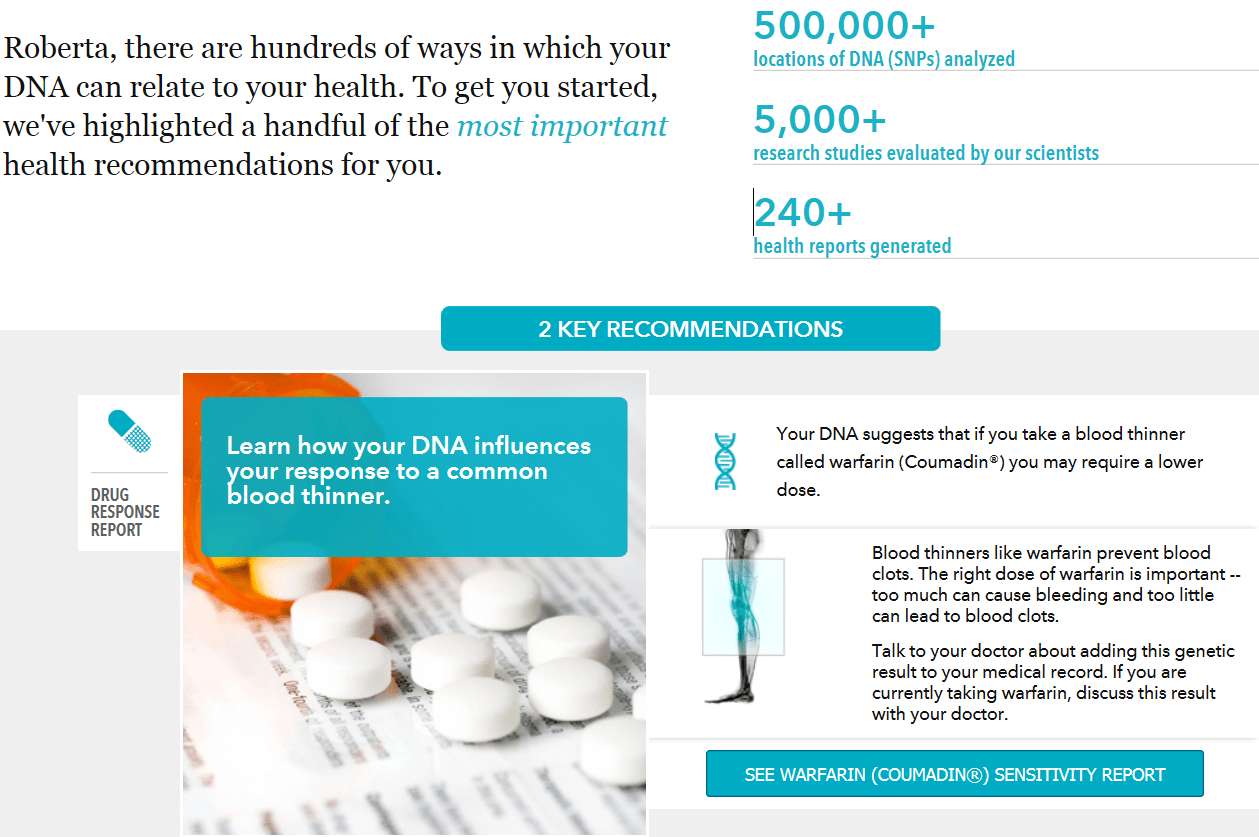
The FDA says that the product that 23andMe sells is a medical device, especially since it involves important medical information such as the detection of the BRCA-related breast cancer gene and sensitivity to the blood-thinner, warfarin.

Again from the FDA to 23andMe letter:

“Some of the uses for which PGS is intended are particularly concerning, such as assessments for BRCA-related genetic risk and drug responses (e.g., warfarin sensitivity, clopidogrel response, and 5-fluorouracil toxicity) because of the potential health consequences that could result from false positive or false negative assessments for high-risk indications such as these.”

The FDA wants 23andMe to show that these tests are accurate.  They are concerned, for example, that the BRCA test provided by 23andMe might provide either a false positive or, even worse, a false negative.  A false positive would, of course, provide an individual with a great deal of angst, but they would certainly immediately visit a physician who would prescribe industry-standard follow-up testing where the “false positive” would be caught.  A false negative, on the other hand, might mask a deadly situation, delaying detection until too late.

The FDA states that they have been working with 23and Me who has failed to provide the necessary proof.  From the looks of this letter, and understanding there are two sides to every story, it looks like 23and Me has not taken the FDA seriously.

“As part of our interactions with you, including more than 14 face-to-face and teleconference meetings, hundreds of email exchanges, and dozens of written communications, we provided you with specific feedback on study protocols and clinical and analytical validation requirements, discussed potential classifications and regulatory pathways (including reasonable submission timelines), provided statistical advice, and discussed potential risk mitigation strategies. As discussed above, FDA is concerned about the public health consequences of inaccurate results from the PGS device; the main purpose of compliance with FDA’s regulatory requirements is to ensure that the tests work.

However, even after these many interactions with 23andMe, we still do not have any assurance that the firm has analytically or clinically validated the PGS for its intended uses, which have expanded from the uses that the firm identified in its submissions. In your letter dated January 9, 2013, you stated that the firm is “completing the additional analytical and clinical validations for the tests that have been submitted” and is “planning extensive labeling studies that will take several months to complete.” Thus, months after you submitted your 510(k)s and more than 5 years after you began marketing, you still had not completed some of the studies and had not even started other studies necessary to support a marketing submission for the PGS. It is now eleven months later, and you have yet to provide FDA with any new information about these tests.  You have not worked with us toward de novo classification, did not provide the additional information we requested necessary to complete review of your 510(k)s, and FDA has not received any communication from 23andMe since May. Instead, we have become aware that you have initiated new marketing campaigns, including television commercials that, together with an increasing list of indications, show that you plan to expand the PGS’s uses and consumer base without obtaining marketing authorization from FDA.”

I do believe the FDA has their undivided attention now.

“Therefore, 23andMe must immediately discontinue marketing the PGS until such time as it receives FDA marketing authorization for the device.”

23andMe has 15 days to reply and if they don’t, it could get even uglier.

“Please notify this office in writing within fifteen (15) working days from the date you receive this letter of the specific actions you have taken to address all issues noted above. Include documentation of the corrective actions you have taken. If your actions will occur over time, please include a timetable for implementation of those actions. If corrective actions cannot be completed within 15 working days, state the reason for the delay and the time within which the actions will be completed. Failure to take adequate corrective action may result in regulatory action being initiated by the Food and Drug Administration without further notice. These actions include, but are not limited to, seizure, injunction, and civil money penalties.”

Yep, never mess with the big guns.

In 2010, five different companies, including 23andMe, were served with warning letters when Pathway Genomics announced it would sell its DNA testing product at Walgreen, a plan that never came to fruition after the warning letter.  However, this is the first letter of this type to be served on a genomics testing company.

What’s next?  We just don’t know.  23andMe has yet to comment, but it looks from this letter like they have limited choices at the moment.

Stay tuned for the next episode of the Wild West in DTC Testing.

______________________________________________________________

Disclosure

I receive a small contribution when you click on some of the links to vendors in my articles. This does NOT increase the price you pay but helps me to keep the lights on and this informational blog free for everyone. Please click on the links in the articles or to the vendors below if you are purchasing products or DNA testing.

Thank you so much.

DNA Purchases and Free Transfers

Genealogy Services

Genealogy Research