Rockstar Genealogists – There Is no I in Team

We received the first results, kind of like early election returns, of the Rockstar genealogist voting today, which announced the silver and bronze winners.

electionI’m paired with Megan Smolenyak in the USA category and CeCe Moore and Judy Russell represent the DNA grouping.  Tomorrow, the first place winners in each category will be announced on John Reid’s Canada’s Anglo-Celtic Connections website where you can see today’s results too.

I’m stunned, honored and humbled.  I had hoped with my donation committment to raise awareness of genetic genealogy and it looks like that was certainly successful.

Why did I offer to make the donation to the Preserve the Pensions?  Twofold.  First, and it goes without saying, that I am extremely committed to preserving our original records and I think this project not only preserves records and makes them available for everyone, but it also raises awareness of the needs and the records themselves.  Plus, I think benevolence is contagious…at least I hope so.  Hint – you too can donate in honor of someone.

Second, because there is no I in team.  Genetic genealogy is a team sport, and the genetic genealogy nominees are all tireless players in this field.

family tree dna logoWithout Bennett Greenspan, founder of Family Tree DNA, who literally hounded Dr. Michael Hammer at the University of Arizona to perform a Y DNA test on himself and another Greenspan male, fifteen years ago, there would be no genetic genealogy today.  Thank you Bennett for your persistence and thank you, Dr. Hammer, for finally giving in!!!  You two made history – you are the astronauts, first walkers on the moon, of the genetic genealogy world.  We would not be here without you – bottom line!  What an incredible legacy.

But that walk has not been a stroll in the park.

I remember, years ago, when Rootsweb (owned by Ancestry, ironically) would delete any post that referred to DNA for genealogy except for the genealogy DNA mailing list.  As hard as it is to believe today, and as unimaginable as it seems, DNA was treated as some kind of pox and was verboten…and it went on for years.  I never fully understood why, but I believe it was most likely fear that DNA would unhinge some of the treasured long-standing genealogy works of the past – and perhaps the researchers of those works as well.  Thankfully, we now have the opportunity to confirm those works…or not.

When Megan Smolenyak was appointed as Ancestry’s official genealogist, the genetic genealogy community was ecstatic because as one of the earliest genetic genealogists, we were very hopeful that Megan could make a difference and bring that embargo to an end.

Fortunately, those days are long in the past now, but for a very long time, genetic genealogy was an uphill struggle through the briar patch with those at the top of the hill casting a suspicious eye upon us.

spencer machu pichu

The real turning point for genetic genealogy was when the National Geographic Society began the Genographic project in 2005 in partnership with Family Tree DNA.  Not only have the Genographic projects versions 1 and 2 brought hundreds of thousands of testers into the community, it has raised awareness throughout the world and lent unquestionable credibility to genetic genealogy.  No longer does anyone wonder if genetic genealogy is even possible.  National Geographic brought genetic genealogy mainstream – in retrospect, it was the infamous tipping point.

U.S. Army Officer Cap BadgeA few of the RockStar genetic genealogy candidates have been in this field since the beginning.  Megan was one of the first, using DNA in her genealogy business to repatriate the remains of soldiers.  Megan was the first to bring genetic genealogy to the public through her original Roots Television series, originally hosted on her own website, but now a Youtube channel.  She even provides genealogy grants to worthy people and organizations, and has for, are you ready for this….14 years.

Megan is clearly, and without question, not only a professional genealogist, as well as a genetic genealogist, but has also been a long-standing ambassador in the genetic genealogy world.  We would not be where we are today without her efforts.  She opened many doors that were firmly sealed shut and greased many skids.  Thank you Megan for all of your efforts for so many years that continue today.

Like I said, there is no I in team.  As more genetic genealogists came into the fold, each one brought a special skill and passion and focus.  Each person on the list of candidates and winners has contributed profoundly to this community in their own unique way.

Family Tree DNA held their first conference for their project administrators back in 2004.  The conference in Houston next month marks the 10th anniversary.  For many years, this was the only genetic genealogy education other than an occasional general session at a genealogy conference or speakers at genealogy groups.  Administrators did, and do suck up advanced education like thirsty sponges, even if it does sometimes feel like we’re drinking from the firehose.

Today, through ISOGG and the newly formed Institute for Genetic Genealogy (i4gg), CeCe Moore and Tim Janzen, along with their many volunteers speakers have brought education specifically focused on genetic genealogy to the masses – the public and professional genealogists alike.  Thanks to their efforts, genetic genealogy is becoming mainstream.  Soon, genetic genealogy won’t be something separate, just another tool that every genealogist understands and is able to utilize.  Maybe it will be another specialty under the genealogy umbrella, just like regional or country specialties are today.

isogg clipKatherine Borges founded ISOGG in March 2005 because she felt there was a need to educate genealogists, testers and the public about genetic genealogy.  I remember talking to Katherine at the DNA conference after a particularly intensive statistical session, just before she founded ISOGG, and she said “I think I understood 2 or 3 words.”  We were all wandering around in a bit of a daze after that particular session wondering what the devil we had gotten ourselves into.

Today, ISOGG, still free, serves thousands of members worldwide.  Katherine, as an unpaid volunteer, continues to champion genetic genealogy around the world.  Megan referred to Katherine as the “godmother of genetic genealogy,” and indeed, she is.  I think of her as the fairy godmother actually, because more than once at the conferences where she works (volunteers) for ISOGG she has found testers for my surnames or even documents for my family.  I love her magic wand!!!

The success of genetic genealogy is a result of everyone bringing their own chisel to the brick walls that surround us.  Genetic genealogy is the result of tools and technology, social media, communications and plain old elbow grease grunt work court house basement genealogy research.  It’s a special brew, all ingredients stirred into the soup called collaboration – and the results are discoveries the likes of which we could never have imagined.  No, there is no I in team.

Some of the people on the list of Rockstar candidates are professional genealogists, some professional genetic genealogists, and some unpaid.  All of us, bar none, are volunteers and donate a huge amount of time and effort into the community.  Some of us are bloggers, and if you think bloggers make lots of money from their endeavor, think again.  Every article we write is an investment of our own time with very little, if any expectation, of a return.

Some of us have a particular focus and private commitment that involves genealogy.

In Bennett’s case, his focus has always been Jewish genealogy.

Bald Eagle in FlightIn my case, my passion and focus have been, long before genetic genealogy, reviving the history of Native American people from the obscurity of a nameless history.  Today, that passion is manifested through my haplogroup project research, my www.nativeheritageproject.com blog, the American Indian Project at Family Tree DNA and the Native Names Project which is a list of thousands of transcribed names of Native people from obscure original documents.

Gates PBSCeCe Moore’s focus has been on utilizing genetic genealogy to reconstruct the family trees of adoptees, eventually identifying their birth family by process of elimination.  Much of her work is quiet and private, which means she can’t publicize a lot if her findings.  But that’s OK, because she makes up for it with her television presence, working with Dr. Henry Gates on his Finding Your Roots PBS Series, which starts this season, as luck would have it, September 23rd.

mennoniteTim Janzen, MD, a long time genetic genealogist is also a practicing physician.  I have no idea when he finds the time to do everything he does, including his commitment to the Mennonite DNA project.  Tim utilizes autosomal DNA within this project and developed early tools to be utilized in autosomal DNA analysis.  Tim is also teamed with CeCe as founders of i4gg.

Gavel and Law BooksJudy Russell needs no introduction as her blog, The Legal Genealogist, speaks for itself, every day.  I can’t believe the amount of content this woman produces, and quality content too.  In addition, she keeps the most intensive travel schedule of anyone I know outside of the Secretary of State.  Judy’s passion is genealogy and the law, and it shows.  I’m glad Judy loves and embraces genetic genealogy, but I’m also glad that’s not her primary focus, because we need her expertise so desperately in the legal end of the records we sometimes see and don’t fully understand.  If you ever get the opportunity to see Judy speak, by all means, do.  I don’t care if she is talking about icebergs in the Amazon….catch her talk.  Stand in the back of the room if necessary…just make sure you are there.

sca;esBlaine Bettinger is also a lawyer, now.  When I first met Blaine, he was still in school.  He authored one of the earliest blogs about genetic genealogy, covering all type of topics ranging from press coverage to the X chromosome.  Blaine is also the past editor of the Journal for Genetic Genealogy, hosted on the ISOGG website.  Blaine has been a genealogist for 20 years, and while Judy brings her perspective of law to genealogy, Blaine brings his perspective of being a genealogist to law.  I’m glad to see the “next generation” passionately involved in genetic genealogy.

british flagDebbie Kennett’s dive into genetic genealogy is through her Cruwys News blog where she chronicles her family genealogy journey and occasionally genetic genealogy.  Debbie, who lives in England, is an Honorary Research Associate attached to the Department of Genetics, Evolution and Environment at University College London. I value Debbie’s non-US centric perspective and that fact that she has perspective and information about the non-US companies and players that we simply don’t have here.

If anything, genetic genealogy has shown us over and over again how widespread our “cousins” are, how trivial today’s political borders are and how closely related the world is.  I hope it has changed our perspective a bit of other people.  Of the genetic genealogists, CeCe Moore and I share an ancestor someplace along the line, but as irony would have it, we haven’t had time to figure out the identity of our common ancestor.  The cobblers kids never have shoes….

winnerAs far as I’m concerned, these genetic genealogy nominees are all winners.  They are certainly all contributors.  It’s nice to see the official Rockstars receive recognition for their efforts.  But more importantly, because we as genealogists and genetic genealogists cannot succeed alone, I hope the cumulative success of these Rockstars serves to raise awareness of the promise of genetic genealogy and encourages everyone to integrate these tools into their genealogy toolbox, because, well, there is no I in team.

Congratulations to all of the winners, in each category. I’m so honored to be included!  What an incredible group.

Thank you, everyone, for voting in this fun Rockstar exercise.  Thank you John Reid for being a fine emcee:)    And thanks, everyone, for making me pay!!!

Now, it’s time for me to figure out how to best donate my $250 so that it receives the best matching possible for the Preserve the Pensions project.

Cricket Team Holding Hands

______________________________________________________________

Disclosure

I receive a small contribution when you click on some of the links to vendors in my articles. This does NOT increase the price you pay but helps me to keep the lights on and this informational blog free for everyone. Please click on the links in the articles or to the vendors below if you are purchasing products or DNA testing.

Thank you so much.

DNA Purchases and Free Transfers

Genealogy Services

Genealogy Research


Joseph Preston Bolton (1816-1887), Twice Excluded Baptist Deacon, 52 Ancestors #38

Joseph Preston Bolton was born on July 28, 1816 in Botetourt County, Virginia to Henry Bolton and Nancy Mann.  His middle name, Preston, is very likely a family name and may be a clue to his parents ancestry.  We don’t know who his grandparents were on either side.

When I ordered his marriage bond, I was hopeful that we would acquire his signature, but I believe this is all the same handwriting and probably that of the clerk’s, so not Joseph’s signature.

joseph bolton marriage

Joseph married first to Mary Tankersley on March 26, 1838 in Giles County, Virginia, daughter of Pleasant Tankersley and Elizabeth Haley.  This suggests that the Bolton family had moved to Giles County by that time.

PG Fulkerson, local Claiborne County historian, says, in error, that Joseph was married first to Mary Lankins and second to Nancy Preston or Presley, and that she Joseph’s son, Joseph Dode’s mother.  He also says that Joseph (Sr.) came from Giles County in 1831, which we know is incorrect because he was married in Giles Co., VA in 1838.

In the 1830 census, Henry Bolton Sr. is living in Giles County with 11 children in his household, while his son, Henry Bolton Jr. is living in Botetourt County.  Joseph Bolton would have been one of Henry’s two sons aged 10-15.

In the 1840 census, Henry Bolton Sr. is living in Giles County, but Joseph Bolton is not shown.  Henry Boulton, Sr. is shown with 1 male under 10, 2 15-20, 1 20-30 and 1 80-90.  The females in the household don’t suggest that Mary is living there, as there is one 15-20 and one 60-70.  Joseph and his wife had an infant daughter by this time.  Apparently Joseph is living elsewhere, probably in a household with another family.

Based on the children’s birth dates between Virginia and Tennessee for both Joseph and his brother John, the Bolton families moved to Tennessee between 1844 and 1846 and lived in the 4 Mile Creek area of what was then possibly Claiborne County, but became Hancock County before the 1850 census.

This made sense because Joseph’s mother, Nancy Mann Bolton, died in 1841 and his father, Henry, in 1846, so perhaps the family moved right after Henry Bolton’s death.

However, the Thompson Settlement Church records show that Joseph Bolton was “received by experience” on October 31, 1842.  His wife, Polly, is on a list of members dated 1838, but she is near the bottom and I suspect that list was added to as people joined the church.

In the 1850 Hancock County, TN census, Joseph is shown living in subdivision 33 beside Pleasant Tankersley and wife, Polly.

Bolton 1850 census

Everyone was born in Virginia, except Joseph’s two youngest children, Wilborn, age 4 and Morris, age 2 who were born in Tennessee.

Four houses away, we find Joseph’s brother, John Bolton and wife Sarah and their children.  Just two more houses away we find Margaritt (sic) Herrell Martin, the woman who would become Joseph Bolton’s second wife very shortly, and her son, John Martin living next door.  Clearly, Joseph and Margret knew each other as neighbors before Mary “Polly” Tankersley Bolton died.

Next door to Margaret Herrell Martin, we find her parents, William Herrell and Mary McDowell Herrell.  Two houses away from them lived Mary McDowell Herrell’s brother, John McDowell.

This census was actually taken on December 10th, but it was to be taken as of June of 1850.  This may be important, because Joseph Bolton and Margret Herrell Martin married sometime, likely in 1850, after Mary/Polly died.  Joseph and Margaret’s first child was (probably) born in September 1851, based on family records and the census.  In the 1860 census she is shown as age 9 which would put her birth year as either 1851 if she had her birthday, or 1850 if she had not.  We know the census is notoriously wrong in terms of people’s ages.

Margaret Herrell Martin Bolton and Joseph Bolton had 2 children, of which Joseph “Dode” Bolton was the youngest.

The 1860 census is very faint and difficult to read.

Children

Joseph Preston Bolton and Mary “Polly” Tankersley had the following children as gleaned from the census, family records and the book, “Bolton Family History” published by the Bolton Family Association in Claiborne Co., TN in 1985:

1.  Sarah Elizabeth “Betty” Bolton, born June 25, 1839, Giles Co., VA, died January 2,1922 in Claiborne County, TN, buried in the Harrogate Cemetery, married James Monroe “Roe” Martin, her step-brother, son of Margaret Herrell Martin, Joseph Preston Bolton’s second wife.

2.  William M. or A. Bolton, born on Christmas day, 1840 in Giles County, VA, died June 5, 1927 in Pineville, KY, buried in Harrogate Cemetery, married Susan “Tude” Parks. The Bolton family books states that he was a wagonmaster in the Civil War.

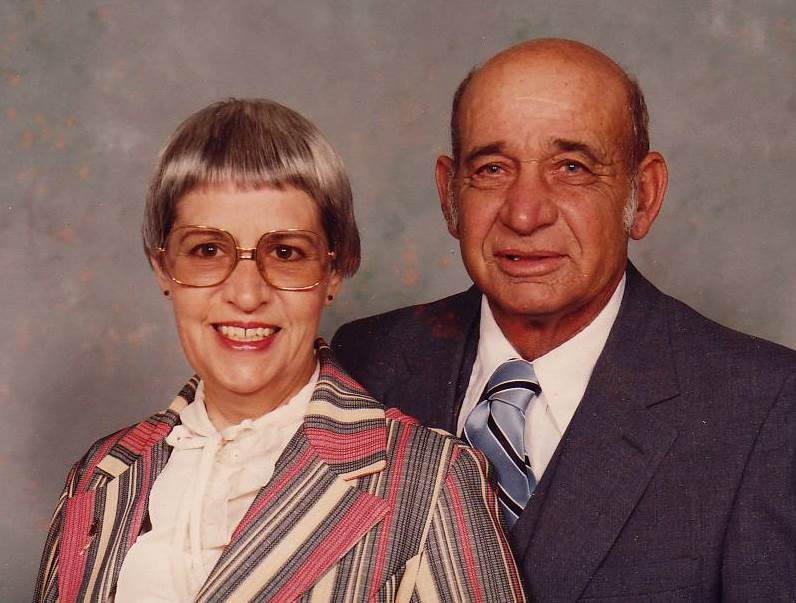
3.  Milton Halen Bolton born May 1844 (not shown on 1850 or 1860 census but is listed in family book), died 1907, buried in the Cook Cemetery, Claiborne Co., TN, married Narcissus “Nursey” Parks.  He and his wife are shown in the photo below.

Bolton - Parks

4.  James P. Bolton born October 1845 (census says 1843), died 1913, buried in the Cook Cemetery, Claiborne Co, TN, married Martha Jane Parks.

5.  Daniel Marson “Marsh” “Morris” “Uncle Mars” Bolton born June 2, 1846, listed as Wilburn in the census, died August 7, 1924, Claiborne County, TN, buried in the Liberty Cemetery, married Sylvia (Silvina) Jones.  He and his family loved to sing and were of the Baptist faith.

Daniel Bolton6.  Morris Bolton, age 2 in the 1850 census, born 1848, not shown in 1860, so died young or the children have been “renamed” or the census taken wrote the wrong information for the wrong child, given that Milton isn’t shown.

Joseph Bolton and his second wife, Margaret Herrell Martin, daughter of William Herrell and Mary McDowell, first wife to Anson Cook Martin who died about 1845, had the following children:

7.  Matilda Ann Matilda Bolton born September 5, 1851, Hancock Co., TN died July 2, 1909, Claiborne Co. TN, buried in the Cunningham Cemetery, Claiborne Co., TN., married Morgan Cunningham.

8.  Joseph B. “Dode” Bolton, born September 18, 1853, Hancock Co., TN, died February 23, 1920, Hancock Co., TN, buried in the Plank Cemetery, Claiborne Co., TN, married Margaret Clarkson/Claxton.

The Civil War

One researcher credits Joseph Bolton with serving in Co B, 9th Tennessee Cavalry, Union Army.  Checking with www.fold3.com, I found both service and pension records.  One claim is filed in 1879 for a Joseph Bolton in the B8 TN Cav who was age 20 in 1865 upon enlistment is obviously not our Joseph.  Another record for a Joseph Bolton in the Company I, 9th TN Cav was for a man captured and killed in 1865, so obviously not our Joseph, either.

Joseph died in 1887, so he would not have been listed in the 1890 veteran’s census, but his widow, Margret, would have been, assuming she was still alive at that time.  Unfortunately, we don’t know exactly when she died, we only have a date range, sometime before her children deeded her property to each other in 1992.  If she had died before the veteran’s census in 1890, then he would not have been listed if he did serve.

There is no evidence that Joseph Bolton served in the Civil War, on either side.

The Church

Our first record of Joseph Bolton in a church was when he was received into the Thompson Settlement Church on the Powell River, just over the border in Lee County, Virginia, located about 10 miles from where the Bolton family lived.  That’s a long way to travel for church.  Rob Camp was an offshoot of Thompson Settlement and was mentioned as an alternate church site as early as 1801.  In 1844 Rob Camp had been officially formed as a separate congregation.

It was very difficult in some instances to tell the Joseph Preston Bolton records from those of his son, Joseph B. “Dode” Bolton, especially in later church records.  Suffice it to say that at one time, Joseph Preston Bolton was a Deacon in the Baptist church, but he was censured and then banned from the church, not once, but twice.

In June 1854, the Rob Camp Baptist Church appointed brethren Joseph Bolton and Ervin McDowell to cite brother Jackson Boles for drunkenness to the July meeting to answer the charges.  Now I’m betting that’s just exactly what Joseph wanted to do.  Apparently, he was pretty good at this job, because he got to do it again.

In February 1856, the church appointed brother Joseph Bolton to cite John Owens for drinking spirits when he saw fit and for throwing stones at his fellow men on the Sabbath.  Throwing stones?  Was that alright if it wasn’t on Sunday?

In March 1856, Joseph Bolton brought a charge against Robert Tankersley, a man of color, for saying that Joseph Bolton “was a mean man and a lyer and other things.”  The next meeting notes are from from Robert Tankersley charging Joseph Bolton for “saying that he had stolen flower and bacon.”  This was referred to the April meeting.  I wonder if Robert Tankersley is a former slave of the Bolton or the Tankersley family.  Joseph Bolton’s first wife was Mary Tankersley and her parents moved to Hancock County as well.

In April, 1856, the church, by request of brother Joseph Bolton excludes him from their Christian fellowship.

In September 1859, (very difficult to read)…church being convinced that the ??? in receiving a charge against brother Joseph Bolton wrought by a member already himself under the censure of the church ??? therefore unanimously rescinded the ???

October, 1866, received Joseph Bolton by recantation and baptized into the fellowship of the church.  This could be the younger Joseph Bolton, but it’s doubtful as he would only have been age 13 and it seems to be the older Joseph Bolton that might have something to recant, as far as the church was concerned.

May 1868, elected brother Joseph Bolton to the office of Deacon.  This entry would confirm that the 1866 entry is Joseph Bolton Sr.  Deacon status is confirmed in the notes of July 1868.

Joseph Bolton was also a founding member of Mt. Zion Baptist Church in Hancock County.  According to the Rob Camp Church minutes, on the second Saturday of April, 1869, Rob Camp Church released the following people from their fellowship to form the Mount Zion Baptist Church.  On the third Saturday of May, the following list of brothers and sisters met to officially constitute the church which would be located on a parcel of land belonging to William Mannon.  Most of these people were related to Margaret Clarkson, Joseph B. “Dode” Bolton’s wife in some fashion.

  • E.H. Clarkson (Edward Hilton, 1st cousin once removed to Margret)
  • Mary Clarkson
  • William Mannon
  • Elizabeth Mannon
  • Mary Muncy
  • Clarissa Hill
  • Sarah Shefley (cousin)
  • Farwix Clarkson (grandfather to Margret)
  • Agnes Clarkson (grandmother to Margret)
  • Nancy Furry (cousin)
  • Elizabeth Clarkson (mother to Margret)
  • Margret Clarkson (future wife of Joseph B. “Dode” Bolton)
  • William Bolton (son of Joseph Preston Bolton)
  • James Bolton (son of Joseph Preston Bolton)
  • John Grimes
  • Catherine Grimes
  • Joseph Bolton (this would be Joseph Preston Bolton Sr., the deacon)

In the first church meeting of the new church, Joseph Bolton was made a Deacon.  One of the first things the new church did was to create a list of members and they all signed a very lengthy statement about the mission of the church.  Among those names is Joseph Bolton, noted as a Deacon, Margret Bolton and Margret Clarkson.  However, a note beside Joseph’s name, obviously added later, says “excluded” and a note beside Margaret’s name says “dis” for dismissed.  Obviously, things did not go swimmingly well at the new church.

Joseph’s name was never again found associated with a church, although he could have attended one the churches such as Liberty which would have been located quite close to his home on Little Sycamore after he moved to Claiborne County.

The 1870 census shows the family in District 14 of Hancock County near the Atlanthis Hill post office, Joseph age 56, Margaret age 60, Matilda age 19, Joseph age 17 and Rebecca Jones, age 14.  I’m not sure who Rebecca is or how she fits in.

The 1880 census shows that Joseph and Margaret had moved from Hancock County into Claiborne County where they lived in the 6th district.  There are no children living with them, and they are neighbors to both Milton N. Bolton and D.M. Bolton

In the Hancock Co. 1880 tax list from the East TN Roots Vol VI, number 4, Margret Bolton is listed with 55 acres, $350 value, 105 to county, 35 to state, 35 to school, 87.5 for special 262.5 total taxes, no poll.  This is very odd because her husband, Joseph Bolton Sr. did not die until 1887.  This may be her inherited land and since she and Joseph, according to the census, are living in Claiborne County, that could explain why he is not listed.

Joseph Bolton Jr. lives beside her with no land, 1 poll, but then under him it says 100 to school and 30 special and 130 total, paid to Edds.  So perhaps he is farming his mother’s land.

Land

On February 21, 1881, in Claiborne County, Daniel Jones and his wife, Ann Jane Jones deed to Joseph Bolton and D.M. Bolton and his wife Silvia land on the waters of Sycamore Creek on Powell Mountain and Little Ridge adjoining the land of H.H. Friar.

This deed puts the migration date from the 4 Mile Creek area in Hancock County to Little Sycamore about 1881 for the Bolton family.

In 1881, in Claiborne County, adjoining Hancock County, we find a deed dated November 25th between Joseph Bolton and his wife Margrett (sic) J. Bolton and D.M. Bolton and Silvania Bolton, his wife, to H. H. Friar for $1200, land on the waters of Little Sycamore and Powell’s Mountain and the Little Ridge, adjoining said Friar and others.  Daniel Bolton is the son of Joseph Bolton Sr. by his first wife Mary Tankersley.

In 1883 and 1884, James Bolton, son of the elder Joseph Bolton purchases land on Little Sycamore Creek in Claiborne County.  In the 1884 deed, the land abuts Sycamore Creek and Christley? Plank’s line and J.J. Park’s line.

This confirms the story in the “Bolton Family History” that the Bolton family owned “quite a bit” of land and that in 1985, it continued to be farmed by the family.  However, it appears that Joseph P. Bolton didn’t actually own the land after 1881, but it was in the family.

The Bolton book tells us that Joseph Sr. “picked up his tools one day and started to work.  While on his way, he fell dead, near the cemetery where he lies buried – the Plank Cemetery, about 5 miles east of Tazewell in Little Sycamore Valley.”

Joseph died in 1887 and is buried in the Plank Cemetery.  Margaret died sometime after 1885, based on a chancery suite, and before 1892, but her death date and burial location are unknown.  I always find it unusual when one parent has a headstone and the other parent’s grave is unmarked.  Always makes me wonder if there is a story lurking there, waiting to be uncovered and told.

plank cem1

plank cem2

Joseph Bolton stone 2

Joseph’s original stone is shown above, with an additional stone set by the family association below.

I took a gravestone rubbing when I visited back in the 1980s.

plank cem3

The mystery surrounding Joseph’s middle name, Preston, haunts me. It’s very similar to the Presnell or Presley that some folks obviously thought was his mother’s maiden name.  I strongly suspect it was a family name, so the question becomes whether we can find a Preston family associated with a Bolton or a Mann, preferably a marriage record.  Joseph’s mother was Nancy Mann, most likely Scots-Irish.

I spent quite a bit of time on both Ancestry.com and http://www.familysearch.org and searching the trees at www.rootsweb.com as well.

I did find one very intriguing record of a Bolton/Preston marriage at exactly the right time.  Henry Bolton, born about 1760, was supposed to be from London, according to the ship’s manifest, but where his parents were married and where the ship he sailed on some 15-20 years later could be two entirely different locations.  London was, after all, the “go to” place for both commerce and opportunity.

preston bolton marriage

I searched for additional information about where the Preston surname might be found.  Would Preston be more likely as Henry Bolton’s mother or Nancy Mann’s mother?  According to these maps, Preston is more frequently found in England.

Ancestry provides the following information:

Preston

English: habitational name from any of the extremely numerous places (most notably one in Lancashire) so called from Old English preost ‘priest’ + tun ‘enclosure’, ‘settlement’; the meaning may have been either ‘village with a priest’ or ‘village held by the Church’.  Scottish: habitational name from Presto(u)n, now Craigmillar, in Midlothian. This name has also been established in Ireland since the 13th century.

Preston in England

Preston in Scotland

The DNA Story

We have a total of 6 descendants of Joseph Preston Bolton who have taken the autosomal DNA test at Family Tree DNA.  Of those, three of us descend through Ollie and share other DNA as well, so I have eliminated the other two from the equation.  They are both further down the tree, so share less DNA and it would be too difficult to differentiate between the DNA that we share from our Estes line.  Therefore, for this exercise, we have 4 descendants, as shown, below.

There are other descendants of Henry Bolton through his second wife, Nancy Mann, but I am not utilizing them in this analysis.

joseph bolton 4 desc

I want to see how much of Joseph Preston’s DNA we share, and to, in essence, reconstruct some of Joseph Preston, on paper of course, from our combined DNA.

This, however, presented a problem.

Dillis is my third cousin once removed, and we found it distressing to not “be related” in our matches at Family Tree DNA.  Thankfully, we are, but we had to use the “back door methodology to prove that fact.

In the chart below, you can see that we cousins didn’t all match each other, at least not on the surface.

Dillis Me Barb Janet
Dillis na No Yes yes
Me No na Yes Yes
Barb Yes Yes na Yes
Janet Yes Yes Yes na

This means that I couldn’t simply compare everyone though the chromosome browser, I had to compare several people and then combine the results, deleting the duplicates in the resulting spreadsheet.

The method I used was to push the matches through to the chromosome browser from the match page and then download everyone’s matches to everyone else, meaning I only downloaded the matching information – not everyone’s matches to their entire match list.

The Dillis to Barb match information would be the same as the Barb to Dillis, so I deleted that portion so that all we have is one comparison for each pair.

For example, here’s a comparison of one cousin to two others at the 1cM level.  Look at that beautiful Bolton DNA!

Dillis cousin match

By clicking on the “download to Excel”, right beside the Chromosome Browser Tutorial, you only download the compared results and can then add them to a composite spreadsheet easily.

Dillis preston match

Here is the resulting composite spreadsheet for all of the cousin matches, after I’ve color coded the results.

joseph bolton desc ss

Actually, it’s the color coding that is important.  You have to do this yourself after you copy and paste the relevant results into your spreadsheet.

Let’s take each color one at a time.

First, let’s look at red.

The red are the segments that Dillis and I DO match on.  Yes, that’s what I said….we DO match.  Family Tree DNA has their thresholds set to maximize the largest matches they feel are genuine in a generalized population,  meaning not identical by state, but those rules don’t always apply when you have a known or suspected relationship.  What a nonmatch means at Family Tree DNA is that we don’t meet all of the following criteria:

  • 20cM total
  • At least one individual match over roughly 7.7cM
  • 500 SNPs for at least one segment

Obviously Dillis and I don’t meet that criteria, but we do have relevant matching DNA – lots of it – in at least 5 different areas.  The proof is in the downloaded spreadsheet.  Were it not for the fact that I happen to know our Bolton cousins who have tested, and we each match some of them in common, we would be unable, through Family Tree DNA to determine that we match.  That also means we wouldn’t be able to utilize the smaller Bolton segments to identify other matches – like, maybe Prestons.

It sure would be wonderful to be able to selectively reduce the matching criteria, especially within projects or in specific situations, like to Dillis, or to everyone who shows a certain ancestral surname or ancestor.  We miss a lot by not having this ability, but we can’t quantify how much we miss because we can’t see what we’re missing.

Second, let’s look at the green groups.  These are groups where all of the participants have overlapping DNA that matches.  Matching of three or more individuals from a known ancestor is called triangulation, and that is how DNA is assigned to that particular ancestor.  So, the overlapping portions of the green DNA are Joseph Preston Bolton’s DNA that we all share.  How about that?

The yellow flags the matches between Janet and Dillis who are more closely related.  They also share both Parks and Smith DNA, so those segments, if they don’t match another Boltons, cannot necessarily be attributed to Bolton lineage.  Before I would utilize this spreadsheet for further matching, I would probably remove those segments, or leave them colored to remind myself

I wanted to see a visual of Joseph Bolton’s DNA on his chromosomes, and who carries it today.

Utilizing Kitty Cooper’s wonderful ancestor chromosome mapping tool, a little differently than she had in mind, I mapped Joseph’s DNA and the contributors are listed to the right of his chromosome.  You can build a virtual ancestor from their descendants.  I have only utilized the proven, or triangulated DNA segments proven to three or more descendants.

joseph bolton reconstructed

Wow, how cool is that.

Notice the X chromosome as well.  Due to the unique inheritance pattern of the X chromosome, we know that Joseph received his X from his mother, Nancy Mann, so that is Nancy’s X segment we’re looking at.  Janet and I both carry that segment, that piece of Nancy, in us today.

Let’s look at one more thing.  Let’s see if we can glean any information at all about the surname Preston.

I went back into the Family Finder matching and I utilized the surname match capability.

bolton preston ff

I checked each match to be sure that Preston was a surname and not a county or a middle name, and then I recorded, on paper, the list of names of people who had Preston ancestry who matched each cousin.  Obviously, I was hoping to find someone listed on the match list of multiple, hopefully distant, cousins.

Cousin Dillis matches three people, shown below mapped onto Dillis’s chromosomes in 3 colors.  Notice that on chromosomes 11 and 12 some of them match Dillis in the same location.  This does not inherently mean they match each other too, but they might.  Unfortunately, since we are below the 7cM matching threshold at Family Tree DNA, we can’t utilize the Matrix tool to take a look.

Dillis preston match crop

Between all of the cousins’ matches, there were a total of 47 individuals who listed Preston as one of their surnames.

I decided to download the segment data of Dillis’s three Preston matches, and the one person, Terry, who was listed on two different cousin’s matches.  One of the cousins Terry matches is not a descendant of Joseph Preston Bolton, but descends through another child of Henry Bolton and Nancy Mann.

So, I’ve included those Preston match people in the resulting spreadsheet and let’s take a look at what we have.  Terry is the person who matches two different Bolton descendants.

Preston triangulation match

The spreadsheet has gotten quite large, too large to reproduce here, so I’m only showing an example.

What we want to find is one of the people with Preston genealogy dead center in the middle of a proven Bolton segment.  This can match mean one of a few things.

  • The matching person, Terry, in this case, has unknown Bolton heritage.
  • We share some mutual DNA that contributed to the Bolton line.
  • That mutually shared DNA may be Preston DNA.
  • We are the world’s most unlucky people and Terry matches us on all 27 common segments circumstantially. You can pretty much rule this one out.

Several of these segments have matches between Dillis, at least one of his Preston descendant matches, Terry and other cousins.  One of Dillis’s matches also matches on several of the same segments where Terry matches the cousins as well.

This very strongly suggests distant common ancestry.  What can we do to find out?

Genealogy, we’re back to genealogy.  Now, I need to look at the Family Trees on Family Tree DNA for each of the people who have loaded GEDCOMs to see if I can find any commonality between their Preston ancestors.  I need to send e-mails to those who haven’t uploaded GEDCOM files, and let’s hope that we are lucky enough to find a connecting thread between the Prestons that might lead us to a Preston/Bolton connection, or at least a geography – and who knows – maybe it’s the Bolton/Preston marriage from 1756 in York, England.  Or maybe not – that’s why it’s called a search!

Long shot?  Yep?  Genealogy is an adventure with never any sure answers and every answer leads to more questions.  But, as my brother, John, says, no shot is a sure miss.

I’m thinking Henry Bolton’s mother just might well be a Preston and I’m setting out to find more evidence.

What would be really useful now would be to find a descendant of Henry Bolton’s brother, Conrad.  Unfortunately, Conrad had only one known child, Sarah, born about 1806 who married Jesse W. Keyes on March 29, 1826 in Giles Co., VA.  If Sarah’s descendants also match one of those Preston DNA individuals, preferably on the same segment, then that eliminates Nancy Mann from the equation, confirming the Preston DNA came from Henry’s line.  Yea, I know I’m dreaming, but this is how we utilize DNA to prove hypothesis.

Wish me luck!

Step one….any descendants of Conrad Bolton out there???

______________________________________________________________

Disclosure

I receive a small contribution when you click on some of the links to vendors in my articles. This does NOT increase the price you pay but helps me to keep the lights on and this informational blog free for everyone. Please click on the links in the articles or to the vendors below if you are purchasing products or DNA testing.

Thank you so much.

DNA Purchases and Free Transfers

Genealogy Services

Genealogy Research

Last Call

last callNo, not that kind of last call.

Last call to vote – in the Rockstar Genealogist competition hosted at John Reid’s blog, Canada’s Anglo-Celtic Connections.

Rockstar genealogists are those who give “must attend” presentations at family history conferences or as webinars. Who, when you see a new family history article or publication by that person, makes it a must buy. Who you hang on their every word on a blog, podcast or newsgroup, or follow avidly on Facebook or Twitter?

So, you get to vote for your favorites AND it’s your opportunity to make me pay.bag of money

And pay BIG.

This is the only time in my life that guaranteed, my money is going to be quadrupled and I’m not even going to have to buy a lottery ticket, draw a card or roll a dice.  It’s guaranteed!

You see, here’s the deal, in the past voting, a genetic genealogist has never found their way into the top 10 of the Rockstar Genealogists.  Now I’d like to raise awareness for genetic genealogy and how useful it can be, and I am a strong advocate for the War of 1812 Preserve the Pensions project….sooooo…..if a genetic genealogist finds their way into the winners circle, meaning the top 10, I’ll pay up.  My $250 donation will become $1000 through matching donations and will preserve 2200 pension pages total.  A very worthy cause, don’t you think?

You can read about my original pledge or take a look at what Judy Russell had to say.  You know, she did get up at o’dark thirty and walk to the Alamo for Preserve the Pensions as well, and well, truthfully, I’d rather count out all 25,000 pennies than do that…..

Here’s a list of this year’s nominees. You can vote for as many individuals as you want, but you can only vote once.

Genetic genealogists on the list include:

Voting ends today, Friday, or maybe Saturday, according to John…but don’t wait for Saturday and be disappointed, so vote NOW, include one or more genetic genealogists….and make me pay:)  I’m already counting my pennies!!!

Am I going to have to pay?  Who is it going to be????

last call2__________________________________________________

Disclosure

I receive a small contribution when you click on some of the links to vendors in my articles. This does NOT increase the price you pay but helps me to keep the lights on and this informational blog free for everyone. Please click on the links in the articles or to the vendors below if you are purchasing products or DNA testing.

Thank you so much.

DNA Purchases and Free Transfers

Genealogy Services

Genealogy Research

Rockstar Genealogists – Sweetening the Pie

rock

Did you know there was such a thing as a Rockstar Genealogist?  Well, there is, and yours truly, along with 149 of my closest friends, has been nominated.

John Reid is sponsoring this third annual contest on his blog, Canada’s Anglo-Celtic Connections.  A little digging tells me that I was also nominated in 2013 as well, but I didn’t know it.  Maybe I’m the “Lives Under a Rock” genealogist:)

You can vote for your favorite genealogists by visiting John’s blog and clicking through to vote.  Voting is open now and will end late Friday or Saturday, according to John.  So don’t wait, vote now.

Here is last year’s list of winners and a list of this year’s nominees.

On the 2013 winner’s list, I see several familiar names, including Judy Russell and Megan Smolenyak who both work with genetic genealogy in addition to more traditional genealogy.  I know both of these ladies personally, and I can vouch for the fact that they are, indeed, Rockstar Genealogists.  I would like to see both of them in their Rockstar garb however.

What I didn’t see were any genetic genealogists, those who specialize in that end of the field.  Looking at this year’s nominees, and there were a lot of them, I was very pleased to see several genetic genealogists listed, including CeCe Moore, Tim Janzen, Blaine Bettinger, Bennett Greenspan, Debbie Kennett, Katherine Borges and of course, yours truly.  Not bad for a field that just a decade ago was almost entirely unknown, and 15 years ago, didn’t exist at all.

I find it particularly fitting that Bennett Greenspan is included in this list, given that he’s the man who started it all.  And wow, am I ever in awesome company!

So, given that I’d love to see at least one genetic genealogist in the winner’s circle, complete with their electric guitar, strumming it with their DNA swabs – I’m going to, ahem, sweeten the pie.

pie

Make Me Donate!!!

If any of the above mentioned genetic genealogists are in the list of 2014 winners, I’ll donate $250 to the War of 1812 Preserve the Pensions Digitization Project.

But, it gets even better, because right now, there are two organizations, the Illinois and Indiana Genealogy Societies, who are matching donations to this project, so my $250 will become $500.  So, if I “have to” donate, I’ll be doing it through one of them.

But we’re not done, it gets even better yet.  Right now, Ancestry.com is matching every donation 100%, so that $250 that turned into $500 actually turns into a $1000 donation.  That $1000 donation preserves 2200 pages that are in desperate need of preservation and that will be available free, forever, for everyone.

I had three ancestors serve in the War if 1812, one of whom died in the service of his country, so I feel very strongly about this crowdsourcing project.  These records are incredible and many times include information about wives and children not available elsewhere.  In one case, the pages of a family Bible were torn out and are today found in that pension file – the file of a man that no one today knew even served in that war.

So, if someone else would like to join into the pie sweetening, that would be just wonderful.  No such thing as too many cooks in this kitchen!  Post your sweetener as a comment to this article.  After all, it’s all in good fun and for a great cause.  Pass the sugar!

Vote!

So, please vote now and do your share to make sure I “have to” donate and let’s get at least one of our genetic genealogists into the winner’s circle.  You can vote for as many people as you want, but you can only vote once.

Here’s the link to vote.

______________________________________________________________

Disclosure

I receive a small contribution when you click on some of the links to vendors in my articles. This does NOT increase the price you pay but helps me to keep the lights on and this informational blog free for everyone. Please click on the links in the articles or to the vendors below if you are purchasing products or DNA testing.

Thank you so much.

DNA Purchases and Free Transfers

Genealogy Services

Genealogy Research

Jack the Ripper???

The DNA community had some exciting news this past week about the identity of Jack the Ripper, notorious serial killer of prostitutes in the Whitechapel area of London in 1888.  In total, there were 11 murders potentially linked to Jack the Ripper, with 5 being considered the most likely to be positively his victims.  He slit the throats of his victims, in some cases disemboweled them and mutilated their faces.

ripper1

While there were many suspects and much speculation, the identity of the murderer was never established.  Among the suspects was one 23 year old Polish immigrant, Aaron Kosminski.  Aaron worked and lived in Whitechapel and was reportedly seen with one of the victims, but incriminating evidence was not given by the witness and he was released.  In 1891 he was committed to an insane asylum, probably a paranoid schizophrenic, where he eventually died.  He heard “solitary voices” and indulged in “unmentionable vices” which typically means activity of a sexual nature.

Last week, the British tabloid newspaper, the Daily Mail, ran a “world exclusive” article that Jack the Ripper has actually been identified as Aaron Kosminski utilizing DNA evidence found at the scene of one of the murders, that of Catherine Eddowes.

This was followed almost immediately by articles much more skeptical in nature, one in the Oregon Live and one by our own Judy Russell.

The reader’s digest version of the DNA part of the story is that a shawl was found with Catherine when she was murdered, although there is no evidence that the shawl was hers.  It’s believed that the killer left the shawl for some unknown reason.

The first problem with this story is that there is no proof that this shawl was indeed found with the body.  Catherine was so poor she reportedly hawked her shoes the night before, and the shawl in question was worth more than the shoes.  She has also just been released from jail for drunkenness before she was found murdered, and no shawl was mentioned by anyone.  Just the same, that doesn’t mean the shawl didn’t exist, and there is powerful DNA evidence, if it’s accurate, suggesting that this shawl was found exactly as stated, with Catherine’s body.

Russell Edwards purchased the blood-soaked shawl at auction, the shawl purportedly being found by a policeman the night of the murder and taken home to his wife, a dressmaker, who put it away unwashed.   Edwards hoped to somehow use the shawl to prove it was not only authentic, but to identify Jack the Ripper.

Edwards contacted Dr Jari Louhelainen, a leading expert in genetic evidence from historical crime scenes who combines his day job as senior lecturer in molecular biology at Liverpool John Moores University with working on cold cases for Interpol and other projects. He agreed to conduct tests on the shawl in his spare time.

Catherine’s DNA

He was able to extract DNA from some of the blood on the shawl and eventually managed to obtain mitochondrial DNA results.

Edwards managed to track down an individual, Karen Miller, who descends from the same matrilineal line as Catherine Eddowes, her three times great-granddaughter, and the mitochondrial DNA matched.  This is interpreted as confirming the identity of the blood on the shawl as that of Catherine.

Herein lies the second problem.

The article states that they “managed to get six complete DNA profiles from the  shawl” and that they were “a perfect match.”

I’m assuming, here, and I passionately hate to assume, because we all know what assume does…but I’m assuming that they are referring to mitochondrial full sequences here, all 16,569 locations on the mitochondria.  It would have been very helpful had they stated exactly what they tested.

They also don’t tell us what haplogroup they are working with.  If this is haplogroup H, it’s possible to have hundreds of “exact matches” because haplogroup H, itself, comprises almost 50% of Europeans today.  Of course, if they managed to sequence the entire mitochondria, the results would likely fall into a subclade, and some subclades are very rare, even within haplogroup H.

Because haplogroup H is so large, there is a great deal of diversity within H, and many of the subclades are small.  Furthermore, some people have no “unusual markers,” and those people tend to have many more matches than people who do have “unusual markers.”  Unusual markers are those mutations that have probably occurred in a family line and are not generally found in the majority of those of that particular subclade.

By way of example, here are the results from someone who is a member of haplogroup V, from eastern Europe.  They do not fall into a subclade of V and they have several extra mutations and one missing mutation compared to what is typically found in haplogroup V participants.

ripper2

This individual has 3 full sequence matches, two of which are exact matches, but neither of those lead to the same ancestor.  This is a rather typical situation, not out of the ordinary.

The Ripper’s DNA

Another discovery on the shawl was that of semen, possible evidence of the Ripper himself.  They enlisted the help of Dr. David Miller who found surviving epithelium cells, a type of tissue that coats organs, in this case, thought to have come from the urethra during ejaculation.

Here a quote from Dr. Louhelainen about the DNA findings from these cells.

“Then I used a new process called whole genome amplification to copy the DNA 500 million-fold and allow it to be profiled.

Once I had the profile, I could compare it to that of the female descendant of Kosminski’s sister, who had given us a sample of  her DNA swabbed from inside  her mouth.

The first strand of DNA showed a 99.2 per cent match, as the analysis instrument could not determine the sequence of the missing 0.8 per cent fragment  of DNA. On testing the second strand, we achieved a perfect 100 per cent match.

Because of the genome amplification technique, I was also able to ascertain the ethnic and geographical background of the DNA I extracted. It was of a type known as the haplogroup T1a1, common in people of Russian Jewish ethnicity. I was even able to establish that he had dark hair.”

Here is the third problem.

This description seems to combine two types of sequencing.  Now, that’s not a bad thing, it’s simply confusing.  Based on the haplogroup of T1a1, we know that they sequenced mitochondrial DNA and that they did in fact manage to sequence it to the full sequence level.  How do we know this?  Because each mitochondrial haplogroup is designated by certain specific mutations.  In this case, the final 1 of T1a1 is indicated by location 9899 in the coding region of the mitochondria – so in order to designate this individual as a member of haplogroup T1a1, they had to sequence the coding region.  Again, we presume (the cousin of assume – with the same consequences) that they were able to successfully sequence the entire mitochondria.

Now for the fly in the ointment, I have not found this haplogroup in Russian Jewish people.  In fact, the clients who I have done DNA Reports for who fall into this haplogroup are not Jewish – none of them, nor do they have Jewish matches.  Neither does Dr. Behar identify this as a Jewish haplogroup in his founding mother’s paper.  Nor is this identified elsewhere as a Jewish haplogroup.  Of course, this Daily Mail article has no sources, so we can’t independently verify what was said, but it looks like this assertion of T1a1 typical of Jewish people may be in error.

However, from his discussion, we can also tell that additional sequencing has been done on the DNA retrieved, because you can’t determine traits like hair color without autosomal sequencing.  Therefore, if the descendant is truly related to Jack the Ripper, then at least part of their autosomal DNA should match as well, and that was not addressed.  If the autosomal DNA does not match, at least in part, then it calls into question the conclusions drawn by the mitochondrial DNA match.

We know that Kosminski was born about 1865 if he was 23 in 1888 when the crimes were committed.  The DNA matches a descendant of his sister.  Let’s assume, for purposes of argument that his sister was born about the same time.  And let’s use the standard genealogy generation of 30 years.  This means that the sister’s child was born in 1895, her child in 1925, her child in 1955 and maybe yet another child in 1985.  That’s a total of 6 DNA transmission events to a common ancestor, being the parents of the Kosminski siblings.  Therefore, Kosminski is the great-great-uncle to the child born in 1955.  Therefore, the individual born in 1955 should share about 6.25 of their autosomal DNA with Kosminski.  If they don’t, then there’s a problem.

If they do, then why didn’t the article tell us that.  This information would, in essence, seal the deal – well, assuming all of the other presuming is remedied.

Is It True???

First, let me state that in science, I’m always very, very skeptical of publication via newspaper or internet, especially publication via tabloid.  This has been fraught with problems.  Debbie Kennett has covered this repeatedly on her blog.  Another example is the announcement of  Pict DNA being identified – published and never proven.  I know of other cases in which DNA evidence is intentionally twisted, inaccurately, to fit the intentions of the publishing entity.  So, yes, I’m a rabid skeptic without provable evidence.

I want to see this assertion go through the verification process with a second, reputable, lab.  By reputable, I mean one not associated with any of these other questionable assertions.  Then, I’d like to see the results published in an industry accepted journal.  Yes, that takes time, and yes, there are questions to answer, but the resulting paper carries with it credibility that is impossible to obtain otherwise.  Unfortunately, publishing results in a tabloid paper immediately causes me to question why they would have made that choice if they had solid proof.

Ok, now that I’ve said that, I want to address the question at hand.  Is it true?  Might it be true?

I’d like to make two points.  First, while I used random examples of mitochondrial matching, this isn’t a random situation.  This is a known individual in both cases, with known and I’m assuming, provable, genealogy to both Catherine Eddowes and to Aaron Kosminski.  We’re not looking at random matches here and we’re not looking for a common ancestor.  We know who the common ancestor is in both of these situations and we’re looking for matches to confirm that identity.  This, by the way, is exactly how our armed forces identify remains of soldiers and repatriate them to the family.  This uses the exact same premise – that we’re not looking for random matches, but for a match with a known family member of known provenance – with possibly, hopefully, family line mutations.

Now, let’s use a bit of math, which is sometimes, but not always, my friend.

I’m going to use two examples, haplogroup T1a1 and haplogroup J1c2f because it’s mine and I have easy access to those results.  We know that the mitochondrial DNA attributed to Kosminski is T1a1 and we’ll just let mine stand in for Catherine Eddowes.

In the Family Tree DNA data base, haplogroup T represents 8.06% of the participants and haplogroup J, 7.77%.  As of September 8, they have a total of 43,329 full sequence mitochondrial DNA results in their data base.  I calculated the number of members of each haplogroup based on that percentage and then I checked the corresponding DNA project at Family Tree DNA.  Then I checked to see how many occurrences of the subgroups of J1c2f and T1a1 were found and calculated the percentage of haplogroup J and T they represent.  The total subgroup percentage is the percentage of J1c2f and T1a1 of the entire FTDNA full sequence population.

  % FTDNA # Members Hap Project # #J1c2f/ T1a1 % of  Hap Proj Total % subgroup
J1c2f 7.77 3336 2165 6 .2 .01
T1a1 8.06 3492 673 52 .73 .12

London’s population was estimated to be 1 million in 1800 and 6.7 million in 1900, so let’s use the figure of 6 million for 1888 as an estimate.

Of 6 million people, you would expect to find 600 people carrying haplogroup J1c2f and 7200 people carrying T1a1.  Therefore to find two of those individuals whose DNA is found on the same scarf, who have a forensic tie, or a suspicion of a tie, is astronomically small.

If math is my friend today, we would multiple values of each haplogroup in the population together to find the odds of finding both in one place.

That would be .0001 times .0012, which equals 1.2e-7 which means, 0.00000012, in other words, about one in 1.2 billion.  The population of the world in 1875 was calculated to be about 1.3 billion

So, assuming their work is accurate, and assuming that this isn’t a huge elaborate hoax, it’s very likely accurate, and Jack the Ripper is very probably Aaron Kosminski.

Where’s the Beef???

ripper3

Remember the old Wendy’s refrain, “Where’s the Beef?’’

Well, I want to believe this story, especially since it’s such a feel good fairy tale story involving a Jack the Ripper hobbyist and DNA, of course.  But I’m really left waiting for some kind of corroboration.  Was it Carl Sagan that said “extraordinary claims require extraordinary evidence?”  Well, they do and I really hope the authors will subject their findings to peer review and authenticate their claims.  If this isn’t true, it’s a hugely elaborate and well-planned hoax perpetrated probably to sell a resulting book or movie which should, if that is true, be named “Jack the Ripoff.”

I want this to be true, and I want the authors to make a believer out of me.  I want no presumes or assumes left standing.  So….where’s the beef???

______________________________________________________________

Disclosure

I receive a small contribution when you click on some of the links to vendors in my articles. This does NOT increase the price you pay but helps me to keep the lights on and this informational blog free for everyone. Please click on the links in the articles or to the vendors below if you are purchasing products or DNA testing.

Thank you so much.

DNA Purchases and Free Transfers

Genealogy Services

Genealogy Research

Ralph Dean Long (1922-1994), My Stepfather, 52 Ancestors #36

dad1

It was 20 years ago this weekend that he slipped away…this man I loved so much.  Well, slipped away isn’t exactly the right word for it.  He removed his own life support because the family was not united in their decision of what should be done.  So, he somehow rallied the strength and did it himself.  He was one of the bravest men I ever knew…in a very quiet, unassuming, homey type of way.  His final act of bravery only surprised me in that he was able to somehow find the physical strength to do it.

When I think of him, which is often, I think of him in his blue denim overalls.  He was a farmer, a Hoosier with a bit of a lisp and a definite Hoosier drawl, and a breathy, raspy laugh that was interjected between his words many times, like he got his own joke part way through and he just had to laugh before he could continue.  His sentences were full of laughter pauses and punctuations.  But when he was serious, he was dead serious and a man of very, very few words.  God help anyone who hurt someone, human or animal, that he loved.

Dean, as he was called, was born on December 26th, 1922 in Howard County, Indiana to Harley Clinton Long (1878-1949) and Lottie Bell Lee (1881-1962), the youngest of 12 or 13 children.  I never knew his parents.  I did, however, know several of his siblings.

Two of his siblings, Arnold and Wilma, never married.  They lived on the old family farmstead their entire lives.  Another sister, Verma, married but never had children.  She was the eternal sourpuss, and it was the family joke that her husband died to get away from her.  Wilma, on the other hand was the loving sweet aunt and Arnold, well, I’d describe him as a lecherous old man.  My Dad told him once that if he put his hands on me, or my mother, again, he’s kill him – and I do believe he meant it.  More importantly, Arnold believed it.

Dean was married initially to Martha Mae Alexander and they had two children, my step-brother, Gary, and a daughter, Linda who died as an infant.  Linda was born with what appeared from pictures to be Down’s syndrome.  When my daughter was born, Dean gave me Linda’s baby blanket.  I was extremely moved but I could never use it. It’s still safely tucked away.

Dean was grief-stricken when his daughter died at 18 months of age, the day after his birthday and two days after Christmas in 1959, but his heart-ache was only beginning.  His wife had a disease that was, at that time, impossible to diagnose. It was progressive, debilitating and fatal.  I don’t remember the name of the disease, but he carried a newspaper article in his billfold about it, and there were only a handful of known cases at the time.  It took her a decade to die, all while fighting an unknown foe to live and raise her son.

The aunts were Dean’s salvation during this time, because they stepped in and helped take care of Gary while Dean tended to his wife through her many hospitalizations.  This was before the days of handicapped accessibility, but he modified the house with all kinds of aids for her.  Many of which remained long after he and my mother were married simply because they were useful.

After Martha’s death, in 1968, Gary, by then a teenager, began manifesting symptoms of mental illness and was institutionalized episodically for many years.  We always wondered if Gary’s illness was in some way caused in utero by the beginnings of his mother’s horrible illness.

Through all of this, Dean continued to farm, because that was what he did – and if you’re a farmer, you have to farm whether you feel like it or not. He also developed chronic ulcers, had 7 or 8 surgeries to stop the bleeding over the years.  The family was “called in” more than once because he wasn’t expected to survive.  His abdomen looked like a railroad track.

But he did survive, because he had to – he had a family to take care of who needed him desperately.

By the time I met Dean, about 1969, he had joined Parents Without Partners and he was the “fix it” guy for all of the ladies in the group.  He would visit those who needed something fixed, in exchange for dinner or coffee and a doughnut maybe.  Everyone loved Dean.

For a man with so much grief and loss in his life, he was always warm, smiling, friendly and funny.  Nobody didn’t like Dean.  Well, except my Mom.

You see, Dean “took a shine” to her.  Yep, our stuff got fixed first, and he came “calling” complete with flowers wearing his only suit.  My Mom wasn’t interested in a farmer, because she grew up on a chicken farm, hated every minute, and swore she would never go back.  I recall vividly the day that Dean dropped in unexpectedly, carrying flowers and a box of Dunkin Doughnuts, in his ill-fitting too-big light blue suit.  He walked up the driveway hill, smiling and hopeful with a spring in his step carrying the box and flowers carefully, like the crown jewels.  He rang the doorbell.  Mom didn’t want company.  She had worked all day and was tired, plus, she wasn’t interested in a farmer.  I was happy to see Dean and headed to answer the door

Mother stopped me and told me not to answer the door.  He knocked and knocked, long after any hope of an answer disappeared.  Then he turned and walked slowly down the driveway hill, to his car, his shoulders slumped, head down and the flowers hanging forlornly from his hand.  He looked back at the house one more time and there was no smile.  He got in his car and drove away.  I cried and cried, not for myself, but for the oh-so-evident sadness, disappointment and terrible loneliness of that man in the ill-fitting blue suit.  Mother felt terrible and I told her she should.

Apparently something changed, because the door never went unanswered again and Dean became a regular part of our lives.

Then one day he asked me if he could marry my mother.  He and mother went to visit Gary and asked his blessing too.  We began planning a country wedding in a small white church.  Life was glorious for everyone.

dad2

The biggest challenge was introducing our cat to his dog.

I loved life on the farm and I became Dad’s shadow.  One of my biggest joys was to help Dad with the chores – driving the tractor, birthing hogs, whatever.  A few things I didn’t like and Dad was just grateful for any help he had.  Gary wasn’t there much and when he was, didn’t much care for farm work.  My mother fit right in, and was grateful Dad didn’t raise chickens.

I had been without a father since my own father’s death in 1963, so I was extremely grateful to have a father.  Dean became Dad someplace along the line and if you didn’t know I wasn’t his biological daughter, you would never have known.  I always joked with him.  Anything “bad” I told him was his fault and I inherited from him.

One day, he walked in from the barn, walked over to me sitting at the kitchen table, thunked me on the head with his thumb, which was his special gesture of affection, looked at me and said, “Hey, when I married your mother, I got my daughter back.”  His eyes welled up with tears, and then he just walked out of the room like he had told me nothing more important than that the soybeans were sprouting.  He was just that way, a man of very few words but deep commitment and undying love.

Now let’s just say I wasn’t the most well-behaved teenager in the world and I gave my mother multiple episodes of heartburn – and that’s probably putting it very mildly and quite understated.  She, however, got very even with me by wishing that awful mother curse upon me – “May your children be 10 times worse than you are.”  She removed said curse and apologized profusely many years later, but it was too late and the damage was already done.

But Dad, well, he was always the encouraging one.  He told me I could do anything I wanted to do, and that I could be anything I wanted to be…and growing up poor, on a farm, had nothing to do with it.  He looked at me one day, walking past the metal swing outside as we were snapping beans and said, “Bobbi, if anyone changes the world, it will be you,” and just continued walking.

I was dumbstruck, and remember looking at his back walking away after he dropped that bombshell on me.  I wondered what he meant.  But those rare words from Dad sunk in and hit home, and I’ve never forgotten them.

I remember vividly, oh so vividly, when Jim and I were at the National Geographic Society for a DNA Conference in 2005.  As we walked down the huge marble Explorer’s Hall – I looked at Jim and said, “Wouldn’t Dad he surprised?”  Jim said, “Not at all.”  I kind of laughed, because it’s a very long way from the hog farm in Indiana to the Explorer’s Hall in Washington DC.  Dad would have been proud.  However, little that I did ever surprised Dad.  He was the eternal optimist in spite of the horrible challenges he had weathered.

For some reason, possibly because he had lost his only daughter and I had lost my much-beloved father, we formed a special bond.  In fact, a bond so special it transcended his lifetime.  A year or so after his passing, I was sleeping, alone in my house.  Suddenly, in the middle of the night, someone woke me up.  I woke up with a start, sat straight upright, confused and terrified, because I was, supposedly, alone in the house.  I had just a few seconds to think about it, because a fireball suddenly exploded into the bedroom door from the hallway.  The house was on fire, and had I not been awake, I would have perished, trapped in that bedroom.  Yes, it was Dad who woke me up.

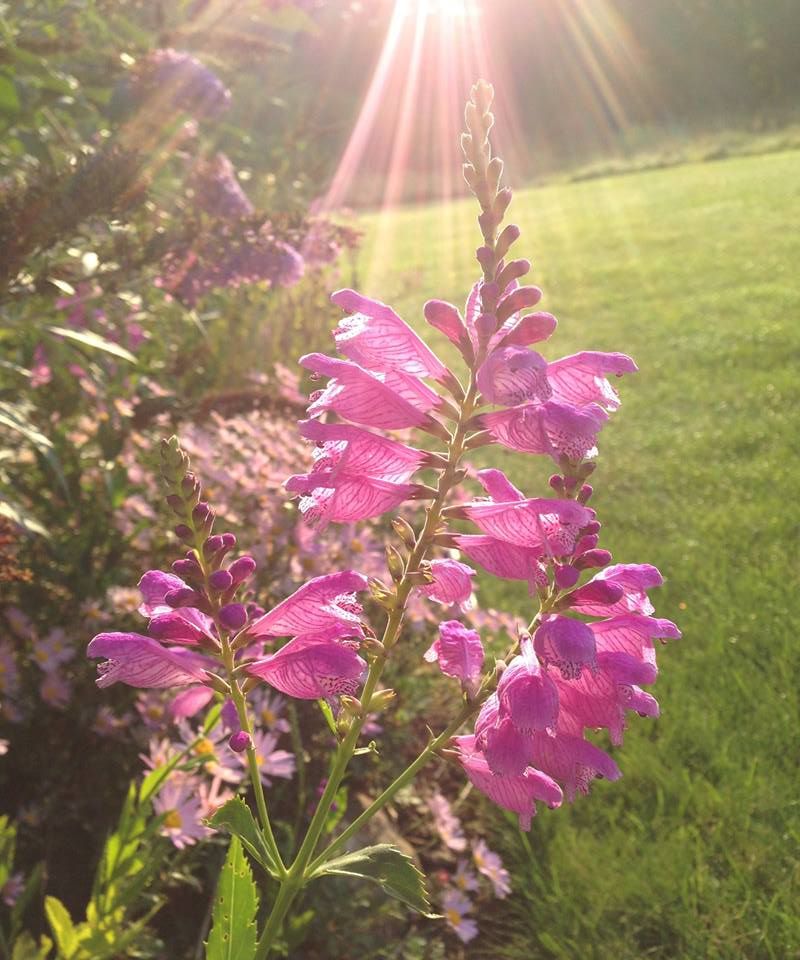
So, when I took this picture in my garden this weekend, I wondered where those rays came from.  I certainly didn’t see them when I was taking the photo. Then, I realized that it was indeed 20 years to the day since Dad’s passing.  Leave it up to Dad to say hello like this.  He was such a beautiful soul.

dad3

Mom has joined him now, as has Gary.

Losing Dad happened far too soon, and in large part due to his own choices regarding smoking.  That saddened me and to some extent, angered me, because neither Mom nor I, nor my kids, were ready for him to go.  Mom grieved his death horribly.  It’s also testimony however to how powerful nicotine addiction is – you’ll do it in the face of sure and certain death.  The fact that Dad wanted to, and couldn’t, overcome it saddens me even more.

While losing Dad was terrible, I have so many wonderful memories of him.  And he was such a kind, gentle and funny man.  His quiet demeanor belied his love of humor and a good prank, and I think he was always pondering one in the back of his mind

One of the favorite family stories was when, as a teenager, he stuffed the school heat ducts full of chicken feathers.  When the heat came on in the fall, not only did some of them manage to catch on fire and stink to high heavens, but the rest of them blew out all of the ducts into the classrooms. Of course, he “knew nothing about that,” (chuckle, chuckle) and neither did his brothers, but for some reason, that was a family favorite story for the duration of the lives of the brothers and sisters.  The sisters mostly rolled their eyes.

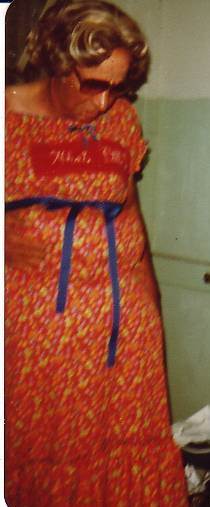
dad4Another time, Dad dressed up as a pregnant woman for some event – probably a fundraiser for something – likely on a dare.  I had to help him with his dress and bra and teach him how to walk pregnant, in high heels.

dad5

I don’t think he ever got the hang of that.  Mom strapped a pillow on him before he went to the event.  Good thing he didn’t get stopped in this truck.  The local cops would have been talking about that forever.

His baldness was also a topic of conversation and of eternal, unending jokes.  He was not sensitive about it, so it was never off limits.  One time, we bought him a hairbrush for bald men, with no bristles.  I have absolutely no idea when this photo was taken, but he was clearly wearing a wig.

dad6 crop

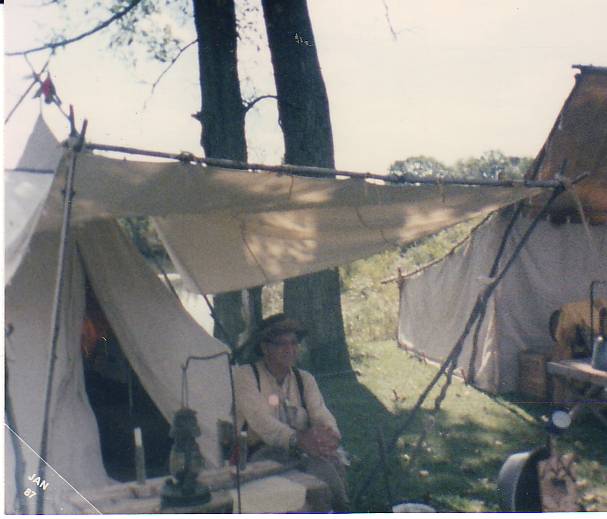
He loved to Rendezvous and he was a mountain man.

dad7

Those Rendezvous men were all the epitome of pranksters.  One time, when I went to visit, he was fictitiously being “tried” for molesting a ground hog.

To add to things, I got him a “doll” on a couch one year to take along with him.  The doll was wearing something red and black and she reclined on her fainting couch.  She was, perhaps slightly suggestive, a little risqué perhaps, nothing more. That doll on her 3 foot couch was kidnapped immediately and was held for ransom, passed around from camp to camp and tent to tent and appeared here and there, for years.  One time her stockings appeared tied to Dad’s top tent pole like a flag.

dad8

Dad’s Rendezvous nickname was “Hoot” and I don’t think it had to do entirely with an owl either, although clearly a double entendre.  He was, indeed, a hoot.

dad9

Even this younger picture, as a teenager, with Verma, reflects his sense of humor.  They were in Indianapolis and whatever was going on , she was not amused.  She was never amused.  He was always amused.

dad10

He always had stories to tell too, some true and some, well, in the flavor and honor of Rendezvousing.  I have no idea about the red eye in the skull, but I’m sure there was some wonderful story about that, perhaps tailored to the listener.  I do know that he had a very unique turtle shell with vulture feet and a vulture head with feathers for a tail and a variety of stories about how that happened, depending on the audience at hand.

In later years, Dad spent a lot of time with school kids showing them old timey ways to do things.  He would set up his “camp” at the schools in the yard someplace and the classes would come out one by one.

Dad was always making an outfit or something for his encampment out of castoffs.

dad11

He turned just about anything and everything into something useful for his encampment.  I made a lot of his Rendezvous clothes for him.  He made things like buttons out of wood and bone.  Mom and I used to go and visit him when he went “camping.”  He loved that.  Sometimes I would go in period costume too and generally caused some kind of ruckus, which was, of course, the entire point.

One time I announced to everyone that he had gotten my mother pregnant.  At the time, most of them didn’t know I wasn’t his biological child, so it was a tongue in cheek accusation, meant, of course, to give them something to “talk about” over the weekend.  He might have been tried for that too, for all I know.  Couldn’t be worse than molesting a groundhog.  I think he was sentenced to hang for that one, but was rescued by some Indian.  There was always some twist or subplot spontaneously evolving and all in great fun and joviality.  How he always looked forward to the next encampment, which was, of course, the next chapter in a continually unfolding drama with no script.

After Dad passed away, I went to the encampment the next summer in Burlington, his “home” Rendezvous location where they had a memorial, in Rendezvous tradition, to say goodbye to him.  His camp was set up “empty” and on Saturday night, the men all gathered around his campfire.  They all told stories about him and the good times they all shared, like that time he nearly got hung for molesting that groundhog.  I said to them that he could not have been a better father had he been mine biologically.  They got really quiet, then one of them said, “We didn’t know that he wasn’t your father.  We knew that one of you kids was a step-child, but based on how close you were to your Dad, we thought you were the biological child.”  To him, I was his child, pure and simple.

I miss Dad. He could have had another 10 or maybe even 20 years with us.

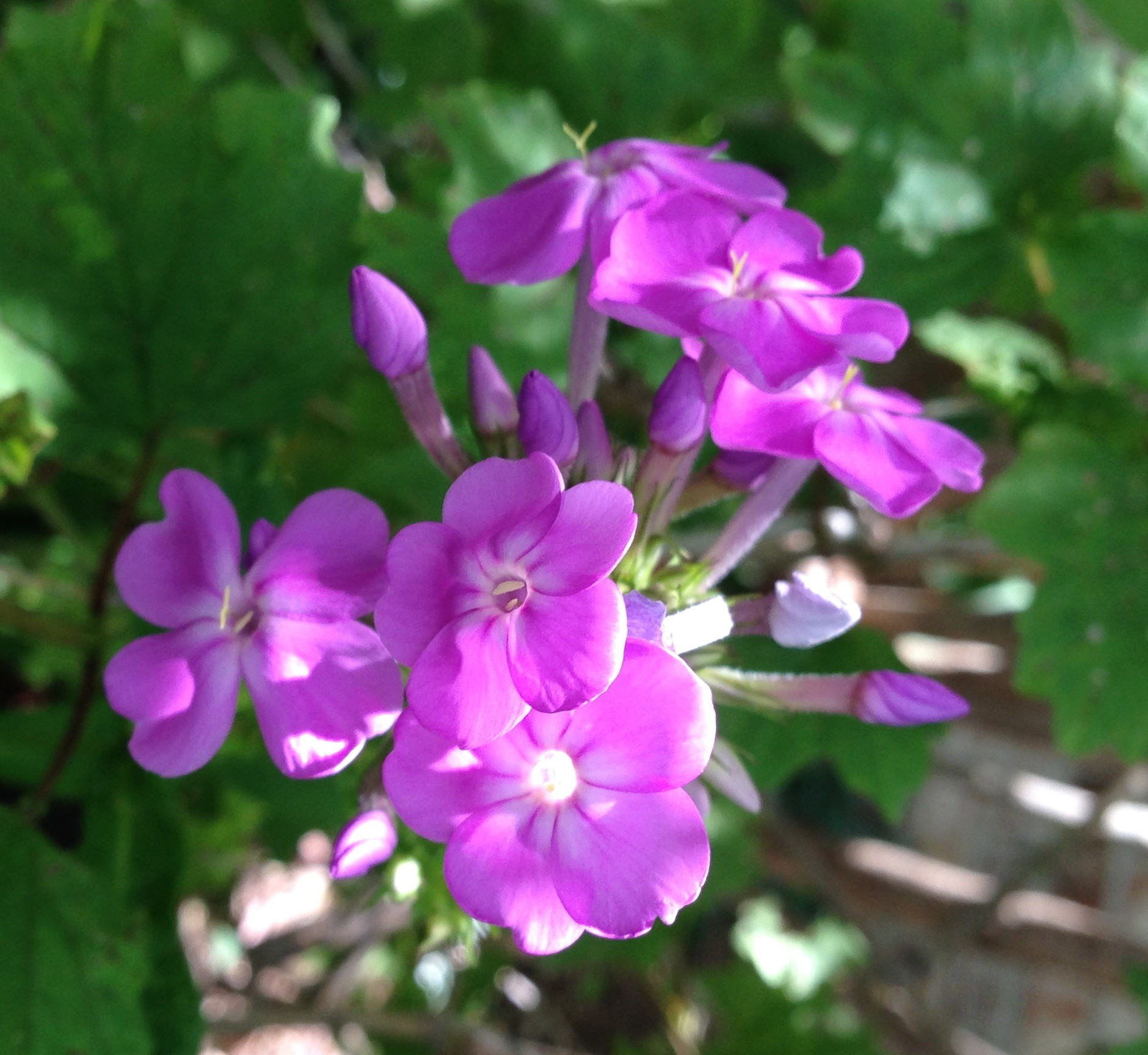
After his passing, I brought some of his phlox home from the farm and planted it here, along with some of his ferns that grew so thickly along the north side of the farmhouse.

dad12

The purple phlox grows tall here and thrives.  I moved it from my other house when I built this one, along with several ferns.

dad13

Today, I went outside to find the phlox blooming with, and shedding onto, the white Rose of Sharon.  I think of Dad every time I see the phlox blooming and that makes me feel good, just like seeing the ferns unfold their beautiful spikes in rebirth does every spring.  But today, this beautiful combination of the white flower and the purple bloom spoke to me of the purity of love and eternity, and how those that are gone are really still here – forever.  The phlox may have shed its bloom, but it is obviously still quite beautiful.

dad14

I will miss Dad forever, and I will grieve his passing forever, because I will love him forever.  But I will also honor his life by smiling and living with humor, honor and dignity.  I strive to cultivate the qualities in myself I so admired in him and found so inspirational and discovered were my bedrock, and hope to pass them on to my children, by example.  What better legacy could I leave him?

You may wonder why I included this story in my DNA blog.  Well, pure and simple, I inherited a wonderful legacy from Dad, my step-father, and my life was greatly enriched by his presence.  Sometimes, inheritance has nothing, absolutely nothing, to do with DNA.  He was as much my Dad, and in some ways more so, than my biological father.  A hundred or two hundred years ago, everyone would have thought I was his daughter and today, we would somehow discover that now dissolved fact and it would be considered a NPE or an undocumented adoption.  It wasn’t a surprise to us, it was just life as we lived it day by day.  It was only a surprise to those who didn’t know, which, 100 years later, would have been everyone.  Think about the fact that in his lifetime, even many of his close friends didn’t realize.

dad15

______________________________________________________________

Disclosure

I receive a small contribution when you click on some of the links to vendors in my articles. This does NOT increase the price you pay but helps me to keep the lights on and this informational blog free for everyone. Please click on the links in the articles or to the vendors below if you are purchasing products or DNA testing.

Thank you so much.

DNA Purchases and Free Transfers

Genealogy Services

Genealogy Research

What Does and Doesn’t a Y DNA Match Mean?

It’s easy to forget how foreign this landscape looks to a newbie, but the newbies are our next generation genealogists and genetic genealogists.

This week, someone e-mailed me who had tested at Family Tree DNA and asked how to contact their Y DNA match they had found in a project that I manage.  I thought that was a very strange request, since your matches are on your personal page along with their e-mail addresses, so I asked for the name on their kit and their kit number so I could take a look.

As it turns out, they had no Y DNA matches on their personal page, so they were hunting for matches elsewhere.  They had joined the haplogroup E1b1a-M2 project and it’s there that they found their “matches” that they were asking about.  I commend their tenacity in hunting for matches and finding them in a project, even though they weren’t exactly what they thought.

The kit number here is 343629, Lewis.  You can see in the screen shot from the haplogroup E-M2 project page that they don’t match anyone exactly at 12 markers, and their closest match is to Harris above their entry, and they have 3 mismatches at 12 markers.

y match 1

As it turns out, Lewis and Harris didn’t qualify as matches, which is why they weren’t displayed on their personal match page.  This explains why kit 343629 was asking me how to contact their “matches.”

Family Tree DNA has set up match thresholds.  For someone to be listed as your match, they need to have no more than the following total number of mutations difference from your results.

Markers in Panel Tested Maximum Number of Mutations Allowed
12 0 unless in a common project, then 1
25 2
37 4
67 7
111 10

The reason for these thresholds is that DNA mutates at an “average” rate and for someone to have more than this number of mutations in that marker range means, generally, that the match is too far back in time to be genealogically relevant.  For people who do have matches, you can utilize Family Tree DNA’s TIP calculator to obtain an estimate of how distant the most recent common ancestor (MRCA) might be from you and your match.  I wrote about the TIP calculator and the MRCA both, so refer to those articles for more into on those tools.

The next question this person asked is, “How do you tell which markers indicate someone as a close cousin?”

The answer really involves several aspects or DNA testing, and I’m going to answer their question here, in pieces, so that everyone can benefit.

  1. In general, finding family via the Y markers is not about “which markers” as much as it is about the number of matching markers. If you share a common ancestor, the DNA of that man’s descendants will accrue mutations over time. If the common ancestor is before the advent of surnames in the culture in which they resided, then the surnames may not match, but the common ancestor still existed.
  2. In general, 12 markers is not sufficient to determine a common ancestor, although you can rule out common ancestors in a genealogical timeframe, generally accepted to be 500-800 years, by high numbers of mismatches caused by mutations. I would suggest this person test at higher markers because sometimes people do pick up matches at higher levels where more mutations are allowed, especially if the mutations happened, for some reason, in the lower panels but few happened in the higher panels. I do see this when writing the Personalized DNA Reports for people, not often, but it does occur, especially at 111 markers.
  3. You cannot necessarily identify a “close cousin” or any specific relationship utilizing Y DNA testing alone, especially at low marker levels, such as 12 and 25.  Although if someone matches you on all 111 markers, there is a very good chance that you share a common ancestors in just a few generations. What the traditional Y test (meaning not the Big Y test) does confirm is whether or not you share a common paternal ancestor and then it’s up to genealogy and autosomal testing to determine how close that relationship might be. The number of matching Y markers can provide hints and generalities through the TIP tool, but nothing more.
  4. For this individual, in addition to upgrading beyond 12 markers, I would recommend that they take the Family Finder autosomal test because that will provide them with a list of cousins on all of their lines, not just their Y line. Based on their earlier commentary, they are looking for all family, not just their paternal line. If you have Y matches and autosomal matches, through the Advanced Matching tool on your Personal Page you can see who, if anyone, is a match to you on both.
  5. However, all of this said, the combined pattern of Y markers, not individual markers, determine the match or non-match, and it is your personal DNA signature. Think of it as a song and the markers as notes in your own personal DNA song. Given that mutations arise in each person’s line, sometimes the various DNA mutations are rare, and those rare markers together can be utilized to determine how closely one might match someone else, especially if the surnames don’t match. I see this often in African American descendants of slaves because surnames weren’t adopted until after the Civil War ended in 1865. Often the 1870 census is our first opportunity to find these families with a surname, and sometimes they subsequently changed their surname.

One of the things I do for my customers as part of a Personalized DNA Report is to complete a profile for them of the relative rarity of their DNA by marker.  Please note that I don’t do DNA reports for people who haven’t tested at least 37 markers because I don’t have enough information to work with.

In the case of this individual, I compared their 12 markers in my database of haplogroup marker frequency with the following results.

y match 2

Values under 25% are bolded, as they are rarer values and the combination of these rarer values are likely to be your own personal family line rare marker DNA signature.  Said differently, you are more likely to be more closely related to those who carry this rare marker signature than those who don’t.

This person has 6 out of 12 markers that are relatively rare.  Normally, one would expect no more than 3, so this is likely why they have no matches.  This is a good news, bad news thing.  The bad news – no matches today.  The good news is that these rare markers value, combined, are a wonderful personal filter that eliminates matches by convergence.  So, someday, when they do have a solid match, it will be relevant and not just because they have all common markers.

And now for the next question.  How can you obtain your own list of marker frequencies?  Obviously, you can order the DNA Report for $349, or if all you want is the marker frequencies, you can order a Quick Consult for $100 and can obtain all 111 of the Y marker frequencies for any one kit.

Guarantees

Most people just want an answer.  I fully understand that.  Me too, but often, that’s not how DNA testing and genetic genealogy as a whole works.  So the question, “What test can I take to give me the answer?” really doesn’t have a solid, works every time, answer.  There is no absolute, no guarantee.  Sometimes, depending on the question at hand, a regular Y DNA test will do exactly what you want.  Other times, like in this case, not so much.  But you won’t know until you test and there is no way to predict an outcome.  Testing may provide the answer in spades, immediately, and it diggingdoes sometimes.  Other times, you get a puzzle piece with a fortune cookie note that says ”you will undergo more DNA testing.” The answers are tied to DNA testing, yours and other peoples, traditional genealogy research and sometimes, luck.  But it has been my experience that those who work the hardest, test most thoroughly and dig the deepest are most often the ones who experience more occurrences of “luck.”  Keep digging.

As Louis Pasteur said, “Fortune favors the prepared mind.”  Not nearly as eloquent as Dr. Pasteur, my old Hoosier farmer Dad would have said, “apply a little more elbow grease.”

I hope this has helped to clarify what a Y DNA match actually does and doesn’t mean, and how to take the next step in finding your family.

______________________________________________________________

Disclosure

I receive a small contribution when you click on some of the links to vendors in my articles. This does NOT increase the price you pay but helps me to keep the lights on and this informational blog free for everyone. Please click on the links in the articles or to the vendors below if you are purchasing products or DNA testing.

Thank you so much.

DNA Purchases and Free Transfers

Genealogy Services

Genealogy Research

My Brother John and My Other Brother John

heart swirlMan, life can really throw you some twists and turns, especially if you’re a genealogist with genetics thrown into the mix.

You see, things don’t always go as planned, nor are they always as they appear to be.  Not every family is the American epitome of the little white house, the picket fence, the station wagon and the collie dog.  Ok, maybe I should update that to an SUV and an electronic fence, but you still get the idea.

In my case, I was born with one sibling…that I knew of.  That was my half-brother on my mother’s side, John.  I obviously knew this man from the literal day that I was born.  In one of the few surviving family pictures, and only one of two with John and I together, John is holding me in a Christmas photo at my grandparents with our first cousins, the year I was born.

john me as baby

John was 13 years older than me, so it’s not like we were ever close.  He was married when I was 5 and really not an active part of my life, so functionally, I grew up an only child.

But I actually had three more half siblings and maybe a fourth, who turned out not to be.  That fourth would be my brother Dave, who was my brother of heart but not my brother of DNA.  I loved him intensely although I only knew him for a few very short years.

So now we’re up to 5 total, with one being not genetic.  We know, for sure that John, my mother’s son is hers, and that my sister Edna is genetically my half-sister.  Lee, we’ll have to assume is accurate because he is gone and there are no children to test, and I have another alleged half-sister that has not been located.

Then, I acquired a step-brother, Gary, when my mother remarried who I also referred to as my brother and in actuality, I acquired a step-sister too, but she had already passed away.  I’ve never thought of her as my “sister Linda,” but technically, I think she was.  I don’t know for sure.  Is a step-sibling who died before your parent married your step-parent your step-sibling????

So, if you need a score sheet.

  • John – half-brother by mother
  • Dave – half-brother by father, who wasn’t genetically
  • Edna – half-sister by father, proven genetically
  • Lee – alleged half-brother by father, you decide based on the photo
  • Sister – alleged half-sister by father, not found
  • Gary – step-brother
  • Linda – step-sister deceased before becoming step-sister

So, my perception of being an only child wasn’t exactly right.

Now, let’s make this next part easy – they are all dead now, with my brother John being the last to go 22 months ago.  Yes, those wounds are still fresh – I lost both of my brothers in 2012, my sister Edna in 1990 and my brother Gary in 1999 tragically.

Yep, every last one of them is gone.  So, I am truly an only/orphan child now.

So, you ask, where did my other brother John come from?

Well, now that’s a story about southern families, and cousins, and love, and why we genealogists are always confused.

You see, I met John, my “other brother” John, several years ago – and yes, via DNA. No, he’s not genetically my brother, although I’m always prepared for a here-to-for unknown sibling to pop up at one of the testing companies.  My father was very much the “ladies man,” extremely handsome and a bit of a rogue and scoundrel.

My “other brother” John’s family and mine are from the same areas of NC – and John and I share a common bond in both the culture and our Native heritage.  And John and I are both Scots-Irish.  John and I both moved away from home for our career.  John and I are both genealogists.  John joined the Cumberland Gap group and became a regular contributor…making suggestions…helping with fundraising ideas for DNA testing…and more.  In fact, “other brother” John and I have way more in common than half-brother John and I did.

We e-mailed back and forth about our research adventures and I did a DNA report for John, so I know his DNA inside and out, pardon the pun.  My half-brother John declined to DNA test.  Over the months and years, my “other brother” John became a close friend, then my cousin, then my brother.

“Other brother” John has been very kind to me in many ways – a very giving soul.  He would take the photos of my ancestors published in my blog articles and “fix” them for me, remove scratches, colorize them, all without being asked.

One day I went to the mailbox.  Inside, there was a box from Japan with beautiful cotton and silk fabrics.  I’m a quilter, and I was just speechless about his generosity – partly because I know how much shipping costs from Japan – not to mention that these fabrics aren’t available here.  He hoped I could make quilts to raise money for DNA testing.  The fabrics were so beautiful that I couldn’t bring myself to cut them.

john2

Then, one day John dropped out of the Cumberland Gap Yahoo group.

I was surprised and worried.  I missed John and e-mailed him and asked him why.

John, it seemed, was experiencing some issues, and those issues would eventually manifest themselves into a cancer diagnosis.

John’s cancer diagnosis was a personal blow, to a friend, to someone I had become very close to – my “cousin,” John.

Now Judy Russell talked the other day in her blog about collecting cousins.  I never realized it, but I’ve done the exact same thing over the years.  Since I was raised as an only child – not finding my half siblings by my father until I was an adult – I began researching my genealogy and collecting cousins when I was 22.  I don’t know that I meant to, but it was such a wonderful adventure for me to meet someone I was related to.  I was always in awe that I had relatives and some of them even looked like me, and like my father who had died when I was young.

When I was a child, I used to ask Santa for a baby brother or sister…every year.  That was, of course, before I understood the mechanics of such things, as my father was deceased.  Still, as a child who wanted a sibling, it didn’t matter and Santa of course, being who he was, could deliver anything.

My heart hurt for John, as my heart hurts for any of my cousin collection when they or their family is sick or hurting.  One of the things I do to express my love and concern are “care quilts,” because that’s what quilters do when we don’t know what else to do.

So, I made John a care quilt…and I cut the Japanese fabric to do it. What better person to use it for?

john quilt

John underwent multiple biopsies, flew from Japan to Massachusetts, underwent surgery, suffered an incorrect diagnosis, became even more ill, was finally diagnosed correctly, and began chemo.  John and his wife are gardeners at their home in Japan.  Clearly, that wasn’t going to happen this year.

I planted pots of plants for John and every day, I take pictures of John’s flowers and post them to Facebook for him.  I know it’s not the same, but it is all I can do.  His miscellaneous “mixed seed” packets have performed amazingly for him.

john flowers

And then, John’s mother died, right in the middle of John’s chemo.  Just when you think things couldn’t get worse.

One day, in the midst of all of this pain, the days and weeks of chemo torment and the emotional trauma, John became my brother.   I can’t tell you exactly what day, but I realized that I love him as a brother, and he, me as a sister – and we simply made it so.  It already was, we just acknowledged it.  Isn’t this was family does? Support one another, especially in times of need?

So yes, I now have my brother John and my other brother John.  Why, you ask, does this matter to you?

Well, because in another generation or so, my granddaughters will tell their kids, “Yes, my grandma had her brother John and her other brother John.”  And then they might chuckle to themselves.  They may not think to mention that one wasn’t my biological brother, and then to add which one wasn’t my biological brother?  And even if they did, they could get it backwards, especially since they are too young to have known my now deceased older brother John.  Aha, a family mystery in the making.  Not a mystery today, but in another couple generations, it may well be – and all the information may be garbled.

Recognize this pattern in any of your family stories?

But it gets worse, because I’m from a southern family on my Dad’s side.  Yes, indeed, I also have Uncle Buster who is not my uncle but my first cousin once removed, and his brother Uncle George.  However, his sister is not Aunt anyone.  No, I don’t know why except I was close to both George and Buster and not the sister.

In the south, any older relative and sometimes non-relatives are called “Aunt” and “Uncle” as a sign of respect, without respect to race.

Furthermore, I also have quilt sisters.  I have Mary who is my sister.  Here we are playing in a mud puddle after gardening in the rain.  Isn’t that what sisters do?

I’ll let you guess from the t-shirts which one is me!

mary puddle

Now Mary has other biological sisters who don’t live here so aren’t my Quilt Sisters.  She’s also from a southern family and has sistens, which are cousin/sisters – cousins who function as sisters.

So in essence, both sisterhood and cousinship are applied selectively and without consistency.  Furthermore cousin can mean anything from literally 1st cousins to “we’re kin but I have no idea how” to 14th cousins 3 times removed.  In other words, it implies some kind of real or fictive relationship – and you, the listener, have no idea what that relationship actually is and there is no standardized gauge to judge by.  Worse yet, the speaker may not either.  Does this make sense?

Ok, here’s a much better picture.  Mary and I have a wonderful time no matter what we are doing.  Here we are at Mary’s son’s house.  I introduced her son to my friend who became his wife about 15 years ago, so I think I have some kind of honorary relationship to them too. When my mother was alive, our family always had Christmas on Christmas Eve at her house, but now, we spend Christmas Eve with Mary and her family.

me mary quilt

Mary and I aren’t blood sisters, although Mary has not DNA tested (yet) so we might be cousins.  In this picture, we’re hemming my original brother John’s care quilt that I made for him when he received his cancer diagnosis in 2010.  This is what sisters do.

However, my other Quilt Sister, Kathy, is indeed my cousin. Yes, for real, genealogically and biologically and genetically, all three.  So she’s my cousin and my sister.  But you see, I didn’t know any of that when I first met her quite by happenstance through our careers.  Talk about serendipity!  We discovered that we shared Brethren ancestors, quite by accident, sitting at a conference room table waiting on late meeting attendees one day.  It was after that she became a Quilt Sister.  Here Kathy and I are holding Mary’s 50th anniversary quilt that we helped to make.  This too is what sisters do.

kathy mary quilt

Is it any wonder as genealogists that we are constantly trying to figure out why the DNA of family members doesn’t fit exactly as we think it should?  Maybe some of the “undocumented adoptions,” or NPEs, non-parental events, aren’t really.  Maybe they are just the much loved “other brother” John – the brother by choice, or the quilt sister, or maybe Uncle Buster or my other “Cousin George” (not to be confused with Uncle George) who isn’t my blood cousin at all but my good friend Anne’s cousin.  But since Anne is another sister of heart, then Cousin George is my cousin too, pictured with his quilt, below, given as a thank you for his supportive role in the Lost Colony Research Group and DNA projects.  This is how relatedness works in southern families.  Bless all our hearts!

???????????????????????????????

And I haven’t given you the entire “family” list – there are more.  I am so fortunate to have many members of my family and family of heart.  I’ve gathered many to love.

Aren’t we lucky that love is the one commodity we can give as humans that is only limited by the size of our heart.  Giving more doesn’t diminish what others receive, and it enriches us.  Why, we can collect and add to our family our entire lives!!!

What a confusing legacy we’re leaving for future genealogists:)  Just thinking about that makes me laugh!

And as for my brothers John….all I have to say is that I’m so glad their names weren’t Derrell, because I already have my cousin Daryl and my other cousin Derrell, and they are both females.  Nope, not kidding!

Welcome to the family John.  Had no idea what you were getting into did you:)  All I can say is, well, bless your heart!

john 1

______________________________________________________________

Disclosure

I receive a small contribution when you click on some of the links to vendors in my articles. This does NOT increase the price you pay but helps me to keep the lights on and this informational blog free for everyone. Please click on the links in the articles or to the vendors below if you are purchasing products or DNA testing.

Thank you so much.

DNA Purchases and Free Transfers

Genealogy Services

Genealogy Research

Abraham Estes, (c 1647-1720), The Immigrant, 52 Ancestors #35

Abraham Estes, the man who emigrated from Kent, England to Virginia in 1673 is probably the most cussed and discussed Estes man in history.  It wasn’t until just a few years ago that Y DNA testing confirmed that this was our Abraham, and that the Kent Estes line was the same line as the Virginia line.

To make matters worse, Abraham was born during the English Civil War.  Baptisms happened, but they sometimes didn’t get written down, and records were patchy during this time.  We believe Abraham was probably born in Nonington, Kent.  His next older sibling was baptized there in 1644.  By 1649, Abraham’s father, Sylvester, was dead.  His mother, Ellen (Ellin) Martin Estes was living in Waldershare, probably in the household with her oldest son.  On April 5th, 1649, she wrote her will, saying she was a widow, and dividing her worldly goods between her children.  From then, for many years, the screen goes blank for Abraham Estes.

Who raised him?  He was all of two when his mother died.  It must have broken her heart to know that she was leaving an infant son who would be an orphan.  And she did know, because her will was written on April the 5th and her will was proven in London on December 6th of that year.  She could have died several months prior.  Did she hold her son close in those last weeks or was she too ill, maybe wanting to spare him her disease, whatever it was?  Abraham would have had no memory of his mother at all, nor his father.

There may be a clue in the fact that Abraham named one of his sons Moses Estes.  Abraham’s sister, Ellen, married her second cousin once removed, Moses Estes in St. Leonard’s Church in 1667.  This tells us that the two Estes families remained close, and it also tells us that Ellen’s home church was St. Leonard’s, in Deal.  It could mean that the Estes family in Deal, Moses’s parents, Richard Eastes and Sarah Norman Estes could have raised their 1st cousin’s children, at least the younger ones.  Ellen, John and Abraham would all 3 have fit right in agewise with the children of Richard and Sarah.

We do know just this one thing about Abraham from the time his mother died until we find him as an adult – he was very probably in St. Leonard’s Church in Deal on December 23, 1667, just two days before Christmas, when his sister married in this chancel.  It would have been a joyous Christmas for Ellen and Moses, and it’s certainly possible that young Abraham lived with them after their marriage.

???????????????????????????????

At 10 years of age, Abraham was probably being admonished to “sit still” and wasn’t terribly impressed with much of anything that was happening at the altar.  Ten year old boys haven’t changed much in 350 years!

OLYMPUS DIGITAL CAMERA

Another clue as to how Abraham was raised is that he was a weaver in Sandwich.  Sandwich is just a few miles up the coast from Deal.  Worth is given to be a mile from Sandwich and 3 miles from Deal on the local roads.

sandwich deal map

To learn to be a weaver, Abraham would have had to have been apprenticed.  As an apprentice, he would have lived with the master weaver and worked for his keep.

Abraham was the first recorded weaver in a family with a very long history of the maritime trade, although it appears that Abraham’s father, Sylvester, was not a fisherman or mariner, but a yeoman farmer.

Roy Eastes, in his research, found that weavers in Sandwich during this time began apprenticeships about the age of 15.  As with other skilled crafts, weavers protected and controlled their membership by maintaining tight control over who could and did join the guild.

weavers sandwichTo make matters even more interesting, it seems that Deal was a bit of a rough, cantankerous neighborhood.

deal castle from beach

Captain Taverner, head of the garrison at Deal Castle, involved himself in local events and charities.  In 1653 he recommended a widow with 7 children for poor relief whose husband, a Deal pilot who had supported Parliament in the Civil war, had “lost much in the Kentish Rebellion.”

deal castle across moat

We also know, based on Taverners notes, that he was furious when Deal townfolk set up maypoles to celebrate the pagan festival of Maying.  Openly, they decked the poles with the Royalist flag and toasted the return of the exiled Prince Charles.  He reportedly “resisted sending troops to fire warning shots into the drunken crowd.”

Taverner also tells us that the dissenting Baptists met in the open air in the fields next to Deal Castle.  Taverner snuck over to see what they were doing, but became convinced and joined the Baptist movement himself.  Ironically, a law passed in 1665 forbade the Baptists from living in some areas.  Deal, not yet a corporate borough, being outside those areas became very attractive for the dissenting Baptists and many settled in Lower Deal.

In the 1650s and 1660, the castles along the coast were invaluable in protecting shipping in the Downs.

War broke out with Holland, right across the channel, in the summer of 1652.  The admiralty pressed for increased armaments to protect the ships which “ride under the castles.”  The intensive recruitment among the seamen along the coast “by the beat of drum” was surprisingly successful.  Preparations for an invasion included the hire of a house for service as a hospital.

On January 3, 1653, the Dutch fleet was sighted in the Channel.

In 1658, England was once again thrown into upheaval by the death of Oliver Cromwell who had been ruling the country since the execution of Charles I in 1649.  In 1659, Charles II, the son of Charles I, was invited to return to England as King.  He exacted revenge on the murderers of his father, including exhuming the corpse of Cromwell, beheading him and displaying his head on the pikes of London Bridge.

In 1664, Charles II assigned Colonel Hutchinson to Sandown Castle and he found Sandown in a deplorable state.  It’s likely that Deal Castle was in the same state, or worse, or Hutchinson would have moved to Deal. He found the castle “a lamentable old ruin’d place…the rooms all out of repair, not weather-free, no kind of accommodation either for lodging or diet or any conveniency of life.”  He noted that the guns were almost dismounted upon rotten carriages.

A dispatch from Dover was sent to help guard the place, “pittifull weake fellows, halfe sterv’d and eaten up with vermine, whom the Governor of Dover cheated of halfe their pay and the other halfe they spent in drinke.”

His wife complained of the walls constantly covered in mildew, even in summer, and even “though the walls were foure yards thick, yet it rain’d in through cracks in them, and then one might seepe off a peck of salt peter off them every day, which stood in a perpetuall sweate upon them.”

Finally, his wife and children moved to “the cut-throate towne of Deal,” finding it preferable to the castle.

Deal Castle certainly would have been a landmark to young Abraham, as it has been for generations to Estes families.

The Plague

In 1663, when Abraham was 17, the plague struck, probably carried by the rats that came along with the ships that frequented the Downs and the Kent coastline.

Ravages of the plague were recorded in the St. Leonard’s parish registers:

  • 1663 – 45 burials
  • 1664 – 78 burials
  • 1665 – 210 burials
  • 1666 – 233 burials
  • 1667 – 29 burials

The first outbreak occurred among the seamen of the fleet of Deal so that from 1665 to 1666 the records of burials of sailors are frequent.  From the latter end of 1666, the names of townsfolk are in the majority until the plague subsided the following year.

In 1665, in one week in September, in London, over 7000 people died of the Plague.  In 1666, London was already suffering from the plague when the “Great Fire” struck, consuming over 13,000 homes and 87 churches.

Another War

By 1672, Abraham might just have had enough of warfare, the plague and finally, the death of his wife.  He may have felt the promise of a the New World and a new life, especially given that Charles II had just started another war which lasted from 1672-1674 and focused on England’s attempts to blockade Dutch ports.

Although previously favourable to the Crown, the Cavalier Parliament was alienated by the king’s wars and religious policies during the 1670s. In 1672, Charles II issued the Royal Declaration of Indulgence, in which he purported to suspend all penal laws against Catholics and other religious dissenters. In the same year, he openly supported Catholic France and started the Third Anglo-Dutch War.  The Battle of Solebay took place near Suffolk of the coast of England not far from Kent on June 7, 1672.

battle of solebay

The Wedding

Abraham married Ann Burton, widow of John Burton, on December 29, 1672 in the village of Worth, in Kent.  Ann Burton’s former husband, John Burton, died in March of 1672 and is buried at St. Peter’s church in Sandwich, along with several of their children.

The Bishop’s transcript of Abraham Estes and Ann Burton’s marriage is shown below.

estes burton marriage record

The bond reads thus:

“Abraham Eastes of Sandwich, linen weaver, bachelor, 25 and Ann Burton of the same Parish, widow of John Burton, at Worth. Richard Scrimshaw of Canterbury, linen weaver, bondsman 27th December 1672.”

It’s this record that provides Abraham’s birth year as 1647.

Worth church

The church at Worth where Ann Burton and Abraham Estes were married is shown above and below.

worth church 2

Ann and Abraham weren’t married very long.

The next record we find for Abraham is that he sailed for Virginia in October of 1673.  October is a very unusual time to sail.  Perhaps he was grief stricken over his young wife’s demise and simply decided to leave as soon as possible for a new life, bad winter weather and a war taking place or not.

There is no record of Ann sailing with him, and no record of Ann joining him later, so we must presume that Ann died, perhaps in childbirth.  From the time they were married until Abraham was sailing for America was between 9 and 10 months.

Why America?

It seems odd that Abraham, clearly with a skill and in the weaver’s guild, so as secure as a middle class person in England could be, would step away from everything familiar and head for a foreign land.  Why would one even consider doing that?

In a word, land.  Or at least, the opportunity for land.  After Abraham’s wife’s death, he may have realized that he was dealing with a “now or never” situation, because if he remarried in England, he would be dealing not with one person’s immigration expenses, but with at least two and possibly more if children were involved.

American needed people to settle and to farm.  Landless people in England were lured through the promise of 50 acres of land for everyone who settled.  Some people who couldn’t pay their way traded that 50 acres to a sponsor and/or worked in indentured servitude for approximately 7 years to pay for their passage.  Some who paid their own way traded their 50 acres called headrights for other things.  Headrights were utilized like money and some were traded several times, the land not actually being redeemed for many years.  Therefore, there might not be an association between someone who held a headright for an immigrant and the immigrant the headright was issued to.  The law calling for the issue of headrights was passed in 1618 and in 1634, the Privy Council ordered that land patents for headrights be issued.

Voyage to America

For as much information as we don’t have about Abraham’s early years, we have quite a bit from an unusual source about his voyage to America.

Roy Eastes in his book The Eastes-Estes Families of America – Our English Roots, shares information with us about the voyage.

While researching Abraham, Roy was contacted by a member of the Bobbitt family and the story of Abraham’s voyage unfolded.  I’ll let Roy tell you himself, in his own words.

Abraham Estes departed England in late October 1673.  He embarked on the Flyboat Martha, Captained by Abraham Wheelock.  The ship carried only 3 passengers William Bobbet, Abraham Estes and John Skinner. The voyage began in London and made stops in Felixstowe and the western coast of Wales. There were probably other stops in between to take on additional cargo. They completed the long voyage when they docked at Ciity Point on the James River in the Colony of Virginia in January 1674. The voyage had taken about two months.

Evidence shows that while the Flyboat Martha was docked in Felixstowe, two passengers William Bobbit and John Skinner were taken on board along with their personal cargos destined for the Colony of Virginia. It is unknown where Abraham Estes boarded but he was in Sandwich shortly before this time and the port city of Felixstowe is located in southeast Suffolk County, north of Kent. The Martha may have stopped at any of the several other ports along the channel, so he could have boarded at one of them.

The term Flyboat identifies the Martha as being a large ship of Dutch origin, having a high stern, broad beam, shallow draft and one or two masts, generally square-rigged and around 600 tons.  It has been confirmed that the Martha was Dutch built but English registered in London. This type of craft was slim with tall sails, it was very fast and commonly used along coastal waters, but they also carried  passengers and cargo to the Colonies.

After leaving London and Felixstrowe in late October 1773, The Martha probably stopped in other ports and finally in Wales to take on more cargo. In late 1673 while tied up to a dock in one of these ports, the artist Jacob Knyff painted “A Dock Scene in a British Port.” King Charles II had previously commissioned this famous artist to paint port scenes exactly as he saw them.

bristol port dock scene

Dock Scene at a British Port – by artist Jacob Knyff – 1673

The description of this painting says:

England and Dutch ships taking on stores or cargo at a port. The activities relating to the loading has been closely observed. It has been set in the harbor, with the tower of a gate and a quay visible on the right, and the coast in the distance on the left. An England flagship is on the right, firing a salute and flying the ensign from the stern carved with the royal coat of arms. Beside the quay is an English flyboat that, from her shape, was probably Dutch-built.

A royal yacht is arriving on the left and this has prompted the firing of the salute. On the extreme left is the stern of a Dutch ship. On the quay two bales of stores or goods with clear markings have been positioned in the foreground. Men are involved in loading up small craft. a horse dragging a barrel on skids to the water’s edge and there are several groups of gentlemen and women observing the activities. A guard stands outside a sentry box in the gate-way.

Bobbit Family researchers have evidence that this was painted in Felixstowe showing the “Martha.” an English flyboat, loaded with guns, and a only few male passengers. So, as we look at the painting, we wonder if Jacob Knyff was watching Abraham Estes and his fellow passengers as they stretched their legs along the dock.  Are we looking at Abraham in this painting?

The winter of 1673/74 was a dangerous time to travel the seas. England was a war with the Dutch until November 10, 1674. During this time, the Dutch were blockading the ports of the New World to prevent supplies from coming in and commandeering the rich shipments of tobacco leaving for markets in England. Also, most passenger travel was normally limited to spring until fall of the year to avoid the terrible rough seas.  Even today, these winter seas are recognized as hazardous, so this may account for the ship only carrying the 3 passengers on this voyage.

At this time ships were not required to post passenger lists and many were in operation that were not documented. A passenger list for the 1673 voyage may exist somewhere within other documents but so far, it has remained elusive. However, there is a record that shows the Martha arriving in New Jersey at the end of summer of 1677 bringing 114 passengers. This must have been a crowded and very uncomfortable voyage!

The long and hazardous voyage for Abraham Estes ended when the Flyboat Martha docked in Ciity Point, in the Colony of Virginia in January 1674.
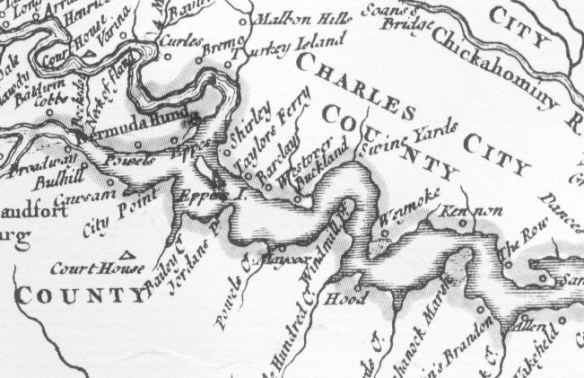
citty point map

Ciity Point over looked the James and Appomattox Rivers and was a town in Prince George County, Virginia that is now extinct. The town became part of the independent City of Hopewell in 1923 and  the old Ciity Point is now considered a part of it.  However in the Civil War photo below, Ciity Point was still independent.

citty point civil war

1865 – ” City Point , Virginia (vicinity). Medical supply boat Planter at General Hospital wharf on the Appomattox ”

The proof of Abraham Estes making this voyage on the Flyboat Martha is found in the Bobbit Family History records displayed on their web site:http://www.keithbobbitt.com/England/sourcesexplanations.htm

Within these records there is the story of the migration of William Bobbit, along with relevant sources including the Bobbitt family Bible which includes the name of Abraham Estes.

The following statements were extracted from this history:

  • In late 1673 and 1674 Immigration: Ship “Martha” sail to Virginia from London, England with a stop in Wales.
  • Captain Abraham Wheelock filed a will Aug 1673, “Being now outwards bound on a voyage to the seas and with all considering the dangers hazards… . . .”
  • There are documents found in the Public Records Office in London stating that Abraham Wheelock was the shipmaster of the Martha and the Good Hope. Will probated 11/372, Public Records Office,  London, Documents E190/59/01 and E190/72/1, Public Records Office, London.
  • The only passengers on the flyboat “Martha” in 1673 were :
    1. William Bobbet
    2. Abraham Estes – Statement on this web site says, – “Abraham Estes, Indentured to Thoroughgood Keeling who arranged for passage from England” although the Bobbit Family researchers say this statement is not in the original file
    3. John Skinner

This close up of the Bible page was provided by the Bobbit family.

Bobbit Bible

This of a page from the Bobbit family Bible, although faded with time and subsequently retraced, clearly shows the name, places and dates as stated in the family history.  This Bible is an 1860 version which had earlier entries copied from another Bible into the pages.

In a letter dated August 2007, Marsha Berry confirms the Bible Page:

This page is a zerox copy of a page from the bible of my ancestor Isham Drury Bobbitt, Jr.  This page is a stiff paper glued into the bible. My cousin contacted me recently and reminded me that a few years ago they had it tested though professional dating and the paper dates back at least to the grandson of  William Bobbett the immigrant, the William Bobbitt born 1704 Prince George County, Virginia and died 1768 Granville, North Carolina.  That makes the Bible record proof stronger than ever as my William Bobbett on the ship MARTHA was alive until after 18 June 1712. 

Did Abraham sail on the Martha?  We’ll likely never know.  I think it’s a good possibility.  One has to question why Abraham’s name and that Bible record would exist at all in the Bobbitt family Bible otherwise. 

Yet Another War

Abraham either must have been entirely exasperated with warfare, as it seems he had lived with it in some capacity his entire life.  Either that or he was entirely used to it and a constant state of warfare seemed “normal” to him.  Wouldn’t that be a sad commentary.

When Abraham arrived in 1673, presuming the Bobbitt Bible is accurate, he would not have escaped the war with the Dutch.  They sailed through the English channel blockade when they left, and they sailed through the Chesapeake that was being blockaded and attacked by the Dutch when they arrived in America.  The Dutch were attacking sites all along the Atlantic seaboard from the West Indies to New York, including Virginia.

It’s no wonder that Captain Wheelock wrote and filed his will before leaving England and that the Martha, who could obviously hold many more passengers, had only 3.  It also begs the question of why Abraham would have been so desperate as to sail in the winter, through the English end of the war into the American end of the same event – although clearly he could have been unaware of the American end of things.  It’s unlikely that Wheelock was unaware however, as the Dutch issues had been taking place for several months – and Wheelock did write and file his will.

Obviously, Abraham arrived safely and settled in, someplace, doing something.  I wonder if the ship encountered any issues or had close calls during the voyage.  Were there times that his heart was racing in his chest and the ship bobbed like a huge cork on heavy seas?  Was he seasick on top of everything else?

I bet Abraham had wonderful stories for his grandchildren.  There were probably several times during his lifetime that he wondered if he would have children, let alone grandchildren, if he had time or was so inclined to think about such things at all.

Bacon’s Rebellion 

Just about the time Abraham would have thought everything was settled in America, yet another war unfolded.

In 1676, Virginia had its own mini-Civil war.  While this sounds “cute,” it was anything but.  For Abraham, who was likely a relatively fresh immigrant, having to pick sides and potentially to fight must have not been a terribly good feeling.  Did he wonder what he had gotten himself into?  Did he question his decision to leave England?  Was this the first time he had to engage in battle?  Did he engage in battle?

The fact that many of the other men who signed a 1683 petition, along with Abraham, were supporters of Nathaniel Bacon suggests strongly that Abraham would have taken the same position of his neighbors and those of his social circle.  In 1676, Nathaniel Bacon and many settlers rebelled against the governor, attacking Native Americans, and eventually burning Jamestown.

You either declared “for” the renegades, or they ransacked your home and maybe worse.

In part, Bacon’s Rebellion was fueled by Bacon’s compulsive, unwielding position that all Indians needed to be attacked and killed.  In addition, the landed class did not like the fact that the governor had signed into law sweeping reforms passed by the House of Burgesses allowing unlanded free men the right to vote.

After passage of these laws, Bacon arrived with 500 followers in Jamestown to demand a commission to lead militia against the Native Americans. The governor, however, refused to yield to the pressure. When Bacon had his men take aim at Berkeley, he responded by “baring his breast” to Bacon and told Bacon to shoot him himself. Seeing that the Governor would not be moved, Bacon then had his men take aim at the assembled burgesses, who quickly granted Bacon his commission. Bacon had earlier been promised a commission before he retired to his estate if he could only be on “good” behavior for two weeks. While Bacon was at Jamestown with his small army, eight colonists were killed on the frontier in Henrico County (where he marched from) due to a lack of manpower on the frontier.

On July 30, 1676, Bacon and his army issued the “Declaration of the People of Virginia“. The declaration criticized Berkeley’s administration in detail. It accused him of levying unfair taxes, appointing friends to high positions, and failing to protect frontier settlers from Indian attack.

Bacon and his men attacked the innocent (and friendly) Pamunkey Indians. The tribe had remained allies of the English throughout other Native American raids. They were supplying warriors to aid the English when Bacon took power.

When Governor Sir William Berkeley refused to march against the Native Americans, farmers gathered around at the report of a new raiding party. Nathaniel Bacon arrived with a quantity of brandy; after it was distributed, he was elected leader. Against Berkeley’s orders, the group struck south until they came to the Occaneechi tribe. After getting the Occaneechi to attack the Susquehannock, Bacon and his men followed by slaughtering most of the men, women, and children at the village.

After months of conflict, Bacon’s forces, numbering 300-500 men, moved to Jamestown. They burned the colonial capital to the ground on September 19, 1676, pictured in the 18th century drawing, below. Outnumbered, Berkeley retreated across the river.

Bacon burning Jamestown

Eventually, the governor prevailed, but that was not the sure and certain outcome for much of the rebellion and probably would not have been had Bacon not died.

Before an English naval squadron could arrive to aid Berkeley and his forces, Bacon died from dysentery on October 26, 1676. John Ingram took over leadership of the rebellion, but many followers drifted away. The Rebellion did not last long after that.

Berkeley launched a series of successful amphibious attacks across the Chesapeake Bay and defeated the rebels. His forces defeated the small pockets of insurgents spread across the Tidewater. Thomas Grantham, a Captain of a ship cruising the York River, used cunning and force to disarm the rebels. He tricked his way into the garrison of the rebellion, and promised to pardon everyone involved once they got back onto the ship. However, once they were safely ensconced in the hold, he trained the ship’s guns on them, and disarmed the rebellion. Through various other tactics, the other rebel garrisons were likewise overcome

The 71-year-old governor Berkeley returned to the burned capital and a looted home at the end of January 1677. His wife described Green Spring in a letter to her cousin:

“It looked like one of those the boys pull down at Shrovetide, and was almost as much to repair as if it had been new to build, and no sign that ever there had been a fence around it…”

Bacon’s wealthy landowning followers returned their loyalty to the Virginia Government after Bacon’s death. Governor Berkeley returned to power. He seized the property of several rebels for the colony and executed 23 men by hanging, including the former governor of the Albemarle Sound colony, William Drummond.

After an investigative committee returned its report to King Charles II, Berkeley was relieved of the governorship, and recalled to England. “The fear of civil war among whites frightened Virginia’s ruling elite, who took steps to consolidate power and improve their image: for example, restoration of property qualifications for voting, reducing taxes and adoption of a more aggressive Indian policy.” Charles II was reported to have commented, “That old fool has put to death more people in that naked country than I did here for the murder of my father.”

Indentured servants both black and white joined the frontier rebellion. Seeing them united in a cause alarmed the ruling class. Historians believe the rebellion hastened the hardening of racial lines associated with slavery, as a way for planters and the colony to control some of the poor.

We don’t know what Abraham Estes did or his sentiments during Bacon’s Rebellion, but there wasn’t such a thing in that time and place as someone who was uncommitted or ambivalent.  You were on one side or the other, and if you didn’t decide for yourself, someone would be deciding on your behalf. 

The Petition

The next record we find for Abraham is a petition in St. Stephen’s Parish in King and Queen County that he signed in 1683, along with many of the men who supported Bacon’s Rebellion.  Abraham obviously had strong opinions and wasn’t afraid to express them.

king and queen map

The fact that he signed the petition would have indicated that he was a free man, and very likely, a property owner.  He was also literate, able to sign his name – probably a result of his weaving apprenticeship.

1683 petition with signature

This petition was signed by 66 inhabitants of St. Stephen’s Parish in King and Queen County, Virginia in 1683. Directed to Deputy Governor Sir Henry Chicheley, the petitioners complained of the government’s imposition on them of unfit church leaders:

That yo’r Petition’rs have beene for severall years past burthened w’th an Illegal Vestry Elected and made up for the major part without the knowledge or consent of the parish as the Law Injoynes: and of such Illiterate and Ignorant men as are and have been, Ever Ruled and Awed by one or two particular persons, who are soe Insulting, and of such Ill disposed and turbulent spirits and dispositions, That noe Minister Cann or will. Stay w’th us or teach amongst us: by w’ch meenes, the Service of God is wholly neglected, our Church gon to Ruine, and Church Desipline and Government: almost all Clearely laid aside: And forasmuch as our said parish is not destitute of such Able, discreet, and honest men as may fittly supply the places of severall week and Ignorant persons of the present vestry according to the good Lawes of this Country: Yo’r Pet’rs in all humility supplicateth y’or honn’rs that wee may have Liberty to Elect and make Cleare by the Gen’ll voat of the Inhabitants of our said Parish of Persons (for a new vestry) as in our Judgm’t may seeme meet and convenient which will Indubiately much to the Glory of God, And the peace and welfare of the whole Parish. And yo’r Pet’rs as in all Humility and Duty bound for yo’r Honn’rs shall Ever pray etc.

Abraham’s signature on this petition is our only remaining relic of “him,” except for the DNA of descendants.  It is also the oldest known Estes signature.

1683 petition signature

This is the only known occurrence of Abraham’s signature.  Tangibly, it’s all that we have left of him, personally, today.

apple tree churchApple Tree Church, also known as St. Clement’s Church, served as St. Stephen’s Parish’s upper church in the eighteenth century.

apple tree roadside

Today, the church is remembered by this roadside marker.

king and queen historical markers

The marker on the same road and to the right (east) of St. Stephen’s Church is near Miller Tavern and Bruington Road, a location known to be close to where Abraham Estes lived.

Was Abraham an Indentured Servant?

The question has been raised repeatedly whether Abraham was an indentured servant who would have had to sell several years of his service to pay for his passage.  Those discussions are centered around this following entry from Cavaliers and Pioneers, Abstracts of Virginia Land Patients and Grants, Vol. 2: 1666-1695, Indexed by Claudia B. Grundman, Richmond, VA, page 234:

LUCY KEELING, daughter of Thorowgood Keeling, deceased, 300 acres, Lower Norfolk Co.; Lynhaven Parish, 20 April 1682, page 146. Beginning on a point on the Dildoe branch to branch dividing this & Jno. Johnson; &c. Bequeathed by said Keeling to said Lucy, to be possessed with the same after the death of my wife Lucy (now Lucy Haise) etc.- Trans. of 6 persons Abraham Easter, Jno Rose, Richard Cock, Margaret Wollingham, Elizab. Sixworth, Robt Calderwood.

This record lists Abraham’s surname as Easter. Researchers have always assumed that it was misspelled and meant to be Estes. It may not have been.

Research has shown there was an Abraham Easter who lived in Hyde County, North Carolina — south of Lower Norfolk County, Virginia. This is where the Keeling who recorded 300 acres was located, the same Keeling that claimed Abraham Easter as an indentured servant. A Will for Abraham Easter has been located in Grimes Abstracts of Wills, 1690-1760 p. 107 that states: Easter, Abraham – Hyde County, NC – November 18, 1751. December Court, 1751; and names a son James, a daughter Mary and wife Elizabeth.

Thus, this entry in Cavaliers and Pioneers cannot be accepted as conclusive evidence that Abraham Estes was an indentured servant, as it may not refer to our Abraham.  Even if it does refer to our Abraham, headrights can and were bought and sold and used as currency.  Owing headrights also does not automatically mean that Abraham was indentured.  He could have traded his headrights for something, like all or part of his passage or something much more immediately useful, like a cow, ox or horse.

If Abraham were indentured in 1673, for the typical 7 years, he would have been finished with his indenture in 1680.  It’s unlikely that he could have amassed enough money to purchase property between 1680 and 1683 when he signed the petition. However, in 1676, Governor Berkeley granted the right to vote to all free men, not just property-holders, so it’s unclear whether petitioners would have had to own property to sign that 1683 petition.

In 1704 Abraham paid quit rent on 200 acres in King and Queen County.

Abraham’s Children

Abraham died November 21, 1720, in King and Queen County, Virginia, leaving his estate to his wife, Barbara.  We only know that Abraham had a will because Barbara’s will, now missing from the archives, mentions his will, and the subsequent lawsuit.

Barbara made her will November 25,1720, just 4 days after Abraham died, leaving part of the estate to several of her children and the remainder to Elisha Estes and Thomas Poor and wife Susanna, for the raising of Moses and Barbara.

The timing of Barbara’s will, and her obvious passing shortly thereafter, makes me wonder if Abraham and Barbara had the same malady that took both of their lives., but spared all of their children.

In America, no record of Abraham’s marriage in Virginia is found, but there is a possible hint as to when it occurred.  Niel Gunson in his English Ancestry of the American Estes, 1992 supposedly obtained the marriage date of December 29, 1682 from the Universal Parish Directory of Deal, 1793.

I found this more than a little suspect.  Why would an American marriage record be recorded in Deal?  And if it were, why wouldn’t it include the wife’s name?  David Powell ordered this book from the Kent Historical Society and has verified that indeed, Abraham’s marriage record is NOT in this book and there is no reference to him.  It appears that someone has confused a source record someplace.  Looking at the date of December 29, 1682 again, I realized that Abraham’s marriage to Anne Burton occurred on December 29, 1672.  I’m thinking that perhaps a typo happened and a source got confused.  To date, there is no record found anyplace for Abraham’s marriage to Barbara, in 1682  or othewise. I you find one, with a source, please, PLEASE, send it to me.

Children of Abraham are believed to be:

  • Sylvester born about 1684, in Spotsylvania Co., VA in 1728 with wife Rachel, believed moved to Bertie and then Northampton Co., NC, died after 1754.
  • Samuel born 1686 married Rebecca, believed moved to Spotsylvania and Greene Co., Va, died after 1728 when he is found with Rebekah in King and Queen County. He is not proven to be Abraham’s child.
  • Thomas born 1688 died 1744/45, Spotsylvania and Caroline Co, married to Ann Rogers.
  • Mary Estes born 1690 married Thomas Watkins.
  • Susanna born about 1688, married Thomas Poore and raised Moses and Barbara Estes after Abraham and Barbara died.
  • Elisha born 1693, died 1782 Henry County, married Mary Ann Mumford.
  • Robert Estes born 1695 died 1775 in Lunenburg County. In 1743 John and Richard were living beside Robert in Hanover County. Moses was there too. Robert married Mary Smith?.
  • Abraham born before 1697 died 1759, Caroline County, married Ann possibly Watkins, second marriage to Elizabeth Jeter. Not mentioned in Abraham or Barbara’s will.
  • Richard born 1699 died 1742/43 Hanover County, married Mary Yancey.
  • John born 1701 died circa 1766 Louisa County, married Elizabeth “Nutty” Pickett.
  • Moses born 1710 died 1788 Halifax County, married Elizabeth possibly Webb, married second in 1782 Elizabeth Talburt/Talbot (nee Jones), a widow.
  • Barbara born 1712 died 1729, epileptic.

The date ranges of the children of Abraham the immigrant shows a range of 28 years in their ages, meaning that if they shared the same mother for all children, she was bearing children for 29 years, from approximately age 18-47.  This is not impossible, but is somewhat unlikely, especially given that Abraham had to be somewhat older than this woman if he married her when she was age 17 in 1683 or 84.  He would have been age 36 or so marrying a girl at age 17.

A significant amount of speculation exists as to whether the oldest children were from a different wife, perhaps Ann Burton.  However, if Ann, who Abraham married in England, was the mother of the first children, why were there no children between the years of 1672 and 1684 when Sylvester was born?  One would expect at least 6 children to be born in this timeframe.  Some could have died, but all of them?

This too seems unlikely, leading us to the question of whether Abraham had at least 3 wives during his lifetime.  Ann Burton first who died in England.  He then immigrated and either married two separate women, or, he married a girl of about 17.

Another significant gap occurs between John born about 1701 and Moses born 1710 which could signify the death of one wife and a remarriage, although there is nothing in Barbara’s will that alludes to any of the children mentioned not being hers.

The Lawsuit

No colonial Virginia family story would be complete without the lawsuit and a spat between siblings over their parent’s estate.  Well, this family is no different and they have a juicy one that looks like a life-long rift.  Those colonial families loved to sue in chancery court – and as genealogists, we’re extremely glad they did.  Many times, the best genealogy information we have, plus a few juicy tidbits, come from these suits.

Amelia Co. VA chancery causes 1785-007

Eastis vs Eastis

Your orator Moses Eastis that in the year of our lord 1721 on the 21st day of Nov your orator’s late father Abraham Eastes departed this life after making and constituting in writing his last will and testament and thereby after specifically leaving? part of his estate did give or further lend his who personal estate to his wife Barbara during her natural life and to be disposed of amongst his children then living as she might think proper.  He further stated? that the said Barbara Eastes agreeable to the trust and in the presence aforesaid reposed in her by your orator’s father on the 25th day of Nov. 1720 she made in writing her last will and testament in writing and surety? after giving an inconsiderable part of her aforesaid husband’s estate to several of her children therein mentioned directly that the remainder should remain in the hands of her executor Elisha Eastes, Thomas Poor and Susana his wife for the sole benefit of your orator and Barbara Eastes your orator’s sister whom she concluded were incapable of getting their living. But with a precise that they should become an ? in their leave? or either of them should die then the same to be equally divided amongst Sylvester, Thomas, Elisha, Robert, Richard, John, Moses Eastes, Martha Watkins, Susana Poor and Sarah Eastes or the survivors of them as by the said last will and testament will more fully appear reference being that there to and to which your orator for greater certainty refer and on the day of <blank> departed this life without altering or revoking the will.  Your orator further shows that in consequence of the said appointment the said Elisha Eastes did understate the trust and execution of the said last will and testament first qualifying himself as an executor thereto agreeable to law.  Your orator further sheweth that sometime after in the <blank> day of <blank> your orator’s sister Barbara Eastes died wherefore your orator concluded himself entitled to his proportionate part of his said father’s estate according to the will of the said Barbara and made several friendly applications to the said Elisha the said executor for the same who has hereto refused such reasonable requests pretending that he had expended the whole or the greatest part in the support and maintenance of your orator and his deceased sister.  Notwithstanding there is still as your orator charges the truth to be a considerable part still remaining in his hands.  Your orator is remedyless and prays that Elisha be compelled to make full answer to these several matters and especially whether your orator’s late father did not make in writing such last will and testament as before mentioned and whether your orator’s late mother and widow of the said father did not in consequence of the trust reported make and ? of the estate  before ? and to the uses and purposes aforesaid.  Whether the said Elisha did not qualify as an executor thereto and came upon himself the management and execution thereof. Whether he has fully executed the directions of the said will.  Whether there is not still a considerable part of the said ? property left in his hand sand how much your orator prays that the said Elisha may be compelled to account for he had managed the same and if on a fair settlement of account there is any part still remaining that he may have his equal portion thereof according to the will of the aid Barbara Eastis and that he may have such further and other receipts as may be agreeable to the equity court.

Next document

Answer of Elisha Estis to the many untruths of the petition and bill contained for answer thereto or as much of as he feels is material for him to make answer to.  He was nominated as one of the executors of Barbary Estis as in the said bill and that after dividing some legacies in her will did direct the remainder to be retained in the hands of the executor for the support of Barbary and Moses Estis the said Moses being very sickly and the said Barbary accustom to have fits and otherwise helpless so that she required to be nursed and dressed as a child.  The amount of the appraisement of the estate left by the said Barbary Estis was to the sum of 98 pounds 10 shillings and 9 pence, half? being? exclusive of the slaves and one horse and mare show appraisement amounted to 50 pounds fifteen shillings which after the death of the said Barbary were allotted to the children of the said Barbary and her husband Abram by the will of the said Barbary to which together with the said appraisement this defendant for greater clarity begs leave to refer and prays may be made part of this his answer, this def further saith that he expended a considerable deal of money for doctor’s means in endeavoring to cure the said Barbary and Moses and that for the space of 8 years boarded and maintained the said Barbery and Moses of which the def had made an account to which also he beggs leave to refer and prays may be made part of his answer and whereby it appears that the def. account is considerable more ? the said estate than the said appraisement amounts to, the def denies all combination ? and prays to be dismissed with his costs expended.

Elisha Estis (signature)

June 29, 1770

Next document

The deposition of Thomas Poor of full age being sworn…says that about 49 years since Moses and Barbary Estis, orphans of Abraham Estis came to live with Thomas Poor, this deponents father, who was an executor to the decd Barbary Estis and to whom the care of these orphans was committed and this deponent remembers that when these orphans came to his father’s house that Moses Estis was about 10 years old and Barbary Estis was about 8 years old both which children were very sickly the boy being very Buston and commonly seemed inclined to the Kickiosey and for whose benefit three doctors were commonly employed the girl being deponent says lived til she was about 16 years old he also says that she was an idiot having convulsion fits frequently and that this deponent remembers his father was at the expense of 6 shillings a month as satisfaction to Elizabeth Yeates who attended this girl three years.  He also remembers that Moses Estis went to school 2 years while he lived with Thomas Poor this deponent’s father and he further says that since the death of Barbery Estis, Moses Estis and several others with him came to his father’s house and were speaking of settling the orphan’s estate upon which Thomas Poor this deponent’s father said he was ready for settlement brought some papers and as this deponent thinks satisfies those people amongst whom was Moses Estis who also seemed satisfied that nothing was due the orphans upon a just settlement.

April 16 1770                      Thomas Poor (signature)

Moses came to live with Thomas Poor about 1721, so he was born about 1711 and Barbara his sister about 1713.  This makes his mother’s age about 43 in 1713, so born about 1670 and married to Abraham probably about 1690/93.  There are 11 children listed in her will, so that is about 22 years, plus Abraham who was not listed, if he is in fact her child.  Doing the math, if her last child was born when she was 43, give 2 years per child, then the first child was conceived 22-23 years previous, or about 1689-91.  To add two more children, given the 2 years between children, would mean that she was having children in 1685 which means she had children for a contiguous 28 years.  Most women married at 20 or 21, so that would imply that she had children until she was 48 or 49, which is highly improbably, or married extremely young, which is also very improbable, or there were twins, which aren’t mentioned.

Children who might also have received land could also have been omitted in the division of the remainder.  In fact Abraham the immigrant might well have provided land to his two children from a previous marriage intentionally to avoid any issues with the children form the “current” marriage.  Perhaps neither Abraham Jr. nor Samuel, if he was Abraham’s son, were children of Barbara.

Next chancery document:

Elisabeth Harris aged about 60 being first sworn…says that about 48 or 49 years ago Moses and Barbary orphans of Abraham Estis came to live with Thomas Poor, this deponant’s father who was an executor to the decd Barbary Estis and that the said Moses Estis was Buston and Kiskififid and that he had 2 years schooling as well as this deponent remembers.  The said Barbary Estis was an idiot and quite incapable of taking the least care of her self and subject to fits and that there was medicines had for ? of the said orphans and the deponent remembers that Elisabeth Yates was employed by Thomas Poor to take care of the said Barbary and that the said Barbary damaged two beds considerably in tome of her indisposition.       Elisabeth “|” Harris (her mark)

I would surely like to know what “buston and kiskififid” refers to.

Next document

Summons to Elisha Estis, surviving executor of Barbary and Abraham Estis decd to appear in court to answer the case on April 7th, 1769.

Next document

October 1769 – justices ordered to take depositions

It’s absolutely amazing to me that 50 years after Abraham and Barbara died, the family is still fighting about that will.  This also strongly suggests that Moses was alienated from at least one of his siblings, Elisha, probably for the duration of his entire adult life.  I’m thinking there were not too many family picnics in the park on Sunday afternoons.

Family rifts are nothing new.

Barbara’s Will

Barbara made her will only 4 or 5 days after Abraham’s death in either 1720 or 1721.  (Abraham’s death date is believe to be 1720, but one document says 1721.)

This was not a time in history that one typically made a will months or years in advance when you were feeling fine.  You made a will when you thought you might need it – when the inevitable was…well…inevitable.  The distance of only 5 days certainly makes one wonder if Abraham had something contagious and Barbara caught it caring for him.

Barbara’s will is now missing, but Helen Easter extracted information from her will, from the original, some years ago, obviously before it went missing.  Helen and her sister spent summers in the 1950s and 1960s traveling the Virginia counties extracting Estes and Easter records from original county records.  According to Helen’s notes, the names of children in the will left by Barbara proved in Amelia Co. include Elisha, Sussana Poore, Moses, Barbara, Sylvistas, Thomas, Robert, Richard, John, Mary Watkins, and Sarah.  Not mentioned were Abraham Jr. and Samuel, believed to also be children (Amelia File Box 1784-5, Virginia State Library).  Helen adds that she thought that Barbara mentioned them as “my children,” but she can’t remember for sure.

Who Was the Oldest Son?

If we were to presume the standard naming convention, Sylvester would be the eldest son of Abraham.  However, if the original Sylvester died, another child might have been named Sylvester later.  Typically, the eldest son inherited the land.

Judy Russell, The Legal Genealogist, mentions this, as follows:

Here’s the deal. We all know that when one of our landowner ancestors died in England and didn’t leave a will, all of his lands went to his oldest son under the rule of primogeniture. That was the law following the Norman conquest, and the oldest son couldn’t even be disinherited by will until the Statute of Wills in 1540.

The rule of primogeniture crossed the Atlantic with English common law, and that’s why you’ll see some early wills in colonial America that don’t mention land and don’t mention an oldest son: unless the will specifically said otherwise, land went to the oldest son, period.

Primogeniture was relatively short-lived in America — the first state to abolish it was Georgia, in its constitution of 1777 — but it remained the law in England until repealed in 1925.

But it was never the law everywhere, even in England. Enter, stage left, gavelkind and, stage right, borough-english.

Gavelkind was the particular custom throughout the County of Kent by which lands descended to all of the sons in equal measure. It also existed in small areas of Nottinghamshire, Norfolk, Leicestershire, Monmouthshire, Archenfeld, and Kentish Town near Highgate.

There were even some areas where the particular custom was for land to descend equally to all sons and daughters.

So pervasive was the custom in Kent that it wasn’t necessary to prove that lands there were subject to partition among all the sons; it was only necessary to prove the contrary — that particular lands were not subject to being divided equally.

Based on Judy’s information, we might not expect to see the eldest son mentioned in the will.  And indeed, Abraham and Samuel are missing, but neither of them appear to be the eldest son.

Another tidbit comes to light that also suggests that Abraham and Samuel were not the eldest.

In Cavaliers and Pioneers, by Nell Nugent, page 237, there is mention of a Robert Parish.  In a record dates, 22.6.1722 (old style date), he possessed land in King and Queen County that was bordered on one side by that of Silvester Estice. This date was after Abraham and Barbara’s death and was most likely the original land of Abraham Estes, suggesting that Silvester might be the oldest son.

Unfortunately, Abraham’s will is missing, as King and Queen is a burned county, and we simply don’t know if Abraham had already taken care of Sylvester, Samuel and Abraham or if Sylvester simply automatically inherited the land.  Given the traditional naming patterns of the man’s father’s name being used to name the first son, Sylvester would have likely been the eldest.

Where did Abraham live?

A few years ago, I wrote a paper titled “Estes of  King and Queen County, Va. Bordering Essex County, Va.”  I am extracting from that information here.

Sometimes the pieces just fall into place.  I never set out to actively search for the original land of Abraham Estes, the immigrant, because I thought we would not be able to locate it.  After all, King and Queen County is a burned county.

Well, never assume.  I was wrong.  A series of seemingly unrelated events occurred, and I’m writing this article because I’m afraid if I don’t, I’ll manage to forget some vital piece, or worse yet, know that I knew it and never be able to find it again.

Recently, cousin Robin Rankin Willis sent me another of her wonderful original extracted tables, this time for Hanover County, VA.  I was actually chasing the land of Robert, John, Moses and Richard Estes in Louisa County which was originally taken from Hanover County.  Hanover and King and Queen Counties were both originally taken from New Kent, so these lands aren’t terribly far apart.

Since King and Queen is a burned county, and that is where our Abraham died in 1720, most of our Estes truly vital records are gone.  However, sometimes all it takes is the right tidbit at the right time.

Robin found the following entry on September 12, 1748:

John Hoskins & Samuel Hoskins patent 1,430A in St. Stephen Parish, K & Q Co., north side Essex Road adj Col. Grymes, Abraham Estes & Chapman.

This sent me on what could well have been a proverbial wild goose chase.  I’m a genealogist, so I’m used to wild goose chases that wind up with me having spent hours with nothing to show for it but a pile of unrelated notes that I don’t know where to file since they weren’t relevant after all.

Robin had also recently sent me another document about Abraham.

The King and Queen County Religious Petition of 1683 is the earliest existent document from King and Queen County.  This early petition was somewhat scandalous.  The important item of note about this document is that our Abraham owned land by 1683.  This was not long after he immigrated, and although he could potentially have arrived as an indentured servant, Robin and I agree, given a number of circumstances, that this is doubtful.

We know that Abraham, nor any other Estes for that matter, obtained a land patent at this early day.  While the King and Queen County records burned, the land grant books did not burn and the patents are available from the Library of Virginia.  In fact, many genealogists are teaming up to map the original deeds through a deedmapping project to reconstruct the early colonial maps.

Abraham purchased land and it was before 1683.  Given that he was married in England in 1672, and that he probably immigrated after the death of his first wife about 1673, this only allows Abraham 10 years, or less, to serve an indenture which was in essence white slavery, and then somehow amass enough money to purchase land.  Most indentures were for 7 years.  If his wife died in passage, he still would have had to pay for her passage, so the indenture would have been longer.  Any man who had enough money to purchase land would have instead purchased his own passage.  Indentured servants were not paid.  Generally, they only had to be provided with a set of clothes when their indenture was complete.  Often they died.

Therefore, given these facts plus a pinch of speculation, it is doubtful that Abraham was an indentured servant.

From this information, I immediately began to study the Hoskins information.  We know that this land was on the north side of Essex Road, but today’s maps and atlases show the Virginia roads with numbers, not names.  This is so frustrating, because we know that Essex road had to be a main artery road between King and Queen, and Essex counties, but which one.

I posted a note to the King and Queen rootsweb site, with no results except a reference to a Hoskins family book, “Hoskins of Virginia and related families”.  This book is available on Heritage quest.

On page 21, it states that a John Hoskins is found in King and Queen County and that he lived on a plantation called “Mount Pleasant” which was patented on 1661-62 by Col. Thomas Brereton, Clerk of Northumberland County.  His father is believed to be Thomas Hoskins.  By 1683, Thomas Hoskins was living in St. Stephens Parish, New Kent County.  This parish in 1691 would be annexed to King and Queen County.  He signed a petition with 65 men for a popularly elected church vestry in the parish.  Of these signers, several were men who had fought for Nathaniel Bacon in 1676.  This petition is one of the finest expressions of seventeenth century democratic idealism in our American heritage, and it took place a full century before the Revolutionary War.  Only during the commonwealth period (1649-1660) and during Bacon’s Rebellion in 1676 were the vestries popularly elected by the residents of the parish.  They would not be again until after the Revolutionary War.  Signing near Thomas Hoskins was William Brereton.  The Hoskins, Breretons and Claibornes who were allied were all wealthy families and were associated with the House of Burgesses, having individuals who served from time to time, and shared the same viewpoint, opposition to centralized authority.

By 1738, the Breretons were gone from King and Queen County and the Hoskins were in possession under the terms of the will of Samuel Hoskins of 1430 acres of Brereton Property.  The Brereton patents of 1661-62 were for 2 tracts of 1500 acres each or 3000 acres.  Please note that this name is also spelled Hodgkins.

The Hoskins were directly preceded at Mount Pleasant by the Breretons.  This we know from the 1683 petition and from a deed between Jasper Cofton of St. Ann’s Parish in Essex County and Robert Farish of St. Stephens Parish of King and Queen.  The year is 1716 and refers to the neighborhood known as Millers Tavern.  Cofton sells to Farish 250 acres being a part of a patent of 1000 acres formerly granted to Richard Jones and George Turnor in 1672 situated and being in Essex and King and Queen upon the head of the Dragon adjoining to the tracts of Col. Goodrich and Capt Brereton’s lands.

In 1734 William Covington sold land to Richard Jones of South Farnham Parish, Essex Co.  This land had been heired by his wife Mrs. Ann Covington from her father Robert Coleman.  The land was described as “a certain tract of division of land …part in the aforesaid county of Essex and part thereof in the county of King and Queen…beginning at the corner of said Richard Jones Jr. standing in the line formerly Goodriches….to another white oak of the said Richard Jones standing in Brereton’s line thereto along the said Brereton’s line south by east”

The earliest patents relating to this plantation were on May 25, 1661 and Nov. 28, 1662 for 1500 acres each or a total of 3000 acres patented by Col. Thomas Brereton, Clerk of Northumberland.  These patents were described a being in New Kent and were on the north side of the Mattaponi River on the west and east side of Hoor Cocke Swamp, the 1661 patent beginning at a former dividend of Mr. Chapman running N by W and C and granted to George Chapman Sept. 1, 1658 by him assigned unto said Brereton.  The 1662 patent adjoined land formerly belonging to Anthony Haines.

By 1738 John and Samuel Hoskins had inherited from Samuel Hoskins 1430 acres of this Brereton land and they confirmed it by patent which reads “800 acres part thereof was given and part devised to the said John Hoskins and Samuel Hoskins by the last will and testament of Samuel Hoskins, decd, and the residue (630 acres) thereof being surplus land found within the bounds of the said 800 acres.”

The patent was granted and confirmed and the purpose was to determine the amount of acreage inherited under the will of Samuel Hoskins and then have it recorded by patent.

The 1738 patent describes it as beginning on the north side of Essex road running south by Col. Grymes line thence east by north to Abraham Estis then up the branch to Chapman’s corner, thence north by west to the beginning.  This included the area from St. Paul’s church to Dogwood swamp on the Bruington road, a stretch about 4 miles long and one mile wide.

In 1805 the Mutual Assurance Society policy taken out by Col. John Hoskins wherein he calls his home “Mount Pleasant”, the land owner on his eastern boundary is George M. Chapman.  This plantation was in the same family until sold by the executors of George Hoskins in 1852.  The north end of Mount Pleasant became known as Holly Springs and was still in the family in 1860.

From a personal interview with an elderly lady who had visited Mount Pleasant when she was a child, “The Mount Pleasant house was situated about 2 miles from the border of Essex on the most direct road from Tappahannock on the Rappahannock River to Walkerton on the Mattaponi.  The house stood on a high hill overlooking the mill pond, dam and mill.  That house no longer stands, but the present house is in the same location on the brow of the first hill one ascends when proceeding along the road from St. Paul’s church to Bruington.

mount pleasant

Abraham Estes land in 1738 abuts the Hoskins and Grymes land.  Today this marker resides on 360 East of St. Stephen’s Church.

http://photos.historical-markers.org/va-kingandqueen/198_9801

estes land map

Going with the info from the various locations to my trusty atlas, I find that in King and Queen County, on 360 where it crosses 14 and then East on 360 from that location, we have an intersection with 631 and 621 before getting to Miller’s Tavern.  Miller’s Tavern is too far East,  It looks like this land is between Bruington which is at the intersection of 14 and 621 as one point on the triangle, 621 itself as another point on the triangle, and probably St. Stephen’s church as another point.  I can find no history whatsoever of a St. Paul’s church in this area.  You also see Dogwood Fork which surely is connected to Dogwood swamp.  Abraham’s land seemed to be on the NE quadrant of this land, so probably nearer to 621.  In a much larger sense, it’s between the Rappahannock and the Mattaponi, but nearer to the Mattaponi.

Land Grants with associated names:

June 22, 1722 – Grant of Robert Farish described as 775 acres in the Counties of King and Queen and Essex. Beg. of Silvester Estice standing in Thomas Cranes line; thence &c. on the south side a branch of Mattapony River. And then 775 acres in the Counties of King and Queen and Essex adjoining the land of Silvester Estice, Thos. Crane &c. on the south side of a branch of Mattapony River and crossing several branches of Rappa: River.

This is less than two years after Abraham died, so is very likely his original land.

Abraham’s DNA

One of the things we hoped to prove when we began this project was whether or not Samuel Estes, found in Spotsylvania County, and Abraham Estes were sons of the Abraham who died in 1720/21.   By testing the Y DNA of males who descend from these two men, we can tell if they are from this Estes line, although we cannot prove, beyond a doubt that they were Abraham’s sons.  Given that we know that Abraham was the only known Estes to be living in this location in Virginia at this time, we could then surmise that they were his sons if they matches Abraham’s Y DNA finger print.

Genealogists hate that word, surmise.

To be clear, there are some mystery Estes men who also showed up in Virginia, but we have absolutely no further records of them, and it’s possible they didn’t survive.  David Powell covers this in his article, “American Estes Before Abraham.”

We’ve been fortunate in the Estes DNA Project that many Estes descendants are looking for their roots.  Even better, many of the people who tested had their lines proven back to Abraham.

I assembled a chart some time back of the 23 individuals who have proven connections to sons of Abraham, and you’ll never guess who is missing.  Yep, elusive Samuel.  So, either he didn’t have a male line that survived, or the people who descend from him can’t connect to him, or they simply haven’t tested yet.

The good news is that we do have descendants of Thomas, Richard, Robert, Moses, John, Sylvester, Elisha and yes, Abraham.  And yes, they do all match the Estes DNA fingerprint and many lines have defining line marker mutations.

What is the Estes DNA fingerprint and what is a line marker mutation?

The Estes DNA fingerprint is the combined values that make the Estes DNA sequence, or haplotype, recognizable as such.  It separates us from everyone else, or hopefully, most people.  And line marker mutations are mutations at specific markers that have occurred in sons lines since Abraham and identify those lines individually as well.

Why is this important?  When an Estes tests that doesn’t know which of Abraham’s sons lines they are from if they have one of the line marker mutations, I can often tell them, or at least point them in the right direction.  Worst case, I can narrow the options.

How did I determine the Abraham Estes DNA fingerprint and his sons’ line marker mutations, which constitute their fingerprints?  Let’s take a look.

Reconstructing Abraham

The first thing I did, using triangulation which I explained in the Robert Estes (1555-1616), Householder in Ringwould, 52 Ancestors #30 article as well as in this “Triangulation for Y DNA” article, was to determine what Abraham’s DNA markers looked like by evaluating the results at each marker for his many descendants.  I call this profile, “Abraham Reconstructed” and I compare every other Abraham descendant to this profile in a spreadsheet.

abraham reconstruct

I have only shown this to 25 markers, above.  Otherwise, the print is too small to see and looks like the lowest line on an eye chart that I’ve never personally seen in my life.

Looking at just Abraham’s first 12 markers, on my spreadsheet, you will notice that there is a red value and a bold, red underscored value.

abraham reconstruct 2

The red bold indicates a rare marker value found in less than 25% of the testers for R1b and red, bold, underscored means this value is very rare and found in 6% or less of all R1b testers.  Why is this here?  Because these rare and very rare marker values, in combination with each other, is what determine the individual Estes rare marker signature that differentiates us from every other R1b male in Europe.

Where did I find these rare marker numbers?  I maintain a spreadsheet for all  haplogroups that I utilize for my own projects and every client who purchases a Personalized Y DNA Report.  No, this is not available publicly anyplace, but I will gladly provide this information for anyone, for their individual results, who purchases a Quick Consult.

Abraham reconstruct3

Line Marker Mutations

The next step in this process is to compare the results of each participant to that of Abraham.  In this case, kit 12088 is a descendant of Abraham’s son, Thomas, in fact the only descendant.  In his case, he has a mutation, when compared to Abraham Reconstructed at marker numbers 390 and 391.

Because there is only one confirmed descendant of Thomas who has tested, we don’t know how far back these mutations go.  In other words, the mutation(s) could have happened between Abraham and Thomas, or between the tester and his father, or at any generation in-between.  Having more people who descend from Thomas will help determine if this is a line marker mutation for all of Thomas’s descendants or just a particular line of Thomas’s descendants.

Let’s look at another son of Abraham, Abraham Jr.

Abraham reconstruct4

In this case we have only one marker with any difference from Abraham Reconstructed, and that’s 449 and only in one tester.  This tells us that clearly, the mutation did not happen between Abraham and Abraham Jr.  In fact, in this case, two brothers tested, and the mutation at 449 was present in one brother, and not the other, so we know exactly where this mutation occurred.  This mutation will be a line marker mutation for the brother in whose line it occurred and will be a beacon for future generations.

Now let’s look at Abraham’s son, Moses’s line.

abraham reconstruct5

In this case, we have more testers and from two of Moses’s son’s lines.  Moses only had 3 sons, and we have descendants of two of the three, John and Moses Jr., with only William missing.

We can see that in John’s line, there are three mutations difference from Abraham, two of which occur in both participants.  This means that for those two common mutations, the mutation occurred someplace between their common ancestor and Abraham.

Unfortunately, because one of the two men has not provided their Estes ancestors, I can’t tell who their common ancestor was.  I bet you’re wondering…If he didn’t provide his genealogy, how did he get into the “Moses via son John” group?  Because his mutations match those of kit 55666, so I can discern his genetic line even without his genealogy.  Let’s look at how this works.

The owner of kit 55666 is 7 generations from Moses’ son, John Estes.  If the common ancestor between the two kits was kit 55666’s great-grandfather, Samuel Estes, then we would know that two of these mutations, 391 and 458 occurred someplace in the 4 generations between Samuel and John Estes, because the mutations occur in both of Samuel’s son’s lines.  Conversely, the mutation at location 389-2 would have occurred someplace between Samuel and the current generation, because it does not occur in the descendant of Samuel’s other son.

This Moses becomes even more interesting though, because we have descendants of Abraham through son Moses, and in particular, one specific line –  through Moses Jr., son George, then son John R. Estes.  This line carries a different line marker mutation for location 458.  While John’s line is showing a value of 19, one more than Abraham, Moses’s line is showing a value of 17, one less than Abraham.  Because all 4 of these participants descend from John R. Estes through different sons, we can say with certainty that this mutation happened someplace between Abraham Estes and John R. Estes.  A second mutation in this line, at location 449, occurred someplace downstream of John R. Estes in the three generations between John R. and the participant.  The value of 31 at location 449 will in the future be a line marker mutation within John R’s line for that specific line, while the value of 17 is a line marker mutation for John R.’s entire line.  The value of 17 at 458 might also be a line marker mutation for George, John R.’s father, or Moses Jr, his grandfather.  Because no one else has tested for any of these lines, we don’t know.  But we do know that it’s not a line marker mutation for Moses Sr.’s line because Moses Sr. has had 2 sons test and their values of 458 don’t match either Abraham or each other.  Therefore, we don’t know what the value of marker 458 was in Moses Sr. himself.  It would be extremely interesting to have a descendant of Moses Sr.’s other son, William test.  He would be a tie breaker in terms of this marker value in Moses Sr., assuming he matches either Moses Jr., John or Abraham’s marker value.

Another of Abraham’s sons, Robert, has a defining line marker mutation on marker 391, with the exception of one descendant.

abraham reconstruct6

Back mutations do happen, but rarely.  In this case, it may well be what has happened though, because kit 14220 and 28361 share a common ancestor two generations below Robert, descending from Robert’s son George.  The other two participants descend from different sons of Robert, so in total, three of Robert’s sons are confirmed at Family Tree DNA, plus two additional at Sorenson through data base retrievals.  The last kit, 201558 has not provided their genealogy, but I’ve placed them here because they match value 11 at 391.  Therefore, the only conclusion we can draw from this scenario is that the value of 12 at marker 391 in kit 14220, assuming the genealogy is accurate, is a back mutation.

Summary

Abraham Estes made an amazing journey in his lifetime.  His life was certainly not without adventure.  He was born during a war and his father may have given his life in the Kentish Uprising.  In any event, he was orphaned when he was two years old, when his mother died.  Had it not been for his mother’s will, we would never be able to tie Abraham to his family, because we have never been able to find his baptism records.

Abraham’s first wife died and we presume there were no children.  If Abraham immigrated in 1673, he and his wife were married less than a year and it would be a safe bet that she died in childbirth, along with the child.  He sailed for America in the middle of a second war, encountering Dutch warships on both ends of the journey.

In 1676, in Virginia, he would have been involved in some way in Bacon’s Rebellion, likely siding with Nathaniel Bacon against the government.  If so, he was probably involved in the burning of Jamestown.  This may well have been America’s first civil war.

In 1683, in Virginia, Abraham signed a petition, a free man and we know that by 1704 he owned land in King and Queen County that he purchased (or inherited), not that he received as a land grant.

Abraham Estes died in 1720 married to Barbara Estes, but there is not one single shred of evidence to suggest that his wife’s maiden name was Barbara Brock.  That surname was introduced into the family line by a novel in the 1980s wherein the author utilized Estes historical characters and built upon those characters.  It also didn’t help that Abraham Jr.’s daughter, Barbara Estes married Henry Brock.  Unfortunately, Barbara’s surname, listed as Brock has been copied and recopied so many times that it has entered into the realm of urban legend.  Regardless of how many times the story is retold, or copied and pasted, it won’t be accepted by serious researchers until some evidence, someplace, is found. To date, there is none.  I am hopeful that as more Virginia Counties chancery suits are brought online by the Virginia State Archives that in some county, someplace, a document will surface that will identify Barbara Estes’s maiden name.

In my opinion, the most likely place to find Barbara’s surname is among the petitioners on that 1683 petition.  We know her family lived in Virginia and she would have had to live local to Abraham to have met him.  Her father, brothers and perhaps uncles are most likely among the petition signers.  Brock is not one of the surnames.  Those surnames are:

  • Abbott
  • Arnold
  • Blake
  • Brae
  • Bredings
  • Burch
  • Cammell
  • Camwell
  • Carter
  • Cave
  • Claiton
  • Cockerham
  • Coleman
  • Conaway
  • Cooke
  • Davud
  • Derham
  • Didlock
  • Dobbs
  • Ey?
  • Finney
  • Gardner
  • Gray
  • Grilles
  • Haile
  • Hanes
  • Harman
  • Harper
  • Holcomb
  • Hopkins
  • Lovey or Iovey
  • Lumpkin
  • Lylly
  • Madison
  • Major
  • Middelton
  • Newis
  • Nichols
  • Owen
  • Parker
  • Phillips
  • Piggs
  • Plunket
  • Pollard
  • Ramsey
  • Richards
  • Richardson
  • Scandon(s)
  • Shurly
  • Smith
  • Spencer
  • Symore
  • Taylor
  • Vies
  • Weston
  • White
  • Williams
  • Wood
  • Wyatt
  • Yorke

Beverly Fleet, a noted researcher, extracted these names when transcribing the 1683 petition in the Virginia Colonial Records in the 1930s and 1940s and provided her commentary , as follows:

Of the 66 signatures on this petition, exactly half, 33, made marks.  Not so bad considering the disturbed times in England and conditions in Virginia.  The comment in regard to English education is made in that, contrary to the prevailing cavalier tradition, I believe that many of these men were of Cromwellian affiliation and came to Virginia to escape the hatred at home.  If they were so Cavalier, then why did they come to this Godforsaken and wild country just after the Restoration?  Not that there were not a plenty of gentlemen too, but the rank and file are always in the majority so far as numbers are concerned.  This petition is a protest of the people against two or three of the upper class.  Would to God that these men could have known just what happened exactly 100 years after they sent in their protest.

In Abraham’s case, I doubt that he was Cromwellian, especially if his father died in the Kentish uprising siding against Cromwell and with the deposed King Charles.  On the other hand, it’s a possibility I had never previously considered.  If he was, for some reason, pro-Cromwell, it might well have alienated him from other family members who did support the deposed Charles and welcomed the reinstatement of his son, Charles II, known as “The Restoration,” in 1660.  Kent was heavily pro-Charles and anti-Cromwell.  It would seem to me that in 1660, Abraham, at age 12 or 13 would be too young to be politically thoughtful.  However, Beverly Fleet may have been accurate in that many of the older men in Virginia may well have left in the late 1550s when Cromwell’s reign was coming to an end.

Regardless of why Abraham left England, all of the thousands of American descendants need to be exceedingly grateful that he did, and survived, or we wouldn’t be here and who we are today.  I asked David Powell who maintains the most comprehensive list of descendants that I’m aware of in his Estes/Eastes Pages, how many descendants Abraham has, and he indicated it was about 27,000.  That’s just an amazing number, and we know we don’t have all of them.

I asked David how many descendants that Nicholas Estes, the first proven Estes ancestor from Deal, born about 1495, with only one documented son in his will, has today.  His answer?  About 35,000.  Of those, 27,000 are attributed to Abraham, another 6000 to the Northern US Estes line and a couple thousand in England.  Just think how many there might really be if we knew how many children Nicholas actually had.  Ironically, it’s the English line that really hasn’t been thoroughly documented – the descendants of those who stayed – and David is working on that now – so we may see this number rise significantly in the future.

If you are working on your Estes genealogy, please consider DNA testing.  This article explains about the different kinds of DNA tests for genealogy.

If you are an Estes male, carrying the surname, you’ll need to order the Y DNA test through Family Tree DNA and join the Estes DNA project, of course.  Everyone who descends from an Estes can participate by taking the Family Finder autosomal test at Family Tree DNA. All Estes descendants, regardless of which test they take, are welcome in the Estes DNA Project.

If you are looking for genealogy information on your Estes lines, please visit David Powell’s wonderful Estes pages.  Happy hunting!

Also, a $15 yearly subscription to Estes trails, and purchasing the back issues for the past many years is a wise investment.  Contact Larry Duke at estestrails@aol.com.

I want to thank David Powell, Larry Duke, Roy Eastes and Stew Estes for their invaluable input, assistance and resources for his article.  In addition, a bit thank you to all of the Estes family DNA testers.  We couldn’t be doing this without you.

______________________________________________________________

Disclosure

I receive a small contribution when you click on some of the links to vendors in my articles. This does NOT increase the price you pay but helps me to keep the lights on and this informational blog free for everyone. Please click on the links in the articles or to the vendors below if you are purchasing products or DNA testing.

Thank you so much.

DNA Purchases and Free Transfers

Genealogy Services

Genealogy Research

Haplogroup Projects

So far, in our Projects series, we’ve talked about Autosomal Matching within Projects and Surname Projects.

Today, we’re going to talk about Haplogroup Projects, a second type of project sponsored by Family Tree DNA for DNA participants who test at or transfer results to their labs.

You can transfer autosomal results from either 23andMe or Ancestry for $69.  You can transfer Y and mitochondrial DNA results from Ancestry.com to Family Tree DNA for $19 until the end of September when your results, along with the data base, will be destroyed at Ancestry.

If you tested at 23andMe, you receive a Y (if a male) and mitochondrial DNA haplogroup.  To obtain the various markers for either Y or mtDNA, you’ll need to order those tests from Family Tree DNA.  A haplogroup estimate alone won’t do it and your haplogroup may change with additional marker testing.  You can read more about why and how this works here.

While surname projects focus on surname lineage, haplogroups focus on haplogroup or deep clan lineage.  You can read about haplogroups here and the new naming convention that took letter/number names like R1b1a2 to SNP based names like R-M269, here and here.

If you would like to review the difference between STR and SNP markers, click here and if you’d like to understand SNP testing and why someone would want to do that, click here.

Haplogroup projects exist for both Y and mitochondrial DNA.  In general, they are research projects carried out by citizen scientists, sometimes with the aid of professionals in the field.  They are extremely beneficial to both participants and the genetic genealogy community as a whole.   There have been a slew of discoveries at the hands of project administrators, who are all volunteers.

While the projects are discovery focused, for participants, viewing project pages, such as the haplogroup matches page, can be very useful in determining the location and migration path of any particular haplogroup and subgroup.  I recently used haplogroup location information when writing about Elisabetha Mehlheimer and my attempts to figure out if her ancestry is German or Scandinavian.  Your personal haplogroup history extends much further back in time than your individual match history.  If someone from your genealogical line has tested, you can track each of your ancestral lines back in time utilizing haplogroups.  Where were they, what were they doing and which groups of people were they migrating with?  Were they Africans in Africa, hunter- gatherers crossing the Asian plains, the world’s first farmers migrating from the Middle East into Europe or Native Americans crossing Beringia into the New World?  They are in you, and their history is held in the DNA of their descendants.

Projects are established when an individual requests, generally via an e-mail, Family Tree DNA to establish a new project.  Family Tree DNA does not allow duplicate or competing projects, but they are very generous in terms of projects that are in the same haplogroup but focused on different areas.  For example, there is a haplogroup Q project and then a Nordic Q and an Amerindian Q project as well.

haplogroup proj 1

Haplogroup E is a bit different.  There are two primary haplogroup E projects, one for each of the two major E lineages, and then subgroups based on downstream SNPs or other interests, like Scotland.

haplogroup proj 2

Didn’t know that haplogroup E, which is considered African or North African/Mediterranean is found in Scotland and England?  Not only is it found there, we know how it arrived.  That too was a discovery of genetic genealogist, Steven Bird.

As you might have noticed, haplogroup projects are all about sharing.  This is the perfect example of where there is incredible strength in collaboration.  The great news is that sharing doesn’t cost, you, the participant, one penny.  It’s free.

Joining

So, how does one join a haplogroup project?

At the top of your personal page at Family Tree DNA, you have a “My Projects” link.

surname5

Fly over that link and you’ll see the above options.

Click on Join.

The first thing you’ll see are projects where the surname administrator has entered specific surnames of interest to that project.  In my case, my surname is Estes, and these are the projects that include the Estes surname in their surname list.

surname6

Haplogroup projects are not in this list.  Yes, I wish they were, based on the haplogroup involved, but there are many haplogroups that don’t have surname projects, especially subgroups – so technically, it would be very challenging to implement this feature.  I still wish it was offered, because I think the vast majority of testers don’t know about haplogroup projects, which ones to join, or why they would want to.

To view mitochondrial or Y DNA haplogroup projects, scroll down.  At the bottom of the list, you’ll find both, alphabetized, with the total number of projects in that category displayed.

haplogroup proj 3

Looking at mitochondrial haplogroup K, there is only one project, so there are no decisions to make about which project or projects to join.

haplogroup proj 4 crop

Click on the haplogroup letter to view the list of projects, then on the project name to view the project description.  In most cases, the project administrator’s name is displayed with their e-mail in case you have questions.

haplogroup proj 5

I really hate to see projects with only one administrator, although my own fall into that category.  It’s generally not by choice.  If you see a project with only a sole administrator and you have an interest, consider volunteering.  Everyone needs a backup, just in case.

Y DNA projects should only display the Y tab at the top of the page, and mitochondrial DNA projects, the mtDNA Results tab.  Mitochondrial DNA results aren’t relevant to a Y project and vice versa.

To see how participants are grouped within the project, click on the mtDNA Results tab and then “Results.”

haplogroup proj 6Project administrators can group projects in any way they see fit, but generally haplogroup project administrators group participants by subgroup.  In some cases, particularly with mitochondrial DNA, they may go ahead and group people based on a newly defined but not yet published haplogroup or a defining mutation that may become a haplogroup.  That’s what Bill Hurst has done below with haplogroup K1a10.  You’ll notice that some of the participants are not classified as K1a10 by Family Tree DNA – that’s where the experience of the haplogroup administrator comes into play.

Generally, haplogroup administrators know more about a given haplogroup than anyone else in the world…and yes…I do mean that literally.

haplogroup proj 7

Which Haplogroup to Join?

So, how do you know which haplogroup project or projects to join.

On the surface, that’s a very easy question to answer, and then, it gets a bit more complex.

Of course, women can only test for mitochondrial DNA, but men can test for both Y and mitochondrial DNA.

On your main personal page, you have a badge for both your Y and mtDNA haplogroup.

haplogroup proj 8

The haplogroups listed here are your most distinct, meaning the furthest down the tree you can go based on the testing level you’ve taken.  New branches are still being defined for both mitochondrial and Y DNA as people continue to test at higher levels and we, as a community, continue to learn.

If you receive a new branch assignment for Y DNA, your badge will change because your new terminal SNP will be a different SNP name.  So, when this person took the Big Y test, their haplogroup changed from R-M269 to R-L193.  The base haplogroup letter always precedes the SNP name – so we know it’s haplogroup R.

If a new haplogroup branch is defined for mitochondrial haplogroup H63a, it would then simply be added on, so potentially H63a1.  Mitochondrial DNA retains the older letter/number/letter structure.

Finding Your Place on the Tree

In the case of Y DNA haplogroup R, which is by far the most complex of the male haplogroups due to its sheer size and the massive number of downstream SNPs discovered, you’ll have to look at the haplotree on your personal page to determine your path back to the main branch of haplogroup R.  On the My DNA Tab, under Y DNA, click on the Haplogroup and SNPs page link.

haplogroup proj 9

At the top of the page, it tells you a bit about your terminal SNP and which SNPS have been tested positive and negative.  Based on this verbiage, we know the terminal SNP R-L193 is downstream of M343, which just happens to be haplogroup R1b, one of the two major branches of haplogroup R.  You can see the base of haplogroup R at the top of the page, and beneath that, the row with P241 is haplogroup R1.

Haplogroup M343 is highlighted in yellow and you can see where it descends from the P241 row as a brother to the M417 row.

haplogroup proj 10

Scrolling down one more time, we now see our terminal SNP and the branches to reach that SNP.  I find it much easier to work from the terminal SNP back up the tree, following the branches like creeks and rivers.  And just in case you are wondering, yes, I did select the most difficult haplogroup as an example because either you’ll be prepared, or when you look at your own non-R Y haplogroup, you’ll be overjoyed at how simple it is!

haplogroup proj 10b

In this case, this is what our path of descent looks like from haplogroup R.  Some of these subgroups will have projects defined.  Other won’t or will be included in a general haplogroup project.

Old FTDNA Haplogroup Defining SNP Mutation Project Defined
R M207 R-R1b All Subclades
R1 M173 No, not other than R-R1b All Subclades
R1b M343 No, not other than R-R1b All Subclades
R P25 No, not other than R-R1b All Subclades
R1b1a2 M269 No, not other than R-R1b All Subclades
R L23 No, not other than R-R1b All Subclades
R YSC0000072 No, not other than R-R1b All Subclades
R L51 No, not other than R-R1b All Subclades
R L151 No, not other than R-R1b All Subclades
R P311 No, not other than R-R1b All Subclades
R1b1a2a1a1b P312 P312 (R1b-P312)
R1b1a2a1a1b4 L21 R L21 and Subclades
R L513 R L513 and Subclades
R L193 Currently included in L513

To determine which subclades have projects defined, and which ones are appropriate to join, visit the project join page and look at the haplogroup R options.  Only a few of the 55 haplogroup R projects are shown below.

haplogroup proj 11

The first project you see is the “R-R1b and all subclades” project and by looking at the description, we know that this applies to M343, so that project is available for this person to join.

To make my life much easier, I do a screen search (Ctl+F) for the SNP I’m searching for.  I find two instances of M173, but looking at the project definition, I can see that this is not appropriate.  Why?  Because it’s for people who are M173 positive but M343 negative, and this person is M343 positive, so there is nothing appropriate for this person in the M173 project.  Please read project descriptions – each one is structured differently depending on its goals.

haplogroup proj 12

In the case of our participant, he is qualified to join 4 different haplogroup R projects, and I encourage everyone to join the appropriate projects.

When joining a project, be sure to read all of the project pages.  Every project has 4 pages available: Background, Goals, News and Results.  Not every administrator uses every page, but you’ve find extremely valuable information on at least some of the pages, and every project is different.  Many projects will have either a Yahoo group or a Facebook group to discuss research and findings.  These pages are where the administrators will tell you how to interact and obtain information.

I like to use project R-L21 as an example because it is one of the most active and best managed haplogroup projects I’ve encountered.  Kudos to the administrators, and in particular, Mike Walsh.  On the Background page of the L21 project, you will find a current haplotree, not found elsewhere, that details the new haplogroup branch definition beneath L21 based on SNP testing.

haplogroup proj 13 crop

Do understand though that if you join any project, your Y DNA 12-111 marker results are available for anyone on the internet to see, and your SNP results may be too, depending on whether the project administrator has enabled SNP viewing.  Yes, I know this sounds intuitively obvious, and it is, but I have to say this, just like I had to tell my kids over and over not to hit the bee hive with the stick.

So, if you don’t want old stick-in-the-mud auntie Broomhilda to know that your haplogroup is…shall we say…not what the family expected, then don’t join projects – because sure as shooting…someone’s gonna tell her!  Once something is on the internet, consider is gone, released into the wild, and viral, especially if you don’t want it to be!

For mitochondrial DNA, your HVR1 and HVR2 results will be publicly viewable, but your coding region or full sequence results will not be due to possible medical information being in the coding region.

Depending on how the project is set up, your oldest ancestor and/or surname may be visible too.  I encourage all project administrators to enable both the surname and the oldest ancestor field.  We discussed this in the Surname Project article.  There isn’t any reason not to.

Y DNA projects have two options that mtDNA projects don’t have.

haplogroup proj 14

The first option is colorized results, which are both easy and useful.  I find these most useful in surname projects, but in haplogroup projects, they make it easy to spot groupings of people.

haplogroup proj 15

The colorized results of the first few participants are shown above for the haplogroup R-21 project.  You can see that the administrators have included a recommendation for SNP testing in each category name.

When viewing colorized results, the system calculates the minimum, maximum and modal (most common) values for each marker value in each group that the administrator has set up.  In this case, you can see that the most common value is 13 for marker 393 and the first few participants in this grouping have values of 11 and 12.

The second additional option for Y DNA is that the administrator can display confirmed SNPs of participants.  Some administrators display this information and some do not.  There is no harm, that I know of, that has ever come from displaying this information.  However, do be aware that screen scraping of the data does take place.

haplogroup proj 16

Most of the individuals who purchase either individual SNP testing or one of the more comprehensive tests, like the Geno 2.0 or the Big Y do so not only to understand more about their own family deep history, but to contribute to the scientific effort as well.  Without the thousands of testers and the compiled information, we would have made little progress in this field in the last decade.  For example, we have gone from about 800 known, registered SNPs pre-Geno 2.0 to well over 35,000 today and that number grows every single day.

Big Y

As Mike so succinctly put it recently, the Big Y is still in the research arena, for early implementers and adopters, for those who want to be on the leading edge, to help define the frontier.  Yep, sounds like my ancestors.

The Big Y test is one of two avenues to obtain (nearly) full sequencing of the Y chromosome.

From a participants viewpoint, it may be confusing.  From the administrators viewpoint, it someplace between your worst nightmare and a DNA geeks dream come true, and vacillates between the two.  If you want to make and document discoveries, a true genetic explorer, this is the place to be.  This is it, the front line, the cutting edge, the frontier.

From an administrator’s point of view, I wish that everyone who is interested in SNP testing would just take the Big Y and get it over with.  The Big Y combined with STR results is a very powerful tool and we not only test for SNPs that are known, we test for newly discovered SNPs as well.  However, I well know that the cost of the Big Y at $499 is a deterrent for many people and they would prefer for the administrator to recommend a SNP or two to test for $29 or $39 and to arrive at the same end point.  Obviously, that isn’t going to happen.  The only exception would be if someone else within your group has tested and you can use their results as a guide.  Still, if you have new SNPS, you’ll never find them without the Big Y or similar type of next generation sequencing test.

Administrators do recommend the next SNP in a SNP step-by-step progression, but you have to know if you are positive or negative before being assigned the next SNP to test.  Sometimes step by step SNP testing is immediately productive, meaning you have a negative results and you’re done with that line, and sometimes it’s a long, expensive ordeal where the money would have been better spent on at least the Geno 2.0 test which is in-between step-by-step SNP testing and the Big Y.  That applies to most of haplogroup R, for example.  The Geno 2.0 cost has been reduced to $159 as well, so this becomes an attractive option if the participant can’t do the Big Y test.  Genographic results, of course, can be transferred to the participants Family Tree DNA account.

For the administrator, as much as we love the new information flowing from the Big Y tests, trying to manage these tests and make sense of them as a group is a NIGHTMARE.  Individuals have matching results on their individuals web page, but administrators have no tools to manage the entire group.  Everyone has developed their own methodology. Mike, in the haplogroup L21 project, sometimes uploads multiple spreadsheets daily.  However, it’s all this hard work that has defined the new L21 tree branches.

haplogroup proj 17

In fact, this tree is no longer up to date because the administrators can’t fit the branches on the chart above, so they have limited this tree to the major subclades of DF63 and DF13.  That’s the bad news and the good news all rolled into one.  It’s no wonder this has been called the SNP tsunami.  I think this comes in the category of “Be careful what you wish for!”

Grouping and Mapping

Two of the most critical, and useful, components of haplogroup projects are the ability to group individuals and then display maps of those groups.  Enabling mapping is absolutely critical.  Unfortunately, some haplogroup projects are housed at World Families and they do not implement the mapping feature.  I cringe every time I need to utilize one of these projects.  I feel that all projects are significantly handicapped without mapping, but this is especially critical to haplogroup projects because the maps speak to population migration and movement.

Below is the map of the European individuals in the L21 project who are L21, but have no further SNP testing.

haplogroup proj 18My Estes guys are in here, on that brown balloon in Kent.  What, there are too many balloons to see?  Well, maybe we need to take some SNP testing to narrow the field and further define our haplogroup.  I’m positive that Mike would agree!!!

If my Estes guys test positive for DF63, that makes quite a difference.

haplogroup proj 19

This map pretty much confirms that they these men aren’t Irish, while the next group looks to confirm just the opposite.

haplogroup proj 20

And look at this group.  Think that SNP FGC11134 might have evolved in Ireland?

All of the men in these last two maps are in L21, so advanced SNP testing, participant grouping by SNPs and mapping, together, can be a very powerful tool in sorting out the finer points of family ancestry.

This helps not just the person who tested, but all others who descend from that line.  This is quintessential collaboration and sharing.  While my Estes cousin might contribute by takeing a Big Y test, he’ll also benefit from the Big Ys that other men took, and being a genealogist, he’ll be watching his other non-Estes lines to see what they are discovering as well.  Most of us can only contribute on one or two lines, y and mtDNA at most, but we can all be a beneficiary on all of the rest of our ancestral lines.

I hope you’ll not only join haplogroup projects, but that you’ll utilize them to their fullest potential for all of your projects and ancestral lines.  If you’d like some help assembling a DNA pedigree chart, I’ve written an article titled “The DNA Pedigree Chart – Mining for Ancestors.”  It’s the genealogists version of panning for gold.  Enjoy!!!

______________________________________________________________

Disclosure

I receive a small contribution when you click on some of the links to vendors in my articles. This does NOT increase the price you pay but helps me to keep the lights on and this informational blog free for everyone. Please click on the links in the articles or to the vendors below if you are purchasing products or DNA testing.

Thank you so much.

DNA Purchases and Free Transfers

Genealogy Services

Genealogy Research