Genetic Communities

Ancestry’s Genetic Communities is being released today after a long BETA that included many people in the genetic genealogy community. You may have been hearing the chatter.

Before I show you my results, let’s talk for a minute about Genetic Communities.

According to Ancestry’s white paper, Genetic Communities are groups of AncestryDNA members who are connected through DNA most likely because they descend from a population of common ancestors, even if they no longer live in the area where those ancestors once lived.

Ancestry created Genetic Communities by analyzing the DNA of their members and looking at their trees and who they matched. They discovered that they could predict “fine scale ancestral origins from the genetic sharing patterns among millions of individuals.

The research and resulting paper led to the 300 different Genetic Communities defined by the research and available for people to cluster into today.

Ancestry created a short YouTube video here that talks about Genetic Communities.

Beneficiaries

For the most part, I think that beneficiaries will tend to be individuals who have done less genealogy rather that more. People who have done more genealogy already know who their genetic communities are. Still, it’s pretty cool to see that these groups of people tend to cluster, and in the future, I’m hopeful for tighter clusters, even quite specific locations, that actually will benefit seasoned genealogists by reaching back further in time.

Now, the good news for you is that I’ve done a lot of genealogy and have proven many lines both with paper and DNA, so my tree for several generations back in time is fairly robust. I created a five generation birth and migration pedigree chart which will give us a good foundation for judging the accuracy and usefulness of my Genetic Communities.

The percentages across the top reflect how much DNA from that generation, on average, one would carry. In other words, I carry approximately 3.125% of each of my 32 3X great-grandparents.

Cut to the Chase

I know you’re dying to see what exactly Genetic Communities does, so let’s take a look.

Your Genetic Communities link is a part of your DNA Results, under Genetic Ancestry.

Click on “View Your Genetic Ancestry.”

Your ethnicity estimate will be shown above, on the upper left, and reflected on the map with the fully colored green European circles, in my case. Ethnicity estimates are now labeled as “thousands of years ago,” while Genetic Communities are labeled “hundreds of years ago.”

The Genetic Communities are reflected by the areas that are comprised of tiny dots with outlined shapes. I have two, both located in the US. You can view all of the Genetic Communities available by clicking on the “View All” button, but let’s face it, most people want to see their own first.

By enlarging the screen, you can see that I have a gold group and a red group. Both of these groups are clustered into two regions that overlap somewhat.

The dots represent matches and clusters of matches.

You don’t need a paid subscription to see your Genetic Communities, but if you don’t have a tree linked to your DNA, Ancestry can’t pull tree matches into your results.  If you haven’t linked a tree to your DNA results, now would be a great time to do that.

Settlers of the Alleghenies and Northeast Indiana

I must say, I was surprised to see a region as finely identified as “Northeast Indiana.”

When you click on the area with the title in the box, above, or on the associated part of the map, you are taken to a screen with two links; Story and Connections.

The story will be showing in the box on the left.

In my case, I knew immediately when I saw the map that this was my mother’s Brethren lineage. The story isn’t that specific, but we’ll see in a minute how I know this is true.

Click on the “Connection” link.

You will see the confidence range that you belong in this community, but more importantly, you will see how many people are in this genetic community and the associated surnames, at bottom right. Miller, Cripe, Ulrich and several others that I recognize as being very specifically Brethren are showing. In the box at bottom left, you can click to view all of the matches that you have that fall into this community – including matches with and without trees.

By clicking on “View All Matches,” I can see my matches from just this community, as opposed to all matches in the data base, including matches with those valuable shakey leaves that mean they are a DNA match and we share a common ancestor on our trees.  Within a Genetic Community, those common ancestors are very important and will define why you are found within that community.

On your match page, you can then click on “Search Matches” and search for everyone in the group with the surname of Miller, for example.

Please note that as of last evening, I was having issues with this search (as well as the maps) using browsers Internet Explorer, Edge and Chrome.  I did not try Firefox, but others reported that both Chrome and Firefox were working for them.

Maps

Looking at the map, you can view the migration points. The Brethren settled as a group in lower Pennsylvania and into the Hagerstown, Maryland region before migrating, more or less as a group, in the late 1790s to the Dayton area of Ohio. Then another 30 years later they moved on into the Goshen/Elkhart region of Indiana, again, as a group. This map reflects that migration history amazingly well, including the larger circles located appropriately.

For some groups, there are also connecting “migration lines” back to the locations in other countries where those immigrants originated.

Early Settlers of the Lower Midwest and Virginia

Looking at the map, it was clear immediately that this was my father’s side of the tree.

The surnames are the first place I looked, and I only recognized one, Dodson, but there are many that I recognize as “married in” to various ancestral lines from this region.

Report Card

So, how did Ancestry do?

The two Genetic Communities they reported for me are accurate. That’s the good news. The bad news is that major communities are absent and the communities that are present don’t tell me anything that I didn’t already know .

However, that wouldn’t necessarily be true for everyone.  This tool would actually be more informative for people with unknown parentage, I would think, than ethnicity results. Furthermore, it appears to be more accurate than ethnicity estimates, although we’ll have to see if others have the same experience.

Half of my genealogy, on my father’s side, is indeed from Appalachia, originating mostly from Virginia. Of my 16 3X great-grandparents, the breakdown of their birth locations is:

  • Virginia – 10
  • Tennessee – 1
  • North Carolina – 4
  • England – 1

Their primary heritage is as follows:

  • Scotland – possibly Scots-Irish – 2
  • English – 5
  • Uncertain – probably British Isles – 5
  • Dutch – 1
  • Irish – 3

Hopefully the American communities will someday morph into European ancestral communities as well.

On my mother’s side, Ancestry didn’t do as well.

My mother’s one Genetic Community is accurate for her Brethren line, but that’s only 1 of my 16 3X great-grandparents.

The 16 3X great-grandparents on my maternal side were born in the following locations:

  • Netherlands – 4
  • Maryland – 1
  • Pennsylvania -1
  • Germany – 6
  • New England – 2
  • New Hampshire – 1
  • Connecticut – 1

Their heritage is:

  • Dutch – 4
  • Brethren German/Swiss – 1
  • German – 7
  • Acadian – 2
  • English – 2

Ironically, the only ancestral line that translated into a Genetic Community was the Brethren line – probably because they have so many offspring who have tested. One of the other German lines may have fallen into this group due to geography, but the balance of the German immigrants were quite separate and lived in another areas.

The reason, I’m sure, that the Dutch and German lines don’t cluster is that there aren’t very many descendants, and there aren’t a lot of Dutch and German people living in the Netherlands and Germany who have tested. Hopefully, someday.

I’m surprised that the Acadian lines didn’t cluster as many Acadian descendants have tested..

The Good News

More than the actual Genetic Communities and maps themselves, the matches within the community will do more to tie people to the family sides and groups for me than anything else. In some cases, for people with shakey leaf matches, I already knew which common ancestor we share, but for people with no tree, it was impossible to tell. Genetic Communities will at least give me an idea.

Caveat – just because someone matches you and is in the same Genetic Community doesn’t mean that’s how you are genetically related to them. For example, someone could be descended from a Brethren line that I’m not, find themselves in the same community, but be related to me on a completely different line that doesn’t have a community showing today.

So don’t be confused and don’t assume. Use all of the tools available, together, including traditional written records, other DNA matching tools and triangulation which can be achieved at either Family Tree DNA or GedMatch utilizing chromosome browsers if your matches will transfer their data to either location.

My Hope

  • I hope that in time this tool can become refined enough that I will be able to tell where in Europe certain family groups originated.
  • I hope that the “Early Settlers of the Lower Midwest and Virginia” can connect with other groups such as someplace in Scotland or Ireland, where I know many of my Scots-Irish originated, but I don’t know where.
  • I hope that someday integration will exist between matches, Genetic Communities and perhaps ethnicity in a way that allows people to break down brick walls in their genealogy.
  • I hope that Ancestry can pick up those areas that are missing from Genetic Communities today, like my mother’s German heritage, Acadian, and other prevalent genealogical heritage.

I’m very pleased that what is showing is accurate, unlike ethnicity results which can mislead people.

The Future

Ancestry plans to do a number of things in the future:

  • Add Genetic Communities when new clusters form
  • Show common Genetic Communities between you and your family members
  • Add records collections focused towards Genetic Communities

______________________________________________________________

Disclosure

I receive a small contribution when you click on some of the links to vendors in my articles. This does NOT increase the price you pay but helps me to keep the lights on and this informational blog free for everyone. Please click on the links in the articles or to the vendors below if you are purchasing products or DNA testing.

Thank you so much.

DNA Purchases and Free Transfers

Genealogy Services

Genealogy Research

Thomas Dodson’s Estate Inventory, A Tallow Sort of Fellow, 52 Ancestors #153

We met Thomas Dodson in his original article, and we know that he was born in 1681 and died in 1740. What we didn’t have then, and have since acquired, is Thomas’s estate inventory.

On April 6, 1741, the estate inventory was submitted to the Richmond County, Virginia court for Thomas Dodson who had died on November 20th of the previous year, and whose will was probated on February 6th, 1740/41.

Estate inventories are very often overlooked resources, with just the date of the inventory being recorded. Many books that transcribe records don’t include the details, but those details are so very important. Don’t presume that the records don’t exist because they weren’t transcribed because that’s exactly what happened with Thomas Dodson.

I was fortunate that the original records remain in Richmond County and the clerk’s office was willing to make me a copy. I didn’t know that there was a detailed inventory until the envelope arrived.  I was doing the happy dance by the mailbox in the snow, once again.  Not everything is online, and some of the best records aren’t! You’ll never know if you don’t ask.

Why Estates?

When a person dies, the items that they own must be filed with the court. In some locations, the only record is that the inventory was filed, and in others, or at other times in history, the entire estate inventory is copied into the record book.

In some locations, the estate sale, including who the items were subsequently sold to, and how much they paid, are also included, which helps immensely to determine relatives based on who attended the estate sale, and to track important items forward in time. For example, the family Bible.

At this time in history, and throughout the entire colonial era and beyond, when a man died, everything owned by the couple was considered to be owned by the man. The very few exceptions are when something was willed or deeded specifically to the female in her own stead, generally after she was married, and prohibiting her husband was having influence or control over the item. That rarely happened, so when a man married a woman, everything that was previously hers became his, including anything she actually owned from a previous marriage. He could not sell land without the wife releasing her dower right, meaning her right to 30% of the value when he died – but otherwise, he could do anything he pleased with whatever he wanted.

The good side of this situation is that when a man died, his estate inventory literally included everything except his actual land. Therefore, the woman’s spinning wheel, loom, pots and pans…everything…was listed, except for her clothes.

This provides us with a view of the entire family at that point in time. Rather than skimming over the estate, take time to really become one with it. By this, I mean, analyze it, look things up, and research. What did an ox cart or a pewter plate look like in 1740?

You can learn information about your ancestor through their estate inventory that you could never learn any other way – unless you’re lucky enough that they kept a journal.  Raise your hand if your ancestors kept a journal?  Mine neither!

I utilize Google extensively, as well as Wikipedia. I enter the item I’m searching for, with the word “antique” included. This often gives me sites on e-bay and antique dealers. So for stillyard I would enter “stillyard antique 1700s.” In the case of colonial Virginia, I often add the word colonial, or try different word combinations in different order. By the time I’m done, I discovered a lot about my ancestor’s world just from the items he owned. I found a lot more than is included here, but when I’m writing for my blog, I have to worry about copyright.  When you’re just researching for yourself, you don’t have to worry about that.

After you’re finished, you can then figure out a lot more by what kinds of items were missing. Let’s do this for Thomas Dodson, and you’ll see exactly what I mean.

Thomas Dodson’s Estate Inventory

Thomas Dodson’s estate wasn’t particularly large and includes the following bulleted items with their estimated values in pounds, shillings and pence. Spelling preserved as it was in the original.  You can click to enlarge any image.

I don’t know what some of the items are, so any help is appreciated.

  • 4 cows and 4 yearlings – 4.8.0
  • 3 heifers and 1 stear – 1.10.0
  • 8 cows and young stear – 4.0.0
  • 1 cow and calfe 0.10.0

I noticed that commas were not used in the inventory, as there should be a comma between oxen and cart in the item below.

  • 1 yoke of oxen cart and wheels – 4.15.0

Teams of oxen were rarely split as they learned to pull together and were most effective as a team. In this case, they were sold with their cart and wheels and were a relatively high value item. You can read about oxen, carts and wagons in this Colonial Williamsburg article, complete with pictures.

  • 32 hoggs and 8 pigs – 4.0.0
  • 14 sheep and 3 lambs – 2.0.0

Slavery

I don’t even know what to say about the next inventory entries. I try very hard to simply review my ancestors lives and attempt to understand them in the context of the timeframe in which they lived, from their perspective – but the vile institution of slavery rails against everything I believe in. I realize that perspectives were much different then, and I realize that had the slaves not been sold into slavery, they would probably have died at the hands of their tribal captors in Africa, but nothing can justify the institution of slavery – especially not in hindsight. I can only hope that Thomas was a kind and gentle man and that he had a caring relationship with the humans over whose lives he exercised complete control in every way possible.

  • 1 negroe man named Harry – 22.0.0
  • 1 old negroe woman named Sue – 12.0.0
  • 1 negroe woman named Bess – 23.0.0
  • 1 negroe child named Joe – 7.0.0
  • 1 negroe lad named Dick – 22.0.0
  • 1 negroe girl named Sarah – 16.0.0
  • 1 negroe girl named Nan – 14.0.0

In 1726, the North Farnham parish register shows Thomas Dodson as a slave-holder, but it doesn’t say whether Thomas Dodson is Jr. or Sr. Slave births were not recorded by the name of the slave, but by the master to whom the slaves belonged.

We know based on a 1733 deed entry that Thomas’s son, Thomas Dodson Jr. was to own at least one slave “as soon as any comes to Virginia to be sold.”

There simply weren’t enough slaves, or indentured servants, to go around for the labor-intensive tobacco crops.

The chart above is compliments of the Jamestown/Yorktown Foundation educational material.

Slaves were heavily utilized in the production of tobacco on the Virginia plantations, as shown by this advertisement showing tobacco workers in Virginia.

It wasn’t until Thomas Dodson’s will that we knew for certain that he too was involved in the slave trade. His will sets forth negroes named Sarah, Harry, Bess, Joe, Sue, Dick and Nan and Thomas’s children to whom the slaves were to descend.  I was relieved not to find my ancestor, George, among those receiving slaves.

From the time Thomas wrote his will on February 17, 1739/40 and when his estate inventory was probated 14 months later, the negroes he owned had not changed. I chafe at even using the word “owned” in context of humans.

Bess and Joe were to descend to the same heir, suggesting perhaps that Joe was Bess’s child. Bess’s value suggests that she is of an age to have additional children, which makes me wonder if Harry is Bess’s husband since their value is almost equal and they live on the same plantation. Clearly both are in the prime of their lives. Let’s say they are age 30, which means they would have been born about 1710.

Sue and Dick were also supposed to go together. In the inventory, Sue is referred to as an old woman and Dick as a lad, where he is referred to as a boy in the will. His inventory value suggests he is older and capable of hard and productive field work almost equal to that of an adult.

I’m left wondering what would have been considered “old” at that time.

Perhaps the history of slavery in Virginia would lend some perspective here. I’d wager, in general terms, someone 60 or older would have been considered old.

In 1741, a 60 year old person would have been born in about 1681.

In 1650, there were only about 300 Africans living in Virginia. Originally imported Africans were treated as indentured servants. Some Africans did complete an indenture, were freed, purchased land themselves and later, purchased slaves as well.

By 1640, at least some Africans were slaves and by 1660 slavery had become part of the culture, at least in practice if not in law. In 1662, a Virginia suit ruled that children would carry the status of their mother, regardless of their race, paternity or if they were of mixed heritage. The 1660s begin to show signs that Africans were clearly slaves. For example, one African servant who attempted to escape with white servants could not have his indenture time extended, as the white indentured servants did, so he was punished by branding. The only reason an indenture could not have been extended is if the man could never have become free.

If the slave Sue was considered old and was born about 1680, she could have been born into slavery in Virginia, or she could have been born in Africa and imported as either a child or adult.

By the end of the 1600s, Africans were being imported in quantity for sale by the Dutch and English, in particular, and by 1750, it is estimated that there were 300,000 African slaves in Virginia, although many were not first generation. We know that in 1733, there was more demand for slaves than there were slaves available and there was a waiting list to purchase slaves.

More of Thomas’s Estate

  • 1 feather bed and furniture – 5.0.0
  • 1 feather bed and furniture – 3.0.0
  • 1 feather bed and furniture – 6.0.0
  • 1 feather bed and furniture – 5.0.0
  • 1 feather bed and furniture – 2.10.0

We don’t know anything about Thomas Dodson’s plantation, including whether or not his slaves lived in the house with the family or whether they had their own quarters.

A document produced by Colonial Jamestown tells us that small planters typically had 5 slaves or less, including children, and indicated that slaves on small farms often slept in the kitchens or an outbuilding or sometimes in small cabins near the farmer’s house. This document shows some reproduction photos of slavery in colonial Virginia, including slave quarters. Thomas Dodson owned 7 slaves, of which 4 were children, one was old and 2 were adults. Maybe he was slightly larger than a small farmer, but if so, not much.

One thing is for sure, the feather beds and furniture were not for the slaves.

Does this means that Thomas Dodson’s house had 5 bedrooms? That’s unlikely for the timeframe, especially given that children of that time were expected to share bedrooms, and often, to share one bedroom. And sometimes, that bedroom was the attic loft.

However, the fact remains that Thomas Dodson owned 5 feather beds and furniture and they had to fit someplace. Poor people slept on straw beds on the floor.

Thomas Dodson clearly wasn’t poor.

  • 2 chists (chests) table and forum – 1.0.0

A chest in this context probably means a chest of drawers, but I don’t know what forum would be.

  • 1 chist trunk – 0.8.0

A chest in this context probably means a chest like a trunk, probably wooden.

  • Cash – 6.8.2

Given that almost all of the transactions in Northern Neck Virginia were paid using tobacco, it’s amazing that Thomas actually had this much cash on hand.

Here’s the second half of the first page of Thomas’s estate.

  • 2 mares and 1 horse – 8.15.0
  • 1 cubbord – 1.0.0
  • 1 old rugg – 0.2.6

In colonial Virginia, rugs were not used on floors, but hung on walls or used on beds for warmth. Bed rugs, according to the “History of Quilts,” in the 1700s, were of a low grade wool and manufactured in England. In 1755, Samuel Johnson described them as “course, nappy coverlets used for mean beds.” They may have been knotted shag, although no examples remain today.

  • 6 qll? (pounds?) Best puter – 8.9.0

There is no way for us to know if the best pewter and the other pewter is a function of quality, decoration, or wear, or maybe some combination. The pewter plate above, for sale by an antique dealer, is from the 1700s and actually has scratches on the surface from usage.  Lead was originally used in the production of pewter.

  • 3 yll? Of puter – 0.17.0
  • 1 old oval table – 1.0.0
  • 9 old chairs – 0.9.0

Given that there is no other table, this had to be the kitchen table and chairs.  Thomas Dodson had 9 children, so the family had 11 in total.  No spare chairs, that’s for sure.

  • 1 large Bible – 0.15.0

Oh, what I wouldn’t give for this Bible. I’m guessing that this Bible may have originally belonged to Thomas’s father, Charles Dodson. Thomas couldn’t read, but his father could. It would not be unlikely that the Bible was given to Thomas by his father, or by his older brother, Charles at or before his death in 1716, if father Charles had left the Bible to son Charles.

The Bible was probably oversized and leather bound as was the custom with Bibles of the time. It was also worth as much as some of the pewter and more than the 9 old chairs, not quite as much as the oval table, but exactly as much as a pair of cart wheels with the parts to finish.

I have to wonder, if Thomas could not read, and we know he signed his name with a “T” mark, what did he do with a Bible? Perhaps it was sentimental in nature.

  • A parcel of tools – 0.18.0
  • 1 chist 2 small cask – 0.7.0

Wooden boxes during that time were called caskets. Given the chest context above, I suspect that’s the kind of cask being referenced. However, the 13 lid of cask below probably references lids to tobacco casks, which were used to pack full of tobacco and roll the tobacco down the road, termed rolling roads, to the docks where the casks would be loaded for England.

  • 13 lid of cask – 2.12.0

A tobacco cask was called a hogshead, shown below and was often quite large, almost 3 feet wide holding 1000 pounds of tobacco.

  • 1 still and tub – 6.0.0

There’s no doubt about the meaning of a still. Alcohol at that time was believed to be medicinal as well as recreational. You can read a fun article by Colonial Williamsburg here about drinking and distilling in colonial America. George Washington’s distillery at Mount Vernon is wonderfully preserved, although certainly much larger and involved than a single still.

People regularly drank beer, because typhoid was passed in water contaminated with fecal matter. Beer was much safer, and was often consumed in place of water. Oh, and by the way, cider at the time was alcoholic too, so don’t think your ancestor drinking “syder” was a teetotaler. He wasn’t..

All things considered, it’s amazing that fetal alcohol syndrome wasn’t rampant with the estimate that people of that time drank roughly 8 ounces of alcohol daily. Maybe women didn’t consume as much alcohol as men.

This photo below is the copper pot from a still displayed in the Museum of Appalachia.

And the still itself.

The still was obviously considered quite valuable, as much so as a feather bed and furniture or the smallest slave child.

  • 2 raw hides and side of leather – 0.9.0

I wonder if these hides were from domestic animals or from wild animals. My suspicion is that they were domestic. Nothing was wasted. A hide would have been untanned and leather was ready for working.

  • 2 pr cart wheels part to finish – 0.15.0
  • 1 pr spoon moulds grasp (or prasp or trays) and pinchers – 0.8.0

I looked for spoon molds and found molds for spoons. I doubt that is what was meant. Anyone have any ideas?  There are no candle molds in the inventory, but spoon molds aren’t candle molds, are they?

  • 7 old books – 0.75.0

I looked at this two or three times. Seven old books were worth more than a gun? And maybe the reason they were old books is because they had belonged to Thomas’s father, given that Thomas was not literate. Did he keep his father’s books for sentimental reasons? Why did a man that couldn’t read own old books?  I’d love to know the titles.

  • 1 gun – 0.10.0

Would the gun have been a pistol? If so, this tells us distinctly that Thomas wasn’t hunting. I suspect by the time that the Northern Neck had been settled for 50 years or more, by the time Thomas was born, the wildlife was pretty well hunted to extinction in that region.

This flintlock pistol was from circa 1700-1730.

  • 1 box iron heaters and spit – 0.8.0

I’m not sure what iron heaters were at the time, but a spit would have been used to turn meat in the fireplace (or in an outside kitchen) while cooking. You can see photos of lots of colonial American furniture here, as well as fireplace apparatus.

  • 2 pair tongs and candle sticks 2 pottacks 2 narrow ? – 0.19.6

I wish they had said what the candlesticks were made of. Obviously, some kind of metal but they were not included with the pewter. Perhaps brass?

  • 1 cross cut saw wrost? and file – 0.10.0

A cross-cut saw is designed to cut across the grain of wood and is usually quite heavy duty. This example is a two man saw with a springboard.

By Eugene Zelenko – Own work, GFDL, https://commons.wikimedia.org/w/index.php?curid=8452686

  • 4 broad hoes and 2 narrow do (ditto, meaning hoes) 1 frying pan 13 old hoes 2 old axes – 0.16.0

An ax from the 1700s. Men forge fond alliances with their long-time favorite tools.

A story from the farm where I grew up was about the old ax. There are only 2 parts to an ax, the handle and the blade. At some point, the handle got replaced, and at another point, the blade got replaced, but it’s still considered and referred to as the same “old ax” even though neither of the original ax parts remain.

  • 1 womans saddle and bridle 1 old saddle pistols holsters and bridle – 1.0.0

I notice that there is one less saddle than horses in the inventory.  In colonial times, horses were not used in the fields.  Oxen were.

At that time, women rode sidesaddle, with the pommel being located to the left of the saddle instead of in the center.  This would have been Thomas’s wife’s saddle and probably also used by his daughters from time to time.

I do wonder if it was the woman’s saddle that had the pistol holsters, or if this just happened to be listed together. All sorts of thoughts flew through my head.

This article by Colonial Williamsburg shows a saddle pistol holster at the bottom, along with saddles and bridles from The Saddler’s Shop.

And this fellow, being the original gun collector, apparently, sports several holsters as this year’s new fashion look on the front of Pirates Illustrated:)

  • 1 pair hand irons 1 frying pan 4 roap hooks 8 ½ brass 1 lavie? Pam (pan?) – 0.18.9

I have absolutely no idea what a lavie? Pan might be, but I know what a frying pan is!

This item, below, found at an antique shop and now sold is a plantation size frying pan. I swear, it’s large enough to make paella for everyone, although paella wouldn’t have been on the menu in early Virginia.

I had presumed that a frying pan would be cast iron, but obviously, I was wrong.

  • 2 tin pans kittle and lanthorn 127 lb? pott iron – 18.6

I’m thinking this probably was not a tea kettle.

Lanterns were the only form of lighting other than candles. Many lanterns were designed to be carried outside and were sometimes hung outside. Lanterns enclosed the flame to reduce the risk of fire.

The second page of Thomas’s estate begins, below.

  • 1 basting ladle 1 iron Do (ditto) and flesh forks pr stillyards 1350 nails – 1.0.6

A stillyard is a weighing and balancing device. This picture actually shows a stillyard from Pompei, but they changed very little over the years.

Nails were individually hand forged on plantations by blacksmiths. Each nail, at this time, was square headed and nails were valuable commodities. There is no evidence of blacksmith tools, so Thomas would have purchased or traded for these nails. I wonder if he was planning to build something.

This photo is not from Thomas Dodson’s property, but it’s from a restored Virginia property built around the same time, using square nails and construction probably similar to that found in Thomas Dodson’s home.

  • 2 punch bowls 1 earthen dish 2 pieces earthen ware – 0.12.0

I wonder if a punchbowl suggests entertaining.

  • 2 tubs 3 pails 1 piggin 6 trays 1 moal tubb – 0.12.0

A piggin is a small pail with the handle on the side used for measuring grain.

These items all look to be for maintaining livestock

  • 2 old sefters? 1 old rundlet 1 old dripping pan 2 meal bags 1 leather wallet – 5.0

This leather wallet is from the 1700s. When open, it contains pockets much like wallets today.

A rundlet is a small barrel which may contain from 3 to 20 gallons. As a measure for wine, it often contains 18.5 gallons.

  • 1 grinding stone and some triflets 12 lb? wool 1.5 lb? yard 1.5 lb? cotton – 0.13.6

A grinding stone would have been something used on the farm, like a grinding wheel, or something closer to the Native American grindstone which consisted of a smaller stone to be used with the hand and a larger stone that the smaller stones crushed or pounded corn or grain against.

A triflet is another name for trinket or trifling item.  I sure would like to know what those triflets were.

  • Looking glass 1 slate a parcel knives and forks – 0.6.0

A looking glass, another term for mirror, was most definitely a luxury item, but it’s the only luxury item in Thomas’s estate. We don’t know if this was a handheld item or a larger wall-mounted mirror.

I sure would like to know how many knives and forks were in that parcel. Often estates had fewer silverware pieces than people, which makes me wonder at the mealtime protocol.

Does a slate infer education of children, perhaps? I believe, but am not sure, that George Dodson, my ancestor who was the son of Thomas could write.

  • Old spinning wheel 1 old shoot – 0.3.0

Spinning wheels were essential to colonial households. Everything had to be spun into thread or yarn before it would be woven or made into something else. You can read an article about weaving, spinning and dyeing at Colonial Williamsburg, here.

I don’t know what a “shoot” is.  Any ideas?

  • 10 lb? taoller (tallow?) 6 bottles 2 dunking glasses – 0.4.8

Does anyone know what a dunking glass is?

Women made candles of tallow using cotton or linen wicks. However, tallow candles were odiferous, given that they were made from rendered animal fat, and not odiferous in a good way. I’m surprised that there are no candle molds given that he has tallow, although wicks could also be dipped in liquid tallow to form candles. However, this methodology was generally for those too poor for candle molds, and Thomas’s doesn’t seem poor.

Wealthier people could purchase candles made of beeswax. Apparently Thomas Dodson was a tallow sort of fellow.

  • 10 cups and salt seller – 0.2.8

A salt seller, today termed a salt cellar, is quite close to my heart. I’ve been infatuated with salt cellars since I was young and have a small collection today. Salt cellars are items of tablewear used to hold and dispense salt. In the 1800s, each individual person had a cellar set at their place beside a pepper shaker, but earlier, everyone shared one cellar, dipping salt with a small spoon or pinching with their fingers the amount of salt they wanted. Family sizes cellars were maybe 2 inches across, with personal cellars being an inch or so. We don’t really know what this “seller” was made of, but since it is listed separately from the pewter and with the cups, I’d wager it was glass or china and not silver or metal. Salt is corrosive, so glass was a much more utilitarian device. This beautiful English salt cellar is from about the 1720s.

  • Old broad ax 1 iron wedge 1 goudge – 0.3.0

A gouge is a type of woodworking chisel, shown below, being utilized to make a dovetail joint.

By Aerolin55 – Own work, CC BY-SA 3.0, https://commons.wikimedia.org/w/index.php?curid=8266918

Contemporary gouges of different shapes and sizes and a wooden mallet used to strike the gouges.

Thomas’s inventory was dated April 4th, and signed and recorded by the court on April 6th, 1741.

Charles Dodson, John Hightower and William Everett were the appraisers.

The Charles Dodson listed would not have been Thomas’s son, Charles, as heirs were never appraisers. Thomas’s brother, Charles was deceased already, so the Charles Dodson in question was Thomas’s nephew, Charles Dodson.

Tobacco

By now, you’re probably wondering where the entry for tobacco was on Thomas Dodson’s inventory.

On August 3rd, 1741, apparently Thomas Dodson’s tobacco crop had been picked and appraised at a value of 3,986 pounds and was further registered with the court.

The most interesting information is that we now know about how much tobacco Thomas’s plantation produced in a year. This tobacco crop had to support the entire household for the entire year.

If one adult male could work about 3 acres of tobacco, let’s say that 2 children could work the same as one adult. We know that Thomas Dodson had 3 adult or nearly adult slaves and 3 slave children, plus one old woman slave. Let’s say that was equivalent to 4 or 5 adults, we know then that Thomas had 12 or 15 acres of tobacco under cultivation. If we divide 3986 pounds of tobacco by 4 people, roughly 1000 pounds of tobacco was produced by each adult. If we divide 3,986 by 5, then about 800 pounds of tobacco produced per person, or about 266 pounds per acre under cultivation.

Of course, we don’t know if Thomas Dodson’s youngest sons were also working in the fields. I would wager than any male living at home was expected to do just that, so Thomas’s two youngest unmarried sons may have also been working the crops. A third son was reported to be blind.

What’s Missing?

Notice there is no entry for corn on Thomas’s inventory, nor was there an additional inventory filed, at least not that made it into the record book and was transcribed.

Corn, hay and grains would have been required to overwinter cows, pigs, sheep and horses. While some cows and pigs would be slaughtered each fall, farmers couldn’t slaughter all of them or there would be none left to reproduce for the following year. Furthermore, horses were extremely valuable and utmost care would be taken of the horses.

Speaking of horses, there weren’t many, and there was no buggy or wagon – which is kind of odd considering this was a plantation.

How did the women get to town or to court, or is this one of the reasons why we seldom see their names in court records? Men rode horses to court and there were no wagons or buggies? There was, however, a woman’s saddle in the inventory. Almost every time a female releases her dower rights in the Richmond County records during this timeframe, she appoints a male power of attorney to represent her in court. Perhaps this tidbit shines additional light on why.

There were no trade tools, such a carpenter’s tools, blacksmith’s tools or cobbler’s tools. This tells me that Thomas had to trade for all of those items and services. His only commodity to trade, other than livestock and perhaps corn, although there was none listed in his inventory, was tobacco.

There were no weaving looms, so cloth would have to be purchased.

There was no table other than the old oval table and no chairs other than 9 old ones.

There were no couches or other furniture that would suggest any sort of aristocracy or that Thomas was anything more than a general farmer in today’s vernacular.

Growing up on a farm, the farmer was always at risk; from insects, from weather, from equipment breaking down, from the markets crashing. Never, ever was the farmer not at risk and never, ever did he not worry incessantly about the crops.

Cost of Goods in Colonial Virginia

Thomas had available cash, meaning sterling. It’s difficult to understand how much items cost, so let’s take a look at the pricing for standard items that was set by the Richmond County court on March 6, 1727.

  • One gallon good syder (cider) – 12 pence or 10 pounds tobacco
  • One quart of punch made with good sugar and lime juice one third rum – 12 pence of 10 pounds tobacco
  • One quart of Madeira Wine – 2 shillings or 20 pounds tobacco
  • One gallon of French Brandy – 14 pence of 14 pounds tobacco
  • One quart of French Brandy Punch made with white sugar – 2 shillings or 20 pounds tobacco
  • One quart of French Clarret – 3 shillings or 30 pounds tobacco
  • One good dyet (diet) – 1 shilling or 10 pounds tobacco
  • Pasturage for a horse – 24 hours 6 pence or 5 pounds tobacco
  • One night’s lodging – 6 pence or 5 pounds tobacco
  • One gallon Indian corne – 7 and one half shillings or 6 pounds tobacco
  • One gallon rum – 8 shillings or 80 pounds tobacco
  • One quart bottle of English beer – 12 pence or 10 pounds tobacco

It seems most of these items had to do with alcohol, but that’s OK, because we know our colonial ancestors consumed a lot. And look, now we have a recipe for two kinds of punch that were likely in that punch bowl in Thomas’s inventory.

I equalized the sterling currently of the time and then calculated how much Thomas Dodson had at his death.

A pence was equal to roughly a pound of tobacco, according to the court order, so 2,402 pence would have been equal to about 2400 pounds of tobacco. Therefore, it appears that Thomas had a little more than one half of a year’s worth of cash on hand, assuming that 3.986 pounds of tobacco was a year’s income.

Extrapolating from that, it looks like it took about 10 pounds sterling for Thomas Dodson to run the plantation for a year, and feed everyone, assuming the 3,986 pounds of tobacco was a representative year.

What We’ve Learned

Based on Thomas’s estate inventory, it appears that he wasn’t poor, but he certainly wasn’t rich, considering that he didn’t own any luxury items other than a looking glass.  He didn’t own a buggy or wagon or even beeswax candles. He had one gun and fewer saddles than horses. He didn’t own enough chairs for his entire family to sit at the table at once, and there is no bench listed in the estate.  There is only one table and no couches or anything else suggestive of anything beyond a relatively spartan farmer lifestyle other than 5 feather beds.

The family story was that the Dodsons of Richmond County were wealthy plantation owners.  Maybe not so much – at least not Thomas. Thomas’s wealth, sadly, was in the value of his slaves which were valued at 116 pounds as compared with approximately 94 pounds for the rest of his estate, less the tobacco crop, which of course could not have been produced with only the labor of family members. It was in the best interests of a small farmer to treat his slaves and indentured servants well.  I hope Thomas did.

I think I’ve milked every iota of information out of Thomas’s estate records by this point. If you can think of something I didn’t, I’d welcome your input.

It’s amazing what can be discovered by systematically and carefully analyzing your ancestor’s estate inventory, especially in conjunction with Google search to see similar items of that date and time, and understanding the history and customs of the time and place where your ancestor lived.

Do you have some estate inventories that you could look at again? Hope you didn’t have anything else planned today!

______________________________________________________________

Disclosure

I receive a small contribution when you click on some of the links to vendors in my articles. This does NOT increase the price you pay but helps me to keep the lights on and this informational blog free for everyone. Please click on the links in the articles or to the vendors below if you are purchasing products or DNA testing.

Thank you so much.

DNA Purchases and Free Transfers

Genealogy Services

Genealogy Research

Noah Wyle – Who Do You Think You Are? – “Shaken to the Core”

On this Sunday’s episode of Who Do You Think You Are? at 10/9c on TLC, actor Noah Wyle unravels the mystery of his mother’s family line, searching for answers to a lifelong question about his family’s participation in the Civil War.

Battle of Shiloh Military Park

One of the things I really like about this series is that often, they open by showing the individual talking to their older relatives about their ancestry. I hope this example encourages others to do the same, because often, so much slips away with our older relatives.

Courtesy TLC

Many times they can identify people in photos, tell us where and when the photos were taken, and stories about the people. Noah’s mother points to her grandfather. This photo was taken in Lexington, Kentucky, but the next generation earlier was from much further north (New York) and much further south (Mississippi), both. Tantalizing tidbits.

Another thing I like about this series is that there is so much “on location” history. In some cases, they visit locations where my ancestors lived too. In other cases, like this week, places I’ve never visited and enjoy seeing from a historical perspective. And then there are snippets from episodes that can connect with just about everyone.

Courtesy TLC

Can’t you almost see your ancestor sitting in this old schoolhouse? I can. A portal to the past.

History Buff

Noah tells us that he has always been a history buff and fascinated with the Civil War. He asked his now-deceased Uncle Sandy about his own family’s participation in the Civil War and Uncle Sandy told him that more well-to-do families hired replacements to fight for them, in their place, and their family had probably done the same. Noah was disappointed with that answer. Knowing his relatives lived in Kentucky, a state clearly deeply involved in the Civil War with regiments who fought for both sides, Noah was more disappointed that his ancestor had not stood up and fought for what he believed, regardless of which side of the conflict.

Noah’s mother was able to help him track their family back through several generations to John Henry Mills, born in New York in 1843 but found in 1860 in Baton Rouge, Louisiana. Noah’s mother had no idea they had relatives in or from Louisiana.

Noah wants to go further, find an objective truth about his ancestors, beyond just a photo and a third generation anecdote, to put meat on their bones.

Noah looks at his mother and asks, “Where do we go from here?’ Well, of course, we know the answer to that!!!

Louisiana

Noah began his journey of discovery in Baton Rouge, Louisiana at the Louisiana State Archives, hoping to discover more about his ancestor John Henry Mills who married in Mississippi in 1863, right in the middle of the Civil War.

Noah discovers that indeed, John Henry Mills did serve in the Civil War, joining for a 90 day enlistment, which was typical for the timeframe. Almost exactly 30 days later, John fought in the Battle of Shiloh, one of the bloodiest battles of the war in which 23,000 men were killed on April 6th and 7th of 1862.

I had to ask myself how a person with literally no military experience, “an amateur” as Noah said, would feel about finding themselves in that situation.

I so wanted to tell Noah to search for John’s compiled service record at www.fold3.com or to order his compiled service record from NARA, but so far, TV is a one way communications!

Noah already knew that John survived the battle, because his mother had told him that John married Mary Emily Brown in 1863 in Summit, Mississippi, which was Noah’s next destination.

Mississippi

Noah discovered in Mississippi that his 3X great-grandfather retired in 1899 after 24 years as a public servant, much loved, as the local Treasurer, a career he began in 1875.

However, nine years later, by 1904, John’s life had spiraled out of control. Surprisingly so, so much that I gasped when I saw the headline. So did Noah.

I’m not going to give it away, but I will say that John’s tragic end and the very unusual circumstances really gave Noah pause to reflect and reconsider.

The entire town closed on the day of John’s funeral and the church’s bells were tolled for the man “whose love for his family was as beautiful as it was great.”

After discovering the shocking news about John, and the selfless lengths that he went to in order to attempt to save his family, Noah wanted to know what happened to John’s wife, Mary Emily.

Mary Emily

The historian had found Mary Emily Mills on a 1913 list of Mississippi Confederate widows who had applied for a pension. This pension was state funded, not like the federal pensions for the Union widows, and was restricted to those impoverished. The message here, sadly, was that John’s attempt to save his family had failed and his death had been both tragic and pointless.

Mary was on the pensioner’s role until 1927, when she disappeared. Being a genealogist, I, of course, assumed that she died at that point, but that’s not the only reason one was removed from the rolls. Remarriage or a move out of state would also cause removal.

It was suggested that Noah visit the Beauvoir Soldiers Home in Biloxi, Mississippi and his response was a surprised, “there’s more?” As irony would have it, Beauvoir was the original home of Jefferson Davis, the President of the failed Confederacy.

The Beauvoir home for the aged in the early 1900s was for those pensioners or their widows who were destitute. Mary was admitted in 1926 under emergency circumstances, where she lived out her final days.

The photo below shows Noah sitting in the rocker on the porch of the buildings that were built for the residents.

Courtesy TLC

Noah went in search of his ancestors, and he certainly found more than he bargained for.  John Mills was described as a “gentleman of the old school,” his wife, an educated lady who was caught up in a tragic spiral in a turbulent time in our Nation’s history.

I hope you enjoy the episode. Remember, if you can’t tune in, episodes are available online within a day or so of airing. You can also watch back episodes.

______________________________________________________________

Disclosure

I receive a small contribution when you click on some of the links to vendors in my articles. This does NOT increase the price you pay but helps me to keep the lights on and this informational blog free for everyone. Please click on the links in the articles or to the vendors below if you are purchasing products or DNA testing.

Thank you so much.

DNA Purchases and Free Transfers

Genealogy Services

Genealogy Research

Mitochondrial DNA Build 17 Update at Family Tree DNA

I knew the mitochondrial DNA update at Family Tree DNA was coming, I just didn’t know when. The “when” was earlier this week.

Take a look at your mitochondrial DNA haplogroup – it maybe different!

Today, this announcement arrived from Family Tree DNA.

We’re excited to announce the release of mtDNA Build 17, the most up-to-date scientific understanding of the human genome, haplogroups and branches of the mitochondrial DNA haplotree.

As a result of these updates and enhancements—the most advanced available for tracing your direct maternal lineage—some customers may see a change to their existing mtDNA haplogroup. This simply means that in applying the latest research, we are able to further refine your mtDNA haplogroup designation, giving you even more anthropological insight into your maternal genetic ancestry.

With the world’s largest mtDNA database, your mitochondrial DNA is of great value in expanding the overall knowledge of each maternal branch’s history and origins. So take your maternal genetic ancestry a step further—sign in to your account now and discover what’s new in your mtDNA!

This is great news. It means that your haplogroup designation is the most up to date according to Phylotree.

I’d like to take this opportunity to answer a few questions that you might have.

What is Phylotree?

Phylotree is, in essence, the mitochondrial tree of humanity. It tracks the mutations that formed the various mutations from “Mitochondrial Eve,” the original ancestor of all females living today, forward in time…to you.

You can view the Phylotree here.

For example, if your haplogroup is J1c2f, for example, on Phylotree, you would click on haplogroup JT, which includes J. You would then scroll down through all the subgroups to find J1c2f. But that’s after your haplgroup is already determined. Phylotree is the reference source that testing companies use to identify the mutations that define haplogroups in order to assign your haplogroup to you.

It’s All About Mutations

For example, J1c2f has the following mutations at each level, meaning that each mutation(s) further defines a subgroup of haplogroup J.

As you can see, each mutation(s) further refines the haplogroup from J through J1c2f. In other words, if the person didn’t have the mutation G9055A, they would not be J1c2f, but would only be J1c2. If new clusters are discovered in future versions of Phylotree, then someday this person might be J1c2f3z.

Family Tree DNA provides an easy reference mutations chart here.

What is Build 17?

Research in mitochondrial DNA is ongoing. As additional people test, it becomes clear that new subgroups need to be identified, and in some cases, entire groups are moved to different branches of the tree. For example, if you were previously haplogroup A4a, you are now A1, and if you were previously A4a1 you are now A1a.

Build 17 was released in February of 2016. The previous version, Build 16, was released in February 2014 and Build 15 in September of 2012. Prior to that, there were often multiple releases per year, beginning in 2008.

Vendors and Haplogroups

Unfortunately, because some haplogroups are split, meaning they were previously a single haplogroup that now has multiple branches, a haplogroup update is not simply changing the name of the haplogroup. Some people that were previously all one haplogroup are now members of three different descendant haplogroups. I’m using haplogroup Z6 as an example, because it doesn’t exist, and I don’t want to confuse anyone.

Obviously, the vendors can’t just change Z6 to Z6a, because people that were previously Z6 might still be Z6 or might be Z6a, Z6b or Z6c.

Each vendor that provides haplogroups to clients has to rerun their entire data base, so a mitochondrial DNA haplogroup update is not a trivial undertaking and requires a lot of planning.

For those of you who also work with Y DNA, this is exactly why the Y haplotree went from haplogroup names like R1b1c to R-M269, where the terminal SNP, or mutation furthest down the tree (that the participant has tested for) is what defines the haplogroup.

If that same approach were applied to mitochondrial DNA, then J1c2f would be known as J-G9055A or maybe J-9055.

Why Version Matters

When comparing haplogroups between people who tested at various vendors, it’s important to understand that they may not be the same. For example, 23andMe, who reports a haplogroup prediction based not on full sequence testing, but on a group of probes, is still using Phylotree Build 12 from 2011.

Probe based vendors can update their client’s haplogroup to some extent, based on the probes they use which test only specific locations, but they cannot fully refine a haplogroup based on new locations, because their probes never tested those locations. They weren’t known to be haplogroup defining at the time their probes were designed. Even if they redefine their probes, they would have to rerun the actual tests of all of their clients on the new test platform with the new probes.

Full sequence testing at Family Tree DNA eliminates that problem, because they test the entire mitochondria at every location.

Therefore, it’s important to be familiar with your haplogroup, because you might match someone it doesn’t appear that you match. For example, our haplogroup A4a=A1 example. At 23andMe the person would still be A4a but at Family Tree DNA they would be A1.

If you utilize MitoSearch or if you are looking at mtDNA haplogroups recorded in GedMatch, for example, be aware of the source of the information. If you are utilizing other vendors who provide haplogroup estimates, ask which Phylotree build they are using so you know what to expect and how to compare.

Knowing the history of your haplogroup’s naming will allow you to better evaluate haplogroups found outside of Family Tree DNA matchs.

Build History

You can view the Phylotree Update History at this link, but Built 17 information is not yet available. However, since Family Tree DNA went from Built 14 to Build 17, and other vendors are further behind, the information here is still quite relevant.

Growth

If you’re wondering how much the tree grew, Build 14 defined 3550 haplogroups and Built 17 identified 5437. Build 14 utilized and analyzed 8,216 modern mitochondrial sequences, reflected in the 2012 Copernicus paper by Behar et al. Build 17 utilized 24,275 mitochondrial sequences. I certainly hope that the authors will update the Copernicus paper to reflect Build 17. Individuals utilizing the Copernicus paper for haplogroup aging today will have to be cognizant of the difference in haplogroup names.

Matching

If your haplogroup changed, or the haplogroup of any of your matches, your matches may change. Family Tree DNA utilizes something called SmartMatching which means that they will not show you as a match to someone who has taken the full sequence test and is not a member of your exact haplogroup. In other words, they will not show a haplogroup J1c2 as a match to a J1c2f, because their common ancestors are separated by thousands of years.

However, if someone has only tested at the HVR1 or HVR1+HVR2 (current mtDNA Plus test) levels and is predicted to be haplogroup J or J1, and they match you exactly on the locations in the regions where you both tested, then you will be shown as a match. If they upgrade and are discovered to be a different haplogroup, then you will no longer be shown as a match at any level.

Genographic Project

If you tested with the Genographic Project prior to November of 2016, your haplogroup may be different than the Family Tree DNA haplogroup. Family Tree DNA provided the following information:

The differences can be caused by the level of testing done, which phase of the Genographic project that you tested, and when.

  • Geno 1 tested all of HVR1.
  • Geno 2 tested a selection of SNPs across the mitochondrial genome to give a more refined haplogroup using Build 14.
  • Geno 2+ used an updated selection of SNPs across the mitochondrial genome using Build 16.

If you have HVR1 either transferred from the Genographic Project or from the FTDNA product mtDNA, you will have a basic, upper-level haplogroup.

If you tested mtDNA Plus with FTDNA, which is HVR1 + HVR2, you will have a basic, upper-level haplogroup.

If you tested the Full Mitochondrial Sequence with Family Tree DNA, your haplogroup will reflect the full Build 17 haplogroup, which may be different from either the Geno 2 or Geno 2+ haplogroup because of the number and selection of SNPs tested in the Genographic Project, or because of the build difference between Geno 2+ and FTDNA.

Thank You

I want to say a special thank you to Family Tree DNA.

I know that there is a lot of chatter about the cost of mitochondrial DNA testing as compared to autosomal, which is probe testing. It’s difficult for a vendor to maintain a higher quality, more refined product when competing against a lower cost competitor that appears, at first glance, to give the same thing for less money. The key of course is that it’s not really the same thing.

The higher cost is reflective of the fact that the full sequence mitochondrial test uses different technology to test all of the 16,569 mitochondrial DNA locations individually to determine whether the expected reference value is found, a mutation, a deletion or an insertion of other DNA.

Because Family Tree DNA tests every location individually, when new haplogroups are defined, your mitochondrial DNA haplogroup can be updated to reflect any new haplogroup definition, based on any of those 16,569 locations, or combinations of locations. Probe testing in conjunction with autosomal DNA testing can’t do this because the nature of probe testing is to test only specific locations for a value, meaning that probe tests test only known haplogroup defining locations at the time the probe test was designed.

So, thank you, Family Tree DNA, for continuing to test the full mitochondrial sequence, thank you for the updated Build 17 for refined haplogroups, and thank you for answering additional questions about the update.

Testing

If you haven’t yet tested your mitochondrial DNA at the full sequence level, now’s a great time!

If you have tested at the HVR1 or the HVR1+HVR2 levels, you can upgrade to the full sequence test directly from your account. For the next week, upgrades are only $99.

There are two mtDNA tests available today, the mtPlus which only tests through the HVR1+HVR2 level, or about 7% of your mitochondrial DNA locations, or the mtFull Sequence that tests your entire mitochondria, all 16,569 locations.

Click here to order or upgrade.

______________________________________________________________

Disclosure

I receive a small contribution when you click on some of the links to vendors in my articles. This does NOT increase the price you pay but helps me to keep the lights on and this informational blog free for everyone. Please click on the links in the articles or to the vendors below if you are purchasing products or DNA testing.

Thank you so much.

DNA Purchases and Free Transfers

Genealogy Services

Genealogy Research

Concepts – Segment Survival – 3 and 4 Generation Phasing

Have you ever had something you need to refer back to and can’t find it? I do this more often than I care to admit.

About a year ago, I did a study when I was writing the “Concepts – Parental Phasing” article where I tracked segment matches from generation to generation through three generations.

I wanted to see how small versus large segments faired during the phasing process with a known relative. In other words, if a known relative matches a child and a parent on the same segment, does that known relative also match the relevant grandparent on that same segment, or is that match ”lost” in the older generation.

This first example shows the tester matching all 4 generations of the Curtis lineage.

The second example, below, shows the Tester matching only the two youngest generations, but not the Grandparent or Great-grandparent.

Obviously, the tester cannot match the child and parent without also matching the grandparent and great-grandparents, who have also tested, for the segment to be genealogically relevant, meaning passed from the common ancestor to both the tester and the descendants in the Curtis line.  For the match between the tester and the parent/child to be valid, meaning the DNA descended from the common ancestor, the DNA segment MUST also be carried by the Grandparent and Great-grandmother.

If the segment matches all four people, then it phases through all generations and is a solid phased match.

If the segment matches only two contiguous generations, and not the older generation, as shown above, the segment is identical by chance in the younger generations, and is not genealogically relevant.

A third situation is clearly possible, where the tester matches the older generation or generations, but not the younger. In this case, the DNA simply did not get passed on down to the younger generations. In the example shown below, the segment still phases between the Grandparent and the Great-grandmother.

I’ve extracted the results from the original article and am showing them here, along with a 4 generation study utilizing 5 different examples.

The results are important because they were unexpected, as far as I was concerned.

Let’s take a look at the original results first.

Original Study – 3 Generations – 2 Meiosis

In the first study comparing three generations, I compared four different groups of people to a known relative in their family line. None of the family groups included any of the same people.

If the known relative matches the youngest generations, meaning the child and the parent, both, the location was colored green. This means the match phased through one generation. If the known relative also matched the third generation, the grandparent, on that same location, the location remained green. If the known relative did not match the oldest generation in addition to the child and the parent, then the location was changed to red, because the phasing was lost.

Green means that the matches did phase in all three generations and red means they either did not phase or the phasing was “lost” in the older generation.  Lost, in this instance, means the DNA match never happened and it was “lost” during the analysis process.

I followed this same process for 4 separate groups of three individuals, resulting in the following distribution of matching segments through all three generations (green), versus segments that matched the younger two generations but not the older generation (red) or don’t phase at all, meaning they match only one of the two younger relatives.

I marked what appears to be a threshold with a black line.

As you can see, the phasing threshold cutoff appears to be someplace between 2.46 and 3.16 cM. These matches are through Family Tree DNA, so all SNPs will be 500 or over. In other words, almost all segments below that line phased to all three generations. Many or most segments above that line were lost in upstream generations. This means they were false matches, or identical by chance (IBC).

More segments phased to earlier generations than I expected.  I was especially surprised at the number of small segments and the low threshold, so I was anxious to see if the pattern held when utilizing 4 generations which involves 3 meiosis..

New Study – 4 Generations – 3 Meiosis

In any one generation, a match can occur by chance, but once the match has phased through the parent’s generation, meaning the cousin matches the child AND the parent on the same segment, it’s easy to assume that they would, logically, match through the next two generations upwards as well. But do they? Let’s take a look.

Instead of just the summary information provided in the 3 generation study, I’m going to be showing you the three steps in the evaluation process for each example we discuss. I think it will help to answer questions, as well as to enable you to follow these same steps for your own family.

In total, I did 5 separate 4 generation comparisons, labeled as Examples 1-5, below.

Example 1 – 4 Generation – 3 Meiosis (DL)

A known cousin was compared up the tree on the relevant line through 4 generations. The relationship of the testers is shown in the chart above, with the blue arrows.

On the Curtis line, 4 individuals in descending generations were tested:

  • Child
  • Parent
  • Grandparent
  • Great-grandparent

In the Solomon line, one descendant was tested.

The results show the DNA segments that phased for 2, 3 and 4 generations, which is a total of 3 meiosis, meaning three times that the DNA was passed from generation to generation between the Great-grandparent and the Child.

The individual whose matches are tracked below is a third cousin to the Great-grandparent of the group. The relationship of the cousin to the descendants of the great-grandparent is shown below.

In reality, the distance of the cousin relationship isn’t really relevant. The relevant aspect is that the cousin DOES match all 4 relatives that tested, and we can track the segments that the cousin matches to the child, parent or grandparent back through the great-grandparent to see if they phase, meaning to see if the match is legitimate or not. In other words, was the segment passed from the Great-grandparent to the Grandparent to the Parent to the Child?

This first chart shows the cousin’s matches to all 4 of the family members. I’ve colored them green if they have phased matches, meaning adjacent generations on the same segment. In the comment column, I’ve explained what you are seeing.

This chart is a little more complex than previously, because we are dealing with 4 generations instead of 3. Therefore, I’m showing the cousin’s matches to all 4 individuals.

  • For a location to have no color and be labeled “No Phased Match” means that there was a match to one family member, but not to the adjacent generation upstream, so it’s not a genealogically relevant match. In other words, it’s a false match.
  • For a location to have no color and be labeled “Oldest Gen Only” means that the cousin matches the great-grandmother only. Those matches may be genealogically relevant, but because we don’t have a generation upstream of her, we can’t phase them and can’t tell if they are relevant or not based only on the information we have here. Obviously you’ll want to evaluate each match individually to see if it is a legitimate or false match using additional criteria.
  • For a location to be colored green, it must phase entirely for all the generations from where it begins upwards in the tree. For some matches, that means all 4 generations. Some matches that do phase only phase for 2 or 3 generations, meaning that the segment did not get passed on to younger generations. The two shades of green are only to differentiate the match groups when they are adjacent on the spreadsheet.
  • If the cell is green and says “4 Gen Match,” it means that the match appeared in all 4 generations and matched (or at least overlapped.)
  • If the cell is green and says “3 Gen Match,” it means that the match appeared in the oldest 3 generations and matched. The match did NOT appear in the child’s generation, so what we know about this segment is that it did not get passed to the child, but in the three generations in which it does appear, it phased.
  • If the cell is green and says “2 Gen Match,” it means that it appeared in the oldest two generations and phased, but did NOT get passed to the parent, so it could not have been passed to the child.
  • Matches to any single generation (but not the immediate upstream generation) are labeled “No Phased Match.”
  • If the cell is red and says “Lost Phasing” it means that the segment phased in at least two generations but did NOT match the adjacent generation upstream. Therefore, this is an example of a segment that did phase in one generation, but that was actually identical by chance (IBC) further upstream. In the case of the red segments above, they phased in all three of the younger generations, only to become irrelevant in the oldest generation when the tester did not match the Great-grandmother.

Now, looking at the same segment chart sorted by centiMorgan size.

Sorted by centiMorgan size gives you the opportunity to note that the larger segments are much more likely to phase, when given the opportunity. Translated, this means they are much more likely to be legitimate segments.

Formatted in the same way as the 3 generation groups, we see the following chart of only the segments, with the matches that were to the oldest generation only removed because they did not have the opportunity to phase. What we have below are the results for the matches that did have the opportunity to phase:

  • Green means the segment did phase
  • Red Means the segment did not phase and/or lost phasing.
  • White rows that did NOT phase are red above, along with rows that lost phasing.
  • White rows that are labeled “Oldest Gen Only” were removed because they are the oldest generation and did not have the opportunity to phase with an older generation.
  • For details, refer to the original charts, above.

Example 2 – 4 Generation – 3 Meiosis (CF-SV)

A second 4 generation comparison with a first cousin to the Great-grandmother results in more matches due to the closeness of the relationship, yielding additional information.

The 4 individuals in this and the following 3 examples are related in the following fashion:

Child 1 and Child 2 are siblings and Cousin 1 and Cousin 2 are siblings.

The two cousins are first cousins to the great-grandmother, so related to the matching individuals in the following fashion:

Because first cousins are significantly closer than third cousins, we have a lot more matching segments to work with.

It’s worth noting in the above chart that the two groups colored with gold in the right column both look like they phase, but when you look at the relationships of the people involved, you quickly realize that an intermediate generation is missing.

In the first example, the Grandparent and Great-grandmother do phase, but the child does not, because the cousin doesn’t also match the parent on that segment, so the parent could NOT have passed that segment to the child.  Therefore, the child does not phase.

In the second example, the cousin matches the Parent and Great-Grandmother, but the parent is missing in the match sequence, so these people don’t phase at all.

Sorted by centiMorgan size, we see the following.

Formatted by phased segment size, where red means did not phase or lost phasing and green means phased, we see the following pattern emerge.

Example 3 – 4 Generation – 3 Meiosis (CF-PV)

The next comparison is the still Cousin 1 but compared to Child 2.

In this case, three segments lost phasing when compared to older generations. They look like they phased when comparing the cousin to the Parent and Child, but we know they don’t because they don’t match the Grandparent, the next adjacent generation upstream.

Sorted by centiMorgan size, we see the following:

It’s interesting that all of the segments that lost phasing were quite small.

Formatted by segment size where red equals segments that did not phase or lost phasing and green equals segments that did phase.

Example 4 – 4 Generations – 3 Meiosis (DF-SV)

The fourth example utilizes Cousin 2 and Child 1.

In this comparison, no segments lost phasing, so there are no red segments.

Sorted by centiMorgan size, above and phased versus unphased segments, below.

Example 5 – 4 Generations – 3 Meiosis (DF-PV)

This last example utilizes the results of Cousin 2 matching to Child 2.

Again we have a group identified by gold in the last column that looks like a phased group if you’re just looking at the chromosome start and end locations, until you notice that the Grandparent is missing. The Parent and Child do share an overlapping segment mathematically, and it appears that this is part of the Great-grandmother’s segment, but it isn’t because the segment did not pass through the Grandparent. Of course, there is always a small possibility that there is a read issue with the grandparent’s file in this location, but as it stands, the parent and child’s matching segment loses phasing because it does not phase to the grandparent.

Again, three segments lost phasing.

Above, the spreadsheet sorted by centiMorgan value and below, by phased and unphased segments.

Side By Side Comparison

This side by side comparison shows the 5 different comparisons of 4 generations and 3 meiosis.

The pattern looks very similar and is almost identical in terms of the threshold to the original 3 generation study.  The 3 gen study thresholds varied from 2.46 to 3,16.  The largest 3 generation unphased segments were 3.36, 4.16, 4.75 and 6.05.

This suggests that your results with a 3 generation study are probably nearly just as reliable as a 4 generation study, although we did see one instance where phasing was lost after three matching generations. However, evaluating that match itself reveals that it was certainly highly questionable with the Parent carrying more of the “matching” segment to the Child than the Grandparent carried. While it was technically a 3 generation match before losing phasing, it wasn’t a solid match by any means.

With more test data, this could also mean that off-shifted matches or questionable matches are more likely to not phase or fail in higher generations.  I wrote here about methodologies for determining legitimate and false matches.

Discussion

I assembled a summary of the pertinent information from the five different 4 generation charts.

  • As expected, very small segments often did not phase. However, around the 3.5 cM region, they began to phase and reliably so. However, some larger segments, one as large as 7.13, did not phase.
  • It appears from the small number of segments that lost phasing that most of the time, if a segment does phase with the next generation upstream, it’s a valid segment and will continue to phase upwards.
  • Occasionally, phased segments are not valid and fail a “test” further up the tree. These are the segments that “lost phasing.”
  • The segments that did lose phasing were smaller segments with the largest at 3.68 cM.
  • Phasing, even in small segments, seems to be a relatively good predictor of a segment that is identical by descent, as determined by continuing to match ancestral segments on up the tree.

Of course, additional matches with cousins on the same segments would strengthen the argument as well, with or without phasing. Genetic genealogists are always looking for more information and ways to strengthen our evidence of connections with our cousins and family members. After all, that’s how we positively identify segments attributable to specific ancestors.

Testing Your Own Family

If you have either 3 or 4 individuals in descending generations, you can reproduce these same kinds of results for yourself. It’s actually easy and you can use the charts, methodology and color coding above as a guide.

You will need a relative that matches on the side of the oldest generation. In this case, the relatives were cousins of the great-grandmother. The relative will need to match the other two or three downstream people as well, meaning the direct descendants of the oldest relative. By copying the cousin’s entire match list from the Family Finder chromosome browser, you will be able to delete all matches other than to the people in your family group and compare the results using the same methodology I have shown.

If you don’t have access to the cousin’s match list, you can copy the matches to the cousin from the family member’s match lists and combine them into one spreadsheet.  The outcome is the same, but it’s easier if you have access to the cousin’s matches because you only have to download one file instead of 4.

What Can I Do With This Information?

Based on identifying segments as legitimate or false matches, you can label your DNA Master Spreadsheet with the information you’ve gleaned from the process. I’ve done that with just phasing to my mother. Studies such as this give me confidence that the larger phased segments with my mother are legitimate; even some segments below 5 cM and as low as 3.5 cM that DO phase.

These results and this article is NOT a suggestion that people should assume that ALL smaller segment matches are legitimate, because they aren’t. These studies are attempts to figure out HOW to discern which segments are valid and how to go about that process, including small segments. We now have three tools that can be utilized either together or individually:

  • Parental phasing
  • Multi-generation phasing, utilizing the parental phasing tools
  • Cousin Matching to phased segments, which is what we did in this article
  • Family Tree DNA‘s Family Phasing which in essence does this sort of matching for you, labeling your matches as to the side they descend from.

From the phasing information we’ve discovered, it appears that most segments below 3.5 cM aren’t going to phase and the majority are NOT legitimate matches.

This is a limited study.  Additional information could change and would certainly add to this information.

More is Better

As always, more data is always better.  Additional examples of results using this same phasing/cousin matching technique would allow quantification of the reliability of phased results as compared to unphased results.  In other words we know already that phased results are much better and more reliable than unphased results, but how much more and what are the functional limits of phased results?

There really is no question about the reliability of phased results in regard to larger segments, but additional information would help immensely in understanding how to successfully utilize smaller phased segments, in the range of 3.5 to 8 cM.

I would also suspect that in endogamous families, the thresholds observed here will move, probably with the phasing threshold moving even lower. People from fully endogamous cultures have many legitimate common small segments from sharing ancient ancestors. It would be interesting to observe the effects of endogamy on the observations made here.

I’m not Jewish and don’t have access to Jewish family information, but if several Jewish readers have tested multi-generational family and have a cousin from that side to test against, I would be glad to publish a followup article similar to this one with endogamous information.

It’s so exciting to be on the forefront of this wonderful genetic genealogy frontier together and to be able to experiment and learn.

I hope you use this methodology to explore, have fun and discover new information about your family.

______________________________________________________________

Disclosure

I receive a small contribution when you click on some of the links to vendors in my articles. This does NOT increase the price you pay but helps me to keep the lights on and this informational blog free for everyone. Please click on the links in the articles or to the vendors below if you are purchasing products or DNA testing.

Thank you so much.

DNA Purchases and Free Transfers

Genealogy Services

Genealogy Research

Mary Durham (1686 – c 1746), Scandals and Scoundrels, 52 Ancestors #152

Mary Durham, daughter of Thomas Durham and Dorothy Smoot was born June 5, 1686 in North Farnham Parish in what was then Old Rappahannock County, Virginia.

Most of what we know about Mary Durham is related to her husbands, mostly her first husband by whom her children were born, Thomas Dodson.

Mary grew up along Totuskey Creek, red pin below, on the peninsula of land in Virginia known as the Northern Neck, surrounded on three sides by water; the Rappahannock River, the Potomac River and the Chesapeake Bay. It was then and remains rather insular. At that time, the economy was driven by tobacco.

Neighbors Married Neighbors

Based on deeds of her father as well as her brother, husband and husband’s father, it appears that Mary’s parents were neighbors with her husband’s parents, and she married the boy from across the fence. Mary and Thomas probably saw each other during their daily life, and on Sunday’s dressed up for church at North Farnham Parish, although the current church wasn’t built until 1737. Mary and her family would have attended the original church, located a few miles north of the present-day church, in a now forgotten location.

We don’t really know how Mary dressed or much about her lifestyle, but in general, the colonial Virginians attempted to keep up with the styles in England. The Durham family was not poor, but they also weren’t aristocratic. The lady above is fashionably dressed in 1700 in England. All I can say is that I hope it was winter with all of that fabric. She would have sweat to death in the summer, and washing machines were still an invention of the future.

Mary was quite young when she married Thomas Dodson. Their marriage was recorded on August 1, 1701 in the North Farnham Parish parish register. Mary was all of 15 years old, specifically 15 years and almost 3 months. That’s awfully young to marry, even in colonial Virginia. Thomas Dodson was all of 20 years old, young for a colonial male to marry too.

Of course, that raises the question of why they married so young. The first thought would be pregnancy. We can’t really rule that in or out, but here’s what we do know.

The first child recorded in the Farnham Parish Church registry for Mary and Thomas was George, born on October 31, 1702, a year and almost 3 months after their marriage. That means Mary did not get pregnant until they had been married 6 months. That too is unusual, as effective birth control did not exist at that time and there was no reason in that time and place not to begin a family immediately.

However, there’s son Thomas Dodson Jr. whose birth is not recorded in the Farnham Church register, which is known to be incomplete. Typically, the first male child is named after the father. If Thomas Jr. was the first child born to Mary and Thomas, then Mary would have to have been VERY pregnant when she married Thomas, in order for there to be enough time to have Thomas Jr., conceive George and give birth to him in October of 1702.

Mary’s son, Thomas Dodson Jr.’s birth is unrecorded, but he was married before 1725 to Elizabeth Rose, suggesting he was born before 1705.

If Thomas was the second born, who was the first born, George, named after, and why?

Land

In February 1702/03, Thomas Dodson’s father, Charles Dodson, deeded land to Thomas. A month earlier, Charles had written his will and included that same land for Thomas. He apparently decided to go ahead and deed the land before his death. On the same day, he also deeded land to son Charles Dodson and indicated that Charles was already living on his land – so it’s likely that Thomas was too.

The land deeded to Thomas was half of Charles Dodson’s 300 acre tract and the half that brother Charles lived on was called Rich Neck. The other half is the land Thomas received, separated from Rich Neck by a branch of the creek.

In the article about Thomas Dodson, we identified where Rich Neck was located.

At age sixteen and a half, with a four month old baby, if not two children, Mary was now the mistress of a plantation.

Scandal

In 1708 and 1709, and probably somewhat before and after, the Durham family was embroiled in a whopper of a scandal. In 1699, Thomas Durham, Mary’s father, had “purchased” an indentured servant named Anne Kelly. She was almost exactly Mary Durham’s age, 14 at that time, as judged by the court. I don’t know if the girls would have been allowed just to be girls, at least part of the time, or if their class difference would have kept them apart, even though they lived under the same roof.

However, Anne Kelly and Mary’s brother, Thomas Durham Jr. had no problem with class differences, it appears, at least not initially. In 1708, Anne was brought before the court, presented by her “master, Thomas Durham Sr.,” charged with fornication and bringing a bastard child into the world. Keep in mind that indentured servants were prohibited from marrying before their indenture was complete, so if they engaged in any intimate activity and a child resulted, the child was legally prevented from being legitimate because of their mother’s indentured status.

Anne refused to reveal the name of the father, and was fined and sentenced to jail. We’ll never know of course, if Anne was protecting someone, or if she was fearful. One way or another, she was certainly vulnerable.

Dorothy Smoot Durham, Thomas Durham Sr.’s wife came into court that same day and paid Anne’s fine, preventing Anne from having to spend time in jail. Why Dorothy performed this brave feat is unknown. It could have been out of the goodness of her heart. It could have been because she knew the identity of the father, or it could have been because she did not want to have to deal with an infant whose mother was in jail, and a servant who couldn’t serve. Regardless, Dorothy did what she needed to do – and reading between the lines, what her husband would not..

Just 10 months later, Anne Kelly was back in court again with another “bastard child,” but this time she told the court that both children were begotten by Thomas Durham Jr., Mary’s brother – although he would only have been 17 or so when the first child was conceived, if not younger. Given that there was only 10 months between Anne’s first court appearance the her second, for the second child, it’s feasible that the first child was born perhaps a year before she was actually brought into court initially. If so, then Thomas Durham Jr. would have been 16.

The second time Anne was fined, it wasn’t Dorothy that intervened, but Thomas Dodson, Mary’s husband. He paid Anne’s fine, and it appears from the court record that Anne was already serving at Thomas Dodson’s house. In any event, after her original indenture, Anne was obligated to serve additional time working for Thomas Dodson because he paid her fine. The added time to an indenture for each child was 5 years, typically, and the indenture for the fine might have been 5 years as well.

So, in addition to her own family, Mary had Anne living with them with her two children that were Mary’s nieces or nephews. In 1710, this means that Mary had at least 4 children under the age of 10 in the household and possibly as many as 8.

What is that Chinese blessing/curse? “May you live in interesting times.” Certainly these days were, especially in light of the fact that Thomas Durham Jr. married the neighbor girl, Mary Smoot about 1710 while Anne Kelly was still indentured to the family, serving extra time and raising HIS two children to boot. I’d wager Anne was none too happy for various reasons which would have added more drama to Thomas Durham’s wedding when he married Mary Smoot, related to his mother.

So 1708, 1709 and 1710 would have been very interesting years in the Durham family as well as at the Dodson’s plantation next door.

Mary’s Father Dies

In 1711, Mary’s father apparently became ill and wrote his will on August 4th, 3 days after Mary would have celebrated her 10 year wedding anniversary. In Thomas Durham’s will, among others, he mentions daughter Mary Dodson and her son, Thomas Dodson. We now know unquestionably that Thomas was born before August of 1711 and probably named after Thomas Durham, his grandfather.

We can guess, based on the average of one child every other year that Mary had born 5 children by this time. However, given what we know about the rest of her children, and who was living in 1739 when Thomas Dodson made his will, the children born between the first two sons and 1710 or 1711 died. There would have been three children whose names are unknown today that Mary gave birth to and buried, if not as children, then within her lifetime, before Thomas Dodson wrote his will in 1739. Many children died in an age with no inoculation’s and no antibiotics.

Daughter Alice Dodson’s birth is unrecorded, but about 1729, she married William Creel who was born in 1712, so we’ll count her as being born about 1712 as well.

Thomas Durham, Mary’s father, did not die until 1715, with his will being probated in June of that year. This suggests that he was ill from 1711, 4 years. Thomas would have been about 55 when he died, certainly not old by today’s standards.

Mary would have been 5 months pregnant for daughter Mary when she buried her father. She would have stood at her father’s grave beside her mother with at least three living children, if not more. It would have been a sad day in later winter or spring.

I wonder if Anne Kelly joined the family, bringing Thomas Durham Sr.’s two illegitimate grandchildren, if they were still living, to his funeral.  If so, I’d bet you could cut the tension with a knife between Anne Kelly, Thomas Durham Jr. and his wife who probably had at least one child herself by this time.

Births and Remarriage

Daughter Mary Dodson was born a few months later on October, 5 1715. We know she lived because her father’s will in 1739 mentions her as Mary Oldham.

In February 1716, just 8 months after Mary’s father’s will was probated, her mother, Dorothy remarried to Jeremiah Greenham. This marriage was apparently not a negative turn of events, because the Dodsons and Durhams and Greenhams appear in many documents together. Even more telling is that Mary Durham and Thomas Dodson named a son Greenham, so obviously Jeremiah Greenham was much loved. Greenham Dodson was born sometime between the 1716 marriage and 1720, so let’s assign him to the 1717 slot, given that he was married by 1740.

That means that son David, who wrote a will with a possibly pregnant wife in 1740 would have likely been born about 1719.

A child who would have been born about 1721 is missing, so was probably born and died at some point before Thomas Dodson wrote his will in 1739.

Son Abraham Dodson was born April 4, 1723 in North Farnham Parish. He married Barbara, surname unknown and moved to Faquier County where he died in 1768.

The Next Generation

Mary’s son, Thomas Dodson Jr. was apparently married in 1724, because on February 21, 1725, Mary’s first grandchild, a grandson, Joseph was born to Thomas and his wife, Elizabeth Rose. Mary was pregnant herself at that time, so her grandson Joseph would be older than her own two youngest children.

Son Joshua Dodson was born May 25, 1725 in North Farnham Parish, three months after her first grandchild was born.  Joshua was living in Faquier County in 1762 with wife Ruth when the Broad Run Church was constituted.

On April 30, 1726, George Dodson left the fold and married Margaret Dagod. That December, a daughter, Mary, named after her grandmother of course, was born to George and Margaret. I wonder if Mary felt particularly close to her namesake granddaughter.

Mary’s last child, Elisha, was born in 1727 when she was 41 years old. Mary had been bearing children for 25 years, a quarter century, risking death with each birth, for herself and the child as well.

Elisha Dodson was born February 22, 1727 in North Farnham Parish. He married Sarah Averitt (Everett) whose parents were William and Margaret Everett.

Four days apart in October of 1728, Mary’s second and third grandchildren arrived, son Lazarus to George Dodson and Margaret Dagod and son Thomas to Thomas Dodson and Elizabeth Rose. What a week that must have been!!! Babies and toddlers everyplace in the Dodson family, as the next generation had begun in earnest.

The Westward Movement Begins

In December 1733, Thomas Dodson Sr, wife Mary, Thomas Dodson Jr. and his wife Elizabeth sold land on the main swamp of Totuskey to Johnathan Lyell. That land sale is actually very helpful, because just below Rich Neck, today, there is a Lyell Church and about 3 or 4 miles northwest of Rich Neck is a Lyells crossroads. This deed which was originally the Thomas Durham Sr. land helps us to locate where this family group lived. You can click to enlarge the map below.

Mary signs this deed with her mark, an M, indicating that she cannot write her name. Education for women in terms of reading and writing was deemed unimportant and unnecessary for women in colonial America.

After this land sale, Thomas Dodson Jr. moved to Prince William County, the part that became Faquier County in 1759 and was a founding member of the Broad Run Baptist Church in 1762.

The Broad Run Church was about 105 miles from Rich Neck, but 100 miles in a wagon was about a 10 day journey, or a couple days if you were just riding a horse. By stage, at least two days, if not 3. Mary may not have seen Thomas’s family again. Perhaps he returned for an occasional visit by horseback. I hope so, for Mary’s sake, but it was very unlikely that his family came along.

Daughter Alice married William Creel about 1729 and by 1746, they too were buying land in Prince William County.

Blindness

About this time, Mary’s son Elisha experienced a devastating eye injury that blinded him for life. We don’t know exactly what happened, but we do know from the Reverend Elias Dodson who wrote about the Dodson family about 1860 that Elisha was blind from an accident or event dating from Elisha’s childhood. I have to wonder what could have been so devastating as to blind him entirely, not just in one eye. Measles, uevitis and trachoma are all 3 diseases known to cause blindness. Some type of accident could have as well, but I suspect an accident would have been more likely to only blind one eye.

Death, Death and More Death

Daughter Mary would probably have married about 1735 and son David, about 1737 or 1738, given that he had one child in 1739 when Thomas Dodson wrote his will.

On February 7, 1739/40, Thomas Dodson penned his will saying he was sick and weak of body. He left Mary the plantation along with all of the negroes and moveable estate during her natural life. He does not say anything about reducing her inheritance to one third or a child’s portion that if she remarries. Clearly, he loved Mary dearly and provided for her as best he could.

Thomas leaves land and other items to their children. Thomas’s will is the only way we know about son David, because David’s birth is not found in the North Farnham Parish register, nor is his marriage, and he lives in another county.

Thomas does not pass away immediately after writing his will. His death is shown in the North Farnham Parish register as occurring on November 21, 1740. Thomas was apparently ill between February and the end of November when he died. Mary would have cared for him for these nine months. Ironic, nine months to bring a child into the world and nine months to usher Thomas to the other side.

Mary’s heart must have been sick with worry and grief. Her son, David, living in Prince William County, wrote his will on April 27, 1740, just 2 months and 20 days after his father wrote his will. David’s will was probated three months later on July 28th, so before Thomas’s death. In February, when Thomas Dodson wrote his will, he left 20 shillings to his granddaughter, the daughter of David Dodson, but two months later, when David wrote his will, the daughter was apparently deceased, because David leaves his slaves to his wife during her lifetime and then to his child, “if my wife should prove to be with child.” I wonder what caused the deaths of David’s child, and David himself, and if they died of the same thing. I wonder if wife Amey was with child, and if so, what happened to Amey and the child.

Of course, communication at that time was by letter, and if the people involved did not read and write, they would have had to have someone write the letters for them, as well as read them when received. News traveled slowly, so the granddaughter may have already died when Thomas Dodson wrote his will. Regardless, that child was dead by the time David Dodson wrote his will, and we don’t know if David’s wife was with child, nor what happened to her. Clearly, Mary couldn’t go to help, had she known, because she had her hands full at home. Mary’s youngest child would have been 12. At least the children were old enough to be of assistance. I would wager that during this time Mary spent many tearful nights alone by the fireplace after everyone else went to bed.

As the months and years rolled on, after Thomas’s death, more grandchildren were born in the rhythmic two year cycle of pregnancy and birth. I hope Mary enjoyed those children in the bright sunshine of the Northern Neck summertime.

Was Robert Galbreath A Scoundrel?

Mary’s life seems to have taken a downturn after Thomas’s death. Thomas’s will was probated on March 2, 1740/41 with Mary and son, Greenham, as executors.

Mary received the plantation with son Elisha inheriting it after her death. We don’t have any record of what happened to that plantation, unfortunately.

Thomas Dodson’s estate inventory should be interesting, if it is detailed, because all items were deemed to have been owned by the man when he died. Therefore all kitchen items, bedding, cloth, spinning wheels, and anything owned by the “couple” or the “woman,” except her clothes and unless it was specifically deeded to her, without him, was legally the mans and inventoried as part of his estate. Even though this practice of exclusive male spousal property ownership, by today’s standards, is barbaric, it does serve to give us a peephole into their lives.  Looking at a man’s estate inventory tells us how the entire household lived.

Eighteen months after Thomas’s death, on September 29, 1743, Mary Durham Dodson married Robert Galbreath and sure enough, lawsuits followed – just 10 months later. Robert Galbreath or Galbraith is not a known name in the neighborhood. One wonders where he came from and how Mary met him and became familiar enough to marry.

On July 3, 1744, in chancery court, Greenham Dodson files on behalf of himself as executor of the estate of Thomas Dodson, and others, against Robert Galbreath. (Court Record Book 11-406)

On May 7, 1745, the suit was resolved and the court decided that the petitioner, Greenham Dodson, should “take possession of the coverture, according to the intention of the testators will” and that he should use it for the benefit of Mary Galbreath during her coverture. Robert Galbreath refused to give security and was ordered to pay costs. (Court Record Book 11-458)

I checked the Virginia Chancery Suit index site for Richmond County, and either those records never made it to the State Library, or they aren’t online yet. I would love to see the entire case file for this suit. More specifically, I want the juicy tidbits. What was the problem? Was Mary in danger, and if so, why? The court’s position is rather extreme, as these judgements go in early Virginia – especially given that women in essence lost rights and property to their husbands when they married. The only saving grace was that at least the land owned by Thomas Dodson wasn’t owned by Mary in fee simple, so Galbreath couldn’t dispose of it, as it was a life estate to go to Elisha at Mary’s death. The balance of the moveable estate that Thomas left, not so. Galbreath would have had the legal right to do anything he wanted with everything not left to someone other than Mary. For the court to remove that right from a colonial male would have been a decision not reached lightly and only due to a serious problem.

That suit doesn’t sound friendly at all, and it wasn’t resolved between July of 1744 and May of 1745 by the parties involved, as is often the case. The term coverture means the legal status of a married woman, considered to be under her husband’s protection and authority. Perhaps the Dodson children felt that Robert Galbreath was utilizing the estate of Thomas Dodson for himself, not for Mary. Mary would have been 57 years old.

This entry is the last record of Mary. After that, the screen goes dark. I worry, posthumously of course, that Mary was in danger or ill and not taken care of in the last months of her life.

I feel good about the fact that Greenham took a stand and was sticking up for his mother, whether it was for the benefit of his mother or whether it was to preserve his father’s estate. Regardless, someone was looking out for Mary’s interests, which were the same as the Thomas Dodson estate’s interests, and was willing to go to court to do so.

We don’t know what happened next. Divorce was unheard of, but Greenham could have “had a man to man talk” with Robert, as it appears that Robert might have hightailed it back to Lancaster County. Mary could simply have continued to live on the land in Richmond County, until she died and the land fell to Elisha, as Thomas’s will indicated. Son Elisha would have been 13 when his father died, so a young man that within just a few years would have been able to run the plantation quite effectively.  By 1744 Elisha would have been 17 and in 1745, 18 years old.  He didn’t need Galbreath to run Thomas Dodson’s plantation.

Following the Trail to Prince William County

In 1746, both Greenham Dodson and William Creel, husband of Alice Dodson Creel are buying land in Prince William County. I feel that Mary likely died about this time, being the impetus for several of Mary’s children to pull up stakes and move west, with nothing holding them in Richmond County any longer.

Elisha would have turned 20 in 1747. Apparently moving west was more attractive than living on the family plantation, because he too moved to Prince William County, although we don’t know when, other than it was before 1762.

Galbreath’s Death

Robert Galbreath died 4 years after Greenham filed and won the suit, but with no mention of a wife. Does that indicate that Mary had died by this time? Did Mary move with Robert to Lancaster County? Or maybe after the suit, she moved with her children to Prince William County? Or did she live with George Dodson in Richmond County, or remain on her own plantation? We’ll never know.

Abstracts of Lancaster County, Virginia Wills 1653-1800 by Ida J. Lee

Galbreath, Robert. Will. 10 Oct. 1749. Rec. 9 March 1749. Cousin, Richard Weir; Ezekiel Morris; Margaret Carter. Extr. Cousin Richard Weir. Wits; Isaac White, Michael Dillon. W.B. 14, p. 274.

Inventory of above, returned by Isaac White, admr 11 May 1750. W.B. 14, p. 285.

Suit: Isaac White, Pltf. vs Katherine Jones, Defd. Robert Galbreath had made a gift to his daughter-in-law Katherine Carter, since intermarried with Humphrey Jones. Dated 29 Sept. 1752. Rec. 18 June 1753. W.B. 15, p. 139.

The end of Mary’s life may have been difficult, at best. I hope her children sheltered her from whatever storms she encountered.

Mary Durham and Thomas Dodson’s Children

Thomas Dodson and Mary Durham were married on August 1, 1701. Some of their children are well documented, and others are virtually unknown.

George Dodson had a son, Rawleigh born in 1731. The name Rawleigh was shared in Richmond County by Rawleigh Travers, a family member of the Travers family that Charles Dodson, father of Thomas, bought land from, Rawleigh Downman, neighbors of the Dodsons, and Rawleigh Chinn, the son of Alice Smoot born in 1642 who married a Chinn. Alice Smoot was Mary Durham’s aunt. Sir Walter Raleigh may have popularized this name in the early 1600s. I’ve always wondered where the name Rawleigh came from in the Dodson family. Perhaps this is a clue.

  • Thomas Dodson Jr.’s birth is unrecorded, but he was married before 1725 to Elizabeth Rose, suggesting he was born before 1705. About 1733, Thomas moved to Prince William County, the part that became Faquier in 1759 and was a founding member of the Broad Run Baptist Church in 1762. In 1766, Thomas moved to Halifax County, wrote his will in 1779 and died in 1783. In later years, in Halifax and Pittsylvania Counties, the records of various Thomas Dodsons are intermingled and confused.
  • Alice Dodson’s birth is unrecorded, but about 1729 she married William Creel, born in 1712. They had children, one being John Creel born in 1732. Daughter Alice Creel was mentioned in Thomas Dodson’s 1739 will. By 1746, William Creel was buying land in Prince William County and in 1757, William died with Thomas Dodson (Jr.) being one of the men to appraise his estate. His wife was listed at that time as Anne, with Alice apparently having died sometime between 1739 and 1757.
  • Mary Dodson born October 5, 1715 had married an Oldham by the time her father wrote his will in 1739. Nothing more is known about this line.
  • David Dodson’s birth is unrecorded. His wife’s name is Amey, surname unknown. David died in Prince William County in 1740, his will dated April 27th that year and probated in July. He left his wife the use of his slaves and then to his child if his wife should prove to be with child. Thomas Dodson left 30 shillings to his granddaughter, the daughter of David Dodson, but nothing more is known of this child. She probably died between the time that Thomas Dodson wrote his will in 1739 and David Dodson’s will in 1740. Either that or David omitted his daughter from his will, or the David who died in 1740 is not the son of Mary Durham and Thomas Dodson.
  • Greenham Dodson’s birth is unrecorded, but he was married to Eleanor Hightower by 1740, meaning he was probably born 1715-1720. In 1746, Greenham sold his land in Richmond County and moved to Amelia County. He had moved to Halifax County by 1772 and in 1777, a Greenham Dodson signed a loyalty oath.

I have always wondered about the genesis of the name, Greenham. Jeremiah Greenham married the widow Dorothy Durham in 1716, probably not long before Greenham Dodson’s birth to Thomas and Mary Durham Dodson. Jeremiah would have been Greenham Dodson’s step-grandfather and possibly also his godfather.

  • Abraham Dodson was born April 4, 1723 in North Farnham Parish. He married Barbara, surname unknown and moved to Faquier County by 1762 where he died in 1768.
  • Joshua Dodson was born May 25, 1725 in North Farnham Parish and was living in Faquier County with wife Ruth in 1762 when the Broad Run Church was constituted. Joshua may have lived in Halifax County on his way to Surry County, NC where he settled and may have died there before 1790. It’s also possible that he moved on to South Carolina.
  • Elisha Dodson was born February 22, 1727 in North Farnham Parish. He married Sarah Averitt (Everett) whose parents were William and Margaret Everett. He was left land after his mother’s death, by his father’s will, but there is no record of the disposition of the land. By 1762, he was in Faquier County when his brother, Thomas, released his claim on his father’s estate. In 1774, Elisha moved on to Halifax County where he died in 1796 or 1797. According to the manuscript of the Reverend Elias Dodson, Elisha was blind due to an eye injury as a child.

All of Mary’s sons eventually moved from Richmond County. Thomas Jr. first in 1733 when he sold his land and move to Prince William County, the part that became Faquier in 1759. His siblings would follow over the years.

David left before 1740. Greenham left in 1745, after he filed and won the suit against Robert Galbreath on behalf of his mother and his father’s estate. Did Mary perhaps die at this time or shortly thereafter? Was her ill health what caused Greenham to file suit? Was Robert not caring for her properly? Did Mary’s death free Greenham to move to Prince William County in 1746 along with Mary’s daughter Alice Creel as well? Did Mary’s three youngest sons move with their siblings at this time, or did they stay in Richmond County until later? There is no record of land ownership to help unravel that question.

Given the 1745 lawsuit and the fact that both Greenham, who was obviously looking after his mother’s interests, and daughter Mary left for Prince William County in 1746, I suspect Mary died between 1745 and 1746.

Mary’s son George sold his land in 1756 in Richmond County and appears to have been the last to leave, although we don’t know what happened to George and Margaret after that sale, because they are never recorded elsewhere.  Their children, by virtue of who they married, had to have been living nearby their Dodson cousins. Two of George’s children married other Dodson family members..

In 1762, Thomas Dodson of Faquier County, released his right to his claim on the estate of his father, Thomas, to his brothers; Greenham Dodson of Amelia County, Abraham, Joshua and Elisha of Faquier County. Brother George is notably absent and is not found again after selling his Richmond County land in 1756. One could presume that Mary has died by 1756 – otherwise it’s unlikely that George would have sold and left his mother. By 1762, when Thomas relinquished his right to his share of his father’s estate, and with all of her sons gone from Richmond County, Mary was assuredly buried in the churchyard beside Thomas Dodson.

In 1745, Mary would have been 59 years old, in 1756, age 70 and in 1762, 76 years old.

Where is Mary Buried?

Both Mary and Thomas Dodson died after the new Farnham Parish Church was built in 1737, although their children died before the new church was constructed.

They could have been buried where earlier family members rested but the most likely location for their burial is the cemetery behind the church.  There are no marked graves from this early date. The other possibility of course is that there was a family cemetery, now lost to time, although family cemeteries did not seem to be prevalent in this part of Virginia at this time.

It looks like there is room for lots of unmarked burials in this location.

Mary’s Grandchildren

Eventually, Mary’s 9 children that lived to adulthood would give her a total of 47 known grandchildren, and probably many more. We don’t know how many children Alice Dodson Creel or Mary Dodson Oldham bore. Furthermore, we know that more than 47 had to have been born. Using the known children’s births and a reproductive span of 24/25 years for each woman, giving them the opportunity to have approximately 12 children, spaced 2 years apart, assuming all children lived long enough to nurse for the first year (in many cases, effectively preventing conception of another child,) we calculate that at least 37 additional grandchildren were born and died.

If you add the 47 grandchildren we know about, the 37 that had to have been born and died, and 20 additional births through Alice and Mary, if they survived beyond 1739 when they were recorded in their father’s will, that’s 104 grandchildren.

Of the 34 grandchildren for whom we have documentation, 21 were born in Mary’s lifetime. Two of Mary’s children didn’t begin having children until about the time she died, or after. Mary’s son, George remained in Richmond County and had several children that Mary would have been close to, as he lived on land adjacent to Mary.

Son Thomas left in 1733, taking his grandchildren, aged 8 and under, along with him. That must have been difficult for Mary, seeing her grandchildren leave and knowing she might well not see them again. Mary’s daughters Alice and Mary would have been marrying about that time though, so perhaps those grandchildren that we don’t know about helped to sooth the ache in Mary’s heart. We also don’t know if Alice and Mary remained local or left as well with their husband’s while Mary was still living.

What we do know is that son George stayed, with his children who were probably very close to Mary. Son Greenham stayed until between 1745 and 1746. Mary would have known his children as well. Abraham, Joshua and Elisha were only just beginning their families in the mid-1740s when Mary was aging and probably died.

Mary’s grandchildren’s births spanned roughly half a century, from 1725 to about 1772.

Mary probably had at least one great-grandchild when she died, although she wouldn’t have known the child. Grandson Joseph who was born in 1725 had son Thomas in about 1746, beginning the next generation. Unfortunately, Thomas Jr. had moved to Farquier County in 1733, so unless Mary went along as her sons moved westward, she would never have gotten to hold her great-grandchild.

At least 8 grandchildren died within Mary’s lifetime, meaning that except for David who lived distantly, she would have stood at the funerals and gravesides of 7 grandchildren, and probably 5 of her own children as well. Plus her parents, in-laws, husband and probably at least some of her siblings and their children as well.

Not an easy life, by any means.

Life and Death in Colonial America

I created the chart below to visualize what the “typical” family looked like, in terms of birth, survival and death of children. Mary Durham and Thomas Dodson’s children are listed across the top. The ones in red died or are slots in which we know children would have been born. Mary’s grandchildren are listed in the columns under each child, the red ones known to have died or are unfilled slots – silent sentinels to children who were born and died with no record that they existed except for the blank spot on the chart.

Mary’s two daughters married, but their descendants have never been traced. If the daughters lived after their father’s 1739 will, they would have had additional children as well, not shown below. You can click to enlarge the image.

  • ? Before the name means I’m uncertain if this child is in this family. If not, another child would have filled that slot.
  • ? After the nickname means I’m uncertain if that is this person. For example, there are multiple candidates for “Second Fork” Thomas and the various George nicknames are confused.
  • ? After a first name means that the person’s surname is unknown.
  • Reverend Silas Lucas was unable to differentiate between the later generations of George Dodsons – there is a significant amount of confusion regarding who married whom.
  • Green = my lineage
  • Red = young deaths or children unaccounted for in the birth order, probably born and died
  • No birth years are known for Greenham’s children – placed at 2 year intervals based on estimated marriage and birth dates of their childen, and continued for 25 years.
  • Thomas Dodson wrote his will in 1739 and died in 1740.
  • Mary Durham Dodson was living in 1745, but in 1749 when her second husband Robert Galbreath wrote his will, she is notably absent, although they may have been living separately.
  • Grey = children who married cousins

Just looking at the amount of known red – that’s a lot of death. At that time, it was considered normal to lose roughly half your children before they reached adulthood.

Looking at this another way, the death of 6 of the children of Mary Durham Dodson reduced the number of descendants a few generations downstream by half, which is literally thousands. Just in the first generation, had those children lived to fully reproduce, that would have been another 72 grandchildren for Mary.

Taking a look at this phenomenon in a chart, you can see the potential in the reduction of descendants with just one missing child, or conversely, the potential addition of descendants in a few generation with just one added child. I stopped around 1900, because that’s the timeframe that birth control became popular and family sizes began to shrink.

Five surviving children per generation is certainly reasonable. Ten is likely too optimistic.

It’s no wonder, though, with that number of descendants in just one generation why people with heavy colonial ancestry have high numbers of autosomal DNA matches.

Mitochondrial DNA

Mitochondrial DNA, which could tell us a great deal about Mary’s heritage on her direct matrilineal line is MIA. Why is it MIA? Women pass their mitochondrial DNA to each of their children, but only female children pass it on. In order to find Mary’s mitochondrial DNA, we would need to test a descendant of Mary through all females to the current generation, when males are eligible as well.

And of course, it’s the two daughters that we don’t know anything about.

If anyone has done research on the daughters, Alice Dodson married to William Creel, or Mary Dodson who married an Oldham, please speak up. Not only can we update their information, but we may be able to find an appropriate person to test for Mary’s mitochondrial DNA. I have a DNA testing scholarship for the first eligible person.

Summary

Mary’s was probably a typically colonial wife, albeit marrying very young. Depending on the family social standing, Mary’s life could have ranged from helping in the fields to overseeing the household and the “domestics” inside. We do know that at least by the time Thomas Dodson died, he did own slaves in addition to at least one indentured servant during his lifetime. Most of the labor would have been for the growth and harvesting of tobacco, and not for household labor. Their “plantation” was probably modest. The Northern Neck was not Tara and they did not own one of the mansion houses.

Mary’s life was probably defined by church and children. While church attendance was mandatory, and men were fined for non-attendance, religion seemed to sooth the heart of those who endured devastating losses. And pretty much everyone who had children experienced devastating losses. In Mary’s case, probably 5 or 6 children died in her lifetime, possibly more, not to mention several grandchildren, parents, siblings, nieces, nephews and her husband. Death is a part of the cycle of life, but that’s an awful lot of death to endure, at least by today’s standards.

Yet, Mary continued to function. She had more children. She went to church and when necessary, she went to the cemetery which was certainly a place far too familiar.

The early cemeteries, whether on plantations or in churchyards are lost to time. Few stones exist on the Northern Neck for people who were born before the mid-1800s. The location of the early Farnham Parish Church is lost to us today, too, and that may have been where family members were buried before the present church was built in 1737. Plantations, and all farms then were considered plantations, may have had their own cemeteries, now reclaimed by Mother Nature or development.

In many ways, the fact that the Northern Neck is a peninsula and not easily accessible has protected it from development, so the unmarked and unknown graves of the colonial planters may still remain unmolested as they rest in peace on one of the first American frontiers.

______________________________________________________________

Disclosure

I receive a small contribution when you click on some of the links to vendors in my articles. This does NOT increase the price you pay but helps me to keep the lights on and this informational blog free for everyone. Please click on the links in the articles or to the vendors below if you are purchasing products or DNA testing.

Thank you so much.

DNA Purchases and Free Transfers

Genealogy Services

Genealogy Research

Jennifer Grey – Who Do You Think You Are – “Her Name Was Shendyl”

I have such fond memories of Jennifer Grey and Patrick Swayze in their Academy Award Winning timeless love story, Dirty Dancing.

My friend and I used to have Dirty Dancing stitch-a-thons, watching and stitching, both of us being cross-stitchers at the time. It’s hard to believe that was almost 30 years ago now. That friend moved away long ago, Patrick, sadly, passed away, but Jennifer is the same lovely lady – matured a bit.

On this Sunday’s episode of Who Do You Think You Are? at 10/9c on TLC, Jennifer is the star once again, uncovering the truth about the emigrant grandfather she thought she knew, learning how he survived adversity to become a beacon of his community. Jennifer also uncovers the devastating tragedy that stopped her great-grandmother from ever making it to America.

Jennifer says that “beyond my parents’ story, I knew so little.” I think that’s true for many, especially today with the hustle and bustle of our hectic lifestyles. By the time we realize we want to know, it’s too late.

Jennifer knew her grandparents, but didn’t know the name of her grandfather’s mother. That struck her as very odd, that her mother, still living, didn’t know her own grandmother’s name. How could they not know her name?

As a child, Jennifer’s grandfather, Izzy, below, struck her as beaten down and sad.

Photo courtesy TLC

Izzy’s real name was Israel Brower. He was a Jewish immigrant at the age of 16, in 1907, from Russia. He and his siblings traveled alone to American onboard a ship to join their father, already here. The family story was that Izzy had immigrated with the family silver sewn into the lining of his coat.

If that’s true, that’s probably all they had.

It’s worth noting that even in the 1900s, surname spellings can differ dramatically. Brower here, Braver on the ship’s manifest and Browerman in Russia.

Izzy, even as a young person, exhibited a great deal of drive and ambition. Many job postings of that time included phrases such as “Jews need not apply,” which motivated many Jewish people to enter the professional world, where they were not beholden to anyone for a job. Izzy went from being a printer, his occupation upon arrival, looking for work, to a pharmacist, owning his own drugstore by 1910. For some people, including Izzy, deprivation, anti-Semitism and challenges translate into the development of tenacity.

Jennifer visited the pharmacy school that Izzy attended and was able to view original documents. No white gloves needed this time!

Photo courtesy TLC

It’s interesting to see how different the pharmacy profession was then and now. Drug stores were an integral part of every community and neighborhood, with the druggist dispensing medical information as well. The line between practicing medicine and filling prescriptions was much greyer then.

Jennifer goes on to discover more about Izzy, bringing the story of his life to light in ways she certainly didn’t expect.

Still, pieces were missing. She had found Izzy’s siblings and father, but what about his mother? Where was she? What was her name?

Jennifer wondered why she didn’t know. Why her mother didn’t know. Why no one spoke of life before America in her Jewish family. Why?

As the Jewish historian told Jennifer, “Immigration is a rupture.” The stories get left behind. As someone else said, which is so true, “What the son wishes to forget, the grandson wishes to remember.” What we view today as interesting heritage, they viewed as bad memories that needed to by confined to the past.

Many immigrants didn’t immigrate because they simply wanted to. In the case of Jewish families, they immigrated for survival. Their memories of the homeland weren’t good ones, and they wished to put the bad, whatever it was and however awful it had been, behind them forever. They only looked to the future. Sometimes that future didn’t hold everyone from the past…

Her name was Shendyl. Shendyl. And as for what happened to Shendyl, you’ll need to tune in or watch online after the episode airs.

______________________________________________________________

Disclosure

I receive a small contribution when you click on some of the links to vendors in my articles. This does NOT increase the price you pay but helps me to keep the lights on and this informational blog free for everyone. Please click on the links in the articles or to the vendors below if you are purchasing products or DNA testing.

Thank you so much.

DNA Purchases and Free Transfers

Genealogy Services

Genealogy Research

A Career in Genetic Genealogy

One of the questions I’m asked regularly is how one might prepare for a career in genetic genealogy.  I can’t really answer that question very effectively, because there is no official path or course of study for this career.  My own entry point was through a strong science and computer background, although my degrees are “legacy” by today’s standards, combined with a 35+ year obsession with genealogy and what I thought was an early retirement from my first career.  Little did I know I’d be busier than ever.

In November 2016, I met Jessica Taylor and Paul Woodbury at the International Conference on Genetic Genealogy sponsored by Family Tree DNA and held annually in Houston, Texas.  I had corresponded with Paul several times previously, before he went to work with Legacy Tree Genealogists, owned and founded by Jessica Taylor.

It was wonderful to meet Paul in person, one of the benefits of attending conferences. As you can see, we were having a great time on a lab tour at Gene by Gene.

Paul is the first (and only, so far) person that I’ve met that actually proactively decided to become a genetic genealogist.  Everyone else gravitated to this field from elsewhere or fell into it one way or another.  That really isn’t surprising given that genetic genealogy is only 17 years old, and that there wasn’t enough interest, testing or tests to constitute a career or even a specialty in genetic genealogy for the first several years.

I began writing the Personalized DNA Reports, available through Family Tree DNA and my website, in about 2004.  At that time, autosomal DNA testing for genealogy didn’t yet exist and wouldn’t for several more years.

The advent of autosomal testing with cousin matching and ethnicity estimates has really brought genetics into the forefront of genealogy research.  So the question of how one becomes a genetic genealogist, whether by plan from the beginning or by reinventing or adding to an existing career is a question we’re going to hear more and more.

I’ve asked Paul to write a guest column about the career path to becoming a genetic genealogist.  I would like to thank Paul for this article and Legacy Tree Genealogists for the coupon for readers who might benefit from genealogy research (at the end of the article), and with that, I’ll turn it over to Paul.

Pursuing a Career in Genetic Genealogy by Paul Woodbury

Person I just met: “What do you do for work?”

Me: I’m a genetic genealogist.”

Person I just met: “Wow! I didn’t even know that job existed. How did you get into that?”

I probably have this same conversation or variations on the theme every other day. Since I was sixteen, I knew that I wanted to pursue a career in genetic genealogy. My fascination with genealogy began when I was still very young. I can trace my interest to the family history binder I got from my grandparents on my eighth birthday. But, in 2006 during the Winter Olympics, a television special entitled “African American Lives” aired on PBS and it introduced me to my chosen career. In the show, they shared stories regarding the ancestry and origins of African American celebrities. They used traditional genealogical research but brought in DNA as part of their exploration. I decided then and there that I wanted to be a genetic genealogist. Along those lines, I attended Brigham Young University where I majored in genetics and minored in Family History. If I could do it over again, I might have switched my focus.

Throughout my undergraduate education, my professors had no idea what to do with me. Most of my peers were preparing for medical school or for work in research labs. Many of our professors had emphases in plant genetics. Since I had a very different aim, I struggled in my classes which had limited application to the field of genetics. When I approached my professors requesting advice or references, they were at a loss of where to direct me. While my genetics education provides a strong framework for understanding genetic inheritance and biological concepts, most of the skills I use as a genetic genealogist I learned through informal and on-the-job education.

Most of my education relating specifically to genetic genealogy came through attending conferences, networking with leaders in the field, reading blogs, online forums, and books dedicated to the topic and working under the guidance of skilled mentors. Because genetic genealogy is a fairly new field, I have also found that much of my genetic genealogy education comes through hands-on experience dealing with real situations. I learn most as I apply my knowledge towards the resolution of a research goal, and as I search for novel approaches to solve more advanced research problems.

When I first began attending conferences, I would ask those offering classes on genetic genealogy topics what they recommended for those preparing to enter the field. Every one of them told me that I should pursue a masters or Ph.D. in Genetics or Bioinformatics. I ignored their advice. While there is certainly a demand for expertise in those areas, I saw a need (and still see a need) for genealogists who are well-versed in applying genetics to traditional research rather than vice-versa. As discussed previously, most of what I use daily as a genetic genealogist, I learned outside of my genetics classes. To be a good genetic genealogist, you do not necessarily need to be a geneticist. Nevertheless, to be a good genetic genealogist, you do need to be a good genealogist.

Genetic testing is increasingly becoming part of reasonably exhaustive research as mandated by the genealogical proof standard. As DNA takes its place as one record among many, good genetic genealogists will need to be well-versed in at least the basics of traditional research, and traditional researchers will need to be well-versed in at least the basics of DNA evidence. Certainly there are specialists in different localities, languages or types of record, but they exist in relation to larger genealogical practice, evidence analysis and problem solving. Specialty in genetic genealogy is not a stand-alone emphasis. For any individual planning to pursue genetic genealogy research as a career, I recommend specializing in other traditional research fields as well. Personally, I specialize in French, Spanish and Scandinavian research in addition to my emphasis on genetic genealogy.

Even now, genetic genealogy education is mostly offered through conferences and institutes. Some conferences and institutes which I have attended and which regularly offer in-depth courses on genetic genealogy include the Salt Lake Institute of Genealogy (SLIG), the Southern California Genealogy Jamboree and DNA Day (SCGS), RootsTech, Institute for Genetic Genealogy (I4GG), and the Family Tree DNA Group Administrators Conference. A host of other conferences, institutes, workshops and seminars also provide instruction on genetic genealogy including national conferences like NGS and FGS and local society conferences. Online offerings are also on the rise and one fairly new resource is a 15-week online course dedicated to Genetic Genealogy at Excelsior College. (https://genealogy.excelsior.edu/genealogy/genetic-genealogy/)

Conferences are not only valuable for the classes and sessions they provide dedicated to genetic genealogy topics, but also for the opportunities they provide to network with other genealogists and genetic genealogy researchers. By attending RootsTech and other conferences while still a college student, I was able to collaborate and network with leaders in the field of genetic genealogy. Through my correspondence and collaboration with these individuals, I have benefited from wonderful relationships and important mentorship opportunities.

Even if you do not have the opportunity to participate in genealogy conferences and network with other professionals, you can still benefit from online communities, forums and blogs which provide in depth education regarding genetic genealogy:

Books I recommend for genetic genealogy education:

  • Genetic Genealogy in Practice by Blaine T. Bettinger and Debbie Parker Wayne
  • NextGen Genealogy: The DNA Connection by David Dowell
  • The Family Tree Guide to DNA Testing and Genetic Genealogy by Blaine T. Bettinger

Perhaps the most important challenge for preparing to enter the field of genetic genealogy is gaining experience in the field. As you work with prospective employers and clients it is important to have a portfolio of professional level reports and materials to help increase confidence in your ability. Consider starting work on your own family history. As you compile evidence and proof arguments, be sure to abide by standards of genealogical proof and the genetic genealogy standards. When collaborating with other genetic cousins and relatives, consider pursuing some pro-bono work in helping them with their research problems. When you share your portfolio with clients or prospective employers, don’t be shy. This is your opportunity to show off the full range of your ability, so don’t feel bad about sharing a 30 page report. Since there are currently no organizations offering credentials in genetic genealogy specialty, clients and employers have to depend upon your previous experience in the area. For any research you do, make sure to write it up in a clearly written report.

Even if you are a very good researcher, you cannot be a successful professional genealogist without strong writing and communication skills as well. Even the most brilliant research breakthroughs go unnoticed when they are not effectively communicated. In addition to improving your research skills, work on developing your time management, report writing, and communication skills.

As genealogy becomes a more popular field of inquiry and as more people participate in genetic genealogy testing, demand for DNA interpretation and genetic genealogy research will only increase. Demand for genetic genealogy research services is already high and is rapidly increasing. In my view, demand for genealogy research is driven by disconnect and displacement from cultural roots. Current trends in migration and family structures lend themselves to more frequent disconnect and displacement between families and communities. In many cases, the cultural and familial ties being broken today through refugee crises, adoption, and misattributed parentage have sparse record trails on which we can rely for future genealogy research. As a result, genetic genealogy will play an increasingly important role in genealogy research in the future. It is an exciting time to be involved in the field of genetic genealogy and a great many opportunities are on the horizon. If you plan to join the field, make sure to arm yourself with the education and experience you will need to succeed.

Paul Woodbury is a Senior Genealogist with Legacy Tree Genealogists, a genealogy research firm with extensive expertise in genetic genealogy and DNA analysis. To learn more about Legacy Tree services and its research team, visit the Legacy Tree website at https://www.legacytree.com 

Exclusive Offer for DNAexplain readers:

Receive $100 off a 20-hour research project from Legacy Tree Genealogists using code SAVE100. Valid through March 24th, 2017.  Click here for more information, or to redeem coupon.

______________________________________________________________

Disclosure

I receive a small contribution when you click on some of the links to vendors in my articles. This does NOT increase the price you pay but helps me to keep the lights on and this informational blog free for everyone. Please click on the links in the articles or to the vendors below if you are purchasing products or DNA testing.

Thank you so much.

DNA Purchases and Free Transfers

Genealogy Services

Genealogy Research

Concepts – “Who To Test?” Series

I often receive questions about who to test to obtain (discover) the Y or mitochondrial DNA of a particular ancestor in one’s tree. The question often arises when people are attempting to find either Y or mitochondrial DNA to confirm that an ancestor descends from or belongs to a particular population.

For example, “My great-great-grandmother was supposed to be Cherokee.  How can I tell if she was?”

The answer would be that if she was Cherokee on her mother’s direct maternal side, testing the mitochondrial DNA of specific descendants would yield the answer.

Regardless of origins, the concept and techniques apply to everyone. People of Native American, African, Jewish, European and Asian heritage carry specific haplogroups and match people who have similar roots.

You may want to read this short article, 4 Kinds of DNA for Genetic Genealogy to understand the difference between Y, mitochondrial and autosomal DNA, what testing can tell you, and how they can help your genetic genealogy.

At a very basic level:

  • Y DNA testing tests the direct paternal (typically surname) line only, for males only. The Y chromosome is only passed from fathers to sons, so it is not divided nor mixed with the mother’s DNA. Females don’t have a Y chromosome, which is why they can’t test.
  • Mitochondrial DNA testing tests the direct matrilineal line only, for everyone, males and females both. The mitochondria is passed from mothers to all of her children, but is only passed on by females. It is not mixed with the father’s DNA, so it is not divided during the inheritance process.
  • Autosomal DNA testing tests all of your DNA, providing cousin matches and ethnicity estimates – but does not provide you with specifics about any individual line. You inherit half the autosomal DNA of each of your parents, so ancestral DNA diminishes by half in each generation. Autosomal testing is a great overview of all of your DNA lineages, but can’t tell you where any particular line comes from.

Testing the appropriate descendants of each ancestor allows us to build a DNA pedigree chart in order to determine the proven, specific heritage and origins of each individual line.

Here’s what my DNA Pedigree Chart looks like through my 8 great-grandparents where I’ve successfully obtained the Y and mitochondrial DNA of their descendants. Y and mitochondrial DNA, of course, has special properties and reaches back hundreds and thousands of years in time, because the Y and mitochondrial DNA is not diluted by the DNA of the other parent during inheritance.

I’ve converted the relationships in my pedigree chart above to an Ancestor Pedigree Chart, below, because we will be working with each individual and adding lines for other family members as we determine who we can test. You can click to enlarge the image.

In the Ancestor Pedigree Chart, shown above, there are 16 different people who all carry mitochondrial DNA, representing 8 different mitochondrial lines. Mitochondrial contributors, all women, shown in pink both carry and contribute mitochondrial DNA. Mothers contribute their mitochondrial DNA to the males, shown by pink hearts, but the men don’t pass it on. The daughters pass their mitochondrial DNA to all of their children.

There are 8 people, shown in blue, who carry and contribute Y DNA, representing 4 different Y lines.

Each mitochondrial and Y line of DNA has a story to tell that can’t be told any other way. Autosomal DNA does not provide specific information about the genesis or ethnicity of any particular line, but Y and mtDNA does. If you want to know specifically where, what part of the world, or what clan that particular ancestor descended from, Y and mitochondrial DNA may tell you.

The question becomes, who can be tested that is living today to obtain that specific information about each particular ancestor.

Of course, the answer of who to test to find the ancestral Y and mitochondrial DNA varies depending on the gender of the person, and where they are located in your tree.

If the person in the tree is no longer living, the answer about who to test may hinge on their siblings, and the descendants of their siblings or maybe cousins. Or perhaps you’ll need to go back up the tree a generation or two to find appropriately descended relatives to test.

For each of the individuals in this tree, I’m going to answer the question of whom to test to obtain their Y and mitochondrial DNA – and how to find a suitable candidate. Talking them into testing, however, is all up to you:)

If you haven’t tested your Y or mitochondrial DNA, and you want to, you can order those tests at Family Tree DNA.  I suggest a minimum of 37 markers for Y DNA. You can always upgrade later to 67 or 111 markers.  Regardless of your testing level, you’ll receive haplogroup estimates, matches and other information.  For mitochondrial DNA, order the full sequence test so you’ll receive your full haplogroup designation. Several Y and mitochondrial haplogroups originated in Asia, with some lines settling in Europe, some in Asia and some in the Americas – so you need as much information as you can extract from your DNA.

Please join me for the “Concepts – Who To Test?” Series – coming soon to a this blog, so stay tuned!!!

______________________________________________________________

Disclosure

I receive a small contribution when you click on some of the links to vendors in my articles. This does NOT increase the price you pay but helps me to keep the lights on and this informational blog free for everyone. Please click on the links in the articles or to the vendors below if you are purchasing products or DNA testing.

Thank you so much.

DNA Purchases and Free Transfers

Genealogy Services

Genealogy Research

Thomas Dodson (1681-1740), Planter on Totuskey Creek, 52 Ancestors #151

Thomas Dodson’s birth on May 15, 1681 to Charles Dodson and wife, Anne, is recorded in the North Farnham Parish register. At the time of Thomas’s birth, this part of Virginia, now Richmond County, was Old Rappahannock County.

Thomas’s birth was just 74 years after the founding of Jamestown, and Jamestown was still the colonial capital of the colony of Virginia – very early in the history of America.

The part of Virginia where Thomas was born, the Northern Neck began to be settled in about 1735.

In 1692, Old Rappahannock County was dissolved and the portion of Old Rappahannock where the Dodson family lived became Richmond County where Thomas spent his life. Fortunately, the Richmond County records are for the most part, intact.

I must say that these records, especially the court orders, have been key into not just identifying Thomas by his birth and death dates, and maybe marriage and children’s births thrown in for good measure – but by the rhythm of daily life in colonial Virginia. All males attended court which was, other than church, the only entertainment in pre-electronic America. Church every Sunday was mandatory. The regular births of children and deaths of neighbors and family members. The plantations, the tobacco, the spats recorded in those old notes. Life was much richer than those birth and death dates.

I’ve grouped items in a few cases, but mostly, I’ve used these records to walk through Thomas’s life in order, to give us a flavor today for what his life was actually like. Oh, how I wish we had something, anything, that he actually wrote that would shed light on how he thought and what he was like. But Thomas couldn’t write. The closest we can get is to create our vision of Thomas by his actions and those he was closest to.

Thomas’s Mother

Thomas’s mother’s name was Ann or Anne, but her surname is unknown, although I have seen it listed several times as Elmore. However, I have never seen any documentation behind the Elmore surname. Sometimes, surnames attached to trees are copied and pasted so many times that people just assume that they have to be accurate because they are “all over the place,” but copying a tree repeatedly has absolutely no bearing on the accuracy of the fruit of the tree. Copying it 1000 or 2000 times doesn’t make it any truer – just more plentiful.

Because I was bound and determine to end the mystery of Elmore, if it was at all possible, I embarked on a research trip and indeed, I solved the mystery. I’ll tell Ann’s story in her own article, but suffice it to say here that her surname was not Elmore. Thomas Dodson’s mother’s surname remains a mystery.

Nancy the Cow

The first record involving Thomas Dodson occurred when Thomas was 12 years old, which is a bit unusual. However, this recorded deed seems to be a preemptive strike or a reaction perhaps to criticism for the exchange of one cow for another. Yes, a cow.

1692-1694 Richmond County, VA, Deed Book 1; Antient Press: (Page 165)

I Charles Dodson do give & convey unto & with my beloved Son, Tho: Dodson, one brown Cow called by the name of Nancy marked with a crop & swallow forke on the left Eare, & a crop on the right tare, together with all her female increase being in Exchange with him my sd Son, Thomas, for One Cow given him by his Godfather, Peter Elmore, To have & to hold unto him the said Thomas his Executrs: Admstrs: or assignes together was aforesaid from me my heirs forever, And I do hereby warrant the sd Cow together with all her female increase unto him the sd Thomas his Executrs: &c. of & from the claimes of me the sd Charles, my Executrs; &c. & all & every other persons what so ever, In Witness whereof I have hereunto sett my hand & seale this 31st day of July Ano: 1693 Sealed & delivered in presence of us Wm Ward, Charles Dodson Wm. Colston Record Richmond Co. 31st die Julii 1693

I do have to wonder why they traded cows, and why the trade was recorded and not just done without fanfare. I’m sure there’s more to this story that we’ll never know. Recording deeds was not free, nor convenient, so there had to be something else.

This deed probably explains where the Elmore surname attached to Anne originated, but Godfather does not mean that Thomas’s mother was an Elmore. Godfather simply means that Peter Elmore, who it turns out, was another neighbor, stood up with Charles and Ann Dodson when baby Thomas was baptized in the North Farnham Parish church in 1681.

How Many Thomas’s Were There?

Seldom do we find records of children in court or land records, unless their parents die or the transaction is unusual, like Nancy the cow.

The early mention of Thomas caused me some concern, because I began to wonder if there was more than one Thomas. Was Thomas really a minor, or were there two Thomas Dodsons?

Two or more Thomas Dodsons in the same records at the same time might become intermixed. I assembled the early records and was greatly relieved to see that in spite of that fact that there were several Charles Dodsons, other than Thomas Dodson Sr.’s son, Thomas Jr., there were no other Thomas Dodsons during this timeframe to muddy the waters. Charles Dodson and Thomas Durham were neighbors, and I do wonder if perhaps Thomas Dodson was named for Thomas Durham. Ironically, if so, Thomas Dodson married Thomas Durham’s daughter, Mary.

Please note that you can click to enlarge any image.

On the pedigree chart above, the individuals in green are my ancestors. The ones in tan are the various Charles Dodsons. Fortunately, there was only one Thomas in the records before his son, Thomas Jr., came of age in about 1725 when he married Elizabeth Rose.

Marriage

Twenty years and three months after his birth, on August 1, 1701, Thomas Dodson married Mary Durham, daughter of Thomas and Dorothy Smoot Durham, their neighbors in what had become Richmond County, VA. Age 20 is on the young side for a male to marry at that time, but perhaps the fact that his father was willing to give him land helped secure the deal.

According to a 1723 deed, the land of Thomas Durham conveyed to Thomas Dodson was marked by the corner tree of Charles Dodson. This tells us that the Dodsons and Durhams were neighbors and Thomas Dodson literally married the girl next door.

The book, “Virginia Marriages of the Northern Neck of Virginia, 1649-1800” found on Ancestry provides us with additional information.

Thomas Received Land From His Father

When Thomas first appears in deed records as an adult, he had recently married and would have been looking to establish a homestead.

Thomas Dodson’s father wrote his will on January 11, 1702/1703 in which he leaves to Thomas “a plantation seated in a neck formerly called the Rich Neck with 150 acres of land to him and the male heires lawfully begotten of his own body forever and if the above said Thomas Dodson should dye without any male that then the land should returned to the next heire of the Dodson.“

Just a few days later, Charles deeded adjacent tracts of land to Thomas and his brother Charles. It might appear that Charles was rushing to get his affairs in order. Was Charles ill, thinking he would die soon?

P 210-212 Feb. 2, 1702 Deed of Gift. Charles Dodson of North Farnham Parish Richmond Co. for natural love and fatherly affection that I have and bear towards my son Thomas Dodson of the same county and parish, and for divers other good causes and to the male heirs of his body lawfully begotten plantation and tract of land whereon he now lives in the same county and parish 150 acres formerly known by the name or called Travers’s Quarter it being the one half of the tract of land purchased by me of the said Capt. Samuel Travers containing 300 acres and bounded by a branch that runs up between the said plantation and track of land known or called by the name Rich Neck that Charles Dodson Jr. now lives on. Grant to Charles Dodson or to any of the heires male of me that the said Charles Dodson or to the lineally descend from him the said Charles Dodson Jr to the heires male that shall be next of kin by consanguinity so that the same and every part thereof may be and remain and endure in the tenure occupation and possession of the relacons and male issue of the Dodson forever. I do by these presents debar and forever make voyd any manner of sale lease mortgage or conveyance that my said son Thomas Dodson or his heires male as aforesaid or the heires male of any or either of them shallmake of any part or parcel of the premises to any person or persons whatsoever (expect it be one of his brothers to whom it shall and maybe lawfull for him to sell and convey the same in case he shall want such issue as it aforesaid) according to the provisions and limitation herein before mentioned and reserved, but to no other use intent of purposes whatsoever. Signed. Wit William Fitzherbert and William Noris by mark Ack Feb. 3, 1703 Book 3 page 105

Court Orders Page 221 Feb. 3, 1702/3 Charles Dodson ack deed of gift of land to Thomas Dodson and ordered recorded.

Sons Born

The first child born to Thomas Dodson and Mary Durham recorded in the parish books, which are known to be incomplete, is George Dodson born in October of 1702. However, it makes more sense that son Thomas Dodson, whose birth is unrecorded, would have been born first and named after his father. If that is true, then Thomas would have been born almost immediately after their marriage, August 1, 1701, for Mary to have gotten pregnant again and had George in October of 1702. The more reasonable scenario is that Thomas was born about 1704, but that begs the question of who George Dodson, firstborn, was named after?

Given that we don’t know who either Charles nor Ann’s father was, George could have been a family name on either side.

Church Non-Attendance

During this time, the court order books are full of people being “presented” to the court for not attending church. The Anglican church was the official church of the crown in Virginia and attendance was mandatory. Non-attendance was prosecuted and fines levied. One would ask themselves why a man would not attend church, knowing the consequences. When you find groups of men, known to be associated, one wonders if their non-attendance was a religious or a political statement, or something else perhaps – but what?

Court Order Book Page 18 December 6, 1704 Charles Dodson Jr. and Thomas Dodson and Thomas Durham summoned to court for not going to church for two months together.

Court Order Book Page 34 February 7, 1704/05 Peter Elmore, Thomas Dodson, Charles Dodson Jr. and Thomas Durham summoned to court to answer presentment of grand jury against them for not going to church for 2 months together and not appearing, ordered they be fined according to law and pay same with costs.

Thomas’s Father Dies

Charles Dodson’s will was proven in court on February 6, 1705/6, two years after he wrote it.

Thomas Can’t Write

Aside from Thomas’s noncompliance with church attendance, his life appears to be very “normal” for the time and place, with Thomas occasionally being summoned, along with other men, for occasional civic duty.

Court Order Book Page 111 February 6, 1705 Petition of Christopher Petty that he might build or erect a mill on a run or water course of Totuskey and having only and on one side it was ordered by the aforesaid court that Peter Elmore and Thomas Dodson and Charles Dodson should layout and value one acre of land on the opposite side which accordingly we the subscribers have done to the best of our judgements and do value said acre to be worth 20 shillings. Signed Peter Elmore, his mark, Charles Dodson his mark and Thomas Dodson his marke,

This record tells us that Thomas Dodson cannot sign his name, and therefore, very likely cannot read. One record extractor recreated the “marks” of the people who signed, and Thomas always signed with a “T.” Thomas’s father, Charles Dodson always signed his name – so probably was literate. The Charles Dodson in this record is Thomas’s brother, Charles, who also signed with a mark.  The Dodson boys never learned to read or write.

Thomas’s Mother Remarries

We know that Thomas’s father died around January of 1705/06, because Charles’ will was probated on February 6th of that year. Generally, wills were probated between 30 and 90 days after the individual died, meaning at the next county court session.

Estates and remarriages are almost always interesting, and thankfully, produce records when conflicts arose. Thomas’s mother, Ann, remarried not long after Charles death, to John Hill, according to court records.

On July 3, 1706, the court ordered that John Hill and his wife Anne, executrix of the last will and testament of Charles Dodson dec’d meet at the house of said John Hill and ordered that John Rankin, William Smoote, John Mills and Richard White inventory and appraise all the estate of the said Charles Dodson. Court Order Book 4-171.

This would suggest one of two things. Either John Hill moved into the home of Charles Dodson and Ann when he married widow Ann Dodson, or someone else is living in the Charles Dodson home and Charles’ remaining estate had been taken with Ann to John Hill’s house. Lambeth Dodson, the son to whom Charles leaves his new plantation would only have been 16, not old enough to work the plantation alone.

Thomas is Ill

Court Order Book Page 198 Oct. 2, 1706 Thomas Dodson summoned to appeare as one of the last grand jury and not appearing was fined according to law and it now appearing to this court that Thomas Dodson was sick at the time when the grand jury made their appearance it is thereupon ordered that the fine be remitted.

Apparently, not long after his father dies, Thomas is ill as well. Charles Dodson died when he was 57 and when Thomas was 25. A sad time with a father gone too soon.

By the spring of 1707, things got interesting.

Ejected

Court Order Book Page 261 April 3 1707 Ejection firma depending in this court between James Greenehead plt and Thomas Dod deft is dismissed plt not prosecuting.

Plt is short for plaintiff and def or deft for defendant.

This record is copied exactly from a transcript, not the original. I believe this is Jeremiah Greenham and Thomas Dodson. There is a John Dodd in Richmond County, but never did I encounter a Thomas Dod.

An ejection firmae, according to “A Law Dictionary” by Henry Campbell Black, is an ejection of ejectment of farm. The name or a writ or action of trespass which lay at common law where lands or tenements were let for a term of years, and afterwards the lessor, reversioner, remainder-man or any stranger ejected or ousted the lessee of his term, terme or farm. In this case the latter might have his writ of ejection, by which he recovered at first damages for the trespass only, but it was afterwards made a remedy to recover back the term itself, or the remainder of it, with damages. It is the foundation of the modern action of ejectment. Ejectment is the action which lay for the recovery of the possession of land and for damages for the unlawful detention of its possession.

This certainly sounds like an adversarial situation. Ironically, Thomas Dodson’s mother-in-law, as a widow in 1715, would marry Jeremiah Greenham.

Thomas Dodson Sues His Step-Father

On April 3rd in 1707, Thomas Dodson was having a particularly bad day, because in addition to the ejectment, above, he files suit against his step-father as executor of his father’s estate after marrying Thomas’s mother, then apparently drops the suit.

Court Order Book Page 262 April 3 1707 Action brought by Thomas Dodson against John Hill marrying the executrix of Charles Dodson is dismissed, plt not prosecuting.

This probably means that there was some issue with Charles Dodson’s will or estate and after filing the suit (although we don’t have the filing itself) the parties came to an agreement. Charles Dodson’s estate was fairly straightforward, as he left land to sons and conveyed that land to Thomas before his death, making this suit very curious. Charles left the rest of his “moveable estate” to his wife and daughters, who did not file suit.

Trespass

On June 2, 1708, Thomas (X) Dodson and Bar’t Rich’d Dodson witnessed a complaint of damages on trespass of land involving James Toone, John Fan and John Miller.

At that time, trespass generally meant that one man was somehow infringing upon the land or resources of another, as in cut down his tree in the forest, not trespass as we think of it today. The men generally disagreed about where the property line was located, which were much less defined then than they are now.

Fornication

Not only was a family squabble occurring in the Dodson family between Thomas and his step-father and maybe his mother, but it appears that Thomas’s wife’s Durham family was having some high drama of their own as well that spilled over to Thomas Dodson. Keep in mind that the Durhams are neighbors of Thomas Dodson, in addition to being his in-laws.

Court Order Book Page 372 July 7, 1708 Anne Kelly, servant to Thomas Durham, bring brought before the court by her master for committing the sin of fornication and having a bastard child and said Anne refusing to confess who was the father of the child, the court have ordered she be committed to the county goale there to remaine until such time as she shall confess who is the true father of her child and it is also ordered that she serve her master or his assignes after he time by indenture custome or otherwise shall be fully expired according to law in compensation for the trouble of his house during the time of her childbirth.

Note that the county goale was how jail was spelled at that time.

Court Order Book Page 372, July 7 1708 This day Dorothy Durham for and on the behalf of her husband Thomas Durham confessed judgement to the church wardens of Northfarnham parish to the use of the parish for 500 pounds tobacco the same being the fine of Anne Kelly for committing the sin of fornication and having a bastard child which is ordered to be paid with costs.

So Anne Kelly won’t tell who the father is, but Dorothy, Thomas Durham’s wife, won’t let her go to jail. Hurray for Dorothy – stepping up. I’d love to have been a mouse in that house.

Anne Kelly was indentured to the Durham family when she was just 14, in June of 1699, and fresh off the boat, literally. She was brought into court to have her age adjudged to determine the length of her indenture.

Nine years later, Anne is still indentured, now with a child, and 23 years old. Generally, servants are required to serve an additional 5 years if they have a child while indentured. Plus they are fined for fornication, even though they are not permitted to marry, and if they or someone can’t pay the fine, they are jailed. She was brave to not tell, but who was she protecting? Or was Anne afraid?

Eight months later, we discover the identity of the father.

Court Order Book Page 4 March 2, 1708/9 Anne Kelly came into court and made oath that Thomas Durham Jr. is the true father of 2 bastard children borne of her body in the time of her service with his father, Thomas Durham the elder. Upon motion of the Queen’s attorney ordered that Thomas Durham Jr. be summoned to next court to enter into bond with security for the indemnification of the parish and what charge may acrew to the parish for or by reason of the children aforesaid.

Thomas has to enter into a bond, but not pay a fine. A bond is only confiscated if the child becomes a financial burden to the church. So, in colonial Virginia, the woman is fined and sentenced for fornication, but the man is not. Apparently the fact that “it took 2” didn’t matter, or perhaps a certain level of morality was expected of women but not men.

Court Order Book Page 5 March 2, 1708/09 Anne Kelly servant to Thomas Dodson being this day brought before this court for committing the sin of fornication and having a bastard child the court have ordered Anne Kelly to serve Thomas Dodson or his assignes according to law after her time by indenture or otherwise is fully expired, in consideration of his paying her fine for committing the offence aforesaid.

Court Order Book Page 5 March 2 1708/09 Thomas Dodson confest judgement to the churchwardens of North Farnham parish for the use of the parish for 500 pounds tobacco being the fine of Anne Kelley for committing the sin of fornication and having a bastard child and it ordered that he pay the same with costs.

I had to read this twice. It appears that while Anne Kelly is indentured to Thomas Durham Sr., she is working for Thomas Dodson going to work additional time for Thomas Dodson after her indenture to Thomas Durham is completed because Thomas Dodson paid her fine.

So, I have to ask, where the Hell is Thomas Durham Jr. in all of this????? Why isn’t he paying the fine? Why isn’t he stepping up?

As it turns out, Thomas was a minor, although that’s clearly not an excuse.

Thomas Durham Jr. was born on June 27, 1690, meaning that in 1708 he was 18 years old. Anne was 5 years older than Thomas Jr. who had been 17 (or younger) when Anne got pregnant, the first time, depending on when she actually had the child. The second time, in March 1709, when Anne had borne 2 children by Thomas, he was just shy of 19 and she was about 24 – and by then she was facing at least 10 more years of servitude to Durham (plus whatever was left of her original time) plus some servitude time to Thomas Dodson as well – probably another 5 years. This means that Anne Kelly would have served at least until she was 39 if not 44, adding in the first fine that Dorothy Durham paid.

Indeed, the crime of fornication was expensive…for the woman. The male involved, as we will see shortly, was free to live his life unencumbered.

Back to Boring Old Land

After all that fornication excitement, these land records are just outright boring!

Court Order Book Page 55 B – In obedience to an order of court dated June 2, 1709 wherein it was ordered that a jury should go upon the land in difference between James Tone by his nearest friend John Fan, plt and John Miller, def, to survey according to the most known and reputed bounds thereof the land aforesaid, we by the named jury underwritten met upon the land and find the def a trespasser and that said deft has committed damage upon the said land to the value of 5 shillings sterling. July 5, 1709 signers include Bar: Richd Dodson, Thomas (T his mark) Dodson

Court Order Book Page 14 April 2, 1712 Christopher Petty and Thomas Dodson, processioners appointed for one of the precincts of Northfarnham Parish have made returns that Robert Downeman has refused to procession the land of William Downeman Sr. and Hugh Cambell being undecided, it is ordered that the sheriff summon a jury of the most able and antient freeholders to lay out and survey the land of William Downeman and Hugh Cambell.

Processioners were men appointed to periodically review the property lines with all parties concerned within the parish. This was to reduce conflicts and gain agreement by all to the location of those lines. Antient is an obsolete spelling of ancient.

I can just see these men tromping around in the swamps.

Thomas’s Dodson’s Father-In-Law Dies

Thomas Durham, Thomas Dodson’s father-in-law, wrote his will in 1711, but did not pass away until 1715, when his will was probated in June.

Will Book page 210 – Thomas Durham, North Farnham Parish, will August 4, 1711, probated June 1 ,1715, wife Dorothy the plantation, after her death to son Thomas and Mary his wife, son John, dau Mary Dodson, grandson Thomas Dodson, ex: wife; no witnesses.

In Thomas Durham’s 1711 will, he specifically mentions his daughter, Mary Dodson and her son, Thomas Dodson, which would be the son of Thomas Dodson and Mary Durham.

Alice Dodson Born

Daughter Alice was probably born about 1712.

Thomas’s Brother and Wife Die

In addition to Thomas Dodson’s father-in-law’s death in May of 1715, Thomas’s brother was ill, apparently for several months, and died as well. Sadly, Charles’s daughter, Anne was born on July 16, 1715, 8 days after Charles wrote his will but before his will was probated in May of 1716 by his widow.  They had a newborn child, a very sick husband and a questionable wife, as she wrote her will in 1718 and died in 1719, leaving several orphans. It appears that daughter Anne died too, because nothing more is known of her and she is not mentioned in her mother’s will.

We don’t know who raised Thomas’s brother’s children, but given that there were several Dodson siblings, they along with the wife’s siblings were the most likely candidates.

Court Order Book Page 250 – Charles Dodson, Farnham Parish, will July 8, 1715, probated May 2, 1716, son Charles all land between spring branch and the branch that parts by land from the land of Thomas Dodson, son Furtunatus all land below by spring branch. Wife Anne, ex: wife; wits Bartholomew R. Dodson, George Petty

The Thomas Dodson family would have been greatly aggrieved and making regular trips to the cemetery, wherever that was.

Mary Dodson Born

Daughter Mary Dodson was born October 5, 1715, in the midst of the Durham and Dodson deaths.

This must have been a terribly emotional time.

Thomas’s Mother-In-Law Remarries

In February 1715/16, Thomas Dodson’s mother-in-law remarries to Jeremiah Greenham.

David and Greenham Dodson Born

Sons David and Greenham Dodson were both probably born between 1715 and 1720. Greenham, probably named for Jeremiah Greenham would have been born sometime after Jeremiah married Dorothy in February of 1715/16.

Thomas as Appraiser

Court Order Book Page 143 Oct. 7, 1719 Ann Ayes formerly Ann Elmore and made oath that Peter Elmore Jr. departed this life without making any will and giving security for her administration of the estate.

John Harris, Hugh Harris, Christopher Petty and Thomas Dodson or any 3 of them to appraise estate of Peter Elmore. All sworn plus Ann Ayres.

Will Book Page 135 Peter Elmore estate appraised and signed by John Harris, Thomas Dodson (T his mark) Hugh Harris Nov. 4, 1719

While all we see here are the court records, keep in mind that Peter Elmore was Thomas Dodson’s godfather and the Dodson neighbor, probably for his entire life.

Ann Elmore, Peter’s daughter had married Robert Ayres, so she is clearly not Ann Dodson, wife of Charles.

John Hill

Court Order Book Page 36 March 7, 1721/22 Frances Hill wife of John Hill relinquished right of dower in piece of land sold by her husband unto Thomas Creele and ack last Jan court.

We have no way of knowing if this John Hill is the same John Hill as Ann Dodson married in 1706, but the Dodson family involvement with this John seems to suggest so. If that is the case, then between 1706 and 1722, Ann Dodson Hill died and John remarried to Frances.

John Hill and Frances Hill, relict of Robert Reynolds, decd came into court and made oath that Robert Reynolds departed this life without making any will so farr as they know or believe and on their petition and giving security for their just and faithful administration of the decds estate, certificate granted them for obtaining probate.

John Hill, Frances Hill, Caron Brannon and James Neale came into court and ack bond for John Hill and Frances Hill admin of estate of Robert Reynolds, decd.

Thomas Dodson, Christopher Petty, Bartholomew Richard Dodson and Thomas Scurlock or any 3 of them to appraise estate of Robert Reynolds decd. All sworn plus John and Frances Hill, the admins.

Jeremiah Greenham

Court Order Book Page 38 – April 4, 1722 George Davenport, John Mills, Jeremiah Greenham and Thomas Dodson or any 3 of them to appraise estate of Thomas Welch. All sworn and also Elizabeth Welch, executrix.

Thomas Dodson and his wife’s step-father Jeremiah Greenham apparently get along well, as they are paired numerous times in various affairs.

Bridle Road

Court Order Book Page 40 April 4, 1722 Upon motion of Thomas Dodson and others ordered that Mr. Travers Downman forthwith cause a sufficient bridle road to be cleared round his plantation into the Ridge Road.

That bridle road is probably a real road today, if we just knew where the Ridge Road was, we might be able to find some candidates along Totuskey Creek.

On the map below, the Ridge Road is marked with the red pin. Downman’s land may have been towards Moratico, at the bottom of this picture, below the red pin. Today, Ridge Road, Richmond Road and History Land Highway are paved, and the rest of the roads are still dirt.

Totuskey Creek is the spider-like structure to the upper left of the red pin on the left side.

There are several small roads intertwined with Totuskey Creek.

This picture is facing Totuskey Creek at its closest point to Ridge Road. I don’t know if this was the Dodson land, but Thomas was assuredly familiar with this land.

More Estates Appraised

As men aged, they were perceived to be wiser, or just perhaps more experienced. When possible, estate appraisers consisted of the deceased person’s largest creditor, a person related to the widow to represent her interests and someone unconnected with the deceased but a county resident familiar with prices of goods. Finding someone “unconnected” in a community where everyone knew everyone well, and many families were intermarried must have been challenging. I suspect that many times the third man was really a respected member of the community. These three men would agree, with their various interests, on the value of the estate, so the process was deemed to be fair to all involved.

Court Order Book Page 202 Robert Reanolds estate inventory signed by Christopher Petty, Thomas Dodson and Thomas Skourlock April 4, 1722

Court Order Book Page 209 Inventory of Thomas Welch signed by Jeremiah Greenham, George Devenport and Thomas Dodson May 2, 1722

Court Order Book Page 124 Nov. 6, 1723 Thomas Dodson sworn on grand jury.

Abraham Born

Son Abraham Dodson was born in April 1723.

Thomas Buys Land From His Brother-in-Law

1720-1733 Richmond Co VA Deed Book 8; Antient Press: (Page 240

This indenture made the Tenth day of December Anno Dm. 1723 Between Thomas Durham of County of Richmond of one part and Thomas Dodson Senr. of County aforesaid of other part; Witnesseth that Thomas Durham in consideration of sum of Five shillings of lawfull money of England to him in hand paid by Thomas Dodson Senr., do by these presents bargaine and sell unto Thomas Dodson Senr. his heirs a parcel! of land containing One hundred acres formerly belonging to Abraham Marshall sitaute in County of Richmond and bounded; Begining at a Spanish Oak corner tree of Charles Dodson, being part of a Pattent formerly granted to Wm: Thatcher by the Maine Branch of Totoskey, and extending thence S. 12 degrees W. 122 perches to a Mulberrie tree, thence S. 54 degrees E. 98 by a red Oak, corner tree, thence E. N. E. 34 perches by a red Oak, thence No, 24 degrees E. 104 perches to a Poplar in said Maine Branch, thence down said Branch its severall courses to the first station; Together with all Timber trees and other trees with all prof itts comodites and priviledges; To have and to hold the hundred acres of land and premises unto Thomas Dodson Senr, his heirs dureing the full term of one year paying therefore the Rent of one Eare of Indian Corn on the Feast Day of the Birth of our Lord God next ensueing if lawfully demanded, to the end that by vertue of these presents and of the Statute for transferring uses into possession, Thomas Dodson Senr, may be in the actuall possession of the land and premises and thereby enabled to take a grant of the inheritance thereof to him and his heirs; In Witness whereof the parties abovesaid to these presents interchangeably have set their hands and seals the day and year first above written

Signed Thomas and Mary Durham, wit John Hill, William Walker and Jeremiah Greenham

Dec 10, 1723 between Thomas Durham to Thomas Dodson Sr of Richmond Co. 5000 pounds tobacco received by Thomas Dodson Sr certain parcel of land formerly belonging to Abraham Marshall bearing date 25th of 9ber, 1692, containing 100 acres bounded (same as lease above). Signed Thomas Durham, Mary Durham, wit John Hill, William Walker, Jeremiah Greenham

This land appears to be the same as above, but the payment amount/method is different. The extractions are taken from two different sources.

Dec. 10, 1723 Mary Dodson appeared in court and released her dower

This deed or deeds provide a lot of information. First, the deed locates the land on Totuskey Creek for Thomas Dodson, Charles Dodson and Thomas Durham Sr. Second, this tells us that Thomas Durham Jr., the man who impregnated the indentured servant, twice, did not marry the servant, but instead married Mary Smoote in about 1710, a year or so after the second child was born of Anne Kelly.

Thomas Durham’s involvement with Anne Kelly and her two children was apparently done. By 1723, Anne might have been raising those children, now teenagers and serving several more years to Thomas Dodson in payment for her “sin” and his payment of HER fine for fornication, but Thomas Durham skated free, married and is living the life of his choice while living very near to Anne Kelly, probably next door, as she suffers the permanent consequences of their “fornication.”

At a Court held for Richmond County the sixth day of May 1724, Thomas Durham came into Court and acknowledged this his Deed unto Thomas Dodson Senr. which was admitted to Record

The mouth of Totuskey Creek is shown above, where it intersects with the Rappahannock River. We know that the Dodsons lived someplace on the main branch of Totuskey Creek. Farnham, to the right down 3 (History Land Highway) is the location of the North Farnham Parish Church.

Much of the area remains low and swampy today.

The photos above and below are Totuskey Creek near its intersection with highway 3, named the History Land Highway. Minus the houses and modern reminders, this area probably didn’t look a lot different then. Swamp where it was too wet for trees, then woods and fields where they could be cleared.

We don’t know exactly where Briery Swamp was located on the Totuskey, but we do know that there was a North Branch. Other family names with deeds reflecting Briery Swamp were Mills, Goad, Headley, Lawson, Downman and Griffin.

Judging Workmanship

It appears that perhaps Thomas Dodson was selected for a peacekeeping role, perhaps reflecting a respected position within the community. At age 43, he had already outlived the average life expectancy for that time of 37 years old.

Court Order Book Page 154 May 7, 1724 In action between Robert Schofield plt and Mary Dalton deft by consent of both parties that Thomas Dodson and William Hanks appointed between now and next court and view the work done by the plt for the deft and report whether in their opinion it be done in a workmanlike manner and the suit continued.

Court Order Book Page 173 Sept 2, 1724 Thomas Dodson Sr and Jeremian Greenham sworn on jury.

Joshua Born

Son Joshua Dodson was born in May 1725.

Stafford County Land

Stafford County, Virginia Deed Book J, 1722 – 1728; {Antient Press}: pp 340-346

This indenture made 13th January and Last day January 1726 between Jeremiah Greenham of County Richmond and Parish of North farnam sawyer of one part and Thomas Dodson and Greenham Dodson, Planters of the above said county Witnesseth Jeremiah Greenham in consideration sum ten shillings of good is lawfull money of great Britain by deeds of lease release hath granted all that tract of land between the Branches of Potomack and Accakeek runs in the Parish Overwharton containing 316 acres being the Moyety of 632 acres of land granted in Joynt Tenancy to one Thomas Leechman and one William Williams and the said 316 acres was also made over by less & reless dated 9th July 1714 unto Jeremiah Greenham the aforesaid 632 acres granted to Leachman & Williams was by a deed from the Proprietors office dated 21st July 1710 and the aforementioned 316 acres is bounded … beginning at a corner marked red oak standing by the Path that leads from the head of Accakeek run to Capt. Mountjoys Mill being one of the corner trees mentioned in the said Deed .. to corner marked gum tree standing by the said Path .. to corner marked Pine standing in the line of land survey’d for James Harvey thence along Harvey’s line .. thence East to the stony lick branch to corner marked black oak standing in the said bank being marked for a Dividing tree between Leechman and Williams by Mr. George Crosby Sr.. & Mr. John Addams persons well acquainted with the said land Indifferently chosen by the said Leechman and Williams to make a division between them in manner may appear by an agreement Division in writeing duly executed dated 13th June last past ..

Presence Thos. Humston, Jere: Greenham

Rawleigh Travers

At Court held for Stafford County 8th February 1726 Jeremiah Greenham acknowledged this deed lease and release’.. admitted to record.

I wonder why Jeremiah Greenham sold this land to the Dodson brothers. Furthermore, I wonder if Dorothy was now deceased, because she did not relinquish her dower right in the land.

I could find no record of children for Jeremiah Greenham.

Stafford County was north of Richmond County, along the Potomac, but not far.

This area appears to be a Nature Preserve today, unless their land was further inland.

The head of Accokeek Creek seems to be in the area just Northwest of Ramoth in the upper left corner of the map below, and the branches of the Potomac are just below that location, so perhaps this is where Thomas’s land fell.  There is no record of what happened to this land.

Back in Richmond County

Clearly, Thomas Dodson never lived on the land in Stafford County, as he continued to function in Richmond County, often serving on the jury or appraising estates for neighbors that have passed away.

Court Order Book Page 272 March 3, 1725/26 Thomas Dodson action of debt against Adam McLeroy dismissed the plt not prosecuting.

This is the only record where Thomas sued for debt, which compared to other planters, was rather amazing.  However, he obviously wasn’t averse when necessary.

Page 308 October 5, 1726 Will of Peter Elmore decd presented by Charity Elmore his executrix who made oath and proved by Bartholomew Richard Dodson and Thomas Dodson, two of the witnesses.

Bartholomew Richard Dodson, Thomas Dodson, John Oldham and James Oldham or any 3 of them to appraise estate of Peter Elmore. All sworn plus Charity Elmore, executrix.

Elisha Born

Elisha Dodson was born in February of 1727.

Another Estate

Court Order Book Page 338 April 5, 1727 Thomas Scurlock, Thomas Dodson, William Everitt and Abraham Goad or any 3 of them to appraise estate of John Petty, decd. All sworn.

This William Everitt is probably the father of Sarah Everett who married Thomas’s son, Elisha. When Thomas’s son, George sold the land in 1756 that his father, Thomas, left to him, it abutted the land of a William Everett.

John Hill Dies

Court Order Book Page 399 April 3, 1728 Last will of John Hill decd presented by Frances Hill, executrix and oath of James Wilson and John Hightower, two witnesses.

Frances Hill, John Hightower and Lambert Dodson came into court and ack bond for Frances Hill’s administration of will of John Hill decd.

Thomas Scurlock, Thomas Dodson, John Hightower and Bartholomew Richard Dodson or any 3 of them to appraise estate of John Hill. Oaths admin to all 3 plus Frances Hill.

Is this the same John Hill that was married to Ann Dodson? Given the family association with Thomas Dodson and two of his brothers, I would guess so. He obviously remarried.

More Jury Duty

Court Order Book Page 599 Sept. 2, 1731 Thomas Dodson and Charles Dodson on jury.

Court Order Book Page 602, 603 Sept. 2, 1731 Thomas Dodson and Charles Dodson on jury to hear case for “tending of second for tobacco.”

I’m not entirely clear was “tending of second” was, but Hening’s Statutes discuss it in 1730 and it seems to be related to practices involving the pruning and care of plants to increase the quality of the tobacco as opposed to the yield. Thomas wasn’t accused of this, but obviously someone was and it wasn’t a trivial offense.

Court Order Book Page 603 September 2, 1731 Thomas Dodson and Charles Dodson on jury, twice.

Court Order Book Page 604 September 2, 1731 John Dodson is security for John and Ann Elmore.

Court Order Book Page 605, 606 September 2, 1731 Thomas Dodson and Charles Dodson on jury, twice.

Court Order Book Page 644 May 3, 1732 Thomas Dodson, Sr, Jeremiah Greenham and John Hill on grand jury.

Family Squabble

Court Order Book Page 625 March 2, 1731/32 Thomas Dodson Jr. pl vs Lambert Dodson deft 2747 pounds tobacco due by account, the def being called and not appearing on the motion of the plt judgement is granted him against the def and John Gibson his security for the aforesaid sum and costs unless def appears at next court and answers the action.

Court Order Book Page 5 Nov. 7, 1732 Thomas Dodson Jr. vs Lambert Dodson continued till next court.

Court Order Book Page 12 Nov. 7, 1732 Thomas Dodson Jr. plt vs Lambert Dodson def for 2747 pounds tobacco due by account being called and not appearing the judgement of the March court is again confirmed.

It looks like the family has another squabble between Thomas Jr. and his uncle. This is the first mention of Thomas Dodson Jr. in the record books. Ironically, it isn’t the uncle claiming his nephew owes him, but the other way around.  Furthermore, Lambert never shows up in court and the case is found for Thomas Jr.  This one is a head scratcher too.  Thomas Jr. would have been about 32 at this time, so clearly old enough to be farming or functioning as a “planter” and conducting business.

Thomas Jr. Buys Land

Deed Book 8, p.660 August 6, 1733 Abraham & Winifred Daile and Ellinor Southorn to Thomas Dodson Jr. 30 acres formerly belonging to Daniel O’Neal. Rec. August 6, 1733

Father and Son Sell Land

Deed Book Page 12 Lease and release Dec 6-7, 1733 from Thomas Dodson Sr and Mary his wife and Thomas Dodson Jr and Eliza his wife all of NFP to John’n Lyell of same in consideration of a negro woman to be delivered to said Dodson as soon as any comes to Virginia to be sold as the said Dodson Jr. wished about 130 acres in NFP and bounded by Charles Dodson by the main swamp of Totuskey. The other 30 acres of land is bounded by old Cone path formerly belonging to Daniel Oneal, a line of trees that divides the land of Mr. Spencer and the land of Thomas Dusin, corner oak formerly belonging to William Matthews, along Matthews line the land formerly belonging to John Henly. Of the 130 acres, 100 acres formerly belonged to Abraham Marshall by a deed dates 25 9ber 1692 and from thence conveyed to Thomas Durham and by the said Durham sold to Thomas Dodson Sr. The other 30 acres was formerly sold by Thomas Dusin to Thomas Southern by deed dated 21 7ber 1687. Signed Thomas Dodson Sr his mark T, Mary her mark M, Thomas Dodson Jr, Elizabeth her mark, wit Robert Reynolds and George Gibson and William Creel Rec April 1, 1734

This hurts my heart. Until now, we had no evidence that Thomas Dodson was participating in the slave trade, but now we do. Raising tobacco was a very labor intensive endeavor. There weren’t enough people to do the work, and indentured servants, if they weren’t worked to death, eventually had to be freed. Not so with Africans, although there weren’t enough slaves arriving either. Native people were being enslaved by this time as well, as evidenced by a 1711 record in Richmond County, although not having to do with the Dodson family.

Court Order Book Page 170 Mary Dodson wife of Thomas Dodson Sr and Eliza Dodson wife of Thomas Dodson Jr both of NFP appoint friend Henry Miskell of same POA to ack 130 acres land which was sold by our husbands to Mr. John’s Lyell of same by deed dated today. Signed Dec. 7 1733 both by mark. Wit Robert Reynolds (Renold) and George Gibson, William Creele Rec April 1, 1734

Court Order Book Page 170 Thomas Dodson and Thomas Dodson Jr. came into court and ack their deeds of lease and release for land unto Jonathan Lyell.

Court Order Book Page 171 April 1, 1734 Henry Miskell by virtue of power of attorney from Mary Dodson and Elizabeth Dodson the wives of Thomas Dodson and Thomas Dodson Jr to him in that behalf made relinquished the said Mary and Elizabeth’s right of dower in the land conveyed in the deeds unto Jonathan Lyell.

Women often did not want to attend court, so they would appoint a male, who was going to attend court anyway, to be their power of attorney and give their word, on their behalf, that they did indeed relinquish their dower right in the land.

There is a Lyell church at Rich Neck in Richmond County, the green area just below Rich Neck on the map below.  A crossroads named Lyells if located about 3.5 miles, as the crow flies, to the northwest of Rich Neck, at the intersection of Oldham’s Road and King’s Highway (History Land Highway.) The Lyell family was certainly located in this area.

Another Neighbor Dies

Court Order Book Page 170 April 1, 1734 John Oldum, Thomas Dodson, Richard Brown and John Flynt or any 3 of them to appraise estate of Robert Mathews. All sworn plus Sarah Mathews and James Oldum, executors.

Every time we see an estate record, we know that one of Thomas’s neighbors, and probably his friends, has died. Thomas Dodson’s daughter, Mary, married an Oldham.

Thomas Buys Brother Bartholomew Richard’s Land

Deed Book 9 Page 21 May 5-6 1734, Bartholomew Richard Dodson and wife Elizabeth of Weecomoce (Wicomico) Parish in Northumberland County to Thomas Dodson of North Farnham Parish (NFP) in Richmond County for 4500 pounds tobacco, 150 acres lying between the Oke neck and Hickory Neck Branch in Richmond county which land (is part of 500 acres that) [part in parenthesis lines out in transcription] was formerly sold by Capt. Samuel Traverse to Charles Dodson, father to the said Bartholomew Richard Dodson. Land is bounded by Daniel Everit. Signed by him, her mark, Wit Thomas Legg, H Miskell, Jeremiah Greenham, Rec May 6, 1734 and Elizabeth Dodson relinquish dower.

Based on the 1702 will of Charles Dodson, Bartholomew inherited the land at Oak Neck and William inherited the land called Hickory Neck, from their father. I wonder if Oak Neck and Hickory Neck are near Rich Neck, the land inherited by son Thomas.

Charles Dodson Sr. obviously felt very strongly about the land that he left his sons. However, he made it very difficult for them to move on, because he stipulated that they could only leave it to heirs of their body, or sell it to their brothers, assuring that it would always stay in the family. The sons attempted to honor his wishes.

Court Order Book Page 181 May 6, 1734 Bartholomew Richard Dodson and Elizabeth wife ack deed for lease and release to Thomas Dodson.

Power of Attorney

Obviously, Thomas Dodson was already in court this day.

Deed Book 9 Page 25 Jane Lawson of Christ Church Parish in Lancaster County, Power of Attorney (POA) to Thomas Dodson to ack in Richmond County court a deed dated today for 450 ac to Robert Mitchell of St. Mary White Chapel in Lancaster County. Deed made my me, John Steptoe Jr and Joanne, his wife. Signed May 4, 1734 wit Tobias Phillips, John Brown rec May 6 1734

Court Order Book Page 182 May 6, 1734 POA from Jean Lawson to Thomas Dodson proved with oath of Tobias Phillips and John Brown, witnesses.

Court Order Book Page 182 Thomas Dodson by virtue of a POA from Jane Lawson to him ack the same Jane Lawson’s deed for land and the livery of seizen thereon until Robert Mitchell and John Steptoe Jr and Johanna his wife.

Court Order Book Page 186 May 6, 1734 Jeremiah Greenham and Thomas Dodson on jury.

Court Order Book Page 393 May 3, 1736 – Henry Miskell, William Deavenport, John Hightower and Thomas Dodson or any 3 of them to appraise estate of John Ogleby decd. Sworn along with Margery Ogleby admin.

Fortunatis Dies

Court Order Book Page 600 May 1, 1738 Thomas Dodson, William Everett, George Glascock and John Hightower or any 3 of them to appraise estate of Fortunatus Dodson, decd. All sworn, plus Alice Dodson admin.

Fortunatus was Thomas Dodson’s nephew, son of his brother Charles who died more than 20 years before.

Thomas must have thought to himself that the next generation was beginning to pass on. By this time, Thomas was 57 years old and Fortunatis would have been about 38, having married Alice Goad a dozen years earlier.

Page 622 July 3, 1738 Thomas Dodson on jury.

Surveyor

Court Order Book Page 632 July 4, 1738 Thomas Dodson appointed surveyor of the highways for this ensuing year of the Coach Road from Richard Oldums to the lower end of the county and ordered he clear the same according to law. A coach road would have had to have been a substantial road in good repair to be able to handle the width of a coach and team of horses without vibrating the passengers to death.

Court Order Book Page 638 July 4 1738 Thomas Dodson on jury.

Court Order Book 1738/1739 – Page 81 – Thomas Dodson, William Everitt, James Tarpley and Richard (B?) or any 3 of them to appraise estate of James Oldham decd. All sworn plus Juney and John Oldham, execs.

Again, we don’t know exactly where the Oldham family lived, but there is a location called Oldhams, just a mile or so from Rich Neck.

If Thomas was responsible for the road from Oldham’s to the southern end of the county, that would mean from Oldham’s on Road 600 to what is now 360, intersecting with Ridge Road, also road 600, and on south. There were only two roads that traversed the county north to south. Given that we know that this road, now 600, was called the Ridge Road, perhaps the Coach Road was the other road, running closer to the Rappahannock that is today called either the King’s Road, a holdover from colonial times, or History Land Highway.  Thomas was responsible for one or the other.

Thomas Dodson’s Will

Thomas Dodson wrote his own will on February 17, 1739/40 when he was only 58 years old. The will was probated on March 2, 1740/41.

In The Name Of God Amen I Thomas Dodson of North Farnham p’ish in Richmond County Being sick and Weak of Body but in Perfect since and Memory do make and ordain this to be my Last Will and Testam.t in manner and forme –

Impri I lend to my Wife Mary Dodson my Plantation whereon I now Live and the Land thereto Blonging with all my Negroes and Moveable Estate dureing her Natural Life –

Item. I give to my Son Thomas Dodson Five Shill’s to be Paid by Ex’rrs

I give to my Son George Dodson and his heirs for Ever one hundred and fifty Acres of Land whereon he ye sd George Dodson is now Liveing

I Give to my Son Greenham Dodson and his heirs for Ever the Whole Tract of Land I bought of Lambarth Dodson –

I give to my Sone Elisha Dodson & his Heirs for Ever the Plantation whereon I now Live and Land Land therto Belonging after my Wife Mary Dodsons Decease –

I Give to my Daughter Alice Creel One Negroe Girl named Sarah –

I give to my Daughter Mary Oldam one New Suit of calica Cloaths –

I Give to my Son Greenham Dodson one Negroe man Named Harry –

I GIve to my Son Abraham Dodson one Negroe Woman named Bess and one Negroe Boy named Joe –

I Give to my Son Josha Dodson one Negroe woman Named Sue and one Negroe Boy named Dick –

I give to my son Elisha Dodson one Negroe Girl Named Nan –

I give to my son Greenham Dodson one feather Bed and furniture –

I give to my son Abraham Dodson one feather Bed and furniture –

I give to my son Joshua Dodson one feather Bed and furniture –

I give to my son Elisha Dodson one feather Bed and furniture –

I Give to Granddaughter ye Daughter of David Dodson Twenty Shill’s

All the Remaining Part of My Estate be the same more or Less I give to be Equally Divided between three of my sons: Vist Abraham Dodson Joshua Dodson & Elisha Dodson

I Likewise ordain and Appoint my Wife Mary Dodson and my son Greenham Dodson to be the true and Lawful Exr.s of the my Last will & Tesatament as Witness my hand and seal this 17th Day of February 1739

(S) Thomas (T his mark) Dodson (Seal)

Wits: H. Miskell, John (X) Hightower, Charles Dodson

Thomas’s will removes all doubt about his participation in the slave trade. He owned at least 7 slaves, and potentially more.  While at the time, owning slaves was clearly a sign of prosperity for the slave owner and “normal” in that society, today, seeing these records causes no small amount of anguish.  All I can say is that I hope he was a kind and generous man.

The death of Thomas Dodson is recorded in the North Farnham Parish Records as November 21, 1740. Typically wills are probated within 90 days, at the next court, so the probate date of March 2, 1740/1741, which is the current year of 1741, makes sense. At that time, the new year did not begin until March 25, March 2 would have been considered 1740 at that time, but is 1741 today.

Richmond County Will Book 5 p.380 – Thomas DODSON, inv; 6 Apr 1741. p.387 – Thomas DODSON, f.inv; 3 Aug 1741.

Will Book 5 has not been transcribed.  I have written for a copy of Thomas’s inventory.  I hope it’s long and detailed! I will add it here when it arrives.

Thomas left multiple tracts of land:

  • To wife Mary, “the plantation whereon I now live and the land thereto belonging” and at the death of Mary, the plantation should go to son Elisha Dodson
  • To son George Dodson, “150 acres of land whereon the said George Dodson is now living
  • To son Greenham Dodson “the whole tract of land I bought of Lambarth Dodson.”

Unfortunately, there is no record of what became of the land Thomas left to Elisha, which would have informed us of where Thomas actually lived at that time.

One of the first two tracts, according to Reverend Silas Lucas, is the Travers land. That land, called Rich Neck, was sold by the heirs of Thomas Dodson to Charles Lovelace, date no specified but apparently in Richmond County. In later years, the heirs of Lovelace sold the land back to James Boothe Dodson, son of Charles.

If today’s Rich Neck is the same Rich Neck as the references on a contemporary map, I’ve found it!!!
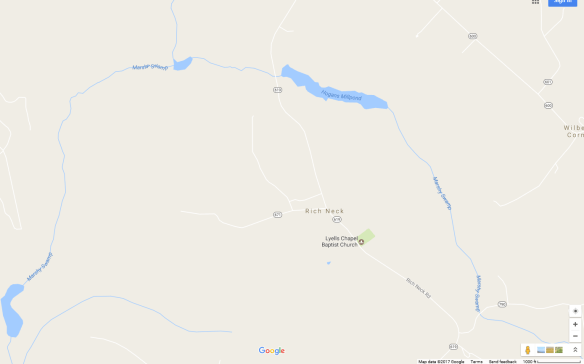
It’s surrounded by Marshy Swamp, which could well have been the Briery Swamp of the 1600s and early 1700s. Marsh Swamp has mill ponds and we know that Briery did as well.

There certainly is a north branch of Marshy Swamp, so I’m thinking this fits the bill quite nicely and I don’t see any other candidate waterways that fit all of the criteria, including a location named Rich Neck and Lyell Church.  I do believe these dots are connected!

The satellite view shows that indeed, there is farmland surrounded by the Creek which is a branch of Totuskey.

Unfortunately, 619 does not have Street View, so I can’t “drive down” it remotely.

Here’s Richmond Road where it crosses Marshy Swamp

Thomas’s Estate Didn’t End With the Will

After Thomas’s death, his widow, Mary Durham Dodson married Robert Galbreath on September 29, 1743 and sure enough, lawsuits followed – just 10 months later.

On July 3, 1744, in chancery court, Greenham Dodson files on behalf of himself as executor of the estate of Thomas Dodson, and others, against Robert Galbreath. (Court Record Book 11-406)

On May 7, 1745, the suit was resolved and the court decided that the petitioner, Greenham Dodson, should “take possession of the coverture, according to the intention of the testators will” and that he should use it for the benefit of Mary Galbreath during her coverture. Robert Galbreath refused to give security and was ordered to pay costs. (Court Record Book 11-458)

That doesn’t sound terribly friendly. The term coverture means the legal status of a married woman, considered to be under her husband’s protection and authority. Perhaps the Dodson children felt that Robert Galbreath was utilizing the estate of Thomas Dodson for himself, not for Mary. Mary would have been 57 years old.

I checked the Virginia Chancery Suit index site for Richmond County, and either those records never made it to the State Library, or they aren’t online yet. I would love to see the entire case file for this suit.

Where was Thomas Dodson Buried?

We don’t know where Thomas Dodson was buried, but he may be buried at the North Farnham Parish church.
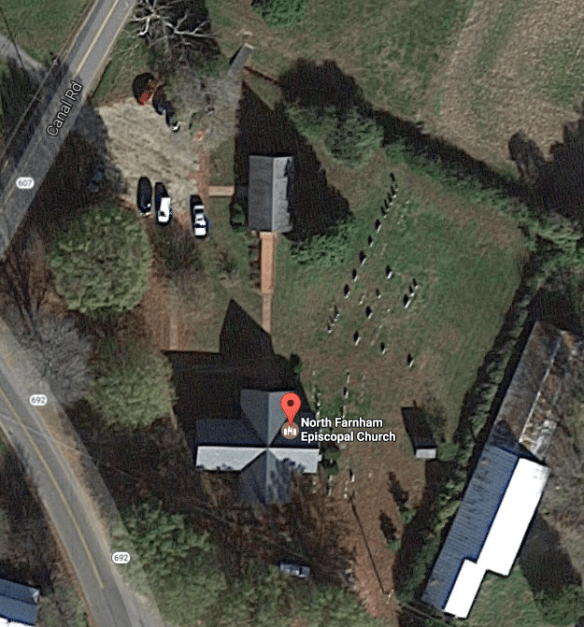
You can see that there is a cemetery behind the North Farnham Parish Church, built in 1737, just a few years before Thomas died. Thomas may have helped to build this church.
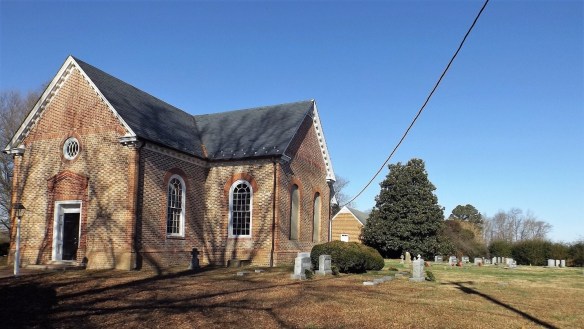
DNA

The Dodson DNA is quite interesting. While I have not been able to find males close to me genealogically to test, I’m quite fortunate that several Dodson males who descend from this line have already tested. And thankfully, their Y DNA matches each other, so we know that the Dodson Y DNA lineage looks like. I’m incredible grateful for projects at Family Tree DNA, because without projects, there would be no avenue to “find” our ancestor’s DNA lineage, at least not without being able to find someone to test. Projects allow us to leverage the combined tests of others for our own genealogy. Hopefully, we’re reciprocating in kind by joining appropriate projects with our own tests.

As it turns out, there is more than one line of Dodsons, genetically speaking. To begin with, there are haplogroup I Dodsons and two haplogroup R Dodson groups, plus additional Dodsons who don’t match anyone. Charles Dodson’s line is haplogroup R, or more specifically, R-M269.

Charles County, Maryland lies directly across the Potomac River from the Northern Neck, but the Dodson family descended from John Dodson who settled there is NOT the same Dodson family. This isn’t what I would have expected.

The Dodson Y DNA project has several members. The DNA project itself can be found at this link, and a description of some of the lineages can be found at this link.

These lineages as listed on the website include two individuals who descend from Charles Dodson (1645-1705) through son Thomas (1681-1740) and his son Thomas (1707-1783), in blue and yellow, above.

Both men descended through Charles’ son Thomas have marker value of 13 at DYS439, in red above, which could be a line marker mutation. What we don’t know is when this mutation occurred in this line. In fact, it could have been anyplace from Thomas Sr. through Isaac.

Kit 17119 – Charles – Thomas – Thomas – Joseph – Caleb – Isaac – William – (plus 3 more generations)

Kit 24573 – Charles – Thomas – Thomas – Joseph – Caleb – Isaac – John – (plus 5 more generations)

Kit 8571 – Charles – Thomas – George – Lazarus – Elisha – (plus several generations)

The one additional individual, kit 8571, who descends through Thomas has only tested to 12 markers. However, we’re in luck because marker 439 is contained within that panel and carries a value of 14.

Therefore, we know that the mutation to 13 occurred someplace below Thomas Sr. and between Thomas Jr. and Isaac. Thomas Sr. did not carry this mutation, because the descendant of his son George does not have the mutation. Therefore 439=13 is NOT a line marker mutation for Thomas Sr.

What Does the Dodson DNA Look Like?

The Dodson DNA project documents that many of Charles Dodson’s descendants have tested and together, form the genetic Y DNA STR signature of the Northern Neck, Richmond County, Virginia line in America.  STRs are short tandem repeat markers, meaning those shown in the results below.

As you can see, in many cases, there is no question about the original marker value, because there are no mutations and all of the descendants match. In other cases, for other markers, there are several mutations. Mutations from the “normal” value for the group of participants is shown by colorized cells.

We can reconstruct the original STR markers of Charles Dodson’s DNA by determining the most common values.

The Dodson project was one of the early projects established, so people have tested at all different levels. The lower levels, such as 12 markers, are less useful. Additionally, few have uploaded Gedcom files, which makes determining who is descended from which of Charles’ sons somewhat difficult.

I have utilized the information listed on the Dodson public project page, shown above, to create the chart below, listing the original Charles Dodson value for each marker, plus the percentage of the time this marker is found in haplogroup R-M343, which is R1b. This will inform us of any unusual or rare marker values for the Dodson lineage – forming in essence a Dodson rare marker genetic signature that should suffice to isolate Dodson men from others. Markers that appear in less than 10% of the people who carry this haplogroup are bolded.

Allele Location Dodson Value % in R-M343 (R1b)
393 13 91
390 24 60
19 15 9
391 11 67
385a 11 87
385b 13 11
426 12 98
388 12 98
439 14 2
389-1 13 71
392 13 86
389-2 29 63
458 16 18
459a 9 95
459b 10 81
455 11 97
454 11 98
447 25 69
437 15 85
448 19 78
449 28 11
464a 15 80
464b 15 71
464c 17 48
464d 17 69
460 10 probably, or 11 19 (10) or 74 (11)
GATA H4 11 71
YCA II a 19 95
YCA II b 23 81
456 16 40
607 15 70
576 18 42
570 17 57
CDY a 36 30
CDY b 39 22
442 11 12
438 12 94
531 11 92
578 9 97
395S1a 15 93
395S1b 16 96
590 8 99
537 10 90
641 10 98
472 8 100
406S1 10 85
511 10 85
425 12 100
413a 22 15
413b 23 89
557 16 73
594 10 96
436 12 99
490 12 97
534 17 8
450 8 97
444 12 73
481 22 60
520 20 85
446 13 76
617 12 91
568 11 95
487 13 92
572 11 88
640 11 95
492 12 73
565 12 88
710 33 16
485 15 84
632 9 98
495 16 87
540 12 85
714 25 31
716 26 93
717 19 88
505 12 80
556 11 94
549 12 33
589 12 92
522 10 52
494 9 98
533 13 22
636 12 91
575 10 100
638 11 97
462 11 95
452 31 9
445 13 6
GATA A10 14 8
463 23 5
441 13 83
GGAAT 1B07 10 92
525 10 85
712 20 31
593 15 98
650 18 33
532 14 23
715 24 62
504 17 56
513 12 72
561 15 87
552 24 77
726 12 99
635 23 80
587 18 92
643 10 83
497 14 92
510 17 71
434 9 96
461 12 80
435 11 98

Summary

Thomas Dodson’s life was probably very typically colonial. Thomas wasn’t aristocracy, wasn’t a Burgess or man representing the government in Virginia, but he wasn’t poor either. He inherited land and bought more, raising tobacco and amassing enough to leave each of his sons a plantation. He was an up-and-comer. He had indentured servants as well as slaves – unfortunately, the norm for a successful planter in Virginia of that time. He was a man making his way in a new land, in rather uncharted territory. Many of his children would continue the legacy and push on to new frontiers.

Thomas wasn’t just a planter. He took an active role in the community.  At various times he was a processioner, a surveyor, a bondsman and many times, a juror and estate appraiser.  Yes, once or twice, he was on the wrong end of the stick as well.  Perhaps he sewed a few wild oats, but apparently not nearly as many as his brother-in-law, young Thomas Durham Jr.

Thomas Dodson would have heard about England, the old country, and the King or Queen, but he was born in the new colony of “Virginny” and probably couldn’t relate to a place and aristocracy he didn’t know. He was part of the first generation of people thoroughly “American.” He was born a generation after the tenuous establishment of Jamestown and almost 40 years after the 1722 Indian raid that nearly destroyed the English settlement.

Thomas died less than a half century before the American Revolution and before the French and Indian War. Thomas and his generation began the foundation of what would, some 40 years after his death, become the United States of America. Thomas became the transition between the fledgling colony clinging to the coast by establishing a thriving tobacco-based economy that would expand and evolve into the foundation for an independent country, something for which his grandchildren stood firm and would fight.

Acknowledgements

Much of the information about the early Dodson lines, including Thomas Dodson, Mary Durham and their children, comes from the wonderful two volume set written by the Reverend Silas Lucas, published originally in 1988, titled The Dodson (Dotson) Family of North Farnham Parish, Richmond County, Virginia – A History and Genealogy of Their Descendants.

I am extremely grateful to Reverend Lucas for the thousands of hours and years he spent compiling not just genealogical information, but searching through county records in Virginia, North Carolina, Tennessee, and more. His work from his first publication in 1958 to his two-volume set 30 years later in 1988 stands as a model of what can and should be done for each colonial family – especially given that they were known to move from state to state without leaving any type of “forwarding address” for genealogists seeking them a few hundred years later. Without his books, Dodson researchers would be greatly hindered, if not entirely lost, today.

Sources

  • Richmond County Virginia Marriage References and Family Relationships 1692-1800 by F. Edward Wright
  • Richmond Co., VA Miscellaneous Records, 1699-1724 TLC Genealogy
  • Deed Abstracts of Richmond County 1692-1695 by Ruth and Sam Sparacio
  • Deed Abstracts of Richmond County 1695-1701 by Ruth and Sam Sparacio
  • Deed Abstracts of Richmond County 1701-1704 by Ruth and Sam Sparacio
  • Deed Abstracts of Richmond County 1705-1708 by Ruth and Sam Sparacio
  • Abstracts of Land Records of Richmond County, VA 1692-1704 by Mary Marshall Brewer
  • Richmond Co., VA 1714-1715 Deeds by Ruth and Sam Sparicio
  • Deed Abstracts Richmond Co., VA 1715-1718 by Ruth and Sam Sparacio
  • Richmond Co., VA 1719-1721 Deeds by Ruth and Sam Sparicio
  • Richmond Co., VA 1721-1725 Deeds by Ruth and Sam Sparicio
  • Richmond County VA Deeds and Bonds 1721 and 1734 by TLC Genealogy
  • Richmond County VA Deeds and Bonds 1734 and 1741 by TLC Genealogy
  • The Registers of North Farnham Parish 1663-1814 and Lunenburg Parish 1783-1800 Richmond County, Virginia Compiled and Published by George Harrison Sanford King 1966
  • Marriages of Richmond County, VA 1668-1853 by George Harrison Sanford King
  • Wills of Richmond Co., Va 1699-1800 by Robert K. Keadley, Jr
  • Richmond Co Will Book 4 1717-1725 by TLC
  • Richmond County Order Book Abstracts 1692-1694 by Ruth and Sam Sparacio
  • Richmond County Order Book Abstracts 1694-1697 by Ruth and Sam Sparacio
  • Richmond County Order Book Abstracts 1698-1699 by Ruth and Sam Sparacio
  • Richmond County Order Book Abstracts 1699-1701 by Ruth and Sam Sparacio
  • Richmond County Order Book 1702-1704 by Ruth and Sam Sparacio
  • Richmond County Order Book 1704-1708 by Ruth and Sam Sparacio
  • Richmond County Order Book 1705-1706 by Ruth and Sam Sparacio
  • Richmond County Order Book 1707-1708 by Ruth and Sam Sparacio
  • Richmond County Order Book 1708-1709 by Ruth and Sam Sparacio
  • Richmond County Order Book 1711-1713 by Ruth and Sam Sparacio
  • Richmond County Order Book 1714-1715 by Ruth and Sam Sparacio
  • Richmond County Order Book Abstracts 1716-1717 by Ruth and Sam Sparacio
  • Richmond County Order Book Abstracts 1718-1719 by Ruth and Sam Sparacio
  • Richmond County Order Book Abstracts 1722-1724 by Ruth and Sam Sparacio
  • Richmond County Order Book Abstracts 1724-1725 by Ruth and Sam Sparacio
  • Richmond County Order Book Abstracts 1726-1727 by Ruth and Sam Sparacio
  • Richmond County Order Book Abstracts 1728-1729 by Ruth and Sam Sparacio
  • Richmond County Order Book Abstracts 1729-1730 by Ruth and Sam Sparacio
  • Richmond County Order Book Abstracts 1731-1732 by Ruth and Sam Sparacio
  • Richmond County Order Book Abstracts 1732-1734 by Ruth and Sam Sparacio
  • Richmond County Order Book Abstracts 1732-1739 by Ruth and Sam Sparacio
  • Richmond County Order Book Abstracts 1735-1736 by Ruth and Sam Sparacio
  • Richmond County Order Book Abstracts 1737-1738 by Ruth and Sam Sparacio
  • Richmond County, Virginia Court Orders 1721-1752 An Every Name Index by TLC Genealogy

Note that at the Allen County Public Library multiple books were rebound together and sometimes the title did not accurately reflect the contents. I searched all of the Richmond County books available which their catalog reflects includes contiguous dates.

______________________________________________________________

Disclosure

I receive a small contribution when you click on some of the links to vendors in my articles. This does NOT increase the price you pay but helps me to keep the lights on and this informational blog free for everyone. Please click on the links in the articles or to the vendors below if you are purchasing products or DNA testing.

Thank you so much.

DNA Purchases and Free Transfers

Genealogy Services

Genealogy Research