Saying Hello in the DNA World

Hey Baby, what’s your sign?  Remember that?  I surely do.  It was the worst introductory, aka “pickup line” ever!

If someone asked me that today, after rolling my eyes of course, I’d just have to show them a double helix on my Kerchner R1b piniphone or maybe just look at them deadpan and say “R1b,” M269” or “J1c2f.” If they know what means, well, there might be hope…

Ok, so what DO you say to someone with whom you match on your DNA?  How do you appropriately say “hello?”

When you receive a match from a vendor or via tools like GedMatch, what do you say to that new match that will elicit a response that might be useful and not make you look either like an idiot or predatory in the process? In part, that has to do with what kind of DNA match it is, meaning Y, mitochondrial or autosomal, and in part, how you ask for information.

So, first, let’s talk about some basics of how to obtain good responses and secondly, let’s look at each type of match.

The Basics

I know some of these basics sounds, well, really basic, but I wouldn’t have included them if I didn’t receive a lot of e-mails from people who obviously don’t understand these basic communications “good manners.”

  1. Do use capitals and punctuation. If you don’t you’re conveying the message to the recipient that they don’t matter enough to bother constructing a complete sentence. E-mails like this are apt to be immediately deleted.
  2. Don’t put the entire question in the subject line. These get deleted too.
  3. Include the person’s name who you match. Don’t assume that the person whose e-mail is on the kit is the person who tested.  Many people manage multiple (as in many) kits.
  4. Don’t write “dear match” e-mails and copy several people at once.
  5. Title the e-mail with something relevant like “DNA Match to Robert Doe at Family Tree DNA.”  You don’t want your e-mail to wind up in their spam filter.
  6. Include the basics of the match including the match’s name on the kit (or kit number) and the company (or service like GedMatch) where the match occurred.  I always add the test type as well, and if the match is particularly close.
  7. Don’t say, “Can you tell me how we’re related?” without giving any other information. That comes across as sounding a bit “entitled” and the response it gets from the receiver generally isn’t positive.
  8. Do not tell your life story. They won’t read it and they’ll delete it.
  9. Include friendly, short, concise basic information, depending on the kind of test.
  10. I always end my communications with a question for them to answer and a short, positive comment.

Y-DNA

Y-DNA tests are between males, so if you’re a female, you might want to mention that you’re the custodian for the kit for your brother, or father, John Doe. Give basic surname and lineage information for the Doe line.

Here’s an example of a contact e-mail for Y DNA:

Dear Robert Doe,

I’m the custodian for the DNA kit at Family Tree DNA of John Doe, my father. I noticed that he matches Robert Doe, which I presume is you, on the Y DNA test at 67 markers with only one mutation.  In addition, these two men carry the same surname which suggest a common ancestor.  I’ve also checked and you two don’t seem to match on the Family Finder test, so perhaps the common ancestor between you and my father is a few generations back in time.

Here is my father’s direct Doe lineage:

y pedigree

As you can see, I’m stuck with Martin Doe in Virginia. I’m hoping that our match might be helpful in getting beyond this brick wall.

Who is your oldest Doe ancestor and where were they located?

Thank you for your time. Here’s hoping we can find our common ancestor or at least some hints!

Jane Doe

Mitochondrial DNA

Mitochondrial DNA is a little more challenging genealogically, because the surnames change with every generation. Therefore, locations become very important clues in terms of finding a common ancestor.

Here’s an example of a mitochondrial DNA contact e-mail:

Dear Susie Smith,

I’m the custodian for the DNA kit at Family Tree DNA for my mother, Barbara Jones. I noticed that mother and Susie Smith, which I presume is you, share mitochondrial DNA at the full sequence level with no mutations difference.  This means that our common relative could be in recent generations, or maybe further back in time.  Since you’ve both also taken the Family Finder test, I noticed that you also match in the 2nd to 4th cousin range, meaning you and mother could potentially share great-grandparents to great-great-great-grand-parents. That could possibly be from Barbara Brown, Ellen Green or Mary on my pedigree chart below.

Here is my mother’s matrilineal line as far back as I have information:

mtDNA pedigree

Of course, it’s possible that our common ancestor is further back in time, but I’m hopeful that some of these names or locations might look familiar or be where your matrilineal family members are from too.

Do you see anything here that looks promising in terms of a common ancestor or location?  Where is your most distant maternal ancestor from?

I look forward to hearing from you. Maybe we can solve this puzzle together.

Jane Jones

Autosomal DNA

Autosomal DNA is, of course, genealogically more complex than either Y or mitochondrial DNA in that your matches can be from any of your family lines. That also means this test is full of potential as well, but it’s more difficult to provide your matches with enough information to obtain a useful response without overwhelming them.  With three different vendors plus GedMatch, a one-size-fits-all introductory letter doesn’t work

The first thing I do is to see if I can tell how this person may match me.

For example, my mother has taken the Family Finder test at Family Tree DNA as well, so the first thing I check on any match is to see if that person matches both me and my mother. If so, then that match is through my mother’s side of the tree.

This is easy to do with the ICW (in common with) button at Family Tree DNA.  The ICW button looks like crossed arrows and is blue, below.

Joy compare

The list of matches returned will either show my mother or it won’t.

If the person doesn’t match my mother, and Joy doesn’t, I see who else they do match in addition to me.  For example, let’s see who Joy matches that I match as well.

Joy ICW

I can tell based on the ICW cousins that Joy and I both match that indeed, this match is on my father’s side and that it’s in the Vannoy line. That’s actually very helpful, because it helps me provide my match with some direction and gives us someplace to go.  This also illustrates the benefit of testing every cousin you can find!

Here’s an example of a Family Finder contact e-mail:

Dear Joy,

I notice that I have a match to Joy Smith, which I presume is you, at Family Tree DNA on the Family Finder test.  Our connection is estimated to be at the 2nd to 4th cousin level. This is exciting because it means we may be able to find our common ancestor.

Based on the fact that you match several of my cousins, including Stacy, Charlene, Christopher, Debbie and 3 Vannoy cousins, our common ancestor seems to be either in the Vannoy line, from which we all descend, or a common ancestral line to all of these cousins.

I’m attaching a copy of my father’s pedigree chart in pdf format so that it’s easily readable. Please note that his grandmother was Elizabeth Vannoy and take a look at her lineage. There is an index in the back of the document so you can easily scan to see if anyone looks familiar.

Are any of her ancestors your ancestors too?

I’m excited to see if we can make a family connection. I look forward to hearing from you,

Roberta Estes

Of course, if you’re sending a message to someone you match at either 23andMe or Ancestry.com, it would read a little bit differently because their tools are different from those provided at Family Tree DNA. For those vendors, my contact verbiage reads somewhat differently, in part, because my mother’s DNA is not at either of those vendors and I have much less flexibility in terms of tools and usage.

For example, at 23andMe the contact request is “blind” and you can’t see anything about matches until the contact and DNA sharing requests are accepted. This is changing shortly at 23andMe, but exactly how all of this will work is uncertain.  Also, not all 23andMe kits can be transferred to Family Tree DNA.

At Ancestry, they have no chromosome browser, so you can’t look at any comparative chromosome information. You can see who else you match in common though, in addition to the Circles.

The message is also different because both Ancestry and 23andMe contacts must be made through their internal message system where you cannot attach files and you are limited in terms of message size. Also, remember to sign your full real name.  Your screen name may not be the same and that’s all the recipient will see in the message they receive through the vendor.  I also include an e-mail address.

Here’s an example of a 23andMe or Ancestry contact message.

I notice that we are a DNA match. That’s great news.  I believe that we may match through the Estes line, but I’m not positive.  I have a number of Estes cousins who have tested from this line at Family Tree DNA that you might match as well.  You can upload your results to Family Tree DNA and see your matches for $39 instead of retesting, which is a real value.  You can also join the Estes project at Family Tree DNA.  Many of my cousins have uploaded their results to GedMatch too.  Have you uploaded your DNA results to http://www.GedMatch.com yet?  It’s a free service provided by genealogists for genealogists and allows people who have tested at different companies to compare their kits for matching.  I’d love to send you my pedigree chart, my GedMatch kit number, provide instructions for transferring your kit to Family Tree DNA and GedMatch, or answer questions.  You can e-mail me at xxxxxx@att.net.  I look forward to seeing if we can find our common ancestor.  Do you have any Estes ancestors in your tree?  Genealogy sure has gotten exciting since DNA has been added as a tool.

Roberta Estes

If I can make this contact more personal, I do. For example, if we share a common ancestor in a tree or a Circle at Ancestry, I always include that information.  I tend, in general to get more responses where I can tell the recipient at least something about how we do or might match, even if it’s nonspecific.

If you want to read more about autosomal DNA contacts tips for success, you can read this more extensive contact article here and one for adoptees here.

Making the contact takes very little effort. Not all contact requests work, of course, but I’ve found some real gems in those that do.

Let me know in the comments what contact techniques work well for you.

Have fun!!!

______________________________________________________________

Disclosure

I receive a small contribution when you click on some of the links to vendors in my articles. This does NOT increase the price you pay but helps me to keep the lights on and this informational blog free for everyone. Please click on the links in the articles or to the vendors below if you are purchasing products or DNA testing.

Thank you so much.

DNA Purchases and Free Transfers

Genealogy Services

Genealogy Research

Phillip Jacob Kirsch (1806-1880), German Immigrant, 52 Ancestors #107

Following many years of genealogical detective work, we have been able to track several lines that were ancestral to the Kirsch family in Germany.  We, in this case, involves several people over a period of about 30 years.  Mom and I searched as did Irene Bultman, our cousin in Dearborn County, Indiana, before her death.  Heike and her mother Marliese, cousins in Germany, found invaluable information as well.  I ordered rolls and rolls of microfilm from my local Family History Center.  Elke Hall, now retired, served as my friend and interpreter for years.

Oh, how I loved the days when packets of translated records would arrive in the mailbox from Elke, before the days of internet. Often, I would take those envelopes into the bathroom, the ONLY place in the entire household that included children, dogs, cats and a husband where one was afforded any privacy at all, and read those packets in uninterrupted luxury.

Dearborn County, Indiana is located at the far southeastern corner of Indiana bordered by the mighty Ohio River on the South and by Cincinnati, Ohio a few miles to the East.  The photos of the Rhine River and the Ohio look remarkably similar, although the land surrounding the Ohio appears to be somewhat less rugged and friendlier towards farming.  The Ohio is the photo on the left and the Rhine is on the right below.

Rhine Ohio

It’s no wonder that my German ancestors felt at home along the Ohio.

Using electronic mapping tools today, we are able to easily find the locations in Germany where our ancestors lived. Mannheim and Ludwigshaven were the predominant areas where we find the Kirsch family in Germany.  When I first started searching German records, even finding a village on a German map was a process.  Things have changed dramatically.

Kirsch Germany map

The above locations where ancestors of the Kirsch family originated all surround the city of Mannheim, on both sides of the Rhine River, and are located within about 15 miles from point A to point I. People who lived pre-1900s most often died within 12 miles of where they were born.  Especially in Germany, many died in the same house where they were born.  Homes, even if they were on leased land, stayed within the same family for centuries.

  • A=Ellerstadt
  • B=Fussgoenheim
  • C=Ruchheim
  • D=Mutterstadt
  • E=Reingoenheim
  • F=Neckarau
  • G=Schwetzingen
  • H=Ladenburg
  • I=Heidelberg

The first of our Kirsch family immigrated from Mutterstadt to America, leaving on June 14th, 1848 from the port of LeHavre, as recorded in the immigration records of the Mutterstadt Civil Register, which actually says 1847. Philipp Jacob Kirsch (Sr.) and his wife, Katharina Barbara Lemmert, along with their 7 children, arrived in New Orleans on July 4, 1848.

Why New Orleans?

Steamboats plied the waters of the Mississippi River, and you could arrive in Aurora, Indiana only 8 days after leaving New Orleans. It was the easiest route to Aurora from Germany.

Why Aurora, Indiana?

There were probably already people from Mutterstadt, and possibly family members, living there. A welcoming committee and other people who spoke German.  Although we think of the days before the telephone as continents separated by oceans being disconnected, they weren’t.  Letters arrived and departed then as now – they just took a lot longer to be delivered.

It was a long trip from Mutterstadt to the port of Le Havre, over 450 miles, which may account for the 1847 civil register date. Goodbyes must have been very difficult.  Those leaving knew they would never see their family who remained in Germany again.  Philip Jacob Kirsch’s parents were both dead, as was Katharina Barbara’s father, but her mother could still have been living.  Those goodbyes, to parents and siblings, must have been terribly difficult.  However, Philip Jacob’s sister and family immigrated and one of Katharina Barbara’s sisters may have as well.

Many immigrants wrote glowing letters back home hoping to entice those left behind to join them in the new land. Given that the Kirsch family obviously had a specific location in mind, as they sailed directly for Aurora, it’s likely that family members were waiting on the dock for their arrival, welcoming the newest Americans.

Mutterstadt LeHavre map

  • A=Mutterstadt
  • B=LeHavre

They probably brought few things with them, and the things they did bring that weren’t essential were probably near and dear to their hearts. Family legend tells us that they brought the chocolate pot and the beer stein, still in the family.

stein

The plates that Jacob Kirsch, their son, used in the Kirsch House in Aurora were also German, but I have to wonder if they ordered them later instead of his parents having brought them on their initial journey.

Let’s take a look at the area of Germany where the Kirsch family lived. The top part of the map below, showing Mannheim on the Rhine and through Eberback on the Neckar was Kirsch stomping grounds.

Rhine Neckar map

What caused our German ancestors to migrate to the United States? Was it the failed uprising of 1848 in which citizens sought democracy and obtained only more restrictions? Most likely not, although the 1850s were one of the peaks of German immigration, with over a million Germans arriving in that decade.

German immigrants

German immigrants boarding a ship in the 1800s are shown above.

The primary reasons for migration seemed to be for the proverbial American dream. In Germany, inheritance laws such as primogeniture, which allowed only the eldest son to inherit land, and forbade him from selling, giving or sharing that inheritance with his other siblings caused a constantly expanding peasant class.

Land was becoming very scarce and expensive, beyond the reach of peasants. Opportunities were only in the cities, which were overcrowded and disease-ridden, forcing people back into the countryside, or to America, the land of opportunity, jobs and land available for farming.

The first members of our German Kirsch family to immigrate to America were Philipp Jacob Kirsch, a farmer, and his wife Katharina Barbara Lemmert.

Fussgoenheim church

According to the Lutheran Church records, Philipp Jacob Kirsch was born in Fussgoenheim, Germany (above and below) in the province of Bayerne, later to become Bavaria on August 8, 1806 to Andreas Kirsch and Margaretha Elizabetha Koehler.

Fussgoenheim, Germany

Today this area is the Pfalz- Palatinate. Katharina Barbara Lemmert, his wife was born September 1, 1807 in Mutterstadt, a neighboring village.

Mutterstadt postcard

This postcard from 1905 from Mutterstadt probably isn’t terribly different than when the Kirsch family left in the 1850s.  The protestant church on the left is where their children were baptized.

Kirsch Lemmert 1829 marriage

Philip Jacob Kirsch and Barbara Lemmert were married in Mutterstadt on December 22, 1829, shown in the church record, above. The record is translated, as follows:

Today the 22nd of December 1829 were married and blessed Philipp Jacob Kirsch from Fussgoenheim, the legitimate, unmarried son of the deceased couple, Andreas Kirsch and Margaretha Koehler and Katharina Barbara Lemmerth the legitimate unmarried daughter of the deceased local citizen Jacob Lemmerth and his surviving wife Gertrude Steiger, both of protestant religion.

Mutterstadt is near Fussgoenheim – about 5 miles distant.

Mutterstadt Fussgoenheim

Philip Jacob Kirsch left the French port of Le Havre on June 14, 1848 and arrived in New Orleans July 4, 1848 with his wife and children whose names are given on the ship’s passenger list, below.

1848 Ship Manifest

The wonderful thing about this passenger list is that it gives the names and ages of all of the children. Many don’t.

In New Orleans, the family would have transferred to yet another boat, a steamer, and steamed up the Mississippi to the Ohio River, and on to the docks at Aurora. These photos were taken in 1848 of the budding city of Cincinnati, just a few miles upstream from Aurora.  The Aurora waterfront probably didn’t look a lot different.  Notice all the steamboats.

1848 Ohio steamboat

This may well be a peek into what types of scenes they saw on the steamboat in 1848. Their son, Jacob, my ancestor, would have been six at the time and for a boy of that age, this must have been an amazing adventure.

1848 Ohio steamboat cincy

On the map of Dearborn County below, you can see the City of Aurora at the bend in the River, and Lawrenceburg upstream towards Ohio. Ripley County borders Dearborn County on the West.  The Kirsch family lived not too far west of Moore’s Hill.  Kelso Township is in the north part of the county where yet another Kirsch or Kersh family resided.  All of these locations hold significance for the Kirsch family story as it unfolds.

Dearborn map

The Kirsch family settled in Ripley County near the town of Milan.

Milan to Aurora

It wasn’t terribly far from Aurora to the 80 acre farm where we find Philip Jacob Kirsch in the 1850, 1860 and 1870 census.

1883 Kirsch plat map crop

The above Plat Map is of Franklin Township in Ripley County, in 1883. Notice the old town of Milan and to the east, the Cemetery by Fordes Hill.

Two years after the family arrived, in the 1850 census, we find Philip Jacob Kursch listed as a farmer in Ripley County, Indiana. Ironically, he is living next door to the Weynacht family, who is also listed along with him on the same ship arriving in New Orleans.  Clearly, these two families immigrated together and were likely related.  But then again, judging from those church records, everyone in Mutterstadt was related several times over.

Kirsch 1850 ripley

Their youngest Kirsch child, Andreas, was born after their arrival in 1848 and died in about 1851. He is buried in a small rural cemetery called the “Old Lutheran Cemetery” about one half mile East of old Milan, where there used to be an old log church.

old Lutheran cemetery

The cemetery is located on the left side of the road as one leaves Old Milan by the road that runs by the present Old Milan Church.

Andreas Kirsch stone

The St. Peter’s Evangelical Lutheran Church was established by a small group of pioneers in a log cabin in Franklin Township in 1847, but it was disbanded in 1855. The cemetery where Andreas is buried abuts a clearing that probably held that church.

Lutheran lost church cemetery

There is a gravestone there that says “Andreas Kirch geb.den Feb. 6, 1817 gest den Sept. 19 1891.

At FindAGrave, Andreas death date is shown as 1821 instead of 1891. As old as this stone it, it’s hard to tell the correct dates.  Andreas is missing from the 1860 census, so this must be the child, Andreas Kirsch who was born in 1847 and the death year was probably 1851.

Irene Bultman, now deceased, believed the family attended a church called Fink’s after that. She had found at least one marriage record of a Koehler family member.  Katharina Barbara Kirsch, daughter of Philip Jacob Kirsch, married Johann Martin Koehler in that church in 1851.  Irene told me that the church records still exist, but they are in German and the current minister in the 1980s when she visited could not translate them.  Today, Finke Church is located at 6960 N. Finks Road in Delaware, Indiana, not terribly distant from where the Kirsch family lived.

In 1860, the census shows Philipp Kersch living in the same location, owning land and living with his wife and youngest children, William and Mary. Two additional children Elizabeth Kaiter and Matthew Weis are living with them, although we have no idea why or if they are related.

1860 Ripley census

Andrew Wenaicht is still living next door. Checking FindAGrave for Andrew, we find Andreas Weinacht born in 1809 in Mutterstadt. So indeed, it appears that Andreas was likely a close friend of Philip Jacob Kirsch.  Looking in my family records, it appears that the Weinacht family was in Mutterstadt for quite some time as they do marry into other families as well.

By 1860, Philip Kirsch, a cooper, was living in Aurora, Indiana with his sister Barbara and her husband Martin Koehler, a hotel keeper. Along with 26 or 27 other people – boarders at the hotel.  While Martin Koehler’s occupation is noted as hotel keeper, given that the other people who lived there were residents and all had occupations such as cooper, bar keeper, carpenter, shoemaker, tailor, cigar maker, clerk, tinner, saddler, rectifier, stave cutter, ferrier and blacksmith, it looks to be more of a boarding house for single men.  There were also several servants living there.

Philip Jacob Kirsch filed his intent to be naturalized, and was in fact naturalized in 1868 in Ripley County, Indiana, according to court records.

But first, the Civil War would interrupt their lives.

The Civil War

On March 3, 1863, Congress passed the Conscription Act which calls for all able-bodied males between the ages of 20 and 45 to serve for 3 years. A drafted man, however, was allowed to pay $300 to hire a substitute.

Three hundred dollars at that time would buy a small farm. Few people had or could come up with that kind of money, and Philip Jacob Kirsch had 4 boys in that age range, although Philip Jacob himself was too old.

As German immigrants who had filed to become American citizens, Philipp Jacob Kirsch and his wife Katharina Barbara Lemmert, saw at least three of their sons serve in the Civil War – Philipp, Martin and probably Jacob. There are records for a John Kirsch as well, but I can’t tell if the John who served in the Civil War is the son of Philip Jacob Kirsch or not. John is such a common name.

Philipp Kirsch served in the Civil War in the US Army Company D 3rd Regiment. He was mustered out Aug. 22, 1861 at Madison, Indiana for the duration of the war.  He owned his own horse, but the equipment was furnished by the government.  He was in Capt. Keister’s company where all the men all owned their own horses.  Philipp was mustered out at the end of the war on Sept. 9, 1864 in Indianapolis, Indiana.  He served a total of just over 3 years.

The 3rd Regiment Indiana Cavalry (East Wing) (or Right Wing), consisting of Companies A, B, C, D, E and F, organized at Madison, Indiana, August 22, 1861, that were intended for service with the 1st Regiment Indiana Cavalry. On October 22, the six companies were designated the 3rd Cavalry and assigned to the Army of the Potomac in the eastern theater of the war. The East Wing saw action at the Battle of Antietam.

The Battle of Antietam (also known as the Battle of Sharpsburg, particularly in the South), fought on September 17, 1862, near Sharpsburg, Maryland.  The Battle of Antietam Creek was the first major battle in the Civil War to take place on Northern soil. It was the bloodiest single-day battle in American history, with almost 23,000 casualties. Phillip would likely have been there.  The picture below was the bridge over Middle Antietam Creek taken in September of 1862.

Antietam Creek Sept 1862

It’s greatly ironic that this battle took place on the land (below) of the Miller descendants of my mother’s father’s grandmother’s line. The Kirsch family is my mother’s mother’s grandfather’s line.  This twist of fate would bring these men from different family lines into close proximity some 45 years before a marriage in northern Indiana would forever cement the blood of these two families.

Battle of Antietam Miller

From the Dearborn Co. History book, we find the list of men in the 32nd Regiment, Indiana Volunteer Infantry, strictly a German regiment, recruited in Sept 1861.  Dearborn Co. furnished most of two companies.  Company C with John L. Giegoldt of Aurora Captain, and Company D that included Martin Kirsch and Valentine Kirsch.

Ripley county offered a $20 bounty for every man drafted, then in 1864, they offered a $100 bounty for every man who either served or found a suitable substitute within the county.

The 45th Regiment, Indiana Volunteer Infantry was known as the third Cavalry.  Company D was from Dearborn Co. and included Philip Kirsch.

Only one known photo exists of Philipp Kirsch who served in the Civil War.  In the photo below Philip is on the left, Barbara Drechsel Kirsch in the middle and her husband, Philipp’s brother, Jacob Kirsch on the right. This photo had to have been taken before Philipp’s death in 1905.  Jacob Kirsch doesn’t look nearly as gray as he does in later photographs.

Kirsch family pre-1905

Sadly, Philipp Kirsch suffered the rest of his life due to some type of intestinal issue that occurred during the Civil War. According to his service records, he was twice hospitalized, but never recovered either during the war or afterwards from diarrhea that he contracted during his service period.  He applied for an increase in his disability pension in 1874, stating that he had been living with his father since the war and that his father’s circumstances had become very strained.  As a result of his disability, Philip was unable to do any physical labor. He later died of complications from the effects of chronic and prolonged diarrhea.  The rather graphic description in his service records cause me to feel very sorry for the man and the chronic pain he lived with.  Philip Jacob lived with his father in Ripley County until his father’s death in 1880, then with his mother until her death in 1889, then with his brother Jacob at the Kirsch house until Phillip’s own death in 1905.

Martin Kirsch also served in the Civil War, and may have been killed or died of disease. I find nothing after the Civil War for Martin. Martin was recruited in 1861 and served in Company D 32nd  Indiana Regiment, the state’s “only German regiment” in the Civil War. Part of the Army of the Ohio, the 32nd fought at Rowlett’s Station in Kentucky; Shiloh, Stones River, Missionary Ridge in Tennessee; and Chickamauga in Georgia.  The brothers served in the same unit and would have mustered in the same day.  That also means that Phillip may have witnessed his brother, Martin’s, death.

I believe that our ancestor, Jacob Kirsch, also served in the War. He certainly was of the age where militia participation was required, and given that he was not yet married, it’s unlikely that he sought and paid for a replacement. Three hundred dollars at that time would buy a farm.

Jacob’s wife, Barbara, applied for a Civil War pension after Jacob’s death. Her pension application was declined, but she gives his unit number as the Indiana 137th Regiment Infantry, This unit was organized at Indianapolis, Ind., and mustered in May 26, 1864. If Jacob was in this unit, he was ordered to Tennessee and assigned to duty as Railroad Guard in Tennessee and Alabama, Dept. of the Cumberland, until September, 1864. She says he was mustered out September 21, 1864, at the end of the war.  Given that Barbara likely knew Jacob during the Civil War, I find it unlikely that Jacob did not serve.  Furthermore, we have a painting of Jacob in uniform.

I researched the unit in question, and found a diary kept by another soldier, removing all doubt about whether or not that soldier served. That man’s name was also not on the roll of the unit.  It appears that records were not well kept during the Civil War.  However, in a surprise turn of events, even though the federal government said Jacob did not serve in that unit, I found his service records listed with that unit in Indiana’s records, so Jacob and Barbara are both vindicated – although not without more than a little confusion and more than a century after the fact.

A painting of Jacob in which he appears to be wearing a Union uniform exists within the family and a picture of the painting is show below.

Jacob Kirsch civil war painting

Philip Jacob Kirsch, listed erroneously as Peter, was still living in Ripley County in 1870. Son Philip, now 38, having served in the Civil War, is listed as a cooper, and Mathias White is living with them as farm labor.

1870 Ripley census

In the 1880 census, we find that Philip Jacob Kirsch has just died, and Barbara, his widow, is still living on the home place with their son Philip Jacob Kirsch, the Civil War veteran who never married. For many years, I thought of Philip as the benevolent son, staying on the farm to care for his aging parents.  Now, perhaps that visage needs to change, because it appears that Philipp may have been living with his parents due to his disability or inability to work.  So maybe they all took care of each other as best they could.

1880 Ripley census

Final Resting Place

Philip Jacob Kirsch and Katharina Barbara are both buried in the Riverview Cemetery south of Aurora along the Ohio River, as is their son Philipp.  It’s somehow fitting that he watches over the Ohio River for eternity.  His life was closely connected to rivers, first the Rhine, then the Mississippi and Ohio.

riverview entrance

Philip Jacob’s tombstone says that he died in 1879, but the cemetery records say he died in 1880, as does this snippet from the Aurora Dearborn Independent on May 13, 1880.

Philip Kirsch Death crop

I was surprised to discover that there was no service for Phillipp in the church.  I was also surprised that the body was sent by train and not by horse and wagon, although the depot was right beside the Kirsch House.  The Fifth Street German Reformed Church is not the church that Jacob Kirsch, Philipp’s son who lived in Aurora, belonged to.  I don’t know if Philipp’s services were conducted by this Reverend because there was a difference in the beliefs of the two German churches, reflecting Phillipp’s personal beliefs, or maybe just because this particular German minister was available to bury a body already 2 days dead in mid-May.

Kirsch Philip Jacob stone

Cemetery records tell us that Philip Jacob was a farmer, was married, lived in Ripley County, near Milan, and died of old age. “Father of Jacob Kirsch of this city, he was 73 years, 9 months and 2 days old and is buried in section H 28” in Riverview.  The section 80 permit was obtained by Jacob Kirsch and is number #803.  Philip Jacob Kirsch was buried May 12, 1880, two days after his death.  Parents listed as “Pilip (sic) Jacob Kirsch mother Barbara Deubert.”  According to Mutterstadt church records, his parents’ names are listed incorrectly.  This is a relatively common occurrence.  Keep in mind in this instance that Philip Jacob’s children never met their grandparents, so it’s not surprising they would not remember their names.

Calculating his death date by his age given, which was calculated from his death date originally, we do indeed find that he died in 1880. This stone was likely set later.  The stone of his son, Philip Jacob, who served in the Civil War and died 25 years after Philip Jacob, the father, is shown in the right corner of the photo.

Philip Jacob’s Land

When Mom and I visited in the 1980s, I vaguely remember finding Philip’s land, or at least we thought we had.

I was quite thrown for a bit, because the roads and landmarks just weren’t lining up, until I realized that today’s Milan was not the same Milan as when Philip Jacob Kirsch lived there.

Milan map

In fact, today, it’s called “Old Milan” and once I realized that, everything fell right into place.  On the map above, Old Milan is just above Milan at the intersection of Old Milan Road and County Road 475 North, which is the road the Kirsch family lived on.

It’s a lot easier today with Google maps in conjunction with the plat map.

Kirsch land and cemetery

On the satellite map above, you can see Philip Jacob’s house location – the red arrow on the left. The address is 5828-6202 East Co Road 475 N, Milan.  The arrow at right is the location of the cemetery where their child, Andreas Kirsch, is buried.

Here is the street view. I love this house. It’s ole enough that it could be original.  It looks like a ginger-bread house.  I wonder if Philip Jacob Kirsch built this house and planted those trees, at least some of them?

Kirsch ripley house

Across the road, the barns.  Hoosier barns, corn in the field beside the house and summer dried grass always make me feel so at home.  I can still hear the crunch of gravel as the truck turned off of the macadam road into the driveway.  The slamming of the kitchen screen door.  The rustling movements and musty smell of the farm animals.  The tractor’s engine.  A dog barking and chasing after someone or something – maybe one of the barn cats that were both pets and working animals too.  Their job was to keep the barns and house mouse-free.

Kirsch Ripley barns

Often, on old farms, the barn is across the road from the house.  This road dissects Phillip’s property almost in half.

Kirsch Ripley roads

Looking down the road.

Kirsch Ripley road 2

And the other way. Roads are just SOOO inviting to me.

Kirsch top of Ripley land

This satellite view shows Philip Jacob’s land with the arrow pointing to the northernmost boundary.

Sale

Seven years after Philip Jacob’s death, his children and widow sold the land.  I’d wager that it was just too much for Barbara, his widow, and Philip, his disabled son, to maintain.

When I first saw this deed, I thought perhaps the family all came back and were together one last time on the farm, signed the deed, and had a glorious reunion.  Then, as I read the deed and the notary statements, I realized that isn’t what happened at all.  Even the family in Marion County didn’t sign in person.

kirsch-1887-deed

This indenture witnesseth that Barbara Kirsch, Jacob Kirsch Jr., Philip Kirsch of Dearborn County, Indiana and John Kirsch and Mary Kirsch of Marion County, Indiana, William Kirsch and Caroline Kirsch of Fremont, Nebraska, Mary Kramer and John Kramer of Collinswell, Illinois convey and warrant to Douglas Martin of Dearborn County for the sum of $1200 the receipt whereof is hereby acknowledged the following described real estate in Ripley County, Indiana, to wit:

The east half of the NE quarter of section 14, township 8, north of range 12 east, containing 80 acres more or less.

In witness whereof the said Barbara Kirsch, Jacob Kirsch, Barbara Kirsch Jr. and Philip Kirsch, John Kirsch, Mary Kirsch, William Kirsch, Caroline Kirsch, Mary Kramer and John Kramer have hereunto set their hands and seals this 29 of August 1887.

Signed:

  1. Jacob Kirsch
  2. Barbara Kirsch
  3. John Kramer
  4. Mary Kramer
  5. Charles Schnell
  6. B Barbara Schnell
  7. John Kirsch
  8. Mary Kirsch
  9. William Kirsch
  10. Caroline Kirsch
  11. Barbara Kirsch
  12. Philip Kirsch

Before me James F. Honson a notary public in and for the county of Dodge, State of Nebraska, personally appeared William Kirsch and his wife Caroline Kirsch and acknowledged the executrion of the annexed and foregoing deed.

September 3, 1887

State of Indiana, Marion County, before me Robert Knoff a Notary Public in and for said Marion County, Indiana personally appeared John Kirsch and his wife Mary Kitsch and acknowledged the annexed and foregoing deed. September 15, 1887

Deed Book 59, Sept 1887-Nov 1888, page 45

kirsch-1887-deed-2

Madison County, State of Illinois – Before me a Notary Public in and for the County of Madison in the state of Illinois, personally appeared Mary Kramer and her husband John Kramer and acknowledged the execution of the annexed and foregoing deed. Sept. 6, 1887

Dearborn County, Indiana – On the 12th day of September 1887 before me the undersigned Notary Public personally appeared Jacob Kirsch Barbara Kirsch his wife also Philip Kirsch and Karbara Kirsch and acknowledged the execution of the foregoing deed.

Recorded October 18, 1887 at 11 o’clock AM.

Deed book 59, September 1887-November 1888, page 46

German Naming Patterns

German families typically gave their children first names of Saints, even those who weren’t Catholic, and they were addressed by their second name. This makes records particularly challenging to locate, since the name you know the person by is often not their first name.

One pronounced exception to that rule is the name Johannes.  As a Saint’s name, the child is named Johann Jacob Kirsch, for example, but when the first name Johannes is used, then that is the only name and his actual name is Johannes.  Johannes Kirsch, for example.  Johann(es) is the German form of John.

Often many children in the family were given the same first name.  For example, Johann Michael and Johan Jacob.  Neither child would have been called Johann, but both would have been called  by their middle names, Michael and Jacob.  Also, the names of deceased children were recycled for later births, sometimes more than once.

Add to that that the names became Americanized over here.  Anna Maria Kirsch in German baptismal records became Mary Kirsch in Indiana and then Mary Kramer when she married.  Try tying Mary Kramer who died in 1929 in Illinois to Anna Maria Kirsch in the 1840s in Mutterstadt, Germany.

Philip Jacob Kirsch became Jacob Kirsch, but then so did his brother Jacob Kirsch whose name was probably actually Johann Jacob Kirsch.  So the father Philip Jacob Kirsch was (generally) called Jacob, the son Philip Jacob was (generally) called Phillip to differentiate his from his brother Jacob who was always called Jacob.  Nope, not confusing at all…..

Children of Philipp Jacob Kirsch and Katharina Barbara Lemmert

Philip Jacob Kirsch immigrated in 1848 with his wife, Katharina Barbara Lemmert and his children. Those children would join the others in the melting pot called America.  His children spoke German, of course, and they naturally gravitated towards other German-speaking children as their playmates and eventual spouses.  They were probably quite close to the Weinaught family next door.  I’m actually surprised there was no intermarriage.

The Kirsch children’s births are recorded in the Protestant church in Mutterstadt, and documentation sent by Friedrich Kirsch many years ago from Germany that he obtained in Mutterstadt (I believe, from the municipality) confirms the following:

  • The marriage date of Philip Jacob Kirsch and Katharina Barbara Lemmert
  • Their birth dates
  • Their parents, his from Fussgoenheim and hers from Mutterstadt
  • Their children and their birth dates
  • That they emigrated to America in 1847
  • That both Philip Jacob and Katharina Barbara and their parents were farmers

Their first child, a son, Philipp Jacob Kirsch was born in 1830.  He never married and lived out his life with his brother, Jacob Kirsch and his family at the Kirsch House in Aurora after his mother’s death in 1889.

Kirsch, Philip Jacob 1830

The Mutterstadt church registry entry above in 1830 gives us the date of the birth and baptism of Philipp Jacob Kirsch, that he was confirmed in 1844, and that he immigrated with his parents to America in 1847. Furthermore, it states his parent’s names, and that his godparents were Philipp Jacob Ellenberger and his wife Anna Maria Lemmert who was the sister of Katharina Barbara Lemmert.

Their second child, daughter Katharina Barbara Kirsch born in 1833 married Johann Martin Koehler, also born in Fussgoenheim, in 1851 in Ripley Co., Indiana. After Martin’s death, she remarried to Charles Schnell. Barbara died in 1900 in Dearborn County, Indiana and is buried at Riverview Cemetery, on the Jacob Kirsch lot under her remarried name, Schnell .

Kirsch, Barbara Katharina 1833

The church registry above records the birth of Katharina Barbara Kirsch in 1833. She was confirmed in 1846 before immigrating with her parents in 1847.  It gives her godparents as Katharina Barbara Reimer, wife of the barrel maker George Seitz.

Their third child, son Johann Kirsch born in 1835 was living when his brother Philip Jacob Kirsch died in 1905. When Jacob Kirsch died in 1917, his obituary said that his brother John was living in Indianapolis.  John married Mary Blatz in 1856 in Ripley County and subsequently moved to Indianapolis where we find him from 1870 until his death in 1927.

Kirsch, John 1835

The church registry entry above in 1835 for Johannes Kirsch shown his birth on the 14th, then his christening 7 days later on June 21st and says he emigrated to America with his parents in 1847, gives his parents’ names and names his godparents as Johannes Weihnacht and his wife Katharina Barbara Zimmer.  There’s the Weinaught family again.

The fourth child, Martin Kirsch born in 1838 fought in the Civil War, but then there is no more information except that he is not mentioned in his brother, Philipp’s 1905 will. I have checked www.fold3.com several times to see if I can find further records for Martin, with no luck. The full Civil War service packs are not yet entirely digitized.

Kirsch, Martin 1838

The church registry above for Martin Kirsch says he was born and baptized Sept. 16, 1838 names his parents, notes that he emigrated, and gives his godparents as Martin Kohler and his wife Maria Kirsch from Fussgoenheim.  Maria Kirsch was the sister of Philip Jacob Kirsch who was married to Martin Koehler who was also Philip Jacob Kirsch’s first cousin.

Jacob Kirsch, born in 1841, our ancestor, married Barbara Drechsel, a young German woman from Aurora.

Kirsch, Jacob 1841

The church registry in Mutterstadt above records the birth of Jacob Kirsch on May 1st, 1841 and his baptism on May the 5th. It states the names of his parents as well as his godparents, “Jacob Krick II and Anna Maria Lemmert, Protestant couple from here.”  It also says he immigrated with his parents in 1847.  Anna Maria Lemmert is the sister of Katharina Barbara Lemmert.  Anna Maria was married to Jacob Krick.  So, we now know that Jacob was named after Jacob Krick, his godfather.  In the German tradition, this also meant that if something happened to Jacob Kirsch’s parents, his godparents would be the people to raise him.  Maybe naming the child after the godparent was a way to “connect” them emotionally to each other, just in case.

Johann Wilheim Kirsch, born in 1844 married Carolyn Kuntz. We know he is dead before 1905 and that he had 1 girl and 2 boys.

Kirsch, William 1844

The church registry record above gives us the birth date of Johann Wilhelm Kirsch, his baptismal date four days later on January 7, 1844, the names of his parents and gives his godparents as Johann Wilhelm Kirsch and Katharina Barbara Koob, protestant couple from Fussgoenheim.  Johann Wilhelm Kirsch who is married to Katharina Barbara Koob is the brother of Philip Jacob Kirsch.

Anna Maria Kirsch, born January 11, 1847 married John Kramer in 1864 in Indiana and was living in St. Louis in 1917 when her brother Jacob Kirsch died, according to his obituary. Mary Kramer died in Madison County, Illinois, just across the Mississippi River from St. Louis in 1929, her birth location given as Mutterstadt.

Kirsch Anna Marie 1847 crop

The church registry above records the birth of Anna Maria Kirsch and states that she was baptized January 17th in the Protestant school house in Mutterstadt, that Philipp Roeder and his wife Anna Maria nee Baumann, Protestants, were her witnesses (godparents).

Andrew Kirsch, their only child born in the US, Feb. 6, 1849, died in roughly 1851 (one record says 1853) and is buried at the old Lutheran Cemetery near Fordes Hills near Milan. This means that Barbara, his mother, was pregnant on her journey to the US on a rocking ship, then on a riverboat steamer.  A brave woman, indeed.

Had Andreas been born in 1848, his birth would have been recorded in Germany. It wasn’t.  Instead, we find repeated commentary in the church records that the family immigrated in 1847.  They may have left Mutterstadt in 1847, but it wasn’t until June of 1848 that they left the French port of LeHavre and not until July 4th, 1848 that they arrived in New Orleans.  Truly Independence Day!

Surprisingly, we don’t know a huge amount about Philip Jacob Kirsch, the person. We know he was a Lutheran farmer who was either brave enough or foolhearty enough to sail across the ocean with his entire family of 7 children and his pregnant wife.

He surely worried when at least 3 of his 4 sons left to fight in the Civil War. I wonder if he somehow knew one of them might not come home.  Maybe he was secretly just a little thankful that Jacob had shot his eye out as a child so that Jacob wouldn’t have to put his life in danger.  However, that logic didn’t work, because Indeed, Jacob did serve.  Was Philip Jacob Kirsch proud of his American sons and their loyalty, or was he regretful that he had come for opportunities and one of the opportunities they got was civil war, just 13 years later – far above and beyond what they ever had reason to expect.

Did Philip Jacob view this as somewhat ironic in a wry way? Did he view it as a crisis?  Was he worried or accepting?  Did he take strength from his religion, and then comfort in times of death, or was he simply a “habitual attender” who attended church more out of habit (or his wife’s persuading) than conviction?  Unfortunately, we don’t have a periscope to look back in time, at least not at these questions.

Y DNA

The only periscope we do have available to us would be Philip Jacob Kirsch’s Y DNA. Unfortunately, there are very few DNA candidates.  I tracked Philipp Jacob’s son, John, forward in time with the hope of finding a DNA candidate in that line. I’m hopeful that it indeed will work.  There are some additional candidates as well.

  • Jacob Kirsch’s son Edward Kirsch had a son Deveraux “Devero” Kirsch who died in 1975 in Vigo County, Indiana.  He had a son, William Kirsch.
  • Jacob’s son Martin Kirsch had a son, Edgar, who married Frieda Neely in 1929. I don’t show any children for this couple.
  • Philip Jacob’s son, Johann William Kirsch, known as William, was dead before 1905 and had 3 children, 2 of whom were sons.  We know he married Caroline Kuntz in 1870 in Indiana.  I have found a William Kirsch living in Pohocco, Saunders County, Nebraska in the 1885 Nebraska state census, wife Carrie, daughter Mittie (13) born in Indiana and sons Edward (11) born in Nebraska and Henry (9) also born in Nebraska. This William died in February of 1891 and was apparently involved in some kind of accident going over the Platte River Bridge in December of 1889. His son Edward died in 1967 and married Beatrice.  In 1910 they had been married 12 years, had 2 children, but none were living.  Edward was living with his mother in 1930.  Henry was alive, 55 and unmarried in the 1930 census, so it’s unlikely that he has any descendants.  It appears that there are no male Kirsch descendants through this line, if this is the correct William Kirsch.
  • Philip Jacob’s son, John Kirsch, moved to Indianapolis and had son Frank Kirsch and son Andrew Kirsch.

Let’s hope that one of these sons or grandsons continued to have male children and that one of them will find us through an interest in genealogy. I have a DNA testing scholarship for any male Kirsch descended from this line.

The “Other” Kirsch Family of Lawrenceburg

As luck would have it, it appears that the neighboring Lawrenceburg (Indiana) Kirsch family may be from Fussgoenheim as well, although I did not originally think that was the case because the 1870 census shows the birth location as Rheinbier, Bavaria. However, that is a misspelling of Rheinpfalz or Rheinbayern which means the southern portion of the current Rheinland-Pfalz.  However, according to Ancestry trees, descendants think that Rheinbier is the village name based on the census.

As fate would have it, I stumbled across the records for this family in the Mutterstadt church records.

I found the marriage of Johannes Kirsch, son of George Heinrich Kirsch and Anna Barbara Elsperman marrying to Margaretha Boeckman, daughter of Immanual Bockmann and Margaretha Elisabetha Ermel in Mutterstadt on September 6, 1831.

Children subsequently baptized in the same church by this couple include:

  • Johannes born Nov. 13, 1831
  • Heinrich born Dec. 5, 1833
  • Catharina born March 8, 1835
  • Valentin born March 27, 1836
  • Johannes born Jan. 21, 1838
  • Johan Georg born June 8, 1840

I can’t find John in the 1850 census, which, based on his 1860 census information, means the family was still in Germany at that time.

In 1860 John Kirsch is living in Lawrenceburg with son George, age 20, a cigarmaker, son John born 1838 who had married.  John also had several younger children:

  • Valentine age 15 (born 1845 in Germany)
  • Jacob age 12 (born in 1848 Germany)
  • Helena age 9 (born in 1851 Germany)

Dearborn County, Indiana records indicate that:

  • Valentine Kirsch married Mary Elizabeth Kohlerman in Lawrenceburg in 1866.
  • Heinrich Kirsch married Elizabeth Schleicher in 1856.
  • Son John (Johannes) married Margaretha Bultman in1859.  In the 1860 census, they have a new son, John, as well.

This sure looks to be the same family!

So, the Lawrenceburg Kirsch family was (apparently) from Fussgoenheim as well. I don’t have John’s father, Georg Heinrich Kirsch connected on back to my Kirsch line in Mutterstadt, but I’m betting money he connects.

So, I wonder, are there any Kirsch’s still around in Lawrenceburg today?

It surely would be fun to test a Kirsch male from each line to see if indeed, they do share a common Kirsch ancestor prior to the first church records.

It would also be fun to test any descendants, male or female (with any surname), of these couples to see if we match each other autosomally. If so, that means that we can identify which segments of our ancestral DNA was inherited through the Kirsch lines, or those lines that fed the Kirsch lineage.

______________________________________________________________

Disclosure

I receive a small contribution when you click on some of the links to vendors in my articles. This does NOT increase the price you pay but helps me to keep the lights on and this informational blog free for everyone. Please click on the links in the articles or to the vendors below if you are purchasing products or DNA testing.

Thank you so much.

DNA Purchases and Free Transfers

Genealogy Services

Genealogy Research

Finding Immigrant Descendants – aka- Identifying John Kirsch

Often, people ask how they can find someone to DNA test for a line whose surname they don’t carry.

There are indeed ways to do this, to stitch information snippets together, and if anyone can do this, a genealogist can excavate those gems and tie them back together. Genealogists have been described as crazy, insane, extremely focused, OCD and let’s not forget, tenacious.  And you know what, that’s all true – every word of it.  We tend to wear all that as a badge of honor, actually.

But sometimes, immigrants in particular can really test our mettle. Often, relatively recent immigrants are the worst to find DNA candidates for.

Why?

Because people in the old country don’t often embrace DNA testing, or genealogy for that matter, with the same veracity we do, if at all.

Why not?

Because they know where they are from, or at least they think they do, because their family “has been there forever.”

How long is forever?

Who knows, but long enough that they don’t think they were ever from anyplace else. And so, no need for searching for ancestral roots because they are “here,” wherever here happens to be, right underfoot.

Not to mention the little issue of a language barrier between us in the here and now and them in the ancestral country.

On the other hand, once one of the family line immigrates to the New World, be it the US, Canada, Australia or someplace else, the process of ancestral forgetting begins and within a couple of generations, events and places are no more than a fuzzy memory of a half-remembered story that may or may not be accurate. You know, like those three brothers stories.

If that ancestor arrived in say, 1650, they have had 300+ years to have accumulated descendants since arriving. Doing a bit of math, if they had 10 children who each had 10 children in each 25 year generation, between now and then, they now have about 1 billion descendants.  Ok, so let’s say only 5 children survived in each generation and the generation average is 30 years.  Now we only have 2 million or so.  Ok, but let’s say that the past 100 years since the advent of birth control, the number of descendants didn’t increase, just maintained itself.  Then we’d only have between 15,000 and 80,000 descendants.  And at least a few of those would surely be males who carry the surname.  At least one can hope.

Contrast that to Philip Jacob Kirsch, born in Mutterstadt, Germany in 1806, married in 1829 to Katharina Barbara Lemmert and had their first child in September of the following year. They were fortunate, because most of their children survived.  I am fortunate because the births of all of their children except the last child are dutifully recorded in the church in Mutterstadt.

Child Birth Death Marriage Offspring
Philipp Jacob Sept. 19, 1830 Sept. 9, 1905 Never married None
Katharine Barbara Kirsch Jan. 6, 1833 Aug. 2, 1900 Johann Martin Koehler 4 daughters, 2 lived, one uncertain, 4 grandchildren
Johannes June 14, 1835 Living in Indianapolis in 1917 per brother Jacob’s obituary ? ?
Martin September 16, 1838 Not heard of after Civil War, not mentioned in his brother’s 1905 will None known None known
Jacob May 1, 1841 July 23, 1917 Barbara Drechsel 4 daughters, 2 sons, 2 grandsons
Johann William Kirsch January 3, 1844 Before September 1904 Caroline Kuntz His brother’s will in 1905 says he is dead and has 1 girl and 2 boys
Anna Maria Kirsch Jan. 11, 1847 After 1917, per brother Jacob’s obituary Bernard Kramer Per census, 9 children, 4 living in 1910
Andrew Kirsch Feb. 6, 1849 Circa 1851, before 1860 None None

As you can see, our chances of finding a male Kirsch to Y DNA test aren’t wonderful, but there are possibilities through some male children, bolded above.

The total number of next generation descendants for Philip Jacob and Katharina Barbara were 8 children, 7 of which lived past childhood. Those children only produced 14 known grandchildren, with a few more possibilities.  In other words, the descendants doubled themselves, but after this generation, birth control came into play and large families became the exception and not the norm.

Unfortunately, these descendants tended to move away, and their names of John and William were quite common, so they are very difficult to identify if you don’t know where to look.

A couple years ago, a genealogist, Mike, who descended from one John Kirsch contacted me. He was looking for possible parents of his John Kirsch who lived in Indianapolis, had found Philip Jacob Kirsch in the Ripley County 1850 census with a son John, added two and two together and came up with parents.

I was skeptical. Not only did that seem just too convenient, but also because John is such a common name.  There were other John Kirsch’s too, like another John Kirsch in Lawrenceburg, Dearborn County, right next door to Ripley County, who was born in about 1838.  Mike’s John Kirsch’s tombstone says he was born in 1837, not 1835 as the actual church record, below, says of Philip Jacob Kirsch’s son, Johann (John in the US,) from Ripley county.

Johann 1835 church record

The Mutterstadt church registry entry above in 1835 for Johannes Kirsch shows his birth on June 14th and then his christening 7 days later on June 21st.  It also says he emigrated to America with his parents in 1847 and gives his parents’ and godparents’ names.

Maybe John Kirsch who died in 1927 in Indianapolis is neither of these John Kirsch’s.

To make matters even worse, there is a possibility that the Kirsch family in Lawrenceburg is related back in the old country to the Kirsch family in Ripley County, who subsequently moved to Aurora, also in Dearborn County. Let me translate, if that is true, autosomal DNA could give a match between John’s descendant, Mike, and my mother and it would not confirm that John was the son of Philip Jacob Kirsch.

So, the only thing to do was to set out to prove, or disprove, John as the son of Philip Jacob Kirsch of Ripley County.

But how?

Mike provided the information that his John was buried at Crown Hill Cemetery and had died on January 10, 1927, according to the markers at the cemetery. John was buried with his wife, Mary, and his son, Frank.

John Kirsch headstone

The headstones from FindAGrave confirm this and showed us that Frank also died in 1927, the same year as his father, and was born in 1858.

Frank Kirsch headstone

Mike personally knew these to be his family members and had been to the cemetery.

Mike had found a marriage record in Ripley County for a John Kirsch to a Mary Blatz or Blotz on February 18, 1856 – but we couldn’t tell if that John and Mary was this John and Mary. We also didn’t know if that Ripley County John was the son of Philip Jacob Kirsch.

From here, we begin to follow the breadcrumb trail.

We agreed that we needed to do three things at that time:

  • Contact the cemetery to see if they have additional information
  • Contact the Indianapolis Public Library to see if they hold an obituary for John or Mary
  • Obtain a death certificate for John Kirsch

There were fees associated with the cemetery records and the death certificate, not to mention restrictions on who can order death certificate and that they sometimes take forever to arrive. I wrote a letter to the Indianapolis Public library, but received no reply.  The letter found its way to the bottom of my pile where it reposed for a year.

However, as I began writing the 52 Ancestor’s article for Philip Jacob Kirsch, finding son John became more important. I thought I recalled that Mike’s John Kirsch had a son…and maybe…just maybe…a DNA candidate.

I contacted Mike again, and he had gotten busy too, so neither of us had obtained John’s records.

So, I set about a course of discovery.

First, I reviewed all census records I could find for John.

In 1850, he is living with his parents.

In 1860, I can’t find him anyplace, but he would have been married and had son Frank already, who was born in 1858. I do find a John Kirsch in Lawrenceburg, Indiana, born in 1838, married to a Margaret, with a young son, John, age 3 months.   That John is the son of an older John Kirsch, also living in Lawrenceburg.

In 1870, I find Frank and Mary in Indianapolis with son Frank, 12, confirming that 1858 birth year, and a daughter, Louisa, age 3. John works in a spoke factory.

In 1880, we find the John Kirsch of Lawrenceburg still living in Lawrenceburg, still married to Margaret, with an ever-growing family including children whose names do not include Frank and Louisa. We also find John Kirsch in Indianapolis, wife Mary, daughter Louisa, now age 12 and son, Andrew age 2.  Furthermore, we now know that Mary is Mary Blotz because Lena Blotz, age 68, John’s mother-in-law, is living with them.  A big bingo!

John Kirsch 1880 census

The 1890 census is missing, of course, but the 1900 Indianapolis census shows us that John gives his birth month and year as June of 1835, not 1837 as his cemetery stone says. He says he immigrated in 1846, has lived in the US for 53 years, is a spoke turner and has had 6 children, but only three are living.  By process of elimination, those children have to be Frank, Louisa and Andrew.

John Kirsch 1900 census

I called the Crown Hill cemetery and they provided additional information about Mary. She died on December 26, 1905.

Sure enough, the 1910 census shows us that John, a widow, is now living with daughter Louisa and her husband Oliver Hald, that John immigrated in 1847 and is naturalized. He is listed as the father-in-law.

In 1920, John is still living with Louisa and Oliver and says he immigrated in 1845 and is naturalized.

John dies in 1927.

The Crown Hill Cemetery told me over the phone that they sometimes have records provided by the family, and for a nominal fee, they will look “in the vault.” And even better news.  Instant gratification.  They take credit cards!!!

Indeed, the treasure from the vault tells us that John’s birthplace is given by the family as “Mutterstadt” in Germany and his birth date is given as June 16, 1837. His age was given as 89, but in reality, he was 91 years and 7 months.  John got shortchanged.

John, Mary and son Frank are buried on the Hald plot along with their daughter Louisa and her husband, Oliver.

The Indianapolis Public Library searched for an obituary for both John and Mary Kirsch in all three Indianapolis newspapers of the time, to no avail.

However, it has been a great research day, not because of one big find, but by several  puzzle pieces connecting together, we have a much clearer picture of John Kirsch and who he is:

  • We’ve confirmed that this John of Indianapolis is indeed the John who married Mary Blotz in Ripley County in 1856 by virtue of his mother-in-law living with them in the 1880 census.
  • We’ve confirmed that he is not the John of Lawrenceburg who was born in 1838 and continued to live there while this John was living in Indianapolis, also by virtue of the 1880 census. Their children also have different names, thankfully.
  • We’ve confirmed that John’s birthplace was in Mutterstadt, the same location as Philip Jacob’s son, Johann, was born in 1835, by virtue of the records held by the Crown Hill Cemetery and the Mutterstadt church records.
  • We’ve also obtained, from the 1900 census, information given by John himself, that his birth month and year was in June of 1835, not 1837 as is carved on his tombstone. 1835 matches the birth and baptismal records for Johann Kirsch, son of Philip Jacob Kirsch and Katharina Barbara Lemmert in Mutterstadt.
  • John named his last child Andrew. Andreas was the name of his grandfather he would never have known and also the name of his baby brother who died at the age of about 2 and a half, when John would have been 15 or 16, living in Ripley County.
  • Lastly, Jacob Kirsch of Aurora, Indiana, the son of Philip Jacob Kirsch and Katharina Barbara Lemmert of Ripley County, died in 1917.  Jacob’s obituary says that his brother, John Kirsch lives in Indianapolis.  There is no other John Kirsch in Indianapolis in either the 1910 or 1920 census who is born within 25 years of 1835, so by process of elimination, this John Kirsch is the only candidate to be Jacob’s brother.

Ironically, John Kirsch’s death certificate arrived today.  His father’s name?  John.  However, his mother’s name and information was entirely blank.  John’s birth month and year were off too, based on what we know.  I can’t tell you how many times I’ve seen incorrect death certificates, especially when it comes to the mother’s name.  Generally, they at least provide her first name, but not in this case.

However, with the combined information, I feel confident at this point that I have correctly identified the John Kirsch in Indianapolis as the son of Philip Jacob Kirsch and Katharina Barbara Lemmert of Mutterstadt, Germany and Ripley County, Indiana.  Yes, in spite of the death certificate data, provided by a distraught family.  Ironically, the cemetery and census information was far more useful.  It’s a good thing I didn’t receive the death certificate first and just give up, assuming it was correct and that John who died in 1927 was not our John.

What’s Next

I hope DNA.

I hope that Mike, being a genealogist, will agree to test autosomally.

Mike also has male Kirsch cousins he has agree to approach about Y DNA testing.  There is so much to be learned from this test.  Where did the Kirsch family come from?  What is their history before they adopted surnames?  I’m very excited about the possibility of Y DNA testing.  I truthfully thought we’d never find a candidate.

My fingers are crossed.

My toes are crossed.

My eyes are crossed.

My everything is crossed….

Here’s hoping!

______________________________________________________________

Disclosure

I receive a small contribution when you click on some of the links to vendors in my articles. This does NOT increase the price you pay but helps me to keep the lights on and this informational blog free for everyone. Please click on the links in the articles or to the vendors below if you are purchasing products or DNA testing.

Thank you so much.

DNA Purchases and Free Transfers

Genealogy Services

Genealogy Research

We Match…But Are We Related?

Last week, I received this question from a reader, we’ll call him Jim:

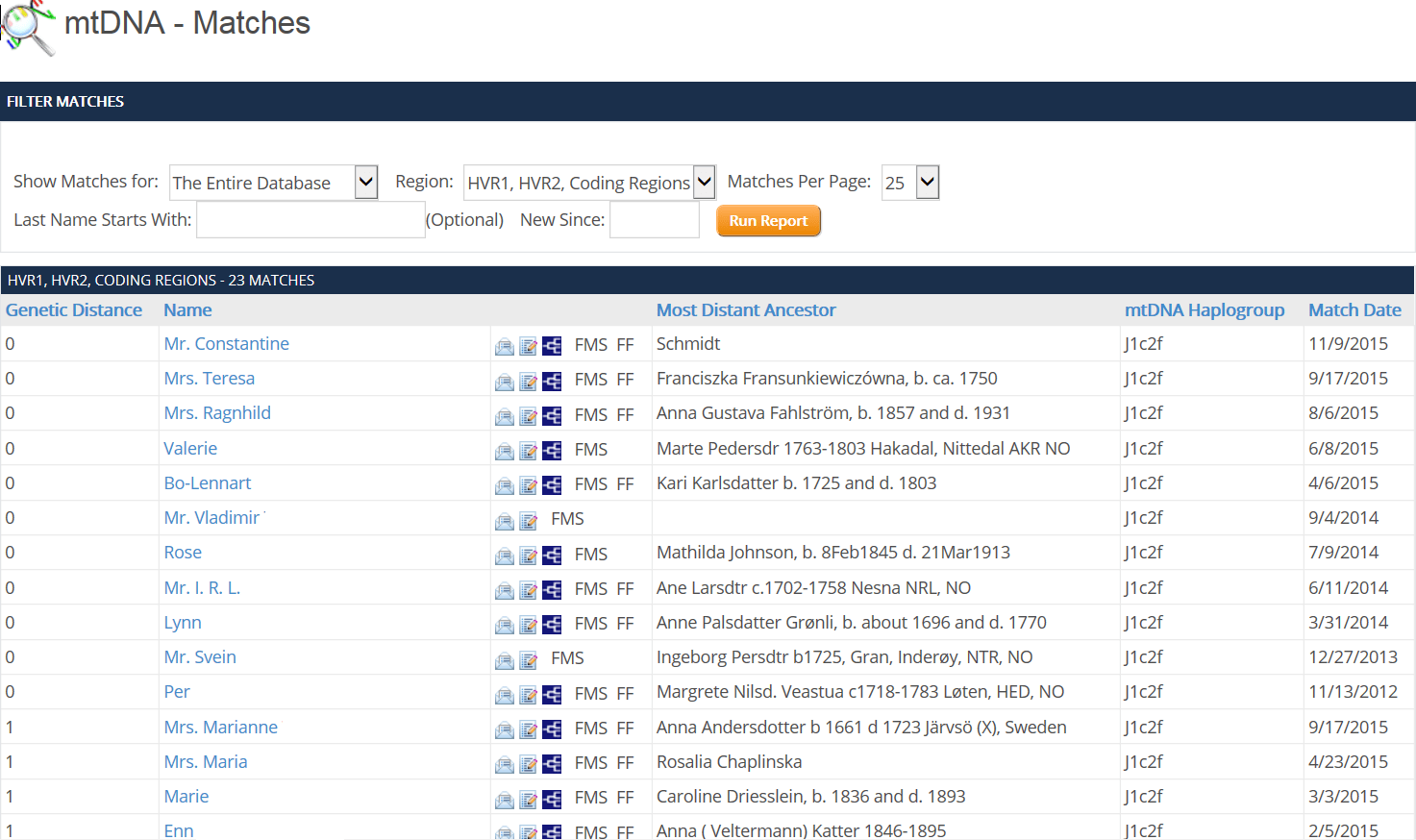
“I match Susie on the HVR1 and HVR2 regions of our mitochondrial DNA….but I was just wondering….are we related?’

Well, the answer is yes…and maybe.

You see, the answer hinges on the definition of the word “related.”

If Jim means related at any point in time, the answer is yes.  If Jim and Susie share the same haplogroup, at any level, then they did indeed share an ancestor at some point in the past. The question is – how long ago?  And that part of the answer isn’t easy.

Now, if what Jim means is related in the sense of “in a genealogically meaningful timeframe,” which is generally anytime from the present back in time roughly 500 or maybe as long as 800 years….the answer is a resounding maybe.

And of course, the answer differs a bit, depending on whether you’re talking about mitochondrial DNA, Y DNA or autosomal DNA.

Let’s look at all 3 types of DNA tests.

Mitochondrial DNA

First, Jim doesn’t have enough information to make that “genealogically meaningful” determination. To do that, he and his match both need to test at the full sequence level for mitochondrial DNA.  The full sequence test tests all 16,569 locations of the mitochondria, where the HVR1+HVR2 tests only 1135 locations.  Family Tree DNA is the only testing company to provide this level of testing.

Jim needs more information.

If Jim and Susie match at the full sequence level too, then the genealogical timeframe becomes possible. If they match with no mutations, meaning a genetic distance of zero, it becomes even more likely, but it’s certainly not a given – nor is figuring out who the common ancestor might be.  For example, below are my closest full sequence matches and my most distant matrilineal ancestor was from Germany.  Most of these matches are Scandinavian.

match mito

However, exact full sequence matches are where you start to look for a common ancestor. No common ancestor found?  Then at least look for common geography.

One of the easiest ways to do that, for both mitochondrial DNA and Y DNA, at Family Tree DNA, is by utilizing the Matches Map, available on your toolbar.

match matches map'

Assuming your matches have completed their most distant ancestor’s location (which is not always the case,) it’s easy to look for match groups and clusters on the map. Your most distant ancestor’s balloon will be white, with your matches color coded.  You can click on any of the balloons to see the match, their ancestor and location.  These are my full sequence matches.  Surprisingly, my closest matches aren’t in Germany at all!!!  Hmmm….time to start looking at what happened in history that might account for this population movement.

In many cases, people will match at the HVR1 and HVR2 levels, but not match at higher levels. In fact, they may both be haplogroup H (for example) at the HVR1 and HVR2 levels, but the full sequence testing refines their haplogroups and their extended haplogroups may no longer match each other.  For example Jim’s refined haplogroup could be H2 and Susie’s ’s H6.  Both are subgroups of H, who was born roughly 12,800 years ago, according to “A ‘Copernican’ Reassessment of the Human Mitochondrial DNA Tree from its Root” by Behar et al, published in The American Journal of Human Genetics 90, 675–684, April 6, 2012.

So, yes, Jim and Susie are definitely related in the past 12,000 years – but I’m not thinking this is what Jim was really asking. I refer to this as “haplogroup cousins.”

However, a lot has happened in 12,000 years. As in, mutations happened, and subgroups emerged.  So while Jim and Susie might both be members of haplogroup H, they are not both members of the same subgroup, so their ancestors both developed mutations which classify them into subgroups H2, born not long after H was born, and H6, born about 11,000 years ago.

So, the bottom line is if you don’t match at the full sequence level, you’re not related in a genealogically meaningful time frame. If you do match at the full sequence level, you might be related in a genealogically meaningful timeframe.

A couple years ago, I set about looking at mitochondrial DNA mutation rates and discovered that the only academic paper published that addressed this in the HVR1, HVR2 and coding regions was written about penguins. Not exactly what I was looking for, but it does explain why there is no TIP type calculator for mitochondrial DNA.

Family Tree DNA does provide some guidelines in their learning center.

    • Matching at the HVR1 level means that you have a 50% chance of sharing a common maternal ancestor within the last fifty-two generations. That is about 1,300 years.
    • Matching on HVR1 and HVR2 means that you have a 50% chance of sharing a common maternal ancestor within the last twenty-eight generations. That is about 700 years.
    • Matching exactly on the Mitochondrial DNA Full Sequence test brings your matches into more recent times. It means that you have a 50% chance of sharing a common maternal ancestor within the last 5 generations. That is about 125 years.

I personally think that the 5 generation estimate of a 100% match for the full sequence is overly optimistic. In fact, a lot overly optimistic.  I do find people who do share common ancestors at the full sequence level, but it’s the exception and not the rule – although part of that may be because the surname changes every generation so it’s genealogically difficult to track.  However, genealogical matches would be much more common if more people tested their mitochondrial DNA.

You can see a good example in this article of how mitochondrial DNA told me a story I didn’t know about my matrilineal line – and would never have known without full sequence testing.

What I didn’t include in this article is that many of my mitochondrial DNA matches shared their mutation information with me, and I created a “tree” that showed exactly where each mutation happened and who shared a common ancestor with whom.

I obviously can’t share that chart publicly, but the chart below conveys the methodology. The oldest known ancestors of these matches lived in the locations listed at the bottom of the chart.

match 1

In the above case, you can clearly see that it’s very likely that the founder lived in Scandinavia because at least some of the descendants of all three unique mutation groups, A, B and C live in Scandinavia today. However, Mutation J is found in Germany.  This suggests that sometime after the common mutation, F, an individual migrated from Scandinavia to Germany.  Mutation K, who also shares mutation F, is still in Scandinavia today.

Y DNA

It’s a bit easier to answer the “are we related” question for Y DNA because the surnames are often the same. So yes, if you match on STR markers (those are panels for 12, 25, 37, 67 and 111 markers) and you carry the same surname, you’re likely related in a genealogically relevant timeframe.  Don’t you hate it when you see those weasel words like “likely?”

However, if your surname is Smith, or something else very common, and you only match at 12 markers, and you don’t match at higher levels, then again, you’re probably a haplogroup cousin. Names like Smith and Miller are occupation names and every village across continental Europe had at least one at all times.  So, there are lots of Smiths and Millers that have the same base haplogroup and aren’t related in a genealogically meaningful timeframe.

You can see an example of this in my Miller-Brethren project. These are Miller families, German in origin, who belonged to the small German Brethren religious group.

Match Miller 1

Match Miller 2

I thought this would be a relatively small, easy project, but not so much. There were a lot more genetically different Miller surname groups even within the small Brethren church than I expected.

As you can see, many of these groups share haplogroups, especially major haplogroups like R-M269.

In some groups, some individuals have tested additional SNPs by taking either individual SNP tests, the Big Y or SNP panel tests, offered on their individual pages.

So, for example, you may see the haplogroup designations of R-M269 and R-CTS7822 in the same family grouping where the STR markers match exactly or nearly. Confusing?  Yes, but that means that one individual had taken additional testing.  If you look at the haplogroup trees, you would see that CTS7822 is downstream of M269 in haplogroup R.

The important thing for finding genealogically relevant matches is matching high numbers of STR markers. I encourage everyone to test at 67 markers, and I like to see 111 if the budget allows.

If you match someone at 67 markers, exactly, there’s a very good chance you’re very closely related.

For example, cousin Rex matches cousin Richard at 67 markers with only 3 differences. I happen to have their genealogy, and I know when these two men’s lines diverge.  They descend from two different sons of Michael Miller (Mueller) who was born in 1692.  Three cumulative Y STR mutations have happened since that time in these men’s two lines.

Match Miller 3

Rex’s haplogroup is R-M269, but Richard took the Big Y test, so his haplogroup is shown as R-CTS7822 and he now sits as proxy for the rest of the Michael Miller descendant group.

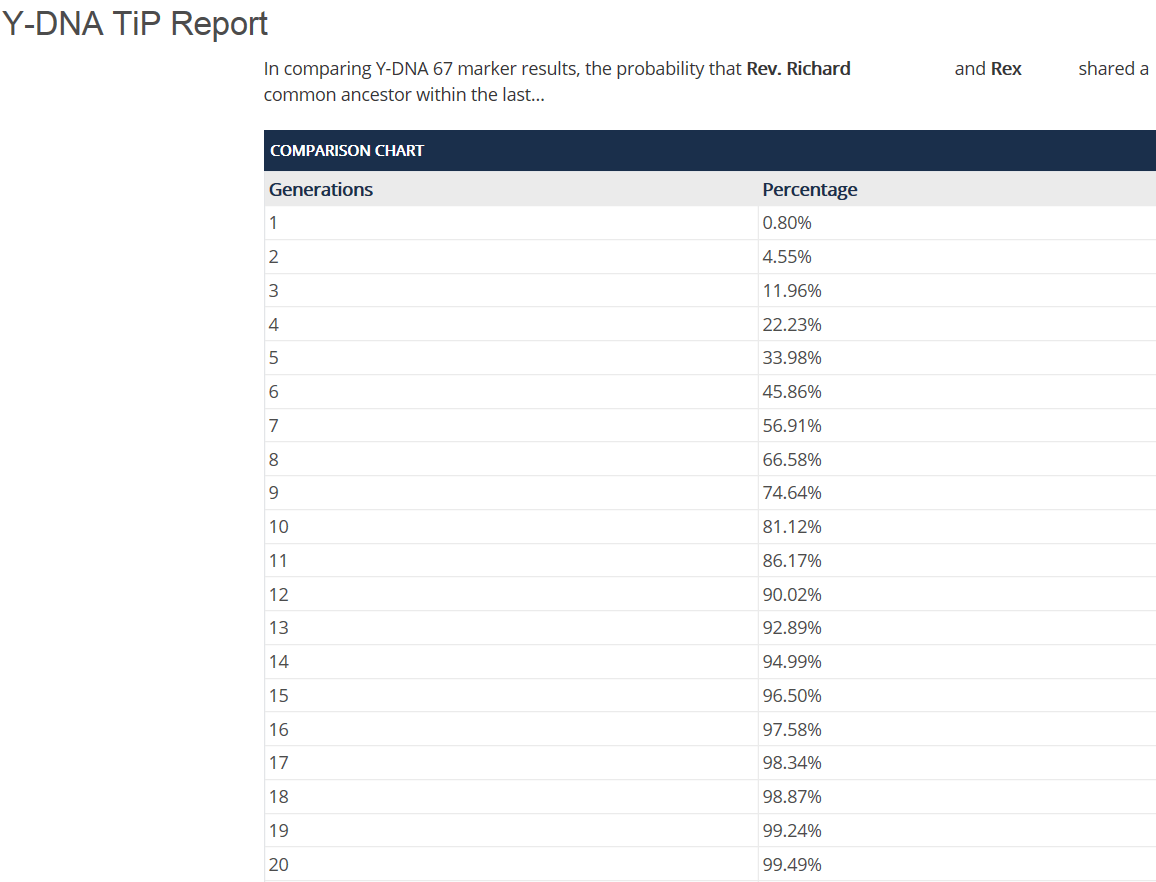
Y matches have access to the TIP calculator, that little orange box shown on the match page above to the right of each matches name.  The TIP calculator provides generational estimates to a common ancestor, weighted by haplogroup marker mutation frequency.

The TIP calculator shows us that, based on their mutations at 67 markers, these two men are most likely to be related between 6 and 7 generations. At the 50th percentile, they are as likely to be related sooner as later, so the 50th percentile is the number I tend to use for an estimate of the distance to the most recent common ancestor.

Match tip

In fact, their common ancestor is 7 generations ago, counting their parents as generation 1.

The more markers tested, the more data you, and the TIP calculator, have to work with. I’ve found the TIP calculator to be quite accurate at 67 and 111 markers when using the 50th percentile as a predictor.

What? You say you don’t match anyone with your surname?

That’s more common than you think.

One of two things could have happened.

First, your paternal surname line may simply have not tested yet.

You may be able to search in the appropriate surname project and find a group of people who descend from “your” ancestor with different DNA. That’s a pretty big hint too, assuming the genealogy is accurate.  If the genealogy is accurate, and your line is the “odd man out,” the next question is always “when did the genetic break occur,” and why.  That leads us to the second scenario.

Second, there could be an undocumented adoption in your line. I’m using undocumented adoption in the most general sense here, meaning anything from a child taking a step father’s name to a true adoption.  The surname does not match the biological line and we don’t know why – so some “adoption” of some sort took place someplace.

The question is, one or two?

I first ask people if they really want to know the answer, because once you pursue this avenue, you can’t close Pandora’s box.

If the answer is yes, they are sure, then I suggest they find a male with their surname that they know should be related and test him.

The answer will become obvious at that point, and the test plan from there forward should reflect the discovery from that test.

Autosomal

The question of “are we related” can be more obtuse when discussing autosomal DNA.

On the other hand, like with Y DNA, the answer can be very evident.

In fact, there is an entire spectrum of autosomal DNA matches and I wrote about how much confidence you should put in each type.

But let’s get down to the very basic brass tacks.

There are only two ways you can match someone’s autosomal DNA.

Either you share a common ancestor or you are matching by chance.

When you receive DNA from your parents, that DNA came from their ancestors as well. All of the DNA you receive from your parents came from some ancestor.

Then, how can you match someone by chance?

You have two strands of autosomal DNA. Think of two lanes of a street.  However, the houses on both sides of that street have the same address.  Your Mom’s DNA value goes in front of one house, in one lane, and your Dad’s goes in front of the house with the same address in the other lane, but we don’t know whose DNA is whose and there is no consistency in whose DNA goes in which lane.

So, it looks like this.

match autosomal strands

You can see in this example that you received As in all positions from Mom and Cs in all positions from Dad. However, these alleles can be positioned in either your strand 1 or 2, so the entire roughly 700,000+ locations typically tested for genealogy is mixed between Mom and Dad.  So, there is no way to tell, just by looking at your DNA, which DNA in any position (strand 1 or 2 at any address) came from whom.

You can also see, looking at the chart above, that if someone matches you on all As, they match you on your Mom’s side, and if they match you on all Cs, they match you on your Dad’s side. This is called identical by descent.  This means, yes, you are related.

But what happens if someone has ACA? They match you too, by zigzagging back and forth between your Mom and Dad’s DNA.  That’s called identical by chance, and it’s not a valid genealogical match. This means, no, you’re not related, at least not on this segment.

I wrote more about this phenomenon and tools to work with your DNA in “One Chromosome, Two Sides, No Zipper.”

How can you tell the difference between identical by descent (related) and identical by chance (not related)? Therein lies the big question.

If you match someone who also matches one of your parents, then you match them through that side of your family – identical by descent from a common ancestor.

Don’t have parents to test?  Then how about your parents siblings, aunts, uncles, first cousins….etc.  Often the best way to tell if a match is a legitimate match is by who else they match that also matches you.  This is why we encourage people to test all of their relatives!

And that, of course, leads to identifying the common ancestor. For example, if you match someone who also matches your first cousin on the same segment, your common ancestor has to be in that same genealogical line shared by you and your first cousin.  This technique is called triangulation.

I wrote more about cousin matching too, in “Just One Cousin.”

You can read more on this general topic here and here, as well.

I wrote a primer for folks just getting autosomal results back called “Autosomal DNA Testing 101 – Now What?”

Combination Tools

There are several ways to match people. Sometimes looking at combinations of tools is quite helpful as well.

One of my favorite and little known methodologies is to combine two tools together.  This is only available at Family Tree DNA, because they are the only vendor who also performs the mitochondrial and Y DNA tests in addition to the autosomal testing.

For example, if you match someone on the Y or mitochondrial DNA, notice if they have taken the Family Finder test as well. If they have, the little icon by their name on your match list will say “FF.”

If so, by using the Advanced Matching tool, available under “Tools and Apps” on your personal page Toolbar at Family Tree DNA, you can query to see who matches you utilizing multiple tools.

match toolbar

For example, for cousin Rex, I wanted to know who he matched on BOTH his Y 12 marker test and the Family Finder test. Sure enough, two individuals match him on both.

match combo

Please note that I could also have performed this same search within any project by utilizing the “show matches for” drop down box.

Summary

I hope this quick broad-brush survey of the various DNA testing tools and what your matches mean for each type has helped you to take some of those matches from the “maybe” to the “yes” or “no” category.

After all, the fun in all of this is to discover as much as we can about our ancestors by who we are related to. Guilt by genetic association.  There is something to be learned from every match or group of matches if we’re listening…even if it is that your German 4Xgreat-grandmother’s lineage was likely originally Scandinavian.  I don’t know about you, but that tidbit of knowledge and the doors it opens was well worth the price of admission, all by itself.

And just think, you’ll never have the opportunity to find out if you’re related if you don’t test and work with your results!  There is so much waiting to be discovered.

______________________________________________________________

Disclosure

I receive a small contribution when you click on some of the links to vendors in my articles. This does NOT increase the price you pay but helps me to keep the lights on and this informational blog free for everyone. Please click on the links in the articles or to the vendors below if you are purchasing products or DNA testing.

Thank you so much.

DNA Purchases and Free Transfers

Genealogy Services

Genealogy Research

Scattering Breadcrumbs – Your 2016 Genetic Genealogy Goal

breadcrumbs4

Consider this an invitation to be messy.

Yep, I’m asking you to scatter some bread crumbs.

As I look at each new year, I try to focus on something I can finish or at least make progress with.

I’m inviting you to do the same.

In 2016, what is your most pressing genetic genealogy goal? Or maybe your most important genealogy goal that DNA might be able to help you with?

Limit yourself to one ancestor or couple, please, and list their name first so it’s easy for people to see. Be specific so that someone who sees the breadcrumbs can follow them and can determine whether or not they are from the right family line to help you.

Here’s my example.

My 2016 Brick Wall That Needs to Fall

I am brick walled on my Moore line.

James Moore, born about 1721, was first found in Amelia County, Virginia in 1742 on the tax lists. That part of Amelia would later become Prince Edward County, Virginia.  He was a neighbor to Joseph and Rachel Rice and married their daughter, Mary, around 1745.  James Moore is mentioned in Joseph Rice’s will in 1766 as his son-in-law.  By 1770, James and Mary Rice Moore are living in Halifax County, VA, where they live for the rest of their lives.  James and Mary’s death dates are uncertain and there is no will.  Their children are:

  • James (marries Susanna and believed moved to Stokes Co., NC)
  • William (Methodist minister, marries Lucy, stays in Halifax Co.)
  • Lydia (unproven, marries Edward Henderson, stays in Halifax Co.)
  • Mackness (marries Sarah Thompson, moves to Grainger Co., TN)
  • Rice (Methodist minister, marries Elizabeth Madison, moves to Grainger Co., TN)
  • Thomas (unproven, married Polly Baker, dead by 1804 in Halifax leaving 2 orphans)
  • Sally (marries Martin Stubblefield, moves to Grainger/Hawkins Co., TN)
  • Mary (marries Richard Thompson)

We do have Y DNA samples from three of James’ sons’ lines, so we know what his Y DNA looks like. But we cannot find any matches to any Moores other than the Moore men that we know and love as cousins or who are also disconnected at a later date.

My shout-out is this. If you’re a Moore male whose early lineage comes from Virginia or even Pennsylvania, and your line hasn’t been Y DNA tested, please, PLEASE Y DNA test at Family Tree DNA. The only way we’re ever going to connect James with an ancestral line is through Y DNA testing.  I’ve already combed the records of relevant and even just potential feeder counties with no luck.  Many records have burned.

There is a wonderful Moore DNA project that helps people connect with their Moore line.  So whether you connect to my Moore line or not, you’ll likely connect to some line.

Also, if anyone is descended from James Moore’s children’s lines, please take the autosomal Family Finder test at Family Tree DNA or contact me if you already have tested at Family Tree DNA or elsewhere.

Your Turn

Please feel free to list your 2016 genetic genealogy goal in the comments section. You don’t know who is going to read your goal and be or know the right person to solve your problem.  People Google 24X7, and yes, my blog shows up in google search results.  As I used to tell my kids, “If you don’t ask, the answer is no.”

So….ask away and scatter a few breadcrumbs. Nothing ventured, nothing gained.  You just never know what wonderful discovery may be waiting in the shadows, or who is going to find your breadcrumbs.  As you can see, someone already found mine and it didn’t take long at all!

breadcrumbs3

______________________________________________________________

Disclosure

I receive a small contribution when you click on some of the links to vendors in my articles. This does NOT increase the price you pay but helps me to keep the lights on and this informational blog free for everyone. Please click on the links in the articles or to the vendors below if you are purchasing products or DNA testing.

Thank you so much.

DNA Purchases and Free Transfers

Genealogy Services

Genealogy Research

The Best and Worst of 2015 – Genetic Genealogy Year in Review

2015 Best and Worst

For the past three years I’ve written a year-in-review article. You can see just how much the landscape has changed in the 2012, 2013 and 2014 versions.

This year, I’ve added a few specific “award” categories for people or firms that I feel need to be specially recognized as outstanding in one direction or the other.

In past years, some news items, announcements and innovations turned out to be very important like the Genographic Project and GedMatch, and others, well, not so much. Who among us has tested their full genome today, for example, or even their exome?  And would you do with that information if you did?

And then there are the deaths, like the Sorenson database and Ancestry’s own Y and mitochondrial data base. I still shudder to think how much we’ve lost at the corporate hands of Ancestry.

In past years, there have often been big new announcements facilitated by new technology. In many ways, the big fish have been caught in a technology sense.  Those big fish are autosomal DNA and the Big Y types of tests.  Both of these have created an avalanche of data and we, personally and as a community, are still trying to sort through what all of this means genealogically and how to best utilize the information.  Now we need tools.

This is probably illustrated most aptly by the expansion of the Y tree.

The SNP Tsunami Growing Pains Continue

2015 snp tsunami

Going from 800+ SNPs in 2012 to more than 35,000 SNPs today has introduced its own set of problems. First, there are multiple trees in existence, completely or partially maintained by different organizations for different purposes.  Needless to say, these trees are not in sync with each other.  The criteria for adding a SNP to the tree is decided by the owner or steward of that tree, and there is no agreement as to the definition of a valid SNP or how many instances of that SNP need to be in existence to be added to the tree.

This angst has been taking place for the most part outside of the public view, but it exists just the same.

For example, 23andMe still uses the old haplogroup names like R1b which have not been used in years elsewhere. Family Tree DNA is catching up with updating their tree, working with haplogroup administrators to be sure only high quality, proven SNPs are added to branches.  ISOGG maintains another tree (one branch shown above) that’s publicly available, utilizing volunteers per haplogroup and sometimes per subgroup.  Other individuals and organizations maintain other trees, or branches of trees, some very accurate and some adding a new “branch” with as little as one result.

The good news is that this will shake itself out. Personally, I’m voting for the more conservative approach for public reference trees to avoid “pollution” and a lot of shifting and changing downstream when it’s discovered that the single instance of a SNP is either invalid or in a different branch location.  However, you have to start with an experimental or speculative tree before you can prove that a SNP is where it belongs or needs to be moved, so each of the trees has its own purpose.

The full trees I utilize are the Family Tree DNA tree, available for customers, the ISOGG tree and Ray Banks’ tree which includes locations where the SNPs are found when the geographic location is localized. Within haplogroup projects, I tend to use a speculative tree assembled by the administrators, if one is available.  The haplogroup admins generally know more about their haplogroup or branch than anyone else.

The bad news is that this situation hasn’t shaken itself out yet, and due to the magnitude of the elephant at hand, I don’t think it will anytime soon. As this shuffling and shaking occurs, we learn more about where the SNPs are found today in the world, where they aren’t found, which SNPs are “family” or “clan” SNPs and the timeframes in which they were born.

In other words, this is a learning process for all involved – albeit a slow and frustrating one. However, we are making progress and the tree becomes more robust and accurate every year.

We may be having growing pains, but growing pains aren’t necessarily a bad thing and are necessary for growth.

Thank you to the hundreds of volunteers who work on these trees, and in particular, to Alice Fairhurst who has spearheaded the ISOGG tree for the past nine years. Alice retired from that volunteer position this year and is shown below after receiving two much-deserved awards for her service at the Family Tree DNA Conference in November.

2015 ftdna fairhurst 2

Best Innovative Use of Integrated Data

2015 smileDr. Maurice Gleeson receives an award this year for the best genealogical use of integrated types of data. He has utilized just about every tool he can find to wring as much information as possible out of Y DNA results.  Not only that, but he has taken great pains to share that information with us in presentations in the US and overseas, and by creating a video, noted in the article below.  Thanks so much Maurice.

Making Sense of Y Data

Estes pedigree

The advent of massive amounts of Y DNA data has been both wonderful and perplexing. We as genetic genealogists want to know as much about our family as possible, including what the combination of STR and SNP markers means to us.  In other words, we don’t want two separate “test results” but a genealogical marriage of the two.

I took a look at this from the perspective of the Estes DNA project. Of course, everyone else will view those results through the lens of their own surname or haplogroup project.

Estes Big Y DNA Results
http://dna-explained.com/2015/03/26/estes-big-y-dna-results/

At the Family Tree DNA Conference in November, James Irvine and Maurice Gleeson both presented sessions on utilizing a combination of STR and SNP data and various tools in analyzing their individual projects.

Maurice’s presentation was titled “Combining SNPs, STRs and Genealogy to build a Surname Origins Tree.”
http://www.slideshare.net/FamilyTreeDNA/building-a-mutation-history-tree

Maurice created a wonderful video that includes a lot of information about working with Y DNA results. I would consider this one of the very best Y DNA presentations I’ve ever seen, and thanks to Maurice, it’s available as a video here:
https://www.youtube.com/watch?v=rvyHY4R6DwE&feature=youtu.be

You can view more of Maurice’s work at:
http://gleesondna.blogspot.com/2015/08/genetic-distance-genetic-families.html

James Irvine’s presentation was titled “Surname Projects – Some Fresh Ideas.” http://www.slideshare.net/FamilyTreeDNA/y-dna-surname-projects-some-fresh-ideas

Another excellent presentation discussing Y DNA results was “YDNA maps Scandinavian Family Trees from Medieval Times and the Viking Age” by Peter Sjolund.
http://www.slideshare.net/FamilyTreeDNA/ydna-maps-scandinavian-family-trees-from-medieval-times-and-the-viking-age

Peter’s session at the genealogy conference in Sweden this year was packed. This photo, compliments of Katherine Borges, shows the room and the level of interest in Y-DNA and the messages it holds for genetic genealogists.

sweden 2015

This type of work is the wave of the future, although hopefully it won’t be so manually intensive. However, the process of discovery is by definition laborious.  From this early work will one day emerge reproducible methodologies, the fruits of which we will all enjoy.

Haplogroup Definitions and Discoveries Continue

A4 mutations

Often, haplogroup work flies under the radar today and gets dwarfed by some of the larger citizen science projects, but this work is fundamentally important. In 2015, we made discoveries about haplogroups A4 and C, for example.

Haplogroup A4 Unpeeled – European, Jewish, Asian and Native American
http://dna-explained.com/2015/03/05/haplogroup-a4-unpeeled-european-jewish-asian-and-native-american/

New Haplogroup C Native American Subgroups
http://dna-explained.com/2015/03/11/new-haplogroup-c-native-american-subgroups/

Native American Haplogroup C Update – Progress
http://dna-explained.com/2015/08/25/native-american-haplogroup-c-update-progress/

These aren’t the only discoveries, by any stretch of the imagination. For example, Mike Wadna, administrator for the Haplogroup R1b Project reports that there are now over 1500 SNPs on the R1b tree at Family Tree DNA – which is just about twice as many as were known in total for the entire Y tree in 2012 before the Genographic project was introduced.

The new Y DNA SNP Packs being introduced by Family Tree DNA which test more than 100 SNPs for about $100 will go a very long way in helping participants obtain haplogroup assignments further down the tree without doing the significantly more expensive Big Y test. For example, the R1b-DF49XM222 SNP Pack tests 157 SNPs for $109.  Of course, if you want to discover your own private line of SNPs, you’ll have to take the Big Y.  SNP Packs can only test what is already known and the Big Y is a test of discovery.

                       Best Blog2015 smile

Jim Bartlett, hands down, receives this award for his new and wonderful blog, Segmentology.

                             Making Sense of Autosomal DNA

segmentology

Our autosomal DNA results provide us with matches at each of the vendors and at GedMatch, but what do we DO with all those matches and how to we utilize the genetic match information? How to we translate those matches into ancestral information.  And once we’ve assigned a common ancestor to a match with an individual, how does that match affect other matches on that same segment?

2015 has been the year of sorting through the pieces and defining terms like IBS (identical by state, which covers both identical by population and identical by chance) and IBD (identical by descent). There has been a lot written this year.

Jim Bartlett, a long-time autosomal researcher has introduced his new blog, Segmentology, to discuss his journey through mapping ancestors to his DNA segments. To the best of my knowledge, Jim has mapped more of his chromosomes than any other researcher, more than 80% to specific ancestors – and all of us can leverage Jim’s lessons learned.

Segmentology.org by Jim Bartlett
http://dna-explained.com/2015/05/12/segmentology-org-by-jim-bartlett/

When you visit Jim’s site, please take a look at all of his articles. He and I and others may differ slightly in the details our approach, but the basics are the same and his examples are wonderful.

Autosomal DNA Testing – What Now?
http://dna-explained.com/2015/08/07/autosomal-dna-testing-101-what-now/

Autosomal DNA Testing 101 – Tips and Tricks for Contact Success
http://dna-explained.com/2015/08/11/autosomal-dna-testing-101-tips-and-tricks-for-contact-success/

How Phasing Works and Determining IBS vs IBD Matches
http://dna-explained.com/2015/01/02/how-phasing-works-and-determining-ibd-versus-ibs-matches/

Just One Cousin
http://dna-explained.com/2015/01/11/just-one-cousin/

Demystifying Autosomal DNA Matching
http://dna-explained.com/2015/01/17/demystifying-autosomal-dna-matching/

A Study Using Small Segment Matching
http://dna-explained.com/2015/01/21/a-study-utilizing-small-segment-matching/

Finally, A How-To Class for Working with Autosomal Results
http://dna-explained.com/2015/02/10/finally-a-how-to-class-for-working-with-autosomal-dna-results/

Parent-Child Non-Matching Autosomal DNA Segments
http://dna-explained.com/2015/05/14/parent-child-non-matching-autosomal-dna-segments/

A Match List Does Not an Ancestor Make
http://dna-explained.com/2015/05/19/a-match-list-does-not-an-ancestor-make/

4 Generation Inheritance Study
http://dna-explained.com/2015/08/23/4-generation-inheritance-study/

Phasing Yourself
http://dna-explained.com/2015/08/27/phasing-yourself/

Autosomal DNA Matching Confidence Spectrum
http://dna-explained.com/2015/09/25/autosomal-dna-matching-confidence-spectrum/

Earlier in the year, there was a lot of discussion and dissention about the definition of and use of small segments. I utilize them, carefully, generally in conjunction with larger segments.  Others don’t.  Here’s my advice.  Don’t get yourself hung up on this.  You probably won’t need or use small segments until you get done with the larger segments, meaning low-hanging fruit, or unless you are doing a very specific research project.  By the time you get to that point, you’ll understand this topic and you’ll realize that the various researchers agree about far more than they disagree, and you can make your own decision based on your individual circumstances. If you’re entirely endogamous, small segments may just make you crazy.  However, if you’re chasing a colonial American ancestor, then you may need those small segments to identify or confirm that ancestor.

It is unfortunate, however, that all of the relevant articles are not represented in the ISOGG wiki, allowing people to fully educate themselves. Hopefully this can be updated shortly with the additional articles, listed above and from Jim Bartlett’s blog, published during this past year.

Recreating the Dead

James Crumley overlapping segments

James and Catherne Crumley segments above, compliments of Kitty Cooper’s tools

As we learn more about how to use autosomal DNA, we have begun to reconstruct our ancestors from the DNA of their descendants. Not as in cloning, but as in attributing DNA found in multiple descendants that originate from a common ancestor, or ancestral couple.  The first foray into this arena was GedMatch with their Lazarus tool.

Lazarus – Putting Humpty Dumpty Back Together Again
http://dna-explained.com/2015/01/14/lazarus-putting-humpty-dumpty-back-together-again/

I have taken a bit of a different proof approach wherein I recreated an ancestor, James Crumley, born in 1712 from the matching DNA of roughly 30 of his descendants.
http://www.slideshare.net/FamilyTreeDNA/roberta-estes-crumley-y-dna

I did the same thing, on an experimental smaller scale about a year ago with my ancestor, Henry Bolton.
http://dna-explained.com/2014/11/10/henry-bolton-c1759-1846-kidnapped-revolutionary-war-veteran-52-ancestors-45/

This is the way of the future in genetic genealogy, and I’ll be writing more about the Crumley project and the reconstruction of James Crumley in 2016.

                         Lump Of Coal Award(s)2015 frown

This category is a “special category” that is exactly what you think it is. Yep, this is the award no one wants.  We have a tie for the Lump of Coal Award this year between Ancestry and 23andMe.

               Ancestry Becomes the J.R. Ewing of the Genealogy World

2015 Larry Hagman

Attribution : © Glenn Francis, http://www.PacificProDigital.com

Some of you may remember J.R. Ewing on the television show called Dallas that ran from 1978 through 1991. J.R. Ewing, a greedy and unethical oil tycoon was one of the main characters.  The series was utterly mesmerizing, and literally everyone tuned in.  We all, and I mean universally, hated J.R. Ewing for what he unfeelingly and selfishly did to his family and others.  Finally, in a cliffhanger end of the season episode, someone shot J.R. Ewing.  OMG!!!  We didn’t know who.  We didn’t know if J.R. lived or died.  Speculation was rampant.  “Who shot JR?” was the theme on t-shirts everyplace that summer.  J.R. Ewing, over time, became the man all of America loved to hate.

Ancestry has become the J.R. Ewing of the genealogy world for the same reasons.

In essence, in the genetic genealogy world, Ancestry introduced a substandard DNA product, which remains substandard years later with no chromosome browser or comparison tools that we need….and they have the unmitigated audacity to try to convince us we really don’t need those tools anyway. Kind of like trying to convince someone with a car that they don’t need tires.

Worse, yet, they’ve introduced “better” tools (New Ancestor Discoveries), as in tools that were going to be better than a chromosome browser.  New Ancestor Discoveries “gives us” ancestors that aren’t ours. Sadly, there are many genealogists being led down the wrong path with no compass available.

Ancestry’s history of corporate stewardship is abysmal and continues with the obsolescence of various products and services including the Sorenson DNA database, their own Y and mtDNA database, MyFamily and most recently, Family Tree Maker. While the Family Tree Maker announcement has been met with great gnashing of teeth and angst among their customers, there are other software programs available.  Ancestry’s choices to obsolete the DNA data bases is irrecoverable and a huge loss to the genetic genealogy community.  That information is lost forever and not available elsewhere – a priceless, irreplaceable international treasure intentionally trashed.

If Ancestry had not bought up nearly all of the competing resources, people would be cancelling their subscriptions in droves to use another company – any other company. But there really is no one else anymore.  Ancestry knows this, so they have become the J.R. Ewing of the genealogy world – uncaring about the effects of their decisions on their customers or the community as a whole.  It’s hard for me to believe they have knowingly created such wholesale animosity within their own customer base.  I think having a job as a customer service rep at Ancestry would be an extremely undesirable job right now.  Many customers are furious and Ancestry has managed to upset pretty much everyone one way or another in 2015.

AncestryDNA Has Now Thoroughly Lost Its Mind
https://digginupgraves.wordpress.com/2015/04/02/ancestrydna-has-now-thoroughly-lost-its-mind/

Kenny, Kenny, Kenny
https://digginupgraves.wordpress.com/2015/04/10/kenny-kenny-kenny/

Dear Kenny – Any Suggestions for our New Ancestor Discoveries?
https://digginupgraves.wordpress.com/2015/04/13/dear-kenny-any-suggestions-for-our-new-ancestor-discoveries/

RIP Sorenson – A Crushing Loss
http://dna-explained.com/2015/05/15/rip-sorenson-a-crushing-loss/

Of Babies and Bathwater
http://www.legalgenealogist.com/blog/2015/05/17/of-babies-and-bathwater/

Facts Matter
http://legalgenealogist.com/blog/2015/05/03/facts-matter/

Getting the Most Out of AncestryDNA
http://dna-explained.com/2015/02/02/getting-the-most-out-of-ancestrydna/

Ancestry Gave Me a New DNA Ancestor and It’s Wrong
http://dna-explained.com/2015/04/03/ancestry-gave-me-a-new-dna-ancestor-and-its-wrong/

Testing Ancestry’s Amazing New Ancestor DNA Claim
http://dna-explained.com/2015/04/07/testing-ancestrys-amazing-new-ancestor-dna-claim/

Dissecting AncestryDNA Circles and New Ancestors
http://dna-explained.com/2015/04/09/dissecting-ancestrydna-circles-and-new-ancestors/

Squaring the Circle
http://legalgenealogist.com/blog/2015/03/29/squaring-the-circle/

Still Waiting for the Holy Grail
http://legalgenealogist.com/blog/2015/04/05/still-waiting-for-the-holy-grail/

A Dozen Ancestors That Aren’t aka Bad NADs
http://dna-explained.com/2015/04/14/a-dozen-ancestors-that-arent-aka-bad-nads/

The Logic and Birth of a Bad NAD (New Ancestor Discovery)
http://dna-explained.com/2015/08/12/the-logic-and-birth-of-a-bad-nad-new-ancestor-discovery/

Circling the Shews
http://legalgenealogist.com/blog/2015/05/24/circling-the-shews/

Naughty Bad NADs Sneak Home Under Cover of Darkness
http://dna-explained.com/2015/08/24/naughty-bad-nads-sneak-home-under-cover-of-darkness/

Ancestry Shared Matches Combined with New Ancestor Discoveries
http://dna-explained.com/2015/08/28/ancestry-shared-matches-combined-with-new-ancestor-discoveries/

Ancestry Shakey Leaf Disappearing Matches: Now You See Them – Now You Don’t
http://dna-explained.com/2015/09/24/ancestry-shakey-leaf-disappearing-matches-now-you-see-them-now-you-dont/

Ancestry’s New Amount of Shared DNA – What Does It Really Mean?
http://dna-explained.com/2015/11/06/ancestrys-new-amount-of-shared-dna-what-does-it-really-mean/

The Winds of Change
http://legalgenealogist.com/blog/2015/11/08/the-winds-of-change/

Confusion – Family Tree Maker, Family Tree DNA and Ancestry.com
http://dna-explained.com/2015/12/13/confusion-family-tree-maker-family-tree-dna-and-ancestry-com/

DNA: good news, bad news
http://legalgenealogist.com/blog/2015/01/11/dna-good-news-bad-news/

Check out the Alternatives
http://legalgenealogist.com/blog/2015/12/09/check-out-the-alternatives/

GeneAwards 2015
http://www.tamurajones.net/GeneAwards2015.xhtml

23andMe Betrays Genealogists

2015 broken heart

In October, 23andMe announced that it has reached an agreement with the FDA about reporting some health information such as carrier status and traits to their clients. As a part of or perhaps as a result of that agreement, 23andMe is dramatically changing the user experience.

In some aspects, the process will be simplified for genealogists with a universal opt-in. However, other functions are being removed and the price has doubled.  New advertising says little or nothing about genealogy and is entirely medically focused.  That combined with the move of the trees offsite to MyHeritage seems to signal that 23andMe has lost any commitment they had to the genetic genealogy community, effectively abandoning the group entirely that pulled their collective bacon out of the fire. This is somehow greatly ironic in light of the fact that it was the genetic genealogy community through their testing recommendations that kept 23andMe in business for the two years, from November of 2013 through October of 2015 when the FDA had the health portion of their testing shut down.  This is a mighty fine thank you.

As a result of the changes at 23andMe relative to genealogy, the genetic genealogy community has largely withdrawn their support and recommendations to test at 23andMe in favor of Ancestry and Family Tree DNA.

Kelly Wheaton, writing on the Facebook ISOGG group along with other places has very succinctly summed up the situation:
https://www.facebook.com/groups/isogg/permalink/10153873250057922/

You can also view Kelly’s related posts from earlier in December and their comments at:
https://www.facebook.com/groups/isogg/permalink/10153830929022922/
and…
https://www.facebook.com/groups/isogg/permalink/10153828722587922/

My account at 23andMe has not yet been converted to the new format, so I cannot personally comment on the format changes yet, but I will write about the experience in 2016 after my account is converted.

Furthermore, I will also be writing a new autosomal vendor testing comparison article after their new platform is released.

I Hate 23andMe
https://digginupgraves.wordpress.com/2015/06/14/i-hate-23andme/

23andMe to Get Makeover After Agreement With FDA
http://dna-explained.com/2015/10/21/23andme-to-get-a-makeover-after-agreement-with-fda/

23andMe Metamorphosis
http://throughthetreesblog.tumblr.com/post/131724191762/the-23andme-metamorphosis

The Changes at 23andMe
http://legalgenealogist.com/blog/2015/10/25/the-changes-at-23andme/

The 23and Me Transition – The First Step
http://dna-explained.com/2015/11/05/the-23andme-transition-first-step-november-11th/

The Winds of Change
http://legalgenealogist.com/blog/2015/11/08/the-winds-of-change/

Why Autosomal Response Rate Really Does Matter
http://dna-explained.com/2015/02/24/why-autosomal-response-rate-really-does-matter/

Heads Up About the 23andMe Meltdown
http://dna-explained.com/2015/12/04/heads-up-about-the-23andme-meltdown/

Now…and not now
http://legalgenealogist.com/blog/2015/12/06/now-and-not-now/

                             Cone of Shame Award 2015 frown

Another award this year is the Cone of Shame award which is also awarded to both Ancestry and 23andMe for their methodology of obtaining “consent” to sell their customers’, meaning our, DNA and associated information.

Genetic Genealogy Data Gets Sold

2015 shame

Unfortunately, 2015 has been the year that the goals of both 23andMe and Ancestry have become clear in terms of our DNA data. While 23andMe has always been at least somewhat focused on health, Ancestry never was previously, but has now hired a health officer and teamed with Calico for medical genetics research.

Now, both Ancestry and 23andMe have made research arrangements and state in their release and privacy verbiage that all customers must electronically sign (or click through) when purchasing their DNA tests that they can sell, at minimum, your anonymized DNA data, without any further consent.  And there is no opt-out at that level.

They can also use our DNA and data internally, meaning that 23andMe’s dream of creating and patenting new drugs can come true based on your DNA that you submitted for genealogical purposes, even if they never sell it to anyone else.

In an interview in November, 23andMe CEO Anne Wojcicki said the following:

23andMe is now looking at expanding beyond the development of DNA testing and exploring the possibility of developing its own medications. In July, the company raised $79 million to partly fund that effort. Additionally, the funding will likely help the company continue with the development of its new therapeutics division. In March, 23andMe began to delve into the therapeutics market, to create a third pillar behind the company’s personal genetics tests and sales of genetic data to pharmaceutical companies.

Given that the future of genetic genealogy at these two companies seems to be tied to the sale of their customer’s genetic and other information, which, based on the above, is very clearly worth big bucks, I feel that the fact that these companies are selling and utilizing their customer’s information in this manner should be fully disclosed. Even more appropriate, the DNA information should not be sold or utilized for research without an informed consent that would traditionally be used for research subjects.

Within the past few days, I wrote an article, providing specifics and calling on both companies to do the following.

  1. To minimally create transparent, understandable verbiage that informs their customers before the end of the purchase process that their DNA will be sold or utilized for unspecified research with the intention of financial gain and that there is no opt-out. However, a preferred plan of action would be a combination of 2 and 3, below.
  2. Implement a plan where customer DNA can never be utilized for anything other than to deliver the services to the consumers that they purchased unless a separate, fully informed consent authorization is signed for each research project, without coercion, meaning that the client does not have to sign the consent to obtain any of the DNA testing or services.
  3. To immediately stop utilizing the DNA information and results from customers who have already tested until they have signed an appropriate informed consent form for each research project in which their DNA or other information will be utilized.

And Now Ancestry Health
http://dna-explained.com/2015/06/06/and-now-ancestry-health/

Opting Out
http://legalgenealogist.com/blog/2015/07/26/opting-out/

Ancestry Terms of Use Updated
http://legalgenealogist.com/blog/2015/07/07/ancestry-terms-of-use-updated/

AncestryDNA Doings
http://legalgenealogist.com/blog/2015/07/05/ancestrydna-doings/

Heads Up About the 23andMe Meltdown
http://dna-explained.com/2015/12/04/heads-up-about-the-23andme-meltdown/

23andMe and Ancestry and Selling Your DNA Information
http://dna-explained.com/2015/12/30/23andme-ancestry-and-selling-your-dna-information/

                      Citizen Science Leadership Award   2015 smile

The Citizen Science Leadership Award this year goes to Blaine Bettinger for initiating the Shared cM Project, a crowdsourced project which benefits everyone.

Citizen Scientists Continue to Push the Edges of the Envelope with the Shared cM Project

Citizen scientists, in the words of Dr. Doron Behar, “are not amateurs.” In fact, citizen scientists have been contributing mightily and pushing the edge of the genetic genealogy frontier consistently now for 15 years.  This trend continues, with new discoveries and new ways of viewing and utilizing information we already have.

For example, Blaine Bettinger’s Shared cM Project was begun in March and continues today. This important project has provided real life information as to the real matching amounts and ranges between people of different relationships, such as first cousins, for example, as compared to theoretical match amounts.  This wonderful project produced results such as this:

2015 shared cM

I don’t think Blaine initially expected this project to continue, but it has and you can read about it, see the rest of the results, and contribute your own data here. Blaine has written several other articles on this topic as well, available at the same link.

Am I Weird or What?
http://dna-explained.com/2015/03/07/am-i-weird-or-what/

Jim Owston analyzed fourth cousins and other near distant relationships in his Owston one-name study:
https://owston.wordpress.com/2015/08/10/an-analysis-of-fourth-cousins-and-other-near-distant-relatives/

I provided distant cousin information in the Crumley surname study:
http://www.slideshare.net/FamilyTreeDNA/roberta-estes-crumley-y-dna

I hope more genetic genealogists will compile and contribute this type of real world data as we move forward. If you have compiled something like this, the Surname DNA Journal is peer reviewed and always looking for quality articles for publication.

Privacy, Law Enforcement and DNA

2015 privacy

Unfortunately, in May, a situation by which Y DNA was utilized in a murder investigation was reported in a sensationalist “scare” type fashion.  This action provided cause, ammunition or an excuse for Ancestry to remove the Sorenson data base from public view.

I find this exceedingly, exceedingly unfortunate. Given Ancestry’s history with obsoleting older data bases instead of updating them, I’m suspecting this was an opportune moment for Ancestry to be able to withdraw this database, removing a support or upgrade problem from their plate and blame the problem on either law enforcement or the associated reporting.

I haven’t said much about this situation, in part because I’m not a lawyer and in part because the topic is so controversial and there is no possible benefit since the damage has already been done. Unfortunately, nothing anyone can say or has said will bring back the Sorenson (or Ancestry) data bases and arguments would be for naught.  We already beat this dead horse a year ago when Ancestry obsoleted their own data base.  On this topic, be sure to read Judy Russell’s articles and her sources as well for the “rest of the story.”

Privacy, the Police and DNA
http://legalgenealogist.com/blog/2015/02/08/privacy-the-police-and-dna/

Big Easy DNA Not So Easy
http://legalgenealogist.com/blog/2015/03/15/big-easy-dna-not-so-easy/

Of Babies and Bathwater
http://www.legalgenealogist.com/blog/2015/05/17/of-babies-and-bathwater/

Facts Matter
http://legalgenealogist.com/blog/2015/05/03/facts-matter/

Genetic genealogy standards from within the community were already in the works prior to the Idaho case, referenced above, and were subsequently published as guidelines.

Announcing Genetic Genealogy Standards
http://thegeneticgenealogist.com/2015/01/10/announcing-genetic-genealogy-standards/

The standards themselves:
http://www.thegeneticgenealogist.com/wp-content/uploads/2015/01/Genetic-Genealogy-Standards.pdf

Ancient DNA Results Continue to Amass

“Moorleiche3-Schloss-Gottorf” by Commander-pirx at de.wikipedia – Own work. Licensed under CC BY-SA 3.0 via Commons

Ancient DNA is difficult to recover and even more difficult to sequence, reassembling tiny little blocks of broken apart DNA into an ancient human genome.

However, each year we see a few more samples and we are beginning to repaint the picture of human population movement, which is different than we thought it would be.

One of the best summaries of the ancient ancestry field was Michael Hammer’s presentation at the Family Tree DNA Conference in November titled “R1B and the Peopling of Europe: an Ancient DNA Update.” His slides are available here:
http://www.slideshare.net/FamilyTreeDNA/r1b-and-the-people-of-europe-an-ancient-dna-update

One of the best ongoing sources for this information is Dienekes’ Anthropology Blog. He covered most of the new articles and there have been several.  That’s the good news and the bad news, all rolled into one. http://dienekes.blogspot.com/

I have covered several that were of particular interest to the evolution of Europeans and Native Americans.

Yamnaya, Light Skinned Brown Eyed….Ancestors?
http://dna-explained.com/2015/06/15/yamnaya-light-skinned-brown-eyed-ancestors/

Kennewick Man is Native American
http://dna-explained.com/2015/06/18/kennewick-man-is-native-american/

Botocudo – Ancient Remains from Brazil
http://dna-explained.com/2015/07/02/botocudo-ancient-remains-from-brazil/

Some Native had Oceanic Ancestors
http://dna-explained.com/2015/07/22/some-native-americans-had-oceanic-ancestors/

Homo Naledi – A New Species Discovered
http://dna-explained.com/2015/09/11/homo-naledi-a-new-species-discovered/

Massive Pre-Contact Grave in California Yields Disappointing Results
http://dna-explained.com/2015/10/20/mass-pre-contact-native-grave-in-california-yields-disappointing-results/

I know of several projects involving ancient DNA that are in process now, so 2016 promises to be a wonderful ancient DNA year!

Education

2015 education

Many, many new people discover genetic genealogy every day and education continues to be an ongoing and increasing need. It’s a wonderful sign that all major conferences now include genetic genealogy, many with a specific track.

The European conferences have done a great deal to bring genetic genealogy testing to Europeans. European testing benefits those of us whose ancestors were European before immigrating to North America.  This year, ISOGG volunteers staffed booths and gave presentations at genealogy conferences in Birmingham, England, Dublin, Ireland and in Nyköping, Sweden, shown below, photo compliments of Catherine Borges.

ISOGG volunteers

Several great new online educational opportunities arose this year, outside of conferences, for which I’m very grateful.

DNA Lectures YouTube Channel
http://dna-explained.com/2015/04/26/dna-lectures-youtube-channel/

Allen County Public Library Online Resources
http://dna-explained.com/2015/06/03/allen-county-public-library-online-resources/

DNA Data Organization Tools and Who’s on First
http://dna-explained.com/2015/09/08/dna-data-organization-tools-and-whos-on-first/

Genetic Genealogy Educational Resource List
http://dna-explained.com/2015/12/03/genetic-genealogy-educational-resource-list/

Genetic Genealogy Ireland Videos
https://www.youtube.com/channel/UCHnW2NAfPIA2KUipZ_PlUlw

DNA Lectures – Who Do You Think You Are
https://www.youtube.com/channel/UC7HQSiSkiy7ujlkgQER1FYw

Ongoing and Online Classes in how to utilize both Y and autosomal DNA
http://www.dnaadoption.com/index.php?page=online-classes

Education Award

2015 smile Family Tree DNA receives the Education Award this year along with a huge vote of gratitude for their 11 years of genetic genealogy conferences. They are the only testing or genealogy company to hold a conference of this type and they do a fantastic job.  Furthermore, they sponsor additional educational events by providing the “theater” for DNA presentations at international events such as the Who Do You Think You Are conference in England.  Thank you Family Tree DNA.

Family Tree DNA Conference

ftdna 2015

The Family Tree DNA Conference, held in November, was a hit once again. I’m not a typical genealogy conference person.  My focus is on genetic genealogy, so I want to attend a conference where I can learn something new, something leading edge about the science of genetic genealogy – and that conference is definitely the Family Tree DNA conference.

Furthermore, Family Tree DNA offers tours of their lab on the Monday following the conference for attendees, and actively solicits input on their products and features from conference attendees and project administrators.

2015 FTDNA lab

Family Tree DNA 11th International Conference – The Best Yet
http://dna-explained.com/2015/11/18/2015-family-tree-dna-11th-international-conference-the-best-yet/

All of the conference presentations that were provided by the presenters have been made available by Family Tree DNA at:
http://www.slideshare.net/FamilyTreeDNA?utm_campaign=website&utm_source=sendgrid.com&utm_medium=email

2016 Genetic Genealogy Wish List

2015 wish list

In 2014, I presented a wish list for 2015 and it didn’t do very well.  Will my 2015 list for 2016 fare any better?

  • Ancestry restores Sorenson and their own Y and mtDNA data bases in some format or contributes to an independent organization like ISOGG.
  • Ancestry provides chromosome browser.
  • Ancestry removes or revamps Timber in order to restore legitimate matches removed by Timber algorithm.
  • Fully informed consent (per research project) implemented by 23andMe and Ancestry, and any other vendor who might aspire to sell consumer DNA or related information, without coercion, and not as a prerequisite for purchasing a DNA testing product. DNA and information will not be shared or utilized internally or externally without informed consent and current DNA information will cease being used in this fashion until informed consent is granted by customers who have already tested.
  • Improved ethnicity reporting at all vendors including ancient samples and additional reference samples for Native Americans.
  • Autosomal Triangulation tools at all vendors.
  • Big Y and STR integration and analysis enhancement at Family Tree DNA.
  • Ancestor Reconstruction
  • Mitochondrial and Y DNA search tools by ancestor and ancestral line at Family Tree DNA.
  • Improved tree at Family Tree DNA – along with new search capabilities.
  • 23andMe restores lost capabilities, drops price, makes changes and adds features previously submitted as suggestions by community ambassadors.
  • More tools (This is equivalent to “bring me some surprises” on my Santa list as a kid.)

My own goals haven’t changed much over the years. I still just want to be able to confirm my genealogy, to learn as much as I can about each ancestor, and to break down brick walls and fill in gaps.

I’m very hopeful each year as more tools and methodologies emerge.  More people test, each one providing a unique opportunity to match and to understand our past, individually and collectively.  Every year genetic genealogy gets better!  I can’t wait to see what 2016 has in store.

Here’s wishing you a very Happy and Ancestrally Prosperous New Year!

2015 happy new year

______________________________________________________________

Disclosure

I receive a small contribution when you click on some of the links to vendors in my articles. This does NOT increase the price you pay but helps me to keep the lights on and this informational blog free for everyone. Please click on the links in the articles or to the vendors below if you are purchasing products or DNA testing.

Thank you so much.

DNA Purchases and Free Transfers

Genealogy Services

Genealogy Research

Johann Michael Miller (Mueller) the Second (1692-1771), Brethren Immigrant, 52 Ancestors #104

Johann Michael Mueller, written Miller here in the US, has so much myth and mystery surrounding him. It has been difficult to sort out which is which and what is truth.  In part, this is due to the fact that several books have been published with varying levels of accuracy, and once in print, each one is treated as gospel.  It also has to do with the fact that Michael Miller was not exactly an uncommon name, and scrutiny has proven that there were often two or three in the same location.  Lastly, he lived on several frontiers, left no will and like many Brethren, eschewed anything to do with government, including registering marriages and deeds.  Yep, a genealogist’s nightmare.

In order to sort through all of the pieces, I made a timeline that encompasses all of the events and alleged events of Michael Miller’s life. I also included the people around him, like his wife’s family and anything else I could find that seemed relevant.  For example, the Miller family is consistently found with the Cripe/Greib, Ullery/Ullrich, Stutzman and Berchtol/Bechtol families.  Sometimes tracking those and other known Brethren families is the only way to track Michael.

Michael’s timeline reached 64 pages and it’s really not complete.  However, at some point, one must put the stake in the ground and decide that it’s either now or never.  And, it’s now.  So here we go!

Steinwenden blue door

Johann Michael Mueller (the second,) the son of Johann Michael Mueller (the first) and Irene Charitas whose surname is unknown, was born October 5, 1692 in Steinwenden, Germany.  In 1996, our cousin, the Reverend Richard Miller visited Steinwenden where he took the photo of the old house and door, above, surely a familiar sight to Johann Michael during his lifetime.  Buildings that we consider quite old here are still in their prime in the old country.  Richard was given several documents, including a copy of Johann Michael Mueller’s birth entry in the Reformed church book, second from bottom, below.

Miller 1792 birth steinwenden

I had this original document retranslated recently by a professional German genealogist to be sure there wasn’t some wonderful tidbit that had been omitted. Johann Michael’s parents were Michael and Irene from Steinwend.  The godparents were Johann Michael Schuhmacher, Balthasar Jolage, Christina, Hans Berchtold’s (?) wife from Schrodback or berg.  The translator noted that she could not find a village by that name.  As you can see, this translation was difficult at best.  The word is likely Crottelback or Krottelback, where the Berchtol’s were known to live.

On January 4, 1714 in Krottelbach, Germany, Johann Michael Mueller (the second) married Susanna Agnes Berchtol, “a Swiss,” who was born May 3, 1688, the daughter of Hans Berchtol who died in 1711 and Anna Christina whose last name is unknown. Their first child was baptized in 1715 in the same church where they were married.

The Steinwenden Reformed records begin in 1684, but the Konken records begin in 1654, so perhaps more information awaits in those records, once they are translated and indexed in some location so that you can find entries without reading the entire church book – or better stated – paying someone else to read the entire church book.

Were these families already interrelated before they moved from Switzerland to Germany in the 1680s? The families were living in relatively close proximity by 1686 when Hans Bechtol witnessed the baptism of Johnann Michael Mueller’s child in Steinwenden.  In 1711, Hans Berchtol’s death is recorded in Konken, but indicates that he lives in Krottelbach.  Krottelbach, shown below, isn’t terribly distant from Konken and Steinwenden.

Krottelbach Germany

The next record we find for Michael indicates a much more substantial move, if this record is for our Michael Mueller.

Michael Muller born in Steinweiler, Oberamt Lautern became a citizen at Lambsheim on June 4, 1721, according to Heinrich Rembe, a well-known German genealogist.

If this is our Michael, then clearly Susanna would have been with him. They would have been married 7 years by this time and probably had about 3 children.

Krottelbach Lambshein

I do question if this Michael is ours, because Steinwenden, Konken and Krottelbach are in close proximity, but Lambsheim is not and is about 131 km from Krottelbach where they married a few years earlier.

In any event, by 1727, Johann Michael Miller and his wife and children were indeed moving again, boarding a ship in Rotterdam. They arrived in Philadelphia on the ship Adventure on October 2 where Michael, along with the rest of the men from the Palatine had to sign an oath of allegiance.

The Brethren

The beginnings of the Brethren faith as we know it today began with 8 people who formed prayer groups in 1708. Led by Alexander Mack, they adopted the doctrine that infant baptism does not save your soul, and that adults must be re-baptized when they are old enough to accept Christianity.  This stood in opposition to the established religions of Catholic, Lutheran and Reformed, and caused the Brethren to become persecuted as their teachings became more in conflict with the established churches.  Furthermore, they adopted the “peace at all costs” doctrine that prevented the men from fighting, even to protect themselves or their families.

Eventually they fled both Switzerland and Germany and joined the Mennonites in Holland, but the Mennonites wanted the Brethren to adopt their beliefs, and instead, the fledgling Brethren immigrated to America beginning in 1719 with more arriving in 1727. Having been exiled in Friesland for 9 years, 59 more families, 126 people total, arrived in 1729.  After that, the sect died out in Europe.

Rotterdam canal

It is unclear whether Johann Michael Miller was Brethren at this time, as his first child born in 1715 was baptized Reformed in Konken. However, he was indeed involved in some capacity, as he was among the Brethren immigrants who arrived in Philadelphia on October 2, 1727 on the ship Adventure from Rotterdam (shown above), last from Plymouth, England. Several books claim that Johann Michael Mueller was accompanied by Jacob Berchtol, his wife’s brother, Jacob Stutzman, his step-brother, and Hans Jacob Stutzman, his step-mother’s second husband.  However, Ralph Beaver Strassburger, in 1892, transcribed the lists of Pennsylvania German Pioneers who arrived and took the oath of allegiance between 1727 and 1775.  These books were later edited and republished by William John Hinke.  Taking the oath of allegiance wasn’t an option.  If you wanted to live in Pennsylvania and you were a German male 16 or over, you took the oath.  Period.

oathOath 2

I checked in Volume I of their book, Pennsylvania German Pioneers and on page 10, the only name given is Mich’ Miller.

Strassberger p 10

Neither is there any Stutzman or similarly spelled surname listed in the index. However, Johann Jacob Stutzman surely did immigrate, because we do find him here.  He could have immigrated before 1727 when the oaths were required.

Ancestry oath

However, referencing this same book on Ancestry.com shows us a different list.

Ancestry 1727 list

As you can see, the list above does not include Johann Jacob Stutzman, but the list below, on the following page, does. What this does tell us is that there appear to be multiple Michael Mueller/Miller immigrants.  But then, that’s consistent with finding multiple Michael Millers in Pennsylvania and Maryland.

Ancestry 1727 list 2

This book has clearly been changed in its multiple printings. Furthermore, the original Volume II had original signatures, but the current Volume II has only the lists from 1785-1808.  Today, a third volume exists titled “Pennsylvania German Pioneers, Facsimile Signatures, 1727-1775 that complements volumes I and II.

The older references still refer to page numbers in Volume II as holding the actual signatures, resulting in me ordering the wrong book and having a devil of a time trying to figure out what I really needed to order. Extremely frustrating, to say the least, not to mention wasted money as well.  I could have bought a DNA test for what this actual scan of Michael’s signature cost me.  However, this is the only copy of Michael’s signature known to exist, with one possible exception I have not been able to track down.

1727 adventure passenger list

Michael’s name is first on the list, but there is also another Miller, two Ullerich or Ulrick’s and Johann Jacob Stutzman, near the bottom of the list. This list is noted as List 4B where the earlier list without Jacob Stutzman is noted as 4A.  Why there were two lists for the same ship is unexplained.  Michael’s signature is shown below.

Michael Mueller signature

Miller, of course, is a very common name, but Ullerich and Stutzman, much less so.

Some descendants report that Johann Michael Miller and his wife, Susanna Berchtol brought either 7 or 10 children with them. Again, there is no direct evidence of this.  We know based on indirect birth years that they brought at least three, and there certainly could have been more,  but it would be unusual for all of a couple’s children to survive infancy.  I would like to see whatever documentation exists for these claims.

Jacob Stutzman turns out to be an important milestone when tracking Michael Miller. While there are multiple Michael Millers, Jacob Stutzman is rather a unique name.  Jacob was younger than Michael by 14 years, being born in 1706.  Jacob Stutzman was the son of Johann Michael Mueller’s step-mother and her second husband whom she married after the death of Johann Michael Mueller’s father.  Despite their difference in age, these two men were obviously close.

Jacob Stutzman was a charter member of the Little Conewago Church along with Jacob Cripe and Stephen Ulrich. Michael Miller, as he was called in Pennsylvania, is not among the founding members listed, but his association with these families and the fact that he lived in the area is what has prompted speculation that Michael was indeed a member at Little Conewago.

Jacob Stutzman died in 1773, two years after Michael Miller’s death, and Jacob’s widow married Stephen Ulrich (the second.) Michael Miller’s grandson would marry Elizabeth Ulrich, daughter of Stephen Ulrich (the second) and his first wife, Elizabeth Cripe.  These families formed a bond that lasts into the current generations.

Ironically, sailing on the same ship with Johann Michael Mueller was one Johannas Ulrich and a Christo Ulrick. The Ullrich/Ullery family was also Brethren and settled first in York Co, PA and then in Frederick Co., MD.

It’s unclear when Johann Michael Mueller and his wife “converted,” to the Brethren faith per se. The only thing we know for sure is that in 1715, their first child was baptized Reformed.  The next we know, Johann Michael Mueller is found among the Brethren in Pennsylvania.  In 1744 he is mentioned in letters written by Brethren leaders.  It’s likely that he had at least developed some Anabaptist sympathies prior to arrival, given the families origins in Switzerland.

In the Pennsylvania Archives Second Series, Vol II reprinted under the directionof Charles Warren Stone and edited by John B. Linn and William H. Egle, MD, we find an undated record wherein “the persons hereafter named, called Quakers and other Protestants who conscientiously scruple to take an oath….took the affirmation and made and repeated the Declaration…..an act for naturalizing such foreign Protestants and others”….that includes the names of both Michael Miller and Philip Jacob Miller along with Jacob Stutzman and Stephen Ulrick as a bonus.  Obviously a group of men from Frederick County went to Philadelphia together.

Miller Naturalization

This would have been after 1747 when Philip Jacob would have turned 21.  Obviously there were clearly Pietist by this time, either Brethren or Mennonite.  Michael Miller’s wife’s family, the Berchtols were Mennonites in the US and Michael co-owned land with Samuel Bechtol in York County.

We may find a further hint as to how or why Michael Miller became Brethren in a letter written by Johann Philip Boehn, the founder of the Reformed faith in Pennsylvania. In a letter dated March 27, 1744 he says “since the founding of our churches here, there have been many people who though they were of Reformed antecedents, kept aloof, because there were no Reformed church services here, and they joined no religion or sect, because they were of the opinion that our cause could not be maintained in this country, principally because of our inability to support ministers.  They are now, within the last few years, scattered here and there, mostly among Mennonites, Tumplers (Dunkers), 7th Day as well as 8th Day (German Baptists) and such like.”

As one minister phrased religion on the frontier, “They joined the church of opportunity.” Perhaps it wasn’t exactly what they wanted, but they preferred worshipping to not worshipping.

The Brethren at this time were an open, inviting faith, so it would not be unusual for non-Brethren families to convert.

York County, Pennsylvania

The family settled, at least temporarily, in Chester County, PA, possibly the portion that became Lancaster in 1729.  Michael moved to near Hanover in York Co, PA in 1744, then to Frederick Co., MD about 1752.  York County was taken from Lancaster in 1749, so in reality, Michael may not have moved as much as it appears.  The borders may have, to some extent, moved over him, although the land he inhabited in York County was not settled in the early 1730s, so he would have clearly had to have moved to settle there.  We can’t tell for sure where he moved from, or how far, because we don’t know where he lived in Chester County which was originally a very large founding county.

It would be in York County, PA that Johann Michael Mueller and Susanna Bechtol would raise their family, at least for a while. The battles of boundaries in that part of the country drove the entire group of Brethren south into Maryland.  It appears that Susanna most likely died before the group moved to Maryland.  Michael moved on alone and married a Brethren widow, Elizabeth Garber.  But first, in York County, Michael would find himself smack dab in the middle of a war – something very uncomfortable for a Brethren.

The Pennsylvania-Maryland Border War

PA-MD boundary issue

“Cresapwarmap” by Kmusser – self-made, based primarily on the description at http://cip.cornell.edu/DPubS/Repository/1.0/Disseminate/psu.ph/1129771136/body/pdf. Licensed under CC BY-SA 2.5 via Commons

The earliest records of what is now Adams County, PA are found in what was then Chester Co., PA. which successively changed to Lancaster Co. (14 Oct. 1728), to York Co. (on 14 Oct.1748) and to Adams Co., PA in 1800.

And it wasn’t just counties that changed, but the state line itself was in dispute between Pennsylvania and Maryland, as was the actual land ownership – meaning that the Indians still felt they owned at least the frontier and borderlands, exactly where the Brethren families were living.

Ironically, the Brethren and Mennonite pietists who eschewed all forms of conflict wound up in the center of a heated battle.

Both Maryland and Pennsylvania claimed the land where Hanover in York County lay. Initially the Pennsylvania government complained when Marylanders settled this area, but since no one else except the Indians were complaining, nothing was done until 1728 when Pennsylvania ran the settlers off and burned their homes.  By 1732, Pennsylvania, Maryland and Virginia were all three competing for settlers on the frontier to stabilize the region and provide a buffer between the settled portions and the “savages.”

In 1732, Pennsylvania began giving out “licenses” to settle west of the Susquehanna with the idea that the licenses could later be turned into warrants when the colony actually bought the land from the Indians. In essence, they were encouraging people to become squatters.  No wonder the Indians were unhappy.

Between 1733 and 1736, 52 licenses were issued, mostly to German families. Presumably some went to the group who settled in the Conewego area in York County where the Ulrich and Cripe families were living at that time.

Maryland still claimed this land and by 1730, things were getting ugly. Maryland granted the same land, much of it to Thomas Cresap, a very early pioneer and Indian trader. Some paint him as an aggressive villain who terrorized the region, some as a hero who saved the day.  One thing is for sure, he became the spokesperson for the German community, joined the Brethren Church, and ultimately bought the land Michael Miller would purchase from him called Miller’s Choice on Antietam Creek near Hagerstown, MD.  This is probably a good indication about how Michael felt about Cresap.

However in the 1730s, local warfare ensued with both Maryland and Pennsylvania jailing people. At one point, Cresap got thrown off of his own ferry mid-river, but survived.  In 1734, Cresap shot a Pennsylvania sheriff’s ranger who came to arrest him.  Some settlers returned back east at this point, having had enough – but turning back never seemed to be an option for the Brethren who also wouldn’t fight.  I struggle to understand these choices and their logic.  Maybe it was a very simple faith in God.

As militias on both sides became involved, the frustrated Brethren and German settlers must have become quite desperate because in 1736 they sent a resolution to the Governors of both states pledging their loyalty. However, when the duplicate loyalty was discovered, Governor Oglethorpe of Maryland offered rewards for the apprehension and arrest of nearly 40 men.  John Wright was apparently the ringleader, because the bounty on his head was 40 pounds.  However, Michael Miller was included but his bounty, and that of most of the other men, was only 2 pounds.  We don’t know if this was the Michael Miller of the Ulrich, Cripe group, but it could have been.  Cripe and Ulrich were certainly there by 1738, but Michael may have still been living in Chester Co., PA.  His tax records don’t begin in the York County area until 1744.  However, he could have had an adult son, Michael (the third,) by this time.

Pennsylvania did purchase the land from the Indians in 1736, land warrants were issued in 1738 – but given the uncertainty about who owned what and which state the land would actually fall into, it was no wonder nothing much was done.

Eventually, we find our Brethren families in the records, but things really didn’t improve. In fact, this battle wasn’t settled for another 30 years with the running of the Mason-Dixon line, which, ironically cut right through Brethren land – even after they had finally had enough and left York County in Pennsylvania for Frederick County across the border in Maryland.

On February 16, 1742, Lancaster County, PA issued land warrants 7-U and 8-U for Stephen Ulrick, Junr. to take up lands west of the Susquehanna. He staked out adjoining tracts in what was then a dense wilderness on Little Conewago Creek on land adjoining that of his father. We know that Stephen lived there as early as 1738 when he is listed as a founder of Little Conewago Church.  This land later became York County which later became Adams County.

These families had been embroiled in this entire mess the whole time.

Ulrich land York Co.

The outlines of tracts A and B are based on an official survey, patent and deed records. Stephen’s land was described as adjoining his father’s tract.

Stephen Ulrich (the second) was a German Baptist minister, and believed to be the son of the immigrant Stephan Ulrich (the first.) About 1740, Stephen the second married Elizabeth Cripe.

It is believed that during the time Stephen Ulrich lived in what was Lancaster, then York County, he and his friend Jacob Stutzman organized the Conewago Congregation of the German Baptist in Conewago Twp. near Hanover PA, now in Adams County, probably on or near his land.

Hanover PA

Stephen Ulrich sold the above-mentioned land to his friend Jacob Stutzman. This transaction is described in John Hale Stutzman’s book, “Jacob Stutzman, His Children and Grandchildren”. Unhappily for us, these two devout Dunkers, under the strictures of their church doctrine, avoided engagement with government authorities and did not record the deed of sale. Heaven perhaps for the Dunkers but Hell for the genealogist.

We only know about this sale because of the subsequent sale by Jacob Stutzman to George Wine.

Yes, Stephen Ulrich the first and Stephen Ulrich the second both had warrants for land near Digges Choice in Lancaster, then York, now Adams County. Hanover, York County, PA was at the center of Digges Choice, which was laid out about 1739 the first time. John Digges owned the land that eventually became Hanover, PA.

See Lancaster Co, PA Land Warrant #7, February 16, 1742 for 100 acres for Stephen Ulrick Junior; also Lancaster Warrant # 10, November 21, 1743, to Stephen Ulrich Senior, land adjacent to George Wagoner. There is also a Lancaster Co. Warrant to Ansted Ulrick on November 4, 1743 for 200 acres in Lebanon Twp, Lancaster County.

In 1743, another battle broke out and Stephen Ulrich was certainly in the middle of it, although his name is not specifically recorded. We know he was, though, because of John Digges and an unnamed Mathias Ulrich, possibly his brother.

In 1743, the Germans send one Martin Updegraf to Annapolis to check on John Digges grant. It was found that Digges had sold some land he didn’t own, so he got a new grant from Maryland which included farms of 14 Germans whose land had been granted under warrant from Pennsylvania.  Both sides tried to intimidate the farmers.  The Pennsylvania surveyor warned them against violating royal orders.  Mathias Ulrich apparently told the sheriff “to go to the devil,” an action very out of character for a Brethren and remarkable enough that it was recorded.  Eventually, the situation escalated further and Digges son was killed but Pennsylvania would not surrender the killers to Maryland to be tried.  It was clearly one hot mess on the frontier, and petitions and requests for help went unheard and unanswered by those back east who cared little if a bunch of Germans killed each other.

The Brethren tried to stick it out for a few more years, but in 1745, Michael Miller began buying land in Frederick County, MD, near present day Hagerstown and not long thereafter, the entire group would sell out and remove themselves to what they hoped would be a more peaceful and secure, undisputed area.

The final straw, perhaps, came in 1748 when the sheriffs from both states insisted on collecting quit rent, which in this case, was in essence extortion money for being left alone. A 1748 deposition complaining to the governor said that “a great number of the Germans and some others were so much alarmed by the sheriffs’ proceedings that several of them have already left the province and others have declaired they would go.”  The German families held land authorized by Pennsylvania, but they would leave and go to Maryland.

“Stephen Ullery” appears in the official records of York Co. in 1749 in the Little Conewago area. But in the early 1750’s after selling their land to Jacob Stutzman, Stephen and his wife migrated southwest to the Conococheaque Valley and by 1754 had acquired a large tract of land in the present Washington Co. Maryland, where they spent the rest of their lives.

However all was not tranquil on Conococheaque. Within three years of their assuming this new property, the French and Indians smashed General Braddock’s column a few miles to the west and set the frontier aflame. In 1756 Gov. Sharpe of Maryland wrote “The fine settlement of Conococheaque is quite deserted.”

I have to wonder. Did they long for the days back in Germany?

Moving On

Lancaster and York County seemed perfect, but these families could not live with constant warfare. As much as they loved their new home, they began to cast their eyes elsewhere.

A typical farm in York County, below, looks much like Lancaster County. Soft, rolling, beautiful and fertile.

York farm

“York County PA” by I, Skabat169. Licensed under CC BY-SA 3.0 via Common

Today, many Amish and Mennonite families are found in this area, still using horse-drawn implements, much as their ancestors did.

Lancaster farm

“Lancaster County Field and Farm Implement 3264px” by Photo by and (c)2006 Derek Ramsey (Ram-Man) – Self-photographed. Licensed under CC BY-SA 2.5 via Commons

To put things in perspective, the first road in Pennsylvania, from Philadelphia to Lancaster, was authorized in 1731 in answer to a petition from settlers, and it took ten years to complete. It’s very likely that Michael Miller traversed this road, or at least parts of it.  In 1739, a second road, to Monocacy in what is now Frederick Co., Maryland was begun.  It’s certain that Michael Miller would have used this road in 1745 and access to the frontier via the road may be part of the reason the Brethren wound up in Frederick County.  In 1745, the road didn’t extend to what would one day be Hagerstown, so Michael Miller would have made his way by Indian trails to the remote homestead of John Hager, an Indian trader who patented 100 acres in 1729, and then Michael would have gone a bit further, perhaps with John as his guide, to find land.

John Hager’s home, built about 1740, is a museum in Hagerstown today. Michael Miller was assuredly in this homestead.  It’s actually incredible that it still exists.

Frederick County, Maryland

It appears that the entire Brethren congregation from Hanover moved in 1752 to Frederick County, MD, en masse. Michael Miller had apparently been doing reconnaissance work, because he began buying land there in 1745.  It was also in 1752 that he gave two of his sons a significant piece of land in Frederick County, and it was likely then that everyone moved, together.  There would have been a convoy of Conestoga wagons, if the road was finished and wide enough for a wagon to pass, with livestock and people walking.  Wagons of that timeframe did not have brakes and the wheels were chained going down slopes.  Rivers and creeks had to be forded or ferries taken.  These pioneers were pressing the frontier, forging a new way – not taking the road well-traveled.

DSC_0940

The part of Frederick County, MD that became Washington County, near present day Hagerstown, is a beautiful land of rolling, fertile farmland, punctuated by curving roads and distant hills.

Frederick Co, MD

After the wanderings of this sect in Europe, this land must have seemed like Heaven. They Brethren believed they were in Maryland, safely away from the border warfare.  This idyllic land is where Michael finally settled and amassed quite a bit of property.

Unfortunately, Johann Michael Mueller did not leave a will, and we have to deduce the names of his children from other transactions in his life. Specifically, he deeded land to 3 men believed to be his sons.  There are at least 4 other Miller males in the right place at the right time to be his sons, plus several females as well who may be daughters.  With the advent of DNA testing for genealogy, we may one day resolve the question of sons, but we may never know which women, if any, were his daughters.

maugans cabin

The Maugans family lived nearby in the cabin (above) from the same time period. They would intermarry with the Millers in the following generations.  The original Miller cabin was from the same place and time and was probably very similar.  Both the Maugan’s cabin and John Hager’s cabin were built directly over springs, probably as a security precaution relative to fetching water and not having to leave the house if it was under attack.

Johann Michael Mueller suffered through the French and Indian war, likely vacating his land at least once if not twice. He died not long before the Revolutionary War began, which also introduced a dark period for the Brethren who were torn between their love for their new county and their religious beliefs.

Michael’s son, Philip Jacob Miller would eventually leave the beautiful valley in Frederick County and join the westward movement.  Michael’s son Lodowick would join the flow of settlers into Appalachia and settle in Rockingham County, Virginia.  Son Michael Jr., we lose entirely, and son John stayed in Maryland and died on his father’s original land.  This is such a typical story of the American immigrant’s children.  Some stayed, some left in different directions, and some are lost to time.

References

Let’s take a look at the timeline of events in Johann Michael Mueller’s life and see what tidbits we can recover. Before we start, there were several sources for this information and I have listed each one with the surname of the source.  Other sources are noted individually.

Replogle – “Ancestors on the Frontier: Miller, Cripe, Ulrich, Replogle, Shively, Metzger” by Justin Replogle, self-published in 1998

Mason – “The Michael Miller and Susanna Bechtol Family Record” compiled in 1993 by Floyd R. and Catherine Mason, now deceased

Miller – “A History and Genealogy of David Y. Miller 1809-1898” by Gene Edwin Miller, self-published

Stutesman – “Jacob Stutzman (?-1775); His Children and Grandchildren” by John Hale Stutesman, Jr.

These 4 books plus two websites, Troy Goss’s Miller home page and Tom and Kathleen Miller’s pages are the primary resources for Johann Michael Mueller.

Suffice it to say that they don’t all agree – and in fact some contradict each other. So I’ve gone through each and compiled the information I found credible by evaluating the sources, where possible.  Where doubt remains or work needs to be done, I have said so.

Timeline

Michael arrived in Philadelphia in 1727 and the first actual record we find of him after that is in 1732 in Chester County, PA where he is paying taxes. Other Brethren are there as well.

Note that a second record shows another Michael Mueller arriving on a ship in 1732, and we really have nothing at all to determine whether our Michael was the Michael arriving in 1727 or 1732. Based on the information that his step-brother was along on the 1727 ship, the assumption has always been that the 1727 Michael is ours, but we don’t positively know.  I compared the 1727 and 1732 signatures, and they are not the same, so it’s not a matter of Michael going back to Germany and returning in 1732.  Regardless, Michael was here, in Chester County, by 1732. It’s unlikely that the Michael who arrived in Philadelphia on a ship on September 23, 1732 managed to travel to Chester County, settle and pay taxes before the end of the year. It looks like there were at least two Michael Mueller’s who immigrated.  Given Jacob Stutzman’s presence and the 1732 tax list, I would say that our Michael is the 1727 immigrant.

However, the ambiguity between multiple Michael Millers in the colonies begins almost immediately.

In the 1730s, Maryland and Pennsylvania fight over the Hanover area of Lancaster County, current York County, with both volleying for position, the confrontation escalating and becoming increasingly violent. In 1736 the governor of Maryland offered a reward for the apprehension of about 40 people.  On that list, with the reward at the low end at 2 pounds, was one Michael Miller.  Other Brethren were in York County by 1734, but there is the matter of the tax records in Chester County, PA from 1732 to 1740 where Michael is listed.  Michael could have been an absentee taxpayer in Chester Co., although it’s more likely that we have two Michael Millers involved.  One of the Michael’s could be the son of the immigrant.  It’s unlikely that a Brethren would be involved in a political dispute.  They were more inclined to avoid trouble if possible, at all costs, than to participate.

Pennsylvania did not purchase the disputed land from the Indians until 1736 and did not issue any land grants until 1738. This dispute and boundary was not settled until the Mason-Dixon line of 1767.

1732-1740 – Michael Miller pays taxes in Coventry Township, Chester Co, PA. There were German Baptist Brethren (ChB) churches in Coventry Township, Chester Co., PA and in Manheim Twp., York Co, PA. Miller p 12

1737 – In Coventry Twp. in Chester Co, PA, Feb 15, 1737, warrant #50, vacated in 1748, Michael Miller obtains the warrant next to Thomas Miller and Thomas Perry for 200 acres. In 1748 the warrant was vacated in favor of Adam Harkman and John Wyatt.  Miller P 23

miller page 13

1737 – Michael Miller on the Coventry Twp tax list, Chester Co PA. Miller p 13

1737 – Nicholas Carver (Garber) on the Coventry Twp tax list, Chester Co, Pa. Miller p 14

1737 – If the following is “our” Michael Miller, he was having this Chester Co. land surveyed in 1737 according to this 1758 document.

Land Transaction Caveats (1748-61): Chester County, PA

Feb 17, 1758

John Wells enters a caveat against Thomas Miller, or any person claiming under him, obtaining any survey or confirmation of land adjoining northward by land of said Miller, eastward by land of s’d Wells & southward by land of Christian Perry, in Coventry Township, Chester County, which Thomas Miller pretends to claim under an old warrant of 500 as. granted to him about the year 1717 which has been executed and the land regularly return’d into the Survey’r General’s Office, the above-mentioned land has been since surveyed to Mich’l Miller by warr’t of the 15th Feb’y, 1737, which is now vested in s’d J. Wells.  Page 222.

It would be very interesting if Miller descendants of this Thomas Miller took the Y DNA test to see if Thomas Miller was related to Michael Miller. Based on these land transactions, these men seem to be somehow connected – although this may not be our Michael Miller.  The name Thomas never appears in our Michael’s line.

1738 – Jacob Stutzman, Jacob Cripe and Stephen Ulrich listed as charter members of the Little Conewago Church in York Co, PA, indicating they were Brethren by this time. Replogle p 19 and 31

Some think that Michael Miller and some of his sons were members at Little Conewago and the Antietam congregations. Elder Nicholas Martin, the elder of the churches in the area where they lived, reports on the health of Michael Miller and Jacob Stutsman in his letters to Alexander Mack, Jr.  We understand when Nicholas Martin was naturalized in 1762 that Michael Miller and Jacob Miller were witnesses.  It was this Nicholas Martin who gave the year of death for Michael Miller as 1771.  Mason p 10

If Michael Miller and Jacob Stutzman were not Brethren, Alexander Mack would not be discussing them in such familiar terms.

1739 – Michael Miller on the Coventry Twp. tax list, Chester Co, Pa. Miller p 14

1740 – Michael Miller on the Coventry Twp. tax list, Chester Co., Pa.   There is no record of him on the tax lists there after 1740.  It is believed that Michael Miller moved west from Chester Co, PA in the early 1740s.

Monocacy road

1743 – Travel west would have been on a route called the Monocacy Road which was established in 1733. The road was the major route passing through Lancaster County, York County and crossing the Susquehanna River at Wright’s Ferry or Wrightsville, traveling along what is now US Hwy 30.  After leaving Wright’s Ferry, it headed southwest through what is now York County, through Hanover and down into Maryland to the Hagerstown area. Miller P 14

Monocacy old map

Before the road, the other side of the Susquehanna River was only Indian trails. Replogle page 82

Monocacy map 3

1744 – Nicholas Martin comments on Michael Miller’s health in a letter to Alexander Mack Jr. Replogle p 31

This probably establishes Michael Miller as a Brethren by this point in time.

1744 – On Feb 7th Michael Miller, Nicholas Garber and Samuel Bechtol, Hans Jacob and Elizabeth Bechtol, who also lived in Chester Co, PA purchased a tract of land consisting of 400 aces northeast of Hanover, PA in York Co.  See circle #12 on the PA map, below, in the upper right hand corner.  Today this land is near Bair’s Mennonite Church, perhaps lying south from the church.  Mason p 14 and 20

Mason circle 12

This land, shown in circle 12, above, was near Little Conewago Chuch.

Floyd Mason included this legend to his maps with circles.

Mason map legend

Gene Miller overlaid the York County land on an 1876 map.

Miller page 15

Today, the York Road Cemetery also known as the Bair’s Meeting House Cemetery is located on the York County land owned by these three men. Bair’s Meeting House wasn’t established until in 1774, but burials could have been taking place on this land earlier.  I have noted the location of the cemetery and meeting house on the map above with the red arrow.

Note that both the Bechtel and Miller names are found in this region on the 1876 Heidelberg Township map, more than 140 years later. However, the Miller surname is extremely common and there may be no connection with the earlier Michael Miller family.
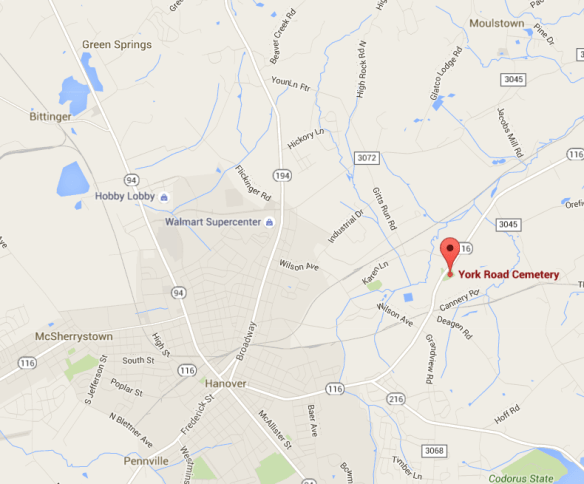
York Road Cemetery map

Samuel Bechtol and Michael Miller obtained 150 acres, leaving 100 acres for Nicholas Garber. Michael sold his 150 acres to Samuel Bechtol in 1752 and we cannot identify what happened to the 100 acres of Nicholas Garber.  It was after Nicholas Garbers’ death in 1748 that Michael Miller sold his land to Samuel Bechtol.  Michael Miller married Nicholas Garber’s widow.  We suspect that he also sold Nicholas Garber’s 100 acres of land to Samuel Bechtol.  Samuel Bechtol was one of the administrators of the will of Nicholas Garber and Susanna Bechtol was (reportedly) Samuel’s aunt.  Mason p 12, Replogle 91

Miller only shows three people bought the land, Michael Miller, Nicholas Carver and Samuel Backall, omitting Hans Jacob and Elizabeth Bechtol.  Batchelors Choice consisted of 400 acres which had been owned by John Stinchcomb. The property was rectangular and was located about 2 miles east of Hanover and was bounded on the west by Gitts Run, on the south by portions of route 116 and on the north by the Pigeon Hills.  The land was located on the outside of the east edge of Digges Tract.  This could have been some of the disputed land in question.

Batchelor Choice

Here’s is a satellite view of this same area today, with the red balloon marking Jacob’s Mills, shown on the map above.

York Co land satellite

It is believed that these three families were related in some way. Nicholas Garber/Carver has been theorized to be a son-in-law of Michael Miller.  Others have suggested that some of Michael’s daughters married some of Nicholas’s sons.  Obviously, both of these scenarios can’t be true, or Michael’s younger children would have been marrying the children of their older sibling.

Other settlers associated with these three families also lived in the area. Jacob Stutsman and Stephen Ulrich lived to the southwest of Hanover.  Peter and John Welty, Michael Bigler, lived to the south of Hanover: Catharine the daughter of Michael Bigler became the second wife of the Dunker leader Daniel Leatherman. To the north of Hanover near East Berlin was the immigrant Jacob Cripe (1743), Hans Ulrich Wagner (1743) and George Adam Martin (1749).  Miller p 14

Cripe to Miller map

This map shows the proximity of the Cripe family to the Miller, Bechtol and Garber families.

1745 – On May 14, 1745, Michael Miller buys a land warrant for either 150 or 200 acres (reported as both in two different sources) acres called Ash Swamp in Frederick Co MD for 200 pounds from John George Arnold. Replogle p 31, Miller page 20

It was then in Prince George County and now is Washington Co., PA. Liber BB 362-363.  Miller P 20

This is the land that in 1752 Michael has resurveyed and deeds it to 3 his sons John, Philip Jacob and Lodowick. See circle 3, below, drawn by Floyd Mason, P 14 and 32.

Miller circle 3

The map below shows the migration pattern beginning in Chester County, PA, through York County, PA and then to Frederick Co., MD.

Chester Co to Maugansville

1748 – The land dispute in York County, PA got much worse. In a letter to the governor asking for assistance it says that “many of the Germans have gone already and the rest say they will.”  Replogle 92

1748 – Frederick Co. Maryland comes into existence.

1748 – Nicholas Garber dies and his will is probated in Lancaster Co, PA, Book Y, Vol 2, p 123. This part of Lancaster becomes York the following year.  By 1754 Michael Miller has married his widow.  Mason P 12

1749 – Michael Miller buys 36 acres in Frederick Co, MD called “Miller’s Fancy.”  Both pieces of his land are very close to present day Hagerstown, which wasn’t there at the time.  Replogle p 31

Replogle suggests that perhaps Michael didn’t actually move, but stayed back in Hanover and eventually gave the land to his sons John and Philip Jacob.

Michael had Miller’s Fancy resurveyed. He lived there until his death in 1771.  In 1765 it was deeded to John Riffe, husband of Michael’s step-daughter.  See Circle 4 – Mason P 14

I’m not at all certain Mason’s circle 4 is in the correct location. I believe Miller’s Fancy is located south of Hagerstown on the convergence of Antietam and Little Antietam Creeks.  Other researchers believe that Miller’s Fancy, Skipton on Craven and Well Taught are near Leitersburg, 5 or 6 miles due east of Maugansville.  Following the deeds forward (or backward from current) in time would resolve this question.

1749 – Land surveyed in 1749 and granted in 1754 located between Skipton on Craven and Resurvey of Well Taught, containing 36 acres called Miller’s Fancy. Mason P 20

Skipton on Craven is 280 acres, purchased in June 1749 for 220 pounds. Wash Co., MD. Miller p 23

1749 – York Co, PA is formed from Lancaster. Hanover is located in York County.  Part of the Hanover area was split off in 1800 to Adams Co.  There are two Michael Millers and no Rochette family. Michael’s son, Philip Jacob Miller supposedly married a Magdalena Rochette about 1751, but you can’t marry someone if their family isn’t present in the community.

There are two Michael Miller wills in York County in both 1784 and in 1796, so this means that there were at least 3 Michael Millers in York County, if all three were there at the same time. Headache!!!

1749 – Most land at this time was not improved, but Stephen Ulrich’s may be the exception. The 235 acre piece he bought from Hans Waggoner in Frederick County may have been improved.  The other 200 went to Walter Fonderbag.   One of these men received “One dwelling house 20 feet by 16 made of hew’d logs and covered with lap shingles, a stone chimney, one dwelling house 27 feet by 22 of hwe’d logs and covered with lapp shingles, planked above and below, a stone chimney, a new barn of hew’d logs covered with lapp shingles, 49 feet by 27, 69 apple trees, 72 peach trees and 6 acres of cultivated land well fenced.”  Replogle p 100 from the Stutesman book p 10-11

Replogle contrasts this land to Hager’s “2 sorry houses” and then mentions that by 1756, the Indians had probably burned these wooden structures.

True to form, in the faming community where I grew up, the barn was twice as big as the house.

1750 – Several Brethren families felt it necessary to move further west where it was safer, including the Shively, Ulrich and Cripe families. Replogle p 19

1750s – Around this time in the development of Maryland, tobacco had been the crop of importance followed by Indian corn. This usually was cultivated by the plantation’s negroes. However, in the newly developing western Maryland, the German settlers profited from the rich deep soil to raise large quantities of flax and other grains, disdaining the tobacco culture as well as slavery.  The flax was hackled and the women would spin and weave it at home into very stout linen, making also threads of different colors that found a ready market.  The seed was packed in the huge country wagons of the day and sent to Baltimore and Philadelphia.

Trade for the settlers of this day was in Baltimore. The western Maryland settlers produced goods that were needed in the eastern part of the province.  The Germans learned to make linen goods, tow (rope), thread; they knitted long yarn stockings; they tanned their leather and made horse-collars and harness; they prepared honey, firkined butter, dried apples and applebutter.  These were marketed in Baltimore which depended on the interior for their supplies.  In return, the settler purchased materials essential to survival on the frontier, namely salt, lead and gunpowder.

The early settlers typically lived for a number of years in a “log cabin.” It had large garret roots (attic) and generally a deep cellar.  The bedrooms were simply furnished.  The painted bedsteads were supplied with straw beds and ‘feather decks” for covering.  There were the barrels of sauerkraut and salt lead and apple butter in the cellar.  Each farm usually had an abundant apple orchard and rows of cherry trees, and there were plenty of home-brewed drinks in the cellar besides cider.  The frontier settlers had a diet that included pone and milk (cornbread usually made without milk or eggs), mush and milk, in wooden dishes, hominy and “cider-pap” (small hominy boiled in cider) with fat bacon fried, and “calcified” with molasses. Miller p 21

When I grew up, 200+ years later, many of those items were still being eaten by the descendants of these same German families, in particular, fried mush with molasses or maple syrup.

1751 – On October 26, 1751, Michael’s son Philip Jacob had taken over the warrant and enlarged the tract Ash Swamp to 290 acres. It was surveyed on April 25, 1752 and a patent issued on November 17, 1753.  His brother John also farmed a portion of the property or about 140 acres.

Miller page 27

This land is very near Maugansville. These resurveys were key to finding these properties today.  Gene Miller went to a great deal of trouble to fit the pieces of the Miller and neighboring surveys together.

Miller page 26

1751 – Michael’s son, Philip Jacob Miller marries Magdalena whose last name is said to be Rochette, but is unproven. The marriage year is based on the year of first child’s birth.  If this is the case, then Philip may have married her in Hanover, York Co., PA, not Frederick Co., MD.  This marriage could be why Michael gave Philip Jacob land when he did.

Replogle states from two sources that the early Brethren were very strict about not marrying outside of the faith. If this is true, then surely someplace there is a Rochette as a Brethren or Magdalena is not a Rochette.  She is more likely from within the Brethren church.  What I wouldn’t give for a membership list of Little Conewago Church in 1750.

1751 – Michael’s son, Lodowich Miller buys Tom’s Chance and sells it in 1755 to Peter Tysher, located today in what is Washington Co., MD, located adjacent to Ash Swamp, including the Salem Reformed Church on Salem Church road.  Land books B p 429 and E p 945

1752 – Road from Wrightsville to Monocacy, near Frederick, MD today. Likely the road Michael Miller took when he moved from PA to MD.  This road went right through Conewago country.  In 1752, the entire Brethren community went down this road to Frederick Co., MD.  Conestoga wagons were used on this road.  The road from Frederick to Antietam Creek was very rudimentary, later becoming the National Road.  Replogle 56-57

1752 – It is believed that Michael Miller moved to the Hagerstown area about 1752 because on March 7, 1752 he sold his portion of Batchelor’s Choice in York County, purchased in 1744, 150 acres, to Samuel Becktel for 220 pounds (York Co. Deed Bk C 445-446). Samuel Becktel probably continued to live on his farm until his death, sometime prior to March 31, 1767.  Miller p 4, 20 and 23

In 1876, on the Heidelberg Township map, there are still two listings of S. Bechtel living on this land.

1752 – About this time Michael Miller moved to Frederick Co., living on Miller’s Fancy at the junction of Antietam Creek and Little Antietam Creek and lived there the rest of his life.  His wife Susan Bechtol had recently died and he sold his Hanover land to his late wife’s relative John Bechtol.  Replogle p 31

We have no evidence to suggest that when Susan actually died, other than it was prior to 1754 when Michael has remarried.

1752 – Michael Miller deeds Philip Jacob and John Miller half of Ash Swamp each. Philip Jacob lives there most of his life. Replogle p 33

This is believed to be the first record of Philip Jacob Miller – although there was an undated records that could have been earlier. By 1752 he would have been 26 years old.

Michael Miller bought the plantation Ash Swamp from John George Arnold in 1745, had it resurveyed to his 3 sons, John, Philip Jacob and Lodowich in 1752. They conveyed it to each other so that soon thereafter John owned the portion to the north and Philip Jacob the part to the south.  Lodowich bought an adjoining farm to the southwest, “Tom’s Chance.”  Miller P 15

1752 – Tired of the Maryland/Pennsylvania border feud that had lasted for 15 years, the entire Brethren community sold their land in Hanover Co., PA (today current Adams Co.) and moved to Frederick Co., MD. Where they established 4 new churches. Replogle 97

This area is still heavily Brethren and Mennonite today.

1753 – Michael Miller bought 409 acres. Replogle

1753 or 1754 – Johann Michael Miller marries Elizabeth Garber, the widow of his neighbor Nicholas Garber. Replogle p 31

1754 – We have no death date for Susanna Bechtol, the first wife of Michael Miller, but an administrative record in the orphan’s court of York Co., PA states that in 1754 Elizabeth Garber, the widow of Nicholas is now the wife of Michael Miller and that he is administrating the accounts for the will. (Book A – 1749-1762, page 47, York Co, Pa Dec. 10, 1754)

We believe Susanna died about 1752 at the time that Michael had land “Ash Swamp” in Maryland resurveyed for the 3 sons, John, Philip Jacob and Lodowich. This explains why there was no wife’s signature and perhaps why the land was divided at that time. Mason p 12

1755 – 676-677 – Michael Miller recorded a deed March 20, 1755 made March 17, 1755 between George Pow of Frederick Co. and Michael Miller for 36 pounds current money, confirms unto him, 2 tracts called part of the “Resurvey on Well Taught, in Frederick County; 1st parcel containing 292 acres and the other tract, containing 117 acres.  Signed George Pow, before William Webb and Thomas Prather.  Catherine wife of the said George Pow, released dower right.

Frederick County Maryland Land Records Liber B Abstracts 1748-1752 by Patricia Abelard Andersen, p 59.

1755 – Michael Miller obtains a grant for Miller’s Fancy in March, 36 ac. Washington Co. MD,  Miller P 23

For the next ten years, Michael filed no deeds. It’s likely the area was abandoned for part of this time given the Indian uprisings.

1754 – All of the Indians disappear from Frederick County. French negotiators have been wooing them.  This is the beginning of the French and Indian War.

1755 – General Braddock’s expedition leaves Cumberland County, MD on May 29th.  Braddock met with George Washington and Benjamin Franklin in Frederick County, Maryland.  Braddock had recently arrived from England and had just begun his march toward Fort Duquesne.

At the end of their conference, half of Braddock’s army moved west on the north side of the Potomac and somewhere crossed Antietam Creek. It’s not known just where, but it could not have been far from “Miller’s Fancy” and may been right across it.  Replogle 32

Johann Michael Miller lived near the Upper Antietam bridge, which would have been a ford at that point.

Justin Replogle, on page 104 and 105 gives significant detail, but in summary, the troops pass, if you draw a straight line between Frederick and Conococheague, no more than a mile or so from Michael Miller’s farm. Miller’s Fancy is only about 2 miles north of the Potomac and the troops had to pass between the river and the farm.  With 2000-3000 men or more, you know that the Miller family was not unaffected by this.  Watching a British Army in red coats in June march through the woods and on Indian trails must have been quite a spectacle.

I wonder if Michael realized he was watching history unfold.

Braddock’s men may have camped in this area as well because they took a day to build a bridge over Antietam Creek. The photo below shows a portion of Braddock’s road still visible today near Fort Necessity.  Braddock’s troops often opened or expanded the road as they went to a width that allowed wagons to pass.

Braddock's road

Imagine seeing all of those red coats in the woods on or near your land, and wondering what the future would bring.

Michael had to wonder how this was any different than what happened in the 30 Years War in Europe that devastated the countryside. Did he ever question his decision to leave Germany?

Michael Miller wasn’t the only person to see the redcoats. Braddock’s troops also crossed the Potomac at Conochocheague, so Stephen Ulrich and Jacob Stutzman probably saw them as well.  These men watched history unfold, having absolutely no idea of the dire consequences that would follow.

Braddock had been warned about the Indian’s ambush style of warfare Benjamin Franklin called “ambuscade,” but Braddock poopooed that information, stating that they would make no impression upon his finely trained troops. He was wrong, in fact, he was dead wrong.

Braddock was defeated, badly, as the Indians on further up the trail ambushed the brigade. Braddock himself was killed.  Raids on settlements and settlers began immediately and within days reports say that upwards of 100 settlers had fled their homes, 50 had been killed or captured and 27 houses had been burned.  On the Maryland-Pennsylvania border in the “two coves”, just west of Hagerstown, 47 people had been killed or captured.  Now the entire western frontier lay unprotected.  Replogle 105-106

Braddock’s disastrous defeat in November set off Indian attacks along the whole frontier and Stephen Ulrich almost certainly abandoned his farm and fled east, along with the entire community. He apparently came back. Replogle p 17

From 1755 to 1757, Alfred James writes, “Raid after raid from Fort Duquesne hit pioneer settlements along the Susquehanna and the Potomac.” It was unending and relentless.  Another reports that “Frederick, Winchester and Carlisle became the new frontiers of the colony” and “Many even fled to Baltimore,” and “some to Virginia.”  Arthur Quinn writes that families went as far east as Bethlehem “where there was no more room in the inns, or the shops or even the cellars.”  Nead writes, “Terror and desolation reigned everywhere.” Repogle 106

Where was Johann Michael Miller and his family during this time? His children would likely all have been adults, with families of their own.  Given Susanna Bechtol’s birth in 1688, their last child was probably born no later than 1733, so clearly an adult by 1754 or 1755.  Susanna had died by this time, so Michael had his new wife and both sets of their children to worry about.  Did they all escape or remove to locations further east?  Together?  Separately?  In an orderly fashion?  In a panic?  What happened?

In April of 1756, Elisha Shaltor wrote, “I found the people in the greatest confusion, the troops abandoning the forts and the country people in the greatest consternation.”

The year 1756 seems to have been the worst for the Conococheague community.

Conococheague river

On April 25, 1756, “Forty-one persons deserted their cabins and clearing near Conococheague and came to Baltimore. Their houses were destroyed and their cattle killed.”  Two days earlier, Thomas Cresap, Jr. had been killed and fighting had occurred between Hanover and Bedford.  No place was safe.  Not where they moved from.  Not where they moved to.  Apparently no place except the eastern seaboard cities.  Worse yet, in those cities, no one seemed to care.

Hanover to Bedford map

Maryland and Pennsylvania legislatures were reluctant to do anything. The frontier was far from the cities and the Quakers hesitated to advocate violence.

Finally, in 1756, Maryland authorized a fort in the Conocheague area which would become Fort Frederick, about 15 miles away. That was far too little and way too late.  If anything it incensed the Indians.  The Indians easily captured this small isolated fort and killed all the settlers they encountered along the way, for good measure.

Maugansville to Fort Frederick

On October 25 Indians arrived with 20 scalps from the town of Conococheague. The list of the dead hints at the constant terror.
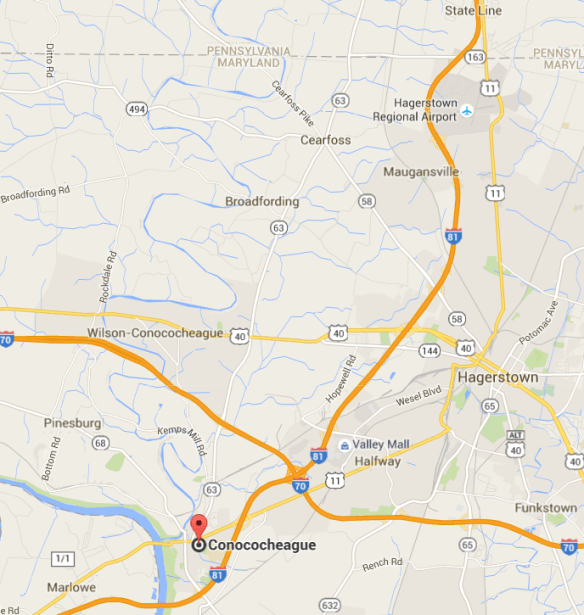
Conococheague

October 25 – John Loomis, wife and 3 small children
October 28 – Jacob Miller wife and 6 children
October 30 – George Falke, house, mill, barn, 20 cattle, 4 horses, wife, 9 children cut into pieces and fed to the pigs. A trader scalped, roasted alive, eaten.

The Conococheague residents tried to protect themselves at first, but then, they gave up and fled back east. The only Brethren name on the militia lists was George Butterbaugh, and Replogle suggests that he may not have been Brethren yet at that time.  All of this was taking place in the area where the Ulrichs, Cripes and Millers lived.

Those who were willing to fight must have been terribly frustrated and felt endangered by the Brethren who were not. They were surely looked upon as a burden to the rest of the community.  Did the Brethren truly watch their families slaughtered and do nothing?  It’s difficult to believe that basic human instincts didn’t kick in.

Most settlers fled east from Monocacy. George Washington received a report in the summer of 1756 that “350 wagons had passed that place to avoid the enemy within the space of 3 days” and by August the report was that “The whole settlement of Conococheague in Maryland is fled, and there now remain only two families from thence to Fredericktown…..”

Conococheague to Frederick

Surely that included Michael Miller and the rest of the Brethren families. The Indians were reported within 30 miles of Baltimore.  Frederick is 47 miles from Baltimore.

Furthermore Washington said, “That the Maryland settlements are all abandoned…is a certain fact.”

Where did the Brethren families go? Who did they stay with?  What did they do?  And for how long?

In July 1756, the commander at Fort Duquesne said that he had “succeeded in ruining the three adjacent provinces, Pennsylvania, Maryland and Virginia, driving off the inhabitants and totally destroying the settlements over a tract of country over 30 leagues wide…the Indian villages are full of prisoners of every age and sex.”

In 1757, “the frontier settlements were abandoned over a wide area.”

And so life continued, land abandoned, the residents living who knows where, but assuredly with Brethren families or congregations back east, throughout 1756, 1757 and into 1758.

1758 – General Harris extends a road from Harrisburg, PA to Fort Duquesne on the Ohio River (Pittsburg.) Highway 30 follows this road most of the way today. Replogle 55

Forbes went from Cumberland to Bedford and had hundreds of men working on the road. By August 1758, 1400 men had extended the road to Bedford, just wide enough to get a wagon through.  A contemporary writer said it took 8 days to travel from Bedford to Ligonier, a distance of about 45 miles.  This tactic succeeded.  General John Forbes took Fort Duquesne, now Pittsburg, the French abandoned it, and ended the French and Indian War on November 25, 1758.  Indian attacks diminished and by 1762, the French had given up Canada.  Replogle 107-108, 110

Forbes Road

The area was never really in jeopardy of Indians regaining control, but it was in real jeopardy of French control. The French, like the English, were using the Indians by making promises.  Were it not for Forbes, we might all be speaking French today.

When did the settlers return to this area? They likely had to rebuild from scratch.  As difficult as this must have been, they obviously did and we have absolutely nothing in our family history reflecting this extremely difficult time.  You would think there would be stories…something…but there is nothing.

We don’t know where our Brethren families lived during this time, what happened, who died, when they returned, how, or what they faced. Were their homes all burned?  Was anything left?  Did they start over again?  What happened?

There is no hint.  Brethren were never whiners.  There are no tales of woe.  The only hint is when transactions resume.  For Michael Miller, that was in 1761 when he again began purchasing land, if that Michael was our Michael, or in 1762 when taxes were again being paid in Frederick County.

Michael, by this time, was an old man, 69 years old, and assuredly tired. In particular, tired of conflict and warfare.  I’m sure he simply wanted to sit on the porch of his children’s home and look over a peaceful vista – one with no Indians, soldiers or war-like sheriffs.

One small item of significance – during the war, a small fort was built at Raystown, which would eventually become Bedford, a location that would, in 1770, become quite important to the Brethren. It was indeed the next frontier and two of Michael Miller’s grandsons through his son Philip Jacob would find themselves in Bedford County, PA.

1760 – One Michael Miller was Constable of Upper Antietam Hundred. This causes me to wonder how a Brethren can be a constable if they won’t take an oath.

The Brethren shunned anything legal. They did not marry by obtaining a license.  I don’t think they would have registered their deeds if there was any way they could have avoided it.  Many times, they simply didn’t.

For instance, on February 14, 1776, Alexander Mack Jr., the son of the founder of the Brethren faith writes in a letter that he is shunning his daughter, Sarah, because “she married outside of the brotherhood” and secondly “because the marriage was performed with a license and third because her husband had not quite completed his apprenticeship.” Shunning in the Brethren world was ostrification and the results of that could be far more severe then than now.  Protection and assistance, for example, came from the group, generally a family group, that you were a member of.  Sarah must have been one very brave young lady or blindly in love.

1761 – Michael Miller purchases Deceit in May, 108 ac for 50 lbs. Washington Co. MD  Miller p 23

1761 – Michael Miller recorded a mortgage on May 6, 1761 made March 26, 1761 between Joseph Perry of Frederick Co. for 50 pcm (Pennyslvania Current Money) mortgaging a tract called “Deceit” on a branch of Antietam near the place that George Fairbush formerly lived on, containing 108 acres. Signed Jos Perry before Mos Chapline, Peter Bainbridge.  Receipt ack, AF and duty pd.  Frederick Co. Maryland Land Records, Liber F Abstracts, 1756-1761 p 124 by Patricia Abelard Anderson (Note – I did not extract all Miller records, just first names in which we are interested.)

Given that none of the other names are Brethren, I wonder if this is a different Michael Miller, perhaps the one that was a constable.

1762 – When Nicholas Martin was naturalized in Pennsylvania in 1762,  Michael Miller and Jacob Miller were witnesses. It was this Nicholas Martin who gave the year of death for Michael Miller as 1771.  Mason p 10 (Note that Michael’s signature would be on this document if the original still exists.)

This might suggest to us that Michael spent his time in exile in Pennsylvania and not in Maryland. Of course, he might simply have traveled to Maryland to testify for Nicholas Martin.

1762-1763 – In Frederick Co., MD, Michael Miller paid taxes on more than 700 acres, Michael Miller Jr. on 80 acres and Hans Michael Miller on more than 2000 acres. Replogle 117 quoting from Mason

1762-1763

To separate the three Michael Millers, Michael Miller Sr., Michael Miller Jr. and Hans Michael Miller, we use the information that is recorded in the Land Tax records at Annapolis MD in the archives. This is what was found:

Michael Miller Sr. 1762 and 1763
Skipton of Craven – 100 ac
Miller’s Fancy – 36 ac
Skipton of Craven – 180 ac
Resurvey of Well Taught – 409 ac

Michael Miller Jr. 1762 and 1763
Miller’s Chance – 50 ac – 1762 the same land
Blindman’s Choice – 50 ac – 1763 to 1772
(Most years Miller’s Choice was called Blindman’s Choice)

Hans Michael Miller – 1772
In addition to land in Antrim Twp, Franklin Co, Pa and New Creek, now Mineral Co, WV as given in his will, he paid taxes in 1772 in Frederick Co., MD on the following:
Resurvey of Nicholas Mistake – 1025 ac
Garden’s delight – 146 ac
Add Garden’s delight – 28 ac
Plunket’s Doubt – 133 ac
Maiden’s Walk – 35 ac
Tonas Lott – 16 ac
Small Hope – 20 ac
Small Hope – 43 ac
Rocky Creek – 150 ac

For anyone tracking Hans Michael Miller, Franklin County, PA and Mineral County, WV would be good places to start.

Gene Miller found that Hans Michael Miller was given 1000 pounds by his father Michael Miller Sr. (died 1771) to purchase Pleasant Gardens. What he purchased may have been an earlier name for what he called Gardens Delight and Add Gardens Delight.  If it was this land, it was land that his 2 sons sold to Jacob Good and was located near the land, “Huckleberry Hall”, that Jacob Good bought from John Schnebly in 1787.  It was located near Maugansville, MD.  This land would go to the son-in-law and grandchildren of Elizabeth Garber, the step-mother of Hans Michael Miller, assuming he is the son of Michael Miller who died in 1771.  Jacob Good had remarried.  This is a connection between the 1st set of Michael Millers Sr.’s children and his step-children.  Mason P 13

We did not follow the land records of Hans Michael Miller, but did follow the land records of Michael Miller Sr. (died 1771) and Jr., his presumed son.

We found that Michael Miller Sr. (the second, died 1771) paid taxes on his land and in his name for 1762 and 1763. He deeded all the land to his step-children in 1765.  After that he continued to pay taxes on 36 acres of Miller’s Fancy and 8 acres of Resurvey on Well Taught.  It’s this fact that causes researchers to believe this is where Michael actually lived.

1762 – John Hager began to lay out what would one day become Hagerstown, Maryland.

1763 – The surveyors started laying out the Mason-Dixon line and they got as far as Dunkard’s Creek where Indians stopped them. Replogle 114

A historical marker is located at Dunkard’s Creek in the Mason Dixon Historical Park where the creek crosses the Pennsylvania-West Virginia border about 150 miles west of Hagerstown.

Hagerstown to Mason-Dixon

1763 – In reference to Pontiac’s War (the Pontiac Conspiracy – which lasted until 1765) and the attacks on Fort Pitt, its inhabitants, and the destruction of Ligonier – David McClure says “the greater part of the Indian traders keep a squaw and some of them a white woman as a temporary wife. The people of Virginia…are different from those of the Presbyterians and the Germans.  They are much addicted to drinking parties, gambling, horse racing and fighting.”  These people were all residents of Fort Pitt, a total of 322 people.  Most people fled east once again and the Indians attacked as far west as Carlisle.

The Maryland Gazette, written at Frederick on July 19, 1763 said, “The melancholy scene of poor distressed families driving downwards through this town with their effects…enemies…now daily seen in the woods….panic of the back inhabitants, whose terrors at this time exceed what followed on the defeat of General Braddock.” Ironically it also reported that the season had been remarkably fine and the harvest the best for many years.  Once again, Frederick County put together two companies of militia and once again, no Brethren names appeared on the list.  Replogle 113 – 114

By 1763, Michael Miller was an old man, almost 72 years of age. Again, relations with the Indians deteriorated and they attacked in waves.  “The Cumberland Valley and frontier regions are deserted,” came the reports.  “Bands of raiding Indians spread over western Maryland” Nead says and on August 13, 1763 George Washington writes that once again, “no families remain above the Conococheague road, and many are gone from below it.  The harvests are, in a manner lost, and the distresses of the settlements are evident and manifold.”  Replogle 113/114

Two Brethren, Nicholas Martin and Stephen Ulrich are found attending the Great Council of the Brethren in Conestoga in 1763. Would they have left their family in Frederick County among the massacres, or does this imply that the group had once again moved back east, and this where in the east they had moved?

Looking at the map, this seems to be an important clue. It would appear that they had been evacuating in reverse settlement order.  Perhaps they first went to join the congregants of the church in Hanover, and finding that location unsafe, went on further back to their home church, Conewago, further east.

Conewago, in the book, “A History of the Church of the Brethren in Southern District Pennsylvania” is noted as being near current Ephrata, PA and also as being the current congregation of White Oak in Lancaster, County.

Ephrata to Hagerstown

1765 – The 4 children of Nicholas and Elizabeth Garber were living in Frederick Co. MD before 1765. Nicholas’s will gives the names of two of them, Elizabeth and Samuel, and researchers have determined that the other two were Anna and Martin.

In 1765, Michael Miller is selling land, just like nothing happened, or perhaps the recent unrest is part of why he transferred the land when he did. In essence, he went on a huge deeding spree, deeding all of the land he owned, mostly to his step-children and their spouses.

1765 – Jacob Good recorded a deed on Oct. 28, 1765, made Oct. 25, 1765, between Michael Miller of Frederick Co. for 100 pounds current money, a parcel called Hamburgh, part of a Resurvey on Well Taught, metes and bounds given, containing 81 acres. Signed Michael Miller by mark M before Joseph Smith, James Smith, Elizabeth Miller wife of Michael released dower.  P 140-142  Frederick Co. MD Land Records Liber K Abstracts, 1765-1768 abstracted by Patricia Abelard Andersen p 15-16

Please note that this means that Elizabeth Garber, Michael’s second wife is still alive in 1765. There is significant confusion about Michael Miller administering the estate of her former husband, Nicholas Garber, and some researchers have construed that administration in 1754 to be the estate of Elizabeth, which it clearly is not.

1765 – Michael Miller sold the 409 acres of Well Taught to Jacob Good and John Riffe. He paid taxes on 8 acres of this 409 acres along with the 36 acres called Miller’s Fancy which has what has led some researchers to surmise that is where Michael actually lived.  Mason p 14

1765 – John Rife recorded a deed on Oct. 28, 1765, made Oct. 25, 1765 between Michael Miller of Frederick County for 200 pounds current money, a tract of land called Quarry, part of a resurvey on Well Taught patented to George Jacob Pow, metes & bounds given, 179 acres signed Michael Miller by mark M. Witnesses Joseph Smith, James Smith, receipt ack.  Elizabeth Miller released Dower.  P 166-167

1765 – Michael Miller sold in October 1765, 36 acres of Miller’s Fancy and 5 acres of Resurvey of Well Taught for 50 pounds. Wash Co., MD. Miller p 23.

This appears to be the 5 acres he paid tax on until he died, but he had already transferred the entire 36 acres to John Riffe, so this is somewhat confusing.

1765 – John Rife recorded a deed on Oct. 28, 1765, made Oct. 25, 1765 between Michael Miller for 50 pounds, a tract called Miller’s Fancy, metes and bounds given, 5 acres, signed Michael Miller by mark M. Witness Joseph Smith, James Smith.  Receipt ack.  Elizabeth wife of Michael released dower. P 175-176

1765 – Jacob Good recorded a deed on Oct. 28, 1765 made on Oct. 25, 1765 between Michael Miller of Frederick County for 300 pounds, a tract called Good’s Choice, part of Skipton and Craven, land whereon the said Jacob Good now lives, metes and bounds given, 163 acres, signed Michael Miller by mark M.  Wit Joseph Smith and James Smith, receipt acknowledged and dower released by Elizabeth Miller wife of Michael Miller. P 177-178 Wash Co Md.  Miller p 23

1765 – Jacob Good recorded a deed on Oct. 28, 1765 made on Oct. 25, 1765 between Michael Miller for 60 pounds tract called Luck, part of resurvey on Well Taught entered to George Pie. Metes and bounds given, 100 acres.  Signed Michael Miller by mark M.  Witnesses Joseph Smith, James Smith and Elizabeth Miller releases dower. P 179-180 Wash Co MD  Miller p 23

1765 – John Rife recorded a deed on Oct. 28, 1765 made on Oct. 25, 1765 between Michael Miller for 200 pounds, a tract called Rife’s Lot, part of Skipton and Craven whereon John Rife now lives, metes and bounds given, 117 acres. Witnesses Joseph Smith, James Smith and Elizabeth Miller release dower. P 185-186

Jacob Good and John Riffe were Michael Miller’s step-daughter’s husbands. Mason P 14

1765 – Michael Miller sold Michael Tanner 50 acres of “Miller’s Choice”.

1765 – Michael Miller had “Range” surveyed – 50 acres – grant. We believe that this is the 50 acres on Piney Creek that he sold in 1765 to Michael and Eve Tanner who deeded it to a son-in-law, John Storm. See circle 9.  Was Eve one of Michael Miller and Susanna Bechtol’s daughters that we have not discovered?  Mason P 14

Frederick Co. MD Land Records Liber K Abstracts, 1765-1768 abstracted by Patricia Abelard Andersen, p 18-19

1768 – The defeat of Pontiac triggers mass migration westward over the mountains. Replogle 20

1768 – November – the British government bought large tracts of land from the Iroquois and Pennsylvania now owns all the land west of the Alleghenies to the Ohio River except for the northernmost part of the colony, opening the doors for a huge migration. However, the Delaware and Shawnee were left out and the raids continued.  Replogle 115

1768-1769 – List of persons who stand charged with land on Frederick County rent rolls which are under such circumstances as renders it out of the power of George Scott Farmer to collect the rents and there claims allowance under his articles for the same from March 1768 to March 1769: (Note there are several pages of these, so much so that it looks like a tax list, not a roll of uncollectibles.)

No Cripe, Greib, Ullrich, Ullery or Stutzman
Conrad Miller
Isaac Miller
Jacob Miller Jr
John Miller
Lodwick Miller
Michael Miller heirs
Oliver Miller, Balt Co.
Oliver Miller, Balt Co additional
Thomas Miller

Inhabitants of Frederick Co. MD, Vol 1, 1750-1790 by Stefanie R. Shaffer, p 45

1770 – Michael Miller recorded on June 21, 1770 a deed made on the same date between he and Peter Apple/Apel for 50 pounds, a 20 acre tract of Small Hope. Signed in German script, Peter Apel before Charles Beatty, William Richey Receipt ack.  Alienation fine paid.  Please note that in 1772 Hans Michael Miller is paying tax on this land. P 154-155

Also note that in 1765 Johann Michael Miller was signing with an M, and this Michael Miller signs five years later in German script.

As best I can tell, the alienation fine was connected with selling the land privately away from the proprietor of Maryland. This is discussed on pages 33-35 of “The American Colonies in the Seventeenth Centuries, Volume 2” by Herbert Levi Osgood.

Frederick County Maryland Land Records Liber N Abstracts 1770-1772 Abstracted by Patricia Ableard Andersen p 24

1770 – Richard Richardson recorded June 25, 1770 made June 22 between Michael Miller for 40 pounds, sells 10 acres of tract called Small Hopes. Signed Michael Miller receipt acknowledged Pages 171-173

Frederick County Maryland Land Records Liber N Abstracts 1770-1772 Abstracted by Patricia Ableard Andersen, p 25

1771 – Michael Miller’s death is recorded by Nicholas Martin in a letter to Alexander Mack Jr. wherein he references the death of Michael Miller as a “year ago” which would be approximately May of 1771.

On May 24, 1772, when Nicholas Martin was presiding at Conecocheague, he wrote a lengthy letter to Alexander Mack, Jr., of which one paragraph reads:

“You will perhaps know that the dear Brother Michael Miller died a year ago. Brother Jacob Stutzman is again quite improved; he was very feeble this past winter.”

Michael Miller is references as “Brother” so there is absolutely no question that he died Brethren.

Elder Nicholas Martin was the ruling Church of the Brethren elder for this section of MD and PA and a friend of Alexander Mack Jr.  Alexander Mack Sr. was the founder of the Brethren Church and his son the leader after his father’s death.  In other letters he comments about the health of Michael Miller and Jacob Stutzman.  When Nicholas was naturalized in 1762, Michael Miller Sr. and his son Philip Jacob Miller were witnesses for him.  Nicholas’s farm called “Swamp of Experience” was adjoining Tom’s Chance and Ash Swamp.  Mason P 19

These men were clearly very close neighbors and friends. Nicholas Martin probably preached the funeral of his friend Michael Miller, in German of course.

1771 – Justin Replogle believes that Michael is probably buried on Miller’s Fancy. Replogle p 32

Floyd Mason believes Michael is buried on Ash Swamp.

We believe that Michael Miller was buried on his plantation where he lived or in the family cemetery on John Miller’s section of Ash Swamp. We believe he remained Lutheran or Reformed.  However he may have attended or joined the German Baptist Brethren.  Some records say that they lived and were buried at Conococheaque, Washington Co., MD near Hagerstown, MD.    Mason P 20

Gene Miller believes he is buried in the now-lost cemetery on John Miller’s part of Ash Swamp.

It is believed that Michael Miller is most likely buried in the private cemetery that was located on the John Miller portion of the Ash Swamp property. The 50 by 50 foot cemetery plot is apparently lost to history today as there is no record of it.  Miller 31

I don’t have a clue where he is buried, but if I had to guess, and I do, I would suggest it is more likely to be on his son’s property than elsewhere simply because that land is more likely to ‘remain in the family’ where the land of step-children is already outside of the blood-line family. It’s also likely that a cemetery on John Miller’s land had already been established as the “Miller cemetery” for this family.  It’s unlikely that there were no deaths between 1752 when Michael deeded this land to his sons and 1771 when Michael died.

1771 – Michael Miller dies and Ash Swamp is divided between Philip Jacob, John and Lodowich. 1000 pounds is given to Hans Michael to purchase Pleasant Gardens, Michael Jr. is given Blindman’s Choice.  Miller p 24

Note: I don’t find a deed giving Blindman’s Choice to Michael Jr.

From 1769 thru 1772 the tax on Michael’s land was paid by the heirs as seen on this tax books. There are some records that show that the tax was owed for several years and we believe that they did not get around to paying the tax until after Michael’s death in 1771.  Michael Miller Sr. (the second died in 1771) lived for years at the mouth of Little Antietam where it flows into the Antietam Creek.  Mason p 13

We found that after the death of Michael Miller Sr. (the second), in 1771, both Michael Miller Jr. (the third) and Hans Michael Miller were paying the tax in 1772 and succeeding years. Philip Jacob Miller was paying taxes on “Ash Swamp,” 290 acres and Lodowich Miller was paying taxes on land that he had bought near Taneyown, Md.  See Circle #7.  Mason P 14

The names of Michael Miller Jr. (the third) and Hans Michael Miller are confusing. Given that Michael Miller Sr.’s (d 1771) actual name was Johann Michael Mueller (Miller), and Hans is short for Johann, you would think that Michael Miller Jr. would be Hans Michael Miller Jr.  Both of these men cannot be sons of the Michael Miller who died in 1771.  However, one could be a son and one his grandson.  Further research into both Michael Miller Jr. (the third) and Hans Michael Miller would hopefully reveal additional information and in particular, about their age.  We know, for example, that Johann Michael Miller (the second’s) first child, a son, Johann Peter, was born in 1715.  If Johann Peter married when he was 20 and had a son when he was 21, whom he named after his father, that birth would have occurred about 1736.  That child, Johann Michael Miller, would have come of age about 1757.  Given that several grandchildren of Michael Miller could have been coming of age anytime after 1757, Hans Michael Miller could have belonged to any of the living or perhaps deceased male children of Johann Michael Miller the second who died in 1771.

I assembled the various land transactions of Michael Miller as shown below.

Miller land chart 1Miller land chart 2

*Troy Goss refers to the John who was involved with the Ash Swamp land as John Peter. This is the only source I have seen referring to this John as John Peter Miller.  It would be very unusual for Johann Peter to be called John instead of Peter, since Johann was the first given name of most German male children.  The only person called Johann or John would be someone whose full name was Johannes Mueller.

In 1783, these men conveyed land back and forth. Troy shows deeds on Dec. 9, 1783 for 220 acres from Lodowich to Philip Jacob Miller for 5 shillings (Washington Co., Land records, Book C, pages 563-47).  On December 26, 1783, Philip Jacob Miller conveys 144 acres to John Peter Miller for 5 shillings “and brotherly affection.” Book C, pages 260-262.

To finish the story of Michael’s land in Frederick County, when John died in 1794, Frederick County had become Washington County. The family sold all of Michael’s land that both John and Philip Jacob had inherited to one John Schnebley.

Philips Jacob’s land, sold on September 25, 1795, included Keller’s Discovery for 11 acres, Prickley Ash Bottom for 11 acres and his part of the Resurvey of Ash Swamp for 143.5 acres, for 2,175 pounds. Liber I, page 360.

John’s land included his 143.5 acres of the Resurvey of Ash Swamp for 2,044 pounds. Liber I FF page 584.

It’s interesting to note that Michael paid 243 pounds for this land in 1745 that sold for a total of 4219 pounds in 1795, about 50 years later, for a profit of 576%. He was indeed an astute investor.

Philip Jacob Miller left and went to Kentucky in about 1796, a couple of years after his brother John died. Philip had witnessed his brother John’s will.  He likely sorely missed his brother who had been his neighbor and farming companion his entire life.  While we don’t have a will in Maryland for Philip Jacob, we do have John’s will which gives us a peek into their life on Ash Swamp.

The land was referenced as both meadow and swamp. It seems there was about 100 acres of woodland and the rest was swamp, meadow and cultivated land.  The woods are entirely gone today.

In John Miller’s estate inventory, we find

  • A Bible – I have to wonder if this was his father’s Bible. If he was Johann Peter born in 1715, he was the eldest son, and this could well have been his father’s Bible if it survived all of the moves, warfare and indian raids.  I wonder what happened to this Bible.
  • Hand tools such as saws, hammers, trowels, branding irons, knives, pinchers, shovels, chains, broad axes, a grubbing hoe, a rifle, a scythe, an anvil and a corn hoe. Obviously, the rifle was for hunting, not defense.
  • Farm implements such as a tar bucket, a bushel basket, a wagon whip, a dutch oven, old flour barrels, a chisel, a compass, a dung fork, an auger, a barking iron, a shot gun, a wool wheel, tanners knives, stelyards, a harrow, a hay fork, plows, draw knives, mall rings, wedges, a windmill and sausage horn.
  • Produce such as flower, a barrel of vinegar, stacks of hay, wheat, oats, rye, corn, flax, potatoes. Some produce was still in the field such as 8 acres of barley and wheat that was seeded.
  • Farm animals including geese, turkeys, ducks, horses, cows, calves, bulls, sheep and hogs along with cured pork.
  • Household items such as chairs, a tub, a bedstead, a table, dressers, chests, a dough tray, lamps, baskets, a kettle, a stove, weaving loom and spooling wheel, wool cards, knives and forks, pewter spoons, a kitchen cabinet and shelves. It’s interesting that there is only one bedstead.

Philip Jacob’s farm would probably have been quite similar, as would Michael’s before them at his death in 1771, although Michael may have had significantly less because he had to start over so many times when war drove him out and the Indians likely burned his homes. I wonder how many homes he lost in that manner.  I’m betting at least two.

Michael and his son’s lives were filled with uncertainty in a way we find difficult to relate to today.

“For the first fifty years the Brethren suffered many privations on account of the French war in 1755, the Revolution 20 years later, and subsequent Indian wars together with many inconveniences incident to a newly settled country, as our part of the state was at that time. The dread of the Indian’s tomahawk and scalping knife, was everywhere felt. In the morning before going to the fields to work, the farmer and his sons often bid good-bye to the balance of the family, fearing they might not return, or if permitted to do so, would find their loved ones murdered by the Indians.” (From The Brethren Almanac 1879.)

That simple paragraph probably pretty much sums up the daily life of Johann Michael Miller’s life. Always wary, always on the frontier, always in some amount of jeopardy.  However, his faith sustained him and he managed to survive, as did many of his children, either because of or in spite of his Brethren faith and non-violent ways.

The Brethren Almanac goes on to report, “Under the guiding hand of their first resident Elder, Wm. Stover, the congregation worshipped in houses. Brother Jacob Miller was elected to the ministry, and in 1765 moved to Virginia.”

This is the genesis of the legend that Jacob Miller is the son of Michael Miller – a legend we will disprove.

Visiting Michael’s Land in Frederick (now Washington) County, MD

In October of 2015, I was able to visit Hagerstown, Maryland, located in Washington, County, the part formerly Frederick County. More specifically, I was able to locate Johann Michael Miller’s land, Ash Swamp, that he may have lived on and that he left to his sons, in particular, John and Philip Jacob, my ancestor.

Johann Michael Miller owned land just outside of and now partly within Maugansville, Maryland.

Gene Miller, in his book, assembled the surveys into a conglomerate. If Gene is right about where the cemetery was located, it may well be under the subdivision today, and if not, perhaps our ancestors are sleeping peacefully under some corn.

Resurvey of Ash Swamp

On this map, Michael’s land encompasses most of the land between Cearfoss Pike (58), Gardenville Road and Maugansville Road including Rush Run.

Ash Swamp map crop

Here is the satellite view of that area.

Ash Swamp satellite

The grey balloon is the old working farm that remains.

Arriving in the area from Cearfoss, approaching Michael’s farm, you notice the lovely clean farms. As I’ve been working my way north this week from Richmond, VA, I’ve noticed how much these farms resemble the Pennsylvania, Lancaster County, type of farms and buildings.  That makes sense, since the people who settled here were a group of Germans that had previously lived in that area.

The land to the south of Cearfoss Pike was also Michaels. His son, Lodowick also bought a significant amount of land here.

Lodowick's land

There is a more contemporary home very near to the road. This structure is not old enough to have been here when Michael owned this land.

Miller land current house

However, this farm that sits back could have been the original farm and house, or at least the location of the original buildings. This would have been John’s portion of the farm.

Miller land farm house

The house sits quite a ways back from the road, and I did not want to disturb the current day owners, so I took photos from a distance.

Miller land farm close

Based on the maps of this region from the 1850s through about 1900, this farm does not appear to have existed at that time, so it’s not the original farm house, as I had hoped.

Fortunately, Grace Academy purchased Michael’s land and built in the middle of the field, behind the homes on 58 and also behind the homes in the development off of Garden View and Maugansville Road.
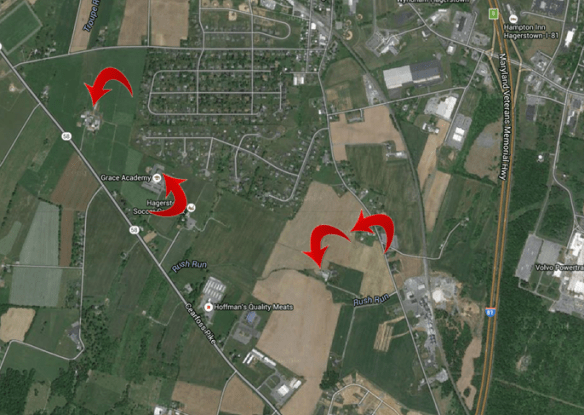
Miller with arrows

The map above shows the original farm to the upper left, Grace Academy to the lower left, the property today owned by the car collector is to the far right and the arrow just slightly left of that is Ashton Hall. Johann Michael Mueller owned most of this land.

You can see the land overlayed on this scan from page 30 of the Miller book.

Miller book overlay crop

This 1859 Taggert plat map of Washington County shows homestead locations.

Washington 1859

It appears that the old farmhouse on Cearfoss Pike is on the Daniel Zeter land but it’s not showing as a homestead. Daniel Zeter’s actual homestead is north of Michael Miller’s property, although it looks like there was a road leading to his house over Michael’s property.  It could also have changed in the years since the 1770s or even the 1790s.  It appears that the M. Horst and John Horst properties are the car collector perhaps and Ashton Hall.

washington 1877

The 1877 atlas, above clearly shows the Zeller residence. If that is where John’s farm was located, it’s likely under the subdivision today.  Philip Jacob’s land is likely where the Horst farms were located.

The 1879 map is very similar.

Washington 1879

The Ashton Hall history confirms we have the correct land with the following:

In 1838, the farm was sold to John Horst, of Lancaster County, Pennsylvania, to settle the estate of John Schnebly. In 1865, Horst sold part of the farm to his son Samuel, …reserving that part of the dwelling house on the north side of the passage from the cellar to the garrett with privilege of using the entries and stairs for passing and repassing with free access to any of the springs and one third part of the garden… according to the deed. Samuel and his bride resided in the upstairs ballroom area, and an enclosed stairway was added just inside the kitchen door for access. In 1885, Lesher Horst, son of Samuel and Lydia Horst, built his own brick home on their portion of Ashton Hall. This property was later to become known as the Miller Asparagus Farm. Fanny Horst married Michael Martin and in 1899, the Martin family purchased the farm and continued their lineage at Ashton Hall. These were Mennonite families who continued to farm the land until 1989, 183 years. Orville Martin was the last steward of Schnebley’s fertile lands.

Ashton Hall has evolved into a community. John Schnebley’s estate has been subdivided with single-family dwellings converging over half the designated meadow, at this time. A church, a private school (kindergarten through twelfth grade), two smaller farms, and a soccer complex are on the perimeter acreage. In the midst of this, sits a quiet reminder of another way of life altogether.

The Grace Academy location, the private school mentioned above, provided wonderful access to photograph Michael’s land and the farm to the west. Most of this land was Michael’s.  You can see what wonderful farming land it would have been, especially given the reminder of the mountains within sight to the west.  These are the Blue Ridge and are maybe 8 or 10 miles distant.

Miller farm west

My husband and I had a picnic lunch of bagels with cream cheese and left over pizza in the Grace Academy parking lot. It was fun to break bread on Michael’s land, some 244 years after he passed from this earth.  He probably took food from his knapsack and did the same thing in 1745 when he scouted this land.  I’m sure it looks dramatically different, 275 years later, but still, I returned and ate where Michael assuredly did as well.  None of this land would have been cleared at that time, so Michael would not have been able to see the mountains in the distance.  We’re looking at the results of Michael’s work and that of his sons John and Philip Jacob Miller.

Miller farm west 2

Michael’s land to the left of the photo above.

Miller farm west 3

Michael’s land to the right of the farm before the subdivision.  The subdivision was his land too.

Miller farm west 4

A closer look at the farm.

Miller farm mountains

And the mountains.  Did Michael ever dream of crossing these mountains?  Or was Michael done with dreaming of new frontiers?  His son, Philip Jacob not only dreamed of crossing these mountains, he did, at age 70 or so.

Miller farm sky

The farm from Garden View Road, from the back side, across the north part of Michael’s land. This sky is stunning.

Miller farm sky 2

Thankfully Michael had his land resurveyed, because this is the only record we actually have of who received the land and where it lay.

There are however, two other properties of significant interest. On the map, below the grey balloon marks the location of 13318 Maugansville Road.

Miller Maugansville road

Just below this location we find 13220 Maugansville Road, which is Ashton Hall. These two locations are quite historic.

Here is a closer view of the two together.

Miller Ashton Hall

Michael’s son, Philip Jacob would have built a house on this land. These two properties are candidates for that home.  Ashton Hall is actually on Rush Run, which would have been the water source for both.  However, we know that the current building at this location was built in 1801 because the history of Ashton Hall has been researched.  We don’t know if Ashton Hall was built on the location where Philip Jacob’s house had been.

In 1795, John Schnebly purchased 146 and 1/2 acres of land, parts of land grants Keller’s Discovery, Prickly Ash Bottom and Resurvey on Ash Swamp for the sum of …two thousand one hundred and seventy-five pounds five shillings current money. John Schnebly named his property Ashton Hall and, in 1801, built the stone house near Maugansville.

This does, however, confirm that part of this land was indeed Resurvey on Ash Swamp, Michael’s land.

Miller Ashton Hall 2

This property, below, just north of Ashton Hall was visited in the 1970s by other Miller researchers when it was Miller Farm Market. The owners at that time believed that while the house was probably not old enough to be from that timeframe, some of the other buildings were.

Miller car collector

There didn’t seem to be anyone home, so I pulled into the driveway, snapped a few quick shots and left.

Miller car collector 2

An automobile collector lives here today. This could have been the location of the original Philip Jacob Miller homestead.

Miller car collector 3

Miller car collector 4

This begs the question of where Michael and his first wife, Susan Berchtol, are buried. The answer is that we don’t know.

Susan could have died near Hanover, PA before Michael migrated to Maryland, but it is uncertain.

However, it’s a safe bet is that Michael is buried either here or on his land on the Antietam, Miller’s Fancy. We know that someplace here on his own property is a 50 foot by 50 foot cemetery, found on John Miller’s portion, lost to time and probably being plowed or under houses.  Michael’s son John owned this land when he died as well, so he is probably buried here too.  If one of the houses in the subdivision is haunted, well, I guess we know why!

In the Mason book, Floyd mentions that they visited the Hagerstown area in 1990. He includes a photograph of a property he believes may be one of the old Miller locations.  I originally thought it was the car collector’s property above, but after looking again, I don’t think it is.

Mason pix Maugansville Road

I “drove” this area again using Google maps street view, and I saw nothing at all similar, so I’m presuming that this property is gone today, in October 2015, or it really is the same property I visited owned by the car collector. It has been 25 years since Floyd Mason took these photos, and it was an old property at that time.  If it was as old as Mason thought, it would be very difficult to maintain.  There are several new structures in the area and the couple that owns Ashton Halls has reported a lot of development.

The balance of Michael’s Resurvey of Ash Swamp is either a contemporary subdivision, or farmland surrounding Ashton Hall, which you can’t see from the road. Rush Creek crosses this property and by driving into the entrance of the soccer club, beside the Academy, you can see somewhat of the land east of the Academy, west of Maugansville Road and north of Cearfoss Pike.  This is on the western part of Philip Jacob Miller’s portion of Ash Swamp.

Miller soccer complex

The picture above is looking north. The one below looking east.  Ashton Hall would be behind those trees about half a mile as the crow flies.  The car collector’s property may be slightly visible in the distance just beyond the row of trees.

Miller Ashton Hall 3

I find it very vexing, after all of the real estate transactions Michael Miller was involved with that we still don’t really know where he lived when he died. We know that he deeded all of his land before his death, so he was clearly living with one of his children (or step-children) or at least on land owned by them.

When visiting, I didn’t make the side trip to Antietam and Little Antietam Creek because with all of Michael Miller’s activities on or near Cearfoss Pike, I really didn’t think that he would be living south of Hagerstown. I was probably wrong, and of course, now I wish I had taken that side trip.

Michael did own that land and he could have been living on Miller’s Fancy. In the deed where he conveys the Skipton on Craven land to his step children’s spouses, Jacob Good and John Rife, the deeds say “the land where they now live” indicating that it’s where they live, not where Michael lives.  But Michael continues to pay the taxes on part of the land he sold to his step-children’s spouses.  He had to live someplace.  Is that tax money his “rent” for the rest of his life?

Mason believes that Michael lived on 36 acres of Miller’s Fancy and 8 acres of Well Taught. That doesn’t seem like enough land to support a family, but then again, maybe Michael didn’t need to support a family anymore.

In general terms, the area where Michael Miller’s land lay on the Antietam Creeks was near Sharpsburg, Maryland.

Miller Antietam map

One of the bloodiest battles of the Civil War was fought here. This iconic image of the Battle of Antietam where the Confederate and Union dead lie together in front of the Brethren Church has become symbolic of the war itself. This battle was found on the land of the descendants of Michael Miller.

Miller Brethen church Antietam

The intersection of Antietam and Little Antietam Creek is on Keedysville Road.

Antietam and Little Antietam

A closer look at the intersection of Antietam and Little Antietam

Intersection Antietam and Little Antietam

This is the bridge over Little Antietam Creek.

Bridge Little Antietam

Looking at Little Antietam from the bridge.

Curve Little Antietam

If the description of where Michael Miller lived is accurate, he lived on the curve where Antietam Creek intersects with Little Antietam, below.

Antietam curve

This is the curve where Little Antietam intersects with Antietam. Antietam is on the left.

Barn Little Antietam

This barn is actually on the curve with the river slightly visible behind the barn. Was this where Michael’s barn stood?  Was this Michael’s barn?  It’s certainly in the right location.

Bridge Antietam

This is the bridge over Antietam Creek.

Of course, Floyd Miller believes that Michael’s land was northeast of Hagerstown and Maugansville, as shown on his map with circle #4. Perhaps one day a future generation of Miller researchers will run the deeds backwards and forward in time and resolve this mystery once and for all.  If we’re extremely lucky, an old cemetery will be discovered on one of these parcels.

Michael’s Children

Because Michael did not have a will, we only know of three or four children positively, and a possible fifth. The rest of the individuals attributed to Michael elsewhere are speculation.  If someone does have other children and documentation for such, I would love to add that child.  I have not included any speculative children below.

  • Hans (probably Johann) Peter Mueller, baptized on January 19, 1715, at Konken, Germany. We don’t know if this child lived to adulthood. If so, he would probably have married when the family was living in Chester Co, PA. He may be John Miller below.
  • Lodowich Miller born 1724 or earlier in Germany. Migrated with his parents and lived in or near Hanover, PA and Hagerstown, MD before marrying Barbara, surname unknown, and migrating to Rockingham Co., VA about 1782 where he likely died in 1792.
  • Philip Jacob Miller born about 1726 in Germany. Migrated with his parents and lived near Hanover, York Co., PA. Inherited land from his father in present day Washington County, MD near Maugensville. Married Magdalena, probably in York County, who was reported to be a Rochette. He remained in Frederick County until 1796 when he, along with his children, migrated to Campbell County, KY where he died in 1799.
  • John Miller inherits part of Ash Swamp from Michael in 1765 and lived there until he died in 1795, likely being buried on his own land on a 50 by 50 foot cemetery plot, now lost to time. He may be Hans Peter Mueller born in 1715.
  • Hans Michael Miller is given money to purchase land.
  • Michael Miller Junior is given land.

There exists some confusion between John Miller and Johann Peter Miller. In some cases, John, who inherited part of Ash Swamp is referenced as Johann Peter.  If this is the case, then we know that Johann Peter did live and what happened to him.  However, it also means that it reduces the number of children we know about.

Various researchers attribute Michael and Susanna with anyplace from 7 to 12 children. Given that they were married for 17 childbearing years, they would probably have had between 9 and 12 children.  It’s unlikely that their children all lived.

It seems that any male with the surname Miller living in the region gets attached as a son. Miller is an extremely common occupation name in Germany.  After all, every village had at least one miller, so there are lots of German Millers.

It’s certainly possible that the Jacob Miller and family who were massacred were Michael’s son and grandchildren, but we don’t know and we have no real evidence to suspect – other than the surname in the same place and time.

There is a Barbara who marries a Garber who is often credited with being Johann Michael Mueller’s daughter – and while she might be – there is no evidence that she is – not even land transactions. It would be interesting to see if any of Barbara’s descendants match any of Michael’s descendants utilizing autosomal DNA – assuming they share no other lines.  Given the level of endogamy in the Brethren community, that’s a tough criteria to meet – assuming you do know the surnames of all of the females.  Since the Brethren didn’t register their marriages in the counties where they lived, females surnames are particularly troublesome and elusive.

It’s almost assured that Johann Michael Miller and Susanna Agnes Bechtol had additional children. Whether those children lived to adulthood is uncertain.  It’s even uncertain that Hans Michael Miller, above is Michael’s child, especially given the fact that we also have a Michael Miller Jr. involved.  One of these men is probably a grandchild.

It’s ironic that we know more about Michael’s step-children through land transactions where he sells them land than we know about his own children, aside from Philip Jacob, Lodowich and John.

But there is one thing we do know, and it solves a very long and somewhat contentious mystery.

Jacob is Not Michael’s Child

Jacob Miller has been quite a conundrum. Jacob was born about 1735 in Pennsylvania, was a Brethren minister, lived in Frederick County and then moved to Virginia in about 1765.  He eventually moved on to Kentucky.  Eventually, Jacob is found in Montgomery County, Ohio, outside Dayton, when the county was first forming, again with our Miller family.  In fact, Daniel, Michael Miller’s grandson through Philip Jacob Miller buys land from Jacob Miller when Daniel first arrives in Montgomery County.  It has been assumed or postulated for a very long time that Jacob Miller is a son of Michael Miller, but he isn’t. Y DNA testing has shown that these Miller families do not share a common male ancestor.

One of the goals of establishing the Miller-Brethren project in 2009 was to sort through the various Miller individuals associated with the Brethren church as it expanded across America.

It took quite some time to establish the Y DNA signature of Johann Michael Miller. The first two men who believed they were descended from him did not match each other, so we needed to proceed with individuals with well documented genealogy.  Fortunately, we managed to recruit several Miller men and today, we have a total of 6 Miller males who descend from Michael.

Brethren Miller Jacob

In the screen shot above, the Jacob Miller line is lavender.  You can see that it differs significantly from the Johann Michael Miller line, in yellow, below. You can click to enlarge both graphics.

Brethren Miller Michael

You may also have noticed that one the men who descends from the Elder Jacob Miller line thought that he descended from the Johann Michael Miller line. This certainly is not an uncommon occurrence and sorting through situations like this was indeed part of the project goals.  It’s very difficult to tell the difference between people of the same name in the same county at the same time subscribing to the same religion.  Thank goodness for the tool of Y DNA.

One of the surprising aspects of this project is that there were so many different Miller lines associated with the Brethren or found in the counties where the Brethren Millers were known to be living – including a second and third Johann Michael Miller. We have 15 groups in total, plus a few people who remain in the “non-Brethren” or ungrouped groups for various reasons.

We invite all male Millers who have Brethren heritage in their Miller line or who think they might descend from Johann Michael Mueller to test at Family Tree DNA.  Please purchase the Y DNA 37 or 67 marker test and the Family Finder autosomal test as well, if the budget will allow both tests.

As more people test, hopefully Miller males who descend from “possible sons” of Johann Michael Miller, we should be able to either confirm more of his sons or put those rumors to rest once and for all.

______________________________________________________________

Disclosure

I receive a small contribution when you click on some of the links to vendors in my articles. This does NOT increase the price you pay but helps me to keep the lights on and this informational blog free for everyone. Please click on the links in the articles or to the vendors below if you are purchasing products or DNA testing.

Thank you so much.

DNA Purchases and Free Transfers

Genealogy Services

Genealogy Research

Hans Berchtol (1641/1653-1711), Twice a Godfather, 52 Ancestors #101

We know that Hans Berchtol’s death was recorded in the church in Konken, Germany, the beautiful hamlet shown below, on June 15, 1711.  His death record in the church records tells us that he resided in Krottelbach, just a few miles away.

Konken Germany

Hans Berchtoll and his wife, Anna Christina reportedly had the following children:

  • Hans Jacob born in 1686 who married Anna Marie Glosselos
  • Susanna Agnes born on May 3, 1688 and married Michael Mueller (1692-1771) (One source reports her birth in Ohmbach, a nearby village.)
  • Hans Peter born on May 1, 1690 and married Maria Elizabeth Zimmer
  • Hans Heinrich born on May 1, 1690
  • Barbel (Barbara) born about 1693
  • Ursula born about 1696

Konken Steinwenden map

In 1686, in Steinwenden (shown below,) not terribly far from Konken, we find mention of Hans Berchtol in the baptismal record of Johann Abraham Mueller, the son of Johann Michael Mueller and his wife, Irene Charitas whose last name is unknown.

Steinwenden Germany

Hans Berchtol’s wife was not with him in the baptismal records of this child, likely because she was herself quite pregnant or had recently given birth.  The first child born to Hans Berchtol and his wife, Anna Christina was born in 1686 as well.

The infant, Johann Abraham Mueller, would die shortly after his birth, but again, in 1692, Hans Berchtol would be called upon to attend another baptism of a child of Johann Michael Mueller and his wife.  These two couples were obviously close, even though they didn’t live nearby.  Why?  Were they in some way related?  What was their common bond – a bond strong enough to survive a 15 mile distance in the mountains over several years.

The child born in 1692, Johann Michael Mueller (Jr.) would one day marry the daughter of Hans Berchtol and Anna Christina.  How strange is that?  Michael’s in-laws-to-be were his godparents.  That doesn’t happen often.  Hans Berchtol’s daughter, Susanna Agnes Berchtol was born on May 3, 1688 in Konken (or Ohmbach).  Whether this family was previously related in some fashion or not, their descendants were destined to be.  I wonder if Johann Michael Mueller grew up playing with Susanna Berchtol, his future wife.  Did they sit beside each other in Sunday School from time to time? She was more than 4 years his senior, so maybe she wasn’t terribly interested in him until they were teenagers or young adults. And they did live 15 miles apart.

Then another thought struck me.  Konken and Steinwenden are really too distant for easy accessibility.  Since Hans Berchtol and his wife had stood up with Johann Michael Mueller at his baptism, they would have been his godparents.  Godparents were technically responsible for the religious education of the child, and were the people who would have taken the child to raise if their parents died.  It has always been assumed because of the close relationship of Johann Michael Mueller (the second) and Johann Jacob Stutzman (born 1706), son of Michael’s father’s second wife, that Michael’s step- mother, Anna Loysa Regina, and her second husband, Jacob Stutzman raised Michael.  I know this is confusing, so I’ve created a little chart representing the relationships.

Miller Stutzman chart

But maybe that wasn’t true, and Anna Loysa Regina and Jacob Stutzman didn’t raise Johann Michael Mueller (the second), or maybe not for the entire time.  Maybe Michael was raised by Hans Berchtol and his wife, his godparents.  That would explain how the 15 mile difference between Steinwenden and Konken was overcome for courting purposes.

I don’t have the Konken church records or their direct translations, but it would be very interesting to see if Johann Michael Mueller (the first) and his wife, Irene Charitas Mueller, witnessed the baptisms of any of Hans Berchtol’s children.  It would also be interesting to check the neighboring church records to see if we can find any additional children for Hans baptized in neighboring churches.  I don’t know if the family moved, or if they simply went to the closest church for baptisms, or they changed churches occasionally.  Why didn’t they attend the church in Krottelbach where they lived?

As it turns out, Krottelbach historically formed the boundary between the parishes of Ohmbach and Konken, so Krottelbach didn’t have its own church.

Konken Krottelbach map

This caused some difficulty in ascertaining what the village’s population was in the so-called Konker Protokollen of 1609 in which the 12 hearths (“households”) with 65 inhabitants listed for Krottelbach were actually only the ones on the north side of the brook, in the parish of Konken. Corresponding statistics for the part of the village on the south bank are not available. All in all, though, the village as a whole may have been rather large for the circumstances of that time.  However, that wasn’t to last.

Like all villages in the region around Kusel, Krottelbach suffered heavily under the twin blows of the Plague and the Thirty Years’ War (1618-1648).  After that war, there were only four people living in the village.  The populace was devastated.  This area of Germany was barren and desperate for settlers who were willing to work and farm, and actively sought people from Switzerland and other regions.

The newcomers welcomed the opportunity and settled, but more lives were lost towards the end of the 1600s in French King Louis XIV’s wars of conquest.  It seemed that there was no end to wars and violence.

Krottelbach belonged to the village church in Ohmbach, which Count Gerlach V of Veldenz had bequeathed to the Werschweiler Monastery after 1258. During the Reformation, the monastery was dissolved, whereafter some of the then Lutheran villagers still belonged to the parish of Ohmbach, while others belonged to the parish of Konken.  Until 1817, the village of Krottelbach remained solidly Reformed, a faith that in 1817 united with the Lutherans.  At that point, the whole village once again belonged to the parish of Ohmbach.

What this history of Krottelback, along with the Konken church records, tells us is that Hans Berchtol lived on the north side of the brook in Krottelbach.

Krottelbach creek map

Perhaps Hans farmed one of these beautiful fields or maybe he lived on Krottelback Creek, meaning “Toadbrook.”  At this time, farmers did not live on farms in the countryside, but they actually lived in the villages clustered together and then went to farm their fields that surrounded the village.

Krottelbach fields

A second Berchtol male was having children in Steinwenden where Johann Michael Mueller lived.  Hans Simon Berchtol and his wife Catherine had the following children according to Steinwenden church records:

  • Hans Samuel born 1685, godparent Hans Michael ?
  • Maria Magdalena born 1686, godparents Hans Michael Muller of Steinwenden and Anna Catherine
  • Maria Elizabeth born 1691
  • Anna Catherine born 1696, godparents Anna Catharine, Johannes Lampon, frau, Jacob ??
  • Johannes Theobold born 1697, godparent Maria Elizabeth
  • Johannes born 1698, godparents Johannes Berchtol and Anna Maria

Hans Samuel Berchtol, born in 1685 above is believed to be an immigrant and possibly the Samuel Berchtol found in records in Pennsylvania with Johann Michael Mueller born in 1696.  One Samuel Becktel arrived on the ship Robert and Alice on September 30, 1743.

Were Hans Berchtol of Krottelbach and Hans Samuel Berchtol of Steinwenden brothers?  These families were surely related, but how?

These villages, Krottelbach and Steinwenden were nearly as far apart as Konken and Steinwenden, being a distance of about 18 km.

Krottelbach Steinwenden map

The fact that both families were of Pietist leanings and settled in this part of Germany, traveling a non-trivial distance between locations, suggests that perhaps they had a pre-existing connection before settling here, other than their obvious religious leanings and refugee status.  Remember, we don’t know the maiden name of either man’s wife, Hans Berchtol’s Anna Christina or Johann Michael Mueller’s Irene Charitas.

We know that the Mueller family was originally found in the Canton of Berne, Switzerland where Johann Michael Mueller, the elder, was born in 1655 in Zollikofen.  Many Pietist families from this region removed to this same part of Germany in the 1680s.  So it’s not unlikely that the Berchtol family did the same thing, which would explain why Hans Berchtoll was willing to travel 18km, each way, twice to stand up with the Mueller family for the baptism of babies.

The record from Konken Reformed Church shows that Michael Muller, son of Johann Michael Muller from Steinweiler in Churpfalz, married Susanna Agnes Berchtel, a Swiss, at Crottelbach (sic) on January 4, 1714.  “A Swiss,” in fact confirms that indeed, the Berchtel family too immigrated from Switzerland.

The Steinwenden records begin in 1684, but the Konken records begin in 1654, so perhaps more information awaits in those records, once they are translated and indexed in some location so that you can find entries without reading the entire church book – or more accurately stated – paying someone else to read the entire church book.

Just three years after Hens Berchtol’s death in 1711, his daughter would marry Johann Michael Mueller Jr., that baby born in 1692.  Maybe when Hans died, Johann Michael Mueller stepped in to help the family.

Krottelbach Germany

Krottelbach, shown above, is about 5 miles from Konken.

So, by piecing scant records together, we know that Hans Bechtol, Bechtel or Berchtol was “Swiss,” lived in Konken or more likely Krottelbach by 1686, but traveled that same year to Steinwenden, without his wife, for the baptism of the child of Johann Michael Mueller and his wife, Irene Charitas, whose last name is unknown.

During this same time period, a Hans Simon Berchtol was living in Steinwenden and having children there.  Johann Michael Mueller was a godparent to one of Hans Simon’s children as well.  These three families were likely related in some fashion.

Hans Berchtol and his wife continued to have children in Konken until about 1696.  We don’t know if this was when his wife died, or whether she had reached the age where children were no longer forthcoming.  If that was the case, it would put their birth year at about 1653 or so. It would be worth checking Hans actual death record to see if his wife is mentioned as either living or dead.

Hans died in 1711 where the Konken church records reflect that he lived in Krottelbach.  He was born probably before 1653, which means he would have been at least 57 when he died.  Another source states that he was born on June 15, 1641 in Germany, but they do not provide the source of this information.  Regardless, Hans was not a young man when he died.

We know that two of Hans sons lived to marry, although I have no information about their children, or if they immigrated.

I noticed that in the Biddle/Bechtel project at Family Tree DNA, there are several Bechtel and Bechtol males who have Y DNA tested.  Unfortunately, there are eight different groupings, and none of them reach back to Hans Bechtol in Germany.  Several are found in Germantown, Delaware Co., Huntington Co., York and Berks Counties in PA.  These would, of course, be the exact locations where these German families would have settled.  Bechtel immigrants are documented here and none of these seem to be candidates for sons of our Hans.

Many of the Bechtol/Bechtel families were Mennonites and one group arrived in 1729.  These men don’t look to be Hans sons, but we don’t really know, apart from the fact that we are looking for a Jacob, a Peter or a Heinrich.

However, we know positively that there were Bechtol men with the Brethren families in Chester and York Counties in PA.

On February 7, 1744, Michael Miller, Nicholas Garber, Samuel Bechtol and Hans Jacob Bechtol, who all lived in Chester Co, PA, purchased a tract of land consisting of 400 acres northeast of Hanover, PA in York County.

Chester Co Hanover Co

Today this land is near Bair’s Mennonite Church, probably lying south from the church, shown below.

Bair's mennonite cemetery

Today, that land has a cemetery on both sides of the road.  It’s possible that the church is on the original land owned by these 4 men.

Let’s see if we have a participant from this line in the Bechtel DNA project.

Bechtel dna project

The last group of Bechtel men in the DNA project track back to one Samuel Bechtel, reportedly born in 1700, died in 1785, and is buried in the York Road Cemetery in York County, PA.  A little bit of digging shows us that indeed, the church shown in Samuel’s Find-A-Grave picture is Bair’s Mennonite Church, shown below from Google maps, street view.

Bair's mennonite church

Is this the same family line of Samuel Bechtol who purchased land there in 1744? Assuredly.  Additional deed work would likely confirm the land history.  Is the Samuel Bechtol of Chester County, PA the same Bechtol family as was found in Konken and Steinwenden, Germany.  Most likely, but we don’t know for certain.  The dates don’t align exactly.  Hans Simon Berchtol of Steinwenden had son Hans Samuel in 1685.  It’s hard to imagine the continued connection with the Mueller/Miller family if it is not the same Berchtol family line, but we need more than circumstantial evidence.

If any Bechtol, Bechtel or Berchtol male, meaning any of Hans Bechtol’s or Hans Simon Berchtol’s descendants who are males and still carry the surname, by any spelling, are discovered, I have a DNA testing scholarship for the first individual.  Let’s find out more about our ancestors.  I’m betting that Samuel Berchtol and Hans Berchtol from Germany are related, one way or another, and so is the Samuel buried in the Mennonite cemetery at Bair’s Mennonite Church.

Various kinds of DNA testing could help unravel this puzzle.

It’s possible that autosomal DNA testing can solve this puzzle as well, even though there are several generations between Hans and descendants today.  If we don’t look, we’ll never find that connection.  If you descend from these lines, let me know.

It’s amazing that DNA has the potential to answer these questions that have been burning for decades – and questions that our ancestors knew the answers to and thought nothing of.  They are probably chuckling at our inquisitiveness today, given that they still know those answers, and we still don’t.

______________________________________________________________

Disclosure

I receive a small contribution when you click on some of the links to vendors in my articles. This does NOT increase the price you pay but helps me to keep the lights on and this informational blog free for everyone. Please click on the links in the articles or to the vendors below if you are purchasing products or DNA testing.

Thank you so much.

DNA Purchases and Free Transfers

Genealogy Services

Genealogy Research

Living the Life You Only Hoped For

Thanksgiving is hard for some folks.  Life didn’t turn out exactly as they hoped or planned.

It’s easy for me to sometimes get tied up in the melancholy.  Thanksgiving when I was younger was a festive time on the farm.  The kitchen was overflowing onto tables in the living room. Aunts, uncles, siblings, lots of kids, sometimes foster children, boyfriends, girlfriends…the house was full. Mom and I were cooking and everyone brought a dish to pass.  It never occurred to me that one day those times would only be a memory.

It’s not like that now.  All of those people are gone, including my siblings.  In fact there are only a handful of people alive now who experienced those days and most of them are scattered to the winds.

So, I have to actively think of things to be thankful for at Thanksgiving.  Obviously, I’m thankful for my family, my children, their spouses, grandchildren and grandpuppies who do live close by.  And I’m really thankful that my husband likes to cook – and so are my kids!!!

Then, last night, on Facebook, I saw this inspirational saying by http://www.ibelieve.com.

thankful

That is just spot on.  I have never thought about things quite like this before.

And of course, my thoughts immediately turned to genetic genealogy.

Twenty years ago, DNA testing didn’t exist nor did we have any clue that it might.

Fifteen years ago, Bennett Greenspan and Max Blankfeld were just starting Family Tree DNA.  They are today the only one of the early testing companies still in business and the only one to offer a full complement of DNA tests for genealogy.  Am I ever thankful for them and their success.

Ten years ago, we thought we had come a long way because we could test males Y chromosomes to 25 or 37 markers and the female line mitochondrial DNA.  I don’t recall whether we were doing full sequence testing yet a decade ago.

Five years ago, autosomal DNA testing had just been introduced and we were ecstatic.  Little did we know it would open the floodgates.

And today, the genetic genealogy world is one I couldn’t even have dreamed of.  I wonder what the next 5 years holds.

Indeed, times have changed dramatically, and for all we’ve lost through the natural processes of life, we’ve gained incredibly.  Not only have we gained new relatives and immediate family through birth and marriage and birth…but we’ve gained the tools to get to know our distant relatives.

By distant, I mean both in terms of miles and ancient.  The new relatives who live distantly we now get to know through social media like Facebook.  One of the ways we find those new relatives is through genealogy and sometimes, DNA testing.  I’ve become very close to some of the people I’ve met through genealogy.

But I also mean distant as in distant or ancient ancestors, my great-great-great-great-great grandfather Estes.  My most distant Estes ancestor was Nicholas Ewstas born in 1495 in Deal, Kent, England.  Today, through the magic of DNA testing, I know what his entire Y chromosome looked like, through his descendants.  I know that many of us today probably share small portions of his autosomal DNA.  I know how to identify his descendants by matching them to his Y chromosome results.  I know where in the world he came from, before Kent.  I know how his ancestors got from Africa to Europe and then to England, at least roughly.

Furthermore, the more people who test, the more direct Y and mtDNA relatives I can find to complete my DNA pedigree chart.  The more I can learn about these distant ancestors, by meeting more of my distant relatives in this lifetime.  The more people who test, the more ancestors available for all of us to find!!!

My biggest regret is that I didn’t know about DNA testing back in the day – that I can’t go back and swab those aunts and uncles.  I wouldn’t make that mistake today.  I now carry swab kits in my purse.  And yes, those of you who know me know I’m dead serious.  I would test all of them for autosomal DNA, Y and mtDNA if those lines had not already been tested and posted publicly for other descendants to find.

Indeed, I am extremely fortunate to find myself living in a time of miracles I didn’t even know enough to hope for.  I am very thankful.

thankful 2

______________________________________________________________

Disclosure

I receive a small contribution when you click on some of the links to vendors in my articles. This does NOT increase the price you pay but helps me to keep the lights on and this informational blog free for everyone. Please click on the links in the articles or to the vendors below if you are purchasing products or DNA testing.

Thank you so much.

DNA Purchases and Free Transfers

Genealogy Services

Genealogy Research

Johann Georg Dorfler (1732-1790), Suicide, 52 Ancestors #98

If you’re cringing already, suicide is an ugly word.

It makes us uncomfortable.

And it’s shocking when you find a record that says your ancestor died by suicide – and describes how.

And of course, the next question is “why.”

I spent a great deal of time several years ago working with a professional translator, Elke, a woman skilled in both high German, German script and Latin.  The earliest German records utilized all three of these show-stopping methodologies and languages – at least show-stopping if you’re not familiar with all three.  People who are familiar with all three are rare as hen’s teeth, let me tell you.

So when I received this translated church record about Johann George Dorfler, I was utterly dumbstruck.

“He has cut his throat all the way through and died, age 58, and was buried quietly.”

I didn’t understand what all of this meant – other than the “cut his throat” part.  I was pretty clear on that.

But, “all the way through”?  How did he even manage that?

And what does “buried quietly” mean?

Elke says this means that he was likely buried without a church service, or with a minimal church service as suicide was looked upon as a sin that could keep you out of Heaven and was highly frowned up on in German society.

So his family never really got closure on his death in the normal way.  Not only was he deprived, but so were they.

What happened?

Johann Georg was born on October 31, 1732 in Wirbenz, Germany to Johannes Dorfler and Anna Gerlin.  He died January 25, 1790 in Speichersdorf.  Both of his parents predeceased him – so neither of them had to suffer from his suicide.

Johann Georg was married on January 23, 1755 in Wirbenz (shown below) to Anna Magdalena Buntzman, the daughter of Johannes Buntzman.

wirbenz church

This view of the church across the farmlands surrounding the village would have been quite familiar to Johann Georg Dorfler.

wirbenz church distance

His death record says that Johann Georg was a weaver and quartermaster in Speichersdorf.  Elsewhere he is noted as a farmer.

A quartermaster is typically a non-commissioned officer in charge of supplies.  Johann Georg seems to have been a farmer that did well for himself in the local community.

Given the records in both Wirbenz (at right, below) and Speichersdorf (at left below), his farm may have been one of these well-groomed fields between the two locations.

Speichersdorf-Wirbenz

When possible, I reconstruct families, but I was unable to do that with his children.  I’m hopeful that someday perhaps the records will be available, translated, online.

My ancestor, their daughter, Anna Barbara Dorfler was born in Wirbenz in 1762.

Wirbenz farmland

Photo by Milchi

Wirbenz is a village beside Speichersdorf, less than a mile distant, so the family didn’t move far, likely just attended a different church.  What a beautiful area.

Speichersdorf church

Photo by Steini83

This may be the church in Speichersdorf where Johann Georg’s service, such as it was, was held.

Is he buried in the cemetery here?  If not, where did they bury him?

In the Catholic faith, one who dies by suicide cannot be buried in consecrated church ground, but the Protestants weren’t so strict.

The Protestant faith sprung from the Catholic faith, and even though they are different, some cultural biases and superstitions don’t die easily – and suicide along with its stigma seems to be one of those.

I have to wonder what caused a 58 year old man to kill himself and in such a gruesome manner.

How did he even have the strength to carry through with this act?  He must have been incredibly resolved.

Based on his occupation as Quartermaster, I first checked German history to see if anything striking happened in Bavaria in 1790.  The only thing I found was this:

“1790 brought a fundamental reform of the Bavarian army. All field troops received an identically-cut uniform, including a leather helmet with a horsehair plume.”

Nothing about losses or sieges or anything that might upset someone to the point of suicide.  Johann Georg didn’t seem to have all of his eggs in one basket either with multiple sources of income – a failure in any one would not devastate the family.

His daughter, my ancestor was then 28 years old and had an 18 month old baby when her father died.

Johann Georg’s wife outlived him by 8 years, dying of “weakness,” so his death had nothing to do with her death.

Most suicides today are related to one of, or a combination of, several things:

  • Depression
  • Alcohol or Drug Addiction
  • Terminal Diagnosis
  • Accidental
  • Extremely Traumatic Event

We can rule out two or three of those.

It clearly wasn’t accidental.  You don’t cut your throat “all the way through” by accident.

In 1790, there were not cancer diagnoses, so it was likely not something of that nature.

To the best of my knowledge, recreational drugs weren’t an issue in 1790 in Germany, although alcohol consumption has been an issue ever since alcohol has existed.

So we’re left with depression, a traumatic event or perhaps alcohol addiction – or some combination thereof perhaps.

Another possibility is that he did something terrible and couldn’t live with it – but my experience has been that people who do terrible things generally don’t have enough conscience to feel remorse at that level, or even at all – so that is probably ruled out too.  Generally, when kidnappers or mass murderers, for example, take their own lives, it’s in an attempt to evade the justice coming their way – not because of remorse.

One last possibility is that something so terrible happened to him, or his family, that he couldn’t stand it.  That something would have to be pretty profound – like maybe the accidental deaths of several of his children.  I know of an instance like this in another family line.

We will never know.  It’s not like there are court notes or old newspapers we can peruse.  Nothing more in the church notes.  No hints of any kind.  Just that one shocking sentence.

My own close encounters with suicidal family members indicate that often, those with depression don’t actively want to kill themselves – they simply want the pain to stop and that is the only avenue they see as possible.  In other words, the only way out.  Today, we have medications, counseling and support groups to help people.  Then, they didn’t.

It saddens me terribly to know the depths of despair this man must have felt to do something so incredibly drastic.  Worse yet, to remove yourself from your family in that time and place also meant that they would have no way to make a living.  He had to know that, yet he took his life anyway.  I simply cannot comprehend this even though I understand it logically.

And sometimes, sometimes the results were even worse.  In Europe during this timeframe, suicide was thought of as the result of sin.  In order to discourage people contemplating sin, the body of the person who took their own life was desecrated in various ways and their entire estate was confiscated.  So not only was the family traumatized by the death, but again by the physical desecration of their family member and the assured financial ruin that followed.  This was no trivial matter and resounded and rippled downstream generationally.

We know, in his case, that his body was buried two days later which tells us it was not desecrated.  A review of the book, “From Sin to Insanity: A History of Suicide in Early Modern Europe” states that by the end of the 1700s, suicide was looked upon socially more like a medical or lunacy issue.  In other words, you weren’t responsible for sinning if you were crazy.  Still, the laws about estate confiscation weren’t rescinded until significantly later.  Did they actually confiscate his estate?  We’ll never know that either.

Another downstream aspect of suicide was financial.  Not only did it ruin the immediate family, it stigmatized the family and cast them into the lower social classes.  In the servant class, if you could not afford to marry, you often wound up as an unmarried servant with illegitimate children who were also stigmatized.  This situation was very difficult, if not impossible, to work yourself out of, and this is the situation the granddaughter of Johann Georg Dorfler found herself cast into.

I wonder if the genesis of this situation began with the financial and social ramifications of the suicide of Johann Georg. Some 60 years and a generation later, that illegitimate child would immigrate to America with his “wife to be” and their illegitimate children and would marry immediately upon arrival – leaving that stigma behind forever.  No one knew here – at least not until I dug it up 150 years later.

Today, there is no judgement, of either Johann Georg or his illegitimate descendants.  Only profound sorrow for Johann Georg and his family, and respect for the descendants who had the courage to risk everything and leave for unknown but more promising lands.

So what happened to the family home, Anna Magdalena and their children?

Johann Georg’s wife, Anna Magdalena, was born in 1732, so she likely had children until she was 42 or 43, so until about 1775.  In 1790, when Johann Georg died, she was only 58 years old.  They would have had a child or two left at home, plus Anna Magdalena herself who needed to be provided for.  If his estate was confiscated, there would have been no opportunity for Anna Magdalena and the children to eek out a living on the same land.

Suicide affects so many people, far more than just the person who dies.  I don’t think families ever really recover from suicides – in a different way than a regular death.  Partly from the violence and terrible nature of the death, partly from the stigma, partly from unresolved and undeserved survivor guilt and partly from the trauma. In 1790 in Germany, add to that the financial aspect of estate confiscation.

Someone has to find the body, someone has to tell the rest of the family, someone has to clean up the mess, someone has to offer what meager comfort they can, someone has to prepare the body for burial.  It’s a horrible and in this case, gruesome, event for all concerned.  And assuredly, it made everyone uncomfortable, at best.  Everyone probably crossed the street when they saw family members approaching for lack of knowing what to say.

I mean, in 1790s Germany – what would you say?  “Gosh, I’m sorry your husband killed himself and your family is starving now?  By the way, how are you doing?  Will we see you Sunday in church?  Oh, you have no clothes to wear???”  Not a conversation anyone wants to have, so I’m sure avoidance became the order of the day.

And sadly, it’s his suicide that defines him.  And if he felt he had a good reason, that reason is lost to us in the shock and magnitude of the suicide itself.  The church record doesn’t provide that information – only the dry facts – and some small comfort – to me at least – that his body was buried without making a spectacle or example of him.  Thank Heavens the family was spared that.  I’m not going to discuss what was done previously to the bodies of suicide victims, but “From Sin to Insanity” tells you.

I surely hope the religions are wrong that believe those who take their own life are condemned to eternal hell.  He obviously was miserable in his lifetime, for whatever reason, so I hope and pray he can at least rest in peace in death.  And I pray his family didn’t suffer additionally believing that he was roasting in Hell on top of everything else.

And I hope, I really hope, that he did not pass this trait to his offspring.  Let’s just say this is not the only brush with suicide in my family – this is just the oldest that I’ve found.  We know that the propensity for depression is from 40-50% heritable, and possibly higher for severe depression.  I’d say depression fueled suicide falls into that category.

On the DNA side of things, I have not been able to find anyone who descends from this Dorfler family via Y DNA – meaning patrilineally.  The Y chromosome follows the surname in males, so male Dorflers who descend from Johann Georg will carry his Y chromosome.

At Ysearch, there is one Dorfler, but their information indicates that particular male Dorfler’s ancestor’s mother never married and he carries her surname and unknown Y DNA.  If you are a Dorfler male who descends from Johann Georg Dorfler’s family line and you carry the surname, I have a Y DNA testing scholarship for you.  Johann George’s Y chromosome will tell us where his paternal line originated.

______________________________________________________________

Disclosure

I receive a small contribution when you click on some of the links to vendors in my articles. This does NOT increase the price you pay but helps me to keep the lights on and this informational blog free for everyone. Please click on the links in the articles or to the vendors below if you are purchasing products or DNA testing.

Thank you so much.

DNA Purchases and Free Transfers

Genealogy Services

Genealogy Research