Walking in Bauke Camstra’s Shoes

Bauke 1I love what I do.  I really do.  But behind the scenes, there are very long days and very late nights working on everyone’s DNA/genealogy except my own.  I suffer from the “cobbler’s children” syndrome.

But every once in a while, fate is extremely kind to me and throws me a very big chocolate chip cookie.  I call those my “karmic cookies” and they inspire me in so many ways.

Remember in August when I had written about how to create a DNA Pedigree Chart and made what I thought was a throw away comment about my Dutch Genealogy being hopeless?  Yvette Hoitink responded that it wasn’t hopeless after all, and was she right.  I’d like to bring you along for the ride, or in this case, the walk, because this project is definitely going places.

I’ve hired Yvette as my own personal Dutch genealogist, so don’t get any ideas….you can’t have her just yet:)  Actually, I know I don’t keep her busy full time, but I do get dibs, OK???

My Ferverda/Camstra family is from Leeuwarden, in Friesland, in the Netherlands.  Yvette has been digging up all kinds of documents for me, but we reached the point where she needed to visit the local archives.

A couple days ago, she e-mailed me with the oddest coincidence.  Seems that the archives are located right on the land that my ancestors owned, where their “pleasure garden” was located.  Hmmm….now that is interesting.  She took her camera and promised to take photos.

Today, I received this exciting e-mail from Yvette.

“I just got home from a fabulous day at the Tresoar archives. I was able to photograph all of the priority 1 and 2 notarial records. I made over 400 photos in total.”

Ok, by now I was having heart palpitations.  In my mind, I hear the refrain from All I Want for Christmas…..but that wasn’t the best part, believe it or not.

“I also made two videos for you during my lunch break to show you what the area was like. As you can tell, I’m not a professional moviemaker but I thought it would be fun anyway!”

Oh, glory be, Merry Christmas to me!!!  There is no better gift for a genealogist.  And what a surprise.

So, come on, let’s go for a short walk with Yvette down the main street of old town Leeuwarden…

http://youtu.be/MW_nW-lK96k – Walking in Bauke Camstra’s shoes

http://youtu.be/JrRQN4gXTlc  – The fortifications/pleasure garden

Oant Sjen, (“see you later” in Frisian)

Bauke 2

______________________________________________________________

Disclosure

I receive a small contribution when you click on some of the links to vendors in my articles. This does NOT increase the price you pay but helps me to keep the lights on and this informational blog free for everyone. Please click on the links in the articles or to the vendors below if you are purchasing products or DNA testing.

Thank you so much.

DNA Purchases and Free Transfers

Genealogy Services

Genealogy Research

Britains DNA – Caveat Emptor

Recently, a client contacted me who had tested with both companies, Britains DNA and GeneBase, and couldn’t figure out what to make of his results or if the two even connected with each other.

When I saw what he sent me, I immediately understood why, and I felt very badly for him.

I often wonder how people make decisions regarding DNA testing and the companies they choose.  In some cases, I know.  For example, Ancestry has a lot of subscribers, so subscribers make up the majority of their customers.  But that’s not always the case.

I hadn’t actually been able to see results from Britains DNA before, so this was a great opportunity, but I am sorely disappointed.

While I was in this evaluation process, the following article titled  “Exaggerations and Errors in the Promotion of Genetic Ancestry Testing” was published which I found extremely concerning.

http://www.genomesunzipped.org/2012/12/exaggerations-and-errors-in-the-promotion-of-genetic-ancestry-testing.php

Let’s take a look at what you actually receive from Britains DNA.

For 170 pounds, which equates to about $266 US, in a 3 page boilerplate report, you learn the identity of 4 of your haplogroup SNPs.  They tell you that “Your Fatherline is Berber” and “Your YDNA markers are M35+M81+,” and that’s it for customization, other than your name and one line on page three that says “These are the markers we tested which define your group:  M96+  P29+  M35+ and M81+.”  The rest of the three pages is entirely a boilerplate story.  And what a “story” it is.

The first thing you see is a map, but not until the last paragraph of page 3 does it tell you that the map shows where “your group” is found today, but what is meant by “your group” is unclear.  I’m presuming here that the map is either showing M35 or M81.  For $266 dollars, the customer should not have to presume.

britains dna map

Part of the ensuing “story” is questionable.  For example, describing the after-effects of the eruption of Mount Toba in 70,000 BC, “Only in east-central Africa, in the shelter of the great rift valleys, did tiny remnant bands of people survive where perhaps as few at 5000 outlived the sunless summers.”

What is stated here as fact is assuredly one of the theories, but it’s far from an established scientific fact and is highly controversial.  There are no words here like “may have been” or “are believed by some” – just the recantation of a story using the tone one might use to tell a fanciful bedtime story to a believing child. Except these people are adults and paid a lot of money to receive a scientific explanation of their DNA results, not something that reads like a modern day fairy tale.

http://en.wikipedia.org/wiki/Toba_catastrophe_theory

Another example is their introduction of marker M81.  “Men with your marker, with M81, made a dramatic entry into recorded history.  Led by one of the greatest generals the world has seen, Berber cavalry fought in the Carthaginian army as it struggled with Rome in the 3rd century BC for control of the Mediterranean.”

Really?  That was their introduction?

Arredi et al in 2004 in the paper, “A Predominantly Neolithic Origin for Y-Chromosomal DNA Variation in North Africa” linked M81 with the spread of Neolithic food producing technologies.  So if M81 existed in the Neolithic, which began about 10,000 years ago in the Middle East, it clearly wasn’t introduced in the 3rd century BC with the unnamed Berber general, or the Carthaginians.  Maybe the story of the Carthaginians was just a more interesting tale.  The problem is that it’s misleading and inaccurate.

Reading this “story” from the perspective of one experienced with genetic genealogy, I feel like this was written for an audience they felt was unable to comprehend the “complicated truth.”  Except, the truth isn’t all that complicated.  People can understand it just fine, thank you, and I find that approach very insulting.

Near the end of the story, in the “marker” section, they say that  “SNP is another word for marker” and that these markers are unique events in human history showing you where your ancestors were in the past and where your “group” is found today.  There is no further explanation.

Personally, I found this entire 3 pages arrogantly condescending.  Judging from that article, I’m not alone.  Moreover, this high priced, low value, fanciful product worries me because I’m concerned that genetic genealogy will all be painted and tarred with the same brush once the consuming public catches on and the word gets out.  You know, that bad apple thing.  I hope that Britains DNA will either improve their product or exit the marketplace before they damage an already nervous European population relative to DNA testing.  And what’s worse, this is Brits preying on other Brits when they will likely attempt to invoke a trust relationship with potential buyers.  “Buy from us, we’re Brits and we’re local.”  To put this in perspective, the cost of 4 SNP markers at Family Tree DNA, the only company who tests SNP markers boutique style, is $29 each, for a total of $116.

My client, not knowing quite what to make of all this, then tested at Genebase.  For another $119, he obtained STR markers for 27 locations.  He had no idea how to tie this together with the results from Britain’s DNA, or what to do with these markers.  He wanted to know if the two tests supported each other, or if they were different, and what they told him.  That’s when he found me.

I did best I could for him with what I had to work with by using Whit Athey’s haplogroup predictor, YSearch and the haplogroup project for E-M35.  Thank you, Whit and Family Tree DNA for these tools.

In the end, what I finally told him, among other things, is that he needs to spend another $119 so that he can test at Family Tree DNA.  I hated to do this, because with my fee added, this man has now paid over $400 US.  Testing at Family Tree DNA would get him 37 markers, a personal page, a haplogroup and provide him the ability to join an Italian project, a surname project and a haplogroup project.  He needs to be able to work with haplogroup project administrators to determine if he needs deep clade (or similar) SNP testing. He needs to be able to look at the haplogroup origins page, the ancestral origins page, and the matches map to see where his own people were both further back in time and more recently.  He needs matches, and to be able to contact his matches to see if he can make connections and discern trends.  He needs a community.

Never, until today, until I saw this man’s piecemeal results, fanciful boilerplate story and his desire to patch it all together, did I fully appreciate all that Family Tree DNA provides, in one place, integrated, through their products and webpages, and charitably, through the foundation they provide for their project administrators, Ysearch, Mitosearch and the support of other clients and volunteers who guide people through the discovery process.

A very, very big thank you to Bennett Greenspan and Max Blankfeld, founders of Family Tree DNA, and to all of those unnamed volunteers and project administrators who work together and separately to make all of this possible.

For my client, though, and others like him, I’m not quite sure what to say or how to prevent this in the future.  I guess the words “buyer beware” also have to be applied to purchasing genetic genealogy products.  As with any other items where consumers are drawn to purchase something, if there is money and demand, there will be scam artists and less than ethical people looking to take advantage of a naïve consuming public.  For me, it’s personally painful when those people fall into the category of “scientists” because like doctors, that professional label alone engenders trust.  This product certainly trembles on the line of betrayal of that trust.  Some would say it crosses that line.  Perhaps it is a fine line.  The customer did discover his “fatherline” and receive a story, even if the story was more fluffy than scientific and the price exorbitant for what he received.

Caveat emptor!

______________________________________________________________

Disclosure

I receive a small contribution when you click on some of the links to vendors in my articles. This does NOT increase the price you pay but helps me to keep the lights on and this informational blog free for everyone. Please click on the links in the articles or to the vendors below if you are purchasing products or DNA testing.

Thank you so much.

DNA Purchases and Free Transfers

Genealogy Services

Genealogy Research

I’m Adopted and I Don’t Know Where to Start

This is one of the two most common querys that I receive.

I’ve addressed some of the adoptee resources in a previous blog, but in this one, I’m going to be very specific about which tests do what, what to expect, how to use them, where to purchase the tests and how much they cost in general terms.  Remember when reading this, it’s meant as a guideline and you should always check current products and prices before purchasing.

We all begin with genetic genealogy to answer questions, but adoptees have a special circumstance wherein they generally know nothing at all about their birth parents.  Today’s query told me that her birth certificate doesn’t even include a race.

First, all adoptees need to read my post on Adoptee Resources.  I’m not an expert on how to deal with all of the bureaucratic and paperwork nightmares involved, which of course vary by state, but there are people who specialize in this and they have groups to help.  Take advantage of them.  Also, throughout the rest of this blog, be sure to click on the links.  I’m not restating things that I’ve already covered elsewhere.

Now, let’s look at the 3 kinds of DNA testing that can benefit adoptees and just how they might use the results.

There are three kinds of DNA testing that you can do.

  • Mitochondrial for your direct maternal line.
  • Y-line for your direct paternal line – if you are a male.  Sorry ladies.
  • Autosomal to test your ethnic mix and to find cousins related to you on any line.

On a pedigree chart, these genealogical lines look like this:

adopted pedigree

You can see the path that the Y chromosome takes down the paternal line to the brother and the path the mitochondrial DNA takes down the maternal line to both the brother and the sister.  Autosomal tests the DNA of all of the 16 ancestral lines shown here, but in a different sort of way.

Let’s look at each one separately.

Y-Line DNA – For Paternal Line Testing for Males

The Y-line testing tests the Y chromosome which is passed intact from father to son with no DNA from the mother.  This is the blue square on the pedigree chart.  In this way, it remains the same in each generation, allowing us to compare it to others with a similar surname to see if we are from the same “Smith” family, for example, or to others with different surnames, in the case of adoption.  Small mutations do take place and accumulate over time, and we depend on those so that we don’t all “look alike.”

The good news is that using comparison tools, we can determine a genetic surname in about one third of the cases.  That’s pretty good odds for someone who started with no information at all.

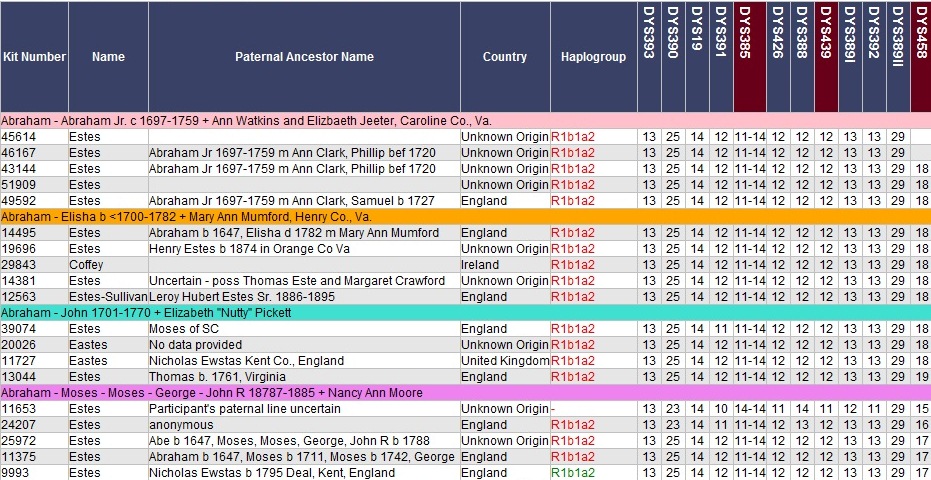
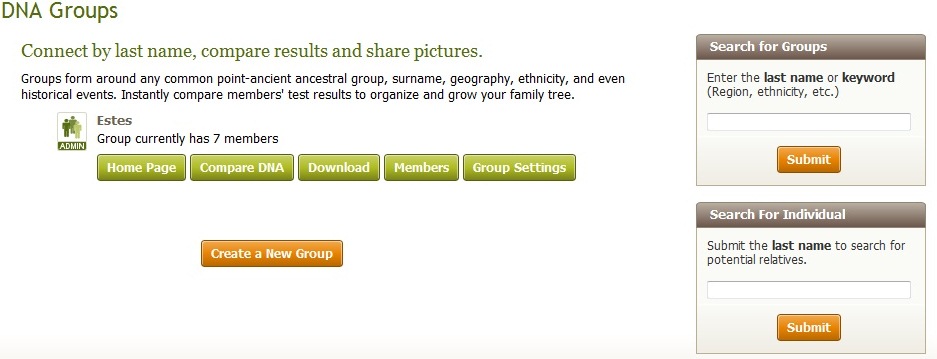
Looking at the Estes surname project as an example, you can see in this colorized version that there are mutations shown, in color, even within family groups.

You can test at 12, 25, 37, 67 or 111 marker “locations” on the Y chromosome.  In order to look for strong results you’re going to need to test at a minimum of 37 markers, preferably 67 or 111.  At Family Tree DNA, which is where I recommend that you test, you can always upgrade later, but it’s less expensive in total to test more initially, plus you may well need the information to know who you match at the highest levels.  Right now, 37 markers cost $119 and 67 markers are $199, but a sale is currently underway.  You can also join the adoptee project to obtain the best pricing by joining a project.

Family Tree DNA also provides significant tools for Y-line DNA as well as Mitochondrial DNA as well.  You can see both Family Tree and Ancestry results compared on this blog, which shows you how to use both companies’ tools.  At Family Tree DNA, for all their tests, you are provided with the e-mail addresses of your matches.  At Ancestry and 23andMe, you contact matches through thier internal message system.  My experience has been that direct e-mails have a better response rate.

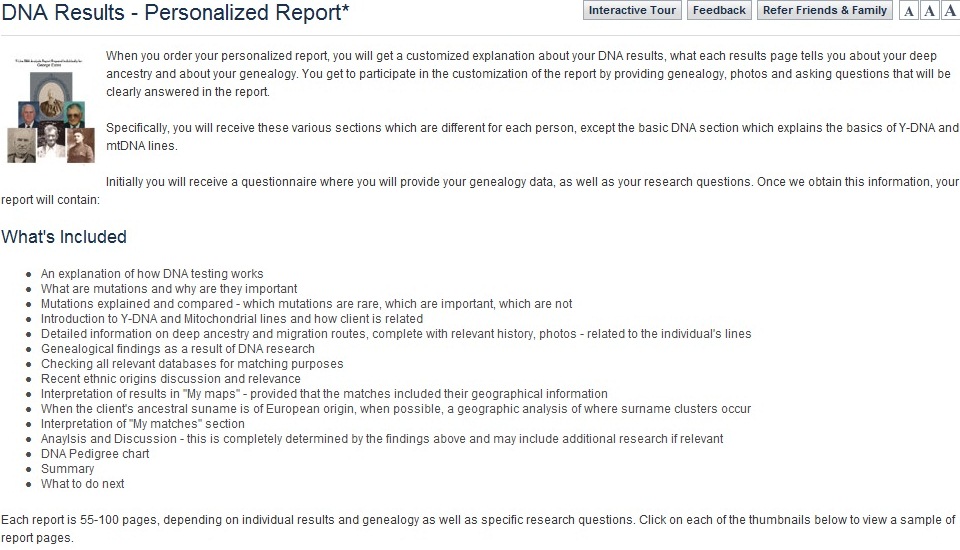
You can also order a DNA Report from my company, DNAeXplain, or directly from your personal page at Family Tree DNA, if you need assistance understanding either Y-line or mitochondrial DNA results and wringing every possible tidbit from the available tools.

Obviously, the Y-line test is only for males.  Ladies, I feel your pain.  However, these next tests are for both sexes.

Mitochondrial DNA – For Direct Maternal Line Testing for Both Sexes

Mitochondrial DNA is inherited by all children from their mother only, with no admixture from the father.  Women obtain their mitochondrial DNA from their mother, who got it from their mother, on up the line into infinity.  This is the red circle on the right hand side of the pedigree chart.  Like Y-line DNA, mitochondrial DNA is passed intact from one generation to the next, except for an occasional mutation that allows us to identify family members and family lines.

Unfortunately, it does not follow any surname.  In fact the surname changes with every generation when women marry.  This makes it more challenging to work with genealogically, but certainly not impossible. Because of the surname changes in every generation, there are no “surname” projects for mitochondrial DNA, but the Mothers of Acadia project is using mitochondrial DNA to reconstruct the Acadian families.

There are three levels of testing you can take for mitochondrial DNA at Family Tree DNA, which is where I recommend that you test.  The mtDNA, the mtDNAPlus and the Full Sequence.  The mtDNA test is a starter test that will only leave adoptees needing more.  I strongly recommend the full sequence test, but if the budget just won’t allow that, then the mtDNAPlus will do until you can afford to upgrade.  Family Tree DNA is the only major lab that tests the full sequence region, plus, they have the largest matching data base in the industry.

To put this in perspective for you, the mtDNA and the mtDNAPlus tests both test about 10% of your mitochondrial DNA and the full sequence test tests all of your 16,569 mitochondrial locations.  You can then compare them with other people who have taken any of those 3 tests.  For adoptees, you’ll need the power of the full sequence test.  Pricing for the mtDNAPlus is currently $139 and the full sequence is $199.

After you receive your results, you can enter the mtDNA and mtDNAPlus portions into public data bases.  There are no public data bases for the full sequence segment because there may be medical implications in some of those mutations, so they are not displayed publicly although they are compared privately within the Family Tree DNA data base.  You will want to enter your data and check for matches at www.mitosearch.org (upload directly from your matches page at Family Tree DNA), www.smgf.org and www.ancestry.com, although beware of Ancestry’s accuracy issues.

Update: Please note that as of 2019, Family Tree DNA is the only company providing mitochondrial DNA testing and matching. The rest are now obsolete.

If you match someone on either the Y-line or mitochondrial DNA, you may want to do some additional testing to see if you are closely related or if you are related back in time many generations.  The good news is that autosomal testing is what you need and there are three autosomal pools to swim in, increasing your chances of a “hit.”

Autosomal Testing – The Rest of the Story – For Both Sexes

If there was a DNA test created for adoptees, this is it.  This test can be used alone or in conjunction with the Y-line or mitochondrial DNA testing at Family Tree DNA.  They are the only lab to have this advanced matching capability.

Autosomal DNA testing tests all of your 23 pairs of chromosomes that you inherit from both of your parents.  You get half of each chromosome from each parent.  You can see this pattern on the pedigree chart, represented by all of the 16 genealogical lines.  Therefore, as you move up that tree, you should have inherited about 25% of your DNA from each grandparent, about 12.5% of your DNA from each great-grandparent, as have all of their other great-grandchildren.

So, if you were to take an autosomal test, and another one of your grandparents grandchildren tested, you would match them at some predictable percentage of your DNA.  You can see the “cheat-sheet” we use below, courtesy of the ISOGG wiki.

You can see that your grandparents other grandchildren are your first cousins, and you share approximately 12.5% of your autosomal DNA with them.  Therefore, if you match someone at 12.5%, you are either first cousins, great-grandchildren/great-grandparents or another relative with 12.5 in their “box” below, as compared to you.

adopted cheat chart

For an adoptee, this is the literal Holy Grail.  You can match someone at the 25% level, or even the 50% level.  Yes, siblings have found each other this way, although not to misset your expectations, it’s rare.  Much more common are matches at smaller percentages, but even so, if you match someone who is cooperative, it’s not too difficult to work with their pedigree chart to get some idea who your parents might be.  And even if you can’t figure that out, you know you are biologically related to them, something most adoptees have never experienced before aside from their own children.

The adoptee group and others are working on tools and standard procedures for adoptees, as there are ways to work with this information.  I have also blogged about the basics of what autosomal DNA gives you, and how to use it.

There are three testing companies that sell autosomal DNA testing.  I strongly suggest that you use all three of them, plus download your results to www.gedmatch.com and learn to use those tools, or work with someone on your behalf.

Family Tree DNA sells the Family Finder test.  Right now it is priced at $199 or bundled with attractive pricing with either the Y-line or mitochondrial DNA tests.  For adoptees, I often like to use this tool in conjunction with the Y-line and mitochondrial DNA tests to see, if you match someone closely, whether you are actually related to them in a recent timeframe or if it is further back.  Autosomal testing will pick up relationships reliably back to about the 6th or 7th generations, and sporadically beyond that.  In addition to a list of matches, you will receive your breakdown of ethnicity, by percent.  The admixture portions are improving, but just use them as a guideline, especially for percentages below 10%, and that goes for all three companies, in general.

Another company that sells autosomal testing is www.23andme.com.  In addition to a list of cousins, you also receive admixture percentages, and their specialty, health traits.  For adoptees, this may be particularly important as well.  Be aware that while people who test at Family Tree DNA are interested in genealogy, the typical person at 23andMe tested for the health portion, not the genealogy portion, and may not answer contact requests or may know very little about their family history.  However, that doesn’t negate the possibility that you may find a very close match and you’ll never know if you don’t test.  Right now, their test is $99, and you can download your results and upload them to Family Tree DNA for an additional $89, making the total price similar to the Family Tree DNA test.  However, you need to be somewhat technically savvy to complete the download/upload process.

The third company is www.ancestry.com.  Compared to either Family Tree DNA or 23andMe, their tools are sorely lacking, but they too offer a list of matches and ethnicity.  I suggest that you simply ignore their ethnicity calculations at this point in time as they are quite misleading.  The good news about Ancestry subscribers, which is who you’ll be matching, is that they too are quite interested in genealogy.  Unfortunately, you don’t have the data tools you’ll need to see how you match.  Again, that does not negate the importance of a close match, so I recommend fishing in this pool even though it certainly doesn’t stand up to either of the other two companies.  Their price fluctuates but is floating someplace around $129.  Also be aware to access the full feature set of matches including trees, you will need to subscribe to Ancestry as well in some capacity, so the test price is not the only cost involved.  Be sure to read their fine print first.

After you obtain your results from either Family Tree DNA or 23andMe, you’ll want to download your raw data results and then upload the file to www.gedmatch.com.  This is “donation” site, meaning there is no subscription or fee to use the tools, but they do appreciate donations.  Ancestry does not provide your raw data, but has stated that they will sometime in 2013.

While this suite of tools does not replace that missing information locked away in a file someplace, or worse, it does provide adoptees with hope where none may have existed before.  Various kinds of DNA testing can provide answers, and relatives, both close and distant.  You can also work with these tools with other adoptees and those who specialize in genetic genealogy to unlock those doors.

Remember, the longest journey begins with a single step.  Bon Voyage!

______________________________________________________________

Disclosure

I receive a small contribution when you click on some of the links to vendors in my articles. This does NOT increase the price you pay but helps me to keep the lights on and this informational blog free for everyone. Please click on the links in the articles or to the vendors below if you are purchasing products or DNA testing.

Thank you so much.

DNA Purchases and Free Transfers

Genealogy Services

Genealogy Research

Thanksgiving, Spilling the Beans and Reaching Out

Everyone in the US and Canada celebrates the holiday of Thanksgiving, although on different dates.  Traditionally, as all children learn in grade school, in the US this holiday celebrates the Pilgrims being helped by the Indians to survive and a feast they jointly held in Plymouth, Massachusetts in 1621.  There is a lot of debate about that event, whether it happened or not, but I think it’s actually irrelevant.  More important is what Thanksgiving has morphed into, what it is today.

It’s a family day, often more so than Christmas, especially in the northern climates.  In my family, and many others, at Thanksgiving you see more extended family than at Christmas, where Christmas is more immediate family.  In the North, travel has become difficult or iffy at best by the end of December, but the end of November generally is still safe.  Now that I’ve said that of course we’ll have a blizzard.

Thanksgiving is the time when my Aunt Verma inadvertently spilled the beans on the “skeleton in the closet” at the dinner table.  You could have heard a pin drop.  Well, before the gasps.

Thanksgiving is the time to ask about those ancestors or family members, even if you think you know the answer.  Because, you may not.  Often, it’s for lack of asking the question or introducing the subject that you don’t learn those stories.

Probably the number one regret of genealogists is that they never reached out when they could.

Today, reaching out isn’t just across the dinner table or while doing dishes, a favorite time to pick the brains of your relatives, it’s about reaching out using new technology.

If you could make contact with someone who has photos of your great-grandmother, wouldn’t you want to do that?  How about someone who has a copy of the family Bible owned by your Revolutionary War ancestor?  Maybe a tin type and journal of your Civil War ancestor.  Who has those today?  Maybe you don’t even know they exist.

If they aren’t in your family, it will take a new form of reaching out to find them.  I’ve celebrated Thanksgiving this week by reaching out to the younger generation.  I don’t mean to stereotype, but let’s face it, you’ll never meet these people on Rootsweb. Where do you find them?  Facebook, that’s where.  Want to find out what pictures their grandma has in the attic?  Well, you have to make contact with them so they will ask their grandma, or tell their grandma to check out your Facebook page.  And yes, more and more, grandma is using Facebook.

Now stop groaning.  I can hear you from here!  I know, I groaned too.  But I did it anyway.  We need to interest young people.  They can DNA test and someday, maybe one  of them will be who you pass the proverbial family torch to.  If you’re like me, it’s not one of your kids, no matter how badly you want it to be. I think I burned them out in courthouses at the copy machine when they were kids.  My bad.

This is not difficult.  If you are not on Facebook, summon up your courage and go to www.facebook.com and sign up.  If you are already on Facebook, skip down 2 or 3 paragraphs to the section on setting up pages and groups.

If you’re really uncertain, you can google about how to get started using Facebook, but it’s actually really easy and intuitive.  You want to be on Facebook because your kids and grandkids are there and you’re going to lose touch with them and how they communicate if you don’t join.  Just do it.

Once you join, just type names into the top bar to look for your friends and family, where it says “search for people, places and things.”  Then send them a friend request.  You’ll see the “Friend” button, just click on it.  This isn’t difficult, you just need to get used to it.  Here are the results when I searched for Jim.

Once you are a friend, you will see what they put on their timeline and their status posts.  These include photos and such.  I see new photos of my grandkids just about every day.  Your news feed aggregates all of the people and projects that you are following.

Of course, you’ll want to post something, eventually, yourself.  The best way to get a conversation started is to ask questions, just like at Thanksgiving.

On Facebook, you do that by typing something in the field that says “What’s on  your mind?”  Facebook is one big informal conversation.

After you get at least a little comfortable with Facebook and your News Feed, you’ll want to set up either a project group or a page.

Here’s what I did.  And by the way, I am not “comfortable” with Facebook but I just did this anyway.  The only way to get comfortable is to work with the software.

I set up two pages and I’m going to set up project groups.  My new pages are ”DNAexplain” and “Native Heritage Project.”  You will have to type those names (minus the quotes) in the search bar at the top of the page at Facebook to find them.  That’s how Facebook works.  Then you click on the image and then click on “like” to connect yourself to them.  So please, do me a favor and “like” both of them.  Facebook requires 25 likes for a new group or page to be recognized as legitimate.

Pages are public.  They are generally for entities, meaning businesses and organizations.  You might want to put a family association there.  ISOGG (International Society of Genetic Genealogists) is there, for example, as is the Lost Colony Research Group.  Everything posted on these pages is available for everyone to see.

Groups can be set up to be entirely public, private or secret, meaning by invitation only.   Facebook has a help page that discusses these differences.  Groups are generally for more personal discussions.  For example, you might choose to form a “by invitation only” intimate family group.  You might choose to set up a Page to advertise your family association and to attract people who are interested in addition to a group for more private discussions.  Remember, the whole point of this exercise it to reach out, so the more public your presence, the better chance you’ll have of attracting interested people.  Be aware however, that these pages are not text searchable and do not have archives like Yahoo Groups or Rootsweb.  But then again, this is for reaching out, not archiving.

To create a page, which is what I recommend for surname projects, scroll all the way down to the bottom of your Facebook page and click where it says, “create a page.”  From there on, Facebook guides you.

To create a group, on the left hand banner, Facebook will show you any groups you are a member of, and at the bottom of the list, it says “create groups.”  Click there and again, Facebook guides you through the rest.

Here is my commitment.  If a Facebook page or group does not exist for each one of my DNA surname or other pet projects, I’ll create one by year end.   Yes, this year, 2012.  There is nothing like the present moment.  I’m reaching out to the next generation.  After all, the old folks are gone now, so I need new information targets:)  Who knows what I’ll find, but if I don’t reach out and try, I’ll find absolutely nothing!  I want more family information to be thankful for by next Thanksgiving!!!  I want to honor those who have gone before by preserving the information about their life.  That is what heritage is.

How about you?  How can you reach out and what do you hope to find?

______________________________________________________________

Disclosure

I receive a small contribution when you click on some of the links to vendors in my articles. This does NOT increase the price you pay but helps me to keep the lights on and this informational blog free for everyone. Please click on the links in the articles or to the vendors below if you are purchasing products or DNA testing.

Thank you so much.

DNA Purchases and Free Transfers

Genealogy Services

Genealogy Research

The New Root – Haplogroup A00

Now that things have calmed down a bit from the whirlwind of the Family Tree DNA Conference, I’d like to write in a little more comprehensive and sane manner about the revelation that we have a new root on the human tree.

I’m referring to the session given by Bonnie Schrack, Thomas Krahn and Michael Hammer titled “In Search of the Root: Discovery of a Highly Divergent Y Chromosome Lineage.”

Bonnie has posted her slides from the presentation as well as her speaking notes on her new haplogroup A webpage.  She contacted me with some corrections to my original Blog posting about that session at the conference as well as provided additional information.  Thank you Bonnie, not just for this info, but for your work with haplogroup A that has been such a key part of this momentous discovery.  This isn’t just a once-in-a-lifetime event, it’s a once-in-the-history-of-mankind event.  Watch the haplogroup A website for more information from Bonnie about this exciting discovery and project.

Understandably, Bonnie, Thomas and Michael are somewhat restricted in what they can say until such time as the resulting academic paper in the works is published.

We all know that male humans arise from a person we call Y-line Adam, just like we call the first woman Mitochondrial Eve.  Before a 2011 paper, it was believed that shortly after Adam, haplogroup A and B were formed about the same time and were brother haplogroups.  Fulvio Cruciani’s 2011 paper, “A Revised Root for the Human Y Chromosomal Phylogenetic Tree: The Origin of Patrilineal Diversity in Africa” reorganized that tree and showed that indeed, haplogroup A formed from the root of all humanity with B forming from haplogroup A.

Cruciani showed his newly organized tree with haplogroup A1b, A1a and then A2, A3 and BT as brother haplogroups.  Cruciani did not use STR data, only SNP data in his study.

A second recent study, also in 2011, “Signatures of the pre-agricultural peopling processes in sub-Saharan Africa as revealed by the phylogeography of early Y chromosome lineages” by Chiara Batini et al, did include some STR marker that matched some of the haplogroup A samples.  Batini did not use SNP testing, so did not realize the potential of these STR samples.  These did not match the new A00 root, but other rare haplogroup A samples in subgroups.

The 7 marker STR samples that did match the new A00 sample were from a private database at the Center for Genetic Anthropology who very graciously worked with Michael Hammer and provided small amounts of those samples for further analysis.

In my conference blog posting, I asked how this discovery was previously missed, and Bonnie Schrack responded as follows:

“The reasons we had never heard about A00 before would be:

  • Very scanty research and sample collection in Africa, in proportion to the size and diversity of the population, compared to Europe and other more developed countries
  • Only recently has large-scale Y sequencing become practical and affordable; Cruciani’s 2011 paper was a breakthrough precisely because for the first time they were able to sequence a few samples on the scale of a WTY, resulting in a lot of new SNPs, and we’ve been able to make even more progress because we had a larger pool of (customer) samples from which I could cherry-pick the most divergent samples, and then our genetic genealogy/anthropology community made it possible to raise enough funds for us to sequence the most important three of them (after that point, Hammer and FTDNA found the other samples and funds).”

Before the WTY program, this type of analysis simply wasn’t being done.  This monumental discovery was a combination of citizen science, the haplogroup A project, an innovative scientific program, the WTY at Family Tree DNA, academic partnership, Michael Hammer’s lab at the University of Arizona and other institutions, along with that crucial public participation.  Without the public participation aspect, the rest would be a moot point.

Haplogroup A research at Family Tree DNA discovered not only one, but two new branches of haplogroup A, one of which was actually a new base root that needed to be inserted before, upstream of, the current root.  The locations where these new branches/roots needed to be inserted required the renaming of the current branches, hence, the newly discovered branch A00 and Cruciani’s branch, formerly A1b, is now A0.

Thomas Krahn’s A00 discovery presentation slides are also available online.  You can tell he’s a scientist from the nature of his presentation.  You can see the actual process of discovery, in essence, what he saw as this new root was unearthed.  It’s fun to walk along with him, even if you don’t understand everything you see.

As part of this process, Thomas also sequenced the DNA of a chimp and a gorilla.  You can see the results at www.ysearch.org for the chimp at 6RCUU, the gorilla at 9ED3A and the new root, A00, at 6M5JA.  You can breathe easy, humans are far distant from chimps and gorillas, but maybe closer to Neanderthals or other archaic humans than we thought.

Update: As of 2019, Ysearch is no longer available.

At the end of Thomas’s presentation, he included the image of a tree with a new root and lots of interesting branches.

Zooming in on the branches, you can see all of the DNA sequencing paraphernalia, microplates, readouts and results.  Maybe there is a little artist buried someplace in Thomas amid those scientific genes!

This work was no small feat, and the significance is mind-boggling.  This new discovery pushed the date of Y-Adam back a whopping 67% in one fell swoop.  Cruciani’s birth age for haplogroup A1b was 140,000 years ago and A00, compared to Cruciani’s sample, falls at 237,000 years ago.

Dr. Michael Hammer at the University of Arizona reanalyzed the haplogroup A tree and root with the new information available, and his new ages are even more amazing.  Cruciani’s A1b/A0 sample is now at 200,000 years old and A00 is at 338,000, with a 98% confidence level.

These dates pre-date all human fossils, although there are some archaic fossils that have been found and dated after this time in neighboring Nigeria.  This new information provides us with glimpses through the keyhole of time into ancient human origins, and begs even more questions that will be answered in time, with more genetic and anthropology research.  We all descend from this common root, and we may all be more closely related to archaic man that we knew.

The A00 participant descends from a former slave family in South Carolina.  The closest matches are found in western Cameroon near the Gulf of Guinea, a prime location in the slave trade.

There appears to be about 500 years between the participant and the samples from Cameroon, an age that speaks to the beginning of the slave trade.

Having worked closely with Lenny Trujillo, the man whose WTY sample provided us with haplogroup-changing and defining information for haplogroup Q, and understanding what a moving experience this journey has been for Lenny, I wondered about how the family involved with this revolutionary discovery must feel.

As luck would have it, I have worked with this family in one of my projects as well, and they contacted me after seeing my blog about the conference.

I asked how they felt, how they were reacting to this history-changing event in which their family was the keystone.  I have extracted pieces from e-mails back and forth, and with the families permission, am sharing what they had to say.  Clearly, without them and their active and supportive participation, this discovery would not have been made.  We all owe them a debt of gratitude.

“I have a B.S. in Mathematics. I love science and learning. I recently retired, but I spent a lot of that time working with research scientists on cutting edge technology and methods so it is very exciting to me to be a part of such a scientific discovery. My family would say I was the right one chosen.  This is the family line I know the most about so I am glad it was this part of my family.

I don’t yet have the formal results from Family Tree DNA concerning the Y-DNA sample they tested in the Walk Through the Y, I did know that the discovery was monumental from some preliminary results from Thomas.

I wanted to see the tie back to Africa, looks like GOD did exceedingly, abundantly more than I could ever ask or think. Just think of how long HE has preserved this Y-lineage just for such a time as this.”

______________________________________________________________

Disclosure

I receive a small contribution when you click on some of the links to vendors in my articles. This does NOT increase the price you pay but helps me to keep the lights on and this informational blog free for everyone. Please click on the links in the articles or to the vendors below if you are purchasing products or DNA testing.

Thank you so much.

DNA Purchases and Free Transfers

Genealogy Services

Genealogy Research

Family Tree DNA Conference 2012 – Nits and Grits

First things first!  I want to thank Max and Bennett for graciously hosting the 8th Annual Genetic Genealogy Conference in Houston, Texas!  This is actually the 9th year, but a pesky hurricane interfered one year.  Max and Bennett are very generous with their time and resources and heavily subsidize this conference for us.  We’re registering in the photo above.

Georgia Kinney Bopp said it best.  At some point during this amazing conference, someone tweeted an earlier quote from a conversation between Ann Turner and Georgia:

“it’s hard to realize you’re living history while it happens…”

This was ever so true this weekend.  Even my husband (who is not genetic genealogy crazy) realized this.  I’m not sure everyone at the conference did, or realized the magnitude of what they were hearing, as we did have a lot of newbies.  Newbies are a good thing.  It means our obsessive hobby and this industry have staying power and there will be people to pass the torch to someday.

I’ve already covered the Native American focus meeting in an earlier blog.

For those of you who want the nitty gritty play by play as it happened at the conference, go to www.twitter.com and search for hashtag #ftdna2012.  If you want some help with Twitter, I blogged about that too.  Twitter is far from perfect, but it is near-realtime as things are happening.

As always, Family Tree DNA hosts a reception on Friday evening.  This helps break the ice and allows people to put faces with names.  So many of us “know” each other by our e-mail name and online presence alone.

We had a special guest this year too, Nina, a little puppy who was rescued by Rebekah Canada just a few days before the conference.  Nina behaved amazingly well and many of us enjoyed her company. 

Bennett opened the conference this year, and in the Clint Eastwood political tradition, spoke to his companion, the chair named Max.  The real Max, it turns out, was losing his voice, but that didn’t prevent him from chatting with us and answering questions from time to time.

While Bennett was very low key with this announcement, it was monumental.  He indicated that the parent company of Family Tree DNA has reorganized a bit.  It has changed its name to Gene by Gene and now has 4 divisions.  You can check this out at www.genebygene.com.  This isn’t the monumental part.

The new division, DNADTC’s new products are the amazing parts.  Through this new division, they are the first commercial company to offer a full genome sequence test.  The price, only $5495.  For somewhat less, $695, they are offering the exome, which are your 20,000 genes.  Whoever though it would be a genetic genealogy company who would bring this to the public.  Keep in mind that the human genome was only fully sequenced in 2003 at a cost of 3 billion dollars.
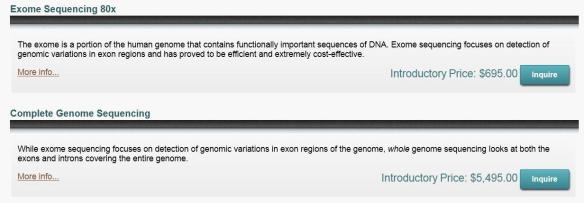
The amazing part is that a full genome sequence cost about 3 million in 2007 and the price will continue to fall.  While consumers will be able to order this, if they want, it comes with no tools, as it is focused at the research community who would be expected to have their own analytical tools.  However, genetic genealogists being who and what they are, I don’t expect the research market will outweigh the consumer market for long, especially when the price threshold reaches about $1000.

Bennett also said that he expects that National Geographic will, in 2013 sometime, decide to allow upgrades from Family Tree DNA clients for the Geno 2.0 product.  This will allow those people who cannot obtain a new sample to participate as well.  However, an unopened vial will be required.  No promises as to when, and the decision is not his to make.
The first session was Spencer Wells via Skype from Italy.  Spencer has just presented at two conferences within the week, one in San Francisco and one in Florence, Italy.  Fortunately, he was able to work us into his schedule and he didn’t even sound tired.

Of course, his topic was the Geno 2.0 test which is, of course, run on the new GenoChip.  The first results are in the final stages of testing, so we should see them shortly.  Sometime between the 19th and the end of the month.

This product comes with all new migration maps.  He showed one briefly, and I noticed that one of the two Native Y-lines are now showing different routes than before.  One across Siberia, which hasn’t changed, and one up the pacific rim.  Hmmm, can’t wait for that paper.

The new maps all include heat maps which show frequency by color.  The map below is a haplogroup Q heat map, but it is NOT from the Geno project.  I’m only using it as an example.

Spencer indicated that the sales of the 2.0 product rival those of the 1.0 product and that they have sold substantially more than 10K and substantially less than 100K kits so far.  In total, they have sold more than 470,000 kits in over 130 countries.  And that’s just the public participation part, not the indigenous samples.  They have collected over 75,000 indigenous samples from more than 100 populations resulting in 36 publications to date with another half dozen submitted but not yet accepted.  Academic publication is a very long process.

Nat Geo has given 62 legacy grants to indigenous communities that have participated totaling more than 1.7 million dollars.  That money comes in part from the public participation kits, meaning Geno 1.0 and now 2.0.

Geno 2.0 continues to be a partnership between National Geographic and Family Tree DNAFamily Tree DNA is running all of their samples in the expanded Houston lab.  Also added to the team is Dr. Eran Elhaik at Johns Hopkins University who has developed a new tool, AIMSFINDER, that locates never before identified Ancestral Informative Markers to identify population specific markers.  This is extremely important because it allows us to read our DNA and determine if we carry the markers reflective of any specific population.  Well, we don’t do the reading, they do with their sophisticated software.  But we are the recipients with the new deep ancestral ethnicity results which are more focused on anthropology than genealogy.  Spencer says that if you have 2% or more Native American, they can see it.  They have used results from both public and private repositories in developing these tools.

This type of processing power combined with a new protocol that tests all SNPS in a sequence, not just selected ones, promises to expand the tree exponentially and soon. It has already been expanded 7 fold from 863 branches of the Y tree to 6153 and more have already been discovered that are not on the GenoChip, but will be in the next version.

The National Geographic project will also be reaching out to administrators and groups who may have access to populations of interest.  For example, an ex-pat group in an American city.  Keep this in mind as you think of projects.

Another piece of this pie is a new educational initiative in schools called Threads.

This isn’t all, by any means, on this topic, I really do encourage you to go and use Twitter hashtag #ftdna2012.  Several of us were tweeting and the info was coming so fast and furious that no one could possibly get it all.

The future with Nat Geo looks exceedingly bright.  We have gone from the Barney Rubble age to the modern era and now there is promise for a rosy and as yet undiscovered future.

Judy Russell was next.  I have to tell you, when I saw where they positioned her, I was NOT envious.  I mean, who wants to follow Spencer Wells, even if he’s not there in person.  Well, if anyone was up to this, it certainly was Judy.  For those who don’t know, she blogs as The Legal Genealogist.

Judy is one of us.  That means she actually understands our industry, what drives genealogists and why.  In addition to being a lawyer, she is a certified genealogist and a genetic genealogy crazy too.  Maybe I shouldn’t call a lawyer crazy….well…it was meant as a compliment:)

Judy has the perspective to help us, not just criticize us remotely.  She reviewed several areas where we might make mistakes.  After all, we’re all volunteers coming from quite varied backgrounds.  She suggests that we all put some form of disclosure on our projects explaining what participants can expect in terms of use.  She used the Core Melungeon project as a good example, along with the Fox project.

“The goal of this project is to use DNA to better understand the origins of the Melungeon people, and this will be done by comparing the DNA with other project members, those outside of projects, and will incorporate relevant genealogical and historical research. All participants will be included in the ongoing studies and by joining the project, you are giving consent for your information to be anonymously included in ongoing genetic genealogy research. Your personal identity will not be revealed, but your results will be used to better understand the Melungeons as a people and their ancestors.”

From the Fox project:

“The exact function of these STR markers is not yet known and they have no known medical function but recent research shows they have some sort of regulatory function on the genes. While there is no medical information in these numbers, the absence of a certain few markers near a fertility gene could indicate sterility – something that would certainly already be known.

The results do provide a partial means of personal identification and, for this reason, our haplotype tables list only the FTDNA kit number and the most distant known male line ancestor. Within the project, however, the administrators feel free to disclose identities, particularly when a close match occurs.”

Judy’s stressed that we not tell people that there is no medical information revealed.  Partially, because we’ve discovered in rare cases that’s not true, and partially because we can’t see into the future.

Judy talked about regulation and that while we fear what it might intentionally or inadvertently do to genetic genealogy, it’s important to have regulations to get rid of the snake oil salesman, and yes, there are a couple in genetic genealogy.  They give us all a black eye and a bad name when people discover they’ve been hoodwinked. However, without regulation of some sort, we have no legal tools to deal with them.

Regulation certainly seems to be a double-edged sword.

I hope that Judy writes in her blog about what she covered in her session, because I think her message is important to all administrators and participants alike.  And just to be clear, the sky is not falling and Judy is not Chicken Little.  In fact, Judy is the most interesting attorney I have ever heard speak, and amazingly reasonable too.  She actually makes you WANT to listen, so if you ever get the chance to see one of her webcasts or attend one of her sessions, take the opportunity.

Following the break, breakout sessions began.  CeCe Moore ran one about “Family Finder,” Elise Friedman about “Group Administration” and Thomas Krahn provided the “Walk the Y Update.”  Bennett called this the propeller head session.  Harumph Bennett.  Guess you know which one I attended.  All sessions were offered a second time on Sunday.

Thomas said that they have once again upgraded their equipment, doubling their capacity again.  This gives 4 times the coverage of the original Walk the Y, covering more than 5 million bases.  To date, they have run 494 pre-qualified participants and of those, 198 did not find a new SNP.

There are changes coming in how the palindromic region is scored which will change the matches shown.  Palindromic mismatches will now be scored as one mutation event, not multiples.  Microalleles will able be reported in the next rollout version, expected probably in January.  The problem with microalleles is not the display, but the matching routine.

Of importance, there has not been an individual WTY tested from haplogroups B, M, D or S, and we need one.  So if you know of anyone, please contact Thomas.

Thomas has put his Powerpoint presentation online at  http://www.dna-fingerprint.com/static/FTDNA-Conference-2012-WalkThroughY.pdf

The next session by Dr. Tyrone Bowes was “Pinpointing a Geographical Location Using Reoccurring Surnames Matches.”  For those of us without a genetic homeland, this is powerful medicine.  Dr. Bowes has done us the huge favor of creating a website to tell us exactly how to do this.  http://www.irishorigenes.com/

He uses surnames, clan maps, matches, history and census records to reveal surname clusters.  One tidbit he mentioned is that if you don’t know the family ethnicity, look at the 1911 census records and their religion will often tell you.  Hmm, never thought of that, especially since our American ancestors left the homeland long ago.  But those remaining in the homeland are very unlikely to change, at least not in masse.  I’m glad he gave this presentation, or I would never have found his webpage and I can’t wait to apply these tools to some of my sticky-wickets.

This ended Saturday’s sessions, but at the end of every day, written questions are submitted for that day’s presenters or for Family Tree DNA.

Bennett indicated that another 3000 or 4000 SNPs will be added to the Family Finder calculations and a new version based on reference samples from multiple sources will be released in January.

Bennett also said that if and when Ancestry does provide the raw downloadable data to their clients, they will provide a tool to upload so that you can compare 23andMe and Ancestry both with your Family Finder matches.

Saturday evening is the ISOGG reception, also called the ISOGG party.  Everyone contributes for the room and food, and a jolly good time is had by all.  There is just nothing to compare with face to face communications.

For me, and for a newly found cousin, this was an amazing event.  A person named Z. B. Stroud left me a message that she was looking for me.  When I found her, along with her friend and cousin Revis, she tells me that she matches me autosomally, at 23andMe, and that she had sent me a sharing request that I had ignored.  I am very bad about that, because unless someone says they are related, I presume they aren’t and I don’t like to clutter up my list with non-related people.  It makes comparisons difficult.  My bad.  In fact, I’m going right now to approve that sharing request!!!

I will blog about this in the future, but without spilling too many beans….we had a wonderful impromptu family reunion.  We think our common ancestor is from the Halifax and Pittsylvania County region of Virginia, but of course, it will take some work to figure this out.

I’m also cousins with Revis Leonard (second from left).  We’ve known that for a long time, but Z.B. whose first name is Brisjon (second from right) is new to genealogy, DNA and cousin matching. I’m on the right above.  The Stroud project administrator, Susan Milligan, also related to Brisjon is on the left end.  In the center are Brisjon’s two cousins who came to pick her up for dinner and whom she was meeting for the first time.

But that’s not all all, cousin Brisjon also matches Catherine Borges.  Let me tell you, I know who got the tall genes in this family, and I’m not normally considered short.  Brisjon’s genealogical journey is incredibly amazing and she will be sharing it with us in an upcoming book.  Suffice it to say, things are not always what you think they are and Brisjon is living proof.  She also met her biological father for the first time this weekend!  I’m sure Houston and her 2012 visit where she met so many family members is a watershed event in her lifetime!  She is very much a lovely lady and I am so happy to have met her.  Cousins Rule!

ISOGG traditionally has its meeting on Sunday morning before the first session.  Lots of sleepy people because everyone has so much fun at the ISOGG party and stays up way too late.
Alice Fairhurst, who has done a remarkable job with the ISOGG Y SNP tree (Thank you Alice!) knows an avalanche is about to descend on her with the new Geno 2.0 chip.  They are also going to discontinue the haplogroup names, because they pretty much have to, but will maintain an indented tree so you can at least see where you are.  The names are becoming obsolete because everytime there is an insertion upstream, everything downstream gets renamed and it makes us crazy.  It was bad enough before, but going from 860+ branches to  6150+ in one fell swoop and knowing it’s probably just the beginning confirms the logic in abandoning the names.  However, we have to develop or implement some sort of map so you can find your relative location (no pun intended) and understand what it means.

Alice also mentioned that they need people to be responsible for specific haplogroups or subhaplogroups and they have lost people that have not been replaced, so if anyone is willing or knows of anyone….please contact Alice.

Alice also makes wonderful beaded double helix necklaces.

Brian Swann (sorry, no picture) is visiting from England this year and he spoke just a bit about British records.  He said it’s imperative to learn how they work and to use some of the British sites where they have been indexed.  He also reminded us to check GOONS (Guild of One Name Studies) for our surnames and that can help us localize family groups for recruiting.  He said that you may have to do family reconstructions because to get a Brit to test you have to offer them something.  That’s not terribly different from over here.  He also mentioned that today about half of the British people having children don’t marry, so in the next generation, family reconstruction will be much more difficult.  That too isn’t so terribly different than here, although I’m not sure about the percentages.  It’s certainly a trend, as are varying surname practices even within marriage.

Dr. Doron Behar began the official Sunday agenda with a presentation about the mtCommunity and a discussion of his recently published paper “A ‘Copernican’ Reassesement of the Human Mitochondrial DNA Tree from its Root.”  This paper has absolutely revolutionized the mitochondrial DNA community.  I blogged about this when the paper was first released and our home pages were updated.    One point he made is that it is important to remember is that your mutations don’t change.  The only thing that changes between the CRS (Cambridge Reference Sequence) and the RSRS (Reconstructed Sapiens Reference Sequence)  model is what your mutations are being compared to.  Instead of being compared to someone from Europe who live in 1981 (the CRS) we are now comparing to the root of the tree, Mitochondrial Eve (RSRS) as best we can reconstruct what her mitochondrial DNA looked like.

He also said that when people join the mtCommunity, their results are not automatically being added to GenBank at NCBI.  That is a separate authorization check box.

A survey was distributed to question participants as to whether they want results, when they select the GenBank option, to be submitted with their kit number.  Now, they are not, and they are under Bennett’s name, so any researcher with a question asks Bennett who has no “track back” to the person involved.  About 6000 of the 16,000 submissions today at GenBank are from Family Tree DNA customers.  Dr. Behar said that by this time next year, he would expect it to be over half.  Once again, genetic genealogy pioneers are leading the way!

At these conferences, there is always one session that would be considered the keynote.  Normally, it’s Spencer Wells when he is on the agenda, and indeed, his session was wonderful.  But at the 2012 conference, this next session absolutely stole the show.  Less public by far, and much less flashy, but at the core root of all humanity.

You can’t really tell from the title of this session what is coming.  Michael Hammer with Thomas Krahn and Bonnie Schrack, one of our own citizen scientists, presented something called “A Highly Divergent Y Chromosome Lineage.”  Yawn.  But the content was anything but yawn-material.  We literally watched scientific discovery unfold in front of our eyes.

Bonnie Schrack is the haplogroup A project administrator.  Haplogroup A is African and is at the root of the entire haplotree.  One of Bonnie’s participants, an African American man from South Carolina agreed to participate in WTY testing.  In a nutshell, when Thomas and Astrid began scoring his results, they continued and continued and continued, and wound up literally taking all night.  At dawn’s first light, Thomas told Astrid that he thought they had found an entirely new haplogroup that preceded any known today.  But he was too sleep deprived to be sure. Astrid, equally as sleep deprived, replied with “Huh?” in disbelief.  It’s certainly not a statement you expect to hear, even once in your lifetime.  This is a once in the history of mankind event.

Dr. Michael Hammer confirmed that indeed, they had discovered the new root of the human Y tree.  And not by a little either, but by a lot.  For those who want to take a look for yourself, Ysearch ID 6M5JA.  Hammer’s lab did the age projection on this sample, and it pushed the age of hominid men back by about 100,000 years, from 140,000 years ago to 237,000 years ago.  They then reevaluated the aging on all of the tree and have moved the prior date to about 200,000 years ago and the new one to about 338,000 years ago with a 98% confidence level.  This is before the oldest fossils that have been found, and also before the earliest mitochondrial DNA estimate, which previously had been twice as old as the Yline ancestor.

The previous root, A1b has been renamed A0 and the new root, just discovered is now A00.  Any other new roots discovered will simply get another zero appended.

How is it that we’ve never seen this before?  Well, it turns out that this line nearly went extinct.  Cruciani published a paper in 2012 that included some STR values that matched this sample, but fortunately, Michael Hammer’s lab held the actual samples.  A search of academic data bases reveals only a very few close matches, all in western Cameroon near the Gulf of Guinea.  Interestingly, next door, in Nigeria, fossils have been found younger than this with archaic features.  This is going to cause us to have to reevaluate the source of this lineage and with it the lineage of all mankind.  We must now ask the question about whether perhaps we really have stumbled upon a Neanderthal or other archaic lineage that of course “became” human.  Like many scientific discoveries, this answer only begs more questions.  My husband says this is like Russian tea dolls where ever smaller ones are nested in larger ones.

This discovery changes the textbooks, upsets the proverbial apple cart in a good way, and will keep scientists’ thinking caps on for years.  And to think, this was a result of one of our projects, an astute project administrator (Bonnie) and a single project member.  I wonder what the man who tested thinks of all of this. He is making science and all he thought he was doing was testing for genealogy.  You just never know where the next scientific breakthrough will come from.  Congrats to all involved, Bonnie, Thomas, Michael and to Bennett and Max for having this evolution revolution happen right in their lab!

If I felt sorry for Judy following Spencer, I really felt sorry for the breakout sessions following Thomas, Michael and Bonnie’s session.  Thankfully at least we had a break in-between, but most people were wandering around with some degree of stunned disbelief on their faces.  We all found it hard to fathom that we had been among the first to know of this momentous breakthrough.

I had a hard time deciding which session to attend, CeCe’s “Family Finder” session or Elise’s.  I decided to attend Elise’s “Advanced Admin Techniques” because I work with autosomal DNA with my clients and I tend to keep more current there.  Elise’s session was great for newer admins and held tips and hints for us old-timers too.  I realized I really need to just sit down and play with all of the options.

There are some great new features built in that I’ve never noticed.  For example, did you know that you can group people directly from the Y results chart without going to the subgrouping page?  It’s much easier too because it’s one step.  However, the bad news is that you still can’t invite someone who has already tested to join your project.  Hopefully that feature will be added soon.

The next session was “A Tale of Two Families” given by Rory Van Tuyl detailing how he used various techniques to discern whether individuals who did not show up as matches, meaning they were beyond the match threshold, were actually from the same ancient family or not.  Rory is a retired engineer and it shows in his attention to detail and affinity for math.

We always tell people that mutations can and do happen at any time, but Rory proved this.  He ran a monte-carlo simulation and showed that in one case, it was 50 generations between mutations, but in others, there was one mutation for three generations in a row.  Mutations by no means happen at a constant rate.  Of course, this means that our TIP calculator which has no choice but to use means and averages is by definition “not calibrated” for any particular family.

He also mentioned that his simulation shows that by about 150 generations, there are a couple of back mutations taking place.

The final session before the ending Q&A was Elliott speaking about IT, which really translates into new features and functions.  Let’s face it, today everything involves IT.

Again, I was having trouble typing fast enough, so you might want to check the Twitter feed.

They added the SNP maps (admins, please turn them on) and the interactive tour this year.  The tour isn’t used as much as it should be, so everyone, encourage your newbies to do this.

They have also added advanced matching, which I use a lot for clients, but many people didn’t realize it.  So maybe a quick tour through the website options might be in order for most of us.

They are handling 50 times more data now that a year ago.  Just think what next year will bring.  Wow.

They are going to update the landing page again with more color and more visible options for people to do things.  I hope they prompt people through things, like oldest ancestor mapping, for example.  Otherwise, if it isn’t easy, most don’t.

They are upgrading Population Finder and the Gedcom viewer.  They are adding a search feature.  Thank you!!  Older Gedcome will still be there but not searchable.

But the best news is that they are adding phasing (parent child) and an advanced capability to “reconstruct” an ancestor using more distant relatives, then the ability to search using that ancestral profile against Family Finder.  Glory be!  We are finally getting there.  Maybe my dreaming big wasn’t as far away as I thought.

They will also remove the 5 person autosomal download restriction and the “in common with” requirement to see additional information.  All good news.  They are also upgrading the Chromosome browser to add more filtering options.

They are also going to offer a developer “sandbox” area for applications.

The final Q&A session began with Bennett saying that their other priorities preclude upgrading Y search to 111 markers.

They are not planning to drop the entry level tests, 12 or 25 markers or the HVR1. If they do, lots of people will never take that plunge.  I was very glad to hear this.

And by way of trivia, Family Tree DNA has run more than 5 million individual tests.  Wow, not bad for a company that didn’t exist, in an industry that didn’t exist, 12 years ago!

It’s an incredible time to be alive and to be a genetic genealogist!  Thank you Family Tree DNA for making all of this possible.

______________________________________________________________

Disclosure

I receive a small contribution when you click on some of the links to vendors in my articles. This does NOT increase the price you pay but helps me to keep the lights on and this informational blog free for everyone. Please click on the links in the articles or to the vendors below if you are purchasing products or DNA testing.

Thank you so much.

DNA Purchases and Free Transfers

Genealogy Services

Genealogy Research

The DNA Pedigree Chart – Mining for Ancestors

Judy Russell blogged a few days ago about counting up the number of ancestors you have found, of the total number available in the past 10 generations in her blog, “More Lost than Found.”  Judy had a tidy total of 12% after the 10th generation, counting your parents as generation 1. She has only been researching for 12 years.  A veritable youngster.  I’ve been researching for 34 years, so I was hopeful that my percentage would be somewhat better.  At 1% per year, I should rack up about 34%.  We’ll see.

In my presentations, I always talk to people about building their DNA pedigree chart.  I use my own as an example.  It took a lot of work, not to mention money and in some cases, some significant arm-twisting to accomplish this.

It pains me that there are blanks at the top, and some of them can never be filled.  The one person who could test for the Ruthy Dodson Estes (Claiborne Co., Tn.) mitochondrial line, won’t.  The Kirsch family has few male descendants here in the US, and so far, the only one I can find isn’t interested in testing.

With some heavy duty elbow-grease, I should be able to find someone to test for the Margaret Herrell Cook Bolton (Claiborne County, TN) and the Margaret Lentz Miller (Montgomery Co., OH and Elkhart Co., IN) lines.

Some lines are simply dead.  The deJong line had no daughters and we don’t know who her parents were in the Netherlands, so we can’t go upstream.  I can’t find Rachel Hill Lore’s daughter’s descendants from Warren County, Pa.

Instead, I focus on the 10 lines whose DNA I do have.  I thought this was pretty good, actually.  Of these 16 ancestors, I have the DNA of 10 of them.

Last week, when I read Judy’s article, I wondered exactly how my DNA pedigree chart would compare to the number of ancestors in total and the number found.  I wouldn’t say this comparison has been fun, but it has been enlightening in a number of ways.

On the chart below, the generation is noted, the total number of end-of-line ancestors in that generation, the number of ancestors I’ve identified, the percentage that represents, followed by the number whose DNA I have and the percentage compared to the total number of ancestors possible.  The percent would look a lot better if compared it with the number of ancestors identified….but that wouldn’t be playing quite fair.

Generation

Ancestors Total

Ancestors Identified

Percent

IDed

DNA Anc

%

DNA

1 – parents

2

2

100

2

100

2 – grandparents

4

4

100

4

100

3 – great-grandparents

8

8

100

7

88

4 – gg-grandparents

16

16

100

10

63

5 – ggg – grandparents

32

32

100

22

69

6 – gggg – grandparents

64

52 (6 women no surname)

87

20

31

7 – ggggg – grandparents

128

72 (5 women no surname)

56

19

15

8 – gggggg-grandparents

256

90 (7 women no surname)

35

21

8

9 – ggggggg-grandparents

512

106 (12 women no surname)

21

23

4

10 – gggggggg-grandparents

1024

101 (4 women no surname, 8 duplicate ancestors on Mom’s side)

10

25

2

Total

2046

483

24

153

7

I wound up doing an extra generation that Judy didn’t do.

So comparing my 9th generation with Judy’s number, I had a total of 382 ancestors found out of 1022 possible, for 37%.  At 1% per year, I’m three years ahead of schedule!

Expanding this number to the 10th generation reduced my percentage to 24%, but still not bad for 300 years ago, or so.

So Judy, take heart, in another 22 years you’ll be up to 37%, about one third of the way there.  It looks like one gains about 1% per year, so at this rate you’ll only need to live for another 88 years to be done.  I can die when I’m only 119.  I sure hope my retirement money holds out that long!

Finding Ancestors DNA

On the chart, the “DNA Anc” column heading means DNA ancestor’s located and the next column, “% DNA,” is the associated percentage.  While significantly smaller than the number found, this information is still quite interesting for a number of reasons.

First, my pedigree collapse didn’t begin until the 10th generation.  On my Mom’s side, I have a lot of ethnic groups, for lack of a better term for them.  I have the Brethren, the Acadians, the Dutch and other non-Brethren German immigrants, all of which lived in clusters and intermarried after arriving in the states.  The pedigree collapse, where the same ancestor is found in your tree more than once, occurred in both the Acadian line and the immigrant non-Brethren German lines back in Germany.

In order to make sure I actually had gathered up all of my ancestral DNA lines that are available, I checked the projects at Family Tree DNA.  Most of the projects are quite useful, but there were some exceptions.  I’d like to make a plea for all surname administrators to please, PLEASE, enable the oldest ancestor field on your Family Tree DNA public webpages.  Without that information, you can’t even begin to figure out if your line is represented and the page is virtually useless.

And folks who have tested, please, PLEASE, enter your oldest ancestor information with identifying data; birth, death, location and spouse would be good for starters.  This means for the Y-line, your oldest paternal ancestor and for mtDNA, your oldest female maternal ancestor.  You would be amazed how many men’s names I see in the oldest maternal ancestor field.  This is your mitochondrial DNA lineage – your mother, her mother, her mother, etc on up the tree until you run out of mothers.

Aside from the surname projects, I found the French Heritage project, the Mother’s of Acadia project and the Acadian American Indian projects quite useful.  For one thing, they had taken the time to enter relevant surnames into their project profiles, so when one of my surnames popped up, I knew to check their projects.

I had checked existing projects previously for all of my surnames, but quite a few more ancestral lines that I could readily identify as mine had been added since I last checked.  In some cases, I couldn’t tell for sure, so I omitted those.  Unfortunately, some surnames don’t have projects.

I decided to check Ysearch, although I really didn’t think it would be very productive.  I was very pleasantly surprised.  First, it’s a lot easier to search there, even with the captchas, because you can see the location.  Then you can click on the User ID to see more genealogical info…hopefully.  People tend to enter more when they are prompted and in Ysearch does that in the transfer or data entry process.  I wish Family Tree DNA did more of this type of prompting on their website.  The only thing I couldn’t see that would have been quite helpful was the oldest ancestor info without clicking on the User ID.

Surprisingly, I picked up several DNA lines from Ysearch.  They fell into three categories.  First, the unusual names that did not have projects at Family Tree DNA.  Second, surnames from projects that were poorly displayed at Family Tree DNA, meaning the oldest ancestor info wasn’t shown, so one couldn’t tell if their family was represented or not.  Third, surnames with many matches.  It was easier to tell if there was a possible fit at Ysearch than in projects at Family Tree DNA.  I compared a couple of surnames at both locations, and people do tend to enter more info at Ysearch than they do at Family Tree DNA in terms of the oldest ancestor.

On the other hand, searching at Ancestry was entirely futile.  They do have an option to see if a surname has tested.  If so, they show you the name of the person who tested and their haplogroups. Not useful.  The only way to do anything more is to look at the profile of every person to see if their tree is connected or to contact them.  Very, very not useful.

While checking projects for the paternal surnames at Family Tree DNA and at Ysearch was easy, looking for females who descended from my ancestors and who have tested was quite difficult.  We need a mitochondrial DNA data base that has the maternal ancestors of everyone who has tested that we can search to see if our maternal line is represented.  I think we’re missing a lot of opportunities by not having this functionality.

One thing that happened that I didn’t expect is that in each generation, I lost lines, but I also picked up other lines and sometimes, they had been DNA tested.  By “picked up,” I mean that if we have a female marrying into the family, back one generation, we have her father.  Some of those ancestral lines had been DNA tested.  I expected that since many were quite far back in my tree, there wouldn’t be DNA lines for them, but that wasn’t the case as long as I had enough information to uniquely identify them and the correct end-of-line person.  In other words, just having Nicholas Estes doesn’t cut it, but having Nicholas Ewstas born 1495, Deal, Kent, England, died 1533, same location, wife’s name Anny is clearly enough to identify this man.

Unfortunately, I have a lot of Dutch on my Mom’s side, and a few generations back, on my Dad’s as well.  Relative to surnames, projects and DNA testing, Dutch lines tend to be rather hopeless, especially when you’re back to when surnames were being formed, unless you know someone from that line to ask to test.

The Dutch used patronymics where the father’s name was used plus an ending -zoon for sons, -dochter for daughters. For instance, Abel Janszoon Tasman is “Abel son of Jan Tasman”, or simply Abel Janszoon.  In written form, these endings were often abbreviated as -sz. and -dr. respectively e.g. Jeroen Cornelisz. “Jeroen son of Cornelis”, or Dirck Jacobsz. Of course, the next generation would be Jan son of Dirk, or Jan Dirckszoon or Dircksz.

This means there was a different “surname” in every generation.  In the village, everyone knew who you were, but outside the village….and beyond that century, it’s a nightmare.  Patronymics were used in Holland until 1811, whereupon emperor Napoleon forced the Dutch to register and adopt a distinct surname.  Often, they simply made the patronymics the new family names, and modern Dutch patronymic-based surnames such as Jansen, Pietersen and Willemsen abound. Others chose their profession or habitat as family names: Bakker (baker), Slachter (butcher), van Dijk (of dike) etc.  But then, the spelling changed, within families and when immigrating.  All of this, combined, makes finding Dutch ancestors very challenging and surname projects difficult.

Germans adopted surnames long before the Dutch, in most cases, so we find a few more that have projects and have tested.  In my case, I often only have one or two generations here, at most, and then the line jumps overseas.  Names are spelled differently and the European people don’t have the love affair with genetic genealogy that we Americans have.  I think it has a lot to do with the fact that we are looking for our roots and they just look outside the window to see theirs.

The Pietistic faiths are difficult too.   Many of the descendants still practice the faith, or if not, a very conservative related faith.  It’s difficult to convince people who sometimes don’t have electricity and who don’t own a car, preferring  a horse and buggy, that DNA testing is something they want to do.  However, when I actually visit, I’ve had pretty good luck, at least with the more radical segments who have telephones (but not cell phones) and drive cars now.

So where does this leave me?  I’m a little richer than when I began this comparison.  I didn’t find new ancestors, but discovered DNA information about the ones I already had.  I know more about them now, and about their ancestors, and where they were before I found them in my family tree.  I know about their clan, who was Celtic, Anglo, Viking and Native American.

I also got to add two more confirmed Native American lines to my chart today.  That made me feel great.  I’m glad we’re unearthing the truth about our ancestors that was only held in whispered stories and shadows before.

Who can you find to test for your own DNA Pedigree chart?

______________________________________________________________

Disclosure

I receive a small contribution when you click on some of the links to vendors in my articles. This does NOT increase the price you pay but helps me to keep the lights on and this informational blog free for everyone. Please click on the links in the articles or to the vendors below if you are purchasing products or DNA testing.

Thank you so much.

DNA Purchases and Free Transfers

Genealogy Services

Genealogy Research


Y DNA – Family Tree DNA vs Ancestry

I’m regularly asked about a comparison between the Y DNA products of Family Tree DNA and Ancestry.com.

Update: Ancestry no longer has Y DNA testing, but Family Tree DNA does and this article still provides a good overview.

The price changes periodically at both companies, and as far as I’m concerned, the more compelling purchase criteria are features and functions, not price.  The prices are usually relatively close.

Marker Results

At Family Tree DNA and at Ancestry, marker results are displayed for the person who tested.  Ancestry tests either 33 or 46 markers. Family Tree DNA tests 12, 25, 37, 67 or 111 markers.

Family Tree DNA results are above.  Ancestry, below.

Haplogroup Maps

At Ancestry, the map, haplogroup description and results are all on one page, shown above, while at Family Tree DNA, they are displayed on separate pages.  At Family Tree DNA, the map is interactive.

A second Haplogroup tab at Family Tree DNA also provides frequencies worldwide for the haplogroup.  Ancestry doesn’t provide anything similar.

Frequency Map

Matches

Both companies, of course, provide a list of matches.

At Family Tree DNA, above, your matches have real e-mail addresses that you access by clicking on the little envelope.  You don’t have to contact them through a messaging system.  The TIP calculations provide time to the Most Recent Common Ancestor and allows you to modify that calculation with known genealogical information. We discussed the MRCA function and compared the calculations between Family Tree DNA and Ancestry in the blog posting, “What Does MCRA Really Mean?”.

One of the must useful features is the Most Distant Ancestor field, which allows you to see at a glance if any of these matches share an ancestor with you, or in the geography of your ancestors.

Family Tree DNA has a privacy option, which allows your match to be shown, but no details.  You can directly attach a Gedcom file that is available only to your matches.

At Ancestry, your actual marker values are displayed compared with people you match, so you can see which markers you do and don’t match.  Non-matches are highlighted.  However, not all markers are displayed on the page.  You have to scroll right at the bottom of the page to see the rest. All people at Ancestry are encouraged to upload thier family tree, and attach their results to the tree.  That tree then becomes a part of Ancestry.com, although you can make it private.

Haplogroups are not displayed and neither are SNPs because Ancestry doesn’t test SNPs.  This means that they estimate all of their haplogroups, and occasionally incorrectly.  Complex haplogroup names, such as R1b1a2a1a1a4, mean those results have been hand entered by someone who tested elsewhere.  Ancestry can’t estimate to that level.

Manual Entry Issues at Ancestry

Furthermore, the results displayed, when entered by hand by people who tested at other companies often contain “clerical mutations,” otherwise known at typos.  This is the old GIGO concept – Garbage In, Garbage Out.  People identified with an asterisk have entered their results by hand, including a haplogroup name.
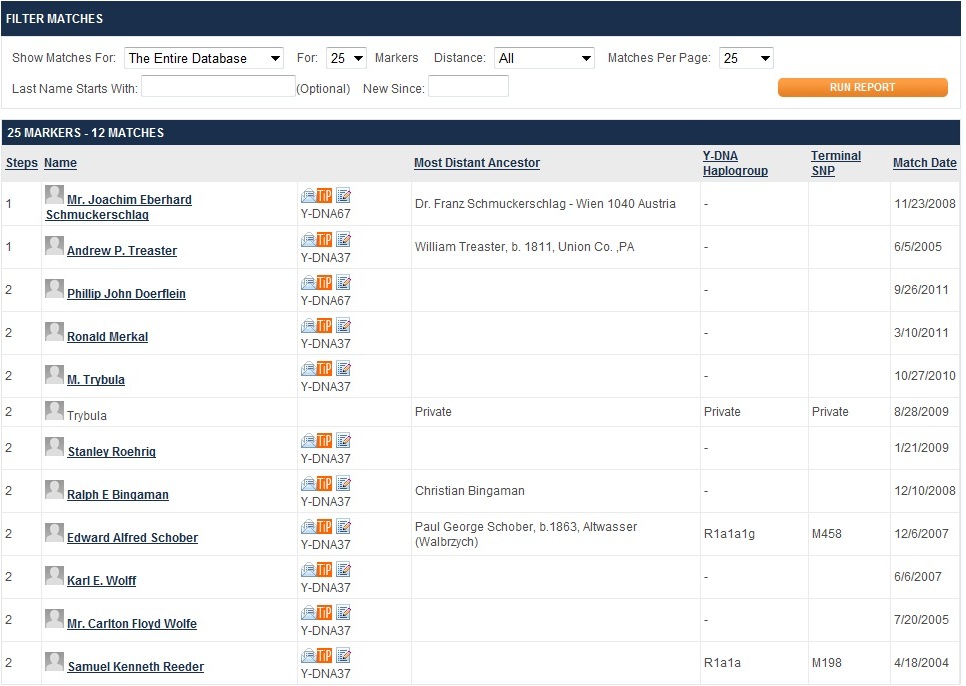
There are 4 markers that must be adjusted at Ancestry for Family Tree DNA results to be equivalent to the same markers at Ancestry.  In other words, the two companies “score” these markers differently.  Initially, you had to know this and compensate.  Then, Ancestry changed and began to do the compensation for you when you enter the results.  That was a definite improvement, but the result is that you have no idea if the results you are looking at are equalized or not.  The message here is that if you see an “*”, know to beware.
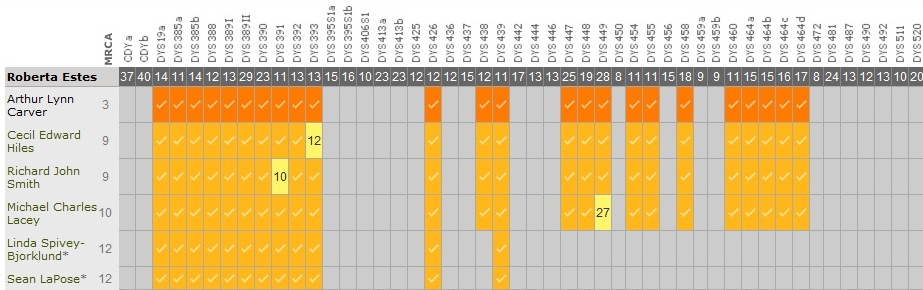
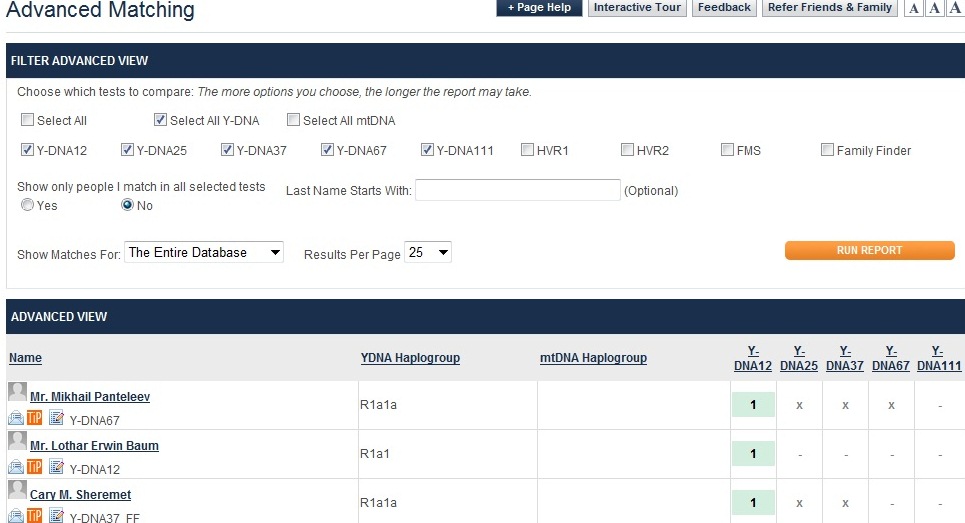
Furthermore, you can only have one set of results attached to your account, at least if you hand enter, and therefore if you want to check on matches for different relatives in your family, you need to edit the results from one person’s results to another.  In this case, you must do the compensation math on the markers yourself.  Fortunately, the list of markers is on the edit page, assuming people read, understand what to do and remember to adjust those values.

Advanced Matching

Family Tree DNA, in their last major update, added an advanced matching feature across their products that includes surname, partial name, project and combined tests matching.  This is an extremely powerful tool.  Ancestry has nothing similar.

Haplotrees

Family Tree DNA provides a haplotree.  Ancestry doesn’t test SNPs, so they have nothing to put on a haplotree. Family Tree DNA guarantees that if they can’t predict your haplogroup by an exact match at 12 markers to another individual who has been SNP tested, that they will SNP test, for free, until they can successfully tell you at least which base haplogroup you are a member of.  This test is called the Backbone test.  They seldom need to do this anymore, but I do still occasionally see the Backbone test where the individual’s marker values are very unusual.

You can tell that Ancestry has spent a lot of time making their user interface very friendly, and it is.  Some would refer to this as “dumbed down,” but regardless, haplotrees, SNPs, changing haplogroup names and all of that tends to be confusing, certainly to the novice.  Most of Ancestry’s customers fall into the novice category.  Ancestry’s marketing is directed at the impulse “feel good” purchase.  They do a good job catering to that marketspace and that group of consumers doesn’t have any idea what a SNP is, or that there is anything more than what Ancestry provides them.

Ancestry doesn’t have a haplotree and their customers don’t miss it, at least not until someone who has tested at Family Tree DNA gets ahold of them, they need something more or want to join a project at Family Tree DNA.  Fortunately, now Family Tree DNA does provide an option for Ancestry customers to “transfer in” for a reduced fee.

Haplogroup Origins

Haplogroup Origins is very powerful tool provided by Family Tree DNA and often overlooked.  Haplogroup origins are haplogroup matches, based on STR markers, that point the direction to where your ancestors lived before surnames.  This is invaluable in determining general locations for people trying to find their ancestors in Europe.

Ancestral Origins

Ancestral Origins is another extremely powerful tool provided by Family Tree DNA that is similar to haplogroup origins, but brings the match time closer to the present.  These are the locations of the oldest ancestors of people that match you on STR markers, not based on your haplogroup.  Again, extremely useful for people trying to find their ancestor’s location overseas and/or trying to verify a particular ethnicity, such as Jewish.

Matches Maps

Both Ancestry and Family Tree DNA offer a map of matches, but they are significantly different.

At Ancestry, the matches shown on the map are the current addresses of the people who tested, NOT their oldest ancestor.  Personally, I find this a bit creepy, as I really don’t want someone knowing where I live.  Having said that, it’s a wonderful tool for adoptees and I use this feature constantly looking for location matches for my adoptee clients.  Most recently, I found someone’s closest match genetically in the city where they were born.  That’s a big clue.  Matches are sorted in closest to furthest order and you can click on either the person icon or the name and see additional information on the map, such as the location, the name and how close the match is.

At Family Tree DNA, the matches shown are the locations of the oldest ancestors of the people you match.  This is really much more relevant to genealogists in general.  In addition, a match list can be displayed, and by clicking on either the person’s name, or a balloon, additional information is displayed including an e-mail option.  This is an extremely powerful tool for someone looking for geographic matches or trying to determine which matches to contact.

SNP Map

Family Tree DNA has a new SNP mapping feature.  Of course, Ancestry doesn’t have this, because they don’t test SNPs.  This new mapping feature allows you to map clusters of SNPS.  I selected clusters of 10 of R1a1-M198 just as an example.

This can be beneficial in tracking groups of haplogroup ancestors.  As haplogroups connect with more modern times, this tool will become more powerful and useful to the typical genealogist.

Print Certificates and Maps

Family Tree DNA has a print option for certificates and maps.  While this isn’t particularly important to me, it is to many.

Projects

At Family Tree DNA, aside from personal matches, much of the power of matching comes through projects.  Volunteer administrators lovingly manage these and many, many discoveries have been made through projects.

Family Tree DNA provides oversight so that projects aren’t created willy-nilly, and projects fall into 3 main categories, surname, haplogroup and geographic projects.

Surname projects are obvious, as are haplogroup projects.  Occasionally there are multiples in these categories.  For example, there is a Miller project and then I have a Miller-Brethren project for the Miller families who were of the Brethren faith.

Haplogroup projects often have subgroups studying particular SNPs or large subgroups, such as haplogroup E1b1a (Sub-Saharan Africa) and E1b1b (North Africa/Mediterranean), which are different projects.

Geographic projects are pretty much anything else.  My Cumberland Gap projects are there, both y-line and mitochondrial DNA, the Lost Colony projects, the Acadian project, Native American projects, the Bahamas and Puerto Rican projects, and many more.  Many times academic researchers and population geneticists work with these project administrators.

Projects are absolutely wonderful resources providing the opportunity to work with others who have similar interests to learn more about the people within your group.  For example, the Cumberland Gap group has provided a venue for genetic matching within the region, but we also offer a Yahoo group for project members where we share cultural and historical aspects of the Cumberland Gap area as well as genealogy.

While it is beyond the scope of this Y DNA comparison, Family Tree DNA also provides many tools to project administrators.

Family Tree DNA provides a search feature for projects that includes key words and surnames, plus an alphabetical browse, by category, shown above.  They also display a list of projects that include the surname of the person who is signed on and doing the search.  I was signed on when I did the above search, and you can see that there are 4 projects that include the surname Estes in their project profile, Estes, Jester and the Cumberland Gap Y-line and mitochondrial DNA projects.

In addition, Family Tree DNA provides a public webpage for every project that includes participant grouping capabilities, shown below, colorized matches within groups, and mapping.

Project maps can display the oldest ancestor location of an entire project or of any selected subgroup.

This is a very powerful tool, especially in relation to haplogroup maps.

At Ancestry, shown below, you can search for either groups or individual surnames.  The surname search is a useful tool.  I searched for Estes.  I can see that people by that surname have tested and their haplogroup, but I can’t see their results.  Of course, if I enter Estes marker results, by process of elimination, I can figure out who I do and don’t match from this list. To contact these people, I have to go through Ancestry’s message service.  My experience has been that few Ancestry contact requests are successful.

Unfortunately, at Ancestry, everyone is encouraged to “create a group.”  Anyone can join whether they have DNA tested or not.  It doesn’t matter if their DNA test is for a genealogy line relevant to the project, meaning paternal or direct maternal, and there is no oversight ability or control.  In essence, these are individual or family study groups, not DNA projects, per se.

I entered the surname Moore, one of my brick walls.  The number of “Moore” groups was overwhelming.  It’s clear from looking at these that many people have created what I would term personal family study groups, but sorting through them and trying to find something useful is overwhelming.  There were 25 groups including several who were listed as the Moore Paternal surname group, with 1, 2 or 3 participants in each.  The oversight provided at Family Tree DNA avoids this type of mess.

Compare this to the projects at Family Tree DNA that list the surname Moore.  Additionally, Family Tree DNA tells me that 824 people with the surname of Moore have tested.  Of those, 454 are in the Moore Worldwide project.  Yep, if I’m a male Moore, that’s where I’d want to be – where I can compare to other Moore lines.

Other Resources

On the Other Resources tab, Family Tree DNA has a list of several other resources, all free.  In addition, you can download a free e-book about how to interpret your results, or you can order a customized Personal DNA Report.  None of these additional items are available at Ancestry.

Populating DNA up Trees

One feature that Ancestry has that Family Tree DNA does not is the ability to populate the DNA up a tree.  Obvious pitfalls are twofold.  First, the DNA may not be relevant to people up the tree if a nonparental event has occurred, also known as an undocumented adoption.

Second, the genealogy may not be correct and you’ve just genetically populated the wrong people.  Not everyone views this “tree population” as a positive feature.  Many view this with a very high level of trepidation, understanding that the many incorrect trees at Ancestry will eventually also have incorrect genetic information as part of that family record.  There is also concern that in time, this will actually discourage DNA testing because people will find these DNA populated trees and believe that their line has already been tested, so they will think they don’t need to test.

Comparison Chart

As an easy comparison, I’ve created the following chart to compare the Y-line DNA testing and products.

Feature Family Tree DNA Ancestry
Marker Results Yes, 12, 25, 36, 67 or 111 markers Yes, 33 or 46 markers
Migration Map Yes – interactive Yes
Haplogroup Description Yes Yes
Haplogroup Frequency Map Yes No
SNP testing Yes, Individual SNPs, Deep Clade and Geno 2.0 No
Matching Yes, most distant ancestor listed, direct e-mail Yes, marker comparison provided
Haplotree Yes, includes free SNP Backbone test if haplogroup cannot be predicted No
Advanced Matching Yes, by surname, partial name, project and varying test combinations No, but does have general surname search for participants
Ancestral Origins Yes No
Haplogroup Origins Yes No
Matches Map Yes, location of oldest ancestors Yes, location of person who took the test
SNP Map Yes No
Print Certificates and Maps Yes No
Projects Yes, tools and oversight provided, surname, haplogroup and geographic, includes web page, groups and maps Yes, encourages everyone to create project, lack of organization and tools
Additional Resources Personal DNA Reports, free e-book, Multiple FAQs, Forum, Newsletter, Genographic Project, Glossary, Ysearch, Mitosearch, News, Release Notes, Academic papers, Annual Administrator’s  Conference, Mitochondrial DNA testing (full sequence), Autosomal DNA testing (with data download), Walk the Y (WTY) General FAQ, Mitochondrial DNA testing (no full sequence), Autosomal DNA testing (no data download), normal Ancestry subscription services, “ability” to populate DNA up trees


______________________________________________________________

Disclosure

I receive a small contribution when you click on some of the links to vendors in my articles. This does NOT increase the price you pay but helps me to keep the lights on and this informational blog free for everyone. Please click on the links in the articles or to the vendors below if you are purchasing products or DNA testing.

Thank you so much.

DNA Purchases and Free Transfers

Genealogy Services

Genealogy Research

To SNP or not to SNP??

I received an e-mail the other day from someone who had been asked to take a SNP test by their project administrator.  What they asked me was, “Why would I want to do this and what’s in it for me?”  Seems like a simple enough question, but not exactly.

The quick answers are twofold:

  1. It further defines your haplogroup and…
  2. You can participate in science research.

Unfortunately, this just leads to the next question, “Why do I care?”

So here’s the longer but more accurate answer….and by the way…when you’re done reading this, you’ll understand why it matters, personally, to you.  And you’ll probably want to order a SNP test or two.

I’m going to use the haplogroup E project for an example.  I’m a co-administrator of the project, along with two other individuals, one of which is a population geneticist.  I am very, very grateful for Aaron’s interest in the project.

As project administrators, we feel that it’s our responsibility to group people within the project in a way that is both helpful to them and to scientific research.  Fortunately, these goals do not conflict and are one and the same.

The haplogroup E1b1a, which is the core haplogroup of this project, as opposed to brother haplogroup E1b1b, is defined by a series of SNPs.  Each letter and number after the initial E is defined by a SNP.  So each additional letter or number makes the resulting haplogroup more specific.  More specific means more granular in both geography and time when the haplogroup, and subgroups, were born.

  • Haplogroup E, itself, is defined by L339 and 10 more “equivalent” SNPS
  • E1 is defined by P147
  • E1b is defined by P177
  • E1b1 is defined by P179 and 4 more equivalent SNPs
  • E1b1a is defined by M2 and 9 more equivalent SNPs

In the haplotree, there was a big split between E1b1a, which is Sub-Saharan African and E1b1b, which is North African/Mediterranean, known colloquially as the Berber haplogroup.  Therefore, two separate projects make sense.

The project is officially known as the E1b1a-M2 project.  M2 is what is known at the “terminal SNP,” meaning the one furthest down the tree that defines E1b1a.

On the haplotree above, you can see the lighter green M2+ SNP that was tested to confirm that this person was indeed in haplogroup E1b1a.  The plus means that they have the SNP.  If they didn’t have this SNP, then they would not be in this subgroup of haplogroup E1b1.

The orange SNPs listed below the E1b1a branch, on the haplotree above, are all of the SNPs available to be tested to see if you are in those haplogroup subgroups.  Want to know which branch is yours?  If so, then now you know why you’d want to test.

Let’s look at the project map to see why you might want to determine a subhaplogroup.

The map below shows the entire E1b1a project with all of the participants.

Do you see all of those people in the Americas?  Well, those are participants who are people of African heritage who very much would like to see their balloon in the African continent, not on the shores of the Americas.  The only way to determine where these people originated in Africa is to do the research that will connect the dots genetically, because we can’t do it via paper records, to where their ancestors lived in Africa.

In order to do this, people need to take SNP tests for specific markers so that their results can be correlated with African groups.  Tests for individual SNPs are only $29 each, so really quite inexpensive for the benefit you, and science, receive.

Aaron, the haplogroup E1b1a geneticist, has divided the participants into groups, and using his expertise, has determined which individual SNPs are the most beneficial.  A Deep Clade test is $139, but generally, Aaron can tell which subgroup people are likely to fall into, so he requests just a SNP or two.  You can test a lot of individual SNPS for $139.  Additionally, sometimes Family Tree DNA makes SNPs available for research testing that are not on the price list yet, and the only way to get these tested is via what is called “boutique testing,” where you order one at a time, through the haplogroup administrator.

When Aaron sees someone who would benefit from this kind of test, he e-mails the person and asks them if they will take the specific SNP test.

Let’s look at an example.

We have a very, very interesting situation where we have a man whose ancestral line is confirmed to be from Austria.  This is highly unusual, as E1b1a is very clearly African and is seldom to never found in Europe ancestrally.  However, this genealogy is well documented.

You can see on the above map that Aaron has grouped a number of people together whose DNA has similar characteristics, meaning groups and values of markers.  He wants all of these people to take specific SNP tests, which you can see on the drop down box as the title of the group.  This is standard practice for haplogroup project administrators.

On the map, you can see where these participants’ oldest ancestors are found. One in Austria, one in Africa and the rest in the Americas who are brick walled.

This map shows project participants.  In order to look at where the research papers place these people ancestrally using genetic information, we need to use a different tool.

We don’t know the African location origins of this particular group of people, which is why these SNP tests are so critically important.  We need to match them in research data bases with other people who have these same SNPs.

Let’s look at the haplogroup origins of someone within a different subgroup of E1b1a who is also brickwalled in the US. Shown below is the Haplgroup Origins chart from their personal page, showing their matches.

You can see that several haplogroup matches, progressively more detailed (E1b1a to E1b1a7 to E1b1a7a3), have origins in Africa.  The more detailed your SNP test, the more detailed your haplogroup, the more detailed and specific your location can and will be, if not today, then eventually.

You can see above that this person, who has only tested to the E1b1a level, matches an E1b1a7a3 individual who is from the Bakola Pygmy tribe in Cameroon.   If this person were to take the SNP tests, they would know if they too are haplogroup E1b1a7a3.  If so, there is a very good possibility they too are a descendant of the Bakola Pygmy tribe in Cameroon. This is extremely powerful information for someone searching for their roots – the Holy Grail of genetic genealogy.  But they will never know if they don’t SNP test, either by individual SNPs ($29 or $39 each) or the Geno 2.0 test ($199).

If you’re lucky, the research on your particular SNP location in Africa has already been done.  But you’re never too late to this party, because as new SNPs are discovered, there are always new opportunities to test.  That’s the ying and the yang of pushing the frontiers of science.

We are REALLY fortunate, because we live in a time where we can be participants in scientific discovery that not only helps us find your our own ancestors, but helps many others who are brick walled with no other hope of finding their ancestral homeland.  This doesn’t just apply to the African haplogroups, but to all haplogroups.  This is exactly how the revolutionary discoveries of the past few months and years that led to the new Geno 2.0 test came about.  One person and one SNP test at a time.

Want to find your ancestors AND make science happen???  SNP test!

This is a companion article to Where is my Haplogroup From?

______________________________________________________________

Disclosure

I receive a small contribution when you click on some of the links to vendors in my articles. This does NOT increase the price you pay but helps me to keep the lights on and this informational blog free for everyone. Please click on the links in the articles or to the vendors below if you are purchasing products or DNA testing.

Thank you so much.

DNA Purchases and Free Transfers

Genealogy Services

Genealogy Research

Where is my Haplogroup From?

This is a very common question.  The answer can be as simple as a Wiki search, or a little more complex, but offering a much more personal answer.

First, if you have not joined a haplogroup project relevant to your haplogroup, do so.  This applies to both Y-line and mitochondrial results.

We discussed how to do this in the “What Project do I Join?” post.

Joining haplogroup projects does two things.  First, it provides you with a group of “like people,” who have common ancestors with yours.  Second, it provides the project administrators with DNA sequences to work with.  It’s that “working with” part that will play an important part in the answer to this question.

If you’ve already looked at Wiki, and you’re ready for more, you can take a look at your personal page.  At Family Tree DNA, both the Y-line and mtDNA have a haplogroup Migration Map option.

Clicking on this option shows you the migration map for your haplogroup.

Clicking on the Haplotree option, and scrolling to the bottom, you’ll see a link for the Haplogroup FAQ, right under the “about my haplogroup” verbiage.  The FAQ holds lots of information about haplogroups, how they are determined and such.

For Ancestry customers, your haplogroup description is at the top of the “View Results” page.

Clicking on the “learn more” provides you with an additional paragraph or so.

Note: Ancestry no longer has Y or mitochondrial DNA testing at all.

Ancestry does not have haplogroup projects, SNP testing, or additional haplogroup tools, so the rest of this will refer only to Family Tree DNA clients.

Let’s now turn to the haplogroup projects.  The most personal answer to the question, “where did my haplogroup come from” will come from within haplogroup projects.

How haplogroup administrators handle projects varies, based on their level of involvement, interest and experience of the administrator or administrators.  And remember, we are all volunteers.  Having said that, these people do an amazing and incredible job.

Family Tree DNA provides a mapping function, for free, along with their other project administration tools, for haplogroup projects.  If a project doesn’t have a map available, then it’s because the administrator chose not to opt for the map when setting up the project.

I’m using the haplogroup R1a1a project as an example.  It’s well organized, grouped by haplogroup and many people fall into this haplogroup.   The various options for viewing haplogroup projects are listed on the top bar within the project.

Clicking on the “classic” options shows you the various groups that the administrator has created, and how they have grouped individuals within the project.

By searching for you kit number, you can find the group you’ve been assigned to.  Note that if the project extends over more than one display page, you may need to search on subsequent pages as well. You can also change the number of results displayed per page in the “page size” box at the top.

Depending on the project, administrators group participants differently.  Some projects group people by geographic location.  Most Y-line projects group them by haplogroup subgroup, or SNP, plus groups of STR markers within SNP groups.  The SNP (single nucleotide polymorphism) is the location that is tested to see if you are a member of a haplogroup, or haplogroup subgroup.  Your terminal SNP is the one furthest down on the tree that provides you with the most resolution as to where your ancestors were located.  Your individual markers further refine SNP groupings.

Let’s look at the maps.

Projects have the option of displaying the location of the oldest ancestor.  Of course, this means that each participant will need to have entered the geographic location of their oldest ancestor on the Migrations Maps tab on their personal page.  This is critically important for haplogroup project mapping, because without the locations of oldest ancestors, there is no way for your results to appear on the map.

To see all of the project participants on a map, click on “Map” and then in the dropdown box, select “all.”

In the R1a1a project, the “all” selection shows the following map.  This is the answer to the question “where did my haplogroup come from.”

However, a much more personal answer to that question lies in the subgroups.  The haplogroup R1a1a project has grouped participants by SNPs and has given the resulting clusters identification names.  Let’s assume that your kit is listed in the group A1 which they’ve defined as Z283+, M458+, L260+ and named the “West Slavic Subcluster ‘A’” – all listed in the group title for this subgroup on the map selection.  The numbers, Z283+ indicate the SNP name and the plus or minus indicates that the people in the group have tested that location, and if they have it (+) or not (-).  If the administrator does not clearly define how they’ve identified the subgroups, then you’ll have to contact them directly.  Every administrator runs their project differently.

The map for this subgroup clearly shows where these participants’ ancestors are found. If you are in this group, this means that these people share a common haplogroup ancestor with you, some hundreds to thousands of years ago, depending on the haplogroup subgroup age.  This is the personal level of the answer to the question “where did my haplogroup come from.”

I hope this has given you several different methods to answer the question, “where did my haplogroup come from?”

I also answer this question for clients, in context of their own ancestry and family history, when writing their Personal DNA Reports.

This is a companion article to “To SNP or not to SNP.”

______________________________________________________________

Disclosure

I receive a small contribution when you click on some of the links to vendors in my articles. This does NOT increase the price you pay but helps me to keep the lights on and this informational blog free for everyone. Please click on the links in the articles or to the vendors below if you are purchasing products or DNA testing.

Thank you so much.

DNA Purchases and Free Transfers

Genealogy Services

Genealogy Research