Concepts – Y DNA Matching and Connecting with your Paternal Ancestor

Recently, I received a question about exactly how and why we can use Y DNA to identify or connect with a patrilineal ancestor.

“I do not quite understand how the profiles can be identified specifically to an ancestor since that person is not among us to provide DNA material for “testing” and comparison.”

That’s a great question.

Let’s look at the answer in steps.

Males Inherit the Y Chromosome from Dad

First and foremost, and the most important part of using the Y chromosome for genetic genealogy is understanding that the Y chromosome is passed from father to son without any DNA being incorporated from the mother. So, in essence, the Y chromosome is passed intact.

In most western cultures, the surname is passed utilizing the same inheritance path, so the Y DNA and the surname are passed along together – hence Y DNA projects are often called surname projects. If the Y DNA is passed from father to son, without any unexpected nonpaternal events or adoptions in the mix, then the surname and the Y DNA will match since the advent of surnames in the culture where the original ancestor that adopted that surname was born.

Let’s look at England for example. Often people there adopted surnames after the Norman invasion (1066) and by the 1200s, most people had surnames.  Of course, there weren’t a lot of records for normal working-class people at that time, but by the time church and parish records started to be more reliably kept, in the 1580s, give or take, surnames were well established and everyone had one.  John who lived on the green was now John Green and John who lived by the brook was now John Brook.  Their sons took their surnames upon birth in a traditional marital relationship.

Y and mito

Therefore, the Y chromosome is passed from male to male, father to son, forever, illustrated by the blue squares in the pedigree chart above…with the Y DNA almost entirely intact.

Mutations Happen – Whenever

Did you catch that word, “almost?”

Yea, it’s a “gotcha” word, but it’s also why genetic genealogy works. If it weren’t for occasional mutations, all of the Y DNA would be exactly the same, and not at all useful for genealogy.  Thankfully, that’s not the case.

From time to time, a mutation occurs as the DNA is passed from father to son.  We see the results of this inheritance and mutation pattern in the DNA markers we test for genetic genealogy.

The markers we typically use for genetic genealogy are called STR, Short Tandem Repeat, markers. They are the 12 marker, 25, 37, 67 and 111 marker panels tested by Family Tree DNA.

These types of markers mutate more rapidly than the other type of Y DNA markers typically used to determine haplogroups, known as SNPs, Single Nucleotide Polymorphisms.

STRs and SNPs

There are two primary differences between STRs and SNPS relative to genealogy.

The first difference is that STR mutations are what I call stutter or repeat mutations. Think of a copy machine that got stuck.  Let’s say your DNA at a location, meaning at a specific marker, looks like this: “TAGA.”  However, when the copying of that DNA for the next generation was done, 20 or 30 or 40 generations ago, long ago in a faraway place, the copy mechanism got stuck and now you have 5 “TAGA”s in a row, so “TAGATAGATAGATAGATAGA.”  Now you have a value of 5 instead of a value of 1 in that marker location.

SNP mutations, on the other hand, occur at one location and are defined by one of the nucleotides, T, A, C or G that live in that location getting swapped for a different nucleotide. So, now, at that particular address, T becomes C.  That’s a single nucleotide polymorphism and those changes are how haplogroups and their branches are formed.  If you are interested, you can read more about haplogroups and how they are born here.

In addition to switches between nucleotides, you can also have insertions of DNA and deletions of all DNA where the value becomes 0, but for now, let’s leave it at STRs and SNPs. I wrote a detailed article about SNPs and STRs here.

Oh yes, and as one final bad joke, the mutations, occasionally, revert back – that’s called a back mutation. I know, it’s a really bad joke, meant, I’m sure to confound genetic genealogists.  And the only way you’re ever going to discover a back mutation is through known genealogy when you see it occur in a line.  Just remember, mutations can happen anytime they want to – on any marker – in either direction – and sometimes in increments of more than 1.  So, a marker value can go from 10 to 12 in one event, for example.

Some STR markers are more prone to mutations than others, and those are known as slow or fast moving markers.

STR fast and slow

The project pages color code each marker in the column header as to its known characteristics relative to mutation speed.

STR color legend

The legend above, from the Family Tree DNA Learning Center provides the color coding for the column header values.  Fast in any group = red.

The second difference between STRs and SNPs is that STR mutations happen more frequently than SNP mutations, making them useful in a genealogically relevant timeframe, where SNPs happen much less frequently, and are therefore utilized to determine and identify haplogroups and haplogroup branches, meaning deeper genealogy, generally before the adoption of surnames.

Having just said that, the timeframe of SNPs and STRs is beginning to overlap, but STRs are still the gold standard of genealogy testing to compare men born within the past few hundred years, especially with a common surname.

In genealogy testing, you always start with STR testing and then progress to SNP testing, if you wish.

Marker Comparisons

So, let’s take a look at how STR marker comparisons work in a hypothetical example.

Let’s say, for example, that we have 6 sons of Abraham Estes who died in 1712. Descendants of those sons have tested their Y DNA and sure enough, they have some mutation differences between them.  This would be expected in the 7-9 generations between when Abraham lived and the current generation testing.

Let’s say that all 6 of Abraham’s sons matched his STR markers exactly back then, but in the 7-9 generations between Abraham and the present day testers, one mutation has occurred in each of 4 lines on a different marker. Two of his son’s lines have not had any mutations at all.

Of course, we don’t know this before we evaluate the DNA. It’s the marker values themselves that will inform us about Abraham’s DNA.

STR mismatch example

In our example, Abraham’s six sons’ lines tested, as shown above. All of their markers match each other, except one marker in each of 4 mens’ tests, highlighted in yellow above.

How do we know those are mutations? Because the majority of the results from the other sons lines are all the same.  Therefore, we can utilize the DNA of the 6 different son’s lines to determine the DNA of Abraham at each one of those different marker locations.  So, let’s reconstruct Abraham’s values for these markers.  Isn’t this fun!!!

STR Abraham reconstruction

The green row at the bottom is reconstructed Abraham. We know the value of each marker based on the common values of his sons’ lines.  The only place the sons and their descendants could have gotten that DNA was from Abraham, the common ancestor of all of these 6 men.

So, with marker 393, all 6 sons lines have a value of 13, so Abraham had to have a value of 13 as well.

On marker 19 (394), all the different sons lines, except one, Elisha, had a value of 14, so Abraham’s value was 14 and Elisha’s line in a generation someplace between Abraham and the current tester has developed the mutated value of 13.

Line Marker Mutations

It’s possible that some of these markers are known as or can function as “line marker” mutations – identifying specific son’s lines. Let’s say, for example, that a mutation occurred between Abraham and Moses at location 426 such that Moses has a value of 11.  That means that every one of Moses’s sons would have had a value of 11 at 426, as opposed to the value of 12 present in Abraham’s other sons at that marker.  Therefore, if someone tests who doesn’t know which of Abraham’s son they descend from, and they have a value of 11 at 426, I’d start by looking at Moses.  That isn’t to say that same mutation couldn’t have happened in another line too, but Moses is still a good place to begin since we know his line has 11 at 426.

Of course the only way to learn that information about Moses, positively, is to find men who descend from each of his sons and recreate Moses in the same way we recreated Abraham.

What About False Paternity?

Let’s say that an Estes male who had an undocumented adoption occur 3 or 4 generations upstream in his Estes line tests – and he is entirely unaware that an “adoption” happened. I define an undocumented adoption in this context, also known as a nonpaternal event (NPE) or false paternity, as any event that causes the surname of record to be different than the biological surname.  The biological surname is that of the man who contributed the Y DNA.  These events, although often thought of negatively are sometimes very positive and loving – such as adoption.  Of course, some are less positive, but one can’t assume in either direction without evidence.  In my experience the most common historical reasons for a mismatch between surname and biology is that a child took his step-father’s surname or that the child was born out of wedlock and took their mother’s surname.

Reasons for a mismatch between surname and biological paternal lineage can be:

  • Adoption (contemporary or historical)
  • Sperm donor
  • Stepson taking step-father’s surname
  • Mother pregnant outside wedlock and child takes mother’s surname
  • Name change
  • Accepted multiple intimate partners (think wife-swapping or polygamy)
  • Culturally ignored multiple intimate partners (think slavery)
  • Infidelity
  • Rape

Let’s say in our example that our tester’s ancestor was born to an Estes female out of wedlock.  The illegitimate child took the mother’s Estes surname – but carries the Y chromosome of his father whose surname is not Estes. Today, several generations later, the tester carries the Estes surname handed down to him through several generations of Estes males, so his presumption, of course, is that he also carries the ancestral Estes Y DNA.  But he, ahem, doesn’t.

His test results come back and the first clue is, of course, that he doesn’t match any Estes men on his results page. He reaches out to me as the Estes project administrator, and I compare his results with Abraham to see how distant his results really are.  And the answer is….drum roll…pretty darned distant.  His results are shown in the row below green Abraham.

STR false paternity

As you can see, when compared to reconstructed Abraham, it’s quite obvious that the new Estes tester is biologically not an Estes on his Y DNA. In fact, he has a genetic distance of 7 out of 12 markers, so very clearly not a match.

How Many Mutations Is Too Many?

Family Tree DNA has set up Y DNA matching thresholds at levels that include relevant matches and exclude non-genealogically relevant matches.  For someone to be listed as your match, they need to have no more than the following total number of mutations difference from your results on any given panel.STR Match mutations

Depending on where your mutations fall, in which panels, you can have too many mutations to match at 25 markers, for example, but match at 37 or 67 because more mutations are allowed, and your mutations just happened to fall in the first panel or two.

The number of mutations allowed is the same as genetic distance.

What is Genetic Distance?

You’ll notice on the Y DNA matches page that the first column says “Genetic Distance.”

STR genetic distance

Many people mistakenly assume that this is the number of generations to a common ancestor, but that is NOT AT ALL what genetic distance means.

Genetic distance is how many mutations difference the participant (you) has with that particular match. In other words, how many mismatches in your DNA compared with that person’s DNA.  Looking at the example above, if this is your personal page, then you mismatch with Howard once, and Sam twice, etc.

Counting Genetic Distance

Genetic distance, however, can be counted in different ways, and Family Tree DNA utilizes a combination of two scientific methods to provide the most accurate results. Let’s look at an example.

In the methodology known as the Step-Wise Mutation Model, each difference is counted as 1 step, because the mutation that caused the difference happened in one mutation event.

STR genetic distance calc

So, if marker 393 has mutated from 12 to 13, the difference is 1, so there is one difference and if that is the only mutation between these two men, the total genetic distance would be 1.

However, if marker 390 mutated from 24 to 26, the difference is 2, because those mutations most likely occurred in two different steps – in other words marker 390 had a mutation two different times, perhaps once in each man’s line.  Therefore, the total genetic distance for these two men, combining both markers and with all of their other markers matching, would be 3.

Easy – right?  You know this is too easy!

Some markers don’t play nice and tend to mutate more than one step at a time, sometimes creating additional marker locations as well.  They’re kind of like a copy machine on steroids. These are known as multi-copy (or palindromic) markers and have more than one value listed for each marker.  In fact, marker 464 typically has 4 different values shown, but can have several more.

The multiple mutations shown for those types of multi-copy markers tend to occur in one step, so they are counted as one event for that marker as a whole, no matter how much math difference is found between the values. This calculation method is called the Infinite Alleles Mutation Model.

str genetic distance calc 2 v2

Because marker 464 is calculated using the infinite alleles model, even though there are two differences, the calculation only notes that there IS a difference, and counts that difference as having occurred in one step, counting only as 1 in genetic distance.

However, if one man also has one or more extra copies of the marker, shown below as 464e and 464f, that is counted as one additional genetic distance step, regardless of the number of additional copies of the marker, and regardless of the values of those copies.

STR genetic distance calc 3 v2

With markers 464e and 464f, which person 2 carries and person 1 does not, the difference is 17 and the generational difference is 1, for each marker, but since the copy event likely happened at one time, it’s considered a mutational difference or genetic distance of only 1, not 34 or 2. Therefore, in our example, the total genetic distance for these men is now 5, not 8 or 38.

In our last example, a deletion has occurred, which sometimes happens at marker location 425. When a deletion occurs, all of the DNA at that location is permanently deleted, or omitted, between father and son, and the value is 0.  Once gone, that DNA has no avenue to ever return, so forever more, the descendants of that man show a value of zero at marker 425.

STR genetic distance calc 4 v2

In this deletion example, even though the mathematical difference is 12, the event happened at once, so the genetic distance for a deletion is counted as 1. The total genetic distance for these two men now is 6.

In essence, the Total Genetic Distance is a mathematical calculation of how many times mutations happened between the lines of these two men since their common ancestor, whether that common ancestor is known or not. In fact, we use genetic distance as part of our calculations to attempt to discern when that common ancestor lived, if we don’t know who he was.

One of the reasons that mutational difference (genetic distance) is important is because the TIP calculations utilize the number of mutation events, and the estimated time between mutation events, to determine the range of dates and confidence levels for the time to the most recent common ancestor (MRCA) calculations between any two matching men.

Please note that on July 26, 2016 Family Tree DNA introduced changes in how the genetic distance is calculated for some markers to be less restrictive.  You can read about the changes here.

How Often Do Mutations Happen?

A very common question about STR mutations is “how often do mutations happen?”

A mutation can happen any time. I have seen 2 mutations between a confirmed father and son, and I have seen 8 generations elapse with no mutations.  So, in essence, mutations happen whenever they darned well feel like it.  In reality, the time between mutations varies widely, but we can calculate the average and utilize that number.

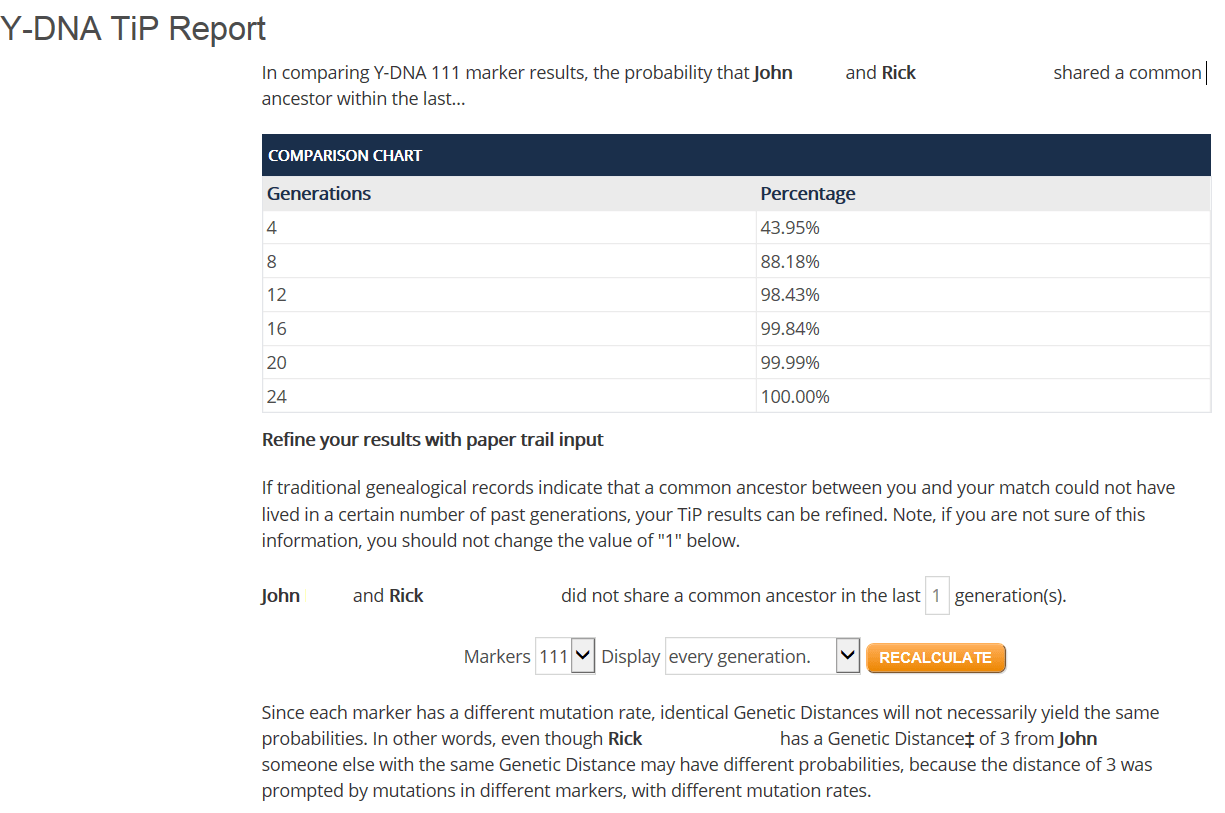
Family Tree DNA provides us with an estimation tool, called the TIP calculator. You can see the orange “TIP” icon listed with each match below.

STR TIP

You use the calculator to compare the results of any two men who match each other to estimate the probability of when they shared a common ancestor.

STR TIP input

The TIP calculator estimates number of generations at various confidence levels between any 2 matching men. However, please keep in mind that the TIP calculator has to use statistical averages, which is equivalent to “one size fits all.”  In truth, one size doesn’t fit anyone particularly well, and some people not at all,  but it’s the best we can do.

STR TIP output

In this case, these two men being compared are 3 mutations different at 111 markers, and they are proven genealogically to be 8.5 generations apart, counting the parent as generation 1, and counting Abraham Estes as generation 8 for one man and 9 for the other.

So, you can see, at the 50th percentile, where statistically you are as likely to be incorrect in one direction as the other, the estimate is about 4.5 generations.

The TIP calculator is sometimes very accurate, and sometimes not so much. It’s a tool, not a crystal ball.  Don’t we wish we had that crystal ball…oh yes…and a time machine too!!!

In Summary

Utilizing Y DNA to compare your family’s Y DNA to others is a wonderful genealogical tool. DNA testing is becoming an expected part of the Genealogical Proof Standard, an integral part of a “reasonably exhaustive search.”

You can prove, or disprove, your lineage. You can find your biologically accurate line.  You can combine the results of several descendants to recreate your ancestor, and then identify line marker mutations that will help other testers in the future identify their lineage.  You can test even further, if you want, and explore all of the possibilities of deep ancestry.

Furthermore, having reconstructed your ancestor, when you do finally hit that “Holy Grail” and a male who lives in the small village overseas where your ancestor originated tests his DNA – and matches your ancestral DNA values – you’ll know that the match is genuine – and you can claim them as “yours.”

Even though Y DNA testing can only be performed on males, because only males carry the Y chromosome, females can most certainly participate by recruiting appropriate males and sponsoring tests on their ancestral lines. Lack of a Y chromosome doesn’t stop anyone, just maybe slows you down for just a tad!

Have fun, enjoy, test your Y DNA lines, contact your matches and make your ancestor come alive once again through the legacy of what your ancestor left to you…their, now your, DNA.

______________________________________________________________

Disclosure

I receive a small contribution when you click on some of the links to vendors in my articles. This does NOT increase the price you pay but helps me to keep the lights on and this informational blog free for everyone. Please click on the links in the articles or to the vendors below if you are purchasing products or DNA testing.

Thank you so much.

DNA Purchases and Free Transfers

Genealogy Services

Genealogy Research

Philip Jacob Miller (c1726-1799), Buried on a Missing Island?, 52 Ancestors #119

Philip Jacob Miller was born about 1726 in Germany to Johann Michael Mueller, spelled Miller here in the US, and Suzanna Agnes Berchtol (Bechtol, Bechtel) and was an infant or child when arriving in the colonies in 1727.

We don’t know exactly when Philip Jacob was born, but we do know he was born before his parents immigrated because he was naturalized in 1767, and had he been born after immigration, he would not have needed to be naturalized.  We also know that his parents were married in 1714 in Krotelback (Crottelbach), Germany, with their first child being baptized in the same church in 1715, so by process of elimination, Philip was born sometime between 1716 and 1727.

Philipp Jacob is a bit unusual, because parts of his life are virtually unknown, but others are well documented. His early life we can only infer because of what little we know of his parents.  His life after marriage and moving to Frederick County, Maryland is fairly well documented, comparatively speaking, but his final years in Campbell County, KY are a bit fuzzy.  He sort of drifts into and out of focus.

Philipp Jacob Miller was also somewhat unusual in another way too – in that he never seemed, with only a couple possible exceptions, to use solely his middle name, always using both his first and middle names.  Typically German men were called by and known by their middle name alone – for example Johann Michael Miller was Michael Miller.  That was unless their name was Johannes Miller, with no middle name, and then they would just have been called Johannes, or John.  Normally, Philipp Jacob Miller would be called Jacob, but Philipp Jacob wasn’t called Jacob – although when we see a Jacob I always have to wonder.  We can simply say that Philipp Jacob wasn’t your typical Brethren man and that would probably sum things up pretty nicely.  He seemed quite religiously faithful, except for these “tidbits” that creep up here and there – just enough to hint otherwise and make you really scratch your head and look confused.

Philip Jacob’s Childhood

Philip Jacob Miller would have spent the first part of his childhood after arriving in the colonies in Chester Co., PA where his father paid taxes until about 1744 when he bought land near Hanover, Pennsylvania, in the part of Lancaster County that would become York Co., PA in 1749. By 1744, Philip Jacob would be a young man of at least 18, perfectly capable of farm work and the manual labor required to wrest a living from the land.  Perhaps he drove one of the wagons as the family packed up and moved to the Brethren community near Hanover, PA in 1744 where his father bought land jointly with Nicholas Garber and Samuel Bechtol.

Philip Jacob’s wife, Magdalena

Philip Jacob Miller married Magdalena whose last name is stated to be Rochette, about 1751, probably in York County, PA.  Let me be very clear about one thing.  There is absolutely no confirmation or documentaion for her surname, despite hundreds of entries on Ancestry.com and other online resources that suggest otherwise.  I thoroughly perused the Frederick County, MD records and there are no Rochette’s or similar surnames there.  York County, PA records need to be reviewed in their entirety as well, but it would be very unusual to find a French surname in the highly German Brethren congregation.  There are no Rochette deeds in York County from 1749 forward and no Rochette records in any Brethren church reference.  I found no Rochette names in the Lancaster County records either, although I have not perused every record type.  Until or unless proven otherwise, I do not believe that Magdalena’s surname was Rochette.

Frederick County, Maryland

Philip Jacob moved to the Conococheague area (Frederick, then Washington Co., MD) by about 1751 or 1752 when an entire group of Brethren migrated from York Co., PA following years of bickering about land ownership and border disputes that turned violent and was subsequently known as the Maryland-Pennsylvania Border War and also as Cresap’s War.

PA-MD boundary issue

Brethren, being pacifists, tried to remain neutral but eventually, simply sold out and left for an area they thought would be safer and less volatile. Little did they know about what the future would hold.

The first Brethren, Stephen Ullerich, by 1738, and Philip Jacob’s father, Michael Miller, by 1745, had crossed into the Antietam Valley and Conococheague Valley (either side of Hagarstown) and purchased land.

Philip Jacob Miller is one of 3 confirmed children of Michael Miller as proven by a series of deeds and surveys to property called Ash Swamp near Maugansville in Frederick County, MD, northwest of Hagerstown. Philip Jacob obtained this land in October of 1751 from his father who had clearly purchased it speculatively in 1745.

In 1753, Philip Jacob Miller had his land resurveyed.

Miller 1753 Ash Swamp resurvey crop

This land, Ash Swamp positively belongs to “our” Philip Jacob Miller, although there is another survey (and resurvey) for one Jacob Miller for 50 acres on “The Swamp” adjacent Diamond Square. Is that our Philip Jacob Miller too?  We don’t know – it’s that ambiguous Jacob name again.  Ash Swamp is definitely our Philip Jacob as is later proven through subsequent transactions.

1753 Ash Swamp resurvey 2

1753 Ash swamp resurvey 3

Ash Swamp is where Philip Jacob Miller lived, adjacent to his brother John Miller to whom he deeded part of Ash Swamp.

Miller page 27

The resurvey documents were plotted on top of a contemporary map to isolate the location just southwest of Maugansville.

Miller farm west 3

I visited Philip Jacob’s land in the  fall of 2015.  This view of the area is from the location of the Grace Academy school, just about dead center in Philip Jacob’s land, looking west. This land is discussed in detail in Johann Michael Miller’s article.

The third brother, Lodowick purchased adjacent land to the south.

Lodowick's land

Sometime between 1748 and 1754, Philip Jacob’s mother died because his father remarried to the widow of Nicholas Garber, the man that he co-owned land with in York County, PA. We know this because in 1754, Michael Miller was administering the estate of Nicholas who had died in 1748, implying of course that Michael’s wife, Philip Jacob’s mother, Susanna Berchtol, had died as well, probably in that same timeframe.

We know very little about the years between the resurvey of Ash Swamp in the early 1750s and 1771 when Philip Jacob’s father died. Most of what we do know is due to a history of the area and not from the family directly.  However, when a war is being waged where you live and the entire county evacuates, you can’t not be affected.

Philip Jacob Miller, along with the rest of the residents of this region would have abandoned their farms for safety, twice, as difficult as that is for us to fathom today. The first time was in 1755 when General Braddock was defeated and the Indians descended on this part of Maryland, burning, killing and running the residents off of their farms and back east.

Based on the resurvey document, we know that the surveyor was working on May 15, 1755 in Frederick County, surveying Philip Jacob’s land, and you can rest assured that Philip Jacob was right there with him, watching every move.

Braddock was defeated on July 9, 1755, less than two months later, leaving the entire frontier exposed.

From 1755 to 1757, Alfred James writes, “Raid after raid from Fort Duquesne hit pioneer settlements along the Susquehanna and the Potomac.” It was unending and relentless. Another reports that “Frederick, Winchester and Carlisle became the new frontiers of the colony” and “Many even fled to Baltimore,” and “some to Virginia.”  Arthur Quinn writes that families went as far east as Bethlehem “where there was no more room in the inns, or the shops or even the cellars.”  Nead writes, “Terror and desolation reigned everywhere.” Repogle 106

In the fall of 1756, Indians scalped 20 people in Conococheague including one Jacob Miller, his wife and 6 children. Were they related?  We don’t know.  If they were Brethren, they would not have defended themselves.

Most settlers fled east from Monocacy. George Washington received a report in the summer of 1756 that “350 wagons had passed that place to avoid the enemy within the space of 3 days” and by August the report was that “The whole settlement of Conococheague in Maryland is fled, and there now remain only two families from thence to Fredericktown…..”

The settlements remained abandoned in 1757 and into 1758 when General Forbes actions served to end the war. Were it not for Forbes, we might all be speaking French today.

In 1758, General Harris extended a road from Harrisburg, PA to Fort Duquesne on the Ohio River (Pittsburg.) Highway 30 follows this road most of the way today. Replogle 55

Forbes road went from Cumberland to Bedford and by August 1758, 1400 men had completed the road to Bedford, just wide enough to get a wagon through. A contemporary writer said it took 8 days to travel from Bedford to Ligonier, a distance of about 45 miles.  This military tactic succeeded.  General John Forbes took Fort Duquesne, now Pittsburg, the French abandoned it, and ended the French and Indian War on November 25, 1758.  Indian attacks diminished and by 1762, the French had given up Canada.  Replogle 107-108, 110

Forbes Road

There is one item of particular significance – during the war, a small fort was built at Raystown, which would eventually become Bedford, PA, a location that would, in the 1770s, become quite important to the Brethren Miller family. It was indeed the next stop on the frontier and two of Philip Jacob’s sons would find themselves traveling that road and settling in in Bedford County, PA for a few years, at least until their father rallied the family round once again.

Philip Jacob Miller would eventually float down the Ohio River to Campbell Co., KY, and settle one last time, on one last frontier, across the river and a dozen miles upstream from Fort Washington, now Cincinnati. The Forbes road may have been part of the route he took.

Return to Frederick County

When did the settlers return to Frederick County? We don’t know.  Certainly not before the end of 1758, and probably not until they were certain things had settled down and the attacks had abated.  They likely had to rebuild from scratch, their homesteads and barns all burned.  As difficult as this must have been, they obviously did rebiuld and we have absolutely nothing in our family history reflecting this extremely difficult time.  You would think there would be stories…something…but there is nothing.  These hardy people simply did what needed to be done.

The only hint we have in terms of when they returned is that Michael Miller is back in Frederick County by 1761 purchasing land and in 1762, paying taxes. Given that he was by that time, 69 years old, you can rest assured that he was not alone and was in the company of his sons.  Wherever they had taken refuge – the family had been together.

Something else was afoot too, because in 1762, the Brethren began to be naturalized, and this from a group of people who disliked government and oaths and any processes of this type more than anything else. Brethren leaders even shunned their children if they obtained a license to marry.  However, in 1762, Nicholas Martin was naturalized in Philadelphia, PA, a state that did not require a citizen to “swear an oath” but allowed to them to “affirm,” instead.  Michael Miller and Jacob Miller (possibly Philip Jacob Miller although another Jacob Miller was present in Frederick County at this time) were witnesses for Nicholas.

If Philip Jacob and his family thought they could rest easy now, they were wrong. In fact, they had probably only been resettled a couple of years, were probably still rebuilding when they, once again, had to run for their lives.

Pontiac’s War descended upon them and from 1763 to 1765, the Brethren families in this area had to take shelter elsewhere.  According to historical records, the devastation and fear was even worse than the first time.  And true to form, we don’t know where they went, or for how long.  What I wouldn’t give for a journal…even just one sentence a week…anything.

The Maryland Gazette, written at Frederick on July 19, 1763 said, “The melancholy scene of poor distressed families driving downwards through this town with their effects…enemies…now daily seen in the woods….panic of the back inhabitants, whose terrors at this time exceed what followed on the defeat of General Braddock.”

Ironically it also reported that the season had been remarkably fine and the harvest the best for many years. Once again, Frederick County put together two companies of militia and once again, no Brethren names appeared on the list.  Replogle 113 – 114

Perhaps the entire group of Brethren returned to Conestoga. I suggest this possibility because we know that two Brethren, Nicholas Martin and Stephen Ulrich, are found attending the Great Council of the Brethren in Conestoga in 1763.  Where you find one Brethren, or two, you’re likely to find more.

Conestoga is near present day White Oak in Lancaster County, PA and both Conestoga and Conewago, another Brethren settlement, aren’t far from the Brethren settlement in Ephrata. It would make sense for the Brethren to return to areas they knew and relatives with whom they could shelter for as long as need be.

ephrata-to-hagerstown

In 1765, the Millers are once again back in Frederick County because Michael, now at least 73 years of age, is selling or deeding his land.  One must admit – the Miller’s didn’t give up and they were persistent.

Naturalization

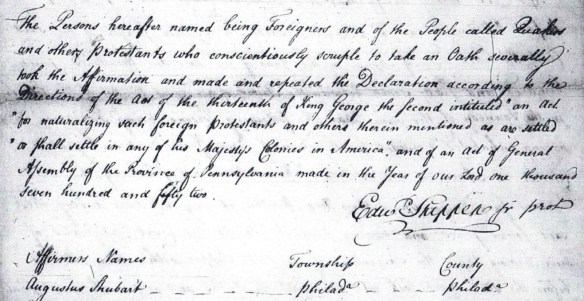
In 1767, another surprising event took place. Michael Miller, Philip Jacob Miller and Stephen Ulrich (or Ulrick) all traveled to Philadelphia along with Jacob Stutzman (from Cumberland County) and were naturalized at the April term of the Pennsylvania Supreme Court.  They were listed under the title, “Affirmers Names.”  This makes me wonder why Michael Miller wasn’t naturalized in 1762 when he witnessed Nicholas Martin’s naturalization?  He was already there and could have easily been naturalized at that time.  What had changed in those 5 years to make an entire group of Brethren men “affirm?”

Philip Jacob Miller naturalization 1

Philip Jacob Miller naturalization 2

Philip Jacob Miller naturalization 3

Philip Jacob Miller naturalization 4

Michael Miller, Philip Jacob’s father, had waited a long time to be naturalized. He was just a few months shy of 75 years old.  He must have felt a pressing need for the naturalization and it must have been very urgent for him to risk his religious affiliation he had so staunchly preserved throughout his entire life – even in the face of warfare and extreme adversity.  From the perspective of today, we’ll likely never know what exactly was so urgent that it prompted these men to make the trip from Frederick County, MD to Philadelphia, PA where they could do the lesser of two evils and affirm as opposed to swear their loyalty and become citizens.  Whatever it was, it had to be mighty important.

This was clearly a family group that included Jacob Stutzman, Johann Michael Miller’s younger “step-brother,” Stephen Ulrich whose daughter would marry the son of the fourth Brethren man, Philip Jacob Miller, less than a decade later. Oh course Philipp Jacob Miller was the son of Michael Miller.  Stephen Ulrich would also marry Hannah Stutzman, Jacob Stutzman’s widow in 1782.  So yes, indeed, these families where closely bound and would become even more so.  Of these men, Johann Michael Miller was the eldest, and Philip Jacob Miller, at just over 40 was part of the second generation of Brethren.  He was born in the old country, but was probably too young to remember. This list does beg the question of why John Miller, Philip Jacob’s brother wasn’t with this group, nor brother Lodowick.  It’s possibly that both John and Lodowick here born after immigration, and therefore did not need to be naturalized.

Map Frederick co to Philly

The trip from Maugansville, Maryland to Philadelphia, about 165 miles, was not trivial, then or now, and certainly not for an old man bouncing around in a creaky wagon. It makes me wonder if the reason that the entire group went was because Michael Miller, as elder statesman, got it in his head he was going and the rest of the men certainly weren’t going to allow him to go alone, at his age, so they all went and shared in the “shame” of taking an oath or affirmation, equally.  Or maybe Michael set the leading example.  Probably a matter of perspective!

New Frontiers Open

In 1768 and 1769, events began to unfold which did not necessarily affect the Miller family right then, but would have an profound affect upon them in coming years. Likely, the idea of more plentiful and less expensive land was alluring, at least to the younger generation.

In 1768, the defeat of Pontiac triggered mass migration westward over the mountains. Replogle 20

In November 1768, the British government bought large tracts of land from the Iroquois and Pennsylvania now owned all the land west of the Alleghenies to the Ohio River except for the northernmost part of the colony, opening the doors for a huge migration. However, the Delaware and Shawnee were left out of the negotiations, and the raids continued.  Replogle 115

1768-1769 – A list of persons who stand charged with land on Frederick County rent rolls which are under such circumstances as renders it out of the power of George Scott Farmer to collect the rents and there claims allowance under his articles for the same from March 1768 to March 1769: (Note there are several pages of these, so much so that it looks like a tax list, not a typical roll of uncollectibles.)

  • No Cripe, Greib, Ullrich, Ullery or Stutzman
  • Conrad Miller
  • Isaac Miller
  • Jacob Miller Jr
  • John Miller
  • Lodwick Miller
  • Michael Miller heirs
  • Oliver Miller, Balt Co.
  • Oliver Miller, Balt Co additional
  • Thomas Miller

Source: Inhabitants of Frederick Co. MD, Vol 1, 1750-1790 by Stefanie R. Shaffer, p 45

Philip Jacob Miller’s father died in 1771. A few years later, between 1774 and 1778, Philip Jacob’s sons, Daniel and David Miller would both set out on the road to Bedford County, wagons full, waving good bye to an aging Philip Jacob Miller and his wife who had probably crossed the half-century mark by this time.

It was about this time that Philip Jacob Miller bought a great Bible that was printed in 1770 in Germany. Perhaps he bought it when his father died in 1771, in his father’s memory.  Perhaps an earlier family Bible had been destroyed in the evacuations and depredations, or perhaps Philip Jacob Miller simply did not inherit his father’s Bible.  Whatever, the reason, Philip Jacob bought his own and began to fill in the important dates of his life.  He probably reflected on each occurrence as he wrote each child’s birth lovingly in his own handwriting.

Miller Bible cover

Philip Jacob Miller’s incredibly beautiful Bible is shown above.

The Revolutionary War

If Philip Jacob Miller thought his life was ever going to be peaceful and serene, he was wrong. Next came the Revolutionary War which began in 1775 and in many ways was just the continuation of the issues present in the Seven Years War, also known as Dunsmore’s War or the French and Indian War – the same beast that had run the Miller’s off of their land, twice now. They had only been back from the last evacuation for a decade before war raised its ugly head again.  Would there never be peace?

Philip Jacob Miller lived through the Revolutionary War in Frederick County, MD. This would have been his third war in 30 years, or fourth war in 40 years, depending on how you were counting.

Floyd Mason, in his book, “The Michael Miller and Susanna Bechtol Family Record,” tells us what he discovered about the Brethren in Frederick County during the Revolutionary War.

During the Revolution, the colonists held their national conventions and appointed certain committees of local leaders to carry out local responsibilities. In PA and MD, the main committee was the Committee of Observation who had the responsibility for raising funds to promote the war, select its leaders and furnish themselves with one committee member for each 100 families.  This committee had full power to act as it saw fit, answered to no one and there was no appeal of their decisions.

The militia groups were called Associations, later called Militia Companies. The Committee of Observation made lists of those not participating, whether Loyalist or members of the “Peace churches,” and they were called non-enrollers or Non-Associators.

The war issues divided the people’s loyalty. About one third favored the revolution, one third were Loyalists or Tories who favored the English and one third were neutral or did not believe in this manner of settling the issues.  This threw the Quakers, Mennonites and Dunkers in with the Tories or Loyalists and in opposition to the efforts of the Committee of Observation, at least as the committee saw it.

The churches were bringing discipline to bear on members who did not follow the historic peace teachings of the church. Annual Conferences were held each year and members were asked to remain true to the Church’s nonviolent principles, to refrain from participating in the war, to not voluntarily pay the War taxes and not to allow their sons to participate in the war.  This caused a lot of problems for the church members who wanted to be loyal to the church, loyal to the Loyalists who had brought them to the new country and loyal to the new government which was emerging.

As the war wore on and it looked as if the patriots efforts might lose, emotions raged. Non-Associators found themselves having to pay double and triple taxes.  Their barns were burned, livestock stolen or slaughtered and their crops destroyed.  They were often beaten and “tarred and feathered.”  Church members came to the aid of those who endured the losses.

Some members chose not to pay the war taxes or participate in the war activities and chose to wait until the authorities came and presented their papers to have taxes forced from them. This was in compliance with the Church of the Brethren Annual Conference Action. The Committee of Observation provided that non-Associators could take as much of their possessions with them as they could and then they would seize the property and remaining possessions and sell them to fill their war chests.

During this time, the Revolutionary War was taking place and the Brethren were known as non-Associators, those who would take an oath of loyalty, but would not belong to a militia unit nor fight. Many non-Brethren residents suspected them of secretly being allied with the Tories and resented their refusal to protect themselves and others.  Laws of the time allowed for the confiscation of property of anyone thought to be disloyal.  Records of this type of event have survived in the oral and written histories of some of the Brethren families, in particular some who migrated on down into the Shenandoah Valley.  Perhaps others thought it wise to move on about this time as well.

Taken from several sources, these are some of the names of non-Associators and others who were processed by the Committee of Observance that are descendants of Johann Michael Mueller (Jr.) who died in 1771.

  • Samuel Garber who may have married one of Michael Miller’s daughters, and their sons Martin and Samuel Garber
  • Jacob Good, Michael’s step-daughter’s husband
  • John Rife, Michael’s step-daughter’s husband
  • David Miller, the son of Philip Jacob Miller
  • Michael Wine, married Susannah, the daughter of Lodowich Miller, son of Michael Miller
  • Jacob Miller, son of Lodowich Miller
  • Abraham Miller, relationship uncertain
  • Another source lists Elder Daniel Miller, stated as Lodowick’s son, as being fined 4.5 pounds.

Susannah Miller Wine told her children and grandchildren that Michael Wine, Jacob Miller, Martin Garber and Samuel Garber had their property confiscated by the authorities for remaining true to the non-violent principles of their church.

Lodowich Miller’s family group removed to Rockingham County, VA about 1782 or 1783.

We know that in 1783, Philip Jacob Miller, John Miller and Lodowick were signing deeds back and forth in Frederick County. These activities may well have been in preparation for Lodowick’s departure.

William Thomas, on the Brethren Rootsweb list in 2011 tells us:

I have a copy of the 1776 non-enrollers list for Washington County, MD, that lists “Dunkars & Menonist” fines. The list includes Abraham Miller, David Miller, and David Miller son of Philip.  It goes onto list an appraisal of guns (whatever that means) in 1777 and includes a Henry Miller.

Point being there were several Miller’s in Washington County, some of who were Dunkers or Mennonites, a name common to both denominations.

If you move to the 1776 non-enroller list for Frederick County, MD, you have even more Millers. You have Jacob Miller, Jacob Miller s/o Adam, Abraham Miller, Peter Miller, Stephen Miller, Solomon Miller, Robert Miller, Henry Miller, Philip Miller, David Miller and Daniel Miller, all fined, and implying a Dunker/Mennonite/Quaker religious affiliation.

Washington County, Maryland was formed in September 1776 from the portion of Frederick County where Philip Jacob Miller lived.  Note that while David Miller, son of Philip is listed, Philip or Philip Jacob is not listed and neither is a Jacob.

However, there is also evidence that Philip Jacob Miller did participate at some level. Men 16-60 were required to participate in the local militia.

From the book, “Colonial Soldiers of the South, 1732-1774” by Murtie June Clark:

Capt John White’s Company Maryland Militia, 6 days, undated:

  • Michael Miller
  • Jacob Miller

Note that there were multiple Michael and Jacob Millers in the area, and not all of them appear to be Brethren.

Capt Jonathan Hager’s Company, Maryland Militia 6 days service, undated:

  • Jacob Miller
  • Conrod Miller
  • John Miller Jr.
  • John Miller
  • Jacob Miller Jr.
  • Zachariah Miller
  • Philip Jacob Miller
  • Jacob Miller (son of Conrad)

List of Militia 1732-1763 now before the Committee of Accounts lists John White’s militia as from Frederick County as well as that of Jonathan Hager.

Perhaps Philip Jacob Miller was trying, rather unsuccessfully it seems, to find a middle ground.

It’s difficult to understand how to interpret this information that seems to be conflicting.  To try to resolve or better understand the situation, I turned to the 1790 census where I found 2 Philips in Washington County, 5 Jacobs, 7 Johns and an Abraham in both Washington and Frederick County.  Unfortunately, the 1790 census did not add clarity.

The Sons Leave

Philip Jacob’s sons, Daniel and David, followed the migration to Bedford Co., PA about the time of the onset of the Revolutionary War. The brothers went to Morrison’s Cove (Juniata River) and possibly on to Brothers Valley, both early Brethren settlements.

Morrison's Cove fall

David and Daniel both moved to Morrison’s Cove (shown above) between 1774 and 1778, staying for about 20 years until they joined their father later in Kentucky, but Philip Jacob remained in Washington Co., Maryland, which was formed from Frederick County in 1776. There is a record of a Jacob and Daniel Miller taking the oath of fidelity to the State of Maryland in 1778 in Washington County (formed from Frederick County in 1776,) so perhaps they didn’t leave until after 1778.

It was a rough time for Philip Jacob Miller. In the 1760s, the family had to abandon their land for a second time, returning in about 1765.  We don’t know where they sheltered, but likely, the family group included Philip’s elderly father, Michael.  In 1771, Phillip Jacob’s father, Michael, died.  Between 1774 and 1778, Philipp Jacob’s two sons, Daniel and David left for Bedford County.  In about 1783, Philip Jacob’s other brother, Lodowick left for the Shenandoah Valley, possibly as a result of the Revolutionary War.  Family is getting scarce.  The final straw seemed to be when Philip Jacob’s brother, John, died a decade later, in 1794.  John had lived beside Philip Jacob for his entire adult life in Frederick (now Washington) County, and they assuredly depended on each other and helped one another farm.  Now John was gone too.

The Big Decision

I can see Philip Jacob and Magdalena talking by the fireplace one evening, perhaps as Philip Jacob stared out the window, over his land, pondering the bold and life-changing move he was considering. It would change his life, and death, and the lives of all of his children as well – not to mention Magdalena.

Philip Jacob had farmed with his brother John since they all moved from York County in 1751 or 1752 – more than 40 years earlier. They had likely all evacuated together, twice, and rebuilt together, twice.  When their father died, there were still the three brothers, but with Lodowick removed, now John gone to death, and both of Philip Jacob’s oldest sons having moved to Bedford County, Philip Jacob obviously felt uneasy and probably somewhat isolated.  Was he concerned that he wouldn’t physically be able to farm alone?  Was he concerned that there would be no one left to inherit Ash Swamp in Washington County while at the same time his two sons in Bedford County were renting land?

Was the allure of reuniting his family who was marrying and scattering, for once and for all, in a new location, strong enough to cause a man 70 years old, or older, to sell out?

On the new frontier, Philip Jacob could buy seven times as much land as he had in Maryland –  enough land for everyone.  Seven times the land.  That’s some powerful motivation.  Was this dream enough to make an elderly man sell most of his possessions, pack everything up in a wagon and head overland for the new frontier of Ohio, some 450+ miles distant, down rough roads, on a riverboat and through Indian territory?

That must have been his motivation, for I can think nothing other than the love of family that would uproot a man of that age from his well-deserved rocking chair beside the warm fireplace and propel him on to yet one final, untamed, frontier.

Map Mauganstown to Cincy

Philip Jacob Miller would succeed in leaving a legacy in land for his children.

Campbell County, Kentucky

Philip Jacob sold Ash Swamp in Washington County, Maryland in 1796 to the same man who bought his brother’s land from John’s estate. Michael then likely took a wagon overland to somewhere he could intersect with a river, probably Pittsburg, then floated down the Ohio River to Campbell Co., KY, a few miles upstream from Fort Washington that would one day become Cincinnati.

Conestoga wagon

The group would have moved by conestoga wagon. This conestoga wagon belonged to Jacob Miller who was found in Frederick County but had left by 1765 for Virginia. Later, this same Jacob Miller arrived in Montgomery County, Ohio about the same time that Daniel Miller, Philip Jacob’s son would arrive.  This wagon was supposedly built in 1788, so it would not have been the actual wagon used to move from Frederick County, it was used by the Brethren group on subsequent moves and did wind up in Ohio.  The wagons used by Philip Jacob Miller and his family would have been very much the same.

Brethren historian, Merle Rummel tells us more about the migration of the Brethren during this time.

Emigration came down the Ohio River from Western Pennsylvania by flatboats, but it was hazardous due to Indian depredations. These Brethren started on the Monongahela where Elder George Wolfe I is recorded to have been in the business of building flatboats (Wolfe and Sons) at Turtle Creek (just upstream from Pittsburg, Pennsylvania). When General Wayne defeated the Ohio Indians in 1795 (Treaty of Greeneville), the dangers of the Ohio River route were reduced, and it opened the way for others to follow the old Shawnee War Path, (the Kanawha Way) from North Carolina and the lower Valley of Virginia, through the (West) Virginia mountains to below the “Falls of the Kanawha.” There flatboats could come down the Kanawha River to Point Pleasant and down the Ohio. Others continued on the Trace by land into southern Ohio. Many more Brethren began coming west from the Old Frontier regions.

We know that Philip Jacob Miller arrived before August of 1796, because he was paying personal property tax and by then, he had acquired a horse and a cow.

Campbell County, Kentucky Tax Lists, posted by Dale Landon, March 2010, on the Brethren Rootsweb list.  These tax lists generallyonly counted males.

  • taken 16 Aug 1796, Philip Jacob Miller, 1 over 21, 1 horse, 1 cattle
  • taken 28 Aug 1797, Philip Jacob Miller, 1 over 21, 3 horses
  • taken 28 Aug 1797, Daniel Cripe, 1 over 21, 2 horses
  • taken 25 Aug 1797, Arnold Snider, 1 over 21, 2 horses
  • 1798, Daniel Cripe, 1 over 21, 2 horses
  • 1798, Philip Jacob Miller, 1 over 21, 3 horses
  • 1798, Arnold Snyder, 1 over 21, 2 horses
  • 1799, David Miller, 1 over 21
  • 1799, Arnold Snider, 1 over 21, 2 horses
  • taken 28 Aug 1800, Philip Miller, 1 over 21
  • taken 9 Aug 1800, Stephen Miller, 1 over 21, 1 horse
  • taken 23 May 1800, Arnold Snider, 1 over 21, 3 horses

It’s unclear whether Philipp Jacob Miller bought land in Campbell County, KY, or not. I don’t believe that a thorough sifting of available Campbell County records has been done by any researcher, although several researchers have done some.  A visit needs to be made and all of the available records thoroughly researched, including the estate packet, if one remains, for dates and signatures.

Phillip’s Death

We know that Phillip Jacob died before April 8, 1799 when his estate was probated, and probably after the first of the year.

Philip Jacob Miller estate probatePhilip Jacob Miller estate probate 2

There is a slight discrepancy in the documentation.  We have a tax list dated 9-1-1800 that lists Philip.  However, it’s also possible this is a list for what’s owed this year from the previous year or for his estate, although it doesn’t specify that it’s an estate and not an individual.

Philip Jacob Miller 1800 taxes


BullSkin Trace

Merle Rummell tells us the following, with the maps added by me:

Stonelick church today

The first Brethren Church north of the Ohio River was the Obannon Baptist Brethren Church (now Stonelick, above), near Goshen Ohio, on the Indian Trail north from Bullskin Landing (1795).

The old log Obannon Church Building (c1823) was at the Stoddard (Stouder) Cemetery, about a mile east of the south edge of Goshen – so these families were in the immediate Church area.
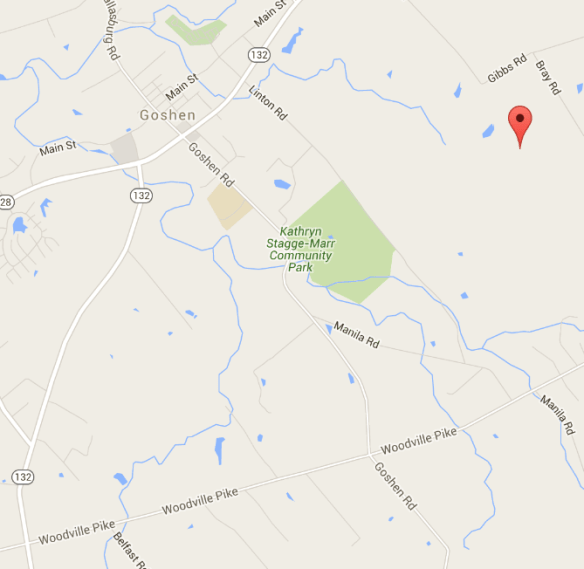
Stouder Cemetery

Daniel and David Miller lived at 132 and Woodville Pike, in the lower left hand corner.

Gabriel Karns lived about a mile on east of the Millers, on Manila Pike, the old Indian Road. They were forced to move north (1805, Dayton area, Montgomery County, Ohio) being forced off the Bounty Lands.  Daniel Miller was put into the ministry at the Obannion Church.

In eastern Ohio Territory, the land back from the River was not good farmland. It was Appalachia Hills, that crowded the River. David Horne travel 60 miles up the Muskingum River to the Forks of the Licking at the new Zane Trace, before he found land. John Countryman left the Massie Fort at Three Islands (now Manchester OH) and went 30 miles up the Ohio Brush Creek till he found farmland. It was at the Little Miami River, just before Cincinnati where the Brethren stopped at good farmland along the Indian Trace, the Obannon Church.

The Bullskin Landing was a goal for the Brethren migration down the Ohio River by flatboat. It was probably the best landing on the river, being a sunken valley back into the Ohio Hills.

Bullskin creek

Bullskin Creek is flooded by the Ohio River for half a mile back from the River, a wide valley opening. It was the first major landing for Ohio River flatboats above Fort Washington (Cincinnati). Here the flatboat was protected, off the river, with easy unloading facilities.

Bullskin landing

This settlement in Clermont County is called Utopia. The Brethren settled on the Bullskin about 1800. (Miller, Moyer, Metzgar, Rohrer, Hoover, Houser; the old Olive Branch Church. It converted en-mass to Church of Christ in the New Light Revival of 1830’s.) Being farmers, they lived mostly on the level lands above the high riverbank hills, at the head of Bullskin Creek.

The major Indian Traces north, one going to Old Chillicothe on the east of Dayton, continuing on to Fort Detroit, left from there. Another went to the ford of the Great Miami at Franklin Ohio and up the west side of Dayton. The Bullskin Trace, the old Indian Road to Detroit, became the first State Road in Ohio.

Most of the settlers on the New Frontier were frontier folk from the Old Frontier, very few were from the Settled East. The River brought them from Old Fort Redstone (now Union and Brownsville PA), Brothers Valley and Washington Co PA in the west; from Penns Valley, Brush Valley and Northumberland Co PA in the north; from the Conococheague, Middletown Valley MD; from Morrison’s Cove, Cambria Co and the Juniata Valley PA. The Kanawha Trace brought them from the Carolina settlements on the Yadkin; from Franklin and Floyd Cos and the lower Valley VA. These areas were the Old Frontier. It showed in the type of people who came, in their self-reliance and independent thought. They didn’t just accept being told something was true, they tried it out for themselves, and used it. They had to, or they died on the frontier. They were not stupid, while some were illiterate, most could read their Bible -maybe a Berleburg Bible, some read Greek. The Brethren knew what the Bible said, and lived it. They were definitely Brethren, and they took their Brethrenism with them, making a real Christian witness to their neighbors!

To this area near Cincinnati came the Aukerman Family in 1789, to “Columbia” at the mouth of the Little Miami River. The 11 year old son was John, who eventually would be the first settler at Gratis, in present day Preble County, in 1804, on Aukerman Creek, named in his honor. The John Bowman family came near that same time. They settled north on the trace probably in now Warren Co OH, between Lebanon and Goshen OH.

South of Goshen, came first David Miller, then his brother, Daniel. Daniel was put into the ministry there about 1798. The first minister was Elder John Garver, from Stony Creek in Brothers Valley PA, by way of Virginia, to North Carolina, to Kentucky. In 1805 he moved to the Donnels Creek Church, up the Indian Road. By tradition, the founding of the Obannon Baptist Church was 1795, Elder David Stouder. He seems to have come over from Kentucky, and by research, may be the David Stover near Limestone, probably from the Log Union Church. This was the beginnings of the Obannon Church, but these families weren’t allowed to stay.

These were the Bounty Lands, claimed by Virginia as payment for service to their Veterans of the Revolution. Government survey of the lands began in 1802, and it did not matter to the Government or the surveyors if people already lived on these lands, if there were homes built and fields cleared. That the Dunker custom often included getting title from the Indians to homesteads gave them no claim to their lands in the eyes of the surveyor or state. Legally, they were squatters. There was no appeal for their claim to the land, all they could do was leave. They moved north, beyond the Bounty Lands, to the little Village of Dayton. Their move was easy, they went up the Indian Trace. From Little’s Bounty Lands Survey (1802) we have been able to identify the adjoining farms of David and Daniel Miller,  they were surveyed as cleared lands.

Now other Brethren families came to Bullskin Landing. These were the second line of Brethren, moving west from the Old Frontier lands in Pennsylvania, Maryland, Virginia or Carolina, and some moved up from the churches in Kentucky. They used Bounty claims to get land, Bountys purchased back home, by self or through kin, from those who had no wish to leave for the west. The families at Obannon were mostly from Maryland and Pennsylvania: Binkley, Cripe, Grossnickle, Frey, Karns, Maugans, Miller, Moler, Pringle, Stouder; Elder John Garver and Frederick Weaver as ministers. Stonelick was a meeting house of the Obannon Congregation. This was good farmland, but it was a heavy clay and many Brethren soon moved north to better lands on the Great Miami headwaters near Dayton Ohio, where they remain strong today.

 Philipp Jacob Miller’s Land in Warren County, Ohio

After arriving in Kentucky, Philip Jacob Miller bought 2000 acres of land that lay along O’Bannon Creek in Warren County, Ohio, across the river from Campbell Co., KY and north about 45 or 50 miles, for $1.10 an acre, near where his sons, David and Daniel, may already have been living.

Philip Jacob’s 2000 acres were north of Goshen some 8 miles – being on the Clermont-Warren Co line, extending east beyond Cozaddale.

After Philip Jacob’s death in September 1799, his children made an agreement among themselves to divide this land into ten 200 acre parcels. Magdalena, his daughter, decided to take her share in cash. The other children drew lots for these 200 acre parcels, but only a few of them ever lived on their land in Warren County, Ohio. Stonelick covered bridge, shown below, now closed and undergoing renovation is located near the Stonelick Brethren Church where several of Philip Jacob’s children were founders.

Stonelick bridge

Philipp Jacob Miller lived in Campbell County, Kentucky, not Clermont County, Ohio, across the river nor in Warren County, Ohio, where he purchased land, which was located about 40 miles north of the Ohio River on the Warren County/ Clermont County border.  It’s unclear whether or not Philip Jacob purchased land in Campbell County, or not, or why he settled and stayed in that location as his children were settling further north, although the tax lists do indicate, at least initially, that some of his children did live in Campbell County.

Philipp Jacob’s sons Daniel and David Miller settled in Clermont County, Ohio across the Ohio River and Philipp Jacob himself acquired land about 10 miles north of his son’s land on the border of Clermont and Warren Counties, but apparently none of those three families ever lived on Philip Jacob’s land.

This was also a time of some confusion, because the settlers who had acquired land in this region, which became designated as military bounty land for Revolutionary War veterans, often lost that land when veterans or those they sold their rights to subsequently patented that land.

To Philip Jacob, this must have smelled too much like what happened back in York County, PA in the 1740s with the disputed land involved in Cresap’s War, claimed by both states, and granted by both states as well – to different settlers.

Troy Goss tells us the following about Philipp Jacob’s land, with maps and documents added by me:

Ohio land magnate William Lytle (1770-1813) obtained a patent from the United States government on May 2, 1803, which included the lands that Philip Jacob Miller had acquired.

Phillips two sons, David and Abraham, serving as administrator of his estate purchased his land for a second time from Lytle later in 1803. That was apparently better than losing the land altogether.

They purchased 1,800 acres and an adjacent lot of 200 acres for a total of $2,200. These tracts conform to Virginia Military Reserve Survey tracts 3790 and 3791 in the southeast corner of Hamilton Township, Warren County, and with about 162 acres crossing over into Goshen Township, Clermont County. They are roughly bounded in the north by the community of Comargo, on the east by Cozaddale and Stony Run, and encompassing the community of Dallasburg in the southwest.

Philip's land satellite

As you can see, this area is about 45 miles north of Bullskin Creek on the Ohio River. However, Daniel and David’s land are right on the way, shown with the red pin below.

Philip's land map

Troy continues:

Philip’s children made an agreement among themselves to divide this land into ten 200-acre lots of 163-1/3 by 196 poles (~2,695 by 3,234 feet). Daughter Magdalena Cripe decided to take her share in cash. The children designated John Ramsey and Theophilus Simonton to appraise the lots and stipulate compensation between the varying values of the lots, whereupon the children drew lots for the parcels and David and Abraham, as estate administrators, began deeding each in April 1805 for the nominal sum of $1. Arbitrarily numbering the lots from the northwest to southeast, we find the following among the ten surviving children and one widower son-in-law:

Will-Philip Jacob Miller p1

????????????????????????????

Document filed in Warren County, Ohio.

The document is transcribed by cousin, Marian, as follows:

Articles of agreement between the children of Philip Jacob Miller

Warren County, Ohio Deed book, vol 14, page 21-22

[Starts part way down the page]

Articles of Agreement made and concluded upon this nineteenth day of December one thousand Seven hundred ninety nine betwixt we the under named Sons and Daughters of Phillip Jacob Miller deceased in manner and form following viz

First We Daniel Miller, David Miller, Abraham Miller, Susannah Miller, Christena Miller, Elizabeth Miller, Sarah Miller, Esther Miller, Mary Miller, Magdalen Miller, and Hannah Miller for ourselves our heirs executors administrators and assigns have positively and finally covenanted and agreed betwixt each other to divide a certain tract of land containing two thousand acres in lots beginning with No one, two three &c until said lands (which now lays and is situate in the north Western Territory upon O’Bannions Creek or near the same) is equally and justly divided into Ten equal Shares in regard to quantity and quality or rather to have sd lands equally divided into Ten two hundreds acre lots

Secondly we do finally agree to have John Ramsey Theophilus Simonton and one more person if required to appraise and divide sd lands into ten Shares so as each of the above named Sons and Daughters of the above deceased person (except one daughter named Magdalen Gripe wife of Daniel Gripe now in being which here hath finally agreed to take her Share in cash and hath given their bond for the same) Shall have an equal share of said lands,

Thirdly and lastly we do firmly & finally covenant and agree with each other to stand to and abide by the final and appraisment and determination of John Ramsey Theophilus Simonton and another if required concerning sd lands. For and in consideration of which covenant and agreements well and truly to be made and done we bind ourselves our heirs executors Administrators and assigns in the Penal sum of One Thousand Dollars Specie each firmly by the

[page 22]

Presents in Testimony whereunto we have set our hands and seals this day and year above written as also at the back part of the above covenant, N.B. we do furthermore finally agree to pay all debts that might come against the above deceased Person hereafter viz each of us one equal Share of sd debts.

Daniel Miller (seal)
David Miller (seal)
Abraham Miller (seal)
Jacob (his x mark) Shott
Elizabeth (her x mark) Shott (seal)
Daniel & Mallalnon Greib
David Miller and Abraham Miller (seal),Trustees for Sarah Millers Children
John (his x mark) Cremar and Mary (her x mark) Cremer (seal)
Arnold (his x mark) Snider and Susanna (her x mark) Snider (seal)
Henry Snell & Cristena his wife (seal)
Gabriel (his x mark) Magens
Ester (her x mark) Magens
Daniel Ulrich (German script) Susannah Ullrich[?]

Test. Prest.
Leonard Raper
Temperance Raper

[written sideways up the page] Recd for record Jany 19th 1829 & recorded Feby 17th 1829 Asabel Brown RWC

Test prst
David Posoy
George Muchlin

Test prst
John Alinn
James Crawford
Conrad Brombaugh
Eamsel [?]
Jacob [?]
[?]

We whose names are hereunto Subscribed being appointed by the heirs of Phillip Jacob Miller decd to divide a Two thousand acre tract or tracts of land into Ten Equal lots and also to equalize the lots in the following manner (Towit) The Tenth lot to pay fifty five dollars to the fourth, the Seventh to pay thirty eight dollars to the Second, the Sixth lot to pay thirty three dollars to the third lot, the eighty lot to pay Twenty eight dollars to the first lot, the ninth lot to pay Twenty four dollars to the fifth lot, Given under our hands this 29th March 1800.

John Ramsey
Theos Simonton Apprs.

The siblings divided the land as follows:

1 – Northernmost 200 acres adjacent to the 1,800 survey; estate sold to Francis Eltzroth for $200, 22 Sep 1809; quit claim from the heirs of Daniel Miller to Benjamin Eltzroth (son of Francis and grandson-in-law to Philip Jacob) for $500, 7 May 1828; the town of Comargo lies in the northeast corner

2 – Northwest 200 acres; estate sold to Gabriel [& Esther] Morgan for $1, 22 Apr 1805; Gabriel had purchased an adjacent 200-acres lot from Richard & Mary Cunningham two months earlier

3 – North-central 200 acres; estate sold to John [& Mary] Creamer for $1, 22 Apr 1805

4 – Northeast 200 acres; estate sold to Henry [& Christina] Snell for $1, 22 Sep 1809; the town of Cozaddale lies along the southeastern boundary

5 – West-central 200 acres; estate sold to Arnold [& Hannah] Snider for $1, 22 Apr 1805

6 – Central 200 acres; estate sold to Daniel [& Susannah] Ullery for $1, 22 Sep 1809

7 – East-central 200 acres; Abraham sold his lot to William Spence for $400, 22 Apr 1805

8 – Southwest 200 acres; estate sold southern half (100 acres) to Jacob Wise for $200, 6 Dec 1806; and northern half (100 acres) to Jacob Creamer, perhaps a brother of John Creamer, for $200, 16 Jan 1807; the western half of the town of Dallasburg lies in this tract

9 – South-central 200 acres; estate sold to Andrew [widower of Sarah] Nifong for $1, 22 Sep 1809; the eastern half of the town of Dallasburg lies in this tract

10 – Southeast 200 acres straddling the Warren-Clermont county line; estate sold to Gabriel [& Esther] Morgan for $1, 22 Apr 1805

Lots 8, and either 2 or 10, may have been designated for David or Elizabeth, whose names do not appear among the deeds. On the other hand, Esther and Gabriel Morgan somehow managed to acquire both lots 2 and 10.

Only the families of four Miller daughters, Christina Snell, Esther Morgan, Mary Creamer, and Hannah (Snider) Shepley, ever lived on their land in Hamilton Township, Warren County. An 1867 map of the area shows Snells, Cramers, and Eltzroths still living in the area.

Magdalena Miller reportedly died in in Campbell County nine years after Philip in 1808.

Following Philip Jacob’s and Magdalena’s deaths, a few Miller children remained in Warren and Clermont counties, while others moved north to more fertile lands in Montgomery and Preble counties. Daughters Susannah Ullery and Magdalena Cripe migrated into northern Indiana, settling in Elkhart County.

Sources

  • Agree 1799: 19 Dec 1799, Articles of Agreement, Warren County Deed Book 14, Ohio
  • Deed 1803: 7 Sep 1803, Warren County, Ohio; recorded 9 Nov 1803
  • Deed 1803: 7 Sep 1803, Clermont County, Ohio; recorded 14 Dec 1803
  • Deed 1803: 28 Dec 1803, Warren County, Ohio; recorded 11 Apr 1804
  • Deed 1803: 28 Dec 1803, Clermont County, Ohio; recorded 28 Apr 1804
  • Deed 1805: 22 Apr 1805, Deed Book 1, Warren County, Ohio
  • Deed 1809: 22 Sep 1809, Deed Book 2, Warren County, Ohio

I was able to locate Philipp Jacob’s actual land thanks to a combination of sale information and the Warren County Maps and Atlases website which documents the military land grants and where they were located in Warren County.

Warren county maps

Hamilton Township is in the lower portion of Warren County bordering Clermont County on the south.

Hamilton twp map


“Map of Warren County Ohio With Municipal and Township Labels” by US Census, Ruhrfisch – taken from US Census website [1] and modified by User:Ruhrfisch. Licensed under CC BY-SA 3.0 via Commons

Below we see track 3790 in 1867, still in the Cramer and Snell families. Part of grant 3790 extended southward into Clermont County.

Miller 3790 tract map

In 1867, we can see that the land in grant 3791 also remains in the Eltzroth family that purchased this section from Daniel Miller.
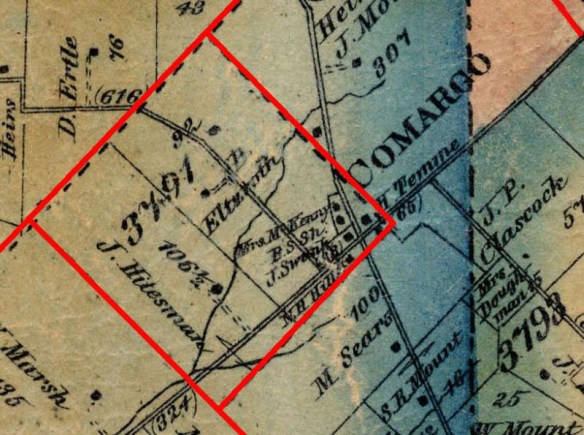
Miller 3791 tract map

Grant 3791 is located just above 3790.

Miller 3790 and 3791

Philipp Jacob’s Burial

We know where Philipp Jacob’s land was located, and we know he never lived there. When he died in early 1799, he was living in Campbell County, KY, across the Ohio River.  Had he planned to move to his land in Warren County?  We’ll never know.

There is a persistent family rumor that Philip Jacob was buried in an old cemetery that was on an island in the mouth of 12 Mile Creek (Campbell Co KY) that was washed away in an Ohio River flood. I find this hard to believe, given the difficulty of burying someone on an island.  The Brethren were practical if anything, and burying someone on an island is not practical from any standpoint.   On the other hand, if you can’t farm the island, at least it could serve as a cemetery.  So who knows.

12 Mile Creek crop

Merle Rummel, Brethren minister and historian visited the site of the “Twelve Mile Regular Baptist Church Island” cemetery. This cemetery is not on an island, and still exists, such as it is.  So perhaps Philip Jacob Miller was not buried on an island after all?

You might notice that 12 Mile Creek is about 20 miles downriver (northwest) from Bullskin, and assuming there was a ferry crossing, significantly closer to Philipp Jacob’s land which was northeast of present day Cincinnati.

12 Mile Creek to Warren Co

Merle Rummell visited the 12 Mile “Regular Baptist Church” Island Cemetery in either 2007 or 2009. He was kind enough to provide me with photos taken and information gathered during that visit.

Merle said:

All that remains on this site are 6 tombstones, none with death dates before 1849.

Ball, Mildred-died 28 Mar 1862; age 30 yrs 3 mo 8 days; wife of John Traver
Beagle, Wife of Jesse-June 1869/only date listed
Henderson, John-28 June 1828-21 Feb 1905
Stephens, Eleanor-22 Aug 1777-1 Sep 1849 wife of John Stephens
Stephens, John-1774-1849
Walker, daughter of J&M-died 18 July 1868 age 2y

Those buried earlier, and there seem to be several, are in unmarked graves.

Several field stones were found on end protruding out of the ground.  Several bases of headstones were also found.  The area around the foundation is heavily covered with Vinca or Periwinkle vines.  I suspect there may be more stones beneath this vegetation.  It also seems apparent that graves were placed on two sides of the old church.  This leads me to believe there are many more graves at this site than previously believed.  There appears to be foundation remains of two smaller outbuildings.

Based on the information and photos provided by Merle, the location of this cemetery and original church is where the red pin is shown below, utilizing Google maps.

12 Mile Church

This suggests that Philipp Jacob Miller probably lived in close proximity to this location.

12 Mile Church larger

Google street view shows us the area near the church, back in the gently rolling hills.  12 Mile Creek is to the right, paralleling the road.

Campbell Co near church

This picture shows the crossing of 12 Mile Creek.

Campbell Co. 12 Mile Creek

The cemetery would have been in the hills to the right.

Campbell Co viewing hills

If Philipp Jacob Miller truly was buried on an Island in the Ohio River at the mouth of 12 Mile Creek that washed away in a flood, it would have been near this location, where the divit marks the mouth of 12 Mile Creek.

Campbell Co 12 Mile map

A satellite view of the location.

Campbell Co 12 Mile satellite

The final resting place of Philipp Jacob Miller is one of the more interesting family mysteries that will, of course, never be solved.

Philip Jacob Miller’s Estate

I have always felt that looking at what someone left behind at their death tells us a lot about their life. In essence, it tells us the story of their life – except in Philipp Jacob’s case, he had gotten to start over several times.  Philip Jacob’s estate spoke of a farmer, but one that wasn’t entirely poor despite having “sold out” three years before when he left Maryland.

The family used glass. They had a looking glass, which is actually rather amazing considering the fact that they were Brethren, and a coffee mill.  All of the kitchen goods were included in the estate inventory as well, and of note, the value of the Bible and “sundry other books” is valued highly, equal to the box of glass, the cow and calf and the saddle.  And what were those “other books?”  My guess is that they were religious books.  Clearly, Philip Jacob Miller knew how to read and his books were important enough to him for them to be brought along to the new frontier, probably in the two trunks.

Nothing is found in Philipp Jacob’s estate inventory that speaks to anything but a simple, plain lifestyle that would be expected of a Brethren church member – except that pesky looking glass, which is very, very un-Brethren. A looking glass would have been considered very vain.

The amazing thing is that this is that an estate inventory lists ALL that the family owned, not just what they wanted to dispose of – and included everything – even things that were the wife’s.  So we have a complete picture – as unfair as that is to the spouse.

I shudder to think of cooking for a family with the utensils Magdalena had at her disposal.  There was no cook stove, so she cooked in the fireplace.  There was only one bed – but of course Philipp Jacob sold off anything extra before leaving Pennsylvania, so one bed was all that he and Magdalena needed.  They probably had more in Pennsylvania, or, the children slept on hay in the corners, a common practice at the time.

As a matter of course, family members often “bought” items at an estate sale, along with the neighbors. The widow was often allowed to take some kitchen things on credit against her “share,” which was one third of the value of the estate.

Persuant to an order of Campbell County Court, We the undersigned after being sworn appraised the Personal Estate of Philip Jacob Miller, Deceased. The articles contained in the Inventory are listed with the value of each respective article being placed opposite to it.

Philip Jacob inventoryPhilip Jacob Inventory 2

Campbell September Court 1799

Dale Landon was kind enough to provide the original estate documents from his visit to Campbell County, KY.

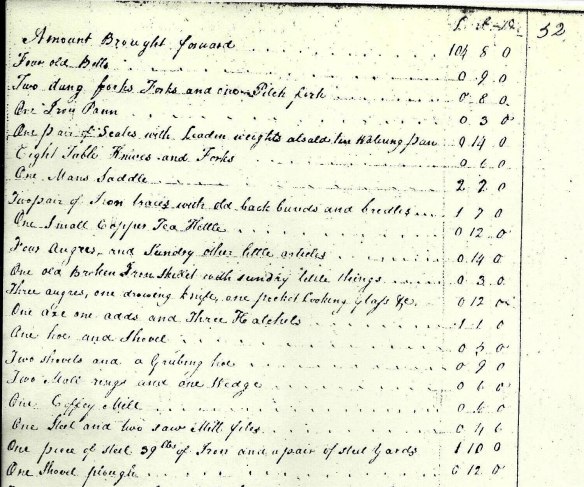
Estate Appraisal Page 1 crop

Estate Appraisal Page 2 Part 1

Estate Appraisal Page 2 Part 2

As I look at his estate, I wonder how much Philipp Jacob brought with him in 1796 as he migrated down the Ohio to Campbell County and how much be bought after arriving.

It’s odd that he had an old wagon and an old horse too. Did they come all the way from Pennsylvania in that wagon and horse?  One horse could not have pulled a loaded wagon alone.  Of course, the “grey stud” was probably a horse (given his value) and could have been teamed with the mare.

One thing we know for sure, the Bible came along with Philip Jacob from Washington County, probably packed into one of those two trunks. And in those two trunks were packed the cumulative results of a lifetime – all condensed into just two trunks.

If I had two trunks to pack, what things would I take with me?

Philip Jacobs’ sons, David and Abraham administered his estate. Estate packets are extremely interesting and sometimes hold many hints as to the life of the person whose estate is being administered.  In this case, we know that Philip Jacob’s wife, Magdalena became ill, was treated for her illness, but it “carried her off” anyway.

Debts of the estate of Jacob Miller deceased in account with David and Abraham Miller administrators:

Philip Jacob estate accountPhilip Jacob estate account 2

Campbell County to wit: Agreeable to an order of the Court of Campbell County we the undersigned being appointed commifsioner to examin and settle with the administrators of Philip Jacob Miller dec.’d as to the personal estate of the deceased and do report to the court of Campbell County that the above is a true statement given under our hands this 19th day of Sep’r 1808 James Noble George Porter Written on the right edge of the page. Campbell September Court 1808 This Report of the commifsioners appointed to settle with the Administrators of Philip J. Miller dec’d was returned to Court and ordered to be recorded and is recorded. Test James Taylor clk

Estate inventory and debts posted to the Rootsweb Brethren list by Dale Landon on March 11, 2010 and he provided originals below, as well.

Estate Inventory Page 1 Part 1

Estate Inventory Page 1 Part 2

Estate Inventory Page 2 Part 1

Estate Inventory Page 2 Part 2

There are couple items of interest on this list. The money from John Schnebly was likely for the land back in Washington County.  He bought both John’s and Philip Jacob’s land, and he may have also bought all of the farm and household goods that Philip Jacob wanted to sell before leaving as well.

I had to laugh at the entry for whiskey at the estate appraisal.  I have seen whiskey provided at the sale and I’m guessing it loosens up the bidding and makes the net sales much higher!

At first glance, it looks like Jacob had a son Jacob who had an estate, but that’s not the case. The court referred to Philip Jacob as Jacob, crediting the balance of his estate sale to his estate account to be settled by the administrators at a later date.

Philip Jacob’s wife, Magdalena does pass away and the estate pays for her doctor bills and funeral as well.   I’d love to see the date on that receipt.

The Philip Jacob Miller Bible

Philip Jacob Miller probably sat in front of his fireplace in his home on Ash Swamp, about the time of his father’s death in 1771, reminded of his own mortality, and dutifully wrote the names and dates of his children’s births into his new Bible.

Philip Jacob Miller Bible front page

On February 11, 2009, I was fortunately enough with some hints and sleuthing to find the Philip Jacob Miller Bible in Elkhart, Indiana. The custodial family, who has no idea how the Bible originally came to be in their family, has taken wonderful care of the Bible and allowed it to be photographed.

Both the custodial family and I spent a significant amount of time trying to figure out how they came to be in possession of the Miller family Bible, which is greatly cherished as a family heirloom. I suspected a second marriage or something of that sort, but the only connection we could find was that their family bought a house that was in the John Miller family – and perhaps, just perhaps, the Bible got accidentally left in that home, perhaps to be discovered a generation later in the attic – and of course, cherished as a family heirloom – not realizing it wasn’t from their family.  Thank goodness they cherish it, because that’s the only reason it still exists today.

Upon arriving to visit the Bible, another surprise was awaiting me, as the front section holds the children’s birth records of Philip Jacob Miller, and the back holds the same for the children of Daniel Miller, son of Philip Jacob Miller, also my ancestor. It was a double hitter day!  Given a signature in the Bible, I also believe that Daniel’s son John was likely the next custodian, taking the Bible to Elkhart County, Indiana.

This Bible was printed in 1770, but the first child’s birth recorded is in 1752, and Philip Jacob’s children are not entered in birth order. Furthermore, the handwriting in the back matches Daniel’s exactly.  This tells us that this Bible is probably not the original Philip Jacob Miller Bible.  One look at what happened in Frederick County, MD in 1750s and 1760s and we’ll quickly understand why.

The residents all evacuated twice and their houses were burned. If the family Bible didn’t manage to somehow get put in the wagon as the family was evacuating, then it was burned.  The Miller family was back in the region by 1765 when Michael Miller, Philip Jacob’s father, was deeding land, but I’m guessing a new Bible didn’t get purchased until after Michael’s death in 1771.  Perhaps Philip Jacob thought the purchase of a new Bible would be a fitting remembrance for funds received after his father’s death.  Or maybe Michael bought it for Philipp Jacob before his passing.

Regardless of how Philipp Jacob acquired this Bible it was obviously precious to him and cherished by the family.

A single entry unquestionably identifies the owner.

Beside the first entry in the Bible, which is the birth of Daniel in 1755, there is another entry which says “1775 Daniel Meines Sohn Sohn zur Welt geboren” (my son’s son was born into this world). In the back portion, we show the birth indeed of Stephen in 1775, the eldest son of Philip Jacob’s eldest son Daniel.  An earlier 1947 translation (apparently before the tape was applied) says “my grandson was born March 7, 1775”, which was obviously translated before the tape was applied, and matches exactly with Daniel’s own entry of his son’s birth.

Philip Jacob Miller Bible Daniel entry

The following photo is me holding the Bible. What a glorious day.  I am extremely grateful to the owners for very graciously allowing me to visit.

Philip Jacob Miller Bible and me crop

The following page is the front page with Philip Jacob’s children’s birth recorded.

Philip Jacob Miller Bible children

The births are recorded as follows:

  • Lizabeth Miller was born in April 1752.
  • My daughter Lidia was born at 3 o’clock at night, Junee 18, 1754. The zodiac sign was the Waterman (Aquarius).  (Note that the name and date were struck out.)
  • My son Daniel Miller was born at 4 o-clock at night April 8, 1755. He died August 26, 1822.
  • My son David was born December 1, 1757, at 3 o-clock at night. The zodiac sign was he lion (Leo).
  • My daughter Susannah was born March 2, 1759, at 7 o’clock in the morning. The sign was the Bull (Taurus).
  • My daughter Christine was born December 4, 1761 at 10 o’clock in the forenoon, the sign was the Fish (Pisces).
  • My daughter Mariles was born — 1762 at 8 o’clock in the morning. The sign was the Virgin (Virgo).
  • My son Abraham was born April 28, 1764.
  • My son Solomon was born March 20, 1767.
  • My daughter Ester was born February 13, 1769.

Daughter Hannah, as reflected in the 1799 agreement between Philip Jacob’s heirs is not reflected in this list of Philip Jacob’s children.  We’re also left to presume that Mariles is Mary.

As little as this is, it’s absolutely the only thing written in Philip Jacob’s own hand, showing any of his personality at all. It’s extremely interesting that he recorded the astrological signs for many of his children.

The following page is the back page recording the births of Daniel’s children.

Philip Jacob Miller Bible Daniel children

However, the first entry is that of Daniel himself, again, and the second entry is that of his sister Lizbeth born in 1752 who was not recorded on the front page. Of course, we know this was a recopied Bible. This Bible survived the trip west in a wagon, then floating down the Ohio River.  This Bible has been wet one or more times.  We know that in the early 1800s, this Bible went to Warren or Clermont County, Ohio, then Montgomery County, Ohio, then in the 1830s, to Elkhart County, Indiana where it remained for the next 177 years or so.

The top back entry for Daniel also has his death entry beside it to the right in a different hand and ink.

Following those entries we find Daniel’s children. Oddly, we find no other deaths recorded nor marriages.

We do find his son John’s signature in the Bible twice, once at the bottom of the back page (shown above) and once a few pages inside the front.

Philip Jacob Miller Bible John signature

It looks like Philip Jacob Miller and his wife lost a child in 1756, as there is a child born in April 1755 and then not another one until 2 and a half years later, suggesting that they lost a child about September 1756. 1756 was the year that the Brethren were evacuated and was reported to be the worst of that time. Did Magdalena have that child in a wagon perhaps?  We are left to wonder what happened.  One thing is for sure, that child’s death and the grief it brought to the family made whatever else was happening in 1756 even worse.  For all we know, that child may have had to be laid to rest along the roadside someplace in an anonymous grave.

Daughter Lidia died, probably as a child – as the only record of Lidia is this Bible.

We don’t know what happened to Solomon either, so the presumption would have to be that he passed away.

A Remarkable Life

As I think of Philip Jacob’s life, I think if what an undauntable spirit this man must have had. He was undefeatable and seemingly tireless.  If you look at his life, he repeatedly faced incredibly difficult challenges that would be overwhelming to most of us, yet he overcame them all in one way or another, in spite of, or perhaps because of his overarching Brethren faith.

Here’s a brief timeline review of Philip’s life:

1726 or before – born in Germany
1727 – immigrated to America
1727 – ?? uncertain
17?? – 1744 – Chester County, PA
1744 – 1751 – York County, PA and the Border War
1751 – married Magdalena, probably York Co, PA
1754 – his mother has died by 1754 when his father has remarried
1751 – 1755 – Frederick County, MD on Ash Swamp
1755 – 1761? – Evacuated to someplace
1761 – 1763 – Frederick County, MD on Ash Swamp
1763 – 1765 – Evacuated to perhaps Conewago in Lancaster Co., PA
1765 -1796 – Frederick Co., MD on Ash Swamp
1767 – Naturalized in Philadelphia, PA
1771 – his father dies, Frederick County, MD
1775 – 1782 – Revolutionary War, Frederick Co. MD on Ash Swamp
1782 – 1783 – brother Lodowich moves to the Shenandoah Valley
1780 – sons Daniel and David move to Bedford County, PA
1794 – brother John dies
1796 – Sells Ash Swamp, moves to Campbell County, KY
1799 – Dies, leaves 2000 acres in Ohio across the river from Campbell County, KY to his children

In 1796, Philip Jacob Miller, at age 70 (or older), sold Ash Swamp, 290 acres and probably rode the Ohio River to the next frontier where he bought 2000 acres. What a fine grand hurrah and legacy for the German man who began with nothing.  America truly had been the land of opportunity, albeit with a few pretty significant speed bumps along the way.

I would love to have known this man with the irrepressible spirit. Even in his golden years when other men his age want nothing more than to be left alone drowsing in sun puddles in the rocking chair on the porch, he sold everything, packed up, probably bought a flat boat and set out on one final adventure.  His sons Daniel and David had been in Morrison’s Cove now for about 20 years.  His daughters were marrying and moving away too.  Was this Philip Jacob’s way of bringing the family together in one place for his final years?  If so, it worked.  Land has a way of doing that.

Oh yes, and did I mention that the Revolutionary War veterans who received grants for this Ohio land that Philip Jacob had already claimed felt it was too risky and dangerous to claim, so they sold it to land speculators, or privately to frontiersmen willing to take risks, like Philip Jacob Miller. Philip Jacob Miller never seemed to shy away from challenges.  In some cases, he had no choice, but this time, he set forth willingly and embraced an uncertain future – even in the golden years of his life.

Ironic that Philip Jacob Miller, as a pietist Brethren, lived through being caught in the midst of 4 separate wars that spanned his entire adulthood. We’ll likely never know the full price of his decision to remain true to the Brethren principles.  The Jacob Miller family that was slaughtered could have been his brother.

DNA

The Miller family genealogy has been particularly difficult because so much ambiguity remains about the children of Johann Michael Miller, the original American immigrant, and then about his grandchildren as well. For example, his son, Philipp Jacob Miller’s children are documented, thanks to his Bible and his estate record, but his brothers’ Lodowick and John don’t have Bibles to document their children, and neither are the descendants of their children documented in many cases.

To make matters worse, any person with the surname of Miller in that time and place, or even nearby got appended to this family.

In order to help sort through this, the Miller-Brethren DNA project at Family Tree DNA welcomes not only Miller males of Brethren heritage, but anyone who descends from a Miller Brethren line, male or female.  Miller males need to take the Y DNA test.  These men and everyone descended from any Brethren Miller line needs to have taken the Family Finder autosomal test.

One challenge with autosomal DNA is that so many of the Brethren lines are so highly intermarried. When you match another Miller descendant, it’s difficult to know if you’re matching through your Miller line, or maybe through a different Brethren line that you both share.  Unfortunately, since the Brethren frowned on things like marriage licenses, many wives’ surnames are unknown.

For example, we don’t know who Philip Jacob’s wife, Magdalena’s parents were, but a number of Miller descendants do match with a whole group of Mumaw descendants who don’t appear to have a common ancestor with the Miller line. Clearly we do have a common ancestor, someplace, so either they have a Miller, or Miller wife’s line in the Mumaw woodpile, or we have a Mumaw or Mumaw wife’s line in the Miller lineage woodpile.  And yes, the Mumaw’s were indeed in the right places at the right time.  It’s a much better bet than Rochette – but only time and more testing by more descendants will tell.

We don’t have all the answers, by any stretch, but we have proven one thing. The Elder Jacob Miller of Maryland, Virginia and Ohio does not share a common paternal ancestor with Johann Michael Miller.  That’s a very valuable piece of information, moving forward.  This also helps us sort descendants.  Let’s face it, Miller is a German trade name and there are just too many men with the same first names.  We need all the help we can get.

If you descend from anyone in a Brethren Miller line, please join the Miller-Brethren DNA project through Family Tree DNA.

References and Acknowledgements

Lots of researchers have written about and compiled information about the Miller family, and I have drawn liberally from their work. Suffice it to say that they don’t all agree – and in fact some contradict each other. So I’ve gone through each and compiled the information I found credible by evaluating the sources, where possible.  Where doubt remains or work needs to be done, I have said so.

Replogle – “Ancestors on the Frontier: Miller, Cripe, Ulrich, Replogle, Shively, Metzger” by Justin Replogle, self-published in 1998

Mason – “The Michael Miller and Susanna Bechtol Family Record” compiled in 1993 by Floyd R. and Catherine Mason, now deceased

Miller – “A History and Genealogy of David Y. Miller 1809-1898” by Gene Edwin Miller, self-published

Goss, Troy – The Miller Family History

Stutesman – “Jacob Stutzman (?-1775); His Children and Grandchildren” by John Hale Stutesman, Jr.

Tom and Kathleen Miller’s Johann Michael Miller Family History

I want to offer a special thank you to Reverend Merle Rummel for his numerous and ongoing contributions, not just to me personally, and there have been many, but to the Brethren research community at large. His insight and knowledge of the Brethren history and families is one of a kind.  He is a living tribute to the spirit of our ancestors.

______________________________________________________________

Disclosure

I receive a small contribution when you click on some of the links to vendors in my articles. This does NOT increase the price you pay but helps me to keep the lights on and this informational blog free for everyone. Please click on the links in the articles or to the vendors below if you are purchasing products or DNA testing.

Thank you so much.

DNA Purchases and Free Transfers

Genealogy Services

Genealogy Research

Scott Foley – Who Do You Think You Are – “God Knows I Am Innocent”

Scott Foley is featured on Who Do You Think You Are this Sunday, April 10 on TLC at 9/8c.

This episode is truly interesting, focusing on two defining periods in American history – and little known aspects of both – The Salem Witch Trials and the American Revolution.  If you’re a history junkie you won’t want to miss this episode.

I am innocent

Actor Scott Foley has been married to his wife, Marika, since 2007. They have three young children and he credits them as being a huge reason why he wants to learn about his own heritage. Marika is Polish-American, and her family has a rich history in Poland. As a patriotic American, Scott would like his children to understand their American ancestry too.

Since Scott’s tree is virtually a blank page, he’d like to investigate the only family lore he’s heard. There’s always been a rumor that his paternal grandparents’ side has ties to the Revolutionary War, but Scott isn’t sure how or why. Scott decides to sit down with his father to see if there’s any other clues he can glean to start his search.

Scott’s father Hugh has a few vague leads for his son; he believes the Revolutionary War story is connected to his mother Evelyn Fogg’s line, who died before Scott could meet her. From what he can remember, her mother’s maiden name was something like Wadworth. Curious about the Revolutionary War story, Scott and Hugh go online to the DAR website and search for anyone named Wadworth – which returns zero results. Scott tries “Wadsworth” instead and hits 50 listings. Scott figures he should head to the DAR itself for more answers – and it’s a good thing he did, because Wadworth isn’t the right name at all.  Thankfully, Scott teams with a professional genealogist.

Scott meets with genealogist Kyle Betit at the DAR in Washington, D.C. Kyle has dug into records and compiled a family tree for Scott on ancestry.com to see if he could get back to an ancestor who was alive during the Revolutionary War.

Pouring over the tree, Scott discovers that the family name was actually “Wardwell,” and confirms through the tree and DAR website that his 5x great-grandfather Simon Wardwell is in fact recognized as a Patriot. But who was this ancestor, and how was he associated with the War? Simon Wardwell’s pension file reveals that he enlisted around the start of the Revolutionary War in 1776 and revealed something truly amazing about his service. Scott heads off to Washington’s former headquarters in Cambridge, MA to find out more.

At Washington’s Headquarters, Scott meets with historian Scott Stephenson. And learns that his ancestor, Simon would’ve witnessed incredibly significant events in American history, including an attempt on Washington’s life, and the reading of the Declaration of Independence.

Having finally discovered the truth behind his family’s Revolutionary War story, Scott is still curious if he can trace his ancestors back to colonial times in America. He travels to the New England Historic Genealogical Society to do some more digging.

At the NEHGS in Boston, Scott meets with historian Mary Beth Norton, who presents him with a large family tree. Scott confirms that the Wardwells stretch back generations in Massachusetts, all the way to his 9x great-grandfather, the immigrant. But Mary Beth reveals that Scott’s 8x great-grandfather Samuel Wardwell is well known to certain colonial historians. Scott discovers that in 1692, Samuel was caught up in the infamous Salem Witch Trials.

Scott learns the Salem Witch crisis started when two young girls from Salem began suffering from bizarre fits. Soon a local doctor declared they were under the influence of evil. This sparked great fear and hysteria; accusations of witchcraft exploded. The mainly Puritan community felt God was punishing them, and sought to reaffirm their religious beliefs by going after those they believed in league with the devil. They aggressively pursued anyone accused, including Samuel Wardwell. Mary Beth suggests that to find out what happened to Samuel, Scott head to Salem.

At “The Witch House” in Salem, MA, Scott talks with Salem Witch Trials historian Margo Burns. Curious about his ancestor’s trial, Scott uncovers testimony from a teenage girl who accused Samuel of “afflicting” her, and a man who claimed Samuel could predict the future and witnessed him reading palms.

Scott discovers the date of his ancestor’s death, September 22, 1692 – and the details. Wanting to pay his respects, Scott heads off to the Salem Witch Trial Memorial.

Scott takes a moment to reflect on the incredible lives of the men he’s discovered. Scott is pleased to know his family has deep roots in some of the most iconic events in American history; true stories for his children.

Concepts – Parental Phasing

I recently used a technique called parental phasing as part of the proof that one Curtis Lore found in Pennsylvania was the same person as Curtis Benjamin Lore, found later in Indiana.  Given that I’ve already used parental phasing as part of a proof argument, I’d like to break it down further and explain the concepts behind parental phasing, what it is, why it is so important, and why it works so well.

For those of you who don’t have at least one parent available to test, I’m truly sorry, and not just because of the lost DNA opportunity. But please do read this article, because you may be able to substitute other family members and derive at least some of the benefits, although clearly not all.

What is Parental Phasing?

The fundamental concept of parental phasing is that the only way you can obtain your DNA is through one or the other of your parents, so every one of your matches should match you plus one of your parents. Right?

Should, yes, but that’s not exactly how autosomal matching works in real life.

You can match someone in one of two ways:

  1. Because you received the matching segment from one of your two parents, and they received that same segment from one of their two parents, a circumstance that is called identical by descent or IBD.
  2. Because your match’s DNA is zigzagging back and forth between the DNA you inherited from both of your parents, or your DNA is zigzagging back and forth between their parents, either of which is called identical by chance or IBC.

I wrote about his in the article titled, Concepts – Identical by…Descent, State, Population and Chance.

Here’s the matching “Identical By” cheat sheet since you may find it helpful in this article as well.

Identical by Chart

How Does Parental Phasing Work?

Parental phasing works by comparing your DNA against your matches DNA, then comparing your matches DNA against your parents DNA, and telling you which, if either, or both, parents they match in addition to you. Oh yes, and there’s one more tiny tidbit – they must match you and your parent(s) on the same segment(s).

As bizarre as it sounds, sometimes your match will match you on one segment, and match your parents on an entirely different segment.  While this was not an expected finding, it does happen, and frequently enough that it was found in every parental phasing test run – so it’s not an anomaly or something so rare you won’t see it.

Therefore, parental phasing may be a two part process, where:

  • Step 1 is determining whether or not your match matches either or both of your parents.
  • Step 2 is determining if your match matches you and your parent on the same segment(s), or at least part of the same segment? If not, then it’s not a phased IBD match – even though they do match you and your parent.

Conceptually, each of your matches will fall nice and cleanly into one, or both, of your parent’s buckets. Let’s look at a couple of examples.  For each of the people who match you, they will also match your parents on the same segment as follows:

Match Matches Your Mother Matches Your Father Matches Neither Parent Comment
Susie Yes No From Mom’s side, IBD
John No Yes From Dad’s side, IBD
Bob Yes Yes Matches both parents lines, IBD and may be IBP
Roxanne No No Yes Identical by Chance, IBC

Please Note: Your match list will change if you change your matching threshold, and so will your phased matches to your parents.  In other words, while someone might not match you and a parent both on the same segment at 15cM, you might well match on a common segment at a 10, 7 or 5cM threshold.

So in essence, parental phasing puts your matches into very useful buckets for you and helps eliminate false positives – or matches that appear real but aren’t.

How Can Someone Match Me But Not My Parents?

That’s a really good question. Sometimes you match someone because you received common DNA from an ancestor, through your parents, which means you’re identical by descent (IBD), a legitimate genealogical match.  But other times, you match someone just by chance because their DNA is matching pieces of both of your parents’ DNA, and not because you actually share a common ancestor.

Let’s take a look.

This first graphic shows you with an identical by descent match to your match’s father’s DNA. Your match’s father shares a common relative with (at least) one of your mother’s lines.

Phase IBD

In the most basic terms, an identical by descend (IBD) match looks like this, where your match is matching you on one of your parent’s strands of DNA. Both matching strands are colored green in this example.

Of course, your DNA does not come labeled as to which side is mother’s and which side is father’s. You can read more about that here. If it did, we wouldn’t even need to be having this discussion at all – because that’s what parental phasing does.  It tells you which side of your family your DNA match came from.

You can see in the above example that you and your match both share an actual strand of DNA. You inherited yours from your Mom and your match inherited theirs from their Dad, which means your Mom and their Dad share a common ancestor.  However, to be able to discern that fact, that your Mom and your match’s Dad share a common ancestor, you need to be able to phase the DNA of both you and your match to know which parent that strand came from.

In reality, your DNA and their DNA is entirely mixed in each of you, shown in the chart below, and without additional information, neither of you will know which strand of DNA you match on, or who you inherited it from.  Initially, you will only know THAT you match.

Phase IBD2

So here’s what your DNA really looks like. It’s up to the DNA matching software to look at the two strands of your DNA that’s mixed together, and the two strands of your match’s DNA that’s mixed together and see if there is a common grouping of DNA at each location that extends for at least 10 locations in length, which is the “threshold” for our example that signifies a match that is likely to be “real” versus IBC, or identical by chance.  In my example, that common grouping is the green “Matching Portions” column, above.

An identical by chance match looks like the chart below. You can see that the green matching DNA is zigzagging back and forth between your parents’ DNA.

Phase IBC

It can even be worse where your match’s Mom’s and Dad’s DNA is also zigzagging back and forth, but you can certainly get the idea that there are all kinds of ways to NOT match but only three ways to legitimately match – Mom’s side, Dad’s side, or both.

So you can see that indeed, you do technically match, but not because you share a DNA segment of any size with one parent, but because your match’s DNA matches part of your Mom’s DNA and part of your Dad’s, which means that DNA segment does NOT come from one common ancestor, meaning not IBD. However, the matching software can’t tell the difference, because your strands aren’t coded to Mom and Dad.

What parental phasing does is to assign your matches to “sides” or buckets based on whether they match your Mom or Dad in addition to you.

One Parent Matches

In my case, I only have one parent whose DNA is available. Therefore, all of my matches will either match both my mother and me, or not.  The balance that do not match me and my mother, both, will either match to my father or will be IBC, identical by chance matches.  Unfortunately, just by utilizing one-parent phasing, I can’t tell if the “non-Mom” matches are really to my father or are IBC.

Let’s look at an example.

Match Mom’s Side Dad or IBC Comment
Denny Yes Probably not Mom’s side, could also match on Dad’s side but we have no way to tell. My parents lines come from different parts of the world except that they both married into Native American lines.
Sally No Yes Can’t tell whether Dad’s side or IBC
Derrell No Yes Also matches cousin on Dad’s side on same segments, so Derrell is assigned to Dad’s side pending triangulation.

By using the ICW tool at Family Tree DNA, shown below, I can see who matches me and my matches, both – in this case, me and my mother.

No Parent Matches

If I have no parents in the system, but several other close family members, like uncles or cousins, I can easily see who else I match in common with my match.

In other words, without my mother to match, Denny will either match my Mom’s side family members, and I can tentatively group him there, my Dad’s side family members, and I can tentatively group him there, or neither, in which case I can’t do anything with him except note that fact.

An Example

I’m going to use my proven cousin Denny for my examples, because that’s who I used in my Curtis Lore case study and our connection is proven both genetically and genealogically.

Here’s Denny’s match list. My mother is Denny’s closest match and I’m his second closest.

Phase match list

Therefore, I can use the ICW technique to effectively put my matches into buckets that divide my DNA in half, if I have both parents.

If I have one parent, I can fill one bucket for sure by putting everyone who matches both my mother and me into the “mother” bucket. The balance will be in the “Father +IBC” bucket.

This is easy to do at Family Tree DNA by using the crossed arrow ICW tool to find everyone who matches me in common with my mother.

Phase iCW

If I don’t have either parent, but I have an uncle or a cousin, I can still assign some matches to buckets by utilizing this same ICW tool. What I can’t do without both parents is to eliminate IBC or identical by chance matches from my match list.  I need both parents or at least well fleshed out match groups to do that.  There are examples of using match groups to identify IBC matches in the article, Identical By…Descent, Chance, Population and State.

Furthermore, I will need to download my match lists for both my mother and myself to verify that each person matches both my mother and myself on a common segment.

Testing the Theory

Let’s use my real life example and see how this works. I’m going to utilize three generations, because this gives us the ability to see the parental phasing work twice.  In this illustration, below, four people have tested, Denny, Mother, Me and My Child.

Phase pedigree

Denny and my child, who are 3rd cousins once removed, match on the following DNA segments, utilizing the Family Tree DNA chromosome browser.  We are comparing against Denny, meaning he is the “background” black chromosome.  The orange illustrates where my child matches Denny.

Phase browser denny child

There are no matching segments on chromosomes 18-22.  I have not included X chromosome matching.

Here’s the same information in chart format.

Phase chart denny child

You can see that Denny and my child have several fairly significant segment matches, along with some smaller ones too. The question is, which of those segments are legitimate, meaning IBD and which are not, meaning IBC?

Let’s phase my child against my DNA and see which of these segment matches hold up.

My child is orange, and I am blue and we are both matching against cousin Denny.

phase browser denny child me

As you can see, many of those segments are legitimate because Denny matches both me and my child on the same segments. So they are not IBC, or identical by chance, but IBD, identical, literally, by descent – because my child received them from me.

In some cases, Denny matches only me, blue, which is fine because all that means is that either our matches are IBC or I didn’t pass that DNA to my child. Both matches on chromosome 3 are to me (blue) and not to my child (orange).

However, in the cases where Denny matches my child (orange,) and not me (blue,) on the same segments, that means that either Denny and my child share an ancestor that is through my child’s father or the matches are IBC.  Those matches are not through me.  In other words, those segments did not pass phasing.  You can see examples of that on chromosomes 1, 4 and 14, and partial matches on 11 and 12.

Chromosome 16 shows a really good example of a crossover event where my child, orange, received part of my DNA, blue, but about half way through my segment, it was divided and my child inherited part of mine and the other half from their father.  So, visually, you can see that my child only matches Denny on about half of the segment where I match Denny.

Matches Spreadsheet

I downloaded the results of both Denny’s matches to me and Denny’s matches to my child into one Matches Spreadsheet and have color coded them so that you can see the relationships.  If Denny matches both me and my child, you will see a common segment on that chromosome for both me and my child in the spreadsheet.  Rows where Denny matches my child are light orange and rows where Denny matches me are light blue, similar to the chromosome browser colors.

Denny Me Child

There are only three possible conditions and I have colored the chromosome column accordingly:

  • Denny matches me only – dark teal – may be a legitimate match but we don’t have enough information to tell at this point
  • Denny matches my child only, but not me – red – NOT a legitimate match – identical by chance (IBC)
  • Denny matches me and my child both – boxed green – a legitimate identical by descent (IBD) match

You’ll note that some of these matches are exact. For example on the first matching segment of chromosome 2, below, my child received this entire segment of my DNA.  It was not divided at all.

Denny Me Child 2

However, in the next two matching groups on chromosome 2, my child received most of the DNA I share with Denny, but some was shaved off, but not half.

Denny Me Child 2 shaved

On chromosome 16, my child received almost exactly half of the DNA segment that I share with Denny.

Denny Me Child 16

On chromosomes 11 and 17, my child shares more DNA with Denny than I do, which means that all of that DNA isn’t ancestral though me. In this case, either there are some fuzzy boundaries, a read error, part of the DNA is IBD and part is IBC or part of the DNA is matching through both parents.

Denny Me Child 17 c

On chromosome 14, I match Denny, but my child received none of that DNA, which is why I’ve added the color teal.

Denny Me Child 14 c

Now, let’s phase me against my mother and see how the DNA matches hold up in a third generation.

Adding the Next Generation

The view of the chromosome browser below shows Denny matching my child, in orange, me in blue and my mother in green.

Amazingly, many of these segments follow through all three generations.

phase browser denny child me mother

Let’s see how the various matches stacked up, pardon the pun.

I’ve added Denny’s matches to mother to the Matches Spreadsheet and her rows are colored green.

On the Matches Spreadsheet from the first example, there were several segments where Denny matched only me and not my child. They were colored teal.  In the chart below, so we can track those segments, I have colored them teal in the matchname column, and you can see the resolution of how they did or didn’t survive phasing against my mother in the chromosome column.

Of those 11 segments, 2 phased with my mother, the rest did not. That makes sense, since none of those are segments I passed on to my child, so they would be more likely to be IBC.

Denny me Child Mom SS

The legend for the spreadsheet above is as follows:

  • Dark teal in chromosome column – Denny matches Mom only – may be a legitimate match but we don’t have enough information to know (chromosomes 1, 2, 4, 5, 6, 7, 9, 12 and 15)
  • Dark teal in matchname column, plus red in chromosome column – previously Denny matched only me, now I do not phase against my mother, so this is an IBC match (chromosomes 1, 3, 4, 5, 6, 7, 10, 12 and 17)
  • Dark teal in matchname column, plus green box in chromosome column – previously Denny only matched me, but now this segment is parentally phased and considered legitimate (chromosomes 2 and 10)
  • Red in chromosome column – does not phase against parent, so not a legitimate match – IBC (chromosomes 1, 3, 4, 5, 6, 7, 10, 11, 12, 14 and 17)
  • Green box indicates a phased match – considered IBD and legitimate (chromosomes 1, 2, 10, 14, 15, 16 and 17)

Anomalies

*So what the heck happened with chromosome 11?

In the first example, this segment received a green box because Denny matched both me and my child on a partial segment, which means that partial segment is phased and considered legitimate.

denny me child mom ss 11 grn

When we moved to the next generation, phasing against my mother, Denny does not match my mother on this segment, so it could NOT have arrived in me and my child via my mother, so it is not IBD, even though it appeared that way initially. Because of this, I’ve changed the box color to red for a non-IBD match.

Denny me Child Mom SS 11

How could this happen?

First, it’s a very small segment overlap match, and second, Denny matched more to my child than to me, which is a neon warning sign that this segment match is suspect, especially those two conditions in combination with each other.

Here’s an example of how, genetically, a match could phase with a parent in one generation, but not hold into the next generation.

phase n o phase

This match matches both me and my child (gold), but not my mother, who has no gold. As you can see, the match does accrue 10 gold location matches in a row, but not 10 green ones, so doesn’t match my mother.  The larger the number of locations in a row required to be considered a match, the less likely this type of random matching will be to occur.

This is both the purpose and the quandry of thresholds.  Finding that sweet spot that doesn’t eliminate real matches, but is high enough to be useful in eliminating false positive (IBC) matches.  And I can tell you, there are just about as many opinions on what that threshold number should be as there are people giving opinions – and everyone seems to have one!  You can read more about this in the article, Concepts – CentiMorgans, SNPs and Pickin’ Crab.

Segment Survival

Let’s take a look and see how many of which size segments survived parental phasing.  Are some of those smaller segments legitimate matches, or did we lose them in phasing?

The chart below shows the results in segment size order, color coded as follows:

  • Red = segments that did not phase and were IBC
  • Teal = segments that match Mom only and may or may not be valid. We don’t have any way to know without additional matches.
  • Green = segments that phased and are IBD

Phased cMs by size

As you would expect, all of the larger segments phased, but surprisingly, so did several of the smaller segments, through three generations.

Given the fact that teal matches did not phase, for the most part, in the previous example, and given that the teal segments are mostly small, my suspicion would be that most of  these teal segments would not phase (with the probable exception of the 10.27 cm segment), if we have the opportunity to find out – which we don’t.

This example is for a non-endogamous line, or better stated, with distant endogamous groups in multiple lines. Endogamous results would probably be different.

Statistics

What do our statistics look like?

There were 58 matching segments between Denny, my child, me and my mother.

  Match To Whom # Segments # Phased %
Denny My Child 12 8 75
Denny Me 22 11 50
Denny Mother 24 Probably at least 11
Total 58

Of those 58 total matches, 16 were IBC meaning they did not match up through my mother.

  Total

Segment Matches

IBC (no phase) IBD (phase) Just Mother Match Groups 2 gen Groups 3 gen Groups
58 16 29 13 12 3 9
% 28% 50% 22% 25% 75%

Thirteen match just to mother (teal), of which one, on chromosome 12 for 10.27 centiMorgans, is the most likely to be legitimate, or IBD. The rest were smaller segments and none were passed to a the child, so they are less likely to be legitimate, or IBD.

There are a total of 12 matching groups, of which 3 are for only two generations, me and mother. In other words, not all of that DNA got passed on to my child, but at least some of it did 9 of those 12 times.

Does Size Matter?

I wanted to see how the small versus large segments faired in terms of three generations of parental phasing. Are smeller segments legitimate or not?  Do they stand up?  The “Phased cMs by Size” chart above was sorted in chromosome order, with teal being a match to mother only (so we don’t know if it phased), green meaning the segment DID phase and red meaning it DID NOT phase with the parent.

Removing the teal blocks, which match to mother only, meaning we don’t know if they would parentally phase or not, leaves us with the blocks that had the opportunity to phase, and whether they passed or failed. 100% of the blocks 3.57cM and above phased.  A natural dividing line seems to occur about the 3.5 cM level, shown below.

phased cms by size less teal

It’s interesting that all matches above 3.36 cM phased, several of them twice, through three generations or two transmission (inheritance) events. Of those, 9, or 43% were under the 10cM threshold suggested by some, and 7, or 33% were under the 7cM threshold.

Most of the segments 3.36 cM and below, did not pass phasing. Of those, 6 or 26% did pass phasing, while 17, or 74%, did not.  Note that this cM level is with the SNP threshold set to 500 SNPs, which is generally the lowest number I use.

Segment Size # of Segments # Segments Phased %
Larger than 3.5 cM 21 21 100
Smaller than 3.5 cM 23 6 26

Are these results a function of this particular family, or would this hold if more parental generational phasing studies were performed?

Let’s see. 

The Threshold Study

I was surprised by the seemingly low threshold of 3.5 cM that appeared to be the rough dividing line for cMs that passed parental phasing and those that did not. I undertook a small study of four additional 3 generation non-endogamous families.

I’ve included the Lore study that we discussed above in the first column.

I have also removed all duplicates in the results below, since the duplicates were an artifact of matching groups where we had three generations to match.

I completed 4 different three-generation studies in 4 unrelated non-endogamous families and noted the rough threshold for where matches seem to pass or fail phasing – in other words, the fall line. In all 4 examples below, the threshold was between 2.46 and 3.16 cM.  You could move it slightly higher, depending on what criteria you use for the “fall line,” which is why I’ve included the raw data.  In all cases, the SNP threshold was at 500 so you would not see any matches with fewer than 500 SNPs.

The black bar in the results below marks the location where the shift from fail to pass occurs in the various studies.

4 family phasing

Additionally, I have one 4-generation study available as well. The closest related of the 4 generations that were being matched against were first cousins, then first cousins once removed, then first cousins twice removed (equal to 2nd cousins) then 1st cousins three times removed (equal to second cousins once removed).

You can see, below, that the pass/fail threshold for this 4 generation, 3 transmission study was also at 3.69 cM for valid segments that survived. The segments labeled “2 match” mean that they did not get passed to the younger generations, so they only matched in the oldest two generations, 3 match the oldest 3 generations and 4 match meaning the match survived through all 4 generations.

It’s interesting that even some of the smaller segments held through all 4 generations.

4 gen phasing

Ethnicity Matters

Clearly, parental phasing is only successful when you have matches. Of the three data bases available for autosomal DNA comparisons today, Family Tree DNA and 23andMe likely have the largest representation of non-US participants, because the Ancestry.com test was not sold outside the US for quite some time.  The Family Tree DNA Family Finder test was sold in the most locations outside the US.

Family Tree DNA probably has the best representation of Jewish DNA of all of the data bases.

Family Tree DNA projects facilitate the grouping of individuals by self-selected interest which includes ethnic categories, making those relationships visible by virtue of project membership wherein they are not readily evident in other data bases.

Therefore, by virtue of who has tested, if your ancestry is not “US” meaning a melting pot type of environment who are not recent arrivals, then you are likely to have less matches, so less phased matches too.  If you have a high degree of any particular ethnicity, even if your ancestry is “US,” you may still have fewer matches.  For example, 3 of 4 of my mother’s grandparents were either German or Dutch, and she has 710 matches, or roughly half the matches that I have.  My father’s heritage was Appalachian, meaning Colonial American.

Here’s a quick chart showing the total matches as of April, 2016 for a number of individuals who contributed their match totals in Family Finder and who carry either no US heritage or a specific ethnicity.  For purposes of comparison, three individuals with typical mixed colonial US heritage are shown at the top.

Ethnicity match chart

People with high percentages of African heritage tend to have few matches today, as do those of purely European heritage. Unfortunately, not many Africans or African-Americans test their DNA and DNA testing is not as popular in Europe as it is in the US.  Many people in Europe are leary of DNA testing or don’t feel they need to test, because “we’ve always lived here.”   I’m hopeful that the sustained popularity of programs like Who Do You Think You Are and Finding Your Roots will encourage more people of all ethnicities and locations to test from around the globe.

People from highly endogamous populations have a different issue to deal with, as you can see from the very high number of Jewish matches in the chart above. Since these people descend from a common founder population, they share a lot of ancestral DNA that is identical by population, meaning they did receive it from an ancestor, so it’s not IBC, but they received that segment because that particular segment is very prevalent within that population.  Determining which ancestor contributed that piece of DNA is exceedingly difficult, if not impossible because several ancestors carried that same segment.

Therefore, while the segment is identical by descent, it’s probably not genealogically useful in a 100% endogamous scenario.

In an unpublished study, we discovered that while working with parentally phased Jewish results, it’s not unusual for up to half of the matches to not match the participant plus either parent on the same segments. Or conversely, they may match both parents, but the segments are comparatively small.  Matching to both parents in an endogamous population, without a known familial relationship, and without at least one relatively large segment, is an indicator of IBP, identical by population, matches.  For Jewish and other endogamous people, parental phasing is very promising, and will help them sort through irrelevant “diamond in the rough” matches indicated by no parent matches or smaller both parent matches to find the genealogically relevant gems.

In all parental phasing groups studied, no one lost less than 10% of their matches utilizing parental phasing and most people lost significantly more, up to half.  I would very much like to see these same kinds of 3 or 4 generation parental phasing studies done for groups of Jewish, other endogamous and African American families.  In order to do a study of one family, you need at least 3 generations who have tested and another known family member, like a first or second cousin perhaps, to match against.

In Summary

Dual parental phasing works wonderfully.  One parent phasing works pretty well too.  Even close relative phasing works, just not as well as parental phasing.  You can only work with the people you have available to test, so test every relative you can convince!

If you have one or both parents to test, by all means, do. You’ll be able to phase your matches against both of your parents individually and eliminate the majority of IBC matches.

If you have grandparents or their siblings available to test, do, and quickly so you don’t lose the opportunity. Test the oldest person/generation in each line that you can.

If you don’t have both parents, test your half and full siblings, all of them, the more the better, because they inherited parts of your parents DNA that you didn’t.

Find your closest relatives and test them, yes, all of them.

If you are testing parents, you don’t need to test their children too, because their children will only receive half of their parent’s DNA, and you already have the parents DNA.

Even if you can’t phase your matches utilizing your parents DNA, you can use the combination of your matches with other relatively close family members to assign or suggest matches to both sides of your family along family lines – creating match groups. For example, if your match matches you and your great-uncle Charlie on the same segment, then it’s very likely that match is from the common ancestral line shared by your common ancestor with great-uncle Charlie – your great-grandparents.  Triangulation, of course, will prove that.

Some of your relatives will be quite interested in DNA testing and others will be happy to test simply because it helps you, and they like to hear about the result of the genealogy research. I’ve discovered that providing a scholarship for the testing, especially for those people you really want to test, goes a very long way in convincing people that DNA testing for genealogy is something they might be interested in doing.  If you can’t personally afford a scholarship for everyone, try the old fashioned collection jar.  And no, I’m not kidding.  It works wonders and gives everyone an opportunity to participate and invest as well, as much as they can afford.

Ethnicity testing has a lot of sizzle for some folks too – so don’t just deliver the dry facts – be sure to talk about the sizzle too. Sizzle sells!  People get excited about the possibilities and of course, you’ll explain the result to them, so they get to visit with you a second time as well.  Something to look forward to at next summer’s picnic!

Be sure to take swab kits to family events; picnics, reunions, graduation parties, weddings and holiday gatherings. Believe me, I have a DNA kit in my purse or car at all times.  And maybe, if your extended family lives close by, resurrect the old-time Sunday afternoon tradition of “going calling.”  Not only can you collect DNA, you can collect family memories too and I guarantee, you’ll make a new discovery with every visit.  Take this opportunity to interview your relatives.

It’s amazing isn’t it, the things we do for this “DNA phase” that we’re all going through!

Acknowledgements

I want to thank Family Tree DNA for their ongoing support of projects and citizen scientists which makes these types of research studies possible. I also want to thank several individuals in the genetic genealogy community who provided their information and gave permission for me to incorporate their results into this article.  Without sharing and collaboration, these types of efforts would simply not be possible.

______________________________________________________________

Disclosure

I receive a small contribution when you click on some of the links to vendors in my articles. This does NOT increase the price you pay but helps me to keep the lights on and this informational blog free for everyone. Please click on the links in the articles or to the vendors below if you are purchasing products or DNA testing.

Thank you so much.

DNA Purchases and Free Transfers

Genealogy Services

Genealogy Research

Rachel Barbara Estes, The Invisible Child, 52 Ancestors #118

It was an oppressively hot summer day on a Midwestern farm. There was no breeze and the sun was baking the corn on the stalks.  We hadn’t seen rain in weeks but the humidity level felt like water should be dripping out of the air.

I was 22 weeks pregnant, just past the half way mark.

The point where mothers begin to breathe more easily because they successfully passed that first trimester mark with no complications and things should be smooth sailing from here forward.

I was all too familiar with complications, as my early married life was punctuated by several miscarriages. Some bearing the grim reality of horrible timing in grey concrete industrial restrooms with gripping pain – one at work in those circumstances.  I drove myself to the hospital at the end of my shift, not wanting to tell my male supervisor what was wrong and risk losing my job.  “Female problems” were one of the excuses used to justify discrimination against the hiring and to justify the firing of women – and you certainly didn’t want to give anyone ammunition.

Miscarriages in that time and place were treated pretty much like a fact of life, no different from someone getting the flu and then getting over it. You marched forward, went on, didn’t look back and never let yourself think of that child that might have been.  Actually that child that was, that you carried, but just for a little bit, unable to shelter them long enough for them to enter the world as a child.  You would never know why, what was wrong, but you would always wonder if there was something you could have done, should have done or might have done differently, or maybe not done.

The prevailing school of thought was that you could always “get pregnant again,” in essence depersonalizing that “individual” pregnancy and reducing “it” to a commodity that could be replaced shortly.

If pressed or if you were “too upset,” you would be patronized and told that it was simply “God’s will,” “meant to be” or that “God needed the baby” and that was supposed to comfort you and make the fact that your child died alright. If nothing else, you very clearly got the message that it was time to be “over this” now and to either get over it or shut up.

Getting past that 3 month mark, and then the half way mark of 20 weeks, gave you permission to start dreaming, to start buying baby clothes, a new bassinette, making curtains and thinking about what color to paint the baby’s room.

The baby started to move around and kick, asserting its individuality. “Hi Mom, I’m here” with little fluttery butterfly wings that made you smile to feel them.

You started to guess and attempt to divine using all of the folklore and midwife tales available whether the baby was going to be a boy or a girl. Everyone had an opinion too – and stood a 50% chance of being right!  Those were happy, joyful days ripe with laughter and stories, often of family members.

That was long before parents knew the gender of the new baby, before ultrasound, back in the days when, after that first cry, the first thing you listened for the doctor to joyfully proclaim was “It’s a girl!” or “It’s a boy!”

On that sweltering summer day, with the windows wide open, the sun beating mercilessly on the landscape and no air conditioning, because it was before the days of air conditioning in homes…I was doing laundry when I felt something run down my leg…sweat probably. I looked down to see a rivulet of blood, dividing into branches on my calf, already soaking into my shoe, and I knew I was in trouble.

I began to cry and left a message for my husband at work. No cell phones then.  Someone went to find him.

I called my mother and asked her to meet me at the hospital. She was coming from the opposite side of the county.  The hospital was between us.  I was hopeful that if I got to the hospital quickly, that child could somehow be saved.

Maybe I was further along than I thought.

Maybe the child would live.

Maybe they could get the bleeding stopped.

Maybe it wasn’t as bad as it seemed.

Maybe…

Maybe…

Maybe…

Hope against all odds.

I remember in the emergency room, laying on the table when my mother walked into the room. She looked at me and began to cry.  I didn’t realize how badly I was bleeding by that time, but she did.  She knew.  When I saw her face, I knew too.

They took me to delivery, because that baby was going to be born. I was hemorrhaging.  I vaguely remember someone talking to my mother about blood types and transfusions.  I remember seeing my mother standing in the hallway, clutching her purse and mine, sobbing, but trying not to, as they wheeled me inside and the doors closed behind the gurney, separating us…and how utterly terrified I was.  I desperately wanted to reach out to her.  But that was before the days of “family birthing” and even before the days of fathers being allowed in the delivery room.  So, I was alone in the room with a doctor and nurses and deathly silence except for the noises the equipment and I made.

The baby was born alive, but barely, a fraction of an ounce less than a pound. The doctor was anything but joyful when he said to me, “It’s a girl. She’s alive.”  There was no cry.  No sound at all.  In the brief glimpse I caught of her, she was grey.  The team of nurses was working frantically.

They immediately gave her oxygen and put her in an incubator. They took me to a recovery room and another doctor explained the situation.  This child was too small to survive.  The only extremely slight chance that she had was to be put in a 100% oxygen environment with the hope that her undeveloped lungs would function enough with the assistance of a ventilator.

The result of that environment were she to survive? She would be blind and probably severely “retarded,” in the vernacular of that time.  Regardless of what they called it, the meaning was very clear.  The chances of her surviving at all were extremely minimal – or in the stark reality of the doctor’s painful words that felt like anvils on my heart as he spoke each one – “this child will not survive.”

The question quickly became one of her comfort in the time she had before death.  We discussed options.  There weren’t many.

In order to provide the neonatal environment she would need to attempt survival, she would have to be taken to the children’s hospital in another city, and I could not go with her. So, in essence, she would go alone and she would die alone after some number of painful medical procedures.  The doctor held out no hope beyond a few hours or days.  She was just too small.  The future was horribly bleak, a life sentence or a death sentence, one or the other.

I could not condemn her to that fate.  I knew without any doubt that if she stayed with me, she would pass over, but she would pass over being held by her mother who loved her and not alone.  She was so tiny and fragile.

Today, some babies of about that size do survive, or at least have a fighting chance, but that just wasn’t possible then, and everyone knew it.  I chose to accept the inevitable with as much grace as I could muster and do what was best for her.

I held her.  My mother held her.  We kept her comfortable.  We loved her.  We cuddled her.  We talked and sang to her.  She died, quietly, peacefully, without any needles or struggles…just slipped away and passed over wrapped in a soft blanket where she could hear and feel her mother’s heartbeat, surrounded by love.  That was all I had to offer her.

I was grief-stricken that she died, but I had and have no regrets about my decision, although to this day, I can barely even write about it. I made the right choice for her, but it’s one of the most difficult, if not the most difficult decision I’ve ever made.

Oddly, I remember snippets of that time vividly, like they are burned in my memory for eternity, but much of the rest is extremely blurry.

After she died, they took me to a non-maternity floor of the hospital, thankfully. The nurses tried to be extra nice to me, bringing me books, flowers, boxes and boxes of tissues, and medicine.  I fell into a fitful, medicated sleep.

The next day, I asked about funeral arrangements to be made for the baby. The nurse looked at me strangely, said she didn’t know and would ask.  The doctor visited and I asked him.  He said he would check, but I was unclear who he was checking with, or why.

He left and returned, telling me that the baby had already “been taken care of.”

“Been taken care of????”

What did that mean?

They told me that because the baby was under a pound, she never officially “lived” so she never “died” so the body didn’t need to be buried and has already been “taken care of.” They tried to explain it in a way that inferred “this is really for the best,  you know.”

No, I didn’t know.

I became hysterical. They gave me a shot of some kind.  I was still hysterical but in a slow motion blurry dream.

I screamed and wailed.

“NO, NO, NOOOOOoooo.”

It was bad enough that my child was born too early and died. It was bad enough that I held her in death.  It was bad enough already.  But now this too?

They disposed of her like trash – never even thinking to ask me or anyone else in the family?  Really????  How could they do that???

I was insistent that they find my child, again hysterical.  My mother told me it was “too late,” whatever that meant.  They had what, already emptied the trash and couldn’t go through the dumpster?

They gave me another shot of something. They gave mother, who was also very upset, a pill.  My husband had gone back to work, or someplace, leaving me and my mother to deal with the aftermath.  It was over as far as he was concerned and this was all “women’s drama.”  He was soon-to-be an x-husband.

As far as the medical community was concerned, I was the problem, and I needed to be sedated. I should have gotten up and walked out to search for my child, but I had lost too much blood and was too weak and ill and traumatized – not to mention, I was already sedated and hooked up to IVs.

I went home a few days later. My doctor’s final words to me were to wait 3 months to get pregnant again.  Just like nothing had happened.

There was no birth certificate.

There was no death certificate.

No funeral or graveside services or comfort of any kind.  She somehow had slipped into never-never land – a purgatorial hell between miscarriage and live baby.

No validation of pain or loss of either her life or her body afterwards.

No closure.

And somehow, I had become “the problem.”

“It” wasn’t a child, just a medical procedure. Under a pound was just another miscarriage of sorts.  I should be used to this by now, right?  Right???

Going home and seeing the baby clothes for the baby who would never come home and the half-finished nursery. Used to this?

Never.

I never got to bury that child. I never got to properly grieve, to say goodbye, to set a gravestone to visit at holidays or to honor her existence.  I didn’t know when the nurse gently took her tiny body wrapped in the blanket after her death that I would never see her again and that she would unceremoniously be tossed away, in the garbage.  Did they even leave her in her blanket or did they strip her of that too?

Maybe no one else needed to grieve, but I did. She was a part of my body.  She was alive inside of me, until the unthinkable happened, followed by the unimaginable.  She was and is my child, ripped from my heart and life way too soon.

Nothing eased the pain, made her death “alright” or compensated in any way for what happened. No one at the hospital even said, “I’m sorry.”  The problem in their eyes was clearly “me,” not what they had done with her tiny body.

I felt then and still feel that their disposal of her was at best betrayal of trust and in reality a horrible dehumanizing violation of that child’s remains about which they did nothing when they still could. They could have found or recovered her body had they made the effort. They didn’t.

I named her in my mind and heart – the name I had selected for her, only to discover that my x-husband would one day name another child the same name – as if she had never existed. So, she got robbed of that too.

That daughter I generally think of as “the baby” would be approaching middle age today, had she lived. I think of her often in a positive light with a tinge of melancholy, of course, and wonder what life path she would have taken, given a chance.  I wonder what she would have looked like and what her voice and laugh would have sounded like.  Would she have married?  Had children?

I think of all my children playing together in the warm sun of my parent’s farm, chasing in the sunlight and shadows of years now long gone. She is with my parents now.  She is not now and never was invisible to me although she “never existed” to others.

There were no grief support groups then, no grief counseling…nothing. You simply went on.  The bills had to be paid, the barn had to be cleaned, the crops had to be planted and harvested, someone or something always needed to be fed…there wasn’t time for anything else.  Time for or “wallowing in” grief, as it was perceived, was a luxury no one could afford.  One foot in front of the other…day after day.  In time, it became less smothering, but it never went away.

Today, every funeral home has booklets and flyers about the stages of grief, how to handle grief and what to expect. Perhaps we were stoic then or simply in denial.  Everyone seemed terribly uncomfortable with the topic.  It wasn’t until then that I learned that my own mother had lost a child too at about the same stage of pregnancy.  When I asked her what happened to that baby’s body, she didn’t know and I don’t think she had ever thought about it.  Or maybe she was haunted by it and no one ever knew.  Women suffered these tragedies in isolated cocoons of silence.

Every time I see a “missing” child on a census, that blank space of 4 years between children that silently screams of pain and loss, I think of the mother whose child died. And when I see 3 or 4 or 5 of those spaces, my heart grieves so for that woman.  How did she survive that kind of devastation?  How do you lose half your children and remain sane? Maybe for the sake of the other half, you just keep putting one foot in front of the other and go numbly on, fumbling through the haze of grief, going through the motions of life through rote memory because you can’t do anything more.  After all, someone else is hungry and there is always laundry to do…

Today, there are local support groups everyplace. Even on Facebook, there are groups for everyone to find a kindred spirit.  People grieve publicly, through articles, blogs and social media – sometimes too publicly.  If anything, we’re awash in “help” today.  Maybe the pendulum has swung the other direction.

The only kindred spirits then were the whispered voices of older women, more experienced, urging you on, to forget, to get pregnant again because “you’ll feel better.” They shrugged and said, “It happens,” and that was that.  And to not accept that edict was to rebuke or question “God’s choice.”  Not something one did in the Bible belt.  So the grief became lonely, silent and unspoken, but never gone.

In a way, because I never buried her and she doesn’t have a known final resting place in a normal cemetery for me to visit, I have always kind of felt that she “went along with me.” Kind of like ashes I don’t carry but would if I could.  In an odd sort of way, it made it easier to leave and make a life elsewhere, because there is nothing to tie any part of my heart there.

I’m glad that today women don’t have to go through such a dehumanizing victimizing experience when a premature child dies. The grief over her death was exacerbated and magnified exponentially by what happened afterwards.  I’m still haunted by the thought of what happened to her tiny body and stunned at the inhumanity of that choice that I was never allowed to make, especially given how warm and caring the nursing staff was to me.  It was just so shocking and unexpected.  Who would imagine even for a minute your baby that had lived would be or even could be thrown away?  And worse yet, it wasn’t a mistake and no one was willing to address the issue.  Nightmare on top of nightmare.

I suspect that the employees in the hospital morgue simply looked at the birthweight or weighed the corpse and checked the appropriate box on the paper and did what they did under those circumstances – which was not to call the mortician. Nothing more or less.  No thought at all. Just routine.  Less than a pound = trash can.  If they thought about it at all, it was probably that they were doing us a favor so we didn’t have to spend the money on a funeral and burial.  I don’t believe that anyone’s acts were malicious in intent, just an unthinking and uncaring system in total with a devastating outcome for an already grief-stricken young mother.  There was no compassion or humanity built into that system.  And no one cared.

I can’t change any of that, today, but I can still do one thing.

That child existed.  She lived, even if not legally or for very long.  She lived for a few hours.  She deserves a permanent name, her own name, not one stolen by someone else later.

So, I’ve named her.

Her name is Rachel Barbara Estes.

Rachel because I’ve always had an affinity for that name and I was pleased to discover that it’s ancestral. Rachel Hill on my mother’s side would have been her great-great-grandmother, a woman who lost many children and understands grief. Perhaps she comforted baby Rachel after her too-early arrival on the other side.

Barbara for my mother who was named after her mother, Edith Barbara Lore, and her mother’s grandmother, Barbara Drechsel and two great-grandmothers, Barbara Mehlheimer and Katharina Barbara Lemmert. Mother was always my anchor, always there, until she wasn’t anymore.

Estes because Rachel is my child and Estes is my birthright name.

Rachel Barbara Estes is no longer invisible.  This is the story of her life, no matter how short, and her name.  She will live until at least my death.

Rachel Barbara Estes

______________________________________________________________

Disclosure

I receive a small contribution when you click on some of the links to vendors in my articles. This does NOT increase the price you pay but helps me to keep the lights on and this informational blog free for everyone. Please click on the links in the articles or to the vendors below if you are purchasing products or DNA testing.

Thank you so much.

DNA Purchases and Free Transfers

Genealogy Services

Genealogy Research

Aisha Tyler – Who Do You Think You Are – Which John Hancock???

The TLC series, “ Who Do You Think You Are?” returns for a new season this Sunday, April 3 at 9/8c on TLC, premiering with Aisha Tyler.

Aisha 1

Aisha Tyler uncovers the astonishing tale of a prominent ancestor whose struggle to keep his illegitimate son a secret made the papers.

Aisha 2

Aisha discovers the impressive tale of her two times great-grandfather, who dove headlong into controversy, took a stand for his people, and left a mark so great that he is commemorated today by one of America’s capital cities.

Actress and producer Aisha Tyler knows very little about her mother’s side of the family, and wants to know if it has any connection to her unstoppable drive and ambition. She’s reached out to her great aunt and family historian, Sheila Gregory Thomas, who Aisha hopes can provide some clues about her maternal side. Sheila is the sister of Aisha’s grandfather, Eugene Gregory, who died when Aisha was in her 20s.

Aisha receives a letter from Aunt Sheila and learns the name of her 2 x great-grandfather, Hugh Hancock; and that he attended school in Oberlin, Ohio, and died when Sheila’s mom, Hugh Ella, was just a teenager. Sheila writes that although she has done a lot of research into their family history, that is as far as she got. Armed with this information, Aisha heads to Oberlin, Ohio to see what she can find out about her 2x great-grandfather Hugh Hancock.

Aisha arrives at Oberlin College to meet with a sociologist. Aisha learns that her 2x great-grandfather attended Oberlin’s college preparatory school between 1872 & ’73, and to her surprise, hailed from Austin, Texas. In 1835, Oberlin began accepting Black students on an equal basis, one of the few contemporary institutions to do so. This move made Oberlin a hub for racial equality at a time when slavery still reigned in half of the United States and very few African Americans had access to education.

To learn more about Hugh in Oberlin, Aisha tracks him down on an 1860 census, which shows he is 5 years old, attending school, and listed as “mulatto,” and living with no family members. Christi explains that “mulatto” was essentially a designation based on how white an African American person looked. This means that Hugh was born Black in Texas in 1855 – because of Texas law, he almost certainly would have born a slave.

Wondering how a 5 year old from Texas made it to Oberlin and who his parents were, Aisha finds a newspaper clip from 1880, which reveals that a reporter from Cleveland had investigated Hugh Hancock’s paternity, and narrowed it down to two people; a politician from Texas or a another politician who was a candidate for president, both with the same name – John Hancock! Aisha is shocked to see an article centering on her 2x great-grandfather’s paternity and heads off to another archive in Ohio to see if she can determine who her 3x great-grandfather was.

At the archive, Aisha finds the entire article about her 2x great-grandfather’s paternity, and discovers that her 3x great-grandfather was a white Southern politician from Texas named John Hancock, who gave his son money – but would not allow him to acknowledge him in public. Both John Hancock’s were famous, or infamous men, one known as General John Hancock and the other as Old John Hancock. But which one was Hugh Hancock’s father?  Where is Y DNA testing when we need it!!!

Unfortunately, a 1900 census reveals that Hugh is living in Evanston outside of Chicago with his wife Susie and four daughters. Among them is Aisha’s great-grandmother Hugh Ella.  Without a male to test, Y DNA would not be helpful, so that tool is not available.  Additionally, we don’t know if General John Hancock and Old John Hancock shared a common ancestor, but without a male from Hugh’s line, it’s a moot point.

In order to find out more about John Hancock’s politics and the relationship with his son Hugh, Aisha heads to Austin, Texas.

At the Texas State Archives, Aisha discovers that her 3 x great-grandfather was a prominent southern unionist who opposed rights for black people. Aisha is disturbed to uncover the great hypocrisy of her ancestor who fathered and financially supported a black child, but actively worked against his kin’s rights.

Digging back into her 2x great-grandfather’s story, Aisha comes across an article that reveals Hugh Hancock moved back to Texas as an adult and was charged for assault!

In order to find out more, Aisha heads to the Travis County Archives.  At the archives, Aisha is unable to uncover more details about the assault charge, but is able to review an 1890 court case file for Hugh Hancock. Aisha discovers that Hugh was indicted for running an entire gambling set-up, and was the owner of a bar in Austin called “The Black Elephant.”

The elephant had become the symbol of the Republican Party by the 1870s, so the saloon’s name could indicate it was a gathering place for Republicans of color. While saloons were a place for gambling, drinking, and relaxing, they were also crucial centers for community organization and political participation – saloons in the 19th century were the places where voting, campaigning, and other political activities took place. For the Black community in particular, saloons and churches were places to organize against racial injustice..

Curious about her 2x great-grandfather’s involvement in politics, Aisha uncovers an 1896 article which reveals something very unexpected about Hugh – but you’ll have to watch the episode to discover that detail.  No spoiler here!  In a very real way, Hugh Hancock was one of the last men standing.

Finally, Aisha reads a 1910 Obituary for Hugh which proclaims that he was a well-regarded man held in high esteem by his community in Austin. As a final part of her journey, Aisha heads to a local address the historian has recommended she visit.

Aisha approaches a home in Austin and reads a Texas historical marker commemorating this former home of her 2x great-grandfather Hugh Hancock, a successful black businessman of the city. Aisha contemplates Hugh’s accomplishments in Austin, despite the challenges he faced to get there. She’s proud to have found the origins of her drive and passion in her blood.

Aisha’s ancestor’s story is both fun and educational with a lot of unexpected twists and turns. Tune into TLC Sunday evening at 9/8 central.

______________________________________________________________

Disclosure

I receive a small contribution when you click on some of the links to vendors in my articles. This does NOT increase the price you pay but helps me to keep the lights on and this informational blog free for everyone. Please click on the links in the articles or to the vendors below if you are purchasing products or DNA testing.

Thank you so much.

DNA Purchases and Free Transfers

Genealogy Services

Genealogy Research

Concepts – CentiMorgans, SNPs and Pickin’ Crab

In autosomal DNA testing, you’ll see the terms centiMorgans, represented as cMs and SNPs, which stands for single nucleotide polymorphism, combined.

These are two terms that are used to discuss thresholds and measurements of matching amounts of autosomal DNA segments.

These two terms, relative to autosomal DNA, are two parts of a whole, kind of like the left and right hand.

CentiMorgans are units of recombination used to measure genetic distance. You can read a scientific definition here.

For our conceptual purposes, think of centiMorgans as lines on a football field. They represent distance.

football fabric 2

SNPs are locations that are compared to each other to see if mutations have occurred.  Think of them as addresses on a street where an expected value occurs. If values at that address are different, then they don’t match.  If they are the same, then they do match.  For autosomal DNA matching, we look for long runs of SNPs to match between two people to confirm a common ancestor.

Think of SNPs as blades of grass growing between the lines on the football field.  In some areas, especially in my yard, there will be many fewer blades of grass between those lines than there would be on either a well-maintained football field, or maybe a manicured golf course.  You can think of the lighter green bands as sparse growth and darker green bands as dense growth.

If the distance between 2 marks on the football field is 5cM and there are 550 blades of grass growing there, you’ll be a match to another person if all of your blades of grass between those 2 lines match if the match threshold was 5cM and 500 SNPs.

So, for purposes of autosomal DNA, the combination of distance, centiMorgans, and the number of SNPs within that distance measurement determines if someone is considered a match to you. In other words, if the match is over the threshold as compared to your DNA, meaning the match is deemed to be relevant by the party setting the threshold.  Think of track and field hurdles.  To get to the end (match), you have to get over all of the hurdles!

hurdles

By Ragnar Singsaas – Exxon Mobil ÅF Golden League Bislett Games 2008, CC BY 2.0, https://commons.wikimedia.org/w/index.php?curid=5288962

For example, a threshold of 7 cM and 700 SNPs means that anyone who matches you OVER BOTH of these thresholds will be displayed as a match.  So centiMorgans and SNPs work together to assure valid matches.

Thresholds

These two numbers, cMs and SNPs, are used in conjunction with each other. Why?  Because the distribution of SNPs within cM boundaries is not uniform.  Some areas of the human genome have concentrations of SNPs, and some areas are known as “SNP deserts.”  So distance alone is not the only relevant factor.  How many blades of grass growing between the lines matters.

Each of the vendors selects a default threshold that they feel will give you the best mix of not too many false positives, meaning matches that are identical by chance, and not too many false negatives, meaning people who do actually match you genealogically that are eliminated by small amounts of matching DNA. Unfortunately, there is no line in the sand, so no matter where the vendor sets that threshold, you’re probably going to miss something in either or both directions.  It’s the nature of the beast.

Company Min cMs Min SNPs Comment
Family Tree DNA 7cM for any one segment + 20cM total 500 After the initial match, you can view down to 6 cM and 500 SNPs to people you match
23andMe 7cM 700
Ancestry 8cM after Timber and associated phasing routines Unknown Timber population based phasing removes matches they determine to be “too matchy” or population based
GedMatch User selectable – default is 7 User selectable – default is 700

2022 Update: MyHeritage began offering DNA testing and matching after this original article was published. Matches must have at least one 8 cM matching segment, but they show additional segments to 6 cM. There is no specified number of SNPs. Note that their imputation calculations sometimes cause the reported number of cM to be larger than for the same two people at other vendors.

As you might guess, there many opinions about the optimum threshold combinations to use – just about as many opinions as people!

These are important values, because the combined size of those matches to an individual allows you to roughly estimate the relationship range to the person you match.

As a general rule, the vendors do a relatively good job, with some exceptions that I’ve covered elsewhere and amount to beating a dead horse (Ancestry’s Timber, no chromosome browser). Of course, one of the big draws of GedMatch is that you can set your own cM and SNP matching thresholds.

Having said that, if you come from an endogamous population, you may want to raise your threshold to 10cM or even higher, depending on what you’re trying to accomplish

Effectively Using cMs and SNPs

Your personal goals have a lot to do with the thresholds you’ll want to select.

If you are new at genetic genealogy, you will first want to pursue your best matches, meaning the highest number of matching centiMorgans/SNPs, because they will be the low-hanging fruit and the easiest matches to connect genealogically. Said another way, you’ll match your closer relatives on bigger chunks of DNA, so concentrate on those first.  Successes are encouraging and rewarding!

Your match to a second cousin, for example, will have a significant amount of shared DNA, and second cousins share common great-grandparents – 2 of 8 people in that generation on your tree – so relatively easy to identify – as these things go.

The chart below shows the expected percentage of shared DNA in a given match pair, in this case, first and second cousins with a first-cousin-once-removed thrown in for good measure. Also shown is the expected amount of shared centiMorgans for the given relationship, the average amount of shared DNA from a crowd-sourced project titled The Shared cM Project by Blaine Bettinger, and the range of shared DNA found in that same project.

A pedigree chart of my family members fitting those categories is shown below, plus the actual amount of shared cMs of DNA to the right.

shared cM table

The chart below shows my DNA matches to my first-cousin-once-removed (1C1R), Cheryl.

Since we do match at Family Tree DNA above the match threshold, I can view all of my matching segments to Cheryl down to 1cM and 500 SNPs.

Cheryl chart

Just as a matter of interest, I’ve color coded the cM segments:

  • >10 cM = green
  • 7-10 cM = yellow
  • <7 = red

This means that if these were the largest matching segments, you would or would not be able to see them at the various thresholds of 7 and 10 cM.

If the matching threshold is at the default of 7cM, the green and yellow segments would be displayed.

If the matching threshold was set at 10, only the green cM segments are going to be shown.

At Family Tree DNA, you can select various threshold display options when using the chromosome browser tool, but not for initial matching. In other words, you have to match at their default threshold before you can see your smaller segments or alter your threshold display.

Some people want to see all of their DNA that matches, and some only want to see the large and compelling pieces, those green segments.  Neither choice is wrong, simply a matter of personal preference and individual goals.

The “large and compelling” part of that statement brings me back to why you’re participating in genetic genealogy in the first place, those individual goals.  The larger segments are going to lead to common ancestors who are generally easier to find and identify, unless you have an unidentified parent or a misattributed parental event.

You would never start with smaller segments in terms of matching, but that does not mean those smaller segments are never useful.  In fact, after you’ve managed to analyze all of your low hanging fruit, and you’re ready to research or concentrate on those ugly brick walls, groupings of those smaller segments in descendants may just be your lifesaver.

Surviving Phasing

However, now I’m curious. How many of those smaller segments do stand up to the test of parental phasing, meaning they match both me and my parent?  If my match (Cheryl) matches both me and my parent, then Cheryl does not match me by chance on that segment, so the match is genealogical in nature, the matching DNA proven to have descended to me from my mother.

Let’s see.

Cheryl Mom me chart

In order to phase my results with Cheryl against my mother, I copied Mother’s results into the same spreadsheet, above, color coding our rows so you can see them easier. “Cheryl matching Mom” rows are apricot and “Cheryl matching me” rows are yellow.

You can see that in some cases, like the first two rows, the two rows are identical which means I inherited all of Mom’s DNA in that segment and Cheryl inherited the same segment from her father, matching both Mom and me.

In other cases, I inherited part of Mom’s DNA on a particular segment.  I could also have inherited none of a particular segment.

In fact, of the 27 segments where I match Mom on any part of the segment, I match her on the entire segment 18 times, or 66.6% and on part of the segment 9 times, or 33.3%.

I left the color coding in the cM column the same as it was before, in my rows, to indicate small, medium and large segments. The small segments are red, which would be the most likely NOT to phase with my mother, in other words, the most likely to be Identical by Chance, not descent.  If Cheryl and I are Identical by Chance on these segments, it means that the reason I’m matching Cheryl is NOT because I inherited that chunk of DNA from mother. If Mom and I both match Cheryl, then Cheryl and I are Identical by Descent, meaning I inherited that piece of DNA from my mother, so the match is not because Cheryl’s DNA is randomly matching that of both of my parents.

In the spreadsheet below, I removed mother’s rows to eliminate clutter, but I color-coded mine. The rows that show red in the CHR and SNP columns BOTH are rows that did NOT phase with my mother, meaning these matches were indeed identical to Cheryl by chance.  The rows that are red ONLY in the cM column (and not in the CHR column) are small segments that DID phase with my mother, so those are identical by descent (IBD).

Cheryl Me phased chart

Here’s the interesting part.

  • All of the large segments, 10cM and over passed phasing. They are legitimate IBD matches.
  • One of 2 of the medium cM matches passed phasing.
  • Of the 15 smaller segments, ranging in size from 1.38 cM to 6.14 cM, more than half, 8, passed phasing. Seven did not. The smallest segment to pass phasing was 1.38 cM. I suspect that part of the reason that the smaller cM segments are passing phasing is that the SNP threshold is held steady at 500 SNPs. In another (unpublished) study, dropping the SNP threshold below 500 results in a dramatic increase in matches (roughly fourfold) and a very small percentage of those matches phase with parents.

Small Segments Guidelines

There has been a lot of spirited debate about the usage, or not, of small segments, so I’m going to provide some guidelines.  Let me preface this by saying that none of this is worth getting your knickers in a knot, so please don’t.  If you don’t want to include or utilize small segments, then just don’t.

  • What is and is not a small segment can vary depending on who you are talking to and the context of the conversation.
  • Small segments CAN and do survive parental phasing, as shown above.
  • Small segments CAN be triangulated to a particular ancestor. Triangulated in this sense means that this segment is found in the descendants of a group of people (3 or more) proven to descend from the same ancestor AND who all match each other on the same segment.
  • Not all small segments can be triangulated to a common ancestor.  But then again, the same can be said for larger segments too.  It’s more difficult and unlikely to be successful with smaller segments unless you are starting with a group of people who descend from a common ancestor and are looking for “ancestral DNA.”
  • Small segments, even after triangulation, can be found matching a different lineage. This is an indicator that while the descendants of the first group share this DNA segment from a specific ancestor, it may also be prevalent in a population in general, which would cause the same segment to show up matching in a second lineage from the same region as well. I have an example where my Acadian line also matches a different German line on a particular segment – which really isn’t surprising given the geography and history of Germany and France.
  • Small segments without the benefit of other tools such as parental phasing, triangulation and match groups are, at this time, a waste of time genealogically. This may not always be the case.
  • Never start with small segments.
  • Never draw conclusions from small segments alone, meaning without corroborating evidence.
  • Use small segments only in context of a combination of parental phasing, triangulation and match groups.
  • Just because you match a group of people, out of context, on a segment (small or otherwise) doesn’t mean that you share a common ancestor. The smaller the segment, the more likely it is to be either IBC or IBP. Situations where the DNA is exactly the same from both parents, meaning everyone has all As in that location, for example, are called runs of homozygosity and the smaller the segment, the more likely you are to encounter ROH segments which appear as phased matches.  Yes, another cruel joke of nature.

As a proof point relative to how deceptive small segment matching out of context can be, I ran my kit against my friend who is unquestionably 100% Jewish. I have no Jewish ancestry.  At 7cM/700 SNPs we have no matches, at 3cM/300SNPs we have 7 matching segments.

Me to Jewish match

However, matching this individual to my phased parents, none of these segments match both me and either one of my phased parent. Phased parent kits, at GEDMatch are kits reflecting the half of my parents DNA I received from that parent.  If you have one or both parents who have tested, you can create phased kits with instructions from this article.

Lowering the match threshold even further to 100 SNPs and 1cM, my Jewish friend and I match on a whopping 714 tiny matching segments, over 1100 cM total, but all very small pieces of DNA. Because of the absolute known 100% Jewish heritage of my friend, and my known non-Jewish heritage, these matches must be either IBC, identical by chance or perhaps some small segments of IBP, identical by population from a very long time ago when both of our ancestors lived in the Middle East, meaning thousands of years ago.  Bottom line, they are not genealogically relevant to either of us.  I repeated this same experiment with someone that is 100% Asian, with the same type of results.  You will match everyone at this threshold, including ancient DNA matches tens of thousands of years old.

The message here is that you can work from the “top down” with small segments, meaning in a known relationship situation like with my cousin and other relatives, but you cannot work from the bottom up with small segments as you have no way to differentiate the wheat from the chaff.

In the Crumley study, there are groups of small segments (greater than 3cM/300SNPs) that persist in multiple descendants of James Crumley, born in 1712.  In this case, because you can separate the wheat from the chaff with more than 50 participants, others who triangulate with those small segments and match the group of Crumley descendants may well share a common ancestor at some point in time, especially if they can phase with their parents on those segments to prove the match is not IBC.

  • Remember, your match on any segment to one person can be IBD, meaning you have identified the common ancestor, your match to another person on that same segment IBC, and yet to a third person, IBP where your match survives generational phasing, but you may never find the common ancestor due to the age of the segment or endogamy.
  • When utilizing small segments, I generally don’t drop the SNP threshold below 500, as the number of matches increases exponentially and the valid matches decrease proportionately as well. I’ll be publishing more on this shortly.
  • I do fully believe, within this set of cautionary criteria, that small segments can be useful. I also believe that small segments can be very easily misinterpreted. The use of matching segments has a lot to do with combining different pieces of evidence to build confidence in what the “match” is telling you. I wrote about the Autosomal DNA Matching Confidence Spectrum here.
  • Small segments should only be utilized after one has a good grasp of how genetic genealogy works and by utilizing the tools available to restrict those segments to genealogically descended DNA. In other words, small segments are for the advanced user. However, maintain those small segment groupings and triangulations in your spreadsheet, because when you have the level of experience needed to work with those small segments, they’ll be available for you to work with.  You may discover that most of your DNA triangulates by using large segments and you don’t need to utilize those small segments at all.
  • If you send me a list of matches from GedMatch with the cM set to 1 and the SNPs set to 100 and ask me what I think, I would simply to refer you to this article. But if I did reply, I would tell you that unless you have corroborating evidence, I think you’re wasting your time, but it’s your time and you’re welcome to do what you want with it. Life is about learning.
  • If you tell me you’ve drawn any conclusions from those types of matches (1cM and 100 SNPs), I’m going to be inconvincible without other tools such as genealogical proof,  parental phasing and triangulation groups that prove the segments to be valid to a specific ancestor for the people about whom you’re drawing conclusions. I might even suggest you look at the raw data in those segments to see if you’re dealing with runs of homozygosity.

Netting It Out

The net-net of this is that small segments can be useful, but it takes a lot more work because of the inherent questionable nature of small segment matches. This goes along with that old adage of “extraordinary claims require extraordinary evidence.”  Just be ready to roll up your shirt sleeves, because small segments are a lot more work!

Now having said all of that, I very much encourage continuing to triangulate your small segments and pay attention to them. You may notice patterns very relevant to your own genealogy, or you may learn that those patterns were somewhat deceptive – like IBD that turned into IBP.  Still useful and interesting, but perhaps not as originally intended.

Without continuing and ongoing research, we’ll never learn how to best utilize small segments nor develop the tools and techniques to sort the wheat from the chaff. Just be appropriately paranoid about conclusions based on small segments, especially small segments alone, and the smaller the segment, the more paranoid you should be!

There is a very big difference between working with small segments along with larger matching data and genealogy, which I encourage, and drawing conclusions based on small segment data alone and out of context, which I highly discourage.

Let’s hope that all of your matches come with large segments and matching ancestors in their trees!!!

Pickin’ Crab

You know, working with different cM levels and SNPs, especially as segments get smaller and more challenging, I’m reminded of “picking crab” at a good old North Carolina crab bake. You would never start out with a crab bake for breakfast.  You kind of have to work your way up to pickin’ crab – the same as small segments.  And you never pick crab alone. It’s a group activity, shared with friends and kin.  So is genetic genealogy.

You’ll need lessons, at first, in how to “pick crab” effectively. There’s a particular technique to it.  Friends teach friends.  You’ll find cousins you didn’t know you had, like Dawn in the brown shirt below, giving lessons to Anne.

Dawn lessons

A little practice and you’ll get it.

Just because it’s not easy doesn’t mean it’s not productive, especially when everyone works together!  And the results are “very good,” if you just have patience and work through the process.  If you decide that you “can’t pick crab,” then you’re right, you can’t pick crab, and you’ll just have to go hungry and miss out on all the fun!  Don’t let that happen.  Hint – sometimes the fun is in the pickin’!

Here’s hoping you can solve all of your brick walls with large cMs and large SNP counts, and if not, here’s hoping you enjoy “picking crab” with a group of friends and cousins and who will contribute to the ongoing research.

Pickin’ crab, or working on identifying difficult ancestors is always better when collaborating with others! Find cousins and fellow collaborators and enjoy!!! Genetic genealogy is not something you can do alone – it’s dependent on sharing.

crab pickin

Sometimes it’s as much about the friends and cousins you meet on the journey and the adventures along the way as it is about the answer at the end.

______________________________________________________________

Disclosure

I receive a small contribution when you click on some of the links to vendors in my articles. This does NOT increase the price you pay but helps me to keep the lights on and this informational blog free for everyone. Please click on the links in the articles or to the vendors below if you are purchasing products or DNA testing.

Thank you so much.

DNA Purchases and Free Transfers

Genealogy Services

Genealogy Research

Abigail “Nabby” Hall (1792-1874), Pioneer Settler in “Little Fort,” 52 Ancestors #117

Finding Nabby’s first name, at least her nickname, was easy, deceptively easy as it turns out.  Her nickname was recorded on her daughter’s birth record in 1815 in Bristol, Vermont.  However, at that time, we didn’t know for sure that it was a nickname, although I suspected.

Rachel Hill birth

Finding Nabby’s real name and her surname was anything but easy. What’s even worse is that I had a hunch about the surname, followed it, and was entirely wrong.  Yep, so I sent myself on a wild goose chase right down a rat hole.  Let me explain…

My ancestor, Curtis Benjamin Lore, known as “C.B.” Lore, was born in 1856 to Nabby’s daughter, Rachel Levina Hill Lore. He named a daughter by his second wife Curtis Lore, and he named a son by his first wife John Curtis Lore.  Given the repeat nature of this name in the family, and given that Curtis’s father was Antoine Lore, an Acadian Canadian with no Curtis in that line, my reasoning was that the name “Curtis” had to originate with Curtis’s mother, Rachel Hill, and given his attachment to a name he never used, it had to be a family name, perhaps Rachel’s mother’s surname.  Rachel’s mother was Nabby. This all made sense.

Given that I had checked all of the normal resources for Nabby (also spelled Naby) Hill’s surname, and had come up entirely empty handed, I figured that the search for Curtis families in Addison County, Vermont seemed reasonable. It was reasonable, it’s just that it was also wrong.  I still think it’s a family name, but it was not Nabby’s surname, as I later discovered.

On the other hand, a cousin, William, had a theory about Nabby’s surname, that I thought was very far-reaching – but as it turned out, he was right.  I’m just glad one of us was right, and truthfully, I didn’t care which one.  More about that later.

I did know a few more things about Nabby that helped track her family.

She was born in Connecticut, according to the 1850, 1860 and the 1870 census. That’s three confirmations of her birth in a state where she was not living, so mistaken ditto marks are not a factor.

We know from those same census records as well as her obituary that Nabby was born in the early 1790s. As it turns out, 1792.

This means that Nabby was probably not married to Joseph HIll before 1812 or so, and perhaps slightly later, and Rachel may have been her first child, or maybe her second.

We know that Nabby and Joseph Hill were still living in Addison County in 1831 when daughter Rachel married Antoine Lord/Lore who in the US became known as Anthony Lore.

Joseph Hill was shown in the 1820 census records living in Starksboro, VT with his wife, plus 1 young male and one young female under the age of 10. In addition, there is an unknown male age 16-26 who is too old to be the child of Joseph and Nabby.

By 1830, we have two additional Joseph Hills in Addison County of about the same age, so I reconstructed the various families, and by process of elimination of the other families, in 1830, Nabby had the following children according to the census:

  • Rachel Levina b 1814/1815
  • Female born 1821-1824
  • Lucia born 1827
  • Female born 1826-1830
  • Male born 1821-1824
  • Male born 1821-1824
  • Male born 1816-1820

Shifting this to a chronological view, and adding additional information, we have the following:

1814-1815 – Rachel Levina HIll

  • 1816-1820 – male child
  • 1821-1824 – female child
  • 1821-1824 – male child
  • 1821-1824 – male child
  • 1827 – Lucia P. Hill
  • 1826-1830 – female child
  • 1831 – ?
  • 1833 – ?
  • 1835 – ?
  • 1836-1837 – Rollin C. Hill

We also know from the 1850 census that Nabby had a son, Rollin, born in about 1837, so I’ve added him to the list above.

Given that Nabby had Rollin in about 1837, she very likely had other children between 1830 and 1837, probably 2 or 3.

I can’t find Nabby and Joseph in 1840, so by 1850, it’s likely that most of their children born before 1830 are on their own. Only Lucia and Rollin are living with them in the 1850 census.  This means that other than my ancestor Rachel, their other children remain “lost,” at least for now.  Perhaps several died, in particular, any children born after 1830 and before Rollin, given that they aren’t shown in the 1850 census, although some could have been 18 or 20 so technically old enough to be on their own.  I have tracked the parents for all Hill marriages pre-1850 in Lake County – and they don’t track to Joseph and Nabby Hill as parents.

The process of finding, identifying and tracking Nabby and Joseph was not trivial, and involved at least one “gift” of extremely good luck that sent me from Addison County, Vermont to Waukegan, Illinois, a leap I would never had otherwise made. I detailed this process and journey in Joseph Hill’s article.

At this point though, in my search for Nabby and the identity of her parents, I had data, but I still didn’t really know much about her and what her life was like. I still don’t even know the names of half of her children.  I know she had at least 8, probably more like 11, but I can only identify 3.

Let’s see if we can get to know Nabby a bit better.

Starksboro, Vermont

We know that Nabby was born in Connecticut, but we didn’t initially know where. Our first record of Nabby is found in Addison County, and we know from the town historian, Bertha Hanson that the Hill families lived in an area called Hillsboro, just to the east of the main village of Starksboro.

Often you can verify information like this via where early people with that surname are buried using Find-A-Grave and sometimes you can also find a cemetery associated with a particular surname. In this case, there were two cemeteries with Hill burials, both near Hillsboro, one named the Mason-Hill Cemetery.

First of all, Starksboro isn’t a village like I think of villages. Addison County is mountainous and the roads snake one at a time through the valleys that are passable.

The village of Starksboro where Nabby’s daughter Rachel was married is really only a location in a valley on the road where a few houses were built.  Bristol where Rachel was born is a little larger, but not a lot.  Where I grew up, we would have classified them as “wide spots in the road.”  The surrounding area that would normally be called a township elsewhere is still part of the “town” in Vermont, so the towns include a lot of undeveloped and originally unsettled land.

Here’s a satellite view of Bristol today. Bristol grew up on the banks of the New Haven River, harnessing river power for saw mills.

Bristol, VT

Route 116 connects Bristol with Starksboro. The Green Mountains lie to the east and farmland lies between Bristol and Lake Champlain about 15 miles to the west.

Bristol and Starksboro

I found a goldmine of old photos at the University of Vermont, among them this topographical map of Bristol and Starksboro. The history of Bristol tells us that it was settled mainly with families from Connecticut and among them we find Nabby’s father – after we figured out who he was of course.  By the year 1800, Nabby, then age 8, was living in Bristol among 97 families totaling 665 people.  Her own family consisted of 2 males under the age of 10, 4 females under the age of 10, plus her parents.  I bet that was one noisy household.

Bristol 1910 topo

Date:

1910

Description:

Topographical map of Bristol done about 1910 showing all the streets in the village and town with locations of buildings existing at the time.

Road 116 is considered the border between Starksboro and Bristol, although it actually connects them.

Starksboro map

The picture below is of the actual village of Starksboro itself in 1950 or 1960 and as you can see, the village itself is very small. You can imagine how much smaller it was in the early 1800s. The Meeting House, with the cupola, built in 1840, in shown in the lower right area.

Starksboro 1950 aerial

Date:

1950 – 1960

Description:

The historic image shows a dirt road with electric lines traveling through town. Gardens are visible between houses and a school building (or church) in the lower, right corner of the photograph. There are more gardens, a barn, a silo, houses, a two-story industrial or commercial building (lumber mill?) and several stacks of lumber in the lower left corner. There is a church in the center of the photograph. There is a set of farm buildings and farm machinery just past the church. The landscape on the left side of the photograph has been cleared and is used for field crops and pastures. There are more farm buildings, houses, and gardens at the top of the image. It looks like summer. Esther Munroe Swift writes on 2005-4-12: Despite minor damage to this image, it is by far one of the best aerial views in the collection. Not only do the buildings show clearly, the terrain, trees and crop plantings also are clearly defined.

Hillsboro road

Thanks to cousin Rick Norton, we have a photo of Hillsboro Road, today, in a location where he says it’s in good condition as compared to the rest of the road.  Samuel Hill, a brother to Nabby’s husband Joseph, built a mill another mile and a half on up this road at Twin Bridges in about 1805.

Addison County was founded upon the lumber industry. People cut lumber, worked lumber and sold lumber.  There wasn’t much else you could do, because there was little flat area and it couldn’t be farmed until it was logged, if then.

Starksboro was first settled in 1787 and by 1800 there was a sawmill, 71 residences and 359 people, according to the census. Lumber was the big industry and probably the only industry for a very long time.

Starksboro lumber

There were several lumber mills in Starksboro and surrounding area. Starksboro had a shingle factory in 1840 which produced shingles from Hemlock. Nabby’s husband, Joseph listed himself in 1850 in Waukegan, Illinois as a shinglemaker.

According to the Town Report, Starksboro had 40 residents in 1791, about the time Nabby was born, and 1263 in 1840 by the time she and Joseph had already climbed into their wagon and set out for the wide open west. I guess the town must have gotten too crowded!  It’s not much larger today.  In 2010 the population was 1777 and 5.3 miles of road are paved, with 42 remaining unpaved.  Nabby would probably recognize it.

What did Starksboro look like? The camera was not in used until about the time of the Civil War, and not in wide use until the 1880s.  However, it doesn’t seem like Starksboro changed rapidly, so let’s see what we can find.

One of the old photos I found was the Hill farm. There were several Hill males that settled in this area, so this is most likely not Joseph’s farm, but we really don’t know, and it was assuredly the farm of a relative.

Starksboro Hill farm

Date:

1890 – 1950

Description:

A caption at the bottom of the historic image reads, “Elmwood Farm, Starksboro, VT — Hill and Miles Prop.” The image shows silos and barns near a farmhouse. A small stream passes through the lower, left corner of the image. There are scrap piles near the silos and a stonewall uphill of the scrap piles. There is a forested hill in the background of the image. Esther Munroe Swift writes on 2005-4-12: Hamilton Childs Gazetteer & Business Directory for Addison County c.1882 lists 19 members

Starksboro, Hill store on left

Cousin Rick tells us that this picture of Starksboro in 2012 includes an old store that was run by a Hill family member at one time, on the left.

I think Rick’s picture below looks like a Normal Rockwell type of painting.  Thank you to cousin John Burbank for photoshopping out the poles and wires.

Starksboro look toward village 116 and Hillsboro rd crop

Moving on down the road a bit to the south, Rick took this picture of Starksboro from the intersection of 116 and Hillsboro Road.  Nabby would have been very familiar with this land and with Lewis Creek, below.

Starksboro covered bridge

Date:

1887

Description:

This black and white photograph depicts an elderly gentleman fishing in Lewis Creek just below a covered bridge. The covered bridge is set on a stone foundation. The man fishing is standing on a rock outcrop along the water. Both banks of the creek are grassy and dotted with deciduous trees. On either side of the frame, the edges of wooden framed buildings are visible.

Lewis Creek runs through Starksboro and alongside Hillsboro Road.

Hillsboro road looking at hill where Hills settled

Cousin Rick turned the corner and took a picture of the Hill hill overlooking Starksboro where the Hills first settled.  Say that 10 times fast.

I was putting myself in Nabby’s shoes, looking back at these black and white photos of yesteryear, trying to put myself in her place back in a black and white existence when she married, just over 200 years ago. I was happily browsing photos, when I got extremely lucky.  I noticed that a property was for sale on Brown Hill Road.  Yes, that’s the location of one of the Hill Cemeteries, in the area where the Hill family lived, so I had to google the location.

Here’s what the realtor has to say:

Highland Farm is the classic Vermont Hill Farm on 256 acres of ponds, streams, fields, woodlands and highlights some of the best views of the Green Mountains. Full-on views of Camels Hump and the Appalachian Gap with a swimming pond in the foreground, a 10,000 tap sugar bush, a mobile home and a separate apartment in the large Post and Beam barn. Highland Farm is the ideal in Vermont Hill Farm retreats.

  •     256 +/- Acres of Classic Vermont Hill Farm
  •     End-of-the-road privacy
  •     Full-on views of Camels Hump, the Green Mountains and the Appalachian Gap
  •     10,000 tap sugarbush (possibly more)
  •     Over 175 acres of managed woodlands and approximately 60 acres of open fields
  •     A nice combination of open, sloping southeasterly facing fields fenced for livestock
  •     Two swimming ponds, one with covered deck
  •     Post & Beam barn with a one bedroom apartment
  •     Two 4-bay storage barns and two ponds
  •     An active brook with waterfalls runs through the property

See more at: http://www.landvest.com/property/22275752/75-brown-hill-east-road-starksboro-vt-05462#sthash.WeHFDZMU.dpuf

So, let’s see what the countryside Nabby would have seen outside her window everyday looks like.

Mason Hill 13 Mason Hill 12 Mason HIll 11 Mason Hill 10 Mason Hill 9 Mason Hill 8 Mason Hill 7 Mason Hill 6 Mason Hill 5 Mason Hill 4 Mason Hill 3 Mason Hill 2 Mason Hill 1

I’m telling you what, I don’t want to buy the place, but I assuredly want to rent it for a couple of weeks.  I wonder if it’s vacant???

There are just no words to describe some levels of majesty and beauty. The only thing I can think of to say is “breathtaking.”

I truly look at this and wonder how one could ever leave. Then I remember the backbreaking physical work of the lumbermen, and perhaps that is why Nabby and Joseph left.  Maybe its remoteness only looks enticing today because it’s a quick car ride to town, to obtain food, and one doesn’t have to hunt the food, kill it, skin it, cook it, or go hungry.  Neighbors, and assistance, are a phone call away and not miles through deep snow.  Maybe flat land would have been preferable because it’s farmable and those beautiful mountains only represented obstacles and challenges to our ancestors.  Maybe by 1840, when Joseph would have been about 50 years old, he was old and tired and wasn’t able to do lumbering anymore.  Maybe he had hurt himself, or just worn himself out over the years.  Maybe the westward bug was catching.  Maybe they knew it was now or never, and decided it was now.

How Nabby must have cried as they left, leaving everything and everyone that she knew behind, including her aged father whom she knew she would never see again.

And what about Nabby’s children? By 1840, her children had been marrying since 1831.  How many living children did Nabby leave behind?  How many are buried in small unmarked graves in a clearing in one of the two Hill cemeteries?  Did she visit them all one last time?

We don’t know exactly when they left, but Rollin consistently gives his birth location as New York in 1836/1837 from 1860-1910, 5 different census enumerations. The only one that is different is the 1850 census, where his parents would have provided the information, and they say Rollin was born in Vermont.

Oswego, NY to Little Fort, Illinois

Nabby spent a few years in Oswego, New York after leaving Vermont and before moving on to Little Fort, Illinois, later renamed Waukegan.  Nabby’s obituary says they arrived in 1842, which seems likely to be accurate.  They arrived sometime before her daughter, Lucia, married Henry Weaver in Waukegan on November 8, 1844, which, ironically is the same day Joseph and Nabby purchased a lot in Little Fort.  There must have been some celebrating going on that day!  Everyone would have been happy!

We don’t know how Joseph and Nabby arrived in either Oswego or Little Fort, but there is at least a possibility that they took the Erie Canal, completed in 1825, and joiner canals at least as far as Lake Erie and from there steamers around Michigan to Little Fort, Illinois. That would have been the long way, but it might have been preferable to going by wagon.

The map below shows the canal system in New York and connecting the regions around lakes Ontario and Erie.

NY Erie Canal

It’s also possible that they took a steamer the entire distance from Oswego to Little Fort. On the other hand, perhaps they took water as far as Toledo and switched to wagon to cross across the top of Ohio and Indiana to Chicago where they rounded the southernmost tip of Lake Michigan.  I wish we knew and if they had a steamer trunk for their trip, I surely wish I had that today.  I can’t imagine packing all of my family’s worldly belongings in trunks or a wagon and heading west.  The only good news by that time would have been that Nabby wasn’t pregnant like so many pioneer women who bounced around in those old wagons.

I can’t imagine that Nabby was looking forward to this trip, or setting up housekeeping all over again at age 50 or so. I wonder if she was fearful or resigned, or maybe a different mix of emotions.

When Nabby and Joseph with however many children they had in tow arrived in Waukegan, it was named Little Fort, and it was little, about 150 people. I don’t know if that number included children or not, but if it did not, that’s still only 75 couples or roughly 75 houses.  It that number included children, there were maybe 15 or 20 households.

Little Fort was a trading post, initially with the Potawatomie Indians – in fact it was the Indians who originally lived where “Little Fort” was established until 1829 when they ceded the land. Little Fort remained a trading town however, first fur trading, then shipping products to Chicago and other locations.  Little Fort was growing rapidly, however, with many new settlers and by 1849 it boasted 2500 residents. Not being “little” anymore, it was renamed Waukegan, the Potawatomie word for “fort” or “trading post.”  So, ironically, Waukenan went from an English word to a Native word for the same thing signifying “progress.”

Nabby and Joseph purchased land in the original town of Little Fort in November 8, 1844, lot 2 on block 39 from Elmsley and Sarah Sunderlin recorded in Deed Book C page 233.

Joseph Hill Little Fort Deed

When I visited in 2009, I obtained a plat map of the City of Waukegan created in 1861. This has been an extremely useful tool, several times.

Little Fort 1861

My 1861 plat map saved me once again, because the original blocks were numbered. On the section of the map below, the original Little Fort is to the right of the dotted line, and block 39 is shown below with the red arrow.  You can see 38 above it and 40 below.  The left half, on the other side of the dotted line is an addition to “Little Fort” at a later time and numbered within that addition.  Of course, since the lot was lot 2 block 39 and sold to them by Sunderlin, now I’m wondering if Joseph and Nabby owned the second “half” of this lot in the Sunderlin addition on the left side of the dotted line.

Little Fort 1861 Lot 39

Today, this property would be on the south side of Lake Street between County and Genessee. I doubt that either of these homes are original to the 1840s.

Little Fort Lot 39 Lake Street

Below is the view today from the Belvidere side.

Little Fort Lot 39 Belvidere side

And the County Street side.

Little fort lot 39 County street side

I’m sure this block probably looks nothing like it looked initially.  I wonder if anything is original to that timeframe.

Little Fort block 39

Regardless of exactly where they lived on this block, it’s fun to see it in context with the rest of the area.

Little Fort block 39 larger

Their “block” is marked with the grey pin above. In essence they were about 2 blocks from the public square and a couple blocks from the waterfront, the perfect location for everything in the small 1840s trading post town.

This drawing of Little Fort isn’t wonderful, but it’s all we have of that timeframe.  Those are pretty substantial docks.

Little Fort, Illinois

Nabby and Joseph lived in this area the rest of their lives. We know very little about Nabby except through Joseph and the census, with only one exception.

In the fall of 1846, Joseph and Nabby took what I believe is a mortgage on this property. Perhaps they were building a house.  The document is in poor condition, but the County Registrar’s office has this transaction labeled as a mortgage, not a sale.  Truthfully, I don’t care what it is because it tells me that Nabby’s name is Abigail, something I had long suspected but never been able to prove.

Little Fort lot 39 mortgage

It also tells me one other thing, both Nabby and Joseph can write. These are not their actual signatures, they are versions “sealed” by the clerk, but the fact that Nabby’s doesn’t have an “X” with “her mark” tells me she knows how to write so, someplace, she had some education.

Little Fort Lot 39 mortgage 2

We’re fortunate that Nabby had an obituary when she died in 1874. Joseph, three years earlier in 1871 only had a death announcement.

Nabby HIll obit

I was still disappointed to discover that there was no birth name for Nabby, but now I know she was Methodist. Better yet, because of the 1861 map once again, I know where the Methodist Church was located.

Little Fort Methodist church

The First United Methodist Church stills stands there today, at the intersection of Martin Luther King, formerly Utica Street, and Clayton Street. Obviously this building has been expanded over the years, but this is where Nabby attended church.

Little Fort Methodist church today

If any of the old church remains, it’s likely this center section on the Clayton side, based on the map and the building itself.  The “Bazaar” banner hangs under the window in the old part of the church.

Little Fort Methodist church original

This Christmas Eve service inside the historic part of the church today is different, I’m sure than when Nabby attended, but this was the very same place she prayed and likely where her funeral was held, 142 years ago. I wonder if she sang in the choir.

Little Fort Methodist church inside

Nabby’s history gets a little fuzzy between the year of the mortgage in 1846 and her death. In 1850, the census shows Joseph and Nabby as owning $200 of property.  That’s less than some, more than others.  Interestingly enough, they live beside the “brewer” who owns $1000 worth of property, which was a lot by comparison.

1850 Waukegan census

The 1850s would have been a time of change for Nabby. Rollin, her last child at home married in about 1853 or 1854.  Nabby had already buried her daughter, Lucia’s, first child in 1846 when he was just a few days over 4 months old.  Lucia’s husband died on August 13, 1854 and just 2 months later, on October 12th, Lucia’s youngest son died as well.  Without a husband and with 3 children under the age of 6, you know that Nabby was surely quite involved with helping Lucia and her grandchildren.

Given that daughter Rachel was in Pennsylvania, Nabby would have been unaware of her trials and tribulations, unless she was kept informed by letter. Regardless, there was nothing Nabby could do to help Rachel, so far away.

The 1860 census shows Joseph and Nabby with no property, which begs the question of whether the census was incorrect or if they had somehow lost or sold their property – neither of which is reflected in the deeds.

Waukegan 1860 census

The 1870 census, if this is the right couple, shows them living about 35 miles away in neighboring Cook County, with Joseph at age 79 still working as a laborer.

1870 joseph hill

I could have found the wrong couple in 1870, as the surname is spelled unusually, but it seems unlikely to have two Joseph and Nabby’s of the same age with her being from Connecticut, living in Illinois. There is no sign of them in Waukegan in 1870.

Nabby was probably unaware of the Hell that daughter Rachel was living in Pennsylvania. Several of Rachel’s children died, along with her husband, Anthony Lore in the 1860s, followed by more children’s deaths and then her own between 1870 and 1880.  We don’t know if Rachel died before Nabby or after.

Joseph Hill died less than a year after the 1870 census, on March 16th, 1871 with the local paper saying he was 80 years and 6 months old, which would correlate exactly with age 79 in the census the year before.

I have to wonder, what happened to the land-owing American dream that Joseph and Nabby obviously held at one time. What happened to their property?  Where did Nabby live when she died?

The Lake County Historical Society has been extremely helpful. They have an 1874 City Directory that listed Mrs. L. W. Weaver, widow, who would be Lucia Weaver, Nabby’s daughter.  Her address was given as “living the south side of Julian, two doors east of Utica.”  Houses didn’t have numbers yet at that time.  It’s amazing that we’ve gone from houses without numbers in the 1870s to seeing the location “virtually” today, both by satellite and via Google Street View.

That location tidbit was all I needed and off I flew to Google Maps, the genealogists friend – except there were a couple minor snafus this time.

I knew where Julian Street was located, but Utica was on the south side of the city running parallel with Julian. Those two streets don’t, didn’t and never had intersected.  What was going on?

I referred back to my 1861 map of Waukegan, and sure enough, the street names have changed.  Some streets that used to be through streets aren’t any longer.

On the map below, you can see the area today on the left and that section from the 1861 map on the right. Utica has been changed to Martin Luther King Jr. Avenue.

Little Fort Lucia street change

The location of Lucia Weaver’s house where Nabby lived her last few years is shown with the top red arrow in both.

Waukegan Lucia Weaver

On this enlarged version of this map (north is right), I can easily see the actual house location, which means I can then go to Google Maps and see if the house is still standing. We’re in luck, it is.  You can see all 5 houses in this photo on Julian between Martin Luther King (Utica) and County Street.

You might notice that this looks a bit different than the hand drawing. Hmmmm…..

Waukegan Lucia WEaver today

Is the second house then the second house from the right, today?

According to realtor records, discovered by googling, house number 315, the second house from the right, was built in 1901. House number 313 was, next door, was built in 1900.  The yellow house, 311, is also a possibility, but I could not determine when it was built.  However, looking at the 1861 map, I’m not all sure the yellow house is in the correct location on the lots, so while this IS the location, none of the houses may be original to the time when Nabby would have been living here with daughter Lucia.  I wonder if prior to 1900/1901 there was one house where there are now two, 313 and 315, today.

According to Peterson Funeral Home records, we know the following about Nabby’s death:

  • Age 82
  • Died of old age
  • Died Sept 30, 1874
  • Buried at Oakwood, nothing more listed
  • Book A Sept 30 1874

Nabby is buried in an unmarked grave in Section 23, Lot 10 of the Oakwood Cemetery, likely beside Joseph, probably beside the Weaver plot where Lucia, her husband Henry, and son Wallace are buried. The local Historical Society volunteer, Ann, was extremely helpful to me both before the visit and in terms of helping me find the graves.

Waukegan Oakwood

Volunteers are wonderful. What would we do without them and their giving spirit.  Ann met me at the cemetery to be sure I found the graves and brought me some historical goodies too…like Nabby’s obituary!

Oakwood Waukegan Ann and me

Stuck in the Mud

Now, it’s 2009. I’ve been searching for Nabby’s surname for years and I’ve overturned every rock I can think of to overturn.  There are just no records left, or at least I don’t think there are – and I’m stuck.  Seriously stuck, mired in the mud and never going to get out stuck.

I know all about that. I did it to a tractor once, Ok, twice…but that’s another story entirely.  After that, every time there was any mud anyplace near me my mother had to point it out – for years – actually for the rest of her life.

“Watch that mud over there.”

“Mom, it’s a mud puddle an inch deep on pavement in a parking lot.”

“Well, Ok, but I just wanted to be sure you saw it.”

Thank you so much mother:)

Desperation Sets In

I really didn’t think anyone knew Nabby’s surname, but then again, Nabby died in 1874, not so long ago that a descendant might not have a Bible, a paper, something. I was actually hoping for one of those unknown children to pop up with an obituary, a death certificate, a Bible, something to identify Nabby’s parents.

I set about to salt and pepper with breadcrumbs everyplace – rootsweb lists, boards, checking GenForum and last of all, as much as it pains me to say, I checked Ancestry for Nabby’s surname. Now, in my defense, I didn’t want to just adopt a surname and hook it on my tree, I was searching for information, hints, anything of use.

I did find something quite interesting. Here’s what I posted on the rootsweb lists:

“I recently found a tree at Ancestry, with no documents, that says that Nabby’s parents were Gershom Hall and Dorcas Richardson of Addison County, Vermont. I tried to contact the tree owner with no luck.  Does anyone have any information about the Hall family and if they had a daughter, Nabby (or Abigail) who married a Joseph Hill?  Did Gershom Hall have a will of any sort that might name his children?  Any help is gratefully appreciated.”

Truthfully, I didn’t think there was a snowball’s chance in hades that this was accurate, but it was the one and only lead I had.

William Wheeler, a cousin who descends from Lucia that I didn’t know previously, answered me and he said that he felt there was evidence to support this Hall connection, provided as follows:

  • Gershom Hall Jr. & Dorcas Richardson Hall have a daughter Nabby, born CT 10/7/1792; Mansfield, Tolland, CT records.
  • Gershom Hall, Jr. is in Bristol, VT 1799/1800; 1800 census as Gershom Noll, Bristol town records is a freeholder 9/5/1809, lived in Bristol through 1840 census.
  • Gershom’s son Edmund moved to Lake Co. IL in the 1840’s the same period as Joseph and Nabby.

The 1850 census does confirm an Edmund Hall born in 1791 in Connecticut , wife Hannah, living in Lake County, Illinois.

That’s good information, but nothing to draw conclusions from. It is, however, something to work with.

From the book, “The Halls of New England” by David B. Hall, 1883, on page 237, I found:

(Family 81.) Gershom Halls(5) Gershom(4), James(3), William(2), John(1) b. Sept. 6, 177O; m., May 9, 1791, Dorcas Richardson of Wellington, Conn. Residence Mansfield. Children were :

  1. Edmund, b. Sept. 6. 1791.
  2. Nabby, b. Oct. 7, 1792.
  3. Joel, b. Feb. 13, 1794.
  4. Orilla, b. Sept. 30, 1795.
  5. Polly b. Oct. 13, 1797.

Well, that’s a Nabby alright, with a brother Edmund, but is this our Nabby?

Then I discovered that Polly Hall, the daughter of Gershom married David Gates and had a son named Rollin Cone Gates. Ok, this is now too much coincidence, given that the name Rollin and Rollin C. repeats in Nabby’s children as well.

Not only that, but Polly’s first daughter’s name was Alvira, a name also found in Nabby’s daughter Rachel’s line.

I contacted the historical society in Addison County, Vermont and they were unable to find any burial, will, estate or other information for Gershom, although they did find one tidbit that made me quite sad, actually.

“Rachel, dau. of Gershon and Dorcas Hall died April 21, 1809, age 11.”

Rachel Hall would have been born in about 1798 and the 1800 census does support 4 daughters, instead of the three shown for Gershom above in the Hall book. Rachel would have been Nabby’s little sister, younger than Nabby by maybe 5 or 6 years or so.  In 1809, when Rachel died, Nabby would have been 17 and it probably broke her heart to bury her baby sister.  I can see her standing beside the grave and promising to Rachel that she would indeed live on, and then just 5 years later, in 1814, Nabby naming her first daughter Rachel Levina.

This information falls into the “preponderance of evidence category,” but it isn’t proof.  I turned to DNA.

Autosomal DNA

In order to obtain DNA+tree matches at Ancestry.com, I needed to add Gershom Hall and Dorcas Richardson and as much of their Ancestry as is documented in the books I had found onto my Ancestry tree. If you are cringing a bit, so was I, because I hate to add anything speculative.  However, I needed to know if the DNA evidence also supports Nabby being the child of Gershom Hall and Dorcas Richardson and the only way to do that was to add Gershom and Dorcas to my tree.  In other words, I needed to know if my “ancestor trap” would provide any shakey leaf DNA matches.  It did, so Gershom and Dorcas are still branches on my tree.

Today I have 4 matches to the Gershom Hall line other than through Nabby – three through Gershom’s sister, Rachel’s line and one through Gershom’s other daughter Amelia Orilla. I have two additional matches through Gershom’s grandfather, James Hall and wife Mehitable.  I have yet another match through James’ parents William Hall and wife Hester Matthews.

Unfortunately, most of these folks have not uploaded their results to GedMatch, so I’ve been unable to triangulate, but I’m willing to call provisionally “safe” on this one with the non-DNA evidence backed up by 7 different DNA matches to multiple lines other than my own through the Hall family.  It’s still not proof.

Maybe someday I’ll get to triangulate and call this absolutely, positively, a home run.

Nabby’s Children and Mitochondrial DNA

While we are using autosomal DNA to confirm Nabby as a member of the Hall family, we can also utilize Nabby’s mitochondrial DNA to learn more about Nabby’s direct maternal line.

Mitochondrial DNA tells a story hundreds to thousands of years old, but of just one line, the direct matrilineall line. Women pass mitochondrial DNA directly to their children, but men don’t pass theirs on.  So anyone, male or female, descended from Nabby or her sisters through all females can test their mitochondrial DNA, which is the same mitochondrial DNA as Nabby carried.  From that, we can learn about Nabby’s ancient origins, before the advent of surnames.

We can still only identify 3 of Nabby’s children, although through those three children she had 28 or 29 grandchildren, several of whom, the ones in Pennsylvania, she probably never knew, and may not have known of:

  • Rachel Levina Hill, born in April 10, 1814 or 1815 in Bristol, Addison County, Vermont, married Anthony Lore October 13, 1831 in Starksboro, VT, moved to New York, then to Warren County, PA by 1850 where she died between 1870 and 1880. She had a total of 12 children that we know of, with daughters as follows:

Maria Lore born 1844 who married Elisha Stephen Farnham and had daughter Jennie Farnham who married a Goss and had one daughter Ethel Goss.

Mary or Minerva Lore (or both) may have married Henry Ward and had daughters Lillie Ward, Myrtle Ward, Daisy Ward and another daughter whose name is unknown

  • Rollin C. Hill born April 16, 1836, probably in Vermont, married Louisa Jane Wright about 1853, died December 24, 1918 during the flu epidemic in Waukegan, Illinois. He had 9 children who lived, of 11 born: Rollin Cullin (1869-1944), Alice May (1872-1953), Leroy Frank (1877-1923), Harry Wright (1855-1949), Charles Oliver (1873-947), Herbert B. (1872-1942), Joseph (1869-before 1880), Ellen Louisa (1857-1940), Cornelia (1865 and (1865-1937) Lewis (1860-before 1880).  Rollin’s children do not carry Nabby’s mitochondrial DNA since males do not pass mitochondrial DNA to their offspring.
  • Lucia P. Hill born October 27, 1827 in Addison County, Vermont, married Henry Weaver November 8, 1844 in Waukegan, Illinois. He died in 1854.  Lucia never remarried, worked as a seamstress and died on January 13, 1917 in Chicago, Illinois.  She is buried in the Oakwood Cemetery in Waukegan.  Her children, based on the Bible pages shown below which are known as the “Weaver-Norton Bible,” in combination with census records, are Edwin Alonzo born and died in 1846, Wallace born in 1848 who lived and died in Waukegan, Sarah born in 1850, Adella “Della” born in 1852 and Charles Cullin born in 1853 and died two months after his father in 1854.  1854 was a terrible year for this family.

Lucia’s daughters who would carry her mitochondrial DNA are:

Sarah Prince Weaver born May 14, 1850 in Waukegon, Illinois, moved to Hunters, Stevens County, Oregon where she died on October 29, 1929.  Her second husband was William George Simpson who she married in 1872 in Michigan.  She had children Adolph born in 1872, Edward born in 1875 and died in 1877, Guy born 1879, died 1899, Gary born 1881, died 1884, and Lillie born in 1883. Lillie Simpson carries Sarah’s and Nabby’s mitochondrial DNA.  She married William Wheeler had a daughter Stella Wheeler who died in 1972 and daughter Claire Wheeler who died in 2003.  If Stella or Claire had children, they would also carry Nabby’s mitochondrial DNA.

Sarah Prince WEaver

Nabby’s granddaughter, Sarah Prince Weaver.

Adella “Della” N. Weaver born March 30, 1852, married Duncan Kier about 1880 and had daughter Edna A. Kier born in July of 1880.  Della moved to Independence, Missouri where she died in 1935.  Edna carries Nabby’s mitochondrial DNA as do her children.  If Edna had female children, anyone descended from those female children through females carries Nabby’s mitochondrial DNA too.

Lucia Hill Weaver Bible

Lucia Hill Weaver Bible 2

We do have an opportunity to test individuals who carry Nabby’s DNA today. I will provide a testing scholarship to anyone who descends from Nabby (or her sisters) through all females to the current generation where the individual can be male or female.

A special thank you to the Waukegan Historical Society volunteers, Beverly and Ann for going that special distance, both when I visited and after I left.

Furthermore, Google Maps has opened a huge door of opportunity for genealogists.  I hope you’ve seen some different ways to use this tool, especially in conjunction with old maps.

I could not have written this article without the help of cousins Rick Norton and John Burbank who provided Vermont information and cousin William Wheeler who researched and speculated correctly about Gershom Hall.  It’s because of the collaborative efforts of all of us that we know Nabby Hall Hill just a little bit better today and got to peek into her life through the magic of records and pictures, both old and new.

And Nabby, if you’d like to tell us who the rest of your children are, we’re all ears…

______________________________________________________________

Disclosure

I receive a small contribution when you click on some of the links to vendors in my articles. This does NOT increase the price you pay but helps me to keep the lights on and this informational blog free for everyone. Please click on the links in the articles or to the vendors below if you are purchasing products or DNA testing.

Thank you so much.

DNA Purchases and Free Transfers

Genealogy Services

Genealogy Research

Migration Pedigree Chart

J. Paul Hawthorne started a bit of a phenomenon, whether he meant to or not, earlier this week on Facebook, when he created a migration map of his own ancestors using Excel to reflect his pedigree chart.

You can view Paul’s chart here.

Wanting to do something similar, I created two separate charts, one for my mother’s side and one for my father’s side, one underneath the other. My father’s pedigree, from Appalachia, is on the top.

I’ve also included birth years in addition to the birth locations. I think that gives a time perspective to a very visible migration path.  It was also interesting to note the range of birth years in the oldest generation, from 1759 to 1823.

migration pedigree

On my father’s side, you can visibly see the westward migration from Virginia and North Carolina into Tennessee and eventually, in the 19-teens into Indiana as tenant farmers. Had that not happened, my parents would never had met.

My mother’s side is generally much more immediately European – although not exclusively so, as her Connecticut line reaches back to the Mayflower.

The cells labeled “New England” are my Acadian ancestors after the deportation and that is what subsequent church records show as their birth location.  Given the history of the people and location where they settled in Canada, they were likely born in Massachusetts, but we don’t know for sure.  Before that, they were from Canada, a mixture of French and Native American dating from the early 1600s.

We Americans really are a melting pot. My ancestors 5 generations ago were born in 8 different states (counting New England as Massachusetts) and different locations in three foreign countries.  The New England group subsequently moved TO a foreign country FROM the US, only to move back again a generation later and request citizenship.  That’s a bit unusual.

I’ve added percentages above the various columns. That is the approximate percentage of the DNA of the individual ancestors in that column that I carry.  If you look at the column furthest to the right, I carry 3.125% of each of those ancestors, on average.  When we think about autosomally matching other descendants of those ancestors who also carry perhaps 3.125%, it’s amazing that we match common segments at all, but we often do.

These percentages are also relevant to ethnicity. For example, my one English ancestor is a bit deceiving, because all of those Virginia, Tennessee and North Carolina ancestors had to come from someplace.  As I work those lines backwards in time, I can place many of them in British Isles locations and confirm it with various kinds of DNA matching.  For example, my Campbell male cousins have Y DNA tested and we are confirmed matches to the Campbell Clan in Scotland, my Estes’s to the Kent, England Eastes line, and so forth.

In many cases, I know more than is displayed on these charts. For example, on my mother’s charts, I know that both the Maryland and Pennsylvania families are entirely German, so while their birth location was in the US, their heritage isn’t reflected here.

Just the same, if you’re looking at migration patterns and origins for more recent immigrants, this provides a fun way to take a look at your family history. It’s also a nice, visual way to engage children and young people in both history and family history.  If you look at migration patterns and begin to ask questions like why and what would have prompted that migration at that place and time in history, you’ve begun to engage in the same kinds of thoughts and decisions as those ancestors as they pondered moving on to the next destination.

What stories does your migration pedigree chart tell you about your family?

______________________________________________________________

Disclosure

I receive a small contribution when you click on some of the links to vendors in my articles. This does NOT increase the price you pay but helps me to keep the lights on and this informational blog free for everyone. Please click on the links in the articles or to the vendors below if you are purchasing products or DNA testing.

Thank you so much.

DNA Purchases and Free Transfers

Genealogy Services

Genealogy Research

Goodbye to a 30 Year Friend – PAF to RootsMagic

When I first installed PAF back in the 1980s on my old CPM machine, everyone at the local Family History Center was cautiously curious. I worked in the computer industry and they wanted to see how this new-fangled computer software thing worked.

I loved PAF. It allowed me to organize my information.  I probably didn’t use it exactly correctly, because I typed everything into the notes field which was, thankfully, of unlimited size.

I later discovered I should have been using source fields and such, but I’m not even sure there was a source field initially.

When the Mormon Church discontinued support for PAF in 2013, I was greatly saddened, not because the software had been free and I was now going to have to purchase software, but because I knew that software so well and was so comfortable using it. I didn’t want to have to take the time to evaluate and learn anything else.  To me, software is only a tool and the tool I had was fine.

So, I’ve used it for the past 2+ years unsupported, but I know full well that with the advent of new operating systems, one day it’s not going to work anymore and I surely don’t want to have a crisis and have to adapt on top of a crisis situation.  I knew it was better to be proactive.

Recently, I had a forced upgrade to Window 10 with the purchase of a new laptop, and I need my genealogy on my laptop. I mean, you never know when you’re going to need to refer to your genealogy!  If you think I’m kidding, I met one my closest cousins, Kathy, at a client site about 15 years ago (how can it have been that long???) completely by accident and yes, we compared our family trees on my laptop.  I just remember wondering if our unknown “cousinhood” was the reason we got along so well.  We went on to become and remain very close friends.

I evaluated several software packages, but it came down to two, Legacy and its competitor, RootsMagic.  I selected RootsMagic for a few reasons.

  1. I asked several people with large data bases if they had problems when they converted. Specifically, anyone with large notes files, if the entire notes file came over, or they lost data. The reviews were unanimously and overwhelmingly positive for RootsMagic, with data bases far larger than mine with its 37,000+ records.
  2. RootsMagic had everything that I wanted but without being overly complex, cluttered or busy.
  3. RootsMagic was intuitive to use.
  4. RootsMagic felt very PAFlike to me in terms of screen layout and functions, just PAF on steroids.
  5. RootsMagic offers a “RootsMagic for PAF Users Guide” which made me feel better.

paf bye

So, here’s my last look at PAF on my computer. I feel a bit guilty, like I’m abandoning an old friend or an old car that has served me so well for a very long time.

paf tombstone

I imported my file into RootsMagic which took an amazingly short time, so short that I was sure there was a problem. There wasn’t.  I checked notes, they were there.  Now obviously I can’t check all 37,000+ records individually, but some of the larger ones are there and intact – all of the records I checked were fine.

rootsmagic hello

Here’s my first look at the equivalent screen in Rootsmagic. I was very pleased to see that my all-caps first names for my direct line ancestors had come over as all-caps.

And guess what, the first I thing I see to do is something that has been bugging me forever. I discovered that my grandparents had a child that died, but when I added the child, PAF put them at the end of the list.  Yes, that could have been changed, but it wasn’t easy nor intuitive, so I never did.

rootsmagic rearrange children

Well, it’s easy and intuitive now and I fixed it with ‘move up’ and ‘move down’ arrows. Yes, I like this software already.  Little triangles pop up, discretely, if there is something you need to look at.  I clicked on the one for this child.

rootsmagic problem list

It told me I hadn’t added the sex for the child, and I hadn’t because I don’t know the sex of the child.  Thank goodness not many of my entries have problem lists, and the ones that do are short.

But hey, look, I’m already using two new features I didn’t have before.  I think I like RootsMagic.

Next, I printed RootsMagic for PAF Users which equates PAF functions to RootsMagic functions in the lingo of the PAF user, and went through this document step by step.

All in all, less than an hour and I’m up and running and feeling confident. I have changed the children’s birth orders in several families, edited a few things and now all I have to do is to keep myself from going back and looking at PAF, out of habit.  Goodbye really needs to be goodbye.  Goodbye old friend!

______________________________________________________________

Disclosure

I receive a small contribution when you click on some of the links to vendors in my articles. This does NOT increase the price you pay but helps me to keep the lights on and this informational blog free for everyone. Please click on the links in the articles or to the vendors below if you are purchasing products or DNA testing.

Thank you so much.

DNA Purchases and Free Transfers

Genealogy Services

Genealogy Research