What the Heck is WTY?

Update: The WTY has been superceded by the Big Y test, but I’m leaving this article for historical continuity.

What the heck is WTY….and why do I care?

One of the reasons I started a blog is to continue what I do for my clients when I write their DNA reports. I make DNA understandable and fun for the normal air-breathing genealogist.

The past few days has been a whirlwind of information and announcements, some which tend to leave folks who don’t have a lot of experience in the dust.

For that, I do apologize.  However, I’d like to tackle a much easier topic now, and that’s the WTY test.  What is it and why is it so important?

WTY is short for Walk the Y, as in walk down the Y chromosome.

The tests we all order and love, at Family Tree DNA, that would be the 12, 25, 37, 67 and 111 marker tests, tell us about genealogy – who we are related to in the past several hundred years.

Deeper ancestry, anthropological in nature, a line I draw about the time when surnames were being adopted, is different and little information of that nature is exposed by the STR (short tandem repeat) genealogy markers.

By the way, short tandem repeat means those locations in our DNA that are prone to develop repeated sequences.  Think of them as genetic stutters.  They are important to us as genealogists, because on the Y chromosome, we count the number of those stutters and that is the marker value reported.

For example, below, we see that for marker 393, we have a value of 13.  That means there were 13 repeats of the same sequence.  Obviously, combining all of these sequences, or marker values, together creates our own genealogical genetic profile or fingerprint.  This, of course, is what we use to compare to others to see whom we match.

However, deep ancestry, identified by our haplogroup, is determined by a different kind of mutation, called a SNP, a single nucleotide polymorphism.

These are mutations that happen in only one location, and they are considered to be once in the lifetime of man mutations.  In actuality, these mutations sometimes happen independently in different haplogroups, but the cumulative sequence of SNP mutations defines our haplogroup.

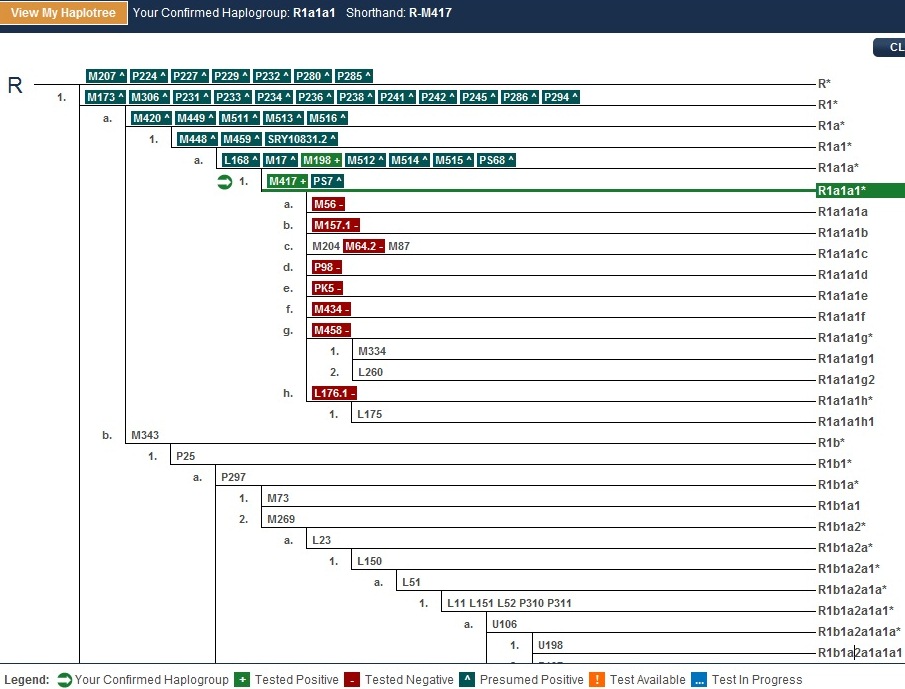
You can see, for example, below, a haplotree from a Family Tree DNA client’s results page.

This person tested positive for the light green SNP, M417.  The plus means that they have this specific mutation.  In his case, this is his terminal SNP, meaning the one furthest down the tree that defines his haplogroup, as we know it today.  That would be R1a1a1.

The SNPs shown in red, below M417 are ones that he has also been tested for, but does not have, so he knows he is not a member of those haplogroups.  These are shown with a minus sign, such as M56-.

Now for the problem that WTY has been helping to solve.

If your STR markers take you back about 500 years, in round numbers, and your haplogroup tells you where your ancestors were between 3000 and 4500 years ago, in this case, where were they in-between?  What were they doing?  Where did they live and how did they get from where they were 4500 years ago to where you find them 300 or 400 years ago, if you’re a lucky genealogist and can go back that far?

There is a significant gap in the timeframe between STR genealogy markers and haplogroup SNP markers.  Finding additional SNPs will eventually close the gap between STR genealogy markers and haplogroups.  We will have a complete timeline of our ancestors.  In some cases, we’re even finding family-specific SNPs, known as “personal SNPs.”  How cool is that?  A new haplogroup is born in your family!

Did you notice on the tree above that some of the SNP markers begin with L?  Every SNP discovered is prefaced with a letter that tells people which lab or university discovered the SNP.  The L SNPs have all been discovered at Family Tree DNA’s Genomics Lab in Houston, Texas, run by Thomas Krahn.  They are the product of the WTY discovery process.

When there is reason to believe that a SNP might be lurking undiscovered in the DNA of a person or a group, then the WTY becomes an option.  Generally, the clue would be STR markers that are significantly different than any previously seen, or part of a small and quite unusual cluster.

Today, we test all of the known downstream SNPS, the ones in red above, and then if none are found, we would apply to Family Tree DNA to do a WTY test.  This test is quite labor intensive.  In essence, they manually look at between 450,000 and 500,000 positions to see if they spy any new mutations.

If they do, they begin the SNP naming process and the process of getting the SNP officially added onto the tree.  You can see the most current haplotree (Y SNP tree) at the ISOGG site.  Because of the long naming and authentication process, sometimes trees at different locations aren’t quite in sync.  The ISOGG tree, maintained by volunteer genetic genealogists, has become what most people look to and use as the gold standard today.

In any case, this process is how new SNPs are discovered.  The Geno 2.0 project includes 12,000 SNPs for the Y chromosome, an exponential growth from the current 862, or so.  At least some of these SNPs were discovered at Family Tree DNA, as a result of savvy project administrators and others who are familiar enough with DNA results to suspect that a new SNP might exist, and who advocated with the tester and Family Tree DNA for WTY testing.

Hopefully, you now understand better about the WTY and why WTY tests are so critically important.

How might you know if you or a family member is a good candidate?

If you have tested to 67 or more markers and have no matches, you may be a candidate.  You would need to do a deep clade test, which tests all relevant downstream SNPS at this point.  In the past this has been the Deep Clade test, but today it would be the Geno 2.0 test.  If you think you might be a candidate, you’ll want to work with your haplogroup administrator to see if there are any experimental SNPS to test for after the deep clade/Geno 2.0 is completed.

The WTY is the perfect example of collaborative citizen science.  Participants fund part of the testing, haplogroup administrators identify good candidates, Family Tree DNA underwrites part of the testing fee and of course performs the test, and everyone benefits.  Before you know it, you’ve got 12,000 new SNPs combined with new technology that promises to do more than we’ve ever dared dream before!!!

______________________________________________________________

Disclosure

I receive a small contribution when you click on some of the links to vendors in my articles. This does NOT increase the price you pay but helps me to keep the lights on and this informational blog free for everyone. Please click on the links in the articles or to the vendors below if you are purchasing products or DNA testing.

Thank you so much.

DNA Purchases and Free Transfers

Genealogy Services

Genealogy Research

Geno 2.0 – Q&A with Bennett Greenspan

Bennett Greenspan, President of Family Tree DNA, was gracious enough to call me with the answers to several questions and responses to comments and speculation on blogs and lists today. He wants to thank everyone for their interest and personal support for the ongoing research and the new product.  I am putting these in a question and answer format.

Q:  Can I purchase the Geno 2.0 kit elsewhere?

A:  The Geno 2.0 product can only be purchased through the National Geographic Society.  This product cannot be ordered from Family Tree DNA.

Q:  Will there be a way to move my Geno 2.0 results to the Family Tree DNA database?

A: As with the original National Geographic product, we plan to have a link on the Geno 2.0 personal page to allow people to upload their results.  With the Geno 2.0 deep SNP results, they will be able to enter their Family Tree DNA account number, if they have an existing account at Family Tree DNA, and their deep SNP results will be included with their other tests results on their personal page.

Q:  Does Family Tree DNA plan to offer a test that will be more extensive then the new Genographic test for the Y chromosome?

A:  No. The most extensive test for obtaining YDNA SNP data is available on the Geno 2.0 chip and Family Tree DNA has no plans to compete with its partner.  STR results will not be supplied by Geno 2.0 and all regular genealogical marker tests should be ordered through Family Tree DNA.  These two tests go hand in hand.

By way of example, in haplogroup R-M222 – the new Geno chip includes discoveries of at least three unique SNP’s downstream of R-M222.

These 10,000 new SNPs will provide, for almost everyone, one or two additional clades (subhaplogroups) down the tree from where they are located today.  For some people, these will reach into a genealogical timeframe, connecting their SNPs and their STR data.  The STR tests will then be used to further augment the Geno 2.0 SNP tests for genealogical comparisons within families.

Q:  When will the new Y tree be available?

A:  FTDNA is vetting the Y tree in conjunction with the Genographic Project and prior to the release of these data.  This won’t occur until they will have had enough samples to fully vet the 12,000 tree SNPs, confirming the positions on the tree and that all SNP’s are working correctly.

Q:  What is the difference between the full mitochondrial sequence (FMS) test and the Geno 2.0 test for mitochondria?

A:  Chips can only tell you what is programmed on them.  The Geno 2.0 test is not as complete as the FMS.  Geno 2.0 includes all mtdna SNPs approved for research purposes at Family Tree DNA plus all known mutations found in Genbank.  The Geno 2.0 chip includes a total of about 3,100 locations, more than any other product using this same technology.

This test is very complete for European-centric haplogroups, such as H.  However the test is anthropological in nature, not genealogical.  This means that while you will receive your haplogroup assignment to the same level as a full sequence test, you will not receive other genealogical information that could be critically important to your research.  (Private SNP’s that are unknown will not be ‘discovered’ via chip testing).

If you want your anthropological information, meaning haplogroup information only, then the Geno 2.0 kit is the way to go.

Geno 2.0 has 50% more mtDNA SNP’s than the next best chip technology for mtDNA.  The only thing better is the full sequence test.  The full sequence test is the only test that can be universally used for scientific research as well.

Q:  There seems to be some confusion surrounding what products to order for what purposes.

Geno 2.0

Product Purchase?
Y DNA – 12,000 SNPS – Deep Ancestry – Haplogroup identification Yes
Mitochondrial DNA – Anthropology – Deep Ancestry – Haplogroup Identification Yes
Ethnicity – Worldwide Populations – Ancestral Informative Markers – Deep Ancestry – 137,000 total SNP locations – covers many SNPS not in Family Finder Yes

FTDNA Products

Product Purchase?
Y- DNA Regular STR tests, 12, 25, 37, 67 and 111 markers Yes
Mitochondrial DNA tests for genealogical comparisons Yes
Family Finder –for genealogical matching – cousin matching provided from Family Tree DNA data base Yes
Y DNA deep clade test Order Geno 2.0 unless time is of the essence
Y DNA WTY – after running Geno 2.0 on kit, discuss with Family Tree DNA Case by case

______________________________________________________________

Disclosure

I receive a small contribution when you click on some of the links to vendors in my articles. This does NOT increase the price you pay but helps me to keep the lights on and this informational blog free for everyone. Please click on the links in the articles or to the vendors below if you are purchasing products or DNA testing.

Thank you so much.

DNA Purchases and Free Transfers

Genealogy Services

Genealogy Research

National Geographic – Geno 2.0 Announcement – The Human Story

Have you ever dealt with something so massive and overwhelming it took a few days just to get your head wrapped around it?  Well, that’s how I’ve been feeling about the new National Geographic Geno 2.0 announcement.  It’s not just what has been announced, but the utterly massive amount of scientific research behind the scenes, and what it means to the rest of us.

If you think of all of the discoveries and progress that has been made in the 12 years since the advent of genetic genealogy, what you’re about to hear today dwarfs it all.  Hold on tight – this is a white knuckle ride of a lifetime.  The day I heard about this, I wandered around somewhat starry-eyed in amazement and kept muttering something terribly intelligent like “Wow, oh Wow.”

I’d like to share with you some of today’s big news and hope that you too share my sense of awe to be alive in such an exciting time, and to have not only a front row seat, but participating in making history.  This isn’t a movie, it’s the real McCoy!

Let’s start with a bit of history about Nat Geo 1.0, the Genographic Project.  Fasten your seatbelt, your E ticket ride starts here and now!

Nat Geo 1.0

Eight years ago, in April 2005, the National Geographic Genographic project was announced. The goal was to sell a total of 100,000 kits over 5 years to help fund the indigenous part of the project, which was to collect samples from indigenous peoples around the world to better understand population migration.

According to Nat Geo, this has been the most successful program they have ever undertaken.  That in and of itself it an amazing statement, especially considering that there was a lively debate within Nat Geo prior to the project launch.

Someone opined to Spencer Wells that they wouldn’t even sell 10,000 kits, let alone 100,000.  Well, they were wrong, 10,000 kits were sold the first day alone.  I’m guessing that Bennett and Max at Family Tree DNA, whose test kits Nat Geo uses, has a sense of controlled panic about that time.  The 100,000 kits were sold in the first 8 months and they still sell between 40,000 and 50,000 kits per year today.

How is that project doing?  Well, it was scheduled to run for 5 years, and it’s now into its 7th year.  They have collected over 75,000 samples from indigenous people and on the public side, over 750,000 people in over 130 countries have bought kits to help fund the research.  32 publications either have been released or will be shortly. Of the 45 million dollars the project has grossed, National Geographic has contributed more than 1.7 million dollars to the Legacy Fund for investment back into the indigenous communities that participated in the Genographic project.

You might recall that the original Nat Geo project only tested 12 markers for men and the HVR1 region on the maternal side.  At that time, 7 years ago, $99 for each of those was a great deal and the projects received a lot of new participants.  About 20% of the Nat Geo participants transferred their result to Family Tree DNA, for free, so they could join projects and participate in genetic genealogy.

Today, 12 markers is quite light and so is HVR1 testing alone.  Project administrators cringe when we see those, because we know it’s really not enough to do much with today.  We’ve learned so much in the past 7 years.  You don’t realize how much things have changed until you take a minute to look back.

At the same time we were learning, technology was also advancing.  Seven years ago, running autosomal tests was simply cost prohibitive. If you consider that computer technology has decreased in price and doubled in speed every year or two (Moore’s Law), the advances in DNA sequencing technology and understanding are moving in the same directions (increased capability and decreased costs) by a factor of 5 as compared to computer technology. Literally, we are moving at the speed of light.  See, I told you to hold on.  I meant it!

Geno 2.0 – The Big Announcement

It’s amazing that something this big has been kept this quiet.  Those of us involved have been bursting at the seams with excitement, and today is the big day.  Last night about 9 o’clock we received word that the countdown had begun.

For a look at the new National Geographic webpage, go to www.genographic.com.  This is the heart of the new Geno 2.0.

Geno 2.0 is still comprised of the 3 core components as before, the indigenous portion, the Legacy fund and the public participation portion.  However the technology is changing, dramatically, and the public participation arena is expanding.   Public participation will now include some “citizen science” projects, grants, an educational segment meaning kits in classrooms, and community based projects.  All of this is made possible by advances in the core sciences and technology.  This, plus the focus of the “Dream Team” of genetic genealogy and population genetics.

Thankfully, Spencer Wells at National Geographic and Bennett Greenspan and Max Blankfeld at Family Tree DNA prepared us in advance for what was coming, as much as you can prepare for a technological tsunami!

Let’s take a look at the technology and scientific advances that have occurred and what it means to us today.

New Chips and New Partnerships

The days of sequencing 12 markers in the lab are gone forever, replaced by high-speed sequencing that looks at half a million markers, or more, at a time, and for the same price as a 12 marker test and the mitochondrial DNA test, together, would have cost in Nat Geo 1.0.

However, when you’re looking at just the Y DNA and the mitochondrial, you’re missing 98% of the human genome, the part that isn’t Y or mitochondrial DNA.  And that 98% holds many secrets, the secrets of our ancestors.

The National Geographic Society recruited one of the top geneticists in the world at Johns Hopkins, focused on autosomal genetic markers.  He has spent the past two years identifying every known marker relevant to ancestry or population genetics that is NOT medically relevant.  This includes the X and Y chromosomes, mitochondrial DNA and the balance of the autosomal markers.

Are you sitting down?  Here’s the first of several bombs!

Relative to Y-line DNA, in 2010, just 2 years ago, the YCC SNP 2010 tree had a total of just over 800 SNPs that has been discovered.  Today it still hasn’t reached 900.  You can see the current tree at  http://www.isogg.org/tree/index.html.  Notice that all of the L SNPs were discovered by Thomas Krahn in the Family Tree DNA lab with the assistance of Family Tree DNA’s customers and project administrators.  This is truly “crowd-science” in the flash mob sense.

Today, after a concerted effort of discovery involving many people, there are a total of 12,000 Y SNPS and of that, 10,000 of them are unique and new and have never been seen or published before.  This means that your haplogroup will automatically be determined to the furthest branch of the tree with no additional SNPs to be tested.  As this test becomes available to Family Tree DNA clients as an upgrade, it will signal the demise of the deep clade test.

If there is a project administrator sitting next to you, they have just fainted.  The magnitude of this is simply mind-boggling.

Relative to mitochondrial DNA, 3352 unique (non-haplogroup defining) mutations have been discovered.  To measure all of the relevant mitochondrial DNA mutations, including insertions and deletions, over 31,000 probes (locations) are needed on the new high density chips.  Before this new approach, chip technology was unable to account for insertions and deletions, but that has been remedied by a new approach to an old problem.  This means that haplogroups will be determined to their deepest level and they will be accurate, including insertions and deletions critical to haplogroup assignment.

Relative to autosomal DNA, over 75,000 Ancestrally Informative Markers (AIMs) have been discovered and included on the new chip, and that’s after removing any that might be considered medically informative.  This astronomical number of SNPs will allow us to detect ethnicity and improve accuracy on a scale that we’ve never even dreamed about before.  I specifically asked Spencer Wells if this will help resolve those “messy” situations where we have European, Native American and African admixture, and he indicated that it would.  I can hardly wait.  For those of us what have been waiting patiently, and some not so patiently, to be able to identify small amounts of admixture, this is the best news you could ever hope to hear!  I told you that something wonderful was on the way!

Relative to admixture with Neanderthal, Denisovan and Melanesian man, meaning interbreeding, more than 30,000 SNPs have been identified that will signal interbreeding where it occurred between modern humans and ancient hominids.  And yes, this means that it did occur!  So indeed once again, you can begin wondering about your brother-in-law.  He’s probably wondering about you too.

Relative to the X chromosome, it’s included.  The X chromosome, because of its special inheritance pattern, gives us an additional, special tool when working with genetic genealogy.  We’ll cover this in a future blog.

The New Chip

In total, the new SNP count to be included on the new Nat Geo 2.0 chip (photo above) includes both new and known existing SNPs in the following amounts:

  • Autosomal including X – 147,000
  • Neanderthal – 26,000
  • Denisovan – 1,500
  • Aboriginal – 13,000
  • Eskimo – 12,000
  • Chimpanzee – 1,100
  • Y Chromosome – 12,000
  • mtDNA – 31,000

This chip has been designed to distinguish between populations.

OMG – What Happened to the Haplotree?

We’re not done yet with bombshells.

After this new chip was created by Illumina specifically for National Geographic, about 1200 samples were run as proof of concept, including 400 WTY (Walk the Y), 350 mitochondrial full sequence and 500 Y samples.  All of the samples run are checked and tested for all of the SNPs on the chip.  Of course, females’ samples will fail on all of the Y haplogroup locations, etc.

Just based on this test run alone of 900 Y chromosome kits, the haplotree expanded from 862 SNPs to a total of 6153.  If you’ve just said something akin to “Holy Cow,” you’re on the right track.  Imagine what it will do with another 1000 or 10,000 or 100,000 tests.  Right now, we’re making discoveries so fast we can hardly deal with them.

What Does This Mean?

In reality, what this means is that we will very soon use SNPs to determine heritage down to a genealogical meaningful timeframe, meaning 500 to maybe 1000 years.  The standard STR (Short Tandem Repeat) markers we know and love will become the leaves on the branches of the tree and these will likely be used when there are no more SNPs to determine family groupings and line marker mutations within families.

New National Geographic Geno 2.0 Website

Needless to say, all of this discovery has prompted National Geographic to redo their website entirely.  New maps are forthcoming.  Yeah!!  New maps include the migration maps as well as new haplogroup “heat maps” where the colors are graduated based on frequency.

There are entirely new capabilities too.  The new website will show you as the center of a circle and you’ll be able to contact people who have tested at Nat Geo who are located near to you in the circle.  Those closest to you, you’re most closely related to.  Further away, more distantly related.  Before, there was no matching between Nat Geo participants.

And yes, Geno 2.0 participants will still be able to transfer into Family Tree DNA for free.  I hope they make that option much more visible or interactive.

A New Test Kit

Anyone wanting to participate in Geno 2.0 will have to order a new kit from National Geographic.  The previous Nat Geo kits, if you recall, were anonymous unless you chose to transfer to Family Tree DNA, plus the permission you gave was specifically for mtdna or Y-line, not autosomal testing.

Furthermore, the DNA in many kits will be too old and will have degraded too much to use.  Everyone ordering the new Geno 2.0 kit will receive a new swab kit, in an heirloom box.  The comprehensive Y-line (haplogroup only), mtdna (haplogroup only) and autosomal testing will cost $199.

For Family Tree DNA clients who will be offered the upgrade in the late summer or fall, you will be able to upgrade if your DNA is less than 4 or 5 years old.  Otherwise, you’ll receive a new swab kit too.

All processing will be done at the Family Tree DNA Houston facility.

New Results Pages

The new test of course requires all new results pages for participants.

Take a look at a few of the pages you can expect.

The results will be presented as a personal story.

Your story will also include information such as maps of where your ancestors lived and where they migrated.

I asked Spencer if participants will be able to download their results so that we can continue to compare them as we do today, using various phasing tools.   Spencer replied, “Yes, raw results WILL be available for download.  In the Genographic Project, you will always own your DNA results, and the genotype data will be yours to do with as you please.  I feel very strongly that this is a cornerstone of ethical DTC genetic testing.”  Way to go Spencer!!

As Geno 2.0 moves forward, additional analytical tools will be added.

Ordering

National Geographic is accepting pre-orders now.  They will ship before the end of October, and they expect to be shipping significantly before that.

In Summary

Our world is changing, rapidly, and for the better.  The door we’ve been peeking through for a decade now is swinging wide open.  More brick walls will fall.  We’ll find and meet new cousins.  Ethnicities will be identified at a level never before possible.  We’ll learn about our ancestors and the story of our past through their DNA that we carry today.  It is the frontier within.  DNA is truly the gift that keeps on giving!

“One small step for man, one giant leap for mankind.”

Neil Armstrong, July 20, 1969

______________________________________________________________

Disclosure

I receive a small contribution when you click on some of the links to vendors in my articles. This does NOT increase the price you pay but helps me to keep the lights on and this informational blog free for everyone. Please click on the links in the articles or to the vendors below if you are purchasing products or DNA testing.

Thank you so much.

DNA Purchases and Free Transfers

Genealogy Services

Genealogy Research

Ethnicity Finders

It’s no secret in the genetic genealogy community that one of my special areas of interest is Native and mixed race heritage.  Both are obscured in the history of this country and this continent, and hampered by the lack of records.

Descendants are left to attempt to piece the history of their family together, many times with nothing more concrete than oral family history, faintly remembered.  For these people, and there are many, genetic genealogy is the best and final hope they have of discovering IF the family rumor is true.  If it is true, then perhaps by the judicious use of these new DNA tools, we can begin to get some idea of where to look on the family tree, as well as in historical records.

Someone asked a question on the blog the other day about how to interpret these results, and I do want to answer that question specifically in a future blog, but first, we need to talk about the tools themselves.

There are three kinds of tests or tools out there in the marketplace today.

Y-line and Mitochondrial DNA Tests

Why, you ask, are we talking about these tests when we’re supposed to be talking about ethnicity finders?  Well, simply put, because these are the old, proven gold standards, and people tend to forget about using them.  These tests DO prove ethnicity, but only for that one specific line.  But that’s also the beauty of this test, we know exactly which line the ethnicity pertains to.  Y-line of course is the paternal line and mitochondrial DNA is the direct maternal line only.  What does that tell us about their spouses?  Not a darned thing.

To discover ethnicity information about the spouse, you need to find someone directly descended from the spouse in the proper manner and have them test.  What you need to do is to build yourself a DNA pedigree chart so that you can determine, to the best of your ability, the ethnicity of your family, member by member.

If you can obtain the Y-line and mtDNA of your great-grandparents (through descendants of course), you’ll know about 8 of your ancestors.  If you can obtain the DNA of your great-great-grandparents, you know the ethnicity of 16 of them.  That’s a lot of good information.

However, sometimes obtaining this information just isn’t possible.  Some people are adopted, some don’t know the identity of a parent for other reasons, sometimes couples don’t have children of the right genders for their descendants to take these kinds of DNA tests, and sometimes, you simply have relatives who aren’t interested or refuse to test.  Enter, autosomal testing.

CODIS Type Tests

The first entries into this field of autosomal testing were tests that used few markers.  I am grouping them here together, even though there were some differences and at the time, there was significant debate about which ones were better, more accurate and such.  But today, with the advent of what I’m calling the Wide Spectrum Chip Tests, they are all obsolete.

CODIS stood for the Combined DNA Index System and was developed by police to differentiate between people, not to find their ethnic similarities.  Most of them used either 15 or 21 markers that were standardized for police work.  One test specifically for genealogy used about 150 markers.

These tests were also used for early paternity testing and were fairly reliable for one generation, but beyond that, it was difficult to draw any conclusions.  My alleged half-brother and I took three of these tests to determine if we were in fact half-siblings.  One test came back inconclusive.  One test said “probably not” and one said “probably cousins, not half-siblings.”  Later, we both took two of the Wide Spectrum Chip Tests, and we are neither half-siblings nor cousins.  The results of both of the wide spectrum tests, taken at different companies, matched each other, so all doubt was removed.

I took several of these tests as they were released, and you can read about the differences in results in my paper on by website titled Revealing American Indian and Minority Heritage Using Y-line, Mitochondrial, Autosomal and X Chromosomal Testing Data Combined with Pedigree Analysis.  This paper was published in JoGG, the Journal of Genetic Genealogy, in the Fall of 2010.

Wide Spectrum Chip Tests

In one large step, we went from 21 markers to half a million, give or take 100,000 or so.  It was kind of like moving from trying to find scant evidence under a microscope to a panoramic view of the galaxy.

All together, there have been 4 players in this field.  One of the first was DeCodeMe.  They have pretty well eliminated themselves.  With an impending bankruptcy a few years ago, they raised their prices into the $2000 range.  That combined with no comparative data base, like 23andMe had at the time, in essence killed them as a player.  Unfortunately, their ethnicity test was the only one that was able to classify my African heritage with a group of tribes.  I hated to see them leave the scene.

23andMe was the next player.  They introduced the concept of matching your cousins.  Genetic genealogy went crazy and we couldn’t order those tests quickly enough.  Unfortunately, their ethnicity comparison is disappointingly vague and is limited to 3 categories, European, Asian and African.  No updates or improvements have been offered in several years.  Genealogy is not their priority or focus.  People looking for Native American heritage must extrapolate that Asian is Native.

The other unfortunate part for genetic genealogists is that most of their customer base takes this test for health information.  While that means we’re fishing in a different pool than the normal genealogy group of people who test, it also means that many or most of them don’t reply to inquiries about their family history, and those that do often have no information.

Family Tree DNA was the next player to enter this space.  In addition to the cousin matches provided, their ethnic breakdown is far more detailed than any of the others, actually breaking down continents into several population categories.  While this detail is most welcome, it can also be confusing in some cases, especially if you receive an unexpected grouping  They are the first company to bring us this level of detail, and we’ll talk in a minute about how this is done.  As with any new technology, there are pitfalls and this entire field is and has been a learning experience.

Ancestry.com recently entered this market as well.  They initially gave away thousands of kits, about 10,000 I believe, so that they would have something in their data base to compare results to when they began to sell the kits.  They did begin to sell the kits in the spring of 2012 by invitation only to customers, and now the early results are coming in.  They seem to have had some early issues with unwarranted Scandinavian results being reported, but as they fully develop the product, I would expect they would get this corrected.

So, as of today, we have three players using this Wide Spectrum Chip Technology.

There are two things you need to understand about this technology and how it is used to generate the results you’re seeing relative to ethnicity.

Chip Technology Itself

Technology has been a good friend to genetic genealogy, but most of us don’t know it.  New diagnostic technology has been developed in the medical field that we’ve been able to leverage.  Instead of manually looking for the results of 21 markers in the lab, new chips have been developed that are scanned for between 500,000 and 700,000 locations, and for about the same price.  This allows detailed analysis on the level that was previously not only impossible, but undreamed of.

Do you remember the videotape format war in the 1980s – VHS vs Beta?  If so, you’re probably groaning now.  Well, there was a similar DNA chip war too and you didn’t even know it happened.  As a result, today we use the Illumina chip.

Anyone who was a Family Tree DNA customer and bought the early Family Finder test, you received a free upgrade when Family Tree DNA replaced their previous sequencer with the new Illumina model.  I’m sure that set them back a pretty penny, both the replacement sequencer and all of those free upgrades.  In any event, now that both 23andMe and Family Tree DNA use the same technology, their results can be compared.  You can upload 23andMe results to Family Tree DNA and you can upload both results to GedMatch for private comparisons.

We don’t know for sure what technology Ancestry is using, but it’s believed to be the Illumina platform.  However, it’s a moot point at this juncture, because they do not provide customers with their data files to download.  Genetic genealogists are hoping to change their minds in the future.  Without this capability, all of the advanced analysis is impossible.

(Update – Sept. 2013 – Ancestry does use the Illumina platform, does now provide raw data files, but still does not provide any comparison tools like a chromosome browser so that you can see if and where you actually do match the person you’re paired with through their system.)

Ok, all of this said, how is this technology used to determine ethnicity?

Determining Ethnicity

Whew, I bet you thought we’d never get to this part.  Ethnicity is really not determined by smoke and mirrors with the assistance of a fortuneteller and a crystal ball.  And no, you do not just pick up the Magic 8 Ball and look for the answer on the bottom.  If you remember the VHS wars, you’re probably laughing now.  If you aren’t, well, then, never mind.

Different marker values in our DNA are found in different proportions in differing populations.  We are all familiar with this relative to haplogroups – where they are found, originated and spread.  We know that African haplogroups are much more likely to be found in Africa than in Siberia, for instance.

Ancestry Informative Markers, called AIMS, aren’t any different.  What is different is that there is no centralized data base to compile them for research purposes.

Back to the CODIS markers, information about these markers was mined, for the most part, from forensic law enforcement publications.  The problem there was that there was no standardization or quality control.  For example, if you were being booked into the jail and someone asked you your ethnicity, how reliable was the answer?  Or did the jailer just look at you and write down what they thought?  Furthermore, results were very spotty and tended to be from high crime areas, not really representative of a world-wide population.    But it was all we had at the time and it was a baby step along the way.  This problem as a whole is known as data base normalization.

Relative to the CODIS type tests, they were pretty good at determining your primary ethnicity, something very important to law enforcement looking for an unknown suspect, but not useful to genealogists.  They were much less reliable looking for minority admixture and very unreliable looking for trace amounts of admixture.  These data bases were also easy to skew based on what data the researcher in question entered for comparison.  In other words, if you were interested in Native American ancestry, your data base would likely contain disproportionately more Native data than would proportionately be warranted.

As newer technology has become available and research has advanced, new information has become available.  For example, there are two DNA marker values that are known only to exist in the African and the Native American populations, respectively.  So, if you have one of these two values, then you unquestionably DO carry that heritage.  Of course, figuring out which ancestor or even which line it came from is another matter entirely.

No longer in the law enforcement and forensics arena, most AIMS now are discovered in academic settings.  In my paper, I do discuss the reference populations used for each of the testing companies.  The biggest challenge to all of them is finding and compiling the data.  It is buried in many academic papers and is not compiled centrally anyplace.  After the papers are read, the values are amassed, then the computer crunching needs to be done to determine which of these markers are really “ancestrally informative” and if so, how.  In general, unlike the one African and one Native marker, markers are generally found in a range of populations in varying frequencies.  This means that you’re now dealing with statistical probabilities.  Did your eyes just glaze over?

In a nutshell, what has to be done is to look at all of the AIM values that you carry, look at where they are most likely to be found, and put all of that together to come up with a composite picture of you.  Let’s say for example, you have that African marker, but very few others found in high frequencies in African, that Native marker plus several more found in Asia and a whole bunch found in Europe but seldom in Asia or Africa.  This person would obviously have European, Native and African heritage, but it’s up to the statistics to determine what percentage of which type and from where.

This is obviously a new field, actually, a new field within a new field.  Genetic genealogy itself is only 12 years old.  As more papers are published and more information is found, this affects the statistics and will affect the ethnicity percentages shown.  Keep in mind also that the African value, for example, could have been passed from many generations ago, from a long forgotten and otherwise genetically “absent” ancestor.

Blaine Bettinger had a great blog about this very topic.  You can see it at http://www.thegeneticgenealogist.com/2012/06/19/problems-with-ancestrydnas-genetic-ethnicity-prediction/.  While he is actually talking about the problem with Ancestry.com’s ethnicity predictions, he discusses a very important concept, and that is that you actually have two family trees.  The genealogy one we all know and love, and a genetic family tree that we are just now getting to know.

Of course, the gift box with the big beautiful bow holds for us, one by one, the branches of our genetic tree….and that gift may look nothing at all like the package wrapping suggests.

______________________________________________________________

Disclosure

I receive a small contribution when you click on some of the links to vendors in my articles. This does NOT increase the price you pay but helps me to keep the lights on and this informational blog free for everyone. Please click on the links in the articles or to the vendors below if you are purchasing products or DNA testing.

Thank you so much.

DNA Purchases and Free Transfers

Genealogy Services

Genealogy Research

The Trouble with Ancestry.com Matches

Update: Ancestry no longer provides Y and mitochondrial DNA testing, but I’m leaving this article for historical context.

While working on a client’s mitochondrial DNA report, I came across the worst case I’ve seen in a long time of mismatches being shown as matches at Ancestry.com.  This has been a pervasive problem for a long time.

10 Point Question – If you match another person exactly on every location, HVR1&HVR2, must you have the exact same haplogroup?

Answer:  Most of the time.

You didn’t think this was going to be easy did you?

Because Family Tree DNA is the only company to test to the full sequence level, their clients are going to have far more advanced, detailed and accurate haplogroup assignments than people who test at companies who only offer the HVR1+HVR2 regions.

Therefore, like in this case, we see a client whose haplogroup is H1.  The “1” part of H1 is determined by location 3010A, a position found in the coding region that can only be read by full sequence testing.  So, at Ancestry, and in other data bases outside of Family Tree DNA, we would expect to see matches to both haplogroup H and H1 (assuming the data base allows outside results to be input), and possibly some other H haplogroups as well, if the HVR1+HVR2 region mutations match those of our H1 person.

OK – next 10 point question.  Will someone who is haplogroup H match someone who is haplogroup M or N or some other haplogroup?

Answer: No, not an exact match, but they may share some common mutations.

Then why does Ancestry show them as matches when a simple comparison would eliminate them?

The answer is two-fold.  Part of the issue could be how Ancestry assigns haplogroups.  We really don’t know how they do it, and they aren’t as forthcoming about these things as Family Tree DNA is.  Secondly, and probably the biggest issue is that Ancestry allows people to enter their own data from other labs into their data base, including their haplogroup, apparently without any verification process.  So, in essence, Ancestry has muddied their own waters.

My client’s 251 matches at ancestry were all shown with “0” differences which means they are exact matches.  That’s exciting to see, except it isn’t real.

I clicked on the “download matches” button, which dumps everything into a spreadsheet, a wonderfully handy feature.  As we talk about this, keep in mind that my client had a total of 5 mutations in the HVR1+HVR2 regions, so based on “0” differences, everyone on that list should share all of those mutations with no additional mutations.

Here’s what I found after sorting the spreadsheet.

Exact matches = 32, hardly the 251 displayed on the match page.

Of the 251 “exact” matches shown, the haplogroup breakdown is shown below:

A – 10 (Native American)

B- 7 (Native American)

C – 3 (Native American)

D – 2 (Native American)

H – 154, over half with no matching markers at all to client

HV – 10

I – 5

J – 5

K – 4

L – 12 (African)

M – 4

N – 5

R – 6

T – 7

U – 11

V – 3

W – 1

X – 1

Z – 1

But even this isn’t the worst part.  Of the 251 matches shown with “0” differences, 32 are actually exact matches.  Of those exact matches, we find 4 different haplogroups, including 3 in haplogroup M, a generally Asian haplogroup which is rare as hen’s teeth here in the US.  Hmmm….anyone spot a problem?

Of the remaining 219, 162 have no mutations whatsoever that match the clients, so they not only shouldn’t be shown with “0” differences, they shouldn’t be shown at all.  So this means that the balance of the matches that do share at least one marker but aren’t exact matches, 57 in number, are shown incorrectly, with “0” differences.

So let’s give Ancestry a report card on this.  32 out of 251 correct equals 13% correct.

Last 10 point question – What letter grade do you get for 13% right, which is 87% wrong?

In my book, and in any school I ever attended, that was a big fat F!

And no, this is not just a recently introduced software bug.  It’s been like this forever.

So now that we know how well Ancestry does on basic things like mitochondrial DNA matches, which are exceedingly easy, anyone feel good about how they’ll do with autosomal DNA?  Comparatively speaking, that’s the tough stuff.

______________________________________________________________

Disclosure

I receive a small contribution when you click on some of the links to vendors in my articles. This does NOT increase the price you pay but helps me to keep the lights on and this informational blog free for everyone. Please click on the links in the articles or to the vendors below if you are purchasing products or DNA testing.

Thank you so much.

DNA Purchases and Free Transfers

Genealogy Services

Genealogy Research
Citizen Science

My husband, Jim, who is kind of a geeky guy in the best of ways and really is interested in genetic genealogy from a technologist’s perspective, asked me a question about the new mitochondrial comparative sequence, the RSRS (Reconstructed Sapiens Reference Sequence).  We’ve been talking about it on the blog and on the various DNA lists for days now.  So it stands to reason we’re talking about it at the dinner table too.

He asked, “Why now?  Why not before when the transition would have been easier?”  That’s a great question!  The answer isn’t nearly as short as the question.  I hate it when he does this to me!

The answer is Citizen Science – that means you and me – lots of us actually.  How is that possible?  Let’s take a look at some history.  It’s actually quite interesting!

In 1981 when the Cambridge Reference Sequence was published as a comparative model, the science of genetics was functionally brand new.  This anonymous person at Cambridge University was the first person to have all 16569 bases of their mitochondria sequenced, something anyone can have today for a couple of hundred dollars.  But back then in the not so distant past, it was groundbreaking.  The Y DNA hadn’t even been mapped yet, so this was the very beginning.  At that point in time, there was no concept of mitochondrial Eve or Y-line Adam.  So the CRS became the norm because we had no other basis for comparison.

In 1999, the CRS was resequenced, and surprisingly, 11 errors were found in the original sequence.  Today that is called the Revised Cambridge Reference Sequence, or rCRS, technically, and that is the sequence that is used for both academia and genetic genealogy.  Most people just refer to it as the Cambridge Reference Sequence because no one would use the older sequence today.

1999 was also the first year that any commercially available genetic genealogy tests were available to the public.  They were available from Oxford Ancestors and were prohibitively expensive, but that didn’t stop many of us from ordering one.  If you bought the book, “Seven Daughters of Eve” you could send in the form in the back of the book, with a hefty check, and you too could discover which of the 7 daughters you descended from.

What you received was one piece of paper in the mail, months later, with a gold attendance star (like from Sunday School when you were a kid) placed on your haplogroup name.  So for several hundred dollars, significantly more than a full sequence test today, I got a gold star on a J.  I still have that certificate and I was unbelievably excited to know I was a member of Jasmine’s clan.  Of course, in order to justify my DNA test, I had to test my husband’s too, so it cost me twice as much!

In the year 2000, Family Tree DNA opened their doors and began selling genetic genealogy testing kits. They also began surname projects.  I don’t know if that was a stroke of genius or a stroke of luck.  Soon thereafter, they added both haplogroup projects and geographic projects.  These various project types allowed people with specific interests to focus on those areas of genetic genealogy.  Little did we know that projects would eventually provide a huge pool of people who have been DNA tested for research areas, such as determining new haplogroups.  In the past all sequencing had been done at academic institutions and often did not use full sequences initially due to the prohibitive cost.  Many of the early academic papers were written with far fewer samples than today’s projects have members.  Full sequence commercial testing has fostered exponential change in this industry.

By 2006, Family Tree DNA was offering the full mitochondrial sequence for genealogists, something still not offered today by any of the other major commercial testing companies.  This not only enabled genealogists to determine who was actually a close match, but it also enabled the haplogroup projects to collect many samples of full sequence data.  The coding region (meaning not the HVR1, HVR2 and HVR3 regions) is not shown in the public projects because of the possibility that they may carry medical information, but they are available for project administrators to see, if the individual participant authorizes administrator view access.

Haplogroups aren’t just determined by the hypervariable (HVR) regions, but by mutations found in the entire mitochondrial sequence, including the coding region.  Never before had groupings of participants this size been available outside of academia, and often, not even within academia.

Many of the project administrators began discovering new haplogroups in a flurry of activity.  Two that come immediately to mind are both Jim Logan and Bill Hurst.  Bill began publishing about haplogroup K in the Fall 2007 JoGG issue, as did Ian Logan with a discussion of what the mitochondrial DNA of “mitochondrial Eve” might look like.  In Spring of 2008, Jim Logan published a groundbreaking paper for haplogroup J, still in use today.  Indeed, citizen science came into its own in the spring of 2005 when the Journal of Genetic Genealogy (JoGG) was launched to facilitate exactly this type of academic publishing effort.  The more traditional publications weren’t quite ready to deal with citizen scientists making discoveries.  Clearly, citizen scientists didn’t fit well into the academic publishing “box.”

Bill Hurst has been collaborating with Dr. Doron Behar for several years now and is recognized in his most recent paper.  They presented a joint session at the 5th International Conference on Genetic Genealogy for DNA Administrators in Houston, Texas in March of 2009.

During this time, Family Tree DNA implemented an authorization system for people to make their full sequence DNA results, if they wanted, available to Dr. Behar for research.

Dr. Behar’s paper (along with several other authors), “A “Copernican” Reassessment of the Human Mitochondrial DNA Tree from its Root” was published earlier this year, defining the RSRS (Reconstructed Sapiens Reference Sequence) revealing the genetic fingerprint of Mitochondrial Eve, the original mother of us all.  He was able to do this, in part, as a result of the many full sequence test results made available by Family Tree DNA customers, you and me, and by the hard work of haplogroup administrators like Bill Hurst and Jim Logan.  Of course, there are many other hard-working administrators too, and I don’t mean to slight anyone.

So, this is a long-winded way to answer Jim’s question, which, in case you’ve forgotten, was “why now for the RSRS and why not before?”  The answer is quite simply, Citizen Scientists were needed.  People like you and me.  Until the stars aligned where haplogroup projects existed, full sequence mitochondrial data became affordable and widely available, and there was a way for genealogists to contribute their results for scientific research, it couldn’t have been done – at least not yet.  It’s been a long way from the gold star on haplogroup J to the beautifully elegant RSRS, the mitochondrial map of Eve, the common ancestor of everyone living today – the entire trip made in just a dozen years.  Congratulations and thank you to everyone involved.  Indeed, it’s really quite a remarkable story!

______________________________________________________________

Disclosure

I receive a small contribution when you click on some of the links to vendors in my articles. This does NOT increase the price you pay but helps me to keep the lights on and this informational blog free for everyone. Please click on the links in the articles or to the vendors below if you are purchasing products or DNA testing.

Thank you so much.

DNA Purchases and Free Transfers

Genealogy Services

Genealogy Research

I’ve Never Met a DNA Test I Wouldn’t Take….

Ok, so maybe that is a bit of an exaggeration, but not much.

Someone commented recently that they were surprised that I had taken tests with other companies since I am affiliated with Family Tree DNA.  I’d like to talk about that.

First, I am affiliated with Family Tree DNA.  I provide the Personalized DNA Reports that they sell.  We teamed up several years ago to offer these.  I am not an employee, but a contractor to them.  Having said that, I was a customer long before that.  I’ve established several projects there, and for many reasons, I believe they are the best in this industry.

However, that has never kept me from testing at other companies, for several reasons.

First, I feel an obligation to my clients to be well versed in what the industry has to offer, and how can you be well versed if you don’t take the tests?  At least, that’s what I tell my husband when he asks why all those DNA testing bills:) So that’s my story and I’m sticking to it!

Secondly, I believe in fishing in different ponds.  Your DNA is fishing for you 24x7x365.

Third, there are lots of people in lots of places conducting research today.  I’m involved with a number of those projects as well, as a volunteer.

Fourth, if one company has a better tool for DNA analysis, I’m all for it, and for them.  For example, 23andMe was the first to offer the full spectrum autosomal tests, and I tested there and so did many of my family members.  I have also benefitted from the health information.

Fifth, I like to compare similar information between companies.  You can see an example of this and how I used it in my genealogy in the paper I wrote (published in JoGG), Revealing American Indian and Minority Heritage Using Y-line, Mitochondrial, Autosomal and X Chromosomal Testing Data Combined with Pedigree Analysis.

So, I’m by no means a DNA snob or in an exclusive relationship with Family Tree DNA relative to testing.  In fact, I recently ordered Ancesty.com’s autosomal DNA test.  I want to see what they say, find cousins in that data base who may help to break down genealogical brick walls, and how my percentages of ethnicity are calculated there.  I’ll let you know as the results come in and how they stack up with similar tests at Family Tree DNA and 23andMe.

______________________________________________________________

Disclosure

I receive a small contribution when you click on some of the links to vendors in my articles. This does NOT increase the price you pay but helps me to keep the lights on and this informational blog free for everyone. Please click on the links in the articles or to the vendors below if you are purchasing products or DNA testing.

Thank you so much.

DNA Purchases and Free Transfers

Genealogy Services

Genealogy Research

Sorenson (SMGF) Update

Update: Ancstry discontinued the Sorenson database.

Many of you know about using the DNA records at www.smgf.org.  The good news is that those  of you who don’t will still get the opportunity to make discoveries by searching their data bases, at least for awhile.  They have provided, for some number of years, free data base searches to their records for both Y-line and mitochondrial DNA.

Sorenson’s assets were recently acquired by Ancestry.com, a move which has caused a non-trivial amount of consternation among genetic genealogists.  In particular, people, me included, contributed their DNA and their pedigree charts and they want to know what is going to happen to that information.  The testing was performed for free.  People never received individual results, but as their tests were processed, their results were added to a publicly searchable data base, so you could find and identify yourself with a little effort.  Equally as important, it’s a resource that many genealogists use for finding additional matches outside of the commercial testing companies.

Although today’s update from Sorenson doesn’t answer all of the questions about what will happen, or when, they do tell us that the data base will be available for some time to come.  I hope that Ancestry continues to maintain this free service, as it is certainly in line with the expectations of the people who donated their DNA/pedigree charts and also the vision of James Sorenson who founded SMGF several years before his death.  It does call into question, however, what is going to happen to these records.  Are they going to be absorbed into the Ancestry.com databases without notifying the participants?  As a participant myself, that certainly wasn’t what I expected or signed up for.

As of this morning, the new records have been added to the data base for this last and final update, but early reports also indicate that some records previously included are now missing.

Here’s what Sorenson had to say today:

Dear Friends of SMGF,

SMGF is happy to announce the addition of new haplotypes and genealogical records to the Sorenson mtDNA and Y-chromosome databases. We invite you to search these updated databases to find new family connections at http://www.smgf.org.

From the time it was founded in 1999 by molecular genealogy pioneer, James Levoy Sorenson, the mission of SMGF has been to support an important public purpose, namely the advancement of DNA-based genealogy research. Thanks to the continued philanthropic support of Mr. Sorenson and his family and the generosity of enthusiastic SMGF participants, SMGF has built the most comprehensive database of linked DNA and pedigree information in the world. Additionally, SMGF has contributed greatly to the emerging field of genetic genealogy in other ways, such as providing online DNA databases to the public and publishing numerous scientific articles detailing new discoveries.

In order to remain a leader in this rapidly growing and dynamic field, SMGF’s resources and capabilities would have to be substantially increased. Therefore, SMGF has decided that AncestryDNA is better positioned to provide the benefit to the public that is central to SMGF’s mission. For this reason, SMGF’s DNA-related assets were acquired by AncestryDNA in March 2012. SMGF is very excited to join AncestryDNA, and we are confident that the pioneering work begun at SMGF will continue to grow and have an even greater impact on the future scientific understanding and public outreach of genetic genealogy.

As we redirect our efforts to the integration with AncestryDNA it will be necessary to discontinue updates to the smgf.org website. Therefore, this will be the last update made to the Sorenson online databases. This update includes all of the Y-chromosome and mtDNA haplotypes that were generated by SMGF over the course of its operations.

The smgf.org site will continue to operate for the foreseeable future as a freely accessible tool for the genetic genealogy community, so we invite users to continue searching for family connections on smgf.org. We express our sincerest thanks to all those who participated in the SMGF project.

Sincerely,

The SMGF Team

______________________________________________________________

Disclosure

I receive a small contribution when you click on some of the links to vendors in my articles. This does NOT increase the price you pay but helps me to keep the lights on and this informational blog free for everyone. Please click on the links in the articles or to the vendors below if you are purchasing products or DNA testing.

Thank you so much.

DNA Purchases and Free Transfers

Genealogy Services

Genealogy Research

Did You Test at GeneTree???

If you ever tested at GeneTree, then this message affects you.  I received the following information from GeneTree about the DNA records of their clients.  They recently sold their assets to Ancestry.com.  So if you tested there, you may want to download your records while you still can.

Dear GeneTree Customer,

You may have recently heard the exciting news that GeneTree has been acquired by AncestryDNA™ ( http://corporate.ancestry.com/press/press-releases/2012/05/ancestry.com-dna-launches/ ). As we redirect our efforts to the integration with AncestryDNA it will be necessary to discontinue the GeneTree.com website. However, as a valued GeneTree customer, you will be able to access GeneTree.com through the rest of this year, until January 1, 2013. Following this date, access to your account will no longer be available through the GeneTree site, so we recommend that you download your DNA results and pedigree data while the site is still available.

If you’d like to learn more about how to download and continue using your information and family tree outside of GeneTree, see click here To help answer some frequently asked questions, please visit our FAQs. We greatly appreciate you being a part of GeneTree and hope that you continue with your genetic genealogy and family history research.

Sincerely, The GeneTree Team

______________________________________________________________

Disclosure

I receive a small contribution when you click on some of the links to vendors in my articles. This does NOT increase the price you pay but helps me to keep the lights on and this informational blog free for everyone. Please click on the links in the articles or to the vendors below if you are purchasing products or DNA testing.

Thank you so much.

DNA Purchases and Free Transfers

Genealogy Services

Genealogy Research