New Haplogroup C Native American Subgroups

Haplogroup C is one of two haplogroups, the other being Q, which are found as part of the Native American paternal population in the Americas.  Both C and Q were founded in Asia and subgroups of both are found today in Asia, Europe and the New World.  The subgroups found in the Americas are generally unique to that location.  I wrote about some of the early results of haplogroup Q being divided into subgroups through Big Y testing here.

In the Americas, haplogroup Q is much more prevalent in the Native population.  Haplogroup C is rarely found and originally, mostly in Canada.

Hap C Americas

This chart, compliments of Family Tree DNA, shows the frequency distribution in the Americas between haplogroups Q and C.

However, in the Zegura et al article in 2004, haplogroup C was found in very small percentages elsewhere.

The authors found the following P39 men among the samples:

Northern Athabaskan:

  • Tanana of Alaska, 5 of 12

Southern Athabaskan:

  • Apache, 14 of 96
  • Navajo, 1 of 78

Algonquian (Plains):

  • Cheyenne, 7 of 44

Siouan–Catawban (Plains):

  • Sioux, 5 of 44

I was speaking with Spencer Wells (from the Genographic Project) about this at one point and he said to keep in mind that the Athabaskan migration to the Southwest was only about 600 years ago. That is why our one Southwestern C-P39 looks like he is related to all the other families about 600 years ago.

There are competing theories about whether the Athabaskan came down across the plains or along the western mountains/coast. I found a few recent studies that say both are likely true.  We don’t know if the C-P39 found on the Plains is residual from the migration event or from another source.

In the American Indian DNA Project and other relevant DNA projects, we find haplogroup C in New Mexico, Virginia, Illinois, Canada, New Brunswick, Ontario and Nova Scotia.

In 2012, Marie Rundquist, founder of the Amerindian Ancestry Out of Acadia DNA Project as well as co-founder the C-P39 DNA project wrote a paper titled “C3b Y Chromosome DNA Test Results Point to Native American Deep Ancestry, Relatedness, among United States and Canadian Study Participants.

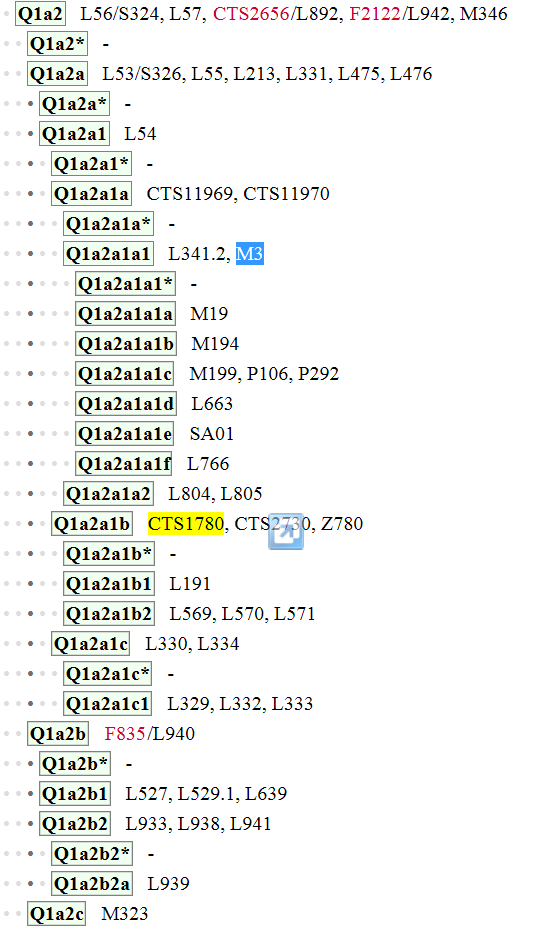
At this that time, haplogroup C-P39 (formerly C3b) was the only identified Native American subgroup of haplogroup C.  Since that time, additional people have tested and the Big Y has been introduced.  Just recently, another subgroup of haplogroup C, C-M217, was proven to be Native and can be seen as the first line in the haplotree chart shown below.

The past 18 months or so with the advent of full genome sequencing of the Y chromosome with the Big Y test from Family Tree DNA and other similar tests have provided significant information about new haplotree branches in all haplogroups.

Ray Banks, one of the administrators of the Y DNA haplogroup C project and a haplogroup coordinator for the ISOGG tree has been focused on sorting the newly found SNPs and novel variants discovered during Big Y testing into their proper location on the Y haplogroup tree.

I asked Ray to write a summary of his findings relative to the Native American aspect of haplogroup C.  He kindly complied, as follows:

By way of a simplified explanation, a 2012 study by Dulik et al. reported that southern Altains (south central Russia) were the closest living relatives of Amerindian Haplogroup Q men they could identify.

Male haplogroup Q is the dominant finding within Amerindian populations of the Americas.

But male haplogroup C-P39 is also found in smaller percentages among Amerindians of North America.  A second type, of a different, poorly defined C, has been identified among rainforest Indians of northwestern South America.

The 2004 study by Zegura et al. reported that C-P39 was present in some quantities among some Plains and Southwest Indians of the United State, as well among Tananas of Alaska.  No one has done a comprehensive inventory of Amerindian Y-DNA haplogroups.  A high percentage of the Amerindian samples at Family Tree DNA that are P39, in contrast, report ancestry in central or eastern Canada.

It does not seem that anyone has yet definitively addressed whether C-P39 men have a different relationship pattern in relation to Asian groups than seen in haplogroup Q.  Another question is whether they might have been involved in a more recent migration from Asia than Q men who seem to have quickly migrated to all areas of South America as well.

Four men in the Haplogroup C Projects have made their Big Y results available for analysis.  All are from Canada, living in areas varying from central to maritime Canada.

These results show that the four men can be divided into two main groups.  The mutations Z30750 and Z30764 have been tentatively assigned to represent these subgroups.  The number of unique mutations for each man suggests these two subgroups each diverged from the overall P39 group about 3,500 years ago.  This is based on the 150 years per mutation figure that is being widely used.  There is no consensus for what number of years per mutation should be used.  Likewise, the total number of shared SNPs within P39, suggests 14,100 years as the divergence time from any other identified Y-DNA subgroup.  The Composite Y-DNA Tree by Ray Banks contains about 3,700 Y subgroups for comparison.

Ray Banks C Tree 3

The nearest subgroup to P39 has been identified as the F1756 subgroup, last line in the chart above.  These both share as a common earlier subgroup, F4015.   This parallel F1756 subgroup has been identified in Geno 2.0 testing as well as Big Y as containing mostly men from Kazakhstan, Kyrgyzstan and Afghanistan.  Some apparently have a tradition of a migration from Siberia.

There is available a Big Y test from among this group, and more recently complete Y sequencing in the sample file GS27578 at the Estonian Genome Centre.

Each of these men potentially could have shared one or more of the P39 equivalents creating a new subgroup older than P39.  But this is not the case.  The Big Y results are not complete genome sequencing, and they perhaps miss 30% of useful SNPs, mostly due to inconclusive reads.

The man in the Estonian collection is of particular interest because he is described as an Altaian of Kaysyn in Siberia, Russia.  He is not from the same town as samples in the earlier Dulik study, and thus no direct comparisons can be made.

The Big Y F1756 sample is geographically atypical because the man is Polish but still shares the unusual DYS448=null feature seen in all the available F1756 men in the C Project.  The project P39 men have either 20 or 21 repeats at this marker, instead of a null value.

In conclusion, the age of the P39 group and the failure of others so far to share its many equivalent mutations suggest together that the C-P39 men could have been part of the earliest migration to the Americas.  Like the Q men, the nearest relatives to C-P39 men have central Asian or Siberian origins.

Despite some identification of P39 branching.  Much work needs to be done to understand the branching due to the lack of availability of samples.

So, what’s the bottom line?

  1. C-P39 is being divided into subgroups as more Big Y and similar test results become available. If additional individuals who carry C-P39 were to take the Big Y test, especially from the more unusual locations, we might well find additional new, undiscovered, haplogroups or subgroups.  Eventually, we may be able to associate subgroups with tribes or at least languages or regions.
  2. If you are a Y DNA haplogroup C individual, and in particular C-P39, and have taken the Big Y test, PLEASE join the haplogroup C and C-P39 projects. Without a basis for comparison, much of the benefit of these tests in terms of understanding haplogroup structure is lost entirely.

As always, the power of DNA testing is in sharing and comparing.

Thank you Ray Banks, Marie Rundquist and DNA testers who have contributed by testing and sharing.

______________________________________________________________

Disclosure

I receive a small contribution when you click on some of the links to vendors in my articles. This does NOT increase the price you pay but helps me to keep the lights on and this informational blog free for everyone. Please click on the links in the articles or to the vendors below if you are purchasing products or DNA testing.

Thank you so much.

DNA Purchases and Free Transfers

Genealogy Services

Genealogy Research

2014 Top Genetic Genealogy Happenings – A Baker’s Dozen +1

It’s that time again, to look over the year that has just passed and take stock of what has happened in the genetic genealogy world.  I wrote a review in both 2012 and 2013 as well.  Looking back, these momentous happenings seem quite “old hat” now.  For example, both www.GedMatch.com and www.DNAGedcom.com, once new, have become indispensable tools that we take for granted.  Please keep in mind that both of these tools (as well as others in the Tools section, below) depend on contributions, although GedMatch now has a tier 1 subscription offering for $10 per month as well.

So what was the big news in 2014?

Beyond the Tipping Point

Genetic genealogy has gone over the tipping point.  Genetic genealogy is now, unquestionably, mainstream and lots of people are taking part.  From the best I can figure, there are now approaching or have surpassed three million tests or test records, although certainly some of those are duplicates.

  • 500,000+ at 23andMe
  • 700,000+ at Ancestry
  • 700,000+ at Genographic

The organizations above represent “one-test” companies.  Family Tree DNA provides various kinds of genetic genealogy tests to the community and they have over 380,000 individuals with more than 700,000 test records.

In addition to the above mentioned mainstream firms, there are other companies that provide niche testing, often in addition to Family Tree DNA Y results.

In addition, there is what I would refer to as a secondary market for testing as well which certainly attracts people who are not necessarily genetic genealogists but who happen across their corporate information and decide the test looks interesting.  There is no way of knowing how many of those tests exist.

Additionally, there is still the Sorenson data base with Y and mtDNA tests which reportedly exceeded their 100,000 goal.

Spencer Wells spoke about the “viral spread threshold” in his talk in Houston at the International Genetic Genealogy Conference in October and terms 2013 as the year of infection.  I would certainly agree.

spencer near term

Autosomal Now the New Normal

Another change in the landscape is that now, autosomal DNA has become the “normal” test.  The big attraction to autosomal testing is that anyone can play and you get lots of matches.  Earlier in the year, one of my cousins was very disappointed in her brother’s Y DNA test because he only had a few matches, and couldn’t understand why anyone would test the Y instead of autosomal where you get lots and lots of matches.  Of course, she didn’t understand the difference in the tests or the goals of the tests – but I think as more and more people enter the playground – percentagewise – fewer and fewer do understand the differences.

Case in point is that someone contacted me about DNA and genealogy.  I asked them which tests they had taken and where and their answer was “the regular one.”  With a little more probing, I discovered that they took Ancestry’s autosomal test and had no clue there were any other types of tests available, what they could tell him about his ancestors or genetic history or that there were other vendors and pools to swim in as well.

A few years ago, we not only had to explain about DNA tests, but why the Y and mtDNA is important.  Today, we’ve come full circle in a sense – because now we don’t have to explain about DNA testing for genealogy in general but we still have to explain about those “unknown” tests, the Y and mtDNA.  One person recently asked me, “oh, are those new?”

Ancient DNA

This year has seen many ancient DNA specimens analyzed and sequenced at the full genomic level.

The year began with a paper titled, “When Populations Collide” which revealed that contemporary Europeans carry between 1-4% of Neanderthal DNA most often associated with hair and skin color, or keratin.  Africans, on the other hand, carry none or very little Neanderthal DNA.

http://dna-explained.com/2014/01/30/neanderthal-genome-further-defined-in-contemporary-eurasians/

A month later, a monumental paper was published that detailed the results of sequencing a 12,500 Clovis child, subsequently named Anzick or referred to as the Anzick Clovis child, in Montana.  That child is closely related to Native American people of today.

http://dna-explained.com/2014/02/13/clovis-people-are-native-americans-and-from-asia-not-europe/

In June, another paper emerged where the authors had analyzed 8000 year old bones from the Fertile Crescent that shed light on the Neolithic area before the expansion from the Fertile Crescent into Europe.  These would be the farmers that assimilated with or replaced the hunter-gatherers already living in Europe.

http://dna-explained.com/2014/06/09/dna-analysis-of-8000-year-old-bones-allows-peek-into-the-neolithic/

Svante Paabo is the scientist who first sequenced the Neanderthal genome.  Here is a neanderthal mangreat interview and speech.  This man is so interesting.  If you have not read his book, “Neanderthal Man, In Search of Lost Genomes,” I strongly recommend it.

http://dna-explained.com/2014/07/22/finding-your-inner-neanderthal-with-evolutionary-geneticist-svante-paabo/

In the fall, yet another paper was released that contained extremely interesting information about the peopling and migration of humans across Europe and Asia.  This was just before Michael Hammer’s presentation at the Family Tree DNA conference, so I covered the paper along with Michael’s information about European ancestral populations in one article.  The take away messages from this are two-fold.  First, there was a previously undefined “ghost population” called Ancient North Eurasian (ANE) that is found in the northern portion of Asia that contributed to both Asian populations, including those that would become the Native Americans and European populations as well.  Secondarily, the people we thought were in Europe early may not have been, based on the ancient DNA remains we have to date.  Of course, that may change when more ancient DNA is fully sequenced which seems to be happening at an ever-increasing rate.

http://dna-explained.com/2014/10/21/peopling-of-europe-2014-identifying-the-ghost-population/

Lazaridis tree

Ancient DNA Available for Citizen Scientists

If I were to give a Citizen Scientist of the Year award, this year’s award would go unquestionably to Felix Chandrakumar for his work with the ancient genome files and making them accessible to the genetic genealogy world.  Felix obtained the full genome files from the scientists involved in full genome analysis of ancient remains, reduced the files to the SNPs utilized by the autosomal testing companies in the genetic genealogy community, and has made them available at GedMatch.

http://dna-explained.com/2014/09/22/utilizing-ancient-dna-at-gedmatch/

If this topic is of interest to you, I encourage you to visit his blog and read his many posts over the past several months.

https://plus.google.com/+FelixChandrakumar/posts

The availability of these ancient results set off a sea of comparisons.  Many people with Native heritage matched Anzick’s file at some level, and many who are heavily Native American, particularly from Central and South America where there is less admixture match Anzick at what would statistically be considered within a genealogical timeframe.  Clearly, this isn’t possible, but it does speak to how endogamous populations affect DNA, even across thousands of years.

http://dna-explained.com/2014/09/23/analyzing-the-native-american-clovis-anzick-ancient-results/

Because Anzick is matching so heavily with the Mexican, Central and South American populations, it gives us the opportunity to extract mitochondrial DNA haplogroups from the matches that either are or may be Native, if they have not been recorded before.

http://dna-explained.com/2014/09/23/analyzing-the-native-american-clovis-anzick-ancient-results/

Needless to say, the matches of these ancient kits with contemporary people has left many people questioning how to interpret the results.  The answer is that we don’t really know yet, but there is a lot of study as well as speculation occurring.  In the citizen science community, this is how forward progress is made…eventually.

http://dna-explained.com/2014/09/25/ancient-dna-matches-what-do-they-mean/

http://dna-explained.com/2014/09/30/ancient-dna-matching-a-cautionary-tale/

More ancient DNA samples for comparison:

http://dna-explained.com/2014/10/04/more-ancient-dna-samples-for-comparison/

A Siberian sample that also matches the Malta Child whose remains were analyzed in late 2013.

http://dna-explained.com/2014/11/12/kostenki14-a-new-ancient-siberian-dna-sample/

Felix has prepared a list of kits that he has processed, along with their GedMatch numbers and other relevant information, like gender, haplogroup(s), age and location of sample.

http://www.y-str.org/p/ancient-dna.html

Furthermore, in a collaborative effort with Family Tree DNA, Felix formed an Ancient DNA project and uploaded the ancient autosomal files.  This is the first time that consumers can match with Ancient kits within the vendor’s data bases.

https://www.familytreedna.com/public/Ancient_DNA

Recently, GedMatch added a composite Archaic DNA Match comparison tool where your kit number is compared against all of the ancient DNA kits available.  The output is a heat map showing which samples you match most closely.

gedmatch ancient heat map

Indeed, it has been a banner year for ancient DNA and making additional discoveries about DNA and our ancestors.  Thank you Felix.

Haplogroup Definition

That SNP tsunami that we discussed last year…well, it made landfall this year and it has been storming all year long…in a good way.  At least, ultimately, it will be a good thing.  If you asked the haplogroup administrators today about that, they would probably be too tired to answer – as they’ve been quite overwhelmed with results.

The Big Y testing has been fantastically successful.  This is not from a Family Tree DNA perspective, but from a genetic genealogy perspective.  Branches have been being added to and sawed off of the haplotree on a daily basis.  This forced the renaming of the haplogroups from the old traditional R1b1a2 to R-M269 in 2012.  While there was some whimpering then, it would be nothing like the outright wailing now that would be occurring as haplogroup named reached 20 or so digits.

Alice Fairhurst discussed the SNP tsunami at the DNA Conference in Houston in October and I’m sure that the pace hasn’t slowed any between now and then.  According to Alice, in early 2014, there were 4115 individual SNPs on the ISOGG Tree, and as of the conference, there were 14,238 SNPs, with the 2014 addition total at that time standing at 10,213.  That is over 1000 per month or about 35 per day, every day.

Yes, indeed, that is the definition of a tsunami.  Every one of those additions requires one of a number of volunteers, generally haplogroup project administrators to evaluate the various Big Y results, the SNPs and novel variants included, where they need to be inserted in the tree and if branches need to be rearranged.  In some cases, naming request for previously unknown SNPs also need to be submitted.  This is all done behind the scenes and it’s not trivial.

The project I’m closest to is the R1b L-21 project because my Estes males fall into that group.  We’ve tested several, and I’ll be writing an article as soon as the final test is back.

The tree has grown unbelievably in this past year just within the L21 group.  This project includes over 700 individuals who have taken the Big Y test and shared their results which has defined about 440 branches of the L21 tree.  Currently there are almost 800 kits available if you count the ones on order and the 20 or so from another vendor.

Here is the L21 tree in January of 2014

L21 Jan 2014 crop

Compare this with today’s tree, below.

L21 dec 2014

Michael Walsh, Richard Stevens, David Stedman need to be commended for their incredible work in the R-L21 project.  Other administrators are doing equivalent work in other haplogroup projects as well.  I big thank you to everyone.  We’d be lost without you!

One of the results of this onslaught of information is that there have been fewer and fewer academic papers about haplogroups in the past few years.  In essence, by the time a paper can make it through the peer review cycle and into publication, the data in the paper is often already outdated relative to the Y chromosome.  Recently a new paper was released about haplogroup C3*.  While the data is quite valid, the authors didn’t utilize the new SNP naming nomenclature.  Before writing about the topic, I had to translate into SNPese.  Fortunately, C3* has been relatively stable.

http://dna-explained.com/2014/12/23/haplogroup-c3-previously-believed-east-asian-haplogroup-is-proven-native-american/

10th Annual International Conference on Genetic Genealogy

The Family Tree DNA International Conference on Genetic Genealogy for project administrators is always wonderful, but this year was special because it was the 10th annual.  And yes, it was my 10th year attending as well.  In all these years, I had never had a photo with both Max and Bennett.  Everyone is always so busy at the conferences.  Getting any 3 people, especially those two, in the same place at the same time takes something just short of a miracle.

roberta, max and bennett

Ten years ago, it was the first genetic genealogy conference ever held, and was the only place to obtain genetic genealogy education outside of the rootsweb genealogy DNA list, which is still in existence today.  Family Tree DNA always has a nice blend of sessions.  I always particularly appreciate the scientific sessions because those topics generally aren’t covered elsewhere.

http://dna-explained.com/2014/10/11/tenth-annual-family-tree-dna-conference-opening-reception/

http://dna-explained.com/2014/10/12/tenth-annual-family-tree-dna-conference-day-2/

http://dna-explained.com/2014/10/13/tenth-annual-family-tree-dna-conference-day-3/

http://dna-explained.com/2014/10/15/tenth-annual-family-tree-dna-conference-wrapup/

Jennifer Zinck wrote great recaps of each session and the ISOGG meeting.

http://www.ancestorcentral.com/decennial-conference-on-genetic-genealogy/

http://www.ancestorcentral.com/decennial-conference-on-genetic-genealogy-isogg-meeting/

http://www.ancestorcentral.com/decennial-conference-on-genetic-genealogy-sunday/

I thank Family Tree DNA for sponsoring all 10 conferences and continuing the tradition.  It’s really an amazing feat when you consider that 15 years ago, this industry didn’t exist at all and wouldn’t exist today if not for Max and Bennett.

Education

Two educational venues offered classes for genetic genealogists and have made their presentations available either for free or very reasonably.  One of the problems with genetic genealogy is that the field is so fast moving that last year’s session, unless it’s the very basics, is probably out of date today.  That’s the good news and the bad news.

http://dna-explained.com/2014/11/12/genetic-genealogy-ireland-2014-presentations 

http://dna-explained.com/2014/09/26/educational-videos-from-international-genetic-genealogy-conference-now-available/

In addition, three books have been released in 2014.emily book

In January, Emily Aulicino released Genetic Genealogy, The Basics and Beyond.

richard hill book

In October, Richard Hill released “Guide to DNA Testing: How to Identify Ancestors, Confirm Relationships and Measure Ethnicity through DNA Testing.”

david dowell book

Most recently, David Dowell’s new book, NextGen Genealogy: The DNA Connection was released right after Thanksgiving.


Ancestor Reconstruction – Raising the Dead

This seems to be the year that genetic genealogists are beginning to reconstruct their ancestors (on paper, not in the flesh) based on the DNA that the ancestors passed on to various descendants.  Those segments are “gathered up” and reassembled in a virtual ancestor.

I utilized Kitty Cooper’s tool to do just that.

http://dna-explained.com/2014/10/03/ancestor-reconstruction/

henry bolton probablyI know it doesn’t look like much yet but this is what I’ve been able to gather of Henry Bolton, my great-great-great-grandfather.

Kitty did it herself too.

http://blog.kittycooper.com/2014/08/mapping-an-ancestral-couple-a-backwards-use-of-my-segment-mapper/

http://blog.kittycooper.com/2014/09/segment-mapper-tool-improvements-another-wold-dna-map/

Ancestry.com wrote a paper about the fact that they have figured out how to do this as well in a research environment.

http://corporate.ancestry.com/press/press-releases/2014/12/ancestrydna-reconstructs-partial-genome-of-person-living-200-years-ago/

http://www.thegeneticgenealogist.com/2014/12/16/ancestrydna-recreates-portions-genome-david-speegle-two-wives/

GedMatch has created a tool called, appropriately, Lazarus that does the same thing, gathers up the DNA of your ancestor from their descendants and reassembles it into a DNA kit.

Blaine Bettinger has been working with and writing about his experiences with Lazarus.

http://www.thegeneticgenealogist.com/2014/10/20/finally-gedmatch-announces-monetization-strategy-way-raise-dead/

http://www.thegeneticgenealogist.com/2014/12/09/recreating-grandmothers-genome-part-1/

http://www.thegeneticgenealogist.com/2014/12/14/recreating-grandmothers-genome-part-2/

Tools

Speaking of tools, we have some new tools that have been introduced this year as well.

Genome Mate is a desktop tool used to organize data collected by researching DNA comparsions and aids in identifying common ancestors.  I have not used this tool, but there are others who are quite satisfied.  It does require Microsoft Silverlight be installed on your desktop.

The Autosomal DNA Segment Analyzer is available through www.dnagedcom.com and is a tool that I have used and found very helpful.  It assists you by visually grouping your matches, by chromosome, and who you match in common with.

adsa cluster 1

Charting Companion from Progeny Software, another tool I use, allows you to colorize and print or create pdf files that includes X chromosome groupings.  This greatly facilitates seeing how the X is passed through your ancestors to you and your parents.

x fan

WikiTree is a free resource for genealogists to be able to sort through relationships involving pedigree charts.  In November, they announced Relationship Finder.

Probably the best example I can show of how WikiTree has utilized DNA is using the results of King Richard III.

wiki richard

By clicking on the DNA icon, you see the following:

wiki richard 2

And then Richard’s Y, mitochondrial and X chromosome paths.

wiki richard 3

Since Richard had no descendants, to see how descendants work, click on his mother, Cecily of York’s DNA descendants and you’re shown up to 10 generations.

wiki richard 4

While this isn’t terribly useful for Cecily of York who lived and died in the 1400s, it would be incredibly useful for finding mitochondrial descendants of my ancestor born in 1802 in Virginia.  I’d love to prove she is the daughter of a specific set of parents by comparing her DNA with that of a proven daughter of those parents!  Maybe I’ll see if I can find her parents at WikiTree.

Kitty Cooper’s blog talks about additional tools.  I have used Kitty’s Chromosome mapping tools as discussed in ancestor reconstruction.

Felix Chandrakumar has created a number of fun tools as well.  Take a look.  I have not used most of these tools, but there are several I’ll be playing with shortly.

Exits and Entrances

With very little fanfare, deCODEme discontinued their consumer testing and reminded people to download their date before year end.

http://dna-explained.com/2014/09/30/decodeme-consumer-tests-discontinued/

I find this unfortunate because at one time, deCODEme seemed like a company full of promise for genetic genealogy.  They failed to take the rope and run.

On a sad note, Lucas Martin who founded DNA Tribes unexpectedly passed away in the fall.  DNA Tribes has been a long-time player in the ethnicity field of genetic genealogy.  I have often wondered if Lucas Martin was a pseudonym, as very little information about Lucas was available, even from Lucas himself.  Neither did I find an obituary.  Regardless, it’s sad to see someone with whom the community has worked for years pass away.  The website says that they expect to resume offering services in January 2015. I would be cautious about ordering until the structure of the new company is understood.

http://www.dnatribes.com/

In the last month, a new offering has become available that may be trying to piggyback on the name and feel of DNA Tribes, but I’m very hesitant to provide a link until it can be determined if this is legitimate or bogus.  If it’s legitimate, I’ll be writing about it in the future.

However, the big news exit was Ancestry’s exit from the Y and mtDNA testing arena.  We suspected this would happen when they stopped selling kits, but we NEVER expected that they would destroy the existing data bases, especially since they maintain the Sorenson data base as part of their agreement when they obtained the Sorenson data.

http://dna-explained.com/2014/10/02/ancestry-destroys-irreplaceable-dna-database/

The community is still hopeful that Ancestry may reverse that decision.

Ancestry – The Chromosome Browser War and DNA Circles

There has been an ongoing battle between Ancestry and the more seasoned or “hard-core” genetic genealogists for some time – actually for a long time.

The current and most long-standing issue is the lack of a chromosome browser, or any similar tools, that will allow genealogists to actually compare and confirm that their DNA match is genuine.  Ancestry maintains that we don’t need it, wouldn’t know how to use it, and that they have privacy concerns.

Other than their sessions and presentations, they had remained very quiet about this and not addressed it to the community as a whole, simply saying that they were building something better, a better mousetrap.

In the fall, Ancestry invited a small group of bloggers and educators to visit with them in an all-day meeting, which came to be called DNA Day.

http://dna-explained.com/2014/10/08/dna-day-with-ancestry/

In retrospect, I think that Ancestry perceived that they were going to have a huge public relations issue on their hands when they introduced their new feature called DNA Circles and in the process, people would lose approximately 80% of their current matches.  I think they were hopeful that if they could educate, or convince us, of the utility of their new phasing techniques and resulting DNA Circles feature that it would ease the pain of people’s loss in matches.

I am grateful that they reached out to the community.  Some very useful dialogue did occur between all participants.  However, to date, nothing more has happened nor have we received any additional updates after the release of Circles.

Time will tell.

http://dna-explained.com/2014/11/18/in-anticipation-of-ancestrys-better-mousetrap/

http://dna-explained.com/2014/11/19/ancestrys-better-mousetrap-dna-circles/

DNA Circles 12-29-2014

DNA Circles, while interesting and somewhat useful, is certainly NOT a replacement for a chromosome browser, nor is it a better mousetrap.

http://dna-explained.com/2014/11/30/chromosome-browser-war/

In fact, the first thing you have to do when you find a DNA Circle that you have not verified utilizing raw data and/or chromosome browser tools from either 23andMe, Family Tree DNA or Gedmatch, is to talk your matches into transferring their DNA to Family Tree DNA or download to Gedmatch, or both.

http://dna-explained.com/2014/11/27/sarah-hickerson-c1752-lost-ancestor-found-52-ancestors-48/

I might add that the great irony of finding the Hickerson DNA Circle that led me to confirm that ancestry utilizing both Family Tree DNA and GedMatch is that today, when I checked at Ancestry, the Hickerson DNA Circle is no longer listed.  So, I guess I’ve been somehow pruned from the circle.  I wonder if that is the same as being voted off of the island.  So, word to the wise…check your circles often…they change and not always in the upwards direction.

The Seamy Side – Lies, Snake Oil Salesmen and Bullys

Unfortunately a seamy side, an underbelly that’s rather ugly has developed in and around the genetic genealogy industry.  I guess this was to be expected with the rapid acceptance and increasing popularity of DNA testing, but it’s still very unfortunate.

Some of this I expected, but I didn’t expect it to be so…well…blatant.

I don’t watch late night TV, but I’m sure there are now DNA diets and DNA dating and just about anything else that could be sold with the allure of DNA attached to the title.

I googled to see if this was true, and it is, although I’m not about to click on any of those links.

google dna dating

google dna diet

Unfortunately, within the ever-growing genetic genealogy community a rather large rift has developed over the past couple of years.  Obviously everyone can’t get along, but this goes beyond that.  When someone disagrees, a group actively “stalks” the person, trying to cost them their employment, saying hate filled and untrue things and even going so far as to create a Facebook page titled “Against<personname>.”  That page has now been removed, but the fact that a group in the community found it acceptable to create something like that, and their friends joined, is remarkable, to say the least.  That was accompanied by death threats.

Bullying behavior like this does not make others feel particularly safe in expressing their opinions either and is not conducive to free and open discussion. As one of the law enforcement officers said, relative to the events, “This is not about genealogy.  I don’t know what it is about, yet, probably money, but it’s not about genealogy.”

Another phenomenon is that DNA is now a hot topic and is obviously “selling.”  Just this week, this report was published, and it is, as best we can tell, entirely untrue.

http://worldnewsdailyreport.com/usa-archaeologists-discover-remains-of-first-british-settlers-in-north-america/

There were several tip offs, like the city (Lanford) and county (Laurens County) is not in the state where it is attributed (it’s in SC not NC), and the name of the institution is incorrect (Johns Hopkins, not John Hopkins).  Additionally, if you google the name of the magazine, you’ll see that they specialize in tabloid “faux reporting.”  It also reads a lot like the King Richard genuine press release.

http://urbanlegends.about.com/od/Fake-News/tp/A-Guide-to-Fake-News-Websites.01.htm

Earlier this year, there was a bogus institutional site created as well.

On one of the DNA forums that I frequent, people often post links to articles they find that are relevant to DNA.  There was an interesting article, which has now been removed, correlating DNA results with latitude and altitude.  I thought to myself, I’ve never heard of that…how interesting.   Here’s part of what the article said:

Researchers at Aberdeen College’s Havering Centre for Genetic Research have discovered an important connection between our DNA and where our ancestors used to live.

Tiny sequence variations in the human genome sometimes called Single Nucleotide Polymorphisms (SNPs) occur with varying frequency in our DNA.  These have been studied for decades to understand the major migrations of large human populations.  Now Aberdeen College’s Dr. Miko Laerton and a team of scientists have developed pioneering research that shows that these differences in our DNA also reveal a detailed map of where our own ancestors lived going back thousands of years.

Dr. Laerton explains:  “Certain DNA sequence variations have always been important signposts in our understanding of human evolution because their ages can be estimated.  We’ve known for years that they occur most frequently in certain regions [of DNA], and that some alleles are more common to certain geographic or ethnic groups, but we have never fully understood the underlying reasons.  What our team found is that the variations in an individual’s DNA correlate with the latitudes and altitudes where their ancestors were living at the time that those genetic variations occurred.  We’re still working towards a complete understanding, but the knowledge that sequence variations are connected to latitude and altitude is a huge breakthrough by itself because those are enough to pinpoint where our ancestors lived at critical moments in history.”

The story goes on, but at the bottom, the traditional link to the publication journal is found.

The full study by Dr. Laerton and her team was published in the September issue of the Journal of Genetic Science.

I thought to myself, that’s odd, I’ve never heard of any of these people or this journal, and then I clicked to find this.

Aberdeen College bogus site

About that time, Debbie Kennett, DNA watchdog of the UK, posted this:

April Fools Day appears to have arrived early! There is no such institution as Aberdeen College founded in 1394. The University of Aberdeen in Scotland was founded in 1495 and is divided into three colleges: http://www.abdn.ac.uk/about/colleges-schools-institutes/colleges-53.php

The picture on the masthead of the “Aberdeen College” website looks very much like a photo of Aberdeen University. This fake news item seems to be the only live page on the Aberdeen College website. If you click on any other links, including the link to the so-called “Journal of Genetic Science”, you get a message that the website is experienced “unusually high traffic”. There appears to be no such journal anyway.

We also realized that Dr. Laerton, reversed, is “not real.”

I still have no idea why someone would invest the time and effort into the fake website emulating the University of Aberdeen, but I’m absolutely positive that their motives were not beneficial to any of us.

What is the take-away of all of this?  Be aware, very aware, skeptical and vigilant.  Stick with the mainstream vendors unless you realize you’re experimenting.

King Richard

King Richard III

The much anticipated and long-awaited DNA results on the remains of King Richard III became available with a very unexpected twist.  While the science team feels that they have positively identified the remains as those of Richard, the Y DNA of Richard and another group of men supposed to have been descended from a common ancestor with Richard carry DNA that does not match.

http://dna-explained.com/2014/12/09/henry-iii-king-of-england-fox-in-the-henhouse-52-ancestors-49/

http://dna-explained.com/2014/12/05/mitochondrial-dna-mutation-rates-and-common-ancestors/

Debbie Kennett wrote a great summary article.

http://cruwys.blogspot.com/2014/12/richard-iii-and-use-of-dna-as-evidence.html

More Alike than Different

One of the life lessons that genetic genealogy has held for me is that we are more closely related that we ever knew, to more people than we ever expected, and we are far more alike than different.  A recent paper recently published by 23andMe scientists documents that people’s ethnicity reflect the historic events that took place in the part of the country where their ancestors lived, such as slavery, the Trail of Tears and immigration from various worldwide locations.

23andMe European African map

From the 23andMe blog:

The study leverages samples of unprecedented size and precise estimates of ancestry to reveal the rate of ancestry mixing among American populations, and where it has occurred geographically:

  • All three groups – African Americans, European Americans and Latinos – have ancestry from Africa, Europe and the Americas.
  • Approximately 3.5 percent of European Americans have 1 percent or more African ancestry. Many of these European Americans who describe themselves as “white” may be unaware of their African ancestry since the African ancestor may be 5-10 generations in the past.
  • European Americans with African ancestry are found at much higher frequencies in southern states than in other parts of the US.

The ancestry proportions point to the different regional impacts of slavery, immigration, migration and colonization within the United States:

  • The highest levels of African ancestry among self-reported African Americans are found in southern states, especially South Carolina and Georgia.
  • One in every 20 African Americans carries Native American ancestry.
  • More than 14 percent of African Americans from Oklahoma carry at least 2 percent Native American ancestry, likely reflecting the Trail of Tears migration following the Indian Removal Act of 1830.
  • Among self-reported Latinos in the US, those from states in the southwest, especially from states bordering Mexico, have the highest levels of Native American ancestry.

http://news.sciencemag.org/biology/2014/12/genetic-study-reveals-surprising-ancestry-many-americans?utm_campaign=email-news-weekly&utm_source=eloqua

23andMe provides a very nice summary of the graphics in the article at this link:

http://blog.23andme.com/wp-content/uploads/2014/10/Bryc_ASHG2014_textboxes.pdf

The academic article can be found here:

http://www.cell.com/ajhg/home

2015

So what does 2015 hold? I don’t know, but I can’t wait to find out. Hopefully, it holds more ancestors, whether discovered through plain old paper research, cousin DNA testing or virtually raised from the dead!

What would my wish list look like?

  • More ancient genomes sequenced, including ones from North and South America.
  • Ancestor reconstruction on a large scale.
  • The haplotree becoming fleshed out and stable.
  • Big Y sequencing combined with STR panels for enhanced genealogical research.
  • Improved ethnicity reporting.
  • Mitochondrial DNA search by ancestor for descendants who have tested.
  • More tools, always more tools….
  • More time to use the tools!

Here’s wishing you an ancestor filled 2015!

______________________________________________________________

Disclosure

I receive a small contribution when you click on some of the links to vendors in my articles. This does NOT increase the price you pay but helps me to keep the lights on and this informational blog free for everyone. Please click on the links in the articles or to the vendors below if you are purchasing products or DNA testing.

Thank you so much.

DNA Purchases and Free Transfers

Genealogy Services

Genealogy Research


Tenth Annual Family Tree DNA Conference Wrapup

baber summary

This slide, by Robert Baber, pretty well sums up our group obsession and what we focus on every year at the Family Tree DNA administrator’s conference in Houston, Texas.

Getting to Houston, this year, was a whole lot easier than getting out of Houston. They had storms yesterday and many of us spent the entire day becoming intimately familiar with the airport.  Jennifer Zinck, of Ancestor Central, is still there today and doesn’t have a flight until late.

And this is how my day ended, after I finally got out of Houston and into my home airport. This isn’t at the airport, by the way.  Everything was fine there, but I made the apparent error of stopping at a Starbucks on the way home.  This is the parking lot outside an hour or so later.  What can I say?  At least I had my coffee, and AAA rocks, as did the tow truck driver and my daughter for getting out of bed to come and rescue me!!!  Hmmm, I think maybe things have gone full circle.  I remember when I used to go and rescue her:)

jeep tow

So far, today hasn’t improved any, so let’s talk about something much more pleasant…the conference itself.

Resources

One of the reasons I mentioned Jennifer Zinck, aside from the fact that she’s still stuck in the airport, is because she did a great job actually covering the conference as it happened. Since I had some time yesterday to visit with her since our gates weren’t terribly far apart, I asked her how she got that done.  I took notes too, and photos, but she turned out a prodigious amount of work in a very short time.  While I took a lightweight MacBook Air, she took her regular PC that she is used to typing on, and she literally transcribed as the sessions were occurring.  She just added her photos later, and since she was working on a platform that she was familiar with, she could crop and make the other adjustments you never see but we perform behind the scenes before publishing a photo.

On the other hand, I struggled with a keyboard that works differently and is a different size than I’m used to as well as not being familiar with the photo tools to reduce the size of pictures, so I just took rough notes and wrote the balance later.  Having familiar tools make such a difference.  I think I’ll carry my laptop from now on, even though it is much heavier.  Kudos to Jennifer!

I was initially going to summarize each session, but since Jen did such a good job, I’m posting her links. No need to recreate a wheel that doesn’t need to be recreated.

http://www.ancestorcentral.com/decennial-conference-on-genetic-genealogy/

ISOGG, the International Society of Genetic Genealogy is not affiliated with Family Tree DNA or any testing company, but Family Tree DNA is generous enough to allow an ISOGG meeting on Sunday before the first conference session.

http://www.ancestorcentral.com/decennial-conference-on-genetic-genealogy-isogg-meeting/

http://www.ancestorcentral.com/decennial-conference-on-genetic-genealogy-sunday/

You can find my conference postings here:

http://dna-explained.com/2014/10/11/tenth-annual-family-tree-dna-conference-opening-reception/

http://dna-explained.com/2014/10/12/tenth-annual-family-tree-dna-conference-day-2/

http://dna-explained.com/2014/10/13/tenth-annual-family-tree-dna-conference-day-3/

Several people were also posting on a twitter feed as well.

https://twitter.com/search?q=%23FTDNA2014&src=tyah

Those of you where are members of the ISOGG Yahoo group for project administrators can view photos posted by Katherine Borges in that group and there are also some postings on the Facebook ISOGG group as well.

Now that you have the links for the summaries, what I’d like to do is to discuss some of the aspects I found the most interesting.

The Mix

When I attended my first conference 10 years ago, I somehow thought that for the most part, the same group of people would be at the conferences every year. Some were, and in fact, a handful of the 160+ people attending this conference have attended all 10 conferences.  I know of two others for certain, but there were maybe another 3 or so who stood up when Bennett asked for everyone who had been present at all 10 conferences to stand.

Doug Mumma, the very first project administrator was with us this weekend, and still going strong. Now, if Doug and I could just figure out how we’re related…

Some of the original conference group has passed on to the other side where I’m firmly convinced that one of your rewards is that you get to see all of those dead ends of your tree. If we’re lucky, we get to meet them as well and ask all of those questions we have on this side.  We remember our friends fondly, and their departure sadly, but they enriched us while they were here and their memories make us smile.  I’m thinking specifically of Kenny Hedgepath and Leon Little as I write this, but there have been others as well.

The definition of a community is that people come and go, births, deaths and moves.

This year, about half of the attendees had never attended a conference before. I was very pleased to see this turn of events – because in order to survive, we do need new people who are as crazy as we are…er….I mean as dedicated as we are.

isogg reception

ISOGG traditionally hosts a potluck reception on Saturday evening. Lots of putting names with faces going on here.

Collaboration

I asked people about their favorite part of the conference or their favorite session. I was surprised at the number of people who said lunches and dinners.  Trust me, the food wasn’t that wonderful, so I asked them to elaborate.  In essence, the most valuable aspect of the conference was working with and talking to other administrators.

bar talk

It’s not like we don’t talk online, but there is somehow a difference between online communications and having a group discussion, or a one-on-one discussion. Laptops were out and in use everyplace, along with iPads and other tools.  It was so much fun to walk by tables and hear snippets of conversations like “the mutation at location 309.1….” and “null marker at 425” and “I ordered a kit for my great uncle…..”

I agree, as well. I had pre-arranged two dinners before arriving in order to talk with people with whom I share specific interests.  At lunches, I either tried to sit with someone I specifically needed to talk to, or I tried to meet someone new.

I also asked people about their specific goals for the next year. Some people had a particular goal in mind, such as a specific brick wall that needs focus.  Some, given that we are administrators, had wider-ranging project based goals, like Big Y testing certain family groups, and a surprising number had the goal of better utilizing the autosomal results.

Perhaps that’s why there were two autosomal sessions, an introduction by Jim Bartlett and then Tim Janzen’s more advanced session.

Autosomal DNA Results

jim bartlett

Note the cool double helix light fixture behind the speakers.

tim janzen

Tim specifically mentioned two misconceptions which I run across constantly.

Misconception 1 – A common surname means that’s how you match.  Just because you find a common surname doesn’t mean that’s your DNA match.  This belief is particularly prevalent in the group of people who test at Ancestry.com.

Misconception 2 – Your common ancestor has to be within the past 6 generations.  Not true, many matches can be 6-10th cousins because there are so many descendants of those early ancestors, even as many as 15 generations back.

Tim also mentioned that endogamous relationships are a tough problem with no easy answer. Polynesians, Ashkenazi Jews, Low German Mennonites, Acadians, Amish, and island populations.  Do I ever agree with him!  I have Brethren, Mennonite and Acadian in the same parent’s line.

Tim has been working with the Mennonite DNA project now for many years.

Tim included a great resource slide.

tim slide1

Tim has graciously made his entire presentation available for download.

tim slide2

There are probably a dozen or so of us that are actively mapping our ancestors, and a huge backlog of people who would like to. As Tim pointed out with one of his slides, this is not an easy task nor is it for the people who simply want to receive “an answer.”

tim slide3

I will also add that we “mappers” are working with and actively encouraging Family Tree DNA to develop tools so that the mapping is less spreadsheet manual work and more automated, because it certainly can be.

Upload GEDCOM Files

If you haven’t already, upload your GEDCOM to Family Tree DNA.  This is becoming an essential part of autosomal matching.  Furthermore, Family Tree DNA will utilize this file to construct your surname list and that will help immensely determining common surnames and your common ancestor with your Family Finder matches.  If you have sponsored tests for cousins, then upload a GEDCOM file for them or at least construct a basic tree on their Family Tree DNA page.

Ethics

Family Tree DNA always tries to provide a speaker about ethics, and the only speakers I’ve ever felt understood anything about what we want to do are Judy Russell and Blaine Bettinger.  I was glad to see Blaine presenting this year.

blaine bettinger

The essence of Blaine’s speech is that ethics isn’t about law. Law is cut and dried.  Ethics isn’t, and there are no ethics police.

Sometimes our decisions are colored necessarily by right and wrong.  Sometimes those decisions are more about the difference between a better and a worse way.

As a community, we want to reduce negative press coverage and increase positive coverage. We want to be proactive, not reactive.

Blaine stresses that while informed consent is crucial, that DNA doesn’t reveal secrets that aren’t also revealed by other genealogical forms of research. DNA often reveals more recent secrets, such as adoptions and NPEs, so it’s possibly more sensitive.

Two things need to govern our behavior. First, we need to do only things that we would be comfortable seeing above the fold in the New York Times.  Second, understand that we can’t make promises about topics like anonymity or about the absence of medical information, because we don’t know what we don’t know.

The SNP Tsunami

One of my concerns has been and remains the huge number of new SNPs that have been discovered over the past year or so with the Big Y by Family Tree DNA and  corresponding tests from other vendors.

When I say concern, I’m thrilled about this new technology and the advances it is allowing us to make as a community to discover and define the evolution of haplogroups. My concern is that the amount of data is overwhelming.  However, we are working through that, thanks to the hours and hours of volunteer work by haplogroup administrators and others.

Alice Fairhurst, who volunteers to maintain the ISOGG haplotree, mentioned that she has added over 10,000 SNPs to the Y tree this year alone, bringing the total to over 14,000. Those SNPs are fully vetted and placed.  There are many more in process and yet more still being discovered.  On the first page of the Y SNP tree, the list of SNP sources and other critical information, such as the criteria for a SNP to be listed, is provided.

isogg tree3

isogg snps

isogg snps 2014

So, if you’re waiting for that next haplotree poster, give it up because there isn’t a printing press that big, unless you want wallpaper.

isogg new development 2014

These slides are from Alice’s presentation. The ISOGG tree provides an invaluable resource for not only the genetic genealogy community, but also researchers world-wide.

As one example of how the SNP tsunami has affected the Y tree, Alice provided the following summary of R-U106, one of the two major branches of haplogroup R.

From the ISOGG 2006 Y tree, this was the entire haplogroup R Y tree. You can see U106 near the bottom with 3 sub-branches.  While this probably makes you chuckle today, remember that 2006 was only 8 years ago and that this tree didn’t change much for several years.

2006 entire tree

2007 was the same.

2008 u106 tree

2008 shows 5 subclades and one of the subclades had 2 subclades.

2009 u106 tree

2009 showed a total of 12 sub-branches and 2010 added one more.

2011 however, showed a large change. U106 in 2011 had 44 subgroups total and became too large to show on one screen shot.  2012 shows 99 subclades, if I counted accurately.  The 2014 U106 tree is shown below.

before big y

after big y

u106 now

u106 now2

There’s another slide too, but I didn’t manage to get the picture.  You get the idea though…

As you can imagine, for Family Tree DNA, trying to keep up with all of the haplogroups, not just one subgroup like U106 is a gargantuan task that is constantly changing, like hourly. Their Y tree is currently the National Geographic tree, and while they would like to update it, I’m sure, the definition of “current tree” is in a constant state of flux.  Literally, Mike Walsh, one of the admins in the R-L21 group uploads a new tree spreadsheet several times every day.

In order to deal attempt to deal with this, and to encourage people who don’t want to do a Big Y discovery type test, but do want to ferret out their location on their assigned portion of the tree, Family Tree DNA is reintroducing the Backbone tests.

They are starting with M222, also known as the Niall of the 9 Hostages haplogroup which is their beta for the new product and new process. You can see the provisional tree and results in the two slides they provided, below.  I apologize for the quality, but it was the best I could do.

M222

m222 pie

Haplogroup administrators are going to be heavily involved in this process. Family Tree DNA is putting SNP panels together that will help further define the tree and where various SNPs that have been recently discovered, and continue to be discovered, will fall on the tree.

As Big Y tests arrive, haplogroup project administrators typically assemble a spreadsheet of the SNPS and provisionally where they fall on the tree, based on the Big Y results.

What Bennett asked is for the admins to work with Family Tree DNA to assemble a testing panel based on those results. The goal is for the cost to be between $1.50 and $2 (US) for each SNP in the panel, which will reduce the one-off SNP testing and provide a much more complete and productive result at a far reduced price as compared to the current $29 or $39 per individual SNP.

If you are a haplogroup administrator, get in touch with Family Tree DNA to discuss your desired backbone panels. New panels, when it’s your turn, will take about 2 weeks to develop.

Keep in mind that the following SNPs, according to Bennett, are not optimal for panels:

  • Palindromic regions
  • Often mutating regions designated as .1, .2, etc.
  • SNPs in STRs

Nir Leibovich, the Chief Business Officer, also addressed the future and the Big Y to some extent in his presentation.

nir leibovich

ftdna future 2014

Utilizing the Big Y for Genealogy

In my case, during the last sale, I ordered several Big Y tests for my Estes family line because I have several genealogically documented lines from the original Estes family in Kent, England through our common ancestor, Robert Estes born in 1555 and his wife Anne Woodward. The participants also agreed to extend their markers to 111 markers as well.  When the results are back, we’ll be able to compare them on a full STR marker set, and also their SNPs.  Hopefully, they will match on their known SNPs and there will be some new novel variants that will be able to suffice as line marker mutations.

We need more BIG Y tests of these types of genealogically confirmed trees that have different sons’ lines from a distant common ancestor to test descendant lines. This will help immensely to determine the actual, not imputed, SNP mutation rate and allow us to extrapolate the ages of haplogroups more accurately.  Of course, it also goes without saying that it helps to flesh out the trees.

I personally expect the next couple of years will be major years of discovery. Yes, the SNP tsumani has hit land, but it’s far from over.

Research and Development

David Mittleman, Chief Scientific Officer, mentioned that Family Tree DNA now has their own R&D division where they are focused on how to best analyze data. They have been collaborating with other scientists.  A haplogroup G1 paper will be published shortly which states that SNP mutation rates equate to Sanger data.

FTDNA wants to get Big Y data into the public domain. They have set up consent for this to be done by uploading into NCBI.  Initially they sent a survey to a few people that  sampled the interest level.  Those who were interested received a release document.  If you are interested in allowing FTDNA to utilize your DNA for research, be it mitochondrial, Y or autosomal, please send them an e-mail stating such.

Don’t Forget About Y Genealogy Research

It’s very easy for us to get excited about the research and discovery aspect of DNA – and the new SNPs and extending haplotrees back in time as far as possible, but sometimes I get concerned that we are forgetting about the reason we began doing genetic genealogy in the first place.

Robert Baber’s presentation discussed the process of how to reconstruct a tree utilizing both genealogy and DNA results. It’s important to remember that the reason most of our participants test is to find their ancestors, not, primarily, to participate in the scientific process.

Robert baber

edward baber

Robert has succeeded in reconstructing 110 or 111 markers of the oldest known Baber ancestor, shown above. I wrote about how to do this in my article titled, Triangulation for Y DNA.

Not only does this allow us to compare everyone with the ancestor’s DNA, it also provides us with a tool to fit individuals who don’t know specific genealogical line into the tree relatively accurately. When I say relatively, the accuracy is based on line marker mutations that have, or haven’t, happened within that particular family.

Jim illustrated how to do this as well, and his methodology is available at the link on his slide, below.

baber method

I had to laugh. I’ve often wondered what our ancestors would think of us today.  Robert said that that 11 generations after Edward Baber died, he flew over church where Edward was buried and wondered what Edward would have thought about what we know and do today – cars, airplanes, DNA, radio, TV etc..  If someone looked in a crystal ball and told Edward what the future held 11 generations later, he would have thought that they were stark raving mad.

Eleven generations from my birth is roughly the year 2280. I’m betting we won’t be trying to figure out who our ancestors were through this type of DNA analysis then.  This is only a tiny stepping stone to an unknown world, as different to us as our world is to Edward Baber and all of our ancestors who lived in a time where we know their names but their lives and culture are entirely foreign to ours.

Publications

When the Journal of Genetic Genealogy was active, I, along with other citizen scientists published regularly.  The benefit of the journal was that it was peer reviewed and that assured some level of accuracy and because of that, credibility, and it was viewed by the scientific community as such.  My co-authored works published in JOGG as well as others have been cited by experts in the academic community.  It other words, it was a very valuable journal.  Sadly, it has fallen by the wayside and nothing has been published since 2011.  A new editor was recruited, but given their academic load, they have not stepped up to the plate.  For the record, I am still hopeful for a resurrection, but in the mean time, another opportunity has become available for genetic genealogists.

Brad Larkin has founded the Surname DNA Journal, which, like JOGG, is free to both authors and subscribers. In case you weren’t aware, most academic journal’s aren’t.  While this isn’t a large burden for a university, fees ranging from just over $1000 to $5000 are beyond the budget of genetic genealogists.  Just think of how many DNA tests one could purchase with that money.

brad larkin

surname dna journal

Brad has issued a call for papers. These papers will be peer reviewed, similarly to how they were reviewed for JOGG.

call for papers

Take a look at the articles published in this past year, since the founding of Surname DNA Journal.

The citizen science community needs an avenue to publish and share. Peer reviewed journals provide us with another level of credibility for our work. Sharing is clearly the lynchpin of genetic genealogy, as it is with traditional genealogy. Give some thought about what you might be able to contribute.

Brad Larkin solicited nominations prior to the conference and awarded a Genetic Genealogist of the Year award. This year’s award was dually presented to Ian Kennedy in Australia, who, unfortunately, was not present, and to CeCe Moore, who just happened to follow Brad’s presentation with her own.

Don’t Forget about Mitochondrial DNA Either

I believe that mitochondrial DNA the most underutilized DNA tool that we have, often because how to use mitochondrial DNA, and what it can tell you, is poorly understood. I wrote about this in an article titled, Mitochondrial, The Maligned DNA.

Given that I work with mitochondrial DNA daily when I’m preparing client’s Personalized DNA Reports (orderable from your personal page at Family Tree DNA or directly from my website), I know just how useful mitochondrial can be and see those examples regularly. Unfortunately, because these are client reports, I can’t write about them publicly.

CeCe Moore, however, isn’t constrained by this problem, because one of the ways she contributes to genetic genealogy is by working with the television community, in particular Genealogy Roadshow and the PBS series, Finding Your Roots. Now, I must admit, I was very surprised to see CeCe scheduled to speak about mitochondrial DNA, because the area of expertise where she is best known is autosomal DNA, especially in conjunction with adoptee research.

cece moore

cece mtdna

During the research for the production of these shows, CeCe has utilized mitochondrial DNA with multiple celebrities to provide information such as the ethnic identification of the ancestor who provided the mitochondrial DNA as Native American.

Autosomal DNA testing has a broad but shallow reach, across all of your lines, but just back a few generations.  Both Y and mitochondrial DNA have a very deep reach, but only on one specific line, which makes them excellent for identifying a common ancestor on that line, as well as the ethnicity of that individual.

I have seen other cases, where researchers connected the dots between people where no paper trail existed, but a relationship between women was suspected.

CeCe mentioned that currently there are only 44,000 full sequence results in the Family Tree DNA data base and and 185K total HVR1, HVR2 and full sequence tests. Y has half a million.  We need to increase the data base, which, of course increases matches and makes everyone happier.  If you haven’t tested your mitochondrial DNA to the full sequence level, this would be a great time!

There are several lessons on how to utilize mitochondrial DNA at this ISOGG link.

I’m very hopeful that CeCe’s presentation will be made available as I think her examples are quite powerful and will serve to inspire people.  Actually, since CeCe is in the “movie business,” perhaps a short video clip could be made available on the FTDNA website for anyone who hasn’t tested their mitochondrial DNA so they can see an example of why they should!

myOrigins

I would be fibbing to you if I told you I am happy with myOrigins. I don’t feel that it is as sensitive as other methods for picking up minority admixture, in particular, Native American, especially in small amounts.  Unfortunately, those small amounts are exactly what many people are looking for.

If someone has a great-great-great-great grandparent that is Native, they carry about 1%, more or less, of the Native ancestor’s DNA today. A 4X great grandparent puts their birth year in the range of 1800-1825 – or just before the Trail of Tears.  People whose colonial American families intermarried with Native families did so, generally, before the Trail of Tears.  By that time, many tribes were already culturally extinct and those east of the Mississippi that weren’t extinct were fighting for their lives, both literally and figuratively.

We really need the ability to develop the most sensitive testing to report even the smallest amounts of Native DNA and map those segments to our chromosomes so that we can determine who, and what line in our family, was Native.

I know that Family Tree DNA is looking to improve their products, and I provided this feedback to them. Many people test autosomally only for their ethnicity results and I surely would love to have those people’s results available as matches in the FTDNA data base.

Razib Khan has been working with Family Tree DNA on their myOrigins product and spoke about how the myOrigins data is obtained.

razib kahn

my origins pieces

Given that all humans are related, one way or another, far enough back in time, myOrigins has to be able to differentiate between groups that may not be terribly different. Furthermore, even groups that appear different today may not have been historically.  His own family, from India, has no oral history of coming from the East, but the genetic data clearly indicates that they did, along with a larger group, about 1000 years ago.  This may well be a result of the adage that history is written by the victors, or maybe whatever happened was simply too long ago or unremarkable to be recorded.

Razib mentioned that depending on the cluster and the reference samples, that these clusters and groups that we see on our myOrigins maps can range from 1000-10,000 years in age.

relatedness of clusters

The good news is that genetics is blind to any preconceived notions. The bad news is that the software has to fit your results to the best population, even though it may not be directly a fit.  Hopefully, as we have more and better reference populations, the results will improve as well.

my origin components

pca chart

Razib showed a PCA (principal components analysis) graph, above. These graphs chart reference populations in different quadrants.  Where the different populations overlap is where they share common historic ancestors.  As you can see, on this graph with these reference populations, there is a lot of overlap in some cases, and none in others.

Your personal results would then be plotted on top of the reference populations. The graph below shows me, as the white “target” on a PCA graph created by Doug McDonald.

my pca chart

The Changing Landscape

A topic discussed privately among the group, and primarily among the bloggers, is the changing landscape of genetic genealogy over the past year or so.  In many ways I think the bloggers are the canaries in the mine.

One thing that clearly happened is that the proverbial tipping point occurred, and we’re past it. DNA someplace along the line became mainstream.  Today, DNA is a household word.  At gatherings, at least someone has tested, and most people have heard about DNA testing for genealogy or at least consumer based DNA testing.

The good news in all of this is that more and more people are testing. The bad news is that they are typically less informed and are often impulse purchasers.  This gives us the opportunity for many more matches and to work with new people.  It also means there is a steep learning curve and those new testers often know little about their genealogy.  Those of us in the “public eye,” so to speak, have seen an exponential spike in questions and communications in the past several months.  Unfortunately, many of the new people don’t even attempt to help themselves before asking questions.

Sometimes opportunity comes with work clothes – for them and us both.

I was talking with Spencer about this at the reception and he told me I was stealing his presentation.  He didn’t seem too upset by this:)

spencer and me

I had to laugh, because this falls clearly into the “be careful what you wish for, you may get it” category. The Genographic project through National Geographic is clearly, very clearly, a critical component of the tipping point, and this was reflected in Spencer’s presentation.  Although I covered quite a bit of Spencer’s presentation in my day 2 summary, I want to close with Spencer here.  I also want to say that if you ever have the opportunity to hear Spencer speak, please do yourself the favor and be sure to take that opportunity.  Not only is he brilliant, he’s interesting, likeable and very approachable.  Of course, it probably doesn’t hurt that I’ve know him now for 9 years!  I’ve never thought to have my picture taken with Spencer before, but this time, one of my friends did me the favor.

I have to admit, I love talking to Spencer, and listening to him. He is the adventurer through whom we all live vicariously.  In the photo below, Spencer along with his crew, drove from London to Mongolia.  Not sure why he is standing on the top of the Land Rover, but I’m sure he will tell us in his upcoming book about that journey,

spencer on roof

I’m warning you all now, if I win the lottery, I’m going on the world tour that he hosts with National Geographic, and of course, you’ll all be coming with me via the blog!

Spencer talked about the consumer genomics market and where we are today.

spencer genomics

Spencer mentioned that genetic genealogy was a cottage industry originally. It was, and it was even smaller than that, if possible.  It actually was started by Bennett and his cell phone.  I managed to snap a picture of Bennett this weekend on the stage looking at his cell, and I thought to myself, “this is how it all started 14 years ago.”  Just look where we are today.  Thank you Michael Hammer for telling Bennett that you received “lots of phone calls from crazy genealogists like you.”

bennett first office

So, where exactly are we today?  In 2013, the industry crossed the millionth kit line.  The second millionth kit was sold in early summer 2014 and the third million will be sold in 2015.  No wonder we feel like a tidal wave has hit.  It has.

Why now?

DNA has become part of national consciousness.  Businesses advertise that “it’s in our DNA.”  People are now comfortable sharing via social media like facebook and twitter.  What DNA can do and show you, the secrets it can unlock is spreading by word of mouth.  Spencer termed this the “viral spread threshold” and we’ve crossed that invisible line in the sand.  He terms 2013 as the year of infection and based on my blog postings, subscriptions, hits, reach and the number of e-mails I receive, I would completely agree.  Hold on tight for the ride!

Spencer talked about predictions for near term future and said a 5 year plan is impossible and that an 18 month plan is more realistic. He predicts that we will continue to see exponential growth over the next several years.  He feels that genetic genealogy testing will be primary driver of growth because medical or health testing is subject to the clinical utility trap being experienced currently by 23andMe.  The Big 4 testing companies control 99% of consumer market in US (Ancestry, 23andMe, Family Tree DNA and National Geographic.)

Spencer sees a huge international market potential that is not currently being tapped. I do agree with him, but many in European countries are hesitant, and in some places, like France, DNA testing that might expose paternity is illegal.  When Europeans see DNA testing as a genealogical tool, he feels they will become more interested.  Most Europeans know where their ancestral village is, or they think they do, so it doesn’t have the draw for them that it does for some of us.

Ancestry testing (aka genetic genealogy as opposed to health testing) is now a mature industry with 100% growth rate.

Spencer also mentioned that while the Genographic data base is not open access, that affiliate researchers can send Nat Geo a proposal and thereby gain research access to the data base if their proposal is approved. This extends to citizen scientists as well.

spencer near term

Michael Hammer

You’ll notice that Michael Hammer’s presentation, “Ancient and Modern DNA Update, How Many Ancestral Populations for Europe,” is missing from this wrapup. It was absolutely outstanding, and fascinating, which is why I’m writing a separate article about his presentation in conjunction with some additional information.  So, stay tuned.

Testing, More Testing

It’s becoming quite obvious that the people who are doing the best with genetic genealogy are the ones who are testing the most family members, both close and distant. That provides them with a solid foundation for comparison and better ways to “drop matches” into the right ancestor box.  For example, if someone matches you and your mother’s sister, Aunt Margaret, especially if your mother is not available to test, that’s a very important hint that your match is likely from your mother’s line.

So, in essence, while initially we would advise people to test the oldest person in a generational line, now we’ve moved to the “test everyone” mentality.  Instead of a survey, now we need a census.  The exception might be that the “child” does not necessarily need to be tested because both parents have tested.  However, having said that, I would perhaps not make that child’s test a priority, but I would eventually test that child anyway.  Why?  Because that’s how we learn.  Let me give you an example.

I was sitting at lunch with David Pike. were discussing autosomal DNA generational transmission and inheritance.  He pulled out his iPad, passed it to me, and showed me a chromosome (not the X) that has been passed entirely intact from one generation to the next.  Had the child not been tested, we would never have known that.  Now, of course, if you’ll remember the 50% rule, by statistical prediction, the child should get half of the mother’s chromosome and half of the father’s, but that’s not how it worked.  So, because we don’t know what we don’t know, I’m now testing everyone I can find and convince in my family.  Unfortunately, my family is small.

Full genome testing is in the future, but we’re not ready yet. Several presenters mentioned full genome testing in some context.  Here’s the bottom line.  It’s not truly full genome testing today, only 95-96%.  The technology isn’t there yet, and we’re still learning.  In a couple of years, we will have the entire genome available for testing, and over time, the prices will fall.  Keep in mind that most of our genome is identical to that of all humans, and the autosomal tests today have been developed in order to measure what is different and therefore useful genealogially.  I don’t expect big breakthroughs due to full genome testing for genetic genealogy, although I could be wrong.  You can, however, count me in, because I’m a DNA junkie.  When the full genome test is below $1000, when we have comparison tools and when the coverage won’t necessitate doing a second or upgrade test a few years later, I’ll be there.

Thank you

I want to offer a heartfelt thank you to Max Blankfeld and Bennett Grenspan, founders of Family Tree DNA, shown with me in the photo below, for hosting and subsidizing the administrator’s conference – now for a decade. I look forward to seeing them, and all of the other attendees, next year.

I anticipate that this next decade will see many new discoveries resulting in tools that make our genealogy walls fall.  I can’t help but wonder what the article I’ll be writing on the 20th anniversary looking back at nearly a quarter century of genetic genealogy will say!
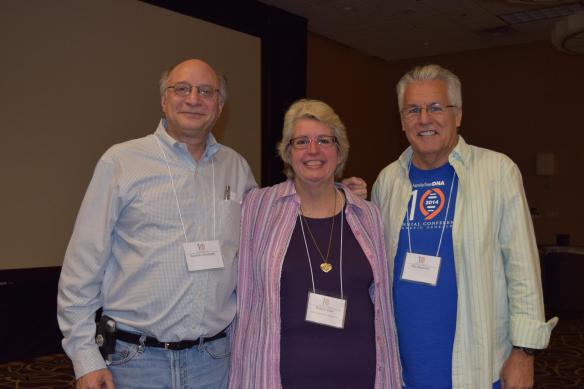
roberta, max and bennett

______________________________________________________________

Disclosure

I receive a small contribution when you click on some of the links to vendors in my articles. This does NOT increase the price you pay but helps me to keep the lights on and this informational blog free for everyone. Please click on the links in the articles or to the vendors below if you are purchasing products or DNA testing.

Thank you so much.

DNA Purchases and Free Transfers

Genealogy Services

Genealogy Research

Sylvester Estes (c1522-1579), Fisherman of Deal, 52 Ancestors #29

Sylvester Estes was born probably in or near Deal, Kent, England about 1522, well before baptismal records were kept, beginning in 1559.  He would have married before that time as well, so we don’t know his wife’s maiden name, only that her name was Jone.  Their marriage date of 1545 is estimated based on the birth year of their first known child in 1547 and his birth date estimate is based on that as well, so he could have been born earlier.  Jone Eustes, Sylvester’s wife, was buried on May 15, 1561 at St. Leonard’s Church in Deal, Kent.  Her grave is not marked.  Tombstones were not being used at that time in history.

st Leonard sylvester

Sylvester, described as “emeritus fisherman,” died and was buried on June 7, 1579 in the churchyard at Ringwould, his last name spelled Eastye.  His grave is unmarked as well.

st nicholas ringwould sylvester

What little we do know about Sylvester, aside from his death and burial, comes from a court record.

On December 10, 1549, Sylvester, along with John Lamond, appeared before the Consistory Court of Canterbury (approximately 20 miles from Deal), charged by the Rector of Deal for not paying their tithes from their herring catch.  Lamond asserted that “in the time of his rememberance … he paid no tithe.” Sylvester responded that in the past two years he and his colleagues had taken two or three “last” (a dozen 6-9 pound barrels) and that “the school of herring hath always comined there away but they had not netteth there to take them well before that time.” It has been suggested that the failure to pay the tithe was a political gesture, rather than just oversight, church tithes becoming increasingly unpopular at that time.

Stewart Estes provides the following information about tithes, especially upon fish:

From the above history of Sylvester Eastes, it appears that he may have been an early tax protester. A tithe (from Old English teogoþa “tenth”) is a one-tenth part of something, paid as a usually voluntary contribution or as a tax or levy, usually to support a church. Historically tithes could be paid in kind, such as agricultural products. Farmers had to offer a tenth of their harvest, while craftsmen had to offer a tenth of their production.

In the Middle Ages the tithe from the Old Testament was expanded, through a differentiation between a Great Tithe and a Little Tithe. The Great Tithe was analogous to the tithe in the Bible where one had to tithe on grain and large farm animals. The Little Tithe added fruits of the field: kitchen herbs, fruit, vegetables and small farm animals.

After the Reformation the tithe was increasingly taken over from the church by the state. In England, church tithes remained until the 19th century. The right to receive tithes was granted to the English churches by King Ethelwulf in 855. The Saladin tithe was a royal tax, but assessed using ecclesiastical boundaries, in 1188. Tithes were given legal force by the Statute of Westminster of 1285. The Dissolution of the Monasteries led to the transfer of many tithe rights from the Church to secular landowners, and then in the 1530s to the Crown.

Tithes of fish (and mills) were the last survivors of what were referred to as personal tithes. Traditionally, fish taken from the sea or common rivers were not titheable under the principal that they were ferae naturae or wild animals. The only exception was if a local custom existed.

A 1549 statute made a tithe of fish payable only in parishes where it had customarily been paid within the past 40 years, such as those on the sea coast. This would likely include Kent. The system ended with the Tithe Commutation Act 1836, which replaced tithes with a rent charge decided by a Tithe Commission.

Based on church records, we know that Sylvester and Jone had 3 children.  It’s likely that they had several more who may have died or not been reflected in the records.  If they were married about 1545 and Jone died in 1561, according to the burial record, they would have had 16 years as a married couple to produce offspring, so they could have been expected to have had approximately 8 children.  The births of those children would only have been recorded in church records after 1559.  This suggests that there are several children born, and probably buried, as children.  However, given that daughter Jone was married in Ripple in 1563, it wouldn’t hurt to check the Ripple church records to see if Sylvester and Jone’s children were baptized there.  Marriages traditionally took place in the bride’s church, although just two years earlier, Jone’s mother, Jone, was buried at St. Leonard’s in Deal.

Jone’s untimely death in her 30s would have left Sylvester, a fisherman, with 3 young children and no wife.  His children, at the time of Jone’s death would have been 14, 12 and 6.  It’s likely that his mother, Anny, if she was still living, would have raised his children while he provided for the entire family by fishing.

The three known children of Sylvester Eastes and Jone are as follows:

1. Jone Eastye, born 1547, probably at Deal, Kent, married on 9 July 1563, at Ripple, Kent, located between Ringwould and Deal, to Henrye Baker, born in 1546, they had a daughter, Jone, who married her first cousin Henry Estes, the son of Jone’s brother.

2. Henry Eastye, a fisherman and master-owner of a pinasse (two masted vessel), the Mynion, born in 1549, at Deal, Kent. He married Mary Rand on July 3, 1574, in Deal. “Henry Eastice of the parish of Deale in the County of Kent fisherman,” made his will on April 30, 1590 at Deal. Mary was buried June 19, 1601 at St Leonard’s, Kent.

3. Robert Eastye, mariner, born about 1555 at Deal, Kent, died about 1616 at age 61 in Ringwould, Kent. He married Anne Woodward on December 2, 1591 at Sholden, Kent. Anne was born about 1574 (or in 1570), died between the making of her will on April 21, 1630 and when she was buried on May 18, 1630 at Ringwould. Robert and Anne spent the first few years of their married life at Sholden, moving to Ringwould about 1595.

Due to the change in the English religion from Catholic to Protestant, these children would have been baptized as Protestants, while Sylvester and Jone would have been baptized at Catholics.

In the Ringwould church records, Sylvester’s burial is the very first Estes record, recorded thus:

Jan. 7, 1579 – Silvester Eastye buried

This begs the question of why, with his wife buried at St.Leonard’s 18 years earlier, was Silvester buried at Ringwould?

The second Estes record at Ringwould doesn’t follow for another 17 years, and it’s the christening of Silvester, the son of Robert, who is the son of Silvester buried in January of 1579.  Between 1579 and 1596, Robert has married Anne Woodward at Shoulden in 1591, with their first child, Matthew being baptized there in 1592.

Sept. 26, 1596 – Silvester Estey, son of Robert, christened

Robert Estes and Anne Woodward continued to be members of St. Nicholas of Ringwould until Robert’s death about 1616.

Between 1561 when Jone was buried in Ringwould, to 1591 when Robert was married at Sholden, we have church records of this family involved with four different churches, albeit in close geographic proximity of a mile and a half range.  As you can see, below, the entire circle between all 4 locations, using today’s roads which are not the most direct routes, is only a total of 7 miles.

kent 4 villages

Changes

Sylvester saw a lot of changes in his lifetime.  His father died when he was 11 or 12, leaving his mother a widow.  Sylvester may well have been apprenticed to the mariners to learn a trade in order to be able to support himself, and possibly his widowed mother and younger siblings as well.

Changes were afoot in England itself as well.  England was in the process of politically becoming a Protestant nation with the King at the head of the church, instead of a Catholic nation with the Pope at the head of the church.  In the 1530s, Henry VIII wanted to remarry because his wife did not produce a male heir, and his Catholicism prevented that, especially when the Pope refused to annul his marriage.  As a result Henry renounced Catholicism and became Protestant, ordered the destruction of all things Catholic, such as monasteries and abbeys.  The churches “became” Protestant overnight, along with their parishioners.  In some places, of course, there was strong resistance and the resisters were called ‘recussants.’  That did not seem to be a problem in Kent.

In addition to the national issues, there were local and regional problems to contend with as well.

In October 1536, when Sylvester would have been about 14, four Flemish ships entered the Downs, landed and plundered the local boats of their “herrings, hogbushes, arrows and beer.”  A few days later, those same ships robbed a Deal fishing boat of its entire catch and then sent a pinnace ashore on St. Leonard’s Day (November 6  and feast day at Deal’s St. Leonard’s church) to cut the cable of Captain Rychardson’s boat and tow it away.  Rychardson’s inventory of his losses reflects a typical fishing boat of the time – two long bows, sheaves of arrows, barrels of beer, bread, candles, boots and bonnets.  Sylvester’s ship probably was provisioned with the same things.

Piracy, especially in the Downs was very troublesome during this time.  In 1536 Henry VII made it an offense punishable by death in some cases.

Queen Elizabeth, after coming to reign in 1558 did not take kindly to pirates either.  In one month alone, sometime after 1573, William Holstock, commander of the Queen’s Navy, captured pirates of several nationalities from 35 rogue ships and sent about 1000 captives ashore at Deal.  But then, he too turned rogue and captured 15 merchant ships.

In the 1539, Henry VIII ordered the construction of three castles to defend the Downs which were heavily exposed, faced Europe and were the most likely places for a Catholic army to make landfall in England.  Deal Castle was one of the castles, and still stands majestically today.  It was built, along with Sandown and Walmer Castle, in about 18 months in 1539 and 1540 utilizing 1400 men along with local laborers.

This was a very important, high profile project.  In fact, King Henry himself visited the Downs to “inspect his defences” on Easter Sunday in 1539.  He fully expected an invasion from Catholic Europe.

Sylvester would have been 17 or 18 at the time, a very impressionable age, and if he weren’t fishing already, he was surely involved in the castle construction.  If he was fishing, the influx of workers certainly created an unending market for their fish and probably just about anything else you could create to sell to the workers.  It would certainly have been an economic boon for the region around Deal.  It would have been an exciting time to be a young man as well – an era full of adventure.

After the castles’ construction, garrisons were assigned.  King Henry’s policy was to make any defense the responsibility of the local district and that garrisons were drawn from the area and officers were drawn from the local gentry.  Soldiers were expected to provide their own weapons – a dagger, sword, halberd and at their own expense.

The expected attack from Catholic Europe did not materialize in 1540, probably causing everyone along the Kent coastline to heave a collective sigh of relief.  Piracy and smuggling continued in the Downs, but the next threat from another nation would be Spain in 1588, nine years after Sylvester’s death.

Queen Elizabeth I, daughter of Henry VIII, ascended the throne in 1558 and inspected the castles in Kent in 1573.  After leaving Dover, the Queen journeyed through Walmer and Deal before being carried on a litter along the Ancient Highway to Sandwich.  You can rest assured that every person who was able lined the roads to catch a glimpse of the Queen.

queen eliz litter

Perhaps Sylvester Estes, then 51 years old, was among them with his son Robert, just 18.  Did they see the Queen?

Mobility

I expected that we would find the Estes family in one church and that the family members would remain within that church for generations.  This also implies that they lived in the same location.  That’s not what we’ve found.  In the 5 known generations beginning with Nicholas and ending with Abraham Estes who immigrated to the US in 1673, we know that the Estes family participated in services in at least 8 churches, not including Sandwich where one can rest assured that Abraham attended church when he was an apprentice there.  That’s a lot of mobility for an early family whose main avenue for transportation would have been on foot.

It’s also somewhat unusual in that early vassalage arrangements would have precluded mobility between farms, let along between towns, and in essence kept the vassals tied to the lands of the monarchy or their lords in perpetuity.  Given that history, finding this much movement, even within a region, just a few years later is quite surprising.  Feudalism, meaning feudal land tenure, began to decline with the War of the Roses in the mid-1400s (1455-1485), effectively ended when the country became Protestant in 1536, but wasn’t abolished in England until 1660.  Under the feudal system, tenants, or vassals, would not have been allowed to move around from place to place.

So, why did they move?  Well, knowing the Estes family, perhaps because they couldn’t, then they could, and did, because they could.

This pattern of movement tells us that the Estes family was likely not tied to land, per se, at least not by the 1500s – so maybe tenant farmers working the lands of others, or craftsmen – or eventually, as we know, mariners.  Mariners are tied to the sea, not the land, so they would have lived relatively close to the shore.  Most of these churches and communities certainly fit that criteria.

The movement of people is more the norm, over time, than not, unless there is a constraining factor.  We do sometimes find families in villages nestled in the mountains of some remote location that haven’t left since the beginning of written records, which is often reflected in the very unusual markers in their Y DNA, suggesting a population bottleneck of sorts.  In other words, mutations happened but no one left to spread them around, so they are only found in a particular region.  For genealogists, these are blessings in disguise, because they can help us pinpoint locations where our ancestor lived, if enough people test.  They will, of course, carry different surnames today, but their DNA will match, especially on unusual markers that have mutated in that region.

We find that often people migrated in groups – probably family units – increasing their chances of survival if there are others available who have a vested interest in helping out if trouble loomed.  Someone else who wouldn’t hesitate to paint themselves blue and hurl projectiles at Caesar’s ships, if the need arose.

So, if we look at the more ancient aspect of the Estes DNA, what does it tell us?  Where did the Estes family come from, before the advent of surnames?  And does it tell us anything about the d’Este family myth?

Who Settled Near Deal?

Let’s start by looking at who settled in the Deal area.  We know that Ceasar said that in the year 55 this area was inhabited by “Belgic and Celtic” tribes, a mixture of Germanic and Celtic stock who had arrived on “these shores a generation before but had continued to trade with their counterparts on the continent.”  He says specifically that:

“The coast (was populated) by Belgic immigrants who came to plunder and make war – nearly all of them retaining the names of tribes from which they originated – and later settled to till the soil. They think it is wrong to eat hares or chickens or geese but they breed them as pets. As the cold is less severe, the climate is more temperate than in Gaul.”

Caesar tells us that his fleet encountered Celts hurling missiles from the soaring cliffs at Dover.  The fleet then sailed 8 miles, hugging the coast until they came to ‘low lying land’ (Saxon, ‘dylle’).

white cliffs map

Warring Britons, their naked bodies daubed with woad and their wild hair stiffened with lime relentlessly rode their sleek chariots into battle and drove the Romans from the shore.

celtic 2 wheel chariot

An Ancient Briton from Barnard’s New Complete & Authentic History of England, 1783, below.ancient briton

I can’t tell you how I wish someone had made a painting of that!  Naked men painted blue with spikey hair in a chariot.  Is that legal?

Caesar tells us more, and it’s complimentary in spite of the naked blue spikey factor.

“The most civilised people are those in Kent which is entirely a coastal area; they have much the same customs as the Gauls. Most of those living further inland do not sow corn but live on milk and flesh and wear clothes of animal skins. All the Britons, though, dye their skins with woad which produces a blue colour and thereby look all the more terrifying in battle.

By far the most civilized inhabitants are those living in Kent.  The population is large, the ground thickly studded with homesteads…and the cattle numerous.

They do not cut their hair but shave all the rest of the body except the head and upper lip. Wives are shared between groups of ten or twelve men, usually made up of brothers or fathers and sons. The children are reckoned as belonging to the man each girl marries first.”

Now, that would play havoc with the DNA is more ways than one.  So, you could wind up being the father to your own brother, or nephew….so you really could be your own grandpa.  Don’t ponder this too long – it will only make you crazy.

We know that the word Deal itself is derived from the Saxon word “dylle” meaning low lying land or “del” referring to a dale or valley.

A Druid shrine was found on the eastern slope of Mill Hill, just a few blocks from St. Leonard’s Church in Deal, rich in Celtic art from the second century BC.

In fact, the “Deal Warrior” was found here with his armour, wearing what looks to be a crown with a LaTene style of incised pattern.

deal warrior

The Celtic LaTene culture followed the Hallstatt in Iron Age Europe about 450BCE.

Halstatt latene 2

Above, an overview of the Hallstatt and La Tène cultural regions. The core Hallstatt territory (800 BCE) is shown in solid yellow, the area of influence by 500 BCE (HaD) in light yellow. The core territory of the La Tène culture (450 BCE) is shown in solid green, the eventual area of La Tène influence by 50 BCE in light green. The territories of some major Celtic tribes are labelled. Map drawn after Atlas of the Celtic World, by John Haywood (2001: 30–37).

celtic europe expansion

This map shows the Celtic expansion in Europe, including the British Isles, and Italy.

Ok, so are the Estes men Celtic?

The DNA

The good news is that the Estes STR markers are quite unique.  The bad news is that the Estes STR markers are quite unique.  The STR markers, or short tandem repeats, are the marker results that you receive when you order the 12, 25, 37, 67 or 111 marker tests from Family Tree DNA.

The Estes men don’t match men with other surnames at 111, 67 or 37 markers.  In fact, their marker values at that level are very unique.  The good news is that this means that it’s very easy to tell when someone matches the group, or doesn’t.  The bad news is that there are no breadcrumbs left by matching other people.

Breadcrumbs?  What do I mean by breadcrumbs?

A DNA breadcrumb, in this instance, could be one of two things.  First, it could be an extended haplogroup SNP test that would tell me by virtue of who I match closely on STR markers that my ancestor’s haplogroup is likely to be the same as the other person who took the extended testing.  In other words, a poor man’s pseudo SNP test.  No such luck, in my case.

The second DNA breadcrumb would be the matches maps – where are the oldest ancestors of my closest matches found?  This can be important in locating on origin in continental Europe.  In my case, the closest not-Estes matches with locations are 12 and 25 markers.  It’s not that I can’t use these, it’s that they are far back in time, quite far sometimes, so far that the common ancestor may not be on the same twig of the Y tree, especially with haplogroup R, old R1b1a2.

And yes, of course, the Estes men are smack dab in the middle of haplogroup R – in fact, L21.

Estes Y hap

On the first map, below, the locations of the oldest known European ancestors of the Estes matches are shown.  There aren’t many in continental Europe.  Most are in the British Isles.  Keep in mind that none of these hold up (or perhaps didn’t test) above 25 markers, so the common ancestors with these individuals would be far back in time, hundreds to thousands of years – which is exactly what we are looking for – sometime around Caesar’s arrival in the year 55 when the woad covered Celts were pummeling his ships from the white cliffs of Dover.

estes matches map 25

The red balloons below show the oldest ancestors of 12 marker matches.

estes matches map 12

Hey, what are those two in Italy?

Turns out one is in Rome and other shows it’s in France, but it’s still in the right general location to perhaps be an indication that some of the Estes DNA is living in the region.  That doesn’t do anything to put to bed the oral history of the d’Este family.  In fact, it fans those flames a bit.  If those matches held above 12 markers, it would fan those flames a lot…..but they don’t.

However, the general distribution pattern indeed looks like the traditional “Celtic” L21 migration into the British Isles, shown below.

Eupedia L21

It is believed that subgroup L21 was born about 4000 years ago in the Celtic region of Europe, perhaps in Southwest Germany.

A few days ago, Britain’s DNA released information about L21 which equates to their SNP S145.

The map below, for S145 shows their Pretani distribution.  The best definition I could find for Pretani was that the earliest known reference to the people of the British Isles, made by the Greeks between 330 and 300 BC describes them as the Isles of the Pretani, the ‘Pretani’ thus becoming the most ancient inhabitants of Britain and Ireland to whom a definite name can be given. In Ireland these ancient British Pretani (or Britanni) were later to become known as the Cruthin, while in Scotland they became known as the Picts.

s145

While their map does not include any downstream variants, it still meshes with the Eupedia L21 map.  It looks like the Celts stepped ashore in England and started moving north and west and didn’t stop until they had to.  Of course, they were followed by Angles and Saxons and Romans and Normans so they did have some pressure to keep moving.  Apparently not all moved on, because there are still between 13% and 15% in the east and southeast of England, as determined by DNA testing of people whose 4 grandparents lived in that location – implying that they are not recent immigrants to the region.

So, what next?

Ok, so the Estes men are descended from Celts.  Now we at least know that much.

But I’d still like to know if my ancestors were d’Este Kings in Italy wearing crowns, Druid priests in England wearing crowns, or blue woad painted Celts with spiked hair driving chariots while defending the white cliffs of Dover.  Can’t you just see them here?

white cliffs of dover 2

I mean, it does make quite a bit of difference in the telling of the family story.

I want to know more.  I’d like to test for more SNPs to see if I can refine what we know, but which SNPs to test?

The Estes men have joined the R-L21 project and the British Isles by County project, and I’ve asked the administrator for haplogroup L21 for suggestions about how to test further.  Part of the decision about how to test will be financially based.  If he can tell me, based on his experience that what I really need to do is test one or two SNPs based on what he sees in terms of matching within other L21 subgroups, I’ll happily do that.  If he tells me that I need to do the Geno 2.0 or Big Y, I’ll probably do that as well, but I’ll be eating hotdogs and mac and cheese for a few weeks.  But hey, it’s grilling season and genealogy is way more important that eating!

In the L21 project, the Estes men, along with a few thousands of our closest friends are in the group titled “1. L21+ (L11>P312>L21; If you can, test for DF13 status).”  This means, in plain English – you need more testing, so that’s the answer I’m expecting.

What this means is that the testing results are too vanilla to narrow the location origin.  Below are the locations of the oldest ancestors of the “you need more testing” group.

l21 cluster

And for comparison, here’s a subclade of L21 – a group of people who share a terminal SNP further down the tree – and the locations of their most distant ancestors.  If what I’m looking for is a source on continental Europe – this is much more useful than the map above which shows the distribution of L21 over the past 4000 years or so.

l21 subgroup cluster

I did receive a recommendation from the haplogroup L21 project administrator.  Just what I was afraid of – the L21 project administrator wants 2 Big Yfull Y sequence tests from the Estes line – from hopefully our two most divergent men who are definitely from the same family.  This will show which of the SNPs or Novel Variants (personal or family SNPs) they share are actually haplotree branch SNPs and which are family only, meaning much more recent in time.  Makes sense.  I expected this advice, I was just hoping for a less expensive option, but as the administrator says, we are, indeed, the explorers in this new field.  Well, good thing we are Celts now isn’t it!

Now, all I have to find the appropriate Estes male candidates and the funds.  If you have an Estes in your family tree, you can contribute directly to the Estes DNA project towards the tests, which will be about $1200 in total.  Any amount is appreciated and it all helps.

To put this in perspective, raising these funds has to be easier than getting naked, shaving my body, painting myself blue and liming my hair while driving a chariot and throwing projectiles off of the white cliffs of Dover!!!

______________________________________________________________

Disclosure

I receive a small contribution when you click on some of the links to vendors in my articles. This does NOT increase the price you pay but helps me to keep the lights on and this informational blog free for everyone. Please click on the links in the articles or to the vendors below if you are purchasing products or DNA testing.

Thank you so much.

DNA Purchases and Free Transfers

Genealogy Services

Genealogy Research

Big Y DNA Results Divide and Unite Haplogroup Q Native Americans

featherOne of my long standing goals has been to resurrect the lost heritage of the Native American people.  By this I mean, primarily, for genealogists who search for and can’t find  their Native ancestors.  My blog, www.nativeheritageproject.com, is one of the ways that I contribute towards that end.  Many times, records are buried, don’t exist at all, or don’t reflect anything about Native heritage.  While documents can be somewhat evasive and frustratingly vague, the Y DNA of the male descendants is not.  It’s rock solid.

The Native communities became admixed beginning with the first visits of Europeans to what would become the Americas.  Native people accepted mixed race individuals as full tribal members, based on the ethnicity of the mother.  Adoption also played a key role.  If a female, the mother, was an adopted white child, the mother was considered to be fully Native, as was her child, regardless of the ethnicity of the father.

Therefore, some people who test their DNA expecting to find Native genetics do not – they instead find European or African – but that alone does not mean that their ancestors were not tribal members.  It means that these individuals have to rely on non-genetic records to prove their ancestors Native heritage – or they need to test a different line – like the descendants of the mother, through all females, for example, for mitochondrial DNA.

On the other hand, some people are quite surprised when their DNA results come back as Native.  Many have heard a vague story, but often, they don’t have a clue as to which genealogical line, if any, the Native ancestry originated.  Native ancestry was often hidden because the laws that prevailed at the time sanctioned discrimination of many kinds against people “of color,” and if you weren’t entirely of European origin, you were “of color.”  Many admixed people, as soon as they could, “became” white socially and never looked back. Not until recently, the late 20th century, when discrimination had for the most part become a thing of the past and one could embrace their Native or African heritage without fear of legal or social reprisal.

Back in December of 2010, we found the defining SNP that divided haplogroup Q between Europeans and Native Americans.  At the time, this was a huge step forward, a collaboration between testing participants, haplogroup administrators, citizen scientists and Family Tree DNA.

This allowed us to determine who was, and was not included in Native American haplogroups, but it was also the tip of the iceberg.  You can see below just how much the tree has expanded and its branches have been shuffled.  This is a big part of the reason for the change from haplogroup names like Q1a3 to Q-M346.  For example, at one time or another the SNP M3 was associated with haplogroup names Q1a3a, Q1a3a1 and Q1a3a1a.  On the ISOGG tree below, today M3 is associated with Q1a2a1a1.

isogg q tree

The new Family Tree DNA 2014 tree is shown below for one of the Big Y participants whose terminal SNP is L568, found beneath SNP CTS1780 which is found beneath L4, which is beneath L213 which is beneath L474 which is beneath MEH2 which is beneath L232 which is, finally, beneath M242.

ftdna 2014 q tree

The introduction of the Big Y product from Family Tree DNA, which sequences a large portion of the Y chromosome, provided us with the opportunity to make huge strides in unraveling and deciphering the haplogroup Q (and C, the other male Native haplogroup in the Americas) tree.  I am hopeful that in time, and with enough people taking the Big Y test, that we will one day be able to at least sort participants into language and perhaps migration groups.

In November, 2013, we asked for the public and testers to support our call for funds to be able to order several Big Y tests.  The project administrators intentionally did not order tests in family groups, but attempted to scatter the tests to the far corners, so to speak, and to include at least one person from each disparate group we have in the haplogroup Q project, based on STR matches, or lack thereof, and previous SNP testing.

Thanks to the generosity of contributors, we were able to order several tests.  In addition, some participants were able to order their own tests, and did.  Thank you one and all.

The tests are back now, and with the new Big Y SNP matching, recently introduced by Family Tree DNA, comparisons are a LOT easier.

So, of course, I had to see what I could find by comparing the SNP results of the several gentlemen who tested.

To protect the privacy of everyone involved, I have reduced their names to initials.  I have included their terminal SNP as identified at Family Tree DNA as well as any tribal, ethnic or location information we have available for their most distant paternal ancestor.

There are two individuals who believe their ancestors are from Europe, and there is a very large group of European haplogroup Q members, but I’m not convinced that the actual biological ancestors of these two gentlemen are from Europe.  I have included both of these individuals as well. Let’s just say the jury is still out. As a control, I have also included a gentleman who actually lives in Poland.

native match clusters

Of the individuals above, SD, CT and CM are SNP matches.

CD, WJS and WBS are SNP matches with each other.

BG and ETW are also SNP matches to each other.

None of the rest of these individuals have SNP matches.  (Note, you can click to enlarge the chart.)

native snp matches

In the table above, the Non-Matching Known SNPs are shown with the number of Shared Novel Variants.  For example, SD and CT have 4 non-matching SNPS and share 161 Novel Variants and are noted as 4/161.

We can easily tell which of the known SNPs are nonmatching, because they are shown on the participants match page.

snp matches page

What we don’t know, and can’t tell, is how many Novel Variants these people share with each other, and how many they might share with the individuals that aren’t shown as matches.

Keep in mind that there may be individuals here that are not shown as matches to due no-calls.  Only people with up to and including 4 non-matching Known SNPs are counted as matches.  If you have the wrong combination of no-calls, or, aren’t in the same terminal haplogroup, you may not be shown as a match when you otherwise would be.

The other reason for my intense interest in the Novel Variants is to see if they are actually Novel, as in found only in a few people, or if they are more widespread.

I downloaded each person’s Novel Variants through the Export Utility (blue button to the right at the top of your personal page,) and combined the Novel Variants into a single spreadsheet.  I colorized each person’s result rows so that they would be easy to track.  I have redacted their names. The white row, below, is the individual who lives in Poland.

novel variant 1

There are a total of 3506 Novel Variants between these men.  When sorting, many clustered as you would expect.  There is the Algonguian group and what I’ve taken to calling the Borderlands group.  This group has someone whose ancestor was born in VA and two in SC.  I have documentation for the Virginia family having descendants in SC, so that makes sense.  The third group is an unusual combination of the gentleman who believes his ancestors are from Germany and the gentleman whose ancestors are found in a New Mexico Pueblo tribe, but whose ancestor was, likely, based on church records, a detribalized Plains Indian who had been kidnapped and sold.

Clusters that I felt needed some scrutiny, for one reason or another, I highlighted in yellow in the Terminal SNP column.  Obviously the Polish/Pueblo matching needs some attention.

Another very interesting type of match are several where either all or nearly all of the individuals share a Novel Variant – 15 or 16 of 16 total participants.  I don’t think these will remain Novel Variants very long.  They clearly need to be classified as SNPs.  I’m not sure about the process that Family Tree DNA will use to do this, but I’ll be finding out shortly.

Here’s an example where everyone shares this Novel Variant at location 7688075,except the gentleman who lives in Poland, the man who believes his ancestor is from Germany, and the Creek descendant.

novel variant 2

I was very surprised at how many Novel Variants appear in all 16 results of the participants, including the gentleman who lives in Poland – represented by the white row below.

novel variant 3

So, how were the Novel Variants distributed?

Category # of Variants Comments
Algonquian Group 140 This is to be expected since it’s within a specific group.  Any matches that include people outside the 3 Algonquian individuals are counted in a separate category.  These matches give us the ability to classify anyone who tests with these marker results as provisionally Algonquian.
Borderlands 83 This confirms that these three individuals are indeed a “group” of some sort.  This also gives us the ability to classify future participants using these mutations.
All or Nearly All – 15 or 16 Participants 80 These are clearly candidates for SNPs, and, given that they are found in the Native and the European groups, they appear to predate the division of haplogroup Q.
Several Native and European, Combined 45 This may or may not include the person who lives in Poland.  This group needs additional scrutiny to determine if it actually does exist in Europe, but given that there are more than 3 individuals with each of these Novel Variants, they need to be considered for SNPhood.
Pueblo/NC 1
Poland/Borderlands 2
Mexico/Algonquian 2
German/Pueblo 9 I wonder if this person is actually German.
Poland/Mexico 20 I wonder if this person’s ancestors are actually from Poland.
Algonquian, NC, Creek 1
Borderland, Mexico, Creek 1
Algonquian/Cherokee 1
All Native, no Euro 2
Algonquian, Borderlands, Mexico, NC 1
Algonquian, Mexico, Borderlands 1
Borderlands, Pueblo 1
Borderlands, Creek, NC 1
Algonquian, Cherokee, Mexico 3
Algonquian, Pueblo, Creek, Borderlands 1
Cherokee, NC 2
Algonquian, Borderlands 2
Borderlands, NC 1
Algonquian, NC 1
Polish/NC 10

Some of this distribution makes me question if these SNP mutations truly are a “once in the history of mankind” kind of thing.  For example, how did the same SNP appear in the Polish person and the NC person, or the Pueblo person, and not in the rest of the Native people?

New SNPs?

So, are you sitting down?

Based on these numbers, it looks like we have at least 125 new SNP candidates for  haplogroup Q.  If we count the Algonquian and the Borderlands groups of matches, that number rises to about 250.  This is very exciting.  Far, far more than I ever expected.  of these SNPS, about half will identify Native people, even Native groupings of people.  This is a huge step forward, a red letter day for Native American ancestry!

SNPs and STRs

Lastly, I wanted to see how the SNP matching compared to STR matching, or if it did at all, for these men.

Only two men match each other on any STR markers.  CD and WJS matched on 12 markers, but not on higher panels.  The TIP calculator estimated their common ancestor at the 50th percentile to be 17 generations, or between 425 and 510 years ago.  We all know how unrealistic it is to depend on the TIP calculator, but it’s the only tool we have in situations like this.

Given that these are the only two men who do match on STR markers, albeit distantly, in a genealogical timeframe, let’s see what the estimates using the 150 years per SNP mutation comes up with.  This estimate is just that, devised by the haplogroup R-U106 project administrators, and others, based on their project findings.  150 years is actually the high end of the estimate, 98 being the lower end.  Of course, different haplogroups may vary and these results are very early.  Just saying.

CD has 207 high quality Novel Variants.  He shares 188 of those with WJS, leaving 19 unshared Novel Variants.  Utilizing this number, and multiplying by 150, this suggests that, if the 150 years per SNP is anyplace close to accurate, their common ancestor lived about 2850 years ago.  If you presume that both men are incurring mutations at the same rate in their independent lines, then you would divide the number of years in half, so the common ancestor would be more likely 1425 years ago.  If you use 100 years instead of 150, the higher number of years is 1900 and the half number is about 950 years.

It’s fun to speculate a bit, but until a lot more study has occurred, we won’t be able to reasonably estimate SNP age or age to common ancestor from this information.   Having said all of that, it’s not a long stretch from 710 years to 950 years.

It looks like STR markers are still the way to go for genealogical matching and that SNPS may help to pull together the deeper ancestry, migration patterns and perhaps define family lines.  I hope the day comes soon that I can order the Big Y for lots more project members.  Most of these men do have STR marker matches, and to men with both the same and different surnames.  I’d love to see the Big Y results for those individuals who match more closely in time.

This is still the tip of the iceberg.  There is a lot left to discover!  If you or a family member have haplogroup Q results, please consider ordering the Big Y.  It would make a wonderful gift and a great way to honor your ancestors!

You can also contribute to the American Indian project at this link:

https://www.familytreedna.com/group-general-fund-contribution.aspx?g=AIP

In order to donate to the haplogroup C-P39 project which also includes Native Americans, please click this link:

http://www.familytreedna.com/group-general-fund-contribution.aspx?g=Y-DNAC-P39

______________________________________________________________

Disclosure

I receive a small contribution when you click on some of the links to vendors in my articles. This does NOT increase the price you pay but helps me to keep the lights on and this informational blog free for everyone. Please click on the links in the articles or to the vendors below if you are purchasing products or DNA testing.

Thank you so much.

DNA Purchases and Free Transfers

Genealogy Services

Genealogy Research

Big Y Matching

A few days ago, Family Tree DNA announced and implemented Big Y Matching between participants who have taken the Big Y test.

This is certainly welcome news.  Let’s take a look at Big Y matching, what it means and how to utilize the features.

First, there are really two different groups of people who will benefit from the Big Y tests.

People trying to sort through lines of a common and related surname – like the McDonald or Campbell families, for example – and haplogroup researchers and project administrators.

My own family, for example, is badly brick walled with Charles Campbell first found in Hawkins County, TN in the 1780s.  We know, via STR testing that indeed, he matches the Campbell Clan from Scotland, but we have no idea who is father might have been.  STR testing hasn’t been definitive enough on Charles’ two known sons’ descendants, so I’m very hopeful that someday enough Campbell men will test that we’ll be able between STR and SNP mutations to at least narrow the possible family lines.  If I’m incredibly lucky, maybe there will be a family line SNP (Novel Variant) and it won’t just narrow the line, it will give me a long-awaited answer by genetically announcing which line was his.  Could I be that lucky???  That’s like winning the genetic genealogy lottery!

For today, the Big Y test at $695 is expensive to run on an entire project of people, not to mention that many of the original participants in projects, the long-time hard-core genealogists, have since passed away.  We are now into our 15th years of genetic genealogy.

For those studying haplogroups, the Big Y is a huge sandbox and those researchers have lost no time whatsoever comparing various individuals’ SNPS, both known and novel, and creating haplogroup trees of those SNPs.  This is done by hand today, or maybe more accurately stated, by Excel.  This is “not fun” to put it mildly.  We owe these folks a huge debt of gratitude.  Their results are curated and posted, provisionally, on the ISOGG Tree.

There is an in-between group as well, and those are people who are working to establish relationships between people of different surnames.  In my case, Native American ancestors whose descendants have different surnames today, but who do share a common ancestor in some timeframe.  That timeframe of course could be anyplace from a couple hundred to several thousand years, since their entry into the Americas across Beringia someplace in the neighborhood of 12-15 thousand years ago.

The Big Y matching is extremely helpful to projects.

Let’s take a look.

Big Y Matches

Big Y landing

On your personal page, under “Other Results,” you’ll see the Big Y results.  Click on Results” and you’ll see the following page.

big y results

The Known SNPs and Novel Variants tabs have been there since release, but the Matching tab, top left, is new.

By clicking on the Matching tab, you will then see the men you match based on your terminal SNP as determined in the Big Y Known SNPs data base.  You will be matched to men who carry up to and including 4 mutations difference in known SNPs, and unlimited novel variant differences.  If you have a zero in the “Known SNP Difference” column, that means you have no differences at all in known SNPs.

big y matches cropped2

The individual being used for an example here has paternal ancestry from Hungary.  His terminal SNP is reported as R-CTS11962.  Therefore, all of the people he matches should also carry this same SNP as their terminal SNP.

This is actually quite interesting, because of his 10 exact matches, 9 of them have surnames or genealogy that suggests eastern European/Slavic ancestry.  The 10th, however, which happens to be his closest match, carries an English surname and reports their ancestor to be from Yorkshire, England.  His one mutation differences carry the same pattern, with one being from England and two of the other three from eastern Europe.

Our participant has 155 total Novel Variants, 135 high quality and 20 medium quality.  Only high quality are listed in the comparison.  Medium quality are not.

Ancestral Location Known SNP Difference Shared Novel Variants Non Matching Known SNPs
Yorkshire, England 0 134 None
Prussia 0 127 None
Ukraine 0 121 None
Poland 0 121 None
Belarus 0 119 None
Poland 0 116 None
Poland 0 116 None
Russian e-mail 0 113 None
Bulgaria 0 113 None
Slovakia 0 111 None
English surname 1 126 PF6085
Undetermined, poss German 1 121 F1816
Poland 1 118 F552
Poland 1 116 CTS10137
Prussia 2 122 CTS11840 PF4522
Poland 2 112 L1029 PR6932
Russia 3 116 CTS3184 L1029 PF3643
Poland 3 106 CTS11962 L1029 L260
Ukraine 3 105 CTS11962 L1029 L260
Poland 3 104 CTS11962 L1029 L260
Poland 3 100 CTS11962 L1029 L260
Poland 3 99 CTS11962 L1029 L260
Eastern European surname 3 98 CTS11962 L1029 L260
Poland/Germany 3 97 CTS11962 L1029 L260
Austria/Galacia 3 93 CTS11962 L1029 L260
Poland 4 97 CTS11562 CTS11962 L1029 L260

It’s also very interesting to note that his non-matching known SNPs tend to cluster.  Non-matching known SNPs can go in either direction – meaning that they could be absent in our participant and present in the rest, or vice versa.

l1029 search

It’s easy to tell.  In the Big Y Results, under Known SNPs, there is a search feature.  This means that it’s easy to search for SNPs and to determine their status.  For example, above, our participant does carry SNP L1029 (he’s derived or positive (+) for the mutation in question).  This means that our participant has developed L1029, and, it just so happens, also CTS11962 and L260, the three clustered SNPs, since these men shared a common ancestor.

It’s difficult not to speculate a little.  If the TMCRA Big Y SNP estimates are correct, this suggests that these 3 clustered SNPS occurred someplace between 4350 and about 5000 years ago, based on the range (93-106) of the number of high quality novel variant differences.  We’ll talk more about this in a minute.

f552 search

For SNP F552, our participant is negative, meaning that that other person has developed this SNP since their shared ancestor.  In fact, he’s negative for all of the other Known SNP differences.

Novel Variants

The Novel Variants are quite interesting.  Novel Variants are mutations that if found in enough people who are not related within a family group will someday become SNPs on the tree.  Think of them as ripening SNPs.

By clicking on the “Show All” dropdown box you can see the list of the participants novel variants and how many of his matches share that Novel Variant.

novel variant list

In this example, all 26 of our participant’s novel variants share 13142597.  I’m thinking that this Novel Variant will someday become classified as a SNP and not as a Novel Variant anymore.  When that happens, and no, we don’t know how often Family Tree DNA will be reviewing the Novel Variants for SNP candidates, it will no longer be in the Novel Variant list.  The Novel Variants are meant to be family, novel or lineage SNPs, not population based SNPS that apply to a wide variety of people.  Finding these, of course, and adding them to the human haplotree is the entire purpose of full sequence Y chromosomal testing.  Just look at tall of this new information about this man’s ancestors and the DNA that they passed on to this gentleman.

By scrolling down to the bottom of that list, we find that our participant has 8 different Novel Variants where he matches only one individual.  By clicking on the Novel Variant number, you can see who he matches.  Of those 8, 7 of them match to the man who carries the English surname and one matches to a gentleman from Prussia.

This information is extremely interesting, but it gets even more interesting when compared against STR matches.  Our participant has a fairly unusual haplotype above 12 markers.  He has three 67 marker matches, two 37 marker matches and thirty-three 25 marker matches.  None of the men he matches on the SNP test match him on any of those tests.  I did not check his 12 marker matches, because I felt that anyone who would invest the money in the Big Y would certainly have tested above 12 markers plus our participants has several hundred 12 marker matches.

The numbers being bantered around by people working with SNP information suggest that one Big Y mutation equals about 150 years.  If this is true, then his closest match, the English gentleman from Yorkshire, England would share an ancestor about 2850 years ago.  That is clearly beyond the reach of STR markers in terms of generational predictions, so maybe STR matches are not expected in this situation, IF, the 150 year per novel variant estimate is close to accurate.

Another interesting piece of information that can be deduced from this information is how many SNPs were actually found.

At the bottom of our participants page, under Known SNPs, it says “Showing 24 of…571 entries (filtered from 36,274 total entries.)”  We know that the entire data base of SNPs that Family Tree is utilizing, which includes but is not limited to the 12,000+ Geno 2.0 SNPs, is 36,274.  In other words, 36,274 are the number of SNPs available to be found and counted as a SNP because they have already been defined as such.  Any other SNPs discovered are counted as Novel Variants.

Not all available SNPs are found and read in this type of next generation test.  The number of “Matching SNPs” with each individual gives us an idea of how many SNPs actually were found and read at either a medium and high confidence level.  Low confidence SNPs and no-calls are eliminated from reporting.

Our participants best match matches him on 25,397 SNPs.  This leaves a total of 10,877 SNPs that were not called.

The Future

SNP Matching is a wonderful feature and a first in this industry.  A hearty thank you to Family Tree DNA!

However, like all passionate people, we are already looking ahead to see what can be and should be done.

Here are some suggestions and questions I have about how the future will unwrap relative to Big Y SNP testing and matching.

  1. Within surname projects, matching should be relatively easy, unless hundreds of people test. I would be happy to have that problem. Today, administrators are creating spreadsheets of matches and novel SNPs and attempting to “reverse engineer” trees. In family groups, those trees would be of Novel SNPs, and in haplogroup projects, those trees would be of both Known SNPs and Novel Variants and where the Novel SNPS slip in-between the known SNPs to create new branches and sub-branches of the haplotree. We, as a community, need some tools to assist in this endeavor, for both the surname project admin and the haplogroup project admin as well.
  2. As new SNPs are discovered in the future, one will not be retested on this platform. As new SNPs are added to the tree, this could affect the matching by terminal SNP. Family Tree DNA needs to be prepared to deal with this eventuality.
  3. As a community, we desperately need a better tool to determine our actual “terminal SNP” as opposed to the Geno 2.0 terminal SNP. Yes, I know the ISOGG tree is provisional, but the contributed tools initially provided by volunteers to search the ISOGG tree utilizing the known SNPs reported in Big Y no longer work. We desperately need something similar while Family Tree DNA is revamping its own tree. I would hope that Family Tree DNA could add something like a secondary “search ISOGG tree” function as a customer courtesy, even if it needs some disclaimer verbiage as to the provisional nature of the tree.
  4. With the number of SNPs being searched for and reported, no calls begin to become an issue, especially if the no-call happens to be on the terminal SNP. We need to be able to determine whether a non-match with someone is actually a non-match or could be as a result of a no-call, and without resorting to searching raw data files. Today, participants can order a SNP test of a SNP position that has been reported as a no-call, but one needs to first figure that out that it is a no-call by looking at the BAM and BED files, something that is beyond the capability of most genetic genealogists. Furthermore, in the case of a “suspicious” no-call, where, for example, individuals in the same surname project with the same surname and other matching SNPS and STRs, some type of “smart-matching” needs to be put into place to alert the participant and project admin of this situation so that they can decide up on a proper course of action. In other words, no-calls need to be reported and accounted for in some fashion, as they are important data points for the genetic genealogist.

I am extremely grateful to Family Tree DNA for their efforts and for Big Y matching.  After all, matching is the backbone of genetic genealogy.  This list is not a complaint list, in any sense.  Family Tree DNA has a very long history of being responsive to their client base and I fully expect they will do the same with the next step in the Big Y journey.

The story of our DNA is not yet told.  Where our STR matches are found and where our SNP matches are found tells the story of the migration of our ancestors.  Today, SNPs and STRs promise to overlap, and already have in some cases.  If I could, I would order a Big Y test for every individual that I sponsor and for every person in each of my projects. I feel that these tests, combined, will help immensely to complete the puzzle to which we have disparate pieces today.  I look forward to the day when the time to the most recent common ancestor can be calculated by utilizing the Y STR markers, the known SNPs and the Novel Variants.  In a very large sense, the future has arrived today.  Now, we just have to test and figure out how all of the puzzle pieces fit together.

If you haven’t yet ordered a Big Y, you can order here.  The more people who test, the larger the comparison data base, and the sooner we will all have the answers we seek.

______________________________________________________________

Disclosure

I receive a small contribution when you click on some of the links to vendors in my articles. This does NOT increase the price you pay but helps me to keep the lights on and this informational blog free for everyone. Please click on the links in the articles or to the vendors below if you are purchasing products or DNA testing.

Thank you so much.

DNA Purchases and Free Transfers

Genealogy Services

Genealogy Research

Haplogroups, SNPs and Family Group Confusion

The transition at Family Tree DNA from the old haplogroup naming convention to the new SNP-only naming convention has generated a great deal of confusion.  It’s like surgery – had to be done – but it has been painful.

I’ve received several questions, many that are similar, so I’d like to attempt to resolve some of the confusing points here.

First, just a little background.

Ancient History

Remember, in 2008, when Michael Hammer et al rewrote the Y tree?  If you do, then count yourself as an old-timer.  Names such as R1b1c became R1b1a2.  E3a became E1b1a and E3b became E1b1b1.  We thought we were all going to die.  But we didn’t – and now, if I hadn’t just told you, you wouldn’t even be able to remember the previous name of R1b1a2.

Why did this happen?  Because when you have a step-wise tree where each step is given a number and letter, like this, you have no room for expansion.

R

R1

R1a

R1a1

Each of these haplogroup names is assigned a SNP, and when a new SNP is discovered between R and R1, for example, the name R1 gets assigned to the new SNP and everyone downstream gets renamed and/or a new SNP assigned.  If you think this is confusing, it is and was – terribly so.  In fact, as testimony to this, the last version of the FTDNA tree, the ISOGG tree and the tree used by 23andMe are entirely out of sync with each other.

With the shift from about 800 SNPs to 12,000 SNPs with the Geno2.0 chip, it was definitely time to redo and rethink how haplogroup names are assigned.  What seemed initially like a great idea turned out not to be when the magnitude of the number of SNPs that actually exist was realized.  In reality, they needed to be obsoleted, but the familiar cadence of the letter number path will forever be gone – with the exception of the fact that the SNP is prefaced with the haplogroup name.  We will no longer have our signposts, sadly, but our signposts were becoming overwhelmingly long.  Here’s one example I copied from the ISOGG tree.  R1b1a2a1a1c2b2a1a1b2a1a – seriously – I can’t remember that.

So, today, and forever more, R1b1a2 will be R-M269.  It will not be shifted or “become” anything else.  Moving a SNP to a new location becomes painless, because it will not affect anything upstream or downstream.

However, as you get use to this new beast, you’re going to want to refer to “what something was” before.  You’ll find that articles, papers and who knows what else will refer to the haplogroup name – and you’ll need a conversion reference.

Here’s a link to that reference.  I don’t know about you, but I copied this and created a .pdf file in case this reference disappears – not that that ever happens in the electronic world.

Why the Confusion?

Within projects, men with the same surname now have different haplogroups assigned, and the SNP names look entirely different.  Before, if most of the surname group was R1b1a2, and one person had SNP tested at a deeper level and showed R1b1a2a1a1b4, it was easy to tell by looking that R1b1a2a1a1b4 fell underneath R1b1a2, and was a subclade.  Today, with the new tree, everyone that was R1b1a2 is now shown as R-M269 and the lone R1b1a2a1a1b4 person is shown as R-L21.  You can’t tell by looking if R-L21 is a subclade of R-M269 or the other way around.  And another few SNP tests at different levels into the mix, and you have one confused administrator.

One thing hasn’t changed.  Notice the haplogroup I-M253 individual in the purple group below.  There is a note that their parentage is uncertain.  Given the completely different haplogroup – this individual does not fit into any groups of Estes males biologically.  So completely different haplogroups are still exclusive, meaning you can tell at a glance that these folks do not share a common ancestor, even though their genealogy says that they should.

estes project cropped

Ok, got that now?  Good, because it gets more confusing.

Family Tree DNA did not do a one to one conversion, meaning they did not create a conversion table where R1b1a2=R-M269.  They did an entirely new prediction routine.  This makes sense, because they don’t hard code the haplogroup – it’s fluid and based on either a hard and fast SNP test or a prediction routine. This also allows for easy future improvements, and they utilize 37 markers for haplogroup predictions now instead of just 12, in most cases.

Unfortunately, or fortunately, the prediction routine produces different results for people within the same family group, based on STR marker results and how many STRs are tested.

What this means is that different people in the same family line will have different haplogroup predictions, as you can see in the groups above of individuals all descended from one male, Abraham Estes.

This isn’t wrong, as in incorrect, but it is confusing, especially when you’re used to seeing everyone who has not been SNP tested have a matching haplogroup within families.

Enter the Terminal SNP

The terminal SNP is your SNP that is furthest down the tree based on the SNPs that you have tested.  That second part is really important – based on the SNPs that you have tested.

When you’re looking at your matches, you can see their terminal SNP in the column below to the right, but what you can’t tell is if they have tested for any downstream SNPs and were found negative.

Estes match cropped

For example, if you are tested positive for R-M269 (formerly R1b1a2) and someone else that you match is R-L21, which is downstream of R-M269 – this does not exclude them as valid matches, UNLESS the first R-M269+ gentleman has actually tested for R-L21 and is negative.  You, of course, have no way of knowing this without asking the other participant.

Also, testing “negative” is a bit subjective, because there are known no-calls in the Geno 2.0 results – so if the Geno 2.0 result did not include the terminal haplogroup you expected, and the outcome is truly important to you, meaning family defining – have that defining SNP, if it’s absent in the Geno 2.0 raw data results, tested individually through regular Sanger sequencing – meaning purchase it separately through Family Tree DNA.  A non-positive result in the Geno 2.0 results is typically interpreted to mean negative, but that is not always the case.  In most situations, if everything else matches, meaning surname, STRs and other SNPs, it’s not necessary to test the SNP separately – but it is available if you need to know, positively.

Secondly, the terminal SNP on the new Family Tree DNA haplotree and in your results, if you have taken the Big Y, the Walk Through the Y or purchased individuals SNPs, may be different.  Why, and how would you know?

The why is because Family Tree DNA has synced to the Geno 2.0 tree at this point, and there have been many new SNPs discovered since the Geno 2.0 tree was developed in 2012.  The ISOGG tree is more current, but keep in mind that it is a provisional tree.  However, you still need to have a way to determine your terminal SNP beyond the Geno 2.0 criteria if you have had advanced testing.

There were originally some tools created by individuals to help with this dilemma, but both tools appear to no longer work.  Kitty Cooper blogged about this, and was apparently recently successful, but I was not.  I downloaded the updated version of the Big Y Chromosome extension that I wrote about and was using the Morley tree but that no longer functions either.  Let’s just say that the word frustrated doesn’t even begin to apply….

My suggestion is to work closely with your haplogroup and surname project administrator(s).  Many of the administrators have put together provisional charts and the haplogroup project pages are grouped by SNP groupings with suggestions for additional relevant testing.

The U106 project is a great example of proactive administrators.  Individual participants are clearly categorized and the categories suggest an appropriate “next step.”  Looking at their home page, the administrators make themselves readily available to project members for consulting about how to proceed.

u106 project

Yes, all of this change is a bit fuzzy right now, but give it a bit of time and the fog will clear.  It did in 2008 and we all survived.

Tree Updates

Family Tree DNA has committed to at least one more tree update this year, and let’s hope that it includes all of the SNPs in the reference data base they are using for the Big Y.

I’ll be talking about Big Y comparisons in a future article.

______________________________________________________________

Disclosure

I receive a small contribution when you click on some of the links to vendors in my articles. This does NOT increase the price you pay but helps me to keep the lights on and this informational blog free for everyone. Please click on the links in the articles or to the vendors below if you are purchasing products or DNA testing.

Thank you so much.

DNA Purchases and Free Transfers

Genealogy Services

Genealogy Research

Bennett Greenspan – The Future of Genetic Genealogy

Bennett SCGA 2014 v2

Bennett Greenspan, one of the founders of Family Tree DNA, spoke about “The Future of Genetic Genealogy” at the Southern California Genealogy Society conference this week.  The SCGS has been gracious enough to provide a video of the livestream.

High points of Bennett’s presentation include:

  1. There will be a new Y SNP matching capability released in the next few days.
  2. “Regulatory issues are larger issues than the science.” Bennett discusses “armwrestling with the FDA.”
  3. If prices of SNP chips that test over 2 million locations don’t drop substantially in the next couple of years, then genealogy testing likely will not utilize the next generation of SNP chip, but will move directly to full genome sequence testing. This may happen in the 3-5 year range but will, for sure in the 5-10 year range.

Bennett talked quite a bit about privacy and what privacy is in this technology era, expectations and how privacy expectations may affect future DNA testing.  Be sure to watch the video. It’s always interesting to hear Bennett, functionally the father of genetic genealogy, speak about this industry and the future.

______________________________________________________________

Disclosure

I receive a small contribution when you click on some of the links to vendors in my articles. This does NOT increase the price you pay but helps me to keep the lights on and this informational blog free for everyone. Please click on the links in the articles or to the vendors below if you are purchasing products or DNA testing.

Thank you so much.

DNA Purchases and Free Transfers

Genealogy Services

Genealogy Research

2014 Y Tree Released by Family Tree DNA

On April 25th, DNA Day and Arbor Day, Family Tree DNA updated and released their 2014 Y haplotree created in partnership with the Genographic project.  This has been a massive project, expanding the tree from about 850 SNPs to over 6200, of which about 1200 are “terminal,” meaning the end of a branch, and the rest being proven to be duplicates.

If you’re a newbie, this would be a good place perhaps to read about what a haplogroup is and the new Y naming convention which replaces the well-known group names like R1b1a2 with the SNP shorthand version of the same haplogroup name, R-M269.  From this time forward, the haplogroups will be known by their SNP names and the longhand version is obsolete, although you will always see it in older documents, articles and papers.  In fact, this entire tree has been made possible by SNP testing by both academic organizations and consumers.  To understand the difference between regular STR marker testing and SNP testing, click here.

I’ve divided this article into two parts.  The first part is the “what did they do and why” part and the second is the “what does it mean to you” portion.

This tree update has been widely anticipated for some time now.  We knew that Family Tree DNA was calibrating the tree in partnership with the Genographic project, but we didn’t know what else would be included until the tree was released.

What Did Family Tree DNA Do, and Why?

Janine Cloud, the liaison at Family Tree DNA for Project Administrators has provided some information as to the big picture.

“First, we’re committed to the next iteration of the tree and it will be more comprehensive, but we’re going to be really careful about the data we use from other sources. It HAS to be from raw data, not interpreted data. Second, I’ve italicized what I think is really the mission statement for all the work that’s been done on this tree and that will be done in the future.”

Janine interviewed Elliott Greenspan of Family Tree DNA about the new tree, and here are some of the salient points from that discussion.

“This year we’re committing to launching another tree. This tree will be more comprehensive, utilizing data from external sources: known Sanger data, as well as data such as Big Y, and if we have direct access to the raw data to make the proof (from large companies, such as the Chromo2) or a publication, or something of that nature. That is our intention that it be added into the data.

We’re definitely committed to update at least once per year. Our intention is to use data from other sources, as well as any SNPs we can, but it must be well-vetted. NGS and SNP technology inherently has errors. You must curate for those errors otherwise you’re just putting slop out to customers. There are some SNPs that may bind to the X chromosome that you didn’t know. There are some low coverages that you didn’t know.

With technology such as this you’re able to overcome the urge to test only what you’re likely to be positive for, and instead use the shotgun method and test everything. This allows us to make the discovery that SNPs are not nearly as stable as we thought, and they have a larger potential use in that sense.

Not only does the raw data need to be vetted but it needs to make sense.  Using Geno 2.0, I only accepted samples that had the highest call rate, not just because it was the best quality but because it was the most data. I don’t want to be looking at data where I’m missing potential information A, or I may become confused by potential information B.  That is something that will bog us down. When you’re looking at large data sets, I’d much rather throw out 20% of them because they’re going to take 90% of the time than to do my best to get 1 extra SNP on the tree or 1 extra branch modified, that is not worth all of our time and effort. What is, is figuring out what the broader scope of people are, because that is how you break down origins. Figuring one single branch for one group of three people is not truly interesting until it’s 50 people, because 50 people is a population. Three people may be a family unit.  You have to have enough people to determine relevance. That’s why using large datasets and using complete datasets are very, very important.

I want it to be the most accurate tree it can be, but I also want it to be interesting. That’s the key. Historical relevance is what we’re to discover. Anthropological relevance. It’s not just who has the largest tree, it’s who can make the most sense out of what you have is important.”

Thanks to both Janine and Elliott for providing this information.

What is Provided in the Update?

The genetic genealogy community was hopeful that the new 2014 tree would be comprehensive, meaning that it would include not only the Genographic SNPs, but ones from Walk the Y, perhaps some Chromo2, Full Genomes results and the Big Y.  Perhaps we were being overly optimistic, especially given the huge influx of new SNPs, the SNP tsunami as we call it, over the past few months.  Family Tree DNA clearly had to put a stake in the sand and draw the line someplace.  So, what is actually included, how did they select the SNPs for the new tree and how does this integrate with the Genographic information?  This information was provided by Family Tree DNA.

Family Tree DNA created the 2014 Y-DNA Haplotree in partnership with the National Geographic Genographic Project using the proprietary GenoChip. Launched publicly in late 2012, the chip tests approximately 10,000 Y-DNA SNPs that had not, at the time, been phylogenetically classified.

The team used the first 50,000 male samples with the highest quality results to determine SNP positions. Using only tests with the highest possible “call rate” meant more available data, since those samples had the highest percentage of SNPs that produced results, or “calls.”

In some cases, SNPs that were on the 2010 Y-DNA Haplotree didn’t work well on the GenoChip, so the team used Sanger sequencing on anonymous samples to test those SNPs and to confirm ambiguous locations.

For example, if it wasn’t clear if a clade was a brother (parallel) clade, or a downstream clade, they tested for it.

The scope of the project did not include going farther than SNPs currently on the GenoChip in order to base the tree on the most data available at the time, with the cutoff for inclusion being about November of 2013.

Where data were clearly missing or underrepresented, the team curated additional data from the chip where it was available in later samples. For example, there were very few Haplogroup M samples in the original dataset of 50,000, so to ensure coverage, the team went through eligible Geno 2.0 samples submitted after November, 2013, to pull additional Haplogroup M data. That additional research was not necessary on, for example, the robust Haplogroup R dataset, for which they had a significant number of samples.

Family Tree DNA, again in partnership with the Genographic Project, is committed to releasing at least one update to the tree this year. The next iteration will be more comprehensive, including data from external sources such as known Sanger data, Big Y testing, and publications. If the team gets direct access to raw data from other large companies’ tests, then that information will be included as well. We are also committed to at least one update per year in the future.

Known SNPs will not intentionally be renamed. Their original names will be used since they represent the original discoverers of the SNP. If there are two names, one will be chosen to be displayed and the additional name will be available in the additional data, but the team is taking care not to make synonymous SNPs seems as if they are two separate SNPs. Some examples of that may exist initially, but as more SNPs are vetted, and as the team learns more, those examples will be removed.

In addition, positions or markers within STRs, as they are discovered, or large insertion/deletion events inside homopolymers, potentially may also be curated from additional data because the event cannot accurately be proven. A homopolymer is a sequence of identical bases, such as AAAAAAAAA or TTTTTTTTT. In such cases it’s impossible to tell which of the bases the insertion is, or if/where one was deleted. With technology such as Next Generation Sequencing, trying to get SNPs in regions such as STRs or homopolymers doesn’t make sense because we’re discovering non-ambiguous SNPs that define the same branches, so we can use the non-ambiguous SNPs instead.

Some SNPs from the 2010 tree have been intentionally removed. In some cases, those were SNPs for which the team never saw a positive result, so while it may be a legitimate SNP, even haplogroup defining, it was outside of the current scope of the tree. In other cases, the SNP was found in so many locations that it could cause the orientation of the tree to be drawn in more than one way. If the SNP could legitimately be positioned in more than one haplogroup, the team deemed that SNP to not be haplogroup defining, but rather a high polymorphic location.

To that end, SNPs no longer have .1, .2, or .3 designations. For example, J-L147.1 is simply J-L147, and I-147.2 is simply I-147.  Those SNPs are positioned in the same place, but back-end programming will assign the appropriate haplogroup using other available information such as additional SNPs tested or haplogroup origins listed. If other SNPs have been tested and can unambiguously prove the location of the multi-locus SNP for the sample, then that data is used. If not, matching haplogroup origin information is used.

We will also move to shorthand haplogroup designations exclusively. Since we’re committing to at least one iteration of the tree per year, using longhand that could change with each update would be too confusing.  For example, Haplogroup O used to have three branches: O1, O2, and O3. A SNP was discovered that combined O1 and O2, so they became O1a and O1b.

There are over 1200 branches on the 2014 Y Haplogroup tree, as compared to about 400 on the 2010 tree. Those branches contain over 6200 SNPs, so we’ve chosen to display select SNPs as “active” with an adjacent “More” button to show the synonymous SNPs if you choose.

In addition to the Family Tree DNA updates, any sample tested with the Genographic Project’s Geno 2.0 DNA Ancestry Kit, then transferred to FTDNA will automatically be re-synched on the Geno side. The Genographic Project is currently integrating the new data into their system and will announce on their website when the process is complete in the coming weeks.  At that time, all Geno 2.0 participants’ results will be updated accordingly and will be accessible via the Genographic Project website.

In summary:

  • Created in partnership with National Geographic’s Genographic Project
  • Used GenoChip containing ~10,000 previously unclassified Y-SNPs
  • Some of those SNPs came from Walk Through the Y and the 1000 Genome Project
  • Used first 50,000 high-quality male Geno 2.0 samples
  • Verified positions from 2010 YCC by Sanger sequencing additional anonymous samples
  • Filled in data on rare haplogroups using later Geno 2.0 samples

Statistics

  • Expanded from approximately 400 to over 1200 terminal branches
  • Increased from around 850 SNPs to over 6200 SNPs
  • Cut-off date for inclusion for most haplogroups was November 2013

Total number of SNPs broken down by haplogroup

A 406 DE 16 IJ 29 LT 12 P 81
B 69 E 1028 IJK 2 M 17 Q 198
BT 8 F 90 J 707 N 168 R 724
C 371 G 401 K 11 NO 16 S 5
CT 64 H 18 K(xLT) 1 O 936 T 148
D 208 I 455 L 129

myFTDNA Interface

  • Existing customers receive free update to predictions and confirmed branches based on existing SNP test results.
  • Haplogroup badge updated if new terminal branch is available
  • Updated haplotree design displays new SNPs and branches for your haplogroup
  • Branch names now listed in shorthand using terminal SNPs
  • For SNPs with more than one name, in most cases the original name for SNP was used, with synonymous SNPs listed when you click “More…”
  • No longer using SNP names with .1, .2, .3 suffixes. Back-end programming will place SNP in correct haplogroup using available data.
  • SNPs recommended for additional testing are pre-populated in the cart for your convenience. Just click to remove those you don’t want to test.
  • SNPs recommended for additional testing are based on 37-marker haplogroup origins data where possible, 25- or 12-marker data where 37 markers weren’t available.
  • Once you’ve tested additional SNPs, that information will be used to automatically recommend additional SNPs for you if they’re available.
  • If you remove those prepopulated SNPs from the cart, but want to re-add them, just refresh your page or close the page and return.
  • Only one SNP per branch can be ordered at one time – synonymous SNPs can possibly ordered from the Advanced Orders section on the Upgrade Order page.
  • Tests taken have moved to the bottom of the haplogroup page.

Coming attractions

  • Group Administrator Pages will have longhand removed.
  • At least one update to the tree to be released this year.
  • Update will include: data from Big Y, relevant publications, other companies’ tests from raw data.
  • We’ll set up a system for those who have tested with other big data companies to contribute their raw data file to future versions of the tree.
  • We’re committed to releasing at least one update per year.
  • The Genographic Project is currently integrating the new data into their system and will announce on their website when the process is complete in the coming weeks. At that time, all Geno 2.0 participants’ results will be updated accordingly and accessible via the Genographic Project website.

What Does This Mean to You?

Your Badge

On your welcome page, your badges are listed.  Your badge previously would have included the longhand form of the haplogroup, such as R1b1a2, but now it shows R-M269.

2014 y 1

Please note that badges are not yet showing on all participants pages.  If yours aren’t yet showing, clicking on the Haplotree and SNP page under the YDNA option on the blue options bar where your more detailed information is shown, below.

Your Haplogroup Name

Your haplogroup is now noted only as the SNP designation, R-M269, not the older longhand names.

2014 y 2 v2

Haplogroup R is a huge haplogroup, so you’ll need to scroll down to see your confirmed or predicted haplogroup, shown in green below.

2014 y 3

Redesigned Page

The redesigned haplotree page includes an option to order SNPs downstream of your confirmed or predicted haplogroup.  This refines your haplogroup and helps isolate your branch on the tree.  You may or may not want to do this.  In some cases, this does help your genealogy, especially in cases where you’re dealing with haplogroup R.  For the most part, haplogroups are more historical in nature.  For example, they will help you determine whether your ancestors are Native American, African, Anglo Saxon or maybe Viking.  Haplogroups help us reach back before the advent of surnames.

The new page shows which SNPs are available for you to order from the SNPs on the tree today, shown above, in blue to the right of the SNP branch.

SNPs not on the Tree

Not all known SNPs are on the tree.  Like I said, a line in the sand had to be drawn.  There are SNPs, many recently discovered, that are not on the tree.

To put this in perspective, the new tree incorporates 6200 SNPs (up from 850), but the Big Y “pool” of known SNPs against which Family Tree DNA is comparing those results was 36,562 when the first results were initially released at the end of February.

If you have taken advanced SNP testing, such as the Walk the Y, the Big Y, or tested individual SNPs, your terminal SNP may not be on the tree, which means that your terminal SNP shown on your page, such as R-M269 above, MAY NOT BE ACCURATE in light of that testing.  Why?  Because these newly discovered SNPs are not yet on the tree. This only affects people who have done advanced testing which means it does not affect most people.

Ordering SNPs

You can order relevant SNPs for your haplogroup on the tree by clicking on the “Add” button beside the SNP.

You can order SNPs not on the tree by clicking on the “Advanced Order Form” link available at the bottom of the haplotree page.

2014 y 4

If you’re not sure of what you want to do, or why, you might want to touch bases with your project administrators.  Depending on your testing goal, it might be much more advantageous, both scientifically and financially, for you to take either the Geno2 test or the Big Y.

At this point, in light of some of the issues with the new release, I would suggest maybe holding tight for a bit in terms of ordering new SNPs unless you’re positive that your haplogroup is correct and that the SNP selection you want to order would actually be beneficial to you.

Words of Caution

This are some bugs in this massive update.  You might want to check your haplogroup assignment to be sure it is reflected accurately based on any SNP testing you have had done, of course, excepting the very advanced tests mentioned above.

If you discover something that is inaccurate or questionable, please notify Family Tree DNA.  This is especially relevant for project administrators who are familiar with family groups and know that people who are in the same surname group should share a common base haplogroup, although some people who have taken further SNP testing will be shown with a downstream haplogroup, further down that particular branch of the tree.

What kind of result might you find suspicious or questionable?  For example, if in your surname project, your matching surname cousins are all listed at R-M269 and you were too previously, but now you’re suddenly in a different haplogroup, like E, there is clearly an error.

Any suspected or confirmed errors should be reported to Family Tree DNA.

They have made it very easy by providing a “Feedback” button on the top of the page and there is a “Y tree” option in the dropdown box.

2014 y 5

For administrators providing reports that involve more than one participant, please send to Groups@familytreedna.com and include the kit numbers, the participants names and the nature of the issue.

Additional Information

Family Tree DNA provides a free webinar that can be viewed about the 2014 Y Tree release.  You can see all of the webinars that are archived and available for viewing at:  https://www.familytreedna.com/learn/ftdna/webinars/

What’s Next?

The Genographic Project is in the process of updating to the same tree so their results can be synchronized with the 2014 tree.  A date for this has not yet been released.

Family Tree DNA has committed to at least one more update this year.

I know that this update was massive and required extensive reprogramming that affected almost every aspect of their webpage.  If you think about it, nearly every page had to be updated from the main page to the order page.  The tree is the backbone of everything.  I want to thank the Family Tree DNA and Genograpic combined team for their efforts and Bennett Greenspan for making sure this did happen, just as he committed to do in November at the last conference.

Like everyone else, I want everything NOW, not tomorrow.  We’re all passionate about this hobby – although I think it is more of a life mission for many – and surpassed hobby status long ago.

I know there are issues with the tree and they frustrate me, like everyone else.  Those issues will be resolved.  Family Tree DNA is actively working on reported issues and many have already been fixed.

There is some amount of disappointment in the genetic genealogy community about the SNPs not included on the tree, especially the SNPs recently discovered in advanced tests like the Big Y.  Other trees, like the ISOGG tree, do in fact reflect many of these newly discovered SNPs.

There are a couple of major differences.  First, ISOGG has an virtual army of volunteers who are focused on maintaining this tree.  We are all very lucky that they do, and that Alice Fairhurst coordinates this effort and has done so now for many years.  I would be lost without the ISOGG tree.

However, when a change is made to the ISOGG tree, and there have been thousands of changes, adds and moves over the years, nothing else is affected.  No one’s personal page, no one’s personal tree, no projects, no maps, no matches and no order pages.  ISOGG has no “responsibility” to anyone – in other words – it’s widely known and accepted that they are a volunteer organization without clients.

Family Tree DNA, on the other hand has half a million (or so) paying customers.  Tree changes have a huge domino ripple effect there – not only on their customers’ personal pages, but to their entire website, projects, support and orders.  A change at Family Tree DNA is much more significant than on the ISOGG page – not to mention – they don’t have the same army of volunteers and they have to rely on the raw science, not interpretation, as they said in the information they provided.  A tree update at Family Tree DNA is a very different animal than updating a stand-alone tree, especially considering their collaboration with various scientific organizations, including the National Geographic Society.

I commend Family Tree DNA for this update and thank them for the update and the educational materials.  I’m also glad to see that they do indeed rely only on science, not interpretation.  Frustrating to the genetic genealogist in me?  Sure.  But in the long run, it’s worth it to be sure the results are accurate.

Could this release have been smoother and more accurate?  Certainly.  Hopefully this is the big speed bump and future releases will be much more graceful.  It’s easy to see why there aren’t any other companies providing this type of comprehensive testing.  It’s gone from an easy 12 marker “do we match” scenario to the forefront of pioneering population genetics.  And all within a decade.  It’s amazing that any company can keep up.

______________________________________________________________

Disclosure

I receive a small contribution when you click on some of the links to vendors in my articles. This does NOT increase the price you pay but helps me to keep the lights on and this informational blog free for everyone. Please click on the links in the articles or to the vendors below if you are purchasing products or DNA testing.

Thank you so much.

DNA Purchases and Free Transfers

Genealogy Services

Genealogy Research


Data Mining and Screen Scraping – Right or Wrong?

Data mining, also known as screen scraping has been occurring in the genetic genealogy community for some time now. I had hoped that peer pressure and time would take care of the issue and it would resolve itself, but it has not.

This topic has become somewhat of the pink elephant in the middle of the living room. People are whispering. Some people have adopted the pink elephant as a pet.  Some are trying to ignore it.  A few haven’t noticed and some just kind of accept its presence since no one seems to be able to convince it to leave.  But no one has yet to walk in, take a look, and say “Hey, there’s a pink elephant in the living room.”

pink elephant

Well folks, there’s a pink elephant in the living room and we’re going to talk about it today.

What is Screen Scraping and Data Mining?

Screen scraping and data mining is where (generally) robots visit certain sites online on a scheduled basis and harvest data that is residing there. The harvested data may be used privately after that, or may be reformatted and massaged and then displayed differently on a public site. No notification is given or permission is asked to use the data.

Screen scraping and data mining is different than one person doing a Google search for information about their genealogy or their ancestor utilizing online resources. Screen scraping or data mining is the capturing or targeting of entire data bases. Mining implies searching for just one type of data – like maybe a certain haplogroup – and scraping implies taking everything viewable.  Best case, it’s Google spidering sites for indexing.  Worst case, they are thieves in the night. Like many things, the technology can be used for bad or good.

Let me give you an example which illustrates how I initially discovered this issue.

I administer several projects at Family Tree DNA – both surname and haplogroup. One of my surname project members e-mailed me one day in March of 2013 with a jovial note about their “15 minutes of fame.” The essence of this is that they had just transferred their National Geographic results to Family Tree DNA and the next day, found their results with their new SNPs they were so proud of on a website in Russia. Because of the quality of the site and how quickly those results appeared, they presumed that this was a collaborate research effort between either Family Tree DNA and/or National Geographic and the Russian site.

I took a look, and sure enough, he was right. There, big as life, was his DNA SNPs, his surname and his kit number, on an unauthorized site. I clearly knew that the website was not collaborative, but I confirmed with Family Tree DNA just to be sure, who was aware of it but could not do anything about the screen scraping of the DNA projects.

At that point, my project member attempted to contact the Russian site owner to have the information removed and to ask how they obtained it in the first place.  There was no name on the semargl site, nor e-mail, only a form.  I also attempted to do so and even involved two intermediaries who also attempted to facilitate contact. The site in question had clearly advertised a haplogroup project so I reached out to those project admins to facilitate contact as well. The website owner never replied. However, two days later, the web site owner did remove the surname from the site, but all of the harvested information remains. You can see it for yourself today. Kit number 24162.

semargl1semargl2

In fact, this site has scraped and reconstructed almost all (if not all) of the haplogroup projects at Family Tree DNA. You can see them here.

I conducted a little experiment not long ago wherein I timed how long it took after results were posted at Family Tree DNA for them to appear on this site and it was generally between 24 and 48 hours.  I repeated that this week with my husband’s results which were already displayed on the semargl website (without his permission,) and sure enough, his Big Y results that are displayed on the haplogroup project page at Family Tree DNA were immediately updated on the semargl site with his new SNP information.

One of my haplogroup projects has SNPs “turned off” but the participants data and SNPs are harvested anyway, because the robots don’t just scrape haplogroup projects, but surname projects as well. And almost everyone who joins haplogroup projects joins surname projects.

Have you noticed that the response times at Family Tree DNA are sometimes slow? Well, when robots are searching every project for new results on a daily basis, it does indeed tax their systems.  We know the semargl site uses robots, but there may be more sites we aren’t aware of doing the same thing.

Remember when Ysearch was taken offline entirely and the following message was displayed?

“YSearch is currently unavailable due to an increase in abusive data mining by automated scripts. The site will be unavailable for an extended period of indeterminate duration.”

Well, robots at it again.

Ironically, one of the people I spoke to about this used the fact that YSearch was down to justify why the semargl site was so important – because they duplicated the YSearch info.

How Can They Do This?

The bottom of every single project page at Family Tree DNA displays copyright verbiage, as follows:

ftdna copyright

This clearly includes the contents.  In the context of Russia, where the semargl website is located, this doesn’t matter, but perhaps Judy Russell will tackle the topic of project content ownership relative to the US in one of her columns.

I assure you that I have never been contacted and many of my projects’ contents are shown on the semargl site, complete haplogroup project data along with many participants, specifically those with SNP tests, from surname projects.

If you have had any SNP testing at Family Tree DNA, your results are probably included in this data base.  If you want to see if your kit number is there, you can search by kit number, and just for yuks, try searching by surname too: http://www.semargl.me/en/dna/ydna/search/

When participants join projects, they can clearly expect their results to be shown on the associated project page at Family Tree DNA. In fact, that’s the whole point of genetic genealogy, to be able to find your paternal line, for example, or your genetic cousins. Sharing and comparing.

Do participants expect that their data will be scraped and displayed on a website in Russia, with or without their surname, and entirely without their permission or knowledge?  Many surname project administrators are probably entirely unaware of this themselves.

The answer to “how can they do that?” is that they are in Russia and they are not bound by any US copyright or any other US laws. If you have any doubt about that, think Edward Snowden and why he is in Russia. In fact, the only thing that binds them is a sense of ethics, what’s right and wrong, internet courtesy and a colloquial definition of fair use. As you might have noticed, none of these things are legally binding, especially not on people in Russia.

Ethics speaks for itself. This site obviously sees nothing wrong with taking or harvesting the data from elsewhere without notification or permission.  They also see nothing wrong with retaining, utilizing and displaying data even when it has been asked by the owner to be removed.  Internet courtesy or netiquette would indicate that you would ask permission or minimally, inform the individuals that you are using their data. And fair use would indicate that you credit the individuals for their work and that you would source your data. Given that individuals didn’t grant permission for their information to be included, one should at least have the opportunity for their data to be removed, if randomly discovered, but that isn’t the case.  This certainly explains why they were trying to remain anonymous a year ago, and refused contact.

As one participant said to me, “Just because the technology door can’t be locked to prevent this type of activity, does that make taking something that doesn’t belong to you any less of a theft?”

In discussions surrounding this topic, a highly respected project administrator said the following:

“I do not think any person today should have a reasonable expectation that anything displayed on the Internet can be expected not to be copied because it is public info – fair game to a third party as long as the fair use doctrine is observed. If I copied that particular person’s results to my website as an example of something it comes under fair use – as long as I indicate the source for the info. But when someone copies large numbers of items or fails to show the source of the info, it is no longer fair use.”

This isn’t the only situation like this, although it is by far the most blatant.

Recently, I saw a draft of a “paper” where an entire haplogroup project was “analyzed” using a third party tool without knowledge or involvement of the administrators, nor appropriate credit given for their project. Clearly, without their efforts in the project, the analysis paper could not have been written because the project would not exist. While that paper involves one person, this website involves many, is very public, and now the owner(s) have also formed and are part of a company. The website also solicits donations as well.

semargl sidebar

You’ll notice that YFull is advertised on their website, under the donate button. The ISOGG Wiki provides the following information about YFull.

“YFull.com was founded in 2013 and focuses on the interpretation of Y-chromosome sequences. The main aim of the project is to provide services for the analysis of full Y-chromosome raw data (BAM) files and convenient visualization. The data is collected and analysed and newly discovered single-nucleotide polymorphisms (SNPs) are placed on an experimental Y-tree. Haplogroup and thematic projects are offered. The YFull service is located in Moscow, Russia.”

The YFull product analysis deliverables have been covered by two bloggers here and here.

The YFull team is listed in the Wiki article as follows:

  • Vadim Urasin (aka Wertner): active participant of the DNA genealogical community since 2008, the developer of robots to collect Y-data from public sources, “Y-predictor” developer, FTDNA group administrator, developer of the Y-series SNPs (for R1a, J2b, R2a, Q, O etc).
  • Roman Sychev (aka Maximus Centurion): active participant of the DNA genealogical community since 2006, since 2007 as moderator dna-forums.org (aka Maximus), molgen.org, FTDNA group administrator, developer of the Z-series SNPs (for R1a, I1, J2b), developer of the Y-series SNPs (for R1a, I, R2a, J2b, Q, O etc).
  • Vladimir Tagankin (aka Semargl): active participant of the DNA genealogical community, the DNA database “semargl.me” developer, FTDNA group administrator and co-administrator, developer of the Z-series SNPs (for R1a, I, J2b), developer of the Y-series SNPs (for R1a, J2b, R2a, Q, O etc).

You’ll note that the team includes two people who are credited with developing the mining/screen scraping robots and the developer of the semargl.me database.  Also please note that all 3 are listed as group administrators at Family Tree DNA, which, given the circumstances, seems to be in violation of the Project Administrator Guidelines.  I wonder if Family Tree DNA is aware of this and if project members understand what their project administrator is doing with their DNA results.

I happened to be working with someone’s results who are in the R1a1a and Subclades project.  I noticed a familiar name among the project co-administrators at the bottom of the list.

semargl admin

I have not checked other projects.

This is particularly unfortunate, because the haplogroup projects have been key players in terms of encouraging SNP testing, sorting through results and defining key haplogroup subgroups.  Project participants join haplogroup projects to further science and research.  They expect the administrators to work with the results, but working with/ analyzing the results and reproducing the results on another site is not the same.  Furthermore, being both a project administrator and the same person whose robots are scraping the FTDNA project sites to reproduce elsewhere without permission seems like a wolf masquerading as a shepherd to gain access to lambs.

Of course, the fully sequenced Y results are not posted to the public pages of projects, so they can not be harvested in full by robots like the individual SNP results, including Nat Geo transfers and Walk the Y results. Enter the free analysis provided by YFull to individuals who receive their fully sequenced Y results from either the Big Y at Family Tree DNA or the Full Y from FullGenomes.

When I first looked, there were no terms and condition, but there are terms and conditions on the YFull site today, at the bottom of the main page.

YFull t&c

4.2 We may disclose to third parties, and/or use in our Services, “Aggregated Genetic and Self-Reported Information”, which is Genetic and Self-Reported Information that has been stripped of Registration Information and combined with data from a number of other users sufficient to minimize the possibility of exposing individual-level information while still providing scientific evidence. If you have given consent for your Genetic and Self-Reported Information to be used in YFull.com Research, we may include such information in Aggregated Genetic and Self-Reported Information intended to be published in peer-reviewed scientific journals. We emphasize that Aggregated Genetic and Self-Reported Information will be stripped of names, physical addresses, email addresses, and any other Personal Information that may be used to identify you as a unique individual.

4.3 We may disclose to third parties – Yfull.com. Partners or service providers (e.g. our contracted genotyping laboratory or credit card processors) use and/or store the information in order to provide you with YFull.com’s Services.

Is Screen Scraping and Data Mining Wrong?

There are two sides to this argument.

At the time of the initial discovery, a year ago, with my project participant, based on my communications with some project administrators, it was clear that at least some of the admins knew of this activity and were supportive.

Why?

Because they perceived that the data was “public domain” and the resultant semargl website and “knowledge base,” as they phrased it, justified the means. These sentiments were expressed by multiple project administrators, separately, although now I realize that at least one of these people is a project co-administrator with the semargl owner, whose identity I didn’t know at that time. Their interpretation of public domain is incorrect, because public domain refers to works “whose intellectual property rights have expired” and this is clearly not the case. What they probably meant was that since the data has been posted publicly, from their perspective, the data at that point is freely available to use.

In some circumstances, that might at least partially be true.  But since this site is in Russia, they are not bound by any laws here and they clearly did not choose to abide by any of the generally accepted netiquette standards.

Having said that, the semargl site is wonderfully done and extremely informative, which is why genetic genealogists have embraced it.  Many probably don’t realize how the data has been obtained.  Combine that with the mindset of “there’s nothing we can do about it anyway,” since they are in Russia, and many have simply resigned themselves to the fact that the situation is what it is.  Besides that, brining this topic up causes you to be extremely unpopular in some camps.

Semargl vs Family Tree DNA

This is probably a good time to define how the semargl site is different than the Family Tree DNA site.  Family Tree  DNA is focused on genealogy, which includes surnames and oldest ancestor information.  They also support and encourage testing of markers that reveal deeper ancestry, before the advent of surnames, which falls into the anthropological timeframe.  After all, that’s still the history of our ancestors, revealed in their DNA – but before surnames.  At Family Tree DNA, people join themselves to projects and they give permission when testing for comparison of their data.  If they so choose, then can remove their data from projects, make their information entirely private or remove it entirely from the data base.  In other words, they own and control their data.

The semargl site does not focus on genealogy and is generally focused on haplogroup definitions (by both SNP and STR markers) and population movement and settlement relative to haplogroup subgroups.  In that way, it’s more of a research support endeavor.  It’s not genealogy focused although it has the potential of helping genealogists understand the genesis of their ancestors before surnames.  Having said that, they do have marker matching capabilities but without surnames displayed.

Of course, we know how they obtain their data, screen scraping the Family Tree DNA and YSearch sites, and that people whose data is displayed have not given permission and may be entirely unaware their data appears on that site.

Let’s look at an example of what semargl has done with DNA information. I’ll use haplogroup Q since it is a smaller haplogroup than others and one I’m familiar with.

They have divided haplogroup Q into 30 groupings based on SNPs. Each of these branches has its own map. The Q1b-Ashkenazi map is shown below with associated kit numbers to the right under the ad.

semargl q

The map above, is by SNP, not by STR or individual match like the project and personal maps at Family Tree DNA.

This is followed by a table of STR marker haplotypes, by kit number, which is exactly like the data at Family Tree DNA.

semargl q str

STR table in color.

semargl q str color

Each haplogroup by SNP has a distribution map. This is not by subgroup, but by main haplogroup. Haplogroup Q is shown below.

semargl q pie

You can also select any SNP to view. I’ve selected L294 at random. Notice that the results are noted as from FTDNA (with kit number) or YSearch (with user ID) and those are the only sources given, so the origin of the data is very clear.

semargl snp

You can also inquire by country. Albania has primarily three haplogroups found.

semargl albania

You can query by haplogroup placing results on maps and other types of queries as well.

This owner(s) of this site has done a prodigious amount of work, and it is all very useful, and very well done. It’s actually too bad this isn’t a collaborate work, because I think it would have been very well accepted under different conditions.  Most people would have gladly given permission had they been asked.

Unfortunately, the method used to obtain the data generates a lot of unanswered and pretty ugly questions.

Begging the Questions

Some people feel that if this site were to disappear, that the genetic genealogy community as a whole would suffer. It is the only location where aggregated SNP data is processed and analyzed in this manner.

They also feel that because the individual information has been publicly posted elsewhere, in this case, in Family Tree DNA projects, that this site, and others who might be doing the same thing, have done nothing wrong, unethical or inappropriate.

Others feel that this screen scraping/data harvesting of Family Tree DNA project data is an ethics violation in the strongest terms and that if this activity had been undertaken by someone within the US or within reach of the US via copyright treaty, it would be prosecutable under copyright laws.

Originally, many felt that since these people were “just genetic genealogists” trying to understand results, focused on just a few haplogroups in which they were personally interested, and since they weren’t selling anything, that there was no conflict of interest. However, the site has clearly grown exponentially and evolved over time, robots created and utilized, donations are being solicited, and now a company is involved as well, formed in 2013.  And now we discover that the site owner is a project administrator at Family Tree DNA, giving them unprecedented access to DNA results beyond what is available publicly.  One might suggest that is a conflict of interest.  In defense of Family Tree DNA, a year ago it was almost impossible to discern the name of the person behind the semargl site and I was never able to obtain an e-mail address, even though it was clear that the intermediaries were communicating with him.  People on the internet use pseudonyms and screen names regularly, as you can note in the Wiki entry about the YFull team.

Clearly, the people responsible for the robots that were and continue to disrupt the Family Tree DNA site and taking YSearch down have to be aware of that and they didn’t and haven’t stopped their activities. Was it these robots? I don’t know for sure, but semargl has obviously been utilizing robots, screen scraping the Family Tree DNA site for more than a year based on when my participants data was harvested.  In fact, they are still utilizing robots, because my husband’s Big Y SNPs that were posted at Family Tree DNA (a subset of his total SNPs) one day this week were displayed on the semargl site the following day.  Furthermore, one of the YFull principals is credited with developing these robots and is also noted as being a project administrator.  Project administrators are supposed to be trusted stewards of the DNA of their participants.

Because the provider’s services were disrupted, one can’t really argue that no one has been damaged. Family Tree DNA has clearly been and continues to be impacted, their customers have been inconvenienced.  Family Tree DNA spends money on bandwidth and staff to deal with these issues.

Some would assert that the expectations and rights of those whose results have been pirated, harvested or stolen, depending on your perspective, have been violated because the results have been used without permission of the participant. Others would say that there has been no harm because the results are anonymized (currently) on the semargl site with the surname removed from the display and they were retrieved from a publicly available source.  However, the surname is still stored in the semargl system, because you can query by surname and all kits numbers with that surname are returned.  With some creative Googling, you can uncover the surname relatively easily given just the kit number on the semargl site, but I know of no way you could discover the actual identity of an individual unless that person was the only person in the world with that particular surname, or if they had themselves posted their name and kit number together on a public venue.

If participants refuse to join projects in the future, or withdraw from projects because they don’t want their data to be harvested by sites like this, then genetic genealogy as a whole has been damaged.  Then so have you and I as genetic genealogists.

Let me quote my husband, who never gets ruffled, this evening, when I showed him his results.  He knew nothing about any of this before I sat him down at my computer and showed him his results, first at Family Tree DNA, where he was excited to see his extended haplogroup and Big Y Novel Variants, and then on the semargl site.  I wish I had taken a picture of the shocked look on his face.  Here’s what he had to say when he saw his results on the semargl site:

“What the <bleep>?  How did they get there?”

Pause for a moment while the reality soaked in.

“Get them off there.  They have no right.”

I really can’t quote anymore of what he said and remain family friendly, but suffice it to say the word appalled was used several times, along with horrified, and when I showed him that the semargl data base owner was a co-administrator of his haplogroup project, he shifted to utterly livid and suggested that Family Tree DNA remove him and whoever added him as a co-administrator as well for complicity.  In fact, his “suggestions” went even further, to removing all of the project admins as co-conspirators, because they obviously knew what their co-admin was doing and did nothing to protect his data, as a project member.  In fact, some of them may well be involved in the exploitation of his data.

His uncomfortable questions continued, like “How can that be?” and “Does he have the rest of my data too?”  Suffice it to say my husband is utterly furious, and when I told him that I can’t have those results removed from the Russian site, and why, it got even worse.  Maybe it’s a good thing they are in Russia.

On the other hand, others argue that many benefit from the semargl site and that the people who join projects and whose results are publicly posted had no reason to expect that their results would not be harvested or utilized by someone, at some time.  Try explaining that to my husband, whose comment when he saw the ‘donate’ button right beside his results on the semargl said to me, “How is that right, they’re getting money for something they stole?  My DNA results, that I paid for.  My God, they had my results posted on their site before I even had a chance to look at them at Family Tree DNA.”

One DNA project clearly states on their main project page that once you post your information on the internet, it can never be entirely “removed.”  Of course, DNA testing for genealogy without sharing is entirely pointless.  Where is the line between sharing, when an individual intentionally joins a project, posting their own data, and theft?

The only difference between cousin Johnny discovering that you descend from the same genealogy/genetic line based on your surname project at Family Tree DNA and Russian data miners harvesting the data is the order of magnitude, intention and methodology. As someone else has pointed out, not dissimilar from the difference between consensual sex and rape.

Another perspective is that because we are here and they are in Russia, there’s nothing we can do about it, anyway, so why sweat it and just enjoy the benefits.  Right? Besides, as has been pointed out to me, we don’t want participants to become upset and withdraw from projects or not join, so we won’t discuss the elephant in the room.  What pink elephant?  I don’t see a pink elephant.  And we certainly, most certainly, do NOT want to have to answer any of those uncomfortable questions my husband asked me this evening.  After all, their DNA is already out there and there’s nothing to be done about it now, so don’t make waves.

“Doing something” now to prevent harvesting, assuming there was anything that could be done, is like closing the barn door after the cow has already left, or, in this case, the pink elephant.

This fatalism sounds a whole lot like the thought process involved in how slavery was justified along with gender and race discrimination and Hitler’s genocidal atrocities.  I’m not equating data mining to those things, but I am saying that the thought process that “we can’t do anything about it” or “everyone else is doing it,” so we accept it and even participate can be a deadly, slippery slope.  And if it’s wrong, ignoring, tolerating or accepting it certainly doesn’t make it right.

Let me share a parting thought from my husband, after he calmed down enough to speak coherently.

“I feel unclean.  I feel like I’ve been violated.  My DNA has been kidnapped and I’ve been genetically raped.  It’s wrong.  It’s just wrong, in so many ways.”

So….you tell me…

Harvested, pirated or stolen? Right or wrong? Ethical or unethical? Malicious or not? Theft? Plagiarism? Does the end justify the means? Perfectly fine?

I shared with you my husband’s reaction. He’s not involved in this field like I am.  He’s much more of the typical “end consumer.”  I’m not telling you what I think. You decide for yourself.

Note:  I thought that participants would be able to view the comments entered in the “other” field.  Since you can’t, here’s what they say:

  • Inevitable
  • Wrong, unethical, non consensual, and exploitive
  • Thank you for letting us know about this.
  • It’s criminal
  • FTDNA should learn from the semargl site, then it would be more useful and legal

______________________________________________________________

Disclosure

I receive a small contribution when you click on some of the links to vendors in my articles. This does NOT increase the price you pay but helps me to keep the lights on and this informational blog free for everyone. Please click on the links in the articles or to the vendors below if you are purchasing products or DNA testing.

Thank you so much.

DNA Purchases and Free Transfers

Genealogy Services

Genealogy Research