Jakob Lenz (1748-1821), Vinedresser, 52 Ancestors #128

Today, I get to write the article I thought I’d never ever write. For a genealogist, this is red letter day!  Not only the fact THAT I get to write about this person that I never thought I’d identify, but WHAT I get to write about him just defies any hope or expectation I could ever have had.  I could never have dreamed this big.  I’m really not exaggerating.  You’ll see!!!

Jakob’s story begins like all genealogy stories, but it ends very, very uniquely with information that was unknown to even Jakob himself!  No cheating and peeking ahead.

Jakob Lenz is the father of Jakob Lenz, or Jacob Lentz as he was known here in the States. The younger Jacob, Jacob Lentz, my ancestor, is the man who immigrated to America.

Until just recently, with the help of Tom, a retired genealogist who specialized in German records, no one had ever been able to determine where Jacob Lentz, the immigrant, was from, or who his parents were.  It wasn’t for lack of trying.  It was for lack of being lucky.

Partly, as you can see, it was because the first and last names were spelled differently in Germany, and partly because his wife’s name was remembered incorrectly, so I was looking for a marriage that didn’t exist, and partly because there were no online records until recently, so searching was a needle-in-a-haystrack proposition.

In the blink of an eye, that all changed with Tom’s discovery and opened the door into the world of my ancestors in the beautiful village of Beutelbach in Germany. Along with finding Jakob Lenz came several generations of ancestors, literally until the church records run out. Jakob and his ancestors were firmly planted in Beutelsbach and had probably been living there “forever” as far as they were concerned.

That’s what people in Europe often say when you ask where their family was from before where they live now. “We’ve lived here forever.” While that’s true from their perspective, which generally reaches back a couple to a few generations, sometimes, forever isn’t really ”forever,” as we’ll discover.

Jakob Enters the World

Jakob Lenz was born on February 1, 1748 in Beutelsbach to Johann Jakob Lenz and Katharina Haag.

JakobLenzbaptism

Jakob’s baptism is shown here in the original church records, now available, albeit poorly indexed, at Ancestry. Genealogists must possess the minds of sleuths, and an intimate knowledge of German customs and records was critical for this process as well – skills I didn’t and don’t have and thankfully, Tom does.

His translation tells us that Jakob was born on February 1st and baptized the next day, on the 2nd and that his father was a vinedresser.

Godparents:

  1. Gottfried Jacob Bechtel, baker’s helper
  2. Maria Catharina, wife of Johann Reinhold surgeon (for minor wounds) here
  3. Anna Katharina, wife of Johann George Dobler, citizen and vinedresser, here

We don’t know how the godparents are related to the Lenz or Haag families, but they likely were.  The child was generally named after godparents, with the idea being that if something happened to both parents, the godparents would raise the child and assure their religious education.  In other words, without a will, this is how Germans universally provided for the possibility that both parents would die, a situation that happened all too often.

The records at Family Search originally discovered by Tom provided us with his birth information, and lists the source as well. We therefore knew this information was taken from the church records – we just needed to obtain that church record.

JakobLenz1

Beutelsbach has provided an invaluable service to genealogists seeking their family by reassembling the historical families from church and other records and providing the information online, and for free.

JakobLenz2

Here we find the records for Jacob with his parents listed at the bottom of the page, his siblings, his wife and his children, along with any notes found in the records.

In genealogy parlance, this kind of information is “to die for.” I had struck gold again on this line!  Twice in a month – I’m definitely on a roll!

Jakob’s Marriage

Jakob Lenz married Maria Margaretha Grubler or Gribler on November 3, 1772 in the church in Beutelsbach when he was 24 years old.

JakobLenzmarriage

The document above, from the Lutheran church in Beutelsbach shows his marriage record.  It says they were “married the 18th Sunday after Trinity and that Jacob Lenz was the legitimate unmarried son of the citizen and vinedresser, Jacob Lentz from here.  Maria Margaretha is the legitimate unmarried daughter of the late Johann George Gr_bler, citizen and vinedresser from here.”

It’s interesting that his first name is spelled both Jacob and Jakob in various records and Lenz as both Lenz and Lentz.  No wonder we are confused today!  German spelling wasn’t any more standardized than it was in America during the same timeframe.

Maria Margaretha was the daughter of Johann George Gribler (as it is spelled in the Beutelsbach heritage book) and Katharina Nopp, also of Beutelsbach.

JakobLenzchurch

You can see the church spire in the center of Beutelsbach, like all European villages where the original church still exists. It is here that Jakob and Maria Margaretha sealed the union that lasted just 16 months shy of 50 years. A half century marriage in a time without antibiotics and where early death was far more common than elder years, is truly remarkable. They both, individually and together, certainly beat the odds.

Jakob’s Children

Jakob Lenz would not have been allowed to marry were he not financially stable and able to support a family. The last thing Germans wanted was people that the church and villages had to support, so they assured that people were truly financially “ready for marriage” before the marriage was authorized. Of course, that just meant that some children were born before the official marriage took place. Most people weren’t thwarted by administrative details.

Jakob Lenz and Maria Margaretha Gribler had 9 children, their first child being born just days after their first wedding anniversary.

  • Katharina Barbara Lenz was born November 17, 1773 and died September 4, 1817 in Beutelsbach of epilepsy. She never married. This makes me wonder if she was epileptic for her entire life. I expect she lived with her parents. Perhaps it was a blessing she died before they did.
  • Jakob Lenz was born July 12, 1775 and died less than 2 months later on September 1, 1775 in Beutelsbach.
  • Maria Magdalena Lenz was born October 1, 1776 and died November 1, 1849 in Beutelsback of old age. She never married.
  • Johannes Lenz was born January 16, 1779 in Beutelsbach and died October 29, 1813 at 34 years of age in Beutelsback, single, cause of death stickfluss (bronchitis or pneumonia). Occupation not given.
  • Philipp Jakob Lenz was born April 30, 1781 and died March 1, 1789 in Beutelsbach, just a few weeks before his 8th birthday.
  • Jakob Lenz was born March 15, 1783 and emigrated to America. This is my ancestor whose story is absolutely incredible. So incredible, in fact, that we had to tell the story in two parts, plus one for his wife, Johanna Friedericka Ruhle whom he married on May 25, 1808 in Beutelsbach. The church records tell us that Jakob left with his family to immigrate on February 12, 1817.

Wandert mit K. Erlaubnis vom 12.Februar 1817 mit seiner Familie nach Nordamerika aus.

Translated as:
Emigrated with children permission from the 12th February 1817 with his family to North America.

  • Katharina Margaretha Lenz was born November 2, 1785 and died January 6, 1858 in Beutelsbach at age 73 of old age. She married Johann Conrad Gos on April 21, 1807 in Beutelsbach and had 5 children. Johann Conrad immigrated to Russia in 1817 where he eventually died, but Katharina’s last child, Jakob Freidrich Gos, was born in 1823. Son Jakob Freidrich died in the poorhouse of emaciation and “wasting” in 1857, the year before his mother. Occupation: hafner (potter). It’s unclear whether Jakob Freidrich was the son of Johann Conrad Goss, perhaps home for a visit, or the son of a different father. We’ll never know, because Jakob Freidrich Gos never married, so never had children, at least none that we know about. If he had produced sons, we would have the possibility of Y DNA testing to see if his sons’ descendants match Gos men or men by some other surname. Katharina Margaretha’s secret has already gone to the grave.
  • Johanna was born July 2, 1788 and died October 10, 1788 at 3 months of age in Beutelsbach.
  • Christina was born January 1, 1793 and died “8-13” but no year given, probably 1793 at about 7 months of age.

Of their nine children:

  • 4, 2 boys and 2 girls, died as children at 2 months, 3 months, 7 months and just under 8 years of age, respectively
  • 2 died as adults, but before their parents, having never married
  • 2 married and had children
  • The son who had children immigrated to America in 1817
  • The husband of the daughter who had children left for Russia in 1817
  • 1 additional daughter lived to adulthood but never married
  • Only 3 children outlived their parents

Vinedresser

Based on multiple church records, we know that Jakob’s occupation was that of a vinedresser in the vineyards surrounding Beutelsbach, the center of the wine region in Germany. The ancient vineyards on the sides of the hills, as you can see below, have been carefully pruned and lovingly cared for by generations of vinedressers, an occupation proudly passed from father to son.

Lentz Beutelsbach photo

In fact, according to the church records, we know that Jakob learned this occupation from his father and passed this occupation to his son Jakob who was also a vinedresser before he emigrated.

I can see the two Jakobs, father and son, working in the vineyard together, talking, making small talk, but the kind of small talk that sustains one’s soul after the other person is gone. Those are the moments that are bonding forever, even though at the time they seem routine and mundane. Like plowing the fields in Indiana or picking green beans on a hot summer morning when the grass was still slippery with dew. What I wouldn’t give today to pick a day, any day, to return back in time to visit the farm in Indiana – and I’m sure that Jakob Lenz, the son, especially during his hellish immigration to America, felt the same way.

War – The End of the Political World

In 1803, the Napoleonic War threatened and for the next 12 years, the Germans lived under constant threat of upheaval as Europe fought internal wars and redefined itself.  The French empire, led by Napoleon was pitted against an array of other European powers formed into various coalitions.

waterloo

The battles were bloody and devastating, and the countryside was often laid to waste.  This History of the Kingdom of Wurttemberg tells us the following:

Once a Duchy within the Holy Roman Empire, on 1 January 1806, Duke Frederick II assumed the title of king Frederick I. He abrogated the constitution and united old and new Württemberg. Subsequently, he placed the property of the church under the control of the kingdom, whose boundaries were also greatly extended by the process of “mediatisation,” the loss of immediacy. Immediacy is the status of persons not subject to local lords, but only to a higher authority directly, such as the Holy Roman Emperor.

In 1806, Frederick joined the Confederation of the Rhine and received further additions of territory with 160,000 inhabitants. Later, by the Peace of Vienna of October 1809, about 110,000 more people came under his rule. In return for these favors, Frederick joined French Emperor Napoleon in his campaigns against Prussia, Austria and Russia. Of the 16,000 of his subjects who marched to Moscow, only a few hundred returned.

After the Battle of Leipzig in October 1813, King Frederick deserted the French emperor, and by a treaty with Metternich at Fulda in November 1813, he secured the confirmation of his royal title and of his recent acquisitions of territory, while his troops marched with those of the allies into France.

In 1815, the King joined the German Confederation, but the Congress of Vienna made no change to the extent of his lands. In the same year, he laid before the representatives of his people the outline of a new constitution, but they rejected it, and in the midst of the commotion that ensued, Frederick died on 30 October 1816.

The End of Jakob’s Personal World

For the decade beginning when Jakob was 55, war and the threat of war was ever present.  That alone would be enough to cause a great deal of stress in the life of a German citizen who lived not far from the French border.  Furthermore, many Germans lost their lives and Germany switched sides late in the war.  I’m sure the populace was both confused and disenchanted, not to mention, afraid for themselves, their children and the future.  Germany’s army was fueled by mass conscriptions and many Germans had already died in Napoleon’s war.

Beginning in 1813, when he was 65, Jacob’s personal world began to unravel as well. In October of 1813, his 34 year old son died of pneumonia.

In 1814, Jakob would have stood by the grave while his grandson was buried.

Towards the sunset of Jakob’s life, he would have lived through the year with no summer, as 1816 was called. Jakob had been born during what was termed the “Little Ice Age” in which Western Europe experienced a general cooling of the climate between the years 1150 and 1460 and a very cold climate between 1560 and 1850 that brought dire consequences to its peoples.

The colder weather caused social strife impacting agriculture, health, economics, emigration, and even art and literature. The eruption of Mt. Tambora in April 1815 in Indonesia propelled ashes into the atmosphere, blocking the sun, reducing temperatures even further – although at the time, no one could have put 2 and 2 together to deduce cause and effect. The Tambora eruption caused a particularly cold year in 1816 in which crops failed throughout both America and Europe, forcing prices for what little food did exist in Germany and other parts of Europe into record high territory. Riots ensued.

Additionally, this famine was added onto the effects of the aftermath of the Napoleonic wars which lasted from 1803-1815.

JakobLenz1812

Notice on this map of 1812, Germany really doesn’t exist, although it would by 1815 with Napoleon’s defeat.

From Jakob’s point of view, it probably seemed like the world he knew was coming to an end, between the wars, the cold weather and finally, 1816 with no summer.

It was reported that many people in 1816 spent the summer around a fire. The grape vines in many places died and few, if any, produced grapes. If Jacob loved those vines and vineyards, knowing each one personally as most vinedressers did, he would have grieved for them and been sickened at the pathetic sight of his beloved vineyards, always within view, on the hillsides.

Jakob practiced his craft as a vinedresser probably for more than half a century – and maybe longer if his health held. He probably began working in the vineyards when he was perhaps 15, or maybe younger, joining his father.  He probably worked at long as he could. He died at age 73, so it’s conceivable that he walked to work in the vineyards every day for 58 years or so. I would wager that he found the hillsides and vineyards both beautiful and peaceful.

If Jakob had not already retired, perhaps it was the year of 1816 that prompted him to do so. He would have been 68 years old and may have wondered what the world was coming to. Many people interpreted the climate change as a whole, and 1816 in particular, in Biblical terms.

Furthermore, Jakob may have had tuberculosis.

Jakob, his only surviving son, left in 1817 for America in the springtime, the year after the worst of the famine and when his father was 69 years old. Both men knew they would never see each other again. This must have been a gut-wrenching goodbye.

Jakob, the father, must surely have been terribly torn – wanting a better life for his namesake son and family, but also wanting Jakob’s company and help in his final years. Perhaps Jakob walked up the hills into the vineyard to watch his son’s wagon disappear into the distance so that no one would witness the hot tears he surely cried.  With his only son gone, he must have felt terribly alone and vulnerable in the face of an  uncertain future combined with old age.

Jakob the son would likely have been terribly torn between providing for his future and that of his wife and children by immigrating to a land with more opportunity, and staying in Germany to care for his aging parents. Not knowing if 1817 was going to repeat the agricultural devastation of 1816, not to mention the political unrest, made the decision particularly difficult, but it’s obvious that Jakob wasn’t taking a “wait and see” approach, since he had clearly made and acted upon his decision by February and probably departed Beutelsbach shortly thereafter, perhaps looking back one last time to see if his father was in sight and to sear the vineyards on the hillsides above the village that he would never see again in his memory forever.

Jakob, the father, would say a different kind of goodbye to yet another child a few months later on September 4, 1817 when his firstborn, Katharina Barbara, would die of an epileptic seizure. Given that she never married, she very likely lived with her parents. At 45 years of age, if she had been epileptic for her entire life, perhaps her death was a release. Still for an aging parent, Katharina Barbara’s decline and death must have been utterly devastating and horribly traumatic to witness. Watching your children suffer and being powerless to help is its own special kind of hell on earth.  Your worst nightmare come true.

Having witnessed seizures where the person stopped breathing, I can only imagine with horror watching your child seize and die.  How many times had they literally held their breath as she seized, but eventually resumed breathing.  This time, she didn’t.  I shudder to even think.  My heart just breaks for them, almost 200 years later.

Yet another catastrophe visited this family in 1817, which Jakob may have come to regard as the year from Hell. Katharina Margaretha Lenz’s husband, Conrad Gos, emigrated to Russia, leaving his wife and children behind.  Their support may have fallen to Jakob.

Jakob may have wondered just how much more he could take.

Jakob’s Death

JakobLenz death

Jakob Lenz died July 2, 1821 at 6AM in Beutelsbach and was buried two days later, July 4th, at 10 AM, as shown in the church record, above. Jakob’s death entry in the church records, according to the Beutelsbach website is as follows:

  • Ist hier geschult und aufgezogen worden.
  • Todesursache: Zehrfieber
  • Beruf: Weingärtner

Translated, this means:

  • Has been trained here and raised.
  • Cause of death: Zehren fever
  • Occupation: Vinedresser or liternally, wine gardener

It also gives his parents names and his father’s occupation as a vinedresser.  The record gives Jakob’s age at death as 73 years and 5 months.

Zehren fever translates as “hectic fever,” which, according to the dictionary, is described as a remittent fever, with stages of chilliness, heat, and sweat, variously intermixed, usually present in wasting diseases, in particular pulmonary consumption or tuberculosis.

Jakob’s body may have died, but his absolutely incredible Y DNA lives on in his male Lentz descendants who carry his Y chromosome.  The Y DNA is passed from father to son and follows the surname path, so all Lentz males today who descend from this line through son Jakob/Jacob who immigrated to America, barring an adoption of some sort, carry Jakob’s Y DNA signature.  Let’s take a look!

Jakob’s DNA, Another Chapter

Several weeks ago, cousin C. Lentz, a descendant of son Jacob Lentz, agreed to test his Y DNA. Never, in my wildest dreams did I expect results so unbelievably unique. C. Lentz was not the first Lentz male to test, but my previous Lentz cousin who tested is now deceased, and if we wanted to test additional markers, and order additional tests, we needed to have a new candidate.

Am I ever glad cousin C. Lentz agreed, because the information forthcoming that was not available at the time the previous Lentz cousin tested is nothing short of phenomenal. As in jaw-dropping fall-off-your-chair incredible.

The last chapter, at least as of today, in the epic journey back in time comes from Dr. Sergey Malyshev, a geneticist at the Institute of Genetics and Cytology of Belarus National Academy of Sciences who specializes in plant genetics. Plant or human, genetics is genetics and the underlying foundation is the same. As Dr. Malyshev said, the methods of DNA analysis are universal. There are no big differences in the methodology between the DNA analysis for plants or humans.

Dr. Malyshev is one of the volunteer project administrators for the R1b Basal Subclades project at Family Tree DNA. Cousin C. Lentz is a member of that project. Dr. Malyshev asked me to request the BAM file for cousin C. so that he could analyze the results. I want to emphasize that Dr. Malyshev is not affiliated with any other company or organization, and the information went no place other than to Dr. Malyshev.

I received an e-mail from Dr. Malyshev detailing the SNPs, or mutations, and the order they are found on the Y DNA tree, grouped by the older haplogroup designations, in bold below.  Underneath the headings are the SNPS that must be found positive (+) to indicate the individual is a member of that sub-haplogroup.

R1b1a1a2a2

  • CTS1078/Z2103+
  • Z8128/Y4371+
  • Z2105+
  • S20902/Z8130+
  • CTS9416+

R1b1a1a2a2c

  • Z2106+

R1b1a1a2a2c1

  • Z2108+
  • CTS1843/Z2109+

The exciting part was yet to come.

Dr. Malyshev said:

Under Z2109, Mr. Lentz’s haplotype (his personal results) and 2 other kits form the new branch, KMS67:

  • 442223 (Lentz)
  • 181183
  • 329335

Unlike Lentz, kits 181183 and 329335 are much more closely related to each other. They have 45 common SNPs. Thus, they form an additional subclade of R-KMS67 which is KMS75. The R-KMS67 branch is probably a very rare subclade. 181183 and 329335 belong to Burzyan Bashkir people. The relationships between Lentz and these Burzyan Bashkir men is very ancient. For example, the KMS75 marker was found in ancient DNA samples of the Yamnaya culture.

Ok, now I’m sitting bolt upright and wide awake. And not believing my ears.

The Yamnaya culture, as in 5,000 years ago?? Seriously? This ancient DNA was only recovered about a year ago! In fact, ironically, I wrote an article about the Yamnaya discovery because I found it utterly fascinating. Now that just seems like an uncanny coincidence.

Dr. Malyshev continues:

Thus, the separation of Lentz’s line from the Bashkir line could have occurred even before the Yamnaya culture appearance. At the moment, the distribution of R-KMS67 line in Europe is completely unknown. It will take time to understand it. It is clear that this line is very rare. Germany could be an important place for the Z2109+ people because several different subclades of R-Z2109 were found here. It will be important to check the 14168106 (A/G) marker that was also observed in samples from the Yamnaya culture. This is only possible by using the BAM file.

I ordered the BAM file, sent it to Dr. Malyshev and attempted to wait patiently, which was no small feat, let me tell you. Not being a carrier of the patience gene, I wrote to Dr. Malyshev and asked if he had been able to discern anything in cousin C. Lentz’s BAM file relative to marker 14168106 and the Yamnaya culture?

Dr Malyshev replied:

Yes, 14168106 (a change from nucleotide A to G) is positive for Lentz. I have prepared a special chart combining all data for the R-KMS67 branch.

Next, I had to know if the mutation at 14168106 preceded the Yamnaya culture or did it emerge during the Yamnaya culture, or can’t we tell for sure? In other words, is there any way to know if our Lentz ancestor was part of the Yamnaya, or did his common ancestor with the Yamnaya reach perhaps further back in time?

Dr. Malyshev again:

I think the correct answer on your question is we can’t tell for sure. The problem is that we do not have ancient DNA samples from the Western Yamnaya culture. It occupied a very big territory from the Balkan peninsula to the Severski Donietz and Don rivers in steppes near the Black Sea. We have only ancient DNA samples from the Eastern Yamnaya culture that occupied a territory to East from the Volga river in steppes near the Caspian Sea. At the moment we can only speculate that the Western Yamnaya culture was a source of R-Z2109 for both Europe and Asia. In such case the R-KMS67 branch has appeared in the Black Sea steppes, and then a main part of this branch has migrated in the Eastern direction to the Caspian Sea and formed the Eastern Yamnaya culture. Its descendants can be found around the Caspian Sea in Bashkortostan or even Iraq. However, a second small group of the R-KMS67 branch (including Lentz’s ancestor) could stay near the Black Sea for a while and then migrated to Europe together with the R-CTS7822 and R-Y14414 lines. This is only hypothesis, of course.

Dr. Malyshev mentioned the extensive area covered by the Yamnaya culture, which is shown on the map below, from Eupedia.

JakobLenz yamna culture

Dr. Malyshev is kind enough to allow me to include the chart he created that shows the branch of haplogroup R that our Lentz ancestor belongs to. As you can see, so far, our Lentz family is the only one found in Europe but we distantly match two men from the Burzyan Bashkirs in Russia and one man from Iraq.

JakobLenz Malyshev chart

I wrote about the Bashkir and the Yamnaya and events in history which could have propelled these cultures into the part of Europe that would one day become Germany in the first article about Jacob Lentz, the immigrant.

You can see the region where the Yamnaya people are found, and the Yamna culture. The river transecting the middle of the yellow region North to South, passing between the n and the a on the map below, is the Volga.

JakobLenz Yamna

Now that we know a little more about the Yamnaya as a whole, I had to ask where, in Russia, are the excavations that produced the remains that match our Lentz ancestors? On the map above, the locations are just above the last a in Yamna, on the Volga.

However, we can be much more specific in terms of the locations of the Yamnaya burials.

JakobLenz Samara

The burials were found in close proximity to the city of Samara in Russia. Samara, today Russia’s 6th largest city, was home to “nests of pirates” before 1586, at the bend around the island on the map above. Samara was a frontier post that began with a fortress on the island that protected the eastern-most boundaries of Russia from forays of nomads. Samara was the gateway between east and west, a crossroads of many trade routes. The Yamnaya were likely early inhabitants and could have been traders as well, some 3500 years before the first written records of Samara appear.

Maybe our ancestors were early pirates or perhaps the equivalent of toll takers, assuring safe passage for traders needing to cross the Volga or pass by the island on the waterway. Maybe they were soldiers or traders, or all of the above at different times.

This website tracks the locations where ancient DNA has been retrieved, and the maps below show the locations of the ancient burials from this website.

Three of the 4 Yamnaya burials are found on this map and all were from about 5,000 years ago, or about 3,000 BC.

JakobLenz ancient 1

The first burial was located just above the curve in the Volga River, above the island, on the River Sok, shown above.  The mileage legend on the maps is in the lower left hand corner.

JakobLenz ancient 2

The second burial is shown just east of the Volga River bend, above.

JakobLenz ancient 3

The third burial is shown just below the bend in the Volga River, just below the island. As I’m sure you’ve noticed, there’s a theme here. I surely wonder about the importance of that island, perhaps a neutral ground for trade or a fortified island that was easy to defend? A settlement site perhaps, or a village maybe? All of the above at one time or another?

JakobLenz ancient4

There were additional burials found on the River Sok, above, but the quality of the DNA recovered wasn’t sufficient to determine if they are a match to our Lentz line and to the other burials.

JakobLenz ancient 5

Dr. Malyshev indicates that site 370 (above) can’t be eliminated either, although it is a bit further south and east.

JakobLenz ancient 6

Looking at the region as a whole, we can see the cluster of burials, above.

JakobLenz Stuttgart

Our Lentz line eventually settled in Beutelsbach, near Stuttgart, Germany, shown above on the same ancient burial map. Need I mention that Stuttgart is no place close to Samara, Russia? In fact, it’s more than half way across the entire Eurasian continent, as you can see on the map below.  That’s a massive distance interrupted by mountain ranges and inhospitable territory.

JakobLenz Eurasia

Looking at Google maps, you can see that it’s nearly an 8 hour plane ride.

JakobLenz Samara to Beutelsbach

This trip translates into about 3,500 miles, or the distance across the US diagonally from Key West, Florida, the furthest Southeastern point to Vancouver, British Columbia, Canada which is in essence the end of the driving road in the Northwest.

jakobLenz Key West to Vancouver

I don’t know about you, but I have no desire whatsoever to make either one of those journeys, let alone by horseback, or chariot, or even perhaps on foot. If armies of that day and time moved at the same rate wagon trains did in the early US, they covered about 10 miles a day, on average. Of course, armies may well have stopped to fight and hunt and pillage and such – so their progress may have been much more sporadic and slower. One could not expect to travel for 3,500 miles through unknown terrain unimpeded and without being challenged by whomever the current residents were. People are funny that way – they don’t take kindly to invaders – especially not invaders that might have their eye on either their food or their women – or both. And an army has to eat!

That epic migration might not have been a single event, but a series of migration events separated by a significant amount of time, even generations.

Genetics and genetic genealogy, even though with our Yamnaya discovery we’re far beyond lineages we can track through paperwork back in time, isn’t much different than regular genealogy. You find one answer and it opens the door to hundreds of new questions. Genealogy and genetic genealogy are the pursuits that never end.

Now, of course, I want to know more about the Yamnaya and more about ancient Yamnaya burials with their ceremonial red ochre.

JakobLenz Yamnaya skull

More about these mysterious tall steppe-dwelling people who may well have developed the gene for and introduced lactose tolerance into the European population as they migrated westward, probably as unwelcome invaders.

More about men who will be found in eastern Europe who will carry our terminal SNP of KMS67, shared with the current day Burzyan Bashkirs and one man in Iran.

More about that intriguing DNA location 14168106, the location of an unnamed SNP just waiting to be named. Our SNP, our very own SNP, the one that belongs to us and some, but not all, of the Yamnaya, our relatives for sure and our probable ancestors. So far, that unnamed SNP belongs to no one else! No other living person so far discovered. No one else in the world except for our Lentz men and the ancient Yamnaya – reaching back some 5,000 years into the mists of time on the Volga River.

By Eternal Sledopyt – ru:Файл:Волга у Жигулей осенью.jpg, CC BY-SA 3.0, https://commons.wikimedia.org/w/index.php?curid=19028715

______________________________________________________________

Disclosure

I receive a small contribution when you click on some of the links to vendors in my articles. This does NOT increase the price you pay but helps me to keep the lights on and this informational blog free for everyone. Please click on the links in the articles or to the vendors below if you are purchasing products or DNA testing.

Thank you so much.

DNA Purchases and Free Transfers

Genealogy Services

Genealogy Research

Y DNA Match Changes at Family Tree DNA Affect Genetic Distance

Recently, group administrators received information that Y matching has changed at Family Tree DNA.

GD1

This is a welcome update.

The new changes reflect less restrictive matching algorithms, reflecting knowledge gained about how mutations on the Y chromosome occur.

These new matching algorithms also affect the calculation of genetic distance. I wrote about genetic distance here, and this new information supplements the original article.

All changes result in less restrictive matching. Therefore, if you notice any changes at all, you should have additional Y DNA matches, not fewer, whether as a result of your own marker values of those of someone you now match, but didn’t before.

Normal Matching

Normally, if person 1 has a value of 12 and person 2 has a value of 14, on any marker, the genetic distance is counted as 2, the difference between the two values.

GD2

The new changes vary from the normal matching, depending on the marker and the values.

Null Value Markers

When a marker has a null value, meaning a value of 0, that marker will be counted as one difference when compared to other markers with numeric values.

GD3

The new genetic distance calculation of 1, when one individual has a marker value of zero, has been implemented to reflect that the mutation resulting in the deletion of one individual’s DNA at that location likely happened in one step, not in several.

Null values are most often seen on marker 425, but can appear elsewhere as well. All null marker values are treated in this same manner.

Dual Value Markers

Most markers with hyphenated values are being treated less restrictively. Family Tree DNA has provided the list of markers affected by this change, below.

GD4

Matching now looks at the total difference of the two values combined, not the difference at each hyphenated value individually. In other words, the order of the values no longer matters.

GD5

There are two changes in the above calculation when any two values are the same.

  • Change 1 – The common values cancel each other, regardless of where they appear in the marker.
  • Change 2 – The genetic distance is now 1 if there is a difference in the remaining markers, instead of the previous 3, in this example. In other words, the value of 1 reflects that there is a genetic distance and does not assume that the mutation occurred in 3 discrete steps.

However, in the instance where any two values are NOT the same, a different matching routine is involved.

GD6

In this case, the genetic distance is 2 because there are no common values to cancel and the mutations are much more likely to have occurred discretely.

Marker 464

Marker 464 typically has 4 values, 464a, 464b, 464c and 464d. However, this marker can be found with from one to several additional values, such as 464e, 464f, etc.

GD9

In the event where the common marker values are the same, above, the fact that one person has additional markers, regardless of how many, is counted as one difference, because the mutation that created these additional markers likely happened at one time.

GD8

In the event where the common marker values are not the same, as shown above, common values are cancelled, with the nonmatching values being counted as one genetic step, the same as in the dual value marker example above.  In this case, one genetic step is assigned for the 4 extra markers, and one additional step for the difference between markers 464b and 464c, for a total genetic distance of 2.

Thanks to Family Tree DNA for providing this additional information.

______________________________________________________________

Disclosure

I receive a small contribution when you click on some of the links to vendors in my articles. This does NOT increase the price you pay but helps me to keep the lights on and this informational blog free for everyone. Please click on the links in the articles or to the vendors below if you are purchasing products or DNA testing.

Thank you so much.

DNA Purchases and Free Transfers

Genealogy Services

Genealogy Research

David Miller (1781-1851), Tamed 3 Frontiers, 52 Ancestors #126

David Miller was born on July 30, 1781 to Daniel Miller and Elizabeth Ulrich, according to his father’s Bible.

David Miller Bible entry

David has been said to have been born in Bedford County, Pennsylvania, but I believe he was born in Washington County, Maryland, before his parents moved to Bedford County. His father, Daniel, is not found on the Bedford tax lists until 1785 and it’s known that during the 1781 timeframe, many people in Bedford County evacuated back to Maryland, from whence they had come. David’s grandparents, Philip Jacob Miller and Magdalena lived in Washington County during this time, and David’s parents lived there until they removed to Bedford County.  Furthermore, the 1850 census shows David’s birthplace as Maryland.

David Miller 1850 census

There is an oath of fidelity recorded for one Daniel Miller in Washington County, Maryland in 1778, although an oath of fidelity would be quite unusual for a Brethren man. However, Daniel’s father was naturalized so maybe an oath of fidelity was simply viewed as a necessary evil of survival at that time – even for a Brethren. Or maybe Daniel was shunned in Washington County, Maryland after his oath. Or maybe that Daniel Miller isn’t our Daniel Miller.

This was the most difficult of times for the Brethren, in the midst of the Revolutionary War in an area that had been suffering from Indian attacks that they described as depradations. According to various church histories, and specifically the History of the Church of the Brethren in the Middle District of Pennsylvania, the Brethren staunchly refused to flex even one little bit on their beliefs, even to defend themselves. This book, written in 1924 by Galen Royer, reports an earlier 1855 narrative that describes the Brethren as follows:

They are strict non-resistants; and in the predatory incursions of the French and Indians, in 1756-63, and in fact, during all the savage warfare, they not only refused to take up arms to repel the savage marauders and prevent the inhuman slaughter of women and children, but they refused in the most positive manner to pay a dollar to support those who were willing to take up arms to defend their homes and their firesides, until wrung from them by the stern mandates of the law, from which there was no appeal.

Their exclusiveness, opposition to education, their lack of interest in political matters, and above all, their non-resistant principle brought them into disrepute with their neighbors.

The History of the Early Settlement of the Juniata Valley by James Jones published in 1856 describes the massacre in Morrison’s Cove in Bedford County:

The savages swept down through the Cove with all the ferocity with which a pack of wolves would descend from the mountain upon a flock of sheep. Some few of the Dunkards, who evidently had a latent spark of love of life, his themselves away; but by far the most of the stood by and witnessed the butchery of their wives and children, merely saying, “Gottes wille sei gethan.”

This translates as “God’s will be done.”

This sentence was so frequently repeated by the Dunkards during the massacre that the Indians must have retained a vivid recollection of it. During the late war with Great Britain, some of the older Indians of the frontier were anxious to know of the Huntingdon volunteers whether the “Gotswiltahans” still resided in the Cove.

One Samuel R. Miller who lived in Elkhart County, Indiana in the 1880s wrote that he was born in Bedford County in 1820, and that his grandmother was in the field when an Indian attack occurred. 1777 was a particularly difficult year when the Dunkard Massacre occurred during which 20 and 30 Brethren were killed.

According to Samuel, “The Indians in that vicinity were exceedingly hostile in consequence of the encroachments made by the whites upon their hunting grounds. They killed 9 persons at one time during the wheat harvest.” Samuel’s grandmother was “present at this massacre and hid in the wheat field and thus eluded the Indians and effected her escape after they had gone.”

It is unclearly whether or not Samuel R. Miller is related to our Miller family or if he is a member of the Elder Jacob Miller line. Samuel R. Miller did marry the daughter of Susanna Miller Whitehead, our David Miller’s daughter, so his descendants could well match the autosomal DNA of the Johann Jacob Miller line, even if he is not paternally descended from this line. Both the Elder Jacob Miller, his descendants and the Johann Michael Miller line were found in Frederick (later Washington) County, Maryland, Bedford County, PA, Montgomery County, OH and Elkhart County, IN, as both families were died-in-the-wool Brethren.

However, Y DNA testing tells us that Elder Jacob Miller and the Johann Michael Miller line are not paternally related, which goes to show how quickly assumptions based only on location, family intermarriage and religious affiliation, especially with a relatively common surname, can get you into serious trouble.

Brethren Miller Michael

The chart above (click to enlarge) shows the Elder Jacob Miller line, second group from the top, and the Johann Michael Miller line with the yellow heading, and you can easily see that their marker values don’t match.  DNA testing removed decades of both speculation and incorrect conclusions, although you can still find much of that incorrect information still propagated in trees and elsewhere on the internet.

Furthermore, some people in both lines have themselves incorrectly connected to the wrong family based on first name assumptions and incorrect genealogy.  You can see an example of that in the Elder Jacob Miller group where the tester believed their genealogy connected them to the Johann Michael Miller line – but the DNA says otherwise.

The Miller families are exceedingly difficult due to constantly being located in the same area, interacting with each other and using common and the same first names in both families, like John and Daniel, for example.  You find multiple people in the same location with the same first names, from both families, at the same time.  Yes, it’s very confusing and no wonder people have connected to the wrong lines by virtue of genealogy alone.  Thank goodness for DNA testing.

If a male Miller descendant of Samuel R. Miller who was born in Bedford County in 1820 and married Mary Ann Whitehead ever takes a Y DNA test, we can tell them positively if they descend from the Johann Michael Miller line, the Elder Jacob Miller line, or neither.

Return to Bedford County

Our Miller family was back in Bedford County within a few years, if in fact they evacuated, and David Miller would never have remembered living elsewhere. Bedford County, more specifically, Woodbury Township, was his childhood home from the age of 4, if not earlier.

Daniel Miller first appears on the Woodbury Township tax list in 1785 and by 1789, is well established, farming 214 acres with 3 horses and 2 cows. There was just one problem, those 214 acres weren’t his. He rented land from a man named Cox who was somewhat of a land speculator. Many Brethren families are noted on the tax lists as renting land from Cox. According to the “History of the Church of the Brethren in the Middle District of Pennsylvania,” by 1790, all of the desirable lands were owned and all of the good land was claimed many years before. This area began to be settled in 1755.

This beautiful rolling valley named Morrison’s Cove would have been where David played and grew up in the Brethren church and among like-minded families. Bedford County at that time had no established church buildings, and services were held in member’s homes and barns.

David Miller Bedford fall

Today, this beaucolic scene is the old mill pond at Roaring Springs owned by David’s uncle, Daniel Ullery or Ulrich, however it was spelled on the day in question. David may have swum here as a child on hot summer days. In addition to his uncle Daniel Ullery and his wife, Susannah Miller, another uncle, David Miller lived in Bedford County as well as did another aunt, Esther Miller Maugans.

David Miller Roaring Springs

As a young man David would have been raised in Morrison’s Cove, but if the Miller family wanted to own land, it wasn’t going to be in Bedford County. Daniel, David and their sister Esther who was married to Gabriel Maugans decided to join their father, Philip Jacob Miller, on the frontier in Ohio about 1797.

As a teen of about 16, David would have traveled down the Ohio River with his family to settle in near the Clermont and Warren County border in Ohio, not far from the Ohio River. That must have been a great adventure for a teenage boy – traveling on a riverboat to the frontier.

David Miller Ohio River

From Bedford County to Pittsburg was about 100 miles by wagon. In Pittsburg, they would take a flatboat down the river to beneath Cincinnati where they would dock and unload near Bullskin Creek.

Philip's land map

From Bullskin Creek, Philip Jacob Miller, David’s grandfather, settled on the south side of the river, in Kentucky, and Daniel Miller along with his brother David settled about 60 miles north, at the red balloon above. Philip Jacob bought land just north of his sons, at the north end of the blue line, but never lived there and died in Kentucky in 1799.

Daniel and his brother David (not to be confused with Daniel’s son David, the topic of this article) both floated their way to Ohio along with their sister Esther Maugans and husband Gabriel, but the Ullery family would stay in Bedford County under after Daniel Ullery died. Daniel’s widow, their sister, Susannah, remarried to Armal Snider and they were one of the early couples to settle in Elkhart County, Indiana, with Susannah dying there on August 17, 1831. They were likely one of the very first pioneers.

David would have been about 16 or so when his parents, Daniel and Elizabeth decided to head for the frontier with his grandparents, Philip Jacob Miller and Magdalena, where the land was much less expensive than in either Bedford County, Pennsylvania or Washington County, Maryland where the Miller family had lived for two generations prior. Philip Jacob sold his land in Maryland in 1794 and had enough money to buy land for everyone in Ohio.

Philip Jacob Miller gathered his children and struck out for Ohio, headed for the good life, his final hurrah. The legacy he left his children, aside from their Brethren faith, was the land he bought and their resettlement in Ohio.

Miller family history tells us that they floated down the Ohio River on a flatboat, which was typical for pioneers of the day. In fact, a contemporaneous report says that these boats with pioneer families dotted the river everyplace you looked.

log raft

Upon arrival in Ohio, David would settle in Clermont County with his family.

Clermont County, Ohio

David’s father, referred to as the Elder Daniel Miller, was ordained a minister in the O’Bannion Church in Clermont County, Ohio in about 1797.

Elder Daniel Miller and his brother David (whom our David was named for) owned adjacent tracts of 200 and 100 acres about 2 miles south of Goshen, Ohio, on the northwest corner of OH132 and Woodville Pike – in the O’Bannon Church area – shown below today.
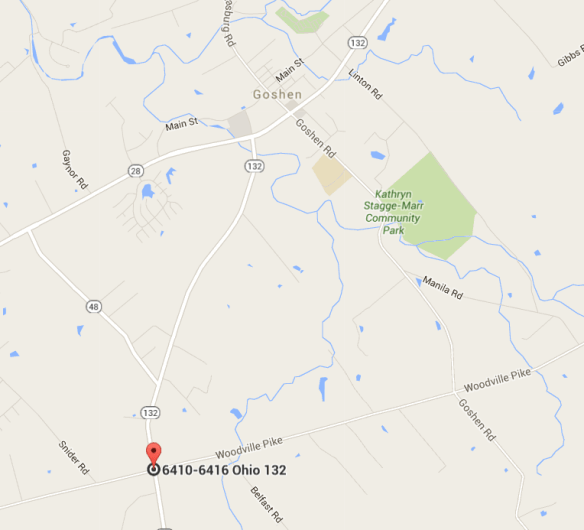
David and Daniel Clermont land map

David and Daniel’s land is shown, beginning at this intersection of Ohio 132 and Woodville Pike.

David and Daniel Clermont land

These lands are shown in Little’s (Lytle’s) bounty land survey (1802), although as far as the government was concerned, these lands were reserved for Revolutionary War military veterans. Even if settlers who were living there had obtained title from the Indians or someone else, they were still squatters in the eyes of the government. In 1802, David and Daniel’s land were shown as cleared.  Shortly thereafter, between 1802 and 1805, David and Daniel would move up the old Indian trace to Montgomery County, out of the realm of the bounty land surveys.

David and Daniel Miller’s land is shown below in relation to the location of the Stonelick Brethren Church today.

David Miller Clermont

After living between 5 and 8 years in Clermont County, the Miller clan would be on the move once again.

Montgomery County, Ohio

Sometime between 1802 and 1805, Daniel Miller would move to Montgomery County, Ohio. David would have been between 21 and 24 by this time, certainly old enough to either go with his father or stay in Clermont County. There is a very clear history of the Miller family maintaining connections between the two counties, even going back and forth to marry. The churches in the two counties were clearly thought of as sister churches as well, and many families in Montgomery County came from the O’Bannion Church in Clermont County.

There is some speculation that David was married a first time to an unknown woman before he married Catharina Schaeffer Gephart In Warren County, neighbor county to Clermont, on December 13, 1805. This speculation is based on the fact that Catharina wasn’t widowed until December 1804, so any child born to David before late 1805 had to belong to another mother.

David’s daughter, Susan Miller was born June 5, 1802, assuming that her family knew her birth date and it’s correct on her tombstone.

Daughter Esther Miller may have been born before Susan or may have been born approximately 1804, given that there are 4 years between Susan’s birth in 1802 and the first child born in June 1806 to Catharina Schaeffer after her marriage to David Miller.

The odd thing about this entire scenario is that there is a missing puzzle piece, but I don’t exactly know what it is. I wonder if that missing piece is that David and Catharina’s first child, David B. Miller, was born on June 3, 1806, just 6 months after their marriage in December 1805.

The reason I feel that something is missing is because David Miller obtained a marriage license in Warren County, Ohio, not in Montgomery County where David’s father was a minister and where Catherina lived. David had to have been in Montgomery County to meet Catherina. Catharina was very clearly living in Montgomery County at this time, because David’s father, Daniel, was made executor of the estate of Peter Gephart, Catharina’s husband, who passed away in December 1804. After their marriage, David Miller became the guardian of Catharina’s two children, John and Elizabeth Gephart.

David would have had to have been in Montgomery County to meet Catharina. Based on tax lists and later depositions, Peter’s land was a couple of miles away. Why Daniel Miller was chosen to administer the estate of Peter Gephart, we’ll never know. Daniel was Brethren and Peter was Lutheran – so perhaps the court made the selection.  One hint may be that one Johann Heinrich Gephart, known as Henry, owned land one farm away from Daniel Miller.  It’s unclear the relationship between Henry and Peter Gephart, but it does put a Gephart in the vicinity of Daniel Miller – an avenue for the two families to meet.

Another mystery is that the Gephart family, and Catherina’s Schaeffer family were all Lutheran. She is the only known convert. When and how did that happen? Was her conversion a function of marrying David?

One hint which may or may not be accurate is a statement made in David’s son, Stephen’s biography in the Kosciusko County History book which said that David moved to Montgomery County soon after his marriage and located within 4 miles of Dayton on Wolf Creek.  Keep in mind that Stephen never lived in Montgomery County and David died when Stephen was 8 years old.

On the map below, Wolf Creek runs diagonally from lower right to upper left.

David Miller Wolf Creek

Interestingly, Wolf Creek runs by Trotwood, in Randolph Township, today, the location of the Happy Corner’s Brethren Church near where David’s father, Daniel bought land in 1815, but David never lived there.

Our David is not found in Randolph Township in 1810, but in German township. The David Miller in Randolph County would be our David’s uncle, David Miller, who owned land and is buried there.

Jefferson Township butts up against both German and Miami Township and Daniel definitely bought land from Jacob Miller according to Montgomery County deeds, in Jefferson Township – so it’s likely that David and Daniel in Jefferson were our Daniel and his brother David.

A review of the Daniel and David Miller deeds in Montgomery County shows us the following information:

Date From To Section Twp Range Acres Amount
Aug 28, 1807 Jacob Miller Daniel Miller 34 (Jefferson) 3 5 150 Bear Creek $300
Sept 1, 1815 William Farmer Daniel Miller 26 (Randolph SW corner) 5 5 140.76 $1689
May 27, 1815 Daniel Miller Michael Hoovler 34 (Jefferson) 3 4 149.5 $2980
May 27, 1815 Daniel Miller Abraham Troxel 34 (Jefferson) 3 5 ½ – mill pond noted $20
March 21, 1826 Daniel Miller (David exec) Jacob Miller (son) 26 (Randolph) 5 5 100 ac N side SW 1/4 $1000
Dec 18 1827 John Miller Stephen, Jacob, Samuel, Abraham, Nancy, David (wife Elizabeth) 26 (Randolph) 5 5 40 acres SW side S quarter joining Jacob Miller land $500

The 1800 and 1810 census for Ohio is missing. However, we do have a tax list for 1810 that shows us the following information: 

David Miller 1810 tax Montgomery

As odd as this seems, the Elder Jacob Miller, who we are not related to, at least not paternally, sold Daniel Miller his land in Jefferson Township. I know, that left me shaking my head too – it’s so temping to make a family connection based on this sale.  The Elder Jacob Miller preceded the Brethren group of settlers to Montgomery County and he was probably responsible for recruiting many.

The Daniel in Dayton is the son of Elder Jacob Miller, although wrongly attributed in many genealogies.  We know for sure he lived in the Dayton City limits, as the house still stands today and is on the Register of Historic Places.

We know on the 1810 tax list that our David is the same David who is living in the same location as the Gephart land. I also suspect that the Daniel and David who own adjacent land in Jefferson Township, both entered by Jacob Miller are brothers, although I have no way to prove it.

In 1810, Daniel Miller as executor of Peter Gephart’s estate, Catherine Miller as his former wife and the mother of his 2 children, and David Miller as her current husband petition the court and explain how Peter and Philip Moyer divided land they bought together.  An excerpt is provided below:

Page 341 – May term 1810– Daniel Miller and Katharine Miller (late Katherine Gephart) with the consent of her husband David Miller administrators of the estate of Peter Gephart… that Peter together with George Moyer were in possession of 2 tracts of land as tenants in common in Twp 2 range 5, section 9 and fraction of 10…land sold to Daniel Mannbeck, land sold to Christopher Shuppert…land sold to John Shuppert…to Miami River…corner George Moyer’s land…425 acres (Moyers share was 447 acres). Peter surveyed in his lifetime, quietly to George Jeaceable. Request to execute deed. Elizabeth and John Gephart are his children. Daniel, Katharine and David all 3 sign.

In 1814, we again find David Miller farming the Gephart land, Daniel Miller in Randolph Township where we know he owned land, and David Miller, Daniel’s brother on the land in Randolph Township where he lived until his death.

David Miller 1814 Montgomery tax list

In 1830, according to the tax lists, John and George Gephart own the land that was previously farmed by David Miller who paid the taxes.

The 1820 census schedule in German Township, Montgomery County, shows us David Miller living beside John Gephart, his step-son.

In 1820, David has the following household members:

  • Male 0-10 Samuel Miller b 1816
  • Male 0-10 John David born 1812
  • Male 10-16 David B. b 1806
  • Male 26-45 David (the father)
  • Male 45+
  • Female 0-10 Lydia Miller b 1818 or Catharine b 1814
  • Female 10-16 Mary b 1809 or Elizabeth b 1808
  • Female 16-24 Susan b 1802
  • Female to 45 – Catharina (the mother)

Unfortunately, the female census columns are blurry and not all known females are accounted for.

In 1822, David’s father, Daniel, dies and in 1823 both David and Catharina signed a receipt found in Daniel’s estate having to do with her first husband’s estate.

David Miller 1823 receipt

We know where Daniel and Catharina’s farms were located due to both tax lists, deed transcriptions and current maps. We also know that David farmed Catharina’s farm before her death in about 1826.

David Miller Mont land map

The map above shows the land owned by David’s father, Daniel Miller on Bear Creek, at the upper arrow and the land owned and farmed by Catharina and Peter Gephart and later by David Miller on sections 9 and 10, at the lower arrow. These lands are about 2 miles apart.

David was the administrator of his father’s estate, along with his brother John with his brother-in-law John Becher (Booher, Bucher) and his brother Stephen Miller acting as their securities, as noted below. David’s signature is first, but it looks very odd. Maybe the paper slipped as he was signing.

David Miller 1822 signature

Roughly four years later, Catharina died too. David and Catharina had 7 children before her death, assuming that Susan and Hester were not Catharina’s children, leaving David with several children to raise, the youngest known child having been born in 1818, so about 8 years old.

In 1827, we find David still farming land that wasn’t his in German Township.  He owned 4 cows valued at $32 and no horses.  He still owned no land.

On the 1830 tax list, David still lives in German Township, owns no land, no horses.  He does own 3 cows valued at $24.  His step-son, John Gephart, now 29 years old owns land, 2 horses nd 2 cows.

In the 1830 census, David, living in German Township, is surrounded by many of the same neighbors, except John Gephart no longer lives next door.

David’s household looks like the following:

  • Male 10-15 Samuel b 1816
  • Male 60-70 David (the father)
  • Female 0-5
  • Female 15-20 Lydia b 1818 (age 12)
  • Female 20-30

This may not have been our David, as he would have been age 49, not 60-70, but there aren’t any other good candidates and he is clearly living in the right place.  Perhaps the census taker got the hash mark in the wrong column.

Either David has married a much younger woman and had a young child that did not survive to adulthood, or an unknown female is living with him, a widow perhaps, keeping house.

David wasn’t ready to settle down in the rocking chair on the porch.  He was getting ready to move on, once again.  Much like his father in Bedford County, David never owned land, and he packed up and moved to the frontier, again, where he could own land.  Only this time, the frontier was only a couple hundred miles away, two to four weeks by wagon.

But first, David married a mystery woman named Elizabeth.  I wonder if Elizabeth was aware that David was planning to move to the frontier when she married him, or if this was her honeymoon surprise.  “Surprise Honey, we’re moving to the edge of the earth, past civilization.  Yea, there are Indians, wild animals and no houses. It will be fun!   Woohooo!!!”

Elkhart County, Indiana

From the book “Rock Run Church of the Brethren Centennial 1850-1950”, the following is found on the first page:

In 1830 Elder Daniel Cripe led a group of Brethren from Ohio to Elkhart Prairie. Arriving in the spring, rude buildings were erected and the prairie was broken for the first crops.

The next year, Elder Cripe returned to Ohio and led another group of settlers to Elkhart County. There were now 16 families scattered over the county. He called them together and preached the first sermon ever delivered by a Brethren minister in Elkhart County. Later in this same year, a congregation was organized and a love feast was held.

The Elder Daniel Cripe was married to Magdalena Miller, David’s aunt, sister to his father, Daniel Miller. Magdalena Miller Cripe died about a decade later, in 1842 and Daniel Cripe died in 1859, in Elkhart County.

Daniel Miller’s estate was completed in Montgomery County, Ohio by 1830, and David Miller was in Elkhart County, Indiana by 1831 or 1832, probably arriving in the winter of 1831/1832 with Elder Cripe’s wagon train. By this time, David had remarried to a woman by the first name of Elizabeth. We know nothing more about her other than she died in the epidemic of 1838, on August 19th and was born December 19, 1777, according to her tombstone. She was buried on David’s property, now known as the Baintertown or Rodibaugh Cemetery. There is no question that Elizabeth is David’s wife, as her stone and David’s were both paid for with funds out of his estate.

David Miller Elizabeth stone

Clearly, Elizabeth is not the woman age 20-30 living with him in 1830, as Elizabeth would have been age 47 at that time.

This following extract from a letter written by Jacob L. Ullery in 1892 gives us some perspective about what the trip from Montgomery County to Elkhart County was like.

The first week we came to Saint Marys, Ohio.  The second week we came to
Fort Wayne, Indiana.  The third week we came to where we unloaded our wagon
on the west side of the Elkhart River bank in the woods about a mile west
of Goshen among the Indians.  There we put up a little shanty.  Then we cut
timber for a house and shop.  Then about the first work I done at the
carpenter trade, I went in the woods and cut a tree and split it in lumber
and made a weaver’s loom and some bed-steads.

We had no doctor and no goods.

I worked around till harvest, and then I went to the Elkhart Prairie to
“Credel” the wheat.  After the wheat was cut I helped to make hay in the
marsh, west of Goshen.  There I came among the rattlesnakes.

The last of August I went back to Ohio.  Again in 1831, I came back to
Elkhart County.  Then I helped to build the first frame house in Goshen and
helped build the first Saw Mill in Elkhart County.

In 1833 I went to Ohio again, sometime in February.  I was then 21 years
old.  In April, I was married to Susana Warner.

In various history books, David Miller is listed as a commissioner who established the location of Goshen, along with 2 or 3 other men. This David is noted as being from St. Joseph County in 1831, so we don’t know for sure that this is our David – and it looks doubtful because there are three land patents for a David Miller in St. Joseph County in the 1830s – and our David is definitely living in Elkhart County at this time. The books do indicate that Goshen was named in David Miller’s honor as he wanted that name to be bestowed – and our David lived near Goshen, Ohio from the time he was 16 until he moved to Montgomery County – so it’s remotely possible.

Goshen is also a Biblical settlement location.  The English Standard version of the Bible tells us that:

“My father and my brothers, with their flocks and herds and all that they possess, have come from the land of Canaan. They are now in the land of Goshen.”

David obtained a land patent on September 2, 1831, but we don’t know when he applied for that grant or how long the granting process took. It would have been several months, at least.

The History of Elkhart County tells us the area between the Elkhart River and Turkey Creek is known as “the Barrens” where the land undulates just enough to remove the water. This is the area where David’s home place was located.

It’s possible that David accompanied Elder Cripe in 1830 to select his land, returning home to Montgomery County to tie up his affairs and to wait for his land grant to be approved before leaving permanently for the northlands. I’m actually surprised that David left when he did, as his elderly mother didn’t die until sometime in 1832, by which time, David was already living alongside the Elkhart River. Notice of his mother’s death would have arrived with the next group of settlers to come north.

David subsequently applied for and obtained several land grants including the land he would eventually sell to sons John David and David B. Miller in 1841, for double what he paid for it. He also sold a grant to his son, Samuel.

If John David and David B. started clearing their land in 1832, about the time they arrived, they would have been done about 1841. It took a long time to clear land, as evidenced by this narrative written by one Samuel R. Miller, relationship unknown, who was born in 1820 and also lived in Elkhart County beginning in 1837.

At the age of 17 Mr. Miller entered 80 acres in Union Twp. and subsequently bought 80 acres in Elkhart Twp. and finally took up 120 acres where he now resides in Sect 17. Up to his 27th year, he was engaged in clearing land, handling the ax, mattock and maul and was persevering in his efforts to make the wilderness a garden and to secure for himself a home.

During the first years of his residence in this county, the family were supplied with fresh mean by his gun. Wild turkeys, deer, wolves, prairie chickens and wild geese were very plenty when he first came to Indiana. He has himself killed with his rifle several hundred deer. They were so numerous that the snow would be trampled hard by them near the cabin where a tree had been felled and they came to browse. Many a time by moonlight has he shot them. During his youth and manhood his toil has been incessant. He has split 800 rails in a day from the oak that grew on his section.

I’m telling you what, 10 years is a very long time to chop trees.

Here’s another peek into the past:

John L. Miller was born in Montgomery Co. in 1836. He is the son of David S. Miller and Saloma Leslie Miller. Mr. Miller has seen many changes in the county since he can remember, has seen Jackson Twp. when it was almost a wilderness, has seen the wild deer and wild Indians and other wild animals in this township. He can remember when night would come the timber appeared to be alive with wolves and other animals.

Land Grant Reconciliation

David obtained several land grants. Today, grants can be accessed at the Bureau of Land Management.  The county is listed beneath the serial number.

Name Office Serial Year Parts Sec Twp Range Acres
David* La Porte IN1700_.008 (Elkhart) 1837 E1/2SW 8 35 6e 80
David** La Porte IN1610_.132 (Elkhart) 1837 W1/2SE 32 36 6e 80
David*** Fort Wayne IN1430_.431 (Elkhart) 1831 W1/2SW 34 36 6e 80
David**** La Porte In1730-037 (Kosciusko) 1837 E ½ SE ¼ 9 34 5e 80
David Fort Wayne IN1440-239 (Elkhart) 1833 SW 1/4 5 35 6 160
David La Porte IN1600-240 (Elkhart) 1837 E ½ SW 1/4 5 35 6 80
David***** Fort Wayne IN1440-413 (Elkhart) 1834 E ½ SE 1/4 2 36 5 80
David La Porte IN1730-488 (Elkhart) 1837 SW !/4 28 36 5 160

*Land just to the west of the land in Jackson Township that David patented and sold to John David and David Baker Miller in 1841.

**Land to the east of David’s homeplace.

***The entry, signed by President Andrew Jackson, is David’s home place where the cemetery is located. Given the curvature of the land and the river, his homeplace also includes portions of section 33.

****Grant says David Miller Junior but this is the land that would be included in his estate in 1851, so it’s clearly this David.

*****David Miller and Samuel Stutzman

The grant shown below would become the land of his sons John David Miller and David B. Miller when he sold it to them in 1841 for $100 each for half of the quarter section (80 acres) each.
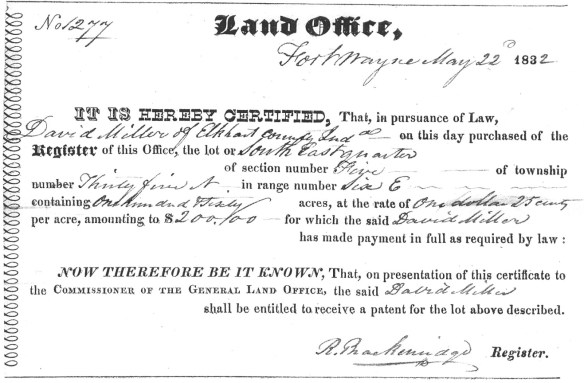
JDM David Miller land grant

David signed the receipt below.

JDM David Miller receipt

David also obtained a patent for lands that he would sell to his son Samuel. However, most importantly, he applied for land for his own homestead and received the patent in September of 1831.

David Miller homeplace grant crop

Note that David applies for this grant while still living in Montgomery County, Ohio.

David selected a piece of land that is divided by the Elkhart River and has two nice high locations, some tillable land, and the rest is swamp. The swamps were responsible for the summer sicknesses, as the pioneers reported no illness in the winter months, just the opposite of what we have today. These malarial fevers are likely what killed Elizabeth in 1838.

The Sickly Year

1838 is referred to as “the sickly year.”  Everyone was sick.

In the plat map of 1874 on page A-18, there is an article called “Ms. Violet’s Narrative in 1874”. Looking at the 1861 plat map, the Violet’s land is located a few plats (about a mile) north of David Miller’s land. She says:

“The summer of 1838 was exceedingly warm, dry and sickly. Perhaps ¾ of the inhabitants of the North part of Indiana and South part of Michigan was affected with intermittent fevers. Several near neighbors died including Elizabeth Miller the wife of David Miller.

The summer of 1839 continued to be dry but not so dry as last. There was still much sickness but not so many fatal cases.”

In the book, Elkhart County History by Chapman in 1881, they listed a group of farmers and their sales in 1845. The surnames were those of the David Miller neighborhood, as noted in deeds, land grants and plat maps and include Mikesell, Cripe, Hess, Howzer, Latta, Weybright, Thompson and Jackson. David Miller sold 200 bushels of wheat, 1600 bushels of corn and 700 bushels of oats. John Miller 1200 bushels of wheat, 1000 bushels of corn and 800 bushels of oats.

Baintertown

David Miller settled, or perhaps better stated, helped establish a community that is today called Baintertown, located along the Elkhart River just south of present day Goshen. This is the Elkhart River looking towards David Miller’s land.

David Miller Elkhart River Baintertown

Baintertown takes its name from Frederick Bainter, to whom the Wyland Mill was sold in 1860, but Baintertown was established by the Brethren Wyland brothers when they arrived from Ohio in 1830.

David Miller Baintertown Five Medals

Rex told me that the winter the settlers arrived was particular difficult. He said they arrived late in the season without time to construct appropriate shelter. The Indians still lived in a village nearby, and they helped the settlers, specifically the Miller family, select a location, very near their village, and helped them do what they needed to do to survive.

The Indian village was small, probably the remnants of the Pottawatomi village of Five Medals, and as more settlers arrived, the Indian people either died, moved away or were forced off of their land in the Indian removals of the 1830s.

However, Rex said that an old Indian Chief would visit and stay with David Miller and the two men would smoke a pipe together. David was sad when his Indian friend died, as his family would have perished without the Indians the year that they arrived.

The last known record of Chief Five Medals was in 1818, but 1830 was only 12 years later, so it’s certainly possible that Five Medals was still living, and living right where his village had originally been, beside or near David’s land on the Elkhart River.

Rex gave me this undated article from the Goshen newspaper.

Baintertown Settlers…..Wyland Town Revisited

The history of the tiny hamlet of Baintertown in Jackson Twp is interwoven with many aspects of early Elkhart County progress, Mills, the first Dunkard conference and one of the counties first estates are just a few examples.

A historical stone marker centered in a grassy triangle on county road 29 between Benton and New Paris is the only remaining testimony to the founders of the area that was once known as Wyland Town.

The marker notes the names of Jonathon, Jacob, John, Daniel, Christian and Solomon Wyland, the 6 brothers who traveled on horseback from Mercer Co., Ohio in the 1830s to tame the bountiful Elkhart Prairie.

According to local historians, the brothers entered a claim for 640 acres of land surrounding the Elkhart River there and established the county’s first sawmill.

In 1835 and 1840 a grist mill and a woolen mill were built by Jonathan and were known throughout the area as Wyland Mills.

Jonathan, apparently the more ambitious of the 6 brothers soon after his arrival erected what must have seemed like a mansion to those simple pioneers. His home was 40 by 60 and two and a half stories and boasted 18 rooms set off with two wide verandas.

The county road where the house once stood and where the marker now rests is commonly known as the Huntington Road. Although hard to imagine now, the narrow twisting strip of blacktop was once of the state’s first roads.

The legislature on Jan. 24, 1832 appointed Lewis Rogers to survey the area for the purpose of constructing a state road from Grant County to the county seat of this area.

Until the mills were built and the first harvest reaped, the Wylands, like other early settlers, relied on the abundance of wild turkey, venison, and walnuts, say historical ledgers.

Although it is not generally known, materials produced at the Wyland Mills and other mills in the county were shipped north via the Elkhart River and the Great Lakes and were received as far north as Buffalo NY.

The church played a significant role in pioneer life. Historians say the first Protestant denomination was the Church of the Brethren, or originally the Dunkard church.

Although a church building was not built until 1859 at Rock Run Creek, members congregated in their homes and anywhere that might be convenient.

The largest known gathering during the years before the church was constructed was then approximately 5000 members assembled for the church’s annual conference at the home of Jonathan Wyland.

“Settlers traveled from near and far, some came by horseback, many walked and others rode in crude wagons.” Writes one historian.

Daily sessions were held in Jonathan Wylands barn and the officials were designated members of the congregation.

Several of the first Dunkard ministers were Jacob Studebaker, reportedly the contractor for the original county courthouse in Goshen, [still standing and in use in 2009], Martin Weybright, Elder Joel Shively and the Rev. Isaac Berkey.

Finally the Wyland Mills were sold in 1860 to Frederick Bainter and the hamlet became known as Baintertown. Reportedly the village was never plotted or recorded because the residents had no desire to change their peaceful country life into “a booming city”.

The stone marker was erected in 1910 in memory of Iverson P. Wyland, grandson of Jonathan and a school teacher in Jackson Twp. for many years. It stands as a silent reminder that even though the area is calm and peaceful now, the winding waterway was responsible for transporting goods from the Wyland Mills all the way to Buffalo.

There is more to this story though, because there was a church built on David Miller’s land, where the cemetery is located, although we don’t know when the original church was organized. Organized in the Brethren sense means whey the congregation began meeting in homes, not when they built a church building.

Edward Clark bought the land from David Miller’s estate in 1861 and in 1877, he executed a deed to “Trustees, German Baptist Church” stating that when the property is no longer needed for this purpose, the land should be turned over to the cemetery trustees.

The church was located on the west side of the original cemetery.

The first known burial in the original “old section” of Baintertown cemetery was the grandson of David Miller, William Miller, son of David B. Miller and his wife, Christine. William died at 2 days of age on November 4, 1831 – so the family group had arrived by then.

The family had not been in this area long. Needing to establish a cemetery shortly after arrival was not a good omen. David has barely had his land 2 months and the first soil broken was possibly that shovel that buried his grandson.  The wagon train had probably just arrived.

We don’t know when a church was established in this location, but it was probably already in existence by 1877, likely meeting in people’s homes or in a log building when a church building from a Reformed Presbyterian Church in Waterford built in 1858 was dismantled and re-erected on the land deeded next to the original cemetery. By 1931, the church was no longer functioning, so the building was sold and the land became the west part of the cemetery on the north side of the road, where newer burials and parking are found today.

Another article is titled, “Baintertown, A Thriving Center” and was published in the 1976 Goshen News.

David Rodibaugh, Everett Miller’s grandfather was the pusher of the day. His ambition was to acquire a farm for each of his children. His daughter married Ira J. Miller, Everett’s father and they got the farm where the Baintertown school still stands northeast of New Paris.

Rex Miller owns this land today and the school still stands and is in use as a farm building. It’s even heated today, something it probably wasn’t originally. The old school sits at the intersection of road 29 and 142.

David Miller Baintertown school

David Rodibaugh first set up the saw mill, furnishing lumber for many houses and barns in the area. T.J. Harriman was his right hand man.

Next he built the woolen mill and manufactured blankets of all kinds. Later Reddens and sons set up the grist and flour mills and manufactured Never Fail Flour and ground corn meal.

The grocery store was run by Edward Barringer, Everett Miller’s great uncle.

About that time there came a rapid change in merchandizing. The mills, brick kilns and flour mills closed up as they could not compete with national brands, and Baintertown faded out much faster than it had grown. All the factories were torn down and all that remains is a stone in the small park strip, recording the fact that the 6 Wyland brothers landed in the area in 1832 and became very influential. In fact the town was first known as Wylandtown but later when a man named Bainter bought the woolen mill from Mr. Wyland the name of the town was changed to Baintertown. This was around 1862.

Baintertown, then Wyland Mills, saw it’s heyday during the lifetime of David Miller.

David Miller’s Brother, John

David’s brother, the Elder John Miller, also settled in Elkhart County in 1835. As reported in the biographies of the History of Elkhart County, “He was an active co-laborer of Elder Daniel Cripe, and did his share of the evangelistic work in those early days. He finally located in the Yellow Creek Church, seven miles southwest of Goshen, where he died in 1856.”

David Miller John Miller d 1856

The Yellow Creek Church is now the Solomon Creek Church, with the cemetery adjacent.  The map below shows the route from the Baintertown Cemetery, on David Miller’s land, to the Yellow Creek Church.

David Miller to John's map

John Miller is the last known Miller to own the Bible known as the Philip Jacob Miller Bible that ultimately belonged to Philip’s son, Daniel Miller. John bought the Bible at his father Daniel’s estate sale and brought it with him to Elkhart County, where it somehow left the possession of the Miller family and today resides with a family who has no idea why they have this Bible.  John’s signature is found in two places in the Bible.

John Miller signature 2

John Miller signature

The owners were very gracious and allowed me to visit the Bible several years ago. The only connection that we have found is that we believe the owner’s ancestor may have bought the house that John Miller once owned. If that is the case, then the Bible may have somehow been left behind. It has been passed down in their family, as a heirloom, ever since.

Philip Jacob Miller Bible and me crop

Marriage to Martha Drake

On June 6, 1839, David remarried a widow woman named Martha Drake who had at least one minor child. Interestingly enough, in the 1840 census, we find David’s neighbor in Elkhart County to be Ann Drake.

This would truly have been a scandal in the Brethren community, because Martha Drake was a….are you ready for this….a Baptist. Yes, and she didn’t convert either. Holy moley.

I bet this was not a uniformly approved marriage by David’s siblings, younger children, or anyone Brethren. And David’s entire group of friends and family were Brethren. This was indeed a scandalous “mixed marriage.” Obviously, David didn’t care. I do wonder if he separated from the church at that time, or stopped attending. I think this makes David Miller an official black sheep – at least from the Brethren perspective!

David’s 1840 household was comprised of:

  • Male 10-15
  • Male 50-60 David
  • Female 15-20
  • Female 30-40 Martha Drake Miller

Both of the children are probably Martha’s children.

Martha and David set about having 3 additional children by 1846.

Land Speculating

David may have been doing a bit of land speculating. Given that land was almost free for the taking – secured with a small payment – why not? That way land would be readily available for newcomers arriving from Montgomery County and elsewhere, and David stood to make a bit of money. The process of land patenting wasn’t quick or necessarily easy – but once you knew how – it was probably quite worthwhile to have readily available land for people who wanted to settle and start clearing and farming right away. The land patent process didn’t happen overnight.

David apparently farmed several tracts himself, based on these deeds in the chart below found in Elkhart County.

Year From To Qtr Sec Twp Rg Ac
1834, Apr 15 Benjamin Bennett and Susanna David Miller for $100 bk 1 pg 333 W ½ NW ¼ 35 36 6e 80
1834, Oct 3 Henry Matthews David Miller (mortgage and release*) E ½ SE ¼ 4 35 6e 80
1840, Nov 11 David Miller, Bk 6 pg 335 (3 ac) and 336 (3/4 ac) Fractions on Elkhart Riv 3 ¾ ac
1841, Mar 23 David Miller and Martha Samuel Miller for $100 bk 20- page 319 (recorded Nov 4 1852) bk 16 p 17 W ½ SE ¼ 32 36 6e 80
1841, Mar 23 David Miller and Martha John Miller Jr. for $100 bk 20-319 not rec until Aug 14 1856 N ½ SE ¼ 5 35 6 80
1841, Mar 23 Peter Wallmer and Anna John Miller bk 20-page 320 W ½ NW ¼ 5 35 6 81.3
1844, Oct 5 David and Martha Miller Solomon Conrad for $200 bk 9-433 E ½ SW ¼ 8 35 6 80
1845, Oct 18 David and Martha Miller (her mark) Laporte land office sale**1 E ½ W ¼ 8 35 6e 80
Aug 15 1849 David Miller and Martha Lot 147 in Goshen, bk 12-555
1851, Oct 18 David Miller and Martha David Miller Jr bk 14-512 for $100 S ½ SE ¼ 5 35 6 80
1855 David Miller est David P. Gross N ½ NW ¼ 15 35 7e 80
1855 David Miller est (land grant) John Troup W ½ NW ¼ 6 35 6e 79
1855 David Miller est Jonas Renfro Ne frac 33 36 6e 9
1855 David Miller est (home place) Jonas Renfro W ½ SW ¼ 34 36 6e 80
1855 David Miller est Moses Babcock Kosciusko

*Mortgage release was signed on June 13, 1835. Witness William Latta and Caleb Winger

**This notes that there is an affidavit in the Misc Record Book 15 page 165 dated Dec. 27 1918.

An Elkhart County patent map assembled by Boyd IT in 2005 shows that David Miller received a patent in Elkhart Township in 1831 for his homestead land in section 34. There were several 1831 patents to many individuals, but none earlier.

Furthermore, the land patent map shows that David also obtained a patent in section 32, the west half of the southeast quarter in 1837. This map shows the earliest grant to be in 1831, and that Nathaniel Drake also patented the land abutting David Miller’s on the north. I wonder if Nathaniel Drake is related to Martha Drake, David’s second wife. This might well explain how they met.

Imagine that…Baptists next door!

The Early Church

The Gospel Messenger published on March 6, 1909 page 149, tells us something about the early Brethren church in Elkhart County.

THE CHURH IN ELKHART COUNTY, INDIANA

By J. H. Miller

In this article I am to tell about the history and the growth of the Church of the Brethren in Elkhart County, Ind. In this County was the first church organized in Northern Indiana, and Goshen was the center of the congregation.

It is said that Bro. Daniel Cripe organized the church about 1830. Soon after that, another brother, John Miller, moved to this “northwestern land,” as it was then called. I well remember of seeing both of those brethren and hearing them preach in German. They settled on Elkhart Prairie, and were from Montgomery County, Ohio: The first child of the Brethren, born in Elkhart County, was Rosanna Cripe. Those “newcomers,” as they were called, held their first meetings in their log cabins.

There are now nineteen congregations in the county, some reaching out into adjoining counties. There are fifty ministers living in the county. Of the number of ministers who formerly lived in the county, twenty-four have died.

There are twenty-three places of worship, and about 1,800 members, nearly as many as may be found in the other part of the State district. Among the number of ministers, strong men in their day, who have died in the county, were James Tracy and Amsey Puterbattgh. They were Brethren, useful men, and did a good work.

Meetinghouses were built about 1850. Their big wagons would go through the mud, woods and cross streams, in order to reach the place of meeting. My father’s turn would come about once in fourteen months. That was a big day for us children. All the ministers had a word for Jesus. Even the deacons were not excused, though there might be six or eight present. They had to bear testimony to the Truth preached. The deacons usually had the place on a bench in front of the preachers’ table.

After meeting a big dinner was served at the expense of those who had the meeting for that day. After dinner, from two to three hours were spent in social visits. Much love and union seemed to prevail among those early Christian fathers and mothers: Our neighbors were from eight to ten miles away, and we were always glad to see them.

In 1852 the Annual Meeting was held in Elkhart County, five miles south of Goshen, in Bro. Jonathan Wyland’s barn, 40 x 80 feet in size. It was estimated that there were about 4,000 people present. I remember of hearing my father speak of the large crowd. It is presumable that John Kline, of Virginia, was the moderator. It was thought by some that this was the first Annual Meeting held in Northern Indiana.

The second, in Elkhart County, was held in 1868; in Eld. Jacob Berkey’s barn. Henry Davy was moderator. In 1882 the meeting was held on Bro. John Arnold’s farm. I have in mind three Annual Meetings in Northern Indiana, and all were held in Elkhart County. At the present time Northern Indiana must have nearly 4,000 members. Many have been added to the church within the last eight months.

In those days the faithful ministers would walk and ride for miles to the place of worship. I remember that Bro. John Leatherman, when ninety years old, walked from ten to twelve miles on Saturday, returning home on Monday. These faithful old brethren were full of the missionary spirit.

I was born in Elkhart County, in 1838, hence have a fairly good knowledge of the workings of the church here. My prayer is that God may call many more faithful workers into his vineyard; and that many souls may be converted to Christ.

It’s remarkable to me that John Miller was still preaching in German, being the 4th generation to reside in America.  My mother tells of hearing her grandmother, Evaline Miller Ferverda (1857-1939), David’s granddaughter, speak in German – although most of the time she spoke English.  Mother said the Brethren Church at that time still gave sermons in German.

Schools

David may have moved to the frontier when it was barely settled, but all of his children learned to read and write, either before or after arriving in Elkhart County. We know this based on the signatures on his estate distribution. What we don’t know, for sure, is if the children attended the Whitehead School which would have been located about 4 miles distant, and required fording the Elkhart River and Turkey Creek, or if they were taught at home or in a makeshift school in someone’s home. One thing is for sure, school would not have been taught in the spring, summer and fall when help was needed on the farm. Survival was more important than education.

David Miller to Whitehead school

The Whitehead School was located on the west side of present day CR 19 north of CR 48 in Sect 17. Samuel Whitehead (1811-1874), one of 9 Whitehead brothers, settled in what became known as the Whitehead settlement, southwest of New Paris, Indiana. About 1836 a round log cabin with a clapboard roof was built on his property. This first schoolhouse was about 12X16 in size and was replaced by a wood frame building and was in use until the 1880s when it was replaced by a brick school building. For some reason this school is not shown on any of the county maps before 1874. But it has been found that David B. Miller, David Miller’s grandson, born in 1838 did attend this school in 1854.

Here’s what we know about early schooling in Elkhart County.

The Gospel Messenger March 23, 1907 page 182 Vol. 46 No.

IN SCHOOL FIFTY-FIVE YEARS AGO.

By J. F. Neher, Guthrie, Okla.

It is interesting to note the changes that have come in a half a century or over. Fifty-five years ago I had my first experience in school. The schoolhouse was built of logs. The benches had no backs and were made of slabs by boring holes in each end; into these the legs were inserted.

On one side the house one log was cut out and along window put in to give light to a long table, which was made by boring holes into the log below the window; into these long pins were driven, on which a broad board was fastened, which served as a writing table.

The teacher was the father of a large family living near the schoolhouse. The rod was frequently used, but mostly severely on his own children.

He taught German and English, and a variety of text-books was used. One the higher classes recited their lesson from the Old Testament, another from the New Testament. One, a brother’s son, had for his text-book Brother Peter Nead’s book; and still another recited his lesson from an old German hymn book.

Other things might be mentioned that would seem odd to the student or schoolboy of today; but I believe if the use of the Bible had been retained, the masses today would have a better knowledge of the Good Book.

David’s Death

When David died on December 1, 1851, he left Martha with 3 young children.

David Miller Baintertown stone

David Miller is buried on the far east side of the Baintertown cemetery, just before it drops off into swamp, behind the tombstones below.

David Miller Baintertown burial

The closest thing we have to an obituary for David comes from the Pictorial and Biographical Memoirs Elkhart and St. Joseph Counties, Indiana – 1893 by Goodspeed, page 698, which is actually about his son, David B. Miller.

David Miller came to Elkhart County about 1830 when the country was a wilderness, inhabited only by wild animals and wilder savages. He came to the county overland and settled on 80 acres, build a log house and immediately began clearing and improving. He raised 3 sons and 4 daughters of whom our subject’s (David B. Miller) father is the only one now living, but all reached mature years, married and became the heads of families. They are David, Samuel, John, Elizabeth, Catherine, Lydia and Susan. The mother of these children died in Ohio. David remarried having two children, Michael and Steven, both of whom are living in Milford Indiana. The father died in Jackson Twp.

We know this account is not fully accurate, because David had 9 children who lived to adulthood and married, including Susan mentioned above, born in 1802, before David married Catharina Schaeffer Gephart. Furthermore, he died in Elkhart Township, unless he was visiting someone at the time.

We know positively that David had 9 children before marrying Martha Drake and 3 after his marriage to Martha because of his long, drawn out estate.

The Estate

David died on December 1, 1851, almost exactly 20 years after arriving.

Their son, Stephen’s biography was included in the Kosciusko County History book gave David’s death date as November 5th instead of December 1st.

Apparently things had either slipped David’s mind, or perhaps he wasn’t well, because his land in Kosciusko County had to be “redeemed” by paying the back taxes for 1850 out of his estate.

I was fortunate to find David’s estate packet relatively intact in Elkhart County during a visit a few years ago. Many items didn’t have dates, but enough did that I was able to put together a timeline of what happened. And a lot happened.

You would never have known that this was a Brethren estate from the proceedings.

David’s inventory was appraised and then the sale occurred at the “home of the deceased” on January 3rd, 1852.  That must have been a cold auction.  What follows is his estate appraisal.

Number Items Appraised Value
16 Pigs 10.00
4 Larger pigs 7.00
2 Sows 5.00
6 Sheep firs choice 7.20
6 Sheep – Second choice 7.00
6 Sheep – Third choice 6.00
5 Sheep – fourth choice 3.75
1 Black horse 60.00
1 Small wagon 35.00
1 Windmill 1.50
1 lot Sheaf oats, 12.5 per dz 6.35
1 Lot of corn – 20 per bushel 36.00
4 Kettles 8.00
1 2 horse wagon 35.00
1 Harrow 1.50
1 Cultivators 1.50
1 Grindstone .50
1 Broad ax 1.50
1 Grubbing hoe .75
2 Iron wedges 1.00
1 Lot 2 augers 1.00
1 Lot foot ads drawing knife .50
2 Chopping axes 1.25
1 4 pronged fork and shovel .88
1 Lot of harness 2.00
1 Spear .25
1 Lot of irons and spades and c 1.00
2 Bee keeps 2.00
2 Barrell and reg 1.00
2 Calves 6.00
1 Black cow 10.00
1 Red cow 7.50
1 Bell cow 8.00
1 Speckled cow 9.00
1 Log chain 1.75
1 Lot of wagon tires 3.00
1 Lot of oats 25 bu 3.00
1 Mowing scythe .50
1 Wool wheel 1.00
1 Cut reel .50
1 Barrel and vinegar 1.00
1 Spinning wheel .12
1 Old ladle and old harness .25
1 Rocking chair 1.50
1 Bred tray .50
1 Box stove and 6 joint pipe and elbow 10.00
1 Bed and bedding 10.00
1 Bed and bedding 5.00
1 Saddle and reigns 9.00
1 Chest 2.00
2 Flax heckler 1.00
7.5 Yards cloth 18.75
6.75 Yards cloth 16.87 ½
1 Loom 2.00
1 Clock 2.00
1 Bed and bedding 5.00
1 Cupboard and cupboard ware 5.50
1 Cook stove and pipe 12.00
1 Lot of chairs 1.00
Total appraised value 241.53

The actual sale brought in $436.52. David was clearly actively farming with the cows, sheep and pigs listed, along with the farm equipment.  The number of sheep he had is probably directly related to the Wyland brothers’ woolen mill close by.  He also had a 2 horse wagon, but only one horse.  Maybe he shared resources with someone, or maybe he had lost a horse recently.

Did David have a family Bible tucked away in that chest?

At David Miller’s estate sale, John Miller bought steelyards for 1.25, a fish gig for 25 cents. The widow bought 2 calves. I always feel sorry for the widows whose entire household is up for grabs.  Her spinning wheel, her dishes and plates, her furniture.  How was the widow supposed to function, let alone raise three children?  Somehow, these resourceful women always found a way.  I remember watching my Mom cry at my Dad’s estate sale, and her things weren’t being sold, just his.  In a way, it’s a second death as the pieces of your loved one’s life are scattered to the winds.

So far, in this estate, everything looks normal, but it wouldn’t stay that way for long.

David, it seems, owned quite a bit of property, listed on this document from his estate packet.

David Miller land list

I compiled a list of property from tax receipts from the estate. You will notice that some sections and townships look to be incorrect – and they probably are. I have not corrected this, because I wanted to retain it as an example of why we need multiple sources for everything we can confirm in that manner. I don’t know if their handwriting was bad, or mine was, or the data was actually inaccurate – but clearly the “odd man out” data is highly suspect.

Three different pieces of land comprised David’s home place, in section 33 and 34.  The Elkhart River  was the boundary in section 33, which made for an odd sized piece of land.  This all makes perfect sense, once you look at the map.

County Tax Year Desc Section Twp Range Acres Sale
Home Tracts
Elkhart 1851 ½ NW 1/4 35 36 6 80
Elkhart* 1851 – home W ½ S 1/4 34 36 6 80 Jonas Renfro
Elkhart 1852 – home W ½ SW ¼ 34 36 6 80 Jonas Renfro
Elkhart 1852 – home W 1/2 NW 1/4 34 36 6 80 Elkhart Twp
Elkhart 1853 – home 34 36 6 80 Jonas Renfro
Elkhart 1854 – home W ½ SW 1.4 34 36 6 80 Jonas Renfro
Elkhart 1855 – home W ½ SW 1/4 34 36 6 80 Elkhart Twp Jonas Renfro
Elkhart 1856 – home W ½ SW ¼ 34 36 6 80 Elkhart Twp
Elkhart 1851 part of home 33 36 6 9
Elkhart 1852 – part of home In fee 33 36 6 9 Elkhart Twp
Elkhart 1854 – part of home 33 36 6 9 Elkhart Twp
Elkhart 1853 – part of home 32 9
Elkhart 1855 – part of home 33 36 6 9 (7) Elkhart Twp
Elkhart 1856 – part of home 33 36 6 9 Elkhart Twp
Elkhart 1851 part of home NE? 33 36 6 16
Elkhart 1852 – NE fraction 33 35 6 16 – Elkhart Twp
Elkhart 1853 – part of home 33 16
Elkhart 1854 – part of home NE fraction 33 36 6 16 Elkhart Twp
Elkhart 1855 – part of home 33 36 6 16 Elkhart Twp
Elkhart 1856 – part of home NE fraction 33 16 Elkhart Twp
Other Land
Elkhart 1851 W ½ NW 1/4 6 35 6 79 John Troup
Elkhart 1852 W ½ NW 1.4 6 35 6 79 Jackson Twp John Troup
Elkhart 1853 W ¼ NW ¼ 6 35 6 79 John Troup
Elkhart 1854 W ½ NW ¼ 6 35 6 79 Jackson Twp John Troup
Elkhart 1855 W ½ NW ¼ 6 35 6 79 Elkhart Twp John Troup
Elkhart 1856 W ½ NW 1/4 6 35 6 39 Jackson Twp
Elkhart 1858 W ½ NW ¼ 6 35 6 79 Jackson Twp
Elkhart 1859 W ½ NW ¼ 6 35 6 79 Jackson Twp
Elkhart 1851 N ½ NE ¼ 15 35 7 45
Elkhart 1852 N ½ NW ¼ 15 35 7 45 Benton Twp
Elkhart 1853 N ½ NW 1/4 15 35 7 80
Elkhart 1854 N ½ NE ¼ 15 35 7 80 Benton Twp
Elkhart 1855 redeemed from tax sale 1851/52 N ½ NE ¼ 15 35 7 80 Benton Twp
Kos 1850 E ¼ SE ¼ 5 34 5E 80 Moses Babcock
Kos 1851 E ¼ SE ¼ 5 34 5E 80 Moses Babcock
Kos 1852 E ¼ SE ¼ 5 34 5E 80 Moses Babcock
Kos 1851 E ½ SE ¼ 9 34 5 80 Moses Babcock
Kos 1852 for 1851/1852 E ½ SE ¼ 9 34 5 80
Kos 1853 E ½ SW ¼ 9 34 5 80 Moses Babcock
Kos 1854 E ½ SE ¼ 9 34 5 80 Moses Babcock
Kos 1855 E ½ SE ¼ 9 34 5 80 Moses Babcock
Kos 1856 E ½ NW ¼ 9 34 5 80
Kos 1858 E ½ SE ¼ 9 34 5

Martha petitioned the court in about 1855 for her dower lands to be set aside, possibly indicating her intention to remarry, which she did to Joel Applin on January 21, 1858. She is deceased, according to David’s estate records, by 1861. Her gravestone says she died on Sept. 11, 1860.

Martha’s dower land came out of the W ½ SW ¼ Sect 34 Twp 36 Range 6 and was listed as 10 and 40/100 acres. *In 1856 Samuel Miller, as executor, sold part of David’s land to Jonas Reutford or Reutfrow or Renfro, the NW corner of SW 1/4 of Sect 34 Twp 36 Range 6 along the Logansport road and Elkhart river,10 and 40/100 acres.  The northwest corner would have included the house.

David Miller sale notice

Aside from the land, there were other interesting receipts that provide us with a glimpse of David’s life.

  • January 21, 1851 William L. Baker submits a bill to the estate for 6.5 yards of shrouding – $3, 3 yards of bleached muslin – .45 and bolts and screws for coffin – .30

According to sources on Brethren history, the early Brethren were not buried in their clothes, but wrapped in a shroud that was wound around them. This suggests that indeed, David did have a Brethren burial – at least Brethren style.

David’s son, John David’s estate in 1902 was charged for a “robe” instead of burying him in his own clothes.

Furthermore, coffins were to be as simple as possible, and often, the deceased was buried and then the funeral service “celebrated” at the church, without the body. I wonder how much of this custom was related, at least originally, to the lack of refrigeration and embalming. In fact, when coffins were first taken into Brethren churches, it caused quite a ruckus and they were only allowed just inside the back door.

  • August 1851, Stephen Miller came of age.
  • Martha Miller is alive and signs with an X on January 8, 1852
  • John Latta guardian of the 3 Miller children in 1853, but by Aug 1, 1856 Latta is dead and Samuel Ridgeway is guardian.

Some estate distributions were begun in 1853, but by 1855, the bulk of David’s estate, tied up in land, becomes an issue.

  • May 4, 1853, Abraham Leer signs as receiving part of his estate as heir of David Miller.
  • May 3, 1853, Adam Whitehead signs for payment of his share of David’s estate.
  • May 4, 1853, David B. Miller signs for part of his share of estate.
  • In 1855, Adam Whitehead and Michael Haney are administrators of David Miller’s estate, and Conrad Brumbaugh signed a receipt in of partial settlement of his share of the estate as one of his heirs.
  • Aug 25, 1855, John Liveringhouse signs for part of his estate distribution as guardian of 2 minor heirs.
  • Aug 25, 1855, Samuel Ridgeway was guardian of 3 minor heirs.
  • August 25,1855, signs as receiving part of David’s estate as an heir. Mary Stowder
  • Aug 25, 1855, Milford Zunn (Zanin) (both names unclear) signs as heir of David Miller.
  • Aug 25, 1855, Jonathan Caly? Gives receipt for part of distribution of estate as heir. (Jonathan Colyar from 1853 receipt)
  • Aug 25 1855, S. B. Miller gives receipt as heir for part of estate.
  • In August 1855, Adam Whitehead is also guardian of David Drake, obviously Martha’s son.Receipt in David Miller’s estate “Received Feb 15, 1856 from John D. Miller ? on tombstones for David and Elizabeth Miller.”On April 1858, Samuel Ridgway is paying bills on behalf of the children. “Received of Samuel Ridgeway $1.20 for schooling of Stephen and Michael Miller, sons of the widow of the widow Miller.”

I wonder if this means that Matilda wasn’t being schooled, or perhaps her illness prevented her schooling, especially if she had something like Down’s syndrome, a very common occurrence in the youngest child born to late in life mothers.

The Lawsuit

Brethren simply did not file lawsuits. In fact, they would do just about anything to keep from confronting someone, and especially not in court. However, those Brethren traditions went by the wayside in 1855, when all of David’s heirs, including the widow, sued Adam Whitehead and Susan Miller Whitehead. While David may have separated from the traditional ways of the Brethren Church, by and large, his children did not – at least not his children from his marriage to Catharina Schaeffer.

The front of the estate packet shows the plaintiffs that sued Adam Whitehead and Susan, his wife.

David Miller estate suit

August term 1855

Petitioners Martha Miller the widow of David Miller decd, (Adam Whitehead and Susan Whitehead his wife are stricken here,) David Miller, Michael Haney and Elizabeth Haney his wife, John D. Miller, Mary Stouder, Conrad Brumbaugh and Cathearine Brumbaugh his wife, Samuel B. Miller, John Collier and Lydia Collier his wife, adults over the age of 21 years and Stephen Miller, Michael Miller and Matilda Miller, infants under the age of 20 years by Samuel Ridgeway their guardian and John Lear, Hetty Lear and Sarah Lear also infants under the age of 20 by Abraham Lear their guardian, Samuel Brumbaugh, Lydia Brumbaugh his wife, Samuel Irwin and Elizabeth Irwin, his wife, Israel Irwin and Susan Irwin his wife, Isaac Shively and Catharine Shively his wife, all adults over the age of 21 years and William Livinghouse and Sulvia? Livinghouse, also infants under the age of 20 by John Livinghouse their guardian. That David Miller deceased (is) their ancestor who about the year 1852 departed this life intestate leaving the said widow and your other petitioners and Adam Whitehead and Susan Whitehead who are made defendants here to and are his heirs at law who took title to all his real estate by descent.

Owned tracts to wit:

  1. E half of SE quadrant section 9 twp 34 range 5 Kosciusko county 80 acres
  2. North half of the nw quarter section 15 twp 35 range 7 80 acres Elkhart county.
  3. West half north NW quarter section 6 twp 35 north rage 6 east 79 acres Elkhart

Court finds:

  • Martha Miller (the widow) to get one third part as her dower.

Each of the following heirs to have their one twelfth part:

  • Susan Whitehead
  • David Miller
  • Elizabeth Haney
  • John D. Miller
  • Mary Stouder
  • Catherine Broombaugh
  • Samuel B. Miller
  • Lydia Collier
  • Stephen Miller
  • Michael Miller
  • Matilda Miller
  • The remaining one twelfth part to be set over to John Lear, Hetty Lear, Sarah Lear, Elizabeth Irwine, Susan Irwin, Catherine Shively, William Livinghouse and Eliza Livinghouse.

David’s oldest daughter Hester Miller married Abraham Lear in 1824 in Ohio. Beyond that, these individuals are challenging, to say the least.

Hester Miller and Abraham Lear’s known children are:

  1. Elizabeth Lear b Dec 1827 died Aug 16 1913 in Gage, Nebraska.
  2. Susan born April 12 1832 died June 5 1907 North Liberty, St. Joseph County, Indiana
  3. John W. Lear b Sept 1838
  4. Sarah born 1841 Elkhart County
  5. Another document references a deceased daughter of said Esther Lear.

Martha Dies

According to the estate documents, the orphans’ mother died “sometime in September 1860.”

A January 1861 letter to the court states that Stephen, Michael and Matilda Miller own 3.12th of land W ½ SW ¼ section 34 township 36 range 6 except the south end near the center of the south line donated in the decedents lifetime for the purpose of a graveyard. Also excepting the part of that section laying west of the Logansport/Goshen road.

On June 8, 1861 Samuel Ridgeway sold several pieces of David’s land to Edward Clark.

This 1874 plat map, at the bottom center right, shows the original David Miller land which includes the cemetery as owned by E. Clark.  IN 1874, David’s land is bisected by the railroad, in addition to the road.

David Miller 1874 plat

After Martha’s death, this partial paper was found in David’s estate packet.

“and 13 respectively and now reside in Elkhart County. Stephen resides with David Dousman and his working for himself. Michael is working for board and going to school and Matilda resides with Adam Whitehead.”

Filed by their guardian.

Daughter Matilda Miller Dies

Matilda was clearly very ill for some time before she died. Doctors were called, and paid. Sadly, the receipt never said what they treated her for.

By Dec. 8, 1861, Samuel Ridgeway is the guardian of the 3 Miller children. “Received of Samuel Ridgeway guardian for the heirs of David Miller decd $2 for taking of Matilda Miller while sick. Mary Berry”

Matilda Miller’s doctor bill was from Sept 27, 1861 to Sept 30th.

Oct 17, 1861 $23 for coffin.

Dec 9, 1861 shrouding for Matilda Miller, also paid for 10 days care of “Matilda in last sickness.”

Dec. 14, 1861 David Dausman and Samuel Rodibaugh to appraise estate of Matilda Miller.

Matilda’s estate consisted of one bed and bed clothing and bedstead for 22.00 and one chest for 2.00. I can’t help but wonder what was in that chest. Was it David Miller’s chest?

The Final Payments

On Jan. 15, 1864, the 3 youngest Miller children are referenced as “minor heirs of Matilda Miller deceased, there being 11 shares of said Matilda’s estate, and two of them having been paid to Stephen Miller and Michael Miller.”

Michael Miller became of age January 15, 1864 and was paid in full for David’s and Martha’s estate.

Matilda’s share was divided among her two brothers and the other 9 heirs.

The administrator’s final report was submitted Jan 16. 1864

Thirteen years and a month after David died, when his estate was finally settled, Martha had died, Matilda had died and his children were estranged. Some were probably Baptists, no less. Not quite the outcome David had envisioned in 1831 or 1832 when he arrived in Elkhart County with all of his children, full of hope.

David’s Homestead

David’s homestead was still owned by him, along with some other lands along the Elkhart River and in other townships, at his death. His homestead is on the border of Elkhart and Jackson Townships, bordering both sides of State Road 15 and County Road 29 on the south, today, two of the first roads in the area. CR 29 was an old Indian path. David’s house was located in an area where the train tracks are located today.

David patented 80 acres in the west half of the southwest quarter of section 34, township 35 (Elkhart), range 6 east. In his estate packet, we confirm that the cemetery existed at that time, and it is where David is buried as well, by the following sale order for the above land which said specifically…..“except for ½ acre on the south end near the center of the south line donated to the descendants of life-time for a graveyard.” This is today the Rodibaugh, also known as Baintertown, Cemetery, which was originally the David Miller cemetery, and by all rights, should be called the Miller Cemetery. This is where David and his second wife Elizabeth are buried. Martha (Applin), his third wife, is buried here near their daughter Matilda who died about a year after Martha. The old portion of the cemetery is shown below. David is buried far to the right, against the woods.
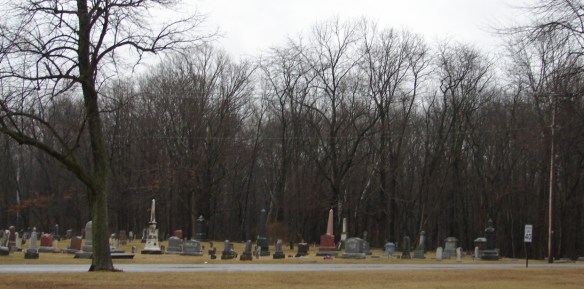
David Miller Baintertown

On the 1851 Elkhart County plat map, below, David’s land is shown as the David Miller estate, and on the 1874 map the land is owned by E. Clark. The previous location of the house to the right of the road is now where the railroad is located.  I believe this was the house where David lived, because it was the house given to Martha in her dower rights.  The original house was likely a quickly constructed rough hewn log cabin and after 40 years of use, may have not been in good shape. On the other hand, David’s son, John David’s log cabin built probably around the same time is still standing today underneath siding, sandwiched between additions.

David Miller 1851 plat map

Based on the 1851 plat map, David had three structures on his land.  Both were north of the river.  One was on the right hand side of what is now 15, looking north, and two to the left, near the intersection of what is now 42.

David Miller near house

Sitting at the intersection of 42 and 15, and looking left across the road to the west, you should be able to see David’s two houses sitting together – if they were still standing.

Moving slightly south, perhaps David’s house was near these white outbuildings today, seen above but barely visible between the trees, below.  When David owned the land, it may have been cleared.  Today, it is overgrown.

David Miller near house 2

David’s house that was sitting east of the road would have been torn down when the railroad went through, if not before.  It would have sat in the clearing below, and this was probably the highest elevation of his land.  David would have built his home where it was least likely to flood.

David Miller railroad tracks

Moving on south on 15, we can see the Elkhart River on both sides of the road.  This first picture is looking west.  David owned the land on both sides of the River here.

David Miller from 15 west

Looking east, you can see the railroad bridge today.  I wonder if the island was created after the railroad bridge was built with sediment accruing near the bridge base.

David Miller from 15 east

This was likely the shallowest location to ford the river, which was why the original trail was here, with the road curving on either side of the river.  This original path was followed by the road in the same location, followed by the railroad paralleling the road for miles.

The next map we find is an 1874 plat map, which is after Edward Clark bought David’s land.

The colored legend on the 1874 map is:

  • Yellow – David’s home place
  • Orange – David’s other lands
  • Green – David’s land sold to family members
  • Green dash – John David, David’s son’s lands
  • Blue – other fractional sections belonging to David

Note that on the 1874 map, the cemetery is noted. It also looks like CR 29 was slightly altered, perhaps when the railroad was laid.

David Miller 1874 plat map

The map below shows Jackson Township which joins with Elkhart Township, just beneath David’s land.  David also patented the land to the left of John David Miller and David B. Miller, labeled C. Broombaugh.  Conrad Brumbaugh was married to David’s daughter, Catherine.  The land beneath David B. Miller’s land labeled J. M. Whitehead is the land originally owned by Adam Whitehead and his wife Susanna Miller.  Tensions must have run high in these homes after David’s death and during the lawsuit – given that four of David’s children were neighbors, and Samuel lived just up the road.

Margaret Lentz 1874 Jackson Twp map

None of David’s heirs bought the homeplace, probably because all of his older children had farms of their own.  Several of the older children probably never lived there, and some only having lived on the homeplace a short time until they married.  The younger children had no funds with which to purchase the land. The younger children probably also inherited their mother’s portion of the estate, which was 1/3rd of the value of the estate, after her death when they came of age.

The photo below is the Elkhart River as it feeds into David’s land downstream slightly, taken from the park, looking west.

David Miller river from park

The section borders appear to not have been cleared, so they are visible today. This is the northern border of David’s land.

David Miller property line

The following photo is on the road running along the northern border of David’s land (CR 45 ) and is taken from near where the house was located looking East.

David Miller road

This would have been the high farmable lands when David cleared the lands, but today, the owners use this as yard. The only high portions of David’s land was land adjacent the house and then where the cemetery is located, both areas of which are surrounded by significant lowlands which would absorb the floodwaters and hopefully prevent the high areas from flooding.

David Miller field

David Miller higher lands.

David Miller highlands

An example of David’s swamp lands is shown below. In the summer this is probably an impenetrable mess of briars, snakes and mosquitoes.

David Miller swamp

Old trees demarcating the east boundary of David’s land on CR 45. I wonder if these trees were alive when he was.  In most places, it’s illegal to cut a boundary marker tree.

David Miller boundary trees

This list of items submitted as expenses to David’s estate shows the types of farm activities that took place annually on David’s land and how much David’s estate paid to have the activities performed beginning in 1850, which suggests that’s when his health was deteriorating:

Date Activity Amount Paid
Sept 10 Hauling wood .75
March 1850 ½ days haulting .75
March 20 Hauling wood .50
March 24 Threshing 1 day 2 hands and team 2.00
July 20 1 hand threshing 4 days 2.00
July 22 1 hand cleaning wheat 2 days 1.00
July 11 Paid for threshing 100 bushels wheat 5.00
July 30 Hauling wood .50
Aug 28 Making fence 1.25
Aug 30 Hauling rails 1 day 1.50
Aug 31 Hauling rails 1 day 1.50
Aug 31 1/3 note given for threshing 3.62
Aug 30 1/3 expenses of threshing 2.00
Dec. 2 Hauling wood .75
Dec 11 Hauling wood .75
Dec 12 Hauling wood .75
Dec 17 1 day butchering .50
Dec 30 Hauling rails with 2 teams 3.00
Dec 31 Hauling rails with 2 teams 3.00
Jan 1 1851 Hauling wood half day 2 teams 1.50
Jan 2 1851 Hauling wood .75
Jan 10 Hauling wood .75
Jan 18 2 hands building fence 1 day 1.00
Jan 20 Hauling wood .75
Jan 27 Resetting 84 ails from 1850 rails at 2 ? per hundred 4.62
Sept 4 150 fire? Iron from Hawks 7.50
Jan 3 1852 129.50 bushel wheat 3.90
Jan 3 Expenses of paying hands, horses, etc 7.00
Feb. 15 Hauling saw logs to Myland? 1.00
May 28 Hauling Mamon 2.00
May 29 Ditto
Oct 11 106 pounds beef 3.18
Oct 11 1 barrell salt 2.25
Nov 8 Hauling firewood 1.25
Nov 9 Hauling 3 saw logs 1.00
Dec 22 Hauling firewood 1.00
Jan 21, 1866 Hauling firewood 1.25
Aug 2 Cutting and fretting rep 3 acres whet 3.00
Aug 2 Half bushel flax seed .50
Aug 12 1 hand threshing with machine 6 days 3.00
Aug 16 1 hand cleaning wheat 4 days 2.00
Aug 20 Hauling rails and building 120 rods fence 25.50
Jan 14, 1867 Chopping and hauling wood 1.00
Jan 18 Half day butchering .50
Jan 20 Half day hauling wood .75
March 10 Hauling wood 1.5 days 2.25
March 1, 1868 Half day threshing by David .75
March 1 1.5 days threshing by Jacob .56
April 6 Hauling Mamon? With 2 teams 3.00
July 10 Hauling wood and hay 1.00
Aug 26 Threshing 1 day team and 2 hands 2.0
Sept 22 Haulting wood .25
Sept 28 Hauling wood .25
Sept 30 Hauling 8 load wood 1.25
Jan 13 1853 Hauling 7 loads wood 1.25
Jan 30, Hauling 2 loads wood .25
March 4 Threshing oalts 2.00
March 10 Threshing wheat 2.00
March 20 Hauling wood 2.00
April 13 Peeling rails 2 days by Jacob .75

It looks to me like hauling wood was the task that never ended.

David’s Children

David had children by at least two wives and probably three. I only wish David had a family Bible that had survived, because that Bible would likely tell us the story. Maybe it was in that chest, or maybe one of the children or his wife had already taken the Bible.  Maybe it still survives someplace today.

David Miller’s Children with an Unknown Wife

Esther Miller was deceased at the time that her father David’s estate was distributed.

We don’t know Esther’s birthdate, but one researcher shows her marriage to Abraham Lear (also spelled Leer) on December 30, 1824 and names a source as a DAR record. Odd for a Brethren family to have a DAR record.

We do know that Esther was married before 1827 based on her children’s ages. Unfortunately, these dates do little to narrow the range of her birth from “before 1806” to “after 1806” which makes a difference in terms of the identity of her mother.

In the 1850 census, Esther’s husband Abraham’s wife is listed as “C.” Three of Esther’s children are present in that census, Susan, age 18, John, age 14 and Sarah, age 7. Beyond that, there are two additional children in Abraham’s household, Isabel age 4 and Lucinda age 2. These two children are not mentioned in David Miller’s estate distribution, so I would take that to mean they are the children of Abraham and wife “C,” and not of Esther. Furthermore, I would also take this to indicate that Esther died between 1840/1843 when Sarah was born and 1846 when Isabel was born.

In the 1860 census, Isabel and Lucinda are both still living, so their omission from David Miller’s estate is not a matter of death. Additionally, in 1860, William Liveringhouse, age 12, is living with Abraham Lear. Known children of Esther Miller and Abraham Lear according to David Miller’s estate, marriage records and the census are:

  • Elizabeth Lear born December of 1827 and died in August 16, 1913 in Holmesville, Gage Co., Nebraska. Her descendants show her birth date as December 5, 1825. She married Samuel Irvin in Elkhart County on May 11, 1845 and had 8 children. None of the children listed in the one twelfth part are hers.
  • Susan Lear born April 12, 1832 in Elkhart County, Indiana and died on June 5, 1907 in North Liberty, St. Joseph County, Indiana. She married Israel Irvin on April 23, 1852 in Elkhart County and had 7 children.
  • John W. Lear born in 1838. He married Samantha E. Shafer on September 18, 1872 in Elkhart County, Indiana. They had two children.
  • Sarah Lear born in October 1840 (census indicated both 1840 and 1843 at different times) and died after 1910 in Marion County, Kansas. She married Israel Eliphet B. Riggle on October 2, 1862 in Elkhart County. They had 3 children.

David Miller’s estate distribution mentions the 4 children, above, but also mentions the following individuals who are also to receive out of Hester’s one 12th portion, indicating they are her heirs.:

  1. Hetty Lear
  2. Catherine Shively
  3. William Livinghouse
  4. Eliza Livinghouse

Another estate document references a deceased daughter of Esther Lear. Given that William Liveringhouse is living with Abraham Lear in 1860, I would interpret this to indicate that the deceased daughter had married a Liveringhouse. Mary Leer married John Liveringhouse on November 7, 1847 and apparently had two children William and Eliza, before she died, apparently not long before her father. Based on this information, I’m adding Mary Lear as a daughter.

  • Mary Lear was born probably about 1827 and died about 1850. She married John Liveringhouse on November 7, 1847 and had two children, William and Eliza.
  • Catherine is another daughter and a Caty Lear was living beside Abraham Lear in the 1850 census, with Catherine Stutzman, age 50. Abraham Lear’s mother was a Stutzman. Catherine Lear married Isaac Shively on December 26, 1852 in Elkhart County. Catherine Shively was listed in David Miller’s estate distribution.
  • Hetty Lear married Henry Stutsman on April 30, 1857.

Susan Miller was born June 5, 1802 and married Adam Whitehead on February 17,1825 in Montgomery County, Ohio. She died on July 17, 1876 and is buried in the Whitehead Cemetery in Elkhart County. Her birth is calculated from her age on the tombstone.

David Miller daughter Susan stone

Susan Miller and Adam Whitehead had the following children:

  • Mary Ann Whitehead (1828-1916) married Samuel R. Miller
  • Elizabeth Whitehead (1829-1853) married Jacob Riggle(s)
  • Esther Whitehead (1831-1910) married Daniel Shively
  • John M. Whitehead (1833-1912) married Sarah Smith
  • Susana Whitehead (1836-1916)
  • Catherine Whitehead (1838-1919) married John Riggle
  • Margaret Whitehead (1841-1851)

David Miller’s Children with Catherine Schaeffer

David B. Miller was born June 3, 1806 in Montgomery County, Ohio, died on September 26, 1881 in Elkhart County, Indiana and is buried in the Baintertown Cemetery. David’s stone is 4 sided, with wife Christina buried on one side.

David Miller son David stone

Their 2 children are memorialized on one side.

Miller, David B back 07

The third side is David and the fourth side is an inscription.

David Miller son David closeup

David married Christina Brumbaugh before coming to Elkhart County.

The book Genealogy of the Brumbaugh Family shows that Conrad born in 1811 married Catharine Miller and Christine born in 1814 married David Miller.

David Miller Brumbaugh book

David B. Miller had 11 children.

  • Catherine who died before 1893
  • Samuel R. Miller born 1820 who died in or before 1893
  • John B. Miller born 1839 died 1897
  • William Miller born November 2, 1831, died November 4, 1831, buried in the Baintertown Cemetery.
  • Eve Miller born July 1836, died April 2, 1838, buried in the Baintertown Cemetery.
  • Michael M. Miler born December 1842 in Elkhart County, died Sept 5, 1854 and is buried in Baintertown.
  • Jacob Miller was born in 1832 and married a Catherine.
  • Mary Miller was born in 1835
  • Elizabeth “Betsy” Miller was born in 1844
  • Daniel C. Miller was born in 1847 and died in 1931.
  • Susannah Miller was born in 1849.

Elizabeth Miller was born on April 6, 1808 in Montgomery County, Ohio, died on January 16, 1891 in Elkhart County, Indiana and is buried at Baintertown. She married Michael Haney in 1827 in Montgomery County, Ohio. They patented land very near David Miller in Elkhart County and had 5 children.

  • Matilda Haney (1834-1934) married John W. Baker
  • Elizabeth R. Haney (1836-1900) married George Washington Alfrod
  • Joseph Beane Haney (1838-1920) married Lucinda Whitehead
  • Mary “Molly” J. Haney (1843-1922) married Allen D. Gilkinson
  • John Michael Haney (1847-1849)

Mary Miller was born in 1809 in Montgomery County, Ohio and married Jeremiah Bright January 31, 1828 in Montgomery County, Ohio. According to the Elkhart County Pictorial and Biographical Memoirs, they had five children, but I found evidence of 7 including two children who died young:

  • David Miller Bright (1829-1905) married Elizabeth Rinehart
  • George W. Bright (1830-1852)
  • John Bright (1831-1928)
  • Mary Bright (1833-1911) married Jacob Alva Aurand
  • William Bright (1835-1917) married Catherine Wagner
  • Susannah Bright (1837-1838)
  • Daniel Bright (1838-1840)

Mary then married Christian Stouder on September 11, 1842 in Elkhart County and had four more children:

  • Lydia Stouder (1833-1893) married Samuel Neff in 1883
  • Christian Stouder (1845-1927) married Elizabeth Hohbein and her sister, Catherine Hohbein
  • Samuel H. Stouder (1850-1891) married Margaret Rummell
  • Unknown 4th child

David Miller daughter Mary Stouder stone

Mary died on October 22, 1863 and is buried at Union Center Cemetery, although her birth and death information was apparently never inscribed on her stone.

John David Miller was born April 6, 1812 in Montgomery County, Ohio and married Mary Baker there on January 24, 1832. They came to Elkhart County with or near the same time as David Miller. Mary and John David had 10 children:

  • John Miller – died as a child
  • Catherine Miller – died as a child
  • Samuel Miller – died as a child
  • Unknown child – died
  • Hester Ann Miller (1833-1917) married Jonas Shively
  • David B. Miller (1838-1922) married Susan Smith
  • Mary Ann Miller (1841-1915) married Michael Treesh
  • Aaron B. Miller (1843-1923) married Sarah Myers
  • Matilda A. Miller (1844-1935) married John Dubbs
  • Martha Jane Miller (1847-1935) married David Blough
  • George Washington Miller (1851-1917) married Lydia Miller

John David Miller married second to Margaret Elizabeth Lentz, widow of Valentine Whitehead. They had four children:

  • Evaline Louise Miller (1857-1939) married Hiram Ferverda
  • Ira J. Miller (1859-1948) married Rebecca Rodibaugh
  • Unknown child – probably died in 1861
  • Perry Miller (1862-1906) married Mary Jane Lauer

Photo of John David Miller with Margaret and 5 of his children.

John David Miller Photo

Catherine Miller was born March 17, 1813 and died September 24, 1876 and is buried at Baintertown. She married Conrad Brumbaugh in 1833 in Elkhart County and they had five children.

  • John W. Brumbaugh (1835-1910) married Sarah Peffley
  • Lydia Brumbaugh (1838-1856)
  • Eve Brumbaugh (1840-1891) married Daniel Riggle
  • Sarah A. Brumbaugh born about 1846
  • Joseph Brumbaugh (1856-1921) married Ellen Martha Hissong

Samuel B. Miller was born in 1816 and married Rose Ann Bowser Dec. 13, 1837. He died March 1, 1887 and is buried at Baintertown . They had seven children:

  • Emanuel Miller (born 1838), noted as “cripple” in 1870 census
  • Mary J. Miller born (1840-1920) married James Alford
  • William H. Miller (1841-1915) married Delilah J. Alford and Matilda J. Alford
  • Desaline Miller born (1845-1904) married G. Alonze Latta, died of strangulation
  • Albert J. Miller born (1846-1924) married Elizabeth
  • Charles C. Miller born (1847-1910) married Sarah
  • Cephus Miller born 1850, died after 1860
  • James Miller born 1862

Lydia Miller was born about 1818 in Montgomery County, Ohio and married John (Jonathan) Collier, also spelled Colyar, on September 18, 1834 in Elkhart County. She died about 1876. They had seven children:

  • David Colyar born in 1837, married Susanna
  • Elizabeth Colyar born in 1838, married a Whitman
  • Susan Louise Colyar (1839-1917) married George Jacob Hardtarfer
  • Mary Colyar born in 1842
  • John Colyar (1845-1932) married Sarah Josephine Belden
  • Catherine Colyar born in 1848
  • Louisa Emaline Adaline Colyar born in 1855

David Miller had no children with his next wife, Elizabeth, who died in 1838, but he had three additional children with his last wife, Martha Dickerson Drake.

Children with Martha Dickerson Drake.

Michael Miller was born December 25, 1843, a Christmas baby, in Elkhart County. He died on October 20, 1908 of “la grippe,” a colloquial term for flu or an intestinal disorder, and is buried at Baintertown.
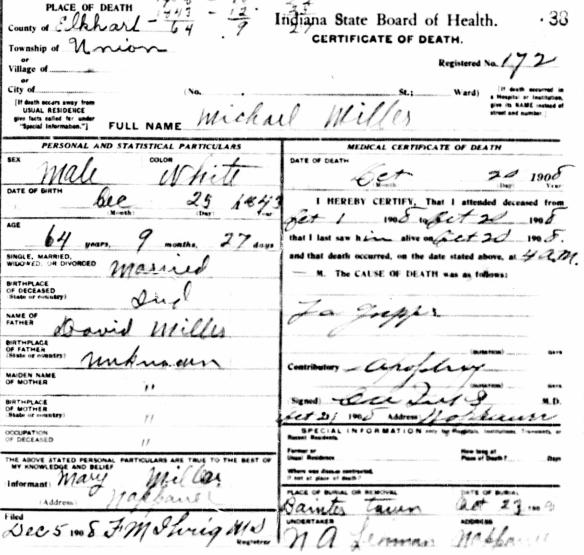
David Miller son Michael death cert

Michael married Mary Jane Sparklin about 1866. Mary Jane’s surname is taken from several of her children’s death certificates. They had seven children:

  • Mary C. Miller (1868-1945) married Marion Franklin Mock and George Hefner
  • Frank N. Miller born in (1873-1920) married Sarah Catherine Leedy
  • C. Miller born in 1873, died after 1880
  • Robert Miller (1877-1948) married Carrie Heeter
  • Martha Miller (1884-1948) married John Rapp, then McClellan Corner,
  • David Charles Miller born in (1887-1912) married Hilda Gertrude Huber
  • Susanna Miller born in 1891 married Irvin Hall

Steven Miller was born August 26, 1840 in Elkhart County. On July 4, 1861 he married Mary Magdaline Dausman. From the looks of his picture below with no indication of a beard, he clearly wasn’t old order Brethren.  Several more liberal Brethren churches were formed after “schisms” within the Brethren church.

David Miller son Stephen

From the History of Kosciusko County, published in 1887, we find the following:

David Miller Stephen 1

David Miller Stephen 2

David Miller Stephen 3

David Miller Stephen 4

Stephen died on October 24, 1926 in Syracuse, Kosciusko County, Indiana and is buried in the Syracuse Cemetery in Kosciusko County.

David Miller son Stephen stone

Stephen and Mary had eight children:

  • Ella Miller (1862-1926) married Andrew William Strieby
  • Michael Ferman Miller (1864-1938) married Olive Kirkendall
  • Samuel B. Miller (1866-1914) married Anna
  • Marion Sylvester Miller (1868-1933) married Martha Brower
  • Charles Miller was born in 1870
  • Emma Miller (1875-1947) married Frank Bushong
  • Earl Miller (1868-1933)
  • Hattie Viola Miller (1886-1972) married Ed Fisher

Matilda Miller was born on October 5, 1845 and she died on October 7, 1861 and is buried at the Baintertown Cemetery, with her parents.

Summary

For a simple Brethren man, David Miller was mighty complex. He died slightly over 100 years before I was born. Ironically, he had been entirely forgotten by his descendants in that intervening century – just 4 generations.  How quickly people forget.

I was the 5th generation to be born. Only his granddaughter, Evaline, my mother’s grandmother, was remembered by my mother, who was the only person to convey any family history to me. Mother never knew any of the Miller cousins, and there were hundreds upon hundreds, many of whom lived just a few miles up the road from where she was raised.

Now I realize that in part, not knowing her Miller cousins simply had to do with time and distance, but the other part was that untold story of division within the family. This family was twice divided in as many generations.

By the time my great-grandmother, Evaline Miller Ferverda was born to John David Miller, son of David Miller in 1857, the David Miller estate lawsuit was well underway. David’s children filed suit after his death, in 1855, pitting all of his children and widow against one daughter, Susan, and her husband, Adam Whitehead.

By the time Evaline died, in 1939, there had been two estate battles with divisive lawsuits.  Just before her father, John David Millers death, his son would petition the court for a guardianship and John David’s death in 1902 signaled the beginning of a war that made the Hatfield-McCoy feud look trivial.  It’s no wonder mother didn’t know any of her Miller cousins.

It also didn’t help in terms of knowing relatives that the Brethren Millers didn’t drive automobiles at that time.  They utilized horses and buggies for the most part.  Furthermore, Mother’s father, Evaline’s son, had broken with the Brethren Church and married a Lutheran woman.  They drove cars and were “modern,” including the fact that his wife worked and drove her own car no less.  Clearly, they didn’t fit in an extended Brethren family.  From their perspective, they were progressive.  From the Brethren perspective, they were outcasts and black sheep.

Making matters even worse, David Miller turned black sheep himself and married Martha Drake, a Baptist. Not unexpectedly, David’s youngest children were raised Baptist, not Brethren so there was a “not Brethren” and “progressive Brethren” (yes that’s an oxymoron) part of the family that the traditional Brethren part of the family probably wished to disavow.  Wow, things get complex quickly!

The Brethren Miller families seemed to cluster in different churches, probably in no small part to avoid each other.

The Miller family, twice divided by estates and bifurcated by religious differences would never recover – and a generation or two later didn’t even know they were related.

David certainly tried to take care of his family. He moved them to the frontier and patented land that he subsequently sold to his 3 sons. The daughters? Well, I guess they were expected to marry well.

David’s children were educated enough to read and write, including his daughters who signed receipts for their portion of their inheritance.

David married at least 3 times, and probably 4. His two eldest children were likely from his first marriage to an unknown spouse before his marriage in 1805 to Catherina Schaeffer, widow of Peter Gephart. David and Catherina had 7 more children before she died about 1826.

He married Elizabeth probably between 1830 and 1831, after the census and before leaving for the Elkhart County frontier.

Elizabeth was in her early-mid 50s when she married David who was 4 years younger, so there were no children from that marriage.

All of David’s children moved with him to the frontier, at least all of the children we know about. His daughter Susan was born in 1802 and Hester may have been born about 1800. They were both married in Ohio, but they came along on the journey to Elkhart County.

In addition, Elizabeth may have had her own children that moved with the family to Elkhart County, so it may have been a very blended family by that time.

David’s last marriage in 1839 to Martha Drake, a Baptist woman, was something I had never once considered as a possibility. Brethren simply did not marry outside the faith, and if they did, the spouse quickly converted. Martha didn’t. I wonder if this was a constant source of friction within the marriage, or if they had an understanding before the marriage. It’s also possible that he withdrew from the church, depending on the level of pushback he received. I would love to know, but none of that information filtered down, to the best of my knowledge. Were it not for the “vanity books” of the early 1900s published in many localities, we wouldn’t even know that juicy tidbit about the “mixed” marriage. You can tell by the way that verbiage is written, beginning with, “both of his parents were Christians,” that the topic had been brought up before – and the answer people were given.

I wish we knew something more of David, the man himself. We have nothing written in his hand, except receipts – and thank Heavens for those. The only personal story we have is of David and the Indian Chief.

David’s life was amazing. He grew up in the shadow of the Revolutionary War and Indian massacres. He helped his father tame the frontier in Bedford County, then floated down the Ohio where he did it a second time, in previously unfarmed and untamed wilderness in Clermont County, Ohio. He saw the land he cleared be lost due to the military bounty land, and then recovered, and he helped his father once again in Montgomery County to build a farm and a mill out of frontier land.

I find it utterly amazing that as a man, aged 50, half a century, at a time when men that age were considered “elderly,” he set out to tame the frontier once again. He probably felt he had a great deal of experience and after surviving 50 years on 3 frontiers, probably nothing much frightened him. The word that comes to mind is brave, unquestionably brave.

David lived for another 20 years on his Elkhart County land, on the Elkhart River, where the Indians told him would be a good location, beside their village. By the time David died, their village, and the Indians were gone, and Elkhart county was no longer the frontier.

David is buried on his land, in what was surely called the Miller Cemetery for years, probably up until Baintertown came into existence, after 1860. Not long afterwards, the name “Miller Cemetery” was forgotten, as was David. Relegated to nothing more than an almost illegible name on a tombstone along the Elkhart River in the back of a cemetery, buried 165 years ago on a cold winter day that was probably much like the day I visited 160 years later and found David’s land, his history and details of his life, once again.

What a story was waiting to be told!

A man who fathered at least 12 children,  11 of whom grew to adulthood.  A man who was married either 3 or 4 times, buried either 2 or 3 wives, lived on 4 frontiers and tamed 3.  David had at least 90 grandchildren, at least 22 of whom were born after his death.  He buried at least 12 grandchildren in the cemetery on his own land, probably digging their graves himself.  He rests beside two of his wives, among his children and grandchildren today.

David Miller Baintertown today

Thankfully, David’s story is no longer lost to his descendants.  He lived a remarkable life.

David Miller Bainterown today 2

______________________________________________________________

Disclosure

I receive a small contribution when you click on some of the links to vendors in my articles. This does NOT increase the price you pay but helps me to keep the lights on and this informational blog free for everyone. Please click on the links in the articles or to the vendors below if you are purchasing products or DNA testing.

Thank you so much.

DNA Purchases and Free Transfers

Genealogy Services

Genealogy Research

Family Tree DNA Partners with Geni.com

geni logo  family tree dna logo

I received the following press release earlier today from Family Tree DNA.

Family Tree DNA is pleased to announce a partnership with Geni, a division of MyHeritage and home of the collaborative World Family Tree. This optional new feature offers seamless integration of both platforms, greatly enhancing the accuracy of Geni’s World Family Tree and providing new insights for millions of users interested in discovering more about their family histories.

Family Tree DNA has the world’s most comprehensive DNA testing and databases. Along with the company’s advanced suite of DNA tests, the new integration with Geni provides users of both platforms the ability to help confirm genetic relationships and discover previously unknown relatives. The integration of data is authenticated and secure, allowing simple transfer of DNA results from Family Tree DNA to Geni, should users opt to do so.

This added cross-functional feature is available to users who have tested their DNA with Family Tree DNA and have a profile with Geni, but can also be utilized by anyone who registers with both platforms. To that end, the optional and error-free integration of DNA conveniently validates connections and relationships within one’s family tree. Marker data of Y-DNA and mtDNA tests is transferred—there is no manual entry of DNA information, thereby preventing human error.

Geni and its team of curators have merged publicly available Y-DNA and mitochondrial DNA data into the World Family Tree, making it the most DNA-rich collaborative family tree to date. Access to all DNA features on Geni is free and user privacy is strictly maintained. No DNA raw data or marker information is displayed, and additional settings allow users to control all aspects of the way their DNA information is handled.

Users interested in DNA testing—or those who prefer more comprehensive tests— can purchase DNA tests on Geni’s DNA Testing page powered by Family Tree DNA. For users with DNA results from previous testing, Family Tree DNA’s one-click process makes it fast and easy to transfer DNA results into their Geni profile. With the integration of both platforms, Geni’s World Family Tree enables users to establish and visualize a more precise family tree along with new connections and DNA matches.

“This partnership and integration greatly increases the value of DNA for genealogy,” said Family Tree DNA founder and CEO, Bennett Greenspan. “It’s great to work with Geni and its parent company MyHeritage. DNA and family trees complement each other and come together perfectly on the World Family Tree.”

Mike Stangel, General Manager of Geni, said: “Adding DNA to the World Family Tree increases its accuracy and strengthens its position as the de facto resource that shows how everyone is related to everyone else. We are very happy to take our partnership with Family Tree DNA to the next level.”

Information on linking Geni accounts to Family Tree DNA and uploading DNA results to Geni is available here: http://www.geni.com/dna-tests/faq.

Taking a look at the Geni FAQ page, we find the following information:

What are the new DNA Integration features (released July 2016)?

We’re excited to announce that you can now import your DNA test results from Family Tree DNA to Geni, as well as upload your raw autosomal data for further processing. Geni will use your Y-DNA, Mitochondrial DNA and Autosomal DNA test results to confirm existing relationships in your family tree as well as discover new relatives. Specifically, Geni will:

  • Propagate Y-DNA results along the paternal lines to infer which other relatives should have matching DNA. If matching DNA is found, the line between the test-takers can be considered confirmed.
  • Propagate Mitochondrial DNA results along the maternal lines to infer which other relatives should have matching DNA. If matching DNA is found, the line between the test-takers can be considered confirmed.
  • Use Autosomal DNA matching to confirm close relationships
  • Guide you on what DNA tests to take to confirm relationships in your family tree
  • Show DNA conflicts that indicate where the tree may have mistakes, and provide guidance on other living people who can be tested to resolve the conflict
  • List other Geni users whose DNA matches your own, which enables you to compare trees to determine how you are related
  • Organize profiles into haplogroup projects

These features sound wonderful, especially relative to finding candidates for Y and mtDNA testing, but there is one piece of missing information in the FAQ.

Does Geni Sell Our DNA?

While Geni states that they don’t display your DNA results, only “matches and haplogroups,” and that your DNA information is private and secure, what they don’t say is if they will be selling or sharing your autosomal DNA results to third parties.

For additional questions, you’re directed from their FAQ page to their help page, but to submit a request form from the help page, one must login to Geni. Geni might want to rethink this policy, especially relative to DNA.  Furthermore, the link at the bottom of the DNA Tests page does the same thing.

Geni DNA tests

You can’t examine the fine print if you can’t find the fine print.

I do have a Geni account, so I signed on to view the DNA Terms of Service.

Here’s a quote from part of the Terms of Service document.

By submitting DNA Results to the Website, you grant Geni a royalty-free, world-wide license to use your DNA Results, and any DNA Results you submit for any person from whom you obtained legal authorization as described in this Agreement, and to use, host, sublicense and distribute the resulting analysis to the extent and in the form or context we deem appropriate on or through any media or medium and with any technology or devices now known or hereafter developed or discovered. You hereby release the Company from any and all claims, liens, demands, actions or suits in connection with the DNA Results, including, without limitation, errors, omissions, claims for defamation, invasion of privacy, right of publicity, emotional distress or economic loss. This Agreement continues even if you stop using the Website or DNA Services.

And this:

By transferring any DNA Results to the Website, you hereby grant, and you represent and warrant that you have the right to grant, to Geni the right to receive, use, modify, publicly display, reproduce, distribute, and create derivative works of such DNA Results solely on and through the DNA Services for commercial and non-commercial purposes and the Company’s (and its successors’ and affiliates’) business, including without limitation for promoting and redistributing part or all of the DNA Services (and derivative works thereof) in any media formats and through any media channels.

I was concerned about the above verbiage, but then, by clicking on the Privacy Policy link on the DNA Terms of Use page, we find the following:

Geni privacy policy

This very specifically says they will NOT share our DNA without informed consent and not without an opt-in.  Let’s see what opt-in means at Geni.

Opt-In

For me, the answer to whether I will participate, or not, is in large part based on whether or not my DNA will be sold or “shared” with third parties without my specific permission.  I have several Y and mtDNA lines that I need to find test candidates for, or even better yet, would like to know if that line has already tested.  This feature isn’t offered by any other vendor today, and might be very, very beneficial if enough people participate! So, much like Pavlov’s dogs, I’m salivating.

It appears, based on Geni’s Privacy Policy, that Geni will not share our information with third parties if we don’t specifically authorize that sharing when we upload our results.  That’s good news and exactly what I wanted to hear.  But what does that really mean?

Other vendors depend on less than straightforward authorizations and click-throughs that say you’ve read and understand a policy and in that document are buried statements that your anonymized DNA will be shared and there is nothing you can do about it.

The Geni blog provides a lot more information about how the new interface will work, including an interesting projects feature.

Furthermore, based on this screen shot from their blog, it appears that indeed, their research opt-in truly is an opt-in and unless you do opt-in, you’re opted out.

Geni opt in

As far as I’m concerned, this is exactly how opting in should work.  Hurray for Geni!!!

At this point, I don’t see any reason to NOT participate – and the lure of finding individuals that have already Y and mtDNA tested on a specific line is very exciting.

I hear it now, brick walls are gonna fall!!!

______________________________________________________________

Disclosure

I receive a small contribution when you click on some of the links to vendors in my articles. This does NOT increase the price you pay but helps me to keep the lights on and this informational blog free for everyone. Please click on the links in the articles or to the vendors below if you are purchasing products or DNA testing.

Thank you so much.

DNA Purchases and Free Transfers

Genealogy Services

Genealogy Research

Concepts – Genetic Distance

At Family Tree DNA, your Y DNA and full sequence mitochondrial matches display a column titled Genetic Distance.  One of the most common questions I receive is how to interpret genetic distance.

GD example 2

Many people mistakenly assume that genetic distance is the number of generations to a common ancestor, but that is NOT AT ALL what genetic distance means.

Genetic distance is how many mutations difference the participant (you) has with that particular match. In other words, how many mismatches in your DNA compared with that person’s DNA.

White the concept is the same, Y DNA and mitochondrial DNA Genetic Distance function a little differently, so let’s look at them separately.

Y DNA Genetic Distance

I wrote about genetic distance as part of a larger article titled “Concepts – Y DNA Matching and Connecting with your Paternal Ancestor,” but I’m going to excerpt the genetic distance portion of that article here.

You’ll notice on the Y DNA matches page that the first column says “Genetic Distance.”

STR genetic distance

Looking at the example above, if this is your personal page, then you mismatch with Howard once, and Sam twice, etc.

Counting Genetic Distance

Genetic distance for Y DNA can be counted in different ways, and Family Tree DNA utilizes a combination of two scientific methods to provide the most accurate results. Let’s look at an example.

In the methodology known as the Step-Wise Mutation Model, each difference is counted as 1 step, because the mutation that caused the difference happened in one mutation event.

STR genetic distance calc

So, if marker 393 has mutated from 12 to 13, the difference is 1, so there is one difference and if that is the only mutation between these two men, the total genetic distance would be 1.

However, if marker 390 mutated from 24 to 26, the difference is 2, because those mutations most likely occurred in two different steps – in other words marker 390 had a mutation two different times, perhaps once in each man’s line.  Therefore, the total genetic distance for these two men, combining both markers and with all of their other markers matching, would be 3.

Easy – right?  You know this is too easy!

Some markers don’t play nice and tend to mutate more than one step at a time, sometimes creating additional marker locations as well.  They’re kind of like a copy machine on steroids. These are known as multi-copy (or palindromic) markers and have more than one value listed for each marker.  In fact, marker 464 typically has 4 different values shown, but can have several more.

The multiple mutations shown for those types of multi-copy markers tend to occur in one step, so they are counted as one event for that marker as a whole, no matter how much math difference is found between the values. This calculation method is called the Infinite Alleles Mutation Model.

str genetic distance calc 2 v2

Because marker 464 is calculated using the infinite alleles model, even though there are two differences, the calculation only notes that there IS a difference, and counts that difference as having occurred in one step, counting only as 1 in genetic distance.

However, if one man also has one or more extra copies of the marker, shown below as 464e and 464f, that is counted as one additional genetic distance step, regardless of the number of additional copies of the marker, and regardless of the values of those copies.

STR genetic distance calc 3 v2

With markers 464e and 464f, which person 2 carries and person 1 does not, the difference is 17 and the generational difference is 1, for each marker, but since the copy event likely happened at one time, it’s considered a mutational difference or genetic distance of only 1, not 34 or 2. Therefore, in our example, the total genetic distance for these men is now 5, not 8 or 38.

In our last example, a deletion has occurred, which sometimes happens at marker location 425. When a deletion occurs, all of the DNA at that location is permanently deleted, or omitted, between father and son, and the value is 0.  Once gone, that DNA has no avenue to ever return, so forever more, the descendants of that man show a value of zero at marker 425.

STR genetic distance calc 4 v2

In this deletion example, even though the mathematical difference is 12, the event happened at once, so the genetic distance for a deletion is counted as 1. The total genetic distance for these two men now is 6.

In essence, the Total Genetic Distance is a mathematical calculation of how many times mutations happened between the lines of these two men since their common ancestor, whether that common ancestor is known or not.

Family Tree DNA provides a the TIP calculator which helps estimate the time to a common ancestor using a proprietary algorithm that includes individuals marker mutation rates.  You can read more about this in the Y DNA Concepts article or in the TIP article.

Please note that on July 26, 2016 Family Tree DNA introduced changes in how the genetic distance is calculated for some markers to be less restrictive.  You can read about the changes here.

Mitochondrial DNA

GD mt example

Mitochondrial DNA Genetic Distance is a bit different. In order to be shown as a match, you must be an exact match in the HVR1 and HVR2 regions, so there is no genetic distance shown, because there are no mutations allowed.

At the full sequence level, you are allowed 4 or fewer mismatches to be considered a match.

Genetic distance means how many mismatches you have to another person when comparing your 16,569 mitochondrial locations to theirs. The full sequence test tests all of those locations.

Of course, in general, fewer mismatches mean you are more closely related than to someone with more mismatches. I said generally, because I have seen a situation where a mutation occurred between mother and child, meaning that individual had a genetic distance of 1 when compared to their mother, along with anyone who matched their mother exactly. Clearly, they are far more closely related to their mother than to their mother’s matches.

One of the most common questions I receive about genetic distance is how to convert genetic distance to time – meaning how long ago am I related to someone who has a genetic distance of 1 or 2, for example.

The answer is that it depends and it varies widely, very widely.  I know, I hate the “it depends” answer too.

Turning to the Family Tree DNA Learning Center, we find the following information:

    • Matching on HVR1 means that you have a 50% chance of sharing a common maternal ancestor within the last fifty-two generations. That is about 1,300 years.
    • Matching on HVR1 and HVR2 means that you have a 50% chance of sharing a common maternal ancestor within the last twenty-eight generations. That is about 700 years.
    • Matching exactly on the Mitochondrial DNA Full Sequence test brings your matches into more recent times. It means that you have a 50% chance of sharing a common maternal ancestor within the last 5 generations. That is about 125 years.

I think the full sequence estimate is overly generous. I seldom find identifiable matches, and I do have my genealogy back more than 5 generations on my mitochondrial line and so do many of my clients.

My 4 times great-grandmother, or 6 generations distant from me (counting my mother as generation 1), Elisabetha Mehlheimer, was found living in Goppmansbuhl, Germany when she gave birth to her daughter in 1823. This puts Elisabetha’s birth around 1800, or possibly earlier, very probably in the same village in Germany.  German church records compulsively identify people who aren’t residents, and even residents who originally came from another location.

Part of my mitochondrial full sequence matches are shown below.

GD my results

Looking at my 13 exact matches, it becomes obvious very quickly that my matches aren’t from Germany, they are primarily from Scandinavia. Not at all what I expected. I created this chart to view the match locations. I have omitted anyone who did not provide either location or oldest ancestor information. Fortunately, Scandinavians are very good about participating fully in DNA testing and by and large, they want to get the most out of their results. The way to do that, of course is to include as much information as possible so that we can all benefit by sharing and collaboration.

Match Genetic Distance Location Birth Year of Most Distant Ancestor
TS 0 Norway 1758
Svein 0 Norway 1725
Bo-Lennart 0 Norway 1725
Per 0 Norway 1718
Hakan 0 Sweden 1716
Ragnhild 0 Sweden 1857
Constance 0 Russia
Teresa 0 Poland 1750
Valerie 0 Norway 1763
Vladimir 0 Russia
Rose 0 Sweden 1845
IRL 0 Norway 1702
Lynn 0 Norway 1696
Anastasia 1 Russia above Georgia 1923
AJ 1 Sweden 1771
Marianne 1 Sweden 1661
Inga 1 Sweden 1691
Inger 1 Sweden
Marianne 1 Sweden 1661
Maria 1 Poland C 1880
Marie M. 1 Bavaria, Germany 1836
Tomas 2 Probably Czech Republic 1880
DL 2 Sweden 1827

A quick look at my matches map shows the distribution of my matches more visually, although not everyone includes their matrilineal ancestor’s geographic information, so they don’t have pins on the map. In my case, I’m lucky because several people have included geographical information which makes the maps very useful. The white pin is where Elisabetha Mehlheimer lived.  Red pins are exact matches, orange are one mutation difference and yellow are two.

GD matches map

I am very clearly not related to these individuals within 6 generations, and probably not for several more generations back in time. The one match from Germany is one mutation different, which certainly could mean that we share a common ancestor and her line had a mutation while mine line didn’t. Wurttemburg and Bavaria do share borders and are neighboring districts in southern Germany as illustrated by this 1855 map of Bavaria and Wurtemberg.

GD Bavaria Wurttemberg

Unfortunately, there is no “rule of thumb” for mitochondrial DNA genetic distance relative to years and generations distant. In other words, there is no TIP calculator for mtDNA. I did some research some years ago attempting to quantify MRCA (most recent common ancestor) time and answer this very question, but the only research papers I was able to find referred to studies on penguins.

How Far is Far?

In some cases, I know that a common ancestor actually reached back hundreds to thousands of years. Of course, relationships in female lines are more difficult to “see” since the surname changes with every generation, historically. In Y DNA, you can look at the surname of the participant and determine immediately if there is a likelihood that you share a common paternal ancestor if the surname matches. Let’s look at some mitochondrial examples.

I recently had a client that matched her haplogroup assignment exactly, with no additional unusual mutations found as compared to the expected mitochondrial mutation profile. She had several exact matches. Her haplogroup? H7a2, which was formed about 2500 years ago, with a standard deviation of 2609, according to the supplemental date from the paper, “A “Copernican” Reassessment of the Human Mitochondrial DNA Tree from its Root” by Doron Behar, et al, published in The American Journal of Human Genetics, Volume 90, April 6, 2012. This means that H7a2 could have been formed anytime from recently to about 5000 years ago, with 2500 being the most likely and best fit.

Standard deviation, in this case, means the dates could be off that much in either direction, but the further from 2500, the less likely it is to be accurate.

Conversely, another recent client was haplogroup U2b formed roughly 30,000 years ago, with a standard deviation of 5,800 years. The client had 16 differences, which averages to about one mutation every 2,000 years. Is that what actually happened or did those mutations happen in fits and starts? We don’t know.

A last example is my own DNA with two relevant differences from my haplogroup profile, J1c2f, which was formed about 2,000 years ago with a standard deviation of 3,100 years. Technically, this means my haplogroup might not be formed yet (joke) since 2,000 years ago minus 3,100 years hasn’t happened yet. While that obviously can’t be true, the standard deviation is relevant in the other direction. In essence, what this says is that my haplogroup could be fairly young, probably is about 2000 years old, and could be as old as 5,100 years. Given the clustering, it’s likely that J1c2f was formed in Scandinavia and a few descendants, at some time, migrated into continental Europe and Russia.

GD extra mutations

By the way, the 315 “extra mutations” insertions are too unstable to be considered relevant. They are not included in the genetic distance count in your results.

At the other end of the spectrum, I know of one person who has a mutation between themselves and an aunt and a different mutation when compared with a sister.  Furthermore, those mutations occurred in the HVR1 and HVR2 regions, meaning that these women don’t show as matches to each other until you get to the coding region where the full range of full sequence matches are shown and 4 mutations are allowed.  This caused a bit of panic initially, but was perfectly legitimate and understandable once the actual results were compared. Is this rare? Absolutely. Is it possible? Absolutely.

As you can see, there just isn’t any good measure for mitochondrial DNA mutation timing.  Mutations don’t happen on any time schedule, unfortunately.

I use genetic distance as a gauge for relative relatedness, no pun intended, and I keep in mind that I might actually be more closely related to someone with a slightly further genetic distance than an exact match.

While you can’t compare your actual results to matches online, you can contact your matches to compare actual results.  In my case, I developed a branching tree mutation chart that showed that a group of the people in Sweden with one mutation difference actually all shared an additional mutation that I, and my exact matches, don’t have.  In other words, this Swedish group forms a new branch of the tree and will likely, someday, be a new subhaplogroup of J1c2f.

Sometimes digging a little deeper reveals fascinating patterns that aren’t initially evident.

Summary

When working with genetic distance, look for patterns, not only in terms of geography, but in terms of matching mutations and grouping of individuals.  Sometimes the combination of mutation patterns and geography can reveal information that could not be obtained any other way – and may lead you to your common ancestor, with or without a name.

For example, I know that my common ancestor with these people probably lived someplace in Scandinavia about 2000 years ago, based upon both the clustering and the branching.  How my ancestor got to Germany is still a mystery, but one that might potentially be solved by looking at the history of the region where my known ancestor is found in 1800.

Happy hunting!

______________________________________________________________

Disclosure

I receive a small contribution when you click on some of the links to vendors in my articles. This does NOT increase the price you pay but helps me to keep the lights on and this informational blog free for everyone. Please click on the links in the articles or to the vendors below if you are purchasing products or DNA testing.

Thank you so much.

DNA Purchases and Free Transfers

Genealogy Services

Genealogy Research

Lighting Candles – Bill Howard, RIP

Dr. William E. Howard III

I received word today that one of my genetic genealogy “friends” has passed over. Dr. William E. Howard III was just known to us as Bill.

Most people didn’t know Bill was a PhD and had a distinguished career in astronomy. Genetic genealogy was his “second career,” after retirement, and he was responsible for devising the RCC methodology for determining the time to a most common recent ancestor for a group of men who have taken Y STR tests.

If you’re interested in his methodology, you can read more about it here or in the genealogy-DNA rootsweb archives and ISOGG@yahoogroups.com where he posted under the e-mails of wehoward@post.harvard.edu and wehowardiii@gmail.com and weh8@verizon.net.  Bill created a YouTube video that explains this methodology which is both interesting and educational.  What Bill’s methodology lacked, unfortunately, was an easy user interface.

CeCe Moore has also provided this link to Bill’s talk at the I4GG Conference in 2014, never before released except to paid subscribers, titled “Using Correlation Techniques on Y-Chromosome Haplotypes to Determine TMRCAs, Date STR Marker Strings, Surname Groups, Haplogroups and SNPs.”

This article really isn’t about Bill’s methodology, but how his thought processes and willingness to think about genetic genealogy in a different way and look at possibilities helped to revolutionize and actualize an infant field. We need an army of Bills, each contributing in their unique and individual ways.

Genetic genealogy attracts many great minds, often retired from distinguished careers with decades of invaluable experience. I think the fact that genetic genealogy is a new field, not yet defined and put into boxes of known quantities is part of what makes this field so attractive to these bright minds. There is still ample opportunity for truly meaningful and even revolutionary contributions.

Bill wasn’t afraid of scrutiny and he wasn’t afraid to fail. If you’re afraid to fail, in essence, you’ve already failed. And in the public social media world, scrutiny can be brutal.

Bill exemplified the role of a research genetic genealogist. He thought outside the box and then sought to prove or disprove his theories. He shared freely and depended on people submitting their data to be analyzed in order to refine his processes. He was willing to work with anyone at any level of experience. He was never condescending or treated anyone disrespectfully – his professional demeanor was impeccable. Far from being intimidating, Bill was very unassuming and tried to explain difficult concepts in ways that people could understand.  He encouraged everyone.

Bill knew that he was ill and used his last few months to “tie up” many of his loose ends, submitting several papers to JOGG for publication. I hope that these papers can be published posthumously in order to preserve his methodologies for posterity and for others to build upon, or discard, as appropriate. That’s the way science works and Bill wanted to contribute to that process.

You left your exchanges with Bill feeling good about genetic genealogy and not diminished in any way, even if you didn’t understand or agree with his theories or findings. I feel enriched and honored to have counted him among my colleagues. It’s people like Bill that have helped this field emerge from the unknown to a dinner conversation topic at the table of strangers next to yours in a restaurant.

Bill reached for the stars – in terms of his scientific approach and methodologies as well as his enabling and encouraging can-do attitude. To me, the great generosity with which Bill approached genetic genealogy and his fellow travelers in this field, regardless of their level of expertise, is Bill’s legacy.

I hope that Bill can serve as an inspiration. We need mentors, guides and good examples – and Bill was that above anything. We are all students, everyday. Learning is lifelong, cradle to grave.

We are all diminished when the flame is extinguished, too soon. I hope that Bill’s quiet example and gracious approach to genetic genealogy, and people, serves to light other candles.

Rest in Peace, Bill.

Update 6-27-2016: For anyone interested, I know Bill Howard was active in genealogy groups along the beltway around Washington DC, into Virginia. I received word today that his memorial service has been planned, per the following message from his family.

We wanted to let you know that the family has planned a Memorial Service for my father, Bill Howard, for July 23rd, 2016 at 2pm at Redeemer Lutheran Church.
The address for Redeemer is:
1545 Chain Bridge Road
McLean, VA 22101

______________________________________________________________

Disclosure

I receive a small contribution when you click on some of the links to vendors in my articles. This does NOT increase the price you pay but helps me to keep the lights on and this informational blog free for everyone. Please click on the links in the articles or to the vendors below if you are purchasing products or DNA testing.

Thank you so much.

DNA Purchases and Free Transfers

Genealogy Services

Genealogy Research

Jacob Lentz (1783-1870), The Brick Wall Falls, 52 Ancestors #122 Part 2

You remember Jacob from last week, you say? What is he doing back again?  What more could there possibly be to tell?  Hold tight, because a huge, huge brick wall fell this week.  Behind that wall, a gateway to the past with generations of family waiting to be discovered.  Come along…let’s crawl over the wall rubble and see what’s on the other side!

Remember my opening in Jacob’s original article where I said, “…if they (my deceased cousins, family and ancestors) are listening…well…I still have some questions that need answers that I think can only come from beyond.”

You’ve probably guessed what happened already. I don’t know exactly WHO in the beyond is responsible for this, but I very clearly know who in the here and now was inspired to deliver this gift.

One of my blog subscribers named Thomas (who I didn’t know personally until this week) is a retired specialist in German records, and, as it turns out, can read German script and knows what he is doing a whole lot better than I do. Thomas took the Jacob Lentz puzzle upon himself as a challenge – one that had stumped me and the other Lentz researchers for decades now.

I quite freely admit that I don’t read German, I can’t decipher the script, and I have limited, as in very limited, experience with German records. Thomas has every qualification that I don’t.

Let me say, Thomas has won first prize, and the Jacob Lentz family is clearly the benefactor.

The Brick Wall

One blog commenter said, “It’s a shame the tribute doesn’t mention a village nor Jacob’s parents’ names, it probably meant the info was already lost by the grand-children’s time. If Jacob even bothered to tell his own children…”

I thought the exact same thing myself, but thanks to Thomas, we’ve overcome that obstacle. However, it turns out that the obstacle was much larger than I had imagined, and there were multiple obstacles.

The Red Herring(s)

Remember the tribute that Jacob’s grandson penned said that Jacob Lentz had married Fredericka Moselman?

Here’s the quote:

“Jacob Lentz was born in Wuertemburg, Germany May 5, 1783 and he died in Dayton Ohio April 10, 1870 and is buried 13 miles northwest of Dayton. He married Frederica Mosselman who was born in Wuertemburg, Germany March 8, 1788. She died March 22, 1863.”

Well, guess what, Jacob’s grandson was wrong. Fredericka’s surname was NOT Moselman, or Mosselman, or Musselman or anything close.  Where he came up with that name, I have no idea, because it was entirely inaccurate.  This just goes to illustrate how inaccurate family stories, with the very best of intentions, can be, and how twisted information can become in just two generations.

That also means that for the past 20+ years, I’ve been searching for the wrong couple. It’s no wonder that I never found that marriage, because it didn’t exist.  That erroneous surname steered me far off course, and caused me to disregard the correct information.

I even went so far at one point as to compile a study of locations in Wurttemberg where the surname Lentz and Moselman were both common – and I came up with a big fat zero, except for large cities. There were just no records of any Lentz-Moselman marriages during the right timeframe.  So my assumption (there’s that word again) was that either the records had been lost or not yet transcribed.  After all, there was a lot of warfare in Germany.

There was another small issue too. Lentz wasn’t spelled Lentz in the German records, it was spelled Lenz, and Jacob was spelled both Jakob and Jacob.  Oh, and Fredericka was spelled Fridrica and she was baptized as Johanna Fridrica.  Jacob’s birth date was wrong too, but the year was accurate.  But hey, other than those 6 little problems, I had all the correct information to work with.  It’s amazing that anyone found them, but Thomas did.

So, the first thing, after I picked myself up off the floor and started breathing again, was to ask Thomas how he did it.

How Did He Do It?

The first clue to Thomas was that Jacob’s eldest son would never have been baptized Jacob Franklin Lentz in Germany. Franklin was not a German name and Thomas postulated that it might actually be Jacob Friedrich Lentz.

Jacob Friedrich Lentz typically went by Jacob F. during his lifetime.  His son’s name was Jacob Franklin, so perhaps it was assumed by someone that Jacob’s middle name was Franklin too.  Regardless, I’m very glad for Tom’s sharp eye and intuition fueled by years of experience, because he was right.

We did have a birth date for Jacob F., son of Jacob Sr., the immigrant. Of course, that too could be incorrect, but at least it was a guidepost by which to perhaps light the way.

Secondly, Thomas mentioned that Moselman was an extremely uncommon surname in that region, so he had some suspicion it might not be accurate.

So Thomas began by looking for Jacob Friedrich Lentz born November 28, 1806 in Wuerttemburg to a father named Jacob Lentz and a mother named Fredericka, with no surname. As it turns out, Jacob Friedrich’s birth date was accurate.  I think that was our saving grace, because it was the breadcrumb Thomas needed to begin to connect the dots.

Once Thomas found Jacob Friedrich with a matching birthdate, and potential parents, he used the other children whose names and birth dates I had noted in the article. We had 4 children total to work with:

  • Jacob “Franklin” Lentz born November 28, 1806
  • Fredericka Lentz born July 3, 1809
  • Elizabeth Lentz, birth year unknown but born in Germany
  • Barbary Lentz born August 21, 1816

Scattered German Records

Another challenge was that the records for this family were not all in one place online.

Thomas started out searching at MyHeritage and wound up utilizing both Ancestry.com and FamilySearch for records and trees with record sources. Family Search has indexed many records, but there are no images.  Ancestry has the images, but their indexing leaves much to be desired.  Additionally, names are not spelled or indexed consistently.  However, by working back and forth with both record groups, you can make headway, as I’ve discovered in the past couple days.

Thomas says:

“I decided to check the Wuerttemberg records on Ancestry.com. I found Jacob Friedrich Lenz’s baptism and that he was illegitimate but the father acknowledged his son.  I also noted the term ausgewandert and noted this.  Looked for the other children and they reasonably matched.  I then looked for the parents and they reasonably matched datewise.  I found their marriage after the fact in 1808.”

Ausgewandert means “immigrated.” The entire family as noted above were marked as such in the church records.  Bless the church clerk or Reverend, whoever took the time to go back and note on their baptism records that they had immigrated. The German clergy often took great care to note what happened to their church members.

Thomas continues:

“The handwriting is not too bad but the ink bleed through and ink stains are atrocious and make deciphering the information very difficult.  For example, Fridrica’s surname is given as Ruhl(in) and Ruhler and can sometimes even be read as Ruhla.  The surname appears to be Ruhl/Ruhle. I’ve seen what also looks like Ruhler at times but Ruhl(in) seems to be consistent.

Similarly with her mother’s maiden name as Wolflin in baptismal records but something else at her marriage to Johann Adam Ruhl.  I thought his name Adam also tied to the child born in America.”

For those who don’t know, the surname for an unmarried German female is noted with an added “in.” So an unmarried daughter of Jacob Lenz, in a marriage record, would typically be recorded as “Margaretha Lenzin, daughter of Jacob Lenz and Fridrica Ruhle.”  When Fridrica married, her name would have been referred to as Ruhlin, but later just as Ruhl or Ruhle.”  Of course, there were exceptions to just about every rule, pardon the pun.  Just to keep things interesting!

Thomas sent this information:

Jacob Lenz, bapt 15 March 1783 in Beutelsbach, Schorndorf, Wuerttemberg, son of Jacob Lenz & Maria Margaretha Grubler. Jacob was a vinedresser.

Fridrica Ruhler, bapt 14 March 1788 in Beutelsbach, d/o Johann Adam Ruhler, vinedresser & Dorothea Katharina ?

 Had the following children together without the benefit of marriage:

  1. Jacob Friedrich Lenz, born 28 Nov 1806 in Beutelsbach.
  2. Johannes, born 9 Dec 1811 in Beutelsbach; died 9 May 1814 in Beutelsbach.
  3. Elisabetha Katharina born 28 March 1813 in Beutelsbach.
  4. Maria Barbara, born 22 August 1816.

Hmmm, maybe now we have a clue as to why Jacob Lentz might not have said too much about life in Germany to his children.  I bet not one of them knew about that “without benefit of marriage” tidbit.

A few hours later, I received even more information. Thomas had found the family at FamilySearch where, apparently, someone was working on the Ruhle line.  Even though daughter Fredericka was missing from the records above, she wasn’t missing in actuality, so that completes the 4 children we knew about, plus one, Johannes, who died as a toddler in Germany, that we didn’t know about previously.

This link is to the tree at FamilySearch. You must be a member, but you can set up a free account very quickly and easily, and the sheer number of records there are quite worthwhile.

https://familysearch.org/tree/?cid=partner-3Z3L-Z4GK-J7ZS-YT3Z-Q4KY-YN66-ZX5K-176R#view=ancestor§ion=details&person=LHFV-8H4

Lentz Family Search

Here’s the tree at Family Search which so generously begins with Jacob’s daughter, Fredericka as “Friderike,” the child missing from Thomas’s record searches elsewhere. These individuals and their children in this tree are all tied to church records as sources.  What a Godsend!

The Record

Jacob’s actual baptism record is shown below. It’s the last entry on the left hand page.

Lentz Jacob baptism

Very difficult to read. Believe it or not, this is one of the better pages in terms of legible information.  I’m sure glad Thomas has more experience at this than I do.

Lentz Jacob baptism crop

Here’s a closeup of the actual record.  Jacob’s birth date in the tribute was recorded as  May 5th, 1783, but he as baptized on March 15th.  You can’t, to the best of my knowledge, be baptized before you are born.  However, they were close.  Perhaps he was born on March 5th and the family remembered May instead of March.  Both are spring M months.

Jacob and Fredericka had son, Jacob Freidrich, in 1806, before their marriage, shown in the record below.

Lentz Jacob Friedrich baptism

Having a child before marriage wasn’t terribly unusual in Germany, and while there was some social stigma attached to an illegitimate birth, most of the time, the parents subsequently married, as soon as they could afford the fees and the requisite red tape was taken care of. The stigma both legal and social disappeared at that time.

Johanna Fredericka Reuhle (Ruhle) and Jacob Lenz officially married on May 25, 1808.

Lentz Jacob marriage Family Search

Family Search source reference shown above and the actual record at Ancestry shown below.

Lentz Jacob and Fredericka marriage

These church records tell us that Jacob was a vinedresser, as was his father. What do we know about vinedressers?

Vinedresser

A vinedresser is described as a person who trims, prunes and cultivates vines. Also described as one who works in a vineyard.

This German depiction of a vinedresser from 1568 shows him using a tool known as a fork-hoe.

Lentz vinedresser

Vinedresser is an ancient term, used by Jesus in the Bible. In John 15:1, according to E. Rademacher, theologian, in his article “The Vine and the Vinedresser” which tells us the following:

Jesus begins His analogy of the vine and branches by saying that He is the “true vine” and God the Father is the “vinedresser” (or husbandman). He has mentioned the Father twenty-three times already in the immediately preceding context. Now He pictures the loving care of His Father for Him and the disciples through the picture of a vinedresser’s concern for his plants.

A vinedresser, or husbandman, is more than a mere farmer. Grapes are more than an annual crop. The vinedresser’s grape vines remain with him for decades. He comes to know each one in a personal way, much like a shepherd with his sheep. He knows how the vine is faring from year to year and which ones are more productive or vigorous than others. He knows what they respond to and what special care certain one’s need. Every vine has its own personality. And the vinedresser comes to know it over the years. The vinedresser cares for each vine and nurtures it, pruning it the appropriate amount at the appropriate times, fertilizing it, lifting its branches from the ground and propping them or tying them to the trellis, and taking measures to protect them from insects and disease.

So, when Jesus calls His Father the Vinedresser, He is describing Him in terms of His relationship and attitude as well as His actions in the lives of the disciples. We cannot stress enough how important it is to recall the attributes and actions of the Father from the previous context. To call Him a vinedresser is to tell them He cares for them personally and is wise to know exactly what to do to make them fruitful. With such a Vinedresser, the branches can experience complete confidence and security.

When Jesus describes Himself as the vine, He calls Himself the “true” vine. By “true” He means, “genuine.” But why does He use this picture of Himself? And, what does He mean by this? He uses the definite article to describe Himself and thereby says I am “the” vine, not “a” vine. This use of the article may indicate that He has a specific image in mind. He is “the” true vine in contrast to something that the disciples might consider the true vine. This emphasis may indicate He is alluding to something in Scripture to which the disciples would be familiar.

This painting by James Tissot is titled “The Vinedresser and the Fig Tree” and was painted between 1886 and 1894, purporting to show the life of Jesus Christ.

Lentz vinedresser painting

In Greek mythology, a vine-dresser is mentioned in the Illiad, written in about 1100 BC, so a vinedresser is indeed an ancient occupation, reaching back at least 3000 years.

We don’t know how far back vinedressers reach in the Lenz line.  Based on the records, Lenz men were vinedressers for several generations.  I wonder if the occupation was heritable in that the father taught the son much like an apprentice, or if sons became vinedressers not because their father taught them the trade, but because there was nothing else to become.

Germany is renowned for beer, not wine. How did Jacob and his ancestors become  vinedressers?  Perhaps the history of Beutelsbach will give us a hint. 

Beutelsbach

Beutelsbach is a town district or Stadtteil within the town of Weinstadt (“Wine City”) in Rems-Murr district, Baden-Württemberg, Germany.  Beutelsbach was first mentioned in 1080 and was one of the oldest properties of the House of Württemberg.

The settlement was founded around 1080 in a tributary valley of the Rems on the banks of the Schweizerbach. Little did Konrad von Beutelsbach suspect that he was to be the first in a line of lords, counts, dukes and – much later – even kings, who would go down in history as the Royal House of Württemberg. To this day the former village of wine growers in Beutelsbach is still known as “The Cradle of Württemberg”.

Lentz 1800s map

This map from the 1856 shows Beutelsbach and neighboring Schnait both as important villages.  Of course that was long before the formation of Weinstadt.

The Beutelsbach history project tells us that in earlier days, pre-1900, Beutelsbach had from 500 to 2000 residents and has been entirely Protestant since the Reformation.

The Beutelsbach coat of arms was first displayed on the town hall gate archway in 1577 as a market town symbol.

Lentz Beutelsbach coat of arms

Today, Beutelsbach has about 8,000 residents, while the entire city of Weinstadt has about 25,000.

Weinstadt

Weinstadt, literally “Wine City,” is located in the Rems Valley approximately 15 km east of Stuttgart.

The town is composed of five districts or Stadtteile which were formerly independent towns and villages. They are Beutelsbach, Endersbach, Großheppach, Strümpfelbach, and Schnait. The five towns were combined to form the new city of Weinstadt in 1975.  Jacob and Fredericka have connections to at least 4 of those 5 former towns.

As the name implies, Weinstadt is best known for its vineyards and production of wine. The Remstalkellerei (Rems Valley Winery), in the Beutelsbach neighborhood of Weinstadt, is a cooperative owned by the local growers and is the tenth-largest winery in Germany.

Lentz winery

The Remstalkellerei web page, above, has some beautiful photos of the area.

Lentz Beutelsbach photo

This view shows one of the districts surrounded by the vineyards on the hills.

The city limits of Weinstadt span the river Rems, which flows through the Rems Valley (Remstal) into the Neckar Basin. The Stadtteil Großheppach lies to the north of the Rems, while the other Stadtteile lie to the south. At the southern part of the city, the vineyards climb the slopes at the edge of Schurwald. All Stadtteile have vineyards; that is the source for the name “Weinstadt.”

Lentz Weinstadt screen grab

The picture above, from the Weinstadt webpage shows the beautiful area.  the inscription on the arch says something like, “In the cellar deep ripens in the barrel of the noble wine.”  Sometimes online translators aren’t wonderful, but they are the best option we have.  Even if the words aren’t exact, I still get the idea and this heart of German wine country is exquisitely beautiful.

On the map below, you can see Beutelsbach and Weinstadt, with the Rems River running through Weinstadt. Beutelbach is clearly the hillside where the grapes grew in the vineyards.

Lentz Beutelsbach map

You can see on this satellite view that yet today, the surrounding hillsides are still vineyards. The vineyard where Jacob and his ancestors for generations were vinedressers is very probably in this very picture.  He walked and lovingly cared for the vines on this land.  Grape vines, properly cared for, can live for more than 100 years.  Jacob may have known some of these vines personally as did his ancestors.

Lentz Beutelbach satellite

The vineyard patterns are very artistic and poetic in and of themselves.

Lentz Beutelsbach vineyards

The records of the Lenz family intertwine with families from the village of Schnait. Looking at this map, I can clearly see why.  It’s only one and a third miles away.  You can see the villages from each other, I’m sure.  Just as I’m sure the resident of both villages worked in the vineyards.

Lentz Beutelsbach to Schnait

Other Lenz Males to America

As I mentioned in Jacob’s original article, we know that Jacob’s DNA matched that of my now deceased cousin, Paul Lantz, so we know that these men probably shared an ancestor from this part of Germany. We also know that our line of Lenz men reach back in time to Schnait as early as 1601 when Johannes Lenz, probably born about 1570, married Margaretha Vetterlin.  Lenzs were likely living there earlier, before church records, as well.

It’s possible that Paul’s Lantz ancestor, originally a Lenz, of course, came from Beutelsbach. If he came from Schnait, we won’t have that record.  Paul’s ancestor, Michael Lanz, according to the 1850 census was born in 1773 in Pennsylvania.  That means his father, whoever it was, had to have been born before 1753, probably before 1750, assuming a marriage at age 23, which was relatively young, and immigrated before 1773.

Michael Lantz was first found in Washington County, Maryland when Michael’s daughter was baptized in 1794 with Elizabeth Lantz, a widow, as her sponsor. Washington County, Maryland was settled mostly by people from Pennsylvania.  Coincidentally, I have researched that county for another one of my ancestors, the Millers, the family my Jacob Lentz’s daughter married into.  No small irony there.

I checked the census for Washington County, Maryland in 1790. We don’t know if Michael Lantz’s father was living (at all) or living there at that time, but it’s probably a good bet given that 4 years later, Michael had married and was having a child baptized.

I searched for Lentz, Lantz, Lenz, Lance, Lens, Lans, etc.

We find these men with the census categories; free white males over 16, free white males under 16, free white females, all other free, slaves

  • Jacob Lantz – Washington County, Maryland 1, 4, 3, 0 ,0
  • John Lantz – neighboring Frederick County, Maryland 1, 0, 4, 0, 0
  • Leonard Lentz/Lantz – Frederick County, Maryland – 4, 4, 6, 0 , 3
  • Christian Lance – Washington County, Maryland – 1, 3, 2, 0, 0
  • George Lance – Washington County, Maryland – 1, 4, 3, 0, 0
  • Elizabeth Lance – Washington County, Maryland – 1 female, herself

All of these men except John Lantz have male children who could have married between 1790 and 1794.

In the 1800 Census, we fine Michael Lantz in Williamsport, Washington County MD:

Michael Lantz: 1 male over 26, 2 females under 10, 1 female under 26

By 1810, according to the census, Michael was living in Indiana Co, PA.

Between 1800 and 1810, several Lantz individuals married in Washington Co., MD with the first names of:

  • Barbara
  • Christian
  • Elizabeth
  • Magdalena
  • Mary*
  • George
  • Elizabeth*
  • Catherine
  • Henry*
  • Christina

We don’t know if these people were related to Michael through siblings or other family members, or just happen to share the same surname.  Two of them* appear to be children of Jacob Lantz who died in 1801, and one may be Jacob’s son’s widow, Elizabeth.  There is obviously at least one other Lantz family with marriage age children during this time.

Jacob Lantz’s will was written in Washington County in 1797, probated in 1801, and mentions son Jacob (who had died and left his wife Elizabeth), Henry and Mary along with married daughters Elizabeth, Magdalena and Barbara. Names are important in German families, because they repeat.  Everyone is named “after” someone.

Given that the “widow Elizabeth Lantz”, probably son Jacob Jr.’s wife, was a witness to Michael’s daughter’s baptism in 1794, these families were connected.

If Michael was Jacob’s son, he is omitted from the will.

Jacob could have been Michael’s uncle or other family member.

According to Paul Lantz’s work, Michael Lantz’s children are as follows.  Too bad there isn’t a Christian Lantz among the children.

  • Susanna
  • Elizabeth
  • Jacob
  • Julia Ann
  • Margaret
  • John
  • George
  • Catherine
  • Martin
  • Nancy
  • Fredrick
  • Mary
  • Sarah

Let’s look at the Beutelsbach church records to see if there are any males who could have been either Michael’s father or grandfather who immigrated to America.

According to the Beutelsbach heritage book page for Lenz, which indicates all of the individuals to immigrated to “Amerika,” there is only one male of the right age who immigrated at the right time and either was or had sons of an age that they could have been the father to Michael Lantz.

Christian Lenz born in 1699 in Beutelsbach immigrated in 1746 to Pennsylvania, according to the church records. He had two sons, Christian born in 1728 and Johann Jakob born in 1729 in Germany who came to America.  Daughters were Maria Barbara and Anna Maria.  We don’t know if he had other children after immigrating.

Given that we find a Christian in Washington County, and a Jacob who died in 1801, this is likely the same family, if not those same individuals. We could be one more generation down the tree, so to speak.  Jacob who died in 1801 had three married daughters, so he would have been at least 50 years old and likely older, so born 1750 or earlier.  He could have been the son of either Jacob born in 1729 or Christian born in 1728, or he could have been Jacob born in1729, the son of Christian who immigrated.  If Jacob was Christian’s son, he would have been 69 when he wrote his will and 72 when he died – a reasonable scenario.  If the Christian living in Washington County, Maryland in 1790 was Jacob’s brother, he would have been 62 in 1790, a reasonable age to have had a son, Michael, in 1773 at age 45.

A Common Ancestor?

Christian, the 1746 immigrant, may not be the ancestor of Michael Lantz, but he’s the best and only candidate we have from Beutelsbach. Of course, another Lenz from another village close by could have immigrated as well.  Christian is a much more unusual name than Jacob.

If Christian is Michael’s ancestor, how does the Christian who was born in 1699 connect to our Lenz family?

End of Our Line

Our Lenz line ends with Hans Lenz and Margaret Vetterlin who were married in 1601 in Schnait. The record states that they no longer live in Schnait, but doesn’t say where they do live.  Hans would have probably been born around 1570, or earlier, or perhaps as late as 1580.

End of Michael’s Line

Michael’s line extends back to a Hans Lenz born in 1630 in Schnait who married Gertraud Glaudner.

My Hans, born in 1570 and marrying in 1601 could have been the father of Hans born in 1630, if he had a second marriage to a younger wife. Otherwise, unless his wife was having children when she was 50, my Hans was not the father of Michael’s Hans.

So it appears likely that our common Lenz ancestor reaches farther back yet into antiquity, in the village of Schnait, in the vineyards of Germany.

Another branch of Michael’s lineage is well documented on this page by Joe Hartley. If any of these Lenz/Lenta/Lantz men take the Y DNA test, they should match our line too.

Journey

I have barely slept this week, and have thought of nothing other than these families in Buetelsbach and the wine country along the Rems River. I have read and absorbed so much history and I still can’t find enough.

It has been and continues to be a very emotional journey. Finding my ancestors has that effect on me, and finding a cascade of 7 or 8 generations on both sides is nothing short of overwhelming, in the best of ways.  I feel that they have been brought to life again, connected and now their lives can be documented and they can be remembered.  No longer is there a blank space beside Jacob Lentz’s birth location.   Fredericka now has her correct surname and has been reconnected with her family.  I can just hear her breathing a huge sigh of relief.

I have to thank Thomas, again, and the unnamed transcribers who have worked so hard on the Beutelsbach records. The records on this site are in German, but they include the notes which give information about when the person immigrated, their occupation, and anything else in the old, nearly unreadable, records. There are several free German to English translators on the internet to help with those most valuable notes.

Is Oenophilia Hereditary?

Oenophilia, the love and appreciation of wine – is it heritable?  Did I inherit it from Jacob and Fredericka?  Is it in my DNA?

As I’ve lived the discovery of both the Lenz and Reuhle lines this week Beutelsbach, heart of the German wine country, the irony hasn’t missed me that my former husband and I used to make and bottle wine under the name of “Ore Creek Winery.” We lived on Ore Creek at the time.

Lentz wine bottles

I even hand stitched bottle label “jackets” for when we entered the wine into competitions, although most of the wine never made it outside of the house, truthfully.  Our production capacity was very limited.

Lentz wine bottle jackets

I’ve always had a passion for wine, beginning when I lived overseas as a teenager in 1970. You couldn’t drink the water so you had to drink wine, beer or scotch.  That’s my story, anyway, and I’m sticking to it:)

I came home, having studied overseas, thinking we should have wine every evening with dinner – nearly giving my mother a heart attack, since the legal drinking age in Indiana at the time was 21 and let’s just say I was no place close. Wine in Europe, at that time, was a regular part of a meals.  Felt right at home to me!  Now we know why.

My fascination with grapes and the beauty of grapevines and vineyards has continued throughout my life.  Wherever we travel, we always visit the wineries, even though I don’t care for dry wines.  Now ice wines and Catawbas, those are TO DIE FOR, but I digress…

My passion for wine and vines extends beyond wine itself.  I made a grape quilt for a couch cover, which is currently in the possession of my daughter and grand-puppies who like it as much as I do.

Lentz grape quilt

My current husband, Jim, and I were married outside a beautiful old stone building in the shade of ancient trees with wine casks in the background at the Mon Ami winery on Catawba Island in Lake Erie. Vineyards and wineries speak to some very primal place in my soul and I am drawn to them like a moth to the flame.  Jim had no idea when he asked me here, to have dinner at the winery for our first date, exactly what he was doing.  Eight years later, we would be standing beneath the boughs beside the vineyards, just like my ancestors.

Lentz Mon Ami wedding

This was a glorious day, and the last time that the entire family was together. My children stood up with me, my mother, seated in blue at left, walked me down the aisle, although I’m not sure who was steadying whom.  My granddaughter and brother, also Jacob’s descendants were guests but not visible in the photo above.  However, you can see the wine casks in the background.  Little did I know how appropriate this really was – perhaps even prophetic.

Our reception was in the cooking school at the winery with a professional chef who was also an entertainer.

Lentz reception

The wine flowed freely all evening, with the winery pairing their wonderful variety of wines with the various courses – and there was a full evening’s worth of scrumptious courses. The reception was most memorable and the most fun I’ve ever had at any wedding reception. It also generated the largest bar bill I’ve ever seen!  Jacob would have been proud!  We kept several vinedressers gainfully employed, I’m sure.

Lentz reception me and Mom

Mom and I were having a great laugh about something. Jacob was mother’s great-great-grandfather, passing away 52 years before she was born.  I’m sure Mother has been assisting with ancestor hunting from the other side, but I surely do miss her.  She would probably be very upset with me publishing this picture because she doesn’t look “very ladylike.”  I love the candid photo because we are both laughing and it reminds me of our many adventures and escapades together – many of which were indeed, laughable.

Lentz 3 generations

Three generations of Jacob’s descendants.

Apparently, judging from my grape, vineyard and wine-related affinities, and those of my family, the grape does not fall terribly far from the vine, even after several generations.

______________________________________________________________

Disclosure

I receive a small contribution when you click on some of the links to vendors in my articles. This does NOT increase the price you pay but helps me to keep the lights on and this informational blog free for everyone. Please click on the links in the articles or to the vendors below if you are purchasing products or DNA testing.

Thank you so much.

DNA Purchases and Free Transfers

Genealogy Services

Genealogy Research

Jacob Lentz (1783-1870), Shipwrecked, 52 Ancestors #121

This article took not months, but years to prepare. I have written and rewritten the story of Jacob several times now, and even yet this week while preparing the final draft, I made new discoveries as additional records have come on-line.  We have so little information about Jacob directly, although we do have some.  Most of what we have comes from other sources.  Suffice it to say, Jacob’s story was not one I would describe as low hanging fruit, and we still don’t have all the answers we want – like where he was born, for example.

So…please get a nice cup of coffee or tea and join me on an absolutely incredible journey, much further back in time than I ever imagined possible.  And yes, I’m saying that – me, doing what I do for a living with genetics.  Even I’m amazed.

Much of this research is courtesy of numerous cousins, one way or another, several of whom I’ve been remembering posthumously and fondly as I’ve written.  Collaboration is a fabulous tool.  I hope that those who have passed over can somehow “see” this or know.  They would be so excited and proud of their contribution.  And if they are listening…well…I still have some questions that need answers that I think can only come from beyond:)

The Tribute

It’s not many ancestors that have a tribute written about them. At least not in my family.  My family is either very quiet (pietist) or notorious, and not in a “tribute” sort of way.

I wish I had found this tribute early on. I didn’t, but I’m going to introduce you to Jacob Lentz via his tribute, sent to me a few years ago, written by his grandson.  This same basic story has descended through two different lines of his children, one that went west and one that stayed in Ohio.  My line that went North?  We didn’t even know about Jacob Lentz.  We were the clueless line!

The following tribute was sent by the descendants of Johann Adam Lentz, Jacob’s son. The first portion was written by George William Lentz, Adam’s son, a grandson of Jacob, for his son Roscoe.  George was a Church of the Brethren evangelist and elder and traveled extensively throughout the Midwest in his endeavors. The Lentz family is very indebted to him for this document.  As I look at the photo below, I can’t help but wonder if he looked like Jacob Lentz or Fredericka, his wife.

George Lentz

This document was 12 pages in length, with page 5 missing, although the missing page appears to be in Adam’s generation detailing the trip west, not during Jacob’s lifetime.  I have omitted the rest of the letter as it is not relevant to Jacob’s lifetime.

A second account of this same letter later surfaced sometime later from another cousin who descends from a separate son of Jacob.  The accounts are quite similar, but not exact.  This second version was transcribed Oct. 17, 1989 from the original letter written by George W. Lentz.  Our thanks to cousin Laura Hall for sharing it with us.  I’ll begin with the first letter and note the relevant differences in the second letter with brackets ().

A Tribute to Jacob Lentz

Jacob Lentz was born in Wuertemburg, Germany May 5, 1783 and he died in Dayton Ohio April 10, 1870 and is buried 13 miles northwest of Dayton. He married Frederica Mosselman who was born in Wuertemburg, Germany March 8 1788.  She died March 22, 1863.

When a boy Jacob heard with great interest the wonderful stories about the wonderful land to the west, beyond the sea and the unlimited opportunities that were open to everyone in the young rising nation that was dedicated to the principle that all men are created free and equal and that everyone has the inalienable right to worship God according to the dictates of his own heart and conscience, as the reading of God’s word would lead them. He was so impressed with what he was constantly hearing that he found himself with a great desire to emigrate to this land of limitless opportunity and many times he would watch the setting sun, he would find himself saying, “Someday I am going there.”

But that someday did not come until he was almost 34 years of age and had 3 (4) children in his home to care for. (Those children were Jacob, Fredericka, Elizabeth and Barberry. The other children were born in America.)

Finally all arrangements were completed and bidding farewell to all their relations he and his family with his wife’s sister began their journey in 1817 (the words “in 1817” are omitted in the second version) to the land of his dreams. Thus they left Wuertemburg, Germany to return no more.

Ships were very different then than what they are now, and as their finances were limited. They did not have the best accommodations that were furnished to the more favored, even in that early day.  But they were willing to endure the hardships of an ocean voyage that they might come to the land about which they had heard so much.  Strange as it may seem to us now, they were to spend about 3 months on the ocean before landing on American soil (the words “on American soil” are omitted from the second version).  But now comes a very strange and trying part of their experience.

They experienced much of the ocean storm and the time seemed long. As the time came that they could reasonably expect to end their journey and set foot on the new world, everyone was making preparation to quit their ocean home.

But many days passed by and no land came in sight. Everyone became restless and there were many misgivings.  They sought explanations from the captain of the ship but his explanations were not satisfactory.  One part of their diet was a large kettle of soup or hash of which they all partook.  Some actions on the part of the captain as he was about where this food was being prepared at a certain time aroused suspicions of those in charge of preparing the food and instead of serving this food it caused the arrest of the captain of the ship.

A sample of the food was preserved and found to contain poison enough to kill many more than were on board this vessel. The captain’s purpose was to poison the crew and turn the ship over to pirates. He was later executed for this.

The ship without a captain wandered around in the northern waters for some time and finally landed (shipwrecked) way up on (the western coast of) Norway where they have six months of day and six months of night; thus were your (my) early ancestors brought to a disappointment in life that they were never able to find words to express. Landing in Norway where conditions were very unfavorable and where but few people live, instead of in America.  Their money all gone, strangers in a strange land, unable to speak the language, without (a) home (and) friends or prospects (“or prospects” omitted from second copy), a sad condition.

Fishing and weaving were the only things in sight and this they did, thus managing to get along for a few months. It was not possible for them to save anything out of the meager rewards for their work, but they still kept their steadfast purpose, to finally in some way reach America.  (Second copy says “It was not possible for them to kept their steadfast purpose, to finally in someway, reach America.”)

After 6 months of weary waiting in that northern climate, an opportunity came their way. A certain ship was to leave their port for the new world and proposed to enter (so they entered) into a contract, stipulating that they should be bound out to services to anyone that would pay their passage and food expense.  The time of service was to be determined by the bidding of interested employers after landing in America.  They would be indentured servants. (Previous sentence not in second copy.)  It was stipulated that the family was not to be separated.

With this contract they set sail the second time for the land beyond the sea, not knowing what would befall them or how they would be dealt with in the future (rest of sentence not in second copy) that was veiled with clouds that seemed to be very dark. All they knew was to commit their all into the hands of the overruling Providence “That doeth all things well, patiently labor, and wait for the future to unroll whatever was in store for them.”

(The passage was $30 each for mother and father and $15 each for Jacob and Fredericka. Elizabeth died on the ocean and Barberry was a baby.)

They landed in New York on the 1st day of January 1819 (rest of sentence omitted in second copy) some 18 months or more after leaving Germany. Very soon after landing advertisements were sent out giving contract notice,  description of the family, amount of money to be paid and setting the date when they would be bound out to the one that would pay the money for the least period of service.

The momentous day soon came. They were placed on a platform before the crowd, the contract read, the amount of money to be paid was stated and the bidding began.  Of course anyone had the privilege to talk with them before hand.  The bidding was in time of service.  One bidder would offer to pay their fare for 10 years services, another for nine, another for 8, another for 7, and so the bidding continued until finally their service was declared to the successful bidder for 3 years and 6 months.  They went with him to his home at Shippensburg, Pennsylvania, wondering, wondering, wondering what it all meant to them.

They worked with a will and did their best to please their employer so he would have no just cause to hold them for service longer than the specified time.

They soon found that their employer and his wife were very good people asking reasonable work and supplying them with a comfortable home and an abundance of food. Contrasting this kindness with what they had to meet in the two preceeding years, they were content and the future looked brighter to them, as they were now sure that in a few years of time they would be free to start life over again in this land where they had longed (long hoped) to be.

After they had worked about 8 months their employer invited them into his parlor one morning and kindly explained to them that according to customary wages, they had earned enough to pay their fare across the ocean and that was all he wanted, that he appreciated very much their faithful service. There were at the liberty to do for themselves and to work for who or where they would and their wages would be theirs to do with as they wished.

Freeing them of over two and a half years of service was so unthought-of on their part that they could never thank those people enough for their great kindness. So he often told it to his children and asked them to tell it to their children – that they might know and appreciate this kindness that was shown to them at the time it meant so much.

(The following 2 paragraphs were only in the second letter, not the first.)

This was about the time Adam was born so he had a special reason to remember the story as he heard it from his father. They remained in that community some nine or ten years and then moved to Dayton, Ohio, locating ten miles northwest on land they purchased from the government.  This was in 1829.  They cleared and improved the land and there they raised their children.  They spent almost 40 years of their last in comfort.  This was a homestead.

Adam was born August 30, 1819 in Shippenburg, Pa. to Jacob and Frederica. There is a question of any other children born in America and of those they brought with them from Germany and the sister who came with them.  Jacob took his family to Dayton, Ohio in 1829 where be bought land from the government and made a homestead.  There Frederica died March 22, 1863 at 75.  She was buried 13 miles Northwest of Dayton.  Jacob died there April 10, 1870 at the age of 87.  Tribute to them and gratitude that they made the trip to America.

(Next resumes text in both letters.)

He often talked of how kindly America has dealt with him, and exhorted his children to always think well of America. Even the storms of life seemed to overwhelm him for a time with crushing force, but the time finally came when they all were made to subside, and he was made to feel and say that the good Father above, surely loves and cares for his own in his own way and time.

They were members of the Lutheran Church when they came to this country, but in the course of time united with the Church of the Brethren in which faith they closed their earthly pilgrimage, prepared we trust, for their home above.

The things herein related are the real living experiences of the long ago and I hope you will find a message in it that will do you good in life.

George W. Lentz

Of note, a third cousin was told that the place where they spent “nearly a year” was “Bergen, Norway,” shown on the map below.

Lentz Bergen

The western part of Norway borders the Atlantic and the few cities that exist are utterly stunning with the fingers of the sea reaching into the mountains as fjords.  Houses are snuggled into the lowlands bordering the sea, where any lowlands exist.  Jacob would have had to have been in a port city to arrange for transport to the US, and there are only a few cities that would have qualified, Bergen being among them.  The photo below is a photochrom from the 1800s and would have looked similar to what Jacob would have seen.

Lentz Bergen photochrom

Another Letter Surfaces

Two cousins, Laura and Dana, independently wrote to me some years ago with another letter. Their commentary appears below, followed by the letter itself.

“I remembered the story my Grampa (Ray) told me about the trip from Germany to America. He gave me his copy of the hand written notes from George to write up on my PC.  We never knew about the 12 pages George wrote, we only had 3 pages.  Grampa added a fourth page.  Grampa’s 4th page talked out the land donated to the city of Dayton where the VA center was built.  You have no idea many times we kids heard about the “dairy” stories.  Grampa actually ran the dairies in Dayton in his early adult life through WW1.  Sorry about rambling on, but he was very dear to us and I miss him and Grandma so much.  By the way, Grandma was a Bookwalter.  I noticed that the Lentz’s bought land from the Bookwalters.  They must have been in kahutz together.

Jacob’s son (who wrote these notes) name was George. George had a son named Isaac who married Ida Beeghly who had a son named Ray Lentz who is the author of the following letter:”

Abraham Lincoln was president of the USA from 1861 to 1865 when he was assassinated, vice president Andrew Jackson then became president. He was from Greenfield, Tennessee, age 56 and was president for 4 years.

During his presidency he decided to build a hospital for war veterans in central USA. The railroad which had a big depot came to Dayton.  President Jackson looked the town over and saw an attractive hillside three miles west of Dayton.  He liked the location so well that he decided to purchase the land, 400 acres, offering $113.00 per acre.  Jacob Lentz owned 120 of the 400 acres of land.  When President Jackson made the offer to Jacob, he said no, no way he would sell the land, but he would donate it, telling him what a time he had getting here to America, and how much he appreciated America.  So two years later the Central Branch of Dayton (Soldiers Home) Hospital opened.  The date was December of 1867, at the cost of $212,900.60.  $20,000 was donated by the citizens of Dayton.  In the first year 1249 veterans arrived.  On March 1869, there were 224 bed patients and 700 barracks.  The chief surgeon received $50 per month and the nurses received $8 per month.  4000 were buried there.  In 1896, the same year Nebraska became a state, and Atlanta telegraph was completed, there were 7,141 enrolled in the hospital.

End of letter.

Lentz Soldiers Home

The Soldiers home is shown on the map above today at 4100 W. Third St, Dayton, Ohio.

From the Veteran’s Facility to Happy Corners where Jacob is buried is about 10 miles.

Lentz Map Soldier Home to Happy Corner

The National Home For Disabled Volunteer Soldiers now known as The Veterans Administration is located at 4100 W. 3rd St. [which is U.S. 35] in Dayton. This address is on its north side. The 1875 Atlas of Montgomery County shows it taking nearly the entire of section 1 in Jefferson Township containing 490 acres. It was created not long after the War Between the States. There is a 35 bypass that runs on the south side of the grounds off of which you would turn north on Lyscum Rd. which is on the western edge of the complex. The only other earlier atlas is for 1851 in which this land was then owned by Henry Reasor, Jac. Wolf, Dan Kinsey and the D. Reasor heirs.

Given how far the Soldier’s Home, now the Veteran’s Families is located from where Jacob lived and this 1851 atlas information, it calls into question the accuracy of this family story.

The Soldier’s Home

It was a good story, but like many family stories, it was slightly mistaken – but not without some merit.

However, it’s a generation offset with the facts slightly askew.

The letter stated that Jacob Lentz donated the land to the Dayton Soldiers Home, now the large VA complex, in thanks for his opportunities here in the US. I contacted the VA historian, because if this was indeed true, I wanted our Jacob to take his rightful place in history, and I thought perhaps they would have some correspondence from Jacob in this vein that might be enlightening.  Not to mention, they might have a document with his signature!

The historian, Tessa Kalman, was indeed very nice and helpful, and provided the early deeds for the property. They have the original deeds there at the Veterans facility.  And yes, Jacob Lentz is involved, but it’s Jacob F. Lentz and his wife Sophia, the son of the original Jacob.  And Jacob F.’s involvement isn’t as direct as was originally noted, but let’s take this one item at a time.

The land for the VA complex was purchased from several farmers. There is a map of the land of each individual.  Jacob’s grandson’s recollections mention President Jackson, but Johnson followed Abraham Lincoln’s assassination, and there is no record of him ever having visited the facility or the land prior to the facility. In fact, a lawyer named Lewis Gunckel, a German, was responsible for putting the deal together feeling it would be good for the area.  It was then and is yet today, employing thousands and providing much needed care for our veterans.

The various deeds read like this, extracted:

  • March 12, 1850 Jacob Wolf Jr., executor for Jacob Wolf Sr., decd, to Jacob F. Lentz, 80 acres, recorded March 14, 1850 in record book 2 pages 418 and 419. Jacob Wolf Sr. wrote his will in May 1849 and it was probated in Aug. 1849. Sold to Jacob F. Lentz for $1800, the best offer, all of the south half of the northeast quarter section 1 twp 3 range 5e of a meridian drawn from the Great Miami River and containing 80 acres. Signed and witnessed by Jacob Wolf Jr, and wit John Soltherin? And D.A. Haynet?
  • Following that deed, Elizabeth Wolf, widow of Jacob Sr., separately conveys her dower to Jacob F. Lentz for $500. She signed with her mark.
  • James Crosby for $12,000 from the National Asylum for Disabled Volunteer Soldiers, in Jefferson Twp, all the south half of the NE qtr of section 1 twp 3, r5e, 80 acres more or less, conveyed by Jacob Lentz and Sophia Lentz to said James Crosby by deed dated Sept. 9, 1858 and recorded in deed book E # 3 page 465.
  • Elizabeth Cole and John C. Cole her husband formerly of Montgomery Co., Ohio and now of Detroit, Wayne County, Michigan. $1100 paid by the National Asylum for Disabled Volunteer Soldiers the following real estate in Montgomery Co. Ohio the SE quarter of section 36 twp 4 range 5e and the ne quarter of section 1 twp 3 range 5e….(metes and bounds)…containing 7.98 acres of land.
  • The next document is a survey which shows this piece of land south butting up against D&E (Eaton) Turnpike Road and shows the township line dissecting this land. This survey further divided this land into 4 quadrants of which the one sold above was one. The survey date as Oct 28 1861.
  • James B. Oliver and wife to Henry Reesor deed recorded in Book O page 85 and 86, date illegible on outside but inside it says Aug. 23, 1831, 100.17 acres for $800 SE corner east half sect 36 twp 4 range 5e on the Eaton Road. Mary Oliver release dower.
  • Followed by “I hearby release the within mortgage the notes secured by the same being all paid and cancelled. Dayton June 20, 1860 signed Jacob F. Lentz assignee of Henry Reeser. This is on the back of a mortgage deed from John C. Cole and wife to Jacob F. Lentz assignee of Henry Reesor. Recorded April 12, 1838 (is that 1858). I believe it is 1858 given later dates. Recorded May 17, 1858 in Book P pages 155 and 156. Inside deed says tract of land on SE quarter of sect 36 twp 4 range 5e…metes and bounds….along road to a stone in Jacob F. Lentz’s land, H. S. Williams 10 acre tract, 108.8 acres. Mortgage amount is $363 and it is to be paid two years later.
  • Another mortgage deed from James Crosby and Lydia Crosby to Jacob F. Lentz. Jacob signs a note on the packet that says it is for $625 payable April 1, 1864 (4 is smeared) and that it has been assigned to Henry Caylor for the principle, the interest being paid to March 1, 1860. Then there is a second note that says the notes secured by this mortgage are paid in full this April 4, 1865 and signed by Jacob F. Lentz.
  • Then a deed from Jacob F. Lentz and his wife Sophia for $6500 paid by James Crosby for the NE quarter of sect 1 twp 3 of range 5w 80 acres. Signed by Jacob F. Lentz and Sophia Lentz. Sophia released dower. Sept. 9, 1858.
  • James Crosby and Lydia Crosby conveyed to Jacob F. Lentz for $4500 the south half of the NE quarter of sect 1 in twp 3 r5e, 80 acres. Sept. 9, 1858 This is a mortgage and it has verbiage about 6 promissory notes and interest and such.
  • The last thing in the packet from Tessa is a map of the various lands purchased for the lands for the Soldier’s Home.

So the net net of this is that Jacob F. Lentz seems to have a little side business financing mortgages or notes for his neighbors. He bought the 80 acres in 1850 for $1400 and sold it in 1858 for $6500, taking a note for $4500, which was paid.  Then in the mid-1860s, the Crosby’s sold that same land for $12,000 to become part of the land for the Soldier’s Home.  One thing we know for sure, Jacob F. Lentz didn’t have a crystal ball, or he would have held onto that land a few years longer.

Sigh, another family story debunked. But it was SUCH a good story!

What Do We Know?

Now that we know that Jacob Lentz did not donate the land for the Soldier’s Home, let’s take a look at what information we have been able to collect about Jacob Lentz.

Let’s begin with a timeline of the early years, then work our way forward in the records.

  • 1783 – May 15, 1783, Jacob born in Wurttemberg, according to the letter.
  • 1809 – If Jacob had 4 children in 1817, then he was likely married about 1808 or 1809, or possibly earlier. This would have made Fredericka about 20 or 21 when they married.
  • 1817 – If he was 34 when he left for America, that would have been in 1817.
  • 1817 – Letter says they left for America in 1817.
  • 1817 or 1818 – Shipwrecked in Norway for at least 6 months, plus at least 3 months trip, so at least 9 months delayed, plus a second trip across the Atlantic.
  • 1819 – Landed in New York January 1, 1819 according to the letter.  That was indeed a Happy New Year!
  • 1819 – Indentured for 3 years and 6 months, but released after about 8 months by a family in Shippensburg, PA.
  • 1819 – son Adam born Aug. 30, 1819 in Pennsylvania.
  • Not present on census
  • 1828-1829 – lived another 9 or 10 years in the Shippensburg community, according to the letter, which would be about 1828-1829
  • 1829 – Jacob moved his family to Montgomery County and purchased land from the government 10 miles north of Dayton, according to the letter.
  • 1830 – Not present on census.

Let’s begin with the Wurttemberg location. What, if anything, do we have to verify Jacob was born in Wurttemberg?

Wurttemberg

As it turns out, there is quite a bit of information that points to Wurttemberg, just not exactly where in Wuerttemburg.

In the 1860 census, Jacob and Frederica tell us themselves that they were born in Wurttemburg.

Lentz Jacob 1860 census

In 1860, Jacob and his wife were living with son, George, born in 1824 in Pennsylvania.

I also used Wurttemberg to help reassemble Jacob’s children, since he didn’t do us the favor of leaving a will.

We know that son, Adam, was born in 1819, per the letter, and marriage records tell us that he married Margaret Whitehead January 3, 1843.  They moved to Elkhart County, Indiana before she died in July of 1844.

Another Lentz female, Margaret, married Valentine Whitehead Dec. 31, 1840 and they too migrated to Elkhart County, Indiana. Valentine died in 1851, and on March 30, 1856, Margaret remarried to John David Miller, also a widower.

In the 1880 census, Margaret tells us that her parents were both born in Wurttemberg. Margaret is my ancestor through her second marriage to John David Miller.

Lentz Miller 1880 census

Adam, first having moved to Elkhart County, Indiana, but then having moved on to Montgomery Co., Illinois tells us that his parents were born in Wurttemberg too.

Lentz Adam 1880 census

Benjamin Lentz who migrated to Kosciusko County, Indiana, abutting Elkhart County, Indiana, also tells us that both of his parents were born in Wurttemberg. Benjamin’s death certificate tells us his father was Jacob Lentz.

Lentz Benjamin 1880 census

George Lentz living in Montgomery County, Ohio tells us that his parents were born in Wurttemberg too.

Lentz George 1880 census

Jacob F. Lentz living in Montgomery County, Ohio tells us he and his parents were born in Baden.

Lentz, Jacob 1880 census

Jacob’s Children

This might be a good place to discuss Jacob’s children, because it’s through the children’s records, in part, that we verify the Wurttemberg location. Conversely, because Jacob gave that location himself in the census, it’s also through this location that we verify, as best we can, some of his children.

Jacob did not leave a will, so we’ve had to reassemble his family through other means.

Here are the children of Jacob Lentz and Fredericka Mosselman as I know them so far:

  • Jacob Franklin Lentz born Nov. 28, 1806 in Baden (1880 census) Germany, married Sophia Schweitzer. In the 1880 census he is listed as a real estate agent census and shows parents born in Baden. He is identified as Jacob’s son in a local history book.
  • Fredericka Lentz, born in Germany July 3, 1809, married Daniel Brusman in Pennsylvania and is identified by her son Lafayette’s death certificate as Fredericka Lentz.
  • Elizabeth Lentz born in Germany, died in 1818/1819 at sea, per the letter.
  • Barbery Lentz, born in Germany, a baby when they sailed. Sister Yost is mentioned in Jacob’s obituary. Barbara married Henry Yost and her death certificate in Elkhart County, Indiana gives Jacob’s name as her father.  Based on her death certificate, she was born August 21, 1816.
  • Adam Lentz born August 30, 1819 in Pennsylvania, married first in 1843 in Montgomery County, Ohio to Margaret Whitehead who died in 1844 in Elkhart Co. He then married Elizabeth Neff in 1845 in Elkhart County, then left and went to Montgomery Co., Illinois where he was listed the 1880 census with his parents having been born in Wurttemberg. The tribute letter written by his son states he was the son of Jacob.
  • Margaret Elizabeth Lentz born December 21,1822 in Pennsylvania, married Valentine Whitehead December 31, 1840 in Montgomery County, Ohio. He died in 1851 in Elkhart County, Indiana. She remarried to John David Miller March 30, 1856 and died July 4, 1903. She identifies her parents as being born in Wurttemberg in the 1880 census.  Her death certificate names her father as Adam Lentz, who was actually her brother.
  • George W. Lentz born Feb. 11, 1824 in Pennsylvania, married Sarah Spitler or Spitzler about 1845. She died in 1853 and George married Catherine Blessing in 1855 in Montgomery County, Ohio.  He shows his parents as having been born in Wurttemberg in the 1880 census. Jacob is living with George in 1880.
  • Benjamin Lentz born May 7, 1826, married first Sarah Overlease (Overlees) in Montgomery Co, remarried to Catherine Halderman in 1859 in Elkhart Co., Indiana. In the 1880 census, gives his parents birth location as Wurttemberg.       His death certificate gives Jacob as his father.
  • Mary Lentz born May 9, 1929 in either Pennsylvania or Ohio, married Henry Overlease on December 1, 1848 in Montgomery Co., Ohio. In the 1850 census, the couple was living with Jacob and Fredericka (misspelled Hannah) Lentz. Mary died on May 18, 1918 in Bartlesville, Washington Co., Oklahoma. In 1860, they too were living in Elkhart County, Indiana. In 1880, in Neosho Co., Kansas, she gives her parents’ birth location as Wurttemberg.
  • Possibly Lewis Lentz born in 1832.

Every one of Jacob’s living children that we can identify in 1880, says their parents were born in Wurttemberg (shown in red below), Germany or Baden.

Lentz Wurttemberg

By Shadowxfox – Own work based on: File:Deutsches Reich (Karte) Württemberg.svg, CC BY-SA 3.0, https://commons.wikimedia.org/w/index.php?curid=35265408

The Kingdom of Württemberg was a state in Germany that existed from 1805 to 1918, located in the area that is now Baden-Württemberg. The kingdom was a continuation of the Duchy of Württemberg, which existed from 1495 to 1805.

Lentz Wurttemberg map

By Ssch – drawn by myself, CC BY-SA 3.0, https://commons.wikimedia.org/w/index.php?curid=350991

It looks like we’ve pretty well proven Wurttemberg, so what about Shippensburg?

Shippensburg, Cumberland Co., PA

Shippensburg could be a tougher nut to crack.

Fortunately, a cousin, Paul Lantz, was able to make a trip in 2004 to Cumberland County, PA where Shippensburg is located.  Actually, Shippensburg spans the county line between Cumberland and Franklin Counties.  Franklin County records were not reviewed.

Paul reviewed the deeds and other records, including tax lists in Cumberland County, and was only able to find one record with Jacob Lentz’s name, and that was in 1828, as follows:

Shippensburg
#158 Lentz, Jacob         Potter

As Paul said after his research, “If Jacob Lentz spent nine years there and didn’t get on any of the records we searched, then he sure was an elusive cuss.”

There is a Lantz family living in the area during this time, but not in Shippensburg and there is, thankfully, no Jacob.

It’s truly unfortunate that Jacob, while so very grateful to the family who released him from his indentured servitude early, didn’t share with us their name.

He could have been living on their land the entire time, working for them so therefore not taxed on his own.

Montgomery County, Ohio

The book titled, “Biographical Sketches, City of Dayton” provides us with the following information about Jacob Lentz’s son, Jacob F. Lentz. It appears from this and other documentation that Jacob Lentz (Sr.) moved to the Dayton area in 1829, but he is absent from the 1830 census.  The article below provides information about his son, Jacob F. Lentz, including that he arrived in 1830 and at one point, he was a potter.  It’s interesting that the one record from Shippensburg that we do have about Jacob refers to him as a potter.  It makes me wonder if the 1828 record of Jacob in Shippensburg is for Jacob F. Lentz and not Jacob, the father, although the father could clearly have been a potter as well.

The other interesting item in this article is that Jacob F. was a member of the Lutheran Church, not the Brethren Church. We don’t know when Jacob, the father, converted to the Brethren faith, but Jacob F. Lentz may well not have been raised Brethren.

There were both Brethren and Lutheran Churches in Shippensburg, ironically, utilizing the same church building for many years.

Jacob’s Land

Did Jacob, as per the story, purchase land from the government after arriving in Ohio? What do we know about Jacob in Montgomery County?

When I visited Montgomery County in 2004, I found information about the family, but no land records prior to 1836. Cousin Paul Lentz had the same experience.

In 1835, on the tax roll, there is one Jacob Lantz who had 2 horses and one cow and in 1836 Jacob Lense with the same number of animals, and no land. This is in Madison Township, the same township where the Whitehead family lives as well and where Jacob would eventually purchase land.

From the tax records, it appears that Jacob F. Lentz, the son, obtained 100 acres of land in 1838, range 5e section 3 twp 4 (which is where his land is always located), noted as the the S part of the E 1/8th.  In 1840 he is shown the same but with 3 cows and 3 horses.

Lentz land tax table

In 1841, 42 and 45 it looks like Jacob and his son, Jacob F. both owned 50 acres, but by 1850, only Jacob (Sr.) is shown with land in Madison Township.

In the 1840 census, there is a Jacob Lints shown in Madison Township with several family members. I’ve noted Jacob’s children where they would fit according to their known birth dates and the census categories.

  • Male 50-60 (born 1780-1790) Jacob
  • Female 50-60 (born 1780-1790) Fredericka
  • Male 5-10 (born 1830-1835) unknown, possibly Lewis
  • Male 10-15 (born 1825-1830) Benjamin born 1826
  • Male 15-20 (born 1820-1825) George born 1824 married in 1846
  • Male 20-30 (born 1810-1820) Adam born 1819 married 1843 to Margaret Whitehead
  • Female 10-15 (born 1825-1830) Mary born 1829, married 1848
  • Female 15-20 (born 1820-1825) Margaret born 1822, married December 1840 to Valentine Whitehead

Valentine Whitehead and Margaret Lentz were married Dec. 31, 1840 in Montgomery Co, Ohio. Margaret and Valentine would subsequently move to Elkhart County, Indiana, along with Margaret’s brother Adam, brother Benjamin and her nephew Cyrus, son of Jacob F. Lentz.  Valentine Whitehead died, and Margaret remarried in Elkhart County to John David Miller in 1856.

On October 17, 1840, we find a record in Montgomery County for Jacob Lenz taking an oath of citizenship, denounced Frederick II King of Wurttenburg. It is unclear whether this is either Jacob Lentz, the father, or Jacob F. Lentz, or neither.  Wright State has these originals and was unable to find this citizenship application.  There is an 1856 application as well which is clearly neither man based on the age of 32.

Based on the following deed, Jacob, the father, bought land from Jacob F., the son, in 1841.

Deed 1 – Jacob F. Lentz to Jacob Lentz (Sr.)

Record Storage Center
Montgomery County, Ohio
Deed Book F-2 Page 524-525
Jacob F. Lentz to Jacob Lentz
Received for Record November 2nd 1841 and Recorded November 20th 1841

By this deed it is witnessed that Jacob F. Lentz of the County of Montgomery and State of Ohio for the consideration of nine hundred dollars the receipt of which is hereby acknowledged, doth grant, convey and confirm to Jacob Lentz of the same County and State his heirs and assigns. All that certain tract or parcel of land bound as follows to wit, Beginning at the South East corner of Section three(3) in Township four(4) of Range Five(5) East of a Meridian line drawn from the mouth of the Great Miami River, and running from thence North four degrees West  with the Eastern boundary of said section twenty five chains and Twenty two links to a post from which a White Oak twelve inches in diameter bears North thirty eight and a half degrees east forty five links distant and a Burr Oak twenty inches in diameter bears North Ten and a half degrees West Sixty three links distant thence South Eighty five and a fourth degrees West Thirty nine chains and Eighty nine links to a post from which a Sugar tree fourteen inches in diameter bears South Sixty six degrees East Seventy links distant another Sugar tree thirteen inches in diameter  bears North Forty eight degrees East fifty one links distant thence South Three and three fourths degrees East Twenty five Chains and twenty two links to a post in the Southern Boundary of said section from which a White Oak fifteen inches in diameter bears South Sixty six degrees East twelve links distant (being the original witness tree) thence North Eighty five and one fourth degrees East thirty nine chains and sixty five and a half links to the place of beginning. Containing Fifty acres being the North half of the above described land and the division line running east and west through the middle of said land be the same more or less situated lying and being in the County of Montgomery and State of Ohio and being the same land that was divided to Mary Hood in and by his last will and testament of her Father Andrew Hood deceased late of the County aforesaid which Mary Hood afterwards intermarried with Robert Means and said Robert Means and said Mary his wife conveyed said land to John Means by deed bearing date on the ninth day of February in the year 1836 and said John Means conveyed the same to said Henry Herrman by deed bearing date  the twenty fourth day of March in the year 1837 and the said Henry Herrman conveyed  the same to said Jacob F. Lentz by deed bearing date on the twenty fourth day of March in the year 1838. And all claim and title in law or equity, of the said Jacob F. Lentz to the said premises; the said Jacob Lentz to have and to hold the same  to the of himself and his heirs and assigns forever, and the said grantor for himself and his heirs and legal representatives covenants with the said grantee and his heirs and assigns, that he the said grantor is the owner of the said premises, and hath lawful right to convey the same in manner of  aforesaid ; and also that he the said grantor doth warrant, and with his heirs and legal representatives will forever defend the said premises, and their proper appurtenances, and every part thereof, to the said grantee and his heirs and assigns against all lawful claimants. In testimony whereof, the said Jacob F. Lantz and Sophia Lentz the wife of the said Jacob F. Lentz who hereby forever relinquishes all right of dower in the said premises, have hereunto set their hands and seals, on the ninth day of June in the year eighteen hundred and forty one.

Signed and sealed in the presence of “interlining from the word North to the word ten on the fourth line was done before signing”

Jacob F. Lentz  (seal)
Sophia Lentz   (seal)

Nathan Polcliff
Abraham Niepman

The State of Ohio SS

Montgomery County Before me, a Justice of the Peace within and for the County aforesaid, personally came Jacob F. Lentz and Sophia his wife the above named grantors and acknowledged the signing and sealing of the above deed to be their voluntary act for the uses therein expressed. And the said Sophia Lentz begin examined by me separate and apart from her said husband in the contents of said deed being fully made known to her she upon such separate examination declared that she did voluntary sign, seal and acknowledge the same, and that she is still satisfied therewith. Witness my hand, this ninth day of June in the year eighteen hundred and forty one.

Abraham Niepman J.P.

Jacob (Sr.) bought his land from his son, Jacob F. Lentz. This makes me wonder if perhaps Jacob F. Lentz could speak both German and English, and his father could not speak English.  There is no record that Jacob bought or was granted land from the government.

The deed also correlates with the tax lists that show both Jacob and Jacob F. owing 50 acres each – this deed says that Jacob F. sold Jacob half the land described.

In the 1850 census, Jacob and Fredericka are living with their daughter Mary and their son-in-law, Henry Overlees. The 1850 census shows Mary born in Ohio, and if that is true, then Jacob and Fredericka were in Ohio by May 9, 1829.  Of course, the census has been known to be wrong.

Lentz, Jacob 1850 census

Jacob continues to pay tax on the land be bought from Jacob F., his son, until he sells the same land to his son George in 1865 for $2500. In 1860, Jacob is living with his son George.  I wonder if the entire family group is living on Jacob’s land.  In 1865, the deed where Jacob sells his land to George is recorded, but note that Fredericka has been dead for 2 years by 1865, and in her release of dower, the year is recorded as 1855, not 1865.  So this actual transaction occurred 10 years before the deed was recorded.

Deed 2 – Jacob Lentz to George W. Lentz

Record Storage Center
Montgomery County, Ohio
Deed Book V-3 Pages 681-682
J & F Lentz to Geo. W. Lentz
Received for Record October 12 1865 and Recorded October 13 1865

Know all men by these presents, Jacob Lentz and Frederica Lentz his wife of the County of Montgomery & State of Ohio in consideration of the sum of Twenty Five Hundred Dollars to these paid by George W. Lentz of said County and State the receipt whereof is hereby acknowledged do hereby bargain Sell and convey to the said George W. Lentz and to his heirs and assigns forever the following Real Estate viz. All that certain tract or parcel of land bounded as follows to wit, Beginning at the South East corner of Section three(3) in Township four(4) of Range Five(5) East of a Meridian line drawn from the mouth of the Great Miami River, and running from thence North four degrees West  with the Eastern boundary of said section twenty five chains and Twenty two links to a post from which a White Oak twelve inches in diameter bears North thirty eight and a half degrees east forty five links distant and a Burr Oak twenty inches in diameter bears North Ten and a half degrees West Sixty three links distant thence South Eighty five and a fourth degrees West Thirty nine chains and Eighty nine links to a post from which a Sugar tree fourteen inches in diameter bears South Sixty six degrees East Seventy links distant another Sugar tree thirteen inches in diameter  bears North Forty eight degrees East fifty one links distant thence South Three and three fourths degrees East Twenty five Chains and twenty two links to a post in the Southern Boundary of said section from which a White Oak fifteen inches in diameter bears South Sixty six degrees East twelve links distant (being the original witness tree) thence North Eighty five and one fourth degrees East thirty nine chains and sixty five and a half links to the place of beginning. Containing One Hundred Acres be the same more or less. Excepting however the South half of the foregoing described premises. The premises hereby conveyed is the North half of the above described premises containing fifty acres more or less and being the same that was conveyed by Jacob F. Lentz and Sophia his wife by deed dated the 9th day of June AD 1841 recorded in Book No.2 Page 524 of the Montgomery County records, Said premises are situate in said county and state; together with all privileges and appurtenances to the same belonging; to have and to hold the same to the only proper use of the said George W. Lentz, and of his heirs and assigns forever. And the said Jacob Lentz and Frederica Lentz his wife for themselves and their heirs, executors and administrators do hereby covenant with the said George W. Lentz and with his heirs and assigns, that they are the true and lawful owners of the said premises, and have full power to convey the same; and that the title so conveyed is clear, free, and unencumbered; and further, that they will warrant and defend the same against all claim or claims of all persons whatsoever. In witness whereof, the said Jacob Lentz together with said Frederica Lentz his said wife who hereby releases her right and expectancy of dower in the said premises. Have hereunto set their hands and seals on this twenty ninth day of December in the year of our Lord one thousand eight hundred and fifty five.

Signed, Sealed, Acknowledged                                               Jacob Lentz  (seal)
and Delivered in presence of us:                                             Frederica Lentz   (seal)

Daniel P. Nead, Youngs V. Wood

State of Ohio, Montgomery County; SS

Be it remembered that on this twenty ninth day of December in the year of our Lord, one thousand eight hundred and fifty five before me, the subscriber a Notary Public in and for the county personally came Jacob Lentz and Frederica Lentz wife of said Jacob Lentz, the grantor in the above Conveyance and acknowledged the same to be their voluntary act and deed for the uses and purposes herein mentioned. And the said Frederica Lentz wife of the said Jacob Lentz being examined by me separate and apart from her said husband and the contents of said Deed, being by me made known and explained to her, as the statutes directs, declares that she did voluntarily sign, seal and acknowledge the same and that she is still satisfied therewith as her act and deed for the uses and purposes therein mentioned. In testimony whereof I have hereunto subscribed my name and affixed my notorial seal at Dayton on the day and year last aforesaid.

Interestingly enough, George conveys the land back to Jacob and Fredericka the following year for their “natural lives,” in other words, this was a life estate which ended at their deaths. I wonder if this was to make them feel better about the transaction, or there was some friction within the family.

Deed 3 – George W. Lentz to Jacob and Frederica Lentz

Record Storage Center
Montgomery County, Ohio
Deed Book Z Page 358
George W. Lentz to Jacob Lentz
Received for Record February 12th 1856 and Recorded March 5th 1856

Know all men by these presents that George W. Lentz of the County of Montgomery and State of Ohio in consideration of the sum of five hundred dollars to him paid by Jacob Lentz and Frederica Lentz wife of said Jacob Lentz of the same place receipt whereof is hereby acknowledged does hereby bargain, sell and convey to the said Jacob Lentz and Frederica Lentz for and during their natural and the natural life of the survivors of them. The following Real Estate viz: All the South half of al that certain tract or parcel of land to wit. Beginning at the South East corner of Section three(3) in Township four(4) of Range Five(5) East of a Meridian line drawn from the mouth of the Great Miami River, and running from thence North four degrees West  with the Eastern boundary of said section twenty five chains and Twenty two links to a post from which a White Oak twelve inches in diameter bears North thirty eight and a half degrees east forty five links distant and a Burr Oak twenty inches in diameter bears North Ten and a half degrees West Sixty three links distant thence South Eighty five and a fourth degrees West Thirty nine chains and Eighty nine links to a post from which a Sugar tree fourteen inches in diameter bears South Sixty six degrees East Seventy links distant another Sugar tree thirteen inches in diameter  bears North Forty eight degrees East fifty one links distant thence South Three and three fourths degrees East Twenty five Chains and twenty two links to a post in the Southern Boundary of said section from which a White Oak fifteen inches in diameter bears South Sixty six degrees East twelve links distant (being the original witness tree) thence North Eighty five and one fourth degrees East thirty nine chains and sixty five and a half links to the place of beginning. Containing One Hundred Acres be the same more or less, the north half of the same hereby conveyed as aforesaid containing fifty acres more or less. Situated lying and being in the township of Madison County of Montgomery and State of Ohio together with all privileges and appurtenances the same belonging to have and to hold the same to the only proper use of the said Jacob Lentz and Frederica Lentz for and during their natural life and the natural life of the survivors of them and the said George W. Lentz for himself heirs executors and administrators does hereby covenant with the said Jacob and Frederica Lentz wife of said Jacob Lentz and with their assigns that he is the true and lawful owner of the said premises and has full power to convey the same and that the title so conveyed is clear for and unencumbered and further that he will warrant and defend the same against all claim and claims of all persons whatsoever.  In witness the said George W. Lentz together with Catherine Lentz his wife who hereby releases her right and expectation of dower in the said premises have hereunto set their hands and seals on this thirty first day of December in the year of our Lord one thousand eight hundred and fifty five.

Signed sealed acknowledged and delivered in presence of us.

Daniel P. Nead                                                       George W. Lentz  (seal)

Youngs V. Wood                                                    Catherine Lentz  (seal)

State of Ohio, Montgomery County; SS

Be it remembered that on this first day of January in the year of our Lord, one thousand eight hundred and fifty six before me, the subscriber a Notary Public in and for the county personally came George W. Lentz the grantor in the above Conveyance and acknowledged the same to be their voluntary act and deed for the uses and purposes herein mentioned. And the said Catherine Lentz wife of the said George W. Lentz being examined by me separate and apart from her said husband and the contents of said Deed, being by me made known and explained to her, as the statutes directs, declares that she did voluntarily sign, seal and acknowledge the same and that she is still satisfied therewith as her act and deed for the uses and purposes therein mentioned. In testimony whereof I have hereunto subscribed my name and affixed my notorial seal at Dayton on the day and year last aforesaid.

Daniel P. Nead Notary Public for Montgomery County Ohio

The 1860 census shows Jacob and Fredericka living with son George. It shows Jacob’s real estate as worth only $200.

Lentz Jacob 1860 census

An 1875 plat map shows the SE corner of section 3 then belonging to A. Sanger and the portion that Jacob F. Lentz originally retained belongs to M. Hyer.  George owned other land and apparently sold Jacob’s land not long after his death.

The Whitehead family with whom the Lentz family intermarried still owns the land in section 12 in 1875, just a short distance away.

The Montgomery County GIS system shows this land today, and I’ve utilized red arrows to point to the corners of Jacob’s land.

Lentz Jacob land GIS

The section of land in the exact same size and shape just below Jacob’s belonged to his son, Jacob F.

Today, this land is located just north of the intersection of Shiloh Springs and Olive Roads on the west side of Olive Road, just north of the developed quadrant of land. That developed quadrant would have been the portion retained by Jacob F. Lentz.

Lentz Jacob land map

You can see the area on a larger map, above.

Lentz Jacob land satellite

A satellite view of Jacob’s land shows that while his son’s land has now been entirely developed, Jacob’s portion has not been.

Lentz Jacob land satellite close

A church sits close to the road today on Jacob’s land. The field behind the church is farmed.  Near the road, a modern home has been built south of the church, but south of that, at 5175 Olive Road, we see an older structure.

Lentz Jacob house on land

Could this be Jacob’s home, remodeled?

Lentz Jacob house closeup

Sometimes one gets lucky with homes and they have a relatively recent realtor listing that includes the year they were built. This property has not been sold since 1996, so no luck there.

Jacob’s Religion

Jacob and several of his children were Brethren. It’s unclear when and where Jacob converted.  We know that Jacob Franklin Lentz, Jacob’s oldest son, was not Brethren from the age of 17, which would have been about 1823.  There is also no indication that eldest daughter Fredericka was Brethren, or married Brethren.  On the other hand, “Sister Yost,” born in 1816, would not have been referred to as such were she not Brethren.

Margaret, born in 1822 and most of the younger children were Brethren, which may suggest that Jacob’s conversion occurred in the late 1820s or perhaps even when or after he arrived in Montgomery County. I had wondered if the family Jacob was indentured to in Shippensburg was Brethren, but that is unlikely, both from the standpoint of how the Brethren felt about any kind of servitude, and the fact that Jacob would likely have converted earlier, during his indenture, influencing his older children.

In Montgomery County, Ohio, Jacob attended the Happy Corners Church of the Brethren and is buried in the Happy Corner cemetery down the road from the church. This was the first Brethren Church established in Montgomery County.

Lentz Jacob church to home

The church was about two and a half miles from where Jacob lived, shown on the map above.

Lentz Happy Corner

This is the building that stands at the church location today, but Jacob wouldn’t recognize it. The history, below, is taken from the church website:

The Happy Corner congregation began as a body of about 50 members in 1811. The members met in various homes and made up what was known as the Lower Stillwater congregation. In 1818 the first meeting house was built out of logs near Salem pike and was the first meeting house in the Miami valley. A second meeting house was erected in 1860 on the corner of Wolf Creek and Salem pike. This became known as the lower house of Lower Stillwater. The upper house was where Happy Corner Church now stands. Services during this time alternated between the upper and lower houses.

Beginning in 1875 three more buildings of worship were built in the next two decades at the upper house location. The first burned before it was completed and the second destroyed by a tornado the same year it was built. Later that same year the white framed building on the corner of Old Salem and Union was built.

Jacob and Fredericka would have been in the cemetery before this church, as it stands today, was built. They would have attended when the church was a log structure.  In fact, they would have attended this church exclusively for 30 years, from the time of their arrival until the second church building was built in 1860.  Beginning in 1860, they would have alternated between this building and the church building at Wolf Creek Pike for services. The congregation was not large, so it would have been more like an extended family – the perfect scenario for Jacob and Fredericka who had no known family in America, aside from their children.  In 1909, the two churches combined only reported about 150 members.

The second church would have been about equidistant from Jacob’s land, shown below, and that church had a cemetery as well. I’m sure Jacob’s cemetery choice when Fredericka died in 1863 was reflective of his comfort with his home church, the one he had attended for more than 3 decades.

Lentz Happy Corner to Ft. McKinley

The second church was eventually known as the Fort McKinley Brethren Church and a cemetery was associated with that church as well. The church no longer exists, but the cemetery remains. The family who owned Jacob F.’s land, south of Jacob’s, in the 1870s is buried in this cemetery, along with many of Jacob’s neighbors.

Ft. McKinley Cemetery is located on the south side of Free Pike, 500 feet west of Salem Avenue (SR 49) at the southeast corner of North Gettysburg Avenue.

Lentz Ft. McKinley satellite

Based on the burials, you can see that the church building sat on the corner, with the cemetery behind the church.

Lentz Ft McKinley corner

Many of the people Jacob knew are buried here as well. Jacob likely attended both church services and funerals in this very location for the last decade of his life, between 1860 and 1870.

Jacob’s Death

Jacob died on April 10, 1870 and was buried in the Happy Corner Cemetery near Fredericka.

This aerial map shows the location of the white Happy Corner Church with the small grey pin on the southwest corner of Salem Road and North Union. The newer Happy Corner church is north of Salem Road at the end of the blue line.

Lentz Happy Corner map

The Happy Corner Cemetery is not immediately adjacent to the church, but is about 700 or 800 feet east of the intersection of Old Salem Road and North Union, on the north side of the street, marked below with a grey pin below. The 1875 plat map for Randolph Township shows the Happy Corner church, a second church across the road diagonally, and the cemetery tucked in-between two orchards on what looks to be a commercial orchard enterprise.

Lentz Happy Corner cemetery satellite

The Gospel Visitor index shows Jacob’s obituary in the May 1870 issue, and gives his age as 86 at the time of death – here is the exact text.

May 1870 page 160, Gospel Visitor:

Died near Dayton, O., April 10th, Brother JACOB LENTZ, aged 86 years, 10 months and 25 days. Disease palsy. He was sick but 10 days and was almost speechless during that time. He died at the home of one of his children several of whom are living here, sister Yost being one of them. He was from Wuertemberg and came to this country in 1817.

Funeral services from 2 Cor. 5:8 by brethren Bauman and Nead.

Second Corinthians 5:8 says: “We are confident, I say, and would prefer to be away from the body and at home with the Lord.”

Apparently, at almost 87 years of age, Jacob was ready to go and join Fredericka whom he had buried just slightly more than 7 years earlier.

Who is Sister Yost?

However, Jacob’s obituary raises an intriguing question.

Who was sister Yost?

Jacob’s daughters are accounted for, except for Barbery.  But there is no Barbara Yost in the 1870 census in Montgomery County except for Barbara Yost,  born in 1819 in Switzerland.  We know where Jacob was in 1819 and it wasn’t Switzerland.  That Barbara Yost doesn’t seem to fit well.  The census has been known to be wrong, and this is the only Barbara Yost showing, so let’s see what we can discover about Barbara Yost, wife of Henry.

Lentz Sister Yost 1850 census

The 1850 census shows us a Henry Yost (indexed as Tost), a tinner, wife Barbara, living in Dayton, and living with them we find one Lewis Lentz, age 18, the exact age of the child unaccounted for in the 1840 census living with Jacob and Fredericka.  Have we found Jacob’s daughter, Barbara?  And maybe a previously unknown son?

The 1860 census shows her listed as Mary B., born in Germany in 1815.

The 1870 census shown Barbara as born in Switzerland in 1819.

In 1880, Henry and wife Mary B. have moved to New Paris, Elkhart County, Indiana, with their nephew, Cassius. Mary B. is shown as being born in Germany in 1815, and both parents as well.  Henry is still shown as a tinner, so we have the correct family.

In the 1900 census, there is no record of either Henry, Mary B. or Barbara.

FindaGrave shows no Yosts at all in Elkhart County, BUT, Indiana Death Certificates for 1899 show Mary Barbara Yost, age 83 years, 2 months and 19 days, died on November 9, 1899 and her father is listed as Jacob Lentz – so indeed – this “sister Yost” is the long lost daughter, Barbary, of Jacob Lentz.

Lentz Barbara death cert

By subtracting her age as shown, we calculate Barbara’s birth date as August 21, 1816. She is also buried in the Baintertown Cemetery, along with her sister Margaret, but sadly, neither Barbara nor her husband have a marker in the cemetery.

The fact that her name vacillates between Barbara and Mary Barbara means that she was likely baptized Maria Barbra Lentz in Germany (or Switzerland).  This is the only record showing any of Jacob’s children connected with Switzerland, so while I keep it in the back of my mind, it may be irrelevant.

We also find Lewis Lentz, born in 1832, in the 1860 census living in Peru, Miami County, Indiana, not far from Elkhart County.  He is a tinner, just like Henry Yost, so we have the correct Lewis Lentz.  He died in Peru, Indiana on January 21, 1918 but his death certificate in Peru lists the day as January 25, 1918.  His death certificate is not indexed in Ancestry’s Indiana Death Records data base, but I found it by reading the Miami County entries page by page.

Lentz Lewis death cert

Lewis Lentz’s death certificate shows his father’s name as George. This cannot be Jacob’s son, George, who would only have been 8 years old when Lewis was born.  There is no candidate George Lentz in Montgomery County or anyplace else in Ohio in the 1830 or 1840 census.  It’s possible the death certificate is incorrect, or it’s possible that Lewis is not Jacob’s son, although the connection through the Yost family seems too close to be circumstantial.  It’s clear that is Lewis was living in Indiana by 1860, his children never knew their grandparents.

Jacob’s Burial

Jacob and Fredericka are both buried in the Happy Corners Cemetery.

Lentz Happy Corner cemetery

Cousin Steve Lentz visited this cemetery several years before I had the opportunity. That’s a good thing, because otherwise, we wouldn’t be able to see Fredericka’s stone at all.

Lentz, Jacob-Fredericka graves from Steve-a

Jacob’s stone is located to the right center – the light one with a rounded top. The short stone to the left center 1 row in front of Jacob’s is Fredericka’s stone.  Photo above and below courtesy of Steve Lentz.

Lentz, Fredericka Lentz grave from Steve

Close up of Fredericka’s stone, above.  In 2004, when I visited, this stone was obscured by a large yucca type plant.

Lentz Happy Corner cem

In the photo above, Fredericka’s stone is just beneath the white blooms.

Lentz, Jacob's stone

Jacob Lentz’s stone.

Jacob had no will or estate papers upon his death, as he had already sold his land to his son, George, years before.  Jacob lived his final years with George and his family. George owned other land as well, and by 1875, Jacob’s land was in the hands of another family.

However, Jacob’s legacy didn’t end there, because, thanks to his descendants, we have his DNA today, or at least part of it! 

Jacob’s DNA

In 2003 or 2004, Mother and I attended the Lentz family reunion in Ohio. It was fun to meet our cousins that we never knew we had before discovering the identity of the parents of Mother’s grandmother, Evaline Miller Ferverda. Evaline’s grandfather was Jacob Lentz.  The chart below shows the path of descent from Jacob to mother.

Lentz Jacob to mother

At the reunion, we met our cousin, Bill Lentz, who descended from Benjamin Lentz who lived in Kosciusko County, Indiana. Kosciusko County neighbored Elkhart County where Margaret Lentz who married John David Miller lived, where Adam Lentz lived before moving westward and where Barbara and Henry Yost lived, all children of Jacob Lentz.  Furthermore, Cyrus Lentz, son of Jacob Franklin Lentz also moved to Elkhart County and married a Whitehead.  Cyrus was a grandson of Jacob Lentz.

Benjamin Lentz’s death certificate, in 1903, identifies his father as Jacob Lentz.

Lentz Benjamin death cert

Bill was kind enough to take a DNA test. In the early years of DNA testing, autosomal DNA tests weren’t yet available, so Bill took a 12 marker Y DNA test.

At that time, William didn’t match any other Lentz men. Few had tested.  However, we thought we might have been related to another group of Lentz men out of Pennsylvania, and perhaps a second group out of NC.  Those were both red herrings as proven by subsequent DNA tests, but we didn’t know that at the time.  In fact, we spent a whole lot of effort trying to connect dots that weren’t there.  Thank goodness for DNA and people who will test, make their results public, and share.

Lentz DNA project

In the Lentz DNA project, the NC group is group B, E. Our Jacob Lentz group is F,G.

And speaking of red herrings, there was another Jacob Lentz found in Pennsylvania that we thought might be connected. He was found in Berks County and died there in 1789. One of his descendants had a prayer book that descended from that Jacob, and one of our cousins dutifully hunted it down and took photos.  We later discovered, via DNA testing, that the Jacob Lentz of Berks County is group I, above, so also not related to us either.

However, Cousin William did match two Lantz men, as shown on YSearch below.

Lentz Y search William

The common ancestor of these Lantz men was Michael Lantz born about (or before) 1773 in Baden, Germany and according to the information provided by his descendant, lived in Washington County, MD. Unfortunately, neither of these Lantz men have taken the Family Finder test, and one has since passed away.

Paul Lantz, one of the testers, unfortunately now deceased, did a prodigious amount of research on this line and was unable to determine who the parents or Michael were, or even where he was born, although the information in YSearch says Baden. Paul was, however, able to tell that in the book, “The Lantz Family Record” by Jacob W. Lantz, G1 Jacob Lantz of Washington County, Maryland has a son John Lantz.   The children listed for John are the children of Michael Lantz who settled in Porter Township, Jefferson County, Pennsylvania around 1810 according to all records found in Washington County, Maryland and Jefferson County, Pennsylvania.  So the children are attributed to the wrong parent, as confirmed by DNA testing.

The earliest mention of Michael in Washington County, Maryland is when Susanna, Michael’s daughter, was born January 13, 1794 and baptized April 12, 1794 in Jacob’s Church, Washington County, Maryland.  The next mention of Michael is on the 1800 Census in Williamsport, Washington County, Maryland. This is the last mention of Michael in Maryland.  All other information was found in western Pennsylvania where he is found in the 1850 census stating he is 77 years old and born in Pennsylvania (via ditto marks down the entire column.”  Michael Lantz died in 1854 in Porter Township, Jefferson County, PA.  Michael’s son John is the ancestor of both Lantz men, above, who tested and match both William and C. Lentz, who you haven’t met yet.

I am documenting what Paul Lantz provided in regards to Michael Lantz, here, in the hope that it will prevent other researchers from having to repeat this research and also with the hope that someday additional information will become available about Michael Lantz who is descended from a common ancestor with the Lentz line. By googling Paul Lantz Genforum you can view additional postings made by Paul.

When the autosomal test became available, sadly, William Lentz had passed away, but his kit was upgraded with the permission of his widow. I am still hopeful of contacting Paul’s cousin who was the second Lantz male to take the Y DNA test with the intention of asking him if he will take the Family Finder test.  It’s possible that Michael Lantz was a brother to Jacob Lentz, and if so, Michael’s descendant should match some of Jacob Lentz’s descendants as well.

The chart below shows the path of descent from Jacob Lentz to 4 cousins who have tested. Mother’s first cousins, Don and Cheryl, are not shown on the chart, below.  Their father is the brother to John Ferverda.  Only the more distant relationships are shown because they are the least likely to match and those matches are the ones we need to prove descent from a common ancestor.

Lentz descent from Jacob

William Lentz matches R. Miller, Mother and both of mother’s first cousins (Don and Cheryl) through Evaline Miller. Not only that, but William Lentz matched the various cousins on several of the same segments, shown on the chromosome browser, .

Lentz chrom browser William

The largest triangulated segment is on chromosome 2 for about 7 cM between William, mother and her first cousin, Don.

The matches to William with the various known cousins are shown below, including C. Lentz who has not yet been introduced, but who did not match William at Family Tree DNA. More about this part of the story in a minute.

Lentz William relationship table

Based up on the chart above, these match relationships fall within the expected ranges and the triangulated DNA between William, Mother and Don confirms the common ancestor.

It would be another 12 years before a second Lentz male cousin, C. Lentz, was found. He too was willing to take a DNA test, and he matches William on the 12 marker Y test, with one mutation difference.

Adding the C. Lentz results to YSearch (top row) shows the following comparative information.

Lentz Ysearch C Lentz

It’s certainly worth noting that the Lantz/Lentz match does hold at 25 markers, but unless one of the Lantz men tests above 25 markers, we won’t know if it continues to hold with only one mutation.

Let’s see how C. Lentz stacks up relative to matching the known Lentz cousins utilizing the Family Finder test.

Lentz relationship table C. Lentz

As you can see, in the above table, C. Lentz also matches all of the known cousins.

Lentz chrom browser C. Lentz

On chromosome 3, Mother, Don and C. Lentz triangulate for about 9cM.

It’s unfortunately that C. Lentz does not match William Lentz, but about 10% of third cousins don’t match at this threshold. I’m guessing that if we were to lower the threshold a bit at GedMatch that they might match.  Let’s see.

Lentz at GedMatch William and C. Lentz

Not only do they match, but that’s the same segment where C. Lentz matches my mother, so we have achieved triangulation as well between William, Mother and C. Lentz for a 7cM segment and about 900 SNPs on chromosome 22.  Not only is this triangulation, but between the descendants of 3 of Jacob’s children.  Yippee!!!

Lentz GedMatch Mother and C Lentz

The relationship from all of the known cousins is proven back to Jacob and Fredericka. This DNA where the cousins match came either from Jacob or Fredericka, through the generations to the descendants who carry it today.  I wish we had the ability to sort out which segments belonged to Jacob and which to Fredericka, but we don’t without people from Jacob’s line and Fredericka’s line to test as well.  And clearly, if we don’t know who their parents were, we don’t know who their siblings are either.

But some things, thanks to the DNA, we do know. We know that the Y DNA came exclusively from Jacob, without any admixture from Fredericka, because the Y chromosome is passed exclusively from father to son.  

What Does the Y DNA Tell Us?

Because Y DNA tracks a male’s direct paternal ancestor back in time, there is a story to be told that is detailed and relevant only to that paternal line. Thankfully, C. Lentz was gracious enough to take the Big Y test as well, so not only do we have his STR markers for comparison, we have a deeper dive into the Lentz heritage that descends from our common ancestor, Jacob Lentz.  For those of us who don’t have a Y chromosome, this is truly a Godsend.

The Lentz STR markers, meaning the panels of 12, 25, 37, 67 and 111 markers, are very unique. Translated, this means that we don’t have matches to men, other than those by the surname of Lentz and Lantz except for one Hays at 37 markers with 4 mutations difference, and no genealogy information provided.  The Hays we’re not concerned about, but the Lantz/Lentz matches are quite exciting.

Many times, you can look at the locations of solid high level matches, meaning 36, 67 or 111 markers, and look for patterns of where your matches ancestors are from. But, you can’t look for patterns if you don’t have matches, so we’re a bit out of luck on this one.

Fortunately C. Lentz was kind enough to agree to the Big Y test, which is in essence a research test, looking for both known and previously unknown mutations. By unknown, I mean unknown to mankind, not just unknown to us.

C. Lentz’s Big Y test showed that he has 618 known SNPs, or mutations, that have already been documented, plus 42 novel variants, meaning mutations that will be named as SNPs if they appear in enough men so that they aren’t considered “personal SNPs.”

Of his novel variants, some have a high number of people whom he matches, but one novel variant is found in only one other person.

Lentz Big Y novel variants

Not only that, but while he has virtually no STR matches (except Lantz and Hays), which reflect matches within a genealogically relevant time frame, normally up to about 500 years, he has 35 Big Y matches which reflect matches generally before the advent of surnames, unless another known Lentz male were to test, of course – and we would expect two related Lentz men to match exactly on the Big Y, since this test is testing ancient (or at least much older) ancestry.

C. Lentz’s Big Y matches are as follows, with the fewest SNP differences, meaning the closest relationships, being shown first:

Lentz Big Y match table

These results are very divergent and truly unexpected. There are 6 German, 4 Russian and several Middle Eastern and Caucasus matches.  There seems to be a theme here that suggests eastern Europe and western Asia.

Sometimes one just strikes it lucky in genetic genealogy, and this is one of those times. One of the administrators of the haplogroup project that C. Lentz has joined is a geneticist.  He evaluated the raw data and found a fascinating correlation.

If you’re a Lentz descendant, and you’re not sitting down…well, sit down now.

The Lentz paternal line, along with two other men, has formed a new branch of the haplotree, as follows:

“Under Z2109, his haplotype and 2 other ones form the new branch, KMS67.”

This means that discoveries were made and thanks to C. Lentz and two other testers, a new branch has been added to the tree of mankind.  This is very much pioneering research.

The two screen shots below show that portion of the Family Tree DNA haplotree.

Lentz SNP treeLentz SNP tree2

The green line is the terminal SNP, KMS67, or new branch of the tree, beneath Z2109 shown above.  Unfortunately, we can’t name it “The Lentz Branch,” but I’d like to!!

The other two men are more closely related to each other but our Lentz line is distantly related to both of them and we do share a common ancestor, long before genealogical surnames, in the hundreds to thousands of years ago timeframe.

Here’s the kicker. These two men that C. Lentz matches belong to the Burzyan Bashkir people.

The geneticist says:

The relationships between Lentz and these Burzyan Bashkir men is very ancient. For example, the KMS75 marker was found in aDNA (ancient DNA) samples of the Yamnaya culture. Thus, the separation of Lentz’s line from the Bashkir line could have occurred even before the Yamnaya culture appearance. At the moment, the distribution of R-KMS67 line in Europe is completely unknown. It will take time to understand it. It is clear that this line is very rare. Germany could be an important place for the Z2109+ people because several different subclades of R-Z2109 were found here.

So, now the question is who were the Burzyan Bashkir and what is the Yamnaya culture? We’re moving further back in time now.

Burzyan Bashkir

The pin on this map shows the Burzyan district of the Republic of Bashkortostan in Russia.

Lentz Burzyan

Looking at this map, now, the Iran, Turkey and Russian Big Y matches for C. Lentz make more sense don’t they!

The Bashkir people are a Turkic people indigenous to Bashkortostan, extending on both sides of the Ural Mountains, on the place where Eastern Europe meets North Asia.

Lentz Bashkir settlement range

By No machine-readable author provided. Kmusser assumed (based on copyright claims). – No machine-readable source provided. Own work assumed (based on copyright claims)., CC BY-SA 2.5, https://commons.wikimedia.org/w/index.php?curid=1173206

This map shows the main settlement areas of the Bashkirs in the late 18th century extending over the Kama, Volga, Samara and Tobol Rivers.

The Ural Mountains divide Russia north to south, and also divide Europe from Asia.

Lentz Ural Mountains

By Russland_topo.png: Captain Bloodderivative work: Materialscientist – Russland_topo.png, CC BY-SA 3.0, https://commons.wikimedia.org/w/index.php?curid=10797708

On this larger map, you can see the Ural Mountains, in yellow, dissecting Russia.

Lentz Russia

By Captain Blood – Own work (originally at de.wikipedia), CC BY-SA 3.0, https://commons.wikimedia.org/w/index.php?curid=551843

Most Bashkirs speak the Bashkir language, which belongs to the Kypchak branch of the Turkic languages and share cultural affinities with the broader Turkic peoples. In religion the Bashkirs are mainly Sunni Muslims of the Hanafi madhhab, having converted from Tengrism in the 9th century.  However, our connection reaches back before that time.

Tengrianism is a Central Asian religion characterized by features of shamanism, animism, totemism, both polytheism and monotheism, and ancestor worship. Historically, it was the prevailing religion of the Turks, Mongols, and Hungarians, as well as the Xiongnu and the Huns.

Early records on the Bashkirs are found in medieval works by Sallam Tardzheman (9th century) and Ibn-Fadlan (10th century). Al-Balkhi (10th century) described Bashkirs as a people divided into two groups, one inhabiting the Southern Urals, the second group living on the Danube plain near the boundaries of Byzantium – therefore – given the geography and date – referring to either Danube Bulgars or Magyars. Ibn Rustah, a contemporary of Al Balkhi, observed that Bashkirs were an independent people occupying territories on both sides of the Ural mountain ridge between Volga, Kama, and Tobol Rivers and upstream of the Yaik river.

The Bashkir on the Danube plain may explain our Lentz DNA.

This Danube Plain flood risk map is probably the best example of the extent of the Danube Plain that I’ve been able to find.

Lentz Danube plain

Achmed ibn-Fadlan visited Volga Bulgaria as a staff member in the embassy of the Caliph of Baghdad in 922. He described the Bashkirs as a belligerent Turk nation. Ibn-Fadlan described them as nature worshipers, identifying their deities as various forces of nature, birds and animals. He also described the religion of acculturated Bashkirs as a variant of Tengrism, including 12 ‘gods’ and naming Tengri – lord of the endless blue sky.

The first European sources to mention the Bashkirs are the works of Joannes de Plano Carpini and William of Rubruquis in the mid-13th century. These travelers, encountering Bashkir tribes in the upper parts of the Ural River, called them Pascatir or Bastarci, and asserted that they spoke the same language as the Hungarians.

During the 10th century, Islam spread among the Bashkirs. By the 14th century, Islam had become the dominant religious force in Bashkir society.

By 1236, Bashkortostan was incorporated into the empire of Genghis Khan who was very successful in uniting the nomadic tribes of Asia. Using his massive army, he set out to conquer most of Eurasia, including what is now eastern Europe.  This is another possibility of how the Bashkir DNA found its way into Germany to become the Lentz DNA.

Lentz Genghis Khan empire

By derivative work: Bkkbrad (talk)Gengis_Khan_empire-fr.svg: historicair 17:01, 8 October 2007 (UTC) – Gengis_Khan_empire-fr.svg, CC BY-SA 3.0, https://commons.wikimedia.org/w/index.php?curid=4534962

This map shows the Mongol empire in the 13th century, following Genghis Khan’s raids.  As you can see, the arrows continue into Europe.

The Mongol invasion of Europe in the 13th century involved the severe and rampant destruction of East Slavic principalities and major cities, such as Kiev and Vladimir. Mongol invasions also affected Central Europe, warring with the Kingdom of Hungary (in the Battle of Mohi) and causing the fragmentation of Poland (in the Battle of Legnica).

The operations were masterminded by General Subutai and commanded by Batu Khan and Kadan, both grandsons of Genghis Khan. As a result of the successful invasions, many of the conquered territories would become part of the Golden Horde empire and go on to invade yet other territories and nations including Russia, Poland, Thrace, Bulgaria, Hungary and Serbia.

You can read more about the Mongol invasion of both Poland and Hungary here.

Lentz Mongol invasion manuscript

This medieval manuscript drawing from the National Library of Budapest depicts the Mongol invasion of Hungary in 1285, but it does not depict the extent of the devastation in which half of the population was killed.

In 1242, the Mongols were resting on the Hungarian plain when they began to withdraw. The reason is unclear, but many think it was because word reached them by messenger that the Great Khan had died in December 1241 and they returned so that the princes of blood would be present to elect a new “great Khan.”  Others believe they retreated due to the fact that they were making little progress and even though they had been successful, they had lost a lot of fighting men and didn’t have the strength for the next step which would have been taking on the princes and fortifications of Germany.  Furthermore the winter of 1241/1242 had been particularly brutal, and they were camped on the Hungarian plain.  Perhaps many of these factors played a part, but they did withdraw.  However, some of their DNA remained in the region, one way or another, and would become part of the European population after their withdrawal.

However, thanks to the C. Lentz DNA, we can go back yet another step in time.  Before the Bashkir, our Lentz ancestor was part of the Yamnaya culture. 

The Yamnaya People

I must admit, I’ve been fascinated by the Yamnaya since they first came to my attention as the elusive “ghost population” that founded Europe in addition to the known hunter-gatherers and the farmers from the Middle East. I wrote about them here. Never, in my wildest dreams, did I have any idea that one of my lines might have a direct link back in time to this fascinating culture.

Lentz Yamna culture

By Joostik – Own work, CC BY-SA 3.0, https://commons.wikimedia.org/w/index.php?curid=24429966

The Yamna or Yamnaya culture, also called Pit Grave Culture and Ochre Grave Culture, was a late Copper Age/early Bronze Age culture of the Southern Bug/Dniester/Ural region (the Pontic steppe), dating to 3,500 – 2,300 BCE. The Yamna culture is identified with the late Proto-Indo-Europeans, and is the strongest candidate for the Urheimat (homeland) of the Proto-Indo-European language that would eventually evolve into the European languages of today, including German and English, although through different branches of the language tree.

The names “Yamna culture” and “Yamnaya culture” are from Ukrainian: Ямна культура and Russian: Ямная культура, both meaning “pit-grave culture”, from Russian/Ukrainian яма meaning “pit”

These beautiful items were found during excavation of the Yamna culture pit grave sites, now on display at the Hermitage Museum in St. Petersburg, Russia.

Lentz Yamna jewelry

By EvgenyGenkin – Own work, CC BY 2.5, https://commons.wikimedia.org/w/index.php?curid=3450008

I can’t help but look at this beautiful jewelry and wonder if our ancestors wore something similar, or if this type of adornment was only for shamans and leaders. Perhaps our ancestors were shamans and/or leaders.  Perhaps they carved items like this.

Lentz Yamna pot

By EvgenyGenkin – Own work, CC BY 2.5, https://commons.wikimedia.org/w/index.php?curid=3450006

This beautiful corded-ware pattern was clearly used to adorn pottery. Their lives may have been rather primitive, compared to ours, and perhaps somewhat brutal, but the spark of creativity had clearly ignited.

Lentz Yamna tips

By EvgenyGenkin – Own work, CC BY 2.5, https://commons.wikimedia.org/w/index.php?curid=3450009

These points probably served the the dual purpose of protection and hunting.

Lentz Yamna tools

By EvgenyGenkin – Own work, CC BY 2.5, https://commons.wikimedia.org/w/index.php?curid=3450011

A hammer is a hammer in any culture, but this one is quite beautiful and far from the crude hammers of a rock lashed to a stick.

The Yamnaya-people were the likely result of admixture between eastern European hunter-gatherers (via whom they also descend from the Mal’ta-Buret’ culture or other, closely related people) and hunter-gatherers from the Caucasus. Their culture is materially very similar to that of the people of the Afanasevo culture, their contemporaries in the Altai Mountains; furthermore, genetic tests have confirmed that the two groups are genetically indistinguishable.

The Yamnaya are also closely connected to later, Bronze Age cultures which spread throughout Europe and Central Asia, especially the Corded Ware people, but also the Bell Beakers as well as the peoples of the Andronovo, Sintashta, and Srubna cultures. In these groups, there are present several aspects of the Yamna culture (e.g., horse-riding, burial styles, and to some extent the pastoralist economy). Studies have also established that these populations derived large parts of their ancestry from the steppes.

Lentz Corded Ware culture

By File:Corded Ware culture.png : User:Dbachmann (2005)File:Europe laea location map.svg : User:Alexrk2Derivative work : User:Sir Henry – File:Corded Ware culture.pngFile:Europe laea location map.svg, CC BY-SA 3.0, https://commons.wikimedia.org/w/index.php?curid=26206705

The Eastern-European hunter gatherers were part of a forager population complex that prevailed in Mesolithic Europe, from the Iberian peninsula to Russia, before a farming population entered from the Middle East during the Neolithic. Remains of the Eastern European hunter gatherers have been found in Mesolithic or early Neolithic sites in Karelia and Samara Oblast, Russia. Three such hunter-gathering individuals of the male sex have had their DNA results published. Each was found to belong to a different Y-DNA haplogroup: R1a, R1b, and J. R1b is also the most common Y-DNA haplogroup found among both the Yamnaya and modern-day Western Europeans, but not just any R1b, R1b carrying the same ancient SNP markers are our Lentz DNA.

Haak et al. (2015) conducted a genome wide study of 69 ancient skeletons from Europe and Russia. They concluded that Yamnaya autosomal characteristics are very close to the Corded Ware culture people, with an estimated a 73% ancestral contribution from the Yamnaya DNA in the DNA of Corded Ware skeletons from Germany. The same study estimated a 40–54% ancestral contribution of the Yamnaya in the DNA of modern Central & Northern Europeans.

The Lentz SNPs match the Bashkir SNPs and the Big Y file is currently being analyzed to determine whether or not our Lentz family descended from the Yamnaya or preceded the Yamnaya, according to our geneticist. If our ancestor preceeded the Yamnaya, it means that our ancestral DNA did not come from the Yamnaya, but the Yamnaya DNA came from our ancestor, as did ours.  Once we derive the answer, I will  include those results here.  We are very fortunate to have ancient DNA results to compare with contemporary DNA and a geneticist to make that detailed comparison.

Whoever would have guessed that the Y DNA of C. Lentz could tell us so very much about our ancient ancestors. I can’t help but think of them as they rode across the steppes on their way to settle in what is now Germany.  Looking at the sky above the steppes, I can understand why one of their Gods was Tengri – Lord of the endless blue sky.

Lentz steppes

By Dobrych – Flickr, CC BY-SA 2.0, https://commons.wikimedia.org/w/index.php?curid=5899451

The steppe, shown in red, below, was the passageway from Asia to Europe, as well as the path for cultures. Along this path rode the domesticated horse, rolled the wheel and the chariot, and along with them, our ancestors.

Lentz steppe map

By Two-point-equidistant-asia.jpg: Mdfderivative work: Cp6 (talk) – Two-point-equidistant-asia.jpg, Public Domain, https://commons.wikimedia.org/w/index.php?curid=6871871

What a journey the Lentz DNA has made – across the steppes, finding its way one way or another into Germany, leading to us, today.

C. Lentz, I can’t thank you enough for testing and providing the only path available into our deep ancestry. What a legacy for you to leave, not only to your own family, but to all of Jacob’s descendants!  Thank you!!!  You’ve done Jacob proud!

______________________________________________________________

Disclosure

I receive a small contribution when you click on some of the links to vendors in my articles. This does NOT increase the price you pay but helps me to keep the lights on and this informational blog free for everyone. Please click on the links in the articles or to the vendors below if you are purchasing products or DNA testing.

Thank you so much.

DNA Purchases and Free Transfers

Genealogy Services

Genealogy Research

The Rest of the Miller-Stutzman Story

If you watched the Katey Sagal episode of Who Do You Think You Are that aired on TLC on April 14th, you’ll recall that Katey made a couple of discoveries leading to the unveiling of her Amish heritage.  First, her ancestor in Iowa was buried in a “Dunkard” Cemetery.  Dunkard was the colloquial name for the religious denomination known as the Brethren.

I have Brethren ancestors too, an entire quarter tree full of them – my mother’s father, John Whitney Ferverda was Brethren. His mother Evaline Miller married Hiram B. Ferverda, a converted Mennonite.

The Brethren, Amish and Mennonite churches were all German based, lived in German communities, and were notorious for swapping members back and forth. All three were pietist religions, eschewing any type of violence or warfare, even for protection of yourself or your family.  In other words, those three sects were in many ways far more alike than different.

In other words, finding someone who was a Dunkard in one generation and their parents as Mennonite in the earlier generation was not a surprise. According to Amish historian, J. M. Byler, intermarriage between Amish and Brethren or Mennonite was acceptable until 1809 when it was forbidden.

So, I knew I was going to enjoy this episode.

But then, the episode got much, MUCH more interesting.

Miller Stutzman 1

Here are two screen grabs from the episode, thanks to TLC and Shedd Media. Katey’s line, going back in time, was found in Somerset, PA, then in Berk’s County, PA. an area highly known for their Amish population.

Miller Stutzman 2

Even more interesting, Peter Miller married Mary Stutzman.

That just about doubled my heart rate right there, because my Miller line, also German, also Brethren, was very closely associated with a Brethren Stutzman line.

My Miller Line

My immigrant Johann Michael Miller Jr., born in 1692, immigrated from Germany in 1727 with his sort-of step-brother Johann Jacob Stutzman, known as Jacob Stutzman.

What is a sort-of step-brother?

Johann Michael Miller’s mother died, and his father, also Johann Michael Miller, married a second time to Anna Loysa Regina. Johann Michael Miller Sr. then died, and Anna then married to Hans Jacob Stutzman in 1695.  Johann Michael Miller Jr. was only three years old at this time, so Anna was probably the only mother he had ever known.

Anna and her husband Hans Jacob Stutzman then had a son by the name of Johann Jacob Stutzman on January 1, 1706. So, technically, these two boys were not biologically related, but given that they immigrated together and were found together throughout their lives, it’s very likely that Anna Loysa Regina Miller Stutzman simply continued to raise Johann Michael Miller Jr., her step-son, after his father’s death and the boys were raised as brothers, even though they were 14 years apart.

Johann Michael Miller Jr. married Suzanna Berchtol in Germany, and in 1727, immigrated with his family, which included at least son Philip Jacob Miller, to the colonies – along with his sort-of step-brother Johann Jacob Stutzman

Johann Michael Miller and Suzanna Berchtol had a son the year after their marriage, Hans (probably Johann) Peter Mueller, baptized January 19, 1715 in Konken, Germany. We don’t know much about Peter except that on at least one occasion, Philip Jacob Miller’s brother, John, who died in Washington County, MD in 1794 was referred to as Johann Peter Miller in one document, but only one document of many.

Was that John the same Hans Peter that was born in 1715? It seems rather unlikely since he was never otherwise called Peter, but it’s possible.

So, we have a (possible) lost brother, Johann Peter Miller who was associated with the Stutzman family.  Now, in Berks County, we find a Peter Miller married to a Stutzman wife.

What are the chances of this being all circumstantial?

Slim to none, right? Stutzman is not a common name, even though Miller is.  And the two families being found together again, and intermarried is certainly suggestive of some continuity.  Right?

Clearly, the Peter Miller on Katey’s chart born in 1756 is not the SAME Peter Miller born in 1715 in Germany, but he could clearly be a descendent, either a son or possibly a grandson.

The program did not follow Peter Miller any further, but instead switched to the Stutzman line because it led to the Hochstetler line which was the focus of the rest of the program.

Mary Stutzman was the daughter of Christian Stutzman, born about 1732, and Barbara Hochstetler. Christian Stutzman could have been the son of Jacob Stutzman or perhaps even a younger half-sibling or uncle.

Had I by any chance found my missing Peter Miller, or at least his descendant, associated with the Stutzman family? It would make perfect sense.

With two family connections in Pennsylvania, plus the pacifist religion – and a very unusual name like Stutzman – how could this NOT be the same family group?

Well, hold tight, because we’re going to find out!

I was so very excited!

Let’s Start Digging

Since Stutzman isn’t my direct line, I do have some references, but not a lot, so I began on the internet where I discovered that Christian, at least by some, is attributed to be the brother of Johann Jacob Stutzman, the “step-brother” of Johann Michael Miller Jr..

If Anna was 20 in 1695 when she married Jacob Stutzman, as her second marriage, she would have been 57 in 1732 when Christian Stutzman was born. Well, there’s the first big red flag.

The next problem is that Peter Miller is attributed to John Miller and Magdalena Lehman, and that John Miller would have been the age to be a sibling to my Johann Michael Miller Jr.  This John Miller, known as “Indian John” was also wounded in the same raid where Katey Sagal’s Hochstetler family was taken captive.

Miller Stutzman 3

The next problem is that Indian John is attributed to Christian Daniel Miller, born in Bern Switzerland. Hmm….if this is accurate, this is clearly not my Miller family – although my Miller’s did come from near Bern – so they could be the same family, just a generation or two further back in time.  But regardless, not my lost Hans Peter Miller’s son.

Well, crumb.

Miller Stutzman 4

I’m always skeptical of trees, anyplace, so I wanted more proof than this.

I decided to take a look at the Miller DNA project at Family Tree DNA and see if there was any enlightenment there.  At the top of the project page, my Johann Michael Miller line is shown. At the bottom of the page, the John Miller who married Magdalena Lehman is shown. You can click to enlarge.

Miller Stutzman 5 cropMiller Stutzman 5-2 crop

While they do share the same halogroup, they are definately not matches to each other, as you can see below, so they are definitely NOT the same Miller line.

Miller Stutzman 5 crop STRsMiller Stutzman 5-2 crop STR

Double crumb.

Ok, well, maybe the Stutzman line is the same. While it’s not my direct line, it’s still an interesting part of my Johann Michael Miller’s life, so let’s take a look at what we find.

Stutzman

Stutzman was more difficult.

Ancestry trees showed a plethora of information, with some trees showing Jacob and Christian as full brothers, but we’ve already shown that’s nigh on impossible due to the age of Anna.

They could, however, be paternal half brothers or otherwise related.

The Stutzman project at Family Tree DNA seems to be abandoned and shows no project results. Harumph.  (If there is someone who would like to adopt the Stutzman DNA project at Family Tree DNA, which is quite small (4 members), it needs an administrator.)

So I turned to YSearch, with the hope that some of the Stutzman clan had uploaded results there.

Miller Stutzman 6

Indeed they had. Three entries – and two of those entries appear to be the lines we’re seeking.  I checked the compare box to view their results.

Miller Stutzman 7

First of all, none of the three match to each other, so these lines are definitely different. I checked my own Stutzman resource books, and the Jacob Stutzman line that Anna Regina married into is reported to be from Erlenbach, Switzerland.  In this case, that would be equivalent to the first entry, user ID V85YJ.

Miller Stutzman 8

Sure enough, they had uploaded a Gedcom file and I verified that indeed, this is the Jacob line that was the sort-of step-brother to Johann Michael Miller.

Miller Stutzman 9

The other entry, VZJYF is the is the Christian Stutzman line from Berks County, PA, whose daughter married Peter Miller.

Miller Stutzman 10

By running the Genetic Distance report, I verify that at 12 markers, which is all the further kit V85YJ tested, they have a genetic distance of 6, which very clearly indicates they are NOT a match.

Well, triple crumb.

Now, you could also say we need another sample from each of these two Stutzman lines, through a different son to assure that no undocumented adoptions have occurred – and you would be right of course.

However, without that additional information, it looks like these are different lines, just like the Miller line was.

Summary

I’m sure that it was assumptions just like this, before DNA testing was available, that caused people to jump to incorrect conclusions.

After all, what ARE the chances that both a Miller and a Stutzman would be found in a close family situation, not terribly distant, in a minority Pietist German religion in colonial America, and not be related? I don’t know the mathematical odds, but I can tell you that DNA confirms that whatever those odds are, they don’t matter.  Of course, this is also why definitive proof of a relationship between the two families could never be found – it wasn’t there to BE found.  The only facts we have are the DNA tests.

The DNA facts confirm that neither the Peter Miller nor the Christian Stutzman family from Berks and Somerset County, PA are the same family as the Johann Michael Miller and Jacob Stutzman family from York and Cumberland County, PA and then Frederick/Washiongton County, Maryland.

Three strikes and I’m out, but I am actually very glad to put this decades long question for both of these family groups to rest once and for all.  Bravo DNA testers, projects at Family Tree DNA and YSearch – all three critical to answering this question.

______________________________________________________________

Disclosure

I receive a small contribution when you click on some of the links to vendors in my articles. This does NOT increase the price you pay but helps me to keep the lights on and this informational blog free for everyone. Please click on the links in the articles or to the vendors below if you are purchasing products or DNA testing.

Thank you so much.

DNA Purchases and Free Transfers

Genealogy Services

Genealogy Research

Concepts – Y DNA Matching and Connecting with your Paternal Ancestor

Recently, I received a question about exactly how and why we can use Y DNA to identify or connect with a patrilineal ancestor.

“I do not quite understand how the profiles can be identified specifically to an ancestor since that person is not among us to provide DNA material for “testing” and comparison.”

That’s a great question.

Let’s look at the answer in steps.

Males Inherit the Y Chromosome from Dad

First and foremost, and the most important part of using the Y chromosome for genetic genealogy is understanding that the Y chromosome is passed from father to son without any DNA being incorporated from the mother. So, in essence, the Y chromosome is passed intact.

In most western cultures, the surname is passed utilizing the same inheritance path, so the Y DNA and the surname are passed along together – hence Y DNA projects are often called surname projects. If the Y DNA is passed from father to son, without any unexpected nonpaternal events or adoptions in the mix, then the surname and the Y DNA will match since the advent of surnames in the culture where the original ancestor that adopted that surname was born.

Let’s look at England for example. Often people there adopted surnames after the Norman invasion (1066) and by the 1200s, most people had surnames.  Of course, there weren’t a lot of records for normal working-class people at that time, but by the time church and parish records started to be more reliably kept, in the 1580s, give or take, surnames were well established and everyone had one.  John who lived on the green was now John Green and John who lived by the brook was now John Brook.  Their sons took their surnames upon birth in a traditional marital relationship.

Y and mito

Therefore, the Y chromosome is passed from male to male, father to son, forever, illustrated by the blue squares in the pedigree chart above…with the Y DNA almost entirely intact.

Mutations Happen – Whenever

Did you catch that word, “almost?”

Yea, it’s a “gotcha” word, but it’s also why genetic genealogy works. If it weren’t for occasional mutations, all of the Y DNA would be exactly the same, and not at all useful for genealogy.  Thankfully, that’s not the case.

From time to time, a mutation occurs as the DNA is passed from father to son.  We see the results of this inheritance and mutation pattern in the DNA markers we test for genetic genealogy.

The markers we typically use for genetic genealogy are called STR, Short Tandem Repeat, markers. They are the 12 marker, 25, 37, 67 and 111 marker panels tested by Family Tree DNA.

These types of markers mutate more rapidly than the other type of Y DNA markers typically used to determine haplogroups, known as SNPs, Single Nucleotide Polymorphisms.

STRs and SNPs

There are two primary differences between STRs and SNPS relative to genealogy.

The first difference is that STR mutations are what I call stutter or repeat mutations. Think of a copy machine that got stuck.  Let’s say your DNA at a location, meaning at a specific marker, looks like this: “TAGA.”  However, when the copying of that DNA for the next generation was done, 20 or 30 or 40 generations ago, long ago in a faraway place, the copy mechanism got stuck and now you have 5 “TAGA”s in a row, so “TAGATAGATAGATAGATAGA.”  Now you have a value of 5 instead of a value of 1 in that marker location.

SNP mutations, on the other hand, occur at one location and are defined by one of the nucleotides, T, A, C or G that live in that location getting swapped for a different nucleotide. So, now, at that particular address, T becomes C.  That’s a single nucleotide polymorphism and those changes are how haplogroups and their branches are formed.  If you are interested, you can read more about haplogroups and how they are born here.

In addition to switches between nucleotides, you can also have insertions of DNA and deletions of all DNA where the value becomes 0, but for now, let’s leave it at STRs and SNPs. I wrote a detailed article about SNPs and STRs here.

Oh yes, and as one final bad joke, the mutations, occasionally, revert back – that’s called a back mutation. I know, it’s a really bad joke, meant, I’m sure to confound genetic genealogists.  And the only way you’re ever going to discover a back mutation is through known genealogy when you see it occur in a line.  Just remember, mutations can happen anytime they want to – on any marker – in either direction – and sometimes in increments of more than 1.  So, a marker value can go from 10 to 12 in one event, for example.

Some STR markers are more prone to mutations than others, and those are known as slow or fast moving markers.

STR fast and slow

The project pages color code each marker in the column header as to its known characteristics relative to mutation speed.

STR color legend

The legend above, from the Family Tree DNA Learning Center provides the color coding for the column header values.  Fast in any group = red.

The second difference between STRs and SNPs is that STR mutations happen more frequently than SNP mutations, making them useful in a genealogically relevant timeframe, where SNPs happen much less frequently, and are therefore utilized to determine and identify haplogroups and haplogroup branches, meaning deeper genealogy, generally before the adoption of surnames.

Having just said that, the timeframe of SNPs and STRs is beginning to overlap, but STRs are still the gold standard of genealogy testing to compare men born within the past few hundred years, especially with a common surname.

In genealogy testing, you always start with STR testing and then progress to SNP testing, if you wish.

Marker Comparisons

So, let’s take a look at how STR marker comparisons work in a hypothetical example.

Let’s say, for example, that we have 6 sons of Abraham Estes who died in 1712. Descendants of those sons have tested their Y DNA and sure enough, they have some mutation differences between them.  This would be expected in the 7-9 generations between when Abraham lived and the current generation testing.

Let’s say that all 6 of Abraham’s sons matched his STR markers exactly back then, but in the 7-9 generations between Abraham and the present day testers, one mutation has occurred in each of 4 lines on a different marker. Two of his son’s lines have not had any mutations at all.

Of course, we don’t know this before we evaluate the DNA. It’s the marker values themselves that will inform us about Abraham’s DNA.

STR mismatch example

In our example, Abraham’s six sons’ lines tested, as shown above. All of their markers match each other, except one marker in each of 4 mens’ tests, highlighted in yellow above.

How do we know those are mutations? Because the majority of the results from the other sons lines are all the same.  Therefore, we can utilize the DNA of the 6 different son’s lines to determine the DNA of Abraham at each one of those different marker locations.  So, let’s reconstruct Abraham’s values for these markers.  Isn’t this fun!!!

STR Abraham reconstruction

The green row at the bottom is reconstructed Abraham. We know the value of each marker based on the common values of his sons’ lines.  The only place the sons and their descendants could have gotten that DNA was from Abraham, the common ancestor of all of these 6 men.

So, with marker 393, all 6 sons lines have a value of 13, so Abraham had to have a value of 13 as well.

On marker 19 (394), all the different sons lines, except one, Elisha, had a value of 14, so Abraham’s value was 14 and Elisha’s line in a generation someplace between Abraham and the current tester has developed the mutated value of 13.

Line Marker Mutations

It’s possible that some of these markers are known as or can function as “line marker” mutations – identifying specific son’s lines. Let’s say, for example, that a mutation occurred between Abraham and Moses at location 426 such that Moses has a value of 11.  That means that every one of Moses’s sons would have had a value of 11 at 426, as opposed to the value of 12 present in Abraham’s other sons at that marker.  Therefore, if someone tests who doesn’t know which of Abraham’s son they descend from, and they have a value of 11 at 426, I’d start by looking at Moses.  That isn’t to say that same mutation couldn’t have happened in another line too, but Moses is still a good place to begin since we know his line has 11 at 426.

Of course the only way to learn that information about Moses, positively, is to find men who descend from each of his sons and recreate Moses in the same way we recreated Abraham.

What About False Paternity?

Let’s say that an Estes male who had an undocumented adoption occur 3 or 4 generations upstream in his Estes line tests – and he is entirely unaware that an “adoption” happened. I define an undocumented adoption in this context, also known as a nonpaternal event (NPE) or false paternity, as any event that causes the surname of record to be different than the biological surname.  The biological surname is that of the man who contributed the Y DNA.  These events, although often thought of negatively are sometimes very positive and loving – such as adoption.  Of course, some are less positive, but one can’t assume in either direction without evidence.  In my experience the most common historical reasons for a mismatch between surname and biology is that a child took his step-father’s surname or that the child was born out of wedlock and took their mother’s surname.

Reasons for a mismatch between surname and biological paternal lineage can be:

  • Adoption (contemporary or historical)
  • Sperm donor
  • Stepson taking step-father’s surname
  • Mother pregnant outside wedlock and child takes mother’s surname
  • Name change
  • Accepted multiple intimate partners (think wife-swapping or polygamy)
  • Culturally ignored multiple intimate partners (think slavery)
  • Infidelity
  • Rape

Let’s say in our example that our tester’s ancestor was born to an Estes female out of wedlock.  The illegitimate child took the mother’s Estes surname – but carries the Y chromosome of his father whose surname is not Estes. Today, several generations later, the tester carries the Estes surname handed down to him through several generations of Estes males, so his presumption, of course, is that he also carries the ancestral Estes Y DNA.  But he, ahem, doesn’t.

His test results come back and the first clue is, of course, that he doesn’t match any Estes men on his results page. He reaches out to me as the Estes project administrator, and I compare his results with Abraham to see how distant his results really are.  And the answer is….drum roll…pretty darned distant.  His results are shown in the row below green Abraham.

STR false paternity

As you can see, when compared to reconstructed Abraham, it’s quite obvious that the new Estes tester is biologically not an Estes on his Y DNA. In fact, he has a genetic distance of 7 out of 12 markers, so very clearly not a match.

How Many Mutations Is Too Many?

Family Tree DNA has set up Y DNA matching thresholds at levels that include relevant matches and exclude non-genealogically relevant matches.  For someone to be listed as your match, they need to have no more than the following total number of mutations difference from your results on any given panel.STR Match mutations

Depending on where your mutations fall, in which panels, you can have too many mutations to match at 25 markers, for example, but match at 37 or 67 because more mutations are allowed, and your mutations just happened to fall in the first panel or two.

The number of mutations allowed is the same as genetic distance.

What is Genetic Distance?

You’ll notice on the Y DNA matches page that the first column says “Genetic Distance.”

STR genetic distance

Many people mistakenly assume that this is the number of generations to a common ancestor, but that is NOT AT ALL what genetic distance means.

Genetic distance is how many mutations difference the participant (you) has with that particular match. In other words, how many mismatches in your DNA compared with that person’s DNA.  Looking at the example above, if this is your personal page, then you mismatch with Howard once, and Sam twice, etc.

Counting Genetic Distance

Genetic distance, however, can be counted in different ways, and Family Tree DNA utilizes a combination of two scientific methods to provide the most accurate results. Let’s look at an example.

In the methodology known as the Step-Wise Mutation Model, each difference is counted as 1 step, because the mutation that caused the difference happened in one mutation event.

STR genetic distance calc

So, if marker 393 has mutated from 12 to 13, the difference is 1, so there is one difference and if that is the only mutation between these two men, the total genetic distance would be 1.

However, if marker 390 mutated from 24 to 26, the difference is 2, because those mutations most likely occurred in two different steps – in other words marker 390 had a mutation two different times, perhaps once in each man’s line.  Therefore, the total genetic distance for these two men, combining both markers and with all of their other markers matching, would be 3.

Easy – right?  You know this is too easy!

Some markers don’t play nice and tend to mutate more than one step at a time, sometimes creating additional marker locations as well.  They’re kind of like a copy machine on steroids. These are known as multi-copy (or palindromic) markers and have more than one value listed for each marker.  In fact, marker 464 typically has 4 different values shown, but can have several more.

The multiple mutations shown for those types of multi-copy markers tend to occur in one step, so they are counted as one event for that marker as a whole, no matter how much math difference is found between the values. This calculation method is called the Infinite Alleles Mutation Model.

str genetic distance calc 2 v2

Because marker 464 is calculated using the infinite alleles model, even though there are two differences, the calculation only notes that there IS a difference, and counts that difference as having occurred in one step, counting only as 1 in genetic distance.

However, if one man also has one or more extra copies of the marker, shown below as 464e and 464f, that is counted as one additional genetic distance step, regardless of the number of additional copies of the marker, and regardless of the values of those copies.

STR genetic distance calc 3 v2

With markers 464e and 464f, which person 2 carries and person 1 does not, the difference is 17 and the generational difference is 1, for each marker, but since the copy event likely happened at one time, it’s considered a mutational difference or genetic distance of only 1, not 34 or 2. Therefore, in our example, the total genetic distance for these men is now 5, not 8 or 38.

In our last example, a deletion has occurred, which sometimes happens at marker location 425. When a deletion occurs, all of the DNA at that location is permanently deleted, or omitted, between father and son, and the value is 0.  Once gone, that DNA has no avenue to ever return, so forever more, the descendants of that man show a value of zero at marker 425.

STR genetic distance calc 4 v2

In this deletion example, even though the mathematical difference is 12, the event happened at once, so the genetic distance for a deletion is counted as 1. The total genetic distance for these two men now is 6.

In essence, the Total Genetic Distance is a mathematical calculation of how many times mutations happened between the lines of these two men since their common ancestor, whether that common ancestor is known or not. In fact, we use genetic distance as part of our calculations to attempt to discern when that common ancestor lived, if we don’t know who he was.

One of the reasons that mutational difference (genetic distance) is important is because the TIP calculations utilize the number of mutation events, and the estimated time between mutation events, to determine the range of dates and confidence levels for the time to the most recent common ancestor (MRCA) calculations between any two matching men.

Please note that on July 26, 2016 Family Tree DNA introduced changes in how the genetic distance is calculated for some markers to be less restrictive.  You can read about the changes here.

How Often Do Mutations Happen?

A very common question about STR mutations is “how often do mutations happen?”

A mutation can happen any time. I have seen 2 mutations between a confirmed father and son, and I have seen 8 generations elapse with no mutations.  So, in essence, mutations happen whenever they darned well feel like it.  In reality, the time between mutations varies widely, but we can calculate the average and utilize that number.

Family Tree DNA provides us with an estimation tool, called the TIP calculator. You can see the orange “TIP” icon listed with each match below.

STR TIP

You use the calculator to compare the results of any two men who match each other to estimate the probability of when they shared a common ancestor.

STR TIP input

The TIP calculator estimates number of generations at various confidence levels between any 2 matching men. However, please keep in mind that the TIP calculator has to use statistical averages, which is equivalent to “one size fits all.”  In truth, one size doesn’t fit anyone particularly well, and some people not at all,  but it’s the best we can do.

STR TIP output

In this case, these two men being compared are 3 mutations different at 111 markers, and they are proven genealogically to be 8.5 generations apart, counting the parent as generation 1, and counting Abraham Estes as generation 8 for one man and 9 for the other.

So, you can see, at the 50th percentile, where statistically you are as likely to be incorrect in one direction as the other, the estimate is about 4.5 generations.

The TIP calculator is sometimes very accurate, and sometimes not so much. It’s a tool, not a crystal ball.  Don’t we wish we had that crystal ball…oh yes…and a time machine too!!!

In Summary

Utilizing Y DNA to compare your family’s Y DNA to others is a wonderful genealogical tool. DNA testing is becoming an expected part of the Genealogical Proof Standard, an integral part of a “reasonably exhaustive search.”

You can prove, or disprove, your lineage. You can find your biologically accurate line.  You can combine the results of several descendants to recreate your ancestor, and then identify line marker mutations that will help other testers in the future identify their lineage.  You can test even further, if you want, and explore all of the possibilities of deep ancestry.

Furthermore, having reconstructed your ancestor, when you do finally hit that “Holy Grail” and a male who lives in the small village overseas where your ancestor originated tests his DNA – and matches your ancestral DNA values – you’ll know that the match is genuine – and you can claim them as “yours.”

Even though Y DNA testing can only be performed on males, because only males carry the Y chromosome, females can most certainly participate by recruiting appropriate males and sponsoring tests on their ancestral lines. Lack of a Y chromosome doesn’t stop anyone, just maybe slows you down for just a tad!

Have fun, enjoy, test your Y DNA lines, contact your matches and make your ancestor come alive once again through the legacy of what your ancestor left to you…their, now your, DNA.

______________________________________________________________

Disclosure

I receive a small contribution when you click on some of the links to vendors in my articles. This does NOT increase the price you pay but helps me to keep the lights on and this informational blog free for everyone. Please click on the links in the articles or to the vendors below if you are purchasing products or DNA testing.

Thank you so much.

DNA Purchases and Free Transfers

Genealogy Services

Genealogy Research