About Roberta Estes

Scientist, author, genetic genealogist. Documenting Native Heritage through contemporaneous records and DNA.

The Autosomal Me Summary and Links

“The Autosomal Me” is a 9 part series published between February 6, 2013 and May 31, 2013.  They are a bit dated now, but the concepts are still rock solid.

Here are all of the links in one place.

Part 1 was “The Autosomal Me – Unraveling Minority Admixture” and Part 2 was “The Autosomal Me – The Ancestors Speak.”  Part 1 discussed the technique we are going to use to unravel minority ancestry, and why it works.  Part two gave an example of the power of fragmented chromosomal mapping and the beauty of the results.

Part 3, “The Autosomal Me – Who Am I?,” reviewed using our pedigree charts to gauge expected results and how autosomal results are put into population buckets.

Part 4, “The Autosomal Me – Testing Company Results,” shows what to expect from all of the major testing companies, past and present, along with Dr. Doug McDonald’s analysis.

In Part 5, “The Autosomal Me – Rooting Around in the Weeds Using Third Party Tools,” we looked at 5 different third party tools and what they can tell us about our minority admixture that is not reported by the major testing companies because the segments are too small and fragmented.

In Part 6, “The Autosomal Me – DNA Analysis – Splitting Up” we began the analysis part of the data we’ve been gathering.   We looked at how to determine whether minority admixture on specific chromosomes came from which parent.

Part 7, “The Autosomal Me – Start, Stop, Go – Identifying Native Chromosomal Segments” took a deeper dive and focused on the two chromosomes with proven Native heritage and began by comparing those chromosome segments using the 4 GedMatch admixture tools.

Part 8, “The Autosomal Me – Extracting Data Segments and Clustering,” we  extract all of the Native and Blended Asian segments in all 22 chromosomes, but only used chromosomes 1 and 2 for illustration purposes.  We then clustered the resulting data to look for trends, grouping clusters by either the Strong Native criteria or the Blended Asian criteria.

The final segment, Part 9, “The Autosomal Me – The Holy Grail – Identifying Native Genealogy Lines,” utilized all of the chromosomal information we’ve gathered in the earlier steps.  We apply that information to our matches and determine which of our lines are the most likely to have Native Ancestry.  This, of course, fulfills the goal of using DNA information to identify small amounts of minority admixture.

In summary, this series has been quite interesting and indeed, it did achieve the goals initially set forth.  However, it was very manually intensive and took far longer than anticipated, partly due to circumstances beyond my control, like software updates and vendor changes.  A second reason that it took longer than expected was due to the sheer amount of work involved in the various steps, particularly steps 8 and 9.  In addition, because Minority Admixture Mapping (MAP) is developmental, I had to try several different approaches to determine which one, or ones, worked best.  Despite the immense amount of work, I would describe this approach certainly as useful and successful.  In fact, I don’t know how else I would have ever eliminated some genealogical lines as candidates for Native heritage and focused on others without the combination of MAP’s new techniques combined with both old and new tools provided by others.

Having said that, I would suggest that this technique, because of the intensive manual effort required, is only for the very committed genetic genealogist – the warrior, so to speak.  It also will not work well with only a few matches.  I would suggest that you would need at least 200 or 300 matches, preferably more, which is typical of someone with colonial American heritage.  If that is you, and you are desperate to find your minority admixed lines….then this type of project may be for you.  Please thoroughly read all 9 articles before beginning.

Many of the techniques in the various steps can be utilized individually, without completing the entire MAP process.  For example, comparing vendor and third party results, using the GedMatch admixture tools and the chromosome comparisons for percentages of ethnicity all provide useful information in their own right, outside of the full MAP process.

Bon voyage on your journey of discovery to find “The Autosomal You”!  Your ancestors are the pot of gold at the end of that rainbow.

______________________________________________________________

Disclosure

I receive a small contribution when you click on some of the links to vendors in my articles. This does NOT increase the price you pay but helps me to keep the lights on and this informational blog free for everyone. Please click on the links in the articles or to the vendors below if you are purchasing products or DNA testing.

Thank you so much.

DNA Purchases and Free Transfers

Genealogy Services

Genealogy Research

The Autosomal Me – The Holy Grail – Identifying Native Genealogy Lines

holy grail

Sangreal – the Holy Grail.  We are finally here, Part 9 and the final article in our series.  The entire purpose of The Autosomal Me series has been to use our DNA and the clues it holds to identify minority admixture, in this case, Native American, and by identifying those Native segments, and building chromosomal clusters, to identify the family lines that contributed that Native admixture.  Articles 1-8 in the series set the stage, explained the process and walked us through the preparatory steps.  In this last article, we apply all of the ingredients, fasten the lid, shake and see what we come up with.  Let’s take a minute and look at the steps that got us to this point.

Part 1 was “The Autosomal Me – Unraveling Minority Admixture” and Part 2 was “The Autosomal Me – The Ancestors Speak.”  Part 1 discussed the technique we are going to use to unravel minority ancestry, and why it works.  Part two gave an example of the power of fragmented chromosomal mapping and the beauty of the results.

Part 3, “The Autosomal Me – Who Am I?,” reviewed using our pedigree charts to gauge expected results and how autosomal results are put into population buckets.

Part 4, “The Autosomal Me – Testing Company Results,” shows what to expect from all of the major testing companies, past and present, along with Dr. Doug McDonald’s analysis.

In Part 5, “The Autosomal Me – Rooting Around in the Weeds Using Third Party Tools,” we looked at 5 different third party tools and what they can tell us about our minority admixture that is not reported by the major testing companies because the segments are too small and fragmented.

In Part 6, “The Autosomal Me – DNA Analysis – Splitting Up” we began the analysis part of the data we’ve been gathering.   We looked at how to determine whether minority admixture on specific chromosomes came from which parent.

Part 7, “The Autosomal Me – Start, Stop, Go – Identifying Native Chromosomal Segments” took a deeper dive and focused on the two chromosomes with proven Native heritage and began by comparing those chromosome segments using the 4 GedMatch admixture tools.

Part 8, “The Autosomal Me – Extracting Data Segments and Clustering,” we  extract all of the Native and Blended Asian segments in all 22 chromosomes, but only used chromosomes 1 and 2 for illustration purposes.  We then clustered the resulting data to look for trends, grouping clusters by either the Strong Native criteria or the Blended Asian criteria.

In this final segment, Part 9, we will be applying the chromosomal information we’ve gathered to our matches and determine which of our lines are the most likely to have Native Ancestry.  This, of course, has been the goal all along.  So, drum roll…..here we go.

In Part 8, we ended by entering the start and stop locations of both Strong Native and Blended Asian clusters into a table to facilitate easy data entry into the chromosome match spreadsheet downloaded from either 23andMe or Family Tree DNA.  If you downloaded it previously, you might want to download it again if you haven’t modified it, or download new matches since you last downloaded the spreadsheet and add them to the master copy.

My goal is to determine which matches and clusters indicate Native ancestry, and how to correlate those matches to lineage.  In other words, which family lines in my family were Native or carry Native heritage someplace.

The good news is that my mother’s line has proven Native heritage, so we can use her line as proof of concept.  My father’s family has so many unidentified wives, marginalized families and family secrets that the Native line could be almost any of them, or all of them!  Let’s see how that tree shakes out.

Finding Matches

So let’s look at a quick example of how this would work.  Let’s say I have a match, John, on chromosome 4 in an area where my mother has no Native admixture, but I do.  Therefore, since John does not match my mother, then the match came from my father and if we can identify other people who also match both John and I in that same region on that chromosome, they too have Native ancestry.  Let’s say that we all also share a common ancestor.  It stands to reason at that point, that the common ancestor between us indicates the Native line, because we all match on the Native segment and have the same ancestor.  Obviously, this would help immensely in identifying Native families and at least giving pointers in which direction to look.  This is a “best case’ example.  Some situations, especially where both parents contribute Native heritage to the same chromosome, won’t be this straightforward.

Based on our findings, the maximum range and minimum (least common denominator or “In Common” range is as follows for the strongest Native segments on chromosomes 1 and 2.

  Chromosome 1 Chromosome 2
Largest   Range 162,500,000   – 180,000,000 79,000,000   – 105,000,000
Smallest   Range 165,658,091   – 171,000,000 90,000,000   – 103,145,425

At GedMatch

At GedMatch, I used a comparison tool to see who matched me on chromosome 1.  Only 2 people outside of immediate family members matched, and both from Family Tree DNA.  Both matched me on the critical Native segments between about 165-180mg.  I was excited.  I went to Family Tree DNA and checked to see if these two people also matched my mother, which would confirm the Native connection, but neither did, indicating of course that these two people matched me on my father’s side.  That too is valuable information, but it didn’t help identify any common Native heritage with my mother on chromosome 1.  It did, however, eliminate them as possibilities which is valuable information as well.

DNAGedcom

I used a new tool, DNAGedcom, compliments of Rob Warthen who has created a website, DNA Tools, at www.dnagedcom.com.  This wonderful tool allows you to download all of your autosomal matches at Family Tree DNA and 23andMe along with their chromosomal segment matches.  Since my mother’s DNA has only been tested at Family Tree DNA, I’m limiting the download to those results for now, because what I need is to find the people who match both she and I on the critical segments of chromosome 1 or 2.

Working with the Download Spreadsheet

It was disappointing to discover that my mother and I had no common matches that fell into this range on chromosome 1, but chromosome 2 was another matter.  Please note that I have redacted match surnames for privacy.

step 9 table 1

The spreadsheet above shows the comparison of my matches (pink) and Mother’s (white).  The Native segment of chromosome 2 where I match Mother is shaded mustard.  I shaded the chromosome segments that fell into the “common match” range in green.  Of those matches, there is only one person who matches both Mother and I, Emma.  The next step, of course, is to contact Emma and see if we can discover our common ancestor, because whoever it is, that is the Native line.  As you might imagine, I am chomping at the bit.

There are no segments of chromosome 2 that are unquestionably isolated to my father’s line.

Kicking it up a Notch

Are you wondering about now how something that started out looking so simple got so complex?  Well, I am too, you’re not alone.  But we’ve come this far, so let’s go that final leg in this journey.  My mom always used to say there was no point in doing something at all if you weren’t going to do it right.  Sigh….OK Mom.

The easiest way to facilitate a chromosome by chromosome comparison with all of your matches and your Strong Native and Blended Asian segments is to enter all of these segment groups into the match spreadsheet.  If you’re groaning and your eyes glaze over right after you do one big ole eye roll, I understand.

But let’s take a look at how this helps us.

On the excerpt from my spreadsheet below, for a segment of chromosome 5, I have labeled the people and how they match to me.  The ones labeled “Mom” in the last column are labeled that way because these people match both Mom and I.  The ones labeled “Dad” are labeled that way because I know that person is related on my father’s side.

Using the information from the tables created in Step 8, I entered the beginning and end of all matching segment clusters into my spreadsheet.  You can see these entries on lines 7, 8, 22, 23 and 24.  You then proceed to colorize your matches based on the entry for either Mom or Dad – in other words the blue row or the purple row, line 7, 22 or 24.  In this example, actually, line 5 Rex, based on the coloration, should have been half blue and half purple, but we’ll discuss his case in a minute.

The you can then sort either by match name or by chromosome to view data in both ways.  Let’s look at an example of how this works.

Legend:

  • White Rows:  Mother’s matches.  When Mother and I both match an individual, you’ll see the same matches for me in pink.  This double match indicates that the match is to Mother’s side and not Father’s side.
  • Pink Rows:  My matches.
  • Purple “Mom” labels in last column:  The individual matches both me and Mom.  This is a genetic match.
  • Teal “Dad” labels in last column: Genealogically proven to be from my father’s side.  This is a genealogical, not a genetic label, since I don’t have Dad’s DNA and can only infer these genetically when they don’t also match Mother.
  • Dark Pink Rows labeled “Me Amerind Only” are Strong Native or Blended Asian segments from Chromosome Table that I have entered.  My segments must come from one of my parents, so I’ve either colored them purple, if the match is someone who matches Mother and I both, or teal, if they don’t match both Mom and I, so by inference they come from my father’s line.
  • Dark Purple Rows labeled “Mom Amerind Only” are Mom’s segments from the Chromosome Table.
  • Dark Teal Rows labeled “Dad Amerind Only” are inferred segments belonging to my father based on the fact that Mother and I don’t share them.

Inferred Relationships

This is a good place to talk for just a minute about inferred relationships in this context.  Inference gets somewhat tenuous or weak.  The inferred matches on my father’s side began with the Native segments in the admix tools.  Some inferences are very strong, where Mother has no Native at all in that region.  For example, Mom has European and I have Native American.  No question, this had to come from my father.  But other cases are much less straightforward.

In many cases, categorization may be the issue.  Mom has West Asian for example and I have Siberian or Beringian.  Is this a categorization issue or is this a real genetic difference, meaning that my Siberian/Beringian is actually Native and came from my father’s side?

Other cases of confusion arise from segment misreads, etc.  I’ve actually intentionally included a situation like this below, so we can discuss it.  Like all things, some amount of common sense has to enter the picture, and known relationships will also weigh heavily in the equation.  How known family members match on other chromosome segments is important too.  Do you see a pattern or is this match a one-time occurrence?  Patterns are important.

Keep in mind that these entries only reflect STRONG Asian or Native signals, not all signals.  So even if Mother doesn’t have a strong signal, it doesn’t mean that she doesn’t have ANY signal in that region.  In some cases, start and stop segments for Mom and Dad overlapped due to very long segments on some matches.  In this case, we have to rely on the fact that we do have Mother’s actual DNA and assume that if they aren’t also a match to Mother, that what we are seeing is actually Dad’s lines, although this may not in actuality always be true.  Why?  Because we are dealing with segments below the matching threshold limit at both Family Tree DNA and 23andMe, and both of my parents carry Native heritage.  We can also have crossed a transitional boundary where the DNA that is being matched switches from Mom’s side to Dad’s side.

Ugh, you say, now that’s getting messy.  Yes, it is, and it has complicated this process immensely.

The Nitty-Gritty Data Itself

step 9 table 2

Taking a look at this portion of chromosome 5, we have lots going on in this cluster.  Most segments will just be boring pink and white (meaning no Native), but this segment is very busy.  Mom and I match on a small segment from 52,000,000 to 53,000,000.  Indeed, this is a very short segment when compared to the entire chromosome, but it is strongly Native.  We both also match Rex, our known cousin.  I’ve noted him with yellow in the table. Please note that Mom’s white matches are never shaded.  I am focused on determining where my own segments originate, so coloring Mother’s too was only confusing.  Yes, I did try it.

You can see that Mother actually shares all or any part of her segment with only me and Rex.  This simplifies matters, actually.  However, also note that I carry a larger segment in this region than does Mother, so either we have a categorization issue, a misread, or my father also contributed.  So, a conundrum.  This very probably implies that my father also carried Native DNA in this region.

Let’s see what Rex’s DNA looks like on this same segment of chromosome 5, from 52-53 using Eurogenes.  In the graph below, my chromosome is the top bar, Rex’s the middle and the bottom bar shows common DNA with the black nonmatching.  Yellow is Native American, red is South Asian, putty is Siberian, lime green is Mediterranean, teal is North Europe, orange is Caucus.

Step 9 item 3

This same comparison is shown to Mother’s DNA (top row) below.

step 9 item 4

It’s interesting that while Mother doesn’t have a lot of yellow (Native), she does have it throughout the same segment where Rex’s occurs, from about 52 through 53.5.

Does this actually point to a Native ancestor in the common line between Rex, Mom and I, which is the Swiss/German Johann Michael Miller line which does include an unidentified wife stateside, or does this simply indicate a common ancient population long ago in Asia?  It’s hard to say and is deserving of more research.  I feel that it is most likely Native because of the actual yellow, Native segment. If this was an Asian/European artifact, it would be much less likely to carry the actual yellow segment.

Is Rex also genealogically related to my father?  As I’ve worked through this process with all of my chromosomes and matches, I’ve really come to question if one of my father’s dead ends is also an ancestral line of my mother’s.

The key to making sense of these results is clusters.

Clusters vs Singleton Outliers

The work we’ve already done, especially in Step 8, clusters the actual DNA matching segments.  We’ve now entered that information into the spreadsheet and colored the segments of those who match.  What’s next?

The key is to look for people with clusters.  Many matches will have one segment, of say, 10 that match, colored.  Unless this is part of a large chromosome cluster, it’s probably simply an outlier.  Part of a large chromosome cluster would be like the large Strong Native segments on chromosome 1 or 2, for example.  How do we tell if this is a valid match or just an outlier?

Sort the spreadsheet by match name.  Take a look at all of the segments.

The example we’ll use is that of my cousin, Rex.  If you recall, he matches both me and Mother, is a known first cousin twice removed to me, (genetically equal to a second cousin), and is descended from the Miller line.

In this example, I also colored Mother’s segments because I wanted to see which segments that I did not receive from her were also Native. You can see that there are many segments where we all match and several of those are Native.  These also match to other Miller descendants as well, so are strongly indicative of a Native connection someplace in our common line.

If we were only to see one Native segment, we would simply disregard this as an outlier situation.  But that’s not the case.  We see a cluster of matches on various segments, we match other cousins from the same line on these segments, and reverting back to the original comparison admixture tools verifies these matches are Native for Rex, Mom and me.

step 9 item 5

Hmmmm…..what is Dad’s blue segment color doing in there?  Remember I said that we are only dealing with strong match segments?  Well, Mom didn’t have a strong segment at that location and so we inferred that Dad did.  But we know positively that this match does come from Mother’s side.  I also mentioned that I’ve come to wonder if my Mom and Dad share a common line.  It’s the Miller line that’s in question.  One of Johann Michael Miller’s children, Lodowick, moved from Pennsylvania to Augusta County, Virginia in the 1700s and his line became Appalachian, winding up in many of the same counties as my father’s family.  I’m going to treat this as simply an anomaly for now, but it actually could be, in this case, an small indication that these lines might be related.  It also might be a weak “Mom” match, or irrelevant.  I see other “double entries” like this in other Miller cousins as well.

What is the pink row on chromosome 12?  When I grouped the Strong Native and Asian Clusters, sometimes I had a strong grouping, and Mom had some.  The way I determined Dad’s inferred share was to subtract what Mom had in those segments from mine.  In a few cases, Mom didn’t have enough segments to be considered a cluster but she had enough to prevent Dad from being considered a cluster either, so those are simply pink, me with no segment coloring for Mom or Dad.

Let’s say I carry Strong Native/Mixed Asian at the following 8 locations:

10, 12, 14, 16, 18, 20, 22, 24

This meets the criteria for 8 of 15 ethno-geographic locations (in the admix tools) within a 2.5 cM distance of each other, so this cluster would be included in the Mixed Asian for me.  It could also be a Strong Native cluster if it was found in 3 of 4 individual tools.  Regardless of how, it has been included.

Let’s now say that Mom carries Native/Mixed Asian at 10, 12 and 14, but not elsewhere in this cluster.

Mom’s 3 does not qualify her for the 8/15 and it only leaves Dad with 5 inferred segments, which disqualifies him too.  So in this case, my cluster would be listed, but not attributable directly to either parent.

What this really says is that both of my parents carry some Native/Blended Asian on this segment and we have to use other tools to extrapolate anything further.  The logic steps are the same as for Dad’s blue segment.  We’re going to treat that as an outlier.  If I really need to know, I can go back to the actual admixture tools and see whether Mom or Dad really match me strongly on which segments and how we compare to Rex as well.  In this case, it’s obvious that this is a match to my Mother’s side, so I’m leaving well enough alone.

Let’s see what the matches reveal.

Matches

Referring back to the Nitty Gritty Data spreadsheet, Mom’s match to Phyllis on row 15 confirms an Acadian line.  This is the known line of Mother’s Native ancestry.  This makes sense and they match on Native segments on several other chromosomes as well.  In fact, many of my and Mother’s matches have Acadian ancestry.

My match to row 19, Joy, is a known cousin on my father’s side with common Campbell ancestry.  This line is short however, because our common ancestor, believed to be Charles Campbell died before 1825 in Hawkins County, TN.  He was probably born before 1750, given that his sons were born about 1770 and 1772.  Joy and I descend from those 2 sons.  Charles wife and parents are unknown, as is his wife.

My match to row 20, inferred through my father’s side, is to a Sizemore, a line with genetically proven Native ancestry.  Of course, this needs more research, but it may be a large hint.  I also match with several other people who carry Sizemore ancestors.  This line appears to have originated near the NC/VA border.

I wanted to mention rows 4 and 17.  Using our rules for the spreadsheet, if I match someone and they don’t also match Mother on this segment, I have inferred them to be through my father.  These are two instances that this is probably incorrect.  I do match these people through Mother, but Mother didn’t carry a strong signal on this segment, so it automatically became inferred to Dad.  Remember, I’m only recording the Strong Native or the Blended Asian segments, not all segments.  However, I left the inferred teal so that you can see what kinds of judgment calls you’ll have to make.  This also illustrates that while Mom’s genetic matches are solid, Dad’s inferred matches are less so and sometimes require interpretation.  The proper thing to do in this instance would be to refer back to the original admixture tools themselves for clarification.

Let’s see what that shows.

step 9 item 6

Using HarrappaWorld, the most pronounced segment is at about 52.  Teal is American.  You can see that Mother has only a very small trace between 53 and 54, almost negligible.  Mother’s admixture at location 52 is two segments of purple, brown and cinnamon which translate to Southwest Asian (lt purple), Mediterranean (dk purple), Caucasian (brown) and Balock (cinnamon), from Pakistan.

Checking Dodecad shows pretty much the same thing, except Mother’s background there is South Asian, which could be the same thing as Caucus and Pakistan, just different categorizations.

In this case, it looks like the admixture is not a categorization issue, but likely did come from my father.  Each segment will really be a case by case call, with only the strongest segments across all tools being the most reliable.

It’s times like this that we have to remember that we have two halves of each chromosome and they carry vastly different information from each of our parents.  Determining which is which is not always easy.  If in doubt, disregard that segment.

Raw Numbers

So, what, really did I figure out after all of this?

First, let’s look at some numbers.

I was working with a total of 292 people who had at least one chromosomal segment that matched me with a Strong Native or Blended Asian segment.  Of those, 59 also matched Mom’s DNA.  Of those, 18 had segments that matched only Mom.  This means that some of them had segments that also matched my father.  Keep in mind, again, that we are only using “strong matches” which involves inferring Dad’s segments and that referring back to the original tools can always clarify the situation.  There seems to be some specific areas that are hotspots for Native ancestry where it appears that both of my parents passed Native ancestry to me.

Many of my and my mother’s 59 matches have Acadian ancestry which is not surprising as the Acadians intermarried heavily with the Native population as well as within their own ethnic group.

Several also have Miller Ancestry.  My Miller ancestor is Johann Michael Miller (1692-1771) who immigrated in the colonial period and settled on the Pennsylvania frontier.  His son, Philip Jacob Miller’s (1726-1799) wife was a woman named Magdalena whose last name has been rumored for years to be Rochette, but no trace of a Rochette family has ever been found in the county where they lived, region or Brethren church history…and it’s not for lack of looking.  Several matches point to Native Ancestry in this line.  This also begs the question of whether this is really Native or whether it is really the Asian heritage of the German people.  Further analysis, referring back to the admixture tools, suggests that this is actually Native. It’s also interesting that absolutely none of Mother’s other German or Dutch lines show this type of ancestry.

There is no suggestion of Native ancestry in any of her other lines.  Mother’s results are relatively clean.  Dad’s are anything but.

Dad’s Messy Matches

My father’s side of the family, however, is another story.

I have 233 matches that don’t also match my mother.  There can be some technical issues related to no-calls and such, but by and large, those would not represent many.  So we need to accept that most of my matches are from my Father’s side originating in colonial America.  This line is much “messier” than my mother’s, genealogically speaking.

Of those 233 matches, only 25 can be definitely assigned to my father.  By definitely assigned, I mean the people are my cousins or there is an absolutely solid genealogical match, not a distant match.  Why am I not counting distant matches in this total?  We all know by virtue of the AncestryDNA saga that just because we match family lines and DNA does NOT mean that the DNA match is the genealogical line we think it is.  If you would like to read all about this, please refer to the details in CeCe Moore’s blog where she discussed this phenomenon.  The relevant discussion begins just after the third photo in this article where she shows that 3 of 10 matches at Ancestry where they “identify” the common DNA ancestor are incorrect.  Of course, they never SAY that the common ancestor is the DNA match, but it’s surely inferred by the DNA match and the “leaf” connecting these 2 people to a common ancestor.  It’s only evident to someone who has tested at least one parent and is savvy enough to realize that the individual whose ancestor on Mom’s side that they have highlighted, isn’t a match to Mom too.  Oops.  Mega-oops!!!

However, because we are dealing in our project, on Dad’s side, with inferences, we’re treading on some of the same ground.  Also, because we are dealing with only “strong clustered” segments, not all Native or Asian segments and because it appears that my parents both have Native ancestry.  To make matters worse, they may both have Algonquian, Iroquoian or both.

I have also discovered during this process that several of my matches are actually related to both of my parents.  I told you this got complex.

Of the people who don’t match Mother, 32 of them have chromosomal matches only to my father, so those would be considered reliable matches, as would the closest ones of the 25 that can be identified genealogically as matching Dad.  Many of these 25 are cousins I specifically asked to test, and those people’s results have been indispensable in this process.

In fact, it’s through my close circle of cousins that we have been able to eliminate several lines as having Native ancestry, because it doesn’t’ show as strong and they don’t have it either.

Many of these lines group together when looking at a specific chromosome.  There is line after line and cousin after cousin with highlighted data.

Dad’s Native Ancestors

So what has this told me?  This information strongly suggests that the following lines on my father’s side carry Native heritage.  Note the word “carry.”  All we can say at this point is that it’s in the soup – and we can utilize current matches at our testing company and at GedMatch, genealogy research and future matches to further narrow the branches of the tree.  Many of these families are intermarried and I have tried to group them by marriage group.  Obviously, eventually, their descendants all intermarried because they are all my ancestors on my father’s side.  But multiple matches to other people who carry the Native markers but aren’t related to my other lines are what define these as lines carrying Native heritage someplace.

  • Campbell – Hawkins County, Tn around 1800, missing wife and parents, married into the Dodson family
  • Dodson – Hawkins County, Tn, Virginia – written record of Lazarus Dodson camping with the Cherokee – missing wife, married into the Campbell and Estes family
  • Claxton/Clarkson – Russell Co., Va, Claiborne and Hancock Co., Tn – In NC associated with the known Native Hatcher family.  Possibly a son-in-law.  Missing family entirely.
  • Cook – Russell Co., Va. – daughter married Claxton/Clarkson – missing wives
  • Harrold, Harrell, Herrell – Hancock Co., Tn., Wilkes Co., NC – missing wives
  • McDowell – Hancock Co. Tn, Wilkes Co., NC, Augusta Co., Va – married into the Harrell family, missing wife
  • McNeil, McNiel – Wilkes Co., NC – missing wives, married into the Vannoy family
  • Vannoy – Wilkes County – some wives unaccounted for pre-1800
  • Crumley – Greene County, Tn., Lee Co., Va. – oral history of Native wife, married into the Vannoy family
  • Brown – Greene County, Tn, Montgomery Co., Va – married into the Crumley family, missing wives

While this looks like a long list, the list of families that don’t have any Native ancestry represented is much longer and effectively serves to eliminate all of those lines.  While I don’t have “THE” answer, I certainly know where to focus my research.  Maybe there isn’t the one answer.  Maybe there are multiple answers, in multiple lines.

The Take Away

Is this complex?  Yes!  Is it a lot of work?  You bet it is!  Is everything cast in concrete?  Never!  You can see that by the differences we’ve found in data interpretation, not to mention issues like no-calls (areas that for some reason in the test don’t read) and cross overs where your inheritance switches from your mom’s side to your dad’s side.  Is there any other way to do this?  No, not if your minority admixture is down in that weedy area around 1%.

Is it worth it?  You’ll have to decide.  It guess it depends on how desperately you want to know.

Part of the reason this is difficult is because we are missing tools in critical locations.  It’s an intensively laborious manual process.  In essence, using various tools, one has to figure out the locations of the Native and Asian chromosome segments and then use that information to infer Native matches by a double match (genetic match at DNA company plus match with Strong Native/Blended Asian segment) with the right parent.  It becomes even more complex if neither parent is available for testing, but it is doable although I would think the reliability could drop dramatically.

Tidbits and Trivia

I’ve picked up a number of little interesting tidbits during this process.  These may or may not be helpful to you.  Just kind of file them away until needed:)

  • Matches at testing companies come and go….and sometimes just go.  At Family Tree DNA, I have some matches that must be trembling on the threshold that come and go periodically.  Now you see them, now you don’t.  I lost matches moving from the Affy chip to the Illumina chip and lost additional matches between Build 36 and 37.  Some reappeared, some haven’t.
  • The start and stop boundaries changed for some matches between build 36 and build 37.  I did not go back and readjust, as most of these, in the larger scheme of things, were minor.  Just understand that you are looking for  patterns here that indicate Native heritage, not exact measurements.  This process is a tool, and unfortunately, not a magic wand:)
  • The centromere locations change between builds.  If you have matches near or crossing the middle of the chromosome, called the centromere, there may be breaks in that region.  I enter the centromere start and stop locations in my spreadsheet so that if I notice something odd going on in that region, the centromere addresses are right there to alert me that I’m dealing with that “odd” region.  You can find the centromere addresses in the FAQ at Family Tree DNA for their current build.
  • At 23andMe, when you reach the magic 1000 matches threshold, you start losing matches and the matching criteria is elevated so that you can stay under 1000 matches.  For people with colonial American or Jewish heritage, in other words those with high numbers of matches, this is a problem.
  • Watch for matches that are related to both sides of your family.  If your family lived in colonial America, you’re going to have a lot of matches and many are probably related to each other in ways you aren’t aware of.
  • If your parents are related to each other, this process might simply be too complex and intertwined to provide enough granular data to be useful.
  • Endogamous groups are impossible to sort through as to where, meaning which ancestor, the DNA came from.  This is because the original group founders’ DNA is just getting passed around and around, with little or no new DNA being introduced.  The effect of this on downstream generations relative to genetic genealogy is that matches appear to be more closely related than they are because of the amount of matching DNA they carry.  For my Brethren and my Acadian groups of people, I just list them by the group name, since, as the saying goes, “if you’re related to one Acadian, you’re related to all Acadians.”
  • If you’re going to follow this procedure, save one spreadsheet copy with the Strong Native only and then a second one with both the Strong Native and Blended Asian.  I’m undecided truthfully whether the Mixed Asian adds enough resolution for the extra work it generates.
  • When in question, refer back to the original tools.  The answer will always be found there.
  • Unfortunately, tools change.  You may want to take screen shots.  During this process, FTDNA went from build 36 to 37, match thresholds changed, 23andMe introduced a new user interface (which I find much less intuitive) and GedMatch has made significant changes.  The net-net of this is when you decide to undertake this project, commit to it and do it, start to finish.  Doing this little by little makes you vulnerable to changes that may make your data incompatible midstream – and you may not even realize it.
  • This entire process is intensively manual.  My spreadsheet is over 5500 rows long.  I won’t be doing it again…although I will update my spreadsheet with new matches from time to time.  The hard work is already done.
  • This same technique applies to any minority ancestry, not just Native, although that’s what I’ve been hunting for and one of the most common inquiries I receive.
  • I am hopeful that in the not too distant future many of these steps and processes will be automated by the group of bright developers that contribute to GedMatch or via other tools like DNAGedcom. HINT – HINT!!!

I would like to follow this same process to identify the source of my African heritage, but I’m thinking I’ll wait for the tools to become automated.  The great irony is that it’s very likely in the same lines as my Native ancestors.

If You Want to Test

What does it take to do this for yourself using the tools we have today, as discussed?

If your parents are living, the best gift you can give yourself is to test them, now, while you still can.  My mother has been gone for several years, but her DNA archived at Family Tree DNA was still viable.  This is not always the case.  I was fortunate.  Her DNA is one of the best gifts she gave me.  Not just by inheritance, but by having hers tested.  I thank her every single day, for both!  I could not have written this article without her DNA results.  The gift that keeps on giving.

If you don’t have a parent to test, you can test several other family members who will provide some information, but clearly won’t carry the same amounts of common DNA with you as your parents.  These would include your aunts and uncles, your parents’ siblings and what I’ve referred to as your close cousin circle.  Attempt to test at least someone from each line.  Yes, it gets expensive, but as one of my cousins said, as she took her third or 4th DNA test.  “It’s only money.  This is about family.”

You can also test your own siblings as well to obtain more information that you can use to match up to your family lines. Remember, you only receive half of your parents DNA, and your siblings will received some DNA from your parents that you didn’t.

I don’t have any other siblings to test, but I have tested cousins from several lines which have proven invaluable when trying to discern the sources of certain segments. For example, one of these Native segments fell on a common segment with my cousin Joy.  Therefore, I know it’s from the Campbell line, and because I have the Campbell paternal Y-DNA which is European, I know immediately the Native admixture would have had to be from a wife.

Much of this puzzle is deductive, but we now have the tools, albeit manual, to do this type of work that was previously impossible.  I am somewhat disappointed that I can’t pinpoint the exact family lines, yet, but hopefully as more people test and more matches provide genealogical information, this will improve.

If you want to play in this arena, you need to test at either Family Tree DNA, 23andMe, or both.  Right now, the most cost effective way to achieve this is to purchase a $99 kit from 23andMe, test there, then download your results from 23andMe and upload them to Family Tree DNA for $99.  That way, you are fishing in both pools.  Be aware that less than half of the people who test at either company download results to GedMatch, so your primary match locations are with the testing companies.  GedMatch is auxiliary, but critical for this analysis.  And the newest tool, DNAGedcom is a Godsend.

Also note that transferring your result to Family Tree DNA is NOT the same thing as actually testing there.  Why does this matter?  If you want a future test at Family Tree DNA, who is the premiere genetic genealogy testing company, offering the most variety and “deepest” commercial tests, they archive your DNA for 25 years, but if you transfer results, they don’t have your DNA to archive, so no future products can be ordered.  All I can say is thank Heavens Mom’s DNA was there.

Ancestry.com doesn’t provide any tools such as the chromosome browser or even the basic information of matching segments.  All you get is a little leaf that says you’re related, but the questions of which segment or how are not answerable today at Ancestry and as CeCe’s experience proved, its unreliable.  It’s  possible that you share the same surnames and ancestor, but your genetic connection is not through that family line.  Without tools, there is no way to tell.  Ancestry released raw data files a few weeks ago and very recently, GedMatch has implemented the ability to upload them so that Ancestry participants can now utilize the additional tools at GedMatch.

Although this has been an extraordinarily long and detailed process, I can’t tell you how happy I am to have developed this new technique to add to my toolbox.  My Native and African ancestors have been most elusive.  There are no records, they didn’t write and probably didn’t even speak English, certainly not initially.  The only clues to their existence, prior to DNA, were scant references and family lore.  The only prayer of actually identifying them is though these small segments of our DNA – yep – down in the weeds.  Are there false starts perhaps, and challenges and maybe a few snakes down there?  Yes, for sure, but so is the DNA of your ancestors.

Happy gardening and rooting around in the weeds.  Just think of it as searching for the very best buried treasure!  It’s down there, just waiting to be found.  Keep digging!

I hope you’ve enjoyed this series and that it leads you to your own personal genealogical treasure trove!

treasure chest

______________________________________________________________

Disclosure

I receive a small contribution when you click on some of the links to vendors in my articles. This does NOT increase the price you pay but helps me to keep the lights on and this informational blog free for everyone. Please click on the links in the articles or to the vendors below if you are purchasing products or DNA testing.

Thank you so much.

DNA Purchases and Free Transfers

Genealogy Services

Genealogy Research

Picture This

Margaret Herrell, what did you look like?

Margaret died in 1892, but we don’t have a photo of her nor of her second husband Joseph Preston Bolton who died in 1887.  Her son, my great-grandfather, Joseph “Dode” Bolton died in 1920 and we don’t have a picture of him either, or his wife, Margaret Claxton/Clarkson who died just days later in the flu epidemic.  The closest I can get is this photo of Margaret Herrell’s daughter.

Smith-Martin

Pleasant Smith and Surelda Martin (1836-1890) – daughter of my ancestor Margaret Herrell with her first husband, Anson Cook Martin – Hancock County, Tennessee.

Today, there was an article in “abroad in the yard” by Lee Rimmer that discussed an academic paper published in PLOS Genetics this week by Liu et al titled “A Genome-Wide Association Study Identifies 5 Loci Influencing Facial Morphology in Europeans.”

We all know that facial characteristics are genetic.  Identical twins look more alike that fraternal twins, and fraternal twins look more alike that cousins or half-siblings.  But exactly which genes contribute to that structural composition of faces is unknown, or has been until now.  This recent paper identifies 5 genes that influence to some extent the morphology of the face by identifying specific facial landmarks and the genes that influence them.  Researchers expect to find hundreds or thousands more, but many of these may play small roles.

Already people are talking about forensic applications where from a drop of blood, a hair, spit or other body fluids or tissues, one could sequence the DNA, then create a 3D profile or image of the perpetrator of the crime.  Indeed, that is the holy grail of forensic genetics.

And yes, it’s a long way in the future.  However, the very definition of “long way” is certainly open to debate.  We’ve covered genetic ground in the past decade alone that we never thought possible.

This (future) application has other possibilities for genealogists.  We already know how to phase data, to attribute it to one parent or the other.  Using those and other comparative and triangulation tools, we also know how to determine genetic sequences that we share inherited from specific ancestors.  In fact, once that genetic segment is identified as inherited from a particular ancestral line, might it be possible in the future to indeed, reassemble enough of the DNA of that ancestor (by knowing the genes involved and the descendants who carry those genes today) to create an image of that long dead ancestor?

Maybe one day, not terribly far in the future, we’ll be able to submit a list of segments of DNA to a special processing “studio” online, that will in return provide us with what our ancestor looked like, long before the advent of cameras when only the images of royalty were preserved.  And maybe, just maybe, if you tell them the place and time your ancestor was born, and his or her occupation, if you know, you’ll also receive the “photo” of your ancestor dressed in period clothes and hairstyle.

And while it might not be exact, just like this “cleaned up” photo isn’t exact from an  original, shown below, it’s most assuredly better than nothing – and in that image we can certainly see something very similar to our ancestor – and in them we can see ourselves.

Smith-Martin orig

Let’s hope that this big genealogical dream of what today seems impossible happens in our lifetime so that we can complete our family tree by recreating images of ancestors from long ago.  Indeed, how much closer could one feel to an ancestor than to have their image resurrected by the DNA, their DNA, carried by their descendants. And what an incredible crowdsourcing project – it may take a virtual genealogical village.

______________________________________________________________

Disclosure

I receive a small contribution when you click on some of the links to vendors in my articles. This does NOT increase the price you pay but helps me to keep the lights on and this informational blog free for everyone. Please click on the links in the articles or to the vendors below if you are purchasing products or DNA testing.

Thank you so much.

DNA Purchases and Free Transfers

Genealogy Services

Genealogy Research

No (DNA) Bullying

No Bullying

There are hardly any hobbies that hold more passion than genealogy.  Once hooked by the bug, most people never retire and one of the things they worry about passing down to their family are their genealogy records – even if the family of today isn’t terribly interested.

So it’s easy to understand the degree of passion and enthusiasm, but sometimes this passion can kind of go astray and it crosses the line from something positive to something not nearly so nice.

Genetic genealogy is the latest tool in the genealogists’ arsenal, but it introduces some new challenges and unfortunately, with the increased number of people testing, we’re seeing some examples of what I consider bullying – for DNA, for identification and for information.

Bullying is unwelcome aggressive behavior that involves repeated threats, physical or electronic contact or a real or perceived imbalance of power.  Generally, the victim feels they can’t make it stop.  This has become especially prevalent in the cyber age.  And bullying is not just about kids.

I’m going to look at 3 types of situations.  It’s easy to see both perspectives, but bullying by any other name is still bullying, even though the bully probably doesn’t see it that way.  Guaranteed, the recipient does.

You’ve Got the DNA I Need

Let’s say that Aunt Gladys is the last person alive in a particular line who can provide DNA to represent that line.  But Aunt Gladys, for whatever reason, doesn’t want to test.  It’s fine to discuss this, to talk about her concerns, and perhaps you can find a solution to address them, like testing anonymously.

But let’s say that Aunt Gladys simply says “no,” end of story.  What then?

Yes, Aunt Gladys carries the information that you need, but it’s HER DNA that needs to be tested, and if she says no, then her decision should be respected, as difficult as it may be and as unreasonable as it may seem.  Maybe Aunt Gladys knows something you don’t – like she is adopted or some other secret that she does not wish to reveal.  Badgering Aunt Gladys from this point forward is going to do nothing other than cause hard feelings and make Aunt Gladys want to avoid you.

You may think you’re “just discussing” but from her perspective, you may be bullying.  Now, it’s OK to beg and cry once, but if you’re slipped into the realm of “if you don’t test, I’ll tell Uncle Harvey that you scratched his car back in 1953,” you’ve stepped over that line.

Won’t Answer E-Mails

I can’t tell you how often I hear this story.  “I match with person XYZ and they won’t share their information.”  Most of the time, they won’t answer e-mails.  And the question follows, of course, as to why they tested in the first place.

These tests have been around for a number of years now.  Many people have died or moved or the purpose of the test was fulfilled and they aren’t interested beyond that.  Think of your Aunt Gladys.  If you did convince her to test, it wouldn’t be for her, but for you and she certainly would not be interested in answering random e-mails.

There could be a number of reasons, depending on the testing company used, that someone might not answer.  In particular, many people test at 23andMe for health reasons.  It doesn’t matter to them if you’re a first cousin or any other relation, they simply aren’t interested or don’t have the answers for you.

It’s alright to send 2 or 3 e-mails to someone.  E-mails do get lost sometimes.  But beyond that, you’ve put yourself into the nuisance category.  But you can be even worse than a nuisance.

I know of one case where someone googled the e-mail of their contact, discovered the person was a doctor, and called them at the office.  That is over the line into cyber-stalking.  If they wanted to answer the e-mail, they would have.  If they don’t want to, their decision needs to be respected.

I Know You Know

This situation can get even uglier.  I’ve heard of two or three situations recently.  One was at Ancestry where someone had a DNA match and their trees matched as well.  At first the contact was cordial, but then it deteriorated into one person insisting that the other person had information they weren’t divulging and from there it deteriorated even further.

This is a hobby.  It’s supposed to be fun.  This is not 7th grade.

Adoptions

However, there are other situations much more volatile and potentially serious. In some cases, often in adoptions, people don’t want contact.  Sometimes it’s the parent and sometimes it’s the adoptee.  But those aren’t the only people involved.  There are sometimes half-siblings that are found or cousins.

For the adoptees and the parents, there are laws in each state that govern the release of their legal paperwork to protect both parties.  Either party can opt out at any time.

But for inadvertently discovered family connections, this isn’t true.  Think of the person who doesn’t know they are adopted, for example, who discovers a half-sibling and through that half sibling their biological mother.  Neither person may welcome or be prepared for this discovery or contact.

Imagine this at the dinner table with the family gathered, “Hey guess what, I got a half-sibling match today on my DNA.  I wonder if that’s some kind of mistake.  How could that be?”

So if you match someone as a half sibling or a cousin, and they don’t want to continue the conversation, be kind and respectful, and leave the door open to them if they change their mind in the future.  Pushing them can only be hurtful and nonproductive.

Dirty Old (and Formerly Young) Men

And then, there’s the case of the family pervert.  Every family seems to have one.  But it’s not always who you think it is.  By the very nature of being a pervert, they hide their actions – and they can be very, very good at it.  Practice makes perfect.

Let’s say that Jane likes genealogy, but she was molested as a child by Cousin Fred.  Some of the family knows about this, and some don’t believe it.  The family was split by this incident, but it was years in the past now.  Jane wants nothing to do with Fred’s side of the family.

(By the way, if you think this doesn’t happen, it does.  About 20% of woman have been raped, 30% of them by family members (incest), many more molested, and children often by relatives or close family friends.  15% of sexual assault victims are under the age of 12.  Many childhood cases are never prosecuted because the children are too young to testify.  Perverts and pedophiles don’t wear t-shirts announcing such or have a “P” tattooed on their forehead.  Often family members find it hard to believe and don’t, regardless of the evidence, casting the victimized child in the position of being a liar and “troublemaker.”  Need convincing?  Think of what Ariel Castro’s family said and how well he hid his dark side and the Boston bombers’ family comments about their innocence in the face of overwhelming evidence to the contrary.)

Jane’s an adult now and DNA tests.  She has a match and discovers that it’s on Fred’s side of the family.  Jane tells the person that she doesn’t want anything to do with that side of the family, has no genealogy information and wants no contact.  The match doesn’t believe Jane and then becomes insistent, then demanding, then accusatory, then threatening.

This is clearly over the line.  Jane said she didn’t want any continued contact.  That should have been the end of the discussion.

But let’s say this one gets worse.  Let’s say that because of this, Cousin Fred wakes up and decides that Jane is interesting again and begins to stalk Jane, and her children……

Does this make you shake in your shoes?  It should.  Criminals not only aren’t always playing with a full deck, but don’t play by any of the same rules as the rest of us.  Cousin Fred might just be very grateful for that information about Jane and view it as a wonderful “opportunity,” provided by his “supportive” family member who has now endangered both Jane and her children.

Who’s Yer Daddy?

In another recent situation, John discovered by DNA testing that he is not the biological child of his father.  He subsequently discovered that his mother was raped by another male, married to another close family member.  When John discovered that information, he promptly lost interest in genealogy altogether.

A year or so later, John matched someone closely who was insistent that he provide them with how he was related to them.  John knew, but he did not feel that it was any of their business and he certainly did not want to explain any of the situation to the perpetrator’s family member, who, by the way, had already mentioned what a good person the perpetrator was.  However, the person continued to harass and badger John until he changed his e-mail address.

I so wanted to ask these people, “What part of “NO” don’t you understand?”

Mama’s Baby, Daddy’s Maybe

In one final example, adoptees often make contact with their birth mother first, and then, if at all, with their birth father.  Sometimes the birth mothers are not cooperative with the (now adult) child about the identity of their father.  Often, this is horribly frustrating to the adoptee.  In at least one case, I know of a birth mother who would never tell, leaving the child an envelope when she died.  The child was just sure the father’s name was in the envelope, but it was not.  I can only imagine that level of disappointment.

Why would someone be so reticent to divulge this information?  The primary reasons seem to be that either the mother doesn’t know due to a variety of circumstances that can range from intoxication to rape, the woman never told the father that she had a baby and placed the child for adoption, the father was abusive and the mother was/is afraid of him/his family, the father was married, or the father was a relative, which means not only might the father still be alive, the mother may still have a relationship of some type with him.  The mother may have lied for years to protect herself, and in doing so, protected the father as well.

Clearly, this situation has a lot of potential to “shift” a lot of lives and not always in positive ways.  One woman didn’t want to make contact with her child other than one time because she had never told her husband of 30 years that she had a child before their marriage.  One woman made contact, but did not want to divulge that the child’s father was her older brother, still alive.  Victims often keep the secrets of their attackers out of misplaced shame and guilt.  Think Oprah here.  Mother may not be simply being stubborn, but acting like the victim she is and trying to preserve whatever shreds of dignity are left to her.  She may also be embarrassed by a lapse in judgment.  One adoptee realized when counting forward from her birth date that she was conceived right at New Years and when she realized that, she figured out that her mother, who drank heavily when she was younger, probably did not know who her father was, and didn’t want to admit that.

As frustrating as this is for the adoptee, the birth mother does have the right not to have her life turned upside down.  Badgering her will only result in losing the potential for a relationship from the current time forward.  Being respectful, understanding and gentle may open the door for future information.

R-E-S-P-E-C-T

I can hear Aretha now.

If you haven’t walked a mile in their moccasins, so to speak, you can’t possibly know the situation of the person on the other end of your request for DNA or information.  Don’t make the mistake of stepping over the line from excitement into bully behavior.

Think of the potential situations the person on the other end may be dealing with.  Ultimately, if they say no, then no it is and no should be enough without an explanation of why.  Generally bullying doesn’t work anyway, because someone who feels like you are threatening them or being too aggressive will clam right up and it will be that proverbial cold day in Hades before they tell you anything.  It’s important to keep communications from sounding like you’re demanding or entitled.  My mother always said “you’ll catch more flies with honey than with vinegar.”  I always found that very irritating, probably because I needed to hear it just then – but regardless – it’s true.

Keep in mind, genetic genealogy is about genealogy.  It’s a hobby.   It’s fun.  If it becomes otherwise and puts people at jeopardy, then we need to take a step back and take a deep breath.

Most people don’t mean to cross the line into bullying.  They just get excited and sometimes desperate.  Hopefully this discussion will help us all be more aware of where the polite line is in communicating with our family members and matches.

If you are the victim of information bullying, cyber-stalking or someone puts you in an uncomfortable situation, there are steps you can take to remedy the situation.  Most bullying sites are directed at adolescents, but the advice still applies.

If you know you don’t want contact initially, then make your accounts anonymous or don’t respond to requests.  If you realize that you don’t want contact after the initial contact, for whatever reason, say so.  After that, do not engage in communications with someone who is attempting to bully you.  If they threaten you or threaten to reveal information or your identity if you don’t give them information or do something, that action falls into the blackmail realm, which a crime.  Complying with a threat to protect yourself or your family generally only results in more of the same.  You are not dealing with a nice person.  At this point, you are way beyond genealogy and your own internal “danger” sign should be flashing bright neon red.

If disengaging does not take care of the problem, save all messages/contacts and contact your attorney who may advise you to contact the police or the FBI if the problem crosses state lines.  Depending on what state you/they live in and exactly what they have done, you may have a variety of options if they won’t stop, especially if they do something that does in fact manage to turn your life upside down and/or a crime is involved, like blackmail.  Of course, this is akin to closing the barn door after the cow leaves.  Hopefully, the person causing the problem is simply an over-zealous genealogist, means you no harm, realizes what they have done or are doing, and will get a grip and compose themselves long before this point.

Bullying of course is not because of DNA or unique to genetic genealogy, but the new products introduce new social situations that we have not previously had tools to discover nor the opportunity to address in quite the same way.

______________________________________________________________

Disclosure

I receive a small contribution when you click on some of the links to vendors in my articles. This does NOT increase the price you pay but helps me to keep the lights on and this informational blog free for everyone. Please click on the links in the articles or to the vendors below if you are purchasing products or DNA testing.

Thank you so much.

DNA Purchases and Free Transfers

Genealogy Services

Genealogy Research

Still Part Redman Deep Inside

Do you have a persistent story of Native American heritage in your family?

Standing Bear, Ponca, 1877Mark Green’s wife did.  Her ancestor Nancy Pittman’s mother was supposed to be a Cherokee Indian.  If your family was from the south, chances are you have some similar story.

Mark tracked her story both through DNA and the Cherokee records.  Her DNA showed 1% Native ancestry, but the records pertaining to the Guion-Miller Roll provided additional information.  It’s most interesting, because although the paperwork having to do with her 1907 application is ambiguous, with the application subsequently denied, the DNA, some 100 years and a few generations later, isn’t.

Here’s Mark’s article about the family story, his research and what he found.  Sometimes a little footwork goes a long way – and there are lots of records available having to do with the Cherokee and 5 Civilized Tribes who were removed to Oklahoma.

http://southerngreens.blogspot.com/2013/04/im-still-part-redman-deep-inside.html

______________________________________________________________

Disclosure

I receive a small contribution when you click on some of the links to vendors in my articles. This does NOT increase the price you pay but helps me to keep the lights on and this informational blog free for everyone. Please click on the links in the articles or to the vendors below if you are purchasing products or DNA testing.

Thank you so much.

DNA Purchases and Free Transfers

Genealogy Services

Genealogy Research

Email Hacking, Hijacking, Spamming and Internet Safety

Today’s blog is off-topic.  It’s not about DNA, but it’s about something every bit as pervasive and something every person who accesses the internet needs to be aware of and understand.  Today, we’re going to talk about how e-mail accounts get hacked and hijacked, what the difference is, how those spamy one link e-mails are sent, and both as a person whose e-mail has been compromised and as an e-mail receiver, what you can and should do to protect yourself. If you haven’t already been a victim on one end of this scheme or the other, you likely will be.  If you received one of these types of e-mails from me today, you know why I’m writing this article.

So I’m finally taking a few days off.  I’m at a retreat.  I wake up this morning to a gloriously beautiful spring day and lay there in bed thinking how lucky I am as the sun streams in the window.  I reach over to the bedside for my iPhone to see what kind of e-mails have come in overnight, and there is a series of e-mails with the word “Hacked” in their titles, addressed to me.  I can tell right there, it’s not going to be a good day.

Yes, the people in one of my address books were receiving those nasty one-line-link e-mails.  This one happened to be for Viagra.  Worse yet, some of them had clicked on the link, and then when they saw the topic, they realized the e-mail was not really from me, even though the e-mail “from” address was mine, and e-mailed me to tell me so – including my husband who happened to think the Viagra link was hilarious.  Good thing he has a sense of humor.  Let’s just say I was much less amused.

Hacking vs Hijacking

As it turns out my e-mail address had been hacked.  It had not been hijacked.  What is the difference you ask?  A lot.

A hack job means your password has been compromised and the villain (that’s what we’ll call the hacker) has actually signed on to your account, read any e-mails coming in, looked through your inbox, your saved folders, especially any banking type of folders or one that you’ve named, God forbid, “passwords.”  It also generally means that the villain may have also changed your password and then your security questions so now you don’t and can’t get access to your own account.

If you’re lucky, they only send those spamy e-mails.  If you’re not lucky, the villain then changes your password and sets about to use you and your account to defraud people.  The best example I can think of is the e-mail that almost everyone has received at one time or another that goes something like this:

“Dear Joe,  I write you with tears in my eyes.  I’m at a hotel in London (or fill in the blank any other city out of the country) and my billfold was stolen.  I have no id or any money to pay the bill and I cannot leave the country without paying the hotel bill.  Can you please advance me some funds and I will pay you back immediately upon returning home.”

Well, obviously, anyone who replies to “you” is really talking to the villain now, and anyone who DOES advance “you” money is giving it to the villain who lives someplace far from here and is not traceable nor accountable in the US – generally in Russia.  Now you would think that this scheme, being as old as mud, would fail miserably, but it doesn’t because there are still naïve people out there who want to help.

If this happens to you and your password has been changed, contact your e-mail provider immediately for assistance as that is the only way you can resolve this situation.  Time is of the essence here – so do not delay.

Here’s a link that further discusses this phenomenon and recent Yahoo e-mail compromises.

Ok, that’s hacking.

What Is E-mail Hijacking?

Hijacking is when the villain uses your e-mail address, but not your address book to send spammy or virus filled e-mails to random people who you don’t know and have never communicated with.  Basically, they use your e-mail address to “fill in the blank” of the “sending” address.  They do not have to gain access to your account to do this. It’s also known as “spoofing” for obvious reasons.

Often, the first symptom you’ll see of this is lots of bounced e-mails that you didn’t send.  Many times, these links contain viruses that take over computers, steal the address books from non-cloud-based e-mail systems and worse if the recipient clicks on them.  Sometimes, out of curiosity, you’ll click on them in the bounced e-mail too, to see what “you” sent.  Don’t do it, no matter how curious you are.

The good news is that with a hijacked e-mail address, the villain has not compromised your actual account.  If they have sent the spamy e-mails to your contacts, then your account has been compromised, hacked, but changing your e-mail password (and making sure they have not set up a second or alternate e-mail address under your account) generally takes care of it.

The bad news is that once hijackers have your e-mail address as fodder, there is virtually nothing you can do to stop this type of activity.  Frustrating?  Indeed.  At this point, it’s up to the recipients to be savvy enough to recognize this type of e-mail and to not click on the links, which spread the virus further.

As a recipient of one of these e-mails, one clue that indicates a hacked account versus a highjacked account is to look at the list of recipients.  If they are in alphabetical order, meaning that your e-mail address begins with r and you are in the middle of a group of r addresses, and you know the sender, it’s probably a hacked account and the spammer is going through the contact list but only sending to small numbers of recipients at a time so that they will not be caught in the service providers’ spam traps.  You need to notify the sender who account has been hacked.  If the message looks spammy, but you don’t know the sender and there is no list of recipients, then it’s probably a hijacked e-mail address.

This is much worse with cloud-based e-mail systems.

What Is The Cloud? 

A cloud-based system is any system that you sign on to the internet to use and you use online such as Yahoo, Gmail, etc.  In other words, not on your own PC.  Cloud based systems can be accessed by cell phone or other device that is not a computer.

By contrast, I have a combination of two types of systems.  When I’m at home, I use Microsoft Outlook on my desktop system.  Outlook downloads all of my e-mails from my internet e-mail provider, Yahoo, in this case, onto my desktop system.  This means that all of my customer contacts, thankfully, are only on my desktop system which runs behind a full commercial hardware and software firewall and has the latest and greatest anti-virus/malware software (Norton Internet Security) which is run daily with any updates.  Plus my system uploads all of Microsoft’s patches as well, daily, and installs them.  Microsoft patches known security holes.  Villains exploit these known holes, especially on systems not kept current.

However, when I travel, I can’t get to my home system, of course, so I use Yahoo’s cloud based service where I sign onto their system and read my e-mails online.  I can reply and such just like in Outlook.  For convenience, I’ve saved the e-mail addresses I use frequently in my online address book.  Those are the addresses that were compromised, and only those.

So I know the compromise was not from my system at home, which was turned off in my absence, but from the Yahoo cloud-based e-mail side of things, using my Yahoo address book.  If you don’t store any addresses in your address book, there is nothing for the villain to steal.  Now, they may still harvest your e-mail address to use in spamming others.  Here’s another link about the recent Yahoo attacks along with links from Yahoo about how to protect yourself and steps to take if you have been compromised.

Rich Pasco wrote a great article about both hacking and hijacking, also known as spoofing.

How Did This Happen?

Having spent years in the technology industry, I pretty much stick to the books.  I know the rules and abide by them.  However, no one is immune, and ultimately, this is like a common cold, it will happen to everyone.

My password was not common, no “real words” but was only 8 letters/numbers.  This is, by today’s standards, a mediocre password.  There are tools out there called password crackers that can run against your password until it’s cracked, and they are very effective.  The only way my password could have been obtained was either utilizing a password cracker, captured using some type of capture software from a public (like hotel) network, or via a Yahoo security breach.  It could not have been guessed.  Password crackers are free on the internet.  More sophisticated ones aren’t free, but for the villain, they are worth every penny.  Yahoo’s security issues are discussed in the links above.  And yes, I was staying at a hotel.

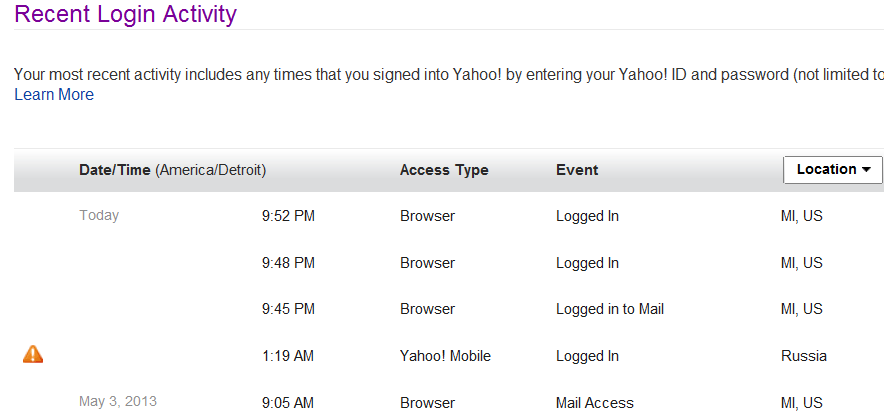
I had a hard time believing my account had been breached, but it had.  I signed on to view my recent logins, and sure enough, look at what happened at 1:19 this morning…from Russia.  I assure you, that’s not where I was visiting on my retreat.  Now since Yahoo knew enough to flag this activity, as you can see below, it would have been very nice if they had notified me.

Password hack

It’s important to regularly change passwords and to utilize strong passwords.  Check this link for further discussion about password strength and vulnerabilities along with how to protect yourself.

10 Ways To Protect Yourself

  1. Utilize strong  passwords – meaning ones that are not your pet, your address, etc.  Use nonsense words and numbers combined with capitals and non alpha  characters, like sdfg7531+?.  Pain in the butt?  Yes.  More painful than having your account compromised?  Nope.
  2. Never use the same password for multiple accounts.  If they can get into one, then you’ve given them a free ticket for all of your accounts.  Facebook, Twitter, your bank…what else?
  3. Don’t keep password or financial information in any e-mail folders.  Period.  No exceptions.  Preferably don’t keep any of that on your computer at all.
  4. Don’t store e-mail addresses in cloud based e-mail systems.  Pain in the butt?  Yes.  But hackers can only steal what is in your address book or otherwise available to them.  By and large, they aren’t going to go through your e-mails individually to obtain addresses.  They may, however, delete your entire address book and all of your e-mails, if they are feeling particularly malicious.
  5. Always keep both anti-virus and mal-ware software up to date on your system.  If you clicked on a link that wasn’t what you expected or took you someplace you didn’t plan, run the software immediately.
  6. Never, NEVER, ever click on a one-line link e-mail no matter who it comes from.  It if looks suspicious, reply to the e-mail and ask the person if they really sent it and what it’s about.  If you don’t click on it, the worse that will happen is that you’ll miss an e-mail.  If you do click on it, you may well infect yourself and others will horrible viruses that can wreak havoc you can only imagine – or maybe can’t even imagine.  Conversely, when you send e-mails to people, always put enough verbiage that they know it’s really you.  This habit helps people identify messages that might be bogus.
  7. Don’t use public computers to check e-mail.  Be exceedingly careful about using hotel or public wifi sites as well.  If you do, change your password afterwards.
  8. Be extremely vigilant.  If something seems wrong or “funny,” it probably is.
  9. Back your system up regularly.  If your system were to be destroyed, you could recover essential items.
  10. Change your password often.  Pain in the patoot?  Yep.  Better than the alternative?  If you’ve ever been on either end of being compromised, you’ll know that it is!

Ok, back to DNA in the next article, I promise!

______________________________________________________________

Disclosure

I receive a small contribution when you click on some of the links to vendors in my articles. This does NOT increase the price you pay but helps me to keep the lights on and this informational blog free for everyone. Please click on the links in the articles or to the vendors below if you are purchasing products or DNA testing.

Thank you so much.

DNA Purchases and Free Transfers

Genealogy Services

Genealogy Research

Digging Up Dad, Exhumation and Forensic Testing Alternatives

Dad in suit

I didn’t do it.  I really didn’t.  Ok, I wanted to, but I didn’t.

Yes, I seriously considered exhuming my father.  Ok, now that you’ve stopped gasping, let me tell you about the story, and what I did instead, and how successful it was, and wasn’t.

My father, William Sterling Estes, died in a car accident in 1963.  That means he’s been dead now for 50 years, half a century.  Depending on the source, he had between 2 and several children.  His obituary names me as his daughter, then inadvertently mixed up my mother, his x-wife’s name with that of his sister.  So my mother is listed as my father’s sister in his obit and his sister isn’t listed at all.  Neither is his other daughter, my half-sister.  For any of you who follow my family story, you already know it’s bizarre, so this unfortunate error should come as no surprise and would only provide Jeff Foxworthy with fodder for his “you might be….if” series.

But, as you’ll see, that obituary is part of the problem and so is the fact that he has been dead 50 years now.  That’s 50 years for his DNA to degrade.

My father was, well, ahem, somewhat of a playboy.  I keep finding children, and rumors of children, scattered about as I kept researching.  I keep waiting for a solid half-sibling match to some poor unsuspecting person on one of these autosomal tests too.  It hasn’t happened yet, but I’m just sure that one day it will.

And I haven’t published my blog article on Ilo yet, but suffice it to say that if you know of an Ilo (or maybe Flo?) who had a male child about 1920 in or near Battle Creek, Michigan and was briefly “married” to William Sterling Estes who was serving at Camp Custer at the time….I need to talk to you.

Now you’d think with all of these alleged children, there would be a male child to test, but the only male child I knew of back when DNA testing began was the male child of Ilo who I have never been able to identify, let alone locate.  I hadn’t found my “brother” Dave yet at that time, but as it turned out, Dave’s DNA did not match the Estes line anyway, so that would have been a red herring.

My Estes line out of Claiborne County Tennessee, for all of the males in earlier generations, dwindled to only a few, then to none in my generation.  The best I could do was a descendant of a male 3 or 4 generations upstream in my tree, and where there are paternity questions in more recent generations, a descendant from up the tree isn’t helpful, or wasn’t before autosomal testing.

Ah yes, that paternity question.  You see, it wasn’t definite.  A descendant tested the Y chromosome, and he was off just enough markers to be considered a problematic match.  But, it was enough to introduce doubt.  And doubt is a horrible nag for a companion – especially for the family genealogist who has spent the past three and a half decades working on this “doubtful” family.  In other words, OMG!!!  This was the genealogical equivalent of a panic attack.  And what could I do?  There was no one else to test.

On the chart below, the green line is the Estes ancestral line, as we know it today, proven by both genetics and genealogy.  The purple is the anonymous participant that tested and had the questionable match to the green ancestral Estes line.  The yellow group was then “suspect” because of the questionable match.  When I found David, supposedly my father’s son, and he tested, matching neither the purple participant nor the Estes ancestral line, it nearly put me over the edge.  My cousin, Buster agreed to test, which confirmed the ancestral Estes line back to Lazarus, which left the yellow still in the questionable realm.  There were no living males to test in the yellow line.

Digging up dad 1

So, I considered exhuming Dad.  That possible paternity issue had shaken me, pretty much to the bone, and I desperately wanted to know.  Was I barking up the wrong tree?  Was my Dad not my Dad, but David’s Dad?  David and I clearly were not genetic half-siblings, suggested at that time by CODIS testing, but proven eventually by 23andMe testing.  Was my Dad not the child of his father, William George?  Was his father maybe not the child of his father, Lazarus?  Why did my grandfather not look like the other Estes men?  We knew that John R. Estes matched the ancestral Estes line, but we had no one else to test below John R. on the tree.

Below, my great-great-grandfather, John Y. Estes, at left, my great-grandfather, Lazarus, center and my grandfather, William George, at right.

Digging up dad 2

Why did my son look so much like my father?  Was I just seeing things that weren’t there?  Below, my father as a teen in his military uniform and my son about the same age.

digging up dad 3

Without a male to test the Estes Y-line DNA, how would I ever know?

One day, a package arrived in the mail.  My step-mother had died some years ago, and her daughter had found a group of letters in her mother’s belongings that she felt I should have.  Among those letters were letters from my grandfather to my father.

Letters?  Envelopes?  Stamps?  Saliva?  DNA?  JACKPOT!!!  WOOHOOOO!!!!!!!

At the time my grandfather mailed those letters to my father, in the 1960s, my grandfather was living alone, so he should have licked the envelope and the stamp himself.

I called Bennett Greenspan at Family Tree DNA.  He referred me to a private lab that “does things like this,” called Trace Genetics.  Before you start googling, the company was subsequently sold and has now been defunct for years.  However, at that time they were doing custom processing of private forensic samples.

Yes, anything like that is considered forensic.  Anything you have to extract DNA from before you can have it processed in a regular lab is forensic work.

So, I got an estimate, took out a loan, and told them to go ahead.  You think I’m kidding, but I’m not.  The cost was in the $2000 range FOR EACH ATTEMPT.  So, we tried the envelope first.  No DNA.  Then we tried the stamp.  We got DNA, but it was female, so we knew it was contaminant DNA.  Think of how many people handle an envelope in the processing and delivery of mail, not to mention all the people who had handled it since.  Then we tried a second envelope.  No dice.

I was beyond frustrated and so were the two wonderfully patient scientists I was working with at Trace Genetics.  We all desperately wanted DNA.  In all fairness, they told me very clearly up front that there was a less than 50% chance of obtaining  ANY DNA, let alone usable DNA, let alone Y-line DNA.  Yes, the odds were very much stacked against me, and I knew it.

Y-line DNA is the least obtainable.  Most forensic work is done using mitochondrial DNA.  That’s because in each cell there is a total of 1 Y chromosome and there are thousands of mitochondria.  So the chances of recovering mitochondria are much greater than a Y chromosome.

Still, I had to try.  If you’re thinking of the word obsessed, I certainly wouldn’t argue with you.

Then I remembered, I had my father’s VFW hat.  I had it stored away in an old train case with other memorabilia from my childhood.  That was the one and only thing of my father’s I ever had – that hat.  I still remember him wearing it and I remember going to the VFW hall with him.  They had a slot machine and sometimes he used to let me pull the arm on the machine.  That was great fun.

I asked my friendly scientist at Trace Genetics what to do with the hat.  He suggested that I look for hairs in the interior of the hat, under the hatband, and then he told me how to extract the hair without touching it myself using sterile gloves.  I did so, put the hair in a Kleenex, put the Kleenex in an envelope and overnighted it to Trace Genetics.  This hair had the all-important follicle attached, the only part of the hair that will provide DNA.

I was positive, just positive, that this time was the jackpot.  But it wasn’t, and neither was the next hair.

Are you adding up the numbers in your mind?  Well, I assure you, I was adding them up.  And it wasn’t the money that bothered me, but the lack of results.  I was devastated.

Dad tombstone

So, I considered exhumation.  I looked into it, and I discovered a couple of things that were very important and were likely show-stoppers.

  1. In order to exhume someone, you have to petition the court and give a reason.  Then, you have to obtain the written, notarized, permission from every single descendant.  Yes, I said EVERY SINGLE DESCENDANT.  If even one disagrees, or refuses, it’s done, a deal-killer, dead.
  2. The cost of said exhumation is about $20,000 including all expenses, like attorney fees, backhoe, medical examiner, etc..

Choke, sputter, cough….clutching chest….

I happened to know someone who actually did exhume their ancestor, not for DNA testing, but because the cemetery was going to wind up at the bottom of a lake.  And yes, the entire process did cost in the neighborhood of 20K, a price-tag they did not anticipate in advance nor expect.

I had my doubts that any court would approve an exhumation for obtaining DNA for genealogy, but they might approve it to move the grave to Tennessee where my father’s family was buried.  Dad was (and is) buried alone in Indiana.

OLYMPUS DIGITAL CAMERA

But to move him, the cost of the exhumation would increase exponentially.  Moving a body which is considered medical waste is not inexpensive.  By way of comparison, to bring my sister home from Arizona to Michigan for burial was in the neighborhood of 10K.  And that would have been in addition to the 20K for exhumation.

For a minute, I thought about my brother, Dave, the long haul truck driver and I wondered if he had any room in that truck between pallets of yogurt.  But I got a grip on myself before asking him. I had visions of Dave putting Dad back in the sleeper cab…but I digress.

Ok, now we were talking the price of a car or a small house…a vacation home maybe or a trip around the world.  And it wasn’t 2K at a time, but an all or nothing proposition.

Not only did I not have the 20K or 30K, I couldn’t justify borrowing it, so I decided to leave sleeping Dad’s lie, so to speak.

I also decided that really, while I desperately did want to know about the paternity issue and its resolution, that I’m an Estes no matter what.  It’s my maiden name, it’s my name now that I’m married (I married a Kvochick, need I say more) and it will be my name on my tombstone.  So, I’m an Estes no matter whether I descended from them genetically or not.

I intentionally have not addressed any moral or ethical issues about exhumation.  Some feel the dead should be left alone, undisturbed.  However, there is precedent… the Catholic church regularly exhumes their saints to see if the body is well preserved.  I didn’t know what to think, truthfully, along those lines, and before I could have and would have actually made that decision, I would have had to think long and hard about it.  Would I have been there for the exhumation?  Could I have stayed away?  Would I have wanted to see my father like that?  All questions I would have had to answer, but did not have to, because the other issues precluded exhumation.

The first issue I would have encountered was who, exactly, were his descendants, and how, exactly, legally, was that determined?  I mean, does the court go by the obituary?  If so, my mother was his sister.  But I had a real half-sister.  Was she included?  No place did it say that she was his descendant.  He didn’t have a will.  And what about the children we knew about but couldn’t find?  Would that preclude the exhumation?  Or should we just stay quiet about them?  No, too many ethical issues and thorny problems, and that is BEFORE you get to the money issue.

I’m glad I didn’t slog through that mess, because before long, autosomal testing came about – not CODIS testing – which was inconclusive at best – but wide spectrum testing using hundreds of thousands of DNA positions, today’s 23andMe and Family Tree DNA’s Family Finder tests.

I have several Estes cousins who aren’t direct male lines but who who are fairly close genetically and I’m not related to any of them through any other genealogical lines.  If I matched them, it would be proof positive that I indeed was a blood descendant of the Estes line.  I wasn’t happy testing just one or two, so I tested 5 or 6 of my cousins from different children of my great and great-great-grandfather – and yes, I did indeed match all of them.

What a relief!  I didn’t have to dig up Dad or spend the equivalent of a couple years of college education.

But for those who are indeed as desperate as I was, let me tell you the following.

  1. There are very few labs that will do this kind of processing.  It is very unpopular as you basically have to shut the entire lab, sanitize it, and run no other tests until you are done.  You can see a forensic lab clean room in Ripan Malhi’s lab at the University of Illinois.
  2. Best case, with a relatively recent sample, meaning one from someone who died recently, you have about a 50% chance of useable DNA retrieval.  That’s BEST CASE.
  3. Skin is good.  The best is an electric razor contents.  Do NOT touch them.  Put the entire razor with contents into a plastic bag and DO NOT seal it.  Keep it in a temperature stable environment.  No attic or basement.   Sometimes hairbrushes have skin flakes in with the hair.
  4. Hearing aids are good.  Again, do not touch, etc.  Blood is good.  Spit is good.  A Kleenex is wonderful, providing you are sure it is their Kleenex.  If your mother was like my mother, check her bathrobe pockets.
  5. Older things like hair, sweat, envelopes etc. are not so good.  The older the sample, the less likely you’ll be able to retrieve DNA.  It degrades with time and these aren’t particularly good to begin with.
  6. Digging up a grave without doing all of the paperwork is illegal, and the legalities vary by locality – so consult an attorney and get the check book ready.  I just thought I should mention that little illegal detail, just in case.  I know genealogists are innovative and sometimes desperate people.

Having said all of that, don’t go throwing anything away.  There is new technology on the horizon that will only need one cell of DNA – so I’m told.  Seeing how far we’ve come in the past decade, I don’t doubt that someday this will be true, and someday may be closer than you think.  And no, I do not know how far away that horizon is.

So, store your DNA item safely.  Label it.  Do not seal it in plastic.  Do not store it in the attic (heat) or basement (cold, humidity) but someplace fairly temperature regulated.

One time when working with an archaeological specimen, we were told to freeze the sample.  Well, we did, in a plastic cool-whip container with water.  However, the electricity went out while the person whose freezer the specimen was stored in was out of town.  Their friend went to their house and did them the very big favor of disposing of everything in the fridge and freezer before they came home.   Needless to say, we were just sick.  So, don’t freeze it either.  Besides that, freezing in a frost-free refrigerator (that by definition defrosts itself regularly) is not the same as freezing a specimen in a laboratory temperature controlled stable environment.

So, what’s the upshot of this?

  • Forensic genetics is expensive
  • Exhumations are extremely expensive and fraught with all kinds of legal and technical landmines
  • There are very few labs, if any, that will process private forensic samples
  • When DNA is retrieved from a forensic specimen, it may be contaminant, not the DNA of the person you think it belongs to
  • When DNA is retrieved from a forensic specimen, you still have to pay for the DNA testing, in addition – and it may not work
  • When DNA is retrieved from a forensic specimen, if it does amplify, it will most likely be mitochondrial DNA
  • Using today’s combined genetic genealogy tests, there is almost always a way around the lack of a particular DNA donor, making exhumation and or forensic testing unnecessary

And if you’re considering grabbing a shovel, an urge which I well understand, I’ll leave you with the advice of an ethicist that Family Tree DNA invited to speak at their annual conference a few years ago, “Don’t do anything in the dark of night that you wouldn’t do in the middle of the day.”  Put another way, don’t do anything you wouldn’t be comfortable seeing in the headlines, because if you get caught, that’s where you’ll be:)

But then again, those headlines would certainly be something interesting for future generations of genealogists to dig up about you!

______________________________________________________________

Disclosure

I receive a small contribution when you click on some of the links to vendors in my articles. This does NOT increase the price you pay but helps me to keep the lights on and this informational blog free for everyone. Please click on the links in the articles or to the vendors below if you are purchasing products or DNA testing.

Thank you so much.

DNA Purchases and Free Transfers

Genealogy Services

Genealogy Research

DNA Day

Did you know that today is DNA Day?  Did you know that there was such a thing as DNA Day?  It’s a holiday.  Did you take the day off work today?  What?  You didn’t know??

Well, you’re not alone if you didn’t know all of this, and you’re not THAT far behind either.  DNA Day was created by Congressional Resolution in 2003 – a date to commemorate two very important events – the 50th anniversary of the publication of the paper in Nature in which the discovery of DNA was announced by James Watson, Francis Crick, Maurice Wilkins, Rosalind Franklin and the celebration in 2003 of the complete sequencing of the Human Genome. DNA cake                       To find out more about this great cake, click here.

dna day 1

The double helix model built by Crick and Watson on display at the Science Museum in London.

Here’s what the 2003 Congressional Resolution said:

Whereas April 25, 2003, will mark the 50th anniversary of the description of the double-helix structure of DNA by James D. Watson and Francis H.C. Crick, considered by many to be one of the most significant scientific discoveries of the 20th Century;

Whereas, in April 2003, the International Human Genome Sequencing Consortium will place the essentially completed sequence of the human genome in public databases, and thereby complete all of the original goals of the Human Genome Project;

Whereas, in April 2003, the National Human Genome Research Institute of the National Institutes of Health in the Department of Health and Human Services will unveil a new plan for the future of genomics research;

Whereas, April 2003 marks 50 years of DNA discovery during which scientists in the United States and many other countries, fueled by curiosity and armed with ingenuity, have unraveled the mysteries of human heredity and deciphered the genetic code linking one generation to the next;

Whereas, an understanding of DNA and the human genome has already fueled remarkable scientific, medical, and economic advances; and

Whereas, an understanding of DNA and the human genome hold great promise to improve the health and well being of all Americans: Now, therefore, be it

Resolved by the Senate (the House of Representatives concurring), That the Congress-

(1) designates April 2003 as `Human Genome Month’ in order to recognize and celebrate the 50th anniversary of the outstanding accomplishment of describing the structure of DNA, the essential completion of the sequence of the human genome, and the development of a plan for the future of genomics;

(2) designates April 25, 2003, as ‘DNA Day’ in celebration of the 50th anniversary of the publication of the description of the structure of DNA on April 25, 1953; and

(3) recommends that schools, museums, cultural organizations, and other educational institutions across the nation recognize Human Genome Month and DNA Day and carry out appropriate activities centered on human genomics, using information and materials provided through the National Human Genome Research Institute and through other entities.

Passed the Senate February 27, 2003.

http://www.genome.gov/11008128

The resolution only declared a one-time celebration, not an annual holiday.  DNA Day celebrations have been organized by the National Human Genome Research Institute (NHGRI) starting in 2010.  April 25th has been since declared “International DNA Day” and “World DNA Day” by several organizations.

To visit the DNA Day webpage, click here.

dna dayFor planning purposes, now that you know, plan to celebrate this important holiday next year by taking the day off work and doing something interesting like:

  • Swab a friend
  • Swab a cousin
  • Swab your spouse to see if you two are related and/or if s/he has the warrior gene
  • Swab your dog to see what kind of mutt s/he is
  • Swab your parents/grandparents
  • Swab any older generation person in your family
  • Upgrade a genealogy cousin’s DNA test (with their permission of course)
  • Be a DNA ambassador and visit a school or genealogy organization to speak about personal genetics
  • Take yourself on a date to a science museum

Happy DNA Day!!!

______________________________________________________________

Disclosure

I receive a small contribution when you click on some of the links to vendors in my articles. This does NOT increase the price you pay but helps me to keep the lights on and this informational blog free for everyone. Please click on the links in the articles or to the vendors below if you are purchasing products or DNA testing.

Thank you so much.

DNA Purchases and Free Transfers

Genealogy Services

Genealogy Research

A Buck By Any Other Name

buck

A Buck by any other name might be Hogan, Logan or Williams.  I think we have a case of surname schizophrenia.  We have four surnames involving 3 people.

Do you sometimes wonder why you or one of your relatives matches a whole group of people by a different surname, and none by the surname you expected them to match?

This 1888 Indian Census page for the Seneca on the Allegany Reservation in New York just might give you a clue as to why you’re not matching whom you think you should be matching..

Not matching who you expect to match is sometimes called a Nonpaternal Event (NPE) or I prefer the term undocumented adoption.  But this case doesn’t seem to be undocumented at all…it’s well documented….it’s just that we can’t understand it.

So let’s say this is your family and the husband, I presume is Augustus Buck.  So far, that looks normal.  But this is where normal ends.

Your name is Acsah.  If you’re married to Augustus Buck, your name would be Acsah Buck.  This is how all of the other families are recorded, so you would be too.  Except you have this little note that says either (Logan was) or Hogan was).  Is that a maiden name?  No one else’s maiden or other names are listed.  Is Acsah maybe not the wife of Augustus and the mother of Alfred noted below?  If that is the case, then why are they listed as Buck now?

And Alfred has his own set of problems.  He is noted as Alfred Buck, age 2. One would assume the child of Acsah and Augustus Buck, judging from the rest of the entries.  But Alfred had this note that says (was Williams.)  What does that mean?  It’s certainly not his maiden name.

Does that mean that Alfred isn’t a Buck at all?  Is Alfred even the son of Acsah?  Is Alfred really a Williams.  Was Acsah married to a Williams before Augustus?  That would seem to be pushing it given that she is only 18 and Alfred was born when she was 16.  Did she have time to be married earlier?

So, if Alfred’s descendants were to DNA test, would they match a Buck, a Williams, a Hogan or a Logan?  Or maybe none of the above if Acsah had Alfred before she married Augustus by someone not listed on the “was” list.  Maternal naming was a very common Native American occurrence and what is today considered to be illegitimacy was not viewed through the lens of colonial or Victorian America.

And just think, if you are Alfred’s great-grandson and you took the Yline DNA paternal line test, expecting to match a Buck, and you were instead matching a Williams, Hogan or Logan, and if you never saw this census page, you would have no clue as to potentially why.  Of course, if you aren’t matching a Buck or a Logan, Hogan or Williams, then all bets are off.  But at least, there is a clue here that something is not like the rest of the families recorded in the census.  It’s something to work with.

Of course, this makes me wonder how many more census entries warrant notes and of course never received them.  And of course, a legend to interpret the note would be nice too:)

______________________________________________________________

Disclosure

I receive a small contribution when you click on some of the links to vendors in my articles. This does NOT increase the price you pay but helps me to keep the lights on and this informational blog free for everyone. Please click on the links in the articles or to the vendors below if you are purchasing products or DNA testing.

Thank you so much.

DNA Purchases and Free Transfers

Genealogy Services

Genealogy Research

Gene by Gene Signs Agreement with MD Anderson Cancer Center

It’s really nice to know that the labs owned by Gene by Gene, which includes the lab that processes the Family Tree DNA tests, are so highly regarded.  The MD Anderson Cancer Center is THE cancer treatment center, very highly regarded, ranked as the #1 cancer treatment center in the US and one the first three comprehensive cancer treatment centers, focusing on academics, research and treatment.  Congratulations to Gene by Gene.  Gene by Gene and MD Anderson will make a great team!  The press release is follows:

Gene By Gene Signs Agreement with MD Anderson Cancer Center

Will provide clinical phase instruction, training and supervision for students as part of agreement

 HOUSTON — Apr. 23, 2013 – Gene By Gene, Ltd., the Houston-based genomics and genetics testing company, announced that it has signed an agreement with the University of Texas MD Anderson Cancer Center to become one of its affiliated clinical laboratories.

Under the agreement, scientists at Gene By Gene’s Genomic Research Center will provide the clinical phase instruction, training and supervision required for students in the Molecular Genetic Technology Program, one of eight undergraduate programs offered through MD Anderson’s School of Health Professions.

“We’re delighted to partner with Gene By Gene, with its long and pioneering history in the field of genomics,” said Program Director, Peter Hu, Ph.D., with the School of Health Professions.  “Gene By Gene’s sequencing, next-generation sequencing and microarray laboratory will provide the top level of experience and training that we want all our molecular students to attain.”

Gene By Gene’s Genomic Research Center is a CLIA registered lab which has processed more than 5 million discrete DNA tests from more than 700,000 individuals and organizations globally.  It is now one of only 36 laboratories in the United States, including the Yale University School of Medicine and the Baylor College of Medicine, to achieve this prestigious affiliation.

“We’re very proud to be able to share our laboratory and expertise with MD Anderson’s School of Health Professions,” said Gene By Gene President Bennett Greenspan.  “It’s an honor to be among the select few companies and institutions that are invited to affiliate with this prestigious institution.  In addition, this is a wonderful opportunity for Gene By Gene to continue investing in the next generation of leaders in genomic and genetic science, and we’re thrilled to welcome the first students to our Genomics Research Center this May.”

About Gene By Gene, Ltd.

Founded in 2000, Gene By Gene, Ltd. provides reliable DNA testing to a wide range of consumer and institutional customers through its four divisions focusing on ancestry, health, research and paternity.  Gene By Gene provides DNA tests through its Family Tree DNA division, which pioneered the concept of direct-to-consumer testing in the field of genetic genealogy more than a decade ago.  Gene by Gene is CLIA registered and through its clinical-health division DNA Traits offers regulated diagnostic tests.  DNA DTC is the Research Use Only (RUO) division serving both direct-to-consumer and institutional clients worldwide.  Gene By Gene offers AABB certified relationship tests through its paternity testing division, DNA Findings.  The privately held company is headquartered in Houston, which is also home to its state-of-the-art Genomics Research Center.

______________________________________________________________

Disclosure

I receive a small contribution when you click on some of the links to vendors in my articles. This does NOT increase the price you pay but helps me to keep the lights on and this informational blog free for everyone. Please click on the links in the articles or to the vendors below if you are purchasing products or DNA testing.

Thank you so much.

DNA Purchases and Free Transfers

Genealogy Services

Genealogy Research