About Roberta Estes

Scientist, author, genetic genealogist. Documenting Native Heritage through contemporaneous records and DNA.

Challenges with Irish Autosomal DNA Genealogy Research

Dr. Maurice Gleeson gave an excellent (and humorous) presentation this last weekend at the i4gg (Institute for Genetic Genealogy) in Chevy Chase, Maryland.

gleeson

Although his focus is Irish, this information applies to anyone utilizing autosomal DNA.

gleeson2

He has very graciously made his presentation available on YouTube.  Enjoy.


______________________________________________________________

Disclosure

I receive a small contribution when you click on some of the links to vendors in my articles. This does NOT increase the price you pay but helps me to keep the lights on and this informational blog free for everyone. Please click on the links in the articles or to the vendors below if you are purchasing products or DNA testing.

Thank you so much.

DNA Purchases and Free Transfers

Genealogy Services

Genealogy Research

Nancy Mann (c1780-1841), German or Irish, 52 Ancestors #33

Nancy Mann was the second wife of Henry Bolton.  Henry was born about 1759 in England and married Catherine Chapman in August of 1786 in Philadelphia.  On August 17, 1798, after bearing Henry six children, Catherine died where they had moved in Botetourt County, Virginia by 1795.  We don’t know exactly where Henry lived, and therefore, we don’t know where they are buried.

botetourt

When Catherine died, Henry had 5 children under the age of 10.  He needed a wife, and the following year, on April 5, 1799, eight months after Catherine’s death, Henry, aged 39 or 40, married the much younger Nancy Mann.  Nancy, probably not even age 20, immediately inherited 5 children, and on January 11, 1800, she had her first child.  She and Henry would have 14 children in addition to the children from his first marriage, plus they raised Henry’s brother, Conrad’s orphan daughter, Sarah, after his death about 1810.

Nancy Mann died on October 16, 1841, according to the Bolton Family Bible which was in the possession of Hazel Venable Barnard in the 1980s when I first began researching the Bolton family in Claiborne Co., TN where Henry and Nancy’s son, Joseph Preston Bolton, had moved about 1845.  Three of Joseph’s siblings, John and David Bolton and their sister, Elizabeth “Elyann” Ann Bolton who married Isaac Patterson also settled in Claiborne County.  It’s obvious from the later entries in this Bible that this is the line of the family that kept the Bible.

Further digging revealed notes taken in Claiborne County now more than 30 years ago when talking with the “old widows,” as they called themselves, when the Bible was first revealed.

In addition to their own children, Elyann and Issac also raised the daughters of her brother David Bolton, Nancy and Martha Bolton.  Elyann brought Henry Bolton’s Bible with her which contained the birthdates of some of Henry’s children.  Elyann is buried in the Cave Springs Cemetery outside of Tazewell, Tennessee.

Hazel Venable was the great-granddaughter of Joseph Preston Bolton and his first wife, Mary Tankersley, so it’s likely that Joseph, at some point, wound up in possession of the family Bible.  This Bible itself is dated 1811, so it’s clearly not the original Henry Bolton Bible.  It could have been purchased as wedding gift for one of Henry’s children who copied the pertinent information from Henry’s original Bible.  Hazel Venable Barnard wrote that it was the Bible of Henry Bolton, Sr. at the bottom of the Bible page with the handwritten information.  The Bible record is available today through the DAR.

Several years ago, I visited Botetourt County, Virginia and extracted the original records for both Bolton and Mann.

The only clue we have as to Nancy’s family is that a James Mann signed as her surety.  Normally, if her father were living, he would sign.  If not, an uncle or older brother, typically.

Herein lies the problem.

We can’t identify James Mann.

German or Irish

Now, the good news is that the Mann Family of Botetourt County has had significant research performed by descendants and they have done a good job not only documenting the family, but researching and publishing their findings as well.

I was grateful to see this, as I had attempted a reconstruction as well from the records I retrieved.

In a nutshell, John Mann immigrated from Ireland in 1735 and declared that he immigrated to redeem land and then immediately assigned the land to a land speculator.  These are the men who would found the Scotch-Irish settlement in Augusta and Orange Counties of Virginia.  Botetourt would be taken from Orange County in 1770 and the Mann records followed with the county, so they obviously lived in the Botetourt portion.

“The Chronicles of the Scotch-Irish Settlement in Virginia” tell us that John Mann, the immigrant, lived on the south side of Peaked Mountain, near the Stone Meeting House in Beverly Manor in Augusta County.  The 1749 road petition of the inhabitants of North River and Picot (Peaked) Mountain requests a road beginning at John Man’s smithshop on the south side of the Peaked Mountain, then goes on to mention the Stone Meeting House and the Courthouse Road.  Today, the Peaked Mountain Church is located in McGaheyville, VA, about 100 miles up the Shenandoah Valley from Fincastle.

 Peaked Mountain

Numerous members of the German Mann family are buried in the church cemetery there.

John Mann, the Irishman, had 4 known sons:

  • Moses who died before 1756, unmarried and with no children
  • Thomas who died in 1772 unmarried and with no children
  • John who died in 1778 with no will, but who had children. Moses and John are proven children, but many other candidates are present in Botetourt County.
  • William who died in 1778 with a will listing children: Moses born circa 1761 (married Jane Kinkead 1779), Alice, Jennie, Thomas born 1771, married, died in 1794, William Jr. born 1773, died 1794, Sarah, John born 1775 and Archibald born after his father’s death in 1778.

John’s sons moved a bit further south.  Fortunately, the tax lists for Botetourt County still exist for the 1770s and they include a basic description of where the taxpayer lived.

Both of John’s sons, John (Jr.) and William, lived in the same tax districts, as follows:

  • 1771 – Upper James
  • 1773 – James River to Buffalo Creek
  • 1774 – Cowpasture and Jackson River
  • 1776 – from Craig’s Creek up James River

Based on these landmarks, they lived someplace between Clifton Forge and Eagle Rock.  Buffalo Creek and Craig’s Creek meet at Clifton Forge.  The Cowpasture and Jackson River meet to form the James 3 or 4 miles below Clifton Forge, just below where the number 727 is located between the rivers today.

clifton forge

Given that our Nancy was born about 1780, if not a couple of years later, we can eliminate all 4 of the elder John’s sons and all of Williams son’s with the possible exception of Moses who married in 1779.  However, Moses didn’t die until 1816, so he could have signed his daughter’s marriage bond himself.

This, logically, shifts our focus to John Jr.’s children, who were not documented in his will.  Only two children were positively documented as his utilizing other records.

And of course, there’s a twist – there is also a German Mann family, Jacob, in the vicinity.  This family isn’t terribly close geographically, but they aren’t so far away that they can be eliminated either.  It does appear that both John Mann and the German Mann family started out in the Peaked Mountain vicinity.  Jacob Mann does have a son, James but he is too young to be Nancy’s father.  However, Nancy could have been the daughter of any of Jacob’s oldest 3 sons, Jacob, Adam or Moses.  I feel this is unlikely, especially since this family wound up after county splits being in Monroe and Greenbrier Counties of West Virginia.

However, there is an unaccounted for Nathaniel Mann on the Botetourt County tax lists of 1771-1775 who seems to be found in the Clifton Forge vicinity, but not on the same tax lists as William and John Mann.

In 1749, Jacob Mann, probably the German, signed a petition in Botetourt County.  Based on a 1770 record where Jacob Mann is an assignee of Jacob Miller, the connection between those two families is strongly suggested.

According to the Mann Family of Botetourt County:

According to the Houchins family history, around 1770 the Manns, Maddys and Millers moved from Rockingham county, Virginia into present day West Virginia, near Greenville in Monroe county. John Mann came to Pennsylvania from Germany and his son Jacob married Barbary Miller, daughter of Jacob Miller, emigrant. Jacob and Barbary Miller Mann had Jacob Mann, Junior who married Mary Kessinger on August 24, 1779; Adam, who married first Mary Maddy on December 9, 1783 and second Polly Flinn on May 3, 1790; Elizabeth, who married William Maddy on February 25, 1783 and a daughter who married a Mr. Low. Jacob Mann owned a gunpowder mill. Saltpetre was supplied from Maddy’s Cave during the Revolution. This cave had formerly belonged to the Manns of Springfield. This is an intriguing mystery since there is a story that William Mann and his father and/or uncles and brothers lived in a saltpetre cave when they first emigrated from Ireland to Virginia. I do not know what, if any, substance this story has. It may have been influenced by the presence of the German Manns at Greenville or it may be an authentic tradition. Springfields abound, both in the United States and in Ireland. There were Scots-Irish Mann emigrants to Springfield township in Bucks county, Pennsylvania and Scots-Irish Manns living in Springfield township, Chester county, Pennsylvania. Moses Mann, son of William, one of the sons of the emigrant John Man, bought 26 acres of land on both sides of Jackson’s River, including a saltpetre cave, on December 10, 1792, in Botetourt county. Some of the children of William Mann stayed in Bath and Alleghany counties, and some went to Greenbrier county in the vicinity of present day Monroe county. A Moses Mann bought 22 acres in Monroe county on March 4, 1831, adjoining the land of Adam Mann and Adam Miller. This may or may not be a descendant of William Mann.

The Mann family which ended up in Bucks county is described as the family of James Mann and his wife Mary Carroll. The Manns and Carrolls were from Scotland and in childhood James and Mary emigrated with their families to county Antrim around the year 1690. He married her about 1709. The names of their children were James, born in 1710; John, born in 1712; William in 1714 and a daughter named Mary. John, the second son, became the progenitor of the family in Bucks county when he embarked from Donegal in 1732 in the company of the McNairs and others bound for America. They landed at Philadelphia and proceeded to Bristol in the autumn of the same year, locating at different points in Bucks county. Although our John Man was imported immediately into Virginia, perhaps he was related in some fashion to these Bucks County Manns.

DNA testing of a male Mann from both lines would tell us unquestionably.

If you’re groaning by now, I was too….but the pretzel twist gets worse, actually, much worse.

If Nancy Mann descends from Jacob Mann who married Barbara Miller, then autosomal DNA won’t help me, because it’s possible, in fact, it’s downright likely, that I’m related to Barbara Miller.  I can’t confirm that right now, but the suspicion alone is enough to disallow any autosomal conclusions UNLESS we would have a 100% triangulated positive match with the Irish Mann family – and then we don’t really care about the German Mann family.

But you know if it was that easy, I would already have told you.  With the 7 descendants of Henry Bolton who have autosomally DNA tested at Family Tree DNA, we have no triangulated matches with the Mann family.  That doesn’t disprove anything – but it also doesn’t prove anything either.  All it does is frustrate me.  Even more frustrating is that there are matches at Ancestry in this same line, BUT since Ancestry doesn’t provide a chromosome browser, I can do nothing with them unless the participants are willing to download their files to GedMatch – and so far, with one exception, they haven’t responded at all – so that’s clearly not an option.

John Mann Jr.’s Possible Children

Since we know who the children of William Mann are, per his will, and the other two sons of immigrant John Mann had no children and died as young men, we can look at the names of many of the “stragglers” and they are candidates for the sons of John Mann (Jr.) who died in 1778 intestate.

In 1755, there is a Barnett Mann who deeds land to Jacob Mann and the land abuts George Mann, so those folks are affiliated with the German Manns.

There’s a Hugh Mann who has a mill in 1756.  We don’t know who he is, but he disappears from the records and there are no stray males between then and when John’s son’s die, so we can remove him from consideration.

Nathaniel Mann appears from 1771-1775, but then is gone.  He’s probably not a candidate for Nancy’s father in about 1780.  Nancy did not name any children Nathaniel, unless one died.  There is a 3 year gap between sons George and William.  Henry Bolton and Nancy Mann’s sons, in birth order, were Henry, George, William, John, Joseph, Absalom, Daniel, James and David.  Not terribly useful.

Beginning about 1780, a whole group of young Mann males come of age about the same time, like stair steps.

Esau Mann appears from 1781-1785

Asa Mann marries in 1780 and is found in the 1782 tax list.

Acre Mann is found in the records in 1784.

In 1785, on the tax list, there is a J. Mann beside Moses Mann.  I’d love to think this is James, and it might be, but it could also be John.  Why, oh why, could they not just write out those few letters?  I mean really, 3 or 4 letters would have made SUCH a difference.  Even just Jo or Ja or Jas.  For the want of just a couple letters.

Esau, Acre and Asa are candidates to be sons of John Jr., as well as Nathaniel…and of course, J, whoever he is.

If Nancy was actually born in 1778, it’s remotely possible that John Jr. was her father, but it’s unlikely because Nancy had her last child in 1826.  If she were born in 1780, that would make her 46 at that time, which is quite late, but not impossible, for a last child.  However, if she were born in 1778, that would make her 48 in 1826, which is even more unlikely.

In 1789 in Botetourt County Will Book A, on page 270, we find the will of William Renfro who lists, among his heirs, James Mann.  James Mann also signed and he may have been the executor as well, although it was hard for me to decipher the handwriting.  This does put a James Mann in the right place at the right time.

Not that it will help us any, but there are also Mann females: Margaret who married William McClure in 1790, Jane who married Michael Woodly in 1779, Mary who married Adam McCaslen in 1802, another Nancy who married Charles Wright in 1794 and Sarah who married Alexander McClinock in 1788.  These people weren’t children of William, per his will, so they had to be John’s, Nathaniel’s or the beginning of the next generation beginning about 1800.

So, having perused all of the records available, we’re, in essence, stuck.

Stuck – What Next?

Ok, let’s think about what else we can do.

People tend to marry other people like themselves.  In fact, the Germans who immigrated in the 1700s were still speaking German at home and in the churches in the early 1900s after spending 200 years migrating across three states.  My great-grandmother was one of them – although they stopped speaking German when World War I was declared.  In the later 1700s and even the early 1800s, they didn’t speak any English so they had to have someone handle their affairs for them – often the local miller.

Germans attended German churches.  The Irish attended Catholic churches and the Scotch-Irish, who were the majority of the immigrants from Ireland in the 1700s, attended Presbyterian churches.  The English attended the Anglican churches.  Methodists and Baptists were dissenting churches.  Indeed, the Presbyterian Church in Fincastle, in Botetourt County, was established in 1754.  You didn’t have a lot of opportunity to meet someone outside of your cultural circle and you certainly were not encouraged to “court” anyone from those other cultural circles.

So, if we had a way to figure out anything about Nancy Mann’s genetic lineage, we might be able to determine whether it is German or Irish.

Turns out – we do.

We have a male descendant from Nancy Mann through all females to the current generation.  And are we EVER grateful to that tester.  Yes, it’s a him, because in the current generation, men can test as well as women.  Remember, women contribute their mitochondrial DNA to all of their children, but only the females pass it on.

Thanks to cousin Jay, we have Nancy’s full sequence mitochondrial DNA, which she inherited from her mother, and she from her mother, back into the old country, wherever the “old country” happens to be.

Let’s take a look.

Her haplogroup is K1c2, clearly very European.

The page of DNA results that is the most relevant to answer our question of where Nancy’s matrilineal line originated is Jay’s Matches Map.  This map shows us the location of the most distant ancestor of Jay’s matches.  In this case, I’m only showing the European portion of the map, because that’s the part that will answer our question.

Are you ready?

Drum roll……please!

Nancy Mann's mtDNA

What do you think?

Nancy’s closest matches, in red and orange, are clearly in Ireland, then England, yellow and green, then in continental Europe.  Therefore, her ancestors were most recently in Ireland, including her three exact matches, two of which are found in Dublin.

Nancy Mann Closeup

Therefore, if I were a betting person, I’m betting on Irish, or Scotch-Irish far and above Germany for Nancy’s matrilineal ancestry.  Given that, I’m also betting that Nancy is the granddaughter of John Mann Jr.  through one his unnamed sons, and the great-granddaughter of John Mann the immigrant.  And given that, I’m betting that the J. Mann next to Moses on the 1785 tax list was indeed, James.

I’d bet!

If you descend from Henry Bolton or John Mann, please consider DNA testing. If you are a male Mann who descends from John Mann Sr., the immigrant, we really need your participation and there is a DNA scholarship for the first male Mann to test from this line.

Acknowledgements:

I’d like to thank cousin Jay for DNA testing, cousin Hazel Venable Barnard, now deceased, for being such a wonderful steward of that Bible record, cousin Dillis for lots of research over the past 25 or 30 years, so much and for so long that I no longer remember what was mine and what was his.

______________________________________________________________

Disclosure

I receive a small contribution when you click on some of the links to vendors in my articles. This does NOT increase the price you pay but helps me to keep the lights on and this informational blog free for everyone. Please click on the links in the articles or to the vendors below if you are purchasing products or DNA testing.

Thank you so much.

DNA Purchases and Free Transfers

Genealogy Services

Genealogy Research

Ancestor Maps

Ancestor map

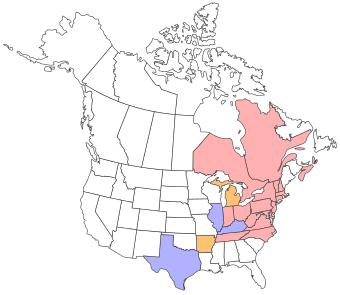
These maps are just fun!!!  They are yours, and fully customizable, so you can make them anything you want.  They could track the migrations of a single family across time.  They could show the genesis of your entire family.  They could be where your DNA matches are found.

http://www.defocus.net/visitedstates/us-canada.html

I did this one just for fun and it shows where my ancestors were born, where they died, and states they lived in where they were neither born nor died.  You can see the westward migration, but not many ventured past the Mississippi and none beyond Texas!

Red = born
Purple = died, but not born there
Yellow = lived but not born or died there

Have fun!!!

______________________________________________________________

Disclosure

I receive a small contribution when you click on some of the links to vendors in my articles. This does NOT increase the price you pay but helps me to keep the lights on and this informational blog free for everyone. Please click on the links in the articles or to the vendors below if you are purchasing products or DNA testing.

Thank you so much.

DNA Purchases and Free Transfers

Genealogy Services

Genealogy Research

Samuel Estwell H. Bolton (1894-1918), WWI Casualty, 52 Ancestors #32

This article is about only one chapter in the lives of my great-grandparents, Joseph “Dode” Bolton (1853-1920) and his wife, Margaret Claxton (Clarkson) Bolton (1851-1920.)  That chapter is the life, and death, of their son, Samuel Estwell H. Bolton (1894-1918).  Samuel gave his life for his country in World War I.Samuel Bolton Plank Cem

This week, we commemorate the 100th anniversary of the beginning of that war, not something one would celebrate, but something to give us pause to reflect upon those who died for the cause of freedom.

In London this week, the Tower of London is decorated with hundreds of thousands of poppies, 888,246, to be exact, to remember, and honor each British soldier who perished.  The red “Remembrance Poppy” has been used since 1920 to commemorate those killed in war.  Poppies bloomed across the battlefields in France after the horrific battles of WWI, symbolizing the bloodshed there.

tower of london poppies

Additionally, 116,516 Americans died in WWI, among them, Samuel Bolton from Hancock County, Tennessee, my grandmother’s younger brother.

Joseph Bolton and Margaret Clarkson (Claxton) Bolton had 10 or 11 children, but only one died in the service of their country, and that one was Samuel.  A second son served in WWII, after their deaths.

Joseph and Margaret has been married more than 20 years when Samuel arrived on June 12, 1894.  He had a younger sibling as well, although the 1910 census shows Sammie as the youngest at that time.  He wasn’t in 1900, as the 8th Civil District, Hancock Co., TN, shows.

1900 Bolton census

The 1900 census shows Sammie, listed as Estwell, his middle name, age 5, with younger brother Henry.  Samuel’s middle initial, H., probably stood for Henry as well.  I wonder if his parents changed his middle name from Estwell to Henry after Henry died.

The 1910 census shows Sammie as the youngest child at home.  It looks like Henry has died, and the daughter, Cerenia that family oral history shows as the youngest child, was never shown on a census.  Regardless, it looks like Sammie is their youngest child in 1910, the baby of the family.

1910 bolton census

The 1910 census also shows us that they lived on Back Valley Road, very near the intersection with the main Mulberry Road in Hancock County, Tennessee not terribly far from the Claiborne County border.

When Sammie enlisted in the service in September of 1917, two days after his father’s 64th birthday, it’s difficult to surmise how his parents felt.

I’m sure that while they were swelled with pride, they were also more than a little apprehensive.  In addition, they were older people and losing help on the farm meant more work for them that they might not have been physically able to do.   Margaret, I’m sure, cried as she saw her baby leave, on his way to defend his country.  Having lost her youngest child or children already, did she know that he would never come home?  Was she worried?  Did she have a mother’s second sense?

Samuel’s military record is so cold and lifeless.  Just the facts.

1.306.789 W
Bolton, Samuel H.;
Service: Over Seas
Residence: Sneedville, Tennessee
Inducted: Sneedville, Tennessee on 9/20/1917
Born: Tazewell, Tennessee
Age: 23 years, 4 months
Organization: Hq Company 328th Infantry, 9/21/1917-10/14/1917; Company A 117th Infantry to 10/18/1918.
Grade: Private 9/20/1917; Private 1st Class Mch. January 1918.
Overseas service: 5/11/1918-10/8/1918
Killed in Action 10/8/1918.
Person notified of death: Joseph B. Bolton, Father, RFD #1, Hoop, Tennessee

Person notified of death – Joseph B. Bolton, Father – what a terrible visit to receive.

It was in Europe, in France, the furthest, I’m sure, that any Bolton had ever been from home, that Samuel would perish.

bolton europe map

Cousin Dillis found a wonderful summary of Samuel’s unit written by Billie McNamara.  It tells us what Samuel was doing, and when.  I wonder if his parents ever had this level of information, or if they simply knew that he died.  They both died just 16 months after Samuel’s death, and only 16 days apart.

Samuel served in the 117th Infantry, known at the Third Tennessee Infantry, headquartered out of Knoxville.  Called into service, they recruited heavily and left with the new recruits for Camp Sevier, SC in September of 1917.

The first part of the work at Camp Sevier was clearing a camp from a pine forest.  All military drill was impossible until the large pine trees and undergrowth had been removed and the holes leveled.  This hard physical work proved excellent for the men, as they hardened into fine condition and most of them gained in weight.  After fair grounds had been prepared, a strenuous daily schedule of infantry drill was carried out, discipline stiffened, and during the winter and spring of 1918, instruction was given by English officers and noncommissioned officers in trench warfare.  During the winter, which was a very severe one, one officer and twenty-nine enlisted men died from disease, principally pneumonia.

Orders were received May 2, 1918, to entrain for duty overseas, and on the night of May 10, 1918, the regiment went on board transports at New York.

I expect that Sammie, like many of the men, wrote a letter home to his parents during this time between receiving orders and shipping out.  He probably also sent a picture of himself proudly wearing his uniform.  Most servicemen did.  I would love to know what he was thinking.  Was he welcoming the adventure for which he had been training, or did he dread and fear the possible conflict that was waiting?  Was he confident, like so many, that we would “kick their butts?”  Did he put on a brave face for his parents, or perhaps try to persuade them that they didn’t need to worry about him and he would see them soon.

Some ten days later, after an attack by submarines off the Irish Coast, in which the convoy escaped without loss, landing was made at Liverpool, England, where special trains carried the regiment straight through London to Folkestone.  Transports ferried it across the English Channel by night to Calais, France.  American equipment was turned in there and British was issued in its stead.  The Thirtieth Division was one of seven American divisions which were concentrated in the British area for training and for use in case the Germans made their threatened drive for the Channel ports.  The enemy was said to have 20 divisions at this time just back of Ypres, ready to make this attack, but their withdrawal was made necessary later by the allied resistance on other parts of the front.

ypres

This is the sight that would have greeted Samuel in Ypres.  This is all that remained of Ypres, the cathedral in the center of the picture, and below, after Germans had shelled it for four years.  He had probably never seen the devastation of war.  Now, he was seeing it first hand.  It looked like the apocalypse.  If the reality of the situation hadn’t set in before, it surely did now.  I would suspect it was a very somber, quiet unit that surveyed this scene spread before them.

ypres cathedral

The 117th proceeded from Calais to Norbecourt, where, under British officers and non-commissioned officers, the officers and men of the regiment were trained strenuously for five weeks.  Detachments went up from time to time to the Canal Sector, between Ypres and Mont Kemmel, for front line work.  This was most important, for it gave the regiment some experience in actual warfare before it was ordered later to take over a part of the line.

About July 1, 1918, the Thirtieth Division was ordered to move into Belgium.  The 59th Brigade, which crossed the border on July 4, was the first unit of American forces to enter the war-torn little country, which bore the first assault of the German attack in the world war.

The 117th was assigned to Tunneling Camp, where it was given its final training in trench warfare and in attacking strong points.  After a few days of this work, the regiment was ordered into the battle line.  One battalion held the front line trenches, another was kept in support, while the third was held in reserve on the East Popperinghe Line.  The battalions alternated in these positions for twenty-four days, each receiving the same amount of real front line work.  On August 17, when it became evident that the Americans were fully able to handle the situation, the sector was turned over to the Thirtieth Division by the Thirty-third British Division, which had been stationed in the line there.  The extent of the sector was from the southern outskirts of Ypres to Voormezeele and was known as the Canal Sector.

With the exception of a limited offensive, conducted in cooperation with the British, in which Mont Kemmel was outflanked, Voormezeele captured, and an advance of about 1500 yards made, the Thirtieth Division was purely on the defensive in all the fighting in Belgium.  Yet this type of warfare was, perhaps, the most harassing through which it went during the whole war.  The Germans knew the location of every trench, and their artillery played upon them day and night.  Night bombers also made this a very uncomfortable sector, for they dropped tons of explosives both upon the front and at the rear.  There was little concealment on either side, because this part of Belgium was very flat.  Artificial camouflage provided what little deception was practiced upon the enemy.

The casualties of the 117th in the two months in which it was stationed in the Canal Sector were not heavy.  Only a few men were killed, and the number of wounded was less than 100.  King George of England and Field Marshal Haig, commander of the English armies, honored the regiment with a visit and made an inspection of its companies, shown below.

king george

So, it would appear that Samuel met, or at least saw, King George.

On the night of September 4, the 117th, together with the other units of the division, was withdrawn from the English Second Army and placed in British G. H. Q. reserve.  The next two weeks were given to intensive training with tanks, with a view to coming offensive operations with them.

September 1st, trucks and busses were provided and the regiment moved through Albert, Bray, and Peronne to near Tincourt, just back of the celebrated Hindenburg Line.  The Thirtieth and Twenty-seventh Divisions, which were the only American division left with the British, were assigned now to the British Fourth Army, General Rawlinson commanding, for the great attack which was soon to be launched at this most vital and highly fortified part of the whole line.  They were fresh, they had shown their mettle in the defensive operations in Belgium, and so they were chosen for the spearhead of the attack.

 They had earned the honor.

The 59th Brigade went into the line first, relieving the Australians on the night of September 26.  The 118th Infantry took over the front line, with the 117th Infantry in close support.  The casualties of the latter were rather heavy from gas shells in making the relief, one company losing 62 men to the hospital.

The celebrated Hindenburg Line, which the German commander-in-chief, General von Hindenburg, built as a great defensive system to hold against capture of France and Belgium east of it, extended from the English Channel to the Swiss border.  It was not a local defensive system at all.  Yet at various parts of the line there were key positions, dominating a large area, the fortifications of which had been made much stronger.  The area between St. Quentin and Cambrai held the key to the German defenses on the northern end of the line.  It was fortified accordingly with all the ingenuity and deviltry of the Hun mind.

bellicourt tunnel

View of Bellicourt, above:  In lower left hand corner is entrance to the formidable Hindenburg Tunnel.

road beside tunnel

Soldiers on the road beside the Hindenburg Tunnel, protected by barbed wire, on October 4, 1918.

In front of Bellicourt, near the center of the American sector of attack, the Hindenburg Line, which curved west of the St. Quentin Canal, consisted of three main trench systems, each protected by row after row of barbed wire entanglements.  These trench systems were on high ground and gave the Germans the advantage of being able to sweep the whole area in front of them with machine guns.  Along the canal were concrete machine gun emplacements.  Back of this formidable system of defenses was the canal tunnel, built by Napoleon in 1802-10 and running underground for a distance of three miles.  From this tunnel there were thirty-eight exits, each carefully camouflaged.

The tunnel was lighted by electricity, a narrow gauge railroad brought in supplies from the outside, while canal boats provided quarters for a large number of men.  Thus there was complete shelter for a large garrison of the enemy against heavy shelling, and in case of a real attack, an almost impregnable defense.

The attack upon this part of the line was set for the morning of September 29, 1918.  The 27th American Division was on the left, the 46th British on the right of the 30th American Division.  The American sector passed across the tunnel, but the British on the right and left were prepared to swim the canal in case no bridges were found to afford them passage.  The assault of the infantry upon these fortifications was to be preceded by a bombardment of 72 hours — with gas shells for 24 hours and with shell and shrapnel from light and heavy artillery for 48 hours.

In the Thirtieth Division sector, the 119th and 120th Infantry were assigned to make the opening attack, with the 117th Infantry following in close support, and prepared to exploit their advance after the canal had been crossed.  The 118th Infantry was held in reserve.  The 119th Infantry had the left half of the sector, while the 120th, strengthened by Company H, of the 117th, covered the right half.  In addition to his regimental strength, Colonel Spence, of the 117th, had under his command for the attack 92 guns of Australian artillery, 24 British tanks, and two extra machine gun companies.  The plan of battle was that the regiment, following the 120th, should cross the canal between Bellicourt on the left and the entrance to the canal on the right, then turn at right angles, and proceed southeasterly down the main Hindenburg Line trench, mopping up this territory of the enemy for about a mile.  Connection was to be made with the British on the right, if they succeeded in crossing the canal.

The facts of the case are that this paper plan of battle worked out somewhat differently under battle conditions.  Most of the assaulting companies became badly confused in the deep fog and smoke, strayed off somewhat from their objectives, and their attack swung to the left of the sector.  The 117th, which followed, went off in the opposite direction fortunately and cleaned out a territory which otherwise would have been left undisturbed.  While it caused endless confusion and the temporary intermingling of platoons, companies, and even regiments, this pall of mist and smoke on the morning of the attack undoubtedly contributed to the success of the battle.  The Germans did not know how to shoot accurately, for no targets were visible.  During the morning hours it was impossible for a man to see his hand more than a few inches in front of him.  Men in the combat groups joined hands to avoid being lost from each other.  Officers were compelled, in orienting their maps, to lay them on the ground, as it was impossible to read them while standing in the dense cloud of smoke and mist.  The atmosphere did not clear up completely until after the canal had been crossed.

The barrage for the attack went down at 5:50 a.m.  The First Battalion, under Major Dyer, jumped off promptly on time, with C and D Companies in the line, A and B Companies in support.  The Second Battalion followed at about 500 yards, while the Third Battalion, with a company of engineers, was held in reserve on the crest of a hill.  The tanks, for the most part, became separated from the infantry, but their work was invaluable in plowing through the barbed wire, which had been cut up very little by the barrage.  Like nearly everyone else, the tanks lost sense of direction in the smoke and fog cloud, while the majority of them were disabled before noon of the 29th.

hindenburg line

Past the Hindenburg Line, members of Co.”K,” 117th Infantry, digging themselves in for the night after an advance which started in the morning at Molain, France.

The taking of the Hindenburg Tunnel was a turning point in the war.  The Australians who had units present as well document the events, with maps, here. Fallen American soldiers on the 29th, shown below.  I wonder if placing crosses on the bodies was a symbolic tradition or was simply a signal that “this one needs to be buried.”

Fallen Americans

Most of the morning was consumed by the 117th in clearing out the area south and west of the tunnel entrance.  Some units, mistaking one of the trench systems for the canal, turned southward before actually reaching the genuine canal.  They cleaned out thoroughly the Germans, who were in this pocket, but toward 10 o’clock turned northward and began to pass over the tunnel, the left flank skimming Bellicourt and the right crossing near the tunnel entrance.

The casualties of the 117th on September 29 were 26 officers and 366 men.  Seven field pieces, 99 machine guns, 7 anti-tank rifles, many small arms and 592 German prisoners were the trophies of the day.  Though the casualties were rather heavy, in view of the machine gun and artillery resistance which the Germans offered from powerfully held positions, they should be regarded as rather light.  With a clear day, without fog or smoke, they would have been double or treble this number.

hindenburg tunnel

American and Australian soldiers at the entrance to the breached Hindenburg Tunnel, October 4, 1918.

The 117th was relieved from the line about noon of October 1, and before night the regiment was on its way back to the Herbicourt area on the Somme River for rest and reorganization.  This period, however, was very brief, for on October 5 orders were issued to relieve an Australian brigade.

The offensive of the division, with the 59th Brigade making the attack, was scheduled for the morning of October 8.

This is the day Samuel Bolton would die.

The 59th Brigade offensive was launched the morning of October 8, the 117th on the left, the 118th on the right.  The British were on the flanks.  The jumping off line was northeast of Wiancourt, while the objective was slightly beyond Premont.  The First Battalion of the 117th launched the attack for the regiment, the Second Battalion was in close support, while the Third Battalion, which had been cut up badly the day before, was in reserve.  The attack got off on time in spite of the difficulties that were encountered the previous night in getting into position under fire and in the dark.

The attack started before six o’clock in the morning, after a heavy barrage had been laid down by the accompanying artillery.  In spite of heavy shelling by German machine guns and artillery on both flanks, especially from the towns of Ponchaux and Geneve, the companies made fairly good gains during the day, fighting almost every foot of the way.

oct 8 1914 map

In the face of furious German resistance with all kinds of machine gun nests and an abundance of light artillery, the battalions advanced very rapidly, skillfully knocking out machine guns and maneuvering to the best advantage over the broken ground.  The Second Battalion suffered heavy losses during the morning and two companies of the brigade reserve were ordered to its support.  Before noon Major Hathaway, who commanded it, announced the capture of Premont and his arrival at the prescribed objective.  Positions were consolidated during the afternoon and preparations made for a possible counter-attack.

Today, the scene n the road between Wiancourt and Premont, near Ponchaux, looks idyllic, but on October 8th, 1914, it was pure and utter hell.

oct 8 1914 countryside

This operation was a very costly one, perhaps the most bloody of the whole division in proportion to the number of men engaged, for out of the battalion, 12 officers and about 400 men were either killed or wounded.  The casualties of the 117th on October 8 were the heaviest of any day of fighting in which it was engaged on the front.

For Samuel Bolton, the war ended on October 8th, but for the rest of the 117th, it continued the next day beginning at daybreak.

During these three days of fighting, October 7, 8, and 9, the regiment lost 34 officers and 1051 men as casualties.  A count of the spoils taken included 113 machine guns, 28 field pieces, 907 small arms and about 800 prisoners.  The great majority of the latter, 703, were captured on October 8, showing that on the final day the men, enraged by the losses of their comrades the day previous, killed most of the Germans they took.  This became not an uncommon practice in the latter days of fighting, especially against the German machine gunners, who would kill or wound from their place of concealment a half platoon or more of men before their gun was located and put out of action.  This custom of taking no prisoners was confined to no single regiment, but became common practice throughout the division.

Samuel’s trip home began on October 8th.  I don’t know how long it took in those days to notify family of a death, but it certainly wasn’t by telephone.

Cousin Dillis indicated that at that time, officers would have visited the family to deliver the news in person.  This regiment was out of Knoxville, so the men who would have made that sad trip would have had to have gotten as far as Springdale in Claiborne County, where Little Sycamore Road turns to the east to enter the labyrinth of backroads into the mountains.

claiborne map

They probably had to stop at the store or the gas station at Springdale and ask directions.  That means, of course, that everyone at the store knew where they were going, and could easily surmise why, if the men didn’t tell them outright.  Many of the Bolton cousins lived down Little Sycamore, on the side roads, up the mountains and in the valleys, between Springdale and Hoop Creek where Joseph and Margaret lived, assuming they had moved from Back Valley Road since the 1910 census.  In fact, the men would pass by the Plank Cemetery, on Little Sycamore Road, where Samuel’s remains would rest, under these trees, and just a few months later, those of his parents as well.  Samuel’s grandfather, Joseph Bolton, Sr., who died in 1887 was already waiting there.

Plank cem

As they neared the intersection of Back Valley Road and Mulberry Gap Road, they would have had to ask again, at least once – as houses didn’t have numbers at that time and these men weren’t familiar with local roads that were often more like 2 tracks..

back valley at mulberry

If Joseph and Margaret had moved to Hoop Creek between the 1910 census and 1918, then they would have had to ask directions at Hoop Creek Road.  Back Valley, Hoop Creek and Rebel Holler roads all interconnect is a mountaintop and mountainside interwoven maze that is impossible for anyone but locals to navigate, even today.

When the car pulled up in front of the house, if Joseph and Margaret were home, they would have likely known immediately that someone had arrived.  The chickens in the yard scattered and the dogs began to bark.  They would have looked outside to see who, in a car, had arrived, and when they saw the uniforms, they would have known.  Margaret would have begun to cry.  Their son Estel, age 30, a machinist, lived at home in the 1920 census, so he likely lived at home in 1918 as well.  Perhaps he was in the barn that day, and came to the house when he saw the car as well.  The neighbors, of course, already knew because they had given directions to the gentlemen in uniform to find Joseph Bolton’s house.  They were already preparing to come to the house to comfort the family as soon as the car left.  The grapevine already had the news.

Sometime later, Samuel’s body would have arrived home, in a coffin, with a flag draped over it.  The brothers and sisters who lived distant, like my grandmother who was living in Chicago by then, would have been summoned home, and the Bolton family would have gathered to say their goodbyes in the Plank Cemetery. My father, William Sterling Estes and his brother, Joseph “Dode” Estes were also serving in the war, so it’s unlikely that either of them were able to attend Samuel’s funeral.  Ironically, Ollie Bolton Estes, my grandmother, had named one of her children Samuel, and that Samuel had died as well.

Just one month and 3 days after Samuel’s death, the armistice was signed, signaling the end of WWI.  Was that bittersweet for his parents?  While Samuel Bolton didn’t survive to return home, the heavy fighting and breach and taking of the Hindenburg Tunnel were certainly part and parcel in turning the tide of the war, defeating Germany, so his death was certainly not in vain.  If anything, Joseph and Margaret Bolton could take pride that their son had played a critical role in changing the world, and the tide of world affairs, for the better.  But that’s awfully hard to convey to grieving parents.

Samuel’s unit spent the winter in Europe, just in case they were needed, returning home to celebrate their return with parades in Knoxville, Nashville, Chattanooga and throughout Eastern Tennessee in April of 1919.  Sadly, Samuel wasn’t among them.  I wonder if Joseph and Margaret attended any of the celebratory events or if it was just too painful for them.

117th homecoming

The 177th lost a total of 2184 officers and men in September and October of 1918.  The regiment’s total advance into hostile territory was 11-2/3 miles and the towns captured by it were Premont, Busigny and Molaine.

In a sense, Joseph and Margaret were one of the lucky ones – their son’s body was returned, or I presume that it was because he does have a grave marker.  I guess one should never assume.  If a local newspaper could be found, articles would likely answer that question.  A surprising number of dead were never sent home – many were simply buried where they fell or nearby.  The number of WWI dead was unprecedented, especially in what came to be known as the “100 Days Offensive” that preceded the end of the war.  Remains continue to be found today.

This page discusses the WWI war dead, battlefields and burials.

Megan Smolenyak Smolenyak, yes, that’s her real name, is a professional genealogist who specialized in repatriating remains of soldiers.  She is probably best known for finding the Irish roots of Barack Obama, but her love and calling into this profession was through using DNA to identify the families of soldiers’ remains from the various wars, so that the bodies of the soldiers can be returned to their families and given a burial at home.

http://www.honoringourancestors.com/library_military.html

I asked Megan if she works on many WWI cases.  After all, it has been 96 years since that war, the “War to End All Wars,” ended.

Megan said, “Most of my cases (over 1,000) have been WWII & Korean War.  In the early days, I had a fair number of Southeast Asia ones, and very rarely, I’ve had WWI cases. I’ve been to one funeral for a WWI case – a fellow originally from Ireland. So it happens, but not terribly often.”

As the child of an Army family, it’s somehow fitting that repatriation was her calling into genetic genealogy.

“It was the Army’s repatriation efforts that first got me into DNA – 15 years ago now! I knew I wanted to write “Trace Your Roots with DNA” in 2001, but disciplined myself to wait because I knew folks weren’t ready for it yet. Spent 2 years getting articles and talks on DNA rejected even though I was already established. Ah, memories! But as an Army brat myself, I’ve always loved the application that first drew me to DNA. Still love it when any of my fellows get identified after all these years.”

Trace Your Roots with DNA was the first of Megan’s books, and the first genetic genealogy DNA basics book published in 2004.  You can read more about Megan’s work here.

I find it fitting though, that the DNA of the families, of the mothers, or the sisters, in particular is used to identify and return these soldiers.  There is never much question about maternal parentage, so the mother’s mitochondrial DNA is utilized.  Furthermore, mitochondrial DNA is much more easily extracted from decomposed remains – and the most likely DNA to survive intact.  So, fittingly, it’s the mother who ultimately brings her son home.

Rest in peace Samuel, and thank you.

Poppies in a Meadow

Acknowledgements to Pam Bolton for providing the Descendants of Henry Bolton Facebook page and Dillis Bolton for information provided in this article.

______________________________________________________________

Disclosure

I receive a small contribution when you click on some of the links to vendors in my articles. This does NOT increase the price you pay but helps me to keep the lights on and this informational blog free for everyone. Please click on the links in the articles or to the vendors below if you are purchasing products or DNA testing.

Thank you so much.

DNA Purchases and Free Transfers

Genealogy Services

Genealogy Research

Surname Projects

This is the second in a series about DNA projects, how they work and how they can benefit testers and others.  DNA projects aren’t just for those who test.  There are other benefactors too – like those who descend from your paternal line and can’t test because they are females – for example.

Most people don’t utilize all of the project features nor the features they do use, fully.

The first article in this series discussed finding autosomal DNA matches in any project, whether it’s a surname project, a haplogroup project or a geographic project.

Today’s article about surname projects discusses the projects from both the administrator’s perspective as well as that of the participant.  I administer several surname projects and I work with them on behalf of my clients when I’m writing their Personalized DNA Reports every day.  So, I see them routinely from every angle. All of the projects that I’m discussing are found at Family Tree DNA and are for their clients.  Joining projects is free and you can join as many as you want.

Surname projects were the first type of project to be defined by Family Tree DNA.  These are the most straightforward of project types, at least on the surface, because it’s inherently obvious if you are a male, and if you carry a particular surname.  Only males can test their Y DNA, because women don’t carry a Y chromosome – and the Y DNA follows the surname path – so long as that surname path does not include any nonparental events or adoptions.

So, if you’re a Smith male, you would test and join the Smith project, an Estes male joins the Estes project, and so forth.

Finding a Surname Project

If you don’t know whether a project exists for your surname, there are two ways to find out.

If you’re not yet a client of Family Tree DNA, click here, and on their main page scroll all the way to the bottom.  In the Community column, all the way to the right, click on Projects.

surname1

This takes you to the project search page where you can enter the surname you are searching for in the Project Search box in the upper right corner, or you can browse through the various surname and geographic projects using the alphabetic options on the left.

surname2

Entering a surname and searching will take you to the page with relevant information for that surname, in this case, Estes.

surname3

It tells you how many people with the surname of Estes have tested.  The 157 shown will include both males and females.

It shows you if there is an Estes surname project.  There is, and there are 170 members.  We’ll talk about what that means in a minute.

Then, other projects are shown were the project administrators have listed Estes as a surname of interest.  This does not automatically mean that these projects are relevant to your Estes line, but that the surname is of interest to that project for some reason.

To order a kit and join the Estes project, click on the Estes project link.

The next page allows you to join the Estes project and purchase DNA testing of various types.  Purchasing a kit through this page automatically joins you to the project.

surname estes

The project administrator is automatically notified and you will receive a welcome e-mail if the project administrator has implemented that feature.  Many administrators include a request for your genealogy in their welcome e-mail.  After all, a surname project can and does pertain to all instances of that surname, and the administrator has no way of knowing how you are connected to which line without your genealogy info.  This also helps them group your results appropriately.

An Alternative Project List

If you don’t want to look at the projects by category, and you want to simply scroll through a list alphabetically, this link at Worldfamilies.net provides you with exactly that service.  Keep in mind that haplogroup, geographic and surname projects will all be intermingled, but that’s not necessarily a bad thing.  They also provide a surname search.

surname4

The links that show “project site” indicate there is also a WorldFamilies.net project for that surname as well.

Joining Projects After Testing

If you have already tested, and I’m referring to Y DNA testing here, you’ll want to join your surname project, and possibly others, after your results are back.  In some cases, you won’t know what projects you qualify to join until your results are back, such as haplogroup projects.  DNA testing determines your haplogroup.

To join a project, on your personal page, on the top left, you’ll see My Projects.  Click on Join.

surname5

You will see a list of projects where the surname administrator has entered Estes as a surname of interest.

What does this mean to you and how do you decide which projects to join?

Read the project descriptions.

Some of these projects are clearly NOT relevant for you.

Myth – Many people think that the projects they see on these lists are “being recommended” by Family Tree DNA.  Not true.  The fact that the project appears on the list is the sole function of the administrator entering that surname in the project surname list of their project profile.

Let’s take a look at this list for our Estes participant.

surname6

In this case, the Estes ancestor in question is a descendant of Abraham Estes, so the Estes project would be appropriate.  Reading the description of the Estis Jewish Ukraine project, that one doesn’t fit, and neither does the Jester project.  Why are these listed under the surname Estes?  Because the project administrators entered Estes as a surname of interest – because clearly Estis is misspelled Estes and Estes may be a found when looking for Jester as well.

That leaves three other projects to look at.

By clicking on the I-L161 (I2a2b-Isles) Project, you can read the description, as follows:

surname7

It’s rather unusual for a haplogroup project to include surnames, but it’s entirely up to the administrator.  Apparently, at least one of the Estes lines is I-L161 and this project administrator wants to be sure to catch any others.  So, if your Estes haplogroup does not match the project description, then this project is not for you either.

The last two projects are the Cumberland Gap Y and mtDNA projects.  Why is Estes listed here?

surname8

The description tells us that the project is for those families whose ancestors settled in or passed through the Cumberland Gap region that is associated with Claiborne, Hancock and Hawkins Co., in Tn., Lee, Russell or Scott Counties in Virginia, or Bell or Harlan Counties in Kentucky.  If this fits your paternal line, the Estes family line, then this project is a good fit for you.  In this case, it is.  If not, then this isn’t the project for you.

The last project is the Cumberland Gap mitochondrial DNA project.  Since we’re discussing Y DNA testing, a mtDNA project is not relevant to you, so this isn’t the project for you either.

Of the 6 projects listed as possibilities, only 2 are relevant to the Estes line in question.

Myth – All projects listed are relevant to you.

The only projects that appear as a result of a surname search are projects where the administrator knows that the surname is relevant and goes to the effort to enter relevant surnames when they define their project.

surname9

Myth – All projects relevant to you will be listed.  Not true – neither Family Tree DNA nor the other project administrators have the ability to determine what is relevant to your family line.

It may behoove you to browse through the projects in the Y Geographic and Dual Geographic categories.  For example, my Estes family is from Kent in England.  Is there a Kent geographic project?  No, but there is a British Isles by County project.

surname10

Maybe this would be interesting.  Based on their description, the Estes family qualifies because we have a proven geographic connection to Kent.

Dual projects apply to both Y DNA and mtDNA.  We’ll talk about special challenges for these types of projects when we discuss Geographic Projects.

Administrators

Administrators of all projects are volunteers and receive no compensation for their services.  Most are somehow connected to the projects they manage.  For example, I administer the Estes surname project, my maiden name, the Bolton project, my paternal grandmother’s maiden name, and so forth.

The knowledge and dedication of administrators varies as much as individual people do.  Some administrators spend an inordinate amount of time on their projects, and some barely any.  If you have problems contacting a project administrator, notify Family Tree DNA.  Something may have happened and a new administrator may need to be found.  If you have expertise in the specific surname line, consider becoming a co-administrator.  Nearly unanimously administrators are looking for help and for a backup, just in case something does happen.

Unless the administrator does something unethical or outside of the administrator guidelines, they have the freedom to group and run the project in the manner they see fit.  If you would like to see something done differently, make that suggestion, nicely, or volunteer to help.

You might be surprised how much criticism administrators receive from  people who disappear entirely the minute the suggestion is made that they do something besides criticize.

Challenges

There are three main challenges faced by surname projects.

  1. Women
  2. Nonparental Events
  3. Autosomal DNA

Women

One of the challenges every surname administrator faces sooner or later is how to handle women who descend from these lines, or carry the surname, and want to join the project.

Often, this request stems more from a desire to belong than a scientific basis.  Let me explain.

My maiden name is Estes and that is the surname I identify with most strongly.  I would like to join the Estes project because I “belong” there.  As a female, I can test my mitochondrial DNA and my autosomal DNA, neither of which are relevant to a Y DNA project.

Many administrators simply don’t allow females in this situation to join – and that is their prerogative.  I always have included females, and not just because I am one.  Why?  Because it doesn’t hurt the project or cause me as an administrator any problems or extra work.  It makes them feel included, and often, women are the “keepers” of the family history.  With the advent of autosomal testing, I’m glad that I have included females because now I have a group of Estes descended people already gathered.

Each project admin can enable or disable Y DNA results and mtDNA from showing on their public project page.

surname11

A Y DNA project should have mtDNA disabled, so the mtDNA of the women and men who join are not showing in this project, because they are not relevant to the Estes surname project.

Nonparental  or Nonpaternal Events (NPEs)

What do surname administrators do in two awkward instances?

The first is when someone thinks they will match an ancestral name, like the descendants of Abraham Estes, the US immigrant, but they don’t match any Estes line?

I refer to these situations as undocumented adoptions even through they are generally referred to at NonPaternal events, or NPEs.  This means that somewhere, somehow, an “adoption” has occurred.  It could be in the current generation as a legal adoption.  It could be in the 1800s as a step-child taking the surname of his step-father.  It could be in the 1700s as an unwed mother gave her child her surname, but the child carried the Y DNA of his unnamed father.  Or, it could have been due to an infidelity or a relationship that was unwelcome.  Regardless of why, or how, or when, I tell people that they ARE an Estes, that this is their line, and it’s simply a newly documented Estes line.  I go to every effort to make them feel welcome and included and I try very hard to avoid any words that have negative connotations or could be hurtful or make them uncomfortable, like, for example, illegitimate.  Generally, the information alone is quite a shock and I try to position it in the best, most positive, light possible.  Of the undocumented adoptions I’ve been able to identify, most of the time it has to do with a step-father giving a child his surname.  Certainly, an act of love.  Every surname will have these circumstances, given enough time and testers.

Administrators have a variety of ways to deal with this, depending on the cirumstances at hand and how the participant feels about the situation.

surname12

In some cases, I give them their own category based on what is known.  Hershel Estis from the Ukraine is a good example.  So is Moses of Pendleton District, SC.  When I don’t have a lot of information, I may simply group them in the “New Estes Line” category.

And then there’s the opposite situation.  Someone with a non-Estes surname matches an Estes – and I mean exactly including all the rare marker values.  They are obviously genetically an Estes, but they don’t know when that Estes line got genetically inserted into their surname line.  Taking a look at their genealogy and where an Estes might have lived in close proximity might lend an important clue about where the change might have occurred.

I welcome these folks into the project too.  It can’t hurt and it gives them a sense of belonging.  They are clearly related.  I group them with the line they most closely match.

Autosomal DNA

Autosomal DNA testing is wonderful and it has caused so many walls to fall.  However, it’s difficult to work with in a project because there are few good tools.  Part of the problem is that, unlike Y DNA results where you have a few hundred people at most, who match on 111 markers at max – with autosomal you have thousands who match you, but may or may not match each other on millions of locations.  How do you effectively display this kind of information and make it relevant to projects?

Because I want to know more about the Estes autosomal DNA, I encourage people who do not carry the Estes surname, but do descend from an Estes ancestor to join the project.  This applies to all of my surname projects.  Why?

It does cause me more work, which is why many admins don’t encourage or allow it.  And the level of work differs for males and females.  Females won’t show in the Y part of the projects, so if mtDNA display is disabled, they don’t show publicly at all – so no problem.  But males are different.  They will each show in the Y part of the project, even though they aren’t Estes males unless I disable the display for each of them individually, and then they want to know why they aren’t in the project – when they are.

What I do is to create a category called “Autosomal Estes.”

surname autosomal

This means that they descend autosomally from an Estes, even though they are showing on the Y page.  I realize this isn’t the ideal solution, but until Family Tree DNA implements a third tab that says “autosomal” in projects, it’s about the best I can do.  Other suggestions from admins about how they handle this situation are certainly welcome.

Autosomal Matching

In the first Projects article, we talked about autosomal matching from the perspective of the participant.  By utilizing the Advanced Matching feature, any participant can see who they match autosomally within any project they have joined.

My own advanced matching example in the Estes project is shown below.

surname13

However, administrators have a second tool that they can use, but the results are not publicly displayed.  I almost hate to mention this, because I don’t want admins to be overwhelmed with requests.  Keep in mind that you can see your own individual match results utilizing the technique above, for every project you have joined.  Of course, you can always see your matches in all projects from your personal page.

Administrators have a group of genetic reports available to them and among those is the Illumina OnmiExpress Matrix.  It looks and functions like the regular Matrix that we all use to see which of our matches that match us also match each other.

surname14

This matrix gives the administrator the ability to see who, within the project, who matches whom.  However, with a large project, the administrator would have to do these matches in “shifts” or the sheer number overwhelms the size of the screen, etc.

As an administrator, it’s easier to view a members results individually to see who they match.  For example, if I want to see if Tommy Moore, my Moore cousin, matches anyone within the project, it’s much easier just to look at Tommy Moore’s results.  That’s why Tommy is in the Estes project, so that I can do just that since I’m the one responsible for Tommy’s kit.

As an administrator, what I’d really like is the ability to simply generate a file that downloads to a spreadsheet with a match matrix for everyone in the project.

And by way of reminder, just because people match autosomally within a project, it’s not proof positive that their common ancestor is that surname, although it is indeed, a good hint and a good starting point.  The ancestor from which the DNA originated can only be proven through triangulation and the matrix tool.  Now, the good news is that indeed, you have lots of opportunities for triangulation within a surname project.

Other DNA

Sometimes in projects, you’ll find “other DNA.”  In my case, in the Estes project, there are three Moores, a Lentz and two Campbells, etc.  This is because these are tests that I have sponsored and I have them in my project where I can access them easily as an admin.  In the case of the Moore line, they are also “Estes related” autosomally in that John R. Estes married Nancy Ann Moore in 1811, and these Moore folks are from that family line.  The same holds true for the Campbell line.

Does this get a little blurry and a bit messy?  Yes, but that’s also why it’s important, really important, to read the project description and what the admin has to say.  It’s also why each project has a contact for the project administrator.  If in doubt, ask, but AFTER reading, please:)  You would be amazed how may requests admins receive that have been already answered if the person would have read the project information.

About the Group

Each project, at the top of the page, has an “About this Group” tab.

surname15

Those tabs include the project background, goals which will often include information about specific lines being sought, news and results.  I should be a better administrator and keep mine more up to date.

In the Younger project, one of the early goals was to determine if the Halifax County, Virginia group of Youngers was related to the notorious Younger Gang Youngers.  If you take a look at the results section, you will see that the administrators have written about the question and the answers, as well.

As administrators, we collected the genealogy of each participant and before publishing this information, by kit number, we sent each of the participants the document and obtained their approval.  Yes, it was a pain, but it was necessary, as we didn’t want to divulge information that was not acceptable to the participants.  Only one participant declined to participate.  Having gathered and published this information has been a godsend repeatedly.

The corresponding Younger Y DNA project page is color coded to match the results description.

Every project is managed differently.

 WorldFamilies.net

One of the weaknesses of the Family Tree DNA projects is that there is no avenue for the administrators, other than documenting the genealogy/pedigrees in the “About the Group” section like we did in the Younger project, to provide genealogical information about the lines being tested.  Several years ago, WorldFamilies.net stepped up to the plate to work with Family Tree DNA to provide an alternative display for project administrators.

surname16

In some ways, I think the enhanced pedigrees are wonderful because they connect with the kit number from their WorldFamilies Y DNA page.

surname17

However, the down side is that the results are not automatically updated from Family Tree DNA and there is no Match Mapping.  Now you may be thinking to yourself, “how important can match mapping be?”  The answer is that it can actually provide the brick wall breakthrough for some people.  For example, just yesterday, one of my clients found on their match mapping that the oldest ancestor of one of their low level matches was located very close to their own ancestral line.  You can see their white balloon almost on top of a red match balloon underneath.

surname18

While they might not have bothered to contact this person, because there were a low level match, not having tested at a higher level – now they definitely will contact that person.

For someone whose surname is stuck in the US, an ancestral match to someone of the same surname and matching DNA in the old country can be the cannonball that breaks through the brick wall of “where are we from?”  That’s exactly what happened with my McDowell line in Ireland.

Mapping is an extremely important tool, and one that’s often not utilized to its full potential.

Some WorldFamilies projects also maintain their project page at Family Tree DNA as well, so you can have the best of both worlds.

How to Help Yourself

Projects form the framework for DNA matching and solving long-standing problems, but they can only do so much.  There are many things that participants can do that will help projects solve those mysteries.

1. Update the most distant ancestor field. This is important because anyone perusing the project will be able to tell if your line is potentially their line too. Remember, your DNA represents the paternal line DNA for thousands of us who care a great deal about it but can’t test for your surname’s Y chromosome.  You never know what we might have in terms of research that might be useful to you, if we can find you through our common ancestor.

surname19

See all of those blank Paternal Ancestor Names?  That’s because no one entered the most distant ancestor information.  We can’t find you if your oldest ancestor information isn’t there.

Conversely, admins need to enable the “oldest ancestor” field to show.  It helps recruit new members and disabling it has no benefit that I’ve ever been able to discern.  I can’t tell you how disheartening it is to find no oldest ancestors listed and then be unable to contact the administrator to find out if any represent your family line.  In this case, project mapping isn’t enabled either, so the public website project is virtually useless.

2. Upload a GEDCOM file. Every individual’s results have a location for a GEDCOM file. Uploading a file prevents people from writing to you and asking questions that could easily be answered. With autosomal testing, uploading a GEDCOM has become even more important.

Currently, your personal and genealogical information is managed from the “Manage Personal Information” link on the left hand side of your personal page.  I’m hoping Family Tree DNA will put link this back on the top of the page with the other list of links.

surname20

Click on Manage Personal Information.

surname21

Of the above options, Most Distant Ancestors, Surnames and the GEDCOM file need to be addressed.

3. Enter your matching map geographic information. This is done from the Matching Map which can be found on your Y DNA list at the top of your personal page.

surname22

Click on Matches Maps, and then on the bottom of the map of matches, you’ll see “Update Ancestor’s Location.”  Your most distant ancestor’s location will be defaulted to the equator if you don’t enter this information.

surname23

Clicking on “Update Paternal Location” steps you through the process.

surname24

Enter the location, then click on search.

surname25

The location will be returned to you.

surname26

If this is correct, click on “select.”

surname27

Click on next is this is correct.

surname28

Then click on save and exit.

surname29

Now your white balloon shows up where your most distant ancestor in this line is known to have lived.  Hey, who are those other purple people living nearly and who match my ancestor?  Are they Estes folks?  Well, just click on their balloons to see.

See why entering most distant ancestor and their location is so important?

Summary

Surname projects are very powerful tools.  They are most powerful when we, as participants, provide full information, and administrators enable as much information as possible to be displayed which includes the fields for “most distant ancestor” and the mapping function.

For many genealogists, the only way they will ever be able to determine the Y DNA of their 5th great grandfather is through finding their line in a surname project.  If you’re interested in ways to do that, take a look at the article, “The DNA Pedigree Chart – Mining for Ancestors.”  You never know who is waiting for you!!!

Please join me for the next article in this series about Haplogroup Projects.

______________________________________________________________

Disclosure

I receive a small contribution when you click on some of the links to vendors in my articles. This does NOT increase the price you pay but helps me to keep the lights on and this informational blog free for everyone. Please click on the links in the articles or to the vendors below if you are purchasing products or DNA testing.

Thank you so much.

DNA Purchases and Free Transfers

Genealogy Services

Genealogy Research

Sylvester Estes (1596-c1647), Sometimes Churchwarden, 52 Ancestors #31

Sylvester Estes was baptized on September 26, 1596, in Ringwould, Kent, England, in St. Nicholas Church.  His parents were Robert Eastes and Anne Woodward.

Sylvester died sometime after 1646 when son, Abraham, born about 1647, was conceived, and before 1649 when his wife Ellin (also spelled Ellen) died, with a will that states she was a widow.  In case there is any question, based on Y DNA testing, Abraham, the last child born to this couple, did belong to Sylvester and this was not a case of a widow having a child after her husband’s death and the child taking the deceased husband’s surname.  That has happened in the Estes line in the US, but not in this case.  The Y DNA of Abraham’s male Estes descendants clearly matches that of the English Estes line.

Sylvester likely spent the first 40 years of his life in the Ringwould area.  We know he was active in St. Nicholas Church in Ringwould, because the parish records note him as “sometimes churchwarden.”

st nicholas ringwould entry

What does a churchwarden do?  They are a volunteer or lay official with responsibilities of maintaining the church and churchyard, making or paying to have repairs made, keeping the peace, caring for the poor and setting a good example for the rest of the flock.  Some churchwardens also collected taxes from anyone who owned or rented property and were responsible for coordinating the maintenance of roads within the parish.  Two church wardens were selected each year, one by the minister and the second by the people.  The vestry, typically made up of the wealthy landowners in each parish, determined the responsibilities of the churchwarden in their parish.  The churchwarden and the overseer of the poor, if they were separate people, were typically amongst the prominent men of the parish.  In towns, churchwardens were generally of the merchant class, and in rural areas, of the yeoman class.

In the late 14th to 18th centuries, yeomen were farmers who owned land (freehold, leasehold or copyhold). Their wealth and the size of their landholding varied. Often it was hard to distinguish minor landed gentry from the wealthier yeomen, and wealthier husbandmen from the poorer yeomen.

Yeomen were often constables of their parish, and sometimes chief constables of the district, shire or hundred. Many yeomen held the positions of bailiffs for the High Sheriff or for the shire or hundred. Other civic duties would include churchwarden, bridge warden, and other warden duties. It was also common for a yeoman to be an overseer for his parish. Yeomen, whether working for a lord, king, shire, knight, district or parish served in localised or municipal police forces raised by or led by the landed gentry.

If this was true for Sylvester, it might provide us with a clue as to the possible cause of his death.

Stewart Estes, on his web page, refers to Sylvester as a “husbandman and yeoman,” but doesn’t mention his source.

Churchwardens were responsible for dealing with charitable causes.  Many churchwarden account books remain.  Aside from maintenance, the charitable causes to which churchwardens allocated the parish funds were manifold, ranging from bounties paid for hedgehogs, ravens, foxes, help to their own poor, donations to less well-off parishes and ransoms for Christian captives of Algerian pirates.  The fact that Sylvester was a churchwarden at some time(s) in his life indicates that he was a trusted and well-respected member of the community.

Sylvester Eastes married a local girl, Ellin Martin, on November 24, 1625, in the church in Ringwould.

estes martin marriage

They married in their home church, where they had been raised, in this lovely chancel, at the altar.

ringwould altar

Sylvester and Ellin had several children, the first 7 or 8 of which were baptized in Ringwould, but beginning in 1638, they apparently moved up the road to Nonington.   Of course, Google maps today routes you on main roads, but you can see that utilizing the local roads, Waldershare was only a couple miles from Ringwould and about the same distance from Nonington.  Great Hardres is another matter and it’s probably another 3 or 4 miles west of Nonington.

hardres map

Sylvester’s wife, Ellin Martin, was reported to have been born about 1600 in Great Hadres, also spelled Great Hardres.  With her last child born in 1647, she certainly would have not been born any earlier than 1600 and quite possibly, later.

Great Hadres is an area not terribly far removed from Ringwould, but also not extremely close.  Furthermore, I cannot find any actual source for that location of her birth.  The church records in Ringwould show several Martin christenings, marriages and burials, but not Ellin’s.  Unfortunately, the Great Hardres records don’t begin until 1764 although the Bishops transcripts reportedly begin in 1563.  They are not transcribed.

If Ellin was born in Great Hardres, the local church and cemetery are probably full of Martin ancestors. The church below is St. Peter and St. Paul at Upper Hardres Court.  Parts of this church date from the 1200s.  A newer church was built 3 miles away in the twin village of Lower Hardres in the 1800s, but this earlier would have been the church in which Ellen Martin was baptized in about 1600.  I would surely love to see these church records.

hardres church

Sylvester and Ellin’s children born from 1638 on, who are reflected in records, were born in Nonington and baptized at St. Mary’s Church, shown below.

nonington church crop

Regardless of whether Abraham was baptized here or not, Sylvester and Ellin and their family attended this church, walked these grounds and sat inside this building for a decade of their lives, the last decade of their marriage

nonington church interior

Unfortunately, no baptismal record for their last child, Abraham, my direct ancestor, has been found.  It’s very likely that he too was born in Nonington.  These are the only Estes members of the Nonington church in this timeframe.

The children of Sylvester Eastes and Ellin Martin are:

1. Robert Eastes, baptized 10 September 1626, Ringwould, Kent, died 1692 and buried 23 June 1692, Waldershire, Kent, married Elizabeth, who died in 1676 at Waldershire, Kent, and was buried 8 August 1676. Married second Margaret Coachman, 26 June 1688, Hadres, Kent. Children: Robert (1652), Elizabeth (1653), Susan (1655), Silvester (1657-1692) of Waldershare, Kent;

2. Anne Eastes, baptized 25 November 1627 at Ringwould, Kent, died young;

3. Silvester Eastes, baptized 31 May 1629 at Ringwould, Kent, married — Nash.

4. Susan Eastes, baptized 30 March 1631 at Ringwould, Kent.

5. Thomas Eastes, baptized 20 January 1633, Ringwould, Kent, died 15 April 1682, Pelham, Kent, married Sarah and had children: John (1665) of Waldershare, Kent, and lattr of Acrise, Kent.

6. Richard Eastes, baptized 5 October 1634, at Ringwould, Kent.

7. Mary Eastes, baptized 2 October 1636 at Ringwould, Kent.

8. Anne Eastes, born 1637 at Ringwould, Kent.

9. Nicholas Eastes, yeoman, baptized 9 December 1638 at Nonington, Kent, married Jane Birch, died 1665, Sutton, Kent. Children: John (?-1715) of Sutton.

10. Elizabeth Eastes, born 1639/40 at Nonington, Kent.

11. Ellen Eastes, baptized 11 December 1642, Nonington, Kent, died 1729 and buried 26 December 1729 at St Leonard’s, Kent. Ellen married Moses Eastes, 23 December 1667, at Deal, Kent. Moses was baptized 12 November 1643 at St Leonard’s, Kent and died at Deal, 19 March 1707/8 & buried 23 March, at St Leonard’s, Kent. Children: Richard (1667/8-1668), Constant (1669-1708), Aaron (1671) & Samuel (1674/5), of St Leonard’s, Kent.

12. John Eastes, baptized 29 December 1644 at Nonington, Kent.

13. Abraham5 Eastes, born 1647 at Nonington, Kent, married Anne Burton (widow), 29 December 1672, at Worth, Kent. Abraham immigrated to Virginia and remarried there, having several children. Abraham died in 1720, leaving widow Barbara, who was the mother of at least his younger children, if not all of his children.  Although Barbara’s last name is widely reported to be Brock, there is absolutely no documentation of such.  If you find original source documentation for Barbara’s last name, meaning not unsourced or recopied Ancestry trees, please, PLEASE send it to me.  You can be the hero of the Abraham Estes family!!!

All of this leaves me with questions.  What happened to Sylvester?  Why is there no baptism record for Abraham, nor a burial record for Sylvester in Nonington or in Ringwould?  Did they move someplace else where Abraham was born and Sylvester died?  Did Sylvester die before Abraham was born, perhaps forcing Ellin to move?

The records for Nonington are existant and transcribed, but there are no burials recorded for the years 1646-1648, so if Sylvester died in Nonington, those records are lost.  Christening records for that time period are recorded, but Abraham is absent and there are no Estes records from 1644 (John’s birth) forward.

And finally, who were Ellin Martin’s parents?  The Martin records from the Ringwould church records are as follows:

Martin

March 5, 1575 – Roger Howell and Beatrix Martyn, married

Nov. 19, 1576 – William Martin and Margaret Clarke, married

April 16, 1677 – Thomas Martyn, son of William christened

Nov. 1, 1579 – Nicholas Martyn, son of William christened

Nov. 8, 1579 – Nicholas Martin, son of William buried

Jan. 22, 1580 – Emlin, daughter of William christened

April 23, 1584 – John Martyn, son of William christened

May 24, 1584 – Margaret Martyn, daughter of William buried

June 24, 1584 – William Martyn and Elizabeth Harte married

July 25, 1584 – John, son of William buried

April 21, 1597 – Elizabeth Martyn, wife of William buried

January 10, 1607 – Margaret Martin, daughter of Thomas christened

April 13, 1614 – William Martin, an aged man, buried

April 28, 1614 – Margaret Martin, daughter of Thomas buried

May 29, 1621 – Nicolas Martin and Elizabeth Whitten married

July 23, 1622 – Margaret Martin, daughter of Nicolas christened

November 24, 1625 – Silvester Esties and Ellen Martin married

July 29, 1627 – Thomas Martin, son of Nicholas christened

Aug. 6, 1627 – Thomas Martin, son of Nicholas buried

July 27, 1628 – Jane Martin, daughter of Nicholas christened

Jan. 9, 1630 – Thomas Martin, son of Nicholas christened

Sept. 15, 1633 – Ellenor Martin, daughter of Nicholas christened

April 12, 1635 – Nicholas Martin, son of Thomas and Elizabeth

January 21, 1637 – John Martin, son of Nicholas and Elizabeth

September 13, 1640 – Elizabeth Martin, daughter of Nicholas and Elizabeth christened

April 4, 1643 – Mary Martin, daughter of Nicholas christened

Nov. 14, 1644 – Wilman Martin, wife of Thomas, buried

Dec. 29, 1647 – John Martin, son of Nicholas buried

March 24, 1664 –William Martin buried

April 16, 1688 – Daniel Martin and Margaret Bradly married

Feb. 28, 1699 – Nicholas Martin, buried

April 16, 1716 – Mary Martin buried

It’s possible that Ellin was the daughter of William Martin, the old man who died in 1614.  It’s unclear whether the William that marries in 1584 to Elizabeth Harte is the same William who has been having children, or if this is a second William.  Elizabeth, the wife of the William who marries in 1584 is buried in 1597.  This could be Ellin’s mother, if Ellin was born a few years before 1600, but that would put Abraham’s birth when Ellin was age 50 or older, which is unlikely.

Ellin might be Thomas’s child.  The first record of Thomas is in 1607 when one of his children is baptized.  One thing is for certain, whoever her parents were, it’s likely they were church members in 1625 when Ellin married Sylvester Estes, assuming they were still living.  Young women didn’t simply run off and join a church of their choosing in a location where their family was not located.

Ellin died in 1649, leaving Abraham, only 2 years old, on orphan.  Ellin had a total of 13 children, 11 living at that time, with Robert, the oldest at age 23.  At the time she made her will, she was living at Waldershare.  Did she move there after Sylvester died to live with Robert, perhaps, if he was able to find work?  Or had the family perhaps already moved there and both Abraham’s baptismal and Sylvester’s burial record would be found in the Waldershare church records?  Find My Past claims to have indexed the records for Waldershare, and I found no burial record for Ellin Eastes in 1649.  I also found no birth or baptism for Abraham no death or burial for his father, Sylvester.

Thankfully Ellin left a will.

ellin martin will

Translation of Ellin’s Will:

In the name of God, Amen, the fifth day of April 1649, I, ELIN ESTES [sic] of the parish of Waldershire [sic] in the County of Kent widow, being sick in body but in perfect memory thanks be given to God, do make and ordain this my last Will and Testament in manner and form following,

First, I bequeath my soul to Almighty God hoping by the mercy and merits of Jesus Christ to enjoy Everlasting life and my body to the Earth to be buried at the discretion of my Executor hereafter named.

First, I give to my son, THOMAS ESTES, twenty pounds of current money of England to be paid to him as followeth, that is to say, ten pounds at his age of twenty and one years of age and ten pounds when my youngest child shall come to the age of twenty and one years.

Item, I give to my son, RICHARD ESTES, the sum of five pounds when he shall attain to the age of twenty and one years.

Item, I give to my son, NICHOLAS ESTES, fifteen pounds to be paid to him when he shall attain the age of twenty and one years.

Item, I give to my son, JOHN ESTES, twelve pounds to be paid to him when he shall attain the age of one and twenty years.

Item, I give to my son, ABRAHAM ESTES, the sum of twelve pounds to be paid to him when he shall attain to the age of one and twenty years.

Item, I give to my daughter, ANNE ESTES, twelve pounds to be paid to her at her age of four and twenty years or day of marriage which shall first happen.

Item, I give to my daughter, SILVESTER NASH, five pounds when my youngest child cometh to the age of twenty and one years.

Item, I give to my daughter, SUSAN ESTES, the sum of twelve pounds to be paid to her when she shall attain to the age of one and twenty years or day of marriage which shall first happen.

Item, I give to my daughter, MARY ESTES, ten pounds to be paid to her when she shall attain to the age of one and twenty years or day of marriage which shall first happen.

Item, I give to my daughter, ELIZABETH ESTES, ten pounds to be paid to her [next few words crossed through but said: “when she shall attain”] at her age of one and twenty years or day of marriage which shall first happen.

Item, I give to ELLIN ESTES, my daughter, ten pounds to be paid to her when she shall attain to the age of one and twenty years or day of marriage which shall first happen.

And I do nominate and appoint ROBERT ESTES, my son, whole and sole Executor of this my last Will and Testament and I give to my said son, ROBERT ESTES, all my goods, chattels and household stuff paying my debts and legacies and funeral expenses.

In witness that this is my last Will, I do hereby publish and declare this to be my last Will and Testament in the presence of those whose names are hereunder written:

Thomas Jenkin, John Peers

Ellin Estes, her mark

Ellin’s will was proved at London before Sir Nathaniel Brent, Knight, doctor of laws and Master or keeper of the Prerogative Court the sixth day of December in the year of our Lord God one thousand six hundred fifty one by the oath of Robert Estes, the son of the deceased and Executor therein named to whom administration of all and singular the goods, chattels and debts of the said deceased which any manner of ways sworn the same will was granted and committed, he being first legally sworn by virtue of a commission in that behalf issued forth well and truly to administer the same.

Why did Ellin’s will have to be proven in London?  Was this standard for the time?

And why did Annie have to wait until she was 24 instead of 21, like her sisters?  Was Annie the “wild-child” of the group, or was she somehow otherwise challenged?

Given that two of Ellin’s children, son Thomas and daughter Silvester Nash, who was obviously married by this time, were to receive 10# when Ellin’s youngest child turned 21, this might imply that there was an assumption or perhaps an arrangement that these two oldest, adult, siblings would raise the younger children after Ellin’s death – and withholding their inheritance share helped to assure that the children received attention and didn’t die of neglect.  Now there’s a morbid thought.

I have often wondered who raised Abraham, given that he is my direct ancestor.  There might be a clue in the fact that Ellin’s daughter, Ellen, born in 1642, married Moses Estes, born in 1643.  They married December 23, 1667 at St. Leonard’s church in Deal, implying that this was Ellen’s home church at that time.

Moses Eastes was Ellen’s 2nd cousin once removed.  Robert Eastes (who married Anne Woodward) was the brother of Henry Eastes, a mariner, who had married Mary Rand.  Robert was Henry’s executor in 1590.  Henry had son Richard (who married Agnes Dove) and they had son Richard born in 1578 (who married Sarah Norman) and they had son Moses born in 1643 who married Ellen Estes.  This Moses Estes was buried in March of 1707 in St. Leonard’s churchyard in Deal, stone shown below, so the Estes family had gone full circle, with Sylvester and Ellin’s daughter, Ellen returning to the same church that her great-great-grandfather, Nicholas, attended.  Ellen’s grandfather, Robert Eastes, was Moses’s great-grandfather, Henry’s brother.

sylvester and jone sons

Ellen made 6 recorded generations of Estes at St. Leonard’s and her children’s baptisms and burials make 7.

moses eastes stone

Moses’s stone is the oldest known Estes tombstone.  He was followed in death by Ellen in December of 1729, although we don’t know where in the churchyard she is buried.

Moses and Ellen had four children: Richard, January 1667 who died as an infant, Constant, born December 1669, died November 1708, Aaron, born February 1671 and Samuel, born February 1674.

Unfortunately, there are no females to continue the line since daughter Constant died unmarried and without issue at age 36 and is buried beside Moses, so we are unable to obtain the mitochondrial DNA of Ellin Woodward Estes through her daughter Ellin.  Hopefully, Ellin’s daughters Silvester Nash, Susan, Mary, Annie or Elizabeth had daughters who have descendants through all daughters, back to Ellin.  If this describes you, I have a DNA scholarship for you and we can discover what secrets Ellin Martin’s mitochondrial DNA might hold.

The fact that these two families, both descended from sons of Sylvester Eastes and Jone, obviously kept in touch and lived in relatively close proximity might suggest that Richard Estes and Sarah Norman Estes might have helped raise Sylvester and Ellin’s orphaned children.  Abraham, their youngest child, who would have had no memory of his parents, named his youngest son Moses Estes.  He would have been age 20 when his sister married Moses, so he was obviously close to Moses, probably before Moses married his sister.  The fact that Ellen’s home church was St. Leonard’s in Deal and not the church in Waldershare where her oldest brother lived is also suggestive that Abraham’s children were living in Deal, perhaps with their Estes cousins.

Changes

There is something to be said for reading all of the records of an institution, like a church.  You can note things like large gaps in records and other, more subtle, changes that could signify important historical events.

For some reason, in the early-mid 1640s, something changed either in the Ringwould church or the surrounding area.  There are no more Martin or Estes christenings, and only burials until the old guard is gone.  There are a few Estes entries over the next hundred years but not many.  The old names disappear from the register and new ones take their places.  The English Civil War took place about this time, 1642-1651 and there was significant military action in this region.  I don’t know if that had something to do with this, or perhaps church politics were at play, or both.  In 1643, the castle at Deal was under a 5 month long siege, so the Dover, Walmer and Deal area might not have been the best place to live.  Ringwould, of course, was on the main road connecting those locations.  Moving inland some might have been considered safer.  And fishing with all of the military activity surrounding the local castles along the coastline was probably highly disrupted, although it seems very unlikely that Sylvester was a fisherman.  This might explain the move to Nonington in the 1640s, but it doesn’t explain why they moved in 1638 or why Ellin was in Waldershare in 1649.

Let’s take a look at what was happening in Kent during this timeframe.

King Charles

Charles I, born in 1600, was monarch of the three kingdoms of England, Scotland, and Ireland from 27 March 1625 until his execution in 1649.

Charles was the second son of King James VI of Scotland, but after his father inherited the English throne in 1603, he moved to England, where he spent much of the rest of his life. He became heir apparent to the English, Irish and Scottish thrones on the death of his elder brother in 1612. An unsuccessful and unpopular attempt to marry him to a Spanish Habsburg princess culminated in an eight-month visit to Spain in 1623 that demonstrated the futility of the marriage negotiations. Two years later he married the Bourbon princess Henrietta Maria of France instead.

After his succession, Charles quarreled with the Parliament of England, which sought to curb his royal prerogative. Charles believed in the divine right of kings and thought he could govern according to his own conscience. Many of his subjects opposed his policies, in particular the levying of taxes without parliamentary consent, and perceived his actions as those of a tyrannical absolute monarch. His religious policies, coupled with his marriage to a Roman Catholic, generated the antipathy and mistrust of reformed groups such as the Puritans and Calvinists, who thought his views too Catholic. He supported high church ecclesiastics, such as Richard Montagu and William Laud, and failed to successfully aid Protestant forces during the Thirty Years’ War. His attempts to force the Church of Scotland to adopt high Anglican practices led to the Bishops’ Wars, strengthened the position of the English and Scottish parliaments and helped precipitate his own downfall.

From 1642, Charles fought the armies of the English and Scottish parliaments in the English Civil War. After his defeat in 1645, he surrendered to a Scottish force that eventually handed him over to the English Parliament. Charles refused to accept his captors’ demands for a constitutional monarchy, and temporarily escaped captivity in November 1647.

Re-imprisoned on the Isle of Wight, Charles forged an alliance with Scotland, but by the end of 1648 Oliver Cromwell’s New Model Army had consolidated its control over England. Charles was tried, convicted, and executed for high treason in January 1649. The monarchy was abolished and a republic called the Commonwealth of England was declared. In 1660, the English Interregnum ended when the monarchy was restored to Charles’s son, Charles II, who was greatly loved for his easy-going ways, and partly because the populace was weary of the 10 years of Cromwellian and Puritan rule.

The downfall of Charles I took many Kentish men right along.

The Kentish Uprising of 1648

Civil disturbances broke out in London and Canterbury during December 1647 over Parliament’s attempt to suppress traditional Christmas celebrations. In London, the lord mayor personally intervened to calm the situation, but at Canterbury the mayor was driven out of the city, along with several magistrates and clergymen. The Kent county committee was obliged to mobilize the Trained Bands to restore order.

At the commencement of the Civil War Parliament held all 3 castles.  When Parliament declared that Christmas Day should henceforth only be observed by a fast, it spurred an uprising in Kent, along with a mutiny.

A Royalist rebellion broke out in Kent after the county committee at Canterbury had attempted to suppress a petition calling for the return of the King and the disbandment of the New Model Army. Canterbury, Rochester, Sittingbourne, Faversham and Sandwich were seized by Royalist insurgents on May 21, 1648.

The following day, at a meeting in Rochester attended by many of the local gentry, an armed gathering of Kent Royalists was scheduled to be held at Blackheath on May 30th in support of the petition. On  May 26th, Dartford and Deptford were seized by insurgents. A naval revolt broke out on May 27th when ships of the Parliamentarian fleet declared for the King.

General Fairfax had been preparing to march north against the threat of invasion from Scotland. With rebellion so close to London and the danger that the Kent insurgents would be joined by Royalists from Essex and Surrey, Parliament ordered Fairfax to deal with the immediate threat. On May 27th, Fairfax mustered his troops on Hounslow Heath. Colonel Barkstead secured Southwark to the south of London, while the Trained Bands under Major-General Skippon were mobilized to defend the city itself. By May 30th, Fairfax had advanced to Blackheath. On rumours of his approach, the Royalists at Deptford and Dartford dispersed. Leaving a detachment at Croydon to act as a rearguard against any threat from Surrey, Fairfax bypassed the insurgents’ stronghold of Rochester and marched for Maidstone where an army of Kent Royalists was assembling on Penenden Heath.  The main body of Kentish rebels was decisively defeated by Fairfax in the bloody Battle of Maidstone on June 1st.

fairfax march through kent

Sandown Castle declared for King Charles, who was at that time imprisoned on the Isle of Wight.  Deal and Walmer Castles then changed their allegiance from Parliament to the deposed monarch as well.  These were the last three fortified posts to hold out for King Charles.

In June, Colonel Rich focused on the castles, one by one.  Dover was recovered on June 5th.  Then Rich turned to Deal, Walmer and Sandowne.  He first laid siege to Walmer about June 15th.  Conditions were terribly cold, wet and appalling.  The Governor of Walmer Castle taunted his oppressors by hoisting a flag painted with a coffin to remind them of their inevitable fate. Another time, soldiers faked an explosion and threw a dummy of the governor over the ramparts and pretended to surrender in order to tempt the Roundheads into the gatehouse where they could attack.  It didn’t work.  On July 12th Walmer fell.

The Parliamentary forces then focused on Deal, an altogether more protracted and bloody affair.  Rich didn’t have enough forces to surround both Deal and Sandown castles, so the castles were able to come to each other’s aid.  There were several attempts to raise the siege, the most deadly being on the night of August 13th when 800 soldiers and sailors landed under cover of darkness to aid Deal Castle.  The marshaled inland, preparing to attack the Parliamentary camp from the rear.  However, a deserter raised the alarm and in the ensuing fight, many were killed, 300 fled to Sandown castle and another 100 or so made it back to the fleet.  Another attempt on August 18th failed as well.

On August 17th, Cromwell decisively defeated the Scottish forces at Preston in Lancashire, effectively ending all Royalist hopes of victory.  Garrisons in the castles were discouraged by news of Cromwell’s victories in the north which was conveyed by notes attached to arrows fired into the castles on August 23rd.  Two days later, on August 25th, Deal surrendered followed by Sandown on September 5th, ending the Kentish Rebellion or Kentish Uprising of 1648.

Colonel Rich surveyed the damage at Deal Castle, saying, “The castle is much torn and spoiled with grenadoes, as Walmer was, or rather more.”  Parliament ordered the renovation of all 3 castles.

In January, 1649, Charles, King of England, was executed by beheading before a vast crowd who rushed forward to soak their handkerchiefs in his royal blood.  England was yet in turmoil and would remain so until the death of Cromwell in 1658 when King Charles I’s son, Charles II was invited to return to England as King.

We don’t know how Sylvester felt about the Uprising.  Did he support the deposed King Charles or Parliament?  Did his position within the community dictate that he was in the militia which was fought and was brutally defeated at Maidstone?  We do know, from later records, that this was a tough time for the people of Deal, literally caught in the crossfire.  Had Sylvester already died by this time?  Was Ellin trying to raise those children alone?  We know that Abraham was born about 1647 and Sylvester died before his wife in 1649.  Did Sylvester lose his life in the Kentish Uprising of 1648?

______________________________________________________________

Disclosure

I receive a small contribution when you click on some of the links to vendors in my articles. This does NOT increase the price you pay but helps me to keep the lights on and this informational blog free for everyone. Please click on the links in the articles or to the vendors below if you are purchasing products or DNA testing.

Thank you so much.

DNA Purchases and Free Transfers

Genealogy Services

Genealogy Research

Autosomal DNA Matching within Projects

Family Tree DNA was gracious enough to establish projects for genealogists – in fact – that’s one of the first things they did.  However, when they established projects, some 14 or 15 years ago, the first projects that existed were Y DNA projects.  The Y DNA, of course, is passed from father to son, along with the surname, so the projects were called “surname projects.”

Women, of course, are genealogically jinxed because their surnames have historically changed in every generation, with marriage, and sometimes multiple times, with multiple marriages – so which surname project would they join?  The answer is, it varies, and more often than not, the answer is none.  They roam around like homeless nomads.  Mitochondrial DNA tools and data bases lag far behind those of Y or autosomal DNA.

There are four types of projects at Family Tree DNA.

  1. Surname projects
  2. Haplogroup projects
  3. Geographic projects
  4. Mitochondrial DNA lineage projects

Mitochondrial DNA lineage projects have never really caught on, probably because there is no good way to find them, but the other three types of projects are very common and widely used.

In upcoming articles, we’re going to look at each type of project, what it provides, to whom, and any special challenges it might have.

However, there is one universal challenge with projects and that’s how to find and handle autosomal matches.  Autosomal testing didn’t exist when projects were first defined, and now we don’t quite know how to handle autosomal testing and people who descend from specific lines but not through the Y chromosome.  In other words, my paternal grandmother was a Bolton, but it’s not my surname – should I and could I join the Bolton project?  In the past, assuredly, the answer would have been “no,” because the Bolton project is a Y DNA project – but is the answer still no?  That depends on the project and the administrators, and we’ll discuss these types of issues in the upcoming Surname Projects article.

However, regardless of the type of project, there is one question that gets asked a lot, and the answer is always the same.

Can I compare my autosomal DNA to other project members?

And the answer is…..drum roll please….yes.  However, not in the way you might expect.

All projects and types of projects, and all tests, except Big Y, SNP and factoids are included in the advanced matching features available on every participants home page at Family Tree DNA.  This means that you can see who you match, within each project you have joined, on each kind of and combination of kinds of tests.

Sign on to your personal page, and under “My DNA,” under either Y DNA, mtDNA or Family Finder, you have an “Advanced Matching” option.

y dna options

Selecting the Advanced Matching Option will show the following options.

advanced matches

Selecting Family Finder and then the project where you’d like to see who you match, in this case, “Speaks,” and then clicking on “Run Report” gives you the following.

speaks ff match

Within the project, you can see who you match, if they have had their Y or mtDNA tested, and if so, the haplogroup, and their estimated relationship range (to you) utilizing Family Finder.

Now, let me tell you what this DOESN’T mean.

It doesn’t automatically mean that you match these people on this same family line.

I want to say that again, and louder, because this is one of the most common erroneous assumptions I see.

autosomal does not

You have to do more work, chromosome matching and triangulation to determine how you match these people, and on which lines.

And it does not, DOES NOT, mean that if you are both members of a geographic project, like the American Indian project, for example, that you are American Indian because you match someone in the American Indian project.  You might match them on a completely different non-Indian line.

It also DOES NOT mean that these people who match you, match each other.  You can determine that, but you’ll need to utilize the matrix tool to see who matches whom.  In fact, in the example above, Stacy and Lola-Margaret do not match each other.

You simply cannot assume.  You know what assume does….

No jumping to conclusions either, no matter how excited you are or how promising a match within that project looks to be.  Conclusion jumping works functionally the same as assume.

If this seems a bit confusing to you, let me explain.

Autosomal DNA tests test and include your DNA that you received from all of your ancestral lines.  It reaches back in time reliably 5 or 6 generations, and often further, in terms of matching to your genetic cousins.

DNA Pedigree

At 5 generations, you have 32 separate ancestral lines, and at 6 generations, you have 64 different ancestral lines.

Y surname projects typically focus on one line, the blue Estes line above.  Mitochondrial DNA is the same, focusing on the red circle matrilineal line above  But your autosomal DNA match within the Estes project could reflect an Estes line match, or any of your 31 genealogical other lines at 5 generations.  People who join projects typically do so because of their relationship with one particular line, like the Estes line – but autosomal has the capability to and does reach across all lines – so just because you match someone in the same DNA project does not mean that’s where your genetic match comes from.  Of course, it’s a wonderful hint, especially if you’re an Estes and it’s the Estes project, and a great place to start looking – but it’s NOT a given.  And of course, in haplogroup and geographic projects, the connection is even less apparent.  The Y DNA and mtDNA haplogroup fields are also another great hint and can quickly eliminate, or suggest, those possible lines.

Are you curious to see who you match in different projects?  Take a look.  You never know what kind of surprise might be waiting.

______________________________________________________________

Disclosure

I receive a small contribution when you click on some of the links to vendors in my articles. This does NOT increase the price you pay but helps me to keep the lights on and this informational blog free for everyone. Please click on the links in the articles or to the vendors below if you are purchasing products or DNA testing.

Thank you so much.

DNA Purchases and Free Transfers

Genealogy Services

Genealogy Research

Robert Eastes (1555-1616), Householder in Ringwould, 52 Ancestors #30

Robert Eastes, reported by family researchers as a mariner, was born about 1555, probably at Deal, Kent, and died about 1616, at age 61 in Ringwould, Kent. He married Anne Woodward on December 2, 1591 at St. Nicholas Church in Sholden, Kent, just a quarter mile or so up the road from St. Leonard’s Church of Deal where the Estes family was a long-time member.

St Nicholas Sholden interior

Robert Eastes and Anne Woodward were married in St. Nicholas church at Shoulden, in this chancel, minus the carpet of course.  Anne would have walked up this aisle 423 years ago.

Anne Woodward was born about 1570/1574.  Baptism records began to be kept in 1569, so hopefully a record for her still exists in some location and has simply yet to be found.  It’s likely that her family attended the church at Sholden as well and she may well have been born there and baptized in this very font that still exists in the church today.

St Nicholas Sholden bapistry crop

Anne made her will on April 21,1630. She was buried on May 18, 1630 at Ringwould, less than a month later. Her will was probated on June 9, 1630, and listed nine children.  Unfortunately, the archives cannot locate Anne’s will and now claims that it doesn’t exist.  Perhaps it is filed under a different surname spelling.

Robert and Anne spent the first few years of their married life at Sholden, moving to Ringwould by September, 1595, according to baptismal records of their children.

Robert’s parents were Sylvester, a fisherman, who died in 1579 when Robert would have been 24 years old, and Jone, his mother, who was buried at St. Leonard’s Church in Deal in 1661, when Robert would have been about 6.  Eighteen years later, Sylvester died, but would be buried in Ringwould for some unknown reason.  There is no record of Sylvester remarrying.  So when Robert Eastes married Anne Woodward in 1591, neither of his parents could attend his wedding.

If Robert was born in 1555, he waited quite some time before marrying.  In 1591, he would have been 36 years old.  I have to wonder, especially if he was a mariner, if the English war with Spain might have had something to do with his delayed marriage.  During this war, the coastline of Kent was on high alert.  The Spanish Armada was expected to attack at any minute, and indeed, in 1588, they did move up the English Channel in an arc preparing to attack England.

armada 1588

However, between the weather and the English “Navy” such as it was with few warships and mostly conscripted merchant and fishing boats, the Spanish were defeated off of the coast of France.

Nonetheless, the watch for the Armada had been underway in Kent, between Dover and Deal, night and day in specially constructed watchhouses, along the Kent coastline that was preparing to take the brunt of the battle.

signal station

Deal and the rest of the coast prepared, as best they could.  Deal is reported to have had six vessels ready, along with the men to man them.  Robert, at his age, 33 at the time, had to be involved in some capacity.

The English fleet may have been victorious, but they weren’t out of harm’s way yet.  The English fleet anchored in the Downs to allow their victorious crews to be paid off before they were demobilised and dispersed.  However, a gale wind blew for several days, stranding the entire fleet.  An infection caused by “sour beer” disabled the crews.  The gale, still blowing, made the transportation of supplies, food and medicine to the stranded ships impossible.  The crew, without pay, turned mutinous.  Slowly, boats managed to land thousands of sick and wounded seamen who then lined the beaches, “dying where they lay,” at Deal, Sandwich, Margate and Dover.  Sir John Hawkins, pirate, treasurer of the Navy, hardened seaman, slave trader and adventurer wrote that, “It would grieve any man’s heart to see them that have served so valiantly to die so miserably.”  Anything that could touch his heart must have truly been horrible.

If Robert were a mariner, he was understandably busy, not to mention that warfare disrupts commerce.  Maybe he couldn’t afford to marry until 1591.  Or maybe, he just hadn’t met the right young woman.  But he did marry and he and Anne had a family.

It’s interesting, because Anne, based on the marriage and birth date of her first child was three months pregnant then they married, which may have been why they married when they did.  I noticed in Ringwould that church records were pretty unforgiving and very direct about illegitimacy if the parents remained unmarried at the time of the child’s birth.  However, Robert and Ellen married and there is nothing in the child’s baptism record that indicates anything “odd.”

While today, we think of a wedding as a definite legal dividing line between married and unmarried, in the past, marriage was more of a process. In fact, the betrothal was the beginning of the marriage process and that is when sexual relations, referred to as spousals, began as well.  Children conceived while betrothed but before marriage were considered legitimate as long as the couple married.[1]

The term “processual marriage” is sometimes used to describe these arrangements, that is, “where the formation of marriage was regarded as a process rather than a clearly defined rite of passage” (S. Parker Informal Marriage, Cohabitation and the Law, 1750-1989).

It is no longer generally recognized that the Anglican marriage service was an attempt to combine elements of two separate occasions into a single liturgical event. Alan Macfarlane develops the point in detail: “In Anglo-Saxon England the ‘wedding’ was the occasion when the betrothal or pledging of the couple to each other in words of the present tense took place. This was in effect the legally binding act: It was, combined with consummation, the marriage. Later, a public celebration and announcement of the wedding might take place — the ‘gift’, the ‘bridal’, or ‘nuptials’, as it became known. This was the occasion when friends and relatives assembled to feast and to hear the financial details. These two stages remained separate in essence until they were united into one occasion after the Reformation. Thus the modern Anglican wedding service includes both spousals and nuptials (Macfarlane).

This pre-modern distinction between spousals and nuptials has been largely forgotten; indeed, its very recollection is likely to be resisted because it shows a cherished assumption about the entry into marriage — that it necessarily begins with a wedding — to be historically dubious. Betrothal, says Gillis, “constituted the recognized rite of transition from friends to lovers, conferring on the couple the right to sexual as well as social intimacy.” Betrothal “granted them freedom to explore any personal faults or incompatibilities that had remained hidden during the earlier, more inhibited phases of courtship and could be disastrous if carried into the indissoluble status of marriage.”

It has also been forgotten that about half of all brides in Britain and North America were pregnant at their weddings in the 18th century (L. Stone, “Passionate Attachments in the West in Historical Perspective,” in K. Scott and Mr. Warren [eds.], Perspectives on Marriage: A Reader). According to Stone, “this tells us more about sexual customs than about passionate attachments: Sex began at the moment of engagement, and marriage in church came later, often triggered by the pregnancy.”  This certainly could have been the case with Robert Eastes and Anne Woodward.

The children of Robert Eastes, and Anne Woodward are:

1. Matthew Eastes, baptized 11 June 1592 at Sholden, Kent, died as infant.  He is likely buried in the church yard at Sholden.

sholden roadside

It’s also likely that they lost a second child, between Matthew and Sylvester, given the 4 year birth span.  Alternatively, another child could have been born but the birth record no longer in existence or baptized elsewhere.

2.  Sylvester Eastes, baptized 26 September 1596 at Ringwould, Kent.

3. Alice Eastes, baptized 26 March 1597 at Ringwould, Kent.  She married Thomas Beane, 28 October 1628 at Ringwould, Kent, and had children: Christopher (1628); Richard (1632) of St. Mary the Virgin, Dover, Kent; Mary (1636) of Great Mongeham, Kent; Sarah (1638) of Westminster, London; Judith (1642); and, Thomas (1643) of All Hallows Staining, London.  Notably, her children were all baptized in different locations.

4. Matthew Eastes, mariner, born 1601, Ringwould, Kent, died 1621, buried 4 June 1621, St Leonard’s, Deal, Kent, he married Margaret Johnson, 23 November 1620, Deal, Kent. Margaret died and was buried 15 October 1622, St Leonard’s, Deal, Kent. Children: Martha (1621) of Deal, Kent, and William (1621-1687) of Ringwould, Kent.

5. Robert Eastes, Jr. was baptized 29 May 1603, Ringwould, Kent, he married Dorothy Wilson, 31 January 1634, Ringwould, Kent. Children: Robert (1635), Thomas (1636), Sylvester (1638), Sarah (1640), infant (1643) of Ringwould, Kent, Matthew (1645-1723) and Richard (1647-1737), both born at Dover, Kent and died in America.  Matthew and Richard constitute the “Northern Estes” line in America.  They settled in Strafford Co., NH and then moved on to Essex Co., MA.  David Powell details this line on his website.

6. Thomas Eastes, baptized 2 June 1605 at Ringwould, Kent, died in 1671, at Ringwould, Kent.  He married Joan Wilson, 21 November 1636, at Ringwould, Kent. Joan died 1672, at Walmer, Kent. Children: John (1642), John (1645), Joan (1645) and Robert (1647) of Ringwould, Kent.

7. Susan Eastes, baptized 30 October 1608 at Ringwould, Kent.

8. John Eastes, baptized 3 March 1610 at Ringwould, Kent, he spent the latter years of his life in poverty, living on parish assistance. John died in 1684, at Ripple, Kent. He married unknown, and had son John, born 1642 of Eastry, Kent.

9. Female Infant Eastes, born in 1616 at Ringwould, Kent, died at birth.

In 1601, when James I ascended the throne, he declared the war with Spain officially over and the people of Kent could relax a bit.  However, the long years of  tensions along the coast might have encouraged some folks to move a ways inland.  Robert was reported to be a mariner, but the only record I have been able to find indicating his occupation was at his death and lists him only as a householder, meaning one who heads a house.  However, given that Robert’s mother died when he was young, and his father was assuredly a fisherman, as well as his son Matthew, it’s likely that Robert was too.

From 1595 until their deaths in 1616 and 1630, respectively, Robert and Anne would count Ringwould as their home church.  It’s very likely that they lived in very close proximity as well, as the various churches in the villages were only a couple of miles apart.  Ringwould was less than a mile from the sea and a couple miles from Deal where the fishing fleet was centered.  If Robert were fishing, it would not make much sense for him to move away from the area where fishing occurred.  Ringwould was a farming area.

If you drew a circle half way between Ringwould and all of the other adjacent churches, that circle would certainly include Robert and Anne’s home and wouldn’t be more than a mile distant from Ringwould at any point.

ringwould aerial crop

In the satellite photo, above, St. Nicholas church is located by the C in Church Lane and the cemetery takes up the rest of the churchyard.  The photo below is the church from the main road, take from about the location of the blue dot to the right of “A258” and looking over the field to the church and churchyard.

st nicholas ringwould main road

The small village of Ringwould lies on the A258, known as Dover Road, the main road between Dover and Deal, it has a population of about 350, this has remained roughly the same for the last 200 years, although the number of houses in the village has doubled in that period. Today Ringwould is a quiet village with a Pub, a Church and a village hall. The school moved to Kingsdown in about 1980 and the Post Office closed not long after.  Today, there isn’t even a convenience store.

The village was first recorded more than 200 years before the Domesday survey, in an Anglo-Saxon Charter dated 861 AD under the name of Roedligwealda (the forest of Hredel’s people). The site of a Roman period farm has been identified close to the present Ripple windmill; which is in the parish, although metal detector finds and other relics which have been found, suggest that the area was populated well before the Roman invasion. The oldest coin ever found in England was discovered by a metal detectorist working close to Ringwould. It seems probable that the village was established sometime during the Anglo-Saxon period, probably in the 6th century AD, a thousand years before the Norman Conquest of 1066.  In 1326, King Edward II granted a charter giving permission for a weekly market and an annual fair in Ringwould on the feast of St. Nicholas celebrated on December 6th each year.

By the late Norman period the timber Anglo-Saxon Church had been replaced by the present parish church which is thought to have been built about 1130. It has grown with the settlement and still contains a record of the alterations made through the centuries in its fabric.

The church originally had a wooden spire, but in 1627, the villagers petitioned the archdeacon to demolish the spire and replace it with a flint and brick tower.  The villagers requested that they be allowed to keep the lead worth 28 pounds which would help offset the expenses anticipated to be 100 pounds to build the new tower.  The new tower was to have pinnaces or ornaments, but today only the cupola remains.  For many years, the year 1628, in iron figures, probably created in the forge just down the path, was affixed to the tower.  There were originally 5 bells in the new tower, one original bell from the 1300s, 4 added in 1628, and a 6th added in 1957.  Hence, the name of the local pub, Five Bells.

Anne Woodward Eastes would have been involved with the petition, although, being a woman, she may not have been allowed to sign.  She would have watched the new tower being built, as it was three years before her death.   During the construction, services went on as normal.  There is an Estes marriage and christening during this time.

As late as the 1940’s Ringwould was still very much a manor village, with the squire, the Monins family, living in Ringwould House and a fair proportion of the village residents working on the manor property and living in houses owned by the manor.  The Monins family is the historical manorial patron family beginning with Richard Monins in 1727, but it’s unclear who the earlier manorial family would have been.  This is very interesting as it suggests that the Estes family in the 1600s would have likely been doing the same thing and very likely worked for the manorial family.

The following church records provide us with a glimpse of the events in the church most assuredly attended faithfully by our Estes family.  Note that the transcribed records that I photographed at the church do not agree entirely with the records extracted by Estes researchers from original documents earlier, as reflected in the list of children given above.  Roy Eastes in his book The Eastes-Estes Families of America – Our English Roots, stated that Donald Bowler utilized the Bishop’s returns.  The records in the Ringwould church are from their own books, not duplicate copies sent to the Bishop.  either set of records could certainly have omissions for various reasons.

September 26, 1596 – Silvester Estey, son of Robert, christened

Silvester is the son of Robert Estes who married Ann Woodward at Shoulden on December 2, 1591.  Their first child, Matthew, was baptized at Shoulden in 1592.  Silvester is their second child and the first record of an Estes in Ringwould except for the burial of Robert’s father, Sylvester, in 1579.

March 28, 1598 – Allice Estey daughter of Robert christened.

It looks like they lost two children here or the births aren’t recorded.

June 2, 1605 – Thomas Estis, son of Robert christened.

They may have lost a child here.

Oct 30, 1608 – Susas Estis, daughter of Robert christened.

March 3, 1610 – John Eastis, son of Robert christened.

And perhaps lost another child here.

Nov. 4, 1616 – Robert Eustace, householder buried.

Dec. 22, 1616 – daughter of Robert Eustace, not baptized, buried.

These two records, of Robert’s death and then just 6 weeks later, of Anne losing the child she was pregnant with when Robert died, are simply profoundly sad.  I can see the grieving woman, with her children, ranging in age from 6 to 20, and heavily pregnant, standing in the churchyard beside the casket as they lowered it into the ground, burying her husband.  A few weeks later, she would return to the same cemetery to bury her youngest child, just like she buried her oldest child years before.  Life then was not easy, nor was it fair.  My heart still breaks for her, almost 400 years later.

Anne did, however, live to see two of her children married and she would have certainly attended those weddings.

November 24, 1625 – Silvester Esties and Ellen Martin married

Silvester and Ellen would name their first child after Silvester’s deceased father, Robert.

Sept. 10, 1626 – Robert Esties, son of Selvester christened.

Silvester and Ellen’s second child was a daughter that they named after Silvester’s mother.  She was, assuredly at the baptism of those children and it was most certainly a joyful day.

Nov. 25, 1627 – Anne Esties, daughter of Selvester christened.

October 20, 1628 – Thomas Beane and Alice Esties married.

Anne’s second child married, another joyful day of celebration.

May 31, 1629 – Selvester Esties, daughter of Selvester christened.

Note that Selvester is now a female in this generation.  This is not the only female Sylvester in the Estes family.

March 20, 1630 – Susan Esties, daughter of Selvester christened.

May 18, 1630 – Anne Esties, widdowe, buried.

watercolourSt. Nicholas Church at Ringwould, more than 800 years old, dating from about 1130, is near and dear to my heart.  It is a smaller church than beautiful and majestic St. Leonard’s in Deal.  It’s a country or manorial church in the vernacular of that day and time, meaning is was supported by the manorial family who owned the land.  It reminds me in many ways of the simpler country church where I grew up.  Of course, it was a very different time and place, but the cohesive bond formed by church members in a small church probably wasn’t any different then than now.  St Nicholas, even today reflects a feeling of warmth and intimacy.  You know that everyone knew everyone else and probably everything about everyone too.  In 1578, the year before Sylvester Estes was buried in the churchyard, the church was recorded as having 60 communicants, meaning those taking Communion.  By 1640, 60 years later and 10 years after Anne died, they had 170 communicants – so it was a growing community.

The church then was the center and focal point of the community.  Important events occurred there, transactions took place on the porch of the church, and it was the center of the lives of the people, both religiously and socially.  The church was expanded at least three times, as shown below.

ChurchplanBig

Church in 1807 by F.PetrieThe Victorian renovation in 1867-1869 was extensive and swept away much of the original interior of the church, including the box pews, pulpit, choir stalls and sadly, the original baptismal font.  They also removed the “rendering” on the outside of the church and replaced it with flint facing.  This drawing is before the renovations to the exterior.

The church in Ringwould was also physically at the center of the original village.  Church Lane curves around the church and cemetery, the main road abutted the church lands and a path approached the church, just wide enough for a coffin carried by 2 men on either side.

st nicholas ringwould church lane

This approach is from Church Lane.

In front of the church is one of two giant yew trees, remnants from Anglo-Saxon pagan days of worship, the hollow one being dated as 1300 years old, so a seedling in about the year 700, and a second one, below, 1000 years old.  A Bronze age village is known to have existed here and Saxon graves were recorded nearby.

st nicholas ringwould yew2

Two doors welcome visitors today.  This looks to be the older door.

st nicholas ringwould front

The green door is the second entryway and the one utilized today with a porch.

st nicholas ringwould side

The old footpath, below, passes the forge before arriving at the church “gate.”  This, of course, would have been the original way that the villagers arrived at the church.

st nicholas ringwould cart path

This gate wasn’t present at that time, but it’s likely that some gate was to prevent the livestock from grazing in the churchyard.

st nicholas ringwould cart path entrance

They walked up this walkway, carrying gifts, children and sometimes, caskets.  We are walking in the footsteps of generations.

The porch was added in the 1300s and was likely a very welcome addition.  Some of the rites, such as baptism, started outside the church and had been open to the weather.

st nicholas ringwould porch

Walking around the end of the church to the side with the porch provides a beautiful view of the hand carved crosses on the roof.

st nicholas ringwould carved cross

The porch also includes a 12th century Mass Dial, used like a sun dial, before the advent of clocks so that the priest and others could tell the times of the several daily services.

Mass Dial


There are several “Crusaders Crosses” well cut into the stonework fo the original main door frame.  Legend has it that the Crusaders returning from the Holy Land would blunt their swords on the doors of the first church they saw.  The last of the Crusades ended in 1291.

Entering the church through the porch, we see the very unique atmosphere found only in the seafaring communities near the waterfront in Kent.

st nicholas ringwould porch window

st nicholas ringwould porch window2

Flint was used routinely for churches in this part of England.  In fact, there is a sign at the Five Bells Pub on the corner that says they have the “Oldest Flint in Kent.”
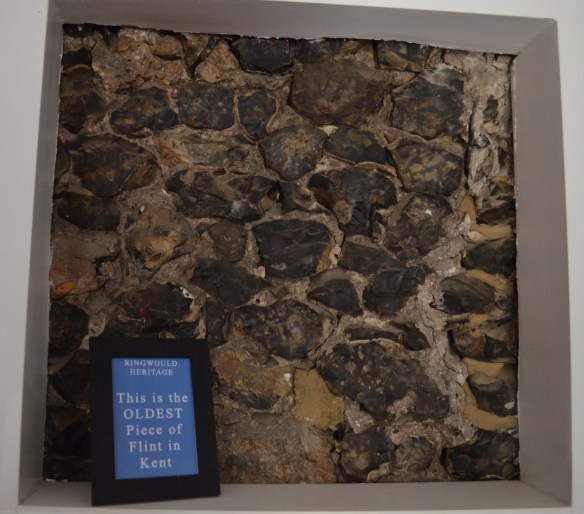
five bells flint

I’m not quite sure how they determined that this was older than the rest, but it’s just a block away from St. Nicholas Church.  This would imply that this building is perhaps older than the church, or maybe simply reflects that the flint on the church was added in the 1800s.  But, back to the church.

st nicholas ringwould nave windows crop

Entering the church, we see the stained glass windows in the chancel, where our ancestors would have watched the Catholic priests, then later the Protestant ministers, deliver the message, be it inspirational, damning or comforting.

Today, the pulpit is just outside of the chancel in the nave.  These are not the original pews, but this is where our ancestors sat.

st nicholas ringwould interior

Looking to the left, we see the alcove where the organ is found today, but would have been originally a place where candles were lit in the Catholic church to saints.

st nicholas ringwould interior left

Beautiful stained glass windows in Norman arches.  This church was built in the 1300s, with renovations in 1638 when the tower was built.

st nicholas ringwould windows crop

And of course, the sedilia, the seats for the priests, carved into the walls.  I looked for a piscina nearby but did not see one.  It could have been behind something or removed during the Victorian renovations.

st nicholas ringwould sedilia

St. Nicholas has lots of small beautiful stained glass windows tucked into arches

st nicholas ringwould windows2

st nicholas ringwould windows3

st nicholas ringwould windows4

st nicholas ringwould windows5

Of course, a window and statue for St. Nicholas, the church’s patron Saint.

st nicholas ringwould windows6

st nicholas ringwould windows7

st nicholas ringwould windows8

st nicholas ringwould windows9

st nicholas ringwould windows10

st nicholas ringwould tapestry

This beautiful tapestry hung in the church.  The message of Madonna and child is universal in the Christian world.  This is the church where Anne Woodward Estes raised her children after Robert’s passing in 1616, so the message of the Holy Mother would certainly have resonated with her.

st nicholas ringwould bapistry2 crop2

The bapistry where our ancestor, Silvester, would have been baptized, as well as some of his children.  Unfortunately, this bapistry is from the late 1800s.

St Nicholas Ringwould bapistry

Anne was buried in in the churchyard in 1630, preceded by her husband and unbaptized daughter in 1616.  The fact that her daughter was unbaptized meant that the child was either stillborn or died very quickly after birth and was therefore not named.  Later, there were at least three more Estes burials reflected in the records, none with stones that survive today.

Yes, we know that Anne, Robert and their unnamed daughter are here, in addition to Robert’s father, Sylvester, so let’s take a walk around the churchyard in the cemetery.

st nicholas ringwould yew3

Many of the stones are quite aged, from the 1700s, and this church does not appear to have removed older stones.

st nicholas ringwould churchyard

The cemetery, or churchyard, is beautiful, it’s ancient trees speaking to the age of the bones and dust that lie here as well.  There are likely burials here from at least the 1200s.

st nicholas ringwould churchyard2

Tombstones weren’t utilized until the late 1600s, but I do wonder if people took mementos and left them when visiting the graves of their loved ones.  Did Robert have an anchor on his grave or something from his line of work?  Did Robert visit his father, Sylvester, the fisherman’s grave?  Did Anne take flowers to put on her daughter’s grave that assuredly lay beside her husband?  Were all of the Estes family buried together, or scattered about the churchyard?

This yew, as well as the second one, would both have been old trees by the time that Robert and Anne died.  Did they stand in their shade.  Did Sylvester play among these trees as he grew to adulthood?  Did he court Ellen Martin here?  Kiss her maybe?

st nicholas ringwould churchyard3

These are the three windows in the chancel of the church with the yew in the side yard.

DSC_0170

The beautiful stone cross visible above.

st nicholas ringwould churchyard5

Graves not arranged, but scattered everyplace.

st nicholas ringwould churchyard6

st nicholas ringwould churchyard7

Most of these stones are illegible today.

st nicholas ringwould churchyard8

I wonder if the vacant spots were known burial locations of ancestors and were intentionally avoided, or if they just haven’t been reused.

st nicholas ringwould hollow yew

The oldest, hollow, yew.

st nicholas ringwould hollow yew2

I find this starkly beautiful and wonder if it was hollow when our ancestors lived here.  If so, you can count on the fact that the kids played here.  A hollow tree would have been unavoidably attractive to little boys!

st nicholas ringwould churchyard11

A door bricked in and no longer in use on the back side.

I don’t know what the orange bubble on the photo is beside the yew tree, above.  Some say dust on the camera lens, but others suggest that bubbles like this are spirits manifesting themselves.  If that could possibly be true, we know whose spirit is here.

st nicholas ringwould churchyard9

st nicholas ringwould churchyard10

st nicholas ringwould churchyard12

There are newer graves here, but they are off to the side.

st nicholas ringwould churchyard13

View from the second yew.  A woman we met at the church said that when she was a child, the men used the wood from the yew for arrows for archery practice.  I’m guessing that was a very old tradition.

st nicholas ringwould churchyard14

And of course, with all of these old English churches, there is always someone buried just outside the door.

We may not know where, but we know that the family rests here someplace, and we have visited them.

Anne was buried here in May 1630 after writing her will a month earlier.  She would have been about 60 years old.  Not old by today’s standards, but then the average life expectancy was about 37, although that was likely partly because of infant mortality.  In other words, if you survived childhood, you might have lived beyond 37.  For women, childbirth was extremely risky as well, but she survived all of those risks.  She clearly had some warning that the grim reaper was about to visit because she had the opportunity to make a will.  I wish the burial records told us why or how people died.

What record we do have of Anne’s will, reported by Donald Bowler who did the original research, says her will referred to 9 children. In the records above, we show 5 children living and “room” for four more.  Were those children’s baptisms simply not recorded, or were they baptized in a different church?  Perhaps the transcriptions are incomplete.  We know one set of records is from the bishop’s copies and one is from the actual church records.  Or, were the 9 children in her will actually 9 individuals, perhaps a combination of children and grandchildren?  Without her will, we’ll never know.

Obtaining Robert’s DNA Without Digging Him Up

What we do know is that Robert and Ellen Woodward Eastes’ son, Silvester, from whom I descend, married Ellen Martin in this same church.  Silvester had two sons, Abraham and Richard, and descendants of both lines have DNA tested.

Robert and Ellen also had son Matthew, who had two sons, William and John, who founded the Northern US Estes line.  We have DNA results from both of these sons’ lines as well.

This means that Robert Estes is our oldest ancestor we can confirm genetically in the Estes line.  If a male Estes, a direct descendant of one of the sons of Robert’s father, Sylvester, or grandfather, Nicholas, were to test, then we could confirm yet another generation or two up the tree – but today, we’re lucky to have Robert confirmed.  That’s 12 generations for some of our DNA participants.

When a man has descendants who test through at least two different sons, we are able to “reconstruct” his Y DNA, for the most part, based on his descendants’ values.

In our case, we aren’t limited to two descendants, we have 25 proven descendants through 2 sons and 4 different grandsons.

What does this tell us about Robert’s DNA?

It gives us the ability to reconstruct Robert’s DNA values through a process called triangulation.

When the men from Robert’s 2 sons lines all match, we know, easily, the value of Robert’s DNA at those markers. It’s the same as both sons’ lines.

When it doesn’t match, then we have to look and see if we can figure out where the mutation took place in the various lines in question, and from that, if we can usually determine the oldest ancestral value of the marker in question.

The genealogy of Robert’s descendants looks roughly like the chart below.

robert eastes gen

*See footnote 2

This chart means that Robert and Anne Woodward Eastes had two sons who are represented in our testing, Sylvester and Matthew.  Matthew had two sons, William and John, and today, several generations later, 10 to 12 to be exact, we have one proven descendant from each of those two sons whose DNA kit numbers are shown.  Robert and Anne’s son Sylvester had two sons, Abraham and Richard, noted in green on the chart below.  Richard’s descendant who DNA tested still lives in England, but Abraham was the immigrant to Virginia, and he has 22 kits with solidly proven descent to six of his eight sons.  The other two sons have tentative (unproven) links, but I did not use their information in this study because they are unproven.

robert eastes dna

You can see on the chart above that of the first 18 markers, all except three match exactly, so we can easily fill in the values for all of those markers for Robert.  Note that you can double click on the image to see a larger version.

Now, let’s look at the other three markers where mutations have occurred.

In Abraham’s case, I’m using a composite value created by using this same triangulation method.  For the other’s we have only one kit from a descending line, so we are using that value.

The first marker with a discrepancy is 391.

robert eastes marker 391

Unfortunately, determining Robert’s original value of this marker, 10, or 12, or even possibly 11 if each line mutated in opposite directions, is impossible.  Why? Because both of Sylvester’s descendants have a value of 12 and both of Matthew’s descendants have a value of 10.  This means that we have confirmation back to those men, and the mutation likely took place in the generation between Robert and his sons, Sylvester and Matthew.  To make things even more complex, some of Abraham’s descendants have a value of 11, but there are more values of 12 than of 11 in his son’s lines, so his composite has a value of 12.  This marker may simply be very prone to mutation in the Estes family.  If another of Robert’s sons’ descendants were to test, they could break the tie, but until then, we simply won’t know.

The second marker with a discrepancy is 439.

robert eastes marker 439

In this case, determining the value is possible, because even though there are three different values showing, 11, 12 and 13, one each of Sylvester’s and Matthew’s descendants have a value of 12, so Robert’s value is most likely 12 as well.  Checking Abraham’s composite, it’s clearly a 12, so no issue there.

The third marker with a mutation is 447.

robert eastes marker 447

This call is easy, because three of the 4 descendants, including both sons Sylvester and Matthew have a value of 26, so the 25 is clearly the mutation.  Therefore, Robert’s value has to be 26.

So Robert, who has been dead and buried in an unmarked grave since 1616, 398 years, can have his DNA values determined, and without digging him up!  Not that we could do that anyway.  His values are as shown below, except for marker 391 which could be either 10, 11 or 12.

Robert Eastes triang markers

Now, if I could just find someone who carries Anne Woodward’s mitochondrial DNA, I’d be ecstatic!  Of course, that would have to be descended from her through all females to the current generation where it could be a man – and yes, in case you were wondering, there is a scholarship for anyone fitting that bill!

Footnotes:

[1] Before or After the Wedding by Adrian Thatcher at http://thewitness.org/archive/april2000/marriage.html

2. Since this article was written, a third son of Robert and Anne Woodward Eastes has been documented, through son Robert Eastye and Dorothy Wilson, their son Richard born 1647who married Elizabeth Beck and subsequently immigrated to the US.  Richard died in 1737.  The descendant’s results can be viewed as kit number 264340 in the Estes DNA project.

______________________________________________________________

Disclosure

I receive a small contribution when you click on some of the links to vendors in my articles. This does NOT increase the price you pay but helps me to keep the lights on and this informational blog free for everyone. Please click on the links in the articles or to the vendors below if you are purchasing products or DNA testing.

Thank you so much.

DNA Purchases and Free Transfers

Genealogy Services

Genealogy Research

WDYTYA – How DNA Might Have Been Used – Cynthia Nixon

I do love these Who Do You Think Your Are (WDYTYA) and similar shows, because like most everyone, I love a good mystery, especially a true story – and a good genealogy mystery tops them all.

And, of course, you never know what tidbit might be lurking for your own situation.

We had a hiatus of several months since last season, so I remembered what I liked and forgot what I didn’t.  As a long-time genealogist, I find myself talking to the TV – saying things like, “You can’t assume that,” and other similar comments to rather gargantuan leaps of faith.

I have to remind myself that it IS, after all, a TV show, and a lot of research (I hope and pray) is done behind the scenes but not shown to the audience.  After all, Ancestry.com, marketing king of easy-peasy “just enter your ancestor’s name” and it will all just be here waiting for you is sponsoring this series….so it has to look quite simple and doable for the viewing audience.  I mean, who wants to know that there could be two people in the census with the same name, in the same county….yes…really.

But my real frustration last season came with the knowledge that in many cases, DNA could have been reasonably and successfully used, and wasn’t.  So, this season, I’d like to talk about how DNA might have been used.

Ancestry provides a recap of the Cynthia Nixon episode as does TLC, and it really was a good one with lots of cliffhangers, of course.  For future episodes, GeneaBloggers published a WDYTYA bingo card.  What fun!

This episode begins as a professional genealogist puts together Cynthia’s first several generations via the census and presents her with a scroll of that information.  If you’re playing WDYTYA Bingo, I think you get two points for this.  The rest of the show focuses on Cynthia’s 3X great grandmother, Martha Curnutt.

Marriage records on Ancestry.com show a Martha Curnutt marrying Noah Casto on 15 August 1839 in Missouri. But no Martha and Noah Casto appear in the 1850 census. There’s only Martha, Mary (10), Noah (7), and Sarah (6)—all under the name Curnutt. A quick count shows Noah could have served in the Civil War. And a search of military records yields pay dirt: Noah’s mother Martha applied for a pension in 1881.

That pension record shows that Noah, the father, died in 1842, and further research shows that in 1843, Martha was indicted for murder and then found guilty of manslaughter for killing her husband, Noah Casto, with an ax “between the eyes” while he slept, after he threatened her life.  If you’d like to read a discussion about murder vs. manslaughter, Judy Russell, The Legal Genealogist, who watched the show with a group of genealogists, wrote a wonderful article about manslaughter and murder and this case.  Be sure to read the comments too.

Cynthia discovered that Martha had apparently been severely abused, based on a newspaper article.  At that time, there was no protection nor recourse for abused women.

More awful still is an unnamed informant’s account that the victim “had been in the habit of treating his wife in a manner too brutal and shocking to think of.” Cynthia is devastated to learn her 3x great-grandmother endured such horrible treatment.

But Martha fared little better in prison. Convicted of manslaughter, she was the only female inmate, was abused by people she was hired out to work for, was subjected to inhumane conditions, and in the fall of 1844 gave birth to a daughter (Sarah) fathered by someone associated with the prison. It was most likely the scandal that would accompany the story of her treatment in a state facility that led to her pardon in 1845.

An article written by a former inmate details Martha’s treatment, including the fact that she was originally allowed to work for the warden at his home, but his wife, Mrs. Brown, abused her so terribly that she ran away, was returned to prison and kept in her cell being given nothing for days, which I presume means no food or water.  That was followed by the fact that “in the fall” she delivered a child.  Knowing the dates of the trial in 1843 and that the child was born in the fall of 1844, it became evident that the child was not her deceased husband’s child, and was conceived in prison.

When Martha was in labor, Mrs. Brown would not help her, nor allow anyone else to do so.  Finally, one (male) inmate was allowed to “attend her,” but nothing, not even clothing or heat in her cell was provided for the baby.  Obviously, the warden’s wife was hoping the child would die, but Sarah didn’t, nor did Martha.  The next month, Martha was pardoned by the governor over the signatures of a long list of politicians and very influential men.  Obviously, since the mother and child didn’t die, there was a scandal brewing.

So, the question is, and certainly the scandal revolves around the identity of the Sarah’s father, the child born in prison in the fall of 1844.

We know Sarah lived at least until the 1850 census, and assuming she lived to marry and have children of her own, let’s talk about DNA options.

If Sarah were a male and had male descendants to the current generation, this would be a relatively easy case to solve….but she is a female and carries no Y chromosome, which would have been passed from the father to a male child, so we can’t test that.

Therefore, our other testing alternative would be to test the autosomal DNA of a descendant of Sarah and see if any portion of the her autosomal DNA matches with descendants of the warden’s family.  This assumes, of course, that Martha was not otherwise related to Warden Brown.

If in fact, Sarah’s descendants do match the DNA of the warden’s descendants, that would be highly suggestive that Warden Brown was Sarah’s father, especially if the amount of shared DNA would be the right percentage to be about 4 generations removed, or roughly third cousins who could be expected to share about 1% of the DNA of their common ancestor.

Not all third cousins will share DNA, or not in large enough segments to be above the matching threshold of the DNA testing companies, but many will, and all we would need would be enough and proof that the DNA in question is indeed descended from the same Brown family.

Here’s my own third cousin match at Ancestry.  He and I tested intentionally, knowing we are cousins, to map our DNA to specific ancestors (at Family Tree DNA) and to see if we match other cousins (at Ancestry.)

ancestry third cousins

Of course, Sarah is not Cynthia’s direct ancestor, the older daughter, Mary is – so finding out who Sarah’s father was does not further Cynthia’s own genealogy.  Plus, testing Cynthia’s DNA would not have been beneficial other than to have a basis for comparison on Martha’s side.  But testing a descendant of Sarah would certainly have answered a burning question about Martha’s time spent in prison – and might very likely have answered the question about why Mrs. Brown obviously hated Martha enough to try to kill her in various inhumane ways; by withholding assistance while Martha was in childbirth, not to mention essentials like food and heat.

Had Sarah’s descendants taken the Ancestry.com DNA test, especially if they had entered the warden’s name as a potential ancestor in their tree, they might well have discovered that they had “shakey leaf” hints that connected them with other people who descend from Warden Brown’s family.  If they were lucky, an actual descendant of Warden Brown himself would have tested and they would match.  In fact, maybe the producers could have found a direct descendant of Warden Brown who was interested in revealing the truth, whatever it was.

However, without a chromosome browser or any other type of comparison tools, they would be unable to prove that the match to that individual was indeed Brown family DNA – and they would have simply have to infer, allow you to believe, that the genetic match was the same as the shakey leaf match.  You can see, above, that Ancestry skates on this issue by saying “it looks like you have a shared ancestor.”  Indeed it does, but that doesn’t mean the shaky leaf ancestor is the one that you share genetically.  However, given the other leaps of faith in the series, I doubt that this “little detail” would have deterred the storyline much.  And indeed, it would have been very interesting.

In order to prove the genetic connection, one could have the people who tested, and matched on the Brown line, download their results to www.GedMatch.com and compare their actual DNA segments there.  They could also transfer their DNA to Family Tree DNA who does have comparison tools.  Of course, that opens the door to DISPROVING the shakey leaf “tree” match as well as proving it, and it’s certainly not in the same spirit or as easy as just accepting, on faith, the “shakey leaf” hint as fact.  DNA Genealogy wrote a nice summary of Ancestry.com vs GedMatch here and why those “shakey leaf” first impressions are sometimes not correct.

Am I the only one who thinks Warden Brown is the most likely candidate to be Sarah’s father?????  Whoever the father was, he was certainly important enough to warrant a pardon for Martha.  That is the one good thing in the landslide of evil that haunted Martha Curnutt.  I hope the rest of her life was much easier.

______________________________________________________________

Disclosure

I receive a small contribution when you click on some of the links to vendors in my articles. This does NOT increase the price you pay but helps me to keep the lights on and this informational blog free for everyone. Please click on the links in the articles or to the vendors below if you are purchasing products or DNA testing.

Thank you so much.

DNA Purchases and Free Transfers

Genealogy Services

Genealogy Research

Finding Your Inner Neanderthal with Evolutionary Geneticist Svante Paabo

Svante Paabo is the father of ancient DNA extraction, beginning many years ago with Egyptian mummies. His lecture style is wonderful and understandable. I would love to attend one of his lectures. Today, he is one of two tenured professors in Evolutionary Genetics at Max Planck in Germany.

His speech if in conjunction with the opening of the exhibition of “Genome, Unlocking Life’s Code” at the National Institute of Health.

Archaic Genomics – this video is very similar to the one above although the Q and A at the end is different.  So if you watch the first one, then in the second one, just skip to the end of his lecture.  There Q&A is very worthwhile in both of these videos.

neanderthal manSvante Paabo documented his path to the Neanderthal genome in his marvelous book, Neanderthal Man: In Search of Lost Genomes recently published. It’s an amazing book, written in a very personal and approachable manner and easily understood by the non-scientist. It’s an amazing story and we’re lucky to have Dr. Paabo to share it with us.

If you carry Asian or European DNA, you have Neanderthal ancestors, and you’ll want to watch these videos and read this book.

______________________________________________________________

Disclosure

I receive a small contribution when you click on some of the links to vendors in my articles. This does NOT increase the price you pay but helps me to keep the lights on and this informational blog free for everyone. Please click on the links in the articles or to the vendors below if you are purchasing products or DNA testing.

Thank you so much.

DNA Purchases and Free Transfers

Genealogy Services

Genealogy Research