There are just too many Daniel Milles in Montgomery County, Ohio in the early 1800s, all Brethren, of course, and therefore, running with the same crowds and very difficult to tell apart.
In order to sort through the confusion surrounding the various Daniel Millers, and who they are related to, and how, I’ve numbered them. This must be the German trait for love of organization coming out in me:)
Daniel (1) is the subject of this article and my ancestor. Daniel Miller was born to Philip Jacob Miller and his wife, Magdalena, whose last name is unknown, on April 8, 1755 in Frederick County, Maryland. Daniel was married to Elizabeth Ulrich and died in Montgomery County, Ohio on August 26, 1822. Those are the easy dates. The rest are difficult.
Daniel (2) arrived in Montgomery County from Huntington County, PA. Daniel (2)’s wife was Susanna Bowman and Daniel (2) lived in what would become the City of Dayton proper where he settled on Wolf Creek in November of 1802, according to the History of the City of Dayton and Montgomery County, Ohio, Volume 1. For those specifically interested in this line, the Brethren Heritage Center has an article available written by Gale Honeyman.
Daniel (3) is the son of Daniel (1). According to the family Bible he was born on March 30, 1779 and he died on June 25, 1812. He would have been 33 years old, and unless he was disabled in some way, he was likely married and may well have had children. He would only have been about 20 when his father Daniel floated down the Ohio on a raft, probably in 1799. Daniel (3) could have remained in Clermont County when his father and uncle, David Miller, left for Montgomery County sometimes around 1802. There is no mention of an estate for Daniel (3) in Montgomery County.
Daniel (4) is the grandson of Daniel (1) through his son Stephen Miller. Daniel (4) was born in 1797 in Bedford County, PA and died in 1879 in Preble County, Ohio.
Daniel (5) is the son of Michael Miller and Salome Cramer of Montgomery County. Michael is the son of David Miller who died in 1845. David was the brother of Daniel (1). Michael obtained and farmed his father’s farm in Randolph Township. Daniel (5) was born in 1822, died in 1903 and was married to Isabella Cook.
Daniel (6) is the grandson of Daniel (1) through son Jacob A. Miller born in 1776 who married first to Elizabeth Metzger and second to Catherine Zimmerman. Jacob farmed his father’s land in Randolph Township past 1851 and likely until his death in 1858. Jacob’s son Daniel (6) by his first wife was born about 1800, married Susanna Hardman on November 1, 1819 and died about 1835 in Montgomery County.
Daniel (7) born in 1815 is the son of Isaac Miller, son of Daniel (1) and his wife Elizabeth Miller who is the daughter of David Miller, brother of Daniel (1). I know nothing more about Daniel (7).
Daniel Y. (8) born in 1808 is the son of John Miller, son of Daniel (1). John’s wife Esther Miller, daughter of David Miller, brother of Daniel (1). Daniel Y. (8) married Margaret Bainter and died in 1833.
Daniel (9) is the son of Daniel (2) and his wife, Susan Bowman. Daniel (9) was born about 1808 and died about 1863 in Montgomery County, marrying Susan Oliver.
Daniel (10) is the son of the Elder Jacob Miller by either his first or second wife, who are unknown. This Daniel was born on September 6, 1780 and died on November 15, 1858 in Monroe County, Iowa. Daniel (10) married Elizabeth Shidler or Shideler on April, 13, 1808 in Montgomery County, Ohio, but by 1813, it appears that they had moved on to Union County, Indiana. When Daniel lived in Montgomery County, he owned land near the 4 Mile Church, east of Cottage Creek, about one and one half miles west of the Lower 4 Mile Church.
Y DNA testing has proven that the Elder Jacob Miller and Johann Michael Miller lines were not related through their paternal Miller line.
Therefore, Daniel (2) and (9) are related to each other, but probably not the rest of the Daniels. We know that Daniel (10) is not related to the Daniels descended from Philip Jacob Miller (son of Johann Michael Miller) because Y DNA testing eliminated that possibility. If a Miller male descendant of Daniel (2) or (9) were to test, we could determine if that Miller line shares a common male ancestor with either the Elder Jacob Miller of Johann Michael Miller lines. Please note that you can click on any of the graphics to enlarge.

Judging from 5 grandsons names Daniel Miller, Daniel who died in 1822 was both well-loved and well-remembered. I wonder if there are any Daniels today who still descend through a line of Daniels, named for the original Daniel Miller.
Let’s take a look at the life of Daniel Miller (1), the subject of this article. For a Brethren man with no church records to depend on, we’ve amassed a huge amount of information – probably because I had to dig so deeply and in such obscure places to find hints about his life. This was not a short process. I’ve worked on Daniel for at least 20 years now. And he has frustrated me for all of those 20 years!
Having said that, and having FINALLY finished researching Daniel’s life, he is one of my most interesting ancestors. The fact that I was able to track him across the country, on four different frontiers, and that he managed to survive in the middle of multiple wars and Indian attacks, a Brethren man unwilling to defend himself, is nothing short of miraculous.
Make yourself a pot of coffee or tea, and come along on this most amazing journey…
Daniel Miller (1), the Amazing Brethren
Daniel Miller was born to Philip Jacob Miller and his wife, Magdalena, whose last name is unknown and probably not Rochette, on April 8, 1755 in Frederick County, Maryland. We know this for a fact because both Philip Jacob Miller and Daniel Miller had a family Bible and Daniel’s birth is recorded in that Bible, along with those of his siblings.
In fact, the Bible that was once believed to be the Philip Jacob’s Bible wasn’t the original Bible, and was recopied at some point and found in the possession of Daniel – so it may have been recopied specifically for Daniel. You can see that the entries for Philip Jacob’s children look to be in the same writing, probably copied at the same time – although the copying may well have been done by Philip Jacob himself.
Daniel, along with his parents and grandparents were members of the Brethren faith, which means that there are no church records available today to help with our search. It also means that other records, such as marriages, deeds and wills were sporadically filed, since Brethren by and large tried to avoid courthouses, avoided having to swear an oath having to do with anything, or fees of any kind. So we are exceedingly lucky to have this Bible – otherwise we would know much less about the Miller family.
Let’s take a look at that wonderful Bible and see what secrets it holds for us.
The Philip Jacob Miller Bible
First, this Bible is simply stunningly beautiful.

Philip Jacob Miller probably sat in front of his fireplace in his home on Ash Swamp, about the time of his father’s death in 1771, reminded of his own mortality, and dutifully wrote the names and dates of his children’s births into his new Bible. His old Bible may have been destroyed during the two evacuations of Frederick County during the Indian Wars. If the old Bible was left behind in a hurried exit, it assuredly burned when the houses and barns were torched. Regardless of why, Philip Jacob Miller obtained a new Bible about the time his father died. We know Philip didn’t purchase the Bible before 1770, because that is the printing date, in Germany.

On February 11, 2009, I was fortunate enough with some hints and sleuthing to find the Philip Jacob Miller Bible in Elkhart, Indiana. The custodial family, who has no idea how the Bible originally came to be in their family, has taken wonderful care of the Bible and allowed it to be photographed.
Both the custodial family and I spent a significant amount of time trying to figure out how they came to be in possession of the Miller family Bible, which they greatly cherish as a family heirloom. I suspected a second marriage or something of that sort, but the only connection we could find was that their family bought a house that was in a John Miller family. Although further research suggests that John Miller is not from our line. However they obtained it, thank goodness they do cherish it, because that’s the only reason it still exists today.
Upon arriving to visit the Bible, another surprise was awaiting me, as the front section holds the children’s birth records of Philip Jacob Miller, and the back holds the same for the children of Daniel Miller, son of Philip Jacob Miller. Given a signature in the Bible, along with Daniel’s estate records, Daniel’s son John was the next custodian, taking the Bible to Elkhart County, Indiana, where he subsequently settled. This John Miller is NOT the same John Miller that the custodial family’s ancestors bought the house from.
This Bible was printed in 1770, but the first child’s birth recorded is in 1752, and Philip Jacob’s children are not entered in birth order. Furthermore, the handwriting in the back matches Daniel’s exactly. This tells us that this Bible is probably not the original Philip Jacob Miller Bible. One look at what happened in Frederick County, Maryland in 1750s and 1760s and we’ll quickly understand why.
The residents all evacuated twice and their houses were burned. If the family Bible didn’t manage to somehow get put in the wagon as the family was evacuating, then it burned. The Miller family was back in the region by 1765 when Michael Miller, Philip Jacob’s father, was deeding land, but I’m guessing a new Bible didn’t get purchased until after Michael’s death in 1771. Perhaps Philip Jacob thought the purchase of a new Bible would be a fitting remembrance for funds received after his father’s death. Or maybe Michael bought it for Philipp Jacob. Or perhaps Philip Jacob bought a Bible for each of his children when they married or when they left the area. We’ll never know. I’m just thankful this one still exists.
A single entry gives away the subsequent owner. Beside the first entry in the Bible, which is the birth of Daniel in 1755, there is another entry which says “1775 Daniel Meines Sohn Sohn zur Welt geboren” (my son’s son was born into this world). In the back portion, we show the birth of Stephen in 1775, the eldest son of Philip Jacob’s eldest son Daniel. An earlier 1947 translation (apparently before the tape was applied) says “my grandson was born March 7, 1775”, which was obviously translated before the tape was applied, and matches exactly with Daniel’s own entry of his son’s birth.

The fact that this entry says “My son’s son” tells us that in 1775, Philip Jacob indeed was in possession of this Bible, so it was not given to Daniel for his marriage in 1774 and did not travel with Daniel to Bedford County in 1775. Philip Jacob was recording the births of his grandchildren.
This photo is me holding the Bible. What a glorious day.

The following page is the front inside page with Philip Jacob’s children’s births recorded.

The births are recorded as follows:
- My son Daniel Miller was born at 4 o-clock at night April 8, 1755. He died August 26, 1822.
- My daughter Lidia was born at 3 o’clock at night, December 18, 1754. The zodiac sign was the Waterman (Aquarius).
- My son David was born December 1, 1757, at 3 o-clock at night. The zodiac sign was the lion (Leo).
- My daughter Susannah was born March 2, 1759, at 7 o’clock in the morning. The sign was the Bull (Taurus).
- My daughter Christine was born December 4, 1761 at 10 o’clock in the forenoon, the sign was the Fish (Pisces).
- My daughter Mariles was born — 1762 at 8 o’clock in the morning. The sign was the Virgin (Virgo). (Virgo runs from September 17 to October 17)
- My son Abraham was born April 28, 1764.
- My son Solomon was born March 20, 1767.
- My daughter Ester was born February 13, 1769.
I find it interesting that Michael recorded the astrological signs for the births of some of his children, but not all. I’m not at all sure of the significance of the signs, if any.
The following page is the inside back page recording the births of Daniel’s children.

The first entry is that of Daniel himself, again, and the second entry is that of his sister Lizbeth born in 1752 who was not recorded on the page with the rest of Philipp Jacob Miller’s children.
- Lizabeth Miller was born in April 1752.
The fact that Elizabeth was omitted suggests a recopy after all of the children were born in 1769. Daniel’s children begin after Lizabeth Miller’s entry, so the Bible appears to have been recopied after 1770 and before 1775.
The only other possibility is that Lizabeth Miller in the Bible was referring to Elizabeth Ullery (Ulrich) Miller, Daniel’s wife, not Daniel’s sister, Elizabeth. I don’t believe that to be the case because Lizabeth is actually referred to in the Bible entry as Elizabeth Millerin, which indicates a maiden name of an unmarried woman. We know that Philip Jacob did indeed have a daughter, Elizabeth, because she married Jacob Shutt or Shott, both signing the agreement between siblings as to the land distribution of Philip Jacob Miller after his death in 1799.
This Bible survived the trip west in a wagon, then floating down the Ohio River. This Bible has been wet one or more times. We know that in the early 1800s, this Bible went to Clermont County, Ohio, then Montgomery County, Ohio, then in the 1830s, to Elkhart County, Indiana where it remained for the next 177 years or so. An amazing journey for a Bible!
The top back entry for Daniel also has his death entry beside it to the right in a different hand and ink.

Following those entries we find Daniel’s children. Oddly, we find no other deaths recorded, nor marriages. It pains me greatly that there is no information for Daniel’s wife, Elizabeth Ulrich, or her parents.
Daniel’s children are recorded as follows:
- My son Stephen was born March 1 (or 7) 1775
- My son Jacob was born November 20, 1776
- My son Daniel was born March 30, 1779. He died June 25, 1812.
- My son David was born July 30, 1781.
- My son Samuel was born March 17, 1785.
- My son Johannes was born December 15, 1787.
- My son Isaac was born December 8, 1789.
- My son Abraham was born March 16, 1794.
- My daughter Elisabeth was born April 2, 1796.
We do find the signature of Daniel’s son, John, in the Bible twice, once at the bottom of the back page (shown second image above) and once a few pages inside the front on a water-stained page. I wonder why John never recorded his children’s births in the Bible as well. There was clearly a blank page available.

It looks like Philip Jacob Miller and his wife lost a child in 1756, as there is a child born in April 1755 and then not another one until 2 and a half years later, suggesting that they lost a child about September 1756. 1756 was the year that the Brethren were evacuated and was reported to be the worst of that time. Did Magdalena have that child in a wagon perhaps? We are left to wonder what happened. One thing is for sure, that child’s death and the grief it brought to the family would have made whatever else was happening in 1756 even worse. For all we know, that child may have had to be laid to rest along the roadside someplace in an anonymous grave.
Daniel and Elizabeth also have a nearly 5 year gap between children born in 1789 and 1794. It looks like they lost at least one if not two children during that time.

The beautiful leather and metal workmanship on this Bible is just incredible. I can just see both Philip Jacob and Daniel lovingly handling the same Bible I held and lovingly opened too, to step back hundreds of years into their world.
Bible Chain of Possession
The strange thing is that the custodial family has no, and I mean no, idea how they obtained this Bible in the first place or if or how they are related to the Miller family. I did some research as well, and for them to be related looks virtually impossible.
Here’s what I have between the custodial family, their research and mine:
This Bible was handed down from:
- Mollie Knopp Rupp to
- Sophia Rupp Rowe to
- George Rowe
- Chester Rowe
- William Rowe Beardsley (sister of Chester) and then we’re down to the last couple of generations.
This is documented on a paper with the Bible.
So I started by finding Sophia. The Bible would have come into that family’s possession above Mollie Knopp Rupp for her to have passed it on.
The 1880 Elkhart County census shows Sophia with husband Benjamin. Sophia was born in 1843 in Ohio and her parents were born in Pennsylvania.
Her son George was born 1876. Benjamin Rowe was born in 1843 in Indiana.
Benjamin Rowe is the son of either Peter or Henry (two census look different) and wife Eliza both born in PA in 1815. According to their children’s ages, they were in Ohio between 1838-1842 then moved on to Indiana. Of course, Eliza could be a second wife.
We find Sophia with her father George Rupp who was born in 1805 in PA along with his wife, Magdalena, born in 1807 in PA. They migrated to Ohio from PA between 1831 and 1838 according to kids ages, and were still in Ohio in 1844, but in Elkhart County by 1850. They were also not living near the Millers in Elkhart County, and they were all grouped together in Concord Township.
According to the document, Mollie Knopp Rupp would be Magdalena Rupp, wife of George so Mollie would be a nickname. I could find no Mollie’s. There is nothing on Rootsweb, nothing on Ancestry and neither can I find anything with the name Knopp, Rupp or Rowe in the Miller book by Mason.
My issue with all of this is that there is no reasonable opportunity that I can see for the Bible to get from the John Miller (son of Daniel) family to Mollie Knopp Rupp, but yet it did. We know that Daniel had this Bible until his death in 1822 when it was purchased by John from Daniel’s estate, we know where this Bible was until the 1830s when the first Miller settled in Elkhart County, probably the 1840s and possibly as late as 1856 when John Miller died. This Bible was the second highest item in price at Daniel Miller’s estate sale, so obviously quite valuable to his son John.
Of course, we can’t determine what happened to his Bible after John’s death, but given that he paid top dollar for this Bible, it’s very unlikely that he intentionally allowed it to exit the family. John Miller and his wife Esther Miller were first cousins and both descended from sons of Philip Jacob Miller, meaning the Bible had personal significant to both of them. John Miller died first in 1856 and Esther lived with her son Jacob until her death in 1861. I suspect that the Bible never entered the estate and may have been inherited by son Jacob by virtue of the fact that his mother was living there when she died. Jacob died in 1872.
In the 1880 census, Magdalena and George Rupp who are age 72 and 75 are living beside John W. Miller, age 43, born in Indiana, in Concord Twp. John’s wife is Mary Stutsman, age 48, children Cyrus 19, Manerva 17, Ira 16, Lewis 14, Ortha 11, Edward 5 and Lawrence 3. John is reportedly the son of Jesse Miller, born in 1809 in Pennsylvania and who married Lucy Dalrymple. So if John W. Miller is related to our Miller line, his line never went to Montgomery County, nor is there a connection that I can discern aside from the fact that his wife was a Stutzman, a family long associated with the Brethren Miller family.
The man who owns the Bible presently has a note that says: Bible was passed from Mollie Rupp to Sophia Rupp Rowe to George Rupp. George was his grandfather and the Bible owner tells me that his grandfather “bought the Miller farm.” Apparently from the plat map, that was the Miller farm that belonged to John W. Miller that was beside Magdalene (known as Mollie) and George Rupp in the 1880 census.

I have simply found no reasonable explanation for how the Bible came into the possession of the current family, sometime after John Miller settled in Elkhart County and died, in 1856, and Mollie Knopp Rupp’s death at 88 years of age in 1896, when she passed the Bible to her daughter. Sophia. If anyone ever solves this mystery, I’d love to know.
Let’s go back to Frederick County where both the Bible and Daniel had their beginnings.
Frederick County, Maryland
Daniel Miller’s parents had moved to Frederick County, Maryland with a group of Brethren settlers from York Co., PA in 1751 or 1752, so by the time that Daniel was born, in 1755, they would have had at least some land cleared and been farming in Frederick County, at least in some capacity, for 3 or 4 years.
Stephen Ullerick or Ullery was the first Brethren to settle in this area in 1738 and is the father of Elizabeth Ulrich, Daniel’s eventual wife.
We’re actually assuming that Daniel was in fact born IN Frederick County, because we don’t know otherwise. I know that’s an odd statement to make, but Daniel was born in April of 1755 just before his father, Philip Jacob Miller, had his land resurveyed in May. In July, General Braddock was defeated, leaving the entire frontier exposed. The residents evacuated and left Frederick County and surrounding areas, for approximately six years, returning to find their farms destroyed, their buildings burned and of course, their livestock long gone. Given that we know Philip Jacob was still in Frederick County in May, it stands to reason that Daniel was born there the previous month.
The Brethren, of course, being pacifists, would not defend themselves. Many died. In the fall of 1756, 20 people were scalped in the Conococheague Valley, which includes the area where Philipp Jacob Miller lived, including one Jacob Miller, relationship, if any, unknown. By August, the entire valley was vacant, except for two families, according to a report received by George Washington.
We don’t know where the Miller family went when they evacuated, but Daniel spent his early years with his family wherever they lived. They may well have gone back east to join other Brethren settlements that were less endangered.
The French and Indian War ended officially in November of 1758 and Indian attacks had diminished by 1762.
We also don’t know when the Miller family returned. Certainly not before 1759, and we know they were back by 1761 when Daniel’s grandfather, Michael Miller, was purchasing land.
Daniel would have been 6 years old in 1761, so while he certainly didn’t remember the evacuation when he was 4 months old, or maybe slightly older, he probably did remember returning to Frederick County. To him, it wasn’t a return, but the first time he laid eyes on the land that his father owned, originally purchased by his grandfather. I wonder if Daniel’s parents cried when they saw what had become of their home.
There is no sign today on this essence-of-Americana landscape of the bloodshed and terror that took place on this gently rolling farmland owned by Philip Jacob Miller with the mountains in the distance, foreshadowing the future.

This is the land where Daniel grew up, looking at those mountains. One has to wonder if the boy ever dreamed of crossing them, or wondered what was on the other side. The mountains were probably equated with danger when he was a child.

Braddock’s Road
The land that General Braddock was fighting for, between Frederick County, Maryland and what is today Pittsburgh, PA, then Fort Duquesne, would be a very important road in the history of the Miller family, 20+years down the road, pardon the pun, and again, 40 years into the future.
While General Braddock was killed in 1755, a victim of his own insolence and unwillingness to heed the advice of men who knew Indian war tactics, General Forbes picked up the ball and came up with a strategic plan. Were it not for Forbes, we might all be speaking French today.
In 1758, General Harris extended a road from Harrisburg, PA to Fort Duquesne on the Ohio River (Pittsburgh.) Highway 30 follows this road most of the way today.
Forbes road went from Cumberland to Bedford and by August 1758, 1400 men had completed the road to Bedford, just wide enough to get a wagon through. A contemporary writer said it took 8 days to travel from Bedford to Ligonier, a distance of about 45 miles. This military strategy succeeded. General John Forbes took Fort Duquesne, now Pittsburg, the French abandoned it, and ended the French and Indian War on November 25, 1758. Indian attacks diminished and by 1762, the French had given up Canada. Replogle 107-108, 110

There is one item of particular significance – during the war, a small fort was built at Raystown, which would eventually become Bedford, PA, a location that would, in the 1770s and 1780s, become quite important to the Brethren Miller family. It was the next stop on the frontier and four of Philip Jacob’s children, including Daniel Miller, would find themselves traveling that road and settling in in Bedford County, Pennsylvania for a few years, at least until their father rallied the family round once again.
Philip Jacob Miller would eventually follow Forbes old road, as would his son Daniel, to Pittsburgh, then down the Ohio River to Campbell Co., KY, where Philip Jacob Miller would settle one last time – this time, with his adult children – in a place where he could purchase land for each of them.
But before Daniel Miller can do any of that, he has yet to grow up – and that he did in Frederick County. But things were not always peaceful and his life was probably far more exciting that a little Brethren boy would have wished.
Pontiac’s War
After returning to Frederick County after the long evacuation caused by Braddock’s defeat, the years of 1761 and 1762 were probably spent rebuilding homes, barns and sawmills, trying to normalize life once again. Sunday would bring church services, held in one of the homes or barns of the Brethren families. Life slowly returned to normal as the seasons changed, but then, once again, they had to run for their lives.
Pontiac’s War descended upon them and from 1763 to 1765, the Brethren families in this area had to take shelter elsewhere. According to historical records, the devastation and fear was even worse than the first time. And true to form, we don’t know where the Miller family went, or for how long. What I wouldn’t give for a journal…even just one sentence a week…anything.
The Maryland Gazette, written at Frederick on July 19, 1763 said:
The melancholy scene of poor distressed families driving downwards through this town with their effects…enemies, now daily seen in the woods….panic of the back inhabitants, whose terrors at this time exceed what followed on the defeat of General Braddock.
Ironically it also reported that the season had been remarkably fine and the harvest the best for many years.
Once again, Frederick County put together two companies of militia and once again, no Brethren names appeared on the list. Replogle 113 – 114
By this time, Daniel would have been eight years old. Was he thrilled at the excitement, or terrified? Did he understand the imminent danger, or did his parents attempt to shelter the children? Was there any sheltering the children from something like that?
Perhaps the entire group of Brethren returned to Conestoga. Conestoga is near present day White Oak in Lancaster County, PA and both Conestoga and Conewago, another Brethren settlement, aren’t far from the Brethren settlement in Ephrata. It would make sense for the Brethren to return to areas they knew and relatives with whom they could shelter for as long as need be.

I suggest this possibility because we know that two Brethren, Nicholas Martin and Stephen Ulrich, are found attending the Great Council of the Brethren in Conestoga in 1763. Where you find one Brethren, or a group, you’re likely to find more – and we know that Stephen Ulrich lived in Frederick County.
By 1765, we know that the Millers are back in Frederick County once again, because Daniel’s grandfather, Michael Miller is selling land to his children.
Daniel would have been 10 by this time, certainly old enough to help. Once again, the homes and barns would have needed to be rebuilt – and you can rest assured that Daniel did what he was capable of doing. On a farm, every able hand helped, from the youngest to the oldest.
Beyond the Allegheny Mountains

Pontiac’s defeat served to make the lands west of the Allegheny Mountains, the ones seen in the distance, standing on Philip Jacob Miller’s land, safe, or safer, anyway, for settlement. Events began to happen that enabled the settlement of these areas. The British government bought large tracts of land from some Indian tribes, but unbeknownst to them, they were not negotiating with all of the interested parties, and new raids ensued.
It would take decades for the European takeover of the Native lands to be complete. But settlers didn’t wait on that eventuality. In 1755, the first Brethren settlers found their way to Bedford County, Pennsylvania, an area that would soon attract other Brethren as the next frontier. Why people who would not defend themselves continued to put themselves in harm’s way is beyond me, but they did consistently on every frontier.
Johann Michael Miller’s Death
Daniel would have been 16 or 17 when his grandfather, Johann Michael Miller, died. This family had been close, evacuating twice together, and returning together. Michael Miller had purchased the land eventually owned by Philip Jacob and his brothers, John and Lodowich. This, of course, is the land where Daniel grew up. The fields he roamed. The lands they left and returned to, twice, and built upon, three different times.
Daniel would have known his grandfather well, and he would have wept at his graveside, probably on the now missing cemetery on his uncle John’s land, the farm next to his father, Philip Jacob Miller. The patriarch was gone – the original German immigrant – the original Brethren in the family – the anchor.
There was one less thing to hold Daniel in Frederick County.
Marriage
We don’t know exactly when Daniel Miller married Elizabeth Ulrich, but we can estimate based on the birth of their first child, conveniently recorded in the Bible.
Their first son, or at least the first child recorded in the Bible was born on March 1, 1775. This would have been slightly less than a month before Daniel’s 20th birthday, so it’s safe to say this was their first child, and that Daniel and Elizabeth were married sometime in 1774. Most brides were pregnant shortly after marriage, so a child born in 1775 would be expected.
Unfortunately, Brethren marriages were generally not recorded civilly and were simply performed by the Brethren clergy.
Alexander Mack, the son of the founder of the Brethren movement, on Feb. 14, 1776 says that he is shunning his daughter Sarah because “she married outside of the brotherhood; secondly because [the marriage] was performed with a license; and thirdly because her husband had not quite completed his apprenticeship….” Replogle 70
This certainly explains why we have so few Brethren marriage records.
We know that Daniel did marry Elizabeth Ulrich, daughter of Stephen Ulrich Jr. and wife Elizabeth, whose last name is unknown but said to be a Cripe/Greib (without any documentation that I’ve been able to find.) We’re fortunate that when Elizabeth Ulrich’s father, Stephen Jr., died and the heirs sold his land in Washington County (formerly Frederick), Maryland in 1785, Daniel Miller is listed as one of the signing heirs.
Furthermore, the Miller, Stutzman and Ulrich families had a close relationship, not only here in the US, but in Germany where they are found together as well. However, that part of the story must wait for another day, specifically, until the German research is finished.
The Revolutionary War
In 1775, about the time that Daniel’s first child was born, the Revolutionary War broke out and Frederick County, Maryland was in the midst of the conflict. A notoriously bad place to be for a Brethren family, especially a newlywed family with a new baby.
The Revolutionary War begin in April of 1775 when British troops and American Minutemen clashed at Lexington and Concord. When this news reached Pittsburg and the western counties, military companies were formed. Donald Durnbaugh, noted Brethren historian, says that about one third of the populace remained loyal to the English government, one third favored the Revolution and the final third tried to maintain an uneasy neutrality. Many Germans, especially, opposed the war. They felt that “the English government had allowed them to settle in the rich land of America and spared them the harsh feudal exaction of the princes of Germany and the city governments of Switzerland which had caused them to migrate. Furthermore, British taxes had little effect on subsistence farming.
Those volunteering for the colonist causes were early called Associators, later called Militia Companies. The Committee on Observations made lists of those not participating, whether Loyalist or members of the Peace Churches, and they were called non-enrollers or Non-Associators.
In 1775 Congress required all able-bodied men between the ages of 16 and 50 to join militia companies. “Non-Associators” could hire replacements. But Frederick County was less liberal. In Hagerstown, the Committee of Observation proclaimed that rights required responsibilities and on Dec. 18, 1776, “resolved that the Dunkard and Mennonists” pay fines for non-participation. They also had to march with the militia to help with intrenching and to care for the sick. Non-compliance would result in “rigorous measures … immediately taken.” Mennonites and Brethren petitioned to substitute produce for cash. Some had already contributed blankets and rugs.
Early in the Revolution, Mennonites, Dunkers and Quakers were given freedom to remain true to their peace positions of non-violence, but in return they would pay an additional tax of 2 shillings and 6 pence per week. This was granted at Philadelphia and Annapolis for all of PA and MD but it was carried out in the local towns and villages. Local Committees were free to make their own rules and interpretations.
Floyd Mason, in his book, “The Michael Miller and Susanna Bechtol Family Record,” tells us what he discovered about the Brethren in Frederick County during the Revolutionary War.
During the Revolution, the colonists held their national conventions and appointed certain committees of local leaders to carry out local responsibilities. In PA and MD, the main committee was the Committee of Observation who had the responsibility for raising funds to promote the war, select its leaders and furnish themselves with one committee member for each 100 families. This committee had full power to act as it saw fit, answered to no one and there was no appeal of their decisions.
The war issues divided the people’s loyalty. About one third favored the revolution, one third were Loyalists or Tories who favored the English and one third were neutral or did not believe in this manner of settling the issues. This threw the Quakers, Mennonites and Dunkers in with the Tories or Loyalists and in opposition to the efforts of the Committee of Observation, at least as the committee saw it.
The Brethren churches were bringing discipline to bear on members who did not follow the historic peace teachings of the church. Annual Conferences were held each year and members were asked to remain true to the Church’s nonviolent principles, to refrain from participating in the war, to not voluntarily pay the War taxes and not to allow their sons to participate in the war. This caused a lot of problems for the church members who wanted to be loyal to the church, loyal to the Loyalists who had brought them to the new country and loyal to the new government which was emerging.
As the war wore on and it looked as if the patriots efforts might lose, emotions raged. Non-Associators found themselves having to pay double and triple taxes. Their barns were burned, livestock stolen or slaughtered and their crops destroyed. They were often beaten and “tarred and feathered.” Church members came to the aid of those who endured the losses.
Some members chose not to pay the war taxes or participate in the war activities and chose to wait until the authorities came and presented their papers to have taxes forced from them. This was in compliance with the Church of the Brethren Annual Conference Action. The Committee of Observation provided that non-Associators could take as much of their possessions with them as they could and then they would seize the property and remaining possessions and sell them to fill their war chests.
During this time, the Revolutionary War was taking place and the Brethren would take an oath of loyalty, but would not belong to a militia unit nor fight. Many non-Brethren residents suspected them of secretly being allied with the Tories and resented their refusal to protect themselves and others. Laws of the time allowed for the confiscation of property of anyone thought to be disloyal. Records of this type of event have survived in the oral and written histories of some of the Brethren families, in particular some who migrated on down into the Shenandoah Valley. Perhaps others thought it wise to move on about this time as well.
Taken from several sources, these are some of the names of non-Associators and others who were processed by the Committee of Observance that are descendants of Johann Michael Mueller (Jr.) who died in 1771.
- Samuel Garber who may have married one of Michael Miller’s daughters, and their sons Martin and Samuel Garber
- Jacob Good, Michael’s step-daughter’s husband
- John Rife, Michael’s step-daughter’s husband
- David Miller, the son of Philip Jacob Miller
- Michael Wine, married Susannah, the daughter of Lodowich Miller, son of Michael Miller
- Jacob Miller, son of Lodowich Miller
- Abraham Miller, relationship uncertain
- Another source lists Elder Daniel Miller, stated as Lodowick’s son, as being fined 4.5 pounds.
Susannah Miller Wine told her children and grandchildren that Michael Wine, Jacob Miller, Martin Garber and Samuel Garber had their property confiscated by the authorities for remaining true to the non-violent principles of their church.
Lodowich Miller’s family group removed to Rockingham County, VA about 1782 or 1783.
William Thomas, on the Brethren Rootsweb list in 2011 tells us:
I have a copy of the 1776 non-enrollers list for Washington County, MD, that lists “Dunkars & Menonist” fines. The list includes Abraham Miller, David Miller, and David Miller son of Philip. It goes onto list an appraisal of guns (whatever that means) in 1777 and includes a Henry Miller.
Point being there were several Miller’s in Washington County, some of who were Dunkers or Mennonites, a name common to both denominations.
If you move to the 1776 non-enroller list for Frederick County, MD, you have even more Millers. You have Jacob Miller, Jacob Miller s/o Adam, Abraham Miller, Peter Miller, Stephen Miller, Solomon Miller, Robert Miller, Henry Miller, Philip Miller, David Miller and Daniel Miller, all fined, and implying a Dunker/Mennonite/Quaker religious affiliation.
Washington County, Maryland was formed in September 1776 from the portion of Frederick County where Philip Jacob Miller lived.
In March 1776, Congress declared adherence to or support of the British King as “high treason,” so the stakes became even higher for the Brethren.
Dunkers were taken into court and fined in 1776. It is stated that Maryland Dunkers fared better than Pennsylvania Dunkers and that is perhaps why many of them moved from York Co., PA to Maryland in the 1760s.
When they did not pay their fines officials confiscated their land, sold it and paid their fines for them. Some say that the court gave them permission to destroy these records and therefore the records of some of these confiscations are not available.
- Elder Jacob Danner – 10 pounds
- Eld Samuel Danner, son of Jaob Danner – 6.5 pounds
- Elder Martin Garber so of John H. Garber, 7.5 pounds – then remitted
- Elder Samuel Gerber son of John H, – 6.5 pounds – then remitted
- John Garber (may be Elder John H.) – 6.5 pounds – then remitted
- Elder Daniel Miller (son of Lodowich) – 4.5 pounds
- Elder Michael Wine, son-in-law of Lodowich Miller – 6.5 pounds, reduced to 5.5 pounds. 1782 – farm and land confiscated.
- Christopher Steel, brother-in-law of Michael Wine – 5.5 pounds reduced
Mennonites and Dunkers were watched very closely because some though they were Loyalists.
In 1777, a law was passed requiring a loyalty oath of all male citizens above age 18. Maryland allowed “Dunkers and Menninists” to make a right of affirmation instead.
There is an oath of fidelity recorded for one Daniel Miller in Washington County, Maryland in 1778, although an oath of fidelity would be quite unusual for a Brethren man. However, Daniel’s father was naturalized so maybe an oath of fidelity was simply viewed as a necessary evil of survival at that time, given the 1777 legislation, even for a Brethren. Or maybe Daniel was shunned in Washington County, Maryland after his oath. Or maybe that Daniel Miller isn’t our Daniel Miller.
In April 1778, a law made it possible to banish non-oath-takers and confiscate their property. Punishments kept escalating until in October 1778 two Quakers were hanged despite a petition with 4000 names sent to the Assembly. In 1784 John Frederick Rachel, a Moravian, wrote, “No Dunker, no Quaker took up arms. What is more all these people were so sympathetic and loyal to the government of Great Britain that they could not be persuaded to abjure the King….”
Some Brethren did take the oath, but the church took a hard line with them. At the 1778 annual meeting the official policy was unyielding: “Brethren who have taken the attest should recall it before a justice, and give up their certificate and recall and apologize in their churches….If they cannot do this, they will be deprived of the kiss of fellowship of the council, and the breaking of bread….” Replogle 147
In 1778, failure to report loyalist sympathizers became punishable and refusing to take the allegiance oath made one ineligible to buy or sell property or collect debts. Residents traveling without an oath certificate were to be considered spies. Should they refuse to take the oath, they “shall be thrown into prison without bail.” This left pacifists very little room for compromise. Replogle 147
On the matter of paying for military substitutes, the 1781 Annual Meeting said money “should not be given voluntarily without compulsion.” Replogle 147
In both Pennsylvania and Maryland, Committees of Observation operated at the local level. One member represented each 100 families. These, in effect, were the courts. In Frederick Co, Maryland they had, of course, many ”non-Associators” to investigate.
Many people migrated to Virginia about this time. Family verbal history says that in 1782 a number of Brethren farmers went to the Shenandoah valley because of property lost to the Committee. Among them were Jacob Miller, (Michael Sr.’s son) and 2 sons of Barbara Miller, (Michael Sr’s daughter) and Michael Wine (Lodowich Miller’s son-in-law). Replogle 148
Regarding the above, please note that Michael Sr. has no proven son Jacob and no proven daughters at all.
The tax list of 1783 shows that Philip Jacob Miller owned 167 acres of land in Frederick County with 98 acres in woodland and 14 acres in meadowland and 55 acres of cultivated land. He had 9 horses, 4 cows and his oldest son Daniel owned no land but had 5 cows and 5 horses. Land costs were rising in the Washington County region as the area became more settled, as witnessed by the fact that Daniel at the age of 28 still did not own any land.
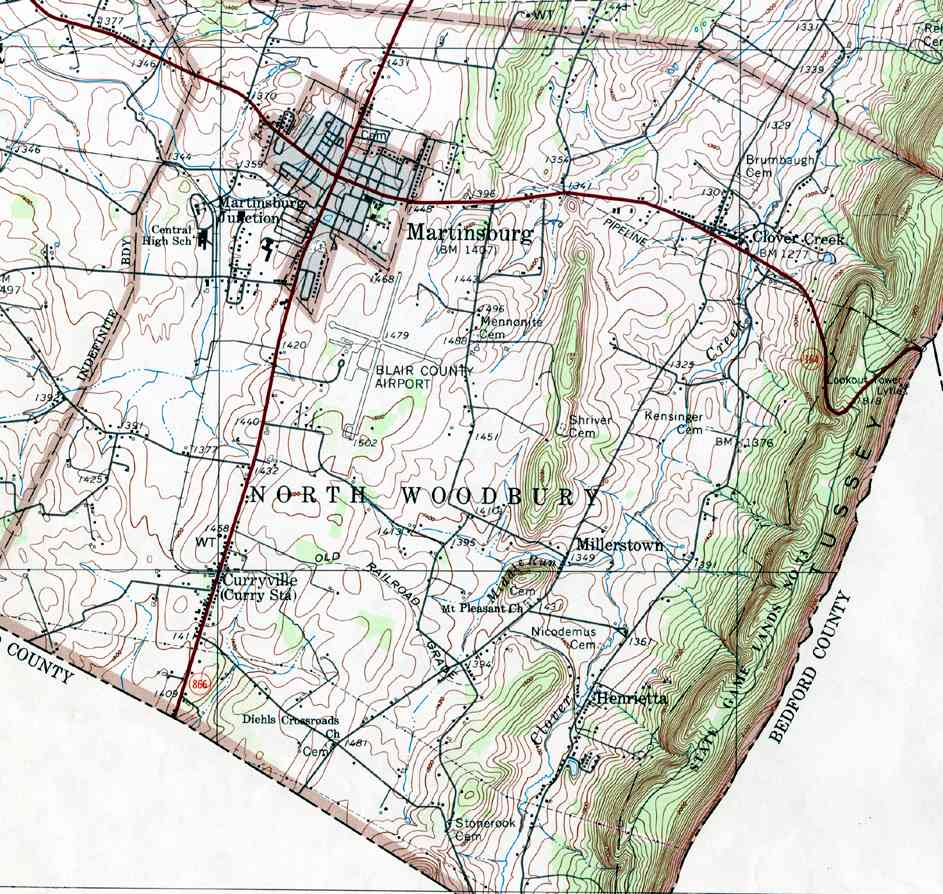
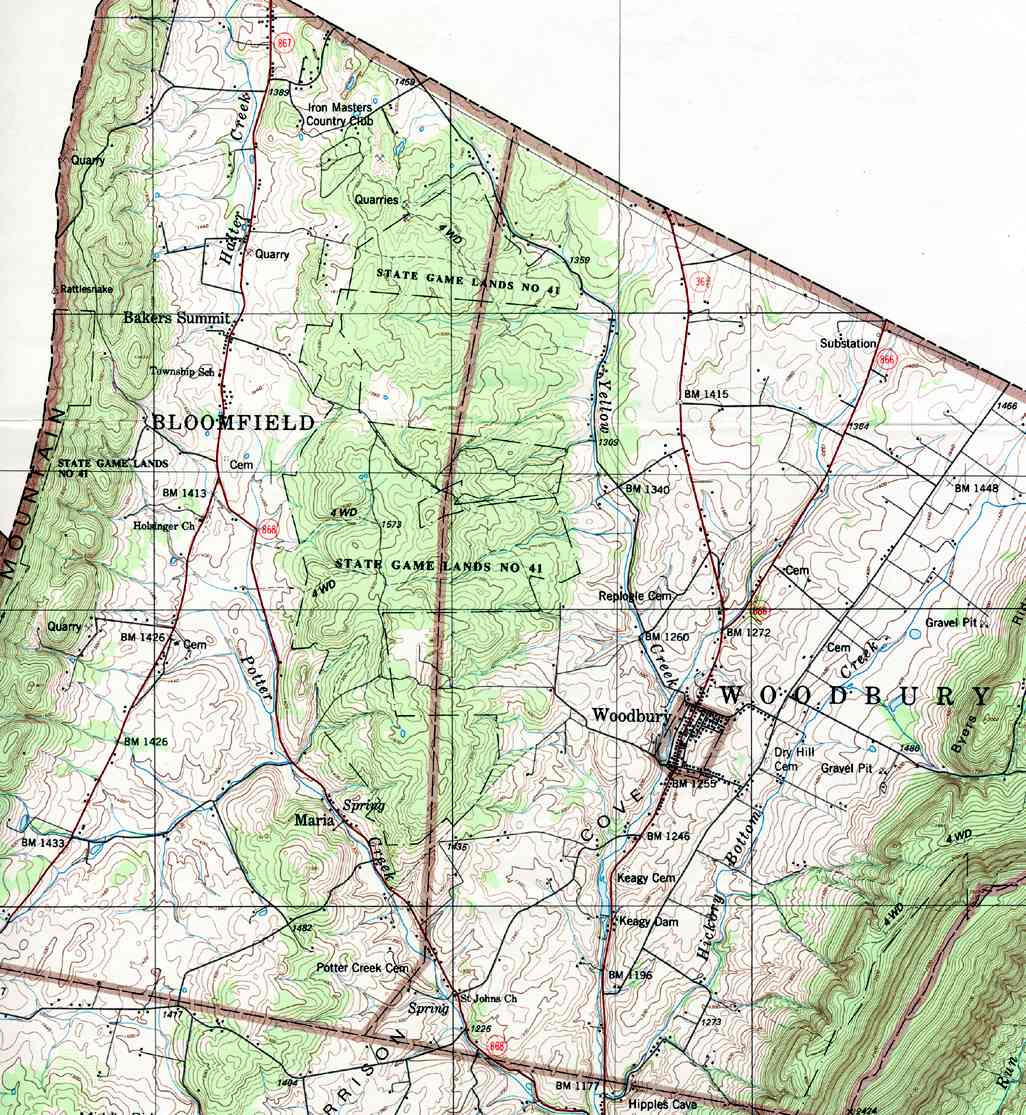
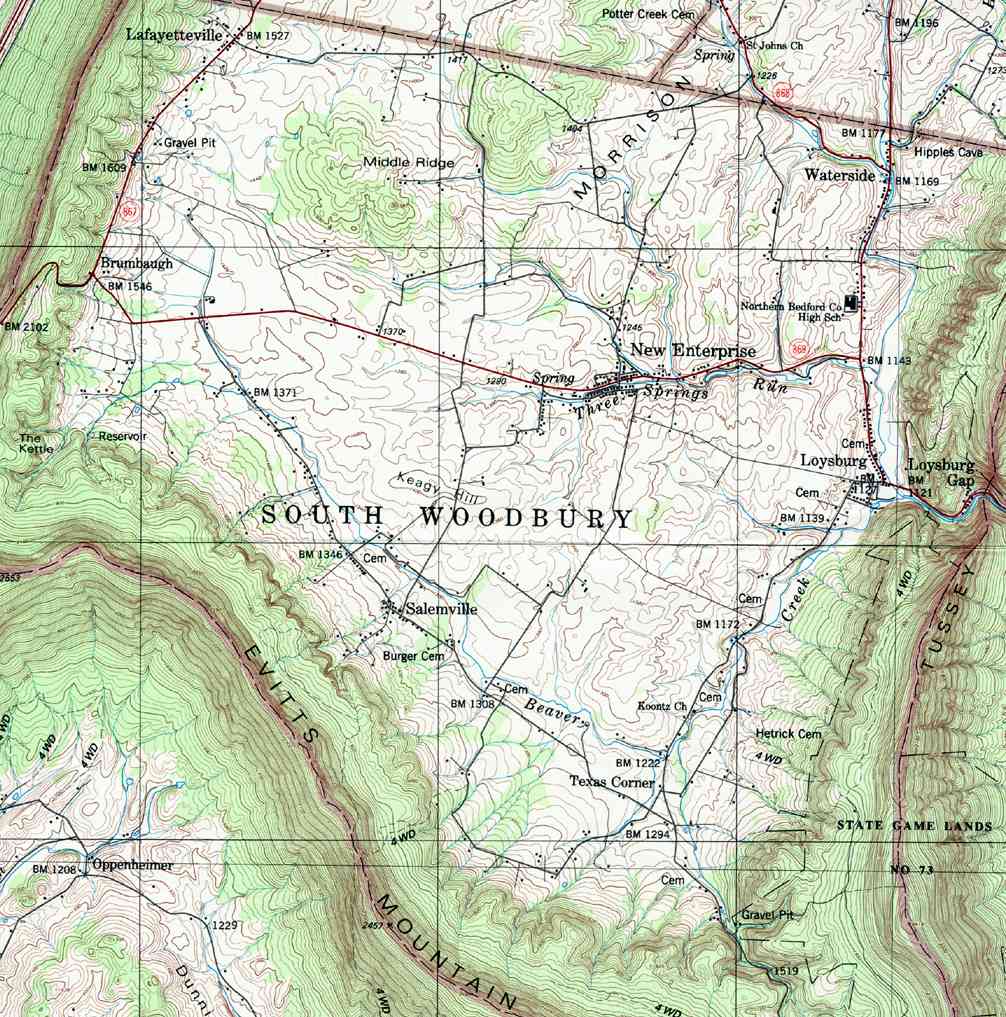
It is believed that at this time Daniel and his brother David who had by this time married Magdalena Maugans, a daughter of Conrad Maugans, moved to Morrison’s Cove, Woodberry Township, Bedford County, PA.
Hagerstown was a supply point for the newly opened land in still primitive Bedford County. Miller 31
The Next Frontier – Bedford County, Pennsylvania
In 1775, families living around Hagerstown had several routes to choose from if they wanted to migrate to Bedford County, PA. If they planned to go straight west, they took the road to Cumberland which was improved and straightened in the 1750s.
Those going to Frankstown Township in Bedford County, which at that time encompassed all of Morrison’s Cove, could travel the 60 miles to Cumberland, then take Burd’s road north to Bedford, about 30 miles. It’s possible that some took a trail up the east slope of the ridge, just west of Hagerstown. This one ran very close to or over the property of Jacob Stutzman and Stephen Ulrich II, shown below.

North of Fort Bedford, there were no improved roads. An Indian trail led through the Juniata Valley. Another went along Snake Creek to a gap at the north end. This gap opened out into a much larger flat, about 20 miles long and 5 miles wide at the widest. This was Morrisons Cove, or would be.
Settlers addresses up there were vague. Before 1775 living in Frankstown meant being somewhere in a large expanse. Generally speaking, in 1770 Frankstown is the country north of Bedford Town and Colrain is the area just south. One local history says that the dimensions of the townships before 1771 cannot be ascertained. In 1767 the vague political tracts began to divide in very complex ways. One that concerns our history occurred in 1775 when Woodberry Township was carved out of Frankstown.
When the Germans first came to Frankstown, no settlers had been here legally before and not many squatted illegally. In 1748 Conrad Weiser passed through and said, “Came to Frankstown but saw no houses or cabins” and Raystown, later Bedford, to the south was just a trading post in the 1750s. Nothing but an Indian trail passed through it until Forbes Road in 1758. Replogle 126-127
The 1850 census for Daniel Miller’s son, David Miller, living in Elkhart County, Indiana, stated that he was born in Maryland, not Pennsylvania.

We know David’s birth date from the family Bible – July 30, 1781.
It appears that Daniel Miller actually moved to Bedford County in the 1770s, and removed back to Frederick County, Maryland, for safety. This back and forth yo-yo settle, evacuate and resettle routine would have been all-too-familiar to Daniel.
The Historical Society of Somerset County re-published the journal of Harmon Husband a few years ago. The Journal talks about Indian uprisings in Somerset County beginning in 1778. It talks about the 250 militia from York, Cumberland and Lancaster County were called up in 1779 to defend Westmoreland and Bedford Counties. It also includes a July 4, 1779 letter from a resident of the town of Bedford, stating the county was pointed toward destruction, and mentions Simon Girty.

Simon Girty, an Irish child captured and raised by the Seneca was known as “the White Savage.”
The History of Bedford & Somerset Counties has a February 16, 1779 letter from the Bedford commissioners, noting that for the last 18 months they had been dealing with Indian uprisings, and that many of the settlers didn’t grow or harvest crops resulting in food shortages, and that many had already left the county. The History goes on to talk about an evacuation that occurred in 1782, after Girty burned Hannastown (outside Greensburg, PA).
It states the settlers (including Husband) evacuated to Conococheague (Hagerstown, Maryland area), as well as Cumberland and York Counties in Pennsylvania, the area where the Miller family resided before moving to Frederick County, Maryland in 1751 or 1752. It goes onto describe the local forts, noting that they were only occupied by a few militia and rangers, had only minimal provisions, and no money to buy additional supplies.
Fort Bedford was the nearest fort, but built in the French & Indian War, and was likely in poor shape by this time. The only option was to move to a place that had food, and was safe from the Indians who were being encouraged to attack settlers.
During a visit to the Allen County Public Library, I extracted the following information from a 1776 “List of Inhabitants” from Bedford Co., PA:
- Daniel Gripe – Frankstown Twp
- Jacob Gripe – “
- Jacob Gripe Jr – “
- Ullerick – none listed
- Adam Miller – Colerain Twp
- Christian Miller – Colerain
- Christian Miller – Que – not sure which township this is or where
- Felix Miller – Hopewell
- George Miller – Bethel Twp
- Jacob Miller – Barree Twp
- John Miller – Bedford Twp
- John Miller – Brother’s Valley
- John Miller – Que
- Joseph Miller – freeman – Frankstown Twp
- Joseph Miller Sr – inmate – Frankstown Twp
- Michael Miller – Brother’s Valley
- Nicholas Miller – Brother’s Valley
The location, “Que,” is a bit of a conundrum. Gale Honeyman from the Brethren Heritage Center indicates that Quemahoning Township is in Somerset County, organized in 1775, and that Christian and John were likely part of the Amish community that settled in Bruder’s tal/Broterh’s Valley coming from Berks County, Pennsylvania.
Names may be listed more than once because if they are property owners, they may own more than one location. At this time, there is no mention of Daniel or his brother David Miller. Daniel’s two brothers-in-law, Daniel Ulrich married to Susannah Miller and Gabriel Maugans who married Esther Miller were probably too young to have been in Bedford County this early. Gabriel and Esther married in the late 1790s and Daniel and Susannah married about 1780.
However, a 1775 road petition in Bedford County provides evidence that several Brethren families were indeed in Bedford County including both Daniel Miller and Daniel Ullery. The petition text is as follows:
To the worshipful justices of the Court of General Quarter Sessions of the Peace held at Bedford for the County of Bedford the third Tuesday in October in the Year of our Lord 1775 ~
The Petition of diverse inhabitants of Colerain Township and FranksTown Township in the County of Bedford humbly sheweth.
That your petitioners labour under many inconveniences for want of a road leading from Robert Elliott’s at the Snakes Spring to the Gap in the Dividing Ridge between Croyle’s Cove and Morrison’s Cove, from thence to Daniel Oulery’s Mills and from thence to Frankstown Gap in Dunnings Mountain.
Your petitioners therefore pray your worships would nominate and appoint men to view and examine the same and if they find it necessary and convenient then that they lay out the same as a public road, as they shall think may be least to the damage of the neighbor or parties concerned and least injurious to the inhabitant thereabouts and make return thereof by courses and distance under their hands to the next court agreeable to an act of assembly in such cases made and provided.
The actual petition is shown below.


Apparently, the 1775 petition didn’t gain traction, because in the spring of 1776, an identical petition was submitted on the third Tuesday of April, but this time, there were far fewer signatures. One other difference is that one of the landmarks was slightly different, stated as “Daniel Woolrey’s Mill in Morris’s Cove.”
The petition signers are shown in the chart below.
| Petition Signers |
1775 |
1776 |
| Conrad Brombach |
X |
|
| Philip Metzger |
X |
X |
| Johannes Martin |
X |
X |
| Joseph Cellar |
X |
|
| Jacob Kaff |
X |
|
| Daniel Miller |
X |
|
| Henrich Bender |
X |
X |
| Henry Braun |
X |
X |
| John Deeter |
X |
|
| Michael Hay |
X |
|
| Martin Miller |
X |
X |
| Georg Knie |
X |
|
| Daniel Paul |
X |
|
| David Ulry |
X |
X |
| John Kroll (Correl) |
X |
X |
| Jacob Neider |
X |
|
| Peter Bayer |
X |
|
| Christian Whetston(e) |
X |
X |
| Phillip (Philippus) Knie |
X |
X |
| Georg Roth |
X |
X |
| Daniel Oulery |
X |
|
| John Gillingham |
X |
|
| Stophel Markly |
X |
|
| Joseph Morrison |
X |
|
| Rinehart Replogle (Reblogle) |
X |
X |
| Jacob Easter |
X |
|
| Robert Frigs |
X |
|
| John Houser |
X |
|
| Powel Rood |
X |
|
| Daniel Frazer |
X |
|
| Philip Stoner |
X |
X |
| William Parker |
X |
|
| Robert Elliott |
X |
|
| Benjamin McFerran |
X |
|
| William Phillip |
|
X |
| Johannes Metzger |
|
X |
| George Brumbaugh |
|
X |
| Heinrich Holding Zander |
|
X |
| Paul Roth |
|
X |
| Abraham Dieter |
|
X |
| Feld Ober |
|
X |
| Jacob Neif Braller |
|
X |
Was Daniel Miller still living there, but simply didn’t sign the petition, or had he returned to Frederick County, Maryland? He’s not on the 1776 list of inhabitants either.
It’s likely that Daniel Ulrich was still there, because his mill was mentioned, and his mill is further mentioned in local histories. He is not listed on the 1776 list of inhabitants either, which causes me to wonder if the list is incomplete.
The following year, 1777, is the year that the British launched their Indian attacks in Morrison’s Cove and Koontz says that these “frequently compelled settlers to seek safety at Fort Bedford.”
The local history agrees that “Indian hostilities were so frequent that nearly all the inhabitants left the cove….” Replogle
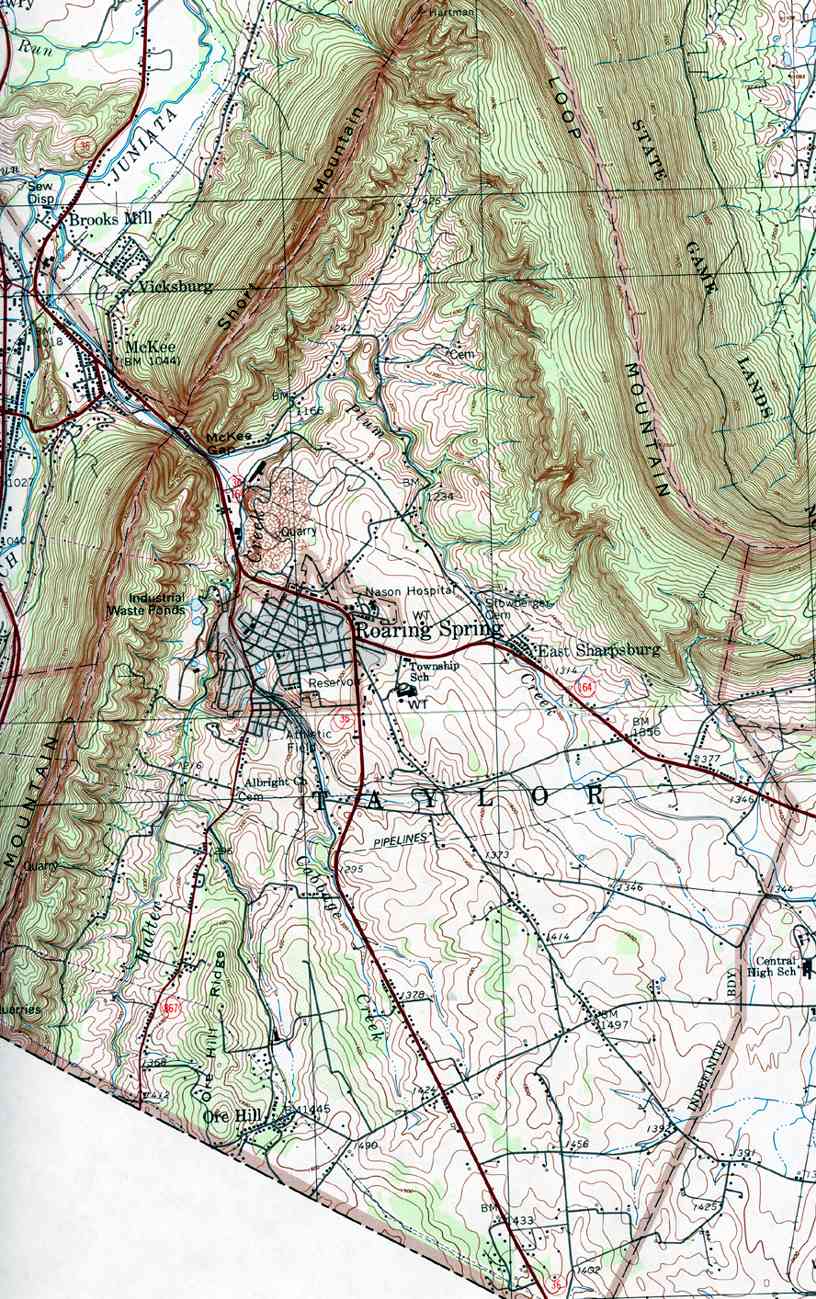
The 1777 Dunkard Massacre was part of the large British strategy. The main attack was probably an area between Roaring Spring and Martinsburg in Morrison’s Cove. At least 30 people died. No first-hand account exists, but U. J. Jones says, “Some few of the Dunkards….hid themselves away; but by far the most of them stood by and witnessed the butchery of their wives and children….” Jones is not entirely reliable and doesn’t like the Brethren much, but something like this surely happened. Replogle 158
Other reports from this area in 1777 are gruesome and grisly. Many people were killed. One report said that “We came safe to Bedford…the people on the road all fled for 42 miles from Ligonier.” Another report said that “people from Morrisons, Croyals and Friends Coves are fled or fortified.”
A 1779 extract from the commissioners’ books said that so many citizens fled that the full board couldn’t meet, collect taxes, nor could they say when they could. Replogle 161
The best evidence for these families being involved in an Indian attack is the following story repeated in many accounts. Jacob Neff, a Brethren man supposedly shot and killed an Indian or two at the Neff mill. In retaliation the Indians burned the mill. The local Brethren congregation forgave him for his breach of pacifism but later banished him for bragging about it. James Sell investigated this story and found the killing and expulsion to be true, but the mill belonged to Daniel Ulrich. Though one account says he bought it later. In fact Daniel Ulrich not only owned the mill, but land that is today Roaring Spring. It is not certain which Daniel Ulrich this is, but the one that best fits is the Daniel Ulrich who married Susannah Miller, the daughter of Philip Jacob Miller. Her husband Daniel Ulrich was probably the grandson of Stephen Ulrich Sr. Susannah’s brothers Daniel and David Miller also lived in the Cove.
From the History of the Church of the Brethren in the Middle District of Pennsylvania:
During the Indian Wars of 1762 and onward there were quite a number of murders committed and captives taken. The particulars will never be known. The greatest massacre was in 1777. One history says there were thirty killed. Our tradition says twenty. The number of prisoners taken we cannot conjecture. A Brother Houser and family are mentioned among the number.
John Houser did sign the 1775 road petition, so a man by that name is present in the valley.
John Martin, a pioneer preacher, whose name heads the list of ministers of the Clover Creek congregation, suffered greatly from these Indian depredations.
John Martin signed both the 1775 and 1776 road petitions.
For want of the original, copy is taken from Jones’ History of Juniata Valley, relating the incident as follows:
Page 20:
During the Great Cove massacre, among others carried into captivity was the family of John Martin. This incursion was indeed a most formidable one, led by the kings Shingas and Beaver in person. How many were killed there is no living witness to tell; neither can we conjecture the number of prisoners taken.
The following petition was sent by John Martin to council:
August 13, 1762
“The Humble Petition of Your Most Obedient Servant Sheweth, Sir, may it please Your Excellancy, Hearing me in Your Clemancy a few words. I, One of the Bereaved of my Wife and five Children, by Savage War at the Captivity of the Great Cove, after Many & Long Journeys, I Lately went to an Indian Town, viz., Tuskaroways, 150 miles Beyond Fort Pitts, & Entrested in Co. Bucquits & Co. Croghan’s favor, So as to bear their Letters to King Beaver & Cap. Shingas, Desiring them to Give up One of my Daughters to me, Whiles I have Yet two Sons & One Other Daughter, if Alive, Among them — and after Seeing my Daughter with Shingas he Refused to Give her up, and after some Expostulating with him, but all in vain, he promised to Deliver her up with the Other Captives to yr Excellency.
Sir, yr Excellency’s Most Humble Servt Humbly & Passionately Beseeches Yr Beningn Compassion to interpose Yr Excellencies Beneficent influence in favor of Yr Excellencies Most Obedient & Dutiful Servt.
John Martin”
Page 21:
Brother Sell writes further :
The Brethren came into the Great Cove, now Morrison’s Cove, and by taking possession of the valley in the vicinity of Roaring Springs, the western portion of the Clover Creek congregation, were among its first settlers.
They set to work to clear away the forests, till the soil, build mills, and labored to promote the peace and prosperity of the country. It has been conceded to them, even by people who took no interest in their religion, that as good farmers, good taxpayers, quiet and inoffensive people — they were of the best of citizens.
But their exclusiveness, opposition to education, their lack of interest in political matters, and above all, their non-resistant principle brought them into disrepute with their neighbors.
This made their situation unpleasant and at times exposed them to more danger from their common enemy. Had they been permitted to treat with the Indian alone and manifest their love of peace and fair and honorable treatment, there is every reason to believe that not only they but their fighting neighbors would have escaped the assaults of the savage’s tomahawk and scalping knife.
The settlers all suffered from the incursions of the Indians from the time of their coming into the valley up to the time and during the Revolutionary War.
By this time by purchase and force the Indians were driven west of the Allegheny mountains. But out of hatred to their white brothers from real or imaginary wrongs, and also for spoils and scalps on which they were paid a bounty by the British government they made frequent raids into the valleys east of the mountain. When invasions were made the news was heralded as rapidly as the circumstances of the times permitted and the warning was to flee for safety. Some left their homes, others did not. All perhaps did not hear the alarm. Some could not go, and others preferred not to go. The result was that a number of them were murdered. In 1777 between twenty and thirty were killed.
During all these trying experiences of frontier life covering a period of nearly a quarter of a century, but one breach or violation of the peace principle held by our people is recorded.
Page 22, 23:
This single instance, which Brother Sell calls the “Jacob Neff Episode” occurred within the bounds of the Clover Creek congregation. U. J. Jones, after giving a copy of a report of “Thomas Smith and George Woods”, both, we believe, Justice of Peace at the time to President Wharton in which there is no direct reference to the Brethren, refers to the Neff incident as follows:
The band of Indians, after the Dunkard massacre, worked their way toward the Kittaning war path, leaving behind them some few stragglers of their party whose appetite for blood and treasure had not been satisfied. Among others, an old and a young Indian stopped at Neff’s Mill. Neff was a Dunkard; but he was a single exception so far as resistance was concerned. He had constantly in his mill his loaded rifle, and was ready for any emergency. He had gone to his mill in the morning without any knowledge of Indians being in the neighborhood, and had just set the water-wheel in motion when he discovered two Indians lurking, within a hundred yards, in a small wood below the mill. Without taking much time to deliberate how to act, he aimed through the window, and deliberately shot the old Indian. In an instant the young Indian came toward the mill, and Neff ran out of the back door and up the hill. The quick eye of the savage detected him, and fired, but missed his aim. Nothing daunted by the mishap, the savage followed up the cleared patch, when both, as if by instinct, commenced reloading their rifles. They stood face to face, not forty yards apart, on open ground where there was no possible chance of concealment. The chances were equal; he that loaded first would be victor in the strife, the other was doomed to certain death. They both rammed home the bullet at the same time — with what haste may well be conjectured. This was a critical juncture, for, while loading, neither took his eye off the other. They both drew their ramrods at the same instant, but the intense excitement of the moment caused the Indian to balk in drawing his, and the error or mishap proved fatal, because Neff took advantage of it, and succeeded in priming and aiming before the Indian. The latter, now finding the muzzle of Neff’s rifle bearing upon him, commenced a series of very cunning gyrations and contortions to destroy his aim or to confuse him, so that he might miss him or enable him to prime. To this end he first threw himself upon his face; then, suddenly rising up again, he jumped first to the right, then to the left, then fell down again. Neff, not the least put off his guard, waited until the Indian arose again, when he shot him through the head.
Neff, fearing that others might be about, left the mill and started to the nearest settlement. A force was raised and the mill revisited; but it was found a heap of smouldering cinders and ashes, and the dead bodies of the Indians had been removed. It is altogether likely that the rear of the savage party came up shortly after Neff had left, fired the mill, and carried away their slain companions.
For the part Neff took in the matter he was excommunicated from the Dunkard society. Nevertheless, he rebuilt his mill; but the Dunkards, who were his main support previously, refused any longer to patronize him, and he was eventually compelled to abandon the business.
Brother Sell speaks of the same incident as follows :
Daniel Ullery was the original owner of Roaring Spring. He built the first mill. Jacob Neff was his miller. During the Indian massacre of 1777 he shot an Indian. He was counseled by the church for his violation of her peace principles. He did not plead justification. He admitted that it was wrong to take human life but said his deed was done under strong temptation and excitement. He was excused, but required not to speak of his act in company in a boasting or justifying way. This restriction he frequently violated and he was expelled from the church.
This story has been repeated and exaggerated and the church through it is represented so that we take this opportunity to tell the story as we have it from our own traditions. The history of Juniata Valley says that when Neff rebuilt his mill the Brethren refused to patronize him. This is not correct. The chain, or abstract of title shown that Neff never owned the mill, did not build it in the first place, did not in the second place.
Pages 25, 26:
Ullery built and rebuilt it. It was a necessity in the new settlement.
The first Indian depredators, or at least the greater portion of them, were seen at a camp-fire by a party of hunters; and if the proper exertions had been made to cut them off, few other outrages would have followed. The supposition is that there were two parties of about fifteen each, who met at or near Neff’s Mill in the Cove. On their way thither, the one party killed a man named Hammond, who resided along the Juniata, and the other party killed a man named Ullery, who was returning from Neff’s Mill on horseback. They also took two children with them as prisoners.
The savages swept down through the Cove with all the ferocity with which a pack of wolves would descend from the mountain upon a flock of sheep. Some few of the Dunkards, who evidently had the latent spark of love of life, hid themselves away; but by far the most of them stood by and witnessed the butchery of their wives and children, merely saying, “Gottes wille sei gethan.” *
This sentence was so frequently repeated by the Dunkards during the massacre, that the Indians must have retained a vivid recollection of it. During the late war with Great Britain, some of the older Indians on the frontier were anxious to know of the Huntingdon volunteers whether the ” Gotswiltahns ” still resided in the Cove. Of course our people could not satisfy them on such a vague point.”
* God’s will be done.
Back to Maryland?
We have a couple of pieces of evidence that Daniel Miller went back to Maryland.
First, the local history says that the area was indeed nearly entirely evacuated and that the Conococheague Valley was one of the locations where the refugees located. For Daniel, this would simply have been going home.
Secondly, Daniel’s son indicated he was born in Maryland in 1781.
Third, in 1776 when they do not sign the road petition in Bedford County, both Daniel and David Miller appear in Frederick County on the list of non-enrollers, but there is also another Daniel Miller living in Frederick County, son of Lodowich Miller, so these two can be confused.
Fourth, in 1778, some Daniel Miller took the oath of fidelity in Washington County, Maryland, formerly the area Frederick County.
Fifth, in 1783, after Lodowich’s family, including the other Daniel, had removed to the Shenandoah Valley, Daniel Miller remains and is taxed in Frederick County with animals but no land.
However, Daniel wasn’t to stay long in Frederick County, because by 1786, we find him once again in Bedford County.
Return to Bedford County
1783 was an important year. The Revolutionary War had lasted for 7 years. On April 11, the Continental Congress proclaimed an end to hostilities. However, most of Ohio was still in dispute with the Indians which held back settlement there for another 20 years. Replogle 162
Also, in 1783, the road from Cumberland to Bedford County was improved and was eventually 12 feet wide. Replogle 57
This would have allowed wagons and might have made resettlement very attractive to Daniel Miller.
The 1784 Bedford County tax list tells us that Daniel hadn’t yet made that return journey.
1784 Bedford Co. tax returns:
- Daniel Ullery – 408 acres in Frankstown Twp
- No David or Daniel Miller listed but lots of other Millers
- Jacob Stutzman – 0 acres, 1 dwelling, 2,0
- Jacob Cripe – 900 acres
1784 Bedford County, in Brother’s Alley:
- John Miller (1-6)
- Peter Miller (1-5)
- Michael Miller (1-6)
- Christian Miller (1-6)
- William Miller (1-2)
The Kernel of Greatness, An Informal Bicentennial History of Bedford County by the Bedford County Heritage Committee, page 134:
It is known that some Brethren settled here as early as 1785, for that was the date in a deed for a grant of land in Morrison’s Cove made jointly to Jacob Brumbaugh and Samuel Ullery. The latter was the first minister of the denomination known to have preached hereabouts. Centered around New Enterprise, the Yellow Creek (or Hopewell) congregation embraced all the territory of our county and most of Fulton. From this first group sprang the majority of all local Brethren Churches.
In 1785, Woodbury Township was formed from Frankstown. This is where Daniel Miller would live. Settlers had arrived there at first 40 years earlier, but settlement was still sparse.
The nearby town of Hollidaysburg was not laid out until next year and entire township only had 118 households. Replogle p 29
In 1786 Jacob Snyder settled in Snake Spring Valley. At his home Brethren of the area held meetings over a period of years until in 1840 a congregation was organized.
1786 Woodbury Twp. tax list
- Daniel Miller (Cox’s land)
- David Ulerick
- Stephen Ulerick
- Daniel Ulerick
- Jacob Stutzman (Cox’s land)
- John Ulrick – single – Cox’s land
From the tax lists, we find evidence that Daniel Miller, along with several other Brethren is living on Cox’s land. I found mention of Cox in the early deed books.
In 1780 Charles Cox in Morrison’s Cove sells John Snyder 500 acres near where Three Springs enters Yellow Creek. This tells us that Daniel Miller probably lives someplace in this vicinity as well.
Undated Tax list:
- David Ulrich – Cox’s land
- Stephen Ulrich – Cox’s land
- Daniel Ulrich
In 1787, Woodbury Township was divided between Bedford County and Huntingdon County, but Daniel continues to be listed in Bedford County. In 1838, the Bedford portion is further divided into Woodbury and South Woodbury.
1788 Bedford Tax list:
- Daniel Miller
- David Miller
- Daniel Ullery
- David Ullery
- Stephen Ullery
- John Ullery – single
Several other Brethren families went to Morrison’s Cove and were there by 1789. At least four of Stephen Ulrich Jr.’s children: Hannah who married George Butterbaugh. David Ulrich and Stephen Ulrich III were “made subject to law to the performance of military duty” in 1789. Lydia Ulrich married Jacob Lear. Daniel Ulrich owned a mill where Roaring Spring is today. Replogle 129
Jason Replogle notes that the word “inmate” on the tax records, according to the Bedford County Historical Society means renter, non-owner. They also say that tax assessing went on at that time every 3 years which would explain the sequence of 1782, 1785, and 1788 in Frankstown. Replogle 131
In 1789, in Morrison’s Cove, David Miller was assessed for 474 acres, 2 horses and 3 cows and Daniel for 214 acres, 3 horses and 4 cows. Replogle 129
The 1789 tax list has an unexpected benefit – ages, I think. Never before, or since, have I seen a tax list that included ages, but this one appears to. Daniel Miller was actually 34, and is shown as 37. His brother, David was 32 and he is shown as 23. If these aren’t ages, I don’t know what they would be.
1789 Bedford County Tax List
| Age? |
Name – Woodbury Twp – Martain Loy’s Return |
? |
Land |
Horses |
Cows |
|
Thomas Veccory? Va |
125 |
500 |
– |
– |
|
Martain Loy |
164 |
241 |
2 |
2 |
| 36 |
Henry Werner |
96 or 46 |
50 |
2 |
2 |
| 43 |
Abraham Feeter or Jeeter |
145 |
327 |
5 |
5 |
| 35 |
Jacob Good |
92 |
150 |
3 |
4 |
| 28 |
Jacob Bowman – Coxes Land |
102 |
230 |
2 |
3 |
| 40 |
John Bair – Coxes Land |
109 |
230 |
3 |
1 |
|
Peter Sensebaugh – Coxes Land |
76 |
153 |
1 |
|
| 20 |
John Sensebaugh – stricken through |
10 |
|
Checkmark |
|
|
Peter Witmar |
100 |
300 |
|
|
| 30 |
Philip Mixcelle? – Snivel’s Land |
182 |
300 |
2 |
4 |
| 40 |
George Bowman |
10 |
0 |
1- |
0 |
|
William Tatorious – one still |
61 |
100 |
2 |
3 |
| 40 |
Christian Dridl |
38 |
50 |
2 |
3 |
| 50 |
William Yortea – one still |
36 |
0 |
2 |
2 |
| 45? |
John? Forgeson (crease in paper) |
50 |
? |
? |
? |
| 28 |
Jacob Cravenston – Coxes Land |
10 |
|
1- |
0 |
|
Nicholas Cravenston – Coxes Land |
189 |
279 |
3 |
3 |
|
William Beaman – Coxes land |
176 |
278 |
2 |
2 |
| 18 |
George Beaman |
– |
– |
– |
– |
| 26 |
Gabriel Magin – Coxes land |
261 |
0 |
2 |
2 |
| 42 |
Jacob Viant – Coxes land |
133 |
– |
1- |
1 |
| 23 |
David Miller – Coxes land |
149 |
474 |
2 |
3 |
| 34 |
Jacob Lear – Coxes land |
136 |
215 |
3 |
2 |
| 37 |
Daniel Miller – Coxes land |
142 |
214 |
3 |
4 |
| 36 |
Stephen Ullreck – Cox Land |
145 |
148 |
3 |
5 |
| 26 |
David Ullreck – Cox land |
142 |
148 |
3 |
4 |
|
Ditto |
37 |
150 |
– |
|
| 56 |
Jacob Stutzman – Cox land |
142 |
148 |
3 |
4 |
| 50 |
John Snyder |
350 |
250 |
3 |
8 |
|
Abraham Overholtzer – one saw mill |
149 |
220 |
3 |
3 |
| 30 |
John Hipple |
126 |
419 |
2 |
2 |
|
Peter Sherman? |
45 |
100 |
Torn |
Torn |
| 25 |
Jacob Bain |
60 |
100 |
2 |
2 |
| 34 or 39 |
Peter Folks |
76 |
200 |
2 |
2 |
|
John Brannon on Capt. Hunter’s land |
76 |
100 |
2 |
2 |
| 30 |
John Welch – single freeman |
|
|
|
|
| 40 |
Nicolous Peticot – Capt. Hunter’s land |
66 |
0 |
1- |
2 |
| 37 |
James Ray |
56 |
100 |
|
2 |
| 37 |
Henry Erllabaugh on Hunter’s land |
63 |
|
5 |
5 |
| 36 |
Thoma Eyl |
25 |
50 |
|
|
| 40 |
Edward Mceroy |
63 |
100 |
1- |
5 |
| 45 |
William Gilson or Gibson |
66 |
100 |
5 |
2 |
|
John Sherley |
101 |
150 |
2 |
2 |
| 18 |
Richard Sherley – struck through |
|
|
|
|
|
Peter Werner or Verner |
23 |
|
2 |
1 |
|
John Peterbaugh |
25 |
100 |
|
|
|
Thomas McCune |
17 |
70 |
Smudged |
2 |
|
Name illegible on fold – Cox’s land |
100 |
Hole |
? |
2 |
| 49 |
John Falkner – Cox’s land |
89 |
Smudge |
2 |
3 |
|
Ditto for land |
25 |
100 |
|
|
| 30 |
Henry Dial |
18 |
60 |
Smudge |
? |
| 27 |
William Adams |
38 |
100 |
1 |
1 |
| 40 |
Peter Adams |
65 |
100 |
2 |
2 |
| 44 |
Philip Knee, Knu or Jones |
64 |
100 |
2 |
3 |
|
George Roth |
65 |
100 |
3 |
2 |
| 20 |
Philip Roth – struck through |
|
|
|
|
| 44 |
Abraham Deeter- one grist mill |
175 |
150 |
3 |
? |
|
John Mets?er |
11 |
200 |
3 |
6 |
| 40 |
George Broombaugh |
92 |
130 |
3 |
4 |
| 24 |
John Engle |
179 |
600 |
2 |
3 |
| 28 |
Casper D (or B)illinger |
29 |
|
2 |
3 |
| 30 |
John Hall – half taxes |
50 |
300 |
1 |
3 |
| 22 |
Daniel Hall – single freeman – one still |
80 |
172 |
2 |
torn |
| 21 |
Jacob Overholtzer – single freeman |
|
|
|
|
| 23 |
John Cramer – single freeman |
|
|
|
|
| 30 |
Daniel Ullerick |
154 |
150 |
2 |
3 |
| 45 |
Jacob Nave |
200 |
400 |
4 |
4 |
| 39 |
Ludwick Wissenger |
60 |
100 |
3 |
2 |
| 40 |
Simon Hay |
25 |
50 |
1 |
1 |
| 35 |
Michael Hay |
51 |
100 |
2 |
2 |
| 35 |
Martain Housen? – quantity of land unknown to me |
25 |
100 |
|
|
| 24 |
Edward Cowen – quantity of land unknown to me |
76 |
209 |
2 |
2 |
| 30 |
Christopher Rohrer – single freeman – one still |
15 |
– |
– |
– |
|
Christian Newcomer |
15 |
60 |
|
|
| 40 |
Harmon Deik? |
100 |
150 |
2 |
2 |
| 23 |
John Ullrick – a sawmill – single freeman |
70 |
100 |
2 |
2 |
| 40 |
Michael Pot? |
79 |
227 |
2 |
3 |
|
Ditto for land |
25 |
100 |
|
|
| 26 |
Nicolous Shell for Hollis land |
38 |
100 |
1 |
1 |
|
Ditto for land |
37 |
100 |
|
|
|
John Croal for Wallyses land |
123 |
250 |
2 |
1 |
| 40 |
Abraham Newswander – Wallis land |
76 |
|
2 |
2 |
| 23 |
George Faring? For Wallysis land |
110 |
|
1 |
2 |
| 26 |
Rinehart Replogle Jr on Wallysis land |
26 |
|
2 |
2 |
| 18 |
John Replogle – struck through |
|
|
|
|
|
Rinehart Replogle Sr, on Wallysis land |
296 |
476 |
5? |
2 |
| 30 |
William Cohanico? – Wallysis land |
226 |
352 |
2 |
2 |
| 46 |
Peter Beltser |
3 |
– |
– |
1 |
| 48 |
Joseph Cellers |
192 |
200 |
3 |
4 |
| 43 |
James Knot |
25 |
100 |
2 |
2 |
| 40 |
William Nichlous |
38 |
50 |
2 |
2 |
|
William Findley |
38 |
50 |
2 |
2 |
|
John Adams Sr. |
25 |
50 |
|
|
| 25 |
George Hanay – single freeman |
35 |
50 |
1 |
|
| 40 |
John Lower |
25 |
100 |
|
|
|
Abraham Lingin ?? |
75 |
175 |
1 |
1 |
| 30 |
Jacob Devil? |
75 |
75 |
1 |
1 |
| 23 |
Peter Embler |
3 |
|
1 |
1 |
| 3? |
George Lingerfelt |
? |
? |
Torn |
Torn |
| 25 |
John Overholtzer |
43 |
80 |
2 |
1 |
| 42 |
Abraham Leedy |
64 |
110 |
5 |
3 |
| 48 |
Henry Brown |
61 |
110 |
3 |
2 |
| 32 |
William Ditts? Or Ditto? |
101 |
200 |
2 |
2 |
| 23 |
George Dell or Doll |
12 |
50 |
|
|
|
John Cellars |
100 |
200 |
|
|
| 47 |
Christopher Week |
58 |
50 |
4 |
2 |
| 22 |
Daniel Magin – Wallis land |
160 |
|
1- |
|
| 48 |
Crestian Wetstone – ditto |
173 |
|
2 |
1 |
| 45 |
Valentine Oster |
142 |
200 |
3 |
4 |
|
Ditto |
12/10? |
62 |
|
|
| 23 |
John George Priceler |
20 |
70 |
|
|
|
David Hootsman |
50 |
100 |
|
|
|
Joseph Long |
326 |
750 |
2 |
2 |
|
Ditto |
75 |
300 |
|
|
| 32 |
Daniel Ullerick |
76 |
200 |
2 |
2 |
| 40 |
Lutwidk Low |
28 |
50 |
1- |
2 |
|
Jacob Broombaugh |
275 |
700 |
|
|
|
Cronkleton |
25 |
100 |
|
|
| 30 |
Jacob Puterbaugh |
50 |
50 |
3 |
3 |
|
Ditto at the Long Meadows |
12 |
25 |
|
|
|
Ditto on the Plow He?lievg |
100 |
210 |
|
|
|
George Puterbaugh Jr |
25 |
100 |
|
|
| 29 |
Adam Burcket |
129 |
210 |
2 |
3 |
| 30 |
Abraham Gantsenger Jr? |
75 |
200 |
|
|
| 25 |
Thomas Jones – single freeman |
|
|
|
|
| 39 |
Jacob Smith – Cox’s land and tanyard |
111 |
|
2 |
3 |
|
William Bower – single freeman |
15 |
10 |
1 |
1 |
|
John Ditts or Ditto |
54 |
100 |
2 |
3 |
|
George Bower – single freeman |
|
|
|
|
| 27 |
Isaac Cronck – single freeman |
|
|
1 |
|
|
John Martain |
272 |
449 |
4 |
4 |
| 20 |
Coonrod Martain – struck through |
|
|
|
|
|
John Teeter or Jeeter 172/80/1118 |
125 |
150 |
3 |
6 |
|
Ditto land |
25 |
100 |
|
|
|
|
|
|
|
|
|
Woodbury Township Nonresident Persons Names |
|
|
|
|
|
Samuel Wallis |
|
|
|
|
|
Jacob Brumbaugh (4 tracts adjacent) |
|
897 |
|
|
|
John Brumbaugh |
|
200 |
|
|
|
Israel Brumbaugh |
|
190 |
|
|
|
Dickson Children? |
|
272 |
|
|
|
Ditto |
|
84 |
|
|
|
Henry Huffman |
|
76 |
|
|
|
Martin Houser |
|
250 |
|
|
|
Abraham Kinsinger |
|
200 |
|
|
|
Joseph Morris |
|
200 |
|
|
|
Thomas Mchune |
|
80 |
|
|
|
George Buterbaugh Jr |
|
225 |
|
|
|
John Buterbaugh |
|
103 |
|
|
|
John Sellery |
|
200 |
|
|
|
Ditto |
|
138 |
|
|
|
Daniel Hall (or Stall) |
|
172 |
|
|
|
David Stutzman |
|
60 |
|
|
|
Henry Snively Doc? |
|
250 |
|
|
|
Thomas Vickroy |
|
464 |
|
|
|
Joseph Krootleton |
|
100 |
|
|
|
John Darne |
|
100 |
|
|
|
Jacob Stevens |
|
200 |
|
|
|
Joseph Long |
|
370 |
|
|
|
Richard Vanbell |
|
219 |
|
|
|
John Moore |
|
503 |
|
|
|
George Ruch |
|
369 |
|
|
|
William Gerrgas |
|
237 |
|
|
|
Benedict Dorsey |
|
232 |
|
|
|
Robert Lasley |
|
298 |
|
|
|
Moses Patterson |
|
315 |
|
|
|
Samuel Richards |
|
367 |
|
|
|
Isaac Harvel |
|
352 |
|
|
|
Thomas Walker |
|
398 |
|
|
|
Abraham Robison |
|
475 |
|
|
|
|
|
8596 |
|
|
On another tax list, a Jacob Miller is listed as a nonresident in 1789.
A list of the inhabitants of Woodberry Township made subject by law to the performance of militia duty, taken by Martin Loy the 26th of January 1789 includes the following names:
- Gabriel Magin (Maugans)
- David Miller
- Jacob Lear (this family later found in Elkhart County, Indiana)
- Daniel Miller
- Steven Ullrech
- David Ullrech
- Jacob Stulsman (Stutzman)
- Daniel Magin (Maugans)
- Samuel Ullrich
- Coonrath Martin (Conrad)
- Daniel Ullric
- John Ullrick
- George Haney (descendants later found in Elkhart County, Indiana)
1789 Woodbury Twp tax list, extracted for Miller, Maugans and Ulrich by various spellings:
- David Miller
- Daniel Miller
- Gabriel Maugans
- Stephen Ulrich
- David Ulrich
- Samuel Ulrich
- Daniel Ulrich
1790 or 1791 tax list
- David Miller
- Daniel Miller
- Peter Maugons
- Daniel Maugons
- David Ulry
- Samuel Ulry
- Daniel Ulry
- Stephen Ulry
- Yearty Ulry
Daniel Miller first appeared on the Woodbury Township tax list in 1785 and by 1789, is well established, farming 214 acres with 3 horses and 2 cows. There was just one problem, those 214 acres weren’t his. He rented land from a man named Cox who was somewhat of a land speculator. Many Brethren families are noted on the tax lists as renting land from Cox. According to the “History of the Church of the Brethren in the Middle District of Pennsylvania,” by 1790, all of the desirable lands were owned and all of the good land was claimed many years before. This area began to be settled initially in 1755.
No land records have been found in Bedford County for David or Daniel Miller. Presumably the land they rented from Cox was located near what is now New Enterprise in the southern end of the valley. This is where Samuel Ulrich, Elizabeth’s brother, was located, and many other German Baptists from the Washington County, area.
This beautiful rolling valley named Morrison’s Cove would have been where Daniel and Elizabeth farmed and raised their children among like-minded families in the Brethren church. Bedford County at that time had no established church buildings, and services were held in member’s homes and barns. Daniel, like everyone else, would have taken his turn.

Daniel Miller wasn’t the only child of Philip Jacob Miller to move to Bedford County. His brother David Miller settled there too, along with sister Esther who married Gabriel Maugans and sister Susannah who married Daniel Ullery.
Susannah Miller and Daniel Ullery owned the mill at Roaring Springs, today the old mill pond with a beautiful fountain.

Daniel certainly lived nearby and visited this mill regularly, as did all farmers.

The first census was taken in 1790, and the Bedford County census fortunately appears to be recorded in house order.

We find Gabriel Maugans beside Daniel and David Miller. Another Maugans appears to be next door, and the entire group is near to the Ullery, Replogle and Stutzman families. All known Brethren.
It never really struck me until I saw this census that Daniel’s first 7 children were all boys.
I put together a 1788-1791 Cross Match Census and Tax lists table for Miller, Stutzman, Ullerich and Cripe in Bedford County.
| Name |
1790 M16+ |
1790 M<16 |
1790 F |
1788 tx |
1789 tx |
1790 tx |
1791 tx |
| Phillip Miller – Ayr/Dublin – no land tax |
2 |
1 |
7 |
|
|
|
|
| Jacob Miller |
1 |
2 |
4 |
|
H |
|
H |
| Felix Miller |
2 |
3 |
1 |
|
H |
|
H |
| Jacob Miller |
1 |
1 |
4 |
|
|
|
H |
| John Crull |
1 |
3 |
7 |
W |
W |
|
W |
| David Miller |
1 |
2 |
4 |
W |
W |
|
W |
| Daniel Miller |
1 |
7 |
1 |
W |
W |
|
W |
| David Ullery |
1 |
5 |
2 |
W |
W |
|
W |
| Samuel Ullery |
1 |
1 |
5 |
|
W |
|
W |
| Jacob Miller – Bedford Twp – no land tax |
1 |
2 |
2 |
|
|
|
|
| Andrew Miller |
1 |
6 |
|
|
|
|
Bd |
| John Crull |
3 |
1 |
7 |
W |
|
|
W |
| Daniel Ulrick |
2 |
2 |
4 |
W |
W |
|
W |
| Jacob Miller |
4 |
3 |
3 |
|
Bd |
|
Br |
| Peter Miller |
1 |
2 |
|
|
Bd |
|
|
| Peter Miller |
1 |
1 |
|
|
Bd |
|
Bd |
| John Miller |
1 |
2 |
|
|
Bd |
|
Bd |
| Elles Miller |
1 |
2 |
|
|
|
|
Bd |
| Michael Miller |
1 |
2 |
3 |
|
Br |
|
Br |
| Nicholas Miller |
1 |
0 |
0 |
Br |
Br |
|
Br |
| Christian Miller |
2 |
1 |
0 |
Br |
Br |
|
Br |
| Abraham Miller |
1 |
1 |
|
|
Br |
|
Br |
| Andrew Miller – no tax lived in Br |
1 |
1 |
1 |
|
|
|
|
| John Miller |
1 |
2 |
|
Q |
Q |
|
Q |
| Nicholas Miller |
1 |
1 |
2 |
Br |
Br |
|
Br |
| Michael Miller |
1 |
1 |
6 |
Br |
Br |
|
Br |
| Nicolas Miller |
1 |
1 |
1 |
Br |
|
|
Br |
| Mary Miller, widow |
0 |
3 |
1 |
|
Br |
|
|
| John Miller |
2 |
3 |
3 |
|
M |
|
M |
| Barbara Miller |
0 |
1 |
5 |
Q |
Q |
|
Q |
| Christian Miller |
1 |
3 |
5 |
|
Q |
|
Q |
| Christian Miller |
1 |
3 |
5 |
Q |
Q |
|
Q |
| Abraham Miller |
! |
1 |
4 |
Q |
Q |
|
Q |
| Christy Miller |
1 |
3 |
2 |
Q |
Q |
|
Q |
| Hendrey Miller |
1 |
3 |
2 |
E |
|
|
E |
| John Miller |
1 |
1 |
|
E |
|
|
E |
| John Miller |
1 |
1 |
3 |
|
E |
|
E |
| Peter Miller |
1 |
3 |
2 |
E |
E |
|
E |
| Jacob Miller |
1 |
3 |
2 |
E |
E |
|
E |
H=Hopewell
W=Woodbury
Bd = Bedford
Br = Brother’s Valley
M= Milford
E= Elklick
Q-Que
If you’re thinking to yourself, there certainly were a lot of Miller men in Bedford County by this time, you’re absolutely right, and we know they weren’t all ours. It’s no wonder that there is so much confusion surrounding this family and surname.
The last tax lists where we find Daniel Miller are the available group from 1796-1799.

The 1796 list, above, shows Daniel Miller with a house and sawmill, both. I can’t read all the column names, but he looks to also have 2 horses and 4 cows. He was quite well off, comparatively.
Daniel is present in 1797 and 1798, but David Miller is not on the list anytime from 1796-1799. In 1799, both are absent, gone to the land of Kentucky and Ohio, the next frontier.
Bedford County Maps
What can we discern about where Daniel Miller lived in Bedford County?
From various deeds, we know that Cox owned land near where 3 Springs empties into Yellow Creek, near New Enterprise today.

The little grey balloon in the lower right quadrant marks that intersection.

The road through Loysburg Gap is Woodbury Pike in present day South Woodbury Township. The intersection of 3 Springs and Yellow Creek is just above Loysburg, shown on the topo map below.

The Topozone map below shows Dunnings Mountain forming the western border of Morrison’s Cove.

The topographical map below shows the location of Dunnings Mountain, with the red balloon, forming a western border for Morrison’s Cove but more importantly, it also shows the valley area which is roughly 5 miles across and 20 miles north to south which constitutes Morrison’s Cove, enclosed by the mountains. Morrison’s Cove is a beautiful valley.

This valley encompasses Roaring Spring on the North to New Enterprise on the South, Dunnings Mountain on the West to the state Game lands 73A East of 866, near Loysburg Gap where 36 crosses the mountain between New Enterprise and Yellow Creek.

In fact, look at this beautiful historic building on 3 Springs at the intersection of 869 and Woodbury Pike, PA36. Could this have been Daniel’s mill?
Based on the description of Cox’s land location, Daniel Miller probably lived someplace in the southern part of Morrison’s Cove. We know that Daniel Ullery owned the mill in Roaring Springs.
The headwaters of Snake Spring are about 3 miles below Loysburg, where the two mountain ranges come together and Upper Snake Spring Road becomes Church View Road which becomes Lower Snake Spring Road. This is the southernmost part of the 1775 and 1776 road petition, beginning at Snake Spring to the Gap in the dividing ridge.
Croyle’s Cove today is Snake Spring Township, and the Gap referenced would be the Gap leading between Lower Snake Spring Road and Upper Snake Spring Road. Morrison’s Cove is noted as being above this gap.

Today, Woodbury Township and South Woodbury Township are in Bedford County, while North Woodbury Township later fell into Blair County. We know that Daniel Miller lived in what was then Woodbury Township in Bedford County.

Today’s Woodbury Township

Today’s South Woodbury Township.

Today’s North Woodbury Township, Blair County, PA.
On the USGS topo map, North Woodbury is not labeled as Morrison’s Cove.
Roaring Springs is in present day Taylor Township and it is also not labeled as Morrison’s Cove.
Only Woodbury and South Woodbury are labeled as Morrison’s Cove, between Woodbury and New Enterprise.
Daniel Miller lived in what was then Woodbury Township, probably near New Enterprise, and clearly on one of the streams strong enough to power a sawmill. The creeks in that area are Yellow Creek and 3 Springs and I would not be one bit surprised if the building near that intersection that still exists today was Daniel’s mill.
Philip Jacob’s Decision
In 1795, the Treaty of Grenville followed the defeat of the Indians at the Battle of Fallen Timbers near the Maumee rapids. Indians agreed to give up about two thirds of Ohio and a part of Southeastern Indiana. In Ohio large-scale Indian dangers ended and large-scale migration began. Replogle 165
Following the treaty, regular trips were established from Cincinnati to Pittsburg and back. They took a month. Boats dotted the Ohio as far as the eye could see. A Second source says a one way trip from Pittsburgh to Cincinnati took about a week.

As family members moved to Bedford County, and other Millers migrated to other frontier locations, the family in Frederick County was becoming thin.
Philip Jacob’s brother Lodowich had either moved to Rockingham County, VA or died in about 1782 or 1783 and their brother John died in 1794. John farmed the other half of the same land that Philip Jacob farmed. Those two men would have been extremely close, and dependent to some extent on each other for help with farming. With John’s passing, and several of Philip Jacob’s children already gone for a decade or more, he must have been thinking about what to do with his own land and assets, as well as his legacy to his children.
Philip Jacob Miller made a monumental decision. When he sold his brother, John’s land, as executor, he sold his own land to the same man in 1796.
Philip Jacob then proceeded to “sell out” as it was known, selling everything he didn’t need to be able to pack what he did need into a wagon to set off for the new frontier where he had arrived by August of 1796. Not the frontier in Bedford County. That was no longer a frontier and the land was mostly gone – but the real frontier, beyond Pittsburgh – down the Ohio River to near Fort Washington, a location that would one day become Cincinnati, Ohio. That was the real frontier where the Indians had just been defeated the year before. Trees were waiting to be chopped and land was waiting to be cleared. A repeat, for Philipp Jacob Miller, of what he had done nearly half a century earlier when Frederick County was the frontier. However, in 1751, Philip Jacob was in his 20s. In 1796, he was roughly 70.
I can just imagine an older Philip Jacob Miller sporting long grey hair, the signature look of an older Brethren man who, then, would have been considered elderly. A man that everyone knew would not defend himself, carrying his life savings in a wagon, then on a river flatboat, floating down the Ohio, landing in an untamed wilderness on a frontier that was in some ways akin to the Wild West.
I don’t know whether to be astounded or horrified. Clearly, nothing bad happened, because Philip Jacob bought about 2000 acres of land, seven times what he sold, enough for all of his children after his death to have 200 acres each. Ironically, he never got to live on the land he purchased. He never owned land in either Kentucky where he died or technically, in Ohio either, because the surveying and title transfer did not happen until after his death. So Philip Jacob actually died landless.
Thank goodness for the beginnings of his land purchase, because the transactions surrounding that land following Philip Jacob’s death in 1799 inform us of which children were still living and the names of the daughter’s husbands.
Philip Jacob Miller left Maryland in early 1796 and arrived in Campbell County, KY later that year, just across the river and upstream a few miles from Cincinnati, then just a small village.
Son David may have actually traveled with his father in 1796, but he had assuredly joined him by 1797. In 1799, Daniel left Bedford County and followed.
The Land That Becomes Ohio in 1803
As a compromise with the other colonies during ratification deliberations on the Articles of Confederation, Virginia ceded its territorial claims to lands northwest of the Ohio River and was granted lands in the southwestern quarter of Ohio in 1784 to give as payment to Virginia’s soldiers who served in the Continental Army. This area was called the Virginia Military Reserve.
During the Constitutional Convention, Congress passed the Northwest Ordinance of 1787, which, among other things, prohibited slavery north of the Ohio River, partly to prevent farmers in the Northwest Territory from competing with the South. Nevertheless, such a prohibition was attractive to the German Baptist Brethren.
From Troy Goss’s website:
Philip Jacob Miller having acquired considerable funds from selling his property in Washington Co, MD now sought to provide for the future of his children. Sometime after Phillip’s settling in Campbell County, he purchased land warrants for two tracts of land in the still unsettled country soon to be the State of Ohio. He purchased the warrants from William Lytle who was acting as agent for James Taylor. The land was yet to be surveyed. The land was purchased for $1.10 per acre while other tracts I the area were selling for $2 per acre.
Philip Jacob’s land was comprised of 2 surveyed tracts. Tract 3790 (in Clermont and Warren County) was for 1766 2/3rd acres, according to the US National Archives. Tract 3790 consisted of 8 military warrants purchased and assembled to James Taylor and William Lytle. Philip Jacob sometime before his death acquired an interest in these warrants. The tract was then surveyed after his death and several years later, the patents were issued to his heirs.
This tract was comprised of the following warrants:
- Warrant 4617 200 acres Robert Underwood May 19, 1798 acquired by Lytle
- Warrant 4888 200 acres Eppa Fielding April 19 1799 acquired by Taylor
- Warrant 3583 200 acres
- Warrant 4828 200 acres William Lytle
- Warrant 4902 100 acres Henry Sanders Aug 1 1799 acquired by Taylor for Reuben Rose’s service for 3 years as a private in the Virginia continental line – heir of Reuben, Feb. 7, 1802
- Warrant 4903 for 100 acres William Plunkett Aug. 13 1799 acquired by Taylor, heir of James Feb 7 1800, for James Plunkett service for 3 years as private on Virginia line
- Warrant 4899 for 100 acres Martin Holloways Aug. 1, 1799 acquired by Taylor Feb. 7, 1800
- Warrant 4905 for 666 2/3 acres John Nelson Aug. 2, 1799 acquired by Taylor Feb. 7, 1800
- Total acres 1766 2/3
The property was surveyed Feb. 20, 1800 and William Lytle acquired James Taylor’s interest in the property on June 24, 1802. A patent was issued to James Taylor, William Lytle and Robert Underwood on May 2, 1803. The property was then conveyed to David Miller and Abraham Miller administrators of the Philip J. Miller estate on Sept. 7, 1803 for $2000.
Tract 3791 was located in Warren County.
In August or September of 1799, Philip Jacob Miller died in Campbell Co., KY, before he could complete his land purchase transaction. His widow, Magdalena, lived until 1808.
An agreement was made by his heirs and children as to the disposition of the two tracts of land Philip had purchased. In an agreement dated December 19, 1799, the heirs decided to divide the 2000 acres into ten 200 acre parcels with John Ramsey and Theophilus Simonton acting as appraisers and administrators. They were to draw lots as to who received which parcel. Magdalene Miller Cripe elected to take her share in cash. In order to equalize the draw for those heirs at the last of the drawing, the following procedure was used:
- The 10th lot was to pay $55 to the 4th
- The 7th lot was to pay $38 to the second lot.
- The 6th lot was to pay $33 to the 3rd lot
- The 8th lot was to pay $28 to the first lot
- The 9th lot was to pay $24 to the 5th
As it was in the dead of winter, the survey would have to wait until spring. On Feb. 8, 1800, entry 3790 was made for 1766 2/3 acres. On Feb. 20, 1800 the survey was made with David Miller and Jacob Snyder as chain carriers and Abraham Miller as marker. Sons David and Abraham were the executors of Philipp Jacob Miller’s estate. The survey being completed, the agreement was finalized and signed and recorded on March 29, 1800. The patent was not issued until the later part of 1803 and the heirs received their parcels during the years 1805 through 1809 as they settled into the region to receive their land. Miller 51
Clermont County, Ohio
Excerpt from “The Brethren Encyclopedia”:
In 1796 Philip J. Miller moved to Campbell Co., KY, where he died in 1799. Members of his family were charter members of the Stonelick, OH, congregation in 1802. Later some family members (Daniel and David) moved into Montgomery Co., OH. Philip’s daughter Magdalene married Daniel Cripe, who was a leader in the southern Ohio church and later established the congregation in Elkhart Co., Indiana (1829).
While Philip Jacob Miller lived in Campbell County, KY on the south side of the Ohio River, Daniel Miller made his way 50 miles or so north into Ohio, winding up on the Clermont County border with Warren County.
While we know that Daniel Miller did wind up in Clermont County, there is one piece of evidence that suggests he may have lived in Kentucky near Philip Jacob Miller for at least a short time.
History of the Church of the Brethren of the Southern District of Ohio, 1920, p 509
When [Daniel was] eighteen months old (middle of 1799), his father (Stephen, son of Daniel, son of Philip Jacob Miller) built a raft on the Ohio River and floated down the stream to Kentucky, where they landed and lived for a while in that state. They, then, moved to Clermont County, Ohio. They next moved to Montgomery County, Ohio, where Daniel’s father (Stephen) in 1816, built the first frame house in Jackson Township.
Extracted from the History of the Church of the Brethren of the Southern District of Ohio, published originally in 1916, reprinted in 2007, page 50 – regarding the organization of Stonelick Church in Clermont County:
The following persons are remembered as being members at or soon after the final organization of the Stonelick Church in 1802: John Garver and wife, Abraham Miller, Catherine Miller, David Miller, Magdaline Miller, Stephen Miller and wife, Frederick Weaver, Elizabeth Wever, Mathias Maugans, David Bowman and wife, Joseph Myers and wife, Michael Custer and wife, Stephen Miller Jr., Lewis Caudle and wife, Gabriel Karns and wife, Jonas Bowman, Lydia Belar, Catharine Gray, Arthur McNeal and wife, Rachael Frybarger, Sarah Stouder, Sarah Binkley, Daniel Miller and wife, Daniel Replogle and wife, Jacob Metzger and wife, Esther Maugans and Daniel Maugans and wife. The first deacons included Daniel Miller. Daniel Miller was also a minister.
Magdalina was the wife of David Miller. However, Magdalena was also the widow of Philip Jacob Miller who died in 1808. Elizabeth was the wife of Daniel Miller. Abraham and Stephen were brothers to David and Daniel Miller, and all were sons to Philip Jacob Miller, deceased and Magdalena Miller.
Daniel Miller became known as the Elder Daniel Miller when he was ordained a minister in the O’Bannion Church in Clermont County, Ohio in about 1797. The O’Bannion, Obannon and Stonelick Churches are one and the same, according to the Brethren historian and minister, Merle Rummel.
What does it mean to be a Brethren Elder? From an article by Wayne Diehl titled “Miller Connections”:
What did it mean to be an Elder in the Brethren Church? “There were three levels of leadership within the church: the deacon, frequently considered the first step in the ministry in the nineteenth century: the preacher, who was frequently called a teacher; and the elder or bishop.
The deacons and preachers were elected by the vote of the local congregation, while the elders were ordained “after they have been fully tried and found faithful.”
An elder is, in general, the first or eldest chosen teacher in the congregation where there is no bishop: it is the duty of the elder to keep a constant oversight of that church by whom he is appointed as a teacher. It is his duty to appoint meetings, to baptize, to assist in excommunication, to solemnize the rites of matrimony, to travel occasionally, to assist the bishops, and in certain cases to perform all the duties of a bishop.
The O’Bannion Church was the first Brethren Church north of the Ohio on the old Indian Trail north from Bullskin Landing, the location where people landed and unloaded those flatboats.
The old log O’Bannon Church Building (c1823) was at the Stoddard (Stouder) Cemetery, shown below, about a mile east of the south edge of Goshen – so these families were in the immediate Church area, according to Merle Rummell, Reverend and Brethren Historian.
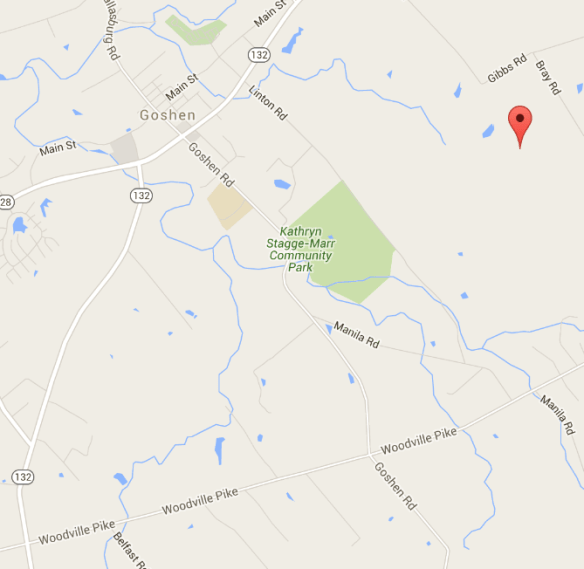
Daniel and David Miller didn’t wait on their inheritance of land from Philip Jacob Miller, but bought their own and lived at 132 and Woodville Pike, in the lower left hand corner of the map above.
Merle Rummell tells us the following:
Gabriel Karns lived about a mile on east of the Millers, on Manila Pike, the old Indian Road. Daniel Miller was put into the ministry at the Obannion Church.
In eastern Ohio Territory, the land back from the River was not good farmland. It was Appalachia Hills that crowded the River. David Horne travel 60 miles up the Muskingum River to the Forks of the Licking at the new Zane Trace, before he found land. John Countryman left the Massie Fort at Three Islands (now Manchester OH) and went 30 miles up the Ohio Brush Creek till he found farmland. It was at the Little Miami River, just before Cincinnati where the Brethren stopped at good farmland along the Indian Trace, the Obannon Church.
The Bullskin Landing was a goal for the Brethren migration down the Ohio River by flatboat. It was probably the best landing on the river, being a sunken valley back into the Ohio Hills.

Bullskin Creek is flooded by the Ohio River for half a mile back from the River, a wide valley opening. It was the first major landing for Ohio River flatboats above Fort Washington (Cincinnati). Here the flatboat was protected, off the river, with easy unloading facilities.
Most of the settlers on the New Frontier were frontier folk from the Old Frontier, very few were from the Settled East. The River brought them from Old Fort Redstone (now Union and Brownsville, PA), Brothers Valley and Washington Co. PA in the west; from Penns Valley, Brush Valley and Northumberland Co., PA in the north; from the Conococheague and Middletown Valley, MD; from Morrison’s Cove, Cambria Co. and the Juniata Valley, PA. The Kanawha Trace brought them from the Carolina settlements on the Yadkin; from Franklin and Floyd Counties and the lower Valley of Virginia.
These areas were the Old Frontier. It showed in the type of people who came, in their self-reliance and independent thought. They didn’t just accept being told something was true, they tried it out for themselves, and used it. They had to, or they died on the frontier. They were not stupid, while some were illiterate, most could read their Bible – maybe a Berleburg Bible, some read Greek. The Brethren knew what the Bible said, and lived it. They were definitely Brethren, and they took their Brethrenism with them, making a real Christian witness to their neighbors!
South of Goshen, came first David Miller, then his brother, Daniel. Daniel was put into the ministry there about 1798. The first minister was Elder John Garver, from Stony Creek in Brothers Valley, Pennsylvania, by way of Virginia, to North Carolina, to Kentucky. In 1805 he moved to the Donnels Creek Church, up the Indian Road. By tradition, the founding of the Obannon Baptist Church was 1795 by Elder David Stouder. He seems to have come over from Kentucky, and by research, may be the David Stover near Limestone, probably from the Log Union Church. This was the beginnings of the Obannon Church, but these families weren’t allowed to stay.
These were the Bounty Lands, claimed by Virginia as payment for service to their Veterans of the Revolution. Government survey of the lands began in 1802, and it did not matter to the Government or the surveyors if people already lived on these lands, if there were homes built and fields cleared. That the Dunker custom often included getting title from the Indians to homesteads gave them no claim to their lands in the eyes of the surveyor or state. Legally, they were squatters. There was no appeal for their claim to the land, all they could do was leave. They moved north, beyond the Bounty Lands, to the little Village of Dayton. Their move was easy, they went up the Indian Trace. From Little’s Bounty Lands Survey (1802) we have been able to identify the adjoining farms of David and Daniel Miller, they were surveyed as cleared lands.
Now other Brethren families came to Bullskin Landing. These were the second line of Brethren, moving west from the Old Frontier lands in Pennsylvania, Maryland, Virginia or Carolina, and some moved up from the churches in Kentucky. They used Bounty claims to get land, Bountys purchased back home, by self or through kin, from those who had no wish to leave for the west. The families at Obannon were mostly from Maryland and Pennsylvania: Binkley, Cripe, Grossnickle, Frey, Karns, Maugans, Miller, Moler, Pringle, Stouder; Elder John Garver and Frederick Weaver as ministers. Stonelick was a meeting house of the Obannon Congregation. This was good farmland, but it was a heavy clay and many Brethren soon moved north to better lands on the Great Miami headwaters near Dayton Ohio, where they remain strong today.
From Troy Goss’s site:
Right around the time that Daniel moved to Preble (this is an error, it was Montgomery) County, Daniel and David purchased plots from Ohio land magnate William Lytle (1770-1813), in Clermont County, on May 9, 1801. Daniel’s lot measured 100 acres (91 poles by 177 poles [1501.5′ by 2,920.5′]) for $200 and David’s, a triangular 204 acres, he bought for $400. [Deed 1801] Daniel’s plot lie between Captain William Barret’s survey (Virginia Military Reserve Survey Tract 710) to the north and David’s triangular tract to the south.

On this map from the Clermont County GIS system, Barrett MS 710 is in the upper left region in Goshen Township, where the G is located.
Troy continues:
The lot is estimated to lie to the south of Smith Road, paralleling Ohio State Route 28 (perhaps referred to as “Goshen Road,” as noted above) about 840 feet to the northwest, and up to the intersection of Smith Road and Fay Road (believed to be the southern corner of Survey 710,) shown on the maps below. Daniel and Elizabeth sold this property on April 28, 1809, to Alexander Hughey for $600, tripling what they paid for it eight years earlier. Daniel and Elizabeth were noted as living in Montgomery County at the time. If this is correct, Daniel’s land would be in the area, shown below.

The corner of Barrett’s 710 is reported to be the corner of Smith Road and 28, shown above and below.

Along Smith Road, the land is much like it was 200+ years ago. The area along 28 is sporadically developed, with homes and businesses fronting 28, so Smith Road is much more authentic to the time Daniel lived there.

After Daniel’s death, his heirs sold the 200-acre lot in Hamilton Township, Warren County, that he inherited from his father, to nephew-in-law Benjamin Eltzroth for $500. [Deed 1828]
There is a slightly different location for Daniel’s land provided by Merle:
Elder Daniel Miller and his brother David owned adjacent tracts of 200 and 100 acres about 2 miles south of Goshen, Ohio, on the northwest corner of OH132 and Woodville Pike – in the O’Bannon Church area.
This area is shown on the map below, today.
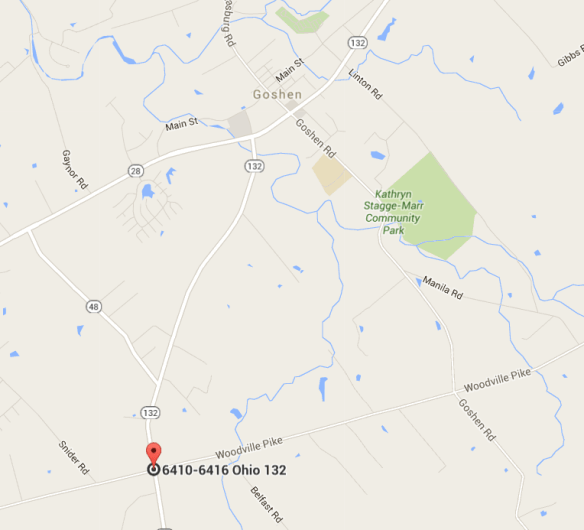
David and Daniel’s land is shown, beginning at this intersection of Ohio 132 and Woodville Pike.

Here’s a map of the two locations. As you can see they are a little over a mile apart, not far from Goshen.

David and Daniel Miller’s land as reported by Merle is shown below in relation to the location of the Stonelick Brethren Church today.

I would like to resolve this discrepancy and have contacted the GIS (Geogaphic Information Systems) Department in Clermont County to see if they have a map with the various military surveys overlaid over the current roads and landmarks.
They were very kind and sent the following map, showing Barrett’s survey 710 as well as an inset for 132 and Woodville Pike.

Additional deed work, either running Daniel’s deeds backwards to the military survey, or forward to current, could probably pinpoint the exact location of Daniel’s land in Clermont County. Regardless of exactly where he lived, we know he was very closely involved with the O’Bannion, now Stonelick Church.

The Stonelick covered bridge, shown below, now closed and undergoing renovation is located near the Stonelick Brethren Church, above, where several of Philip Jacob’s children, including Daniel, were founders. For Daniel, this church would have held a very special place in his heart, where he was called into the ministry.

After living between 5 and 8 years in Clermont County, the Miller clan would be on the move once again, this time to Montgomery County, Ohio.
Montgomery County, Ohio
The Ohio land office opened in 1801 and Ohio was admitted to the Union in 1803. It was about that time or shortly thereafter that Daniel Miller moved from Clermont to what would become Montgomery County, Ohio, at about the same time the state was admitted to the Union.
The government was trying to attract settlers to frontier areas by passing the Public Land Act where land could be purchased very cheaply. In 1804, the amount of land you could purchase was reduced to 160 aces from 320 acres, but the price was still $2 an acre.
We know that Daniel was in Montgomery County in 1804 because he was listed on the tax lists. He may not have been sure he wanted to stay, because he didn’t sell his Clermont County land until 1809. One of his sons could also have been farming that land as well. Daniel’s eldest son was born in 1775, so he had several sons of an age to farm.
From “Early Settlers of Montgomery Co Ohio”:
1804 Tax List:
- Miller, David
- Miller, Daniel
- Miller, John Brown
- Miller, John
- Miller, James Sr
- Miller, Jacob
- Miller, James Jr
By 1805 some of the members of the Stonelick (Clermont County) group moved on to north of Dayton in Montgomery County. Magdalene Miller Cripe and Daniel Cripe moved in 1805 along with Daniel’s brothers John, Joseph and Samuel (Miami Valley Index, Lib. Of Congress, Wash DC).
In 1805, Daniel Miller was co-executor of the estate of Peter Gephart, along with the widow Catherine Gephart. David Miller, son of Daniel, married the widow, Catharine later in 1805.
In 1805, Daniel purchased land on Bear Creek in section 34, Twp 3 Range 5 in Jefferson Township (now Miami) on the east part of the section east of the creek. He purchased 150 acres. The 1806 tax list for Montgomery County also shows others living in that section were:
- John Bowman Sr – 136 acres
- John Bowman Jr – 100 acres
- Daniel Bowser 75 acres
- John Kripe – 50 acres
- David Miller – 50 acres
Miller P 52
From the book “History of the City of Dayton and Montgomery Co., Ohio” by Rev. A.W. Drury, 1909.
Page 828 – December 9, 1829 Miami Township was formed. Parts were taken from Washington Twp. and Jefferson Twp. This township runs along the Miami river and includes her rich bottom lands. In 1788 the first exploration party was recorded, and in 1795 the first “road” cut to present day Dayton. Miamisburg is in this original township area. In 1797 Zachariah Hole settled and created Hole’s Station, several blockhouses to protect settlers from possible Indian attack.
The land in what would become Miami Township was all purchased early.
West of the Miami River in Township 2, range 5, Alexander Scott purchased sections 2 and 3, Oct. 19, 1802, William Emrick purchased section 4 Aug. 10, 1804 and G. Myers and P. Gephart purchased sections 9 and 10 on July 9, 1804. George Stettler purchased sections 15 and 16 on July 18, 1804. Samuel Tibbals purchased sections 21, 22, and 23 on Dec. 26, 1801. Arthur Vandevere purchased section 26, 27 and 28 Aug. 17, 1801. Jacob Miller purchased Township 3 range 5 sections 34, 35 and 36 in July 28, 1801. David Longhead purchased in Township 1 range 6 sections 19, 20, 29, and 30 on Dec. 28, 1803, The above descriptions include all of the land west of the Miami River, belonging to Miami township and also parts of sections 26, 27 and 28 lying south of the Montgomery Co line. Jacob Miller, named as one of the purchasers has special interest to us as he was the first Dunker preacher, settling within the limits of Montgomery Co.
It’s possible that the Elder Jacob Miller was involved in a bit of land speculation. Daniel Miller purchased his land from Jacob Miller. He probably felt that being a fellow Brethren, he could trust Jacob.
We don’t find Daniel on the 1806 or 1808 tax lists, but they may be incomplete. We do find him in 1809 and 1810. The 1810 tax list is particularly helpful because it includes a list of who entered the land patent for this land.
1810 Lands Recorded July 21, 1810
| Proprietor’s Name |
Twp |
Range |
Twp |
Section |
By Whom Entered |
| Gephart, Peter (heirs) |
German |
5 |
2 |
10 |
Note – more Gepharts |
| No Lentz |
|
|
|
|
|
| Miller, Aaron |
Jefferson |
5 |
3 |
11 |
Jacob Miller |
| Miller, Daniel |
Dayton |
6 |
2 |
30 |
D. Miller |
| Miller, Daniel |
Dayton |
5 |
4 |
11 |
D. Miller |
| Miller, Daniel |
Jefferson |
5 |
3 |
34 |
Jac. Miller |
| Miller, David |
Jefferson |
5 |
3 |
11 |
Jacob Miller |
| Miller, David |
German |
5 |
2 |
10 |
|
| Miller, David |
Randolph |
5 |
5 |
17 |
|
| Miller, George |
German |
4 |
4 |
26 |
|
| Miller, Isaac Sr. |
Jefferson |
5 |
3 |
7 |
Peter Weaver |
| Miller, James |
Wayne |
6 |
3 |
33 |
Fryback and Miller |
| Miller, John |
Dayton |
6 |
2 |
32 |
Jona Donnel |
| Miller, John |
German |
4 |
4 |
27 |
|
| Miller, Phillip |
Wayne |
8 |
3 |
22 |
P. Short |
| Miller, Susannah |
Jefferson |
5 |
3 |
29 |
John Miller |
We know in the above tax list that Daniel’s son David is living in the same location as the Gephart land. David Miller married Peter Gephart’s widow in 1805. I also suspect that the Daniel and David who own adjacent land, both entered by Jacob Miller are our Daniel and his brother David, although I have no way to prove it. The Daniel in Dayton is Daniel (2) and the land owned by David in Randolph Twp. is Daniel’s brother, David. The Randolph Township land would be David’s last land purchase, as he was buried on that land in 1845.
1814 Tax List
| Name |
Range |
T |
S |
Orig Patent |
| Dayton Twp |
|
|
|
|
| Daniel Miller |
6 |
2 |
30 |
Self |
| Daniel Miller |
6 |
4 |
11 |
Self |
| Daniel Miller |
6 |
2 |
19 |
Self |
| Daniel Miller |
6 |
2 |
29 |
Self |
| John Miller |
6 |
2 |
25 |
Andrew Robinson |
| John Miller |
6 |
2 |
15 |
John Neff |
| John Miller |
6 |
2 |
15 |
John Neff |
| German Twp |
|
|
|
|
| David |
5 |
2 |
9, 10 |
Moyer and Gephart |
| George Miller |
4 |
4 |
26 |
Amos Higgins |
| Jacob Miller |
4 |
4 |
30 |
Abraham Horner |
| John Brown |
4 |
4 |
27 |
John Miller |
| John Carpenter |
4 |
4 |
27 |
John Miller |
| Jefferson Twp |
|
|
|
|
| Daniel Miller |
5 |
3 |
34 |
Jacob Miller |
| Elizabeth Miller |
5 |
3 |
26 |
Bowser and Waggoner |
| Isaac Miller |
5 |
3 |
7 |
Peter Weaver |
| Jacob Miller |
5 |
3 |
11 |
Self |
| Peter Miller |
5 |
3 |
36 |
Wm. Waggaman |
| Susanna Miller |
5 |
3 |
29 |
John Miller |
| David Miller |
5 |
5 |
13 |
John Miller |
| Randolph Twp |
|
|
|
|
| David Miller |
5 |
5 |
17 |
John Miller |
| John Miller |
5 |
5 |
17 |
John Miller |
| Michael Miller |
5 |
5 |
17 |
David Miller |
|
|
|
|
|

On the Montgomery County map, above, you can see the various Township locations. While the portion of Miami where David Miller lived, German and Jefferson were located in the southern part of the County, on the west side of the Miami River, Randolph Township was located on the North side of the County. David, Daniel’s brother bought land in Randolph Township, and eventually, so did Daniel.
Jefferson Township butts up against both German and Miami Township and Daniel definitely bought land from Jacob Miller according to Montgomery County deeds, in Jefferson Township, the part of which later became Miami Township.
A review of the Daniel Miller deeds in Montgomery County shows us the following information:

Daniel’s land in Jefferson Township was interesting, in particular, because in addition to being owned by Daniel for more than a decade, he also established a cemetery in that location. During that time, Daniel’s son, Daniel died in 1812 at the age of 33, with no sign of having married. It’s likely that Daniel buried his son on his land.

The land that Daniel owned includes what is known as the Troxel Cemetery, named after the man Daniel sold it to who was also a neighbor. It was already a cemetery at the point that Daniel sold it, and it was undeveloped when Daniel bought the land from Jacob Miller who had not lived there but was engaged in land speculation – so that cemetery had to be the Daniel Miller cemetery. It may also have served other Brethren families in the area.
The burial records were obtained from the Salem’s Church in Ellerton.
There are only 14 known burials, the earliest of which was Christian Troxel, buried in May 1814, before Daniel sold the land, so it was apparently serving as a community cemetery.

According to Find-A-Grave, this is the location of the Troxel Cemetery with the following cemetery notes and/or description:
This cemetery no longer exists. Only one stone remains. The cemetery was located between two fields and was destroyed to make access from one field to the other.

If that is in fact accurate, there are a very limited number of places on this tract of land where the cemetery could have been located. On the map above, the cemetery would be in the upper area where Bear Creek Road and the blue Bear Creek appear side by side, where the creek approaches the road.
I don’t think the Find-A-Grave location is exactly accurate, because the deed description when Daniel sold the cemetery to Troxel says that it is on the bank of Bear Creek, measured from the middle of the head race of the great mill, containing half an acre. The Mill appears to be located approximately where the white roof building is today, so the cemetery would be right there as well. The tree line across from the white roof building is the north end of Daniel’s property.

If the cemetery was destroyed for field access, the only location on the banks of Bear Creek with anything resembling fields was at this location.

The succession of deeds confirms that Daniel Miller was indeed a miller in the truest sense of the word. His land included a mill, and given that his 1796 tax record in Bedford County also indicated that he had a mill, this would simply be a continuation of his livelihood. And who better to trust with your business than the local church elder?
This 1851 plat map shows Beck’s Mill where Daniel Miller once owned land on Bear Creek.

Using Google Maps and street view, I took a “drive” of the area where Daniel lived.

Daniel’s property began as the field line below South Union Road on Bear Creek Road. The mill must have been on the far north side of Daniel’s property, just about 500 feet south of the intersection of South Union Road and Bear Creek Road, where homes are located today, based on the 1851 map and the deeds referencing the cemetery, which was clearly very close to the property line as well. You can see Daniel’s property line on the current map today, shown below.

From the bridge on South Union Road, we can see Bear Creek. This is looking south towards Daniel’s land.

Driving south of Bear Creek, we follow the road through Daniel’s land, but the creek is obscured by trees on the right.

Daniel’s land is growing fine crops of corn. As a farmer, he would be very pleased.

Based on the 1851 map, and the lay of the land, I’m sure this is the old homeplace. Some of these structures could have been Daniels. Perhaps his original house is “inside” one of these homes today. This hill is the highest elevation on the property, and Bear Creek is right across the road, so Daniel clearly built where he was least likely to be flooded.

It’s certainly not beyond the realm of possibility that at least one of these barns was Daniels.

This land probably hasn’t changed much in the last 200 years. It was exactly 200 years ago that Daniel sold this land. What an incredibly beautiful Americana farmscape.
Daniel (2) of Dayton
There is a second Daniel Miller on the Montgomery County tax lists that lived in what would become the City of Dayton. That isn’t our Daniel, and these two Daniel Millers have been confused for years. I spent a lot of time when I initially began researching Daniel Miller in Montgomery County barking up the wrong tree.
Gale Honeyman wonders if this Daniel Miller is also related to Philip Jacob Miller, perhaps through an unknown son of Johann Michael Miller. That’s certainly a possibility, especially with an association with the Ullery family. If a male Miller descendant of this Daniel Miller ever decides to take a Y DNA test, we’ll know immediately if Daniel (2 )descends from the same line as either Johann Michael Mueller/Miller or the Elder Jacob Miller.
Extracted from the History of the Church of the Brethren of the Southern District of Ohio, published originally in 1916, reprinted in 2007:
P 93 – The south line of Lower Stillwater was finally established along the line of the Pennsylvania Railroad from Trotwood south-east to what is now called Gettysburg Avenue: thence south a half mile and east to Miami River. This detour was made to include the lands of an early settler who needs more than passing mention. Upon a marble slab erected in the family cemetery on this farm this inscription appears:
“Daniel Miller Sr. Emigrated from Huntingdon County, Pennsylvania, 1804, to this place where he died January 24, 1849. Aged 83 years, 8 months and 19 days.”
His wife Susan, was a sister of Elder David Bowman, Sr. She died December 10, 1851. When they landed at Dayton its oldest house had been built 8 years. They made their way up Wolf Creek Valley by the men going ahead and cutting away trees and vines for passage and taking possession of Section 30, three miles west of Dayton, but now adjoining the corporation. The encroachment of the city caused the removal of their remains to Fort McKinley, where their monuments now stand.
They raised to maturity 4 sons, namely: Benjamin (Elizabeth Bowser), Daniel (Susan Oliver), John (Anna Winger Sollenberger), Joseph (Catherine Funderburg) and 7 daughters: Mary who married Samuel Ullery and died leaving a daughter Susan who married David Beeghly. Elizabeth married Moses Shoup of Beaver Creek Church, Susan married Joseph Etter, Esther married Isaac Long, Margaret married Abraham Denlinger, St., Catherine married Jacob Wolf, Sarah married John Denlinger, Sr.
Indeed, there is quite a bit of information about Daniel (2), extracted from several source, including the following by Carolyn T. Denlinger:
In late 1802 or early 1803, Daniel Miller came from Huntingdon County, Pennsylvania to prospect for land. In Harrison township in Montgomery County, he found a squatter by the name of Billy Mason who had built his cabin and cleared some land in 1800, the first squatter in Harrison Twp. Daniel Miller liked the land which lay along the Wolf Creek and he bought it from Mason. The US patent for this plot was granted to him on Feb 11 1804 above the signature of President Thomas Jefferson. Miller then returned to Pa. and brought his wife and family back to Ohio.
In 1808 a large brick dwelling was erected on a rise overlooking the Wolf Creek. This house is still standing at 3525 Dandridge Avenue and is registered as a Historic Site.

In 1804 or 1805 Miller built a saw and grist mill on Wolf Creek near his home. The grist mill was later equipped with a set of French Buhrs weighing approximately 1500 pounds each which were bought in Cincinnati. Millers Mill burned in 1825 or 26 but were rebuilt shortly thereafter.
Later he added a distillery and made large quantities of liquor. He and his sons made three trips down the Mississippi River to Natchez and New Orleans to sell the products of their labors. They did so well that Daniel Miller became the owner of a large amount of land ranging in estimates from several hundred acres to two thousand acres.
When Miller arrived in Montgomery county, it was necessary for him to cut a road through the forest to his land from Dayton which was only a tiny hamlet. This was the start of his involvement with the building of roads in the area. According to the road records of the Montgomery Co. engineers office, Daniel Miller was an active participant in the building of these roads: Liberty Road (1809), road from Dayton to New Lexington (1807), Wolf Creek Pike (1810), alteration to Wolf Creek Pike (1813), Western Avenue (1818) and other transactions. A Denlinger family tradition explains the crookedness of Wolf Creek Pike from Dayton to Trotwood this way: as the ancestors were clearing the forest to build the road, it was easier to go around the largest trees than to cut them down.
Daniel Miller’s wife was Susan Bowman, daughter of John Bowman Sr. and wife Esther (maiden name unknown). The Miller’s were the parents of ten children: Benjamin, John, Joseph, Betsy (m. Shoup), Susannah (m. Etter), Catharine (m Jacob B. Wolfe), Esther (m. Long), Margaret (m. Abraham Denlinger), Daniel Jr., Sarah (m John Denlinger). The Millers were devout members of the German Baptist Brethren Church. Their large brick home was built with removable partitions between the rooms so that worship services could be held there. The Annual Meeting of the denomination for the whole country was held at Millers Crossing in 1884.
Daniel Miller lived a long, eventful and prosperous life. He saw Montgomery County change from dense forest to a populous area and he played a prominent part in that development. He died in 1849, his wife in 1851. Both were buried near their home, but the encroachment of the city necessitated their removal to the Ft. McKinley Cemetery on Free Pike.
Fortunately, between being geographically separate along with this additional information, we have enough to separate the two earliest Daniel Millers found in Montgomery County.
Daniel Miller (1) as Executor
In 1805, Daniel Miller was appointed executor of Peter Gephart’s estate.
Daniel’s son, David, would marry Peter’s widow, Catharina Gephart in late 1805.
Montgomery Co. Administrations, Wills and Guardians 1805-1850:
Peter Gephart of German Twp administrators Catherine Gephart and Daniel Miller, security John Bowman and Zachariah Hole, Jan. 4, 1805 #12 p 19
Elizabeth Gephart 8 years and John Gephart 5 years, heirs of Peter Gephart decd, guardian Valentine Gephart and Mathaias Rigal, Aug 26,1806 #29 p 41
In May 1810, Daniel Miller as executor of Peter Gephart’s estate, Catherina Miller as his former wife and the mother of his 2 children, and David Miller as her current husband and guardian of her two Gephart children, petition the court and explain how Peter Gephart and Philip Moyer divided land they bought together.
At the August 1816 court session, Betsey Gephart 10 (age is incorrect) and John 15, heirs of Peter Gephart chose Peter Barta guardian. Security George Parsons and James Chatham.
In 1810, Daniel Miller was also the administrator of the estate of one John Miller of Jefferson Township along with widow Susannah and John Mikesell. We really don’t know who this John was, but given the 1790 census, it’s a distinct possibility that John Miller was a son of Daniel’s brother, David. David has two unexplained males on the 1790 census where he is known to have only female children at that time. John was a farmer and had an extensive estate.

In 1813, Daniel serves as an appraiser of the estate of his neighbor, Daniel Bowser, along with the English Brethren minister, Samuel Boltin.

Given that Daniel Bowser was Daniel Miller’s neighbor, I wonder if Daniel Bowser is buried in the cemetery on Daniel Miller’s land.
Based on this entry from Montgomery Co. Administrations, Wills and Guardians 1805-1850, it appears that Daniel Miller might well have served once more as an administrator for Adam Miller, although I don’t know who Adam is.
Page 30 – Adam Miller, administrators Daniel and John (Johannes) Miller. Securities Michael Hagar and Adam Weaver?, July 1821. Adam died in June and paperwork within the estate packet indicate he owned land in Dayton Township.

In 1822, just 5 months before he died, it looks like Daniel was a witness in another estate for Jacob Ullery, probably related to Daniel’s wife.
34 – Jacob Ullery will Book A p 228 exec David Miller and Samuel Stutzman witnesses David and Daniel Miller, wife Susannah, children Daniel, Jacob, John, Mary, Susannah, Lydia, Cathy. March 4, 1822.
Moving On Up, to the North Side
When Daniel first arrived in Montgomery County, he bought land in Jefferson Township in the southern part of the county, along the Miami River bottomlands.
In 1814, according to the tax list, Daniel Miller is still farming the same land, but in 1815, that would change when Daniel sells that land and buys land in Randolph Township, closer to his brother David and very close to the Happy Corner Church, then known as the upper house of Lower Stillwater.
May 27, 1815 – Daniel Miller to Michael Hoovler $2980 section 34 Twp 3 range 5 begin at Abraham Troxel SE corner…D. Bowser corner…meandering to John Bowman’s and Abraham Troxels…149.5 acres. Signed by Daniel Miller, Elizabeth Miller her mark. Witness Philip Mikesell, A. Troxel. Elizabeth releases dower.
May 27, 1815 – Daniel Miller to Abraham Troxel, $20, section 34 Twp 3 range 5, on the Bank of Bear Creek south of the mill N 25 degrees west 7 chains 81 links to post then west one chain and 25 links to the middle of the head race of the great mill, then south 43 degrees east 8 chains and 80 links to beginning containing half an acre. Daniel Miller signed, witnesses Philip Mikesell and George Hoobler – Jefferson Township
This deed of sale tells us that there was a mill on Daniel’s property. This is the only record of that mill, with the exception of the 1851 plat map. The description of this cemetery suggests that it is between the road and the creek.
When Daniel bought this land, it was bordered by the Troxel land, and he sold the cemetery to the Troxel family. By this time, there was at least one Troxel burial in the cemetery – at least one where the stone remained a few years ago.
Daniel sold his interests in Sec 34 in Montgomery Co, on Bear Creek, selling his 150 acres for $3000 or $20 per acre, an increase of 10 times in a period of 8 years. Of course, he had built a mill. He paid $12 per acre for his new land in Randolph County. Daniel seemed to be an astute businessman.
Sept. 1, 1815, William Farmer and Prudence his wife to Daniel Miller for $1689,12 section 26 Twp range 5 beginning at SW corner of the section…west boundary line of said section…140.76 acres. Witness Robert Russell and Archibald E. Mickle
Where did Daniel live between May and September of 1815? A receipt in his estate indicates that he hired Michael Wiltfong to assist him with looking for land. Apparently the land they found was what Daniel purchased in Randolph Township, although why Michael wasn’t paid until after Daniel’s death in 1822 is a mystery.
In 1817, the Public Land Act acreage reduced to 80 acres. Price still $2 an acre.
After Daniel’s death, his heirs straightened out the deed to his property. He had clearly meant to take care of this before he died, another reason to think he died unexpectedly.
March 21, 1826 – David Miller administrator of Daniel Miller to Jacob Miller – Daniel Miller died seized of the SW quarter of section 26 Twp 5 range 5 and on August 22, 1820 sold 100 acres of north side of said quarter to Jacob for $1000 who is one of the sons and heirs of said Daniel who died intestate and without executing the deed to said Jacob. Some of Daniel’s heirs are underage. Court ordered the deed to be recorded. Signed by David and John Miller. Witnessed by Henry Stoddard and John Folkerth.
Received Dec 18, 1827 recorded Jan 1, 1838
On Sept. 24, 1834 John Miller of Miami County, Ohio filed in the court of pleas and quarter sessions against Stephen Miller, Jacob Miller, Samuel Miller, Abraham Miller, John Boogher and Elizabeth his wife, Daniel Miller, Samuel Miller, Abraham Miller, Daniel Cripe and Magdalena his wife, Nancy Miller, David Miller and Elizabeth Miller demanding partition of certain real estate here-in-after described. Heard at February court 1835. Real estate sold at public auction to Peter Hoffman for $500…40 acres off the south side of the SW quarter of section 26 Twp 5 range 5 lying south of and adjoining 100 acres part of said quarter with Daniel Miller deceased in his lifetime sold to his son Jacob Miller and since his death his administrators have conveyed by virtue of an order of the court February term 1826. Signed by the sheriff of Montgomery County, James Brown and witness Abraham Barnett and David John.
This is the 40 acres with a home built in 1832 that stands today. Elizabeth did not die until October 1832, so it’s at least feasible she had the home built.
Daniel originally owned a total of 140 acres in Randolph Township. In 1820 he sold 100 acres to son Jacob, but the deed was never filed. Daniel’s heirs filed it in 1826. Part of the condition of that sale was that Jacob give up his interest in the balance of the 40 acres which may have included the Daniel Miller homeplace. However, according to Daniel’s estate paperwork, he may well not have been living there at the time he died, given that a receipt to son John indicates that he moved from “Stillwater.”
Jacob Miller owned his 100 acres at least as late as 1851 according to the plat map.
The 1851 Montgomery County plat map, Randolph Township section 26 still shows Jacob Miller.

The 1827 tax lists from Montgomery County show a listing in Randolph Township for “The heirs of Daniel Miller” for tax on 40 acres of land located at Range 5, Township 5, section 26. That land is located on a later plat map, still configured as a 40 acre farm, having not been split, shown below, with the 10 acres showing above. The upper house of Lower Stillwater, now Happy Corner Brethren Church is located about a mile to the west, just past the fruit farms, visible on the corner.

Given this information, it’s not terribly difficult to find this land today using Google maps.

On this map, Daniel’s land in Randolph Township is at the red balloon, and the Happy Corner Church, then the upper house of Lower Stillwater is located at the intersection of North Union and Old Salem Road about a mile west.

I found the land at 3705 Old Salem Rd Dayton, OH 45415, and immediately became very excited because I was just sure I saw an old cemetery, at the green arrow.
As luck would have it, my husband wandered into my office and announced that he had to go to Cincinnati the following day. We live in Michigan, so he had to drive through Dayton. He probably wondered why I was so excited about him leaving for a business trip, and maybe a tad bit confused. When I asked him to go to that location where I thought the cemetery might be, he thought I had lost my mind. I asked him to take a picture, and if the owners were home, to talk to them. He discovered that it isn’t a cemetery, but a garden, created by the current owners, and he also discovered that the original farmhouse actually still stands two structures away, to the east. It pays to talk to current owners.

Was this Daniel Miller’s house? It’s certainly possible. This address is 3625 Old Salem Road. Realtor listings tell us this home was built in 1832. If they are accurate, this wasn’t Daniel’s, at least not the original home, although the original could be underneath. The realtor’s date may not be accurate either.

However, Elizabeth lived until in 1832, so the family could have potentially built this for her. I surely would love to know if there is a log cabin under this structure. I also wonder if these trees were growing when Daniel lived there.
Maybe I need to send my husband back to talk to these owners!

Daniel owned one more piece of land not recorded above. In 1820, he received a land grant and based on the Land Grant Act, he would have paid $2 per acre or a total of $320 for 160 acres.

This is the land Daniel’s estate was paying tax on in Darke County.
On April 27, 1829 after the snows were thawed, John Miller the SE ¼ of section 8, Twp 9 Range 4 in Adams Twp, Darke Co., 160 acres. This was formerly owned by John’s father, Daniel Miller and is the 1820 land grant. It was purchased from the heirs for $200. Earlier on Nov. 13, 1816, David Miller, John’s father-in-law (and Daniel’s brother) had obtained a patent for 160 acres on Section 7 Twp 9, range 4 in Adams Twp. This land later went to David’s heirs. There is a Miller cemetery located on Daniel’s property. It is located in the corner of the SE quarter and the section line of 7 and 8 passes on the west side of the cemetery. It is fenced but not taken care of. The stones are no longer standing. Inscriptions were takin in 1966.
Darke County Common Pleas Court, July term 1829: Stephen, Jacob, David, John, Abraham Miller, John Booker & Betsy his wife vs. Samuel, Daniel, Magdalena, Nancy, David & Betsy Miller. Petition for partition. Land described as SE 1/4 section 8, Town 9, Range 4, Darke County OH. That Daniel Miller, late of Montgomery County OH, died seized of the above described land and that he left 8 heirs to which land descends, to wit: Stephen, Jacob, David, John, Abraham, Betsy, along with Samuel Miller who resides in Montgomery County OH and who is deaf and dumb and also Isaac Miller who died leaving as his heirs at law: Daniel age about 14, Nancy age about 10, David age about 8, Betsy age about 6 & Magdalena aged about 12. Said minor heirs of Isaac Miller, dec’d, reside in Miami County OH. That Jacob has since relinquished his claim because of advancements made by his father to him, in his lifetime. Widow of Daniel Miller, Dec’d relinquishes her right to dower [she is not named]. above described land sold to John Miller. Chancery Book B-1, p 277

The map above shows the location of the Miller Cemetery on this land, and the FindAGrave entry below.

I have never before had an ancestor who owned two pieces of land that included cemeteries, and him not be buried in either.
Gale Honeyman at the Brethren Heritage Center informed me of additional land patents, although there is no record of our Daniel selling this land, nor of his estate paying taxes for this land, so these patents could be for one of the other Daniels (2 or 10) in Montgomery County, including Daniel #1’s son, Daniel who died in 1812, although there is no Montgomery County estate for him. This is the most likely possibility since the word “Jr.” is attached to one of the patents. They could also have been sold directly and never registered, so we’ll likely never know which Daniel these belonged to. There is no record of a Daniel Miller selling these lands in Montgomery County.
Daniel Miller of Montgomery County OH had two land patents in Perry Twp, Montgomery County in section 36 on 19 Jul 1804 and section 11 on 15 Aug 1804. Daniel Miller Jr. of Montgomery County obtained a patent in the same Twp for section 19 on 20 Aug 1805. Early Ohio Settlers, Purchasers of Land in Southwestern Ohio, 1800-1840, 1986, Ellen T. Berry & David A. Berry, p 223. Section 11 is 4 miles from the Preble County line and section 36 is 5 miles from the line.
Daniel’s Death
Daniel died on August 22, 1822. We can presume from a couple of different pieces of evidence that Daniel was not ill before he died, and may have died rather unexpectedly. Daniel had just celebrated his 67th birthday. By today’s standards, that isn’t old at all, and he was clearly still very active and involved.
First, Daniel was building something and had apparently recently moved.
Second, Daniel had no will, suggesting he did not expect to die.
Third, Daniel, apparently, did not die at home, and he may have passed rather unexpectedly.
Fourth, Daniel never registered the deed to his son Jacob from the time he sold Jacob 100 acres of the home place on August 22, 1820 until his death 2 years and 4 days later. Had he thought he was gravely ill, he would have registered that deed.
Ohio was ravaged by illness between 1820 and 1823, as is told in the following excerpt from the book, “The Midwest Pioneer, His Ills, Cures and Doctors” by Madge Pickard and R. Carlyle Buley published in 1946, page 14:
In Ohio, too, generally prevailed the most distressing sickness and great mortality, particularly from bilious fevers and cholera morbus.
Said James Kilbourne, prominent Ohio journalist and legislator:
“Respecting the healthfulness of this country, I have to repeat that it is in fact sickly in a considerable degree.” He reported the presence in 1800 of bilious fever which returned with more violence the following year: “Almost all were sick, both in towns and country, so that it became difficult, in many instances, to get tenderers for the sick. In many instances whole famihes were down at a time and many died. What seems strange to me is that the Indians who were natives of the country are as subject to the disorder as the whites. Of the few who remain in the territory some are now sick with it and they say it has always been so, and that they have often been obliged to move back from the meadows and bottoms where they always lived, into the woods and uplands during the sickly season to escape it.”
The autumn of 1819 in Ohio was particularly bad along the Scioto River bottoms, “whence deleterious exhalations arise.” “The angel of disease and death, ascending from his oozy bed, along the marshy margin of the bottom grounds . . . floats in his aerial chariot, and in seasons favorable to his prowess, spreads mortal desolation as he flies,” mourned the Portsmouth Scioto Telegraph in 1820. In 1821, “even in the memory of the oldest Indian, so unhealthy a season was never known here before,” reported the Piqua Gazette. Of the one hundred sixty-five thousand people in the seventeen counties within a radius of fifty miles of Columbus, more than one-half were sick in September, 1823. “The most extravagant imagination can hardly picture desolation greater than the reality.”
Ironically, the mystery surrounding Daniel’s death and where he is, or was, buried in one of the most profound of his life.
And I must admit, it’s driving me crazy.
Let me first share with you what we do know.
Because Daniel did not have a will, his estate was involved and generated a lot of paperwork, which still exists today. That’s the wonderful news.
Daniel’s Estate
Montgomery Co. Administrations, Wills and Guardians 1805-1850:
Page 34 – Daniel Miller will probated Sept. 23, 1822. Security John Becher and Stephen Miller, admins David and John Miller
After Daniel died, David Miller, John Miller, John Becher and Stephen Miller are all four bound as securities for David and John Miller as administrators of Daniel’s estate. There is also a receipt where Daniel Miller promises to pay Henry Marquet $7 on January 22, 1822, not long before he died. This receipt contains Daniel’s signature and is the first signature of Daniel’s I found. Today, there are a few more.

Daniel’s estate receipts include tax documents for taxes in Darke Co in 1822, 23 and 24, along with Montgomery Co. It also includes a charge in March 1822 for “moving him from Stillwater” and in August for hauling one load for him on Twin. Then another entry for tax in Darke Co. in 1828 and 1829 and also in Montgomery. The taxes in both Darke County and Montgomery County are for the land we knew that he owned, so no surprises there. Had he owned additional land, his estate assuredly would be paying taxes on that land.
Surprisingly, there are also receipts relating to the estate of Peter Gephart. Daniel was the administrator of that estate, beginning in 1805. The last child had already come of age, so this must have simply been the final “cleanup,” although Elizabeth Gephart’s husband, William Hipple filed suit against the estate, then dropped the suit. All may not have been entirely friendly.
Samuel Studebacher filed a bill for 2750 bricks at $4 per thousand.
If Daniel had built a house outside of Montgomery County, there would have been land taxes on an additional property, and his estate would have been filed in the county where he lived when he died. Clearly, he died in Montgomery County. But what and where was he building?
Daniel’s estate sale was held September 22, 1822 and the following people purchased items. Note that the purchasers all seem to be family. Johannes Bucher was his son-in-law, married to his daughter Elizabeth. His widow seems to have purchased only one thing. John was his son who bought the family Bible and subsequently took it with him to Elkhart County, Indiana.
| Who |
What |
$ |
Cents |
fractions |
| John Bugher |
One stove |
20 |
|
|
| Abraham Miller |
One sattle |
14 |
|
|
| Abraham Miller |
Two axes |
4 |
61 |
|
| Steven Miller |
One chorn |
4 |
|
|
| Steven Miller |
One box of sundry articles |
2 |
25 |
|
| Abraham Miller |
One mans sattle |
2 |
|
|
| Samuel Miller |
One clowiny? Knife |
1 |
56 |
2/4 |
| Abraham Miller |
One cut of augers |
2 |
18 |
¼ |
| Abraham Miller |
Chisels |
1 |
81 |
¼ |
| David Miller |
One hand saw |
1 |
|
|
| John Miller |
Shackers? forge and hoes |
2 |
50 |
|
| Jacob Miller |
One tin and cobs sheet |
1 |
06 |
¼ |
| Steven Miller |
Tin cups and funnel |
|
37 |
½ |
| Abraham Miller |
Holter chain |
1 |
61 |
½ |
| Jacob Miller |
Halter chain |
|
50 |
|
| Abraham Miller |
Lot of sundry articles |
3 |
12 |
½ |
| John Bucher |
Col and books |
1 |
38 |
|
| Abraham Miller |
Bale and square |
1 |
62 |
½ |
| Steven Miller |
One gross snet |
1 |
6 |
1/9 |
| David Miller |
One smelting lien? |
|
87 |
½ |
| Stephen Miller |
One bair skin |
|
75 |
|
| Abraham Miller |
One mattik |
2 |
61 |
¼ |
| Abraham Miller |
Waking can (walking cane?) |
1 |
|
|
| Steven Miller |
One stovel |
|
25 |
|
| David Miller |
Chaier and lasts |
1 |
81 |
¼ |
| Steven Miller |
One bar of iron |
2 |
55 |
|
| Steven Miller |
Crout cutter |
|
62 |
½ |
| Steven Miller |
Hors geers |
9 |
75 |
|
| Jacob Miller |
Hors geers |
4 |
25 |
|
| John Miller |
Hors geers |
1 |
75 |
|
| Chraha Miller |
Two bridles |
1 |
6 |
¼ |
| John Miller |
One bible |
44 |
|
|
| David Miller |
Set of crocks |
|
75 |
|
| Abraham Miller |
One bottle |
|
37 |
½ |
| David Miller |
One chisel |
2 |
|
|
| Abraham Miller |
One had? |
19 |
|
|
| Steven Miller |
One barrel of whiskey |
6 |
|
|
| Abraham Miller |
One brittle |
|
85 |
½ |
| Steven Miller |
One hogsherd |
1 |
37 |
|
| Jacob Miller |
Bort mantle |
|
68 |
¼ |
| Elisabeth Miller |
One mans saddle |
5 |
|
|
| Steven Miller |
One mare |
58 |
|
|
| Steven Miller |
One ink stand |
|
86 |
|
| Abraham Miller |
One stove |
33 |
|
|
| Steven Miller |
One crosscut saw |
8 |
|
|
| Steven Miller |
One grind stone |
6 |
25 |
|
| John Miller |
One crosscut |
7 |
|
|
| Steven Miller |
One logogars?? |
5 |
|
|
| David Miller |
Shab skin and heb stubs |
|
25 |
|
| John Bugher |
Cantle mats |
|
43 |
¼ |
| Jacob Miller |
One dony? (dung?) Fork |
|
87 |
½ |
| Jacob Miller |
One hamer |
1 |
|
|
| John Bugher |
Two bags |
|
25 |
|
| John Bugher |
Pitch fork |
|
50 |
|
| Jacob Miller |
Two blains |
|
50 |
|
| John Bugher |
One pot |
3 |
|
|
| Jacob Miller |
One oven |
|
75 |
|
| Steven Miller |
One half bushel |
|
62 |
|
| Abraham Miller |
One rifel and pony? |
13 |
|
|
| Abraham Miller |
30 bushels whet |
15 |
|
|
| John Miller |
13 bushels whet |
8 |
19 |
|
| Abraham Miller |
25 bushels corn |
4 |
62 |
|
| Jacob Miller |
28 bushels of corn |
5 |
25 |
|
| John Bugher |
24 bushels of oats |
5 |
6 |
|
| John Miller |
Sith an cratle?? |
5 |
12 |
5 |
| John Bugher |
17 bushels of ray |
3 |
56 |
|
| Abraham Miller |
One lame (lamb?) |
2 |
12 |
1 |
| John Bugher |
Frying pay and spinning whele |
2 |
|
|
Surprisingly, Daniel had a barrel of whiskey. Medicinal perhaps? That’s a lot of medicine.
I love the crout cutter. He was truly still German. But I must admit, I don’t know what a crout cuter looks like, so I turned to google to find out.

This kraut cutter is probably not as old as Daniel’s, but I’d wager that kraut cutters hadn’t changed much. The cabbage was put into the wooden box (to preserve knuckles and fingers, I’m sure) which was then slid back and forth over the blades to shred the cabbage into small pieces. Further reading discloses that the Germans would set this contraption on top of a large crock into which they shaved the cabbage and then added salt, allowing the cabbage to naturally ferment, turning the cabbage into sauerkraut. Daniel had a set of crocks, which were probably used for making sauerkraut.
I do wonder about the “bair skin.” We don’t really think of bear in Ohio today, but he did live on Bear Creek when the county was quite new. Of course the skin could also have come from any of the other frontiers Daniel helped to forge. I wish I knew the story behind that bear skin!
I love estate inventories. They tell us so much about our ancestors. Daniel had 3 saddles, but only one mare and pony. He was obviously still farming, because he had oats, corn, wheat and probably rye. Surprisingly, Daniel had no livestock except possibly for that lamb. The shab skin may be a sheep skin. Also surprisingly, Daniel didn’t have a wagon – a staple on every farm. Nor did he have a buggy. So how did Daniel and his wife get from place to place? He may have ridden a horse, but surely she didn’t ride a horse to church. Besides, they only had one horse.
This is what is shown in his estate packet, but I surely wonder if it is complete. There also doesn’t seem to be enough kitchen gear. Everything in the house was included, as the husband was considered to own everything. The wife was provided for by having a right to one third of the proceeds, but still, everything was sold at auction unless she bid and the items were then deducted from her one third share. In this case, Elizabeth, assuming this Elizabeth was the widow, only purchased one man’s saddle.
Daniel’s “simple” son, Samuel, who was often described as an “idiot,” meaning in the vernacular of that time, developmentally disabled, purchased his father’s knife. I’m glad he was allowed to buy something. From a later deed, we discover that he was actually “deaf and dumb,” so his mind may actually have been just fine, but he was unable to hear or communicate, sadly locked into his own world, out of ours and unable to provide for himself. There are more instances of “deaf and dumb” children in later generations, especially where the Millers married their first cousins.
From the Book Montgomery Co. Ohio Common Pleas Law Record 1803-1849 by Rose Shilt and Audrey Gilbert:
David and John Miller admins of Daniel Miller decd, petition to convey land to Jacob Miller SW ¼ S 26 T5 and R5e agreement to sell to Daniel Miller decd, son Jacob 100 acres off N end of section. Heirs of Daniel Miller being Jacob, David, John, Stephen, Abraham, Samuel (who is an idiot) and Betsey Bugher wife of John Bugher all of age, also son Isaac Miller decd leaving 5 children being Daniel, Magdalena, David, Betsey, and Nancy, all minors.
The date right below this entry is May Term 1826, so this would be the term before that, probably Feb 1826.
From the Book Mont Co. Ohio, Chancery Records 1824-1854 by Rose Shilt:
In the Chancery court in the July term of 1835, Daniel’s estate in being heard in chancery. John Miller of Miami Co., vs Stephen, Jacob, Samuel and Abraham Miller, John Boogher and wife Elizabeth all of Montgomery Co, David Miller of Elkhart, Indiana, Daniel, Abraham 2nd and wife Magdalena, Nancy, David 2nd and Elizabeth Miller. Petition – Daniel Miller of Mont. Co decd owned 40 acres off S side Sw ¼ S26 T5 R4 adjoining 100 acres Daniel decd sold to his son Jacob Miller. Daniel Miller decd left 8 children, John, Stephen, Jacob, Samuel, Abraham Miller, Elizabeth wife of John Boogher of Mont. Co Ohio, David Miller of Elkhart Indiana, Isaac Miller late of Darke Co Ohio decd who left 5 children: Daniel Miller, Magdalena wife of Abraham Miller 2nd, Nancy and David Miller 2nd, and Elizabeth Miller, last 3 minors who reside in Elkhart, Indiana. Samuel Miller is an idiot and Jacob Miller his guardian and Jacob’s share forgeit according to terms of agreement for 100 acres leaving each 1/7th share. Sold to eter (is this supposed to be Peter) Hoffman. (page 1)
This petition is particularly important because if definitively connects David Miller of Elkhart County to Daniel, as well as Isaac from Darke County and his children.
From the book Court of Common Pleas 1803-1849, I found the following for Daniel Miller:
- Page 22 – David and Daniel Miller petition to sell the Gephart land – as admins
- Page 38 – Benjamin Miller assignee of Daniel Miller vs Robert Graham in debt
- 39 – John Miller admin of Daniel Miller vs John Emrick debt
- 41 – Gephart estate – Phillip and Jacob Gephart exec of Henry Gephart decd vs Adam Whinehart and Daniel Miller in debt
- 22 – Gephart estate – petition to deed
- 62 – Daniel Miller vs Henry Howman debt – Vol D1- 1818-1820
- 101 – William Hipple vs Daniel Miller – discontinued May 1823
- 102 – David and John Miller admin of Daniel vs widow Hurdmor (can’t read my writing for her name) debt
Estate Documents
I visited Montgomery County in 2004 and photographed Daniel’s estate packet at the Montgomery County archives building. Today, his estate papers are available through Ancestry here.


This next item is a list of bills paid out of Daniel’s estate. These can be enlightening as well.

The following document is a bill from John Miller, his son, which includes the notation for moving Daniel “from Stillwater.” Given that Daniel doesn’t seem to have purchased more property and clearly lived in Montgomery County when he died, where did John move Daniel to? Did Daniel and his wife move in with one of his children? If so, why? Who was then living on Daniel’s 40 acres in Randolph Township? Was there a separate house on that 40 acres, or was the main house on the 100 acres that Daniel sold to Jacob, and Daniel simply lived with Jacob’s family until he moved? So many questions and absolutely no answers.

Twin, noted above, likely refers to the area near the Montgomery/Preble County border where the Sugar Hill Cemetery is located, probably the location of an early Brethren Church, located on Twin Creek just east of West Alexandria in Preble County. This and the note about moving both suggest that perhaps he moved to son Stephen’s place, along with his burial location.


Apparently, in 1815, Daniel Miller’s mare escaped and Michael Wiltfong searched for her for a day and a half, and found her. I wonder if this was involved with Daniel’s move from Bear Creek in Jefferson Township to Randolph Township.

John Becker operated a sawmill in Randolph Township. If Daniel was building something, he would have purchased the lumber near where he was building.

He would have visited John Becker’s mill, shown above. Notice that the barn is much larger than the house. This was typical in Indiana where I grew up as well.
Daniel couldn’t build much with 300 feet of plank. At 10 feet per plank, this is only 30 boards. If they were 8 inches wide, and didn’t overlap, he could only have covered an area 10 feet wide, the length of the planks, and 20 feet tall. Again, not enough for a house. What was Daniel building? And where? Did this have anything to do with his move?

This receipt, above, is in German script. Not something I can read.

The receipts above and below are the final settlements as Daniel’s administration of the estate of Peter Gephart. John is Peter’s son.


William Hipple married Elizabeth Gephart, daughter of Peter Gephart. These receipts are the final settlement with her, or actually, her husband since at that time the husband obtained all rights to the woman’s property when they married.


Catherine Schaeffer Gephart, widow of Peter Gephart, married Daniel’s son, David Miller in 1805. The receipts above and below contain Catherine’s mark and David’s signature.

I have omitted the several receipts that were for payment of taxes, since we already know the location of his land and those receipts don’t serve to inform us of anything unknown and several marginally legible.
Those receipts do confirm that he owned land in Darke County, Ohio as well as in Montgomery County.
Receipts also show that he had recently built something and moved, although those two things may not be connected. There was a receipt for both lumber and bricks, but not enough bricks to build an entire house, only a chimney and hearth. The receipt was for 2750 bricks. A contemporary brick calculator using bricks that are 7 5/8 by 2 1/4 indicates that to cover a 19X20 foot area, you would need 2726 bricks. Clearly a 19X20 foot area is not enough to cover a home, so this must have been a fireplace, chimney and hearth or something similar. Did he just build a room onto a house?
Apparently Daniel died rather suddenly. We can presume he was not ill because he seemed to be quite active. In 1822, Daniel Miller was 67 years old, not a young man, but neither with one foot in the grave, or so one would think. It appears that his creditors didn’t expect him to die either, as at least one of them from the building project had to swear to a bill for supplies after his death, and the man who helped him hunt land in 1815 had to submit a bill to collect for his services as well.
We know where Daniel lived most of his life, right up until the last few months, and then we not only lose track of where he lived, we also don’t know where he died and was buried, at least for awhile. Daniel Miller was not originally buried where his stone rests today.
In fact, given the size of his grave, not much of Daniel is buried in Sugar Hill Cemetery.
Daniel’s Stone in Sugar Hill Cemetery
When I visited Montgomery County in 2004, I found Daniel’s stone in Preble County, just over the county line. Like a good genealogist hot on the trail, I went right over and took photographs of the cemetery and his headstone.
But things didn’t seem right.
I noticed that the marker seemed much too new for an 1822 death, but with a large number of descendants, I figured that a new marker replaced an old one. I took pictures, said my typical ancestor prayer, and left. Little did I know the mystery that would evolve.
In the first photo, you’ll notice that Daniel’s stone is wedged in-between two others. It doesn’t look like there is room for a grave here, but at the time, I just noted it but didn’t think much of it. In retrospect, there is not room for another adult burial between the two older stones.

Below is Daniel’s stone. It’s not original, but I assumed that the original stone had either been replaced or that his descendants had placed a stone later and he had never had one originally. That’s not unusual.
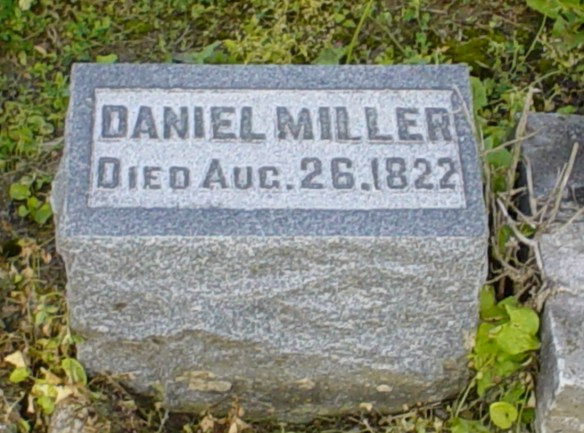
However, take a look at the stones on either side of him. The following photo shows the stone that says, Hannah, wife of Daniel Miller, died October 4, 1876, age 65 years, 8 months, 20 days.
The gravestone on the other side of Daniel’s stone marks the grave of Sarah Miller, wife of Daniel Miller who died on July 22, 1831 at the age of 28 years and 3 months. This woman was born in 1803. Daniel Miller is buried in-between them. However, as confusing as this is, NEITHER of these women are the wife of the Daniel who is buried between them. Yes, you read that correctly. Is this some kind of morbid genealogy joke? I mean, seriously??? Not funny.

The stone directly behind these three belongs to Samuel Miller. Below is a list of all the Miller burials in Sugar Hill cemetery.
Miller Abraham died Apr. 12, 1876, age 73y 11mo. (so born 1802)
Miller Lydia died Jan. 7, 1891, age 87y 11mo 11da. (born 1804)
Miiller Daniel (4) died June 8, 1879, age 8ly 5mo 9da. (born 1798)
Miller Hannah died Oct. 4, 1876, age 65y 8mo 20da. (born 1811)
Miller Sarah died July 31, 1831, age 28y 3mo. (1803)
Miller Margaret died Feb. 6, 1924, age 87y 9mo 11da. (born 1837)
Miller Samuel died Nov. 14, 1930, age 96y 9mo 24da. (born 1834)
Miller Catharine wife of Fred’k., died Oct. 31, 1865, age 55y 8mo 20da. (born 1810)
Miller Daniel (1) died Aug. 26, 1822, age —.
Let’s piece these families together to see who we have and their relationships.
Abraham was the son of Stephen Miller and Anna Coleman. Stephen was the son of Daniel (1) Miller and Elizabeth Ulrich. Daniel is the man who died in 1822. Daniel’s widow, Elizabeth died in September 1834 but she does not seem to be buried here. Abraham Miller was married to Lydia Rodebaugh who is buried here as well.
Daniel (4) Miller who died in 1879 was born on Dec. 30, 1797 to Stephen Miller and Anna Coleman. His first wife was Sarah Harris whom he married on November 15, 1821 in Bedford County, Pa. and who died on July 31, 1831, as noted above. His second wife was Hannah Ernest, also noted above.
Samuel Miller was born in 1834 and died in 1930 in Preble County “on the farm where he was born.” He was the son of Daniel (4) Miller and Samuel’s wife was Margaret Marker.
In 1850, there is a Catherine Miller who lived in Perry Township, a widow and had children Levi 19, b Pa, Jeremiah 11 and Noah 3. One house away lived Joseph Miller, age 32 born in Pennsylvania and his wife Christena. Joseph is listed on Ancestry as the son of Frederick Miller and Catherine Hammer, so this Catherine who lived next to Joseph would be his mother.
Doing a bit more research on Frederick, Catherine and Joseph, we discover that in 1840, indeed we do find Joseph and Frederick living a few houses away from each other in Montgomery County, but both are age 30-40, so clearly not father and son, more likely brothers.
In 1830, in Jackson Township we find a group of men that includes Stephen (son of Daniel who died in 1822), age 50-60 and then a group of 4 men, George, 30-40, Daniel 30-40, John 20-30 and Joseph 20-30. These 4 men are likely sons of Stephen Miller On the next page we find John B. Miller, age 50-60.
In 1820, we find two groups of Miller men in Randolph Township. Jackson was formed in 1814, so if they were living in Jackson they would have been listed there in 1820.
We have Jacob, 26-45 with Daniel, over 45. Then we have David, over 45 with John, also over 45 and Michael, age 26-45.
Looking now at the 1820 and 1830 census in Preble County, Twin Township, we find a Frederick and Jonathan in 1820. Frederick is not young then. They are still there in 1830 and Frederick is 60-70. These men don’t appear to be connected to our group of men, but one can’t be sure. What we do know is that there is no Daniel in 1820 nor are his children found there. In 1830, we do find a Daniel in Twin Township.
The pedigree below shows what we know about the relationships between the Miller burials in the Sugar Hill Cemetery. The individuals in bold are buried there.

In the book, “History of the Church of the Brethren of the Southern District of Ohio” by Wayne Webb, the photo of the cabin on page 36 states that the Elder Daniel Miller built that cabin in 1830 and his son Samuel was born there in 1834. This does indeed mesh with the genealogical record that indicates Samuel lived died on the farm on which he was born. This also ties in with Daniel whose wife Sarah died in 1831. We know he was living in this vicinity by then because his wife is buried in the Sugar Hill Cemetery, so this 1830 census in Twin Township reflects what we know to be accurate based on other records.
Note: It has come to my attention that this photograph was reproduced without permission in the book above mentioned. According to the Brethren Heritage Center, the proper attribution should be the “History of the Church of the Brethren of the Southern District of Ohio” by the Historical Committee, 1920, published by the Otterbein Press, Dayton, Ohio.

The problem is that the interpretation has been that this cabin belonged to the Daniel (1) Miller that died in 1822, but subsequent research shows nothing to connect the eldest “Elder Daniel” with this land, aside from the fact that a cemetery marker placed over 100 years after his death is located in the cemetery with his son, Stephen’s, children, including the Daniel (4) born in 1797, grandson of Daniel (1) who died in 1822 – whose wives Daniel (1) is buried between.
Again referring to the History of the Church of the Brethren book, on page 509, we find the following story about Stephen, son of Daniel (1) who died in 1822, and his son Daniel (4):
Stephen Miller, the father of the subject of our sketch, was twice married, first to Anna Coleman, of whose children, Daniel was the eldest. She died in Clermont County. Stephen’s second wife was Anna Deardorff (nee Lesh), who also bore him children, among whom were John J. and Stephen, who became ministers in the church.
Daniel was born in Bedford County, Pennsylvania, December 30, 1797. When 18 months of age, his father built a raft on the Ohio river and floated down the stream to Kentucky, where they landed and lived for awhile in that state. They, then, moved to Clermont County, Ohio. They next moved to Montgomery County, Ohio, where Daniel’s father in 1816 build he first frame house in Jackson Township. On November 15, 1821, he was united in marriage to Sarah Harris of Clermont County, Ohio. To this union were born 3 daughters, Anna, November 18, 1822, Sarah, November 1, 1824 and Mary, September 3, 1828. He united with the Church of the Brethren when about the age of 27, bring brought under conviction through a serious illness. A short time after this he was elected to the ministry in the Stonelick Church, and later on was ordained in the Upper Twin Church.
After his marriage he lived in Clermont County where he bought a small farm on easy terms but in the fall of 1828, he sold this farm and purchased 160 acres for $625 in Preble County, where he moved April 13, 1829. His new home consisted of a log cabin built near the center of the place surrounded by the forest. The following winter he built a more comfortable house from hewed logs, which is yet standing. August 22, 1831, his helpmate died leaving him with three small children. January 31, 1833, he was married to Hannah Earnest, to whom were born one son, Samuel, and one daughter, Catherine, who died in 1847. All his children united with the church while young. Anna married Robert Wysong, Sarah, Josiah Woods and Mary, James Swihart. These Brethren all became deacons in the church.
Elder Miller served the Upper Twin Church as Presiding Bishop for 30 years. He was one of the first advocates of the pastoral visit and made regular calls on all the members in the congregation. He solemnized many marriages, preached many funerals and assisted in organizing many churches. His useful life came to a close June 8, 1879.
P 510 – Samuel Miller, son of Elder Daniel Miller, was born January 20, 1834. He was married to Margaret Marker Miller, Sept. 30, 1855. He was elected deacon in the Upper Twin Church in 1874, and to the ministry in 1881. His father, Elder Miller, in order that he might give more of his time to the church, sold his possessions to Samuel, with whom he and his wife lived, for 24 years. Brother Samuel and his good wife, Margaret, have grown old in the service of the Master, still living on the old home place.
Daniel Miller (1) who died in 1822 would be the oldest burial in the Sugar Hill cemetery. It seems inconceivable that his grandson, Daniel (4) Miller’s 2 wives would be buried in such close proximity to him on either side as to be touching him. If any Daniel was to be buried between the wives, it would be Daniel (4), their husband. Daniel (4) the husband of Sarah and Hannah died in 1875, a year before Hannah, and he is buried to the right of Hannah, not between his two wives. It appears that Daniel (1)’s stone was wedged in later.
So here’s the situation. Daniel (1) who died in 1822 was clearly not buried in the location where his tombstone is located today. In fact, in 1822, it’s not likely that this cemetery was even in existence. The first burial with a tombstone is in 1831, and it’s Sarah, forever resting to the right of Daniel’s stone.
The History of the Church of the Brethren of the Southern District of Ohio tell us about this location. On page 170 the Lower Twin church is also discussed, whose name was later change to Sugar Hill, and the church later torn down. I believe, although it doesn’t say this, that is where Sugar Hill cemetery is located today. This church was organized in 1830.
As we later discover, the Elder Daniel’s grave was moved to this location, but if that was the case, why not also move his wife, Elizabeth, who died in 1834 and mark her grave as well?
It’s nearly 15 miles, and that’s 15 miles with a horse and wagon, between Daniel Miller’s land (B) in Randolph Township and the Sugar Hill Cemetery (A). Furthermore, his brother David had a family cemetery on his land and Daniel could have been buried on his own land. There was no reason to go to Sugar Hill. There has to be something we don’t know.

The answer bantered about is that Daniel Miller (1) was visiting his son Stephen at the time of his death – Stephen reportedly lived near West Alexandria, close to the Sugar Hill Cemetery. However, Daniel could easily have been transported 15 miles home in a wagon for burial, unless getting the body in the ground was a priority that trumped everything else. Daniel died in August. It could have been very hot and he could have been contagious. Others could have been ill too.
Sugar Hill Brethren Cemetery where Daniel Miller is buried is on Eaton Pike just across the county line into Preble county, slightly east of West Alexandria. Eaton Pike above is 35 on the southern border of the township line in the section map, above.
Daniel’s son Stephen owned land at the SW corner of Farmersville/West Carrollton Road and Diamond Mill Road, not in Preble county near Sugar Hill Cemetery.
On the map below, you can see Daniel’s home location on Old Salem Road, Stephen’s home on Farmersville Road and Sugar Hill Cemetery.

As it turns out, there is more to the story, much more.
Where Was Daniel Buried?
This question sent me on an incredibly frustrating journey that took about two years, and still may not be complete, because still don’t have a definitive answer, but we have tantalizing tidbits.
From Gene Edwin Miller in “Daniel Miller (1755 – 1822), a working copy and a collection of current data on Daniel Miller (1755 – 1822) son of Philip Jacob Miller, son of Michael Miller,” unpublished:
April 1979
One explanation might be as follows……….Elmer C. Miller a son of John R. Miller, son of Jacob Y. Miller, son of John Miller, son of Daniel Miller (1755 – 1822) was an evangelist and traveled throughout the midwest conducting services. In 1924, while in the Dayton, Ohio area, he wrote home to his father, telling of his meeting with a Samuel Miller. Samuel was the son of Daniel Miller, the well known Elder in the Montgomery Co. area.
Daniel was the son of Stephen Miller, oldest son of Daniel Miller (1755 – 1822).
Samuel was then 90 years old and lived in Preble Co. Samuel recalled how that he had helped his father Daniel to locate the body of Daniel Miller (1755 – 1822) from the cemetery at Farmersville to its present resting place at Sugar Hill. He said that when they found the burial place at the original location that it was marked with a little piece of marble about 12″ square and inscribed with the letters “D.M” and dated Aug. 1822.
Then, from Merle Rummel, Brethren Historian, we have the following:
- Stephen William MILLER 1/m Anna Barbara Kphlman
born 7 Mar 1775 Conococheague MD b. 12 Apr 1774 Bedford Co PA
died13 Jan 1851 Montgomery Co OH d. 26 Jan 1813 Clermont Co OH
bur: Old Brower Cem, Farmersville
Son of Daniel Miller and Elizabeth Ulrich
Merle shows Daniel’s son Stephen being buried in the old Brower Cemetery in Farmersville in 1851, roughly 30 years after Daniel’s death. However, if Daniel (1) who died in 1822 was buried with Stephen who died in 1851, why would Daniel (1)’s grave be moved? And if they moved Daniel’s grave from the Old Brower Cemetery, why didn’t they also move Stephens? This doesn’t seem logical.
The Brower Cemetery is located just across the county line into Preble County at the intersection of 70 and Enterprise Road, shown on the map below as 4092-4498 Enterprise Road, West Alexandria, Ohio.
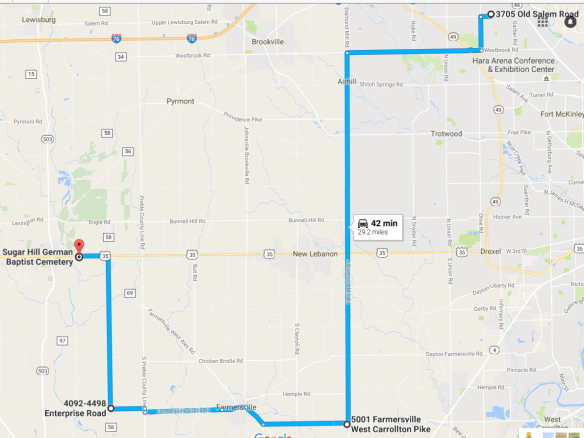
Another piece of evidence, although this could be hearsay, is the undated NGS Quarterly page, below.

This article, which does not give sources and has other incorrect information, such as Daniel’s father being Richard, states that Daniel died near West Alexandria. This could also have been presumed because of the Sugar Hill burial location. Unfortunately, no sources are provided.
Wayne Webb, a researcher with an interest in Brethren history, has a different theory, that Daniel was originally buried in a cemetery just half a mile from Stephen’s house, called the Troxel Cemetery, not to be confused with the Troxel Cemetery that is located on the original land owned by Daniel Miller in Jefferson Township. Truly, those two cemeteries are not connected and I drove myself crazy for months chasing that red herring. Daniel must have had a good laugh. This Troxel Cemetery is in Jackson Township.
From Wayne:
The place I gave you is the half acre tract which is the cemetery called Troxell’s in Jackson and which is no longer there. That is the “other” Troxell you could not find (because it’s no longer there). Stephen lived SW¼ R4E T4 S35.
Family lore says, as related by Merle, that Daniel died while on a trip to his son Stephen’s. Then you have the “Farmersville” notation. I gave you where Stephen lived. The Troxell cemetery (NE¼ R4E T4 S36) is within a half mile of Stephen’s house. I think some of Stephen’s children are living by him but not much is known about all of them and I’ve never taken the time to document them all. Diamond Mill north-south, Farmersville-West Carrollton east-west.

Stephen lived on his home farm in Jackson township all his adult life.
Wayne went on to say that there used to be a Brethren church in the same location with the cemetery.
The church is located on section 36 where the Troxel cemetery is located (basd on a map from 1875-76.)
Wayne’s mother who grew up in this area said this cemetery, then with markers, is located on Farmersville-West Carrolton Pike the NE section of section 36, T4 R4 – cemetery is 300 feet south of the road behind the house, 4/10th of a mile west of the Diamond Mill Road. Church was inactive in 1983 – the owner in the 1990s said he bought it in the 1940s. There were stones then but they had disappeared by the 1990s when Wayne actually visited and walked out in the cemetery and saw that there were no stones visible.

Wayne said that part of the church foundation is near the road behind the house, and the location of the cemetery is at the arrow towards the bottom of the photo. The road is just beyond the top of the photo.
The map below shows a better general location.

From Wayne:
Probably Steven’s original farm. This, above is 4-4-35 near Twin, Steven Jr. lived in 26 and the church was on 36 in the corner. SW corner 4-4-35 southwest 156 acres. Given the comments about going and getting Daniel in Farmersville, this may be the location of where Daniel was buried.

You can see on the map below that the present address of the location of the old Brethren Church and cemetery is literally just about 1000 feet west of the easternmost location of Stephen’s land. Of course, if Stephen’s father Daniel was buried here, why then was Stephen not buried there as well? Instead, he was buried in the Brower Cemetery a few miles away in Preble County.

The Montgomery County 1827 tax book, shows the landowners of 4-4-36 where the church and Troxel cemetery is located is as follows:
- John Meyers ne section 200 acres
- Jacob Bowman 4-4-36 NW 166
- Michael Meyers 4-4-36 art of N 1/2 14 acres
- Jacob Meyers Se part 140
- Jonathan Meyers Sw part 143 acres
The cemetery listing from Wayne’ mother’s notes show mostly Troxel burials.
- Samuel Troxel d 1836 age 35
- Sarah wife of John P b 1808 d 1833
- Unknown Linda d 1831
- Stone in the base of the tree
- Lewis b July 1828
- Mary unknown
- Christian d May 1814
- Troxel, ?rail – no dates
- David –
- David Showe Jr b Oct 25
- Abraham Shupe b 1818
We know that the cemetery existed in 1822 because two of the burials are prior to that date.
Here’s a second theory from Wayne relating to the Old Brower Cemetery, also possible.
The original German Baptist Brethren church in this area was called simply the Twin church in homage to the creeks by that name. The best evidence of the existence of an early congregation, and it lies just one mile from the Widdows Henderson tract of southwestern Jackson township, Montgomery county, but in Lanier township, Preble county, is the Brower cemetery (the smaller of the two in the region) in which are interred members of the Baker, Brower, Holderman, Karn, Miller, Petry, Wirts, Wise and Yost families.
The photographs, taken in 2006 by this writer, demonstrates the deplorable condition of this early congregational burial ground. Evidence is suggestive that at one time there was a small log cabin serving as a meeting-house.
It is likely that Elder Daniel Miller (1755-1822), as well as Elder Jacob Miller (ca. 1738-1815), of no known relation, visited this region during their pastorates preaching to the young congregation.

One of the stones in this cemetery is that of Stephen Miller, Daniel (1)’s son.
My Opinion Regarding Daniel’s Burial
The only actual evidence we have of where Daniel was originally buried is the information from Samuel Miller who was born in 1834 and helped his father Daniel (4), who died in 1879 and is buried at Sugar Hill, locate and move Daniel Miller (1)’s grave. Samuel said they went to Farmersville. Unfortunately, Stephen’s land is about as far east of Farmersville as the Brower Cemetery is west of Farmersville.

The map above shows all of the relevant locations to this discussion, as follows:
- Daniel Miller’s Randolph Township Property – 3705 Old Salem Road
- Stephen Miller’s Jackson Township Property – 5001 Farmersville West Carrollton Pike
- Troxel Cemetery – 10360 Farmersville West Carrollton Pike, just west of Stephen’s property in Jackson Township
- Old Brower Cemetery – 4092-4498 Enterprise Road, Preble County
- Sugar Hill Cemetery – just east of West Alexandria, Preble County
Daniel (4)’s father, Stephen, who died in 1851 was buried in the Old Brower Cemetery in Preble County, so I think it’s unlikely that Daniel (4) would have moved the older Daniel (1) away from his son, Stephen, in the Brower Cemetery. In other words, if Brower was good enough for Stephen, Daniel (4)’s father, it would have been good enough for Daniel (1), Daniel (4)’s grandfather as well. If not, Daniel (4) would have moved them both.
I think it’s much more likely that Daniel who died in 1822 was buried in the Troxel Cemetery, with no other Millers, which would have prompted the move to a location with other Miller family members.
The grave would have been moved probably sometimes after 1854 when Samuel would have been 20, and sometime before 1879 when Daniel (4) died. Daniel (4) would have been 25 years old when his grandfather, Daniel (1), died in 1822, so he would have known where to look for the grave.
Looking at these two stones on either side of Daniel (1)’s final resting location at Sugar Hill, Sarah died in 1831 so that grave would already have been there. Hannah didn’t die until 1876, so she might have been buried after Daniel was moved. However, I actually kind of doubt that, because I think if she were buried after Daniel’s grave was moved, her grave would have been further away. The space between Sarah and Hannah is only about 18 inches or so, not large enough for another burial. Clearly, if Daniel’s remains were moved in the 1870s, after his death in the 1820s, there would only have been a few bones left, so he would have “fit” between Hannah and Sarah’s stones, not needing a full space.
Given this deductive reasoning, which is really all we have to go on, I suspect that Daniel (1) was moved to Sugar Hill between 1876 when Hannah died and 1879 when Daniel (4) died. Samuel, who moved the grave, would have been about 42 at the time, which explains why he did the digging and moving and not his father who was born in 1797 and would have been 78+ at the time.
I wonder what happened to that original marble slab with D.M. engraved. Perhaps they moved that with him and today’s contemporary stone replaced the small marble slab.
Daniel’s DNA
Ironically, although we don’t know where Daniel was in August of 1822, nor where he was buried for roughly 50 years, we do know about his ancestors and where they were. DNA testing has been a huge blessing for us and different kinds of DNA tests provide a great deal of information about our ancestors.
We’re fortunate that another Reverend Miller in the family, Richard, has been incredibly helpful and sharing with his information as well as his DNA to represent our Miller line, for which I am eternally grateful.
Richard took the Y DNA full 111 marker panel test, plus the Big Y test at Family Tree DNA. He is also a member of the Miller Brethren DNA Project whose goal is to unravel the various Miller Brethren families.
Our Miller DNA markers from 12-111 are rare. Our only matches at any level are to other Miller men, with the exception of one poor misplaced Morgan at both 25 and 37 markers whose ancestor is reportedly from Wales. The Morgan gentleman did not test above 37 markers, so we don’t know how closely he would match above that level, but I have to wonder if Mr. Morgan is actually a Miller. It’s worth noting that Maugans in some cases was changed over time to Morgan. Things that make you go hmmmm….
When our Miller STR panel results first came back, years ago, I chalked up few matches to the fact that we were early in the testing game. Over the years, as more Miller matches were added to the list, but no other surnames, I realized that our lack of matches outside the Johann Michael Miller line was actually a blessing, because we have rare DNA that acts as its own filter.
One of the services I provide to Y DNA clients is a chart showing each of their markers and the frequency with which their marker value is found within their major haplogroup. I did the same thing for our Miller STR results, showing only the rare and very rare results in the chart below.
I have indicated very rare allele values below with red, bold and underscore. Six percent or less of the R1b (M343) population will show these values on these markers. The next group is rare markers, indicated by black bold. Less than 25% of the R1b (M343) population will match on these values. The Miller men have a very high number of rare and very rare marker values, especially in the first (yellow) panel.

Each panel is color coded, so the first panel of 12 markers is shown as yellow. As you can see, 7 of the 12 markers in that panel are either rare or very rare values, meaning that for anyone to match the Miller DNA at 12 markers, they would have to carry all of these same rare or very rare values. Unless they descend from a Miller male, that’s very unlikely to happen. Happening simply by chance or convergence is extremely unlikely.
Of course, the next question was why the Miller DNA is so rare. Were they simply isolated in a mountain valley, never spreading the Miller DNA outside of that village, for hundreds or thousands of years? Surely, eventually, men of other German surnames from that same village will emerge, unless they died in battle or daughtered out in the intervening timeframe.
In hopes of understanding our deep ancestry better, Richard Miller agreed to take the Big Y test. The Big Y test scans over 35,000 locations on the Y chromosome that may carry mutations, called SNPs, or single nucleotide polymorphisms. SNPs are mutations that have been found previously and given a name, like Richard’s terminal SNP, R-CTS7822.
Prior to Big Y testing, Richard’s estimated SNP was R-M269, which was accurate, but Big Y testing shows us every branch of the haplotree that is relevant to Richard. In fact, the only way to discover every branch is with the Big Y test.
For our Miller men, all of our branches below M269 are:
- M269
- L150
- L23
- Z2103
- Z2106
- Z2109
- CTS7822
Not only did we confirm M269, we added another six branches between M269 and CTS7822, Richard’s terminal SNP, meaning the one at the end of the line providing the most granularity.
Furthermore, the Big Y test also provides information about additional mutations called Novel Variants. Think of Novel Variants as mutations that are not yet named, because not enough is known about them yet. Either few people have been found with this mutation, or we don’t know yet exactly where it fits on the tree.
In Richard’s case, he has a total of 607 known and named SNPs and 37 Novel Variants, SNPs waiting to be placed on the tree and named.
Most of Richard’s Novel Variants are quite rare, meaning that none of the men he matches share them.
Richard has a total of 8 Big Y matches, and of those men, the closest match has three SNPs difference and only shares 4 of his Novel Variants. That means that Richard does share a common deep ancestral relative with this man, but not in a genealogical timeframe.
In fact, it would appear that most of Richard’s Novel Variants are rare, because he has no matches with 33 of 37. That’s actually quite unusual.
Haplogroup R is the most common Y DNA haplogroup in Europe, with about 45% of European men being some flavor of haplogroup R, meaning they share a common ancestor thousands of years ago when haplogroup R was born. However, there are still very rare sub-haplogroups, and Richard’s is quite rare. Maybe our ancestors truly were isolated in that mountain village.
Another benefit of the Big Y testing is that Family Tree DNA provides matching to other Big Y testers.
In Richard’s case, he matches 8 men. Not all matches have included their oldest ancestor information, but as best we can tell, the 8 men’s location history or surnames are as follows:
- Bulgaria
- Possibly Sweden
- Austria
- Moorman?
- Seymer
- Spain
- Blair
- Russia
However, none of these men share our terminal SNP of CTS7822.
Big Y matches are shown if there are 4 or fewer SNP differences.
In the R1b Basal SubClades Project, the Miller DNA is grouped both by STR marker values and SNP results entirely with Russian samples.

One of the samples carries the same terminal SNP as our Miller, but obviously they have more than 4 nonmatching SNPs, because they do not show as a Big Y match. Of course, many people who test don’t join projects.
Looking next at the project map for this subgroup, we discover that only one other individual has entered their geographic location information.

Fortunately for us, the person who DID enter their geographic location is the only other CTS7822 found in the project, whose ancestor is from Russia. By zooming in, we discover that what looked like one marker balloon is actually 3, 2 of which have the same surname.

Turning now to the SNP map at Family Tree DNA to view additional locations where at least two individuals have been identified within a radius of 1000 miles with the SNP of CTS7822, we see the following:

CTS7822 has been found in a smattering of highly scattered locations in Europe. Keep in mind that these locations don’t just include individuals who have CTS7822 as a terminal SNP, meaning the end of the line for them, but includes individuals whose individual haplotree includes CTS7822, but who may have different additional SNP(s) further downstream, that the Miller line does not have.
Fortunately, one of the project’s volunteer administrators is a geneticist, Dr. Sergey Malyshev, from the Institute of Genetics and Cytology of Belarus National Academy of Sciences. He assembled a phylogenetic tree that shows the various SNPs found in ancient DNA on the M269 branch, as shown below.

You can see that our CTS7822 is a major branching point which Dr. Malyshev estimates to have been born about 6,100 years ago.

The Miller DNA is not a part of the branches of this tree above CTS7822. There are no known SNPs in our results that came after CTS7822, so, along with a few Russian men, we stand alone. As more becomes known about the Novel Variants, we may indeed discover that one or more variants are a new branch of the tree, but until more people test and match those variants, we wait.
What we know now is that our DNA is quite rare. We do not descend from the Yamnaya, but our ancestors and that of the Yamnaya culture found along the Volga River in Russia descend from a common ancestor who developed SNP Z2109, born also about 6,100 years ago, probably someplace in central Russia, perhaps along the Volga.
Additionally, Z2109 is also found among the Pathans, people who live in northern Pakistan and Afghanistan, illustrated in the 1825 painting below. Our Miller men, the Yamnaya represented by the Burzyan Bashkirs in Russia today and the Pathans of Afghanistan and Pakistan all share a common ancestor in antiquity.

Noting that within the R1b Basal project grouping, the only match to our terminal SNP is Russian, that within the project matching, our group is entirely Russian, except for our Miller ancestor, and that the SNPs found in ancient DNA also point unquestionably to central Russia – I think we may have the answer to why our DNA is so rare. There may or may not be much, at all, in Europe. As more Russians test, it’s likely that we will find addition matches – and perhaps more in Germany and the areas of Europe that were most affected by the invasions or migrations from Asia.
It has been a long journey from the Russian steppes, some 6,100 years ago, to Sugar Hill Cemetery in Montgomery County, Ohio. The Miller DNA and descendants have been dispersed by the winds of fortune further yet.
I would love to know the story of the chapters of those lives from 6,000 years ago. Who were those people? Where did they live and how did they get from Russia to Germany, a journey of more than 3,500 miles? What prompted that migration, or was it just another frontier – the seeming story of the Miller men. Perhaps they come by that honestly, the legacy left to them by 6,000 years of ancestors.
To me, it’s simply amazing that we can tell this much of the Miller story through the DNA passed from those Russian ancestors to the Reverend Richard Miller today. And just think, we would never have known “the rest of the story” had the Reverend Richard Miller not tested.
References
I originally constructed a timeline of events in the life of Johann Michael Miller’s life utilizing various sources which I have referenced in this document:
Replogle – “Ancestors on the Frontier: Miller, Cripe, Ulrich, Replogle, Shively, Metzger” by Justin Replogle, self-published in 1998, now out of print.
Mason – “The Michael Miller and Susanna Bechtol Family Record” compiled in 1993 by Floyd R. and Catherine Mason, now deceased.
Miller – “A History and Genealogy of David Y. Miller 1809-1898” by Gene Edwin Miller, self-published.
Stutesman – “Jacob Stutzman (?-1775); His Children and Grandchildren” by John Hale Stutesman, Jr.
These 4 books plus two websites, Troy Goss’s Miller home page and Tom and Kathleen Miller’s pages are the primary resources for Johann Michael Mueller and the first two generations of his descendants, aside from my own research.
Wayne Webb’s research is referenced in some places in this article as well. Unfortunately, his ideas were never brought to a logical conclusion, as he failed to provide research that I paid to have completed.
For Brethren Research, I strongly recommend the Brethren Heritage Center in Brookville, Ohio. I have contributed my research to the Center.
Suffice it to say that all of these sources don’t always agree – and in fact some contradict each other. So I’ve sifted through each and compiled the information I found credible by evaluating the sources, where possible. Where doubt remains or work needs to be done, I have said so. I hope that others will continue the research and add to the body of information we have compiled about the Miller family.
______________________________________________________________
Disclosure
I receive a small contribution when you click on some of the links to vendors in my articles. This does NOT increase the price you pay but helps me to keep the lights on and this informational blog free for everyone. Please click on the links in the articles or to the vendors below if you are purchasing products or DNA testing.
Thank you so much.
DNA Purchases and Free Transfers
Genealogy Services
Genealogy Research
Like this:
Like Loading...