About Roberta Estes

Scientist, author, genetic genealogist. Documenting Native Heritage through contemporaneous records and DNA.

Concepts – Why DNA Testing the Oldest Family Members is Critically Important

Recently, someone asked me to explain why testing the older, in fact, the oldest family members is so important. What they really wanted were talking points in order to explain to others, in just a few words, so that they could understand the reasoning without having to understand the details or the science.

Before I address that question, I want to talk briefly about how Y and mitochondrial DNA are different from autosomal DNA, because the answer to the “oldest ancestor” question is a bit different for those two types of tests versus autosomal DNA.

In the article, 4 Kinds of DNA for Genetic Genealogy, I explain the differences between Y and mitochondrial DNA testing, who can take each, and how they differ from autosomal DNA testing.

Y and Mitochondrial DNA

In the graphic below, you can see that the Y chromosome, represented by blue squares, is inherited only by males from direct patrilineal males in the male’s tree – meaning inherited from his father who inherited the Y chromosome from his father who inherited it from his father, on up the tree. Of course, along with the Y chromosome, generally, the males also inherited their surname.

Y and mito

Mitochondrial DNA, depicted as red circles, is inherited by both genders of children, but ONLY the females only pass it on. Mitochondrial DNA is inherited from your mother, who inherited it from her mother, who inherited it from her mother, on up the tree in the direct matrilineal path.

  • Neither Y or mitochondrial DNA is ever mixed with the DNA of the other parent, so it is never “lost” during inheritance. It is inherited completely and intact. This allows us to look back more reliably much further in time and obtain a direct, unobstructed, view of the history of the direct patrilineal or matrilineal line.
  • Changes between generations are caused by mutations, not by the DNA of the two parents being mixed together and by half being lost during inheritance.
  • This means that we test the oldest relevant ancestor in that line to be sure we have the “original” DNA and not results that have incurred a mutation, although generally, mutations are relatively easy to deal with for both Y and mitochondrial DNA since the balance of this type of DNA is still ancestral.

Testing the oldest generation is not quite as important in Y and mitochondrial DNA as it is for autosomal DNA, because most, if not all, of the Y and mitochondrial DNA will remain exactly the same between generations.  That is assuming, of course, that no unknown adoptions, known as Nonparental Events (NPEs) occurred between generations.

However, autosomal DNA is quite different. When utilizing autosomal DNA, every person inherits only half of their parents’ DNA, so half of their autosomal ancestral history is lost with the half of their parents’ DNA that they don’t inherit. For autosomal DNA, testing the oldest people in the family, and their siblings, is critically important.

Autosomal DNA

In the graphic below, you can see that the Y and mitochondrial DNA, still represented by a small blue chromosome and a red circle, respectively, is inherited from only one line.  The son received an entirely intact blue Y chromosome and both the son and daughter receive an entirely intact mitochondrial DNA circle.

Autosomal DNA, on the other hand, represented by the variously colored chromosomes assigned to the 8 great-grandparents on the top row, is inherited by the son and daughter, at the bottom, in an entirely different way.  The autosomal chromosomes inherited by the son and daughter have pieces of blue, yellow, green, pink, grey, tan, teal and red mixed in various proportions.

Autosomal path

In fact, you can see that in the grandfather’s generation, the paternal grandfather inherited a pink and green chromosome from his mother and a blue and yellow chromosome from his father, not to be confused with the smaller blue Y chromosome which is shown separately. The maternal grandmother inherited a grey and tan chromosome from her father and a teal and red chromosome from her mother, again not to be confused with the red mitochondrial circle.

In the next generation, the father inherited parts of the pink, green, blue and yellow DNA. The mother inherited parts of the grey, tan, teal and red DNA.

The answer to part of the question of why it’s so important to test older generations is answered with this graphic.

  • The children inherit even smaller portions of their ancestor’s autosomal DNA than their parents inherited. In fact, in every generation, the child inherits half of the DNA of each parent. That means that the other half of the parents’ autosomal DNA is not inherited by the child, so in each generation, you lose half of the autosomal DNA from the previous generation, meaning half of your ancestors’ DNA.
  • Each child inherits half of their parents’ DNA, but not the same half. So different children from the same parents will carry a different part of their parents’ autosomal DNA, meaning a different part of their ancestors’ DNA.

The best way to understand the actual real-life ramifications of inheriting only half of your parent’s DNA is by way of example.

I have tested at Family Tree DNA and so has my mother. All of my mother’s DNA and matches are directly relevant to my genealogy and ancestry, because I share all of my mother’s ancestors. However, since I only inherited half of her DNA, she will have many matches to cousins that I don’t have, because she carries twice as much of our ancestor’s DNA than I do.

Mother’s Matches My Matches in Common With Mother Matches Lost Due to Inheritance

920

371

549

As you can see, I only share 371 of the matches that mother has, which means that I lost 549 matches because I didn’t inherit those segments of ancestral DNA from mother. Therefore, mother matches many people that I don’t.

That’s exactly why it’s so critically important to test the oldest generation.

It’s also important to test siblings. For example, your grandparent’s siblings, your parent’s siblings and your own siblings if your parents aren’t living. These people all share all of your ancestors.

I test my cousin’s siblings as well, if they are willing, because each child inherits a different half of their parent’s DNA, which is your ancestor’s DNA, so they will have matches to different people.

How important is it to test siblings, really?

Let’s take a look at this 4 generation example of matching and see just how many matches we lose in four generations. We begin with my mother’s 920 matches, as shown above, but let’s add two more generations beyond me.

4-gen-match-totals

As you can see in the above example, the two grandchildren inherited a different combination of their parent’s DNA, given that Grandchild 1 has 895 matches in common with one of their parents and Grandchild 2 has 1046 matches in common the same parent. Those matches aren’t to entirely the same set of people either – because the two siblings inherited different DNA segments from their parent. The difference in the number of matches and the difference in the people that the siblings match in common with their parent illustrates the difference that inheriting different parental DNA segments makes relative to genealogy and DNA matching.

However, if you look at the matching number in common with their grandparent and great-grandparent, the differences become even greater and the losses between generations become cumulative. Just think how many matches are really lost, given that in our illustration we are only comparing to one of two parents, one of four grandparents and one of 8 great-grandparents.

The really important numbers are the Lost Matches, shown in red. These are the matches that WOULD BE LOST FOREVER IF THE OLDER GENERATION(S) HAD NOT TESTED.

Note that the lost matches are much higher numbers than the matches.

Summary

In summary, here are the talking points about why it’s critically important to test the oldest members of each generation, and every generation between you and them.

Autosomal DNA:

  1. Every person inherits only half of their parents’ DNA, meaning that half of your ancestors’ DNA is lost in each generation – the half you don’t receive.
  2. Siblings each inherit half of their parents’ DNA, but not the same half, so each child has some of their ancestor’s DNA that another child won’t have.
  3. The older generations of direct line relatives and their siblings will match people that you don’t, and their matches are as relevant to your genealogy as your own matches, because you share all of the same ancestors.
  4. Being able to see that you match someone who also matches a known ancestor or cousin shows you immediately which ancestral line the match shares with you.
  5. Your cousins, even though they will have ancestral lines that aren’t yours, still carry parts of your ancestors’ DNA that you don’t, so it’s important to test cousins and their siblings too.

Y and mitochondrial DNA:

  1. Testing older generations allows you to be sure that you’re dealing with DNA results that are closer to, or the same as, your ancestor, without the possibility of mutations introduced in subsequent generations.
  2. In many cases, your cousins, father, grandfather, etc. will carry Y or mitochondrial DNA that you don’t, but that descends directly from one of your ancestors. Your only opportunity to obtain that information is to test lineally appropriate cousins or family members. This is particularly relevant for males such as fathers, grandfathers, paternal aunts and uncles who don’t pass on their mitochondrial DNA.

I wrote about creating your DNA pedigree chart for Y and mitochondrial DNA here.

Be sure to test the oldest generations autosomally, but also remember to review your cousins’ paths of descent from your common ancestors closely to determine if their Y or mitochondrial DNA is relevant to your genealogy! Y, mitochondrial and autosomal DNA are all different parts of unraveling the ancestor puzzle for each of your family lines.

You can order the Y, mitochondrial DNA and Family Finder tests from Family Tree DNA.

Happy ancestor hunting!

______________________________________________________________

Disclosure

I receive a small contribution when you click on some of the links to vendors in my articles. This does NOT increase the price you pay but helps me to keep the lights on and this informational blog free for everyone. Please click on the links in the articles or to the vendors below if you are purchasing products or DNA testing.

Thank you so much.

DNA Purchases and Free Transfers

Genealogy Services

Genealogy Research

Another Daniel Miller – A Y DNA Tale – 52 Ancestors #135

Just when you think you have the family all straightened out, a left hook comes along, sneaks up and sucker-punches you.

Indeed, as if there wasn’t enough confusion about the various Daniel Millers, we now have yet another very interesting twist in the Daniel Miller saga, thanks to DNA.

And a conundrum it is too.

In the article, “Daniel Miller (1755-1822), Musical Graves, 52 Ancestors #130” I provided this summary of the various Daniel Miller’s that we know existed in Montgomery County, Ohio at or about the same time that my Daniel Miller (1755-1822) lived there, or subsequent generations. Below is the summary from that article.

Daniel (1) is my ancestor and was born to Philip Jacob Miller and his wife, Magdalena, whose last name is unknown, on April 8, 1755 in Frederick County, Maryland. Daniel was married to Elizabeth Ulrich and died in Montgomery County, Ohio on August 26, 1822. Those are the easy dates. The rest are difficult.

Daniel (2) arrived in Montgomery County from Huntington County, PA. Daniel (2)’s wife was Susanna Bowman and Daniel (2) lived in what would become the City of Dayton proper where he settled on Wolf Creek in November of 1802, according to the History of the City of Dayton and Montgomery County, Ohio, Volume 1.   For those specifically interested in this line, the Brethren Heritage Center has an article available written by Gale Honeyman.

Daniel (3) is the son of Daniel (1). According to the family Bible he was born on March 30, 1779 and he died on June 25, 1812. He would have been 33 years old, and unless he was disabled in some way, he was likely married and may well have had children. He would only have been about 20 when his father Daniel floated down the Ohio on a raft, probably in 1799. Daniel (3) could have remained in Clermont County when his father and uncle, David Miller, left for Montgomery County sometimes around 1802. There is no mention of an estate for Daniel (3) in Montgomery County.

Daniel (4) is the grandson of Daniel (1) through his son Stephen Miller. Daniel (4) was born in 1797 in Bedford County, PA and died in 1879 in Preble County, Ohio.

Daniel (5) is the son of Michael Miller and Salome Cramer of Montgomery County. Michael is the son of David Miller who died in 1845. David was the brother of Daniel (1). Michael obtained and farmed his father’s farm in Randolph Township. Daniel (5) was born in 1822, died in 1903 and was married to Isabella Cook.

Daniel (6) is the grandson of Daniel (1) through son Jacob A. Miller born in 1776 who married first to Elizabeth Metzger and second to Catherine Zimmerman. Jacob farmed his father’s land in Randolph Township past 1851 and likely until his death in 1858. Jacob’s son Daniel (6) by his first wife was born about 1800, married Susanna Hardman on November 1, 1819 and died about 1835 in Montgomery County.

Daniel (7) born in 1815 is the son of Isaac Miller, son of Daniel (1) and his wife Elizabeth Miller who is the daughter of David Miller, brother of Daniel (1). I know nothing more about Daniel (7).

Daniel Y. (8) born in 1808 is the son of John Miller, son of Daniel (1).  John’s wife Esther Miller, daughter of David Miller, brother of Daniel (1). Daniel Y. (8) married Margaret Bainter and died in 1833.

Daniel (9) is the son of Daniel (2) and his wife, Susan Bowman. Daniel (9) was born about 1808 and died about 1863 in Montgomery County, marrying Susan Oliver.

Daniel (10) is the son of the Elder Jacob Miller by either his first or second wife, who are unknown. This Daniel was born on September 6, 1780 and died on November 15, 1858 in Monroe County, Iowa. Daniel (10) married Elizabeth Shidler or Shideler on April, 13, 1808 in Montgomery County, Ohio, but by 1813, it appears that they had moved on to Union County, Indiana. When Daniel lived in Montgomery County, he owned land near the 4 Mile Church, east of Cottage Creek, about one and one half miles west of the Lower 4 Mile Church.

Today’s article specifically deals with Daniel (2), referred to in this article as Dayton Daniel to keep him separate from Daniel (1) who lived in Montgomery County at the same time as Dayton Daniel (2).

To this group, we need to add two more Daniels. It’s OK to groan now. I’ve been groaning all week!

Daniel (11) who is the son of Lodowich Miller, brother of Philip Jacob Miller. Daniel (11) was born about 1752, probably in Frederick County, Maryland and moved with Lodowich’s family to the Shenandoah Valley about the time of the Revolutionary War. Daniel (11) died in Rockingham County, Virginia in 1819.

Daniel (12), the son of John Miller, also a brother to Philip Jacob Miller. This Daniel was probably John’s eldest son and was one of the executors of his father’s estate in 1794 through 1799 when the estate paid the heirs.

Therefore, Daniel (1), Daniel (11) and Daniel (12) were all first cousins to each other – and Daniel (2), Dayton Daniel, we’ve discovered this week, was also somehow related as well.

The question is, who is Dayton Daniel and how is he related?  And how do we know he’s related?

Michael Miller’s Sons

As a short review, let’s take a look at the immigrant Michael Miller’s sons. He has three proven sons, and only three; Philip Jacob, Lodowick (Lodowich) and John, parents of Daniel (1), Daniel (11) and Daniel (12), respectively.

For many years, every stray Miller male in a several-hundred-mile radius around Frederick County, Maryland was pinned to Michael Miller like tails on the proverbial donkey. To date, we have disproved every line that has tested utilizing Y DNA. In fact, that’s the purpose of the Miller Brethren DNA Project – to sort out the various Brethren Miller lines.  I expected several lines to match Michael’s descendants, but surprisingly, they haven’t – until now.

Before this week, not one line that was not from Michael Miller’s proven sons has ever matched Michael’s line utilizing Y DNA. But then came today and all that changed.

And of course, the end of line oldest ancestor for the new Miller Y DNA participant was none other than Daniel Miller (2), Dayton Daniel, found originally in what would become the City of Dayton, in Montgomery County, Ohio, very early – his arrival date stated variously as either 1802 or 1804 and having come from Huntingdon County, Pennsylvania.

If you recall from the article about “my” Daniel Miller, the son of Philip Jacob Miller, the son of Michael Miller, the immigrant, Daniel lived in Bedford County from sometime in the 1780s until around 1800 when he floated down the Ohio River and joined his father and siblings in Clermont and Warren Counties in Ohio. My Daniel migrated on to Montgomery County by 1805, about the same time as Dayton Daniel. In fact, when I first began researching Daniel Miller in Montgomery County, I found the information about the Daniel in Dayton and thought for some time that he WAS my Daniel, until I found additional information and pieces of the puzzle began not fitting. I figured out that there were indeed two Daniel’s living in Montgomery County at the same time, thanks to tax lists and other information. Actually, there were three Daniels until 1813 when Daniel (10), who is not descended from the Michael Miller line, did us the huge favor of moving on.

Dayton Daniel was also Brethren, but that alone does not mean he is related to my Daniel. Another man was Brethren too – the Elder Jacob Miller, who everyone thought surely WAS related to Michael Miller, but who, it turns out, is not – at least not through the paternal line. So just being a Miller male, a Brethren and being found in Frederick County, Maryland, then Montgomery County, Ohio does not guarantee a kinship relationship – as unlikely as that seems. I can see why people reached those earlier conclusions, before Y DNA testing, but they were wrong.

Michael Miller, the immigrant, had three proven sons – and only 3, who were:

  • John Miller who died in 1794 in Washington County, Maryland, formerly Frederick County, with a will which listed his children. This John had a son Daniel (12).
  • Lodowich Miller who died about 1782 and whose children (if not Lodowich too) moved south to the Shenandoah Valley about this same time also had a son Daniel (11) who died in Rockingham County, Virginia in 1819.
  • Philip Jacob Miller also had a son Daniel (1) who married Elizabeth Ulrich, moved to Bedford County, Pennsylvania, then on to Ohio where he was the Daniel who wound up in Montgomery County but did NOT live in Dayton. This is my Daniel.

After I published my article about Daniel, sorting through the various Daniel Millers in Montgomery County, a cousin, Doug, contacted me and was confused. Doug descended from Dayton Daniel (2), born in 1765, and he wondered, if his Daniel was not descended from Johann Michael Miller, why did Doug’s autosomal DNA so strongly match my mother and cousins. Obviously, I couldn’t answer that question, so Doug set about finding a male Miller, his second cousin, who descended from Dayton Daniel, to test. That participant is referred to as TM in this article.

Obviously, if TM’s DNA representing Dayton Daniel’s Y DNA had not matched my Daniel’s Y DNA, you either would not be reading this article right now, or it would be a very different story. But Dayton Daniel’s Y DNA does match the Michael Miller line.

Um….so now what? Who is Dayton Daniel (2) and who are his parents?  They can’t be the only three proven sons of Michael Miller – because all 3 of them had sons named Daniel and all 3 are accounted for.  So, who were Dayton Daniel’s parents?  Let’s walk through the possibilities and look a the DNA results.

The Y DNA

Looking at the Miller Brethren project, we can see 5 men descend from Michael Miller. There are also two additional men, but they are not project members.   One is private, so I can’t even e-mail him.

robertas-view

The first thing I noticed was that marker 449 has two different values, shown at far right, in purple, above. I mapped them to the participants, with the hope that TM’s marker 449 would tell us which line he was from. In other words, I was hoping that 449 was a line marker mutation.

michael-miller-desc-pedigree

TM, shown at far left, has a value at marker 449 of 30. One of Philip Jacob’s descendants, RM as well as both of Lodowich’s descendants carry the same value. So no, marker 449 does not indicate a specific son’s line of Johann Michael Miller.

How can this same marker show up in two of Daniel’s sons’ lines, represented by HAM and RWM, but not in the third son’s line, represented by RM? Apparently this marker value has mutated in both Isaac and John’s lines, sons of Daniel, independently, someplace between Daniel and the testers, HAM and RWM today. We know that the original marker value is 30 because it is found independently in the lines of two different sons, Daniel and Lodowich, and probably a third son now with TM.

Ok, we know that marker 449 doesn’t help us, so where do we look next?  Let’s take a look at the genealogy.

Candidates for Dayton Daniel’s Father

Obviously, the first place to look for this Daniel is among the grandchildren of Michael Miller.

Dayton Daniel’s wife is Susanna Bowman who was born in Bedford County, Pennsylvania. They are both buried with tombstones that give their age at death, so we can extrapolate that information to obtain a birth date and year.  Thanks to the tombstone, we know that Daniel was born in 1765 and because he married Susanna who was born in the next county, we know that they were living there about 1785, marriage age.

Knowing Daniel’s birth year helps us rule out various grandchildren of Michael Miller.

We have already ruled out Philip Jacob Miller as Dayton Daniel’s parent, because his son was my Daniel (1), according to the family Bible.

Two of our other Y DNA testers descend from Lodowick’s son, Daniel (11), who was born in 1752 and died in 1819 in Rockingham County, Virginia. Clearly, this is not the Daniel living in Montgomery County, Ohio who died in 1849.

That leaves Michael Miller’s son, John, who also had a son Daniel (12).  Could Daniel (12) actually be Dayton Daniel?  Let’s see.

John Miller, Michael’s third son did us the favor of executing a will just days before his death listing his children.

john-miller-will

Children named:

  • Daniel
  • John
  • Jacob
  • Abraham
  • Ludwick
  • David
  • Michael
  • Catherine
  • Susanna
  • Mary
  • Elizabeth

Underage sons were Ludwick, David and Michael.

Son Daniel Miller and son-in-law John Fisher were executors.

The will was made Dec 13, 1794 and recorded Dec. 20, 1794. Clearly John was literally on his death bed when he made his will.

On April 9, 1799, Daniel Miller and John Fisher, executors of John Miller’s estate made a distribution of 2010 pounds, 5 shillings and 9 pence, in equal parts to the 10 remaining children, all apparently now 21 years of age. The order of the named heirs is: Daniel Miller, John Fisher, Susanna Wissinger, Mary Studanbaker, Elizabeth Cameron, Jacob Miller, Abraham Miller, Lodwick Miller and David Miller. Michael is missing in the distribution list so he apparently died sometime between 1794 and 1799. Washington County Distribution Liber I, folio 80.

In 1799, when the estate was paid, all children would have reached the age of 21. The youngest child, Michael, apparently did not survive, so if we can presume he wouldn’t have become 21 until 1801, that means that he was born in about 1780. There were a total of 11 children, so a child was born every two years, with no deaths, then the oldest child, presumably Daniel, would have been born about 22 years before the youngest, or about 1758.

There is some confusion about John Miller’s name, because while most deeds and documents, such as his will, refer to him clearly as John, which would mean his German name was Johannes, with no middle name, one deed refers to him as Peter, not Johann Peter, just Peter. Was the deed in error, or was John really Johann Peter? We don’t know.

Did Michael Miller Have Other Sons?

The answer to this question is yes, he did, according to German church records. What we don’t know is if they lived, how many he might have had that are unrecorded, and if he had children after he arrived in Pennsylvania. Yes, there are a lot of unknowns.

In Frederick County, Maryland in the 1760s, there is a Michael Miller Jr. and a Hans Michael Miller, both of whom are involved with Michael Miller, the immigrant. It would be very unlikely for Michael to have two sons named so closely, but then again, stranger things have happened. One or both could also be grandsons. Or the two men could be one and the same.

In the Michael Miller article, I introduce both of these men. I did not follow either one forward in time, but it might well behoove the descendants of Dayton Daniel to pick up the trail where I left off.

Birth Records in Germany

My retired German genealogist friend, Tom, has found records of the births of several of Michael Miller’s children, in Germany. Unfortunately, the church records are missing for a time period, so we don’t know if all of the children lived, or how many more children might have been born. Tom is reading every single entry on every single page, just to be sure we don’t miss something.

Yes. Every. Single. Entry. On. Every. Single. Page.

Tom is my super-hero!

Michael Miller married Susanna Berchtol in 1714, who was born in 1688, in Konken, Germany. Their first child was born the following year, also in Konken.

  • Hans Peter Miller born January 19, 1715 (This might be John.)

The next children were born in Kallstadt.

  • Johann Jacob Miller baptized May 26, 1716
  • Regina Maria Elisabetha born August 30, 1717
  • Johannes Michael Miller born April 24, 1719 (This could be Hans Michael or Michael Jr.)
  • Johann Ludwig born April 10, 1721. (This would be Lodowich.)

Very unfortunately, by 1722, Johann Michael Miller and Susanna Berchtol had moved to Lambscheim where they live until 1726 where the records indicate they immigrated. I will be documenting these movements in a special update article about Michael Miller and Jacob Stutzman soon, but for today, we just needed the names of Michael’s sons.

We next find Michael’s immigration record, along with Jacob Stutzman, in 1727.

We know that Philip Jacob Miller was born about 1726, so he was probably a babe in arms on the boat.

If Michael Miller and Susanna Berchtol continued having children in the same pattern, they would have had another child in 1723.

Susanna would have probably had children until she was in her early 40s, so until about 1730. Therefore, in addition to Philip Jacob in about 1726, they could have had another child in 1727, 1729 and perhaps even 1731.

This gives us the opportunity for 4 additional sons (besides Philip Jacob) not recorded in existant church records. Of course, additional children may not have been male, and may not have survived.

Is John the Same Person as Hans Peter?

If John who died in 1794 is the same child as Hans Peter born in 1715, then he would have been age 43 in 1758 when his first child was born. That’s actually quite unusual for a man in that timeframe, so one of a number of situations have to be the case.

  1. The John Miller who died in 1794, brother to Philip Jacob is not the same Hans Peter who was born in 1715.
  2. The John Miller, brother to Philip Jacob who died in 1794 had more than one wife, and had children before 1758 who are all omitted from the will.
  3. The Hans Peter born in 1715 died and Johann Michael Miller had another son by the same or a similar name either in 1723, 1727, 1729 or 1731. This would make John between the ages of 27-35 in 1758, which is still on the older side for a Brethren man to be marrying, but more believable than age 43 for a first marriage.

However, even allowing for these possibilities, it still doesn’t seem reasonable that Dayton Daniel Miller who died in 1849 in Montgomery County, Ohio and was born in 1765 is the oldest child of John Miller. That would mean that the next 10 children were born beginning in 1767 and continue being born until 1787. However, we know that all of John’s surviving children were of age by 1799. Therefore, Dayton Daniel simply cannot be the son of John.

It’s also possible that John’s son Daniel was not the eldest, but the children seem to be listed in order, twice – once in the will and once in the distribution.  Daniel is listed first in both documents. It’s typical for the eldest son to be the executor.

Therefore, for all these reasons, I don’t think it’s feasible that Daniel Miller of Huntingdon County, Pennsylvania who was born in 1765 is the son of John Miller who died in 1794.

However, Dayton Daniel’s descendant matches the Y DNA of Johann Michael Miller. Furthermore, Dayton Daniel’s descendants match several of Johann Michael Miller’s proven descendants utilizing autosomal DNA, so he has to be related in a reasonable timeframe. Autosomal DNA becomes less and less likely to match with each passing generation beyond third cousins.

Other Candidates?

Our next best candidate as the father of Dayton Daniel is Michael Miller Jr. and/or Hans Michael Miller.

I did not track them forward in time, but other researchers have spent some time on this endeavor. It is reported that Hans Michael Miller lived in Franklin County, PA and what is now Mineral County, West Virginia, and had a will. He reportedly paid taxes in Antrim Township in Franklin County and New Creek, now in Mineral County, WV, according to the 1772 Frederick County Tax list. He was given money by Michael Miller to purchase land called Pleasant Gardens, which could be Garden’s Delight and Add Garden’s Delight on the 1772 tax list as well.  This information is detailed in the Michael Miller article.

Michael Miller could have had other sons that did not accompany him to Frederick County in about 1750 from York County, Pennsylvania, or who do not appear recognizably as his sons in the Frederick County records. Those sons would have been 20 or slightly older by the time that Michael left Pennsylvania and moved to Maryland. It’s certainly possible that one of Michael’s sons survived infancy, the voyage overseas and the frontier, married, and did not elect to move to yet another frontier – instead, remaining in York County or striking out on his own.  Possible, but not terribly likely.  There was safety and help in groups, especially for a small religious denomination who were known as “dissenters” and not terribly well liked because they would not defend themselves, or the neighborhood where they lived.  Brethren tended to stick together, moving in groups.  Young families would not be inclined to stay behind, especially not if the rest of the family moved on.

If Michael Miller’s son, Johann Michael Mueller, born in 1719 is the father of Dayton Daniel, he would have married sometime around 1740 and could still have been having children in 1765. It’s also possible that Dayton Daniel was the grandson of Johann Michael born in 1719, but to do so, both Johann Michael and his firstborn son would have bad to have married young.

DNA Findings

When Doug and I first realized we were cousins, and I mean via DNA, we didn’t know exactly how. Doug had always assumed that Dayton Daniel was indeed a descendant of Michael Miller, the immigrant. However, as the documentation surrounding Michael Miller’s life unfolded, we realized that we needed more information and documentation. Doug and I discovered additionally that we are also both descended through the Stephen Ulrich line, so Doug and I could have been matching through that line and not the Miller line. That’s when Doug reached out to Dayton Daniel’s Miller descendant, TM.

Unlike Doug, TM does not descend through the Ulrich line, so any of the known Michael Miller descendants that TM matches should be matching through the Miller line only.

michael-miller-autosomal-pedigree

TM’s matches are shown above, in red. Of course, he matches his second cousin, Doug, as expected. But aside from that, he matches four of Philip Jacob’s descendants, and none of Lodowich’s, as shown above and below on the chromosome browser.

tm-mtches

It’s exciting to think that the segment on chromosome 14 is shared by four of Michael Miller’s descendants. A piece of Michael or his wife that still exists today and is identifiable. That’s just amazing for a man and his wife who were born before 1700.

Is this Michael Miller or Susanna Berchtol’s DNA?

I have access to the kits that TM matches, and the DNA segments that match the other Miller descendants do triangulate, so we know for sure that these segments do indeed belong to the Miller line, descended from Michael Miller or his wife, Susannah Berchtol.  We can’t tell which, of course, without matching someone from another Miller, like Michael’s brother, or a Berchtol.  So now, we can simply say this matching DNA comes from this couple.

I know what you’re going to ask next? Did Michael have a brother that could have also immigrated and father’s children who, in turn, had Dayton Daniel in 1765?  Great question.

There is absolutely no evidence that Michael had a Miller brother who immigrated. In fact, according to the church records in Steinwinden, Germany, no other children born to Michael’s parents survived. Michael was the last child born before his father’s death.

Autosomal Messages

Let’s look at what the autosomal DNA suggests in terms of how closely related TM and these 4 matching individuals might be. The table below shows TM’s matches to the 4 Miller descendants, except for Doug.  We already know how TM and Doug are related.

Shared cM Longest block Segments >5cM *Estimated Relationship **Shared DNA Range ***Predicted Relationship Average DNA****
Barbara 98 27 5 6C 0-21 2-4C 2C1r-2C2r
Donald 87 29 4 6C 0-21 2-4C 2C2r
HAM 77 35 2 5C1r 0-41 2-4C 3C
Cheryl 57 29 3 6C 0-21 2-4C 3C1r

*Estimated relationship presumes (I know, bad word) that Dayton Daniel is Michael Miller, the immigrant’s grandson. Dayton Daniel cannot be Michael’s son, because Michael married a widow woman about his same age by 1754, after his wife died. In 1765, Michael would have been 73.

** Shared DNA Range is the range of the lowest and highest amounts of DNA found for the estimated relationship in the Shared cM Project.  In other words, this is how much DNA someone of that Estimated Relationship is found to share.  6th cousins share a range of 0-21 cM DNA, not 98cM like TM and Barbara share.

***Predicted Relationship is the relationship level predicted by Family Tree DNA based on the amount of shared DNA.

****Average DNA is the best fit from the chart I compiled in the article, “Concepts – Relationship Predictions” that combines information from several sources on the expected, actual average and ranges of DNA for each relationship type. The average DNA is taken from the column titled “Blaine’s Shared cM Average” which are results from a crowd sourced project indicating the actual amount of shared centiMorgans from various relationships.  In this case, the best fit for Barbara and TM would be between second cousins once removed (2C1r) and second cousins twice removed (2C2r).

Even though the average DNA suggests that these people are some flavor of second or third cousins, we know from the proven genealogy that these relationships cannot be in the second or third cousin range, because we know beyond a doubt that Dayton Daniel born in 1765 cannot be more closely related to Barbara, Donald, HAM and Cheryl than the nephew of Philip Jacob Miller, their common ancestor.  In fact, they cannot be related more closely than the 5th or 6th cousin level, as shown in the Estimated Relationship column.

Clearly, the amount of shared DNA exceeds the expected average for 6th cousins or 5th cousins once removed, significantly, for all 4 matches – comparing the value in the Shared cM column with the Shared DNA Range column. The amount of shared DNA also exceeds the maximum amount of shared cMs in the range, by at least double. In the case of Barbara and Donald, they exceed the maximum DNA for 6th cousins by 400%.  That’s not a slight deviation.   What could cause this?

There can be three possible causes for the amount of shared DNA to so dramatically exceed the maximum amount found for the estimated relationships.  I’ve listed these in the order of probability.

  • TM is related to Barbara, Donald, HAM and Cheryl through a secondary line. However, TMs mother is English and his paternal line is well researched back through Dayton Daniel. If TM and Barbara, Donald, HAM and Cheryl share more than one line, that occurred in or before Dayton Daniel’s father’s generation and Philip Jacob Miller’s generation. We do not know the surname of Philip Jacob Miller’s wife, Magdalena, nor have we identified the parents of Dayton Daniel. This shared secondary line is the most likely scenario for why TM shares so much DNA with Barbara, Donald, HAM and Cheryl.
  • For some reason, a very large amount of common DNA has been passed to TM and Philip Jacob Miller’s descendants. This is not one “sticky segment” but multiple segments, which makes this scenario less likely.
  • All 4 matches, meaning TM to Barbara, TM to Cheryl, TM to Donald and TM to HAM are extreme outliers in the relationship range shared centiMorgans. This is the least likely scenario and it would have had to have happened independently four different times.

If Philip Jacob Miller and the father of Dayton Daniel married women who were related, that would cause a higher amount of matching DNA in the descendants of both lines – but not to people the Lodowich line, which is exactly what we are seeing.

It’s also possible that in addition to being related to each other, both of their wives were also related to or descended from the Berchtol line, which would also drive up the shared amount of DNA in the descendants. We know during that timeframe it was not unusual for people to marry their first cousins and there were not a lot of Brethren brides to choose from on the frontier.

What Have We Learned?

This exercise has been very interesting and we have learned a number of things.

  • Via DNA and genealogy combined, we have probably confirmed that the immigrant Michael Miller did in fact have another son that survived and had offspring. Based on records alone, that son may be Michael Jr., or Hans Michael Miller. Additional genealogy work needs to be done to follow the records for these men from Frederick County, Maryland forward in time.
  • Via Y DNA, we know that Dayton Daniel does positively share a common ancestor with the descendants of Philip Jacob Miller and Lodowich Miller, both sons of Johann Michael Miller, the immigrant.
  • Via genealogy records, we have proven that Dayton Daniel cannot be the son of Philip Jacob Miller, Lodowich Miller or John Miller, the three proven sons of  Michael Miller, the immigrant.  All three of Michael Miller’s sons had sons named Daniel, but all three Daniels are accounted for and eliminated as being Dayton Daniel born in 1765 by other records.
  • Via autosomal DNA, we confirm that the relationship between TM and the Miller descendants he matches is in a genealogical timeframe, not back in Germany several generations. Due to the fact that Michael had no Miller siblings that survived, if the relationship was further back in time, it would have to be at least two generations before Michael Miller, the immigrant, making DNA matching between TM and Michael’s descendants unlikely at all, and certainly not at the level they match, as they would be at least 8th cousins.
  • Via autosomal DNA, we suspect that there may be a secondary matching line, and the best candidates for secondary lines would be Magdalena, the wife of Philip Jacob Miller along with the mother of Dayton Daniel.
  • Given the very high amount of shared DNA, more than double the expected maximum amount, it’s also suggestive that in addition to being related to each other, than the wives of Dayton Daniel’s mother and Philip Jacob’s wife, Magdalena Miller, may also have been related to Michael Miller and Susanna Berchtol. We know that Susanna Berchtol had relatives in York County. Michael Miller did not, except for his step or half-brother, Jacob Stutzman, whose will we have and who did not have a daughter Magdalena who married a Miller, nor another unknown daughter who also married a Miller.
  • Because of the Brethren Miller DNA Project, we have gathered together the descendants of several Brethren Miller lines which allows us to compare the Y and autosomal DNA and work together to solve this ongoing mystery.
  • Doug and I have now confirmed that we are related on both the Miller and Ulrich lines – and now perhaps a third mystery line as well.

As with all genealogy, every question answered produces several new ones. What a wonderful puzzle to unravel and how lucky we are to have DNA tools in our genealogy toolbox today!!!

______________________________________________________________

Disclosure

I receive a small contribution when you click on some of the links to vendors in my articles. This does NOT increase the price you pay but helps me to keep the lights on and this informational blog free for everyone. Please click on the links in the articles or to the vendors below if you are purchasing products or DNA testing.

Thank you so much.

DNA Purchases and Free Transfers

Genealogy Services

Genealogy Research

New Pedigree View Tree at Family Tree DNA

Ask, and ye shall receive.

pedigree-view

It’s great when a vendor listens to what I’m sure probably wasn’t perceived as constructive criticism.

Family Tree DNA designed a new tree some time back, but with only a Family View.  Most genealogists utilize the Pedigree View, shown above, most often.  A few months ago, genetic genealogists asked Family Tree DNA to redesign the tree and include a pedigree view.  Today, the new tree view was added to everyone’s personal page!

The pedigree view is relevant for direct line ancestors.  This screen shot is of my own tree, but this view works for any of your matches who have trees attached as well.  You can see 4 generations of ancestors at once and click to expand to the next 4 generations with the right arrow at any end-of-line ancestor.  You can also scroll or click to make the tree larger or smaller.

pedigree-view-expanded

The Family View still works just fine, and if you want to see siblings or children of ancestors, other than your direct line, the Family View is what you’ll want to select.

family-view

Thank you, thank you, Family Tree DNA!!!  Both for listening and for the new Pedigree View tree.

______________________________________________________________

Disclosure

I receive a small contribution when you click on some of the links to vendors in my articles. This does NOT increase the price you pay but helps me to keep the lights on and this informational blog free for everyone. Please click on the links in the articles or to the vendors below if you are purchasing products or DNA testing.

Thank you so much.

DNA Purchases and Free Transfers

Genealogy Services

Genealogy Research

Elizabeth Ulrich (c 1720 – 1758/1782), Not a Cripe, 52 Ancestors #134

Elizabeth Ulrich, the wife of Stephen Ulrich (Jr.), has been rumored as long as I’ve been researching this family to be a Cripe, supposedly the daughter of Jacob Cripe, but she isn’t.

Unfortunately, we don’t know much about Elizabeth, and most of what we do know, including her name, is because she signed deeds selling land with Stephen, her husband.  Thank goodness for that!

Assuming she was Stephen’s only wife, and he was her only husband, they were likely married about 1740 or so, very probably in York County, Pennsylvania where Stephen lived at the time.  Stephen’s father, Stephen Ulrich Sr. had purchased land there and Ulrich was a surname listed as a founder of the Brethren congregation there in 1738.  At that time, and for some time thereafter, the Brethren met in homes and barns and didn’t build church buildings.

There weren’t a lot of Brethren families in this area early.  Many German families were Lutheran and some were Mennonite.  Elizabeth was almost assuredly Brethren, or Stephen would have been unwelcome in the Brethren Church.  Her family could have been a sister religion, like Mennonite, but when she married Stephen she would have to have converted.  Two Mennonite families related to the Brethren Miller family, who also lived in the area, were Berchtol/Bechtol/Bechtel and Garver/Garber.

If Elizabeth’s family was Brethren, the Brethren families that we are aware of in York County that early, based on the “History of the Church of the Brethren in Southern District Pennsylvania,” are as follows:

  • Leatherman
  • Martin
  • Ulrich
  • Greib/Gripe/Cripe
  • Becker
  • Stutzman
  • Miller (may not have been there in 1738, but arrived shortly thereafter and was related to the Stutzman family)
  • Dierdorff
  • Bigler

Unfortunately, Morgan Edwards, writing in 1770 also added the phrase, “and others.”  Perhaps other Brethren family researchers will know some of those “other” surnames that were in York County before about 1745.

The Brethren men tended to stay out of the record books, out of court, and out of the deed offices.  They didn’t believe in obtaining marriage licenses, and often didn’t have wills.  The Brethren churches didn’t keep membership rosters or other types of minutes.  Brethren didn’t serve in the militias either, but thank Heavens they had to pay taxes because often, that’s our only record that they were living in a particular place and time – if the tax records survived.

Brethren did sometimes register deeds, and they had to have surveys for land grants, warrants and patents.  There was no choice in that matter.  However, Stephen’s surveys for his 1742 land warrants weren’t returned until 1800 and 1802, many years and several owners after his death.

We can presume, and that’s a dangerous word, that Stephen Ulrich was married or marrying in 1742 when he was granted land.  Single men typically didn’t set up housekeeping by themselves.

Our best resource would be a family Bible, but we don’t have one of those either.  If you’re thinking to yourself, Brethren research sure is difficult….yes it is!!!

Based on the fact that Stephen Ulrich, Jr., would sign his name in German script in 1773 when his close friend, Jacob Stutzman wrote his will in German, it’s unlikely that Stephen or Jacob spoke English, or if they did, it was minimal.  This also tells us unquestionably that Stephen’s wife was German as well, and the logic tells us that she was also Brethren, although there was an entire German settlement in York County.

According to the “History of the Church of the Brethren of the Eastern District of Pennsylvania,” in 1770, the Little Conewago Church had 52 families, and Edwards reports the entire Brethren population in all churches to be about 419 families.  By 1770, these should be second or third generation, so if you divide 419 by 5 (children per family) you would have 83 families 30 years earlier in 1735.  Of course, their children all married each other’s children.  If there were a total of 83 families in 1735 or so, or roughly 10 families per congregation, assuming no conversions between 1735 and 1770 and that all congregations were the same size.  Of course, the older churches were certainly larger, so perhaps the only Brethren families in Little Conewago were actually the families mentioned by Edwards.  Maybe there weren’t “others” or, at least, not many “others.”

Prior to 1742, according to Edwards on page 79 of the same book, there were only about 8 congregations, including the following:

cripe-churches-2

That means Elizabeth was likely the daughter of one of those early Brethren families, or maybe the daughter of one of the unnamed “others.”  Perhaps other Brethren researchers can add to the list of Brethren families in York County prior to 1745.  York County was Lancaster County prior to 1749.

The Elizabeth Cripe Confusion?

I do know where some of the confusion arises relative to Elizabeth being a Cripe.

Jacob Greib/Cripe was Elizabeth’s purported father and the only known Greib/Cripe in York County.  Jacob wrote his will in 1779 in Bedford County, Pennsylvania, but it wasn’t probated until 1801.  His wife’s name was Elizabeth and in his will, he thankfully tells us that she was “born Ulrich.” Given Jacob’s age, his wife, Elizabeth would have had to have been the daughter of Stephen Ulrich Sr., and therefore the sister of Stephen Ulrich Jr. whose wife’s name was also Elizabeth.

So we do have Elizabeth Ulrich Cripe.  This family liaison also explains why Jacob Cripe moved to Frederick County, Maryland with or near Stephen Ulrich Jr. in the 1750s.

Jacob Cripe, several of Stephen Ulrich Jr’s children along with Stephen’s two brothers, John and Daniel Ulrich, moved on to Bedford County, Pennsylvania in the 1770s.

What Do We Know About Elizabeth’s Life?

If our Elizabeth was born about 1720, she was probably born overseas, most likely in Germany.  Elizabeth was assuredly German, based on the fact that the German’s didn’t speak English, so to communicate with Stephen, she would have been a German-speaker.

Stephen and Elizabeth probably married about 1742, the year Stephen Jr. bought land in York County.

Stephen’s land was probably located along Narrow Drive, along Indian Run where it intersects with the South Branch of Conewago Creek, according to Stephen’s deeds.

ulrich-york-land

While some of this land is beautifully groomed farmland today, other parts are still wooded and probably look much like they did when Stephen and Elizabeth lived here.  The photo above shows the land along Indian Creek, patented by Stephen Ulrich.  The tree line runs along the creek.

We do know that Elizabeth and Stephen’s land included part of the “Old Conestoga Road,” which is now Hanover Pike, shown below.

ulrich-york-land-2

Then, it would have been nothing more than a wagon trail, and probably only wide enough for one wagon.  There would have been ruts and they would have been mudholes when it rained.  Wouldn’t Elizabeth be surprised to see this land today.  And paved roads.  There weren’t such things in the 1740s.  Only paths and dirt.

We know that Elizabeth had son, David Ulrich, about 1746 while they lived in York County, but we don’t know if he was the first child born to Elizabeth and Stephen Ulrich.  They could have had a child or children that died earlier, or David could have been born earlier than 1746.  It would have been very unusual for a couple to marry in 1742 and not have a child until 1746.

Elizabeth’s son, Stephen the third, was born about 1750.  A 4-year gap between children strongly suggests that at least one child died.

In 1751, Elizabeth and Stephen moved from York County to Frederick County, Maryland, a move of about 50 or 60 miles nearly straight west.

ulrich-hanover-to-frederick

This move would have been made with the hope of escaping the conflict in York County surrounding land and the incessant bickering brought about by the “border war” between Maryland and Pennsylvania.

Daughter Christina was born about 1752 and eventually married Jacob, a son of their neighbor, Jacob Stutzman.

Samuel was born about 1754.

Elizabeth was born about 1755/1757 and she married Daniel Miller, son of Philip Jacob Miller who was about the same age as Stephen Ulrich and wife, Elizabeth. Philip Jacob’s father, Johann Michael Mueller/Miller was also one of the early Brethren settlers in York County.

There could have been another child born between Samuel and Elizabeth.

Mary was born about 1760.

There could have been a child between Elizabeth and Mary.

Hannah was born about 1762 and Lydia about 1764.

Given those birth dates, it’s possible that in about 20 years of child bearing, Elizabeth buried 3 or more children.

It’s actually surprising that they didn’t lose more children, considering the upheaval that surrounded them as they lived in the borderland between whites and Indians.

Not only were they living in a war zone in Pennsylvania – with the border being disputed by both Pennsylvania and Maryland for 30 years, but the ownership of their land was in question as well.

In York County, a murder occurred at their neighbor’s mill.  Stephen had a land grant from Pennsylvania, but a man named Digges had a Maryland land grant for that same area – and he tried to force the Germans who obtained Pennsylvania grants to surrender them to him, or at least repurchase their land. Needless to say, that didn’t go well.  Digges tried to force the miller to surrender his deed, and the miller’s son shot Digges son, Dudley, in the ensuing scuffle.  Danger and violence was ever present – a frightening prospect for a Brethren woman whose religion forbade even self-defense.

Finally, in 1751, the Ulrich family sold their land, packed up and headed for Frederick County with a few other Brethren families as well – namely Leatherman, Martin, Miller and Cripe.  The Brethren were converting other settlers as they went too – and Maryland was becoming a popular location for other German-speaking families because there were other Germans there.  When you don’t speak English, you need a German community.

It’s difficult for us to remember today that these people were at a distinct disadvantage, given that they did not speak English, nor would they have understood American customs well.  Letters written to the governor of Pennsylvania explained that these people, who spoke only German, didn’t understand the circumstances surrounding the land sales at Digges Choice and were being taken advantage of by Digges aggressions.  It didn’t help any, of course, that Digges was a slippery sheister and was very likely targeting the Germans who he felt were opportunistic targets.

The land Stephen and Elizabeth bought in Frederick County may or may not have had “improvements.”  Waggoner, the man they bought the land from sold two halves, and one of the two halves included the following:

One dwelling house 20 by 16 feet made of hewd logs and covered with lap shingles, a stone chimney, one dwelling house 27 by 22 feet of hewd logs and covered with lap shingles, plankd above and below, a stone chimney, a new barn of hewd logs covered with lap shingles, 49 feet by 27, 69 apple trees, 72 peach trees and 6 acres of cultivated land well fenced.

While a house 20 by 16 doesn’t sound very large by today’s standards, it was typical for the time.  Most cabins, even when referenced as the “mansion house,” were not very large.  But the barn, that’s another story indeed.  The husband would have been one very happy man with a barn more than twice the size of the house.  Dare I say he would have been in “hog heaven?”

In 1767, when Stephen and Elizabeth had their property resurveyed to include two new parcels into a homestead they would call Germania, there was only “a quarter acre cleared and 230 old fence posts.” That certainly doesn’t sound like there were many improvements, nor does it reflect “6 acres of cultivated land,” so apparently, Stephen Ulrich didn’t purchase the half with the two houses, peach and apple trees and cleared land.

If their land in 1767 had only one quarter acre cleared, how did they live and how had they lived since 1751?  Clearly, they weren’t farming the way we think of farming today.  If Stephen wasn’t clearing his land, what was he doing with it?  Did they only farm enough to provide food for the table?  How did they earn money for the rest of their needs?

More Issues and Warfare

I’m sure these families believed they had moved far enough south and west to avoid border issues, but ironically, when the Mason-Dixon line was completed in 1767, Stephen’s neighbor Jacob Stutzman’s land would straddle the Pennsylvania/Maryland border, and it’s probable that Stephen’s land did as well, given that a later deed for part of his land that was able to be accurately placed is located just north of the state line.

This picture, below, is take on Fort Loudon Road, which would have been the main and probably the only road at the time Stephen lived there. This land is just north of the Maryland/Pennsylvania border, looking east.  The land on the west side of the road is elevated and truly does begin the mountain range – so this land was literally at the foot of the mountains.  The land to the east is flat.  Perhaps this is what Elizabeth saw, if she could get high enough to see over the trees. Of course, not much was cleared at that time, so maybe all she saw was trees.  And behind the trees….Indians.

ulrich-maryland-pa-border

In 1755, Elizabeth’s life would have been turned upside-down.  When General Braddock was killed after marching his red-coasted soldiers through Frederick County on his way west, those same soldiers were soundly defeated.  The French and Indians saw that defeat as an opportunity to remove the settlers – and by remove, I don’t mean in a friendly way.  The Indians descended upon the settlers with tomahawks and torches, killing settlers and burning homesteads, and the people who would not defend themselves were easy pickings.  Elizabeth must have been terrified.

In 1755, Elizabeth had a 9 year old child, a 5 year old, a 3 year old and a baby.  She and Stephen packed the children, and probably as much as they could take with them, if anything at all, into a wagon and they evacuated – abandoning everything left behind to flames.

They were gone for at least three years.  The only clue we have as to where they went during that time is that in 1758, Stephen and Elizabeth sold land in York County, Pennsylvania from Baltimore County, Maryland.

The war officially ended in 1758, but the attacks didn’t stop at once, but slowly subsided over the next few years.  Taxes weren’t collected in Frederick County until 1762.  We know that at least some of the Brethren returned in 1761 – the Michael Miller family being one.

In 1761, Elizabeth and Stephen were back in Frederick County, rebuilding their home, and they also had at least one baby while they were gone – Elizabeth.  Depending on when they returned, Mary, born in about 1760, was probably born elsewhere as well.

Now Elizabeth is raising 6 children and living in conditions much like camping, minus the fun, while they rebuild their home and farm.  Elizabeth must have cooked over an open fire.  Perhaps they lived in their wagon during this process.  Or they may have lived with others as they rebuilt their homestead.  The Brethren, Mennonite and Amish were well known to have barn and house raisings, even yet when I was growing up 200+ years later.

By early 1761, Elizabeth and Stephen were selling land in York County, again, and they list their residence as Frederick County.  Furthermore, Jacob Stutzman who had bought land in York County from Stephen sells his land there and purchases the land next to Stephen in Frederick County. I wonder if Stephen and Elizabeth returned to York County and stayed with Jacob Stutzman for at least part of the time they were in exile.  Surely those two men welcomed each other’s presence back on the frontier in Frederick County when Jacob moved next door to Stephen in 1761.  Stephen named his land “Good Neighbor” and Jacob named his “Good Luck.”

Hannah, Jacob’s wife would have been good company to Elizabeth as well.  We do know that there were other Brethren in the area, but the Miller family was located further east by at least 5 miles and possibly more – near present day Mauganstown.  The Leatherman and Martin families lived in the area too, but I don’t know where.  Jacob Cripe lived near Stephen Ulrich, as did Daniel and John Ulrich, brothers of Stephen Jr.

As the rhythmic cycle of planting and harvesting resumed after their return in 1761, and some semblance of normalcy returned, it would be short lived.

Just two years later, in 1763, the families had to evacuate again when Pontiac’s Rebellion reached Frederick County.  Reports were that the attacks were even worse than they had been in 1755.  Elizabeth must have been heartsick.  After all, they had just rebuilt and they had to leave the farm to flames once again.

By this time, Elizabeth had born another child, about 1762, and was probably pregnant  again for Lydia who was born about 1764, most likely while the family was once again in refuge elsewhere.

Elizabeth was most assuredly tired.  Tired from taking care of 8 children, tired of burying children, tired of evacuating and living someplace not her home.  Tired of fearing for her life, and the lives of her children, and tired of fleeing in terror.  She would have been tired of her home burning – and it assuredly burned twice from warfare – and that’s assuming it never burned any other time.  Many cabins did.

We know that Elizabeth and Stephen were back in Frederick County by 1766, because Stephen sells land then.  However, Elizabeth does not sign or release her dower, nor does she sign in 1768 when Stephen sells additional land.

It’s tempting to think that perhaps Elizabeth just didn’t sign for some reason, but given the history of Elizabeth signing deeds, that’s unlikely.

The following deed history is extracted from the Stephen Ulrich Jr. article as well as from Dan Olds work.  Unfortunately, sometimes our knowledge of early deeds comes from later deeds that reference unrecorded earlier deeds.  From their reports, Elizabeth signed every deed until 1761, although I am uncertain about 1755.  I feel that all of these deeds actually need to be verified against the original records.

  • 1753 – To Lodowich Miller, son of Johann Michael Miller
  • 1754 – To Lodewick Miller
  • 1754 – To Daniel Ulrich
  • 1755
  • 1758 – Sold land in York County
  • 1761 – Sold to George Wine, probably related to Michael Wine who would marry Lodowich Miller’s daughter. This transcribed record does not show Elizabeth signing. The original record should be checked.  If Elizabeth had children in approximately 1762 and 1764, she was clearly alive in 1761. Since we don’t know the exact birth years of Elizabeth’s last two children, it’s possible that both were born in or before 1761, and Elizabeth had died by the time the deed was signed.
  • 1766 – multiple deeds, none of which include Elizabeth.

We don’t know that Elizabeth didn’t die while they were in exile, and we don’t know that she wasn’t killed.  The commentary from contemporaneous writers was that nearly all families lost someone in the depredations.

In 1766, Stephen Ulrich and Nicholas Martin sold their tract of land that they had patented in 1761, in several pieces, giving Elizabeth several opportunities to sign…but Elizabeth did not seem to be present.  Ironically, they deeded part of the land to another Elizabeth Ulrich, thought to be the sister of Stephen Ulrich Jr.  Is it any wonder that Elizabeth Ulrich, Stephen’s wife, is so confusing and so often confused with other people?

By the way, Nicholas Martin is also rumored to be married to Elizabeth Ulrich, the daughter of Stephen Ulrich Sr., but since the Elizabeth Ulrich who received the 1766 deed married Jacob Snively, who sells that same land two years later, Nicholas Martin certainly can’t be married to her at this time.

If Stephen Ulrich’s wife, Elizabeth, died sometime between about 1764 and 1766, she may well have died in exile, leaving Stephen with children ages 19, 15, 14, 11, 9, 7, 5, 3 and a newborn.

Stephen did not remarry until 1782, to Hannah Stutzman.  How did he raise those children from roughly 1765 to 1782? By 1782, the children would all have been on their own, except for perhaps the very youngest who would have been about 18.  Did he marry between Elizabeth and Hannah?  Or did Elizabeth not die in 1765 or so, and simply fail to sign all of those deeds?

Elizabeth would have been about 45 when she died, assuming she died about 1765 – not old by any measure.  I cannot help but wonder if she died giving birth to a final child, who also died.

If in fact Elizabeth did not die in 1765, but simply stopped signing deeds, for some reason, she was assuredly gone by 1782 when Stephen Ulrich remarried to Hannah Stutzman, Jacob Stutzman’s widow.  In 1782, Elizabeth would have been about 62 – still not elderly.  So we can say with certainty she died between 1758 when she positively signed a deed and 1782 when Stephen remarried.

I wonder if Elizabeth is buried in Frederick County or if she died and was buried while the family was gone?  Did she die in the wagon along the road?  Did she die in childbirth?  Did she succumb to Indian raids?  It’s unusual that there are absolutely no stories about an early death and what happened to the children.  But by the same token, there were absolutely no stories about the Indian raids forcing the residents to remove, twice, and their homesteads burning either.

Did Stephen and the children ride home in that wagon alone – ending their exile.  It would have been a long, joyless, silent ride, punctuated only by the clip-clop of horse hooves as they propelled the family ever closer to home – or what had once been home.

How did the family feel to finally arrive where their home had been to only find charred rubble?  Did they pull up in front of where they had once lived and sit in silence looking at the shadow of what had once been, and now lay before their eyes in ruins?  If Elizabeth was gone, how were they going to survive without a mother?  Their home was gone and their mother was gone.  How could life get any worse?  They must have sat in that wagon feeling utterly dejected, staring at their former home, gone up in smoke and taking with it their hopes and dreams.  Now there were only charred remains, perhaps with weeds and vines growing in the cracks, returning to nature.  Not only did they have to rebuild their homestead, they had to rebuild their lives.  How did they do that?

Fortunately, they had other Brethren families to help them and provide moral support too.  Assuredly, someone helped Stephen with the younger children.  As the older children married, perhaps they took the younger ones under their wing.  Stephen physically could not watch young children and work in the barn and fields.

Elizabeth Was Not Jacob Cripe’s Daughter

The final nail in the coffin that proves that Elizabeth was not the daughter of Jacob Cripe is found in Jacob Cripe’s will, written in 1779 in Bedford County, Pennsylvania.  Marian Corya was kind enough to provide me with this transcribed copy:

Will of Jacob Gripe (1801), Huntingdon County Will Book 1: 195, Huntingdon County Historical Society, Huntingdon, Pennsylvania.

Last Will & Testament of Jacob Gripe Deceased

June 4th 1779

As I live and not know how long and must Die and not know how soon so is this my Will after my decease. My Son Jacob shall have Three hundred Pounds in all in Money of the Piece of Land which I bought in Frankstown he shall have One hundred and fifty Acres where he used to live and it shall be paid out of the Three hundred Pounds and the Remainder of that mentioned Money he shall have from that Money arising of that sold place.

The two Daughters of my Daughter Elizabeth shall have One hundred Acres in Frankstown where their Mother used to live and they shall pay for the Land Thirty Pounds, their Mother & Stepfather shall live unmolested on the Land during their Natural Life and after their Decease the two Daughters of the Elizabeth shall have it free if the thirty Pounds are paid.

Christian Shively shall have Two hundred Acres where he used to live, whereof he shall pay One hundred and fifty Acres.

John Wise shall have One hundred and fifty Acres whereof he shall pay One hundred Acres.

My Daughter Catharine shall have my hundred Acres where John used to live but she must live herself on the Land and shall give to Easter Thirty Pounds.

My Son Daniel shall have One hundred Acres where he used to live and shall give to Easter Thirty Pounds.

My Daughter Hanna shall have One hundred Acres adjoining Daniel and shall pay to Easter Thirty Pounds.

The remainder of the Land shall have my Son Samuel and shall pay to Easter Thirty Pounds.

And my Wife Elizabeth a born Ulrich shall have the right to one half of Samuels Land during her Natural Life for her own Use and Benefit with the House, Garden, Meadows and Improved Land to have it at her own Discretion, further she shall have, One Mare and all the House furniture and the Horn’d Cattle Samuel shall have the Horses, Cooper Tools, Plough, Hoes and Axes and that such shall be kept and done shall my Wife a born Ulrich with her Son Samuel have the Right as Guardian in my Name to give the others Titles according to the Rule of the Country, And herewith all under the Commands of God.

                                                                                                Jacob Gripe

As you can see from this will, Jacob did indeed have a daughter Elizabeth who was clearly living in 1779, and living in Frankstown which is either in Bedford County or the adjacent county.  Furthermore, Elizabeth, the wife of Stephen Ulrich Jr. had 5 daughters, not three, and Elizabeth and Stephen Ulrich never lived in Bedford County.

Elizabeth and Stephen’s first two children were males, as was the fourth.  The third and fifth children were daughters.  The fifth child was Elizabeth who married Daniel Miller.  All of Stephen and Elizabeth’s children mentioned above were accounted for when they sold Stephen’s land in 1785, after his death.  In fact, that’s how we know who his children were and who they married.

Lastly, there is nothing to indicate that Stephen’s wife, Elizabeth, was married twice, but Jacob Cripe in his 1779 will clearly refers to the step-father of the two daughters.  If Stephen’s wife, Elizabeth, was still alive in 1779, she was living in Washington County (formerly Frederick County,) Maryland, not Bedford County, Pennsylvania.  Stephen and Elizabeth never moved to Bedford County.

We can’t say unequivocally that Elizabeth was dead by 1779, but given that she stopped signing deeds, it’s likely.  We know positively, however, that she is gone by 1782 when Stephen remarries and we know that Elizabeth, Stephen’s wife, never lived in Frankstown.

And so ends the myth that Stephen’s wife,  Elizabeth Ulrich, was Jacob Cripe’s daughter.

The challenge here, of course, is that we know who Elizabeth Ulrich isn’t, but we don’t know who she is!

Pure Speculation

Given that most of Stephen Ulrich’s land sales of Germania (later resurveyed as Good Neighbor) were to either Ulrich family members or people in or related to the Miller family, I have always wondered if Elizabeth was a daughter of Johann Michael Miller.  Jacob Stutzman was either Michael Miller’s step-brother of half-brother.  Regardless of the exact relationship, Michael was very close to Jacob, and the two men immigrated together.  Lodowich Miller was Michael’s son.  There is no way to know if Elizabeth was Michael Miller’s daughter, unless Stephen Ulrich’s Bible, or Michael Miller’s Bible shows up on e-bay one day.  Keep in mind that the Bibles of both of these men, unless they managed to be put inside the wagons when evacuating, probably burned when their homes burned in 1755 and 1763.

Again, this is simply thinking out loud and trying to put puzzle pieces together.  Please do NOT list Elizabeth as Michael’s daughter in any trees due to this speculation.  I’m simply hoping that perhaps this line of thought could lead to additional research or a discovery by another researcher down the road as other records become available.

Can Mitochondrial DNA Help?

Mitochondrial DNA is passed intact from a mother to all of her children, but only daughters pass it on.  Fortunately, it’s not admixed with any DNA from the father, so many generations later, it stays the same, except for an occasional mutation.  That means that if Elizabeth is the daughter of Suzanna Berchtol and Michael Miller, her mitochondrial DNA would match exactly to other women who share the same common ancestor.

Michael Miller and his wife, Suzanna Agnes Berchtol, had no proven daughters, so to be able to utilize mitochondrial DNA, which Elizabeth would have inherited from her mother, we need to reach back to Suzanna Berchtol’s sisters in Germany.

To see if Elizabeth’s descendants match Suzanne Berchtol’s mitochondrial DNA, we would have to find a descendant of the sisters of Suzanna Agnes Berchtol, descended through all females to the current generation, where the descendant could be male or female.  Suzanna Berchtol did have two sisters, according to baptismal records in Germany, Barbel (Barbara) born in 1693 and Ursula born about 1696.  We don’t know for sure if these women lived or married, so there may be no descendants today, but hopefully there are.

To prove that Elizabeth is Michael Miller and Suzanna Berchtol’s daughter, or not, we would also need an individual descended from Elizabeth through all females, to the current generation, which can be male or female.

berchtol-miller-mtdna

If Elizabeth is the daughter of Suzanna, the mitochondrial DNA of anyone descended from her through all daughters will match the mitochondrial DNA of anyone descended through all daughters from either Barbel (Barbara) born in 1693 or Ursula born in 1696.

If a descendant of each line tests, and they don’t match (except for perhaps a mutation), then we know that Elizabeth was not the daughter of Suzanna Berchtol Miller, and we can look at the oldest ancestors of other people Elizabeth’s descendant matches to see if any of those matches come from Brethren families.

Fortunately, Elizabeth had 5 daughters who could have had daughters, highlighted below…on down the line to living descendants today.

Elizabeth Ulrich’s children were:

  • David Ulrich born about 1746 and died in 1823, married Barbara and had 7 children. They lived in Montgomery County, Ohio.
  • Stephen Ullery born about 1750 and died in 1835. He married Susan Rench and they lived in Morrison’s Cove in Bedford County, PA and then in Montgomery County, Ohio.
  • Christina Ulrich born about 1752 and died about 1810. She married Jacob Stutzman (Jr.) who later became her step-brother when their widowed parents married. They eventually moved to Montgomery County, Ohio.
  • Samuel Ulrich born about 1754 and died in 1822. He married Mary Brumbaugh and they lived in Bedford County, PA.
  • Elizabeth Ulrich born about 1757 and died in 1832. She married Daniel Miller and they moved first to Bedford County, PA, then to Clermont County Ohio, then to Montgomery County, Ohio.
  • Mary Ulrich born about 1760 and died about 1842. She married George Butterbaugh and they lived in Bedford County, PA.
  • Hannah Ulrich born about 1762 and died in 1798. She married Henry Butterbaugh and they lived in Washington County, Maryland.
  • Lydia Ulrich born about 1764 and died about 1810. She married Jacob Lear, Jr and they lived in Cambria County, PA.

I have a DNA testing scholarship for anyone who descends from either Barbara or Ursula Berchtol, the sisters of Suzanna Agnes BerchtolI in the manner described above, through all females to the current generation which can be male or female.

I also have a DNA testing scholarship for anyone descending from Elizabeth, wife of Stephen Ulrich, through all females to the current generation, which can also be male or female.

Why Can’t Autosomal DNA Solve this Riddle – At Least Not Today?

Many times autosomal DNA can help identify families and parents, but in this case, it’s unlikely.  Why?

To begin with, Elizabeth Ulrich is 7 generations back in time from me.  That’s a long time, genetically speaking.  Autosomal DNA is divided approximately in half in each generation, so I could only expect to carry less than 1% of Elizabeth’s autosomal DNA.

ulrich-direct-line

This doesn’t mean that I can’t match people who also descend from this couple, because I can and do, but it means that I’m unlikely to be able to tell with a combination of both DNA and genealogy who Elizabeth’s parents are.  Obviously, in this case, the genealogy is entirely missing, so we have to rely entirely on DNA.

Also making this even more difficult is that I have one other wife with an unknown surname in this same family grouping, from about the same time and place.

ulrich-unknown-females

Philip Jacob Miller’s wife’s name was Magdalena.  Philip Jacob married Magdalena about 1751, also probably in York County, or possibly in Frederick County, Maryland.  She too would have been Brethren.  Clearly, both Elizabeth and Magdalena could have been from any of the other Brethren families, and they could also have been related to each other, or any number of other Brethren families.  In other words, it’s not impossible or even unlikely that they shared some DNA, then.  The Brethren lines continued to intermarry, and many Brethren carry the DNA of these early founders.  The only family lines we can eliminate, positively, as Elizabeth’s (or Magdalena’s) parents would be Jacob Cripe, Stephen Ulrich Jr. and Sr. and Jacob Stutzman whose will was probated in 1776 and lists his children.  Aside from that, all Brethren families are candidates.

Therefore, if I did receive a “Brethren” match from a line whose genealogy was complete, with no unknown ancestors, and who did not descend from either the Miller, Stutzman or Ulrich lines, I would not be able to tell if the match was from Magdalena’s line or Elizabeth’s line – because I carry DNA from both of those women.  Furthermore, I don’t know if there are any lines out of this area that have not intermarried by this time.  The Brethren moved together, intermarried and founded churches together, for generations, and can still be found living adjacent today.

Still it’s fun to see who I match that is descended from Stephen and Elizabeth Ulrich.  If you descend from these families and have taken an autosomal DNA test, please do let me know.  We might share a segment of Stephen and Elizabeth’s DNA.  I share segments of DNA with other descendants of Stephen and Elizabeth through four of their daughters and one son.

My mother, who is one generation closer than me is at Family Tree DNA under the name of Barbara Jean Ferverda and her kit number at GedMatch is T167724.  She isn’t at Ancestry, because she passed away before Ancestry began autosomal testing, but I’ve tested at Ancestry.

In Summary

I hope that one day we can resolve the question of who Elizabeth’s parents were.  That resolution could happen because of DNA testing, or it could happen as more records become available and indexed at genealogy sites, or some combination of both. Even today, if other Brethren researchers can eliminate a few more York County families as candidates by providing the names of their children, or add some additional Brethren families known to be in York County before 1745, that would be most helpful.

Regardless, of who Elizabeth’s parents were, she was clearly one very brave lady, facing the trepidations of warfare from the time she married in the early 1740s until the mid-1760s.  That could have been her entire adult life, depending on when she died.  I hope that she lived longer than we think.  I so want her to be able to see her children grown to adulthood – to cry at their weddings – and to be able to hold her grandchildren.

I want her to be able to sit in a rocking chair on her porch, overlooking the vistas in the distance, without fear, telling stories from “long ago” to wide-eyed grandchildren about living in the wagon when the Indians came, cooking in a pot over a fire under the starlight when they returned and building houses in the woods where no settlers had lived before.  I want her to be able to pluck peaches and pears and apples from the trees she and Stephen would have planted when they returned in 1766 and bake pies when her grandchildren come to visit.  I so want Elizabeth to have had some good years.

______________________________________________________________

Disclosure

I receive a small contribution when you click on some of the links to vendors in my articles. This does NOT increase the price you pay but helps me to keep the lights on and this informational blog free for everyone. Please click on the links in the articles or to the vendors below if you are purchasing products or DNA testing.

Thank you so much.

DNA Purchases and Free Transfers

Genealogy Services

Genealogy Research

Ancestry V1 vs V2 Test Comparison

In May, Ancestry changed the chip that they use for autosomal DNA processing and comparison. They removed roughly 300,000 of their roughly 682,000 locations and replaced them with medical SNPs. That means that people who tested before the middle of May, 2016 are only being compared to a little more than half of the SNPs on the chip of the people who tested on the V2 chip after the middle of May, 2016.

Clearly there are going to be some differences in matches reported. Ancestry said they should be minimal, but I must have some Missouri blood someplace, because I wanted to see for myself. I ordered a V2 test to see just how the V1 and the V2 tests compare.

I am specifically interested in ethnicity percentages and match numbers. But first, let’s step through the order process.

Ordering at Ancestry

Ordering a second kit was amazingly simple – done just by clicking on my current account “Order a new kit.” They keep my credit card information on file, so literally it was a one or two click process. Unfortunately, what they didn’t do was to have me read all of the Terms and Conditions and small print when I ordered, so by the time the kit arrived, and I was already financially invested, there was little I could do about the Ts&Cs if I didn’t like them. I strongly suspect most people don’t read the fine print, because at that point, it doesn’t matter since they’ve already paid for the kit and made the purchase decision.  And let’s face it, you’re excited about the kit arriving and want to take the test.

After my kit arrived, I had to activate the test, and of course, I got to do some clicking and answer some questions. Let’s walk through that process, because it has changed since I ordered my original kit several years ago.

v2-12

When you click the box that says “I have read the Terms and Conditions,” actually read the Terms and Conditions. It’s unfortunate that you don’t see the Terms and Conditions until AFTER you’re purchased this product – because the contents of the Terms and Conditions might well affect your decision about whether to purchase this DNA test or not. Maybe that’s why it’s here and doesn’t appear during the purchase process!

Here’s a link to the Terms and Conditions.

Please take note specifically of the following paragraph from the Terms and Conditions document:

By submitting DNA to AncestryDNA, you grant AncestryDNA and the Ancestry Group Companies a perpetual, royalty-free, world-wide, transferable license to use your DNA, and any DNA you submit for any person from whom you obtained legal authorization as described in this Agreement, and to use, host, sublicense and distribute the resulting analysis to the extent and in the form or context we deem appropriate on or through any media or medium and with any technology or devices now known or hereafter developed or discovered. You hereby release AncestryDNA from any and all claims, liens, demands, actions or suits in connection with the DNA sample, the test or results thereof, including, without limitation, errors, omissions, claims for defamation, invasion of privacy, right of publicity, emotional distress or economic loss. This license continues even if you stop using the Website or the Service.

Note that the Terms and Conditions then links to the Ancestry Privacy Statement, which by implication is part of the Terms and Conditions, so read that too. And that statement is different from the AncestryDNA Privacy Statement, so you’ll want to read that as well.

Please note specifically in the Ancestry DNA privacy statement, the following paragraph, 6-i:

Non-Personal Information also includes personal information that has been aggregated in a manner such that the end-product does not personally identify you…

Because Non-Personal Information does not personally identify you, we may use Non-Personal Information for any purpose, including sharing that information with the Ancestry Group Companies and with other third parties. In some instances, we may combine Non-Personal Information with personal information (such as combining your name with your geographical location). If we do combine any Non-Personal Information with personal information, the combined information will be treated by us as personal information, as long as it is combined, and its use by us will be subject to this Privacy Statement.

Ancestry then asks you about Research Project Participation, which is a specific authorization for third party research projects that is different from the above.

v2-2

You can read the entire Informed Consent document here.

How many people do you think actually read, and understand, all 4 documents hot linked above? If you do, that makes 2 or 3 people that I know of.  If you have insomnia, these documents will cure it, guaranteed:)

v2-32

I’m glad to see Ancestry encouraging people to link to trees.  Now if testers would just make those trees public instead of private.

v2-4

I did link to my tree during the activation process, but when my results came back, my tree was not linked. Be sure to check…otherwise you won’t have any Circles or Shared Ancestor Hint leaf matches which means your DNA matches and you share a common ancestor in your trees.

A couple of steps didn’t work correctly, but I was still able to register the kit.

Another item, which I think is important and I don’t believe was reflected in the Terms and Conditions verbiage is that Ancestry kits are now being processed by an outside lab, Quest Diagnostics.

A few weeks later, my V2 results were returned, so let’s take a look at how they compare to V1.

V1 versus V2 Match Results

It took one day short of a month, after my test reached Ancestry, for my results to be returned.

Given the rather dramatic change in the number of genealogy SNPs on the Ancestry chip between V1 and V2, and given that only about half of the locations are the same between the V1 and V2 chips, I expected significantly fewer matches on the V2 chip than on the V1 chip.  In other words, I didn’t expect that the V2 chip would be nearly as effective in matching the V1 test takers, because those two chips only shared about half of their locations.

There were more V1 matches, but not nearly as many as I expected.

v2-vs-v1-matches

*Leaf matches are Shared Ancestor Hints that mean you match someone’s DNA who also has a common ancestor listed in their tree. This is by far the most useful DNA tool at Ancestry.

I need to confess here that the matches I’m actually the most interested in are those “Shared Ancestry Hints” matches, with a leaf, because the common ancestor is identified for the matching pair of people, unless one of the two has a private tree.  Then the non-private tree user cannot see the private tree’s ancestors, which means that you cannot determine the common ancestor with someone who has a private tree.

v2-hints

The 19 Circles are the same Circles for both kits, which is what I expected. This also tells me that the missing matches weren’t that critical match that made the difference between a Circle being formed, and not.

Unfortunately, there is no good way to print or download your list of matches, at least that I have been able to discover. I used (ctrl+P) to print all 7 pages of leaf hint match, which was 12 printed pages for each match page, in case you’re so inclined. I then compared the V1 to the V2 matches manually. Yes, this was a huge pain, spread across 84 pages.  However, I really wanted to see if the V1 kit leaf matches were the same as the V2 leaf matches. These should be a good representative sample of the rest of the matches, and I’m not about to manually compare 15,000 matches.

Of the old V1 kit matches, 7 matches were present on the V1 list and absent on the V2 list, including my last two “lowest confidence” matches who were obviously teetering on the threshold – and some of those missing SNPs were just enough to push us below the threshold, so we are not considered a match on the V2 chip.

For the new V2 kit, only one match was present on the V2 list and absent on the V1 list. Apparently that one kit’s critical matches were in the area of the medical SNPs and the genealogical SNPs alone (if there were matches in that area) did not cause the kit to rise above Ancestry’s matching threshold. Unfortunately, without a chromosome browser, we can’t see anything about the locations of the matches on our chromosomes.

About 2.5% of the matches were absent in the V2 test when compared to the V1 test. However, the net difference of 5 was not reflective of the matches being the same. A total of 8 were absent from the other test, in total.

Other than these 8 kits, the rest were the same matches in both kits. I would suspect that the matching percentage of about 97.5% would hold for the total matches as well.

Of the highest confidence matches, all of the matches were present. The match order was often significantly different, indicating that the reduced SNP count did matter in terms of how well they matched, but did not reduce the match enough to cause them to drop off the match list – except for those 7 of course. As expected, the V1 kit did out-perform the V2 kit, but not by a lot.

NADs are New Ancestor Discoveries, which are inappropriately named.

It’s interesting that the new V2 kit has no New Ancestor Discoveries. I checked several times over two or three weeks, thinking that some might appear. That’s actually fine with me, because, as I’ve written before, NADs have proven to be entirely useless. Still, if I were a V2 test taker, especially an adoptee or someone with unknown parentage, I would want every hint I could get. In the past few days/weeks, the same NADs on the V1 account have been coming…and going…and coming…and going. If you don’t have NADs, and you want NADs, give Ancestry’s customer support a call and ask them to kick the tires for you. Lack of NADs could be a bug.

**The day I did the initial comparison between the V1 and V2 kits, I had 3 NADs on the older V1 kit. Two days after I did the initial comparison on the V1 kit, I had 7 NADs (which remain 3 weeks later) and still zero on the newer V2 kit. Today, the NAD total is 8 on the old V1 kit and still zero on the new V2 kit.

V1 versus V2 Ethnicity

The V1 versus V2 Ethnicity is really nothing to write home about. There was a very slight difference between two categories, by 1% each. Scandinavia, where I have no documented lines, moved from 10 to 11% and Great Britain, where I have multiple lines, moved from 4% to 3%. Go figure.

v2-ethnicity

It’s somehow ironic that my trace regions include 3% in Great Britain and 2% in Ireland, where I have multiple documented lines, and the same amount, 2% in Italy and Greece combined where I have absolutely no connection at all.

As I’ve said before, about all of the testing companies, these ethnicity tests tend to be relatively reliable between continents, meaning Europe, Asia, Africa and Native American – and much less reliable within continents. Don’t be trading in your kilt (or anything else) based on these kinds of tests.

Summary

I was really quite pleasantly surprised that the matching difference wasn’t greater between chips. And truthfully, the matches I’m the most interested in are my closest matches, because they are the matches with whom I’m most likely to be able to identify a common ancestor – and my Shared Ancestor Hints leaf matches, because a common ancestor is already identified. All of my close matches were present in both kits – probably because losing some matching segments didn’t affect the fact that we do match.  Most of my Shared Ancestor Hints were retained too.  The matches that were lost tended to be the lower matches, based on Ancestry’s highest to lowest matching order.

Losing just under 2% of more than 15,000 matches isn’t anything I’m going to lose any sleep over. Losing 2.5% of my leaf matches isn’t anything I’m going to lose sleep over either, although those certainly do hold more promise than non-leaf matches. I would like those additional 8 leaf matches not present in the other kit, but again, I wouldn’t lose sleep over those either.

The net-net of this is that if you have already taken the V1 test, before May of 2016, you don’t need to order the V2 test. The V2 test is slightly less productive, but all in all, it’s still of the same approximate quality as the V1 test – except for those NADs.

If I had already tested on the V1 kit, I certainly would not pay an additional $99 for 1 additional Shared Ancestor Hint leaf match that I’d have to manually compare with the other kit to find – and I would have to maintain that duplicate comparison into the future. I went through that process for this article, but had I been doing this just for myself and known the outcome in advance, I truthfully wouldn’t have bothered. It’s a lot of work for very little return.

The differences in terms of matches, ethnicity and circles are minimal, and the V2 test received slightly fewer matches in total, slightly fewer leaf matches and no NADs – so there would be absolutely no benefit in retesting on V2 if you’ve already tested on V1 – aside from 1 match that you’ll have to manually compare to find. I’m glad I took the original V1 test, because it does fare somewhat better overall, but not enough to make a lot of difference.

I have been pretty unhappy with some of Ancestry’s past choices and changes, to put it mildly, but this time, Ancestry seems to have done this right. I wish Ancestry hadn’t changed chips at all, because their motivations are entirely self-serving and the chip change doesn’t benefit the genealogist at all.  However, in terms of how Ancestry handled this chip conversion, and compared to 23andMe’s disaster, Ancestry hit a home run.  The change may not benefit Ancestry’s customers, but it also doesn’t damage them (much) or impact their ability to utilize the testing and matching for genealogy – which is why they purchased the test in the first place.

Ancestry was correct when they said that the V2 chip wouldn’t affect matching much with the V1 chip customers, and that there was no need for V1 customers to purchase a new V2 test.

Now, if Ancestry would just implement a chromosome browser so we can see how and where we match people – we would all be really happy campers!!!  Yes, I know, Hades has not yet frozen over…but hey…winter’s coming and hope springs eternal.

______________________________________________________________

Disclosure

I receive a small contribution when you click on some of the links to vendors in my articles. This does NOT increase the price you pay but helps me to keep the lights on and this informational blog free for everyone. Please click on the links in the articles or to the vendors below if you are purchasing products or DNA testing.

Thank you so much.

DNA Purchases and Free Transfers

Genealogy Services

Genealogy Research

Stephen Ulrich (c1720–1783/1785), Twice Naturalized Brethren, 52 Ancestors #133

There is a lot of unsourced information about Stephen Ulrich (Jr.) on the web. As Dwayne Wrightsman, another of Stephen’s many descendants, said about Stephen, “so much has been said and so little is known.”

One of the documented but unproven items about Stephen is this “Oral History of Ulrick Family” from a private letter documented in Kinsey’s My Family Tree, which states:

Stephen Ulrick was born about 1680 near the German and Swiss border. Some records give His birthplace as Swebeland, Germany….He had two brothers, John and another whose name is unknown…all members of the German Baptist Church. Early in the eighteenth century they left their European home to escape religious persecution and came to the New World. They settled east of the mountains–probably first in northern Maryland and later removing to Huntingdon Co. Pa. near Hollidaysburg…Now Blair Co. These three brothers were all short and heavy set. They married three very tall sisters. Stephen (our ancestor) also had three sons, David, Samuel, and Stephen. They were all German Baptist preachers.

How much of the above letter is true? At least some.

We know that Stephen Ulrich (Sr.), the father of Stephen Ulrich (Jr.) born in about 1720 could well have been born in 1680. We also know there was a Mathias Ulrich in in York County, Pennsylvania living in the same group of Germans where Stephen Ulrich (Sr.) and (Jr.) were both living.

Holidaysburg is in Morrison’s Cove, just north of Bedford County where indeed, several of the children of Stephen Ulrich (Jr.), including Stephen (the third) settled – along with Stephen Jr.’s brother, John and probably his brother Daniel. And yes, Stephen Jr. did settle in northern Maryland, having moved from Pennsylvania and he did have three sons named David, Samuel and Stephen. So, we know that there is quite a bit of truth to this family letter. As for the rest, we don’t know, but given that there are some accurate items, it’s not unlikely that there are more.  There is, however, some generational intermixing of at least three generations.  Of course, in all fairness, there were (at least) three generations of Stephen Ulrichs.

I must admit, I’m fascinated by the physical description of these men and their wives.  That’s information that could only ever be forthcoming from a source like this.  Did the original Ulrich men marry sisters?  Would that have been Stephen Sr. the immigrant and two unknown brothers, or would this commentary have been referring perhaps to Stephen Jr. and two of his brothers?  Stephen Jr.’s brothers John, George and Daniel all moved with him to Frederick County, so it’s certainly possible that they could have married sisters and remained close.  There clearly weren’t a lot of Brethren females to choose from in the 1740 timeframe on the Pennsylvania frontier.

If anyone has documented information not included in this article, please do me the favor of sending it my way and I’ll be glad to update the article. I don’t however, want to be a party to spreading speculation or misinformation, so if it’s not documented, it’s not here, other than the above letter which I feel could provide important clues to the genesis of the Ulrich family.

I should probably explain, by virtue of introduction, that the Johann Michael Miller, Jacob Stutzman, Stephen Ulrich (Sr. and Jr.) families were all intertwined very early, certainly in the US if not in Germany previously. In fact, we do find the Miller and Stutzman families together in Germany, and possibly also the Ulrich family, but more on that in another article. In Lancaster, then York County, Pennsylvania, the Greib/Cripe family joins this group of Brethren families. In the US, the way to find any one of these families is to find any of these other families, because it seemed they were always together. They also intermarried, a lot, so sorting them out has proven challenging at best.

The Brethren Encyclopedia

For a Brethren family, a good place to check first is the Brethren Encyclopedia. It’s certainly not infallible, but often has valid information and equally as important, sources.

The Brethren Encyclopedia, The Brethren Press, 1983, p. 1285: Ulrich (Ullery, Ulery) Family

Families of this name of German/Swiss origins appear early in Pennsylvania records, but the first identifiable with Brethren communities (George, Matthew, Stephen, relationship unknown) settled in the Little Conewago valley (now Adams and York Cos., PA) ca. 1740. They were probably the Eldrick identified by Morgan Edwards among the founders of the Little Conewago congregation.

Stephen Ulrich, born abroad prior to 1725, took up land in 1742 adjoining his father Stephen Ulrich south of present McSherrystown, Adams Co., PA. In 1752 he moved to the Conococheague valley of Maryland (near Clear Spring), where he was active in Brethren affairs.

In 1767 Stephen Ulrick of Frederick Co., MD, was naturalized in Pennsylvania, an act which troubled his conscience as reported by Nicholas Martin to Alexander Mack, Jr., in 1772. His wife, Elizabeth Cripe (?) having died, he married in 1782 the widow of neighbor Jacob Stutzman. The children of the first marriage were three sons: David, Stephen, Samuel; and five daughters: Christina (m. Jacob Stutzman, Jr.), Elizabeth (m. Daniel Miller), Mary (m. George Puterbaugh), Hannah (m. Henry Puterbaugh), and Lydia (m. Jacob Lear). Daniel Ulrich, probably related, bought land from Stephen in 1754, then moved to Bedford Co., PA, where he died in 1792. John Ulrich, probably related, settled near Stephen in 1758, then moved west and died in Huntingdon Co., PA, in 1804. Numerous descendants of these pioneers, committed Brethren, including several eminent ministers, educators, and missionaries, spread along the frontiers of Pennsylvania, Ohio (by 1803), Indiana (by 1837), and west across the continent. In 1855 Jacob Ulrich was among the first Brethren settlers in Breckenridge Co., KS, where he knew John Brown and where his house and barn were burned by Quantrills raiders in 1863. JHS (John Hale Stutzman)

PA Land Records, Lancaster Co. Warrants 7 (U) and 8 (U), Feb. 16, 1742; Frederick Co., MD, Land Records Book E., 57-59; J. H. Stutesman, Jr., Jacob Stutzman (1982) index; Pennsylvania Archives, 2nd Series, 11:399; Washington Co., MD, Deed Book Co, 180-81; Washington Co., MD, Land Records Book D., 588-91; Colonial America (1967) 148, 184, 255, 266, 601; E. Pennsylvania (1915) index; Kansas (1922) esp. 13-26, 153-55.

Researcher Carol Henson tells us more:

Like other families, the Ulrich name changed quite a bit — especially in the first couple of generations in America. The family name generally appears as Ulrich or Ulrick — and then some of the Ulrich family members began using Ullery.

Ulrich and Ulrick has the same meaning as the old Germanic name “Uodalrich” or “Odalrik”. “Odal” means inheritance, and “rik” or “rich” means mighty or ruler, sovereign. Ulrich was the name of two German saints. There appear to be Ulrichs that were located in Baden Germany and Switzerland about the time of our first ancestor, Stephen Ulrich, Sr.

Ulrich family of Frebershausen in the Principality of Waldeck (is the first known Ulrich family), whose known roots first began in the 1500s. The earliest known Ulrich was Georg, a man whose story is clouded and whose parentage is uncertain. Waldeck in German means the corner of the woods. The area occupied by the former principality of Waldeck, even at this time, is a beautiful wooded region to which Germans and other Europeans come to vacation because of its beautiful woods, lakes, rivers, streams and spas.

ulrich-castle-waldeck

Castle Waldeck, Hesse, By Christian Bickel – Own work, CC BY-SA 2.0 de, https://commons.wikimedia.org/w/index.php?curid=7854387

Is this Ulrich family ours? We don’t know, but with Y DNA testing, we may one day be able to answer that question.

Being A Pietist Was Dangerous

The ongoing warfare in Europe, and in particular in Germany for centuries created a group of small fiefdoms where the ruler owned all of the land and dictated the religion of everyone who inhabited his fiefdom – generally meaning Protestant (Lutheran) or Catholic. This was legitimized by the Treaty of Augsburg on September 25, 1555.

If that ruler died, or was overrun, the new ruler, who might have entirely different views, took over – along with his religious preference, which became a mandate. The penalty for noncompliance was death, and people would run like rats from a sinking ship to escape into a friendlier fiefdom, often just a few miles down the road. However, with no land ownership and vacillating religious rules and policies, there was no reason for any peasant to develop much loyalty to any one place – other than family. And the family was also peasantry, so they weren’t tied either. More often than not, they moved together – sometimes leaving one or a few behind, like bread crumbs, along with the dead whose records might be found in church books, of course.

In the early 1600s, itinerant preachers roamed the German countryside preaching “unofficial doctrines” and working the populace into a lather. Local rulers tried to get rid of them, because social unrest of any kind was not a good thing to a landowner.

While all these groups are lumped together and called pietists, they often fought bitterly among themselves, but they were all united in their rejection of bureaucracy that could and did tell them what to do, and how. They each felt that they held the “only key” to salvation and grace. The church, both Catholic and Lutheran, dictated “correct” beliefs, but the pietist sects believed in a personal relationship with God and rejected all intermediaries.

To the pietists, the Bible was the doctrine, period, and all one needed to do personally was to read and follow the Bible. No interpretation necessary by churches, ministers or rulers…thank you very much.

Many of these groups also were opposed to infant baptism because they did not believe one could be “saved” before one had the capacity to choose salvation for oneself. The official churches condemned unbaptized babies to hell. The pietists sects began baptizing, or rebaptizing adults, an act punishable by death.

These groups were called Anabaptists, or rebaptizers, and the Moravians, Brethren, Mennonites, Amish and others fell into this general group.

The first recorded adult baptism happened in Zurich in 1525 and by 1574, more than 2500 Anabaptists had been put to death for adult baptism – the unrepentant being burned at the stake. If you repented, the men were beheaded and the women drowned. A quicker terrible fate, although all three just make me shudder.  And to think they were performed in the name of religion.

The official state religion kept changing too, first to Reformed, then to Lutheran, and each change caused more upheaval and more underground worshipers. Amazing that something that is supposed to be bring peace and comfort, like religion, caused so much pain and death.

By 1644, the foundation for immigration to Pennsylvania where William Penn openly recruited the downtrodden refugees and weary worshipers, specifically targeting the Quakers, Mennonites and other pietists and eventually, the Scots-Irish. Maryland welcomed Catholics, where Virginia was an English colony requiring membership in the Anglican church with stiff penalties otherwise.

In 1683, William Penn founded Philadelphia with 300 houses and negotiated his Great Treaty with the Indians. Later that year, the first German Mennonites arrived and established Germantown. The wave of German immigration had begun. On that wave, a few years later, would ride Stephen Ulrich.

Stephen’s Immigration

I have to wonder what would motivate someone to undertake an adventure into the completely unknown. What they were leaving must have been perceived to be worse than anything they could encounter where they were headed. Warfare was not unfamiliar to the pietists in Europe, and they had feared for their lives and property there as well. They must have felt like their entire existence was going from one conflict to the next. Maybe they felt these trials were sent by God to test their faith.

One big difference, and it may have made all the difference, is that in Germany, the rulers owned the land. In the colonies, the settlers had the opportunity to own land – something that would never happen in Europe. Indeed, even with its problems, America was the land of opportunity. That is, if you survived the voyage.

The voyage itself was dangerous and you could expect to lose part of your family. On some voyages, half the people perished. On some, more than half, two thirds, 80%. These were not anomalies. And the voyage took weeks. God forbid you were pregnant. I suspect that was a death sentence. What could have been so bad that one would choose uncertainly and a very, very high risk endeavor?

Justin Replogle in his book recounts both the 30 Years War that ended, finally, in 1648, only to be followed by the War of Spanish Succession from 1684 to 1713. Villages and farms were plundered and ruined and legions of people killed. From 1688 to 1697, every big city north of Cologne was plundered. On a single day, the Elector of Mannheim wrote that from the city walls he could see 23 villages burning. During this time, many Germans fled to Switzerland. A few years later, many Swiss would migrate to Germany for religious freedom and toleration – the price of resettling the naked German landscape. However, for the pietist sects in Switzerland, these were magical words.

So this landscape of warfare was sadly familiar to the German immigrants. They had lived with it, endured and survived for their entire lifetimes and the lifetimes of their parents and grandparents. Frightening? Certainly. But nothing terribly new. However, for a sect that refused to fight, even to protect themselves, they must have been sitting ducks. It’s amazing that any survived.

Many of the Pietist sects, meaning Mennonites and Brethren, immigrated between 1719 and 1729. We don’t know exactly when Stephen immigrated. We also have no information to suggest that he, or the families associated with Stephen, were pietist before immigration. What we do know is when he was naturalized.

Naturalization

The first actual piece of documented information we have about Stephen Ulrich is that he was born in Germany, because he, along with his father, also named Stephen, was naturalized in 1738, which would not have been necessary if he were born in the colonies.

On page 57 of the Council of Maryland, “Commission Book No. 82,” which contains miscellaneous entries from 1733 to 1773, we find an entry that says: “Ulderey, Stephen, Planter of Baltimore county, native of High Germany, naturalized 4 June, 1738; and his children Stephen, George, Daniel, John, Elizabeth and Susanna.” (Dwayne Wrightsman)

This could imply that Stephen Sr.’s wife had died, although at that time, wives were not individually listed and were simply included in their husband’s naturalization.

I have to ask why, if Stephen was living in Pennsylvania in 1738, near Hanover, was he being Naturalized in Baltimore County, Maryland. The answer to that question is  that the state border was in dispute and Stephen believed that his land was indeed in Maryland, not Pennsylvania. If Stephen’s land was in Maryland, Baltimore County would have been where it was located. Frederick County, Maryland was later formed from parts of Baltimore and Prince George Counties. As it turned out, Stephen was wrong and his land wound up being in Lancaster County (subsequently York County, now Adams County) in Pennsylvania, a few miles north of the Maryland/Pennsylvania state line, or where it would eventually be.

Also listed on pages 57-58 of “Commission Book No. 82” were six of Stephen Ulderey’s neighbors, all of whom were known to reside at or near Digges Choice on Little Conewago Creek in what turned out to be Lancaster County, PA. Stephen Sr. had purchased his initial land from Digges, so we know positively that’s where he lived.

People naturalized on this date – all ‘natives of High Germany now planters of Baltimore County’ were:

  • John Morningstar and his children Philip, Elizabeth and Joanna
  • John Martin Ungefare and his children George, Francis and Catherine.
  • Adam Furney and his children Mark, Nicholas, Philip, Charlott, Mary and Clara
  • George Coontz and his children John, Eva and Catherine
  • Stephen Uldery and his children Stephen, George, Daniel, John, Elizabeth and Susannah
  • John Lammon (of Prince George County, Maryland) and his children John, George, Louisa, Lenora, Catherine and Margaret.

Where is “High Germany?” According to Wikipedia, “High Germany is a geographical term referring to the mountainous southern part of Germany.” They also report that is was a common reference to Alpine Germany in the 16th century, but had fallen out of use by the 19th. When referring to language, it means the German spoken south of the Benrath line.

ulrich-benrath-line

By Hardcore-Mike – Own work, CC BY-SA 3.0, https://commons.wikimedia.org/w/index.php?curid=11681300

Dwayne Wrightsman says:

According to Morgan Edwards, writing in 1770, the Little Conewago congregation of Brethren was started in 1738, by “Eldrick, Dierdorff, Bigler, Gripe, Studsman and others under the leadership of Daniel Leatherman.” It is commonly thought that Eldrick was Ulrich, Gripe was Greib/Cripe, and Studsman was Stutzman. All were Brethren, friends, neighbors, and related by marriage. It is also commonly thought that Eldrick and Ulderey were one and the same.

Little Conewago is near Hanover, PA, in present day Adams County, about 100 miles from Philadelphia. At that time, this area was still very much unsettled frontier. Just 20 years earlier, Conestoga, 20 miles west of Philadelphia, had been described as wilderness.

Researchers report that there is another Naturalization for Stephen Ulrick in Philadelphia County on April 5, 1741. However, that’s actually incorrect. He was naturalized a second time, but the document actually says that the naturalization was pursuant to an act in the general assembly in 1742. It’s easy to understand how the confusion arose, looking at the following page.

Miller Naturalization

Stephen Ulrick from Frederick County, Maryland was naturalized with Michael Miller from the same place, his son Philip Jacob Miller, and Jacob Stutzman from Cumberland County, Pennsylvania, just across the border from Frederick County, Maryland.

Ordering the actual document from the Pennsylvania Archives made a world of difference, because the month and year, April 1767, is right on the outside of the document packet.

Philip Jacob Miller naturalization 1

Philip Jacob Miller naturalization 2

Philip Jacob Miller naturalization 3

Philip Jacob Miller naturalization 4

The 1738 original naturalization date tells us that Stephen Ulrich Sr. immigrated before that date and possibly in or before 1731. I’m unclear on the Maryland requirements for naturalization in 1738, and each colony was different, but in some locations, naturalization required residence for 7 years.

We don’t know exactly when Stephen Jr., along with his father, immigrated, or exactly when he was born, but it was surely before 1720 because in 1742, we find Stephen Jr. obtaining land and he would surely not have been any younger than age 22 or so.

Land at Little Conewago

One of the issues with records from early Pennsylvania is that the counties changed.

The earliest records of what is now Adams County, PA are found in what was originally Chester Co., PA. which successively changed to Lancaster Co. in 1728, to York County in 1748 and to Adams Co., PA in 1800.

And it wasn’t just counties that changed, but the state line itself was in dispute, as was the actual land ownership – meaning that the Indians still felt they owned at least the frontier and borderlands, exactly where the Brethren families were living, until at least 1736.

Ironically, these people who eschewed all forms of conflict wound up right dab smack in the center of a protracted heated battle.

Both Maryland and Pennsylvania claimed the land where Chester (then Lancaster/York/Adams) County lay. Initially the Pennsylvania government complained when Marylanders settled this area, but since no one else, except the Indians, was complaining, nothing was done until 1728 when Pennsylvania ran the settlers off and burned their homes. By 1732, Pennsylvania, Maryland and Virginia were all three competing for settlers on the frontier to stabilize the region and provide a buffer between the settled portions and the “savages.”

In 1732, Pennsylvania began giving out “licenses” to settle west of the Susquehanna with the idea that the licenses could later be turned into warrants when the colony actually bought the land from the Indians. No wonder the Indians were unhappy.

Note on this present day map that all of the area near Hanover was significantly west of the Susquehanna, shown to the right, by about 20-30 miles.

ulrich-hanover-and-susquehanna

Between 1733 and 1736, 52 licenses were issued, mostly to German families, although the original list created by Samuel Blunston later disappeared. Presumably some went to the group who settled in the Conewego area where the Ulrich and Cripe families were living at that time. These licenses were confirmed in 1736 when the land was purchased from the Five Nations and an order for a resurvey was issued in 1762. It could have been at this time that the list was lost.

This same land had been issued under Maryland grants as early as 1731, according to “The Beginnings of the German Element in York County Pennsylvania,” a wonderful paper written in 1916 by Abdel Ross Wentz, PhD, Professor of History at Pennsylvania College. Thomas Cresap had built a cabin west of the Susquehanna as early as 1728. Dr. Wentz’s document includes a great deal of historical detail that provides enlightenment about how our ancestors who settled in that area lived, and the conditions they were subject to.

Maryland still claimed this land and by 1730, things were getting ugly. Maryland granted the same land, much of it to Thomas Cresap, a very early pioneer and Indian trader. Pennsylvanians tended to paint Cresap as an aggressive villain who terrorized the region and Marylanders viewed him as a hero who saved the day. One thing is for sure, he became the spokesperson for the Maryland faction of the German community, joined the Brethren Church, and ultimately bought the land Michael Miller would purchase from him called Miller’s Choice on Antietam Creek near Hagerstown, MD.

Living on the west side of the Susquehanna River, in the disputed land were 40 Germans, Michael Miller listed among them in 1736, just before the “Revolt of the Germans” ensued.

Because of the uncertainty of boundaries and the questionable legality of the Digges Choice land transactions, the area was often referred to as ‘the disputed land” and later, the community was referred to as “Rogue’s Resort.” This didn’t reflect upon the settlers, but upon Digges himself who was selling land he didn’t have clear title to.

In the 1730s, local warfare ensued with both Maryland and Pennsylvania jailing people. At one point, Cresap got thrown off of his own ferry mid-river, but survived. In 1734, Cresap shot a Pennsylvania sheriff’s ranger who came to arrest him. I’m suspecting that perhaps he wasn’t yet Brethren at this time.

Some settlers returned back east at this point, having had enough – but turning back never seemed to be an option for the Brethren who also wouldn’t fight.

As militias on both sides became involved, the frustrated Brethren and German settlers must have become quite desperate because in 1736 they sent a resolution to the Governors of both states pledging their loyalty. However, when the duplicate loyalty was discovered, Governor Oglethorpe of Maryland offered rewards for the apprehension and arrest of nearly 40 men. John Wright was apparently the ringleader, because the bounty on his head was 40 pounds. However, Michael Miller was included but his bounty, and that of most of the other men, was only 2 pounds. We don’t know if this was the Michael Miller of the Ulrich/Cripe/Stutzman group, but it could have been. Cripe, Stutzman and Ulrich were certainly there by 1738, according to Brethren historical church records, but Michael Miller may have still been living in Chester Co., PA. His tax records don’t begin in this area until 1744. Certainly this regional war affected everyone.

Pennsylvania did purchase the land from the Indians in 1736 and land warrants were issued in 1738 – but given the uncertainty about who owned what and which state it would actually fall into, it was no wonder nothing much was done.

In 1738, a temporary line between Pennsylvania and Maryland was established, and the Digges Choice lands fell 4 miles north of that line.

In 1743, the German families had Digges Choice surveyed and exposed that Digges didn’t own all of the land he had sold.  In fact, he was about 4000 acres short.

In 1745, Digges attempted to obtain additional lands, in Pennsylvania, through his Maryland patent, claiming this was simply a resurvey and adjustment of his original survey. Unfortunately, this new Maryland patent and survey included some lands that had already been granted to German families from Pennsylvania. Needless to say, a great deal of consternation and hard feelings, to put it mildly, ensued, causing years of conflict.

In 1746, several German families petitioned Pennsylvania to protect their rights against Digges aggressions. Violence followed, and in April 1746 Matthias Ulrich and Nicholas Forney (son of Adam Forney), both men living on the disputed lands and refusing to surrender their patents to Digges, were arrested.

Digges attempted to continue to press the issue, trying to force these families to either surrender their land or repurchase it from him, but he soon learned just how stubborn and tenacious Germans can be. John Lemon, Lammon in the 1738 naturalization was one of the German men involved whose land lay outside of Digges original survey but inside the resurvey bounds.

Maybe this settlement should have been called “Digges Sorrow,” because certainly everyone who lived there was sorry about something!

Eventually, we find our Brethren families in the records, but things really didn’t improve. In fact, this conflict wasn’t settled for another 30 years with the running of the Mason-Dixon line, which, ironically cut right through Jacob Stutzman’s land – even after the Brethren had finally had enough and left Hanover in Pennsylvania for Frederick County in Maryland where they thought they would be immune to these issues.  They weren’t.

PA-MD boundary issue

“Cresapwarmap” by Kmusser – self-made, based primarily on the description at http://cip.cornell.edu/DPubS/Repository/1.0/Disseminate/psu.ph/1129771136/body/pdf. Licensed under CC BY-SA 2.5 via Commons

By the time the Mason-Dixon line was run, these families had been embroiled in this  mess for 30 years, or more.

Based on the location of Stephen Ulrich’s land, and the secondary information that Stephen Sr. purchased his original tract directly from John Digges, who originally settled “Digges Choice in the Back Woods,” a supposed 10,000 acre parcel near present day Hanover, PA under a Maryland land grant. Today Digges Choice includes all of Penn Township, most of Heidelberg Township in York County and part of Conewago, Germany and Union Townships in Adams County. This land was surveyed in 1732 but a patent was not issued until October 11, 1735. Some of the “squatters” that had originally settled west of the Susquehanna were attracted to Digges Choice. Digges was advertising these lands as early as 1731. The first land record given by Digges was to Adam Forney in October of 1731, but clear title couldn’t have passed at that time, so Digges gave Forney his bond upon which he identifies himself as “of Prince George’s County, Maryland,” clearly indicating that he believed this land to be located in Maryland, not in Pennsylvania. Note that Adam Furney is one of the men naturalized along with Stephen Ulrich in 1738.

The Conewago Settlement, where Stephen Ulrich Sr. lived, was also on Digges’ Choice and is now located in Adams County.

On Feb. 16, 1742, Lancaster County, PA issued warrants 7-U and 8-U for Stephen Ulrick, Junr. to take up lands west of the Susquehanna. He staked out adjoining tracts in what was then a dense wilderness on Little Conewago Creek on land adjoining that of his father. We know that Stephen lived there as early as 1738 when he is listed as a founder of Little Conewago Church.

Stephen Ulrich Sr and Stephen Ulrich Jr. both owned land in or near Digges Choice in York, now Adams County. Hanover was at the center of Digges Choice, which was laid out about 1739.

ulrich-lancaster-warrant-register

It’s interesting to note on this page of Lancaster County Warrant Register that Stephen Jr. obtained two tracts of land and neither warrant was returned until in the early 1800s.

The Pennsylvania Land Warrants and Applications 1733-1952 data base on Ancestry shows the following:

ulrich-1742-warrant

ulrich-1742-warrant-2

Stephen Ulrich Junior, Lancaster County, 100 acres situate on Indian Creek a branch of Little Conewago adjoining Henry Eastle? (Castle?) land on the west side of Susquehanna River, 15 pounds 10 shillings and yearly quit-rent of one half penny sterling for every acre thereof.

ulrich-1742-second-warrant

ulrich-1742-second-warrant-2

Stephen Ulrich Junior of Lancaster County 100 acres of land situate on Little Conewago Creek adjoining his father Stephen Ulrich’s land and William Hoolerd? On the west side of Susquehanne River for 15 pounds 10 shillings and yearly quit rent of one half penny sterling for every acre thereof

I’m unclear about where Stephen Ulrich Sr.’s land is located. There is no warrant and no deed.

There is also a Lancaster Co. Warrant to Ansted Ulrick on Nov. 4, 1743 for 200 acres in Lebanon Twp, Lancaster County, although we don’t know who Ansted is and he may or may not be related.  The name Ansted does not repeat in the Stephen Ulrich family that I’m aware of.

John Hale Stutzman was apparently able to locate the land of Stephen Ulrich, Jr.

On the document below, the outlines of tracts A and B from John Hale Stutzman’s book are based on official survey, patent and deed records. Stephen’s land was described as adjoining his father, Stephen’s, tract.

ulrich-stutzman-book-page-6

Page 6, Jacob Stutzman (?-1775) by John Hale Stutzman, Jr.

Tract C was purchased in 1759 from John Digges by Jacob Stutzman.  Jacob also bought tracts A and B from Stephen Ulrich. This suggests strongly that the boundard of Digges Choice was between tracts A and B which were obtained in Warrants from Pennsylvania and tract C which was obtained by purchase from John Digges.

This land was located about one mile south of McSherrytown, shown below in Adams Co., PA but was in Lancaster County originally, then in York in 1749 when it was formed, then in Adams beginning in 1800.

Hanover PA

You can see Stutzman’s drawing above on the map below from Google Maps. Indian Creek intersects with Little Conewago just below Narrow Drive and Hanover Pike is the old road.

ulrich-indian-creek-and-little-conewago

If this drawing is accurate, Stephen Ulrich would have owned the land between the two 194 markers on Hanover Pike, meaning roughly between Race Horse Road and Pennville.

Here’s a satellite of the same area.  This is certainly nice farmland.
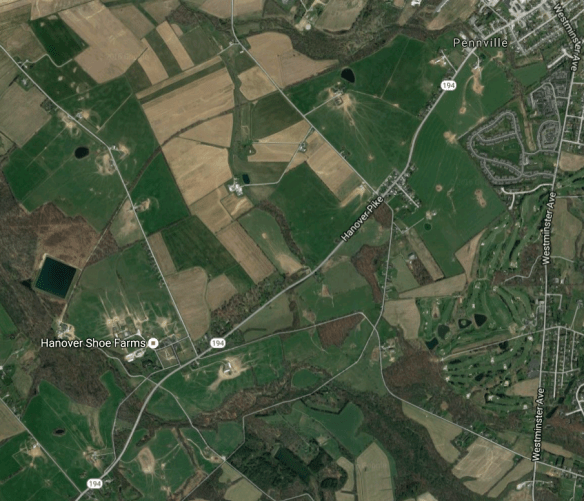
ulrich-york-land-satellite

The photo below from Google Street View shows Indian Run Creek today from Narrow’s road. If the warrant is accurate, this would have been Stephen’s land although that’s not reflected in Stutzman’s drawing.   Indian Run is not very large.

ulrich-york-indian-run

Let’s drive down the road towards Hanover Pike.

This picture is just north of the intersection of Narrows Road and Hanover Pike. Stutzman’s drawing shows that this would have been Stephen’s land.
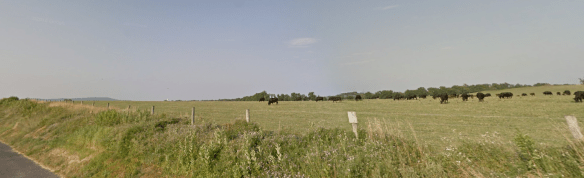
ulrich-york-hanover-pike

When Stephen first rode in his wagon on what would one day become this road, it would have been entirely wooded.  This flat farmland is just south of the same intersection.

ulrich-york-hanover-pike-2

If you are a farmer, flat is good.

ulrich-york-hanover-pike-3

This 1783 record further clarified that Stephen lived on the main road in York County, which would have been Hanover Pike.

1783 – Deed – May 17th – George Adam Stum of Heidelberg Twp, York County yeoman and Mary Apelone his wife for better securing the payment of….sold to Sebastian Opold a 150 ac tract of land in Heidelberg Twp part of larger tract called Diges’ Choice adj the Conestoga Old Road which tract of land John Digges conveyed unto Stephen Ullery and the said Ullery conveyed unto Peter Neffziger….

Land Records of York Co, Pa 1775-1793 by Mary Marshall Brewer, p 70-71

Given that John Digges did not convey land to Stephen Ulrich Jr., this land, above, has to be that of Stephen Sr.

It is believed that in 1738, during the time Stephen Ulrich lived here, he and his friend Jacob Stutzman organized the Conewago Congregation of the German Baptist in Conewago Twp. near Hanover, Pennsylvania.

Stephen Ulrich (Jr.) was reported to be a German Baptist minister based on Nicholas Martin’s notes. Stephen is believed to be the son of the immigrant Stephan Ulrich, given that their land was adjacent and they were referred to as Sr. and Jr, and Stephen Sr.’s 1738 naturalization record includes Stephen Jr.

About 1740, Stephen Jr. married his wife, reported, but not documented, to be Elizabeth Cripe. I sincerely believe that her surname was not Cripe, but I will delve into that topic in Elizabeth’s article.

Stephen Ulrich sold his Lancaster/York County land to his friend, Jacob Stutzman. This transaction is described in John Hale Stutzman’s book, “Jacob Stutzman, His Children and Grandchildren.” Unhappily for us, these two devout Dunkers, under the strictures of their church doctrine, avoided engagement with government authorities and did not record the deed of sale. “Heaven perhaps for the Dunkers but Hell for the genealogist,” as quoted by John Hale Stutzman. I’m glad I’m not the only Brethren researcher that feels that way!

We only know about this land sale because of a subsequent sale by Jacob Stutzman to George Wine. The Wine family intermarried with the Miller family through son Lodowich (Ludwig.). And around and around we go…

In 1743, another battle broke out and Stephen Ulrich was certainly in the middle of it, although his name is not specifically recorded. We know he was, though, because of John Digges and an unnamed Mathias Ulrich, possibly a relative.

In a deposition given August 29, 1746, Matthias Ulrich stated that he arrived in 1738 but he did not settle on Digges’ Choice until 1742 just before visiting Germany. So Mathias arrives at Digges Choice at least 4 years after Stephen Ulrich.

In 1743, the Germans sent one Martin Updegraf to Annapolis, Maryland to check on John Digges grant. It was found that Digges had sold some land he didn’t own, so he obtained a new grant from Maryland which included farms of 14 Germans under warrant from Pennsylvania. Both sides tried to intimidate the German farmers. The Pennsylvania surveyor warned them against violating royal orders. Mathias Ulrich apparently told the sheriff “to go to the devil,” an action very out of character for a Brethren. Eventually Digges son was killed but Pennsylvania would not surrender the killers to Maryland to be tried. It was clearly one hot mess on the frontier, and petitions and requests for help went unheard and unanswered by those back east who cared little if a bunch of Germans killed each other.

The Brethren tried to stick it out for a few more years, but in 1745, Michael Miller began buying land in Frederick County, MD, near present day Hagerstown and not long thereafter, the entire group of Brethren would sell out and remove themselves to what they hoped would be a more peaceful and secure, undisputed area.

The final straw, perhaps, came in 1748 when the sheriffs from both states insisted on collecting quick rent, which in this case, was in essence extortion money for being left alone. A 1748 deposition complaining to the Maryland governor said that “a great number of the Germans and some others were so much alarmed by the sheriff’s proceedings that several of them have already left the province and others have declaired they would go.” Many of the German families held land authorized by Pennsylvania.

In 1748, Frederick County, Maryland was formed from Baltimore and Prince George’s County.

On November 15, 1749, Stephen Ullery bought 150 acres in “Digges Choice” from John Digges and on June 3, 1758, “Stephen and Elizabeth Wollery of Frederick County, Maryland sold this land, according to Baltimore County, Maryland land records listed by John Hale Stutzman.  This land purchase from Digges is a bit confounding, knowing that Stephen Ulrich held land patented by Pennsylvania adjacent Digges land, so assuredly in the midst of the land that Digges tried to extort from the Germans by bullying them into either giving him their patents or making them repurchase their land from him.  This is also about the time Stephen Sr. is reported to have died.  Did Stephen repurchase his own land?  His father already had purchased land directly from Digges.  Would Stephen Jr. have purchased land in 1749, just before moving to Frederick County from the despised Digges?  We will likely never know “the rest of the story,” but surely there is more to the story than is readily apparent.

“Stephen Ullery” appears in the official records of York Co., Pennsylvania in 1749 in the Little Conewago area.

Frederick County, Maryland

However, by 1750, Stephen had had enough. Both Maryland and Pennsylvania tried to tax Heidelberg Township in the Conewago area. Stephen Ullery was taxed 7 shillings and Mathias Ullery, 2 shillings. It’s unclear whether this was Maryland or Pennsylvania tax, but regardless, Stephen sold his land and moved. Mathias apparently does as well, but I can’t find a deed.  Many of the Brethren simply passed the deed to the new owner and if they didn’t register the deed, it didn’t matter to the person who sold the land. In many cases, the deeds passed hand to hand several times and were never registered. Unfortunately, this plays havoc with any historical continuity.

By 1752 Stephen Ulrich Jr. had moved about 60 miles almost due west to Frederick County, Maryland, near today’s Hagerstown, but then it was the edge of the frontier. The closest village in 1752 was Conococheague where the creek of that name empties into the Potomac River. This is the area where Stephen would spend the rest of his life after purchasing land from one Hance (Hans) Waggoner in 1751.

ulrich-hanover-to-frederick

To illustrate life on the frontier, Evan Shelby, who had sold Stephen’s eventual land to Waggoner also sold land to Indian trader, John Hager, 5 years after Shelby initially acquired the land. When Shelby sold the land to Hager, it had been improved with “two sorry houses” and “3 acres of cornfield, fenced in.” That was it – 5 years worth of improvements on the frontier.  According to land surveys in Frederick County, this was the rule, not the exception.

Most land in this area was entirely unimproved, but Stephen’s land that he purchased from Waggoner may have been. Another man purchased the other half of Waggoner’s land, and one of the two men received these improvements:

One dwelling house 20 by 16 feet made of hewd logs and covered with lap shingles, a stone chimney, one dwelling house 27 by 22 feet of hewd logs and covered with lap shingles, plankd above and below, a stone chimney, a new barn of hewd logs covered with lap shingles, 49 feet by 27, 69 apple trees, 72 peach trees and 6 acres of cultivated land well fenced.

In 1750 on the frontier, this was a palace. I do have to laugh, because true to form, the barn is much, much larger than the house, more than twice as big.

On September 25, 1752, Stephen Ulrich (Jr.), “of Frederick County, Maryland” bought 235 acres from a very early settler in the region, Hans Waggoner. The same day, Hance Waggoner sold another 200 acres of Germania to Walter Friendesburgh. The Waggoner family had lived adjacent the Ulrich family in York County as well.

ulrich-stutzman-book-page-12

Page 12, “Jacob Stutzman (?-1775)” by John Hale Stutzman, Jr.

The Ulrich’s settled right at the base of the first mountain range, about 8 or 9 miles northwest of today’s Hagerstown. John Hale Stutesman’s map has Stephen Ulrich’s original farm just below today’s Mason-Dixon line which forms the state line . This would be on Maryland 494 just below the state line where 494 becomes 75 in Pennsylvania.

ulrich-frederick-satellite

Stutzman states that the X is near where highway 57 intersects 75, which would today be 494, although that appears to be about half a mile south of the state line.  Stutzman didn’t have the benefit of Google satellite when he wrote his book in 1982.

ulrich-frederick-57-and-494

This picture above is taken just north of the intersection of 57 and 494.

ulrich-frederick-st-paul-road

Based on that description, this land should be Stephen’s, and there are the mountains in the distance.

You can drive for miles seeing nothing but farms and cornfields, punctuated from time to time by a very old house that is located very near the road. I always wonder if these houses stood when our ancestors passed by in horse and wagon.  This house may have been located on Stephen’s land.

ulrich-frederick-old-home-on-stephens-land

This end of the house, which is the original portion, looks like it might have been fortified at one time. Other similar homes on the Tennessee frontier have these same strategically placed windows at the highest portion of the end of the home so that the men can gain a height advantage when shooting at their foes.  Note the two windows on either side of the chimney in the highest portion of the home.

ulrich-fortified-house

Even the trees are ancient, as are the barns to the right of the house above.

ulrich-frederick-old-barns

Adjoining Stephen Ulrich’s land is the Jacob Stutesman place, purchased in 1761, straddling the state line and ultimately the Butterbaugh holdings were right here on both sides too, according to Stutzman. Jacob Cripe lived somewhere in this region too, northwest of John Hager’s house. The relationship between the Cripe and Ulrich families is unclear, but some individuals suggest that Jacob Cripe’s wife was the sister of Stephen Ulrich Jr. I have never seen documentation to this effect, but given the lack of Brethren records, it’s possible.

Stephen Ulrich and his wife raised a large family of nine children. Their daughter Christina married Jacob Stutzman, Jr., the son of their neighbor.

Frederick County Maryland Land Records Liber B Abstracts 1748-1752 by Patricia Abelard Andersen, p 4:

Stephen Ulary recorded Jan. 6, 1753, made Sept 5, Hans Willaree Waggoner of Frederick Co., farmer, for 340 pcm, tract called Garmina at first line of tract called Maidins Choice, m&b for 235 acres. Signed Hans Willarae Waggoner before Thomas Prather. Ack. Elizabeth Waggoner, his wife released dower. Receipt AF paid.

On February 19, 1753, Stephen and Elizabeth Ulrich sold 25 acres to Lodowick Miller, the son of Michael Miller. Michael Miller’s grandson, Daniel, through son Philip Jacob Miller would marry Stephen Ulrich’s daughter, Elizabeth some 20 years later. Also on February 19, 1753, Walter Friendesburgh sold 100 acres to Lodowich Miller.

Given this close connection with the Miller family, it’s also possible that either Stephen Ulrich’s wife or Jacob Cripe’s wife was Lodowich Miller’s sister.  I do need to state that this is purely speculative, and I almost hate to even mention it because they is no proof, in either direction.  There is only the possibility given the limited number of Brethren in York County at an early day when those men would have been marrying.

Jacob Stutzman was thought to have been the step-brother of Michael Miller, the immigrant and father of Lodowick Miller, but recent information that has come to light strongly suggests Jacob Stutzman was actually Michael Miller’s half-brother.

In 1753, Stephen Ulrich’s brother George had apparently also moved to Frederick County, and subsequently died.

ulrich-1753-george-ulrich-estate

Nicholas Martin and Stephen Willarick (Ulrich) as administrators of George Willarick (Ulrich) deceased late of Frederick County MD reported the value of the deceased property to the court on August 27, 1753.

1754 – 483-484 – Lodewick Miller recorded July 7, 1754 and made Feb 19 same year between Stephen Ulrich of Frederick County for 25 acres, Pennsylvania current money tract called Garminia (Germania) in Frederick County in his actual possession, metes and bounds given, signed Stephen Ulrich before Thomas Prather, Walter Tenderback, Elizabeth wife of Stephen Ulrich released dower right. Receipt. AF paid.

484–485 – Lodewick Miller recorded July 7, 1754, made Feb 19, 1754 between Walter Fundenberg farmer, for 100pcm, tract part of land called Garminia, m&b given. Signed Walter Gondeback, before Thomas Prather, Stephen Ulrich. Katern wife of the said Walter released dower right. Receipt. AF paid.

1754 – 590-591- Daniel Ularick recorded November 20, 1745 made May 31, 1754, between Steven Ularick of Frederick Co., farmer for 100 pcm MD, part of a tract called Garminia (Germania) beginning on the 10th line, m&b given for 86 acres, signed Stephen Ularick before Thomas Prather, Joseph Smith. Elizabeth wife of Stephen Ularick released dower right. Receipt AF paid.

In August of 1754, Stephen Ulrich was appointed overseer of roads in Conococheague Hundred in Frederick County for 1755.

Stephen’s Maryland lands butted up against the first rampart of the Alleghenies, called in whole “The Endless Mountains.” This particular mountain was called “The North Mountain” and his land was on the eastern flank.

The years of 1754 and 1755 signaled the beginning of the French and Indian war.

All was not tranquil on Conococheaque and the worst was yet to come. In 1755, the French and Indians smashed General Braddock’s column a few miles to the west, killed Braddock himself, and set the frontier aflame. In 1756, Gov. Sharpe of Maryland wrote, “The fine settlement of Conococheaque is quite deserted”.

Stephen Ulrich and family had hurredly abandoned ship, but where did they go?

The War Years

This land looks beautiful, idyllic and serene today, but it wasn’t always this way.

Philip Jacob Miller land Allegheny Mountains

During the time that the Brethren were settling, first near Hanover, PA, then Maryland, they weren’t the only people who felt they had a right to this land.

The Native tribes had good relations for decades with both Pennsylvania and Maryland. Both colonies bought land from the tribes. The problem was twofold.

First, the Native idea of land use and ownership was different from that of Europeans. While the Europeans “bought” the land from the Indians whose villages were physically on the land, those weren’t the only Indians with an interest in the land. Other tribes could well feel an ownership towards the land in terms of using it for hunting, or for travel. Once the Europeans owned it, they felt they owned it exclusively and anyone else that infringed in any way was trespassing. The worldview of the Indians and the Europeans was quite different, which put them squarely at odds with each other.

While Pennsylvania and Maryland were negotiating in good faith, others were not. For example, the Indians were promised land in the Ohio Valley, undisturbed, and that settlers would not cross the Proclamation line in 1763, promises which were immediately broken.  There was a long history of European misrepresentation, mis-set expectations, broken promises and treaties.

1763-proclamation-line

Secondly, both the French and English in the northern part of the colonies, and the Spanish in the southern tier were trying to do two things at once. They were trying to displace the Indians and at the same time, trying to win them over to their side in terms of warfare. This means that the Indians were in conflict with the French, English and Spanish and having internal conflicts between tribes as well. Old conflicts were not forgotten, and new injuries added to the list as the Indians sided with the French and raided the colonies of Pennsylvania and Maryland, for example.

The Braddock expedition, also called Braddock’s campaign or, more commonly, Braddock’s Defeat, was a failed British military expedition which attempted to capture the French Fort Duquesne (modern-day downtown Pittsburgh) in the summer of 1755 during the French and Indian War. Braddock was defeated at the Battle of the Monongahela on July 9, and the survivors retreated. The expedition takes its name from General Edward Braddock, who led the British forces and died in the effort. Braddock’s defeat was a major setback for the British in the early stages of the war with France and has been described as one of the most disastrous defeats for the British in the 18th century.

Before setting out on this expedition, Braddock had been warned about the Indians and their ambush style of attacks, which he poopooed. A decision he would regret, but did not live to regret. The families in Frederick County, Maryland would watch more than 200 of Braddock’s men move between the Potomac River and Antietam Creek on land owned by Brethren Johann Michael Mueller.

Braddock’s men marched through the woods in their red coats, in formation, in columns, drums and pipers playing and flags flying. They made one fine target of themselves. The Indians must have thought them insane.

General Braddock’s defeat in 1755 left the entire frontier at the mercy of the French and their Indian allies, who were both trying to displace the settlers in Pennsylvania, Maryland and part of Virginia against the “Endless Mountains,” the Blue Ridge and Alleghenies. Attacks on the settlements began at once with Braddock’s defeat.

There were plenty of British and German settlers who had moved to the frontier who were sitting ducks, and the Indians descended upon them.

By June 28th of 1755, Governor Sharpe of Maryland sent a document to the lower house: “a party of French Indians last Monday morning (June 23) fell on the inhabitants of this province and killed two men and one woman…eight other persons they have taken prisoners and carried off…”

In general, with some exceptions, you were far better off to be killed quickly than taken captive. The horrors that captives were subjected to are simply too gruesome to describe.

A French Captain wrote shortly after Braddock’s defeat that they had succeeded in “ruining the three adjacent provinces of Pennsylvania, Maryland and Virginia, driving off the inhabitants and totally destroying settlements over a tract of country thirty leagues reckoning from the line of Fort Cumberland.”  Thirty leagues is about 103 miles.  Fort Cumberland is at the right upper end of the map below.

braddocks-military-road

Col. Adam Smith reported from Fort Cumberland that “the smoak of burning plantations darkens the day and hides the neighboring mountains from out of sight.”

“They kill all they meet…” wrote Claude Godfrey, a priest. Women and maidens were reported to be abused, then slaughtered or burned.

Fort Cumberland was about 65 miles west of the area near Hagerstown where the Brethren lived, and the border between Pennsylvania and Maryland.  Stephen’s land was well within the circle of destruction – and he would have had to go at least 40 miles east to be even remotely safe.

ulrich-frederick-to-fort-cumberland

On October 9, 1755, the Maryland Gazette ran this story:

Last Wednesday morning the Indians carried off a woman from Frazier’s plantation…killed Benjamin Rogers, his wife and 7 children, and Edmund Marle, one family of 12 persons, besides 15 others, all in Frederick County. On Patterson Creek many families have within this month been murdered, carried away or burnt in their houses.” It goes on to say that “near Town Creek…a few miles this side of Cresaps more settlers were killed or carried away.

Patterson’s Creek is near Fort Cumberland and Town Creeks is west of Stephen Ulrich’s land.

By 1756, the territory around Cumberland was almost entirely deserted and George Washington wrote on April 22 that stories of the “butchering enemy melt me into such deadly sorrow that I would willingly offer myself a willing sacrifice…provided that would contribute to the people’s ease.”

And then on March 11, 1756, the Maryland Gazette reports this incident very close to where the Brethren families lived:

On the 26th instant…we found John Meyers house in flames and 9 or 10 head of large cattle killed. About three miles further up the road we found one Hynes killed and scalped with one arm cut off and several arrows sticking out of him. Further on they found a fortified house full of 40 women who told them they had been surrounded by Indians. But when the attackers tried to burn the house, the women extinguished it with ‘soapsuds’.

Never, never underestimate the ingenuity of a group of desperate women.

Those who didn’t leave were virtual captives in their home. Going to the fields to work or the creek for water was a life-threatening adventure. Many entire families lost their lives. Most families lost someone.

Near the close of the Revolutionary War, one Mr. Butterfield reported, “From Pittsburgh south…there are few families who have not lived therein any considerable length of time that had not lost some of their number by the merciless Indians.” (Replogle)

Living on the frontier was not for the faint of heart or spirit. But then again, being of a dissenting religion in Europe hadn’t been safe either.

On November 15, 1749, Stephen Ullery had purchased 150 acres in “Digges Choice” from John Digges and on June 3, 1758, “Stephen and Elizabeth Wollery of Frederick County, Maryland sold this land, according to Baltimore County, Maryland land records listed by John Hale Stutzman.

This 1758 record in Baltimore County may provide us with a very important clue. Stephen Ulrich claims he is from Frederick County, but this deed is filed in Baltimore County, where he may have taken refuge during the time the family was seeking shelter from the Indian raids. My assumption had always been that Stephen, and indeed the entire Brethren group had returned to Pennsylvania, but that appears to be incorrect – at least relative to Stephen.

Eventually things quieted down and the survivors returned to their homes. Just what became of the Ulrich family during this time is not known. But when he returned, Stephen Ulrich Jr. had his land resurveyed and named it “Good Neighbor” and was able to persuade his old friend Jacob Stutsman to buy land adjoining his in 1761.

On March 9th, 1761, Jacob Stutzman of the Province of Pennsylvania, farmer, paid 300 pounds to Bernard Stuller for 245 acres called “Good Luck,” with 24 acres of Flaggy Meadow lying on the northeast border of “Good Neighbor.”

On April 21, 1761, Stephen and Elizabeth Wollery of Frederick Co., Maryland sold 150 acres in “Digges Choice” to George Wain or Wine. The surname is likely Wine, because the Wine family married into the Johann Michael Miller family. One tract had been sold to Jacob Stutzman by 1759 and Stutzman sold his land to Wine as well, probably when Stutzman moved to Frederick County and purchased “Good Luck.” Deeds were made to clear the record.

1761 – April 21 – Deed – Stephen Ulrich of Manham Twp York Co for 10 pounds sold to George Wain of same place 200 acre tract of land whereon the said George Wain now dwells in Manheim Twp which was granted unto me by warrant dated Feb 17 1742…wit Jacob Danner, Ludwig Miller. Ackn April 21 1761 before Michael Danner . (B: pg 179)

Please note that Lodowick’s name is recorded as Ludwig here.

1761 – June 2, 1763, Deed George Wain of Manham Twp, York Co yeoman sold to Conrad Keefaver of same place yeoman one half of a 200 acre tract of land being part adj Martin Kitsmiller Digges and the same Conrad Keefaver…whereas in pursuance of a warrant dated Feb. 16, 1742 there was surveyed and laid out unto Stephen Ullrick a 200 ac tract of land in Manhiem Twp. and the said Stephen Ullerick on April 21, 1761 did convey the tract of land unto the said George Wain. Wit John Wagner, Henery Harris ackn June 12, 1763 before John Pope esqr justice (B: pg 183)

Land Records of York County, pa 1746-1764 by Mary Marshall Brewer p 177

The fact that this land, previously owned by Stephen Ulrich is adjacent the tract owned by Martin Kitsmiller is quite interesting. Martin Kitsmiller was a miller whose land was part of the “disputed land” caught up in the Digges resurvey. A cornerstone in the former mill is dated 1738 and the mill was located near the headwaters of the Little Conewago Creek. He bought his 100 acres on Conewago Creek which was contiguous to Digges Choice from John Lemmon in 1736. It was at Kitzmiller’s Mill in 1752 that John Digges’ son, Dudley was killed when the Baltimore County sheriff attempted to arrest Martin Kitzmiller when Digges tried to force him to repurchase his land. Kitzmiller’s son, Jacob, killed Dudley, but it may well have been accidental during the scuffle. Ironically, it was during this trial that it was determined that Kitzmiller’s Pennsylvania warrants were valid and Maryland, where Jacob Kitzmiller was being tried, had no jurisdiction to do anything at all, including collect taxes or arrest anyone, for anything, in Pennsylvania.

On September 29, 1761, Stephen Ulrick and Nicholas Martin of Frederick County, Maryland received a patent for 425 acres for which they obtained a warrant on August 27, 1759. This tract was called “Stephen’s Hope” and included a former survey, “Much Grumbling,” which had not been taken up by Jacob Funk.

Stephen Ulrick recorded a release September 24, 1762.

I, Charles Carrol of Annapolis, barrister, heir and executor of Charles Carroll the mortgage for 193 pounds 19 shillings paid by Stephen Ulrich, farmer and interest. Signed Chas Carroll. Duty paid.

Frederick County Land Records, Liber G and H Abstracts, 1761-1763, Abstracted by Patricia Abelard Andersen, p 56

More Warfare – Pontiac’s Revolt

However, in 1763, this area would see a repeat of the warfare that occurred in 1754-1756 in the French and Indian War – except even worse, if that can be imagined.

From Francis Parkman’s book, “History of the Conspiracy of Pontiac,” we learn frightening details about Pontiac’s Revolt. In May of 1763, with Indians from as far away as the Mississippi, Pontiac descended on the English settlers and garrisons from Detroit to the Carolinas in a concerted warfare effort.

Parkman tells us:

It was upon the borders that the storm of Indian war descended with appalling fury, a fury unparalleled through all the past and succeeding years. For hundreds of miles from north to south, the country was wasted with fire and steel…the ranging parties who visited the scene of devastation beheld, among the ruined farms and plantations, sights of unspeakable horrors; and discovered in the depths of the forest, the half-consumed bodies of men and women, still bound fast to the trees where they had perished in the fiery torture.

Somehow both Stephen Ulrich and Jacob Stutzman survived. We don’t know if they went back east and stayed with families there, or perhaps they took shelter in Fort Frederick, located 8 or 10 miles distant, as the crow flies. On the map below, the Ulrich property is just below Maryland/Pennsylvania border at Dry Run. Fort Frederick is on the Potomac River.

ulrich-to-fort-frederick

Today the fort is restored.

fort-frederick

“Fort Frederick walls” by Acroterion – Own work. Licensed under CC BY-SA 3.0 via Commons – https://commons.wikimedia.org/wiki/File:Fort_Frederick_walls.jpg#/media/File:Fort_Frederick_walls.jpg

Here is an artist’s rendering of how the fort would likely have looked when these families would have been living in the vicinity – and perhaps taking shelter here.

fort-frederick-rendering

“Fort Frederick, Hagerstown vicinity (Washington County, Maryland)” by Albert S. Burns, Photographer – This image is available from the United States Library of Congress’s Prints and Photographs division under the digital ID hhh.md0835.This tag does not indicate the copyright status of the attached work. A normal copyright tag is still required. Licensed under Public Domain via Commons – https://commons.wikimedia.org/wiki/File:Fort_Frederick,_Hagerstown_vicinity_(Washington_County,_Maryland).jpg#/media/File:Fort_Frederick,_Hagerstown_vicinity_(Washington_County,_Maryland).jpg

There were other, smaller forts as well – basically fortified homes – probably similar to the home found on the land that may have been Stephen’s. We know at least one of these, the Philip Davis home wasn’t far from Stephen’s land, because Charles Mason and Jeremiah Dixon, of the Mason-Dixon line fame stayed at his home while surveying the line that would eventually dissect Jacob Stutzman’s land into two states. On October 4th, 1763 the surveyors crossed a spring at the foot of the North Mountain. It’s quite surprising that the surveyors and homesteaders were still in this area.  Perhaps the warfare had not spread this far east yet.

I’m sure the families of Jacob and Stephen watched this surveying process with great curiosity and perhaps some trepidation, uncertain of what the results would mean.  I wonder if they were more frightened of the Indians or what the surveys could mean to them if they found themselves in the “wrong” state.  And as for Stephen, he had to worry regardless, given that it appears his land was in both states.

One thing is certain, the Brethren, including Stephen Ulrich, didn’t remain in their homes as warfare descended upon them once again. We have historical records stating that all of this area of Maryland was abandoned. We know that some of the area families took shelter in the Fort – although I would think the men in the fort would have been expected to defend it, were it to be attacked. Under those circumstances, the Brethren families were probably more likely to have taken their families back east and found refuge among family or church members. Perhaps Stephen went back to Baltimore County, again.

However, we do know where Stephen was on May 28, 1763. In 1763, in the midst of all of the wartime upheaval, which included vacating their land in Frederick County for several years, we find Stephen Ulrich and Nicholas Martin attending the Great Council of the Brethren in 1763 in Conestoga.

Conewago, in the book, “A History of the Church of the Brethren in Southern District Pennsylvania” is noted as being near current Ephrata, PA and also as being the current congregation of White Oak in Lancaster County.

ephrata-to-hagerstown

Stephen’s name appears on an annual report with that of Nicholas Martin, Jacob Stutzman and both Nicholas and Daniel Leatherman in the Conestoga area, near Germantown, where the annual Brethren meeting was held. Does this imply that this is perhaps where the Brethren families on the frontier retreated to when their homes were in danger? Stephen may have been unwilling to fight, but he surely would not have left his family in danger to attend the meeting in Germantown.  Had the warfare not yet reached Frederick County?  Did they go back home to their families, only to have to vacate shortly?

We don’t know where these Brethren families lived from late 1763 until about 1765 when they returned to Frederick County, but it’s likely this entire area evacuated eastward and joined other Brethren families.

It was also about this time that these two families became even more intertwined. About 1765 Christina Ulrich married Jacob Stutzman Jr.

Stephen’s Hope

In 1766, an unusual transaction takes place, that upon analysis, is most likely a deed to Elizabeth Ulrich, sister of Stephen Ulrich (Jr.). We know that Stephen Ulrich Jr.’s daughter Elizabeth married Daniel Miller about 1774, so the only other known Elizabeth that this could be in Stephen Jr.’s sister – and the only reason that seems logical for a deed to be conveyed to Elizabeth, yet unmarried, is as an estate settlement.

On November, 18,1766, Elizabeth Ulrich is deeded part of the land called “Stephen’s Hope”, which was then sold to Anthony Hartman, 17 Nov. 1768, (Frederick County, MD deed Book L, page 559, 560) in consideration of the sum of “sixty pounds current money of Pennsylvania.”

Elizabeth was deeded this property by Stephen Ulrich, Jr.  and Nicholas Martin who had patented this land together in 1761, obtained originally in 1759. Elizabeth was not yet married to Jacob Snively in 1766. The “Stephen’s Hope” tract was located in the Middle Creek Valley in Frederick Co. some miles distant from the Ulrich and Shively homesteads.

On the map below, you can see Stephen’s “Good Neighbor” land near North Mountain at the state line in the upper left hand corner of this map, and the Middle Valley lies just north of Ellerton, in the south corner of this map.  As the crow flies, this land is at least 15 or 16 miles distant, and further as the wagon travels.

ulrich-middle-valley

1766 – P 851-853 – Stephen Ulrick Jr recorded Dec. 8, 1786 made Nov 18 between Nicholas Martin and Stephen Ulrick for 48 pounds sells part of a track called Stephen’s Hope. M&b given for 141 acres. Signed in German Script by Stephen Ulrich, Nicolays Martin before Joseph Smith, Peter Bainfridge, receipt ack by partied and AF paid.

Pg 153-155 Stephen Ulrick Jr recorded Dec. 8, 1766 made Nov 18th between Nicholas Martin and Stephen Ulrick for 3 pounds part of a tract called Much Grumbling, m&b given for 21 acres. Signed same as before.

Pg 855 Elizabeth Ulrick recorded Dec. 8, 1766 made Nov 18 between Stephen Ulrick and Nichlas Martin of FC for 4 pounds sells part of tract called Stephen’s Hope.

Pages 856-858 are missing.  We have no idea what might have been held on these pages.  One this is certain, it likely had to do with this land because pages 859 and 860 still regard these transactions.

Pages 859-860 – m&b for 133 acres signed in German script by Stephen Ulrick, Nicholas Martin, Receipt from Elizabeth Ulrick for 48#. Ack and AF paid.

Frederick Co. Md Land Records Liber K Abstracts, 1765-1768 abstracted by Patricia Abelard Andersen, pg 71

Pages 922 – 924 – Daniel Gaver recorded January 9, 1767 (or 1761) made Dec 18 between Stephen Ulrick and Nicholas Martin for 48 pounds sells tract Stephen’s Hope m&b given adj to Much Grumbling containing 80 acres. Signed in german script by Stephen Ulrick and Nicollaus Martin before Thomas Price, P. Bainbridge. Receipt of deed. AF paid

Frederick Co. Md Land Records Liber K Abstracts, 1765-1768 abstracted by Patricia Abelard Andersen, p 76

When you read the survey narrative for Stephen’s Hope, it states:

30 day March 1753.  Surveyed for a certain John Leatherman added by a resurvey to a tract of land called Much Grumbling as any other vacant land thereto contiguous.

The patent info shows Leatherman’s tract ‘Much Grumbling’ is dated 1743, and was for 30 acres. It is hard to read, but the narrative lists a stream that runs into what looks like Kittowakin Creek. However, there is no stream that carries that name today in either Washington or Frederick County, MD. (Bill Thomas)

When Anthony Hardman bought this Frederick Co. MD farm in 1768, he paid in cash with Pennsylvania money.

Frederick Co., MD Land Record, Liber L, folio 559 dated 17 Nov. 1768, Anthony Hardman from Jacob Snively, sell tract, part of “Stephens Hope” for 133 acres.

Obviously Elizabeth had married “Jacob Snively” by this time.

ulrich-stephens-hope-survey

ulrich-stephens-hope-survey-1

ulrich-stephens-hope-survey-2

ulrich-stephens-hope-survey-3

This 425 acres wasn’t developed land.  The note on the survey says that there are about 4 acres of cultivated ground and about 500 “old fense logges.”

Stephen’s Second Naturalization

1767 – The division of Jacob Stutzman’s land between Maryland and Pennsylvania may ultimately have caused him to have to be naturalized in Pennsylvania, an act that went directly against his Brethren beliefs. The survey that established the Mason-Dixon line was begun in 1763 and completed in 1767, and the crew would have worked directly through Jacob’s land.  If indeed, part of Stephen Ulrich’s land was also bisected by this line, the same logic would apply as to why he would be naturalized a second time.

ulrich-mason-dixon-3

In the actual survey map of the Mason-Dixon line above, you can see this area just to the right of North Mountain which is located above the V.  Coneccocheague is the river between the I and the N in Province, below the drawing.  Little Conococheague Creek runs between North Mountain and the mountain range shown between North Mountain and Conecocheague Creek, right above the I.  It’s possible that Jacob Stutzman’s house is shown beside the mountain on the Pennsylvania side – which would be Cumberland County.  Both Stephen Ulrich’s and Jacob Stutzman’s land would have fallen between these two landmarks – the first row of mountains and Conecocheague Creek.

Jacob and Stephen’s naturalization record on April 10, 1767 says that Jacob Stutzman of Cumberland County, PA appeared before the Supreme Court of Pennsylvania at Philadelphia to be naturalized. Stephen Ulrich of Frederick Co. Maryland was naturalized as well as several other “foreigners…who conscientiously scruple to take an oath…but took the affirmation and made and repeated the Declaration according to the Directions of the Act of King George the Second.”

The only Stephen Ulrich that could be being naturalized in 1767 would be Stephen Jr., who we know was born in Germany due to the 1738 Maryland naturalization. His father was presumed dead by this time, and Stephen Ulrich (the third) would have been born in the colonies, so wouldn’t need to be naturalized.

I can just see this group of reluctant Brethren men, standing there uncomfortably shuffling and probably staring at their feet. There were at least two other Brethren too, Michael Miller and his son, Philip Jacob Miller. There were also a few other men from Frederick County who were also “affirmers” so likely Brethren as well. It’s no trivial feat to get from Hagerstown to Philadelphia, so this must have been important, regardless of the reason.  And for Stephen, he got to be “shamed” twice.  Being naturalized once wasn’t enough.  Perhaps he wasn’t yet Brethren the first time.

Map Frederick co to Philly

Good Neighbor

In 1767, Stephen Ulrich resurveys his existing Germania, along with two other tracts that are “vacant,” into a 694 acre tract called “Good Neighbor.”  Stephen lived on Germania (also spelled Germony) from 1751 until he died. His brother John lived nearby, reportedly (but no confirming deed) next to the mountains.  John could well have lived on some of Stephen’s land.

Stephen’s Good Neighbor survey, amended, is shown below.

ulrich-good-neighbor-survey

ulrich-good-neighbor-survey-1

ulrich-good-neighbor-survey-2

ulrich-good-neighbor-survey-3

This survey combines the original Germania property with two more and is now called Good Neighbor.  The improvements are listed as a quarter acre cleared and 230 old fence posts.  The survey says that Germania was originally purchased from Hance Waggoner on May 24, 1751 and that Hance held the original warrant for 435 acres.

1768 – Stephen Ulrich sells 60 acres to George Butterbaugh, 139 to Daniel Ulrich, 106 to John Snider and 40 to John Metzger. Elizabeth is no longer mentioned, so she may have died by this time. Replogle 117

This sale totals 345 of the total 445 acres.  Did Stephen retain 100 acres for himself?

A Butterbaugh descendant’s map of George Butterbaugh’s holdings places this 60 acre tract just slightly above the Mason-Dixon line. If correct, this means that in 1765 the Mason-Dixon line crossed the very top of “Good Neighbor.”

On May 24, 1772, Nicholas Martin, the Brethren minister in Frederick County wrote a letter to Alexander Mack Jr. in which he says, “as regards Brother Stephen…has now become more reluctant (to be ordained) because he thinks he has become estranged to the brethren throughout the country because he became naturalized…” This is supposed to refer to “Stephen Woller,” Martin’s assistant. This letter also said that brother Stephen’s brother John moved away, which is accurate, given that John Ulrich moved to Bedford County, PA prior to 1772. (Olds referencing Donald Durnbaugh in “The Brethren in Colonial America.”)

1773 – Jacob Stutzman wrote his will and Stephen Ulrich signed as a witness in German script. The Stutzman book says this will still survives in the archives of Cumberland County, PA probate court records, will Number 28. I’d love to obtain a copy of Stephen’s signature.    Jacob Stutzman’s will was probated February 3, 1775.

I wrote to Cumberland County, PA and Diane from the Clerk’s office was kind enough to call me, but the news wasn’t good.  Jacob Stutzman’s will had been “reinforced” with Scotch tape years ago, and is now so hard and fragile they were afraid to handle he document.  She told me they would have an archivist “look at it” which I figured was the kiss of death in terms of ever hearing anything.  But fortunately, I was wrong.

A couple weeks later, I received high quality photographs in the mail, printed on full size paper.  The archivist had managed to open the document, and insert the document into an archival quality plastic sleeve.  Diane then took photos for me.  I’m telling you this so that you will appreciate the effort that Diane and Cumberland County went to, and the photos below are the best we can do.

Diana also sent a copy of Jacob Stutzman’s will as it is written into the will book.  This helps decipher words and names, because the person who copied that will into the official will book knew the players.  Plus, it suggests that the original way Ulery or Ullery was pronounced probably sounded like Woolery to an English-speaker.

jacob-stutzman-will-7

jacob-stutzman-will-8

From these documents, we can see that the witnesses to the will were David Davis, Stephen Woolery (Ulery) and Daniel Woolery (Ulery).  Stephen Woolery (Ulery) also swore an oath when the will was probated, but this signature is partially obscured in the photos.

Now, let’s look at the original document.

The back of the document is shown below.

jacob-stutzman-will-2

The back of this document holds something not recorded in the will book.  Hannah’s statement saying that she is fully satisfied.  Additionally, we find the signature of Stephen Ulrich witnessing her statement, in German script.

jacob-stutzman-will-3

How do we know that the signature above David Davis is Stephen Ulrich’s signature?  By looking at the rest of the document compared to what is recorded.

jacob-stutzman-will-4

Here’s the entire main page of Jacob Stutzman’s will.  It’s very difficult to see the signatures of the witnesses due to the glare.

jacob-stutzman-will-5

Take a look at just the top half, above.  You can see that the translated version says there are three witnesses with the third being David Woolery and the second being Stephen Woolery and the first, obscured under the tape here, being David Davis.

Here’s just the witness signature section.

jacob-stutzman-will-5-cropped

Even though there is glare, you can see the pattern of the signature pretty well.  Now, compare it to the top signature witnessing Hannah’s statement, below.

jacob-stutzman-will-3-cropped

Furthermore, the second half of the main page shows part of Stephen Woolery’s signature under David Davis again.

jacob-stutzman-will-6-cropped

The pattern of the two signatures identified in the clerk’s book as Stephen Woolery match the signature we can see best under Hannah’s statement.

This confirmed that indeed, we do have Stephen’s signature – not once, not twice, but three times. It’s a good thing, because it took all 3 to confirm it actually is his.

1776 – Deed. Joseph Rentch of Frederick Co Md and William Duffield of Peters Twp, Cumberland Co, Pennsylvania, executors to the will of Jacob Stutzman late of Cumberland Co, PA, decd in consideration of the premises and also 5 shillings sold to George Wine of Heidelberg Twp, York Co, yeoman a 55 acre tract of land in Heidelberg Twp….whereas on Nov 19, 1759 John Digges of Baltimore Co., MD sold to the said Jacob Stutzman then of Baltimore Co MD a 55 ac tract called Digges’ Choice then in Baltimore County but now in Heidelberg Twp, York Co adjacent Stephen Ullery (Book 4 fol 53 and 54 in Maryland) and the said Jacob Stutzman in 1761 sold the tract of land unto the said George Wine for which he hath been since fully paid and whereas the said Stutzman by a bond dated April 18, 1770 became bound unto the said George Wine of 200 pounds conditioned that they should execute unto the said George Wine a deed of conveyance for the 55 acre tract within 7 years, and he said Stutzman on March 15 1773 made his will and did appoint the said Joseph Rentch and he said William Duffield executors and shortly after died without having conveyed the tract of land unto the said George Wine….Wit. James Stevenson, David Moreland, Ack April 24 1776 before William McClean Justice (G:P 217)

This 1776 document confirms that Digges Choice was originally considered to be in Maryland, and that Stephen Ullery (Ulrich) at one time owned this land.

Remarriage and a Prenuptial Agreement

After Stephen’s wife, Elizabeth, died, he married Hannah Stutzman, widow of his devout German Baptist friend and neighbor Jacob Stutzman, Sr. and mother-in-law of his daughter Christina Ulrich Stutzman.

Stephen’s wife, Elizabeth Ulrich probably died between 1761 and 1768 and assuredly before March of 1782, for what now would be called a “Pre-Nuptial Agreement” was signed March 25, 1782 and recorded in the deed records, book C. P. 180 in Washington Co. MD. by “Stephen Ulrich and Hannah Stootsman,” both of Washington Co., Md. Hannah was the widow of Jacob Stutzman who died in 1775. The agreement stipulated that their individual heirs would have no claim to the estates of the other spouse.

This would be a case of Christina Ulrich Stutzman’s father, Stephen Ulrich, marrying Christina’s mother-in-law, Hannah Stutzman – so Christina became her own step-sister-in-law. Her mother-in-law was now her step-mother as well. Stephen was 70 – 72 years old at the time of this marriage and unfortunately, died sometime between 1783 and June of 1785.

Stephen’s Estate

The 1783 tax list of Washington County, Maryland which had been formed from Frederick County lists Stephen Wolery with 324 acres, 3 horses and 3 cattle.

Stephen Ulrich’s “Good Neighbor” consisted of 324 acres, 10 acres of “meadow”, 70 acres of ‘arable’ and 244 acres of ‘wood’. In 1785 his heirs sold this tract. Replogle 118

Jacob Replogle, whose research has been impeccable, tells us that the 324 acres is “Good Neighbor.”  I don’t know whether the tax list says this, or Replogle surmised this, but from the sale calculations, Stephen should only have 100 acres of “Good Neighbor” left.  Because of the missing pages, we don’t know how much, if any, of “Stephen’s Hope” Stephen retained in joint ownership with Nicholas Martin.

We are very fortunate indeed that Stephen Ulrich’s heirs sold his land, as follows:

This indenture made June 17, 1785…between David Ulrick, Stephen Ulrick, Samuel Ulrich, Jacob Stutsman, Christina Stutsman, Daniel Miller, Elizabeth Miller, George Butterbaugh, Jacob Liear, Lidia Liear, all of Washington County, Maryland, for 1510 pounds sold to John Cushwa…tract of land called Good Neighbour which contained 322 acres.

Without this important transaction, we would have no comprehensive record of Stephen’s children, nor who they married.  This record also seems to confirm that the land that Stephen retained at the end of his life was indeed, Good Neighbor.  Perhaps some of the 1768 land sold was Stephen’s Hope.

I can’t help but wonder if there is really a 2 acre discrepancy, of if this is a transcription issue.  Or, was part of Stephen’s land a cemetery?  He had to have buried Elizabeth someplace – as well as be buried someplace himself.

Where was Stephen buried? There was no Brethren church building in 1785, so no official Brethren cemetery. I wonder if he was buried on his farm, along with Elizabeth, in a now-lost cemetery.  Is that the 2 missing acres?  Two acres would be awfully large for a cemetery. 

A Visit to Frederick County, Maryland

When I set out to find Johann Michael Miller’s land in Washington County, Maryland near Hagerstown, in the fall of 2015, I’m ashamed to admit that never thought about the Ulrich land – probably because I didn’t think I could find it. The locations are vague at best.

Michael Miller’s son, Philip Jacob Miller, would marry a woman named Magdalena whose surname is unknown. By the time Philip Jacob’s son, Daniel would marry Elizabeth Ulrich, about 1774, I was under the assumption that they were already in Bedford County, PA…but they weren’t. I hate the word assume. Or more specifically, I hate it when I assume anything because it almost always turns out to be incorrect.

Daniel Miller and Elizabeth Ulrich were likely married in Frederick County about 1774. In reality, we don’t know for sure, but what we do know is that the Ulrich family was living in the area as part of the Brethren group that formed and continued to move together to new lands, eventually finding their way to Bedford County, PA, Dayton, Ohio, Elkhart County, Indiana and some on to points further west.  They generally established Brethren Churches along the way.

We also know that Daniel and Elizabeth Ulrich Miller were still (or again) living in Washington County in 1785 when Elizabeth Ulrich and Daniel Miller sold her father’s property.

After I was already on the road, I read in my Miller notes that John Hale Stutzman had placed the Ulrich family, by using deeds, west of Conococheague Creek, right on or maybe even spanning between the Maryland/Pennsylvania line, and near Fairview Road.

I looked on Google maps, and that’s all I needed. I was off!!!

ulrich-land-frederick-satellite

I figured the best chance I had at actually driving across the Ulrich land is to drive across Wishland Road (unlabeled above) which runs from just north of Conococheague Creek, parallel with the Creek for a ways, then intersecting at the state line on Cearfoss Pike. I did just that.  I might have been a bit off in terms of location, slightly east, but come along anyway.  Certainly this land has not changed much, other than clearing trees.

Below, Conococheague Creek from the bridge.  Stephen would have been quite familiar with this waterway.  He probably forded this “creek” here, at least when the water was low.

ulrich-conococheague-creek

Beautiful farm land.

ulrich-field

The “Endless Mountains” are quite close here. It is reported that Stephen’s brother John lived near the mountains as well, before he moved to Bedford County prior to 1772. Stephen’s brother, Daniel, would have lived in the area too, buying land from Stephen, before he too moved to Bedford County.

ulrich-mountains

This probably is not the actual Ulrich land, but this home is just stunning, as is the barn. I can see Stephen Ulrich here, can’t you? Hardly the “quarter acre cleared and 230 old fence posts“ anymore!

ulrich-farm

Looking close, you can see the satellite dish.  Times have changed, but not terribly visibly otherwise.

ulrich-farm-house

While much of Virginia and West Virginia are reforested, Maryland is not, and flat land here is farmed.

ulrich-fall-field

John Stutzman’s book provides a map and tells us that Stutzman’s land was where Pennsylvania 75 intersects Maryland 57 which is today’s 494, Fairview Road in Maryland and Fort Loudon Road in Maryland.  The road that continues to the west become 57 in Maryland.

On the map below, you can see all of the landmarks, North Mountain to the west, the three roads mentioned above, Cearfoss Pike and Conocheague Creek.  The total distance, as the crow flies, between Cearfoss Pike at the state line to North Mountain in about 4 miles.  Stephen lived here for about 34 years and probably knew these roads, which were no more than wagon trails at that time, like the back of his hand.  Someplace, both he and his wife are buried here.

ulrich-land-frederick-satellite-2

Here’s the state line today, about where the barn stands, and the old road running beside the modern one.

ulrich-state-line

Stephen’s Wife

Stephen’s wife’s name was Elizabeth, according to several deeds, who is reported to be Elizabeth Cripe, but with absolutely no documentation of any surname. It stands to reason that if Stephen bought land in 1742, he was probably recently married and he assuredly married within the Brethren community if he and/or his father were Brethren church founders in 1738. 

Stephen’s Children

Much has been written about the children of Stephen Ulrich, and much confusion exists between generations, mostly because the same first names were used over and over again.

I’m using the document written by Dan Olds in 2003, because his research is impeccable and he does not “add” children who are not present in Stephen’s estate settlement.

I should probably mention here that Daniel Ulrich of Bedford County is often attributed to Stephen (Jr.) but there is no Daniel mentioned in the 1785 estate distribution, and since there was no will, all of Stephen’s children would have been included in that distribution. We know that one Daniel Ulrich was the brother of Stephen (Jr.) The Daniel appearing in Bedford County seems to be too old to be a son of Stephen Jr. If he was Stephen’s son, he would have already purchased and been running a mill when he was about 20 years old, and that’s pretty much unheard of.

Stephen Ulrich Jr.’s children were:

  • David Ulrich born about 1746 and died in 1823, married Barbara and had 7 children. They lived in Montgomery County, Ohio.
  • Stephen Ullery born about 1750 and died in 1835. He married Susan Rench and they lived in Morrison’s Cove in Bedford County, PA and then in Montgomery County, Ohio.
  • Christina Ulrich born about 1752 and died about 1810. She married Jacob Stutzman (Jr.) who later became her step-brother when their widowed parents married. They eventually moved to Montgomery County, Ohio.
  • Samuel Ulrich born about 1754 and died in 1822. He married Mary Brumbaugh and they lived in Bedford County, PA.
  • Elizabeth Ulrich born about 1757 and died in 1832. She married Daniel Miller and they moved first to Bedford County, PA, then to Clermont County Ohio, then to Montgomery County, Ohio.
  • Mary Ulrich born about 1760 and died about 1842. She married George Butterbaugh and they lived in Bedford County, PA.
  • Hannah Ulrich born about 1762 and died in 1798. She married Henry Butterbaugh and they lived in Washington County, Maryland.
  • Lydia Ulrich born about 1764 and died about 1810. She married Jacob Lear, Jr and they lived in Cambria County, PA.

Stephen’s Y DNA

Unfortunately, no directly descended Ulrich males from either Stephen Jr. or Stephen Sr. have taken the Y DNA test. That’s hard to believe, I know, given how many children these Brethren families had. Stephen’s male children, whose direct male line descendants are eligible to take a Y DNA test are bolded above.  The test requires a male who descends from one of the Ulrich male ancestors and carries the Ulrich (by any spelling) surname.

The Y chromosome is passed from father to son, without any of the mother’s DNA, and the Y chromosome lineage follows the surname line of descent.

By testing a male Ulrich that descends from this line, we can determine Stephen’s deep heritage, his clan, for lack of a better word. In addition, we may match a male Ulrich from Germany who has tested – and there are some – which will help us determine where our Ulrich line is from.

If you are a male Ulrich who descends from this line, I have a DNA testing scholarship for the first male Ulrich to come forth.

If not you, do you know an Ulrich male who might be interested?

Sources and Acknowledgements:

  • Replogle – “Ancestors on the Frontier” by Justin Replogle (1998), self published and out of print
  • Wrightsman – “The Elusive Stephen Ulrich” (Dec 2004) Dwayne Wrightsman
  • Olds – “Ulrich Line” by Dan W. Olds (January 26, 2003)

______________________________________________________________

Disclosure

I receive a small contribution when you click on some of the links to vendors in my articles. This does NOT increase the price you pay but helps me to keep the lights on and this informational blog free for everyone. Please click on the links in the articles or to the vendors below if you are purchasing products or DNA testing.

Thank you so much.

DNA Purchases and Free Transfers

Genealogy Services

Genealogy Research

23andMe V3 vs V4 Comparison

23andMe changed from their V3 to V4 kit back in November of 2013. At that time, they reduced the number of locations tested on their chip from over 900,000 by roughly one third to 577,382. This is not what would normally be considered an improvement. However, at that time, the FDA’s shutdown of their medical testing greatly overshadowed the new chip, so very little notice was taken in the community. Truthfully, many people didn’t expect them to survive, so the chip was a non-issue.

Frankly, I had hoped that with their medical testing revenue gone, that they would focus on what was left, genetic genealogy, but they didn’t. In fact, if anything, they turned their back on genetic genealogists with the new system redesign that was a result of the agreement with the FDA relative to what they can and cannot say and do, relative to reporting medical results.

Since it appears that 23andMe is going to survive, I wanted to see the difference between a 23andMe V3 kit and a V4 kit, both in terms of matching and ethnicity results. Plus, the new system experience is different than the old experience when I ordered more than 5 years ago, so I wanted to see what ordering today is like.

Ordering and Kit Registration

Ordering a second kit under the same account (mine) was just the beginning of the frustration. The system died when I was ordering, during the credit card portion, of course, and I had no idea if the order was placed or not. The order did go through, but my “order” stayed in the 23andMe shopping cart. However, my credit card was charged and the kit arrived.

Registering the kit was even more frustrating because I already had a user ID at 23andMe.

When you sign in to 23andMe, you must click Register Kit, then sign on, and not the reverse order, or your kit registration will be declined because you are already using your e-mail address at 23andMe. And no, there are no instructions for this…anyplace. And no, it’s not intuitive.

Terms of Service and Privacy Statements

I clicked through the Terms of Service and Privacy Statements so you can take a look, if you are so inclined. If you’re going to order, this is where the verbiage is contained that describes what 23andMe can do with your DNA in terms of sale to third parties and utilizing your DNA themselves to develop drugs and other products. Be sure you read each of these intertwined documents and understand what you are authorizing – even if you don’t “opt in” for research. There is a level of research that you cannot opt out of if you agree to the terms and conditions – and you can’t register your kit if you don’t agree to the terms and conditions.

v4-tos

Please note number 2 under “Privacy Highlights” above.

v4-tos2

Note number 4 under “Consent to the Use of Sensitive information” and the paragraph below number 4.

Here’s a link to the 23andMe Privacy Statement and the Terms of Service.

Next you see the Research Consent document.

v4-research-consent

Please note that every time you reply to one of their surveys, you are participating in research.  Please note that all of the people who have access to your information are not listed here, and you will have to refer to the Privacy Statement for complete information.

v4-research-consent-2

v4-research-consent-3

Please note that they can further analyze any saliva in a stored sample.

v4-research-consent-4

v4-research-consent-5

Please note that 23andMe reserves the right to develop products, and they have already filed for patents, the first of which was a for “designer baby” technology.  That was the day I withdrew my research consent.

v4-research-consent-6-2

Please note that even if you do not give consent, your information may still be used for other purposes, described in the Privacy Statement.  Furthermore, you cannot opt out of your aggregated (and anonymized) data being utilized.

v4-research-consent-7

What I didn’t see mentioned is that their processing is done by an outside company, LabCorp.

Lastly, the actual consent portion.

v4-research-consent-agree

Then you see this page, asking about sample storage:

v4-sample-storage

v4-submit

Last, you must click submit and you’re done with this part.

v4-complete

Well, you may think you’re done with registration, but 23andMe wastes no opportunity to attempt to collect information about you which makes your DNA information more valuable to the purchasers.

v4-survey

DNA Collection

Next, you have to spit in the vial, of course. A little vial doesn’t look like a lot of spit, until you’re trying to generate spit. Think of lemons. That helps.

I recently retested with both 23andMe and Ancestry, and while they both use a spit vial, the Ancestry vial is less messy because you don’t have to remove the top and screw on a lid.

The swab kits at Family Tree DNA are the best of all – no spitting needed.

Results

The results were available in about a month.

One of the reasons I order the V4 kit is because it seemed that almost everyone else had already transitioned to the New Experience, but I hadn’t. I wanted to see what the New Experience was all about. Wouldn’t you know it, not long after I ordered my V4 kit, my V3 kit finally transitioned to the “New Experience” and I discovered that the questions required for the New Experience transition are exactly the same as the V4 purchase. So in that sense, the experiences are now the same.

tne17

Unfortunately, you have re-authorize your participation in DNA Relatives when you transition to the “New Experience,” meaning that for the highly coveted comparison of DNA between your kit with multiple others, if your matches haven’t transitioned, or haven’t bothered to sign on and reauthorize, including open sharing – the previous sharing authorization isn’t sufficient. That’s sad, because a lot of people have gotten so disgusted with 23andMe that they don’t sign on anymore. Furthermore, if someone has for any other reason become disinterested or ill or died, their DNA is no longer working for anyone…except for 23andMe who continues to utilize their abandoned kit.

V3 Versus V4

I wanted to specifically compare two things between the V3 and the V4 kits – matches and ethnicity.

I wanted to know if the reduced number of SNPs on the V4 chip result in a smaller number of matches and I wanted to know if the ethnicity percentages changed between V3 and V4. I also wondered if there was any change between the old V3 ethnicity and the V3 New Experience ethnicity percentages.

Lastly, I wondered if there is any advantage for someone who has already taken the V3 test to order a V4 test, other than curiosity.

V3 “New Experience” Ethnicity

The ethnicity percentages remained exactly the same in the V3 old version and the V3 new experience version, which is exactly what I expected. The new display is shown below.

v3-ancestry

Where did the display on my chromosome go? Aha, it’s under Scientific Details – not what I would expect under that tab, but here it is.

v3-ancestry-chromosome

The bar above the browser shifts from Speculative to Conservative.

V4 Ethnicity

There is a very slight difference between the V3 and the V4 versions of ethnicity.

v4-ancestry

It looks like some of the unassigned results in the V3 version have become Native on chromosome 2 in the V4 version – by two tenths of one percent.

v4-ancestry-chromosome

Ethnicity Summary

The European remained the same, as did the Middle Eastern and North African, but the unassigned went from .2% to .1% and the difference is reflected in the East Asian and Native American that shifted from .3% to .5%.

In essence, there is very little difference.

V3 Versus V4 Matching

I set both accounts, meaning the V3 “new experience” and the V4 new account with exactly the same sharing options, meaning opting in to DNA Relatives and authorizing open sharing.

The V3 “new experience” which is the old test has a total of 1700 matches. The V4 kit on the newer chip with fewer SNPs has only 1651 matches, or 49 fewer, or about 3% of the matches. My assumption was that most of those matches were the same people on both chips.

However, when I compare my own result from the V3 and the V4 chip, 23andMe tells me that I have only 400 matches in common. Uh-oh. That’s vastly different than 1700 versus 1651.

v4-vs-v3-relatives

I scrolled down through this list of 400 people and I noticed that only the individuals who are coded as purple, meaning they are “open sharing” are listed. All of the people that gave me permission to share in V3 before are omitted. So all of that work, asking for permission back and forth for all those years, is apparently for naught unless they sign in and re-authorize DNA Relatives and authorize open sharing. What they previously authorized is irrelevant? Somehow, that just doesn’t seem right. Surely that can’t be true? Let’s see if we can figure this out.

I downloaded my aggregate match data for both the V3 “new experience” and V4 kit, color coded them, and combined them in one spreadsheet. Then I sorted by “Display Name.” Green rows = V3 file and red = V4 file.

v3v4-spreadsheet

I discovered some very interesting things.

  • The first thing I discovered is that 23andMe counts as a match anyone who matches you, whether or not you can see their chromosome data once their results are downloaded. See Jackson and Poole, above.
  • In the example above of my first 5 matches, you can see that for Jackson and Poole, their sharing choices for both V3 and V4 did not allow me to see their chromosome start or end locations, or number of SNPs. In other words, they were not sharing before and they aren’t sharing now. They are a grey (not sharing) or yellow (pending) dot on the V3 match list. On the V4 match list, anyone who has not authorized open sharing has a grey dot. For more discussion about the various dots and authorizations, see this article.
  • Halston is open sharing in both versions, indicated by a purple dot on the match list. I confirmed that he is open sharing in the new version. If you have reauthorized open sharing in either the New Experience, whether you were sharing or not before is irrelevant. Open sharing (or not) in the New Experience appears to override anything you did or didn’t authorize before.
  • Curtis is open sharing as well, but the end location and the number of SNPs is not the same between versions, although it is very close.
  • Davis is sharing in the old version (bluegreen dot on match list), but has not reauthorized in the V4 version, so I see that Davis does match me in both versions, above, but I can only see Davis’s chromosome information in V3 – the green rows, not in the V4 red row.  I can’t compare to other matches, called “Relatives in Common” in either version.  The information from the V3 test about “Relatives in Common” is shown below.

davis-sharing

This goes a long way in explaining why 23andMe says that I have 1700 (V3) and 1651 (V4) matches, but only 400 relatives in common. All of a sudden those 1700/1651 match numbers aren’t so terribly relevant or impressive anymore, because without the ability to see how I share, common surnames or a common ancestor in a tree, what is the point in even telling me that we match?

For anyone taking a V4 test, which is all that’s available now, those 400 people are the only ones I can see any chromosome information about at all.  So the other 1251 people, without any tree or chromosome information, are pretty much irrelevant.

There are three equally important parts of genetic genealogy:

  • That you match – at 23andMe, the list of DNA Relative matches (meaning the 1700/1651 matches)
  • How/where you match – at 23andMe, the chromosome information only available with open matching in V4 (meaning the 400 matches)
  • Genealogy information to go with the match – not available at 23andMe

In the V3 aggregated downloaded spreadsheet, there are a total of 1955 rows and in the V4 aggregated downloaded spreadsheet, there were a total of 1792 rows of matches. Many people match on more than one segment, which is why the discrepancy between the number of people who match and the rows of matches.

In the combined spreadsheet, there are a total of 170 rows that don’t appear in the other version. Of those 170, 153 are green, or are a V3 version match only and 17 are red, or the V4 version match only. I wouldn’t have expected any V4 only matches that are not also V3 matches. Unless 23andMe replaced some SNPs on the new chip, and didn’t just obsolete SNPs, I don’t know how one would explain these V4 only matches.

Of the 3747 total rows of matches, only 1421, or 42% actually have matching chromosome data listed. Of the 1421 total that have chromosome data, 1309 rows are listed in both the V3 and V4 versions.

1309 divided in two, for the green and red, would be about 654 in both red and green, which is getting close to the 400 common relatives that 23andMe reported. Several of those 654 rows do indeed have a second chromosome match row listed for the same person, so the 400 common relatives is certainly reasonable, working backwards, although it’s a LOT less than I expected from just looking at the total match numbers for V3 and V4 (1700/1651).

Last, it’s interesting to note for the close Denney relative shown below that not all of the start or end locations are the same, nor are the SNP counts. Furthermore, two locations aren’t listed at all in the other test. One segment on chromosome 9 of 8 cM from the red (V4) test is not listed in the V3 test results, and one segment on chromosome 13 of 16 cM in the green (V3) test is not listed in the V4 test results.

v3v4denne

While initially, the match number of either 1700 or 1651 seems enticing, things are not as they seemed on the surface.

  V3 Green V4 Red Other
Total Matches 1700 1651 49 total or 3% difference
Common Relatives 400 (23.5%) 400 (24%)
Rows in match Spreadsheet 1955 1792 163 difference
Color on Spreadsheet Green Red
Non-matching People to green or red 153 don’t match V4 17 don’t match V3 170 total
Anonymous 1166 total, or 31%
Rows with Chromosome data 654 match to red 654 match to green 1420 rows total, 112 that do not have a match between V3 and V4 spreadsheets

Why 1156 rows of matches, 31% to the total, found it necessary to list their name as “Anonymous” is beyond me.  The anonymous list runs on and on.

v3v4anonymous

Wouldn’t it just be easier to opt out of DNA Relatives? Perhaps in lieu of understanding that this is an option, they simply opted to list their name as anonymous. Unfortunately, they do still show as matches, inflating that match number but doing absolutely nothing else except adding an unnecessary level of frustration. All of the anonymous individuals are not sharing their chromosome data, which is to be expected, but also tells me that they figured out how not to share – so they could just as easily have opted out of DNA Relatives.

Why would 23andMe even show these people on my match list? Unfortunately, with the 2000 person cap, the anonymous people are all taking a match space, uselessly.  And 31% is not a trivial number of matches – in fact it’s a larger number, 512 of 1651 matches, than the number of matches, 400 of 1651, who have authorized open sharing.  That’s depressing.

Matching Summary

Before I had V4 match data to compare to V3 new experience data and realized that I only had 400 matches in common, meaning those who are have opted into DNA Relatives and are open sharing, despite having 1651 and 1700 “matches,” respectively, I really didn’t realize how abysmal the useful matching ratio at 23andMe really is.

Until I delved into what the various options really do and don’t mean, I didn’t realize that only 400 of my matches in the V4 version were sharing their DNA chromosome results with me and had authorized DNA Relatives.  That’s a very small percentage of the total.

As I did expect, for those matches found in one test and not the other, the V3 test is more productive than the V4 test, although the V4 test did have 17 matches that the V3 test did not. These 17 V4 only matches are hard to explain, because to the best of my knowledge, 23andMe did not replace any SNPs with other SNPs, although this is only logical answer that makes any sense for the V4 test matches that don’t have an equivalent V3 match – given that the V4 test is supposed to be a subset of V3. I suppose comparing the actual raw data file locations would answer that question, but I’m not motivated enough to do that. If someone else is, please add a comment to this article.

If my experience is representative of others, it would appear that people testing on the V3 chip will have more matches than the same person on the V4 chip, which makes sense because the number of testing locations is reduced on the V4 chip from about 950,000 on the V3 chip to about 577,000 on V4.

Three percent, or 49 total matches difference isn’t enough for me to worry about – especially not in light of the additional information that showed that my total useful matches weren’t 1700 or 1651, but in reality, 400 individuals in total, or about 25% of the total “matches.” If that 25% number holds on the 49 matches difference, that means that only about 12 of them would be even potentially useful.

The net-net of all of this is that there is absolutely no benefit to testing on the V4 chip if you have already tested on the V3 platform. There is no reason to order the V4 test.

The V3 test has more matches and included a much more robust health offering, so if you tested under V3, be glad that you tested when you did.

The End

With this article, and due to the reduced functionality for genealogists that I described in the “New 23andMe Experience – In a Word, Disappointing” article, I am officially finished dealing with 23andMe.  Only 400 matches who are fully sharing in the new version, with no genealogy information, just aren’t worth the associated headaches introduced by 23andMe – especially not when I have so many matches elsewhere who are interested in genealogy.

It didn’t have to be this way.  23andMe could have ported over the sharing authorizations for the V3 to the V3 New Experience and not required a new authorization set to participate in DNA Relatives with the people already previously authorized.  However, I suppose a new blanket authorization requirement for everyone covers the bases for 23andMe, but it leaves us genealogists out in the cold once again.  For me, that’s 325 people who were sharing in the old V3 version, but who have not authorized open sharing in the V3 New Experience, so I can’t see DNA Relatives in Common with those people now.  That’s almost as many people as who have authorized open sharing.

Both Family Tree DNA and Ancestry have significantly better products for the same or less money. Furthermore, 23andMe testers who are actually really interested in genealogy will have either uploaded their results to Family Tree DNA, retested at other vendors and/or uploaded their result to GedMatch. The rest of the people who tested at 23andMe aren’t interested in genealogy, think that their previous authorizations have them covered, or would probably be the 31% of my matches who list their name as anonymous.

If the 325 V3 matches who had previously authorized sharing were combined with the 400 open sharing matches, my total would be 725, which would be 44% of my matches.  Unfortunately, that’s not what 23andMe did.

Even though 23andMe clearly isn’t focused on genealogy, or genealogists, they apparently felt the financial heat of genealogists not placing orders after they raised their price to $199.

23andMe recently reverted to their $99 price for an “Ancestry Only” test, which omits the wellness and health factors. Ancestry.com’s DNA test is $99 and Family Tree DNA’s price for Family Finder is permanently reduced to $79 (or $39 to upload a 23andMe V3 file) and is paired with a lot fewer headaches, a much better user interface, trees and a focus on genealogy. I have more than enough matches at those two vendors, plus GedMatch, to keep me busy forever.

______________________________________________________________

Disclosure

I receive a small contribution when you click on some of the links to vendors in my articles. This does NOT increase the price you pay but helps me to keep the lights on and this informational blog free for everyone. Please click on the links in the articles or to the vendors below if you are purchasing products or DNA testing.

Thank you so much.

DNA Purchases and Free Transfers

Genealogy Services

Genealogy Research

New 23andMe Experience – In a Word, Disappointing

Almost a year after the 23andMe “new experience” was promised “shortly” and then subsequently promised by 2015 year end, it’s finally here. In case you haven’t noticed, it’s September of 2016. I could have gestated a baby in less time. However, let’s take a look at the new experience process and features. I’m going to record each step in this new experience since I’ve finally transitioned.

Unfortunately, the new experience began with the 23andMe system either being very slow or not working at all, so I’ve pieced this together from several attempts over a couple of weeks. You’d think for as much as the new test costs, $199, twice that of their competitors and their own old test, they could at least have a reasonable system response time. If that happens as fast as the New Experience, it will be another year. I cannot even begin to tell you how many times I saw this screen.

tnebad

22andMe, you should be embarrassed. Really!

The “New 23andMe”

I thought the day would never arrive, but I did finally receive this e-mail:

tne1

Before we start reviewing the process and features, I want to mention that I did find an old to new feature converter, of sorts, provided by 23andMe. It’s not terribly useful, but it might be worth reviewing.

When you can get on and stay on the 23andMe system, you will see the following:

tne2

The system did not default to “me,” but to another one of the kits I manage. The next screen was to select primary profile.

My birth date was required. This is bothersome to me. It was never required before, and frankly, it’s none of their business. I answered it truthfully, only because I was afraid it would be part of a security question someplace down the line.

The next screen is shown below asking about your DNA Relatives Preferences. Apparently your old preferences don’t port to the new experience, at least not in total.

tne3

Here’s the infamous open sharing question that is supposed to replace all of the asking for permission to communicate and then asking for permission to share DNA segments. I say “supposed to,” because there is still a non-trivial amount of confusion surrounding options, as you’ll see shortly, but if you’re going to particulate in 23andMe for genealogy, do be sure to answer “yes.”

tne4

Here is what 23andMe has to say about the new open sharing option.

tne-sharing

Next, you can review your profile and verify, add to or change your information.

tne5

I personally think that displaying birth year is a potential security issue.

tne6

tne7

Next, 23andMe prompts you to compete a Health Profile.

The Health Profile started with a question marital status, which is again, none of their business. You can tell that their focus has really shifted to gathering information about you at every opportunity.

I’m not interested in providing them with any additional information they can then sell, so I’m not answering these questions.

tne8

You can opt instead to go to the home page, which is your new main account page, shown below.

tne9

You can see your account status information and the information available to you. All of the old functions have been redesigned, renamed or obsoleted. Figuring out which is which, and where, is like a scavenger hunt combined with a snipe hunt.

Ok, now you’re ready to begin looking around the new 23andMe site. I have a feeling that their earliest testers were some of the last to be converted, so if you’re already doing all of this, apologies. However, maybe you’ll learn something from my experiences or maybe you have something to add from your own!

Ancestry aka Ethnicity

Let’s start with Ancestry and the 3 reports 23andMe is showing. As a genealogist, I’m interested in the genealogy aspect of the 23andMe reports.

These are what we generally refer to as the ethnicity reports.

tne11

Let’s look first at Ancestry Composition

tne12

Where did the ethnicity display mapped onto my chromosome go? Aha, it’s under Scientific Details – not what I would expect under that tab, but here it is.

tne13

These colors are very difficult to distinguish from one another.

The bar above the browser shifts from Speculative to Conservative.

If you have a parent in the system, there used to be a “split view” where you could see your DNA “ancestry” as compared to that parent. That functionality is still there and is called “Inheritance View.”

I found the older “view” much easier to see and discern between the coloration. Here’s an example provided by 23andMe of the old versus the new.

tne-parent

Matches

Ok, let’s see if I can find my matches on this new system. Hmm, looking under tools, I see DNA Relatives, so I’ll click there. This used to be the Family Inheritance Advanced functionality.

I get to watch a tutorial first.

tne14

Looks like the new matching limit is 2000, a welcome increase. But why a match limit at all? Neither Family Tree DNA nor Ancestry have a match limit.

tne15

And of course the chromosome browser comparison. Interesting, they tell you THAT it’s available, but they don’t show you where to find this functionality. You’ll see that this becomes important later on.

tne16

Even though I’ve already opted into open sharing, I have to opt in again here and click on “View DNA Relatives.”

tne17

One thing that really bothers me is that after I clicked on “View DNA Relatives” as opposed to “I do not want to participate,” I could not go back or otherwise change that selection. I tried the settings option, by clicking on the profile name, and it appears that there is no option to rescind this permission.

DNA Relatives

Here is the list of my DNA Relatives. If you’re comparing this to a previous list, all of the information is missing on this page that was visible before, like haplogroups, genealogy surnames, etc., which made it easy to see at a glance.

There is however, a color coded sharing “dot” but with no legend, so I have NO IDEA who is sharing and who isn’t – or exactly what that means. Furthermore, I’m not colorblind, but the dot is so small (and I have 27 inch monitors) that I can’t tell if the dots are blue, green or some blue and some green – or maybe they are bluegreen.

After the fact, I stumbled on to the legend in the “sort by” box, but after reviewing the results, the legend makes no sense when seeing the sharing options and my cousins.

Let’s take a look.

tne18

So, the sharing legend is as follows:

  • Purple – open sharing
  • Blue/green – sharing
  • Yellow – Pending
  • Grey – not sharing

Let’s take a look at matches.

Blue Dot Match

According to the legend, a blue dot means sharing.

tne19

In order to see additional information, I click on my matches’ profile. Let’s start with my cousin Cheryl who has a blue dot.  I was sharing with Cheryl before the transition.

tne20

I can see my overlapping DNA with Cheryl, I can see her haplogroup and ethnicity, but at the bottom of the page, I cannot see any relatives in common because Cheryl has not participated in Open Sharing, according to the bottom of the screen shot below – although the blue/green dot indicates sharing, according to the legend. So does that mean we were sharing before (we were), but she has not clicked on open sharing since? And if so, what affect does that have? Which features and options are available under which kinds of old and new sharing combinations?  If Cheryl was sharing entirely with me before, which she was, why isn’t that sharing permission coming over into the new experience?  Why does she have to “reauthorize” sharing, if she has already given permission to share with me.  I’m confused, and let me say right here, that this question was never resolved.

tne21

On the right hand side of the page is a place to type a message and send to my match.

Fortunately, or unfortunately, whatever your perspective, my closest matches are people I know well and was sharing with before.  This does make it much easier to do comparisons between the old and new experiences.

Let’s check another blue dot cousin.

Blue Dot Match 2

The next cousin’s information that I checked invited me to take a look at his tree. Now, that’s interesting because I didn’t think that 23andMe had trees anymore, so I clicked on this link.

Aha, I can see his tree, but the message above the tree says this:

tne22

“As of May 1, 2015, the 23andMe Family Tree is view-only, and you are no longer able to edit or update your tree.  Your tree will remain available in this format in your account.  To edit or download your tree, import your tree data to MyHeritage.”

Of course, any tree with more than 250 people is not free at MyHeritage.

The match to this cousin says that he shows 103 surnames, but there is no matching surname feature to help me narrow down our matching surnames.

tne23

There should be no difference between this cousin’s sharing status and the first cousin, because they are both blue, and we were sharing before the transition, but I can’t see his “Relatives in Common” either.

So far, this is very discouraging, because I can’t do or see what I could before with the same people who have previously authorized sharing.  I know, in one case, that the person is no longer actively involved in genealogy and that means that I’ve lost functionality because they can’t or won’t “reauthorize” sharing.  Why should they need to?

Let’s move on.

Grey Dot Match

My third cousin has a grey dot and he is not participating in open sharing, so I can’t see his ancestry report, which I’m presuming here are my chromosome matches with him, or the Relatives in Common. Ironically, he had a profile message that says, “Just interested in learning more about my heritage and family history…”

Clearly he doesn’t understand the sharing options either.

Yellow Dot Match

Let’s try a cousin with a yellow sharing dot, which means pending, although I’m not sure exactly what is pending, where, and with whom.

tne24

Ok, this says that she is not sharing, in the top left corner, but that she has sent me a request to share Ancestry Reports. I’m open sharing, so why do I need to approve a request to share ancestry reports, and where do I do that?

23andMe does, however, show me our chromosome matches AND our relatives in common, even though we are supposedly “not sharing,” so I have no idea at all what else I would see if we were sharing.  In this case, what, exactly does “not sharing” mean and what else would I see by sharing?  Bizarre.

tne25

I notice that she has send me a message. Messages show in the right hand margin.  That’s a nice feature, but still not as nice as the ability to e-mail someone directly.

Purple Dot Match

Last, let’s try a cousin with the purple open sharing dot.

Well, this is really confusing, because it says that they are not sharing, but again, I can see our chromosome matches. That looks like sharing to me!  I clearly don’t understand what “not sharing” means.  It’s pretty much clear as mud.

tne26

I see a message at the bottom for me to request to share Ancestry Reports with her. However, I’m open sharing and since she has a purple dot, supposedly, so is she.

tne27

23andMe has really made a mess of “sharing,” both in terms of implementation, it appears, and assuredly in terms of explanation.  There is not one category of “sharing,” including when both people are open sharing in the new system, or when both people have previously authorized sharing in the old system, where I can see every category in the new system.

Chromosome Browser 5 Person Comparison

I spent a lot of time hunting for the ability to compare the 5 people in the chromosome browser, although minute by minute, I was quickly reaching the “I don’t care” point.

Under the DNA Relatives Tutorial, it clearly says you CAN compare up to 5 relatives, and this page says you can too, but where and how? 23andMe omitted a rather critical piece of information, it seems.

tne28

Please note that the above screen is displayed in Windows 10 using Internet Explorer, and if you scroll right, you can see more of the second column, but that’s all.

I finally found the Chromosome Browser that allows a comparison of up to 5 people, shown below. However, the function does not work correctly under Windows 10 with Internet Explorer. I switched to Edge and I could then see the compare option.  Believe it or not, it’s the same screen as above, but it doesn’t work correctly under Windows 10/Internet Explorer.

tne31

Half Versus Fully Identical Segments

Another feature that appears to have gone missing in the “New Experience” is the ability to see half versus fully identical segments.

Half siblings will have NO fully identical segments, because while they both inherited DNA from their common parent, the other parent was different, so no segments that they have should match at the same address on both chromosomes, meaning the chromosome they received from their mother and the chromosome they received from their father.

On the other hand, full siblings will have a non-trivial amount of fully identical segments, and this comparison was the easiest way to unquestionably tell a half from a full sibling. The previous version showed you segments that were half identical and fully identical, color coded.  The new version does not and only reports half identical segments.

When comparing my V3 test to my V4 test, 23andMe indicates that I am a “twin” to myself, so all of my segments should be fully identical when compared to myself, but looking at the comparison, only the half identical segments are reported now.

tne-half

Here’s an example (below) at GedMatch of the half versus full functionality.  The screen shot below shows my Ancestry V1 kit compared to my FTDNA kit.  You can see by the legend that the green bar indicates a full match and the yellow bar indicates a half match.  On chromosomes 1 and 2, which is all that I’ve shown, you can see the tiny sliver of yellow segments where one kit or the other doesn’t read the same address, so at that location, there is a mismatch of some sort.  At every “normal” location, I match myself fully because I’m my own “identical twin” as far as the system is concerned, and I share both parents DNA fully when compared to myself, so a “full match.”

tne-gedmatch

Furthermore, at 23andMe can you view the DNA comparison results in a table, but you can’t download them yet to a spreadsheet, although 23andMe indicates that this functionality is coming. However, it used to work.

Downloading Aggregate Data

At the bottom of the DNA Relatives page, I found the Download Aggregate Data button. The “Save As” did not work correctly under Windows 10/Internet Explorer, but I was able to open the file, then save it.

Share and Compare

I get to watch another tutorial. The Share and Compare function seems to be primarily for people who have immediate family who have tested, such as parents, grandparents or siblings.

tne29

The sharing and comparing all seems to be health except for Ancestry which is ethnicity. At the bottom, you can scroll through your matches and click on one to compare, and you’ll see much the same information as in the DNA Relatives section. If they are sharing health information, you’ll see more, such as traits.

Let’s see what else 23andMe has to offer.

Tools

On the Tools toolbar, I selected “All Tools.” We haven’t checked out “Family Tree” yet, so let’s do that. I didn’t think 23andMe had tree functionality anymore. Maybe this is a welcome surprise!

tne30

The Family Tree link takes you directly to MyHeritage. So no surprise, at least not a good one. Too bad.

Previous Health Reports

Because I tested prior to the 23andMe run-in with the FDA, my previous health reports are archived in the “Reports Archive.” I must say that the new traits are, for the most part, simply cocktail party conversation as compared to what we received before, and for half the price of current testing.

V3 testers do not receive the “Carrier Status” report, and this is the only test that is offered today that is actually medical in nature.

I would strongly suggest that anyone who actually wants health information test at either Ancestry.com for $99 or Family Tree DNA for $79 and then upload their results file to Promethease for $5. You’ll get a lot more than the very abbreviated 23andMe V4 information that costs $199.

Notice 23andMe doesn’t call the current product(s) health reports, but “wellness reports.” I think this is borderline deceptive except perhaps for Carrier Status.

tne32

Interestingly enough, both the Carrier Status and Traits reports under V4 require you to take an ethnicity survey before they show you your results, as does the Traits report under V3.

However, ethnicity is one of the things they are supposed to be telling you – in fact that’s one of the primary reasons people take these tests. So why do you have to tell them?

tne33

Download your Raw Data

Do download your raw data. You can upload it to GedMatch, to Promethease or depending on when you tested (after V2 and before V4, in November 2013) you can upload the file to Family Tree DNA for $39 in lieu of the $79 Family Finder test. The raw data download option is now under “Tools” on the toolbar.

tne35

You have to click on “I Understand” that you might discover sensitive health information about yourself or a family member.

tne36

On the first page below where you see the title “Your Raw Data,” click on the blue download button.

tne37

I encourage you to download your data while you are on the system, because it can be much, MUCH more difficult later, as I documented in this article.

Summary – Thumbs Down!!!!

As far as I’m concerned, there is nothing at 23andMe anymore for genealogists, especially when compared to the other testing companies, Family Tree DNA and Ancestry, who have both improved their offerings over the past several months.

23andMe provides fewer tools than they did previously to help genealogists identify their ancestors. As the other companies are making strides going forward, 23andMe is moving backwards.

23andMe doesn’t even provide anything as basic and simple as showing common surnames or a tree, both provided by Family Tree DNA and Ancestry. The new 23andMe interface is miserable and confusing, at best – for example – “sharing” which obviously doesn’t really mean sharing.  The new system is certainly not intuitive or written with a focus on genealogy, and their system times out horribly, outright fails and doesn’t work correctly with Internet Explorer on Windows 10. Many of the previous features used by genealogists have been obsoleted in this new version. Other than that, it’s wonderful (tongue firmly in cheek.)

As far as I’m concerned, genealogy testing at 23andMe is nothing more than a lure for 23andMe to obtain your DNA and answers to personal questions that are none of their business in order to utilize both for their own financial purposes.

Genealogists pulled 23andMe through the knothole by recommending them for testing when the FDA stopped 23andMe’s health testing. However, 23andMe, instead of enhancing their product for the genealogy market, has removed functionality, such as trees, Countries of Ancestry and full versus half identical segment identification – in essence stabbing genealogists in the back.

Both Family Tree DNA with their many tools and Ancestry, even without a chromosome browser, are both better choices. If it’s ethnicity testing you’re looking for, which is 23andMe’s strong point for genealogy, utilize either of the other vendors plus the many ethnicity (admixture) options at GedMatch.

The only person I would recommend 23andMe to now would be an adoptee looking for a very close match who did not find what they were looking for by testing with Family Tree DNA or Ancestry. In other words, I would only recommend 23andMe as a distant third and only in a pinch. For the normal genealogist, the other two vendors’ data bases and tools have become so large and robust that there just isn’t any reason to test at 23andMe.

I will continue to periodically check the 23andMe site, not for genealogy, but because I believe my father had additional children and I still have hopes of finding them or their children. I wish that 23andMe had implemented an option for notification of “immediate or close family” matches, but then again, they would have to be focused on genealogy in order to do that.

I have written one more article comparing the 23andMe V3 versus the V4 test matching and ethnicity, which holds some real surprises, but aside from publishing that article and an occasional check for my father’s possible offspring, I’m done with 23andMe, completely, entirely, finit, kaput, forever. I didn’t even bother to integrate my match file again in my DNA Master Spreadsheet. Downloading data with no corresponding ability to contact the tester (aside from the 23andMe message system on a website not functioning property), with an extremely low response rate, no trees and not even matching surnames isn’t fun, it’s simply frustrating.

23andMe is now far more work than pleasure and I’m simply done with them. As far as I’m concerned, they’ve had 3 years now to get their act together since the FDA issue…and they haven’t. The “new experience” has gotten worse, not better. The only positive aspect of the new experience is the new limit of 2000 matches, compared to no limit at the other vendors, open sharing, although there is still confusion surrounding that, and the fact that multiple profiles are now managed separately – thankfully. The other vendors have never been this unnecessarily complex relative to open sharing or multiple accounts, so they don’t have a corresponding mess to unravel.

There is a great irony here, because with 23andMe being the first vendor in the autosomal marketspace that was commercially viable could have owned the show, but they’ve blown it, over and over again. And they just blew it one last time.

I give the 23andMe “new experience” a big thumbs down.

______________________________________________________________

Disclosure

I receive a small contribution when you click on some of the links to vendors in my articles. This does NOT increase the price you pay but helps me to keep the lights on and this informational blog free for everyone. Please click on the links in the articles or to the vendors below if you are purchasing products or DNA testing.

Thank you so much.

DNA Purchases and Free Transfers

Genealogy Services

Genealogy Research

Radegonde Lambert (1621/1629-1686/1693), European, Not Native, 52 Ancestors #132

The first Acadians began arriving on the island of Nova Scotia in eastern maritime Canada in 1604, settling in 1605 near to what is today Annapolis Royal.

acadian-map

By Mikmaq – Own work, CC BY-SA 3.0, https://commons.wikimedia.org/w/index.php?curid=1351882

Today, the original location of Port Royal is a national historic site known as the Habitation at Port-Royal. After it’s destruction in 1613, Port Royal was re-established about 6 miles away as Annapolis Royal (Fort Anne), shown below, but was still called Port Royal at that time.

This drawing shows Port Royal in 1753. Even half a century after Radegonde Lambert’s death, this village is still very small.

acadian-port-royal-1753

The first decade in “New France” was difficult, at best, with many false starts. Most of the men that settled in this region were interested in fishing and fur trading, not farming. Politically, the land in Canada was subject to the political winds in Europe, so the “ownership” of the region was not only disputed, but changed hands, being ruled by the French, the Scots and the British.

Ships came and went. Many settlers died. Those settlers that lived, male or mostly male, intermarried with the Micmac Indians.

Beginning in about 1610, some French women may have arrived with their husbands, but the dates are uncertain, as are the number of woman.

Because of this, most of the early births are presumed to be a result of a marriage, “legal,” meaning Catholic and blessed by the church, or not. I’m guessing that young men with no available European women, not to mention no priests for many years, didn’t much care about the sacraments nearly as much as they cared about female company.

Radegonde’s Birth

Radegonde Lambert was probably born between 1621 and 1629.

It’s believed by some that she was born in Cap-du-Sable, according to the compiled records of professional genealogist, Karen Theroit Reader, assuming Radegonde is the daughter of Jean Lambert, which may not be a safe assumption at all.

However, Jean Lambert is the only Lambert male in Acadia at that time, so if Radegonde was born in Acadia, it would have been to Jean.

Cap-du-Sable, meaning Sandy Cape, is an island off the far southern tip of Nova Scotia that was settled by Acadians who migrated from Port Royal in 1620. The men who lived on this island specialized in the fur trade.

Radegonde in the Records

The first actual peek we get of Radegonde Lambert is in the 1671 Census, in Port Royal. Thankfully, the women are listed by their birth surnames. Thank you, Acadians! Without this information, we would surely be lost.

You can see the original script of the entire 1671 census at this link.

acadians-1671-census

In case you can’t read the entry for Radegonde’s husband, Jean Blanchard, it says that he is a laborer, living in Port Royal, Acadia, age 60. His name is spelled Jehan and his wife is Radegonde Lambert, age 42. They have 6 children and 3 are married. They have 5 arpens of land under cultivation, 12 cattle and 9 sheep. An arpent of land is about .84 acres.

From this census, we see that Radegonde is born in 1629.

However, and in genealogy, it seems like there is always a “however,” in the 1686 census, Radegonde’s age is given as 65, which would put her birth year as 1621.

In the 1693 census, she no longer appears, so she died sometime between 1686 and 1693, between the ages of 57 and 72, depending on what year she was actually born and in which year she died.

Radegonde’s Mother

Many of researchers believe that Radegonde Lambert’s mother was Micmak (Mi’kmaq). Why?

Primarily because if she was the daughter of Jean Lambert, one of the earliest settlers, it was believed that his wife had to be Indian because there were no French women in Acadia at that time.

Several researchers have reported variations on the story for many years, causing significant controversy.

Adding fuel to the fire for Radegonde to be Native, genealogist Alexandre Alemann, the ex-director of the Drouin Institut, assembled a list of those he believed to be Native – and Radegonde was on that list.

A second story about the origins of Radegonde Lambert claims that she was French, and came to Acadia with her husband, Jean Blanchard.

The following excerpt is from “The Origins of the Pioneers of Acadia” by Stephen A. White in relation to depositions taken in France after the deportment of the Acadians from Canada in 1755:

It is well known that there is very little original documentation that provides data regarding the places of origin of the earliest settlers of the French colony of Acadia. None of the colony’s parish registers for the seventeenth century survive, except one slim record book containing the sacramental entries for Beaubassin from 1679 to 1686. Additionally, there are but a couple of extant notarial records from the same period. And, unfortunately, the various Acadian censuses, beginning in 1671, make no mention of places of origin, unlike the detailed enumeration made in the small neighbouring colony of Plaisance in Newfoundland in 1698. (For more information about the early records of Acadia and Plaisance, see the bibliography of the present writer’s Dictionnaire généalogique des familles acadiennes, Première partie, 1636 à 1714 [hereinafter DGFA-1] [Moncton: Centre d’études acadiennes, 1999], Vol. I, pp. xvii-xxv, xxxix-xl, xlv-l.)

On the level of racial origins, there is a source that provides a considerable amount of information. This is the series of fifty-eight depositions of the heads of the Acadian families that were taken down on Belle-Île-en-Mer between February 15th and March 12th, 1767, pursuant to an order from the parliament of Brittany at Vannes. The deponents were required to provide under oath, in the presence of witnesses including other Acadians, the local parish priests, and the Abbé Jean-Louis LeLoutre, former Vicar General of the diocese of Québec and “director” of the Acadian families settled on Belle-Île, all the details they could regarding their own civil status and that of their immediate families, plus their direct-line genealogies back to their first ancestors who came from Europe, “with indication of the places and dates as much as they can remember.” The depositions were intended to take the place of the registers of the parishes in Acadia that had been lost “during the persecution by the British.” In practical terms, they would also furnish the French authorities a means of identifying those who, as refugees from said persecution, were entitled to the King’s bounty and protection.

Two sets of the depositions were made up in 1767. One set of copies was left on Belle-Île, and the other was sent to the district court at Auray. Both sets have been carefully preserved, the latter of the two being now housed in the departmental archives at Rennes.

LAMBERT, Radegonde, came from France with her husband Jean Blanchard, according to Jean LeBlanc, husband of her great-granddaughter Françoise Blanchard (Doc. inéd., Vol. III, p. 43). The deposition of Françoise’s nephews Joseph and Simon-Pierre Trahan is to the same effect (ibid., p. 123). Both depositions mistakenly give Guillaume as the ancestor’s given name. Jean LeBlanc’s makes an additional error regarding the name of Jean Blanchard’s wife, calling her Huguette Poirier. The censuses of 1671 and 1686 meanwhile clearly show that she was named Radegonde Lambert (see DGFA-1, pp. 143-144). The source of these errors is probably a simple confusion arising from the fact that Jean LeBlanc’s wife’s grandfather Martin Blanchard had a brother Guillaume who was married to a woman named Huguette, as this writer explained in an article published in 1984 (SHA, Vol. XV, pp. 116-117). This Huguette was not named Poirier, however, but Gougeon, although her mother, Jeanne Chebrat, had married a man named Jean Poirier before she wed Huguette’s father Antoine Gougeon, and all her male-line descendants in Acadia were Poiriers. Unfortunately, we do not know just what questions Jean LeBlanc asked in trying to establish the Blanchard lineage, but he might certainly have had the impression that Huguette was a Poirier from the fact that so many of her relatives were Poiriers, including her grandnephew Joseph, who was also on Belle-Île in 1767 (see Doc. inéd., Vol. III, pp. 13-15).

It’s not surprising that the husband and nephews of Radegonde Lambert’s great-granddaughter were confused, three generations by marriage (the husband) and 4 generations by birth (nephews) later.  Most people today who aren’t genealogists can’t tell you their grandmothers’ maiden names. Did they perhaps have at least part of that story correct? Did Radegonde come to Acadia with her husband instead of being born there to Jean Lambert and his wife, either Micmac or European?

The quick answer is that we don’t know the exact circumstances of when or how Radegonde arrived, and probably never will. But we do have a very important clue about where she was born.

Radegonde’s DNA

Several descendants of Radegonde Lambert through all females have had their mitochondrial DNA tested. Mitochondrial DNA is passed from the mother to both genders of their children, but only females pass it on.

In Radegonde’s case, her DNA, for several years, also proved as puzzling as the records regarding her birth and mother’s ethnicity. No one but Radegonde’s descendants seems to match her DNA. It’s like Radegonde wanted to play a joke on all of her descendants. And a fine job she did too!

Fortunately, that question has now been resolved, and Radegonde’s DNA, haplogroup X2b4, which is exceedingly rare – as in chicken’s teeth rare – is found only in Europeans, to date, and not in any Native people.

Haplogroup X2b4 was born sometime around 5,500 years ago, in Europe, and given that the Native people migrated to the Americas sometime between 10,000 and 15,000 years ago across the land bridge from Asia into what is now Alaska, it would be impossible for X2b4, born in Europe, to be found among the Micmac women in 1621-1629. There were no European women in Canada in the early 1600s, early enough to be considered Micmac and be bearing children with French men by 1621.

I wrote an article recently about the evidence supporting the fact that Radegonde was indeed European, based on her mitochondrial DNA.

However, the question of whether Jean Lambert is her father, or if she came to Acadia with her husband still remains.

Radegonde’s Children

Karen Theroit Reader provides Radegonde’s children, as shown below. In two census records, in both 1671 and 1678, Radegonde and her husband, Jean Blanchard, are living next door to their son, Guilliame Blanchard who was age 35 in 1686.

  • Madeleine Blanchard born about 1643, probably in Port Royal, died 1678-1684 and married Michel Richard. She had 10 children.
  • Anne Blanchard was born about 1645, probably in Port Royal, died after 1714 in Beaubassin and married first to Francois Guerin, having 5 children, then to Pierre l’aine Gaudet, having 9 children.
  • Martin Blanchard was born about 1647, probably in Port Royal and died after July 4, 1718 in Cobeguit. He married first to Marie Francoise Le Blanc having 3 children, then to Marguerite Guilbeau having 8 children.

The three children, above, would have been the three that were married by 1671. The three below would have been the children still at home.

  • Guillaume Blanchard, born about 1650, probably in Port Royal, died before October 18, 1717 and married Huguette Gougeon, having 12 children.
  • Bernard Blanchard born about 1653, probably in Port Royal and died after the 1671 census but before the 1686 census.
  • Marie Blanchard born about 1656, probably in Port Royal, died after 1701, married to Pierre le jeune Gaudet, having 10 children.

Sadly, at least one and probably two of Radegonde’s children died before her, but as adults. She probably stood in the Garrison Cemetery overlooking the bay and buried these adult children, just as she buried the babies that had probably died decades earlier.

The youngest child of Radegonde was born in 1656, according to the 1671 census, in which Radegonde was shown to be age 42. This certainly makes me wonder why Radegonde had no children in her last 15 years of fertility.

The most likely explanation is twofold. First, this suggests that perhaps she was born closer to the 1621 date, which would make her 50 in 1671. If that was the case, then that would only leave 7 or 8 years of infertility to explain, not 15.

Jean Blanchard was age 60 in 1671. It’s possible that Radegonde was actually 60 instead of 42, although that’s a stretch in terms of the census taker not realizing that her age was in error. There’s a pretty big difference between 42 and 60. After all, there were only 392 people in total in that census, in all locations, including children, so about 65 families. Clearly, the census taker knew Radegonde and was unlikely to make an 18 year error.

More likely Radegonde had several children that died, some of which were probably born after Marie.

If Radegonde’s first child actually was Madeleine, and her first child did not die, then Radegonde’s marriage date would have been roughly 1642 which would suggest her birth year was closer to the earlier 1621 as opposed to 1629.

If Radegonde lost any children before Madeleine’s birth, that would push her marriage year back further, and possibly her birth year as well.

Radegonde’s Burial

The early burials in Port Royal took place in Fort Anne where an Acadian and English garrison cemetery are located. You can visit both on St. George Street at the Fort Anne National Historic Site, today.

acadians-garrison-graveyard-port-royal

Garrison Graveyard location courtesy of FindAGrave.

Radegonde’s daughter-in-law, Huguete Gougeon Blanchard, wife of Guilliame Blanchard is shown at FindAGrave as being buried in this Garrison cemetery which was established in 1632. She died in 1717. Guilliame Blanchard is reportedly buried at Amherst, but this makes little sense since he and his wife died the same year and presumably lived together in the same place prior to death. Amherst is not close to Port Royal, located just south of Moncton on the connecting peninsula to the mainland. Therefore, it’s more likely that the family is buried in the Garrison Cemetery known then as the Saint-Jean-Baptiste Cemetery.

acadians-saint-jean-baptiste-cemetery

Before the cemetery in Port Royal became the British garrison graveyard in 1710, it was the Saint-Jean-Baptiste parish cemetery and was used by the Acadian community of Port Royal and by the French Garrison.

acadians-cemeteries-at-port-royal

When the British took the fort in 1710, they destroyed all of the headstones, except for 2, which are still standing today. Unfortunately, neither is for Radegonde.

acadians-garrison-graveyard

I hope to visit Radegonde in the Saint-Jean-Baptiste Parish Cemetery, aka the Garrison cemetery, someday soon. I know she is there, even though her grave is no longer marked, and was probably originally only marked with a wooden cross.

Acknowledgements:

I would like to thank cousin Paul LeBlanc for pointing me in the right direction with my Acadian research, for hosting the Acadian Rootsweb list, and for telling me that, “If you’re related to one Acadian, you’re related to all Acadians.”

______________________________________________________________

Disclosure

I receive a small contribution when you click on some of the links to vendors in my articles. This does NOT increase the price you pay but helps me to keep the lights on and this informational blog free for everyone. Please click on the links in the articles or to the vendors below if you are purchasing products or DNA testing.

Thank you so much.

DNA Purchases and Free Transfers

Genealogy Services

Genealogy Research

Haplogroup X2b4 is European, Not Native American

For many years, there has been a quandary in the genealogy community relative to the genesis of mitochondrial haplogroup X2b4.

The source of this question was the mitochondrial DNA test results of several of Radegonde Lambert’s descendants.

Radegonde Lambert, an Acadian woman, was born about 1621, possibly in Cap-de-Sable, Acadia according to the compiled research of professional genealogist Karen Theriot Reader.  She is thought by some to be the daughter of Jean Lambert, born in France but one of the original Acadian settlers, and a female reported to be a Mi’kmaq (Micmac) Indian, but with no confirmed documentation, despite years of looking.  An alternate origin for Radegonde is that she came to Acadia with her French husband, Jean Blanchard.

The DNA results of Radegonde’s direct matrilineal descendants proved to be haplogroup X2b4, but unfortunately, for a very long time, the ONLY people who took the full sequence mitochondrial DNA and had that haplogroup were descendants of Radegonde or people who did not know where their most distant matrilineal ancestor was originally from. So, the answer was to wait on additional test results – in other words, for more people to test.

Recently, I had reason to look at the results of one of Radegonde’s descendants again, and discovered that enough time has elapsed that new results are in, and based on full sequence matches and other evidence, it appears that X2b4 is indeed European and not Native.

X2b4 Mutations

Haplogroup X2b4 is characterized by several distinctive mutations, as follows.

Haplogroup or Subgroup Required Mutations
X T6221C, C6371T, A13966G, T14470C, T16189C!, C16278T!
X2 T195C!, G1719A
X2b C8393T, G15927A
X2b4 G3705A

Of the above mutations, only two, the mutations at 16189 and at 16278 are found in the HVR1 region, and only the mutation at 195 is found in the HVR2 region. The balance of these mutations are found in the coding region, so a haplogroup cannot be predicted at a higher level that X or perhaps X2 without the full sequence test.

Radegonde’s Mutations

Radegonde’s descendants carry all of these haplogroup defining mutations, and more. In fact, Radegonde’s descendants also have extra mutations at locations 16145 and 16301. We know this because at least a dozen of Radegonde’s descendants match exactly at the full sequence level, with no mutations. In other words, in those descendants, Radegonde’s mitochondrial DNA has remained unchanged for just shy of 400 years – and because they all match exactly, we know what Radegonde’s mitochondrial DNA looked like.

Turning now to other full sequence matches, we find that one of the individuals who matches Radegonde’s descendant with 3 mutations difference is from East Anglia in England, and his ancestors have never lived outside of England. In other words, this isn’t a case of someone whose ancestors immigrated and they may have incorrect genealogy.

Two more full sequence matches live in Norway and their ancestors have never lived elsewhere.

One match’s ancestor, Ally Lyon was born and married in Glenisa, Scotland in 1760.

Another match was born and lives in Germany and her ancestors were born there as well.

In summary, for matches, other than Radegonde and people who don’t know where their match was from, we have ancestors proven to be born in:

  • East Anglia
  • Norway
  • Norway
  • Glenisa, Scotland
  • Germany

Of Radegonde’s descendant’s matches, 5 individuals who tested still live in the country or location where their ancestor was born and their family/ancestors have never lived elsewhere.

Furthermore, there are no Native American mitochondrial DNA matches for haplogroup X2b or X2b4 in either contemporary testers or ancient burials

Base Haplogroups

It’s certainly possible and feasible for Native people to have base haplogroup matches from locations other than America, meaning haplogroup X in this case, but not for full sequence haplogroup matches, like X2b4, which suggest a common ancestor in a much closer timeframe.

Looking at the history of the migration of the Native people, if haplogroup X2b4 was indeed Native, and matched people in Europe, that would mean that haplogroup X2b4 would have been born more than 12,000 years ago when it’s believed that the Native people crossed the land bridge from Asia to the Americas. In order for migration to both the Americas and Europe from a common location to occur, probably in the Altai region of Asia, that date would probably have to be pushed back further, probably more in the range of 15,000 to 25,000 years ago to a common ancestor for descendants to be found in both the New World and Europe. It just isn’t feasible that haplogroup X2b4 was born that long ago.

When Was Haplogroup X Born?

Dr. Doron Behar in the supplement to his publication, “A Copernican” Reassessment of the Human Mitochondrial DNA Tree from its Root” provides the creation dates for haplogroup X through X2b4 as follows:

Haplogroup Created Years Ago Statistical Variance
X 31,718.5 11,709.2
X2 19,233.8 2640.9
X2b 9675.9 2466.0
X2b4 5589.2 2597.2

Statistical variance, in this instance means plus or minus, so this chart would read that haplogroup X was born 31,718 years ago plus or minus 11,709 years, so most likely 31,718 years ago, but sometime between 20,639 and 42,979 years ago. Think of a bell shaped curve with 31,718 in the center, or the highest part of the peak.

X2, on the other hand, was born roughly 19,000 years ago. We do know that haplogroup X2a is indeed Native, as is X2g and possibly X2e. So some of haplogroup X2 went east, incurring mutations that would become Native American haplogroup X2a, X2g and possibly X2e while others went west, winding up in Europe and incurring mutations that would become haplogroup X2b and subclades.

The X2b4 Project

Moving now to the X2b4 haplogroup project at Family Tree DNA, in addition to the X2b4 matches mentioned above for Radegonde’s descendants, we find other occurrences of X2b4 in:

  • The Czech Republic
  • Devon in the UK
  • Birmingham in the UK

The three locations in France, shown on the map below, are individuals who descend from Radegonde Lambert and believe her most distant ancestor to be French, so that is what they entered in their “most distant ancestor” location.

Other locations on the map (below) not noted as X2b4 (above) are X2b, the parent haplogroup of X2b4.

x2b4

Taking a look at the map, below, from the larger haplogroup X project that includes all of haplogroup X and all subclades, we see that haplogroup X is found widely in Europe, including X, X2 and X2b, among other subclades.

mtdna-x-project

National Geographic, Genographic Project

As a National Geographic affiliated researcher, I am privileged to have research access to the Genogaphic Project data base of just under 900,000 international participants.  While the identity of the participants is not held in the data base, their ancestor information, as they have provided, is included.  For haplogroup X2b4, there were 62 results, indicating just how rare this haplogroup is worldwide.  Unfortunately, not everyone provided the place of birth for their earliest known maternal ancestor.

Of the 37 individuals who did provide a birth location for their earliest maternal ancestor, none were Native American and the following locations for places of birth for their earliest maternal ancestor were listed, other than the United States and Canada.  Many of the participants and their grandparents are still living in the regions where their ancestors were born:

  • Ireland
  • Czech
  • Serbia
  • Germany (6)
  • France (2)
  • Denmark
  • Switzerland
  • Russia
  • Warsaw, Poland
  • Norway
  • Romania
  • England (2)
  • Slovakia
  • Scotland (2)

Conclusion

As you can see, based on Radegonde’s descendants full sequence matches in multiple European locations, Dr. Behar’s paper dating the birth of haplogroup X2b4 to approximately 5500 years ago, the Genographic Project X2b4 locations and other X2b and X2b4 haplogroup project members’ matches in Europe, it’s impossible for X2b4 to be Native American.

Therefore, Radegonde Lambert did not have a Native mother. Her mother was very probably French, like the rest of the Acadian immigrants.

Acknowledgements

I would like to thank:

  • nat-geo-logoNational Geographic Society Genographic Project and Dr. Miguel Vilar, Science Manager
  • My Haplogroup X2b4 project co-administrators, Marie Rundquist and Tom Glad
  • The haplogroup X project administrators, Carolyn Benson and Tom Glad
  • Radegonde Lambert’s descendants and others for testing, joining projects, and making their results public for all to share. Without public projects and results, discoveries like this would not be possible.
  • Family Tree DNA for providing the projects and support that enables us to further both scientific and genealogical research.

______________________________________________________________

Disclosure

I receive a small contribution when you click on some of the links to vendors in my articles. This does NOT increase the price you pay but helps me to keep the lights on and this informational blog free for everyone. Please click on the links in the articles or to the vendors below if you are purchasing products or DNA testing.

Thank you so much.

DNA Purchases and Free Transfers

Genealogy Services

Genealogy Research