About Roberta Estes

Scientist, author, genetic genealogist. Documenting Native Heritage through contemporaneous records and DNA.

Building Your Personal Mitochondrial Tree

People who test at Family Tree DNA and receive mitochondrial DNA full sequence results often have questions about how they can use their results to further their understanding of their ancestors.

One of the things you can do is to build a mitochondrial DNA haplotree of your own, showing how various people that you match are or are not descended from common ancestors. To do this, you’ll need to contact your matches and share your mutations.

Your results at Family Tree DNA tell you how many mutations you have, shown below, in the genetic distance column.  For more information on genetic distance, how it is calculated and what it means, click here.

GD my results

Your results at MitoSearch, if you upload, or within projects at Family Tree DNA, show you the HVR1+HVR2 region mutations, but the only way to compare the coding region, or full sequence matches is for the people involved to share them directly with each other.

How can mutations help identify your common ancestors with your matches, or if not the ancestor themselves, at least where they were from?

Let’s look at reconstructing a DNA tree based on both your common mutations and mutations you don’t share with your matches.

When building a DNA tree, remember that once a mutation enters the mitochondrial DNA, unless there is a back-mutation, which is exceedingly rare, that mutation will be found in all descendants.

This discussion excludes heteroplasmic mutations, which can be easily identified as any mutation that ends with any letter other than T, A, C or G – for example 16519Y would be heteroplasmic, indicated by the Y. The simple explanation for heteroplamic mutations is that they are a mutation in progress, and therefore relatively recent. They don’t pertain to deeper ancestry, so we are ignoring them for this discussion. Most people don’t have heteroplasmic mutations.

Building Your Tree

Let’s look at an example of how to build a mitochondrial mutation tree.

A common ancestor, at the top of the tree, has 2 mutations that they pass to all of their descendants.

Ancestor B and C have those 2 mutations, so they match ancestor A and each other.

Both ancestor B and C have both developed mutations that don’t match each other. In real life, it would be very rare for mitochondrial DNA to develop mutations in every generation, so just view this as a rather time-compressed example.

In ancestor B’s line, there are two contemporary individuals, D and E, who have all 3 of the mutations that Ancestor B carried.

So, you have a tree that looks like this.  You can click to enlarge.

mito-tree

Ancestor C also has two descendants, F and G, who both carry all of Ancestor C’s mutations, plus both F and G each have a mutation that doesn’t match each other.

So, now let’s say Person I comes along as a match. You can tell which line they belong to, and which lines they don’t, by which mutation(s) person I carries, as compared to your tree. For example, if person I carries mutations 1, 2 and 4, then you know that they are a descendant of Ancestor C, not B.  If they carry 1, 2, 4 and 5, then they descend from Person G’s line.

I suggest that you work with your full sequence matches to build this type of mitochondrial descendancy tree. You must work with your matches, because you cannot see your matches’ coding region results, not even in projects, so you’ll have to ask each one to share with you. Be prepared, some people won’t answer, but often, based on who the people match that do respond to you, and are willing to share, you can figure out the missing blanks.

For example, Let’s say John matches you with one mutation, and so does Joe, but Joe doesn’t answer your e-mail. However, John wants to work with you and John matches Joe exactly. Now you know which mutation Joe has as well – the same one as John.

You know that each of your full sequence matches is within a maximum of 3 mutations difference from you, because that’s the maximum that Family Tree DNA allows to be considered a match at the full sequence level.

Of course, not all of your matches will have the same 3 mutations, which is why you’ll need to work with them to see how your tree fleshes out. Who knows what surprises you may find.

The first question I ask each of my matches, after explaining what I’m trying to do, is whether they share any of my extra or missing mutations, with the exception of the insertions at 309, 315 or 522 and/or any mutation at 16519. These mutations are extremely common. Sometimes people are more comfortable sharing specific mutations than sending you their results. Other people will be glad to send results. In rare instances, the coding region may hold mutations that have medical significance, which is why Family Tree DNA doesn’t show specific mutations, only whether you match or not.

mito-extra-and-missing

In the example above, you can see that C16189T is normally present in this mitochondrial sequence, but it missing from this person’s results.

Your mitochondrial tree that you build may well shed light on your common ancestor and based on the location of the oldest ancestor of the person at the top of your tree, may also shed light on the location where your common ancestor may have lived and the migration path she took to where your most distant ancestor in this line was found.

My own mitochondrial DNA tree begins in Scandinavia and only my line winds up in Germany before 1700.  Another branch is found in Poland.

mitomatches

Ironically, my exact matches are in Norway (red), not to the line in Poland (orange). The rest of the lines whom I match and that also descend from my Scandinavian ancestor are still found in Scandinavia with one exception found in southern Russia which could be a result of migration to this region from the Germanic region of Europe in the 1700s and 1800s. This tells me that I’m closer, genetically, to the Scandinavian branches than the Polish branch, which is not at all what I would have expected. The Polish branch apparently migrated separately from mine.

My mitochondrial tree also tells me that the common ancestor of all of the matches likely originated in Scandinavia, possibly Norway, also not something I would have expected, given that my most distant ancestor is very clearly German, based on church records.

Give building your mitochondrial tree a try and see what kinds of surprises it may hold!  If you haven’t yet tested your full sequence mitochondrial DNA, order that test today.  You have ancestors waiting for you!

______________________________________________________________

Disclosure

I receive a small contribution when you click on some of the links to vendors in my articles. This does NOT increase the price you pay but helps me to keep the lights on and this informational blog free for everyone. Please click on the links in the articles or to the vendors below if you are purchasing products or DNA testing.

Thank you so much.

DNA Purchases and Free Transfers

Genealogy Services

Genealogy Research


Concepts – Undocumented Adoptions vs Untested Y Lines

So you took the Y-line test and you don’t match the surnames you expected to match and now you’re worried. Is there maybe an “oops” in your lineage?

One of two things has happened. Either your line has simply not tested or you have an undocumented adoption in your line.

An undocumented adoption is any “adoption” at any time in history that is not documented – so if you didn’t know about it, it’s an undocumented adoption. Often, these events in genetic genealogy are referred to as NPEs, Non-Paternal Events, but I prefer undocumented adoptions.

Yes, there are myriad ways for this to happen, and I mean besides the obvious infidelity situation, but right now, you only care about figuring out IF you have an undocumented adoption, not how it happened.

How can you tell if your line is one that simply hasn’t been tested of if there is an undocumented adoption in your line? Sometimes you can’t, you’ll simply have to wait until more people of your surname test. Of course, you can always recruit people through the Rootsweb and Genforum lists and boards and social media.

Most of the time this is a process of elimination. If you can’t find anything to suggest that you have an undocumented adoption, then your line is simply probably untested, especially if it’s not a common surname or your ancestors had few male children.

However, there are often clues lurking relative to undocumented adoptions.

Scenario 1 – Right Family, Non-Matching DNA

If you are part of DNA surname project and there are other people who have tested, that you don’t match, that claim the same ancestor as you do – you might have an undocumented adoption on your hands.

In this case, someone’s genealogy is wrong, yours or theirs. By wrong, that doesn’t mean you made a mistake. You (or they) may have tracked the line back to the right ancestor, but instead of being the child of a son of John Doe, for example, your ancestor was the child of the daughter of John Doe, who wasn’t married at the time and had a child by a Smith, but gave the child her surname, Doe.

undoc-1

So right Doe family, wrong child giving birth. There are also other family situations that are discovered utilizing Y DNA testing, like a child simply using the step-father’s name. In this case, finding more descendants to test, especially through other sons will help resolve the paternity question. Given the scenario above, we really don’t know whether the green or red DNA is the Y DNA of John Doe. We need the DNA of another son to resolve the question.

Scenario 2 – Accurate Genealogy, Undocumented Adoption

If you are part of a DNA surname project and two other people who descend from two separate sons of the same ancestor you claim, both having good solid genealogy back to that ancestor – you do have an undocumented adoption on your hands. This situation pretty much removes any doubt about your ancestral line if you are Steve, below.

undoc-2

Assuming their genealogy is correct (and yes, the genealogy could be wrong), theirs (the green) is the paternal line from that ancestor, so you need to start looking at situations that might lend themselves to your ancestor having that name but not sharing that paternal genetic line.

The break in the ancestral line can have occurred anyplace between John Doe and son Steve and the tester, Steve V.  You might want to test males descended from men between Steve Doe and Steve Doe V.  Word of warning here – if you don’t want to know the answer, don’t test.  The break could be between you and your father or your father and grandfather.  Sometimes, these possibilities are just too close for comfort.

At this point, I would turn to autosomal testing to see if any of the people in the surname project match you autosomally. That may tell you if you are actually descended from this line at all – perhaps through a female child as described above. With autosomal testing, especially of distant relatives, you can prove a positive, that you are related, but you can’t really prove a negative, that you aren’t related.

If you’re testing second cousins or closer, you can prove a negative.  If you don’t match your full second cousins, there is a problem – and it’s not the genealogy.

Scenario 3 – Matching a Group of Men with a Particular Surname

If you match a significant number of men with other surnames, with one surname in particular being closely matched and quite prevalent, it’s a large hint. For example, let’s say you have 6 matches at your highest marker level, and 5 of them are Miller men descended from the same ancestor. Chances are very good that you are of Miller descent too.

Again, I’d turn to autosomal testing at this point to see how closely you are related to your closest matching Y DNA Millers or others descended from this same ancestral line.

undoc-3

Scenario 4 – Your Line is Untested

If your surname is something quite unusual, like Ferverda for example, and you don’t fit the situations described above, then it’s likely that your line simply hasn’t tested yet. In this case, the grandfather of our tester was the immigrant from the Netherlands, and Ferverda, both there and in the US, is a very unusual name.

undoc-4

Of course, your line having not tested can happen with common surnames too.

Utilizing Y Search

Update: Please note that YSearch was obsoleted due to GDPR. It has been replaced by mitoYDNA.org.

Check www.ysearch.org periodically to see if others of your surname took the Y chromosome test elsewhere and just got around to entering the results into YSearch, even though the other testers (Ancestry, Sorenson) have been defunct for some time now relative to Y DNA.

undoc-5

You can also search at YSearch by surname. You don’t have any way to view results by surname, outside of projects, at Family Tree DNA, so the only way to discover that someone who claims your paternal line and doesn’t match you is to search by surname at YSearch and hope they have included a tree.

undoc-6

In this example, one person with the Estes surname has results at YSearch, but 40 have Estes in their tree, just not as their patrilineal surname.

undoc-7

Keep in mind that depending on how far back in time an undocumented adoption occurred, you may find matches to people with that same surname who descend from your common biological ancestor, but you may still not share the original ancestor. In the example above, the Doe men red all match each other, because their unknown Smith ancestor is the same, but they don’t match the descendant of John Doe through son James.

A non-match to men of your same surname isn’t a cause for panic, but it is time to do some additional digging to see if you can discover why.

Happy ancestor hunting!

______________________________________________________________

Disclosure

I receive a small contribution when you click on some of the links to vendors in my articles. This does NOT increase the price you pay but helps me to keep the lights on and this informational blog free for everyone. Please click on the links in the articles or to the vendors below if you are purchasing products or DNA testing.

Thank you so much.

DNA Purchases and Free Transfers

Genealogy Services

Genealogy Research

Conferences, Reunions and Flavors of Family

riddell

Jim Brewster (FTDNA), Gail Riddell (New Zealand), me with Linda Magellan peeking over Jim’s shoulder at the ISOGG reception at the 2016 FTDNA conference. Photo courtesy Gail Riddell.

What do you call an event where you’ve seen the same folks for a dozen years? An event that brings people from the far corners of the earth, literally? A conference that feels far more like a family reunion.

What do you call those people?

Family.

New family.  Old family.  Family of heart.  Sisters or brothers by another mother maybe.  Friends you just haven’t met yet.  And sometimes…real, honest to blood cousins.

The 12th annual international family reunion, er, I mean International Genetic Genealogy Conference sponsored by Family Tree DNA occurred this past weekend in Houston.  I’m still on the road, typing on a tiny keyboard, and I really can’t do it justice just yet but I want to take this opportunity to send you a couple teasers and just to say how wonderful it was to see everyone again.

Sadly, some were missing.  Hopefully we’ll see them next year.  Unfortunately, a few have passed over to where genealogists get to meet all of their ancestors, so we have to cherish their memories and hope they will help out by sending us answers from their current location.

It’s hard to believe it has been a dozen years now.  The first conference was in 2004 – a one day event in Houston.  Little could we know or dream what the next decade+ would bring.

Another thing I find amazing is just how many people in this group of 230 or so people I am related to in one way or another.  All of these, bar none, were discovered via DNA testing.  Whoever would guess that in a room of 230 random people you would find several cousins? Certainly makes you wonder looking around the bus, at the people at work or in a restaurant.  How many share your ancestors?

I’m still on the road and will be for a few days, so you’ll get an article to do the conference justice when I get home.  In the mean time, I encourage you to read Jennifer Zinck’s wonderful summary articles on her blog, Ancestor Central.  Jen can type much faster than I ever could and she is able to listen at the same time too. The bad news is that there were several breakout sessions that ran concurrently and Jen can only be in one place at a time.  We have not yet defied the laws of physics.

Jen and I discovered that we have Mayflower ancestors in common, in addition to being friends – having met at this same conference years ago.  There just might be another ancestor trip in the planning stages….just saying.

Speaking of Jen, she contributed the photo below.  Many thanks, Jen.

We had a once-in-a-lifetime special event at the conference this year. Max Blankfeld and Bennett Greenspan were presented with rather unique Lifetime Achievement Awards by the genetic genealogy community.  Max and Bennett were both very grateful, not to mention….nearly speechless, a second once-in-a-lifetime event!

img_7231

Left to right: Linda Magellan, Roberta Estes (talking), Max Blankfeld, Bennett Greenspan, Nora Probasco and Katherine Borges. Photo courtesy Jennifer Zinck.

As many of you may know, I’m a quilter and yes, I made the double helix quilts.  I asked Katherine Borges, Linda Magellan and Nora Probasco to help me with the presentation process since I could not hold up 4 corners of two quilts by myself….and these ladies have attended all 12 conferences as well.  Not to mention, they are quilters – so they were glad to be co-conspirators.

We were all very honored to present these awards and want to thank Janine Cloud at FTDNA for clandestinely working us into the schedule without raising suspicion!  While that sounds easy, believe me, it wasn’t.

I will be writing an article about Max, Bennett and the awards shortly, and a separate article about the quilts themselves.

Until then, I’m still basking in the glow of two days of hugs, meals with friends, collaboration, and newly discovered information and opportunities. I encourage each of you to find a reunion or conference to attend so you can have the same wonderful experience.  There is just nothing better than family, regardless of which kind of family you have – of blood or of heart – or maybe yet-to-be-met!

______________________________________________________________

Disclosure

I receive a small contribution when you click on some of the links to vendors in my articles. This does NOT increase the price you pay but helps me to keep the lights on and this informational blog free for everyone. Please click on the links in the articles or to the vendors below if you are purchasing products or DNA testing.

Thank you so much.

DNA Purchases and Free Transfers

Genealogy Services

Genealogy Research

James Watson TED Talk on How He Discovered DNA

Did you know that James Watson wanted to be an ornithologist?  I didn’t know that.  There are other surprises as well in Watson’s TED talk including his focus on cancer, autism and schizophrenia research.

His TED talk is interesting, and believe it or not, humorous.  Enjoy!

watson and crick

Above, a picture of Watson and Crick at Cambridge.

Below, Watson as a member of the RNA Tie Club.

RNA tie club

______________________________________________________________

Disclosure

I receive a small contribution when you click on some of the links to vendors in my articles. This does NOT increase the price you pay but helps me to keep the lights on and this informational blog free for everyone. Please click on the links in the articles or to the vendors below if you are purchasing products or DNA testing.

Thank you so much.

DNA Purchases and Free Transfers

Genealogy Services

Genealogy Research


Mitochondrial DNA Haplogroup Y

Pam, a lady with very interesting mitochondrial DNA, recently asked me about mitochondrial haplogroup Y1, and if it had ever been found in the Native American population. The answer, as best I knew, was a resounding “no.”

Pam told me that she had only found about 15 people who were of that haplogroup and most of them are East Asian. Her most distant matrilineal ancestor is from Slovakia as is her full sequence exact match at Family tree DNA. A more distant match’s most distant ancestor was born in Istanbul, but immigrated there from someplace in Europe, possibly the Ukraine or Slovakia. A third match’s immediate family was from the Ukraine near Belarus from the 1880s.

The migration map provided by Family Tree DNA tells us the following about haplogroup Y:

ftdna-mtdna-y

Given that this haplogroup is primarily eastern Asian, Pam wondered if there was any possibility that this was a “sleeper” haplogroup and had been found in the Native American population since the most recent papers had been published.

Good question. Let’s take a look.

The History of Mitochondrial Haplogroup Y

Haplogroup Y evolved from haplogroup N9 that evolved from haplogroup N that evolved from haplogroup L3, which was African.

  • L3
  • N
  • N9
  • Y
  • Y1

As a National Geographic Genographic Affiliate Researcher, I decided to take a look at what information the Genographic Project might reveal about mtDNA haplogroup Y. For starters, the Genographic project provides a nice compact tree in their research database.

nat-geo-mtdna-y

I created a chart combining the subgroups of haplogroup Y, the age of each group, the standard deviation for each subgroup, the defining mutations as provided by the Genographic project (Phylotree Version 16) and the oldest maternal birth locations for haplogroup Y subgroup participants in the Genographic Project. The age should be read as “most likely 24,576 but the range would be from 17,493-31,659 years ago.” I would simply say that haplogroup Y was born about 25,000 years ago. If you think of a bell shaped curve, 24,576 would be the top of the bell and the tails, which are increasingly less likely would extend 7,083 years in both directions.

Haplogroup Age per Dr. Doron Behar Standard Deviation (+-) RSRS Defining Mutations (Genographic V 16) Genographic Oldest Maternal Birth Locations Other
Y 24,576 7,083 G8392A, A10398G!, T14178C, A14693G, T16126C, T16223C, T16231C China (2)
Y1 14,689 5,264 T146C!, G3834A, (C16266T) Slovakia, Czech, Poland, China, Korea (2)
Y1a 7,467 5526 A7933G, T16189C! None
Y1b 9,222 4,967 A10097G, C15460T


None
Y1b1 G15221A Russia, Korea
Y1b1a C9278T none
Y2 7,279 2,894 T482C, G5147A, T6941C, F7859A, A14914G, A15244G, T16311C! Simonstown, Western Cape, South Africa “coloured”
Y2a 4,929 2,789 T12161C Philippines
Y2a1 2.488 2,658 T11299C Philippines (8), Sumatra Indonesia, Spain, Malaysia, China, Ireland
Y2a1a C2856T, G13135A none
Y2b 1,741 3,454 C338T none

Unfortunately, there is no mitochondrial haplogroup Y project at Family Tree DNA, so I can’t do any comparisons there.

This article at WikiPedia provides a chart of where mtDNA haplogroup Y has been found in academic studies, along with the following verbiage:

Haplogroup Y has been found with high frequency in many indigenous populations who live around the Sea of Okhotsk, including approximately 66% of Nivkhs, approximately 38% of Ulchs, approximately 21% of Negidals, and approximately 20% of Ainus. It is also fairly common among indigenous peoples of the Kamchatka Peninsula (Koryaks, Itelmens) and Maritime Southeast Asia.

The distribution of haplogroup Y in populations of the Malay Archipelago contrasts starkly with the absence or extreme rarity of this haplogroup in populations of continental Southeast Asia in a manner reminiscent of haplogroup E. However, the frequency of haplogroup Y fades more smoothly away from its maximum around the Sea of Okhotsk in Northeast Asia, being found in approximately 2% of Koreans and in South Siberian and Central Asian populations with an average frequency of 1%.

Its subclade Y2 has been observed in 40% (176/440) of a large pool of samples from Nias in western Indonesia, ranging from a low of 25% (3/12) among the Zalukhu subpopulation to a high of 52% (11/21) among the Ho subpopulation.

Summary

Given that the Native people migrated from far eastern Asia, in Siberia, sometime between 12,000 and 15,000 years ago, we can see that Y1a, for example, is too young to be among that group – given that this haplogroup was born in Asia only around 7,500 years ago. However, it could be possible to find Y1 or Y or even a subgroup of Y not found in Asia or Europe in the Americas, but alas, to date, that has not materialized, nor have any pre-contact burials been found in the Americas that include mitochondrial haplogroup Y or of any subgroup.

How did haplogroup Y, an East Asian haplogroup, come to be found in eastern Europe?  Probably the same way my Lentz male Y DNA came to be found in Germany, as well as within the Yamnaya ancient remains found north of the Black Sea in Russia from some 3,500 years ago.  We can very probably thank the repeated invasions of what is now Europe from what is now Asia for bringing many of the haplogroups found in present day Eastern Europe – including Y1.  This map of the Genghis Kahn empire and troop movements in the 1200s might provide clues.

genghis khan map

By derivative work: Bkkbrad (talk)Gengis_Khan_empire-fr.svg: historicair 17:01, 8 October 2007 (UTC) – Gengis_Khan_empire-fr.svg, CC BY-SA 3.0, https://commons.wikimedia.org/w/index.php?curid=4534962

Acknowledgements

I would like to thank:

______________________________________________________________

Disclosure

I receive a small contribution when you click on some of the links to vendors in my articles. This does NOT increase the price you pay but helps me to keep the lights on and this informational blog free for everyone. Please click on the links in the articles or to the vendors below if you are purchasing products or DNA testing.

Thank you so much.

DNA Purchases and Free Transfers

Genealogy Services

Genealogy Research

The 1709ers – German Palatinates – 52 Ancestors #137

I’m betting that a lot of you don’t know who the 1709ers were. I didn’t until I discovered I was descended from 1709ers, and then became immediately and compulsively interested in these people, their travels, travails and fate.

As luck and irony would have it, synchronicity smiled on me one day. I like to think that some favor I paid forward just got paid back. This was a big one.

A woman, Doris, was my “room angel” at a conference where I was speaking about DNA years ago – ironically, the Palatinate of America conference.  Doris contacted me after reading an article I wrote about X chromosome mapping and said that she had identified the parents of my Barbara Kobel who I had mentioned in the article as an “end of line” person – in other words – a brick wall. Indeed, Doris was correct, and she pointed me towards Jacob Kobel and his wife, Anna Maria. I have since added another 5 generations to this previous brick wall based on information that began with her kind note and information that she included. I can’t thank Doris enough! She’s an angel alright!

Doris told me that Jacob Kobel was part of the 1709 Palatine Immigration. The next question I had for her was “what was that?” The answer came in the form of a Wiki article and a couple of books, the best of which was “Becoming German: The 1709 Palatine Migration to New York” by Philip Otterness, a history professor at Warren Wilson College.

Who Were the German Palatines?

The German Palatines were natives of the Electorate of the Palatinate region of Germany, although a few had come to Germany from Switzerland, the Alsace, and probably other parts of Europe. Towards the end of the 17th century and into the 18th, the Palatine region was repeatedly invaded by French troops, which resulted in continuous military requisitions, widespread devastation and famine.

The “Poor Palatines” as they came to be called were some 13,000 Germans who arrived in England between May and November 1709 in response to a false rumor that the Queen was giving free land in America. Their arrival in England, and the inability of the British Government to integrate them, caused a highly politicized debate over the merits of immigration. The English tried to settle them in England, Ireland, and the Colonies. The English transported nearly 3,000 in ten ships to New York in 1710. Many were first were assigned to work camps along the Hudson River to work off the cost of their passage.

The Palatinates had left Germany believing that the English Queen was giving land in America in return for settling there. It wasn’t true, but the Germans didn’t discover that until after arriving in either Rotterdam or London, and then many refused to believe it. In fact, decades later, many were still trying to obtain their free land to which they were just sure they were entitled.

The 1709ers received their nickname because that’s the year they arrived, en masse, in London, descending on a city that was not prepared for them.

The first boats packed with refugees began arriving in early May 1709. The first 900 people were given housing, food and supplies by a number of wealthy Englishmen. The immigrants were called “Poor Palatines”: “poor” in reference to their pitiful and impoverished state upon arrival in England, and “Palatines” since many of them came from lands controlled by the Elector Palatine. The majority came from regions outside the Palatinate and often against the wishes of their respective rulers, they fled by the thousands down the Rhine River to the Dutch city of Rotterdam, where the majority eventually embarked for London.

Within a few days another 800+ Germans had crowded together in miserable rooms in St. Catherine’s parish in London. This was just the beginning of the tidal wave.

1709er-tower

In 1598, St. Katherine’s was described as “inclosed about or pestered with small tenements and homely cottages” and it remained so a hundred years later when its inhabitants consisted “of weavers and other manufacturers and of seamen and such who relate to shipping and are generally very factious and poor.” The parish, on the City’s east side just beyond the Tower had long been a community of poor English families and foreigners.  You can see the neighborhood to the right of the tower, both above and below.  The 1709ers would have fit right in were it not for the fact there were so many of them.

1746 London Map

Throughout the summer of 1709, ships unloaded thousands of refugees, and almost immediately their numbers overwhelmed the initial attempts to provide for them.

They were initially crowded into St. Katherine’s, also written as St. Catherine’s, today known as St. Katherine’s by the Tower.

At that time, these accommodations were tenements by the docks in an unsavory area. Having entirely overrun all buildings available, they lived in tents in squalid conditions and the local London people came to view them as entertainment.

By summer, some were moved to the fields and barns of Blackheath and Camberwell, now part of metropolitan London. A Committee dedicated to coordinating their settlement and dispersal sought ideas for their employment. This proved difficult, as the Poor Palatines were unlike previous migrant groups — skilled, middle-class, religious exiles such as the Huguenots or the Dutch in the 16th century.  The 1709ers, by contrast, were rather unskilled rural laborers, neither sufficiently educated nor healthy enough for most types of employment. Their health wasn’t improving by living in those squalid conditions, either.

The Germans already in London now realized that the queen had never planned to settle them in America and had been completely unprepared for their arrival. Now all they could do was to wait for the queen to determine their fate. They tried to make life as normal as possible. A woodcut of one the German camps at St. Katherine’s published in 1709 shows the women cooking and hauling wood while the children sleep next to the tents. This woodcut is part of an article describing the state of the Palatines.

1709ers

Some worked on surrounding farms. Some men joined the British army. The rest lived off of English generosity and the Queen.

In 1709, when the Palatinates were living at St. Katherine’s by the Tower, a beautiful church and hospital were located there as well, known as St. Katharine’s Church. The 1709ers would have worshipped in this church that was by that time already nearly 600 years old. Sadly, this church was destroyed in 1825 when the area was razed to build the St. Katharine Docks.

1709er-st-katherines

This map below shows the area to be destroyed to build the docks. You can see the church and cloisters and surrounding small streets and houses.

An intensely built-up 23 acre site was earmarked for redevelopment by an Act of Parliament in 1825, with construction commencing in May 1827. Some 1250 houses were demolished, together with the medieval hospital and church of St. Katharine. Around 11,300 inhabitants, mostly port workers crammed into insanitary slums, lost their homes.  Of course, only property owners received compensation and that didn’t include the tenants.

I shudder to think about more than 11,000 people crammed into 23 acres, what it would have looked and smelled like, but this map gives us some idea what this area would have been like with 16,000 Palatinates in tents in this same region, in addition to the residents.

1709er-st-katherines-map

You can see, on the current Google map below that the entire neighborhood was replaced by docks.  The water in the dock area looks dark, but you can see the boats moored today.

st-katherines-today

Life Gets Worse

Soon an alternate image of the “poor Palatine refugees” emerged. A physician wrote:

”I wish you the recovery of your health and a better neighborhood than the palatines, which I fear have infected your pure air. Our country has whole loads of them and call them gipsies, not knowing the language and seeing their poor clothes.”

Gypsies were often portrayed in Britain as parasitic intruders who invaded civilized societies while maintaining their own closed and mysterious communities. In 1711 gypsies were described as “this race of vermin.”

By the beginning of August, the people of London had visited their camps and the “poor Palatine refugees” had not lived up to their billing. Rather than being fit objects of charity, they had become, in the words of an anonymous pamphleteer, “a parcel of vagabonds, who might have lied comfortably enough in their native country, had not the laziness of their dispositions and the report of our well-known generosity drawn them out of it.”

Life was bad and getting worse for the German families. Many had been reduced to begging in the streets. Others were shipped back home. England became desperate to get rid of this group of people they hadn’t wanted nor invited and who couldn’t support themselves. When the opportunity to send the entire group to New York and Pennsylvania arose, they were all too happy to take advantage of the opportunity and send them on their way.

On To America

In mid-April, 1710, almost a year after the first migrants had arrived in London, a convoy bearing the 3000 Germans and New York’s Governor Hunter left England.

Jacob Cobel (Kobel), a miller, age 27, reported to be a Catholic, his wife and a son aged one half, were in the 4th group of arrivals in England in 1709 according to the London Lists. He had left Hoffensheim-Sinsheim. This is somewhat remarkable in that he was reported to be Catholic AND that he continued to immigrate to America. Most Catholics, in fact, all that the English knew about, were returned to Holland. I am not convinced that he was Catholic. If he was, how he and his family evaded deportation is both unknown and miraculous.

In 1710, Jacob along with his wife and child continued on to America, in fact, settling eventually in a location that would be named after him, Cobleskill, NY.

The postcard below shows Cobleskill Creek in Coblesill, NY. This is likely Jacob’s mill creek. He was documented as being a miller in the US as well.

1709er-cobleskill-creek

Jacob Cobel’s wife was Anna Marie Egli and they had daughter Maria Barbara after their arrival in the US. Maria Barbara married Johann Jacob Schaeffer, a member of another 1709er Palatinate family. His parents were Johan Nicholas Schaeffer and Maria Katherine Suder from Relsburg, Germany.

However, the story doesn’t stop here. It does however, skip forward some 304 years, to September 2013.

St. Katherines Today

My husband, Jim, and I were visiting London. We only had 2 and a half days.

On the day of our arrival, after finally finding our hotel, walking from a train station pulling heavy bags, we discovered that the travel agent had not made the reservation for the correct days. We had to find a different hotel. With the help of the hotel, we were able to do so, but it took a couple of hours that we didn’t have to spend. We missed any possibility of the tour I had so been looking forward to. Our next two days were already spoken for. With all of the frustration and disappointment, I just wanted to cry. Things were not going as planned. What to do?

After getting settled, we regrouped, and realizing we only had part of the afternoon, we decided to visit a couple of quilt shops I had found online. The hotel was gracious and called us a taxi, and a few minutes later our driver arrived, ready to take us anyplace we wanted.

On the way to the first of three quilt shops, we told him about our travel snafu and the tour we had hoped to take. One of the places I was really looking forward to seeing was the Tower of London so I could, from there, hopefully, see St. Katherine’s by the Tower. My ancestors, the 1709ers, “camped” there and I wanted to visit that area – or at least see it from a distance.

Our driver, whose name was Said, was beyond wonderful, and he wove a tour into the quilt shop visits. We spent the most wonderful afternoon with this gentleman and he took me directly to places that were on no canned tour.

Of course, with his London driving experience, he knew exactly how to get to all the best places.  That travel snafu turned out to be a lovely gift in disguise!

From this area on the Thames near St. Katherine’s, you can see Tower Bridge, located beside the Tower of London.  St. Katherine’s is between the Hermitage Park, where I’m standing in this photo, and the Tower Bridge.  St. Katherine’s begins on the other side of the brown building, to the far right in this photo, about half way between me and the bridge. This gives you an idea of how small the neighborhood of St. Katherine’s actually was. Google maps shows the area of St. Katherine’s to be roughly 1000 feet by about 700 feet.

London Bridge

In the most ironic twist of fate, today, this area has once again been redeveloped and is now comprised of very high-end, upscale condos, some directly on the Thames and some on the Marina. My ancestors wouldn’t recognize it.

1709er-st-katherines-redevelopment

Beautiful buildings on what is now a beautiful setting.

1709er-st-katherines-dock

You don’t have to look too far though to see some of the warehouses that were adjacent to the docks. There are still warehouses a block off of the waterfront. You can see them behind Said’s car, waiting patiently for me to get my ancestor-fix.

Said's Mercedes

The city walls, a remnant shown below behind the men at the bus stop, would have still been intact when the 1709ers were there, but not much remains today. I love these old brick streets too.

1709er-london-city-wall

The old ship ties still exist at St. Katherine’s docks. These were at one time used to tie the large cargo ships to hold them secure while they were loaded and unloaded.

1709er-st-katherine-ship-tie

You can still read “St. Katherine by the Tower.”

St Katherines by the Tower

I had to pinch myself to believe I was really standing here where my ancestors stood. Truthfully, between being sleep deprived after an all-night flight, followed by the hotel debacle, this unplanned experience felt entirely surreal.

1709er-st-katherine-park

This area has been made into a lovely waterfront park which includes the docks of course, and the historic Dickens Inn, shown with the red hanging baskets, above.  What a transition from how cramped and miserable this area was in 1709 and how spacious and lovely it is today.  The 1709ers would be shocked and probably mortified at all of that “wasted space” that they so desperately needed.

st-katherines-park

The redeveloped park where I’m standing, is located in the area between the green “St. Katharine Docks and The Dickens Inn on the current map above, in the lower right hand quadrant.  You can click to enlarge.  On the old map, this would have been just in front of the St. Catherine’s church – a place certainly familiar to the 1709ers who were assuredly praying daily for deliverance of some sort.

1709er-st-katherine-condos

The photo above is difficult to see because I took it through glass, but it shows pictures of the inside of the condos or apartments that are for sale in the area, all for over half a million pounds – and those are the cheap ones.

It’s somehow a supreme irony that the former poorest area, the waterfront tenement slums, are now the posh area. This is the third life of St. Katherine’s. I guess that is the very meaning of redevelopment.

I was so very grateful to Said for taking me to where my ancestors camped.  It brought history to life in a very memorable way.

I’d love to know more about these families before their arrival in England.  In particular, I’d like to know more about their deep ancestry, before the advent of surnames.  Where did they come from?  Who were their people?  Were they Celts or Saxons or maybe Huns before they were Germans seeking refuge?  Y DNA testing can give us those answers, but we need a male from the surname lines in question to test.

DNA Projects and Participants

Given that I certainly can’t test my Y DNA (females don’t have Y DNA) for the 1709er lines, I need to find males who descend from these family lines to test. Y DNA is always passed from father to son, generally along with the surname. The best way to start that search is to check the projects at Family Tree DNA, along with YSearch.

I checked the Family Tree DNA Y database and discovered no Cobel, Kobel or derivative surname, so I started the Kobel/Coble Y DNA project. While this project was initially focused on Kobel/Coble males, anyone who descends from a Kobel/Cobel line is welcome to join. Fortunately, we do have a Coble male from Jacob Kobel’s line, and he matches other Coble males as well. I would invite and encourage any Kobel (or similar spelling) male to join. I’ll be writing about Jacob Kobel’s line soon.

Viewing the Shafer project, it does appear that the 1709er Schaeffer line has probably tested and is a subgroup of haplogroup U106. I say probably because it’s a line believed to connect to my line, from a group that went to NC. Still, I’d much prefer to test someone from my own proven line, just in case. You can view the grouping of men that match, in yellow, below.

shafer-dna-project

There are no projects for either Egli, Suder or Sonsst. There are apparently 8 people with the Egli surname who have tested, but the only one I could find in any project was from France. One Suder has apparently tested, and no Sonssts. Sonsst could easily have been corrupted into something I wouldn’t recognize today. YSearch showed several people with either the Egli surname or Egli in their pedigree charts, but nothing that would suggest that they connect to the Egli family from Hoffensheim-Sinsheim.

Hopefully, someone, someplace is researching these family lines and will pass the word. I’m offering a Y DNA testing scholarship for a male carrying the surname and descending from these various 1709er family lines. If you qualify, please contact me.

  • Johann Peter Schaeffer (born c1640) family from Relsburg, Germany
  • Michael Suder (born c 1650 or earlier) family from Relsburg, Germany
  • Marx Egli (born probably 1664 or earlier) family probably from the Hoffensheim-Sinsheim area of Germany
  • Han Sonsst (born probably 1680 or earlier) family probably from the Hoffensheim-Sinsheim area of Germany

______________________________________________________________

Disclosure

I receive a small contribution when you click on some of the links to vendors in my articles. This does NOT increase the price you pay but helps me to keep the lights on and this informational blog free for everyone. Please click on the links in the articles or to the vendors below if you are purchasing products or DNA testing.

Thank you so much.

DNA Purchases and Free Transfers

Genealogy Services

Genealogy Research

Ancestry V1 vs V2 – Shared DNA and Relationship Predictions

I reviewed the results of Ancestry’s V1 chip in comparison with their V2 chip relative to matches recently in the article titled Ancestry V1 vs V2 Test Comparison.

I had previously tested on the V1 chip, and recently tested on the V2 chip to see how many of the same matches were present on both match lists. The results were better than expected. Out of my 333 V1 Shared Ancestor Hint matches, all but 7 were on the V2 match list. Given that Ancestry replaced almost half of the SNPs on their chip, that’s an amazingly high retained match number – about 97.5%.

Another genetic genealogist asked about how much of the DNA is the same, or in common for the individual matches. In other words, did the amount of shared DNA with individual matches change between the two chip versions?

While Ancestry does not provide us with a chromosome browser, they do provide us with the amount of DNA in common with a match after their Timber algorithm removes segments that Ancestry feels are “too matchy.”  You can read more about how this is done, here.

ancestry-self-to-self-shared-dna

In the screen shot above, you can see that the amount of shared DNA is displayed when you click on the “i” button beside the confidence level of the predicted relationship.  In this case, I’ve looked at my V1 kit match to my V2 kit match.  Clearly, I don’t have 26 chromosomes, so some of my chromosome segments have been severed, either by faulty reads or by Timber removing segments.

Because of Timber, the amount of shared DNA shown by Ancestry is not the actual amount of matching DNA when compared to matching DNA at any other vendor or Gedmatch.  However, the amounts of shared DNA are consistently calculated between the V1 and V2 chips, so comparing Ancestry V1 to Ancestry V2 is certainly reasonable.  What we don’t know is whether this is the same DNA that is matching between V1 and V2, or if the matching DNA is actually on different segments, partial segments or different combinations of segments.  Without a chromosome browser or specific segment information, we have no way of knowing or discovering that information.

In the chart below, I’ve compared my 100 top shared ancestor hint (green leaf) matches (other than my own V1 to V2 kit comparison), meaning those with tree leaf hints indicating:

  • That our DNA matches and
  • That we share at least one common ancestor in our trees

Please note, for purposes of clarity, a shared ancestor hint (green leaf) does NOT mean or confirm that the DNA we share is from that common ancestor. The shared DNA could be from a secondary or different common line or the genealogy could be incorrect in one or both trees.  The fact that we share DNA, and that we have an identified common ancestor in our trees are independent pieces of information that both serve as important hints.  Both need to be verified.  Without a chromosome browser and triangulation, we cannot confirm that the shared DNA is from that particular ancestor.

Amount of Shared DNA Between V1 and V2 Chips

For each of my 100 top V1/V2 shared ancestor hint matches, I recorded the amount of shared DNA as displayed by Ancestry and the number of shared segments.  In addition, I also recorded the Ancestry predicted relationships and actual relationships as shown in my tree and my matches tree, as shown in the example below for Match 1.

ancestry-common-ancestors

My top 100 matches are shown in the table below, with their V1 and V2 results along with predicted and actual relationships.

  • Bold=increases and decreases in the amount of shared DNA
  • Red=increase or decrease of 2cM or greater
  • Yellow=increase or decreases in the number of shared segments

ancestry-shared-cm-and-rel

Increases and Decreases

Of the various matches, 9 increased between V1 and V2, indicating that these individuals match on some of new newly included SNPs.

On the other hand, 52 decreased between V1 and V2 indicating that some of the SNPs where they previously matched have been removed on the new (current) chip.

Increases and decreases are bolded, including those in red which signify an increase or decrease of 2cM or greater. Nine matches had an increase or decrease of 2cM or more. Of those, 2 increased and 7 decreased.

The maximum increase was 5.3 cM.

The maximum decrease was 6 cM.

In most cases, the number of shared segments remained the same. Of the 4 that changed, 3 decreased and one increased, indicated by cells highlighted in yellow. In one case, the cMs dropped, but the segments increased, causing me to wonder if a segment was split in the V2 version. In another instance, the shared cMs remained the same, but the segments moved from 2 to 1. I’m not sure how to explain that one, except for the possibility that some of the removed SNPs caused the measured area to be counted as one instead of two, or perhaps the matching segments aren’t the same.

Actual vs Predicted Relationships

Eight people, or 8% had private trees meaning they can see the identity of our common ancestor, because my tree is public, but I cannot see the identity of that ancestor.  That also means that I can’t determine the actual relationship for this comparison.

The 5 noted with ? means the ancestor is not the same ancestor or the match’s tree information is incorrect.  In this case, that means 5% of the tree matches, or common ancestors as indicated in the trees are known to be inaccurate for one reason or another.  There are likely additional inaccurate “common ancestors” given the amount of “tree grafting” that occurs.

In two cases the relationship was further out in time than predicted, although the predicted ranges are fairly broad and do significantly overlap. For example, one range is 4-6th cousins, and the next range is 5-8th cousins.

In 16 cases the relationship was closer than predicted.

I do have an endogamous Acadian line as noted.

In all cases, the amount of shared DNA was within the range of other people whose predictions were accurate, so this prediction variance is clearly a factor of the variability of inheritance of DNA.

The Net-Net

The net-net of this exercise is that when comparing the shared DNA between the same match on the V1 and V2 chip, far more people lost matching DNA than gained – 52% vs 9%.  In this comparison, all 100 of the people remained as matches, which isn’t surprising since these are my 100 closest shared ancestor hint matches, meaning those with the highest amounts of shared DNA.  However, with matches that have “less to lose,” meaning more distant matches having fewer matching centiMorgans of DNA to begin with, matches are more likely to be lost.

In this comparison, the people who appeared as matches on the V1 chip remain as matches on the V2 chip, but just over half showed less matching DNA utilizing the V2 chip.

______________________________________________________________

Disclosure

I receive a small contribution when you click on some of the links to vendors in my articles. This does NOT increase the price you pay but helps me to keep the lights on and this informational blog free for everyone. Please click on the links in the articles or to the vendors below if you are purchasing products or DNA testing.

Thank you so much.

DNA Purchases and Free Transfers

Genealogy Services

Genealogy Research

Increasing “In Common With” (ICW) Functionality at Family Tree DNA

You know how Murphy’s Law works, right?

Right after I wrote the article Nine Autosomal Tools at Family Tree DNA, as in minutes later (Ok, that’s probably an exaggeration), Family Tree DNA made a change and the ICW (in common with) tool functioned differently.  Murphy lives at my house, I swear!

I initially thought perhaps this was unintended, but it may well be a design change since additional functionality was provided and three months have elapsed.

So regardless of whether or not this change is permanent or will change minutes after I publish this article, I’m providing instructions on how this feature works NOW. If it changes or works differently in the future, I’ll let you know!

In all fairness, it’s the addition of the combination searches, I think, that has caused the confusion. Combo searches are great features and powerful, if you know how to use the functionality correctly for what you want to accomplish.

Let’s take a look at how to utilize the various kinds of searches, individually and in combination, step-by-step.

Example One – Regular “In Common With” Matches

The ICW feature shows you who your matches match in common with you. I’ve signed on as my mother for these examples to illustrate this feature since she is a generation more closely related to these folks than I am.

First, let’s do a normal “in common with” search between my mother and her cousin, Donald.  The results of this search will show us everyone that matches mother and Donald, both.

icw-donald-arrow

In this example, I’ve done the following:

  1. Selected Donald (who appears on mother’s match list, above) by clicking on the box to the left of his name, which you can see in the “Selected Matches” box at the bottom left indicating he has been selected.
  2. Click on the “in common with” function button above the list of names.

icw-donald-results-arrow

After clicking on the “in common with” button, what I see (above) are all 91 people that match mother in common with Donald, meaning that mother and Donald both match all 91 of these people. This does NOT mean mother and Donald both match them on the same segment(s), only that they do match on at least one segment over the matching threshold.

As you can see, Donald’s name appears now in the “In Common With” box at the top left, along with a total of 91 people who match Donald and my mother both.

To clear any search, meaning all options, at any time, just click on the “reset filter” blue button, located to the right of the “not in common with” function button.

There are multiple features that work together for “in common with” matching and surname searching. Let’s take a look.

Example Two – Surname Searches Plus ICW, Combined

Now, I’ll enter the name Miller in the search box at the upper right. This shows me everyone who has name of Miller, or Miller appearing in their ancestral surnames, who match my mother.

Next, I want to select someone from that Miller match list to see which other people on the Miller match list they match in common with mother. Hey, let’s pick Donald!!!

To utilize a surname search (Miller) and ICW (Donald) together, do the following:

  1. Enter the surname Miller in the search box on the upper right and click enter or the search (blue magnifying glass) icon. Donald appears on the Miller match list, as well as 90 other people.  This means that Donald has Miller appearing in his list of ancestral surnames, since his surname is not Miller.
  2. When the match results are returned, select Donald by clicking on the box to the left of his name.
  3. Then click on the “in common with” function box above the list of matches.

icw-work-arrows

I selected Donald, as you can see, by clicking the box beside his name, and his name now appears in the “Selected Matches” box in the lower left hand corner of the page, indicating that he has been selected. However, note that the name Miller still appears in the search box in the upper right hand corner.

Next, I click on the ICW function button, above the list of matches, and I see the following 22 matches that all share the Miller surname or Miller on their list of ancestral names AND match Donald and mother, both. I’m NOT seeing all of mother’s 91 Miller matches, but ONLY her Miller matches that are ALSO “in common with” Donald.  This immediately gives me a list of people that are very likely descended from this same ancestral Miller line, and some of them will likely triangulate by utilizing the chromosome browser and other tools described in the Nine Autosomal Tools article.

icw-combo-results-arrow

This combination search is a wonderful feature, but this isn’t always what people want to do. Sometimes you want to first see the Miller matches, then select someone from that match list to run the full ICW tool and see ALL of their matches, not just the ICW Miller matches. This is the functionality that works differently than previously, but it’s actually very easy to accomplish.

Surname Search, Then ICW to Person on Match List, but not Combined

Often, you’ll find someone in the ICW Miller match list, for example, and you then want to see ALL of the ICW matches to that person, NOT just the ICW matches with Miller. Said another way, you want to utilize the name of someone found in the Miller search, but not limit the ICW results to just the Miller surname.

In this case, simply follow these steps:

  1. Run the Miller search as in Example One.
  2. Select Donald from the results by clicking on the box beside his name – step #2 in Example Two.  Do NOT click on the ICW button, yet.
  3. REMOVE Miller from the search box at upper right. After removing Miller, you will see the full match list load again (replacing the Miller match list), but Donald remains selected in the “Selected Matches” box in the lower left corner.
  4. Click on the “in common with” function button to see the full ICW match list for the person selected.

Once again, you will see the full match list of 91 people between mother and Donald, as if Miller was never selected.

What Doesn’t Work

One function doesn’t work that worked previously, and that’s the ability to search for a location, meaning those locations in parenthesis in the ancestral surnames.  This type of search is particularly important to people with Scandinavian ancestors whose surnames are patronymic, meaning they derive from a father’s first name, such as Johnsson for John’s son.  These surnames changed generationally and locations are often more reliable in terms of genealogy searches.

This is probably a function of a feature that was being utilized by users in a way never imagined by the designers.  Regardless, a bug report or enhancement request, depending in your perspective, has been submitted, but there is no known work-around today.

______________________________________________________________

Disclosure

I receive a small contribution when you click on some of the links to vendors in my articles. This does NOT increase the price you pay but helps me to keep the lights on and this informational blog free for everyone. Please click on the links in the articles or to the vendors below if you are purchasing products or DNA testing.

Thank you so much.

DNA Purchases and Free Transfers

Genealogy Services

Genealogy Research

Stephen Ulrich Sr., (born c1690), The Conewago Settlement and the Border War, 52 Ancestors #136

Unfortunately, we have very few records on Stephen Ulrich Sr., and those we do have often introduce more questions than they provide answers.

The Ulrich, Miller and Stutzman families reach back into Germany together. We first find records for Johann Michael Mueller, Jacob Stutzman and the Ulrich family in Lambsheim, Germany.

If you research these families and this is the first time you’ve heard of Lambsheim, you can thank our trusty retired genealogist who specializes in German records, Tom – he found this treasure trove.  This is the first time this information has ever hit the airwaves!

lambsheim-1645

This early drawing of Lambsheim in 1645 is likely what the town looked like when Michael Miller, Jacob Stutzman and Stephen Ulrich lived there. You can see what looks to be the same church tower in the photo below. Also note the watch tower in the city wall.  You can see the gate into the city, at left and the fields outside the walls where the farmers would go to work each day.  Below, the city today.

ulrich-lambsheim

By The original uploader was Romantiker at German Wikipedia – Transferred from de.wikipedia to Commons., CC BY-SA 3.0, https://commons.wikimedia.org/w/index.php?curid=1955104

In 2002, John and Eleanor Blankenbaker traveled to Lambsheim to visit where their ancestors lived and they have made two photos, below, available for genealogy usage.

ulrich-lambsheim-church

Clearly, the tower is the old part of the church.

ulrich-lambsheim-tower

This photo shows the watch tower which is depicted in the 1645 drawing. The Blankenbakers indicated that the date in the stone wall was from the 1500s.  Stephen Ulrich, Jacob Stutzman and Michael Miller would have seen and maybe stood watch in this tower. The town is even older, dating from at least the 1300s when the first reference is found, but the Millers, Stutzmans and Ulrich families came from elsewhere in the early 1720s, roughly 1721. I have to wonder what drew people to this town at that time.

We don’t have proof positive, yet, that this is the same Ulrich family – but it’s very likely, given various pieces of evidence. What evidence, you ask? Let’s take a look.

Associated Families

We find Johann Michael Mueller, called Michael Miller in this document, as he is referenced by his descendants today, in Lambsheim beginning in 1721 and until 1726 where the Lambsheim records indicate that both he and Jacob Stutzman immigrate. In addition, the same records indicate that both a Johannes and Christian Ulrich immigrate on the ship, Adventure, in 1727. Unfortunately, the Family History of Lambsheim is in German, but Tom helped sort through that.

Indeed, on the same ship roster where Johann Michael Miller and Johann Jacob Stutzman are found, we also find Johannes Ulrich and Christopher Ulrich. The ship’s name is Adventure and the list made upon arrival is dated October 2, 1727.  These 5 men and their families embarked on a journey that would change their lives forever, as well as all of their descendants.

1727 adventure passenger list

In Pennsylvania, ship rosters weren’t kept until 1727 when a law went into effect that all Germans, age 16 or over, were required to take an oath of allegiance upon arrival. No oath, and you didn’t get to get off the boat – except to march to the courthouse or the magistrates to take the oath.  From volume I of the series, “Pennsylvania German Pioneers” by Strassberger and Hinke:

oath

Oath 2

Lambsheim Records

Once again, my friend, Tom, comes to my rescue, because Heaven knows, I’m way, WAY out of my league here.

In the Lambsheim city history, I found these records, and asked Tom what they meant.

Ulrich Christoph der Alt,oo Agnes NN;beide 2.3.1723‚20.

3.1724;”wei1and Christoph U.des Alten Erben u.

Kdr”:1.Gg.Phil.,oo Marg.(lebt 1725),(1991);2.M.

Marg.oo Deschler (2282);3.Stefan (1995);4.Jo— hannes (1994)‚3o.11.1725.

Ulrich Stefan;20.3.1724‚50.11.1725,(1995).

2388 Ulrich Joh.,oo Susanne NN‚verkaufen Haus,15.2.27.

(1996?) ““ ‘”

2389 Ulrich Joh.‚oo Kath.NN,beide 12.11.172}‚(1997?)‚

This is from page 264, above, and on page 22, we see

Ullrich Johannes, Taglöhner‚ ebenfalls 1727 auf “Adventure” aus— gewandert; Ullrich Christoph, Taglöhner‚ ebenfalls 1727 auf “Adventure”

Tom replies:

Christoph Ulrich, Sr. and Agnes NN of Schriesheim, Heidelberg, Baden are the parents of Johannes and Christoph, Jr. who came to America with Michael Miller and Jacob Stutzman. Stephen is their brother.

The records seem to indicate that Stephen became a citizen of Lambsheim in 1721. It also indicates there are documents related to him for the period 1664-1712.

It further indicates that Christoph Ulrich, Sr. died in 1724 and his heirs were Georg Philip married to Margaretha (left in 1725); M. Marg. married to Deschler; Stefan and Johannes. No mention of Christoph Jr.

Also states:

Ulrich Stefan: 20.3.1724; 30.11.1725

Additional information from the “Purchase Protocol of the Municipality of Lambsheim:”

(C 49) for the years 1719-49. Numbers in brackets refer to the Numbers in Part D.

The sale of fields and houses. The purchases had to be done at the town hall. The corresponding data have been collected, respectively.

The above paragraph is translated by Google from German. It is the prefatory material prior to the listing of buying and selling of land in Lambsheim.

It definitely mentions Johannes Ullrich and Christoph Ullrich sailing on the Adventure.

I find nothing definitive about Stephen Ulrich departing unfortunately.

From page 22:

  • Ullrich, Johannes, daylaborer, likewise 1727 on the ?Adventure? emigrated.
  • Ullrich, Christoph, daylaborer, likewise 1726 on the ?Adventure) emigrated.

These lists evidently are from documents in the Lambsheim City Hall that concern the buying and selling of land. Emigrants would be usually selling land and disposing of property before emigrating if they had anything to sell.

Your crew is definitely “interesting.”

Tom, you’ve surely got that right!!!

So it looks like Stefan is the son of Christopher who died in 1724 and his wife Agnes. This is a great day!!!

Then Tom started digging a bit deeper and found the following:

According to the Lambsheim yome, noting that the bracketed numbers are reference numbers, not years:

Christoph Ullrich Sr. married Agness NN, children:

  • Johann (1994)
  • Stefan (1995)
  • Christoph (1993)

Christoph (1993), Jr. was married to Anna Margaretha Miller:

  • Children: Peter born 1720 who was a soldier in 1744
  • Georg who married in 1751 to Dorothea Haack:
  1. Childre Elis. born 1752
  2. Johann Heinrich 1752
  3. Georg Friedrich 1758

Stefan (1995) married NN in 1716

Johann (1994) the middle one) who became a citizen in 1712, born in Schriesheim, apparently the one who came to America??

Christoph Ullrich who came to America in 1727 is obviously not Christoph Sr. who died in 1724. I would think it not probable that Christoph Jr. (1993) would appear not to be the one who came to American as he has kids who were born in 1720’s and stayed in Lambsheim.

Who were the Ullrichs who came to PA on the Adventure? Pretty complicated at best. Will be hard to determine without some better records. Schriesheim records might shed some light.

Oh NOOOooooo, this might not be our Stephen after all?  Why do the records say nothing about Stephen immigrating?  Was this information just omitted? And why, oh why, oh why couldn’t they have listed Stephen’s wife’s name???  The lack of a few pen strokes in 1716 means this information is forever lost to us because the church records in Lambsheim don’t exist for this period.

These Lambsheim records are so confusing and frustrating and to some extent, contradict themselves, if not directly, then by virtue of omission. I’m sure, at the time, everyone knew everyone and there was no question about who stayed and left and did what to whom and when. But nearly 300 years later, we don’t have the luxury of personal insight.

But if this isn’t the right family, then who was Christopher Ulrich who immigrated on the adventure with Johannes Ulrich in 1727? Were there three Christophers, one who immigrated in 1726 and another one in 1727 and one who remained in Lambsheim? Clearly the Christopher who immigrated didn’t leave his small children behind, did he???

If this is our Stephen, he must have taken another ship, because he is not listed on the roster of the Adventure in October 1727, nor any other ship that year or in future years. My bet, at this point, is that if this is our Stephen, and I do believe it is, then he left in 1726 with the Christopher who immigrated.

If this is our Stephen, his 1716 marriage is dually frustrating because his wife’s name isn’t mentioned. However, if he immigrated 10 years later, in 1726, with 6 children born before arrival, that means that either they had 6 children in 10 years or this wasn’t his first marriage. Six children in 10 years is one child every 20 months, which is certainly possible. That does assume that all of those children lived, which would be unusual, but again, not impossible.

It’s certainly feasible that if Stephen sold his land in 1724 and 1725, that he immigrated in 1726, before the lists of immigrants were required, or recorded. The fact that he did not take an oath of fidelity might explain why he was naturalized in 1738 and Michael Miller and Jacob Stutzman were not. They had taken those oaths in 1727.

Per the records, George Philip Ulrich left two years earlier. I wonder what happened to Georg Philip and his wife, Margaretha.

It is of note that one of the persistent family oral history stories is that Stephen immigrated with (or had, in America) two brothers, one named John and the other name not recalled.

If this is the case, then those two brothers were likely Johannes and either Christopher or Georg Philip.

Given that we do find these families co-located in Germany, and members of all three families sailed on the same ship for the colonies, I’m going to make the leap of faith here that the Ulrich family in Lambsheim is one and the same with the Ulrich family later found in Lancaster, which becomes York, County, Pennsylvania with Jacob Stutzman and Michael Miller.

Just keep in mind that this may not be an accurate leap of faith, but given the evidence, I feel that it is certainly reasonable, at least until those Schreisheim records totally upset my apple cart.

Tom has made inquiry to the City of Lambsheim for additional information, but to date, no reply has been received.

Naturalization

The first glimpse we have of Stephen Ulrich in the colonies is his naturalization in 1738, in Baltimore County, Maryland. Typically, Brethren declined to be naturalized, although several were naturalized in 1767, probably in order to protect their land. This could well tell us that in 1738, Stephen had not yet become Brethren, or he bent the rules because he had never taken the original oath. If he was already Brethren, perhaps he too was attempting to protect land. For whatever reason, thank goodness for this rule bending.

On page 57 of the Council of Maryland, “Commission Book No. 82,” which contains miscellaneous entries from 1733 to 1773, we find an entry that says: “Ulderey, Stephen, Planter of Baltimore county, native of High Germany, naturalized 4 June, 1738; and his children Stephen, George, Daniel, John, Elizabeth and Susanna.” (provided by Dwayne Wrightsman)

If you’re wondering why Stephen would have been naturalized in Maryland and not Pennsylvania, that’s a great question. The area of Pennsylvania where Stephen lived was disputed between Pennsylvania and Maryland, and the residents in 1738 believed they were living in Maryland.

The absolutely wonderful thing about this naturalization document is that it lists his children born in Germany. If the children had not been born in Germany, there would have been no need for them to be naturalized. It’s worth noting that additional children could have been and probably were born after arrival, especially if Stephen was around the age of 20-25 in 1716, as was his bride.

  • Stephen
  • George
  • Daniel
  • John
  • Elizabeth
  • Susanna

Thank goodness for this list!

We don’t know and have never discovered Stephen’s wife’s name, although family trees are full of the first name of Elizabeth and various surnames, one of which is Waggoner. No proof has ever been found of any wife’s name, to the best of my knowledge, although perhaps the Lambsheim or Schriesheim records might give up some gems with further mining.

I suspect that the genesis of the name Elizabeth Waggoner is that the Waggoner family was a neighbor to the Ulrich family both in Lancaster County (1743 land grant on Conewago) and in Frederick County in 1751. However, for Stephen’s wife to be Elizabeth Waggoner, the Waggoner family would have to be found with the Ulrich family in or near Lambsheim, Germany before immigration.

We don’t know when Stephen immigrated, but we know it’s not before 1725 and not after 1738. I would hazard a speculative guess that it was about 1726, because that’s the year that the other Ulrich men who were selling property in Lambsheim began immigrating, along with Michael Miller and Jacob Stutzman.  1726, as opposed to 1727 or after would also explain why Stephen Ulrich’s name is not found on any ship’s passenger list from 1727 forward when oaths of allegiance were required.

The Land at Conewago

We believe Stephen Jr. was born no later than 1720 based on the fact that be obtained land in 1742 in Lancaster County, PA, adjacent land of Stephen Sr.

We know that indeed, Stephen Sr. did own land before 1742, although we don’t have a land grant.

Based on secondary information, Stephen Ulrich Sr. purchased his original tract directly from John Digges, who originally settled “Digges Choice in the Back Woods,” a supposed 10,000 acre parcel near present day Hanover, PA under a Maryland land grant. Today Digges Choice includes all of Penn Township and most of Heidelberg Township in York County, along with part of Conewago, Germany and Union Townships in Adams County. This land was surveyed in 1732 but a patent was not issued until October 11, 1735.

Some of the “squatters” that had originally settled west of the Susquehanna on what were still Indian lands were attracted to Digges Choice. Digges was advertising these lands as early as 1731. The first land record given by Digges was to Adam Forney in October of 1731, but clear title couldn’t have passed at that time, so Digges gave Forney his bond upon which he identifies himself as “of Prince George’s County, Maryland,” clearly indicating that he believed this land to be located in Maryland, not in Pennsylvania. Note that Adam Furney is one of the men naturalized along with Stephen Ulrich in 1738.

The Conewago Settlement, where Stephen Ulrich Sr. lived, was also on Digges’ Choice and is now located in Adams County.

On Feb. 16, 1742, Lancaster County, PA issued warrants 7-U and 8-U for Stephen Ulrick, Junr. to take up lands west of the Susquehanna. He staked out adjoining tracts in what was then a dense wilderness on Little Conewago Creek on land adjoining that of his father according to the warrant descriptions. We know that Stephen lived there as early as 1738 when the family surname is listed retrospectively in 1770 as a founder of Little Conewago Church.

Stephen Ulrich Sr. and Stephen Ulrich Jr. both owned land in or near Digges Choice in York, now Adams County. Hanover was at the center of Digges Choice, which was laid out about 1739.

Stephen Jr.’s warrant tells us where Stephen Sr.’s land is, approximately.

Stephen Ulrich Junior of Lancaster County, 100 acres of land situate on Little Conewago Creek adjoining his father Stephen Ulrich’s land and William Hoolerd? On the west side of Susquehanne River for 15 pounds 10 shillings and yearly quit rent of one half penny sterling for every acre thereof.

Stephen Jr.’s second warrant mentions Little Conewago and Indian Run, locations we can identify today.

I’m unclear about the exact location of Stephen Ulrich Sr.’s land that he purchased from Digges. There is no warrant and no deed, but original records do need to be checked. However, we do have hints from other sources.

In addition to Stephen Jr.’s 1742 warrant, we’re very fortunate to have a 1783 deed that provides us with a little more information about Stephen Sr.’s land.

This 1783 record further clarifies that Stephen Sr. lived on the main road in York County, which would have been present day Hanover Pike.

1783 – Deed – May 17th – George Adam Stum of Heidelberg Twp, York County yeoman and Mary Apelone his wife for better securing the payment of….sold to Sebastian Opold a 150 ac tract of land in Heidelberg Twp part of larger tract called Diges’ Choice adj the Conestoga Old Road which tract of land John Digges conveyed unto Stephen Ullery and the said Ullery conveyed unto Peter Neffziger….

Land Records of York Co, Pa 1775-1793 by Mary Marshall Brewer, p 70-71

Interestingly enough, there is a 1754 will for one Ulrich Naftsiger in Lancaster County, which surely makes me wonder – although Ulrich seems to be a much more popular first name at that time than as a surname.

Unfortunately, the location of this deed seems to introduce some ambiguity and discrepancy in terms of the location of the land of Stephen Ulrich Sr.  The land of Stephen Ulrich Jr. is unquestionably in Conewago Township in what is now Adams County, not Heidelberg in York County.  The mention of Heidelberg Township really threw men for a loop for awhile.

However, additional research in “Conewago: A Collection of Catholic Local History,” page 25, states that the area that is now Conewago Township in Adams County was previously Heidelberg Township.

I’m beginning to suspect that Stephen Ulrich Sr. may have owned more land than we know about today. Finding John Digges conveyances might answer a lot of questions.

Locating Stephen’s Land

As luck would have it, the area in York (now Adams) County owned by Stephen Ulrich and his son includes a section of the old road, laid out in 1740 and 1741, that was bypassed by the current Hanover Pike.
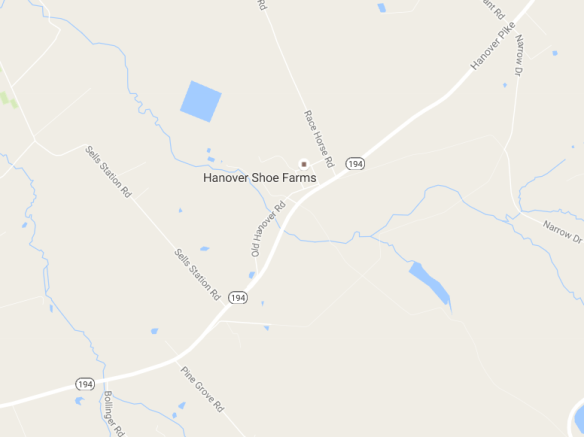
ulrich-hanover-shoe

On the map above, you can see the short stretch of the old road just below Hanover Shoe Farms. Below, the aerial view satellite view. It just does my heart good to know that I’m looking at Stephen’s land, even if I don’t know the exact location. However, we can get pretty close utilizing several pieces of information.

ulrich-conewago-crosses-road

The arrow above shows where Little Conewago Creek crosses the road. Little Conewago can be followed visually by following the treed area.

Apparently, the bypassing of the old road occurred long ago, because the old road appears to be very narrow, probably one lane or two if moving very slowly.

ulrich-old-road-south

Today, utilizing Google Maps Street View, we can see the current Hanover Pike at the location where it intersects with Old Hanover Road, now privately owned. Above, the southern end of the old road. It just looks like a driveway today and you’d never know the difference without satellite view.

Below, driving on down Hanover Pike to the northewast, we can see the location of the south branch of Little Conewago Creek. This is the only intersection of Little Conewago Creek and what was then the main, and only, road.

ulrich-little-conewago

Below, we can see the field beside the creek, at left, between the current road and the remnants of the old road.

ulrich-viewing-old-road

You can see the “old road” in the distance if you look closely through the trees.

Unfortunately, Google doesn’t “drive” privately owned roads, so we can’t drive down this one lane old road today, sadly.

Here’s another peek at the old road that Stephen Ulrich lived along and certainly traveled often, from the north end of the Old Hanover Road.

ulrich-old-road-north

The new road, Hanover Pike, is to the left and you’re looking directly down the old road. Only about half a mile of the old road is preserved today.

Here’s an aerial of just this area. The intersection above is at the top right beside the 194 road marker. There had to be a cemetery and an original homestead. Death was a constant, and both Stephen and his wife likely died while living here. I wonder where the homestead and cemetery were located. Sometimes you can see a very old structure, but that’s not the case here. There has been significant development today, so they could have been obliterated. If the graves were not marked with more than wooden crosses, they could simply have been overtaken by nature after the children moved on to the next frontier. It doesn’t seem that any of Stephen’s children remained in this area, at least none that we know of. There was no one to visit or maintain graves.

ulrich-old-road-close

I’ll look more closely to see if I can spy anything that could possibly be an old cemetery. Oh look, there’s a quilt shop! Now I HAVE to visit.  (Note that you can click to enlarge any of these images.)

ulrich-quilt-shop

The only way this could get better is if I walked into the quilt shop to find a deed from Stephen framed on their wall, and they tell me that the old family cemetery is just out back. I dream about things like this.

Pardon my little fantasy flight of fancy there…back to reality!

John Hale Stutzman, when writing his book, Jacob Stutzman (?-1775), was apparently able to locate the land of Stephen Ulrich, Jr.

On the document below, the outlines of tracts A and B from John Hale Stutzman’s book are based on official survey, patent and deed records. This land was purchased by Jacob Stutzman from Stephen Ulrich Jr., and one of Stephen’s two land warants was described as adjoining his father, Stephen Sr.’s, tract.

ulrich-stutzman-book-page-6

Page 6, Jacob Stutzman (?-1775) by John Hale Stutzman, Jr. (JHS)

The Old Monacacy Road is today’s Hanover Pike and was referenced in a later deed as the “Conestoga Old Road.”

Tract C was purchased in 1759 from John Digges by Jacob Stutzman, according to JHS.  Jacob also owned tracts A and B which he purchased from Stephen Ulrich (Jr.). This suggests strongly that the boundary of Digges Choice was between tracts A and B which were obtained in Warrants from Pennsylvania and tract C which was obtained by purchase from John Digges.  This also suggests that tracts A and B were very likely in the area contested by Digges as lawfully his, which means that life likely became a living hell for Stephen Ulrich because the contested lands were the central flash points in the “Border War.”

Interestingly, based on the map above and the Google map today, it’s possible that Stephen Sr. owned the land roughly bracketed by Schiebert Road today (top left arrow, below), which crosses both old Hanover Road and Hanover Pike, then continues southeast to intersect with Sheppard Road (bottom arrow) which turns north to intersect with Narrow Drive (right arrow). Narrow Drive, just to the right of the intersection where Lovers Drive and Narrow Drive intersect, where the woods is seen on both sides of Narrow Drive (bottom right arrow), is the location indicated by Stephen Ulrich Jr.’s land grant. That area of foliage is Indian Creek and it intersects Little Conewago between Narrow Drive and Sheppard Road. This area between the arrows forms roughly an oval.

This would be a very logical location for Stephen Ulrich Sr.’s land and it meets all of the criteria – adjacent to Stephens Jr.’s, the old road and Little Conewago Creek.

ulrich-land-oval

Here’s the exact same image without the foliage so you can see the creek locations. Indian run, owned by Stephen Jr. crosses Narrow Drive and dumps into Little Conewago just below Narrow Drive, at right. At left, we can see where Little Conewago Creek runs between the old Hanover Road and today’s Hanover Pike (194).

ulrich-map

Aha – We can’t drive down Sheppard Road, as it’s privately owned too.

ulrich-sheppard-road

Below, we can see Sheppard Road across the field, from Narrow Drive.

ulrich-stephens-land

The intersection of Lovers Drive, Sheppard Road and Narrow Drive is closed too. It looks like many of the old roads are privately owned now. I bet that field that we’re looking at from this interesection was Stephen’s.

ulrich-sheppard-at-lovers-lane

Given that John Digges did not convey land to Stephen Ulrich Jr., the 150 acres described in the 1783 transaction has to be that of Stephen Sr. and is likely his original land. Given that we have the owners name in 1783, it might well be possible to bring this deed to current and locate the land, exactly, today.

I did not find a deed to Peter Neffziger, but I also have not viewed the original deed books for Lancaster County, where this transaction would have taken place before 1749 when York was formed. If the transaction took place in 1749 or later, then it would have been in York County. Variant spellings for both Ulrich and Neffziger also need to be considered and researched.

It is believed that in 1738, during the time Stephen Ulrich lived here, he and his friend Jacob Stutzman organized the Conewago Congregation of the German Baptist in Conewago Twp. near Hanover, Pennsylvania. Notice I didn’t say church, because at that time, Brethren met in their homes and barns and didn’t build church buildings until much later. Even then, many were against building church buildings, fearing it would destroy the camaraderie of staying with other Brethren families who were hosting “church” on Sunday. Eventually, the Black Rock Church of the Brethren was established in 1876, about 10 miles distant from the area near Narrow Drive, shown below.

ulrich-to-black-rock

Given that the Millers, Stutzman’s and Ulrich’s lived near Hanover, they likely had church in their homes in that vicinity.

Michael Miller lived near or at the location of Bair’s Mennonite Church today, shown on the map below, in Heidelberg Township.

ulrich-to-miller

Brethren descendant and researcher, Dwayne Wrightsman says:

According to Morgan Edwards, writing in 1770, the Little Conewago congregation of Brethren was started in 1738, by “Eldrick, Dierdorff, Bigler, Gripe, Studsman and others under the leadership of Daniel Leatherman.” It is commonly thought that Eldrick was Ulrich, Gripe was Greib/Cripe, and Studsman was Stutzman. All were Brethren, friends, neighbors, and related by marriage. It is also commonly thought that Eldrick and Ulderey were one and the same.

That “all related by marriage” comment bothers me a bit. I hope he was referring to 1770 and not 1738, because if they were related by marriage in 1738, which means in Germany, we’ll never get this figured out.

We know that Stephen Ulrich Sr. was in Lancaster County, near present day Hanover, before 1742 and that he was naturalized in Baltimore County, Maryland in 1738.

The land where he lived was in a border area claimed by both Pennsylvania and Maryland, and was embroiled in what become known as the Border War until 1767 when the Mason-Dixon line was finalized.

PA-MD boundary issue

—“Cresapwarmap” by Kmusser – self-made, based primarily on the description at http://cip.cornell.edu/DPubS/Repository/1.0/Disseminate/psu.ph/1129771136/body/pdf. Licensed under CC BY-SA 2.5 via Commons

Stephen Ulrich Sr., was actually probably one of the more fortunate souls, because he purchased at least some land directly from Digges, himself. That land did not seem to be in dispute, other than the fact that Digges sold some 4,000 acres more than he actually owned. The land that Digges sold that he didn’t legally own is he same land that Pennsylvania issued land warrants for.  Since the 1783 deed says that Stephen Ulrich purchased the land from Digges, and not that he obtained it by warrant, this suggests that Stephen’s land purchase from Digges was deemed to be legitimate and was not in the contested area.  However, his 1743 land warrant and those in 1742 of his son, Stephen Jr. abutted the original Digges Choice grant and were assuredly in the contested area.  In fact, the “war” with Digges erupted at their neighbor, Martin Kitzmiller’s home.

Digges attempted to file a modified survey for his Maryland patent, to extend it to the full 10,000 acres, but in the interim, several men, likely including Stephen Ulrich Jr. in 1742, and Stephen Sr. in 1743 had already been granted warrants by Pennsylvania on this same land. Stephen Sr.’s 1743 grant is shown below.

ulrich-1743-warrant

ulrich-1743-warrant-2

Stephen Ulrich of Lancaster County, 100 acres of land situate on the west side of Susquehanna River adjoining the land of George Wagoner on great Conewago. The closest portion of “Great Conewago,” known simply today as Conewago, was 7 or 8 miles, as the crow flies, north of the land at McSherrytown where Stephen Sr.’s original land abutted that of Stephen Jr. Stephen Sr. likely did not live on this land on Conewago patented in 1743..

ulrich-1743-warrant-map

On the map above, Stephen Jr. and Sr.’s land was just south of Pennville on 194 (bottom arrow).  Conewago Creek, known as “Great Conewago” to differentiate it from Little Conewago, is the blue ribbon at the top of the image, running left to right between 15, 394, 94 south of Hampton and then to East Berlin at 234 (top arrows).

The great irony in this is that mother and I visited the Gettysburg National Battlefield years ago, located just slightly to the west, and while we appreciated the history at the historic site, we had absolutely no idea that we had our own history within ten miles or so. It makes me heartsick to think we were so close, but didn’t know, and now it’s too late to take Mom back again.

One Hot Mess – The Border War

This 1743 patent by Stephen Ulrich does not say “Jr.” so I’m presuming the patent is to Stephen Sr. If so, this land would likely have been in the contested area where Pennsylvania granted land to settlers and Digges thought the land fell within his patent. That may have been solely wishful and opportunistic thinking on Digges part.

Digges subsequently attempted to bully the men who had obtained grants from Pennsylvania into releasing their land in the disputed area to him. When that didn’t work, he tried intimidation and wanted them to repurchase their land, from him. That didn’t work either, and emotions escalated until the situation exploded like a tender box at the neighbor, Martin Kitzmiller’s, mill, shown below.  Kitzmiller’s land abutted that of Stephen Ulrich Jr.

ulrich-kitzmillers-mill

According to an 1886 edition of the Gettyburg Compiler, quoted in the book “The Murder of Dudley Digges – 1752,” this mill had the year 1738 inscribed on a log in the gable 14 feet from the ground. So this building is the very structure that Stephen Ulrich saw and assuredly visited, standing inside, probably chatting, in German, of course, with Martin Kitzmiller as his grain was ground. The brick portion of the structure above was added in 1755 and in 1886, the article states that the older folks still remembered a house standing beside the mill. The article further states that the mill was located near the headwaters of Little Conewago, in Conewago Township and was a major hostelry stop on the main road. Locating this land would also give us a boundary on Stephen Ulrich’s land, because Kitzmiller owned the land adjoining Stephen Ulrich Jr.

John Digges’ son, Dudley, was shot and killed at the mill in 1752, and the situation became an untenable tenderbox. Most of the Brethren left at this time or had already fled for Frederick County, Maryland.

This wasn’t the first time that violence had erupted in the area known as Digges Choice, nicknamed Rogue’s Resort, reflecting on the general perception of Digges.

Another rabble-rouser, Thomas Cresap who became somewhat of a spokesman for the German community had killed a man in the 1730s as well, before returning to Frederick County, Maryland, becoming a Brethren and selling land to Michael Miller.

It seems that the group sympathetic to Maryland left for Maryland and the Pennsylvania contingent tried to tough it out in York County. For the Brethren, who wouldn’t take up arms, even to protect themselves and their families, it must have seemed like a good time to consider other options. There wasn’t an option without risk though, so the options boiled down to the one that seemed “less bad” at the moment.

Needless to say, it was one hot mess on the frontier in York County. It was also about this time, or a few years earlier as the situation began to escalate, that many of the Brethren began purchasing land in Frederick County, Maryland, about 50 or 60 miles due west, believing that this land was not involved in the border dispute. They began moving about 1751 and many relocated together. While we know that Stephen Ulrich Jr. moved in 1751, there is nothing to suggest that Stephen Ulrich Sr. did so. He may have passed on by then. It’s hard to believe his sons would leave an elderly parent behind in that volatile and hostile environment.

Stephen’s Death

What we don’t know is when Stephen died. Some descendants report his death in 1749, but there are no sources listed. I found no will or estate in either Lancaster or York County, although I have not looked at the books personally.  Indexes are listed online. Unfortunately, unless you can browse the index, it’s hard to find misspelled surnames. If we could find the deeds where Stephen Sr. sold his land, that would be helpful, as it would at least bracket the date of his demise. More effort should be expended in this regard.

If Stephen had 6 children when he immigrated, in roughly 1726/1727, and they were born every two years, and one was an infant, and none died, then Stephen would have married about 1714. Of course, he could have married significantly earlier or the children could have been born closer together, as we already discussed.

If Stephen married in about 1714, he was born no later than 1694, and possibly significantly earlier.

I don’t know if his children would have had to be naturalized under their own names if they were of age or not, or if they could still be covered by their father regardless of age, so long as they immigrated with him when they were children.

If those children were listed in birth order on the naturalization document, Stephen Jr. was born between 1716 and 1720, assuming it was our Stephen Sr. who married in 1716, the younger children would have been born every year and a half to two years, so possibly before 1726 or 1727, or perhaps as late as 1732.

If Stephen Ulrich Sr. was born in 1694, he would have been 49 years old in 1743 when he applied for his land grant in Pennsylvania. If he was born earlier, he would have been older.

Stephen Sr.’s Children

We do know something about some of Stephen Sr.’s children.

  • Stephen Ulrich Jr. was born about 1720, or possibly somewhat earlier. If the Stephen who married in Lambsheim in 1716 is his father, and assuming our Stephen was the eldest, he was likely born in either 1716 or 1717. Stephen Jr. died about 1785 in Frederick County, Maryland. He married Elizabeth whose surname is unknown, probably around 1742. His children are documented by the sale of his land following his death.
  • George Ulrich died in Frederick County before August 1753, his estate being administered by Stephen Ulrich and Nicholas Martin who were listed in the court document as “Protestant dissenters.”
  • Daniel Ulrich moved first to Frederick County, Maryland and then to Bedford County, Pennsylvania, owning the mill at Roaring Springs. This Daniel is often attributed to Stephen Ulrich Jr., but there is no Daniel shown as the heir of Stephen Ulrich Jr. in 1785, nor would one of Stephen Jr.’s children be old enough to have purchased land and built a mill prior to 1775. Therefore, the Daniel in Bedford County must be the son of Stephen Ulrich, Sr., not Jr. This Daniel is also not the Daniel Ulrich who married Susanna Miller, born in 1759, the daughter of Philip Jacob Miller.
  • John Ulrich lived on his home place in Frederick County and had 300 acres, 4 horses, 8 cows and two negroes (I believe this is from a 1782 or 1788 tax list.). John had started accumulating land years before with 50 acres. In 1802 he bought 2252 acres on the middle branch of Frankstown Creek (Bedford County, PA) about 2 miles west of Hollidaysburg, a town that came into being about 5 years later. He was 82 when he bought this land and he died the next year. Justin Replogle, Ancestors on the Frontier, pages 163-164. If this is accurate, it places John’s birth in 1719. The “negroes” who I presume were slaves surprise me, as the 1782 Brethren annual meeting spoke against slavery, according to Brethren church historian, Reverend Merle Rummel.
  • Elizabeth Ulrich is probably the Elizabeth to whom Stephen Ulrich and Nicholas Martin deeded land in Frederick County, Maryland in 1766. Elizabeth had apparently married by 1768 when this land was sold by Jacob Snively. The only explanation set forth by researchers for why Stephen Ulrich and Nicholas Martin would have been deeding Elizabeth land is as part of her estate settlement from her father, although that could explain Stephen but not Nicholas unless they were both administrators. If this is the case, Elizabeth was at least age 28 given that she was listed in her father’s naturalization in 1738. She may well have been significantly older. However, this calls the 1749 date for Stephen Ulrich’s death into serious question. If he died in 1749, his estate would have been distributed to his children, at the latest, when they came of age, which for Elizabeth would have been no later than 1759.  Furthermore, if this deed was as a part of her father’s estate settlement, why was Elizabeth the only Ulrich to who a transaction was made? Elizabeth has also been rumored to be the wife of Nicholas Martin, but given that we know, from the 1766 deed that she was an Ulrich in 1766 and a Snively in 1768, she clearly was not married to Nicholas Martin at this time.
  • Susanna Ulrich, about whom nothing more is known. Mary Kay Coker, a descendant of Nicholas Martin reports that his wife was named Susanna. Susanna Martin did not sign the 1766 deeds to Elizabeth Ulrich, but she did sign a 1794 deed with Nicholas. Susanna Ulrich could have been the wife of Nicholas Martin, but there is no proof. Finding any estate or land sale information about Stephen Sr. could go a long way in resolving the identity of his children.

Additional Research

Based on multiple land records, of Stephen Ulrich Jr. and others, it appears that Stephen Ulrich Sr. owned at least two and possibly three parcels of land, as follows:

  1. 1743 Pennsylvania land grant on Conewago
  2. Land abutting Stephen Jr.’s 1742 grant
  3. Land purchased from Digges, date unknown, but in 1783 located in Heidelberg Township, York County (now Conewago in Adams County) along the old conestoga road.

Items 2 and 3 could be, and probably were, the same land, given that Stephen’s land is referenced in Stephen Jr.’s grant.

Finding these deed conveyances from Digges to Stephen Ulrich and from Stephen Ulrich to the subsequent owners would be extremely useful. Of course, Brethren often times did not register deeds, but in the case of Digges, these deeds may not exist. Quoting from research about John Digges and Digges Choice, we find:

John Digges…settled on Digges’ Choice with his wife and children. His financial position can be gleaned from surviving information. He was heavily in debt in 1743 to Charles Carroll and Daniel Dulaney of Annapolis, Maryland. Digges was unable legally to deed land to settlers until after repaying these debts. A number of deeds were issued by Charles Carroll in the early 1750s to various settlers of Digges’ Choice. There is never a cost mentioned in these deeds. They appear merely to give clear legal title to the settlers for land for which they had already paid Digges.

These debts may be the reason for a resurvey of Digges’ Choice in 1745. There is evidence that Digges traveled east of the Susquehanna River to recruit settlers for Digges’ Choice, and by the 1740s he may be attracted an appreciable number of them. There was only one problem: many of these settlers were buying patents from the Pennsylvania authorities and settling on the borders of Digges’ Choice, rather than paying Digges for land inside of it. Consequently, by 1743, Digges realized little profit from land sales in Digges’ Choice. This, coupled with the fact that between 1735 and 1743 Digges may have had financial difficulties, might explain the resurvey of 1745.

It should be remembered that the original warrant to Digges was for 10,000 acres, but that the survey in 1735 was returned for only 6,822 acres. In 1743, Digges applied to the Pennsylvania authorities for a resurvey of the full acreage, blaming the error on the surveyor of 1735. Take notice of the year of this request. We know that Digges was in debt by this time. The application was refused. In 1745, he applied for, and obtained, a resurvey for 10,501 acres from the Maryland authorities.

The resurvey was illegal. It was in direct opposition to the terms agreed to in the Royal Order of 21 May 1738, which authorized the survey of the Temporary Line of 1739. That Order guaranteed legal rights to original tracts in Pennsylvania warranted and surveyed by Marylanders, and vice versa. However, it prohibited the owners of these tracts authority over land contiguous to the tracts, and also forbade resurveys of the original tracts. Because of these terms, the resurvey of Digges’ Choice was illegal.

In many instances, individuals tended to settle a tract and set up farming before buying a warrant for the tract. In some cases, a son of the original settler paid for a tract of land a generation after the fact. For settlers inside Digges’ Choice, pinpointing settlement dates can be no more accurate. As mentioned earlier, John Digges was unable to deed land to settlers until after 1750. Because of this unfortunate situation, some of the earliest settlers escape our notice entirely. We can discover cases of settlers moving into the area, settling for several years, and then moving west or south, all without leaving a record in official deeds, warrants or patents.

In the case of Stephen Ulrich, if we could find the land conveyance to Peter Neffziger or from Neffziger to Adam Stum, even that could potentially be helpful.

Additional research into estate records, inventories, administrations, court or any other records that may not be quite as popular as actual will records might yield some clue as to the death of Stephen Ulrich Sr. Even land records, if we could find them, might help narrow those dates.

Access to original records for both Lancaster and York Counties could prove very useful, as could every name indexes. It’s also possible that Baltimore or Prince George’s County, Maryland could hold early records as well, since that’s where Stephen believed that he lived.

I don’t believe every stone has yet been turned. I hope that other researchers, if they have researched these records will step forth so we can eliminate them as possibilities, and that future researchers will finish the due diligence in the early records that Stephen Ulrich Sr. so richly deserves.

I will post updates if they are forthcoming. 

DNA?

We certainly could benefit from some types of DNA testing.

If a male Ulrich who descends from any of Stephen Sr.’s sons takes a Y DNA test, we can obtain useful information about our Ulrich ancestors via the Y DNA results. There are several Ulrich males that have tested whose ancestors are from Germany, and it would be very useful to know if we match any of those Ulrich men.

I have a DNA testing scholarship for the first male Ulrich who steps forth who descends from this line.

Unfortunately, the mitochondrial DNA line of Stephen’s wife seems to be dead to us. We know nothing of daughter Susanna. If daughter Elizabeth is the same Elizabeth who married Jacob Snively, there is only one reported child, a son, Jacob – although that doesn’t mean additional children didn’t exist. If Elizabeth was born in 1726, just before leaving Germany, then she would have been 40 years old in 1766 when the land was deeded to her. There are a lot of assumptions here, some of which may be incorrect, because she apparently did have one child, so she may not have been quite 40 when she married.

Mitochondrial DNA is inherited by all children from their mother, but is only passed on by the daughters. Therefore, to obtain Stephen Ulrich’s wife’s mitochondrial DNA, we would need to find someone who descends through her daughters through all females to the current generation. It appears that we have no candidates unless someone discovers what happened to Susanna or that Elizabeth had a previously unknown daughter.

Autosomal DNA, passed to all descendants, but divided in (roughtly) have in each subsequent generation might be interesting if descendants of Stephen Sr. match each other AND don’t also share other lines in common. One of the great challenges of Brethren genealogy and endogamous groups is that these lines are often so intermarried after generations of living together and migrating in communities that the DNA is extremely difficult to sort through and assign to specific ancestors. However, if any of Stephen Sr.’s descendants have taken autosomal DNA tests, please do let me know and let’s see if we share any of his segments.

In Summary

We don’t have Stephen’s signature or even know exactly where his land was located, nor can we visit his grave.  Perhaps if we can identify a segment of Stephen’s DNA that would be something very personal of his that still remains, intact and viable more than 300 years after his birth in Germany – in us, his descendants.

ulrich-world

It’s amazing to think, in world so large, through an Atlantic crossing so perilous, and amid constant warfare on the frontier for all of Stephen’s adult life – that he survived and gave part of his DNA to me. I am the carrier of the torch, Stephen Ulrich’s torch, through many generations. But it’s only through the comparison of my DNA to other descendants who are also torch carriers and have tested their DNA that we can discover, collaboratively, which pieces of Stephen still exist.  Assuredly, something of Stephen remains.

Finding the DNA that exists from Stephen must be a “we” and not a “me” endeavor, bringing the descendants of Stephen together one more time…to find what remains of Stephen today.

______________________________________________________________

Disclosure

I receive a small contribution when you click on some of the links to vendors in my articles. This does NOT increase the price you pay but helps me to keep the lights on and this informational blog free for everyone. Please click on the links in the articles or to the vendors below if you are purchasing products or DNA testing.

Thank you so much.

DNA Purchases and Free Transfers

Genealogy Services

Genealogy Research

Assassin’s Creed and Family Tree DNA Collaboration

“See, hear and feel the memories of your ancestor…”

This is really exciting, both the movie itself and the new testers this collaboration will bring forth.

And maybe, just maybe, some of my ancestors are portrayed in this movie.

I know my ancestors were warriors.  Am I???

The Warrior Gene and Family Finder tests will be bundled at $89 and that price also includes a findmypast subscription and a chance to win a trip to Las Vegas.  At this link, click on “learn more” to see details and order – and scroll down for the trip entry form.

10-25-2016 Update – Press Release

Family Tree DNA and 20th Century Fox Team Up for Historical Adventure

Genetic genealogy pioneers announce exciting partnership with the theatrical release of Assassin’s Creed.

Houston, Texas — October 25, 2016:

In association with the upcoming theatrical release of the epic adventure film ASSASSIN’S CREED, in theaters December 21, Family Tree DNA is pleased to announce a new partnership with 20th Century Fox and Findmypast, which features the Assassin’s Creed DNA Testing Bundle and Assassin’s Creed Sweepstakes.

Loosely based on the popular video game franchise of the same name, and starring award-winning actors Michael Fassbender and Marion Cotillard, the movie’s main character Callum Lynch—through a revolutionary technology called the Animus—travels deep into the past to discover that his genetic ancestor, Aguilar, was part of a mysterious secret organization, the Assassin’s, in 15th Century Spain. The action-adventure follows Callum as he relives Aguilar’s memories in present day.

As pioneers in the direct-to-consumer DNA testing industry, Family Tree DNA was tapped by 20th Century Fox to be the exclusive testing partner for the film. The company’s premier suite of DNA tests along with the world’s most comprehensive matching database enable users to trace their lineage through time, explore ancestry and connect with relatives across the globe.

Family Tree DNA Director of Product Development, Michael Davila, noted that “The opportunity to partner with 20th Century Fox on the release of Assassin’s Creed is not only exciting but serendipitous. The storyline of Callum Lynch connecting to his ancestral past ties in completely with what our company does in helping people discover their origins and explore family history,” said Davila.

“We are excited to be partnering with Family Tree DNA,” said Zachary Eller, Senior Vice President, Marketing Partnerships, 20th Century Fox. “They provide a fantastic opportunity to bring the central themes of Assassin’s Creed to a real world application by allowing consumers to actually discover their past.”

With the purchase of the special limited-time Assassin’s Creed Bundle, customers will be mailed a sample collection kit which, when processed, will provide both Family Tree DNA’s signature Family Finder test and the Warrior Gene DNA test. They will also receive a free one-month premium subscription to Findmypast’s online genealogy service.

According to Belinda Hanton, Global Head of Partnerships at Findmypast, “We are thrilled to be teaming up with Fox and Family Tree DNA to promote family history research and genetic genealogy. It’s partnerships like this that allow us to speak to completely new audiences and help spread the word that anyone can start exploring their heritage at the click of a mouse. The lives of our ancestors are not only recorded in historical records, but are also written in our DNA and it is now easier than ever before to unlock the incredible stories hidden in our families’ past.”

Using a simple cheek swab and step-by-step instructions, users return the sample collection test kit by mail, in a provided envelope, directly to Family Tree DNA. Results typically take four to five weeks and are delivered through a private customer dashboard with email notification. Unlike other testing companies, Family Tree DNA results are kept completely confidential and secure privacy settings put users in control of how much information they choose to share.

Family Finder is an autosomal (non-sex) DNA test that finds matches within five generations and includes myOrigins, a powerful mapping tool that provides a detailed geographic and ethnic breakdown of personal genetic ancestry. The Warrior Gene test determines whether a person carries the Monoamine Oxidase A (MAOA) gene variant, dubbed the “Warrior Gene,” which some researchers say may cause certain carriers to engage in more risk-taking behaviors and be able to better assess their chances of success in critical situations.

Together with the Assassin’s Creed DNA Testing Bundle is the Assassin’s Creed Sweepstakes and a chance to win a Grand Prize trip for two to Las Vegas for an Assassin’s Creed-themed adventure. The experience includes a series of high-octane Assassin’s Creed-inspired activities like a master parkour class, nighttime zip lining and an electrifying sky jump from the tallest tower in the city.

Although no purchase is necessary to enter the contest, purchasing the Assassin’s Creed Bundle earns customers ten additional entries into the Sweepstakes for a greater chance to win a trip to Las Vegas as well as other prizes. Followers will also have the opportunity to earn bonus entries by sharing Sweepstakes social posts on their Facebook and Twitter pages.

With the exclusive DNA Testing Bundle and Sweepstakes movie tie-in, Assassin’s Creed fans everywhere will be able to jump back in time, embrace their inner warriors and unlock their genetic memories.

“The partnership between Fox’s Assassin’s Creed and Family Tree DNA is a perfect fit,” Davila said. “Test-takers get to find out if they carry the “Warrior Gene” in their DNA, and while they’re at it, will be able to delve into the exciting world of genetic genealogy and discover their own family histories…all through DNA. Everyone has a story to tell…so it’s an absolute win-win scenario.

To learn more about the Assassin’s Creed DNA Testing Bundle and Sweepstakes, visit: https://www.familytreedna.com/assassinscreed

About Family Tree DNA:

Since pioneering the field of direct-to-consumer DNA testing for genetic genealogy in 2000, Family Tree DNA has grown to become the most trusted source for providing beginners, enthusiasts, to serious genealogists with innovative ways and powerful tools to break through conventional barriers in unlocking their family histories. The company’s premier suite of DNA tests along with world’s most comprehensive ancestry database are what set Family Tree DNA apart, and led to their being selected as the official testing provider for the Genographic Project launched in 2005 by National Geographic and IBM. Located in Houston, Texas, Family Tree DNA is the only company in the industry with its own state-of-the-art Genomics Research Center. By offering the widest variety of DNA tests to help determine genetic relationships and ancestral origins, Family Tree DNA has continued to experience unprecedented growth and success worldwide. To learn more, visit www.familytreedna.com.

About Assassin’s Creed:

Through a revolutionary technology that unlocks his genetic memories, Callum Lynch (Michael Fassbender) experiences the adventures of his ancestor, Aguilar, in 15th Century Spain. Callum discovers he is descended from a mysterious secret society, the Assassins, and amasses incredible knowledge and skills to take on the oppressive and powerful Templar organization in the present day. Directed by Justin Kurzel, Assassin’s Creed stars Academy Award® nominee Michael Fassbender and Academy Award® winner Marion Cotillard. The film is distributed by 20th Century Fox and opens in theaters worldwide on December 21st, 2016. 

About 20th Century Fox

One of the world’s largest producers and distributors of motion pictures, 20th Century Fox produces, acquires and distributes motion pictures throughout the world. These motion pictures are produced or acquired by the following units of 20th Century Fox Film: Twentieth Century Fox, Fox 2000 Pictures, Fox Searchlight Pictures, Fox International Productions, and Twentieth Century Fox Animation. 

About Findmypast:

With an ever-expanding collection of over 2 billion historical records from around the globe, Findmypast is the world’s best resource for researching family history and documentation. Censuses from as far back as 1790 help identify long-lost relatives, the world’s largest collection of Irish records reveal unknown connections to the Emerald Isle, while US military data going all the way back to the American Revolution prove if a person is descended from war heroes. Users can fill in blanks in their ancestors’ stories by searching millions of newspaper records going back to 1710.  http://www.findmypast.com

For further information, please contact:

Elena Collot, Product Marketing Manager – Family Tree DNA, a division of Gene by Gene, Ltd.

elenac@genebygene.com

(832) 691-7282


Leslie Sachnowitz Meimoun, Senior Writer-Marketing|Communications –

Family Tree DNA, a division of Gene by Gene, Ltd.

lesliem@genebygene.com

(832) 877-0683

______________________________________________________________

Disclosure

I receive a small contribution when you click on some of the links to vendors in my articles. This does NOT increase the price you pay but helps me to keep the lights on and this informational blog free for everyone. Please click on the links in the articles or to the vendors below if you are purchasing products or DNA testing.

Thank you so much.

DNA Purchases and Free Transfers

Genealogy Services

Genealogy Research