Mary Harrold (c 1750-1826), “Fly Me Back to Sweet Old Ireland,” 52 Ancestors #84

Mary is one of those ancestors whose life, what we know if it, is told mostly through the lives of those around her – specifically, her husband and children.  We don’t know who Mary’s parents were and were it not for one court note in particular, even her name would only be found in legend.  In this case, the legend of her name and the name Mary in the court notes match.

Mary was the wife of John Harrold.  She was born sometime around 1750, probably someplace in Virginia, and she died in 1826 in Wilkes County, North Carolina.

Based on a combination of the birth year of her son, John, based on census records and his tombstone, we know that Mary had at least one child by 1782, which puts her birth year at 1762 or earlier.

A potential record that mentions one Mary and John O’Harrell in Botetourt County suggests she may have had two children older than John.

The Botetourt County court record on March 11, 1779 tells us the following:

“The court doth allow Mary O’harrell, wife of John O’harrell, a soldier in the Continental Army, 30 pounds for the support of herself and two small children.”

Based on records of soldiers who served, there was no John O’Harrell and there was only one John Harrold or any similar surname who served from Botetourt County.  That would be Mary’s husband John  – so it’s likely that the John and Mary mentioned in 1779 are our John and Mary.

We know from John’s service record that he was discharged in June of 1779 after serving for 3 years, so his service began in June of 1776.

If Mary has two small children, we can presume they have been married at least 5 years, so that would mean they were married before 1774.  If the two children were born before he left in 1776, then they were likely married by 1771 or so, pushing Mary’s birth year back to about 1750 or slightly thereafter.  John is believed to have been born about 1750 based on these same records, so her birth about the same time makes sense.

If this is the case, then Mary has become nearly destitute by March of 1779 and had to rely on the county for money.  This may well imply that either her family was not from Botetourt County or they were gone, or destitute as well.

If this is our Mary, we don’t know who these two children are.  There is no document that gives us a list of her children, and the ones we do know are based on a variety of circumstances, not the least of which is that John Harrold is the only Harrold male in Wilkes County after he appears there around 1800 – so emerging children of that surname would be his.

We find John Herrald on the 1790 census for Iredell County, NC, but his wife’s age is only given as a hash mark in the “free white females” category.  By 1790, they had 3 males under 16, 1 male over 16 (John) and 4 females.  Six children means they have been married about 12 years, more or less, so by 1778 or earlier.  Given that John was gone for 3 years, followed by another 18 month stint in the army, they were probably married 4 years or so earlier than the 2 years multiplication by child suggests, so by 1774 or so.

Given that John’s discharge in 1779 says he is going home to Botetourt County, we can probably presume that is where they lived before the war, and likely where both families were from.

The challenge is that John’s Y DNA doesn’t match the other Harrold (by any spelling) families in Botetourt County.

So, given that we have all of our proverbial ducks in a row, we know the following:

1750ish – Mary born

1774 – Mary married by this date, possibly as early as 1771, possibly in Botetourt County, VA

June 1776 – Mary’s husband leaves for the War from Botetourt County

March 1779 – Mary obtains assistance from the county for herself and 2 children.

June 1779 – John is discharged after 3 years service and returns home.

1780 – John enlists for a second term in the Revolutionary War in August, leaving Mary at home with 2 small children and probably pregnant for another child.

1782 – John is discharged in February, returning home to Botetourt County just in time for spring planting.  Mary must be extremely relieved.

1782 or 1783 – son John Jr. is born in Virginia.

About 1784 – Mary has daughter Sallie.

1785 – John and by inference Mary are on the Iredell County, NC tax list.

About 1785 – Mary has daughter Elizabeth.

About 1785 – Mary has son Alexander.

1790 – Mary and John are living in Iredell County, NC according to the census and have 6 children.

About 1790 – Mary has son William.

About 1790 – Mary has daughter Charlotte.

1794 – Mary and John have probably moved to Wilkes County, because John is mentioned in the court notes regarding a transaction with one Robert Powers involving 75 pounds of indigo.  This was not registered in court until 1804, so they might not yet have lived in Wilkes in 1794.

1796 – John files in Wilkes court against one Thomas Adams against whom he obtained an execution order in Iredell County.  They do live in Wilkes County by now.

1797-1799 – Mary’s son, John, married about this time.

1800 – Mary and John are enumerated in Wilkes County in the census under the surname Harral.

We know that in 1790, John and Mary have 6 children, 3 boys and 3 girls, the boys being under 16.

In 1800, their children are reported as:

  • 1 male under 10 (William born about 1790)
  • 1 male 10-15 (Alexander born about 1785)
  • 2 female 16-25 (Charlotte, Elizabeth and/or Sallie)

We show three females in 1790 and I have three daughters listed, but only two are shown here and none are known to have married until after 1800.  So, there is a discrepancy.

In 1790, their son, John Jr., is living next door and is listed as age 16-25, putting John’s birth between 1775 and 1784, which is consistent with the information we already have.  He has a wife and one female child, suggesting they have been married between 1 and 3 years.

Both John and Mary are over the age of 45, which means they were both born before 1755.  Given that Mry’s youngest child, William, was born about 1790, Mary could have been born slightly before 1750.  Women often bore their last children at the age of 42 or 43.

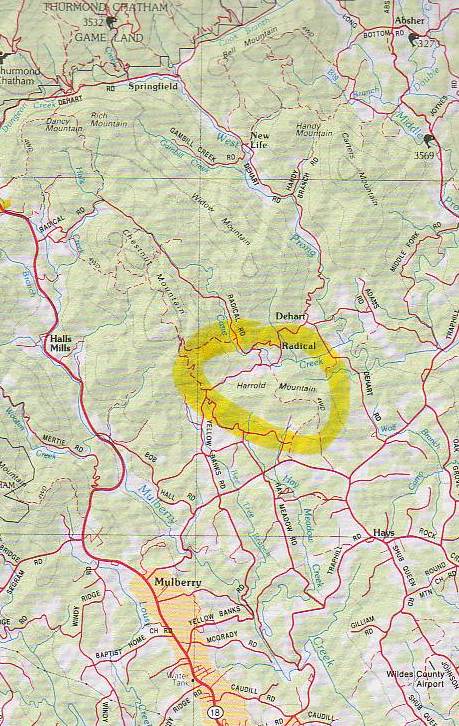
1801 – John patents land on Harrold Mountain

Harrold mountain

1803 – Daughter Elizabeth married Reuben Carter whose land abuts that of John Harrold, at least until Reuben loses his land.

1805 – Mary’s daughter Sallie marries Jessie Turner before 1805 and they leave for Breathit County, KY.

1806 – Mary’s daughter, Charlotte, married Koonrod Dick.  They were in Simpson Co., KY before 1825.

1809 – Mary’s son, William and Mary McDowell, daughter of their neighbor, are married by Jacob McGrady, the Baptist preacher.

1810 – Son William departs for Claiborne County, TN.  This is likely the last time Mary sees her son, although she lives another 16 years.  She probably never meets any of her grandchildren by William.

It must have pained Mary greatly to see her children marrying and leaving Wilkes County, one by one.

1810 – The 1810 census shows John Harrold, with one male living with him, age 16-26, plus his wife.  Both John and Mary are shown as over age 45.

1812 – Mary’s son, Alexander marries about this time and shortly thereafter, leaves for Breathit County, KY.  This is likely the last time Mary sees Alexander.  She likely never sees any of Alexander’s children either.

The 1820 census reflects John and Mary’s age the same way.  Now John and Mary are living entirely alone, all of the children gone and married.  They are living beside John Herrald Jr. who has 9 people in his family and one slave.  These grandchildren, Mary probably sees daily!

John Sr. dies in 1825 and Mary follows in 1826.  We know Mary’s name, positively, because of an allowance made to her in January 1826 from John’s estate, which was probated in October of 1825.  However, by October 1826, just a  year after John’s death, Mary’s estate sale was held – so she died sometime between January and October of 1826.

I hired a historian to retrieve John and Mary’s estate inventory and sale information, both, from the North Carolina archives in Raleigh, with absolutely no luck.  I know they existed at one time because they are referenced in the court notes complete with book and page number – however – Wilkes County says they no longer have any of those records and they are at the archives in Raleigh, and Raleigh says they never received those books from Wilkes.  And then there are those persistent rumors that the staff decades ago in Wilkes County decided to have a bonfire with the old records that no one would need anymore.  This just kills me, because Mary and John’s estate inventory would give us the most personal glimpse of their actual lives that we could get from the vantage point of where we sit today, 190 years removed – unless there is an unknown family journal or Bible hanging around someplace.  And I’m not holding my breath for that.

One of my close friends and I were discussing a week or so ago how much our descendants would be able to tell about us personally if they were building the scaffolding of our lives from only public records.  She and I concluded that while they would find the “big pieces” so to speak, like birth, marriage, death, children’s births, and moving – they would never know anything about us personally.  Meaning what we are like.  No one would know that I love color, for example, whether it be in summer flowers or quilts.  That I hate to cook, love dark chocolate, and do quite a bit of charity work.  They would have no idea of my profession, my career, my education level, my degrees or my political or religious leanings.  All of those things that make me uniquely me would be absent.  However, if they had an inventory listing from my estate sale, there would at least be clues.  I so wish we had Mary’s estate listing.

Mary is credited with saying that when she died, she wanted to be put up on the bluff on top of Harrold Mountain so that she could fly back to sweet old Ireland.

Harrold Mountain bluff

Since she doesn’t have a marker, perhaps they did.  Harrold Mountain bluff is shown above.

John Harrold burial

Mary is likely buried beside John Harrold, her husband, on Harrold Mountain.  Furthermore, we know about where that is, and she is either buried under the chicken house with John (above), or she is buried with son John in the Harrold/Brown Cemetery.

Brown Harold cemetery after

Perhaps old John is buried with John Jr. in the same cemetery, shown on the map below on Harrold Mountain.

Brown Harrold cem

Given that both sons William and Alexander leave Wilkes County, it makes sense that John Jr. would obtain William’s land upon his death.  It looks very much like he did, in part because John is buried on the land Old John owned.  So, it’s entirely possible that John Jr. lies in the same cemetery with both of his parents.  In that time and place, that’s quite unusual – often generations didn’t stay in the same place long enough for multiple generations to live, grow old and pass on.

I’ve tried to reconcile the census documents with John and Mary’s children, reconstructed from the records we do have:

Name/Birth 1779 1790 census 1800 census Other
2 children in court record 3 boys under 16, 3 girls 1 m<101 m 10-152 f 16-25
Child born before 1779 per court record Possibly James in 1805 record
Child born before 1779 per court record
John/1782-83 Age 8 Living next door Birth year of 1783 on tombstone
Alexander/c 1785 Age 5 Age 15 1850 census says he was born in NC in 1785
William/c1790 Newborn 1790 Age 10 In 1855 deposition, William says he is 65 years old, in 1850 census, says he is born in NC
Elizabeth/c1785 Age 5 Age 15 Married in 1803
Charlotte/c1790 Newborn or born after census Doesn’t work based estimated birth year of 1790 and 1800 census Married in 1806.
Sarah/c1784 6 16 Married before 1805

Note that a James appears once in an 1805 Wilkes County record, but never appears again. If this James is John’s son, then he would have had to be one of the two oldest children AND living on his own or not in John’s household by 1790.  Unlikely, but not impossible

These birth years are all estimates, with the exception of John whose birth year is on his tombstone and in the 1850 census, and William who gives his age in a deposition and in the census as well.  Other birth years are estimated by marriage date which is estimated by the age of the oldest child when not available in official records.  Long way around, I know.

The bottom line is that Mary and John are one child short in 1800, but for all we know, one of the daughters was living elsewhere.

Mitochondrial DNA

To the best of my knowledge, no one who descends directly from Mary through all females has yet DNA tested.  These people would carry Mary’s mitochondrial DNA.

Mary reportedly had three daughters.  However, there is some discrepancy in the 1800 census when only two daughters are shown.  Of course, one could have been slightly older, one could have been visiting or living with a relative – we don’t know.

However, if people who descend from either 2 or 3 daughters test, and their mitochondrial DNA which would be descended directly from Mary match each other, then we now they share a common ancestor.  There is always the possibility as well that Mary was not John’s only wife.  There could have been 2 different Mary’s as well – the one in 1779, assuming that is the right family, and the one who died in 1826.  There is no oral history of anything like this, but it’s always a possibility.

Secondly, we could tell a lot about Mary – meaning her haplogroup and where her closest matches are found in the world.  In other words, we could probably confirm that Mary was indeed Irish!

If you descend from Mary Harrell through all females to the current generation, where either males or females will work, please let me know.  There is a DNA testing scholarship waiting for you!

Mary’s female children are as follows:

1. Sarah or Sallie Herrell, born about 1784 and married Jesse Turner about 1805  in Wilkes County. They moved to Breathit County, KY and had daughters:

    • Susannah born about 1806 – nothing more known
    • Elizabeth “Mama Bets” born February 1813 and married her first cousin, Thomas T. Herrell. They had daughters Sarah born in 1841, Elizabeth born in 1845, Nancy born about 1846, America born in 1850 and Jemima born in 1852.

2.  Charlotte Herrell born about 1790, married in 1806 in Wilkes County, NC to Koonrod Peter Dick. They moved to Simpson County, KY and had daughter Mary Dick. They probably had other children as well, but I have found no records.

3.  Elizabeth Herrell born about 1785 married Reuben Carter in 1803 in Wilkes County. They moved on to Maury County TN and then, reportedly, to Crawford County, MO. Nothing is known about their children.

______________________________________________________________

Disclosure

I receive a small contribution when you click on some of the links to vendors in my articles. This does NOT increase the price you pay but helps me to keep the lights on and this informational blog free for everyone. Please click on the links in the articles or to the vendors below if you are purchasing products or DNA testing.

Thank you so much.

DNA Purchases and Free Transfers

Genealogy Services

Genealogy Research

Alfre Woodard – Who Do You Think You Are – “Born in Chains”

Alfre Woodard with Dr. Mark Schultz.

Alfre Woodard with Dr. Mark Schultz.  Courtesy of TLC.

Award-winning actress Alfre Woodard knows a lot about her mother’s family, but her father’s Woodard line is a mystery.  Her grandfather, Alex Woodard, died when her father was three, and the family history died with him. All she’s heard is that his family came to Oklahoma from Texas, but she’s curious about their earlier origins.

To start her journey, Alfre digs into census records, locating her infant grandfather with his parents (Alfre’s great-grandparents) Alex Woodard, 39, born in Georgia, and Lizzie, his wife. Alfre calculates that her great-grandfather Alex was born about 1841 in Georgia, and suspects he may have been enslaved there – and that “Woodard” was his slave name. Alfre heads off to Georgia see if she can trace her great-grandfather Alex Woodard’s trail.

In Georgia, Alfre pours over white Woodard estate records to see if she can locate her ancestor. Alfre finds her great-grandfather Alex listed as “Alec,” at about age 10, and appraised at $400.  The records reveal that Alec’s owner, John Woodard, has died and all of his property – including his eleven slaves – is being inventoried to divide among his heirs.

The information does not specify Alec’s biological family, but he’s consistently listed with several children. Enslaved people were often sold away from their biological families, so they developed strong kinship networks with slaves who worked and lived with them.

Alfre sees that Alec, also written as Elec in some records, is given to a William Woodard, but members of Alec’s kinship network are sold to different owners. The expert promises to look into what happened to Alec once William Woodard claimed him.

The next morning, Alfre drives out to the Woodard land to see where her great-grandfather lived and labored as a slave.  As she turns onto the road bordering the land, she notices the road sign: Woodard Road! Alfre pours a libation on the land her ancestor worked to pay her respects.

Alfre reconvenes with the expert, and discovers that Alec moved to Jackson Parish, Louisiana with his slave owner William Woodard by 1860.

Alfre follows her great-grandfather to Louisiana. The historian explains Alec would’ve been emancipated after the Civil War in 1865.  Alfre’s journey through her ancestor’s life as a slave is over, so now she wants to know how he established himself as a free man. The expert explains that 1867 marked the first time black men could vote, but restrictive Southern laws required they pay a “poll tax” to do so. Poll tax rolls reveal that Alec is registered to vote and over the years he ascends from having no property to owning 240 acres of land in Jackson Parish! He’s firmly part of the middle class at a time when any amount of land was significant to a former slave living in Louisiana. Owning land was the ultimate goal for every freedman, but only about 25% of them achieved it.  Alfre’s great-grandfather has accomplished an extraordinary feat.

But something is amiss; Alfre then discovers that just a year later, Alec is now paying taxes on only 80 acres, and likely lost some of his land in an economic collapse.

Next, Alfre examines an 1898 land deed from Alec Woodard and his wife Elizabeth, to Aaron Stell.  Alfre sees that after Alec purchased land in Texas, he sold his Louisiana land to this man Aaron Stell for just $35 – but why so cheap?  Alec is selling the property with his wife Elizabeth (Alfre’s great-grandmother) and in fact, Aaron Stell was Elizabeth’s brother.  Alec is doing well enough in Texas that he’s giving his brother-in-law the “family discount” on his Louisiana land.

Alfre drives out to the rural, thickly wooded plot formerly owned by her great-grandfather in Jackson Parish. Alfre walks the land and reflects on all she has learned about her impressive great-grandfather Alec Woodard and his resilience that has been passed down through generations.

On her great-grandfather’s former land, Alfre meets an 80-year-old African American woman who lives on that corner.  Roye says that Stells have lived here as far as anyone can remember, and she’s a Stell by marriage. So Alfre and Roye are kin!  Roye tells Alfre about growing up on the old farm – picking cotton in the early morning darkness, climbing the pecan trees, and playing among the cows and horses.  She says that generations of her family have been proud to own that land, and she hopes it always stays in the family.

For an interesting episode about the Civil War era in the deep south and to share Alfre’s and her ancestor’s journey, watch the episode on Sunday, August 9th on TLC.

______________________________________________________________

Disclosure

I receive a small contribution when you click on some of the links to vendors in my articles. This does NOT increase the price you pay but helps me to keep the lights on and this informational blog free for everyone. Please click on the links in the articles or to the vendors below if you are purchasing products or DNA testing.

Thank you so much.

DNA Purchases and Free Transfers

Genealogy Services

Genealogy Research

Autosomal DNA Testing 101 – What Now?

When I first started this blog, my goal was to provide explanations and examples of genetic genealogy topics so that there would be fewer questions and easier answers.

That sounded like a great idea, but the reality of the situation is that the consumer market for autosomal DNA testing has exploded – meaning more and more consumers with more and more questions.  Compounding that situation, the consumers who purchase these tests today, especially on impulse, and mostly I’m referring to Ancestry.com here, often have absolutely no idea what to expect or even what they want except that Ancestry will find their ancestors for them.  That’s because that’s what Ancestry tells them in their advertising.

So, in the big picture, the questions and inquiries that experienced people are currently receiving are becoming less specific and more general and often exhibit a lack of understanding of what DNA testing can do.  It’s frustrating to parties on both sides of the fence, but I’m glad people are asking because it means they are interested and willing to learn.

Rather than approach this topic from a technical perspective of how to work with autosomal DNA, I’d like to talk about what can be done with autosomal DNA testing from a newbie perspective.  The person who just got their results back and are saying to themselves, “OK, now what can I do with this?”

However, there is lots “how to” information in this article for everyone if you click on the links.  If nothing else, this gives you a tool to send to those overly excited newbies who are starry eyed but have no clue how to proceed.  Remember, you were once new too!

This is part 1 of a two part series.  The second part will focus on how to make contact with your matches successfully.  But now, let’s pretend it’s day 1 and you just got your autosomal test results back.

Why Did You Test?

The first question to ask yourself is why did you test in the first place?  If your answer is “because Ancestry had a sale,” that’s fine, but then you’ll need to read all four options to know what you can do with autosomal DNA.

1.  I want to meet other people I’m related to.

Ok, but the first thing here you’re going to have to define is the word “related.”  You are likely related to everyone on your match list.  I said likely, because there may be some people there whose DNA simply matches yours by chance.  For the most part, and especially for those people who are your closest matches, you’re related somehow. The challenge, of course, is to figure out how – meaning through which ancestor.  This is the genealogy jigsaw puzzle of you!

All three of the major vendors, Family Tree DNA, Ancestry and 23andMe show you your closest matches first on your match list.

autosomal 101 FTDNA

Do you want to meet your DNA cousins only if you can identify a common ancestor?  Do you want to work with them on genealogy? The answers to these questions will help sort through the rest of what to do and how.

If your goal is to contact your matches, then Family Tree DNA is the easiest, as they provide you with the e-mail addresses of your matches by clicking on the little envelope for each match on your match page, shown above.

Ancestry is second easiest, but forces you to use their internal message system which often doesn’t deliver the messages.  (Do not send more than 30 in one day or Ancestry will blacklist your messages and block your communications, thinking you are a spammer.)

23andMe is the most difficult as you have to request permission to communicate with each match and also to share DNA and if your match authorizes communication, then you can communicate through 23andMe’s message system.  Sound cumbersome?  It is and the response rate is low.

Confirming Genealogy

Let’s look at another reason for testing.

2.  I want to confirm my genealogy is correct – meaning that my great-grandfather really is my great-grandfather and so forth on up the line.

Well, you’re in luck, especially if some of your cousins, known or otherwise, have tested.  Confirming your genealogy is easier done in closer generations than more distant ones and the more cousins from various lines that have tested, the better.  That’s because you will share more of your DNA with relatives when you have a close common ancestor.

Autosomal DNA is divided approximately in half in each generation, when the child receives half of their DNA from each parent – so the closer your cousin, the more likely you are to share more DNA with them.  The more DNA you share, the more likely you are to be able to identify which ancestor it comes from.  And if a match matches you and your proven cousin both on the same segment, that identifies positively which line that match comes from.  That three way matching is called triangulation.

Let’s talk about the word “confirm.”  Herein lies a challenge, because DNA does have the absolute ability to confirm ancestors, as noted above.  DNA also has the ability to give you hints that go towards a “preponderance of evidence.”  DNA, can also lead you astray if you draw erroneous conclusions – and one vendor provides a tool (or tools) that encourages overstepping conclusions.  Let’s look at each circumstance.

Proof Positive through Triangulation

Just what it says – absolutely unquestionable proof that a particular ancestor is your ancestor.  If you match two other people who also descend from your common ancestors, Joe and Jane Doe, on the same segment of DNA, that is confirmation that you share that ancestor and that segment of your DNA is considered proven to that ancestral line.  This requires two things.  First, that your DNA matches on the same segment AND that you have identified the same ancestors, Joe and Jane Doe, genealogically in your trees.

Now, you probably can’t tell which side of the couple, Jane or Joe, the DNA is from unless you also match two people on just Jane’s side of the family or just Joe’s on that same segment.

One caveat here – counting you and your parent as two of the three people doesn’t work because you and your parents are too close in the tree.  By three people, that would preferably be three people who descend from that couple through three different children.

Here’s an example.

JohnDoe

It would also ideally be more than three people, but three is the minimum to form a triangulation group.  In the real world, these matches might not start and end of the same segments as in the example above, but the overlapping portion should be significant

The example above is proof positive, because the three people descend from the same ancestor, through different children, and match on the same chromosome in the same locations.

This technique is called triangulation.

Now for the bad news – you can’t do this at Ancestry.com, because they don’t provide you with any of the segment information in the last 5 columns.  Ancestry has no chromosome browser, which is the tool that shows you where on your DNA you match your cousins.

Family Tree DNA’s chromosome display tool that is part of their chromosome browser is shown below.

Two cousins browser

On the example above, you can see that Barbara Jean Long, the black background person on the chromosome graphic, is being compared to her two first cousins, the blue and orange on the chromosome graphic.

You can download the information from Family Tree DNA or 23andMe in spreadsheet format, or you can display the information graphically, like in the example above.  You can see the “stacked” locations where both the cousins match the black background person they are being compared to.  You can also see that there are some locations where only one of the cousins matches the background person, like on chromosome 20.  And of course, some locations where neither cousin matches the background person, like on chromosome 21.

If you download that data, the information gives you the locations where the people being compared match the person they are being compared against.

Two cousins combined

The chart above is the download of part of chromosome 1 for Barbara, Cheryl and Donald, siblings who are Barbara’s first cousins.

The areas where the 3 people overlap, or triangulate, are colored in green on the spreadsheet, while the rows entirely in pink or blue do not triangulate – meaning Barbara matches either one cousin or the other, but not both.  Keep in mind that this example only proves their common ancestral couple, which in this case are common grandparents – but the technique is the same no matter which common ancestor you are trying to prove.

This bring us to our next topic, that of close relatives.

Close Relative Matches

I previously said that you can’t use you and a close relative to prove a distant ancestor.  But that’s not necessarily true when the relationship you are trying to prove is closer in time.  The chart below shows the relationships of the example above.

Miller Ferverda chart

In the case shown above, two first cousins who are siblings, Cheryl and Don, are being compared to their common first cousin, Barbara.  Their fathers were siblings and their common ancestors were their grandparents.  This is not 6 generations up a tree where matching is iffy.  You can be expected to match closely with your first cousins where you may not match with more distant cousins, because you simply didn’t inherit any of the same DNA from your distant common ancestor.  You should be sharing about 12.5% of your DNA with first cousins, and if you have first cousins that you’re not matching, that might signal that an undocumented adoption has occurred in one line or the other.

In a case like this, if you and a first cousin match, that suffices to prove a close connection.  If you don’t match, it suffices to raise questions.  A lot of questions.  Big ugly questions.  The next thing to do is to see if any other known cousins have tested and who they match – or don’t match.

For example, if Barbara Ferverda was not the child of John Ferverda, she would not match either Cheryl nor Don, and we’d know there was a problem.  If Cheryl and Don match other Ferverda or Miller relatives and Barbara didn’t, then we’d know the genetic break in the line was on Barbara’s side and not on Cheryl/Don’s side.

This same technique is also how we know which “side” matches are on.  If an unknown match matches both Barbara and Cheryl, for example, it’s a good bet that their common ancestor is someplace in the Miller/Ferverda line.  If they also match another Miller on the same segment, then the common ancestor has been narrowed to the Miller side of the Miller/Ferverda couple.

Unfortunately, not all DNA results are as definitive or easy to prove as these.  Let’s look at some of the more “squishy” results.

Preponderance of Evidence through Aggregated Data

In regular genealogy, there are a range of proofs.  There is direct evidence that someone is the child of an ancestor.  That would be a will, for example, that names a daughter and her husband and maybe even tells where they moved to.  This would be your lucky day!

Think of that will as equivalent to triangulated proof of a common ancestor.  There is just no arguing with the evidence.

If you’re not that lucky, you have to piece the shreds of indirect evidence together to make a story.  In the genealogy world, this is called preponderance of evidence, and I am always, always much less comfortable with this type of evidence than I am with solid proof.

There are various flavors of pieces of evidence in the DNA world. Sometimes we have hints of relationships without proof.

The most common is when you have matches with a group of people who share the same surname, but you can’t get back far enough to find a common ancestor.  Is this a probable match?  Yes?  Guaranteed?  No.  Have I seen them fall apart and the actual match be on another entirely unrelated line?  Yes.  See why I call these squishy?

Ancestry takes this one step further with their DNA Circles.  For a DNA Circle to be created, you must match DNA with someone in the Circle AND everyone in the Circle must match DNA with someone else in the Circle AND everyone in the Circle must have a common ancestor in their tree.  Circles begin with a minimum of three people.  Generally, the more people who match AND have the same ancestor, the stronger the likelihood that you would be able to confirmation the common ancestor of the group as your ancestor too – if you had a chromosome browser type of tool.  Still, Circles alone are not and never will be, proof.  Circles are great hints and along with other research, can confirm genealogical research.  For example, my paper genealogy says I descend from Henry Bolton, and I find myself in Henry Bolton’s tree, matching several other Bolton descendants through Henry’s other children.  Those multiple connections pretty well confirms the paper trail is accurate and no undocumented adoptions have occurred in my line.

Now, the bad news….Circles is predicated upon matching of trees.  If there is a common misconception out there that is replicated in these trees, then people who match will be shown in a Circle predicated on bad information.  And, there is no way to know.  However, people interpret the existence of a DNA Circle as proof positive and that it confirms the tree.  Membership in a DNA Circle is absolutely NOT proof of any kind, let alone proof positive – except that your DNA matches the people who you are connected to by lines and their DNA matches the people they are connected to by lines.  You can see my connections in orange below, and the background connections in light grey.

circle henry bolton matches2

This is an example of my Henry Bolton Circle.  I match 5 different people’s DNA (the orange lines) who also show Henry Bolton as their ancestor.  This does NOT mean the match is on the same segment, so it is NOT triangulated.  This is a grouping of data where multiple people match each other, not a genetic triangulation group where everyone matches on the same segment.  In fact there are cases that I have found where the person I match in a circle is through a different line entirely, so in that case, the presumption of which common ancestor our common DNA is from is incorrect.

I want to be very clear, there is nothing wrong with DNA Circles, so far as they go.  The consumer needs to understand what Circles are really saying – and what they can’t and don’t say.  DNA Circles are another important tool in our arsenal.  We just have to be careful not to assume, or presume, more than is there.  Presuming that we match someone in the Circle because we share Henry Bolton’s DNA may in fact be inaccurate.  We may match on a completely unrelated line – but because we do match and share a common ancestor in our tree – we both find ourselves in the Henry Bolton Circle.

Are you reading those squishy words?  Presume – it’s related to the word assume…right???  And keep in mind that Circles are created based in part on those wonderfully accurate Ancestry trees.  Are you feeling good about this preponderance of evidence yet?

However, in my case, I’ve done due diligence with the genealogy and I have all of my proof ducks in a row.  The fact that I do match so many Bolton descendants confirms my work, along with the fact that at the other vendors and at GedMatch, I  have triangulated my matches and proven the Bolton DNA.  So, this circle is valid but the only proof I have is not found at Ancestry or because I’m a Circle member, but by triangulation and aggregated data using other vendor’s tools.

This next screen shot is of an exact triangulated match using GedMatch’s triangulation tool.  Each line shows me matching two cousins, along with the start and stop segments.  This just happens to be the Ferverda example.  So, I match six people, all on the same segment, all with a known common ancestor.  This is proof positive.  Not all “matching” is nearly so definitive.

Gedmatch triangulation

Sometimes the matches aren’t so neat and tidy. That’s when we move to using aggregated data.

Aggregated Data – What’s That?

Aggregated data is a term I’ve come up with because there isn’t any term to fit in today’s genetic genealogy vocabulary.  In essence, aggregated data is when a group of people (who may or may not know who their common ancestor is) match on common segments of data, but not necessarily on the same segments, or not all of the same segments.  When you have an entire group of these people, they form a stair step “right shift” kind of graph.

The interesting part of this is that by utilizing aggregated data and looking not only at who we match, but who our matches match that share a common ancestor, we can gain insight and hints.  Finding a common ancestor is of course a huge benefit in this type of situation because then you’ve identified at least a DNA “line” for the entire group.

If we were to utilize the triangulation tools at Gedmatch and look at my closest triangulated matches, they would look something like this, where the segments that I match with each person (or in this case, two people) shift some to the right.  What you are seeing is the start and stop match locations, with graphing.  Therefore, I match all of these people that have a common ancestor.

Each match overlaps the one above and below to come extent – and often by a lot.  These are known as triangulation groups (TG).

However, the top match and the bottom match do not overlap, so they don’t triangulate with each other.  They are still valid triangulated matches to me and you can expect to see this kind of matching when using aggregated data.

Understand that when you see your triangulation groups at GedMatch, your mother’s side and your father’s side will be intermixed. In this case, I know the common ancestor and I know many of these testers, so I’m positive that this is a valid grouping (plus, they all match my Mom too – the best test of all.)

gedmatch triang group

Here’s another example only showing three matches.  All three are triangulated to me through the same ancestor, but the locations of the top and bottom matches don’t overlap with each other.  Both overlap the one in the middle in part.

gedmatch overlap

New Ancestor Discoveries – Not Evidence at All

Let’s look at the third reason for DNA testing.

3.  I want to find new ancestors.

Discovering brand new ancestors is a bit tougher.

There are two ways to discover new ancestors.  The first is through triangulation combined with traditional genealogy.  I have done this, but in these cases, I did have a clue as to what I was looking for.  In other words, the new ancestor I discovered was actually confirming a wife’s surname or identifying the parents of an ancestor from several potential candidate couples.

The second way to potentially discover a new ancestor is Ancestry’s New Ancestor Discoveries, NADs, which is really a somewhat misleading name.  What Ancestry has determined is that you match a group of people who share a common ancestor – and Ancestry’s leap of faith is that you share that ancestor do too.  While that may not be correct, what IS very relevant is that you do match this group of people who DO share a common lineage and there is an important hint there for you someplace!  But don’t just accept Ancestry’s discovery as your new ancestor – because there is a good chance it isn’t.  Let’s take a look.

Ancestral Lines Through Triangulation

Let’s go back to the John Doe example.

JohnDoe

Let’s take the worst case scenario.  You’re an adopted and have no information.  But you match an entire group of people in a triangulated group who DO know the identity of their common ancestor.

Does this mean that John Doe is your ancestor?  No.  John Doe could be your ancestor, or he could be the brother of your ancestor, or the uncle of your ancestor.  What this does tell you is that either John Doe is your ancestor, some of John Doe’s ancestors are your ancestors, or you are extremely unlucky and you are matching this entire group by chance.  The larger the segment, the less likely your match will be by chance.  Over 10 cM you’re pretty safe on an individual match and I think you’re safe with triangulated groups well below 10 cM.

Ancestry’s New Ancestor Discoveries

You can make this same type of discovery at Ancestry, but it’s not nearly as easy as Ancestry implies in their ads and you have no segment data to work with, just their match, shown below.

Larimer NAD

“Just take the test and we’ll find your ancestors,” the ad says.  Well, yes and no and “it depends.”

Ancestry went out on a limb a few months ago, right about April Fools Day, and frankly, they fell off the end of the branch by claiming that New Ancestor Discoveries are your missing ancestors found.  While that is clearly an overly optimistic marketing statement, the concept of matching you with people you match who all share a common ancestor is sound – it was the implementation and hyper-marketing that was flawed.

The premise here is that if you match people in a Circle that have a common ancestor, that you too might, please note the word might, share that ancestor – even if that person is not in your tree.  In other words, even if you don’t know who they are.  Just like the John Doe triangulation example above.

Here is my connection to the Larimer DNA Circle, even though I don’t know of a Larimer ancestor.

Larimer NAD circle

Now, the problem is that you might be related to an ancestor on one side upstream several generations, but it’s manifesting itself as a match to that particular couple because several people of that couple’s descendants have tested.  I’ve shown an example of how this might work below.

common unknown ancestor

In this example, you can see that your true common ancestor is unknown to both groups of people, but it’s not Mary Johnson and John Jones, or in my case, not John and Jane Larimer.

However, three descendants of Mary Johnson and John Jones tested, and you match all three.  If you also showed Mary Johnson and John Jones in your tree, then you’d be in a Circle with them at Ancestry.  However, since Mary Johnson and John Jones are NOT your ancestors, they are not in your tree.  Since you match three of their descendants, Ancestry concludes that indeed, Mary Johnson and John Jones must also be your ancestors.

While NADs are inaccurate about half the time, the fact that you do share DNA with the people in this group is important, because someplace, upstream, it’s likely that you share a common ancestor.  It’s also possible that you match these three people through unconnected ancestors upstream and it’s a fluke that they all three also descend from this couple.  And yes, that does happen, especially when all of the people involved have ancestors from the same region.

The first day that Ancestry rolled the New Ancestor Discoveries, I was assigned a couple that could not possibly be my ancestors.  I called them Bad NADs.

In my experience, there are more erroneous NADs out there than good ones.  I knew my original one was bad, as I had proof positive because I have triangulated my other lines.  Then, one day, my bad NAD was gone and now, a few weeks later, I have another assigned NAD couple that I have not been able to prove or disprove – the Larimers.  Truthfully, after the bad NAD fiasco, I haven’t spent a lot of time or effort because without tools, there is no place to go with this unless the people I match will download their results to GedMatch.  I’m hoping that a new tool to be released soon will help.

Here’s how NADs could be useful.  Let’s say that my Larimer matches download to GedMatch and I discover that they also match a triangulated group from my McDowell line.  Well, guess what – my Michael’s McDowell’s wife is unknown.  Might she be a Larimer?  Michael’s mother is also unknown.  Might she be a Larimer?  It gives me a line and a place to begin to work, especially if they share any common geography with my ancestors.

Even if the NADs aren’t my direct ancestors, this is still useful information, because somehow, I probably do connect to these people, even though my hands are somewhat tied.  However, labeling them New Ancestor Discoveries encourages people to jump to highly incorrect conclusions.  This isn’t even in the preponderance of evidence category, let alone proof.  It’s information that you can potentially use with other DNA tools (at GedMatch) and old fashioned genealogy to work on proving a connection to this line.  Nothing more.

So what is the net-net of this? Circles can count in the preponderance of evidence, especially in conjunction with other evidence, but NADs don’t.  Neither are proof.  If we were able to work with the segment data and compare it, we might very well be able to determine more, but Ancestry does not provide a chromosome browser, so we can’t.

Ancestor Chromosome Mapping

4.  I want to map my chromosomes to my ancestors so that I know which of my DNA I inherited from each ancestor.

If this is your DNA testing goal, you certainly did not start by testing with Ancestry.com, because they don’t have any tools to help you do this.  This tends to be a goal that people develop after they really understand what autosomal DNA testing can do for them.  In order to map your genome, you have to have access to segment information and you have to triangulate, or prove, the segments to each ancestor.  So count Ancestry out unless you can talk your matches into downloading their raw data files to either GedMatch or Family Tree DNA.  You’ll be testing with both Family Tree DNA and 23andMe and downloading your match information to a spreadsheet and utilizing the tools at www.gedmatch.com and www.dnagedcom.com.

Just so you get an idea of how much fun this can be, here’s my genome mapped to ancestors a few months ago.  I have more mapped now, but haven’t redone my map utilizing Kitty Cooper’s Tools.

Roberta's ancestor map2

Tips and Tricks for Contact Success

Regardless of which of these goals you had when you tested, or have since developed, now that you know what you can do – most of the options are going to require you to do something – often contacting your matches.

One thing that doesn’t happen is that your new genealogy is not delivered to you gift wrapped and all you have to do is open the box, untie the bow around the scroll, and roll it down the hallway.  That only happens on the genealogy TV shows:)

So join me in a few days for part two of Autosomal DNA Testing 101 – Tips and Tricks for Contact Success.

______________________________________________________________

Disclosure

I receive a small contribution when you click on some of the links to vendors in my articles. This does NOT increase the price you pay but helps me to keep the lights on and this informational blog free for everyone. Please click on the links in the articles or to the vendors below if you are purchasing products or DNA testing.

Thank you so much.

DNA Purchases and Free Transfers

Genealogy Services

Genealogy Research

African DNA in the British Isles

While the Slave Owner registers from 1834 in England and the recent project to index and study their contents has raised consciousness about slavery and how intertwined slavery was through Caribbean sugar production to all of the British Isles – DNA is telling a story too.  While the slave owner registers speak to the ownership of slaves in the Caribbean by Britains, those weren’t the only slaves.

I have done several DNA Reports in past decade for people who received unexpected results.  By unexpected results, I’m referring to clearly African haplogroups in Europe, primarily the British Isles, found in people who are just as clearly “white” today – and whose ancestors have been considered as such for generations.  Furthermore,  their autosomal DNA generally shows no trace or occasionally shows minute amounts of their African heritage, yet it is clearly there as proven by Y and mitochondrial DNA.

When these people are found in the US and their ancestors have been here for generations, especially in a slave-owning area, my first thought is always that perhaps the genealogy is in error – or that there was an undocumented adoption that would never show in genealogical records.  But when the people are not in the US and their ancestors have never lived outside of Europe and are well-documented, the results are impossible to explain away or rationalize in that fashion.

blacks in london

I’m also not referring to haplogroup E-M215, old E1b1b or E-M35, old E1b1b1, which is known to be North African, or Berber, found in the Mediterranean basin.  This haplogroup is found sparsely in England, likely due to the Roman legions who arrived and stayed or at least left some of their Y DNA behind.  Steven Bird wrote the paper about this titled “Haplogroup E3b1a2 as a Possible Indicator of Settlement of Roman Britain by Soldiers of Balkan Origin.”

I’m talking about haplogroups that are unquestionably sub-Saharan African in origin, such as Y DNA E-M2, old E1b1a now E-V38, and often, mitochondrial haplogroups such as L1, L2 and L3  – meaning that they originated with women, not men.

This begs the question of how those haplogroups came to be embedded in the British population long enough ago that there is no record that the people who carried them were not white.  In other words, the person who brought that haplogroup to the British Isles arrived long ago, many generations.

I have always found this a bit confounding, because while England was indeed heavily intertwined in the slave trade, England never had the space or need to employ slaves in the way that they were engaged on large plantations in the Caribbean or in the Southern US.  Furthermore, England had its own surplus of people they were trying to send elsewhere, which was one of the benefits of colonization.  You could send your undesirables to populate your colonies.  For example, those pesky recusant Catholics who refused to convert settled in Maryland.  Many people convicted of small crimes, such as my Joseph Rash for stealing 2 bags of malt, were transported to the colonies, in his case, Virginia.

We know that there were some Africans in Elizabethan England, although those records are almost incidental, few and far between.  Africans have been in England since the 12th century, but it wasn’t until slaving began in earnest that their numbers increased.  At this point, blacks in England were mostly novelties and were often owned by captains of slave ships and occasionally sold on the quay of coastal cities like Bristol.

Although not widespread, slavery was practiced in England until 1772, when the Somerset case effectively determined that chattel slavery was not supported by English law.  This legally freed all slaves in England, if not in actual practice.  Slaves in England at that time were mostly domestic servants and flocked to be baptized in the hope it would ensure their freedom.  The good news is that those baptisms created records.

Buried in the details of the Somerset case and arguments are an important tidbits.

James Somerset, a slave, was purchased in Massachusetts and brought to England by his master, Charles Stewart.  James escaped, was captured and was going to be shipped to the Caribbean by Stewart and sold as a plantation slave.  However, while in England, James had been converted to Christianity and his three god-parents upon his baptism filed suit claiming that while he may have been a slave when brought to England, that English law did not support slavery and he was therefore not a slave in England and could not be shipped against his will to the Caribbean to be sold.  This was not a humanitarian case, per se, but a case about law and legal details.

Somerset’s advocates argued that while colonial laws might permit slavery, neither the common law of England nor any law made by Parliament recognized the existence of slavery and slavery was therefore unlawful. The advocates also argued that English contract law did not allow for any person to enslave himself, nor could any contract be binding without the person’s consent. When the two lawyers for Charles Stewart, the owner, put forth their case, they argued that property was paramount and that it would be dangerous to free all the black people in England, who numbered at the time approximately 15,000.

That’s the information I was looking for.  There were 15,000 African or African descended slaves in England in 1772.  Given that most were domestic servants, the females would have been subject to whatever their owner wanted to impose upon them, including sexual advances.  Let’s face it, there were a lot more English men available in England than African men, so it’s very likely that the children of enslaved women would have been fathered by white men whether by consensual or nonconsensual means.

Their half white children would also have been enslaved, at least until 1772, and if they also bore children from an English male, their offspring would have been 25% African and 75% English.  Within another generation, they would have looked “white” and their African heritage would have been forgotten – at least until their descendants eight or ten generations later took a mitochondrial or Y DNA test and turned up with confusing African results.

______________________________________________________________

Disclosure

I receive a small contribution when you click on some of the links to vendors in my articles. This does NOT increase the price you pay but helps me to keep the lights on and this informational blog free for everyone. Please click on the links in the articles or to the vendors below if you are purchasing products or DNA testing.

Thank you so much.

DNA Purchases and Free Transfers

Genealogy Services

Genealogy Research

William McNiel (c1760-c1817), Battle of Brandywine Survivor, 52 Ancestors #83

Before we talk about William McNiel, let’s talk about the name McNiel, McNeil or however it’s actually spelled.  The family story says that it was originally McNeil in Scotland, but that there were three brothers (yes, the three brothers story) and they argued on the way over to the colonies about religion.  Our Reverend George McNiel changed his name from McNeil to McNiel so that his name would not be the same as his brothers.  This sounds doubtful, because one Thomas McNiel is found in Spotsylvania County and is believed to be George’s brother.  Had the three brothers gone their own way after a dispute serious enough to merit name changing upon landing on the colonial shore of Virginia, you wouldn’t think they would both choose to settle in the same county.

There are other versions of the name story in other lines of the family.

The family story goes on to say that Rev. George McNiel was ordained as a Presbyterian minister in Scotland but here in the US, converted to the Baptist faith and was ordained in that church in 1776.  We have not one shred of evidence confirming any of this, and it’s not for lack of trying.  The Reverend George is not mentioned in any of the Virginia Baptist or Presbyterian Church records that I’ve been able to find, and they do exist.  I first find George mentioned as having preached at a Baptist church in Grayson County, VA, and then in Wilkes and surrounding counties.  Note that Grayson was not formed until 1793 from Wythe which was formed in 1790 from Montgomery which was formed in 1777 from Fincastle which was formed in 1772 from Botetourt which was formed in 1770 from Augusta which was formed in 1738 from Orange County.

One story says that Rev. George met his wife, Miss Coates and married her in Grayson County, VA, but if that is accurate, given that they married pre-1760, then how did George’s son William get back to Spotsylvania County to serve in the Revolutionary war in 1777?  Migration was east to west, not west to east.  And Grayson County wasn’t formed until 30 years after they married, although someone could have been referring to a location that was located in Grayson County at the time they were speaking.

So, if the rumor about Miss Coates and Grayson County is true, and they married before William was born, then it would have had to have been in Augusta County prior to 1760, and there is absolutely no record of George McNiel, by any spelling, in Augusta County.

George may have converted to the Baptist faith about this time, and Miss Coates may not have been George’s first wife…  We know George was eventually a Baptist preacher…of that we are sure.  His name appears as helping form the Beaver Creek Church in 1779 and in various church and association records until his death.  His grandson tells of him fighting the regulators in 1771 at Alamance Creek, after which he fled into Grayson County for safety for a short time, before returning to Wilkes County.  However, much of the rest of the story doesn’t add up with the records we do have available.

William McNiel was born about 1760/61 or possibly earlier in Virginia, probably Spotsylvania Co. but we don’t really know for sure.  One researcher gives his birth as Oct. 28, 1757 which could be true, but he doesn’t provide any source. It is about the right time.

We do know that William’s father, the Reverend George McNiel was in Spotsylvania County as early as 1754, according to court records where an apprentice was bound to him, so it’s likely that William was born in Spotsylvania County, especially since he served from there in the Revolutionary War some two decades later.

The Revolutionary War

McNeal, William rev war

The first hint we had the William McNiel served in the Revolutionary War was contained in a letter written in 1898 by George W. McNiel, Sr., son of Thomas McNiel who was a brother to our William McNiel.  In the letter, which was about the Reverend George McNiel, he states, “His son, William McNeil, volunteered in the war of Revolution, and his son, Joseph McNeil said he would volunteer and go with William, but he was not old enough.”  He goes on to say, about William, that he “moved to the State of Tennessee, Clayborn County.”

That confirms unquestionably that we are talking about the same William.

William McNiel’s records from the National Archives tell us the following:

William McNiel/McNeal/McNeil, born in 1760 in Spotsylvania County, served with Captain Thomas Posey’s Company, 7th Virginia Regiment (Company Pay Roll and Company Muster Rolls are dated 1777 and spell his last name McNiel, McNeal, and McNeil), commanded by Col. Alexander McClennahan. His papers say that he is being paid from June 77 through Nov. 1777 and that he is in a rifle regiment. He is paid 6 and 2/3 dollars for one month’s pay. On his November 1777 pay voucher, it says on the bottom that he enlisted in the Light Horse service the last of November, so he may have actually served longer in a different unit.  This does tell us one thing…he had a horse.

On September 11, 1777, William McNiel participated in his first battle of the Revolutionary war at the Battle of Brandywine, PA. Brandywine would become the largest Revolutionary war battle fought in the Northern Campaign. The battlefield is shown below.

Battle of Brandywine battlefield2

“BrandywineFieldToday” by AlbertHerring at en.wikipedia. Licensed under CC BY 3.0 via Wikimedia Commons

William fought for his life in this field.

The Virginia line was located on the right flank with 2 brigades from the Pennsylvania militia line. The Virginia line was to prevent a possible British flanking maneuver from both the North and South. The Virginians were unable to prevent the British from performing the flanking maneuver and were soon forced to retreat to a church on the battlefield named Birmingham Meeting House, shown below, in 1974.

Birmingham Meeting House

At the Birmingham Meeting House, the Virginians put up their greatest stance against the British on a hill nicknamed Battle Hill. The British assaulted the Virginians at Battle Hill five times before the Virginians were forced to retreat.

Battle of Brandywine battlefield

“Brandywine Osborne’s Hill View” by Djmaschek – Own work. Licensed under CC BY-SA 3.0 via Wikimedia Commons

These Virginians had refused to give up an inch without a fight. After the battle the wounded were taken to Bennetts farm located 10 miles from Brandywine.  William McNeil helped escort some of the wounded to Bennetts farm after the battle.

Battle of Germantown

“Germantown” by Christian Schussele – Public Domain. Licensed under Public Domain via Wikimedia Commons

William’s next battle was at the Battle of Germantown, depicted above, on October 4, 1777, less than a month after the Battle of Brandywine.  At Germantown, the Continental army forced the British to barricade themselves into a mansion called Chew House, shown below.

Chew HOuse

“Cliveden-Chew-Front1” by Djmaschek – Own work. Licensed under CC BY-SA 3.0 via Wikimedia Commons

The Americans began firing their cannons. The Cannon fire was so loud that blood began to pour from the cannoners’ ears. The Continental soldiers were winning the battle until General Adam Stephens showed up in a drunken stupor and accidently began firing on the Continental line.

This was William McNeil’s last battle.  He was probably very glad to go home.  Any romantic veneer that warfare holds for an inexperienced young man was assuredly gone by now.

Moving to Wilkes County, NC

The Reverend George McNiel had moved to Wilkes Co. NC by 1778 and William likely accompanied George, given that William was as yet unmarried.  George may have been traveling back and forth between Spotsylvania County and Wilkes County because there is a deed witnessed in Spotsylvania County in 1786 by George McNiel for John Shepherd.  George’s son, William McNiel had married John Shepherd’s niece, Elizabeth Shepherd in 1781/1782 in Wilkes Co. NC.  I’d wager that the Reverend George McNiel was the marrying minister.

The Robert Shepherd Bible states that the Shepherd family moved from Spotsylvania County to Wilkes County in December of 1777. It’s likely that William and the Reverend George McNiel both moved about this same time, perhaps with several families forming a wagon train for help and protection along the way.  Maybe it was during this move that William McNiel and Elizabeth Shepherd began to court.

In 1783, William’s father, The Reverend George McNiel, was one of several families that established the church at Deep Ford Hill in Wilkes County on land owned by John Shepherd, adjoining the land of his brother Robert Shepherd, father of Elizabeth Shepherd, by then the wife of William McNiel.

William McNiel and his wife Elizabeth Shepherd were assuredly a part of this church as well as whatever organization unofficially preceded the official church formation.  Neither the church, about where the gas stations sits today, nor the cemetery, where the trailer sits today in the photo below, still exist.

Deep Ford cemetery

In Wilkes County Deed Book A1, Page 186 – In April of 1785, William McNiel witnessed a deed with Francis Kerby and Stephen Shepherd for a land sale between Owen Hall and John Shepherd Sr.

William McNiel first appears in Wilkes County tax records in 1786, he is living three houses away from his father, George McNiel.  William owns no land until 1792, according to tax lists, by which time William has been married for about a decade.

In 1792-1793 he owns 60 acres, but then we don’t find William again on the Wilkes County tax list until 1797 when he owns 530 acres and he and his family are living beside Nathaniel Vannoy. William McNiel’s daughter, Lois, would marry Elijah Vannoy, Nathaniel’s nephew, around 1807.

It looks like William begins to accrue land about 1778, but he pays no taxes on land until 1792, so what happened to this land is a mystery.  Perhaps he bought and sold it on speculation.

Land Entry Book, Wilkes County, NC 1778-1781, Page 337 – Sept 7, 1778 – Alexander Gilreath enters 100 acres on the north side of New River including Walls improvement.  Alexander Gilreath marked out: Wm. Macniel written in.

Wilkes County Court Minutes Vol II, January 1785-November 1786 – October 24, 1787 – William NcNall serves on a jury.  This entry is quite interesting, because at that time, one had to own land to serve on a jury, but the land and tax records don’t reflect that.  Maybe William McNall is not the same person as William McNiel.

Wilkes County Deed Book D, Page 115 – on February 16, 1790, William McNiel witnesses a deed with Nathaniel Judd and William McQueary from James Sartain and Robert Shepherd for 70 acres on both sides of the south fork of Reddies River.  Robert Shepherd is William McNiel’s father-in-law.

Wilkes County Court Minutes Vol III, April 23, 1792 – Ordered John Robins, Jr, Robert Sheppard, William McNiel, John Sheppart Sr, Rowland Judd Esq, Rowland Judd, Nathaniel Judd, Asel Cross, Stephen Sheppard, John McQuary Sr, John McQuary, James McNiel, David Owen Sr, John Judd, John Trye appointed a jury to view road from Deep Ford on Redes River to Elijah Denneys over said River.

In 1792, William McNiel serves on a jury and is assigned with Francis Vannoy, James McNeil, Robert Sheppard and others to view the road round Samuel Carter’s Mill pond where water overflows on Redies River.

Wilkes County Will Book 1, February 4, 1793 – William McNiel along with John Sheppard Jr. and Stephen Shepherd witnessed a power of attorney from James Brown from the state of Georgia to Robert Shepherd to convey unto John Forester 200 acres of land and 100 ac whereon Fielding Forester and Benjamin Bruce now live.

Wilkes County, Deed Book D, Page 360 – February 17, 1794 William McNiel along with William Colvard and Samuel Robinett witnessed the sale of land between Rowland Judd and James Shepherd, 150 acres above the mouth of Mill Creek.

Wilkes County Court Minutes Vol IV – In November, 1795, William McNeil, Esq., swears an oath relative to a deed from Thomas Robins to John Forester.  Note that now William is referred to as Esquire, a title of rank, respect or office.

Wilkes County Court Minutes Vol IV – On February 4, 1796, William McNiel along with James McNiel, Robert Sheppard, Francis Vannoy, John Sheppard and others is assigned to view the road from oldfields on New River to the Puncheon Camp on the ridge.

Wilkes County Court Minutes Vol IV – On August 2, 1796, William McNeil overseer on the road from Punchen Camp Creek to Oldfields on New River.

Wilkes County Court Minutes Vol IV – On January 31 ,1797, William McNiel serves on a jury.

Wilkes County Court Minutes, January 25, 1797 – Ordered that William McNeil be appointed Collector Capt. Judd’s District instead Samuel Burdine.  That William would be appointed tax collector indicates he is well-respected and trusted.

In 1799 Ashe Co. NC was formed from part of Wilkes and we find William living in that area.

In 1799, William McNeil obtains land grant, and this grant suggests that he has other grants or has purchased other land and his new grant abuts that land.  The New River runs on the north side of the mountains in what is now Ashe County.

Page 734 – June 17, 1799 – NC Grant No 1877 to William McNeil for 73 acres on the South fork of the New River with his other lines.

Abstracts of Wilkes County Land Grant Files – File 1586.5 William McNiel received grant #1877 dated June 7, 1799 for 73 acres of land on the north side of the south fork of New River at his other line. This is based on warrant/entry number 506 dated Sept 2, 1794.  The grant itself is recorded in book #104, page 21.  Chain carriers were James McNiel and Thomas Caloway.

Page 754 – June 7, 1799 – NC Grant # 1878 to William McNeil 100 acres on the north side of the South Fork of New River, conditional line between James Calloway and McNeil.  Notice this grant is consecutively numbered after his first grant.

Abstracts of Wilkes County Land Grant Files – File 1587.5 – William McNiel received grant no #1878 dated June 7, 1799 for 100 acres of land on the north side of the south fork of New River adjoining James Calloway.  Based on warrant/entry number 505 dated Sept. 3, 1794.  Grant is recorded in book 104, page 21.  James McNiel and Thomas Calloway chain carriers.

I don’t know exactly where this land was, but I do have a suspicion.

The New River is in what is now Ashe County, which was formed in 1799.  The Shepherd family lived all along what is the north fork of Lewis Creek which reaches almost the entire way to the top of the mountains where the Blue Ridge Parkway is today.  Calloway Gap is the way through the mountains to descend into the South Fork of the New River on the other side.  The map below shows present day Ashe County with Wilkes directly below.  The Purlear area on 16 is the area where the Shepherd’s lived and where the Deep Ford Hill and Church was located.

Ashe County

The map below shows the South Fork of the New River at the top arrow, Calloway Gap at the middle arrow, and the uppermost part of the North Fork of Lewis Creek at the bottom arrow.  These locations really aren’t terribly far apart – well – if you’re a crow.

Ironically, I have driven this section of the Blue Ridge Parkway, but it was years before I realized the connections I had here.  At that time, the connection that drew me back year after year was purely in my heart.

New River Ashe County

Wilkes County Deed Book F1 – Page 189 – October 13, 1803 – From George Lawreance to William McNiel of Ashe County, NC for $400, 320 acres on the south fork of Lewis Fork…top ridge…Beech Hill.  Signed by George Lawrence and witnessed by Joseph McNiel, Thomas McNiel and George McNiel.

Page 131 – October 8, 1804 – From William McNiel to Isaiah Case for $400, 320 acres on the south fork of Lewis Fork, signed by William and witnessed by Andrew Vannoy and Joel Vannoy.

In 1805, William McNiel lost his father.  Reverend George died on June 7, 1805.  He was likely buried the next day in what is known as the McNiel Burying Ground in Parsonville, NC – on his land on Lewis Creek.  William would have been about 45 years old.  William was lucky to have his father as long as he did, but that doesn’t make the pain of his death any less.

William McNiel serves as the administrator of his father’s estate, as shown in the Wilkes County Will Book 2 Abstracts, entry 245.  At the August court term in 1808, William submits the inventory of the estate of George McNiel and wife, 1 negro man at 35 pounds VA money and 1 negro girl at 40 pounds VA money – signed William NcNiel administrator.  I’m unclear as to the meaning of “and wife” and have asked a historian at the archives in Raleigh to check this original record.

In February 1810, William moved back to Wilkes County from neighboring Ashe County and purchased 150 acres on the North Fork of Lewis Creek, probably not far from where the Reverend George McNiel had lived.

Wilkes Deed book G and H, Page 178 – February 3, 1810 – From James Steward and William McNiel of Ashe County NC for $200, 150 acres on the waters of the North Fork of Lewis Fork, it being the place where William Yates now lives.  Signed by James Steward and witnessed by Alexander Brown and Thomas Brown.

The last record in Wilkes County of William is the land record where he sells the land “where he lives” to his daughter Lois, and son-in-law, Elijah Vannoy.  There is a persistent rumor that Elijah and Lois had eloped.  If that is true, then apparently things had been smoothed over by 1810 – or William was resigned to their marriage since it was a done deal and they had children by then.

Wilkes Deed book G and H, Page 175 – December 31, 1810 between William McNeel and Elijah Vannoy for $250, 150 acres on Boller Creek, a fork of Lewis Fork, place where William McNeel now lives.  Witness John Forrester and John Forrester Jr.  Signed by William McNeel.

Taking a look at a current map today, there is a Boiling Springs Road that runs along a branch that dumps into Lewis Fork – so I’m betting this is where William’s land was located.

Boiling Spring Wilkes Co

Crossroads

William is facing a crossroads.  His father has died.  We believe his mother died in the late 1780s, so there is nothing to hold him in Wilkes County now.  Furthermore, his own children are marrying as well.  Sarah has probably married Joel Fairchild, Lois has married Elijah Vannoy, George has married Nancy Baker.

If William is ever going to move west and settle elsewhere, he has to be doing that pretty soon, or forever lose the opportunity.  I have to ask myself, what would possibly cause a man who is comfortably established at about age 50, a landowner, to up and sell everything to move to the undeveloped frontier to find himself chopping original growth trees down on rough mountainsides – 30 years after he did it the first time.

Was this the pioneer equivalent of a mid-life crisis?  Instead of a new girlfriend and a corvette, you strike out to homestead new land and chop trees to prove your strength and youthful vigor???

Or was it because his children could not afford land in Wilkes County, so the entire family went where land was more affordable?  Was leading the way William’s way of preventing his family from being split as his children would assuredly leave for parts unknown, one by one, being scattered to the wind?  Did he hear his three married children discussing moving westward to settle and decide that he could either lead or get left behind?

One thing is for sure, a large group of Wilkes County families wound up in the same five or 6 mile radius (area of about 6 (NS) x 16 (EW) miles) of northern Claiborne County on both Little Mulberry Creek and Blackwater between Wallen Mountain and Newman’s Ridge about this same timeframe – so it must have been a much discussed destination location.

Wilkes transplants in Claiborne

On To Claiborne County, Tennessee

By about 1811 or so, William McNiel and Elizabeth Shepherd McNiel would leave Wilkes and Ashe County forever, moving to Claiborne County, Tennessee.  Elizabeth, now age 44 or 45 would have her last child about the time they set out on their journey.  The McNeil book by Hayes says that William’s children were all born in Wilkes with the possible exception of William, their 10th child.

All of their married children and spouses accompanied them as well.  No child left behind.

There is a very interesting story about how this caravan of settlers got to Tennessee.  Elijah Vannoy’s daughter said they traveled by flatboat and the journey took two years.  This story is told in detail in the Elijah and Joel Vannoy stories, as Joel Vannoy, Elizabeth and William’s grandson, was reportedly born during this journey to Lois McNiel and Elijah Vannoy.

By 1816, the family was definitely living in the Claiborne/Lee Co. area of Tennessee, purchasing land on the North side of Powell Mountain near Mulberry Gap and then later, in the Pleasant View area. In his only transaction in the new neighborhood, William witnesses a land sale to his son George.

In 1816 Levi Carner sells to George McNiel a tract of land lying on the N side of Powell Mountain near Mulberry Gap containing 69 acres for $525.  Signed in the presence of William McNiel, James Anderson and Burrell G. Sullivant.

In 1817, Levi Keanus sells land to Neal McNeal on Mulberry Creek adjacent Josiah Ramsey.  Joel Fiarchild, William McNiel and John NcNeal all sign as witnesses.  However, in 1823 when this deed was registered, the sale was proven by the oath of Joel Fairchild.

In 1819 George McNiell to John Stokely part of land where McNiel now lives lying in Claiborne on Mulberry which was sold to John McKean, 5 acres to include storehouse.

There is no 1820 Claiborne census and William is not shown in the 1830 census. Elizabeth is shown in 1830 but not in 1840.  Were William or Elizabeth, his widow, alive, they would have surly filed for a Revolutionary War pension based on William’s service when pensions became available by an act of Congress on June 7, 1832.

I’m fairly certain William was gone by May of 1823 when William Inglebarger sells land to Neal McNeal and the transaction is signed by his mother, Elizabeth, his uncle, John McNeil and Joel Fairchild.  None of the witnesses can write and all signed with an X.

By 1834, the McNiel family, William’s children, were selling their land on Mulberry Creek and was buying land on Little Sycamore Creek, about 17 miles away.

McNiel Mulberry to Little Sycamore

Elijah Vannoy and Lois McNiel’s son, Joel Vannoy would follow to Little Sycamore some years later, in the 1860s.  Eventually, the Vannoy and McNiel families would comprise a big part of the Little Sycamore population.

In 1834, Nancy Hill, widow and her children sold the lands of James Hill decd to Neal McNiel, land lying on the waters of Little Sycamore Creek of the Clinch River.

In 1830 John Carmack conveyed the lands on the waters of Little Sycamore to John McNeil.

In 1848 Neal S. McNiel sells to John McNiel Sr. the land in Claiborne County District 8 containing by estimation 820 acres – William Houston’s corner of one of his Joab Hill tracts and near Peter Peck’s corner to the old James Hill line to a stake in John Bartlett’s line.  Witness RC McNiel.

Obviously Neal had accumulated quite a bit of land.

Since we don’t know when William died, we also can’t pinpoint where he was buried.  William is very likely buried on his son Neil’s land or the Elijah Vannoy land in Hancock County.  The Vannoy and McNiel families lived adjacent in what is how Hancock County and in the 1830 census, Elizabeth, William’s widow is living on her son Neil McNiel’s land.

Touring the Neighborhood

In the article about Elizabeth Shepherd, we found the land in Hancock County (formerly Claiborne) where Neal McNiel was living in the 1830s when his mother, Elizabeth, William McNiel’s widow, was living adjacent to him, according to the census.  We know that William was gone by then.  Our last whisper of William McNiel in Claiborne County was in September of 1817 when he witnessed a deed for his sons.  If William died then, he left Elizabeth with son William Jr., probably just a toddler, and children from that age to adulthood.  Her survival at that time probably depended heavily on her adult children and

There are so many questions that remain.  For a man who was quite involved in real estate and owned land in Wilkes County, why did he purchase none in Claiborne?  His sons did.  Did he give his sons or his children money and decide simply to live on their land until his death?  Was he ill or injured?

This location in Turner Hollow is where Niel McNiel’s land was located, and William’s son-in-law, Elijah Vannoy owned land located at the red balloon.  It’s a good bet that William lived with one or the other, or someplace in-between.

McNiel Vannoy land

Recently, my cousin Dolores was kind enough to take pictures of the land in this area when she visited on a genealogy adventure.  Thank you so much cousin Dolores.

To help understand what you are looking at the next few photos, let’s first look at the map of the landowners in the area.  The dot on the map above in Turner Hollow is the land shown on the map below.

Josiah Ramsey land - Niel McNiel

Cousin Dolores took the following photo from Eli Davis’s land looking toward Wallen’s ridge, meaning that she was most likely looking right at and across Niel McNiel’s land.

McNiel Hancock Wallen

This next photo is Back Valley Road near Fortner, which is shown on the following map.

McNiel Hancock Wallen map

This location would have been on Niel McNiel’s land

McNiel Hancock Wallen2

So if William didn’t live on this land, he certainly saw it regularly and it probably looked much the same then as it does now.

McNIel Hancock Wallen 3

I wonder if old William can see us today viewing the same vistas that he looked at as he looked over these fields.

McNiel Hancock Wallen 4

Did he look at these mountains and think about Wilkes County?

McNiel Hancock Wallen 5

I want to drink in what he saw and I’d so like for him to tell me about these fields and lands himself.

McNiel Hancock Wallen 6

The hills in this area are more rolling than the land in Wilkes County.  This could have been part of the allure of moving.

McNIel Hancock Wallen 7

Nothing more American than barns – although William’s barn, if he had one, would have been much smaller.

McNiel Hancock Wallen 8

William is assuredly buried here someplace, but where?  There is a Davis family cemetery on the Eli Davis land.

McNiel Hancock Wallen 9

What a beautiful place to spend your life, not to mention resting eternally.  He is assuredly buried someplace on these lands.

I don’t know, but I suspect that William died about 1817.  He stopped witnessing things and being involved in any way.  He had a long history of public service in Wilkes County and there is no reason to think that would change unless his health changed.  Secondly, his daughter Lois named a son born about 1816 William Vannoy.  William may not have gotten to spend much time living in Claiborne, now Hancock, County at all.

William’s Children

Many of William’s children carried on the tradition of local involvement and public service.

  • Sarah or Sallie McNiel, named after Elizabeth’s mother and possibly William’s mother as well, was born about 1784 and married Joel Fairchild in Wilkes County. They moved to Claiborne County where Sallie died on January 2, 1861 and is buried in the Fairchild Cemetery in Hancock County. She had 5 children.
  • George McNiel, named after William’s father, was born on September 21, 1786 in Wilkes County and died in 1870 in Claiborne County, TN and is buried in the McNiel Cemetery, probably on his own land. He married Nancy Baker in Wilkes County in 1809, having 11 children, and married Matilda Yeary in 1845, having two more children. Where he lived when he died is unknown but the land he purchased in 1816 was near Mulberry Gap on Powell Mountain.
  • Lois McNiel born about 1786 and married Elijah Vannoy about 1807 in Wilkes County. Lois died in the 1830s in Claiborne, now Hancock, County, TN. She had 10 children.
  • Neil McNiel was born about 1792 in Wilkes County and died in 1839 in Claiborne County, TN. He is likely buried on his own land, but whether he is buried in Hancock County or in Claiborne in the Little Sycamore Community is uncertain.   Neil married Elly Ramsey, daughter of Josiah Ramsey, pioneer settler of the Ramsey family and neighbor. They had only three known children, although there were likely more.  Elly is likely buried in the old Josiah Ramsey cemetery, and Niel could be buried there beside her.
  • Mary was born about 1792 in Wilkes County. She married Robert Campbell in 1817 in Claiborne County and died in 1881 in Bradley County, TN. I show only one child for her, Anderson, but I have a very difficult time believing she didn’t have additional children.
  • Nancy McNiel born in 1794 in Wilkes County married Alexander Campbell in 1815 in Claiborne County and is shown with only 3 male children. She died in 1839 in Hancock County.
  • John McNiel was born July 1, 1803 in Ashe County, NC and died in 1882/1883 in Claiborne County. In 1824 he married Elizabeth Campbell, sister to the spouses of two of his siblings. They had 8 children.

John McNeil b 1803

  • Elizabeth McNiel, named after her mother, born between 1800 and 1810 married Andrew McClary. The 1840 census shows them with 2 daughters, but I can’t find the family in 1850.
  • Jesse McNiel born about 1806 in Ashe County, died in 1890 in Claiborne County and married Bettie Campbell in June 1837. I have no information about their children. In the 1850 census, Jesse is living with his brother. I don’t find him in the 1860 census.
  • William McNiel, named after his father, was born about 1812, although where is uncertain. He could have been born in Claiborne County. In 1839 he married Nancy Gilbert and in 1849, he married Nancy Carter. I have no record of children for William and I do not find him in the 1850 census, although in 1860 we do find him in Hancock County with 3 children and he lists his birth location as Tennessee.

Some of William’s children were merchants in the small town of Sneedville, as told in various local history books.

At Greasy Rock, later known as Sneedville, Hancock Co., a store was opened in front the of the dwelling of Mrs. Elizabeth Campbell facing Main St. by Robert and Alexander Campbell and William and John McNeil with William McNeil as manager.  John McNeil eventually settled on Little Sycamore in Claiborne County where he was engaged in farming.

Little Sycamore Baptist Church in Claiborne County was built on land donated by John McNiel in 1840.  John NcNiel was trustee and the leading man in the organization and in the affairs of the church until his death in 1882.  The original church was built of logs and the plaster on the walls was mixed with cow hair to hold it together.  The hair came from John McNiel’s tannery nearby.  Members would come to church in the daylight, but would return home in the dark by the light of pine torches.

The church was used during the Civil War as a hospital for wounded Confederate soldiers.  Local people came to help tend the wounded.  Those who died were buried in the cemetery above the church, but some were removed and taken to their homes after the war.  I would not be the least bit surprised if John weren’t buried in that same cemetery

William’s son, John, seemed to have taken after his father in a number of ways – not the least of which was in the establishment of a Baptist church.

DNA

I was very fortunate that a McNiel cousin was willing to DNA test several years ago.  To date, there is still only one known cousin who has tested.  Ironic given that the Reverend George McNiel had many children and descendants.

However, that known cousin has several matches that are quite interesting and prove that other McNiel families, by other spellings, in other places are indeed from the same original family line.

  • Thomas McNeil married in 1750 Rombout, NY
  • Hugh Neel b 1750 Ireland
  • William McNeill b 1851 Blackbraes, Stirlingshire (a mining location in the central lowlands of Scotland)
  • Shamus O’Neal b 1775 County Mayo
  • Aystin McGreal b 1780 County Mayo
  • Maurice McNeely from County Antrim, Northern Ireland
  • Roger McNally from County Monaghan, Ireland (border between Northern Ireland and Ireland)

There are really two things I’d like to solve utilizing DNA.

First, was Thomas McNiel in Spotsylvania County the brother of Reverend George McNiel?  Maybe better stated, do they share a common paternal ancestor?  Clearly Y DNA testing cannot prove that Thomas was George’s brother, but it can certainly prove that he wasn’t.  Thomas is believed to have migrated to Caswell County, NC where he died before December of 1781.  He had sons, John, Thomas and Benjamin.  Several years ago, I was corresponding with a lady who descended from this line and there were males at that time.

I would very much like to confirm Thomas as a probable brother to George, or put that speculation to rest forever.

Looking at my cousin’s Y matches, I don’t see any evidence that Thomas’s line has tested nor do I see any matches to that line on his Family Finder results.

I then checked the Family Finder results of other McNiel descendants – and found no matches to the Thomas of NC either.  However, there’s nothing to indicate his line has ever tested.

I checked Y search, and no McNiel’s are found by any surname spelling who descend from Thomas.

I checked the MacNeil Y DNA project to see if someone listed Thomas, and so far, nothing, although there are several who list no “most distant ancestor” information, and Thomas could be one of those lines.

I decided to do a search at Family Tree DNA, utilizing their new search function, on Thomas McNiel who married Ann Tolbert to see if anyone has a tree uploaded on Family Tree DNA who descends from this man – and there are at least two – although we can’t tell is this is a Y, mitochondrial or autosomal test.  I sure wish there was a way to contact these people, but as of today, there isn’t, nor is there a way to determine if you match these people aside from going through each and every tree that has a McNiel listed in the matches list under ancestral surnames.

Secondly, I very much want to match a McNiel who knows where their family was from in the British Isles – and I don’t mean a large city.  What I’m looking for is the ancestral village.

When I look at my cousins matches, he has Y DNA matches with several O’neals, some Neils and Neills, a couple McNeills, one McNellis, one McNece, one McNally, one McNeely and a McGreal from County Mayo – but no specific location in County Mayo is listed.

Mayo map

County Mayo is in the western part of Ireland and is not in the English plantation area which is today, Northern Ireland.

Then, we also find County Antrim in Northern Ireland, County Monaghan in Ireland, bordering Northern Ireland and then Stirlingshire in Scotland.  Certainly nothing definitive.

If you look at my McNiel cousin’s 67 marker European matches, you’ll see the following map.

McNIel 67 marker match map

This northern Ireland location is very suggestive of an ancestral location for our McNiel line, but the Mc part of McNiel suggest perhaps Scots-Irish, as does the northern Ireland grouping of matches.  Northern Ireland was the Ulster Plantation region.

We’ve made progress over the years, but we’re just not quite there yet.

Hope springs eternal.

I guess one might say that the paternal McNiel ancestors “got around,” leaving their DNA scattered across Ireland and Scotland and the name spelled just closely enough to be confusing – and intriguing!  Nothing like a good family mystery to peak your curiosity!

Of course, with this line being descended from Niall of the 9 Hostages, it’s possible that some of these various lines simply adopted the surname based on their ancestral heritage and are not actually descended from a common ancestor since the advent of surnames.  Generally, when people of the same surname match, the assumption is that the common ancestor is since the adoption of surnames…otherwise the surnames wouldn’t match.  In this case, with the widespread fame of Niall of the 9 Hostages, I don’t think the common surname can be assumed to mean that the common ancestor occurred after the adoption of surnames.  Leave it up to my family to cast doubt where others find certainty!

______________________________________________________________

Disclosure

I receive a small contribution when you click on some of the links to vendors in my articles. This does NOT increase the price you pay but helps me to keep the lights on and this informational blog free for everyone. Please click on the links in the articles or to the vendors below if you are purchasing products or DNA testing.

Thank you so much.

DNA Purchases and Free Transfers

Genealogy Services

Genealogy Research

Britain’s Forgotten Slave Owners

Forgotten Slave Owners

Thomas Thistlewood arrived in Jamaica in 1750 from England, having failed at farming, at age 29.  He met with a plantation owner for dinner shortly after his arrival, and 2 months later became an overseer on that plantation.

Thomas kept an extensive journal of his entire life in Jamaica beginning with the day he arrived – including the horrific brutality that he inflicted on enslaved people, along with the other overseers in the same position he held.  Thomas’s behavior does not appear to be unique.

As genetic genealogists, we sometimes wonder at the extent of sexual interaction between plantation owners, their overseers and enslaved women.

Thomas’s diary details his sexual encounters – over 4000 in total, mostly with enslaved women, over a period of 37 years.  If you’re doing the math, that means that he had 108 encounters with women every year, on average, which is one approximately every 3.38 days.

If one can assume that he did not choose to engage in sexual activity with women who were menstruating, and that he probably did not select for women who were pregnant, that means that the women he was having sex with were fertile women who could have potentially conceived as a result of the encounter.

If we eliminate the one quarter of the month a woman is menstruating – that leaves 3 weeks.  Of that, a woman is fertile for about 6 days per month, or about one third of the time she was not menstruating.  Therefore, Thistlewood perhaps impregnated one women every three encounters, or about one female impregnated every 10 days, or 3 per month.  If this is anyplace near accurate, Thomas Thistlewood could have had approximately 1333 children, roughly half of which would have been male, and all of whom would have been enslaved.

Not all of the children would have survived birth or infancy.  In fact, the harsh and fatal discipline methods Thistelwood so routinely describes may have killed some of his own offspring on the plantation where he was overseer.  The mortality rate of slaves at every point in life was exceedingly high.  But some of those male children would likely have survived and reproduced, having direct line males living today.  When they DNA test, they will match Thistlewood males from England.  And they will wonder why.

Now, they need wonder no more.  The answers are in the British Archive records listing slave owners and the records in the Caribbean.  And not just for Thistlewood, but for other British surnames as well.  Many, many other British and Scottish surnames.  You can search at this link to find those records and they are also available on Ancestry.com.  For once, I was very relieved to not find my family surnames included in a set of records.

In 1834, the British government recorded payments to British slave owners when Great Britain abolished slavery and owning slaves entirely.  This effectively freed the slaves after they served another 6 years working for their former masters for free.

These records include more than 40,000 British who owned slaves, most of whom had never seen a Caribbean plantation where their slaves were located.  These slaves were managed by overseers, like Thistlewood.  There were more than 800,000 individual slaves named in 1834, which means the average number of slaves owned per British slave owner was about 20.  Of course, the real numbers ranged from 1 slave owned to thousands for the most wealthy.

Before I watched this documentary, I never realized the massive extent of either British involvement in slavery into the 1800s, nor the level of abuse of power of slave-owners and overseers exploiting slave women.  Seeing these almost unbelievable numbers and realizing that this sexual behavior lasted, for one man, for 37 years – and multiplying that behavior by thousands of other men – the level of chronic, systemic nonconsensual sexual exploitation is almost beyond comprehension.  Of course, today we can expect to see the results in Y DNA testing.

You can watch the BBC documentary at this link.  Part 2 is available at this link.

Professor Catherine Hall lectures on “Britain and the Legacies of Slavery” and the project that produced the results upon which the documentaries above were based.

All three of these videos are eye-opening and well worth watching.

If you want to read more about the history of slavery in the British Isles, click here and here.

______________________________________________________________

Disclosure

I receive a small contribution when you click on some of the links to vendors in my articles. This does NOT increase the price you pay but helps me to keep the lights on and this informational blog free for everyone. Please click on the links in the articles or to the vendors below if you are purchasing products or DNA testing.

Thank you so much.

DNA Purchases and Free Transfers

Genealogy Services

Genealogy Research

J.K. Rowling – Who Do You Think You Are – “Bravery Against All Odds”

JK Rowling

Famed Harry Potter author and philanthropist JK Rowling is eager to trace the  French roots of her maternal side, having always been very close with her mother who’s passed away. She knows that her great-grandfather, Louis Volant, received the Legion d’honneur for his WWI efforts, and she has the medal, but she doesn’t know why.

At the National Archives of Paris, Jo pours over Louis Volant’s Legion d’honneur records. She finds a fascinating tale of bravery, but is surprised and confused to realize the man in this account is actually not her ancestor. Since there are no other “Louis Volant”s in the National Archives database, Jo travels to the Military Archives outside of Paris to see if her great-grandfather did, in fact, win a Legion d’honneur award.

At the Military Archives, Jo finds the correct war records for her Louis Volant. She learns that in WWI he found himself caught unexpectedly, and with barely any training, in a battle when Germans attacked his regiment in France. Louis Volant heroically took command of his troop and killed several German soldiers to save his regiment. Jo is overcome with tears and receives a very special gift.

Enthusiastic to continue tracing Louis’s line even farther back, Jo heads to the Paris Hospital Archives to learn about Louis’ early years and his mother, Jo’s 2x great-grandmother, Salome Schuch.

At the Paris Hospital Archives, Jo discovers that when Louis was born, Salome was an unwed servant working nearby in Paris. As an illegitimate son, Louis’ given last name was “Schuch,” making Jo wonder how he became a “Volant.” Jo sets off to meet with a historian at Salome’s former home where she worked as domestic help to see what else she can uncover about both of her ancestors.

It’s amazing to watch Jo climb all those sets of circular stairs and realize that her ancestor, Salome, did as well, as a pregnant servant, likely carrying heavy loads, and trying to hide her pregnancy.

A historian shows Salome’s workplace to Jo, and reveals that Salome would have been out of employment upon having a child. But documents reveal that some years later, Salome moved up in the world, becoming a dress maker and marrying Pierre Volant, who took on Louis as his own son.  It’s unclear whether or not Louis is his biological child.  Y DNA testing could resolve that question, if there were male Volant descendants of both Louis and one of his “brothers” available to test.

Next, Jo travels from Paris to the village of Brumath by the German border in France, to learn more about Salome and where she grew up.

At the Brumath Town Hall, a census reveals that Salome had five other siblings and that the family was rather poor.

Salome’s mother’s death certificate creates new questions for Jo as she sees it is written in German and not French; a result of the area changing hands from France to Germany during wartime. To learn more about the German occupation of Brumath, Jo meets with a historian to uncover new information.

Jo visits the house where Salome grew up in the small village of Brumath, and learns that during the Franco-Prussian war, Salome and her family endured an invasion of thousands of German soldiers, and found their lives in upheaval as the land, once French territory, became German. Jo learns that townsfolk were given the choice to remain in their homes and become German citizens or move to France to retain their citizenship.

What did Jo’s family do?  You’ll have to watch to find out.  Sunday, August 2 at 9/8c on TLC, The Learning Channel.

______________________________________________________________

Disclosure

I receive a small contribution when you click on some of the links to vendors in my articles. This does NOT increase the price you pay but helps me to keep the lights on and this informational blog free for everyone. Please click on the links in the articles or to the vendors below if you are purchasing products or DNA testing.

Thank you so much.

DNA Purchases and Free Transfers

Genealogy Services

Genealogy Research

John Harrold (c1750-1825), Forger?, 52 Ancestors #82

My earliest identified Harrell ancestor is John Harrold (also spelled Harrald, Harald, Harold, Harrell, Herrell, Herald, Herrald, Herrold and any other way they could think of to confuse me) who died in Wilkes County, NC in about 1825. His wife, Mary died in 1826. His known children were born beginning in 1782 or 1783, so he had to be born before 1760 or even earlier.  The 1800 census shows John to be over the age of 45, so that tells us he was born before 1755.  Given the information I found in his Revolutionary War service records, I’m betting be was born around 1750.

It’s a good thing we have John’s death year and the census information, because much of the other information about his life is quite murky.  It has been quite a journey with more than one very unexpected crook in the road.  Come on along for the ride!

Visiting Wilkes County, NC

I visited Wilkes County in 2004 and asked my cousin, George McNiel, a local historian and avid genealogy researcher, to take me on a tour of all of my family lands.  There is a mountain named Harrold Mountain today.  I would never have put Herrall or Herrell, the surname in Hancock County, Tennessee and Harrold Mountain in Wilkes County together were it not for George and his knowledge of the area and families.

Harrold mountain

Cousin George took me to the grave of old John Harrold only to discover the single grave is gone and a chicken house stands in its place.  I don’t mean a cute little chicken house like grandma had, but a huge factory chicken house that stinks to high heaven.  How sad.  For both my ancestor and the poor chickens.  My cousin said this isn’t unusual because the only flat place large enough for a chicken house (40×100 feet) is often old graveyards, so off go the stones and in goes the chicken house. I wonder what old John Harrold thinks about that.

John Harrold burial

According to cousin George, this is the location where old John Herrell’s (Harrold, Herrald) grave used to be.  The chicken house is on the left, just out of sight.  This is on the top of Harrold Mountain.  John lived here during his lifetime and was probably buried in his own backyard.

This is either the same place or very near where his son John is also buried, known as the Brown Family Cemetery, shown on the map below.

Brown Harrold Cemetery map

FindAGrave has photos of the cemetery, before and after a cleanup effort.

Brown Harold cemetery before

Above, the Brown/Harrold cemetery before, which makes me wonder if the cemetery really did still exist but we missed it.  Although having said that, if anyone would know, it would be George.  He and his late wife spent more than 20 years surveying, inventorying and documenting every grave and graveyard in Wilkes County.
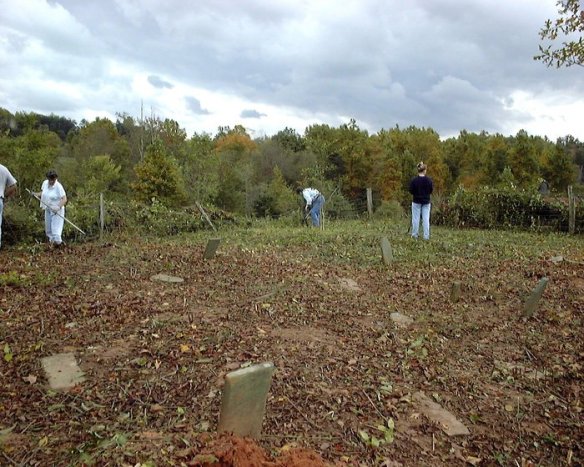
Brown Harold cemetery after

There is a family legend that says that John Harrold died in 1783 and was buried up on Harrold Mountain with all of his money and someone dug him up and robbed the grave. Of course, the speculation was that the culprits were his kids.  I guess that’s one way to take it with you – but I’ve always had these comical visions of several adult children sneaking up the mountain and running into each other at the grave in the dark. After the fight that would surely have ensued – who knows how many are actually buried in that grave:)

The story is interesting, but the 1783 death date is incorrect (because John wasn’t yet in Wilkes County in 1783 and he didn’t die until 1825) and would lead us to believe that maybe it was John’s son, John Harrald (Jr.) who was born in 1783.  We know he was buried on Harrold Mountain.  Regardless of the specifics, which we will never unravel now, the story is charming and there is surely some nugget of truth in there someplace, or the story wouldn’t exist at all.

So, John’s grave may have been twice insulted – once by grave robbers and once by a chicken farmer.  I don’t think John is resting in peace.

The fact of the matter is that the original John Harral (the name in Wilkes County is typically spelled Harrold and Harrald) didn’t die in 1783 and appears on the 1800 census with a male and female over 45, one male under ten which is probably son William, one male 10-16 and one daughter 10-16.  In addition, his presumed son, John Harrold Jr. is also enumerated with one male age 16-26, a female the same age and one female under the age of 10.  John (the elder) also appears in the 1810 census with his wife and only one child, the son who was 10-16 in 1800 in 1810 is listed as age 16-26.

The Church

Zion Baptist Church is a very old “primitive Baptist” church on Harrold Mountain and guess what the names are on probably 80% of the graves – yep – you guessed it – Harrold/Harrald.

Zion Baptist Church

A local cousin is a member of the Primitive Baptist Association, of which Zion Baptist is a member as well.

According to the cousin, this church was established in 1861. The white church above is the second building and the remnants of the original log cabin are found in the woods.  I suspect there was a church here long before 1861 given the remoteness of the area – simply that the church wasn’t a separate building and probably met at someone’s home before the log cabin.  It’s the only church on Harrold Mountain, so it’s a good bet that old John Harrold was a Baptist.  At least one of his children was married by a Baptist preacher.  John’s descendants were and are members of this church, that’s for sure.

The articles of faith upon which this church operates are posted on the wall.

1)       We believe in one only true God, Father Son and Holdy Ghost, and these three are One.  1st Timothy 2:5, Eph 4:6, 1st John 5:7

2)       We believe that the scriptures of the old and new testament are the word of God, and the only rule of Faith and practice. St. John 1:14, 2nd Timothy 3:16, 1st Peter 1:21

3)       We believe in the doctrine of election by Grace.  St. John 1:14, 2nd Timothy 3:16, 1st Peter 1:21

4)       We believe in the doctrine of original sin and in mans importency (sic) to recover himself from the fallen state he is in by nature, by his own free will and ability.  St. John 6:44, Romans 5:12-18

5)       We believe that sinners are called, converted, regenerated and sanctified by the Holy Spirit, and that all who are thus regenerated and are born again by the Spirit of God shall never fall away.  St. John 6:63, 10:28, 2nd Peter 1:10, 2nd Timothy 1:9, 1st John 3:9, Revelation 22:17

6)       We believe that sinners are justified in the sight of God only by the imputed righteousness of Jesus Christ.  Romans 5:1, 10:4, Ph. 3:9

7)       We believe that Baptism, the Lord’s Supper and feet washing are the ordinances of Jesus Christ and that true believers are the only subject of these ordinances, and we believe that the only true mode of Baptism is by immersion. Mark 1:9, 16:16, John 13:8-17, I Cor. 11:23-26

8)       We believe in the Resurrection of the dead and in general judgment, and that the joys of the righteous and the punishing of the wicked will be eternal.   Mat. 25:31:32, John 5:28-29, 1st Timothy 4:16.

9)       We believe that no minister has a right to administer the ordinances of the gospel except such as the regularly called and come under the imposition of hands by the presbytery.  Mark 3:14, 2nd Cor. 3:6, 4:1, 5:18, 1st Timothy 1:12, 4:14.

You can see the location of the church in proximity to the Harrold lands.  In order to help judge distance, it’s about 500 feet from the church to Yellow Banks Road, so less than a mile to John Harrold’s land above Harold Mountain Road.

Zion Baptist map

My cousin George, quite a history buff, said this was the last one of the old local churches to flatten the top of the graves for mowing. Apparently this particular denomination believed in rounding the tops of the graves – and keeping them mounded up. I don’t know why. They also had an outside eating area because they don’t believe in having food inside the church. These are still common practices of this particular sect of Baptists apparently, but most of the churches have modernized a bit.

You can see in the photos below, there were still mounds on a few graves.

Harrald at Zion Baptist

Zion Baptist cemetery

The photo below is standing at the church looking across the road and at the beautiful view of Harrold Mountain.  This is the exact view John Harrald would have seen, well, minus the silo.

Harrold Mountain across from Zion

John Harrold’s wife was named Mary. She is credited with saying that when she died, she wanted to but put up on the bluff on top of Harrold Mountain and to let her fly back to sweet old Ireland. I guess we know where she was from, if the story is true, but we have no idea who she was. Given that my cousin only said something about one stone where old John was buried, I couldn’t help but wonder if they had in fact put her on the bluff. I don’t know how they could find the bluff though, as it is very overgrown.

Harrold Mountain bluff

Above is the bluff of Harrold mountain, pieced from two photos, visible behind the tree and fence rows.

Tracking John Harrold

I will be spelling John’s name in the way it was spelled in the various documents that I’ve found.  Clearly, with a name like Harrold, it was quite likely to be spelled however the clerk decided it was to be spelled at that moment.  There was little consistency.

We first find John Herold in Deed Book C-1 in Wilkes County, on page 334, on July 6, 1794 a transaction between Robert Powers of Rowan County, NC and  John Herold…negro winch and mulatto child called Pink and Rose…property lately purchased in Camden…but if Robert Powers returned 75 pounds of indigo (sample whereof is in Herolds house) to Herald the above obligation to be null and void.  Signed by Robert Powers, witnessed by David Baxter.  Proven in open court February 1802 by comparison of hands writing by oath of Betsy Herald and William Young. Proven in open court July term 1804 hand writing of David Baxter by William Young, Esq.  The fact that this took place in 1794 but wasn’t registered until 1802/1804 suggests that indeed, the indigo was not returned and that Robert Powers either wasn’t cooperating or had died.

This of course begs the question of who was Betsy Herald.  John Herald (born in1782/1783) married a Betsy McKinney and that is likely the Betsy who gave her oath.

I have to wonder what caused John to be in possession of 75 pounds of indigo dye in the first place.

John Harrold appears in the Wilkes County court records on November 3, 1796 with an order from the court for the sheriff to sell 100 acres of property of Thomas Adams taken by execution to satisfy a judgment recovered against him by John Harrold, which judgment obtained by plaintiff in Iredell County execution issued by George Brown, Esq.

This is the first hint we have as to where John was “from” before we find him in Wilkes County.  Am I very grateful for this tie.

Iredell was formed from in 1788, so I checked the Rowan County records which begin in 1753 and found no John, with the exception of tax lists.  There is an early Hugh Herrill there as well, but his Y DNA line is not the same as John’s.  John Harrell is found on a 1785 tax list in James Crawford’s Company with one white poll and no land.

Extracting Iredell County records, specifically the minutes of the Court of Pleas and Quarter Sessions from 1789-1800 transcribed by Shirley Coulter we find a little more information about John.

On page 46, on August 24, 1792, a list of men is given who took the oath of allegiance and Jno Herril is included.  Of course, this might not be our John.  I wonder why he had to take the oath if he was a veteran and why this late.  The Revolutionary War had been over for years.

On February 17, 1796, a jury was ordered to lay open a road on part of Brush Mountain Road to go around a field of Robert Bogles, agreeable to his petition.  John Harrold was one of the men to lay out this road.  The Brushy Mountains are found in the northwest part of Iredell County.

The Deed Book from 1797-1802 shows a sale on October 5, 1798 from John Meadows to George Roberts on the waters of S. Yadkin on which John Harreld and David Roberts are listed at witnesses.  This deed was recorded on January 21, 1802.

An 1802 record from Rowan County Will Abstracts on page 113 shows the probate of the will of Stephen Roberts on January 9, 1802.  His wife is listed as Phebe and he lists children Warren, Joshua, Thomas, William, daughter Polly Harold, daughter Molly Noreton, daughter Judith Egmond, daughter Phebe Richmond, daughter Nancy Roberts and Betsy Roberts daughter of son William.  Polly is a nickname for Mary, but none of the sibling names look familiar, nor did John and Mary Harrold name a child Stephen, so this is likely not our John Herrald’s wife.

The 1800 census of Wilkes County shows Michael McDowell, Jacob McGrady (the minister who married William Herrell and Mary McDowell), and both John Herrell Jr. and Sr. (spelled Harrall) on adjoining pages.  Based on this evidence, pending further investigation, it is presumed that Michael McDowell is the father of both Mary and John McDowell and John Herrell Sr. is likely the father of William Herrell.

John Herral appears on the Wilkes County tax list in Captain Carltons District in 1800 with 1 white poll and no land.

In 1805, J? (smeared) Herrell had 550 acres and no polls, and James Herrell had 180 acres and 1 poll.  It’s interesting that John had no polls in 1805.  This could be because he was elderly, because he was an official, like a sheriff, although there is no evidence of that, a minister, but again, no evidence, or because he was disabled.  We know that by 1790, John had 6 children, so had been married a minimum of 13 years.  If he was 25 when he married, that means he was born about 1752.  He could have been born earlier.  If he was born in 1752, he would have been 53 or older in 1805, so possibly “elderly.”  The age where one didn’t have to pay polls varied by state and time and I’ve seen it range from age 45 to age 70.

In 1802, on page 345 of Deed Book F-1, John is mentioned in a land grant to Reuben A. Carter for 100 acres on Chathis Quemin Branch, the waters of Haymeadow and on John Herold’s line.  This is probably Chinquepin Branch.

This is followed on page 353 of the same book by a transaction on July 31, 180(blank) from Richard Allen, late sheriff and John Fletcher, Sr., land lost by Reuben A. Carter, court action brought by James Fletcher, 100 acres part of 200 acre tract on the waters of Cathinquemin Branch of Haymeadow on John Herold’s line.  Witnessed by John Saintclair and Hugh Brown.

John’s daughter, Elizabeth, married Reuben Carter in February of 1803.  This had to be a very upsetting time for the family, possibly in multiple ways.  Why did Reuben lose his land?  Was he irresponsible or unlucky?  Did he lose his land before or after he married Elizabeth?  Did they move in with her parents whose land abutted Reuben’s?

In 1803, in Deed Book F-1, on page 87, Charlotte Harrold witnesses a deed between Reuben Carter and William Sabastian for $10, 100 acres on Rock Creek, on Henry Carter’s corner and the road.  Also witnessed by William and Nancy Carter.  Charlotte was John Harrold’s daughter and married Coonrod (Koonrod) Dick in 1806.

John’s Land

Land grant entry number 1246, file number 2421 for 200 acres was filed for John Herrold on November 16, 1801 and states that the land is on the Chinquepin Branch of the Hay Meadow Creek on the waters of Mulberry beginning near the head of the said branch and that it is against Michael McDowell’s line.  The survey was entered November 16, 1801 and was actually recorded in February 1802.   Chainers were John Roads and Michael McDowall.  There is a drawing of the survey but it just looks like a square and there are no watercourses noted.  The fact that the land was at the head of the branch tells us it was high up on the mountain.

Note that John Harrold’s son, William, would marry Mary, the daughter of Michael McDowell, in 1809.

John Herrold grant

The grant of land was not actually made until December 5, 1811 and it is grant 2817.  It’s odd that John would not own land until this late in his life.  He was approximate age 50 in 1800.

The name is spelled variously Herrild, Herrald, Herrold.  John paid “4 pounds” for this survey in 1804.  I find it interesting that they are still using the old English money measures and not dollars.

In 1811, in Wilkes County Deed Book G-H we fine a David Harrill of Surry County, NC selling land to Jesse Allen for 200 pounds, 550 acres on Joshua Mizes line, the waters of Hunting Creek, witnessed by Richard Alley and Hugh Riley.  Hunting Creek is not near John Harrold’s land, more than 5 miles distant as the crow flies, southeast of Wilkesboro.

There is no known connection between David and John Harrell, but just because a connection isn’t known doesn’t mean it doesn’t exist.  Furthermore, we don’t know how David obtained this land, because he isn’t listed in the deeds or grants.
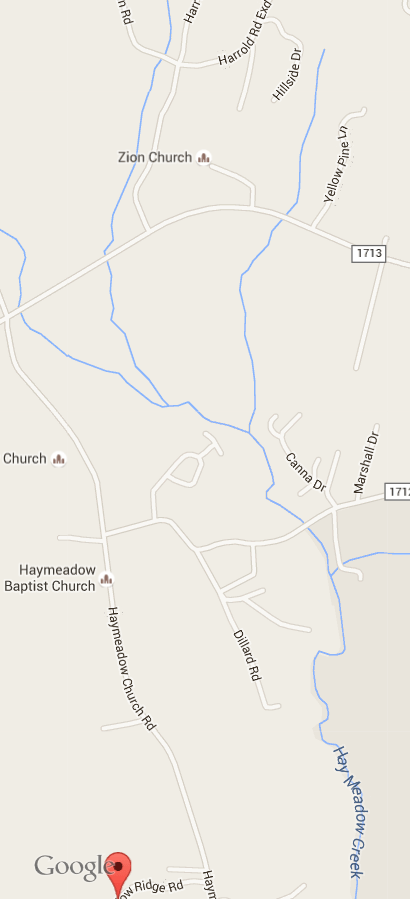
Haymeadow2

haymeadow3

John’s land is located on Haymeadow Creek.  You can see Mulberry to the lower left on the map above.

Haymeadow and Harrold

Haymeadow Creek runs right up beside the Zion Church and on up paralleling Harrold Mountain Road until you reach the beginning.  As we know  from the land grant, the beginning or headwaters of Haymeadow is where John’s land was located.

John’s land is very likely where his son, John’s land was located, where the cemetery is, or rather, was located, which is between the Harrrold Mountain Extension and Waddell Drive, above and below.

John's land

John’s land was about as far up as you could go on Harrold Mountain, which of course, wasn’t yet named Harrold Mountain at that time.  200 acres would have been just about all of the land above the Harold road U on the map above, including the central extension.  The original homestead was likely on the left near the cemetery.  Michael McDowell’s land abutted John’s at the southwest corner where they shared a stake and eventually, Reuben Carter’s would abut John’s land too.

John Harrold satellite

If you look at this picture, all of that treed land above John’s land is too mountainous to do anything with.  Very steep and wild.  That one little road you see is a two-track that leads to nothing.

A Willliam Herrell was witness to a will of Benjamin Sebastian in 1818 in Wilkes County.  John Harrold was a witness also.  This is likely not William, John Senior’s son, because John’s son, William, went to Claiborne County, Tennessee about 1810.

By the time John Harrold Sr. died in 1825, his son William had been gone for 15 years.  I wonder if John ever saw William again.  Did he know when William was pulling away in the wagon that it was their final goodbye?

William wasn’t the only one of John’s children to leave.  In fact, the only child we know of that stayed in Wilkes County was son John, who likely lived on John Sr.’s old place.

Harrold goats

These two photos were taken on Harrold Mountain on a beautiful spring day with the goats frolicking to celebrate the fresh spring grass.  It probably looks about the same today as it did when John Harrold lived there.

Harrold goats2

John died sometime in 1825, because in October of that year, in Will Book 3-4, on page 78 is recorded the account of sale of the estate of John Harrold.

In January 1826, an allowance was made to Mary Harrold, widow and in October of 1826, the estate sale of Mary Harrold was held.

John Herrell was born in roughly 1750 or before and died in 1825 in Wilkes County NC.  He is buried someplace on Harrold Mountain, probably on his own land.  Today this mountain remains very rugged and remote.  His grave is either marked with a chicken house or he is buried in the same cemetery as his son John.

John’s Children

What we know about John’s family is somewhat limited, but at least some of his children have been identified.

Of John’s known sons, one, John, stayed in Wilkes County and is the progenitor of the family there today.  William went to Claiborne County, Tennessee and the family surname is generally spelled Herrell or Harrell,  Alexander went to Breathit Co., KY where the name is Harrold and Herald.

  • William Harrell, born 1790 in NC married Mary McDowell, daughter of John’s neighbor Michael McDowell, in 1809 in Wilkes Co.  They were married by the Baptist Preacher, Jacob McGrady. They moved to Claiborne Co. shortly thereafter. They lived for a short time in Lee Co. Va. before purchasing land in Claiborne Co. in 1812. This is my ancestor.
  • John, born 1783, died in 1879 in Wilkes Co.  He married Elizabeth, “Betsy” McKinney about 1797.  Most of the Wilkes Co. Harrold’s seem to be descended from this man. John also lived on Harrold Mountain, probably on his father’s land, and is buried in the Harrold/Brown Cemetery.

Brown Harrold cem

You can see it closup here, the trees in the middle of the field to the right side of the photo.

John Harrold Cemetery closeup

John’s gravestone says he was born in 1782 and died in 1879.

John Herrald b 1783 stone

  • Elizabeth, born in 1785 married Reuben A. Carter in 1803 in Wilkes Co. No more is documented about this couple, but they may have gone to Maury County, TN. by 1815 and then on to Crawford County, Missouri.
  • Alexander Herrell born about 1785 in North Carolina, died about 1860 in Breathit Co, KY, married Elizabeth Turner before 1812 and moved to Breathit County shortly thereafter. The 1850 census where the name is spelled Herrald shows that he was born in North Carolina.
  • Charlotte, born about 1790 married Koonrod Dick in 1806 in Wilkes County. She and Koonrod or Conrad moved to Simpson Co. KY before 1825.
  • James, possibly a son of John, listed here because of his residence in Wilkes in 1805. This is speculative and may be inaccurate. There is no further information about this man and he does not fit on the census.
  • Sarah “Sallie” Herrell born about 1784 and died in 1845, probably Breathit County, KY.  Married Jessie Turner before 1805 and had 9 children.

We are left with a couple of burning questions about John Harrold or however the surname was spelled.

Where was John from?

We know John (the eldest or first’s) son John (Jr., the second) was born in or about 1782 or 1783, that he stayed in Wilkes County.  Because John Jr. (the second) lived past the 1850 census, we can tell something about where John Sr. was living in 1782 when John Jr. was born.

The 1850 Wilkes County census tells us that John Herald was a 67 year old farmer born in Virginia.  His wife was apparently deceased and he had 5 children living at home. This would be John Jr. (the second).

The 1860 census shows us that John Harold Sr. (the second,) who lived beside John Jr. (the third) was a 78 year old farmer born in Virginia. He still had 4 daughters living at home with him, ranging in age from 22 to 31.  The Jr. and Sr. have transitioned.  The John Jr. (the second) became John Sr. when his son John (the third) reached adulthood.  John Sr. (the first) had already died by this time.  John (the second’s) son, John, became John Jr. at that time.  Jr. and Sr. can be very deceptive because of this type of transition, and also because they may not indicate a direct relationship.  Sr. and Jr. can mean “older” and “younger” in two men with the same name who are not related or not father and son, but live in the same location.

John (Jr., the second) is not shown in the 1870 census, although according to his grave marker, he was still living.

In 1880, John Jr. (the third) is still living, age 75 and he shows that both he and his parents were born in North Carolina.  His wife shows that her parents are born in Virginia, so it’s not a matter of unthinking ditto marks.  This would indicate that his father, John (Jr. the second) born in 1782, was born in North Carolina, although we have three census records where John (born in 1782) presumably gave the information himself and said he was born in Virginia – in all 3 records.

According to the census, in 1800 we find John (the eldest) with his children in Wilkes County.  In 1790, we find only a couple of candidates in North Carolina or for that matter, anyplace in the eastern half of the US.  The Virginia 1890 census does not exist and has been replaced by tax lists which I have thoroughly scoured from 1782-1787.

One candidate is John Harrald in Iredell Co NC.  He is not listed in Iredell in 1800, so this could be our John, especially with the 1794 court record referencing Iredell County where John obtained the judgment.  In 1790, this John had enough children to be our John, which is one of the qualifiers to be a candidate.  He had 1 male age 16+ (himself), 3 males under the age of 16 and 4 females.

The second burning question is related to the first, and the question of where John came from is at least somewhat unraveled as we peel the onion of the mystery of the multiple John Harrold’s who served in the Revolutionary War.

Which John Served in the Revolutionary War?

A fellow Harrell researcher sent me the following two scanned pages a couple of years ago.  They found these years ago in a Virginia library.  We don’t know what books they are from, aside from the information at the top of the page, but it does tell us that there are two Johns who served.

One John Harrell applied for a pension from Nansemond County, VA where he was born in 1761.

We know that this is NOT our John because that John applied for a pension in 1833 in Nansemond County, VA and our John lived in Wilkes County and was dead by this time.

John Harrold Rev War

The second page, below, shows a John Harrill from NC, a private, who received or applied for a land grant on July 29, 1820, for 228 acres that went to his heirs.  Unfortunately, this entry raises far more questions than it answers.  Does this mean he served out of North Carolina or only that he lived in NC in 1820 when he applied for land?

John Harrold rev war2

I found this book at the Allen County public library, and it was Revolutionary War Records of Virginia Vol 1.  by Marcus Brumbaugh.  The book explains that these records are of bounty land warrants for the military district of Ohio from the federal and state archives.  This record for John is for a private and for 228 acres.

From the article “Military Bounty Land” by Sandra Hargreaves Luebking, we find the following.

North Carolina was the most generous, giving 640 acres (a square mile) to a private in the Continental line. The tract was in Tennessee; no bounty land warrants were located within the present-day boundaries of North Carolina.

An extraordinary flood of Revolutionary War bounty-land warrants poured from Richmond, partly because Virginia had the largest state population and partly because it granted warrants not only to its Continental line but to its state line as well. The distinction rests on who paid the soldiers—Congress or Virginia.

The first military reserve was created south of Green River in Kentucky and subsequently expanded west of the Tennessee. There were no bounty lands within present-day Virginia or West Virginia. In 1784, Virginia ceded its claim to the area north of the Ohio River, reserving the 4 million acres between the Scioto and Little Miami Rivers for redemption of its bounty-land warrants. This Virginia Military District in Ohio was federal land for which first-title land grants were reserved solely for the Virginia warrants of veterans of the Continental line. A series of ever more liberal acts broadened where warrants could be used and by whom until, in 1852, Congress agreed that all Virginia Revolutionary War warrants could be exchanged for scrip accepted at any GLO land office. Large numbers of these assignable warrants were sold; an estimated one-quarter of the Virginia Military District was acquired by twenty-five men.

The paperwork flow was: (1) warrant application to Richmond; (2) warrant issued to warrantee; (3) selection of desired land in Kentucky or Ohio reserves and survey by official surveyor; (4) paperwork for Kentucky lands to the Virginia Land Office or, from 1792, the Kentucky Land Office, or the federal capital for Ohio lands; and (5) patent for Kentucky land sent to patentee or federal patent sent to Richmond for relay to Ohio patentee.

Fold3.com Records

Next, I checked http://www.fold3.com, finding several service records.

Service Records – Company pay rolls

John Harrold’s (Herrald, Harreld) Revolutionary War pay records.

Served in the late Capt. Williams Company of the 8th Virginia Regiment commanded by Col. James Wood:

  • Pay roll of Capt. John Nevils Company of the ? Virginia commanded by James Wood for the month of June 1777 – John’s pay is noted, along with a note “Deserted July 7th”.  Others who deserted the same day were Travis Chambers, William Hutcherson and John Waters.
  • Deserted July 1778, joined April 17, 1779
  • April 1779 Camp Middlebrook
  • Virginia 8th Regiment – Late Captain Wallace’s Company of the 8th Va Regiment, commanded by Col. James Wood – private June 1779 Camp Smith’s Clove to July 1
  • Same as above but dates June 1, 1779 commence pay at 6 2/3 dollars per month – for one month amount of pay 2 pounds
  • July 1779 Camp Rampo – private – enlisted May 1, 1777 for 3 years – Each one of the pay records shows this he enlisted at this date which is how you can be sure it’s the same man.
  • Aug 1779 – Camp Smith
  • Oct 1779 Camp Ramapough
  • April 1779 – 3 days pay – not drawn for since June 78
  • March 1779 – Capt Smith’s Clove’
  • June 1779 – private, Capt Smith’s Clove, Capt. Wallace’s Company commanded by Col. James Woods
  • John Herrold, Capt Wallaces Company, appears on a list of the absentees of the 12th Virginia Regiment with the sum due each: not dated, 11 48/72 dollars, absen
  • Roll of Captain Wallaces Company of the 8th Virginia for the month of August 1779 – paid for one month as a private.

Smith’s Clove is in Suffern, NY, State Route 17.  Camp Rampo was in Ramapo, New York as well, and both of these locations were headquarters of George Washington during the Revolutionary War.

This is an entirely separate record at Fold3 as follows:

John Harald – private, Capt. Abraham Kirkpatrick’s Co in a detachment of the 2nd Virginia Brigade commanded by Col. Febiger – Dec, Jan, Feb and March 1780, pay is 6 2/3 per month, subsistence is 10 per month, amount of pay and subsistence 50 dollars.

John Harold – Soldier Infantry – appears in a book under the following heading:

“A list of soldiers of the Virginia Line on Continental Establishment who have received certificates for the balance of their full pay agreeable to an act of assembly passed November session 1781.”

Signed by Mr. Hancock, June 4, 1782 for 36 pounds

Pensions

John Harrold – 1 NC Regiment – Capt. John Summer’s Company of the 1st NC Batallion commanded by Colonel Thomas Clark – roll dated Sept. 8, 1778, enlisted April 4, 1776 for 2 and one half years.

There is also a service record for John Harrold who served in the 1 NC Regiment.

John Harrolds of Frederick Co., VA and Botetourt Co. VA

VA State Library, Archives Division, Military and Land Warrants Records for John Harrold show he served 3 yrs as a sergeant in VA Continental Line, 8th VA Regiment from Botetourt Co. He was discharged June 1777 near Valley Forge then served a 2nd time for 18 months in the 8th VA Regiment and was discharged near Salisbury, Feb 1782. In 1819 he lived in Wilkes Co., NC and in 1828 was still there when he received bounty land warrant #6718 for 200 acres.

The above record drove me nuts, because while someone was kind enough to send me the info, and I was very grateful, there is no source or context, so I couldn’t reproduce it nor did I know where to go from here.

Another contributed record tells us the following.

One John Harrold was born circa 1761 in Frederick County, Virginia.  The first record of him is from a Register of Description of Noncommissioned Officers and Privates enrolled at Albermarle Court House dated 23 December 1781 in which he is described as:  “John HARRELL, age 20, born in Frederick Co., VA, 5 ft. 10 in. tall, brown hair, grey eyes, fair complexion, occupation planter, residing in Montgomery Co. VA, engaged as a substitute from Montgomery Co.”

The John Harold of Frederick County born in 1761, so only 20 when he enlisted in 1781, cannot be the John Harrold who was a sergeant when discharged in June of 1777.  That just doesn’t work.  A 16 year old is not going to be a sergeant.  He also cannot be the man whose pay records were found from 1777-1779 at Fold3.com.

Now we know we have at least three John Harrold’s serving out of Virginia, and possibly more:

  • John of Frederick County, age 20 when enlisted in December of 1781, so born 1761
  • John of Nansemond County who served from there and requested a pension from there in 1833
  • John of Botetourt County, reported to be a sergeant who eventually lived in Wilkes County, NC.  Served twice, once discharged near Valley Forge in either 1777 or 1779 and discharged the second time in 1782 from Salisbury NC.  Received a bounty land grant.
  • John who enlisted on May 1, 1777 for 3 years who is probably the same man who deserted in 1778 and rejoined in 1779.  This could be John of Nansemond but the dates seem to eliminate John of Botetourt and does eliminate John of Frederick.  After reading John of Nansemond’s pension application, he is also eliminated.
  • Possibly another John who served under Capt. Abraham Kirkpatrick in the Virginia 2nd from Dec 1779-March 1780 according to pay records – although this could be  John of Nansemond.

I requested the records for John Harrold from Botetourt County from NARA, and they replied that they had no records for him.  How could that possibly be when Fold3 digitized NARA’s records?

I think the genealogy gremlins are out to get me.

Library of Virginia to the Rescue

It pays to recheck earlier sources.  The Library of Virginia continues to digitize their records and to them, a huge, HUGE, THANK YOU!!!  I had written to the National Archives and received nothing, so this information documents three years of John’s life for me.  These records prove, beyond a shadow of a doubt that the Botetourt County John is the John Harrold of Wilkes County.

John Harrold rev war3

Downloading the images, I found the entire packet including John’s discharges and affidavits regarding his service.  A literal goldmine.  The motherlode.

john harrold rev war 4 jpg

This is to certify that the bearer herof John Harreld (or Harrold) formerly a sargent in the 8 Virginia Regiment has duly and faithfully served the term of three years for which he was enlisted for and in and at his own request is her by discharged from any further service in the Army of the Younited Stats and is permitted to pas to his home in Botod County fre and un milisted give under my hand at Camp near the Valley Forge this 12 Day of June in the year 1779.  Signed Charles Scott B G (Brigadier General)

The bearer John Hareld Sergeant is here by entitled to ? akers of land for his three years service in the Army by the Younited Stats to ?? on the ?? waters by a nek ? assembly their troups.  Given under my hand at camp near the Valley Forge these 12 June in the year 1777.  Signed Charles Scot B.G. (Brigadier General)

I originally believed the year would be 1777, not 1779.  This discharge was probably written in the commander’s tent on the battlefield, so it’s amazing that the penmanship is as good as it is

However, based on the last paragraph, for John to have been enlisted for 3 years, the discharge date would have had to have been in 1779, because that dates John’s enlistment to June of 1776.  The war had not yet begun two years earlier, in June of 1774.

Valley Forge in Pennsylvania was the site of the military camp of the American Continental Army over the winter of 1777–1778 during the American Revolutionary War. It is approximately 20 miles northwest of Philadelphia. Starvation, disease, malnutrition, and exposure killed nearly 2,500 American soldiers by the end of February 1778.

John Harrold apparently served through this time and survived

Forgery???

Interestingly enough, Will Graves, a revolutionary war historian, transcribed this document as well, and questions whether it is a forgery based on General Scott’s signature.  Although Scott is described elsewhere as somewhat illiterate.  That’s certainly an interesting conjecture and raises unpleasant questions that need to be answered.  I must admit that the service record dates we have don’t mesh entirely with the discharge papers, nor is there ever a pay record for a John who is a sergeant.  We might shed some light on this if we knew where General Scott was, exactly, on these two different dates in 1777 and 1779, but I have been unable to do so.

Will’s transcription suggests that he believes 1779 date is accurate.

Some Fold3 pay records for John Harrold state that he enlisted on May 1, 1777.  If these are all the pay records for the same John Harrold, the enlistment date of May 1777 and the discharge date of June 1779, given that he was AWOL for part of the time might make sense, although it certainly doesn’t total 3 years.  I hate it in these types of situations when I start using the words might and could, because I know I’ve crossed that speculative line.

If John enlisted for 3 years, in June of 1776, then the May 1, 1777 enlistment date doesn’t work either.

Now, I’m left with even more questions.  If one discharge was a forgery, was the second one too?  If one or both were forged, was it simply because the original was lost, or was there something more sinister and unethical afoot?  Many men stated that their discharges were lost, but then they had to produce witnesses to vouch for their service record.  Was John ever a sergeant?  Did he even serve?

Or maybe those documents aren’t forgeries at all and I’m doubting a 3 year patriot’s service record.

The 8th Virginia

The 8th Virginia Regiment, in which John Harrold reportedly served for 18 months, was raised beginning on January 11, 1776 for service with the Virginia State Troops.

If John was discharged in June of 1779 after serving three years, then it couldn’t have been our John who joined in May of 1777.  Unfortunately, these records don’t fit together perfectly.  Furthermore, the John who joined in May 1777 was a private, not a sergeant.

The Virginia 8th’s first commanding officer was patriot leader and German Lutheran pastor Peter Muhlenberg, who became a militia colonel in 1775 at the request of General Washington. In his last sermon from the pulpit, Muhlenberg read from Ecclesiastes 3:1, “There is a time for all things, a time to preach and a time to pray; but there is also a time to fight, and that time has now come.” He removed his clerical robes to show that he was wearing his uniform as a militia colonel. He quickly enlisted 300 men from his congregation in the unit that became the 8th Virginia.

Muhlenberg was appointed colonel on March 1, 1776. The 8th Virginia organized at Suffolk County Court House between 9 February and 4 April 1776. The unit’s 10 companies came from Augusta, Berkeley, Culpeper, Dunmore, Fincastle, Frederick, and Hampshire Counties, plus the District of West Augusta. On May 25, 1776 the regiment officially became part of the Continental Army.

In 1776, Virginia regiments were typically organized into 10 companies, of which seven carried muskets and three carried rifles. The regiment’s 792-man roster had three field officers, and a staff that included an adjutant, quartermaster, surgeon, surgeon’s mate, chaplain, sergeant major, quartermaster sergeant, and drum major. Each company consisted of one captain, two lieutenants, one ensign, four sergeants, four corporals, one drummer, one fifer, and 64 privates.  John Harrold was one of the sergeants if his discharge is accurate, but he is not listed as a sergeant in this unit or in any unit.

The 8th Virginia marched south to Charleston, South Carolina and was there in time for the Battle of Sullivan’s Island on 28 June 1776, but it was not in action. On 21 January 1777, the regiment received orders to join George Washington’s main army at Valley Forge.

On 11 May 1777, the unit was assigned to the 4th Virginia Brigade, together with the 4th and 12th Virginia Regiments, Grayson’s Additional Continental Regiment, and Patton’s Additional Continental Regiment. Charles Scott, who signed John Harrold’s discharge, above, was appointed to lead the brigade.

It was a long way home for John from Valley Forge regardless of when he was discharged – about 350 miles.

John Harrold valley forge

John may have returned home in June of 1779, but he wasn’t finished with the Revolutionary War.  He enlisted again by August of 1780.

John Harrold Rev War5 jpg

I do here by sertify that the bearer here of John Harrald formerly a seargeon (or sergeant?) in 8 Virginia reagiment has faithfully served the term of 18 months for which he was in listed and is permitted to pass to his home in Bottatot County in Virginia he behaving as a good citizen I fother certify that he has received no pay for his eighteen months service in the Southern states given under my hand at Camp ner Salisbuary this 16th day of February 1782.  Signed Samuel Sned (Snead) MC

If John was discharged on February 16, 1782, by subtraction, this tells us he re-enlisted no later than August of 1780.  The pay records for John Harrold in 1779 are obviously not for this John Harrold.

The 8th Virginia was absorbed into the third Virginia brigade in May of 1779, then became part of the 4th and 12th.  The discharge says he was formerly a sergeant in the Virginia 8th, but it says nothing about the unit he was serving with that was discharging him.

Assuming this service record is legitimate, this may be how John Harrold came to be acquainted with the Wilkes County area.

The Salisbury District of North Carolina, was originally one of several colonial judicial districts established in 1766. Immediately preceding the onset of the American War of Independence, these six regions, in 1775, were broadened into “de facto” militia districts.

The Salisbury District was based in the village of Salisbury, North Carolina, in Rowan County, about 60 miles from present day Wilkesboro.

The Salisbury District originally included Anson, Guilford, Mecklenburg, Rowan, Surry, and Tryon counties. A later addition was the Washington District (also known as the original Washington County, North Carolina) which covered most of the present day State of Tennessee. Eventually, as new settlements were carved out of the wilderness, the Salisbury District encompassed the counties of Lincoln, Montgomery, Richmond, Rutherford, Wilkes (all in present day NC), and Sullivan (in present day TN) as well.

It was almost 200 miles from Salisbury, NC to Botetourt County, VA.  I hope John wasn’t on foot, but I bet he was.  Horses were at a premium.

John Harrold Salisbury

Bounty Land

John appoints a power of attorney to collect his land grant based up on his service record..

John Herrald rev war 6 jpg

Know all men by these presents that I John Harrald of the County of Wilkes and State of N. Carolina have constituted and appointed Alex. ? McKenzie of the county of Wilkes and State aforesaid my true and lawful attorney for me and in my name and stead to procure and receive from such officer person or persons or shall be legally authorized to grant this same a land warrant to which I am entitled for my services rendered the United States during its revolutionary war as my original discharge certified and I hereby further empower my said attorney to give such receipts as shall be required in obtaining said lands. Patent in my name in as full and ample a manner as I myself could do were I personally present and I hereby certify and confirm whatever my said attorney shall lawfully do in the premises given under my hand and seal this 30th day of January 1819.

Signed, John Harrald

Witnessed by George W. Smith and Joshua Shumate (his mark

I believe this is John’s actual signature.  Whether or not the discharges themselves are forgeries is irrelevant to these signatures being authentic.  Note that this affidavit states that this is his original discharge.

John acknowledges the power of attorney in open Court on Febnruary 5th, 1819.

John Herrald Rev war 72 jpg

Next, John sells his claim.

John Herrald Rev War 8 jpg

Know all men by these presents that I John Harrald Sr. of the county of Wilkes and the State of N. Carolina have bargained and sold unto Alexander McKenzie my claim for 330 acres of land to which I am entitled for services rendered by me in the Revolutionary army and I have bargained and sold unto said McKenzie my claim of 18 months pay for services rendered by me during the revolutionary war in the southern states and I bind myself my heirs assignees executors and administrator to have no recourse on said McKenzie  on the claim? of said claims by ? one hundred and fifty dollars the amount in full for my said claims.  Signed under my hand and seal this the 3rd day of January 1819.

Signed John Harrald

Witnessed

Joshua X Shumate
George (W his mark) Smoot

John Herrald Rev War 9 jpg

In this document, John swears that he has not drawn the warrant for his land and that he authorizes Alexander McKenzie to do so.

This is the third example of John’s signature.

At this point, John would have been about 70 years old

Botetourt County, Virginia

Now we know that John was from Botetourt County, Virginia and that is where he considered home.  He was returning there when he was released from Valley Forge.  He also returned there in 1782 when he was released, which just happens to be the same year (or just before) that John Harrold Jr. was born.  Even if both of these discharge records were forged by (or for) John, it gives his home location as the same place in both.  That much would be accurate.

Now, we have a new problem.  There are other Harrold men in Botetourt County, leading one to the presumption that they are the same family line…but they aren’t.  There is a James Harrold there as early as 1770 living on Harolls Creek but the Y DNA of James’ line (that went to Warren Co., KY) does not match the DNA of our John’s line.

However, there is another very interesting record found in the Botetourt County records.

Botetourt County Virginia USGenWeb Archives – Court held for Botetourt County the 11th day of March, 1779.

This court doth allow Mary O’harrell, wife of John O’harrell, a soldier in the Continental Army, thirty pounds for the support of herself & two small children.

This would imply that Mary and John have been married at least 5 years.

If this is our John, then the June 1779 discharge date would be the correct one, not 1777.

Is this our John and is O’Harrell misspelled?  Are there any other instances of O’Harrell?  There are no John O’Harrell Revolutionary War service records at Fold3.com – yet this court entry clearly says he was serving and we know the records for the Virginia 8th, the unit in which he would be serving out of Botetrout County, are intact.

And then, there is this Augusta County record…

Augusta County, Virginia

Another Harrell researcher sends the following:

John Harrold (? Harrell) became an indentured servant in Augusta County, Virginia April 15, 1773. His master was Edward Cather, as the record indicates: April 15th.1773 John Harrold (? Harrell), servant to Edward Cather of Augusta Co. Virginia. Edward Cather’s parents were from Ireland and Scotland. He was born about 1740 when his parents were listed just married in Ireland. Though they say Edward was born in Virginia, his parents are listed as coming to America about 1777. Thus it is only a guess but I would believe this John Harrold also came from Ireland/Scotland and perhaps his way over were paid by the Cather’s. He was only assigned to work for two years for Edward Cather, which I would assume would reimburse his transport to America. Edward Cather quickly left Virginia for Kentucky about the time of at least the mid 1780s. Not sure if John Harrold followed.

If this is our John, this would explain why his DNA does not match with the other Botetourt or Frederick County, Virginia Herrell lines.

What Next?

It has been a long journey finding John.  The most difficult part was actually getting my hands on his Revolutionary War records.  Once I did, so many questions were answered.  We have added another chapter in the puzzle of “where was John?” and have pushed the brick wall back a little further.  We know that he was living in Botetourt County, VA in either 1779 when he was discharged after a 3 year service commitment, so he was likely living there in June of 1776 when he would have enlisted.

And of course, now we have the added mystery of whether or not John’s discharge papers are forgeries, which begs a whole new set of questions.  That was a sucker punch – and it doesn’t help that the pay records we have do nothing to corroborate John’s discharge papers.  Of course, they don’t disprove them either.  So frustrating with no clear way to obtain answers.

In all the years I’ve been doing genealogy, I have never, not once, actually seen a discharge letter of one of my ancestors, let alone two.  Maybe I still haven’t.

We are left to wonder if the Botetourt County John and Mary O’Harrell is the same as our John, in 1782.  No John Harrold, O’harrell or any similar surname appearing on the Botetourt tax lists in 1782 or as late as 1787.

We know that by 1779, John in Botetourt, based on the court record, assuming it’s our John, already had 2 children, if they survived.  The depth of their destitution is demonstrated by the fact that Mary had to ask for money to simply survive.  This is actually a very unusual occurrence and may indicate that her own family is either dead or not living locally.  John’s 1782 discharge record indicates that he had not been paid, and even had he been paid, he had no way to get the funds to Mary.

I am still very anxious to discover more about John Harrold, although short of a DNA match to another Harrell or Harrold or Harrald overseas or from earlier colonial times, I don’t quite know how I’ll ever connect the dots.  Of course, I can always pray for that Bible on e-Bay.

The good news about the Harrald Y DNA is that at 25 markers, the three descendants of John Harrold who have tested match only one other man, a Todd from Ireland with 1 mutation difference.  The three John Harrold descendants are group 7 in the Harrell DNA project.

Harrell group DNA

Thank goodness for Y DNA, because I know that we don’t descend from any of those other Herrell groups – so no need to bark up those trees.

I checked one last possibility.  There are several known descendants of John who have tested autosomally.  I checked each of them for matches to other Harrold/Harrell/Herrell lines in case we’re dealing with an undocumented adoption or illegitimate birth to a Harrold female.  So far, only one match and that person of course could match that individual on a completely unrelated line.  That match goes back to a George Troup Harrell who is attributed to a line descending from Josiah Harrell (1733-1773) and Mary Ann Gardner out of Bertie County.  Since it’s a male Harrell that we match, I’m hopeful that I can talk him into Y DNA testing.  I’m sure he’ll likely match the large Harrell Group 1 which is the eastern Virginia, eastern North Carolina group…but I’d still like to know for sure.   Y DNA doesn’t lie and it’s not ambiguous.  No forgeries or questions about forgeries.

Harrell group 1

I think today, we’ve done all with the records we can do for now.  So, now we wait, because someday, another Harrold or man with a similar surname will test and will match, and we’ll continue to chip away at that brick wall.

______________________________________________________________

Disclosure

I receive a small contribution when you click on some of the links to vendors in my articles. This does NOT increase the price you pay but helps me to keep the lights on and this informational blog free for everyone. Please click on the links in the articles or to the vendors below if you are purchasing products or DNA testing.

Thank you so much.

DNA Purchases and Free Transfers

Genealogy Services

Genealogy Research

Ginnifer Goodwin – Who Do You Think You Are – “Not What I Expected”

My favorite genealogy series, WHO DO YOU THINK YOU ARE? returns this summer on Sunday, July 26th at 9/8c on TLC with a heart-wrenching episode with actress Ginnifer Goodwin who you probably know from her “Big Love” HBO series and ABCs “Once Upon A Time” where she stars opposite her husband.

Ginnifer in the archives with books behind her.

Ginnifer in the archives with books behind her.  Courtesy TLC.

Ginnifer Goodwin knows nothing about her paternal grandfather’s family because he refused to talk about his parents. She goes on a journey to uncover the truth behind her great-grandparents’ story, and is shocked at what she discovers.

I’ll just warn you now, get the Kleenex box.  You’ll need it.

Ginnifer never knew her paternal grandfather, John Barton Goodwin, who died when she was an infant. She’s been haunted by the lack of information surrounding his family line; he never talked about his parents to her father, Tim. Understanding the generations that laid the foundation for her has grown more important to her since becoming a mother herself. The birth of her son Oliver has reignited her desire to know why her grandfather never spoke of his mother and father.

Ginnifer starts her search for information with her dad, who recalls that his father John Barton Goodwin’s parents were named Nellie Barton and John “Al” Goodwin, and that for some unknown reason, John Barton Goodwin was abandoned or left home when he was just 11 years old, making his own way in life in Memphis, Tennessee.

The last time he did any research, Tim found a 1910 Census return in which Nellie, Al and John Barton are living in Batesville, Arkansas, along with John’s older sister, Pearl.  Ginnifer wonders what could have happened for Nellie to have let 11 year old John leave her home, and heads to Arkansas to see if she can find some answers.

Local records in Batesville reveal, surprisingly, that Nellie’s maiden name was Haynes, not Barton, and a search for her marriage record returns a result for Nellie and a man named J.D. Williams, not Ginnifer’s great grandfather, Al Goodwin! Can this be right?

What happened with Nellie’s first marriage that she eventually married Al Goodwin? Was Nellie a young widow?  The local genealogist explains that death records of this time are incomplete and advises that Ginnifer visit the Independence County Courthouse to search for evidence for the other alternative to the end of a marriage: divorce records.

Next, Ginnifer meets with a historian, who has found a case for Nellie suing J.D. Williams (a.k.a. “Duff”) for divorce. Ginnifer discovers that Nellie successfully sued for divorce when Duff abandoned Nellie while pregnant for their daughter Pearl just months after their marriage.

Ginnier discovers that Duff Williams sued Nellie for divorce first, and only married Nellie to avoid jail time for having sex with her outside of matrimony. But the tables were turned when he falsely accused Nellie in court of adultery, and his lies sent him to prison.  Three years later, Nellie finally files for divorce.  Shortly thereafter, Nellie marrys Al Goodwin, Ginnifer’s great-grandfather, hoping for a fresh start.

Continuing her search for Nellie and Al Goodwin, Ginnifer finds that between 1906 and 1911, Al racked up 18 indictments for bootlegging and gambling, and served two years in prison.  She has to ask herself….was Nellie involved?

It’s about this time that my heart truly goes out to Ginnifer.  She’s finding out, but as she says at one point, ‘somehow this is not what I expected.’  Ginnifer’s tears are not cried by an actress.

In Al’s own penitentiary records, Ginnifer is shocked to see her great-grandfather’s mugshot.  She can see her father’s face in Al, and I can see Al’s face in Ginnifer as well.

Then Ginnifer discovers Al had syphilis in 1906, 2 years after her grandfather was born, while married to Nellie, and was being visited by a woman other than his wife while in prison.  It comes as little surprise that Nellie filed for divorce while Al was behind bars.  Obviously Nellie’s life was challenging, at best, and possibly much, much worse.  From later records, it appears that Nellie had another son by Al Goodwin.

In 1911, it was almost impossible for a woman to support herself, let alone with 3 children, without a husband.  Ginnifer’s grandfather would have been about 6 or 7 at this time.  It would be another 5 years until he left home at age 11, choosing to fend for himself against almost astronomical odds.  Why would he do this?  What happened?

Ginnifer forges on to see what happened to Nellie after her second divorce. She finds Nellie and her daughter Pearl in a Memphis, Tennessee City Directory… but Nellie is listed as Mrs. Nellie Wyllie – next to a third husband, Hugh Wyllie! Next, Ginnifer is surprised to discover that Nellie moved again – this time, to Louisiana! Curious why she ended up there, Ginnifer follows her great-grandmother’s trail south to Shreveport.

In Louisiana, Ginnifer pulls local newspapers which reveal the 1925 headline: “12 Alleged ‘DopeLaw Violators Indicted” – and among the indicted is Hugh Wyllie.

Ginnifer is heartbroken as she realizes what this means for, and possibly about, her grandmother.

Next, Ginnifer is stunned to find an article in the newspaper about her great-grandmother Nellie, titled “Woman to be tried on Morphine charge.” In 1935, at age 54, Nellie plead guilty to purchasing and possessing morphine, and was sentenced to two years in federal prison. Saddened to learn her great-grandmother served time in prison, Ginnifer wonders why Nellie would be involved in drug dealing.

Was she an addict just supporting her own habit?  It’s hard to say based on these documents, but if Nellie and Hugh were addicts, they might have been treated at the most famous clinic of the time, which just happened to be in nearby Shreveport, and may be the reason they ended up there.

Ginnifer meets with a drug historian, who has located the extensive records from the Shreveport drug clinic. Ginnifer comes across her great-grandmother’s entry, which states that she became addicted as a result of using morphine to treat “a heart condition and syphilis.” Ginnifer recalls Al Goodwin’s prison record in which he too suffered from syphilis. Jim informs Ginnifer that Nellie was probably introduced to morphine by a doctor as it was liberally prescribed to syphilis patients for pain associated with the early stages of the disease.  That disease was not cureable until the discovery of antibiotics.

Medical addiction was, in the words of the historian, “ubiquitous among women” during that timeframe.  Doctors prescribed cocaine, heroin and morphine for a wide variety of medical conditions.  Realizing that people were becoming addicted by the hundreds of thousands, the government stepped in to regulate and then prohibit the sale of these drugs beginning in 1914 and extending through the 1920s and 1930s.  Each step which tightened the legal noose created an ever-growing underground market for thousands of already-addicted patients with no avenue for drugs or cure.  Women were disproportionately represented in the number of addicted victims, and in 1923, 75% of the women in federal prisons were there due to violations of the Harrison Act which prohibited the sale of opiates.

Ginnifer discovers that Nellie’s addiction stretched back 11 years to a time when John Barton Goodwin was just 6 years old, finally revealing the most likely reason he was eventually abandoned or left home so young. Finally, Ginnifer is dismayed to find an additional entry for Nellie’s daughter Pearl, who also suffered from morphine addiction and entered the clinic on the same day as her mother.  Nellie checked the box that indicated that she wanted to be cured, but obviously, judging from the court records another dozen years later, she wasn’t.  Sadly, the clinic closed the following year, and Nellie was once again on her own.  In another 11 years, she too would become one of those women in the federal penitentiary, serving two years.  Ironically, that’s probably when her addiction was cured.  Given her advanced age at death, I’m guessing she was also cured of syphilis when antibiotics became available after WWII.  Amazingly, Nellie lived to age 82.

Nellie’s obituary from 1963 shows that she was only survived by her two sons.  Pearl had gone before her mother.

Minden Cemetery

At the end, Ginnifer heads to Minden Cemetery outside Shreveport to pay respects to her great-grandmother who lived to be 82.  At Nellie’s gravesite, Ginnifer considers this woman she’s come to know, who suffered through a string of terrible relationships and more. Understanding that her great-grandparents weren’t necessarily model citizens, Ginnifer empathizes with Nellie and Al, who battled internal demons.  In many ways, especially for Nellie, this is a story of tragedy.

Through bittersweet tears, Ginnifer is glad to have finally learned the story of her great-grandparents and hopes it will open up her family’s hearts and let healing begin.

Come see for yourself this Sunday evening, July 26th at 9/8c on TLC – and bring Kleenex, lots of Kleenex!

______________________________________________________________

Disclosure

I receive a small contribution when you click on some of the links to vendors in my articles. This does NOT increase the price you pay but helps me to keep the lights on and this informational blog free for everyone. Please click on the links in the articles or to the vendors below if you are purchasing products or DNA testing.

Thank you so much.

DNA Purchases and Free Transfers

Genealogy Services

Genealogy Research

Some Native Americans Had Oceanic Ancestors

This week has seen a flurry of new scientific and news articles.  What has been causing such a stir?  It appears that Australian or more accurately, Australo-Melanese DNA has been found in South America’s Native American population. In addition, it has also been found in Aleutian Islanders off the coast of Alaska.  In case you aren’t aware, that’s about 8,500 miles as the crow flies.  That’s one tired crow.  As the person paddles or walks along the shoreline, it’s even further, probably about 12,000 miles.

Aleutians to Brazil

Whatever the story, it was quite a journey and it certainly wasn’t all over flat land.

This isn’t the first inkling we’ve had.  Just a couple weeks ago, it was revealed that the Botocudo remains from Brazil were Polynesian and not admixed with either Native, European or African.  This admixture was first discovered via mitochondrial DNA, but full genome sequencing confirmed their ancestry and added the twist that they were not admixed – an extremely unexpected finding.  This is admittedly a bit confusing, because it implies that there were new Polynesian arrivals in the 1600s or 1700s.

Unlikely as it seems, it obviously happened, so we set that aside as relatively contemporary.

The findings in the papers just released are anything but contemporary.

The First Article

The first article in Science, “Genomic evidence for the Pleistocene and recent population history of Native Americans” by Raghaven et al published this week provides the following summary (bolding is mine):

How and when the Americas were populated remains contentious. Using ancient and modern genome-wide data, we find that the ancestors of all present-day Native Americans, including Athabascans and Amerindians, entered the Americas as a single migration wave from Siberia no earlier than 23 thousand years ago (KYA), and after no more than 8,000-year isolation period in Beringia. Following their arrival to the Americas, ancestral Native Americans diversified into two basal genetic branches around 13 KYA, one that is now dispersed across North and South America and the other is restricted to North America. Subsequent gene flow resulted in some Native Americans sharing ancestry with present-day East Asians (including Siberians) and, more distantly, Australo-Melanesians. Putative ‘Paleoamerican’ relict populations, including the historical Mexican Pericúes and South American Fuego-Patagonians, are not directly related to modern Australo-Melanesians as suggested by the Paleoamerican Model.

This article in EurekAlert and a second one here discuss the Science paper.

Raghaven 2015

Migration map from the Raghaven paper.

The paper included the gene flow and population migration map, above, along with dates.

The scientists sequenced the DNA of 31 living individuals from the Americas, Siberia and Oceana as follows:

Siberian:

  • Altai – 2
  • Buryat – 2
  • Ket – 2
  • Kiryak – 2
  • Sakha – 2
  • Siberian Yupik – 2

North American Native:

  • Tsimshian (number not stated, but by subtraction, it’s 1)

Southern North American, Central and South American Native:

  • Pima – 1
  • Huichol -1
  • Aymara – 1
  • Yakpa – 1

Oceana:

  • Papuan – 14

The researchers also state that they utilized 17 specimens from relict groups such as the Pericues from Mexico and Fuego-Patagonians from the southernmost tip of South America.  They also sequenced two pre-Columbian mummies from the Sierra Tarahumara in northern Mexico.  In total, 23 ancient samples from the Americas were utilized.

They then compared these results with a reference panel of 3053 individuals from 169 populations which included the ancient Saqqaq Greenland individual at 400 years of age as well as the Anzick child from Montana from about 12,500 years ago and the Mal’ta child from Siberia at 24,000 years of age.

Not surprisingly, all of the contemporary samples with the exception of the Tsimshian genome showed recent western Eurasian admixture.

As expected, the results confirm that the Yupik and Koryak are the closest Eurasian population to the Americas.  They indicate that there is a “clean split” between the Native American population and the Koryak about 20,000 years ago.

They found that “Athabascans and Anzick-1, but not the Greenlandis Inuit and Saqqaq belong to the same initial migration wave that gave rise to present-day Amerindians from southern North America and Central and South America, and that this migration likely followed a coastal route, given our current understanding of the glacial geological and paleoenvironmental parameters of the Late Pleistocene.”

Evidence of gene flow between the two groups was also found, meaning between the Athabascans and the Inuit.  Additionally, they found evidence of post-split gene flow between Siberians and Native Americans which seems to have stopped about 12,000 years ago, which meshes with the time that the Beringia land bridge was flooded by rising seas, cutting off land access between the two land masses.

They state that the results support all Native migration from Siberia, contradicting claims of an early migration from Europe.

The researchers then studied the Karitiana people of South America and determined that the two groups, Athabascans and Karitiana diverged about 13,000 years ago, probably not in current day Alaska, but in lower North America.  This makes sense, because the Clovis Anzick child, found in Montana, most closely matches people in South America.

By the Clovis period of about 12,500 years ago, the Native American population had already split into two branches, the northern and southern, with the northern including Athabascan and other groups such as the Chippewa, Cree and Ojibwa.  The Southern group included people from southern North America and Central and South America.

Interestingly, while admixture with the Inuit was found with the Athabascan, Inuit admixture was not found among the Cree, Ojibwa and Chippewa.  The researchers suggest that this may be why the southern branch, such as the Karitiana are genetically closer to the northern Amerindians located further east than to northwest coast Amerindians and Athabascans.

Finally, we get to the Australian part.  The researchers when trying to sort through the “who is closer to whom” puzzle found unexpected results.  They found that some Native American populations including Aleutian Islanders, Surui (Brazil) and Athabascans are closer to Australo-Melanesians compared to other Native Americans, such as Ojibwa, Cree and Algonquian and South American Purepecha (Mexico), Arhuaco (Colombia) and Wayuu (Colombia, Venezuela).  In fact, the Surui are one of the closest populations to East Asians and Australo-Melanese, the latter including Papuans, non-Papuan Melanesians, Solomon Islanders and hunter-gatherers such as Aeta. The researchers acknowledge these are weak trends, but they are nonetheless consistently present.

Dr. David Reich, from Harvard, a co-author of another paper, also published this past week, says that 2% of the DNA of Amazonians is from Oceana.  If that is consistent, it speaks to a founder population in isolation, such that the 2% just keeps getting passed around in the isolated population, never being diluted by outside DNA.  I would suggest that is not a weak signal.

The researchers suggest that the variance in the strength of this Oceanic signal suggests that the introduction of the Australo-Melanese occurred after the initial peopling of the Americas.  The ancient samples cluster with the Native American groups and do not show the Oceanic markers and show no evidence of gene flow from Oceana.

The researchers also included cranial morphology analysis, which I am omitting since cranial morphology seems to have led researchers astray in the past, specifically in the case of Kennewick man.

One of the reasons cranial morphology is such a hotly debated topic is because of the very high degree of cranial variance found in early skeletal remains.  One of the theories evolving from the cranial differences involving the populating of the Americans has been that the Australo-Melanese were part of a separate and earlier migration that gave rise to the earliest Americans who were then later replaced by the Asian ancestors of current day Native Americans.  If this were the case, then the now-extinct Fuego-Patagonains samples from the location furthest south on the South American land mass should have included DNA from Oceana, but it didn’t.

The Second Article

A second article published this week, titled “’Ghost population’ hints at long lost migration to the Americas” by Ellen Callaway discusses similar findings, presented in a draft letter to Nature titled “Genetic evidence for two founding populations of the Americas” by Skoglund et al.  This second group discovers the same artifact Australo-Melanesian DNA in Native American populations but suggests that it may be from the original migration and settlement event or that there may have been two distinct founding populations that settled at the same time or that there were two founding events.

EurekAlert discusses the article as well.

It’s good to have confirmation and agreement between the two labs who happened across these results independently that the Australo-Melanesian DNA is present in some Native populations today.

Their interpretations and theories about how this Oceanic DNA arrived in some of the Native populations vary a bit, but if you read the details, it’s really not quite as different as it first appears from the headlines.  Neither group claims to know for sure, and both discuss possibilities.

Questions remain.  For example, if the founding group was small, why, then, don’t all of the Native people and populations have at least some Oceanic markers?  The Anzick Child from 12,500 years ago does not.  He is most closely related to the tribes in South America, where the Oceanic markers appear with the highest frequencies.

In the Harvard study, the scientists fully genome sequenced 63 individuals without discernable evidence of European or African ancestors in 21 Native American populations, restricting their study to individuals from Central and South America that have the strongest evidence of being entirely derived from a homogenous First American ancestral population.

Their results show that the two Amazonian groups, Surui and Karitians are closest to the “Australasian populations, the Onge from the Andaman Island in the Bay of Bengal (a so-called ‘Negrito’ group), New Guineans, Papuans and indigenous Australians.”  Within those groups, the Australasian populations are the only outliers – meaning no Africans, Europeans or East Asian DNA found in the Native American people.

When repeating these tests, utilizing blood instead of saliva, a third group was shown to also carry these Oceanic markers – the Xavante, a population from the Brazilian plateau that speaks a language of the Ge group that is different from the Tupi language group spoke by the Karitians and Surui.

Skoglund 2015-2

The closest populations that these Native people matched in Oceana, shown above on the map from the draft Skoglund letter, were, in order, New Guineans, Papuans and Andamanese.  The researchers further state that populations from west of the Andes or north of the Panama isthmus show no significant evidence of an affinity to the Onge from the Andaman Islands with the exception of the Cabecar (Costa Rica).

That’s a very surprising finding, given that one would expect more admixture on the west, which is the side of the continent where the migration occurred.

The researchers then compared the results with other individuals, such as Mal’ta child who is known to have contributed DNA to the Native people today, and found no correlation with Oceanic DNA.  Therefore, they surmised that the Oceanic admixture cannot be explained by a previously known admixture event.

They propose that a mystery population they have labeled as “Population Y” (after Ypykuera which means ancestor in the Tupi language family) contributed the Australasian lineage to the First Americans and that is was already mixed into the lineage by the time it arrived in Brazil.

According to their work, Population Y may itself have been admixed, and the 2% of Oceanic DNA found in the Brazilian Natives may be an artifact of between 2 and 85% of the DNA of the Surui, Karitiana and Xavante that may have come from Population Y.  They mention that this result is striking in that the majority of the craniums that are more Oceanic in Nature than Asiatic, as would be expected from people who migrated from Siberia, are found in Brazil.

They conclude that the variance in the presence or absence of DNA in Native people and remains, and the differing percentages argue for more than one migration event and that “the genetic ancestry of Native Americans from Central and South America cannot be due to a single pulse of migration south of the Late Pleistocene ice sheets from a homogenous source population, and instead must reflect at least two streams of migration or alternatively a long drawn out period of gene flow from a structured Beringian or Northeast Asian source.”

Perhaps even more interesting is the following statement:

“The arrival of population Y ancestry in the Americas must in any scenario have been ancient: while Population Y shows a distant genetic affinity to Andamanese, Australian and New Guinean populations, it is not particularly closely related to any of them, suggesting that the source of population Y in Eurasia no longer exists.”

They further state they find no admixture indication that would suggest that Population Y arrived in the last few thousand years.

So, it appears that perhaps the Neanderthals and Denisovans were not the only people who were our ancestors, but no longer exist as a separate people, only as an admixed part of us today.  We are their legacy.

The Take Away

When I did the Anzick extractions, we had hints that something of this sort might have been occurring.  For example, I found surprising instances of haplogroup M, which is neither European, African nor Native American, so far as we know today.  This may have been a foreshadowing of this Oceanic admixture.  It may also be a mitochondrial artifact.  Time will tell.  Perhaps haplogroup M will turn out to be Native by virtue of being Oceanic and admixed thousands of years ago.  There is still a great deal to learn.  Regardless of how these haplogroups and Oceanic DNA arrived in Brazil in South America and in the Aleutian Islands off of Alaska, one thing is for sure, it did.

We know that the Oceanic DNA found in the Brazilian people studied for these articles is not contemporary and is ancient.  This means that it is not related to the Oceanic DNA found in the Botocudo people, who, by the way, also sport mitochondrial haplogroups that are within the range of Native people, meaning haplogroup B, but have not been found in other Native people.  Specifically, haplogroups B4a1a1 and B4a1a1a.  Additionally, there are other B4a1a, B4a1b and B4a1b1 results found in the Anzick extract which could also be Oceanic.  You can see all of the potential and confirmed Native American mitochondrial DNA results in my article “Native American Mitochondrial Haplogroups” that I update regularly.

We don’t know how or when the Botocudo arrived, but the when has been narrowed to the 1600s or 1700s.  We don’t know how or when the Oceanic DNA in the Brazilian people arrived either, but the when was ancient.  This means that Oceanic DNA has arrived in South America at least twice and is found among the Native peoples both times.

We know that some Native groups have some Oceanic admixture, and others seem to have none, in particular the Northern split group that became the Cree, Ojibwa, Algonquian, and Chippewa.

We know that the Brazilian Native groups are most closely related to Oceanic groups, but that the first paper also found Oceanic admixture in the Aleutian Islands.  The second paper focused on the Central and South American tribes.

We know that the eastern American tribes, specifically the Algonquian tribes are closely related to the South Americans, but they don’t share the Oceanic DNA and neither do the mid-continent tribes like the Cree, Ojibwa and Chippewa.  The only Paleolithic skeleton that has been sequenced, Anzick, from 12,500 years ago in Montana also does not carry the Oceanic signature.

In my opinion, the disparity between who does and does not carry the Oceanic signature suggests that the source of the Oceanic DNA in the Native population could not have been a member of the first party to exit out of Beringia and settle in what is now the Americas.  Given that this had to be a small party, all of the individuals would have been thoroughly admixed with each other’s ancestral DNA within just a couple of generations.  It would have been impossible for one ancestor’s DNA to only be found in some people.  To me, this argues for one of two scenarios.

First, a second immigration wave that joined the first wave but did not admix with some groups that might have already split off from the original group such as the Anzick/Montana group.

Second, multiple Oceanic immigration events.  We still have to consider the possibility that there were multiple events that introduced Oceanic DNA into the Native population.  In other words, perhaps the Aleutian Islands Oceanic DNA is not from the same migration event as the Brazilian DNA which we know is not from the same event as the Botocudo.  I would very much like to see the Oceanic DNA appear in a migration path of people, not just in one place and then the other.  We need to connect the dots.

What this new information does is to rule out the possibility that there truly was only one wave of migration – one group of people who settled the Americas at one time.  More likely, at least until the land bridge submerged, is that there were multiple small groups that exited Beringia over the 8,000 or so years it was inhabitable.  Maybe one of those groups included people from Oceana.  Someplace, sometime, as unlikely as it seems, it happened.

The amazing thing is that it’s more than 10,000 miles from Australia to the Aleutian Islands, directly across the Pacific.  Early adventurers would have likely followed a coastal route to be sustainable, which would have been significantly longer.  The fact that they survived and sent their DNA on a long adventure from Australia to Alaska to South America – and it’s still present today is absolutely amazing.

Australia to Aleutians

We know we still have a lot to learn and this is the tip of a very exciting iceberg.  As more contemporary and ancient Native people have their full genomes sequenced, we’ll learn more answers.  The answer is in the DNA.  We just have to sequence enough of it and learn how to understand the message being delivered.

______________________________________________________________

Disclosure

I receive a small contribution when you click on some of the links to vendors in my articles. This does NOT increase the price you pay but helps me to keep the lights on and this informational blog free for everyone. Please click on the links in the articles or to the vendors below if you are purchasing products or DNA testing.

Thank you so much.

DNA Purchases and Free Transfers

Genealogy Services

Genealogy Research