Researching and Visiting Ireland

With my recent articles about Ireland, I’ve had lots of questions about visiting Ireland and researching Irish ancestors. Let’s talk about both!

Ireland is a wonderful place to visit. The people are genuinely friendly and outgoing, perhaps moreso than anyplace else in the world.

You can read about my adventures and share some of Ireland in the following articles:

Who Are The Irish?

The Irish are an ancient people with roots in the Neolithic hunter gatherer tribes who constructed the megalithic monuments more than 5000 years ago, followed by the Celts, Vikings, Normans and English. Today’s Irish are an amazing people with a wonderful sense of humor and unparalleled flexibility in the face of adversity. In other words, they are experts at making lemonade out of lemons. I suspect that’s what has at times made the unbearable, bearable, and ultimately insured their survival.

Let me give you an example.

I sat down on a tour bus for a short ride of about 10 minutes between two destinations.

A man traveling with a retiree’s club tour sat next to me, as all of the other seats were occupied.

Before sitting down, the man who I’d estimate to be on the far side of 4 score years, asked if he could sit beside me. I replied, “By all means, sit right down.”

He did and asked me if I was from the US. Laughing, I asked, “What was your first clue?” I obviously have a very distinct US accent.

We both laughed.

Then he looked at me, kind of sized me up, and asked, absolutely deadpan, “Will ye marry me?”

I could tell that this was just something he did and he was enjoying the shock value.

I told him that the ride was about 10 minutes and we could negotiate. He cheerfully said “OK!”

We started chatting about the location we had just visited and nothing in particular. In other words, the proposal was an ice-breaker and no serious negotiations were ensuing. (I was wearing a wedding band.)

Then, I asked him what women normally say when he proposes like that.

He looked at me and said, I his lovely Irish brogue, “Well, obviously no one has said yes yet or I wouldn’t still be askin’.”

I wish I could write in Irish brogue, which is what would be needed to truly convey this exchange.

I laughed till I cried. We parted friends. He has probably already forgotten about me, especially if someone has since taken him up on his proposal, but I’ll never quire forget him! After all, how many women get proposed to between Knowth and New Grange?

If you’re thinking he was the exception, he wasn’t – although granted, no one else proposed. However, many Irish extended themselves in the 10 days I visited and were exceptionally friendly and helpful at a level that many Americans would consider a borderline invasion of personal space.

For example, this is Edna, a lady that said hello in a pub during hurricane Ophelia and a few minutes later, we were best buddies.

This is simply consummate Ireland. In her words, “We do this all the time.”

Oh, and by the way, that’s a baby sized Guinness in my hand, just to see if I liked it.  I did, and thank you Edna! What a fun time we had in the middle of a hurricane.

Why Ireland?

Ireland has experienced significantly more migration and emigration than many other locations due to both religious conflicts and famine. When visiting the UCD Library, the curators of the Irish Folklore Project stated that there are far more Irish descendants scattered outside of Ireland than inside. In other words, the diaspora is larger than the homeland. I believe the diaspora is estimated to be about 70 million people with Irish roots, versus about 7 million current population by combining Ireland and Northern Ireland.

In my case, the Scots-Irish migrated to the US in early days, between 1717 and 1770, populating areas of Pennsylvania, Virginia, Tennessee and North Carolina. The Appalachian Mountains probably felt much like home.

The Scots-Irish were only Irish for a little more than a hundred years. Before that, they were Scottish and were only transplanted to Ireland in the early 1600s, beginning about 1606 when the Protestant Scots were settled in what is now Northern Ireland, near Ulster.

Most families stayed for 4, maybe 5 generations before leaving again for better opportunities, beginning about 1717 and included an Irish famine that occurred between 1740-1741.

We know in Ireland that the Scots-Irish lived in what is now Northern Ireland, in the Ulster Plantations.

A second wave of emigration occurred during a second Irish famine that occurred between 1845-1852.

Finding Family

And now, for the bad news – many Irish genealogy records were destroyed in the bombing and subsequent fire in Dublin that destroyed almost all of the records held in the Irish Public Record Office in 1922, making research before that time challenging at best.

Therefore, DNA testing is likely to help Irish families and descendants more than most. DNA has the power to help piece together the past and overcome those missing records. The Irish, at least those interested in genealogy, aren’t nearly as reticent to test as continental Europeans. But then again, continental Europeans generally haven’t lost their records at quite the same level as the Irish.

If you’re one of those people who are lucky enough to discover the location of your family homeland in Ireland – or home road or farm, you may want to visit. Even if you can’t find the exact location, Ireland isn’t a large country, and you may be able to get close.

Other researchers visit to perform the actual research in various archival facilities.

Regardless, I have a few tips and hints for you about what to expect, what to do, what not to do, and more.

Driving

JUST DON’T!!! The Irish drive on the “wrong side” of the road and the rules are different. You’ll get yourself or someone else killed. Seriously, don’t…really! Need convincing? Look at this intersection. Any idea what you’re supposed to do?

Parking is extra and in many places, you simply can’t, so you’re MUCH BETTER to take a taxi or a bus in larger cities.

Hire a driver. I hired Brian O’Reilly and I can’t say enough good things about him – not only as a driver but as a tour guide.

I would hire Brian again in a heartbeat and I now count him among my friends. Brian works with a cooperative of several other private drivers and guides, so if Brian isn’t available himself, he will help you arrange transportation and guide service for your needs. He can also respond on relatively short notice. Brian O’Reilly’s e-mail is Brian.oreilly101@yahoo.ie. Tell him Roberta sent you and that I said “hello.”

Brian and I had a really great time and I learned so much about the Irish culture I would never have learned on a canned tour.

Hire a taxi, not a chauffeur, when hiring a driver. Why? Because taxis can use bus lanes while chauffeurs cannot. And yes, that makes a huge difference in terms of when you arrive, often by a factor of two in Dublin.

Taxis, in general, take forever to arrive to pick you up. Plan for extra time. They are often a half hour late due to traffic.

Public busses, especially in the morning and evening peak hours are often full, meaning you may not be able to board and will have to wait for the next bus. If you take public transportation, have exact change ready.

Bus schedules are merely suggestions. Be prepared to wait for up to half an hour, standing, in whatever weather is occurring.

Locations

Ireland is not handicapped accessible like we are used to in the US. Many if not most restrooms are either upstairs or downstairs in restaurants and few have elevators, called lifts. Many public buildings don’t have public restrooms and will send you across the street or down the block for a restroom.

Tipping

People that Americans would typically tip, such as servers in restaurants, are paid differently and they don’t expect a tip. Some people round up to the nearest Euro. Tipping is neither necessary or expected.

As an American, it’s very difficult for me not to tip.

Money

Ireland uses the Euro, but Northern Ireland uses the English sterling pound. And no, they don’t take each other’s money.

Not everyplace accepts credit cards. Some taxis do, but be prepared to pay an uplift of about 4% for the privilege. And the card reader doesn’t always work. Have cash available.

Almost no businesses accept American Express.

Notify your credit card companies that you will be traveling, and when. I have also put free alerts on my cards so that I know when they are being used.

Restaurants and Food

Most restaurants won’t split bills between people. That’s your problem.

Some restaurants add a fee for large parties. Large is defined by the restaurant and they may not tell you in advance.

Service EVERYPLACE is slow. Some excruciatingly slow. Plan on dinner taking literally all evening. It’s normal and part of the Irish experience.

Pub food is better than just about anyplace else.

Water served with meals is available if you ask, but doesn’t arrive automatically. It may or may not have ice.

Furthermore, ice is a precious commodity. In the hotel, only one ice machine was available for 6 floors and no ice bucket, just plastic cups stacked beside the ice dispenser.

Many restaurants, including pubs, don’t have mixed drinks, such as margaritas. They have well drinks, such as scotch and water, wine and beer. Want Kahlua? Nope, but everyone has Baileys Irish Cream – after all – it’s Ireland.

Guinness is the national beer. Drink Guinness, or at least try it. The locals say that you can ask for a couple drops of currant to sweeten the beer, but I liked it without. It tastes a bit roasty. When in Rome…or Ireland.

Carry-out is referred to as take-away. Not everyplace offers take-away.

In some parts of Europe, like the Netherlands, sharing food is frowned upon, but I didn’t notice anything like that in Ireland. Either that or they were too nice to tell me.

Bathrooms

Europeans do not use washcloths or facecloths. I purchased a pack at the dollar store at home and left them behind as I traveled. What else are you going to do with a wet washcloth?

There are often two flush buttons on the toilet. Generally, the small one is for little flushes and the larger one is when bigger flushing is needed. Yes, I had to ask Brian because it seemed that neither worked reliably.

And then sometimes, you find something like this.

If in doubt, just push buttons until you find one that achieves the desired effect.

Those funny things on the walls are towel warmers.

We could learn from the Irish!

Your appliances may turn on with a switch at the baseboard near the plug. Why? I have no idea, but plugs often don’t work if you don’t turn them on.

Rain

Rain is a fact of life in Ireland. It’s how the Emerald Isle stays Emerald. Be prepared. It may rain and be sunny 10 minutes later, or vice versa. Every. Single. Day.

Often, umbrellas are useless due to the wind. Mine turned inside out, making me look like some sort of confused ninja parachutist.

Geography

Ireland is an island and the lower 4/5th is the country of Ireland, also known as the Republic of Ireland.

Northern Ireland, created in 1921, although historically part of Ireland, is a different country today, ruled under the British monarchy and is part of the United Kingdom. There are no longer any border checkpoints between the two, but with Brexit, that might change. If you’re planning to travel between the two, be prepared in terms of currency and a passport.

Language

In Ireland, the official language is English, but many speak Gaelic. Because the English historically tried to exterminate the Gaelic language, when Ireland regained control of its own government, they included a clause in the constitution that everything in Ireland is offered in two languages – up to and including road and other signage.

However, their English is spoken with a very heavy Irish brogue which is both beautiful and frustrating. Like someone said, two people separated by a common language.

Pharmaceuticals

Medications like Dramamine and cold medicine, things we typically purchase over the counter are behind the counter at pharmacies in Europe, including Ireland. Pharmacies are typically not open past 5 PM and many not before sometime between 10 and noon.

Don’t assume you can pick up any medications at the convenience store, because you likely can’t. Not to mention, convenience stores are few and far between, so not convenient as we think of them. My hotel, even though expensive, did not have a shop – only two vending machines. Take what you might need, plus extra.

Hotels

Plugs in hotels are often not located conveniently to a nightstand, so either take a European conformant (based on the country you are visiting) extension cord or plan otherwise.

My hotel in Ireland did provide shampoo, but no conditioner and no washcloths. Take your own supplies, just in case.

Hotels rooms also do not generally include microwaves or refrigerators.

Expect to pay for parking at hotels.

Many hotels offer “Afternoon tea” or “High tea” which is an afternoon event that includes tea, biscuits (cookies) and small finger sandwiches. It’s an upper class social event, people often “dress,” and sit and talk. My hotel did not offer tea, the one across the street did, for 45 Euro. Another Dublin hotel at the upscale end charged 95 Euro. I think this is a case of if you need to ask how much, don’t go. I didn’t but I was told that I should have high tea at least once in my life.  Guess I’ll have to go back!

Here’s a link to more info about tea time.

No clock or alarm in the hotel room. My cell phone was probably more reliable anyway and I had to get up to turn the alarm off, since there were no plugs bedside.

Hotels and Climate Control

Most hotels and B&Bs don’t have air conditioning. Neither do other buildings including public buildings, so you’ll need to grin and bear it. It’s seldom beastly hot, but it can be very close and humid.

My hotel room had a lovely set of French doors and a balcony, permanently sealed shut. I also had two windows, only one of which would crank out about 2 inches. That’s not much to obtain any type of air movement within the room.

Heat in hotels, especially in older buildings is generally by radiator, not by thermostat, if heated at all. You will need to turn a knob on the radiator when entering the room to turn the heat on – and if you get too hot, there is no way to cool off. So be careful.

I stayed at the Clayton Ballsbridge, which I do NOT recommend for various reasons including consistently very poor service combined with an attitude that I was being unreasonable to expect decent service, like you know, clean cups, replenished tea, etc., daily, in my room that cost over $190 per night. Not to mention it took two and a half hours to get a bowl of stew in the restaurant.

Perhaps this is the down side to tipping being included in the price of the meal – little motivation for good service.

People staying in B&Bs were generally happier than people who stayed in hotels.

Electronics

You will need items that will plug in to 230 volt, 50 Hz power which have a different plug than in the US.

This is not necessarily just a converter issue, but a voltage compatibility issue. Check the voltage on your device.  In my case, a heating pad did not work using a converter, so I had to purchase one that would. Then I needed an extension cord, which I didn’t have. Plan accordingly.

You will need multiple converters so that you can charge your phone, etc. Here’s a page that discusses converters and sockets.

Plugs are often not placed conveniently.

Phones

OMG, the bane of my existence. Phones hate me, truly, and always have.

I can call Ireland from the US, but I cannot seem to call anyone in Ireland on my US cell phone while in Ireland, and I tried every combination I could think of and that anyone suggested. I suspect, but don’t know, that it had to do with a US phone being in Ireland, so it was confused by which type of country access code it needed. I could, however, message one person, thankfully. I never could manage to communicate with another.

Here’s my suggestion. Find someone in Ireland, maybe at the hotel front desk, that you can practice with. Once you figure out what you need to do on your phone to call them, it should work when dialing others in country too.

Beware of cell phone roaming and data charges. Understand how to turn off roaming by putting your phone in airplane mode. Before traveling, call or visit your phone carrier and understand what you can and cannot do with what kind of data without being charged. It’s extremely easy to run up a cell bill over $1000 and never realize what is happening. Case in point, your phone is always roaming to update Facebook and similar apps.

Mind you, I couldn’t make a bloody call, but the phone found ways to connect so that I’d be charged!

Tours

Unless you arrange for a private tour, which I did with Brian, tours generally leave from the downtown area at the beginning of the day, which means you’re going to encounter heavy rush hour traffic getting to the tour site. Allow adequate time, more than you think you’ll ever need, because the tour will leave without you otherwise.

Private tours cost more, especially for one person, but by the time you have 3 or 4 people or so, depending on the tour, the cumulative cost won’t be more and you’ll be much MUCH happier. Plus, a private tour can cater to your desires – like a coffee break, bathroom stop, a quilt shop along the way, or anything else of interest.

Seasons and Stores

Some businesses are seasonal – including restaurants. If you are not visiting in the high tourist season of June-August, I would strongly suggest calling ahead if you are planning on visiting a particular location.

Small businesses may or may not be open on a whim. Seriously. Always call.

Genealogy and Research Assistance

I asked these fine folks, shown here on a day trip in front of Carrickfergus Castle in Belfast, about their recommendations for Irish genealogical research:

  • Michelle Leonard, professional genealogist at Genes & Genealogy, out of Glasgow, Scotland (red hair, above)
  • Martin McDowell, professional genealogist (martin.mcdowell3@talktalk.net) as well as Development and Education Director with The North of Ireland Family History Society (right, above)
  • Dr. Maurice Gleeson, coordinator of Genetic Genealogy Ireland (left, above)

These people work with Irish records, as well as genetic genealogy every day, and they know what they are doing.

Martin recommends https://www.irishgenealogy.ie/en/ where both church and civil records can be found free of charge. He suggests that of the best pay sites for Irish records is http://www.rootsireland.ie/, though its accuracy depends on the quality of the transcription.

The North of Ireland Family History Society where Martin serves as the Education & Development Officer provides a website detailing their holdings: http://www.nifhs.org/, including a full PDF of everything in the library: http://www.nifhs.org/library-list/

Maurice mentions that the PRONI and GRONI sites are specifically Northern Ireland:

Michelle points out that irishgenealogy.ie has all of the Northern Ireland BMDs prior to January 1, 1922. She points out that if you’re searching for a marriage that took place in 1906, search for it on irishgenealogy.ie where you will get the image for free as opposed to on GRONI where it will cost you £2.50 for the same image.  On the other hand if you’re searching for a marriage that took place prior to 1882 in Northern Ireland you will find it on irishgenealogy.ie but there will be no image so it’s best to go to GRONI and pay the £2.50.

My personal experience is more limited, being only a consumer of Irish research, not a professional researcher. Having said that, I DON’T recommend the Ulster Historical Foundation. I completed their form and requested an initial assessment for 35 pounds sterling on July 4th, and I’m still waiting to hear back, today, many months later, after my trip to Ireland is complete. They could at least have told me they were too busy to accommodate my needs.

The web site says they are extremely busy and to expect a delay of 4-6 weeks, but never contacting the person requesting the research is unacceptable.  It’s a good thing I was able to find a private researcher (Martin McDowell) who was willing to take an “emergency” case at a late date. Unfortunately, my situation because “an emergency” because I waited for the Ulster Historical Foundation, expecting they would be able to assist my research. Thank you Martin McDowell for being my hero and Maurice Gleeson for helping me find Martin!

I do recommend the Irish Folklore Center as well as John Grenham’s blog and website.  To find where surnames are clustered in Ireland, a surname map which combines information from 1848 through the 1911 census is available here.

For genetic genealogy, I strongly suggest the videos produced at Genetic Genealogy Ireland which now form a library on the GGI YouTube channel, all for free. Also, the ISOGG Ireland page provides an extensive list of Ireland specific resources.

By the way, a big thank you to all of the volunteers, including the speakers, who work together to produce Genetic Genealogy Ireland. GGI is an all-volunteer effort, and without these people, and Maurice Gleeson coordinating the entire event, it wouldn’t happen!

You might want to attend the Belfast Genetic Genealogy Ireland Conference on February 17-18 sponsored by Family Tree DNA. You can read more here including the great lineup of 13 free sessions and speakers focused on genetic genealogy!

Safety

As big cities go, I felt safe in Dublin and Belfast, or as safe as I feel in any large city, although I was never in the Belfast city center. I felt a lot better having Brian with me, directing me and explaining what I should and should not do and where I shouldn’t go, and why.

Time

I intended to visit six locations:

  • Dublin
  • The Cliffs of Moher
  • Giant’s Causeway
  • Wicklow Mountains
  • Boyne Valley – Knowth, New Grange and Tara
  • Belfast

Partly due to the hurricane, and partly due to fatigue, I scrapped the Cliffs and Giant’s Causeway trips.

Those two trips are long, meaning 12 hour days and that doesn’t include dinner. They are difficult in the rain and when it stays dark later in the morning and gets dark early in the evening. Those trips, in addition to the 8 hour days for the other trips, were just too much, on back to back days.

If I had planned for an additional 3 or 4 days in Ireland, it would have given me the opportunity to rest between tours or see a few additional sights in Dublin on the down days.

Even with that consideration, the late fall is not the best time of year for visits to either the Giant’s Causeway or the Cliffs of Moher from Dublin.

Ireland is Wonderful

Go.

Enjoy.

Eat pub food.

Drink Guinness.

Connect with your roots!

If you need to test your DNA before you go, I recommend Family Tree DNA for Y (patrilineal for men) and mitochondrial (matrilineal for both genders) DNA testing, as well as Family Finder autosomal for cousin matching across all of your genealogy. If you would like to know more about these various types of tests, please read 4 Kinds of DNA for Genetic Genealogy.

In my case, I could not personally test for the Y DNA of my McDowell ancestor – so I found a McDowell male from my line to take that test. Were it not for his results that included a match to a man who knew exactly where the McDowell’s lived in Ireland, I would never have known where my McDowell line originated and been able to visit and traverse the road where they lived. So think in terms of testing appropriate relatives to unlock secrets about your ancestors!

______________________________________________________________

Disclosure

I receive a small contribution when you click on some of the links to vendors in my articles. This does NOT increase the price you pay but helps me to keep the lights on and this informational blog free for everyone. Please click on the links in the articles or to the vendors below if you are purchasing products or DNA testing.

Thank you so much.

DNA Purchases and Free Transfers

Genealogy Services

Genealogy Research

Recovering the Past – WayBackMachine

Nothing is forever, especially not on the internet.

Have you ever utilized a site, only to discover that precious information was gone the next time you wanted to reference the site?  And I don’t mean that piece of data was missing, but the entire site was AWOL.

We think in today’s digital world that increasingly more and more information is becoming available, and while that’s true, some also disappears.  People die, sites and providers become obsolete.  Whatever the reason, you may have some recourse finding that missing site.

The site WayBackMachine, provided by Internet Archives “crawls” sites and archives their contents, or at least part of their contents, periodically. They have saved over 308 billion, yes billion, web pages since 1996 – 21 years.

And by the way, Internet Archives is contribution funded, so if you use the site and find it valuable, please contribute what you can.

Find the Name and URL of the Site You Seek

The first piece of information you need is the actual website address of the site you are seeking. You can obtain that in a number of ways:

  • Check your saved links
  • Look in any document where you may have saved or embedded a link
  • Check old Genforum or Rootsweb lists that might pertain
  • Google for the site name or any other information that might produce a result

Note that each page of a site has it’s own URL so you may need a page URL, not just the main site’s URL.  The main site’s URL will contain the cover or landing page which may or may not lead to the page you actually want.

Let’s say all I can find are Iinks where I can’t actually see the website address.  What then? Let’s step through this process.

Finding the Address of an Embedded LInk

Next, go to WayBackMachine at this link:  https://web.archive.org/

I provided the actual link above to illustrate the difference between an embedded link, under the word WayBackMachine, and a link that is spelled out with its actual url.  Sometimes you can “mouse over” or “fly over” the embedded link with your cursor to display the real address.  Sometimes not.

To find the actual address of the embedded link, behind the word WayBackMachine, above, click or double click on the link. You may have to control+click. The link will then take you to the address or url.  If the site is there, you’re in luck.  If not, you will receive an error message, but you will then be able to see in the url line the address to which the embedded link tried to resolved.  That’s the address you want, which is the same as the link that is spelled out. Copy that link, because you’ll need it for finding an archived copy in WayBackMachine.

Using WayBackMachine

By now, you should be at WayBackMachine.  Let’s use my own blog address as our guinea pig.  Let’s pretend that for some reason, my blog was suddenly gone.  Yes, in a pique of outrage or a horrible mistake, I could delete all 900+ articles in the blink of an eye by deleting the site itself.  Of course, I’m not planning for that to happen. But life doesn’t always go according to plan.

However, and this is a really big however, should I die unexpectedly, you know, like from that blood clot when chocolate and my ancestors tried to kill me earlier this year, and no one paid the annual fee to WordPress, my blog seriously would be gone. So would anyone else’s in the same situation.  WordPress is free “forever” for unpaid sites, but paid sites are another matter.  And who knows what forever means in reality.

At WayBackMachine, enter the url of the site you want to find.  I’m calling this the target site – the one you are searching for.

If you enter a partial url, WayBackMachine finds candidates from as much as you entered.

If you have used this tool before, the format has changed and isn’t terribly intuitive, or wasn’t to me. Let’s step through the results.

What You See

For www.dna-explained.com, you can see that they began crawling, which is a technical term for scanning, my blog in mid 2012.  That’s exactly when I started this blog.

The have scanned the blog often ever since, which makes since, given that I publish at least twice weekly.

On the top row, you are positioned in the current year whose calendar is displayed below the year band. To view other years, side back and forth on the year bar. The yellow year is the calendar you are viewing, below the year band.

On the calendar portion, you will see blue or green dots.

Now, you’re going to laugh, but I could not for the life of me figure out how to actually display the website I was searching for.  In all fairness, the site I was hunting was older and the little colored dots were not visible on my screen, meaning I would have had to scroll down to see them.  This is where you need another set of eyes.  I want to say a very big thank you to my long time friend (and DNA project co-administrator) Janet Crain for figuring out what to do next.

On the calendar, click on the blue and green dots to view actual archives pages from the site you are seeking. If you’re saying “duh,” I know, so was I.  It’s intuitive AFTER you know how it works and you actually see the dots.  In my defense, Janet said it took her awhile to figure this out too. Maybe she was just being nice😊

Once WayBackMachine brings up the target site for you to view, you can then click on links on that original site, and those links will (sometimes) go to other pages on the site that WayBackMachine has also saved.

Not all target site links are saved, and links that involve applications (like searching for a surname) don’t work, because the application isn’t saved, just the viewing page.  Sometimes search features are just ways to view additional pages, and if that is the case, you may be able to find what you are seeking by poking around. For example, if the search is only making it easier to find your ancestor on a page that is fully displayed on the site, that page may well still be available, even if the search function no longer works. However, if the search only shows you a piece of data from a data base behind the scenes, the search will no longer work.

Having said that, WayBackMachine has been my salvation more than once.

By this time, you’ll either have what you were seeking, or many more questions.  For answers to those questions, refer to the WayBackMachine FAQ.

How Does This Affect Genetic Genealogy?

You may be asking yourself how this affects genetic genealogy and why I’m writing about it.

The genetic part of genetic genealogy is only half the equation.  Genetic plus genealogy.  Genealogy is the other half.

If you’ve been doing genealogy more than a few minutes, you’ll surely have needed to retrace your steps to find something you just know you found previously.  And if you’re like me, you’ll be very VERY regretful that you didn’t record more of some resource when you had the chance.  And of course, you’ll discover that too late.

With the recent outage of the Rootsweb archives, trees and homepages, we’re reminded once again how much we depend on resources that we think are permanent, but that really aren’t. Let’s hope that eventually, most of the Rootsweb functionality will be restored.  If not, it wouldn’t be the first time that a free resource we utilize has been discontinued for any variety of reasons.

As it turns out, Judy Russell and I were composing similar articles at the same time, and she specifically addresses finding Rootsweb archived pages utilizing the WayBackMachine, here.

Thank goodness for WayBackMachine.

At least it gives you a prayer.

______________________________________________________________

Disclosure

I receive a small contribution when you click on some of the links to vendors in my articles. This does NOT increase the price you pay but helps me to keep the lights on and this informational blog free for everyone. Please click on the links in the articles or to the vendors below if you are purchasing products or DNA testing.

Thank you so much.

DNA Purchases and Free Transfers

Genealogy Services

Genealogy Research

Female Viking Warrior Discovered Through DNA Testing

Hervor dying after the Battle of the Goths and Huns. A painting by Peter Nicolai Arbo, a Norwegian historical painter. Hervor dressed like a man, fought, killed and pillaged under her male surname Hjörvard.

Then the high-born lady saw them play the wounding game,

she resolved on a hard course and flung off her cloak;

she took a naked sword and fought for her kinsmen’s lives,

she was handy at fighting, wherever she aimed her blows.

The Greenlandic Poem of Atli (st. 49), The poetic Edda. Oxford: Oxford University Press.

Ancient DNA

I just love ancient DNA. Not only does it provide us a way to “view” long deceased individuals who we may be related to, one way or another (Y, mtDNA or autosomal), but it gives us a peephole into history as well.

Recently, a Viking warrior long presumed to be male has been positively identified as female through DNA analysis.

The paper titled A female Viking warrior confirmed by genomics by Hedenstiera-Jonson et al provides details.

Oral history tells us of female Viking warriors, but mostly, those stories have been dismissed as mythology. But guess what – they weren’t.

A Viking warrior grave excavated in Birka, Sweden in the 1970s was originally identified as a female. That finding was initially dismissed in light of the extensive warrior burial artifacts. The skeleton was presumed to be a warrior male due to extensive funerary objects indicating a high ranking individual. Similar female warrior burials have been dismissed as well by saying that the warrior artifacts might have been heirlooms and don’t identify the burial as a warrior.

The warrior burial has now been indeed proven to be a female using DNA analysis.

From the paper’s authors:

This type of reasoning takes away the agency of the buried female. As long as the sex is male, the weaponry in the grave not only belong to the interred but also reflects his status as warrior, whereas a female sex has raised doubts, not only regarding her ascribed role but also in her association to the grave goods.

A great deal can be told about skeletal remains through their bones – and certain traits indicate males or females. In 2014, a scientist again suggested that the bones of this burial suggested the warrior had been a female, but that commentary was met with significant skepticism because of the warrior’s high rank based on the grave goods. DNA was determined to be the only way to resolve the question. Thank goodness this avenue was pursued and was productive.

From their abstract:

The objective of this study has been to confirm the sex and the affinity of an individual buried in a well-furnished warrior grave (Bj 581) in the Viking Age town of Birka, Sweden. Previously, based on the material and historical records, the male sex has been associated with the gender of the warrior and such was the case with Bj 581. An earlier osteological classification of the individual as female was considered controversial in a historical and archaeological context. A genomic confirmation of the biological sex of the individual was considered necessary to solve the issue.

From their results:

The genomic results revealed the lack of a Y-chromosome and thus a female biological sex, and the mtDNA analyses support a single-individual origin of sampled elements. The genetic affinity is close to present-day North Europeans, and within Sweden to the southern and south-central region. Nevertheless, the Sr values are not conclusive as to whether she was of local or nonlocal origin.

And their discussion:

The identification of a female Viking warrior provides a unique insight into the Viking society, social constructions, and exceptions to the norm in the Viking time-period. The results call for caution against generalizations regarding social orders in past societies.

The paper further states that over 3,000 warrior graves are known, with approximately 1,100 excavated. I have to wonder how many of those graves might be females too.

The Birka warrior was confirmed to be a female by the absence of a Y chromosome, but her mitochondrial DNA can tell us even more.

Mitochondrial DNA

Her mitochondrial DNA is haplogroup T2b.

Dr. David Pike is the administrator of the haplogroup T mtDNA project and the mtDNA T2 project at Family Tree DNA. He notified me of these results and offered the following information:

The list of mtDNA mutations in the supplement (namely those obtained from a canine tooth) are actually quite thorough (see page 15 of the supplement). They include all of the mutations that lead up to and including mtDNA haplogroup T2b. And then they go on to include two more that do not yet fit into any currently-named subgroup of T2b. These are T5774C and C16354T.

People who are curious about their own mtDNA can determine their status at position 16354 by a simple HVR1 test at FTDNA, but position 5774 requires a full mtDNA sequence test.

Within the T projects for which I’m an administrator, there are a few people with T5774C with none that have both of these two mutations. At least not yet… it would be nice to encourage more people to do full mtDNA testing.

If you have tested at a company other than Family Tree DNA that provides you with only a haplogroup, and it’s T, T2 or T2b, you might want to consider the mitochondrial test at Family Tree DNA to obtain a more definitive haplogroup and your actual mutations. Someone, someplace, may well match this Viking warrior woman.

Who is She Most Like?

The report indicates that the Birka female warrior showed autosomal genetic affinity to the following present-day populations:

  • British Island of England and Scotland,
  • North Atlantic Islands of Iceland and the Orkneys
  • Scandinavian countries of Denmark and Norway
  • Baltic counties of Lithuania and Latvia
  • Sweden from the south-central and southern region

The warrior was more like northern Europeans than southern Europeans, which shouldn’t come as a surprise.

Your Mitochondrial DNA

Mitochondrial DNA holds so many secrets and provides testers with information you can’t possible discover about your ancestors any other way. Males and females can both test. If you haven’t taken the full sequence mitochondrional DNA test, please consider doing so.

Want to know what you might discover? Please read the articles, Mitochondrial DNA – Your Mom’s Story and Jasmine’s Journey of Discovery.

You can click here to order the mtFull Sequence test or upgrade an existing test to the full sequence level.

______________________________________________________________

Disclosure

I receive a small contribution when you click on some of the links to vendors in my articles. This does NOT increase the price you pay but helps me to keep the lights on and this informational blog free for everyone. Please click on the links in the articles or to the vendors below if you are purchasing products or DNA testing.

Thank you so much.

DNA Purchases and Free Transfers

Genealogy Services

Genealogy Research

The Journey of Man – Redux 15 Years On By Spencer Wells

I can’t believe that is has been 15 years since Spencer Wells wrote The Journey of Man – but it has.

For those who aren’t familiar, this groundbreaking book and documentary were the first of their kind, serving as incredible inspiration as well as a boon for DNA testing.

If you haven’t seen the documentary, and even if you have, I’d strongly recommend watching on YouTube, here.  The YouTube version is half an hour longer than the National Geographic documentary because about one third of the original PBS version, now available on YouTube, got left on the cutting room floor when the Nat Geo documentary was produced.

I watched the original documentary several years ago and I enjoyed watching this version every bit as much.

For an upcoming Insitome podcast later in January, Spencer, along with Razib Khan, is going to revisit The Journey of Man.  So very much has been learned in the past 15 years, even though it does seem only like the blink of an eye.

Questions for Spencer?

After watching the original Journey of Man: A Genetic Odyssey video, do you have questions for Spencer?

If so, you’re in luck, because Spencer is asking for your input.

From Spencer:

For this Journey of Man Redux episode, we’d love to get your thoughts on what we should include – questions left unanswered in the film/book, peoples or places we should look at in greater detail, or simply your favorite scenes.

Spencer will be following along!

This is an extremely rare opportunity to have your questions addressed by the founder of the Genographic Project.  I guarantee you, I have a list of questions!

A New Neanderthal

The Insitome podcasts are available at the iTunes store, here. Depending on your computer, you may only need to click on the blue “Podcast website” link on the bottom left.

If that doesn’t work, you’ll need to install iTunes on your system.  Click on “View in iTunes,” following the prompts to install iTunes on your PC.  Then, after iTunes is installed, click on the “Podcast website” link.

As luck would have it, today, Spencer is introducing the podcast, “Neander-Me, Part 1” focused on “what it means to be 2% Neanderthal that includes an interview with John Hawks via Skype from the Rising Star excavation in South Africa last fall.”

Part 2 of this series is scheduled to follow next week.

______________________________________________________________

Disclosure

I receive a small contribution when you click on some of the links to vendors in my articles. This does NOT increase the price you pay but helps me to keep the lights on and this informational blog free for everyone. Please click on the links in the articles or to the vendors below if you are purchasing products or DNA testing.

Thank you so much.

DNA Purchases and Free Transfers

Genealogy Services

Genealogy Research

Thank YOU for Making DNAeXplained the #1 Genealogy Blog

Yesterday morning, I received an unexpected gift.

Let me tell you one of my guilty pleasure secrets.

I read Randy Seaver’s Genea-Musings on my phone laying in bed every morning.  It’s my way of getting my day started off on the right foot.

When I received the e-mail saying that yesterday’s article included “Selected Genealogy Website Traffic Rankings” as of December 29th from Alexa.com, an international website traffic monitoring site, I was excited to see who was on the list and what Randy had to say.

I always look forward to discovering new resources and what they might produce for my genealogy. I was hoping to find a new gem hidden here. I did, but not exactly what I was expecting!

Randy divided his results into two categories, companies including websites and then blogs. Blogs offer a different type of content than websites.

I wasn’t the least bit surprised to see the top 5 in the company/website category.

I was, however, shocked to see the #1 genealogy blog.

That’s not just GENETIC genealogy blogs, but ALL genealogy blogs.

If you would have told me back in July 2012 when I first started DNAeXplained that New Years just 5 years and a few months later would be celebrated by not only ANY genetic genealogy blog being #1, but DNAeXplained being that #1 blog, well, I would have wondered what you were smoking.

Of course, being curious, I checked to see where DNAeXplained ranks with the websites.

It fell just after Steve Morse’s stevemorse.org and just before…are you sitting down…Rootsweb.com.  I have to tell you, I feel terrible that Rootsweb isn’t getting more hits. Rootsweb is a wonderful genealogical resource, often neglected today in favor of social media.

That puts DNAeXplained at about number 58, which isn’t bad at all considering that I’m not selling any products nor have any database lookup functions like Steve Morse’s free searches.

To say I’m thrilled is an understatement.

Genetic Genealogy Leads the Pack

The not-so-subtle message here is that genetic genealogy is no longer the undervalued step-child of genealogy.  My blog and other resources that help people understand and utilize the messages carried from our ancestors and found in our DNA today are clearly some of the most popular genealogy sites on the internet.

First and foremost, a huge, and I do mean HUGE thank you to all of my readers who visit DNAeXplained, subscribe (the “follow” box in upper right hand corner of the main page) and search for answers to your questions.

Needless to say, this blog wouldn’t be #1 without all of YOU. I’m extremely humbled by your confidence and support. It’s sometimes awfully quiet sitting alone at my keyboard, but these numbers make your presence felt in the most wonderful way. Thank you.

I try to find innovative ways to make this blog super-useful.

In addition to the 52 Ancestors series, I’ve also begun both a Concepts and Glossary series in an effort to make finding answers easier and more understandable.  Take a look and remember, I’m always open to suggestions.  In fact, many articles originate with your questions and comments.

If you’re not already aware, this blog is fully keyword searchable in the upper right hand corner search box.  I see so many questions on social media that I’ve already answered in an article.

Speaking of questions, I want to be sure that you know that it’s perfectly fine to share the link to any blog article I’ve written on Facebook or anyplace else.  Please DO post links to articles!  Copying and pasting the actual content is another matter and violates copyright, but posting the link is quick and easy. You can even post to your own pages by using the Facebook and Twitter links at the bottom of each article.

If you’re interested in copyright law, dos and don’ts, please read Judy Russell’s articles on this topic.  You’ll notice that Judy’s blog, The Legal Genealogist, also placed in the top 5. Judy’s blog is pure enjoyment and every Sunday is DNA day. Congratulations Judy!

Another genetic genealogy blog in the top 5 is Blaine Bettinger’s The Genetic Genealogist that celebrated it’s 10 year anniversary in 2017.  Congratulations on both fronts, Blaine.

Speaking of other bloggers, I want to congratulate each and every one, including Randy himself.  Lots of effort is invested in blog articles that are shared freely with all.

Please take this opportunity to read Randy’s article (subscribe to Genea-Musings if you haven’t already) and find a couple sites or blogs on his list that you’re not already familiar with. Get a mug of something hot (here in the VERY FRIGID USA), put your feet up by a nice warm fire and enjoy!

______________________________________________________________

Disclosure

I receive a small contribution when you click on some of the links to vendors in my articles. This does NOT increase the price you pay but helps me to keep the lights on and this informational blog free for everyone. Please click on the links in the articles or to the vendors below if you are purchasing products or DNA testing.

Thank you so much.

DNA Purchases and Free Transfers

Genealogy Services

Genealogy Research

2017 – The Year of DNA

Every year for the past 17 years has been the year of DNA for me, but for many millions, 2017 has been the year of DNA. DNA testing has become a phenomenon in its own right.

It was in 2013 that Spencer Wells predicted that 2014 would be the “year of infection.” Spencer was right and in 2014 DNA joined the ranks of household words. I saw DNA in ads that year, for the first time, not related to DNA testing or health as in, “It’s in our DNA.”

In 2014, it seemed like most people had heard of DNA, even if they weren’t all testing yet. John Q. Public was becoming comfortable with DNA.

In 2017 – DNA Is Mainstream  

If you’re a genealogist, you certainly know about DNA testing, and you’re behind the times if you haven’t tested.  DNA testing is now an expected tool for genealogists, and part of a comprehensive proof statement that meets the genealogical proof standard which includes “a reasonably exhaustive search.”  If you haven’t applied DNA, you haven’t done a reasonably exhaustive search.

A paper trail is no longer sufficient alone.

When I used to speak to genealogy groups about DNA testing, back in the dark ages, in the early 2000s, and I asked how many had tested, a few would raise their hands – on a good day.

In October, when I asked that same question in Ireland, more than half the room raised their hand – and I hope the other half went right out and purchased DNA test kits!

Consequently, because the rabid genealogical market is now pretty much saturated, the DNA testing companies needed to find a way to attract new customers, and they have.

2017 – The Year of Ethnicity

I’m not positive that the methodology some of the major companies utilized to attract new consumers is ideal, but nonetheless, advertising has attracted many new people to genetic genealogy through ethnicity testing.

If you’re a seasoned genetic genealogist, I know for sure that you’re groaning now, because the questions that are asked by disappointed testers AFTER the results come back and aren’t what people expected find their way to the forums that genetic genealogists peruse daily.

I wish those testers would have searched out those forums, or read my comparative article about ethnicity tests and which one is “best” before they tested.

More ethnicity results are available from vendors and third parties alike – just about every place you look it seems.  It appears that lots of folks think ethnicity testing is a shortcut to instant genealogy. Spit, mail, wait and voila – but there is no shortcut.  Since most people don’t realize that until after they test, ethnicity testing is becoming ever more popular with more vendors emerging.

In the spring, LivingDNA began delivering ethnicity results and a few months later, MyHeritage as well.  Ethnicity is hot and companies are seizing a revenue opportunity.

Now, the good news is that perhaps some of these new ethnicity testers can be converted into genealogists.  We just have to view ethnicity testing as tempting bait, or hopefully, a gateway drug…

2017 – The Year of Explosive Growth

DNA testing has become that snowball rolling downhill that morphed into an avalanche.  More people are seeing commercials, more people are testing, and people are talking to friends and co-workers at the water cooler who decide to test. I passed a table of diners in Germany in July to overhear, in English, discussion about ethnicity-focused DNA testing.

If you haven’t heard of DTC, direct to consumer, DNA testing, you’re living under a rock or maybe in a third world country without either internet or TV.

Most of the genetic genealogy companies are fairly closed-lipped about their data base size of DNA testers, but Ancestry isn’t.  They have gone from about 2 million near the end of 2016 to 5 million in August 2017 to at least 7 million now.  They haven’t said for sure, but extrapolating from what they have said, I feel safe with 7 million as a LOW estimate and possibly as many as 10 million following the holiday sales.

Advertising obviously pays off.

MyHeritage recently announced that their data base has reached 1 million, with only about 20% of those being transfers.

Based on the industry rumble, I suspect that the other DNA testing companies have had banner years as well.

The good news is that all of these new testers means that anyone who has tested at any of the major vendors is going to get lots of matches soon. Santa, it seems, has heard about DNA testing too and test kits fit into stockings!

That’s even better news for all of us who are in multiple data bases – and even more reason to test at all of the 4 major companies who provide autosomal DNA matching for their customers: Family Tree DNA, Ancestry, MyHeritage and 23andMe.

2017 – The Year of Vendor and Industry Churn

So much happened in 2017, it’s difficult to keep up.

  • MyHeritage entered the DNA testing arena and began matching in September of 2016. Frankly, they had a mess, but they have been working in 2017 to improve the situation.  Let’s just say they still have some work to do, but at least they acknowledge that and are making progress.
  • MyHeritage has a rather extensive user base in Europe. Because of their European draw, their records collections and the ability to transfer results into their data base, they have become the 4th vendor in a field that used to be 3.
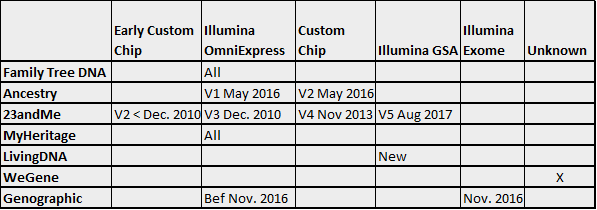
  • In March 2017, Family Tree DNA announced that they were accepting transfers of both the Ancestry V2 test, in place since May of 2016, along with the 23andMe V4 test, available since November 2013, for free. MyHeritage has since been added to that list. The Family Tree DNA announcement provided testers with another avenue for matching and advanced tools.
  • Illumina obsoleted their OmniExpress chip, forcing vendors to Illumina’s new GSA chip which also forces vendors to use imputation. I swear, imputation is a swear word. Illumina gets the lump of coal award for 2017.
  • I wrote about imputation here, but in a nutshell, the vendors are now being forced to test only about 20% of the DNA locations available on the previous Illumina chip, and impute or infer using statistics the values in the rest of the DNA locations that they previously could test.
  • Early imputation implementers include LivingDNA (ethnicity only), MyHeritage (to equalize the locations of various vendor’s different chips), DNA.Land (whose matching is far from ideal) and 23andMe, who seems, for the most part, to have done a reasonable job. Of course, the only way to tell for sure at 23andMe is to test again on the V5 chip and compare to V3 and V4 chip matches. Given that I’ve already paid 3 times to test myself at 23andMe (V2, 3 and 4), I’m not keen on paying a 4th time for the V5 version.
  • 23andMe moved to the V5 Illumina GSA chip in August which is not compatible with any earlier chip versions.
  • Needless to say, the Illumina chip change has forced vendors away from focusing on new products in order to develop imputation code in order to remain backwards compatible with their own products from an earlier chip set.
  • GedMatch introduced their sandbox area, Genesis, where people can upload files that are not compatible with the traditional vendor files.  This includes the GSA chip results (23andMe V5,) exome tests and others.  The purpose of the sandbox is so that GedMatch can figure out how to work with these files that aren’t compatible with the typical autosomal test files.  The process has been interesting and enlightening, but people either don’t understand or forget that it’s a sandbox, an experiment, for all involved – including GedMatch.  Welcome to living on the genetic frontier!

  • I assembled a chart of who loves who – meaning which vendors accept transfers from which other vendors.

  • I suspect but don’t know that Ancestry is doing some form of imputation between their V1 and V2 chips. About a month before their new chip implementation in May of 2016, Ancestry made a change in their matching routine that resulting in a significant shift in people’s matches.

Because of Ancestry’s use of the Timber algorithm to downweight some segments and strip out others altogether, it’s difficult to understand where matching issues may arise.  Furthermore, there is no way to know that there are matching issues unless you and another individual have transferred results to either Family Tree DNA or GedMatch, neither of which remove any matching segments.

  • Other developments of note include the fact that Family Tree DNA moved to mitochondrial DNA build V17 and updated their Y DNA to hg38 of the human reference genome – both huge undertakings requiring the reprocessing of customer data. Think of both of those updates as housekeeping. No one wants to do it, but it’s necessary.
  • 23andMe FINALLY finished transferring their customer base to the “New Experience,” but many of the older features we liked are now gone. However, customers can now opt in to open matching, which is a definite improvement. 23andMe, having been the first company to enter the genetic genealogy autosomal matching marketspace has really become lackluster.  They could have owned this space but chose not to focus on genealogy tools.  In my opinion, they are now relegated to fourth place out of a field of 4.
  • Ancestry has updated their Genetic Communities feature a couple of times this year. Genetic Communities is interesting and more helpful than ethnicity estimates, but neither are nearly as helpful as a chromosome browser would be.

  • I’m sure that the repeated requests, begging and community level tantrum throwing in an attempt to convince Ancestry to produce a chromosome browser is beyond beating a dead horse now. That dead horse is now skeletal, and no sign of a chromosome browser. Sigh:(
  • The good news is that anyone who wants a chromosome browser can transfer their results to Family Tree DNA or GedMatch (both for free) and utilize a chromosome browser and other tools at either or both of those locations. Family Tree DNA charges a one time $19 fee to access their advanced tools and GedMatch offers a monthly $10 subscription. Both are absolutely worth every dime. The bad news is, of course, that you have to convince your match or matches to transfer as well.
  • If you can convince your matches to transfer to (or test at) Family Tree DNA, their tools include phased Family Matching which utilizes a combination of user trees, the DNA of the tester combined with the DNA of family matches to indicate to the user which side, maternal or paternal (or both), a particular match stems from.

  • Sites to keep your eye on include Jonny Perl’s tools which include DNAPainter, as well as Goran Rundfeldt’s DNA Genealogy Experiment.  You may recall that in October Goran brought us the fantastic Triangulator tool to use with Family Tree DNA results.  A few community members expressed concern about triangulation relative to privacy, so the tool has been (I hope only temporarily) disabled as the involved parties work through the details. We need Goran’s triangulation tool! Goran has developed other world class tools as well, as you can see from his website, and I hope we see more of both Goran and Jonny in 2018.
  • In 2017, a number of new “free” sites that encourage you to upload your DNA have sprung up. My advice – remember, there really is no such thing as a free lunch.  Ask yourself why, what’s in it for them.  Review ALL OF THE documents and fine print relative to safety, privacy and what is going to be done with your DNA.  Think about what recourse you might or might not have. Why would you trust them?

My rule of thumb, if the company is outside of the US, I’m immediately slightly hesitant because they don’t fall under US laws. If they are outside of Europe or Canada, I’m even more hesitant.  If the company is associated with a country that is unfriendly to the US, I unequivocally refuse.  For example, riddle me this – what happens if a Chinese (or fill-in-the-blank country) company violates an agreement regarding your DNA and privacy?  What, exactly, are you going to do about it from wherever you live?

2017 – The Year of Marketplace Apps

Third party genetics apps are emerging and are beginning to make an impact.

GedMatch, as always, has continued to quietly add to their offerings for genetic genealogists, as had DNAGedcom.com. While these two aren’t exactly an “app”, per se, they are certainly primary players in the third party space. I use both and will be publishing an article early in 2018 about a very useful tool at DNAGedcom.

Another application that I don’t use due to the complex setup (which I’ve now tried twice and abandoned) is Genome Mate Pro which coordinates your autosomal results from multiple vendors.  Some people love this program.  I’ll try, again, in 2018 and see if I can make it all the way through the setup process.

The real news here are the new marketplace apps based on Exome testing.

Helix and their partners offer a number of apps that may be of interest for consumers.  Helix began offering a “test once, buy often” marketplace model where the consumer pays a nominal price for exome sequencing ($80), significantly under market pricing ($500), but then the consumer purchases DNA apps through the Helix store. The apps access the original DNA test to produce results. The consumer does NOT receive their downloadable raw data, only data through the apps, which is a departure from the expected norm. Then again, the consumer pays a drastically reduced price and downloadable exome results are available elsewhere for full price.

The Helix concept is that lots of apps will be developed, meaning that you, the consumer, will be interested and purchase often – allowing Helix to recoup their sequencing investment over time.

Looking at the Helix apps that are currently available, I’ve purchased all of the Insitome products released to date (Neanderthal, Regional Ancestry and Metabolism), because I have faith in Spencer Wells and truthfully, I was curious and they are reasonably priced.

Aside from the Insitome apps, I think that the personalized clothes are cute, if extremely overpriced. But what the heck, they’re fun and raise awareness of DNA testing – a good thing! After all, who am I to talk, I’ve made DNA quilts and have DNA clothing too.

Having said that, I’m extremely skeptical about some of the other apps, like “Wine Explorer.”  Seriously???

But then again, if you named an app “I Have More Money Than Brains,” it probably wouldn’t sell well.

Other apps, like Ancestry’s WeRelate (available for smartphones) is entertaining, but is also unfortunately EXTREMELY misleading.  WeRelate conflates multiple trees, generally incorrectly, to suggest to you and another person on your Facebook friends list are related, or that you are related to famous people.  Judy Russell reviews that app here in the article, “No, actually, we’re not related.” No.  Just no!

I feel strongly that companies that utilize our genetic data for anything have a moral responsibility for accuracy, and the WeRelate app clearly does NOT make the grade, and Ancestry knows that.  I really don’t believe that entertaining customers with half-truths (or less) is more important than accuracy – but then again, here I go just being an old-fashioned fuddy dud expecting ethics.

And then, there’s the snake oil.  You knew it was going to happen because there is always someone who can be convinced to purchase just about anything. Think midnight infomercials. The problem is that many consumers really don’t know how to tell snake oil from the rest in the emerging DNA field.

You can now purchase DNA testing for almost anything.  Dating, diet, exercise, your taste in wine and of course, vitamins and supplements. If you can think of an opportunity, someone will dream up a test.

How many of these are legitimate or valid?  Your guess is as good as mine, but I’m exceedingly suspicious of a great many, especially those where I can find no legitimate scientific studies to back what appear to be rather outrageous claims.

My main concern is that the entire DTC testing industry will be tarred by the brush of a few unethical opportunists.

2017 – The Year of Focus on Privacy and Security

With increased consumer exposure comes increased notoriety. People are taking notice of DNA testing and it seems that everyone has an opinion, informed or not.  There’s an old saying in marketing; “Talk about me good, talk about me bad, just talk about me.”

With all of the ads have come a commensurate amount of teeth gnashing and “the-sky-is-falling” type reporting.  Unfortunately, many politicians don’t understand this industry and open mouth only to insert foot – except that most people don’t realize what they’ve done.  I doubt that the politicians even understand that they are tasting toe-jam, because they haven’t taken the time to research and understand the industry. Sound bites and science don’t mix well.

The bad news is that next, the click-bait-focused press picks up on the stories and the next time you see anyone at lunch, they’re asking you if what they heard is true.  Or, let’s hope that they ask you instead of just accepting what they heard as gospel. Hopefully if we’ve learned anything in this past year, it’s to verify, verify, verify.

I’ve been an advocate for a very long time of increased transparency from the testing companies as to what is actually done with our DNA, and under what circumstances.  In other words, I want to know where my DNA is and what it’s being used for.  Period.

Family Tree DNA answered that question succinctly and unquestionably in December.

Bennett Greenspan: “We could probably make a lot of money by selling the DNA data that we’ve been collecting over the years, but we feel that the only person that should have your DNA information is you.  We don’t believe that it should be sold, traded or bartered.”

You can’t get more definitive than that.

DTC testing for genetic genealogy must be a self-regulating field, because the last thing we need is for the government to get involved, attempting to regulate something they don’t understand.  I truly believe government interference by the name of regulation would spell the end of genetic genealogy as we know it today.  DNA testing for genetic genealogy without sharing results is entirely pointless.

I’ve written about this topic in the past, but an update is warranted and I’ll be doing that sometime after the first of the year.  Mostly, I just need to be able to stay awake while slogging through the required reading (at some vendor sites) of page after page AFTER PAGE of legalese😊

Consumers really shouldn’t have to do that, and if they do, a short, concise summary should be presented to them BEFORE they purchase so that they can make a truly informed decision.

Stay tuned on this one.

2017 – The Year of Education

The fantastic news is that with all of the new people testing, a huge, HUGE need for education exists.  Even if 75% of the people who test don’t do anything with their results after that first peek, that still leaves a few million who are new to this field, want to engage and need some level of education.

In that vein, seminars are available through several groups and institutes, in person and online.  Almost all of the leadership in this industry is involved in some educational capacity.

In addition to agendas focused on genetic genealogy and utilizing DNA personally, almost every genealogy conference now includes a significant number of sessions on DNA methods and tools. I remember the days when we were lucky to be allowed one session on the agenda, and then generally not without begging!

When considering both DNA testing and education, one needs to think about the goal.  All customer goals are not the same, and neither are the approaches necessary to answer their questions in a relevant way.

New testers to the field fall into three primary groups today, and their educational needs are really quite different, because their goals, tools and approaches needed to reach those goals are different too.

Adoptees and genealogists employ two vastly different approaches utilizing a common tool, DNA, but for almost opposite purposes.  Adoptees wish to utilize tests and trees to come forward in time to identify either currently living or recently living people while genealogists are interested in reaching backward in time to confirm or identify long dead ancestors. Those are really very different goals.

I’ve illustrated this in the graphic above.  The tester in question uses their blue first cousin match to identify their unknown parent through the blue match’s known lineage, moving forward in time to identify the tester’s parent.  In this case, the grandparent is known to the blue match, but not to the yellow tester. Identifying the grandparent through the blue match is the needed lynchpin clue to identify the unknown parent.

The yellow tester who already knows their maternal parent utilizes their peach second cousin match to verify or maybe identify their maternal great-grandmother who is already known to the peach match, moving backwards in time. Two different goals, same DNA test.

The three types of testers are:

  • Curious ethnicity testers who may not even realize that at least some of the vendors offer matching and other tools and services.
  • Genealogists who use close relatives to prove which sides of trees matches come from, and to triangulate matching segments to specific ancestors. In other words, working from the present back in time. The peach match and line above.
  • Adoptees and parent searches where testers hope to find a parent or siblings, but failing that, close relatives whose trees overlap with each other – pointing to a descendant as a candidate for a parent. These people work forward in time and aren’t interested in triangulation or proving ancestors and really don’t care about any of those types of tools, at least not until they identify their parent.  This is the blue match above.

What these various groups of testers want and need, and therefore their priorities are different in terms of their recommendations and comments in online forums and their input to vendors. Therefore, you find Facebook groups dedicated to Adoptees, for example, but you also find adoptees in more general genetic genealogy groups where genealogists are sometimes surprised when people focused on parent searches downplay or dismiss tools such as Y DNA, mitochondrial DNA and chromosome browsers that form the bedrock foundation of what genealogists need and require.

Fortunately, there’s room for everyone in this emerging field.

The great news is that educational opportunities are abundant now. I’m listing a few of the educational opportunities for all three groups of testers, in addition to my blog of course.😊

Remember that this blog is fully searchable by keyword or phrase in the little search box in the upper right hand corner.  I see so many questions online that I’ve already answered!

Please feel free to share links of my blog postings with anyone who might benefit!

Note that these recommendations below overlap and people may well be interested in opportunities from each group – or all!!

Ethnicity

Adoptees or Parent Search

Genetic Genealogists

2018 – What’s Ahead? 

About midyear 2018, this blog will reach 1000 published articles. This is article number 939.  That’s amazing even to me!  When I created this blog in July of 2012, I wasn’t sure I’d have enough to write about.  That certainly has changed.

Beginning shortly, the tsunami of kits that were purchased during the holidays will begin producing matches, be it through DNA upgrades at Family Tree DNA, Big Y tests which were hot at year end, or new purchases through any of the vendors.  I can hardly wait, and I have my list of brick walls that need to fall.

Family Tree DNA will be providing additional STR markers extracted from the Big Y test. These won’t replace any of the 111 markers offered separately today, because the extraction through NGS testing is not as reliable as direct STR testing for those markers, but the Big Y will offer genealogists a few hundred more STRs to utilize. Yes, I said a few hundred. The exact number has not yet been finalized.

Family Tree DNA says they will also be introducing new “qualify of life improvements” along with new privacy and consent settings.  Let’s hope this means new features and tools will be released too.

MyHeritage says that they are introducing new “Discoveries” pages and a chromosome browser in January.  They have also indicated that they are working on their matching issues.  The chromosome browser is particularly good news, but matching must work accurately or the chromosome browser will show erroneous information.  Let’s hope January brings all three features.

LivingDNA indicates that they will be introducing matching in 2018.

2018 – What Can You Do?

What can you do in 2018 to improve your odds of solving genealogy questions?

  • Test relatives
  • Transfer your results to as many data bases as possible (among the ones discussed above, after reading the terms and conditions, of course)
  • If you have transferred a version of your DNA that does not produce full results, such as the Ancestry V2 or 23andMe V4 test to Family Tree DNA, consider testing on the vendor’s own chip in order to obtain all matches, not just the closest matches available from an incompatible test transfer.
  • Test Y and mitochondrial DNA at Family Tree DNA.
  • Find ways to share the stories of your ancestors.  Stories are cousin bait.  My 52 Ancestors series is living proof.  People find the stories and often have additional facts, information or even photos. Some contacts qualify for DNA testing for Y or mtDNA lines. The GREAT NEWS is that Amy Johnson Crow is resuming the #52Ancestors project for 2018, providing hints and tips each week! Who knows what you might discover by sharing?! Here’s how to start a blog if you need some assistance.  It’s easy – really!
  • Focus on the brick walls that you want to crumble and then put together both a test and analysis plan. That plan could include such things as:

o   Find out if a male representing a Y line in your tree has tested, and if not, search through autosomal results to see if a male from that paternal surname line has tested and would be amenable to an upgrade.

o   Mitochondrial DNA test people who descend through all females from various female ancestors in order to determine their origins. Y and mtDNA tests are an important part of a complete genealogy story – meaning the reasonably exhaustive search!

o   Autosomal DNA test family members from various lines with the hope that matches will match you and them both.

o   Test family members in order to confirm a particular ancestor – preferably people who descend from another child of that ancestor.

o   Making sure your own DNA is in all 4 of the major vendors’ data bases, plus GedMatch. Look at it this way, everyone who is at GedMatch or at a third party (non-testing) site had to have tested at one of the major 4 vendors – so if you are in all of the vendor’s data bases, plus GedMatch, you’re covered.

Have a wonderful New Year and let’s make 2018 the year of newly discovered ancestors and solved mysteries!

______________________________________________________________

Disclosure

I receive a small contribution when you click on some of the links to vendors in my articles. This does NOT increase the price you pay but helps me to keep the lights on and this informational blog free for everyone. Please click on the links in the articles or to the vendors below if you are purchasing products or DNA testing.

Thank you so much.

DNA Purchases and Free Transfers

Genealogy Services

Genealogy Research

Dublin – Heartbeat of the Emerald Isle

In the fall of 2017, I was privileged to spend 10 days in Dublin. I arrived a few days prior to my speaking engagement at Genetic Genealogy Ireland and planned to spend 4 days seeing Ireland, the home of my ancestors. Aside from losing a day to Hurricane Ophelia, I managed to stay on schedule, at least somewhat, with my preplanned tour schedule with my trusty tour guide, Brian O’Reilly.

Because of Hurricane Ophelia, no place, literally, was open on Monday and Tuesday was iffy and very wet. A hurricane is not a storm that ends shortly, but peters out as it moves on, which can take days. A few days later, the remains of Hurricane Brian (not to be confused with tour guide Brian) arrived too, but it was more like a normal (very) windy storm.

Therefore, I spent more time in Dublin itself than I had anticipated since a 12 hour roundtrip drive to either the Cliffs of Moher or the Giant’s Causeway didn’t seem terribly attractive in that weather.

Following the Genetic Genealogy Ireland conference, I spent another day in Dublin with a group of ISOGG volunteers and speakers. These are the folks who make this conference happen.

On our Monday ISOGG “day out”, among other places, we visited Trinity College at the University of Dublin including the Book of Kells and Dr. Dan Bradley’s ancient DNA lab before moving on to UCD (University College Dublin) where we visited a second ancient DNA facility, enjoying both tours and lectures .

I am combining these various adventures scattered over several days into one article.

I don’t know of any specific ancestors that lived in or near Dublin, but Dublin is a medieval city, established officially in 988, with humans having inhabited the area since before 140 AD when Ptolemy provided what is believed to be the earliest reference to a settlement where Dublin would one day be located.

In 841, the Vikings invaded followed by the Norman invasion of 1169, so needless to say, Dublin is a mixture of people that arrived from elsewhere.

Even the “native Irish” were a mixture beginning with Neolithic hunter-gatherers that settled and built the massive passage mounds more than 5000 years ago. Their descendants would have assimilated later with Celts who arrived about 500 BC as well as Anglo-Saxons who announced their arrival with a raid in 684 AD.

Dublin was the center of commerce and trade for eastern Ireland. If your ancestors lived anyplace in the area, they may well have traded here or transacted other kinds of business. One way or another, what happened in Dublin affected all of Ireland.

Ireland isn’t a large island. At its widest point, it’s 174 miles wide, 302 miles north to south and roughly equivalent to the size of the state of Indiana.

The Irish have a very different perspective of distance than people from the US.

Ireland may be small, but they have a rich and sometimes violent history – which makes genealogy research both enthralling and challenging. They also have some of the most beautiful scenery in the world, not to mention historical sites.

To preserve their heritage, Ireland has established the National Museum, which is actually a series of free museums, including The Museum of Archaeology where I discovered several archaeological and historical treasures.

National Museum

The National Museum is chocked full of wonderful items from throughout Ireland’s history.

For me, the most interesting artifacts were the bog bodies, the flint mace head excavated at Knowth and the Tara Brooch.

The front of the this carved flint mace head looks eerily like a face.

The side of the mace head had beautiful spirals, echoing the many spirals carved into the rocks at both Knowth and New Grange.

The bog bodies are in an incredible state of preservation, including hair. Much of Ireland, meaning the part not mountainous, is boggy.

Old Crogham Man’s leather armband survived.

This individual is nearly complete.

Unfortunately, DNA has not been able to be recovered from the bog bodies due to the conditions in the bog.

The Tara Brooch, in an incredible state of preservation, was found on a beach by schoolchildren and is believed by some, due to its incredible artistry, to have belonged to the High Kings of Ireland.

Just the day prior, I visited Tara, so finding the brooch in the museum was icing on the cake.

Dublina

I enjoyed visiting Dublina, a recreated medieval village of Dublin adjacent to Christ Church Cathedral. This exhibit would be excellent for children, complete with an archaeology lab and re-enactors demonstrating various parts of medieval life.

The information at Dublina and at the National Museum is duplicated somewhat, but presented differently. I actually preferred the Dublina approach, as the display cards in the Museum were wall-mounted with small print, not displayed in the cases with the artifacts, so the overall experience in Dublina was more enjoyable. Of course, the National Museum has most of the national treasures. Two unique places, both worth a visit.

In 841, the Vikings invaded Dublin, adding their DNA to the Celts and the original Neolithic people who had already settled in Ireland millennia before.

Can you write your name in the runic language?

I cheated and you can too, at this PBS link.

Vikings both owned and sold slaves, which might explain how Viking mitochondrial DNA came to be found in the British Isles.

Even the Vikings were concerned about toilet paper. Maybe it’s in their DNA, given Dublin’s fascination with toilet paper. You’ll see what I mean later!

In medieval Dublin, life was often short, with an average life expectancy of only 30 years. As you might imagine, sanitation in cities was problematic.

Guinness Storehouse

No trip to Dublin is complete without a tour of the Guinness Storehouse, a very popular tourist attraction. This wasn’t my favorite, but I can see why it is for many people.

While the Guinness Storehouse is now a museum, of sorts, Guinness brewing continues among a series of interconnected buildings. The Guinness family owns most of this portion of Dublin and has a 9000 year lease, issued in 1759 to Arthur Guinness who then established the brewery at St. James Gate. And no, that’s not a typo – it’s really 9000.

The Guinness Storehouse tour is self-guided, taking you through the history of beer-making in general, and of Guinness in particular.

I didn’t know that the word beer originated in the Anglo-Saxon language.

Nor had I ever seen hops before. In one area, the flavors in the beer are discussed and you can sniff each one, before tasting the Guinness itself. I always enjoy the science portions of tours.

The best part of the Guinness Storehouse is the top floor Gravity Bar with a panoramic view of all of Dublin where you’re also served a…wait for it…a Guinness. It wasn’t crowded when I visited, but be aware that the lines are often long and the top floor is glassed in and VERY HOT in the summer. Air conditioning is uncommon in Ireland.

The panoramic view is absolutely amazing.

The Wicklow Mountains are the source for the water used to brew Guinness.

Soda Bread

If you thought that potatoes were the staple food of Ireland, it’s not. It’s really soda bread, which is served with just about everything. You can always find soda bread along with tea. Sometimes soda bread, “just like grandma used to make,” is enjoyed with nothing, sometimes with butter and often with butter and some kind of jam.

Soda bread and tea just make everything better. If you don’t believe me, try it for yourself.

Doors

Dublin is the city of colorful doors.

Because much of Dublin is historic in nature, owners can change very little of the outside façade, but they can customize their door color, and they do.

When you don’t have a large canvas, you have to be creative in a small space.

There’s an entire store devoted to door jewelry.

Door of the home of the Guinness family, founders of the Guinness empire.

Dubliners tell you about their doors, and stop so you can see either outstanding or remarkable doors, or the doors of the houses of famous people.

Pubs

Dublin is also a city of pubs.

Pubs are generally neighborhood establishments, local places, where people gather to eat, drink and socialize. After all, these people are Irish.

My flight arrived at 9 in the morning, on Sunday, and the hotel couldn’t get me into a room for another 6 hours. What was I to do? Take the hop-on-hop-off tour, of course. These tours are fun. You can stay on the bus and listen to the guide, get off and back onto a later bus, or whatever combination suits your fancy.

As luck would have it, the bus stayed in the starting location for about 40 minutes, parked immediately outside of a pub, Madigans. I know. I know. What luck.

I was hungry and needed to find a restroom, so I decided to have bowl of soup. With soda bread, of course.

Hence, I was introduced to the Irish pub in the nicest of ways. My only regret was that I wasn’t able to return for the traditional Irish music or the Irish step dancing at the Arlington Hotel, recommended by Brian.

Pubs are literally everyplace, on every corner, and often in-between too.

Think you might want to drive in Ireland? Think again! Look at those road signs. Merges, roundabouts and unusual traffic patterns are everyplace. And remember, the cars are coming from the opposite direction you expect when crossing the street.

If you can make it across the street, there’s a pub on the corner where you can take refuge!

Another historic pub that’s also a B&B, the Ferryman.  If crossing the street is dangerous sober, think about it with a couple Guinness under your belt. Aye, better to stay in the pub or at the B&B!!!

Pub grub is the best.

The food in every pub is unique and I failed miserably in my attempts to sample it all!

Some pubs are named after owners, former owners or something in the neighborhood. This pub, The Horse Show House, is located across from the Royal Dublin Society, an area devoted to rugby.

This small village pub in the Wicklow Mountains was extremely unique with its painted ceiling.

And then, some pubs are portable.

I so wanted to ask, but then…perhaps some things are best left unknown!

Toilet Paper

Dubliners are obsessed with toilet paper. Seriously. Remember the Vikings and their moss – I think that trait has descended to the current day population.

In particular, Dubliners are obsessed with getting a good price on toilet paper – to the point that there are pop-up toilet paper markets along the street and on corners. Thankfully I had Brian to explain this phenomenon to me, because I would have never figured it out otherwise.

Brian says that a Dubliner will save $5 on toilet paper and then go the pub and spend $100 the same night bragging about what a good deal he got on toilet paper. We saw a man carrying a large package of TP on his shoulder into the bar across the street. I kid you not.

I love experiencing the culture of different places. I mean, I can hear the negotiations now.

“But that’s only one ply and me fingers break through…”

“Well, yes, I could give it for Christmas, but only for half the price of the Charmin over there….”

Bridges

Old, new, large or small, Dublin has them all. Like all early settlements, Dublin was founded on a river which continues to be the city center. I was lucky to be graced with a beautiful rainbow as we crossed this bridge.

Even the older bridges are beautiful, but one of Dublin’s bridges is famous and shaped like a harp.

The harp is the much beloved national emblem of Ireland. The Brian Boru harp, having nothing to do with Brian Boru, bearing the O’Neill coat of arms and dating from the 14th or 15th century is displayed in the Long Room at Trinity College.

By Marshall Henrie – Own work, CC BY-SA 3.0, https://commons.wikimedia.org/w/index.php?curid=32781748

In 2009,  a harp shaped bridge was designed for central Dublin in honor of Irish writer and poet, Samuel Beckett. Along with the contemporary design came unwelcome traffic restrictions which inspired an unpublishable Irish ditty about the bridge and inconvenience introduced by the bridge in a high-traffic and already congested area. Let’s just say that some of the words rhyme with Beckett and in Ireland, words are pronounced differently. For example, an equivalent sounding word for Beckett in the US would be Buckett.

You can view the bridge opening ceremony in 2014 in this You Tube video as water through firehoses “plays” the bridge cables like harp strings. It’s truly amazing and probably one of the most unique bridges on the planet.

Through the harp bridge, you can see Dublin’s new conference center which looks like it’s a bit tipsy and had one too many Guinnesses – a fate that has befallen more than one Irishman!

Royal Dublin Society

Genetic Genealogy Ireland was held at the Royal Dublin Society, known as the RDS, for three full days.

The schedule was chocked full of great speakers. The sessions were live streamed and can be seen in the Facebook group, Genetic Genealogy Ireland. The sessions, except for a couple that can’t be posted pending the publication of a paper, will all be available on Genetic Genealogy Ireland’s YouTube channel thanks to Maurice Gleeson. In the meantime, you can watch the sessions from the last 4 years. What a wonderful resource.

ISOGG volunteer, Emily Aulicino, at left, assists a visitor with which Family Tree DNA tests would be best to purchase for which relatives. Emily also had her book, Genetic Genealogy: The Basics and Beyond available for purchase.

My two presentations went very well, even with a challenging environment in terms of the acoustics in the facility.

If you’re a member of the Facebook group, Genetic Genealogy Ireland, you can see Autosomal Tips and Tools at Family Tree DNA and the second presentation, Autosomal DNA Through the Generations – but I’d actually suggest that you might want to wait until the Genetic Genealogy Ireland YouTube videos are released, because the audio will be better – or I surely hope so.

However, I just have to share something fun with you. This is me, just before my session, Autosomal DNA Through the Generations, where I compare the DNA of my granddaughters through three ancestral generations – including 3 of 4 grandparents and one great-grandparent. (Very big thank you to my family and my daughter-in-law’s family!)

Do you spot anything remarkable?  Hint – the dress. Now do you see it? If not, I’ll have an upcoming lighthearted article. Yes, yes, I know I’m very much a geek at heart!

Let’s take a quick look at a couple slides from other presentations that I found quite interesting.  As you probably know, I’m fascinated by ancient DNA, and we were extremely fortunate to have two presentations by scientists who work with ancient DNA in the lab.

I particularly enjoyed the ancient DNA presentations. Here, Dr. Eppie Jones from Cambridge University and Trinity College discusses Ancient DNA and the Genetic History of Europeans.

Dr. Dan Bradley from Trinity discussing Prehistoric Genomics at the Atlantic Edge.

You can see a few more photos of Genetic Genealogy Ireland, courtesy of Gerard Corceran, at this link.

I was so looking forward to visiting both Trinity College and UCD, including the genetics labs, so let’s go!!!

Trinity College, University of Dublin

One of the highlights of my visit was Trinity College, founded in 1592, and in particular, the ancient DNA lab. The wooden gate, above, opens into the plaza, below.

First, we had a delightful tour of the University of Dublin campus by this delightful philosophy professor, Joseph O. Gorman, sporting a charming green waistcoat making him appear something of a leprechaun.

If Joseph Gorman had been my prof, I might have paid more attention. He was excellent, a font of knowledge with a way of making everything interesting.

Here, the group of volunteers and speakers gathers, listening in rapt attention in the plaza inside the college gates. The wooden doored gate through which we entered is in the background, just to the left of professor Gorman’s head. The various college buildings on the campus are entirely inside the area walled by buildings and surround the plaza, an area once the location of the Priory of All Hallows where monks resided.

If you would like to view some very interesting videos about Trinity College and the historical buildings, click here and here for a lovely YouTube introduction including the charming Irish brogue.

Come on, let’s walk around the campus!

If it’s called a buttery, it can’t be bad. I love campuses with history!

The Trinity campus is just beautiful, with gardens polka dotted from place to place like living jewels.

Along with old trees growing in what was the cemetery from the monastery originally located here.

I could hardly wait to see the Book of Kells, created about 800 AD and eventually stored in the monastery in Kells, not far from Dublin and from where the book received its name, up close and personal.

Unfortunately, cameras weren’t allowed, although I certainly understand why.

On the second floor, above the Book of Kells exhibit on the main floor, we find is the infamous Trinity Library Long Room. I don’t think I’ve ever been in such an incredibly beautiful library.

In the library long room, this beautiful spiral staircase is still in use.

By Diliff – Own work, CC BY-SA 4.0, https://commons.wikimedia.org/w/index.php?curid=42693401

This amazing room is full of artifacts as well, some of them books, some busts and  just this incredible room itself.  Just look at that ceiling!

Taken from across the green, the old Trinity Library building is actually very long, unheated and uncooled. Translated, it is very hot and very cold, depending on the time of year. The actual “long room” is on the second floor, with the Book of Kells exhibit on the bottom floor.

Past more gardens and on to the Smurfit Institute of Genetics.

Yes, I think this building should be blue!

Of course. Whoever thought we’d come so far from pea pods in 1866 to the discovery of DNA in 1953 and on to the human genome being sequenced in 2003.  And today, we visit the ancient DNA lab.

We didn’t get any closer than the hallway. They aren’t being rude.  Contamination is the bane of genetics, and especially ancient genetic extraction when samples are already contaminated and scientists have so little to work with in the first place.

However, we could peek in.

I think this is the neatest lab I’ve ever seen.

Irish humor is everyplace.

Ok, I can’t leave my trolley in the plants, but you didn’t say anything about my mops.

Not the ancient DNA lab where chances are few and mistakes are catastrophic, but geneticists in training in a more traditional lab.

James Watson, greeting students every day at the top of the stairs. Just think, this field is new enough that I bet Dr. Bradley knows James Watson.

Dr. Dan Bradley explaining how genetic research was done with gel plates when he first began. I think these are antiques now!

Dan explaining the discovery that the Petrous bone in the skull contains by far the best preserved DNA in ancient specimens. This groundbreaking research came out of this lab. The skull that Dr. Bradley is holding is a plastic model, not a real skull.

Here, a bovine Petrous bone with Dr. Bradley in the background.

Dr. Eppie Jones, the face of the future in genetics. All I can say is that I hope bright young women stay in STEM focused education and sit up and take notice of Eppie’s accomplishments!

On the way from Trinity to UCD (University College Dublin), we passed this wall art. DNA is finally mainstream.

You can view additional photos of Trinity, courtesy Gerard Corcoran, here.

University College Dublin (UCD)

UCD has an ancient genetics lab too.

The ancient DNA lab is vacant today.

We were treated to a presentation about the analysis of DNA, ancient and otherwise. With the advances in both DNA extraction and the analysis of those results, the science of genetics has now morphed into two segments, the actual technical part of the extraction and processing, and the subsequent analysis.

The Insight Center for Data Analytics specializes in the analysis process.

Now that we have the ability to gather huge amounts of genetic information, what can we do with the data, how we advance science and at the same time, make the results understandable?

In the genetics lab at UCD.

New, super fast, super expensive sequencing machine.

Dr. Sean Ennis with the Genomics Medicine Ireland project discussing the Irish Genome initiative. How are the Irish alike and different from others? What defines the Irish, genetically?

The Irish are 95% lactose tolerant, reaching nearly 100% in Western Ireland.

What more can we learn in the future? The project is undertaking sampling DNA of the Irish who have a disease and those who are healthy as well.

Genetic pathways, art in the UCD genetics building.

You can view additional (lovely) photos of UCD at this link, courtesy of Gerard Corcoran who arranged the day’s festivities.

The Irish Folklore Collection

While UCD is a tremendously modern research facility, that’s not all it has to offer. The library hosts the Irish Folklore Collection which has recently undertaken to digitize oral histories recorded in the 1930s, which reach back into the mid 1800s.

At this link, you can search the catalog by name, surname, location or keyword.

You can search by surname here as well.

In the schools collection, you can search by surname or location. It would be worth looking to see where your ancestral surname is found in the early 1900s because the same family may be found in the same location much earlier.

Dinner

Our day ended at a Chinese restaurant where the walls were literally tiles with quarter inch tiles, arranged in the shape of flowers.

This entire restaurant was tiled in this manner. Absolutely amazing!

And since we’re on the subject of art, let’s visit take a side trip!

Quilts, the Universal Language

When possible, I always try to find a quilt shop. Brian and I found 4 in or near Dublin. Two were closed, one was relatively small, although I did find a souvenir fabric, but the last shop, Apple Tree Crafts, held two beautiful quilts.

These stylized trees are each hand embroidered – putting thread to fabric in the creation of art.

Of course, these poppies spoke to me and said, “Take me home,” so I did! Not the whole quilt, just the poppy fabric.

If you’re looking for quilt shops in Ireland, check out this link from the Quilter’s Guild of Ireland and always, always call ahead.

Around the corner from the quilt shop, we found a florist decorated for halloween.

I guess it’s evident that Ireland celebrates Halloween too.

Bye to Dublin

Dublin is a wonderful city. I barely scratched the surface in my 10 days. Of course, I was distracted by the conference and the hurricane. Minor details.

I never realized before my visit how genuinely nice and helpful the Irish are. The language is delightful, both Gaelic and English with that wonderful brogue. I can hear some of that brogue in Appalachia where so many Scots-Irish were transplanted.

The Irish have a wonderful and charming sense of humor as well as being very difficult to upset. They have a permanent lemonade out of lemons attitude. Or more specifically, a trip to the local pub can fix anything, along with Guinness, soda bread and some cheap toilet paper.

How does life get better?

______________________________________________________________

Disclosure

I receive a small contribution when you click on some of the links to vendors in my articles. This does NOT increase the price you pay but helps me to keep the lights on and this informational blog free for everyone. Please click on the links in the articles or to the vendors below if you are purchasing products or DNA testing.

Thank you so much.

DNA Purchases and Free Transfers

Genealogy Services

Genealogy Research

DNA.Land

DNA.Land first launched in October of 2015, a free upload site whose goal is to encourage sharing to enable scientists to make new discoveries including the initiative to understand what is needed for a cure for breast cancer by 2020.

Their purpose, as stated by DNA.Land in their FAQ:

DNA.Land is a place where you can learn more about your genome while enabling scientists to make new genetic discoveries for the benefit of humanity. Our goal is to help members to interpret their data and to enable their contribution to research.

DNA.Land has invested a lot of effort into providing tools for genetic genealogists in order to encourage them to upload their autosomal DNA testing results to DNA.Land and participate in research in exchange for having access to their tools.

Let’s step through the process and take a look at their offerings.

If you’re interested in participating, the first thing to do is to register and the next step is the consent process.

Consent

If you are considering participation, or uploading your DNA to utilize their ethnicity or matching services, you must sign their consent form. Needless to say, you need to fully read the consent form before clicking to authorize, at DNA.Land and anyplace else.

Please note that you can click on any image to enlarge.

Upload Your File

After you click to approve and continue, you’ll be asked to select a file to upload. I chose Family Tree DNA Build 37.

Research Questions

Given that the focus of DNA.Land is medical research, you’ll be asked questions about yourself and your ancestry, such as your birthdate, as well as that of your parents.

I joined the Breast Cancer research and authorized researchers to contact me.

You are then asked, “Is this file your file?” DNA.Land wants to be absolutely sure you are providing information for your own file, and not someone else’s.

DNA.Land then asks questions related to your family and breast cancer. I answered the questions, agreed to be contacted if there are questions and joined the study.

You’ll answer questions about whether your parent, full siblings or children have been diagnosed with breast cancer, as well as questions about yourself.

I was excited to see that I was the 7,456th person to join the breast cancer initiative, but then I realized that their goal is 25,000 by the end of 2017. They have a LONG way to go. Please consider joining.

Your Personal Page

Your personal page includes your file status, the research projects in which you are participating as well as reports available.

Your file status is shown at the bottom of the page, including links to learn more.

About Imputation

DNA.Land was the first vendor to attempt imputation. I wrote about imputation in the article, Concepts – Imputation. I also wrote about matching with a vendor who utilizes imputation in the article Imputation Matching Comparison.

Imputation affects your matches, segment sizes and the quality of those matches. If you’re not familiar with imputation, I would strongly suggest reading these articles now.

While I’m incredibly supportive of the breast cancer and research initiatives, I’m less excited about the accuracy of imputation relative to genetic genealogy. Let’s take a look.

My Reports

Now that I’m done with setup and questions, I’m ready to view information about my own DNA results according to DNA.Land. Remember that these results include imputed information, meaning data that was imputed to be mine in regions not tested based on my DNA in regions that have been tested. My Family Tree DNA file that I uploaded held over 700,000 tested locations, and DNA.Land imputes another 38 million locations based on the 700,000 that were actually tested.

You can select from various My Reports options:

  • Find Relatives
  • Find Relatives of Relatives
  • Ancestry Report
  • Trait Prediction Report

Let’s look at each one.

Find Relatives

As of today, just over 70,000 individuals have uploaded, an increase of 10,000 in just under two months, so the site is rapidly growing.

The first page is DNA Relationship Matches. The match below is my closest match to cousin, Karen. I wrote about dissecting this match in the article Imputation Matching Comparison.

You can show or hide the chromosome table at far right. Segments are divided into recent and ancient based on the segment size. I’m not sure I would have used the term “ancient,” but what DNA.Land is trying to convey is that more often, smaller segments are older than larger segments.

I have 11 High Certainty matches and 1 speculative.

The information page explains more. Click on the “Learn more about the report” link in the upper left hand corner, which displays the following example information.

All reported segments are 3.00 cM or larger.

Very beneficially, my closest match, Karen, showed her GedMatch kit number as her middle name. I utilized her file at GedMatch and her results at DNA.Land to compare raw data file matching and imputed file matching. You can read about the findings in the article, Imputation Matching Comparison.

Based on imputed matching, I’m not sure that today I would have much confidence in matches to the relatives of relatives, but let’s take a look anyway.

Find Relatives of Relatives

Relative of relatives is a big confusing.  Think if it as an alternate to a chromosome browser.  Here’s what their information page says about this feature.

This is a bit confusing. The “via” relative is the person on your match report.

The first person listed, or the “endpoint” relative is the person related to them.

The intersection is the set of intersecting matching segments between you, your match and their match that (apparently) also matches you, or they would not be on this report.

Here’s a Relatives of Relatives match with my strongest match, Karen.

The problem is that the person shown as Karen’s match, Shelley, is not shown as my match.  The common matching segments between the three of us, shown above and below, are very small.  Even though Shelley is a match to Karen, Shelley apparently only matches me on smaller segments, not large enough to pass the DNA.Land threshold for a match.

The problem is that all of the above matching and triangulating segments above are imputed segments and don’t show up as legitimate matches at GedMatch between me and Karen, so they can’t be a valid three way match between me, Karen and Shelley.

In other words, these aren’t valid matches at all, even before the discussion about whether they are identical by descent, chance or population.  Therefore, these have to be matches on imputed regions, not through actual testing.

The certainty field is also confusing.  I initially though that the “high” certainty pertained to the three way match certainty, but it doesn’t.  Certainty means the certainty of the match between your match (the via relative) and the endpoint (their match) and has nothing to do with the certainty of the segments matching the three of you being relevant.

If you’d like to utilize this information, please read the information pages VERY CAREFULLY and be sure you understand what the information, is, and isn’t, telling you.

Ancestry Report (Ethnicity)

The Ancestry report is DNA.Land’s ethnicity report.

Looking at the map, it’s difficult to compare the DNA.Land results to other vendors, because they have Scandinavia divided into half, with the westernmost part of Scandinavia included in their Northwest Europe orange grouping, the light green designated as Finnish with the olive green as North Slavic. Other vendors include Norway and all of Sweden as part of Scandinavia.

One nice thing is that the population reference locations are shown on the map below, even for non-matching reference groups.

In my case, DNA.Land missed my Native American entirely.

The chart below represents my known and proven genealogy as compared to the DNA.land ethnicity results.

You can see how DNA.Land stacks up against the rest of the vendors, below.

Trait Prediction Report

The trait report requires an additional consent form. In essence, DNA.Land wants to make sure you really want to see your traits, that you understand what you are going to see and that you understand how traits are calculated and displayed.

DNA.land offers several traits you can select from.

But there’s a hitch.

Before you can see your traits, you get to answer a survey. In all fairness, DNA.Land’s purpose is medical research, and the reports participants receive are free.

My eye color is accurate, BUT, I also just told them that my eye color is dark brown during the questions. Not terribly confidence inspiring – but my confidence increased  after reviewing all of the information they provided about the science behind my actual trait prediction.

The eye color map, above, is something unique I haven’t seen elsewhere. I find this kind of information quite interesting.

Even though I did provide DNA.Land with the “brown eyes” answer, this chart makes me feel much better, because they shared the science behind my result with me. Therefore, I now feel much better, because, based on the science, it’s apparent that they didn’t just parrot my result back to me.

There is also a “what if my result is wrong” link. After all, science is all about continuing to learn and to think we know everything there is to know about genetics is foolhearty.

Yea, I like this a LOT!

If you’d like to read more about how genetic research takes place, read the interesting article titled Is there a Firefox Gene? Yes, that’s the Firefox browser, and yes, this is a real study. Take a look. It’s really quite interesting and written in plain English.

Summary

DNA.Land has a different purpose than other DNA matching and ethnicity sites. As a nonprofit, DNA.Land offers their matching and ethnicity services as an enticement to genetic genealogists who have paid to test elsewhere to upload their results to DNA.land and in doing so, to participate in medical research.

DNA.Land is absolutely up front about their mission. The features are “complimentary,” so to speak, meant to be enticements to consumers to participate and contribute their DNA results.

Given that, it’s difficult to be terribly upset with DNA.Land’s features and services.

DNA.Land has a nice user interface and some nice display features. Their eye color mapping isn’t found elsewhere, and other similar features would make great teaching tools. Their help pages are informative and educational.

Imputation concerns me. Imputation for medical research doesn’t directly affect me today, although it may someday, given that imputed data is used for research.

Imputed data does affect your results at Promethease if you choose to utilize your imputed results as input for any application that reports your academic and/or medical mutations. You can read about that in the article, Imputation Analysis Using Promethease.

Imputation affects matching for genetic genealogy negatively. While I didn’t discuss matching quality in this article, I did in the article Imputation Matching Comparison, which I would encourage you to read if you are attempting to utilize the DNA.Land matching function seriously for genealogy. I would encourage genetic genealogists to simply match at the vendor where they tested, or at Family Tree DNA which accepts uploads (Ancestry V1, V2 and 23andMe V3, V4) from other vendors, or at GedMatch for serious match analysis.

My suggestion to DNA.Land for matching would be to eliminate the smaller segments entirely, especially if they are a result of imputation and not actual matching DNA segments. In my limited experiment, DNA.Land seemed to do relatively well on matching and utilizing larger segments.

Ethnicity results at DNA.Land, called Ancestry Results, are divided oddly, with Northwestern Europe including all of the British Isles, western Scandinavia along with the northwest quadrant of continental Europe. This division makes it extremely difficult to compare to other vendors’ results.

DNA.Land seems to report an unrealistic amount of Southern European, but again, it’s somewhat difficult to tell where the dividing line occurs. It would be easier if their ethnicity map were overlayed on a current map of Europe showing country boundaries. DNA.Land missed my Native entirely.

It would be interesting to know how much of the ethnicity results are calculated on actual DNA and how much through imputation. Ethnicity results tend to be dicey enough in the industry as a whole without adding the uncertainty of imputation on top. Having said that, given how popular ethnicity testing has become, offering another ethnicity opinion is probably a large draw for attracting people to upload and participate in research at DNA.Land.

Some of the trait information is quite interesting and new traits will probably be equally so, although I wonder how much of that information is imputed as well. In other words, I don’t know if the results are actually “mine” through testing or could be in error. The good news is that DNA.Land provides the genetic locations where the trait analysis is compiled, allowing you to utilize a service like Promethease which provides the ability in some cases to confirm imputed data if you upload your actual tested files from testing vendors.

For all results, I would very much like to see a toggle where you can toggle between actual match results and match results derived from imputation.

I would also like to see some research about the accuracy of imputation as compared to non-imputed results. Clearly this would be available through research efforts like my own at Promethease, exome and full genome sequencing.

In a nutshell, DNA.Land provides an interesting free service so long as you don’t want to take the results terribly seriously for genealogy research. If any of the results are important or you want to depend upon them for accuracy, verify elsewhere with actual tested data.

It’s important to remember at DNA.Land that their real goal isn’t to provide a product or to compete with the testing vendors. Their features are a “thank you” or enticement for consumers to contribute their autosomal data for medical research, some of which may be “for profit.”  Companies aren’t going to participate in research initiatives that don’t hold the potential for profit.

I really didn’t need an enticement, but I’m grateful nonetheless.

Additionally, DNA.Land has provided an important first foray into imputation and allowed us to compare imputed data with tested data. I know that wasn’t their goal, but I’m glad to have the opportunity to learn and work with real life examples. My own. I would encourage you to do the same.

Be Part of the Cure

The last thing I have to say is that I truly hope and pray that the Breast Cancer Deadline shown as 2020 is a real and achievable goal.

I welcome the opportunity for anything I can to do help eliminate that horrific scourge that has affected so many women. Breast cancer has taken the lives of my family members and friends, as I’m sure it has yours, and I would like nothing better than to participate in some small way in wiping it off the face of the earth. DNA.Land is one way you can help, and it costs you absolutely nothing.

______________________________________________________________

Disclosure

I receive a small contribution when you click on some of the links to vendors in my articles. This does NOT increase the price you pay but helps me to keep the lights on and this informational blog free for everyone. Please click on the links in the articles or to the vendors below if you are purchasing products or DNA testing.

Thank you so much.

DNA Purchases and Free Transfers

Genealogy Services

Genealogy Research

Testing Strategy – Should I Test at Ancestry and Transfer to Family Tree DNA?

As most people know by now, Ancestry doesn’t accept DNA file transfers from other vendors, so many people recommend testing first at Ancestry and then transferring to Family Tree DNA.

Actually, that’s not always the best choice.

  • There is nothing inherently WRONG with that strategy, but it may not be right for you either. Transferring to Family Tree DNA from Ancestry certainly won’t hurt anything, but a transfer will only provide 20-25% of your matches if you tested at Ancestry after May of 2016 because the DNA chips used for processing are different at the two vendors.
  • If you tested at Ancestry before May of 2016, the Ancestry kit and the Family Tree DNA kits are identical, so transferring will give you the same matches at Family Tree DNA as if you had tested there. You are on the Ancestry V1 kit, so just transfer.  There is no need for a V1 kit to retest at Family Tree DNA. The transfer itself is free, as are your matches, but to unlock all features and tools costs $19. A bargain.
  • If you tested at Ancestry after May of 2016, you tested on the V2 kit. Ancestry changed the markers tested and now the Ancestry kit is only partially compatible with Family Tree DNA. As an Ancestry V2 transfer kit, you will only receive about 20-25% of the matches you would receive if you tested at Family Tree DNA.  The matches you receive will be your closest matches, but is that enough?

For some people, especially adoptees, your closest matches may be all that you are interested in.  If so, you’re golden with any Ancestry transfer.

For genealogists, you’re missing 75-80% of your matches, and your brick-wall breaker may well be in that group. Not good at all!

Let’s look at my kits for example.  I have tested directly at Family Tree DNA, and I have also transferred an Ancestry V2 kit to Family Tree DNA.

As you can see, my Family Finder kit received 3115 matches.  My Ancestry V2 transfer kit only received 26.65% of those matches.

Plus, if you attach the DNA of known family members to your tree, Family Tree DNA provides phased matching, which tells you which side of your tree a match connects to.  In the example above, that means that I know immediately which side 1236 of my matches connect to.  That’s a whopping 40% and that’s before I even look at their trees or common surnames! This is an incredible tool.

People who recommend that you test at Ancestry, today, and transfer to Family Tree DNA may not understand the unintended consequences, or they may be people who work primarily with adoptees. They may also not understand the value of phased matches for genealogists.

For people who tested at Ancestry after May of 2016, my recommendation is to take the Family Finder test directly at Family Tree DNA as well as test at Ancestry separately.

If you tested at MyHeritage, that test is fully compatible at Family Tree DNA as well, so do transfer, no retest needed!

To Order or Transfer

To order your Family Finder test, click here and then on the Family Finder test, shown below.

To transfer to Family Tree DNA for free from any company, click here and then in the upper left hand corner of the screen, click Autosomal Transfer, last option under the dropdown under the blue DNA Tests to get started.

Related Articles:

______________________________________________________________

Disclosure

I receive a small contribution when you click on some of the links to vendors in my articles. This does NOT increase the price you pay but helps me to keep the lights on and this informational blog free for everyone. Please click on the links in the articles or to the vendors below if you are purchasing products or DNA testing.

Thank you so much.

DNA Purchases and Free Transfers

Genealogy Services

Genealogy Research

Cynthia Wells – A Light Gone Too Soon

It sounds trite to say that I’m sorry she’s gone, but I am.

Cynthia is one of those people that everyone, and I do mean everyone, liked.  She lit up the room everyplace she went, improved everything she touched and encouraged everyone, always.

And now, she has passed from this earth.

Cynthia was a long time dedicated genetic genealogist, and an even longer time genealogist. She joined the genetic genealogy community in the olden days, more than a dozen years ago and managed the Wells and Lay projects at Family Tree DNA.

She attended the conference for project administrators sponsored by Family Tree DNA every fall in Houston, and I was looking forward to seeing her next week.

Sadly, that’s not to be.

In short, those of us in the trenches together over the years have formed a family, of sorts.

I first met Cynthia perhaps a dozen years ago when we sat by each other at lunch at one of the early conferences and began discussing Indian traders in the south. She sent me an unpublished resource, along with a book, and refused any reimbursement at all. That’s the kind of person she was.

Cynthia worked as a volunteer for the LDS Church and spoke at several genealogy conferences and meetings, often attending at her own expense, bringing the message and joy of genetic genealogy to many.

A day or so before her passing, Cynthia returned from a trip to the Middle East, in particular, the Holy Land, to celebrate her husband’s retirement and the beginning of the next chapter of their life together. She was anxiously planning a two-year mission trip with her husband when she passed away.

What a heartbreaking situation her husband faces. My heart aches for him, her children and grandchildren.

Fortunately, Cynthia’s legacy is not lost.

You can read more about her passion in her speaker profile for Genetic Genealogy Ireland here.

You can listen to her lovely southern drawl as she gives her presentation about Reconstructing Irish-Caribbean Ancestry here.

You can read Cynthia’s obituary here.

If you are a member of the ISOGG Facebook group, you can read the remembrances of her friends along with photos of the places she traveled on behalf of genetic genealogy, truly a lovely tribute, here.

Cynthia’s unexpected and untimely passing reminds us all about how tenuous and fragile life is – and why we should say and do what needs to be said and done while we can. Cherish those we love and value every minute. We really don’t know when it might be our last.

Rest in Peace Cynthia – you truly have made the world a better place and improved the lives of those who were graced enough to walk a few steps with you along the way.

______________________________________________________________

Disclosure

I receive a small contribution when you click on some of the links to vendors in my articles. This does NOT increase the price you pay but helps me to keep the lights on and this informational blog free for everyone. Please click on the links in the articles or to the vendors below if you are purchasing products or DNA testing.

Thank you so much.

DNA Purchases and Free Transfers

Genealogy Services

Genealogy Research