Jasmine’s Journey of Discovery

I am Jasmine’s daughter, well, I guess that would be granddaughter with many greats preceding – but she is my ancient clan mother, nonetheless.

DSC_0027

Looking back now over the past 12 or 13 years since I had my mitochondrial DNA first tested and discovered I was a member of haplogroup J, I’ve realized what a journey of discovery I’ve been on.  Literally.  I was immediately interested in the ancestral journey of J, Jasmine, my ancestor, and as the tests became more refined, I learned more about Jasmine through her subgroups.

I’m now classified as J1c2f which is 4 subgroups downstream of haplogroup J, the original Jasmine, each one more refined and more geographically specific that the previous haplogroup.  Looking at the maps for J, J1, J1c, J1c2 and J1c2f side by side shows the migration path of my ancestor rather clearly.

We know that haplogroup J was born in the Middle East some 30,000-50,000 years ago.  Many subclades of J were also born there, but eventually, some began the slow migration to Europe.  They probably had no destination in mind at that time, but were simply searching for something – fresh water, unsettled land, better hunting…something.   My ancestor was among one of those groups, that long ago day.  I can’t help but wonder what she saw, or thought, or if she even realized she was embarking on any kind of a journey.  Did she have an inkling or was she simply moving next door?

Hap j map

Above, the haplogroup J map from the haplogroup J project at Family Tree DNA.

hap j1c map

The subgroup J1c map is shown above.  You can see it is somewhat smaller and the geography is not quite as widely dispersed.

my matches J1c2f

The haplogroup J project doesn’t group in more refined haplogroup subgroups than J1c, but on the map above you can see the most distant ancestor locations of my full sequence matches, all haplogroup J1c2f.  I’m surprised as how widely spread the ancestors of these participants are, given that by the time you’re 4 or 5 haplogroup generations downstream of a founding mother, J in this case, you’re often looking at distinctive regional clusters.  I find the marker in the Caucasus, north of Turkey, quite interesting.

There are only a limited number of ways to get to Europe if you are coming from the Middle East: over the Caucasus through Russia, the sea route via the Mediterranean or the combined land and sea route, through Turkey, crossing between Europe and Asia at present day Istanbul, or old Constantinople, shown on the map below.

istanbul map

Learning about my haplogroup pushed the genealogical clock back further than I had ever imagined possible – from about 200 years to tens of thousands.  That information fueled within me a vagabond I didn’t know existed, and at a depth I never imagined.

So, a few years later, I went on the “Journey of Jasmine,” at least part of it.  I retraced some of her footsteps and cruised the Mediterranean coastline where many haplogroup J descendants are found today.  I journaled about Jasmine daily and titled the trip, “The Journey of Jasmine.”  I spent a day in Istanbul, Turkey and another day in the majestic ruins of Ephesus near the coast, shown below, and I knew that either my direct descendant or her relatives had stood where I stood, thousands of years ago.

ephesus

When I crossed the Bosphorus River, or rather, sailed up and down the Bosphorus, which forms the border within the city of Istanbul between Europe and Asia, I knew that my ancestor, if she traveled from the Middle East to Europe using that route, had indeed crossed at or near that point.  Constantinople is a very old trade route, established where it was because of its location.  It moved me deeply to know I was likely standing in her footsteps, some thousands of years later.

Of course, it would have looked very different then.  I imagined it without contemporary buildings.

istanbul europe and asia

Above, both the European and Asian sides of Istanbul, with Asia across the River.  Below, the top photograph shows the European side of the bridge that connects the two halves of the city, and the lower photo shows the Asian side.

istanbul europe

istanbul asia

I have not been to Jasmine’s birthplace, the Middle East, but I’d surely love to visit, nor have I been to where my oldest ancestor whose name I know, Elizabetha Mehlheimer, was found in Goppmannsbuhl, Bayern, Germany around 1800, but I’m working on that too.

I have walked in the footsteps of other ancestors that I’ve found through DNA testing and I’m planning two trips within the next two years to do just that again.

This fall I will be visiting the location in Lancashire, England, discovered through a DNA match, where my Speake family originated, and as a bonus, down the road another 25 miles, where my Bowling line, who married into the Speak line, originated as well.  I’ll be sharing that with you as I connect with the past.

I’m also visiting Kent where my Estes line originated, also proven through DNA testing, and then next year, visiting the Frisian roots of my Estes line that was only discovered through DNA testing.

Of course, if I’m visiting Frisian roots, I’ll also be visiting my Dutch roots as well, another powerful connection through DNA, assisted dramatically by a wonderful Dutch genealogist.

I’m Not the Only One

Recently, I saw a couple of other people comment about how their genetic discoveries have inspired them to connect with their distant, or maybe not so distant, past.

One person posted this video of the Tuvan throat singers who have genetic connections to Native American people.

http://www.youtube.com/watch?v=DY1pcEtHI_w

Someone else who tested Native and never knew about that history before is attending a Homecoming Powwow this weekend.  Someone else attended an African Festival in Boston this week.

Another client who also tested Native visited Lake Baikal, the “home” of the Native people in Asia and sent me a photo of him standing on the shores of Lake Baikal to use in his DNA Report.  Below, Shaman Rock in Lake Baikal.

lake baikal

Someone else mentioned that they are attending a Hungarian heritage festival near where they live after discovering their Hungarian heritage.

http://www.festival.si.edu/2013/Hungarian_Heritage/

Opportunities to connect with our ancestors and their culture, our heritage, are all around us.

What About You?

So, I’d like to know – how have your DNA results inspired you?  Have they changed or influenced the journey of your life?  What kind of experiences have you had that you would never have had without DNA testing?  DNA has influenced my life dramatically and provided me with amazing opportunities and adventures – like the Lost Colony archaeology digs, for example.

As my good friend, Anne Poole, who I met through DNA testing, co-founder of the Lost Colony Research Group, pictured at left beside me below, reminds me every time we are on a hot, sweaty, poison ivy and tick-infested archaeology dig together, “it’s all about the journey.”  Indeed it is.  Tell me about yours.

anne and me on dig

______________________________________________________________

Disclosure

I receive a small contribution when you click on some of the links to vendors in my articles. This does NOT increase the price you pay but helps me to keep the lights on and this informational blog free for everyone. Please click on the links in the articles or to the vendors below if you are purchasing products or DNA testing.

Thank you so much.

DNA Purchases and Free Transfers

Genealogy Services

Genealogy Research

Pérez, Peres, Paries, Perica, Perry and Paris on PBS, Oh My

perez signatureYou know, it’s amazing the things you learn filming a PBS documentary.

You learn that no matter what you do, light is going to reflect off of your glasses.

You learn that you can indeed hear an unhappy cat who has been banished to the 3 seasons room through two closed doors.  That same unhappy cat begs to go out there any other time.

You learn that while you are filming, the phone, will, unfailingly ring every time, even if it hasn’t rung in 3 days.

You learn that if you take your phone off the hook, AT&T, now a smarter phone company, figures this out, assumes you made a mistake, and lets the phone ring again anyway.  Sigh….

You learn that if you get one of those annoying recorded sales calls, if you just lay the phone down (or bury it under a pillow), it will play forever and effectively takes the phone “off the hook.”  YES!!!

You learn that if you are a young man in the late 1800s from Guam, you sign on to a whaling ship, and the guys can’t pronounce your name, Dimitrio, they call you John.  Eventually you begin to call yourself John too.  It’s contagious apparently.  You do, however, give two of your children Dimitrio as a middle name, just to torment your descendants with hidden clues.

And you learn that the surname Perez which is pronounced in the US like the word pear with the beginning of the word Ezmerelda is pronounced like the city in France, Paris, in Guam.

You also learn that a man named Juan Perez, also known as Dimitrio Perez can mix his multiple first names and about 6 different ways of spelling Perez in an indefinite number of ways.  His signature as John Paris is shown above.

Indeed, maybe this is a clue to our mystery.

A mystery?  What mystery?  I love a good mystery!!!

The Mystery

Well, Jillette Leon-Guerrero has a fine mystery on her hands with all of the requisite red herrings and twists of fate included.  And she’s making a PBS documentary of her process of finding the answer.  Check out her website, Across the Water in Time.

It’s hard enough to track people whose surnames are misspelled, but to change countries, change pronunciations, change surnames, change first names….and to still be able to be identified…well, now we’ve entered the realm of DNA sprinkled with a little fairy dust for good luck.

So, here is the fundamental question.  Is Juan Perez, aka Dimitrio Perez aka John Paris, who was born in 1843 and died in 1928 in Hawaii related to the Perez family on Guam?

The descendants of John Paris on Hawaii carry an oral history that he was from Guam, then a Spanish colonial colony.  Jillette, from Guam herself, discovers later that they also had an oral tradition that he changed his name from Dimitrio to John.  How she wished she had known that sooner.  Dimitrio is a much easier name to search for than generic apparently-one-size-really-does-fit-all-men-on-a-whaling-ship Juan.

DNA Testing

In order to answer the question, DNA testing was performed, ultimately on three groups of people.  What we wanted to know was whether these people were related and if so, how and how far back in time?

Group 1 – In Hawaii, known descendants of Juan Perez/John Paris, his great-granddaughter Yolanda and her brother, Benjamin Paris.

Group 2 – From Guam, Jillette and her father.

Group 3 – From Guam, Jose Perez.  Jose ultimately tested to be a second cousin of Jillette’s father, but that was unknown prior to DNA testing.

Two different kinds of DNA testing can be utilized to answer the question.  These two types of tests answer fundamentally different questions.

The Perez/Paris Y Tests

The Y DNA test tests only the Y chromosome, handed from father to son, unmixed with the DNA of the mother, so it stays mostly intact generation to generation, except for an occasional mutation.  The inheritance path of the Y chromosome is shown on the following chart in blue.

Perez yline

The Y-line gives us a great deal of information about the direct paternal line, but no information about any other line.  Comparing the Y-line results of 2 men tells us whether they descend from a common ancestor.

In order to determine whether or not the Paris family on Hawaii is genetically the same as the Perez family of Guam, Benjamin Paris, great-grandson of John Paris of Hawaii, and Jose Perez, descendant of the Perez family of Guam, tested.  Indeed, their Y chromosomes do match, with one mutation difference, which would be expected to occur over time.  Initially, only 12 markers were tested, which included the mutation difference, so the tests were expanded to 37 markers each to confirm the match.  The two men match perfectly on the rest of the markers, so at 37 markers, they still have one mutation difference.

Family Tree DNA provides a tool called TIP which estimates the time to a common ancestor between men whose DNA matches based on the mutation rates of different markers and the known generational distance between the men.  For example, we know that these families aren’t related in the past three generations, since Juan Perez came to Hawaii.

The TIP tool estimates that at the 50th percentile, these men are likely to be share a common ancestor between 4 and 5 generations ago.  So it’s very likely that either the father of Juan Perez who immigrated to Hawaii was their common ancestor, or his father.  One thing we know for sure, it was after the adoption of Spanish surnames on Guam.  Guam was colonized in the 17th century after the Spanish claimed it in 1565 and the first Catholic missionaries arrived in 1568 and began to baptize people with Spanish given and surnames.

Therefore, if Juan Perez was born in 1843, his father would have been born approximately 1813 and his father approximately 1783, allowing for the average 30 year generation.

This means that the common ancestor of these two families was probably 5 or 6 generations ago, and possibly more.

Autosomal Tests

The second type of test utilized was autosomal testing which tests all of the DNA passed from both parents to a child, not just the direct Y DNA of the paternal line.  The reason to use this type of test is that it shows you who your cousins are as measured by the amount of DNA that matches.

perez autosomal

DNA is passed to descendants in a predictable way, allowing us to mathematically calculate how closely related two people are – at least roughly.

Each parent gives half of their DNA to a child.  Different children don’t get the same “half” of the parents DNA, so each child inherits somewhat differently.  Therefore,  siblings share approximately half of their DNA.

perez cousins

You can see in the above chart that people receive 50% of their parents DNA, 25%, approximately of each grandparent’s DNA, and so forth up the tree.  By the time we reach the great-great grandparents level, you only inherited about 6.25% of your DNA from each grandparent.

In the case of 5th or 6th generation descent, as in our case, we’re looking at each descendant carrying about 3.12% of the DNA at the 5th generation, and 1.56% at the 6th generation.  Two individuals descended from these common ancestors would both carry an estimated 3.12%, but not necessarily the same 3.12%.  In fact, you only share .78% of common DNA with a third cousin and .195% with a 4th cousin.

I’ve said “on average” and this means that after the parents’ generation, the DNA of each preceding generation is not passed in exactly 50% packets.  In other words, you might not get exactly 25% of the DNA of each of your grandparents, but might receive 20%, 30%, 24% and 26%.

Autosomal testing is a powerful tool, but it’s less and less specific in terms of exactly how closely people are related, the further back in time relationships and common ancestors reach.

Because of this, it’s important to use the oldest generation available for testing.

We tested 4 individuals using the Family Finder autosomal test at Family Tree DNA; Jillette’s father, Jose Perez from Guam and both Yolanda and Benjamin Paris who are siblings from Hawaii.

The results were that Jillette’s father matched Jose Perez from Guam as a second cousin, suggesting that they share a common great-grandfather, and at the third cousin level with both Benjamin and Yolanda, suggesting that they share a common great-great-grandfather with Jillette’s Dad.

Match Name Relationship Range Suggested Relationship Shared cM Longest Block
Jose Perez 2-3rd   cousin 2nd   cousin 222.83 29.77
Yolanda   Paris 2-4th   cousin 3rd   cousin 56.58 22.55
Benjamin   Paris 2-4th   cousin 3rd   cousin 67.52 21.10

Family Tree DNA utilizes the 5cM (centiMorgan) threshold to indicate a match, where we can see to the 1cM threshold on the raw data.  I did this breakout for all parties, and indeed, they did show as related.

On the graph below, each of the three individuals is being compared to Jillette’s Dad.  Notice that in many cases, both Yolanda (blue) and Benjamin (orange), together, match Jillette’s Dad, which would be expected because they are siblings.  There are other cases through where either Yolanda or Benjamin match Jose (green) on the same segment where they both match Jillette’s Dad.  For example, on chromosome 2, you can see the blue stacked on top of the green.  We also see examples of orange and green as well, but no place to we have orange, blue and green together.  This illustrates how differently siblings (Yolanda and Benjamin) inherited DNA from their parents.

perez chromosomes

The Question that Remains

We’ve now proven that the Paris/Perez family is one and the same on Guam and Hawaii utilizing Y-line DNA and that these people are all related at some level.  Of course, in genealogy, answers generally produce more questions.

Jillette will have to utilize genealogy records in Guam to determine who the father of Jose (aka Dimitrio) Perez was, and indeed, she has made inroads in doing so.

The second question is just how is the Perez family related to Jillette’s family?  We know that her father is likely a second cousin to Jose Perez, meaning they share a common great-grandparent, but who?  Keep in mind that these are estimates based on the percentage and length of shared DNA, and the cousin estimate could also fall a generation or half-generation (once removed) in either direction.

Leen tree - Jillette

Jillette’s father’s 8 great-grandparents are as follows:

  • Vincente de Leon Guerrero Y Santos and Maria de Las Nieves Gregario
  • Unknown Fejerang and unknown Guzman
  • Francisco de la Torre and Maria Acosta
  • Fabian de la Cruz and Juliana Ada

You’ll notice, there’s not a Perez among them.  Now what?

This is both a genealogical and a genetic question, and can be approached in both ways simultaneously.  Obviously, were Jillette to discover that the next generation included a Perez, then the mystery would be solved.  However, using genetics can narrow the scope of this hunt.

Jillette needs to utilize known relationships to narrow the scope of which line descends from the Perez family.

The best way to do this is to test another relative of her grandparents, assuming both grandparents are deceased.  The best bet here is to test a sibling of a grandparent.  If you test a sibling of both grandparents autosomally, one of them should match Jose Perez.  That immediately eliminates half of Jillette’s Dad’s ancestors.  If a sibling of Jillette’s Dad’s grandparents isn’t available, then test their children.

Let’s say, by way of example, that we have now limited the search to Jillette’s Dad’s paternal line.  That consists of two grandparents, Rita Guzman Fejerang and Justo Gregario de Leon-Guerro.  The next step, genetically, is to test people who descend from the parents of Rita and Justo, but not the children of Rita and Justo.  So, Jillette needs to find siblings of Rita and Justo and test their siblings oldest descendants.  Again, one line should match Jose Perez.

Utilizing this technique, it’s possible to “walk up the tree,” so to speak.  In the meantime, this technique will help Jillette focus on where to concentrate her genealogical efforts.

ICW – In Common With

Another tool that Jillette can use is the ICW, or “in common with” tool at Family Tree DNA.  This tool is underutilized, as many people don’t realize what it can do.

If you mark a match as a known relative, you can then see matches you have in common with that person.  If you both match an individual, you should contact that individual to see if they have a piece of genealogical information that links to either or both of you.  In Jillette’s case, the mystery of how her family connects to the Perez family in Guam could well be held in the genealogy records of one of the ICW matches.

You can see that Jillette has confirmed the relationship for two matches below.

Perez match

To view your common matches, in the drop down box, select “in common with” and in the box directly below, you’ll see the people you’ve confirmed with a known relationship.  Select the person you want to see your common matches with, and click on the orange “filter” button.

perez in common with

The display you will see are the people who match both of you.  In this case, there are two common matches between Jillette’s father and Jose Perez that are not among the group tested above.  That’s exciting, because we know they are related to both men – the only question is how.  Jillette is working on these questions.

Follow the Story

So if you are a Perez, Paris or anything similar from Hawaii or Guam, please, contact Jillette through her website.  If you are a Leon-Guerrero, contact Jillette.  And if you want to see how this episode of Genetic Genealogy Reality TV turns out, you’ll have to follow Jillette’s blog on her webpage.  Perhaps the PBS special will be widely available or uploaded to YouTube and we’ll all be able to share in the final chapter of this exciting mystery!

______________________________________________________________

Disclosure

I receive a small contribution when you click on some of the links to vendors in my articles. This does NOT increase the price you pay but helps me to keep the lights on and this informational blog free for everyone. Please click on the links in the articles or to the vendors below if you are purchasing products or DNA testing.

Thank you so much.

DNA Purchases and Free Transfers

Genealogy Services

Genealogy Research


A Buck By Any Other Name

buck

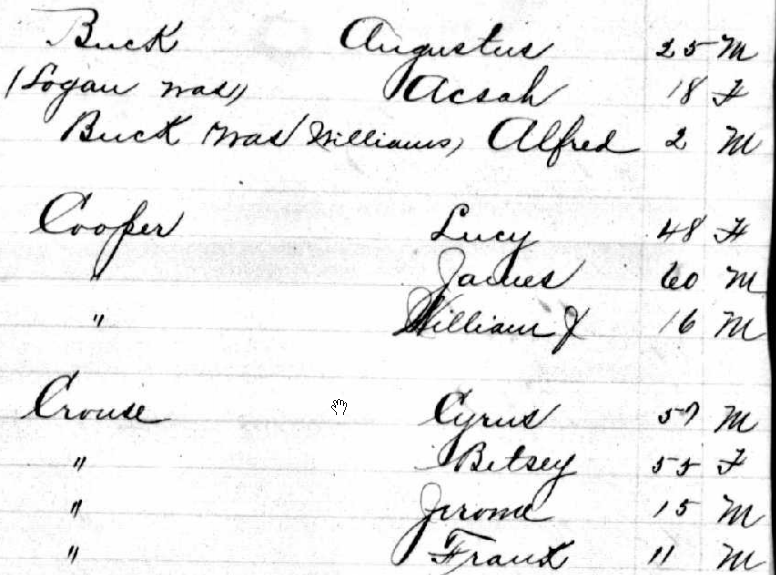
A Buck by any other name might be Hogan, Logan or Williams.  I think we have a case of surname schizophrenia.  We have four surnames involving 3 people.

Do you sometimes wonder why you or one of your relatives matches a whole group of people by a different surname, and none by the surname you expected them to match?

This 1888 Indian Census page for the Seneca on the Allegany Reservation in New York just might give you a clue as to why you’re not matching whom you think you should be matching..

Not matching who you expect to match is sometimes called a Nonpaternal Event (NPE) or I prefer the term undocumented adoption.  But this case doesn’t seem to be undocumented at all…it’s well documented….it’s just that we can’t understand it.

So let’s say this is your family and the husband, I presume is Augustus Buck.  So far, that looks normal.  But this is where normal ends.

Your name is Acsah.  If you’re married to Augustus Buck, your name would be Acsah Buck.  This is how all of the other families are recorded, so you would be too.  Except you have this little note that says either (Logan was) or Hogan was).  Is that a maiden name?  No one else’s maiden or other names are listed.  Is Acsah maybe not the wife of Augustus and the mother of Alfred noted below?  If that is the case, then why are they listed as Buck now?

And Alfred has his own set of problems.  He is noted as Alfred Buck, age 2. One would assume the child of Acsah and Augustus Buck, judging from the rest of the entries.  But Alfred had this note that says (was Williams.)  What does that mean?  It’s certainly not his maiden name.

Does that mean that Alfred isn’t a Buck at all?  Is Alfred even the son of Acsah?  Is Alfred really a Williams.  Was Acsah married to a Williams before Augustus?  That would seem to be pushing it given that she is only 18 and Alfred was born when she was 16.  Did she have time to be married earlier?

So, if Alfred’s descendants were to DNA test, would they match a Buck, a Williams, a Hogan or a Logan?  Or maybe none of the above if Acsah had Alfred before she married Augustus by someone not listed on the “was” list.  Maternal naming was a very common Native American occurrence and what is today considered to be illegitimacy was not viewed through the lens of colonial or Victorian America.

And just think, if you are Alfred’s great-grandson and you took the Yline DNA paternal line test, expecting to match a Buck, and you were instead matching a Williams, Hogan or Logan, and if you never saw this census page, you would have no clue as to potentially why.  Of course, if you aren’t matching a Buck or a Logan, Hogan or Williams, then all bets are off.  But at least, there is a clue here that something is not like the rest of the families recorded in the census.  It’s something to work with.

Of course, this makes me wonder how many more census entries warrant notes and of course never received them.  And of course, a legend to interpret the note would be nice too:)

______________________________________________________________

Disclosure

I receive a small contribution when you click on some of the links to vendors in my articles. This does NOT increase the price you pay but helps me to keep the lights on and this informational blog free for everyone. Please click on the links in the articles or to the vendors below if you are purchasing products or DNA testing.

Thank you so much.

DNA Purchases and Free Transfers

Genealogy Services

Genealogy Research

Unattaching Ancestry’s Self-Attaching Trees

I had really come to really dread the e-mails from people who say they are going to invite me to view their family tree at Ancestry.com.  It’s not because I don’t want to see the tree, I do.  It’s because Ancestry does me the huge favor of “attaching” that tree to my account like a very large parasitic blood-sucking leach.  They’ve assumed that every tree I look at is “family,” and that my attachment to that tree is “forever.”  And better yet, every time someone does something, anything, to that tree, I receive a message that says “New content has been entered to your family tree.”  Well, Ancestry, it’s not MY family tree and I NEVER asked you to do me any favors by attaching some random tree I’m looking at to me.  In fact, I specifically don’t want you to do that, but like normal, I don’t get to vote.  This is called “too much help” and anyone who has ever loved a 2-year-old knows all about “too much help.”

So, the random tree is firmly attached to me.  Now the question is how to remove the parasite.

First of all, I need to determine if I really do want the tree attached, meaning it is a tree I might want to reference, or if I simply want to detach it.  For DNA project administrators, most of the time, you simply want to detach them from your own personal records.

However, if you want to retain the connection to the tree, you can simply disable the notifications.  Those constant notifications are the part that will make you crazy, and the more trees you have attached, the crazier the notifications will make you.  Disabling notifications is relatively straightforward.  You need to go to your name in the top right of your screen and in the drop-down menu select “My Alerts”.

ancestry trees 4 v2

You can then change the delivery notification for each tree you have access to. The options are off, daily and weekly.  Yes, it’s a pain to have to do this to disable something you never wanted in the first place, but it’s only once (per tree) and it removes the bombardment of unwanted e-mails.

ancestry trees 5

Discovering how to remove the trees is more tricky.  However, once you’ve figured out how to do this, it’s relatively easy.

Fly your cursor over the Family Trees tab.

Ancestry trees 1

Some have a “More” option.  If so, click on it.  Mine didn’t.  If not, then click on the olive Family Trees Tab itself, not the drop down options.  You’ll then see “My Trees” and “Trees shared with me.”  Click on Trees Shared with me.  There is it, the blessed “remove from list” button.  Click and they are gone.

Ancestry trees 3

This is a frustrating dilemma because genealogists do want to share their information but it shouldn’t become a burden to either party.  It’s too bad Ancestry doesn’t give you the option to “save the link” or simply, by default, just look.

Debbie Kennett suggests that if people want to make their tree available online to their matches she finds MyHeritage is a much better alternative than Ancestry. You can upload a tree for up to 250 people free of charge. The big advantage of MyHeritage is that anyone can see your tree without needing to have an Ancestry subscription or
an invite.

Thanks to Ann Turner, Debbie Kennett and Jim Owston for their assistance with figuring out how to get rid of these self-attaching trees.  Once you know how to do this, it’s not difficult, but figuring out the procedure was anything but straightforward.

______________________________________________________________

Disclosure

I receive a small contribution when you click on some of the links to vendors in my articles. This does NOT increase the price you pay but helps me to keep the lights on and this informational blog free for everyone. Please click on the links in the articles or to the vendors below if you are purchasing products or DNA testing.

Thank you so much.

DNA Purchases and Free Transfers

Genealogy Services

Genealogy Research

All I Want for Christmas is my Moore Wall to Fall

I remember my old Hoosier farmer step-Dad used to say that a person’s luck was in direct proportion to the amount of elbow grease they expended.  I used to find his tidy little sayings quite irritating, but as I grew up, the deep seated truth behind them became evident and they are often with me in the recesses of my mind today – ever popping forth from time to time.  I always smile and think of Dad:)

It’s true, about the luck and elbow grease.  Partly because the more work you do, the more prepared and ready you are for “luck” to grace you, and because the more you focus on one thing, the more likely you are to “see” something you didn’t notice before.  And then sometimes, a little magic happens and a genealogy gift is bestowed upon you. Synchronicity.

In genetic genealogy, it’s also because there are new and/or improved and better tools available each year and more people test who may just provide the answer to long standing questions.  Let’s hope that Santa’s sleigh is full of DNA kits for people this year!

Each year, I pick a family to work on.  Many of those brick walls have fallen, probably half as a result of DNA testing.  The other half due to traditional genealogy, and in many cases, “luck.”  I prefer to think that it’s our ancestors helping us and providing us with ‘clues’ we could never find without a bit of a boost from the other side.

My Moore family has proven particularly difficult.  Partly because there are so many Moores out there.  My Moore line is from Halifax County, Virginia, or at least that’s where I first found them, but they lived in Amelia, now Prince Edward, County before that.  James Moore first appears in a record in 1745 in Amelia County.  He married Mary Rice, the daughter of Joseph Rice, his neighbor.  We can’t find James, or a possible relative, William Moore, who lived adjacent, before these early Amelia County records.  By 1770, James and his family had moved to Halifax County, Virginia and settled on the second fork of Birches Creek, shown below.  William Moore and his wife, Margaret, sold their adjacent land and moved on, but we don’t know to where.

Older Henderson Cem

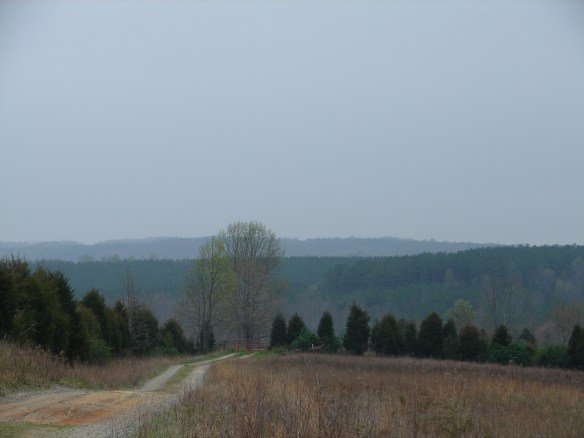
We found James Moore’s land, and the old Henderson Cemetery on land he once owned, on a trip to Halifax County in 2008.  We believe he is buried here with one of many fieldstones marking his grave.  This, the second fork of Birches Creek, is a land of beautiful, gentle rolling hills that often appear somewhat misty.  I stood where my ancestor stood, on the land he owned, and looked at the scene that was not much different than the one he saw 238 years earlier, except maybe for the gravel on the road.

Henderson cem 3

James Moore lived beside the Edward Henderson family and it’s believed that James’ daughter, Lydia, married Edward Henderson.  I have always suspected that James’ son, the Reverend William Moore, my ancestor, who married a Lucy may have married Lucy Henderson.  But the records don’t give us the answer.

There were several Moore families in Halifax County.  I was just sure that many of them were related.  Reuben Moore lived less than half a mile away from my James Moore, within sight of his farm.  Another James Moore family lived a few miles down the road.  One by one, we’ve tested most of these families, and one by one, they don’t match my Moore line.  For the most part, they don’t match each other either.  Moore was a much more common name than I thought and many Moore families were following the typical settlement and migrations patterns across Virginia and the Piedmont.

And worse yet, my Moore family doesn’t match any of the families that reach back earlier in time, and no Moore families from the British Isles.  So, in essence, we’re stuck.

So what do I intend to do about this?

First, I’m going to focus on this line. The Moore Worldwide project is the surname project for the Moore families.  In the past, the administrators, Marge Stockton and Julia French Wood, have grouped these families together and then using the research I’ve gathered over the years, I’ve written summaries for the various lines. I’m going to go back and revisit these lines, write about any new ones, and maybe, by process of elimination I can limit the possible Moore lines in colonial Virginia and Pennsylvania from which my Moores may have sprung.  They HAD to come from someplace!  Knowing which lines they did not come from, eventually, will lead to the ones they did come from.  I suspect it’s a line with only a few males, or we would find more Moores today, pardon the pun.

Secondly, I’m going to mine Ysearch, www.smgf.org and Ancestry once again to see if anyone new has popped up there.  I only have to check this one last time at Sorenson, as that data base isn’t being updated anymore.  Sometimes, I’ve had more luck tracing someone else’s records than my own.  If we know the Moore families match using Y DNA, then perhaps working on someone else’s genealogical lines will connect with the elusive colonial Moore family that is mine as well.

Update: Note that Ancestry discontinued the SMGF database.

Third, I’m really going to focus on the autosomal matches for Moore.  Moore is the 33rd most common surname in the UK, according to Wikipedia, so yes, I know I have my work cut out for me, but I’m looking for patterns here.

Fourth, I’m going to look for related surnames among my autosomal matches.  We’re fortunate to know that James’ wife was Mary Rice.  I am also going to look for Henderson, since I suspect that William Moore’s wife, Lucy may be a Henderson.  Finding these names seperately or together in the surnames of my matches could well be very meaningful.

Fifth, I’m going to ask my ancestors to help out.  I need a little bit of Christmas synchronicity.  And hey, I’m not picky, I’ll take help in whatever form I can find it.

Happy Holidays everyone and here’s hoping Santa will bring you “fallen walls” in 2013!!

______________________________________________________________

Disclosure

I receive a small contribution when you click on some of the links to vendors in my articles. This does NOT increase the price you pay but helps me to keep the lights on and this informational blog free for everyone. Please click on the links in the articles or to the vendors below if you are purchasing products or DNA testing.

Thank you so much.

DNA Purchases and Free Transfers

Genealogy Services

Genealogy Research

Thanksgiving, Spilling the Beans and Reaching Out

Everyone in the US and Canada celebrates the holiday of Thanksgiving, although on different dates.  Traditionally, as all children learn in grade school, in the US this holiday celebrates the Pilgrims being helped by the Indians to survive and a feast they jointly held in Plymouth, Massachusetts in 1621.  There is a lot of debate about that event, whether it happened or not, but I think it’s actually irrelevant.  More important is what Thanksgiving has morphed into, what it is today.

It’s a family day, often more so than Christmas, especially in the northern climates.  In my family, and many others, at Thanksgiving you see more extended family than at Christmas, where Christmas is more immediate family.  In the North, travel has become difficult or iffy at best by the end of December, but the end of November generally is still safe.  Now that I’ve said that of course we’ll have a blizzard.

Thanksgiving is the time when my Aunt Verma inadvertently spilled the beans on the “skeleton in the closet” at the dinner table.  You could have heard a pin drop.  Well, before the gasps.

Thanksgiving is the time to ask about those ancestors or family members, even if you think you know the answer.  Because, you may not.  Often, it’s for lack of asking the question or introducing the subject that you don’t learn those stories.

Probably the number one regret of genealogists is that they never reached out when they could.

Today, reaching out isn’t just across the dinner table or while doing dishes, a favorite time to pick the brains of your relatives, it’s about reaching out using new technology.

If you could make contact with someone who has photos of your great-grandmother, wouldn’t you want to do that?  How about someone who has a copy of the family Bible owned by your Revolutionary War ancestor?  Maybe a tin type and journal of your Civil War ancestor.  Who has those today?  Maybe you don’t even know they exist.

If they aren’t in your family, it will take a new form of reaching out to find them.  I’ve celebrated Thanksgiving this week by reaching out to the younger generation.  I don’t mean to stereotype, but let’s face it, you’ll never meet these people on Rootsweb. Where do you find them?  Facebook, that’s where.  Want to find out what pictures their grandma has in the attic?  Well, you have to make contact with them so they will ask their grandma, or tell their grandma to check out your Facebook page.  And yes, more and more, grandma is using Facebook.

Now stop groaning.  I can hear you from here!  I know, I groaned too.  But I did it anyway.  We need to interest young people.  They can DNA test and someday, maybe one  of them will be who you pass the proverbial family torch to.  If you’re like me, it’s not one of your kids, no matter how badly you want it to be. I think I burned them out in courthouses at the copy machine when they were kids.  My bad.

This is not difficult.  If you are not on Facebook, summon up your courage and go to www.facebook.com and sign up.  If you are already on Facebook, skip down 2 or 3 paragraphs to the section on setting up pages and groups.

If you’re really uncertain, you can google about how to get started using Facebook, but it’s actually really easy and intuitive.  You want to be on Facebook because your kids and grandkids are there and you’re going to lose touch with them and how they communicate if you don’t join.  Just do it.

Once you join, just type names into the top bar to look for your friends and family, where it says “search for people, places and things.”  Then send them a friend request.  You’ll see the “Friend” button, just click on it.  This isn’t difficult, you just need to get used to it.  Here are the results when I searched for Jim.

Once you are a friend, you will see what they put on their timeline and their status posts.  These include photos and such.  I see new photos of my grandkids just about every day.  Your news feed aggregates all of the people and projects that you are following.

Of course, you’ll want to post something, eventually, yourself.  The best way to get a conversation started is to ask questions, just like at Thanksgiving.

On Facebook, you do that by typing something in the field that says “What’s on  your mind?”  Facebook is one big informal conversation.

After you get at least a little comfortable with Facebook and your News Feed, you’ll want to set up either a project group or a page.

Here’s what I did.  And by the way, I am not “comfortable” with Facebook but I just did this anyway.  The only way to get comfortable is to work with the software.

I set up two pages and I’m going to set up project groups.  My new pages are ”DNAexplain” and “Native Heritage Project.”  You will have to type those names (minus the quotes) in the search bar at the top of the page at Facebook to find them.  That’s how Facebook works.  Then you click on the image and then click on “like” to connect yourself to them.  So please, do me a favor and “like” both of them.  Facebook requires 25 likes for a new group or page to be recognized as legitimate.

Pages are public.  They are generally for entities, meaning businesses and organizations.  You might want to put a family association there.  ISOGG (International Society of Genetic Genealogists) is there, for example, as is the Lost Colony Research Group.  Everything posted on these pages is available for everyone to see.

Groups can be set up to be entirely public, private or secret, meaning by invitation only.   Facebook has a help page that discusses these differences.  Groups are generally for more personal discussions.  For example, you might choose to form a “by invitation only” intimate family group.  You might choose to set up a Page to advertise your family association and to attract people who are interested in addition to a group for more private discussions.  Remember, the whole point of this exercise it to reach out, so the more public your presence, the better chance you’ll have of attracting interested people.  Be aware however, that these pages are not text searchable and do not have archives like Yahoo Groups or Rootsweb.  But then again, this is for reaching out, not archiving.

To create a page, which is what I recommend for surname projects, scroll all the way down to the bottom of your Facebook page and click where it says, “create a page.”  From there on, Facebook guides you.

To create a group, on the left hand banner, Facebook will show you any groups you are a member of, and at the bottom of the list, it says “create groups.”  Click there and again, Facebook guides you through the rest.

Here is my commitment.  If a Facebook page or group does not exist for each one of my DNA surname or other pet projects, I’ll create one by year end.   Yes, this year, 2012.  There is nothing like the present moment.  I’m reaching out to the next generation.  After all, the old folks are gone now, so I need new information targets:)  Who knows what I’ll find, but if I don’t reach out and try, I’ll find absolutely nothing!  I want more family information to be thankful for by next Thanksgiving!!!  I want to honor those who have gone before by preserving the information about their life.  That is what heritage is.

How about you?  How can you reach out and what do you hope to find?

______________________________________________________________

Disclosure

I receive a small contribution when you click on some of the links to vendors in my articles. This does NOT increase the price you pay but helps me to keep the lights on and this informational blog free for everyone. Please click on the links in the articles or to the vendors below if you are purchasing products or DNA testing.

Thank you so much.

DNA Purchases and Free Transfers

Genealogy Services

Genealogy Research

Smith and Jones

I just love a good mystery – don’t you?  To be good, it has to have some romance of course, a villain, an interesting plot with a twist, a couple red herrings and an unexpected outcome.  Personally, I like happy endings too – I just don’t want them to be too predictable.

Well, welcome to the Smith and Jones mystery.  And no, those names have not been changed to protect anybody.  They are quite real.

When I receive an order for a Personalized DNA Report, I send the client a short questionnaire to complete.  They have the opportunity to tell me why they tested their DNA, their goals, ask any specific questions, and to provide their genealogy so I have something to work with.  In addition, I customize the cover of their report with their family photos if they so desire.

When Mr. Jones returned his questionnaire, in answer to the questions about why he tested, he gave this response:

“My paternal grandfather was the son of an unwed mother.  So my paternal line doesn’t go back very far.  I really hope the DNA can help me find out who my paternal ancestors were.  So far, the indicators are they are Smiths from Bladen County, North Carolina.”

I cringed when I saw this.  Here’s a Jones who thinks he’s a Smith.  How am I ever going to straighten this out with these extremely common surnames?

In the genealogy section, he gave me a little more information.

His paternal grandfather, William Hobson Jones, below, was born in 1902 in Bladenboro, NC to unwed mother Emma Elizabeth Jones.

Those are all the facts I had to work with, other than his DNA results themselves, of course.

To begin, I checked the haplogroup hoping for something exotic that will serve as a differentiator.  R1b1a2-U106 – so no luck there.  However, when I prepared his marker frequency chart, he did have 3 very rare marker values.  Great.  Now we are getting someplace.

I divide marker values into three categories.  Very rare marker values occur in 6% or less of the haplogroup population, rare markers in less than 25%, and the balance are just unremarkable.  It’s the rare and very rare markers that give me something to work with, because they form a very specific genetic family surname “fingerprint.”  In this case, Mr. Jones’ marker 458 carried a value of 15 which occurs in 2% of the haplogroup R1b population, 576 with a value of 16 which occurs 6% of the time and 444 with 14 that occurs only 1% of the time.  These are the litmus paper tests of a real match.  In addition to these very rare marker values, he had 9 additional rare markers that can be used to refine the match criteria.  We’re in good shape for matching.

Mr. Jones had tested at 67 markers, but he had no matches at that level.  However, at 37 markers, he had 3 matches, and they were all to Smith men, none of whom had tested at 67 markers.  Now there’s a good indicator that he was right, that his genetic line is indeed Smith.  His exact match listed his oldest ancestor as being from Germany, but gave no name.  His one mutation match showed his oldest ancestor as Jeremiah Smith born 1795 NC and his 2 mutation match showed no information at all.  None of these matches had uploaded GEDCOM files.  Disappointing. With more information, this would have been much easier, but it wouldn’t be a good mystery without some glitches!

At 25 markers, he only had 7 matches, but at 12 markers, he had a whopping 536.  Obviously his first panel was too vanilla to be very useful, but of course, I did check for additional Smith men.  None to be found.  Just the 3, but those 3 are all very solid.

Sometimes, at this point, projects are a saving grace.  Project administrators are amazing people and put forth a lot of work, sort families, collect genealogies, etc.  The Smith DNA project does not have a public website at Family Tree DNA, but they do have a private site.

http://www.smithsworldwide.org/wwtestcomparisongrp.asp?kitno=’231289

At their site, I found a group of Smiths who match Mr. Jones, descended from one Moses Jones of Bladen County.  Huh?  This stopped me in my tracks for a minute, until I realized that this is my client’s kit number, and the Jones family, meaning Emma’s father’s line, indeed, does go back to a Moses Jones.  This would be irrelevant were it not incorrect, because Moses Jones’ male Y-line does not match the Smiths.  The only Jones line that matches a Smith is the one descended from his daughter Emma who had a child outside of wedlock, apparently by a Smith.

By this time, I was chomping at the bit to work with the genealogy records.  William Hobson Jones was born in 1902, so I was hopeful I could find his mother, Emma Jones, in the 1900 census.  The first rule in begetting is that the begetters must have physical proximity to each other – and the traveling salesman is the exception, not the rule.

Sure enough, in the 1900 census, there was Emma, right with her parents Nathan and Elizabeth Jones.  Emma was much older than I had expected, age 36.  She would have been considered a spinster in that time and place, and was probably considered a burden to her family.  Having a child would not have improved that situation any.

However, we have hit the proverbial jackpot here.  Take a closer look…..at the next door neighbor.

Claudius Smith is the neighbor….but wait….with his wife Glenora Smith.  Ok, let’s see if any of their sons are old enough to be the father of Emma’s child.  Nope, the oldest son is only 13, but Claudius himself is 38, just 2 years older than Emma.  Hmmm…..looks like maybe Claudius is the father, or at least he’s our best candidate right now.  Now Claudius might not be the father, but I’d wager that it is someone in his family, like a brother or uncle perhaps, if it is not him.  This Smith family is the best candidate due to the old begetters proximity rule.

This also might explain why Emma didn’t marry the father.  I wonder if she ever told anyone the identity of the father.  The family today certainly didn’t know.

Simple morbid curiosity got the best of me at this point.  I just had to look in the 1910 census to see if Claudius Smith and the Jones family were still neighbors. Was there a feud?  Did someone move?  Imagine my surprise to see Claudius married to Emma who had borne 4 children by this point.  What happened to Glenora?  And why did my client not tell me about this?  Surely he must have known.  Looking closer, this Emma is all of age 28 and her oldest child is 4….and flipping the census page, Emma Jones, along with her son Willie, age 6, indeed are still living next door, now in her brother’s household.  It seems that perhaps Claudius liked woman named Emma.  Maybe he was a widower when Emma Jones became pregnant.

I wondered if I could connect Claudius Smith with the Jeremiah Smith born in 1795 in NC shown as the oldest ancestor of one of Mr. Jones’ Smith matches.  I checked various sources, and Ancestry had a tree that pushed this particular Smith family back another generation, but not to Jeremiah.  This could probably be done, but not with the time alloted for genealogy in a DNA report.  I needed to look for other tools.  http://trees.ancestry.com/owt/person.aspx?pid=19139247

Chess Smith is shown as Claudius’s father and Elizabeth Ann Blackburn as his mother.  And yes, I’m fully aware that online trees should not be taken at face value, but they are good starting points and cannot be presumed to be incorrect either, especially if they confirm a suspected fact.  In this case, that didn’t happen – no Jeremiah.

Fortunately, Mr. Jones had also taken a Family Finder test.  He of course had Smith matches.  Who doesn’t?  But he also had three Blackburn matches.  The addition of this single female line surname gave me something concrete to look for.  I suggested that Mr. Jones contact his Blackburn autosomal matches to see if they can connect to the Chess Smith line.

So, at the end of the day that began with some level of apprehension that I might not be able to help Mr. Jones identify his genetic paternal line, we had a great research plan in hand.

We had discovered that the neighbor’s name was Smith, and he was married with 11 children in 1900, which might just explain why Emma never married the father of her child.  Of course, there might be other reasons too, like the father wasn’t Claudius, but another Smith relative.  It looks very promising, using autosomal tools to find Chess Smith’s wife’s surname, Blackburn, that this is indeed the correct Smith family.

Mr. Jones has some genealogy homework to do on the Chess Smith line, and some contact homework to do with his Blackburn matches, but now he does indeed have the information along with the tools he needs to solve the Jones-Smith mystery and break down that brick wall!

And thank you, Mr. Jones for permission to share your exciting family story!

______________________________________________________________

Disclosure

I receive a small contribution when you click on some of the links to vendors in my articles. This does NOT increase the price you pay but helps me to keep the lights on and this informational blog free for everyone. Please click on the links in the articles or to the vendors below if you are purchasing products or DNA testing.

Thank you so much.

DNA Purchases and Free Transfers

Genealogy Services

Genealogy Research
Semper Fi, Dave

It’s Veteran’s Day today.  My brother, David Estes, was a Marine, a veteran and he gave his life earlier this year as a result of his tour of duty in Vietnam.

A tail gunner, Dave was shot down in Vietnam, taking a bullet from below through the abdomen and delicately put, “private area.”  Amazingly, he lived, and subsequently received blood transfusions in the hospital in Saigon.  The blood was tainted and David learned in 2010, some 27 years later, that he had contracted hepatitis C.  For those who don’t know, hep C is generally asymptomatic, right up until about 18 months before it kills you, 25 to 30 years after contracting the disease.

David was an amazing man.  I didn’t know him long.  Just under 8 years.  I didn’t know him as a child and I didn’t get to grow up with him. You see, it was genealogy and DNA that brought us together.  He is my half-brother on my father’s side.  Our story has enough drama and unexpected twists to make any soap opera jealous.  Let me share a bit of our journey and something of Dave’s life with you.  After all, it’s Veteran’s Day.

Our father, William Sterling Estes, above, also a veteran of both WWI and WWII, was a bit of a playboy.  That’s somewhat of an understatement, kind of like calling an iceberg a large ice cube.  In fact, Hugh Hefner’s got nothing on him.  Our father managed to maintain two separate families, at the same time.  And no, he was not Mormon.  He was however, an alcoholic, the son of a bootlegger from the hills of Tennessee and Kentucky, but a very intelligent, functional alcoholic.  And handsome to boot.  Sadly, David’s mother was also an alcoholic.  Mine was not.  David grew up mostly under his Irish grandmother’s tutelage.  David never knew who his father was.  He knew our father, but as the husband of another family member.  If you’re confused, it’s OK, so were we.  Let’s just say that the words “Peyton Place” come to mind.  Below, Dad and David.

In any event, I knew, or had heard rumors, through the family grapevine that I had a sibling.  This subject was totally taboo and I knew nothing more until I received a box of letters from my step-mother’s daughter after my step-mother died.  In the box of letters were letters from my father’s sister and other family members to my father who died when I was 7, and to his father as well.  I read the letters and in them, I discovered that my sibling had been born the same year I was.  That was very confusing to me.  My mother, horribly embarrassed about the entire situation, refused to talk.  Eventually, she told me enough that I was able to determine that the child was a boy, about when he was born, and more importantly, the names of his mother and grandmother.  I didn’t even know his name.  Mother couldn’t remember, but she clearly remembered the name of the “other woman.”  Eventually, in 2002, after many years of searching, with the help of librarians, city directories, obituaries, marriage and divorce records, and ultimately, a private investigator, I located David.  The road was not easy or straight and was fraught with false leads and land mines.

After serving in Vietnam, David became a long-haul truck driver and lived in various places throughout the US before settling eventually in Ohio.  His path was very difficult to track.  The saving grace was a little brush with the law that gave him a police record.  I have never been so grateful for a police record in all my life.

However, when I found him, or at least where he lived, I hesitated a bit before contacting him.  Actually, for nearly 2 years.  A man with a police record.  Did I really want to open Pandora’s box?  I didn’t know.  To put it mildly, David seemed very different than me.  Once opened, you can’t close Pandora’s box.

Finally, I knew I had to make the move.  I couldn’t NOT contact him, regardless of the outcome.  On July 14, 2004, I wrote David a letter.  I had tried calling the phone number given to me two years previously by the private investigator, only to discover the number was no longer Dave’s.  I will never forget mailing that letter.  That letter was returned to me this past year.  His wife, my sister-in-law, gave it back to me after Dave’s death.  It was well worn and had been read over and over again, probably in many truckstops around the country.

A week later, my phone rang, and a very deep voice asked for me.  When I confirmed I was speaking, there was a pause, and then the voice said, “I’m David Estes, your brother.”  I could barely talk.  It was as if I had waited a lifetime to hear his voice and it was a rich melody to me.  We visited for hours, comparing information.  It turns out that he never knew about me, and while I assumed he knew who his father was, he didn’t.  In fact, he had spent years trying to uncover that missing piece of information.  His mother had died without divulging that tidbit to him.  There was a reason for that, as she was related (by marriage) to our father and the relationship was ‘improper’ to say the least.  This is a perfect example of why these family secrets are so tightly held sometimes.

For David, my envelope full of photos and information was a gift from Heaven, as was the fact that he had a sister.  Other than his 2 children, David had no living blood relatives.  At one time he had a step-sister, but when she protested against Vietnam and criticized his service, he walked away from her and never looked back.  David was exceptionally proud of his military service and sacrificed a great deal for his country, including ultimately, his life.

Dave was what, in Indiana, we used to call a “Billy bad-ass.”  He didn’t look for a fight, but he certainly wasn’t afraid of one either.  He had been in more than his share, being fiercely protective of family members and taking up for anyone he perceived to be an underdog.

David grew up angry and joined the military instead of finishing high school.  The Marines gave his anger and “bad-ass” tendencies focus.  He was extremely proud to serve his country.  His military records are sealed because of where he served and his unit’s role in the war.  In the end, when we desperately needed some of those records, we were unable to obtain them even with the assistance of Ohio’s Senators and Congressional representatives.

When Dave returned from the Marines, he began his long-haul truck driving career.  He drove millions of miles accident-free.  He was once trapped in riots in some city, and he climbed on top of his (employer’s) truck with a shotgun and defended his turf.  He was determined to die fighting for his perception of what was right.

David was never afraid to express his opinion. In fact, he did that often and sometimes loudly.  But when it came to his own bravery, he was always entirely silent.  I found out most of what I know through others.  David was both fearless and humble.  Pain meant nothing to him, even in the end.  Once, he pulled his own tooth with a pliers while on the road.

After he was diagnosed with hepatitis C, I wanted to test as a transplant donor, and he would not allow it, nor would he allow his children to be tested.  Eventually, over Dave’s objections, I did test…only to discover I was not a candidate.  I suspected why, but the medical team would not confirm my suspicions.  David died for lack of a donor, but he would not consider allowing his family to suffer in any capacity, even to save his life, which any of us would have welcomed the opportunity to do.  Had I matched, I doubt very seriously if he would have accepted part of my liver.

In 2004, I drove to Ohio to meet for the first time the long-haired, tattooed, truck-driving, swearing, hard-scrabble cowboy that was my brother.  I discovered that under that very hard veneer was a man with a heart of gold.  His dog, who rode with him for years, he had rescued from a man in a truck stop who was beating him as a pup.  When the man refused to stop, David gave the man some of his own medicine and then took the dog.  It’s amazing David didn’t have more than one police record.  And yes, his original record that allowed me to find him was for a bar fight over some man’s unwelcome advances towards a woman.

After David’s hep C was diagnosed, he went on disability for a few months.  However, he couldn’t stand it and went back on the road, long-haul driving again.  Someplace during those last couple months that he drove, he rescued another dog in need who had been dumped someplace.  When he developed cancer in the liver, a common result of hep C, his wife had to call him in California to tell him.  He finished his run before he would come home.  He pulled into the truck terminal about 12 hours before his appointment with the oncologist where they told him there was nothing they could do.  A day later he was in hospice.  Ten days later, he was dead.  The man was absolutely amazing.

When I met Dave, we looked for physical similarities.  We ran into the bathroom together and crowded around a little mirror above the sink looking to see if we looked alike.  Were we really siblings?  The photo below was taken that day.

Dave told me that he never used the “L word.”  His wife confirmed that.  The man who feared nothing did not want to be vulnerable.  As time went on, he whispered in my ear as I hugged him goodbye “I love you Sis.”  He had never had a sibling.  From that day on, “I love you Sis” was always his goodbye to me, in person or on the phone.  Being a truck driver, we never really knew if it might be our last conversation.  It was also the last thing he said to me, in a barely audible whisper.

A few years after we met, I had a cancer scare.  I was going to tell him when the time was right, but one day a semi pulled up in front of my house.  Yep, Dave was visiting unexpectedly.  Often only for an hour or so, but something was better than nothing.  My medical paperwork was laying on the kitchen counter.  He saw it and held it up, demanding to know “what is this?”  It told him that we didn’t know yet, I was still undergoing testing.  He looked at me dead in the eye and said “If you have cancer and need someone to take care of you, I’ll sell the house and quit my job and come and take care of you.”  I told him he couldn’t.  He told me I didn’t get to tell him what he could and could not do, and he would.  That discussion was over.  I knew beyond a doubt how much he loved me.  And I loved him all the more for it, my long haired, tattooed, truck-driving brother who loved me enough to give up everything.

When we met in 2004, Dave wanted to take a Y-line DNA test.  We knew what the Estes line looked like, back some generations, but we didn’t have anyone from my father or my father’s father to test.  So David would represent our line.  He swabbed.  Weeks went by, and finally his results arrived in an e-mail from Family Tree DNA.  I clicked to open, and to my utter horror, he didn’t match the Estes line.  I didn’t know what to think, but I was sure that we had discovered an undocumented adoption someplace up the line, meaning I had just spent 35 years doing someone else’s genealogy.  I was dumbstruck.  I did not for one minute believe that David was not my father’s child.  Everyone, including my father, believed that he was, based on the letters and such, even though it would have been much “better” in the family if Dave were not my father’s child.

I then found the only remaining male descendant of my Estes grandfather who agreed to test, and he matched neither the Estes line, nor Dave.  We had gone from bad to worse. That was a dark day.

This was before the days of the wide spectrum chip based autosomal testing we have today that so easily answers these kinds of relationship questions.  David and I next submitted our DNA to a lab to have an old-style CODIS test for siblingship done.  It came back inconclusive, as did the same test in a second lab.  I shudder to think how much I had spent by this time.

The day that 23andMe first offered their test, I ordered one for Dave and I both.  The results came back.  I held my breath and said a little prayer.  I clicked.

No match.  David and I were not siblings.  At least, we weren’t biological siblings.  Let me assure you, David was and is my brother in my heart.  But my heart sank.

And then I had a terrifying thought.  Maybe David was my father’s child, and I wasn’t.  I remembered a chat with my mother some years before when I asked her fundamentally that question, and suffice it to say that suggestion went over like a lead balloon.  But when she told me that she would give anything to be able to tell me that was the case, I knew she was telling me the truth.  She never forgave my father for that little “other family” indiscretion.  Neither did his “other family.”

By this time, I had spent so much money and had so much emotional investment, I had to know.  I have many Estes cousins, so we did selective autosomal testing of several who were related on the Estes side and not through other lines so that we could determine if Dave or I either one were descended from the Estes family.  By this time, there was so much confusion that all bets were off.  The outcome was that, indeed, I am descended from the Estes line and am the child of my father, and David is not.  Our father is not his biological father, after all these years of searching and then believing the answer was finally at hand.

I tried to tell Dave, to introduce the topic gently, but he did not want to hear me.  I decided at that point to leave things as they were.  Dave was my brother and I loved him and nothing in our DNA made any difference.

Thank you David for your service, your bravery in the face of adversity, your dedication, your tenacity, your loyalty, your compassion for those creatures who were helpless or victims, your “bad-ass” attitude, for loving me, for DNA testing in spite of the possible answers, and for your final sacrifice.

The words “thank you” seem so inadequate for someone who made the ultimate sacrifice and gave their life, but they’re the only words I have.  Dave has given beyond his own life in so many ways, not the least of which is the legacy of his DNA which continues to give to his children and others.   And yes, his DNA continues to fish every day for that elusive answer he never received in his lifetime.

Semper Fidelis, Dave.  Semper Fi.

______________________________________________________________

Disclosure

I receive a small contribution when you click on some of the links to vendors in my articles. This does NOT increase the price you pay but helps me to keep the lights on and this informational blog free for everyone. Please click on the links in the articles or to the vendors below if you are purchasing products or DNA testing.

Thank you so much.

DNA Purchases and Free Transfers

Genealogy Services

Genealogy Research


The Speak Family – 3 Continents and a Dash of Luck

Recently someone on one of the DNA lists asked about success stories outside of the US.  In the Speak(e)(s) family, we hit the proverbial gold mine – and it took people on three continents and a bit of luck.  The surname is spelled a variety of ways, so I’m going to use Speak for consistency.

Most of the Speak descendants in the US today descend from Thomas Speak, the original immigrant, who was in St. Mary’s County, Maryland by 1661 when he was summoned to court.  We know that he was born in England, but beyond that, we have little other information.  One important hint was that Maryland was at that time a Catholic enclave and England was very anti-Catholic.  Thomas’s son, Bowling, was definitely Catholic, so we suspected we were looking for a Catholic family in Protestant England.

We have identified through DNA testing that most of the original Speak(e)(s) family lines came from Thomas Speak’s two sons, John, known as John the Innkeeper, and Bowling.  Thomas Speak had married Elizabeth Bowling.

However, we still didn’t know where in England our Speak line was from.  Our “cousin” John David Speake who lives in Cambridge, England had DNA tested and proven that his line was not our line.  That was a disappointing day.

John has been an avid researcher for the Speak family, accessing records in England that we simply don’t have access to in the US.  John made contact with a man with the Speak surname from New Zealand and encouraged him to DNA test.  The New Zealand gentleman’s ancestor hailed from Gisburn(e), Lancashire, England – one John Speak who was born in Gisburn, Lancashire, about 1700.  The New Zealand descendant of that John Speak matched our Speak family DNA, that of Thomas, the immigrant.

Bingo – with this DNA match, we now had identified the family location and could focus our research efforts.  And yes, Gisburn was heavily Catholic.

We now know that our Speak family indeed is from the Gisburn area, a region long suspected by John David Speake.  In fact, John long ago had found a Thomas Speak there, born in 1734, but unfortunately, he also later found his burial record.

The Gisburn Catholic Church, St. Mary’s, was established in the 1100s and has miraculously survived intact.

Their burial records begin in the early 1600s, and it’s obvious from translating those records (from Latin) that they served a number of other locations, villages and farms, in the area.  We find the earliest Speak burials beginning with Anna, daughter of William, in 1602.  Not all burial records give the location of the deceased, but those that do are all Gisburne through 1653 when a series of other locations are given.  Of course, these locations may not be new, they may simply have been among those without a location given earlier.

Locations include:  Gisburne, Howgill, Rimington, Paythorn, Twiston, Miley, Horton, Varleyfield, Pasture House, Waitley, Todber, Watthouse, Yarside, Bracewell, Martintop and Newby.  This list takes us through 1828, when the Speak burials cease until in the mid 1900s.  The records may not be complete.

On the map below, you can see that all of these locations that have corresponding locations today are within 2 or 3 miles of Gisburn(e).  Those locations that do not exist on the map today may well have been farm or manor names that disappeared instead of becoming hamlets.  The location just below Gisburn with no name is Todber.  A caravan park is located there today, but otherwise, it has disappeared.

Many, many unmarked burials exist in this ancient churchyard that entirely surrounds the church.

The dashes on the cemetery map above are unmarked graves.  Fifty-one Speak burials exist in the records, and most of them are quite early.  I spent some time “reassembling” families and many family units are evident, although there is a pronounced repetition of names.

A bit of English history may be somewhat enlightening.  John feels that this group of Speaks families was not landowning.  In other words, they were not royalty, were not wealthy, did not have coats of arms, etc.  In medieval England, if you were not a land owner, then you were a tenant farmer, either free or bond.  Bond did not mean slavery, but it did mean you had little freedom to leave.  However, the freedmen had little opportunity to leave either, required the manor owner’s permission, and there was no place within the British Isles to go anyway.

Given that we are now back to the end of written records, and that is within 300 years or so of when all families took surnames, and that is within 200 years of when the first families took surnames – we may be to a time period when we will not be able to find any specific records of our Thomas or his family.  John now tells us that he has found a Speak family record in Downham, about 5 miles away, dating to 1305.  The Speak family is indeed ancient in that region and it would be a wonderful experience to walk where they trod, where our DNA still exists today, and from whence we sprang.

Thanks to DNA testing, if we never find any more information at all, we know the area and the family line that our Speak family is from.  That indeed, is a wonderful gift, and one that our ancestors gave us through their DNA.

So what comes next?  A trip to Gisburn of course!  Indeed, in 2013, several members of the Speak(e)(s) Family Association will hold our annual convention in Gisburn.  Indeed, we are going to walk in the cemetery and stand inside the church that our ancestors assuredly visited.  What would Thomas think?  His descendants, nearly 400 years after his birth, come home to find his family and the land he left.

This would not have been possible without the combined research efforts of several people in the US documenting the life of Thomas Speak, without John David Speake in England and his blood-hound research, without the Speak family members in the US who have DNA tested, or without our New Zealand cousin.  He was the lynchpin, the missing puzzle piece, the keystone.  We hope that he can join us in England in 2013 for a homecoming in the beautiful village of Gisburn.

If you’re a Speak family member, of any spelling or any line, click here to order a DNA test and join the Speak project.

______________________________________________________________

Disclosure

I receive a small contribution when you click on some of the links to vendors in my articles. This does NOT increase the price you pay but helps me to keep the lights on and this informational blog free for everyone. Please click on the links in the articles or to the vendors below if you are purchasing products or DNA testing.

Thank you so much.

DNA Purchases and Free Transfers

Genealogy Services

Genealogy Research