The Huge Surprise on Contrary and Northeast Creeks in Louisa County, Virginia

Louisa1

Google maps has been such a gift to genealogists. Today, we can look at the deeds of our ancestors, and if they have landmarks, especially multiple landmarks, we can then check Google maps and sometimes find those landmarks today. Utilizing the satellite view, we can “see” our ancestors land, and if street view is available where they lived, we can even virtually “drive down” the roads and take a look today, providing the road is paved. That rules out about half my ancestral lands right there.

In the 1980s and 1990s, I drove all over the eastern part of the US chasing down deeds in courthouses, road orders and eventually, my ancestor’s land. Google maps makes it tempting not to make the effort to visit if we don’t have to.

Today, I’ve become quite selective about limiting my DNA speaking engagements to places I really want to visit.

Louisa2

Recently, I visited Virginia to speak at a conference and let’s just say this was a home run of unprecedented proportions.

Louisa County, Virginia

Let’s take a look at Louisa County, for example. My Moses Estes lived there when he was first married. We don’t know when he first arrived, because Louisa was created out of Hanover County in 1742. That was a huge benefit, because Hanover County’s early records are almost entirely gone, except for deed books from 1734-1736, but Louisa’s still exist. We do know that Moses is first found in Hanover County when he buys 100 acres land jointly with his brother, Robert, in 1734. Moses married about this time to Elizabeth whose surname is unknown, so his wife’s family likely lived in this area as well.

In 1736, Moses patented 370 acres in Hanover County adjacent his brother, Robert’s patent.

In 1742, Louisa Splits from Hanover, and sure enough, in 1744 and 1746 we find both Moses and Robert assigned as road hands in the Louisa County court order books.

In 1748, Robert Compton sells 185 acres he bought in 1742 from Moses Estes and that land is located on Contrary and Northeast Creek. Then, in 1749, Moses, now listed as “of Amelia County” sells another 185 acres in Fredericksville Parish adjacent John Cumpton’s corner…on said Estes line adjacent Robert Estes line. So we have been gifted with two key coordinates.

When I wrote the original article about Moses Estes Sr., I found this land on a current map based on the description of land that included both Contrary and Northeast Creeks, or parts of them. That was a very lucky break, because there is only one section of land that conforms to that description allowing us to find that land almost 300 years later. That, alone, is absolutely amazing.

Moses would have lived on this land from the time he married in 1734 or 1735 until about 1748 or early 1749 when he moved to Amelia County – about 15 years. He and Elizabeth only have 3 known children, John, Moses Jr. and William, all born between their marriage and 1742 or so. This means that all 3 of those children were born on this land. It also means that probably many more children are buried someplace in this earth – on the land that Moses owned. That’s speculation of course, but given that couples if they were fertile had children every 18 months to two years, that means that Moses and Elizabeth would have had a total of about a dozen children – and we only know of three males.

Here’s what we know about Moses and his land in Louisa County.

This land is rich in minerals, or was at one time. The town of Mineral is either adjacent this land, or on this land, and was named Mineral because of the rich mineral deposits. There were pyrite and sulphur mines, and there are hidden mineshafts lurking today on this land as booby-traps. And there was and is….gold.

It is extremely rough and overgrown today.

Louisa3

The town of Mineral was originally known as Tolersville, but adopted its current name when it incorporated in 1902 due to the mining industry that supported the community. It was the center of gold mining activity in Louisa County, and during its heyday, there were fifteen gold mines located within two miles of the town.

Clearly, Moses Estes never knew the bounty on his land, or he would likely never have sold. Talk about literally sitting on a goldmine.

Ironically, the Native people may have known about this. The current land owner told me that when she was digging to put in a garden, years ago, they dug up many Native artifacts and arrowheads. This is very near the headwaters of Contrary Creek, an area that would be very attractive to both Native people and settlers due to the need for clean, fresh, water. Given that Moses patented this land, it begs the question of whether there was an Indian village there at that time. This was likely the Monacan people, but could also have been Powhatan.

Native people valued minerals for their medicinal value and for both trade and jewelry. We know that when the first Native people visited the earliest settlers and explorers, they wore copper, possibly gold, and pearls. Everybody loves jewelry. It’s not unlikely that the Native people knew about the valuable minerals on Moses Estes’ land – even if Moses never did.

Visiting Moses’ Land

It was a cloudy afternoon in September. I was driving along I64 between Beckley, West Virginia and Richmond, when I saw the sign on the road that announced I had crossed into Louisa County. I had been grateful that this day would only entail about 5 hours of driving, after a hard day the day before – although much of the day’s drive was through extremely hilly mountains. I hate being passed in curves in the mountains. And I hate rain in the mountains too. It had stopped raining by the time that I saw the Louisa County sign – a good omen.

I quickly asked my husband to check on his gadgetry to see how far Mineral was from I64 – because it occurred to me that it would be better to visit “now,” if I could, rather than “later” which would take a special trip. Right? Hubby was not nearly as impressed with my bright idea but we detoured anyway.

It was a bit further than we thought – but we got to see Louisa Court House too, in the town of Louisa, and travel down the road from Louisa to Mineral that Moses would have traveled every time he went to court and back home. Since court days, then, were the primary source of entertainment, all able-bodied men attended when court was held, four times a year – hence the name “Court of Please and Quarter Sessions.”

This was the road Moses would have been assigned to as a road hand too – to keep in repair.

As it turns out, I know all too well what that means – because part of that old road has been abandoned by the state and has returned to its natural state, or at least it’s trying to.

Louisa4

Moses owned a total of at least 470 acres which includes his 370 acre grant and the 100 acres he owned with his brother. There could have been more, but with the loss of early Hanover County records we’ll never know.

First, we found the headwaters of Northeast Creek near Shortman’s Road.

Louisa5

That too is a dead end, but we drove to the end and took photographs. It looks low here, so I’m guessing this land was never directly farmed, but it has clearly been logged since then.

Louisa6

Next, we drove into Mineral and back out again, down 208 to the other end of Chopping Road and then along Chopping road which parallels Contrary Creek back to 208 which is also 22.

????????????????????????????????????

Confusing? Think of this as a big triangle. We know that Moses owned the bottom part of the triangle.

Along 208, we crossed Contrary Creek. You can tell by looking at the creek that there are lots of minerals. Keep in mind that the headwaters are only a couple of miles away – and it’s already this mineralized.

Louisa8

The creek and tributaries are beautiful just the same. Look at this stunning boulder.

Louisa9

I can just see Moses or maybe his boys sitting there fishing – can’t you?

We don’t know how far north, but we know Moses owned the land across the road and where the Louisa County High School is located today because that land is between Contrary and North East Creek.

Louisa10

As we drove down Chopping Road, we drove into a subdivision that is just being developed. The lots are for sale, and these would likely have been on Moses land. You can see that some of these very old trees have likely not been logged and may have been here when Moses owned the land. If trees could only talk, what tales they could tell.

????????????????????????????????????

When we arrived at the intersection of Chopping Road and 208/22, we noticed a road named “Old County Road” that paralleled 208/22 on the north side of the RR tracks, so we turned down that road to see where it led. It looked to be closer to the headwaters of Contrary Creek than any other avenue we attempted.

We turned east on Old County Road, and came to the end where the pavement ended and as sign said “state maintenance ends” and it turned into a 2 track.

????????????????????????????????????

There were houses on both sides of the road, both with no trespassing signs. I wasn’t about to go further, but I did turn into the edge of one driveway to turn around – and to take pictures of the raptors that were flying in circles and landing in a field. I figured that was as close to Contrary Creek as I would get.

But then…a woman came walking down that two track, towards me. I started walking towards her.  I was incredibly glad to see her, although I don’t think she was nearly as happy to see me.

????????????????????????????????????

She is the landowner of the land beyond where the state maintenance ends – on the part of the road still “au naturalle,” so to speak. Just like it was when Moses maintained that same road and rode his horse up and down that road to town and back. That lady was so nice and helpful, and even gave me a rock from Moses’ land. She too loves rocks.

Louisa14

????????????????????????????????????

We had such a nice visit. And she had such wonderful historic stories about the land and its current and former owners.

Louisa16

Sure enough, the old road labeled 745 is the original road, abandoned by the county and state at one point, and then when the road turned into a sea of mud, the residents once again deeded the land back to the government to get it paved. Well, at least partially paved. It seems that the state would only pave the road if everyone deeded their land back – meaning the land that was the original road – and like always there is always one person with a “different” view. One resident deeded the land in front of his house back, but not his land further down because he wanted an assurance that a particular pear tree would not be cut down.

Louisa17

So the road is paved in front of his house, but his neighbors further east not only don’t have a paved road, they have to maintain it themselves and they have assured me, it’s muddy and mucky and in some places, past their houses, impassible. In the aerial photo above, the green treed area is pink and is where the head of Contrary Creek is located. This is also where the old mines are located, and abandoned shafts, and an old pyrite furnace. Not terribly safe there. The owner knows where it is, but I’ll not be hiking back to find it. She was also bitten by a copperhead a couple years ago. No thank you. Moses can keep his copperheads.

But as I look down the abandoned part of this road, I can look into the past and feel Moses there…

Louisa18

Directly across the main road from this area, just to the right of the oval track by the school, sits a log cabin, restored beautifully. The land is for sale today, including the cabin.

Louisa19

I just caught my breath when I saw this, because this was unquestionably Moses land.

Louisa20

Was the cabin there when Moses owned the land? Was this his cabin?

Louisa21

If this was not Moses’s cabin, they it was likely built during that same time period.

Louisa22

Because the cabin and another house are for sale on a 15 acre parcel, I was able to visit it on the web. It’s truly my lucky day.

Louisa23

This chimney has likely been rebuilt. Often the chimneys are rebuilt using the original stones. The cabin has also clearly been rechinked as well. Someone took very good care of this cabin, while retaining its original flavor.

Louisa24

Wouldn’t Moses be surprised to see today’s kitchens? He wouldn’t know what to think.

Louisa25

I’m betting that is the original floor.

Louisa26

http://www.zillow.com/homedetails/475-Davis-Hwy-Mineral-VA-23117/90114638_zpid/

If you want this cabin…and oh yes…the house that goes with it, you can have it for an incredible price. Just for the record, I bought an extra lottery ticket, and if I win, this cabin is my new office!!!!

For me, this journey, and in particular, running into the land owner, was an incredible gift. Like I told her, driving down that old abandoned section of county road, the original road, the one where Moses owned land…was like driving back into time. I couldn’t have asked for anything more on this impromptu Louisa County adventure. No google map trip can ever compare to the real thing – it’s only a distant second best – but it’s a wonderful starting and sometimes ending point. Never forego the opportunity to visit in person. You just never know what surprises might be waiting for you!

______________________________________________________________

Disclosure

I receive a small contribution when you click on some of the links to vendors in my articles. This does NOT increase the price you pay but helps me to keep the lights on and this informational blog free for everyone. Please click on the links in the articles or to the vendors below if you are purchasing products or DNA testing.

Thank you so much.

DNA Purchases and Free Transfers

Genealogy Services

Genealogy Research

Nora Kirsch (1866-1949), Quilter Extraordinaire!, 52 Ancestors #92

Nora motorcycle

Nora Kirsch on a motorcycle with 3 of her daughters, Eloise, Mildred, Nora and Edith, my grandmother.  These women were always up to some sort of mischief!  I come by it honestly!!!

Nora, or actually, Elnora or Ellenora Kirsch lived a remarkable life for a woman born in 1866, immediately following her father’s service in the Civil War.  Nora, as she preferred to be called, was born on Christmas Eve in Aurora, Indiana, on the Ohio River in the location known as the Kirsch House.  Proprietors of the Kirsch House for nearly 50 years were her father, Jacob Kirsch and her mother, Barbara Drechsel, who were married May 27, 1866.  Jacob and Barbara were both born in Germany.

Yes, indeed, if you’re counting on your fingers, it was a brief pregnancy – something that the family would spend the next several generations trying in a number of ways to hide – not the least of which was falsifying the family Bible.  It was the church records that would finally spill the family secret, more than 125 years later.

Aurora St. Paul Church

We know that Nora was baptized in 1868 at the St. Paul Evangelical Lutheran Church in Aurora.  In fact, that’s the only place her name is recorded as Ellenora.  According to her daughter, she didn’t like the name and never used it.  Witnessing her christening were Barbara and Georg Drechsel (also spelled Drexler), her grandparents.  We know that the Kirsch girls all attended the subscription Lutheran school held in the Lutheran church, above.

At that time, proprietors of hotels or inns lived in the establishment and oversaw the running of the restaurant and bar, plus the rooms and guest services of course.

Kirsch House 2008

Today (above), the Kirsch House building still stands, although for how much longer is questionable.  In the summer of 2008, I visited the Mayor of Aurora and he was kind enough to take me on a tour of the old building which has been abandoned for well over a decade.  The City at that time was hopeful of obtaining funding to restore the building.

I assured him that if I won the lottery, he would have his money, but instead of calling it the Neaman Hotel, for the proprietors following the Kirsch’s, they would have to rename it.  He laughingly said that if we funded the restoration, we could name it anything we wanted.  I’m still buying lottery tickets.  Sadly, the building is in very poor shape with many of the previous owners’ “improvements” compromising the structural integrity of the building.  It was nice to see it one more time, and to be able to see inside, especially upstairs in the private areas, which we had been unable to do before when mother and I visited in the 1980s.

Nora Kirsch probably

This photo was unlabeled.  By process of elimination, I believe this is Nora Kirsch as a child.

Nora spent her childhood at the Kirsch House with her 3 sisters and two brothers, all born before the end of 1876, meaning that Barbara had 6 children under the age of 10 years old.  How Barbara handled this, while running a hotel, is utterly beyond me, but she did and raised lovely young women. In one census, one of Barbara’s sisters lived there to help.

Nora must have helped to care for her siblings. Nora who would have been 10 at the end of 1876 must have had a lot of responsibility and received little individual attention.

In addition to caring for the children, Barbara cooked for the Kirsch House and she cleaned the rooms after the guests. On Tuesdays, she would make her famous “mock turtle soup” (no turtles, just beef) and the girls would deliver it to families who had ordered a “pail,” in their wagon, up and down the streets of Aurora.  A bowl of turtle soup and a beer was 10 cents at the Kirsch House and was served at the bar, shown here with Mother in the 1990s.

Kirsch house 1990s

The Kirsch House must have been a very interesting place to grow up.  The discussions of the politics of the time must have permeated the walls and one would not be able to avoid becoming enchanted with the various handsome strangers.  Some men would not come and go quickly, but would take up residence for quite some time, affording the family an opportunity to get to know them.

The photo below, laminated onto the bar of the Kirsch House, but now no longer in the building, shows the Kirsch House (at right) and the Aurora train station.  Notice the “taxi” waiting for passengers getting off of the train.

Three blocks directly down the street was the dock where passengers would board various steamers and paddleboats on the Ohio River.

Kirsch house map

The Kirsch House, at 506 Second Street (upper left hand corner of map above with little grey balloon,) was in an ideal location – close to both forms of primary transportation and hopefully high enough in elevation that the Ohio River floods didn’t reach that far north.  Sometimes it did and sometimes it didn’t.  The family tells stories of the floods.

Kirsch House street view

Here’s a view today of the train depot, the Kirsch House on the left and a view down Second street to the Ohio River where you see the trees in the distance.

Aurora landing

This is the Ohio River at the end of Second Street where passengers used to board the steamers.  It’s called Aurora Landing today.

Meet the Family

This is the only photo where all of the Kirsch children are present with both of their parents.  Left to right, I can identify people as follows:

  • Seated left – one of the Kirsch sisters – possibly Carrie.
  • Standing male left behind chair – CB Lore – which places this photo before November 1909
  • Seated in chair in front of CB Lore – Nora Kirsch Lore
  • Male standing beside CB Lore – Martin or Edward Kirsch
  • Male standing beside him with no tie – Martin or Edward Kirsch
  • Woman standing in rear row – Kirsch sister, possibly Lula.
  • Standing right rear – Jacob Kirsch.
  • Front adult beside Nora – Kirsch sister, possibly Ida.
  • Child beside Nora – Mildred Lore
  • Adult woman with black skirt – Barbara Drechsel Kirsch
  • Young woman beside Barbara to her left – probably Curtis Lore

kirsch family

Inside the Kirsch House

The Kirsch House was much less grand than the stories lead one to believe.  The rooms aren’t large, and the living area for the proprietor and the guests does not seem to be removed from each other.  One room is slightly larger than the rest and I would presume this is the owner’s bedroom.

There is a parlor, which we would consider a living room, and that seems to be the only common living area for the family or guests.  There were many small guest rooms.  The mayor had been in the building many times, as it had become the local “flop-house” when he was a paramedic.  A sad finale for such a fine civic landmark.

Nonetheless, in the late 1800s, the Kirsch House was a fine establishment and the Kirsch family was well-respected within the community.  They raised their daughters and sons here and sent them to private Lutheran schools.  They were literate and intelligent and went on to live successful, healthy, productive lives.

Ellenore “Nora” Kirsch was the first child born to Jacob Kirsch and Barbara Drechsel Kirsch in December 1866.  Nora would marry Curtis Benjamin Lore, known as “CB” Lore, at 4:30 PM January 18, 1888 at the Kirsch House.  Nora’s daughters shared the story that she made her own wedding gown (and wedding cake) and descended the spiral staircase into the parlor to meet her groom.

Kirsch house staircase

Our visit revealed that the spiral staircase wasn’t spiral, and it wasn’t open either (photo above), but nonetheless, the memory of the bride greeting her groom was joyfully shared for at least 3 generations.

Alas, I’m not at all sure that her life was as joyful as it was portrayed.

Nora’s Wedding

Nora Kirsch wedding invitation

The photo below was Nora’s wedding picture.  She is such a beautiful young woman.

Nora Kirsch wedding

Even though Nora married C.B. Lore on January 18, 1888, you might note in her Bible, below, she recorded her wedding at having taken place in 1885, which my mother corrected to 1888.  Nora must have rolled over in her grave.  THAT was indeed the family skeleton, but not nearly as large a skeleton as a secret that C.B. Lore harbored.

The following Bible pages were sent to me by Nora’s daughter, Eloise, and are from Nora’s Bible.

Nora's Bible cropNora's Bible2So, why did Nora modify her wedding date?

Nora and CB were married January 18, 1888 and their daughter Edith was born August 2, 1888 in Indianapolis.  At this time, this “early birth” was a social faux pas, but in this case, it carried even greater significance.  It is the key to a secret that has stayed buried for 120 years and only divulged itself in the overheated, oppressively dusty archives in the attic of a Pennsylvania courthouse on a humid August day.  It begs the question:  Who was Curtis Benjamin Lore?  Perhaps he wasn’t quite who he seemed to be.

Curtis Benjamin (known as C.B.) Lore

C.B. (Curtis Benjamin) Lore was a man who worked the oil and gas fields.  The census in Indiana says he was born in 1860 or 1861, but the 1860 census in Warren County, Pennsylvania shows us that he was born in 1856.

In 1887 when he came to Indiana from Pennsylvania, he was 31 years old, hardened and tan, a strong, worldly and extremely handsome man.  Nora was 21 and had little experience with men.  It’s no wonder that he subtracted a few years from his age, reducing the 10 year divide between their ages to a less questionable 6 years.  I don’t know whether she ever knew the truth or not, but his redesigned birth year stayed with him for the duration of his life, in the census and on his tombstone.

Below, C. B. Lore’s wedding photo.  Odd that there isn’t one of the two of them together…until you realize that Jacob Kirsch, Nora’s father signed for their marriage the very day they married.  This marriage was a bit hurried, one might say.  There probably wasn’t ‘time to prepare for much of anything.

Lore Kirsch Marriage

Little did Nora know that C. B. was not yet divorced from his wife in Pennsylvania. Ummmm, mmmmm, mmmm…as the old ladies used to say.

Curtis Lore Wedding

Curtis Benjamin Lore, most handsome rogue!

We have very few photos of Curtis (C.B.) Lore.  The one below is Curtis Lore (right) with his brother-in-law Martin Kirsch.

CB Lore Martin Kirsch

This photo belies the very rough childhood experienced by C. B. Lore.  His father would be dead before C. B. was 10, leaving C. B.’s mother to struggle to feed her children.  Sometimes she couldn’t.  At 14, C. B. was working as a farm hand and a decade later, by 1880, his mother would be dead too.  He spoke of this as a tragedy, although we don’t have any details.  In 1876, at age 20, C. B. Lore married Mary Bills in Warren County, PA.

In 1886 C. B. would move to Indiana, leaving Mary, to work the oil and gas fields as a driller and by late 1887 would fall in love with Nora Kirsch.  It’s unclear whether C. B. intended to “leave” Mary or if he just intended to work and then return home.  In any case, the leaving turned out to be permanent.

C. B.’s wife, Mary sued for divorce in November of 1887 which was final 4 months after his marriage in January 1888 to Nora Kirsch.  I suspect strongly that old Jacob Kirsch, Nora’s father gave C. B. the choice of the business end of a shotgun or the preacher, and being an intelligent man, C. B. selected the preacher.   His soon-to-be-x-wife was hundreds of miles away, would likely never know and might not care, and the gun was but a few inches distant in the hands of an angry father of a pregnant daughter who was a crack shot.

After their marriage, C. B. and Nora moved to Indianapolis, where their first child was born.  They then moved to Rushville, Indiana where they had 3 more daughters.  Curtis Benjamin Lore contracted tuberculosis, reportedly in Kentucky tending his race horses, and died in 1909.  His daughter, also named Curtis, contracted tuberculosis caring for him and died three years later, in 1912.

Nora must have been devastated.  Two of her sisters had also lost their husbands between 1908 and 1910 as well, one from suicide and one from syphilis.  This family had no shortage of drama and tragedy.

Nora’s parents were aging.  Jacob would pass away in 1917 and Barbara would hold onto the Kirsch house until 1921 when she would sell it and move in with her daughter Carrie, in Indianapolis.  Carrie would die in 1926, of syphilis contracted from her husband, hospitalized in an asylum.  There was no cure for syphilis at that time.  First it destroyed your body, then your mind.

A Stranger Knocks at the Door

One day, after C. B. Lore died, my grandfather, John Ferverda, Edith Lore’s husband,, was standing in the kitchen of his mother-in-law, Nora, in Rushville.  A man knocked at the door.  Nora answered the door, and the stranger said that he was looking for C. B. Lore, his father.

A long poignant silence fell over the small group. Nora seemed to recover her ability to talk within a minute or so, and then asked the young man inside.  She told him that C. B. had passed away.  The young man was too late to meet his father.

Both my mother and Eloise, mother’s Aunt (Nora’s daughter), told me about this event.  It was quite the scandal and was apparently one final blow to Nora.  Let’s just say that C. B. had not left her in the best of circumstances and had apparently accepted money for services he did not provide.  Perhaps it was because he was ill, but regardless, it was left to Nora to make things right after his death.

Unfortunately, Mother never knew the name of the young man, nor did she tell me any details.  I don’t think her father told her.  He may have left Nora and the young man alone to talk privately.  I’m sure the situation was quite distressing and embarrassing for all involved.

Poor Nora.  And the poor young man too.  I can’t help but wonder what happened to him.

Nora’s Second Marriage

Nora married Tom McCormick on October 28, 1916 in Rushville, Indiana, a man with whom she was never happy.  The only example we have of Nora’s signature is on her marriage document to Tom McCormick.

Lore, Nora marriage to McCormick

They lived happily never after.  They never divorced, but neither did they live together after a short time.  Nora is buried in Rushville beside C. B. Lore.

By 1920, Nora had moved with Tom McCormick to Chicago where they lived at 3820 Washington Boulevard Per the 1920 census) and he was listed as a superintendent in a factory.  Eloise said that he managed the woodworking for the Victrola factory.

Nora Chicago location today

The location of the address is this vacant lot today, but the property in the photo above looks almost exactly like the backs of the apartments show in the photo below.

Nora and Claude Martin 1920 Chicago

Nora Kirsch Lore McCormick and Claude Martin, probably about 1920.  At least she is smiling and laughing in this photo.  The men both have white hats – must have been the style of the day.

Below is a photo of Nora with Tom McCormick.  He looks like Scrooge and she looks miserable.  She was better off without him.  Mom says he deserted her but somehow the family eventually received word that he had died.

Nora and McCormick in Chicago

Below are the fronts of the buildings in Chicago whose backs are showing above, so it’s likely that the building Nora lived in looked much like these.

Nora Chicago building fronts

This is less than a block from Garfield Park, complete with a pool and an observatory.  At that time, this would have been a rather posh neighborhood.

However, let’s take a step back in time.

A Visit To Rushville, Indiana

In the 1910 census, Nora and the girls were living at 324 W. First Street in Rushville which is, today, the state highway through town.  Nora is listed as a widow at the same address in the 1916 City Directory as well, with Mildred listed as a sales clerk and “Elouise” as a student.

Wabash 324 w first

Nora sold fabric and such, after C. B.’s death, so this would have been a perfect location for her business, as it is the main street through town.

I don’t know if she lived in this location when C.B. Lore was alive, but I suspect that she did not move unless she was forced to.  To my knowledge, they never owned property.

Judging from the photos in Mother’s box, her visit with me was not the first time she visited Rushville.  She apparently visited with her mother at least twice, once about 1940 and then again after Nora’s death in 1949.

Rushville Willkie

Our family was connected with Wendell Wilkes’s ill-fated 1944 run for the presidency.  Willke’s wife was from Rushville and judging from a newspaper article, Nora and his wife were friends, and their children had attended school together.

Willkie sign

In the photo below, Mom stands near the memorial to Wendell Willkie in the cemetery where C. B. Lore and Nora Kirsch Lore McCormick along with their daughter Curtis Lore are buried.

Rushville Mom and Willkie memorial

The following newspaper article from Mom’s scrapbook is very interesting, not only in terms of the Willke family, but in terms of information about Nora herself.

Rushville newspaper article

In 1940, Nora is living with her daughter in LaFontaine, Indiana and is thinking of returning to Wabash.  She states that her husband has died.  I suspect his means McCormack.  Nine years later, Nora would pass away in Lockport with Eloise.  I find her final comment very telling, not only about her life, but about women’s lives in general, particularly in the generations born before the 1950s when women would begin to have more generous choices.  I hope she got to do the things she aspired to before her death and hat she missed doing in her younger life.  I wish she had shared with us what they might have been.  It’s sad that the most intimate glimpse of her life’s aspirations and her only “voice” remaining is through a newspaper article.

It’s too bad there were no photographs accompanying the article.  This trip must have been very exciting for mother, who would have been about 18.  Had things gone differently, she could have met the man who would have been president.

After we finished at the courthouse and cemetery, we went on to find the Graham School that the Lore girls would have attended, which was located a couple of blocks from their house, which was on Main Street according to the census.  It was abandoned in the 1990s, but when the girls would have gone to school, it would have been a bustling place full of youthful voices.

Rushville school

Below is the First Presbyterian Church in Rushville.  I can’t recall exactly what we discovered, if they attended this church, if C.B. Lore helped to construct this church, or both.  Whatever the connection, Mom was very excited to find their church and is standing in front in the photo.  In Aurora they were Lutheran.  By the time Edith would move to Silver Lake, the family would be Methodist.  Mom would become Baptist.  Our German ancestors would be appalled.

Rushville church

Life Growing Up in Rushville, Indiana

Having a houseful of 4 daughters must have provided some very special times.  I can hear the laughter, giggling and squeals in my imagination.  The 4 girls were born in sets of 2, the younger 2 and the older 2, over a span of 14 years.

Buggy ride

Eloise, Nora’s youngest daughter, told me that the girls used to go with C. B. Lore in the buggy when they were young. He had race horses and oil wells, and visited Kentucky often, probably having to do with his horses.  He would check on them in local places as well, and the girls would ride along.  Eloise in particular loved those rides.  I initially thought this photo above was of the Lore daughters, but Mom’s photo says this is Aunt Carrie and Aunt Lula Kirsch and that the horse is Dexter.  It seems that buggy rides were popular with all of the family females.

Rushville 1908

This photo shows Nora’s daughters Mildred and Eloise in Rushville in 1908.  According to Eloise, both Mildred and Eloise were sent to live with their grandmother, Barbara Drechsel at the Kirsch House in Aurora for two years while their father was terminally ill with tuberculosis.  That probably saved their lives.

Aurora 1907

Eloise and Mildred in 1907 in front of Depot in Aurora.  The building behind them looks like the Kirsch house and this is a train wagon.

Kirsch sisters at the lake

1911 – the Kirsch sisters at the lake.  The photo says 1905 on the back, but 1911 on the front.

Let’s meet the girls!

Curtis Lore

Curtis, a female born in March of 1891, was the second oldest child of Nora Kirsch and C. B. Lore.  Edith always said that when her sister died on February 9, 1912, she lost her best friend.

Curtis Lore baby

Curtis’ photos are distinguished by her large ears.  Thankfully the baby picture and the one below were labeled.

Curtis Lore teen

Eloise told me that at that time home remedies for tuberculosis included keeping the person in a very cold environment.  Eloise said they had to put Curtis on the enclosed porch and it nearly killed Nora to see her there so cold.

Nora felt responsible for Curtis’s death to some extent, as Curtis was wanted to go to the southwest (Arizona) with her boyfriend’s family.  Nora had told her she could not go, and so she remained in Rushville, to succumb to tuberculosis.  Nora believed that had she gone, she either would not have contracted the disease, or would have survived it.

Curtis’s obituary:

Rushville Republican, Feb. 9, 1912

Curtis Lore Succumbs

Curtis Lore, age 21 years, daughter of Mrs. C. B. Lore of West 1st street died late this afternoon after suffering with tuberculosis for several weeks.  She took treatment at the state sanatorium near Rockville for some time but did not improve.  She is survived by her mother and three sisters.

John Ferverda, the beau and eventual husband of Edith Ferverda would develop tuberculosis as well, but not until the 1950s or early 1960s.  The doctors told him his lungs were scarred and he had probably harbored the virus for all the years since C. B. Lore and Curtis both contracted and died from the disease.  Mom and I had to have chest x-rays and TB tests for years.  Mom’s lungs were scarred as well.

Eloise Lore

Eloise, born October 8, 1903, was always a beautiful girl, young lady and woman.  She was kind hearted and loved her family.  She never had children, so she adopted those of her sisters as her own.  Mother was very close to Eloise who was always a bit of a renegade.  I liked her a lot.  She was always the one to do the thing that was unconventional.  I recall her dancing with me on the dance floor alone at the Elks Club long before that was accepted practice in “good company.”

Eloise 1907

Eloise in 1907.

This is probably a school photo and may have been Eloise’s graduation photo.

Eloise graduation

The photo of Eloise, below, was taken in Wabash, not in Rushville or Chicago.  Eloise would have graduated in about 1921 and given that they were living in Chicago in 1920, it’s likely Eloise graduated in Chicago. She looks a bit older than 18 in this photo as well.

Eloise portrait

The 1920 census shows us that Eloise was living with her mother, Nora and her step-father, T. H. McCormick at 3820 Washington Blvd, in Chicago, Illinois.  McCormick was a superintendent in the Victrola factory, which was what took them to Wabash, Indiana.  Eloise is noted as a high school student.  Eloise said she went to school her Freshman and Sophomore years in Wabash, then her Junior and Senior years in Chicago where she graduated.  The family moved back to Wabash, where McCormick left Nora, “up and left, just disappeared” as Eloise put it.

In 1929, Eloise would marry Warren Cook.  He apparently had a disease of some sort, and he had a stroke very young, shortly after they were married.  Eloise would remain his wife and become the breadwinner of the family for the duration of their marriage. He died in 1970.  He and Eloise were married for 41 years.

Apparently Nora felt that Warren’s mother had the responsibility to tell Eloise about the disease that Warren had before Eloise married him.  The Lore family felt that Warren’s family withheld information from Eloise which caused a life-long rift.

In spite of the situation, Eloise made sure she had a full life and never once did I know her to feel sorry for herself.  On the contrary, she was an inspiration to everyone she met.

Eloise Lore Warren Cook 1955

Eloise and Warren about 1955.

Eloise and Mildred in Florida

This photo is more how I remember Eloise.  She had downgraded from a motorcycle to a bicycle, but she is riding, coifed to the max, with her sister Mildred, in Florida.

After Warren’s death, Eloise remarried Al Rutland, “a younger man,” who outlived her.  The family liked Al, even if that younger man thing was scandalous.  Most of us cheered her on!  We figured at the pace Eloise lived, it took a younger man to keep up with her.  Eloise and Al were able to travel together and have much more of a normal life than she was able to have with Warren.  We were grateful Eloise had that opportunity.

Eloise and Al Rutland

In the photo below, Eloise is visiting with my parents.  Note the old wood shingled roof, the burn barrels and the outhouse behind the garage, complete with sidewalk.  That was life on the farm.

Eloise on the farm 1970s

Eloise was an amazing woman and died on June 5, 1996 in Lake County, Florida.  She was blind in her later years.

My memories of Eloise are of how sharing she was, and of how she was a woman born several decades before her time.  She was always positive and understanding of everyone’s differences.  She was an early supporter of women’s, gay and lesbian rights and equality for all, regardless of race or any other factor you could think of.  She could be comfortable around almost anyone, in any circumstances, and inspired everyone she met with her quiet solidarity.  She was indeed a shining example.

She mentioned to me one time that Curt, her father, brought the girls souvenir spoons home after he traveled, and she wondered out loud if one of those spoons might hold a clue to some genealogy question.  Her eyesight was failing, so I asked if she could have Al read me what was engraved on the spoon.  She said, “I’ll just send you the spoon.”

She not only sent he spoon, she sent her mother’s wedding invitation and a note from Nora’s Bible.  I’m not sure what Nora was trying to do, but it appears to have been done in 1890 and she was calculating ages, apparently.  Aside from Nora’s signature on her marriage application for McCormick, this is the only example of her handwriting that we have.

Nora Bible note

Note that while Nora shows Edith’s age correctly, in spite of the birth versus marriage date, she shows her own birth a year later than it was.  It’s possible that Nora never knew what year she was actually born.  Nora also thought Curt was born in 1860.  Eloise wrote her mother’s death date and initialed her work, ELC being Eloise Lore Cook.  That must have been a very sad day for Eloise.  It’s hard enough when it happens, but recording that death date in the Bible is so final.

Mildred Elvira Lore

Copy of Mildred Lore

Mildred was the third child born April 8, 1899.  Mildred’s “first love,” a doctor’s son from Wabash, died during WWI, an event very difficult for Mildred to cope with.  Mildred would go on to marry Claude Martin on June 3, 1920 in Wabash, Indiana and live a long and happy life.  During their lifetimes, she and Claude would live in Indiana, Texas and Michigan, and possibly other locations.  They had 2 children, Jim born in 1922 and Jerry born in 1924.  Jerry died in 1954, and I have little information about his family other than he married Shirley and some of the photos with Eloise are with this family.  Eloise adopted people within the family, so perhaps she adopted Shirley and the boys as well after Jerry’s death.

Jim Martin eventually moved to Michigan, living in Drayton Plains and his daughters would include Judy who provided a large number of the Kirsch photos years ago, and Patty who contributed a number of Rushville photos.   I remember visiting Jim and his wife Inez with Mom in the 1980s.

Judy thought that there was a box of photos that had gotten drywalled into a closet in her parents old home.  We never were able to check, so some of our Kirsch photos may well be “archived” forever in a wall in Michigan.  Jim, Judy’s father, told me that there was a trunk of photos that got “pitched” when they moved and what didn’t get thrown away then, got thrown away in the next move to Roanne, Indiana.  I just felt sick.  I can’t bear to think about what might have been there.

Mildred and Edith about 1918

Mildred and sister Edith with husbands and Edith’s son, Lore, above.

Mildred and Claude Martin 50th anniversary

Above, Mildred and Claude Martin’s 50th wedding anniversary.

Mildred died on May 30, 1987 in Houston, Texas, living with her son.

Edith Barbara Lore

Edith as a child cropped

Edith Barbara Lore was the eldest child of Nora Kirsch and C.B. Lore, born in Indianapolis, Marion County, Indiana August 2, 1888.  Edith is my grandmother.

It appears that there is some confusion about Edith’s birth year.  Apparently either her mother was embarrassed about her birth not occurring more than 9 months after her marriage, or Edith was embarrassed about it.  The family story was that her birth had artificially been set back a year for insurance purposes.  Regardless, Edith was born in 1888, not 1889.  Apparently at some time she needed a delayed birth certificate and she didn’t realize she had been born in Marion County (Indianapolis), not in Rushville.

Edith married John Whitney Ferverda on November 17, 1908 in Rushville, Indiana.

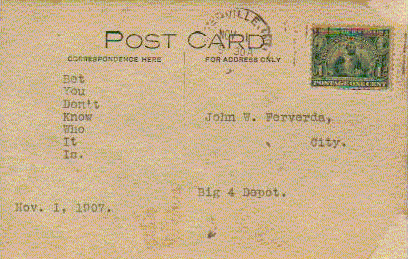
Their life together would begin in Rushville, Indiana where he worked at the depot for the “Big 4” Railroad as the telegraph operator.

Edith umbrella postcard

The above photo of Edith was made into a postcard.  Here’s the back.

Edith postcard back

Apparently all of that flirting was effective.  They were married the next year.

The marriage license for Edith Lore and John Ferverda in 1908 was huge so I scanned it in halves and have “sewed” them back together digitally below.  He is a telegraph operator and she is a stenographer.

Lore Ferverda marriage application

By 1910, the census shows that Edith and John had moved to Lake Township in Kosciusko County, where Silver Lake is located.  His occupation is shown as a telegraph operator.

Edith young woman

Edith was truly a beautiful young woman.  I see mother’s eyes when I look at the photo above.

Edith was an unusual woman for her time as she worked her entire life.  During the depression, when John’s hardware business went belly up, it was her job that saved the family.  She lived with her grandmother, Barbara Drechsel Kirsch at the Kirsch House and attended business school in Cincinnati before her marriage in 1908 to John Ferverda.

The 1930 census shows John as a salesman for the Ford garage and Edith as the bookkeeper for the chicken hatchery.  They own their home, it’s worth $3500, which is more than most of the other homes, and they also own a radio which was quite the luxury.

Edith died in 1960, living her adult life in Silver Lake, Indiana.  This color photo of Edith and John was taken not long before she passed away.  This is how I remember her.

John and Edith 1959 standing

Nora after Rushville

Nora did not stay long in Rushville after C. B. Lore died.  In her 1913 photo, below, she does not look happy.  Of course, her husband had died and so had her daughter in 1912.

Nora Kirsch Lore 1913

Below, Nora is on the left in Florida with either her Aunt Lou Fisk or her Aunt Ida Kirsch on the right.  There was discussion of some property that was owned in Florida near a beach.  No one knows how or when it was disposed of, or even where it was.  Gotta love the hat!

Nora Florida

By 1920, Nora would be married to McCormick. Ironically, Eloise, who lived with the couple from the time she was 13 never said anything about this man.  Maybe she was practicing the old adage of “if you can’t say something nice, don’t say anything at all.”

We don’t know a great deal about Nora between 1920 and 1930, but we do have a few photos.

Nora 1920

Nora Kirsch Lore McCormick and Harold Lore Ferverda, probably about 1920 judging from his age.  I think my mother and her brother both inherited their noses from Nora.

I love the old car which was probably a new car then.

Nora 4 gen 1922

Four generation picture with Barbara Drechsel Kirsch (far right), Nora Kirsch Lore (far left), Mildred Lore Martin (center) and Jim Martin, infant, born in 1922, above.  This would have been about a year after Barbara sold the Kirsch House and moved north with her daughters.  I’m surprised at how much Nora doesn’t look like Barbara.

After that, Barbara would move to Wabash, Indiana, living with Nora in “the little house” as mother remembered it, and would pass away in 1930.

Nora 1923

Above, Nora Kirsch Lore McCormick, James Martin, Harold Lore Ferverda and Barbara Jean Ferverda in 1923.  Mom was 2 months old here.  Nora is obviously enjoying her grandchildren a great deal and below, enjoying her garden.  Her love of flowers is reflected in her quilts.

Nora garden

Maybe I received the gardening gene from her.  Flowers I love, weeds not so much, nor do I like pulling them.

Nora 1939

Dad (John Ferverda), Warren (Cook), Grandma (Nora), Me (Jean Ferverda), Mother (Edith), Eloise, Mildred, Jimmy (Martin).  At least Mom put these in a scrapbook and labeled them.  Thank you Mother!

Nora 1944

Mildred Kirsch Martin, Warren (Eloise’s husband), Jerry Martin, Eloise, and Nora.  Nora is beginning to look quite elderly here.  But everyone is dressed up, so this must have been some occasion.  Based on Jerry’s approximate age here of maybe 20, this was probably about 1944 and she would have been 78 years old.

Nora 1940s

This photo is Nora Kirsch Lore in her later years, in the 1940s.  She looks like she may have had dementia.

Nora, Mildred and Eloise

Mildred, left. Nora Kirsch Lore, seated, and Eloise, right.

Wabash

Nora Kirsch Lore McCormick moved to Wabash, Indiana first about 1916, then again between 1920 and 1930 because of Tom McCormick’s job.  Mom, born in 1922, remembers visiting her there when she was young.  Nora was a quilt maker, and it is here that she made the wonderful quilts that would eventually win a trip to the 1933 Chicago World’s Fair to represent the State of Indiana.  Mom said that the quilt frame would be lowered by pulleys from the ceiling to above the table in the dining room.  She said the house was quite small and this was the only way she could have enough room to quilt.  Mom would play under the table while Nora would quilt.

Mom and I went to Wabash, and Mom showed me the “little house” where Nora lived.  I don’t know if she owned or rented the house.  This is probably where she lived with McCormick, but I really don’t know.

Mother never said anything about him except that they weren’t married very long and that he left her when they lived in Wabash, but they never divorced.  Eventually Nora received word that he had died from one of his children from his first marriage.  However, he is in some photos that range apparently from the 1920s through the early 1940s.  Maybe he came and went.

Wabash noras

Back to Rushville

At some point, Nora moved to Lockport, NY to live with Eloise, where she passed away on September 13, 1949.  Her body was returned to Rushville, Indiana where she was buried by her first husband, C. B.  Lore.  According to her daughter, Mildred, she had specifically asked for the McCormick surname not to be put on her gravestone.  I’m not sure if that was where her heart was or not, but it is where she rests for eternity.  C.B. Lore may have been her true love, despite everything.

In the 1990s, Mom, Gretchen and I would revisit the area (in addition to Aurora) to see what kind of genealogical evidence we could find.  We had a difficult time finding the tombstones, but we were eventually successful.  The photos below were taken by C.B. Lore’s headstone when Mom was probably 28 or 29.

Mom Rushville 1940s

The grave looks fairly new in this photo, and this is Nora’s burial, so I suspect that Mom’s visit was shortly after Nora’s September 1949 death, perhaps in the spring of 1950.

The Payne family crypt is located in front of the stones, so getting a good photo is difficult.  However, it makes a great landmark when trying to find the stones.

Lore graves Rushville

Lore graves Rushville2

The 3 Lore family members in a row.  Note no grass on Nora’s grave.  This must have been a very sad visit for Mom  and her mother, Nora’s daughter, Edith.  At least she had Mom with her.

Rushville Payne memorial

The Lore headstones are to the left of the Payne memorial or mausoleum in the photo above.  It’s one heck of a lot easier to find the Payne building than the Lore headstones.

Nora Kirsch Lore stone

Nora stone with CB and Curtis

Nora is buried with her daughter and her first husband, C. B. Lore.  Her grave was difficult to find, because by request, her surname on the stone is Lore, but in the sextant’s book, she is registered as McCormick.  I found her by finding Curtis’ grave.

Curtis Lore stone

CB Lore stone

Nora’s Quilts

Nora was a master quilt-maker, a quilt-maker extraordinaire – and that’s not because she was my great-grandmother.  She truly was, as confirmed by the fact that her quilt was one that represented the State of Indiana in the 1933 Chicago World’s Fair.

There is absolutely no question about where my interest in needlework, lacemaking and quilt-making came from.  It’s ironic that this gift seems to have followed the direct mitochondrial DNA line.  Of course, mother’s do influence daughters, whether they realize it at the time or not – although my mother was not a quilter nor a lace-maker and neither was my grandmother.  I think they had to work too hard, for too many hours, to develop hobbies that were also time intensive.  They did not have the electronic assistants and time saving tools we have today.  Everything was done by hand then, from food growing to prep to dishes to sewing.

The Needlework

Kirsch lace collar

No discussion of the Kirsch women would be complete without mentioning their absolutely stunning needlework.  Barbara Drechsel’s and possibly Nora Kirsch’s lacework above and below.

Kirsch Lace handkerchief

It’s a tradition in our family that every female that marries selects one of the remaining lace handkerchiefs and carries in as she marries.

Barbara Drechsel Kirsch was a lacemaker, and her daughters likely learned the craft from the time they were young, at home as well as in the German schools.

Kirsch lace collar2

In 1994, mother and I were asked to create an exhibit for the Allen County Public Library that included both their needlework and a genealogical aspect of the history of the family.  The Allen County Public Library in Fort Wayne, Indiana is a nationally known and widely respected genealogical library.  Mother was particularly thrilled as so much of her family and her own personal history centered in and near Fort Wayne.

We titled the exhibit Six Generations of Hoosier Needlewomen and included lace works from Barbara Drechsel Kirsch, her daughters, including Nora’s wonderful collection of quilts, Edith’s work making doll clothes, Mother’s beautiful fine crocheting, my quilts, counted thread works and lacemaking, and my daughter’s  crosstitch. Of those 6 individuals, at least 4 are national level award winners.

Kirsch lace collar3

We displayed Nora’s quilts in a number of locations over the years. Rockome Gardens, an Amish village in Illinois was renowned for both their counted thread show and competition, as well as a companion exhibit for quilts a week or so later.

Mother particularly loved Nora’s Climbing Vine quilt.  Mom made an afghan that was similar, and I designed a counted thread piece in her honor that won the 1988 Embroiderers’ Guild National Event.  Below, my “Needlewoman’s Enchanted NeedleGarden” sampler is displayed in front of Nora’s Climbing Vine quilt, the inspiration for the sampler, at Rockome Gardens.

Needlegarden with Climbing Vine

Mother and I traveled to the Embroiderers’ Guild Awards Banquet in Louisville, KY as well as to Rockome where they displayed all of the related pieces together.  We thoroughly enjoyed those trips and our wonderful heritage.  How I wished I could have known Nora.  How glad I am that Mom and I did these things, together, while we had the opportunity.

Below, Nora’s Climbing Vine quilt, dated 1932, to the left, Picket Fence to the right and Mother’s Climbing Vine afghan in the center.

Nora's quilts and Mom's afghan

Nora’s Climbing Vine quilt was featured in the 1933 Chicago World’s Fair.  Unfortunately, we have no photographs of it at the fair, but Mother told the story of their visit to the fair to see her quilt.

Nora had entered the quilt in the local Sears competition, then it progressed to the regional and then the state competitions, finally winning and going to the World’s Fair.

The depression was in full swing, and money was scarce.  The family could not afford to go for an overnight to Chicago, so they got up very early and left from Silver Lake, Indiana with Nora and the entire family packed into an old black Model T Ford.  They drove to the World’s Fair, took their food and picnicked, and the entire family saw the quilt hanging in its splendor in the exhibition hall.  Then they drove the entire way back home, arriving in the middle of the night.  All in all, the trip was about 24 hours in duration.  The photo below is Mom, me and my daughter at a quilt exhibit with Climbing Vine.

Climbing vine family photo2

Nora was 66 years old when she created this World’s Fair award-winning quilt.

climbing vine quilt

This work is all hand appliqué with fine hand quilting.  Everything in Nora’s quilts was done by hand, including the piecing.

Needlewomen display case

The photo above is from the Six Generations exhibit and it shows my lace in a tray, center, Mom’s crocheted afghan and baby booties, rear, a table runner made by the Kirsch sisters that mother displayed on the piano and some lace in the far right corner.

Needlewomen display case2

This photo shows Mother’s crocheted afghans, shawls and table covers, the doll clothes made by Edith for Mother, embellished handkerchiefs, and beautiful, but tiny, crocheted gloves.  Those Kirsch women had tiny little hands. Nora’s hands were so tiny she had to step on her thimbles to bend them to keep them on her fingers.

The quilt below is called Picket Fence.  Mom also referred to it as Flower Garden.  I always particularly liked this quilt, as it reminds me of the perfect family that everyone wants, and doesn’t exist anyplace.  But the beauty within our family is nurtured and grows within the white picket fence.  This quilt is dated 1931.  The fence is hand pieced, the flowers are appliquéd and the entire quilt is hand quilted with small, fine stitches.

Picket fence quilt

This red and green quilt below, sometimes called the Christmas Tree quilt, was made by Nora, as were the rest of the quilts here.  This quilt was on Mom’s bed for years. Mom said that it was on the bed in Silver Lake too, and when her parents passed away, other people were interested in the “show quilts,” but no one was interested in the ones used for bedding, so Mom took them.  I have very fond memories of this quilt.  Can you find the “error”?  Quilters have a proverb that one cannot make a perfect quilt, because only God is perfect. Some quilters will intentionally introduce an error in the pattern.  I don’t need to do that.  I make plenty of mistakes without trying.  I don’t know if Nora was aware of this or not, but the proverb is not a new one and is not of the current generation, so it is likely she had at least heard it.  Today, that’s “our excuse” when we make a mistake.

This quilt’s colors are known as “depression green and depression pink” in the antique fabric world.

Nora's pink and green quilt

The yellow and white quilt below reminds me of sunshine.  This nine patch and snowball block quilt was never used.  Before Eloise passed away, she sent this to Mother, along with some other needlework and family items.  I’m sure that Mildred would have had some quilts as well.  I wonder what hers looked like.  This quilt was made in 1927 or 1928.

Mom told me that when she went to visit Nora in the little house in Wabash, that she had a large quilt frame set up.  All of these quilts are hand quilted and hand pieced.  I can’t think of a better way to spend retirement – creating family heirlooms and memories.  Those scalloped edges are quite difficult.  Nora would have been about 61 when she made this quilt.

Nora's snowball quilt

The oldest quilt is shown In the photo below, a crazy quilt made at least in part by Carrie Kirsch, age 11, is shown hanging on Mom’s quilt rack that was behind the couch.  Carrie (Caroline Kirsch) was 11 in 1884, so this quilt is almost 125 years old.  Unfortunately, the quilt is now in very bad repair.  From this we know that the Kirsch girls were quilting at the Kirsch House and they started as children.

Kirsch crazy quilt

The quilt below, although it looks pathetic, is one of my all-time favorite quilts. This quilt, without the handkerchiefs, was the quilt that was always on the bed in Kokomo, on the farm.  I slept under it, my kids slept under it, and we used it on the couch for a couch quilt.

All those years, I never really knew about Nora, but I knew that this particular quilt had seen so much within our family and was a constant companion and continuous source of comfort.  Mom washed it several times, and over time, it began to deteriorate with use.  It was well loved.

Not wanting to throw it away, Mom asked me if I could make something out of it, like maybe teddy bears for the kids.  I told her I surely could, and took the quilt home to give it yet another life as teddy bears.  I told the kids.  They cried and cried.  My daughter said, “you can’t cut up Mawmaw’s quilt.”  Little did they know it was Mawmaw’s Mawmaw’s quilt.  I really didn’t know what to do, but clearly, I could not do what we had planned without causing my children permanent psychological trauma.

There were actual holes through the quilt, so I had to find a way to reconstruct some fabric and restuff parts of it with batting.  I remembered my grandmother’s handkerchiefs, safely tucked away for some wonderful future project.

The future had come. I took the Kirsch and Lore women’s handkerchiefs and used them to create fabric for the old much-loved quilt.  I gave the quilt back to Mom, and it served another decade or two before retiring permanently.

Ironically, when I go to quilt shows and tell this story, everyone loves to look at and discuss the beauty and history of Climbing Vine and Picket Fence, but this is the quilt that makes everyone smile…and cry.

Handkerchief quilt

Quilting was obviously a very important part of Nora Kirsch Lore’s life.  Her quilts are her legacy that she passed to us, through the two intermediate generations.  Quilters say that wrapping up in a quilt is like a hug from the quilter.  Thank you so much Nora.

Not only did I receive 12.5% of Nora’s autosomal DNA, her mitochondrial DNA and the quilting bug, which I am attempting to pass on to the next generation, I received so much more.

Through her quilts, Nora triumphs above the finality of death and reaches across the generations and decades to touch us with the beauty and warmth that her hands and heart created.  Even some 66 years later, I can still have a hug from Nora, an ancestor who died before I was born..  I wonder if she knows how much her legacy is cherished.

______________________________________________________________

Disclosure

I receive a small contribution when you click on some of the links to vendors in my articles. This does NOT increase the price you pay but helps me to keep the lights on and this informational blog free for everyone. Please click on the links in the articles or to the vendors below if you are purchasing products or DNA testing.

Thank you so much.

DNA Purchases and Free Transfers

Genealogy Services

Genealogy Research

A Visitation by Sarah Faires Speak (1786 -1865), 52 Ancestors #91

With Lola-Margaret Speak Hall as Sarah Faires Speak

Lola Margaret as Sarah

Introduction by Roberta Estes

Lola-Margaret Speak Hall is the great-great-great-great-granddaughter of Sarah Faires Speak, wife of Nicholas Speak through their son Samuel Patton Speak and their great-great-great-granddaughter through their daughter Rebecca Speak.  Lola-Margaret’s ancestors, Joseph Hardy Speak, great-grandson of Nicholas and Sarah Faires Speak through Samuel Patton Speak’s son William Hardy Speak and Frances Rebecca Rosenbaum through William Henderson Rosenbaum and Rebecca Speak, daughter of Nicholas and Sarah, are shown in the photo below.

Speak, Joseph Hardy and Frences Rebecca Rosenbaum

Nicholas and Sarah Faires Speak married in Southwest Virginia in Washington County on August 12, 1804.  Their first 9 children were born there.

speaks chapel 1 cropped

In 1823 they moved to Lee County, Virginia, purchased land and settled down to a life of farming.  In 1828, Nicholas Speak founded the Methodist Church, now known at the Speaks Chapel Methodist Church, built the church and in 1839 donated the land and church to trustees to maintain the church after his death.  One of those trustees was his son, Charles Speak.

Sometime between their marriage in 1804 and 1828, Nicholas and Sarah had converted from being Presbyterian to Methodist.  There is a record of Bishop Asbury visiting the home of Sarah’s father, Gideon Faires, in Washington County, Virginia, so that may have signaled the beginning of the Methodist conversion of the Speak(s) family.

I also descend from Nicholas and Sarah Faires Speak, being their great-great-great-granddaughter through their eldest son, Charles.  His daughter Elizabeth married Samuel Clarkson/Claxton about 1849.  Samuel fought for the Union in the Civil War.  Samuel and Elizabeth are shown here, he dressed in his military uniform.

Samuel Claxton Elizabeth Speaks

This means that Lola-Margaret and I are both 4th cousins, and 4th cousins once removed.  She has a double dose of the Speak DNA.  This explains why Lola-Margaret and I match on autosomal DNA tests while other cousins, about as distant, don’t.  Lola-Margaret really isn’t that distant, she’s about half that distant, genetically.  Endogamy, or intermarriage will make people appear to be more closely related generationally than they actually are and even one intermarriage can make a big difference.  We find this repeatedly in groups like the Mennonites, Amish, Acadians and Jewish families, and of course, we find it in Appalachia too.

Lola-Margaret isn’t just any cousin, however.  She is a very special one, and I’m sure greatly endeared to her great-great-great-(great-)grandmother, Sarah Faires Speak, who looks down upon her regularly, showering her with special blessings.  Why is Lola-Margaret special?  Lola-Margaret lived in Sarah’s skin, walked in her shoes, retraced her steps, visited her land, her church and her grave…..for a year….in preparation to become Sarah Faires Speak.  And become Sarah she did.  Faithfully.

speaks service 2009 cropped

On October 10th, 2009, as all of us cousins gathered at the little white church at the crossroads of Pleasant View and Speaks Branch roads in Lee County, Virginia, Sarah Faires Speak visited us.

Sarah Faires arriving

Sarah entered from the back of the church, greeting all of her descendants just as she had greeted her children, grandchildren and neighbors when she and Nicholas held church every Sunday morning more than 159 years ago, except when the entire church went to camp meetings in the summer.  She made her way to the front and settled in her rocker.

Sarah Faires in rocker cropped 2

Sarah opened her well worn Bible and leafed through it, recanting the details of her life as each entry brought forth memories…some cherished, such as her marriage, jubilation at the birth of her children and their marriages, and then of course, the grief and sadness that comes with death, especially her cherished husband, Nicholas, who died in 1852, 13 years before her own “passing over.”  She saw too many of her own children and grandchildren die untimely deaths.

Lola-Margaret, as Sarah, shared Sarah’s life with us at the Speaks Chapel Methodist church on a beautiful, crisp, fall morning.  An unbelievably moving gift that still leaves me with cold-chills all these years later.

Sarah and Nicholas were with us. We could all feel them.  They were no longer in the Speaks branch road croppedcemetery across the road where our ancestors are buried with their families, settled comfortably around them under the field stones that serve as headstones.  They were with us, beside us, in the little white church on Speaks Branch road.

So come on in, sit a spell by me in the pew and share a few sacred minutes as Sarah Faires Speak touches us from across the years and shares her memories.  As Lola-Margaret, Sarah, spoke that day, from her rocker, she could see out the door of the church and looked directly at the cemetery where so many of her family members were buried.

Speaks cemetery

Listen closely as Sarah speaks from across the years…

My, it is getting so chilly outside.  But it sure feels good to be right here on this hallowed ground. It always warms my heart to be right here on Sundays.

Sarah praying

It’s nice to have that fire right there in the middle of the room, always burning when we got here.  I can’t remember who it was that’s always built that fire, but he must have been a good man.

With winter coming on in these parts, I always seem to feel the loneliest. Seems like Sundays are the hardest.  That’s when I miss my Nicholas so.

Sundays were busy days for us, with preaching and all. Oh – my Nicholas was a good man, and those were good years.  He’s been gone now 10 – no, I believe its 12 years. One misses a really good man!

There were so many good times here at this little church.  Of course, hearing the preaching of God’s word was the most important.  And Nicholas Speak could do that like nobody else I ever heard!

Speaks Chapel painting

And then, oh my, those dinners on the ground. Those are good memories, and one must learn to dwell on the good memories.

There was a lot of kin folks living in this area, and the kids always had such a good time playing with their cousins after services were over.

Speaks old cabin cropped

Our cabin, it’s just up the road a ways in that direction.  Nicholas built that cabin for us and our 9 children when we settled here in Lee County in 1823.

We only had 9 then.  They were all born in Washington County.  Frances Jane and Rebecca, they were born right there in that cabin. Oh my the tales those old logs could tell!

Speaks boards

The years of laughter as 11 children played on those floors.  Well -10, Charles married the year we left Washington County.

And Sarah Jane, I shouldn’t count her – she was 16, nearly grown, hardly playing on the floor anymore.

Now there’s a whole new crop growing up here. Sarah Jane and James built that house just down that road back behind the church.

But at our cabin now, it’s just me and Fannie, we always called Frances Jane, Fannie. It’s just the two of us to look after everybody now.

Her William Henderson won’t be coming home from this awful war.  The union soldiers captured him, horse and equipment, and carried him off to Federal Prison at Camp Douglas, Illinois.

My grandson, Samuel – that’s Samuel Pattons’s son, was captured, too.  We got word a couple of months back that the both of them died there in that prison.  The Union buried them up there.

Sarah Faires reading

My poor Fannie, she never even got to pay her last respects to William.

She’s got another baby coming next month that will never know its father.

And the 2 little boys, William and Alfred, they just don’t understand their Daddy being gone for good.

Speaks old stone

Then there’s Rebecca’s 4 children with us. Henderson was their Daddy, too. That’s seven children under 10 years old.

You see, Fannie married William Henderson Rosenbaum after her sister Rebecca died. Rebecca was married to him first.  My dear, Rebecca.  She was my baby.  She passed from this life on her 5th wedding anniversary, February 9, 1859.  She’d given birth to a little daughter only 5 days before.  Our precious little Frances Rebecca. She’s 5 now – almost 6. Reminds me so much of her mother.

Yes, it is a terrible time now.  So much going on. Sons and fathers going off to war. This terrible war has even divided our families.  Most of the boys right here have joined with the Confederacy.

speaks old stones

Our son, Jesse, and his son – they moved on to Kentucky – they fought with the Union. We don’t hear much from them since they left Lee County, but we did get word they were both wounded two times.   I do hope they are all right.  It tears a mother’s heart out, but still a mother loves them, whatever side they choose to fight on.

All this war and turmoil.  The Union troops burned the courthouse at Jonesville.  Earlier this year President Lincoln was shot and killed.  You wonder just how long this can go on.  It seems to me I’ve been mourning forever!

But, as I’ve said before, one should dwell on the good things – and the crops have been good this year.  Maybe it’s enough to have a roof over our heads and plenty to eat.

This Lee County soil is rich and gives a good yield.  The boys, Samuel, John and James have been so good to me.  They helped me get the crops in and sold.

I won’t forget the first harvest after Nicholas died.  He left me with crops in the field!  If it hadn’t been for the boys, I don’t know what I would have done.  But that is how my Nicholas raised his boys.

Nicholas stone

One should even be thankful for chilly Sunday mornings.  It’s such a good time for recalling memories.  A life time of memories.  This old Bible holds a lot of memories.  I love this old Bible.  It belonged to my Grandmother Faires, on my Father’s side. She was of Scots-Irish descent, and quite proud of it.  They lived near us where I grew up on the north side of the south fork of the Holston River.???????????????????????????????

There is a lot of family history recorded here in this Bible.  Makes one want to go back over one’s life.

I remember growing up – the stories my Father would tell us – I had 5 brothers and 4 sisters you know – stories about the Revolutionary War.  He had served as a private under Col. William Christianson on an expedition to lead a battalion of militia against the “Overhill” Cherokees in East Tennessee.  Father said the British called them “Overhill’ because they were 24 mountains away from the lower lands of the Carolina Cherokees.

These Indians were being encouraged by the British to attack the frontier settlements. The Cherokees were a powerful tribe, but Father’s company subdued them on their home ground and forced them to sign the treaty of Long Island in 1777.

He told us stories about the ferocious Indian, “Dragging Canoe,” and about Nancy Ward. She was a wonderful Indian woman who married a white man, and she became a friend to the white settlers.  She was a friend to Joseph Martin, an agent for Indian Affairs who lived just up the road.  Their friendship saved the lives of many white settlers in the lower corner of Virginia.

You see, the land between Rose Hill and Jonesville had been occupied by the Cherokees. Joseph Martin had built the first white settlement near there, so Indian attacks were a great danger.  The settlers warred with the Shawnee in 1774 and again with the Cherokee in 1776.  It wasn’t far from right here that Captain Vincent Hobbs killed Chief Benge and ended the terrible attacks on the frontiers of Virginia.

Cumberland Gap 1

Our lower corner of Virginia was very important as an outpost for those preparing expeditions into the Cumberland Gap on their way to explore the West.  Daniel Boone camped here many times.

Oh my! I seem to just be going on and on – but, I hope you will humor an old woman!

???????????????????????????????

Here it is!  Right here in this old Bible. The record of our marriage. Nicholas Speak to Sarah Faires, August 12, 1804, signed by Reverend Charles Cummings. You remember, we still lived in Washington County then.

I was so proud! My Nicholas was such a handsome man. I was 18 and he was 22.

This Bible was a gift when we were married you know. I’ve had this Bible in church with me every Sunday now for more than 60 years.  The pages are thin and worn I’ve turned them so much.  Why, I know it almost by heart.  The ink is so faded I can hardly read it anymore.  My Nicholas wrote every birth and death in the front of our Bible.  I remember him sitting by the fireplace with his pen after each of our children was born.

Look, here’s where our first child Charles was born – November 11, 1805.

And here’s where Sarah Jane was born on May 23, 1807.  And then came Samuel Patton, on January 29, 1809.

John was next – born January 2, 1812. Grandmother Faires, God rest her soul, died that same year.  Joseph came along July 20, 1813.

There was another war going on.  That was just known as the War of 1812.

Nicholas was drafted to serve in that war in August 1814.  He was a private in the 7th Regiment of Virginia Militia in the Company of Captain Abram Fulkerson and served at Fort Barbour at Norfolk, Virginia.

Fort Barbour

When he came home 6 months later, we were all greatly relieved, though he had tales to tell of “being sick unto dying” in that war.

Next, came our son, Thomas on November 26, 1816.  My father died in 1818, the same year Jane was born.

rock spring cemetery

Two years later in July of 1820, Jesse was born.

Mother died the year after and we buried her beside Father in the old Rock Spring Cemetery behind the old church back in Washington County.

Rock spring church

Our youngest son, James, was born June 18, 1822.

Seemed like I’d been pretty busy having babies.  But they do grow up, and in February of 1823, our first born, Charles, married his lovely Ann.

Nicholas felt it was time to move on.  My parents had passed on, and he moved our family to Lee County where he bought 520 acres on Glades Branch. We’ve been right here ever since.

nicholas land entry

Oh yes! Here’s where Samuel Patton married Sarah Hardy in 1827.

Nicholas farmed this land with all his boys help, and then on Sunday we’d all come to church.  We all loved to hear him proclaim the Word of God.  One might say “Nicholas Speak was a tiller of the soil during the week and a tiller of souls on Sunday.”  How we loved those dinners on the ground and ice cream suppers in the hot summer time.  Nicholas loved this little church.  He gave the very ground it’s built upon.

Speaks chapel 1910

In the summers we’d all get in the wagon and go to the Jonesville Camp Grounds for revivals.  People would come for miles around to hear those sermons and join in singing praises to God.   Sometimes, if I close my eyes really tight, I can still hear that beautiful singing from so long ago.

Amazing grace cropped

Then in 1829, our Sarah married James Bartley and John married Mary Dean.

Next was Joseph’s wedding to Leah Carnes in 1832.  I remember how proud Nicholas was to do that ceremony.

He also married Jane to George W. Ball in 1835.  I know he was proud to do that one, too, but we sure did hate to see them move off to Kentucky.

Seems like there for awhile we were having weddings as fast as we’d had babies earlier.

Thomas and Mary Polly Ball married in 1837.   Then Jesse married his Mary Polly Haynes in December of 1842.

Thomas died in 1843.  He and Polly had only been married about 5 years.  He was so young.  Only 28 years.

The next year, 1844, James married Mary Jane Kelly.

We laid Joseph and Thomas to rest along with Charles and his wife.  It was hard for Nicholas to bury his children.

Then Jesse moved his family to Kentucky and Joseph’s widow and her children moved west to Kansas.  Seems like our family was getting smaller as quickly as it had grown.

And then…in 1852…I lost my Nicholas.  Can anything be as hard as losing the one you love so dear?  Then, Joseph died that same year too.  So much sorrow.

Nicholas graves

But we had to carry on.  My Fannie and Rebecca and me.  There was so much to do and to think about.  Things I had never handled before.  The will – John took care of that.  Then there was a land bounty grant that was due to Nicholas for service in the 1812 War.  The boys have been such a help to me.

We were all so happy for Rebecca when she married William Henderson Rosenbaum on February 9, 1854.  A fine man, he was.  But then, Rebecca died just 5 years later.  I miss her so.

In 1855 John had his own sorrows when his son, Reuben – he was only 21 – died at Martins Creek.  Two years later John’s little Margaret passed away.  Only 2 sweet year’s old.  So little time to love her.

That same year Charles’ granddaughter, she was named Margaret also, died at 11 months old.  And 3 years later Jesse’s 2 children, 5 year old Martha, and 1 year old Jesse died with the measles.  They are all buried together, right there in the cemetery, near Nicholas.

Oh, that a mother could spare her children of these sorrows.

nicholas church bell

Oh my! I have born 11 children and 5 are still living. Yes, we lost Sarah in 1859, right about the time her sister Rebecca died, and then Samuel in 1861, just before the war.

I have some 75 grandchildren, and it will be 76 when Fannie gives birth. 68 of those grandchildren are still alive.  These are my treasures!

You know, really when one comes to the end of a long good life, what does she have to pass on?

Many times I’ve looked around our little cabin.  There’s an old clock, a looking glass, some books, an old table, a smoothing iron and a couple of old bells.

But the memories – oh the memories!  They will always be there.

There is a time to live and a time to die, and life goes on for those you leave behind.  It’s the heritage and those fond old memories that will forever remain.

NIcholas signature cropped

Sarah signature cropped

Lola Margaret at church door cropped

Thank You

I want to say a very special thank you to my wonderful cousin, Lola-Margaret Speak Hall for this exceptional gift.  Because of you, Lola-Margaret, Sarah lives for all of us today, and through your gift, will continue to live for her future descendants.  Bless you.

Index of Photographs

Normally in a article of this type, I label the photographs with titles, footnote them or describe them in the text, but I did not want to detract in any way from the flow of what Sarah Faires Speak had to say to us through Lola-Margaret, or distract from the continuity, so I’ve chosen to describe the photos here in the order they are displayed.

Lola-Margaret Speak Hall as Sarah Faires Speak in the Speaks Chapel United Methodist Church after her presentation on October 10, 2009.

Photo of Joseph Hardy Speak and Frances Rebecca Rosenbaum.

Photo of Speaks Chapel taken in the mid 1990s by Roberta Estes from across the road in the cemetery.

Photograph of Elizabeth Speak with her husband Samuel Clarkson/Claxton.  Elizabeth is the grandchild of Nicholas and Sarah Faires Speak through their son Charles and his wife Anne McKee.

Photograph of all of the Speak(e)(s) cousins assembled in the Speaks Chapel Church sanctuary on October 10th before Lola-Margaret’s entrance and before the service.  Photograph of Sarah Faires Speak (aka Lola-Margaret) greeting her relatives from across the years as she enters the church.

Photograph of Sarah Faires Speak (Lola-Margaret) with her Bible.

Photograph of the road sign outside the Speaks Chapel Church.

Photograph of the headstones in the Speaks Cemetery directly across the road from the church.  Sarah could see the stones of her family through the window as she spoke to us.

Sarah Faires Speak (Lola-Margaret) in prayer.  Painting of the Speaks Chapel Church.  Photograph of the cabin belonging to and probably built by Nicholas Speak and Sarah before it was abandoned in the 1960s and subsequently dismantled and rebuilt in the 1980s.

Photographs of the old logs salvaged from the original Speaks Methodist church, reused in the barn of Jewell Davis, also a Speak(s) descendant.  Photograph of Sarah Faires Speak (Lola-Margaret) reminiscing from her Bible.

Headstone of Sarah’s grandmother, Deborah Faires, maiden name unknown, wife of William Faires.  Deborah was born June 10, 1734 and died March 22, 1812.  She is buried in the Green Springs Cemetery in Washington County, Virginia and died at the age of 77 years, 9 months and 12 days.  This church was established in 1794, but her stone is one of the oldest with inscribed dates, not just a fieldstone.  It’s believed that her husband, William, who died in 1776 is buried at the now defunct Ebbing Springs cemetery.  The church perished early, to be replaced by another church in a different location, and later, a farmer pushed the cemetery stones into the creek in order to farm the land.

Headstone marking the graves of Nicholas and Sarah Faires Speak set by their descendants in the 1990s.

Sarah Faires Speak (Lola-Margaret) recounting her life.

Early drawing of the Cumberland Gap as it would have appeared to early settlers.

Sarah Faires Speak (Lola-Margaret) reading through her children’s births recorded in the Bible.

Civil War era drawing of a second fort, fort Norfolk, still in existence today and located in front of Fort Barbour in Norfolk Virginia.  Nicholas was stationed at and dismissed from Fort Barbour, located at the present day intersection of Church Street and Princess Anne Road, but he surely was familiar with this fort as well and spent time in both.

The cemetery and church where Sarah’s parents, Sarah McSpadden and Gideon Faires are buried in Washington County, Virginia.  The Rock Spring cemetery and church were established in Lodi in 1784.  Other family names are found among the early burials as well.

The 1824 Lee County, Virginia tax list is shown with Nicholas Speak’s name listed as a landowner.

Early photograph of Speaks Chapel Church taken by Charles Thomas in the late 1910s before the addition of the rear kitchen and bathroom area.  The woman in the photo is probably his wife.  Charles was the son of Nancy Bartley and Josiah Clemans Thomas.

Amazing Grace from the bulletin for our family service at Speaks Chapel on October 10, 2009.

Speak family cemetery showing the family stone with surrounding field stones marking the graves of family members.

The Speaks Chapel church bell, now mounted beside the church.

Signature of Nicholas Speak on his War of 1812 bounty land application and the later mark of Sarah Faires Speak.  She was apparently unable to read and write, or she was too old and frail to sign her name.

Lola-Margaret Speak Hall outside the door of the Speaks Chapel United Methodist Church on October 10, 2009 in Lee County, Virginia.

______________________________________________________________

Disclosure

I receive a small contribution when you click on some of the links to vendors in my articles. This does NOT increase the price you pay but helps me to keep the lights on and this informational blog free for everyone. Please click on the links in the articles or to the vendors below if you are purchasing products or DNA testing.

Thank you so much.

DNA Purchases and Free Transfers

Genealogy Services

Genealogy Research

Edward Mercer (c1704-1763), Hard-Drinking Quaker, 52 Ancestors #90

Trying to track Edward Mercer has been like trying to follow one hair in a braid.

While a surname like Mercer seems fairly unique, it isn’t, or wasn’t in Frederick County, Virginia in the 1700s.  Who would have guessed there would be so many in this new land of opportunity, the frontier, where the settlers lived among the Indians.

Edward Mercer was in Frederick County, Virginia by 1751, based upon his land grant.  While settlers were settling this region, all was not as peaceful at it seemed.  Remember that the settlers were encroaching on the Indian’s territory, territory the Indians did not “sell” and that by treaty, the settlers were not supposed to settle upon.  But they were, and they did, and the Indians were NOT happy.  The court notes in Shenandoah Valley Pioneers and Their Descendants (1738-1908) by T.K. Cartmell, Clerk of Court, reflect that the Indian chiefs were meeting in Winchester in 1753 to negotiate yet another treaty, and the ordinaries were not to sell them liquor.

On page 71, Cartmell tells us:

Sept. 4, 1753 – “A treaty between the Indians in in progress; It is ordered by the Court, for preventing disturbance during the Treaty with the Indians at the town of Winchester that no Ordinary keeper or other person presume to sell or give to the Indians strong liquors of any sort.”  Five great chiefs with a small following spent many weeks near the town trying to work a scheme to have the white settlers vacate their territory west of the Great Mountains.  This was refused, but a treaty was made to allow the Indians to remain in their villages on the Ohio River undisturbed, and that they should have the right to sell land on their reservation to peaceable white settlers.  This treaty was basely violated by unscrupulous adventurers and a bloody war was the result.

And so began the French and Indian War.

The settlers built their homes as stockades and for most of the 1750s, they lived in constant fear, but no one went back from whence they came.  Expeditions were sent to protect outlying settlements.

From 1754 through 1758, this area of Frederick County and what is now Berkeley County, West Virginia, then part of Frederick County, a swath from Gerardstown, West Virginia to south of Winchester, Virginia was raided successively by Indians, sometimes with the French helping the Indians.  This is exactly where Edward Mercer lived, but perhaps Edward was safe, or safer, because he lived adjacent to Jacob Van Meter, the son of long-time Indian trader John Van Meter.

Some settlers were killed outright, some were taken hostage, and some returned to the community later.  Others, especially those taken as children, joined the tribes and never returned to the white settlements.  Both the settlers and the Indians viewed the warfare as invasive depredations.  Cartmell provides details on page 74 of his history book.  Suffice it to say it was a time of high tension and daily fear for those who lived on the frontier.

In 1757, the court justices ordered the court books be taken to Fort Loudon for safekeeping.  They too feared for their scalps and the preservation of anything on the frontier.  It was not a short war.  A peace treaty, such as it was, was not signed until 1763, just before Edward Mercer’s death.

For most of the time Edward lived in Frederick County, the colonists were actively at war with the Indians and French.  The frontier was not a peaceful or safe place to live.

The Many Mercers

Wilmer L. Kerns, Ph.D. wrote about Frederick County families in his book, “Frederick Count, Virginia, Settlement and Some First Families of Back Creek Valley.”  Back Creek Valley was the area north of Winchester where the Mercers, Crumleys and the Quaker families settled in the vicinity of the Hopewell Meeting House, shown on the map below.

Hopewell Meeting Map

Tracking the Mercer Families The Mercer surname was frequently mentioned in Frederick County records during colonial days. Apparently, there were several different Mercer family roots in Northern Virginia. This brief sketch of the Mercer surname is tentative, and is merely intended to acknowledge that several branches of the family were among the early settlers in this region. Further research is needed to compile a more accurate account of this surname.

One Mercer family, some members of which did wind up in Frederick County were known as the John Francis Mercer line.  They were from Dublin, Ireland and before that, from Chester, England.  Their family is detailed in this document.  There is no known connection, nor any hint of a connection between this family and the other two Mercer families – but that does not mean a connection doesn’t exist.  Y DNA testing on Mercer males from both lines would tell us quickly enough.

The second and third Mercer families are quite confusing, beginning with the fact that there are two Edward Mercers who lived at the same time in the same county, but who may or may not be related to each other.

The younger Edward Mercer (1729-1783) settled in a part of Frederick County, Virginia that later became Berkeley County in 1772, so we can tell these men apart to some extent.

The Berkeley County family appears to have come from Ireland, based on a 1783 deposition recorded in Deed Book X, Vol 22, Page 335, Chester County, PA which records a statement by Mary Mercer, Berkeley County, VA, widow of Edward Mercer about sixty years old and a statement by Johathan Mercer, aged 50 regarding their acquaintance with a William Chapman. About two years after they left Ireland, the deponent (Mary Mercer) with others of her family, since dead, also left Ireland and came to America and found the George Chapman and William Chapman living on Delaware River near New Castle and Marcus Hook; they then lived together.

Delaware early map

Below is a current map showing Marcus Hook, New Castle and Chester County, PA.

Current Delaware map

If Mary was 60 in 1783, and was a child when immigrated, this would put her birth in 1723 and her immigration location sometime before marrying Edward (born in 1729) in New Castle and Marcus Hook.  So, this puts that Edward Mercer in the same vicinity or he would not have met and married Mary.  On the map, above, you can see that New Castle on the Delaware River is very close to Philadelphia, maybe 12 or 14 miles distant.

Philly to Winchester

My ancestor Edward Mercer (1704-1763), the elder, settled in Frederick County, Va, north on Winchester, by October 1744 when he first appears in the court minutes, serving on a jury.

A tradition says that he emigrated from Scotland in 1737 although that certainly has not been proven. Nothing is known about his early life, although after he arrived in Frederick County, by this time probably in his 40s or 50s, there are several references in court records.

Beginning in December 1754, Edward Mercer is sued by John Littler who owns land nearby.  In the same book, spanning 1754-1745, both Nicholas and Edward Mercer are sued by Jesse Pugh and both Nicholas and Edward serve on juries.  In the 1745-1748 Court Order book, we find Mercer versus Lemon and in Order Book 4, 1751-1753 we find Edward Mercer suing both James Dunn and Dugal Campbell, both dismissed by the parties.  In 1753-1754 we find Richard Mercer versus Poor and in 1754-1755, Edward Mercer vs Nathaniel Hare where Edward is awarded a judgment after Nathaniel fails to appear.  In 1755-158, we have Edward Mercer vs Hurman and in 1758-1760, Edward sues both Campbell and Lemon.  In 1760-1762, Richard Mercer sues Shibley and Simpson.  This looks like a lot, but is fairly typical for the timeframe.  Most suits were agreed upon and settled.

This branch of the Mercer family was found in Back Creek Valley during the 18th and 19th centuries. Edward Mercer died in 1763, and he named his wife Ann in his will, in addition to his children. A letter written by one Harrington in a letter to Wilmer Kerns on Oct. 27, 1993 states that Edward Mercer married Ann Croat (or Coats) in 1726, and he married second to Mary Gamble. However, we know that Edward was married to Ann when he died, based on his will, so this makes no sense.  Another rumor bites the dust.

Indian Traders

And yet another twist to this story.

In the “History of Scots/Irish,” Chapter 5, The Explorations and Early Settlers of West Virginia states that John Van Meter, a representative of an old Knickerbocker family early seated on the Hudson was an Indian trader. He made his headquarters with the Delawares and made journeys far to the south to trade with the Cherokees. In about 1725 he first told of the fertility of the Lower Shenandoah. In the section regarding the first white settlers of West Virginia in the area it goes on to say – “Among those that came about 1734 and settled along the Upper Potomac in what is now the northern part of the West Virginia counties of Berkeley and Jefferson included: Robert Harper (Harper’s Ferry), James Lemon, Richard Mercer, Edward Mercer, Jacob Van Meter.”

John Van Meter seems to have been headquartered in Kingston, Somerset County, New Jersey.   In an article relating to the last of the Southern Indians, which appeared in the Virginia Historical Magazine [Vol. III., p. 191, footnote], it states that “Mr. John Van Meter of New York gives an account of his accompanying the New York Delaware Indians in 1732 (?) on their raid against the Catawbas. They passed up the South Branch of the Potomac and he afterward settled his boys there.”

Robert Harper was born in Oxford Township near Philadelphia, Pa., in 1718. A builder and millwright, Harper was engaged by a group of Quakers in 1747 to erect a meeting house in the Shenandoah Valley near the present site of Winchester, Va.

In 1762, John Lemon obtains a land grant adjacent to both Nickolas and Edward Mercer.  From a transcription of the Virginia Northern Neck Land Grants, 1742-1775, Vol II:

John Lemon 1762 grant

In 1751, Edward Mercer obtained a land grant in Frederick County, Virginia for 275 acres adjoining Jacob Vanmeter. Does this suggest that our Edward Mercer arrived with that group of men?  And perhaps he was related to Richard Mercer?  Our Edward did name a son Richard.  The Edward Mercer of Berkeley County would only have been 12 years old in 1751, so this land grant has to be our Edward.

Richard Mercer’s wife name was Rebecca.  They sold land in 1764 on the Potomac that they had obtained from Josh Hite and Isaac and John VanMeter, the Indian trader family.

While it’s tempting to suggest that Edward Mercer in Berkeley County is the son of the older Edward Mercer (Sr.) of Frederick County, we show Edward Sr.’s son Edward Jr. in 1763 patenting land beside his father in Frederick County.

Edward Mercer Jr 1763 grant

Furthermore, Edward Mercer Jr. continued to live in Frederick County, years after the Edward in Berkeley County died.  We find in the Virginia Northern Neck Land Grants, 1775-1800, Vol. III:

Edward Mercer Jr 1788 land

Edward Mercer from Berkeley County, Virginia (now West Virginia) who died in 1783 shows the following people in the will index abstracts of West Virginia Wills and Probate records 1724-1978.

Edward Mercer 1783 death

Unfortunately, there is a lot of bleed through, but page 16 is the relevant page for Edward’s will.

Edward Mercer 1783 probate

Jonathan Mercer is clearly not Edward’s son, so perhaps he is Edward’s brother.  We know from the deposition that Jonathan was born in about 1733.

On November 13, 1752, we find that John Lemmon purchased property and the land deed was filed in Frederick County, VA. The description of the property includes 356 acres adjoining Edward Mercer, Nickolas Mercer, and Francis Lilborn.  A suit, Mercer vs Lemon, is found in the 1745-1748 court notes, but was impossible to find in the actual microfilm of the court minutes.  A Will for Nicholas Lemen is witnessed in 1761 by a Richard Mercer and his wife Mary.  This could be Edward Mercer Sr.’s son, Richard (who could have been in his 30s by this time), but who was Nickolas Mercer?

Nicholas Mercer is found in the road orders in 1746 and in 1748 he is replaced by Abraham Vanmetre, so he was clearly living in the same proximity as the VanMeter family which means he is connected to the Edward Mercer of Frederick County.  To be of age in 1746, he had to have been born in or before 1725, about the time our Edward Mercer would have been about 21 years old, IF he actually was born about 1704.

The Nicholas Mercer who was the son of Edward in Berkeley County could not have been of age in 1746 if Edward himself was only born in 1729.

Nicholas Mercer must have been connected to our Edward in some way.  In the December 1744 Frederick County Court session, we find the Jesse Pugh sued both Nicholas Mercer and Edward Mercer for trespass, in two adjacent transactions.  At that time, trespass typically didn’t mean walking on someone’s land, like today, but planting crops there.  Later, both Nicholas and Edward served on juries. Unfortunately, there is no Frederick County will for Nicholas, so we have no idea what happened to him.

Some people have drawn links between the various Mercer families that may not have existed in reality – drawing scattered references from multiple sources, including online trees, and weaving them together.

However, there are some very tantalizing clues that indeed, do need additional research.

George Washington and the Battle of Fort Necessity

We think of George Washington and his involvement in the Revolutionary War, but Washington’s involvement in the defense of Virginia began long before the Revolutionary War.  George was extremely involved in the French and Indian War as well.

The roster of men serving in the Fort Necessity Campaign of 1754 under George Washington is compiled from two rosters.

Edward Mercer appears.

Roster of Virginia Militia serving under George Washington during the Fort Necessity Campaign Officers – George Mercer, Captain (Lieut.); John Mercer, Lieutenant (Ensign); Wise Johnston, Corporal; Enlisted Men; Edward Mercer;

We know that Captain George Mercer is connected to the Irish/English John Francis Mercer family with no (known) relation to Edward.

Let’s look at what happened at Fort Necessity.  Edward Mercer was clearly there, so this is his story too.

The Battle of Fort Necessity (also called the Battle of the Great Meadows) took place on July 3, 1754, in what is now the mountaintop hamlet of Farmington in Fayette County, Pennsylvania. The engagement was one of the first battles of the French and Indian War and George Washington’s only military surrender.

Winchester to Fort Necessity

In March 1754, Governor Dinwiddie sent Washington back to the frontier with orders to “act on the [defensive], but in Case any Attempts are made to obstruct the Works or interrupt our [settlements] by any Persons whatsoever, You are to restrain all such Offenders, & in Case of resistance to make Prisoners of or kill & destroy them”. Historian Fred Anderson describes Dinwiddie’s instructions, which were issued without the knowledge or direction of the British government in London, as “an invitation to start a war”. Washington was ordered to gather as many supplies and paid volunteers as he could along the way. By the time he left for the frontier on April 2, he had gathered 1,867 men.  During the march to Pennsylvania, Washington picked up a few more men from a regiment they met at Winchester.  This would have been where Edward Mercer joined.

Washington along with about 150 Virginians built Fort Necessity on an alpine meadow west of the summit of a pass through the Allegheny Mountains on June 3rd.  Another pass nearby leads to Confluence, Pennsylvania; to the west, Nemacolin’s Trail begins its descent to Uniontown, Pennsylvania, and other parts of Fayette County along the relatively low altitudes of the Allegheny Plateau.

The fort was small, a circular stockade made of 7-foot-high (2.1 m) upright logs covered with bark and skins built around a little hut which contained ammunition and provisions such as rum and flour.  The palisade was built more to defend the supplies against Washington’s own men whom he described as “loose and idle,” than as a planned defense against a hostile enemy.

By June 9th, the rest of the Virginians had arrived.  Originally, the Delaware, Shawnee and Seneca supported the Virginians, but after a Native Council on June 18th, the Indians withdrew their support after the Battle of Jumonville Glen on May 28th in which Native leader Tanacharison killed French Joseph Jumonville personally.   Why the Native people withdrew their supposed is unclear.

Expecting to be attacked, and with word of the impending arrival of the French and Indians, Washington fell back, abandoning most of their provisions and supplies, and reached Fort Necessity by July 1st.

At Fort Necessity, the provision hut was depleted, and there was little shelter from the heavy rain that started to fall on the 2nd. With the rain, the trenches that Washington had ordered to be dug had turned into streams. Washington realized that he would have to defend against a frontal assault and also realized that it would be difficult because the woods were less than 100 yards away, within musket range, making it possible for a besieging attacker to pick off the defenders. To improve the defense, Washington ordered his men to cut trees down and to make them into makeshift breastworks.  The Virginians were clearly in trouble and they knew it.

As the British worked, the French led by Coulon, Jumonville’s half brother, approached Fort Necessity using the road the Virginians had built.  Coulon arrived at Jumonville’s Glen early on the morning of July 3. Horrified to find several scalped French bodies, he immediately ordered them to be buried.

By 11:00 am on the 3rd of July 1754, Louis Coulon de Villiers came within sight of Fort Necessity. At this time, the Virginians were digging a trench in the mud. The pickets fired their muskets and fell back to the fort, whereupon three columns of Canadian soldiers and Indians advanced downhill towards the fort. However, Coulon had miscalculated the location of the fort and had advanced with the fort at his right. As Coulon halted and then redeployed his troops, Washington began to prepare for an attack.

Coulon moved his troops into the woods, within easy musket range of the fort. Washington knew he had to dislodge the Canadians and Indians from that position, so he ordered an assault with his entire force across the open field. Seeing the assault coming, Coulon ordered his soldiers, led by Indians, to charge directly at Washington’s line. Washington ordered the men to hold their ground and fire a volley. Mackay’s regulars obeyed Washington’s command, and supported by two swivel cannons, they inflicted several casualties on the oncoming Indians. The Virginians, however, fled back to the fort, leaving Washington and the British regulars greatly outnumbered. Washington ordered a retreat back to the fort.  Washington must have been furious with the Virginia men who disobeyed his orders.

Coulon reformed his troops in the woods. The Canadians spread out around the clearing and kept up heavy fire on Fort Necessity. Washington ordered his troops to return fire, but they aimed too high, inflicting few casualties, and the swivel cannon fared no better. To add to the garrison’s troubles, heavy rain began to fall that afternoon, and Washington’s troops were unable to continue the firefight because their gunpowder was wet.

Louis Coulon de Villiers, who did not know when British reinforcements might arrive, sent an officer under a white flag to negotiate. Washington did not allow the Canadian officer into or near the fort, but sent two of his own men, including his translator Jacob Van Braam, to negotiate. As negotiations began, the Virginians, against Washington’s orders, broke into the fort’s liquor supply and got drunk. Gotta love those Virginia men.  They had their priorities.  If they were going to die, they didn’t want to leave the liquor behind!  Given what we discover about Edward Mercer later, there is little doubt that he was involved with this drunken escapade.

Coulon told Van Braam that all he wanted was the surrender of the garrison, and the Virginians could go back to Virginia. He warned, however, that if they did not surrender now, the Indians might storm the fort and scalp the entire garrison.

Van Braam brought this message to Washington, who agreed to these basic terms.

On July 4, Washington and his troops abandoned Fort Necessity. The garrison marched away with drums beating and flags flying, but the Indians and the French began to loot the garrison’s baggage on their way out, subsequently burning the fort.

Washington, who feared a bloodbath, did not try to stop the looting. The Indians continued to steal from the soldiers until July 5. Washington and his troops arrived back in eastern Virginia in mid-July. On the 17th, Washington delivered his report of the battles to Governor Dinwiddie, expecting a rebuke, but Washington instead received a vote of thanks from the House of Burgesses and Dinwiddie blamed the defeat not on Washington but on poor supply and the refusal of aid by the other colonies.

The battlefield is preserved at Fort Necessity National Battlefield, and includes a reconstruction of Fort Necessity.

Fort Necessity

“FortNecessityWithCannon” by Ikcerog – Own work. Licensed under CC BY-SA 3.0 via Commons – https://commons.wikimedia.org/wiki/File:FortNecessityWithCannon.jpg#/media/File:FortNecessityWithCannon.jpg

Voting in Frederick County

From Clark, Murtie June, Colonial Soldiers of the South, 1732-1774, Baltimore, MD: 1983: Pp. 328-332, in 1755, we know that both Richard Mercer and Edward Mercer Jr. are of age, because they both vote, as they do in 1758.  In 1761, both James and John Mercer vote for George Washington.  This puts the birth of both men before 1734, and possibly significantly before 1734.  At that time, and until 1762, according to Cartmell, voting for the House of Burgesses was reserved for men who owned land and significant assets, specifically, the gentry class.  In 1762, the voting rules were relaxed and allowed free men, of age, with only 50 acres of land or 25 acres with a house, or a lot in town with a house, to vote.

But the 1761 voting is interesting for yet another reason.  Colonel George Mercer is on the ballot for the election of Burgesses to represent Frederick County and Mercer Babb votes for him, as do both Edward Mercer Jr, Edward Sr., James, John, Moses, and Richard Mercer.  Col. George Mercer wins and represents the county in the House of Burgesses from 1761-1765.  George Mercer was born in Frederick County in 1733 to John Mercer, reportedly born in Dublin, Ireland, and Catherine Mason.  George was the brother to John Francis Mercer.

This tells us that Mercer Babb, whoever he was, was of age in 1761, so born in 1740 or earlier.  It also introduces the question – who is Mercer Babb?

To answer that question, we have to look at the Babb Family.

The Babbs

Thomas Babb was born in 1697 in Brandywine Hundred, New Castle, Delaware.  In 1730, he lived and was taxed in Bethel Township, Chester County, PA, according to the Hopewell Friend’s History.  He died on October 4, 1760 in Frederick County, Virginia. Not long after his marriage there was a movement of Quakers from Pennsylvania to Frederick County, Virginia. Thomas went with these Quakers and was one of the founding fathers of the Hopewell Monthly Meeting north of Winchester in Frederick County in 1734.

His father had a land grant of 600 acres on Apple Pie Ridge, near Babb’s Run, northwest of Winchester. Thomas settled there and was joined by his brother, Phillip. At his father’s death the two sons inherited his land.

Thomas Babb’s will was proved November 4, 1760. He left the home place to his son, Sampson, and other bequest to his other children. His wife, not being mentioned, is believed to have already died.

The first lovely old home belonging to Thomas was called “The Great Marsh Plantation“, now known as The Babb-Purcell-Janney House. It dates to 1735. Great Marsh is located on the north side of route 673 (Gold Hills Road) between route 522 and the Apple Pie Ridge Road in Frederick, Virginia.  On the map below, Babb’s Run is marked on Gold Hills Road with a small balloon just above the white box at the bottom of the map.

Great Marsh Plantation

The red balloon is James Crumley’s land, also on Apple Pie Ridge Road, about 6 miles distant from the Great Marsh Plantation.

The second home named “The Brick House” is a lovely old brick mansion and dates also to 1735. It is located west of the Apple Pie Ridge Road and south of route 672 on Babb’s Run. This is also in Frederick, Virginia.

The Brick House - Lupton Home

The Lupton family obtained the Babb land after Thomas’s death. The Lupton homestead was located just below Cedar Grove, about where the small gray balloon is located on the map below, according to a map from 1885.

Lupton home satellite

The Lupton homestead is located just south of Cedar Grove between Babb’s Run and the east side of North Mountain today, marked by the small balloon on the map above.  North Mountain is to the left of the balloon, with Cedar Grove Road on the other side of the mountain.

You can see and purchase these old maps at this link.

Referencing Jean Sargent’s Book “Babb Families of America” 3rd edition pg.113.

Philip Babb born in 1699 in Brandywine Hundred, New Castle, Delaware and died in Newark, New Castle Delaware on March 6, 1762, father of Thomas Babb who settled in Frederick County, Virginia, married Margaret Mercer.

This marriage would have had to have occurred after 1720, giving Mercer Babb plenty of time to be born between then and 1740.  This tells us that there were Mercers in this part of the world, likely related to Edward Mercer, and probably in New Castle, Delaware before 1740.

In the book, “The Babb Families of New England and Beyond, “ Jean Sargent on page 20 and 21 tells us the following about Thomas Babb:

In the Newark Monthly Meeting Records there is an entry dated 3 Oct 1713 which reads as follows: “Thomas Babb appearing at this meeting and gives ye meeting to understand yt ye death of his wife and for want of some person to whom he might leave ye care of his young children hath hitherto been ye lett of his not coming more frequent to ye meetings of business.” While there are early entries concerning Bathsheba, none of them mention the birth of her children or the date of her marriage. (7) Thomas prospered in DE and had sizeable land holdings as shown in the early land records. (4) In 1735 he received a Patent to 600 acres of land in Frederick Co., VA. By this time his three sons had moved to Chester Co., PA, just across the state line from their former home. Thomas sent the two younger sons Thomas, Jr., and Philip to occupy the 600 acres in VA and to carry out the other provisions of the Patent. (7) In his will, dated 17 Aug 1748 and proved 13 Aug 1751, Thomas bequeathed the home place in DE to his oldest son Peter, and left the VA lands to sons Thomas, Jr., and Philip. He made other bequests to his daughters Mary, Rebecca, and Lydia, as well as to three children of his deceased daughter Hulda — John, Rebecca and Lydia Gregory. (6)

In a 1758 election in Frederick Co., VA, among those voting for George Washington for the VA House of Burgesses were: Philip Babb, Thomas Babb (son of Phil.), Thos. Babb, Peter Babb, Joseph Babb, and Thos. Babb, Jr. (8)

Sources:

(1) “History of Town of Hampton, NH” by Dow; (2) Geneo. Diet, of Maine and New Hampshire by Noyes/Libby/ Davis; (3) “History of Salem, MA” by Perley; (4) DE Land Records; (5) VA Land Records; (6) New Castle Co., Probate Records; (7) Records of Robert E. Babb, Jr.; (8) Virginia Historical Magazine, 1899 p. 163.

So, once again, we circle back to Chester County, PA. about 1735-1740.

Margaret Mercer Babb was very probably Edward Mercer’s sister and named her son, Mercer Babb.

Backslidden Quaker

In Cartmell’s history book, he states that the area in Frederick County where Edward Mercer lived was known as the Quaker settlement, but several families lived there that were not Quakers.  He indicates that list includes the Mercers and Babbs who “had nothing to do with the Quakers.”  Cartmell was wrong.

Edward Mercer was a Quaker, but apparently a backslidden one.  So Edward may not have been a Quaker his whole life, and he may not have acted much like one when he was.

Edward was mentioned in the Quaker meeting records in March 1759 at the Baltimore meeting, but not in a very positive light.

Edward Mercer Hopewell

It looks like Philip Babb got to be the bearer of bad news.  Edward may well have been his brother-in-law, as this is the Philip Babb married to Margaret Mercer.

It seems like maybe Edward was systematically drinking too much.  In an economy driven by distilled liquors, as a form of money and a way to preserve corn, drinking “too much” must have meant truly drinking a lot by the standards of today.

Edward Mercer Hopewell2

Finally, Edward Mercer was removed.

Edward Mercer Hopwell 3

Was Edward Mercer being thrown out of the Quaker Church a family scandal?  Was his drinking a scandal?  What did his wife, Ann, do when this happened.  Did she and the children continue to attend the Hopewell Friend’s Meeting, or were they too embarrassed?  Or outraged?

Hopewell Meeting House

Road Orders

Edward may have been in trouble at church, but he was still quite functional as a road overseer – well – most of the time.

In 1759, the Frederick County road orders from August 7th order that a road be cleared between the plantations of William Reynolds and Thomas Babb Jr. and into Sr. John’s road in the same manner as heretofore and that the spring be left open to the said road and it is further ordered that Edward Mercer be overseer thereof and that the tithables a mile on each side of the road clear and keep the same in repair according to law.

On September 4th, the court ordered that Edward Mercer be overseer of Sr. John’s road from Winchester to the Plantation where Isaac Thomas did live and that the tithables three miles on each side of the said road keep the same in repair according to law.

By 1760, however, Edward was in a bit of trouble it seems.  On November 7th, the grand jury presents Edward Mercer for not opening the road from Capt. Pearis’s to Sir John’s Road at the Quaker Meeting by the knowledge of two of us at this present time.

On December 5th, the court notes that the summons had not been executed and refers it to the next court.

The next time we see Edward working on the roads in on May 4th, 1763, the same year he died.  Jacob Vanmetre, Morgan Morgan and Thomas Thornberry having been appointed to view the ground from the Town of Micklinbugh to the most convenient ford on Opeckon Creek made their report whereupon it is ordered that a road be opened as by them laid off and that the tithables three miles on each side thereof work under Edward Mercer who is appointed overseer of the same.

On November 2nd 1763, Thomas Babb is appointed as overseer of the road called Sir John Sinclaire’s road in room of Edward Mercer from the forks to James McGills.

Land

Edward Mercer received his first land grant in 1751 for 275 acres adjoining Jacob Van Meter as recorded in the Virginia Northern Neck Land Grants, 1742-1775, Vol. II.  Not a terribly descriptive land grant.

Edward Mercer 1751 land

Note that the entry shows that the adjacent entry was for Nicholas Mercer.

Edward Mercer 1751 grant

In 1759, Edward Mercer is shown on the rent roll for Frederick County as is Nicholas Mercer.

In 1760, Edward obtained a second grant, but this one is much more descriptive and is for 409 acres “near the head of Babbs Great Meadow and joyning Babbs Mountain”

Edward Mercer 1760 land

Fortunately, I was able to find Babb’s Mountain today, just above Cedar Grove.

Babb's Mountain

Philip Babb purchased property and the land deed was filed in Frederick County, VA. on 8 April 1760. The description of the property includes 117 acres adjoining Edward Mercer and on the side of Babbs Mountain. Source: Northern Neck Grants K, 1757-1762, p. 99.  The original survey reportedly exists.  Obtaining the original surveys of these lands would be most helpful in terms of exactly locating Edward Mercer’s land.

The Babb family has done extensive research on the land grants and has drawn the following map.

Babb land drawing

Based on the Babb map, the location of the Lupton home, and this survey from 1812, we know the location of Edward Mercer Jr.’s land, taken from the Virginia Northern Neck Land Grants, 1800-1862, Vol IV.

Lupton land 1814

Next, we find Edward Mercer Sr. leasing land to his son Moses, Bk 6 pg. 74 14 Oct. 1760: [Lease] between Edward Mercer & Ann his wife of County of Frederick [to] Moses Mercer of County aforesaid …… one tract of land lying and being under the mountain on the easternmost part of Back Creek and being part of a tract of land granted to said Edward Mercer by the Right Honorable Thomas Lord Fairfax by Patent the 18 April 1760… containing 200 acres and a half… Wit: 2 Wit. signed in German John Colson Recorded: 4 Nov. 1760 Signed by Edward Mercer & Ann Mercer

The easternmost part of Back Creek would be current Cattail Creek above Babb’s Mountain, or Babb’s Run, below Babb’s Mountain.

Richard Pearis purchased property and the land deed was filed in Frederick County, VA. on 18 May 1762. The description of the property includes 224 acres adjoining Jacob Vanmeter, and Edward Mercer. Source: Northern Neck Grants K, 1757-1762, p. 430 (Reel 294).

WEst land 1764

In 1764, the year after Edward died, his estate is still on the rent rolls, which is not unusual, especially if his wife is living there.  In addition to Edward Mercer, we find Edward Mercer Jr, Nicholas Mercer, Moses Mercer and Richard Mercer.

All of these men are sons of Edward, except Nicholas who appears consistently with Edward since 1746, before Edward actually appears in the County.  Was Nicholas Mercer Edward’s brother?

Edward’s Will

In 1762, Edward Mercer wrote his will, which was not probated in Frederick County until November 1, 1763, so he apparently lived another 14 months after making his will.  He was obviously ill, because in the will, he states that he is weak of body.

IN THE NAME OF GOD AMEN. The twentyth Day of September in the year of our Lord one thousand Seven hundred and Sixty Two, Edward Mercer of the County of Frederick in the colony of Virginia, being sick aged and weak of Body but of perfect and sound mind memory and understanding thanks be given unto God, therefore calling to mind ye mortality of my Body and knowing it is apointed for all men once to dye do make and ordain this my last Will and Testament that is to say principally and first of all I recommend my Soul into my saviour’s hands, and my body to the Earth to be buried in a Christianlike and Decent manner at the Discretion of my Executors hereafter named and as Touching what Temporal Estate it hath pleased God to Bless me with in this Life. I give devise and Dispose of the same in the following Manner and form Imprimis: it is my Will and I do order that in the first place all my just Debts by paid and satisfied.

Item I give and bequeath unto my son Richard Mercer one cow and calf and five shillings sterling. I give and Bequeath unto my Daughter Elizabeth Heath the sum of five shillings sterling.

I also give to my son Moses Mercer the sum of Five Shillings sterling.

I give and bequeath to my daughter Hannah Mercer five pounds and five shillings worth of Puter the same being now in her possession. And also one bed and furniture thereto belonging likewise I give to my said Daughter Hannah Six head of young cattle the same being now in her possession which said cattle shall be kept on the plantation until they be three years old. I also give her a side sadle and the Keeping of her mare on the plantation whilst she continues unmarried.

I give and bequeath unto my son Edward Mercer the plantation whereon I now Live containing two hundred and nine Acres and also a survey adjoining thereto containing Ninety six Acres of Land to him his Heirs and assigns forever. I also give to my said son Edward one bay mare and one bay colt plow and Tacklin thereto belonging. I also Will that if my above named son Edward Mercer should dye without issue that my youngest son Aaron Mercer shall then become sole heir of my Land and plantation whereon I now live and if both my said sons Edward and Aaron should die without issue, I will that my Daughter Hannah Mercer, become the sole owner of my above said Land and plantation, to her heirs and assigns forever.

I also will that my son Edward Mercer should pay as a Legacy to my youngest son Aaron Mercer the sum of Forty pounds and that within the space of four years after the said Aaron comes of age.

I also Will that my wife shall have the best Rooms in the new House now part built until my son Edward shall build her a compleat house on some part of the plantation at his proper cost which House shall be sixteen foot wide and Twenty foot Long. I also give to my wife Ann Mercer one third part of my parsonal Estate that may remain after the debts and Legacies mentioned are paid.

I will bequeath unto my son Aaron the two thirds of my parsonal Estate with the benefit and profit thereof Immediately after my decease which part of the said Aaron’s stock shall be maintained on the plantation until Aaron comes of age.

Lastly I constitute and ordain my well beloved wife Ann Mercer and my son Edward Mercer and Joseph Foset my sole Executors of this my Last Will and Testament revoking and declaring void all former wills and Testaments by me made and done in witness whereof I have hereunto set my hand and seal.

Signed Sealed and acknowledged by the said Edward Mercer to be his last will and testament in the presence us.

Jesse Pugh. Thos. Babb. Mercer Babb.

Edward Mercer. (LS.)

We know Edward could write, because he signed his name.

Edward Mercer will 1

Edward Mercer will 2

Edward Mercer will 3

Edward’s will was probated in Frederick County, Virginia on either November 1, 1763.

Edward Mercer probate will

Mercer Babb

Mercer Babb was clearly of age in 1762 when he witnessed Edward Mercer’s will, so was born in 1741 or before.  Generally, when someone witnesses a will, unless it’s a nuncupative will made in an emergency with death imminent, this indicates that the witness is not an heir, or they would not be witnessing the will.  Normally, those who witness wills have no direct interest in the outcome.  If Mercer Babb was born in 1741 or before, that means that either the Babbs and Mercers were together before they lived in Frederick County, they were both living in Frederick County by 1740 or there is a Mercer in the Babb family tree, because the name of Mercer Babb, especially witnessing the will of a Mercer male, is just not a coincidence.  Mercer Babb appears to be the son of Philip Babb and Margaret Mercer.  We know that Philip Babb was in Chester County by about 1735.  I do believe there is more to this story than we know and it all begins back in either Chester County, PA or before that in New Castle or Marcus Hook, Delaware.  These families appear to have come as a group from the Chester County area to Frederick County, VA.

Edward Mercer’s Estate Inventory (added 10-12-2015)

Recently, I spent an entire day in Richmond at the Library of Virginia, also known as the State Archives.  Like always, I prepared a research list.  While most of my research procured nothing, which isn’t unusual after you’re already plucked all the fruit you can readily see – I did come up with one big winner.

The estate inventory of Edward Mercer who died sometime between May 4th 1763 when he last appears in the Frederick County, Virginia court minutes in a road order, and November 1, 1763 when his estate was probated.  At that same court session, he was replaced as overseer or the road, so he apparently was still “working” up to a few months before he died, even though he prepared his will “being sick, aged and weak of body” in September of 1762.  Edward was probably just shy of 60, certainly not an old man – so his estate should reflect an active life, not a “retirement,” if there was such a thing then.

The first bingo I found in the library was a book of transcribed wills and estate inventories.  I was quite relieved because that meant I might not have to ask them to pull the microfilm and read that.  Old books on microfilm are not always legible nor is the indexing ever complete.  The only individuals indexed are the primary individual – not witnesses or wives or anyone else.  Many times the “rest of the story” is told in who surrounds individuals during their lifetime – so we need all of that additional information.

So, when I found Edward Mercer’s estate inventory listed in the transcribed book, I was ecstatic.  I read the estate inventory, and it was short and general.  It listed things like, “agricultural produce and farm animals.”  Well, I have to tell you, I’ve seen a lot of colonial wills and I have never seen one list something like that.  They list the produce and they list the animals, individually, or at least by breed.  In other words, you in far more danger of receiving far more information that you wanted than not enough, if an estate inventory was taken and filed.

It appeared that I was going to have to get the microfilm after all.

Estate inventories are a vastly overlooked source of information not available elsewhere.  The wills tell who your ancestors left his or her worldly goods to, but the estate inventory tells you what those goods were and those goods tell a huge story about your ancestor’s life.  In addition to what IS in the estate inventory, what ISN’T in the inventory tells a story too – especially in the context of the time and place in which they lived.

Many men did have a will.  Most wills were not written much in advance.  Sometimes wills were made verbally as the individual was on death’s doorstep to whomever was nearby.  These are called noncupative wills.  Sometimes, death was unexpected and there no opportunity for a will.

Most women did not have wills because most women did not own items outright, meaning outside of a marriage where the man was assumed to be the owner of the land (except for her dower rights.)  Often women retained what is known as a “life estate” where the woman holds either property or other items for the term of her life, at which point their ownership reverts to others, generally one or several children as specified in her husband’s will when he died.

If the woman dies before the man, the husband automatically owns everything so no will for the wife is necessary.  I’m talking about historical US wills, not current law.  I’m not a lawyer…I don’t play one on TV or anyplace else:)

Understanding how wills and ownership of both property and personal items worked helps in unraveling what estate inventories tell us.

When the man died, an inventory of everything was taken, even if the wife was to retain “household items.”  While that seems vastly unfair, especially since she often had to bid to buy her own cooking utensils back at a sale, it’s a huge boon for genealogists.

Sometimes individuals are mentioned in inventories – and in some cases, an item is left to a daughter in a will, but by the time she collects that item, she is married and a married name is listed.  In other cases, if something is left specifically to an individual, it is not included in the appraisal.  It doesn’t seem standardized, you say?  It’s not – and often it helps to look at other wills and estates from that county and time to observe what was customary.  Any deviation from custom must have been caused by something…and that something could be interesting to a genealogist.

Even the individuals who appraise your ancestor’s estate are important.  In Virginia, if your ancestor’s spouse was still living, one person who was from the “wife’s family” was chosen, keeping her interests in mind, the largest debtor of the person who died was selected, keeping their interests in mind, and one person completely disinterested in the outcome of the estate appraisal was selected.

With that information, you can sometimes add to your knowledge of the family, especially if you know the wife’s family is likely in the area.  How would you know that?  If your ancestor lived in that area when he married, his wife’s family would have been from that area too.  Young people often met at church or social functions – and with limited transportation – that social group wasn’t from any great distance.

People often married their neighbors or individuals from just a mile or two away.  Courting was likely done on foot, or maybe on horseback.  You can’t marry someone you can’t court!

So, let’s take a look at Edward Mercer’s will and see what is actually in the estate inventory.

The subscribers by virtue of an order of Frederick County Court being first sworn has met and appraised such of the estate of Edward Mercer, deceased, as was brought to our view by Ann Mercer and Joseph Fanset the executors – viz –

The values would be given in pounds, shillings and pence.

Edward Mercer estate 1

  • One old loom 0-15-0
  • Red Cow 0-15-0
  • 1 Cow and bell 3-0-0
  • 1 brindle cow 2-10-0
  • A brindle cow 2-0-0
  • A white cow 2-10-0
  • White back heifer 2-0-0
  • White bull 2-0-0
  • White heifer 1-15-0
  • Speckled heifer 2-0-0
  • Red yearling steer 1-0-0
  • White steer 1-7-0
  • White faced heifer 1-10-0
  • Brindle calfe 0-15-0
  • A pide yearling 1-0-0
  • A brindle yearling 1-0-0
  • Six calves 3-6-0
  • 2 pide steers 3-15-0
  • 2 heifers 2-10-0
  • One stear 2-10-0
  • A roan horse 6-0-0
  • An old mare 2-10-0
  • A mare and colt 3-10-0
  • A bay mare and colt 5-0-0
  • Old wagon and gears 9-0-0
  • A pen and gears 1-3-0

Edward Mercer estate 2

  • Eight swine 0-?-0
  • 2 sows and pigs 0-16-0
  • Harrow pens 0-10-0
  • Cart wheels 1-0-0
  • A rick of hay 3-0-0
  • 2 ricks of hay 6-10-0
  • Hay in the barn 2-0-0
  • Grain in the barn 12-0-0
  • Unbreak flax 0-5-0
  • 2 caskes and flax seed 0-9-0
  • Corn foder 0-10-0
  • Hay in the stable 0-15-0
  • A mall and wedges 0-5-0
  • 2 old axes 0-5-0
  • Indian corn 2-0-0
  • 2 old hoes 0-7-0
  • Small grind stone 0-3-0
  • An old gun 0-15-0
  • Another old gun 0-10-0
  • 2 bells and collar 0-5-0
  • Some old carpenters tools 0-14-0
  • Old iron 0-2-6
  • A pair of small hilliards 0-5-0
  • Few nails 0-2-0
  • Some more carpenters tools 0-10-0
  • An old saddle 1-5-0
  • Suit of cloathes 5-10-0
  • Side saddle 1-5-0
  • Old lumber 0-6-0
  • 8 old chairs 1-0-0
  • Old dough trough 0-3-0
  • A chaf (?) bed and cloaths 1-15-0
  • One bed and furniture 4-0-0
  • Seven old bags 0-7-0
  • Old casks and reel 0-5-0
  • Old chest 0-10-0
  • A morter 0-2-6
  • A warming pan 1-0-0
  • Old reeds and wifts (or mosts or wefts) 0-4-0

Edward Mercer estate 3

  • Some salt 0-6-6
  • Smoothing box and candlestick 0-3-0
  • Hand and gridirons 0-8-0
  • Iron poths (pots?) hangers and frying pan 1-3-0
  • Old books 0-6-0
  • Puter (pewter) 2-6-0
  • Some old tins 0-2-0
  • Sythes and hangings 0-14-0
  • Old copper 0-1-3
  • 3 old casks 0-5-6
  • 1 cask of cyder 1-4-1
  • 2 old whelbs(?) and branding iron and old tea kettle 0-11-0
  • Warping barrs and boxes 0-5-0
  • Hannah Mercers puter 5-0-0
  • Her bed and furniture 8-0-0

Jesse Pugh, Joseph Babb, Peter Babb

At court held for Frederick County the first day of May 1764.  This appraisement was returned and ordered to be recorded by the court.

The first thing this inventory tells us is that Edward Mercer was very involved in animal husbandry and likely only farmed enough to feed his animals.  He did not have plows and other typical farming implements and had many more animals than the typical farmer.

The entry for salt is interesting.  Salt was valuable because about 800 gallons of spring water had to be boiled away to yield a bushel of salt.  Today, we take salt very much for granted, but our pioneer forefathers certainly didn’t.

Edward’s family had chairs, not just a bench to sit on. And almost enough chairs for each person to sit at the same time.  He had 7 children, so the estate is one chair short for the entire family to sit together.  Perhaps one chair broke.  They are described as “old.”  However, there is no table listed.  That’s rather odd.

Edward was a good-hearted person.  He did not kill his old mare who was probably no longer useful.

Edward was likely a carpenter.  Every man on the frontier had a specialty skill, and his appears to be carpentry based on his tools.  This means that when you find homes built in that timeframe in that area, Edward may have worked on those.

Edward owned no slaves, but he clearly could have afforded slaves had he so chosen.  His lack of slaves then must have been either a personal moral judgment or a religious conviction.  However, other Quakers did own slaves including the family his daughter, Hannah, married into.

The flax and loom suggest that his wife and daughter spun and wove, although interestingly enough, a spinning wheel is not listed.  However, you can’t get from flax to weaving without spinning it into thread first.

There is cyder, but no alcohol.  There is no still.  This is highly ironic, since Edward Mercer was kicked out of the Quaker church in 1759 for…you guessed it….drinking.  In fact, “too frequently drinking strong drink to excess.”

Edward Mercer signed his will and owned books, so obviously this man could read and write.  How I’d love to know what those books were.

There is no Bible, although Edward was a Quaker up until he was kicked out of the church in 1759, ironically, for drinking, not attending meetings and not being penitent about either.

Other than Hannah’s furniture, which did include a bed, there were two other beds mentioned.  Was there a bed for the parents, then a boys bed and a girl’s bed?  There were two girls and five boys.

And speaking of Hannah, she is mentioned in the estate inventory, but it’s very likely that she was married by this time.  However, the fact that she is mentioned by her maiden name does not prove that Hannah was not married.  They may simply have referred to her as she was listed in the will. I have often wondered if she was already married when the will was written, even though Edward does not refer to Hannah by a married name.  The reason I question this is because Edward says that the “puter” (pewter) is already “in her possession.”  That would likely mean that she is not living at home, but unless she were married, where else would she be living?  Edward said the same thing about Hannah’s 6 heard of cattle as well, that they are already in her possession.  But then he goes on to say she can leave her mare on his plantation as long as she remains unmarried, so obviously she is not married at that time.  There must be something here that I’m missing.  Perhaps she was living with another family member before she married.

Edward does have two old guns, and he fought in the French and Indian War, so this makes sense.  These are likely the guns he carried with General George Washington at Fort Necessity.  What I wouldn’t give to see those guns.

And speaking of things I’d love to see…that old chest is one.  I want to open that chest and see what is inside.  I’m guessing that might be where Edward kept any spare clothes he had or anything of value – like maybe letters!!!

We also know that Edward’s wife, Ann, was living because she was one of the individuals who administered his will and “presented” his estate to the court.

We know that the family had candles.  The poorest families didn’t and worked only by the light of the sun.  Sundown meant bedtime.

In Edward’s case, either his estate was not sold at public auction, or there is no court record of the sale.  Many times, the sale is recorded, item by item, and who was present at the sale can tell you a huge amount.  In some cases, you can track valuable family heirlooms this way.

The moral of this story?  Don’t think you’ve found everything when you find your ancestors will, or even if you don’t find a will.  There is likely to be an estate appraisement with or without a will, and sometimes the information in the estate inventory tells you far more about your ancestors life and how they actually lived than the will itself.  Wills tell you who is supposed to get what, but estates tell you the story of your ancestors life through what they left behind.

If you look around your own house, you’ll realize that your sewing machine and quilting tools, for example, at my house, are far more personal and representative of what you do with your daily life than the land you own.

In terms of getting to know your ancestor, their stuff is far more important than their land.

Edward Mercer’s Children

  • Richard Mercer could have been the Richard who married a woman named Mary and lived in Berkeley County. John Mercer mentioned a brother Richard in his 1748 will that was filed in Winchester.  It’s difficult to tell when Richard first appears in the records because there is an earlier Richard that is found with Edward Mercer as well.
  • Elizabeth Mercer was born about (or after) 1724 and married by 1748 to William Heath who was born on Sept. 18, 1724. William was mentioned in the 1748 will of his brother-in-­law, John Mercer.
  • John Mercer was born circa 1727 and died in 1749, apparently unmarried. John lived in Frederick County, where his will is on file in the courthouse. His father, Edward Mercer, was named administrator for his estate.
  • Moses Mercer was of age and leasing land from his father by 1760. Moses was born in 1732 and died in 1805, in Frederick County. Appraisers of Moses’ estate were Jacob Rinker, Richard Barrett, and Thomas Babb. Moses married Dinah Morrison, who was called Dianna in his will. She was born Dec. 24, 1729, and died in April 1810. After Moses’ death in 1804, Dinah received all moveable property during her natural life, plus one-third of profits from real estate. She wrote her will on April 10, 1810 and it was probated June 7, 1810. Witnesses were Aaron and John Mercer, and John Barnard. Her close friend, Abraham Lewis was named the executor. Moses and Dianah signed their names with an X “His mark” and “Her mark,” respectively.
  • Hannah Mercer married William Crumley about 1763 and had died by 1774. Hannah was mentioned in the will of her brother John in 1748, and in the will of Elizabeth Morris in 1760. Who is Elizabeth Morris?
  • Edward Mercer was given “the plantation where I now live – 209 acres plus adjoining 96 acre survey” by his father. Edward was born about 1744. His age was proven from a deposition given in the Augusta County Circuit Court. The name of his spouse is not known.
  • Aaron Mercer, the youngest son, not of age in 1752 – served in Revolutionary War. On October 28, 1799 he obtained a Virginia Revolutionary War land grant in Ohio and moved to Ohio. Reportedly in his pension application (which is not at www.fold3.com as of 9-15-2015) he says he was born in Ireland. Aaron died on December 17, 1800 in Hamilton County, Ohio and is buried in the Old (Columbia) Baptist Graveyard. Given that there were no Revolutionary War pensions before 1818, there would have been no pension application by him, although if his wife, Elizabeth Carr, was still living, she could have applied in either 1818 as destitute or 1832/33 as a surviving veteran’s wife. She is reported to have died in 1820, so I’m quite suspicious of the claim that his Revolutionary War pension paperwork stated that he was born in Ireland.

Speculative Family

Based on all of the pieces of evidence, it looks like a speculative family might include our Edward, born about 1700, a brother Richard found with Edward early in the records, a brother Nicholas found in 1746, and a sister Margaret who married Phillip Babb sometime between 1720 and 1740.

The identity of the Edward Mercer born in 1729 who lived in Berkeley County is unclear, but given the names of Edward, Richard and Nicholas, and the locations of Chester County, PA and Delaware, these lines do seem very connected.

Edward in Berkeley County could be the son of either Edward Sr.’s brother Richard or Nicholas – although this does beg the question of what happened to either Richard or Nicholas.  Richard could also have been Edward Mercer Sr.’s eldest son, not a brother.  If that is the case, then Edward born in 1829 cannot be the son of Richard Mercer.

The tidbits we do have also support the suggestion that this family may have immigrated from Ireland before 1740.

However, this is speculative and needs additional research before any conclusions can be drawn.  I suspect the answer is either in Chester County, PA, Marcus Hook, PA or in what is now New Castle, Delaware, if the answer exists anyplace.

DNA

The DNA results having to do with this line are every bit as frustrating and elusive as the genealogy has proven to be.

I checked the Mercer DNA project and was extremely happy to discover a Y DNA project member that indicated that they descended from Edward Mercer born in 1704, the birth year typically attributed to our Edward.

Home run!

Except…

Doggone it, there’s another tester who gives his ancestor as Edward born in 1705.  That’s just too close.  Worse yet, their DNA doesn’t match.  Clearly two independent lines.

So, I checked at YSearch.  No account for Mr. 1705 and the 1704 account had no marker values entered but it did include the death year of 1763, which pretty well cinches the identity as our Edward.  I tried to contact the individual through YSearch, with no luck.  This is a low kit number, indicating an early tester so the tester’s e-mail may be stale of they may not be able to reply anymore.

Next, I wrote to the project administrators of the Mercer project and asked them if they have the oldest ancestor information for either or both testers, or if they would please facilitate contact with those men.  Nothing, nada, silence from the admins.

Doggone!

There is just nothing worse than a desperate genealogist.

Mercer Y DNA Project

(Click on image to see larger version.)

I copy pasted the relevant Mercer project entries into a spreadsheet.  They weren’t grouped on the Mercer DNA site, so I grouped them compared to the entry for kit number 94427 which I believe is our Edward Mercer (c1704-1763).  The yellow cells are mismatches to kit 94427.

There is only one other Mercer that even matches remotely, kit number 99939 just above the lower pink 94427 with the green row.

There is an entire group of blue Mercers that fall together nicely.  However, in this blue group we find kit number 84471 also pink), the other Edward Mercer born in 1705.  This entire line reportedly tracks back to guess where… Chester County, PA with Robert born in 1741 and Elizabeth Brown Mercer.

I checked Chester County tax records, and there are several Mercer men living there in this timeframe.  They may or may not have been related to each other.  And none were named Edward, Richard or Nicholas.  Pulling hair out now….

Finding this large blue group associated with Chester County, and my lonely Edward Mercer with only one distant DNA match is beginning to make me very nervous.

This makes me ask questions like:

  • Was Edward Mercer who died in 1763 “supposed” to be paternally related to the Chester County group, but wasn’t?
  • Is there a NPE (nonpaternal event or undocumented adoption) in the lines of one of Edward Mercer’s sons, but not the other one, causing one descendant to match the Chester County group, and one descendant to not match the group?
  • Is someone’s genealogy wrong?  And if so, which one?  I’d just be happy at this point to actually see the genealogy of either tester, and preferably both.
  • Why aren’t the project administrators answering inquiries about the project?  Are they gone too?

It’s small consolation, I know, but at least the two “Edward” kits are both haplogroup R-M269.  So, assuming (I hate that word, BTW) either of these men descend from my Edward Mercer, I at least know that much.  But at the 50% frequency rate in Europe of M269, that would have been a safe bet with no DNA testing at all.

Needless to say, if you are a male Mercer who descends from Edward Mercer who died in Frederick County in 1763, I have a DNA testing scholarship for you!

______________________________________________________________

Disclosure

I receive a small contribution when you click on some of the links to vendors in my articles. This does NOT increase the price you pay but helps me to keep the lights on and this informational blog free for everyone. Please click on the links in the articles or to the vendors below if you are purchasing products or DNA testing.

Thank you so much.

DNA Purchases and Free Transfers

Genealogy Services

Genealogy Research

Hannah Mercer (c1740-c1773), Died at 33, 52 Ancestors #89

Hannah Mercer was the daughter of Edward Mercer who made his will on September 25, 1762, although it wasn’t probated until December 1, 1763.  In his will, Edward left several items to daughter Hannah.

“I give and bequeath to my daughter Hannah Mercer five pounds and five shillings worth of Puter the same being now in her possession. And also one bed and furniture thereto belonging likewise I give to my said Daughter Hannah Six head of young cattle the same being now in her possession which said cattle shall be kept on the plantation until they be three years old.  I also give her a side sadle and the Keeping of her mare on the plantation whilst she continues unmarried.”

The wording is a bit odd, with the phrase “being now in her possession” seeming to hint that she does not live with her parents, and therefore might be married.  But Edward refers to her as Hannah Mercer, not by a married name.  Edward, however, removes all doubt about her marital status in the last sentence where he says “whilst she continues unmarried.”

Edward also left Hannah his plantation if his sons Edward and Aaron were to die without issue.  One of the reasons this is so unusual is that Edward Mercer (the father) had another son, Richard, and another daughter, Elizabeth.  Typically all the males would come before a daughter in an inheritance situation like this, but in this case, no.  As it turns out, it didn’t matter because Edward and Aaron did not die without issue or before their father.  Still, this must have made Hannah feel very good. It perhaps speaks of a close relationship between Hannah and her father.

It was previously thought that Hannah married William Crumley in about 1761, because their oldest son, James was born in the 1763/1764 timeframe.  If James was born in that timeframe, then it looks like Hannah married sometime after Edward wrote his will in September 1762 and before the 1763/1764 birth, so Hannah’s mare didn’t stay on her father’s plantation very long.  Hannah clearly wasn’t married in September of 1762, nor, apparently, was a wedding imminently planned.

Hannah’s Childhood Years

The wording of Edward’s will, plus when Hannah began having children would suggest Hannah’s birth about 1740-1742.  We don’t know positively where, but we do have an important clue, although it needs to be confirmed.

Hannah’s youngest brother, Aaron Mercer, fought in the Revolutionary War.  His papers where he applied for a land grant reportedly stated that he was born in Ireland, although I have been unable to verify that actual information.  http://www.fold3.com does not have Aaron’s paperwork and service records, although he very clearly served because he is mentioned as an officer in several other veterans pension applications.

In Aaron’s paperwork, he doesn’t dirctly give his birth year, but working backwards, genealogists have surmised that he was born about 1746. If this is the case, then Hannah would have been born in Ireland as well.  It’s difficult to resolve Ireland and Quaker but we do know that several Quaker families left England and went to Ireland before coming to America.  James Crumley may have been part of this group, and Edward Mercer may have as well.  If Edward Mercer were Scotch-Irish, he would have been Presbyterian and if he were Irish, he would have been Catholic.  However, Edward Mercer is living dead center in the middle of the Quaker community.

Hannah’s mother, Ann was living at the time Edward made his will.

We know that the Mercer family was living in Frederick County in 1759 when Edward Mercer was on the Frederick County, VA rent rolls.

Edward received a land grant in 1751 and another in 1760.  The 1760 grant was located at the head of Babb’s Great Meadow adjoining Babb’s Mountain.  Babb’s Mountain (red balloon) wasn’t far at all, just a little over a mile, from Apple Pie Ridge Road where James Crumley, William Crumley’s father, lived, just north of White Hall.

Babbs Mountain

Unfortunately, we don’t have any marriage information for Hannah Mercer and William Crumley.

What information we do have is that William’s wife was positively named Hannah, based on her signature on deeds, and their son was named Aaron Mercer Crumley.  The middle name Mercer continued to be passed down this line to future generations as well.

Their Home

After Hannah and William were married, they lived on the land that William Crumley bought from his father, James, in 1757.  This land was part of the large land grant obtained by James Crumley and the southern 200 acres of that grant purchased by William spanned the Virginia/West Virginia border, right under that “10 min” sign below.

James Crumley land spanning border

On the map above, William’s land extended south of the border on 51/2, but they lived on the Berkeley County, West Virginia side of the border.  We know this because William’s will was probated in Berkeley County, not in Frederick County. William’s father, James, lived at what is now 3641 Apple Pie Ridge in Frederick County.

While looking for something quite different, I stumbled across the probable location of William and Hannah’s home.

I was able to find William Crumley’s land on an 1890 map by following the ownership of the Francis Silver land, as stated below:

Francis Silver acquired the William Crumley land in two tracts. The first tract of 62 acres before 1820. He built the beautiful brick house in 1821. The 1820 land book lists no house. The 1822 lists $1,000.00 added for improvements added last year. He purchased the larger tract from Abraham Waidman in 1829 (DB lost). In 1836 Francis Silver sold the brick house with 275¾ acres to his son Zephaniah Silver who had married Martha Jane Henshaw April 17, 1834. They kept the plantation until after the Civil War and sold in 1868 for $12,000.00 to John Hershey. John Hershey sold the house with 197 acres for $5,000.00 to Andrew B. Houck and Samuel Garver. May 1, 1876 (DB 73, p. 275). Samuel Garver and A. B. Houck sold in 1880 to J. R. Brown and Robert M. Brown (DB 77, p. 119, page 259). Joseph R. Brown sold his half interest to Robert M. Brown in 1885, who sold the same year to Charles G. Boyles and James K. Boyles for $8,100.00. Charles G. Boyles sold his half interest to James K. Boyles in 1919. James K. Boyles died in 1932 leaving all his estate to be divide equally between his children (WB 27, p. 386). Daughter Maggie R. Busey died in 1951. The heirs of James K. Boyles sold to James A. Lockard in 1959 who gave a Deed of Trust to Darrell K. Koonce.

On the following 1890s map, you can see the location of J. Boyles home at what looks like the headwaters of Mill Creek, just north of the border of Berkeley County and Frederick County, on the road that today leads to Gerrardsville.  You can also see North Mountain, an important landmark, to the left.

Berkeley county 1890

On these satellite views, you can see the same road today.  The house on the map above is about half way between the dog leg in the road north of the house and the state line ot the south, between the creek and the road.

On the map view of the area, you can see the same dog leg in the road and today, there is  Mt. Pleasant Cemetery, shown in green, across from this area.  The location of this cemetery surely makes me wonder if this was William Crumley’s family cemetery and if he and Hannah are buried here.

William Crumley land map

Moving to the satellite map, you can see the farms in that location today.

William Crumley land satellite

Moving a little closer.

William Crumley land satellite 2

Moving even closer you can see that there is a working farm in this location.

William Crumley land satellite 3

Unfortunately, there is no street view of this area.  The address of this property today is 3647 Dominion Road.

William Crumley farm today

This looks like the original structure.

William Crumley farm home

Children

Hannah Mercer and William Crumley (the first) had five children:

  • James Crumley born about 1763/1764, married Mary Stonebridge by whom he had children, and then second to Elizabeth Downey. James died in Frederick County, VA after 1830.
  • Ann Crumley born about 1766 married Thomas Reese, had 9 children, and died on August 29, 1819. Ann had three daughters, Hannah, nancy, Rachel and Sarah.
  • William Crumley (the second) born about 1767, married an unknown wife and moved by 1796 to the frontier of what would become Greene County, Tennessee that year. He married for a second time in 1817 to Elizabeth Johnson in Greene County and moved about 1820 to Lee County, Virginia on the border with Claiborne and Hawkins County, Tennessee, where he died about 1839.
  • Catherine Crumley was born about 1769/1770 and married James Mooney and then John Eyre. She had daughters Catherine, Mary (Polly), and Eliza by James Mooney and daughters Hannah and Nancy by John Eyre. Catherine died on December 20, 1857 in Fayette County, Ohio.
  • Aaron Mercer Crumley was born Oct. 22, 1771 in Frederick County, VA. He married Jane Atherton on February 3, 1796. They had 10 children. It appears that Aaron first lived in Greene County, Tennessee and probably migrated with his brother, William (the second), as 8 of his children were born there and the youngest two in Ohio. Aaron died on August 18, 1835.

Hannah’s Death and William Crumley’s Remarriage

We don’t know for sure when Hannah died, but we do know that it was before William’s marriage to Sarah Dunn.  In 1774, after Sarah’s marriage to William, the Hopewell Friends disowned Sarah for marrying out of faith.  They first summoned her on August 1, 1774 to explain herself, which probably wasn’t long after her marriage.

Sarah Crumley Hopewell

They petitioned her again in September and October, but Sarah never explained herself.  The explanation was obvious.

Sarah Crumley Hopewell2

This tells us two things.  One, Hannah died sometime between Aaron’s birth in late 1771 and William’s marriage to Sarah in mid-1774, and it also tells us that William wasn’t Quaker at that time, in 1774, and so Hannah likely wasn’t Quaker either.  At one time, both William and his father, James, had been Quaker, and are mentioned as such in the Quaker minutes in 1759.

Ironically, Hannah’s father was Quaker too, and he was mentioned in those same records in March 1759, but in very much of a different light.

Edward Mercer Hopewell

Apparently Edward decided not to appear, so they discussed the issues without him being present.

Edward Mercer Hopewell2

Was Edward Mercer being thrown out of the Quaker Church a family scandal?  Was his drinking a scandal?  What did his wife, Ann, do when this happened?  Did she and the children continue to attend the Hopewell Friend’s Meeting, or were they too embarrassed?  Or was she angry and decided to attend elsewhere?  I would love to have been a fly on that wall!

Hopewell Meeting House

Were William and Hannah married as Quakers at the Hopewell Meeting House (above) sometime around 1763?  Were they converted as a couple outside the faith.  Was Hannah not a Quaker after 1759 and William defected when he married Hannah, in effect thrown out of the church at that time?  If so, why are there no records?  Maybe he just decided to stop attending.  So many questions.

If Hannah was a Quaker when she died between 1771 and 1774, then she is likely buried in the Hopewell Meeting Cemetery, shown below.  Otherwise, she would have been buried in a family cemetery, possible the one across the road from where she and William lived.  If she did die in childbirth, then the child was buried with her as well.

Hopewell Cemetery

Given that William Crumley would have had 5 children under the age of 10 when Hannah died, I’m guessing he was not single long. He would have remarried as soon as possible, and his second wife, Sarah, inherited 5 children immediately, and then added another 10 to their family.  She gets my nomination for sainthood!

How agonizing for Hannah to know she was dying and leaving her children, and there was clearly nothing she could do about it except pray that her husband would marry another woman who would love her children – or at least not be mean to them.  I can only imagine how a mother would feel leaving such young children motherless.

Hannah’s oldest 2 or 3 children may have remembered her.  My ancestor, William, born about 1767 or 1768 may have remembered her vaguely, depending on when she died. He would have been between the ages of 3 and 7.  In other words, the only mother most of Hannah’s children ever knew was Sarah.  Hannah must have loved Sarah from the other side for loving and caring for her children.  There was never any hint of conflict in the court records between the children of Hannah and Sarah, or between Hannah’s children and Sarah.

Given this situation, my best guess would be that Hannah died in 1773 having another baby.  The timing would be right given Aaron’s birth in late 1771 and William’s remarriage in 1774.

Regardless of what took Hannah’s life, it was horribly sad, because she was a woman in her prime.  If she was born about 1740, she would have been about 33 when she died.  Much too young and certainly not taken by anything “normal.”  Sadly, deaths in childbirth were much too common at that time.

DNA

The closest thing we had to proof that Hannah, William Crumley’s wife, was Hannah Mercer was the fact that their son, Aaron Mercer Crumley was named after Hannah’s brother, Aaron Mercer.

However, with the advent of DNA testing, I match multiple descendants of Edward Mercer through son Moses at Ancestry, and have other Mercer matches at Family Tree DNA.

Ancestry Mercer Match

We now have confirmation through matching and triangulation that William Crumley’s wife Hannah was indeed Hannah Mercer.

We know nothing more about Hannah, unfortunately, but since she did have daughters, if we could find a descendant who descends from Hannah through all females to the current generation (which can be male), we could obtain a sample of Hannah’s mitochondrial DNA, which would tell us about her deep ancestry.  That would be wonderful gift and is information not available any other way.

Mitochondrial DNA is passed from mothers to all of their children, but is only passed on by the daughters and is not mixed with the DNA of the father.  Because if this, we get the opportunity to “see” the DNA of the direct matrilineal line without dilution.  Through that, we can tell where in the world Hannah’s direct matrilineal ancestors came from.

If someone does descend from Hannah through all females to the current generation, please let me know as I have a DNA scholarship waiting for the first person.  If someone does test, I’ll post the results here – otherwise, we’re still waiting.

______________________________________________________________

Disclosure

I receive a small contribution when you click on some of the links to vendors in my articles. This does NOT increase the price you pay but helps me to keep the lights on and this informational blog free for everyone. Please click on the links in the articles or to the vendors below if you are purchasing products or DNA testing.

Thank you so much.

DNA Purchases and Free Transfers

Genealogy Services

Genealogy Research

James Crumley (c1711–1764), Slave-Owning Quaker Moonshiner, 52 Ancestors #88

In the Beginning…

We don’t know where James Crumley was born, but he was born in or before 1711.  Some early accounts tell us that James was born in County Monaghan, Ireland and some say Yorkshire, England, but to date, there is absolutely no conclusive evidence of either. There isn’t even a preponderance of evidence.  There is only speculation and a few hints that may or may not be red herrings.

Part of me thinks the Yorkshire information might be correct due to James association with the Quaker families who immigrated from England.  Another part of me thinks the Irish origins are more likely correct, given DNA matching and other information.

In “Pioneer Ancestors”, the author suggests that James Crumley could have been among the Quaker families who first emigrated from Yorkshire County to Ulster province in Ireland in the seventeenth and eighteenth centuries and then came to America.  The migration wave from Ulster began about 1717 and a second wave occurred from 1725-1729.  This second wave of immigrants arrived just before James Crumley’s name first appeared in the Chester County, PA tax rolls, so maybe James was actually from both places.

English records indicate that during the 1650s, the Quaker movement swept across England with thousands of farmers and tradespeople becoming Quaker.  Most market towns had Quaker meetings.

In the late 1600s, Ulster, in Ireland became quite prosperous and the north of England had become economically depressed.  That along with the lack of control of a state church in Ireland encouraged migration from England to Ireland, especially from Yorkshire and Durham.

Upon arrive in America, Quaker immigrants distributed themselves according to their places of origin in Britain.  Country Quakers from Cheshire, Lancashire and Yorkshire settled mainly in Chester and Bucks Counties.

The oldest reference found asserting that James Crumley “was born in Yorkshire, England” was the 1957 volume of “Colonial and Revolutionary Lineages of America” in which no supporting documentation was presented.

Much to my chagrin, no Crumley or similar surname male from overseas has Y DNA tested and matches our Crumley DNA. However, we do have a DNA clue.  One of the autosomal DNA matches to our Crumley line in the 1800s in Ohio was born in Ireland, according to the census.  A physician, also named James Crumley, he was reported to have studied in Edinburgh, but that is in Scotland.  I’m hopeful that his descendants will find additional information about this man.

There are other hints that at least some Crumley families were from Ireland.  In the Boston Pilot in 1867 there was an ad under “missing friends” for one Thomas Crumley, a tailor by trade, a native of county Monaghan, Ireland who came to this country over 20 years ago.  Any information will be thankfully received by his brother, Joseph Crumley, Holyoke, Mass.”  Of course, we don’t know if this was “our” Crumley paternal line or not.

A letter is found in the Handley Library Archives, Winchester, Virginia dated  February 27, 1930 written by Father Thomas Crumley said that his father came to the United States from Guard Hill, a small settlement outside of Newbliss, County Monaghan, Ireland. If or how this man is connected is uncertain.

Looking in immigration and naturalization records, we don’t find our James, but we do find a number of Crumleys who did immigrate from Ireland, so Crumley is definitely a name found there.

We also know, from James’ will in 1757, that he has a brother Thomas and a sister, Joan, but he doesn’t say if they live in the US or they are still in the old country, wherever that was.  If they are in this country, in particular, Thomas Crumley who carries the same surname, where is he???  Or was he perhaps disabled and that’s why James was leaving him money?

A cursory search in the early Virginia, Maryland and Pennsylvania records, so far, has turned up nothing about Thomas.

Chester County, Pennsylvania

Chester County PA map

James is first found in the US in 1732 on a tax list in East Nottingham, Chester County, Pennsylvania with a tax amount of 1 shilling.  Only 6 other people had a tax this low, so he, in essence, was one of the 6 poorest people in the township.  The only people poorer were those with nothing at all.  By 1735, James was taxed at 2 pence, 6 shillings, which was about average, so he was moving up in the world.

We know that James was a member of the Quaker church after he moved to Frederick County, VA and East Nottingham in Chester County supported the largest Quaker Meeting House south of Philadelphia, the East Nottingham Friends Meetinghouse, shown below. The brick section was originally built in 1724.

East Nottingham Meeting House

Many of the families in this area were Quaker, seeking refuge from persecution in England.  Not escaping problems, the region of Chester County where James Crumley lived was involved in a border dispute between Maryland and Pennsylvania.

This part of Pennsylvania and Maryland represented the frontier at this time, according to Dr. Robert Warwick Day in his paper, “The Nottingham Lots and the Early Quaker Families.”

Historically, the Nottingham Lots were “ground zero” for a multi-generational land dispute between the several Lords Baltimore and William Penn, his sons and grandsons over border rights. Unlike other English colonies in America, both Maryland and Pennsylvania were originally grants or gifts to Lord Baltimore and William Penn, respectively. Each had autonomy in governing his colony without the direct control of the English government.

It is apparent from the records that Maryland had its toehold in this area before Pennsylvania. The Maryland Charter of 1632 placed that colony’s northern boundary near 40 degrees latitude, closer to Philadelphia. However, this border was never firmly established.

Fifty (50) years later, in 1682, William Penn received a grant of land from James 11 of England on the west side of the Delaware River and Delaware Bay. Penn appointed his cousin, William Markham, governor of Pennsylvania and appointed three commissioners to lay out the city of Philadelphia. Penn continued to amass great land holdings in the new colony, as he had in England.

The primary dispute was over Lord Baltimore’s claim to the northern border of Maryland and William Penn’s claim to the southern border of Pennsylvania. This land dispute continued for another fifty years after Penn’s death in 1718. It was not until the late 1760’s that the boundary was drawn through the work of two eminent English mathematicians and astronomers, Charles Mason and Jeremiah Dixon.

Pa Md Mason Dixon Line

The Nottingham Lots grew out of William Penn’s tenacity in establishing his border rights. The second Lord Baltimore, Cecil Calvert, became more preoccupied with settling his border rights with the colony of Virginia to the south. At the same time, Penn was successful in attracting Quaker families primarily from the Philadelphia area and West Jersey as a means of fortifying his title to it.

In 1701, William Penn granted a warrant for 18,000 acres for the Nottingham Lots as one tract. In 1701, all 18,000 acres lay in Chester County, PA. However, after the settlement of the Mason-Dixon Line in the late 1,760’s, only 1,300 acres of the original Nottingham Lots remained in Chester County and the other 16,700 acres became part of Cecil County, Maryland.

Penn’s original tract was divided into lots running north and south, resulting in 37 lots. Each lot averaged approximately 500 acres and each was numbered between 1 and 37. It is generally believed that prospective owners made selections by the drawing of lots – hence, the use of the term “Lots.”

The name “Nottingham” most likely came from William Penn’s home in Nottinghamshire, England. The local township became known as East Nottingham and the meetinghouse became East Nottingham. Quakers and Scots-Irish Presbyterians settled the area to the west, known as West Nottingham.

Nottingham was a frontier village for its first 30 years, while settlers cleared the land and built roads, shops, dwellings, and the Meetinghouse. The Lots were populated by “simple, frugal, and industrious people” who combined farming with one or more of the occupations of that time including milling, blacksmithing, carpentry, clock making, tanning. They raised extensive crops of wheat, corn, and vegetables. Tobacco was not grown here since the soil would not support it.

The community became highly self-sufficient by the sharing of services, such as home-building, relying very little on outside resources other than perhaps support from the Philadelphia Yearly Meeting of Friends.

The religious and cultural heart of the Nottingham Lots was clearly the East Nottingham Monthly Meeting (or Brick Meetinghouse. In either 1707 or 1709, a log cabin was built to serve as the first Nottingham Meetinghouse.

In 1724, the 2 1/2 story structure was built and in 1730, the East Nottingham Monthly Meeting (or Brick Meetinghouse) was organized as a separate Monthly Meeting. There were two separate sides, one of brick and one of stone, one side for the men and the other side for the women. It is thought to have been the largest Quaker meetinghouse south of Philadelphia, within the Philadelphia Yearly Meeting, for the next few decades.

The social traditions of the early Nottingham founders were closely aligned to their conservative religious beliefs. The Friends addressed themselves as “thee” and “thou.” They dressed very conservatively and were simple in their daily lives. Their household possessions were few, but land ownership appeared to be a high priority.

They were also very human, according to meeting records. Some Friends were “disowned” from Quaker meetings for a variety of reasons, including marrying out of unity, excessive drinking, fornication, taking an oath, assaulting another person, and others. The Quaker faith and moral conscience in this small community was apparently strong, conservative, and rigid.

The first homes in the village, called “bee hives,” were very small, stone houses built on two levels.

Bee Hive houses

As wealth amassed in the community by the 1730’s, somewhat larger, but modest, four-room houses of brick and/or stone were built. They often had a “keeping room” with a cooking fireplace and had very simple, narrow staircases to the second floor. They were occasionally built with the help of neighboring Friends. To this day, several homes built in the 1700’s, such as the Messer Brown home, have the names of the builders inscribed in the exterior brick.

The Nottingham Quakers were very traditional about their rites of burial. The graveyard partially surrounded the Meetinghouse. Initially, there were no grave markers or stones to identify the deceased. Later, there were small stones used with no markings, and then subsequently, small stones with inscriptions were added. The larger headstones were a later addition and seemed to be out of form with Quaker simplicity.

A review of genealogical records reveals that most of these first purchasers were middle-class yeomen born in England during the middle 1600’s and died in the Nottingham area in the early 1700’s. Their roots were mostly in the northern England counties of Cheshire, Durham, Lancashire, and Yorkshire, although some other English counties were represented.

Nearly all of the original Nottingham families came from within a 50-mile radius of Philadelphia before settling here. All were Quakers, and most of them transferred their certificate of membership from other Quaker meetings to the Brick Meetinghouse after its establishment. It can be surmised that William Penn or his agents knew at least some of the families in England or Pennsylvania and encouraged them to relocate to Nottingham.

Many of the families transferred their membership from the Chester Monthly Meeting to the Nottingham Meeting about 1705.

After about 1710, there were other Quakers who came to the Nottingham Lots in search of land and a new life. Most of this second wave of settlers had their early roots throughout England, Ireland, Scotland and Wales.

After 1730, some of the Nottingham descendants began to move to other regions. Cheaper land prices, better economic opportunities, plus overcrowding caused by the influx of settlers who had purchased land near Nottingham, were factors that caused some of the descendant families to migrate south and west.

Some of these families moved to Northern Virginia, the Shenandoah Valley, central and southside Virginia. They were among the first generation of pioneer families of the uplands region of the South. Hopewell Monthly Meeting near Winchester, VA, for example, had a good representation of Nottingham Friends who followed Alexander Ross to the Shenandoah Valley to settle 100,000 acres in the 1730’s.

However, for many of the Friends, who were accustomed to religious freedom in Pennsylvania, the issues of religious persecution and slavery arose in these new lands and were foreign to their beliefs. Some affluent Quakers in both Pennsylvania and the South were slave owners themselves but were often admonished by their own members.

It was from this Quaker environment that James emerged.  It’s doubtful that he was born here, as there is no record of his parents.  Did he immigrate as an adult?  Were his parents Quakers in the Philadelphia region?

Some of the Nottingham records still exist, including births, deaths and marriages.  I ordered the book, and not once is any Crumley surname mentioned.  If James was a member of this church, he was certainly silent.  There were other Quaker meetings in the general vicinity, however, and the meetings seemed to be rather closely connected.

James clearly was not part of the first wave of migration into this area.  He followed in the 1730s and remained on the Chester County tax list until 1740, after which he disappeared.

James’ Wife, Catherine

Before we move on, let’s talk about James’ wife, because while she is widely reported to be Catherine Gilkey, there really isn’t any proof.  In Paul Morton’s book, “The Crumley Family,” he reports that James married a Scottish lass named Catherine Gilkey in 1732 in Chester County.  He also reports that James arrived in Chester County in 1731 from Yorkshire, England, but he provides no documentation for either piece of information.  That’s really unfortunate, because both are really critically important to understanding James’ life.

If James had married a Presbyterian, he would have been dismissed from the Quaker Church, so either she became Quaker or he did not marry a Presbyterian – or he wasn’t yet a Quaker.

Furthermore, we first find James in association with the Gilkey name in Frederick County, not in Chester County.  The Gilkey name does not appear in the Nottingham book, but of course it would not if they were Presbyterians.  I have not researched the Chester County records to see if the Gilkey surname appears in those records, but that task needs to be added to the ‘to do’ list.

Paul Nichols reports in his document, The Crumley Family, that “very old family records from Richard Griffith, a prominent Frederick County genealogist, indicate that the Gilkeys may have been the parents of his wife Catherine, but no marriage documentation has ever been found.”

At the Handley Library and Archives in Winchester, VA, among the papers of Richard Griffin, a local genealogist from the 1930’s is the following dating from 1872:

“NOTES ON MY FAMILY”

Written by Aaron H. Griffith, 1872

“My grandfather John Griffith 2nd married Mary Faulkner daughter of Jesse Faulkner and Mary his wife. Mary Faulkner was the daughter of James Cromley and his wife Catherine. James Cromley lived on Apple Pie Ridge on land he bought from his father-in-law Davie Gilkie. This land was originally granted by the King to our kinsmen James Wright and John Litler in 1734 who sold it to John Cheadle the eminent Friend who lived in eastern Virginia. John Cheadle sold it to David Gilkie who as I have said sold it to his son-in-law James Cromley, who in turn, willed it to his son John Cromley. John Cromley sold it to his brother-in-law Jesse Faulkner who sold it in 1778 to his son-in-law John Griffith. There my father was born, and there I was born on the 11th of the 3rd Mo. 1802.”

Of all the evidence, this seems to be the most reliable, because he was born only 40 years after James Crumley died, and only a couple years after his wife Catherine died.  His parents and family would have known this family first hand.  However, some researchers offer notes of caution about Richard Griffin’s work, stating that it contains known errors.  However, Aaron’s letter is original.

Often a family tiff suffices to prove a relationship, but sometimes, they just add to the mystery.  After David Gilkey’s death, his widow, Barbara, married James Hagen.

In 1758, it seems that James Crumley had a bit of a meltdown in court and it may have had to do with Barbara Gilkey Hagen.  In the court records, the first record, before a proceeding with Barbara Hagen having to do with her bond (probably in conjunction with an estate), states that it was ordered “that the sheriff take James Crumley into custody for behaving indecently before the court.”  In a 1936 letter, J. W. Baker, another Frederick County genealogist interpreted this behavior as evidence of some kind of family row.

However, James could have been in court to testify for Barbara, or it may have been circumstantial.  I do have to wonder what would provoke a Quaker into doing something indecent before the court.  Do you think maybe he swore?

If Catherine was the daughter of David and Barbara Gilkey, why are there no children named David or Barbara, although there are also no children names James or Catherine.

Another rumor having to do with James wife, Catherine, is that she was a Bowen, the daughter of Henry Bowen.  James Crumley and Henry Bowen were neighbors in Frederick County, VA, but James’s marriage took place years before in Pennsylvania.

However, “A.C. Nash, David Williams Cassat and Lillian May Berryhill: their descendants and ancestors,” (1986) has a chapter on the Crumleys. And indicates Catherine may have been a Bowen and not a Gilkey.

Dorothy T. Hennen, “Hennen’s Choice: a compilation of the descendants of Matthew” … (1972)  Page 390 also suggests Catherine was a Bowen.

There is other circumstantial evidence that also hints at this possibility.  In Virginia, at that time, when a man died, three men were assigned to appraise his estate.  Typically, one was the dead man’s largest creditor, one was someone in the wife’s family, and one was a disinterested party.  The three individuals had to agree on the value of the man’s estate, with the exception of his real estate.

The three men who appraised James Crumley’s estate after his death in 1764 included Henry Bowen.  If Catherine was a Bowen, then this Henry was her brother.  Of course, the Bowens were neighbors, so it’s impossible to surmise whether this interaction was a result of living in the same neighborhood or being related to Catherine.

There is a Bowen family in the Nottingham Quakers book referencing the church in Cecil County Maryland, adjoining Chester County, PA, but there is no Henry or Catherine mentioned.

On to Frederick County, Virginia

James apparently followed or moved with the Nottingham Quakers when they moved to Frederick County which was at that time an unsettled frontier.

This undated Quaker map from “Hopewell Friends History” shows the Hopewell Meeting House and its proximity to other meetings as well.

Hopewell Meeting Map

The earliest Hopewell Meeting records burned in 1759 when the clerk’s house burned, but the church itself still stands and is active today.

Hopewell Meeting House

Many of the Nottingham families were establishing families of the Hopewell Friend’s Meeting House, shown above.  James Crumley was among the members.

Hopewell Meeting Sign

On June 3, 1744, James Crumley purchased land in Frederick County, 250 acres at the head of Yorkshireman’s Branch where he was described as a cordwainer, a French derived English term for a man who makes shoes from new leather.  He bought this property from Giles and Sarah Chapman who were among the 70 original Quaker families that settled in the Shenandoah Valley and organized the Hopewell Friends Meeting.

This must have been great cause for celebration.  James would have been about 35 years old, or older, and finally saved enough for his own land.  Perhaps the move to Frederick County had been for this exact opportunity – where land was more affordable – and of course – required a lot more work to make it farmable as well.

In 1748, James purchased land from David and Barbara Gilkey.

Also in 1748, James was appointed an overseer of road maintenance from the court house to Morgan Morgan’s property.  That’s a significant distance, from the center of Winchester to north of the line that is today Virginia and West Virginia on Apple Pie Ridge Road.  Morgan Morgan’s cabin is reconstructed on his land today.

In 1752, according to the Hopewell Friends History, James Crumley, one of three Quakers, was elected to the Vestry of Frederick parish.  This seems odd, because the vestry was the Anglican Church, and local researchers indicate that it was not unusual for Quakers to be members in order to perform political functions.  This is actually quite interesting, because the previous vestry has been dissolved amid charges of persecution of Quakers and failure to build a church with money provided.  By including three Quakers, they assured that the Quakers at least had a voice.  James was a church warden again in 1755 and 1756.

We find the following passage in the Virginia Hopewell Friends History:

“When the new county of Frederick was erected in 1743 Isaac Parkins became very prominent in the conduct of its affairs. He served [p.19] many years as a justice, a captain of militia, and a vestryman. He was elected to the House of Burgesses, representing Frederick County in the sessions of 1754 and 1755. He used his influence to ameliorate the sufferings of Friends caused by the laws governing those dissenting in religious opinions from the Established Church, and the court orders of Frederick County show that he repeatedly secured the release of persons “imprisoned for conscience sake,” and was active in their defence. In 1751 he presented to the Frederick County Court a petition asking that the vestry for Frederick Parish be dissolved, charging misappropriation of funds. In the following February, 1752, the General Assembly passed an act charging the vestry for Frederick Parish with oppressive and corrupt practices, and ordering its dissolution and the election of a new vestry. Along with two other Friends, James Cromley and Lewis Neill, Isaac Parkins was elected to this new vestry, and served for many years.”

On March 20, 1753, James Crumley received a grant for 39 acres from Lord Fairfax.  This land was on Back Creek and abutted Rodary? Rubits and William Dillon.

James VA land grant#3

Also in 1753 James sued one Joseph Beeler, but the suit was dismissed when the summons was not executed.  In other words, the guy may have skipped town.

On February 1, 1754, James received a large land grant for 752 acres on Mill Creek, land which now spans the border of Frederick County, Virginia and Berkeley County, West Virginia.  This land was originally surveyed for James Anderson in 1753 and was sold to James Crumley in 1754.  The final land grant was made to James.

James Crumley land spanning border

This drive from Gerrardstown in Berkeley County, West Virginia to Apple Pie Ridge in Frederick County, Virginia runs along Mill Creek and cuts right through the middle of James Crumley’s land grant.

James Crumley land survey

James 1754 grant abutted Thomas Martin, John Bozioth, Col. Morgan Morgan and Nicholas Hanoshaos or Hanshaw.  It was on Mill Creek, a branch of Obeckon.

James VA land grant#2

In February 1754, Henry Bowen Sr. gave to his son, Henry Jr, a tract of land adjoining Thomas Rees, Nicholas Henshaw and James Crumley.  In April of 1755, Henry Bowen sold James Crumley 53 of 103 acres.

On February 28, 1757, James Cromley (sic) sold to his son John the 219 acres that he purchased from David and Barbara Gilkey.

In February 1757, James Cromley (sic) sold to his son, William, 270 acres at the southern end of the Lord Fairfax tract, in what is now Berkeley County, West Virginia.  This tract was known as the James Wright and John Littler tract on the drafts of Opeckon and the upper end includes the plantation of David Gilkey as conveyed to James Crumley by David Gilkey and his wife, Barbara.  Boo 4, page 220 and 230.

Frederick County Deed Book 4, page 229, recorded on March 1, 1757:

On February 28, 1757, this indenture between James Crumley (spelled Cromley throughout) and William Crumley (spelled Cromley throughout) both of Frederick County, for 2 shillings current money of Virginia, Frederick County tract of 270 acres…Thomas Martin corner…foot of a ridge…along Martin’s line…crossing Mill Creek…part of 742 acres granted to James Crumley by deed from the proprietors office bearing the date of first of February MDCCLIV (1754).  William Crumley to pay the rent of one ear of Indian corn on Lady Day next.  Signed by James Crumley his mark and witnessed by Thomas Wood, Edmond Cullen and William Dillon

This deed is registered with the court and followed by a similar deed which seems to release William from a one year indenture.

March 1, 1757 James Crumley to William Crumley for 22 shillings…release and confirm unto the said William Crumley (in his actual possession now being by virtue of a bargain and sale to him hereof made for one year indenture bearing date the day next before the date of these presents and force of the statute for transferring uses into possessions)…tract or parcel containing 270 acres.

The description is exactly as the first document as are the witnesses and it is filed on the same day, March 1st, 1757

On June 27, 1757, James wrote his will, but he did not pass away until 1764, 7 years later.  Making a will well before you were going to need it was contrary to the typical colonial behavior – so it makes me wonder if he had a lingering illness, or if he simply had a scare in 1757 from which he recovered.  His will states that he is in good health, and he continued to transact business.

On September 14, 1758, James received 5 shillings, 4.5 pence for furnishing provisions to the colonial militia and for “the defense and protection of the colonies along the frontier” in addition to the provisions.

This record is found in Henings Statutes, Volume 7, page 214, and is for Culpeper County.  Interestingly enough, James Crumley’s record is just after a record for Henry Bowen, his neighbor in Frederick County.  One of the candidates to be James Crumley’s wife father is Henry Bowen.

This would have been the beginning of the French and Indian War.  It difficult to reconcile James militia duty with his Quaker religion.  Some Quakers were staunch pacifists and others were not.  There was significant pressure on the frontier and protection was vital.  It was likely defend yourself, and your neighborhood, or die.

Cousin Jerry Crumly in his book, “Pioneer Ancestors: Crumley, Copeland et al” states the following:

At a Court Martial convened in Frederick County, Virginia on October 13, 1760, Captain Lewis Moore returned his muster roll and ordered that John Crumley, of the company commanded by Captain Moore, be fined 40 shillings for absenting from three private and one general muster.i Again, it seems unusual for a Quaker to be a member of a military unit, but here is evidence that John was in the militia during the French and Indian War. Hopewell Friends History, 1734 to 1934, Frederick Co., VA records that “in the years 1754-1755 a determined effort was made by the colonial government to force Friends to bear arms against the French and Indians, and upon their steady refusal some of them were beaten and imprisoned.”ii Perhaps John Crumley and his father, James, both found it preferable to serve in the militia rather than to be beaten and imprisioned. John’s Court Martial would indicate that his heart really wasn’t in it.

On January 19, 1761, James Crumley received another 53 acres from Lord Fairfax which abutted James’ own land and that of Benjamin Barret and Mathias Elmore.  It says it is at the foot of N. Mountain, which I presume means North.

James VA land grant

In August, 1761, John Lindsey sold to James Crumley for 13 pounds several animals and some furniture.

The last living entry we have is from Henings’s Statutes of Virginia and it says “7/1756/1763 James Crumley to Henry Bowen for provisions, 5 pounds, 5.5 pence.”

Historic Homes

Several historic homes exist today on the land once owned by James Crumley, in particular, the 742 acre tract.

We are fortunate that the Berkeley County Historical Society published a wonderful article in Issue 8 of the Berkeley Journal titled “Houses and Historic Sites Locates on the James Crumley Land Grant.”  This journal is still available for purchase through the Historical Society.

One of the Crumley cousins who has visited the site was kind enough to send this map as well.

James Crumley land map

Apple Pie Ridge Road lies right on top of the ridge running north and south between the Crumley and original Morgan Morgan King’s patent.

James Crumley did not live on this 742 acre tract, but he later divided it and his son, William Crumley did live there.  We know that because not only did William Crumley own the land, his will is probated in Berkeley County, West Virginia, not in Frederick County, Virginia, although apparently this land spanned the division between counties and states.

In February 1757, William Crumley acquired from his father, James Crumley, 270 acres at the southern end of the Lord Fairfax tract, in what is now Berkeley County, West Virginia.

James Crumley land divided

James land grant was divided into three parts.  The left most part, which is the most southern tract, was sold to son William before James’s death.  William lived there during his lifetime, and after his wife, Sarah’s death in 1809, David Faulker, William’s executor, then living in Greene Co., Ohio, sold William’s plantation of 270 acres for $6000 to Aaron M. Crumley and Thomas Crumley (Superior Court Deed book 20, page 47).  A year later, the brothers sold the land for $4468.33 to Abraham Waidman of Berk’s County, PA (DB 27, p 241).  It sure makes me wonder why they were willing to take a significant hit of about 1/3 of the land’s value in just a year.  Frances Silver then acquired the land, some before 1820 and some after.  Silver built a large, by the standards of those days, brick house between 1820 and 1821, according to tax records, which was still standing when the journal article was written and is shown below.

James Crumley Francis Silver Houe

According to the journal, today William Crumley’s land is located on Greenspring Road near the Frederick County line on the most southern section of the James Crumley land grant.

On the rightmost portion of James land, which is the northern 200 acres, two cabins were found, including the John Springer cabin built before 1750.  Springer was living on this land when it was surveyed for James Anderson, before it was granted to James Crumley in 1754.  The Springer cabin is shown below.

James Crumley Faulkner cabin

Issue Eight of the Berkeley Journal, published in 1979 includes an article titled “Houses and Historic Sites Located on the James Crumley land Grant,” pages 79-100 and tells us that Thomas Faulkner built a log cabin there in 1775 with a wing added about 1785 that is still standing today.  After James Crumley’s death, his heirs sold this land to Thomas Faulkner who sold it to James Newland who sold part of it to James Hodgson.

This land and cabins were sold twice by 1810 when most of the Quaker families sold out, moved and transferred their church memberships to Short creek Meeting in Jefferson County, Ohio.James Crumley Hodgson cabin

Movers and Shakers

In 1758, James Crumley’s name is found in an unusual place – George Washington’s journal.  George was running for office as a Frederick County delegate to the House of Burgesses.  Although he did not live there, he did buy liquor for the voters.  Sort of gives new meaning to “buying votes.”  At that time, one had to publicly state whom you were voting for, and only white landowners over the age of 21 were allowed to vote.  Even though James was allowed two votes, he only voted for one man, Hugh West, which means he simply threw his second vote away.  Was this a matter or principle and a statement, or was it simply an oversight.  Regardless, George Washington took note of that – and I’m sure James was not on the favored guest list at Mount Vernon.

In a 1932 letter, Richard Griffith wrote that “James Crumley was a man of considerable wealth for his day and time, and his position an important one.  He was a friend of Lord Fairfax, and there is evidence to show that he was a visitor at Greenway Court and was entertained there at least twice, probably oftener.”

Greenway Court, Lord Fairfax’s estate, below, near Winchester, Virginia, was the center of government of the Northern Neck Part of Virginia.  James Crumley lived 7 or 8 miles from Greenway Court.
Greenway Court

Today, the original estate office remains.  If James visited Lord Fairfield, he may well have walked in this very building.

Greenway Court office

James’ Will and Estate

James wrote his will on June 27, 1757 but it wasn’t probated until August 9, 1764 where it is recorded in Frederick County Will Book 3, 1761-1770, page 68.

In the name of God, Amen.  I James Crumley of the County of Frederick and the colony of Virginia cordwainer being at present in perfect health of body and sound and perfect mind and memory praise be therefore given to Almighty God, do make, constitute and ordain this my last will and testament in manner and form following.  First and principally I recommend my soul into the hands of Almighty God who gave it, hopeing through the merits death and passion of Jesus Christ my savior to obtain remission of all my sins and to inherit everlasting life, and my body I commit to the earth whence it came to be decently buried at the discretion of my executors hereafter named and as touching the desposition of all such men such worldly estate as it hath pleased Almighty God to bestow upon me. I leave and bequeath as followeth:

First I will that all my just debts and funeral charges be fully paid and discharged.

Item, I leave until my son John Crumley 219 acres with an addition of a piece more to be divided betwixt Benjamin Barret and me to him his heirs and assigns forever.

Item, I leave unto my two sons William and Henry Crumley 644 acres of land equally to be divided betwixt them in quantity and quality to them their heirs and assigns forever.

Item, I leave unto my granddaughter Ruth Doster 100 acres of land joining the tracts of my sons William and Henry and joining upon John Boisers to her her heirs and assigns forever.

Item, I leave unto my loving wife Catherine Crumley all that present plantation where I now live during her natural life of whilst she continues under the name of Catherine Crumley and upon her decease or upon altering her said name I leave and bequeath the said plantation to my youngest son Samuel Crumley and to his heirs and assigns forever.

Item, I leave and it is my will that all the rest and remainder of my estate both real and personal be equally divided betwixt my five children, Mary, John, William Henry and Samuel upon the decease of my wife of upon altering her present name and not before.  And moreover my will is that if my wife shall see cause to alter her condition that she shall have a like equal divident of my moveable estate with my children.  As also my will is that my wife shall keep the children with her till of age or until they settle their places and my desire and will is that the quit rents yearly and other publick demands be paid out of the product of the plantation, not to diminish any part of the childrens divident in the estate thereby.

Item, I leave unto each of my 4 sons aforesaid out of moveable estate to the value 15 pounds in whatever they shall stand in need of upon their setting by themselves.

Item, I leave unto my brother Thomas Crumley 15 pounds current money and to my sister Joan 5 pounds current money.

Lastly, I leave, constitute ordain and appoint my well beloved friends Robert Cunningham and George Ross together with my well beloved wife Catherine Crumley executors of this my last will and testament hereby revoking disallowing and making void all former wills testaments legacies or executors heretofore by me made ordained or appointed ratifying and confirming this and this only to be my last will and testament in presence of these witnesses this 27th day of June in the year of our Lord 1757.

James Crumley signs and Catherine Crumley signs also with a mark of R

Witnesses:
William Dillon
M. Kean
William Frost

We don’t know where James is buried, but it’s likely at the Hopewell Friends Meeting House Cemetery.  As I look at this stone wall, I wonder if James helped construct or maintain it.

Hopewell Cemetery

James will was probated on August 9th, 1764, so he likely died during the summer of 1764.  Both William Frost and Matthew Keen swear as witnesses and prove the will.  Catherine Crumley, his widow and administratrix of the will, enters into bond with John Neavill, John McMachen and Francis Lilburne as her securities in the penalty of 1000 pounds for her “due and faithful administration of the said estate.”  This tells us that James has a significant estate, as this is a very high bond for that time period.  James had gone from being one of the 6 poorest men in the township in 1732 to a substantial estate thirty two years later in 1764.

James would have been in his 50s, not an old man by any stretch, and he likely had children still at home when he died.  Son Samuel, referenced in the will never appears in any records, so he obviously died before coming of age, and perhaps even before James himself died.  If Catherine was the same age as James, when James wrote his will in 1757, he could have had children at home as young as 2 or 3 years of age.

Frederick Co. Court, Winchester, Va.
Will Book 3, pp. 231-232
Appr. Sept. 1st, 1764

Appraisment Bill of the Estate of James Crumley Deceased to wit

Cash, silver, gold, and paper                                      26-6-3

Washing (wearing?) apparel                                       20-6-6

One negro man                                                         65-0-0

One negro woman and child                                      55-0-0

One negro girl                                                           25-0-0

Beds and furniture                                                     74-4-0

Wheat, rye, and corn                                                 28-12-0

Cows and calves, 13 heads                                       18-10-0

28 hogs and six sheep                                               9-12-0

Six head of horse kind                                               35-10-0

A waggon and gear                                                   9-15-0

Three plows, a harrow and gears, axes & edge tools   8-12-0

One still and utensils cyder mill and cask                    19-17-0

Hides tanned leather and shoe maker tools                10-10-0

Pewter and stove and kitchen iron ware                      13-15-0

Brass scales, stillyards, and money scales                  8-8-6

Home spun cloth linen and woolen                             7-2-7 1/2

Chests, cooper ware and lumber                                7-14-6

Debts due the Estate by bonds and notes                   115-17-4

One note in the Office of Isaac Wright                        4-18-0

Two saddles and 15 gallons of liquor; hives and bees  4-2-6

Total                                                                      508-13-2 1/2

Henry Bowen, William Barret and Azariah Pugh appraisers – returned and ordered recorded Nov. 7, 1764.

James estate inventory, given that he as a Quaker, is quite interesting, and unexpected.  He had 4 slaves who could have been a family, and he had 15 gallons of liquor and a still.  Given the Quaker stance on slavery – and that many Quakers bought slaves with the sole intention of freeing them – he may have been in conflict with the Quaker church over this.  I have seen commentaries that he was reprimanded by the church for this practice, but there are no records supporting this in the Hopewell records.

We know that James’ slaves were not freed, during or after his life, because in 1768, James’ son John Crumley releases his future right in James’ estate after his mother, Katherine, dies, including “all rights to the negroes.”  It makes me very sad to know that my Quaker ancestor owned slaves and didn’t free them. It bothers me that the slaves were not even humanized enough to be referred to by their names – not that it would improve their condition any.  I hope that the slaves were in fact a family and that they were allowed to remain together.  Emancipation wouldn’t occur for another 100 years, probably freeing those slaves great-great-grandchildren.

Given the amount of liquor James had, it’s unlikely that this was only for personal use.  Fifteen gallons, along with the still, is suggestive that he was distilling alcohol for sale – or he had some hellatious parties.  A Quaker slave-owning moonshiner.  Who knew???  Who would ever have guessed?

It has been suggested that perhaps James was distilling alcohol as a medicine.  It has also been postulated that perhaps distillation was an economic necessity because it was much cheaper to transport whiskey than corn or rye to distant markets.  Let’s take a look at that possibility.

According to “Ancestors on the Frontier” by Justin Replogle, a horse could carry 4 bushel of grain, but could carry the equivalent of 24 bushels after it was made into whiskey.  Checking contemporary sources, it’s stated that a bushel of corn makes about 2.75 gallon of whiskey, so James 15 gallons probably took about five and a half bushel of corn.  Most stills of that time made less than 100 gallons.

It was much cheaper to ship grain as whiskey.  In 1790, there were over 500 stills in Washington County, PA, a heavily religious Brethren and Mennonite area also bordering the Allegheny Mountains.

Clearly, given James’ alliance with the church as a vestry member as late as 1756, these apparent “flaws” in his Quakerness didn’t interfere with his church membership.  He was never dismissed.  All of this considered, I wonder if he was buried in the church cemetery after all.  Although, if his fellow Friends didn’t let it bother them during his life, I doubt they suddenly let it bother them in death.  I wonder if his slaves had to dig his grave.  Were they sad or glad?

Judging from the amount of debts due the estate, it looks like he might have been selling liquor on credit.

Shoemaker’s Tools

These shoemaker’s tools might have been those of James Crumley.  Cousin Jerry says the following:

“I have an iron shoe repair tool, pictured here, that was passed to me supposedly from back to my gggranddad, Robert 1800-1883. I’ve often wondered just how far back this thing goes. Robert, of course, was a pioneer, so he could make/repair anything. I have a spinning wheel he made for a new daughter-in-law. This may have originated with him or from his grandfather James.

Jerry shoemaker tool

It’s made of heavy iron, and the end parts are different sizes: one for repairing men’s shoes and one for women’s or children’s shoes.

Jerry shoemaker tool2

I have hand tools that belonged to my great granddad, then my granddad, then my own dad. I still use them in my shop. When I pick one up I feel like I’m shaking hands with those old men.”

Quakers and Slaves

When I think of Quaker, I think of peace loving and abolition.  I think of plain, gentle people and plain dress, but not quite as “plain” as the Amish and Mennonite.

However, the history of the Quakers and slavery is not as cut and dried as it seems, and it appears that James Crumley may have been caught up in the early Quaker and slavery conflict.

According to the website, “Quakers and Slavery,” the first slaves arrived in Philadelphia in 1684 and were sold to Quakers.  Between 1682 and 1705, one of 15 families in Philadelphia owned slaves, and many of them were Quakers.  Some Quakers were involved in the slave trade.

In 1688, the first protest was made against slavery in the Germantown Quaker monthly meeting and went without action.  However, conflict continued to build, and in 1693, a Quaker named George Keith published a papers cautioning Quakers not to buy or own slaves.

In 1712, a Quaker petitioned the Pennsylvania Assembly to outlaw slavery and was refused.

In 1713, the Chester monthly meeting called for the banning of slavery and censure of those who did not comply.

In 1731, 20% of Philadelphia Quakers owned slaves and accounted for 30% of all the slaves in the city of Philadelphia.

We don’t know if James Crumley owned slaves in Pennsylvania or not.  It’s probably unlikely since he didn’t own land, but it’s certainly possible.  The first we know positively that James owned slaves was when he died in 1764 and 4 slaves were included in his estate inventory.

What we do know is that while some Quakers were solidly opposed to slavery, many were not and owned slaves.  This did not, at this time, appear to interfere with their church membership, with the possible exception of the Chester Meeting.  Of course, this could have been the meeting that James Crumley attended when he lived in Chester County, Pennsylvania if he was a practicing Quaker there.  Given that he migrated with the Nottingham Meeting House group to Frederick County, he was certainly affiliated with the Quakers in some fashion.

Apple Pie Ridge

James home plantation in Frederick County was located on Apple Pie Ridge, said to have been named for the delicious apple pies baked by the Quakers.  It is still a land of many apple orchards.  I guess now would not be the time for me to fess up that I don’t care for apple pie.  Maybe the problem is that I haven’t had an Apple Pie Ridge apple pie.

Incredibly, the James Crumley home still remains and is today on the register of historic buildings.

James Crumley home

From the application for the Register of Historic Places:

The acreage where the Crumley-Lynn-Lodge house stands encompassed two parcels–one of 250 acres and one of 1,250 acres–granted by patent from Colonial governor William Gooch in 1735 to Giles Chapman. Chapman sold the acreage to James Crumley who is listed in the Rent Rolls of Frederick County in 1759. Crumley appears to have come to Virginia from Chester, Pennsylvania, where at least five of his children had been born.

James Crumley in his will devised to his wife, Catherine, “All that present plantation whereon I now live during her natural life or while she continues under the name of Catherine Crumley and upon her decease or upon altering her said name I bequeath the said plantation to my youngest son Samuel Crumley.” He directs that Catherine “keep the children with her until of age,” indicating that at least one or two of his children were not yet 21 years old (at least in 1757 when he wrote the will.) He expressed concern for her altering her name, which presumably would have implied her remarriage.

Virginia tax records indicate that Catherine lived for at least another 18 years as she is listed as a white female head of household in 1782 and in 1783 with two slaves, two horses, and seven head of cattle. Her name continues to appear in the records until 1787, with an additional 3 slaves.

This data, when coupled with the Crumley will of 1764, indicates that there was a dwelling on the property that likely dates from as early as 1759 when James Crumley moved his large family to Virginia from Pennsylvania. It was not unusual for families to relocate from Pennsylvania to Virginia’s Shenandoah Valley in the eighteenth century.

The property was ultimately sold in 1793 by John Crumley to Robert Bull of Berkeley County, Virginia, now West Virginia. Samuel Crumley, who had been the original devisee for the plantation parcel, appears to have died by this date, and John Crumley, probably son to James, was the grantor to Bull. The acreage is given as 150 acres in the deed, and buildings are specifically mentioned. The parcel is described as part of the patent sold to Giles Chapman and sold to James Crumley. The selling price of 293 pounds is substantial enough to reflect a dwelling on the property.

By 1885, the Crumley-Lynn-Lodge House is recorded on a map of Frederick County published by D. J. Lake, and Co. as the “Wm. Lodge Res[idence],” located on what has been known as Apple Pie Ridge as early as 1816. The dwelling house is shown as standing on the west side of the main road running north from White Hall Post Office to the West Virginia line.

James Crumley land layout

There have been virtually no changes to the essential core elements of this house since 1851, although several rear additions have been made.

James Crumley topographic map

Today, this map shows the location of the original James Crumley home at 3641 Apple Pie Ridge Road.  It was placed on the National Register of Historic places in 2006 as the Crumley-Lynn-Lodge House in Frederick County, VA.

James Crumley Apple Pie Ridge

The earliest section of James Crumley’s home was built about 1759, and was a 1 1/2-story, log section raised to a full two stories about 1850. About 1830, a two-story, Federal style brick section was added. A two-story frame section was added to the original log section in 1987–1994. The front facade features a folk Victorian-style front porch with square columns, sawn brackets and pendants, and plain handrail and balusters. Also on the property are the contributing mid-1800s brick granary, and log meat house, as well as a late-1800s century corn crib, and the stone foundation of a barn.

James Crumley home interior

The oldest portion of this building is to the left in the photo above, submitted with the Application for the Register of Historic Places.

The application for the Register of Historic Places states the following:

Historical and architectural evidence suggests that the earliest 1 ½-story log section was constructed ca. 1759 for James Crumley. The two-story brick section to the north was added in 1830 by William Lynn, who had acquired the property in the early nineteenth century. The last historic addition to the house, which included raising the original 1 ½-story log section to two full stories, was made around 1850, shortly after the property was acquired by the Lodge family. In addition to the main house, the property includes a rare example of a mid-nineteenth-century brick granary, and log meat house, as well as a late-nineteenth-century corn crib, and the stone foundation of a barn. The buildings and the setting retain much of their mid-nineteenth-century appearance and integrity.

The earliest section of the Crumley-Lynn-Lodge House is the three-bay log portion to the south. Originally 1 ½ stories in height, it was raised to two stories ca. 1850, and is clad in weatherboard siding and features a gable roof of standing-seam metal, a random-rubble stone foundation, and six-over-six-sash double-hung wooden windows. The exterior-end limestone chimney located on the south gable end was made taller to accommodate the second story using a brick stack. Also on the south end is a bulkhead entry to the basement, which is excavated about seven feet deep.

The earliest log portion of the house features a two-room plan divided by a wooden paneled partition. The room to the south has a front door leading from the porch and a rear door that originally led to the exterior, and later to a rear lean-to. The room also contains a large fireplace along the south wall with a small window to its left. The plain wooden mantelshelf with brackets is modern, but the oak lintel and at least some of the horizontal wood paneling along that wall appear original. The fireplace surround has been plastered and the hearth is brick.

Although the floors in this room have been covered with more modern pine flooring, the painted architrave door and window trim, plaster walls, exposed unpainted ceiling joists, and batten doors with early hardware and hand-wrought strap and H & L hinges are all intact. The boxed staircase in the southwest corner of this room is enclosed with wide planks and contains a small closet beneath it. This stair would have originally led to the ½-story loft which was enlarged to a full story ca. 1850. Just to the right of this staircase is a three-over-six-sash window that, along with the window to the left of the fireplace, is smaller in size than the ones on the front (east) wall and probably indicates the original size of the windows in this section of the house. A doorway with a batten door, also along this rear wall, lines up with the front door.

James Crumley home door

Also part of the earliest log section of the house is a smaller room north of the larger room (or parlor) that was originally unheated. The two rooms are separated by a wooden paneled partition of vertical yellow pine boards, some of which are tongue and grooved.

This is a wonderful document to have about James Crumley’s home.  I do have a couple of comments to make.  The historian is referencing the fact that James Crumley was on the tax list by 1759, and perhaps they are looking at a jump in value on the tax list that would indicate a home was built on this property, albeit a 2 room log cabin.  However, given that James Crumley purchased this land in 1748 from the Gilkeys, this home could have been another decade (or more) older than originally thought.

A cousin who visited provided me with the photo above of the door and the photo below as well.

James Crumley home fireplace

James and Catherine’s Children

As evidenced by James will, James and Catherine had 5 children who were living in 1757, but apparently only 4 who survived to adulthood.  Samuel is not mentioned in any records after his father’s will in 1757.

  • John Crumley was probably the eldest child. He was probably born about 1733 or 1734 in Chester County, PA.  He was of age by 1757 when James sold him land. John married Hannah Faulkner about 1761 in Frederick County, VA and moved to Newberry County, SC before 1790 where he is found in the 96 District. He died according in 1794 with a will, having 9 children.
  • William Crumley was probably the second eldest son, born around 1735 or 1736, also in Chester County, PA.  He too was of age by 1757 when James sold him land. William married Hannah Mercer about 1761 in Frederick County, VA. William lived his life on the land originally owned by James and died in 1793 in Berkeley County, West Virginia where that land was located after Virginia and West Virginia divided. He married a second time to Sarah Dunn in 1774, having a total of 15 children by his two wives.
  • Mary Crumley was also born early to the marriage, as she was already married to Thomas Doster and had daughter Ruth in 1757 when James wrote his will. It’s unclear, but Mary may have been married a second time to a Jesse Faulkner.
  • Henry Crumley married Sarah whose last name is unknown. Very little is known about Henry.  Henry signed deeds in 1766 and 1768 and in 1770 appointed William Crumley his power of attorney.  He apparently moved from the area and died about 1792.  There are no known children but that doesn’t mean they don’t exist.

James and Catherine likely had additional children…probably 5 or 6, who died as children.  Note that there are no children named James or Catherine.

DNA

Over the years, many Crumley descendants have been interested in genealogy.  With the advent of genetic genealogy, almost 15 years ago now, several Crumley males reached out and tested through the Crumley Y DNA project with the hope of confirming their common ancestry.  And indeed, they did.

As time moved on, autosomal DNA testing became available to supplement the Y DNA results.  Autosomal DNA is the DNA received from both parents which is contributed by ancestors in various amounts.  In each generation, more ancestral DNA is lost and the pieces that remain are often passed in smaller and smaller segments.  However, often, enough DNA remains intact to match to other descendants who also carry that same DNA segment from the same ancestor.

Today, there are almost 50 Crumley descendants who have joined the Crumley DNA project or tested outside of Family Tree DNA at either 23andMe or Ancestry and who have downloaded their results to GedMatch.

I utilized the tools at both Family Tree DNA and at GedMatch to see just how much of James Crumley’s DNA is found in his descendants.  More specifically, if several of James descendants match on a particular segment of DNA, that DNA is very likely descended from James.  To prove this, each segment would need to be triangulated between any 3 descendants.  This is a manual process and with almost 50 individuals involved, would take me from now to next year.  So, I did not triangulate or prove these segments.  These are match groups between 49 of James descendants today who descend through two different sons, John and William.  To eliminate picking up downstream DNA of the son’s wives, the descendants of son John are only matched to the descendants of son William.  I took that resulting match spreadsheet and utilized Kitty Cooper’s overlapping segment mapping tool to see how many of the matched pairs exist on various chromosomes.

Note that in the legend, when you see Carl V, for example, that really means that Carl matches to one of the other participants, so what you see mapped on the chromosome are not single matches, but paired matches.

If there are more than 4 match pairs on any segment, they are “behind” or overlapping each other on the chromosome and you can’t see them.  What I’m saying  is not to pay attention to the names, just the colored segments on the chromosomes.

This wonderful tool gives you a good idea of the segments where James descendants match each other above 3 cM and 300 SNPs.  As more descendants test, more matching segments will appear.

Does this mean that all of these segments come from James or Catherine?  Probably not.  Some of the smallest segments are probably identical by chance, especially segments not found in large groups or clusters.  When you have a large cluster of the same matching segment, it increases the chances significantly that these are not matches by chance and are identical by descent – in other words, they do come directly from James and Catherine..

James Crumley overlapping segments

Kitty also provides a tool where you can look at any single chromosome and how the matches stack up.  Below is James (and Catherine) Crumley’s chromosome 8.  For me,  the fact that I and so many of my Crumley kin still carry part of James and Catherine is absolutely amazing.  I look at the colorful representation of their ancestors on this chromosome map, rebuilt by their descendants and I see the beauty of Nature and the everlasting legacy of the ancestors, in this case, my very own moonshining Quaker, James Crumley.

James Crumley chromosome 8

Looking at these graphics makes me feel like a happy confetti explosion has occurred, except in reverse, and the pieces of confetti are being fit back together again, at least on paper, to recreate at least a small part of our common ancestor, James Crumley and his wife, Catherine.  While part of this DNA is James, Catherine would have contributed an equal amount of DNA to all of their children, so part of this, today, is hers as well.  As more people test and technology improves, maybe one day we’ll knows which pieces of DNA were contributed by James and which by Catherine.  Who knows, it may even be their cumulative DNA found in their descendants that one day that will lead us to their parents.

Acknowledgements:  This article is a combination of the research of several Crumley descendants, both living and dead.  I want to thank each and every one who contributed (and continues to contribute) and all of those who DNA tested as well.  What we can accomplish together is amazing!

______________________________________________________________

Disclosure

I receive a small contribution when you click on some of the links to vendors in my articles. This does NOT increase the price you pay but helps me to keep the lights on and this informational blog free for everyone. Please click on the links in the articles or to the vendors below if you are purchasing products or DNA testing.

Thank you so much.

DNA Purchases and Free Transfers

Genealogy Services

Genealogy Research

Crumley Kinfolk

Just for fun, let’s look at some Crumley folks who are related.  When you work in the genetic genealogy field, people are forever sending photos of someone and saying “doesn’t this person look like that person?  Do you think they are related?”  Or, the most common, “this is my great grandmother – do you think she looks Native American.”

I am forever telling people that phenotypical resemblances are really not good indicators of relatedness, but it’s so difficult to believe when you’re looking for that needle in the haystack and it’s the only tidbit you have.

I did it myself when I found Lee Devine and discovered that not only was he deceased, but he had no children, so my chances of ever finding out definitively if he was my half brother are forever gone.  I reverted to picture comparisons, because it’s the only tool I had at my disposal.

So, let’s have some fun with this.

Take a look at this photo.  These men are unquestionably related.  The question is, how closely?

crumley kin

So, how do you think they are related?

If you said brothers, you’re in good company.  They look like brothers, but they aren’t.

If you said uncle and nephews, you too would be in good company, but nada.

Cousins maybe?

Well, yes.

These are all Crumley men, left to right, John, Ken, Jerry… and Donna, the daughter of one the men whose job it was to keep them in line that day.  Fortunately for Donna, she doesn’t have the signature family beard!

Years ago, the Y DNA tests through the Crumley DNA project confirmed that these men share a common Crumley ancestor, but despite appearances, they are much more distantly related than you might think.

Not first cousins.

Not second.

Not third.

Not fourth.

Not kidding!

The common ancestor of these men is John Crumley, born about 1737.

Yes, I know how much alike they look, but looks can be deceiving – or encouraging – and looks are not an accurate predictor of relatedness.

John and Ken are 4th cousins once removed.

Ken and Jerry are 5th cousins.

John and Jerry are 5th cousins once removed.

Their pedigree chart is shown below.

Crumley kin pedigree

Not quite what you would expect by looking at the picture.  As someone once said to me, “If you look at a picture long enough and hard enough, you can see anything that you want to see.”  Touche!

The Crumley DNA project at Family Tree DNA has embraced autosomal DNA testing, so all three of these gentlemen have taken the Family Finder test.  Knowing that their Y DNA matches (with a mutation or two), and having identified their common ancestor, let’s see if their autosomal DNA matches as well.

At Family Tree DNA, one must meet a 20 cM total DNA matching threshold, and an individual matching segment threshold of 7cM in order to be listed as a match.  Here’s how they matched, or didn’t.

Jerry John Ken
Jerry Self Yes No
John Yes Self No
Ken No No Self

Needless to say, if we didn’t already have the Crumley Y DNA results, this might have given Ken a bit of heartburn – but no need.  It’s not uncommon for distant cousins to not be shown as matches.

Fortunately, all three gentlemen also downloaded their results to GedMatch, where we can adjust the matching threshold.  In some cases, the 20cM total precludes a match, and in some cases, the 7cM segment precludes a match, so let’s see if these gentlemen match at GedMatch using a lower threshold.

At GedMatch, I ran all 3 gentlemen against each other using the threshold of 300 SNPs and 3 cM and then put their results into a common spreadsheet.  I also deleted the duplicate entries, because for every Ken to John match, there is also an identical John to Ken match.

You can see on the spreadsheet below that John and Jerry match each other, just as Family Tree DNA said.  They share not one, but two large matching segments of over 16 cM.  Not bad for 5th cousins once removed.

Crumley kin gedmatch

You can also see that Ken matches both Jerry and John, but not on any segment over 4.9 cM, which precludes matching at Family Tree DNA.  However, Ken exceeded the 20 cM total match threshold with both Jerry, at 51 cM and John at 35.8 cM – but a match has to exceed both thresholds to be counted as such.

Especially within known family groupings, a non-match doesn’t necessarily mean the individuals don’t share any DNA, it may just mean that there isn’t enough cumulatively (>20 cM) or the segments are too small to put them over the threshold (7 cM).  That’s the great thing about GedMatch, you can adjust your own thresholds.

Are all of these segments valid, meaning are they identical by descent?  Most likely not.  Are some valid?  Very probably, especially given that we know that these men unquestionably do share a common ancestor – thanks to their Y DNA.  Could we find out more?  Yes, we can, if we have more cousins to compare against.

And, as luck would have it, we do, another 40 or so….but that story will have to wait until the Crumley DNA Study is ready for publication!

Thanks to Ken, Larry and John, my Crumley kin, for DNA testing and allowing us to tell their story and share their picture.  You can see by the smiles on their faces that they are truly enjoying their kinship – and that is really what matters.  Genealogy and genetic genealogy has the ability to reunite families separated by more than 200 years and 6 or 7 generations – and that’s exactly what has happened with our Crumley kin.

______________________________________________________________

Disclosure

I receive a small contribution when you click on some of the links to vendors in my articles. This does NOT increase the price you pay but helps me to keep the lights on and this informational blog free for everyone. Please click on the links in the articles or to the vendors below if you are purchasing products or DNA testing.

Thank you so much.

DNA Purchases and Free Transfers

Genealogy Services

Genealogy Research

William Crumley the First (c1735 – 1793), Originally a Quaker, 52 Ancestors #87

The Crumley Conundrum…that’s what this line of genealogy has been called for years by researchers.  The current generation of researchers named it, but I’m sure all past Crumley researchers would confirm that name with a hearty “hear, hear” or maybe a different line would just say “Amen.”

The Crumley family, due to common first names, large families, wives with no names at all, or no surnames, and often common first names, intermarrying into the same families generation after generation….is a mess.  This has been one of the most difficult unraveling challenges I’ve ever seen…and I don’t pretend to tell you that I have this exactly right.  What I am doing is sharing what I do have documented with the hope that someday, other researchers will be able to add to this research.

I’m fortunate that I do have the benefit of a few pathblazing researchers who came before me…and those are the ones who did share their information before they died or dropped off of the face of the earth.  I swear on everything that is Holy that I will NOT let that happen to my genealogy and my ancestors.

William Crumley, the first, was born in 1735 or 1736 in East Nottingham Township, Chester County, PA to James Crumley and Catharine Gilkey.

Chester County PA map

East Nottingham is in the southwest corner of Chester County which borders Cecil County, Maryland.  They is a very interesting history to this region, but you’ll have to wait for the James Crumley article to read about that!

Frederick County, Virginia

When William was a teenager, his family moved to Frederick County, Virginia, in present day Berkeley Co., West Virginia on the border, literally, between those two states.  Of course, West Virginia didn’t yet exist at that time.

James Crumley land spanning border

This drive from Gerrardstown in Berkeley County, West Virginia to Apple Pie Ridge in Frederick County, Virginia runs along Mill Creek and cuts right through the middle of James Crumley’s land.

James Crumley, William’s father, bought the survey rights to a tract of land totaling 742 acres on Sept. 6, 1753 from James Anderson and on February 1, 1754, the land was granted to James Crumley.  William would have been about 17 or 18 at this time, and certainly of an age to be a big help on the farm.  At this time, that probably meant felling trees, so William was likely to be a very muscular lad.

James Crumley land survey

We are fortunate that the Berkeley County Historical Society published a wonderful article in Issue 8 of the Berkeley Journal titled “Houses and Historic Sites Locates on the James Crumley Land Grant.”  This journal, published in 1979, is still available for purchase through the Historical Society.  All of the plat and survey information is from that article.

In February 1757, William acquired from his father 270 acres at the southern end of the Lord Fairfax tract, in what is now Berkeley County, West Virginia.

James Crumley land divided

One of the Crumley cousins who has visited the site was kind enough to send this map as well.

James Crumley land map

It was also in 1757 that William’s father, James, wrote his will.  Perhaps James was getting his affairs in order.

Frederick County Deed Book 4, page 229, recorded on March 1, 1757:

On February 28, 1757, this indenture between James Crumley (spelled Cromley throughout) and William Crumley (spelled Cromley throughout) both of Frederick County, for 2 shillings current money of Virginia, Frederick County tract of 270 acres…Thomas Martin corner…foot of a ridge…along Martin’s line…crossing Mill Creek…part of 742 acres granted to James Crumley by deed from the proprietors office bearing the date of first of February MDCCLIV (1754).  William Crumley to pay the rent of one ear of Indian corn on Lady Day next.  Signed by James Crumley his mark and witnessed by Thomas Wood, Edmond Cullen and William Dillon

This deed is registered with the court and followed by a similar deed which seems to release William from a one year indenture.

March 1, 1757 James Crumley to William Crumley for 22 shillings…release and confirm unto the said William Crumley (in his actual possession now being by virtue of a bargain and sale to him hereof made for one year indenture bearing date the day next before the date of these presents and force of the statute for transferring uses into posessions)…tract or parcel containing 270 acres.

Today that land is located on Greenspring Road near the Frederick County line on the most southern section of the James Crumley land grant.

The description is exactly as the first document as are the witnesses and it is filed on the same day, March 1st, 1757.

James Crumley home

Today, this map shows the location of the original James Crumley home at 3641 Apple Pie Ridge Road.  It was placed on the National Register of Historic places in 2006 as the Crumley-Lynn-Lodge House in Frederick County, VA.

James Crumley Apple Pie Ridge

The Hopewell Meeting house (shown below) lay southeast of James property, and William’s land lay north, just over or straddling the border between Virginia and West Virginia today.

James Crumley Hopewell

You can see Mill Creek, shown on James’s original grant, running parallel with 51.2 in West Virginia today, south of Gerrardstown.

James Crumley road along Mill Creek

Religion and Politics

William Crumley, along with his father and siblings were residents of Frederick County when George Washington won his first elective office as a Frederick County delegate to the Virginia House of Burgesses in July, 1758, so it possible that the two may have had some contact. Washington, however, did not actually live in Frederick County and did very little campaigning there, other than to buy plenty of liquor for the voters.  Voting was a bit different then.

Quaker men were supposed to abstain from drinking alcohol, but that did not seem to apply to our Crumley men, judging from the contents of their estates.

George Washington kept a diary.  It seems he endorsed that old saying about holding your friends close, but holding your enemies closer.  At least, he wanted to know who was on his side, and who was not.

At that time, voting was not private like it is today.  One had to declare publicly who you were voting for.  Voters were allowed to vote for two candidates.

After Washington received the Frederick County polling results, he made an alphabetic list of all the voters and their publicly proclaimed choices. James Crumley and his sons John and William voted for Hugh West. John and William also voted for Colonel Washington, but James, their father, cast only the one vote.   In addition to his voting preference, this also confirms that William was at least 21 years of age by this time.

Like his father, William was a member of the Parish vestry, serving in 1759. Although the Vestry was actually under the jurisdiction of the official Episcopal Church, it had political functions as well, and it was not unusual for Quakers to be members.

Henings Statutes shows that in November of 1769, William was indeed a vestryman.  He and his fellow vestrymen were authorized to levy taxes on the residents to pay for the outcome of a suit wherein a former minister sued for back pay. Chapter LV, page 416:

WHEREAS William Meldrum, clerk, late minister of the parish of Frederick, in the county of Frederick, by judgment of the honourable the general court, hath recovered against John Hite, John Greenfield, John Bowman, Thomas Speake, John Lindsay, William Cocks, Robert Lemen, William Crumley, Cornelius Riddell, Isaac Hite, Thomas Swearingen, and John Funk, gentlemen, late vestrymen of the said parish, the sum of one hundred and forty-nine pounds twelve shillings and one penny, for the balance of his salary as their minister; and also three pounds and nine pence, and four thousand six hundred and fifty-five pounds of tobacco, for costs; and whereas the said vestry were also at some charges in their defence; and it appearing to this present general assembly, that it is reasonable that the said vestry, or such of them as have actually paid the said judgment, costs, and charges, should be reimbursed the same, and such commissions as they, or any of them, may have paid for having the same levied on them: Be it enacted, by the Governor, Council, and Burgesses, of this present General Assembly, and it is hereby enacted, by the authority of the same, That the present vestry of the said parish shall and may, and they are hereby authorized and required to levy and assess, upon the tithable persons within their parish, the amount of such judgment, costs, charges, and commissions…

William Crumley was married in about 1761 to Hannah Mercer, daughter of Edward Mercer and his wife Ann.

The Hopewell Church (VA) history book (671 pages) mentions James Crumley, father of William (the first), but William is never mentioned in the book.  William (the first), we know, was also a Vestrymen of the Anglican church, but this is known only from the Laws of Virginia.  It seems strange that no mention is made of William’s “disownment by reason of marriage outside the Quaker faith”, a very common practice in those early years, if in fact he married outside the faith.  If he married within the faith, then his son, William (the second) split with the church at some point, because by 1797, William (the second) was a founder of a Methodist Church in Greene County, TN.

William’s Father Dies

In 1764, William’s father, James died and his will was probated.  William was one of several children mentioned.

In 1773, William, his brother Henry, and their niece Ruth (Doster) Noland through husband Thomas Noland sold 200 acres at the southern end of the Lord Fairfax tract in 1773 to Thomas Faulkner, who had married Jane Dunn, William’s mother-in-law.

Deed Book 2, page 149.

“Two hundred acres being part of a large tract containing 744 acres granted to James Crumwell (sic) decd from the proprietor of the Northern Neck…the said William Crumley, Henry Crumley and Thomas Nolan to Thomas Faulkner.  Hannah William’s wife, Ruth Thomas Nolan’s wife and Sarah Henry’s wife…William Crumley is attorney in fact for Henry Crumley.  One hundred sixty pounds and 8 shillings.  Dated Aug 18, 1773 (I can’t tell if is the date of the deed or of the poa following.  I believe it is the deed.)

Signed
William Crumley
Hannah Crumley
Henry Crumley
Thomas Noland
Ruth Noland

Witnesses
William Boyd
Joseph Kile
John Ridgeway
John Tryall?

William’s Wife Dies

In about 1773, William’s wife, Hannah, died.  William and Hannah had 5 children that lived to adulthood.  If they were married in 1761, they likely had at least 6 children, and possibly 7.  It appears that they lost at least one child.

After Hannah’s death around 1773, William married Sarah Dunn, daughter of James and Jane Dunn and step-daughter of Thomas Faulkner, whom, we know is a neighbor because William sold part of James land to Thomas Faulkner.  So William married the neighbor’s daughter.

We know by this time that William was not active in the Quaker church, because in 1774 after his marriage to Sarah, the Hopewell Friends disowned her for marrying “contrary to discipline.”  Obviously, Sarah had to know that would happen before she married William, and didn’t care.

The Revolutionary War

When William was about 45 years old, the Revolutionary War became a reality in Virginia.

In 1781, William was among the Berkeley County citizens who provided supplies for the use of the Revolutionary armies. One certificate (receipt) dated September 30, 1781 indicated that he and three others, including his wife’s brother William Dunn and her stepfather Thomas Faulkner were generously entitled to 225 pounds for just eleven bushels and a peck of wheat.

The only record of William actually receiving reimbursement was a June 1782 Publick Service Claim, recorded in the Berkeley County court order book, in which he was “allowed 5 pounds for eight days in actual service as a receiver in Collecting the cloathing and provisions for the use of the state.  This “patriotic service” has qualified at least two of his descendants for membership in the Daughters of the American Revolution.

Oral history of wars and service therein, especially if you are on the “right” side tends to be one of the tidbits passed along within families.

Portrait and Biography Album, Jefferson Co., IA, (1890), 188, Sketch of Isaaac H. Crumly, Sec. 9, Penn Township:

Born in East Tennessee Dec 24, 1820 and traces his ancestry back to early Colonial days when his great-grandfather, William Crumly, resided in Virginia. Large slave-holder and served in the Revolution. His son William was a farmer and removed to Tennessee when that country was first settled.  His son Abraham was born in Greene Co., Tenn. in 1787…Abraham Crumly, father of Isaac H. married Elizabeth Marshall, born 25 June 1796, dau. of Abram and Martha (Doane) Marshall; she died 29 Mar 1827. Abraham married, 2nd, Jane McNees, who died 8-18-1845.

William (the first) had at least 15 children in total, who are listed in his will as recorded in Berkeley County, then Virginia, now West Virginia, Will Book 2 page 185-187.

William’s Death

William died in Berkeley County between September of 1792 and September of 1793, most likely in the summer of 1793 or his will would have been probated earlier in the year.  He had gotten his crops planted before he died, because his inventory includes a field of corn.

In William’s will he wrote:

“…My plantation I purchased from my brother John to be sold by my executors to my best advantage, payments to be made but the land not given up to the purchaser until March 26, 1795 which is the expiration of John Antraus lease.  When my executors receive the whole of the purchase money they are to give each of my children that is come of age the sum of 10 pounds.  I leave to my loving wife Sarah Crumley all the rest and the remainder of my estate both real and personal for life or whist she remains my widow.  My widdow Sarah Crumly shall Rays my children together to give them learning out of the profits that arises from my Estate the boys to read write and cifer The Girls to read and write.”

If Sarah remarries, the entire estate is to be sold and after deducting for “raising and schooling my young children” the estate is to be equally divided among my 15 children after adding? to each what they have already received namely James, Ann, William, Catherine, Aaron, Jane, Thomas, Sarah, Henry, Mary, Stephen, Elizabeth, John, Martha and Rebecca.  If any of the children die, the balance to be divided among the remaining children.  If Sarah remains a widow until her death, the estate to be divided the same way.  Good friend David Faulkner and wife Sarah Crumley executors.  Dated Sept. 30, 1792

Witnesses:
William Wilson
Tom Doster
John Watson Sr.
Jesse Rubell (Ruble)

William Crumley died between the date his will was filed in Berkeley County, Virginia, 30 September 1792, and the date it was proved, 17 September 1793, age about 58.  He was not an old man, at least not by today’s standards.  Given that he made his will almost a year before he died, he clearly had advance warning that something was amiss.

I find it interesting that the boys were to be taught to “read, write and cipher,” but the girls only to read and write.  I guess they didn’t need to know how to cipher back then, or at least William didn’t think they did.

The fact that William’s will was probated in Berkeley County tells us that he was living on the land from the James Crumley land grants, not the land his father owned in Frederick County on Apple Pie Ridge.

Houses on the Crumley Land

The journal article tell us that after Sarah’s death in 1809, David Faulker, William’s executor, then living in Greene Co., Ohio, sold William’s plantation of 270 acres for $6000 to Aaron M. Crumley and Thomas Crumley (Superior Court Deed book 20, page 47).  A year later, the brothers sold the land for $4468.33 to Abraham Waidman of Berk’s County, PA (DB 27, p 241).  It sure makes me wonder why they were willing to take a significant hit of about 1/3 of the land’s value in just a year.  Frances Silver then acquired the land, some before 1820 and some after.  Between 1820 and 1821, according to tax records, he build a large, by the standards of those days, brick house which was still standing when the journal article was written.

James Crumley Francis Silver Houe

The home that William would have lived in likely looked much more like a log cabin, and probably was a log cabin.  This cabin, below, was built on the middle section of James land.  William was assuredly in and out of this cabin regularly, as Thomas Faulkner was his second wife’s step-father.

James Crumley Faulkner cabin

The journal article tells us that Thomas Faulkner built a log cabin on this land in 1775 with a wing added about 1785 that was still standing in 1979 when the article was written.

James Crumley Hodgson cabin

William Crumley Homestead

I was able to find William Crumley’s land on an 1890 map by following the ownership of the Silver land, as stated below.

Francis Silver acquired the Crumley land in two tracts. The first tract of 62 acres before 1820. He built the beautiful brick house in 1821. The 1820 land book lists no house. The 1822 lists $1,000.00 added for improvements added last year. He purchased the larger tract from Abraham Waidman in 1829 (DB lost). In 1836 Francis Silver sold the brick house with 275¾ acres to his son Zephaniah Silver who had married Martha Jane Henshaw April 17, 1834. They kept the plantation until after the Civil War and sold in 1868 for $12,000.00 to John Hershey. John Hershey sold the house with 197 acres for $5,000.00 to Andrew B. Houck and Samuel Garver. May 1, 1876 (DB 73, p. 275). Samuel Garver and A. B. Houck sold in 1880 to J. R. Brown and Robert M. Brown (DB 77, p. 119, page 259). Joseph R. Brown sold his half interest to Robert M. Brown in 1885, who sold the same year to Charles G. Boyles and James K. Boyles for $8,100.00. Charles G. Boyles sold his half interest to James K. Boyles in 1919. James K. Boyles died in 1932 leaving all his estate to be divide equally between his children (WB 27, p. 386). Daughter Maggie R. Busey died in 1951. The heirs of James K. Boyles sold to James A. Lockard in 1959 who gave a Deed of Trust to Darrell K. Koonce. In 1962 . . .

On the following map, you can see the location of J. Boyles land at what looks like the headwaters of Mill Creek, just north of the border of Berkeley County and Frederick County, on the road that today leads to Gerrardsville.  You can also see North Mountain to the left.

Berkeley county 1890

On these satellite views, you can see the same road today.  The house on the map above is about half way between the dog leg in the road north of the house and the state line ot the south, between the creek and the road.

On the map view of the area, you can see the same dog leg in the road and today, there is  Mt. Pleasant Cemetery, shown in green, across from this area.

William Crumley land map

Moving to the satellite map, you can see the farms in that location today.

William Crumley land satellite

Moving a little closer.

William Crumley land satellite 2

Moving even closer you can see that there is a working farm in this location.

William Crumley land satellite 3

Unfortunately, there is no street view of this area.  The address of this property today is 3647 Dominion Road.

William Crumley farm today

This looks like the original structure.

William Crumley farm home

So, mapping the way from William Crumley’s house to his father’s house on Apple Pie Ridge looks like this.

William Crumley to James Crumley

Visiting William Crumley’s Property (added October 2015)

A speaking engagement in Richmond in the fall of 2015 provided me with the opportunity to visit Apple Pie Ridge in Frederick County, Virginia and the area of Berkeley County, West Virginia that adjoins Frederick County.  William’s father, James Crumley lived on Apple Pie Ridge Road and left sons John and William land a few miles north of his home location.

William Crumley 1c

This path from Apple Pie Ridge Road up the valley to Gerrardstown is the natural path that was once an Indian trail, then a wagon road.  Today, it’s lined with apple trees and orchards, heavy with ripe apples.

William Crumley 2

From Apple Pie Ridge Road, going north, you turn on Winding Hill, then north on Frog Hollow Road which becomes Dominion Road when you cross the state line.  Winding Hill does just that, winds down the hill.

William Crumley 3

The ridge of mountains is forever to the west, standing as a marker that was once the barrier to westward expansion.  This path was the path that the French and Indians took in 1754 to raid the valley and attack the settlers from Gerrardstown to Winchester, and south.  The Europeans weren’t the first to discover that this was the natural pathway along the mountain ridge.

William Crumley’s property spans the state line, with most, including the house being on the West Virginia side.

William Crumley 4

Today, much of the land is cleared, but when James and William Crumley first saw this land, taking the original patent, it was entirely forested and probably looked a lot like this, minus the fence.  They cleared the land one tree at a time – a formidable job.

William Crumley 5

You can see the original house before you cross the state line, although at one time, this was William’s property too.

William Crumley 6

Today, the land in Virginia is newer homes with nicely manicured lawns.

William Crumley 7

William’s land included the headwaters of Mill Creek which meanders north from William’s property through the valley into Gerrardstown.  James Crumley originally owned 752 acres here, more than a mile by a mile if it were square.

William Crumley 8

The headwaters of the creek are on the right side of the road, between the state line and the barns.  You can see the tree, above, growing in about that location in what is today just a field.

William Crumley 9

This would have been a prime location for a house, because the water is guaranteed to be clean and fresh with no one upstream.

William Crumley 10

I wonder if the original cabin was actually near where the spring emerged from the ground in this meadow or if it was where the house is today.

William Crumley 11

Not wanting to disturb the homeowner, we took photos from the church and cemetery across the road.

William Crumley 12

Families who owned this property after William are buried in the cemetery, which causes me to ask the question of whether or not the cemetery is the original Crumley family cemetery.  It would make a lot of sense and it’s directly across the road from the house.

William Crumley 13

The oldest part of the cemetery is directly behind the church.

We know that William Crumley was not Quaker when he died, because his second wife was dismissed from the Quaker church for marrying outside her faith.  Therefore, William and at least his second wife would have been buried in a family cemetery, likely on his land.  His first wife, Hannah, may be buried here as well.

William’s first wife, Hannah Mercer, died relatively young and her family was Quaker, as was William’s father, James Crumley.  Hannah’s father, Edward Mercer was dismissed from the church in 1759, so we don’t know if Hannah continued to follow the Quaker faith or not.  We also don’t know when William “converted” but we do know that he was raised Quaker, but by the time that he married Sarah Dunn in 1774, he was no longer Quaker.

William Crumley 14

William’s land looking west behind the church.

William Crumley 15

It’s difficult to see the actual house with the trees in front.  The rear is clearly an addition.  The front part may well be original.

William Crumley 16

The house actually sits up on a little hill which would assure that the house and barn remained dry, so I’m thinking that this was likely the original location of the house.

William Crumley 17

William’s land extended on north.  This was the southernmost part of his land, then his brother John’s land began.

William Crumley 18

William and John owned the land on both sides of the road.

William Crumley 19

We were able to pull into a driveway and actually see Mill Creek at one point, a bit north of the house.

William Crumley 20

In the curves about half way to Gerrardstown, we saw this historic stone structure beside Mill Creek and wondered how it was used.

Gerrardstown is north of the Crumley land, but not very distant.  This was the closest crossroads village and William would have traversed this road often – certainly any time he had to go to “town” which was the county seat, Martinsburg.

On the corner, we found this old log structure still standing.  It reminded me a lot of the James Crumley property with two independent and unconnected buildings sharing a wall.

William Crumley 21

The man who runs the little local general store told us that this building used to be the tavern and was a very important building where lots of business was conducted.  I’m guessing it was THE most important building in Gerrardstown at one time and may have been here when William rode his horse or drove his wagon on this very road.

We ended our driving tour of William’s land by having lunch in the one and only little corner store in Gerrardstown.  It had one table, the food was homemade and there were three local history books on the table.  If you don’t want to sit inside at the table, then you can sit in one of the two chairs out front and use the top of a barrel for a table.  You’ll be visiting with the local guys sitting out there – much like William probably did some 250+ years ago.

William Crumley 22

William’s Estate

David Faulkner and Sarah Crumley accepted executorship of William’s estate, and Thomas Faulkner and John Watson entered a bond of 1000 pounds for their true and faithful administration of said estate.

On page 219 of Will Book 2, William’s estate was appraised on October 15, 1793 by John Gray, Matthew Rippey and David Baldwin.

Item Appraised Amount in Pounds
One bay mare and colt 22.0.0
One yearling colt 12.0.0
One grey horse 10.0.0
One gray mare 3.0.0
One black mare 9.0.0
One brown cow 3.10
One brindle cow 3.10
One spotted cow 2.17.6
One white cow 3.5
One red cow 3.0.0
One brindled heifer 2.5
One white backed cow 3.6
One white steer 3.0
One red steer 1.16
One pied heifer 2.0
One white cow 3.4
Four calves 2.8
A steer sold to pay for the coffin 1.17.2
Beef sold 2.15.10
19 sheep 5.14
One wagon (sic) 3.0
17 gears at 28 1.8.4
Two plows and one lathing 2.3
650 doz wheat 30.0.0
16 tun hay 24.0.0
123 doz rye 7.10
Vetting? Box 0.7.6
Lock chair and 4 pair gears 3.3.0
27 hogs 9.18
One plow 0.15
Field of corn 3.15
Three hoes and a grubbing hoe 0.6.6
A spade, two dung forks and 3 axes 1.5
A shovel, a sythe and 3 sickles 0.12.0
Pair steelyards 0.3.6
Shoemakers tools 0.4
Iron wedge, old iron and wool sheers 0.4.9
Heel tools or steel tools and 2 bee hives 2.5
A saddle and cloth, a table and 2 bridles 2.3
4 pair stockings 0.12
Pair shoes 0.4.6
Stock buckle knee buckles and brouch 0.12
One pair leggings 0.4
Great coat 1.10
A coat 0.10
Jacket and breeches 0.8
White (probably breechees) 0.3
A Bible 0.16
Sundry other books 0.2.6
Tea kettle 0.12
Warming pan 0.18
Shovel and tongs and irons 0.13
Frying pan 0.4
Flat iron 0.6
Three pots and a kettle 1.0
Two pot racks 0.6
Handsaw gauge and auger 0.4
5 pewter dishes 1.5
Two dozen plates 0.13
Four basons (sic) 0.6
Pails and buckets 0.6
Tea equipage bottles 0.6
A chest 1.8
A case of crawers 3.10
A dough trough 0.12
A table 1.4
Two doz old casts and two casks and malt 1.3
A bed bedstead and furniture 1.10
Three pair cards (for spinning wheel) 0.3
Spinning wheel 0.14
Reel with 4 big wheel and two riddles 0.11.6
Saddle 6.6
Negro wench 55.0.0
An arm chair 6.0.0
Five chairs 1.0.0
Four chairs 0.6
A cradle 0.6
A trundle bedstead and bedding 1.4
A feather bed and furniture 2.5
A bedstead feather bed and furniture 8.0
44 pounds wool 3.6
Small tub 0.1.6
A turee? and 2 cyder barrels 0.10.0
A neel tub and two kegs 0.4.6
Old bags 0.6
A hatchet 0.0.6
A grid iron 0.4.6

I must say, my heart sank when I saw the entry, “negro wench.”  Her name wasn’t even given.  Yet she was the most valuable single item in William’s appraisal which totaled 292.14.1.

However, William is far from being a “large slave holder” as reported in Isaac Crumley’s biographical article.

William’s father, James, also owned one slave at his death, and he was an active member of the Quaker church – a surprising and conflicting set of facts.  I wonder how he justified that.  William had clearly stepped away from the Quaker Church.  Maybe his beliefs about slavery had something to do with that decision.

Looking at William’s inventory, it appears that he was a shoemaker.  Everyone was a farmer in that time and place, but generally, each farmer had some sort of specialized skill which is a secret divulged by the items in their estate inventory.

William had 4 beds, one of which, assuredly a feather bed, was his.  Children typically all slept together in colonial America.  No separate rooms and no luxury of sleeping alone either.

William didn’t have a lot of clothing, even for a man of that time.  Clothing was not changed daily or washed often, as we do today.  Generally, clothing was washed seasonally, and may have been boiled as a form of washing, depending on the material at hand.  In essence, William had one outfit with a few spare pieces.  Let’s take a look at what he had.

Stockings, at that time, were generally white and hand knit of wool or linen and came up over the knee.  There was no elastic, so stockings were held up by garters made of ribbon, leather strips or knitted.  William had 4 pair of stockings, but he only had one pair of shoes.

colonial shoesShoes during that time were handmade, and William probably made his own.  There was no left or right.  In fact, people were encouraged to change their shoes back and forth so their shoes didn’t become left and right.  Shoes were fastened with buckles and soles were fitted with hobnails and iron heel protectors which kept the soles from wearing out. It looks like these “heel tools” were part of William’s inventory as well, as were a variety of buckles.

colonial shoes stockings and breeches

Leggings were generally leather and went over breeches to protect them when out in the brush.  They were the sign of an outdoorsman and not a gentleman.  Leggings came from Native American influence.colonial outfit

A jacket and breeches probably referred to a waistcoat and breeches, shown here from this University of Massachusetts website about colonial clothing.

William’s breeches could have been only knee length.  It was later in the 1700s when they became ankle length.

colonial breeches

Colonial Williamsburg also has a wonderful page showing men’s clothing of this timeframe.  They show a coat, which was a daily piece of clothing that went on top of (or in place of) a waistcoat and breeches.  Sometimes the coats matched the breeches.  Buttons were both expensive and stylish.

colonial coat

William had a great coat, which was similar to our winter coats today.  They were heavy, thick and generally knee length.

colonial great coat

colonial shirt and stockingsInterestingly, William’s inventory does not include any shirts.  A shirt, shown at left, would have been the foundation garment that went underneath the coat.  Underwear did not yet exist at this time.  Shirts were long and the bottom of the shirt was tucked strategically in place to function as a protective layer to keep breeches clean – in other words, pseudo-underwear.  Maybe William’s shirt or shirts were too old and worn out to be considered of any value.

I also notice that William did not have a wig.  This further confirms that he did not move in gentlemanly circles, but was more the frontiersman.  So while William was on George Washington’s list, he certainly was not his peer and likely didn’t come calling.

Clothing was considered quite valuable and not treated disposably as it is today.  Many pieces of colonial clothing, including stockings, were repeatedly patched.  Sometimes people willed their clothing to a particular family member.  It would have been a wonderful gift to receive.

The estate inventory also mention’s William’s coffin.  Interesting that the price of a coffin is equal to a steer.

This begs the question – where was William buried?  We can pretty safely say he was not buried in the Hopewell Friend’s Cemetery since they had kicked his wife out for marrying William.  He was very likely buried on his own land.  The question would then be whether or not that cemetery was continued by the next owners, or if it was lost in time to Nature, or worse.  Is there a lost cemetery someplace near the Francis Silver House today?

Distributing William’s Estate to His Children

After William’s widow, Sarah, died in 1809, sons Thomas and Aaron sold the 270-acre tract as set forth in William’s will.

Two years later, each of the children received $479.09.

Children of William Crumley and Hannah Mercer:

a) James Crumley, oldest son of William Crumley, was born around 1764. In 1787, he was living with his brother-in-law, Thomas Rees in Berkeley County, Virginia (now West Virginia). He married Mary (Polly) Stonebridge, daughter of John and Mary (Hancher) Stonebridge, and lived on land in Frederick County that his wife inherited from her father. His wife Mary died 9 May 1813 and is buried in the Back Creek Meeting House cemetery in Gainsboro, Virginia. James married Elizabeth Downey, a widow, on Christmas Eve, 1815.  They probably struggled financially; two 1821 Deeds of Trust indicate they had borrowed money, using their property as collateral. He was living in Frederick County with his wife in 1830. James Crumley was at least 65 years of age when died without a will.

b) Ann Crumley, born about 1764, married about 1781 to Thomas Rees, son of Thomas and Hannah (Rees) Rees moved to Washington County, Pennsylvania. d. before 1811. Children: Hannah Reese, Jesse Reese, Nancy Reese, William Reese, Rachel Reese, Sarah Reese, James Reese [ca. 1800], Soloman Reese [1802], Thomas Reese, Jr. [ca. 1804].

c) William Crumley (the second), born around 1767, married an unknown wife and moved to Greene County, TN around 1795.

d) Catharine Crumley, born about 1769, married (1) John Eyre, moved to Ross County, Ohio; (2) 1804 James Mooney; moved to Fayette County, Ohio. Died 28 December 1857, buried Walnut Creek Cemetery, Perry Township, Fayette County, Ohio. Children: Robert Eyre, Hannah Eyre, Samuel Eyre, Nancy Eyre, William Eyre; Eliza Mooney [1805], James Mooney, Jr. [1812], Catharine Mooney, Mary (Polly) Mooney.

e) Aaron Mercer Crumley, born 22 October 1771, married 3 February 1796 to Jane Atherton and moved to Greene County, Ohio. Aaron died 18 August 1835, buried Mt. Holly Cemetery near Xenia, Ohio. Children: William Crumley [1798], Hannah Crumley [ca. 1799], Mary (Polly) Crumley [1800], a son [ca. 1802], Sidney Amelia Crumley [ca. 1804], Edward Mercer Crumley [ca. 1806], Maria Crumley [1807], Aaron Crumley [1809], Jane Crumley [1812], Clarissa Matilda Crumley [1814].

Children of William and Sarah Crumley:

f) Jane Crumley, born about 1774, married (1) Jonah Bull, son of Robert and Sarah (Littler) Bull, moved to Butler County, Ohio; (2) 18 October 1825 John S. Patton. Children: not yet identified; the 1820 Butler County census shows 1 boy under 10, 1 between 10 and 16, and 1 between 16 and 26; 1 girl between 10 and 16, and a woman 26 to 45. Jane and Jonah were 45+.

g) Thomas Crumley, born 31 December 1776, married 22 January 1801 Elizabeth Gardner moved to Harrison County, Ohio. d. 3 July 1861, buried in Dickerson Graveyard, Harrison County, Ohio. Children: Samuel Crumley [1801], Sarah Crumley [1802], Mary Crumley [1805], William Crumley [ca. 1807], Thomas Crumley, Jr. [ca. 1808], Ira Crumley [1809], Elizabeth Crumley [1811], John Crumley [1813], Hannah Crumley [ca. 1816], James [1817, the 1840 Harrison County census taker], Aaron W. Crumley [1820], Emily Crumley [1822], Joseph Crumley [1824], David M. Crumley [1827].

h) Sarah Crumley, born about 1778, married 10 February 1800 Jesse Wright, son of Benjamin and Jane (Faulkner) Wright. Children: not yet identified; the 1810 Berkeley County census indicated that there were 3 boys and 1 girl under 10 years of age.

i) Henry Crumley, born 10 April 1780, married (1) 30 August 1801 Mary Rees, daughter of Thomas and Margaret (Rees) Rees; (2) 11 April 1814 Elizabeth Flowers, moved to Greene County, Ohio, and to Fountain County, Indiana (3) 6 February 1840 Jane Black, d. 24 September 1864, buried Union Church Cemetery, Aylesworth, Indiana. Children: Matilda Crumley, Julean Crumley, Harriet Crumley, John Crumley, Rees Crumley [ca. 1818].

j) Mary Crumley, born 2 June 1782, married 22 October 1806 John Heberling, son of Andrew Heberling, moved to Harrison County, Ohio, died 13 April 1864, buried Short Creek Township, Harrison County, Ohio. Children: Henry Heberling, Eliza Heberling, Hiram Heberling [ca. 1811], John Heberling [ca. 1812], William Heberling, George H. Heberling [1814], James Heberling, Andrew Heberling, Rebecca Heberling, Mary Heberling.

Mary Crumley Heberling’s tintype photo below is the oldest Crumley photo known. It appears that she is wearing a Quaker bonnet – part of the “plain dress” doctrine of the Quaker faith.

Mary Crumley 1782-1864

k) Stephen Crumley, born 3 April 1784, moved to Green County, Ohio. married 30 May 1813 to Jane Stanfield, daughter of William and Charity (Mendenhall) Stanfield, moved to Fountain County, Indiana; d. 6 February 1837, buried Union Church Cemetery, Aylesworth, Indiana. Children: William Crumley [1815], James C. Crumley [1817], Nancy Crumley [1819], Mary Crumley [1820], Charity Crumley [1823], Stephen Crumley, Jr. [1824], Euphemia Crumley [1826], John Crumley [1828], Sarah Crumley [1829].

l) Elizabeth Crumley, born about 1786, married 24 April 1809 to Isaac Booth, son of Thomas Booth; moved to Washington County, Pennsylvania, and Harrison County, Ohio. Died before 1824. Children: Thomas Booth, Jeremiah Booth, William Booth.

m) John Crumley, born about 1788, married 20 January 1812 to Elizabeth Hancher. Died 12 September 1814. Children: Sarah Crumley. His widow married 7 December 1819 to Richard Beeson.

n) Martha Crumley, born about 1791, married to Thomas Wright, son of Benjamin and Jane (Faulkner) Wright; moved to Columbiana County, Ohio. Children: William C. Wright [1815].

o) Rebecca Crumley, born about 1792, married 4 November 1813 to William Stewart. Moved to Harrison County, Ohio. Children: not yet identified; the 1820 Berkeley County census shows 3 boys under 10.

DNA and Origins

One of the mysteries about the Crumley family is where they originated.  The Quaker faith seems to suggest England, strongly, but does the DNA tell us the same thing?

Looking at the matches and matches map for our Crumley men who took the Y DNA test, we find the following Ancestral Locations at 111 markers:

  • Scotland – 3 (Graham, McCreight and McWhorter)
  • Ireland – 1 from Kilkenny, Ireland

At lower marker levels, Scotland and Ireland are still very prevalent, with English lagging significantly behind.

An Ancestral Location is a balloon that shows where someone you match finds their most distant ancestors.  Of course, this is subject to the accuracy of their genealogy, but we’re looking for patterns, not individual occurrances, unless we happen to find another Crumley male.  Unfortuantely, there are no Crumley’s from the British Isles that have tested, at least, none that match our line.

At 67 markers, the matches map looks like this:

Crumley matches 67 markers

Not everyone enters the geographic information for their most distant ancestor, but generally, as long as there are several matches, you can still get a good idea of the distribution.

At 37 markers, we see the following distribution on the Matches Map.

Crumley matches 37 markers

This pattern is far more suggestive of Ireland than England, although clearly, it doesn’t rule England out.  We may also be seeing deep ancestry, not more recent ancestry, since the advent of surnames.

Hopefully, one day, we’ll match a Crumley male from England who knows exactly where his ancestral family was from.  Our Crumley line may be linked to the history of the Quakers in England.

Acknowledgements: Irmal Crumley Haunschild and Nella Myers, researchers who contributed greatly to Crumley research here, and who have gone on to meet the ancestors.  Thanks also to Paul Nichols, Larry Crumley and Jerry Crumly who are all very much alive!

______________________________________________________________

Disclosure

I receive a small contribution when you click on some of the links to vendors in my articles. This does NOT increase the price you pay but helps me to keep the lights on and this informational blog free for everyone. Please click on the links in the articles or to the vendors below if you are purchasing products or DNA testing.

Thank you so much.

DNA Purchases and Free Transfers

Genealogy Services

Genealogy Research

Elizabeth “Probably Not Webb” Estes (1715/1720-1772/1782 ), Wife of Moses, 52 Ancestors #86

Moses Estes Sr. did us a huge favor.  Both of his wives were named Elizabeth, so when he was an old man, he didn’t have any “jealous wife” memory type issues when he mistakenly used his first wife’s name in a fit of pique (or a fit of whatever) when talking to his second wife.  That’s a good thing, because indeed, he was an older gentleman when he married the second Elizabeth, Elizabeth Talbot, a widow, and he had a lot of years experience having said “Elizabeth.”  The favor he did was to tell us when, exactly, he married the second Elizabeth.  In 1782, they had a prenuptial agreement which was filed with the court.  How’s that for ahead of your time!

However, it’s the first Elizabeth I’m interested in, the mother of Moses’s children and specifically, my ancestor, Moses Estes Jr.

Was Elizabeth a Webb?

We’re actually fortunate that we know the first Elizabeth’s first name.  It’s her last name that is in question.  However, if you take a quick look at the Ancestry trees for Moses Estes, born in 1711 and who died in 1787, you’ll find that the majority of those trees list Webb as her last name, or mistakenly list Elizabeth Jones Talbot, Moses’s second wife.

Those same trees will list another tree as a source…and so it goes.  Around and around.  For the record – we don’t know the first Elizabeth’s last name.  It’s a myth – but a myth that might have a source.  You see, there was a reference to a record…someplace.

I have to confess here, I’ve never seen the original record, BUT, someplace, I have seen a researcher’s notes referring to a land record that included Moses Estes and a male Webb.  That researcher had made the “connection” that because Moses Estes bought or leased land from the Webb male, that the Webb male was Moses’s wife’s father.

A leap of faith you say?  Yes, a leap of something, that’s for sure.  But, it could be true and it’s a place to begin further research…if I could only find that doggone reference.

But the problem is that I’ve lost the reference and I don’t remember where I saw it…other than it was in someone’s handwritten notes years ago.  I remember thinking to myself “that’s it??!!!”  That’s how someone connected some extremely tenuous dots that Elizabeth’s surname was Webb?  I remember being incredulous and thinking that there was surely more.  Then, in the 1980s, a historical novel was released that included the Estes family, and Elizabeth’s name in that novel was Webb too.  The deck was stacked at that point, and in the annals of mythology, and online trees, Elizabeth’s surname became Webb and took on a life of its own.

I’ve pulled every record I have in this house, and didn’t find that reference.  Now I’m doubting myself.  Did I even see it?  Did I dream it?  Does it exist at all – even the researcher’s note?  And if that researcher’s note exists, does the real record exist?  As many Virginia records as I’ve extracted, I’ve never come across an Estes/Webb transaction and neither has my cousin, the retired lawyer who extracted half of Virginia for Estes names.  OK, that’s an exaggeration, probably not half, just the early counties, but still, she doesn’t have it in her records either.  Of course, not everyone extracts EVERY record by that surname.  Some people are sane humans and only extract their own line’s records.  So, if that happened, maybe Moses’s record was overlooked by other researchers.

So, if you happen to come across any Virginia land record of a Webb and an Estes – or any other record, for that matter, of a Webb and an Estes between about 1730 and 1770 or so, please, PLEASE send it to me complete with the reference and source.  I promise, I will never, ever, lose it again.

Because, you know, Elizabeth’s surname actually might be Webb, but I can’t research it any further until I find that doggone slippery reference that I know I saw at one time or another.

So, if we don’t know Elizabeth’s last name, what do we know about her?

Life in Virginia

We first find Moses Estes as an adult in Hanover County in 1734.  He would have been age 23 at that time, and he was purchasing land jointly with his brother Robert and his other brother John served as a witness.

In 1736, Moses patented land adjoining his brother’s land.

In general, men did not purchase land before they married, so it’s quite likely that Moses was married about 1734 to a local gal from Hanover County, the area that would become Louisa and then Amelia as new counties were formed.

Elizabeth’s son, William was born sometime between 1735 and 1740, so Elizabeth was probably born in 1715-1720 or maybe even slightly earlier.

In 1742 Louisa County was formed and the Estes lands fall into this county.  That’s a very fortunate turn of events, because Louisa County records exist where most of Hanover’s have been destroyed.  Unfortunately, the Hanover records that might include a marriage document, or estate documents for Elizabeth’s parents, are gone.

We know, due to later deeds, that Moses lived in an area between Contrary and Northeast Creeks in Louisa, later Amelia County, between the red arrows.  It was here that Elizabeth had her children and raised her three young boys.

Louisa Northeast Contrary Creeks

1742 is also about the time that Elizabeth’s son John was born.  Son Moses Jr. was born about that time as well. Elizabeth and Moses were probably just like all other pioneer couples and had a child every 18-24 months for as long as the female was fertile, which would have been until about 1755-1760 for Elizabeth.  However, we only know of three sons.

The transaction that tells us Elizabeth’s first name is a land sale in Amelia County in 1751 in which Elizabeth, wife of Moses, relinquished her dower right in the land.  Dower right in Virginia meant that if a man died, his wife was entitled to one third of his estate by right of dower.  The husband could not relinquish his wife’s dower rights, so she had to sign to relinquish those.  Typically, the wife was “examined separately” from her husband, so the husband could not influence her answer.  Of course, she had to go home with her husband, so I’m not sure how effective asking the wife privately if she relinquished her dower actually was.  Can’t you just imagine that ride home, had the wife said, “no” that it wasn’t by her own will that she was signing away her dower rights?  How many ways can you spell ugly??

A great many deeds don’t have this additional signature, and I know of one case where the man sold his land and died a couple years later.  The wife then sued the purchaser for her one third of his land and won.  Not only that, but she got the third with the house in which she was living at the time.  One gets the idea that maybe she didn’t know her husband sold the land they were living on, especially since it was a mortgage that defaulted, which is how the sale came about – through the default to the mortgage holder.  In that place and time, the mortgagee signed a deed that the mortgage holder redeemed if they defaulted.  That kind of situation, is, of course, exactly the reason that the wife had to sign, and woe be unto the buyer that doesn’t see to that detail.

In 1758, Elizabeth and Moses are living in Amelia County and the French and Indian War is in full swing.  The House of Burgesses passed an act for the defense of the frontier and we find Moses, John and William Estes of Amelia County on the roster.  These young men are probably still living at home, as they were late teenagers or in their early 20s and not yet married.

This list suggests that perhaps Moses Jr. was the youngest of the three sons and not quite old enough to serve with his father and older brothers.  He probably felt very left out and I’m sure he did not want to be left at home with his mother as his father and brothers got to ride off to war and do all of those “exciting” grown-up manly things – at lease from Moses Jr.’s perspective.

I’m sure Elizabeth was glad to have a son remain at home.  He may have been too young to ride with the men, but he was certainly old enough to provide some protection, farm labor and partnership to his mother.

Moses Sr. is mentioned in the court minutes and deed books from time to time, but another decade would pass before we hear from Elizabeth again.  In 1768, Moses Jr. sells the land he had purchased from his father-in-law, John Combs’, estate and that sale is witnessed by his father and mother, Moses Estes Sr. and Elizabeth.

By 1768, Elizabeth had attended the weddings of all three of her sons, had gained three daughter-in-laws and had at least half a dozen grandchildren to enjoy.

An Uncomfortable Juncture

In 1769, Moses Sr. filed suit in Amelia County against his brother, Elisha, surrounding his father, Abraham’s, estate distribution – never mind that Moses’s father died more than 48 years earlier.  This may be the worst case of procrastination I’ve ever seen.  Or maybe, a long-festering boil erupted between the brothers.

I suspect that when one person in a household does something that dramatic, it is reflected via the domino effect to the rest of the family members too.  This was probably a highly emotional time, with depositions, threats and high drama.  It’s hurtful to think or know that your sibling betrayed and cheated you.  Whether it was true or not, it surely appears that Moses believed it to be true.  Elisha, in essence, in court documents, called Moses a liar, another upsetting turn of events.  Moses surely paced and swore and cried, if he let Elizabeth see his tears.  It’s hard to be the one betrayed.  And either he was the one betrayed, or he was the betrayer.  Either way – a family ripped apart.  You know Elizabeth’s household was in a state of upheaval as these unpleasant events unfolded like layers of an onion.

Elizabeth’s three sons were married and had families of their own by this time.  They may have been living with Moses and Elizabeth, or on their property, or nearby.  If Elizabeth and Moses had other children, they would still have been at home.  Elizabeth probably tried to function normally, attending church and other normal social functions of the day.  But, assuredly, Elisha’s wife and children were there too.  Not only would this suit have divided the family, it likely divided the community as well.

Maybe this court suit and the level of discomfort it caused had something to do with why Elizabeth and Moses moved to Halifax County, taking all three of their grown sons and their families along.  Maybe they were trying to put the lingering past behind them with a new beginning.

On to Halifax County, VA

By 1771, the family was moving to Halifax County and Moses Sr. bought land just west of South Boston on the Pole Bridge Branch of Miry Creek.

Moses Estes land aerial

In 1771, Moses sells his land in Amelia County and once again, Elizabeth relinquished her dower rights and signs with an X, which tells us that she could not write – and probably could not read since the two tend to go together.

However, they may not have moved right away, because in January of 1772, Moses (of Amelia County) sells to William Estes (of Amelia County) 100 acres of his land in Halifax County.  Elizabeth signs this document as well.

We know that Moses was living in Halifax County by this time or very shortly thereafter, because in March of 1772, the court authorized paying him as a road hand for building a bridge across Burches Creek, near his land.

Later in October of 1772, Moses sells the balance his land in Halifax County to his 3 sons and Elizabeth does not sign, so her death may have occurred between January and October of 1772. Given that we know that Moses owned the land on Pole Branch, and he is buried there himself, it’s very likely that Elizabeth is buried in the Estes Cemetery on that land as well.

Estes cem box elders

Or, did Elizabeth not sign because the deed was to her sons and she (and they) saw no need for her to go to the courthouse to sign?

Given that Elizabeth’s death seems to have occurred after Moses sells his Amelia land, it’s most likely that Elizabeth did make it to Halifax County, but possibly, just barely.  Did she ever get to live in this house that Moses built?

Estes Osborne home

We don’t know for sure that Elizabeth died in 1772, but we do know for sure she had died by 1782.  Elizabeth was not an old woman.  If she was born in 1715, she would have been 57-67 and if she was born in 1720, age 52-62.  She may still have had older children at home.  If there were no other living children, then she had likely buried 6 or 7 of her children, or maybe more – and then left their graves behind when she moved to Halifax County.  I can’t even begin to imagine that heartache.

Elizabeth may have lived long enough to see the Revolutionary War which began in 1775.  In 1778, the focus of the fighting shifted to the south, including Virginia.  She certainly lived through the ramping up process that led to that war which was focused on resistance to taxes imposed by England on the colonies which the colonists felt were unjust.  All men paid taxes and I’m sure it was the hot topic of conversation for months and maybe years before the war actually began.  Halifax County was involved in the fighting by 1780 and 1781, and it’s quite likely that Elizabeth’s son Moses’s land was used as an encampment by soldiers.  Elizabeth’s grandson, George fought in that war.  Did he come to tell his grandmother goodbye before he left, if she was still living at that time, or did he visit her grave one last time?

If Elizabeth didn’t die before 1780, she would have buried her adult son, William, in the family cemetery on Grubby Road in Halifax County.  About that same time in 1780, son John left with his family for the Holston River in what is now Tennessee.  At that time, Tennessee was not yet a state and that area was unsettled and wild frontier, with settlers still skirmishing with the Indians.  Once a family left, it was forever.  No one came back.

I hope that Elizabeth did not have to bury her son.  1780 would have been a year of terrible loss for her.  When a grown child left for parts unknown, not only did they leave, but they took with them the grandchildren and the only form of communication was an occasional letter – if that – assuming people could read and write.

Men, in that timeframe, did not remain single for long – so it’s possible that Elizabeth did live to see 1780 – and it may have broken her heart.  She was assuredly resting in the cemetery, beside son William, by 1782.

In 1782, Moses remarried (with that prenuptial agreement) and 5 years later, Moses was dead, probably buried beside his first wife Elizabeth and his son, William, in the cemetery on his property.  In fact, it appears that Moses second wife predeceased him, so it’s entirely possible that Moses lies between the two Elizabeths. If a man ever had to behave, he does!

I found Moses’ land in the early 2000s when I visited Halifax County several times, working on the various genealogy records in the courthouse.  Based on the land records and following them forward in time, I was able to locate Moses’s original land, with the help of a couple of wonderful cousins, an incredibly patient and generous landowner and some unimaginable good luck.  I think Moses and Elizabeth were helping me!

Moses Estes cemetery

I wonder how long Elizabeth lived on this land.  Did they live in the house Moses built, or did she die while they would have been living in a cabin.  Was the cabin they lived in first the cabin that sat back on the hill where John, Moses and Elizabeth’s son, eventually lived before he headed out for the frontier in 1780?

Estes clearing

There are so many questions and so few answers.

Elizabeth’s Children

Elizabeth had the following known children.  I’ve always suspected that she also had some daughters, but to date, none are known.

Elizabeth’s sons are as follows:

1. The oldest son born to Moses and Elizabeth was probably John, born between their marriage and 1742, or so. We don’t know the year for sure, but what we do know is that John’s eldest son, Abraham, born in 1764, gave the following testimony when applying for a Revolutionary War pension.

“I, Abraham was born in Amelia County, Virginia.  My father moved from there to Halifax, Va. where he lived until the fall of 1779, where he moved to the Holston River until 1780.”  After that they removed to Warren Co., KY.

John Estes married Elizabeth Chism, daughter of John Chism and Elizabeth Gillington.  She was remembered in her grandfather, Nicholas Gillington’s will in Halifax County in 1772.  John Estes died in 1824 in Warren Co., KY.

2. Another son, Moses Jr., was born about 1742 or maybe slightly earlier, married Luremia Combs about 1762, whose father, John Combs also lived in Amelia County. Moses Jr. bought land in Lunenburg County from his brother-in-law after John Combs death, but moved with his father, Moses Sr. to Halifax County about 1770 where they both spent the rest of their lives.  He died in 1813 with a will.

Moses had a son, Moses (the third), who was born between 1775 and 1780 in Halifax County and died in 1875 in Smith County, TN, per the probating of his will in 1875.  And no, those dates are not typos.  He married Selah Palmer.  To the best of my knowledge, this is the only grandchild of Elizabeth whose photo we have.  Most of her grandchildren died before the camera was in wide use, after the Civil War.  Moses (the third) lived to be over 100, as did his brother George Estes as well as George’s son, John R. Estes.  Longevity runs in this family.  I look at this man and wonder if he looks anything like Elizabeth and Moses Sr.

Moses Estes 1779-1875 m Selah Palmer

John R. Estes, my ancestor, below, would have been this man’s nephew.  John R. and his father, George, both also lived to be around 100, as have several of their descendants.

John R. Estes restored

3. The third son of Moses Sr. and Elizabeth, William Estes, was also born in the same 1735-1740 timeframe. William married Mary Harris.  He died in 1780 and his estate was probated in Halifax County, VA.  Family legend says that he was a drover of horses and drove them to the East coast being gone for long periods of time.  He apparently had what was probably an appendicitis attack and became very ill.  His wife was sent for, but she was days away and did arrive, but William had already died.  Mary brought his body home and buried him in the family cemetery.

DNA

Unfortunately, DNA won’t help us with Elizabeth in this circumstance, at least not directly or immediately.

It’s ironic that the one trait that has a huge potential to affect my life, that of longevity, is most likely genetic, yet, we can’t identify that gene (or genes), nor do I know if I carry it.  We do know that several people downstream of Moses and Elizabeth lived to the age of 100, and a few slightly older.  Two of my aunts and my grandfather are in that group – so I potentially could carry the Estes longevity gene.  We also don’t know where it came from – meaning from Moses’s or Elizabeth’s family.  All I do know is that Moses’s father’s line does not seem to be responsible for the longevity gene – but we know nothing about Moses’s mother nor Elizabeth’s family.

Elizabeth’s mitochondrial DNA is dead to us unless she had daughters that we don’t know about – and they turn up “proven” in some fashion.  I do find it hard to believe that only three sons survived from a marriage that would have produced children for more than 20 years – so at least 10 children and quite possibly more.

Of course, another avenue to find Elizabeth’s mitochondrial DNA would be through her sisters, or her mother’s sisters, if they have any descendants through all females – but of course – I’d have to know who her parents were to identify her siblings, or her mother’s siblings.

I have looked at my autosomal DNA results for Webb, but without knowing the name of the man I’m looking for, I can’t pinpoint anything obvious.  Perhaps I should create a “Webb” tree out of my matches trees and see what turns up the most “close” to me since I carry less of the ancestor’s DNA than the generations that are further upstream than I am.

Although since I’m not even sure I have Webb ancestry, those people with Webb in their tree could be solely circumstantial.  Webb is not an uncommon surname and it is a Virginia family in close proximity with all of the other early colonial Virginia families – so possibly and probably intermarried.

Right now, my only hope against hope is for an Ancestry NAD – New Ancestor Discovery.  As upset as I was that Ancestry gave me an ancestor that wasn’t mine who hung around for months before disappearing, and has now reappeared, I’d be very interested in a Webb NAD – because that might be possible and I could then at least attempt to convince my relevant NAD matches to download their result to GedMatch where I can view the matching DNA segments to see if they triangulate.

Having said that, it would be my luck that I’d get a NAD that really looked to be “real” but wasn’t.  However, it I had a NAD, I could at least then attempt to work with the results.

However, regardless of how much I wish for a Webb NAD, it’s probably too far back time.  Initially Ancestry was planning to reach back 10 generations in time.  Elizabeth’s parents would be 9.  However, when the NADs and Circles were released, Ancestry was only reaching back 6 or 7 generations.  In some cases, for DNA Circles, I believe this has been expanded by maybe one generation or two, but not to 9 or 10 – at least not yet.  But I’m still hoping that Ancestry reaches back more generations as they become more confident and refine their new features.  I’m also hoping for a Webb NAD and praying for Ancestry to add a chromosome browser so I don’t have to try to convince my matches (it’s so unbecoming to beg) at Ancestry to transfer to Family Tree DNA and/or download to GedMatch.

While I’m wishing, I’d like for Family Tree DNA to add tree matching as well.  They already have the chromosome browser feature and trees, so tree matching would be a very logical follow-on step.  And from there, maybe ancestor predictions???

We are truly DNA and genealogy junkies aren’t we!  Anything to find those elusive ancestors.  I just want to know if Elizabeth is a Webb, and if not, who is she???

______________________________________________________________

Disclosure

I receive a small contribution when you click on some of the links to vendors in my articles. This does NOT increase the price you pay but helps me to keep the lights on and this informational blog free for everyone. Please click on the links in the articles or to the vendors below if you are purchasing products or DNA testing.

Thank you so much.

DNA Purchases and Free Transfers

Genealogy Services

Genealogy Research

Sallie, Sarah or Mary maybe Coates (c1740 – 1782/1787), Mystery Wives of the Reverend George McNiel, 52 Ancestors #85

Sometimes when we get back to these end-of-line females, their genealogy facts become very tenuous, and we find that we are missing more information than we have.

Sarah Coates, at least we think that the names of Sarah and Coates or Coats go together as one person, was married to the Reverend George McNiel.

She may or may not have been his first wife, and for all we know, Sarah and Coates may not have been the same woman.- although we don’t have any reason to think otherwise, well, except for that pesky little death and taxes issue.  Yes, death and taxes still “get you,” even in genealogy!

Let’s take a look at what we do have.

Joyce Dancy McNeil, now deceased, was a cousin to me on two different lines, McNeil by marriage through her husband, historian George McNeil and through the Wilkes County, NC Vannoy lines in her own genealogy.  Joyce was an extremely thorough genealogist and I was so glad to find her early in my searching.  Sadly, by the time I was able to visit Wilkes County in 2004, Joyce had passed on.

Joyce and George had researched the McNeil family extensively.  I was confused because some researchers listed the Reverend George McNiel’s wife as Mary and some as Sarah.  Joyce told me that there was a deed in Spotsylvania County, VA that George McNiel witnessed, as did a Mary McNiel.  Researchers presumed that Mary was George’s wife.  Indeed, she may have been, but there is no proof of that.  It would be interesting by process of elimination to see who else Mary could have been at that time.  Unfortunately, that deed is not included in the book “Spotsylvania County, 1721-1800, Being Transcriptions from the Original Files,” so I have been unable to verify this information.

To the best of my knowledge, no one has completely extracted the Spotsylvania County records for McNiel, and this should be done.

Unfortunately, we don’t know where they lived in Spotsylvania County.

The next information comes from a letter written by George’s grandson in 1898.  In the letter, he says that George McNiel married a “Miss Coats” in Virginia.  Another source, a pamphlet written in 1905 to commemorate the 100th anniversary of the Reverend George McNiel’s death (and setting of his headstone), says that marriage occurred in Grayson County, which wasn’t formed until 1793, long after George would have been marrying Miss Coats if she is the mother of some or all of his children who were born between about 1757 and 1782.  In the 1750s, when George would have been marrying, that area, now Grayson County, would have been Augusta County.

It’s also reported that George fled into Grayson County, VA for safety in 1771 after scuffling with the Regulators and after the battle of Alamance.  It was additionally stated that he lived in Moore County, settling there in 1745-1750.  Again, Moore County, North Carolina wasn’t formed until in 1784 from Cumberland which was formed in 1754 from Bladen.  The problem is that we have records for him in Spotsylvania County during this time.  In fact, as late as 1775 he was still purchasing land in Spotsylvania County.  He sold his land in Spotsylvania County in 1778, but unfortunately, his wife did not release her dower rights and sign as well.  For us, that’s a significant lost opportunity.

We do know through church records that George was in Grayson County, but that was in 1800 when he was clearly traveling and ministering as a circuit riding minister.

Joyce also said there was evidence that George’s first child was born before his arrival in America.  If this is true, then that child’s mother clearly did not survive until the end of George’s life.  However, if her name was Mary, and she preceded “Miss Coates” who George is reported to have married in Virginia, then this may be true.  The problem is, of course, that we don’t know when George married Miss Coates so we have no idea which of his children might have been by a first wife, Miss Coates, or yet another wife.

The first child we have any record of is Mary, born in 1757, but how that birth date was attributed to Mary, I have no idea since there seems to be very little information about her.  In the book, Genealogy of the McNiel Clan written by the Johnson Hayes, published in 1934, Mary is shown as being born in 1771 and as having married in 1803 to Henry Miller, but no birth date or other information for Mary is given.

What I do know is that our first record of George McNiel is in Spotsylvania County, in 1757, so we know he was here in the colonies by that time.  Whether he was married upon arrival, or if his first child was born before arrival or in transit, we don’t know.  Daughter Mary was reported to have died in 1850, but I can’t find her in the census.

There is reason to think George may have had three wives, or, I hate to even suggest this out loud, because I do NOT want to start a rumor, but George could have had 4 wives.  Let’s look at the evidence and hints.

In 1782, in Wilkes County, there was a bill of sale between John Stubblefield and Jacob Nichols that was witnessed by George and Sally McNiel.

Miss Coates first name may have been Sarah, known as Sally.

On the Wilkes County 1787 tax list, there were categories for a number of things, including the number of white females.  That number was 0 for George, as it was three years later, in the 1790 federal census.  George’s first wife, whatever her name, had died after the birth of her last child in 1782 but before 1787 and George was single for at least three years, from 1787-1790.  He obviously remarried sometime between 1790 and June 1805 when he died, because he had a wife, Sarah, living at the time of his death.

In 1808, William McNiel was administering the estate of both George McNiel and his wife, Sarah McNiel.

So, what do we have here?

  • A possible wife before coming to the US, who could be the Mary who witnessed a Spotsylvania County deed that reportedly exists but that I can’t find.
  • A marriage, possibly in Grayson County, to one Miss Coats.
  • A possible wife, Sally, in 1782.
  • No wife in 1787 or 1790.
  • A wife, Sarah, at George’s death in 1805, who died by 1808.

Clearly, in my case, the woman I’m most interested in is the one who was the mother of my ancestor, William McNiel, born about 1760.  Given that this is before George is apparently preaching and traveling, I’m guessing that William’s mother would likely be Mary in Spotsylvania County, assuming Mary was William’s wife – and I’m not at all sure that is a valid assumption.  It’s no wonder that so many descendants have simply given this woman the name of Mary Sarah” or “Sarah Mary” Coates and let it go at that – never mind that it’s very likely wrong on at least two if not three counts.

One thing is clear, William’s mother is not wife Sarah who died just after Reverend George died in 1805, and whose estate was being probated in 1808 – because this wife Sarah was not married to George in 1787 or 1790.  In fact, George could easily have married a Sarah Coats in Grayson County after 1790 when we know he was in fact there preaching.  But why, if this is the case, would that be the only wife his descendants mentioned and not the mother of his many children?

I surely wish this story didn’t have so many “could haves” and questions – but sadly, that is all that I do have or even might have.

Why didn’t any of George’s descendants think to add this tidbit of information – George’s wife, his helpmate?  Even if George had only two wives, or three, or even four – it’s still remarkable enough to talk about.  I find it rather unbelievable that George’s descendants could not even remember the first name of “Miss Coats.”  Lastly, this woman (or women) deserves a medal, not have their names forgotten, because the wife is the one who maintained everything at home while George was out and about preaching, saving souls and founding new churches.  And that wife, if she was a second or third wife, was likely raising his children from previous marriages in addition to her own.

How many children did she bear in his absence, and was she even able to obtain the assistance of a midwife?  Who would have ridden for the midwife, if George was gone?  While the traveling preacher tends to be venerated, in this case, at least, it’s the name-forgotten wife who stayed at home and held everything together without the assistance of her husband.  She should be celebrated.  She is the unsung heroine of the story.  The fact that her name has been forgotten just makes the irony even greater and the story sadder.

We know that George and his then-current wife had children from around 1757 until the last child was born in February 1782 – although there is a very large gap between Mary born in 1771 and Thomas born in 1782 which could potentially alert us to the death of a wife and a remarriage.  It could also be that several children died, or George was gone much of the time.  It was about 1776 when Baptists began to be allowed to preach freely, which corresponds with the time in which the family legend claims he was ordained a Baptist minister.

We know that George and his wife lived on Lewis Fork Creek, right across the road from where the Elder George McNiel Cemetery is located today.

Elder George McNiel gravesite

This satellite image shows the location in more detail, but the cemetery is not visible from the road and a local person would have to be a guide.

Elder George McNiel gravesite satellite

When historian George McNiel and I visited this cemetery in 2004, George told me that the Reverend George McNiel and his wife lived directly across the road from the cemetery, in a cabin behind the house that belonged to his granddaughter – which was  in ruins with only the chimney standing in 2004, below.

George McNiel land

As we walked George’s land, this misty apparition appeared in a clearing.  Was George or his wife or maybe his granddaughter with us that day?

George McNiel granddaughter land

George’s wife did pass away before 1787, leaving him with this child who was still either an infant or a toddler plus 4 additional underage children, not to mention the older ones still living at home.  This must have been a terribly sad day in the McNiel cabin on Lewis Fork Creek.  George must have wondered what he was going to do.  It’s actually amazing that he did not marry for more than 3 years.  I would wager that his older married children took the younger ones to raise.  He certainly couldn’t do that while visiting, circuit riding and establishing churches throughout the region.  Not to mention, by 1802, George was also the register of deeds for Wilkes County.

Even though her grave is unmarked, George’s wife, mother of his children, probably Sallie, is surely laid to rest in the McNiel cemetery located on George’s land, near where George himself was laid to rest as well, some 20 years later.

George McNiel cemetery2

Today, the cemetery is overgrown and it’s not evident from any distance that it is a cemetery.  At least the cattle aren’t, or weren’t, allowed to graze in the cemetery.

George McNiel cemetery

As you get a little closer, you can make out the ghostly shapes of the abandoned monuments.

George McNiel tombstone

In addition to the Elder George McNiel, whose stone, set in 1905, a hundred years after his death, is shown above, several generations have been buried here as well, including son Thomas born in 1782 and several of Thomas’s children.

However, there is one thing we know, concretely, about George’s wife – she was a Baptist – at least eventually.  We have no records of George preaching in Spotsylvania County, but records abound after 1779 – which is while George’s wife was still alive.  In fact, based on the 1782 deed, her name was likely Sallie.

After all of this thrashing around in the mud is done, we actually know very little.  We’re still not sure of George’s wife’s name.  We’ve introduced even more questions in an already tenuous situation.  No one is going to thank me for this article:)

Aside from extracting the Spotsylvania County records, which is now on my to-do list, how else could we unravel this riddle?

DNA

Finding people who descend through all female lines to DNA test is sometimes difficult due to all of the generational name changes.  However, it has been successfully done in other lines, so it’s not impossible

Mitochondrial DNA is passed from mothers to all of their children, but only passed on by the females.  So, anyone who descends from the wife of George McNiel through all females will carry her mitochondrial DNA.  In the current generation, the descendant can be either a male or female.

If we were able to test mitochondrial descendants of the daughters of George McNiel, we could verify that they were all born to the same mother.

Unfortunately, my first problem is that I have no information about the eldest daughter, born in 1757, no information about the children of Elizabeth McNiel and what information I do have about Polly is that she had 4 sons who would not have passed on her mitochondrial DNA.  Not looking good so far, but maybe there is more information to be had, currently unknown – and maybe it will be the descendant families that provide the info.  Fingers crossed.

  • Mary Hillary McNiel born 1757 – no further information and it is unknown if this information is accurate or if this person even existed. If so, Hillary could be a family surname.
  • John McNiel born 1759 married Fanny Cleveland.
  • William McNiel born 1760/1761 died circa 1832 in Claiborne Co., TN, married Elizabeth Shepherd (my line).
  • James McNiel born circa 1763 died August 1834, married Mary “Polly” Shepherd.
  • Benjamin McNiel born 1765 married Elizabeth Lips.
  • Joseph McNiel born 1767 died circa 1855 married Hannah Wilson and Elizabeth Powell.
  • Elizabeth McNiel born about 1767 (per an 1857 deposition where she says she is 90 years old when applying for her husband’s Revolutionary War pension and bounty land in Watauga Co., NC,) married in 1785 to Robert Bingham in Wilkes County, NC. Children unknown.
  • Mary “Polly” McNiel born 1771 married Henry Miller in1803 in Wilkes County. Four known sons.
  • Thomas McNiel born February 1782, died 1865, married Miss Parsons.

George McNiel was a minister.  I can’t believe that his Bible hasn’t turned up in the descendants someplace, complete with a list of wives and children.  You KNOW he had at least one Bible, and probably multiples.  Maybe he wore them out!

Grandchildren

No pictures of George McNiel’s children exist, but there are two photos of his grandchildren.

The Reverend James McNiel, below, born in 1816, was the son of Joseph McNiel and Hannah Wilson.  Joseph was the son of Rev. George McNiel and whichever wife, probably Sallie, he was married to in 1767 when Joseph was born.

James McNiel

A second grandson is also memorialized by a photograph.

George W. McNiel, Sr. was born in 1825 and died in 1914.  He is buried in the Elder George McNiel Cemetery and was the son of Thomas McNiel, born in 1782 and a Parsons woman.  His father, Thomas was born in February 1782, the son of Reverend George McNiel and probably the Sallie who had died by 1787.

George W. McNiel

A third grandson, Elijah McNeill, son of James McNeill is shown below, courtesy of his descendant, William McNeill.

Was George, above, holding a Bible, maybe his grandfather’s Bible? What other book would be important enough to include in a “formal” dress up picture?

Elijah McNeill grandson of rev George

Did any of these grandsons look anything like either the Reverend George McNiel or his wife, whatever her name?

My ancestor, William McNiel, was born about 1760, so he is most likely to share a mother with James McNiel born in 1763 or Joseph McNiel born in 1767 than with Thomas born in 1782 – although all three of these men could clearly have shared the same mother.

We don’t have the answers to all, or even many of these questions today, but maybe, just maybe, someday we will.

______________________________________________________________

Disclosure

I receive a small contribution when you click on some of the links to vendors in my articles. This does NOT increase the price you pay but helps me to keep the lights on and this informational blog free for everyone. Please click on the links in the articles or to the vendors below if you are purchasing products or DNA testing.

Thank you so much.

DNA Purchases and Free Transfers

Genealogy Services

Genealogy Research