David Miller (1781-1851), Tamed 3 Frontiers, 52 Ancestors #126

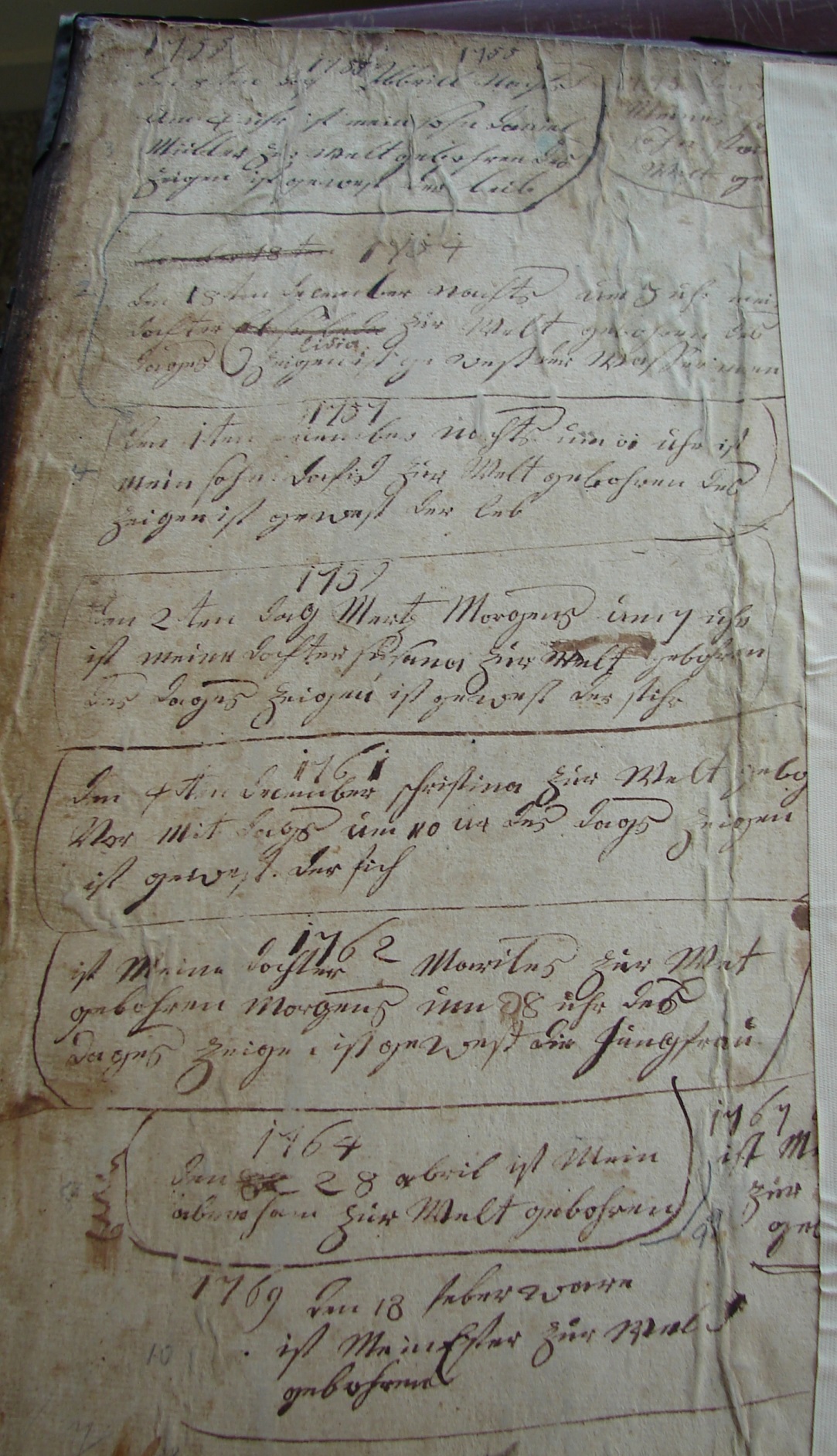
David Miller was born on July 30, 1781 to Daniel Miller and Elizabeth Ulrich, according to his father’s Bible.

David Miller Bible entry

David has been said to have been born in Bedford County, Pennsylvania, but I believe he was born in Washington County, Maryland, before his parents moved to Bedford County. His father, Daniel, is not found on the Bedford tax lists until 1785 and it’s known that during the 1781 timeframe, many people in Bedford County evacuated back to Maryland, from whence they had come. David’s grandparents, Philip Jacob Miller and Magdalena lived in Washington County during this time, and David’s parents lived there until they removed to Bedford County.  Furthermore, the 1850 census shows David’s birthplace as Maryland.

David Miller 1850 census

There is an oath of fidelity recorded for one Daniel Miller in Washington County, Maryland in 1778, although an oath of fidelity would be quite unusual for a Brethren man. However, Daniel’s father was naturalized so maybe an oath of fidelity was simply viewed as a necessary evil of survival at that time – even for a Brethren. Or maybe Daniel was shunned in Washington County, Maryland after his oath. Or maybe that Daniel Miller isn’t our Daniel Miller.

This was the most difficult of times for the Brethren, in the midst of the Revolutionary War in an area that had been suffering from Indian attacks that they described as depradations. According to various church histories, and specifically the History of the Church of the Brethren in the Middle District of Pennsylvania, the Brethren staunchly refused to flex even one little bit on their beliefs, even to defend themselves. This book, written in 1924 by Galen Royer, reports an earlier 1855 narrative that describes the Brethren as follows:

They are strict non-resistants; and in the predatory incursions of the French and Indians, in 1756-63, and in fact, during all the savage warfare, they not only refused to take up arms to repel the savage marauders and prevent the inhuman slaughter of women and children, but they refused in the most positive manner to pay a dollar to support those who were willing to take up arms to defend their homes and their firesides, until wrung from them by the stern mandates of the law, from which there was no appeal.

Their exclusiveness, opposition to education, their lack of interest in political matters, and above all, their non-resistant principle brought them into disrepute with their neighbors.

The History of the Early Settlement of the Juniata Valley by James Jones published in 1856 describes the massacre in Morrison’s Cove in Bedford County:

The savages swept down through the Cove with all the ferocity with which a pack of wolves would descend from the mountain upon a flock of sheep. Some few of the Dunkards, who evidently had a latent spark of love of life, his themselves away; but by far the most of the stood by and witnessed the butchery of their wives and children, merely saying, “Gottes wille sei gethan.”

This translates as “God’s will be done.”

This sentence was so frequently repeated by the Dunkards during the massacre that the Indians must have retained a vivid recollection of it. During the late war with Great Britain, some of the older Indians of the frontier were anxious to know of the Huntingdon volunteers whether the “Gotswiltahans” still resided in the Cove.

One Samuel R. Miller who lived in Elkhart County, Indiana in the 1880s wrote that he was born in Bedford County in 1820, and that his grandmother was in the field when an Indian attack occurred. 1777 was a particularly difficult year when the Dunkard Massacre occurred during which 20 and 30 Brethren were killed.

According to Samuel, “The Indians in that vicinity were exceedingly hostile in consequence of the encroachments made by the whites upon their hunting grounds. They killed 9 persons at one time during the wheat harvest.” Samuel’s grandmother was “present at this massacre and hid in the wheat field and thus eluded the Indians and effected her escape after they had gone.”

It is unclearly whether or not Samuel R. Miller is related to our Miller family or if he is a member of the Elder Jacob Miller line. Samuel R. Miller did marry the daughter of Susanna Miller Whitehead, our David Miller’s daughter, so his descendants could well match the autosomal DNA of the Johann Jacob Miller line, even if he is not paternally descended from this line. Both the Elder Jacob Miller, his descendants and the Johann Michael Miller line were found in Frederick (later Washington) County, Maryland, Bedford County, PA, Montgomery County, OH and Elkhart County, IN, as both families were died-in-the-wool Brethren.

However, Y DNA testing tells us that Elder Jacob Miller and the Johann Michael Miller line are not paternally related, which goes to show how quickly assumptions based only on location, family intermarriage and religious affiliation, especially with a relatively common surname, can get you into serious trouble.

Brethren Miller Michael

The chart above (click to enlarge) shows the Elder Jacob Miller line, second group from the top, and the Johann Michael Miller line with the yellow heading, and you can easily see that their marker values don’t match.  DNA testing removed decades of both speculation and incorrect conclusions, although you can still find much of that incorrect information still propagated in trees and elsewhere on the internet.

Furthermore, some people in both lines have themselves incorrectly connected to the wrong family based on first name assumptions and incorrect genealogy.  You can see an example of that in the Elder Jacob Miller group where the tester believed their genealogy connected them to the Johann Michael Miller line – but the DNA says otherwise.

The Miller families are exceedingly difficult due to constantly being located in the same area, interacting with each other and using common and the same first names in both families, like John and Daniel, for example.  You find multiple people in the same location with the same first names, from both families, at the same time.  Yes, it’s very confusing and no wonder people have connected to the wrong lines by virtue of genealogy alone.  Thank goodness for DNA testing.

If a male Miller descendant of Samuel R. Miller who was born in Bedford County in 1820 and married Mary Ann Whitehead ever takes a Y DNA test, we can tell them positively if they descend from the Johann Michael Miller line, the Elder Jacob Miller line, or neither.

Return to Bedford County

Our Miller family was back in Bedford County within a few years, if in fact they evacuated, and David Miller would never have remembered living elsewhere. Bedford County, more specifically, Woodbury Township, was his childhood home from the age of 4, if not earlier.

Daniel Miller first appears on the Woodbury Township tax list in 1785 and by 1789, is well established, farming 214 acres with 3 horses and 2 cows. There was just one problem, those 214 acres weren’t his. He rented land from a man named Cox who was somewhat of a land speculator. Many Brethren families are noted on the tax lists as renting land from Cox. According to the “History of the Church of the Brethren in the Middle District of Pennsylvania,” by 1790, all of the desirable lands were owned and all of the good land was claimed many years before. This area began to be settled in 1755.

This beautiful rolling valley named Morrison’s Cove would have been where David played and grew up in the Brethren church and among like-minded families. Bedford County at that time had no established church buildings, and services were held in member’s homes and barns.

David Miller Bedford fall

Today, this beaucolic scene is the old mill pond at Roaring Springs owned by David’s uncle, Daniel Ullery or Ulrich, however it was spelled on the day in question. David may have swum here as a child on hot summer days. In addition to his uncle Daniel Ullery and his wife, Susannah Miller, another uncle, David Miller lived in Bedford County as well as did another aunt, Esther Miller Maugans.

David Miller Roaring Springs

As a young man David would have been raised in Morrison’s Cove, but if the Miller family wanted to own land, it wasn’t going to be in Bedford County. Daniel, David and their sister Esther who was married to Gabriel Maugans decided to join their father, Philip Jacob Miller, on the frontier in Ohio about 1797.

As a teen of about 16, David would have traveled down the Ohio River with his family to settle in near the Clermont and Warren County border in Ohio, not far from the Ohio River. That must have been a great adventure for a teenage boy – traveling on a riverboat to the frontier.

David Miller Ohio River

From Bedford County to Pittsburg was about 100 miles by wagon. In Pittsburg, they would take a flatboat down the river to beneath Cincinnati where they would dock and unload near Bullskin Creek.

Philip's land map

From Bullskin Creek, Philip Jacob Miller, David’s grandfather, settled on the south side of the river, in Kentucky, and Daniel Miller along with his brother David settled about 60 miles north, at the red balloon above. Philip Jacob bought land just north of his sons, at the north end of the blue line, but never lived there and died in Kentucky in 1799.

Daniel and his brother David (not to be confused with Daniel’s son David, the topic of this article) both floated their way to Ohio along with their sister Esther Maugans and husband Gabriel, but the Ullery family would stay in Bedford County under after Daniel Ullery died. Daniel’s widow, their sister, Susannah, remarried to Armal Snider and they were one of the early couples to settle in Elkhart County, Indiana, with Susannah dying there on August 17, 1831. They were likely one of the very first pioneers.

David would have been about 16 or so when his parents, Daniel and Elizabeth decided to head for the frontier with his grandparents, Philip Jacob Miller and Magdalena, where the land was much less expensive than in either Bedford County, Pennsylvania or Washington County, Maryland where the Miller family had lived for two generations prior. Philip Jacob sold his land in Maryland in 1794 and had enough money to buy land for everyone in Ohio.

Philip Jacob Miller gathered his children and struck out for Ohio, headed for the good life, his final hurrah. The legacy he left his children, aside from their Brethren faith, was the land he bought and their resettlement in Ohio.

Miller family history tells us that they floated down the Ohio River on a flatboat, which was typical for pioneers of the day. In fact, a contemporaneous report says that these boats with pioneer families dotted the river everyplace you looked.

log raft

Upon arrival in Ohio, David would settle in Clermont County with his family.

Clermont County, Ohio

David’s father, referred to as the Elder Daniel Miller, was ordained a minister in the O’Bannion Church in Clermont County, Ohio in about 1797.

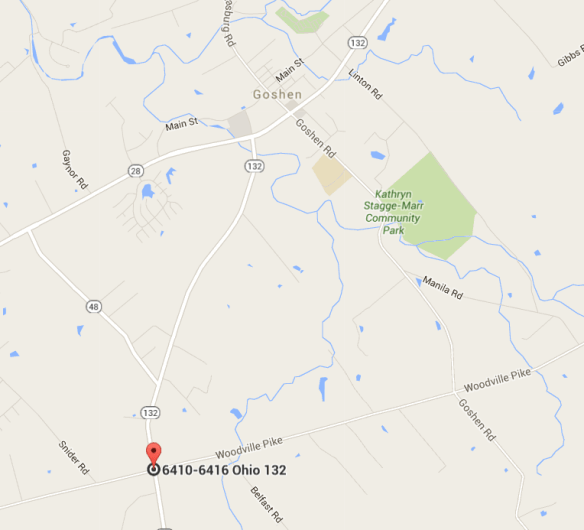
Elder Daniel Miller and his brother David (whom our David was named for) owned adjacent tracts of 200 and 100 acres about 2 miles south of Goshen, Ohio, on the northwest corner of OH132 and Woodville Pike – in the O’Bannon Church area – shown below today.
David and Daniel Clermont land map

David and Daniel’s land is shown, beginning at this intersection of Ohio 132 and Woodville Pike.

David and Daniel Clermont land

These lands are shown in Little’s (Lytle’s) bounty land survey (1802), although as far as the government was concerned, these lands were reserved for Revolutionary War military veterans. Even if settlers who were living there had obtained title from the Indians or someone else, they were still squatters in the eyes of the government. In 1802, David and Daniel’s land were shown as cleared.  Shortly thereafter, between 1802 and 1805, David and Daniel would move up the old Indian trace to Montgomery County, out of the realm of the bounty land surveys.

David and Daniel Miller’s land is shown below in relation to the location of the Stonelick Brethren Church today.

David Miller Clermont

After living between 5 and 8 years in Clermont County, the Miller clan would be on the move once again.

Montgomery County, Ohio

Sometime between 1802 and 1805, Daniel Miller would move to Montgomery County, Ohio. David would have been between 21 and 24 by this time, certainly old enough to either go with his father or stay in Clermont County. There is a very clear history of the Miller family maintaining connections between the two counties, even going back and forth to marry. The churches in the two counties were clearly thought of as sister churches as well, and many families in Montgomery County came from the O’Bannion Church in Clermont County.

There is some speculation that David was married a first time to an unknown woman before he married Catharina Schaeffer Gephart In Warren County, neighbor county to Clermont, on December 13, 1805. This speculation is based on the fact that Catharina wasn’t widowed until December 1804, so any child born to David before late 1805 had to belong to another mother.

David’s daughter, Susan Miller was born June 5, 1802, assuming that her family knew her birth date and it’s correct on her tombstone.

Daughter Esther Miller may have been born before Susan or may have been born approximately 1804, given that there are 4 years between Susan’s birth in 1802 and the first child born in June 1806 to Catharina Schaeffer after her marriage to David Miller.

The odd thing about this entire scenario is that there is a missing puzzle piece, but I don’t exactly know what it is. I wonder if that missing piece is that David and Catharina’s first child, David B. Miller, was born on June 3, 1806, just 6 months after their marriage in December 1805.

The reason I feel that something is missing is because David Miller obtained a marriage license in Warren County, Ohio, not in Montgomery County where David’s father was a minister and where Catherina lived. David had to have been in Montgomery County to meet Catherina. Catharina was very clearly living in Montgomery County at this time, because David’s father, Daniel, was made executor of the estate of Peter Gephart, Catharina’s husband, who passed away in December 1804. After their marriage, David Miller became the guardian of Catharina’s two children, John and Elizabeth Gephart.

David would have had to have been in Montgomery County to meet Catharina. Based on tax lists and later depositions, Peter’s land was a couple of miles away. Why Daniel Miller was chosen to administer the estate of Peter Gephart, we’ll never know. Daniel was Brethren and Peter was Lutheran – so perhaps the court made the selection.  One hint may be that one Johann Heinrich Gephart, known as Henry, owned land one farm away from Daniel Miller.  It’s unclear the relationship between Henry and Peter Gephart, but it does put a Gephart in the vicinity of Daniel Miller – an avenue for the two families to meet.

Another mystery is that the Gephart family, and Catherina’s Schaeffer family were all Lutheran. She is the only known convert. When and how did that happen? Was her conversion a function of marrying David?

One hint which may or may not be accurate is a statement made in David’s son, Stephen’s biography in the Kosciusko County History book which said that David moved to Montgomery County soon after his marriage and located within 4 miles of Dayton on Wolf Creek.  Keep in mind that Stephen never lived in Montgomery County and David died when Stephen was 8 years old.

On the map below, Wolf Creek runs diagonally from lower right to upper left.

David Miller Wolf Creek

Interestingly, Wolf Creek runs by Trotwood, in Randolph Township, today, the location of the Happy Corner’s Brethren Church near where David’s father, Daniel bought land in 1815, but David never lived there.

Our David is not found in Randolph Township in 1810, but in German township. The David Miller in Randolph County would be our David’s uncle, David Miller, who owned land and is buried there.

Jefferson Township butts up against both German and Miami Township and Daniel definitely bought land from Jacob Miller according to Montgomery County deeds, in Jefferson Township – so it’s likely that David and Daniel in Jefferson were our Daniel and his brother David.

A review of the Daniel and David Miller deeds in Montgomery County shows us the following information:

Date From To Section Twp Range Acres Amount
Aug 28, 1807 Jacob Miller Daniel Miller 34 (Jefferson) 3 5 150 Bear Creek $300
Sept 1, 1815 William Farmer Daniel Miller 26 (Randolph SW corner) 5 5 140.76 $1689
May 27, 1815 Daniel Miller Michael Hoovler 34 (Jefferson) 3 4 149.5 $2980
May 27, 1815 Daniel Miller Abraham Troxel 34 (Jefferson) 3 5 ½ – mill pond noted $20
March 21, 1826 Daniel Miller (David exec) Jacob Miller (son) 26 (Randolph) 5 5 100 ac N side SW 1/4 $1000
Dec 18 1827 John Miller Stephen, Jacob, Samuel, Abraham, Nancy, David (wife Elizabeth) 26 (Randolph) 5 5 40 acres SW side S quarter joining Jacob Miller land $500

The 1800 and 1810 census for Ohio is missing. However, we do have a tax list for 1810 that shows us the following information: 

David Miller 1810 tax Montgomery

As odd as this seems, the Elder Jacob Miller, who we are not related to, at least not paternally, sold Daniel Miller his land in Jefferson Township. I know, that left me shaking my head too – it’s so temping to make a family connection based on this sale.  The Elder Jacob Miller preceded the Brethren group of settlers to Montgomery County and he was probably responsible for recruiting many.

The Daniel in Dayton is the son of Elder Jacob Miller, although wrongly attributed in many genealogies.  We know for sure he lived in the Dayton City limits, as the house still stands today and is on the Register of Historic Places.

We know on the 1810 tax list that our David is the same David who is living in the same location as the Gephart land. I also suspect that the Daniel and David who own adjacent land in Jefferson Township, both entered by Jacob Miller are brothers, although I have no way to prove it.

In 1810, Daniel Miller as executor of Peter Gephart’s estate, Catherine Miller as his former wife and the mother of his 2 children, and David Miller as her current husband petition the court and explain how Peter and Philip Moyer divided land they bought together.  An excerpt is provided below:

Page 341 – May term 1810– Daniel Miller and Katharine Miller (late Katherine Gephart) with the consent of her husband David Miller administrators of the estate of Peter Gephart… that Peter together with George Moyer were in possession of 2 tracts of land as tenants in common in Twp 2 range 5, section 9 and fraction of 10…land sold to Daniel Mannbeck, land sold to Christopher Shuppert…land sold to John Shuppert…to Miami River…corner George Moyer’s land…425 acres (Moyers share was 447 acres). Peter surveyed in his lifetime, quietly to George Jeaceable. Request to execute deed. Elizabeth and John Gephart are his children. Daniel, Katharine and David all 3 sign.

In 1814, we again find David Miller farming the Gephart land, Daniel Miller in Randolph Township where we know he owned land, and David Miller, Daniel’s brother on the land in Randolph Township where he lived until his death.

David Miller 1814 Montgomery tax list

In 1830, according to the tax lists, John and George Gephart own the land that was previously farmed by David Miller who paid the taxes.

The 1820 census schedule in German Township, Montgomery County, shows us David Miller living beside John Gephart, his step-son.

In 1820, David has the following household members:

  • Male 0-10 Samuel Miller b 1816
  • Male 0-10 John David born 1812
  • Male 10-16 David B. b 1806
  • Male 26-45 David (the father)
  • Male 45+
  • Female 0-10 Lydia Miller b 1818 or Catharine b 1814
  • Female 10-16 Mary b 1809 or Elizabeth b 1808
  • Female 16-24 Susan b 1802
  • Female to 45 – Catharina (the mother)

Unfortunately, the female census columns are blurry and not all known females are accounted for.

In 1822, David’s father, Daniel, dies and in 1823 both David and Catharina signed a receipt found in Daniel’s estate having to do with her first husband’s estate.

David Miller 1823 receipt

We know where Daniel and Catharina’s farms were located due to both tax lists, deed transcriptions and current maps. We also know that David farmed Catharina’s farm before her death in about 1826.

David Miller Mont land map

The map above shows the land owned by David’s father, Daniel Miller on Bear Creek, at the upper arrow and the land owned and farmed by Catharina and Peter Gephart and later by David Miller on sections 9 and 10, at the lower arrow. These lands are about 2 miles apart.

David was the administrator of his father’s estate, along with his brother John with his brother-in-law John Becher (Booher, Bucher) and his brother Stephen Miller acting as their securities, as noted below. David’s signature is first, but it looks very odd. Maybe the paper slipped as he was signing.

David Miller 1822 signature

Roughly four years later, Catharina died too. David and Catharina had 7 children before her death, assuming that Susan and Hester were not Catharina’s children, leaving David with several children to raise, the youngest known child having been born in 1818, so about 8 years old.

In 1827, we find David still farming land that wasn’t his in German Township.  He owned 4 cows valued at $32 and no horses.  He still owned no land.

On the 1830 tax list, David still lives in German Township, owns no land, no horses.  He does own 3 cows valued at $24.  His step-son, John Gephart, now 29 years old owns land, 2 horses nd 2 cows.

In the 1830 census, David, living in German Township, is surrounded by many of the same neighbors, except John Gephart no longer lives next door.

David’s household looks like the following:

  • Male 10-15 Samuel b 1816
  • Male 60-70 David (the father)
  • Female 0-5
  • Female 15-20 Lydia b 1818 (age 12)
  • Female 20-30

This may not have been our David, as he would have been age 49, not 60-70, but there aren’t any other good candidates and he is clearly living in the right place.  Perhaps the census taker got the hash mark in the wrong column.

Either David has married a much younger woman and had a young child that did not survive to adulthood, or an unknown female is living with him, a widow perhaps, keeping house.

David wasn’t ready to settle down in the rocking chair on the porch.  He was getting ready to move on, once again.  Much like his father in Bedford County, David never owned land, and he packed up and moved to the frontier, again, where he could own land.  Only this time, the frontier was only a couple hundred miles away, two to four weeks by wagon.

But first, David married a mystery woman named Elizabeth.  I wonder if Elizabeth was aware that David was planning to move to the frontier when she married him, or if this was her honeymoon surprise.  “Surprise Honey, we’re moving to the edge of the earth, past civilization.  Yea, there are Indians, wild animals and no houses. It will be fun!   Woohooo!!!”

Elkhart County, Indiana

From the book “Rock Run Church of the Brethren Centennial 1850-1950”, the following is found on the first page:

In 1830 Elder Daniel Cripe led a group of Brethren from Ohio to Elkhart Prairie. Arriving in the spring, rude buildings were erected and the prairie was broken for the first crops.

The next year, Elder Cripe returned to Ohio and led another group of settlers to Elkhart County. There were now 16 families scattered over the county. He called them together and preached the first sermon ever delivered by a Brethren minister in Elkhart County. Later in this same year, a congregation was organized and a love feast was held.

The Elder Daniel Cripe was married to Magdalena Miller, David’s aunt, sister to his father, Daniel Miller. Magdalena Miller Cripe died about a decade later, in 1842 and Daniel Cripe died in 1859, in Elkhart County.

Daniel Miller’s estate was completed in Montgomery County, Ohio by 1830, and David Miller was in Elkhart County, Indiana by 1831 or 1832, probably arriving in the winter of 1831/1832 with Elder Cripe’s wagon train. By this time, David had remarried to a woman by the first name of Elizabeth. We know nothing more about her other than she died in the epidemic of 1838, on August 19th and was born December 19, 1777, according to her tombstone. She was buried on David’s property, now known as the Baintertown or Rodibaugh Cemetery. There is no question that Elizabeth is David’s wife, as her stone and David’s were both paid for with funds out of his estate.

David Miller Elizabeth stone

Clearly, Elizabeth is not the woman age 20-30 living with him in 1830, as Elizabeth would have been age 47 at that time.

This following extract from a letter written by Jacob L. Ullery in 1892 gives us some perspective about what the trip from Montgomery County to Elkhart County was like.

The first week we came to Saint Marys, Ohio.  The second week we came to
Fort Wayne, Indiana.  The third week we came to where we unloaded our wagon
on the west side of the Elkhart River bank in the woods about a mile west
of Goshen among the Indians.  There we put up a little shanty.  Then we cut
timber for a house and shop.  Then about the first work I done at the
carpenter trade, I went in the woods and cut a tree and split it in lumber
and made a weaver’s loom and some bed-steads.

We had no doctor and no goods.

I worked around till harvest, and then I went to the Elkhart Prairie to
“Credel” the wheat.  After the wheat was cut I helped to make hay in the
marsh, west of Goshen.  There I came among the rattlesnakes.

The last of August I went back to Ohio.  Again in 1831, I came back to
Elkhart County.  Then I helped to build the first frame house in Goshen and
helped build the first Saw Mill in Elkhart County.

In 1833 I went to Ohio again, sometime in February.  I was then 21 years
old.  In April, I was married to Susana Warner.

In various history books, David Miller is listed as a commissioner who established the location of Goshen, along with 2 or 3 other men. This David is noted as being from St. Joseph County in 1831, so we don’t know for sure that this is our David – and it looks doubtful because there are three land patents for a David Miller in St. Joseph County in the 1830s – and our David is definitely living in Elkhart County at this time. The books do indicate that Goshen was named in David Miller’s honor as he wanted that name to be bestowed – and our David lived near Goshen, Ohio from the time he was 16 until he moved to Montgomery County – so it’s remotely possible.

Goshen is also a Biblical settlement location.  The English Standard version of the Bible tells us that:

“My father and my brothers, with their flocks and herds and all that they possess, have come from the land of Canaan. They are now in the land of Goshen.”

David obtained a land patent on September 2, 1831, but we don’t know when he applied for that grant or how long the granting process took. It would have been several months, at least.

The History of Elkhart County tells us the area between the Elkhart River and Turkey Creek is known as “the Barrens” where the land undulates just enough to remove the water. This is the area where David’s home place was located.

It’s possible that David accompanied Elder Cripe in 1830 to select his land, returning home to Montgomery County to tie up his affairs and to wait for his land grant to be approved before leaving permanently for the northlands. I’m actually surprised that David left when he did, as his elderly mother didn’t die until sometime in 1832, by which time, David was already living alongside the Elkhart River. Notice of his mother’s death would have arrived with the next group of settlers to come north.

David subsequently applied for and obtained several land grants including the land he would eventually sell to sons John David and David B. Miller in 1841, for double what he paid for it. He also sold a grant to his son, Samuel.

If John David and David B. started clearing their land in 1832, about the time they arrived, they would have been done about 1841. It took a long time to clear land, as evidenced by this narrative written by one Samuel R. Miller, relationship unknown, who was born in 1820 and also lived in Elkhart County beginning in 1837.

At the age of 17 Mr. Miller entered 80 acres in Union Twp. and subsequently bought 80 acres in Elkhart Twp. and finally took up 120 acres where he now resides in Sect 17. Up to his 27th year, he was engaged in clearing land, handling the ax, mattock and maul and was persevering in his efforts to make the wilderness a garden and to secure for himself a home.

During the first years of his residence in this county, the family were supplied with fresh mean by his gun. Wild turkeys, deer, wolves, prairie chickens and wild geese were very plenty when he first came to Indiana. He has himself killed with his rifle several hundred deer. They were so numerous that the snow would be trampled hard by them near the cabin where a tree had been felled and they came to browse. Many a time by moonlight has he shot them. During his youth and manhood his toil has been incessant. He has split 800 rails in a day from the oak that grew on his section.

I’m telling you what, 10 years is a very long time to chop trees.

Here’s another peek into the past:

John L. Miller was born in Montgomery Co. in 1836. He is the son of David S. Miller and Saloma Leslie Miller. Mr. Miller has seen many changes in the county since he can remember, has seen Jackson Twp. when it was almost a wilderness, has seen the wild deer and wild Indians and other wild animals in this township. He can remember when night would come the timber appeared to be alive with wolves and other animals.

Land Grant Reconciliation

David obtained several land grants. Today, grants can be accessed at the Bureau of Land Management.  The county is listed beneath the serial number.

Name Office Serial Year Parts Sec Twp Range Acres
David* La Porte IN1700_.008 (Elkhart) 1837 E1/2SW 8 35 6e 80
David** La Porte IN1610_.132 (Elkhart) 1837 W1/2SE 32 36 6e 80
David*** Fort Wayne IN1430_.431 (Elkhart) 1831 W1/2SW 34 36 6e 80
David**** La Porte In1730-037 (Kosciusko) 1837 E ½ SE ¼ 9 34 5e 80
David Fort Wayne IN1440-239 (Elkhart) 1833 SW 1/4 5 35 6 160
David La Porte IN1600-240 (Elkhart) 1837 E ½ SW 1/4 5 35 6 80
David***** Fort Wayne IN1440-413 (Elkhart) 1834 E ½ SE 1/4 2 36 5 80
David La Porte IN1730-488 (Elkhart) 1837 SW !/4 28 36 5 160

*Land just to the west of the land in Jackson Township that David patented and sold to John David and David Baker Miller in 1841.

**Land to the east of David’s homeplace.

***The entry, signed by President Andrew Jackson, is David’s home place where the cemetery is located. Given the curvature of the land and the river, his homeplace also includes portions of section 33.

****Grant says David Miller Junior but this is the land that would be included in his estate in 1851, so it’s clearly this David.

*****David Miller and Samuel Stutzman

The grant shown below would become the land of his sons John David Miller and David B. Miller when he sold it to them in 1841 for $100 each for half of the quarter section (80 acres) each.
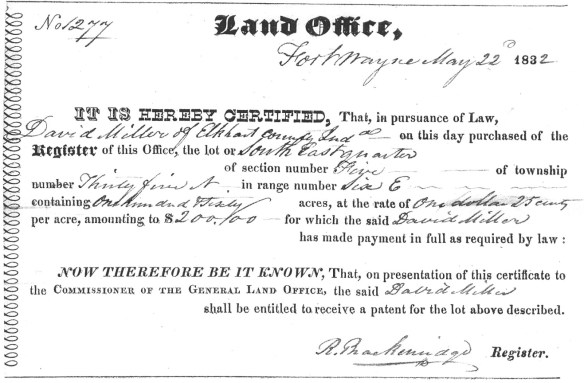
JDM David Miller land grant

David signed the receipt below.

JDM David Miller receipt

David also obtained a patent for lands that he would sell to his son Samuel. However, most importantly, he applied for land for his own homestead and received the patent in September of 1831.

David Miller homeplace grant crop

Note that David applies for this grant while still living in Montgomery County, Ohio.

David selected a piece of land that is divided by the Elkhart River and has two nice high locations, some tillable land, and the rest is swamp. The swamps were responsible for the summer sicknesses, as the pioneers reported no illness in the winter months, just the opposite of what we have today. These malarial fevers are likely what killed Elizabeth in 1838.

The Sickly Year

1838 is referred to as “the sickly year.”  Everyone was sick.

In the plat map of 1874 on page A-18, there is an article called “Ms. Violet’s Narrative in 1874”. Looking at the 1861 plat map, the Violet’s land is located a few plats (about a mile) north of David Miller’s land. She says:

“The summer of 1838 was exceedingly warm, dry and sickly. Perhaps ¾ of the inhabitants of the North part of Indiana and South part of Michigan was affected with intermittent fevers. Several near neighbors died including Elizabeth Miller the wife of David Miller.

The summer of 1839 continued to be dry but not so dry as last. There was still much sickness but not so many fatal cases.”

In the book, Elkhart County History by Chapman in 1881, they listed a group of farmers and their sales in 1845. The surnames were those of the David Miller neighborhood, as noted in deeds, land grants and plat maps and include Mikesell, Cripe, Hess, Howzer, Latta, Weybright, Thompson and Jackson. David Miller sold 200 bushels of wheat, 1600 bushels of corn and 700 bushels of oats. John Miller 1200 bushels of wheat, 1000 bushels of corn and 800 bushels of oats.

Baintertown

David Miller settled, or perhaps better stated, helped establish a community that is today called Baintertown, located along the Elkhart River just south of present day Goshen. This is the Elkhart River looking towards David Miller’s land.

David Miller Elkhart River Baintertown

Baintertown takes its name from Frederick Bainter, to whom the Wyland Mill was sold in 1860, but Baintertown was established by the Brethren Wyland brothers when they arrived from Ohio in 1830.

David Miller Baintertown Five Medals

Rex told me that the winter the settlers arrived was particular difficult. He said they arrived late in the season without time to construct appropriate shelter. The Indians still lived in a village nearby, and they helped the settlers, specifically the Miller family, select a location, very near their village, and helped them do what they needed to do to survive.

The Indian village was small, probably the remnants of the Pottawatomi village of Five Medals, and as more settlers arrived, the Indian people either died, moved away or were forced off of their land in the Indian removals of the 1830s.

However, Rex said that an old Indian Chief would visit and stay with David Miller and the two men would smoke a pipe together. David was sad when his Indian friend died, as his family would have perished without the Indians the year that they arrived.

The last known record of Chief Five Medals was in 1818, but 1830 was only 12 years later, so it’s certainly possible that Five Medals was still living, and living right where his village had originally been, beside or near David’s land on the Elkhart River.

Rex gave me this undated article from the Goshen newspaper.

Baintertown Settlers…..Wyland Town Revisited

The history of the tiny hamlet of Baintertown in Jackson Twp is interwoven with many aspects of early Elkhart County progress, Mills, the first Dunkard conference and one of the counties first estates are just a few examples.

A historical stone marker centered in a grassy triangle on county road 29 between Benton and New Paris is the only remaining testimony to the founders of the area that was once known as Wyland Town.

The marker notes the names of Jonathon, Jacob, John, Daniel, Christian and Solomon Wyland, the 6 brothers who traveled on horseback from Mercer Co., Ohio in the 1830s to tame the bountiful Elkhart Prairie.

According to local historians, the brothers entered a claim for 640 acres of land surrounding the Elkhart River there and established the county’s first sawmill.

In 1835 and 1840 a grist mill and a woolen mill were built by Jonathan and were known throughout the area as Wyland Mills.

Jonathan, apparently the more ambitious of the 6 brothers soon after his arrival erected what must have seemed like a mansion to those simple pioneers. His home was 40 by 60 and two and a half stories and boasted 18 rooms set off with two wide verandas.

The county road where the house once stood and where the marker now rests is commonly known as the Huntington Road. Although hard to imagine now, the narrow twisting strip of blacktop was once of the state’s first roads.

The legislature on Jan. 24, 1832 appointed Lewis Rogers to survey the area for the purpose of constructing a state road from Grant County to the county seat of this area.

Until the mills were built and the first harvest reaped, the Wylands, like other early settlers, relied on the abundance of wild turkey, venison, and walnuts, say historical ledgers.

Although it is not generally known, materials produced at the Wyland Mills and other mills in the county were shipped north via the Elkhart River and the Great Lakes and were received as far north as Buffalo NY.

The church played a significant role in pioneer life. Historians say the first Protestant denomination was the Church of the Brethren, or originally the Dunkard church.

Although a church building was not built until 1859 at Rock Run Creek, members congregated in their homes and anywhere that might be convenient.

The largest known gathering during the years before the church was constructed was then approximately 5000 members assembled for the church’s annual conference at the home of Jonathan Wyland.

“Settlers traveled from near and far, some came by horseback, many walked and others rode in crude wagons.” Writes one historian.

Daily sessions were held in Jonathan Wylands barn and the officials were designated members of the congregation.

Several of the first Dunkard ministers were Jacob Studebaker, reportedly the contractor for the original county courthouse in Goshen, [still standing and in use in 2009], Martin Weybright, Elder Joel Shively and the Rev. Isaac Berkey.

Finally the Wyland Mills were sold in 1860 to Frederick Bainter and the hamlet became known as Baintertown. Reportedly the village was never plotted or recorded because the residents had no desire to change their peaceful country life into “a booming city”.

The stone marker was erected in 1910 in memory of Iverson P. Wyland, grandson of Jonathan and a school teacher in Jackson Twp. for many years. It stands as a silent reminder that even though the area is calm and peaceful now, the winding waterway was responsible for transporting goods from the Wyland Mills all the way to Buffalo.

There is more to this story though, because there was a church built on David Miller’s land, where the cemetery is located, although we don’t know when the original church was organized. Organized in the Brethren sense means whey the congregation began meeting in homes, not when they built a church building.

Edward Clark bought the land from David Miller’s estate in 1861 and in 1877, he executed a deed to “Trustees, German Baptist Church” stating that when the property is no longer needed for this purpose, the land should be turned over to the cemetery trustees.

The church was located on the west side of the original cemetery.

The first known burial in the original “old section” of Baintertown cemetery was the grandson of David Miller, William Miller, son of David B. Miller and his wife, Christine. William died at 2 days of age on November 4, 1831 – so the family group had arrived by then.

The family had not been in this area long. Needing to establish a cemetery shortly after arrival was not a good omen. David has barely had his land 2 months and the first soil broken was possibly that shovel that buried his grandson.  The wagon train had probably just arrived.

We don’t know when a church was established in this location, but it was probably already in existence by 1877, likely meeting in people’s homes or in a log building when a church building from a Reformed Presbyterian Church in Waterford built in 1858 was dismantled and re-erected on the land deeded next to the original cemetery. By 1931, the church was no longer functioning, so the building was sold and the land became the west part of the cemetery on the north side of the road, where newer burials and parking are found today.

Another article is titled, “Baintertown, A Thriving Center” and was published in the 1976 Goshen News.

David Rodibaugh, Everett Miller’s grandfather was the pusher of the day. His ambition was to acquire a farm for each of his children. His daughter married Ira J. Miller, Everett’s father and they got the farm where the Baintertown school still stands northeast of New Paris.

Rex Miller owns this land today and the school still stands and is in use as a farm building. It’s even heated today, something it probably wasn’t originally. The old school sits at the intersection of road 29 and 142.

David Miller Baintertown school

David Rodibaugh first set up the saw mill, furnishing lumber for many houses and barns in the area. T.J. Harriman was his right hand man.

Next he built the woolen mill and manufactured blankets of all kinds. Later Reddens and sons set up the grist and flour mills and manufactured Never Fail Flour and ground corn meal.

The grocery store was run by Edward Barringer, Everett Miller’s great uncle.

About that time there came a rapid change in merchandizing. The mills, brick kilns and flour mills closed up as they could not compete with national brands, and Baintertown faded out much faster than it had grown. All the factories were torn down and all that remains is a stone in the small park strip, recording the fact that the 6 Wyland brothers landed in the area in 1832 and became very influential. In fact the town was first known as Wylandtown but later when a man named Bainter bought the woolen mill from Mr. Wyland the name of the town was changed to Baintertown. This was around 1862.

Baintertown, then Wyland Mills, saw it’s heyday during the lifetime of David Miller.

David Miller’s Brother, John

David’s brother, the Elder John Miller, also settled in Elkhart County in 1835. As reported in the biographies of the History of Elkhart County, “He was an active co-laborer of Elder Daniel Cripe, and did his share of the evangelistic work in those early days. He finally located in the Yellow Creek Church, seven miles southwest of Goshen, where he died in 1856.”

David Miller John Miller d 1856

The Yellow Creek Church is now the Solomon Creek Church, with the cemetery adjacent.  The map below shows the route from the Baintertown Cemetery, on David Miller’s land, to the Yellow Creek Church.

David Miller to John's map

John Miller is the last known Miller to own the Bible known as the Philip Jacob Miller Bible that ultimately belonged to Philip’s son, Daniel Miller. John bought the Bible at his father Daniel’s estate sale and brought it with him to Elkhart County, where it somehow left the possession of the Miller family and today resides with a family who has no idea why they have this Bible.  John’s signature is found in two places in the Bible.

John Miller signature 2

John Miller signature

The owners were very gracious and allowed me to visit the Bible several years ago. The only connection that we have found is that we believe the owner’s ancestor may have bought the house that John Miller once owned. If that is the case, then the Bible may have somehow been left behind. It has been passed down in their family, as a heirloom, ever since.

Philip Jacob Miller Bible and me crop

Marriage to Martha Drake

On June 6, 1839, David remarried a widow woman named Martha Drake who had at least one minor child. Interestingly enough, in the 1840 census, we find David’s neighbor in Elkhart County to be Ann Drake.

This would truly have been a scandal in the Brethren community, because Martha Drake was a….are you ready for this….a Baptist. Yes, and she didn’t convert either. Holy moley.

I bet this was not a uniformly approved marriage by David’s siblings, younger children, or anyone Brethren. And David’s entire group of friends and family were Brethren. This was indeed a scandalous “mixed marriage.” Obviously, David didn’t care. I do wonder if he separated from the church at that time, or stopped attending. I think this makes David Miller an official black sheep – at least from the Brethren perspective!

David’s 1840 household was comprised of:

  • Male 10-15
  • Male 50-60 David
  • Female 15-20
  • Female 30-40 Martha Drake Miller

Both of the children are probably Martha’s children.

Martha and David set about having 3 additional children by 1846.

Land Speculating

David may have been doing a bit of land speculating. Given that land was almost free for the taking – secured with a small payment – why not? That way land would be readily available for newcomers arriving from Montgomery County and elsewhere, and David stood to make a bit of money. The process of land patenting wasn’t quick or necessarily easy – but once you knew how – it was probably quite worthwhile to have readily available land for people who wanted to settle and start clearing and farming right away. The land patent process didn’t happen overnight.

David apparently farmed several tracts himself, based on these deeds in the chart below found in Elkhart County.

Year From To Qtr Sec Twp Rg Ac
1834, Apr 15 Benjamin Bennett and Susanna David Miller for $100 bk 1 pg 333 W ½ NW ¼ 35 36 6e 80
1834, Oct 3 Henry Matthews David Miller (mortgage and release*) E ½ SE ¼ 4 35 6e 80
1840, Nov 11 David Miller, Bk 6 pg 335 (3 ac) and 336 (3/4 ac) Fractions on Elkhart Riv 3 ¾ ac
1841, Mar 23 David Miller and Martha Samuel Miller for $100 bk 20- page 319 (recorded Nov 4 1852) bk 16 p 17 W ½ SE ¼ 32 36 6e 80
1841, Mar 23 David Miller and Martha John Miller Jr. for $100 bk 20-319 not rec until Aug 14 1856 N ½ SE ¼ 5 35 6 80
1841, Mar 23 Peter Wallmer and Anna John Miller bk 20-page 320 W ½ NW ¼ 5 35 6 81.3
1844, Oct 5 David and Martha Miller Solomon Conrad for $200 bk 9-433 E ½ SW ¼ 8 35 6 80
1845, Oct 18 David and Martha Miller (her mark) Laporte land office sale**1 E ½ W ¼ 8 35 6e 80
Aug 15 1849 David Miller and Martha Lot 147 in Goshen, bk 12-555
1851, Oct 18 David Miller and Martha David Miller Jr bk 14-512 for $100 S ½ SE ¼ 5 35 6 80
1855 David Miller est David P. Gross N ½ NW ¼ 15 35 7e 80
1855 David Miller est (land grant) John Troup W ½ NW ¼ 6 35 6e 79
1855 David Miller est Jonas Renfro Ne frac 33 36 6e 9
1855 David Miller est (home place) Jonas Renfro W ½ SW ¼ 34 36 6e 80
1855 David Miller est Moses Babcock Kosciusko

*Mortgage release was signed on June 13, 1835. Witness William Latta and Caleb Winger

**This notes that there is an affidavit in the Misc Record Book 15 page 165 dated Dec. 27 1918.

An Elkhart County patent map assembled by Boyd IT in 2005 shows that David Miller received a patent in Elkhart Township in 1831 for his homestead land in section 34. There were several 1831 patents to many individuals, but none earlier.

Furthermore, the land patent map shows that David also obtained a patent in section 32, the west half of the southeast quarter in 1837. This map shows the earliest grant to be in 1831, and that Nathaniel Drake also patented the land abutting David Miller’s on the north. I wonder if Nathaniel Drake is related to Martha Drake, David’s second wife. This might well explain how they met.

Imagine that…Baptists next door!

The Early Church

The Gospel Messenger published on March 6, 1909 page 149, tells us something about the early Brethren church in Elkhart County.

THE CHURH IN ELKHART COUNTY, INDIANA

By J. H. Miller

In this article I am to tell about the history and the growth of the Church of the Brethren in Elkhart County, Ind. In this County was the first church organized in Northern Indiana, and Goshen was the center of the congregation.

It is said that Bro. Daniel Cripe organized the church about 1830. Soon after that, another brother, John Miller, moved to this “northwestern land,” as it was then called. I well remember of seeing both of those brethren and hearing them preach in German. They settled on Elkhart Prairie, and were from Montgomery County, Ohio: The first child of the Brethren, born in Elkhart County, was Rosanna Cripe. Those “newcomers,” as they were called, held their first meetings in their log cabins.

There are now nineteen congregations in the county, some reaching out into adjoining counties. There are fifty ministers living in the county. Of the number of ministers who formerly lived in the county, twenty-four have died.

There are twenty-three places of worship, and about 1,800 members, nearly as many as may be found in the other part of the State district. Among the number of ministers, strong men in their day, who have died in the county, were James Tracy and Amsey Puterbattgh. They were Brethren, useful men, and did a good work.

Meetinghouses were built about 1850. Their big wagons would go through the mud, woods and cross streams, in order to reach the place of meeting. My father’s turn would come about once in fourteen months. That was a big day for us children. All the ministers had a word for Jesus. Even the deacons were not excused, though there might be six or eight present. They had to bear testimony to the Truth preached. The deacons usually had the place on a bench in front of the preachers’ table.

After meeting a big dinner was served at the expense of those who had the meeting for that day. After dinner, from two to three hours were spent in social visits. Much love and union seemed to prevail among those early Christian fathers and mothers: Our neighbors were from eight to ten miles away, and we were always glad to see them.

In 1852 the Annual Meeting was held in Elkhart County, five miles south of Goshen, in Bro. Jonathan Wyland’s barn, 40 x 80 feet in size. It was estimated that there were about 4,000 people present. I remember of hearing my father speak of the large crowd. It is presumable that John Kline, of Virginia, was the moderator. It was thought by some that this was the first Annual Meeting held in Northern Indiana.

The second, in Elkhart County, was held in 1868; in Eld. Jacob Berkey’s barn. Henry Davy was moderator. In 1882 the meeting was held on Bro. John Arnold’s farm. I have in mind three Annual Meetings in Northern Indiana, and all were held in Elkhart County. At the present time Northern Indiana must have nearly 4,000 members. Many have been added to the church within the last eight months.

In those days the faithful ministers would walk and ride for miles to the place of worship. I remember that Bro. John Leatherman, when ninety years old, walked from ten to twelve miles on Saturday, returning home on Monday. These faithful old brethren were full of the missionary spirit.

I was born in Elkhart County, in 1838, hence have a fairly good knowledge of the workings of the church here. My prayer is that God may call many more faithful workers into his vineyard; and that many souls may be converted to Christ.

It’s remarkable to me that John Miller was still preaching in German, being the 4th generation to reside in America.  My mother tells of hearing her grandmother, Evaline Miller Ferverda (1857-1939), David’s granddaughter, speak in German – although most of the time she spoke English.  Mother said the Brethren Church at that time still gave sermons in German.

Schools

David may have moved to the frontier when it was barely settled, but all of his children learned to read and write, either before or after arriving in Elkhart County. We know this based on the signatures on his estate distribution. What we don’t know, for sure, is if the children attended the Whitehead School which would have been located about 4 miles distant, and required fording the Elkhart River and Turkey Creek, or if they were taught at home or in a makeshift school in someone’s home. One thing is for sure, school would not have been taught in the spring, summer and fall when help was needed on the farm. Survival was more important than education.

David Miller to Whitehead school

The Whitehead School was located on the west side of present day CR 19 north of CR 48 in Sect 17. Samuel Whitehead (1811-1874), one of 9 Whitehead brothers, settled in what became known as the Whitehead settlement, southwest of New Paris, Indiana. About 1836 a round log cabin with a clapboard roof was built on his property. This first schoolhouse was about 12X16 in size and was replaced by a wood frame building and was in use until the 1880s when it was replaced by a brick school building. For some reason this school is not shown on any of the county maps before 1874. But it has been found that David B. Miller, David Miller’s grandson, born in 1838 did attend this school in 1854.

Here’s what we know about early schooling in Elkhart County.

The Gospel Messenger March 23, 1907 page 182 Vol. 46 No.

IN SCHOOL FIFTY-FIVE YEARS AGO.

By J. F. Neher, Guthrie, Okla.

It is interesting to note the changes that have come in a half a century or over. Fifty-five years ago I had my first experience in school. The schoolhouse was built of logs. The benches had no backs and were made of slabs by boring holes in each end; into these the legs were inserted.

On one side the house one log was cut out and along window put in to give light to a long table, which was made by boring holes into the log below the window; into these long pins were driven, on which a broad board was fastened, which served as a writing table.

The teacher was the father of a large family living near the schoolhouse. The rod was frequently used, but mostly severely on his own children.

He taught German and English, and a variety of text-books was used. One the higher classes recited their lesson from the Old Testament, another from the New Testament. One, a brother’s son, had for his text-book Brother Peter Nead’s book; and still another recited his lesson from an old German hymn book.

Other things might be mentioned that would seem odd to the student or schoolboy of today; but I believe if the use of the Bible had been retained, the masses today would have a better knowledge of the Good Book.

David’s Death

When David died on December 1, 1851, he left Martha with 3 young children.

David Miller Baintertown stone

David Miller is buried on the far east side of the Baintertown cemetery, just before it drops off into swamp, behind the tombstones below.

David Miller Baintertown burial

The closest thing we have to an obituary for David comes from the Pictorial and Biographical Memoirs Elkhart and St. Joseph Counties, Indiana – 1893 by Goodspeed, page 698, which is actually about his son, David B. Miller.

David Miller came to Elkhart County about 1830 when the country was a wilderness, inhabited only by wild animals and wilder savages. He came to the county overland and settled on 80 acres, build a log house and immediately began clearing and improving. He raised 3 sons and 4 daughters of whom our subject’s (David B. Miller) father is the only one now living, but all reached mature years, married and became the heads of families. They are David, Samuel, John, Elizabeth, Catherine, Lydia and Susan. The mother of these children died in Ohio. David remarried having two children, Michael and Steven, both of whom are living in Milford Indiana. The father died in Jackson Twp.

We know this account is not fully accurate, because David had 9 children who lived to adulthood and married, including Susan mentioned above, born in 1802, before David married Catharina Schaeffer Gephart. Furthermore, he died in Elkhart Township, unless he was visiting someone at the time.

We know positively that David had 9 children before marrying Martha Drake and 3 after his marriage to Martha because of his long, drawn out estate.

The Estate

David died on December 1, 1851, almost exactly 20 years after arriving.

Their son, Stephen’s biography was included in the Kosciusko County History book gave David’s death date as November 5th instead of December 1st.

Apparently things had either slipped David’s mind, or perhaps he wasn’t well, because his land in Kosciusko County had to be “redeemed” by paying the back taxes for 1850 out of his estate.

I was fortunate to find David’s estate packet relatively intact in Elkhart County during a visit a few years ago. Many items didn’t have dates, but enough did that I was able to put together a timeline of what happened. And a lot happened.

You would never have known that this was a Brethren estate from the proceedings.

David’s inventory was appraised and then the sale occurred at the “home of the deceased” on January 3rd, 1852.  That must have been a cold auction.  What follows is his estate appraisal.

Number Items Appraised Value
16 Pigs 10.00
4 Larger pigs 7.00
2 Sows 5.00
6 Sheep firs choice 7.20
6 Sheep – Second choice 7.00
6 Sheep – Third choice 6.00
5 Sheep – fourth choice 3.75
1 Black horse 60.00
1 Small wagon 35.00
1 Windmill 1.50
1 lot Sheaf oats, 12.5 per dz 6.35
1 Lot of corn – 20 per bushel 36.00
4 Kettles 8.00
1 2 horse wagon 35.00
1 Harrow 1.50
1 Cultivators 1.50
1 Grindstone .50
1 Broad ax 1.50
1 Grubbing hoe .75
2 Iron wedges 1.00
1 Lot 2 augers 1.00
1 Lot foot ads drawing knife .50
2 Chopping axes 1.25
1 4 pronged fork and shovel .88
1 Lot of harness 2.00
1 Spear .25
1 Lot of irons and spades and c 1.00
2 Bee keeps 2.00
2 Barrell and reg 1.00
2 Calves 6.00
1 Black cow 10.00
1 Red cow 7.50
1 Bell cow 8.00
1 Speckled cow 9.00
1 Log chain 1.75
1 Lot of wagon tires 3.00
1 Lot of oats 25 bu 3.00
1 Mowing scythe .50
1 Wool wheel 1.00
1 Cut reel .50
1 Barrel and vinegar 1.00
1 Spinning wheel .12
1 Old ladle and old harness .25
1 Rocking chair 1.50
1 Bred tray .50
1 Box stove and 6 joint pipe and elbow 10.00
1 Bed and bedding 10.00
1 Bed and bedding 5.00
1 Saddle and reigns 9.00
1 Chest 2.00
2 Flax heckler 1.00
7.5 Yards cloth 18.75
6.75 Yards cloth 16.87 ½
1 Loom 2.00
1 Clock 2.00
1 Bed and bedding 5.00
1 Cupboard and cupboard ware 5.50
1 Cook stove and pipe 12.00
1 Lot of chairs 1.00
Total appraised value 241.53

The actual sale brought in $436.52. David was clearly actively farming with the cows, sheep and pigs listed, along with the farm equipment.  The number of sheep he had is probably directly related to the Wyland brothers’ woolen mill close by.  He also had a 2 horse wagon, but only one horse.  Maybe he shared resources with someone, or maybe he had lost a horse recently.

Did David have a family Bible tucked away in that chest?

At David Miller’s estate sale, John Miller bought steelyards for 1.25, a fish gig for 25 cents. The widow bought 2 calves. I always feel sorry for the widows whose entire household is up for grabs.  Her spinning wheel, her dishes and plates, her furniture.  How was the widow supposed to function, let alone raise three children?  Somehow, these resourceful women always found a way.  I remember watching my Mom cry at my Dad’s estate sale, and her things weren’t being sold, just his.  In a way, it’s a second death as the pieces of your loved one’s life are scattered to the winds.

So far, in this estate, everything looks normal, but it wouldn’t stay that way for long.

David, it seems, owned quite a bit of property, listed on this document from his estate packet.

David Miller land list

I compiled a list of property from tax receipts from the estate. You will notice that some sections and townships look to be incorrect – and they probably are. I have not corrected this, because I wanted to retain it as an example of why we need multiple sources for everything we can confirm in that manner. I don’t know if their handwriting was bad, or mine was, or the data was actually inaccurate – but clearly the “odd man out” data is highly suspect.

Three different pieces of land comprised David’s home place, in section 33 and 34.  The Elkhart River  was the boundary in section 33, which made for an odd sized piece of land.  This all makes perfect sense, once you look at the map.

County Tax Year Desc Section Twp Range Acres Sale
Home Tracts
Elkhart 1851 ½ NW 1/4 35 36 6 80
Elkhart* 1851 – home W ½ S 1/4 34 36 6 80 Jonas Renfro
Elkhart 1852 – home W ½ SW ¼ 34 36 6 80 Jonas Renfro
Elkhart 1852 – home W 1/2 NW 1/4 34 36 6 80 Elkhart Twp
Elkhart 1853 – home 34 36 6 80 Jonas Renfro
Elkhart 1854 – home W ½ SW 1.4 34 36 6 80 Jonas Renfro
Elkhart 1855 – home W ½ SW 1/4 34 36 6 80 Elkhart Twp Jonas Renfro
Elkhart 1856 – home W ½ SW ¼ 34 36 6 80 Elkhart Twp
Elkhart 1851 part of home 33 36 6 9
Elkhart 1852 – part of home In fee 33 36 6 9 Elkhart Twp
Elkhart 1854 – part of home 33 36 6 9 Elkhart Twp
Elkhart 1853 – part of home 32 9
Elkhart 1855 – part of home 33 36 6 9 (7) Elkhart Twp
Elkhart 1856 – part of home 33 36 6 9 Elkhart Twp
Elkhart 1851 part of home NE? 33 36 6 16
Elkhart 1852 – NE fraction 33 35 6 16 – Elkhart Twp
Elkhart 1853 – part of home 33 16
Elkhart 1854 – part of home NE fraction 33 36 6 16 Elkhart Twp
Elkhart 1855 – part of home 33 36 6 16 Elkhart Twp
Elkhart 1856 – part of home NE fraction 33 16 Elkhart Twp
Other Land
Elkhart 1851 W ½ NW 1/4 6 35 6 79 John Troup
Elkhart 1852 W ½ NW 1.4 6 35 6 79 Jackson Twp John Troup
Elkhart 1853 W ¼ NW ¼ 6 35 6 79 John Troup
Elkhart 1854 W ½ NW ¼ 6 35 6 79 Jackson Twp John Troup
Elkhart 1855 W ½ NW ¼ 6 35 6 79 Elkhart Twp John Troup
Elkhart 1856 W ½ NW 1/4 6 35 6 39 Jackson Twp
Elkhart 1858 W ½ NW ¼ 6 35 6 79 Jackson Twp
Elkhart 1859 W ½ NW ¼ 6 35 6 79 Jackson Twp
Elkhart 1851 N ½ NE ¼ 15 35 7 45
Elkhart 1852 N ½ NW ¼ 15 35 7 45 Benton Twp
Elkhart 1853 N ½ NW 1/4 15 35 7 80
Elkhart 1854 N ½ NE ¼ 15 35 7 80 Benton Twp
Elkhart 1855 redeemed from tax sale 1851/52 N ½ NE ¼ 15 35 7 80 Benton Twp
Kos 1850 E ¼ SE ¼ 5 34 5E 80 Moses Babcock
Kos 1851 E ¼ SE ¼ 5 34 5E 80 Moses Babcock
Kos 1852 E ¼ SE ¼ 5 34 5E 80 Moses Babcock
Kos 1851 E ½ SE ¼ 9 34 5 80 Moses Babcock
Kos 1852 for 1851/1852 E ½ SE ¼ 9 34 5 80
Kos 1853 E ½ SW ¼ 9 34 5 80 Moses Babcock
Kos 1854 E ½ SE ¼ 9 34 5 80 Moses Babcock
Kos 1855 E ½ SE ¼ 9 34 5 80 Moses Babcock
Kos 1856 E ½ NW ¼ 9 34 5 80
Kos 1858 E ½ SE ¼ 9 34 5

Martha petitioned the court in about 1855 for her dower lands to be set aside, possibly indicating her intention to remarry, which she did to Joel Applin on January 21, 1858. She is deceased, according to David’s estate records, by 1861. Her gravestone says she died on Sept. 11, 1860.

Martha’s dower land came out of the W ½ SW ¼ Sect 34 Twp 36 Range 6 and was listed as 10 and 40/100 acres. *In 1856 Samuel Miller, as executor, sold part of David’s land to Jonas Reutford or Reutfrow or Renfro, the NW corner of SW 1/4 of Sect 34 Twp 36 Range 6 along the Logansport road and Elkhart river,10 and 40/100 acres.  The northwest corner would have included the house.

David Miller sale notice

Aside from the land, there were other interesting receipts that provide us with a glimpse of David’s life.

  • January 21, 1851 William L. Baker submits a bill to the estate for 6.5 yards of shrouding – $3, 3 yards of bleached muslin – .45 and bolts and screws for coffin – .30

According to sources on Brethren history, the early Brethren were not buried in their clothes, but wrapped in a shroud that was wound around them. This suggests that indeed, David did have a Brethren burial – at least Brethren style.

David’s son, John David’s estate in 1902 was charged for a “robe” instead of burying him in his own clothes.

Furthermore, coffins were to be as simple as possible, and often, the deceased was buried and then the funeral service “celebrated” at the church, without the body. I wonder how much of this custom was related, at least originally, to the lack of refrigeration and embalming. In fact, when coffins were first taken into Brethren churches, it caused quite a ruckus and they were only allowed just inside the back door.

  • August 1851, Stephen Miller came of age.
  • Martha Miller is alive and signs with an X on January 8, 1852
  • John Latta guardian of the 3 Miller children in 1853, but by Aug 1, 1856 Latta is dead and Samuel Ridgeway is guardian.

Some estate distributions were begun in 1853, but by 1855, the bulk of David’s estate, tied up in land, becomes an issue.

  • May 4, 1853, Abraham Leer signs as receiving part of his estate as heir of David Miller.
  • May 3, 1853, Adam Whitehead signs for payment of his share of David’s estate.
  • May 4, 1853, David B. Miller signs for part of his share of estate.
  • In 1855, Adam Whitehead and Michael Haney are administrators of David Miller’s estate, and Conrad Brumbaugh signed a receipt in of partial settlement of his share of the estate as one of his heirs.
  • Aug 25, 1855, John Liveringhouse signs for part of his estate distribution as guardian of 2 minor heirs.
  • Aug 25, 1855, Samuel Ridgeway was guardian of 3 minor heirs.
  • August 25,1855, signs as receiving part of David’s estate as an heir. Mary Stowder
  • Aug 25, 1855, Milford Zunn (Zanin) (both names unclear) signs as heir of David Miller.
  • Aug 25, 1855, Jonathan Caly? Gives receipt for part of distribution of estate as heir. (Jonathan Colyar from 1853 receipt)
  • Aug 25 1855, S. B. Miller gives receipt as heir for part of estate.
  • In August 1855, Adam Whitehead is also guardian of David Drake, obviously Martha’s son.Receipt in David Miller’s estate “Received Feb 15, 1856 from John D. Miller ? on tombstones for David and Elizabeth Miller.”On April 1858, Samuel Ridgway is paying bills on behalf of the children. “Received of Samuel Ridgeway $1.20 for schooling of Stephen and Michael Miller, sons of the widow of the widow Miller.”

I wonder if this means that Matilda wasn’t being schooled, or perhaps her illness prevented her schooling, especially if she had something like Down’s syndrome, a very common occurrence in the youngest child born to late in life mothers.

The Lawsuit

Brethren simply did not file lawsuits. In fact, they would do just about anything to keep from confronting someone, and especially not in court. However, those Brethren traditions went by the wayside in 1855, when all of David’s heirs, including the widow, sued Adam Whitehead and Susan Miller Whitehead. While David may have separated from the traditional ways of the Brethren Church, by and large, his children did not – at least not his children from his marriage to Catharina Schaeffer.

The front of the estate packet shows the plaintiffs that sued Adam Whitehead and Susan, his wife.

David Miller estate suit

August term 1855

Petitioners Martha Miller the widow of David Miller decd, (Adam Whitehead and Susan Whitehead his wife are stricken here,) David Miller, Michael Haney and Elizabeth Haney his wife, John D. Miller, Mary Stouder, Conrad Brumbaugh and Cathearine Brumbaugh his wife, Samuel B. Miller, John Collier and Lydia Collier his wife, adults over the age of 21 years and Stephen Miller, Michael Miller and Matilda Miller, infants under the age of 20 years by Samuel Ridgeway their guardian and John Lear, Hetty Lear and Sarah Lear also infants under the age of 20 by Abraham Lear their guardian, Samuel Brumbaugh, Lydia Brumbaugh his wife, Samuel Irwin and Elizabeth Irwin, his wife, Israel Irwin and Susan Irwin his wife, Isaac Shively and Catharine Shively his wife, all adults over the age of 21 years and William Livinghouse and Sulvia? Livinghouse, also infants under the age of 20 by John Livinghouse their guardian. That David Miller deceased (is) their ancestor who about the year 1852 departed this life intestate leaving the said widow and your other petitioners and Adam Whitehead and Susan Whitehead who are made defendants here to and are his heirs at law who took title to all his real estate by descent.

Owned tracts to wit:

  1. E half of SE quadrant section 9 twp 34 range 5 Kosciusko county 80 acres
  2. North half of the nw quarter section 15 twp 35 range 7 80 acres Elkhart county.
  3. West half north NW quarter section 6 twp 35 north rage 6 east 79 acres Elkhart

Court finds:

  • Martha Miller (the widow) to get one third part as her dower.

Each of the following heirs to have their one twelfth part:

  • Susan Whitehead
  • David Miller
  • Elizabeth Haney
  • John D. Miller
  • Mary Stouder
  • Catherine Broombaugh
  • Samuel B. Miller
  • Lydia Collier
  • Stephen Miller
  • Michael Miller
  • Matilda Miller
  • The remaining one twelfth part to be set over to John Lear, Hetty Lear, Sarah Lear, Elizabeth Irwine, Susan Irwin, Catherine Shively, William Livinghouse and Eliza Livinghouse.

David’s oldest daughter Hester Miller married Abraham Lear in 1824 in Ohio. Beyond that, these individuals are challenging, to say the least.

Hester Miller and Abraham Lear’s known children are:

  1. Elizabeth Lear b Dec 1827 died Aug 16 1913 in Gage, Nebraska.
  2. Susan born April 12 1832 died June 5 1907 North Liberty, St. Joseph County, Indiana
  3. John W. Lear b Sept 1838
  4. Sarah born 1841 Elkhart County
  5. Another document references a deceased daughter of said Esther Lear.

Martha Dies

According to the estate documents, the orphans’ mother died “sometime in September 1860.”

A January 1861 letter to the court states that Stephen, Michael and Matilda Miller own 3.12th of land W ½ SW ¼ section 34 township 36 range 6 except the south end near the center of the south line donated in the decedents lifetime for the purpose of a graveyard. Also excepting the part of that section laying west of the Logansport/Goshen road.

On June 8, 1861 Samuel Ridgeway sold several pieces of David’s land to Edward Clark.

This 1874 plat map, at the bottom center right, shows the original David Miller land which includes the cemetery as owned by E. Clark.  IN 1874, David’s land is bisected by the railroad, in addition to the road.

David Miller 1874 plat

After Martha’s death, this partial paper was found in David’s estate packet.

“and 13 respectively and now reside in Elkhart County. Stephen resides with David Dousman and his working for himself. Michael is working for board and going to school and Matilda resides with Adam Whitehead.”

Filed by their guardian.

Daughter Matilda Miller Dies

Matilda was clearly very ill for some time before she died. Doctors were called, and paid. Sadly, the receipt never said what they treated her for.

By Dec. 8, 1861, Samuel Ridgeway is the guardian of the 3 Miller children. “Received of Samuel Ridgeway guardian for the heirs of David Miller decd $2 for taking of Matilda Miller while sick. Mary Berry”

Matilda Miller’s doctor bill was from Sept 27, 1861 to Sept 30th.

Oct 17, 1861 $23 for coffin.

Dec 9, 1861 shrouding for Matilda Miller, also paid for 10 days care of “Matilda in last sickness.”

Dec. 14, 1861 David Dausman and Samuel Rodibaugh to appraise estate of Matilda Miller.

Matilda’s estate consisted of one bed and bed clothing and bedstead for 22.00 and one chest for 2.00. I can’t help but wonder what was in that chest. Was it David Miller’s chest?

The Final Payments

On Jan. 15, 1864, the 3 youngest Miller children are referenced as “minor heirs of Matilda Miller deceased, there being 11 shares of said Matilda’s estate, and two of them having been paid to Stephen Miller and Michael Miller.”

Michael Miller became of age January 15, 1864 and was paid in full for David’s and Martha’s estate.

Matilda’s share was divided among her two brothers and the other 9 heirs.

The administrator’s final report was submitted Jan 16. 1864

Thirteen years and a month after David died, when his estate was finally settled, Martha had died, Matilda had died and his children were estranged. Some were probably Baptists, no less. Not quite the outcome David had envisioned in 1831 or 1832 when he arrived in Elkhart County with all of his children, full of hope.

David’s Homestead

David’s homestead was still owned by him, along with some other lands along the Elkhart River and in other townships, at his death. His homestead is on the border of Elkhart and Jackson Townships, bordering both sides of State Road 15 and County Road 29 on the south, today, two of the first roads in the area. CR 29 was an old Indian path. David’s house was located in an area where the train tracks are located today.

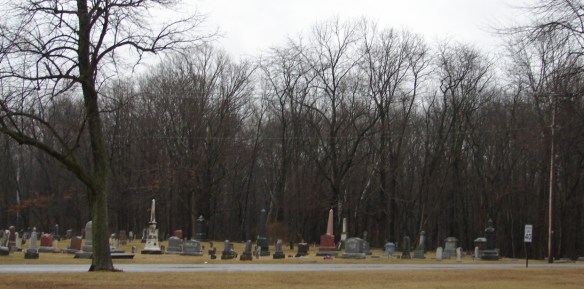
David patented 80 acres in the west half of the southwest quarter of section 34, township 35 (Elkhart), range 6 east. In his estate packet, we confirm that the cemetery existed at that time, and it is where David is buried as well, by the following sale order for the above land which said specifically…..“except for ½ acre on the south end near the center of the south line donated to the descendants of life-time for a graveyard.” This is today the Rodibaugh, also known as Baintertown, Cemetery, which was originally the David Miller cemetery, and by all rights, should be called the Miller Cemetery. This is where David and his second wife Elizabeth are buried. Martha (Applin), his third wife, is buried here near their daughter Matilda who died about a year after Martha. The old portion of the cemetery is shown below. David is buried far to the right, against the woods.
David Miller Baintertown

On the 1851 Elkhart County plat map, below, David’s land is shown as the David Miller estate, and on the 1874 map the land is owned by E. Clark. The previous location of the house to the right of the road is now where the railroad is located.  I believe this was the house where David lived, because it was the house given to Martha in her dower rights.  The original house was likely a quickly constructed rough hewn log cabin and after 40 years of use, may have not been in good shape. On the other hand, David’s son, John David’s log cabin built probably around the same time is still standing today underneath siding, sandwiched between additions.

David Miller 1851 plat map

Based on the 1851 plat map, David had three structures on his land.  Both were north of the river.  One was on the right hand side of what is now 15, looking north, and two to the left, near the intersection of what is now 42.

David Miller near house

Sitting at the intersection of 42 and 15, and looking left across the road to the west, you should be able to see David’s two houses sitting together – if they were still standing.

Moving slightly south, perhaps David’s house was near these white outbuildings today, seen above but barely visible between the trees, below.  When David owned the land, it may have been cleared.  Today, it is overgrown.

David Miller near house 2

David’s house that was sitting east of the road would have been torn down when the railroad went through, if not before.  It would have sat in the clearing below, and this was probably the highest elevation of his land.  David would have built his home where it was least likely to flood.

David Miller railroad tracks

Moving on south on 15, we can see the Elkhart River on both sides of the road.  This first picture is looking west.  David owned the land on both sides of the River here.

David Miller from 15 west

Looking east, you can see the railroad bridge today.  I wonder if the island was created after the railroad bridge was built with sediment accruing near the bridge base.

David Miller from 15 east

This was likely the shallowest location to ford the river, which was why the original trail was here, with the road curving on either side of the river.  This original path was followed by the road in the same location, followed by the railroad paralleling the road for miles.

The next map we find is an 1874 plat map, which is after Edward Clark bought David’s land.

The colored legend on the 1874 map is:

  • Yellow – David’s home place
  • Orange – David’s other lands
  • Green – David’s land sold to family members
  • Green dash – John David, David’s son’s lands
  • Blue – other fractional sections belonging to David

Note that on the 1874 map, the cemetery is noted. It also looks like CR 29 was slightly altered, perhaps when the railroad was laid.

David Miller 1874 plat map

The map below shows Jackson Township which joins with Elkhart Township, just beneath David’s land.  David also patented the land to the left of John David Miller and David B. Miller, labeled C. Broombaugh.  Conrad Brumbaugh was married to David’s daughter, Catherine.  The land beneath David B. Miller’s land labeled J. M. Whitehead is the land originally owned by Adam Whitehead and his wife Susanna Miller.  Tensions must have run high in these homes after David’s death and during the lawsuit – given that four of David’s children were neighbors, and Samuel lived just up the road.

Margaret Lentz 1874 Jackson Twp map

None of David’s heirs bought the homeplace, probably because all of his older children had farms of their own.  Several of the older children probably never lived there, and some only having lived on the homeplace a short time until they married.  The younger children had no funds with which to purchase the land. The younger children probably also inherited their mother’s portion of the estate, which was 1/3rd of the value of the estate, after her death when they came of age.

The photo below is the Elkhart River as it feeds into David’s land downstream slightly, taken from the park, looking west.

David Miller river from park

The section borders appear to not have been cleared, so they are visible today. This is the northern border of David’s land.

David Miller property line

The following photo is on the road running along the northern border of David’s land (CR 45 ) and is taken from near where the house was located looking East.

David Miller road

This would have been the high farmable lands when David cleared the lands, but today, the owners use this as yard. The only high portions of David’s land was land adjacent the house and then where the cemetery is located, both areas of which are surrounded by significant lowlands which would absorb the floodwaters and hopefully prevent the high areas from flooding.

David Miller field

David Miller higher lands.

David Miller highlands

An example of David’s swamp lands is shown below. In the summer this is probably an impenetrable mess of briars, snakes and mosquitoes.

David Miller swamp

Old trees demarcating the east boundary of David’s land on CR 45. I wonder if these trees were alive when he was.  In most places, it’s illegal to cut a boundary marker tree.

David Miller boundary trees

This list of items submitted as expenses to David’s estate shows the types of farm activities that took place annually on David’s land and how much David’s estate paid to have the activities performed beginning in 1850, which suggests that’s when his health was deteriorating:

Date Activity Amount Paid
Sept 10 Hauling wood .75
March 1850 ½ days haulting .75
March 20 Hauling wood .50
March 24 Threshing 1 day 2 hands and team 2.00
July 20 1 hand threshing 4 days 2.00
July 22 1 hand cleaning wheat 2 days 1.00
July 11 Paid for threshing 100 bushels wheat 5.00
July 30 Hauling wood .50
Aug 28 Making fence 1.25
Aug 30 Hauling rails 1 day 1.50
Aug 31 Hauling rails 1 day 1.50
Aug 31 1/3 note given for threshing 3.62
Aug 30 1/3 expenses of threshing 2.00
Dec. 2 Hauling wood .75
Dec 11 Hauling wood .75
Dec 12 Hauling wood .75
Dec 17 1 day butchering .50
Dec 30 Hauling rails with 2 teams 3.00
Dec 31 Hauling rails with 2 teams 3.00
Jan 1 1851 Hauling wood half day 2 teams 1.50
Jan 2 1851 Hauling wood .75
Jan 10 Hauling wood .75
Jan 18 2 hands building fence 1 day 1.00
Jan 20 Hauling wood .75
Jan 27 Resetting 84 ails from 1850 rails at 2 ? per hundred 4.62
Sept 4 150 fire? Iron from Hawks 7.50
Jan 3 1852 129.50 bushel wheat 3.90
Jan 3 Expenses of paying hands, horses, etc 7.00
Feb. 15 Hauling saw logs to Myland? 1.00
May 28 Hauling Mamon 2.00
May 29 Ditto
Oct 11 106 pounds beef 3.18
Oct 11 1 barrell salt 2.25
Nov 8 Hauling firewood 1.25
Nov 9 Hauling 3 saw logs 1.00
Dec 22 Hauling firewood 1.00
Jan 21, 1866 Hauling firewood 1.25
Aug 2 Cutting and fretting rep 3 acres whet 3.00
Aug 2 Half bushel flax seed .50
Aug 12 1 hand threshing with machine 6 days 3.00
Aug 16 1 hand cleaning wheat 4 days 2.00
Aug 20 Hauling rails and building 120 rods fence 25.50
Jan 14, 1867 Chopping and hauling wood 1.00
Jan 18 Half day butchering .50
Jan 20 Half day hauling wood .75
March 10 Hauling wood 1.5 days 2.25
March 1, 1868 Half day threshing by David .75
March 1 1.5 days threshing by Jacob .56
April 6 Hauling Mamon? With 2 teams 3.00
July 10 Hauling wood and hay 1.00
Aug 26 Threshing 1 day team and 2 hands 2.0
Sept 22 Haulting wood .25
Sept 28 Hauling wood .25
Sept 30 Hauling 8 load wood 1.25
Jan 13 1853 Hauling 7 loads wood 1.25
Jan 30, Hauling 2 loads wood .25
March 4 Threshing oalts 2.00
March 10 Threshing wheat 2.00
March 20 Hauling wood 2.00
April 13 Peeling rails 2 days by Jacob .75

It looks to me like hauling wood was the task that never ended.

David’s Children

David had children by at least two wives and probably three. I only wish David had a family Bible that had survived, because that Bible would likely tell us the story. Maybe it was in that chest, or maybe one of the children or his wife had already taken the Bible.  Maybe it still survives someplace today.

David Miller’s Children with an Unknown Wife

Esther Miller was deceased at the time that her father David’s estate was distributed.

We don’t know Esther’s birthdate, but one researcher shows her marriage to Abraham Lear (also spelled Leer) on December 30, 1824 and names a source as a DAR record. Odd for a Brethren family to have a DAR record.

We do know that Esther was married before 1827 based on her children’s ages. Unfortunately, these dates do little to narrow the range of her birth from “before 1806” to “after 1806” which makes a difference in terms of the identity of her mother.

In the 1850 census, Esther’s husband Abraham’s wife is listed as “C.” Three of Esther’s children are present in that census, Susan, age 18, John, age 14 and Sarah, age 7. Beyond that, there are two additional children in Abraham’s household, Isabel age 4 and Lucinda age 2. These two children are not mentioned in David Miller’s estate distribution, so I would take that to mean they are the children of Abraham and wife “C,” and not of Esther. Furthermore, I would also take this to indicate that Esther died between 1840/1843 when Sarah was born and 1846 when Isabel was born.

In the 1860 census, Isabel and Lucinda are both still living, so their omission from David Miller’s estate is not a matter of death. Additionally, in 1860, William Liveringhouse, age 12, is living with Abraham Lear. Known children of Esther Miller and Abraham Lear according to David Miller’s estate, marriage records and the census are:

  • Elizabeth Lear born December of 1827 and died in August 16, 1913 in Holmesville, Gage Co., Nebraska. Her descendants show her birth date as December 5, 1825. She married Samuel Irvin in Elkhart County on May 11, 1845 and had 8 children. None of the children listed in the one twelfth part are hers.
  • Susan Lear born April 12, 1832 in Elkhart County, Indiana and died on June 5, 1907 in North Liberty, St. Joseph County, Indiana. She married Israel Irvin on April 23, 1852 in Elkhart County and had 7 children.
  • John W. Lear born in 1838. He married Samantha E. Shafer on September 18, 1872 in Elkhart County, Indiana. They had two children.
  • Sarah Lear born in October 1840 (census indicated both 1840 and 1843 at different times) and died after 1910 in Marion County, Kansas. She married Israel Eliphet B. Riggle on October 2, 1862 in Elkhart County. They had 3 children.

David Miller’s estate distribution mentions the 4 children, above, but also mentions the following individuals who are also to receive out of Hester’s one 12th portion, indicating they are her heirs.:

  1. Hetty Lear
  2. Catherine Shively
  3. William Livinghouse
  4. Eliza Livinghouse

Another estate document references a deceased daughter of Esther Lear. Given that William Liveringhouse is living with Abraham Lear in 1860, I would interpret this to indicate that the deceased daughter had married a Liveringhouse. Mary Leer married John Liveringhouse on November 7, 1847 and apparently had two children William and Eliza, before she died, apparently not long before her father. Based on this information, I’m adding Mary Lear as a daughter.

  • Mary Lear was born probably about 1827 and died about 1850. She married John Liveringhouse on November 7, 1847 and had two children, William and Eliza.
  • Catherine is another daughter and a Caty Lear was living beside Abraham Lear in the 1850 census, with Catherine Stutzman, age 50. Abraham Lear’s mother was a Stutzman. Catherine Lear married Isaac Shively on December 26, 1852 in Elkhart County. Catherine Shively was listed in David Miller’s estate distribution.
  • Hetty Lear married Henry Stutsman on April 30, 1857.

Susan Miller was born June 5, 1802 and married Adam Whitehead on February 17,1825 in Montgomery County, Ohio. She died on July 17, 1876 and is buried in the Whitehead Cemetery in Elkhart County. Her birth is calculated from her age on the tombstone.

David Miller daughter Susan stone

Susan Miller and Adam Whitehead had the following children:

  • Mary Ann Whitehead (1828-1916) married Samuel R. Miller
  • Elizabeth Whitehead (1829-1853) married Jacob Riggle(s)
  • Esther Whitehead (1831-1910) married Daniel Shively
  • John M. Whitehead (1833-1912) married Sarah Smith
  • Susana Whitehead (1836-1916)
  • Catherine Whitehead (1838-1919) married John Riggle
  • Margaret Whitehead (1841-1851)

David Miller’s Children with Catherine Schaeffer

David B. Miller was born June 3, 1806 in Montgomery County, Ohio, died on September 26, 1881 in Elkhart County, Indiana and is buried in the Baintertown Cemetery. David’s stone is 4 sided, with wife Christina buried on one side.

David Miller son David stone

Their 2 children are memorialized on one side.

Miller, David B back 07

The third side is David and the fourth side is an inscription.

David Miller son David closeup

David married Christina Brumbaugh before coming to Elkhart County.

The book Genealogy of the Brumbaugh Family shows that Conrad born in 1811 married Catharine Miller and Christine born in 1814 married David Miller.

David Miller Brumbaugh book

David B. Miller had 11 children.

  • Catherine who died before 1893
  • Samuel R. Miller born 1820 who died in or before 1893
  • John B. Miller born 1839 died 1897
  • William Miller born November 2, 1831, died November 4, 1831, buried in the Baintertown Cemetery.
  • Eve Miller born July 1836, died April 2, 1838, buried in the Baintertown Cemetery.
  • Michael M. Miler born December 1842 in Elkhart County, died Sept 5, 1854 and is buried in Baintertown.
  • Jacob Miller was born in 1832 and married a Catherine.
  • Mary Miller was born in 1835
  • Elizabeth “Betsy” Miller was born in 1844
  • Daniel C. Miller was born in 1847 and died in 1931.
  • Susannah Miller was born in 1849.

Elizabeth Miller was born on April 6, 1808 in Montgomery County, Ohio, died on January 16, 1891 in Elkhart County, Indiana and is buried at Baintertown. She married Michael Haney in 1827 in Montgomery County, Ohio. They patented land very near David Miller in Elkhart County and had 5 children.

  • Matilda Haney (1834-1934) married John W. Baker
  • Elizabeth R. Haney (1836-1900) married George Washington Alfrod
  • Joseph Beane Haney (1838-1920) married Lucinda Whitehead
  • Mary “Molly” J. Haney (1843-1922) married Allen D. Gilkinson
  • John Michael Haney (1847-1849)

Mary Miller was born in 1809 in Montgomery County, Ohio and married Jeremiah Bright January 31, 1828 in Montgomery County, Ohio. According to the Elkhart County Pictorial and Biographical Memoirs, they had five children, but I found evidence of 7 including two children who died young:

  • David Miller Bright (1829-1905) married Elizabeth Rinehart
  • George W. Bright (1830-1852)
  • John Bright (1831-1928)
  • Mary Bright (1833-1911) married Jacob Alva Aurand
  • William Bright (1835-1917) married Catherine Wagner
  • Susannah Bright (1837-1838)
  • Daniel Bright (1838-1840)

Mary then married Christian Stouder on September 11, 1842 in Elkhart County and had four more children:

  • Lydia Stouder (1833-1893) married Samuel Neff in 1883
  • Christian Stouder (1845-1927) married Elizabeth Hohbein and her sister, Catherine Hohbein
  • Samuel H. Stouder (1850-1891) married Margaret Rummell
  • Unknown 4th child

David Miller daughter Mary Stouder stone

Mary died on October 22, 1863 and is buried at Union Center Cemetery, although her birth and death information was apparently never inscribed on her stone.

John David Miller was born April 6, 1812 in Montgomery County, Ohio and married Mary Baker there on January 24, 1832. They came to Elkhart County with or near the same time as David Miller. Mary and John David had 10 children:

  • John Miller – died as a child
  • Catherine Miller – died as a child
  • Samuel Miller – died as a child
  • Unknown child – died
  • Hester Ann Miller (1833-1917) married Jonas Shively
  • David B. Miller (1838-1922) married Susan Smith
  • Mary Ann Miller (1841-1915) married Michael Treesh
  • Aaron B. Miller (1843-1923) married Sarah Myers
  • Matilda A. Miller (1844-1935) married John Dubbs
  • Martha Jane Miller (1847-1935) married David Blough
  • George Washington Miller (1851-1917) married Lydia Miller

John David Miller married second to Margaret Elizabeth Lentz, widow of Valentine Whitehead. They had four children:

  • Evaline Louise Miller (1857-1939) married Hiram Ferverda
  • Ira J. Miller (1859-1948) married Rebecca Rodibaugh
  • Unknown child – probably died in 1861
  • Perry Miller (1862-1906) married Mary Jane Lauer

Photo of John David Miller with Margaret and 5 of his children.

John David Miller Photo

Catherine Miller was born March 17, 1813 and died September 24, 1876 and is buried at Baintertown. She married Conrad Brumbaugh in 1833 in Elkhart County and they had five children.

  • John W. Brumbaugh (1835-1910) married Sarah Peffley
  • Lydia Brumbaugh (1838-1856)
  • Eve Brumbaugh (1840-1891) married Daniel Riggle
  • Sarah A. Brumbaugh born about 1846
  • Joseph Brumbaugh (1856-1921) married Ellen Martha Hissong

Samuel B. Miller was born in 1816 and married Rose Ann Bowser Dec. 13, 1837. He died March 1, 1887 and is buried at Baintertown . They had seven children:

  • Emanuel Miller (born 1838), noted as “cripple” in 1870 census
  • Mary J. Miller born (1840-1920) married James Alford
  • William H. Miller (1841-1915) married Delilah J. Alford and Matilda J. Alford
  • Desaline Miller born (1845-1904) married G. Alonze Latta, died of strangulation
  • Albert J. Miller born (1846-1924) married Elizabeth
  • Charles C. Miller born (1847-1910) married Sarah
  • Cephus Miller born 1850, died after 1860
  • James Miller born 1862

Lydia Miller was born about 1818 in Montgomery County, Ohio and married John (Jonathan) Collier, also spelled Colyar, on September 18, 1834 in Elkhart County. She died about 1876. They had seven children:

  • David Colyar born in 1837, married Susanna
  • Elizabeth Colyar born in 1838, married a Whitman
  • Susan Louise Colyar (1839-1917) married George Jacob Hardtarfer
  • Mary Colyar born in 1842
  • John Colyar (1845-1932) married Sarah Josephine Belden
  • Catherine Colyar born in 1848
  • Louisa Emaline Adaline Colyar born in 1855

David Miller had no children with his next wife, Elizabeth, who died in 1838, but he had three additional children with his last wife, Martha Dickerson Drake.

Children with Martha Dickerson Drake.

Michael Miller was born December 25, 1843, a Christmas baby, in Elkhart County. He died on October 20, 1908 of “la grippe,” a colloquial term for flu or an intestinal disorder, and is buried at Baintertown.
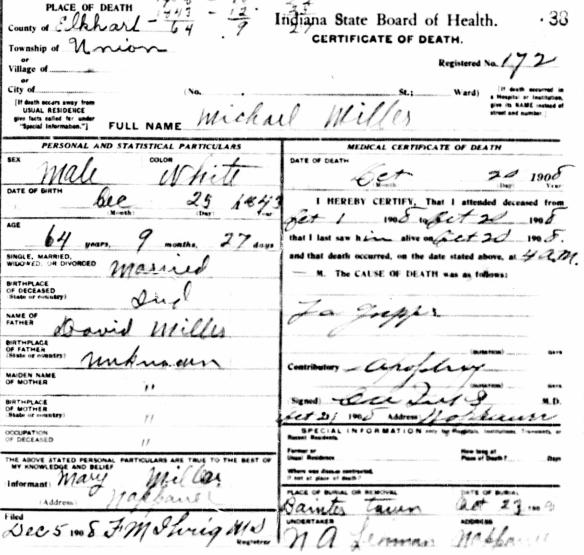
David Miller son Michael death cert

Michael married Mary Jane Sparklin about 1866. Mary Jane’s surname is taken from several of her children’s death certificates. They had seven children:

  • Mary C. Miller (1868-1945) married Marion Franklin Mock and George Hefner
  • Frank N. Miller born in (1873-1920) married Sarah Catherine Leedy
  • C. Miller born in 1873, died after 1880
  • Robert Miller (1877-1948) married Carrie Heeter
  • Martha Miller (1884-1948) married John Rapp, then McClellan Corner,
  • David Charles Miller born in (1887-1912) married Hilda Gertrude Huber
  • Susanna Miller born in 1891 married Irvin Hall

Steven Miller was born August 26, 1840 in Elkhart County. On July 4, 1861 he married Mary Magdaline Dausman. From the looks of his picture below with no indication of a beard, he clearly wasn’t old order Brethren.  Several more liberal Brethren churches were formed after “schisms” within the Brethren church.

David Miller son Stephen

From the History of Kosciusko County, published in 1887, we find the following:

David Miller Stephen 1

David Miller Stephen 2

David Miller Stephen 3

David Miller Stephen 4

Stephen died on October 24, 1926 in Syracuse, Kosciusko County, Indiana and is buried in the Syracuse Cemetery in Kosciusko County.

David Miller son Stephen stone

Stephen and Mary had eight children:

  • Ella Miller (1862-1926) married Andrew William Strieby
  • Michael Ferman Miller (1864-1938) married Olive Kirkendall
  • Samuel B. Miller (1866-1914) married Anna
  • Marion Sylvester Miller (1868-1933) married Martha Brower
  • Charles Miller was born in 1870
  • Emma Miller (1875-1947) married Frank Bushong
  • Earl Miller (1868-1933)
  • Hattie Viola Miller (1886-1972) married Ed Fisher

Matilda Miller was born on October 5, 1845 and she died on October 7, 1861 and is buried at the Baintertown Cemetery, with her parents.

Summary

For a simple Brethren man, David Miller was mighty complex. He died slightly over 100 years before I was born. Ironically, he had been entirely forgotten by his descendants in that intervening century – just 4 generations.  How quickly people forget.

I was the 5th generation to be born. Only his granddaughter, Evaline, my mother’s grandmother, was remembered by my mother, who was the only person to convey any family history to me. Mother never knew any of the Miller cousins, and there were hundreds upon hundreds, many of whom lived just a few miles up the road from where she was raised.

Now I realize that in part, not knowing her Miller cousins simply had to do with time and distance, but the other part was that untold story of division within the family. This family was twice divided in as many generations.

By the time my great-grandmother, Evaline Miller Ferverda was born to John David Miller, son of David Miller in 1857, the David Miller estate lawsuit was well underway. David’s children filed suit after his death, in 1855, pitting all of his children and widow against one daughter, Susan, and her husband, Adam Whitehead.

By the time Evaline died, in 1939, there had been two estate battles with divisive lawsuits.  Just before her father, John David Millers death, his son would petition the court for a guardianship and John David’s death in 1902 signaled the beginning of a war that made the Hatfield-McCoy feud look trivial.  It’s no wonder mother didn’t know any of her Miller cousins.

It also didn’t help in terms of knowing relatives that the Brethren Millers didn’t drive automobiles at that time.  They utilized horses and buggies for the most part.  Furthermore, Mother’s father, Evaline’s son, had broken with the Brethren Church and married a Lutheran woman.  They drove cars and were “modern,” including the fact that his wife worked and drove her own car no less.  Clearly, they didn’t fit in an extended Brethren family.  From their perspective, they were progressive.  From the Brethren perspective, they were outcasts and black sheep.

Making matters even worse, David Miller turned black sheep himself and married Martha Drake, a Baptist. Not unexpectedly, David’s youngest children were raised Baptist, not Brethren so there was a “not Brethren” and “progressive Brethren” (yes that’s an oxymoron) part of the family that the traditional Brethren part of the family probably wished to disavow.  Wow, things get complex quickly!

The Brethren Miller families seemed to cluster in different churches, probably in no small part to avoid each other.

The Miller family, twice divided by estates and bifurcated by religious differences would never recover – and a generation or two later didn’t even know they were related.

David certainly tried to take care of his family. He moved them to the frontier and patented land that he subsequently sold to his 3 sons. The daughters? Well, I guess they were expected to marry well.

David’s children were educated enough to read and write, including his daughters who signed receipts for their portion of their inheritance.

David married at least 3 times, and probably 4. His two eldest children were likely from his first marriage to an unknown spouse before his marriage in 1805 to Catherina Schaeffer, widow of Peter Gephart. David and Catherina had 7 more children before she died about 1826.

He married Elizabeth probably between 1830 and 1831, after the census and before leaving for the Elkhart County frontier.

Elizabeth was in her early-mid 50s when she married David who was 4 years younger, so there were no children from that marriage.

All of David’s children moved with him to the frontier, at least all of the children we know about. His daughter Susan was born in 1802 and Hester may have been born about 1800. They were both married in Ohio, but they came along on the journey to Elkhart County.

In addition, Elizabeth may have had her own children that moved with the family to Elkhart County, so it may have been a very blended family by that time.

David’s last marriage in 1839 to Martha Drake, a Baptist woman, was something I had never once considered as a possibility. Brethren simply did not marry outside the faith, and if they did, the spouse quickly converted. Martha didn’t. I wonder if this was a constant source of friction within the marriage, or if they had an understanding before the marriage. It’s also possible that he withdrew from the church, depending on the level of pushback he received. I would love to know, but none of that information filtered down, to the best of my knowledge. Were it not for the “vanity books” of the early 1900s published in many localities, we wouldn’t even know that juicy tidbit about the “mixed” marriage. You can tell by the way that verbiage is written, beginning with, “both of his parents were Christians,” that the topic had been brought up before – and the answer people were given.

I wish we knew something more of David, the man himself. We have nothing written in his hand, except receipts – and thank Heavens for those. The only personal story we have is of David and the Indian Chief.

David’s life was amazing. He grew up in the shadow of the Revolutionary War and Indian massacres. He helped his father tame the frontier in Bedford County, then floated down the Ohio where he did it a second time, in previously unfarmed and untamed wilderness in Clermont County, Ohio. He saw the land he cleared be lost due to the military bounty land, and then recovered, and he helped his father once again in Montgomery County to build a farm and a mill out of frontier land.

I find it utterly amazing that as a man, aged 50, half a century, at a time when men that age were considered “elderly,” he set out to tame the frontier once again. He probably felt he had a great deal of experience and after surviving 50 years on 3 frontiers, probably nothing much frightened him. The word that comes to mind is brave, unquestionably brave.

David lived for another 20 years on his Elkhart County land, on the Elkhart River, where the Indians told him would be a good location, beside their village. By the time David died, their village, and the Indians were gone, and Elkhart county was no longer the frontier.

David is buried on his land, in what was surely called the Miller Cemetery for years, probably up until Baintertown came into existence, after 1860. Not long afterwards, the name “Miller Cemetery” was forgotten, as was David. Relegated to nothing more than an almost illegible name on a tombstone along the Elkhart River in the back of a cemetery, buried 165 years ago on a cold winter day that was probably much like the day I visited 160 years later and found David’s land, his history and details of his life, once again.

What a story was waiting to be told!

A man who fathered at least 12 children,  11 of whom grew to adulthood.  A man who was married either 3 or 4 times, buried either 2 or 3 wives, lived on 4 frontiers and tamed 3.  David had at least 90 grandchildren, at least 22 of whom were born after his death.  He buried at least 12 grandchildren in the cemetery on his own land, probably digging their graves himself.  He rests beside two of his wives, among his children and grandchildren today.

David Miller Baintertown today

Thankfully, David’s story is no longer lost to his descendants.  He lived a remarkable life.

David Miller Bainterown today 2

______________________________________________________________

Disclosure

I receive a small contribution when you click on some of the links to vendors in my articles. This does NOT increase the price you pay but helps me to keep the lights on and this informational blog free for everyone. Please click on the links in the articles or to the vendors below if you are purchasing products or DNA testing.

Thank you so much.

DNA Purchases and Free Transfers

Genealogy Services

Genealogy Research

John David Miller (1812-1902), Never In His Wildest Dreams, 52 Ancestors #125

John David Miller was born April 6, 1812 in Montgomery County, Ohio to David Miller and Catharina Schaeffer.

Catharina, his mother, was a widow with two children when she married David Miller on December 13, 1805.

Between their marriage and Catharina’s death in about 1826, she bore 9 children. She died when John David was just 14 or so, a difficult age for a boy made even more difficult by his mother’s passing.

John David’s father married a woman named Elizabeth before leaving for Elkhart County, Indiana four years later, in 1830. Elizabeth died in 1838 in Elkhart County and John David’s father remarried again to Martha Drake in June of 1839, having 3 more children. We have this late marriage to thank for the long drawn out estate settlement which provides us with a great amount of information, including lists of David’s children and in some cases, grandchildren.

David’s son, John David Miller married Mary Baker on January 24, 1832 in Montgomery County when he was about 20.  They applied for the license 10 days earlier, with her father registering “no objection.”

John David Miller Mary Baker marriage

Oral history tells us that John David went to Elkhart County, then back to Montgomery County to marry his sweetheart and brought her back to Elkhart County. Some honeymoon, bouncing around in a wagon, but as a love-struck newlywed, who cares!

Their first child, Hester, was born on May 26, 1833, and her death certificate says she was born in Ohio, but the 1850 census says she was born in Indiana. It’s believed that by 1832, John David was in Elkhart County, Indiana.  The 1892 Elkhart County plat map, created when John David was still living, stated that he was born in 1812 and came to Jackson Township in 1832. It’s likely that John David Miller and possibly his bride joined the Cripe wagon train headed north during the winter of 1831/1832.

When the wagon train first arrived in Elkhart County, the extended family would have lived together initially, constructing a log cabin. The oral history tells us that they didn’t have time to construct a cabin that first winter, and they constructed a lean-to and covered the door with skins and fabric. That’s was probably the longest winter of their lives! Northern Indiana winters are miserable and bitterly cold. The Indians still lived there and helped the settlers survive.

The first several years, the family would have worked together to clear lands and farm what they could. Clearing and farming were full time jobs. John David and his bride likely lived with his father and family during this time.

In the 1840 census, we find the Brethren families grouped together. We know that David Miller owned land and was living on land where the Baintertown Cemetery is located today, his wife, Elizabeth, being the first (marked) burial in 1838.

In order, on the 1840 census, we find:

  • William S. Baker
  • Elias Baker
  • Samuel B. Miller
  • Adam Mock
  • Jacob Stutzman
  • John Miller
  • David Miller
  • Conrad Broombaugh

David Miller is shown age 30-40 and John Miller is shown age 20-30. John David would have been 28. His brother, David, would have been age 34.

Their father, David, was shown on a different page because his land was in a different township, although only a couple miles away.

The 1840 census shows John David with 4 children. We can fit known children into slots as follows:

  • Male age 5-10 (born 1830-1835) Samuel died before 1850
  • Male under 5 (born 1835-1840) David B. Miller born 1838
  • Male under 5 (born 1835-1840) John N. died before 1850
  • Female under 5 (born 1835-1840) Hester born 1833?

There is another female child who was born and died between census years, Catherine. If Catherine is the female under 5, then where was Hester who appears to be missing from the census?

The binding factor between these families listed together on the 1840 census is that they were Brethren. The reason they were attracted to Elkhart County was the availability of land grants. The land in Montgomery County was already taken. The relationship between the Miller, Mock and Stutzman families reaches back 4 generations to Johann Michael Mueller, the immigrant, in Pennsylvania and Maryland.

Land

John David’s father, David, applied for and obtained several land grants. This particular grant below, applied for in 1832, would become the land of his sons John David Miller and David B. Miller when he sold it to them in 1841 for $100 each for half of the quarter section (80 acres) each.

JDM David Miller land grant

David, John David’s father, signed the receipt below.

JDM David Miller receipt

John David Miller may have applied for some land patents himself, and subsequently sold them, probably to raise funds. There are many John Miller’s in Elkhart County so differentiating them without middle initials is troublesome.

John David Miller and David B. Miller had very likely been clearing and working this land since 1832 when their father obtained it as a grant.

John cleared the land and built a log cabin which still stands under a portion of the house that remains today.  The cabin is the center section, shown below.

Margaret Lentz home

I always wondered why this house is turned sideways, then I looked closely at the plat maps and realized that the road, 142, that now runs east and west behind the house at one time curved and went in front of the house, so the house wasn’t sideways when it was built and it sat on the north side of the road.

JDM closeup of map section

Today, it sits on the south side of road 142. The current driveway was the original road.

JDM satellite 2

It makes me wonder, which came first, John David’s log cabin or the road, which was then likely no more than a wide path.

JDM farm

Turkey Creek runs along and through David’s land, shown below hidden behind the trees. This area is still relatively wet and densely forested.

Turkey Ck

Creeks in pioneer times were the lifeblood of the community, assuring fresh water for people and livestock in addition to being the early highways.  Land creekside went first – although the land along Turkey Creek is low and wet, even yet today.

This aerial view shows the very green Y intersection between Turkey Creek, the treed area on the left, and the Elkhart River, which runs on the east side of the map.  John David’s house is marked with a small grey pin at the intersection of 142 and 21.  You can see the extent of the forestation along the creek and river.

JDM aerial

Lots of floodplain probably meant that John David’s house and fields never flooded.

JDM turkey creek 3

This is Turkey Creek from the bridge on 142, today, above, looking at the portion on John David’s land.

JDM Turkey Creek 2

This part looking north is a little brighter and more cheerful.  Looking at this dense forest, you can understand why the pioneers had issues with malarial diseases.  There are backwaters and swamps green with algae less than a mile north.  Mosquito heaven.

JDM turkey looking at John's land

On the Turkey Creek bridge, looking at John David’s land on the left.

Oral history states that the Native people helped the family pick good land.  If that’s true, we are indebted to them.  It’s a decision that in time, they surely came to regret – not necessarily in terms of the Miller family personally – but in more general terms.  They not only became overrun by successive waves of settlers, they were forced off of their lands.

John David’s Father’s Death

John David’s father, David, died on December 1, 1851 without a will. At the time of his death, he had a wife and small children, after a 4th marriage to a younger widow woman 20 years his junior in 1839. Their last child was born in 1845, just 6 years before David’s death.

Clearly David’s death was unexpected, even though he was 70 years of age, or he probably would have executed a will given that he had children by at least 2 wives, 3 of which were minors.

John David Miller was not his father’s executor, thankfully. David’s estate was not to settle smoothly. Initially Adam Whitehead, husband of David’s eldest living sister, Susan, was the estate administrator.

Then something very un-Brethren-like happened. In 1855, all of David’s heirs, including John David Miller, sued Adam Whitehead and Susan. Brethren simply did not “take someone to law,” let alone a relative, and would try absolutely everything else to resolve a situation. This is the first lawsuit I know of being filed in America in the Miller lines. That’s pretty amazing, given that David’s heirs are 4 generations downstream from the original immigrant.

Court was a last resort – and often Brethren would let a wrong “stand” rather than taking an oppositional position, through law or otherwise.  Often, the church got involved to help straighten things out. Therefore this lawsuit is shocking to say the least – and apparently all of David’s heirs uniformly agreed, as they are all represented by the suit. That’s even more shocking and probably speaks to the gravity of the situation at hand.  The fact that the lawsuit wasn’t file until nearly 4 years after David’s death suggests this was a measure of last resort.

Based on the court document filed by the plaintiffs, Adam Whitehead had taken possession of all of David Miller’s lands by right of descent, which apparently meant because he was married to the eldest child (or at least eldest living child.)

This must have been a very difficult situation, because Adam taking possession of David’s lands would have excluded Martha Miller, David’s widow, and David’s three minor children from the proceeds of his estate or utilizing his land. While the older children wanted their share, I’m sure, the widow and her three minor children depended on that land and his estate to live.

The court agreed with the plaintiffs and ordered that Martha be awarded one third of David’s estate as her dower right and the rest to be divided evenly between his 12 children.

David’s son, Samuel, then became the executor. David’s estate settlement dragged on for 13 years, the last distribution made in 1864 when his final living child reached the age of majority.

John David signed three receipts during the long probate of his father’s estate, one each in 1854, 1855 and 1857 when he accepted a final $100 as his share of his father’s estate. His signatures are shown below.

JDM estate receipt

JDM 1855 estate receipt

JDM estate receipt 2

Never in his wildest dreams would David have expected the family to be split in this manner. This is the kind of rift that never heals. Estates, then and now, bring out the worst in people. 

Widower and Remarriage

John David Miller’s wife, Mary Baker, died on March 12, 1855, leaving John with a houseful of kids and no mother.  She was buried in the Baintertown Cemetery, on David Miller’s original land.  Her headstone was nearly unreadable when I visited several years ago.

Mary Baker Miller

A year later on March 30, 1856, John David married a Brethren widow, Margaret Lentz Whitehead, who also had 5 young children.

Margaret Lentz John David Miller marriage

Margaret was born Dec. 21, 1822 in Pennsylvania to Jacob Lentz and Johanna Fredericka Reuhle, both born in Germany. Margaret moved with her parents in the early 1830s to Montgomery County where she subsequently married Valentine Whitehead and joined the northward migration to Elkhart County where she had lived for nearly a decade before Valentine’s death in 1851.

When they married, John David Miller had 7 living children although Hester had just recently married the boy next door. Margaret had 5 children, What a busy household they must have had with 11 children.

Margaret Lentz blended family

John David Miller and Margaret had 4 more children, only 3 of whom survived; Evaline Louise (my great-grandmother, Ira J. (Rex Miller’s grandfather) and Perry Miller. The name of the child who died, probably in 1861, is unknown.

Church

About the time John David married Margaret, the Brethren built the Whitehead Church. It was the second Brethren church to be built in Indiana, and the only church in this vicinity. Prior to this, services were held in the homes and barns of members, with people traveling significant distances and sometimes staying overnight to attend.

Both John David and Margaret probably held church services at their homes when it was their turn – so they would have been well acquainted.

In the 1850s, land was donated by the Whitehead family for the church. The congregation would have had an old-fashioned “barn-raising” except in this case, it would have been a church raising. Margaret’s husband, Valentine, was buried across the road in 1851, so you can rest assured that Margaret and John David both participated in the building of the Whitehead church, later to be known as Maple Grove.

Of course, John David would have participated with the other men, constructing the building, and Margaret would have participated with the other women preparing food for the hungry crew.

In 2015, cousin Keith Lentz visited the now much more modern Maple Grove Church, the former Whitehead Church, attending services, and was kind enough to provide me with two pictures of the original church.

JDM whitehead church

The photo above is from a Brethren source, and the one below Keith took of a picture hanging inside the current church, in the old section. I suspect the top photo is older, based on the railings, but the building probably looked much like it did originally for a very long time.

JDM whitehead church 2

It does my heart good to know that John’s handiwork still remains in the present day church that retains the original posts, rafters and beams. The church members told Keith that the original building was raised in 1856, but the “History of the Church of the Brethren in Indiana” published in 1917 says the original building was built in 1851.

In these photos taken by Keith, you can see the original part of the building to the right of the main entrance today.

JDM Maple Grove

The Maple Grove church stands directly across from the Whitehead Cemetery.

JDM whitehead cem

Margaret Lentz Whitehead Miller wasn’t the only one with a tie to the Whitehead family or eventually to the Whitehead Cemetery. John David Miller’s sister, Susan, married Adam Whitehead in 1825 in Montgomery County. Adam Whitehead was one of the 9 Whitehead adult children who settled in Elkhart County with their father. Susan died in 1876 and is buried in the Whitehead Cemetery, across from the church.

When John David Miller died in 1902, he was a member of the Union Center church. He would have literally had to go past the Whitehead Church to attend Union Center which was located significantly further south. The Whitehead Church is 1.6 miles from John David’s farm and Union Center is a total of 7.7 miles distant.

JDM map to union

Something must have happened to cause that switch.

That something was very likely the ruckus that occurred after David Miller’s death, and the subsequent lawsuit. Making the situation even more awkward, in 1856, the year after the lawsuit was filed, John David married Margaret Lentz Whitehead, the widow of Valentine Whitehead.

The Millers may have been shunned in the Whitehead church for filing suit. Margaret may have been shunned for marrying John David Miller. One way or another, I’m sure it was uncomfortable for the Millers to attend the same church with the Whitehead clan during and probably after this time. Given that Susan is buried in the Whitehead Cemetery, it’s clear where her allegiance fell.

Union Center Church 1920

The Union Center Church was gracious enough to send me the photo of the church taken in 1920.  The indicated that their history says the church was build in 1866.

John David Miller’s switch to Union Center Brethren Church unquestionably occurred sometime before 1876 when John David’s daughter, Evaline married Hiram Ferverda. The Ferverda family lived south of the Union Center Church and were also Brethren. Evaline would have met Hiram at church functions. It would have been unlikely for her to meet him otherwise and have the ability to court, as the two families lived 10 miles or so apart. In essence, had it not been for that change of churches, my great-grandfather would not be my great-grandfather, and I would not be me today. You never know where those forks in the road will lead and how they will affect not only you but your children and descendants in perpetuity.

Union Center Brethren Church was organized in 1859 and had been meeting in homes since 1838 when it was administratively cut off from the Turkey Creek congregation which subsequently built the Whitehead Church. John David probably helped to build Union Center in 1859 too.

The book “History of the Church of the Brethren in Indiana” written in 1917 by Otto Winger tells us that:

In 1879 John R. Miller was called to the ministry at Union Center and was a cousin of Elder Alex. Miller, both of them being grandchildren of Elder John Miller, one of the first preachers of Elkhart County.

John Miller, the preacher, was called to the ministry in the Wolf Creek church in Montgomery County, Ohio. In 1835 he located on Elkhart Prairie, southeast of Goshen. He was an active colaborer of Elder Daniel Cripe, and did his share of the evangelistic work in those early days. He finally located in the Yellow Creek church, seven miles southwest of Goshen, where he died in 1856.

John Miller, the preacher, was the son of Daniel Miller and Elizabeth Ulrich. He married his first cousin, Ester Miller. John Miller, the preacher, was the Uncle of our John David Miller, being his father’s brother. John David Miller was likely named for his uncle John and his father David. John David’s father, David, died in 1851, John David’s wife died in 1855 and his uncle, John, died in 1856. In 1854, John David buried his daughter, Hester’s first child. Between deaths and the lawsuit, John David had a very rough few years.

The Lay of the Land

Cousin Keith did a significant amount of work on the Whitehead family and locating their land during his 2015 visit. He provided this map showing the approximate locations of the various homesteads.

Margaret Lentz Keith map

You’ll notice that Adam Whitehead and Susan Miller’s land was very close to that of John David Miller, shown on the composite map below. I can only imagine how awkward that became after the lawsuit.

Margaret Lentz Jackson Twp map

On this map, Valentine Whitehead’s land is the arrow at the bottom.  John David’s father’s land and the Baintertown Cemetery is the top arrow.  The arrow below that at 142 and 21 is John David’s home and the arrow below that on 46 is the Whitehead Church

On this 1874 plat map, you can see the exact location of John David’s land and his brother, David Baker Miller’s, as well. The Adam Whitehead land is the J. M. Whitehead land in 1874.  John M. Whitehead was the son of Adam Whitehead and Susan Miller.

Margaret Lentz 1874 Jackson Twp map

The colored legend on the 1874 map is:

  • Orange – David Miller’s lands (except his homeplace not shown on this map)
  • Green – David’s land sold to family members
  • Green dash – John David Miller and David B. Miller, David’s son’s lands

Messages in the Census

By 1850, we find the following families, in the census, in order:

  • Solomon Conrad
  • David B. Miller
  • Jacob Stutzman
  • Michael Haney
  • John D. Miller
  • Susannah Shively

Two of John David’s children/step-children would marry neighbors.

Jonas Shively is age 25, a carpenter and living with his widowed mother, right next to John David Miller. In 1851, Hester Miller married Jonas Shively, the boy next door. In 1860, John David’s second wife’s daughter, Lucinda Whitehead would marry Joseph Haney, son of Michael Haney. The Brethren generally did not marry outside their faith. If they did, one person or the other converted. There were no religiously “mixed” families at that time.

JDM 1850 census

The 1850 census shows us that two of the 4 children shown in 1840 have died. They are assuredly buried in the Miller, now Baintertown or Rodibaugh Cemetery, but their tiny graves are unmarked.

jdm 1860 census

The 1860 census goes hand in hand with the 1874 plat map and shows the following families, John’s neighbors, in order:

  • Michael Haney
  • Conrad Broombaugh
  • Solomon Conrad
  • John Banta
  • George Hanna?
  • David Rodibaugh
  • Daniel Shively
  • John D. Miller (with wife Margaret Lentz Whitehead)
  • David B. Miller
  • Adam Whitehead (with wife Susanna Miller) listed just below David B. Miller in the census schedule above

John David would bury his own child in 1861, likely in the Baintertown Cemetery in an unmarked grave, probably near his father and the 3 children he buried between 1832 and 1855.  If he and Margaret named this child, that information has not filtered down to us today.

John David’s daughter, Mary Ann Treesh’s daughter Chloe also was born and died in 1861, and is also likely buried at Baintertown.  Those babies are likely buried side by side near David Miller.

By the 1870 census, John David and Margaret were done having children. Their last child was born a few months before Margaret turned 40, in 1862, when John David was 49 years old. John David was a grandfather, several times over, before his last child was born. The span of years between his oldest child born in 1833 and youngest born in 1862 was 29 years. I can’t even imagine having young children in a household for more than 30 years straight – literally John David’s entire adult life.

Margaret Lentz 1870 census

As we look at the various census records, we see John David’s family shrink as they reach adulthood, marry and “set up housekeeping” on their own.

Margaret Lentz 1880 census

Ira was the last child to marry, in 1885.

By 1900, John David Miller and Margaret are living alone. It must have been quiet in that house, for the first time ever. Maybe too quiet, although I’m sure there were grandchildren in and out regularly, probably slamming screen doors.

Margaret Lentz 1900 census

This picture of John David and Margaret was probably taken between 1890 and 1900. John David looks to be in his 70s or 80s.

Margaret Lentz outside home2

John David Passes Over

I always view elderly ancestors as something of a miracle or akin to winning the lottery given that they lived in an age before modern medicine and in particular, before antibiotics. Living past childhood put you in the lucky half, and living to be elderly by any measure made you unique.

Unlike his father, John David did have a will, but he didn’t write his will until 1897, when he was 85 years old. Perhaps John was an optimist as well. People in earlier times didn’t write a will until they felt like they might need one, which is why so many people died intestate. They didn’t expect death to visit when it did.

John David Miller died on February 10, 1902.

John David Miller’s death certificate says that he was born in Pennsylvania in 1812, that he died in Jackson Twp, age 89, married, of senile gangrene, was buried in Baintertown and the funeral director was C.B. Stiver.

The informant was Perry Miller, John’s youngest child who was born in 1862, more than a decade after his grandfather, David, had died. Still, one would think he would have remembered his grandfather’s name, but he didn’t. Additionally, John David was born in Ohio, not Pennsylvania. Death certificates are often notoriously incorrect about anything to do with past history. People providing the information are very clearly stressed, if they ever knew the correct information.

JDM death cert

The Baintertown Cemetery is also known as the Rodibaugh Cemetery. David, his first wife Mary and second wife Margaret are buried on the North side of Co Rd 29 right off St Rd 15 in the community known as Baintertown. From 15, turn east at Co Rd 29, cross the RR tracks, then look on the left where the cemetery is obvious. The marker is at the end of the little cemetery road on the right.

JDM Baintertown map

On the map above from the Elkhart County Cemetery book, I have drawn the location of John David’s grave, near the north end of the cemetery, his father David’s grave to the right and his brother David B. Miller’s grave for reference. The Baintertown Cemetery is full of Millers and is located on the original David Miller land. Ironic that Perry couldn’t remember David’s name, but his parents are buried on David’s original land and within sight of David’s own marker.

JDM headstone

John David’s headstone cost $100

JDM headstone receipt

Apparently John David wasn’t buried in his own clothes, as a receipt submitted to the estate by the undertakers lists a casket for $95, a vault for $15 and a robe for $7.

John David had three different obituaries – a genealogists dream come true.

His first obituary appeared on February 10, 1902, a Monday, the day that he died, and reads as follows:

Aged Pioneer Dead

John B. Miller, Nearly 90 Years, Succumbed Today

John B. Miller, one of the oldest citizens of Jackson township who would have been 90 years old April 6th next, died at 2 o-clock this afternoon at his home 2.5 miles northwest of New Paris of senile gangrene, having been ill the past six months. For about seventy years he had resided on the farm where he died having entered the homestead originally from the government. He has since been one of the stalwart and highly esteemed citizens of his community. For many years he has been a prominent and influential member of the German Baptist church. He is survived by his aged wife and ten children. The children are; Aaron, David B of this county; Mrs. John Dubbs of Warsaw, Mrs Michael Tresch of Syracuse, Mrs. David B. Blough, east of Milford, D.W. Miller and Mrs. Jonas Shively of Goshen, Ira J. Miller, east of New Paris, Harry A Miller west of Waterford, and Mrs. Hiram Ferverda east of Leesburg. The funeral arrangements are not yet made.

A second obituary in the Goshen Democrat reads:

John B. Miller aged nearly 90 and one of the oldest residents of Jackson Twp. died yesterday afternoon at his home 2.5 miles NW of New Paris. He was a member of the German Baptist church and is survived by 10 children including DW Miller and Mrs. Jonas Shively of Goshen. The funeral will take place at his house Wednesday morning at 10 and interment at Baintertown Cemetery.

The third obituary is from the Brethren publication, Gospel Messenger:

Miller, Bro John D. died Feb. 10, 1902, in the Union Center congregation, Ind., aged 89 years, 10 months and 4 days. He was born in Montgomery County, Ohio, April 6, 1812, married to Mary Baker in 1831, moved to Elkhart County, Ind., took up a government claim which he still occupied at his death. To this union were born 10 children, seven yet living. His wife died May 11, 1855. He was married again to Margaret E. Whitehead March 29, 1857. There were born to this union four children, three of whom are yet living. He leaves a wife and ten children. He was a devoted brother nearly sixty-five years. Services by brethren M. E. Eisenhour and Henry Neff.

Senile gangrene is a form of gangrene occurring particularly in old people, and caused usually by insufficient blood supply due to degeneration of the walls of the smaller arteries. However, we know from a suit filed before John David’s death that he had dementia, by whatever medical diagnosis you call it, and it was apparently affecting his cognitive ability.

There are two things that strike me about these obituaries. First, the Brethren obituary says that he was a “devoted brother nearly 65 years,” putting the date at 1837 or so. However, we know that John David was raised Brethren, so I find this comment a bit strange. Perhaps they were referencing the “official” formation of the church in Elkhart County which occurred in 1838.

Secondly, John David’s funeral was at home, not at the church. However, looking at the map, it does seem futile to take him 7 or 8 miles south, only to bring him back past his house and another 2 or 3 miles northeast to the Baintertown cemetery – so this makes a lot of practical sense. However, in light of the rift in the family, with at least one of his siblings and the battle brewing between his own children, that funeral must have been “interesting” to say the least.  I wonder if everyone attended.

Again, never in his wildest dreams…

The Battle Begins

The battle over John David’s property began before he died.

John David Miller wrote his will in 1897, but in 1901, before his death, his son David B. Miller (by first wife Mary Baker) filed an injunction in court asking for a guardian to be provided for his father who, in his words, “had a substantial estate and could no longer manage his affairs.” I can only imagine what a ruckus this must have caused within the family. There had to be some event or situation arise to cause this level of concern. Given the suit after John David’s death, I suspect that the concern might have been a result of how close John David had become to his wife, Margaret’s great nephew, Edward E. Whitehead, the grandson of her first husband’s brother, Peter Whitehead. However, before the case was heard, John David Miller died.

His will was written as follows:

I, John D. Miller of Elkhart County Indiana, do make and publish this my last will and testament, hereby revoking all former wills by me at any time made.

Item 1 – I give and devise unto my wife the farm of 160 acres in Elkhart county on which we now live, together with all the personal property thereon, to her during her life, to use as maybe necessary for her support and comfortable maintenance and also all money I may have on hand at the time of my death except so much as maybe necessary for the payment of the expenses of my last sickness and burial.

Item 2 – After my wife’s death all of the property then remaining shall be sold and after payment of debts and expenses of the administration of the estate, the proceeds shall be divided into three equal parts. Out of one third part there shall be paid to my wife’s nephew Edward Whitehead $300 and the remainder thereof shall be divided equally between the three children of myself and my said wife, viz: Ira Miller, Louisa Fervedy and Perry Miller. The remaining 2/3 portion shall be divided into 10 parts of which one part shall be paid to each of my ten children, viz: Esther Shively, David Miller, Mary Ann Tresh, Aaron Miller, Jane Blough, Matilda Dubs, Washington Miller, Ira Miller, Louisa Fervedy and Perry Miller, or if either of these is dead the share of such ones shall be paid to his or her heirs at law.

Item 3 – I hereby nominate and appoint Alonzo Rodabaugh executor of this my will.

In testimony whereof I have hereunto set my hand and seal this 29th day of April 1897.   Signed John D. Miller

Signed by John D. Miller as his last will and testament in our presence and signed by us in his presence and in the presence of each other. Margaret Ellen Gowing, Wilbur L Stonex. (recorded in will book page 67).

However, things don’t always work out as intended. By law, Margaret had the right to one third of his estate as her dower. She elected to take her one third as indicated by the following widow’s election.

Widow’s election recorded on page 111.

The undersigned widow of John D. Miller decd late of Elkhart County Indiana who died testate and whose last will and testament has been duly admitted to probate and record in the Elkhart Circuit Court hereby make election as such widow to hold and retain her right of dower in the personal estate of said decedent and to hold and retain her right to one third of the lands of which her husband died testate notwithstanding the terms of the said will, and she refuses to accept any devise or provision whatever made by said will in her favor, for, or in lieu of her said statutory right as widow in and to the personal property and real estate of said decedent.

Margaret (x her mark) E. Miller

Signed May 12, 1902

John David’s estate was controversial, to say the least, and eventually the bank was appointed the estate’s administrator, although Perry, John David’s youngest son, submitted paperwork for administration initially. Perry, however, was having issues of his own at home. His daughter Maud was suffering from tuberculosis which would claim her life the following year within days of his mother, Margaret’s death.

Perry, along with Margaret’s nephew, Edward E. Whitehead had done a great deal in the years before John’s death to help the elderly couple and had never been reimbursed for their efforts or expenses. They submitted receipts to the estate and those charges were disputed by the older set of children by Mary Baker. There was obviously a great deal of resentment between the two sets of children, if not before, from this point forward.

Finally, in the end, Washington Miller refused to contribute $10 of his portion of the estate for his father’s tombstone. Edward Whitehead, the nephew, paid Washington Miller’s share. That is surely the last, final insult one could inflict on a parent and an ugly legacy to leave behind. Edward Whitehead obviously cared a great deal for John David Miller.

JDM george refusal

The inventory for John David’s estate is as follows, and the widow took everything except the wheat, rye and corn against her 1/3 dower.  She needed household items to live.

Number Items Appraised Value
1 Jewell oak heating stove 4.00
1 Eight day clock .25
1 Sewing machine .05
4 Rocking chairs 1.50
1 Bedstead and spring 1.25
1 Old rag carpet 25 yards .50
1 Bureau 1.00
1 Stand .10
1 Bedstead .05
1 Bedspring and bedding 2.00
1 Rag carpet 15 yards .50
1 Ingrain carpet 15 yards .50
12 Winsor chairs 1.50
1 Dining table .25
1 Cupboard .50
1 Dough tray .25
1 Kitchen sinc .10
1 Hanging lamp .25
1 Pantry safe .50
1 Churn .05
1 Milch trough 1.25
15 Milch crocks .45
1 Lounge .05
1 110 lb lard 11.00
1 Cooking stove and furniture .50
1 Cross cut saw and brush cythe .05
1 Bucksaw .10
1 Log chain .05
1 Horse 3.00
1 Cow 30.00
1 Ladder and maul 1.25
1 Wheelbarrow and ax .75
1 Spring seat .25
30 Chickens 7.50
30 Acres growing wheat land lord ½ 150.00
32 Acres rye landlords 2/5 40.00
66 Bushels corn 38.34
1 Small looking glass .05
A few Old dishes, spoons, knives and forks 1.00
20 Bushels corn in crib 9.00
Total 309.69

Controversial estates are boons for the genealogist because so much is recorded.

For example, there is a statement in the estate packet that Aaron Miller owed the estate for several items that he “took” or “got” in 1896 and 1898, including a Hoosier Bell Corn Plow that was new in 1895 and he took in 1896, a set of double harnesses and a Champion self rake machine that he took in 1898. This suggests that John David was no longer farming for himself at this time. He would have been 84 in 1896. What is remarkable is that this also suggests he did farm until that time, because he reportedly bought the plow new in 1895.

However, Aaron’s story differed and he filed a petition that stated that the rake machine was very old, given to him by his father to cut 10 acres of clover on his place, has never been used since and is of no value.

Aaron continues to say that the harnesses he bought of his father and paid in full and that the corn plow was old, out of date, and not being in manufacture, cannot be repaired. He bought if of his father for $5. That differs quite a bit from the claim that the plow was new in 1895 and Aaron took it in 1896.

John David signed a receipt in 1899 stating that Edward Whitehead had provided services to John David and his wife that were of a value of $1000. That is a significant amount at that time.

JDM Whitehead receipt

Edward Whitehead filed this receipt signed by John David Miller in 1899 against his estate. I’m sure that was the intention when John signed the document given that his entire household inventory didn’t come to half that amount and he only had $30 “cash on hand” at his death. John David’s son, Ira, signed the receipt.

JDM Whitehead official doc

The executor would not honor this receipt based upon the complaints of Mary Baker’s children. Ira, Perry and Evaline, John David’s 3 youngest children, and his widow all signed a document stating that this receipt was itself valid and for valid work – even knowing that would reduce their share of the estate. Witnesses were subpoenaed and expenses incurred against the estate in order for the court to hear the testimony and determine that indeed, this was a valid charge against the estate. Unfortunately, we don’t have that testimony today, but I would love to have been a mouse in that courtroom.  I’m surprised this story didn’t filter down to my mother’s generation.  John David was her great-grandfather and mother knew Evaline, her grandmother, quite well.

In addition to the $1000 note, Edward Whitehead also submitted a list of expenses he incurred providing services beginning August 21, 1901 and continuing through April 5th 1902.

JDM Whitehead list

From this list and other receipts, we garner quite a bit of interesting information about John David’s life.

Their rooms were painted and wallpapered and they had screens in their windows. They had window shades, a pump inside and a water tank. Now that indeed WAS a luxury. I remember my grandmother, John David’s granddaughter, having the same arrangement some 55 or 60 years later.

The biggest difference between 1902 and 1960 was that my grandmother had a brand spanking new inside bathroom, and electricity. No more outhouse like John David would have had and no more sponge baths. Those outhouses were miserably cold in the winter and just as miserably hot and STINKY in the summer.

A very surprising entry was the gin and alcohol. Apparently, John David drank at least some, or perhaps this was considered medicinal. If it made him feel better, it was medicinal. There was little else they could do for him.

John David may not have had a buggy anymore, although there was one horse listed in his estate, but he had a buggy shed.

He also had a hair mattress, which would have been horsehair, considered a luxury and certainly a step up from a straw mattress. I wonder if this was purchased to attempt to make him more comfortable in his final days.

We know John David was ill for several months before his death, because the last entry is for care and nursing for just over 5 months before he died. His obituary also mentions that he had been ill for about 6 months. The last six months of his life were probably pretty miserable.

This receipt is for an additional $1104 against the estate.

At his death, according to estate paperwork, John David owned the north half of the SE quarter of section 5 and the west half of the SW quarter of section 5, both in township 35 north, range 6 East containing a total of 160 acres.

JDM quadrant

On the 1874 plat map above, the north half of the SE quarter is the top box shaded green, which was John David’s original land. The west half of the SW quarter is the land labeled C. Peffly. Obviously John David purchased this land sometime between 1874 and 1902.

JDM sale of land

John David’s total estate was valued at $4969.88 with the sale of his real estate counting for $4483.34 of the total according to the final account provided to the court in March of 1903.

Perry Miller also submitted a list of expenses beginning in 1884 which would have been when his father was 72.

JDM Perry Miller list

From these various sources, we know that John David had hogs and chickens and obviously, blackberries which had to be picked. He raised corn, wheat, rye, hay, potatoes and clover and heated with coal, probably in addition to wood. A bill was also submitted by Joseph Peffley for pruning grapes and fruit trees.

Perry had to obtain a judgement to collect these funds as well, according to the final estate distribution where Perry’s bill is listed as “on judgement.” Apparently Aaron B. Miller also had to obtain a judgment for 30.49. This was obviously a very difficult estate to settle with a great deal of contention.

Seven of John David’s children hired a separate attorney, Warren Berkey, to collect their portion of the estate: George Washington Miller, David B. Miller, Aaron B. Miller, Jane Blough, Hester Shively, Mary Ann Treesh and Matilda Dubbs. Her nickname, Tilda was lined through. This looks like the battle lines were drawn – the children of the first marriage vs the children of the second marriage, his widow Margaret and Edward Whitehead.  What a sad situation.

A different attorney, Lou Vail worked on the estate as the executor for Elkhart County Loan and Trust and submitted his bill. It’s from this document that we discover there were indeed 2 trials. We already knew that Edward Whitehead had to sue to have his receipts honored in Elkhart County. The second trial was Joseph B. Haney vs Miller in Kosciusko County.

JDM lawyer bill

Interestingly enough, according to court documents, in 1890 or 1891 John David gave each of his children “the sum of $1000 and at that said time settled in full with each of his said heirs and treated the husbands of each of his daughters as such heirs.”

That’s a lot of money – $10,000 in total.  For that time, John David was a wealthy man, but you would never have guessed.  He clearly lived very simply is a very Brethren manner.

There were several distributions to John David’s heirs. I am struck by how much better off everyone would have been to get along. Instead, John David’s older children contested the will which drove up the settlement costs, caused Margaret to petition the court for her one third share instead of leaving it in the estate to be divided by all heirs later which decreased older children’s share.  Contesting the will also incurred attorney bills that were paid out of the estate before their share, along with their own attorney who was paid out of their share before they saw a penny.  All in all, it turned out to be a very bad idea, on multiple levels

Here’s an example of the estate distribution according to John David’s will versus what happened, presuming he had an estate valued at $10,000.

JDM hypothetical settlement

Of course, George Washington Miller received $10 more than the rest of the heirs because he declined to contribute $10 for his father’s headstone. The actual distribution to the heirs looked to be significantly more than this, although I’m not quite sure where all the money came from. The estate is a bit disjoint and many documents don’t have dates so it’s impossible to reconcile.

John David would have been mortified that his will was not honored and that his son refused to pay $10 towards his marker.  That, probably more than anything, would have been hurtful.

Never in his wildest dreams….

John David Miller’s Children

John David Miller had 7 living children from his first marriage and 3 from his second. He also had 3 additional children from his first marriage and one from his second that did not survive. I was given the names of 3 children that “died young” for John David Miller, with no additional information. Those three children were John N. Miller, Catherine Miller and Samuel Miller. There are gaps in the surviving children’s births along with children in the 1840 census not found later that are suggestive of deaths.

There were no children born between 1833 and 1838, which suggests at least two deaths. There is also a gap between 1847 and 1851, suggestive of another child. Lastly, there were no children born after 1851 when Mary would have been 39 years old. She died in 1855, so it’s certainly possible that she lost a child in 1853 and perhaps died in childbirth in 1855.

Unfortunately, unless a Bible survives, there are no records of children who died before a census could at least record a brief existence on earth. Before the 1850 census, no names were recorded except for the head of household. All we know about those children who died between 1840 and 1850 is that they lived and their approximate age.

None of the graves of the Miller children who died have markers – assuming they are buried in the Baintertown Cemetery, which is the only location that makes sense – given that it was on David’s father’s land and that is where all of the early Millers are buried – including John David and both wives.

Elizabeth Miller, the wife of John David’s father, David, is the earliest marked grave, dating from 1838.  That marker wasn’t placed until David’s father died in 1851.  Elizabeth and David’s Miller’s graves are back towards the west side, and have a lot of “space” around them, suggesting unmarked graves.  I suspect this is where John David’s children are buried.

David Miller grouping

Unfortunately, this is all we can do to remember them.  Anonymous children in forgotten graves.

rje camera january 2004 021

This photo is of John David Miller with his second wife, Margaret Lentz Whitehead Miller and 5 of his children.

john david miller family

Most of what we know about John David Miller comes from documents.  We have very little information about him as a person.

Cousin Rex told me a story about John David Miller. A man from Ohio came and challenged him to a fight. The man said that he heard that John David was the best fighter in the county, and John said he reckoned that he was. They went out in the field and went to it and finally, the man from Ohio conceded that indeed, John David was the best fighter. I told Rex that didn’t seem very Brethren-like, and he agreed, but said that John David didn’t take any gaff off of anyone, that he was very spunky.

John David Miller’s children with Mary Baker

Hester (Esther) Ann Miller was born May 26, 1833, reportedly in Ohio and died on February 27, 1917 in Elkhart County of stomach cancer. She is buried in the Oak Ridge Cemetery in Goshen. The 1850 census says she was born in Indiana, so this document may be incorrect.

JDm Hester Miller Shively death cert

Hester married Jonas Shively June 4th 1852 and had 8 children, 5 of them living in 1900:

  • Thomas E. Shively (1854-1854)
  • Amanda Shively (1858-1934) married Benjamin Berryman who died in 1880. She never remarried.
  • Reuben Shively (1860-1929) married Vicie Homan, wife’s name Lillie on death certificate
  • Alonzo Shively (1862-1933) married Daisy Wrightsman
  • Lydia Shively (1864-1865)
  • Joseph Shively (1866-1928) married Emma Larir
  • Mary Ellen Shively (1872-? ) married Alvin J. Stutzman
  • One child unaccounted for

David B. Miller was born August 18, 1838 in Elkhart County and died Sept. 25, 1922 of a chronic kidney inflammation and bronchitis. He is buried at Baintertown.

JDM David B Miller death cert

David B. Miller married Susan Smith on October 21, 1858. They had 9 children, 8 living in 1900, all born in Elkhart County.

  • Aaron Miller (1859-?) married Amanda Mason
  • John Melvin Miller (1861-1936) married Katherine Werner
  • Samson Miller (1864-1937) married Mary Werner
  • Mary Ann Miller (1867-1957) married William Sinning
  • Milton Miller (1868-1943) married Alice Yoder
  • Matilda Miller (1870-1926) married Ulysses Grant and Dora Carrier
  • Lydia Miller (1872-1953) married Orrin Whitehead
  • Amanda Miller (1874-1922 ) married David Saunders
  • One child unaccounted for

The following photo is of David B. Miller, son of John David Miller, with his family.

JDM David Miller family

Above – back row left to right – Milt Miller, Aaron Miller, Matilda Miller Grant, Samuel Miller, John Miller. Front row – Lydia Miller Whitehead, the mother Susan Smith Miller, Maude Miller, father David B. (probably Baker) Miller, Mary Ann Miller Sinning.

Mary Ann Miller born May 1, 1841 in Elkhart County and died on Sept 5, 1916, of double pneumonia.

JDM Mary Ann Treesh death cert

Mary Ann is buried at Baintertown.

JDM Treesh stone

Mary Ann married Michael Treesh on Dec. 23, 1858 and had 7 children, 4 living according to the 1900 census:

  • Aaron Treesh (1859-1928) married Ida Wyland
  • Chloe Ann Treesh (1861-1861)
  • Amanda (1865-1952) married Milton Stiver, then in 1917 to Melvin. D. Neff
  • Reuben (1868-1897) married Winnie Traster
  • John Milton (1875-1940) wife was Chloe at his death
  • Levi I. (1882-after 1900)
  • Michael Guy Treesh (1886-1886)

Aaron B. Miller was born in March 1, 1843 and died on February 20, 1923 in Cook County, Illinois. He is buried in the Baintertown Cemetery.

JDM Aaron stone

He married Sarah Ellen Myers on September 4, 1864 and had 5 children, all living according to the 1900 census:

  • Charles I. Miller (1866-1947)
  • Clara E. Miller (1869-after 1880)
  • Ida Miller (1871-1906)
  • Alonzo A. Miller (1875-1903) unmarried
  • Emry (Emery J.) Miller (1878- ) married in 1907 in Kalamazoo, MI to Louise Lathrop

Matilda A., also known as Tilda and Tillie Miller was born in May 26, 1844 in Elkhart County and died on February 6, 1939 in Kosciusko, County of a stroke.

JDM Matilda Miller Dubbs death cert

Matilda is buried in the Salem Cemetery.

JDM Dubbs stone

Matilda married John Dubbs on February 14, 1861 in Elkhart County.

JDm Matilda Dubbs

Matilda had the following children:

  • William Benson Dubbs (1862-1944 ) married Sarah “Dessie” Lentz, sister of Moses Lentz.
  • Margaret Amana “Emma” Dubbs (1864-1947) married Moses F. Lentz
  • Chloe Dubbs (1866-1942) married Jacob B. Neff
  • Mary Dubbs (1870-1929) married William Oldfield Scott
  • Franklin Dubbs (1873-1931) married Leora Myra Messnard
  • Charles Augustus Dubbs (1876-1939) married Maude V. Beegle

Martha Jane Miller was born March 26, 1847 in Elkhart County and died March 2, 1935 in Kosciusko County of myocarditis with heart failure and bronchitis.

JDM Martha Jane Blough death cert

Martha Jane is buried in the Salem Cemetery in Kosciusko County.

She married David Blough September 17, 1866 and had 7 children, all living according to the 1900 census:

  • Noma “Neoma” Ellen Blough (1867-1954) married William Melvin Tom
  • Charley Blough (1869-after 1900)
  • Hattie D. Blough (1872-1954) married Chester Juntz
  • Jesse Calvin Blough (1874-1936) married Lena Gibson
  • Albert “Birt” Blough (1877-1905) married Ora ?
  • Lulu Blough (1879-1966) married Milo Maloy
  • Mary “May” M. Blough (1886-1969) married Homer Lewis but had the surname Jontz on her death certificate

JDM Martha Jane Blough

Martha Jane Miller Blough with her hand on John David’s shoulder.

George Washington Miller was born Feb. 20, 1851 and died on March 11, 1917, both in Elkhart County. He is buried in the Oak Ridge Cemetery in Goshen, Indiana, but I don’t find him listed in that cemetery, or anyplace in Elkhart County, on FindAGrave.

JDM George Washington Miller death cert

George Washington was not wearing a beard and my not have been Brethren.

JDM George Washington Miller

George Washington, who I believe was called “Wash,” married Lydia Miller on May 25, 1871 and they had 6 children, 5 living as of the 1900 census.

  • May Miller (1873-before 1900)
  • Eunice Miller (1874-1944) never married
  • Ada (1876-before 1900)
  • Gertrude (1880-1965) married Howard W. Neff
  • Myrtle (1884-1958) never married
  • One additional child died before 1900.

John David Miller’s Children with Margaret Lentz

Evaline Louise Miller was born March 29, 1857 in Elkhart County and died on December 20, 1939 in Leesburg, Kosciusko County of a kidney infection followed by heart failure.

Margaret Lentz Evaline Miller Ferverda death

Evaline is buried in the New Salem Cemetery in Milford, Kosciusko County, Indiana.

Hiram and Eva Ferverda stone

Evaline, or Evy as she was called, married Hiram B. Ferverda on March 10, 1876 in Goshen, Indiana and had the following children.

  • Ira Otto Ferverda (1877-1950) married Ada Pearl Frederickson
  • Edith Estella Ferverda (1879-1955) married Tom Dye
  • Irvin Guy Ferverda (1881-1933) married Jessie Hartman
  • John Whitney Ferverda (1882-1962) married Edith Barbara Lore
  • Elizabeth Gertrude Ferverda (1884-1966) married Louis Hartman
  • Chloe Evaline Ferverda (1886-1984) married Rolland V. Robinson
  • Ray Edward Ferverda (1891-1975) married Grace P. Driver
  • Roscoe H. Ferverda (1893-1978) married Effie Ringo and Ruby Mae Teeter.
  • George Miller Ferverda (1895-1970) married Lois Glant and Elizabeth Haas.
  • Donald D. Ferverda (1899-1937) married Agnes Ruple
  • Margaret Ferverda (1902-1984) married Chester H. Glant

Grandma Evaline Miller Ferverda

This photo was taken during WWI when Evaline had three sons serving in the military based on the three stars in the window. This was decidedly un-Brethren behavior, although Evaline was indeed Brethren. Mother remembered her wearing her white prayer bonnet.

Ira J. Miller was born July 26, 1859 in Elkhart County and died December 17, 1948 of heart disease. He is buried in the Baintertown Cemetery. Ira married Rebecca Jane Rodibaugh in 1885 according to the 1900 census and had 2 children, both living as of the 1900 census:

  • Orba O. Miller (1873-after 1900) age given as 16 in 1900 census
  • Everett E. Miller (1897-1991 ) married Mamie Smoker

Everett’s son, Rex, conveyed the story that Perry Miller died of an appendicitis at age 18. Perry did not die at 18, but given that Orba Miller disappears after the 1900 census, I’d bet Orba is the person who died at 18. Orba would have been Perry’s nephew and Rex’s father’s brother.

Rex tells us that Orba and Ira attended the Baintertown school, a one room schoolhouse, eventually abandoned and located on Rex’s land.  He fixed it up as a barn and still continued to utilize the building.

Margaret Lentz Ira Miller

Ira Miller and Rebecca Rodibaugh.

Perry A. Miller was born June 25, 1862 in Elkhart County, Indiana and died Dec. 22, 1906 of a twisted bowel that resulted in a bowel obstruction. This could well have been the genesis of Rex’s information that he died of appendicitis. Perry is buried in the Violett Cemetery.

Margaret Lentz Perry Miller stone

Perry was married to Mary Jane Lauer on October 2, 1881 and had 4 children, 3 living as of the 1900 census:

  • Maud Miller (1882-1905)
  • Purl A. Miller (1885-1960) married Adeline B. Schrock
  • Ottie Miller (1889-after 1900)
  • One child unaccounted for

Counting the Uncounted

The 1900 census provides us with two very useful pieces of information. Column 11 is titled “Mother of how many children” and column 12 is titled “Number of these children living.” I must say that census day was probably a sad day for most women, being reminded of the children who has passed before them. And yes, most women who had been married had lost children.  Those few who hadn’t had siblings and friends who lost children.  Losing up to half your children was the norm, not the exception.

For genealogists, this allows us to do two things.

First, on a personal level, it allows us to identify how many children our ancestors had that died. Often, they weren’t recorded and are entirely unknown to us today, even just 116 years distant.

Second, on a more global level, it allows us to get a picture of what was “typical” before the widespread advent of birth control and before the introduction of antibiotics, both of which have dramatically tipped the scales toward smaller families with most children surviving. What was common and expected at that time, to some extent, is now very unusual and a crisis when a child is lost.

John David’s children’s 1900 census entries are reflected below, allowing us to count the previously uncountable.

Name Total Children Living Children Deceased Children
Hester 8 5 3
David 9 8 1
Mary Ann 7 4 3
Aaron 5 5 0
Matilda* 9? 6 3?
Mary Jane 7 7 0
George W. 6 5 1
Evaline 11 11 0
Ira 2 2 0
Perry 4 3 1
Total 68 56 12

Some children passed not long after the 1900 census. At least two more died within the next 5 years.

*The 1900 census for Matilda was incorrect, as it lists only one child for her. She had one child left at home, but we know from census and other documents that she, did, indeed have six living children. Her deceased child count is based on “gaps” between children of approximately 4 years.

Very few of the graves of the deceased children are marked, probably speaking more to the economic conditions than to how the parents felt. They may have been marked with wooden crosses at the time they were buried. The general feeling was that, other than the parents, no one would need to find the grave.  The parents would never forget the location and didn’t need a marker to find the stone. After the parents were gone, no one would care, so no marker needed.

John David lost 4 of 14 children himself. Of his 10 surviving children, above, he had a total of 68 grandchildren, 56 of which were still living in 1900, as was he.

Conversely, this also means that John David buried 12 grandchildren, plus his own 4. His daughter, Hester (also recorded as Esther) married in 1852, so John David buried 12 grandchildren in 48 years, plus 4 children of his own. That’s approximately one death every 4 years, although death wasn’t always spaced out in convenient increments – as if death is ever convenient. For example, one of his children, Perry, lost a child and his mother, Margaret, within a month of each other and two of John David’s children lost children the same year they lost him. Death, then, was a more accepted part of life than it is today. I wonder if the sheer quantity made one a bit immune.

If these rough numbers are applicable to John David’s siblings as well, then John David was attending at least 2 funerals a year, if not more, for children…and that’s in addition to adults – and just for his immediate family without factoring in the rest of the church.

Going to the graveyard was a somber event far too familiar to our ancestors. When you look at the magnitude of the deaths within a community, even a relatively small community, it’s no wonder only adult burials were permanently marked, and only some of those. A child’s tombstone before 1900 was very, very rare.     

John David Miller’s Autosomal DNA

In the article about Margaret Lentz Whitehead Miller, we utilized two Lentz men for autosomal DNA comparison to find snippets of Margaret’s DNA in her descendants. Let’s do the same thing with John David Miller, utilizing individuals who descend only from the Miller line upstream of John David. Any DNA they share with descendants of John David Miller and Margaret Lentz must be Miller DNA and not Lentz DNA.

I did an experiment called “Just One Cousin” some time back to illustrate the magnitude of genetic genealogy information that one can indeed obtain from having “just one cousin” in the data base. However, in my case, that one cousin was actually two, Cheryl and her brother, Don, both descendants of John David Miller and Margaret Lentz Miller through daughter Evaline who married Hiram Ferverda.

In “Just One Cousin,” I was trying to find all of the people who match Cheryl, Don and my mother, so that could potentially include some folks who are also descended from Lentz ancestors. What we’ll do in this article is to limit the people we’re comparing against to those who are known to be Miller only descendants, who share a common paternal ancestor with John David Miller.

We will use the same 4 descendants of John David Miller and Margaret Lentz for our comparison group of descendants from our family line.

How is Everyone Related?

Rex Miller, our cousin, matches 4 other Miller men utilizing Y DNA who have also taken the Family Finder test. This Y DNA match confirms that indeed, these individuals do share a common Miller ancestor. These men also have their genealogy proven back to Michael Miller, the immigrant, so they are excellent candidates for autosomal comparison.

JDM DNA pedigree

The men in green will be compared to all 4 individuals in the bottom row of the pink box, descended from John David Miller, to determine which of their DNA came from John David Miller as opposed to Margaret Lentz. The common ancestor is Philip Jacob Miller and wife, Magdalena.

The two men in red, JM and RM can’t be utilized in this comparison, even though their Y DNA matches Rex.

Unfortunately, JM and RM don’t match any of the individuals in the pink box, so son Lodowich’s line is not represented.

Here is how the green and red Miller men are related to the testers in the pink box descended from John David Miller.

JDM relationship chart

The relationships are somewhat distant, more distant than the third cousin Lentz relationships in Margaret Lentz’s article, so not all of the Miller men match the individuals in the pink box.

Given that 4th cousins aren’t “supposed” to match, although they often do, why do both of these 4th cousins match almost everyone in the pink group? Note the yellow boxes in the pedigree chart above where one man in each line married a Miller cousin. That gives that generation a double dose of Miller DNA, which has obviously carried down to the present, giving RWM and HM more Miller DNA than they would have otherwise. Still everyone doesn’t match everyone.

RWM matches Cheryl, but not Don, who are siblings, which illustrates why it’s so important to test your siblings if your parents aren’t available.

At Family Tree DNA, I compared all 4 of our pink individuals to both RWM and HM. The chromosome browser below shows the matches of our 4 John David descendants to HM.

JDM chromosome browser

  • Rex = orange
  • Barbara = blue
  • Don = green
  • Cheryl = pink

I downloaded their matching segment data and after removing the segments under 3cM, we’re left with the matches, below.

JDM match chart

Sorting in chromosome order shows us 4 red/pink (so you can tell where they start and stop) match groups, above. Keep in mind that all of these segments are indeed Miller segments (or identical by chance), because we know the common ancestor and that there are no other known common ancestors.  Please note the word “known,” because it’s important.

The 4 groups colored red and pink are match groups where 3 individuals or more match on the same segment.  These are not (yet) triangulation groups and we can’t assume, although it’s tempting.  Assume will get you every time!

Some, chromosomes 4 (red) and 12, match on smaller segments, but look at the yellow rows. Those are very robust segments that very likely have been passed down from Philip Jacob Miller and Magdalena, our common ancestors.

I went back to the chromosome browser and confirmed that yes, indeed, these red segment match groups do triangulate, meaning all of the matching participants match each other on that same segment…except for the segment on chromosome 3 where RWM matches Rex.  Rats!  I never expected a match of this size to NOT triangulate, but I knew something was wrong when RWM only matched Rex and not Cheryl, Don or Barbara.  Hmmm….

JDM triangulation

The segments that do triangulate are marked with green, meaning all people in the group matches every other person in the group on at least part of that segment, so we are unquestionably looking at John David Miller’s DNA in our pink group of Miller descendants – Don, Cheryl, Rex and Barbara.

JDM chr 3

On chromosome 3, three of four of John David’s descendants match each other and HM on a significant sized segment. The graphic above is the relevant segment of chromosome 3.  The background is Barbara and you can see that she matches Don (orange), Cheryl (green) and HM (blue) but even at 1cM, there is no trace of matching to either Rex (yellow) or RWM (pink).  Don and Cheryl’s chromosome 3 matches Barbara and HM, but not RWM or Rex, so the Rex and RWM segment does not triangulate to the rest of the group.  The chart below shows matching on this segment of chromosome 3.

JDM chr 3 triang grid

How is it possible for Rex and RWM to match each other on the same segment as Barbara, Don, Cheryl and HM match each other, but for Rex and RWM not to match either Barbara, Don, Cheryl or HM?  I also verified that HM and RM don’t match each other on that segment either.

There are only two possible answers.  Either that segment is IBC, identical by chance which is very unlikely for a segment of 16cM, or Rex and RWM share another, previously unknown, common ancestor.  I don’t have much information on Rex’s mother’s line.  This also calls into question other matches between only Rex and RWM – meaning they might not be from the Miller line either.

Hmmm….so glad I didn’t just assume, even WITH those large juicy segments.  Sometimes the DNA tells us a story even without the associated genealogy – in this case, that Rex and RWM may have another common ancestor they are unaware of.

It’s amazing what cousins, match groups and triangulation can tell us about our ancestors!

Pretty cool, huh!

Summary

It’s absolutely amazing to me as I sit here using a computer in 2016, surfing the web, accessing DNA information on a server in Houston, TX, records information from a server in Salt Lake, periodically checking to see what my friends and cousins are up to on Facebook which is located someplace distant (I have no idea where) and checking my phone for messages, how dramatically different my world and John David Miller’s world are, in just a little over a hundred years. John David didn’t even have electricity.

We’re not talking “change” but an exponential technological revolution that John David couldn’t have ever imagined.

John David died in 1902, I was born a little over half a century later when most farms still didn’t have inside running water and utilized outhouses. I remember taking a bath as a young child in a cold metal tub sitting on my grandmother’s kitchen table on Saturday night with water warmed in a kettle on the stove so I would be clean for church on Sunday, and I remember the water pump built into the back porch.

I also remember a wasps building a nest under the “seat” (boards with strategically placed hole) in the outhouse – a story that repeatedly and regularly amused my brother until his dying day. I still hate wasps and swear that they chase me.

Another half century later, exactly on the 100th anniversary of John David’s death, we would be testing DNA of people to discover what story our ancestors had to tell. That’s clearly within the lifetime of one person – my mother, Barbara in the pink descendant group, participated in both ends of the spectrum, being born only 20 years after John David died in a home a few miles distant with no electricity or plumbing, and having, thankfully, tested her DNA before her passing.

It’s difficult to grasp, and John David Miller would be incredibly shocked that we can isolate some of his DNA today. Of course, people didn’t even know about DNA then.  DNA wasn’t discovered until 1953 – and it would take another quarter century to discover anything much useful about DNA. However, by the year 2000, we knew how to sequence DNA and how to utilize it for genealogy, thanks to Bennett Greenspan, although it was clearly an emerging infant science.

Antibiotics hadn’t been introduced when John David lived, and died. That wouldn’t happen for another two decades and would be a life-changer for many. In fact, one of John David’s grandchildren died of tuberculosis, some of his children died of kidney infections, pneumonia and one died of sepsis. The medical profession knew enough to diagnose the ailments, at least part of the time, but couldn’t do anything about them most of the time.

In a century we have moved from expecting a roughly 50% child mortality rate, with children dying so often than their graves weren’t even marked to a genetic moonshot. John David’s children were lucky and only cumulatively experienced an 18% childhood mortality rate.  John’s own rate was 28%, 4 of 14 died. Today, it’s nearly zero.

Although genetic genealogy is not about medicine, the public awareness and acceptance of DNA testing fostered by genetic genealogy has rapidly helped move a generation of consumers from skepticism to acceptance – and with that will come, probably in this next generation and certainly the next 50 years – the ability to “cure” genetic diseases. John David’s children’s and grandchildren’s death certificates are ripe with potentially genetically connected causes of death; epilepsy, dementia, lots of cardiac and kidney issues, strokes and multiple instances of stomach cancer.

A new day has dawned and come bursting forth, not only in terms of losing fewer children and finding ancestors through distant electronic connections, but in terms of being on the leading edge of a technology that is the space race of our generation. DNA is the frontier inside of us – gifted to us by our ancestors.

Every person who has participated in genetic genealogy testing has been a pioneer on that frontier, much as John David Miller was a pioneer along Turkey Creek on what was known as the Elkhart Prairie. What a wonderful legacy to leave – a family of pioneers – different centuries, different frontiers. Wouldn’t John David Miller be surprised what four his non-Brethren great-grandchildren have done – Barbara, Cheryl, Rex and Don, those 4 individuals in the pink box – and what their DNA can tell us about him.

Never, in his wildest dreams….

______________________________________________________________

Disclosure

I receive a small contribution when you click on some of the links to vendors in my articles. This does NOT increase the price you pay but helps me to keep the lights on and this informational blog free for everyone. Please click on the links in the articles or to the vendors below if you are purchasing products or DNA testing.

Thank you so much.

DNA Purchases and Free Transfers

Genealogy Services

Genealogy Research

Margaret Lentz (1822-1903), The Seasons and the Sundays, 52 Ancestors #124

Margaret Elizabeth Lentz was born on December 31, 1822, New Year’s Eve, in Pennsylvania, probably in Cumberland County near Shippensburg, to Jacob Lentz and Johanna Fridrica Ruhle or Reuhle. Her mother went by the name Fredericka for her entire lifetime, with the exception of the 1850 census where she was listed as Hannah. Using the middle name is the normal German naming pattern.

Margaret Elizabeth, however, was different, parting for some reason with German naming tradition, she was always called by her first name, Margaret.

Margaret was the 7th of 10 children born to her parents, although two of her siblings had died before she was born. Her brother Johannes died as a small child in Germany in 1814, just two and a half years old. In 1813, Fredericka had a daughter, Elizabeth Katharina who would die on the ship coming to America at age 4 or 5. It appears that Margaret Elisabeth was named, in part, for her deceased sister.

Jacob and Fredericka had immigrated from Germany, beginning in the spring of 1817 and finally arriving in January 1819 after being shipwrecked in Norway and surviving two perilous voyages. Their trials and tribulations arriving in America are documented in Fredericka’s article. In 1822 when Fredericka had Margaret, the couple would have completed their indenture to pay for their passage and would likely have been farming on their own, although we don’t find them in either the 1820 nor the 1830 census in either Pennsylvania or Ohio.

Pennsylvania to Ohio

Jacob and Fredericka and their entire family moved from Shippensburg to Montgomery County in about 1829 or 1830.

Fredericka would have been about 7 or 8 years old and probably found riding in a wagon to a new home in a new location quite the adventure. Perhaps she laid in the back on her tummy, kicking her bare feet in the air and watched the scenery disappear.  Or perhaps she rode on the seat with the driver, probably her father or oldest brother, and watched the new landscape appear in the distance. Maybe she cradled a doll on her lap, or maybe a younger sibling.

Margaret Lentz map PA to Indiana

At about 10 miles a day, the trip would have taken about 40 days. They may have made better time, or worse, depending on the weather.

Margaret’s mother may have been pregnant for her last sibling, Mary. For all we know, Mary may have been delivered in that wagon. I shudder to think.

We find Margaret’s parents on tax records beginning in the mid-1830s in Madison Township in Montgomery County, Ohio where they would purchase land from their son, Jacob F. Lentz in 1841.

Margaret Lentz 1851 Montgomery co map

Cousin Keith Lentz provided the 1851 tract map above with an arrow pointing to Jacob Lentz’s land, with his name misspelled, but located in the correct location on Section 3, according to deeds.

Brethren

We don’t have much direct information about Margaret during this time, other than we know the family was Brethren. Jacob and Fredericka had been Lutheran when they left Germany, according to church records, but sometime after that and before their deaths, they converted to the Brethren religion.

Their two oldest children were not Brethren, but the rest of their children were practicing Brethren for the duration of their lifetimes, except for the youngest, Mary, who died a Baptist in Oklahoma – although she assuredly was raised Brethren if her older siblings were.

Jacob and Fredericka’s eldest children, Jacob L. and daughter Fredericka, were born in 1806 and 1809, respectively. Son Jacob remained Lutheran for his lifetime, from the age of 17, according to his obituary. This suggests that perhaps his parents converted when Jacob F. was a teenager, so maybe in the early/mid 1820s. If that is the case, Margaret would have been raised from childhood in the Brethren Church, so she likely never knew anything different.

The Brethren, as a general rule, avoided records like the plague, including church records and what we know today as civil records. They didn’t like to file deeds, wills and especially did not like to obtain marriage licenses. However, because Jacob and Fredericka did not begin life as Brethren and the German Lutherans recorded everything, perhaps they were more tolerant of those “necessary evils.” At least some of their children did obtain marriage licenses and deeds were registered, albeit a decade later, although Jacob had no will.

The Happy Corners Brethren Church was located about two miles from where Margaret lived with her family, at the intersection of current Shiloh Springs and Olive Road on the western edge of Dayton. At that time, Happy Corners was known as the Lower Stillwater congregation, named for nearby Stillwater River.

Lentz Jacob church to home

The current church was built in 1870. At the time Margaret attended, the church was a log cabin and Margaret had moved to Indiana decades before the new church was built.

Marriage

Margaret is recorded in the 1840 census with her family, or at least there is a female recorded in an “age appropriate” location for Margaret. On the last day of 1840, her 18th birthday, she married Valentine Whitehead III, the son of another Brethren family.

I can’t help but wonder if there is some significance to the fact that she married ON her 18th birthday. Was her family for some reason opposed to the union and this was the first day she could marry without her father’s signature? Did he refuse to sign on “Brethren” principles or for some other, unknown, reason?

Was this birthday marriage a celebration or a not-so-covert act of rebellion?

Valentine Whitehead was born on February 1, 1821, so he was about 23 months older than Margaret.

The Whitehead land can be seen on the 1851 plat map about a mile and a half distant from Jacob’s land, in section 12, to the east. The families would have been near-neighbors and given that there was only one Brethren Church in the vicinity, they assuredly attended the same church. Margaret and Valentine had probably known each other since they were children.

Elkhart County, Indiana

The newly married couple wasted little time leaving Ohio and settling in Elkhart County, Indiana. That trip took between a week and two weeks by wagon according to other settlers who undertook that same journey. They were among the pioneers in Elkhart County, but they weren’t the first who had arrived nearly a dozen years earlier and spent their first winter in lean-tos before they could build rudimentary cabins. Many of the earliest families were Brethren too, so by the time Margaret and Valentine arrived, a community had been established for a decade, was welcoming and thirsty for news and letters from “back home.”

An excerpt from the book, “The Story of a Family, Argus and Myrtle Whitehead” by William Eberly and Eloise Whitehead Eberly published in 1986 reads:

Adam Whitehead (Margaret’s brother-in-law) Whitehead…decided to leave Montgomery County and go west. he came to northern Indiana to seek land for himself and others in his family and purchased about 2000 aces west and soth of New Paris, in Elkhart County. Between 1832 and 1836, nine of he Whitehead brothers and sisters and their families moved to the New Parish area. The migration included Adam, John, Esther W. and Jacob Stutsman, Samuel, Peter, Lewis, Valentine III (Margaret’s husband), Mary W and Solomon Conrad nd Margaret W. and Adam Lentz.

Most (if not all) of thes families were members of he German Baptist Brethren church, now known as the Church of the Brethren. A churchhouse was uilt in 1854 n this Whitehead community which was known for a long time as the “Whitehead Church.” Peter gave half of hte land for the church building (the east side) while Lewis gave the west. John gave land on the north of the road for the cemetery.  Jacob Miller, the son-in-law of Lewis Whitehead was he head carpenter. The church and cemetery are located about the middle of the second mile wes of State Road 15 and County Road 46, southwest of New Paris. At first it ws one of the meeting houses of he Turkey Creek congregation, but in 1906 it becaem a separate congregation, taking the name of Maple Grove.

The original Whitehead churchbuilding was abut 36 by 44 feet, with no basement. The church was built with two doors on the north end of he building, one on each side of the center, oen for men and one for women. The men sat on the left side of he meetign house after coming in the door on the left. The women sat on the right. There were exceptions, however. At funerals the family could sit togethre and when young men brought their girlfriends, they could sit goether on the women’s side. Sometime later the two doors were boarded up and a large double door was put in the center of the churchbuilding. Still, for a long time, the men still sat on one side and the women on the other. A small kitchen was added on the south end of the building in which the communion beef was cooked and to store the communion utensils.

JDM whitehead church

The church, her husband and her children defined Margaret’s first several years in Indiana.

Early Life in Indiana

The 1850 census suggests that Margaret and Valentine can both read and write.  The final column showing to the right of the form designates ” persons over 20 years of age who cannot read and write.”  That column is not checked.  What we don’t know is whether than means English or German, or both.  We also don’t know how well they might have understood the census taker if the census taker didn’t speak German.

Margaret Lentz 1850 census

The 1850 census confirms that Margaret’s first child, Lucinda, was born on December 13, 1842 in Ohio, but her second child, Samuel, was born a year later in Indiana, as were the rest of their children. From this, we know that sometime between December 1842 and June 1844, at the ripe old age of 21 or 22, Margaret, Valentine and their baby made their way to the frontier grasslands of Elkhart County. She too may have been pregnant on that wagon ride.

Margaret Lentz OH to IN map

I have to wonder if Margaret ever saw her parents again. It’s very unlikely even though they only lived what is today about a 4 hour drive. There were men who made the trip back and forth a couple of times on horseback, bringing news and shepherding more settlers, but women were tied at home with children and tending livestock.

Margaret’s parents didn’t pass away for another 20+ years, 1863 for Fredericka and 1870 for Jacob, so Margaret would have spent a lot of years of missing them, or perhaps sending letters back and forth. Receiving a letter telling you about the death of your parents would be a devastating letter to receive. I can only imagine the excitement of receiving a letter combined with the dread of the news it might hold. Talk about mixed emotions. Did her hands shake as she opened letters as her parents aged? Was she able to read the letters herself, or did she have to have someone read them to her?

When I was a young mother, I was constantly asking my mother something…for family recipes, advice about how to deal with childhood illness or tantrums of a 2 year old, exasperating husbands, and more. I talked to Mother by phone or in person at least once a day. While I was all too happy to leave home as a teen, I grew up quickly and can’t imagine leaving my mother at that age, knowing I would never see or speak with her again. I left the area where my parents lived in my mid-20s, and it nearly killed me, even with telephones and returning to visit every couple of weeks, for decades. There is nothing like the security of knowing Mom lives nearby.

I don’t know if Margaret was brave or foolhearty. Regardless, she would have formed other bonds with older women with advice to offer within the church in Elkhart County. Furthermore, nearly all of the Whitehead family settled in Elkhart County, including Valentine’s parents and most of his siblings, one of whom was also married to Margaret’s brother, Adam. Adam Lentz married Margaret Whitehead who then became Margaret Lentz, which caused a great deal of confusion between Margaret Lentz Whitehead and Margaret Whitehead Lentz.

Adam’s wife, Margaret Whitehead Lentz, died in Elkhart County on July 17, 1844 and is buried in the Whitehead Cemetery under the name of Margaret Lentz and was mistaken for our Margaret Lentz Whitehead for many years.

Margaret Lentz Whitehead marriages

We know that our Margaret spoke German, possibly exclusively, as she lived in a German farming community. The Brethren Church in Elkhart County was still holding German language services into the 1900s and the Brethren families still spoke German, although by then, they spoke English too.  My mother remembered her grandmother, Margaret’s daughter Evaline, speaking German, but her primary language by that time, in the 1920s and 1930s, was English.

The first Brethren church services in Elkhart County were held in private homes and barns, so it’s entirely possible that Margaret took her turn and had “church” at her house, with the entire neighborhood attending and then having a good old-fashioned German “pot-luck” afterwards.

The Whitehead School was established in 1836.

From the book “Elkhart County One Room Schools, The 3 Rs” by Dean Garber, I found the following:

Whitehead School, district #6, began on he west side of present day CR 19 north of CR 48 in Sect 17. Samuel Whitehead 1811-1874 settled in what became known as the Whitehead settlement, southwest of New Paris, Indiana. About 1836 a round log cabin with a clapboard roof was built on his property. This first schoolhouse was about 12X16 in size and was replaced by a wood frame building and was in use until the 1880s when it was replaced by a brick school building. For some reason this school is not shown on any of the county maps before 1874. But it has been found that David B. Miller born in 1838 did attend this school in 1854. This school closed in 1913 because of the consolidation of the township schools.

In the 1850s, Valentine Whitehead taught at this school.

This 1874 plat map of Jackson Township in Elkhart County, below, shows a school on the D. Whitehead property on the northeast corner of Section 8, and the “D. Ch” across from a cemetery on the border between sections 8 and 17. “D Ch” means Dunker Church and the cemetery across from the church is the Whitehead Cemetery.

Margaret Lentz 1874 Jackson Twp map

The Whitehead descendants erected a marker in the cemetery in 1939 commemorating the early Whitehead settlers.

Margaret Lentz Whitehead memorial

The verbiage on the commemoration stone says that 9 of Valentine Whitehead’s children settled in Elkhart County with him, including Valentine Jr. and his wife, Margaret Lentz. Three of Valentine Sr.’s children remained in Ohio. According to Whitehead genealogists, the Whitehead family began purchasing land in Elkhart County the 1830s and moved from Ohio in the early 1840s. It’s likely that they formed the “Whitehead Wagon Train” and all relocated together to the prairie frontier so that they could mutually assist each other with clearing land, building homes and establishing farms. Land was plentiful in northern Indiana, but was all taken in Montgomery County, Ohio.

Cousin Keith Lentz visited Elkhart County in 2015 and located the land owned by Valentine Whitehead and Margaret Lentz Whitehead near the intersection of County Roads 50 and 21. Margaret’s brother, Adam Lentz who married Margaret Whitehead, owned land just a couple miles up the road.

Margaret Lentz Keith map

Thanks to Keith for providing this map.

Valentine Dies

The first decade of Margaret’s married life blessed her with 4 children and a migration to the Indiana frontier. Valentine and Margaret became established in their new community and like all farm families, lived by the routine of the seasons and the Sundays. Sunday was church and sometimes a bit of leisure or rest. Baths in washtubs were taken on Saturday night, hair was washed, and on Sunday morning, women wore their best dresses and prayer bonnets and rode in the wagon to church, after feeding the livestock of course. Little changed in the next hundred years, except you rode to church in a car or buggy.

The rest of the week was work from sunup to sundown, and sometimes longer by candlelight.

However, life was not to remain rosey for Margaret.

Margaret, the bride at 18 was a widow at 29 with 4 children and one on the way. Margaret was 2 months pregnant for Mary when Valentine died. Mary was born in February 1852 after Valentine’s death on July 24, 1851.

Margaret buried Valentine in the Whitehead Cemetery, just down the road from where they lived and across the road from the church she attended every Sunday.  I wonder if she sat in church and stared out at the cemetery, where he lay.  Did she wander over to visit his grave every Sunday after the church was built in 1854?

I surely wonder what took Valentine at age 30 in the middle of summer. I wonder about things like appendicitis, farm accidents, falling from a horse or perhaps something like typhoid.  The only clue we have is that Valentine did write a will on June 3rd, 1851, recorded in Will Book 1, page 59 and 60 wherein he does not name his wife but does name children Lucinda, Jacob, Samuel and Emanual.  This executor was Adam Lantz (Lentz) and Samuel Whitehead and Robert Fenton were the witnesses.  If Valentine was ill, then he was ill from June 3rd until August 10th when he died.

In the book, “The Midwest Pioneer, His Ills, Cures and Doctors” by Madge Pickard and R. Carlyle Buley published in 1946, we discover that Elkhart County was plagued by “bilious disorders” and typhoid.

For fifty years after their first settlement the river towns along the Ohio and the Wabash suffered from malarial diseases.

In the middle 1830’s the people of Elkhart County had an epidemic of typhoid and pneumonia and in 1838 almost half the population was affected with bilious disorders. The wave of erysipelas which enveloped the whole Northwest in the early 1840’s struck Indiana with unusual severity. Dysentery, scarlatina, phthisis (consumption), pneumonia, bronchitis, occasionally yellow and spotted fevers, whooping cough, and diphtheria appeared in many parts of the state. The summer of 1838 was a bad one, and “the afflicting dispensations of Providence” laid many low along the Ohio, the Wabash, the Illinois and lakes Michigan and Erie.

The Milwaukee Sentinel of October 9, 1838, boasted that, notwithstanding the fact that the season had been bad in most sections, Wisconsin had no prevailing diseases. The Sentinel and the Green Bay Wisconsin Democrat reported that canal work had been suspended in Illinois and Indiana, that the people were much too sick to harvest crops, and that there was nothing that looked like life, even in the populous towns. The Daily Chicago American, May 2, 1839, declared that “the whole West was unusually sickly” the preceding fall, that Michigan, Ohio, and Indiana suffered most, but that Illinois was affected only among the Irish laborers along the canal lines.

There were those who felt that the habits of the settlers were as much to blame for prevailing illness as the environment. James Hall of Vandalia, in years to come to be the West’s most famous historian and advocate, took this view. In his address at the first meeting of the Illinois Antiquarian and Historical Society in 1827 he stated that the pioneer’s exposure to the weather, his food — too much meat and not enough fresh vegetables, excessive use of ardent spirits, and lack of attention to simple diseases, were more responsible than the climate.

Again in 1845 came a “disastrous and melancholy sickly season” in the West; the South Bend St. Joseph Valley Register noted that it was the seventh year from the last bad outbreak, as if that explained it.

Granted, this doesn’t say anything about 1851, but it is suggestive of a recurring health issue in this area – and the family did live along Turkey Creek which fed the Elkhart River, emptying in a swampy area a few miles distant.

Margaret Lentz Valentine stone

Margaret’s children with Valentine were:

  • Lucinda born Dec. 13, 1842
  • Samuel born January 7, 1844
  • Jacob Franklin born October 10, 1846
  • Emmanuel born January 15, 1849
  • Mary J. born February 11, 1852

The book Pictorial and Biographical Memoirs of Elkhart and St. Joseph Counties of Indiana published by Goodspeed in 1893 says:

Valentine Whitehead removed to Indiana at an early day, having married Margaret Lentz in Ohio and settled on a woodland farm of 160 acres in Jackson Twp., Elkhart Co, which he did much to improve prior to his death which occurred July 24, 1851. He was a member of the German Baptist church, a democrat in early life and afterward became a Republican in political principles, although he but seldom exercised the privilege of suffrage. Five children were the result of this union, Lucinda wife of Joseph B. Haney was born Dec 13, 1842, Samuel, a carpenter of Goshen was born in 1845, Jacob is a farmer of Bates Co, Missouri, Emanuel of Kosciusko Co., Indiana is married to Elizabeth Ulery by whom he has 4 children, Argus, Jesse, Clayton and Calvin. Mary J., born February 11 1852, is the wife of John D. Ulery. After the death of her husband, Mrs. Whitehead married John D. Miller of New Paris who was born near Dayton Ohio in 1812, a son of David Miller. To her union with Mr. Miller 3 children were born, Evaline, Ira and Perry. Mr. and Mrs. Miller are residents of Jackson Twp., Elkhart Co.

We don’t know how Margaret survived after Valentine’s death. Her children were too young to help on the farm, at least not significantly, the oldest being 9.

However, Margaret’s father-in-law and eight of Valentine’s siblings lived in close proximity, as did some of Margaret’s siblings.

  • Adam Lentz and his wife, Margaret Whitehead were in Elkhart County by 1844 when Margaret Whitehead Lentz died. Adam remarried to Elizabeth Neff in 1845 and remained in Elkhart County until sometime between 1867 and 1870 when he moved on to Macoupin County, Illinois.
  • Benjamin Lentz moved to Elkhart County between 1854 and 1859 and remained until his death in 1903.
  • Margaret’s sister Mary who was married to Henry Overlease (Overleese) moved to Elkhart County between 1852 and 1854. She and Henry moved on to Illinois between 1866 and 1870.
  • If Louis or Lewis Lentz was Margaret’s brother, he was living a couple counties away, in Peru in Miami County – too far away to help Margaret. He moved from Ohio between 1857 and 1859.

Marriage to John David Miller

Five years later, on March 30, 1856, Margaret Lentz Whitehead married the Brethren widower, John David Miller. His wife had died a year earlier, in March of 1855, leaving him with 7 children, ages 4 to 22.

The Lentz and Miller families were both from Montgomery County before arriving in Elkhart County, so not only did they know each other, their families knew each other the generation before as well. Margaret and John David probably knew each other as children and attended the same church, although he was a decade older than Margaret.

Margaret Lentz John David Miller marriage

At the time of their marriage, their living children were stairstepped.

Margaret Lentz blended family

Hester Miller had already married, but the rest of the children were at home when Margaret married John David Miller. They had 11 children living with them between the ages of 4 and 18.

The 1860 census in Elkhart County shows the two families merged.  This census indicates that John David Miller can read and write, but Margaret cannot.

Margaret Lentz 1860 census

It’s no wonder census documents confuse genealogists. This was a blended family and although Margaret’s children from her first marriage are listed last, they are not listed with their Whitehead surname.

Three of Margaret’s children are listed, but two are missing. Jacob Whitehead was born in 1846, so would certainly still be living at home in 1860 as would Samuel who was born in 1844. Where are these children? They aren’t found living with relatives or elsewhere in the county either, and we know they survived to adulthood.

Furthermore, John D. Miller’s age looks for all the world to be 21, but he was 47. Maybe they wrote the 4 and forgot the 7. Lastly, some of the children’s ages are illegible as well, and Martha Miller, who would have been age 13, is missing entirely and we know she lived to marry and have children.

Margaret Lentz and John David Miller have had two children of their own by 1860, Louisa Evaline born March 29, 1857, my mother’s grandmother, and Ira, born July 26, 1859.

Margaret Lentz 1870 census

In the 1870 census, the last child born to Margaret and John David Miller, Perry, is also shown. I wonder where they came up with that name? It’s certainly not a family name. Perhaps Brethren naming traditions were changing a bit.

According to Rex Miller, Ira Miller’s grandson, Perry Miller born in 1862 died at the age of 18 from appendicitis, so about 1880.

The 1870 census does not show that Margaret is unable to read and write.

The 1880 census shows Margaret and John Miller with their three youngest children and a Whitehead grandson.

Margaret Lentz 1880 census

The 1880 census indicates that Margaret cannot read and write.

The 1900 census is our last census glimpse of the family before John and Margaret’s deaths. By now, both John and Margaret are elderly, with no children or grandchildren living with them. At their age, I don’t know if that is a blessing or a curse.

Margaret Lentz 1900 census

The 1900 census may hold the key to why 2 of the past 4 census schedules said Margaret could read AND write and 2 said she could not.  In 1900, the categories of read and write are separated and the census says Margaret can read but cannot write, and that she can speak English.  It also tells us that they have been married for 45 years, and that Margaret has had 9 children, with 8 living.

This also gives Margaret’s birth year and month as December 1821 which is a little perplexing because her death certificate gives her year of birth as 1822.

Interestingly enough, they had a boarder who was a medicine peddler. You know there’s a story there!

When Margaret married John David Miller, she moved to his farm. I don’t know what happened to the Valentine Miller land, but it stands to reason that his children would have inherited that land (or the proceeds therefrom) as soon as they were of age.

It’s not like Margaret had far to move.

On the 1874 plat map below, you can see the J. Miller (John David) property abutting the D.B. Miller property, in green. D. B. Miller is John David’s brother, David, based on the 1860 and 1870 census.

Margaret Lentz 1874 Jackson Twp map

You can see on the plat map above that John David Miller’s land was about a mile from the school and a little more than a mile from the church. A section of land is one mile square. The land owned by Margaret and Valentine was about another mile and a half or so further south, not shown on this part of the map.

The Whitehead School was located on the western edge of section 5 and 8. Both the Whitehead and Miller children would have attended this school as it was the only school in the area.  We know from the census that the children attended school.

The Brethren Church on the Whitehead land was the first Brethren Church, other than meeting within members’ homes, in Elkhart County. Margaret Lentz Whitehead and John David Miller would have known each other for decades, and been well acquainted since moving to Elkhart County. John David, I’m sure, was at Valentine Whitehead’s funeral, and Margaret would have attended Mary Miller’s.

I wonder if Margaret and John David’s marriage was one of love or convenience, or maybe a bit of both. It surely stands to reason that with a combined family when they married of 12 children, many of them small, they both needed a spouse badly in a culture and economy where couples shared work and responsibilities. Farming was almost impossible without a helpmate. Someone had to work the land and do the chores, daily, and someone had to cook and clean and watch the children. One person couldn’t do both.

To help put things in perspective, I’ve created the map below which shows the approximate locations of important landmarks.

Margaret Lentz Jackson Twp map

The top arrow is the Baintertown Cemetery, also known as the Rodibaugh Cemetery where most of the early Millers are buried including John David Miller, Margaret Lentz Whitehead Miller and John David’s first wife, Mary Baker. It stands to reason that the child born to Margaret and John David Miller that died is buried here as well, although the grave is not marked.

The bottom arrow is the land where Valentine Miller lived with Margaret Lentz Miller.

The arrow above that is the Whitehead Cemetery, also known as Maple Grove along with Maple Grove Church of the Brethren.  The arrow directly above that at the intersection of 142 and 21 is the location of John David Miller’s land where Margaret Lentz Whitehead Miller lived for more than half of her life.

The house built by John David Miller which incorporates the cabin first built when he first arrived in the 1830s still stands today. This is where Margaret Miller would live for almost half a century, the most stable period of her life, although it got quite “exciting” towards the end.

Margaret Lentz home

This property today is located at 67520 County Road 21, New Paris, Indiana. It sits sideways because the road has been substantially changed since the house was built.

John David Miller Photo

This is the only semi-decent picture we have of either Margaret or John David.

The above people are John David Miller and Margaret Lentz Whitehead Miller seated in the front row. Rear, left to right, Matilda Miller Dubbs, David Miller, Eva Miller Ferverda, Washington Miller and Sarah Jane Miller Blough. Matilda and Washington are children from John David’s first marriage and the other three are Margaret’s children with John David.

Margaret raised the Miller children and was their step-mother for substantially longer than their own mother, Mary Baker, was able to remain on this earth. I think after that long, and after raising step-children as your own, you tend to forget that they are step-children aren’t yours biologically – that is – until something brings it to light…which would happen soon for Margaret.

Margaret Lentz outside home2

These are two traditionally garbed Brethen elders, noting her full length skirt, apron and prayer bonnet and his beard, hat and dark clothing.

Rex Miller allowed me to scan this photo of John David Miller and Margaret by their home. The woman looks to be the same person as above and the part of the house looks to be the center section today, which Rex indicated was the log cabin portion.

Margaret was destined to outlive yet another husband.

John David Miller died on Feb. 10, 1902 of senile gangrene. He wrote his will in 1897, but in 1901, before his death, his son David B. Miller filed an injunction in court asking for a guardian to be provided for his father who, in his words, “had a substantial estate and could no longer manage his affairs.” I can only imagine what a ruckus this must have caused within the family. One knows that there had to be some event or situation arise to cause this level of concern. However, before the case was heard, John David died.

John David had a very controversial will that left everything to Margaret until her death, and then one third of John’s estate was to be divided between Margaret’s nephew and Margaret and John David’s three children, with the balance of two thirds of his estate to be divided among his children by his first wife.

Things don’t always work out as intended. By law, Margaret had the right to one third of his estate as her dower, in fee simple, meaning in full ownership. She elected to take her one third as indicated by the following widow’s election. The balance of John’s estate would them be divided according to the will.

Widow’s election recorded on page 111.

The undersigned widow of John D. Miller decd late of Elkhart County Indiana who died testate and whose last will and testament has been duly admitted to probate and record in the Elkhart Circuit Court hereby make election as such widow to hold and retain her right of dower in the personal estate of said decedent and to hold and retain her right to one third of the lands of which her husband died testate notwithstanding the terms of the said will, and she refuses to accept any devise or provision whatever made by said will in her favor, for, or in lieu of her said statutory right as widow in and to the personal property and real estate of said decedent.

Margaret (x her mark) E. Miller

Margaret was no push-over.

Recorded in Deed Book 108-422, Margaret then sells her dower to Eva Ferverdy, Ira and Miley Miller, Perry A. Miller and Edward E. Whitehead for $2241.66 which is 1/3rd of W ½ of NW ¼ and the N ½ of SE ¼ Section 5 Twp 35 Range 6e on Sept. 25, 1902.  She probably desperately needed that money to live, in the days before social security and retirement benefits of any type.

Later, recorded in book 112-440, the same group who bought the land above sells the land to George and Alice G. Method for $5000.

Margaret died on July 4th, 1903, just 17 months after John David. I’m sure the stress level on the poor woman with the infighting between her children and his children must have been nearly intolerable. Several of the children lived within the community and it’s not like Margaret could ever get away from the situation. It would have followed her to church, which was likely the only place she ever went. I’m sure it was the talk of the community, and it didn’t end until after her death.

Cousin Rex indicated that Perry died at age 18, but he was still alive when his parents died. In fact, Perry died at age 44 on December 22, 1906 in Goshen.

John David’s estate was controversial, to say the least, and eventually the bank became the estate’s administrator. One of the children, Perry, and Margaret’s nephew, Edward Whitehead, had done a great deal in the years before John’s death to help the elderly couple and had never been reimbursed for their efforts or expenses. They submitted receipts to the estate and those charges were disputed by the older set of children by Mary Baker. There was obviously a great deal of resentment between the two sets of children. Finally, in the end, Washington Miller refused to contribute $10 of his portion of the estate (near $1000 in the settlement) for his father’s tombstone. Edward Whitehead, the nephew, paid Washington Miller’s share. That is surely the last, final insult one could inflict on a parent. Edward Whitehead obviously cared a great deal for his uncle by marriage, John David Miller.

The inventory for John David’s estate is as follows, and the widow took everything except the wheat, rye and corn against her 1/3 dower. Otherwise, she would have been left with, literally, an empty house to live in until she died. At that time, all of the estate was considered to be the property of the man, so the contents of their entire house were listed and valued.

Number Items Appraised Value
1 Jewell oak heating stove 4.00
1 Eight day clock .25
1 Sewing machine .05
4 Rocking chairs 1.50
1 Bedstead and spring 1.25
1 Old rag carpet 25 yards .50
1 Bureau 1.00
1 Stand .10
1 Bedstead .05
1 Bedspring and bedding 2.00
1 Rag carpet 15 yards .50
1 Ingrain carpet 15 yards .50
12 Winsor chairs 1.50
1 Dining table .25
1 Cupboard .50
1 Dough tray .25
1 Kitchen sinc .10
1 Hanging lamp .25
1 Pantry safe .50
1 Churn .05
1 Milch trough 1.25
15 Milch crocks .45
1 Lounge .05
1 110 lb lard 11.00
1 Cooking stove and furniture .50
1 Cross cut saw and brush cythe .05
1 Bucksaw .10
1 Log chain .05
1 Horse 3.00
1 Cow 30.00
1 Ladder and maul 1.25
1 Wheelbarrow and ax .75
1 Spring seat .25
30 Chickens 7.50
30 Acres growing wheat land lord ½ 150.00
32 Acres rye landlords 2/5 40.00
66 Bushels corn 38.34
1 Small looking glass .05
A few Old dishes, spoons, knives and forks 1.00
20 Bushels corn in crib 9.00
Total 309.69

This is as close as we’ll ever get to a peek into Margaret’s house. We know from this inventory that she sewed, on a machine, which was valued at 5 cents, the same as a bedstead and half of a kitchen sink. It was worth one fifth of a chicken which was worth a quarter.

Rag carpets were homemade. My mother still made them throughout her lifetime. Ingrain carpets, on the other hand, were commercially made, causing me to wonder about that in a Brethren household too.

By Birmingham Museums Trust – Birmingham Museums Trust, CC BY-SA 3.0, https://commons.wikimedia.org/w/index.php?curid=39737099

I learned to sew on an old treadle sewing machine exactly like the one above, which was likely identical to Margaret’s machine. Electricity wasn’t available in farm country in the early 1900s, so a treadle machine which replaced hand sewing was a true luxury. I wonder how well this “convenience” was tolerated by the conservative Brethren who were very resistant to change.

Margaret Lentz Whitehead Miller died on July 4, 1903 and is buried beside John David Miller in Baintertown Cemetery. It’s sad that her last year and several months were spent tied up in a family conflict that I’m sure mentally consumed her waking hours. She made several trips to the courthouse in that time period and she clearly took care of her three Miller children’s interests relative to their father’s estate.

Margaret Lentz signature

On one document located in John David’s estate packet, we find the signatures of Margaret plus her three Miller children. Margaret could not write, so she made her mark, a rather unsteady X.

Perry, Ira and Evaline bought their mother’s dower share of the estate and subsequently sold the land. Margaret did not have a will or an estate, so we don’t know what happened to that money, but I’m suspecting that she distributed it among her children before her death. Her children from her first marriage had already shared in their father’s estate and were already well established.

Margaret Lentz stone

As it turns out, John David’s tombstone was Margaret’s as well, with a small marker on either side for each of his wives.

Margaret Lentz Miller 07

It has always been stated that Margaret’s middle name was Elizabeth, but given that her daughter’s name was Evaline, now I’m wondering…

Margaret’s Children

Recently, Indiana death certificates have become available through Ancestry.  Previously, obtaining a death certificate for someone involved begging, then submitting 2 forms of ID, explaining why you wanted the death certificate, signing a form, swearing you were a direct descendant of that person, and more begging, waiting, and about $30 or so – with nu guarantee of results.  Oh and all while patting the top of your head and rubbing your belly while standing on your head…in a corner…taking a selfie.

Now all you have to do is sign on and search, although the indexing leaves much to be desired.  Death certificates provide us with a unique view of Margaret’s children, at least those who had the good judgement to die in Indiana.  Death certificates begin about 1899 and detecting trends might alert us to a health condition that could be hereditary.  Additionally, most death certificates provide a burial location.

1. Lucinda A. Whitehead, Margaret’s oldest daughter, was born on December 13, 1842 in Montgomery County, Ohio. She died on January 30, 1935 in Milford, Kosciusko County, Indiana, just over the border from Elkhart County at the age of 92 of a cerebral hemorrhage. She married Joseph B. Haney on October 7, 1860 in Elkhart County at the age of 17. He died in 1920.

Margaret Lentz Lucinda Whitehead

According to her death certificate, she was buried in the Baintertown Cemetery, also known as the Rodibaugh Cemetery, where Margaret is buried as well.

Margaret Lentz Lucinda Whitehead death

Lucinda had 4 known children:

  • Emma Rose Haney born in 1861.
  • Allen Ottis Haney born Sept. 24, 1862 in Milford, Kosciusko County, Indiana and died May 8, 1953 in Florida.
  • Harry Haney born in 1864.
  • Cecil Marie Haney born Sept. 4, 1884 in VanBuren, Kosciusko County, Indiana,  died February 9, 1977 in Rochester, Fulton County, Indiana and is buried in the Baintertown Cemetery. Cecil married Bert Eugene Dausman and had daughters:

Dorothy Loretta Dausman (1902-1987) who married Edward Poppenger or Pippinger and had one daughter

Helen Nadine Dausman (1905-1994) who married Joseph Osborn Perkins and had one daughter

Trella B. Dausman (1909-1983) who married Laddie Straka

2. Samuel Whitehead, Margaret’s oldest son, was born June 7, 1844 in Elkhart County, Indiana and died on April 26, 1923 in Goshen, Elkhart County of chronic bronchitis.

Margaret Lentz Samuel Whitehead death

Sam was a carriagemaker with a shop in New Paris, Indiana. Eventually, he took a partner and operated under the name of Whitehead and Landgraver. He also owned a sawmill on the south end of New Paris.

Samuel is buried in the Baintertown Cemetery. He married Henrietta Dietz on November 18, 1865 in Elkhart, Indiana.

Margaret Lentz Samuel Whitehead stone

Samuel and Henrietta had:

  • Lizzie Whitehead (1867-1937)
  • Charlie Whitehead (1869-1939)

Samuel later remarried to Martha J. Vail on March 26, 1874 and they had the following children:

  • Earl R. Whitehead (1875-1945)
  • Mabel J. Whitehead (1883-1953)
  • Ina Whitehead (1886-1971)
  • Hazel Whitehead (1888-1958)
  • Ross Whitehead (1889-1958)
  • Boyd A. Whitehead (1894-1968)
  • Carlisle Whitehead (1897-1967)

3. Jacob Franklin Whitehead, Margaret’s second son, was born October 10, 1846 in Elkhart County and died on April 1, 1932, in Adrian, Bates County, Missouri where his uncle, Adam Lentz had settled. He is buried in the Crescent Hill, Cemetery He married Eva Bowser (1847-1933) on May 21, 1865 in Elkhart County.

Margaret Lentz Jacob Whitehead stone

They had:

  • John Bertus Whitehead (1879-1961)
  • Charles Whitehead born 1872
  • Maggie Whitehead born 1875
  • Claudie Whitehead born 1883

4. Emmanual Whitehead, Margaret’s third son, was born January 15, 1849 in Elkhart County, died on April 10, 1924 in Kosciusko County, Indiana and is buried in the Salem Cemetery.

Margaret Lentz Emanuel Whitehead stone

Emmanuel married Elizabeth Ullery, a school teacher on November 26, 1871 in Elkhart County, Indiana, and according to the Whitehead  book:

Elizabeth’s brother, Levi, recorded in his diary, “Lizzie Ulery’ wedding day. She was married to Emanuel Whiehead by John H. Miller at 2 p.m., and a large crowd attended the wedding.

Of course, Margaret would have been at that wedding. It might even have been held at her house.

Emanuel worked for his brother, Sam, in the sawmill, couldn’t read or write, but could do mathematical calculations in his head. It was reported that he could look at a tree and calculate the number of board feet of lumber that could be cut from the trunk.

When not working or farming, he loved to fish as did many of his Ulery kinsmen.

They had two baby daughters that dies shortly after birth, and then:

  • Argus Burtis Whitehead (1875-1962)
  • Jessie Whitehead born (1877-1947)
  • Clayton S. Whitehead born (1879-1949)
  • Calvin E. Whitehead (1881-1971)

Margaret Lentz Emanual Whitehead history

Emmanual Whitehead remarried on February 9, 1900 to Sarah Foster (1856-1940).

5. Mary Jane Whitehead, Margaret’s second daughter and last child by Valentine Whitehead, was born February 11, 1852. She died on Sept. 30, 1930 in Nappanee, Elkhart County, Indiana of angina pectoritis and was buried at the Union Center Brethren Church cemetery.

Margaret Lentz Mary Jane Whitehead death

Mary Jane married John D. Ullery (1846-1928) on March 10, 1872 in Elkhart, Indiana.

They had:

  • Edward W. Ulery (1872-1942)
  • Margaret Elizabeth Ulery (1874-1959) and married Albert Mutschler on June 10, 1897 in Elkhart County, Indiana. They had one daughter:

Mary L. born July 1898

  • David Leatherman, an adopted son, who died in 1903

It’s somehow ironic that my line of the family never heard the “shipwreck story” of Jacob and Fredericka Lentz, but buried in the John Ulery biography we find that same story, handed down for posterity – but somehow never making it to the current generation.

From the book, Pictorial and Biographical Memoirs of Elkhart and St. Joseph Counties, Indiana; Chicago, Goodspeed Brothers; 1893:

JOHN D. ULERY. During the forty-six years that have passed over the head of the gentleman whose name stands at the head of this sketch, he has witnessed a wonderful transformation in Elkhart county, and during all these years he has been an active observer of the trend of events. He has not been merely a “looker on in Venice,” but a citizen who has, through his enterprise, his integrity and his public ¬spirit, contributed his full share to the magnificent development of the section in which he resides. He comes of an honored ancestry, for the well-known old pioneer, Daniel Ulery, was his father, from whom he inherited many of his most worthy characteristics. He was the third of his children and first saw the light of day on the old home farm in Union township, February 3, 1846, and like the majority of farmer’s boys of that region, obtained his initiatory education in what was known far and near as the Ulery School. This he alternated with tilling the soil until he had almost attained man’s estate, when he quit school to devote his attention to agricultural pursuits, which calling occupied his time and attention until he was about twenty-seven years of age. He then, on March 10, 1872, united his fortunes with those of Mary J. Whitehead, who was the youngest child born to Valentine and Margaret (Lentz) Whitehead; the former was a son of Valentine and Elizabeth (Rodebaugh) Whitehead, who were of German descent and were early pioneers of Pennsylvania and Ohio. Valentine lost his wife, Elizabeth, in Ohio, after which he removed to the Hoosier State and died in Elkhart county in 1867, at which time he was a retired farmer and nearly ninety years of age. He was the father of eleven children, all of whom are dead, with the exception of three: Louis, Peter and David. Valentine, one of the children of the above mentioned family, was the father of Mrs. John Ulery. He removed to Indiana at an early day, having mar¬ried Margaret Lentz, in Ohio, and settled on a woodland farm of 160 acres in Jackson township, Elkhart county, which he did much to improve prior to his death, which occurred on July 24, 1851. He was a member of the German Baptist Church, a Democrat in early life and afterward became a Republican in political principle, although he but seldom exercised the privilege of suffrage. Five children were the result of his union: Lucinda, wife of Joseph B. Haney, was born December 13, 1842; Samuel, a carpenter of Goshen, was born in 1845; Jacob is a farmer of Bates county, Mo.; Emanuel, of Kosciusko county, Ind., is married to Elizabeth Ulery, by whom he has four children–Argus, Jesse, Clayton and Calvin; Mary J. is the wife of John D. Ulery. After the death of her husband, Mrs. Whitehead married John D. Miller, of New Paris, who was born near Dayton, Ohio, in 1812, a son of David Miller (a more complete sketch of this gentleman is found in the sketch of David B. Miller). He has resided for years in the vicinity of New Paris, where he is highly honored and esteemed. Mrs. Miller is now seventy-one years of age, but is still healthy and active. To her union with Mr. Miller three children were given: Evaline, Ira and Perry. Mr, and Mrs. Miller are residents of Jackson township, Elkhart county. Mrs. John D. Ulery was born in this county, February 11, 1852, and has presented her husband with two children : Edward W., born December 13, 1872, who has the principal charge of the home farm and is a steady, kindly and intelligent young man, and Lizzie, who was born November 28, 1874, and is an accomplished young lady. Mr. Ulery is classed among the foremost citizens of Union township, and is at the head of his business, owing to the energy and en¬terprise he has displayed. He owns an exceptionally fertile farm of 135 acres, on which are probably the best buildings of any farm in the township. He is a man of wealth and owns an interest in the Nappanee Furniture Company, as well as in other paying interests. He has followed in his father’s footsteps in regard to meeting with accidents, as well as in other respects, for on July 4, 1881, he was badly injured by a reaping machine and for about a year thereafter was an invalid. He is deservedly classed among the public-spirited and intelligent men of the county and is warm personal friends can be numbered by the score. Mrs. Ulery is a member of the German Baptist Church. Her maternal grandfather came to this country at an early day, having started from his native land a rich man. The voyage by water occupied nine months, and upon landing he found himself without means, owing to the tyranny and dishonesty of the captain of the vessel. On this voyage some three hundred souls died. Mr. and Mrs. Ulery took to rear as their own child, David A. Leatherman, who, at that time was six years of age, and the orphan son of John and Elizabeth Leatherman, gave him every advantage and provided means for him to graduate from the University at Valparaiso, Ind. He is a young man of much promise and at the present time is a traveling man. He remained with his foster parents until he was twenty years old and still holds them in grateful and honored remembrance, for they proved to him a friend in his need and were always as kind and thoughtful of his wants as though he were one of their own family. This is but one instance of the many kind and disinterested actions done by Mr. Ulery in his walk through life, and clearly indicated the true character of the man.

Margaret Lentz had 4 children with John David Miller, three of whom lived. We don’t know the name of the 4th child or when they were born, although I suspect 1861. John David’s obituary says that 4 children were born to Margaret and John David, 3 of whom survive, which is also confirmed by the 1900 census.

6. Evaline Louis Miller, Margaret’s first child with John David Miller was born March 29, 1857 in Elkhart County, Indiana and died on December 20, 1939 in Leesburg, Kosciusko County, Indiana of an inflammation of the heart (acute myocarditis) following a 3 month kidney infection (nephritis).

Margaret Lentz Evaline Miller Ferverda death

She is buried in the Salem Brethren Church cemetery.

Hiram and Eva Ferverda stone

Evaline married to Hiram B. Ferverda on March 10, 1876 in Goshen, Indiana.

Ferverda family

The photo above is Eva Miller Ferverda with her husband Hiram and their entire family, including my grandfather John Ferverda, 2nd from right in the rear. Hiram died in 1925, and their youngest child was born in 1902, so I’d estimate that this photo was taken close to 1920, or perhaps slightly earlier, based on the WWI stars in the window and a son in uniform.

Evaline Louise Miller Ferverda had 11 children:

  • Ira Otta Ferverda (1877-1950) who married Ada Pearl Frederickson.
  • Edith Estella Ferverda (1879-1955) who married Tom Dye. They had the following daughter:

Ruth Dye

  • Irvin Guy Ferverda (1881-1933) who married Jessie Hartman.
  • John Whitney Ferverda (1882-1962) who married Edith Barbara Lore.
  • Elizabeth Gertrude Ferverda (1884-1966) who married Louis Hartman and had the following daughters.

Louisa Hartman married Ora Tenney

Helen Tenney married Norman Nine

Lisa Nine

Roberta Hartman married Rulo Frush

Carol Frush married William Slaymaker

Nadine Slaymaker

                              Nancy Slaymaker

  • Chloe Evaline Ferverda (1886-1984) and married Rolland Robinson and had one daughter:

Charlotte Robinson married Bruce Howard

Susan Howard married Richard Higg

Mary Carol Howard married David Bryan

Kerrie Bryan

Julie Bryan

Sally Howard

  • Ray Edward Ferverda (1891-1975) who married Grace Driver.
  • Roscoe H. Ferverda (1893-1978) who married Effie Ringo and Ruby Mae Teeter.
  • George Miller Ferverda (1885-1970) who married Lois Glant.
  • Donald D. Ferverda (1899-1937) who married Agnes Ruple.
  • Margaret Ferverda (1902-1984) who married Chester Glant and had the following daughters:

Mary Glant married Varrill Wigner.

Kari Anne Wigner

Joyce Ann Glant married Delferd Zimmerman

Nancy Zimmerman

                      Beth Zimmerman

7. Ira J. Miller, Margaret’s 2nd child with John David Miller was born July 26, 1859 in Elkhart County and died on December 17, 1948 in Elkhart County of coronary breast disease.

Ira Miller death cert

Ira is buried in the Baintertown Cemetery.

Margaret Lentz Ira Miller stone

Ira married Rebecca Rodibaugh on November 23, 1882 in Elkhart and they had the following child:

  • Everett Miller born 1897

Margaret Lentz Ira Miller

The above photo is Ira J. Miller with his wife, Rebecca. The photo below includes Ira Miller and his sister, Evaline Louise Miller Ferverda.

Margaret Lentz Ira and Evaline Miller

Last row, rear left to right, Rebecca Rodibaugh Miller, Ira Miller, one of Eva Miller Ferverda’s children,

Middle row, Eva Miller’s child, Eva Miller Ferverda

Front row, Mame Smoker Miller and Everett Miller (son of Ira.)

8. Perry Miller, Margaret’s final surviving child was born on June 25, 1862 in Elkhart County and died on December 22, 1906 in Goshen, Indiana of a bowel obstruction.

Perry Miller death cert

Perry buried in the Violett Cemetery in Goshen.

Margaret Lentz Perry Miller stone

Perry married Mary Jane Lauer on October 2, 1881 in Elkhart, Indiana and they had the following children:

  • Maud Miller born 1882-1902, buried with her parents
  • Purl Miller born 1885-1960, a painter, buried in the Violett Cemetery
  • Otto M. (Ottie) Miller born 1889-1976, a railroad engineer

DNA – Mitochondrial and Autosomal

You’d think with all of the people who descend from Margaret, someone who descends through all females would have taken a mitochondrial DNA test, but apparently not. If anyone has, please let me know.

If you haven’t and you descend from Margaret through all females to the current generation, where males can test too, I have a DNA testing scholarship for you!

The individuals bolded in the section above descend through Margaret Lentz Whitehead Miller through all females.  These individuals or their descendants through all females from Margaret carry Margaret’s mitochondrial DNA and are eligible to test.

Testing for Margaret’s mitochondrial DNA will tell us about her deep ancestry and help us learn the path our ancestors took to and through Europe.

Margaret still has more secrets to reveal about herself.

Identifying Lentz DNA vs Miller DNA

One of the challenges we have in genetic genealogy is that when we autosomally test descendants of couples, like Margaret Lentz and John David Miller, we can’t tell which DNA comes from which parent.

However, because Margaret had children with a different husband, Valentine Whitehead, if some of the descendants of Margaret’s children with Valentine were to take an autosomal DNA test and they match the DNA of the descendants of Margaret through John David Miller – then we’ll know that the matching DNA comes from the Margaret’s Lentz line and not the Miller line.

Anyone descended from Jacob Lentz and Fredericka Reuhle Lentz through children other than Margaret who have DNA tested and match the descendants of Margaret and John David Miller – that DNA is also Lentz DNA as distinguished from Miller DNA.

Let’s do a little experiment to see if we can isolate snippets of Margaret Lentz’s DNA.

I have 4 people who have tested that are descendants of Margaret Lentz Miller, all through her children with John David Miller. I have two Lentz males who have tested that descend from different sons of Jacob Lentz and Fredericka Reuhle. People in the bottom row are all testers.

Margaret Lentz chart

Benjamin, Margaret and George Lentz are siblings. The relationship of the people in the pink box to the descendants of Benjamin and George in the next generation are 1st cousins. Within the pink box, the relationship is different. Evaline and Ira are siblings, but Evaline and Ira are 1st cousins to both Whitney and Ira (son of George) as are Ira (son of George) and Whitney to each other.

Let’s see if any of the two Lentz males match the DNA of the 4 descendants of Margaret Lentz Miller. If so, those matching segments would have been inherited from Margaret Lentz by her children.

In order to do this easily, we’re going to run the chromosome browser at Family Tree DNA for each of the Lentz men, William and C., individually, against all 4 of the people who descend from Margaret Lentz.

Ironically, the two Lentz males, William and C. Lentz, don’t match each other above the vendor’s testing threshold, but do match each of the other 4 individuals.

William and C. Lentz do, however, match each other on 3 segments above 6cM at GedMatch where you can adjust the matching thresholds.

Margaret Lentz Gedmatch

After selecting the four pink descendants of Margaret and comparing on the chromosome browser to each of the Lentz men, we’re going to download their matching segments to each of the Lentz men and drop those results into a common spreadsheet.

In this example, I’m using William Lentz as the background person we’re comparing against, and the 4 pink testers who descend from Margaret Lentz Miller are the 4 people being compared to William.  On William’s chromosome displayed below:

  • Rex=orange
  • Barbara=blue
  • Cheryl=green
  • Don=bright pink

Margaret Lentz chr browser

At the top of the chromosome browser you’ll see a selection on the left side next to the Chromosome Browser Tutorial that says “download to Excel (CSV format).” That selection will only download matching segments of the people you’re comparing, so I made that selection.

Margaret Lentz chr browser2

I repeated the process for C. Lentz as compared to these same 4 pink people, and combined the results into one spreadsheet where I color coded the results of the two Lentz men differently and deleted the segments below 3cM. C. Lentz is blue and William Lentz is apricot.

Margaret Lentz William and C

This chart took my breath away. We are literally looking at segments of Margaret Lentz’s DNA inherited by her descendants (assuming there no other family connection between these individuals.)

Let’s sort this in segment and chromosome order and see what we come up with.

Each of these rows is able to “stand alone” since we already know how these individuals are related.  They are closely related, 3rd cousins, and we’re trying to see which of their DNA is from a common source – meaning the Lentz DNA from Jacob Lentz and Fredericka Reuhl.

However, even though these individual matches work, due to the close known relationships, triangulation groups are always preferable.  But first, let’s look at matching groups.

Margaret Lentz match groups

In the chart above, I colored the 5 columns beginning with chromosome green when there is more than one match that includes any part of the same segment. Remember, we can’t see triangulation on this spreadsheet, because we only looking at matches to William and C. Lentz individually. These are just match groups at this point.

I added the column “Match Set” so that you can easily see the different matching groups. Because the green color used to indicate matching groups butts up against neighboring groups, it’s difficult to tell where one group ends and the next begins, so I’ve indicated that in the “Match Set” column by labeling each matching set of DNA.

The yellow match sets aren’t to siblings and may well triangulate.  The match sets colored green in the Match Set column are to both Don and Cheryl, who are siblings, and you can’t count matches to siblings in triangulation groups.

  • A match is when any two people match – like Barbara and William Lentz.
  • A match set is when any two pairs match on the same segment.
  • Triangulation occurs when any three people match on any portion of the same segment of DNA AND share a known common ancestor. Without the known ancestor or ancestral line, it’s just a match set.

Match set 1 doesn’t count as triangulation because William matches Don and Cheryl both who are siblings. Triangulation needs to occur between more distant matches.

Match set 2, which is yellow, could triangulate. To verify triangulation, we need to verify that Barbara matches Don on this part of the same segment.

I went back to Barbara’s chromosome browser and indeed, she does match Don on part of this same segment.  This segment does triangulate, as shown below – because all three people match each other on a portion of this same segment.

Margaret Lentz triangulation

The actual overlapping segment between all three individuals is from 121,679, 417 through 128,527,507 for probably about 6cM.

Of course, now if I could just find a Lenz descendant from upstream of Jacob, or a Reuhl upstream of Fredericka that matches some of these folks, I could determine if Margaret’s DNA is Lenz (Lentz) or Reuhl.

If you’re thinking this could go on forever, you’re right – except that the further out in time, the less likely to find a match, let alone on a common segment. It’s a genetic genealogical end of line instead of a more traditional one. What a fun challenge though.  And hey, there’s always hope that someone from Germany or another line that immigrated will test and match. That’s the beauty of DNA. You can learn from autosomal matches, Y DNA matches and mitochondrial as well, so you have three genetic educational opportunities for each ancestor.

Summary

Margaret’s early life is shrouded in a bit of mystery, other than we know she was born in Pennsylvania and was raised Brethren. Her first entrance on her own is when she married on her 18th birthday. Celebration or rebellion, or both? We’ll never know, but marrying ON her 18th birthday does cause the question to be asked.

Margaret’s life seemed to be typical in every way, which for women of that timeframe means we find them in census records and not much else. However, that would change in July of 1851 when her husband, Valentine Whitehead, suddenly died.

Margaret was just two months pregnant at that time with her 5th child, a daughter that would never meet her father. Margaret probably farmed for the next 5 years as best she could, in addition to being a mother to her children. Yes, she had the resources of the Brethren community, but the fact that she did not hurriedly remarry suggests she might have been far more independent that most women of her time. She also didn’t sell out and go back home, to Ohio, to her parents. That must have been a temptation for a young widow under 30 with 5 children. Was she simply that iron-willed, resilient and determined?

Five years later, Margaret remarried to John David Miller. They combined their 12 children into a blended family and added 3 more of their own, for a total of 15 altogether. If the photo of John David and Margaret indeed is in front of the cabin portion of their home, they did not add on during their lifetime and lived in just the cabin portion – a small house for such a large family.

John David’s obituary tells us that Margaret had 4 children after their marriage, but only 3 survived. There was a span of 3 years between Ira and Perry, so the child who died was likely born in 1861. There are no candidate children buried either at Baintertown or in the Whitehead Cemetery, but many graves don’t have markers. It appears that Mary Baker Miller didn’t have a marker until John David Miller died, more than 50 years later.

However, looking at the births of Margaret’s children, she may have had one more. Her first child wasn’t born for 2 years after she was married – something almost unheard of at that time. She could well have had a first child that died and Lucinda, born two weeks shy of Margaret’s 20th birthday could have been her second child.  The 1900 census doesn’t reflect that in the number of birthed vs living children, but the census has been known to be incorrect.

Margaret may have buried her first child in the Happy Corners cemetery where her parents would later rest. If so, that grave too is unmarked.

Margaret bore her last child when she was just 6 months shy of her 40th birthday.

By the sunset years of Margaret’s life, her 8 children who survived childhood gave her 38 known grandchildren, at least one and likely seven whose funerals she attended. Multiple grandchildren are noted once in the census, and then no more. There were likely additional grandchildren born who didn’t live long enough for a census to be taken. Unfortunately, losing multiple children was a way of life and expected before the era of modern medicine, in particular, antibiotics.

Margaret and John David Miller both lived to be quite elderly. He apparently became senile before he died, just shy of his 90th birthday and Margaret died not long afterwards of progressive heart disease.

Unfortunately, the blended family that seemed to work so well, from outward appearances anyway, came unraveled before John’s death. His children from his first marriage petitioned the court for guardianship, which appears to have driven a significant wedge between the two sets of children. That rift never healed, and in fact, became worse after John David’s death, pushing Margaret to the point where she withdrew her dower rights from John’s estate, deeding that third to her Miller children. John’s children from his first marriage would have been far better to let the will stand uncontested, but they didn’t.

It’s through this contested will that we discover that while Margaret’s children can read and write, she cannot – or at least she can’t at 80 years of age. We don’t know if she could have signed her name when she was younger.

Margaret was no pushover – and if those 7 Miller children thought they could push their elderly step-mother around, they were wrong. I bet both John David’s and Margaret’s funerals were “interesting,” to say the least, given the division within the family.  John David’s funeral was at the house, not the church, so I’d wager that Margaret’s funeral took place at home too.  I have to wonder what she might have thought, watching from above.  Was she chuckling to herself, or was she angry?

Even at her advanced age and in ill health, it appears that Margaret was still something of a spit-fire. She didn’t let her Brethren religion keep her from going to the courthouse and taking care of business several times in her last year.

Margaret died of hydro pericardium, an accumulation of fluid in the membrane that surrounds the heart. She also had mitral incompetency which means the mitral valve of the heart does not close properly, eventually causing congestive heart failure.

Margaret Lentz death

This ailment would not have manifested itself suddenly. It’s likely that as she cared for her aging husband, she was short of breath herself. As the stressful situation following his death unfolded, her health was worsening as well.

Margaret passed away on the 4th of July. Independence Day indeed!  Margaret’s death leaves me wondering once again if this was her way of making a triumphant exit statement, much as her marriage on her 18th birthday was her grand entrance.

I suspect that Margaret was part rebel, in spite of her Brethren upbringing.  In any case, she appeared to be a lot more independent  than was acceptable for Brethren girls or women – and it showed from time to time!

Perhaps I came by that trait honestly and it’s carried from generation to generation in some of those DNA segments!

______________________________________________________________

Disclosure

I receive a small contribution when you click on some of the links to vendors in my articles. This does NOT increase the price you pay but helps me to keep the lights on and this informational blog free for everyone. Please click on the links in the articles or to the vendors below if you are purchasing products or DNA testing.

Thank you so much.

DNA Purchases and Free Transfers

Genealogy Services

Genealogy Research

Fredericka (Not) Moselman, But Ruhle/Reuhle (1788-1863) and The Voyage From Hell, 52 Ancestors #123

Fortune cookie

Fredericka Lentz is one of the women we only knew through her husband and children, as of two weeks ago. Last week, we expanded Fredericka’s life through German church records, and this week…well…you won’t believe what we found.  I don’t want to spoil this absolutely incredible, almost unbelievable story, so you’ll just have to follow along.  Consider this your “get a cup of tea” warning:)

Not one story remains about Fredericka individually, and were it not for stories about her husband, written by their grandson as a tribute to her husband Jacob, we would have known almost nothing about Fredericka, nor would we have had tidbits to take our research further. I was incredibly grateful that her surname, Mosselman, was provided in that document.

The tribute written about Jacob Lentz, Fredericka’s husband, includes the following sentence about Fredericka, and that was it:

“He married Frederica Mosselman who was born in Wuertemburg, Germany March 8, 1788. She died March 22, 1863.”

Of course, the story of Jacob’s tribute applies to Fredericka too, by proxy. You can read the tribute letter in full here, in Jacob’s first article.

Not Mosselman

As grateful as I was for the tribute letter, recent research by a retired genealogist specializing in German records (thanks Thomas) has revealed that Fredericka’s surname wasn’t Mosselman, Moselman, Musselman or anything similar. In fact, her surname was Ruhle, also spelled Reuhle.

Of course, researchers searched for a Lentz – Mosselman marriage for decades – all to no avail – because it never happened. In the meantime, the marriage of Jacob, also spelled Jakob, and Fredericka, also spelled Fridrica, along with the births of their children had been indexed in the Buetelsbach church records where both of their families lived for centuries.  Jacob’s last name there was spelled Lenz.  You can read the article about how the brick wall fell here. While it’s an article about Jacob, it certainly applies equally to Fredericka too.

Thomas, who broke through that brick wall, sent this information:

Jacob Lenz, bapt 15 March 1783 in Beutelsbach, Schorndorf, Wuerttemberg, son of Jacob Lenz & Maria Margaretha Grubler. Jacob was a vinedresser.

Fridrica Ruhler, bapt 14 March 1788 in Beutelsbach, d/o Johann Adam Ruhler, vinedresser & Dorothea Katharina ?

 Had the following children together without the benefit of marriage:

  1. Jacob Friedrich Lenz, born 28 Nov 1806 in Beutelsbach.
  2. Johannes, born 9 Dec 1811 in Beutelsbach; died 9 May 1814 in Beutelsbach.
  3. Elisabetha Katharina born 28 March 1813 in Beutelsbach.
  4. Maria Barbara, born 22 August 1816.

This information, while not yet complete, certainly was very compelling and got the proverbial ball rolling.

Of course, the surname Reuhle is spelled Ruhle, Ruhler and other variant ways. Spelling was not standardized and neither was penmanship.

Our Fredericka was born and baptized a Lutheran. Below, her baptism record.  Her entry is the last one on the second page.

Fredericka 1788 birth

Here’s a closeup.

Fredericka Ruhle 1788 baptism

Can you read that German script?  Me either.  Thank goodness for people like Thomas who can and do for those of us who cannot.

According to the church records, Fredericka, as her name was spelled in America and how I’m spelling it for consistency, was listed in one church record as Johanna Fredericka, which probably accounts for why the 1850 census in Montgomery County, Ohio lists her first name as Hannah. Obviously the census taker wasn’t German and didn’t understand German naming conventions where the middle name is used as the given name.

We next find Fredericka in the church records in 1806.

A Bit of Scandal

Last week’s 52 Ancestor’s story was part two of Jacob’s story, which it so happens needed to be told before Fredericka’s story.

German church records revealed a great deal – who stood up with the child being baptized, sometimes the birth date along with the baptismal date, sometimes the father’s profession and always if the parents were or were not married.

Jacob and Fredericka were not married when their first child was born on November 28, 1806, and the church dutifully recorded that detail. Jacob, however, claimed the child, named after himself, and he and Fredericka were subsequently married on May 25, 1808.

Lentz Jacob and Fredericka marriage

According to “Understanding Your Ancestors” by Leslie Albrecht Huber in an article which first appeared in the Germanic Genealogy Journal:

Illegitimacy in the 1700 and 1800s took on a much different appearance than illegitimacy today. Although it was common for couples who weren’t married to have children, it was uncommon for these couples not to marry eventually. In essence, many illegitimate children were born into family units, although their families lacked the official blessing of the state church. These couples often lived together and considered themselves families at the time of the child’s birth.

Couples delayed marriages for several reasons. Sometimes, they didn’t have the money to pay the marriage fee. Other times, the church was far away or the pastor wasn’t easily accessible. Some German states, in an effort to control the booming population, placed legal restrictions on marriage, making it more difficult. And sometimes, the couple simply didn’t feel that much concern about whether marriage or children came first. Peasant society had its own marriage customs apart from the customs of the state church. In earlier times, the community had viewed living together, making a commitment to one another, and especially having children as basically equivalent to getting married. Despite valiant efforts by churches, stamping out traditions and convincing people to first perform the ceremony in a church proved difficult.

At that time in Germany, a male had to prove he could support a family before the couple was allowed to marry, so a good many children were born before their parents married. Jacob was a vinedresser in a vineyard, so he clearly wasn’t wealthy.  Like most of the other people who lived there, he was a peasant.  Their second child, named after Fredericka, came along in1809, a little over a year after their marriage.

A second son, Johannes, arrived in December 1811 and died on March 9, 1814, probably buried in the churchyard in Buetelsbach, shown in the vintage postcard below.

Fredericka Beutelsbach postcard

Just 19 days after her son’s death, Fredericka gave birth to Elizabeth Katharina who would die on the way to America and was buried at sea.

Two years later, their last child to be born in Germany, Barbara, arrived in August of 1816 and was reported in the tribute letter to be a baby when Jacob and Fredericka left for America in 1817.

The church records tell us that Jacob and Fredericka obtained permission to immigrate on February 12, 1817. They probably left shortly thereafter, because they had to travel from Beutelbach to a port city where they would board a ship destined for America.

I have to wonder if Fredericka made one last trip to the cemetery, perhaps to say goodbye to her grandparents, siblings who had perished, and her child. It’s very difficult for a mother to leave a child behind, even one who is buried.  I’m sure leaving was a mixture of sorrow and anticipation mixed with a touch of fear, dread and excited expectation for what the future held.  I wonder if Fredericka had any type of foreboding about the trip.

Jacob and Fredericka probably sold most of whatever they had. Peasants didn’t own land, so their holdings might have been a cow, furniture and some tools.  They turned whatever they had into money to pay their passage, probably took one trunk of belongings for the entire family, or maybe two, and set out with in essence what they could carry for the new world sometime in the spring of 1817.

Of course, they couldn’t have anticipated the extreme danger and high seas adventure they would endure for the next 2 years. Their lives turned into an episode of “Survivor” with no “out” for them.  Their lives not only took a tragic turn, it also took one that had the potential to change the permanent course of their future, derailing their dreams, and along with them, the lives of everyone in America who descends from them today.  They almost didn’t make it to America.  One of their children, Elizabeth, didn’t.

However, Jacob and Fredericka didn’t set sail alone.

Fredericka’s Parents

Fredericka’s parents are shown on the Family Search site, along with her siblings, based on church records.

Fredericka parents Family Search

Furthermore, it looks like Fredericka’s grandmother was also a Lenz. According to church records these same families lived in Beutelsbach and the neighboring village, Schnait, for as long as memory served, beyond the reach of church records, and they were inter-related over and over again.  The very definition of endogamy.

Fredericka’s siblings were:

  • Johann Ludwig who was born June 3, 1790 and died in the same village where he was born on April, 17, 1847. He married Sabine Mayerle in 1830 and then Maria Magdalena Vollmer in 1846. They had one male child, Johann Ludwig Ruhle, born in October 22, 1846 and died in Stuttgart on August 13, 1893.

Fredericka Johanna Ludwig Reuhl

  • Johanna Dorothea born March 18, 1793, below.

Fredericka Johanna Dorothea Reuhl

  • Johann George born April 25, 1794

Fredericka Johann George Reuhl

Catharine Margarethe born March 20, 1797, her birth recorded below, marked with the cross which means that she died as an infant, perhaps not long after her birth.  The Beutelsbach heritage site shows her death as October 23, 1797.

Fredericka Catherine Margarethe Reuhl

  • Johanna Margarethe born January 20, 1800, her birth recorded in the church records below.

Fredericka Johanna Margarethe Reuhl

There’s one more piece of information here for us. According to the tribute to Jacob, one of Fredericka’s sisters immigrated with the couple.  Johanna Margaretha is the sister who immigrated with Fredericka.  The word immigrated, in German of course, auswandern, is written under Johanna Margaretha’s name.  She would have been just 17 when they left.

Fredericka Family Search

According to church records utilized to create a tree and assemble families at Family Search, Fredericka’s parents were married on June 5, 1787, with Fredericka being the oldest child born the following March.

Beutelsbach has assembled a wonderful heritage book and put the family information online. This is a very rare and blessed event.

According to this information, Fredericka’s father, Johann Adam Ruhle was born January 30, 1764 in Schnait and left for America. Her mother, Dorothea Katherina Wolfin was born August 10, 1755 in Beutelsbach and left for America as well.  At least now we know that Fredericka wasn’t also saying goodbye to her parents in the graveyard on that cold late-winter day in 1817.

Fredericka’s parents were married on June 5, 1787 in Beutelsbach.

Fredericka Beutelsbach parents marriage

The church record, shown below, is somewhat unusual because the date of the event is shown below the records, not above the record.

Fredericka parents marriage

When I first saw the birth records of Fredericka’s siblings, I wondered why there were only children born from 1788 to 1800, a span of 12 years. I wondered Fredericka’s mother had died young.  At that time, I didn’t yet have her mother’s birth record, so I didn’t know her age at marriage.  The fact that her mother didn’t marry until she was 32 years old reduced her reproductive years to about 12.  Few children doesn’t always mean the wife died young.  I do wonder why she waited until age 32 to marry.  There must surely be a story there that we’ll never know.

The most surprising piece of information in these records is that Fredericka’s parents also immigrated to America. In addition to Fredericka’s youngest sister, her brother Johann George Ruhle born in 1794 immigrated as well, but her brother Johann Ludwig who was born in 1790 did not.  He died in 1847, a “weingartner” in Beutelsbach at age 57 of a brain injury.  I wonder how he felt being the only family member left behind?

In Germany, you didn’t just pack your bags and set off for America. You had to apply for permission to leave.

Permission to Leave

This book, “Königlich-Württembergisches Staats- und Regierungsblatt: vom Jahr … 1817,” in English, the “Royal Württemberg State and Official Gazette: by the year… 1817,” copied at Google, has the actual German records of who was authorized to leave.

Fredericka permission to leave

On page 199, you’ll note in the text (9 lines from the bottom) that Jacob Lenz and Johann Adam Ruhle are listed one after the other. The date of the publication of this group is on the following page, given as March 1718.

I asked Thomas about this list, and he indicated that it wasn’t at all a social listing, but official legal notices of people about to depart so that their debtors, if they had any, were aware they were about to emigrate and could settle up outstanding accounts. Those practical Germans.

I utilized one of the online translators to translate this and it says:

“Young Jakob Lenz under representation of old Jakob Lenz. Johann Adam Ruhle under representation of the shoemaker, Wilhelm Schweizer.”

How the heck did Thomas find this? He Googled in German.  In this case, “Jacob Lenz auswandern 1817.”  Practical Thomas!

Thanks again to Thomas, we have the published list of who applied and was granted permission to leave in Wurttemberg between 1816 and 1822.

On this list, we find the following Lenz men. The first date is the date of application and the second is the date of approval to leave.  Keep in mind that this includes their family, wife and children, even adult children if they are still living at home.

    • Lenz, Daniel Beutelsbach Schorndorf November 14, 1816 November 18, 1816 Weingaertner
    • Lenz, Daniel Schnait Schorn Dorf 19 Apr 1817 1 May 1817
    • Lenz, Gottfried Beutelsbach Schorndorf 29 Mar 1817 April 7, 1817 single
    • Lenz, Jakob Lenz young Beutelsbach Schorndorf 19 Mar 1817 28 Mar 1817

All of these Lenz men were from either Beutelsbach or Schnait, so they would be family members of some description. Those two towns are about two miles apart.

The Reuhle men were listed as follows:

    • Ruehl (in), Katharina Plieningen Stuttgart February 24, 1817 2 Mar 1817 to America or to Russia
    • Ruehle, Johann Adam Beutelsbach Schorndorf 19 Mar 1817 28 Mar 1817
    • Ruehle, Matthaeus Calw April 10, 1817 April 14, 1817 Nadler to Russia

The only Reuhle from Beutelsbach is Johann Adam, Fredericka’s father.

Their application date and their approval dates for the Lentz and Reuhle families are the same. These people emigrated as a family group.  So it wasn’t just Fredericka’s sister who came to America, but her parents and brother as well.

It must have been very difficult for Fredericka and her family to say goodbye to her one sibling left behind. Her brother Johann George was 27 when they left, but he wasn’t married, so there was nothing really to hold him to Beutelsbach.  I wonder why he stayed. Maybe he was the one with the foreboding.

The Journey

The tribute to Jacob tells us a somewhat incredulous story of the journey to America. While this story is very unusual, it’s so unusual that there must surely be a grain of truth someplace. No one would just make this up.  Here is what the tribute says:

Finally all arrangements were completed and bidding farewell to all their relations he and his family with his wife’s sister began their journey in 1817 (the words “in 1817” are omitted in the second version) to the land of his dreams. Thus they left Wuertemburg, Germany to return no more.

Ships were very different then than what they are now, and as their finances were limited. They did not have the best accommodations that were furnished to the more favored, even in that early day.  But they were willing to endure the hardships of an ocean voyage that they might come to the land about which they had heard so much.  Strange as it may seem to us now, they were to spend about 3 months on the ocean before landing on American soil (the words “on American soil” are omitted from the second version).  But now comes a very strange and trying part of their experience.

They experienced much of the ocean storm and the time seemed long. As the time came that they could reasonably expect to end their journey and set foot on the new world, everyone was making preparation to quit their ocean home.

But many days passed by and no land came in sight. Everyone became restless and there were many misgivings.  They sought explanations from the captain of the ship but his explanations were not satisfactory.  One part of their diet was a large kettle of soup or hash of which they all partook.  Some actions on the part of the captain as he was about where this food was being prepared at a certain time aroused suspicions of those in charge of preparing the food and instead of serving this food it caused the arrest of the captain of the ship.

A sample of the food was preserved and found to contain poison enough to kill many more than were on board this vessel. The captain’s purpose was to poison the crew and turn the ship over to pirates. He was later executed for this.

The ship without a captain wandered around in the northern waters for some time and finally landed (shipwrecked) way up on (the western coast of) Norway where they have six months of day and six months of night; thus were your (my) early ancestors brought to a disappointment in life that they were never able to find words to express. Landing in Norway where conditions were very unfavorable and where but few people live, instead of in America.  Their money all gone, strangers in a strange land, unable to speak the language, without (a) home (and) friends or prospects (“or prospects” omitted from second copy), a sad condition.

Fishing and weaving were the only things in sight and this they did, thus managing to get along for a few months. It was not possible for them to save anything out of the meager rewards for their work, but they still kept their steadfast purpose, to finally in some way reach America.  (Second copy says “It was not possible for them to kept their steadfast purpose, to finally in someway, reach America.”)

After 6 months of weary waiting in that northern climate, an opportunity came their way. A certain ship was to leave their port for the new world and proposed to enter (so they entered) into a contract, stipulating that they should be bound out to services to anyone that would pay their passage and food expense.  The time of service was to be determined by the bidding of interested employers after landing in America.  They would be indentured servants. (Previous sentence not in second copy.)  It was stipulated that the family was not to be separated.

With this contract they set sail the second time for the land beyond the sea, not knowing what would befall them or how they would be dealt with in the future (rest of sentence not in second copy) that was veiled with clouds that seemed to be very dark. All they knew was to commit their all into the hands of the overruling Providence “That doeth all things well, patiently labor, and wait for the future to unroll whatever was in store for them.”

(The passage was $30 each for mother and father and $15 each for Jacob and Fredericka. Elizabeth died on the ocean and Barberry was a baby.)

They landed in New York on the 1st day of January 1819 (rest of sentence omitted in second copy) some 18 months or more after leaving Germany.

Additionally, another family line said that Jacob and family wound up in Bergen, Norway and that they were in the hospital there for several weeks.

Truthfully, I discounted the hospital part, figuring there were no such things at that time, and I questioned the Bergen information. However, who would just pull the town of Bergen, Norway out of their hat?  That too was so specific that it seemed their might be grains of truth there too.

Thomas and I discussed this scenario and both of us agreed, and Thomas set about googling and searching once more.

Start Writing Part 3

A few hours later, I received an e-mail from Thomas, quite late one night, that was titled, “You may have to start writing part 3.”  I laughed when I saw that, figuring he was pulling my leg since I had to write two stories about Jacob, but I stopped laughing very quickly when I saw the contents of that e-mail.

Thomas had found confirmation that at least the shipwreck had happened, at the Norwegian archives along with a translated, a list of people who had been on the ship and who had died after arrival in Bergen.  Holy chimloda!

“Emigrants from the Zee Plough who died before, during or after arrival in Bergen and was buried from Korskirken.”

Kirskirken translates as “The Church of the Cross,” shown below.

Fredericka Church of the Cross

By Thomasg74 – Own work, CC BY-SA 3.0 no, https://commons.wikimedia.org/w/index.php?curid=21771328

The list of burials includes their age and location of birth, in addition to their death date and burial date.

There were 3 individuals from Beutelsbach and 4 from Schneit, spelled Schnejdt.

This strongly suggests that indeed, this was the ship that Jacob’s tribute recants. None of our family members are among the list of those who died while in Bergen, but there is a Ruhl child born after arrival in Bergen who died.  However, that doesn’t mean our family members didn’t die on the way, and we know that Elizabeth, Fredericka’s daughter, died at some time during the voyage.

Furthermore, based on this record, we now have the name of the ship, the Zee Plough which is Dutch and translates to Sea Plow.

For me, and I think for Thomas too, this was like throwing gasoline on a fire and resulted in frantic Googling on both his part and mine. E-mails were flying back and forth like a house afire very late into the night, or more accurately stated, into the early morning.  At one point, Thomas said, “I feel like I’m in the Twilight Zone” and I knew exactly what he meant.  The best description I can give of this experience is “intensely surreal.”  I have never experienced anything like this in my 35+ years of genealogy research and neither had Thomas.

The question remained, though, whether this just happened to be ship with German passengers that shipwrecked near Bergen, or whether this was the ship Jacob and Fredericka were on. Were her parents on this ship too?  Did they survive?  Her siblings?

This scrap of information introduced so many questions.

Fredericka Zee Plough

This is a drawing of the Zee Plough.

Now, googling in both German and Norwegian, Thomas found the Norwedian Wikipedia page about the Zee Plough.

The Sea Plow

The Zee Ploeg was a Dutch emigrant ship which sank off Bergen in the autumn 1817 on its way from Amsterdam to Philadelphia with around 560 emigrants from Württemberg onboard. The passengers were farmers and craftsmen who were members of a religious movement (separatists) inspired by Württembergeren Johann George Rapp (1757-1847).  He had established the society “Harmony” in Pennsylvania in 1805.

Even though the Wikipedia page says that the ship sank, it didn’t, but was disabled when its masts broke.

The year 1816 had been difficult, with poor harvests and a very cold winter.  At this time over seventeen thousand emigrated from Wurttemberg.

The Zee Plough was 136 feet long, 32 feet wide and almost 16 feet tall, with 3 masts. In September 1815 conducted a trial voyage to Suriname with Jan Poul Manzelmann as captain and they returned on July 4, 1816. On behalf of the Handelshuis Zwichler & Comp, the ship now carrying 560 emigrants to the United States.

The boarding was scheduled for 30 March 1817, but was first carried out a month later. Not until late in August, the captaincy from Amsterdam with Hendrich Christopher Manzelmann from Lübeck as Captain with his 21-man crew.  The ship had to return after 11 to 12 days due to the storm in the English Channel , and a minor casualty.  At the next attempt the Captain went up North and High North Scotland, but fell again in a storm.  This time the masts broke and the ship ended after a time by Skjellanger, northwest of Bergen, on September 25.  The ship was towed to the port of Bergen on September 29, and was anchored.

Before the accident 100 passengers died of famine and disease, including all of the thirty who were born aboard. The passengers did not disembark, and while the ship lay at anchor at Sandvik Flaket (a marine channel, shown below) an additional sixteen died.

Fredericka shipwreck

This channel is truly far north in Norway.

Fredericka Shipwreck Norway

Possibly due to these deaths Lars Monrad (1762-1836) believed that the ship had to be quarantined because of the outbreak.

Fredericka Elsesro

The ship was towed to Elsesro, just north of Bergen, shown on the map above.

The painting of Elsesro, below, from about 1807, would have been much like Fredericka would have seen.

Fredericka Elsesro painting

Fredericka must have been extremely grateful to see terra firma and to know that they weren’t all going to die on that ship, floundering in the sea. It was a long way from Sandvik Flaket to Elsesro.

Fredericka shipwreck to Bergen

A few days later, the ship was towed to Bergen and anchored and the survivors were allowed to debark. I’m sure they couldn’t get off that ship quickly enough.  Food, any food, was most welcome I’m sure, as was solid ground.

Bishop Claus Pavels (1769-1822) expressed concern about how the penniless town of Bergen should be able to accept these refugees. Many of the sick were eventually lodged in a farm in Kong Oscars gate 22 (St. Jorgen’s Hospital, now the Leprosy Museum, shown below), which was at that time a military hospital.

Fredericka hospital

Ironically, there is mention in the Lentz oral history of the group staying in a hospital in Norway for several weeks. The oral history seems to have been accurate.  This hospital is where Fredericka and her family would have lived for some time.

In Bergen an additional 40 passengers died and were buried in peace at the Church of the Cross in Bergen.

Fredericka church

By Thomasg74 – Own work, CC BY-SA 3.0 no, https://commons.wikimedia.org/w/index.php?curid=21771343

Fredericka would have seen this tower of the ancient church as she attended those 40 or so burials.

By Thomasg74 - Own work, CC BY-SA 3.0 no, https://commons.wikimedia.org/w/index.php?curid=21771343

By Thomasg74 – Own work, CC BY-SA 3.0 no, https://commons.wikimedia.org/w/index.php?curid=21771343

Were some of her distant family among those who died?  Had her family members been buried at sea?  Her daughter?  Her parents, brother and sister?

Graveyards in Europe are not treated with the same reverence as they are in the US. Graves are routinely reused in Europe. The graveyard beside the church is now a park, but still referred to as “Grave.”

Fredericka chapel

The interior of the church,  where I’m sure Fredericka prayed fervently for deliverance of her family.  They couldn’t stay in Bergen, they couldn’t go back, so they had to go on.  More danger lay in front of them.

The ship Sea Plow could not be repaired and was sold at auction in December 1817.

In October 1817, the Norwegian government compiled one of two lists of the names of the surviving passengers. This list was published in an article by Dr. W. Weintraud.  I’m attempting to obtain a copy of this list, hoping that it will confirm that Jacob and Fredericka were on this ship, and that perhaps her parents survived as well.

Weintraud reference

Oh, and just as an aside, the Western Reserve Historical Society claims the journal is not in the Ward collection, although I wonder if they looked elsewhere.  The Allen County Public library lists this document in their catalog and you can order the film from the Mormon Church, so I haven’t struck out yet!

During this time, while the German families were stranded in Bergen, some Norwegian families of a similar religious persuasion (Rappites) began to consider emigration as well, and were soundly discouraged from that line of thinking. A Norwegian government official said about a visit when they came to speak with him about the possibility: “I advised them against the thought. I recounted the misfortunes the Germany emigrants had been exposed to and explained that the easy and inactive life the emigrants were leading at the moment – it was perhaps this which had misled these peasants – would come to an end as soon as the season allowed us to send them back to their homeland.”  The Norwegians did immigrate beginning in the 1820s, despite being soundly discouraged from doing so.

The Germans, however, from Wurttemberg could not go back. That was one of the stipulations of leaving.  The Duke of Wurttemberg had officially warned his subjects that the door operated only in one direction.  Other parts of Germany did allow a return, but only after posting a bond, something none of these people could do.

They also couldn’t stay in Bergen where they were unable to support themselves and unwelcome, so finding a way to America was their only option. Life must have seemed very bleak at that time for the Jacob and Fredericka, with no good options.  I wonder if they second-guessed their decision to leave.

After a few months most of the passengers departed for Philadelphia. Around 80 of them rented sailing ship “Susanne Cathrine” which sailed August 13, 1818.

The rest (273) went on the ship “Prima” of Larvik, owned by H. Falkenberg and Captained by Jacob Woxvold. Prima was hired by the Norwegian government, and arrived after a redirect to Baltimore in January 1819. Around 100 Germans returned to Germany. Some of the passengers filed afterwards lawsuit against Captain Mantzelmann to recover freight and other costs.

Who Was Johann George Rapp?

Have we discovered perhaps the reason behind Jacob and Fredericka’s emigration? Was religion behind this exodus, rather than weather or economic opportunity?

In the article titled, “George Rapp’s Harmonists and the beginnings of Norwegian Migration to America,” Karl Arndt tells us more about George Rapp, his son Frederick and his religious sect called the Harmonists and also known as Rappites. At the time of the sailing, George and Frederick Rapp had established the town of New Harmony, Indiana, land on the frontier of a newly formed state. The Rapps recruited heavily in Wurttemberg, holding out the lure of free land from the government and paid passage for those who would come and settle.

For Germans who spent their entire lives, for generations, tending vines on someone else’s lands, the allure of land was irresistible. In addition, the Rapps ordered a large selection of grape vines and fruit trees.  The families who came along knew just how to tend those vines.  In one of the letters to Germany, the Rapps stated:

“There are no poor people here who must suffer need or who could not feed themselves.  Much less would they have to worry that their sons would be taken away as soldiers, the laws of the land here are exactly the opposite of a monarchy.  Everyone has the freedom to express himself freely.  Also complete freedom of conscience is introduced in all America so that every person according to the conviction of his own conscience can perform unhindered his Divine service.”

Those are powerful words to families who have just suffered famine in Germany in 1816.

In order to encourage immigration and migration to New Harmony, Indiana, the Harmonites invested in money to pay passage for many Germans, several of whom disappeared after they disembarked here in the US after their passage was paid. The Harmonites continued to try.  Initially, about 150 people of the nearly 600 who embarked on the Sea Plow were believed to be Harmonites.  About 60 wanted to take them up on their offer of paid passage from Norway after the shipwreck.  In the end, about 15 wound up in New Harmony, Indiana.  Not a very good investment for the Harmonites. The supreme irony is that the Harmonites eventually said of these Germans that “they are too wild for our community.”  Of course, “wild” is very much a matter of perspective.

There was one detrimental factor that many people just couldn’t get past, relative to the Harmonites or Rappites as they were known. As Arndt stated, “George Rapp’s most effective substitute of self-disciplined celibacy lacked the essential mass appeal.”  I do wonder, if George was celibate, how was his son Frederick was born.  But, I digress.

The Harmonites had trouble recruiting and keeping people. Few want to commit to a life of celibacy.  Eventually they were so successful with the recruits that stayed that there was no one left in future generations to perpetuate their cause.  Recruiting for a celibate religion is a difficult task indeed.

It’s very doubtful that Jacob Lenz and Fredericka here Harmonites. It’s very clear from looking at the births of their children that they were not celibate.  They are also not noted by name, nor are her parents or siblings, in any Harmonite correspondence.

Fortunately, some of the Harmonite letters still exist, and contain valuable information about what happened.

On February 24, 1818 Christian Friedrich Schnable wrote from Bergen stating that the emigrants had already sacrificed their worldly estate and they found themselves in a land where they could not remain. He states:

“On September 5th, we lost all masts, also we were very badly treated by our disloyal captain.  He did not give us the food which he was obligated to give us according to contract.  This brought about great sickness so that over 200 souls died.”

We know that a total of 353 Germans sailed for America in 1818, and we know that between 560 and 600 people sailed initially in 1817 on the Sea Plow, so the difference would indeed be between 207 and 247 people. Starving yourself and watching others die of starvation intentionally at the hands of the cruel captain must have been a horrific ordeal.

Bergen

After floundering at sea for weeks, starving, being towed to Elsesro and finally to Bergen where the surviving passengers were allowed to disembark, I wouldn’t blame Fredericka if she dropped to her knees, kissed the ground and gave praise. Surely, as she watched fellow passengers die, she knew that she and her family may have been next.  Did her daughter die during the voyage?  Her parents, brother and sister?

By Gerd A.T. Mueller - User:Gatm - Own work, CC BY-SA 3.0, https://commons.wikimedia.org/w/index.php?curid=318458

By Gerd A.T. Mueller – User:Gatm – Own work, CC BY-SA 3.0, https://commons.wikimedia.org/w/index.php?curid=318458

These reconstructed buildings on the Bergen waterfront are very similar to what Fredericka would have seen. Norwegian cities cling to the waterfront as the mountains rise behind them, as you can see in the photo of Bergen, below.

By Espt123 - Own work, CC BY-SA 3.0, https://commons.wikimedia.org/w/index.php?curid=9776642

By Espt123 – Own work, CC BY-SA 3.0, https://commons.wikimedia.org/w/index.php?curid=9776642

In Norway Jacob and Fredericka worked, fishing and weaving fishing nets, until they could arrange passage again, except the second time, they had no funds and had to agree to become indentured servants upon arrival to pay for their passage.

According to the tribute letter, their daughter, Elizabeth died at sea, although it is unclear whether it was during their first unsuccessful attempt to arrive in America or the second, successful, attempt.

Regardless, that must have been a very, very sad time for Fredericka. I can only imagine the agony of dealing with a child growing ever-increasingly ill, then realizing they were going to die, then watching them die, probably while holding them.  The mother, I’m sure, prepared the child’s body for burial, such as it was, at sea.

Bodies buried at sea were typically wrapped in some type of cloth and weighted so they didn’t float. The only thing worse, I think, than watching your child disappear beneath the waves would be to watch it float as the ship sailed away  in the distance – or worse yet, floating alongside for days.

Elizabeth would only have been 4 or 5 years old when she died.

Fredericka must have asked herself if the seemingly cursed voyages to America were really worth all of this trouble and heartache. After all, coming to America was Jacob’s dream, not Fredericka’s.

On To America

In the summer of 1818, 80 of the more well-to-do passengers chartered the ship Susannah Catharina and arrived in Philadelphia two months later, on October 23rd.

Arndt tells us that once in port, the Germans were not allowed to go ashore unless they could prove they would not be a public burden. “Since most of them could not show proof, they were sold or had to permit themselves to be sold at public auction.”  The Harmonite offer of redemption was only valid of course for those who would follow their ways and join them in New Harmony.  Even so, the Harmonites had problems converting “Indiana” money and debts into something a ship captain from Europe docked in Philadelphia would accept as payment to allow the passengers with unpaid passage to depart.

Arndt reports that Rapp had suggested that the passengers with unpaid passage be indentured with a special clause stating that the liberated person should be free again within 6 to 9 months in return for the repayment of the money for their passage. This would buy Rapp time to deal with his monetary conversion issues and not obligate the passengers after their debt was paid. Typical indentures lasted roughly 5-7 years.  The Jacob tribute story indicates their indenture was for 3+ years.

Clearly Jacob and Fredericka were not on this ship, as they didn’t have any money and they report their arrival in January of 1819, but Rapp’s suggestion for the October passengers, still on board that ship in mid-November, may well have applied to the next group that arrived in January as well. It’s known that the ship Susanna Catharina was still anchored in the harbor will into the spring of 1819, likely with Germans still aboard who could not pay their passage and who were waiting for Rapp to redeem them.

Furthermore, the information above regarding a reduced period of indenture correlates with another part of the Jacob Lentz tribute story, as follows:

A certain ship was to leave their port for the new world and proposed to enter (so they entered) into a contract, stipulating that they should be bound out to services to anyone that would pay their passage and food expense. The time of service was to be determined by the bidding of interested employers after landing in America.  They would be indentured servants. (Previous sentence not in second copy.)  It was stipulated that the family was not to be separated.

With this contract they set sail the second time for the land beyond the sea, not knowing what would befall them or how they would be dealt with in the future (rest of sentence not in second copy) that was veiled with clouds that seemed to be very dark. All they knew was to commit their all into the hands of the overruling Providence “That doeth all things well, patiently labor, and wait for the future to unroll whatever was in store for them.”

(The passage was $30 each for mother and father and $15 each for Jacob and Fredericka. Elizabeth died on the ocean and Barbery was a baby.)

They landed in New York on the 1st day of January 1819 (rest of sentence omitted in second copy) some 18 months or more after leaving Germany. Very soon after landing advertisements were sent out giving contract notice,  description of the family, amount of money to be paid and setting the date when they would be bound out to the one that would pay the money for the least period of service.

The momentous day soon came. They were placed on a platform before the crowd, the contract read, the amount of money to be paid was stated and the bidding began.  Of course anyone had the privilege to talk with them beforehand.  The bidding was in time of service.  One bidder would offer to pay their fare for 10 years services, another for nine, another for 8, another for 7, and so the bidding continued until finally their service was declared to the successful bidder for 3 years and 6 months.  They went with him to his home at Shippensburg, Pennsylvania, wondering, wondering, wondering what it all meant to them.

They worked with a will and did their best to please their employer so he would have no just cause to hold them for service longer than the specified time.

They soon found that their employer and his wife were very good people asking reasonable work and supplying them with a comfortable home and an abundance of food. Contrasting this kindness with what they had to meet in the two preceding years, they were content and the future looked brighter to them, as they were now sure that in a few years of time they would be free to start life over again in this land where they had longed (long hoped) to be.

After they had worked about 8 months their employer invited them into his parlor one morning and kindly explained to them that according to customary wages, they had earned enough to pay their fare across the ocean and that was all he wanted, that he appreciated very much their faithful service. There were at the liberty to do for themselves and to work for who or where they would and their wages would be theirs to do with as they wished.

Freeing them of over two and a half years of service was so unthought-of on their part that they could never thank those people enough for their great kindness. So he often told it to his children and asked them to tell it to their children – that they might know and appreciate this kindness that was shown to them at the time it meant so much.

The Ship Prima

The last ship to leave Norway with the shipwrecked Germans was the Prima. On May 4th, 1819, a few months after the Prima’s arrival earlier that year in January, another Harmonite letter tells of the near catastrophy.  These ships carrying Jacob and Fredericka seem jinxed.  I can only imagine their horrific fear as they once again were endangered on the sea, seemingly sure to perish.

This letter reports that the group passed through a violent hurricane that threatened to capsize their ship.

We find additional information about this journey in a paper written by Ingrid Semmingsen titled “Haugeans, Rappites and the Immigration of 1825,” published in “Norwegian-American Studies, Volume 29” in 1983. This immigration is referring to the Norwegian immigration to the US.

Semmingsen states that aboard the Zee Plough were:

“About 500 emigrants – all from Wurttemberg, petty farmers and craftsmen who had resolved after the unusually severe winter of 1816 to leave for America. 1816 was the year “when summer never came.” Some of the immigrants, probably about 150, called themselves separatists.  They were religious dissenters and political malcontents who stoutly resisted any attempts by the Norwegian authorities to induce them to return to Germany.  They maintained they would be subject to persecution there.  They were followers of Johann George Rapp, gone to America in 1803.

Some of the Germans had paid all or part of the passage due the Dutch shipping company and they brought legal action against the skipper in an attempt to regain their money. Several of the emigrants still had some funds left, but most of them were poor.  A certain percentage were “nonpaying passengers” who had entered into an agreement with the skipper that they would raise the necessary funds on arrival in America by enlisting as indentured servants or laborers.

The whole group of emigrants was in miserable condition after floundering in the North Sea storm for nearly 2 months, during which time a number of them had perished. As a result, there were orphans among them and some 40 of the passenger were so feeble that they were sent to a hospital.

Fortunately the Norwegian doctor who was put in charge of them found nothing contagious. Nevertheless some deaths did occur after arrival in Bergen.

As events would have it, the entire group had to spend the whole winter in Bergen. The sailing season was past and the city authorities in cooperation with the Norwegian government had to take measures to provide them with housing and other necessities.  The years 1817-1818 were the worst Norway had to endure after gaining independence in 1814.  Crown Prince Carl Johann who would become king in 1818 even gave assistance from his own private funds.  Finances were desperate and political unrest was smoldering.

Even under more normal circumstances, it would have been a formidable task for a city with fewer than 15,000 inhabitants to improvise charitable organizations to assume responsibility for 500 practically helpless foreigners, many of them political refugees. In 1817 it must have seemed an event of catastrophic proportions.  Not until the summer and fall of 1818 did the immigrants leave Bergen.  The first group left  in August and docked in Philadelphia in late October and the second on the vessel Prima did not arrive in Baltimore until shortly after New Year’s, 1819.

Semmingsen goes on to say a few pages later that:

The Norwegian government had advanced 1,300 pounds toward their transportation which it hoped would be refunded when the ship reached an American port. The full cost of transportation ran to 2,200 pounds and the difference was arranged for by a naturalized German in Kristiana named Grunning.  More is known about this second crossing.

One of the crew of the Prima, presumably one of the officers if not the captain himself, wrote an account of the journey which was published in a Norwegian newspaper in 1826. He reported that there were 2 Catholic families among the passengers and the rest were Lutherans.

The people were described as religiously-minded, virtuous, and, considering their social class, well-bred. All of them had prayer books. Every morning and evening they prayed to God in a solemn and touching manner and sang hymns in clear, pure voices.

Before retiring they entertained themselves with song, dance, music, and games. On occasion they also passed the cup of friendship among themselves.

Skipper Woxland chose the southern route. This was undoubtedly wise considering the lateness of the season when he set sail. He took the Prima south to the coast of Portugal so as to utilize the trade winds, and it paid off “With the never-failing dominance of this wind” they reached the West Indies, but there they ran into trouble. They had to fight a raging storm, the shipowner reported to the government, and they had to dock in Baltimore instead of in Philadelphia, which was their real destination.

But according to the report the ship, crew, and passengers were well received. A committee was appointed by the citizens, which consisted partly of fellow-countrymen of the newcomers. They brought food aboard the ship and also raised money to help defray travel expenses.

Furthermore, arrangements were made to secure employment or land for the emigrants. Everything was managed “in the best of order” to everyone’s satisfaction.

Only the leave-taking with the skipper and the crew was a sad experience for the emigrants. Many of them had learned to speak Norwegian during the long stay in Bergen, and they promised that they would never forget dear Norway or “the kindly disposed citizens of Bergen.”

Not all the passengers were as favorably impressed by their reception in America as this report would imply — at least not four persons who were bound for Harmony and who, a few months later, sent a letter from Philadelphia to “Dearly beloved brothers and sisters in God’s congregation in Bergen.”

To be sure, they praised the skipper and crew who, with God’s help, exerted themselves to the uttermost in order to save ship and passengers when a “terrible storm” almost caused the ship to capsize; but they were dissatisfied with Harmony, which had not “given orders to redeem us.” They also had encountered trouble with getting their passage paid for, and they were forced to seek release from paying the big bill “charged against us for the care we received in Bergen.” Clearly, the emigrants also had to work as indentured servants. “Then we were sold for the passage money: one down south, another up north; only four of us are here together, the others are scattered.”

However, they continue, “America is a good country. Poor people live better here than the wealthy ones in Bergen and Germany. Wages are good. While we are in service, we are given good food and clothing and we have many free periods. We hope that we will soon earn our freedom and then be gathered together as one congregation.”

The Lawsuit

Apparently, there was indeed a lawsuit, although the outcome is questionable. The Jacob Lentz tribute says that the Captain was hung.

According to this information from the Norwegian archives website, and auto-translated, it looks like the Captain may have been in jail and the suit may have been dismissed. However, look who filed the suit.

Carl O Gram Gjesdal mention proceedings against Zee Plogs captain in jail in the new year 1818. The occasion will, according to Gjesdal, have been that two passengers, Jacob Lentz and John Fiedler, had appealed to the authorities and received a licence to ‘ on ustemplet paper for the person in question under the law that let make the cases that they find themselves occasioned that grow toward the bemeldte captain, kapt. Poul Jan Manzelmann ‘.  Do you know where this thing is located? It should have been accusations of drunkenness, poor seamanship, embezzlement, brutality, abuse, and murderer tampering attempts.  He was also of some of the responsibility for that small children died during the crossing due to malnutrition. It was difficult with the evidence, and DOM’s formulation, according to have been Gjesdal,: ‘ the captain should replace them to citanterne for erholdt forlite provisions after unwilling men’s discretion … By the way he should as far as compensation is concerned, is considered to be free.  Iøvrig rejected the case. ‘ Mvh Arnfrid

This tells us a couple very interesting things. First, Jacob, according to the earlier discussion, would have been one of the passengers that originally paid his way and that of his family.

Second, this begs the question of why Jacob would have been the one to file the suit. Was it burning anger over his daughter’s death?  His in-laws perhaps?  Or had Jacob assumed something of a leadership position among the immigrants?  Why Jacob?

Indenture

After arrival, Jacob, Fredericka and the remaining three children were indentured to a kind family living in Shippensburg, Pennsylvania. In addition, the tribute letter says that Fredericka’s sister also immigrated with them, but her sister’s name is not given, nor is any additional information.  The fact that Fredericka’s sister was mentioned, but her parents and brother were not begs the question of whether the rest of her family perished, or perhaps the oral history has lost those pieces of information.

I have never been able to find any information about the sister, but given that we didn’t have a name, and I was looking for a Mosselman female, I would never find her of course.

One thing I do know is that the sister does not seem to be living with Jacob and Fredericka in the 1840 census, which is the first census we have enumerating the family.

To date, I have not had any success finding Fredericka’s parents or brother in America. Her father, Johann Adam Ruhle would have been 56 years old in 1820, the first possible census where he could have appeared.  Her brother, Johann George, would have been 26 and would only have been individually recorded in the census if he were a head of household.  They could have been indentured at that time as well.  There is so much we just don’t know.

Freedom in America

The Jacob Lentz tribute letter reports that the family was not split apart when they were indentured to a couple who lived in Shippensburg, PA. Even more remarkable, this very kind couple released them from their indenture after only 8 months for “service rendered.”  Finally, they were free in America to make their own way, but what a price they had paid.

Adam Lentz, Fredericka’s first child born in America, was born August 30, 1819 in Pennsylvania and named after her father. This suggests that Fredericka got pregnant while at sea, in the first couple weeks of December 1818.  She probably did not realize she was pregnant when they were auctioned, which makes the fact that they were released 8 months into their indenture even more remarkable.

Perhaps, the family simply felt sorry for the very pregnant Fredericka who was working desperately hard so that their indenture would not be extended, in addition to caring for her own family. Typically, a pregnancy during an indenture extended the time the individual had to remain indentured, because the owning family did not get full service from that individual during the pregnancy or while the woman was caring for a newborn.  Often, the indenture was extended for up to 2 years.

The tribute letter tells us that Jacob and Fredericka stayed in Pennsylvania for nearly the next decade, moving to Montgomery County, Ohio in 1828 or 1829. Unfortunately, we don’t find the family on the 1820 or 1830 census in either Pennsylvania or in Ohio, so those two decades are still blank slates.

Montgomery County, Ohio

Fredericka had daughter Mary, on May 9, 1829. In the 1850 census, when Mary and her new husband were living with Jacob and Fredericka, Mary’s birth state was recorded as Ohio.

Lentz, Jacob 1850 census

In 1860, Mary’s birth location is also recorded as Ohio. In 1910, in Bartlesville, Washington County, Oklahoma, she gives her birth location as Pennsylvania as she does in the 1885 Kansas census where she is listed as M. A. Overlees.  Based on the birth locations of her children, Mary seems to have moved to Indiana between 1852 and 1854, to Illinois between 1866 and 1870, to Kansas before 1885, to Oklahoma before 1910 where she died in 1916.

Based on the varying information, we don’t know if Mary was born in Pennsylvania before Fredericka came to Ohio, if Mary was born in Ohio, and if so, if Fredericka was pregnant in a covered wagon at 41 years of age. For her sake, I hope not.  I strongly suspect that the earlier 1850 census where Mary was living with her parents would have been more accurate than a later census.  Fredericka, after all, knew unquestionably where her daughter was born.

It’s likely that Jacob and Fredericka were in Montgomery County in or by 1829, and were somehow missed in the 1830 census.

We also don’t find Jacob Lentz on tax lists in Montgomery County until the mid-1830s. In 1841, they purchased land from their son, Jacob F. Lentz, who seemed to be somewhat of an early realtor.

This would be the only land that Jacob and Fredericka owned, their homestead, and where they spent their final years. By 1841, Jacob was 58 years old and Fredericka was 53 – old to begin farming, but very grateful I’m sure that the past quarter century of turbulence and turmoil were over.  Jacob left when he was 34 years old to establish a more stable life – and it wouldn’t be until 24 years later that he finally owned his own land.  I’m sure this was really not what he and Fredericka had anticipated.  It had been a long, hard journey.

Fredericka and Jacob lived their lives on a farm just north of the intersection of Olive and Shiloh Springs Roads from at least 1841 through Fredericka’s death in 1863.  Today, a church stands on the front part by the road, plus two houses, but the rest is farmland just like it was when Jacob and Fredericka lived there.

Lentz Jacob land satellite close

This house, one of the two standing on the land they owned may have been the original farmhouse. If so, this was the only home Fredericka had that was “hers.”

Lentz Jacob house closeup

Jacob and Fredericka sold their land to son George in 1855. Jacob would have been 72 and Fredericka 67.  A year later, George sold it back to them as a life estate.  This deed was not registered until 1865, but since Fredericka signed to release her dower rights, we know that it was indeed executed in 1855, as her portion of the deed says, since she had been dead two years by 1865.  As far as I know, dead people can’t sign deeds, although apparently at one time dead people could vote in Chicago.

The deed does not show that they signed with an X, so apparently they could both sign their names, but probably in German script. Unfortunately, deeds recorded in deed books don’t hold original signatures.

We don’t know if Fredericka ever learned to speak or write English. They lived among a group of Germans in Ohio, attending the Brethren church whose services were in German as well.  If Jacob and Fredericka did learn English, it was probably very rudimentary. Ironically, Fredericka likely had at least a passing knowledge of Norwegian.

Religion and Life in Ohio

Jacob and Fredericka both started life as Lutherans, but ended their journeys on this earth as a part of the pietest movement. Even though they traveled on the ship with a group of Rappites, and one of their Lenz kinsmen seems to have been of that persuasion, there is nothing to indicate that Jacob and Fredericka embraced that religious leaning.

At some point in their lifetime, Jacob and Fredericka became Brethren.  Fredericka lived in the time when the wife followed her husband’s direction, so we’ll never know if Fredericka actively converted, or converted because her husband thought it was a good idea.

What we do know is that their two oldest children were not Brethren, but the rest seemed to be except for the youngest, Mary, who removed to Oklahoma. Mary’s husband was a Baptist, so perhaps she too was being a good and dutiful wife – not to mention there were no Brethren churches on the Oklahoma frontier.

Jacob and Fredericka attended the Happy Corner Brethren Church in Montgomery County. This church was established in a log cabin about 17 years before they arrived in Ohio.  It was a small church and would have provided a close, family-like atmosphere of other German families, something very welcoming to Fredericka, I’m sure.  Other than her husband and children, Fredericka had no known family in America, no sisters to talk to, no cousins, no one of her own blood on this entire continent, except perhaps for that elusive sister who was likely back in Pennsylvania, if alive at all.  Her brother may have survived as well, but if he did, he wasn’t living near Fredericka in Ohio.

The church stood at the intersection of Old Salem and North Union Road, about two and a half miles from where Fredericka lived. This would have meant that unless they had a buggy, which was very unlikely, they would have hitched the horses to the farm wagon and the family would have ridden to church in the wagon.  I’m not sure what they would have done in the rain.

Lentz Jacob church to home

The white church building at that location today was built not long after Jacob and Fredericka began residing in the cemetery down the road.

Lentz Happy Corner

One of the things that church woman have done forever is to quilt. They made quilts for their families, for newlyweds, for new babies and for missionary and charity work.  I quilted at my home church with my mother and she quilted with her grandmother.  Often, when a minister left a church for a “calling” elsewhere, the congregation women made him a quilt to say goodbye.

Several years ago, I became aware of a Happy Corner quilt for sale. I was extremely excited, until I realized it was made in about 1945, 80+ years after Fredericka died.  None of these women would have even known Fredericka.  Nonetheless, in an odd way, I felt that this quilt stitched the past and present together.  I know that Fredericka likely participated in a similar activity, 100 years earlier.

Fredericka happy corner quilt

Fredericka’s Death

Thankfully, the tribute letter also tells us when Fredericka died. Her gravestone was too badly deteriorated by the time cousin Steve Lentz took photographs, so if dates were ever there, we can’t read them now.

The Brethren newsletter was called the Gospel Visitor, and while Jacob’s death in 1870 was submitted by the local minister, Fredericka’s was not. It’s sad, because in many ways it seems that Fredericka spent her entire life being unrecognized and later, forgotten.

The cemetery is not directly adjacent, beside or behind the church, which is somewhat unusual.

Lentz Happy Corner cemetery satellite

The church is on the southwest corner of the intersection of Old Salem Road and North Union Road, and the cemetery is located a few hundred feet east on Old Salem Road, marked by the small grey pin above.

It’s a beautiful cemetery, punctuated by mostly older burials.

Lentz Happy Corner cemetery

Cousin Steve visited years ago and took photos of both Jacob and Fredericka’s stones.

Lentz, Jacob-Fredericka graves from Steve-a

In the photo above, Jacob’s stone is the white stone with his name showing. In front of his stone and to the left in the photo is a small stone with no visible name.  That stone belongs to Fredericka.

Lentz, Fredericka Lentz grave from Steve

You can see at one time that it said Fredericka wife of Jacob Lentz.

By the time I visited in 2004, you couldn’t even see the stone because it was obscured by a very healthy yucca plant, as seen below..

Lentz Happy Corner cem

Jacob joined Fredericka 7 years later. Unfortunately, it appears that there was no space beside Fredericka for Jacob, so their graves are slightly offset.  At least they are buried in earth and not in the Atlantic Ocean someplace.

The Children

Wives were helpmates to their husbands and mothers to their children, and not necessarily in that order.

I’m sure Fredericka’s children were near and dear to her heart.  If she was like other mothers, there is nothing more important.

Let’s look at what we know about each of the children. Unfortunately, Jacob did not leave a will when he died, and no probate was filed, so I’ve used alternative information to assemble the names and lives of the children.

Beginning with the 1840 census, I correlated known or suspected children against the census entry. Jacob Lints is shown in Madison Township with several family members. I’ve noted Jacob’s children where they would fit according to their known birth dates and the census categories.

  • Male 50-60 (born 1780-1790) Jacob
  • Female 50-60 (born 1780-1790) Fredericka
  • Male 5-10 (born 1830-1835) unknown, possibly Lewis
  • Male 10-15 (born 1825-1830) Benjamin born 1826
  • Male 15-20 (born 1820-1825) George born 1824 married in 1846
  • Male 20-30 (born 1810-1820) Adam born 1819 married 1843 to Margaret Whitehead
  • Female 10-15 (born 1825-1830) Mary born 1829, married 1848
  • Female 15-20 (born 1820-1825) Margaret born 1822, married December 1840 to Valentine Whitehead

The children of Jacob and Fredericka as I know them today::

  • Jacob Freidrich Lentz (spelled Lenz on his baptismal record) born Nov. 28, 1806 in Beutelsbach, Germany and married Sophia Schweitzer on May 6, 1830. In the 1880 census he is listed as a real estate agent census and shows parents born in Baden. He is identified as Jacob’s son in a local Dayton history book. His children are listed as Harriett born 1836 and married Jacob Shumaker, Margaret “Mary” born 1839/1840 married Cincinnatus Stimson, Jacob Franklin born 1840 and married Sarah “Sallie” Quimby Pierce, Cyrus Lentz born 1834 and married Mary Elizabeth Whitehead in Elkhart County, Indiana in 1855 and Charlotte Elizabeth Lentz born 1831/1833 married Daniel Donson. Jacob died on March 23, 1887 in Dayton, Ohio and is buried in the Woodland Cemetery. Jacob’s first name, at least, was for his father and his grandfather as well.

Lentz Jacob Friedrich baptism

  • Johannes Lenz was born on December 9, 1811 and died in Germany on March 9, 1814, just 2 years and 3 months of age.

Fredericka Johannes Lenz 1811.png

  • Fredericka (Freidrica) Lentz born in Beutelsbach, Germany July 3, 1809, married Daniel Brusman in Pennsylvania, identified by her son Lafayette’s death certificate as Fredericka Lentz.  According to the 1850 census, she had daughter Adaline born 1832 in Ohio, Margaret born 1835, died 1874, Ann born 1838 married James Gallagher and had daughters May and Effie, Lafayette born 1841 married Sarah Coffman, Jacob born 1844 and married Margaret Covery and Lorenzo born in 1848 and married Nancy Jane Harmon. Daniel Brusman died before the 1860 census and at some point, Fredericka remarried to Harry Gallagher. She died October 8, 1897 and is buried in Polk Grove Cemetery, Montgomery County, Ohio. Fredericka was named for her mother.

Fredericka Friedrica 1809

  • Elizabeth Katharina Lenz was born in Beutelsbach, Germany, on March 18, 1814 and died at sea on the way to America.  Katharina was Fredericka’s mother’s middle name, by which most German women were called.

Fredericka Elizabeth Catharina Lenz 1814

  • Barbery Lentz, baptized Maria Barbara Lenz in Germany on August 22, 1816, was a baby when her parents sailed for their new home. Sister Yost is mentioned in Jacob’s obituary. Barbara married Henry Yost and her death certificate in Elkhart County, Indiana gives Jacob’s name as her father. Based on her death certificate, she was born August 21, 1816. The 1850 census shows her children as Jane born 1841, Harrison born 1846 and William born in 1849 but dead before 1860. The 1860 Montgomery County census shows Lucretia age 7 and Lucy E. age 3. The 1870 census shows them in Montgomery County, but by 1880 they were in Elkhart County, Indiana. Barbara died on November 9, 1899. Her father’s name was given correctly, but her mother’s was listed as “don’t know” then scratched out. The informant was Jane Pollock, probably her daughter, who would clearly have known her grandmother before Fredericka died in 1863 when Jane would have been 22 years old. Many German babies were given the first “saint’s name” of Maria. Jacob’s mother was Maria Margaretha and his sister was Maria Magdalena.

Fredericka Lenz, Maria Barbara 1816

Maria Barbara’s birth record in the church book in Beutelsbach, Germany and her death certificate in Elkhart County, Indiana, below.

Lentz Barbara death cert

  • Adam Lentz born August 30, 1819 in Pennsylvania, married first in 1843 in Montgomery County, Ohio to Margaret Whitehead who died in 1844 in Elkhart Co. He then married Elizabeth Neff in 1845 in Elkhart County, then left and went to Montgomery Co., Illinois where he was listed the 1880 census with his parents having been born in Wurttemberg. By 1900 he was in Bates County, Missouri. The tribute letter states he was the son of Jacob. Adam died August 4, 1906 in Adrian, Bates County, Missouri. Adam had children Mary born 1848, Henry born 1850, Warren born 1853, Aaron born 857, Samuel born 1860, Marven born 1860, Clara Ellen born 1864, George William born 1867, John Adam born 1867, Charles Alfred born 1873.  Missouri did not maintain death records until about 1910. Adam was named for Fredericka’s father.  One of the two tribute copies came from Adam’s grandson.
  • Margaret Elizabeth Lentz was born December 31,1822 in Pennsylvania and married Valentine Whitehead December 31, 1840 in Montgomery County, Ohio. He died in 1851 in Elkhart County, Indiana. She remarried to John David Miller on March 30, 1856 and died July 4, 1903. She identifies her parents as being born in Wurttemberg in the 1880 census.  Her death certificate names her father as Adam Lentz, who was actually her brother. Margaret had children by Valentine Whitehead; Emmanual born 1849 married Elizabeth Ulery, Mary Jane married John Ulery, Jacob Franklin married Eva Bowser, Lucinda married Joseph Haney, Samuel married Henrietta, Sarah born 1864 died 1867, Ida born 1867 died 1893. By John David Miller Margaret had children: Evaline Louise born 1857 and married Hiram B. Ferverda, Ira Miller born 1859 and married Rebecca Rodibaugh and Perry Miller born 1862. Margaret Elizabeth was named for Jacob’s mother, Maria Margaretha and his sister, Catharine Margaretha. Fredericka’s sister was also named Catharina Margaretha and of course, Elizabeth was the name of the child who died on the way to the US.

Fredericka Margaret Lentz Miller death cert

On her death certificate, Margaret’s father is listed as Adam, who was her brother, and her mother is unknown. Her son-in-law was the informant, which explains why the names were incorrect.

john david miller family

Margaret is shown here with her grown Miller family.

  • George W. Lentz born Feb. 11, 1824 in Pennsylvania, married Sarah Spitler or Spitzler about 1845. She died in 1853 and he married Catherine Blessing in 1855 in Montgomery County, Ohio, and gives his parents as having been born in Wurttemberg in the 1880 census. Jacob Lentz is living with George in 1880. George has children with Sarah Spitzler; Mary Ann born 1846, Susanna born 1848, Sarah born 1851, Lucinda born 1853, Jane born 1849. With Catherine Blessing he had Amos born 1855, Martha born 1857, Isaac born 1859, Lydia born 1861, Aaron born 1862, Emma born 1865, Amanda born 1867, Ida born 1868, Jesse born 1870, Ira born 1872, Anna Belle born 1875, Warren George born 1877 and Effie born 1880. George died Oct. 19, 1887 and is buried in the Bear Creek Cemetery in Montgomery County. George was named for Fredericka’s brother Johann George.

Fredericka George Lentz Catherine Blessing

George Lentz and Catherine Blessing

  • Benjamin Lentz born May 7, 1826, married first Sarah Overlease (Overlees) in Montgomery Co, remarried to Catherine Halderman in 1859 in Elkhart Co., Indiana. In the 1880 census, gives his parents birth location as Wurttemberg.       His death certificate gives Jacob as his father, but his mother is listed as unknown. With Sarah he had children: Adam J. born 1850, Henry born 1853, Lewis born 1856. With Catherine he had children: Whitney James born 1879, Ira born 1860, Alice born 1864, Milton James born 1869, Matilda born 1862, Josephus born 1866 and Hulda Margaret burn 1874. Benjamin died October 17, 1903 in Kosciusko County, Indiana. We don’t know who Benjamin was named for, but all Germans were named “for someone,” often the person who stood up with them when they were baptized as their Godparents. Godparents were expected to take the child who was their namesake to raise in the event of the death of the parents.

Fredericka Benjamin Lentz crop

Benjamin Lentz

Lentz Benjamin death cert

  • Mary Lentz born May 9, 1829 in Pennsylvania, married Henry Overlease on December 1, 1848 in Montgomery Co., Ohio and in the 1850 census, the couple was living with Jacob and Fredericka (listed as Hannah) Lentz. Mary died on May 18, 1918 in Bartlesville, Washington Co., Oklahoma and is buried in the White Rose Cemetery. In 1860, they too were living in Elkhart County, Indiana. In 1880, in Neosho Co., Kansas, Mary gives her parents’ birth location as Wurttemberg. Mary had George born 1850, died 1871, Warren born 1852, Sarah born 1854, Mary Ann born 1857 married a Forrester, Milo born 1860, Francis born 1866, William born 1870, Perry, Laura Frances died 1916, Jesse L born 1877 and Effie born 1875 married a Wylie and moved to Portland Oregon. Mary and her husband were Baptists. Mary would have been named for Jacob’s sister Maria Magdalena, perhaps, or his mother, Maria Margaretha.

Fredericka Mary Lentz Overlease

Mary Lentz Overlease

  • Possibly Lewis Lentz born in 1832. Lewis Lentz may or may not be the son of Jacob and Fredericka. He is living with Barbara Yost, Jacob and Fredericka’s daughter, in 1850 and there is a male in Jacob and Fredericka’s household in 1840 of this age. Lewis’s death certificate says his father’s name is George, but Lewis moved to Indiana when young with and his children would never have known his parents in Ohio. If Lewis was the child of Jacob and Fredericka, we don’t know who he was named for.  It would be very interesting if Lewis’s descendants participated in DNA testing.

Fredericka Lewis Lentz death cert

We have the death certificates for 3 of Fredericka’s children, and on all three, her name is unknown. I find that incredibly sad.  The woman who sacrificed so much forgotten so quickly.

DNA

Fredericka’s mitochondrial DNA would have been contributed to all of her children, but only passed on by her daughters. Only females pass mitochondrial DNA to their children.  Therefore, anyone today who carries her mitochondrial DNA must be related to Fredericka though all females, although in the current generation, males can test, so long as they connect to Fredericka though an all female line. 

In the section above, candidate grandchildren are noted in bold, and I am listing them individually below.

The 3 surviving daughters of Fredericka Ruhle Lentz with female descendants:

1. Fredericka Lentz Brusman married Daniel Brusman

  • Adaline Brusman born 1832 in Ohio
  • Margaret Brusman born 1835, died 1874
  • Ann Brusman Gallagher born 1838 married James Gallagher
    • May Gallagher
    • Effie Gallagher

2. Barbara Lentz Yost married Henry Yost

  • Jane Yost born 1841
  • Lucretia Yost born 1853
  • Lucy E. Yost Pollock born 1857 married a Pollock in Indiana

3. Margaret Elizabeth Lentz Whitehead Miller married Valentine Whitehead, then John David Miller

  • Mary Jane Whitehead Ulery born 1851, married John Ulery
    • Margaret Elizabeth “Lizzie” Ulery Mutschler married Albert Mutschler
  • Lucinda Whitehead Haney born 1842 married Joseph Haney
  • Evaline Louise Miller Ferverda born 1857 and married Hiram B. Ferverda
    • Edith Estella Ferverda Dye married Tom Dye
      • Ruth Dye
    • Elizabeth Gertrude Ferverda Hartman born 1884 married Louis Hartman
      • Louisa Hartman Tenney married Ora Tenney
        • Helen Tenney Nine married Norman Nine
          • Lisa Nine
      • Roberta Hartman Frush married Rulo Frush
        • Carol Frush Slaymaker married William Slaymaker
          • Nadine Slaymaker
          • Nancy Slaymaker
    • Chloe Evaline Ferverda Robinson born 1886 married Rolland Robinson
      • Charlotte Robinson Howard married Bruce Howard
        • Susan Howard Higg married Richard Higg   
        • Mary Carol Howard Bryan married David Bryan
          • Kerrie Bryan
          • Julie Bryan
        • Sally Howard         
    • Margaret Ferverda Glant born 1902 married Chester Glant
      • Mary Glant Wigner married Varrill Wigner
        • Kari Anne Wigner
      • Joyce Ann Glant Zimmerman married Delferd Zimmerman
        • Nancy Zimmerman
        • Beth Zimmerman

I have a DNA testing scholarship for anyone who descends from Fredericka Lentz and carries her mitochondrial DNA.

Autosomal DNA

One of the issues we have with autosomal DNA is that so many of the people who have tested today descend from the marriage between Margaret Lentz and John David Miller.  We can’t tell which DNA is Lentz DNA and which is Miller DNA.  If you have tested or want to test and descend from the Lentz (or Lenz) line through any child, please contact me and let’s see if we can discover which DNA belongs to Jacob and Fredericka.

Summary

Fredericka’s life initially seemed to be rather mundane, the unexciting routine line of a pietist Brethren wife in the early 1800s. Nothing could have been further from the truth.

Fredericka was born in 1788 Beutelsbach, Germany as a Lutheran. She married in 1808 to Jacob Lenz, later spelled Lentz, after having their first child in 1806.

Fredericka and Jacob suffered through the famine year of 1816 when crops didn’t develop, which may have helped them decide to emigrate in 1817. They applied for emigration permission in early 1817, not waiting to see if another devastating agricultural year would follow.  Crop failures in 1816 had caused a sharp increase in food prices followed by demonstrations in front of grain markets and bakeries which escalated into riots, arson and looting.  The summer of 1817 in Germany would have been similar, had they waited, but their summer of 1817 was infinitely worse.

The Dutch ship, Sea Plow, was scheduled to board on March 30, 1817, but didn’t board until a month later. They sailed, but after 10-12 days, they had to return to port after they encountered problems and a casualty of some sort.

They left again, apparently sometime in late July or August, and Captain Manzelmann attempted to sail north of Scotland. The story is never fully told, but apparently the Captain attempted to poison the passengers and then starved many of them.  Roughly 200 died, including all babies born.

On September 5th, the ship lost all of her masts and was floundering.  They finally shipwrecked on the northern coast of Norway which sounds terrible, but in actuality, saved their lives. The ship was towed towards Bergen, where they were apparently quarantined for a time, probably in Elsesro, on September 25th.  Finally, on September 29th, 1817 the ship was towed to Bergen and anchored.

Bergen was less than happy with this situation. People were hospitalized and dying.  More than 40 additional passengers, of the roughly 560 immigrants died in Bergen and were buried, bringing the death count to over 200.  The Bergen population was trying to figure out how to feed and care for everyone while the Bergen politicians were trying to figure out how to send them all back to Germany.  Nothing could be done during the winter months, as the season was over and sailing was unsafe – and these folks had certainly had enough of unsafe sailing.

We do know that Jacob and Fredericka were on this ship, because Jacob filed suit against the Captain, although it appears the suit may have been dismissed. According to the note at the Norwegian National Archives, Captain Monzelmann was everything Jacob had described, and perhaps more.  Negligent, drunk, scheming and a cold-hearted murdered, starving his passengers.  He’s lucky they didn’t out right kill him.  I don’t know why they didn’t.

In the late summer of 1818, out of desperation, Norway commissioned a boat to sail for America with the Germans aboard. The second journey was also fraught with peril, sailing into a hurricane someplace between the Caribbean and Baltimore, Maryland, where they put into port because they had to.  The journey was over, the crew saved the ship and passengers, even though they never made it to Philadelphia, their original destination.  At least they arrived alive.  I’d wager there wasn’t enough money on earth to get those passengers on another ship of any description.  Baltimore it was!

Fredericka, I’m sure, vowed to never set foot on a ship again. We don’t know if her parents survived or if her brother or sister survived, although I suspect if anyone survived, it would have been her sister since she was mentioned in the tribute to Jacob Lentz.

The Norwegians hoped to recoup their costs when the ship arrived in America by having the passengers indenture themselves to pay for their transportation. The costs were more than just transportation and included the costs of caring for them for the year while they were in Bergen as well.

Given that many of the passengers had originally paid their own way, found themselves in a life-threatening predicament through no fault of their own, shipwrecked in a foreign land and had to indenture themselves and their family members to buy their freedom after arriving in America – indenture must have been a bitter pill to swallow. What else could go wrong?  Or, perhaps they were just grateful to be alive.

For Fredericka, pregnant and having suffered the death of her daughter, Elizabetha, if not additional family members en route, she had suffered enough.

We know from the story that Fredericka and her family were indentured, but not for as long as they could have been – only 8 months or so. This seems to be the first stroke of good luck they encountered.  Perhaps a good omen!

Fredericka may have lost additional children. There are two somewhat suspicious blank spaces between her children’s births. There is a 4 year gap between Adam’s birth in 1819 and George in 1824, and a three year gap between Benjamin born in 1826 and Mary born in 3 years and 2 days later in 1829.

Jacob and Fredericka reportedly stayed in the Shippensburg area for roughly a decade before they headed to Montgomery County, Ohio about 1829. They are not in the 1830 census, but we do find them in the mid-1830s on tax lists, in the 1840 census and in 1841, purchasing land from their son.

They had finally achieved the American dream, although it had been a very long time coming. They were in their 50s, quickly approaching their golden years.

It wasn’t until recently that we were able to piece Fredericka’s family back together – and it was quite challenging.

The fact that Fredericka and Jacob had become Brethren didn’t help. Brethren are known for their lack of record keeping within the church.  Brethren also don’t like government or anything having to do with filings documents at court houses and only did the bare minimum necessary.  So it should not surprise us that Jacob had no will nor was a probate filed upon his death.  His children, if he had anything left, simply took care of things themselves and apparently without legal bickering, as no lawsuits followed.

Fredericka was alone in Montgomery County except for her husband and children. There was no extended family, no village full of cousins, aunts and uncles like where she grew up in Germany.  Given the heartache and loss Fredericka endured getting here, she likely clung to her family closely.  But alas, some of her children were drawn by the same bright shiny allure that drew Fredericka and Jacob to America – affordable land on the newest frontier.

Before her death in 1863, several of her children would have already packed up the wagon and left for the next frontier, where land was available cheaply – following the same path into the unknown that Jacob and Fredericka has themselves followed a few decades before. The frontier at that time was Elkhart County, Indiana.  At least her children had each other there, along with cousins and other German Brethren church members.  That’s more than Fredericka had.  Her offspring was beginning to build a new extended group of family members in new villages dotted across the American landscape near Brethren churches.

Of Fredericka’s living children, the following left for Elkhart County, Indiana before her death:

  • Margaret Lentz Whitehead
  • Benjamin Lentz
  • Adam Lentz
  • Mary Lentz Overlease
  • Lewis Lentz (if he was her son)

It must have been excruciating for Fredericka to realize she was seeing those children, and her grandchildren, for the last time in her life as she waved goodbye, watching them disappear into the distance until they were no larger than a dot…and then they were gone…forever.  She repeated this scene, not once or twice, but either 4 or 5 times.  That poor woman.  Bless her heart.

Four children remained near their parents in Montgomery County, Ohio, and it’s likely that Fredericka lived with son George and his family from 1855 until her death in 1863.

  • Jacob Lentz
  • Fredericka Brusman Gallagher
  • Barbara Lentz Yost
  • George Lentz

Barbara Lentz Yost and her husband also went to Elkhart County, but not until after Fredericka and Jacob had passed on.

I find it incredibly unfortunate that not one of her children who had a death certificate, which means the 3 or 4 children who died in Indiana, had Fredericka listed as the mother. She was always listed as “unknown.”

However, Thomas may finally have solved the mystery of where her Mosselman surname came from, although it’s actually rather disconcerting.

Captain Manzelmann was a very important figure in the lives of Jacob and Fredericka in a less than positive way. Jacob sued him.  Manzelmann may well have been directly responsible for the death of their daughter and perhaps other family members.  Manzelmann would have been a name repeated in Jacob’s stories as the epitome of evil.

Two generations later, writing Jacob’s tribute and trying to remember his grandmother’s surname, the name Mosselman may have come to mind and sounded very familiar. It may have gotten attached to Fredericka as her surname.  If this is in fact the case, posthumously, I’m sure it was very distressing to Fredericka, for multiple reasons.  It would have been most distressing to have been given the name of her daughter’s murderer, if in fact Elizabetha died on the first part of the journey.  Even if Elizabetha didn’t die until the second journey, it still stands to reason that Fredericka could well have blamed the evil Captain, because had he not starved them and shipwrecked them, there would have been no second voyage.  Either way, Manzelmann was clearly a villain and Fredericka would not want to be mistakenly attributed his surname.

As I look back as these past two weeks when the information just seems to flow in buckets with an unreal sense of urgency – perhaps I can now better understand.

Not only is Fredericka no longer unknown to us, her life was not quiet or boring. It was probably far more “exciting” than she ever wanted.  She may always have regretted leaving Germany, given the cost of passage was a quarter century of her life and at least one child.  It seems like she and Jacob were caught in a “damned if you do and damned if you don’t” situation.  Famine was a possibility either way.  If they were hungry in 1816 in Beutelsbach, they nearly starved in 1817 and 1818 didn’t promise to be much better.  As indentured servants, at least they ate and nobody died, at least not that we know of.

Now we know the story of her unspoken bravery, her stamina, and her silence. Sometimes silence isn’t quiet, it’s just that we didn’t know the rest of the story.  Even though we have nothing in her own voice, I can hear her across the years speaking to us – and can feel the fire-forged iron that enabled her to survive.

Fredericka, we hear you, and we now know that your surname was not, absolutely was not Mosselman, but was Ruhle or Ruehle. We know your story, how you suffered and survived, in spite of everything.  We know who you were and we know who the Manzelmann monster was, the two never to be confused again.  Thank you for helping Thomas and I make that discovery and set the record straight.  Now, you can truly rest in peace!

Fredericka RIP

______________________________________________________________

Disclosure

I receive a small contribution when you click on some of the links to vendors in my articles. This does NOT increase the price you pay but helps me to keep the lights on and this informational blog free for everyone. Please click on the links in the articles or to the vendors below if you are purchasing products or DNA testing.

Thank you so much.

DNA Purchases and Free Transfers

Genealogy Services

Genealogy Research

Jacob Lentz (1783-1870), The Brick Wall Falls, 52 Ancestors #122 Part 2

You remember Jacob from last week, you say? What is he doing back again?  What more could there possibly be to tell?  Hold tight, because a huge, huge brick wall fell this week.  Behind that wall, a gateway to the past with generations of family waiting to be discovered.  Come along…let’s crawl over the wall rubble and see what’s on the other side!

Remember my opening in Jacob’s original article where I said, “…if they (my deceased cousins, family and ancestors) are listening…well…I still have some questions that need answers that I think can only come from beyond.”

You’ve probably guessed what happened already. I don’t know exactly WHO in the beyond is responsible for this, but I very clearly know who in the here and now was inspired to deliver this gift.

One of my blog subscribers named Thomas (who I didn’t know personally until this week) is a retired specialist in German records, and, as it turns out, can read German script and knows what he is doing a whole lot better than I do. Thomas took the Jacob Lentz puzzle upon himself as a challenge – one that had stumped me and the other Lentz researchers for decades now.

I quite freely admit that I don’t read German, I can’t decipher the script, and I have limited, as in very limited, experience with German records. Thomas has every qualification that I don’t.

Let me say, Thomas has won first prize, and the Jacob Lentz family is clearly the benefactor.

The Brick Wall

One blog commenter said, “It’s a shame the tribute doesn’t mention a village nor Jacob’s parents’ names, it probably meant the info was already lost by the grand-children’s time. If Jacob even bothered to tell his own children…”

I thought the exact same thing myself, but thanks to Thomas, we’ve overcome that obstacle. However, it turns out that the obstacle was much larger than I had imagined, and there were multiple obstacles.

The Red Herring(s)

Remember the tribute that Jacob’s grandson penned said that Jacob Lentz had married Fredericka Moselman?

Here’s the quote:

“Jacob Lentz was born in Wuertemburg, Germany May 5, 1783 and he died in Dayton Ohio April 10, 1870 and is buried 13 miles northwest of Dayton. He married Frederica Mosselman who was born in Wuertemburg, Germany March 8, 1788. She died March 22, 1863.”

Well, guess what, Jacob’s grandson was wrong. Fredericka’s surname was NOT Moselman, or Mosselman, or Musselman or anything close.  Where he came up with that name, I have no idea, because it was entirely inaccurate.  This just goes to illustrate how inaccurate family stories, with the very best of intentions, can be, and how twisted information can become in just two generations.

That also means that for the past 20+ years, I’ve been searching for the wrong couple. It’s no wonder that I never found that marriage, because it didn’t exist.  That erroneous surname steered me far off course, and caused me to disregard the correct information.

I even went so far at one point as to compile a study of locations in Wurttemberg where the surname Lentz and Moselman were both common – and I came up with a big fat zero, except for large cities. There were just no records of any Lentz-Moselman marriages during the right timeframe.  So my assumption (there’s that word again) was that either the records had been lost or not yet transcribed.  After all, there was a lot of warfare in Germany.

There was another small issue too. Lentz wasn’t spelled Lentz in the German records, it was spelled Lenz, and Jacob was spelled both Jakob and Jacob.  Oh, and Fredericka was spelled Fridrica and she was baptized as Johanna Fridrica.  Jacob’s birth date was wrong too, but the year was accurate.  But hey, other than those 6 little problems, I had all the correct information to work with.  It’s amazing that anyone found them, but Thomas did.

So, the first thing, after I picked myself up off the floor and started breathing again, was to ask Thomas how he did it.

How Did He Do It?

The first clue to Thomas was that Jacob’s eldest son would never have been baptized Jacob Franklin Lentz in Germany. Franklin was not a German name and Thomas postulated that it might actually be Jacob Friedrich Lentz.

Jacob Friedrich Lentz typically went by Jacob F. during his lifetime.  His son’s name was Jacob Franklin, so perhaps it was assumed by someone that Jacob’s middle name was Franklin too.  Regardless, I’m very glad for Tom’s sharp eye and intuition fueled by years of experience, because he was right.

We did have a birth date for Jacob F., son of Jacob Sr., the immigrant. Of course, that too could be incorrect, but at least it was a guidepost by which to perhaps light the way.

Secondly, Thomas mentioned that Moselman was an extremely uncommon surname in that region, so he had some suspicion it might not be accurate.

So Thomas began by looking for Jacob Friedrich Lentz born November 28, 1806 in Wuerttemburg to a father named Jacob Lentz and a mother named Fredericka, with no surname. As it turns out, Jacob Friedrich’s birth date was accurate.  I think that was our saving grace, because it was the breadcrumb Thomas needed to begin to connect the dots.

Once Thomas found Jacob Friedrich with a matching birthdate, and potential parents, he used the other children whose names and birth dates I had noted in the article. We had 4 children total to work with:

  • Jacob “Franklin” Lentz born November 28, 1806
  • Fredericka Lentz born July 3, 1809
  • Elizabeth Lentz, birth year unknown but born in Germany
  • Barbary Lentz born August 21, 1816

Scattered German Records

Another challenge was that the records for this family were not all in one place online.

Thomas started out searching at MyHeritage and wound up utilizing both Ancestry.com and FamilySearch for records and trees with record sources. Family Search has indexed many records, but there are no images.  Ancestry has the images, but their indexing leaves much to be desired.  Additionally, names are not spelled or indexed consistently.  However, by working back and forth with both record groups, you can make headway, as I’ve discovered in the past couple days.

Thomas says:

“I decided to check the Wuerttemberg records on Ancestry.com. I found Jacob Friedrich Lenz’s baptism and that he was illegitimate but the father acknowledged his son.  I also noted the term ausgewandert and noted this.  Looked for the other children and they reasonably matched.  I then looked for the parents and they reasonably matched datewise.  I found their marriage after the fact in 1808.”

Ausgewandert means “immigrated.” The entire family as noted above were marked as such in the church records.  Bless the church clerk or Reverend, whoever took the time to go back and note on their baptism records that they had immigrated. The German clergy often took great care to note what happened to their church members.

Thomas continues:

“The handwriting is not too bad but the ink bleed through and ink stains are atrocious and make deciphering the information very difficult.  For example, Fridrica’s surname is given as Ruhl(in) and Ruhler and can sometimes even be read as Ruhla.  The surname appears to be Ruhl/Ruhle. I’ve seen what also looks like Ruhler at times but Ruhl(in) seems to be consistent.

Similarly with her mother’s maiden name as Wolflin in baptismal records but something else at her marriage to Johann Adam Ruhl.  I thought his name Adam also tied to the child born in America.”

For those who don’t know, the surname for an unmarried German female is noted with an added “in.” So an unmarried daughter of Jacob Lenz, in a marriage record, would typically be recorded as “Margaretha Lenzin, daughter of Jacob Lenz and Fridrica Ruhle.”  When Fridrica married, her name would have been referred to as Ruhlin, but later just as Ruhl or Ruhle.”  Of course, there were exceptions to just about every rule, pardon the pun.  Just to keep things interesting!

Thomas sent this information:

Jacob Lenz, bapt 15 March 1783 in Beutelsbach, Schorndorf, Wuerttemberg, son of Jacob Lenz & Maria Margaretha Grubler. Jacob was a vinedresser.

Fridrica Ruhler, bapt 14 March 1788 in Beutelsbach, d/o Johann Adam Ruhler, vinedresser & Dorothea Katharina ?

 Had the following children together without the benefit of marriage:

  1. Jacob Friedrich Lenz, born 28 Nov 1806 in Beutelsbach.
  2. Johannes, born 9 Dec 1811 in Beutelsbach; died 9 May 1814 in Beutelsbach.
  3. Elisabetha Katharina born 28 March 1813 in Beutelsbach.
  4. Maria Barbara, born 22 August 1816.

Hmmm, maybe now we have a clue as to why Jacob Lentz might not have said too much about life in Germany to his children.  I bet not one of them knew about that “without benefit of marriage” tidbit.

A few hours later, I received even more information. Thomas had found the family at FamilySearch where, apparently, someone was working on the Ruhle line.  Even though daughter Fredericka was missing from the records above, she wasn’t missing in actuality, so that completes the 4 children we knew about, plus one, Johannes, who died as a toddler in Germany, that we didn’t know about previously.

This link is to the tree at FamilySearch. You must be a member, but you can set up a free account very quickly and easily, and the sheer number of records there are quite worthwhile.

https://familysearch.org/tree/?cid=partner-3Z3L-Z4GK-J7ZS-YT3Z-Q4KY-YN66-ZX5K-176R#view=ancestor§ion=details&person=LHFV-8H4

Lentz Family Search

Here’s the tree at Family Search which so generously begins with Jacob’s daughter, Fredericka as “Friderike,” the child missing from Thomas’s record searches elsewhere. These individuals and their children in this tree are all tied to church records as sources.  What a Godsend!

The Record

Jacob’s actual baptism record is shown below. It’s the last entry on the left hand page.

Lentz Jacob baptism

Very difficult to read. Believe it or not, this is one of the better pages in terms of legible information.  I’m sure glad Thomas has more experience at this than I do.

Lentz Jacob baptism crop

Here’s a closeup of the actual record.  Jacob’s birth date in the tribute was recorded as  May 5th, 1783, but he as baptized on March 15th.  You can’t, to the best of my knowledge, be baptized before you are born.  However, they were close.  Perhaps he was born on March 5th and the family remembered May instead of March.  Both are spring M months.

Jacob and Fredericka had son, Jacob Freidrich, in 1806, before their marriage, shown in the record below.

Lentz Jacob Friedrich baptism

Having a child before marriage wasn’t terribly unusual in Germany, and while there was some social stigma attached to an illegitimate birth, most of the time, the parents subsequently married, as soon as they could afford the fees and the requisite red tape was taken care of. The stigma both legal and social disappeared at that time.

Johanna Fredericka Reuhle (Ruhle) and Jacob Lenz officially married on May 25, 1808.

Lentz Jacob marriage Family Search

Family Search source reference shown above and the actual record at Ancestry shown below.

Lentz Jacob and Fredericka marriage

These church records tell us that Jacob was a vinedresser, as was his father. What do we know about vinedressers?

Vinedresser

A vinedresser is described as a person who trims, prunes and cultivates vines. Also described as one who works in a vineyard.

This German depiction of a vinedresser from 1568 shows him using a tool known as a fork-hoe.

Lentz vinedresser

Vinedresser is an ancient term, used by Jesus in the Bible. In John 15:1, according to E. Rademacher, theologian, in his article “The Vine and the Vinedresser” which tells us the following:

Jesus begins His analogy of the vine and branches by saying that He is the “true vine” and God the Father is the “vinedresser” (or husbandman). He has mentioned the Father twenty-three times already in the immediately preceding context. Now He pictures the loving care of His Father for Him and the disciples through the picture of a vinedresser’s concern for his plants.

A vinedresser, or husbandman, is more than a mere farmer. Grapes are more than an annual crop. The vinedresser’s grape vines remain with him for decades. He comes to know each one in a personal way, much like a shepherd with his sheep. He knows how the vine is faring from year to year and which ones are more productive or vigorous than others. He knows what they respond to and what special care certain one’s need. Every vine has its own personality. And the vinedresser comes to know it over the years. The vinedresser cares for each vine and nurtures it, pruning it the appropriate amount at the appropriate times, fertilizing it, lifting its branches from the ground and propping them or tying them to the trellis, and taking measures to protect them from insects and disease.

So, when Jesus calls His Father the Vinedresser, He is describing Him in terms of His relationship and attitude as well as His actions in the lives of the disciples. We cannot stress enough how important it is to recall the attributes and actions of the Father from the previous context. To call Him a vinedresser is to tell them He cares for them personally and is wise to know exactly what to do to make them fruitful. With such a Vinedresser, the branches can experience complete confidence and security.

When Jesus describes Himself as the vine, He calls Himself the “true” vine. By “true” He means, “genuine.” But why does He use this picture of Himself? And, what does He mean by this? He uses the definite article to describe Himself and thereby says I am “the” vine, not “a” vine. This use of the article may indicate that He has a specific image in mind. He is “the” true vine in contrast to something that the disciples might consider the true vine. This emphasis may indicate He is alluding to something in Scripture to which the disciples would be familiar.

This painting by James Tissot is titled “The Vinedresser and the Fig Tree” and was painted between 1886 and 1894, purporting to show the life of Jesus Christ.

Lentz vinedresser painting

In Greek mythology, a vine-dresser is mentioned in the Illiad, written in about 1100 BC, so a vinedresser is indeed an ancient occupation, reaching back at least 3000 years.

We don’t know how far back vinedressers reach in the Lenz line.  Based on the records, Lenz men were vinedressers for several generations.  I wonder if the occupation was heritable in that the father taught the son much like an apprentice, or if sons became vinedressers not because their father taught them the trade, but because there was nothing else to become.

Germany is renowned for beer, not wine. How did Jacob and his ancestors become  vinedressers?  Perhaps the history of Beutelsbach will give us a hint. 

Beutelsbach

Beutelsbach is a town district or Stadtteil within the town of Weinstadt (“Wine City”) in Rems-Murr district, Baden-Württemberg, Germany.  Beutelsbach was first mentioned in 1080 and was one of the oldest properties of the House of Württemberg.

The settlement was founded around 1080 in a tributary valley of the Rems on the banks of the Schweizerbach. Little did Konrad von Beutelsbach suspect that he was to be the first in a line of lords, counts, dukes and – much later – even kings, who would go down in history as the Royal House of Württemberg. To this day the former village of wine growers in Beutelsbach is still known as “The Cradle of Württemberg”.

Lentz 1800s map

This map from the 1856 shows Beutelsbach and neighboring Schnait both as important villages.  Of course that was long before the formation of Weinstadt.

The Beutelsbach history project tells us that in earlier days, pre-1900, Beutelsbach had from 500 to 2000 residents and has been entirely Protestant since the Reformation.

The Beutelsbach coat of arms was first displayed on the town hall gate archway in 1577 as a market town symbol.

Lentz Beutelsbach coat of arms

Today, Beutelsbach has about 8,000 residents, while the entire city of Weinstadt has about 25,000.

Weinstadt

Weinstadt, literally “Wine City,” is located in the Rems Valley approximately 15 km east of Stuttgart.

The town is composed of five districts or Stadtteile which were formerly independent towns and villages. They are Beutelsbach, Endersbach, Großheppach, Strümpfelbach, and Schnait. The five towns were combined to form the new city of Weinstadt in 1975.  Jacob and Fredericka have connections to at least 4 of those 5 former towns.

As the name implies, Weinstadt is best known for its vineyards and production of wine. The Remstalkellerei (Rems Valley Winery), in the Beutelsbach neighborhood of Weinstadt, is a cooperative owned by the local growers and is the tenth-largest winery in Germany.

Lentz winery

The Remstalkellerei web page, above, has some beautiful photos of the area.

Lentz Beutelsbach photo

This view shows one of the districts surrounded by the vineyards on the hills.

The city limits of Weinstadt span the river Rems, which flows through the Rems Valley (Remstal) into the Neckar Basin. The Stadtteil Großheppach lies to the north of the Rems, while the other Stadtteile lie to the south. At the southern part of the city, the vineyards climb the slopes at the edge of Schurwald. All Stadtteile have vineyards; that is the source for the name “Weinstadt.”

Lentz Weinstadt screen grab

The picture above, from the Weinstadt webpage shows the beautiful area.  the inscription on the arch says something like, “In the cellar deep ripens in the barrel of the noble wine.”  Sometimes online translators aren’t wonderful, but they are the best option we have.  Even if the words aren’t exact, I still get the idea and this heart of German wine country is exquisitely beautiful.

On the map below, you can see Beutelsbach and Weinstadt, with the Rems River running through Weinstadt. Beutelbach is clearly the hillside where the grapes grew in the vineyards.

Lentz Beutelsbach map

You can see on this satellite view that yet today, the surrounding hillsides are still vineyards. The vineyard where Jacob and his ancestors for generations were vinedressers is very probably in this very picture.  He walked and lovingly cared for the vines on this land.  Grape vines, properly cared for, can live for more than 100 years.  Jacob may have known some of these vines personally as did his ancestors.

Lentz Beutelbach satellite

The vineyard patterns are very artistic and poetic in and of themselves.

Lentz Beutelsbach vineyards

The records of the Lenz family intertwine with families from the village of Schnait. Looking at this map, I can clearly see why.  It’s only one and a third miles away.  You can see the villages from each other, I’m sure.  Just as I’m sure the resident of both villages worked in the vineyards.

Lentz Beutelsbach to Schnait

Other Lenz Males to America

As I mentioned in Jacob’s original article, we know that Jacob’s DNA matched that of my now deceased cousin, Paul Lantz, so we know that these men probably shared an ancestor from this part of Germany. We also know that our line of Lenz men reach back in time to Schnait as early as 1601 when Johannes Lenz, probably born about 1570, married Margaretha Vetterlin.  Lenzs were likely living there earlier, before church records, as well.

It’s possible that Paul’s Lantz ancestor, originally a Lenz, of course, came from Beutelsbach. If he came from Schnait, we won’t have that record.  Paul’s ancestor, Michael Lanz, according to the 1850 census was born in 1773 in Pennsylvania.  That means his father, whoever it was, had to have been born before 1753, probably before 1750, assuming a marriage at age 23, which was relatively young, and immigrated before 1773.

Michael Lantz was first found in Washington County, Maryland when Michael’s daughter was baptized in 1794 with Elizabeth Lantz, a widow, as her sponsor. Washington County, Maryland was settled mostly by people from Pennsylvania.  Coincidentally, I have researched that county for another one of my ancestors, the Millers, the family my Jacob Lentz’s daughter married into.  No small irony there.

I checked the census for Washington County, Maryland in 1790. We don’t know if Michael Lantz’s father was living (at all) or living there at that time, but it’s probably a good bet given that 4 years later, Michael had married and was having a child baptized.

I searched for Lentz, Lantz, Lenz, Lance, Lens, Lans, etc.

We find these men with the census categories; free white males over 16, free white males under 16, free white females, all other free, slaves

  • Jacob Lantz – Washington County, Maryland 1, 4, 3, 0 ,0
  • John Lantz – neighboring Frederick County, Maryland 1, 0, 4, 0, 0
  • Leonard Lentz/Lantz – Frederick County, Maryland – 4, 4, 6, 0 , 3
  • Christian Lance – Washington County, Maryland – 1, 3, 2, 0, 0
  • George Lance – Washington County, Maryland – 1, 4, 3, 0, 0
  • Elizabeth Lance – Washington County, Maryland – 1 female, herself

All of these men except John Lantz have male children who could have married between 1790 and 1794.

In the 1800 Census, we fine Michael Lantz in Williamsport, Washington County MD:

Michael Lantz: 1 male over 26, 2 females under 10, 1 female under 26

By 1810, according to the census, Michael was living in Indiana Co, PA.

Between 1800 and 1810, several Lantz individuals married in Washington Co., MD with the first names of:

  • Barbara
  • Christian
  • Elizabeth
  • Magdalena
  • Mary*
  • George
  • Elizabeth*
  • Catherine
  • Henry*
  • Christina

We don’t know if these people were related to Michael through siblings or other family members, or just happen to share the same surname.  Two of them* appear to be children of Jacob Lantz who died in 1801, and one may be Jacob’s son’s widow, Elizabeth.  There is obviously at least one other Lantz family with marriage age children during this time.

Jacob Lantz’s will was written in Washington County in 1797, probated in 1801, and mentions son Jacob (who had died and left his wife Elizabeth), Henry and Mary along with married daughters Elizabeth, Magdalena and Barbara. Names are important in German families, because they repeat.  Everyone is named “after” someone.

Given that the “widow Elizabeth Lantz”, probably son Jacob Jr.’s wife, was a witness to Michael’s daughter’s baptism in 1794, these families were connected.

If Michael was Jacob’s son, he is omitted from the will.

Jacob could have been Michael’s uncle or other family member.

According to Paul Lantz’s work, Michael Lantz’s children are as follows.  Too bad there isn’t a Christian Lantz among the children.

  • Susanna
  • Elizabeth
  • Jacob
  • Julia Ann
  • Margaret
  • John
  • George
  • Catherine
  • Martin
  • Nancy
  • Fredrick
  • Mary
  • Sarah

Let’s look at the Beutelsbach church records to see if there are any males who could have been either Michael’s father or grandfather who immigrated to America.

According to the Beutelsbach heritage book page for Lenz, which indicates all of the individuals to immigrated to “Amerika,” there is only one male of the right age who immigrated at the right time and either was or had sons of an age that they could have been the father to Michael Lantz.

Christian Lenz born in 1699 in Beutelsbach immigrated in 1746 to Pennsylvania, according to the church records. He had two sons, Christian born in 1728 and Johann Jakob born in 1729 in Germany who came to America.  Daughters were Maria Barbara and Anna Maria.  We don’t know if he had other children after immigrating.

Given that we find a Christian in Washington County, and a Jacob who died in 1801, this is likely the same family, if not those same individuals. We could be one more generation down the tree, so to speak.  Jacob who died in 1801 had three married daughters, so he would have been at least 50 years old and likely older, so born 1750 or earlier.  He could have been the son of either Jacob born in 1729 or Christian born in 1728, or he could have been Jacob born in1729, the son of Christian who immigrated.  If Jacob was Christian’s son, he would have been 69 when he wrote his will and 72 when he died – a reasonable scenario.  If the Christian living in Washington County, Maryland in 1790 was Jacob’s brother, he would have been 62 in 1790, a reasonable age to have had a son, Michael, in 1773 at age 45.

A Common Ancestor?

Christian, the 1746 immigrant, may not be the ancestor of Michael Lantz, but he’s the best and only candidate we have from Beutelsbach. Of course, another Lenz from another village close by could have immigrated as well.  Christian is a much more unusual name than Jacob.

If Christian is Michael’s ancestor, how does the Christian who was born in 1699 connect to our Lenz family?

End of Our Line

Our Lenz line ends with Hans Lenz and Margaret Vetterlin who were married in 1601 in Schnait. The record states that they no longer live in Schnait, but doesn’t say where they do live.  Hans would have probably been born around 1570, or earlier, or perhaps as late as 1580.

End of Michael’s Line

Michael’s line extends back to a Hans Lenz born in 1630 in Schnait who married Gertraud Glaudner.

My Hans, born in 1570 and marrying in 1601 could have been the father of Hans born in 1630, if he had a second marriage to a younger wife. Otherwise, unless his wife was having children when she was 50, my Hans was not the father of Michael’s Hans.

So it appears likely that our common Lenz ancestor reaches farther back yet into antiquity, in the village of Schnait, in the vineyards of Germany.

Another branch of Michael’s lineage is well documented on this page by Joe Hartley. If any of these Lenz/Lenta/Lantz men take the Y DNA test, they should match our line too.

Journey

I have barely slept this week, and have thought of nothing other than these families in Buetelsbach and the wine country along the Rems River. I have read and absorbed so much history and I still can’t find enough.

It has been and continues to be a very emotional journey. Finding my ancestors has that effect on me, and finding a cascade of 7 or 8 generations on both sides is nothing short of overwhelming, in the best of ways.  I feel that they have been brought to life again, connected and now their lives can be documented and they can be remembered.  No longer is there a blank space beside Jacob Lentz’s birth location.   Fredericka now has her correct surname and has been reconnected with her family.  I can just hear her breathing a huge sigh of relief.

I have to thank Thomas, again, and the unnamed transcribers who have worked so hard on the Beutelsbach records. The records on this site are in German, but they include the notes which give information about when the person immigrated, their occupation, and anything else in the old, nearly unreadable, records. There are several free German to English translators on the internet to help with those most valuable notes.

Is Oenophilia Hereditary?

Oenophilia, the love and appreciation of wine – is it heritable?  Did I inherit it from Jacob and Fredericka?  Is it in my DNA?

As I’ve lived the discovery of both the Lenz and Reuhle lines this week Beutelsbach, heart of the German wine country, the irony hasn’t missed me that my former husband and I used to make and bottle wine under the name of “Ore Creek Winery.” We lived on Ore Creek at the time.

Lentz wine bottles

I even hand stitched bottle label “jackets” for when we entered the wine into competitions, although most of the wine never made it outside of the house, truthfully.  Our production capacity was very limited.

Lentz wine bottle jackets

I’ve always had a passion for wine, beginning when I lived overseas as a teenager in 1970. You couldn’t drink the water so you had to drink wine, beer or scotch.  That’s my story, anyway, and I’m sticking to it:)

I came home, having studied overseas, thinking we should have wine every evening with dinner – nearly giving my mother a heart attack, since the legal drinking age in Indiana at the time was 21 and let’s just say I was no place close. Wine in Europe, at that time, was a regular part of a meals.  Felt right at home to me!  Now we know why.

My fascination with grapes and the beauty of grapevines and vineyards has continued throughout my life.  Wherever we travel, we always visit the wineries, even though I don’t care for dry wines.  Now ice wines and Catawbas, those are TO DIE FOR, but I digress…

My passion for wine and vines extends beyond wine itself.  I made a grape quilt for a couch cover, which is currently in the possession of my daughter and grand-puppies who like it as much as I do.

Lentz grape quilt

My current husband, Jim, and I were married outside a beautiful old stone building in the shade of ancient trees with wine casks in the background at the Mon Ami winery on Catawba Island in Lake Erie. Vineyards and wineries speak to some very primal place in my soul and I am drawn to them like a moth to the flame.  Jim had no idea when he asked me here, to have dinner at the winery for our first date, exactly what he was doing.  Eight years later, we would be standing beneath the boughs beside the vineyards, just like my ancestors.

Lentz Mon Ami wedding

This was a glorious day, and the last time that the entire family was together. My children stood up with me, my mother, seated in blue at left, walked me down the aisle, although I’m not sure who was steadying whom.  My granddaughter and brother, also Jacob’s descendants were guests but not visible in the photo above.  However, you can see the wine casks in the background.  Little did I know how appropriate this really was – perhaps even prophetic.

Our reception was in the cooking school at the winery with a professional chef who was also an entertainer.

Lentz reception

The wine flowed freely all evening, with the winery pairing their wonderful variety of wines with the various courses – and there was a full evening’s worth of scrumptious courses. The reception was most memorable and the most fun I’ve ever had at any wedding reception. It also generated the largest bar bill I’ve ever seen!  Jacob would have been proud!  We kept several vinedressers gainfully employed, I’m sure.

Lentz reception me and Mom

Mom and I were having a great laugh about something. Jacob was mother’s great-great-grandfather, passing away 52 years before she was born.  I’m sure Mother has been assisting with ancestor hunting from the other side, but I surely do miss her.  She would probably be very upset with me publishing this picture because she doesn’t look “very ladylike.”  I love the candid photo because we are both laughing and it reminds me of our many adventures and escapades together – many of which were indeed, laughable.

Lentz 3 generations

Three generations of Jacob’s descendants.

Apparently, judging from my grape, vineyard and wine-related affinities, and those of my family, the grape does not fall terribly far from the vine, even after several generations.

______________________________________________________________

Disclosure

I receive a small contribution when you click on some of the links to vendors in my articles. This does NOT increase the price you pay but helps me to keep the lights on and this informational blog free for everyone. Please click on the links in the articles or to the vendors below if you are purchasing products or DNA testing.

Thank you so much.

DNA Purchases and Free Transfers

Genealogy Services

Genealogy Research

Jacob Lentz (1783-1870), Shipwrecked, 52 Ancestors #121

This article took not months, but years to prepare. I have written and rewritten the story of Jacob several times now, and even yet this week while preparing the final draft, I made new discoveries as additional records have come on-line.  We have so little information about Jacob directly, although we do have some.  Most of what we have comes from other sources.  Suffice it to say, Jacob’s story was not one I would describe as low hanging fruit, and we still don’t have all the answers we want – like where he was born, for example.

So…please get a nice cup of coffee or tea and join me on an absolutely incredible journey, much further back in time than I ever imagined possible.  And yes, I’m saying that – me, doing what I do for a living with genetics.  Even I’m amazed.

Much of this research is courtesy of numerous cousins, one way or another, several of whom I’ve been remembering posthumously and fondly as I’ve written.  Collaboration is a fabulous tool.  I hope that those who have passed over can somehow “see” this or know.  They would be so excited and proud of their contribution.  And if they are listening…well…I still have some questions that need answers that I think can only come from beyond:)

The Tribute

It’s not many ancestors that have a tribute written about them. At least not in my family.  My family is either very quiet (pietist) or notorious, and not in a “tribute” sort of way.

I wish I had found this tribute early on. I didn’t, but I’m going to introduce you to Jacob Lentz via his tribute, sent to me a few years ago, written by his grandson.  This same basic story has descended through two different lines of his children, one that went west and one that stayed in Ohio.  My line that went North?  We didn’t even know about Jacob Lentz.  We were the clueless line!

The following tribute was sent by the descendants of Johann Adam Lentz, Jacob’s son. The first portion was written by George William Lentz, Adam’s son, a grandson of Jacob, for his son Roscoe.  George was a Church of the Brethren evangelist and elder and traveled extensively throughout the Midwest in his endeavors. The Lentz family is very indebted to him for this document.  As I look at the photo below, I can’t help but wonder if he looked like Jacob Lentz or Fredericka, his wife.

George Lentz

This document was 12 pages in length, with page 5 missing, although the missing page appears to be in Adam’s generation detailing the trip west, not during Jacob’s lifetime.  I have omitted the rest of the letter as it is not relevant to Jacob’s lifetime.

A second account of this same letter later surfaced sometime later from another cousin who descends from a separate son of Jacob.  The accounts are quite similar, but not exact.  This second version was transcribed Oct. 17, 1989 from the original letter written by George W. Lentz.  Our thanks to cousin Laura Hall for sharing it with us.  I’ll begin with the first letter and note the relevant differences in the second letter with brackets ().

A Tribute to Jacob Lentz

Jacob Lentz was born in Wuertemburg, Germany May 5, 1783 and he died in Dayton Ohio April 10, 1870 and is buried 13 miles northwest of Dayton. He married Frederica Mosselman who was born in Wuertemburg, Germany March 8 1788.  She died March 22, 1863.

When a boy Jacob heard with great interest the wonderful stories about the wonderful land to the west, beyond the sea and the unlimited opportunities that were open to everyone in the young rising nation that was dedicated to the principle that all men are created free and equal and that everyone has the inalienable right to worship God according to the dictates of his own heart and conscience, as the reading of God’s word would lead them. He was so impressed with what he was constantly hearing that he found himself with a great desire to emigrate to this land of limitless opportunity and many times he would watch the setting sun, he would find himself saying, “Someday I am going there.”

But that someday did not come until he was almost 34 years of age and had 3 (4) children in his home to care for. (Those children were Jacob, Fredericka, Elizabeth and Barberry. The other children were born in America.)

Finally all arrangements were completed and bidding farewell to all their relations he and his family with his wife’s sister began their journey in 1817 (the words “in 1817” are omitted in the second version) to the land of his dreams. Thus they left Wuertemburg, Germany to return no more.

Ships were very different then than what they are now, and as their finances were limited. They did not have the best accommodations that were furnished to the more favored, even in that early day.  But they were willing to endure the hardships of an ocean voyage that they might come to the land about which they had heard so much.  Strange as it may seem to us now, they were to spend about 3 months on the ocean before landing on American soil (the words “on American soil” are omitted from the second version).  But now comes a very strange and trying part of their experience.

They experienced much of the ocean storm and the time seemed long. As the time came that they could reasonably expect to end their journey and set foot on the new world, everyone was making preparation to quit their ocean home.

But many days passed by and no land came in sight. Everyone became restless and there were many misgivings.  They sought explanations from the captain of the ship but his explanations were not satisfactory.  One part of their diet was a large kettle of soup or hash of which they all partook.  Some actions on the part of the captain as he was about where this food was being prepared at a certain time aroused suspicions of those in charge of preparing the food and instead of serving this food it caused the arrest of the captain of the ship.

A sample of the food was preserved and found to contain poison enough to kill many more than were on board this vessel. The captain’s purpose was to poison the crew and turn the ship over to pirates. He was later executed for this.

The ship without a captain wandered around in the northern waters for some time and finally landed (shipwrecked) way up on (the western coast of) Norway where they have six months of day and six months of night; thus were your (my) early ancestors brought to a disappointment in life that they were never able to find words to express. Landing in Norway where conditions were very unfavorable and where but few people live, instead of in America.  Their money all gone, strangers in a strange land, unable to speak the language, without (a) home (and) friends or prospects (“or prospects” omitted from second copy), a sad condition.

Fishing and weaving were the only things in sight and this they did, thus managing to get along for a few months. It was not possible for them to save anything out of the meager rewards for their work, but they still kept their steadfast purpose, to finally in some way reach America.  (Second copy says “It was not possible for them to kept their steadfast purpose, to finally in someway, reach America.”)

After 6 months of weary waiting in that northern climate, an opportunity came their way. A certain ship was to leave their port for the new world and proposed to enter (so they entered) into a contract, stipulating that they should be bound out to services to anyone that would pay their passage and food expense.  The time of service was to be determined by the bidding of interested employers after landing in America.  They would be indentured servants. (Previous sentence not in second copy.)  It was stipulated that the family was not to be separated.

With this contract they set sail the second time for the land beyond the sea, not knowing what would befall them or how they would be dealt with in the future (rest of sentence not in second copy) that was veiled with clouds that seemed to be very dark. All they knew was to commit their all into the hands of the overruling Providence “That doeth all things well, patiently labor, and wait for the future to unroll whatever was in store for them.”

(The passage was $30 each for mother and father and $15 each for Jacob and Fredericka. Elizabeth died on the ocean and Barberry was a baby.)

They landed in New York on the 1st day of January 1819 (rest of sentence omitted in second copy) some 18 months or more after leaving Germany. Very soon after landing advertisements were sent out giving contract notice,  description of the family, amount of money to be paid and setting the date when they would be bound out to the one that would pay the money for the least period of service.

The momentous day soon came. They were placed on a platform before the crowd, the contract read, the amount of money to be paid was stated and the bidding began.  Of course anyone had the privilege to talk with them before hand.  The bidding was in time of service.  One bidder would offer to pay their fare for 10 years services, another for nine, another for 8, another for 7, and so the bidding continued until finally their service was declared to the successful bidder for 3 years and 6 months.  They went with him to his home at Shippensburg, Pennsylvania, wondering, wondering, wondering what it all meant to them.

They worked with a will and did their best to please their employer so he would have no just cause to hold them for service longer than the specified time.

They soon found that their employer and his wife were very good people asking reasonable work and supplying them with a comfortable home and an abundance of food. Contrasting this kindness with what they had to meet in the two preceeding years, they were content and the future looked brighter to them, as they were now sure that in a few years of time they would be free to start life over again in this land where they had longed (long hoped) to be.

After they had worked about 8 months their employer invited them into his parlor one morning and kindly explained to them that according to customary wages, they had earned enough to pay their fare across the ocean and that was all he wanted, that he appreciated very much their faithful service. There were at the liberty to do for themselves and to work for who or where they would and their wages would be theirs to do with as they wished.

Freeing them of over two and a half years of service was so unthought-of on their part that they could never thank those people enough for their great kindness. So he often told it to his children and asked them to tell it to their children – that they might know and appreciate this kindness that was shown to them at the time it meant so much.

(The following 2 paragraphs were only in the second letter, not the first.)

This was about the time Adam was born so he had a special reason to remember the story as he heard it from his father. They remained in that community some nine or ten years and then moved to Dayton, Ohio, locating ten miles northwest on land they purchased from the government.  This was in 1829.  They cleared and improved the land and there they raised their children.  They spent almost 40 years of their last in comfort.  This was a homestead.

Adam was born August 30, 1819 in Shippenburg, Pa. to Jacob and Frederica. There is a question of any other children born in America and of those they brought with them from Germany and the sister who came with them.  Jacob took his family to Dayton, Ohio in 1829 where be bought land from the government and made a homestead.  There Frederica died March 22, 1863 at 75.  She was buried 13 miles Northwest of Dayton.  Jacob died there April 10, 1870 at the age of 87.  Tribute to them and gratitude that they made the trip to America.

(Next resumes text in both letters.)

He often talked of how kindly America has dealt with him, and exhorted his children to always think well of America. Even the storms of life seemed to overwhelm him for a time with crushing force, but the time finally came when they all were made to subside, and he was made to feel and say that the good Father above, surely loves and cares for his own in his own way and time.

They were members of the Lutheran Church when they came to this country, but in the course of time united with the Church of the Brethren in which faith they closed their earthly pilgrimage, prepared we trust, for their home above.

The things herein related are the real living experiences of the long ago and I hope you will find a message in it that will do you good in life.

George W. Lentz

Of note, a third cousin was told that the place where they spent “nearly a year” was “Bergen, Norway,” shown on the map below.

Lentz Bergen

The western part of Norway borders the Atlantic and the few cities that exist are utterly stunning with the fingers of the sea reaching into the mountains as fjords.  Houses are snuggled into the lowlands bordering the sea, where any lowlands exist.  Jacob would have had to have been in a port city to arrange for transport to the US, and there are only a few cities that would have qualified, Bergen being among them.  The photo below is a photochrom from the 1800s and would have looked similar to what Jacob would have seen.

Lentz Bergen photochrom

Another Letter Surfaces

Two cousins, Laura and Dana, independently wrote to me some years ago with another letter. Their commentary appears below, followed by the letter itself.

“I remembered the story my Grampa (Ray) told me about the trip from Germany to America. He gave me his copy of the hand written notes from George to write up on my PC.  We never knew about the 12 pages George wrote, we only had 3 pages.  Grampa added a fourth page.  Grampa’s 4th page talked out the land donated to the city of Dayton where the VA center was built.  You have no idea many times we kids heard about the “dairy” stories.  Grampa actually ran the dairies in Dayton in his early adult life through WW1.  Sorry about rambling on, but he was very dear to us and I miss him and Grandma so much.  By the way, Grandma was a Bookwalter.  I noticed that the Lentz’s bought land from the Bookwalters.  They must have been in kahutz together.

Jacob’s son (who wrote these notes) name was George. George had a son named Isaac who married Ida Beeghly who had a son named Ray Lentz who is the author of the following letter:”

Abraham Lincoln was president of the USA from 1861 to 1865 when he was assassinated, vice president Andrew Jackson then became president. He was from Greenfield, Tennessee, age 56 and was president for 4 years.

During his presidency he decided to build a hospital for war veterans in central USA. The railroad which had a big depot came to Dayton.  President Jackson looked the town over and saw an attractive hillside three miles west of Dayton.  He liked the location so well that he decided to purchase the land, 400 acres, offering $113.00 per acre.  Jacob Lentz owned 120 of the 400 acres of land.  When President Jackson made the offer to Jacob, he said no, no way he would sell the land, but he would donate it, telling him what a time he had getting here to America, and how much he appreciated America.  So two years later the Central Branch of Dayton (Soldiers Home) Hospital opened.  The date was December of 1867, at the cost of $212,900.60.  $20,000 was donated by the citizens of Dayton.  In the first year 1249 veterans arrived.  On March 1869, there were 224 bed patients and 700 barracks.  The chief surgeon received $50 per month and the nurses received $8 per month.  4000 were buried there.  In 1896, the same year Nebraska became a state, and Atlanta telegraph was completed, there were 7,141 enrolled in the hospital.

End of letter.

Lentz Soldiers Home

The Soldiers home is shown on the map above today at 4100 W. Third St, Dayton, Ohio.

From the Veteran’s Facility to Happy Corners where Jacob is buried is about 10 miles.

Lentz Map Soldier Home to Happy Corner

The National Home For Disabled Volunteer Soldiers now known as The Veterans Administration is located at 4100 W. 3rd St. [which is U.S. 35] in Dayton. This address is on its north side. The 1875 Atlas of Montgomery County shows it taking nearly the entire of section 1 in Jefferson Township containing 490 acres. It was created not long after the War Between the States. There is a 35 bypass that runs on the south side of the grounds off of which you would turn north on Lyscum Rd. which is on the western edge of the complex. The only other earlier atlas is for 1851 in which this land was then owned by Henry Reasor, Jac. Wolf, Dan Kinsey and the D. Reasor heirs.

Given how far the Soldier’s Home, now the Veteran’s Families is located from where Jacob lived and this 1851 atlas information, it calls into question the accuracy of this family story.

The Soldier’s Home

It was a good story, but like many family stories, it was slightly mistaken – but not without some merit.

However, it’s a generation offset with the facts slightly askew.

The letter stated that Jacob Lentz donated the land to the Dayton Soldiers Home, now the large VA complex, in thanks for his opportunities here in the US. I contacted the VA historian, because if this was indeed true, I wanted our Jacob to take his rightful place in history, and I thought perhaps they would have some correspondence from Jacob in this vein that might be enlightening.  Not to mention, they might have a document with his signature!

The historian, Tessa Kalman, was indeed very nice and helpful, and provided the early deeds for the property. They have the original deeds there at the Veterans facility.  And yes, Jacob Lentz is involved, but it’s Jacob F. Lentz and his wife Sophia, the son of the original Jacob.  And Jacob F.’s involvement isn’t as direct as was originally noted, but let’s take this one item at a time.

The land for the VA complex was purchased from several farmers. There is a map of the land of each individual.  Jacob’s grandson’s recollections mention President Jackson, but Johnson followed Abraham Lincoln’s assassination, and there is no record of him ever having visited the facility or the land prior to the facility. In fact, a lawyer named Lewis Gunckel, a German, was responsible for putting the deal together feeling it would be good for the area.  It was then and is yet today, employing thousands and providing much needed care for our veterans.

The various deeds read like this, extracted:

  • March 12, 1850 Jacob Wolf Jr., executor for Jacob Wolf Sr., decd, to Jacob F. Lentz, 80 acres, recorded March 14, 1850 in record book 2 pages 418 and 419. Jacob Wolf Sr. wrote his will in May 1849 and it was probated in Aug. 1849. Sold to Jacob F. Lentz for $1800, the best offer, all of the south half of the northeast quarter section 1 twp 3 range 5e of a meridian drawn from the Great Miami River and containing 80 acres. Signed and witnessed by Jacob Wolf Jr, and wit John Soltherin? And D.A. Haynet?
  • Following that deed, Elizabeth Wolf, widow of Jacob Sr., separately conveys her dower to Jacob F. Lentz for $500. She signed with her mark.
  • James Crosby for $12,000 from the National Asylum for Disabled Volunteer Soldiers, in Jefferson Twp, all the south half of the NE qtr of section 1 twp 3, r5e, 80 acres more or less, conveyed by Jacob Lentz and Sophia Lentz to said James Crosby by deed dated Sept. 9, 1858 and recorded in deed book E # 3 page 465.
  • Elizabeth Cole and John C. Cole her husband formerly of Montgomery Co., Ohio and now of Detroit, Wayne County, Michigan. $1100 paid by the National Asylum for Disabled Volunteer Soldiers the following real estate in Montgomery Co. Ohio the SE quarter of section 36 twp 4 range 5e and the ne quarter of section 1 twp 3 range 5e….(metes and bounds)…containing 7.98 acres of land.
  • The next document is a survey which shows this piece of land south butting up against D&E (Eaton) Turnpike Road and shows the township line dissecting this land. This survey further divided this land into 4 quadrants of which the one sold above was one. The survey date as Oct 28 1861.
  • James B. Oliver and wife to Henry Reesor deed recorded in Book O page 85 and 86, date illegible on outside but inside it says Aug. 23, 1831, 100.17 acres for $800 SE corner east half sect 36 twp 4 range 5e on the Eaton Road. Mary Oliver release dower.
  • Followed by “I hearby release the within mortgage the notes secured by the same being all paid and cancelled. Dayton June 20, 1860 signed Jacob F. Lentz assignee of Henry Reeser. This is on the back of a mortgage deed from John C. Cole and wife to Jacob F. Lentz assignee of Henry Reesor. Recorded April 12, 1838 (is that 1858). I believe it is 1858 given later dates. Recorded May 17, 1858 in Book P pages 155 and 156. Inside deed says tract of land on SE quarter of sect 36 twp 4 range 5e…metes and bounds….along road to a stone in Jacob F. Lentz’s land, H. S. Williams 10 acre tract, 108.8 acres. Mortgage amount is $363 and it is to be paid two years later.
  • Another mortgage deed from James Crosby and Lydia Crosby to Jacob F. Lentz. Jacob signs a note on the packet that says it is for $625 payable April 1, 1864 (4 is smeared) and that it has been assigned to Henry Caylor for the principle, the interest being paid to March 1, 1860. Then there is a second note that says the notes secured by this mortgage are paid in full this April 4, 1865 and signed by Jacob F. Lentz.
  • Then a deed from Jacob F. Lentz and his wife Sophia for $6500 paid by James Crosby for the NE quarter of sect 1 twp 3 of range 5w 80 acres. Signed by Jacob F. Lentz and Sophia Lentz. Sophia released dower. Sept. 9, 1858.
  • James Crosby and Lydia Crosby conveyed to Jacob F. Lentz for $4500 the south half of the NE quarter of sect 1 in twp 3 r5e, 80 acres. Sept. 9, 1858 This is a mortgage and it has verbiage about 6 promissory notes and interest and such.
  • The last thing in the packet from Tessa is a map of the various lands purchased for the lands for the Soldier’s Home.

So the net net of this is that Jacob F. Lentz seems to have a little side business financing mortgages or notes for his neighbors. He bought the 80 acres in 1850 for $1400 and sold it in 1858 for $6500, taking a note for $4500, which was paid.  Then in the mid-1860s, the Crosby’s sold that same land for $12,000 to become part of the land for the Soldier’s Home.  One thing we know for sure, Jacob F. Lentz didn’t have a crystal ball, or he would have held onto that land a few years longer.

Sigh, another family story debunked. But it was SUCH a good story!

What Do We Know?

Now that we know that Jacob Lentz did not donate the land for the Soldier’s Home, let’s take a look at what information we have been able to collect about Jacob Lentz.

Let’s begin with a timeline of the early years, then work our way forward in the records.

  • 1783 – May 15, 1783, Jacob born in Wurttemberg, according to the letter.
  • 1809 – If Jacob had 4 children in 1817, then he was likely married about 1808 or 1809, or possibly earlier. This would have made Fredericka about 20 or 21 when they married.
  • 1817 – If he was 34 when he left for America, that would have been in 1817.
  • 1817 – Letter says they left for America in 1817.
  • 1817 or 1818 – Shipwrecked in Norway for at least 6 months, plus at least 3 months trip, so at least 9 months delayed, plus a second trip across the Atlantic.
  • 1819 – Landed in New York January 1, 1819 according to the letter.  That was indeed a Happy New Year!
  • 1819 – Indentured for 3 years and 6 months, but released after about 8 months by a family in Shippensburg, PA.
  • 1819 – son Adam born Aug. 30, 1819 in Pennsylvania.
  • Not present on census
  • 1828-1829 – lived another 9 or 10 years in the Shippensburg community, according to the letter, which would be about 1828-1829
  • 1829 – Jacob moved his family to Montgomery County and purchased land from the government 10 miles north of Dayton, according to the letter.
  • 1830 – Not present on census.

Let’s begin with the Wurttemberg location. What, if anything, do we have to verify Jacob was born in Wurttemberg?

Wurttemberg

As it turns out, there is quite a bit of information that points to Wurttemberg, just not exactly where in Wuerttemburg.

In the 1860 census, Jacob and Frederica tell us themselves that they were born in Wurttemburg.

Lentz Jacob 1860 census

In 1860, Jacob and his wife were living with son, George, born in 1824 in Pennsylvania.

I also used Wurttemberg to help reassemble Jacob’s children, since he didn’t do us the favor of leaving a will.

We know that son, Adam, was born in 1819, per the letter, and marriage records tell us that he married Margaret Whitehead January 3, 1843.  They moved to Elkhart County, Indiana before she died in July of 1844.

Another Lentz female, Margaret, married Valentine Whitehead Dec. 31, 1840 and they too migrated to Elkhart County, Indiana. Valentine died in 1851, and on March 30, 1856, Margaret remarried to John David Miller, also a widower.

In the 1880 census, Margaret tells us that her parents were both born in Wurttemberg. Margaret is my ancestor through her second marriage to John David Miller.

Lentz Miller 1880 census

Adam, first having moved to Elkhart County, Indiana, but then having moved on to Montgomery Co., Illinois tells us that his parents were born in Wurttemberg too.

Lentz Adam 1880 census

Benjamin Lentz who migrated to Kosciusko County, Indiana, abutting Elkhart County, Indiana, also tells us that both of his parents were born in Wurttemberg. Benjamin’s death certificate tells us his father was Jacob Lentz.

Lentz Benjamin 1880 census

George Lentz living in Montgomery County, Ohio tells us that his parents were born in Wurttemberg too.

Lentz George 1880 census

Jacob F. Lentz living in Montgomery County, Ohio tells us he and his parents were born in Baden.

Lentz, Jacob 1880 census

Jacob’s Children

This might be a good place to discuss Jacob’s children, because it’s through the children’s records, in part, that we verify the Wurttemberg location. Conversely, because Jacob gave that location himself in the census, it’s also through this location that we verify, as best we can, some of his children.

Jacob did not leave a will, so we’ve had to reassemble his family through other means.

Here are the children of Jacob Lentz and Fredericka Mosselman as I know them so far:

  • Jacob Franklin Lentz born Nov. 28, 1806 in Baden (1880 census) Germany, married Sophia Schweitzer. In the 1880 census he is listed as a real estate agent census and shows parents born in Baden. He is identified as Jacob’s son in a local history book.
  • Fredericka Lentz, born in Germany July 3, 1809, married Daniel Brusman in Pennsylvania and is identified by her son Lafayette’s death certificate as Fredericka Lentz.
  • Elizabeth Lentz born in Germany, died in 1818/1819 at sea, per the letter.
  • Barbery Lentz, born in Germany, a baby when they sailed. Sister Yost is mentioned in Jacob’s obituary. Barbara married Henry Yost and her death certificate in Elkhart County, Indiana gives Jacob’s name as her father.  Based on her death certificate, she was born August 21, 1816.
  • Adam Lentz born August 30, 1819 in Pennsylvania, married first in 1843 in Montgomery County, Ohio to Margaret Whitehead who died in 1844 in Elkhart Co. He then married Elizabeth Neff in 1845 in Elkhart County, then left and went to Montgomery Co., Illinois where he was listed the 1880 census with his parents having been born in Wurttemberg. The tribute letter written by his son states he was the son of Jacob.
  • Margaret Elizabeth Lentz born December 21,1822 in Pennsylvania, married Valentine Whitehead December 31, 1840 in Montgomery County, Ohio. He died in 1851 in Elkhart County, Indiana. She remarried to John David Miller March 30, 1856 and died July 4, 1903. She identifies her parents as being born in Wurttemberg in the 1880 census.  Her death certificate names her father as Adam Lentz, who was actually her brother.
  • George W. Lentz born Feb. 11, 1824 in Pennsylvania, married Sarah Spitler or Spitzler about 1845. She died in 1853 and George married Catherine Blessing in 1855 in Montgomery County, Ohio.  He shows his parents as having been born in Wurttemberg in the 1880 census. Jacob is living with George in 1880.
  • Benjamin Lentz born May 7, 1826, married first Sarah Overlease (Overlees) in Montgomery Co, remarried to Catherine Halderman in 1859 in Elkhart Co., Indiana. In the 1880 census, gives his parents birth location as Wurttemberg.       His death certificate gives Jacob as his father.
  • Mary Lentz born May 9, 1929 in either Pennsylvania or Ohio, married Henry Overlease on December 1, 1848 in Montgomery Co., Ohio. In the 1850 census, the couple was living with Jacob and Fredericka (misspelled Hannah) Lentz. Mary died on May 18, 1918 in Bartlesville, Washington Co., Oklahoma. In 1860, they too were living in Elkhart County, Indiana. In 1880, in Neosho Co., Kansas, she gives her parents’ birth location as Wurttemberg.
  • Possibly Lewis Lentz born in 1832.

Every one of Jacob’s living children that we can identify in 1880, says their parents were born in Wurttemberg (shown in red below), Germany or Baden.

Lentz Wurttemberg

By Shadowxfox – Own work based on: File:Deutsches Reich (Karte) Württemberg.svg, CC BY-SA 3.0, https://commons.wikimedia.org/w/index.php?curid=35265408

The Kingdom of Württemberg was a state in Germany that existed from 1805 to 1918, located in the area that is now Baden-Württemberg. The kingdom was a continuation of the Duchy of Württemberg, which existed from 1495 to 1805.

Lentz Wurttemberg map

By Ssch – drawn by myself, CC BY-SA 3.0, https://commons.wikimedia.org/w/index.php?curid=350991

It looks like we’ve pretty well proven Wurttemberg, so what about Shippensburg?

Shippensburg, Cumberland Co., PA

Shippensburg could be a tougher nut to crack.

Fortunately, a cousin, Paul Lantz, was able to make a trip in 2004 to Cumberland County, PA where Shippensburg is located.  Actually, Shippensburg spans the county line between Cumberland and Franklin Counties.  Franklin County records were not reviewed.

Paul reviewed the deeds and other records, including tax lists in Cumberland County, and was only able to find one record with Jacob Lentz’s name, and that was in 1828, as follows:

Shippensburg
#158 Lentz, Jacob         Potter

As Paul said after his research, “If Jacob Lentz spent nine years there and didn’t get on any of the records we searched, then he sure was an elusive cuss.”

There is a Lantz family living in the area during this time, but not in Shippensburg and there is, thankfully, no Jacob.

It’s truly unfortunate that Jacob, while so very grateful to the family who released him from his indentured servitude early, didn’t share with us their name.

He could have been living on their land the entire time, working for them so therefore not taxed on his own.

Montgomery County, Ohio

The book titled, “Biographical Sketches, City of Dayton” provides us with the following information about Jacob Lentz’s son, Jacob F. Lentz. It appears from this and other documentation that Jacob Lentz (Sr.) moved to the Dayton area in 1829, but he is absent from the 1830 census.  The article below provides information about his son, Jacob F. Lentz, including that he arrived in 1830 and at one point, he was a potter.  It’s interesting that the one record from Shippensburg that we do have about Jacob refers to him as a potter.  It makes me wonder if the 1828 record of Jacob in Shippensburg is for Jacob F. Lentz and not Jacob, the father, although the father could clearly have been a potter as well.

The other interesting item in this article is that Jacob F. was a member of the Lutheran Church, not the Brethren Church. We don’t know when Jacob, the father, converted to the Brethren faith, but Jacob F. Lentz may well not have been raised Brethren.

There were both Brethren and Lutheran Churches in Shippensburg, ironically, utilizing the same church building for many years.

Jacob’s Land

Did Jacob, as per the story, purchase land from the government after arriving in Ohio? What do we know about Jacob in Montgomery County?

When I visited Montgomery County in 2004, I found information about the family, but no land records prior to 1836. Cousin Paul Lentz had the same experience.

In 1835, on the tax roll, there is one Jacob Lantz who had 2 horses and one cow and in 1836 Jacob Lense with the same number of animals, and no land. This is in Madison Township, the same township where the Whitehead family lives as well and where Jacob would eventually purchase land.

From the tax records, it appears that Jacob F. Lentz, the son, obtained 100 acres of land in 1838, range 5e section 3 twp 4 (which is where his land is always located), noted as the the S part of the E 1/8th.  In 1840 he is shown the same but with 3 cows and 3 horses.

Lentz land tax table

In 1841, 42 and 45 it looks like Jacob and his son, Jacob F. both owned 50 acres, but by 1850, only Jacob (Sr.) is shown with land in Madison Township.

In the 1840 census, there is a Jacob Lints shown in Madison Township with several family members. I’ve noted Jacob’s children where they would fit according to their known birth dates and the census categories.

  • Male 50-60 (born 1780-1790) Jacob
  • Female 50-60 (born 1780-1790) Fredericka
  • Male 5-10 (born 1830-1835) unknown, possibly Lewis
  • Male 10-15 (born 1825-1830) Benjamin born 1826
  • Male 15-20 (born 1820-1825) George born 1824 married in 1846
  • Male 20-30 (born 1810-1820) Adam born 1819 married 1843 to Margaret Whitehead
  • Female 10-15 (born 1825-1830) Mary born 1829, married 1848
  • Female 15-20 (born 1820-1825) Margaret born 1822, married December 1840 to Valentine Whitehead

Valentine Whitehead and Margaret Lentz were married Dec. 31, 1840 in Montgomery Co, Ohio. Margaret and Valentine would subsequently move to Elkhart County, Indiana, along with Margaret’s brother Adam, brother Benjamin and her nephew Cyrus, son of Jacob F. Lentz.  Valentine Whitehead died, and Margaret remarried in Elkhart County to John David Miller in 1856.

On October 17, 1840, we find a record in Montgomery County for Jacob Lenz taking an oath of citizenship, denounced Frederick II King of Wurttenburg. It is unclear whether this is either Jacob Lentz, the father, or Jacob F. Lentz, or neither.  Wright State has these originals and was unable to find this citizenship application.  There is an 1856 application as well which is clearly neither man based on the age of 32.

Based on the following deed, Jacob, the father, bought land from Jacob F., the son, in 1841.

Deed 1 – Jacob F. Lentz to Jacob Lentz (Sr.)

Record Storage Center
Montgomery County, Ohio
Deed Book F-2 Page 524-525
Jacob F. Lentz to Jacob Lentz
Received for Record November 2nd 1841 and Recorded November 20th 1841

By this deed it is witnessed that Jacob F. Lentz of the County of Montgomery and State of Ohio for the consideration of nine hundred dollars the receipt of which is hereby acknowledged, doth grant, convey and confirm to Jacob Lentz of the same County and State his heirs and assigns. All that certain tract or parcel of land bound as follows to wit, Beginning at the South East corner of Section three(3) in Township four(4) of Range Five(5) East of a Meridian line drawn from the mouth of the Great Miami River, and running from thence North four degrees West  with the Eastern boundary of said section twenty five chains and Twenty two links to a post from which a White Oak twelve inches in diameter bears North thirty eight and a half degrees east forty five links distant and a Burr Oak twenty inches in diameter bears North Ten and a half degrees West Sixty three links distant thence South Eighty five and a fourth degrees West Thirty nine chains and Eighty nine links to a post from which a Sugar tree fourteen inches in diameter bears South Sixty six degrees East Seventy links distant another Sugar tree thirteen inches in diameter  bears North Forty eight degrees East fifty one links distant thence South Three and three fourths degrees East Twenty five Chains and twenty two links to a post in the Southern Boundary of said section from which a White Oak fifteen inches in diameter bears South Sixty six degrees East twelve links distant (being the original witness tree) thence North Eighty five and one fourth degrees East thirty nine chains and sixty five and a half links to the place of beginning. Containing Fifty acres being the North half of the above described land and the division line running east and west through the middle of said land be the same more or less situated lying and being in the County of Montgomery and State of Ohio and being the same land that was divided to Mary Hood in and by his last will and testament of her Father Andrew Hood deceased late of the County aforesaid which Mary Hood afterwards intermarried with Robert Means and said Robert Means and said Mary his wife conveyed said land to John Means by deed bearing date on the ninth day of February in the year 1836 and said John Means conveyed the same to said Henry Herrman by deed bearing date  the twenty fourth day of March in the year 1837 and the said Henry Herrman conveyed  the same to said Jacob F. Lentz by deed bearing date on the twenty fourth day of March in the year 1838. And all claim and title in law or equity, of the said Jacob F. Lentz to the said premises; the said Jacob Lentz to have and to hold the same  to the of himself and his heirs and assigns forever, and the said grantor for himself and his heirs and legal representatives covenants with the said grantee and his heirs and assigns, that he the said grantor is the owner of the said premises, and hath lawful right to convey the same in manner of  aforesaid ; and also that he the said grantor doth warrant, and with his heirs and legal representatives will forever defend the said premises, and their proper appurtenances, and every part thereof, to the said grantee and his heirs and assigns against all lawful claimants. In testimony whereof, the said Jacob F. Lantz and Sophia Lentz the wife of the said Jacob F. Lentz who hereby forever relinquishes all right of dower in the said premises, have hereunto set their hands and seals, on the ninth day of June in the year eighteen hundred and forty one.

Signed and sealed in the presence of “interlining from the word North to the word ten on the fourth line was done before signing”

Jacob F. Lentz  (seal)
Sophia Lentz   (seal)

Nathan Polcliff
Abraham Niepman

The State of Ohio SS

Montgomery County Before me, a Justice of the Peace within and for the County aforesaid, personally came Jacob F. Lentz and Sophia his wife the above named grantors and acknowledged the signing and sealing of the above deed to be their voluntary act for the uses therein expressed. And the said Sophia Lentz begin examined by me separate and apart from her said husband in the contents of said deed being fully made known to her she upon such separate examination declared that she did voluntary sign, seal and acknowledge the same, and that she is still satisfied therewith. Witness my hand, this ninth day of June in the year eighteen hundred and forty one.

Abraham Niepman J.P.

Jacob (Sr.) bought his land from his son, Jacob F. Lentz. This makes me wonder if perhaps Jacob F. Lentz could speak both German and English, and his father could not speak English.  There is no record that Jacob bought or was granted land from the government.

The deed also correlates with the tax lists that show both Jacob and Jacob F. owing 50 acres each – this deed says that Jacob F. sold Jacob half the land described.

In the 1850 census, Jacob and Fredericka are living with their daughter Mary and their son-in-law, Henry Overlees. The 1850 census shows Mary born in Ohio, and if that is true, then Jacob and Fredericka were in Ohio by May 9, 1829.  Of course, the census has been known to be wrong.

Lentz, Jacob 1850 census

Jacob continues to pay tax on the land be bought from Jacob F., his son, until he sells the same land to his son George in 1865 for $2500. In 1860, Jacob is living with his son George.  I wonder if the entire family group is living on Jacob’s land.  In 1865, the deed where Jacob sells his land to George is recorded, but note that Fredericka has been dead for 2 years by 1865, and in her release of dower, the year is recorded as 1855, not 1865.  So this actual transaction occurred 10 years before the deed was recorded.

Deed 2 – Jacob Lentz to George W. Lentz

Record Storage Center
Montgomery County, Ohio
Deed Book V-3 Pages 681-682
J & F Lentz to Geo. W. Lentz
Received for Record October 12 1865 and Recorded October 13 1865

Know all men by these presents, Jacob Lentz and Frederica Lentz his wife of the County of Montgomery & State of Ohio in consideration of the sum of Twenty Five Hundred Dollars to these paid by George W. Lentz of said County and State the receipt whereof is hereby acknowledged do hereby bargain Sell and convey to the said George W. Lentz and to his heirs and assigns forever the following Real Estate viz. All that certain tract or parcel of land bounded as follows to wit, Beginning at the South East corner of Section three(3) in Township four(4) of Range Five(5) East of a Meridian line drawn from the mouth of the Great Miami River, and running from thence North four degrees West  with the Eastern boundary of said section twenty five chains and Twenty two links to a post from which a White Oak twelve inches in diameter bears North thirty eight and a half degrees east forty five links distant and a Burr Oak twenty inches in diameter bears North Ten and a half degrees West Sixty three links distant thence South Eighty five and a fourth degrees West Thirty nine chains and Eighty nine links to a post from which a Sugar tree fourteen inches in diameter bears South Sixty six degrees East Seventy links distant another Sugar tree thirteen inches in diameter  bears North Forty eight degrees East fifty one links distant thence South Three and three fourths degrees East Twenty five Chains and twenty two links to a post in the Southern Boundary of said section from which a White Oak fifteen inches in diameter bears South Sixty six degrees East twelve links distant (being the original witness tree) thence North Eighty five and one fourth degrees East thirty nine chains and sixty five and a half links to the place of beginning. Containing One Hundred Acres be the same more or less. Excepting however the South half of the foregoing described premises. The premises hereby conveyed is the North half of the above described premises containing fifty acres more or less and being the same that was conveyed by Jacob F. Lentz and Sophia his wife by deed dated the 9th day of June AD 1841 recorded in Book No.2 Page 524 of the Montgomery County records, Said premises are situate in said county and state; together with all privileges and appurtenances to the same belonging; to have and to hold the same to the only proper use of the said George W. Lentz, and of his heirs and assigns forever. And the said Jacob Lentz and Frederica Lentz his wife for themselves and their heirs, executors and administrators do hereby covenant with the said George W. Lentz and with his heirs and assigns, that they are the true and lawful owners of the said premises, and have full power to convey the same; and that the title so conveyed is clear, free, and unencumbered; and further, that they will warrant and defend the same against all claim or claims of all persons whatsoever. In witness whereof, the said Jacob Lentz together with said Frederica Lentz his said wife who hereby releases her right and expectancy of dower in the said premises. Have hereunto set their hands and seals on this twenty ninth day of December in the year of our Lord one thousand eight hundred and fifty five.

Signed, Sealed, Acknowledged                                               Jacob Lentz  (seal)
and Delivered in presence of us:                                             Frederica Lentz   (seal)

Daniel P. Nead, Youngs V. Wood

State of Ohio, Montgomery County; SS

Be it remembered that on this twenty ninth day of December in the year of our Lord, one thousand eight hundred and fifty five before me, the subscriber a Notary Public in and for the county personally came Jacob Lentz and Frederica Lentz wife of said Jacob Lentz, the grantor in the above Conveyance and acknowledged the same to be their voluntary act and deed for the uses and purposes herein mentioned. And the said Frederica Lentz wife of the said Jacob Lentz being examined by me separate and apart from her said husband and the contents of said Deed, being by me made known and explained to her, as the statutes directs, declares that she did voluntarily sign, seal and acknowledge the same and that she is still satisfied therewith as her act and deed for the uses and purposes therein mentioned. In testimony whereof I have hereunto subscribed my name and affixed my notorial seal at Dayton on the day and year last aforesaid.

Interestingly enough, George conveys the land back to Jacob and Fredericka the following year for their “natural lives,” in other words, this was a life estate which ended at their deaths. I wonder if this was to make them feel better about the transaction, or there was some friction within the family.

Deed 3 – George W. Lentz to Jacob and Frederica Lentz

Record Storage Center
Montgomery County, Ohio
Deed Book Z Page 358
George W. Lentz to Jacob Lentz
Received for Record February 12th 1856 and Recorded March 5th 1856

Know all men by these presents that George W. Lentz of the County of Montgomery and State of Ohio in consideration of the sum of five hundred dollars to him paid by Jacob Lentz and Frederica Lentz wife of said Jacob Lentz of the same place receipt whereof is hereby acknowledged does hereby bargain, sell and convey to the said Jacob Lentz and Frederica Lentz for and during their natural and the natural life of the survivors of them. The following Real Estate viz: All the South half of al that certain tract or parcel of land to wit. Beginning at the South East corner of Section three(3) in Township four(4) of Range Five(5) East of a Meridian line drawn from the mouth of the Great Miami River, and running from thence North four degrees West  with the Eastern boundary of said section twenty five chains and Twenty two links to a post from which a White Oak twelve inches in diameter bears North thirty eight and a half degrees east forty five links distant and a Burr Oak twenty inches in diameter bears North Ten and a half degrees West Sixty three links distant thence South Eighty five and a fourth degrees West Thirty nine chains and Eighty nine links to a post from which a Sugar tree fourteen inches in diameter bears South Sixty six degrees East Seventy links distant another Sugar tree thirteen inches in diameter  bears North Forty eight degrees East fifty one links distant thence South Three and three fourths degrees East Twenty five Chains and twenty two links to a post in the Southern Boundary of said section from which a White Oak fifteen inches in diameter bears South Sixty six degrees East twelve links distant (being the original witness tree) thence North Eighty five and one fourth degrees East thirty nine chains and sixty five and a half links to the place of beginning. Containing One Hundred Acres be the same more or less, the north half of the same hereby conveyed as aforesaid containing fifty acres more or less. Situated lying and being in the township of Madison County of Montgomery and State of Ohio together with all privileges and appurtenances the same belonging to have and to hold the same to the only proper use of the said Jacob Lentz and Frederica Lentz for and during their natural life and the natural life of the survivors of them and the said George W. Lentz for himself heirs executors and administrators does hereby covenant with the said Jacob and Frederica Lentz wife of said Jacob Lentz and with their assigns that he is the true and lawful owner of the said premises and has full power to convey the same and that the title so conveyed is clear for and unencumbered and further that he will warrant and defend the same against all claim and claims of all persons whatsoever.  In witness the said George W. Lentz together with Catherine Lentz his wife who hereby releases her right and expectation of dower in the said premises have hereunto set their hands and seals on this thirty first day of December in the year of our Lord one thousand eight hundred and fifty five.

Signed sealed acknowledged and delivered in presence of us.

Daniel P. Nead                                                       George W. Lentz  (seal)

Youngs V. Wood                                                    Catherine Lentz  (seal)

State of Ohio, Montgomery County; SS

Be it remembered that on this first day of January in the year of our Lord, one thousand eight hundred and fifty six before me, the subscriber a Notary Public in and for the county personally came George W. Lentz the grantor in the above Conveyance and acknowledged the same to be their voluntary act and deed for the uses and purposes herein mentioned. And the said Catherine Lentz wife of the said George W. Lentz being examined by me separate and apart from her said husband and the contents of said Deed, being by me made known and explained to her, as the statutes directs, declares that she did voluntarily sign, seal and acknowledge the same and that she is still satisfied therewith as her act and deed for the uses and purposes therein mentioned. In testimony whereof I have hereunto subscribed my name and affixed my notorial seal at Dayton on the day and year last aforesaid.

Daniel P. Nead Notary Public for Montgomery County Ohio

The 1860 census shows Jacob and Fredericka living with son George. It shows Jacob’s real estate as worth only $200.

Lentz Jacob 1860 census

An 1875 plat map shows the SE corner of section 3 then belonging to A. Sanger and the portion that Jacob F. Lentz originally retained belongs to M. Hyer.  George owned other land and apparently sold Jacob’s land not long after his death.

The Whitehead family with whom the Lentz family intermarried still owns the land in section 12 in 1875, just a short distance away.

The Montgomery County GIS system shows this land today, and I’ve utilized red arrows to point to the corners of Jacob’s land.

Lentz Jacob land GIS

The section of land in the exact same size and shape just below Jacob’s belonged to his son, Jacob F.

Today, this land is located just north of the intersection of Shiloh Springs and Olive Roads on the west side of Olive Road, just north of the developed quadrant of land. That developed quadrant would have been the portion retained by Jacob F. Lentz.

Lentz Jacob land map

You can see the area on a larger map, above.

Lentz Jacob land satellite

A satellite view of Jacob’s land shows that while his son’s land has now been entirely developed, Jacob’s portion has not been.

Lentz Jacob land satellite close

A church sits close to the road today on Jacob’s land. The field behind the church is farmed.  Near the road, a modern home has been built south of the church, but south of that, at 5175 Olive Road, we see an older structure.

Lentz Jacob house on land

Could this be Jacob’s home, remodeled?

Lentz Jacob house closeup

Sometimes one gets lucky with homes and they have a relatively recent realtor listing that includes the year they were built. This property has not been sold since 1996, so no luck there.

Jacob’s Religion

Jacob and several of his children were Brethren. It’s unclear when and where Jacob converted.  We know that Jacob Franklin Lentz, Jacob’s oldest son, was not Brethren from the age of 17, which would have been about 1823.  There is also no indication that eldest daughter Fredericka was Brethren, or married Brethren.  On the other hand, “Sister Yost,” born in 1816, would not have been referred to as such were she not Brethren.

Margaret, born in 1822 and most of the younger children were Brethren, which may suggest that Jacob’s conversion occurred in the late 1820s or perhaps even when or after he arrived in Montgomery County. I had wondered if the family Jacob was indentured to in Shippensburg was Brethren, but that is unlikely, both from the standpoint of how the Brethren felt about any kind of servitude, and the fact that Jacob would likely have converted earlier, during his indenture, influencing his older children.

In Montgomery County, Ohio, Jacob attended the Happy Corners Church of the Brethren and is buried in the Happy Corner cemetery down the road from the church. This was the first Brethren Church established in Montgomery County.

Lentz Jacob church to home

The church was about two and a half miles from where Jacob lived, shown on the map above.

Lentz Happy Corner

This is the building that stands at the church location today, but Jacob wouldn’t recognize it. The history, below, is taken from the church website:

The Happy Corner congregation began as a body of about 50 members in 1811. The members met in various homes and made up what was known as the Lower Stillwater congregation. In 1818 the first meeting house was built out of logs near Salem pike and was the first meeting house in the Miami valley. A second meeting house was erected in 1860 on the corner of Wolf Creek and Salem pike. This became known as the lower house of Lower Stillwater. The upper house was where Happy Corner Church now stands. Services during this time alternated between the upper and lower houses.

Beginning in 1875 three more buildings of worship were built in the next two decades at the upper house location. The first burned before it was completed and the second destroyed by a tornado the same year it was built. Later that same year the white framed building on the corner of Old Salem and Union was built.

Jacob and Fredericka would have been in the cemetery before this church, as it stands today, was built. They would have attended when the church was a log structure.  In fact, they would have attended this church exclusively for 30 years, from the time of their arrival until the second church building was built in 1860.  Beginning in 1860, they would have alternated between this building and the church building at Wolf Creek Pike for services. The congregation was not large, so it would have been more like an extended family – the perfect scenario for Jacob and Fredericka who had no known family in America, aside from their children.  In 1909, the two churches combined only reported about 150 members.

The second church would have been about equidistant from Jacob’s land, shown below, and that church had a cemetery as well. I’m sure Jacob’s cemetery choice when Fredericka died in 1863 was reflective of his comfort with his home church, the one he had attended for more than 3 decades.

Lentz Happy Corner to Ft. McKinley

The second church was eventually known as the Fort McKinley Brethren Church and a cemetery was associated with that church as well. The church no longer exists, but the cemetery remains. The family who owned Jacob F.’s land, south of Jacob’s, in the 1870s is buried in this cemetery, along with many of Jacob’s neighbors.

Ft. McKinley Cemetery is located on the south side of Free Pike, 500 feet west of Salem Avenue (SR 49) at the southeast corner of North Gettysburg Avenue.

Lentz Ft. McKinley satellite

Based on the burials, you can see that the church building sat on the corner, with the cemetery behind the church.

Lentz Ft McKinley corner

Many of the people Jacob knew are buried here as well. Jacob likely attended both church services and funerals in this very location for the last decade of his life, between 1860 and 1870.

Jacob’s Death

Jacob died on April 10, 1870 and was buried in the Happy Corner Cemetery near Fredericka.

This aerial map shows the location of the white Happy Corner Church with the small grey pin on the southwest corner of Salem Road and North Union. The newer Happy Corner church is north of Salem Road at the end of the blue line.

Lentz Happy Corner map

The Happy Corner Cemetery is not immediately adjacent to the church, but is about 700 or 800 feet east of the intersection of Old Salem Road and North Union, on the north side of the street, marked below with a grey pin below. The 1875 plat map for Randolph Township shows the Happy Corner church, a second church across the road diagonally, and the cemetery tucked in-between two orchards on what looks to be a commercial orchard enterprise.

Lentz Happy Corner cemetery satellite

The Gospel Visitor index shows Jacob’s obituary in the May 1870 issue, and gives his age as 86 at the time of death – here is the exact text.

May 1870 page 160, Gospel Visitor:

Died near Dayton, O., April 10th, Brother JACOB LENTZ, aged 86 years, 10 months and 25 days. Disease palsy. He was sick but 10 days and was almost speechless during that time. He died at the home of one of his children several of whom are living here, sister Yost being one of them. He was from Wuertemberg and came to this country in 1817.

Funeral services from 2 Cor. 5:8 by brethren Bauman and Nead.

Second Corinthians 5:8 says: “We are confident, I say, and would prefer to be away from the body and at home with the Lord.”

Apparently, at almost 87 years of age, Jacob was ready to go and join Fredericka whom he had buried just slightly more than 7 years earlier.

Who is Sister Yost?

However, Jacob’s obituary raises an intriguing question.

Who was sister Yost?

Jacob’s daughters are accounted for, except for Barbery.  But there is no Barbara Yost in the 1870 census in Montgomery County except for Barbara Yost,  born in 1819 in Switzerland.  We know where Jacob was in 1819 and it wasn’t Switzerland.  That Barbara Yost doesn’t seem to fit well.  The census has been known to be wrong, and this is the only Barbara Yost showing, so let’s see what we can discover about Barbara Yost, wife of Henry.

Lentz Sister Yost 1850 census

The 1850 census shows us a Henry Yost (indexed as Tost), a tinner, wife Barbara, living in Dayton, and living with them we find one Lewis Lentz, age 18, the exact age of the child unaccounted for in the 1840 census living with Jacob and Fredericka.  Have we found Jacob’s daughter, Barbara?  And maybe a previously unknown son?

The 1860 census shows her listed as Mary B., born in Germany in 1815.

The 1870 census shown Barbara as born in Switzerland in 1819.

In 1880, Henry and wife Mary B. have moved to New Paris, Elkhart County, Indiana, with their nephew, Cassius. Mary B. is shown as being born in Germany in 1815, and both parents as well.  Henry is still shown as a tinner, so we have the correct family.

In the 1900 census, there is no record of either Henry, Mary B. or Barbara.

FindaGrave shows no Yosts at all in Elkhart County, BUT, Indiana Death Certificates for 1899 show Mary Barbara Yost, age 83 years, 2 months and 19 days, died on November 9, 1899 and her father is listed as Jacob Lentz – so indeed – this “sister Yost” is the long lost daughter, Barbary, of Jacob Lentz.

Lentz Barbara death cert

By subtracting her age as shown, we calculate Barbara’s birth date as August 21, 1816. She is also buried in the Baintertown Cemetery, along with her sister Margaret, but sadly, neither Barbara nor her husband have a marker in the cemetery.

The fact that her name vacillates between Barbara and Mary Barbara means that she was likely baptized Maria Barbra Lentz in Germany (or Switzerland).  This is the only record showing any of Jacob’s children connected with Switzerland, so while I keep it in the back of my mind, it may be irrelevant.

We also find Lewis Lentz, born in 1832, in the 1860 census living in Peru, Miami County, Indiana, not far from Elkhart County.  He is a tinner, just like Henry Yost, so we have the correct Lewis Lentz.  He died in Peru, Indiana on January 21, 1918 but his death certificate in Peru lists the day as January 25, 1918.  His death certificate is not indexed in Ancestry’s Indiana Death Records data base, but I found it by reading the Miami County entries page by page.

Lentz Lewis death cert

Lewis Lentz’s death certificate shows his father’s name as George. This cannot be Jacob’s son, George, who would only have been 8 years old when Lewis was born.  There is no candidate George Lentz in Montgomery County or anyplace else in Ohio in the 1830 or 1840 census.  It’s possible the death certificate is incorrect, or it’s possible that Lewis is not Jacob’s son, although the connection through the Yost family seems too close to be circumstantial.  It’s clear that is Lewis was living in Indiana by 1860, his children never knew their grandparents.

Jacob’s Burial

Jacob and Fredericka are both buried in the Happy Corners Cemetery.

Lentz Happy Corner cemetery

Cousin Steve Lentz visited this cemetery several years before I had the opportunity. That’s a good thing, because otherwise, we wouldn’t be able to see Fredericka’s stone at all.

Lentz, Jacob-Fredericka graves from Steve-a

Jacob’s stone is located to the right center – the light one with a rounded top. The short stone to the left center 1 row in front of Jacob’s is Fredericka’s stone.  Photo above and below courtesy of Steve Lentz.

Lentz, Fredericka Lentz grave from Steve

Close up of Fredericka’s stone, above.  In 2004, when I visited, this stone was obscured by a large yucca type plant.

Lentz Happy Corner cem

In the photo above, Fredericka’s stone is just beneath the white blooms.

Lentz, Jacob's stone

Jacob Lentz’s stone.

Jacob had no will or estate papers upon his death, as he had already sold his land to his son, George, years before.  Jacob lived his final years with George and his family. George owned other land as well, and by 1875, Jacob’s land was in the hands of another family.

However, Jacob’s legacy didn’t end there, because, thanks to his descendants, we have his DNA today, or at least part of it! 

Jacob’s DNA

In 2003 or 2004, Mother and I attended the Lentz family reunion in Ohio. It was fun to meet our cousins that we never knew we had before discovering the identity of the parents of Mother’s grandmother, Evaline Miller Ferverda. Evaline’s grandfather was Jacob Lentz.  The chart below shows the path of descent from Jacob to mother.

Lentz Jacob to mother

At the reunion, we met our cousin, Bill Lentz, who descended from Benjamin Lentz who lived in Kosciusko County, Indiana. Kosciusko County neighbored Elkhart County where Margaret Lentz who married John David Miller lived, where Adam Lentz lived before moving westward and where Barbara and Henry Yost lived, all children of Jacob Lentz.  Furthermore, Cyrus Lentz, son of Jacob Franklin Lentz also moved to Elkhart County and married a Whitehead.  Cyrus was a grandson of Jacob Lentz.

Benjamin Lentz’s death certificate, in 1903, identifies his father as Jacob Lentz.

Lentz Benjamin death cert

Bill was kind enough to take a DNA test. In the early years of DNA testing, autosomal DNA tests weren’t yet available, so Bill took a 12 marker Y DNA test.

At that time, William didn’t match any other Lentz men. Few had tested.  However, we thought we might have been related to another group of Lentz men out of Pennsylvania, and perhaps a second group out of NC.  Those were both red herrings as proven by subsequent DNA tests, but we didn’t know that at the time.  In fact, we spent a whole lot of effort trying to connect dots that weren’t there.  Thank goodness for DNA and people who will test, make their results public, and share.

Lentz DNA project

In the Lentz DNA project, the NC group is group B, E. Our Jacob Lentz group is F,G.

And speaking of red herrings, there was another Jacob Lentz found in Pennsylvania that we thought might be connected. He was found in Berks County and died there in 1789. One of his descendants had a prayer book that descended from that Jacob, and one of our cousins dutifully hunted it down and took photos.  We later discovered, via DNA testing, that the Jacob Lentz of Berks County is group I, above, so also not related to us either.

However, Cousin William did match two Lantz men, as shown on YSearch below.

Lentz Y search William

The common ancestor of these Lantz men was Michael Lantz born about (or before) 1773 in Baden, Germany and according to the information provided by his descendant, lived in Washington County, MD. Unfortunately, neither of these Lantz men have taken the Family Finder test, and one has since passed away.

Paul Lantz, one of the testers, unfortunately now deceased, did a prodigious amount of research on this line and was unable to determine who the parents or Michael were, or even where he was born, although the information in YSearch says Baden. Paul was, however, able to tell that in the book, “The Lantz Family Record” by Jacob W. Lantz, G1 Jacob Lantz of Washington County, Maryland has a son John Lantz.   The children listed for John are the children of Michael Lantz who settled in Porter Township, Jefferson County, Pennsylvania around 1810 according to all records found in Washington County, Maryland and Jefferson County, Pennsylvania.  So the children are attributed to the wrong parent, as confirmed by DNA testing.

The earliest mention of Michael in Washington County, Maryland is when Susanna, Michael’s daughter, was born January 13, 1794 and baptized April 12, 1794 in Jacob’s Church, Washington County, Maryland.  The next mention of Michael is on the 1800 Census in Williamsport, Washington County, Maryland. This is the last mention of Michael in Maryland.  All other information was found in western Pennsylvania where he is found in the 1850 census stating he is 77 years old and born in Pennsylvania (via ditto marks down the entire column.”  Michael Lantz died in 1854 in Porter Township, Jefferson County, PA.  Michael’s son John is the ancestor of both Lantz men, above, who tested and match both William and C. Lentz, who you haven’t met yet.

I am documenting what Paul Lantz provided in regards to Michael Lantz, here, in the hope that it will prevent other researchers from having to repeat this research and also with the hope that someday additional information will become available about Michael Lantz who is descended from a common ancestor with the Lentz line. By googling Paul Lantz Genforum you can view additional postings made by Paul.

When the autosomal test became available, sadly, William Lentz had passed away, but his kit was upgraded with the permission of his widow. I am still hopeful of contacting Paul’s cousin who was the second Lantz male to take the Y DNA test with the intention of asking him if he will take the Family Finder test.  It’s possible that Michael Lantz was a brother to Jacob Lentz, and if so, Michael’s descendant should match some of Jacob Lentz’s descendants as well.

The chart below shows the path of descent from Jacob Lentz to 4 cousins who have tested. Mother’s first cousins, Don and Cheryl, are not shown on the chart, below.  Their father is the brother to John Ferverda.  Only the more distant relationships are shown because they are the least likely to match and those matches are the ones we need to prove descent from a common ancestor.

Lentz descent from Jacob

William Lentz matches R. Miller, Mother and both of mother’s first cousins (Don and Cheryl) through Evaline Miller. Not only that, but William Lentz matched the various cousins on several of the same segments, shown on the chromosome browser, .

Lentz chrom browser William

The largest triangulated segment is on chromosome 2 for about 7 cM between William, mother and her first cousin, Don.

The matches to William with the various known cousins are shown below, including C. Lentz who has not yet been introduced, but who did not match William at Family Tree DNA. More about this part of the story in a minute.

Lentz William relationship table

Based up on the chart above, these match relationships fall within the expected ranges and the triangulated DNA between William, Mother and Don confirms the common ancestor.

It would be another 12 years before a second Lentz male cousin, C. Lentz, was found. He too was willing to take a DNA test, and he matches William on the 12 marker Y test, with one mutation difference.

Adding the C. Lentz results to YSearch (top row) shows the following comparative information.

Lentz Ysearch C Lentz

It’s certainly worth noting that the Lantz/Lentz match does hold at 25 markers, but unless one of the Lantz men tests above 25 markers, we won’t know if it continues to hold with only one mutation.

Let’s see how C. Lentz stacks up relative to matching the known Lentz cousins utilizing the Family Finder test.

Lentz relationship table C. Lentz

As you can see, in the above table, C. Lentz also matches all of the known cousins.

Lentz chrom browser C. Lentz

On chromosome 3, Mother, Don and C. Lentz triangulate for about 9cM.

It’s unfortunately that C. Lentz does not match William Lentz, but about 10% of third cousins don’t match at this threshold. I’m guessing that if we were to lower the threshold a bit at GedMatch that they might match.  Let’s see.

Lentz at GedMatch William and C. Lentz

Not only do they match, but that’s the same segment where C. Lentz matches my mother, so we have achieved triangulation as well between William, Mother and C. Lentz for a 7cM segment and about 900 SNPs on chromosome 22.  Not only is this triangulation, but between the descendants of 3 of Jacob’s children.  Yippee!!!

Lentz GedMatch Mother and C Lentz

The relationship from all of the known cousins is proven back to Jacob and Fredericka. This DNA where the cousins match came either from Jacob or Fredericka, through the generations to the descendants who carry it today.  I wish we had the ability to sort out which segments belonged to Jacob and which to Fredericka, but we don’t without people from Jacob’s line and Fredericka’s line to test as well.  And clearly, if we don’t know who their parents were, we don’t know who their siblings are either.

But some things, thanks to the DNA, we do know. We know that the Y DNA came exclusively from Jacob, without any admixture from Fredericka, because the Y chromosome is passed exclusively from father to son.  

What Does the Y DNA Tell Us?

Because Y DNA tracks a male’s direct paternal ancestor back in time, there is a story to be told that is detailed and relevant only to that paternal line. Thankfully, C. Lentz was gracious enough to take the Big Y test as well, so not only do we have his STR markers for comparison, we have a deeper dive into the Lentz heritage that descends from our common ancestor, Jacob Lentz.  For those of us who don’t have a Y chromosome, this is truly a Godsend.

The Lentz STR markers, meaning the panels of 12, 25, 37, 67 and 111 markers, are very unique. Translated, this means that we don’t have matches to men, other than those by the surname of Lentz and Lantz except for one Hays at 37 markers with 4 mutations difference, and no genealogy information provided.  The Hays we’re not concerned about, but the Lantz/Lentz matches are quite exciting.

Many times, you can look at the locations of solid high level matches, meaning 36, 67 or 111 markers, and look for patterns of where your matches ancestors are from. But, you can’t look for patterns if you don’t have matches, so we’re a bit out of luck on this one.

Fortunately C. Lentz was kind enough to agree to the Big Y test, which is in essence a research test, looking for both known and previously unknown mutations. By unknown, I mean unknown to mankind, not just unknown to us.

C. Lentz’s Big Y test showed that he has 618 known SNPs, or mutations, that have already been documented, plus 42 novel variants, meaning mutations that will be named as SNPs if they appear in enough men so that they aren’t considered “personal SNPs.”

Of his novel variants, some have a high number of people whom he matches, but one novel variant is found in only one other person.

Lentz Big Y novel variants

Not only that, but while he has virtually no STR matches (except Lantz and Hays), which reflect matches within a genealogically relevant time frame, normally up to about 500 years, he has 35 Big Y matches which reflect matches generally before the advent of surnames, unless another known Lentz male were to test, of course – and we would expect two related Lentz men to match exactly on the Big Y, since this test is testing ancient (or at least much older) ancestry.

C. Lentz’s Big Y matches are as follows, with the fewest SNP differences, meaning the closest relationships, being shown first:

Lentz Big Y match table

These results are very divergent and truly unexpected. There are 6 German, 4 Russian and several Middle Eastern and Caucasus matches.  There seems to be a theme here that suggests eastern Europe and western Asia.

Sometimes one just strikes it lucky in genetic genealogy, and this is one of those times. One of the administrators of the haplogroup project that C. Lentz has joined is a geneticist.  He evaluated the raw data and found a fascinating correlation.

If you’re a Lentz descendant, and you’re not sitting down…well, sit down now.

The Lentz paternal line, along with two other men, has formed a new branch of the haplotree, as follows:

“Under Z2109, his haplotype and 2 other ones form the new branch, KMS67.”

This means that discoveries were made and thanks to C. Lentz and two other testers, a new branch has been added to the tree of mankind.  This is very much pioneering research.

The two screen shots below show that portion of the Family Tree DNA haplotree.

Lentz SNP treeLentz SNP tree2

The green line is the terminal SNP, KMS67, or new branch of the tree, beneath Z2109 shown above.  Unfortunately, we can’t name it “The Lentz Branch,” but I’d like to!!

The other two men are more closely related to each other but our Lentz line is distantly related to both of them and we do share a common ancestor, long before genealogical surnames, in the hundreds to thousands of years ago timeframe.

Here’s the kicker. These two men that C. Lentz matches belong to the Burzyan Bashkir people.

The geneticist says:

The relationships between Lentz and these Burzyan Bashkir men is very ancient. For example, the KMS75 marker was found in aDNA (ancient DNA) samples of the Yamnaya culture. Thus, the separation of Lentz’s line from the Bashkir line could have occurred even before the Yamnaya culture appearance. At the moment, the distribution of R-KMS67 line in Europe is completely unknown. It will take time to understand it. It is clear that this line is very rare. Germany could be an important place for the Z2109+ people because several different subclades of R-Z2109 were found here.

So, now the question is who were the Burzyan Bashkir and what is the Yamnaya culture? We’re moving further back in time now.

Burzyan Bashkir

The pin on this map shows the Burzyan district of the Republic of Bashkortostan in Russia.

Lentz Burzyan

Looking at this map, now, the Iran, Turkey and Russian Big Y matches for C. Lentz make more sense don’t they!

The Bashkir people are a Turkic people indigenous to Bashkortostan, extending on both sides of the Ural Mountains, on the place where Eastern Europe meets North Asia.

Lentz Bashkir settlement range

By No machine-readable author provided. Kmusser assumed (based on copyright claims). – No machine-readable source provided. Own work assumed (based on copyright claims)., CC BY-SA 2.5, https://commons.wikimedia.org/w/index.php?curid=1173206

This map shows the main settlement areas of the Bashkirs in the late 18th century extending over the Kama, Volga, Samara and Tobol Rivers.

The Ural Mountains divide Russia north to south, and also divide Europe from Asia.

Lentz Ural Mountains

By Russland_topo.png: Captain Bloodderivative work: Materialscientist – Russland_topo.png, CC BY-SA 3.0, https://commons.wikimedia.org/w/index.php?curid=10797708

On this larger map, you can see the Ural Mountains, in yellow, dissecting Russia.

Lentz Russia

By Captain Blood – Own work (originally at de.wikipedia), CC BY-SA 3.0, https://commons.wikimedia.org/w/index.php?curid=551843

Most Bashkirs speak the Bashkir language, which belongs to the Kypchak branch of the Turkic languages and share cultural affinities with the broader Turkic peoples. In religion the Bashkirs are mainly Sunni Muslims of the Hanafi madhhab, having converted from Tengrism in the 9th century.  However, our connection reaches back before that time.

Tengrianism is a Central Asian religion characterized by features of shamanism, animism, totemism, both polytheism and monotheism, and ancestor worship. Historically, it was the prevailing religion of the Turks, Mongols, and Hungarians, as well as the Xiongnu and the Huns.

Early records on the Bashkirs are found in medieval works by Sallam Tardzheman (9th century) and Ibn-Fadlan (10th century). Al-Balkhi (10th century) described Bashkirs as a people divided into two groups, one inhabiting the Southern Urals, the second group living on the Danube plain near the boundaries of Byzantium – therefore – given the geography and date – referring to either Danube Bulgars or Magyars. Ibn Rustah, a contemporary of Al Balkhi, observed that Bashkirs were an independent people occupying territories on both sides of the Ural mountain ridge between Volga, Kama, and Tobol Rivers and upstream of the Yaik river.

The Bashkir on the Danube plain may explain our Lentz DNA.

This Danube Plain flood risk map is probably the best example of the extent of the Danube Plain that I’ve been able to find.

Lentz Danube plain

Achmed ibn-Fadlan visited Volga Bulgaria as a staff member in the embassy of the Caliph of Baghdad in 922. He described the Bashkirs as a belligerent Turk nation. Ibn-Fadlan described them as nature worshipers, identifying their deities as various forces of nature, birds and animals. He also described the religion of acculturated Bashkirs as a variant of Tengrism, including 12 ‘gods’ and naming Tengri – lord of the endless blue sky.

The first European sources to mention the Bashkirs are the works of Joannes de Plano Carpini and William of Rubruquis in the mid-13th century. These travelers, encountering Bashkir tribes in the upper parts of the Ural River, called them Pascatir or Bastarci, and asserted that they spoke the same language as the Hungarians.

During the 10th century, Islam spread among the Bashkirs. By the 14th century, Islam had become the dominant religious force in Bashkir society.

By 1236, Bashkortostan was incorporated into the empire of Genghis Khan who was very successful in uniting the nomadic tribes of Asia. Using his massive army, he set out to conquer most of Eurasia, including what is now eastern Europe.  This is another possibility of how the Bashkir DNA found its way into Germany to become the Lentz DNA.

Lentz Genghis Khan empire

By derivative work: Bkkbrad (talk)Gengis_Khan_empire-fr.svg: historicair 17:01, 8 October 2007 (UTC) – Gengis_Khan_empire-fr.svg, CC BY-SA 3.0, https://commons.wikimedia.org/w/index.php?curid=4534962

This map shows the Mongol empire in the 13th century, following Genghis Khan’s raids.  As you can see, the arrows continue into Europe.

The Mongol invasion of Europe in the 13th century involved the severe and rampant destruction of East Slavic principalities and major cities, such as Kiev and Vladimir. Mongol invasions also affected Central Europe, warring with the Kingdom of Hungary (in the Battle of Mohi) and causing the fragmentation of Poland (in the Battle of Legnica).

The operations were masterminded by General Subutai and commanded by Batu Khan and Kadan, both grandsons of Genghis Khan. As a result of the successful invasions, many of the conquered territories would become part of the Golden Horde empire and go on to invade yet other territories and nations including Russia, Poland, Thrace, Bulgaria, Hungary and Serbia.

You can read more about the Mongol invasion of both Poland and Hungary here.

Lentz Mongol invasion manuscript

This medieval manuscript drawing from the National Library of Budapest depicts the Mongol invasion of Hungary in 1285, but it does not depict the extent of the devastation in which half of the population was killed.

In 1242, the Mongols were resting on the Hungarian plain when they began to withdraw. The reason is unclear, but many think it was because word reached them by messenger that the Great Khan had died in December 1241 and they returned so that the princes of blood would be present to elect a new “great Khan.”  Others believe they retreated due to the fact that they were making little progress and even though they had been successful, they had lost a lot of fighting men and didn’t have the strength for the next step which would have been taking on the princes and fortifications of Germany.  Furthermore the winter of 1241/1242 had been particularly brutal, and they were camped on the Hungarian plain.  Perhaps many of these factors played a part, but they did withdraw.  However, some of their DNA remained in the region, one way or another, and would become part of the European population after their withdrawal.

However, thanks to the C. Lentz DNA, we can go back yet another step in time.  Before the Bashkir, our Lentz ancestor was part of the Yamnaya culture. 

The Yamnaya People

I must admit, I’ve been fascinated by the Yamnaya since they first came to my attention as the elusive “ghost population” that founded Europe in addition to the known hunter-gatherers and the farmers from the Middle East. I wrote about them here. Never, in my wildest dreams, did I have any idea that one of my lines might have a direct link back in time to this fascinating culture.

Lentz Yamna culture

By Joostik – Own work, CC BY-SA 3.0, https://commons.wikimedia.org/w/index.php?curid=24429966

The Yamna or Yamnaya culture, also called Pit Grave Culture and Ochre Grave Culture, was a late Copper Age/early Bronze Age culture of the Southern Bug/Dniester/Ural region (the Pontic steppe), dating to 3,500 – 2,300 BCE. The Yamna culture is identified with the late Proto-Indo-Europeans, and is the strongest candidate for the Urheimat (homeland) of the Proto-Indo-European language that would eventually evolve into the European languages of today, including German and English, although through different branches of the language tree.

The names “Yamna culture” and “Yamnaya culture” are from Ukrainian: Ямна культура and Russian: Ямная культура, both meaning “pit-grave culture”, from Russian/Ukrainian яма meaning “pit”

These beautiful items were found during excavation of the Yamna culture pit grave sites, now on display at the Hermitage Museum in St. Petersburg, Russia.

Lentz Yamna jewelry

By EvgenyGenkin – Own work, CC BY 2.5, https://commons.wikimedia.org/w/index.php?curid=3450008

I can’t help but look at this beautiful jewelry and wonder if our ancestors wore something similar, or if this type of adornment was only for shamans and leaders. Perhaps our ancestors were shamans and/or leaders.  Perhaps they carved items like this.

Lentz Yamna pot

By EvgenyGenkin – Own work, CC BY 2.5, https://commons.wikimedia.org/w/index.php?curid=3450006

This beautiful corded-ware pattern was clearly used to adorn pottery. Their lives may have been rather primitive, compared to ours, and perhaps somewhat brutal, but the spark of creativity had clearly ignited.

Lentz Yamna tips

By EvgenyGenkin – Own work, CC BY 2.5, https://commons.wikimedia.org/w/index.php?curid=3450009

These points probably served the the dual purpose of protection and hunting.

Lentz Yamna tools

By EvgenyGenkin – Own work, CC BY 2.5, https://commons.wikimedia.org/w/index.php?curid=3450011

A hammer is a hammer in any culture, but this one is quite beautiful and far from the crude hammers of a rock lashed to a stick.

The Yamnaya-people were the likely result of admixture between eastern European hunter-gatherers (via whom they also descend from the Mal’ta-Buret’ culture or other, closely related people) and hunter-gatherers from the Caucasus. Their culture is materially very similar to that of the people of the Afanasevo culture, their contemporaries in the Altai Mountains; furthermore, genetic tests have confirmed that the two groups are genetically indistinguishable.

The Yamnaya are also closely connected to later, Bronze Age cultures which spread throughout Europe and Central Asia, especially the Corded Ware people, but also the Bell Beakers as well as the peoples of the Andronovo, Sintashta, and Srubna cultures. In these groups, there are present several aspects of the Yamna culture (e.g., horse-riding, burial styles, and to some extent the pastoralist economy). Studies have also established that these populations derived large parts of their ancestry from the steppes.

Lentz Corded Ware culture

By File:Corded Ware culture.png : User:Dbachmann (2005)File:Europe laea location map.svg : User:Alexrk2Derivative work : User:Sir Henry – File:Corded Ware culture.pngFile:Europe laea location map.svg, CC BY-SA 3.0, https://commons.wikimedia.org/w/index.php?curid=26206705

The Eastern-European hunter gatherers were part of a forager population complex that prevailed in Mesolithic Europe, from the Iberian peninsula to Russia, before a farming population entered from the Middle East during the Neolithic. Remains of the Eastern European hunter gatherers have been found in Mesolithic or early Neolithic sites in Karelia and Samara Oblast, Russia. Three such hunter-gathering individuals of the male sex have had their DNA results published. Each was found to belong to a different Y-DNA haplogroup: R1a, R1b, and J. R1b is also the most common Y-DNA haplogroup found among both the Yamnaya and modern-day Western Europeans, but not just any R1b, R1b carrying the same ancient SNP markers are our Lentz DNA.

Haak et al. (2015) conducted a genome wide study of 69 ancient skeletons from Europe and Russia. They concluded that Yamnaya autosomal characteristics are very close to the Corded Ware culture people, with an estimated a 73% ancestral contribution from the Yamnaya DNA in the DNA of Corded Ware skeletons from Germany. The same study estimated a 40–54% ancestral contribution of the Yamnaya in the DNA of modern Central & Northern Europeans.

The Lentz SNPs match the Bashkir SNPs and the Big Y file is currently being analyzed to determine whether or not our Lentz family descended from the Yamnaya or preceded the Yamnaya, according to our geneticist. If our ancestor preceeded the Yamnaya, it means that our ancestral DNA did not come from the Yamnaya, but the Yamnaya DNA came from our ancestor, as did ours.  Once we derive the answer, I will  include those results here.  We are very fortunate to have ancient DNA results to compare with contemporary DNA and a geneticist to make that detailed comparison.

Whoever would have guessed that the Y DNA of C. Lentz could tell us so very much about our ancient ancestors. I can’t help but think of them as they rode across the steppes on their way to settle in what is now Germany.  Looking at the sky above the steppes, I can understand why one of their Gods was Tengri – Lord of the endless blue sky.

Lentz steppes

By Dobrych – Flickr, CC BY-SA 2.0, https://commons.wikimedia.org/w/index.php?curid=5899451

The steppe, shown in red, below, was the passageway from Asia to Europe, as well as the path for cultures. Along this path rode the domesticated horse, rolled the wheel and the chariot, and along with them, our ancestors.

Lentz steppe map

By Two-point-equidistant-asia.jpg: Mdfderivative work: Cp6 (talk) – Two-point-equidistant-asia.jpg, Public Domain, https://commons.wikimedia.org/w/index.php?curid=6871871

What a journey the Lentz DNA has made – across the steppes, finding its way one way or another into Germany, leading to us, today.

C. Lentz, I can’t thank you enough for testing and providing the only path available into our deep ancestry. What a legacy for you to leave, not only to your own family, but to all of Jacob’s descendants!  Thank you!!!  You’ve done Jacob proud!

______________________________________________________________

Disclosure

I receive a small contribution when you click on some of the links to vendors in my articles. This does NOT increase the price you pay but helps me to keep the lights on and this informational blog free for everyone. Please click on the links in the articles or to the vendors below if you are purchasing products or DNA testing.

Thank you so much.

DNA Purchases and Free Transfers

Genealogy Services

Genealogy Research

Magdalena Miller, Probably Not Rochette (c1730-1800/1808), Grandmother to 97, 52 Ancestors #120

Magdalena, such a beautiful name. Biblical of course, but then her family was Brethren, so a Biblical name isn’t the least bit surprising.

It’s somehow a bit ironic that the only mention, anyplace of Magdalena’s name is in her husband’s estate records. And the name may be Magdalen, with no trailing a or e.  Spelling was far from standardized at that time.

Philip Jacob Miller died in early 1799 in Campbell County, KY. His estate was inventoried and probated, and sometime between 1800 and 1808 when the estate was settled, Magdalena became ill, was treated by a doctor and died.  Philip Jacob’s estate paid money at various undated times to Magdalena, then paid for her doctor bill; “pail cash to the amount of 3 pounds 3 shillings for necessaries during the illness of Magdalen Miller, widow of Jacob Miller, dec’d, which illness carried her off.”

The next entry shows her funeral expenses at 10 shillings. How did that equate in the money of the day?  Well, a small log chain in the estate was appraised at 10 shillings, so perhaps the only expense was the wooden box in which she was buried.  Vastly different from today.

Were it not for these notations, we would have no idea of Magdalena’s name. For more than 70 years, there was no record – and only with the death of her husband do we learn her name.  Had she died first, her name would forever be unknown to us.

The rest of what we know about Magdalena is by inference. For example, she had a daughter, also named Magdalena who is referenced in Philip Jacob’s estate settlement.  Magdalena, the daughter, shown by the family as having been born April 25, 1770, married Daniel Ullery and is unquestionably identified as the daughter of Philip Jacob Miller – but Magdalena’s birth is not recorded in Philip Jacob’s Bible.  She would have been born right about the time be obtained that Bible, so how could he forget the newest baby?  But, he did.  She’s not the only missing child in that Bible either.

Because some of the children are missing from the Bible record, and they appear to be the youngest 4 children, we have to make inferences about when Magdalena, the mother, was born. If her last child was born about 1774 or 1775, she would have been about age 45, so born about 1730, which makes sense.  Philip Jacob Miller was born no later than 1727, so they would have been about the same age.

We don’t know where Magdalena was born, or who her parents were. We don’t even know if she was born in the US or abroad.  What we do know is that she had to be in the same location as Philip Jacob Miller in order to meet and marry.  In roughly 1750, that would have been York County, PA living in the Brethren settlement there.

York County, Pennsylvania

The History of York Co, PA, written in 1907 tells us that the first Brethren congregation in York (now Adams) County was the Conewago Church which was established in 1738, “20 miles west from the town of York, on the Little Conewago,” which was in the vicinity of Hanover.

Surnames of the families who were among the early church members were Eldrick, Dierdorff, Bigler, Gripe (Cripe), Studsman (Stutzman) and others. Prominent members include Jacob Moyer James Henrick, preachers; Hans Adam Snyder, George Wine, Daniel Woods, Henry Geing, Joseph Moyer, Nicholas Hostetter, Christian Hostetter, Rudy Brown, Dobis Brother, Jacob Miller, Michael Koutz, Stephen Peter, Henry Tanner, Michael Tanner, John Moyer, Jacob Souder, Henry Hoff, John Swartz.  The wives of these persons named were also members of the church.  Unmarried members were Barbara Snyder John Geing, Maud Bowser, George Peter, Hester Wise, Christian Etter, John Peter Weaver, Barbara Bear, Elizabeth Boering, Grace Hymen.  Their first preacher was Daniel Leatherman, Sr, followed by Nicholas Martin, Jacob Moyer (Meyers), James Hendrich (Henry.)

In 1741, a new church was founded “on the Great Conewago, about 14 miles west from the new town of York.”  Founding members there include John Neagley, Adam Sower, Jacob Sweigard, Peter Neiper and Joseph Latshaw.  The first elder was George Adam Martin followed by Daniel Leatherman Jr. and Nicholas Martin.  In 1770 members included George Brown, John Heiner, Peter Fox, Anthony Dierdorff, Nicholas Moyer, Manasseh Brough, Michael Bosserman, David Ehrhard, Daniel Baker, Abraham Stauffer, Henry Dierdorff, John Burkholder, Andrew Trimmer, Eastace Rensel, Peter Dierdorff, Barnett Augenbaugh, John Neagley, Michael Brissel, Welty Brissel, Matthias Bouser, Laurence Baker, Philip Snell, Nicholas Baker Jr., Adam Sower, Adam Dick, Henry Brissel, David Brissel, Henry Radibush, George Wagner and George Reeson.  Unmarried members were Peter Wertz, Ann Mummert, Christian Fray, Samuel Arnold, Mary Latshaw, Catharine Studabaker, Nicholas Baker, Marillas Baker, Sarah Brissel, Jacob Miller, Rudolph Brown.

As you can see, these were not small churches and the population of Brethren in this region was fairly extensive. Of course, the 1770 membership list would have swollen since some families moved south to Frederick County, Maryland in 1751.  Nicholas Martin who was involved in the establishment of both York County frontier Brethren churches was the first preacher in Frederick County, MD on that new frontier as well, and it’s through his letter that we learn of the death of Michael Miller in 1771, Magdalena’s father-in-law.

Seldom did the entire family remove from an area – often leaving a married child or siblings behind who would establish the family in various areas – like seeds spread by the wind.  Some of these families did not remove and the surname is not found in the Maryland congregations.  Magdalena’s birth family may not have settled in Maryland.

Notably absent on the York County list is Michael Miller, who we know unquestionably lived there from 1744 to roughly 1751 or 1752 along with the entire Berchtol clan, who could well have been Mennonite. The Garber or Garver group is absent as well, and they were Brethren.  Michael Miller owned land with Nicholas Garber and Samuel Bechtol (Berchtol) near Hanover.  Also settled near Hanover was Stephen Ullery, a surname also missing from these lists. So while these are not complete, many of these names are also found among the Brethren in Frederick County, Maryland after 1750 – so it’s very likely that Magdalena’s family is found among this list.

Magdalena had to live in the same general area as Philip Jacob Miller. The Miller/Garber/Berchtol land was either the same as or near the York Road Cemetery and Bair’s Mennonite Church today.

York Co church

The church is set at the bottom of a hill. This photo overlooks the church, cemetery and hills in the distance and across the road, below, the newer portion of the cemetery on the hill.

York Co cem

We don’t know where, but Magdalena assuredly lived here someplace. This land would have been familiar to her.

Rochette, or Not?

There is a persistent rumor that Magdalena’s surname is Rochette, but for the life of me, I can’t find even one snippet of documentation relative to that surname – or any similar surname. Unfortunately, that has reproduced itself like a wild virus and nearly every tree in any public space shows Magdalena’s surname as Rochette – but to date we can find no evidence.  None.  Nada.

Merle Rummel, Brethren historian, says he had a note in his records and believes that he may have obtained the information when he was the minister in southern Ohio, around the year 2000, not far from where the Miller children inherited their land. It was their descendants who told him the surname was Rochette.  But where did they obtain that information?

Two other published sources have cross referenced other people, who both say they have no idea where the surname came from.

Gale Honeyman at the Brethren Heritage Center doesn’t know either. So, at this point, I think we’re going to have to chalk her surname up to a persistent rumor, for now.

I would still like to know if the information arose from older generations of the family, or if it took root from something otherwise published.  Rochette is such an unusual name – hardly seems likely to have pulled it out of a hat. If you have or find anything, please do let me know.

Here’s what I do know. There is not one single mention of the surname Rochette in Frederick County, Maryland, nor in the York Co., PA deeds from 1749 forward, nor in any Lancaster County, PA records that I could find, nor in any Brethren church records that I could find either, or in the county histories prior to 1850.

Furthermore, Rochette is very clearly a French name, not German, and it would be extremely unlikely for a French family to be found among the German pietist families of the Brethren (or Mennonite or Amish) church – not to mention that the German families by and large did not speak English and probably didn’t speak French either.

Had Philip Jacob married a non-Brethren, he would not have been welcome in the church at that time. The German pietist sects, meaning Brethren, Amish, Moravian and Mennonite, traded members back and forth, but their common link, aside from their pietist faith, was the German language which was spoken exclusively, not only in the church, but in their homes and communities.  Many of these families did not speak or understand English. As late as 1805, when later generations of these families were migrating to Ohio, they had to bring at least one man along who spoke both German and English to serve as their translator.

York County also had and has a pronounced Mennonite population as well. The Berchtol family was Mennonite. Clearly this did not cause a huge social rift if the Berchtel, Miller and Garber families owned land jointly.  If a Brethren male married a Mennonite woman, one or the other switched, because families were not “split” as they can be today.  The Mennonites and Brethren were far more alike than different.

So Magdalena was clearly of the Brethren faith too, at least after marriage, meaning her family was very likely found in the group of Brethren or even Mennonite families in York County, PA in the late 1740s, around 1750. The question remains, of course, which family?

A Brethren Bride

Based on the birth of their first child in 1752, or at least the first one in the Bible, it appears that Magdalena and Philip Jacob Miller were probably married in about 1751 – just about the time the Brethren moved from York Co., PA to Frederick County, MD.

What was life like during this time for a young Brethren bride? According to the “History of the Church of the Brethren in southern district of Pennsylvania” published in 1941:

Meetings were held in rotation over the district at private places — in barns or dwelling houses which were often built with an idea to throw two or more rooms together by large folding doors to accommodate a place for the meeting. A goodly number of brethren would come the evening before and a social time would be spent in Scriptural discussions and song and worship before retiring. Next morning breakfast was furnished by the host, assisted by guests, with the greatest delight to all present. The crowd began to swell to such a size that our attendance of today would be surprised.

The hospitality of the host was specially fine. Dinner was furnished, free to all, at meeting. Their horses were cared for during the night and all well fed at meal time. A number of hostlers were always engaged prior to meeting to help to care for horses. The greatest respect was shown to everyone present, members, as well as neighbors. Sometimes these rotations would come around every sixteen weeks; later ten to eight weeks, finally the church houses were built. The old brethren were afraid when churches were built “Something might be lost”.

These rotations of meeting places were scattered over a distance of 50 miles between Westminster, Carroll County, Maryland, and York, York County, Pennsylvania. Christian Royer, John Myers, and Samuel Miller in Manchester district,

The home of Christian Royer was built with moving partitions. Four rooms in one for meetings.

Another source said that church buildings weren’t actually built until about 1810, and even then it was with some reluctance.

Life was probably much the same, except more remote, in Frederick County. It’s likely that Magdalena, as a newlywed, left her family behind, whoever they were – unless they too were one of the families who migrated to Frederick County.  How I wish we knew.

New Life in Frederick County, Maryland

On October 26, 1751, Philip Jacob Miller obtained the land warrant from his father for Ash Swamp in Frederick County, Maryland.   It’s likely that he had just recently married and was “settling down.”  In October, Magdalena would have been 3 months pregnant, just enough to suspect strongly, before the days of pregnancy tests, so that would have been a good time to move, giving her time to set up housekeeping in the new location before the arrival of their first child.

This land had never been settled or cleared, so there was a lot of work to be done. Magdalena may have stayed back in York County while Philip Jacob felled trees and constructed at least a rudimentary home for his bride and soon-to-be family.

On March 7, 1752, Philip Jacob Miller’s father, Michael, sold the last of his land in York County, so the family is assuredly in Frederick County by this time.

This beautiful farm sits today on the land that Philip Jacob and Magdalena carved from the wilderness.

Miller farm sky 2

According to Philip Jacob Miller’s Bible, in April 1752, daughter Lizbeth is born at 3 o’clock at night.

On June 18, 1754, daughter Lidia was born. We don’t know what happened to Lidia, because she is never mentioned in the estate settlement, so the presumption would have to be that she died before her parents.

On April 8, 1755, son Daniel was born at 4 o’clock at night.

A month later, in May of 1755, Magdalena and Philip Jacob’s land was being resurveyed.

This was about the time history in Frederick County was unfolding. General Washington and Benjamin Franklin met with General Braddock in Frederick County, coaching him on military fighting styles in the colonies.  Red coated soldiers marching in a line appear as sitting ducks to Indians.  Braddock poo-pooed the warnings, and sure enough, on July 9th, general Braddock was not only defeated, but slain along with his men, opening the entire frontier to warfare from the French and Indians.  Braddock should have heeded sound advice.

Magdalena would have watched as the red-coated soldiers drilled and prepared for their death march westward. If she happened to visit her father-in-law, Michael Miller, she could have seen the encampment of the soldiers, likely within half a mile or so of his homestead on Antietam Creek.

Of course, Magdalena had a newborn baby, a 13 month old baby and a 3 year old, so she may not have gone visiting much. I suspect she had her hands full.

After Braddock’s defeat in the summer of 1755, the French and Indians began attacking the farms and settlements. The farmers in the region began to abandon their farms.  We don’t know where the Miller family went, but they assuredly went someplace for safety, because the Brethren religion staunchly opposed fighting, taking the life of another, even for protection, and the entire area was abandoned, so staying behind was not an option.  The only way to remain safe was to stay out of harm’s way.

Magdalena must have been terrified, not for her own safety, but that of her small children. I can only imagine belonging to a religion where you would choose to allow your children to be killed before defending them and taking the life of their aggressor and soon-to-become murdered.  But, that was a scenario played out over and over again on the Pennsylvania and Maryland frontier in Pietist families.

From 1755 to 1757, Alfred James writes, “Raid after raid from Fort Duquesne hit pioneer settlements along the Susquehanna and the Potomac.” It was unending and relentless. Another reports that “Frederick, Winchester and Carlisle became the new frontiers of the colony” and “Many even fled to Baltimore,” and “some to Virginia.” Arthur Quinn writes that families went as far east as Bethlehem “where there was no more room in the inns, or the shops or even the cellars.”  Nead writes, “Terror and desolation reigned everywhere.” Repogle 106

It didn’t end there, in October 1756, 20 people, including Jacob Miller and his wife and 6 children were scalped in Conococheague, the area where our Miller family lived. I don’t know if Jacob Miller was Brethren, or related to our family, but it certainly sounds like either he did not defend himself, or he was surprised and could not.  Whether he was our Miller family or not, rest assured, absolutely everyone knew what happened and it clearly struck widespread terror into the hearts of the settlers.  The Indians and French were both hopeful of driving the Europeans back from whence they came, but for slightly different reasons.

Son David was born December 1, 1757 at 3 o’clock at night.

We don’t know where David was born, because Frederick County was abandoned during both 1757 and 1758, so Magdalena gave birth to David elsewhere, wherever elsewhere was. The refugee family was growing.

Daughter Susannah was born March 2, 1759 at 7 o’clock in the morning.

The war officially ended in November 1758 and the attacks diminished, but didn’t end. It’s likely that daughter Susannah was born elsewhere too.  We know that Magdalena’s father-in-law, Michael Miller, was back in Frederick County by 1761, so it’s likely the entire family sought refuge together and returned together as well.

Daughter Christine was born December 4, 1761 at 10 o’clock in the forenoon.

Christine was very likely born in Frederick County.

Daughter Mariles was born ??? 1762 at 8 o’clock in the morning. A child by the name of Mariles is not mentioned again either, so I initially assumed this child is actually Mary – whose birth is not recorded in the Bible but whose existence is confirmed through the estate settlement.  After working with the various records, I don’t think Mariles is Mary.  I believe Mariles died.  Mariles is a very unusual name.  I don’t think I’ve ever seen it before, but I did notice Marillas Baker on the 1741 Great Conewago church membership.  That could be a clue.  There are also unexplained DNA matches to individuals with Baker heritage.

In 1763, Pontiac’s War began and once again, Frederick County was abandoned for the balance of 1763 and at least 1764.

This time, instead of taking 3 children when Magdalena and Philip Jacob evacuated, or ran for their lives, whichever scenario evolved, Magdalena had 7 children ranging in age from the baby born in 1762 to Lizbeth who celebrated her 10th birthday about the time that Mariles was born.  Her children were aged approximately 1, 2, 4 , 6, 8, 9 and 10 – truly stair-steps.  It’s hard enough handling a couple of children in difficult circumstances, but they had to find someplace to shelter with 7 children, and Magdalena was pregnant again.

All I can say is that this woman must have been extremely weary and somehow found the strength of Job.

Son Abraham was born April 28, 1764, someplace, but not likely in Frederick County.

By 1765, Michael Miller has returned to Frederick County once again, so it’s very likely that Philip Jacob and family returned as well.

Was there any home left to return to? The reports were that all of the homesteads and farms were burned.  Did they live in their wagon while the men constructed a quick home?  It surely would have been small because there would have been so many in need at the same time.  By this time, Magdalena had 8 children.

Magdalena may have lost a child between Abraham and Solomon, as there is a 3 year gap between children. If so, that child is probably buried in the now-lost Miller cemetery which was believed to be originally on John Miller’s portion of Ash Swamp.

Son Solomon was born March 20, 1767, most likely in Frederick County.

In April, 1767, Magdalena’s husband was naturalized in Philadelphia, PA, along with her father-in-law. Does this suggest that Philip Jacob was absent when Solomon came into the world?  Sadly, it appears that Solomon exited the world as well, as he is never heard of again either.  Did he die as an infant?  Were it not for the Bible entry, we would never have known he existed.

Pontiac’s War ends in 1768 and the western frontier opens.

Daughter Ester was born February 13, 1769, probably in Frederick County. Life had settled down once again by this time.

And then, there’s daughter Magdalene whose name is not recorded in the Bible but whose birth within the family is recorded as being April 25, 1770 and whose existence is confirmed in the 1799 agreement between siblings regarding Philip Joseph’s estate.

Magdalena’s father-in-law, Michael Miller, died in 1771. It’s unusual that Magdalena had no child named Michael, although an infant Michael could surely have died.  It’s also remarkable that they had no son named Philip Jacob either.  Perhaps another death.

Two daughters, Mary and Hannah were born sometime in this timeframe.  Based on the birth of Mary’s children with John Creamer, she looks to have been born sometime between 1770 and 1772.  Sarah is noted as deceased in 1799, but also noted as having “children” which would put her birth sometime before 1775.

Daughter Hannah’s birth is not recorded in the Bible, but is recorded elsewhere as June 7, 1774.  Hannah’s name is shown on Philip Jacob’s state settlement.

About 1774, son Daniel married Elizabeth Ulrich and on March 1, 1775, Magdalena welcomed her first grandchild, Stephen.  Philip Jacob penned in the Bible, “my son’s son is born,” along with his name and date.  That must have been a joyful day for Magdalena.  Everyone loves their grandchildren, and the first grandchild is not only special, they also carry the special significance of being the first of a new generation.  They get to carry the torch, but they just don’t know it yet.

The Next New Frontier Opens

Just west of where Philip Jacob and Magdalena lived in Frederick County, but within view, were the Appalachian chain of mountains, representing a physical barrier, as well as a realistic one. The unsettled and unprotected frontier was on the other side.  Safety, or at least relative safety was on this side.  This picture was taken from the northern boundary of the land owned by Philip Jacob and Magdalena Miller, looking towards those forbidding mountains.  Eventually, the land on the other side of the mountains would become inviting.

Beginning in 1775, events began to ramp up that would culminate in the Revolutionary War. The residents of Frederick County, after what they had already been through in the previous decades, must have been getting increasingly uneasy and nervous.

In 1776, Washington County was taken from Frederick County, and the Miller lands fell into the new county.

In about 1778, Magdalena’s sons, Daniel and David would set out and join the Brethren migration to Bedford, PA, in the Juniata Valley. I wonder how Magdalena felt as she watched the wagons pull away, carrying her 2 children and at least 5 grandchildren as well.

The Brethren, who would not participate in wartime activities, including voluntarily paying increased taxes because they would not serve in the militia were subject to having their lands confiscated. Oral history in the Miller family preserves the tradition that Magdalena’s brother-in-law, Lodowick, who owned the land adjacent to Philip Jacob on the south, did lose his land to confiscation.  I don’t know, but I do know that Lodowick left in 1782 or 1783 for the Shenandoah Valley.

We also know that Philip Jacob Miller was on the non-Associator’s list, telling us he was either a pietist or a Tory. The locals didn’t much care which – both were viewed by locals who supported the Revolution as traitors.  Pietists, who refused to take up arms were suspected of being Tory sympathizers.  To those defending the colony, it didn’t much matter.  What mattered was that you weren’t helping to defend the land you lived on and the responsibility fell to others.  Resentment and suspicion festered towards those of Pietist faith.

Life within the family and within the Brethren community went on.

Daughter Susannah married Daniel Ulrich about 1781.

By 1782, Daniel and David Miller may have been back in Washington County, seeking shelter as the Indians were raiding in Bedford County, PA. If so, they returned to Bedford County.

Abraham Miller married Catherine Maugans in 1783. Catherine was the sister of David Miller’s wife, Magdalena Maugans.  Brothers married sisters.

The cabin of their father, Conrad Maugans, found just north of the land where Magdalena Miller lived, in present-day Maugansville, is preserved.  Magdalena’s cabin probably looked much the same.

maugans cabin

The Revolutionary War ends in 1783. People began to heal, as best they could.  How do you ever heal after being suspected of what amounts to treason by your neighbors?  It’s no wonder that the Brethren community was so withdrawn into itself.

Magdalena’s son, David Miller married Magdalena Abigail Maugans about the same time, and their first child was born on May 10, 1784. It’s unclear whether part of the Maugans family also migrated to Bedford County, or perhaps David was smitten and either did not go to Bedford County as early as thought, or he came back and married within the Brethren community in formerly Frederick, now Washington County.

Magdalena’s daughter Christine Miller married Henry Snell sometime before 1786.

Daughter Sarah Miller married Henry Andrew Neyfong (Nifong), probably before 1795, given that she was dead by 1799 and Philip Jacob’s estate refers to her “children,” plural.

Based on when we know daughters Magdalena, Hannah and Ester married, we know that in 1790, Philip Jacob had at least 4 females living in the household.

What we can’t tell for sure is which whether Philip Jacob Miller is listed in the census as Jacob Miller or Philip Miller, nor can I tell by his neighbors. There were 7 John Millers, so finding his brother John isn’t helpful.  However, given that we know Philip Jacob had at least 4 females living in the household, that narrows the candidates to 1 Philip and 1 Jacob in Washington County.

None of them fit the bill exactly.

Daughter Mary married John Creamer or Cramer about 1792.

Daughter Elizabeth married Jacob Shutt in 1793. This is the only one of Magdalena’s children to obtain a marriage license in Washington County, Maryland, if this is the correct Elizabeth Miller and Jacob Shutt.

In 1794, Magdalena’s brother-in-law, John Miller died. Now this might not sound like a life changing event – but it surely was for Philip Jacob Miller, who had farmed the land beside his brother’s for the past 40+ years.  And in that time, if your husband experienced a life-changing event, your life changed too.

On April 6, 1795, Philip Jacob Miller, as administrator, sold the land of his brother John to Dr. John Schnebley. On September 25, 1795, Philip Jacob sold his adjacent land to the same man.

Daughter Magdalena Miller married Daniel Cripe about 1796.

Daughter Hannah Miller married Arnold Snider about 1796.

I wonder if these last two marriages occurred because the family was getting ready to set off for the new frontier and it was now or never.

On to Kentucky!

Talk about an amazing class last act.

Magdalena and Philip Jacob were getting ready to set out for their final frontier, and the fact that they were roughly 70 years old didn’t stop them. I wonder if that gave them pause for reflection.  I wonder if they were both anxious to move on, or if one person held back, needing to be convinced.  I would love to be a fly on the wall and hear that conversation, translated to English of course.

Miller farm west

The land they left looked vastly different than the uncleared, forest-covered land they settled in 1751.

Did they travel in the fall of 1795 or the spring of 1796? We can eliminate winter due to snow and ice on the roads and ice on the Ohio river.  Did they travel entirely by wagon, or did they go part way by wagon and then transfer to river raft, floating down the Ohio River to the area just upstream of Cincinnati?  That’s the most likely scenario.  If that was their path, then fall would have been much safer, as the Ohio floods often in the later winter and spring.  Did they take their wagon on the raft, or did they leave it behind, perhaps trading wagon for raft? What about their horse or horses?  When they arrived in Ohio, did they disassemble the raft and use the wood to build a shelter, or begin a house?

By August 16, 1796, Magdalena and Philip Jacob had arrived in Campbell County because he paid tax that day on 1 male over 16 (probably himself), 1 horse and 1 head of cattle. They probably also had hogs and chickens, neither of which were taxed.

Daughter Ester Miller married Gabriel Maugans about 1799, based on the birth dates of their children. Gabriel was a brother to both Magdalena and Catherine Maugans who had married David and Abraham Miller.  By this time, Magdalena had been in Campbell County for 3 years.  We don’t know where Ester and Gabriel got married, or if they actually married earlier, before the Miller family left Washington County.

Philip Jacob Miller’s Death and Estate

We don’t know exactly where in Campbell County, KY Magdalena and Philip Jacob Miller lived, but we do know that there is a persistent rumor that he was buried on an island at the mouth of 12 Mile Creek. Campbell County extends from just beneath Cincinnati upriver about 25 miles.

Campbell Co Ky map

Twelve Mile Creek is about half way, just above New Richmond on the Kentucky side of the river about half a mile.

If the 12 Mile Creek location is even remotely accurate, this is a picture from Google Maps of the 12 Mile Creek area from the Ohio side of the river, looking across to Campbell County. As you can see, the area is quite hilly. In many ways, it reminds me of Washington County, Maryland.  Magdalena and Philip Jacob would have been comfortable there.

Ohio River looking to Campbell co

In 1799, Magdalena’s husband, Philip Jacob, died. We don’t know if he was ill, if the death was unexpected, or what happened.  His estate was probated on April 8, 1799 in Campbell County, KY. There was no will.  He was at least 73 years old and possibly as old as 83.

Based on the tax lists and on Philip Jacob’s estate, it surely looks like he was actively farming. In 1797 and 1798, he had increased his holdings from 1 to 3 horses.  Philip Jacob is not listed in 1799, but David Miller is noted. This makes sense, because we know that Philip Jacob’s will was probated in April of 1799 and tax time was August, and David Miller was one of his father’s executors, explaining why David was suddenly on the tax list in 1799 when he had not been previously.

At least two of Magdalena’s daughters were living in Campbell County, KY in 1797 and 1798, Hannah who was married to Daniel Snider and Magdalena who was married to Daniel Cripe. In 1800, Hannah lived in Campbell County, as did Stephen Miller, Magdalena’s grandson through Daniel.  I wonder if Stephen came to live with his grandmother to help her.

At that time, when a man died, the entire household was inventoried and appraised, except for the wife’s clothing. And literally, that was it – all that was “hers.”  The wife was entitled by law to 30% of the value of the estate, but her 30% generally had to be bought at auction after bidding against anyone else who was interested.  I hope most people had the common decency to not bid against the widow.

Generally, the wife had to buy her kitchen utensils back, her pots and pans, her coffee mill and teapot, her silverware and plates and any furniture she wanted.

Hardly seems fair by today’s standards, but it was the way things were at that time.  Life wasn’t fair, especially not for women – and life was harsh.

Looking at Philip Jacob’s estate inventory tells us a lot about Magdalena’s life.

Much of the estate speaks to farming, but since everything was inventoried, except Magdalena’s clothes, we can also catch a glimpse of Magdalena’s life too by the items typically associated with females.

  • One full box of glass
  • One box part of the glass taken out

We know that Magdalena has glass, and quite a bit, not just pottery or wooden trenchers.  Glass was a luxury, especially on the frontier.

  • One large copper kettle
  • One iron kettle
  • Six boiler plated, 2 dishes and 2 basins
  • One small iron pot, some tin and wood ware
  • One bake oven, one frying pann, some pewter dishware

The kettles would have been hung over the fire in the fireplace (or outside) to cook their food. I would bet that Magdalena brought these two kettles with her from Pennsylvania, as copper and iron kettles were probably very scarce on the frontier.  Plus, you could pack things inside them.

Kettles and pots were used both inside and outside. They were used for cooking food, boiling water for washing clothes, making commodities like lye soap, making animal mash and for scalding the hair off of butchered pigs.

Not only was the food to be eaten daily prepared in these kettles, but so were the foods to be “put up,” like apple butter and in the later winter, maple syrup was boiled down in the kettles, generally in an “outside” kitchen or “sugar shack.”

  • One small copper tea kettle

Does this mean Magdalena drank tea? It couldn’t have been tea as we know it today, which wasn’t available on the frontier, but perhaps sassafras tea or willow bark or others, perhaps with medicinal qualities.

  • One coffee mill

Maybe this is where I got my coffee affliction. I asked Merle Rummel about coffee and he suggested that their coffee then wasn’t like our coffee today.  Coffee beans would have had to be imported, probably from New Orleans, and ground in the mill.  Merle said coffee then was likely toast toasted very crisp and then ground.  Maybe coffee beans were a true luxury.

  • One old broken iron skillet with sundry other little things

Did this iron skillet break after they arrived in Kentucky? How does an iron skillet break?  The handle maybe?  It’s Magdalena’s only skillet, but she does have a frying pann.  Even broken, it still had a value.

  • One side saddle with two girths

Women of that time rode side saddle, so this would have been Magdalena’s saddle. I’m amazed at her age that she was still riding a horse.  They did not have a buggy, so maybe that explains why she rode the horse.  Shye had to be an accomplished horse-woman because at her age, one fall would do her in.

  • One pocket looking glass

I’m really curious about this item. Looking glasses, meaning mirrors, where considered vain by the Brethren.  Merle suggests that perhaps this was a monocle, used instead of glasses – a single ground glass lens held up to the eye to see and kept in the vest or pocket.  That’s as good an explanation as any.  It could have been either Philip Jacob’s or Magdalena’s.  I can see him using it to read and her using it to thread needles.

  • One pair of hand mill stones and one grind stone

These items are fascinating. The hand mill stones would have been used for grinding things in small quantities.  The grind stones were probably similar to what the Native people used to grind corn.  But why would the Brethren, who took their corn and wheat to mills, have these kinds of implements?  Were the mills too far away?

  • Five low bags

I have no idea what this is.  If you know, please share.

  • One flax wheel an sifter

A flax wheel is a type of spinning wheel that was used to spin flax into linen threads to be woven into cloth. Interestingly enough there was no loom, so perhaps Magdalena spun and another woman wove.  A loom would have been very difficult to transport downriver, even disassembled.

  • Two old trunks

These two old trunks probably held everything of value to Magdalena as she and Philip Jacob undertook their last journey from Maryland through Pennsylvania to Ohio, some 450 miles, past age 70. The Bible probably rode from Maryland in one of these trunks. How I would love to take a day and look through the items in those two old trunks and talk to Magdalena about why she packed and took what she did – and why she left the rest behind.

Philip Jacob’s estate executors distributed money to Magdalena from the estate several times for a total of about 70 pounds. The only dated receipt was in January of 1800, but there were 4 in total.

They also paid Magdalena’s medical expenses of 3 pounds 3 shillings, but the “illness carried her off.” The estate then paid her funeral expenses which cost all of 10 shillings.  Unfortunately, these entries weren’t dated.

The only other dated information was the settling and closing of Philip Jacob’s estate on October 19, 1808.

So we know that Magdalena died sometimes between January of 1800 and October of 1808. My suspicion would be that she did not die for several years, since several payments were made to her.  If one payment per year was made, then her death would have been perhaps around 1805, but that’s pure speculation.

The Question About Magdalena’s Children

I’m still bothered by the fact that not all of the children reflected in the 1799 estate agreement are recorded in Philip Jacob Miller’s Bible. How could Philip Jacob have left four children out of the family Bible?  All four missing children were daughters, and if you look at the original Bible entry, there was obviously confusion about Lidia’s entry, as it was overstruck, like he was confused between two children’s births.

It begs the question of whether they were his children. However, the 1799 agreement clearly says that the people involved are the “sons and daughters of” Philip Jacob Miller. Since Philip Jacob did not have a will, the only clear record is the estate distribution and the sibling agreement.  The Bible omissions simply don’t make sense, unless Philip Jacob was tired of having daughters, or figured he would do the recording later – and never did.  However, he recoded the birth of his first grandson in 1775.  Maybe there was a loose page that is missing today.

I have always taken a family Bible to be the best possible record, but this situation very clearly shows that cannot be presumed as fact.

We’re also assuming (how I hate that word) that all of Philip Jacob’s children were from one wife, Magdalena, his wife at his death. We are assuming that because we have nothing to indicate otherwise.

Her name may actually have been Magdalene or Magdalen, not Magdalena – although spelling at that time was not standardized and was very inconsistent.  I will always think of her as Magdalena – the name is beautiful and lyrical and just sort of rolls of your tongue.

In the following chart, I have summarized the children listed in Philip Jacob’s Bible, the 1799 agreement where his children (and spouses if female) agree how to divide his 2000 aces and the later distribution of that land by deed.

Child Bible Entry 1799 Agreement with Spouse Estate Distribution Property Deed
Elizabeth Miller April 1752 Jacob Shott ?
Lidia Miller June 18, 1754 Apparently deceased
Daniel Miller April 8, 1755 Daniel Miller to Daniel Eltzroth
David Miller December 1, 1757 Executor of estate ?
Susannah Miller March 2, 1759 Daniel Ullery Daniel and Susannah Ullery
Christina Miller December 4, 1761 Henry Snell Henry and Christina Snell
Mariles Miller 1762 Apparently deceased
Abraham Miller April 28, 1764 Executor of estate Abraham Miller to William Spence
Solomon Miller March 20, 1767 Apparently deceased
Ester Miller February 13,1769 Husband Gabriel Maugans Gabriel and Esther Morgan (Maugans
Magdalen Miller Missing (date April 25, 1770 from other sources) Daniel Cripe Took Cash
Mary Miller Missing but born circa 1770-1772 John Cramer John and Mary Creamer (Cramer)
Sarah Miller Missing, but before 1775 because she had “children” and was deceased in 1799 Andrew Nifong (Sarah is deceased) Andrew Nifong
Hannah Miller Missing but June 7, 1774 from other sources Arnold Snider Arnold and Hannah Snider
Estate to Jacob Wise and Jacob Creamer
Estate to Gabriel and Esther Morgan

It’s worth noting in the 1799 sibling agreement that the male Miller children can all sign their names and all of the female children sign with an “X,” so they cannot write.

Here’s what we do know about the children listed in the Bible and the estate records, all presumed to be Magdalena’s children.

1. Daughter Elizabeth Miller was born in April 1752 and married Jacob Shott, according to the way he signed his name on the sibling agreement. Elizabeth and Jacob both signed the sibling agreement in December 1799 relative to the estate of Philip Jacob Miller.  There is a Jacob Shutt and Elisabeth Miller marriage record in Washington County, Maryland on January 4, 1793 shown in “Maryland Marriages, 1655-1850,” although Elizabeth would have been 41 at this time, if it is the same Elizabeth Miller.

2. Son Daniel Miller was born April 8, 1755 and died August 26, 1822, as stated in Philip Jacob’s Bible, later owned by Daniel. Daniel married Elizabeth Ulrich, daughter of Stephen Ulrich Jr. and Elizabeth, surname unknown.

Daniel Miller’s grave stone is in Sugar Hill Cemetery in Preble County, Ohio, but I’ll be telling you “the rest of the story” in Daniel’s article, shortly.

Daniel Miller stone

Daniel had the following children as recorded in the Bible:

  • Stephen Miller born March 7, 1775, married first to Anna Barbara Coleman and second to Anna Lesh.
  • Jacob Miller born November 20, 1776, died October 20, 1858 in Montgomery County, Ohio and married Elizabeth Metzger about 1799 in Bedford County, PA.
  • Daniel Miller Jr. born March 30, 1779 in Washington County, PA, died June 25, 1812, as given in the Bible.
  • David Miller born July 30, 1781.
  • Samuel Miller born March 17, 1785, died November 27,1867 in Elkhart County, Indiana.
  • John Miller born December 15, 1787 in Bedford County, PA, died June 11, 1856 in Harrison Twp, Elkhart County, IN, married in 1807 to first cousin Esther Miller, daughter of David Miller and Magdalena Maugans. This is the John who obtained Philip Jacob’s Bible from his father’s estate.
  • Isaac Miller born December 8, 1789 in Bedford County, PA, died August 1822 in Ohio, married July 2, 1812 to Elizabeth Miller, his first cousin, daughter of David Miller and Magdalena Maugans.
  • Abraham Miller born March 16, 1794 in Bedford County, PA, died May 19, 1855 in Marshall County, Indiana, married in 1827 to Elizabeth Lasure in Montgomery County, Ohio.
  • Elizabeth Miller born April 2, 1796 in Bedford County, PA, died November 8, 1871 in Miami County, Ohio, married in 1815 in Montgomery County, Ohio to Johannes Boogher.

3. Son David Miller was born December 1, 1757 in Pennsylvania and died August 18, 1845 in Montgomery County, Ohio where he is buried on a cemetery on the land he owned.

David Miller stone

David married Magdalena Maugans about 1783, probably in Washington County, PA. It’s believed by some researchers that he was married previously as well.

  • David Miller Jr. born circa 1780 to David and the unknown first wife.
  • Michael Miller born May 10, 1784 in Washington County, MD, died December 18, 1856, Montgomery County, Ohio, married Salome (Sarah) Cramer first and second in 1837 to Elizabeth Brumbaugh.
  • Catherine Miller born circa 1791, died after 1860, married in 1811 to Abraham Overholser.
  • Esther Miller born May 30, 1787, died April 21, 1861 in Elkhart County, IN, married John Miller, her first cousin, son of Daniel Miller.
  • Elizabeth Miller born 1793 in Bedford County, PA, died April 4, 1865 in Johnson County, Iowa, married July 2, 1812 to Isaac Miller, her first cousin, son of Daniel Miller.
  • Jacob Miller born March 17, 1796 in Kentucky, died October 8, 1861, married Mary Michael in 1816 and second to Mary Rohrer after 1842.
  • Nancy Miller born in 1800, died in 1823, married in 1818 to Joseph Martin who married her sister Susannah after Nancy’s death.
  • Susannah Miller born circa 1800, died circa 1851, married July 5, 1823 to Joseph Martin, her sister’s widower.
  • Lydia Miller married David Shively.

4. Daughter Susannah Miller, probably named for her grandmother, Susannah Berchtol Miller, was born March 2, 1759 and died before January 2, 1826. She married Daniel Ulrey, probably around 1790, the son of Stephen Ulrey and Christine Kunkle, and he died in Warren County, Ohio in June of 1823.  Their children are identified through deeds and marriage records.

  • John Ulrey died April 15, 1844 in Shelby County, Indiana, married in 1812 in Warren County to Jane Drake.
  • David Ulrey born about 1794 in Kentucky died July 9, 1879 in Rising Sun, Ohio County, Indiana. He married Phebe Post in 1816 in Warren County, Ohio.
  • Joanna Ulrey born Nov. 22, 1798 in Ohio, died March 27, 1875 in Hamilton County, Ohio, married David Buxton.
  • Sarah Ulrey born September 19, 1799 in Ohio, died November 15, 1883 in Davis County, Iowa, married David Hutchison in 1816 in Warren County, Ohio. He drown in the Ohio River in 1824 and she married a second time in 1836 to James Keith Sleeth in Shelby County, Indiana.
  • Jacob Ulrey died around 1840 in Shelby County, Indiana. He may have married Mary Shaver in 1818 in Warren County, but he did marry in 1825 to Phebe Pope.
  • Elizabeth Ulrey born May 6, 1803 in Ohio, died August 13, 1884 in Cass County, Indiana, married in 1822 in Warren County, Ohio to Israel Phillips.
  • Rhoda Ulrey died prior to 1850, married in 1818 in Warren County, Ohio to Daniel Babb. In 1850 he has remarried and is living in Shelby County, Indiana.
  • Hannah Ulrey born 1799-1803, married Benjamin Cripe, her first cousin.
  • Margaret Ulrey born about 1804 in Ohio, died between 1860-1870 in Shelby County, Indiana, married in 1818 in Warren County, Ohio to John S. Pope.
  • Susanna Ulrey, signed a deed in 1826, unmarried.
  • Daniel Ulrey Jr., signed a deed in 1827, single.
  • Isaac Ulrey married in 1829 in Warren County, Ohio to Rebecca Foster.

5. Daughter Christina Miller was born December 4, 1761 and died on March 7, 1815 in Warren County, Ohio. She married Johannes Heinrich Snell who inherited his parent’s farm near Hagerstown which he sold on December 5, 1796 before moving with Philip Jacob Miller to Kentucky, so they must have been close to her parents.  Henry remarried after Christina’s death to Permelia Aikens.  Christina’s children were:

  • Catherine Snell born March 4, 1781, Washington County, MD, died after 1850, married in 1803 in Fleming County, KY to Joseph Ford.
  • John Snell born January 7, 1782 in Washington County, MD, died 1840-1845 in St. Clair Co., MO, married in 1807 in Warren Co., Ohio to Mary Shively and second in 1829 to Margaret Wintermute in Darke County, Ohio.
  • Jacob Snell born December 6, 1783 and before 1832. He married in 1806 in Fleming Co., KY to Christiana Myers.
  • Adam R. Snell born July 21, 1786 in Washington County, MD, died in 1861 in Stark County, Illinois and married his first cousin, Susannah Creamer , daughter of John Creamer (Cramer) Sr. and Mary Miller.
  • Daniel Snell born March 22, 1788 in Washington County, MD and died November 18, 1869 in Warren County, Ohio, married in 1812 to Sarah Peckinpaugh.
  • George Snell born Mary 4, 1790 in Washington County, MD, died 1850-1860 in Montgomery County, Ohio, married in 1813 in Warren County, Ohio to Catharine Swank.
  • Henry Snell born April 12, 1792 in Washington County, MD, died September 28, 1876 in Warren County, Ohio, married in 1819 to Mary Runyan.
  • Elizabeth Snell born October 28, 1797 in Kentucky, married in 1818 in Warren County, Ohio to Levi Collins.
  • Samuel Snell born February 28, 1800 in Kentucky, married in 1818 in Warren County to Rachel Collins.
  • William Snell born November 5, 1801 in Kentucky, died July 29, 1886 in Warren County, Ohio, married in 1822 to Anna Cramer and second in 1863 to Christinia Tiger.
  • Sarah “Sally” Snell born March 17, 1803 in Kentucky, died March 17, 1829 in Warren County, Ohio, married in 1818 in Warren County to Peter Smith.

6. Daughter Mary married John Creamer.  Their children were born beginning in 1793 and continued to about 1812.  If Mary was daughter Mariles who was born in 1762, that means that she had her last child at age 50.  Possible, but not likely.  I suspect that Mary is not Mariles and Mary’s birth was not recorded in the Bible.  Mary’s children were:

  • Susannah Creamer born June 23, 1793, Washington County, Maryland and died March 11, 1872 in Stark County, Illinois, married in 1811 to Adam R. Snell, her first cousin, son of Henry Snell and Christine Miller.
  • Mary Creamer born about 1795 in Washington County, MD, died sometime after 1880 when they were living in Brown County, Ohio, and married John Morgan (Maugans), her first cousin in 1816 in Warren County. John was the son of Esther Miller and Gabriel Maugans.  The surname was Morgan from this generation forward.
  • Catherine Creamer was born December 23, 1798, died December 9, 1835 and married in 1819 in Warren County to John Fulks.
  • Elizabeth Creamer was born May 29, 1800 in Kentucky, died July 31, 1831 in Warren County, Ohio, and married her first cousin, Felix Morgan (Maugans) in 1812 in Warren County. He was the son of Esther Miller and Gabriel Maugans. The surname was Morgan from this generation forward.
  • John Creamer, Jr. was born in 1802 in Ohio, married in 1831 in Warren County, Ohio to Mary Jane Burger and again in 1843 to Jane Irwin.
  • Hannah Creamer born in 1804 in Ohio married John McMullen in 1834 in Warren County, Ohio. She died after 1880, probably in Brown County, Ohio where they were found in the 1880 census.
  • Daniel Creamer born about 1805 in Warren County, Ohio married in 1832 in Warren County to Rebeca McMullen.
  • Sarah Creamer was born in 1806 in Warren County Ohio and apparently never married as she was listed in the 1880 census, living near her sisters Nancy and Esther.
  • Nancy Creamer born June 11, 1808 in Warren County, Ohio, died September 18, 1883 in Warren County.
  • David Creamer born May 27, 1810 in Warren County, Ohio and died on October 7, 1872 in the same place. He never married.
  • Esther Creamer was born about 1812 in Warren County. She too was single and shared a home with her sister Nancy in 1880.

7. Son Abraham Miller was born April 28, 1764, according to the Bible, and died April 29, 1859 in Hamilton County, Ohio. Some reported that he died on his 95th birthday.  He married Catherine Maugans, daughter of Conrad and Rebecca Maugans about 1786, according to “The Gospel Visitor” published in April of 1860, page 128.  Unfortunately, Abraham did not have a detailed will, even though he was 95 when he died, but a simple directive given as a nuncupative will just before his death where he leaves everything to his wife and then to be divided according to law.

  • Abraham’s children are difficult to identify, but there appear to be 12. You can view an attempted list here.

8. Daughter Esther Miller was born February 13, 1769, according to the Bible, and married Gabriel Maugans sometime around 1788. Gabriel was the son of Conrad and Rebecca Maugans.  Gabriel died in 1815 in Warren County, Ohio, leaving several minor children.  An E. Morgan is listed in Hamilton Township of Warren County in 1830, with the proper number of children and ages, but I cannot find her in 1840.

  • Jacob Maugans married Mary. Interestingly, in the 1830 census, Jacob had 3 “deaf and dumb” individuals living in his household.
  • Daniel Maugans known as Morgan married Mary Ann Harkrader in 1821 in Warren County, Ohio and died in Darke County, Ohio December 19, 1835.
  • Esther Maugans married Daniel Swank in 1814 in Warren County, Ohio and died in October 1832 in the same location.
  • Elizabeth Maugans was born November 7, 1794 in Bedford County, PA and died January 12, 1863 in Clinton County, Ohio. She married in 1814 in Warren County, Ohio to Frederick Pobst.
  • John Maugans known as Morgan born about 1796 in Bedford County, PA died June 24, 1886 in Clermont County, Ohio. He married his first cousin, Mary “Polly” Creamer in 1816 in Warren County, daughter of John Creamer and Mary Miller. In 1880 they are found in the census in Brown County, Ohio.
  • Abraham Maugans known as Morgan, born August 9, 1798 in Bedford County, PA and died June 24, 1886 in Clermont County, Ohio. He married Nancy Evans.
  • Felix Maugans known as Morgan was born about 179 in Bedford County, PA and died between 1860-1870 in Warren County Ohio. He married his first cousin, Elizabeth Cramer in 1820 in Warren County, the daughter of John Creamer and Mary Miller.
  • David Maugans known as Morgan was born about 1801.
  • Joseph Maugans known as Morgan was born about 1804 and married in 1824 to Mary Ann Miller.

9. Daughter Magdalena was born April 25, 1770, married Daniel Cripe (son of Jacob Cripe Jr. and Barbara Shideler) about 1796 and died in Elkhart County, Indiana on May 25, 1842, according to the stones on FindaGrave. Daniel and Magdalena were among the first to move to Montgomery County, Ohio, near Dayton in May of 1807, and then were among the first to move on to Goshen, Indiana, in Elkhart County, in 1829.  Magdalena was originally buried in the Dierdorff Cemetery but in 1961 Magdalena’s and Daniel’s remains were moved to the West Goshen Cemetery, but the original headstones were preserved flat in front of new stones.

Magdalena Cripe stone

Submitted by Melanie Wheeler Popple

Magdalena Cripe original stones

Madgalena had the following children:

  • Mary Cripe born January 8, 1797 in Campbell County, KY, died April 11, 1868 in Elkhart County, IN and married June 17, 1821 in Montgomery County, Ohio to John B. Pippinger.
  • Samuel Cripe born Oct. 16, 1799 in Campbell County, KY and died June 22, 1862 in Elkhart County, Indiana. Married first to Esther Cripe, daughter of Jacob Cripe Jr. and Magdalena Bostetter.
  • Benjamin Cripe born August 6, 1801 in either Clermont of Hamilton County, Ohio and died November 9, 1955 in Elkhart County, Indiana. He married Hannah Ulrich, daughter of Daniel Ulrich Jr. and Susannah Miller. Susanna Miller was Magdalena Miller’s sister, so Benjamin and Hannah were first cousins.
  • John Cripe born October 11, 1802 in either Clermont or Hamilton County, Ohio, died November 4, 1886 in Elkhart County, Indiana, married Dec. 8, 1822 to Mary Cripe, daughter of Jacob Cripe Jr. and Magdalena Bostetter.
  • Daniel Cripe Jr. born May 29, 1805 in Montgomery County, Ohio and died Dec. 17, 1885 in Elkhart County. Married to Sarah Ulrich, daughter of Daniel Ulrich Jr. and Susannah Miller. Sarah died on November 26, 1868 in Elkhart County. Daniel and Sarah were first cousins.
  • Emanuel F. Cripe born October 7, 1806 in Montgomery County, Ohio and died June 11, 1893 in Elkhart County, Indiana. Married to Catherine Mikesell, daughter of Joseph Mikesell and Catherine Cripe in 1827 in Montgomery County, Ohio.
  • Elizabeth Cripe born 1808 in Montgomery County, Onio and died February 8, 1841 in Elkhart County, Indiana, married in about 1825 to Christian Stouder.
  • Susannah Cripe born Feb. 5, 1810 in Montgomery County, Ohio and died Feb. 3, 1876 in Elkhart County IN. Married to Joseph Stouder in 1827 in Montgomery County, Ohio. Married second to John Baker in Dec. 23, 1845 in Elkhart County.
  • Catharine Cripe born May 6, 1812 in Montgomery County, Ohio, died January 13, 1888 in Noedesha, Kansas and married in 1827 to David Mikesell, son of Joseph Mikesell and Catharine Cripe in Montgomery County, Ohio.

10. Daughter Sarah Miller is missing from the Bible, but married Henry Nyphong and died before the 1799 sibling agreement. The executors sign for the “children of Sarah Miller,” so we know she had children, we just don’t know how many, who they were or where they lived.  Henry Nifong did take the land in Warren County.  In the 1820 census, there is an Andrew Nifong in Clermont County, Ohio with one male age 26-44.  What happened to her children?  Are they grown, living elsewhere or did they die?

11. Daughter Hannah Miller was born June 7, 1774 in Frederick County, MD and died August 22, 1840 in Warren County, Ohio. She married Arnold Snider who died in 1813 at Fort Meigs, Ohio and married secondly to Samuel Shepley in 1815 in Warren County.  Hannah is buried in the Murdoch Cemetery in Warren County.

Hannah Shepley stone

Given that Arnold enlisted as a volunteer in the War of 1812, he was not likely Brethren. Hannah’s children are:

  • Jacob Snider born 1796 in Kentucky, probably married in 1834 in Warren County, Ohio to Catharine Roate.
  • Susannah Snider born November 28, 1798 in Kentucky, died January 1, 1841 in Auglaize County, Ohio and married in 1817 in Warren County, Ohio to James Hill Coleman.
  • Daniel Snider born December 9, 1800 and died January 23, 1889 in Brown County, Ohio. He married Susannah Bickmore.
  • Abraham Snider born August 10, 1802 in Warren County, Ohio and died August 27, 1849 in Clermont County, Ohio. He married in 1825 in Clermont County to Elizabeth Myers.
  • John Snider married Mary.
  • Mary Snider born in 1805 in Warren County, Ohio, died on December 30, 1849, married in 1822 in Warren County to Jacob Myers Jr.
  • Elizabeth Snider born June 5, 1808 in Warren County, died April 19, 1874 in Warren County and married there in 1826 to Benjamin Eltzroth.
  • Esther Snider born in 1810 in Warren County and married there in 1826 to Solomon Beach.
  • David Snider born December 9, 1811 in Warren County, Ohio and died May 5, 1841 in Clermont Count, Ohio. He married in 1833 in Clermont County to Sarah Wilson.
  • William Snider born October 23, 1812 in Warren County, Ohio and died October 25, 1869 in Clermont County. He married Elizabeth.
  • Hannah Shepley born October 11, 1816 in Warren County, Ohio, died June 18, 1849 in the same location. She married in Warren County in 1840 to Daniel Eltzroth, son of Jonas Eltzroth and Catherine Morgan.

Magdalena’s DNA

Magdalena Miller gave her mitochondrial DNA to all of her children, but only female children pass it on to their offspring. By looking at her mitochondrial DNA, we may be able to connect her to her family of origin, but even if we can’t do that, we can learn about her deeper ancestry. One thing I’d love to know is if her line has either French or German matches.  There’s a very big hint right there relative to the surname Rochette.

In order to find Magdalena’s mitochondrial DNA, we need to test someone, male or female, that descends from Magdalena through all females to the current generation, where the tester can be either male or female.

All of the grandchildren bolded above are females who married, so presumable had children themselves. If you descend from Magdalena through all females and have DNA tested, please, please let me know.  If you descend from Magdalena through all females and have not yet DNA tested, I have a DNA scholarship for the first person who can prove that descent genealogically and contacts me.

Here’s a list of the 25 grandchildren whose descendants may qualify if descended through all females, with their husband in parenthesis.

  1. Joanna Ulrey (David Buxton)
  2. Sarah Ulrey (David Hutchinson and James Keith Sleeth)
  3. Elizabeth Ulrey (Israel Phillips)
  4. Rhoda Ulrey (Daniel Babb)
  5. Margaret Ulrey (John Pope)
  6. Hannah Ulrey (Benjamin Cripe)
  7. Catherine Snell (Joseph Ford)
  8. Elizabeth Snell (Levi Collins)
  9. Sarah “Sally” Snell (Peter Smith)
  10. Susannah Snider (James Hill Coleman)
  11. Mary Snider (Jacob Myers Jr.)
  12. Elizabeth Snider (Benjamin Eltzroth)
  13. Esther Snider (Solomon Beach)
  14. Hannah Shepley (Daniel Eltzroth)
  15. Susannah Creamer (Adam Snell)
  16. Mary Creamer (John Morgan previously Maugans)
  17. Catherine Creamer (John Fulks)
  18. Elizabeth Creamer (Feliz Morgan previously Maugans)
  19. Hannah Creamer (John McMullan)
  20. Esther Maugans (Daniel Swank)
  21. Elizabeth Maugans (Frederick Pobst)
  22. Mary Cripe (John Pippinger)
  23. Elizabeth Cripe (Christian Stouder)
  24. Susannah Cripe (Joseph Stouder and John Baker)
  25. Catherine Cripe (David Mikesell)

Surely with this many candidates, there has to be someone out there who has tested or is available to test! Is that person you?  Do you carry Magdalena’s mitochondrial DNA?

The Life and Times of Magdalena Miller

If all of these combined resources are accurate, Magdalena had a total of 14 children, that we know of, plus any that were stillborn or died young and not recorded in the Bible, for whatever reason. There is a 3 year gap between children between 1764 and 1767 that look suspiciously like they lost a baby.

We know that Lidia, Mariles and Solomon never grew to adulthood. Did they die as infants, young children, or maybe in Indian raids?  Did Lidia and Mariles marry and succumb during childbirth perhaps?  How long did Magdalena get to know and love those children before they passed from this life.

We know that the Miller family had to evacuate in 1755, a year after Lidia was born and the again when Mariles was born in 1762. Did the difficult times contribute to their deaths, or, God forbid, were they lost in the warfare?  The gap in children between 1764 and 1767 may also reflect another uncounted casualty.

Solomon was born in 1767, after the family returned to the homestead, so things were quieter. Solomon is likely buried in the now-lost Miller Cemetery on Ash Swamp in Maryland.  Lidia and Mariles may have been buried near wherever they died, if the family was evacuated.  Were they buried someplace beside the wagon trail? I suspect many bodies line those early roads, marked with nothing except loose soil and perhaps a makeshift cross of twigs lashed together.

If Magdalena had to lose children, I only pray that she got to bury them in a respectful way in a place where she could at least visit their graves.

In addition to the children who died young, Magdalena’s daughter Sarah died after marrying, leaving children. Was Magdalena involved in the raising of those children, perhaps?

When Philip Jacob and Magdalena made the decision to remove from Maryland to Kentucky, at least three of their children were living in Bedford County, PA – David Miller, Daniel Miller and Esther Maugans. The rest most likely accompanied their parents from Maryland.  One couple, Christine and Henry Snell sold a farm in Maryland to join the wagon train.

While the trip initially sounds lonely, I don’t think it was. If they stopped to “pick up” the Bedford County families on the way, that means that a total of 11 families traveled together.  We don’t know when daughter Sarah Nifong died, other than before December of 1799, but we do know that her husband took his share of the Warren County land, so he was very likely living there with the rest of the family.

Magdalena had a total of at least 97 grandchildren. I said “at least 97” because some are uncertain and assuredly some are unknown, especially babies who died young.  Magdalena assuredly stood graveside while her grandchildren were buried, weeping with and for her children.  A grandmother’s heart is twice broken, once for the grandchild that died, and once for the pain of her child that she can’t salve.

Before they left for Kentucky, arriving in 1796, Magdalena had a total of 34 grandchildren….and those are the ones we know about. Her first grandchild was born in March 1775 to son Daniel.  Magdalena had just had her own final child in June of 1774, exactly 9 months earlier, so the generations formed a continuum, with one blending into the next.

That wagon train in 1796 would have included those 34 grandchildren ranging in age from newborn to about 20 years old.

These children born so closely together in 1774 and 1775 could have grown up as siblings were it not for the fact that Magdalena’s two oldest children, Daniel and David, removed to Bedford County about 1778 – taking their children, and at that time, all of Magdalena’s grandchildren, with them.

Daniel and David may have returned to Washington County, Maryland around 1782 for a reprieve from Indian problems, but returned to Bedford County, PA as soon as possible. In essence, Daniel and David didn’t see much of their parents – nor did Magdalena see much if any of her grandchildren from Bedford County until they moved to Kentucky in 1795 or 1796.  By that time, many of those grandchildren were grown or quickly approaching that age.  In fact, her great-grandchildren probably started being born around this time too.

By 1799, when Philip Jacob died, Magdalena had about 30 MORE grandchildren, for a total of 75 or so. We know Magdalena died sometime between 1800 and 1808 and by 1808, there were another 15 grandchildren – for a total of about 90 that she knew.  An additional 8 were born after her death.

It’s impossible for me to fathom 97 grandchildren, many of about the same age. How could you even tell them apart or remember their names?  Maybe you just claimed “old age” and didn’t even try!  Of course, you could always say grandmotherly things like, “Oh goodness, you’ve grown so much and become such a big girl that I didn’t recognize you.”

But one thing is for sure. As I ponder Magdalena, the widow, I really don’t have to think about her living alone, or being lonely – because I suspect that if she were alone, it was because she wanted to and chose to be.  Some days, maybe she craved time alone to cherish the silence.  Maybe she rode that horse with the side-saddle or walked in the woods for solitude.  Magdalena probably lived with a family member, most likely one of her children, in a bustling household with cousins and siblings and neighbors in and out all the time.  A constant beehive of activity.  Indeed, life was good, surrounded by family, on this, the final frontier.

As far as Magdalena was concerned, the late-in-life move to Kentucky, even though it meant leaving behind everything familiar, was probably well worthwhile.  It reunited her family on the frontier of opportunity – a gift, the benefits of which lasted many generations into posterity and assuredly changed the life and future of every child and grandchild who rode that wagon train to Kentucky.

Magdalena’s move and the sacrifices she made were truly one very classy and generous “last act” that defined her legacy.  Many of us would never have found ourselves born in Indiana or Ohio were it not for Magdalena’s move to Kentucky.  Thank you Magdalena!

References and Acknowledgements

Lots of researchers have written about and compiled information about the Miller family, and I have drawn liberally from their work. Suffice it to say that they don’t all agree – and in fact some contradict each other. So I’ve gone through each and compiled the information I found credible by evaluating the sources, where possible.  Where doubt remains or work needs to be done, I have said so.

Replogle – “Ancestors on the Frontier: Miller, Cripe, Ulrich, Replogle, Shively, Metzger” by Justin Replogle, self-published in 1998

Mason – “The Michael Miller and Susanna Bechtol Family Record” compiled in 1993 by Floyd R. and Catherine Mason, now deceased

Miller – “A History and Genealogy of David Y. Miller 1809-1898” by Gene Edwin Miller, self-published

Goss, Troy – The Miller Family History

Stutesman – “Jacob Stutzman (?-1775); His Children and Grandchildren” by John Hale Stutesman, Jr.

Tom and Kathleen Miller’s Johann Michael Miller Family History

I want to offer a special thank you to Reverend Merle Rummel for his numerous and ongoing contributions, not just to me personally, and there have been many, but to the Brethren research community at large. His insight and knowledge of the Brethren history and families is one of a kind.  He is a living tribute to the spirit of our ancestors.

______________________________________________________________

Disclosure

I receive a small contribution when you click on some of the links to vendors in my articles. This does NOT increase the price you pay but helps me to keep the lights on and this informational blog free for everyone. Please click on the links in the articles or to the vendors below if you are purchasing products or DNA testing.

Thank you so much.

DNA Purchases and Free Transfers

Genealogy Services

Genealogy Research

Philip Jacob Miller (c1726-1799), Buried on a Missing Island?, 52 Ancestors #119

Philip Jacob Miller was born about 1726 in Germany to Johann Michael Mueller, spelled Miller here in the US, and Suzanna Agnes Berchtol (Bechtol, Bechtel) and was an infant or child when arriving in the colonies in 1727.

We don’t know exactly when Philip Jacob was born, but we do know he was born before his parents immigrated because he was naturalized in 1767, and had he been born after immigration, he would not have needed to be naturalized.  We also know that his parents were married in 1714 in Krotelback (Crottelbach), Germany, with their first child being baptized in the same church in 1715, so by process of elimination, Philip was born sometime between 1716 and 1727.

Philipp Jacob is a bit unusual, because parts of his life are virtually unknown, but others are well documented. His early life we can only infer because of what little we know of his parents.  His life after marriage and moving to Frederick County, Maryland is fairly well documented, comparatively speaking, but his final years in Campbell County, KY are a bit fuzzy.  He sort of drifts into and out of focus.

Philipp Jacob Miller was also somewhat unusual in another way too – in that he never seemed, with only a couple possible exceptions, to use solely his middle name, always using both his first and middle names.  Typically German men were called by and known by their middle name alone – for example Johann Michael Miller was Michael Miller.  That was unless their name was Johannes Miller, with no middle name, and then they would just have been called Johannes, or John.  Normally, Philipp Jacob Miller would be called Jacob, but Philipp Jacob wasn’t called Jacob – although when we see a Jacob I always have to wonder.  We can simply say that Philipp Jacob wasn’t your typical Brethren man and that would probably sum things up pretty nicely.  He seemed quite religiously faithful, except for these “tidbits” that creep up here and there – just enough to hint otherwise and make you really scratch your head and look confused.

Philip Jacob’s Childhood

Philip Jacob Miller would have spent the first part of his childhood after arriving in the colonies in Chester Co., PA where his father paid taxes until about 1744 when he bought land near Hanover, Pennsylvania, in the part of Lancaster County that would become York Co., PA in 1749. By 1744, Philip Jacob would be a young man of at least 18, perfectly capable of farm work and the manual labor required to wrest a living from the land.  Perhaps he drove one of the wagons as the family packed up and moved to the Brethren community near Hanover, PA in 1744 where his father bought land jointly with Nicholas Garber and Samuel Bechtol.

Philip Jacob’s wife, Magdalena

Philip Jacob Miller married Magdalena whose last name is stated to be Rochette, about 1751, probably in York County, PA.  Let me be very clear about one thing.  There is absolutely no confirmation or documentaion for her surname, despite hundreds of entries on Ancestry.com and other online resources that suggest otherwise.  I thoroughly perused the Frederick County, MD records and there are no Rochette’s or similar surnames there.  York County, PA records need to be reviewed in their entirety as well, but it would be very unusual to find a French surname in the highly German Brethren congregation.  There are no Rochette deeds in York County from 1749 forward and no Rochette records in any Brethren church reference.  I found no Rochette names in the Lancaster County records either, although I have not perused every record type.  Until or unless proven otherwise, I do not believe that Magdalena’s surname was Rochette.

Frederick County, Maryland

Philip Jacob moved to the Conococheague area (Frederick, then Washington Co., MD) by about 1751 or 1752 when an entire group of Brethren migrated from York Co., PA following years of bickering about land ownership and border disputes that turned violent and was subsequently known as the Maryland-Pennsylvania Border War and also as Cresap’s War.

PA-MD boundary issue

Brethren, being pacifists, tried to remain neutral but eventually, simply sold out and left for an area they thought would be safer and less volatile. Little did they know about what the future would hold.

The first Brethren, Stephen Ullerich, by 1738, and Philip Jacob’s father, Michael Miller, by 1745, had crossed into the Antietam Valley and Conococheague Valley (either side of Hagarstown) and purchased land.

Philip Jacob Miller is one of 3 confirmed children of Michael Miller as proven by a series of deeds and surveys to property called Ash Swamp near Maugansville in Frederick County, MD, northwest of Hagerstown. Philip Jacob obtained this land in October of 1751 from his father who had clearly purchased it speculatively in 1745.

In 1753, Philip Jacob Miller had his land resurveyed.

Miller 1753 Ash Swamp resurvey crop

This land, Ash Swamp positively belongs to “our” Philip Jacob Miller, although there is another survey (and resurvey) for one Jacob Miller for 50 acres on “The Swamp” adjacent Diamond Square. Is that our Philip Jacob Miller too?  We don’t know – it’s that ambiguous Jacob name again.  Ash Swamp is definitely our Philip Jacob as is later proven through subsequent transactions.

1753 Ash Swamp resurvey 2

1753 Ash swamp resurvey 3

Ash Swamp is where Philip Jacob Miller lived, adjacent to his brother John Miller to whom he deeded part of Ash Swamp.

Miller page 27

The resurvey documents were plotted on top of a contemporary map to isolate the location just southwest of Maugansville.

Miller farm west 3

I visited Philip Jacob’s land in the  fall of 2015.  This view of the area is from the location of the Grace Academy school, just about dead center in Philip Jacob’s land, looking west. This land is discussed in detail in Johann Michael Miller’s article.

The third brother, Lodowick purchased adjacent land to the south.

Lodowick's land

Sometime between 1748 and 1754, Philip Jacob’s mother died because his father remarried to the widow of Nicholas Garber, the man that he co-owned land with in York County, PA. We know this because in 1754, Michael Miller was administering the estate of Nicholas who had died in 1748, implying of course that Michael’s wife, Philip Jacob’s mother, Susanna Berchtol, had died as well, probably in that same timeframe.

We know very little about the years between the resurvey of Ash Swamp in the early 1750s and 1771 when Philip Jacob’s father died. Most of what we do know is due to a history of the area and not from the family directly.  However, when a war is being waged where you live and the entire county evacuates, you can’t not be affected.

Philip Jacob Miller, along with the rest of the residents of this region would have abandoned their farms for safety, twice, as difficult as that is for us to fathom today. The first time was in 1755 when General Braddock was defeated and the Indians descended on this part of Maryland, burning, killing and running the residents off of their farms and back east.

Based on the resurvey document, we know that the surveyor was working on May 15, 1755 in Frederick County, surveying Philip Jacob’s land, and you can rest assured that Philip Jacob was right there with him, watching every move.

Braddock was defeated on July 9, 1755, less than two months later, leaving the entire frontier exposed.

From 1755 to 1757, Alfred James writes, “Raid after raid from Fort Duquesne hit pioneer settlements along the Susquehanna and the Potomac.” It was unending and relentless. Another reports that “Frederick, Winchester and Carlisle became the new frontiers of the colony” and “Many even fled to Baltimore,” and “some to Virginia.”  Arthur Quinn writes that families went as far east as Bethlehem “where there was no more room in the inns, or the shops or even the cellars.”  Nead writes, “Terror and desolation reigned everywhere.” Repogle 106

In the fall of 1756, Indians scalped 20 people in Conococheague including one Jacob Miller, his wife and 6 children. Were they related?  We don’t know.  If they were Brethren, they would not have defended themselves.

Most settlers fled east from Monocacy. George Washington received a report in the summer of 1756 that “350 wagons had passed that place to avoid the enemy within the space of 3 days” and by August the report was that “The whole settlement of Conococheague in Maryland is fled, and there now remain only two families from thence to Fredericktown…..”

The settlements remained abandoned in 1757 and into 1758 when General Forbes actions served to end the war. Were it not for Forbes, we might all be speaking French today.

In 1758, General Harris extended a road from Harrisburg, PA to Fort Duquesne on the Ohio River (Pittsburg.) Highway 30 follows this road most of the way today. Replogle 55

Forbes road went from Cumberland to Bedford and by August 1758, 1400 men had completed the road to Bedford, just wide enough to get a wagon through. A contemporary writer said it took 8 days to travel from Bedford to Ligonier, a distance of about 45 miles.  This military tactic succeeded.  General John Forbes took Fort Duquesne, now Pittsburg, the French abandoned it, and ended the French and Indian War on November 25, 1758.  Indian attacks diminished and by 1762, the French had given up Canada.  Replogle 107-108, 110

Forbes Road

There is one item of particular significance – during the war, a small fort was built at Raystown, which would eventually become Bedford, PA, a location that would, in the 1770s, become quite important to the Brethren Miller family. It was indeed the next stop on the frontier and two of Philip Jacob’s sons would find themselves traveling that road and settling in in Bedford County, PA for a few years, at least until their father rallied the family round once again.

Philip Jacob Miller would eventually float down the Ohio River to Campbell Co., KY, and settle one last time, on one last frontier, across the river and a dozen miles upstream from Fort Washington, now Cincinnati. The Forbes road may have been part of the route he took.

Return to Frederick County

When did the settlers return to Frederick County? We don’t know.  Certainly not before the end of 1758, and probably not until they were certain things had settled down and the attacks had abated.  They likely had to rebuild from scratch, their homesteads and barns all burned.  As difficult as this must have been, they obviously did rebiuld and we have absolutely nothing in our family history reflecting this extremely difficult time.  You would think there would be stories…something…but there is nothing.  These hardy people simply did what needed to be done.

The only hint we have in terms of when they returned is that Michael Miller is back in Frederick County by 1761 purchasing land and in 1762, paying taxes. Given that he was by that time, 69 years old, you can rest assured that he was not alone and was in the company of his sons.  Wherever they had taken refuge – the family had been together.

Something else was afoot too, because in 1762, the Brethren began to be naturalized, and this from a group of people who disliked government and oaths and any processes of this type more than anything else. Brethren leaders even shunned their children if they obtained a license to marry.  However, in 1762, Nicholas Martin was naturalized in Philadelphia, PA, a state that did not require a citizen to “swear an oath” but allowed to them to “affirm,” instead.  Michael Miller and Jacob Miller (possibly Philip Jacob Miller although another Jacob Miller was present in Frederick County at this time) were witnesses for Nicholas.

If Philip Jacob and his family thought they could rest easy now, they were wrong. In fact, they had probably only been resettled a couple of years, were probably still rebuilding when they, once again, had to run for their lives.

Pontiac’s War descended upon them and from 1763 to 1765, the Brethren families in this area had to take shelter elsewhere.  According to historical records, the devastation and fear was even worse than the first time.  And true to form, we don’t know where they went, or for how long.  What I wouldn’t give for a journal…even just one sentence a week…anything.

The Maryland Gazette, written at Frederick on July 19, 1763 said, “The melancholy scene of poor distressed families driving downwards through this town with their effects…enemies…now daily seen in the woods….panic of the back inhabitants, whose terrors at this time exceed what followed on the defeat of General Braddock.”

Ironically it also reported that the season had been remarkably fine and the harvest the best for many years. Once again, Frederick County put together two companies of militia and once again, no Brethren names appeared on the list.  Replogle 113 – 114

Perhaps the entire group of Brethren returned to Conestoga. I suggest this possibility because we know that two Brethren, Nicholas Martin and Stephen Ulrich, are found attending the Great Council of the Brethren in Conestoga in 1763.  Where you find one Brethren, or two, you’re likely to find more.

Conestoga is near present day White Oak in Lancaster County, PA and both Conestoga and Conewago, another Brethren settlement, aren’t far from the Brethren settlement in Ephrata. It would make sense for the Brethren to return to areas they knew and relatives with whom they could shelter for as long as need be.

ephrata-to-hagerstown

In 1765, the Millers are once again back in Frederick County because Michael, now at least 73 years of age, is selling or deeding his land.  One must admit – the Miller’s didn’t give up and they were persistent.

Naturalization

In 1767, another surprising event took place. Michael Miller, Philip Jacob Miller and Stephen Ulrich (or Ulrick) all traveled to Philadelphia along with Jacob Stutzman (from Cumberland County) and were naturalized at the April term of the Pennsylvania Supreme Court.  They were listed under the title, “Affirmers Names.”  This makes me wonder why Michael Miller wasn’t naturalized in 1762 when he witnessed Nicholas Martin’s naturalization?  He was already there and could have easily been naturalized at that time.  What had changed in those 5 years to make an entire group of Brethren men “affirm?”

Philip Jacob Miller naturalization 1

Philip Jacob Miller naturalization 2

Philip Jacob Miller naturalization 3

Philip Jacob Miller naturalization 4

Michael Miller, Philip Jacob’s father, had waited a long time to be naturalized. He was just a few months shy of 75 years old.  He must have felt a pressing need for the naturalization and it must have been very urgent for him to risk his religious affiliation he had so staunchly preserved throughout his entire life – even in the face of warfare and extreme adversity.  From the perspective of today, we’ll likely never know what exactly was so urgent that it prompted these men to make the trip from Frederick County, MD to Philadelphia, PA where they could do the lesser of two evils and affirm as opposed to swear their loyalty and become citizens.  Whatever it was, it had to be mighty important.

This was clearly a family group that included Jacob Stutzman, Johann Michael Miller’s younger “step-brother,” Stephen Ulrich whose daughter would marry the son of the fourth Brethren man, Philip Jacob Miller, less than a decade later. Oh course Philipp Jacob Miller was the son of Michael Miller.  Stephen Ulrich would also marry Hannah Stutzman, Jacob Stutzman’s widow in 1782.  So yes, indeed, these families where closely bound and would become even more so.  Of these men, Johann Michael Miller was the eldest, and Philip Jacob Miller, at just over 40 was part of the second generation of Brethren.  He was born in the old country, but was probably too young to remember. This list does beg the question of why John Miller, Philip Jacob’s brother wasn’t with this group, nor brother Lodowick.  It’s possibly that both John and Lodowick here born after immigration, and therefore did not need to be naturalized.

Map Frederick co to Philly

The trip from Maugansville, Maryland to Philadelphia, about 165 miles, was not trivial, then or now, and certainly not for an old man bouncing around in a creaky wagon. It makes me wonder if the reason that the entire group went was because Michael Miller, as elder statesman, got it in his head he was going and the rest of the men certainly weren’t going to allow him to go alone, at his age, so they all went and shared in the “shame” of taking an oath or affirmation, equally.  Or maybe Michael set the leading example.  Probably a matter of perspective!

New Frontiers Open

In 1768 and 1769, events began to unfold which did not necessarily affect the Miller family right then, but would have an profound affect upon them in coming years. Likely, the idea of more plentiful and less expensive land was alluring, at least to the younger generation.

In 1768, the defeat of Pontiac triggered mass migration westward over the mountains. Replogle 20

In November 1768, the British government bought large tracts of land from the Iroquois and Pennsylvania now owned all the land west of the Alleghenies to the Ohio River except for the northernmost part of the colony, opening the doors for a huge migration. However, the Delaware and Shawnee were left out of the negotiations, and the raids continued.  Replogle 115

1768-1769 – A list of persons who stand charged with land on Frederick County rent rolls which are under such circumstances as renders it out of the power of George Scott Farmer to collect the rents and there claims allowance under his articles for the same from March 1768 to March 1769: (Note there are several pages of these, so much so that it looks like a tax list, not a typical roll of uncollectibles.)

  • No Cripe, Greib, Ullrich, Ullery or Stutzman
  • Conrad Miller
  • Isaac Miller
  • Jacob Miller Jr
  • John Miller
  • Lodwick Miller
  • Michael Miller heirs
  • Oliver Miller, Balt Co.
  • Oliver Miller, Balt Co additional
  • Thomas Miller

Source: Inhabitants of Frederick Co. MD, Vol 1, 1750-1790 by Stefanie R. Shaffer, p 45

Philip Jacob Miller’s father died in 1771. A few years later, between 1774 and 1778, Philip Jacob’s sons, Daniel and David Miller would both set out on the road to Bedford County, wagons full, waving good bye to an aging Philip Jacob Miller and his wife who had probably crossed the half-century mark by this time.

It was about this time that Philip Jacob Miller bought a great Bible that was printed in 1770 in Germany. Perhaps he bought it when his father died in 1771, in his father’s memory.  Perhaps an earlier family Bible had been destroyed in the evacuations and depredations, or perhaps Philip Jacob Miller simply did not inherit his father’s Bible.  Whatever, the reason, Philip Jacob bought his own and began to fill in the important dates of his life.  He probably reflected on each occurrence as he wrote each child’s birth lovingly in his own handwriting.

Miller Bible cover

Philip Jacob Miller’s incredibly beautiful Bible is shown above.

The Revolutionary War

If Philip Jacob Miller thought his life was ever going to be peaceful and serene, he was wrong. Next came the Revolutionary War which began in 1775 and in many ways was just the continuation of the issues present in the Seven Years War, also known as Dunsmore’s War or the French and Indian War – the same beast that had run the Miller’s off of their land, twice now. They had only been back from the last evacuation for a decade before war raised its ugly head again.  Would there never be peace?

Philip Jacob Miller lived through the Revolutionary War in Frederick County, MD. This would have been his third war in 30 years, or fourth war in 40 years, depending on how you were counting.

Floyd Mason, in his book, “The Michael Miller and Susanna Bechtol Family Record,” tells us what he discovered about the Brethren in Frederick County during the Revolutionary War.

During the Revolution, the colonists held their national conventions and appointed certain committees of local leaders to carry out local responsibilities. In PA and MD, the main committee was the Committee of Observation who had the responsibility for raising funds to promote the war, select its leaders and furnish themselves with one committee member for each 100 families.  This committee had full power to act as it saw fit, answered to no one and there was no appeal of their decisions.

The militia groups were called Associations, later called Militia Companies. The Committee of Observation made lists of those not participating, whether Loyalist or members of the “Peace churches,” and they were called non-enrollers or Non-Associators.

The war issues divided the people’s loyalty. About one third favored the revolution, one third were Loyalists or Tories who favored the English and one third were neutral or did not believe in this manner of settling the issues.  This threw the Quakers, Mennonites and Dunkers in with the Tories or Loyalists and in opposition to the efforts of the Committee of Observation, at least as the committee saw it.

The churches were bringing discipline to bear on members who did not follow the historic peace teachings of the church. Annual Conferences were held each year and members were asked to remain true to the Church’s nonviolent principles, to refrain from participating in the war, to not voluntarily pay the War taxes and not to allow their sons to participate in the war.  This caused a lot of problems for the church members who wanted to be loyal to the church, loyal to the Loyalists who had brought them to the new country and loyal to the new government which was emerging.

As the war wore on and it looked as if the patriots efforts might lose, emotions raged. Non-Associators found themselves having to pay double and triple taxes.  Their barns were burned, livestock stolen or slaughtered and their crops destroyed.  They were often beaten and “tarred and feathered.”  Church members came to the aid of those who endured the losses.

Some members chose not to pay the war taxes or participate in the war activities and chose to wait until the authorities came and presented their papers to have taxes forced from them. This was in compliance with the Church of the Brethren Annual Conference Action. The Committee of Observation provided that non-Associators could take as much of their possessions with them as they could and then they would seize the property and remaining possessions and sell them to fill their war chests.

During this time, the Revolutionary War was taking place and the Brethren were known as non-Associators, those who would take an oath of loyalty, but would not belong to a militia unit nor fight. Many non-Brethren residents suspected them of secretly being allied with the Tories and resented their refusal to protect themselves and others.  Laws of the time allowed for the confiscation of property of anyone thought to be disloyal.  Records of this type of event have survived in the oral and written histories of some of the Brethren families, in particular some who migrated on down into the Shenandoah Valley.  Perhaps others thought it wise to move on about this time as well.

Taken from several sources, these are some of the names of non-Associators and others who were processed by the Committee of Observance that are descendants of Johann Michael Mueller (Jr.) who died in 1771.

  • Samuel Garber who may have married one of Michael Miller’s daughters, and their sons Martin and Samuel Garber
  • Jacob Good, Michael’s step-daughter’s husband
  • John Rife, Michael’s step-daughter’s husband
  • David Miller, the son of Philip Jacob Miller
  • Michael Wine, married Susannah, the daughter of Lodowich Miller, son of Michael Miller
  • Jacob Miller, son of Lodowich Miller
  • Abraham Miller, relationship uncertain
  • Another source lists Elder Daniel Miller, stated as Lodowick’s son, as being fined 4.5 pounds.

Susannah Miller Wine told her children and grandchildren that Michael Wine, Jacob Miller, Martin Garber and Samuel Garber had their property confiscated by the authorities for remaining true to the non-violent principles of their church.

Lodowich Miller’s family group removed to Rockingham County, VA about 1782 or 1783.

We know that in 1783, Philip Jacob Miller, John Miller and Lodowick were signing deeds back and forth in Frederick County. These activities may well have been in preparation for Lodowick’s departure.

William Thomas, on the Brethren Rootsweb list in 2011 tells us:

I have a copy of the 1776 non-enrollers list for Washington County, MD, that lists “Dunkars & Menonist” fines. The list includes Abraham Miller, David Miller, and David Miller son of Philip.  It goes onto list an appraisal of guns (whatever that means) in 1777 and includes a Henry Miller.

Point being there were several Miller’s in Washington County, some of who were Dunkers or Mennonites, a name common to both denominations.

If you move to the 1776 non-enroller list for Frederick County, MD, you have even more Millers. You have Jacob Miller, Jacob Miller s/o Adam, Abraham Miller, Peter Miller, Stephen Miller, Solomon Miller, Robert Miller, Henry Miller, Philip Miller, David Miller and Daniel Miller, all fined, and implying a Dunker/Mennonite/Quaker religious affiliation.

Washington County, Maryland was formed in September 1776 from the portion of Frederick County where Philip Jacob Miller lived.  Note that while David Miller, son of Philip is listed, Philip or Philip Jacob is not listed and neither is a Jacob.

However, there is also evidence that Philip Jacob Miller did participate at some level. Men 16-60 were required to participate in the local militia.

From the book, “Colonial Soldiers of the South, 1732-1774” by Murtie June Clark:

Capt John White’s Company Maryland Militia, 6 days, undated:

  • Michael Miller
  • Jacob Miller

Note that there were multiple Michael and Jacob Millers in the area, and not all of them appear to be Brethren.

Capt Jonathan Hager’s Company, Maryland Militia 6 days service, undated:

  • Jacob Miller
  • Conrod Miller
  • John Miller Jr.
  • John Miller
  • Jacob Miller Jr.
  • Zachariah Miller
  • Philip Jacob Miller
  • Jacob Miller (son of Conrad)

List of Militia 1732-1763 now before the Committee of Accounts lists John White’s militia as from Frederick County as well as that of Jonathan Hager.

Perhaps Philip Jacob Miller was trying, rather unsuccessfully it seems, to find a middle ground.

It’s difficult to understand how to interpret this information that seems to be conflicting.  To try to resolve or better understand the situation, I turned to the 1790 census where I found 2 Philips in Washington County, 5 Jacobs, 7 Johns and an Abraham in both Washington and Frederick County.  Unfortunately, the 1790 census did not add clarity.

The Sons Leave

Philip Jacob’s sons, Daniel and David, followed the migration to Bedford Co., PA about the time of the onset of the Revolutionary War. The brothers went to Morrison’s Cove (Juniata River) and possibly on to Brothers Valley, both early Brethren settlements.

Morrison's Cove fall

David and Daniel both moved to Morrison’s Cove (shown above) between 1774 and 1778, staying for about 20 years until they joined their father later in Kentucky, but Philip Jacob remained in Washington Co., Maryland, which was formed from Frederick County in 1776. There is a record of a Jacob and Daniel Miller taking the oath of fidelity to the State of Maryland in 1778 in Washington County (formed from Frederick County in 1776,) so perhaps they didn’t leave until after 1778.

It was a rough time for Philip Jacob Miller. In the 1760s, the family had to abandon their land for a second time, returning in about 1765.  We don’t know where they sheltered, but likely, the family group included Philip’s elderly father, Michael.  In 1771, Phillip Jacob’s father, Michael, died.  Between 1774 and 1778, Philipp Jacob’s two sons, Daniel and David left for Bedford County.  In about 1783, Philip Jacob’s other brother, Lodowick left for the Shenandoah Valley, possibly as a result of the Revolutionary War.  Family is getting scarce.  The final straw seemed to be when Philip Jacob’s brother, John, died a decade later, in 1794.  John had lived beside Philip Jacob for his entire adult life in Frederick (now Washington) County, and they assuredly depended on each other and helped one another farm.  Now John was gone too.

The Big Decision

I can see Philip Jacob and Magdalena talking by the fireplace one evening, perhaps as Philip Jacob stared out the window, over his land, pondering the bold and life-changing move he was considering. It would change his life, and death, and the lives of all of his children as well – not to mention Magdalena.

Philip Jacob had farmed with his brother John since they all moved from York County in 1751 or 1752 – more than 40 years earlier. They had likely all evacuated together, twice, and rebuilt together, twice.  When their father died, there were still the three brothers, but with Lodowick removed, now John gone to death, and both of Philip Jacob’s oldest sons having moved to Bedford County, Philip Jacob obviously felt uneasy and probably somewhat isolated.  Was he concerned that he wouldn’t physically be able to farm alone?  Was he concerned that there would be no one left to inherit Ash Swamp in Washington County while at the same time his two sons in Bedford County were renting land?

Was the allure of reuniting his family who was marrying and scattering, for once and for all, in a new location, strong enough to cause a man 70 years old, or older, to sell out?

On the new frontier, Philip Jacob could buy seven times as much land as he had in Maryland –  enough land for everyone.  Seven times the land.  That’s some powerful motivation.  Was this dream enough to make an elderly man sell most of his possessions, pack everything up in a wagon and head overland for the new frontier of Ohio, some 450+ miles distant, down rough roads, on a riverboat and through Indian territory?

That must have been his motivation, for I can think nothing other than the love of family that would uproot a man of that age from his well-deserved rocking chair beside the warm fireplace and propel him on to yet one final, untamed, frontier.

Map Mauganstown to Cincy

Philip Jacob Miller would succeed in leaving a legacy in land for his children.

Campbell County, Kentucky

Philip Jacob sold Ash Swamp in Washington County, Maryland in 1796 to the same man who bought his brother’s land from John’s estate. Michael then likely took a wagon overland to somewhere he could intersect with a river, probably Pittsburg, then floated down the Ohio River to Campbell Co., KY, a few miles upstream from Fort Washington that would one day become Cincinnati.

Conestoga wagon

The group would have moved by conestoga wagon. This conestoga wagon belonged to Jacob Miller who was found in Frederick County but had left by 1765 for Virginia. Later, this same Jacob Miller arrived in Montgomery County, Ohio about the same time that Daniel Miller, Philip Jacob’s son would arrive.  This wagon was supposedly built in 1788, so it would not have been the actual wagon used to move from Frederick County, it was used by the Brethren group on subsequent moves and did wind up in Ohio.  The wagons used by Philip Jacob Miller and his family would have been very much the same.

Brethren historian, Merle Rummel tells us more about the migration of the Brethren during this time.

Emigration came down the Ohio River from Western Pennsylvania by flatboats, but it was hazardous due to Indian depredations. These Brethren started on the Monongahela where Elder George Wolfe I is recorded to have been in the business of building flatboats (Wolfe and Sons) at Turtle Creek (just upstream from Pittsburg, Pennsylvania). When General Wayne defeated the Ohio Indians in 1795 (Treaty of Greeneville), the dangers of the Ohio River route were reduced, and it opened the way for others to follow the old Shawnee War Path, (the Kanawha Way) from North Carolina and the lower Valley of Virginia, through the (West) Virginia mountains to below the “Falls of the Kanawha.” There flatboats could come down the Kanawha River to Point Pleasant and down the Ohio. Others continued on the Trace by land into southern Ohio. Many more Brethren began coming west from the Old Frontier regions.

We know that Philip Jacob Miller arrived before August of 1796, because he was paying personal property tax and by then, he had acquired a horse and a cow.

Campbell County, Kentucky Tax Lists, posted by Dale Landon, March 2010, on the Brethren Rootsweb list.  These tax lists generallyonly counted males.

  • taken 16 Aug 1796, Philip Jacob Miller, 1 over 21, 1 horse, 1 cattle
  • taken 28 Aug 1797, Philip Jacob Miller, 1 over 21, 3 horses
  • taken 28 Aug 1797, Daniel Cripe, 1 over 21, 2 horses
  • taken 25 Aug 1797, Arnold Snider, 1 over 21, 2 horses
  • 1798, Daniel Cripe, 1 over 21, 2 horses
  • 1798, Philip Jacob Miller, 1 over 21, 3 horses
  • 1798, Arnold Snyder, 1 over 21, 2 horses
  • 1799, David Miller, 1 over 21
  • 1799, Arnold Snider, 1 over 21, 2 horses
  • taken 28 Aug 1800, Philip Miller, 1 over 21
  • taken 9 Aug 1800, Stephen Miller, 1 over 21, 1 horse
  • taken 23 May 1800, Arnold Snider, 1 over 21, 3 horses

It’s unclear whether Philipp Jacob Miller bought land in Campbell County, KY, or not. I don’t believe that a thorough sifting of available Campbell County records has been done by any researcher, although several researchers have done some.  A visit needs to be made and all of the available records thoroughly researched, including the estate packet, if one remains, for dates and signatures.

Phillip’s Death

We know that Phillip Jacob died before April 8, 1799 when his estate was probated, and probably after the first of the year.

Philip Jacob Miller estate probatePhilip Jacob Miller estate probate 2

There is a slight discrepancy in the documentation.  We have a tax list dated 9-1-1800 that lists Philip.  However, it’s also possible this is a list for what’s owed this year from the previous year or for his estate, although it doesn’t specify that it’s an estate and not an individual.

Philip Jacob Miller 1800 taxes


BullSkin Trace

Merle Rummell tells us the following, with the maps added by me:

Stonelick church today

The first Brethren Church north of the Ohio River was the Obannon Baptist Brethren Church (now Stonelick, above), near Goshen Ohio, on the Indian Trail north from Bullskin Landing (1795).

The old log Obannon Church Building (c1823) was at the Stoddard (Stouder) Cemetery, about a mile east of the south edge of Goshen – so these families were in the immediate Church area.

Stouder Cemetery

Daniel and David Miller lived at 132 and Woodville Pike, in the lower left hand corner.

Gabriel Karns lived about a mile on east of the Millers, on Manila Pike, the old Indian Road. They were forced to move north (1805, Dayton area, Montgomery County, Ohio) being forced off the Bounty Lands.  Daniel Miller was put into the ministry at the Obannion Church.

In eastern Ohio Territory, the land back from the River was not good farmland. It was Appalachia Hills, that crowded the River. David Horne travel 60 miles up the Muskingum River to the Forks of the Licking at the new Zane Trace, before he found land. John Countryman left the Massie Fort at Three Islands (now Manchester OH) and went 30 miles up the Ohio Brush Creek till he found farmland. It was at the Little Miami River, just before Cincinnati where the Brethren stopped at good farmland along the Indian Trace, the Obannon Church.

The Bullskin Landing was a goal for the Brethren migration down the Ohio River by flatboat. It was probably the best landing on the river, being a sunken valley back into the Ohio Hills.

Bullskin creek

Bullskin Creek is flooded by the Ohio River for half a mile back from the River, a wide valley opening. It was the first major landing for Ohio River flatboats above Fort Washington (Cincinnati). Here the flatboat was protected, off the river, with easy unloading facilities.

Bullskin landing

This settlement in Clermont County is called Utopia. The Brethren settled on the Bullskin about 1800. (Miller, Moyer, Metzgar, Rohrer, Hoover, Houser; the old Olive Branch Church. It converted en-mass to Church of Christ in the New Light Revival of 1830’s.) Being farmers, they lived mostly on the level lands above the high riverbank hills, at the head of Bullskin Creek.

The major Indian Traces north, one going to Old Chillicothe on the east of Dayton, continuing on to Fort Detroit, left from there. Another went to the ford of the Great Miami at Franklin Ohio and up the west side of Dayton. The Bullskin Trace, the old Indian Road to Detroit, became the first State Road in Ohio.

Most of the settlers on the New Frontier were frontier folk from the Old Frontier, very few were from the Settled East. The River brought them from Old Fort Redstone (now Union and Brownsville PA), Brothers Valley and Washington Co PA in the west; from Penns Valley, Brush Valley and Northumberland Co PA in the north; from the Conococheague, Middletown Valley MD; from Morrison’s Cove, Cambria Co and the Juniata Valley PA. The Kanawha Trace brought them from the Carolina settlements on the Yadkin; from Franklin and Floyd Cos and the lower Valley VA. These areas were the Old Frontier. It showed in the type of people who came, in their self-reliance and independent thought. They didn’t just accept being told something was true, they tried it out for themselves, and used it. They had to, or they died on the frontier. They were not stupid, while some were illiterate, most could read their Bible -maybe a Berleburg Bible, some read Greek. The Brethren knew what the Bible said, and lived it. They were definitely Brethren, and they took their Brethrenism with them, making a real Christian witness to their neighbors!

To this area near Cincinnati came the Aukerman Family in 1789, to “Columbia” at the mouth of the Little Miami River. The 11 year old son was John, who eventually would be the first settler at Gratis, in present day Preble County, in 1804, on Aukerman Creek, named in his honor. The John Bowman family came near that same time. They settled north on the trace probably in now Warren Co OH, between Lebanon and Goshen OH.

South of Goshen, came first David Miller, then his brother, Daniel. Daniel was put into the ministry there about 1798. The first minister was Elder John Garver, from Stony Creek in Brothers Valley PA, by way of Virginia, to North Carolina, to Kentucky. In 1805 he moved to the Donnels Creek Church, up the Indian Road. By tradition, the founding of the Obannon Baptist Church was 1795, Elder David Stouder. He seems to have come over from Kentucky, and by research, may be the David Stover near Limestone, probably from the Log Union Church. This was the beginnings of the Obannon Church, but these families weren’t allowed to stay.

These were the Bounty Lands, claimed by Virginia as payment for service to their Veterans of the Revolution. Government survey of the lands began in 1802, and it did not matter to the Government or the surveyors if people already lived on these lands, if there were homes built and fields cleared. That the Dunker custom often included getting title from the Indians to homesteads gave them no claim to their lands in the eyes of the surveyor or state. Legally, they were squatters. There was no appeal for their claim to the land, all they could do was leave. They moved north, beyond the Bounty Lands, to the little Village of Dayton. Their move was easy, they went up the Indian Trace. From Little’s Bounty Lands Survey (1802) we have been able to identify the adjoining farms of David and Daniel Miller,  they were surveyed as cleared lands.

Now other Brethren families came to Bullskin Landing. These were the second line of Brethren, moving west from the Old Frontier lands in Pennsylvania, Maryland, Virginia or Carolina, and some moved up from the churches in Kentucky. They used Bounty claims to get land, Bountys purchased back home, by self or through kin, from those who had no wish to leave for the west. The families at Obannon were mostly from Maryland and Pennsylvania: Binkley, Cripe, Grossnickle, Frey, Karns, Maugans, Miller, Moler, Pringle, Stouder; Elder John Garver and Frederick Weaver as ministers. Stonelick was a meeting house of the Obannon Congregation. This was good farmland, but it was a heavy clay and many Brethren soon moved north to better lands on the Great Miami headwaters near Dayton Ohio, where they remain strong today.

 Philipp Jacob Miller’s Land in Warren County, Ohio

After arriving in Kentucky, Philip Jacob Miller bought 2000 acres of land that lay along O’Bannon Creek in Warren County, Ohio, across the river from Campbell Co., KY and north about 45 or 50 miles, for $1.10 an acre, near where his sons, David and Daniel, may already have been living.

Philip Jacob’s 2000 acres were north of Goshen some 8 miles – being on the Clermont-Warren Co line, extending east beyond Cozaddale.

After Philip Jacob’s death in September 1799, his children made an agreement among themselves to divide this land into ten 200 acre parcels. Magdalena, his daughter, decided to take her share in cash. The other children drew lots for these 200 acre parcels, but only a few of them ever lived on their land in Warren County, Ohio. Stonelick covered bridge, shown below, now closed and undergoing renovation is located near the Stonelick Brethren Church where several of Philip Jacob’s children were founders.

Stonelick bridge

Philipp Jacob Miller lived in Campbell County, Kentucky, not Clermont County, Ohio, across the river nor in Warren County, Ohio, where he purchased land, which was located about 40 miles north of the Ohio River on the Warren County/ Clermont County border.  It’s unclear whether or not Philip Jacob purchased land in Campbell County, or not, or why he settled and stayed in that location as his children were settling further north, although the tax lists do indicate, at least initially, that some of his children did live in Campbell County.

Philipp Jacob’s sons Daniel and David Miller settled in Clermont County, Ohio across the Ohio River and Philipp Jacob himself acquired land about 10 miles north of his son’s land on the border of Clermont and Warren Counties, but apparently none of those three families ever lived on Philip Jacob’s land.

This was also a time of some confusion, because the settlers who had acquired land in this region, which became designated as military bounty land for Revolutionary War veterans, often lost that land when veterans or those they sold their rights to subsequently patented that land.

To Philip Jacob, this must have smelled too much like what happened back in York County, PA in the 1740s with the disputed land involved in Cresap’s War, claimed by both states, and granted by both states as well – to different settlers.

Troy Goss tells us the following about Philipp Jacob’s land, with maps and documents added by me:

Ohio land magnate William Lytle (1770-1813) obtained a patent from the United States government on May 2, 1803, which included the lands that Philip Jacob Miller had acquired.

Phillips two sons, David and Abraham, serving as administrator of his estate purchased his land for a second time from Lytle later in 1803. That was apparently better than losing the land altogether.

They purchased 1,800 acres and an adjacent lot of 200 acres for a total of $2,200. These tracts conform to Virginia Military Reserve Survey tracts 3790 and 3791 in the southeast corner of Hamilton Township, Warren County, and with about 162 acres crossing over into Goshen Township, Clermont County. They are roughly bounded in the north by the community of Comargo, on the east by Cozaddale and Stony Run, and encompassing the community of Dallasburg in the southwest.

Philip's land satellite

As you can see, this area is about 45 miles north of Bullskin Creek on the Ohio River. However, Daniel and David’s land are right on the way, shown with the red pin below.

Philip's land map

Troy continues:

Philip’s children made an agreement among themselves to divide this land into ten 200-acre lots of 163-1/3 by 196 poles (~2,695 by 3,234 feet). Daughter Magdalena Cripe decided to take her share in cash. The children designated John Ramsey and Theophilus Simonton to appraise the lots and stipulate compensation between the varying values of the lots, whereupon the children drew lots for the parcels and David and Abraham, as estate administrators, began deeding each in April 1805 for the nominal sum of $1. Arbitrarily numbering the lots from the northwest to southeast, we find the following among the ten surviving children and one widower son-in-law:

Will-Philip Jacob Miller p1

????????????????????????????

Document filed in Warren County, Ohio.

The document is transcribed by cousin, Marian, as follows:

Articles of agreement between the children of Philip Jacob Miller

Warren County, Ohio Deed book, vol 14, page 21-22

[Starts part way down the page]

Articles of Agreement made and concluded upon this nineteenth day of December one thousand Seven hundred ninety nine betwixt we the under named Sons and Daughters of Phillip Jacob Miller deceased in manner and form following viz

First We Daniel Miller, David Miller, Abraham Miller, Susannah Miller, Christena Miller, Elizabeth Miller, Sarah Miller, Esther Miller, Mary Miller, Magdalen Miller, and Hannah Miller for ourselves our heirs executors administrators and assigns have positively and finally covenanted and agreed betwixt each other to divide a certain tract of land containing two thousand acres in lots beginning with No one, two three &c until said lands (which now lays and is situate in the north Western Territory upon O’Bannions Creek or near the same) is equally and justly divided into Ten equal Shares in regard to quantity and quality or rather to have sd lands equally divided into Ten two hundreds acre lots

Secondly we do finally agree to have John Ramsey Theophilus Simonton and one more person if required to appraise and divide sd lands into ten Shares so as each of the above named Sons and Daughters of the above deceased person (except one daughter named Magdalen Gripe wife of Daniel Gripe now in being which here hath finally agreed to take her Share in cash and hath given their bond for the same) Shall have an equal share of said lands,

Thirdly and lastly we do firmly & finally covenant and agree with each other to stand to and abide by the final and appraisment and determination of John Ramsey Theophilus Simonton and another if required concerning sd lands. For and in consideration of which covenant and agreements well and truly to be made and done we bind ourselves our heirs executors Administrators and assigns in the Penal sum of One Thousand Dollars Specie each firmly by the

[page 22]

Presents in Testimony whereunto we have set our hands and seals this day and year above written as also at the back part of the above covenant, N.B. we do furthermore finally agree to pay all debts that might come against the above deceased Person hereafter viz each of us one equal Share of sd debts.

Daniel Miller (seal)
David Miller (seal)
Abraham Miller (seal)
Jacob (his x mark) Shott
Elizabeth (her x mark) Shott (seal)
Daniel & Mallalnon Greib
David Miller and Abraham Miller (seal),Trustees for Sarah Millers Children
John (his x mark) Cremar and Mary (her x mark) Cremer (seal)
Arnold (his x mark) Snider and Susanna (her x mark) Snider (seal)
Henry Snell & Cristena his wife (seal)
Gabriel (his x mark) Magens
Ester (her x mark) Magens
Daniel Ulrich (German script) Susannah Ullrich[?]

Test. Prest.
Leonard Raper
Temperance Raper

[written sideways up the page] Recd for record Jany 19th 1829 & recorded Feby 17th 1829 Asabel Brown RWC

Test prst
David Posoy
George Muchlin

Test prst
John Alinn
James Crawford
Conrad Brombaugh
Eamsel [?]
Jacob [?]
[?]

We whose names are hereunto Subscribed being appointed by the heirs of Phillip Jacob Miller decd to divide a Two thousand acre tract or tracts of land into Ten Equal lots and also to equalize the lots in the following manner (Towit) The Tenth lot to pay fifty five dollars to the fourth, the Seventh to pay thirty eight dollars to the Second, the Sixth lot to pay thirty three dollars to the third lot, the eighty lot to pay Twenty eight dollars to the first lot, the ninth lot to pay Twenty four dollars to the fifth lot, Given under our hands this 29th March 1800.

John Ramsey
Theos Simonton Apprs.

The siblings divided the land as follows:

1 – Northernmost 200 acres adjacent to the 1,800 survey; estate sold to Francis Eltzroth for $200, 22 Sep 1809; quit claim from the heirs of Daniel Miller to Benjamin Eltzroth (son of Francis and grandson-in-law to Philip Jacob) for $500, 7 May 1828; the town of Comargo lies in the northeast corner

2 – Northwest 200 acres; estate sold to Gabriel [& Esther] Morgan for $1, 22 Apr 1805; Gabriel had purchased an adjacent 200-acres lot from Richard & Mary Cunningham two months earlier

3 – North-central 200 acres; estate sold to John [& Mary] Creamer for $1, 22 Apr 1805

4 – Northeast 200 acres; estate sold to Henry [& Christina] Snell for $1, 22 Sep 1809; the town of Cozaddale lies along the southeastern boundary

5 – West-central 200 acres; estate sold to Arnold [& Hannah] Snider for $1, 22 Apr 1805

6 – Central 200 acres; estate sold to Daniel [& Susannah] Ullery for $1, 22 Sep 1809

7 – East-central 200 acres; Abraham sold his lot to William Spence for $400, 22 Apr 1805

8 – Southwest 200 acres; estate sold southern half (100 acres) to Jacob Wise for $200, 6 Dec 1806; and northern half (100 acres) to Jacob Creamer, perhaps a brother of John Creamer, for $200, 16 Jan 1807; the western half of the town of Dallasburg lies in this tract

9 – South-central 200 acres; estate sold to Andrew [widower of Sarah] Nifong for $1, 22 Sep 1809; the eastern half of the town of Dallasburg lies in this tract

10 – Southeast 200 acres straddling the Warren-Clermont county line; estate sold to Gabriel [& Esther] Morgan for $1, 22 Apr 1805

Lots 8, and either 2 or 10, may have been designated for David or Elizabeth, whose names do not appear among the deeds. On the other hand, Esther and Gabriel Morgan somehow managed to acquire both lots 2 and 10.

Only the families of four Miller daughters, Christina Snell, Esther Morgan, Mary Creamer, and Hannah (Snider) Shepley, ever lived on their land in Hamilton Township, Warren County. An 1867 map of the area shows Snells, Cramers, and Eltzroths still living in the area.

Magdalena Miller reportedly died in in Campbell County nine years after Philip in 1808.

Following Philip Jacob’s and Magdalena’s deaths, a few Miller children remained in Warren and Clermont counties, while others moved north to more fertile lands in Montgomery and Preble counties. Daughters Susannah Ullery and Magdalena Cripe migrated into northern Indiana, settling in Elkhart County.

Sources

  • Agree 1799: 19 Dec 1799, Articles of Agreement, Warren County Deed Book 14, Ohio
  • Deed 1803: 7 Sep 1803, Warren County, Ohio; recorded 9 Nov 1803
  • Deed 1803: 7 Sep 1803, Clermont County, Ohio; recorded 14 Dec 1803
  • Deed 1803: 28 Dec 1803, Warren County, Ohio; recorded 11 Apr 1804
  • Deed 1803: 28 Dec 1803, Clermont County, Ohio; recorded 28 Apr 1804
  • Deed 1805: 22 Apr 1805, Deed Book 1, Warren County, Ohio
  • Deed 1809: 22 Sep 1809, Deed Book 2, Warren County, Ohio

I was able to locate Philipp Jacob’s actual land thanks to a combination of sale information and the Warren County Maps and Atlases website which documents the military land grants and where they were located in Warren County.

Warren county maps

Hamilton Township is in the lower portion of Warren County bordering Clermont County on the south.

Hamilton twp map


“Map of Warren County Ohio With Municipal and Township Labels” by US Census, Ruhrfisch – taken from US Census website [1] and modified by User:Ruhrfisch. Licensed under CC BY-SA 3.0 via Commons

Below we see track 3790 in 1867, still in the Cramer and Snell families. Part of grant 3790 extended southward into Clermont County.

Miller 3790 tract map

In 1867, we can see that the land in grant 3791 also remains in the Eltzroth family that purchased this section from Daniel Miller.

Miller 3791 tract map

Grant 3791 is located just above 3790.

Miller 3790 and 3791

Philipp Jacob’s Burial

We know where Philipp Jacob’s land was located, and we know he never lived there. When he died in early 1799, he was living in Campbell County, KY, across the Ohio River.  Had he planned to move to his land in Warren County?  We’ll never know.

There is a persistent family rumor that Philip Jacob was buried in an old cemetery that was on an island in the mouth of 12 Mile Creek (Campbell Co KY) that was washed away in an Ohio River flood. I find this hard to believe, given the difficulty of burying someone on an island.  The Brethren were practical if anything, and burying someone on an island is not practical from any standpoint.   On the other hand, if you can’t farm the island, at least it could serve as a cemetery.  So who knows.

12 Mile Creek crop

Merle Rummel, Brethren minister and historian visited the site of the “Twelve Mile Regular Baptist Church Island” cemetery. This cemetery is not on an island, and still exists, such as it is.  So perhaps Philip Jacob Miller was not buried on an island after all?

You might notice that 12 Mile Creek is about 20 miles downriver (northwest) from Bullskin, and assuming there was a ferry crossing, significantly closer to Philipp Jacob’s land which was northeast of present day Cincinnati.

12 Mile Creek to Warren Co

Merle Rummell visited the 12 Mile “Regular Baptist Church” Island Cemetery in either 2007 or 2009. He was kind enough to provide me with photos taken and information gathered during that visit.

Merle said:

All that remains on this site are 6 tombstones, none with death dates before 1849.

Ball, Mildred-died 28 Mar 1862; age 30 yrs 3 mo 8 days; wife of John Traver
Beagle, Wife of Jesse-June 1869/only date listed
Henderson, John-28 June 1828-21 Feb 1905
Stephens, Eleanor-22 Aug 1777-1 Sep 1849 wife of John Stephens
Stephens, John-1774-1849
Walker, daughter of J&M-died 18 July 1868 age 2y

Those buried earlier, and there seem to be several, are in unmarked graves.

Several field stones were found on end protruding out of the ground.  Several bases of headstones were also found.  The area around the foundation is heavily covered with Vinca or Periwinkle vines.  I suspect there may be more stones beneath this vegetation.  It also seems apparent that graves were placed on two sides of the old church.  This leads me to believe there are many more graves at this site than previously believed.  There appears to be foundation remains of two smaller outbuildings.

Based on the information and photos provided by Merle, the location of this cemetery and original church is where the red pin is shown below, utilizing Google maps.

12 Mile Church

This suggests that Philipp Jacob Miller probably lived in close proximity to this location.

12 Mile Church larger

Google street view shows us the area near the church, back in the gently rolling hills.  12 Mile Creek is to the right, paralleling the road.

Campbell Co near church

This picture shows the crossing of 12 Mile Creek.

Campbell Co. 12 Mile Creek

The cemetery would have been in the hills to the right.

Campbell Co viewing hills

If Philipp Jacob Miller truly was buried on an Island in the Ohio River at the mouth of 12 Mile Creek that washed away in a flood, it would have been near this location, where the divit marks the mouth of 12 Mile Creek.

Campbell Co 12 Mile map

A satellite view of the location.

Campbell Co 12 Mile satellite

The final resting place of Philipp Jacob Miller is one of the more interesting family mysteries that will, of course, never be solved.

Philip Jacob Miller’s Estate

I have always felt that looking at what someone left behind at their death tells us a lot about their life. In essence, it tells us the story of their life – except in Philipp Jacob’s case, he had gotten to start over several times.  Philip Jacob’s estate spoke of a farmer, but one that wasn’t entirely poor despite having “sold out” three years before when he left Maryland.

The family used glass. They had a looking glass, which is actually rather amazing considering the fact that they were Brethren, and a coffee mill.  All of the kitchen goods were included in the estate inventory as well, and of note, the value of the Bible and “sundry other books” is valued highly, equal to the box of glass, the cow and calf and the saddle.  And what were those “other books?”  My guess is that they were religious books.  Clearly, Philip Jacob Miller knew how to read and his books were important enough to him for them to be brought along to the new frontier, probably in the two trunks.

Nothing is found in Philipp Jacob’s estate inventory that speaks to anything but a simple, plain lifestyle that would be expected of a Brethren church member – except that pesky looking glass, which is very, very un-Brethren. A looking glass would have been considered very vain.

The amazing thing is that this is that an estate inventory lists ALL that the family owned, not just what they wanted to dispose of – and included everything – even things that were the wife’s.  So we have a complete picture – as unfair as that is to the spouse.

I shudder to think of cooking for a family with the utensils Magdalena had at her disposal.  There was no cook stove, so she cooked in the fireplace.  There was only one bed – but of course Philipp Jacob sold off anything extra before leaving Pennsylvania, so one bed was all that he and Magdalena needed.  They probably had more in Pennsylvania, or, the children slept on hay in the corners, a common practice at the time.

As a matter of course, family members often “bought” items at an estate sale, along with the neighbors. The widow was often allowed to take some kitchen things on credit against her “share,” which was one third of the value of the estate.

Persuant to an order of Campbell County Court, We the undersigned after being sworn appraised the Personal Estate of Philip Jacob Miller, Deceased. The articles contained in the Inventory are listed with the value of each respective article being placed opposite to it.

Philip Jacob inventoryPhilip Jacob Inventory 2

Campbell September Court 1799

Dale Landon was kind enough to provide the original estate documents from his visit to Campbell County, KY.

Estate Appraisal Page 1 crop

Estate Appraisal Page 2 Part 1

Estate Appraisal Page 2 Part 2

As I look at his estate, I wonder how much Philipp Jacob brought with him in 1796 as he migrated down the Ohio to Campbell County and how much be bought after arriving.

It’s odd that he had an old wagon and an old horse too. Did they come all the way from Pennsylvania in that wagon and horse?  One horse could not have pulled a loaded wagon alone.  Of course, the “grey stud” was probably a horse (given his value) and could have been teamed with the mare.

One thing we know for sure, the Bible came along with Philip Jacob from Washington County, probably packed into one of those two trunks. And in those two trunks were packed the cumulative results of a lifetime – all condensed into just two trunks.

If I had two trunks to pack, what things would I take with me?

Philip Jacobs’ sons, David and Abraham administered his estate. Estate packets are extremely interesting and sometimes hold many hints as to the life of the person whose estate is being administered.  In this case, we know that Philip Jacob’s wife, Magdalena became ill, was treated for her illness, but it “carried her off” anyway.

Debts of the estate of Jacob Miller deceased in account with David and Abraham Miller administrators:

Philip Jacob estate accountPhilip Jacob estate account 2

Campbell County to wit: Agreeable to an order of the Court of Campbell County we the undersigned being appointed commifsioner to examin and settle with the administrators of Philip Jacob Miller dec.’d as to the personal estate of the deceased and do report to the court of Campbell County that the above is a true statement given under our hands this 19th day of Sep’r 1808 James Noble George Porter Written on the right edge of the page. Campbell September Court 1808 This Report of the commifsioners appointed to settle with the Administrators of Philip J. Miller dec’d was returned to Court and ordered to be recorded and is recorded. Test James Taylor clk

Estate inventory and debts posted to the Rootsweb Brethren list by Dale Landon on March 11, 2010 and he provided originals below, as well.

Estate Inventory Page 1 Part 1

Estate Inventory Page 1 Part 2

Estate Inventory Page 2 Part 1

Estate Inventory Page 2 Part 2

There are couple items of interest on this list. The money from John Schnebly was likely for the land back in Washington County.  He bought both John’s and Philip Jacob’s land, and he may have also bought all of the farm and household goods that Philip Jacob wanted to sell before leaving as well.

I had to laugh at the entry for whiskey at the estate appraisal.  I have seen whiskey provided at the sale and I’m guessing it loosens up the bidding and makes the net sales much higher!

At first glance, it looks like Jacob had a son Jacob who had an estate, but that’s not the case. The court referred to Philip Jacob as Jacob, crediting the balance of his estate sale to his estate account to be settled by the administrators at a later date.

Philip Jacob’s wife, Magdalena does pass away and the estate pays for her doctor bills and funeral as well.   I’d love to see the date on that receipt.

The Philip Jacob Miller Bible

Philip Jacob Miller probably sat in front of his fireplace in his home on Ash Swamp, about the time of his father’s death in 1771, reminded of his own mortality, and dutifully wrote the names and dates of his children’s births into his new Bible.

Philip Jacob Miller Bible front page

On February 11, 2009, I was fortunately enough with some hints and sleuthing to find the Philip Jacob Miller Bible in Elkhart, Indiana. The custodial family, who has no idea how the Bible originally came to be in their family, has taken wonderful care of the Bible and allowed it to be photographed.

Both the custodial family and I spent a significant amount of time trying to figure out how they came to be in possession of the Miller family Bible, which is greatly cherished as a family heirloom. I suspected a second marriage or something of that sort, but the only connection we could find was that their family bought a house that was in the John Miller family – and perhaps, just perhaps, the Bible got accidentally left in that home, perhaps to be discovered a generation later in the attic – and of course, cherished as a family heirloom – not realizing it wasn’t from their family.  Thank goodness they cherish it, because that’s the only reason it still exists today.

Upon arriving to visit the Bible, another surprise was awaiting me, as the front section holds the children’s birth records of Philip Jacob Miller, and the back holds the same for the children of Daniel Miller, son of Philip Jacob Miller, also my ancestor. It was a double hitter day!  Given a signature in the Bible, I also believe that Daniel’s son John was likely the next custodian, taking the Bible to Elkhart County, Indiana.

This Bible was printed in 1770, but the first child’s birth recorded is in 1752, and Philip Jacob’s children are not entered in birth order. Furthermore, the handwriting in the back matches Daniel’s exactly.  This tells us that this Bible is probably not the original Philip Jacob Miller Bible.  One look at what happened in Frederick County, MD in 1750s and 1760s and we’ll quickly understand why.

The residents all evacuated twice and their houses were burned. If the family Bible didn’t manage to somehow get put in the wagon as the family was evacuating, then it was burned.  The Miller family was back in the region by 1765 when Michael Miller, Philip Jacob’s father, was deeding land, but I’m guessing a new Bible didn’t get purchased until after Michael’s death in 1771.  Perhaps Philip Jacob thought the purchase of a new Bible would be a fitting remembrance for funds received after his father’s death.  Or maybe Michael bought it for Philipp Jacob before his passing.

Regardless of how Philipp Jacob acquired this Bible it was obviously precious to him and cherished by the family.

A single entry unquestionably identifies the owner.

Beside the first entry in the Bible, which is the birth of Daniel in 1755, there is another entry which says “1775 Daniel Meines Sohn Sohn zur Welt geboren” (my son’s son was born into this world). In the back portion, we show the birth indeed of Stephen in 1775, the eldest son of Philip Jacob’s eldest son Daniel.  An earlier 1947 translation (apparently before the tape was applied) says “my grandson was born March 7, 1775”, which was obviously translated before the tape was applied, and matches exactly with Daniel’s own entry of his son’s birth.

Philip Jacob Miller Bible Daniel entry

The following photo is me holding the Bible. What a glorious day.  I am extremely grateful to the owners for very graciously allowing me to visit.

Philip Jacob Miller Bible and me crop

The following page is the front page with Philip Jacob’s children’s birth recorded.

Philip Jacob Miller Bible children

The births are recorded as follows:

  • Lizabeth Miller was born in April 1752.
  • My daughter Lidia was born at 3 o’clock at night, Junee 18, 1754. The zodiac sign was the Waterman (Aquarius).  (Note that the name and date were struck out.)
  • My son Daniel Miller was born at 4 o-clock at night April 8, 1755. He died August 26, 1822.
  • My son David was born December 1, 1757, at 3 o-clock at night. The zodiac sign was he lion (Leo).
  • My daughter Susannah was born March 2, 1759, at 7 o’clock in the morning. The sign was the Bull (Taurus).
  • My daughter Christine was born December 4, 1761 at 10 o’clock in the forenoon, the sign was the Fish (Pisces).
  • My daughter Mariles was born — 1762 at 8 o’clock in the morning. The sign was the Virgin (Virgo).
  • My son Abraham was born April 28, 1764.
  • My son Solomon was born March 20, 1767.
  • My daughter Ester was born February 13, 1769.

Daughter Hannah, as reflected in the 1799 agreement between Philip Jacob’s heirs is not reflected in this list of Philip Jacob’s children.  We’re also left to presume that Mariles is Mary.

As little as this is, it’s absolutely the only thing written in Philip Jacob’s own hand, showing any of his personality at all. It’s extremely interesting that he recorded the astrological signs for many of his children.

The following page is the back page recording the births of Daniel’s children.

Philip Jacob Miller Bible Daniel children

However, the first entry is that of Daniel himself, again, and the second entry is that of his sister Lizbeth born in 1752 who was not recorded on the front page. Of course, we know this was a recopied Bible. This Bible survived the trip west in a wagon, then floating down the Ohio River.  This Bible has been wet one or more times.  We know that in the early 1800s, this Bible went to Warren or Clermont County, Ohio, then Montgomery County, Ohio, then in the 1830s, to Elkhart County, Indiana where it remained for the next 177 years or so.

The top back entry for Daniel also has his death entry beside it to the right in a different hand and ink.

Following those entries we find Daniel’s children. Oddly, we find no other deaths recorded nor marriages.

We do find his son John’s signature in the Bible twice, once at the bottom of the back page (shown above) and once a few pages inside the front.

Philip Jacob Miller Bible John signature

It looks like Philip Jacob Miller and his wife lost a child in 1756, as there is a child born in April 1755 and then not another one until 2 and a half years later, suggesting that they lost a child about September 1756. 1756 was the year that the Brethren were evacuated and was reported to be the worst of that time. Did Magdalena have that child in a wagon perhaps?  We are left to wonder what happened.  One thing is for sure, that child’s death and the grief it brought to the family made whatever else was happening in 1756 even worse.  For all we know, that child may have had to be laid to rest along the roadside someplace in an anonymous grave.

Daughter Lidia died, probably as a child – as the only record of Lidia is this Bible.

We don’t know what happened to Solomon either, so the presumption would have to be that he passed away.

A Remarkable Life

As I think of Philip Jacob’s life, I think if what an undauntable spirit this man must have had. He was undefeatable and seemingly tireless.  If you look at his life, he repeatedly faced incredibly difficult challenges that would be overwhelming to most of us, yet he overcame them all in one way or another, in spite of, or perhaps because of his overarching Brethren faith.

Here’s a brief timeline review of Philip’s life:

1726 or before – born in Germany
1727 – immigrated to America
1727 – ?? uncertain
17?? – 1744 – Chester County, PA
1744 – 1751 – York County, PA and the Border War
1751 – married Magdalena, probably York Co, PA
1754 – his mother has died by 1754 when his father has remarried
1751 – 1755 – Frederick County, MD on Ash Swamp
1755 – 1761? – Evacuated to someplace
1761 – 1763 – Frederick County, MD on Ash Swamp
1763 – 1765 – Evacuated to perhaps Conewago in Lancaster Co., PA
1765 -1796 – Frederick Co., MD on Ash Swamp
1767 – Naturalized in Philadelphia, PA
1771 – his father dies, Frederick County, MD
1775 – 1782 – Revolutionary War, Frederick Co. MD on Ash Swamp
1782 – 1783 – brother Lodowich moves to the Shenandoah Valley
1780 – sons Daniel and David move to Bedford County, PA
1794 – brother John dies
1796 – Sells Ash Swamp, moves to Campbell County, KY
1799 – Dies, leaves 2000 acres in Ohio across the river from Campbell County, KY to his children

In 1796, Philip Jacob Miller, at age 70 (or older), sold Ash Swamp, 290 acres and probably rode the Ohio River to the next frontier where he bought 2000 acres. What a fine grand hurrah and legacy for the German man who began with nothing.  America truly had been the land of opportunity, albeit with a few pretty significant speed bumps along the way.

I would love to have known this man with the irrepressible spirit. Even in his golden years when other men his age want nothing more than to be left alone drowsing in sun puddles in the rocking chair on the porch, he sold everything, packed up, probably bought a flat boat and set out on one final adventure.  His sons Daniel and David had been in Morrison’s Cove now for about 20 years.  His daughters were marrying and moving away too.  Was this Philip Jacob’s way of bringing the family together in one place for his final years?  If so, it worked.  Land has a way of doing that.

Oh yes, and did I mention that the Revolutionary War veterans who received grants for this Ohio land that Philip Jacob had already claimed felt it was too risky and dangerous to claim, so they sold it to land speculators, or privately to frontiersmen willing to take risks, like Philip Jacob Miller. Philip Jacob Miller never seemed to shy away from challenges.  In some cases, he had no choice, but this time, he set forth willingly and embraced an uncertain future – even in the golden years of his life.

Ironic that Philip Jacob Miller, as a pietist Brethren, lived through being caught in the midst of 4 separate wars that spanned his entire adulthood. We’ll likely never know the full price of his decision to remain true to the Brethren principles.  The Jacob Miller family that was slaughtered could have been his brother.

DNA

The Miller family genealogy has been particularly difficult because so much ambiguity remains about the children of Johann Michael Miller, the original American immigrant, and then about his grandchildren as well. For example, his son, Philipp Jacob Miller’s children are documented, thanks to his Bible and his estate record, but his brothers’ Lodowick and John don’t have Bibles to document their children, and neither are the descendants of their children documented in many cases.

To make matters worse, any person with the surname of Miller in that time and place, or even nearby got appended to this family.

In order to help sort through this, the Miller-Brethren DNA project at Family Tree DNA welcomes not only Miller males of Brethren heritage, but anyone who descends from a Miller Brethren line, male or female.  Miller males need to take the Y DNA test.  These men and everyone descended from any Brethren Miller line needs to have taken the Family Finder autosomal test.

One challenge with autosomal DNA is that so many of the Brethren lines are so highly intermarried. When you match another Miller descendant, it’s difficult to know if you’re matching through your Miller line, or maybe through a different Brethren line that you both share.  Unfortunately, since the Brethren frowned on things like marriage licenses, many wives’ surnames are unknown.

For example, we don’t know who Philip Jacob’s wife, Magdalena’s parents were, but a number of Miller descendants do match with a whole group of Mumaw descendants who don’t appear to have a common ancestor with the Miller line. Clearly we do have a common ancestor, someplace, so either they have a Miller, or Miller wife’s line in the Mumaw woodpile, or we have a Mumaw or Mumaw wife’s line in the Miller lineage woodpile.  And yes, the Mumaw’s were indeed in the right places at the right time.  It’s a much better bet than Rochette – but only time and more testing by more descendants will tell.

We don’t have all the answers, by any stretch, but we have proven one thing. The Elder Jacob Miller of Maryland, Virginia and Ohio does not share a common paternal ancestor with Johann Michael Miller.  That’s a very valuable piece of information, moving forward.  This also helps us sort descendants.  Let’s face it, Miller is a German trade name and there are just too many men with the same first names.  We need all the help we can get.

If you descend from anyone in a Brethren Miller line, please join the Miller-Brethren DNA project through Family Tree DNA.

References and Acknowledgements

Lots of researchers have written about and compiled information about the Miller family, and I have drawn liberally from their work. Suffice it to say that they don’t all agree – and in fact some contradict each other. So I’ve gone through each and compiled the information I found credible by evaluating the sources, where possible.  Where doubt remains or work needs to be done, I have said so.

Replogle – “Ancestors on the Frontier: Miller, Cripe, Ulrich, Replogle, Shively, Metzger” by Justin Replogle, self-published in 1998

Mason – “The Michael Miller and Susanna Bechtol Family Record” compiled in 1993 by Floyd R. and Catherine Mason, now deceased

Miller – “A History and Genealogy of David Y. Miller 1809-1898” by Gene Edwin Miller, self-published

Goss, Troy – The Miller Family History

Stutesman – “Jacob Stutzman (?-1775); His Children and Grandchildren” by John Hale Stutesman, Jr.

Tom and Kathleen Miller’s Johann Michael Miller Family History

I want to offer a special thank you to Reverend Merle Rummel for his numerous and ongoing contributions, not just to me personally, and there have been many, but to the Brethren research community at large. His insight and knowledge of the Brethren history and families is one of a kind.  He is a living tribute to the spirit of our ancestors.

______________________________________________________________

Disclosure

I receive a small contribution when you click on some of the links to vendors in my articles. This does NOT increase the price you pay but helps me to keep the lights on and this informational blog free for everyone. Please click on the links in the articles or to the vendors below if you are purchasing products or DNA testing.

Thank you so much.

DNA Purchases and Free Transfers

Genealogy Services

Genealogy Research

Rachel Barbara Estes, The Invisible Child, 52 Ancestors #118

It was an oppressively hot summer day on a Midwestern farm. There was no breeze and the sun was baking the corn on the stalks.  We hadn’t seen rain in weeks but the humidity level felt like water should be dripping out of the air.

I was 22 weeks pregnant, just past the half way mark.

The point where mothers begin to breathe more easily because they successfully passed that first trimester mark with no complications and things should be smooth sailing from here forward.

I was all too familiar with complications, as my early married life was punctuated by several miscarriages. Some bearing the grim reality of horrible timing in grey concrete industrial restrooms with gripping pain – one at work in those circumstances.  I drove myself to the hospital at the end of my shift, not wanting to tell my male supervisor what was wrong and risk losing my job.  “Female problems” were one of the excuses used to justify discrimination against the hiring and to justify the firing of women – and you certainly didn’t want to give anyone ammunition.

Miscarriages in that time and place were treated pretty much like a fact of life, no different from someone getting the flu and then getting over it. You marched forward, went on, didn’t look back and never let yourself think of that child that might have been.  Actually that child that was, that you carried, but just for a little bit, unable to shelter them long enough for them to enter the world as a child.  You would never know why, what was wrong, but you would always wonder if there was something you could have done, should have done or might have done differently, or maybe not done.

The prevailing school of thought was that you could always “get pregnant again,” in essence depersonalizing that “individual” pregnancy and reducing “it” to a commodity that could be replaced shortly.

If pressed or if you were “too upset,” you would be patronized and told that it was simply “God’s will,” “meant to be” or that “God needed the baby” and that was supposed to comfort you and make the fact that your child died alright. If nothing else, you very clearly got the message that it was time to be “over this” now and to either get over it or shut up.

Getting past that 3 month mark, and then the half way mark of 20 weeks, gave you permission to start dreaming, to start buying baby clothes, a new bassinette, making curtains and thinking about what color to paint the baby’s room.

The baby started to move around and kick, asserting its individuality. “Hi Mom, I’m here” with little fluttery butterfly wings that made you smile to feel them.

You started to guess and attempt to divine using all of the folklore and midwife tales available whether the baby was going to be a boy or a girl. Everyone had an opinion too – and stood a 50% chance of being right!  Those were happy, joyful days ripe with laughter and stories, often of family members.

That was long before parents knew the gender of the new baby, before ultrasound, back in the days when, after that first cry, the first thing you listened for the doctor to joyfully proclaim was “It’s a girl!” or “It’s a boy!”

On that sweltering summer day, with the windows wide open, the sun beating mercilessly on the landscape and no air conditioning, because it was before the days of air conditioning in homes…I was doing laundry when I felt something run down my leg…sweat probably. I looked down to see a rivulet of blood, dividing into branches on my calf, already soaking into my shoe, and I knew I was in trouble.

I began to cry and left a message for my husband at work. No cell phones then.  Someone went to find him.

I called my mother and asked her to meet me at the hospital. She was coming from the opposite side of the county.  The hospital was between us.  I was hopeful that if I got to the hospital quickly, that child could somehow be saved.

Maybe I was further along than I thought.

Maybe the child would live.

Maybe they could get the bleeding stopped.

Maybe it wasn’t as bad as it seemed.

Maybe…

Maybe…

Maybe…

Hope against all odds.

I remember in the emergency room, laying on the table when my mother walked into the room. She looked at me and began to cry.  I didn’t realize how badly I was bleeding by that time, but she did.  She knew.  When I saw her face, I knew too.

They took me to delivery, because that baby was going to be born. I was hemorrhaging.  I vaguely remember someone talking to my mother about blood types and transfusions.  I remember seeing my mother standing in the hallway, clutching her purse and mine, sobbing, but trying not to, as they wheeled me inside and the doors closed behind the gurney, separating us…and how utterly terrified I was.  I desperately wanted to reach out to her.  But that was before the days of “family birthing” and even before the days of fathers being allowed in the delivery room.  So, I was alone in the room with a doctor and nurses and deathly silence except for the noises the equipment and I made.

The baby was born alive, but barely, a fraction of an ounce less than a pound. The doctor was anything but joyful when he said to me, “It’s a girl. She’s alive.”  There was no cry.  No sound at all.  In the brief glimpse I caught of her, she was grey.  The team of nurses was working frantically.

They immediately gave her oxygen and put her in an incubator. They took me to a recovery room and another doctor explained the situation.  This child was too small to survive.  The only extremely slight chance that she had was to be put in a 100% oxygen environment with the hope that her undeveloped lungs would function enough with the assistance of a ventilator.

The result of that environment were she to survive? She would be blind and probably severely “retarded,” in the vernacular of that time.  Regardless of what they called it, the meaning was very clear.  The chances of her surviving at all were extremely minimal – or in the stark reality of the doctor’s painful words that felt like anvils on my heart as he spoke each one – “this child will not survive.”

The question quickly became one of her comfort in the time she had before death.  We discussed options.  There weren’t many.

In order to provide the neonatal environment she would need to attempt survival, she would have to be taken to the children’s hospital in another city, and I could not go with her. So, in essence, she would go alone and she would die alone after some number of painful medical procedures.  The doctor held out no hope beyond a few hours or days.  She was just too small.  The future was horribly bleak, a life sentence or a death sentence, one or the other.

I could not condemn her to that fate.  I knew without any doubt that if she stayed with me, she would pass over, but she would pass over being held by her mother who loved her and not alone.  She was so tiny and fragile.

Today, some babies of about that size do survive, or at least have a fighting chance, but that just wasn’t possible then, and everyone knew it.  I chose to accept the inevitable with as much grace as I could muster and do what was best for her.

I held her.  My mother held her.  We kept her comfortable.  We loved her.  We cuddled her.  We talked and sang to her.  She died, quietly, peacefully, without any needles or struggles…just slipped away and passed over wrapped in a soft blanket where she could hear and feel her mother’s heartbeat, surrounded by love.  That was all I had to offer her.

I was grief-stricken that she died, but I had and have no regrets about my decision, although to this day, I can barely even write about it. I made the right choice for her, but it’s one of the most difficult, if not the most difficult decision I’ve ever made.

Oddly, I remember snippets of that time vividly, like they are burned in my memory for eternity, but much of the rest is extremely blurry.

After she died, they took me to a non-maternity floor of the hospital, thankfully. The nurses tried to be extra nice to me, bringing me books, flowers, boxes and boxes of tissues, and medicine.  I fell into a fitful, medicated sleep.

The next day, I asked about funeral arrangements to be made for the baby. The nurse looked at me strangely, said she didn’t know and would ask.  The doctor visited and I asked him.  He said he would check, but I was unclear who he was checking with, or why.

He left and returned, telling me that the baby had already “been taken care of.”

“Been taken care of????”

What did that mean?

They told me that because the baby was under a pound, she never officially “lived” so she never “died” so the body didn’t need to be buried and has already been “taken care of.” They tried to explain it in a way that inferred “this is really for the best,  you know.”

No, I didn’t know.

I became hysterical. They gave me a shot of some kind.  I was still hysterical but in a slow motion blurry dream.

I screamed and wailed.

“NO, NO, NOOOOOoooo.”

It was bad enough that my child was born too early and died. It was bad enough that I held her in death.  It was bad enough already.  But now this too?

They disposed of her like trash – never even thinking to ask me or anyone else in the family?  Really????  How could they do that???

I was insistent that they find my child, again hysterical.  My mother told me it was “too late,” whatever that meant.  They had what, already emptied the trash and couldn’t go through the dumpster?

They gave me another shot of something. They gave mother, who was also very upset, a pill.  My husband had gone back to work, or someplace, leaving me and my mother to deal with the aftermath.  It was over as far as he was concerned and this was all “women’s drama.”  He was soon-to-be an x-husband.

As far as the medical community was concerned, I was the problem, and I needed to be sedated. I should have gotten up and walked out to search for my child, but I had lost too much blood and was too weak and ill and traumatized – not to mention, I was already sedated and hooked up to IVs.

I went home a few days later. My doctor’s final words to me were to wait 3 months to get pregnant again.  Just like nothing had happened.

There was no birth certificate.

There was no death certificate.

No funeral or graveside services or comfort of any kind.  She somehow had slipped into never-never land – a purgatorial hell between miscarriage and live baby.

No validation of pain or loss of either her life or her body afterwards.

No closure.

And somehow, I had become “the problem.”

“It” wasn’t a child, just a medical procedure. Under a pound was just another miscarriage of sorts.  I should be used to this by now, right?  Right???

Going home and seeing the baby clothes for the baby who would never come home and the half-finished nursery. Used to this?

Never.

I never got to bury that child. I never got to properly grieve, to say goodbye, to set a gravestone to visit at holidays or to honor her existence.  I didn’t know when the nurse gently took her tiny body wrapped in the blanket after her death that I would never see her again and that she would unceremoniously be tossed away, in the garbage.  Did they even leave her in her blanket or did they strip her of that too?

Maybe no one else needed to grieve, but I did. She was a part of my body.  She was alive inside of me, until the unthinkable happened, followed by the unimaginable.  She was and is my child, ripped from my heart and life way too soon.

Nothing eased the pain, made her death “alright” or compensated in any way for what happened. No one at the hospital even said, “I’m sorry.”  The problem in their eyes was clearly “me,” not what they had done with her tiny body.

I felt then and still feel that their disposal of her was at best betrayal of trust and in reality a horrible dehumanizing violation of that child’s remains about which they did nothing when they still could. They could have found or recovered her body had they made the effort. They didn’t.

I named her in my mind and heart – the name I had selected for her, only to discover that my x-husband would one day name another child the same name – as if she had never existed. So, she got robbed of that too.

That daughter I generally think of as “the baby” would be approaching middle age today, had she lived. I think of her often in a positive light with a tinge of melancholy, of course, and wonder what life path she would have taken, given a chance.  I wonder what she would have looked like and what her voice and laugh would have sounded like.  Would she have married?  Had children?

I think of all my children playing together in the warm sun of my parent’s farm, chasing in the sunlight and shadows of years now long gone. She is with my parents now.  She is not now and never was invisible to me although she “never existed” to others.

There were no grief support groups then, no grief counseling…nothing. You simply went on.  The bills had to be paid, the barn had to be cleaned, the crops had to be planted and harvested, someone or something always needed to be fed…there wasn’t time for anything else.  Time for or “wallowing in” grief, as it was perceived, was a luxury no one could afford.  One foot in front of the other…day after day.  In time, it became less smothering, but it never went away.

Today, every funeral home has booklets and flyers about the stages of grief, how to handle grief and what to expect. Perhaps we were stoic then or simply in denial.  Everyone seemed terribly uncomfortable with the topic.  It wasn’t until then that I learned that my own mother had lost a child too at about the same stage of pregnancy.  When I asked her what happened to that baby’s body, she didn’t know and I don’t think she had ever thought about it.  Or maybe she was haunted by it and no one ever knew.  Women suffered these tragedies in isolated cocoons of silence.

Every time I see a “missing” child on a census, that blank space of 4 years between children that silently screams of pain and loss, I think of the mother whose child died. And when I see 3 or 4 or 5 of those spaces, my heart grieves so for that woman.  How did she survive that kind of devastation?  How do you lose half your children and remain sane? Maybe for the sake of the other half, you just keep putting one foot in front of the other and go numbly on, fumbling through the haze of grief, going through the motions of life through rote memory because you can’t do anything more.  After all, someone else is hungry and there is always laundry to do…

Today, there are local support groups everyplace. Even on Facebook, there are groups for everyone to find a kindred spirit.  People grieve publicly, through articles, blogs and social media – sometimes too publicly.  If anything, we’re awash in “help” today.  Maybe the pendulum has swung the other direction.

The only kindred spirits then were the whispered voices of older women, more experienced, urging you on, to forget, to get pregnant again because “you’ll feel better.” They shrugged and said, “It happens,” and that was that.  And to not accept that edict was to rebuke or question “God’s choice.”  Not something one did in the Bible belt.  So the grief became lonely, silent and unspoken, but never gone.

In a way, because I never buried her and she doesn’t have a known final resting place in a normal cemetery for me to visit, I have always kind of felt that she “went along with me.” Kind of like ashes I don’t carry but would if I could.  In an odd sort of way, it made it easier to leave and make a life elsewhere, because there is nothing to tie any part of my heart there.

I’m glad that today women don’t have to go through such a dehumanizing victimizing experience when a premature child dies. The grief over her death was exacerbated and magnified exponentially by what happened afterwards.  I’m still haunted by the thought of what happened to her tiny body and stunned at the inhumanity of that choice that I was never allowed to make, especially given how warm and caring the nursing staff was to me.  It was just so shocking and unexpected.  Who would imagine even for a minute your baby that had lived would be or even could be thrown away?  And worse yet, it wasn’t a mistake and no one was willing to address the issue.  Nightmare on top of nightmare.

I suspect that the employees in the hospital morgue simply looked at the birthweight or weighed the corpse and checked the appropriate box on the paper and did what they did under those circumstances – which was not to call the mortician. Nothing more or less.  No thought at all. Just routine.  Less than a pound = trash can.  If they thought about it at all, it was probably that they were doing us a favor so we didn’t have to spend the money on a funeral and burial.  I don’t believe that anyone’s acts were malicious in intent, just an unthinking and uncaring system in total with a devastating outcome for an already grief-stricken young mother.  There was no compassion or humanity built into that system.  And no one cared.

I can’t change any of that, today, but I can still do one thing.

That child existed.  She lived, even if not legally or for very long.  She lived for a few hours.  She deserves a permanent name, her own name, not one stolen by someone else later.

So, I’ve named her.

Her name is Rachel Barbara Estes.

Rachel because I’ve always had an affinity for that name and I was pleased to discover that it’s ancestral. Rachel Hill on my mother’s side would have been her great-great-grandmother, a woman who lost many children and understands grief. Perhaps she comforted baby Rachel after her too-early arrival on the other side.

Barbara for my mother who was named after her mother, Edith Barbara Lore, and her mother’s grandmother, Barbara Drechsel and two great-grandmothers, Barbara Mehlheimer and Katharina Barbara Lemmert. Mother was always my anchor, always there, until she wasn’t anymore.

Estes because Rachel is my child and Estes is my birthright name.

Rachel Barbara Estes is no longer invisible.  This is the story of her life, no matter how short, and her name.  She will live until at least my death.

Rachel Barbara Estes

______________________________________________________________

Disclosure

I receive a small contribution when you click on some of the links to vendors in my articles. This does NOT increase the price you pay but helps me to keep the lights on and this informational blog free for everyone. Please click on the links in the articles or to the vendors below if you are purchasing products or DNA testing.

Thank you so much.

DNA Purchases and Free Transfers

Genealogy Services

Genealogy Research

Abigail “Nabby” Hall (1792-1874), Pioneer Settler in “Little Fort,” 52 Ancestors #117

Finding Nabby’s first name, at least her nickname, was easy, deceptively easy as it turns out.  Her nickname was recorded on her daughter’s birth record in 1815 in Bristol, Vermont.  However, at that time, we didn’t know for sure that it was a nickname, although I suspected.

Rachel Hill birth

Finding Nabby’s real name and her surname was anything but easy. What’s even worse is that I had a hunch about the surname, followed it, and was entirely wrong.  Yep, so I sent myself on a wild goose chase right down a rat hole.  Let me explain…

My ancestor, Curtis Benjamin Lore, known as “C.B.” Lore, was born in 1856 to Nabby’s daughter, Rachel Levina Hill Lore. He named a daughter by his second wife Curtis Lore, and he named a son by his first wife John Curtis Lore.  Given the repeat nature of this name in the family, and given that Curtis’s father was Antoine Lore, an Acadian Canadian with no Curtis in that line, my reasoning was that the name “Curtis” had to originate with Curtis’s mother, Rachel Hill, and given his attachment to a name he never used, it had to be a family name, perhaps Rachel’s mother’s surname.  Rachel’s mother was Nabby. This all made sense.

Given that I had checked all of the normal resources for Nabby (also spelled Naby) Hill’s surname, and had come up entirely empty handed, I figured that the search for Curtis families in Addison County, Vermont seemed reasonable. It was reasonable, it’s just that it was also wrong.  I still think it’s a family name, but it was not Nabby’s surname, as I later discovered.

On the other hand, a cousin, William, had a theory about Nabby’s surname, that I thought was very far-reaching – but as it turned out, he was right.  I’m just glad one of us was right, and truthfully, I didn’t care which one.  More about that later.

I did know a few more things about Nabby that helped track her family.

She was born in Connecticut, according to the 1850, 1860 and the 1870 census. That’s three confirmations of her birth in a state where she was not living, so mistaken ditto marks are not a factor.

We know from those same census records as well as her obituary that Nabby was born in the early 1790s. As it turns out, 1792.

This means that Nabby was probably not married to Joseph HIll before 1812 or so, and perhaps slightly later, and Rachel may have been her first child, or maybe her second.

We know that Nabby and Joseph Hill were still living in Addison County in 1831 when daughter Rachel married Antoine Lord/Lore who in the US became known as Anthony Lore.

Joseph Hill was shown in the 1820 census records living in Starksboro, VT with his wife, plus 1 young male and one young female under the age of 10. In addition, there is an unknown male age 16-26 who is too old to be the child of Joseph and Nabby.

By 1830, we have two additional Joseph Hills in Addison County of about the same age, so I reconstructed the various families, and by process of elimination of the other families, in 1830, Nabby had the following children according to the census:

  • Rachel Levina b 1814/1815
  • Female born 1821-1824
  • Lucia born 1827
  • Female born 1826-1830
  • Male born 1821-1824
  • Male born 1821-1824
  • Male born 1816-1820

Shifting this to a chronological view, and adding additional information, we have the following:

1814-1815 – Rachel Levina HIll

  • 1816-1820 – male child
  • 1821-1824 – female child
  • 1821-1824 – male child
  • 1821-1824 – male child
  • 1827 – Lucia P. Hill
  • 1826-1830 – female child
  • 1831 – ?
  • 1833 – ?
  • 1835 – ?
  • 1836-1837 – Rollin C. Hill

We also know from the 1850 census that Nabby had a son, Rollin, born in about 1837, so I’ve added him to the list above.

Given that Nabby had Rollin in about 1837, she very likely had other children between 1830 and 1837, probably 2 or 3.

I can’t find Nabby and Joseph in 1840, so by 1850, it’s likely that most of their children born before 1830 are on their own. Only Lucia and Rollin are living with them in the 1850 census.  This means that other than my ancestor Rachel, their other children remain “lost,” at least for now.  Perhaps several died, in particular, any children born after 1830 and before Rollin, given that they aren’t shown in the 1850 census, although some could have been 18 or 20 so technically old enough to be on their own.  I have tracked the parents for all Hill marriages pre-1850 in Lake County – and they don’t track to Joseph and Nabby Hill as parents.

The process of finding, identifying and tracking Nabby and Joseph was not trivial, and involved at least one “gift” of extremely good luck that sent me from Addison County, Vermont to Waukegan, Illinois, a leap I would never had otherwise made. I detailed this process and journey in Joseph Hill’s article.

At this point though, in my search for Nabby and the identity of her parents, I had data, but I still didn’t really know much about her and what her life was like. I still don’t even know the names of half of her children.  I know she had at least 8, probably more like 11, but I can only identify 3.

Let’s see if we can get to know Nabby a bit better.

Starksboro, Vermont

We know that Nabby was born in Connecticut, but we didn’t initially know where. Our first record of Nabby is found in Addison County, and we know from the town historian, Bertha Hanson that the Hill families lived in an area called Hillsboro, just to the east of the main village of Starksboro.

Often you can verify information like this via where early people with that surname are buried using Find-A-Grave and sometimes you can also find a cemetery associated with a particular surname. In this case, there were two cemeteries with Hill burials, both near Hillsboro, one named the Mason-Hill Cemetery.

First of all, Starksboro isn’t a village like I think of villages. Addison County is mountainous and the roads snake one at a time through the valleys that are passable.

The village of Starksboro where Nabby’s daughter Rachel was married is really only a location in a valley on the road where a few houses were built.  Bristol where Rachel was born is a little larger, but not a lot.  Where I grew up, we would have classified them as “wide spots in the road.”  The surrounding area that would normally be called a township elsewhere is still part of the “town” in Vermont, so the towns include a lot of undeveloped and originally unsettled land.

Here’s a satellite view of Bristol today. Bristol grew up on the banks of the New Haven River, harnessing river power for saw mills.

Bristol, VT

Route 116 connects Bristol with Starksboro. The Green Mountains lie to the east and farmland lies between Bristol and Lake Champlain about 15 miles to the west.

Bristol and Starksboro

I found a goldmine of old photos at the University of Vermont, among them this topographical map of Bristol and Starksboro. The history of Bristol tells us that it was settled mainly with families from Connecticut and among them we find Nabby’s father – after we figured out who he was of course.  By the year 1800, Nabby, then age 8, was living in Bristol among 97 families totaling 665 people.  Her own family consisted of 2 males under the age of 10, 4 females under the age of 10, plus her parents.  I bet that was one noisy household.

Bristol 1910 topo

Date:

1910

Description:

Topographical map of Bristol done about 1910 showing all the streets in the village and town with locations of buildings existing at the time.

Road 116 is considered the border between Starksboro and Bristol, although it actually connects them.

Starksboro map

The picture below is of the actual village of Starksboro itself in 1950 or 1960 and as you can see, the village itself is very small. You can imagine how much smaller it was in the early 1800s. The Meeting House, with the cupola, built in 1840, in shown in the lower right area.

Starksboro 1950 aerial

Date:

1950 – 1960

Description:

The historic image shows a dirt road with electric lines traveling through town. Gardens are visible between houses and a school building (or church) in the lower, right corner of the photograph. There are more gardens, a barn, a silo, houses, a two-story industrial or commercial building (lumber mill?) and several stacks of lumber in the lower left corner. There is a church in the center of the photograph. There is a set of farm buildings and farm machinery just past the church. The landscape on the left side of the photograph has been cleared and is used for field crops and pastures. There are more farm buildings, houses, and gardens at the top of the image. It looks like summer. Esther Munroe Swift writes on 2005-4-12: Despite minor damage to this image, it is by far one of the best aerial views in the collection. Not only do the buildings show clearly, the terrain, trees and crop plantings also are clearly defined.

Hillsboro road

Thanks to cousin Rick Norton, we have a photo of Hillsboro Road, today, in a location where he says it’s in good condition as compared to the rest of the road.  Samuel Hill, a brother to Nabby’s husband Joseph, built a mill another mile and a half on up this road at Twin Bridges in about 1805.

Addison County was founded upon the lumber industry. People cut lumber, worked lumber and sold lumber.  There wasn’t much else you could do, because there was little flat area and it couldn’t be farmed until it was logged, if then.

Starksboro was first settled in 1787 and by 1800 there was a sawmill, 71 residences and 359 people, according to the census. Lumber was the big industry and probably the only industry for a very long time.

Starksboro lumber

There were several lumber mills in Starksboro and surrounding area. Starksboro had a shingle factory in 1840 which produced shingles from Hemlock. Nabby’s husband, Joseph listed himself in 1850 in Waukegan, Illinois as a shinglemaker.

According to the Town Report, Starksboro had 40 residents in 1791, about the time Nabby was born, and 1263 in 1840 by the time she and Joseph had already climbed into their wagon and set out for the wide open west. I guess the town must have gotten too crowded!  It’s not much larger today.  In 2010 the population was 1777 and 5.3 miles of road are paved, with 42 remaining unpaved.  Nabby would probably recognize it.

What did Starksboro look like? The camera was not in used until about the time of the Civil War, and not in wide use until the 1880s.  However, it doesn’t seem like Starksboro changed rapidly, so let’s see what we can find.

One of the old photos I found was the Hill farm. There were several Hill males that settled in this area, so this is most likely not Joseph’s farm, but we really don’t know, and it was assuredly the farm of a relative.

Starksboro Hill farm

Date:

1890 – 1950

Description:

A caption at the bottom of the historic image reads, “Elmwood Farm, Starksboro, VT — Hill and Miles Prop.” The image shows silos and barns near a farmhouse. A small stream passes through the lower, left corner of the image. There are scrap piles near the silos and a stonewall uphill of the scrap piles. There is a forested hill in the background of the image. Esther Munroe Swift writes on 2005-4-12: Hamilton Childs Gazetteer & Business Directory for Addison County c.1882 lists 19 members

Starksboro, Hill store on left

Cousin Rick tells us that this picture of Starksboro in 2012 includes an old store that was run by a Hill family member at one time, on the left.

I think Rick’s picture below looks like a Normal Rockwell type of painting.  Thank you to cousin John Burbank for photoshopping out the poles and wires.

Starksboro look toward village 116 and Hillsboro rd crop

Moving on down the road a bit to the south, Rick took this picture of Starksboro from the intersection of 116 and Hillsboro Road.  Nabby would have been very familiar with this land and with Lewis Creek, below.

Starksboro covered bridge

Date:

1887

Description:

This black and white photograph depicts an elderly gentleman fishing in Lewis Creek just below a covered bridge. The covered bridge is set on a stone foundation. The man fishing is standing on a rock outcrop along the water. Both banks of the creek are grassy and dotted with deciduous trees. On either side of the frame, the edges of wooden framed buildings are visible.

Lewis Creek runs through Starksboro and alongside Hillsboro Road.

Hillsboro road looking at hill where Hills settled

Cousin Rick turned the corner and took a picture of the Hill hill overlooking Starksboro where the Hills first settled.  Say that 10 times fast.

I was putting myself in Nabby’s shoes, looking back at these black and white photos of yesteryear, trying to put myself in her place back in a black and white existence when she married, just over 200 years ago. I was happily browsing photos, when I got extremely lucky.  I noticed that a property was for sale on Brown Hill Road.  Yes, that’s the location of one of the Hill Cemeteries, in the area where the Hill family lived, so I had to google the location.

Here’s what the realtor has to say:

Highland Farm is the classic Vermont Hill Farm on 256 acres of ponds, streams, fields, woodlands and highlights some of the best views of the Green Mountains. Full-on views of Camels Hump and the Appalachian Gap with a swimming pond in the foreground, a 10,000 tap sugar bush, a mobile home and a separate apartment in the large Post and Beam barn. Highland Farm is the ideal in Vermont Hill Farm retreats.

  •     256 +/- Acres of Classic Vermont Hill Farm
  •     End-of-the-road privacy
  •     Full-on views of Camels Hump, the Green Mountains and the Appalachian Gap
  •     10,000 tap sugarbush (possibly more)
  •     Over 175 acres of managed woodlands and approximately 60 acres of open fields
  •     A nice combination of open, sloping southeasterly facing fields fenced for livestock
  •     Two swimming ponds, one with covered deck
  •     Post & Beam barn with a one bedroom apartment
  •     Two 4-bay storage barns and two ponds
  •     An active brook with waterfalls runs through the property

See more at: http://www.landvest.com/property/22275752/75-brown-hill-east-road-starksboro-vt-05462#sthash.WeHFDZMU.dpuf

So, let’s see what the countryside Nabby would have seen outside her window everyday looks like.

Mason Hill 13 Mason Hill 12 Mason HIll 11 Mason Hill 10 Mason Hill 9 Mason Hill 8 Mason Hill 7 Mason Hill 6 Mason Hill 5 Mason Hill 4 Mason Hill 3 Mason Hill 2 Mason Hill 1

I’m telling you what, I don’t want to buy the place, but I assuredly want to rent it for a couple of weeks.  I wonder if it’s vacant???

There are just no words to describe some levels of majesty and beauty. The only thing I can think of to say is “breathtaking.”

I truly look at this and wonder how one could ever leave. Then I remember the backbreaking physical work of the lumbermen, and perhaps that is why Nabby and Joseph left.  Maybe its remoteness only looks enticing today because it’s a quick car ride to town, to obtain food, and one doesn’t have to hunt the food, kill it, skin it, cook it, or go hungry.  Neighbors, and assistance, are a phone call away and not miles through deep snow.  Maybe flat land would have been preferable because it’s farmable and those beautiful mountains only represented obstacles and challenges to our ancestors.  Maybe by 1840, when Joseph would have been about 50 years old, he was old and tired and wasn’t able to do lumbering anymore.  Maybe he had hurt himself, or just worn himself out over the years.  Maybe the westward bug was catching.  Maybe they knew it was now or never, and decided it was now.

How Nabby must have cried as they left, leaving everything and everyone that she knew behind, including her aged father whom she knew she would never see again.

And what about Nabby’s children? By 1840, her children had been marrying since 1831.  How many living children did Nabby leave behind?  How many are buried in small unmarked graves in a clearing in one of the two Hill cemeteries?  Did she visit them all one last time?

We don’t know exactly when they left, but Rollin consistently gives his birth location as New York in 1836/1837 from 1860-1910, 5 different census enumerations. The only one that is different is the 1850 census, where his parents would have provided the information, and they say Rollin was born in Vermont.

Oswego, NY to Little Fort, Illinois

Nabby spent a few years in Oswego, New York after leaving Vermont and before moving on to Little Fort, Illinois, later renamed Waukegan.  Nabby’s obituary says they arrived in 1842, which seems likely to be accurate.  They arrived sometime before her daughter, Lucia, married Henry Weaver in Waukegan on November 8, 1844, which, ironically is the same day Joseph and Nabby purchased a lot in Little Fort.  There must have been some celebrating going on that day!  Everyone would have been happy!

We don’t know how Joseph and Nabby arrived in either Oswego or Little Fort, but there is at least a possibility that they took the Erie Canal, completed in 1825, and joiner canals at least as far as Lake Erie and from there steamers around Michigan to Little Fort, Illinois. That would have been the long way, but it might have been preferable to going by wagon.

The map below shows the canal system in New York and connecting the regions around lakes Ontario and Erie.

NY Erie Canal

It’s also possible that they took a steamer the entire distance from Oswego to Little Fort. On the other hand, perhaps they took water as far as Toledo and switched to wagon to cross across the top of Ohio and Indiana to Chicago where they rounded the southernmost tip of Lake Michigan.  I wish we knew and if they had a steamer trunk for their trip, I surely wish I had that today.  I can’t imagine packing all of my family’s worldly belongings in trunks or a wagon and heading west.  The only good news by that time would have been that Nabby wasn’t pregnant like so many pioneer women who bounced around in those old wagons.

I can’t imagine that Nabby was looking forward to this trip, or setting up housekeeping all over again at age 50 or so. I wonder if she was fearful or resigned, or maybe a different mix of emotions.

When Nabby and Joseph with however many children they had in tow arrived in Waukegan, it was named Little Fort, and it was little, about 150 people. I don’t know if that number included children or not, but if it did not, that’s still only 75 couples or roughly 75 houses.  It that number included children, there were maybe 15 or 20 households.

Little Fort was a trading post, initially with the Potawatomie Indians – in fact it was the Indians who originally lived where “Little Fort” was established until 1829 when they ceded the land. Little Fort remained a trading town however, first fur trading, then shipping products to Chicago and other locations.  Little Fort was growing rapidly, however, with many new settlers and by 1849 it boasted 2500 residents. Not being “little” anymore, it was renamed Waukegan, the Potawatomie word for “fort” or “trading post.”  So, ironically, Waukenan went from an English word to a Native word for the same thing signifying “progress.”

Nabby and Joseph purchased land in the original town of Little Fort in November 8, 1844, lot 2 on block 39 from Elmsley and Sarah Sunderlin recorded in Deed Book C page 233.

Joseph Hill Little Fort Deed

When I visited in 2009, I obtained a plat map of the City of Waukegan created in 1861. This has been an extremely useful tool, several times.

Little Fort 1861

My 1861 plat map saved me once again, because the original blocks were numbered. On the section of the map below, the original Little Fort is to the right of the dotted line, and block 39 is shown below with the red arrow.  You can see 38 above it and 40 below.  The left half, on the other side of the dotted line is an addition to “Little Fort” at a later time and numbered within that addition.  Of course, since the lot was lot 2 block 39 and sold to them by Sunderlin, now I’m wondering if Joseph and Nabby owned the second “half” of this lot in the Sunderlin addition on the left side of the dotted line.

Little Fort 1861 Lot 39

Today, this property would be on the south side of Lake Street between County and Genessee. I doubt that either of these homes are original to the 1840s.

Little Fort Lot 39 Lake Street

Below is the view today from the Belvidere side.

Little Fort Lot 39 Belvidere side

And the County Street side.

Little fort lot 39 County street side

I’m sure this block probably looks nothing like it looked initially.  I wonder if anything is original to that timeframe.

Little Fort block 39

Regardless of exactly where they lived on this block, it’s fun to see it in context with the rest of the area.

Little Fort block 39 larger

Their “block” is marked with the grey pin above. In essence they were about 2 blocks from the public square and a couple blocks from the waterfront, the perfect location for everything in the small 1840s trading post town.

This drawing of Little Fort isn’t wonderful, but it’s all we have of that timeframe.  Those are pretty substantial docks.

Little Fort, Illinois

Nabby and Joseph lived in this area the rest of their lives. We know very little about Nabby except through Joseph and the census, with only one exception.

In the fall of 1846, Joseph and Nabby took what I believe is a mortgage on this property. Perhaps they were building a house.  The document is in poor condition, but the County Registrar’s office has this transaction labeled as a mortgage, not a sale.  Truthfully, I don’t care what it is because it tells me that Nabby’s name is Abigail, something I had long suspected but never been able to prove.

Little Fort lot 39 mortgage

It also tells me one other thing, both Nabby and Joseph can write. These are not their actual signatures, they are versions “sealed” by the clerk, but the fact that Nabby’s doesn’t have an “X” with “her mark” tells me she knows how to write so, someplace, she had some education.

Little Fort Lot 39 mortgage 2

We’re fortunate that Nabby had an obituary when she died in 1874. Joseph, three years earlier in 1871 only had a death announcement.

Nabby HIll obit

I was still disappointed to discover that there was no birth name for Nabby, but now I know she was Methodist. Better yet, because of the 1861 map once again, I know where the Methodist Church was located.

Little Fort Methodist church

The First United Methodist Church stills stands there today, at the intersection of Martin Luther King, formerly Utica Street, and Clayton Street. Obviously this building has been expanded over the years, but this is where Nabby attended church.

Little Fort Methodist church today

If any of the old church remains, it’s likely this center section on the Clayton side, based on the map and the building itself.  The “Bazaar” banner hangs under the window in the old part of the church.

Little Fort Methodist church original

This Christmas Eve service inside the historic part of the church today is different, I’m sure than when Nabby attended, but this was the very same place she prayed and likely where her funeral was held, 142 years ago. I wonder if she sang in the choir.

Little Fort Methodist church inside

Nabby’s history gets a little fuzzy between the year of the mortgage in 1846 and her death. In 1850, the census shows Joseph and Nabby as owning $200 of property.  That’s less than some, more than others.  Interestingly enough, they live beside the “brewer” who owns $1000 worth of property, which was a lot by comparison.

1850 Waukegan census

The 1850s would have been a time of change for Nabby. Rollin, her last child at home married in about 1853 or 1854.  Nabby had already buried her daughter, Lucia’s, first child in 1846 when he was just a few days over 4 months old.  Lucia’s husband died on August 13, 1854 and just 2 months later, on October 12th, Lucia’s youngest son died as well.  Without a husband and with 3 children under the age of 6, you know that Nabby was surely quite involved with helping Lucia and her grandchildren.

Given that daughter Rachel was in Pennsylvania, Nabby would have been unaware of her trials and tribulations, unless she was kept informed by letter. Regardless, there was nothing Nabby could do to help Rachel, so far away.

The 1860 census shows Joseph and Nabby with no property, which begs the question of whether the census was incorrect or if they had somehow lost or sold their property – neither of which is reflected in the deeds.

Waukegan 1860 census

The 1870 census, if this is the right couple, shows them living about 35 miles away in neighboring Cook County, with Joseph at age 79 still working as a laborer.

1870 joseph hill

I could have found the wrong couple in 1870, as the surname is spelled unusually, but it seems unlikely to have two Joseph and Nabby’s of the same age with her being from Connecticut, living in Illinois. There is no sign of them in Waukegan in 1870.

Nabby was probably unaware of the Hell that daughter Rachel was living in Pennsylvania. Several of Rachel’s children died, along with her husband, Anthony Lore in the 1860s, followed by more children’s deaths and then her own between 1870 and 1880.  We don’t know if Rachel died before Nabby or after.

Joseph Hill died less than a year after the 1870 census, on March 16th, 1871 with the local paper saying he was 80 years and 6 months old, which would correlate exactly with age 79 in the census the year before.

I have to wonder, what happened to the land-owing American dream that Joseph and Nabby obviously held at one time. What happened to their property?  Where did Nabby live when she died?

The Lake County Historical Society has been extremely helpful. They have an 1874 City Directory that listed Mrs. L. W. Weaver, widow, who would be Lucia Weaver, Nabby’s daughter.  Her address was given as “living the south side of Julian, two doors east of Utica.”  Houses didn’t have numbers yet at that time.  It’s amazing that we’ve gone from houses without numbers in the 1870s to seeing the location “virtually” today, both by satellite and via Google Street View.

That location tidbit was all I needed and off I flew to Google Maps, the genealogists friend – except there were a couple minor snafus this time.

I knew where Julian Street was located, but Utica was on the south side of the city running parallel with Julian. Those two streets don’t, didn’t and never had intersected.  What was going on?

I referred back to my 1861 map of Waukegan, and sure enough, the street names have changed.  Some streets that used to be through streets aren’t any longer.

On the map below, you can see the area today on the left and that section from the 1861 map on the right. Utica has been changed to Martin Luther King Jr. Avenue.

Little Fort Lucia street change

The location of Lucia Weaver’s house where Nabby lived her last few years is shown with the top red arrow in both.

Waukegan Lucia Weaver

On this enlarged version of this map (north is right), I can easily see the actual house location, which means I can then go to Google Maps and see if the house is still standing. We’re in luck, it is.  You can see all 5 houses in this photo on Julian between Martin Luther King (Utica) and County Street.

You might notice that this looks a bit different than the hand drawing. Hmmmm…..

Waukegan Lucia WEaver today

Is the second house then the second house from the right, today?

According to realtor records, discovered by googling, house number 315, the second house from the right, was built in 1901. House number 313 was, next door, was built in 1900.  The yellow house, 311, is also a possibility, but I could not determine when it was built.  However, looking at the 1861 map, I’m not all sure the yellow house is in the correct location on the lots, so while this IS the location, none of the houses may be original to the time when Nabby would have been living here with daughter Lucia.  I wonder if prior to 1900/1901 there was one house where there are now two, 313 and 315, today.

According to Peterson Funeral Home records, we know the following about Nabby’s death:

  • Age 82
  • Died of old age
  • Died Sept 30, 1874
  • Buried at Oakwood, nothing more listed
  • Book A Sept 30 1874

Nabby is buried in an unmarked grave in Section 23, Lot 10 of the Oakwood Cemetery, likely beside Joseph, probably beside the Weaver plot where Lucia, her husband Henry, and son Wallace are buried. The local Historical Society volunteer, Ann, was extremely helpful to me both before the visit and in terms of helping me find the graves.

Waukegan Oakwood

Volunteers are wonderful. What would we do without them and their giving spirit.  Ann met me at the cemetery to be sure I found the graves and brought me some historical goodies too…like Nabby’s obituary!

Oakwood Waukegan Ann and me

Stuck in the Mud

Now, it’s 2009. I’ve been searching for Nabby’s surname for years and I’ve overturned every rock I can think of to overturn.  There are just no records left, or at least I don’t think there are – and I’m stuck.  Seriously stuck, mired in the mud and never going to get out stuck.

I know all about that. I did it to a tractor once, Ok, twice…but that’s another story entirely.  After that, every time there was any mud anyplace near me my mother had to point it out – for years – actually for the rest of her life.

“Watch that mud over there.”

“Mom, it’s a mud puddle an inch deep on pavement in a parking lot.”

“Well, Ok, but I just wanted to be sure you saw it.”

Thank you so much mother:)

Desperation Sets In

I really didn’t think anyone knew Nabby’s surname, but then again, Nabby died in 1874, not so long ago that a descendant might not have a Bible, a paper, something. I was actually hoping for one of those unknown children to pop up with an obituary, a death certificate, a Bible, something to identify Nabby’s parents.

I set about to salt and pepper with breadcrumbs everyplace – rootsweb lists, boards, checking GenForum and last of all, as much as it pains me to say, I checked Ancestry for Nabby’s surname. Now, in my defense, I didn’t want to just adopt a surname and hook it on my tree, I was searching for information, hints, anything of use.

I did find something quite interesting. Here’s what I posted on the rootsweb lists:

“I recently found a tree at Ancestry, with no documents, that says that Nabby’s parents were Gershom Hall and Dorcas Richardson of Addison County, Vermont. I tried to contact the tree owner with no luck.  Does anyone have any information about the Hall family and if they had a daughter, Nabby (or Abigail) who married a Joseph Hill?  Did Gershom Hall have a will of any sort that might name his children?  Any help is gratefully appreciated.”

Truthfully, I didn’t think there was a snowball’s chance in hades that this was accurate, but it was the one and only lead I had.

William Wheeler, a cousin who descends from Lucia that I didn’t know previously, answered me and he said that he felt there was evidence to support this Hall connection, provided as follows:

  • Gershom Hall Jr. & Dorcas Richardson Hall have a daughter Nabby, born CT 10/7/1792; Mansfield, Tolland, CT records.
  • Gershom Hall, Jr. is in Bristol, VT 1799/1800; 1800 census as Gershom Noll, Bristol town records is a freeholder 9/5/1809, lived in Bristol through 1840 census.
  • Gershom’s son Edmund moved to Lake Co. IL in the 1840’s the same period as Joseph and Nabby.

The 1850 census does confirm an Edmund Hall born in 1791 in Connecticut , wife Hannah, living in Lake County, Illinois.

That’s good information, but nothing to draw conclusions from. It is, however, something to work with.

From the book, “The Halls of New England” by David B. Hall, 1883, on page 237, I found:

(Family 81.) Gershom Halls(5) Gershom(4), James(3), William(2), John(1) b. Sept. 6, 177O; m., May 9, 1791, Dorcas Richardson of Wellington, Conn. Residence Mansfield. Children were :

  1. Edmund, b. Sept. 6. 1791.
  2. Nabby, b. Oct. 7, 1792.
  3. Joel, b. Feb. 13, 1794.
  4. Orilla, b. Sept. 30, 1795.
  5. Polly b. Oct. 13, 1797.

Well, that’s a Nabby alright, with a brother Edmund, but is this our Nabby?

Then I discovered that Polly Hall, the daughter of Gershom married David Gates and had a son named Rollin Cone Gates. Ok, this is now too much coincidence, given that the name Rollin and Rollin C. repeats in Nabby’s children as well.

Not only that, but Polly’s first daughter’s name was Alvira, a name also found in Nabby’s daughter Rachel’s line.

I contacted the historical society in Addison County, Vermont and they were unable to find any burial, will, estate or other information for Gershom, although they did find one tidbit that made me quite sad, actually.

“Rachel, dau. of Gershon and Dorcas Hall died April 21, 1809, age 11.”

Rachel Hall would have been born in about 1798 and the 1800 census does support 4 daughters, instead of the three shown for Gershom above in the Hall book. Rachel would have been Nabby’s little sister, younger than Nabby by maybe 5 or 6 years or so.  In 1809, when Rachel died, Nabby would have been 17 and it probably broke her heart to bury her baby sister.  I can see her standing beside the grave and promising to Rachel that she would indeed live on, and then just 5 years later, in 1814, Nabby naming her first daughter Rachel Levina.

This information falls into the “preponderance of evidence category,” but it isn’t proof.  I turned to DNA.

Autosomal DNA

In order to obtain DNA+tree matches at Ancestry.com, I needed to add Gershom Hall and Dorcas Richardson and as much of their Ancestry as is documented in the books I had found onto my Ancestry tree. If you are cringing a bit, so was I, because I hate to add anything speculative.  However, I needed to know if the DNA evidence also supports Nabby being the child of Gershom Hall and Dorcas Richardson and the only way to do that was to add Gershom and Dorcas to my tree.  In other words, I needed to know if my “ancestor trap” would provide any shakey leaf DNA matches.  It did, so Gershom and Dorcas are still branches on my tree.

Today I have 4 matches to the Gershom Hall line other than through Nabby – three through Gershom’s sister, Rachel’s line and one through Gershom’s other daughter Amelia Orilla. I have two additional matches through Gershom’s grandfather, James Hall and wife Mehitable.  I have yet another match through James’ parents William Hall and wife Hester Matthews.

Unfortunately, most of these folks have not uploaded their results to GedMatch, so I’ve been unable to triangulate, but I’m willing to call provisionally “safe” on this one with the non-DNA evidence backed up by 7 different DNA matches to multiple lines other than my own through the Hall family.  It’s still not proof.

Maybe someday I’ll get to triangulate and call this absolutely, positively, a home run.

Nabby’s Children and Mitochondrial DNA

While we are using autosomal DNA to confirm Nabby as a member of the Hall family, we can also utilize Nabby’s mitochondrial DNA to learn more about Nabby’s direct maternal line.

Mitochondrial DNA tells a story hundreds to thousands of years old, but of just one line, the direct matrilineall line. Women pass mitochondrial DNA directly to their children, but men don’t pass theirs on.  So anyone, male or female, descended from Nabby or her sisters through all females can test their mitochondrial DNA, which is the same mitochondrial DNA as Nabby carried.  From that, we can learn about Nabby’s ancient origins, before the advent of surnames.

We can still only identify 3 of Nabby’s children, although through those three children she had 28 or 29 grandchildren, several of whom, the ones in Pennsylvania, she probably never knew, and may not have known of:

  • Rachel Levina Hill, born in April 10, 1814 or 1815 in Bristol, Addison County, Vermont, married Anthony Lore October 13, 1831 in Starksboro, VT, moved to New York, then to Warren County, PA by 1850 where she died between 1870 and 1880. She had a total of 12 children that we know of, with daughters as follows:

Maria Lore born 1844 who married Elisha Stephen Farnham and had daughter Jennie Farnham who married a Goss and had one daughter Ethel Goss.

Mary or Minerva Lore (or both) may have married Henry Ward and had daughters Lillie Ward, Myrtle Ward, Daisy Ward and another daughter whose name is unknown

  • Rollin C. Hill born April 16, 1836, probably in Vermont, married Louisa Jane Wright about 1853, died December 24, 1918 during the flu epidemic in Waukegan, Illinois. He had 9 children who lived, of 11 born: Rollin Cullin (1869-1944), Alice May (1872-1953), Leroy Frank (1877-1923), Harry Wright (1855-1949), Charles Oliver (1873-947), Herbert B. (1872-1942), Joseph (1869-before 1880), Ellen Louisa (1857-1940), Cornelia (1865 and (1865-1937) Lewis (1860-before 1880).  Rollin’s children do not carry Nabby’s mitochondrial DNA since males do not pass mitochondrial DNA to their offspring.
  • Lucia P. Hill born October 27, 1827 in Addison County, Vermont, married Henry Weaver November 8, 1844 in Waukegan, Illinois. He died in 1854.  Lucia never remarried, worked as a seamstress and died on January 13, 1917 in Chicago, Illinois.  She is buried in the Oakwood Cemetery in Waukegan.  Her children, based on the Bible pages shown below which are known as the “Weaver-Norton Bible,” in combination with census records, are Edwin Alonzo born and died in 1846, Wallace born in 1848 who lived and died in Waukegan, Sarah born in 1850, Adella “Della” born in 1852 and Charles Cullin born in 1853 and died two months after his father in 1854.  1854 was a terrible year for this family.

Lucia’s daughters who would carry her mitochondrial DNA are:

Sarah Prince Weaver born May 14, 1850 in Waukegon, Illinois, moved to Hunters, Stevens County, Oregon where she died on October 29, 1929.  Her second husband was William George Simpson who she married in 1872 in Michigan.  She had children Adolph born in 1872, Edward born in 1875 and died in 1877, Guy born 1879, died 1899, Gary born 1881, died 1884, and Lillie born in 1883. Lillie Simpson carries Sarah’s and Nabby’s mitochondrial DNA.  She married William Wheeler had a daughter Stella Wheeler who died in 1972 and daughter Claire Wheeler who died in 2003.  If Stella or Claire had children, they would also carry Nabby’s mitochondrial DNA.

Sarah Prince WEaver

Nabby’s granddaughter, Sarah Prince Weaver.

Adella “Della” N. Weaver born March 30, 1852, married Duncan Kier about 1880 and had daughter Edna A. Kier born in July of 1880.  Della moved to Independence, Missouri where she died in 1935.  Edna carries Nabby’s mitochondrial DNA as do her children.  If Edna had female children, anyone descended from those female children through females carries Nabby’s mitochondrial DNA too.

Lucia Hill Weaver Bible

Lucia Hill Weaver Bible 2

We do have an opportunity to test individuals who carry Nabby’s DNA today. I will provide a testing scholarship to anyone who descends from Nabby (or her sisters) through all females to the current generation where the individual can be male or female.

A special thank you to the Waukegan Historical Society volunteers, Beverly and Ann for going that special distance, both when I visited and after I left.

Furthermore, Google Maps has opened a huge door of opportunity for genealogists.  I hope you’ve seen some different ways to use this tool, especially in conjunction with old maps.

I could not have written this article without the help of cousins Rick Norton and John Burbank who provided Vermont information and cousin William Wheeler who researched and speculated correctly about Gershom Hall.  It’s because of the collaborative efforts of all of us that we know Nabby Hall Hill just a little bit better today and got to peek into her life through the magic of records and pictures, both old and new.

And Nabby, if you’d like to tell us who the rest of your children are, we’re all ears…

______________________________________________________________

Disclosure

I receive a small contribution when you click on some of the links to vendors in my articles. This does NOT increase the price you pay but helps me to keep the lights on and this informational blog free for everyone. Please click on the links in the articles or to the vendors below if you are purchasing products or DNA testing.

Thank you so much.

DNA Purchases and Free Transfers

Genealogy Services

Genealogy Research