William Sterling Estes and the Backwards Tombstone, 52 Ancestors #209

You know, I was already feeling bad enough that I hadn’t been back to visit my father’s grave, but then…well…this. My father’s life, it seems, was never straightforward and was always twisted around, backwards, and confusing. Dad hasn’t changed one iota, not even now in death.

His grave is backwards. Seriously.

You know, I swear…I think he was laughing at me!

The “Accident”

My father, William Sterling Estes, died following an automobile accident on August 27, 1963, in Jay County, Indiana where he lived with my step-mother, Virgie.

It was just a week before the beginning of my third grade year. For many reasons, none of which I understood at the time, I was not allowed to attend his funeral. Back then, children were often “protected” from sadness and death, but retrospectively, that was a very bad idea. For years, I never really believed he was dead.

The following summer, Virgie invited me to visit and I went to Dunkirk for a week.

I adored Virgie. She was a lovely, kind woman and I looked forward to spending time with her. She told me stories about my father, some of which I never forgot. All of which I wish someone had written down.

Her mother, “Grandma,” who lived with Virgie, was the grandmother I never had and spent long hours reading to me, playing Barbie, making doll clothes and telling me fascinating stories about the cards I viewed through a stereoscopic viewer, like the one below.

Grandma, born in 1878, was a bit more reserved and didn’t say much about Dad at all, except for a grunt now and again which I found interesting, but I didn’t exactly know how to interpret. Grandma was very kind to me and I have very fond memories of long hot summer afternoons spent playing with Grandma. She was one of the few adults that actually had time and enjoyed spending it with children.

I think her own grandchildren had grown up far too fast for her liking.

Hidden Messages

My mother and father hadn’t seen eye-to-eye for years, to put it mildly. I think it might have had something to do with the fact that he was married to another woman at the same time, but I’m just guessing😊

After being divorced from both women, however that worked, he then married Virgie, his teenage sweetheart from when he was enlisted in WWI, on April 24, 1961.

While my mother had absolutely nothing nice to say about my father, when she said anything at all, Virgie had nothing bad to say about him. Virgie truly loved and cherished my father. I’m glad, I think he really needed that.

Dad left Virgie love notes scattered in hiding places around the house. She found them for years after his death, tucked behind photos in frames and other out-of-the-way places.

Dad’s death was ruled an accident, but retrospectively, I believe it was a suicide based on what his employer, ironically, the funeral director, told me and things Mom said combined with tidbits like those loving mementos. If you didn’t plan on “leaving,” why hide things for someone to find after you were gone?

The First Cemetery Visit

My visit during the summer of 1964 was spent talking with Virgie about Dad. We both missed him.

We spent time going back to the places we three had visited together, like the VFW post. Dad and Virgie played the two slots that sat on the end of the bar, and Dad let me pull the handle. I thought that was loads of fun, especially when it was followed by that nice clanging sound! What fun. Mother would have had a fit.

Everything however, wasn’t fun and games.

Virgie took me to visit the IOOF Cemetery where Dad is buried. I recall that the grave she showed me that summer didn’t have a headstone. Virgie explained that when Dad’s sister, Aunt Margaret, whom I had never met, came from California to visit, they would select a headstone together.

I stood looking at the barren dirt that marked the location of the grave that Virgie told me belonged to my Dad. It seems so raw, so unkempt. The grass was just beginning to grow over the barren grave in raggedy tufts. The earth was still mounded up, washed round by rain but quite pregnant with a casket underneath. In there, Dad’s body.

Ashes to ashes. Dust to dust.

I desperately wanted to reach out those few feet to touch him one more time, but I couldn’t. Standing there in the glaring sun, looking at the all-too-silent grave of my father ripped my heart out. I had no idea a child could feel grief so profoundly. Tears streamed down my face in the searing heat. My heart ached too badly to even sob. I just stood trance-like as the waterfall tears wouldn’t stop.

Was Daddy really there? Really dead? If anyone would have told me the truth, surely Virgie would have. I didn’t want to believe it.

At Virgie’s house, the cemetery was visible from the end of the street. She allowed me to walk across the field to the cemetery. I could find Dad’s grave, because it was in the new row, towards the back, closest to the house.

I walked to the cemetery every day, a heartbroken little girl. I sat and talked to Dad, and cried, for hours, as curious cemetery-goers looked on but eventually left me alone again. I missed what we had, Dad’s visits, fishing, our special coffee each morning which was mostly milk and sugar with a splash of coffee for color. I grieved for what we would never have.

I grieved and grieved and grieved with no respite.

The Accident

Virgie told me little about the accident, other than Dad had hit a pole after having a heart attack. At 8, that’s all I needed to know.

She never told me the rest of the story, if she even knew it herself.

The unanswered question wasn’t so much his official cause of death, but why he had the accident in the first place.

What Virgie did say is that his last words, in the hospital before he passed away at 1:10 AM, were about me. Messages of love and encouragement, telling me to never give up and to graduate. I assumed then that he meant high school, but Dad may have had far more in mind.

A Decade+ Later

Virgie wrote letters to both me and Mom over the years, but the next time I would see her would be more than a decade later. In true Hoosier fashion, I just decided to drive to Dunkirk one day a few weeks after my son was born. I wanted to see Virgie and to visit Dad’s grave.

Truth be known, I wanted share my baby with Dad.

I had slowly come to believe that Dad probably was dead. Not because my mother or even Virgie told me so, but because I knew he would never willingly stay away from me that long if he had any choice.

I had also grown up, matured and realized that just because I didn’t want him to be dead was no reason to believe that he wasn’t. 99% of me believed that he was gone. But then, there was that skeptical 1% that still stopped and stared at men who resembled him – to the point of approaching a man on the sidewalk just a couple years earlier, my heart pounding so hard I thought it would burst through my chest.

I wish I had been allowed to say goodbye in the casket.

Calling Virgie in advance to ask if a visit was convenient, for some reason, never dawned on me. She was family – of course it was OK.

I pulled up to Virgie’s house in my bright red Chevy and knocked on the door. Cars were parked outside, and she was hosting a ladies’ card luncheon. She graciously introduced me and her grandbaby that she had never seen before. The women, grandmothers all, ooed and awed. After Virgie finished her hostessing, we caught up on news for awhile before I suggested that we take a ride to the cemetery.

Dad had been gone a decade. The grass had long ago covered the scar of his burial. The earth recovered, flattening itself, as if nothing had gone wrong.

Why was there still no stone on his grave? Aunt Margaret obviously came and went, if she had come at all.

At that time, I was in no position myself to purchase a headstone. It was all I could handle to buy baby formula and diapers.

A headstone in place would have quenched that tiny flame of doubt, but it wasn’t to be.

Another Three Decades

Time passed, life changed. As they say, life is what happens when you are making other plans.

I did graduate from high school and then college with degrees in computer science, a field completely foreign to my father’s world. I left Indiana as a single parent for an opportunity working for a think tank. My trips back to Indiana were to visit my Mom and step-father on the much beloved farm.

The raw urgency of my father’s death had faded and was now only a distant ache, and sometimes a painful stab. Dunkirk wasn’t close to or on the way to anyplace.

I still wrote to Virgie from time to time, always pleased to receive her letters which took me back to a much gentler time and place. She was a lovely lady.

When I remarried, she wrote that she was having health issues and trouble leaving the house for shopping and such, so there would be no wedding present. I didn’t care about presents, but I did care about her letters, and her, and told her as much.

I wanted to see Virgie again and called her from time to time, but in 1989, Virgie died.

After Virgie’s death, her daughter found items of my fathers and sent them to me. I am forever grateful for receiving the veteran’s flag that was placed on his casket at his funeral, then folded and presented to the widow. Oh how I wish I had been present.

Virgie had shown me something signed by President Kennedy after my father died, and now that “something” was mine.

Virgie’s daughter also sent 11 love letters that Virgie received from my Dad when he was young and in service – when they first met in 1919. Virgie saved these for 42 years, thinking of course that she would never see him again, let alone marry him one day. Love letters that would steal your heart, written in his own hand. Hers to cherish then, and mine decades later.

Reading those letters, I understood why they had married 42 years later and why she missed him so desperately. She used to tell me that no matter what anyone told me, he wasn’t all bad, and that no one understood the things that had happened to him. She was right, I had absolutely no idea and wouldn’t for several more years.

2003

In 2003, 40 years after my father died, Virgie’s daughter found a letter from Aunt Margaret, written in 1978, to Virgie. It was this letter, written some 15 years after my father’s death, and coming into my possession another quarter century later that finally shed light on the hole in my father’s soul. That letter is the subject of a future article and it’s a bombshell, believe me.

About this same time, I asked Virgie’s daughter if she could show me where my father was buried, convinced that I would never be able to find it myself. She graciously agreed, and I traveled to Dunkirk.

We met at the cemetery. I had presumed that when Virgie died, that she and my father would share a headstone, but I was wrong.

Virgie did have a stone, beside my father’s grave, but he still had no stone. I was both shocked and saddened and couldn’t help but wonder why.

Virgie’s daughter suggested that we request a military stone based on his service. I didn’t realize that military stones were available. She contacted the funeral home and was informed that they would order the stone, and the family was only responsible for having it set once the stone arrived.

Dad would finally, finally, 40 years after his death, have a marked grave.

Meeting Elizabeth Wilson Ballard

I had meant to visit again shortly after the headstone was placed, but once again, life simply got in the way. Mother became ill, passed away, and suffice it to say, I simply didn’t make it back to Dunkirk. At least, not until this summer.

My 52 Ancestors series has had the effect on me of highlighting unfinished business in terms of research. However, in this case, the unfinished business was visiting my father’s grave.

I was making a trip back to Indiana for research in Fort Wayne, a trip to visit mother’s grave and a class reunion – fully aware that that trip was probably my last trip back – except perhaps to the library in Fort Wayne.

I refer to this as the “Goodbye Tour,” like rock stars😊

For me, in many ways, it was about unfinished business.

After a highly emotionally couple of days, I was messaging back and forth with a genealogy friend from Indiana, Elizabeth Wilson Ballard who writes at Diggin’ Up Graves.

Elizabeth asked where I was, and did I want to meet in person to say hello. I did, but it occurred to me that she was actually relatively close to the cemetery where my father is buried – and what better thing to do with a fellow genealogist.

We agree to meet for lunch, and then drive cross-country on an adventure.

The Cross Country Journey

Indiana farmland is a lot more fun with someone else in the car. Elizabeth and I had never met personally before, but we are convinced that somehow we are related and just can’t figure out how. “Sisters from another Mister,” as Elizabeth quips. Our conversation picked up like we were old acquaintances and had never not known each other.

Using our phones for navigation, we set out cross-country for Dunkirk and the cemetery. My father’s grave is listed on Find-A-Grave, so I at least had an idea of where the cemetery was located.

Leaving Cracker Barrell, the first thing we found was a pink farm, or better stated, a B&B with pink outbuildings. We laughed and joked about how they gave directions, such as, “When you see the pink barns you’re there. Yes, really, you REALLY CANNOT MISS IT.”

And then we laughed all over again.

Comic relief perhaps, but the cornfields and scarecrows felt good as we laughed and chatted our way across the Indiana backroads.

As we approached the cemetery area, from the country side, our tone became more somber, in part, because we had to pay close attention to find the cemetery since we were approaching from the backroads side.

In part, because we both knew what was lurking ahead and neither of us really knew quite what to expect.

The Cemetery

Finding the cemetery was a bit comical. Two experienced genealogists really shouldn’t have had this much trouble, but the corn was high and the address was not available from Find-A-Grave so we were doing what I call “dead reckoning.”

I had always approached the IOOF Oddfellows Cemetery from within Dunkirk, and I knew it was within sight of Virgie’s house. But that wasn’t how we arrived. The GPS had a mind of its own.

On the map below, you can see the location of Virgie’s house marked with the red pin, along with the cemetery directly across the field to the west, with the curved end. That part is new and did not exist when my father was buried.

I couldn’t remember where Dad’s grave was located, except that it wasn’t near the county road, and it was near an internal road. It was at the back of the cemetery in 1964.

I looked for the stones that showed burial dates of 1963 and finally found him in the quadrant below with the red arrow.

Finding Dad’s Grave

Finding Dad’s grave in the cemetery was somewhat more of a challenge. We finally found it by finding Virgie’s stone, which was larger and her name faced the main road, or west, as you see it below. This is what we saw driving down the internal cemetery road from the main county road.

The “other” side of Virgie’s stone, which I would have considered the front, is where the dates are carved, and that side faces towards her house, or east.

Before we move on, I want to mark the location of Dad’s stone for posterity. I don’t know who would ever want to visit, all things considered, but if someone does, the red arrow below is pointing to his stone.

Here’s the location from a different perspective.

In the cemetery, you’ll notice that Dad’s small white stone is directly behind and to the right of the red McGraw stone, and to the left of the Brown stone when driving in from the main road.

Here’s my vehicle parked in front of the spruce tree in the photo, at the intersection of the little cemetery roads inside the cemetery. You can see the red McGraw stone directly behind my rear bumper.

Ummm, But Where’s Dad?

Ok, now we found the stone, but where is Dad actually buried? And why would I even ask a question like this? It’s obvious, isn’t it?

Nope!

Of course, the first thing you’ll notice is that while Virgie and Dad both have carving on the front (West) side where his dates are carved, Virgie’s birth and death dates are carved on the “other” (East) side. His East side is blank, above.

Which begs the question of where the bodies are buried.

What the heck???

This is beginning to sound like a murder mystery, not cemetery stomping!

I thought burials were on the “date” side, so you’re standing on their head as you look at their birth and death dates. After all, it’s called a headstone.

And regardless, if it’s the other way around, and they are buried on the back side, you’d think it would at least be consistent in the same cemetery. And if not in the same cemetery, at LEAST consistent with a couple who share the same burial plot? But their dates are carved on opposite sides.

What happened?

And where are they actually buried?

Clearly, one is not buried on one side and one on the other, so one is buried on the date side and the other is buried on the “other” side – since I’m making a leap of faith here and assuming that they are actually both buried side by side on the same side.

Elizabeth and I were both confused, and we were not leaving without figuring this out.

But how does one do that?

Thank goodness we were the Genealogy Dynamic Duo!

Sleuthing

The first thing we did was to look around at the other graves. If you look behind me as I’m leaning against Dad’s grave (the blank East side), you’ll notice that the stones behind me aren’t consistent either.

Rats!

We realized that some graves have flat stones that look to be between graves, which was very confusing. A grave consumes a certain amount of space.

However, I walked until I found a flat one that was a footstone for the headstone in the same row as Dad’s grave. AHA!

This footstone confirmed that the bodies were buried on the “back side,” meaning the side with Virgie’s dates and the side that is blank on my Dad’s stone, that I’m leaning against, above. So I was sitting on Dad in that picture.

Why the heck would someone set the stones for a couple differently? Why would they set Dad’s stone with his body on the blank side, and Virgie’s the opposite? Her’s was already in place when they placed his. Wouldn’t they have faced it the same way?

Elizabeth remembered that she had been told that cemeteries always face the east so that when the Rapture comes, the bodies will “rise up” from the graves facing east. If this is the case, then Dad’s head is indeed at the headstone, right where this headstone/footstone grave down the row would seem to indicate. And true to the religious custom, if he stood straight up out of his grave, he would be facing east.

So this is where Dad is actually buried, below, at the back of his marker.

NOT on the date side (below). All I can say is that I’m EXTREMELY glad I didn’t exhume Dad for DNA testing, given the possible confusion. Whoever considered that he might have been buried on the OTHER side of the tombstone?

I hadn’t thought about taking flowers, since this visit was very much a spur-of-the-moment event, so Elizabeth and I picked some wildflowers and decorated their graves as best we could. No, these are not weeds. Weeds are a matter of perspective:)

I can tell that Virgie’s family comes to visit her grave.

Dad’s grave looks naked by comparison.

Truthfully, I still wasn’t convinced, so after returning home, I called the funeral home and the cemetery sexton. When I said I was confused, they both started laughing. Apparently there is no consistency and yes, the bodies ARE BURIED, at least in this section, on the east side of the markers.

So, Dad is buried on the blank side and Virgie is buried on the date side and they are buried side by side. That explains why the little angels and things her family leaves sit on that side of the stone.

For the record, I did inquire as to how much it would cost to turn his tombstone around. I never heard back after three calls, so I’m not going to have it rotated. However, if anyone should ever visit and discover that it has been turned, someone did a veteran a favor.

One mystery solved, but now a difficult decision.

To Go or Not to Go?

My father died by suicide. I didn’t know that until I was an adult. I found the newspaper article and using Google maps, I had determined where his accident occurred.

When I was a child, clearly Virgie never discussed this nor took me to the place that claimed his life.

As an adult, should I go or not?

Grief is an exceptionally private emotion – especially when it involves suicide. So many thoughts swirl through your brain.

Elizabeth already knew about the circumstances of my father’s death, and she and I had previously talked about all sorts of difficult topics, of which suicide was only one. Her understanding, nonjudgmental presence was comforting to me.

Was I prepared to see where my father died?

Did I even want to?

I knew it was either now or never.

What would it be?

I asked Elizabeth her opinion, as we sat in my car in the cemetery, beside my father’s grave.

If I could have only turned and asked him why.

Elizabeth and I discussed the pros and cons, and eventually reached the consensus that I should “go for it” and that we were both mentally prepared. Neither of us quite knew what to expect. How do you prepare for something like that?

How could I anticipate how I would feel? It’s not something I’ve ever done before – and not something I ever want to have to do again either.

The first thing I did, however, was to drive to where I thought I remembered Virgie’s house being located.

Virgie’s House

I remembered, as a child, walking from Virgie’s house, directly down the street, across the field, to the cemetery. It was a straight shot. As I drove to where I thought it was, I was rewarded with this vision. This is the same view I remember from those hot summer days that I spent sitting beside my father’s grave.

I drove on down the street and indeed, found Virgie’s house. It looks a lot different today, of course, but it’s still the same house. That window above the kitchen was the upstairs bedroom where I slept. I pretended it was a fun secret room in a castle.

The porch looked so familiar. Grandma and I used to sit there, fanning ourselves during the heat of the day. Sometimes Grandma would read and I would sew my Barbie clothes, with her looking on watchfully, of course. The address on the porch confirms that indeed, it’s 202 Shadyside.

Mt. Auburn at Main

My father died at the location of Mt. Auburn and Main. The newspaper article about his death stated that he “was traveling westbound on Mt. Auburn at the time of the accident and his car struck a pole 100 feet west of North Main Street.

Please note that my name is listed incorrectly as Barbara, his half-sister is listed as his step-sister, all of his other siblings are omitted as are other children.

Using Google maps, I had already determined that the pole he hit was the one at the location of the grey pin on the map, below, far left. What looks like a street where the pole is located is actually an alley.

Once again, Elizabeth navigated using her phone as I drove.

This time, we proceeded in silence, except for an occasional “turn right” or “turn left.”

Sitting at the corner of Mt. Auburn and Main, I can see the pole in the distance in the alley, beside the yellow garage and behind the trash container, dead center ahead. This would have been where he sat, or didn’t, those last few fateful minutes.

I felt like I was in a time warp. There it was.

Looking up the street, there isn’t another pole that could be hit without going through a house and the article would surely have mentioned hitting a house had that occurred.

No other poles were visible in either direction.

Did he intentionally aim between the houses?

Why this location? Was it a split second decision? Had he been drinking? Or was he remorseful because he had fallen off the wagon.

Or, was there something else? My mother thought that he was ill at the time of his death, based on his health when they lived together. More specifically, she thought he had cancer, but there was no mention of that and he had an autopsy.

Elizabeth and I knew that particular pole was the only candidate, and it was located exactly as the article described. Utility poles aren’t often moved because the wires are attached.

We pulled down the alley.

A fist-sized lump appeared, not in my throat, but in my stomach as we approached.

That pole is old, bearing the scars of many years of climbing. It’s possible that it could be the same pole that was there at the time. Or was the pole was replaced when he hit it?

Looking back from the other side, it’s somehow ironic that red paint had been sprayed on the pole. I know it’s meaningless, but just the same…

Physics of the Accident

Because I’m who I am, I have to understand this.

Dad would have hit the pole from the back side, towards the road and away from the alley. Given the speed involved, I suspect that the pole would have been damaged, and this pole does not seem to bear that kind of scar – although I’m certainly not an expert in utility pole collision damage. Wooden utility poles are generally expected to survive for about 40 years although some last much longer. He died 55 years ago.

How fast was he going, and what would have happened to the pole?

At 40 MPH, your body (and car) are moving at 58 feet per second. This was also before seat belts, so his body would have crashed into the steering wheel, which was moving towards him at the speed in which his car, a Rambler, crashed into the pole. The pole would probably not have fractured at those speeds, according to impact studies, but would clearly have been damaged.

At 40 MPH, his car would have traveled that entire distance of 100 feet between the intersection and the pole in less than two seconds. If he was traveling at 20 MPH, the distance would have taken a total of 3.5 seconds. In a Road and Track article, Lt. Dan Bates says that in older cars, just 20 years ago, one stood a good chance of dying if you were traveling at 20 MPH and had a head-on accident into a stationary object like a pole. Dad didn’t die right away, so he probably wasn’t traveling at a terribly high speed.

This causes me to ponder another question.

If Dad had floored the gas pedal, he would have hit harder and faster – at least I would think so.

Did he change his mind part way through a suicide attempt, but too late to stop?

That thought nauseates me.

Closure

Elizabeth and I sat in the alley for several minutes and discussed the dynamics of the situation – both physical and personal. I’m surprised no one called the police.

She asked me if I was alright. I tend to “go silent” at times like this and just think. My thoughts were swirling and tumbling over each other in a 55-year-delayed grief-filled blizzard of emotions.

I was more saddened by visiting the place that took his life which looks so innocuous than by visiting the cemetery where he is buried. The place where he decided to die. The place where uncontrollable grief and agony of some description overtook him, then took him. The place where the darkness won and death seemed like the best option. The place where his heart ached enough to end his life and remove himself from mine.

I could feel it all, sitting there, just a few days shy of that terrible anniversary – a summer day much like when he pushed that gas pedal, knowing full well what would happen.

Seeing that pole rush towards him – what was he thinking?

All parents pass away eventually. We will all one day have a cemetery to visit, but not everyone has a utility pole. Not everyone has to deal with the knowledge of suicide and wonder why? What pained a loved one that much?

Did he think or know that he was ill and dying? If so, that’s easier to handle than other demons that might have driven him here.

Did he fall off the wagon, again, as Virgie’s daughter suggested, and unable to deal with the guilt, personal disappointment and pain it would cause others, decide to end that never-ending battle with alcohol forever? God, I hope not.

I wonder what might have been different had he lived? How would my life have changed? And would it have been for the better or worse?

Unanswered questions. Unremitting pain and sorrow. But there’s no turning back time. No other road. Just this one – the path he chose.

He’s my father. The childhood me adored him. I love the man I knew.

I ache for his pain and the loss that affected us both so tragically. His pain ended that day, but mine was just beginning.

Heartfelt thanks to Elizabeth, indeed, sister-from-another-mister, for her support and encouragement during the final chapter of this part of my journey.

______________________________________________________________

Disclosure

I receive a small contribution when you click on some of the links to vendors in my articles. This does NOT increase the price you pay but helps me to keep the lights on and this informational blog free for everyone. Please click on the links in the articles or to the vendors below if you are purchasing products or DNA testing.

Thank you so much.

DNA Purchases and Free Transfers

Genealogy Services

Genealogy Research

Heinsmann (Heinrich) Muller (<1635 – <1684) of Schwarzenmatt, Switzerland – 52 Ancestors #208

The 1684 Miesau, Germany marriage record of Johann Michael Muller, widower, to Irene Liesabetha Heitz identified him as, “Michael Müller, legitimate son of the deceased Heinsmann Müller, resident of Schwartz Matt in the Bern area.” Of course, Bern is in Switzerland.

Thank goodness for the location and name of Michael’s father, because without those tidbits, we would never have found that information and Michael would have been our dead end.

Schwarzenmatt, Switzerland

My trusty friends Chris and Tom drilled down on the available information to determine what could be discovered. Chris says:

“Schwarzmatt” is/was part of the church books of Boltigen.

The Boltigen church books are online here among the Bern area church books:

So it should be possible to verify if there was a Michael Müller, son of a Heinsmann Müller in Schwarzmatt.

Heinsmann is a very unusual name. My friend Chris has been researching the Boltigen Muller family on my behalf and he contacted Konstantin Huber who had searched for the Millers from that area years ago. Konstantin didn’t have additional information about the Boltigen family but did state that “Heinsmann” is a rare, old-fashioned form of “Heinrich” that he has never seen before in the 16th/17th century church books from Switzerland. Hence, he suggests that the original name of Michael Müller`s father in Switzerland may have been “Heinrich” and was maybe changed to or simply recorded as “Heinsmann” in the German Palatinate. Chris believes that with Konstantin`s decades of experience on Swiss emigration to Germany that this is a valid suggestion, and I agree.

Chris continues:

I also found that a daughter of a Müller from Boltigen married in Dudweiler, Sulzbach, Saarland, Germany:

“Am 03.05.1718 wird Anna Magdalena Müller, Tochter des …. Müller aus Boltigen im oberen Simmental, Kanton Bern in der Schweiz, dem Johann Jakob Blatter, Sohn von Michael Blatter und Maria Mögel auf Neuweiler Hof, angetraut.”

On the page http://www.rolf-freytag.de/fhilfe/schweizer.html about Swiss immigrants in Saarland, you will find this in the first half of the page (and a few records below a Hans Stutzmann in Völklingen).

Chris subsequently discovered another document discussing the Muller family in Schwarzenmatt.

In the description of the old house in Schwarzenmatt it is stated on the first page:

“Vor 1615 gab es im Dorf Schwarzenmatt nur wenige Hofstätten. Mit Sicherheit lassen sich bloss deren vier nachweisen, dazu gehörte auch das Haus auf der Kreuzgasse. Wie Eintragungen in den Kirchenbüchern zeigen, besass stets die gleiche Familie Müller dieses Haus, mindestens seit 1700; im Jahr 1872 verkaufte aber David Müller den ganzen Besitz seinem «Tochtermann» Friedrich Bhend, der 1868 von Unterseen nach Schwarzenmatt geheiratet hatte.”

Translated to: “Prior to 1615 there were only few houses in the village Schwarzenmatt. We can only safely verify four, among them the house in the Kreuzgasse. As records in the church books show, this house was always owned by the same family Müller, at least since 1700; but in the year 1872 David Müller sold the entire property to his son-in-law Friedrich Bhendd, who, coming from Unterseen, married to Schwarzenmatt in 1868.”

I am aware this is very weak evidence to assume a relationship to the Michael Müller family, but at the very least it goes to show that a Müller family was among the first in the village Schwarzenmatt.

If Heinsmann/Heinrich is identified as Johann Michael Muller’s father in 1684, and Michael was born in 1655, then we know that Heinsmann was born no later than 1635, and possibly significantly earlier in the 1600s. It’s only 20 years between 1615 and 1635.

What else did Chris find?

Here is a Margaretha Müller, born about 17 December 1696 in Boltigen-Adlemsried. She moved to Bruchsal-Heidelsheim (Northern Wurttemberg, close to the Palatinate), where she married on 6 May 1727 and died on 15 Feb 1728:

https://www.geneal-forum.com/tng/getperson.php?personID=I20189&tree=ce

I looked up the original marriage and burial record, but no further information on her family there.

If Michael Müller was a widower at the time he married Irene Liesabetha Heitz in 1684, who was his first wife? Did she die in Steinwenden or in the area or rather already back in Switzerland? Maybe it is worth to have another close look at those burials in the Miesau church book from 1681 to 1684 to maybe find her there?

Alas, there was nothing more in Miesau.

Tom found a 1681 Boltigen record where one Michael Muller married Anna Andrist.

Is this our Michael, son of Heinsmann/Heinrich? We don’t have any way of knowing. Parents weren’t listed in these early records. Michael would have been about 26, a typical age for a man to marry at that time. Right time, right name, right place.

What do we know about Schwarzenmatt? Was it large or small? How likely would it have been to find two Michael Mullers of about the same age?

The Village and the Valley

We do know one thing. We’re getting a lot closer to Michael Miller’s cousin, Jacob Ringeisen. In the Steinwenden, Germany records, Jacob is identified as Michael’s cousin and is stated as being from Erlenbach, Switzerland. Schwarzenmatt is only 17 km away, or about 10 miles down the same valley, on the one and only road.

Schwarzenmatt today is a tiny village – about 150 feet East to West.

Clicking on the red balloon shows us the Swiss vYntage Chalets of Schwarzenmatt nestled in the mountains.

Looking at property booking sites (yes you can rent the chalets,) this red pin location is billed as a 400 year old house. If this is indeed true, then that property dates back to 1618, and would be one of the 4 original properties. Heinsmann or Heinrich Muller would have known this house and assuredly, visited, even if it wasn’t his.

Another house nearby is billed as 325 years old, so dating from 1693 or not long after Heinrich had died.

You can see a variety of photos here and here. Just click on the photos at left.

This winter view is stunning, as is the summer one below.

I love old photos! This is similar to what Heinrich and Michael Muller would have seen.

These black and white photos, even though they are from the 1900s, give us at least a peek at what life was like in this valley before the modern era.

Did Michael and Heinrich ski? Was skiing a way for residents to navigate in the winter instead of a sport like it is today? Note that tiny house.

Are these my relatives? I’d bet that almost everyone in or from Schwarzenmatt is my relative!

The alps are breath-taking.

Be still my heart.

I surely wonder what these men were carrying, and why. Did Heinrich do this too? They kind of look like human trees.

Seriously, I want to walk down this street beside the chalets. The entire village is only a block or two. I want to under those umbrellas and drink in the luscious mountain air.

Going for a walk, perhaps? What are they carrying?

The chalets and valley are shown here in an early aerial photo.

The Muller family may have lived in this valley for centuries before the first recorded history that includes the surname in 1615.

This place is stunning, no matter the season.

I’m so grateful that these preserved chalets provide us with a glimpse through the door to the past.

Looking at this door, I do have to wonder if it’s original, meaning perhaps was found in the village when Heinrich lived there. Did he open it himself?

Where did Heinrich Muller actually live?

Historian Peter Mosimann

Just when you think it can’t get any better, it does.

Chris found Peter Mosimann who, as fate would have it, wrote a book about Schwarzenmatt and even more miraculously, owns the Muller chalet. Yes, THAT Muller chalet.

The book is out of print, but here’s the forward, translated from German by Google translate. This isn’t the best translation in the world, but it certainly conveys the idea.

In 2009, the couple Mosimann the Earning a parent’s home, a former mountain farmhouse at the Kreuzgasse in Schwarzenmatt Boltigen im Simmental, dating back to 1556 and certainly one of the oldest houses in the Bernese Oberland is at all. Since the spouses do not live here themselves you can take with the foundation «Holidays in the monument» of the Swiss Homeland Security concluded a license agreement for thirty years.

The foundation had the house renovated and refrained from advise the preservation of monuments. When planning the renovation the thought came to the future holiday guests to make a booklet out of which they have something about the past of the house, the place and the valley could learn. This is now an extensive book from over 340 densely written pages, that you read with great pleasure and profit – even if you are not a holiday guest in Schwarzenmatt.

It is dedicated to Mrs. Mosimann by her husband, who since 2009 innumerable archives visited, innumerable books read and interviewed countless people.

Is in itself the approach of the couple Mosimann – the purchase of the house and its conversion – very much correct and praiseworthy, so does the book the whole still the crown on. Not only was the house saved, but also his story, including the story of one whole valley. Peter Mosimann has been through many sources worked, so to only the most extensive series to name, through twelve choral court manuals the Congregation Boltigen (1648-1875) and six choral court manuals the parish of Oberwil im Simmental (1587-1768) and thirteen parish registers of Boltigen (1556-1875) and fifteen from Oberwil (1562-1875). He has cleverly understood the “little” stories, which he found here to be associated with the “big” story, which he drew from the secondary literature. On example: standing in the gable triangle of the rescued house the year 1556 – at that time Emperor Charles V thanked Habsburg, in whose empire the sun never set, and set up the first parish register in Boltigen (page 30).

Everywhere you can feel the ordering hand of the former Secondary teacher.

The fact that at the house on the Kreuzgasse the former Saumweg led into Jauntal, not over the Jaunpass, but over the Reidigenpass, gives rise for a whole nice chapter about the traffic history. This is very clever with old and new.

Illustrated are photos showing tracks in the terrain sees who would miss out on the terrain itself.

The road led to Jauntal, the catholic («idolatrous») remained and for the severely reformed disciplined Simmentaler the country of vice – but also the temptations and pleasures par excellence – represented. But you also like reading the chapter about the “companions”, as there are: restaurants, Mills, saws, forges, a lime kiln, cheese dairies (initiated by Welschen Greyerzern!), school houses, castle ruins and stones. It’s not just the good, but also the bad old time to the language, alcoholism, the poor, home and child labor, at the for a few cents matches for the matches were produced in Wimmis.

The result is a home customer in the best, namely in the critical sense of the word.

Peter Mosimann is not content with the old one time, but asks to the present. He speaks from the revival of livestock in the Simmental in the 19th century, from the introduction of electricity and the damming of the simme. He is very well aware that in today’s, rushing changes a whole world to disappear threatens, and he therefore has older Simmentaler asked about their knowledge and memories, so operated “oral history”. A nice example is the reconstruction a mining year around 1960, probably with the help of his wife and in-laws. Only here it becomes clear how far already 1960 – not 1860 and also not 1760! – is past. Especially nice and consistent is when people each speak for themselves: one Hemmer sitting in a tavern in Freiburg had shared the bed a bit too much (p. 94), the Daughter of the Wegmeisters Eschler, in the first half of the 20th century for the maintenance of the Jaun pass was responsible (p. 111 f.), the last geisshirt of Eschi (p.180 f.) Or Peter Mosimann’s wife Berti itself, from which the last chapter comes, that the house is dedicated in Schwarzenmatt. Or from the pastor of Boltigen, who died during the plague at the end of the 16th / beginning of the 17th century. Century not only lost all his children, but also three wives (pp. 12 f.). So sad this last one.

History is – you can Mr. Mosimann to his just congratulate factory.

State Archives Freiburg

PD Dr. phil. Kathrin Utz Tremp

Scientific Associate

In essence, we can thank the ski industry today for encouraging the salvation of these old chalets.

These lifts are only a few miles away and tourists need a place to say. Who wouldn’t love to stay in an alpine chalet?

The Swiss Alps tower above Schwarzenmatt and Boltigen.

The Muller Chalet

Chris found several links, and more information. This photo taken about 1912 in front of the chalet shows:

“Susanna Katharina and Friedrich Bhend-von Allmen with their children Fritz, Karl and Hans.”

Peter Mosimann’s wife’s father was Hans Bhend, so Susanna Katherine was apparently a Miller by birth, perhaps a descendant or at least a relative of Heinrich Muller from the middle 1600s. I would so love to see if my mother or other Miller descendants would match her DNA!

This house was built in about 1556 and was in the Muller/Miller family from before 1615. I can’t help but wonder how the date of 1556 was established. Perhaps by tree ring dating of the wood (dendrochronology.)

There is no ownership record before the Muller family, so they could have built it. In 1872, David Muller sold the property to his son-in-law, Freidrich Bhendd. Peter Mosimann’s wife was born a Bhend and grew up in this same house, shown above.

The article, in German, also shows additional photos.

I can’t reproduce the article here, but I can summarize.

Peter Mosiman, the local historian, states that this is one of the earliest dated peasant residential buildings in Boltigen and perhaps in all of the Bernese Oberland.

The sunny location where the house was built was on the mule track over the ridge to Juan and then to Gruyere, although the translation suggests that the house was on the path to Juantel, which I cannot locate on a current map.

I do wonder this this village was a stop-over location, and people rested the mules at this farmstead.

The ancient Juanpass through the mountains is first mentioned in 1228 as Balavarda and again in 1397 as Youn. Was the Muller family here then? What originally brought them to this high, remote location, and when?

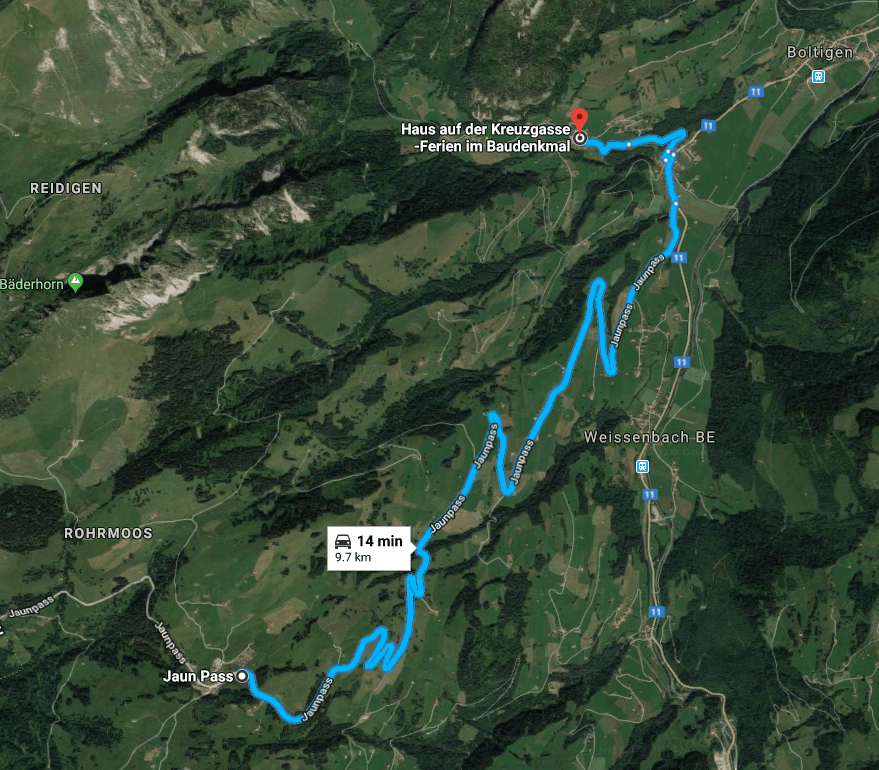
The road was paved in 1878 and today is on the list of the highest paved roads in the world. Looking at the map, you can see the switchbacks. The pass peaks at just below 5,000 feet, the ascent 8 miles long and rising almost 2000 feet.

By Norbert Aepli, Switzerland, CC BY 2.5, https://commons.wikimedia.org/w/index.php?curid=807797

Take a look from the pass here.

The photo of the pass, above, is exactly how I remember the Alps.

Here’s the same map with Gruyere, on the other side of the mountain, added.

I have to stop and admit right here that I love the Alps. And I mean LOVE them with all caps. I spent an amazing, life-changing summer in 1970 living in Versoix, Switzerland and spending time in those beautiful mountains and meadows not far from this very location. If you could see across the mountaintops, I lived about 25 miles as the crow flies. I know, what are the chances??

The summer in ski resorts is an inactive time. I spent a month or more there, hiking and wandering the beautiful alpine meadows. Today that resort is Crans-Montana, but then it was a sleepy, tiny Swiss mountain village.

The fact that my family actually originates here stirs my heart and touches my soul in a way I simply cannot put into words. It feels like my ancestors reached out to me, infusing their love of these mountains, even though I didn’t know them then.

But back to the Muller chalet.

Peter Mosimann says that he has documented the house ownership back to at least 1700 in the Muller family. Clearly, Heinrich lived in Schwarzenmatt in the first half of the 1600s. He would have been born either in or before 1635, probably right in this village or at least this valley. Most likey in this peasant house.

The walls were wood and stone that came from the surrounding area. Some stones are outcrops of the mountainside on which the house perches. The stones were connected with lime mortar and whitewashed. A stable was connected to the house, and the “goat-lick” still survives and is shown in photos in the document. Do you know what a goat-lick is? Neither did I!

The ground floor originally only had one small room. A “smoke kitchen” allowed the smoke to drift up between the slats in the rafters where meats were hung to be smoked and cured. The beams there are still black with centuries of accumulated soot.

Water came from the village well or fountain. Schwarzenmatt was lucky and had their own well. Kreuzgasse, the street where this chalet is located had their own fountain.

When I hiked the Alps, we drank from the icy-cold streams, although we were warned about drinking only near the headwaters because mountain goats tended to contaminate the water. We didn’t worry much about that.

In the Muller chalet, it appears that there was a loft type of structure upstairs where the children slept. They warmed some type of sack on the stove and took it to bed with them. Of course, as a quilter, today I think of this in terms of a quilt.

The original windows were sold at some time and installed in a restaurant in Obersimmental, about 10 miles distant. The homeowners thought they got the better end of that deal, because they installed new windows which were surely more winter-resistant, weathertight and warmer.

Clothes and dishes were washed in a basin on the table, and clothes were dried on a wooden rod in the kitchen.

Plums, pears and apples were dried for the winter to go along with the smoked meats.

Peter says that the renovation exposed 1705 construction with holes in posts suggesting that earlier building had occurred and the 1705 construction itself was either an expansion or a remodel. A stable was added at that time to house 4-6 goats and two pigs.

A cheese tower yet preserved shows that cheese was manufactured on this farm. Three circular pieces of wood are attached to a pole set in stone and connected to the rafters.

Chris located a photo before the renovation occurred.

Drum roll please…here’s the beautiful chalet today from a different angle. And look, just look at those mountains.

This chalet even has its own Wikipedia entry. At this link, you can see what it looks like in the winter. Another photo here and the renovation here.

The Muller Chalet, shown with the red pin below, is almost next door to the Swiss Vyntage Chalets I first found on the booking site.

I can’t tell you how much I want to visit this location and see the Muller chalet in person. Actually, I don’t just want to see it, I want to stay and sleep there, basking in the ancestral glow.

Johann Michael Muller

We know that Michael Muller, a widower, who married in 1684 in Steinwenden was from Schwarzenmatt. We know that a Michael Muller married in Boltigen in 1681 in the church where the Schwarzenmatt residents attended. There was no other church in the valley. The question is, is this the same Michael Muller?

This area was very small at the time, not to mention remote. Chances are very good that the Michael who married Anna Andrist was the same Michael Muller, but there could have been more than one. We also know that our Michael’s father was Heinrich, recorded as Heinsmann in Germany, who was from the tiny block long village of Schwarzenmatt.

In Switzerland, when a resident left, they were required to register. In essence, they carried a lifelong passport with them and as long as they left in good standing, they could always return as a citizen.

Those rolls were called Mannrechten and they exist for 1694-1754 from the Bern region. Of course, that’s after our Michael left, but several Millers from Boltigen were listed. Chris checked with the archives, and has kindly translated their reply, as follows:

– There are no “Mannrechtsrodel” earlier than 1694, so probably no direct proof of Michael Müller`s emigration to Germany.

– Mr. Bartlome (archivist) writes that at the time no permission was required to leave Switzerland. However, there was a heavy tax on money transferred abroad (“Abzugsgelder”). If an emigrant transferred money abroad, at the same time the emigrant passed on their citizen rights in Switzerland. This was done to prevent the emigrants possibly returning to Switzerland later on as a poor person.

– Only around 1700 an alphabetical name register was started for Swiss citizens who passed on their citizen rights. The register (listed in the link above,) is such a register. Please note that this passing on citizen rights could be done by children or grandchildren of the original emigrant! So the listed persons are not necessarily the emigrating persons!

– The register does not list the emigration date, but the date on which the citizen rights were passed on, plus the money that was transferred abroad and to which place.

– Finally, Mr Bartlome notes that emigrants may also be found in the protocols of the Bern government (“Ratsmanuale”). The transferred money (“Abzugsgelder”) was also listed in bills of the bailiffs (“Rechnungen der Landvögte”). So this may be another way to find emigrants in old documents, but it is a tedious process and with no guarantee.

As Chris comments, clearly not what we had hoped, but still, the door isn’t entirely slammed shut.

Chris later discovered a list of Swiss emigrants from 1694-1754 who settled in the Palatinate, Alsace-Lorraine, Baden-Wurttemberg and Pennsylvania in an article by Kary Joder in the October 1983 Mennonite Family History Newsletter, Volume II, #4, available in the book section at Family Search. In this document, one Michael Miller is noted on page 136, along with Miller men from Boltigen, as follows:

Chris wondered where my Johann Michael Miller the second, the son of the original Johann Michael Miller, from Schwarzenmatt, was located in 1720.

Chris translates from the original German version:

“2.12.1720 Michel Müller von hinter Zweisimmen zieht nach Leistadt (Bad Dürkheim).”

Translation: “2 December 1720 – Michel Müller from behind Zweisimmen moves [read: “his money”!] to Leistadt (Bad Dürkheim).”

Could this Michel Müller possibly be identical with Michael Müller the Second? I am not as familiar with his life dates as you are, so I have to ask you if this remains a possibility. I know that in 1721 he became a citizen in Lambsheim. Lambsheim and Leistadt are 8.5 miles apart from each other. Do we know for sure that in 1720 Michael Müller the Second was still in Steinwenden or was he maybe “on his way” to Lambsheim?

“From behind Zweisimmen” suggests to me that possibly this Michel Müller could not name the place of origin of his father. “Behind Zweisimmen” would definitely go well along with Schwarzenmatt. Zweisimmen and Schwarzenmatt/Boltigen are only 6 miles apart from each other.

It’s amazing how quickly ancestral knowledge of locations and events fades. By 1720, Michael Muller the first had been dead for 25 years, having died when his son was only 2 years and 3 months old. It’s no wonder that Michael Muller the second couldn’t remember the name of the town in Switzerland where his father was from. He never knew his father – only through his mother’s remembrances.

In April of 1718, Johann Michael Muller (the second) is identified as the farm administrator of (the farm) Weilach in a baptismal record for his child in Kallstadt. He is still living in Weilach on April 5th, 1721, but by January 15, 1722, when he is once again mentioned in a Kallstadt baptism record where he stands up as a godparent, he is a Lambsheim resident about 12 miles distant from Weilach. Citizenship records tell us that Michael moved to Lambsheim between April and July of 1721.

As the map above illustrates, Leistadt is very close to Weilach and Kallstadt, both. It was less than a mile from Weilach to Leistadt, the closest village. Certainly close enough to walk. The Michael Muller on December 2, 1720 who moved money from Schwarzenmatt to Leistadt is very likely Michael Muller the second, son of the Michael Muller the first, son of Heinrich Muller. Perhaps he moved the funds in preparation for his move to Lambsheim. It was only a few years later that he emigrated to America.

Until that time, Michael Muller the second had been a Swiss citizen, although he was born in Germany.

Mullers in Boltigen and Schwarzenmatt

The Mullers were clearly visible in the Boltigen area, which includes Schwarzenmatt. Several (in addition to Michael) were mentioned in the Mennonite document that references moving money.

  • Muller, Benedicts from Boltigen to Eppingen-Churpfalz on November 29, 1726
  • Muller, Wolfgang from Boltigen to Maulbronn-Wurttemberg on May 6, 1732
  • Muller, Johannes from Boltigen to Horbach-Swiebrucken on March 14, 1754

These three Miller men transferred funds to the same region of Germany, near where Michael had moved.

Were all of these men from the same Muller family from Schwarzenmatt and Boltigen?

Were there multiple Miller families living in Schwarzenmatt or Boltigen by that time?

If so, did they descend from a common Miller ancestor, or different men that just happened to carry the same surname?

Is this the same Muller family that had a coat of arms awarded in 1683, right about the time Michael Muller the first is found in Germany?

The Miller family in Boltigen had a coat of arms awarded in 1683 which looks to be a cogged wheel of some sort, perhaps a miller’s wheel?

The history of German heraldry isn’t terribly helpful, except to say that noble coats of arms included a barred helmet, and burgher’s/patrician’s coats of arms included a tilted helmet. The Muller coat of arms includes neither, so this tells us that the family wasn’t noble. It’s noted that in Switzerland, in the 17th century, Swiss farmers also bore arms. Given that the Schwarzenmatt Muller family, as evidenced by the restored home, was clearly a farm family, the coat of arms isn’t as surprising as it might otherwise seem. I am very curious though at the meaning of the yellow symbol on the coat of arms and if the blue background has any significance. I also wonder if this coat of arms would have included “all” of the Muller family or clan, or only one specific family unit.

There’s no way, of course, without Y DNA testing or non-existent records to tell if this is the same family. The Boltigen church records were lost in a fire in 1840. I have a DNA testing scholarship for any Miller male from the Schwarzenmatt/Boltigen area, or whose ancestors lived there.

A painting, below, remains of the old Boltigen church and parsonage from 1822, before the fire. This would have been the church that Heinrich attended, and where Michael was married in 1681.

From this photo of the current church, built after the 1840 fire, it looks like the new church was built in the same location and in the exact same style and footprint as the old church.

By Roland Zumbuehl – Own work, CC BY 3.0, https://commons.wikimedia.org/w/index.php?curid=20634682

Boltigen is just down the valley, about a mile from Schwarzenmatt. A lovely Sunday walk to church.

You can walk home from church in half an hour, but of course, it’s uphill! Probably not very pleasant in the winter.

Schwarzenmatt was tiny then and it’s tiny now. Heinsmann (Heinrich) and Michael lived here – lost in time today, but not lost to memory anymore.

Leaving Schwarzenmatt

This part of the world is truly beautiful – nature at her finest. I wonder what compelled Heinrich’s son to leave. It’s certainly possible that the isolation was a factor. The family that lived in this house, with who knows how many children, were peasants, and their children would be peasants too. Perhaps Michael wanted something more. Perhaps he found no comfort here after his wife died. Did she pass away giving birth to their first child?

The Thirty Years’ War had devastated and depopulated most of the Palatine and the Swiss were invited to come and settle, tax free, with a promise of land. Looking at the tiny Swiss village, and having lived in the Alps, I understand that this area could only support a limited population and had little potential for expansion. The German offer meant, for Michael, that opportunity was knocking and perhaps providing an escape from the pain of his wife’s death.

Once Michael left Schwarzenmatt, given the distance to Steinwenden, he likely never returned, which meant he never saw his parents or family again. Perhaps both of Michael’s parents were deceased before he left. We know, according to his marriage record in 1684 that his father was already gone by that time, but what about his mother and siblings – assuming he had siblings?

Heinrich likely was born and died in Schwarzenmatt and is buried in the churchyard of the old church that burned in 1840. Perhaps generations of Heinrich’s ancestors are buried near him there as well.

Michael would have passed that location one last time, perhaps stopping to say one final goodbye to his father and wife, on his way down the valley, through the village of Erlenbach, perhaps gathering his cousin Jacob Ringeisen, on his way to Germany.

Heinrich was the last of his generation here, at least in my line, and Michael was the first generation in Germany.

We think of the Muller family as German, but in reality, Michael the first only lived in Germany as an adult, retraining his Swiss citizenship the entire time. His son, Michael the second lived in Germany until 1727 when he emigrated to the US. He only relinquished his Swiss citizenship in 1720. In total, the Muller family lived in Germany for between 43 and 46 years. They were only exclusively German, meaning no Swiss citizenship, for 7 years. Before that, they were Swiss, probably for generations. After that, American.

How long had the Muller family been settled in Schwarzenmatt? When did they arrive? And from where? Is the surname Muller the trade name for the local miller? Does it reflect the occupation of Heinrich or his ancestors? Were they millers on the creek that runs through the valley?

We don’t have answers to those questions, but we can look at what the Miller line Y DNA tells us.

Genetic History

Our cousin, the Reverend Richard Miller took the Big Y DNA test in order for Miller descendants to learn as much as possible about our heritage.

Our Miller terminal SNP, or haplogroup, is R-CTS7822.

SNP Estimated Age
CTS7822 5000-5300 (Bulgaria)
Z2109 5300 (Russia, India)
Z2106 5300-5500
M12149 5500-6100
Z2103 5500-6100

In the R1b Basal subclade project, our sample is the only one with a terminal SNP of CTS7822.

There are other people who have another SNP downstream that we don’t have, some in Germany and Switzerland, and many in Scandinavia. Those would be descendants of CTS7822. In other words, at some point in time, a branch of the family headed north, long before surnames were adopted. Another branch headed south, across the Alps to Italy. One branch is found in Bulgaria and another in England.

Z2109, the branch immediately above ours, also our ancestor, is found in India, the Russian Federation and Turkey. That’s a fascinating span and suggests that the person who carried the ancestral SNP, Z2109 might well have been in the Caucasus before his sons and their descendants fanned out in all directions.

Unnamed Variants

Perhaps even more exciting is that eventually our Miller line is likely to have a different terminal SNP. Cousin Richard has 36 total unnamed variants.

This means that mutations, SNPs, have been found in these locations on his Y chromosome that have never been found before. These SNPs aren’t yet named and placed on the haplotree. Our line will be responsible, when another male tests that has these same locations, for 36 new branches, or updated branches, on the Y tree.

I always knew our Miller line was quite unique, and Heinrich’s Y chromosome, passed to Miller men today proves it!

Heinrich Muller’s DNA will be providing new discoveries in a scientific field he had absolutely no clue existed. His final legacy wouldn’t be written into record until more than 337 years after his death in the tiny village of Schwarzenmatt in the Swiss Alps. Not chiseled into stone, but extracted from his descendants Y chromosome.

Reflecting

I know this is the last stop on the Miller/Muller road, in this picturesque tiny village in the Swiss alps. There are no more records. I am attempting to contact Peter Mosimann, and if I’m lucky, there may be more photos!

With the difficulties in colonial America determining who Michael Miller (the second) was, and where he came from, never in my wildest dreams did I think we’d find our original homeplace in Switzerland two generations earlier.

And not just Michael’s home location, but his actual swear-to-God home, as in house.

I’m still reeling from this stroke of amazing luck – but then luck favors the prepared. My amazing German genealogist and cousin, Tom and my German-speaking friend, Chris receive all the credit for their amazing sleuthing work. None of this would have happened without their diligence.

I am ever so grateful.

I have wanted to visit Germany for decades. With this latest discovery, I’m checking airfares. My husband is in the other room having a coronary at the potential cost of the trip, but I’m focused on the emotional toll of not going. I always regretted not taking my mother back to Mutterstadt before her death, and count on it, she’ll be accompanying me in spirit😊

Maybe she has been guiding the way all along.

It was a long journey, in terms of miles, ships and time, from Schwarzenmatt to where I sit today. Ten generations and almost 400 years of mule paths, rutted wagon roads and 3-masted ships. From a farmhouse of stone and wood on a mountainside sheltering people, goats and pigs, with water hauled from the community well to an electrified dashboard from which I can travel the world, even back to Schwarzenmatt, without leaving my driver’s seat.

Yet, I know that there’s nothing like visiting in person. Walking where Heinrich walked. Standing where he stood. Visiting his grave, or at least the graveyard where he, his wife and their ancestors are surely buried in unmarked graves.

I hope to be reporting back to you in a year or so from Schwarzenmatt as I trace my ancestors’ footsteps and generations back in time.

______________________________________________________________

Disclosure

I receive a small contribution when you click on some of the links to vendors in my articles. This does NOT increase the price you pay but helps me to keep the lights on and this informational blog free for everyone. Please click on the links in the articles or to the vendors below if you are purchasing products or DNA testing.

Thank you so much.

DNA Purchases and Free Transfers

Genealogy Services

Genealogy Research

Robert Vernon Estes (1931-1951), Nightmare: Prisoner of War – 52 Ancestors #207

Photo courtesy GraveHunter.

Robert Vernon Estes was born on March 27, 1931 to Lucille Latta and Joseph Harry “Dode” Estes, my father’s brother and best friend.

Robert’s nickname was Bobby. He enrolled in the Army during the Korean conflict and was captured on November 30, 1950. He was held as a prisoner of war and died in Korea on January 31, 1951. The family was not notified.

His nickname was Bobby.

This isn’t the end of Bobby’s story, but the beginning.

Bobby

Bobby is my uncle’s son. His father, Joseph “Dode” Harry Estes born September 13, 1904 in Claiborne Co., Tennessee and died December 9, 1994 in Fairfield, Wayne Co., Illinois.

Bobby has been a “missing” family member for years. His father, Dode, suffered from amnesia, probably from an automobile accident, and became lost to the family who believed he had died. With Dode’s absence, his sons also became lost to the family.

This week, I found Robert Vernon Estes. He is memorialized on FindAGrave, although his remains were never returned and he is not buried on American soil.

Bobby is listed at both Fold3.com and with the American Battle Monuments Commission, but some of that information was incorrect, such as his death date.

United States Korean War Battle Deaths
Name: Robert V Estes
Event Type: Death
Event Date: 30 Nov 1950 (captured on this date, he didn’t die until January 31, 1951)
Event Place: Korea
Gender: Male
Race: Caucasian
Citizenship Status: U.S. Citizen
Casualty Type Note: HOSTILE – Died while captured/interned
Military Service Branch: U S ARMY
Military Component Reserve (USAR, USNR, USAFR, USMCR, USCGR)
Military Rank: Private First Class
Service Number: 16312230
Birth Date: 1931
Residence Place: White (County), Indiana, United States
Source Reference: 7234

Newspapers.com hasn’t indexed the newspapers for Monticello, Indiana where his POW status, or death, would have been reported. MyHertiage hasn’t digitized the yearbook where he went to school either. However, FindAGrave has more, thanks to GraveHunter, including his regiment and division, which made it possible for me to track Bobby further.

Corporal Estes was a member of Headquarters Company, 1st Battalion, 9th Infantry Regiment, 2nd Infantry Division. He was taken Prisoner of War while fighting the enemy in North Korea on November 30, 1950 and died while a prisoner on January 31, 1951. His remains were not recovered. Corporal Estes was awarded the Combat Infantryman’s Badge, the Prisoner of War Medal, the Korean Service Medal, the United Nations Service Medal, the National Defense Service Medal, the Korean Presidential Unit Citation and the Republic of Korea War Service Medal.

Bobby’s remains still have not been recovered or returned for burial, 67 years later.

I can’t help but wonder at the circumstances surrounding his death. Was he wounded as he was captured? Was he captured because he was wounded? Was he wounded or ill and left untreated? Or was it the unthinkable, unspeakable? Was he tortured to death?

The Korean War

The Korean War (1950-1953) began in June 1950 when the North Korean Communist army crossed the 38th parallel and invaded non-Communist South Korea. Armed with Soviet tanks, they quickly overran South Korea, executing every educated person who could, would or might lead a resistance against North Korea. The United States came to South Korea’s aid in a “police action” sanctioned by the United Nations Security Council.

The war lasted a miserable 3 years, with over 55,000 US men killed. The goal was to prevent a third world war. The American troops and people were frustrated with the lack of a decisive victory, unlike with WWI and WWII. Instead a divided Korea was established, with North Korea remaining a hostile dictatorship to this day.

The United States reported that North Korea mistreated prisoners of war. Soldiers were beaten, starved, put to forced labor, marched to death and summarily executed. War crimes were reported by both North and South Korea and document by photos of soldiers with piles of bodies. I can’t even look.

What Happened to Bobby?

From Wikipedia, we can surmise something of what was happening in Korea during the time Bobby was captured under the heading “China Intervenes.”

After consulting with Stalin, on 13 November, Mao appointed Zhou Enlai the overall commander and coordinator of the war effort, with Peng as field commander. On 25 November at the Korean western front, the PVA (Chinese People’s Volunteer Army) 13th Army Group attacked and overran the ROK (Republic of South Korea Army) II Corps at the Battle of the Ch’ongch’on River, and then inflicted heavy losses on the US 2nd Infantry Division on the UN forces’ right flank. The UN Command retreated; the U.S. Eighth Army’s retreat (the longest in US Army history) was made possible because of the Turkish Brigade’s successful, but very costly, rear-guard delaying action near Kunuri that slowed the PVA attack for two days (27–29 November). By 30 November, the PVA 13th Army Group managed to expel the U.S. Eighth Army from northwest Korea.

This is exactly when Bobby was captured, November 30th, so it would make sense that he was involved in the Battle of Ch’ongch’on River which was launched by General McArthur under the “Home by Christmas” offensive to expel the Chinese forces from the Korean peninsula and end the war. Not only did the war not end, no one came home by Christmas and Bobby still isn’t back.

This photo shows soldiers from the US 2nd Infantry Division in action near the Ch’ongch’on River on November 20th. This was Bobby’s unit just 10 days before his capture. For all we know, one of these men could be Bobby.

The terrain was rugged.

Soldiers from the Chinese 39th Corps pursue the US 25th Infantry Division. This wasn’t Bobby’s unit, but the pursuing Chinese probably didn’t look much different anyplace. Men chasing you, shooting guns is universally terrifying.

The Secret Report

A now declassified secret report states that on November 30, 1950, the day Bobby was captured, all records of the S-1 section were lost in the vicinity of Pugwon, Korea due to enemy action. This unit, Bobby’s, was known as the 9th “Manchu” infantry regiment. The secret report details the “defensive and rear-guard delaying action” that took place November 26-30 which followed an attack that had taken place November 12-25.

Extracted from the report:

On November 2nd, the unit was assigned to counterattack and destroy or hold the enemy that had broken through the Republic of Korea (now South Korea) lines and was advancing with no resistance.

On November 8th, the unit made contact with the enemy. On November 10th, tensions mounted and on the 11th, the unit celebrated Armistice Day “in its own special way firing a three-round concentration from all weapons at 1100 hours on appropriate enemy targets.”

The battled ensued until November 25th when the unit began the final push to crush the enemy and drive him across the Xaln River.

On November 25th, the 1st Battalion was attacked by the enemy and by 3 PM the following day, the entire 9th had been forced to withdraw and take up defensive positions across the Chongchon River.

On November 28th, they withdrew to Yongdam-Ni where a new defensive position was established. The 1st Battalion was attempting to withdraw from south of Pugwon.

Just before midnight, they fell under heavy enemy attack that completely cut them off until the early morning hours of November 27th when they fought their way free and reorganized in the vicinity of KuJang-Dong.

Under fire, on the 28th and 29th, the 9th reorganized in the vicinity of Kunu-Ri. As a result of the action from the late hours of the 25th to the 29th, the three battalions of the 9th had sustained over a 50% casualty rate, as a result leaving the 2nd and 3rd with less than 400 men each.

The 2nd was Bobby’s unit.

At approximately 8 PM on the 29th, a verbal order was received to attack and destroy the enemy roadblock on the Kunu-Ri-Sunchon Road. Combining the men left in each of the 2nd and 3rd into a reinforced company of approximately 400 men, the order was received and carried out during the remainder of November 29th and the early morning hours of November 30.

At 3:30 AM, the 2nd followed by the 3rd Battalion moved from the assembly area at Kunu-Ri to vicinity of the roadblock. At 6:30 AM, the 2nd Battalion on the right received enemy fire that increased in strength until 7 AM when enemy fire was coming from all sides. All vehicles withdrew. Although the fire continued for about 2 hours the unit held its position. The 3rd with a platoon of tanks contacted the enemy in the vicinity at approximately 7:15. The 9th advanced about 1000 yards through the roadblock until resistance of the enemy was such that farther progress forward was stopped.

The 9th completed a perimeter defense of the area and elements of the 2nd were allowed to pass through the roadblock. At 1:30 PM, with all available transport, the unit began to run the roadblock and engaged in a running fight while crossing it until 4 PM. However, enemy S/A fire was continuous and heavy along the entire 8 to 10 miles of the roadblock. The 2nd, on order, mounted all available transportation and engaged in a running fight with the enemy until reaching the vicinity of Sunchon at 4 PM. At 5:30 PM the group cleared the roadblock, taking fire on the rear and left flank, arriving in Sunchon area at 8 PM, proceeding to Hwange to set up a perimeter defense and reorganize.

Bobby clearly never made it to Sunchon. The report continues:

The regiment has suffered losses, heavy loses, in both men and equipment with what that undefined something that all great units have, the regiment wasn’t talking about the “downs” but what they would do the next time and hoping that time would be soon.

There was sadness, yes, but with that a grim determination that the enemy would pay, and pay the terrific price for what they had done. Instead of a defeated regiment the “Red” forces had succeeded in making a stronger, greater and inspired regiment of the 9th “Manchu” Infantry Regiment of the 2nd Infantry Division.

Signed, Edwin J. Messinger, Colonel, Infantry Commanding

The map above shows the roadblocks, the route along which Bobby was captured.

The declassified report includes summary documents stating that the regiment’s many losses occurred during November 27-30 “when the Chinese troops attacked our positions in overwhelming numbers. A total of 1766 battle casualties were suffered, 37 killed, 370 wounded and 1359 missing in action.”

On November 30th, the unit had a total of 257 enlisted men, but they don’t say whether that count is before or after the offensive.

The 2nd reported 15 killed, 125 wounded and 191 missing. They had started out with 798 on November 1st, so one way or another, lost 41% of their men. Bobby was one of those 191 missing, many of whom would have become prisoners of war.

The Gauntlet

This horrific battle was later named “The Gauntlet.”

Lieutenant Colonel William Kelleher of the US 1st Battalion, 38th Infantry Regiment described the carnage at the Gauntlet:

“For the next 500 yards the road was temporarily impassable because of the numerous burning vehicles and the pile up of the dead men, coupled with the rush of the wounded from the ditches, struggling to get aboard anything that rolled…either there would be bodies in our way, or we would be almost borne down by wounded men who literally throw themselves upon us…I squeezed [a wounded ROK soldier] into our trailer. But as I put him aboard, other wounded men piled on the trailer in such number that the Jeep couldn’t pull ahead. It was necessary to beat them off.”

A summary written later stated that when the North Korean forces collapsed, the Chinese sent their units to establish the roadblock which would have isolated and surrounded the entire Eighth Army. The 2nd infantry didn’t know the strength of the roadblock and US intelligence mistakenly reported that an alternative escape on the road from Kunu-ri to Anju was also blocked by the Chinese. Therefore, the unit decided to withdraw through the valley and the attack on the roadblock began.

On that fateful morning, four tanks were initially sent down the road, but the Chinese held their fire. The length of the roadblock caught the infantry by surprise, as they were not aware that it has been extended by the Chinese the previous day. The Chinese lured the unit into the trap, and the road was soon filled with bodies and disabled vehicles. The sterility of the official (now declassified) report belies the horror of the men inescapably trapped and abandoned there.

Those who tried to take cover in the ditches were left behind by the convoy rushing south. Air cover provided some protection in the day, but not at night. The Chinese finally blocked the road entirely by destroying parts of the 2nd Infantry Division which immobilized artillery pieces, forcing the abandonment of the rest of the vehicles. The men that could retreated by hiking through the hills, but not everyone was able to escape. The men from the 2nd, trapped in place, continued to fight after the rest had left.

In one of the last acts of the battle, the retreating 23rd infantry fired off its entire stock of 3,206 artillery shells within 20 minutes, shocking the Chinese troops and preventing them from following the regiment. The last stragglers from the 2nd Infantry division, the few left alive, arrived at Sunchon on December 1st.

On this satellite map, you can see Kaechon (Turk) near where the battle started, Sunchon and Anju, a distance of about 25 miles.

By comparing the rivers, I can map the rough location of the roadblocks. However, given the map distances and the fact that the roadblocks were reported to be 8-10 miles long, the roadblock area was probably about a third of the distance between Kaechon and Sunchon.

I believe this this region is the area where Bobby was captured. It’s somehow ironic that today, I’m viewing far more information about where their son was on that fateful day than either of Bobby’s parents were ever able to do in their lifetime. The report wasn’t declassified until after both of Bobby’s parents had died.

By the next day, the Chinese had moved on, but Bobby was in the hands of the North Koreans. The horrific final chapter of Bobby’s inescapable death had begun.

Korean Concentration Camps

Bobby didn’t die for 2 months and 1 day, so he very clearly was in some kind of detainment facility. I discovered this list of Korean POW camps. Based on proximity and the early date, the only camps possible where Bobby was held would have been:

  • Camp 5, [old] Pyoktong, 1950-52—town name moved after war

According to the Defense POW/MIA Accounting Agency, the original site on the south bank of the Yalu River is believed to hold 550 remains of US servicemen.

The following holding points were in operation at that time as well:

  • The Valley at Sambakkol, mainly Nov 1950-Jan 1951 (near Pyongyang)
  • “Death Valley” at Pukchin-Tarigol, mainly Dec 1950-March 1953 (this site is believed to hold the remains of 350 US POWs)
  • “The Apex” camps at Chunggang-jin, Hanjang-ni, and An-dong, Nov 1950 to Oct 1951
  • Kanggye, used by POWs from the Chosin Reservoir, Dec 1950 to Mar 1951 (further east)

The official US POW/MIA page states that the majority of the men who died in these sites passed away during the winter of 1950-51 before food could be delivered reliably and shelter was haphazard at best. Temperatures in Korea in December and January range from 15-30 degrees. More than 7800 men were lost and remain unrecovered and about 5300 of those were lost in North Korea. This site shows a map with the locations of the various POW camps annotated.

This chills me to the bone.

Another soldier from Bobby’s unit captured in the same battle was sent to the Pukchin-Tarigol Camp Cluster, shown on the map below, about 30 miles north of Kaechon, where he starved to death on February 16, 1951, just two weeks after Bobby died.

Yet another soldier from the same unit captured at the same time died in the same prison camp four days before Bobby. There’s a reason it was called “Death Valley.” Those two soldiers were not listed on POW lists, were not among the remains returned in 1954 and were declared unrecoverable, but were found in a secondary burial site and returned in 2016 and 2018, respectively. Maybe there’s hope for Bobby yet.

I found the Pyoktong concentration camp location on the map as well, although the Korean War site says the town was moved after the war.

The notorious Pyoktong on the map today was located 60 or 70 miles north of Kaechon. Death Valley would have been closer to where Bobby was captured.

Exorbitant death rates in concentration camps probably account for the 900% (not a typo) discrepancy in the number of POWs that North Korea officially claimed to have held after the war, as compared to their own announcements and known South Korean captives during the war.

The original Pyoktong location is shown in the photo below on the south bank of the Yalu River that divides China and North Korea.

It’s reported that more than 2000 bodies are buried behind this location.

The 55 sets of remains (of over 7700+ still missing) that were recently returned by Korea only included one set with dogtags, and they weren’t Bobby’s. Given that Bobby was a POW for 2 months, they clearly had his tags. It’s unlikely that any of the remains repatriated are his.

Bobby’s Military Awards

I wondered if the awards that Bobby received posthumously might tell us more about his duty. Regardless, he deserves to be fully recognized for each one.

Combat Infantryman Badge – Awarded to infantrymen and special forces soldiers who fought in ground combat after December 6, 1941.

Prisoner of War Medal – Awarded to any person who was taken prisoner or held captive while engaged in an action against an enemy of the United States

Korean Service Medal – Created November 1950 by President Harry Truman for participation in the Korean War.

United Nations Service Medal – An international military decoration established by the United Nations December 12, 1950 in recognition of the multi-national defense forces which participated in the Korean War. The back reads “For service in the defence (sic) of the principles of the charter of the United Nations.”

National Defense Service Medal – Established by President Dwight D. Eisenhower in 1953, the medal is a “blanket campaign medal” awarded to service members who served honorably during a designated time period of which a “national emergency” had been declared during a time of war or conflict. This medal is awarded to men who served in Korea, Vietnam, the Gulf War or the War on Terrorism.

Korean Presidential Unit Citation – Award presented by the government of South Korea to any military unit of outstanding performance in defense of the Republic of Korea. In recognition of allied military service to South Korea during the Korean War, all US military departments were authorized the unit award for that period.

Republic of Korea War Service Medal – Military award of South Korea originally authorized in December of 1950 to honor those who participated in the counter assaults against North Korean aggression in June 1950. In 1951, South Korea authorized the award to “the brave and valiant members of the United Nations Command who have been, and are now, combatting the communist aggressor in Korea.”

Epilogue

Bobby’s mother, Lucille Latta Stockdale died on August 18, 1952 of a stroke at age 45.  She only knew that Bobby was missing, not that he had died. Or did she, in her mother’s heart? She must have worried every single hour of single every one of those 625 days between his capture and her death.

As a mother, I can’t even begin to imagine how Lucille suffered. Surely she hoped for the best. And feared the worst. Every minute of every single hour

She probably jumped every time a phone rang or someone knocked at the door. She would have been constantly waiting for a good news call, or, for the dreaded telegram to arrive. Would it be Bobby’s voice on the other end of the line, or the men in military uniform at the door, bearing dreadful news?

It was never either.

Did the constant stress of his captivity lead to her stroke? It certainly didn’t help, that’s for sure.

I wonder when the family was finally notified? I knew that my uncle’s son had been killed in “the war,” but I never knew any details, including which war, when he died, nor even Bobby’s name.

My own father died when I was young, although he kept in touch with his brother as best he could until they were both lost to all of us.

His Namesake

As I processed this heartbreaking sequence of information: the battles, Bobby’s capture, his horrific time spent in Korea including those torturous last two months, his prolonged “absence” that was in fact the stillness of death, his mother’s demise and his father’s subsequent disappearance – the warmth of a revelation suddenly crept across me like sunshine emerging from the clouds after a devastating storm.

I had always known I was named “for” someone, but I had never known who that someone was. I knew positively it wasn’t anyone on my mother’s side. Mother said my father selected my first name and she chose my middle name. She seemed none too happy about that circumstance, but it was years too late when she and I had that discussion. My mother had ongoing issues with my father, but if she had known I was named for Bobby, and the circumstances, she would have told me with pride.

Now, I realize that I was named for Robert Vernon Estes, along with his nickname, Bobby, which my father bestowed upon me as well. I love my nickname, which I spell Bobbi, but I was never the least bit pleased with Roberta. I never understood. That’s all different now.

Robert, I’m busting-at-the-seams proud to be your namesake. I will stand in the stead of your parents until my death, still praying that we can bring you home soon, hoping that the least I can do is stand at your graveside as you are buried. It would be my honor.

Thank you for your service, your name and your ultimate sacrifice.

______________________________________________________________

Disclosure

I receive a small contribution when you click on some of the links to vendors in my articles. This does NOT increase the price you pay but helps me to keep the lights on and this informational blog free for everyone. Please click on the links in the articles or to the vendors below if you are purchasing products or DNA testing.

Thank you so much.

DNA Purchases and Free Transfers

Genealogy Services

Genealogy Research

John Whitney Ferverda (1882-1962) in the 1966 Yearbook? – 52 Ancestors #206

When MyHeritage first began autosomal DNA testing, I transferred my autosomal DNA test to MyHeritage (for free) and purchased a records subscription with little hope that a company out of Israel would have the focus or records to provide anything that an American company wouldn’t already have, or that I, as a decades long genealogist wouldn’t have already uncovered. But genealogists are desperate creatures and we’ll try anything once.

I’m happy to say, I was wrong.

The combination of my DNA and my tree, separately and together has provided a smorgasbord of new information. Of course, I view other people’s trees with the requisite grain of salt, or the entire lick, same as anyplace else. However, the MyHeritage record matches are golden, as are the DNA Smartmatches which combine DNA matches and trees with common ancestors. Just yummy!

The Yearbooks

At Rootstech 2018 when Gilad Japhet, MyHeritage’s CEO announced that they were digitizing yearbooks, I thought that was nice, but I don’t care about my own generation and yearbooks wouldn’t be relevant for my parents and grandparents.

My Mom graduated in 1940 and her parents were born in 1882 and 1888. Did yearbooks even exist as a “thing” back then? Even if they did, my mother’s family was from a small Brethren farming community in northern Indiana and my father’s family from a mountain community in Appalachia. I guarantee you there were no yearbooks in Claiborne County, Tennessee at that time. There were barely schools.

Well, guess what – I was wrong again.

I sure am glad I have that MyHeritage subscription.

Here’s the notification e-mail I received.

When I saw the year, 1966, I almost deleted this e-mail, but I’m so glad I didn’t. It seems that the 1966 Leesburg High School yearbook included historical photos which MyHeritage indexed as well.

Oswego 1900

Yearbooks, it turns out, aren’t just for high schools.

In 1900, the entire school in Oswego, Indiana turned out in front of the building for a photo. My grandfather, John Whitney Ferverda, was among the students and so were several of his siblings.

The Ferverda family was a significant contributor to the Oswego student population that year.

I didn’t know that my grandfather attended school at Oswego. They lived near Leesburg, so I assumed he attended school there. There’s that nasty word again. It appears that that Oswego children were considered Leesburg alumni? How’s that, when my grandfather turned 18 years old in 1900, so clearly graduating that year or the next?

The answer is found in a Fort Wayne, Indiana newspaper article in 1917 stating that:

“The first real commencement exercises of the Leesburg High School were held last week in the Methodist Church. Leesburg adopted the four-year high school last year and not much attention was paid to the graduating class.”

There were only two graduates in 1917, Donald Ferverda, my grandfather’s brother, being the valedictorian.

I’ve researched in the local libraries in the area too, and either they don’t have these yearbooks, or I never thought to look. The great thing about these notifications is that you don’t have to know to look. Plus, I would have NEVER looked in 1966, for anything, in Leesburg. My family was long gone by then.

The family always said they were from Leesburg, probably because “Grandma Ferverda” moved to town in her later years, but the original family farm was actually probably closer to Oswego.

I know, from family members that the Ferverda family lived on the same road as the Old Salem Church of the Brethren, about a mile south of the church. Unfortunately, Google Street view doesn’t follow the length of this road.

In any case, wherever the farm was located on this couple mile stretch, it wasn’t far from Oswego – actually closer than to Leesburg.

But that wasn’t the only surprise.

Yearbooks aren’t just for students.

School Trustee

My grandfather, John Ferverda, married Edith Lore in 1908 and they settled down the road about 20 miles in Silver Lake, Indiana where John was the railroad station master.

My mother graduated from Silver Lake High School in 1940, and beginning in 1946, my grandfather became a trustee. Who knew!

These yearbook photos provide some wonderful mid-life photos of my grandfather – none of which I’ve ever seen before. It looks like the trustees had their pictures taken every year too. My grandfather would have been 64 in 1946 and 68 in 1950, so this gives me a 5 year span of pictures.

The next mystery is why his name is in capital letters when not all of the trustees were.

John Ferverda continued as a trustee through 1950 which included a larger photo page as well.

Of course, this now begs the question of whether there were yearbooks when my mother was attending school in Silver Lake. I doubt it, but I’d surely love to be wrong for the third time. It’s back to MyHeritage to look.

______________________________________________________________

Disclosure

I receive a small contribution when you click on some of the links to vendors in my articles. This does NOT increase the price you pay but helps me to keep the lights on and this informational blog free for everyone. Please click on the links in the articles or to the vendors below if you are purchasing products or DNA testing.

Thank you so much.

DNA Purchases and Free Transfers

Genealogy Services

Genealogy Research

Eleven “Soldier Boy” Love Letters from the Lost Summer of 1919 – 52 Ancestors #205

By June of 1919, my father, William Sterling Estes had already served more than two full years in the military. Born in either 1901 or 1902, he enlisted in May 1917 when he was either 14 or 15 years young. He was discharged as a Sergeant First Class in May of 1919 and re-enlisted the next day in the Army 10th Infantry. His re-enlistment papers tell us that he was a marksman, not mounted, no battles, no medals, no wounds, good condition, typhoid shots, paratyphoid and he was single.

Dad was stationed at Camp Custer, then named Fort Custer, near Battle Creek, Michigan for most of his time in the service. He was included in this human shield of 30,000 soldiers, the photo taken from the Camp Custer water tower in 1918.

WWI was coming to an end in the summer of 1919, thankfully.

Somehow, probably on leave, Dad met Virgie Houtz who lived in Dunkirk, Indiana. In the summer of 1919, Virgie was 16 years old and attended high school.

Dad was either turning 17 or 18 that October, but in one of his letters to Virgie, he told her he was turning 20. We know for a fact that wasn’t true. Not only is he not on the 1900 census, his sisters said that he was born in 1902 and several other pieces of documentation point to either 1901 or 1902 as his birth year. The 1910 census tells us that he was 8 years old in April. He was born on October 1st, so he would have turned 9 later than year, which means his birth year was 1901 if the census is accurate.

Dad and Virgie fell in love that summer. They were two starry-eyed young kids – except one of them had been toughened by being turned out on his own at age 12, then fending for himself until he was old enough to “age himself” appropriately so he could join the military. I’m guessing the Army was his best bet for regular meals.

Indeed, he was one handsome lad. He was also still a boy, and a boy who had been rejected and abandoned by both parents before he was even a teenager. Dad had completed only 8th grade, according to later census records, which would have been about the time he and his younger brother Joe hopped a train for Tennessee when his parents split and neither parent wanted the boys. Dad would further his education later, but in 1919, he wrote amazingly well, considering.

The Letters

Ninety-nine years ago, almost exactly a century, as I sit here today light-years removed, my father was using a fountain pen and ink well to write letters to his sweetheart after he finished his duties on the military base including feeding the horses which were widely used in the war effort.

In total, 14 envelopes and 11 well-worn letters remain.

From these historical gems, we gain an intrusive glimpse into their young love, and as a side-note, we also get to peer into his life at Camp Custer.

Reading these letters felt almost invasive, like I was a peeping tom, peering into something intensely personal. However, when this bundle arrived roughly 8 decades after he penned each letter with lovesick yearning, years after both of their deaths, I was exceedingly grateful to Virgie’s daughter for sending them. I read them with much trepidation, unsure of exactly what each page would reveal.

In addition to the letters, Virgie’s daughter included several photos that Virgie had cherished all of those years.

This treasure trove was truly amazing, all things considered. All things? What are those “all things?”

This is an unbelievably bittersweet love story. I’ll let Virgie’s letters and photos tell their story of summer love.

Bill and Virgie

My father was obviously very smitten with Virgie. Smitten doesn’t quite do this justice. I think the phrase head-over-heels-in-love is a better description.

We have Dad’s letters to Virgie, but of course, we don’t know what her letters to him said – although we catch some glimpses of that as well, between the lines so to speak.

I am sharing some of his letters, but not all. As you might guess, if you remember being 15 or 16 and lovestruck, they say “I love you” in every single way possible over and over. I’ll spare you that. I’d also like to afford them some privacy, even in death.

The first letter is dated June 25th, 1919.

Dad opens by telling Virgie that it’s 7:05 AM, he had already fed the horses, ate his own breakfast and is taking a few minutes to write to her. He calls her “Blue Eyes” and asks why he has only received one letter from her. He says he has written 4 to her. This appears to have been a whirlwind romance that turned serious quickly. He jokes that if she keeps it up, meaning not writing, she may “be without a hubby,” so they are obviously discussing a permanent relationship – whirlwind or not.

At first I thought he meant he had written her 4 letters since she wrote one, but based on later exchanges, I think this was actually the beginning of the relationship and he had just left Dunkirk a few days earlier.

He says that since coming back to Battle Creek:

“The girls there don’t abount (sic) to a hill of beans.”

Yep, he’s hooked!

I’m guessing that Dad had been with his friend, James, because he says that James took the car home when he was discharged and therefore, Dad has “nothing to do.” James and the car may be how he met Virgie in the first place, since he seems to write as if she knows James.

If they get paid before the 4th of July, Sergeant Lynch and Dad are going to visit Dunkirk. They may live it up after they arrive and go to Redkey or Eaton, both crossroads towns not far from Dunkirk in the land of cornfields and soybeans.

I have to wonder whatever brought these soldiers to this remote country location 171 miles from Camp Custer in the first place.

Dunkirk isn’t close to much of anything and not on the way to anywhere.

Apparently Virgie called Dad “Buddy.” I never knew that was his nickname. Maybe it was only between them.

Dad appeared to be writing to Virgie every spare minute. The next letter is dated the following day.

Later in this letter, he tells Virgie that he showed her photo to the lady at the YWCA Hostess House who told him Virgie looked like a nice girl and he must think a lot of her. I’m sure Dad was showing Virgie’s photo to anyone who would look and listen, and probably a few unsuspecting people who wouldn’t.

He told the lady:

“Yes and I’ll tell the whole world I do.”

Ah, the achiness of fresh, new, overwhelming love.

But then, he said something very prescient.

“I will be true to you till death.”

If someone had told him that day that he would die as her husband, but would not marry her until 42 years later, he would have thought them crazy.

“There isn’t anything I wouldn’t sacrifice for you, even my life.”

Then, perhaps having gotten too close to the hole in his soul, he changed topics abruptly:

“The boys, we are arguing about the war, but I don’t know about their brains. Ha. Ha.”

Later the same day, he writes a second letter. For a man in service to write two letters to his intended in the same day – he had to be wonderfully, miserably lovesick.

In Dunkirk, I can see Virgie going to the post office every day to look for a letter – maybe multiple times every day. In the era of “general delivery,” mail wasn’t delivered to homes. Of course, that meant the entire town knew who received mail from whom. In Michigan, Dad probably lived for mail call, either elated or dejected, depending on what was waiting.

Look at the back of this envelope! Apparently he had proposed and she had said yes.

If you’re groaning at the syrupiness of this, I know, me too. Yet, I remember doing this same thing at about the same age.

I should probably explain at this point that he refers to himself as her husband often. They were clearly betrothed. If you’re laughing, remember that this was nearly a century ago when women often married as soon as they were old enough to reproduce. Tennessee, where his family was from was notorious for marriages that began at 15 or 16 and lasted a lifetime, whether they should have or not. Large families and poverty are powerful cement.

Soldiers in WWI received tetanus, typhoid and smallpox vaccines although experimentation with a flu vaccine followed the Spanish Flu Epidemic of 1918. Regardless, only Virgie would be allowed to touch his sore arm:)

In this letter, Dad asks Virgie about Fluffy, “their child.”

I do believe this is Fluffy. This man was no dummy. Way to her heart! If he’s asking about Fluffy in the letter, this photo would have been taken just a week or two prior.

Oh, and if a kitten alone doesn’t work, try a kitten and two ducks. Who can resist this? Seriously!

Fluffy is perched on his shoulder, eyeing the ducks I suspect or wondering how to get down.

“Your hubby sure does love you with all my heart and soul.”

He tells Virgie that he’s saving for July 4th, which appears to be when he plans to visit her in Dunkirk again. He rode horses in the afternoon and had “a sweet time” but wishes she was with him. That theme, of course, permeates all of his letters.

He is probably the only soldier at the Knights of Columbus Hall that is writing to a girlfriend instead of dancing. He tells her never to doubt his love.

“I stay awake at night thinking of you. You will be my wife soon. I am yours forever and ever.”

An empty envelope is all that remains of a June 30th letter. Did she love it to death, hide it from her parents maybe, or lose it somehow?

The 4th of July

The next letter follows on July 8th, and based on its contents, we know where he was over the 4th of July.

I can’t help but wonder what happened in Fort Wayne to cause him to leave so late and drive all night. Today, that same drive is about an hour and a half or two hours, max. At about 100 miles, that means they averaged about 15 miles an hour. Cars were a lot slower then than today, roads were in a lot worse condition and tires had to be patched regularly. The Model T which began to be manufactured in 1908 was the first affordable car and is probably what they were driving.

Not only did he manage to get back to camp late, which means he was technically AWOL, but he also seems to have had a case of tonsillitis severe enough to require surgery. This is a decade before the invention of antibiotics.

Dad goes on to say that $30 a month isn’t much to live on, which I would presume is his salary. He thinks it will cost them $25 a month for “light housekeeping” but he can get his groceries on base and his clothes from Uncle Sam.

“I sure want my baby dressed nice but we’ll try and get along somehow. Oh, I know, well just live on hugs and kisses.”

I remember being so in love I could have cared less about anything and everything except for that person. Apparently, I inherited that trait from my dear father.

Dad says he’s expecting Virgie to visit the 4th of the following month. He references an old girlfriend who he identifies as having a “hairlip.” Apparently, the old girlfriend referred to him as Billy when she was inquiring as to why he had not written to her. I’ve also never heard my dad called by what was probably his boyhood nickname.

I’m suspecting that Dad told Virgie about the other gal on purpose to “keep her interested” and so that Virgie wouldn’t think that there weren’t other gals pursuing him. He doesn’t say, but if the “hairlip gal” is who I think she is, her name is Martha. Dad told Virgie that he replied that his wife was there, on base, so there was “no chance now.” Ummm, that wasn’t exactly true either, but I don’t want to get ahead of the story. Just remember Martha.

Another empty envelope from July 29th, followed by a letter on August 5th that tugged at my heartstrings.

My father was apparently quite ill.

“I thought I was a goner.”

Why did he think Virgie might not love him anymore? My heart aches for him.

“You know I was going to come and see you this pay day and then I never herd (sic) from you and now I can’t come.”

He asks:

“Have you been true to me?”

I’m not clear why they apparently need or want to wait two years to marry. Yes, he’s in the military, but other men marry while in service. Perhaps her father wouldn’t allow it until he got out, or until she was 18 or perhaps graduated from high school? The only two people who know the answer to that are together now, and not here to ask.

“I’ll be true to you.”

“For you I would die.”

Oh, my heart.

Then he says goodbye with:

“10,000 kisses and as many hugs.”

The next letter is mailed from the base hospital. If you’re keeping track, this is the third time in just over a month that Dad has been hospitalized.

He has been and remains very ill.

I wonder if he had meningitis or encephalitis introduced when they removed his tonsils. Maybe they shouldn’t have done that surgery while the tonsils were infected. He had been hospitalized at this point since about August 7th, two days after his last letter.

The next letter is dated August 20th, almost two weeks later, and he’s STILL in the hospital and hopes to get out in a couple weeks. Sadly, he mentions that Virgie is only writing him once a month. Uh oh!

He tells Virgie that he has a case of “phenomia fever.”

I can’t even imagine being a critically ill 16 or 17-year-old boy, claiming to be 20, trying to be grown up, alone, in the Army, and with my lady-love not writing. Talk about feeling frightened, alone and abandoned. Again.

First, he survived his family, then two years of military service during a war, and now something that kept him hospitalized for 3 weeks.

VIRGIE, FOR GOD’S SAKE, WRITE TO HIM!!!!!

The next letter is dated August 23rd. Virgie has apparently written, thank goodness!

He mentions his mother, Ollie Bolton Estes, in Franklin Park, Illinois. Apparently Ollie said that “Bessie is looking short,” whatever that means. He then goes on to mention that it has been “only 4 months since I busted up with her (Bessie) and Mama said she claims it’s all my fault.” I’m not quite sure how he could go with a gal in Franklin Park, Illinois and be in the service in Battle Creek, but then again, he’s going with a gal in Dunkirk, Indiana.

I’m making a mental note of a woman named Bessie in Illinois in April 1919, just in case that half-sibling DNA match arrives. However, given that 1919 is 99 years ago, I guess that match would have to be the half sibling’s child, grandchild or great-grandchild. Um, that might explain something I’ve been wondering about. I have a mystery match at MyHeritage of 383cM that is clearly on my father’s side, is about exactly perfect to be a grandchild of a half sibling, and hasn’t answered my messages, but I digress.

Why oh why does he use no one’s last name?

Dad vacillates between asking Virgie if she still wants him and then says he is “sure she is true.” This sounds like one terrified young man. I just want to hug his heart that longs to be loved.

“I will always do all that I can to make you happy and to help you.”

Dad then once-again switched abruptly to, “I am going horseback riding this afternoon.” He closes by saying he wishes she was there to ride with him, signs as “Hubby” and fills the rest of the page with Xs.

In the next letter, dated August 24th, I clearly sense an air of desperation. Note that he is still in the hospital.

“I shall love you the longest day I live and you can depend on me as your best friend in the world.”

Dear God.

“There isn’t anything I wouldn’t do for you.”

What else is there to say? While in the hospital no less. What pain he must have been in to have to pen the next line.

“You know I’m nothing soft, so write plain what you think and I will thank you for it.”

He knows.

This is killing me.

On August 30th, another letter on hospital stationery hints at answers. Apparently, high drama has occurred in the small down of Dunkirk, and someone told Virgie “something.” If this reminds you of Junior High School and 13-year-old girls, keep in mind how old these two were, and the naivety of the time.

Dad’s letter doesn’t tell us what Virgie said, but he replies:

“Don’t believe any thing like that for I never thought of saying such a thing. I came to see you because I loved you. I love you so much and you are the light of my life. There are lots of people in Dunkirk that would like to brake (sic) up our friendship but if it’s left up to me it will never be broken up.”

He goes on to expand on that thought in loverly fashion, and then says:

“I have been true to you since I began going with you and I have letter what can prove to you that I’ve stopped all of my correspondence with all other girls.”

A few paragraphs later he states:

“I think of you if I am idle on duty walking post at midnight or riding across the camps. You are the vision of my dreams and you always will be. Won’t you please believe in me forever and trust me.”

The next part is a bit confusing, and he is clearly flustered or exasperated, but he in essence says that he wants her to think of him when she is in specific “other company,” which means another boy.

He follows with:

“I am in camp waiting and saving for you and preparing for your future and think how much I love you. Then after you think it over and consider your love for them, if your love for me isn’t strong enough to resist other company, then you may go ahead but never with my consent. That last kiss I placed on your lips I placed it there to stay till I came back. It wasn’t placed there for other fellows to take off. If I ever have to give you up I don’t want to ever see another girl for my love is too strong for you. I have never asked for a release from our engagement for that has never entered my mind. I won’t want one if you will only be true to me and promise to believe in me. I have you a sapire (sic) ring for your engagement ring. I will bring it when I come to see you if you will only let me come and nobody else.”

He must feel terribly out of control, like he is at a severe disadvantage, remote, and unable to “compete” by being present. Yet, he somehow found the money for an engagement ring that I don’t think she ever saw.

Dad then asks when her school starts and tells her to study hard and hurry and graduate.

“I love you enough to die for you.”

“I’ll protect you till the end of time.”

Why would he invest this much effort if these feelings weren’t genuine?

He closes by telling Virgie that he’s now out of the hospital, although this 8-page letter appears to have been written in sections and probably over several days.

“Your Soldier Boy.”

My heart is screaming.

The next letter is dated September 4th and opens very differently. Instead of calling her by a pet name, he greets her with, “My Dearest Virgie” and proceeds to talk about when they went to pick strawberries, referring to that time nostalgically as “the good old days.” Something has changed.

He says he would like to visit her next month and then at Christmas. Unbeknownst to him, his life by Christmas would be very, very different.

By the end of the first page, departing dramatically from earlier letters, there are no professions of love. Instead, he asks if she ever thinks about him. At the end of page 2, he tells her he would like to kiss her and then closes by telling her one last time, and the only time in this letter, that he loves her.

“My love is yours.”

One final desperate try.

The tone has changed dramatically.

This is the last letter.

Then…

Nothing.

Nada.

Silence.

For more than 40 years.

However, this heart-wrenching picture taken outside her parents’ home with the message written in Virgie’s hand tells a different story.

“Thou Art Gone.”

She clearly grieved this loss, as did he.

I don’t exactly know what happened between them, or didn’t, but there are hints and I have some thoughts.

Life is what happens when you’re making other plans.

Remember Martha?

Martha Dodderer and Edna

My DNA confirmed half-sister, Edna, was born to Martha Dodderer on May 22, 1920. Martha, indeed, had a cleft palate which was at that time referred to as a hairlip. Edna told me that her mother met our father when she was a volunteer in the hospital or infirmary at Camp Custer.

Using a conception date calculator, and assuming that Edna was born after a normal gestation period, the most likely time of conception was August 21-28, with the possible dates ranging from August 18th to September 2nd. Right after the desperation letter and before that last letter. If we presume that he didn’t get out of the hospital until about August 30th, then the conception was closer to September 2nd, and probably before September 4th, the date of the letter in which the tone was significantly changed – like he had given up.

We have a desperately ill young man who thought he was dying – in the hospital three times, totaling 4 or more weeks in 2 months, the last time for 3 weeks – and far from any family to visit. During this time, he becomes increasingly desperate as his sweetheart is not writing to him and appears, at least to him, to be interested in someone else.

Martha, about 5 years older, took care of him in the hospital, was kind to him and perhaps commiserated with being rejected. One thing led to another, which led to Edna.

Dad didn’t marry Martha until 19 months later, in December of 1921. Their divorce was final three years later and the proceedings made it quite clear that their marriage probably should never have occurred at all.

He didn’t marry Martha in the fall of 1919 because he had already married someone else.

Yes, you read that right.

And it wasn’t Virgie.

I wonder what the engagement ring looked like.

Ilo Bailey and Lee Joseph

As if this story wasn’t complex enough, Martha apparently wasn’t the only person that my Dad had been seeing. On December 3, 1919 in Calhoun County, Michigan, he married Ilo Bailey under an assumed name. And yes, I’m positive it’s him.

Their child, unproven by DNA testing because Lee is deceased and had no children, was born on February 24, 1920. Again, using the conception calculator, the most likely time for Ilo to have become pregnant was May 29-June 2, with possible dates being May 23-June 7th.

Both of these pregnancy events, Ilo and Martha, skirt the timeframe of the letters from Dad to Virgie. Ilo before and Martha after. The letters to Virgie began in late June and ended two months later in late August, with the last one of a much different tone being dated September 4th. In other words, he may well not have been cheating on Virgie. These two relationships appear to bracket their brief engagement.

If Ilo got pregnant about the end of May or beginning of June, she would have been hunting for my father in August to tell him of her plight. It took him 4 months after that to marry her. I suspect strongly that he sincerely loved Virgie and not only had he “lost” Virgie, he had found a family he didn’t exactly anticipate. That marriage, however, didn’t last long.

In a letter from Ilo to Dad 15 months later dated March 22, 1921, Ilo states that she is leaving for Kentucky, their marriage “is illegal anyway” and “it’s in the hands of an attorney now.” Apparently, by December 12, 1921, he was unmarried because he married Martha Dodderer, Edna’s mother.

But that may not be all either.

Dad

Dad’s letters to Virgie are increasingly desperate and heart-wrenching. I’m left with the impression that both Virgie and my Dad were just too young and emotionally unprepared to withstand such a trying situation, even without complications of health, war and distance.

But there might have been more in play as well.

It’s very unusual for a healthy young man to become deathly ill for more than three weeks. It’s simply not normal. It wasn’t during the deadly flu epidemic which had hit Camp Custer hard in October of 1918 and it wasn’t during the winter, but the middle of summer. Reading historical documents from that time period, the first step of suspected flu on base was indeed to isolate the patient, but if he had the flu, he would have said so instead of “pneumonia fever.”

Dad was hospitalized for the second time right after he had a tonsillectomy. His third hospitalization was for three weeks. He mentioned that his head ached terribly, he had a high fever and was dizzy. I have to wonder if he contracted either meningitis or encephalitis during his surgery that caused some level of residual brain damage, impairing his executive function ability which regulates decision making. Executive function is the filter that keeps you from jumping out of the car and slapping the person silly who cuts you off in traffic. In other words, road rage results from the lack of executive function.

My father’s first stent in the service was not marked by any known disciplinary action and he was a Sergeant when he re-enlisted in May of 1919. Everything was fine right up until it wasn’t, and then it went to “hell in a handbasket,” as my Mom would have said, right after his illness.

Beginning right after his last letters to Virgie, his behavior changed dramatically. It’s as if there was an invisible line in the sand. Here’s a brief timeline.

  • April 1919 – Breaks up with Bessie, according to letter to Virgie, possibly in Franklin Park, Illinois
  • May 20, 1919 – Dad re-enlists in the Army at Fort Custer
  • Late May or early June 1919 – Ilo gets pregnant in Battle Creek
  • Mid/late June 1919 – Dad meets Virgie
  • June 25, 1919 – first letter to Virgie
  • July 9, 1919 – in hospital for tonsillectomy
  • August 5, 1919 – just released from hospital, but “I thought I was a goner.”
  • August 7, 1919 – hospitalized again for 3 weeks
  • August 30, 1919 – letters to Virgie increasingly desperate, out of hospital
  • September 4, 1919 – last letter to Virgie, very different tone
  • Late August or early September 1919 – Martha gets pregnant in Battle Creek
  • November 4, 1919 – Dad is AWOL and remains AWOL until April 1920
  • December 3, 1919 – Dad marries Ilo in Calhoun County, Michigan under an assumed name
  • April 1920 – Dad arrested for being AWOL and sent to Leavenworth
  • March 1921 – Dad released from Leavenworth, returns to Camp Custer
  • March 1921 – Ilo letter to Dad saying she has left and they are getting divorced, letter found in possession of Martha Dodderer at her death
  • August 8-11, 1921 – AWOL again
  • August-October 1921 – I think he was back in Leavenworth
  • November 1921 – discharged from service
  • December 1921 – married Martha Dodderer in Calhoun County, Michigan
  • February 1924 – divorced from Martha Dodderer

This also may have been about the time Dad started drinking heavily. Then again, being quite ill, having two separate women pregnant, losing the one you love who is not one of the two pregnant women, and being AWOL at the same time will do that to you.

What a mess he got himself into with absolutely no good way out.

I keep hearing the refrain, “Looking for Love in All the Wrong Places.”

By then, it was simply too late.

Fast Forward to 1960

We’re going to fast forward through several decades and failed relationships. In hindsight, it feels to me like Dad never got over Virgie and continued to make decisions that lacked in judgement – each new situation weighed down by the quickly accumulating baggage of the past.

In the mid-1940s and again in the 1950s, he was involved with two women at the same time, one of which was my mother. As late as 1960, we have a photo of Dad in Fort Wayne, in his “other” wife, Ellen’s living room, provided by my “half-brother,” David Estes, who turned out not to be my Dad’s biological child.

Dad had a penchant for just showing up and hunting people down after absences of many years. In spite of his prolonged absences, he was an extremely likeable guy, and it was very difficult to remain angry with him – at least initially, according to Edna and others. Edna told me that she hadn’t seen him in literally 3 or 4 decades when he appeared at her house about 1960, wearing a suit and looking quite dapper. The photo below was taken that day with Edna’s children.

This wasn’t long after the period when he was practicing medicine in Tennessee and elsewhere. If your mouth just dropped open, welcome to my world. That’s a story for future article, and it’s a humdinger. My father was anything but boring.

About the same time that this photo was taken, Dad decided to stop by Virgie’s parents’ house in Dunkirk to see if he could find Vergie. He must have been on a search-and-recover binge that year.

Keep in mind that he had last been there 40 or 41 years earlier. Virgie’s father had died, Virgie had married, raised her kids and divorced, and just happened to be living with her mother in the same house where she resided back in 1919.

What are the chances, right?

Virgie had never remarried. She squirrelled away Dad’s pictures and letters that entire time – 4 decades. If Dad thought 2 years was a long time, 40 years is forever.

On April 24, 1961, Virgie and Dad married in Rome, Georgia. No, I don’t know why Georgia, but knowing Dad, I’m sure there’s a story there someplace.

He may or may not have been officially divorced from Ellen at that time. Mom mentioned that Virgie had to “fix” something in that regard, having to do with a divorce not being final in Florida. I found a corresponding envelope with no letter dated October 17, 1961 from the law firm Jopling, Darby and Duncan in Lake City, Florida. The official story was that the waiting period was somehow “messed up,” or that the lawyers got the divorce petition filed a day late. I have been unable to find any divorce record in Florida. Maybe I should check other Lake City (Columbia County) legal records. Maybe there’s more that I don’t know. Hmmm….

Regardless, he and Virgie lived the next two years and 4 months happily in the little house with Grandma. They had such a short time to make up for 42 irrecoverable years. Virgie loved Dad and adored him, at the same time aware of his foibles. I hope Dad found the love, security and acceptance he desperately craved.

Dad died on August 27, 1963, with Vergie at his bedside. He had promised Virgie all those years ago to love her until his death, and he did exactly that, just as he had sworn. I believe that Virgie was indeed his true love, his soul mate. I’m so glad he found his way back to Dunkirk and to Virgie.

I know this isn’t your typical love story happy ending, but I think those last two fleeting years were as happy as either Dad or Vergie ever were, except, of course, for those few days during that long-ago lost summer of 1919.

______________________________________________________________

Disclosure

I receive a small contribution when you click on some of the links to vendors in my articles. This does NOT increase the price you pay but helps me to keep the lights on and this informational blog free for everyone. Please click on the links in the articles or to the vendors below if you are purchasing products or DNA testing.

Thank you so much.

DNA Purchases and Free Transfers

Genealogy Services

Genealogy Research

Owed to Mrs. Alsup: Be Undeniable – 52 Ancestors #203

One of the comments I hear regularly is that I’m lucky to be involved with genetic genealogy and the opportunities it offers. I agree, I am very fortunate, but luck, per se, has little to do with it. Luck is buying the winning lottery ticket. I haven’t managed to do that yet, although I’m still trying.

In the mean time, while I waited for Lady Luck to smile on me, I prepared, just in case I’m never “lucky.”

Everyone needs at least one really great teacher in their life. I was fortunate to have three, the first of which was Mrs. Alsup, followed by my step-father, Dean Long, who told me that “Luck favors the prepared and elbow grease,” and then with Joe Caruso.

Mrs. Alsup

Mrs. Inez Alsup was my English teacher in high school who taught me an extremely valuable lesson, one I really didn’t understand that I had learned or the depth of its value until nearly 25 years later.

I’ll add that she was a black woman, but in saying that, I also want to say that to me, she was just Mrs. Alsup and black or white mattered not one iota. I never thought of her in those terms. It’s just that looking back, I realize what a pioneer she really was and have a much greater respect for what she had to overcome to achieve what she did. It was from the depths of those experiences that she spoke to me.

She was a black woman, born in 1938 in the deep south, in Georgia, who obtained both a bachelor’s and master’s degree, became a teacher, then an administrator and assistant principal before retiring.

But Mrs. Alsup was tough, really tough. She was tougher on me than on anyone else and I felt she was extremely unfair.

As an adult, I fully understand why, and I appreciate it beyond expression. But I wasn’t an adult back then.

Mrs. Alsup saw my potential, and she comprehended something I didn’t. Women, in that day and age, had to be better to be equal. They had to excel, and excellence had to be absolutely unquestionable. Good wasn’t good enough.

On top of being a female, I was a mixed race female, and she understood all too well what that meant. I did not. Consequently, I was extremely unhappy with Mrs. Alsup.

“Next Time, Earn It”

Mrs. Alsup refused to give me an A that I fully believed I deserved. I was one-thirty-second of a point away from that A.

One. Thirty. Second. Of. A. Point.

1/32

Using math to average and round up, I could fully justify why I should have that A, but Mrs. Alsup was completely unswayed. Other teachers do this as standard practice, I argued. She patiently heard me out, and then she looked at me, dead straight in the eye, leaning forward over her desk until her face was just inches from mine, squinted her eyes at me and said, or rather kind of hissed, “Next time, earn it.”

I was furious, utterly furious. Mrs. Alsup was entirely unfazed as I stormed out of that room with an attitude and a half.

I did earn it, damn it, I did!

But, I really hadn’t. I had been almost good enough. Not good enough. Not better. Just almost. Not quite. Almost isn’t good enough.

But guess what…the next semester, and the next, I earned that A, and then I earned an A+ followed by what was called an A5, which was a 5 point A, as compared to a “regular” 4 point A.

Mrs. Alsup was right – if anything is worth doing, it’s worth doing well, completely and unquestionably. I learned to be undeniable and it served me very well from that time forward in my life, but it wasn’t until I met Joe Caruso that I fully internalized the lesson Mrs. Alsup had taught me.

Until I truly understood the value of undeniability, and could put words to the phenomenon, I was unable to leverage it effectively.

Joe Caruso

Joe Caruso, founder of Caruso Leadership Institute, is a cancer survivor (as a teenager) with a high school education. Yet, he consults with and to America’s largest corporations. Joe is an unprecedented teacher and leader and he does not know the meaning of the word “can’t.” If you ever have the opportunity to hear Joe speak, just do it.

In 1997, I attended a seminar, (quite by accident actually), taught by Joe which turned out to be a clarifying, life-changing event. You can download, for free, Joe Caruso’s Success Strategies, one of which is to “Be Undeniable.” Indeed. Joe’s Success Strategies poster has remained on the wall by my desk through three moves and more than two decades.

Yes, I’m lucky, fortunate and blessed to have had Inez Alsup, my step-father AND Joe Caruso enter my life at the moments I needed a lesson.

Being Undeniable

On that fateful day that I was infuriated by Mrs. Alsup, I learned what it meant to be undeniable, although at that time I didn’t understand undeniability as a strategy.

A year later, I put that lesson to use when I attended a school board meeting, refusing to be excluded from a college prep class because the school wasn’t going to “waste the seat on a girl who’s just going to get married anyway.” They were going to “give it to a boy who would make something of himself.” I made my case and refused to leave. I obtained that seat in the class. I didn’t realize at the time that I had internalized Mrs. Alsup’s lesson.

Some two decades later, Joe Caruso would verbalize this golden rule of opportunity and made me realize the important life lesson that Mrs. Alsup had taught – far more important, at least to me, than the English class or the grade itself.

I wish I could personally thank Mrs. Alsup, but she passed away in 2010. My Dad’s gone too, but I can still thank Joe Caruso. In their honor, I would like to convey these very simple messages:

  • Luck favors the prepared and elbow grease. (Thanks Dad.)
  • Earn it. (Thanks Mrs. Alsup.)
  • Be undeniable. (Thanks Joe Caruso.)

And in case you’re wondering just how this applies to genetic genealogy, this is exactly the strategy I used to make the risky move of switching careers in the early/mid 2000s to genetic genealogy which was at that time a brand new field. It’s not luck, it’s thanks to Mrs. Alsup, Dad, Joe and a whole lot of continuing elbow grease. 😊

However, I am still buying lottery tickets. It never hurts to be both prepared AND lucky. Fingers crossed!

______________________________________________________________

Disclosure

I receive a small contribution when you click on some of the links to vendors in my articles. This does NOT increase the price you pay but helps me to keep the lights on and this informational blog free for everyone. Please click on the links in the articles or to the vendors below if you are purchasing products or DNA testing.

Thank you so much.

DNA Purchases and Free Transfers

Genealogy Services

Genealogy Research

Philip Jacob Miller (1723/1727-1799), The Reluctant Patriot, 52 Ancestors #202

Philip Jacob Miller was a Brethren man, also called Dunkers because their faith called for fully immersing, or dunking, those being baptized. Baptism took place as adults, not as infants, with the belief that one could only adhere to the tenets of the church if one was old enough to comprehend the teachings. Hence, converts were rebaptized, invalidating infant baptisms performed in other Protestant sects, causing the Brethren to sometimes be referred to by the derogatory term, “rebaptizers” by their Catholic, Lutheran and Reformed contemporaries. The Brethren were perceived as fanatical and sometimes seditious in their beliefs, but they found strength and comfort among their Brethren families and communities. This history explains the tight-knit sect that became both accustomed and immune to public outrage and pressure from outside of the Brethren church. Pressure to confirm from inside the Brethren church was another matter.

Philip Jacob’s father, Michael Muller/Miller, was Brethren as were his children, grandchildren and on down through a total of 5 generations until the first non-Brethren emerged in my line. John Whitney Ferverda, my grandfather, was raised Brethren, married a Lutheran woman and their compromise was the Methodist church. Philip Jacob was probably rolling over in his grave, wherever that is.

Brethren adhere to the “three negatives.” According to “A Centennial Statement,” published in 1981 by the Brethren Church:

Obedience to Christ is the center of Brethren life. This conviction has led the Brethren historically to practice non-conformity, non-resistance, and non-swearing.

  • In non-conformity, Brethren have sought to follow the way of Christ in contrast to the way of the world.
  • In non-resistance, Brethren have renounced the Christian’s use of violence in combating evil, striving, as far as possible, to be reconciled to all persons.
  • In non-swearing, Brethren have sought to lead such trustworthy Christian lives that oath-taking becomes unnecessary.

Every Brethren believer must live in a way that exhibits to the world the truth and love of Christ.

Historically, this means that Brethren did not believe in any particpation in government, to the point that they would not obtain a marriage license and those who did were shunned.

For instance, on February 14, 1776, Alexander Mack Jr., the son of the founder of the Brethren faith writes in a letter that he is shunning his daughter, Sarah, because “she married outside of the brotherhood” and secondly “because the marriage was performed with a license and third because her husband had not quite completed his apprenticeship.”

Brethren seldom registered deeds and often did not file wills. Worse yet, at least for the genealogist, they didn’t keep church records of births, baptisms, marriages or deaths.

Tracking Brethren families is difficult because of these beliefs. Sometimes tax lists, land surveys and purchases from or sales to non-Brethren community members are the only documents that confirm where our Brethren families were living at a given time, at least before the census began. You might escape a death record, but not even Brethren could escape the tax man.

If a Brethren was called to court, or wanted to become naturalized, they would not take an oath, but asked to be allowed to “affirm” instead. Hence, the Brethren men from Maryland traveled to Philadelphia, Pennsylvania where they were allowed affirmations as opposed to “swearing an oath.” Several Brethren men, including the minister Nicholas Martin, Philip Jacob Miller, Michael Miller, Jacob Stutzman and Stephen Ulrich made that journey for naturalization in either 1762 or 1767, or both.

Some Brethren felt that they had betrayed their faith by becoming naturalized, even under those circumstances, as minister Nicholas Martin reported to Alexander Mack Jr. in a letter in 1772 about Stephen Ulrich’s remorse and feelings of estrangement within the Brethren community.

The Brethren were peaceloving pietists. In essence, they would not participate in violence. They would literally not defend their families in a time of danger or warfare because violence was fundamentally opposed within their religion.

This wasn’t just a conceptual belief, as there are many examples over the years of Indian raids and families who died, and allowed their children to die rather than to defend themselves. I can’t imagine a faith so strong that someone would let a family member, particularly a child, be injured, tortured and perish.

I have to marvel at the people who lived by these beliefs. I respect them for the strength of their convictions, but I would never last.

Therefore, understanding that Philip Jacob Miller was indeed a devout member of this church, in a strong Brethren community where his entire extended family was Brethren as well, it never occurred to me in my wildest dreams that Philip Jacob Miller was a Revolutionary War Patriot.

That’s about as “un-Brethren” as you can get, especially for a man who went all the way to Philadelphia to avoid taking an oath in Maryland, not once, but twice.

I published the story of Philip Jacob Miller and there are surely some hints that, as I read back over the article, now seem obvious. Cousin Marian, a former DAR (Daughters of the American Revolution) chapter rep sent me an e-mail and told me that several people had joined the DAR based on Philip Jacob Miller’s service. Imagine my shock!

Marian discovered that Philip Jacob Miller’s service was based on the 1783 tax list. I had found that list previously, but I didn’t realize the significance, especially when combined with other information.

The Maryland State Archives indicate that the tax list was bound into a book with the title of “Copy of Assessors Certificates of Valuation of Property in Washington County in Pursuance of the Act of Assembly for Raising the Supplies for the year 1783.” (Underscore mine.) The important part, relative to Philip Jacob Miller’s Revolutionary War service are those underlined words. In other words, these taxes, at least in part, went to fund the Revolutionary War effort.

The tax list shows several Miller men on page 46 and 47, including Philip Jacob Miller, his brother John and his son, Daniel.

Please note that you can click to enlarge any image.

From the article about Philip Jacob Miller, I’ve excerpted the portions relevant to his Revolutionary War service, and added information, as follows:

The Revolutionary War

Philip Jacob Miller lived through the Revolutionary War in Washington County, Maryland, taken from Frederick County in 1776. This would have been Philip Jacob’s third war in 30 years, or fourth war in 40 years, depending on how you were counting.

Floyd Mason, in his book, “The Michael Miller and Susanna Bechtol Family Record,” tells us what he discovered about the Brethren in Frederick County during the Revolutionary War.

During the Revolution, the colonists held their national conventions and appointed certain committees of local leaders to carry out local responsibilities. In PA and MD, the main committee was the Committee of Observation who had the responsibility for raising funds to promote the war, select its leaders and furnish themselves with one committee member for each 100 families.  This committee had full power to act as it saw fit, answered to no one and there was no appeal of their decisions.

The militia groups were called Associations, later called Militia Companies. The Committee of Observation made lists of those not participating, whether Loyalist or members of the “Peace churches,” and they were called non-enrollers or Non-Associators.

The war issues divided the people’s loyalty. About one third favored the revolution, one third were Loyalists or Tories who favored the English and one third were neutral or did not believe in this manner of settling the issues. This threw the Quakers, Mennonites and Dunkers (Brethren) in with the Tories or Loyalists and in opposition to the efforts of the Committee of Observation, at least as the committee saw it.

The churches were bringing discipline to bear on members who did not follow the historic peace teachings of the church. Annual Conferences were held each year and members were asked to remain true to the Church’s nonviolent principles, to refrain from participating in the war, to not voluntarily pay the War taxes and not to allow their sons to participate in the war. This caused a lot of problems for the church members who wanted to be loyal to the church, loyal to the Loyalists who had brought them to the new country and loyal to the new government which was emerging.

As the war wore on and it looked as if the patriot’s efforts might lose, emotions raged. Non-Associators found themselves having to pay double and triple taxes. Their barns were burned, livestock stolen or slaughtered and their crops destroyed.  They were often beaten and “tarred and feathered.”  Church members came to the aid of those who endured the losses.

Some members chose not to pay the war taxes or participate in the war activities and chose to wait until the authorities came and presented their papers to have taxes forced from them. This was in compliance with the Church of the Brethren Annual Conference Action. The Committee of Observation provided that non-Associators could take as much of their possessions with them as they could and then they would seize the property and remaining possessions and sell them to fill their war chests.

During this time, the Revolutionary War was taking place and the Brethren were known as non-Associators, those who would take an oath of loyalty, but would not belong to a militia unit nor fight. Many non-Brethren residents suspected them of secretly being allied with the Tories and resented their refusal to protect themselves and others.  Laws of the time allowed for the confiscation of property of anyone thought to be disloyal.  Records of this type of event have survived in the oral and written histories of some of the Brethren families, in particular some who migrated on down into the Shenandoah Valley.  Perhaps others thought it wise to move on about this time as well.

Taken from several sources, these are some of the names of non-Associators and others who were processed by the Committee of Observance that are descendants of Johann Michael Mueller (Jr., Philip Jacob Miller’s father) who died in 1771.

  • Samuel Garber who may have married one of Michael Miller’s daughters, and their sons Martin and Samuel Garber
  • Jacob Good, Michael Miller’s step-daughter’s husband
  • John Rife, Michael Miller’s step-daughter’s husband
  • David Miller, the son of Philip Jacob Miller
  • Michael Wine, married Susannah, the daughter of Lodowich Miller, son of Michael Miller
  • Jacob Miller, son of Lodowich Miller
  • Abraham Miller, relationship uncertain
  • Another source lists Elder Daniel Miller, stated as Lodowick’s son, as being fined 4.5 pounds.

Susannah Miller Wine told her children and grandchildren that Michael Wine, Jacob Miller, Martin Garber and Samuel Garber had their property confiscated by the authorities for remaining true to the non-violent principles of their church.

Lodowich Miller’s family group removed to Rockingham County, VA about 1782 or 1783.

We know that in 1783, Philip Jacob Miller, John Miller and Lodowick Miller were signing deeds back and forth in Frederick County. These activities may well have been in preparation for Lodowick’s departure. He was not on the 1783 tax list, and at least part of his land was clearly in Washington County, so he was apparently gone by that time.

William Thomas, on the Brethren Rootsweb list in 2011 tells us:

I have a copy of the 1776 non-enrollers list for Washington County, MD, that lists “Dunkars & Menonist” fines. The list includes Abraham Miller, David Miller, and David Miller son of Philip.  It goes on to list an appraisal of guns (whatever that means) in 1777 and includes a Henry Miller.

Point being there were several Miller’s in Washington County, some of who were Dunkers or Mennonites, a name common to both denominations.

If you move to the 1776 non-enroller list for Frederick County, MD, you have even more Millers. You have Jacob Miller, Jacob Miller s/o Adam, Abraham Miller, Peter Miller, Stephen Miller, Solomon Miller, Robert Miller, Henry Miller, Philip Miller, David Miller and Daniel Miller, all fined, and implying a Dunker/Mennonite/Quaker religious affiliation.

Washington County, Maryland was formed in September 1776 from the portion of Frederick County where Philip Jacob Miller lived. Note that while David Miller, son of Philip is listed, Philip Jacob is not listed but he could be listed as Philip, although we’ll see on the 1783 list that another Philip Miller is also residing in the area. So, Philip on the tax list could be another Philip, Jacob could be the Jacob Miller who left for Virginia, and Philip Jacob’s name could be legitimately absent from the “Dunkars and Menonist” list.

There is other evidence that Philip Jacob Miller did participate at some level. Men 16-60 were required to participate in the local militia. Philip Jacob was born between 1722 and 1727, so he would have been about 50 years old in 1776, clearly not 60 where he would be exempt until 1782 at the very earliest.

From the book, “Colonial Soldiers of the South, 1732-1774” by Murtie June Clark:

Capt. John White’s Company Maryland Militia, 6 days, undated:

  • Michael Miller
  • Jacob Miller

Note that there were multiple Michael and Jacob Millers in the area, and not all of them appear to be Brethren. This alone is not conclusive.

List of Militia 1732-1763 now before the Committee of Accounts lists John White’s militia as from Frederick County as well as that of Jonathan Hager.

Capt. Jonathan Hager’s Company, Maryland Militia 6 days service, undated:

  • Jacob Miller
  • Conrod Miller
  • John Miller Jr.
  • John Miller
  • Jacob Miller Jr.
  • Zachariah Miller
  • Philip Jacob Miller
  • Jacob Miller (son of Conrad)

Perhaps Philip Jacob Miller was trying, rather unsuccessfully it seems, to find a middle ground.

It’s difficult to understand how to interpret this information that seems to be conflicting. To try to resolve or better understand the situation, I turned to the 1790 census where I found 2 Philips in Washington County, 5 Jacobs, 7 Johns and an Abraham in both Washington and Frederick County.  Unfortunately, the 1790 census did not add clarity.

One thing we do know is that Philip Jacob Miller always used both names. A second Jacob Miller, also Brethren, also found early in Frederick County, Maryland, moved to Virginia about this time and then later to the Brethren community in Montgomery County, Ohio where Philip Jacob Miller’s sons, Daniel and David settled. This Jacob Miller has been proven to be unrelated on the Michael Miller line via Y DNA testing through the Miller-Brethren DNA Project.

If you descend from any Brethren Miller line, and have either Miller paternal Y or autosomal DNA tests, please join this project at Family Tree DNA to help us identify the various Miller Brethren lines. If you haven’t yet tested, Miller men can order the Y DNA test here and everyone can take the autosomal Family Finder test.

Philip’s Land

We can tell based on Philip Jacob Miller’s land records that he did indeed pay his taxes. In the 1750s, he had a 290 acre tract and a 50 acre tract surveyed.

The 1783 tax list provides us with the following information:

Philip Jacob Miller owned “sundry tracts” meaning more than one, which included:

  • Acres of wood – 98
  • Acres of meadow – 14
  • Acres of arable – 55
  • Total #acres – 167
  • Value – 250
  • Value of improvements – 110
  • Horses – 2
  • Black Cattle – 4
  • Value of livestock – 21
  • Value other property – 3
  • Total amount of property – 384

We don’t know what happened to the total of 340 acres that Philip Jacob had surveyed in the 1750s, but it’s entirely possible that he sold or gave portions to other Brethren, in particular, his children. We haven’t found deeds. It’s also possible that some of the land lay in Frederick County, the part that did not become Washington, although given the locations that we know, I don’t think that’s likely.

We also know that in 1796, when Philip Jacob sold his land to move to Kentucky, he sold 290 acres which is consistent with his survey.

While I can’t confirm exactly how and when Philip Jacob Miller obtained and disposed of land, one thing is clear. Philip Jacob Miller did not lose his land that he purchased from his father in 1751 and had surveyed in 1755. He sold the largest portion of that land in 1796. I don’t know why the 1783 tax list shows less land, unless he gave some of it to his children, who gave it back when they left, not long after this tax list was prepared. In fact, perhaps this 1783 forced payment of taxes to support the war was the last straw that convinced his sons, Daniel and David to move to Bedford County, Pennsylvania.

His son, “Daniel Miller of Philip” is shown on the 1783 list as well with no land, but a David Miller has 142 acres. Since there is only one David Miller, he isn’t listed by noting his father.

Military Evidence

Hagerstown, Maryland fell into Washington County in 1776, so we know that the militia list that showed Philip Jacob Miller in Capt. Jonathan Hager’s Company with 6 days service in Frederick County was prior to the county split in 1776. While Philip Jacob may have served for 6 days, that unit was never called to duty, so he never had to make that decision.

The 1783 Washington County tax list is clearly to raise funds for supplies to support the war effort. Philip Jacob is listed and obviously paid the tax, because he did not lose his land. Not only that, he had paid previous taxes as well, because he owned land in 1783 and he sold his original land surveyed in 1755, 41 years later, in 1796.

Philip Jacob is never found listed on the non-Associator’s lists of those who protested silently by refusing to participate unless either the “Philip” or “Jacob,” listed separately, is actually Philip Jacob. We know from the 1783 tax list, combined with other information, that there is another Phillip Miller and another Jacob Miller in the county at that time.

While Philip Jacob Miller may have broken with the Brethren at least somewhat on the topic of war, taxes and resulting land confiscation, he traveled all the way to Philadelphia with his elderly father and other Brethren in 1767 to be naturalized – a location where they were allowed to affirm and did not have to swear an oath. He also traveled there in 1762 to witness Nicholas Martin’s naturalization. He obviously took his Brethren faith seriously.

It appears that Philip Jacob Miller may well have walked somewhat of a tightrope, trying to preserve what he had worked so hard to accumulate for the future, for his family, and for his descendants while not acting in opposition to his religion. He wanted to leave his children in the best circumstances possible. At the age of between 70 and 75 in 1796, he sold his 192 acres of land and underwent a treacherous journey cross country and down the Ohio river to settle on yet another frontier on the Ohio River bordering Kentucky and Ohio where he bought 2000 acres of land that he left to his heirs.

Honoring Philip Jacob Miller’s Service

Philip Jacob Miller might well be appalled by this article and my recognition of him as a Revolutionary War Patriot – but he’s dead and can’t protest now. I want his legacy, his truth, to live. Brethren did not call attention to themselves and led very humble lives. His great-grandson’s gravestone was ordered “without too much polish,” in an effort to respect the Brethren way of life.

Honoring Philip Jacob for anything would be embarrassing, and assuredly, to honor him for his military service, no matter how reluctantly he served, would be mortifying to the man – especially if he really didn’t intentionally serve and tried not to. I’m sure he had a great deal of remorse about however he served and it probably panged his Brethren conscience for the rest of his life. It was clearly a slippery slope to find just the right balance of “service” that would fulfill the requirement well enough to prevent the confiscation of his land and farm, yet not alienate the Brethren community entirely.

I wouldn’t be quite so sure that Philip “served” at all if the only evidence was the 1783 tax list, because many other Brethren men are listed there including Nicholas Martin, the minister. All men who owned land would have been on that list of taxes owed, which is not the same as taxes paid. The only question remaining would be if they paid the bill or allowed their land to be confiscated. Given the Brethren directive, I’d guess that we he waited until the very last minute possible before paying, literally staring confiscation in the eye. Perhaps that much resistance was enough to preserve his membership within the church.

However, the 1783 tax list and the fact that he paid those taxes, combined with the earlier list of Hager’s men who served in the militia for 6 days is quite convincing, even without Philip Jacob’s apparent absence on the list of non-enrollers.

I can’t exactly put this bronze marker on Philip Jacob Miller’s grave since his burial location is either on an island that washed away in the Ohio River, or an unmarked grave in the Twelve Mile Regular Baptist Church Island Cemetery, depending on which version of the story you like.

So, I’ll just say thank you Philip Jacob Miller, for your service despite the tough decisions you had to make in the turmoil and uncertainty of the time in which you lived, your practical nature and your love for your family. The rights you and others secured for your descendants continue to protect Americans today, almost 250 years later.

______________________________________________________________

Disclosure

I receive a small contribution when you click on some of the links to vendors in my articles. This does NOT increase the price you pay but helps me to keep the lights on and this informational blog free for everyone. Please click on the links in the articles or to the vendors below if you are purchasing products or DNA testing.

Thank you so much.

DNA Purchases and Free Transfers

Genealogy Services

Genealogy Research

Anna Margaretha Heitz, A Soldier’s Wife, 52 Ancestors #200

Were it not for two baptismal records, we would have no idea of the name of Cunrad (Conrad) Heitz’s wife, Anna Margaretha.

My cousin and friend, retired German genealogist, Tom, found these two priceless baptism records in the Mannheim church records, although I can’t include the images because they are from Archion who does not allow usage of their images.

1676 6 August

Child: Hans Conrad

Parents: Hans Conrad Heitz, soldier under H(err) Hauptmann Schaben(ger) Company and Anna Margaretha, his lawfully wed wife.

Godparents: Conrad Keller, ?, under said Company and Elisabetha ?

Bild 105 Mannheim Evangelical

Archion image

The death record of Cunrad Heitz in Ramstein on January 17, 1698 says his age is 20-23 years, which puts his birth about 1675-1678, so this fits.

The second birth record is for a brother, Johannes, although we find no additional records for him in either Mannheim or Steinwenden.

1679 21 May

Child: Johannes

Parents: Hans Conrad Heitz, soldier under Herr Hauptmann Schaben(ger)’s Company & Margaretha, lawfully wed wife.

Godparents: Johann Schwartz, soldier under Herr Hauptmann Schaben(ger)’s Company and Catharina, his lawfully wed wife.

Bild 149 Mannheim Evangelical

Archion image

I wonder what happened to Johannes. Mannheim death records don’t exist for this timeframe.

Mannheim

According to German researcher, Chris, at the end of the 30 Years War, in 1648, only about 500 people were left in Mannheim. In 1652, the city invited foreigners to settle, offering tax abatements, customs relief and more incentives.

We don’t know when Conrad Heitz and Anna Margaretha arrived in Mannheim. We don’t know if they arrived as a couple, or if Conrad arrived as a soldier and married a local girl. The only thing we do know is that someplace, they were having children by between 1654 and 1663.

Chris found a map of Mannheim in 1663 complete with the names of residents, and Conrad Heitz isn’t found on that map, or a list of other residents whose names couldn’t be fit onto the map.

Of course, it’s also possible that the soldiers and their families weren’t actually living in the city proper, perhaps assigned to special military housing or living in the actual fort.

What this map does do, however, is to give us a feel for the layout of the city. We know that they did live here 13 years later, and the street layout and location of churches and other public buildings wouldn’t have changed much.

However, more than half of the residents present in 1663 died in 1666 when Mannheim was devastated by the plague. Many of the wealthy residents left, so the city would have been a ghost-town compared to the 1663 map.

During the time that Anna Margaretha lived in Mannheim, from at least 1676 through 1679, it was a city both recovering from and preparing for war.

Leveled during the Thirty Years’ War, Mannheim had rebuilt and was populated mostly by Protestants, many from the Netherlands. A castle was constructed which made Mannheim a target for the next war, known as the Nine Years War which began in 1688 in which France sought to unify Europe under the Catholic religion, not to mention under the French king.

Mannheim fell as a result of a siege in 1688 and was burned to the ground in 1689. A decade later it was rebuilt on the original grid street pattern between the two rivers, the Rhine and Neckar.

The map above, discovered by Chris, shows the city of Mannheim at the time of the 1688 siege. The legend on the right shows the locations of military weapons, such as cannons. If Conrad was there, he might well have been manning those cannons and assuredly was protecting the city walls in some fashion. Conrad may have already been dead before 1688, or he could have died in the siege, but not everyone succumbed. The city surrendered, allowing many citizens to escape.

It’s worth noting that after the city fell, the French granted 400 Palatine soldiers the opportunity to leave and remove themselves to Frankfurt, so if Conrad was there, he might have survived. If Anna Margaretha was witness to this frightening attack, she might have lived through this episode as well, but I think Anna Margaretha had already died by this time.

Chris notes that the French Reformed Church of Mannheim moved altogether to the city of Magdeburg after the siege, and I’d bet most or all of the parishioners went along. Soon, there would be nothing left of Mannheim as it was literally burned to the ground in March of 1689.

This map of Mannheim from 1758 shows a walled city rebuilt after 1700. The 1880 map below shows the location of the churches and public buildings. Of course, we don’t know if the churches on the 1880s map are reflective of the locations or even part of the same buildings from the 1676/1679 churches, before the fire.

Exactly how the church records survived is unknown, although I’m sure they have an amazing story all their own. I’m guessing that someone removed them from Mannheim to protect them as it became evident with the approach of 30,000 French soldiers that fighting in Mannheim was inevitable. It’s also possible that they were removed sometime between the fall of Mannheim in November of 1688 and the burning of the city in March of 1689. We’re lucky the baptism and marriage books escaped, because death records don’t begin until 1739 and those two baptisms are our only link to Anna Margaretha.

Because of the location of the city, at the confluence of two rivers, and adjacent swampy land, the city of Mannheim itself had no room for expansion. Anna Margaretha lived someplace inside this semi-circular gridded city, on one of these streets.

Given that we know that Conrad was a solder, alive in 1684 and probably deceased by 1692, and that he served in Mannheim, it’s quite possible that he perished in the service of his country in the 1688 battle or the subsequent sacking of the Palatine.

Since we know that Conrad served in Mannheim, and that was the location given in 1698, a decade after we know that Mannheim fell and nine years after we know it had been deserted, I think the 1698 record suggests that Conrad last served in Mannheim, which also suggests that he died there as well. He was probably gone by 1692 when his son was confirmed in the Steinwenden church with no mention of Conrad Sr.

No one served in Mannheim after March of 1689 and probably not after November of 1688. Of course, Conrad Sr. could have perished before or during the siege itself. Unless we’d be lucky enough to find detailed records for Shabinger’s unit, we’ll likely never know.

Anna Margaretha’s Children

We pieced Anna Margaretha’s life together through the records of her children, and her children’s records were anything but easy to piece together.

Irene Lisabetha Heitz (c1654/1663-1729) – Irene is a mystery in many ways. In her 1784 marriage record to Michael Muller in the Miesau church records, her name is recorded as Irene Liesabetha and she is noted as being the daughter of Cunrad Heitz, a soldier from Kurpfalz Region, which is another word for the Palatine.

As Irene moved to different church jurisdictions throughout her life, her name was recorded differently, initially as Irene Charitas as Michael Miller’s wife, and then later as Regina Loysa. She is noted with variations on Regina Loysa when she marries Johann Jacob Stutzman in 1696 and thereafter, except for one record where she is again called Irene. However, when she married Jacob Stutzman as Regina Loysa, she was identified as the widow of Michael Muller, so her identity has been established, albeit with much difficulty. Her death record, in yet another church in another city on March 27, 1729, says that she is “age 75.” That would put her birth in 1654, making her 52 when she had her last child, Johann Jacob Stutzman, in 1706. That’s somewhat unlikely, but not entirely impossible. It’s more likely that she was born about 1663 which would make her 43 in 1706 and 21 when she married Michael Muller. Using either calculation, she is probably the eldest child of Cunrad Heitz and Anna Margaretha, assuming that Anna Margaretha is her mother.

Irene, often referred to as Irene Charitas, has been consistently mis-identified in many records for decades. Often Charitas is shown as her last name. In fact, I did the same thing and even a second time when I mis-identified her surname as Schlosser. You can read the progression through the various records and how the life of Irene was unpeeled like an onion, here, here, and here. (Yes, this onion made me cry a lot!) You can read about her first husband, here and life with her second husband here. If you’re thinking this series reads more like a web than a story, you’re absolutely right! Just think of these as chapters in a who-done-it!

Johann Samuel Heitz (c1670-1717/1728) – Samuel is first mentioned in 1692 as a tailor in a Steinwenden baptismal record where he is a godparent. This tells us that by 1692 he is an adult with a trade, so I’m assuming at least age 20, perhaps older. He is also mentioned at Christmas 1692 when Conrad Heitz was confirmed in the church as Conrad’s brother. Samuel married the widow, Catharina Apollonia Schafer Schumacher in February 1697. She was the widow of Michael Schumacher, son of Niclaus Schumacher from Rohrbach. In 1704, Jacob Ringeisen was the godparent to one of Samuel’s children. This could be significant since Jacob Ringiesen was the cousin of Michael Muller, the first husband of Samuel’s sister, Irene. In 1717, Samuel is mentioned in the church records as the censor, which is a guardian of the church morals. In 1728, Samuel’s widow died, so he clearly predeceased her, although we don’t know when or where Samuel died. There is a 1721 record where Samuel’s daughter is a godmother, and the record doesn’t say the “late” Samuel Heitz, but it’s in a different church outside the immediate area and may simply be an omission.

I’ve reconstructed the family of Samuel Heitz and Catharina Apollonia through church records:

Child Christening Death/Burial Confirm Other
Johan Adam December 26, 1697
Maria Magdalena March 1, 1699 1712
Anna Elisabetha September 1, 1700 March 31, 1741, burial April 2 Married Johannes Friess
Hans Adam August 7, 1703
Johann Heinrich August 14, 1703
Eva Catharina July 13, 1704 1717 Married Johann Nicholaus Schwind July 27, 1728
Maria Margreth October 31, 1706
Catharina Barbara September 24, 1713 October 29, 1713

Johann Cunrad Heitz (1676-1698) – A Mannheim church record shows Hans Cunrad’s birth on August 1, 1676 and lists his parents’ names. His mother’s full given name is Anna Margaretha although in keeping with tradition, no birth surname is listed for her. Cunrad’s first mention in the Steinwenden church records occurs in 1692 as being confirmed at Christmas. He’s noted as the brother of Samuel, the tailor. This would suggest Cunrad was 12 or 13 so born about 1690, although according to his baptismal record, he was born in 1676. Perhaps the family was unable to have his confirmation when it would normally have occurred in 1688, which was when Mannheim fell to French forces. On January 17, 1698 Cunrad (Jr.) died in Ramstein, unmarried and was noted as the son of Cunrad Heitz, deceased, soldier of Mannheim,

Johannes Heitz (1679-?) – Johannes’ baptism is recorded in 1679, but no further mention is found. Death records in Mannheim don’t exist before 1739. In his baptism record, his mother’s name is given as Margaretha. He may have died before the church records began in Miesau and Steinwenden, in 1681 and 1684, respectively – or he could have died elsewhere.

Anna Catharina Heitz (born 1677/78 or 1680/84) – On January 15, 1715 in Kallstadt, Catharina, “daughter of the late Cunrad Heitz from Ramstein…(margin),” married Johannes Shumacher. Cunrad Heitz, Jr. who died in Ramstein in 1798 was age 20-23 and unmarried, so Catharina must be the daughter of Cunrad Heitz, Sr. and the location of Ramstein must have been referring to her residence, or former residence.

In Weilach, a farm outside Kallstadt, Catharina was living with her sister, Irene Heitz Muller Stutzman who was at that time married to Johann Jacob Stutzman. Based solely on Catharina’s 1715 marriage, she would have been born about 1695 or earlier. As the sister of Irene, Catharina would probably have been born before 1684 due to the lack of any mention of Irene’s mother in the existing church records. Either way, the connection with Irene/Regina by living at Weilach is unmistakable. The following year Catharina and her husband, a cowherd, while living on the estate managed by Jacob Stutzman, give birth to a child and Irene/Regina stands up for the child, her niece, as Godmother. Irene/Regina’s son by her first marriage, Michael Muller/Miller, stands up for Catharina’s child born in 1722.

Catharina’s husband is given as Johannes in the difficult to translate 1715 marriage record. In two other records he is called respectively by the name of Nicholas Schumacher (1716) and Johannes again in 1722 when another child is born. Family Search shows him as Johann and Johanni in all three birth records.

It’s worth noting perhaps that Samuel Heitz’s wife, Catharina Apollonia’s first husband was Michael Schumacher, son of Niclaus Schumacher. Schumacher, German for shoemaker, was a very common surname, so this may simply be a coincidence.

The three known children of Anna Catharina and Johann or Niclaus Schumacher are:

Child Birth Christening Confirm Other
Susanna Elisabetha January 17, 1716 January 19 Baptized in Kallstadt
Maria Elisabetha October 14, 1719 October 19 Baptized in Kallstadt
Johann Michael January 15, 1722 January 20 Baptized in Kallstadt

Catharina’s age is estimated based on the fact that she gave birth in 1722.  If she was 43 in 1722, she would have been born in 1679. We know that Catharina could not have been born in 1679 because her mother, Anna Margaretha, had another child in May of that year.

There is a gap between the August 1676 and May 1679 Mannhaim births, so Anna Catharina could have been born in about December of 1677 or January of 1678. For Anna Catharina to have been born 18 months before the August 1676 birth, in February of 1675 would have put her age at 47 in 1722 when she gave birth to Johann Michael Schumacher. Not impossible, but unlikely.

We also don’t know why Anna Catharina didn’t have children after 1722. She may have been past childbearing years, or the records could be missing, she or her husband could have died, or the family could have moved.

If Anna Catharine was born after Johannes Heitz in 1679, it could have not have been before May of 1680, and that’s assuming that Johannes died shortly after birth.

Therefore, Anna Catherine was probably either born in 1677/1678 or between 1680 and 1684 when Irene is marrying Michael Muller in Steinwenden with no indication of her mother’s presence. Anna Catharina’s absence in Steinwenden church records as a godmother for her sister’s children would most likely be explained by the fact that she was significantly younger than her sister, too young to stand up as a godmother.

Sketchy Timeline

While admittedly sketchy, this does give us something of a timeline for Anna Margaretha’s life.

Assuming that Anna Margaretha was also the mother of Irene Elisabetha and the other Heitz children, we know the following:

  • Her husband was a professional soldier and was noted as being from both Kurpfalz in 1684 when Irene was married and Mannheim in 1676, 1679 and 1698 when Cunrad Jr., her son, died.
  • Anna Margaretha was living in Mannheim in 1676 and 1679 when sons Johann Cunrad and Johannes were born.
  • We know that by 1684, at least one of the children of Hans Cunrad Heitz Sr. and Anna Margaretha was in Steinwenden. Not one time is there ever any mention of Anna Margaretha in any of the church records there, which leads me to believe Anna Margaretha died between 1679 and 1684 when the first mention of the Heitz family is found in Steinwenden through the Miesau church records.
  • There is also no mention of the child Johannes, so it’s likely that both Anna Margaretha and Johannes died between 1679 and 1684.

Living as the wife of a professional soldier could not have been easy. Conrad would have been gone often, with no assurance that he was ever coming home. If he did return, would he be injured? Was he injured or maybe disabled? What kind of a husband was he?

How did the family of a soldier survive? Clearly, they couldn’t very well farm with Conrad being absent and Anna Margaretha having small children. Not only that, but Anna Margaretha lived in a walled city at the confluence of two rivers. Her options were very limited. Did the Palatine state support the soldier and their families?

The families of soldiers probably moved when the unit moved. If so, was Conrad in Miesau, Ramstein or Steinwenden? What brought him there? Or was he ever in those locations? Were his children there because they were being raised by someone, perhaps the Reverend Samuel Hoffman and his wife, Irene, after his wife, Anna Margaretha died?

Did the Heitz family know the Michael Muller family from elsewhere? Is that why Jacob Ringeisen was involved too? Did they know Samuel Hoffman and his wife Irene Beuther somehow? Is the fact that they named a child both Irene and Samuel simply a coincidence? What is the connection?

If not the Hoffmans, then who was raising the Heitz children in Steinwenden, and why?

Deducing Information

There is always so much room for error when we have to deduce significant amounts of information, but sometimes that’s our only option. Let’s take a look at what we have, and what makes the most sense.

Irene is the oldest child that we know of. There could have been earlier children born to Anna Margaretha. Since we have neither her nor her husband’s birth, marriage or death records, we have to deduce information from the births of the known children.

If Irene was 20 when she married Johann Michael Muller in 1684, and her mother Anna Margaretha was 20 when Irene was born, then Anna Margaretha would have been born about 1644. She could easily have been born earlier, but not much later.

How much earlier?

If Anna Margaretha’s last known child born in 1679 was born when she was 43, then her birth would have been about 1636.

Now we have Anna Margaretha’s birth date bracketed as 1636-1644, an 8-year span. Not terribly bad for having only sketchy information about her children.

Based on her absence in church records, we’ll estimate Anna Margaretha’s death date as 1679-1684.

Anna Margaretha was between 35 and 48 when she passed away. Young by any measure. Certainly not a death of old age. Something happened.

We know that Anna Margaretha left unmarried children when she died. Given that their father, a soldier, was clearly often absent, Anna Margaretha’s children must have been especially close to her. She was the ever-present parent – so when she died, a gaping void must have opened in their lives, along with uncertainty about their future.

What would happen to them? The visual I see is tearful, frightened children huddled together, clinging to each other, with eyes full of fear as they surround their deceased mother’s body.

How did a soldier take care of children without a wife, especially in a time of war?

Godparents were expected to step in when parents died. The two children whose baptismal records we have from the 1676 and 1679 records list other soldiers in Conrad’s military unit as their godparents.

Where was the unit when Anna Margaretha died? Where were those soldiers? How would they care for children?

We know that Irene was in Steinwenden in 1684 and we also know that Cunrad Jr., who was also underage was in Steinwenden in 1692 when he was confirmed. We know that Cunrad Sr. was alive in 1684 because he is referred to in the present tense as a soldier in the service of the Palatine. Conrad Sr. was probably deceased by 1692 at the confirmation of Cunrad, Jr. who is listed as the brother of Samuel (instead of son of Cunrad). Anna Margaretha isn’t mentioned either.

Samuel, the second oldest, a tailor, was an adult with a trade by 1692, married in 1697 and appears to have lived lifelong in Steinwenden.

By 1697, we know positively that Cunrad Sr. is dead and in 1698, his final notation was that he was a soldier in Mannheim, with no mention of Steinwenden. We also know that no soldier has served in Mannheim since 1688.

It would appear that the military godparents did not raise these children – and that the children stayed together. Three of the 5 known children are mentioned in Steinwenden church records.

Perhaps the Reverend Samuel Hoffman and his wife, Irene, were raising these children. It’s not unlikely that they were the godparents of both Irene and Samuel Heitz. That would clearly explain the continuing close connection between the Heitz and Hoffman families – especially if Samuel Hoffman and his wife Irene Charitas, with no children themselves, were godparents for two of Anna Margaretha’s children. If they took three of the Heitz children to raise, it’s probable that they took Catharina and Johannes as well, if Johannes was alive.

Maybe Anna Margaretha truly could rest in peace after all, as unlikely as that sounds.

Mitochondrial DNA

Mitochondrial DNA is passed from mothers to both genders of their children, but only the daughters pass it on. Therefore, anyone today who descends from Anna Margaretha through all females to the current generation, which can be male, carries Anna Margaretha’s mitochondrial DNA.

Mitochondrial DNA has a story all its own to tell. It reveals the history of Anna Margaretha’s direct matrilineal line and provides information not available any other way. Mitochondrial DNA is a periscope directly down one line back in time.

Anna Margaretha had two known daughters, both of whom had daughters.

Irene Heitz Muller Stutzman, wife of Jacob Stutzman had one daughter who survived:

Anna (also noted as Maria in some records) Catharina Stutzman/Stotzman born in 1699 married Johann Adam Schmidt on February 18, 1721 in Kallstadt, Germany.

We know that Catharina and Adam had at least one daughter, Johann Regina Schmidt, probably in or about 1722, but the year is smeared.

Clearly Anna Catharina and Adam Schmidt could have had additional daughters. Their one known daughter, Johann Regina Schmidt could have married and had daughters to continue the mitochondrial DNA into future generations.

Anna Catherina Heitz, wife of Johannes Nicholaus? Schumacher had two known daughters born in Kallstadt:

Susanna Elisabetha Schumacher born January 17, 1716.

Maria Elisabetha Schumacher born October 14, 1719.

Anna Catherine could have had additional daughters. Either or both of her daughters could have married and continued the line.

If you are a known descendant of Anna Margaretha Heitz through any of her children, I’d love to hear from you.

If you descend through one these daughters through an unbroken line of females to the current generation, which can be male, I have a mitochondrial DNA testing scholarship waiting just for you. You carry Anna Margaretha’s mitochondrial DNA. How cool is that!!!

______________________________________________________________

Disclosure

I receive a small contribution when you click on some of the links to vendors in my articles. This does NOT increase the price you pay but helps me to keep the lights on and this informational blog free for everyone. Please click on the links in the articles or to the vendors below if you are purchasing products or DNA testing.

Thank you so much.

DNA Purchases and Free Transfers

Genealogy Services

Genealogy Research

Conrad Heitz (before 1645-1684/1692), “In War Service for the Palatine,” 52 Ancestors #199

The first hint of Conrad Heitz is found in the Miesau, Germany church records on April 17, 1684 when his daughter, Irene Liesabetha, married Michael Muller, a widower. The Miesau records of this time held the records from Miesau, Steinwenden and Ramstein.

Entry No. 23 – 17 April 1684 – Recorded in Miesau parish

Michael Müller, legitimate son of the late Heinsmann Müller, resident of Schwartzmatt in the Bern region with Irene Liesabetha, daughter of Cunrad (Conrad) Heitz, who was at this time in war service for the Palatinate in Churpfalz (Kurpfalz), were married in Steinwenden.

My original assumption was that Conrad Heitz was living in Steinwenden when his daughter was married to Michael Muller there, but after significant analysis by me and my two German experts, it looks like my assumption was probably incorrect.

Conrad Heitz never appears in any Steinwenden (or nearby) record except by reference. In fact, we do not know where he was living in 1684, although Churpfalz would be a good place to look.

What we do know is that Conrad was a soldier, probably a professional soldier.

Conrad Heitz wasn’t found on the 1684 Steinwenden tax list, but that wasn’t terribly unusual because Swiss immigrants weren’t taxed. His absence on the tax list didn’t set off any alarms. Michael Muller wasn’t on that list either and he’s know to be Swiss.

Therefore, because Irene lived in Steinwenden, and as we shall see, so did (at least some of) Conrad’s other children, my assumption had been that Conrad did too. I should have already learned about assuming anything with my German ancestors. They lived in uncertain times, even after the 30 Years War, and they never fail to prove me wrong every time I assume anything is “normal.” My family is NEVER normal.

To be clear, we know that Conrad’s young children lived in the Steinwenden area. We just don’t know if he lived there, and it seems likely that Conrad was an absentee father, although perhaps not willingly, and possibly tragically.

Daughter Irene

Conrad’s daughter, Irene’s story is quite interesting, given that her name seemed to change throughout her life. She was known as Irene Elisabetha, Irene Charitas, Regina Loysa, Regina Elisabetha and maybe a few other variants.

Recently one of my readers who has been transcribing German records mentioned the following:

I recognized the name Irene Charitas and for awhile could not figure out why, but then I remembered that I came across it multiple times in my current project, transcribing entries from the earliest church books of Zweibrücken and Hornbach. It’s not a name you forget! I first saw it in the family of Herr Superintendent Michael Philipp Beuther, who had a daughter baptized Irene Charitas.

In my experience, it was common in Pfalz-Zweibrücken for church officials, administrators, and educators to have their church book entries recorded in a mixture of Latin and German, hence the wild, uncommon names like Irene Charitas. It was by virtue of that family’s prominence that the name spread in Zweibrücken, seeing how Irene sponsored many baptisms.

Since you have a combination of ceremonial Latin and German, it would not surprise me a bit if your Irene occasionally went by a more Germanic name as an adult, or if minister’s made mistakes in recording her name. For example, Irene in German sounds a lot like Latinate “Reina,” derived from Regina, so it’s very possible that a minister assumed that “Rene” or “Irene” was short for a Christian name of Regina. The flip-flopping of the Rufname, though is something to watch carefully. Given the records you’ve provided, I would presume that “Irene Elisabetha” was her preferred German name and that the others are either derivatives or hiccups, but I would keep investigating.

However, it was digging for every detail about Irene by all her names that revealed Conrad Heitz and what we do know about his life. In fact, it was by tracking daughter Irene/Regina, all over this part of Germany that we found evidence of her siblings. That was no small feat, believe me, especially with her periodic name changes combined with social upheaval of the time.

The Hoffman Connection

Irene Heitz’s brother was named Samuel. Given his name and Irene’s, along with other records, it seems that the Heitz family was close to the Samuel Hoffman family.

Samuel Hoffman was probably the first minister of the church in Steinwenden and his wife, Irene Charitas Buether, died in Miesau in 1684. At that time, Steinwenden and Ramstein deaths were recorded in the Miesau church records.

According to the Geneanet site by R. K. Morgenthaler, Samuel Hofmann, husband of Irene Charitas born Beuther, was a minister in Weilersbach, close to Steinwenden, from 1657 onwards. We also know that Samuel Hoffmann and Irene Charitas Beuther married in 1657 in Weilerbach since this is stated in her 1684 burial record.

Weilerbach and Miesau are both equidistant of Steinwenden by about 9 miles in either direction.

We do have a 1684 Steinwenden tax list that shows Samuel Hoffmann residing in Steinwenden which also includes closely adjacent areas. Based on this, we may conclude that Samuel Hoffmann was a minister in Steinwenden in at least 1683-1684, and perhaps earlier. He may thus have been the first minister in Steinwenden after the war. Since Samuel was taxed, he probably wasn’t Swiss.

Given that two of Conrad Heitz’s children were named Samuel and Irene, it’s possible, perhaps even probable, that Samuel Hoffman and his wife, Irene, stood as their godparents and that the children were named in their honor. But when was that, and where?

Where was Samuel Hoffman after his 1657 marriage and before 1670 or so when Samuel Heitz was born? It stands to reason that Rev. Hoffman remained in the Steinwenden area, since he is found there in the 1680s.

In 1684, Irene Charitas Buether Hoffman, born in 1613, died in Steinwenden at the calculated age of 71. That means she had been 44 when she married Samuel Hoffman, probably past childbearing age.

As the minister, Samuel would have recorded church member’s deaths in his own handwriting after he preached the funeral service and comforted the mourners. When the last prayer was said, as the grave was covered, the good reverend retreated into the sanctuary of the church to do one final thing – record the burial date in the church books. Some ministers also recorded the gospel passage they chose to read, or noted that the church bells were rung. Samuel Hoffman wrote the simplest of notes, taking care of business, but nothing more. I have to wonder if he wrote the death record for his own wife into the register after they buried her in the churchyard, sitting alone, surrounded by the stone walls echoing happier times. Both a labor of grief and of love. Such it was in 1684 in Steinwenden.

Samuel Hoffman Remarries

In 1685, Samuel Hoffman, then a widower, remarried. German genealogist, Tom, notes the burial of Herr Samuel Hoffmann recorded in neighboring Konken parish on January 5, 1718. Tom feels that this would indicate that Samuel Hoffmann was probably about 10 years younger or more than his first wife Irene Charitas Beuther and at his death, would have been in his 90’s. If Samuel had been about the same age as Irene, that would put his age at death at 105.

Given his age at remarriage, between 62 and 72, I was quite surprised when Samuel Hoffman began having children with his new wife. I wondered if this Samuel is the son of the original Samuel who married Irene Charitas Beuther, but records confirm otherwise.

Marriage: 13 January 1685

Herr Samuel Hoffman, widower, p.p. (all proper titles assumed) with Maria Magdalena, legitimate daughter of Hans Cunrad Hepp, servant innkeeper? in Winden.

Samuel Hoffmann and his 2nd wife Maria Magdalena Hepp are found in many Steinwenden links to the Muller and Heitz families. Samuel’s new wife was clearly at least three if not four decades his junior.

Samuel Hoffman served as a godparent for a son born to Johann Michael Muller and Irene Heitz in 1687. Clearly Irene Heitz Muller was close to Samuel Hoffman too, not just Irene who had died.

A decade later, Irene Heitz Muller had remarried to Jacob Stutzman and moved to Krottelbach, but returned to Steinwenden to be the godmother of a child born to Samuel Hoffman and his wife Maria Magdalena. At this time, Samuel would have been 70 or older.

Landesarchiv Speyer > Steinwenden > Taufe 1684-1698, Taufe 1698-1738, Taufe 1724, 1738, Trauung 1684-1780, Beerdigung 1685-1780, Konfirmation 1685-1779, Bild 17 www.archion.de

Baptism: Entry No. 221

Child: Irene Elisabeth

Date of Baptism: 3 February 1697

Parents: H(err) Samuel Hoffmann & Maria Magdalena from Steinwenden

Godparents: Irene, Jacob Stitzmantz wife from Brodelbach (Krottelbach); Elisabetha, wife of Balthasar Jolage; Dominicus Stutzman, unmarried.

The baby was named for Irene and if anything happened to the parents, Irene Heitz Stutzman would raise her namesake.

This 1697 record ties Herr Samuel Hoffmann & Maria Magdalena (his 2nd wife) with Irene Heitz Muller Stutzman, Jacob Stutzman’s wife from Krottelbach and with Dominicus Stutzman, Jacob Stutzman’s brother!

At this point, I have to ask myself how Samuel Hoffman knew Jacob Stutzman’s brother, Dominicus well enough to ask him to stand up for his child as a Godparent. Dominic is the Stutzman sibling that never moved to Konken area where Jacob Stutzman lived. Instead Dominic lived and died in Zweibrucken. How did he know the Reverend Samuel Hoffman?

Tom notes that Hoffman may have known Dominic from Zweibrucken which is about 25 miles from Steinwenden, or 32 miles from Weilerbach. Zwiebrucken is where Samuel Hoffman’s first wife, Irene Charitas Beuther was from. It’s also where the Stutzman family was found before 1682. Did the Hoffman, Miller and Stutzman families all know each other from Zwiebrucken?

Furthermore, I would still like to figure out how Cunrad Heitz, a solder from Kurpfalz, near Mannheim, came to name his two children after a minister in Weilerbach, 32 miles distant. There seem to be some critical puzzle pieces missing.

Let’s look at our Heitz records.

Heitz Records

After the 1684 marriage of Irene Heitz to Michael Muller, additional Heitz records begin to be found in 1692 in Steinwenden and continue there except where otherwise noted. Irene’s marriage was the first Heitz record found.

  • June 4, 1692 – Samuel Heitz, tailor along with Irene, Michael Muller’s wife (and others) are godparents to Johann Samuel Lantz, child of Ludwig Lantz and Esther Barbara from Steinwenden.

This tells us that Samuel Heitz is an adult because he has an occupation.

  • Christmas 1692 – Confirmation of Cunrad Heitz, brother of Samuel Heitz, tailor.

This is an important record, because it suggests the age of Cunrad Heitz to be about 12 or 13, so born about 1680. Cunrad was actually born in 1676, so he was confirmed at age 16. It also confirms that these two men are brothers. Conspicuous in this record is the absence of a parent.

  • June 21, 1693 – Elisabeth Catharina, wife of Philip Heintz and Michael Muller of Steinwenden are godparents (with others) for Catharina Margaretha, daughter of Hans Jacob Schmidt and Elisabeth from Dittweiler.

I originally thought that this Heintz record was probably a Heitz record. However, there were no additional records found, and Tom found the Philip Heintz marriage to his wife: “Philip Heintz, son of Jost Heintz (deceased) from Alsenz marries 1687 11 Nov. in Steinwenden to Elisabeth Catharina, dau of Hans Caspar Christman of Schwander?”

  • August 22, 1694 – Samuel Heitz, tailor, godparents (with others) for Johana Agnetha, daughter of H(err) Samuel Hoffmann and Maria Magdalena of Steinwenden.
  • December 12, 1694 – Samuel Heitz, tailor, godparent (with others) to Johan Samuel, son of Hanss Georg Berny and Anna Elisabeth from Obermohr.
  • July 22, 1696 – Samuel Heitz, tailor, godparent (with others) to Johann Samuel, son of Hanss Georg Deysinger & Catharina from Steinwenden.
  • February 5, 1697 – Samuel Heitz, son of the late Cunrad Heitz, from Ramstein marries Catharina Apollonia, widow of the late Michael Schumacher. (Note that on November 10, 1693, Hans Michael Schuhmacher, son of Niclaus Schumacher from Rohrback married Catharina Apollonia, legitimate daughter of the late Burchard Schafer from Turckheim (Bad Dürkheim.)

I am unclear whether the “from Ramstein” note refers to Samuel Heitz or the late Cunrad Heitz, but this is not the only reference to Ramstein. Ramstein is less than 2 miles from Steinwenden. This record indicates clearly that Conrad Heitz is deceased by this time.

In fact, the road from Miesau to Weilerbach runs directly through Ramstein. Steinwenden is a side trip, literally, “off the beaten path.”

This record tells us that Conrad Heitz died sometime between April of 1684 when Irene was married and February of 1697. He was probably deceased by the 1692 confirmation, given that he wasn’t mentioned. I wonder why there is no death record for Conrad in the church books. Given that he was a soldier, perhaps he did not die in this region, or maybe because he did not live in this region.

I suspect, based on the entry from 1698 for Conrad Jr. that the reference to Ramstein refers to Samuel, not the deceased Conrad Sr.

  • May 9, 1697 – Samuel Heitz from Steinwenden godparent (with others) to Johann Samuel, son of Johan Simon Fries and Maria Elisabetha from Steinwenden.
  • December 26, 1697 – Johann Adam born to Samuel Heitz and Catharina Apollonia from Steinwenden, Hans Adam Schumacher godfather (with others).
  • January 17, 1698 – Death of Cunrad Heitz, Ramstein, unmarried son of the late Hans Cunrad Heitz, former soldier in Manheim. Age 20 to 23 years. This death of Cunrad Heitz is from Steinwenden church book.

This entry about Hans Cunrad Heitz, where it indicated he is a “former soldier,” meaning that he is dead, and gives the location specifically as Manheim may be more important than it seems. It may actually be giving us Cunrad’s death location.

  • March 1, 1699 – Maria Magdalena baptized, daughter of Samuel Heitz and Catharina Appollonia from Steinwenden. Godparents: Magdelena, wife of Herr Samuel Hoffmann, Jacob Stutzman from Weylach and Anna Maria, daughter of Hans Cunrad Ausinger from Turckheim (Bad Dürkheim).

This again ties to Bad Dürkheim. What is the connection between Bad Dürkheim and Steinwenden? The name Hans Cunrad also makes me wonder about an earlier generational connection. Was Hans Cunrad Ausinger named for Hans Cunrad Heitz, or were they both named for someone else? Are they connected, specially given that Bad Dürkheim is not close?

  • September 1, 1700 – Anna Elisabetha baptized, daughter of Johann Samuel Heitz and Catharina Apollonia from Steinwenden.
  • October 9, 1701 – Samuel Heitz from Stenweyler godparent (along with others) to Johann Samuel, son of Simon Wolff and Anna Maria from Steinwenden.
  • June 12, 1702, Kallstadt– Samuel H(eitz) (margin) from Stenweiler im Westrich, Elisabeth, wife of Hanss Michael Schum (margin) from Ramsen, godparents to son of Hanss Jacob Stotzmann, farm administrator at Weilach and his wife Regina Elisabetha.

It appears that Samuel Heitz made his way from Steinwenden to Kallstadt to be a godfather to his sister’s child. Clearly, they were close.

Note that Kallstadt is about a mile north of Bad Dürkheim, a name we repeatedly find in these records.

Chris points out that the Ramstein church records are scattered. Reformed records from 1591 to 1657 can be found in the Spesbach church books, from 1657 onwards in Miesau, and only from 1698 onwards in Steinwenden. Tom spread the net further, checking each location, but no additional Heitz records were found before 1684.

The next group of records are again from Steinwenden.

  • August 7, 1703 – Hans Adam buried, son of the local Samuel Heytz.
  • August 14, 1703 – Johann Henrich buried, son of Samuel Heytz.

Every time a see two deaths in such close proximity, I always wonder what happened. Was this a community issue, or just within this family? We don’t have birth records for these children, so it’s possible that they were twins, especially given that the next children we find were born just 11 months later.

  • July 13, 1704 – Eva Catharina baptized, daughter of Samuel Heitz and Catharina Appollonia, godparents Jacob Ringeisen from Reichsbach (with others).

This tells us where Jacob Ringeisen, Michael Muller’s cousin, is living in 1704. Reichenbach is 6 km from Steinwenden, about a 10 minute drive today. I wonder if Jacob’s only connection is as the cousin of Irene’s deceased husband. These families may have a connection from before they settled in this area.

  • October 31, 1706 – Maria Margreth baptized in Steinbruch, daughter of Samuel Heitz and Catharina from Steinwenden (mayor from Steinbruch was one of the godparents).
  • 1712 Confirmation of Maria Madl, daughter of Samuel Heitz, tailor of Steinwenden.
  • September 24, 1713 – Catharina Barbara baptized, daughter of Samuel Heitz and Catharina from Steinwenden, died on October 29th.
  • January 15, 1715, Kallstadt – Catharina, daughter of Conrad Heitz from Ram (margin) married to Johannes Schumacher, legitimate son of Jo (margin) Schumacher from Golding?

This record was certainly a surprise! Another daughter of Conrad?

It looks like Catharina is another sibling of Irene, especially when combined with the following record where Catharina is living on the Weilach estate with Irene/Regina and her husband, Jacob Stutzman.

  • January 7, 1716, Kallstadt – Nicholas Schumacher, cow herder at the Weilach farm and wife Catharina, a young daughter Susanna Elisabeth was born, godparents Regina Elisabeth, wife of the farm administrator and Jacob Stutzman.
  • 1717, Steinwenden – confirmation of Eva Catharina, daughter of Samuel Heitz, censor (church guardian of morals) from Steinwenden.

Note Samuel’s new occupation.

  • April 5, 1721 – Johann Ludwig, son of Johann Michal Muller and wife Susanna Agnesa, baptized. Godparent (with others): Eva Catharina, daughter of Samuel Heitzen, citizen in Stannweiler.

Irene (Regina) and Samuel Heitz are siblings, so Eva and Michael are first cousins. Johann Ludwig is the great-grandchild of Conrad Heitz. Eva Catharina is Ludwig’s first cousin once removed. (Yes, I had to draw a picture!)

  • January 6, 1728 – Catharina Apolonia, surviving widow of the late Samuel Heitz, former master tailor here, Steinwenden. Age 56 years minus 3 months and 6 days.

Irene’s brother, Samuel Heitz, died sometime between April 1721 and January 1728.

  • July 27, 1728, Kallstadt – Eva Catharina, surviving legitimate daughter of the late Johann Samuel Heitz, former resident of Sennweiler, to Johann Nicholaus Schwind, surviving legitimate son of the eldest member of the court, Jost Rudolph Schwind.

Apparently Eva Catharina went to live with her aunt Irene/Regina and Jacob Stutzman in Kallstadt after her parents’ deaths. She would have been age 24 when she married.

It appears that Irene/Regina and Jacob Stutzman had become the anchors of that family.

Ramstein

We find neighboring Ramstein mentioned repeatedly in these records.

Today, Ramstein-Miesenbach is a combined city. Ramstein Air Base now occupies part of what was the city of Ramstein. You can see contemporary and historical photos here.

Ironically, one of my family members was stationed here in the late 1980s and my mother wanted to visit. Had I ANY idea, I would have visited myself – mother in tow. I’m sure that family member had absolutely no idea that they may have literally been on top of our ancestral family home. The population of the base personnel and dependents at about 23,000 dwarfs the population of Ramstein-Miesenbach with about 7,500 residents.

Ramstein is literally a hop, skip and a jump down the road from Steinwenden. Literally walkable.

Ramstein was so small that their church records were incorporated into the Miesau, then Steinwenden records. Remember that in 1684, there were only 9 families in that entire region due to the depopulation resulting from the 30 Years War. By 1802, Ramstein had all of 302 people living there.

Apparently both Conrad Heitz Jr. and Samuel Heitz at some point lived in Ramstein, which suggests that the family may have lived closer to Ramstein than Steinwenden, or maybe between the two, although typically people lived in villages at that time. Farmers tended to walk to their fields and home again at night, with village houses and walls clustered together, providing protection. So there would have been no isolated farms in-between and there still aren’t today.

If the Heitz family wound up in Ramstein and Steinwenden, where did they come from?

Mannheim Baptisms

Tom found two baptism records of Heitz children in Mannheim, although I can’t include the images because they are from Archion who does not allow usage of their images.

The death record of Cunrad Heitz (Jr.) in Ramstein (Steinwenden Ev Ref parish) on January 17, 1698 says his age is 20-23 years, which puts his birth about 1675-1678. The record also gives his deceased father’s name as Cunrad as well, and states that he was a soldier from Mannheim.

The first Mannheim birth record is for Hans Conrad Heitz on August 6, 1676 which would make Cunrad 22 at his death.

1676 6 August

Child: Hans Conrad

Parents: Hans Conrad Heitz, soldier under H(err) Hauptmann Schaben(ger) Company and Anna Margaretha, his lawfully wed wife.

Godparents: Conrad Keller, ?, under said Company and Elisabetha ?

Bild 105 Mannheim Evangelical, Archion image

The second birth record is for a brother, Johannes, although we find no additional records for Johannes in either Mannheim or Steinwenden.

1679 21 May

Child: Johannes

Parents: Hans Conrad Heitz, soldier under Herr Hauptmann Schaben(ger)’s Company & Margaretha, lawfully wed wife.

Godparents: Johann Schwartz, soldier under Herr Hauptmann Schaben(ger)’s Company and Catharina, his lawfully wed wife.

Bild 149 Mannheim Evangelical, Archion image

I wonder what happened to Johannes.

Chris commented:

The entries indicate that Conrad Heitz was a member of Captain Johannes Schabinger’s Company.  Johannes Schabinger was from Bavaria.  He was in Bretten and Mannheim, Baden and probably in other places in Bavaria.  This might help us.

Mannheim is maybe 50 miles from Steinwenden.

Finding information about the “Shabinger Company” might be enlightening, indeed.

Schabinger’s Company

Chris’s search continues:

A web search for “Hauptmann Schabinger” (the two words in combination flanked by ” “) returned one book page, confirming that this Schabinger was from Bavaria.

Furthermore, I found out that there is a small booklet especially about the life of this Johannes/Hans Schabinger, see no. 5 below “Sonderhefte” on the following page: http://wiki-de.genealogy.net/Badische_Familienkunde

There is another publication by the same author: “Freiherr von Schabinger”:

“Der Pfeiferturm. Beiträge zur Heimatgeschichte.” Beilage in Brettener Nachrichten im August 1949: Hauptmann und Kommandant. Johannes Schabinger (1620-1654) von Karl Friedrich Schabinger Freiherr von Schowingen

If these life dates are correct, then Johannes Schabinger seems to have died already in 1654! Accordingly, I am not sure how helpful a search for him would be to locate Conrad Heitz, who certainly was still alive in 1684.

Further research into Johannes Schabinger revealed two baptisms of his children in Bretten in the 1650s, and the death of his wife there in 1671 where she is mentioned as a widow and that he died in 1654.

Ah, the FamilySearch index for the 1671 death of Susanna Schabinger states she was widowed. So Johannes Schabinger was not alive anymore in 1671. Strange enough, the Heitz records make no mentioning of this. It seems possible to me that Johannes Schabinger was famous at least locally at the time and this was the reason that Conrad Heitz having been a soldier below Schabinger was mentioned even after Schabinger`s death.

Tom, our German genealogist, feels that Schabinger was prominent enough that the company was named in his honor, even though Schabinger was deceased at the time.

Unfortunately, searching for more information about Schabinger won’t help with the search for Conrad Heitz. Sometimes you just have to go down the rabbit hole.

Kurpfalz

In 1684, Cunrad is mentioned as being in the service in Kurpfalz. I thought Kurpfalz was a specific place, but according to Wikipedia, Kurpfalz is German for the Elector Palatinate, a fragmented territory that was administered by the Count Palatine of the Rhine. This region stretched from the left bank of the Upper Rhine, from the Hunsruck Mountain range in what is today the Palatinate region of the German federal state of Rhineland-Palatinate and the adjacent parts of the French regions of Alsace and Lorraine (bailiwick of Seltz from 1418-1766) to the opposite territory on the east bank of the Rhine in present-day Hesse and Baden-Wurttemberg, up to the Odenwald range and the southern Kraichgau region, containing the capital cities of Heidelberg and Mannheim. The old map below drawn by Johannes Janssonius in 1650 depicts the Palatine. Mannheim is just slightly below the center and to the right.

Based on the other pieces of information we have gathered, it seems like the most important clue is the mention of Mannheim. In three other documents, we know that Cunrad is mentioned in conjunction with serving in Mannheim.

Mannheim History

The history of Mannheim itself may shed a bit of light on the subject.

The Encyclopedia Britannica provides us with information about what was happening in Mannheim during this timeframe.

The area of Mannheim is marshy, lying at the confluence of the rivers Rhine and Neckar. In the 8th century, the site belonged to the abbey of Lorsch and to the south lay the castle of Eicholzheim.

In the beginning of the 17th century, elector palatine Frederick IV founded a town based on gridded streets where Mannheim sits today, populated chiefly with Protestant refugees from Holland. The strongly fortified castle made the city a target in the Thirty Years’ War and Mannheim was mostly leveled, being five times taken and retaken beginning in 1622. By 1688, Mannheim had recovered from its former disaster, but was captured by the French during what was known as the Rhine Campaign, falling on November 11, 1688 to 30,000 French Catholics, soldiers of King Louis XIV. In 1689, during the Nine Years’ War, Mannheim was burned to the ground. (It’s unclear how some of the church books survived.) Ten years later, Mannheim began to be rebuilt.

Did Conrad die in Mannheim in 1688 or 1689 in the service of the Palatine, protecting protestant religious freedom and defending Germany from the French?

Conrad’s Death

The church books in Steinwenden are maddening silent about the death of Conrad Heitz, Irene Elisabetha’s father. We know from other records that he died between 1684 and probably 1692, but when and where?

We also know that he was a soldier, probably a professional soldier. Chris mentions that many Swiss men were mercenaries for other countries, including Germany. Did Conrad die away from home, buried someplace in an unmarked grave? Was he buried under the rubble of Mannheim in 1688 or 1689?

Were the deaths of men who died away at war recorded anyplace? What records exist of the men killed in the Nine Years’ War? Were the families notified? How were the families even located if they evacuated Mannheim for outlying areas?

Chris found a 1694 death for a Conrad Heitz in Dudenheim.

Dudenheim is no place close to Steinwenden.

Steinwenden is about 50 miles from Mannheim where the 1670s baptisms took place.

Dundenheim is significantly further away, but Conrad was a soldier.

However, further searching by Chris revealed that the burial on January 16, 1694 was for a man who was a shoemaker. A Conrad Heitz was also born in Dundenheim in 1647, so it’s unlikely that this shoemaker was the same man as our Conrad who was a solder.

Rats, another rabbit hole and a wrong rabbit.

Sometimes you have to sniff out a lot of wrong rabbits before you stumble upon the right one.

Where was the Heitz Family From?

The short answer is that we don’t know. The long answer is that there are hints.

The association with the Samuel Hoffman, Stutzman and Miller families might be a clue. Zwiebrucken might be a clue.

Samuel Hoffman was the minister in Steinwenden and also at one point lived nearby in Weilerbach where he married Irene Charitas Beuther in 1657. How Irene Charitas Beuther got from Zwiebrucken to Weilerbach is unclear, but that migration path might be how others from Zwiebrucken arrived in Weilerbach and nearby villages like Steinwenden.

Samuel Hoffman was apparently NOT Swiss, because he was on the 1684 Steinwenden tax list.

We can’t tell if Conrad Heitz was German or Swiss, because we don’t know that he ever actually lived in Steinwenden. His absence from the tax rolls there tells us exactly nothing.

Conrad Heitz was living in or near Mannheim in 1676 and 1679 when two of his children were born. His daughter Irene was probably born in the 1650s or early 1660s, but her baptism is not found in Mannheim.

Given the references to Conrad Heitz being a soldier, in 1676/79 in Mannheim, in 1684 (present tense in Kurpfalz which incorporated Mannheim) and in 1697 (past tense in Mannheim,) 21 years apart, this suggests that he was likely a career soldier. His unit may have moved around, and of course, Conrad and family probably moved with it. The fact that two of his unit members stood as godparents when he baptized his children suggests that the other families in the unit became surrogate family as the unit was uprooted as they moved from place to place. The families most likely to be present to fulfill Godparent responsibilities if something happened to the parents? The families of fellow soldiers, of course. Your fellow military families were the only constant in a continually changing landscape.

If you were in an unfamiliar church, the Reverend himself or his wife might stand up with you as Godparents when you were baptizing your children. What better guarantee if you went to meet your maker early that your children would be raised in the church?

A history of the Shabinger unit would be most helpful, but alas, that isn’t to be found, at least not online.

Originally, Chris found evidence of a Heitz family in Alsace, France which is quite close to Germany. Chris’s own family descends a French Reformed family in Mannheim, so we know that there were French Reformed living in Mannheim, at least in 1712 when Chris’s ancestor arrived.

However, it appears much more likely that Conrad Heitz was Swiss, in part because he is associated with protestant reformed churches and other Swiss immigrant families.

Swiss Heitz Family

Chris found an immigrant Heitz family from Zurich, Switzerland. This find is particularly interesting because this man was a pastor and was of an age to potentially be Conrad’s brother. If indeed, Conrad Heitz was Johannes’ brother, that might well explain why he knew the Samuel Hoffman family well. Chris also wondered if it’s possible that Conrad Heitz was a minister himself, and that’s how he was serving the military.

Johannes Heizius/Heitz 

  • born in Zurich 1 July 1632
  • married in Knonau, Switzerland on 7 September 1659 to Magdalena Wirth (* ca- 1632, daughter of Jakob Wirth)
  • both of them emigrated to Sinsheim, Wurttemberg, Germany in 1659
  • 1659-1661 Johannes Heitz was diaconus in Sinsheim, Wurttemberg, Germany
  • 1661-1667 priest in Waldmichelbach, Hesse, Germany
  • from 1668 onwards priest in Mittelschefflenz near Mosbach, Wurttemberg

Three children of this couple Heitz-Wirth:

1) Anna Elisabeth, baptized 17 August 1661 in Waldmichelbach

2) Johannes, baptized 3 February 1664 in Waldmichelbach

3) Elisabeth, baptized 3 December 1667 in Waldmichelbach

This above information is taken from the book “Schweizer im Odenwald” – “Swiss in the Odenwald region,” page 115.

Chris looked up the three known baptism records in Waldmichelbach, but no other Heitz family member is listed among the godparents so this Heitz family may or may not be connected to the Conrad Heitz in Mannheim.

This site shows the Johannes Heitz family, but doesn’t show siblings for Johannes.

Sincheim is about 50 km from Mannheim.

Chris: At the very least this tells us that the family name Heitz existed in Switzerland in the 17th century! If Irene Liesabetha Heitz who married Michael Müller was of Swiss origin, then this would be enough of a connection for me (same country of origin and same religious belief).

Steinwenden Church and Cemetery

Given that the Heitz family records are recorded in the Steinwenden church, it’s clear that they attended this church. Marriages took place there, baptisms, confirmations and yes, funerals too. Ramstein records are also found in the Steinwenden records from 1698 forward.

The deceased were probably buried outside in the churchyard.

Where was the churchyard in Steinwenden?

During earlier research, my cousin, Richard Miller had kindly provided pictures of an old “bell tower” in Steinwenden that he was taken to. I had questioned whether or not the current church was the old church. How did the bell tower connect, and where was the bell tower?

Chris to the rescue:

Remember, when I sent you that information on the “old cemetery hill” in Steinwenden along with the Google map of its location?

Remember, Roberta, how I was not able to answer, where the “bell tower of the old church” was, that your cousin Richard Miller was guided to?

Well, it is the same location!

The present Steinwenden reformed church was built in 1852, but the old church was not at the same place (as I assumed, since this is how it is usually done). The old church, which was constructed much earlier and first mentioned in 1377 was located a bit further south [of the new church]. As you can see from the construction date, this church was originally a Catholic church, later changed to one of Reformed belief. While this old church was demolished in 1822, its bell tower remains to date. It is called “Römerturm” – “Roman tower”, although it is certainly not from Roman times, but much later. However, there are remainders of an old Roman building nearby (the so-called “Villa Rustica”) and it is thus speculated that this old church was built on the fundaments of a much older tower from Roman times

Anyway, now I know you would like to see some pictures. In addition to the book – from which I will scan and send pictures later on –  they are available on the internet, if you look for example at the following page: http://www.gemeinde-steinwenden.de/steinwenden.html

Using the browser, Chrome, and Google Translate, I was able to read the text, and is it ever interesting!

If you scroll down to the bottom of the page, you find a slideshow of four old postcard pictures.

Look at the first picture: You see the present church in the center and the remaining bell tower (Römerturm) of the older church to the right.

On the second of the four pictures you have an aerial view. The present church is on the top in the center, the old bell tower a bit to the right further down. Here it is easy to see that the old church was located on a hill. On the third of the four pictures you have another view of both church locations.

Thankfully, the aerial allowed me to use Google Maps to locate that area today. The current church is at the arrow near the top and the area that houses the old tower and the cemetery is indicated by the second, lower, red arrow.

In the aerial above, the actual tower is just slightly to the left of the tip of the right red arrow. If you look closely, you can see the tower roof.

I have cropped this image to just about the edges of the original circle which was on the top of a hill, and the square tower roof is clearly visible in the middle.

But Chris wasn’t finished with his research:

When I tried a Google search for “Steinwenden Römerturm,” I also found a coloured picture of this old church tower on a genealogy page in the US: http://www.dysinger.us/genealogy/index.php

Photo of church tower courtesy of Eric Dysinger.

This Dysinger page may be interesting for other reasons as well: On this page you will also find an English translation of a book chapter from the book by Roland Paul: http://www.dysinger.us/genealogy/documents/Steinwenden_History.pdf

I’m so grateful for the Dysinger documents published after Eric’s 2012 and 2013 trips to Steinwenden. In those documents, Eric Dysinger tells us that,” The wall surrounding the former church was used for centuries as a burial place for the dead of the village. At times, it was even used for dead from towns around Steinwenden. After the creation of new cemeteries in Steinwenden and Weltersbach in 1905, funeral services here became sporadic with the last funeral serviced in 1921. In 1955, a de-dedication ceremony was performed on the graveyard and soon after the tombstones were leveled.” I have never heard of a de-dedication ceremony.

As an American, and as a genealogist, this is agonizing to read, but it is the European custom.

Eric also tells us that, “The original Catholic church, mentioned in 1377, probably constructed between 1150 and 1250, became Reformed. The main building of the church was connected to the south side of the tower. The church fell into ruins in 1788 and was demolished in 1822.”

Map courtesy Eric Dysinger.

Also, he has pictures from his visit to Steinwenden in 2012, including an old Steinwenden map: http://www.dysinger.us/genealogy/documents/Steinwenden_Information.pdf

The map Chris refers to above is newer than 1850 and older than 1955. Someplace, in one or some of those houses, our family lived. The Heitz and Muller family, and in that graveyard, shown on the map, at least some of them are buried.

This implies that Michael Müller and the rest of the village would have attended church services in the old church and when their turn came, were buried on the hill in circles slowly radiating out from around the old hilltop church as the bell in the tower rang.

Yes, I understand that leveling old cemeteries is something that must seem very strange for you. I think it is simply a matter of space, since the population density in Europe is much higher and living space is limited.

I still wonder if maybe, maybe, some of these tombstones from the old cemetery in Steinwenden have been conserved somewhere… (No information on this in the book.)

…and even more detailed present-day pictures of the old church tower in the document “Steinwenden – the Return” on the Dysinger page: http://www.dysinger.us/genealogy/browsemedia.php?mediatypeID=documents

Of course, because genealogists never run out of questions, I want to know if Eric, or anyone else has any idea what happened to those tombstones. I suspect my burials are too old to have had tombstones remaining in 1955, but if you don’t ask, you’ll never know.

Eric indicated that Roland Paul, the local historian, knew nothing about the fate of the tombstones. He did, however, know that none of the early houses remain – nothing before 1760. I had hoped to be able to identify the house/property in which various ancestors lived, even if the current house wasn’t the old house, but Roland also indicates that there are no property records this old either. Apparently, the tombstones are gone, the houses are gone, and so are the records.

Eric was kind enough to send this snippet from a 1785 map, 100 years after Irene Heitz and Michael Muller married. The old church is shown at left and was still in use at that time, just three years before it fell into disuse. I wonder if the old building simply got too old and cumbersome to maintain.

Courtesy Eric Dysinger

A drawing in the book, 800 Jahre Steinwenden, (800 Years of Steinwenden) by local historian Roland Paul, shows a map of the church interior. I’ve drawn the outline, below, roughly to scale, based on Roland’s research. Apologies for my lack of artistic ability.

The entire church was 6 times the length of the tower, left to right. The width, top to bottom (north to south) seems to be twice that of the tower on the right half, and two and a half times that of the tower on the left half. The tower was tucked into a cranny.

The graves surrounded the original church. After the structure was torn down in 1822, I’m sure that the land that the original church occupied was then utilized for additional burials, but the oldest burials would have been clustered around the original church, probably expanding from near the church outward until the yard was full.

If this church was in use in the 1100s until the 30 Years War depopulated the region in the 1620s-1660s, there would have been a lot of burials. Let’s say, for example that there were 300 people living in the village and surrounding area at any one time, and 4 generations per hundred years. That would mean that there were at least 1200 people buried per century, and probably more when you account for babies born that died. Over a period of 500 years, that would mean approximately 6000 people buried in this churchyard. This explains the European custom of “reusing” graves. In the Netherlands, we found several generations of family members had been buried in the same grave plot. Ashes to ashes and dust to dust. Move grandpa over and make room.

My ancestor Johann Michael Mueller Sr. (1655-1695), Irene Lisabetha Heitz’s first husband, along with their first 5 children are assuredly buried here. I hope Michael was buried alongside his children and they are resting together for eternity, even if it is under another structure today.

While we know that at least two of Conrad’s children, Conrad Jr. and Samuel, are buried here, and several of Conrad Sr.’s grandchildren, we still don’t know what happened to Conrad himself. But, I have a theory…

Theory

After sifting through these records again and again, I have a theory about Conrad Heitz, his wife, Anna Margaretha and the Heitz children.

We know that the first Heitz record in the region was the 1684 marriage between Irene Lisabetha Heitz, Conrad’s daughter, and Michael Muller, a widower. That marriage took place in Steinwenden and in that record, Conrad is referred to as follows:

“Conrad Heitz, who was at this time in war service for the Palatinate in Churpfalz.”

This says absolutely nothing about Conrad living in or near Steinwenden, although the record does say that the marriage took place there and that Conrad’s service was “In Churpfalz.”

If Conrad is in Chrupfalz, which we’ll interpret to mean near or in Mannheim, based on other information, how did his daughter come to be married in Steinwenden? Typically marriages take place in the bride’s home church.

Given that two of Conrad’s children were named Irene and Samuel, and Samuel Hoffmann’s wife was named Irene Charitas Beuther, we either have a huge coincidence on our hands, or pieces of evidence.

Conrad Heitz’s wife, Anna Margaretha is never mentioned after the 1679 birth of child Johannes recorded in the Mannheim church records.

We know that at that time, Conrad was a soldier and regardless of where he is, his wife is giving birth in close enough proximity to Mannheim for two births to be recorded in the Mannheim church records three years apart. Other soldiers and their wives stood up as godparents, so apparently the unit is stationed here, at least part of the time. Perhaps they were guarding Mannheim from invasion. Clearly, Conrad and Anna Margaretha were in the same place at least occasionally.

Irene and Samuel were the older children, based on the records we do have.

Five years after the last recorded birth in 1679, in 1684, daughter Irene is marrying Michael Muller in Steinwenden, and her father is still referenced as being in the service near Mannheim.

How and why did Irene get to Steinwenden? Young women simply didn’t travel alone then, nor did they have occupations. They either lived with their family members or their husbands after marriage.

Never is the mother from the 1676 and 1679 birth records mentioned in Steinwenden. Nor is Conrad, except by reference.

Were the children taken to Steinwenden for their safety, as their father continued to fight the Nine Years’ War. In 1688, Mannheim fell. Did Conrad perish in that campaign or when Mannheim burned in 1689?

If the wife of a professional soldier died, what happened to the children?

My bet is that they were raised by the Godparents, because a soldier father clearly couldn’t decide to stay home and raise children. And if he wasn’t being a soldier, how would he earn a living? Presumably, he hadn’t been honing other skills.

If two of the Godparents were a minister and his wife, who had no children of their own, it wouldn’t take much speculation to suggest that the minister and his wife would raise all of the children if the mother died, not just the two they stood up with as Godparents.

So far, we’ve identified five of Conrad’s children, all found in Steinwenden or with their siblings.

Name Birth/Baptism Confirmation Marriage Death Other
Irene Lisabetha ~1654/66 1684 Michael Muller 1729 Remarried to Jacob Stutzman in 1696
Johann Samuel Circa 1670 or earlier 1697 1717/28
Johann Conrad 1676 1692 1698 unmarried
Johannes 1679 No further mention
Anna Catharina <1684 1715 Kallstadt

Given that Conrad Heitz Sr. is referred to as a solder in 1676, 1679, 1684 and 1698, I suspect that he was a professional soldier, perhaps a mercenary. Given that any reference to his wife, Anna Margaretha disappears after the 1679 baptism, as does that child, I suspect that they both died. The next time we find any trace of this family, it’s 1684 and Irene is marrying Michael Muller in Steinwenden.

By 1692, we know that Samuel Heitz is a tailor and that Conrad, still a child, is being confirmed in Steinwenden. We don’t discover the existence of Anna Catharine until 1715 when she marries, clearly living with her sister Irene and Irene’s second husband.

My theory is that Anna Margaretha died between 1679 and 1684, and that Samuel Hoffman and his wife, Irene, were raising the Heitz children.

In 1679, if Irene was the eldest, she would have been between 13 and 24. Her brother Samuel was probably a few years younger. Conrad was still a baby, and Catharina’s age is unknown although based on when she gave birth to children, she was likely born between 1677 and 1684.

If Anna Margaretha died, Conrad would have been mostly an absentee parent, and while Irene could care for her siblings, she certainly could not run a household and do everything an adult would have done – especially not with two infants.

Therefore, the family as well as the church would look to the godparents. The godparent of Conrad was also a soldier, so that person might not have been in much of a position to help if he was even yet alive.

If Irene and Samuel were Godchildren of Samuel Hoffman and Irene Charitas, who were childless, it stands to reason that they would have raised all 4 Heitz children – not just the two for whom they served as Godparents.

Hence, the children would have lived with the Hoffmanns in Weilerbach, near Steinwenden, and would have attended the Steinwenden church when Samuel Hoffman began preaching there. We know that Hoffmann was in Steinwenden by 1684 because not only was he on the tax list, but his wife, Irene, died there.

Furthermore, if Irene Charitas Beuther Hoffman was a “foster mother” to Irene Lisabetha Heitz, having raised her for some time, it would be understandable why Irene Lisabetha might be called Irene Charitas in the church records after Irene Charitas Beuther Hoffmann’s 1684 death.

Everyone connected the two Irene’s together, including Samuel Hoffman who was still the minister in the Steinwenden church and probably wrote the records that referred to Irene Lisabetha Heitz as Irene Charitas. Perhaps she reminded him of his wife, and he didn’t even realize he had written his deceased wife’s name.

Can we prove this? Very unlikely. But it’s the most logical explanation for the evidence we have found.

DNA

I know this is really, REALLY a longshot in the dark, but there’s always a chance, right?

Conrad Heitz would have passed his Y DNA down to his sons, who would have passed it on to their sons. If sons continued to descend in a straight line until today, a Heitz male would carry a copy of Conrad’s Y DNA.

Conrad had 3 sons, as best we can tell. We know that Conrad Jr. died without having married. Johann and Samuel could have had sons, although I suspect that Johann died young.

  • Johann was born in 1679 but there are no further records of him. I presume he died, but maybe not.
  • Johann Samuel Heitz, on the other hand, lived in Steinwenden and had several children with wife Catharina Appolonia. They had two known sons who died as children; Johann Adam and Johann Henrich. They also had 5 daughters; Maria Magdalena (1699), Anna Elisabetha (1700), Eva Catharina (1704), Maria Margaretha (1706) and Catharina Barbara (1713).

The birth records are somewhat spotty for Samuel’s children. For example, we have two death records for male children without corresponding birth records.

There is also an obvious gap between October of 1706 and September of 1713. Following earlier patterns, we would expect a child to have been born to Samuel and Apollonia in January of 1708, June of 1709, December of 1710, June of 1712 and then of course the 1713 recorded birth.

Those spaces give us 4 opportunities for unknown male children.

There’s also the potential for Conrad Heitz and Anna Margaretha to have had additional male children that we aren’t aware of today.

If you:

  • Descend from any of the known Heitz children
  • Descend from any of the male Heitz men through all men and carry the Heitz surname today
  • Are a Heitz descended from this area and this time
  • Descend from the Rev. Johannes Heitz and Magdalena Wirth line
  • Descend from the Johann Kasper Heiz (1594-1636) and Magdalena Lavater (1601-1637) line
  • Have an unidentified Johann Conrud (Conrad) Heitz in your family records, born sometime before 1645

I’d love to hear from you.

Acknowledgements

I’d like to thank my friend and cousin, retired German genealogist, Tom, along with our Native speaking German research partner, Chris. This research would not exist without these two amazing men.

I would also like to extend my deep gratitude to Eric Dysinger for sharing the fruits of his labor so that others from Steinwenden can see and better understand our common history.

I’d also like to thank Roland Paul for documenting Steinwenden. While his book is no longer available, I did find one on the used book market and I’m looking forward to translating sections with the help of online translators. Yes, that’s difficult BUT much better than not having the information, right? I’m sure our immigrant ancestors felt equally as frustrated when they arrived on the shores of America not speaking one word of English. I’m sure that our ancestors never anticipated that their descendants would be equally as frustrated with not being able to read their language, especially not when written in combination scribbles, um, I mean script, of German and Latin.

I’d also like to thank my blog commenter for enlightenment on how the names of Irene Charitas, Irene Lisabetha and Regina Loysa might have become conflated.

This isn’t the first time commenters have helped me immensely.

It takes a village😊

______________________________________________________________

Disclosure

I receive a small contribution when you click on some of the links to vendors in my articles. This does NOT increase the price you pay but helps me to keep the lights on and this informational blog free for everyone. Please click on the links in the articles or to the vendors below if you are purchasing products or DNA testing.

Thank you so much.

DNA Purchases and Free Transfers

Genealogy Services

Genealogy Research

The Farm – 52 Ancestors #198

I didn’t grow up on this farm, at least not for most of my childhood, yet it’s still a place of warm memories, comfort and safety – even all these decades later.

When I opened my Mom’s “Suitcase of Life,” I expected to find the photo albums and scrapbooks I had looked through as a child and perhaps a few other things. Mostly items reflective of her life before me. What I didn’t expect to find was a photo of the farm that my step-father owned more than two decades before he and Mom married.

This aerial photo looks a lot like the farm I came to know and love, but on closer inspection, there are several differences.

It’s a “younger” farm than I remember. The giant maples that held the rope swing for my children in the 1970s and 80s are maybe 20 or 30 years old in this picture, to the right of the house.

The well pump tower is visible between the house and the tree outside the back door, minus the windmill. Upon closer inspection, I can see that the tower sported a TV antennae, which answers the question about whether or not the house had electricity. Truthfully, I think the antennae tower simply shielded the pump out back. I only thought it was a “well tower” built for the windmill because there was no antennae by the time I was introduced to the farm – and there was a windmill.

The chicken house behind the garage, had, well, chickens running around, and the chickens were also milling around the garage. A few chickens had taken shelter underneath the propane tank on the north side of the house. It looks like there were chickens everywhere, probably escapees from the chicken yard.

By the time I knew the chicken house, this particular chicken house had been replaced by a much larger one, but chickens were only a memory. The chicken house was used to store “stuff” and ferns were growing under the propane tank known as a “pig,” not to be confused with the pigs that lived in the barn and maternity hog houses in the fields.

The one-car wooden-shingled garage that was barely large enough to hold a car was just like I remembered, some 30+ years later. If you had a passenger, they had to get out of the car before the driver pulled the car into the garage, or you couldn’t get the car doors open. Passenger or driver, your choice, could exit inside the garage – but not both! Actually, that was just as well, because someone had to slide the garage door open, which slid to the right on a track, so the passenger clearly needed to get out of the car anyway.

The outhouse, shown in this 1970s photo, was hidden behind the garage but there was a well-worn path. By the time I lived there, we had an inside bathroom but still used the outhouse for spillover. It wasn’t bad since it was seldom used. There was never any waiting out there and no one cared how long you stayed!

The house itself was built by the Amish as a simple square, maybe 30 by 40 or 50 feet, long before my step-father’s first wife’s father purchased the farm about the time they married. The original front door is still visible and was never removed but was slightly covered over later, both inside and out.

The window to the right of that old door was my bedroom, and the room to the left was my step-brother’s room. The original house was small. I think my room had been the original living room.

It’s difficult to tell if the kitchen I knew had been added in this picture. There appears to be something behind the main roofline, but the chimney is in the wrong place. It could be a small porch. Come to think of it, I don’t know why there’s a chimney in that location at all, because the “stove” that heated the house was elsewhere.

The original part of the house had an upstairs that was “heated” by a simple vent between the first floor and the second. It was sweltering in the summer and freezing, literally, in the winter. The steps going up were extremely steep. No one ever slept there when we lived in the house, but it had clearly been bedrooms at one time. Amish families tended to be large, and I’d guess this large two room “attic” had at one time been the children’s bunkhouse rooms. One for boys and one for girls.

The four original downstairs rooms were the living room, the kitchen, the parent’s bedroom and perhaps a second bedroom, or the living room originally extended the width of the house. It’s difficult to tell what was meant to be a bedroom, because none of the rooms were built with closets. People used chifforobes and dressers. Dad build a closet in his and Mom’s bedroom.

The large addition, probably 15 by 15 feet, extending to the south (right) was the living room and judging from the roof, wasn’t new in this photo. The porch looked the same years later, even down to the white spindles, although by the time I lived there, the porch had shifted with time and listed a lot to left. On farms, the front porch didn’t much matter since the front door was never used anyway – but Mom opened it once a year or so just to be sure it would still open. The old stove used for heating used to sit in the corner that had been the original kitchen, I think, in the “old” corner of the “new” living room.

Dad always used to say that you could tell when farmers had a good year by the room additions.

I don’t know when this house was originally built, but it looks “old” in this photo, labeled October 1955 on the back. When it was originally constructed, there was no inside plumbing or electricity and it had a hand-dug dirt basement under only part of the original house.

Dad concreted part of the basement floor and installed a shower head in the basement wall. If you weren’t afraid of spiders or creepy crawleys, it was a cool place to shower in the summer. The basement had two small ground level windows, and yes, I caught my step-brother’s buddies spying on me once when I was showering. Little did they expect a furious, dripping-wet female to emerge and administer a sound verbal thrashing, threatening to kick their behinds, as they quickly departed running down the road with their tails between their legs. They even left their car behind. Compared to what my Dad did when he found out, that was mild indeed. Hell hath no fury like a man who catches males peeping into his windows at his naked daughter. Let’s just say they never came back and a shower “surround” was installed in the basement. Their disabled, abandoned car sat there for months as a silent reminder to anyone else who might get any bright ideas. Dad finally hauled it, or what was left of it, up to the road with the front end loader, and one night, it disappeared.

The barns and farm part of the photo look much the same as it did when I last saw this place as I drove away for the very last time in 1995. My last good memory was Father’s Day 1993 when I surprised Dad by arriving unannounced. That was just days before our life would change dramatically, once again. After Dad’s death, the auction, and Mom’s move to town, I swore I’d never go back, because the leaving was just too heart-wrenching and painful. Four years later, my step-brother, Gary, would die there, in the kitchen the day after Thanksgiving.

Humble Beginnings

My step-dad, Dean, married his sweetheart, Martha Mae, on July 5th, 1950 and three years later, Gary was born. In October of 1955, when this picture was taken, Gary would have been a rambunctious toddler, in the midst of the terrible-twos, and probably raising Cain. I feel obligated as a typical sibling to say he never really got over that raising Cain part, and maybe not the terrible twos either.😊

As the airplane flew over on that October day, Martha Mae had probably finished feeding the chickens and was cooking lunch, the biggest meal of the day on the farm. Judging from the mist and shadows, it looks to be morning.

It’s fall and harvest had begun. The wagon filled with corn is standing next to the fence in the few rows that have been combined and my Dad’s tractor can be seen in the distance. It looks like he has been out feeding the livestock, perhaps, or doing something in the “back 40.” I’d wager he was riding that same old red International Harvester tractor that he was still patching together and repairing 40 years later. And it wasn’t new in the 1950s!

The hog houses were in the fields in just about the same configuration as I remember them years later. The hog houses and the fields planted in corn and soybeans were rotated. Cows were standing beside the back barn. Dad’s truck was angled into the front barn and even the gas pump and tanks were in the same location.

This photo was taken about 15 years later, in 1969 or 1970, and shows Dad standing by the back door. That extension is the kitchen and mud room.

Little changed on the farm in 40 years – except the people.

The River of Life

In October of 1955, I was just a baby and lived with my parents in town. Mom’s life would come unraveled a few years later and my father would die. In another world, 20 miles away, Dean’s life would lay in tatters too.

In the fall of 1955, Linda Kay, his baby girl had yet to be born. She would arrive in July of 1958 and grace this farmhouse full of love.

Martha Mae was 35 when Linda was born. The family was adamant that “nothing was wrong with Linda,” but she was never able to hold her head up, sit up or function as a normal baby or child. Mother said that judging from the photos that Linda might have had Down’s Syndrome. Linda contracted pneumonia, was taken to the hospital on Christmas Day and died on December 27, 1959, just 17 months old. The day after Dad’s 39th birthday.

My Dad was devastated. Heartbroken. By the 1950s, antibiotics prevented many childhood deaths. No one expected children to die anymore. But his baby girl died anyway.

Gary would have been 6 when they buried his little sister and probably didn’t understand what was happening.

Dad could never speak of Linda without choking up and gave me her little bedspread from her crib when my daughter was born. This is one of the gifts I cherish most – given straight from his heart.

Dad and I always had a special bond. A man of very few words, he once told me that when he married my mother, he got his little girl back.

For the next few years after Linda’s death, Martha Mae became increasingly ill, and finally, in about 1966, she was diagnosed with a rare disease. At that time, very little was known about systemic Schleroderma. For years, Dad carried an article about it around in his wallet. He explained to me that “she petrified from the outside in.” Those years were horrific for him – helplessly watching his wife perish slowly from an unknown demon that he had no weapons to fight.

Just over 40, Martha Mae lived in incredible pain. That’s when Dad added the large indoor bathroom in the corner between the kitchen and bedroom. It was a very early version of a handicapped bathroom, because he built wooden frame “aids” and helped her in and out of the bathtub.

In addition to farming, he also began cleaning and eventually, cooking and taking care of both Gary and Martha Mae too.

The medical profession didn’t understand nor have the drugs to treat the disease, and in 1968, Martha Mae lapsed into renal failure. Dialysis didn’t yet exist, so eventually she became comatose and on July 25th, passed away at 45 years of age, leaving behind a grieving husband and heartbroken 14-year-old son who had spent his childhood witnessing his mother die terribly.

Within a few months of Martha’s death, Gary was hospitalized for what was then called a “nervous breakdown.” That pattern would punctuate the rest of Gary’s abbreviated life. He died younger than his mother, not from the same disease, although Schleroderma does appear to have an autoimmune genetic aspect.

The farmhouse became a place of loneliness and sadness for Dean, haunted with broken dreams. In the space of a few years he had gone from living his dream, down the road from his in-laws on his own farm with his wife and two children, to a widower raising one desperately ill teen.

I’ve often wondered if the disease that took Martha’s life was actually beginning before Gary was born and affected both of her children – the younger child, Linda, the most.

New Beginnings

After Martha’s death and Gary’s institutionalization, Dean joined the Parent’s Without Partner’s Club in town where he met Mom. I met him about 1970 or 1971, and Mom and Dean were married on September 22, 1972, four years and a few months after Martha’s death.

When they married, Mom sold our house in town and spent the money to “update” the farmhouse. Let me translate. She painted, paneled the plaster walls, had central heat installed and the rooms wired with more than a single lightbulb hanging from a wire in the middle of the ceiling. Drapes, curtains, light switches and light fixtures were added. The kitchen had wooden cabinets installed and the metal ones were reused in the mud room where a washer and dryer were installed. The uneven wooden floors were carpeted and linoleum laid in the kitchen, bathroom and mudroom. Mom bought a modern stove and refrigerator for the kitchen. A microwave was considered a luxury and wouldn’t be added until I bought one years later as a gift.

Mom lovingly packed up both Linda’s and Martha Mae’s clothes and things (at Dad’s request) and stored them away for Dean and Gary. Dad just could never do it.

I remember first meeting Dean and how desperately lonely he was. He spent his days farming and the rest of his time volunteering and helping others.

The man who married my mother had changed dramatically. He was happily smiling, beaming with newfound love and welcomed us into his life. So did Gary, who was home again by the time Mom and Dad married. Even Dad’s dog, Spot and our cat, Snowball got along, or at least agreed to ignore each other. Mom and Dean merged lives and homes, including two teenagers. Miraculous that any of us survived, but we not only survived, we thrived. We all needed and wanted a family again, although the transition wasn’t without a few, mostly humorous, bumps in the road.

My Dad had a wicked sense of humor and was the silent prankster, always looking for an opportunity.

Here’s Dad “pregnant” (in orange) at a fundraiser in 1978. Let’s just say Dad wasn’t above wearing a stray bra left behind in the bathroom as earmuffs. That was his tongue-in-cheek, or maybe better stated, ear-in-bra-cup way of reminding you to pick up after yourself. Dad had never lived with a teenage girl before and I had never lived with men.

Happiness had returned to the farmstead in Indiana, although it would be episodically punctuated by crisis’ caused by Gary’s illness. That too, we faced as a unified family.

Fruits and vegetables were once again being canned in blistering summer heat, laundry was hung on the clothesline to dry in the breeze and lunch was being cooked for Dad and whoever else was working on the farm that day. Church was on Sunday.

Family and neighbors came and went up and down the driveways. The family dogs barked both a warning and a greeting. We could often tell who was arriving by the sound of the vehicle and the dog’s voices.

I helped Dad tend the livestock and worked the fields. I loved our solitary time in the barn together, the tractor, and walking the freshly plowed furrows, looking for rocks and arrowheads. He liked the company and showing me how to do things.

The chickens were long gone. I loved the shuffling animal noises and soothing clank clank of the barn. I adored the cats and the critters, along with my Dad’s barn workshop and handiwork. I swear, that man could build or fix anything, generally out of scraps from something else. It might not look great, but was quite functional. On the farm, that’s all that mattered.

I didn’t realize it then, but that time spent alone with Dad was golden. No one ever intruded into our barn world. Few words, sometimes an easy silence – but I’d often catch him watching over me and looking at me dotingly when he thought I wasn’t looking. I would smile and so would he. Pure, unvarnished adoration for each other. There is no truer love.

Soon, Dad walked me down the aisle and I added grandchildren to the mix, as did my half-brother and step-brother.

The winters were cold with mountains of snow, and the summers hot. Dad grilled burgers on the old barrel that served as a charcoal grill, ice cream was cranked and kids played in the hose.

Life was no longer bleak for our blended family. The seasons drifted one into the other.

Life was good and no one thought that it wouldn’t last forever. In the winters, we looked forward to spring. In the spring we looked forward to school being out for the summer. In the summer, we looked forward to carving the pumpkins we planted in the spring and had watched grow, inch by inch, and ripen throughout the summer. In the fall, we looked forward to Thanksgiving and Christmas when our family would gather. Then, we looked forward to the warmth of spring and flowers all over again as the seed catalogues arrived with their tempting pictures of perfect gardens.

The maple trees had grown and once again held a child’s rope swing with a board for a seat, providing shade for peals of laughter. We planted the garden, weeded the rows, then snapped green beans sitting in the shade on the metal glider outside the back screen door. If you let that door slam, the next thing you would hear from Mom inside the kitchen would be, “Don’t slam the screen.” Everyone else laughed, but not loud enough for Mom to hear!

The blue glider and Dad’s chair have long been “retired” on my patio, one of my two purchases at the end-of-the-road auction. Their mere presence makes me smile, reminds me of Dad and brings me comfort – although there was never anything comfortable about sitting on them except that family was sitting right there next to you, equally as uncomfortable. A lot of talks took place in those chairs.

You Can Take the Girl Off of the Farm, But You Can’t Take the Farm Out of the Girl

Martha Mae’s purple Iris, growing beside the garage and driveway had become Mom’s Iris. One of the neighbor boys got too close with the tractor and plowed them into oblivion. Mom was furious, seeing the shredded bulbs laying in the dirt. Dad was sad. I’m sure he remembered far more about those Irises than he said. A little bit more of Martha Mae was gone. I wish I had bought some replacement bulbs and pretended that not all of the Iris had been killed, but I didn’t realize at the time.

Dad’s ferns, plentiful, but not visible in the farm photos, now grow in my garden, as do his phlox plants, below. I’m now passing them on to the next generation as well.

The farm may be a memory now, but a whole lot of the farm lives on in me. Someplace along the way, I became a farm girl – and Daddy’s girl. I will always carry those wonderful sundrenched days on the farm with my Dad etched into my heart.

Happy Father’s Day, Dad.

______________________________________________________________

Disclosure

I receive a small contribution when you click on some of the links to vendors in my articles. This does NOT increase the price you pay but helps me to keep the lights on and this informational blog free for everyone. Please click on the links in the articles or to the vendors below if you are purchasing products or DNA testing.

Thank you so much.

DNA Purchases and Free Transfers

Genealogy Services

Genealogy Research