Family Tree DNA Names 100,000 New Y DNA SNPs

Recently, Family Tree DNA named 100,000 new SNPs on the Y DNA haplotree, bringing their total to over 153,000. Given that Family Tree DNA does the majority of the Y DNA NGS “full sequence” testing in the industry with their Big Y product, it’s not at all surprising that they have discovered these new SNPs, currently labeled as “Unnamed Variants” on customers’ Big Y Results pages.

The surprising part was twofold:

Family Tree DNA single-handedly propelled science forward with the introduction of the Big Y test. They likely have performed more NGS Y chromosome tests than the entire rest of the world combined. Assuredly, they have commercially.

Originally, in the early 2000s, a new SNP wasn’t named until there were three independent instances of discovery. That pre-NGS “rule” didn’t take into account three men from the same family line because very few men had been tested at that point in time, let alone multiple men from the same family. This type of testing was originally only done in an academic environment. A caveat was put into place by Family Tree DNA when they started discovering SNPs that the 3 individuals had to be from separate family lines and the SNP in question had to be verified by Sanger sequencing before being considered for name assignment and tree placement. At that time, they were pushing the scientific envelope.

In recent years, that criteria changed to two individuals. With this new development, the SNP is being named with one reliable occurrence, BUT, the SNP still is not being placed on the tree without two high quality occurrences.

Naming the SNPs early while awaiting that second occurrence allows discussion about the validity of that particular finding. Family Tree DNA was not the first to move to this practice.

Some time ago, two other firms began analyzing the BAM files produced by Family Tree DNA for an additional analysis fee. Those firms began naming SNPs before three occurrences had been documented, a practice which has been well-accepted by the genetic genealogy community. Everyone seems to be anxious to see their SNP(s) named and placed on the tree, although there is little consensus or standardization about the criteria to place a SNP on the tree or the line between high, medium and low quality SNP read results.

The definition of a new haplogroup, meaning a high quality named SNP, is a new branch in the Y tree. Every new SNP mutation has the potential to be carried for many generations – or to go extinct in one or two.

As the industry has matured, SNP naming procedures have evolved too.

How SNP Names Are Assigned

The lab or entity that discovers a SNP gets to name the SNP. That means that their abbreviation is appended to the beginning of the SNP number, thereby in essence crediting that entity for the discovery. Clearly more conservative namers can’t append their initials to nearly as many SNPs as aggressive namers.

Here’s a list of the naming entities, maintained by ISOGG.

In 2006, the first year that ISOGG compiled a SNP tree, the number of Y DNA haplogroups was 460, including singletons, not tens of thousands. No one would ever have believed this SNP tsunami would happen, let alone in such a short time.

Naming SNPs

Family Tree DNA waiting to name SNPs until 3 were discovered in unrelated family lines, and requiring confirmation by Sanger sequencing allowed the analysis entities to “discover” and name the SNP with their own preceding prefix by implementing less stringent naming criteria. It also increased the possibility of dual naming, a phenomenon that occurs when multiple entities name the same SNP about the same time.

Some people who maintain trees list all of these equivalent SNPs that were named for the exact same mutation, at the same time. Family Tree DNA does not. If the same SNP is named more than once, Family Tree DNA selects one to name the tree branch – in the example below, ZP58. Checking YBrowse, this SNP was also named FGC11161 and ZP56.2.

However, you can see, that SNP ZP58 has several other SNPs keeping it company on the same branch, at least for now.

The FGC SNPs above are only assigned as branch equivalents of ZP58 until a discovery is made that will further divide this branch into two or more branches. That’s how the tree is built.

Sometimes defining a unique SNP is not as straightforward as one would think, especially not utilizing scan technology.

While YFull doesn’t do testing, Full Genomes Corporation does. All of the YFull named SNPs are a result of interpreting BAM files of individuals who have tested elsewhere and naming SNPs that the testing labs didn’t name.

Today, YBrowse, also maintained by ISOGG in conjunction with Thomas Krahn shows the following three organizations with the highest named SNP totals:

  • Family Tree DNA – BY and L prefixes, (L from before the Big Y test) – 153,902
  • YFull – Y prefix – 133,571 (plus 6447 YP SNPs submitted by citizen scientists for verification)
  • Full Genomes Corporation – FGC prefix – 81,363

Just because a SNP is named doesn’t mean that it has been placed on the haplotree. Today, Family Tree DNA has just over 14,100 branches on their tree, with a total of 102,104 SNPs (from all naming sources) placed on their tree. That number increases daily as the following placement criteria is met:

  • Read quality confirmed by the lab
  • Two or more instances of the SNP

SNPs Applied to Family History

All SNPs discovered through the Big Y process and named by Family Tree DNA begin with BY, so my Estes lineage is BY490. This mutation (SNP) occurred since Robert Eastye born in 1555, because one of his son’s descendants carries only BY482 and the descendants of another son carry BY490.

In the pedigree above, kit 166011, to the far right is BY482 and the rest are all BY490, which is one mutation below BY482 on the haplotree.

This means of course that the mutation BY490, occurred someplace between the common ancestor of all of these men, Robert Eastye born in 1555, and Abraham Estes born in 1647. All of Abraham’s descendants carry BY490 along with BY482, but kit 166011 does not. Therefore, we know within two generations of when BY490 occurred. Furthermore, if someone descended from one of Abraham’s brothers (Robert, Silvester, Thomas, Richard, Nicholas or John,) represented on this chart by Richard, we could tell from that result if the mutation occurred between Robert and Silvester, or between Silvester and Abraham.

Unnamed Variants Versus Named SNPs

As it turns out, reserving a location for the Unnamed Variants in the SNP tree is much like making a dinner reservation. It’s yours to claim, assuming everyone shows up.

In the case of Unnamed Variants, Family Tree DNA reserved the SNP name and the SNP will be placed on the tree as soon as a second occurrence is discovered and the SNP is entirely vetted for quality and accuracy. Palindromic and high repeat regions were excluded unless manually verified.

While this article isn’t going to delve into how to determine read quality, every SNP placed on the tree at Family Tree DNA is individually evaluated to assure that they are not being placed erroneously or that a “mutation” isn’t really a misalignment or read issue.

Currently, Family Tree DNA is working their way through the entire haplotree, placing SNPs in the correct location. As you can see, they have more than 100,000 to go and more SNPs are discovered every day.

In the case of the Estes men, you can see their branch placement in the much larger tree.

As we learn more, sometimes branch placements move.

Is Your Unnamed Variant on the List?

ISOGG maintains an index of BY SNPs. BY of course equates to Big Y.

Before using the index, you first need to sign on to your Family Tree DNA account and look at your Unnamed Variants on your Big Y personal page.

If you don’t have any Unnamed Variants, that means all of your Unnamed Variants have already been named. Congratulations!

If you do have Unnamed Variants, click on the position number to take a look on the browser.

This unnamed variant result is clearly a valid read, with almost every forward and reverse read showing the same mutation, all high-quality reads and no “messy” areas nearby that might suggest an alignment issue. You can read more about how to work with your Big Y results in the article, Working With the New Big Y Results (hg38).

Next, go to the ISOGG BY Index page and enter the position number of the variant in the search box – in this case, 13311600.

In this case, 13311600 is not included in the BY Index because YFull already beat Family Tree DNA to the punch and named this SNP.

How do I know that? Because after seeing that there was no result for 13311600 on the ISOGG page, I checked YBrowse.

You can utilize YBrowse to see if an Unnamed Variant has previously been named. You can see the SNP name, Y93760, directly above the left side of the red bar below. The “Y” of course tells you that YFull was the naming entity. (Note that you can click on any image to enlarge.)

YBrowse is more fussy and complex to use than doing the simple ISOGG search. You only need to utilize YBrowse if your Unnamed Variant isn’t listed in the BY ISOGG search tool.

To use YBrowse successfully, you must enter the search in the format of “chrY:13311600..1311600” without the quotation marks and where the number is the variant location, and then click search.

The next Unnamed Variant, 14070341, is included in the ISOGG search list, so no need to utilize YBrowse for this one.

To see the new name that this SNP will be awarded when/if it’s placed on the tree, click on the link “BY SNPs 100K.” You’ll see the page, below.

Then, scroll down or use your browser search to find the variant location.

There we go – this variant will be named BY105782 as soon as Family Tree DNA places it on the tree! I’ll be watching!

Where will it be located on the tree, and will it be the new Estes terminal SNP, meaning the SNP that defines our haplogroup? I can’t wait to find out! It’s so much fun to be a part of scientific discovery.

If you’re a male and haven’t taken the Big Y test, now’s a great timeClick here to order. You can play a role in scientific discovery too. Does your Y DNA carry undiscovered SNPs?

A big thank you to Family Tree DNA for making resources available to answer questions about their new SNPs and naming processes.

______________________________________________________________

Disclosure

I receive a small contribution when you click on some of the links to vendors in my articles. This does NOT increase the price you pay but helps me to keep the lights on and this informational blog free for everyone. Please click on the links in the articles or to the vendors below if you are purchasing products or DNA testing.

Thank you so much.

DNA Purchases and Free Transfers

Genealogy Services

Genealogy Research

Suicide – 52 Ancestors #197


Those.

Those are flashing red neon warning words.

We’ve all been there one time or another. The question is, do we stay there? Is that a momentary thought, or perhaps something that motivates us to create a better life? The abused spouse who leaves, and takes with her the children also condemned to an abusive father. Those end-of-the line words in that situation are actually positive.

But in other situations, they aren’t positive at all.

My Story

Yes, this is my story, that of my father, and the story of other family members too.

I’ve never shared this before, not even with close friends and family. I’ve hesitated over and over before pressing the “publish” button.

Why haven’t I shared?

Because there didn’t seem to be any reason to dig up old dead history. Ironic words for a genealogist, right?

There is a lot of shame, prejudice, embarrassment and misunderstanding about suicide and the process of getting to that point.

If you think, for one minute, that suicide hasn’t touched you, you’re wrong. You may not know. Some suicides are hidden as accidents, either intentionally by the victim or by the embarrassed family. Some suicide attempts fail (thankfully) and are either disguised or simply not discovered. If you haven’t been touched yet, you will be, because suicides are sharply on the rise.

I’m telling my story now because there are ways to help if you recognize the signs – and ways to “not help” too. Sometimes that’s a fine line.

If this story helps even one of you, or your loved ones, it’s worth telling.

There is far too much shame surrounding suicide, which often prevents discussion, so today, I’m telling you these stories in their bare naked truth with the hope that we can lift the curtain of shame and embarrassment, thereby saving people in desperate pain.

Why Now?

Why am I telling this story now?

One of the suicide predictors to watch for is other suicides. Two suicides of famous people have hit the airwaves this week, and people who might be on the edge may be “inspired,” or pushed over the edge by these suicides.

So anyone already at risk is now more at risk.

It’s time to tell this truth.

I hope you’ll take the time to read and listen, because the life you save may be the life of someone you love.

Danger Signs and Resources

The National Suicide Prevention Lifeline reports the following danger signs:

  • Withdrawal
  • Alcohol and drug use, both of which are high risk in and of themselves
  • Comments about killing oneself – 50-75% of people say something to someone first
  • Insomnia
  • Losing interest in things that previously interested them
  • Finding ways to kill themselves such as hoarding medicine or buying a gun
  • Other suicides

I would add other things to that list:

  • Illness
  • Self-harm, like cutting
  • Dramatic life changes such as divorce, severe illness or death of a close family member
  • Suicides among peer groups, including online acquaintances
  • Negative self-image activities, such as bulimia or purging

If there is any question in your mind, please seek help or advice for yourself or your friend or family member at:

  • National Suicide Prevention Lifeline 1-800-273-8255
  • Veterans Suicide Hotline 1-800-273-8255 and press 1
  • LGBTQ Suicide Hotline 1-866-488-7386
  • Teen Suicide Hotline 1-800-872-5437
  • Christian Suicide Hotline 1-888-667-5947
  • International Resources

Please read this article, What to Do When a Loved One is Severely Depressed.

Where to Start

I almost don’t even know where to start, because, looking back to the two primary events I’m going to share with you, the beginnings were vastly different. There are many paths.

My father’s probable suicide began years and years before his death with poor choices that led to a life spinning out of control, exacerbated by alcohol addiction.

My own desperation journey began with my former husband’s stroke, which turned my life and that of my children entirely upside down.

Two very different situations, and two very different outcomes.

I probably need to say at this point that I am writing this article with very little editing. I am not a social worker or mental health counselor. I’m sharing my rather raw experiences. They may or may not be politically correct. They are my truth and written in my stream-of-consciousness “unedited voice.” There are sentence fragments and opinions. And yes, I swear:)

Suicide and Depression

Before I sought (and attended) counseling, I thought of depression only in the context of what I was personally familiar with. I thought of depression as something rather temporary, fleeting and “curable” with time. Meaning that one could be “depressed” over something at work, or the loss of a spouse through divorce, but those things are curable by a different job or a different spouse.

In other words, depression was a result of a life event, but escapable in most instances. I was young and depression then wasn’t diagnosed as a disease, per se. Mental health diseases were things like schizophrenia which was somewhat treatable, but not escapable. My former mother-in-law was afflicted with that disease and I had horrible first-hand knowledge.

During the counseling process, I learned that there are two types of depression.

One type of depression, which my counselor termed clinical depression, seems to others and sometimes to the person affected to appear “out of no place” or “for no reason.” It’s a mental health disease. Diseases don’t necessarily have “reasons.” They just are. Depression seems to be genetically linked, but it’s a complex disease with many factors. Regardless of why, it’s horrible for those affected.

Two suicides in the past few years have affected me greatly, for two entirely different reasons.

The first was the death of Robin Williams in 2014. Just ripped my heart out. So tragically sad.

I knew Robin Williams, but not well. Before Robin was famous, he made training videos for Hewlett Packard. He also occasionally participated in training sessions for new employees. That’s how I met Robin Williams. He was funny, warm, genuine and never would I have expected this man to carry the demon of depression. He was inspirational. When someone that inspires you dies by their own hand in such obvious misery, it rocks your boat. Shakes you to the core.

It’s somehow ironic that the comedian who related to so many and made us laugh joyfully was so horribly tortured and unhappy himself. To the point of death. Where death was preferable to torture. No one, but no one, would ever have expected Robin Williams to die by suicide.

The second suicide of a public figure happened earlier today, June 8, 2018 (as I write this) with the death of Anthony Bourdain. I didn’t know Anthony personally, but it seems like those of us who watched Anthony over the years felt like we did. He was incredibly outspoken, the consummate bad boy who had “made it” in spite of what seemed like insurmountable odds. His tough life and substance addition were well known.

While I liked Robin Williams immensely, I connected with Anthony Bourdain on a different level. Anthony seemed like one of us, plus food is always connected with comfort. Food, travel and a non-drama-free mince-no-words unapologetic survivor. Who didn’t want to watch? And watch we did, in droves. Now, we’ve watched his demise too.

Both Robin and Anthony were known to battle depression.

Not all people who are depressed have suicidal thoughts, and not all people who end their life by suicide are depressed.

I know that sounds odd, but it’s true.

Types of Suicide

When a person who has a reasonable expectation of life left to live dies by their own choice, that’s the kind of suicide that might have been preventable. That’s where recognition and prevention efforts need to focus.

The other type of suicide, which I wish desperately was called by a different name is when a person who does not have a reasonable expectation of a quality life left to live chooses their own time, place and way to exit.

In my mind, that’s entirely different. I strongly feel that it’s the epitome of inhumanity to force a person who will die miserably to live through that death when we have other, quick and pain-free choices. And if you’re about to tell me that hospice does just that, I will beg to differ with you until the cows come home. Been there, done that with multiple family members and it’s just not the case. We don’t force our pets to suffer at their end of life, but we subject our family members to torturous deaths.

My step-father somehow mustered enough strength and removed his own ventilator in order to end the misery of a prolonged death. Was that suicide? Probably, technically. He certainly ended his own life on his terms. He removed his first wife’s life support too when there was no hope and she was permanently comatose and brain dead. I guess, technically, that makes him a murderer too.

In reality, he was a humane hero. I would want him at my bedside because I know MY best interest would come first.

I certainly missed him when he died, but he had lived his life to the fullest and prolonging the inevitable was only cruel.

My Father

But that’s not the father whose story I want to tell. My biological father, my Daddy, William Sterling Estes, died in a car accident in 1963. That’s the official story. The one everyone told. The one I believed. Until one day when I was an adult and the accidental truth arrived in separate pieces from different people and the truth dawned on me like an unwelcome storm.

Losing a parent when you are a child is exceedingly difficult. My father was the third close death in as many years. My maternal grandmother and grandfather, followed by my father.

My parents were divorced and my father had remarried. I loved going to visit my father and step-mother, Virgie. She was a lovely woman. She and my mother got along just fine.
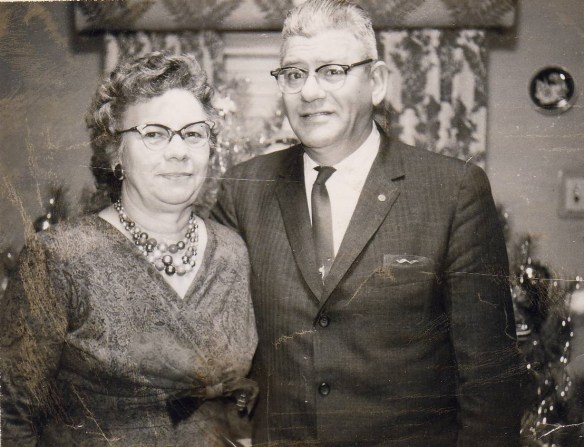
I didn’t see my father often, so he was something of an absent hero. I was always extremely excited when he appeared, often bearing some kind of small gift. My mother, of course, who bore the brunt of everything everyday while he was absent was chronically irritated at this turn of events. He was no hero to Mother, in fact, just the opposite, a scoundrel, but their story is one for another time.

As a result of having lived with him for half a decade, ending just three years before his death, it was a piece of information from her that eventually explained part of the answer to the question of why he might have chosen suicide.

The Day Before

How my father came to work at a funeral home is also a story for a full article, but let’s just say that he had previously worked as a physician and apparently dead bodies didn’t bother him. He worked with the local funeral director as needed. At that time, funeral homes were owned by local families. It took two strong men unbothered by death and body fluids to lift bodies, a task which had to be accomplished multiple times between the removal of the body from where they died and the funeral.

At that time in small-town Indiana, the hearse also performed a second duty as an ambulance. If this strikes you as funny today, it did me too. I can just imagine waking up in the hearse after an accident of some sort and not knowing if you were on the way to the hospital or morgue, or worse yet, the cemetery. Dark humor, I know.

My father was backing the hearse into the funeral home garage, the day before his “accident,” and the funeral director asked him why. My father replied, “Because you’re going to need it this weekend.”

I learned of this about 50 years after the fact, in a happenstance conversation. I had called the funeral home to see if they had any additional information about my father’s funeral – not knowing that he was working there at the time – and certainly unaware of the conversation the day before his death. Imagine my shock!

The man I spoke with 50 years later was the son of the director and was present at the time of the conversation. He took over the family business from his father. The son retired shortly after that conversation and sold the funeral home to a corporate interest. I’m glad I accidentally talked to him when I did, because that opportunity was forever gone shortly thereafter.

The man said that at the time, his father had mentioned that my father’s comment was “odd,” but after the “accident” the following day, the funeral director told his son that he believed my father’s death was suicide. That tidbit may not have been shared with anyone else, but when I heard it, and then combined it with additional puzzle pieces, it made sense. Terrible sense.

Although I can tell you, it was one hell of an electric shock wave to learn as an adult that your father actually committed suicide. It changed the death narrative entirely and caused me to ask questions and reflect on the consummate question, why.

And it hurt.

Accidental death and intentional death is very different for the survivors.

The “Accident”

God this is hard to write.

Even all these years later.

My father had a long history of alcohol abuse.

Before you judge him too harshly, he and his siblings were fed alcohol as children. Their father, William George Estes, was a bootlegger, and apparently not a great one or they wouldn’t have wanted for food. When there was no food, they were given alcohol to make their hungry bellies stop hurting and to make them sleep. My aunt revealed these sordid, heartbreaking details in a letter to my step-mother. Then other family members corroborated. I was horrified and hurt terribly for my father as a child. His parents may not have doomed him, but they certainly started him down a terrible path.

My grandmother, Ollie Bolton, eventually left my grandfather after she caught him cheating, but according to various family resources, she didn’t want her two sons who hopped a freight train in Indiana and found their way to their grandparents in Tennessee. And Ollie wasn’t painted as the villain in the story, William George was worse.

I try desperately not to judge my grandparents, neither of whom I ever met.

In any event, my father learned very young that alcohol was the answer to everything and it made you feel better. For all I know, he may actually have been addicted before he was even a teenager. Regardless, it’s horribly sad.

Dad certainly was an alcoholic by the time he was an adult – his drink of choice being whiskey or moonshine. He was also a veteran of two wars, and according to both my mother and my step-mother, he checked himself into VA hospitals more than once to “dry-out,” but then would fall off the wagon again after release. Sometimes the wagon event took weeks or months, but it always happened.

Clearly, his undependability affected his relationships with women and probably with others as well. The exception was my step-mother, Virgie, who knew him when he was young, married him when he was old, and loved him for who he was. It’s somehow ironic that it was in that supportive relationship that he decided to exit the world.

My father’s military records were burned in the National Personnel Records Center fire in St. Louis in 1972. The VA attempted to help me reconstruct them from different records that existed elsewhere, but medical records were entirely absent.

According to Virgie and Mom, Dad had once again checked into the VA hospital in Fort Wayne and dried out. He was dismissed and went back home, once again hopeful and upbeat. All I can say is that my heart aches that Alcoholics Anonymous didn’t yet exist ubiquitously – because he might had stood a fighting chance.

Virgie told me that he was stone-cold sober after his release and at the time of the accident, but years later, her daughter told a different story.

Apparently, either the day before, or the morning of the accident, he was seen in the local park intoxicated. Perhaps he wasn’t. Perhaps he was and Virgie didn’t know. Perhaps she was in denial. Perhaps she wanted to spare me thinking about my father’s last few hours as an alcoholic who had fallen off the wagon again, a drunk in the park.

The stories vary somewhat, but the essence of the situation was that at the time of the accident, he was either going to pick the preacher up to go fishing, or had dropped him off after fishing. My father loved to fish and judging from the time of day, I’d guess they had already been fishing.

My father was also a master of disguising his alcohol use and abuse, and alcohol consumption wasn’t viewed as negatively at that time as it is today. My recollection was that he always had an unobtrusive flask in his tackle box.

About 7:30 that evening, Dad was driving Virgie’s 1960 Rambler, and at a T-road, with a telephone pole at the intersection, he pressed the gas instead of the brake and hit the telephone pole head on, more than 100 feet from the road. That’s a huge distance and he could have easily maneuvered enough to avoid the pole. Instead, he hit it dead on. No skid marks – no evasive maneuvers. Full on throttle.

Genealogists, please note that the relationships are incomplete and my name is incorrect. Virginia Little is a half-sister, not step-sister and other relatives were omitted.

Today, that transmission pole still seems to be in place, to the right of the small grey pin at the left side of the picture below. It pains me to look, but I had to. I bet no one today knows that someone died there in 1963 – 55 years ago this summer.

The official diagnosis was that Dad had an angina attack and accidentally stomped the gas instead of the brake. Until the other pieces of evidence came to light, no one questioned that.

Indeed, the very hearse he had backed into the garage the day before transported him from the accident scene to the hospital, just as he had predicted. Then the next day, it drove him to the funeral home, and then after the funeral, to the cemetery.

He died at Mt. Auburn and Main, he lived on Hickory and he is buried in the IOOF (Oddfellows) Cemetery in the upper left hand corner on the map below, within sight of where he lived – everything within a mile.

A nice tidy bundle. But it wasn’t tidy at all.

Why?

Why would Dad have committed suicide?

Three possible reasons come to mind.

  • He had once again disappointed his spouse by falling off the wagon. Except this time, it wasn’t a spouse who was threatening to leave him if he didn’t sober up, but one that loved him unconditionally. He may have realized that he truly was not in control of his life – that alcohol controlled him and had controlled his entire life. Maybe he was just done trying.
  • Maybe Dad was depressed because of his relapse and could have succeeded if he had tried again. This was his rock bottom, when other rock bottoms hadn’t been rock bottom enough – but he didn’t survive this rock bottom.
  • Maybe Dad knew something else. As Mom aged, she told me things she would never have told me earlier. Dad had consumed alcohol his entire life. He was about 62 when he died. We don’t know exactly which year he was born, because his birth year on his delayed birth certificate and other identifying information varied by what he wanted/needed his age to be at the moment. His liver was very probably a hot mess. Mom thought he had cancer. She told me rather explicit details about the “messes she had to clean up” which certainly do sound like someone with an internal issue.

If Dad knew he had cancer, suspected he had cirrhosis of the liver (which often precedes cancer) and had disappointed his wife once again, maybe Dad decided it was better to just check out. Maybe he knew what was coming and was afraid. Maybe medically, he was worse than anyone, except him, knew. Maybe his drinking by then was to medicate physical pain.

No Goodbye

I never got to say goodbye.

It was bad enough when I thought his death was an accident.

Maybe he couldn’t bring himself to do that, to say goodbye to me. Maybe he wanted to spare me.

Maybe. Maybe. Maybe.

So many maybes and no answers.

He did leave a message for me with Virgie when he was in the hospital, before he passed away. According to his death certificate, he died of internal bleeding sometime after midnight, about 6 hours after the accident.

And then, 50 miles away, in my bedroom, a shadowy silhouette of my father sat on the edge of my bed. I felt his weight as he sat down and the mattress moved as he touched me. I woke up, seeing his silhouette with the streetlight behind him – so glad that he had come to visit.

In the morning, I leaped out of bed when I heard the phone ring. I knew that Daddy had arrived late the night before and would be there this morning, drinking coffee with cream and sugar at the kitchen table with Mom, waiting for me to get up. Like so many other times before.

I ran up to mother, who was just hanging up the phone, and excitedly asked her where Daddy was.

I didn’t see him.

Mother didn’t say anything, at first, then asked me what I meant.

I told her that I knew he was there because he came and sat on my bed the night before. I was confused, because I didn’t see him anyplace in the house.

She turned ashen and began to shake.

Mother asked me to come and sit beside her on the couch. She put her arms around me, like she wanted to shelter me.

She explained to me that not only was Daddy not there, but he hadn’t been there and that he would never be there again.

I didn’t believe her.

I cried gulping sobs. Unfortunately, I understood death all too well. I didn’t know what to think. I was just sure that she had sent him away, and I was very angry with my mother. I asked many questions and the only answers she had for me were, “I don’t know.”

The phone call had been Virgie and Mom simply didn’t have any answers yet.

For a change, Mom didn’t seem angry with him. She was crying too. I was very confused. Then I talked to Virgie and I was just heartbroken. I can still feel that searing pain ripping through my little body, sitting here today.

I grieved my father’s death terribly and never obtained closure as a child. I’m still not entirely sure that I ever did, although I finally accepted that he had died. As an adult, I arranged for his military headstone myself and had it set.

I wasn’t allowed to attend his funeral, or those of either grandparent. Children then were “spared” grief as much as possible. That would have helped me a lot – to at least see him one more time, even if it was in a casket.

Death became a thief in the night, a stealer of those I loved. Death was an enemy and without any of the positive benefits of group grieving and comfort. Everything about death and funerals had a very negative connotation. To this day, I abhor funerals.

My Step-Father

A few years later, my mother married my step father, Dean Long, whom I completely adored. He and I had a symbiotic relationship because his daughter, who was about my age had died, and I had lost my father. We healed each other’s wounds and formed a bond that not even death could sever.

I did what kids do. I went to school, made mistakes and got called on the carpet. My Mom was the disciplinarian and my step-father was a quiet man of few words. He didn’t need many. I listened to him without reservation.

It was my step-father who encouraged me to stretch my wings beyond what “girls” were supposed to be able to do back then, and beyond Indiana. It was he who told me I could be and do anything I set my mind to. It was him that told me never to let anyone tell me otherwise.

When I found myself married to an abusive spouse, it was Dad that encouraged me to leave. I use the word “encourage’ loosely. He literally put his life on the line for me, more than once. Abuse is a terribly intimidating cyclic phenomenon and without his support, I don’t know that I would have been able to break free of that cycle alone.

I did, moved and remarried. He saved me, or more succinctly, helped me to save myself.

My Turn in the Hot Seat

Fast forward.

Years later, in 1993, I was in my prime. I had finished multiple college degrees and a few years earlier, left a lucrative professional position in the computer industry to found a consulting company. Things were going well, at home and at work – until Sunday, June 20st.

When I woke up that morning, my husband couldn’t get out of bed and his speech was quite slurred. I knew there was a problem, and immediately called 911. My husband and son were both volunteer firefighters and paramedics, although my son wasn’t home at the time.

I had never been so glad to see those men arrive. They were at the house within a couple minutes. My husband’s best friend was the first to arrive. I had to leave my husband in the bedroom to go outside to explain to Chuck what was happening.

“I think he had a stroke.”

And then I began to sob, because I knew.

That stroke, he might have recovered mostly from, but the devastating stroke that followed a week later destroyed much of his brain.

He was hospitalized for months with complication after complication, hovering near death anew every day.

Needless to say, he not only couldn’t work, he would never be able to work again. I couldn’t be at the hospital managing his daily health crisis and work at the same time. Not only that, but I suddenly needed to make as much money as we both had made together previously. The bills didn’t go down, they went up with his skyrocketing medical bills during his 6 month hospital stay.

I vividly remember the night that I walked into the house after working all day and then going to the hospital to deal with a crisis of some sort and saying to myself, “I need a beer.”

Then I heard what I said, especially the word “need.” I knew in that instant that if I had one beer, I would never stop. I did need that beer. It’s called self-medication – and it’s a hallmark of depression. I didn’t have that beer that day, nor did I allow myself to drink anything alcoholic for several years. Alcoholism clearly has a hereditary component and I knew that I was susceptible. I do occasionally have a drink now, but they are few and far between, and never, ever on a “bad day.”

A few months later, when it was determined that my husband wasn’t going to die, at least not immediately, focus shifted to his hospital release. Our home was not handicapped accessible for a wheelchair. Not only that, but he could never be left alone with his cognitive judgement impairments. Insurance does not pay for home modifications. No one pays for home modifications for handicapped access. Neither does anyone pay for home assistance nor residence in a facility. I had no good options.

By December, we were scheduling his release from the hospital. I had taken a loan to convert the garage into a handicapped bedroom/bathroom and make the kitchen and living room handicapped accessible. I had hired an aide to stay with him while I worked, but in the next few months, I would go through aides like water because he was “difficult” in many ways, including sexually inappropriate.

His “executive function” that prevents normal people from doing things like grabbing women by the genitals had been destroyed in the stroke. I understood that he couldn’t help himself, but understanding and living with the situation are two entirely different things.

Our daughter was a teenager at this time and suffice it to say that this situation pushed her into behaviors that were not healthy for her. That’s her story to tell, not mine, but it was living Hell on earth for everyone involved.

My son, an older teen, couldn’t cope and left the family and would remain estranged for many years. However, my daughter and I were trapped there.

My step-father was in failing health with COPD and would die in September of 1994.

My mother was a wreck between my step-father, my husband’s stoke, me and my children. She wanted to help, but couldn’t leave Indiana to do so.

My step-brother lived in another state and had a host of serious issues. He was in no condition to help anyone, not even himself.

There was no one to depend on, other than my daughter who was too young to have that kind of responsibility foisted upon her.

When you’re in that kind of a situation you learn very quickly who your friends and family are that care. Many you think you can depend on simply disappear into the shadows. Sometimes people you don’t expect step forward too.

Of my husband’s three brothers, two were ministers and they were “too busy” to help. All I can say is “bless their hearts.” You southern people will know exactly what that means.

The third brother, the official “black sheep” of the family, condemned by the ministers, came with his wife periodically to help us. I’ve always liked black sheep.

My husband’s parents were in their 80s and couldn’t really grasp the situation. They thought that if he could talk, he was fine. Never mind that he made no sense. My mother-in-law had advanced Parkinson’s disease and my father-in-law had congestive heart failure. They really couldn’t help much, but they could certainly criticize everything I did, or didn’t do. Both died within a few years.

My half-brother couldn’t be bothered and never offered to help. So much for family.

A couple of my husband’s fire-department buddies came to help from time to time, as did my quilting friends. Chuck was here regularly trying to help me get things in order, but after my husband came home, few could deal with him. I was extremely, extremely grateful, but the need so far outweighed the available resources.

Eventually, I was at the end of my rope – 18 months progressively descending into the fires of Hell.

The Christmas from Hell

It was Christmas 1994.

I had decorated the Christmas tree, not that I cared, but because that’s what I was “supposed to do.” I was still trying to make everything as normal as I could. I sat down and cried, but then I was just too tired and hopeless even for tears. There was no beauty in that tree, no beauty in Christmas, no beauty in life.

I was terribly, chronically sleep deprived and had been for months. I worked in the day, and was my husband’s caregiver the rest of the time. 24X7X365 with no break. His care meant looking after an incontinent 260 pound 2 or 3 year old that is never cute, never grows up and you can’t take anyplace because of his behavior. His weight increased and he was very difficult for me to manage.

My son was gone and had been gone throughout the entire episode. My daughter had run away from home. My step-father had died. My mother was coming the next day, Christmas Eve, and the week after Christmas, we had to take my husband to live in a care facility because I had lost the final aide and couldn’t find anyone willing to take care of him while I worked. My job was hanging on by a thread, through the extreme generosity of my customer, but that wouldn’t last forever. I had to do something and I felt like an abysmal failure on every level.

My husband was going to be crushed that he had to live someplace else. I dreaded trying to explain to someone who couldn’t understand why that had to happen. I dreaded driving away that day. I dreaded every single day.

All of that money spent on handicapped remodeling was for naught. I couldn’t stay home and take care of him, because someone had to make the house payment, pay the utilities, the car payment, buy the groceries, arrange, transport to and pay for his therapy, etc.

When my mother arrived the next day, I was going to have to explain to her what had happened with my daughter, and that she had run away. My mother had born so much heartbreak over the past few months with my Dad’s prolonged death that I didn’t know how she would withstand this final straw.

I didn’t know how I was going to withstand this final straw.

Everything seemed entirely and completely hopeless.

My husband was not a man I knew. He had become abusive and inappropriate as a result of the stroke. In hindsight, I should never have brought him home and subjected me and my daughter to his behaviors, but I didn’t know, and the medical professionals certainly didn’t explain that. I thought I could make it work, and wanted to, but in the end – I couldn’t.

My children were gone. My step-father, whose last words in this life to me were, “I love you. You’ll make it, Honey. I’ve been so lucky to have you in my life,” was gone.

The creditors were calling about my husband’s hospital bills, and if you’ve never spoken to a professional bill collector – you’ve never been bullied. They are professionals at lies, fear and intimidation. May they rot in hell.

I finally learned to turn the tables and I took out my long-pent-up frustration on them when they began their bully routine. One actually had the AUDACITY to tell me my husband was LUCKY to have had a stroke so he didn’t have to pay his bills. Huh? He had the medical bills because he had the stroke. Some people are pure evil. My friend who was also a nurse overheard one of those conversations and bought be a pin that said “psycho bitch from hell.” Let me tell you, I wore it proudly as a badge of honor. It meant that maybe, just maybe, I was mad enough to survive.

Crossing the Line

It was late that December 23rd night or maybe very early morning the 24th by then. I sat down on the couch after I finished decorating the tree. I knew neither my son or daughter would be there for Christmas. I didn’t know where they would be, but it wasn’t at home. I needed to see them, but that wasn’t going to happen. I couldn’t even get ahold of them in the days before cell phones.

My husband was too impaired to realize they were absent, but my mother would be devastated. I was devastated. Christmas would be a day of sorrow, the first holiday since Dad’s death and so much loss. I wanted to sleep through it. I wanted to sleep forever and never wake up.

The Christmas tree was a catalyst. The ornaments handmade in happier times, those hopes and dreams now entirely dashed. No hope. No dreams. Nothing. That life ripped from me. And seemingly, no way out.

I had finally gotten my infant-adult husband to sleep. The house was silent. The lights were out except for the Christmas tree lights, flickering Christmas colors mockingly, and the tree which had been the center of so much happiness and joy for so long represented everything lost forever.

And I thought:

“I can’t take this anymore.”

It wasn’t a shout, but a whisper.

But it was the crossing of a line.

I also realized what was happening.

I suddenly understood that suicide wasn’t about wanting to be dead.

It was about wanting the pain to stop.

The chronic unending pain.

That there was no other way to make stop.

Death seemed far more reasonable and attractive than THAT life.

You don’t hurt after you’re dead.

Three things stopped me.

My love for my mother and my son, my hope and love for my daughter and my responsibility towards my husband, in no particular order.

  • Without me advocating for my husband and watching over him, not to mention paying his bills, he would have wound up in an abusive welfare hell-hole. He was not a nice man, but I remembered the man before the stroke and I couldn’t do that to him.
  • Without me, my daughter, no matter how difficult she was being, would have had no hope of recovery. I wasn’t exactly her best friend at the time, but I was a resource when she was ready.
  • I think my death would have killed my mother.
  • Which would have killed my son.

I couldn’t live and I couldn’t die. It was that simple.

I had to get help. At that moment, death would have been easier, far easier, believe me.

I never told my mother about this. I may have told my children since, but I certainly didn’t tell them at the time. Even if they had been there, I wouldn’t have wanted to burden them. My husband wouldn’t have understood or cared. He had lost all capability to care about anyone but himself.

After Christmas, I found a counselor whose husband was also wheel-chair bound. The difference was that her husband was not mentally impaired as well, but she fully understood the challenges I faced. She saw me weekly, on a sliding scale, for years.

The Uphill Battle

Life improved, slowly. With my counselor’s approval, I declined depression and anxiety medications, because I was concerned about addiction. My family was already too full of that and I knew I had a history with both my father and grandfather.

With my husband living in a specialized facility where he received good care and constant supervision, I was once again able to sleep and work with regularity – which means the bills were much easier to pay. Good thing, because his living situation was extremely expensive.

However, putting him into a care facility came with a huge dosage of guilt, dealt out freely by his family and others who had no clue.

“You put your husband in a home?”

Yep, I did, for his good and everyone else’s too. I finally told anyone who thought otherwise that they were welcome to take him for a day. A couple of people took me up on that offer, and I never, ever heard another word like that out of them again – nor did anyone ever take him a second time. Walking a mile in someone’s moccasins is truly the best teacher.

My daughter eventually recovered, but that took another decade.

My son returned to the family about the same time my daughter recovered.

Healing was slow and difficult for everyone and still isn’t complete.

My step-brother died under “suspicious circumstances” at Thanksgiving in 1999. The case was never closed. That situation caused my mother an extreme amount of grief and anxiety.

My mother moved near my half-brother and passed away in 2006. She never really recovered after my step-father’s and step-brother’s deaths. I’m sure she had undiagnosed depression, but she never told me – just like I had never told her or my children. I found many flyers about seniors and depression in her belongings after her death. I felt just awful. I would have done something had I known.

Keeping depression a secret was a mistake on my part and hers as well. Sometimes the depressed person can’t reach out, so it’s up to the rest of us to reach in.

I became officially single in 2000, remarried in 2003. Those years are scars, not open wounds any longer.

It was a very long, very ugly decade of descent into Hell followed by an uphill battle of gargantuan proportions – but I made it. I would not have made it without my counselor, my friends and the part of my family that actually cared. I found strength in the memory of my step-father that often sustained me in difficult times. I have since added grandchildren, a son-in-law, daughter-in-law and new family-of-heart members to my family that was dwindling.

Needless to say, my life changed in the instant of that stroke. That life was forever broken, shattered into a million unrecognizable pieces and was never whole again. I rebuilt a new life out of a few salvageable pieces, namely my children, but not without a huge amount of pain and effort – on their part as well as mine. Those relationships were indelibly changed too.

Had I exited, my children would have been much more permanently damaged, perhaps irreparably. I’m so glad I didn’t do that in my darkest moment. They were that oh-so-tiny spec of light.

So many times, it was the little blessings from people that told me they cared that meant so much and kept me going. That’s also part of the reason why I make care quilts today and have since the Oklahoma City bombing in 1995 when my friend and I made quilts for the children and husband of Rebecca Anderson who gave her life rescuing victims. It’s my way of giving back by paying it forward.

If you find someone in a depressing situation, what can you do, even if they won’t admit to depression? I honestly didn’t realize the severity until that December 23rd when I was at the end of my rope.

How to Help

My rule of thumb is that I will make every effort to help someone who is truly trying to help themselves, or who can genuinely not help themselves but would if they could. This means that I’m not interested in high-drama situations where people are looking to benefit from their situation, for attention or to manipulate others. I also draw the line at substance abuse. Tough love. I will help them, but they MUST help themselves too.

For people suffering from clinical depression, meaning depression as a disease that is not related to a specific trigger event:

  • Offer support. Tell them you love them, if appropriate. Love is powerful medicine.
  • Listen, empathize, and ask questions.
  • Tell them you understand and offer helpful suggestions. Don’t begin the sentences with, “Why don’t you…” which implies criticism, or with, “You should…”
  • Do NOT tell them that they shouldn’t feel the way they do – i.e. do NOT say, “But you have such a good life. You shouldn’t be depressed.” Or worse yet, “Just get over it.” You may not mean that as judgmental, but it feels that way and will only drive a wedge between you and depress them further.
  • Encourage or help them to seek appropriate assistance. Assistance could be in the form of counseling, advocating for them to receive some sort of assistance program or in severe cases, intervention if self-harm is a potential issue.

For people suffering from situational depression – like the stroke scenario:

  • Offer support. Tell them you love them, if appropriate.
  • Listen, empathize, and ask questions.
  • Tell them you understand and offer help. Don’t say, “All you need to do is ask” because they may not be able to ask. Asking feels like begging and imposing yourself on other people. It also opens up the opportunity for rejection.
  • Figure out what they need and help make arrangement to meet those needs. My quilt sisters brought food frozen into meal sized portions for months – without me asking. I was so incredibly grateful. My neighbor occasionally brought over a pot of chili. Someone anonymously dropped off Thanksgiving dinner on the porch when my kitchen was torn apart to make it handicapped safe and accessible – bless them. My EGA chapter took up a collection. My brother-in-law and his wife would occasionally come to relieve my daughter and I so the two of us could do something together like shop for clothes. I would have given anything for someone to mow the lawn or plow the snow.
  • Do NOT say things like “God won’t give you more than you can handle.” What I heard was that my husband and family were being punished because I was a strong woman. Secondly, those people NEVER offered to help. I guess from their perspective, God was going to do it all. Well, let me tell you, God doesn’t shovel snow. I thought if I heard that phrase one more time I would explode. Say what you really mean, not that platitude. Trust me, it’s not comforting even though you mean it to be, especially to the person who has heard it hundreds of times and there is no food in the house and the furnace doesn’t work. If you don’t know what to say, say, “I’m sorry. What do you need?”
  • Don’t rely on the person to voluntarily tell you what they need, because no one wants to be THAT PERSON who asks for help and for assistance from others. Especially when you’ve been told over and over that God is supposed to be providing, but you’re still in need. It’s especially difficult for people who have been giving assistance their entire lives. Accepting charity or being in the position that you need to is very embarrassing and often humiliating. It makes people feel weak and vulnerable. It was extremely difficult for me then and even discussing it today, this many years later, is uncomfortable.

If you feel any person is a danger to themselves, call a suicide hotline with them or call 911. Don’t interpret a threat or discussion of suicide as an idle threat. It may not be. You could be dead wrong.

If you live with someone who takes medication for depression or anxiety, watch to be sure they are taking their medication. Often people want to stop when they feel better, but they feel better because they are taking the medication. Then they become too depressed to take their medication. It’s a downward spiral.

Be on the lookout for either words or actions that say:

If you hear those, or see those, be their light. Make the difference.

  • Tell them everything is better in the light of day.
  • Tell them that you are THERE for them, and mean it. Follow through and follow up. Nothing is worse than feeling completely irrelevant and then having someone make hollow promises about how they are going to help you – and then they don’t.
  • Tell them that when you are hungry, angry, lonely or tired, life looks bleak. So HALT.
  • Tell them you can fix hungry, angry, lonely and tired, but you can’t fix gone.
  • Tell them what a bright spot they are in the world and why you believe that.
  • Tell them how much they mean to you.
  • Tell them about the darkness that will replace their light in the lives of the people who love them if they leave.
  • Tell them you will help them and begin the discussion to solve the problem any way other than by leaving permanently. Make a plan.
  • Tell them that you love them, because if you don’t, you may never get the opportunity again.
  • If they have tried before to solve problems like addiction that seem unsolvable, encourage them to try again, with help, one day at a time.
  • Strongly discourage the use of alcohol or drugs, other than under medical supervision. You can’t deal with life’s issues when you don’t face them. You can’t overcome what you don’t confront. You need all of your mental faculties to slay those dragons.

You may not be able to stop them, because ultimately, the choice is theirs, but you can damned sure try. Sometimes trying means the world, and life, to someone who sees only a very dark tunnel and no light.

There is light, but they may need your hand to reach it.

______________________________________________________________

Disclosure

I receive a small contribution when you click on some of the links to vendors in my articles. This does NOT increase the price you pay but helps me to keep the lights on and this informational blog free for everyone. Please click on the links in the articles or to the vendors below if you are purchasing products or DNA testing.

Thank you so much.

DNA Purchases and Free Transfers

Genealogy Services

Genealogy Research

Milestone! 1000 Articles About Genetic Genealogy

Today is a big day for DNA-eXplained. I christened this blog on July 11, 2012 with an invitation for the world of genetic genealogy to follow along. Wow, what a ride!

Today, about 5 weeks shy of the blog’s 6th birthday, I’m publishing my 1000th article – this one. I don’t even want to know how many words or pages, but I do know I’ve gone through two keyboards – worn the letters right off the keys.

My original goal in 2012 was to publish one article per week. That would have been 307 articles this week. I’ve averaged 3.25 articles a week. That’s almost an article every other day, which even surprises me!

That’s wonderful news for my readers because it means that there is so much potential in the genetic genealogy world that I need to write often. Even so, I always feel like there is so much to say – so much that needs to be taught and that I’ll never catch up.

I wonder, which have been the most popular articles?

Most Popular Articles

The most popular article has received almost a million views.

I’m not surprised that the article about Native American heritage and DNA testing is number one. Many people want to verify their family stories of Native American ancestry. It was and remains a very large motivation for DNA testing.

One link I expected to see on this list, but didn’t, is my Help page. Maybe because it’s a page and not an article? Maybe I should publish it as an article too. Hmmm….

What Do These Articles Have In Common?

Four are about ethnicity, which doesn’t surprise me. In the past couple of years, one of the major testing companies has pushed ethnicity testing as a “shortcut” to genealogy. That’s both a blessing and a curse.

Unfortunately, it encourages a misperception of DNA testing and what it can reasonably do, causing dissatisfaction and kit abandonment. Fortunately, advertising encourages people to test and some will go on to get hooked, upload trees and engage.

The good news is that judging from the popular articles, at least some people are researching ethnicity testing – although I have to wonder if it’s before or after they receive their test results.😊

Three articles are specifically about Native American heritage, although I suspect people who discover that they don’t carry as much Native as they expected are also reading ethnicity articles.

Two articles are specifically not about autosomal results, which pleases me because many autosomal testers don’t know about Y and mitochondrial DNA, or if they do, they don’t understand what it can do for them or how to utilize results.

Several articles fall into the research category – meaning an article someone might read to decide what tests to purchase or how to understand results.

Key Word Searchable

One of the things I love about WordPress, my blogging platform, is that DNA-eXplained is fully keyword searchable. This means that you can enter any term you want to find in the search box in the upper right-hand corner and you’ll be presented with a list of articles to select from.

For example, if you enter the phrase “Big Y,” you’ll find every article, beginning with the most recent that either has those words in the title, the text or as a tag or category.

Go ahead, give it a try. What would you like to learn about?

More Tools – Tags and Categories

Tags and categories help you find relevant information and help search engines find relevant articles when you “Google” for something.

If you scroll down the right-hand sidebar of the blog, you’ll see, in order:

  • Subscription Information
  • Family Tree DNA ad
  • Award Received
  • Recent Posts
  • Archives by date
  • Categories
  • Tags
  • Top Posts and Pages

Bloggers categorize their articles, so if you want to view the articles I’ve categorized as “Acadians” or “Art,” for example, just click on that link.

I use Tags as a more general article categorization. Tags are displayed in alphabetical order with the largest font indicating the tags with the most tagged articles.

You can see that I categorize a lot of articles as Basic Education and General Information. You can click on any tag to read those articles.

My Biggest Surprise

I’ve been asked what’s the most surprising thing that I’ve learned.

I very nearly didn’t publish my 52 Ancestors series because I didn’t think people would be interested in my own family stories about my ancestors and the search that uncovered their history.

Was I ever wrong. Those stories, especially the research techniques, including DNA of course, have been extremely well received. I’ve learned that people love stories.

Thank you for the encouragement. This next week will be the 197th article in that series.

I encourage everyone to find a way to tell the story of your ancestors too. If you don’t, who will?

My Biggest Disappointment

I think my biggest disappointment has been that not enough people utilize the information readily available on the blog. By this, I mean that I see questions on Facebook in multiple groups every day that I’ve already written about and answered – sometimes multiple times in different ways.

This is where you can help. If you see questions like that, please feel free to share the love and post links to any articles. With roughly 12 million testers today and more before year end – there are going to be lots of questions.

Let’s make sure they receive accurate answers.

Sharing

Please feel free to share and post links to any of my articles. That’s the purpose. You don’t need to ask permission.

If you would like to reproduce an article for any reason, please contact me directly.

Most of all, read, enjoy and learn. Encourage others to do so as well. The blog is free for everyone, but any support you choose to give by way of purchasing through affiliate links is greatly appreciated. It doesn’t cost you more, but a few cents comes my way from each purchase through an affiliate link to help support the blog.

What’s Coming?

I have a few articles in process, but I’d like to know what you’d like to see.

Do you have suggestions? Please leave them in the comments.

I’ve love to hear from you and I often write articles inspired by questions I receive.

Subscribe

Don’t miss any articles. If you haven’t already, you can subscribe by entering your e-mail just above the Follow button on the upper right-hand side of the right sidebar.

You can also subscribe via an RSS feed, or follow me on Twitter. You can follow DNAexplain on Facebook, but be aware that Facebook doesn’t show you all of the postings, and you won’t want to miss anything. Subscribing via e-mail is the most reliable option.

Thank You

There’s so much available today – it’s a wonderful time to be a genealogist that’s using DNA. There used to be a difference between a genealogist and a genetic genealogist – but I think we’ve moved past that stage and every genealogist should be utilizing all aspects of DNA (Y, mitochondrial, autosomal and X) as tools.

Thank you for subscribing, following or however you read these articles. You’re an amazing audience. I’ve made the unexpected wonderful discovery that many of you are my cousins as well.

Thanks to you, I’ve unraveled mysteries I never thought would be solved. I’ve visited ancestral homelands as a result of your comments and assistance. I’ve met amazing people. Yes, that means YOU!

I’m extremely grateful. I started this blog to help other people, never imagining how much it would help me too.

I love writing for you, my extended family.

Enjoy and Happy Ancestor Hunting!

______________________________________________________________

Disclosure

I receive a small contribution when you click on some of the links to vendors in my articles. This does NOT increase the price you pay but helps me to keep the lights on and this informational blog free for everyone. Please click on the links in the articles or to the vendors below if you are purchasing products or DNA testing.

Thank you so much.

DNA Purchases and Free Transfers

Genealogy Services

Genealogy Research

MyHeritage Data Breach

If you are a MyHeritage customer, change your password. Now. Here’s how.

This is late breaking news.

If you were a MyHeritage user before October 27, 2017, your e-mail was included in a data breach at MyHeritage. MyHeritage was informed of this breach less than 6 hours ago.

MyHeritage is doing the right thing by making the breach public immediately. It appears that no financial or DNA information was involved, but the investigation is just beginning.

Read the MyHeritage blog article here.

TechCrunch reports here.

Change your password now.

______________________________________________________________

Disclosure

I receive a small contribution when you click on some of the links to vendors in my articles. This does NOT increase the price you pay but helps me to keep the lights on and this informational blog free for everyone. Please click on the links in the articles or to the vendors below if you are purchasing products or DNA testing.

Thank you so much.

DNA Purchases and Free Transfers

Genealogy Services

Genealogy Research

Johann Michael Muller the First was a Widower, 52 Ancestors #196

When I wrote about Johann Michael Muller (the first) as well as his wife, Irene Elisabetha Heitz, I thought his story was complete.

Just when you think there are no more records, nothing else to squeeeeeze out of that turnip – there’s one more thing. And as it turns out, it exposes a VERY important chapter in Michael’s life by deciphering just one word.

This church entry documents Johann Michael Muller’s wedding to Irene Liesabetha Heitz in Miesau, Germany in 1684. When we discovered this record, it was HUGE news, because proved the real identity of Michael’s wife.

But there’s more…

The Turnip Bleeds

As you can see, the script is very difficult. The original translation stated that Michael had married Irene, picking out the evident words, but there was additional information lurking there that would prove to be very important, obfuscated by centuries-old script.

Upon further investigation, and no small amount of sleuthery in terms of trying to decipher the script – it was determined that one of the words was incredibly important.

wuntartzt

Above, an enlarged area from the marriage record.

What the heck is a wuntartzt? Nobody knew. Not Tom, not Chris our Native German speaker, and not another long-time German historical resource.

Tom, my trusty cousin who is also a retired German genealogist, suggested, after much gnashing of teeth because no one knew what a wuntartzt was, that maybe, just maybe, the word was really widower, which in German is “witwer.” German script is extremely contrary sometimes, and of course it’s always the MOST important word that stubbornly resists.

After three knowledgeable people concurred that this word really is witwer, the translated verbiage was evaluated again for context. That’s not always straightforward either!

Chris replied:

So, “son” and “widower” refers to the same person, Michael. The part before “Sohn”: “Heinsmanns Müllers Einwohners zu Schwartz Matt im Berner Gebieth” is put as a genitive, because it refers to Michael`s father Heinsmann.

Which, of course, raises an entirely new question: If Michael Müller was a widower at the time he married Irene Liesabetha Heitz in 1684, who was his first wife then? Did she die in Steinwenden or in the area or rather already back in Switzerland? Maybe it is worth to have another close look at those burials in the Miesau church book from 1681 to 1684 to maybe find her there?

Here’s the retranslated marriage entry as agreed upon by Tom and Chris.

“Johann Michael Muller, widower, son of Heinsmann Muller, resident in Schwartz Matt in the Bern area (Switzerland), married 17 April 1684 in Steinwenden to Irene Liesabetha Heitz, daughter of Conrad Heitz.”

Of course, the blessing or curse of genealogy is that one answer or even a hint always raises many more questions.

And…another gem is unearthed from that script – Michael’s father’s name. Except, of course, as this family always seems to do – that information conflicts with what we thought we knew.

So, let’s evaluate how this puzzle piece fits with the rest of what we actually do know.

For beginners, Michael’s death record in Steinwenden on January 31, 1695 states his age as being 40, which means he was 29 or 30 when he married Irene in 1684. Chances are good (92%) that he had not yet had his birthday in 1695 when he died, which means he was probably born in 1654, and if not, in 1655. He would have become of marriageable age in about 1675, but probably wouldn’t have married yet for a few years, until he could provide support for a family in some fashion. So we are looking for a marriage record for Michael sometime in or after 1675 and of course, before April of 1684. Probably significantly before 1684.

Someplace. But where?

Boltigen

Chris’s continuing thoughts:

What remains interesting to me though is the reported village of origin for the Michael Müller, who married Irene Liesabetha in 1684. As I pointed out he must be from Schwarzenmatt (church records are found in the Boltigen church books), which is in fact really close to Erlenbach in Simmental.

With the two villages being so close to each other, I would think it goes certainly well along with Michael Müller from Schwarzenmatt and Jacob Ringeisen from Erlenbach having been cousins.

Later records in Steinwenden state that Jacob Ringeisen is a cousin of Michael Miller’s and that Jacob is a Swiss from Erlenbach.

Chris goes on to say:

The Boltigen church books: As I read on an internet forum, the church books of the time period around 1650 that would be of most interest for us are lost in a church fire in 1840. You can also see this from the Familysearch compilation:

https://www.familysearch.org/wiki/en/Boltigen_parish,_Bern,_Switzerland

So I fear we are lost guessing here, with the remaining possibility that pedigrees have been made before 1840 and saved somewhere.

Would we be that lucky? But wait…

There is a coat of arms of a Müller family in Boltigen.

Now that’s quite interesting. I can’t help but wonder if this pertains to my Miller line. I wish I knew more about those Boltigen Millers and I surely, surely, wish that one of the male Boltigen Millers, assuming some of them survived to current, would take a Y DNA test. I’d love to confirm that this is the same line. In fact, if you’re a male Boltigen Miller descendant and carry the surname today, I have a DNA testing scholarship for you!

The Original Zollikofen Narrative

It’s disconcerting when new information conflicts with information that has been believed within a family for a long time, even if the family doesn’t exactly know WHY they believe that.

For as long as I’ve researched this family, it’s been repeated that Johann Michael Muller was believed to have been born in Zollikofen, Switzerland in 1655. The age fits and the location fits given that many Swiss were immigrating from that area to Germany. However, there has never been any documentation or record to prove that the Johann Michael Muller born in 1655 in Zollikofen to Johann Jacob Muller and Salome Huber is the same Johann Michael Muller who lived and died in Steinwenden. In fact, I’ve never actually seen that Muller/Huber record either, simply heard repeatedly that it existed.

Researchers, me included, were frustrated for years trying to find this documentation. Had we been able to discover what happened to the child of Jacob and Salome Huber Miller, we could possibly have disproven (or proven) that he was our Michael, but that information too proved elusive.

I did find it worth noting that none of Michael’s children were named either Jacob or Salome. Jacob might not have been remarkable because it’s so common, but Salome is rather unusual. On the other hand, none were named Irene or Regina after his wife, either, nor Heinsmann after his father.

Neither was I able to document Jacob and Salome Huber Miller, the Zollikofen couple that was supposed to be Michael’s parents. Now, that doesn’t matter anymore.

The marriage record for our Johann Michael Muller to Irene gives Michael’s father’s name and location. And it’s not Johann Jacob Muller nor is the location Zollikofen, or even near Zollikofen.

It appears that Zollikofen was a “best fit” by someone using the information they had at the time. Sadly, as a family, we’ve been emotionally married to Zollikofen for decades now, and mistakenly so. One family member, a minister, even preached from the pulpit in Zollikofen, thinking he was in the church where Michael stood. Truth be known, he was about 40 miles away.

So close but so far away.

A Marriage Record

Tom found something quite interesting.

An April 1681 marriage in Boltigen between Michael Muller and Anna Andrist.

Is this our Michael?  It could be. The time is right. But who knows!

This quaint alpine church in Boltigen replaced the church lost in fire in 1840. Is this the location where Michael was first married, in the original church?

By Roland Zumbuehl – Own work, CC BY 3.0, https://commons.wikimedia.org/w/index.php?curid=20634682

Boltigen marriages started being recorded in 1662 but unfortunately, no parents are recorded in marriages. How FRUSTRATING!

Deaths began in 1683, so if Michael’s wife died there before the records began, that too has slipped away from us.

Tom looked in the Miesau church records for any sign of Michael’s first wife and of course, didn’t find hide nor hair of her or Michael before his 1684 marriage to Irene.

Switzerland to Germany

What brought Michael to Germany from Switzerland?

From the Boltigen/Erlenbach area to the Miesau/Steinwenden area is a nontrivial trip. Note that on the map below you can see parts of seven different countries; France, Luxembourg, Germany, Switzerland, Italy, Lichtenstein and Austria . Europe is much more compressed than the US, and while we think of country boundaries as borders, in Europe, they function mostly seamlessly and did then as well. Some boundaries are geographical, like the Alps separating Switzerland and Italy, but in other cases, country lines are politically drawn and have moved and been renamed over time.

Viewed from Boltigen, the Juan Pass.

Beginning at the northern base of the Alps, Michael’s path would have ambled along the Rhine River after crossing more mountains near Basel.

1493 woodcut of Basel from the Nuremburg Chronicle

Did Michael move to Steinwenden because his cousin, Jacob Ringeisen had moved or was moving to the Steinwenden area? Did they make the journey together? Had other family members moved there too, attracted by the Palatinate promise of land and tax exemption?

We know there was lots of vacant land available. The area was entirely depopulated by the 30 years war. A 1656 tax list states that no one lived in Steinwenden. By 1671, inhabitants were once again listed. The 1683/4 tax records show only 6 families and 25 people total – although that list appears to exclude the non-taxed Swiss.

The Hans Berchtol family who settled in Steinwenden, whose daughter Susanna married Michael’s son in 1714, seems to have sprung from this Swiss region too.

Was Michael leaving heartbreak behind, someplace that didn’t remind him of his departed love? Or, did Michael and his first wife leave Switzerland with a family group to start a new life – embarking on a great adventure with the rosy-cheeked promise of newlywed love?

And then, tragedy struck…

Kids? Were There Kids?

If Michael was a widower in 1684 at the time of his second marriage, and his first wife had died, were there living children? If Michael married Anna Andrist mid-April, she could have been having a child anytime from January 1682, assuming she wasn’t pregnant when they married.

There was even time for a second child to have potentially been born.

The only child who lived from Michael’s second marriage to Irene was Johann Michael Muller the second, the last child born in 1692. Michael and Irene would suffer the births and deaths of 5 children after their 1684 marriage and before Michael the second was born. Unbelievable grief, grief stacked upon grief for Michael. How did he survive?

Why were there no more children born to Michael and Irene?

Was Michael or Irene ill between 1692 and Michael’s untimely death in 1695? Why was there no record of another child born about October of 1694, which would have been when the next child would be expected? There are no Muller children’s death records either.

Originally, we thought that Irene had died and Michael had remarried, but she hadn’t. We simply don’t have any answers, except that Irene remarried in 1696 to Jacob Stutzman and subsequently had several more children, the first one arriving 11 months after their marriage.

This is killing me. If Michael married Anna Andrist in April 1681, IF Anna was his wife, the first child could have been born in January 1682. A second child could have been born in mid/late 1683. Anna could have died in childbirth with either child, or neither child. If there were two children, there’s certainly no guarantee that either survived, with or without the mother’s death. What we do know is that by April 17, 1684, Michael was a widower, in Miesau, far from where his father lived, marrying Irene.

Having said all of that, it’s possible that there were children born to Michael’s first marriage that did survive. If so, and if we have identified the correct wife and location, we’ll never know because the baptism records are missing for that time period in Boltigen.

Either:

  • Anna Andrist died before Boltigen death records began in 1683
  • Or they weren’t living there when Anna died
  • Or this is the wrong couple

Tom feels that, “if Michael had young kids, they would be evident in Steinwenden, which they weren’t. I don’t think we will get a handle on this aspect. I believe you are done with this chapter.”

There were other Millers evident in Steinwenden, BUT, Miller is an extremely common surname and there is nothing to tie Michael to any of them. Given the fact that the godparents might well have stepped in to raise any children by Michael’s first wife, especially if the child needed to be nursed, Michael might have been found in Steinwenden without his children. Michael’s children, if there were any and they survived, could have been being raised in Schwarzenmatt or someplace near Boltigen.

Clearly, we are now far into the land of speculation, an endless maze of rabbit holes without any shreds of evidence.

I think Tom is right, at least for now. This turnip really is bloodless and this chapter has closed. But of course, that’s what I thought before too. You never know, maybe one of those Boltigen Miller’s will DNA test and we’ll be bleeding turnips once again!

A huge, huge thank you (again) to Tom and Chris both, turnip bloodletters, without whom I’d still be eyeing Zollikofen longingly. RIP Zollikofen.

______________________________________________________________

Disclosure

I receive a small contribution when you click on some of the links to vendors in my articles. This does NOT increase the price you pay but helps me to keep the lights on and this informational blog free for everyone. Please click on the links in the articles or to the vendors below if you are purchasing products or DNA testing.

Thank you so much.

DNA Purchases and Free Transfers

Genealogy Services

Genealogy Research

Concepts: Anonymized Versus Pseudonymized Data and Your Genetic Privacy

Until recently, when people (often relatives) expressed concerns about DNA testing, genetic genealogy buffs would explain that the tester could remain anonymous, and that their test could be registered under another name; ours, for example.

This means, of course, that since our relative is testing for OUR genealogy addiction, er…hobby, that we would take care of those pesky inquiries and everything else. Not only would they not be bothered, but their identity would never be known to anyone other than us.

Let’s dissect that statement, because in some cases, it’s still partially true – but in other cases, anonymity in DNA testing is no longer possible.

You certainly CAN put your name on someone else’s kit and manage their account for them. There are a variety of ways to accomplish this, depending on the testing vendor you select.

If the DNA testing is either Y or mitochondrial DNA, it’s extremely UNLIKELY, if not impossible, that their Y or mitochondrial DNA is going to uniquely identify them as an individual.

Y and mitochondrial DNA is extremely useful in identifying someone as having descended from an ancestor, or not, but it (probably) won’t identify the tester’s identity to any matching person – at least not without additional information.

If you need a brush-up on the different kinds of DNA and how they can be used for genealogy, please read 4 Kinds of DNA for Genetic Genealogy.

Y and mitochondrial DNA can be used to rule in or rule out specific descendant relationships. In other words, you can unquestionably tell for sure that you are NOT related through a specific line. Conversely, you can sometimes confirm that you are most likely related to someone you match through the direct Y (patrilineal) line for males, and matrilineal mitochondrial line for both males and females. That match could be very distant in time, meaning many generations – even hundreds or thousands of years ago.

However, autosomal DNA, which tests a subset of all of your DNA for the genealogical goal of matching to cousins and confirming ancestors is another matter entirely. Some of the information you discern from autosomal testing includes how closely you match, which effectively predicts a range of relationships to your match.

These matches are much more recent in time and do not reach back into the distant past. The more closely you are related, the more DNA you share, which means that your DNA is identifying your location in the family tree, regardless of the name you put on the test itself.

Now, let’s look at the difference between anonymization and pseudonymization.

It may seem trivial, but it isn’t.

Anonymization vs Pseudonymization

Recently, as a result of the European Union GDPR (General Data Protection Regulation,) we’ve heard a lot about privacy and pseudonymization, which is not the same as anonymized data.

Anonymized data must be entirely stripped of any identifiable information, making it impossible to derive insights on a discreet individual, even by the person or entity who performed the anonymization. In other words, anonymization cannot be reversed under any circumstances.

Given that the purpose of genetic genealogy conflicts with the concept of anonymization, the term pseudonymization is more properly applied to the situation where someone masks or replaces the name of the tester with the goal of hiding the identity of the person who is actually taking the test.

Pseudonymization under GDPR (Article 4(5)) is defined as “the processing of personal data in such a way that the data can no longer be attributed to a specific data subject without the use of ‘additional information.’”

In reality, pseudonymization is what has been occurring all along, because the tester could always be re-identified by you.

However, and this important, neither anonymization or pseudonymization can be guaranteed to disguise your identity anymore.

Anonymous Isn’t Anonymous Anymore

The situation with autosomal DNA and the expectation of anonymity has changed rather gradually over the past few years, but with tidal wave force recently with the coming-of-age of two related techniques:

  • The increasingly routine identification of biological parents
  • The Buckskin Girl and Golden State Killer cases in which a victim and suspect were identified in April 2018, respectively, by the same methodology used to identify biological parents

Therefore, with autosomal DNA results, meaning the raw data results file ONLY, neither total anonymity or any expectation of pseudonymization is reasonable or possible.

Why?

The reason is very simple.

The size of the data bases of the combined mainstream vendors has reached the point where it’s unusual, at least for US testers, to not have a reasonably close match with a relative that you did not personally test – meaning third cousin or closer. Using a variety of tools, including in-common-with matches and trees, it’s possible to discern or narrow down candidates to be either a biological parent, a crime victim or a suspect.

In essence, the only real difference between genetic genealogy searching, parent searches and victim/suspect searches is motivation. The underlying technique is exactly the same with only a few details that differ based on the goal.

You can read about the process used to identify the Golden State Killer here, and just a few days later, a second case, the Cook/Van Cuylenborg double homicide cold case in Snohomish County, Washington was solved utilizing the following family tree of the suspect whose DNA was utilized and matched the blue and pink cousins.

Provided by the Snohomish County Sheriff

A genealogist discovering those same matches, of course, would be focused on the common ancestors, not contemporary people or generations.

To identify present day individuals, meaning parents, victims or suspects, the researcher identifies the common ancestor and works their way forward in time. The genealogist, on the other hands, is focused on working backwards in time.

All three types of processes, genealogical, parent identification and law enforcement depend on identifying cousins that lead us to common ancestors.

At that point, the only question is whether we continue working backwards (genealogically) or begin working forwards in time from the common ancestors for either parent identification or law enforcement.

Given that the suspect’s or victim’s name or identifying information is not known, their DNA alone, in combination with the DNA of their matches can identify them uniquely (unless they are an identical twin,) or closely enough that targeted testing or non-genetic information will confirm the identification.

Sometimes, people newly testing discover that a parent, sibling or half sibling genetic match is just waiting for them and absolutely no analysis is necessary. You can read about the discovery of the identity of my brother’s biological family here and here.

Therefore, we cannot represent to Uncle Henry, especially when discussing autosomal DNA testing, that he can test and remain anonymous. He can’t. If there is a family secret, known or unknown to Uncle Henry, it’s likely to be exposed utilizing autosomal DNA and may be exposed utilizing either Y or mitochondrial DNA testing.

For the genealogist, this may cause Pavlovian drooling, but Uncle Henry may not be nearly so enthralled.

In Summary

Genealogical methods developed to identify currently living individuals has obsoleted the concept of genetic anonymity. You can see in the pedigree chart example below how the same match, in yellow, can lead to solving any of the three different scenarios we’ve discussed.

Click to enlarge any graphic

If the tester is Uncle Henry, you might discover that his parents weren’t his parents. You also might discover who his real parents were, when your intention was only to confirm your common great-grandparents. So much for that idea.

A match between Henry and a second cousin, in our example above, can also identify someone involved in a law enforcement situation – although today those very few and far between. Testing for law enforcement purposes is prohibited according to the terms and conditions of all 4 major testing vendors; Ancestry, 23andMe, Family Tree DNA and MyHeritage.

Currently law enforcement kits to identify either victims or suspects can be uploaded at GedMatch but only for violent crimes identified as either homicide or sexual assault, per their terms and conditions.

Furthermore, both 23andMe and Ancestry who previously reserved the right to anonymize your genetic information and sell or otherwise utilize that information in aggregated format no longer can do so under the new GDPR legislation without your specific consent. GDPR, while a huge pain in the behind for other reasons has returned the control of the consumer’s DNA to the consumer in these cases.

The loss of anonymity is the inevitable result of this industry maturing. That’s good news for genetic genealogy. It means we now have lots of matches – sometimes more than we can keep up with!

Because of those matches, we know that if we test our DNA, or that of a family member, our DNA plus the common DNA shared with many of our relatives is enough to identify us, or them. That’s not news to genealogists, but it might be to Uncle Henry, so don’t tell him that he can be anonymous anymore.

You can pseudonymize accounts to some extent by masking Uncle Henry’s name or using your name. Managing accounts for the same reasons of convenience that you always did is just fine! We just need to explain the current privacy situation to Uncle Henry when asking permission to test or to upload his raw data file to GedMatch (or anyplace else,) because ultimately, Uncle Henry’s DNA leads to Uncle Henry, no matter whose name is on the account.

______________________________________________________________

Disclosure

I receive a small contribution when you click on some of the links to vendors in my articles. This does NOT increase the price you pay but helps me to keep the lights on and this informational blog free for everyone. Please click on the links in the articles or to the vendors below if you are purchasing products or DNA testing.

Thank you so much.

DNA Purchases and Free Transfers

Genealogy Services

Genealogy Research

A Dozen Years – 52 Ancestors #195

It was a dozen years ago on a rainy spring day that Mom left this earthly realm.

I thought the rain would never stop.

I like to remember her as a young, hopeful, inspired soul, before she was burdened with the concerns and grief of adulthood that awaited her further down life’s road.

She was beautiful then, and in myriad ways throughout her life.

More beautiful in maturity than in youth, with silver hair, a chipped tooth and laugh lines.

All celebrating chapters in her journey.

Souvenirs collected along life’s path.

That’s the woman I knew best.

The soft countenance that comes to mind.

Her spirit left her body and flew through the mists of time, leaving us to mourn her passing, but knowing it was time for her to depart.

I told her in those last hours and minutes, as she struggled to both live and die, that she could go now, that we would all be fine.

I lied, in essence, to free her from the bonds that held her here in her broken body – her brain ravaged, destroyed by strokes.

Blind. Unable to talk, move or eat. Dying by inches. Dehydrating and starving to death. It was time…

The final breath of death was merciful.

One is never “fine” when their parent passes.

Yet, I told her to go, because my love for her was far greater than my pain.

And I know that her love for me transcends time, space and death.

I know she watches over me. I just hope not too closely and not too often.

My choices would not be hers.

I chuckle at the thought.

Assuredly, I would earn a finger-wagging lecture from time to time.

Perhaps daily.

I smile though tears as I compare my brash directness with her consummate lady persona.

Perhaps two sides of the same coin. Genes expressed differently.

She was a tower of strength, forged by life’s misfortunes, her warrior’s sword hidden away until she needed to reveal it just long enough to slay the dragon at hand.

Then sheathed and concealed beneath her smiling Avon-Lady deacon-of-the-Baptist-church veneer, until she needed it again.

She would love you to death.

She would also, without hesitation, slice, dice and rice you if that’s what you deserved.

You never knew what hit you – or what happened to that nice little old lady.

Or, if a fool made the regrettable mistake of crossing someone she loved.

God help them.

Get. Out. The. Way.

We called it “whup-ass” on the farm, a term distinctly not lady-like, according to Mom.

Dad just smiled.

He knew.

I doubt Mom understood the empowering strength of the example she spent her life setting.

Or, how, like the best inheritance, it would be passed on for generations.

I see her in my children.

In the wonderful adults they’ve become.

Standing up, always, for right, no matter how untimely or inconvenient the burden.

I see her in their faces.

The unruly curl of the front lock of my, and my daughter’s hair.

I see her in my grandchildren.

I catch a glimpse of her as they enter the stage in their dance recitals or drama club plays.

Or, as Elsa, as they perform pirouettes in joyful springtime glee outside in the sunshine.

That’s her spirit, and she is there.

I hear her in their voices.

In their laughter.

See her in their smiles.

They are beautiful, talented and smart – oh so smart.

The promise of the future.

She would be proud.

The woman they will never know, but whose lifeblood runs renewed in their veins.

Their roots.

Nourishing them, just as she did me, a generation earlier.

They – they are her legacy.

I miss her this Memorial Day.

I will always miss her.

Honor her.

Thank her.

And love her.

That beautiful, hopeful, young woman so full of life, destined to become my mother.

______________________________________________________________

Disclosure

I receive a small contribution when you click on some of the links to vendors in my articles. This does NOT increase the price you pay but helps me to keep the lights on and this informational blog free for everyone. Please click on the links in the articles or to the vendors below if you are purchasing products or DNA testing.

Thank you so much.

DNA Purchases and Free Transfers

Genealogy Services

Genealogy Research

GDPR – Birthing the 100 Pound Baby

GDPR – General Data Protection Regulation – Today’s the day of deliverance – May 25th. GDPR is finally enacted after MONTHS and MONTHS of agony.

Believe me, to those of us in the field, the GD does NOT stand for General Data – it stands for Gol Danged or something much, MUCH stronger.

And speaking of stronger, when I’m really stressed, I do one of three things:

  • Buy a bauble commensurate with my level of misery
  • Eat dark chocolate
  • Drink

In extreme cases, all three.

Actually, if you know me, you know I don’t drink. So item number 3 is really, REALLY a distant 3rd- – and I’m on my third bottle of wine this week. Good thing I only like muscato wine, ice wine and my rightful Irish legacy, Guinness.

I actually prefer to quilt, because you can stress-quilt wearing baubles and eating chocolate, but if you drink while quilting, your seams will be crooked as a dog’s hind leg.

So, how do you like my new GDPR-size blue bauble flanked by support “staff”?

Yes, it’s been one horrid, awful, miserable, give-me-a-case-of-wine and buy-chocolate-in-bulk six months or so.

Did I mention that it’s been horrid?

I equate dealing with GDPR to giving birth. Not being pregnant, mind you – just the miserable giving birth part – like being in labor for let’s say – 9 months or so. Then delivering a really ugly 100 pound baby that not even a mother can love. Not to mention, I broke my foot during this time too – and no, it wasn’t kicking anyone or anything. AND I was stone cold sober, at a quilt retreat.

For those of you who don’t know, I have 30+ years of technology consulting experience. While I’m “semi-retired,” I’m not entirely retired and I’ve spent the last many months wrestling with this monster known as GDPR. I’m glad to report that my clients are ready, but no one emerged unscarred. I have crooked-seam quilts that I’m claiming are a new art form, am walking like peg-leg the pirate in a very “special” shoe and I’ve gained 5 “chocolate” pounds.

Wonder why I haven’t been doing many DNA reports? Well – now you know!

I have tried, really tried, to maintain a positive outlook – but as the date has approached and I’ve seen how much we are cumulatively losing in the genetic genealogy community – any semblance of a positive perspective has disappeared.

You can read my GDPR articles:

Making it even worse are the hollow assurances of individuals on social media saying that “everything will be alright” because GDPR is really no big deal, or worse yet that people are “scaremongering.”

So, let me be extremely candid and not sugarcoat anything, because after being in GDPR-labor for several months, I have absolutely not one shred of patience left whatsoever.

What Is This Behemoth and Why Do I Care?

GDPR, was enacted by 28 EU member countries referred to as “states” to regulate information privacy. In and of itself, there is nothing wrong with that, and given the Facebook Cambridge Analytics fiasco and others, it’s much needed.

However, and this is a huge HOWEVER, the way this regulation was written and implemented is not only a massive overreach in regulation, it’s vague, poorly written and almost impossible to comply with. In many cases, there are no standards or definitions included and where there are, they are often draconian, misinformed or outdated in nature.

Furthermore, GDPR is enforced by the unnamed and unknown commissioners of the 28 different “member states” at their sole discretion – including how to leverage fines up to and including 20 million Euro or 4% of a company’s gross worldwide revenue – whichever is MORE.

And no, there is no, absolutely no indication of how that fine will be decided, the steps or processes, or if the penalty will be imposed based on the severity of the infraction or the size of the organization or individual.

How, you wonder, is the process of an investigation set in motion? By a malcontent complaining.

Now that malcontent may well be justified (read about Equifax breach here and here, and the Facebook fiasco here) or the malcontent might be someone who is simply vindictive – or someplace inbetween. Regardless, the person or company on the receiving end of the complaint is then obligated to defend themselves, to PROVE the malcontent is inaccurate or the fines can be levied at the discretion of the unnamed commissioner. Yes, the burden of proof is on the company, not the complainer.

There is no court involved, no appeal process – nothing.

Are these regulators going to make examples of people or companies? Is this a cash grab by the EU member states? Will there be GDPR chasers, like ambulance chasers? Who knows? I don’t, but it’s clearly a huge risk with zero, zip case law yet. Which is exactly why smaller entities are folding.

How does someone even defend themselves? They would hire a lawyer, of course. Know what lawyers that understand GDPR are charging right now?

I can tell you, from direct, personal experience. $1000/per hour, billable by the minute. So if you do manage to avoid the fines, your legal defense will bankrupt you instead. Well, that’s certainly a win!

Now you understand why several small businesses have closed their electronic doors, blogs have disappeared and some sites are blocking all EU IP addresses. Better safe than sorry, but not terribly conducive to genealogical sharing.

Not only that, the GDPR regulation is not just moving forward from May 25th into the future, it’s retroactive, meaning it applies not just to new sales but to any database worldwide that contains data of an EU resident. The more information, or the more openly they shared, the more difficult GDPR was to implement. Hence, many have closed.

How can you tell if someone is an EU resident from a gmail address, for example? You can’t. So as a business or even a blogger, you are left in the position of not knowing which individuals this regulation might apply to – so if you want to stay in business, or stay safe and NOT attract the notice of the EU commissioners who have the ability to function as GDPR fine-levying Gods – you must comply.

For those of you thinking that GDPR can’t be enforced in the US – maybe, and maybe not. How would we know before lawsuits are filed? And at $1000 an hour, who among us can afford to find out.

Raise your hands please…

Waiting….

Waiting…

I see no hands.

But GDPR created a solution for that too – because non-EU companies that function in Europe MUST appoint a European Representative – who absorbs some of the risk of non-compliance so that the EU commissioners know who to reach out to in order to get their hands on you.

Care to guess how much this service costs? Well, just start running that attorney’s per hour meter rapidly – and this has to be paid YEARLY – forever.

Now, care to guess ultimately who will pay for all of this?

Yes, YOU, the consumer – whether you live in the EU or not.

Sometimes I try to spare my readers from the under-the-hood nitty gritty – but this time, you really do need to know so that you can appreciate what vendors have dealt with to revamp their businesses and internal processes. Otherwise, we as a community stood to lose genetic genealogy and that would have been a mind-numbing tragedy.

What Does Comply Mean?

Some people are being very dismissive of GDPR, or hyper-critical of companies who are trying to change their products, features and websites to become compliant. It’s worth noting here that none of the major companies or vendors are EU companies.

Here’s an example of an e-mail update I received today from a US company:

After nearly two years of hard work and preparation, we are ready for May 25 — the start of “GDPR” in Europe. More than 500 employees from across our company have helped meet more than 1,500 project milestones.

The General Data Protection Regulation is a sweeping set of new and enhanced rules in the European Union. It covers how companies treat the personal data of customers and employees. Specifically, it makes sure an individual’s rights are enforced, personal data is inventoried, breaches are reported promptly, and privacy is baked into all products.

If someone tries to convince you that GDPR compliance is no big deal, they are either grossly uninformed about GDPR itself or don’t have any idea about the magnitude of the ramifications of GDPR on entities from large corporations down to (some) volunteers. Some people have opined that if the companies were “taking care of their customers’ data,” they wouldn’t have to do anything and “would have nothing to worry about in the first place.” That’s blatantly wrong.

For starters, every company had to undergo a specific compliance evaluation process, which was far from easy because GDPR doesn’t just tell you THAT you have to protect information, in some cases they specify how – keeping e-mails in a separate database for example. Data bases aren’t necessarily designed in that manner, nor is that the best solution for security or performance – not to mention genetic genealogy is about sharing.

However, if a company doesn’t comply and someone complains,they have to undergo an audit. If found out of compliance, they’re liable for a potentially astronomical fine by an unknown commissioner (each country has their own) who may or may not have a clue about technology or in this case, genetic genealogy and how it’s utilized.

I’ve made a list of a FEW of the GDPR requirements. Also, keep in mind, many of the requirements tell you in general terms what they want, but there are no examples of what they consider adequate, so you just have to guess and if an issue arises, the data commissioner gets to decide if you guessed correctly.

If not, you’ll get to pay up!

I have included the GDPR citation in the table below, so you can check for yourself if you think I’ve just made this up and am, well, scaremongering. In fact you can read the entire document here and here with the added schedules AND, if that’s not enough, you can then read the UK version here with explanatory notes available separately. Yes, it’s hundreds of pages of pure misery but if you have insomnia, it, guaranteed, will cure you immediately. Hey, there has to be a silver lining someplace.

I’ve briefly listed the requirement, summarized unless in quotes, and the reference citation from the first linked document above, published in the “Official Journal of the European Union.” So, your mission, should you choose to accept it, is to correlate the requirements of the first, second and third documents, together, and figure out how to resolve any conflicts. Good luck! Start now and you’ll exit the maze, dazed and confused, sometime around late summer😊

You will quickly see that I’m neither over-reacting nor making this up.

In the following table, a controller is the primary entity working with information. For genetic genealogy, that would be a DNA testing company or a third party vendor. A processor is any other entity, which could be a lab doing the actual processing, a third party working with a vendor or project administrators who also “process” information.

Processing is defined basically as anything you do with someone’s information:

‘Processing’ means any operation or set of operations which is performed on personal data or on sets of personal data, whether or not by automated means, such as collection, recording, organisation, structuring, storage, adaptation or alteration, retrieval, consultation, use, disclosure by transmission, dissemination or otherwise making available, alignment or combination, restriction, erasure or destruction;…

A controller is defined in L119/33 article 4.7 and a processor in L119/33 article 4.8.

GDPR Requirement Reference/Comment
“This Regulation applies to the processing of personal data in the context of the activities of an establishment of a controller or a processor in the Union, regardless of whether the processing takes place in the Union or not and regardless of whether the controller is in the EU or not.” L119/32 article 3.1, 3.2, 3.3 – This EU document’s effects are worldwide.

L119/4 item 22

Controllers must carry out a GDPR “data protection impact” assessment that includes mapping data flow and security and must be able to demonstrate compliance with GDPR. L119.50 article 28.4

L119/14 item 74

L119/16 item 84

L119/16 item 83

Consent must be given by a clear affirmative action for each thing consented to and everything processed. Silence, pre-selected boxes or inactivity is not consent. L119/6 item 32 – I actually like this, but if you’re irritated by being asked to reconsent or reconfirm, this is why. As a business or person “processing” information, you must be able to PROVE they gave informed consent.
You must explain to the person how they gave consent for what you are doing with their information and be able to demonstrate that in fact, they did consent. L119/7 item 39
Person must be not suffer negative consequences for not granting consent. L119/8 item 43
Information must be concise, east to understand and easily accessible. L119/11 item 58 – Actually, as a consumer I love this requirement because too many companies hid behind verbiage that was impossible to understand without a law degree.
Person has right to be forgotten, or to correct data, and processor must comply or respond within one month. Furthermore, the controller (the main entity processing information) must inform any secondary processors, who also must comply. L119/11 item 59 – If you’re wondering why FTDNA suggests that administrators remove any data they’ve put on any site about FTDNA customers who leave projects, within 30 days, this answers your question.

L119/13 item 66

L119/5 item 29

L119.12 item 65

Person must be informed when data is transferred between entities, especially to entities outside of the EU. L119/12 item 61
Person can request any information held about themselves. L119/13 item 68, L119/45 article 20

L119/45 article 20

Any controller/processor outside of the EU must designate an EU representative who “will cooperate with a supervisory authority with regard to any action taken to ensure compliance with this regulation. The designated representative should be subject to enforcement proceedings in the event of non-compliance by the controller or processor.” L119/15 item 80, also L119/48 article 27.1 – Yep, just try to find someone in the EU willing to do this. Costs are astronomical.


Processors must be bound to controllers by contract and must delete data when finished processing and GDPR requirements of controller must be passed on to processors. L119/16 item 81 – This is probably why the Family Tree DNA administrators must sign the new agreement and are instructed to delete project member information when members leave projects.

L119.50 article 28.4

Controllers and processors must maintain records of processing and make those records available on demand to the supervisory authority. L119/16 item 82
Processors must adhere to an approved code of conduct. L119.50 article 28.5 – And no, in case you were wondering, there is no suggestion about that code of conduct.
Required security includes pseudonymisation and encryption of personal data, assessing risks of disclosure, loss, alternation, adherence to approved codes of conduct and prohibits keeping e-mail address in same file as test results. L119/51/52 article 32 inclusive
ʺSensitive processingʺ means processing of personal data revealing racial or ethnic origin (and other things)…or processing genetic data for the purpose of uniquely identifying an individual. HL Bill 66: Chapter 2 Principles 7a/b
Some personal data is considered “sensitive” including any that reveals…racial or ethnic origin. L119/10 item 51

L119.12 item 65

Volunteers are not excluded because they are not paid. L119.5 item 23
Does not apply to dead people or research for genealogy. L119/30 item 160 – Don’t get excited. Genetics is considered in a special category of sensitive information.

L119/5 item 27

Does not apply to individuals in a purely personal or household activity with no connection to a professional or commercial activity…but does apply to controllers or processors which provide the means for processing personal data. L119/3 item 18 – Ironic isn’t it that the very document that requires straightforward non-legal understandable language is so vague and uses confusing language subject to very different interpretation.
Information must be pseudonymized and additional information for attributing the information to a specific individual must be kept separate. L119/5 item 29
Person must be able to withdraw consent as easily as it was given. L119/5 item 29

L119.37 article 7.3

Personal data breaches must be reported within 72 hours if the breach is determined to be damaging to the rights and freedoms of the individuals and communicate to the people affected that a data breach has occurred. L119.50 article 28.4

L119/16 item 85

L119/6 item 86

Must hire or assign a data protection officer focused on GDPR. L119/55 article 37-39 inclusive, also L119/34 item 4.17, also 119/15 #80
“Where more than one controller or processor, or both a controller and a processor, are involved in the same processing and where they are, under paragraphs 2 and 3, responsible for any damage caused by processing, each controller or processor shall be held liable for the entire damage in order to ensure effective compensation of the data subject.” L119/81 article 82.4
“Non-compliance with an order by the supervisory authority as referred to in Article 58(2) shall, in accordance with paragraph 2 of this Article, be subject to administrative fines up to 20 000 000 EUR, or in the case of an undertaking, up to 4 % of the total worldwide annual turnover of the preceding financial year, whichever is higher.” 119/83 article 83.6, also HL Bill 66 page 83 #150

119/82 article 83.4

L119/27 items 146-150

Criminal penalties and liability are discussed along with individuals’ right to compensation. L119/81 article 82 inclusive

Over these next few days and weeks, when we’re tempted to be critical or impatient with a genetic genealogy vendor who has made changes instead of closing up shop and throwing in the proverbial towel – let’s try to be patient, grateful and cognizant of their effort. They have collectively been slaving away in the hot kitchen now for many months, trying to get ready to birth this 100 pound baby, while smiling, with as little disruption as possible to the rest of us.

I know we are all frustrated, but until we’ve walked that proverbial mile, we really have no idea what they’ve been through. From my experiences, I can tell you it was bloody painful.

Vendors’ GDPR compliance is much like an iceberg with a smiley face stuck on top. You’re only seeing the tippy top of the effort involved and it’s an entirely different picture underneath where everyone has been rowing like crazy.

Design By Committee

If you are thinking to yourself that this regulation looks a lot like it was designed by a committee, you’re right, it was. That negotiation process took 4 years, and the regulation took effect another 2 years later – meaning today.

Glory halleluiah, the birthing is FINALLY over, and the baby looks a lot like a….camel.

Huh?

What?

A camel?

Have you heard the analogy that a camel is a horse designed by a committee?

The idea was sound, but the outcome was not at all what was intended or expected. Indeed, the law of unintended consequences. GDPR’s effect on genetic genealogy certainly fits that bill.

In fact, here’s our new a-mazing GDPR horse.

For another perspective, head on over and read what Judy Russell, The Legal Genealogist has to say on the matter.

Now, for me, back to genealogy – a much needed respite!

______________________________________________________________

Disclosure

I receive a small contribution when you click on some of the links to vendors in my articles. This does NOT increase the price you pay but helps me to keep the lights on and this informational blog free for everyone. Please click on the links in the articles or to the vendors below if you are purchasing products or DNA testing.

Thank you so much.

DNA Purchases and Free Transfers

Genealogy Services

Genealogy Research

GDPR, DNAeXplain and DNA-Explained.com

GDPR, the General Data Protection Regulation enacted by the European Union as of May 25, 2018 is upon us. It’s important because GDPR applies to information held or processed about any European Union resident, and I know many of my customers and blog followers live in the EU or UK.

I recently wrote about GDPR in these articles:

GDPR sets forth both rights of individuals as to the processing and storage of their information and responsibilities of processors.

DNAeXplain.com and DNA-Explained.com are a genetic genealogy consulting business and associated blog, respectively, located in the United States and owned by Roberta Estes. You’re receiving this notification because you are a blog follower or subscriber to explain how I process and/or handle your information.

The DNAeXplain Website

Customers can place orders on the DNAeXplain website for Y DNA and Mitochondrial DNA Personalized Reports, along with consultations. The website itself does not collect any information about customers other than payment information which is processed through our shopping cart at PayPal, including credit card transactions. DNAeXplain is never in receipt of your financial or credit card information. We can process a refund through PayPal, subject to their terms and conditions, through a unique PayPal issued transaction ID, but PayPal is the sole recipient of your payment/financial information.

Please refer to the Paypal Privacy Policy here.

DNAeXplain only receives notification confirmation from PayPal that you have made a purchase, the amount paid, for what item and your e-mail address that you used when making the purchase to enable us to communicate with you.

Reports and Consulting Information

The customer must provide enough information to DNAeXplain in order to complete the purchased report or answer the question(s) posed in the consultation. This is accomplished through e-mail communication.

This information exchange is completely private and is not shared either publicly or privately outside of DNAeXplain. The completed report is subsequently e-mailed only to the purchaser of record.

GDPR requires me to explain how you have granted consent for me to process your information and when processing starts and stops. You grant consent when you purchase a Personalized DNA Report or when you purchase consulting and subsequently provide me with the information necessary to write the report or answer your questions. I begin processing your information when I answer your questions or begin your report, and I’m finished processing your information when I finish the report or the consultation. I’m sure you’ve already figured that out, but I’m required to tell you.

Completed reports are retained by DNAeXplain for some time after completion in case a customer misplaces their report and requests a replacement of the original. Although we will attempt to provide a replacement of the original report, at no cost, we do not guarantee availability beyond 30 days after delivery. Industry standard backup and security procedures are in place to protect customer information.

Customers may request the deletion of all reports and correspondence by sending an e-mail to roberta@dnaexplain.com and customer information will be entirely deleted within 30 days, except for the customer purchase record which we are required by law to maintain for accounting purposes.

The DNA-Explained.com Blog

You may simply be reading an article on the http://www.dna-explained.com blog, or you may be a subscriber.

DNA-Explained.com utilizes WordPress.com as our blogging platform, without any additional plugins like JetPack or others mentioned on the WordPress Resource site, here.

WordPress is owned by AUTOMATTIC. Their privacy notice for WordPress bloggers  explains more about WordPress and how AUTOMATTIC uses information.

AUTOMATTIC’s privacy policy for visitors to their users’ sites (DNA-Explained.com in this case) is available here.

Comments made to the blog are public and are shown publicly if approved along with the name you use to comment, but not your e-mail or any other identifying information. Some comments may be caught by the blog’s spam filter, and others may not be approved, but once approved and displayed, comments are visible publicly.

You may request to be notified of comments to blog articles, and if you do, you will receive notifications from WordPress, not from DNA-Explained directly.

You may unsubscribe at any time by clicking unsubscribe at the bottom of any e-mail notification or you may unsubscribe by managing your subscriptions at WordPress.

Your e-mail address used to subscribe to the blog is available to me, the blog owner, at WordPress and in each comment notification, along with your IP address and website, if you are commenting through your own website. I do not store or otherwise utilize your e-mail or other identifying information, with the exception of occasionally replying to a commenter personally. In some cases, if personal information is exposed within a comment, I reply to the commenter privately and do not approve the comment. I delete all comment notifications immediately upon approving or otherwise processing the comment.

If a comment contains any type of threatening, emergency or potentially harmful verbiage, towards me, the commenter themselves or another commenter, I will retain the comment and identifying information and report to the proper authorities without delay.

I do not share, sell or otherwise utilize your personal information.

You may request deletion of all of your personal information from the blog and from WordPress by contacting me at Roberta@dnaexplain.com or WordPress directly at privacypolicyupdates@automattic.com.

Have you contacted me and WordPress both and you’re still unhappy? EU residents have the right to make a complaint to a government supervisory authority. I know that’s not going to happen, but I have to tell you just the same!

Housekeeping

This information lives permanently on the Privacy tab on the DNA-Explained blog. In fact, it’s already there. Please refer to that location for updates and future developments.

______________________________________________________________

Disclosure

I receive a small contribution when you click on some of the links to vendors in my articles. This does NOT increase the price you pay but helps me to keep the lights on and this informational blog free for everyone. Please click on the links in the articles or to the vendors below if you are purchasing products or DNA testing.

Thank you so much.

DNA Purchases and Free Transfers

Genealogy Services

Genealogy Research

Project Groupings and How to Get the Most Out of Projects at Family Tree DNA

Family Tree DNA is the only DNA testing company that offers and supports projects – a structure that allows participants to join groups of common interest with the goal of providing information about their ancestors. Family Tree DNA provides a project structure and even a special administrator support group and hotline at Family Tree DNA to assist project administrators with the over 8000 projects that exist today.

Projects do more than just help the members – they have the potential to help others who descend from these same lines. Not to mention that they are a wonderful recuiting tool.

You can see what projects might be available for a surname of interest at this link by typing the surname or topic (like Indian) into the “Search your Surname” box:

For the past several years, World Families Network has hosted some Family Tree DNA projects utilizing a different format, as well as orphan projects, meaning those with no administrator.

With the recent World Families Network announcement that they are retiring as of May 23th and will no longer be hosting projects, several people have been inspired to adopt orphan projects, literally preserving what exists at World Families Network already in place for that project. That’s great news, but what’s next and how does a project administrator manage a project?

Or maybe you’re on the other side of the fence and you’d like to understand why projects are grouped so differently and how to use, or group, them effectively.

This article is written for surname project administrators, but is a learning tool for anyone interested in surnames. Isn’t that all genealogists?

Projects Are Your Surname Billboard

Project pages are your project’s front door, the marketing department, and a great way to put your best foot forward to recruit new members.

I’ve provided some resources for administrators at the end of this article, but before you start the nitty-gritty of how to group project members, I’d like to provide a few thoughts, observations and recommendations for grouping specific types of projects.

No need to roll through the same mud puddles I’ve already stomped in just to discover that they’re cold, wet and dirty.

Project Types

I administer or co-administer a number of projects at Family Tree DNA, such as:

  • Regional projects, such as the Cumberland Gap Y and mitochondrial DNA
  • Family or special interest projects, such as the American Indian project and the Acadian AmerIndian Ancestry project.
  • Haplogroup projects
  • Surname projects
  • Autosomal projects

How projects are grouped varies by the type of project, combined with the project’s specific goal. Not every project falls neatly into one of these categories, but most do.

Let’s take a look at the differences.

Regional Projects

Regional projects often reflect an interest in a particular region of the world. This includes projects based on geographic regions, like the Cumberland Gap projects, or sometimes countries like the French Heritage Project.

Regional projects sometimes show both Y and mitochondrial DNA results, although this is sometimes problematic. Unless the administrator checks to be sure both the Y and mitochondrial lineages belong in that specific project for every member who joins, the member’s results will be shown in both categories if they have taken both tests. For example, a man’s direct paternal line might be from the Cumberland Gap region, but his mother, or mitochondrial line might be from Italy. Clearly both lines don’t belong in this project.

The administrator can individually disable one display or the other (Y or mt) for each project participant – but that requires that the participant communicate with the administrator and frankly, it’s a huge pain. Been there, tried that, didn’t work.

For that very reason, several years ago, I split the Cumberland Gap project into two projects, one being for Y DNA results and one for mitochondrial results. That way, I can simply disable the entire mitochondrial page display for the Cumberland Gap Y DNA project, and disable the Y page display for the Cumberland Gap Mitochondrial DNA project. No need to do something with each person who joins. The member joins the appropriate project for their heritage – Y or mitochondrial DNA, or maybe both.

Deciding how to group a regional project can be challenging. The French Heritage project groups their Y DNA members and mitochondrial by surname and ancestor.

Please click to expand any image.

In this case, the administrator of the French Heritage project has chosen NOT to include the surname column, but instead created a subgroup banner with the surname included – so the surname column was not necessary unless a member is ungrouped.

The Cumberland Gap literally at the intersection of Virginia, Kentucky and Tennessee, was a waystation on the westward migration and the projects were originally intended to help reassemble families whose ancestors migrated through the mountain ranges to new frontiers. Some stayed and settled, but many left behind a family member of two and then moved on. Truthfully, I’m not sure that this project hasn’t outlived its original purpose with the advances in DNA testing since it was established about 15 years ago.

The Cumberland Gap Mitochondrial project results are “ungrouped,” because based on how Family Tree DNA groups Mitochondrial results, similar results and haplogroups appear together – so mitochondrial projects are in essence self-grouping in most instances.

For mitochondrial DNA, the current surname is largely irrelevant because women’s surnames tend to change with every generation, unlike patrilineal surnames which are relevant to Y DNA results.

The administrators also maintain a separate Yahoo group to exchange genealogical, regional and cultural information.

If you are administering a Y haplogroup only project, disable the mitochondrial page display, and vice versa.

World Families Network didn’t host regional, special interest or haplogroup projects, so these projects aren’t as likely to be orphaned as surname projects.

Special Interest Projects

Special interest projects are focused specifically on one type or group of people. Grouping varies widely depending on the project type. I co-administer both the American Indian project and the Acadian Amerindian Ancestry projects, and they are grouped differently.

The American Indian project is grouped according to haplogroup, since specific haplogroups are known to be Native; subsets of C and Q for Y DNA and subsets of A, B, C, D, X and possibly M for mitochondrial DNA.

Note that we show the surname and the “Paternal Ancestor Name” columns, both, because the surname and the paternal ancestor’s name may not be the same for a variety of reasons.

The Acadian AmerIndian Ancestry project includes both Y and mitochondrial DNA of our Acadian ancestors. Acadians were a mixture of French, a few English soldiers, and Mi’kmaq Indians. The Acadian AmerIndian Y DNA project is grouped both by haplogroup and by surname.

Some surnames, such as Doucet, have both a Native lineage (C-P39) and a European lineage (R-M269), so their separate lineages are shown grouped with their respective haplogroups.

If members were grouped primarily by surname, then both lineages would have been shown adjacent to each other under the Doucet surname.

There is no one right way to group projects.

In this project, as well as others, I sometimes wish we had implemented the “apply to join” methodology, because I suspect that some people (in the ungrouped section) have joined in error.

Some ungrouped people have joined because their lineage is Acadian, but not their direct Y or mitochondrial lines.

The administrators chose to embrace the open join policy, even though it’s more difficult and time-consuming to administer, because we want to be inclusive and help everyone with either Acadian or AmerIndian ancestors from France, Eastern Canada and the Acadian diaspora regions connect with their ancestors. Acadians were admixed in Canada for 150 years, then dispersed to the winds in 1755 when they were forcibly evicted from Nova Scotia, so we find their roughly 2 million descendants in many parts of the world today.

Haplogroup Projects

By comparison, haplogroup projects are easier to group, because their focus is clear. Haplogroup projects, be they Y or mitochondrial are focused on that haplogroup and it’s sub-haplogroups.

The Haplogroup C-P39 project is a relatively small Native American project, so it’s grouped by surname and matching group within that haplogroup.

Another popular way to group larger haplogroup projects is by haplogroup subgroups for both Y and mitochondrial DNA. The popular R-L21 and Subclades project where my Estes men are members, but I don’t administer, is grouped in this manner.

One of the great features of all projects at Family Tree DNA is mapping. Based on how the administrator subdivides the project, if they enable project mapping (please do), you can select groups to display to view subgroup clusters.

I just love this feature. You know there’s a story behind this grouping that is relevant to the men who carry this haplogroup.

The A2 mtDNA Haplogroup project is grouped by subgroup. Some administrators go further and group by specific mutations within subgroup as well, hoping they will someday form a new subclade.

Maps provide so much information. In this case, the map of the A2 group, with no A2+ (downstream) subgroups shows a dispersal throughout the Americas, plus one person in Denmark.

Wait, what?

Denmark?

Of course, Denmark immediately raises a plethora of questions including whether the Denmark person has taken the full sequence test or has perhaps misidentified their ancestor’s original location.

Some people don’t understand that the matrilineal line is your direct mother’s mother’s mother’s line on up until you run out of direct line mothers. They hear or understand maternal instead and select their most distant MATERNAL ancestor which may be anyone from their mother’s side of the tree – and someone entirely different than their direct line MATRILINEAL ancestor.

Surname Projects

Surname projects play a different role than the projects mentioned above. Specifically, surname projects not only attract males with that surname who are candidates to test, they also attract anyone who has that surname in their genealogy who is looking to see if someone from their line has tested – because they can’t.

All of us have a lot more surnames that aren’t our direct paternal surname, which only males can test via Y DNA.

In the graphic above, the surname lineage is blue, the mitochondrial is red, and the colorless boxes represent all of our other lines.

Therefore, most people are looking at a surname project to find lineages they can’t directly test for. Surname projects need to make it easy to find and locate lineages based on ancestors and location.

I don’t know how many surname projects exist, as opposed to other project types, but I’d say surname projects outnumber the other types of projects significantly – meaning there is a huge potential to find your surnames and ancestors in those projects.

I love surname projects, because even if you are a female or a male that doesn’t carry that surname today, you can still benefit from the tests of people with that surname.

In the Estes project, which was formed for Y DNA, we also welcome autosomal joiners as long as they have Estes lineage someplace in their tree.

In the project, I group Estes men by lineage from the immigrant Estes ancestor.

In order to do this, I utilized the descendants of Abraham Estes to recreate his haplotype, and I compare everyone to those values, which represent the values that Abraham himself carried.

The good news is that by looking at the matches of each person in the project, you know who does and does not match each other. Family Tree DNA tells you that. They do the hard lifting and you arrange the furniture.

I didn’t know quite what to do with people whose genealogy and surname go back to Abraham Estes, or one of his cousins who all descend from the Deal, England line – but their Y DNA unquestionably doesn’t.

I created a “New Estes Line – Genetically Speaking” category. We can’t say that these people “aren’t Estes” because their mother may have been an Estes and gave her male child her surname, just not her Y DNA (which she doesn’t have,) of course. That was contributed by the father. So the surname is Estes, but the Y DNA doesn’t match any of the Estes descendants of the Deal line. However, these people may match Estes descendants autosomally.

There is also an “Estes Ungrouped” group, because even though their Y DNA is clearly Estes, I can’t connect these men back to a specific line yet either through paper or DNA.

Assigning a member to the “Estes Ungrouped” group is different than leaving them in the default “ungrouped” catchall group provided by Family Tree DNA which is located at the bottom of the page. The default ungrouped group is where everyone lives until the administrator assigns them to a group.

Autosomal Joiners

There’s been recent discussion about why administrators would want to allow people to join Y DNA surname projects who’ve tested autosomally and descend from the surname line, but aren’t males who carry the surname.

I am very much IN FAVOR of allowing autosomal joiners. Some other administrators, not so much. Someone recently said that they don’t understand why anyone who is not a male with the same surname as the project would want to join – what benefit there could possibly be. As a female Estes, I can explain exactly why, in one simple graphic. OK, 3 graphics.

On your personal account myFTDNA tab, there’s an Advanced Setting under “Tools and Apps.” Click there.

Then select the Family Finder test, then “yes” to “Show only people I match in all selected tests,” then select the project. The project selected (Estes in this example) must be one you have joined – that’s why it’s important to allow people from that lineage that don’t carry the Y chromosome to join.

Want to guess how many people I match, meaning Estes males AND all other Estes descendants who have joined the project? Click on the orange “Run Report” to see.

The answer is 23 people, although I’ve truncated the graphic. Some are cousins that I tested, but a dozen aren’t AND there are a few that I’ve never heard of before. Hello cousins! Does anyone have the family Bible or know where it is???

Clearly, I could match some of these people through other lines, BUT, now I know where to start looking. Using the advanced tools like Paternal Phasing (bucketing), the In Common With (ICW) tool and the Matrix, available to everyone, will quickly tell me how I match these people. You can read about how to utilize these tools here.

Project administrators have an even more powerful matrix tool at their disposal.

This is exactly why I’ve elected to welcome autosomal testers into my Y DNA surname projects. The power of DNA is not just in a single set of results, but in collaboration and combined tools.

Autosomal Projects

Autosomal projects, typically referred to as “private family projects” do exist, but you can’t see them when you search by surname because they don’t show up in searches, according to the Family Tree DNA policy.

I hope this policy changes in the near future, allowing the option of searching for autosomal-only projects. Admittedly, autosomal projects are challenging without any results to “show” in a display.

Therefore, in an autosomal project today, in order to group people, you must allow either the Y or mtDNA to “show” because members can’t be grouped otherwise, and even then, they must be grouped on two independent pages – Y and mitochondrial.

The current project structure does not support creating an autosomal group, perhaps by ancestor, and allowing project members’ ancestor from the Estes line to show, for example, given that it’s not the direct Y or mitochondrial DNA line.

For that reason, autosomal projects are private, but I would like for the administrator to be able to select public or private for autosomal projects and to have a separate autosomal tab in the administrator’s toolbox where all members can be grouped according to autosomal lines, independent of and in addition to Y or mitochondrial DNA if relevant.

This would also allow the creation of “ancestor projects,” meaning everyone descended from Robert Eastye (that becomes Eastes and Estes) born 1555 in Deal or Ringwould, Kent, England. Thinking ahead, we could then proceed to recreate his autosomal DNA from project members, just like we recreated Abraham Estes’s Y STR haplotype.

Here’s an example of how autosomal results could be grouped, without showing any additional results information, in projects. I’ll be submitting this as a request to Family Tree DNA!

This autosomal grouping challenge is present as well for Y DNA surname projects that allow autosomal joiners.

Some Grouping Don’ts, With a Dash of Humor

One of the things I do roughly yearly is to peruse the public projects to see if any of my ancestral lines are represented or their haplogroup has been expanded. I recently finished this activity once again, so, here are a few of the frustrations I encountered that are entirely avoidable.

  • Please Don’t Make Projects Private

There is nothing more discouraging than seeing this:

Projects are a wonderful way to recruit new members and if the project is private, you’ve disabled your best recruiting tool.

I’m not feeling warm and fuzzy about this project, and that’s no joke. The first thing this project administrator did was to hang a big “Go Away” sign out for me to see. Ok, I’m going! No need to ask twice!

Individuals select for their results to “show” or “not show” publicly in projects. You don’t have to do this for them. Really.

So please, be inclusive and roll out the red carpet!

  • Please Don’t Group Surname Projects by Haplogroup Only

Please don’t group surname projects by haplogroup, at least not if you have any other choice. Let’s call this the last choice or desperation grouping methodology.

Remember, the most common reason people are looking at the project is to be able to find their ancestors, or ancestral group, which may be predicated on location. No one, but no one, already knows the surname haplogroup or they wouldn’t be searching for their ancestors in this way.

Family Tree DNA automatically groups by marker/color within subgroup, but if you’re trying to see if your ancestor or line is represented in a project, it’s almost impossible to find using the “group by haplogroup” methodology – especially with small subgroups. Y haplogroups can vary in their naming, depending on how deeply people have tested. For example, haplogroup R has thousands of branches. Some administrators group at the highest haplogroup level, and some group by the smallest branch level, which separate groups of men in the same family line – because not everyone has tested to the same level.

Of course, if you really don’t know how these men connect, or don’t have any idea about who descends from which ancestor, haplogrouping at the base haplogroup level (like R or J) may be the best you can do. Family Tree DNA will attempt to automatically group within your haplogroup subgroups.

If this is the case, you might want to attempt to recruit a genealogist with some specialty in this surname as a co-administrator. Hey, maybe someone from within that surname project!

  • Please Don’t Group by Number of Markers Tested

OMG, please no. Just no.

Grouping by number of markers tested makes it impossible to find line marker mutations that should be grouped together. For example, the men with a value of 13 at marker DYS439, above, should be displayed together because that is likely a line marker mutation – signifying descent from a specific descendant line of Charles Dodson in the red rows. However, since participant results are grouped by the number of markers tested, these men are displayed in different groups.

To figure out which ancestral line that value of 13 descends from, you need a subscription to the Physic Friends Network.

  • Please, PLEASE, Don’t Show Only Surnames and not “Paternal Ancestor Name”

How on earth would I ever know if my Luttrell or Littrell line is represented here. And why would an administrator choose to NOT INCLUDE the Paternal Ancestor Column?

This one makes me just want to pull my hair out. Yes, seriously! Going bald.

  • Please, Name the Line

Give the lineage a name or description, not just “Lineage 1.” It helps researchers determine if THAT John Jones is THEIR John Jones and it helps a lot to know who John Jones married, and when, if you know.

For example, for Lineage 1, put as much information as you can discover, or at least enough to unquestionably identify the line. For example, “John Doe born 1612 Sussex, England died 1683 Tukesbury, MA m Jane Smith.”

This helps identify specific lines. This is not Wheel of Fortune for ancestors. Don’t make me guess, because I may guess incorrectly – and there is no need for that when the information is (could be, might be, please let it be) readily available.

Another hint is to use color effectively. Perhaps lines that have different known progenitors but still match genetically having the same surname, meaning the earliest common ancestor has not yet been identified, could be the same color.

Think this through ahead of time and come up with a naming and color scheme that works well for your project circumstances and goals.

Sometimes after you’ve worked with a project for some time, you realize that perhaps things could be organized better. Been there, done that – no t-shirt. Just re-do it.

  • Or Worse Yet…

No surname AND no ancestor AND the lines aren’t named. Yes, really. This project might as well be called “why bother” or “shoot me now.”

You can’t even tell which surname this project might be, let alone identify an ancestral line.

You know that old saying about serving as a bad example? Well, this is it!

  • A Good Example

And because I don’t want to leave on a negative note – a really good example of a surname project.

You can tell that this administrator has spent a significant amount of time working on this project – and also encouraging members to enter their most distant ancestor information which is extremely useful.

Now this project looks inviting and welcoming. And no, in case you were wondering, I do not administer this project, but since imitation is the sincerest form of flattery, I’m going to review my own surname projects with this one in mind.

Great job Hill project administrator(s).

Resources

Maurice Gleeson has produced two wonderful YouTube videos about project administration and in particular, member grouping.

How to Group your Project Members using MPRs (by the way, an MPR is a “marker of potential relatedness,” according to Maurice.

https://www.youtube.com/watch?v=A9JcvbFcgUI

How Y-DNA can help your One Name Study

https://www.youtube.com/watch?v=vOx971zy6LI&t=3s

In addition, Family Tree DNA just updated the Quick Start Guide for administrators which walks you through setting up a project. https://www.familytreedna.com/learn/project-administration/quick-start-guide/.

Now, enjoy Maurice’s videos and create the most friendly welcome mat possible.

______________________________________________________________

Disclosure

I receive a small contribution when you click on some of the links to vendors in my articles. This does NOT increase the price you pay but helps me to keep the lights on and this informational blog free for everyone. Please click on the links in the articles or to the vendors below if you are purchasing products or DNA testing.

Thank you so much.

DNA Purchases and Free Transfers

Genealogy Services

Genealogy Research