Unexpected Discoveries Through DNA Testing

Ying and yang.

I love genetic genealogy, but there is a risk, or allure, depending on your perspective, of unexpected discoveries. I’m definitely an “allure” person, not a risk avoider, but not everyone feels the same way.

Everyone who takes a DNA test for genetic genealogy may encounter two situations:

  • Discovering a close family member that you didn’t know existed previously
  • Discovering that you are not related to close family members

Of course, neither may happen, but either or both could.

It’s a double-edged sword. Plain and simple, do not test if you’re not OK with these possibilities. But please, read on about why you might just want to take that plunge.

In some cases, discovering the unknown is exactly WHY people are testing – to see if indeed they are related to a particular person in a specific way. Or, conversely, searching for close family including siblings, parents, grandparents or even great-grandparents.

Some people just want to embark on a grand adventure and see where it takes them – to learn more about “who I am.” It may well turn out to be the adventure of a lifetime.

My Brother Who Wasn’t My Brother

I’ve been living this, personally, for 14 years now. The Reader’s Digest version is that I finally found my half-brother in 2004 after decades of looking, only to discover not long before his death in 2012 that he wasn’t my biological half-brother after all.

By that time, we had bonded as family, so the DNA didn’t really matter in terms of our relationship.

This past week, I discovered a close match to David’s autosomal DNA. I then checked his Y DNA matches and discovered that indeed, the surname of his two closest Y DNA matches was Priest, the same surname as his autosomal match at either a half-sibling or first cousin level.

This means that in 2004, I was elated to find David and then shortly before his death, horribly saddened to discover the genetic truth. Then, this week, ecstatic to find his family who had known about his existance, but didn’t have enough information to find him.

To say this has been an incredible emotional roller-coaster is an understatement. If you’ve been following along through my recent “discovery” articles this week, thank you for your tolerance of my emotion and tear-filled authoring. I intentionally wrote in the time and space where I was at that moment. I wanted to share the authentic journey for anyone else who might find themselves on the same genetic rollercoaster. It’s a ride like no other.

If you haven’t been following along, you can read the three articles, in order, below:

Close Family

Autosomal DNA tests for genetic genealogy provide unquestionable answers about close relationships. No person at the second cousin level, or closer, who actually is related, has been shown to NOT match. In other words, you can count on matching your 2nd cousins or closer. ALWAYS.

Mostly all half-second cousins (half-2C) and second-cousins-once-removed (2C1R) will match as well. A non-match is EXTREMELY rare. Blaine Bettinger wrote about a case here and the extremely high burden of proof necessary to verify that indeed, the people being compared are actual 2C1R or half-2C and simply didn’t inherit any of the same DNA.

About 10% of third cousins won’t match. At that level, a non-match doesn’t specifically tell you anything except that maybe you aren’t lucky. The message for nonmatching second cousins and closer is much different.

Second cousins share great-grandparents.

Therefore, when you test someone who is supposed to be a 2nd cousin, or closer, and you aren’t an autosomal DNA match, the message is that you’re not really related in the way you thought you were. Said with no sugar-coating, you’re not biologically related and you do not share great-grandparents.

That’s a really, really, tough pill to swallow.

And that’s exactly what happened to me and my half-brother.

He wasn’t my half-sibling, and there was no question.

Older paternity tests that test only a few CODIS markers (and are still sold today by some DNA testing companies) had come back as inconclusive.

We didn’t know what to think. A few years later, the first autosomal tests for genetic genealogy were introduced, testing about 700,000 locations, and those results were conclusive and removed all doubt. David and I were not biologically related.

Y DNA testing in 2004 at Family Tree DNA had already told us that David’s Y DNA line was not Estes. However, without the autosomal tests, we didn’t know if the misattributed paternity (also called NPEs, non-paternal events) was in Dave’s generation, or in the two generations upstream, meaning the man we believed to be our common father, or his father.

One thing was clear.  There was a break in the line someplace between Lazarus Estes and David.

The chart above, borrowed from one of my presentations, shows:

  • Green proven Estes Y line
  • Yellow undetermined Estes line
  • Purple does not match green Estes line or tan David Estes
  • Tan does not match green Estes line or purple Anonymous tester

The green Estes line had been proven through John R. Estes, John Y Estes and Lazarus Estes by the test of Buster Estes combined with the known Estes DNA Y signature (known as a haplotype) as identified by many descendants of Abraham Estes in the Estes Surname Project at Family Tree DNA.

Without additional testers from William George Estes’s line, we couldn’t tell where the disconnect happened. A second descendant of William George Estes tested, shown in purple, and that person didn’t match the Estes Y DNA haplotype either. But, that person also didn’t match David. What a tangled web!

You can imagine my level of frustation.

At this point, just based on Y DNA information, before autosomal testing, it was certainly possible that David and I were indeed half siblings, but that our father wasn’t the son of William George Estes, or that William George Estes wasn’t the son of Lazarus Estes. There was clearly a break in the line, someplace.

Fortunately, autosomal DNA testing, when introduced, provided the answer which was that David is not my half sibling. I say fortunately, because it ended the years of painful speculation and not knowing. It certainly wasn’t the answer we wanted, but it allowed movement forward.

Click to enlarge any graphic.

Additional autosomal testing of other family members, both close and distant, subsequently confirmed that William George, my grandfather, and William Sterling Estes, my father, were indeed descended from the green Estes line. For example, if I were not descended from John R. Estes or John Y. Estes, I wouldn’t match other people who are descended from those ancestors. Other cousins descended from William George Estes’s children, other than the child represented by the yellow box, also match me and the Estes line.

That mystery was solved, but it only ushered in the next one. Who was David’s father? That puzzle would take another 6 years to solve.

The Flip Side

First and foremost, the DNA evidence didn’t change the way I felt about my brother. He will always be my brother.

What’s that old adage about doors? For every door that closes, another one opens. Every new beginning is the end of an earlier beginning.

DNA results provide new beginnings. For people who don’t know the identify of one or both of their parents, DNA testing is often their only hope. For people like David who discover that the parent, grandparent or great-grandparent isn’t who they thought, DNA provides the puzzle pieces in a box with no picture on the lid. Yep, assembly required.

Some puzzles are easier to assemble than others😊

Because second cousin and closer DNA testing is so reliable, and because millions of people have now tested for genealogy, the chances in the US of finding a second cousin or closer match is pretty good. If not now, soon. More people test everyday.

We found both a first and second cousin match for David. Those matches, combined with Y DNA results that provided us with a paternal surname identified the correct paternal family line – Priest.

It took all of about 4 hours of sleuthing to put the pieces together. Two whirlwind days later, I was meeting with David’s amazing biological family.

Sadly, David couldn’t join us in person, but I know he was with us just the same.

This reunion was an incredible joy and love filled experience. I fully realize that not everyone’s ending will be as happy as ours is, even without Dave’s presence. However, sometimes just solving the puzzle, even without the icing-on-the-cake reunion is satisfaction enough. That’s all I initially wanted, but I hit the jackpot as proxy for David.

Meeting David’s family and being able to help them come to know him as I did ended years of mystery for both families, connecting the dots that could never have been connected any other way.

My experience isn’t unique either. I have a cousin who thought she was an only child. Imagine her shock to discover that her father was not who she thought. Through DNA matching and putting puzzle pieces together, she uncovered the identity of her biological father along with several half-sisters who have welcomed her with open arms.

However, your mileage may vary.

Be Prepared

If you are seeking the truth, by all means, DNA test for genealogy. If you aren’t comfortable with the facts that could potentially be exposed, don’t test. It’s that simple.

One of the best things about DNA testing for genetic genealogy is the people I’ve met, the new cousins I’ve found, and the mysteries I’ve solved. I have absolutely no regrets. I welcome new experiences and this has been a journey like no other.

Without rain, there are no rainbows!

Companies

Recently, there seem to be a lot of new companies popping up. When testing for genetic genealogy, you need a well-established company that provides matching and other tools. There are only 4 companies that provide these types of tools, plus one after-market service provider, GedMatch. GedMatch doesn’t do testing, but you can upload results from testing companies to GedMatch for matching and to utilize their tools, many of which are free.

Additionally, both Family Tree DNA and MyHeritage accept compatible transfers from other testing companies, making it easier for your DNA to be fishing on your behalf more widely.

The testing companies, in my order of preference are:

  • Family Tree DNA – European testers, archives DNA for future testing, additional tests available, many tools including chromosome browser, surnames in common and phased matching, accepts compatible transfers
  • MyHeritage – European testers, tools include chromosome browser, common surnames and SmartMatching which shows common ancestors in trees with your DNA matches, accepts compatible transfers, subscription required for trees larger than 250 people
  • Ancestry – Very large data base, some European testers, Shared Ancestor Hints which are common ancestors in trees of DNA matches, common surnames, but no chromosome browser, does not accept transfers, Ancestry subscription required for full functionality
  • 23andMe – Chromosome browser, common surnames, no trees, does not accept transfers

Each company has its strengths and weaknesses and most serious genetic genealogists use all 4 plus GedMatch.

Adoptees and people seeking unknown parentage should test at or transfer to all four companies so that you can fish in all of the ponds. This article explains which companies accept transfers and when you would be better served to simply test at each vendor.

Happy ancestor hunting!

______________________________________________________________

Disclosure

I receive a small contribution when you click on some of the links to vendors in my articles. This does NOT increase the price you pay but helps me to keep the lights on and this informational blog free for everyone. Please click on the links in the articles or to the vendors below if you are purchasing products or DNA testing.

Thank you so much.

DNA Purchases and Free Transfers

Genealogy Services

Genealogy Research

Dear Dave: I Found Your Father – 52 Ancestors #184

My Dearest Brother Dave,

It’s been 6 years last week that you left, departed this side, leaving your broken earthly vessel behind.

Six very long years. I thought the sun would never shine again, but somehow you arranged a gloriously sunny day to celebrate your funeral, and today as well. A fitting gift from a long-haul truck driver.

Since you can’t call me anymore as you crisscross the country in your big rig named The Black Pearl, I’ll just have to write to you and hope that the same airwaves that used to bring me your voice now transport my message to you.

You see, I finally found your father, or have at least narrowed the candidates and discovered your surname.

I remember how many years you searched, painfully and fruitlessly. DNA was the key, now that enough people have tested.

In 2004 when I finally found you, you explained how your mother had teased you with the names of at least three different men that were supposedly your father. How you tracked them down and arranged to visit. They were nice, understanding and sympathetic, but they weren’t your father.

I suspect that perhaps your mother didn’t know, considering the circumstances. We won’t revisit that, except to say it saddened me greatly to see you suffer so based on activities you had no part in. Worse yet, she left you an envelope hidden in a drawer with your name on it after her death in which you were positive you would find the answer. You ripped it open, but once again, no answer was forthcoming. A final disappointment. The first of two words that come to mind is heartless.

Our introductory phone call when I explained my understanding of who your father was – my father – which explained why you carry the Estes surname was one of the most emotional days of my life. You were finally found. A hole filled. The gap of almost 50 years gone.

You told me how you opened the envelope I had sent with the photos of “our” father, whom you already knew as a family member, but not as your father. I sent photos because I didn’t want you to think I was some crazy lady, or that my letter was some kind of scam.

You’d discover soon enough my own personal brand of crazy😊

Of course, at that time, I didn’t understand who in that family was actually your biological mother – and what that meant in terms of complex family dynamics. You’re so fortunate that, for the most part, your grandmother raised you, at least reducing your mother’s damage.

A few days after our first phone call, we met for the first time, talking for hours like we had known each other forever. Time and place simply disappeared and we floated on our own wave of giddy happiness. I still have that photo by my desk, with your arm around me. You watch over me every single day, right beside me.

You shared that I was your only living family member, except for your children, and how you had always longed for a sibling.

I knew in that moment what family meant to you, and that if needed, you would die for me. Literally.

I loved you instantly and completely.

I came to know you as a grizzled, hard-driving, long-haired tattooed trucker with a short temper for injustice – to animals or people. God help anyone that abused someone you loved, anyone in need, or an animal.

You told me you never said “the L word,” love. Tough as you were, love would make you vulnerable. Your wife of many years confirmed that to me. I just smiled. Love doesn’t need words.

As I said goodbye the second time, a few weeks later, you hugged me and whispered softly, almost inaudibly in my ear, “Love you, Sis.”

“What?,” I asked and you grumbled, “You heard me,” afraid that someone else would hear. I just smiled and hugged you again, tears running down both our faces. Except, yours were just allergies of course.

You told me every time we talked after that, because as a truck driver, we never really knew when our last conversation would be. Our last words spoken, always, from that day forth, were “love you.” I smiled through tears every time and I suspect you did too.

Danged allergies.

We had already missed so many years.

I still hear that Dave, and I know the next time I meet you, I’ll hear it again.

Damn, I miss you.

I knew before you died that we weren’t half-siblings after all. The original two paternity/siblingship tests we took suggested that, but they weren’t conclusive and needless to say, we certainly didn’t want to believe that message.

Our next clue was when I was eliminated as your liver donor candidate, although the medical team would not confirm why. However, the “new” autosomal DNA tests we took not long before you died proved it beyond any doubt.

I never had the heart to tell you.

It would have broken both of our hearts and we were already indelibly bonded as family. Nothing, no DNA test would ever change that.

Remember that half heart I gave you to protect you on your journeys?  You took half of my real one with you when you left.

For the sake of honesty, I tiptoed around the siblingship subject, testing the water. The limited commentary you did make told me that perhaps you already suspected, but were strongly rejecting that possibility out of hand. End of subject.

The truth could wait until the afterlife.

However, I made a vow to you that you never knew about. One day I would identify your father. I would find that puzzle piece.

Now herein lies a great irony, the best irony of all. I have to tell you – you’re going to love this story. Hope you’re sitting down on a cloud.

Your grandmother raised you in the Catholic church and sent you to Catholic school. You left the church in high school, but those childhood teachings have a way of taking hold permanently.

During your last days in the hospital and then in hospice, you requested a priest to do a “Last Confession” and whatever rituals are completed in the Catholic religion to prepare for death.

The hospital called the local priest. Then, hospice called the local priest.

No response, at all.

Then, your wife called the local Catholic churches.

Still no response, at all.

Then I called.

Nothing.

When I saw you that day, I knew the end was very near.

Still no priest to do your Last Rites.

I’m sure you remember that Jim, my husband, a former Eucharistic minister in the Catholic church before he sinned by getting divorced and continued sinning by remarrying to a non-Catholic heard your last confession. He performed the anointing of oil, (my chapstick) and holy water, (bottled water from my purse,) both of which I blessed with my very own hands. HERESY!

Jim was horrified and was just certain I was going to be struck dead by lightning on the spot for my heretical actions, but I did what needed to be done. Just like you would have done for me. Whatever you and Jim did in that room together with the chapstick and Dasani holy water brought you great peace. That’s all that mattered.

And I survived to tell the story.

Love you Brother, and I surely hope you’re not stuck in purgatory because of my last minute battlefield fox-hole improvisations. 😉

Your wife was a Baptist, which might have been part of why the Priest never showed up, or even called. Clearly, there wasn’t going to be a Catholic funeral for any number of reasons, not the least of which was because you were cremated by that time.

Yes, I know, yet another “sin.”

Oh well, we just added it to the long list and St. Peter will have to blame us because you really didn’t get to vote, being dead and all.

You had volunteered at the Baptist church, refinishing the basketball floor and other odd jobs, so your wife invited the Baptist preacher to “preach your funeral.”

Being in the middle of the winter, we worried about the weather, with me arriving from out-of-state and many truckers that had known you for decades driving hard to get back in time. We scheduled your funeral for 4 on Friday to accommodate their schedules so they could arrive in time and didn’t have to sacrifice pay to attend.

I remember hearing those big rigs parked outside the funeral home, lined up, up and down the street, their running lights turned on, with their engines all running in a rumbling trucker-tribute to you.

I smiled then to think about how much you would have liked that. The neighbors must have been mortified.

The room at the funeral home was full, standing room only, overflowing into the lobby and outside when it was time for your funeral to begin. Your photos were on the table in the front, and everyone was seated and waiting.

But, there was no preacher.

Another 5 minutes passed. Then 7. Then 10.

The preacher didn’t answer his cell phone.

Everyone was shuffling and shifting restlessly.

The funeral home said they couldn’t help.

I looked at your wife, who was in no shape to do anything.

She looked at me and said, famously, “You have to do something.”

OH GOD.

Were you there with us? Do you remember how I started your funeral?

I just walked up front, picked up the microphone and said:

“Hi, I’m Dave’s sister. I bet most of you never knew Dave had a sister. Well, he does.”

I told about how we met.

I told them how much I loved you.

And how much you loved me.  Sorry, your secret is out!

I told them that your gruff and tough exterior disguised a soft soul afflicted with pain.

I told them how you rescued animals.

Not everyone knew the story of how you acquired Dio, your abused Rotty, literally rescuing him from the hands of his abusers. But, most everyone knew he rode with you for years. Dio had more miles than most cars. It does my heart good to know the two of you are riding together once again, across the rainbow bridge.

I remember how inconsolably devastated you were when he died as you were fighting your own battle.  He went to wait for you and I know the reunion was one of sheer ecstasy.

I told them that I discovered you had taken that awful mountainous Idaho potato run so that you could see me because the drop-off terminal was about 10 miles from my house. Of course, you would never have admitted to that!

I was amused to discover that they thought your “sister,” who you stopped to see regularly, was code for a different kind of relationship. Perhaps because they teased you incessantly about loving your sister😊

That’s Ok, so did the manager at the hotel down the road where you would park your rig while we went to eat and came to the house to visit for awhile. I explained that you couldn’t get turned around on my dead-end road but he didn’t believe me. Remember the time we finally pulled out both of our IDs and showed him we were both named Estes? The shocked look on his face said it all.

Those were such good days and wonderful surprises when you’d call to say you were coming through.

I miss them so.

I still look in every black truck I see. I know better, but old habits and rituals of love die hard.

I told them how you announced you would sell your house and move up here to care for me when you thought I had cancer. Thankfully, I didn’t have cancer, but that proclamation meant the world to me. You’ll never know how much. Ok, well maybe you know now.

I told them how much you loved your children and how living long enough to walk your daughter down the aisle was your motivation to live for many months while you waited for the transplant that never arrived. I never told them that you didn’t get to.

I told them how much you didn’t want others to make the same mistakes you had – because love you as I do – you weren’t exactly perfect. None of us are.

So, that day, I became at once the comforter and the preacher. I gave you the ultimate loving send-off on that spectacular sunny winter’s day six years ago. Much like the beautiful day outside today. I always feel that these lovely sunny winter days that melt the snow on the roads are a gift from you.

“Preaching your funeral” was an honor, and one I could never have adequately prepared for. Maybe impromptu was better.

But there’s one thing I didn’t share with them.

That you really weren’t my biological brother. It didn’t matter. I don’t know how I could ever have loved you more.

In spite of thinking your surname really was Estes, biologically, it wasn’t.

Because you were on the “other side” by then, you already knew the truth. You also knew that it was out of love that I spared you that pain here on earth.

Before you passed over, you didn’t know that I had secretly sworn an oath to you as well, that one day I would unearth the truth.

Dave, that day is today.

And now, the ultimate irony. Karma at it’s very best.

You see, you never needed a priest. Despite all of our unsuccessful efforts.

Because you are one.

For years at Family Tree DNA, you’ve had matches to multiple Y DNA surnames.

Recently, two men tested whose surname was Priest, descended from John Anderson Priest born in 1798 in North Carolina.

They are your closest matches, but still, given the variety of surnames that you matched, I paid it little mind.

That is, until today.

Your autosomal DNA returned a match to a first cousin, whose surname just happens to be Priest. Looking at your matches in common, I saw several people with that surname. About 4 hours later, I had the relationships mostly unraveled!

So yes, indeed, you, my dear brother, are a Priest.

I can hear you laughing heartily.

Estes can be your middle name now.

David Estes Priest, with no comma. Our new private joke, even if you do have to enjoy it from afar.

I hope you can truly rest in priest, er, peace now. It’s solved. The last tie to bind you here is gone.

Fly free.

I’ll see you overhome.

Love you.

“Heaven,” from Dave’s rig.

______________________________________________________________

Disclosure

I receive a small contribution when you click on some of the links to vendors in my articles. This does NOT increase the price you pay but helps me to keep the lights on and this informational blog free for everyone. Please click on the links in the articles or to the vendors below if you are purchasing products or DNA testing.

Thank you so much.

DNA Purchases and Free Transfers

Genealogy Services

Genealogy Research


Researching and Visiting Ireland

With my recent articles about Ireland, I’ve had lots of questions about visiting Ireland and researching Irish ancestors. Let’s talk about both!

Ireland is a wonderful place to visit. The people are genuinely friendly and outgoing, perhaps moreso than anyplace else in the world.

You can read about my adventures and share some of Ireland in the following articles:

Who Are The Irish?

The Irish are an ancient people with roots in the Neolithic hunter gatherer tribes who constructed the megalithic monuments more than 5000 years ago, followed by the Celts, Vikings, Normans and English. Today’s Irish are an amazing people with a wonderful sense of humor and unparalleled flexibility in the face of adversity. In other words, they are experts at making lemonade out of lemons. I suspect that’s what has at times made the unbearable, bearable, and ultimately insured their survival.

Let me give you an example.

I sat down on a tour bus for a short ride of about 10 minutes between two destinations.

A man traveling with a retiree’s club tour sat next to me, as all of the other seats were occupied.

Before sitting down, the man who I’d estimate to be on the far side of 4 score years, asked if he could sit beside me. I replied, “By all means, sit right down.”

He did and asked me if I was from the US. Laughing, I asked, “What was your first clue?” I obviously have a very distinct US accent.

We both laughed.

Then he looked at me, kind of sized me up, and asked, absolutely deadpan, “Will ye marry me?”

I could tell that this was just something he did and he was enjoying the shock value.

I told him that the ride was about 10 minutes and we could negotiate. He cheerfully said “OK!”

We started chatting about the location we had just visited and nothing in particular. In other words, the proposal was an ice-breaker and no serious negotiations were ensuing. (I was wearing a wedding band.)

Then, I asked him what women normally say when he proposes like that.

He looked at me and said, I his lovely Irish brogue, “Well, obviously no one has said yes yet or I wouldn’t still be askin’.”

I wish I could write in Irish brogue, which is what would be needed to truly convey this exchange.

I laughed till I cried. We parted friends. He has probably already forgotten about me, especially if someone has since taken him up on his proposal, but I’ll never quire forget him! After all, how many women get proposed to between Knowth and New Grange?

If you’re thinking he was the exception, he wasn’t – although granted, no one else proposed. However, many Irish extended themselves in the 10 days I visited and were exceptionally friendly and helpful at a level that many Americans would consider a borderline invasion of personal space.

For example, this is Edna, a lady that said hello in a pub during hurricane Ophelia and a few minutes later, we were best buddies.

This is simply consummate Ireland. In her words, “We do this all the time.”

Oh, and by the way, that’s a baby sized Guinness in my hand, just to see if I liked it.  I did, and thank you Edna! What a fun time we had in the middle of a hurricane.

Why Ireland?

Ireland has experienced significantly more migration and emigration than many other locations due to both religious conflicts and famine. When visiting the UCD Library, the curators of the Irish Folklore Project stated that there are far more Irish descendants scattered outside of Ireland than inside. In other words, the diaspora is larger than the homeland. I believe the diaspora is estimated to be about 70 million people with Irish roots, versus about 7 million current population by combining Ireland and Northern Ireland.

In my case, the Scots-Irish migrated to the US in early days, between 1717 and 1770, populating areas of Pennsylvania, Virginia, Tennessee and North Carolina. The Appalachian Mountains probably felt much like home.

The Scots-Irish were only Irish for a little more than a hundred years. Before that, they were Scottish and were only transplanted to Ireland in the early 1600s, beginning about 1606 when the Protestant Scots were settled in what is now Northern Ireland, near Ulster.

Most families stayed for 4, maybe 5 generations before leaving again for better opportunities, beginning about 1717 and included an Irish famine that occurred between 1740-1741.

We know in Ireland that the Scots-Irish lived in what is now Northern Ireland, in the Ulster Plantations.

A second wave of emigration occurred during a second Irish famine that occurred between 1845-1852.

Finding Family

And now, for the bad news – many Irish genealogy records were destroyed in the bombing and subsequent fire in Dublin that destroyed almost all of the records held in the Irish Public Record Office in 1922, making research before that time challenging at best.

Therefore, DNA testing is likely to help Irish families and descendants more than most. DNA has the power to help piece together the past and overcome those missing records. The Irish, at least those interested in genealogy, aren’t nearly as reticent to test as continental Europeans. But then again, continental Europeans generally haven’t lost their records at quite the same level as the Irish.

If you’re one of those people who are lucky enough to discover the location of your family homeland in Ireland – or home road or farm, you may want to visit. Even if you can’t find the exact location, Ireland isn’t a large country, and you may be able to get close.

Other researchers visit to perform the actual research in various archival facilities.

Regardless, I have a few tips and hints for you about what to expect, what to do, what not to do, and more.

Driving

JUST DON’T!!! The Irish drive on the “wrong side” of the road and the rules are different. You’ll get yourself or someone else killed. Seriously, don’t…really! Need convincing? Look at this intersection. Any idea what you’re supposed to do?

Parking is extra and in many places, you simply can’t, so you’re MUCH BETTER to take a taxi or a bus in larger cities.

Hire a driver. I hired Brian O’Reilly and I can’t say enough good things about him – not only as a driver but as a tour guide.

I would hire Brian again in a heartbeat and I now count him among my friends. Brian works with a cooperative of several other private drivers and guides, so if Brian isn’t available himself, he will help you arrange transportation and guide service for your needs. He can also respond on relatively short notice. Brian O’Reilly’s e-mail is Brian.oreilly101@yahoo.ie. Tell him Roberta sent you and that I said “hello.”

Brian and I had a really great time and I learned so much about the Irish culture I would never have learned on a canned tour.

Hire a taxi, not a chauffeur, when hiring a driver. Why? Because taxis can use bus lanes while chauffeurs cannot. And yes, that makes a huge difference in terms of when you arrive, often by a factor of two in Dublin.

Taxis, in general, take forever to arrive to pick you up. Plan for extra time. They are often a half hour late due to traffic.

Public busses, especially in the morning and evening peak hours are often full, meaning you may not be able to board and will have to wait for the next bus. If you take public transportation, have exact change ready.

Bus schedules are merely suggestions. Be prepared to wait for up to half an hour, standing, in whatever weather is occurring.

Locations

Ireland is not handicapped accessible like we are used to in the US. Many if not most restrooms are either upstairs or downstairs in restaurants and few have elevators, called lifts. Many public buildings don’t have public restrooms and will send you across the street or down the block for a restroom.

Tipping

People that Americans would typically tip, such as servers in restaurants, are paid differently and they don’t expect a tip. Some people round up to the nearest Euro. Tipping is neither necessary or expected.

As an American, it’s very difficult for me not to tip.

Money

Ireland uses the Euro, but Northern Ireland uses the English sterling pound. And no, they don’t take each other’s money.

Not everyplace accepts credit cards. Some taxis do, but be prepared to pay an uplift of about 4% for the privilege. And the card reader doesn’t always work. Have cash available.

Almost no businesses accept American Express.

Notify your credit card companies that you will be traveling, and when. I have also put free alerts on my cards so that I know when they are being used.

Restaurants and Food

Most restaurants won’t split bills between people. That’s your problem.

Some restaurants add a fee for large parties. Large is defined by the restaurant and they may not tell you in advance.

Service EVERYPLACE is slow. Some excruciatingly slow. Plan on dinner taking literally all evening. It’s normal and part of the Irish experience.

Pub food is better than just about anyplace else.

Water served with meals is available if you ask, but doesn’t arrive automatically. It may or may not have ice.

Furthermore, ice is a precious commodity. In the hotel, only one ice machine was available for 6 floors and no ice bucket, just plastic cups stacked beside the ice dispenser.

Many restaurants, including pubs, don’t have mixed drinks, such as margaritas. They have well drinks, such as scotch and water, wine and beer. Want Kahlua? Nope, but everyone has Baileys Irish Cream – after all – it’s Ireland.

Guinness is the national beer. Drink Guinness, or at least try it. The locals say that you can ask for a couple drops of currant to sweeten the beer, but I liked it without. It tastes a bit roasty. When in Rome…or Ireland.

Carry-out is referred to as take-away. Not everyplace offers take-away.

In some parts of Europe, like the Netherlands, sharing food is frowned upon, but I didn’t notice anything like that in Ireland. Either that or they were too nice to tell me.

Bathrooms

Europeans do not use washcloths or facecloths. I purchased a pack at the dollar store at home and left them behind as I traveled. What else are you going to do with a wet washcloth?

There are often two flush buttons on the toilet. Generally, the small one is for little flushes and the larger one is when bigger flushing is needed. Yes, I had to ask Brian because it seemed that neither worked reliably.

And then sometimes, you find something like this.

If in doubt, just push buttons until you find one that achieves the desired effect.

Those funny things on the walls are towel warmers.

We could learn from the Irish!

Your appliances may turn on with a switch at the baseboard near the plug. Why? I have no idea, but plugs often don’t work if you don’t turn them on.

Rain

Rain is a fact of life in Ireland. It’s how the Emerald Isle stays Emerald. Be prepared. It may rain and be sunny 10 minutes later, or vice versa. Every. Single. Day.

Often, umbrellas are useless due to the wind. Mine turned inside out, making me look like some sort of confused ninja parachutist.

Geography

Ireland is an island and the lower 4/5th is the country of Ireland, also known as the Republic of Ireland.

Northern Ireland, created in 1921, although historically part of Ireland, is a different country today, ruled under the British monarchy and is part of the United Kingdom. There are no longer any border checkpoints between the two, but with Brexit, that might change. If you’re planning to travel between the two, be prepared in terms of currency and a passport.

Language

In Ireland, the official language is English, but many speak Gaelic. Because the English historically tried to exterminate the Gaelic language, when Ireland regained control of its own government, they included a clause in the constitution that everything in Ireland is offered in two languages – up to and including road and other signage.

However, their English is spoken with a very heavy Irish brogue which is both beautiful and frustrating. Like someone said, two people separated by a common language.

Pharmaceuticals

Medications like Dramamine and cold medicine, things we typically purchase over the counter are behind the counter at pharmacies in Europe, including Ireland. Pharmacies are typically not open past 5 PM and many not before sometime between 10 and noon.

Don’t assume you can pick up any medications at the convenience store, because you likely can’t. Not to mention, convenience stores are few and far between, so not convenient as we think of them. My hotel, even though expensive, did not have a shop – only two vending machines. Take what you might need, plus extra.

Hotels

Plugs in hotels are often not located conveniently to a nightstand, so either take a European conformant (based on the country you are visiting) extension cord or plan otherwise.

My hotel in Ireland did provide shampoo, but no conditioner and no washcloths. Take your own supplies, just in case.

Hotels rooms also do not generally include microwaves or refrigerators.

Expect to pay for parking at hotels.

Many hotels offer “Afternoon tea” or “High tea” which is an afternoon event that includes tea, biscuits (cookies) and small finger sandwiches. It’s an upper class social event, people often “dress,” and sit and talk. My hotel did not offer tea, the one across the street did, for 45 Euro. Another Dublin hotel at the upscale end charged 95 Euro. I think this is a case of if you need to ask how much, don’t go. I didn’t but I was told that I should have high tea at least once in my life.  Guess I’ll have to go back!

Here’s a link to more info about tea time.

No clock or alarm in the hotel room. My cell phone was probably more reliable anyway and I had to get up to turn the alarm off, since there were no plugs bedside.

Hotels and Climate Control

Most hotels and B&Bs don’t have air conditioning. Neither do other buildings including public buildings, so you’ll need to grin and bear it. It’s seldom beastly hot, but it can be very close and humid.

My hotel room had a lovely set of French doors and a balcony, permanently sealed shut. I also had two windows, only one of which would crank out about 2 inches. That’s not much to obtain any type of air movement within the room.

Heat in hotels, especially in older buildings is generally by radiator, not by thermostat, if heated at all. You will need to turn a knob on the radiator when entering the room to turn the heat on – and if you get too hot, there is no way to cool off. So be careful.

I stayed at the Clayton Ballsbridge, which I do NOT recommend for various reasons including consistently very poor service combined with an attitude that I was being unreasonable to expect decent service, like you know, clean cups, replenished tea, etc., daily, in my room that cost over $190 per night. Not to mention it took two and a half hours to get a bowl of stew in the restaurant.

Perhaps this is the down side to tipping being included in the price of the meal – little motivation for good service.

People staying in B&Bs were generally happier than people who stayed in hotels.

Electronics

You will need items that will plug in to 230 volt, 50 Hz power which have a different plug than in the US.

This is not necessarily just a converter issue, but a voltage compatibility issue. Check the voltage on your device.  In my case, a heating pad did not work using a converter, so I had to purchase one that would. Then I needed an extension cord, which I didn’t have. Plan accordingly.

You will need multiple converters so that you can charge your phone, etc. Here’s a page that discusses converters and sockets.

Plugs are often not placed conveniently.

Phones

OMG, the bane of my existence. Phones hate me, truly, and always have.

I can call Ireland from the US, but I cannot seem to call anyone in Ireland on my US cell phone while in Ireland, and I tried every combination I could think of and that anyone suggested. I suspect, but don’t know, that it had to do with a US phone being in Ireland, so it was confused by which type of country access code it needed. I could, however, message one person, thankfully. I never could manage to communicate with another.

Here’s my suggestion. Find someone in Ireland, maybe at the hotel front desk, that you can practice with. Once you figure out what you need to do on your phone to call them, it should work when dialing others in country too.

Beware of cell phone roaming and data charges. Understand how to turn off roaming by putting your phone in airplane mode. Before traveling, call or visit your phone carrier and understand what you can and cannot do with what kind of data without being charged. It’s extremely easy to run up a cell bill over $1000 and never realize what is happening. Case in point, your phone is always roaming to update Facebook and similar apps.

Mind you, I couldn’t make a bloody call, but the phone found ways to connect so that I’d be charged!

Tours

Unless you arrange for a private tour, which I did with Brian, tours generally leave from the downtown area at the beginning of the day, which means you’re going to encounter heavy rush hour traffic getting to the tour site. Allow adequate time, more than you think you’ll ever need, because the tour will leave without you otherwise.

Private tours cost more, especially for one person, but by the time you have 3 or 4 people or so, depending on the tour, the cumulative cost won’t be more and you’ll be much MUCH happier. Plus, a private tour can cater to your desires – like a coffee break, bathroom stop, a quilt shop along the way, or anything else of interest.

Seasons and Stores

Some businesses are seasonal – including restaurants. If you are not visiting in the high tourist season of June-August, I would strongly suggest calling ahead if you are planning on visiting a particular location.

Small businesses may or may not be open on a whim. Seriously. Always call.

Genealogy and Research Assistance

I asked these fine folks, shown here on a day trip in front of Carrickfergus Castle in Belfast, about their recommendations for Irish genealogical research:

  • Michelle Leonard, professional genealogist at Genes & Genealogy, out of Glasgow, Scotland (red hair, above)
  • Martin McDowell, professional genealogist (martin.mcdowell3@talktalk.net) as well as Development and Education Director with The North of Ireland Family History Society (right, above)
  • Dr. Maurice Gleeson, coordinator of Genetic Genealogy Ireland (left, above)

These people work with Irish records, as well as genetic genealogy every day, and they know what they are doing.

Martin recommends https://www.irishgenealogy.ie/en/ where both church and civil records can be found free of charge. He suggests that of the best pay sites for Irish records is http://www.rootsireland.ie/, though its accuracy depends on the quality of the transcription.

The North of Ireland Family History Society where Martin serves as the Education & Development Officer provides a website detailing their holdings: http://www.nifhs.org/, including a full PDF of everything in the library: http://www.nifhs.org/library-list/

Maurice mentions that the PRONI and GRONI sites are specifically Northern Ireland:

Michelle points out that irishgenealogy.ie has all of the Northern Ireland BMDs prior to January 1, 1922. She points out that if you’re searching for a marriage that took place in 1906, search for it on irishgenealogy.ie where you will get the image for free as opposed to on GRONI where it will cost you £2.50 for the same image.  On the other hand if you’re searching for a marriage that took place prior to 1882 in Northern Ireland you will find it on irishgenealogy.ie but there will be no image so it’s best to go to GRONI and pay the £2.50.

My personal experience is more limited, being only a consumer of Irish research, not a professional researcher. Having said that, I DON’T recommend the Ulster Historical Foundation. I completed their form and requested an initial assessment for 35 pounds sterling on July 4th, and I’m still waiting to hear back, today, many months later, after my trip to Ireland is complete. They could at least have told me they were too busy to accommodate my needs.

The web site says they are extremely busy and to expect a delay of 4-6 weeks, but never contacting the person requesting the research is unacceptable.  It’s a good thing I was able to find a private researcher (Martin McDowell) who was willing to take an “emergency” case at a late date. Unfortunately, my situation because “an emergency” because I waited for the Ulster Historical Foundation, expecting they would be able to assist my research. Thank you Martin McDowell for being my hero and Maurice Gleeson for helping me find Martin!

I do recommend the Irish Folklore Center as well as John Grenham’s blog and website.  To find where surnames are clustered in Ireland, a surname map which combines information from 1848 through the 1911 census is available here.

For genetic genealogy, I strongly suggest the videos produced at Genetic Genealogy Ireland which now form a library on the GGI YouTube channel, all for free. Also, the ISOGG Ireland page provides an extensive list of Ireland specific resources.

By the way, a big thank you to all of the volunteers, including the speakers, who work together to produce Genetic Genealogy Ireland. GGI is an all-volunteer effort, and without these people, and Maurice Gleeson coordinating the entire event, it wouldn’t happen!

You might want to attend the Belfast Genetic Genealogy Ireland Conference on February 17-18 sponsored by Family Tree DNA. You can read more here including the great lineup of 13 free sessions and speakers focused on genetic genealogy!

Safety

As big cities go, I felt safe in Dublin and Belfast, or as safe as I feel in any large city, although I was never in the Belfast city center. I felt a lot better having Brian with me, directing me and explaining what I should and should not do and where I shouldn’t go, and why.

Time

I intended to visit six locations:

  • Dublin
  • The Cliffs of Moher
  • Giant’s Causeway
  • Wicklow Mountains
  • Boyne Valley – Knowth, New Grange and Tara
  • Belfast

Partly due to the hurricane, and partly due to fatigue, I scrapped the Cliffs and Giant’s Causeway trips.

Those two trips are long, meaning 12 hour days and that doesn’t include dinner. They are difficult in the rain and when it stays dark later in the morning and gets dark early in the evening. Those trips, in addition to the 8 hour days for the other trips, were just too much, on back to back days.

If I had planned for an additional 3 or 4 days in Ireland, it would have given me the opportunity to rest between tours or see a few additional sights in Dublin on the down days.

Even with that consideration, the late fall is not the best time of year for visits to either the Giant’s Causeway or the Cliffs of Moher from Dublin.

Ireland is Wonderful

Go.

Enjoy.

Eat pub food.

Drink Guinness.

Connect with your roots!

If you need to test your DNA before you go, I recommend Family Tree DNA for Y (patrilineal for men) and mitochondrial (matrilineal for both genders) DNA testing, as well as Family Finder autosomal for cousin matching across all of your genealogy. If you would like to know more about these various types of tests, please read 4 Kinds of DNA for Genetic Genealogy.

In my case, I could not personally test for the Y DNA of my McDowell ancestor – so I found a McDowell male from my line to take that test. Were it not for his results that included a match to a man who knew exactly where the McDowell’s lived in Ireland, I would never have known where my McDowell line originated and been able to visit and traverse the road where they lived. So think in terms of testing appropriate relatives to unlock secrets about your ancestors!

______________________________________________________________

Disclosure

I receive a small contribution when you click on some of the links to vendors in my articles. This does NOT increase the price you pay but helps me to keep the lights on and this informational blog free for everyone. Please click on the links in the articles or to the vendors below if you are purchasing products or DNA testing.

Thank you so much.

DNA Purchases and Free Transfers

Genealogy Services

Genealogy Research

2018 Resolution – Unveiling Hidden Evidence

I spent New Year’s Eve, doing what I’ve done for years on New Year’s Eve – celebrating by researching. In fact, it was at the stroke of midnight in 2005 that I ordered kit number 50,000 from Family Tree DNA.  Yes, I’m just that geeky and yes, I had to purchase several kits in a row to get number 50,000.

That kit went on to help immensely, as I used it to test an elderly cousin of my great-grandmother’s generation who took both the Y DNA test, and then, eventually, autosomal.

This year I made a wonderful discovery to mark the new year.  But first, let’s see how I did with last year’s resolution.

Last Year’s Resolution

Last year, I made 1 resolution. Just one – to complete another year’s worth of 52 Ancestor stories.

Now, that didn’t mean I had to do 52 in total.  It meant I had to be committed to this project throughout the year.  You know, unlike cleaning out that closet…or losing weight…or exercising more. Commitments that are abandoned almost as soon as they are made.

So, how did I do?

I published 37 stories.  I shudder to think how many words or even pages that was.  I’m ashamed to say that I plucked much of the “low hanging fruit” early on, so these were tough ancestors for an entire variety of reasons.

That’s not one article each week, but at least I’m making steady progress. And I must say that I couldn’t do it without a raft of helpers – all of whom I’m exceedingly grateful to.  Friends, professionals, cousins, DNA testers, blog subscribers and commenters – an unbelievable array of very kind souls who are willing to give of their time and share their results. Thank you each and every one!

Now, I’m thrilled to tell you that Amy Johnson Crow has revitalized the 52 Ancestor’s project.  It’s free and you can sign up here.  There’s no obligation, but Amy provides suggestions and a “gathering place” of sorts. Think of her as your genealogy cheerleader or coach. It’s so much easier with friends and teammates! I miss reading other people’s stories, but I won’t have to miss that much longer!

Randy Seaver (of Genea-Musings) and I will have company once again.  He’s the only other person that I’m aware of that has continued the 52 Ancestors project – and he has put me way to shame.  I do believe he published number 286 this week.  I keep hoping that some of his ancestors and some of mine are the same so I can piggyback on Randy’s research! I need an index! Randy, are you listening?

You might wonder why I enjoy this self-imposed deadline ancestor-writing so much.

It’s really quite simple.  It’s an incredible way to organize and sort through all of your accumulated research “stuff.”  I cherish the end product – documenting my ancestors lives with dates, compassion and history.  BUT, I absolutely hate parts of the research process – and the deadline (of sorts) gets me through those knotholes.

I absolutely love the DNA, and I really, REALLY like the feeling of breaking through brick walls.  It’s like I’m vindicating my ancestors and saving them from the eternal cutting room floor. DNA is an incredible tool to do just that and there are very few ancestors that I can’t learn something from their DNA, one way or another – Y, mtDNA,  autosomal and sometimes, all three.  And yes, DNA is in every one of my articles, one way or another. I want everyone to learn how to utilize DNA in the stories of their ancestor’s lives.  In many cases the DNA of theirs that we (and our cousins) carry is the only tangible thing left of them. We are wakling historical museums of our ancestral lines!

How Did You Do?

Not to bring up an awkward subject, but if you recall, I asked you if you had any genealogy resolutions for 2017?  How did you do?

Congratulations if you succeeded or made progress.

It’s OK if you didn’t quite make it. Don’t sweat last year.  It’s over and 2018 is a brand spanking new year.

New Year Equals New Opportunities

2018 is stacking up to be a wonderful year. There are already new matches arriving daily due to the Black Friday sales and that’s only going to get better in the next month or two.  Of course, that’s something wonderful to look forward to in the dead of winter.  We’ll just call this my own personal form of hibernating. Could I really get away with not leaving my house for an entire month? Hmmm….

I want to give you three ideas for having some quick wins that will help you feel really great about your genealogy this year.

Idea 1 – Finding Hidden Mitochondrial DNA

This happened to me just last night and distracted me so badly that I actually was late to wish everyone a Happy New Year.  Yes, seriously.  One of my friends told me this is the best excuse ever!

I was working on making a combined tree for the descendants of an ancestor who have tested and I suddenly noticed that one of the female autosomal matches descended from the female of the ancestral couple through all females – which means my match carries my ancestor’s mitochondrial DNA!

Woohooooooo – it’s a wonderful day.

Better yet, my match tested at Family Tree DNA AND had already taken the mitochondrial DNA test.

Within about 60 seconds of noticing her pattern of descent, I had the haplogroup of our common ancestor. That’s the BEST New Year’s gift EVER.  I couldn’t sleep last night.

So, know what I did instead of sleeping? I bet you can guess!

Yes indeed, I started searching through my matches at Family Tree DNA for other people descended from female ancestors whose mtDNA I don’t have!

So, my first challenge to you is to do the same.

Utilizing Family Finder, enter the surname you’re searching for into the search box in the upper right hand corner of your matches page.

That search will produce individuals who have that surname included in their list of ancestral surnames or who carry that surname themselves.

Your tree feeds the ancestral surname list with all of the surnames in your tree.  I understand this will be changing in the future to reflect only your direct line ancestral surnames.

Some people include locations with their surnames – so you may recognize your line that way. Click on your match’s surname list (at far right) to show their entire list of surnames in a popup box. Some lists are very long.  I selected the example below because it’s short.

Your common surnames are bolded and float to the top.  The name you are searching for will be blue, so it’s easy to see, especially in long lists of surnames. 

About half of my matches at Family Tree DNA have trees.  Click on the pedigree icon and then search for your surname of interest in your match’s tree.

Hey, there’s our common ancestral couple – William George Estes and Ollie Bolton!!!

Idea 2 – Finding Hidden Y DNA

Now that I’ve shown you how to find hidden mitochondrial DNA, finding hidden Y DNA is easy.  Right?

You know what to do.

I this case, you’ll be looking for a male candidate who carries the surname of the line you are seeking, which is very easy to spot on the match list.

Now, word of warning.

As bizarre as this sounds, not all men who carry that surname and match autosomally are from the same genetic surname line.

As I was working with building a community tree for my matches last night, I was excited to see that one of my cousins (whose kit I manage) matches a man with the Herrell surname.

I quickly clicked on the match’s tree to see which Herrell male the match descends from, only to discover that he didn’t descend from my Herrell line.

Whoa – you’re saying – hold on, because maybe my line is misidentified.  And I’d agree with you – except in this case, I have the Y DNA signature of both lines – because at one time I thought they were one and the same. You can view the Herrell Y DNA project here.  My family line is Harrold Line 7.

Sure enough, through the Family Finder match, I checked my Harrell match’s profile and his haplogroup is NOT the same as my Herrell haplogroup (I-P37.)

I could have easily been led astray by the same surname. I really don’t need to know any more about his Y DNA at this point, because the completely different haplogroup is enough to rule out a common paternal line.

Don’t let yourself get so excited that you forget to be a skeptical genealogist😊

My second challenge to you is to hunt for hidden Y DNA.

You can  increase your chances of finding your particular lineage by visiting the relevant Y DNA projects for your surname.

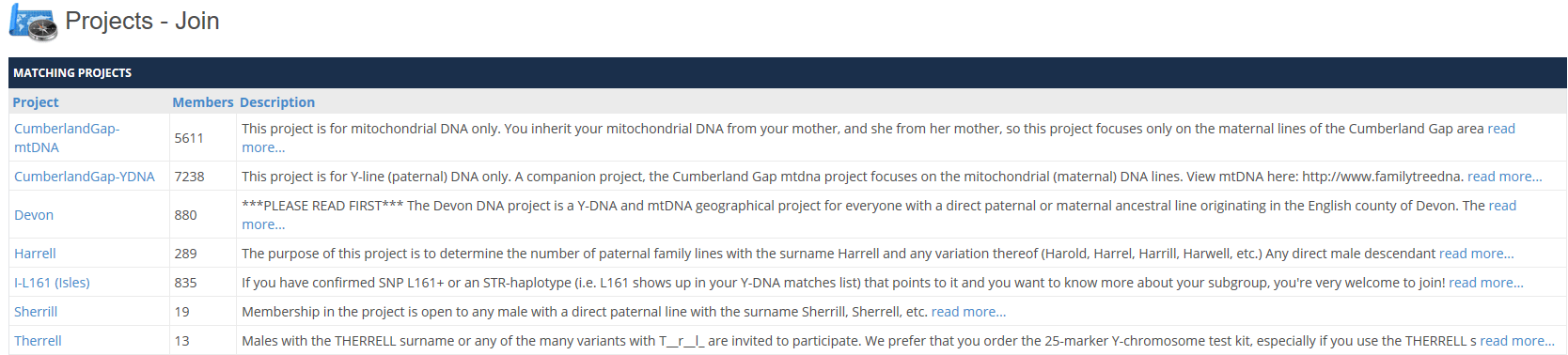
Click on Projects, then “Join a project,” then search for the DNA project that you’re interested in viewing and click on that link.

Within the project, look for oldest ancestors that are your ancestors, or potentially from a common location.  It’s someplace to start.

You can read more about how to construct a DNA pedigree chart in the article, “The DNA Pedigree Chart – Mining for Ancestors.”

Idea 3 – Pick A Puzzle Piece

Sometimes we get overwhelmed with the magnitude and size of the genealogy puzzle we’d like to solve. Then, we don’t solve anything.

This is exactly WHY I like the 52 Ancestor stories.  They make me focus on JUST ONE ancestor at a time.

So, for 2018, pick one genealogy puzzle you’d really like to solve. One person or one thing.  Not an entire line.

Write down your goal.

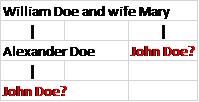
“I’d like to figure out whether John Doe was the son of William Doe or his son, Alexander Doe.”

Now admittedly, this is a tough one, because right off the bat, Y DNA isn’t going to help you unless you’re incredibly lucky and there is a mutation between Alexander Doe and his father, William.  If indeed that was the case, and you can prove it by the DNA of two of Alexander’s sons who carry the mutation, compared to the DNA of one of William’s other sons who does not, then you may be cooking with gas, presuming you can find a male Doe descended from John to test as well.

This is the type of thought process you’ll need to step through when considering all of the various options for how to prove, or disprove, a particular theory.

Make a list of the different kinds of evidence, both paper trail and genetic, that you could use to shed light on the problem. Your answer may not come from one piece of evidence alone, but a combination of several.

Evidence Available/Source Result
William’s will No, burned courthouse Verified
Alexander’s will No, burned courthouse Verified
Deeds with William as conveyor No, burned courthouse Verified
Family Bible Nope, no Bible
Deeds with Alexander as conveyor, naming John Possible, some deed books escaped fire Check through county, Family search does not list
Deeds with John as conveyor Yes, check to see if they indicate the source of John’s land John is listed in index, need to obtain original deeds from county
Y DNA of John’s line Yes, has been tested Matches DNA of William’s line as proven through William’s two brothers
Y DNA of Alexander Not tested (to the best of my knowledge), find descendant to see if they will test Search vendor DNA testing sites for male with this surname to see if they have/will Y DNA test
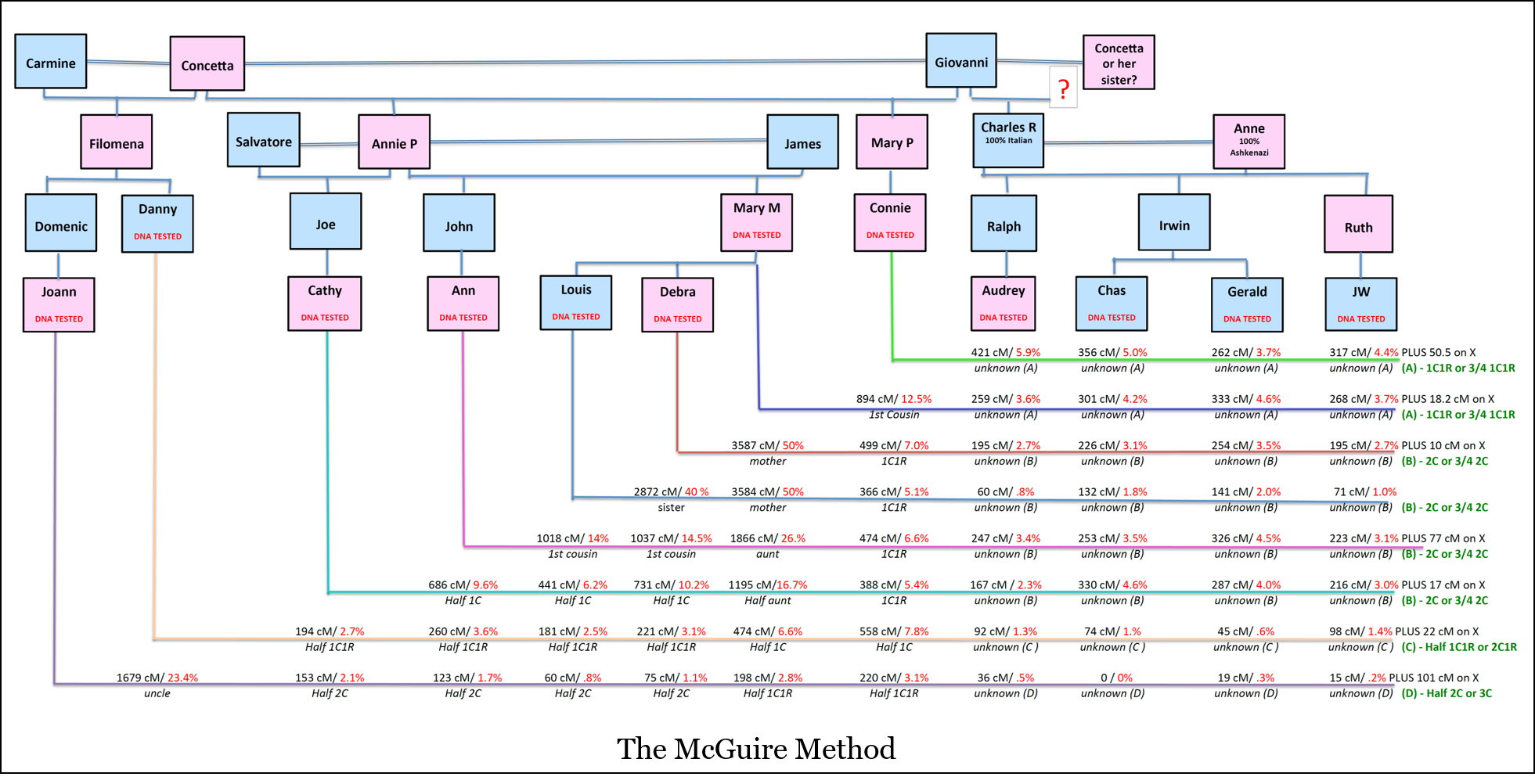
Closeness (in total cM and longest segment) of individuals autosomal matching through any of William’s descendants Mine both Ancestry and FTDNA for surname and ancestor matches This step may produce compelling or suggestive evidence, and it may not.  Make a McGuire chart of results.
Does John match any relatives of the wife of Alexander Doe? Search FTDNA and Ancestry for matches.  Triangulate to determine if match is valid and through that line. This is one of the best approaches to solve this type of problem when paper records aren’t available. Fingers crossed that Alexander and his wife and not related.

You can add pieces of evidence to your list as you think of them.

Making a list gives you something to work towards.

Your Turn!

Select one thing that you’d like to accomplish and either set about to do it, like mining for mitochondrial or Y DNA evidence, or put together a plan to gather evidence, both traditional and genetic.

In the comments, share what it is you’ll be searching for or working on.  You just never know if another subscriber may hold the answer you seek.

I can’t wait to hear what you’ll be doing this year!

Have a wonderful and productive New Year searching for those hidden ancestors!

______________________________________________________________

Disclosure

I receive a small contribution when you click on some of the links to vendors in my articles. This does NOT increase the price you pay but helps me to keep the lights on and this informational blog free for everyone. Please click on the links in the articles or to the vendors below if you are purchasing products or DNA testing.

Thank you so much.

DNA Purchases and Free Transfers

Genealogy Services

Genealogy Research

2017 – The Year of DNA

Every year for the past 17 years has been the year of DNA for me, but for many millions, 2017 has been the year of DNA. DNA testing has become a phenomenon in its own right.

It was in 2013 that Spencer Wells predicted that 2014 would be the “year of infection.” Spencer was right and in 2014 DNA joined the ranks of household words. I saw DNA in ads that year, for the first time, not related to DNA testing or health as in, “It’s in our DNA.”

In 2014, it seemed like most people had heard of DNA, even if they weren’t all testing yet. John Q. Public was becoming comfortable with DNA.

In 2017 – DNA Is Mainstream  

If you’re a genealogist, you certainly know about DNA testing, and you’re behind the times if you haven’t tested.  DNA testing is now an expected tool for genealogists, and part of a comprehensive proof statement that meets the genealogical proof standard which includes “a reasonably exhaustive search.”  If you haven’t applied DNA, you haven’t done a reasonably exhaustive search.

A paper trail is no longer sufficient alone.

When I used to speak to genealogy groups about DNA testing, back in the dark ages, in the early 2000s, and I asked how many had tested, a few would raise their hands – on a good day.

In October, when I asked that same question in Ireland, more than half the room raised their hand – and I hope the other half went right out and purchased DNA test kits!

Consequently, because the rabid genealogical market is now pretty much saturated, the DNA testing companies needed to find a way to attract new customers, and they have.

2017 – The Year of Ethnicity

I’m not positive that the methodology some of the major companies utilized to attract new consumers is ideal, but nonetheless, advertising has attracted many new people to genetic genealogy through ethnicity testing.

If you’re a seasoned genetic genealogist, I know for sure that you’re groaning now, because the questions that are asked by disappointed testers AFTER the results come back and aren’t what people expected find their way to the forums that genetic genealogists peruse daily.

I wish those testers would have searched out those forums, or read my comparative article about ethnicity tests and which one is “best” before they tested.

More ethnicity results are available from vendors and third parties alike – just about every place you look it seems.  It appears that lots of folks think ethnicity testing is a shortcut to instant genealogy. Spit, mail, wait and voila – but there is no shortcut.  Since most people don’t realize that until after they test, ethnicity testing is becoming ever more popular with more vendors emerging.

In the spring, LivingDNA began delivering ethnicity results and a few months later, MyHeritage as well.  Ethnicity is hot and companies are seizing a revenue opportunity.

Now, the good news is that perhaps some of these new ethnicity testers can be converted into genealogists.  We just have to view ethnicity testing as tempting bait, or hopefully, a gateway drug…

2017 – The Year of Explosive Growth

DNA testing has become that snowball rolling downhill that morphed into an avalanche.  More people are seeing commercials, more people are testing, and people are talking to friends and co-workers at the water cooler who decide to test. I passed a table of diners in Germany in July to overhear, in English, discussion about ethnicity-focused DNA testing.

If you haven’t heard of DTC, direct to consumer, DNA testing, you’re living under a rock or maybe in a third world country without either internet or TV.

Most of the genetic genealogy companies are fairly closed-lipped about their data base size of DNA testers, but Ancestry isn’t.  They have gone from about 2 million near the end of 2016 to 5 million in August 2017 to at least 7 million now.  They haven’t said for sure, but extrapolating from what they have said, I feel safe with 7 million as a LOW estimate and possibly as many as 10 million following the holiday sales.

Advertising obviously pays off.

MyHeritage recently announced that their data base has reached 1 million, with only about 20% of those being transfers.

Based on the industry rumble, I suspect that the other DNA testing companies have had banner years as well.

The good news is that all of these new testers means that anyone who has tested at any of the major vendors is going to get lots of matches soon. Santa, it seems, has heard about DNA testing too and test kits fit into stockings!

That’s even better news for all of us who are in multiple data bases – and even more reason to test at all of the 4 major companies who provide autosomal DNA matching for their customers: Family Tree DNA, Ancestry, MyHeritage and 23andMe.

2017 – The Year of Vendor and Industry Churn

So much happened in 2017, it’s difficult to keep up.

  • MyHeritage entered the DNA testing arena and began matching in September of 2016. Frankly, they had a mess, but they have been working in 2017 to improve the situation.  Let’s just say they still have some work to do, but at least they acknowledge that and are making progress.
  • MyHeritage has a rather extensive user base in Europe. Because of their European draw, their records collections and the ability to transfer results into their data base, they have become the 4th vendor in a field that used to be 3.
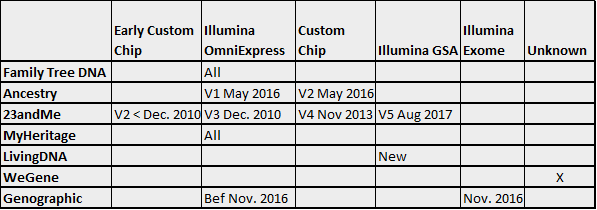
  • In March 2017, Family Tree DNA announced that they were accepting transfers of both the Ancestry V2 test, in place since May of 2016, along with the 23andMe V4 test, available since November 2013, for free. MyHeritage has since been added to that list. The Family Tree DNA announcement provided testers with another avenue for matching and advanced tools.
  • Illumina obsoleted their OmniExpress chip, forcing vendors to Illumina’s new GSA chip which also forces vendors to use imputation. I swear, imputation is a swear word. Illumina gets the lump of coal award for 2017.
  • I wrote about imputation here, but in a nutshell, the vendors are now being forced to test only about 20% of the DNA locations available on the previous Illumina chip, and impute or infer using statistics the values in the rest of the DNA locations that they previously could test.
  • Early imputation implementers include LivingDNA (ethnicity only), MyHeritage (to equalize the locations of various vendor’s different chips), DNA.Land (whose matching is far from ideal) and 23andMe, who seems, for the most part, to have done a reasonable job. Of course, the only way to tell for sure at 23andMe is to test again on the V5 chip and compare to V3 and V4 chip matches. Given that I’ve already paid 3 times to test myself at 23andMe (V2, 3 and 4), I’m not keen on paying a 4th time for the V5 version.
  • 23andMe moved to the V5 Illumina GSA chip in August which is not compatible with any earlier chip versions.
  • Needless to say, the Illumina chip change has forced vendors away from focusing on new products in order to develop imputation code in order to remain backwards compatible with their own products from an earlier chip set.
  • GedMatch introduced their sandbox area, Genesis, where people can upload files that are not compatible with the traditional vendor files.  This includes the GSA chip results (23andMe V5,) exome tests and others.  The purpose of the sandbox is so that GedMatch can figure out how to work with these files that aren’t compatible with the typical autosomal test files.  The process has been interesting and enlightening, but people either don’t understand or forget that it’s a sandbox, an experiment, for all involved – including GedMatch.  Welcome to living on the genetic frontier!

  • I assembled a chart of who loves who – meaning which vendors accept transfers from which other vendors.

  • I suspect but don’t know that Ancestry is doing some form of imputation between their V1 and V2 chips. About a month before their new chip implementation in May of 2016, Ancestry made a change in their matching routine that resulting in a significant shift in people’s matches.

Because of Ancestry’s use of the Timber algorithm to downweight some segments and strip out others altogether, it’s difficult to understand where matching issues may arise.  Furthermore, there is no way to know that there are matching issues unless you and another individual have transferred results to either Family Tree DNA or GedMatch, neither of which remove any matching segments.

  • Other developments of note include the fact that Family Tree DNA moved to mitochondrial DNA build V17 and updated their Y DNA to hg38 of the human reference genome – both huge undertakings requiring the reprocessing of customer data. Think of both of those updates as housekeeping. No one wants to do it, but it’s necessary.
  • 23andMe FINALLY finished transferring their customer base to the “New Experience,” but many of the older features we liked are now gone. However, customers can now opt in to open matching, which is a definite improvement. 23andMe, having been the first company to enter the genetic genealogy autosomal matching marketspace has really become lackluster.  They could have owned this space but chose not to focus on genealogy tools.  In my opinion, they are now relegated to fourth place out of a field of 4.
  • Ancestry has updated their Genetic Communities feature a couple of times this year. Genetic Communities is interesting and more helpful than ethnicity estimates, but neither are nearly as helpful as a chromosome browser would be.

  • I’m sure that the repeated requests, begging and community level tantrum throwing in an attempt to convince Ancestry to produce a chromosome browser is beyond beating a dead horse now. That dead horse is now skeletal, and no sign of a chromosome browser. Sigh:(
  • The good news is that anyone who wants a chromosome browser can transfer their results to Family Tree DNA or GedMatch (both for free) and utilize a chromosome browser and other tools at either or both of those locations. Family Tree DNA charges a one time $19 fee to access their advanced tools and GedMatch offers a monthly $10 subscription. Both are absolutely worth every dime. The bad news is, of course, that you have to convince your match or matches to transfer as well.
  • If you can convince your matches to transfer to (or test at) Family Tree DNA, their tools include phased Family Matching which utilizes a combination of user trees, the DNA of the tester combined with the DNA of family matches to indicate to the user which side, maternal or paternal (or both), a particular match stems from.

  • Sites to keep your eye on include Jonny Perl’s tools which include DNAPainter, as well as Goran Rundfeldt’s DNA Genealogy Experiment.  You may recall that in October Goran brought us the fantastic Triangulator tool to use with Family Tree DNA results.  A few community members expressed concern about triangulation relative to privacy, so the tool has been (I hope only temporarily) disabled as the involved parties work through the details. We need Goran’s triangulation tool! Goran has developed other world class tools as well, as you can see from his website, and I hope we see more of both Goran and Jonny in 2018.
  • In 2017, a number of new “free” sites that encourage you to upload your DNA have sprung up. My advice – remember, there really is no such thing as a free lunch.  Ask yourself why, what’s in it for them.  Review ALL OF THE documents and fine print relative to safety, privacy and what is going to be done with your DNA.  Think about what recourse you might or might not have. Why would you trust them?

My rule of thumb, if the company is outside of the US, I’m immediately slightly hesitant because they don’t fall under US laws. If they are outside of Europe or Canada, I’m even more hesitant.  If the company is associated with a country that is unfriendly to the US, I unequivocally refuse.  For example, riddle me this – what happens if a Chinese (or fill-in-the-blank country) company violates an agreement regarding your DNA and privacy?  What, exactly, are you going to do about it from wherever you live?

2017 – The Year of Marketplace Apps

Third party genetics apps are emerging and are beginning to make an impact.

GedMatch, as always, has continued to quietly add to their offerings for genetic genealogists, as had DNAGedcom.com. While these two aren’t exactly an “app”, per se, they are certainly primary players in the third party space. I use both and will be publishing an article early in 2018 about a very useful tool at DNAGedcom.

Another application that I don’t use due to the complex setup (which I’ve now tried twice and abandoned) is Genome Mate Pro which coordinates your autosomal results from multiple vendors.  Some people love this program.  I’ll try, again, in 2018 and see if I can make it all the way through the setup process.

The real news here are the new marketplace apps based on Exome testing.

Helix and their partners offer a number of apps that may be of interest for consumers.  Helix began offering a “test once, buy often” marketplace model where the consumer pays a nominal price for exome sequencing ($80), significantly under market pricing ($500), but then the consumer purchases DNA apps through the Helix store. The apps access the original DNA test to produce results. The consumer does NOT receive their downloadable raw data, only data through the apps, which is a departure from the expected norm. Then again, the consumer pays a drastically reduced price and downloadable exome results are available elsewhere for full price.

The Helix concept is that lots of apps will be developed, meaning that you, the consumer, will be interested and purchase often – allowing Helix to recoup their sequencing investment over time.

Looking at the Helix apps that are currently available, I’ve purchased all of the Insitome products released to date (Neanderthal, Regional Ancestry and Metabolism), because I have faith in Spencer Wells and truthfully, I was curious and they are reasonably priced.

Aside from the Insitome apps, I think that the personalized clothes are cute, if extremely overpriced. But what the heck, they’re fun and raise awareness of DNA testing – a good thing! After all, who am I to talk, I’ve made DNA quilts and have DNA clothing too.

Having said that, I’m extremely skeptical about some of the other apps, like “Wine Explorer.”  Seriously???

But then again, if you named an app “I Have More Money Than Brains,” it probably wouldn’t sell well.

Other apps, like Ancestry’s WeRelate (available for smartphones) is entertaining, but is also unfortunately EXTREMELY misleading.  WeRelate conflates multiple trees, generally incorrectly, to suggest to you and another person on your Facebook friends list are related, or that you are related to famous people.  Judy Russell reviews that app here in the article, “No, actually, we’re not related.” No.  Just no!

I feel strongly that companies that utilize our genetic data for anything have a moral responsibility for accuracy, and the WeRelate app clearly does NOT make the grade, and Ancestry knows that.  I really don’t believe that entertaining customers with half-truths (or less) is more important than accuracy – but then again, here I go just being an old-fashioned fuddy dud expecting ethics.

And then, there’s the snake oil.  You knew it was going to happen because there is always someone who can be convinced to purchase just about anything. Think midnight infomercials. The problem is that many consumers really don’t know how to tell snake oil from the rest in the emerging DNA field.

You can now purchase DNA testing for almost anything.  Dating, diet, exercise, your taste in wine and of course, vitamins and supplements. If you can think of an opportunity, someone will dream up a test.

How many of these are legitimate or valid?  Your guess is as good as mine, but I’m exceedingly suspicious of a great many, especially those where I can find no legitimate scientific studies to back what appear to be rather outrageous claims.

My main concern is that the entire DTC testing industry will be tarred by the brush of a few unethical opportunists.

2017 – The Year of Focus on Privacy and Security

With increased consumer exposure comes increased notoriety. People are taking notice of DNA testing and it seems that everyone has an opinion, informed or not.  There’s an old saying in marketing; “Talk about me good, talk about me bad, just talk about me.”

With all of the ads have come a commensurate amount of teeth gnashing and “the-sky-is-falling” type reporting.  Unfortunately, many politicians don’t understand this industry and open mouth only to insert foot – except that most people don’t realize what they’ve done.  I doubt that the politicians even understand that they are tasting toe-jam, because they haven’t taken the time to research and understand the industry. Sound bites and science don’t mix well.

The bad news is that next, the click-bait-focused press picks up on the stories and the next time you see anyone at lunch, they’re asking you if what they heard is true.  Or, let’s hope that they ask you instead of just accepting what they heard as gospel. Hopefully if we’ve learned anything in this past year, it’s to verify, verify, verify.

I’ve been an advocate for a very long time of increased transparency from the testing companies as to what is actually done with our DNA, and under what circumstances.  In other words, I want to know where my DNA is and what it’s being used for.  Period.

Family Tree DNA answered that question succinctly and unquestionably in December.

Bennett Greenspan: “We could probably make a lot of money by selling the DNA data that we’ve been collecting over the years, but we feel that the only person that should have your DNA information is you.  We don’t believe that it should be sold, traded or bartered.”

You can’t get more definitive than that.

DTC testing for genetic genealogy must be a self-regulating field, because the last thing we need is for the government to get involved, attempting to regulate something they don’t understand.  I truly believe government interference by the name of regulation would spell the end of genetic genealogy as we know it today.  DNA testing for genetic genealogy without sharing results is entirely pointless.

I’ve written about this topic in the past, but an update is warranted and I’ll be doing that sometime after the first of the year.  Mostly, I just need to be able to stay awake while slogging through the required reading (at some vendor sites) of page after page AFTER PAGE of legalese😊

Consumers really shouldn’t have to do that, and if they do, a short, concise summary should be presented to them BEFORE they purchase so that they can make a truly informed decision.

Stay tuned on this one.

2017 – The Year of Education

The fantastic news is that with all of the new people testing, a huge, HUGE need for education exists.  Even if 75% of the people who test don’t do anything with their results after that first peek, that still leaves a few million who are new to this field, want to engage and need some level of education.

In that vein, seminars are available through several groups and institutes, in person and online.  Almost all of the leadership in this industry is involved in some educational capacity.

In addition to agendas focused on genetic genealogy and utilizing DNA personally, almost every genealogy conference now includes a significant number of sessions on DNA methods and tools. I remember the days when we were lucky to be allowed one session on the agenda, and then generally not without begging!

When considering both DNA testing and education, one needs to think about the goal.  All customer goals are not the same, and neither are the approaches necessary to answer their questions in a relevant way.

New testers to the field fall into three primary groups today, and their educational needs are really quite different, because their goals, tools and approaches needed to reach those goals are different too.

Adoptees and genealogists employ two vastly different approaches utilizing a common tool, DNA, but for almost opposite purposes.  Adoptees wish to utilize tests and trees to come forward in time to identify either currently living or recently living people while genealogists are interested in reaching backward in time to confirm or identify long dead ancestors. Those are really very different goals.

I’ve illustrated this in the graphic above.  The tester in question uses their blue first cousin match to identify their unknown parent through the blue match’s known lineage, moving forward in time to identify the tester’s parent.  In this case, the grandparent is known to the blue match, but not to the yellow tester. Identifying the grandparent through the blue match is the needed lynchpin clue to identify the unknown parent.

The yellow tester who already knows their maternal parent utilizes their peach second cousin match to verify or maybe identify their maternal great-grandmother who is already known to the peach match, moving backwards in time. Two different goals, same DNA test.

The three types of testers are:

  • Curious ethnicity testers who may not even realize that at least some of the vendors offer matching and other tools and services.
  • Genealogists who use close relatives to prove which sides of trees matches come from, and to triangulate matching segments to specific ancestors. In other words, working from the present back in time. The peach match and line above.
  • Adoptees and parent searches where testers hope to find a parent or siblings, but failing that, close relatives whose trees overlap with each other – pointing to a descendant as a candidate for a parent. These people work forward in time and aren’t interested in triangulation or proving ancestors and really don’t care about any of those types of tools, at least not until they identify their parent.  This is the blue match above.

What these various groups of testers want and need, and therefore their priorities are different in terms of their recommendations and comments in online forums and their input to vendors. Therefore, you find Facebook groups dedicated to Adoptees, for example, but you also find adoptees in more general genetic genealogy groups where genealogists are sometimes surprised when people focused on parent searches downplay or dismiss tools such as Y DNA, mitochondrial DNA and chromosome browsers that form the bedrock foundation of what genealogists need and require.

Fortunately, there’s room for everyone in this emerging field.

The great news is that educational opportunities are abundant now. I’m listing a few of the educational opportunities for all three groups of testers, in addition to my blog of course.😊

Remember that this blog is fully searchable by keyword or phrase in the little search box in the upper right hand corner.  I see so many questions online that I’ve already answered!

Please feel free to share links of my blog postings with anyone who might benefit!

Note that these recommendations below overlap and people may well be interested in opportunities from each group – or all!!

Ethnicity

Adoptees or Parent Search

Genetic Genealogists

2018 – What’s Ahead? 

About midyear 2018, this blog will reach 1000 published articles. This is article number 939.  That’s amazing even to me!  When I created this blog in July of 2012, I wasn’t sure I’d have enough to write about.  That certainly has changed.

Beginning shortly, the tsunami of kits that were purchased during the holidays will begin producing matches, be it through DNA upgrades at Family Tree DNA, Big Y tests which were hot at year end, or new purchases through any of the vendors.  I can hardly wait, and I have my list of brick walls that need to fall.

Family Tree DNA will be providing additional STR markers extracted from the Big Y test. These won’t replace any of the 111 markers offered separately today, because the extraction through NGS testing is not as reliable as direct STR testing for those markers, but the Big Y will offer genealogists a few hundred more STRs to utilize. Yes, I said a few hundred. The exact number has not yet been finalized.

Family Tree DNA says they will also be introducing new “qualify of life improvements” along with new privacy and consent settings.  Let’s hope this means new features and tools will be released too.

MyHeritage says that they are introducing new “Discoveries” pages and a chromosome browser in January.  They have also indicated that they are working on their matching issues.  The chromosome browser is particularly good news, but matching must work accurately or the chromosome browser will show erroneous information.  Let’s hope January brings all three features.

LivingDNA indicates that they will be introducing matching in 2018.

2018 – What Can You Do?

What can you do in 2018 to improve your odds of solving genealogy questions?

  • Test relatives
  • Transfer your results to as many data bases as possible (among the ones discussed above, after reading the terms and conditions, of course)
  • If you have transferred a version of your DNA that does not produce full results, such as the Ancestry V2 or 23andMe V4 test to Family Tree DNA, consider testing on the vendor’s own chip in order to obtain all matches, not just the closest matches available from an incompatible test transfer.
  • Test Y and mitochondrial DNA at Family Tree DNA.
  • Find ways to share the stories of your ancestors.  Stories are cousin bait.  My 52 Ancestors series is living proof.  People find the stories and often have additional facts, information or even photos. Some contacts qualify for DNA testing for Y or mtDNA lines. The GREAT NEWS is that Amy Johnson Crow is resuming the #52Ancestors project for 2018, providing hints and tips each week! Who knows what you might discover by sharing?! Here’s how to start a blog if you need some assistance.  It’s easy – really!
  • Focus on the brick walls that you want to crumble and then put together both a test and analysis plan. That plan could include such things as:

o   Find out if a male representing a Y line in your tree has tested, and if not, search through autosomal results to see if a male from that paternal surname line has tested and would be amenable to an upgrade.

o   Mitochondrial DNA test people who descend through all females from various female ancestors in order to determine their origins. Y and mtDNA tests are an important part of a complete genealogy story – meaning the reasonably exhaustive search!

o   Autosomal DNA test family members from various lines with the hope that matches will match you and them both.

o   Test family members in order to confirm a particular ancestor – preferably people who descend from another child of that ancestor.

o   Making sure your own DNA is in all 4 of the major vendors’ data bases, plus GedMatch. Look at it this way, everyone who is at GedMatch or at a third party (non-testing) site had to have tested at one of the major 4 vendors – so if you are in all of the vendor’s data bases, plus GedMatch, you’re covered.

Have a wonderful New Year and let’s make 2018 the year of newly discovered ancestors and solved mysteries!

______________________________________________________________

Disclosure

I receive a small contribution when you click on some of the links to vendors in my articles. This does NOT increase the price you pay but helps me to keep the lights on and this informational blog free for everyone. Please click on the links in the articles or to the vendors below if you are purchasing products or DNA testing.

Thank you so much.

DNA Purchases and Free Transfers

Genealogy Services

Genealogy Research

Concepts – Sibling and Twin DNA Matching

Lots of people are giving their siblings DNA test kits.  That’s a great idea, especially if your parents aren’t available for testing, because siblings do inherit part of the same DNA from their parents, but not all of the same DNA. That means testing siblings is a great opportunity for more genealogical matches!

Recently, a friend asked me why his fraternal twin has matches to people he doesn’t, and vice versa.  Great question, so let’s take a look at what to expect from matches with siblings.

First, identical twins share exactly the same DNA because they are created as a result of the division of the same egg that has been fertilized by the father’s sperm. Identical twins matches should be identical.

A fraternal twin is exactly the same as a sibling. Two separate sperm fertilize two separate eggs and they gestate together, at the same time.

Second, let’s talk just a minute about Y and mitochondrial DNA, then we’ll discuss autosomal DNA.

Full Siblings Share
Mitochondrial DNA Exactly the same, unless a mutation occurred
Y DNA Males will share exactly the same, unless a mutation occurred.  Females don’t have a Y chromosome.
Autosomal DNA Approximately 50% of autosomal DNA

To obtain detailed Y and mitochondrial DNA results, you’ll need to test with Family Tree DNA. They are the only vendor offering these tests.

For autosomal matching, you can test with a number of vendors including: Family Tree DNA, Ancestry, 23andMe and MyHeritage.

You can read more about the different kinds of testing here, and a comparison of the different tests and vendors here.

50% the Same – 50% Different

Siblings share approximately 50% of the same DNA of the parents.  The other 50% is different DNA that they received from the parents that the other sibling did not receive.

In the conceptual example above, you can see that each child inherited 4 segments of the 8 total offered by their parents.  Only two of those segments were the same for both siblings, segments 3 and 4.  Of these two siblings, no one inherited parental segments 7 and 8.  Perhaps a third child would.

In other words, siblings can expect to see many of the same people in their match list and several that are different. In our example, the same people would be matching both siblings on segments 3 and 4.  People matching child 1 but not child 2 would be matching on segments 1 and 2.  People matching child 2 but not child 1 would be matching on segments 5 and 6.

The reason you’ll see the same people on your match list is because you did inherit 50% of the same DNA from your parents.

There are two reasons you’ll see different matches on your match lists.

Some of your matches on your list that don’t match your sibling will be because the two siblings inherited different pieces of DNA from their parents.  Your sibling will match people on the DNA that they received from your parents that you didn’t receive, and vice versa.

Some Matches are Identical By Chance (IBC)

Another reason for different matches is because you and your sibling will have people on both of your match lists that don’t match either parent as a result of IBC or identical by chance matching. That’s where the DNA of your match just happens to match you by virtue of zigzagging back and forth between your Mom’s and Dad’s DNA that you carry.

As you can see in this example, your pink DNA came from your Mom, and blue from your Dad, but your match carries some of both values, T and A.  This means they match you, but not because they match either of your parents.  Just an accident of circumstance. That’s what IBC is.

Telling the Difference

I wrote about matches that are identical by descent (IBD), meaning because you inherited that DNA from your parents, and identical by chance (IBC) in this article.

Unfortunately, your DNA is mixed together and without other known relatives testing, it’s impossible to discern which DNA is inherited from your mother and which from your father. This is exactly why we encourage people to have known relatives test such as parents, grandparents and cousins.  Who you match on which segments indicates where those segments descended from in your family tree.

If one or both parents are living, that’s the best way of discerning which matches are identical by descent and which are by chance.

A recent project with Philip Gammon showed by segment size the likelihood is of a match being genuine or identical by chance.  If both parents have tested, he offers the free Match-Maker-Breaker tool to do this analysis for you.

The bottom line is that when comparing your matches to those of your siblings, about 20-25% of everyone’s total matches are identical by chance, especially those at lower centiMorgan levels.

The remaining 80% or so will be divided roughly half and half, meaning half will match you and a sibling both, and half will only match you. Therefore, you will be looking at roughly 40% of your matches being in common with a particular sibling, 40% not matching your sibling but being legitimate matches and the remaining 20% that are identical by chance.

Test Parents and Family Members

Of course, because you do share roughly half of the same DNA inherited from your parents, you will have some matches to both you and a sibling that are identical by chance in exactly the same way.  Just finding someone on both of your match lists doesn’t guarantee that the match ISN’T identical by chance.

The best way to eliminate identical by chance matching, of course, is to test your parents.  Sadly, that isn’t always possible.

The next best way to determine legitimate matches is to test other family members.  At Family Tree DNA, they provide customers with the ability to link the DNA tests of family members to their proper location in your tree, and then Family Tree DNA utilizes the common DNA segments to determine common matching between you, that family member(s), and other people.

Those people who match you and a family member on the same segment are then identified as either paternal or maternal matches, based on their position in your tree.

Identifying Lineage

When thinking about who to test, half-siblings, if you have any are, a wonderful way to differentiate between maternal and paternal matches.  Because you and a half sibling share only one parent – which side of your tree those common matches come from is immediately evident!

Of my matches at Family Tree DNA, you can see that of my total 3165 matches, 713 are paternal and 545 are maternal, with 4 being related to both sides.  Don’t get too excited about those “both sides” matches, they are my descendants!

Paternal and maternal bucketing is a great start in terms of identifying which matches are genealogical – and that’s before I do any actual genealogy work.  All I did was test, create or upload a tree and connect tested family members to that tree.

Family Tree DNA is the only vendor to offer this feature.

Ethnicity

Ethnicity is a slippery fish.  I generally only consider ethnicity estimates reliable at the continental level.  There are lots of reasons that siblings will receive somewhat different ethnicity results including the internal algorithms of the various vendors.  You can read about what is involved in ethnicity testing here.

Transfers Give You More For Your Money

If you test at one of the vendors, you may be able to transfer to other vendors as well as GedMatch.  In the chart below, you can see which vendors accept transfers from other vendors. You can read more here.

Have Fun

Lots of people are now testing their DNA and I hope you and your siblings will find some great matches among the new testers. The great thing about siblings, aside from the fact that they are your siblings, is that you can leverage each other’s DNA matches.  Just one more way to share and move the genealogy ball forward.

______________________________________________________________

Disclosure

I receive a small contribution when you click on some of the links to vendors in my articles. This does NOT increase the price you pay but helps me to keep the lights on and this informational blog free for everyone. Please click on the links in the articles or to the vendors below if you are purchasing products or DNA testing.

Thank you so much.

DNA Purchases and Free Transfers

Genealogy Services

Genealogy Research

Merry Christmas – And To All A Good Life

I’ve been thinking about what I’d like to say about Christmas this year. Truthfully, I haven’t felt much like celebrating.

This year has been filled to the brim with mortifying events, the likes of which I never thought I’d see in my lifetime.

Barely a day goes by that I’m not frightened anew – for my Black, Native and Spanish friends, family, and their children. For our brave soldiers, police and firefighters of all colors and races. For the country I love and call home – the same one that my ancestors spilled their blood and gave their lives to defend. For my children, grandchildren and their descendants.

So, for Christmas or Hanukkah or Solstice, whatever you celebrate, I decided to share with you a story – one of hope – one of kinship – one of reaching beyond the stereotypes that have sometimes been ingrained in upbringing and the communities and families in which people are raised. A story about the power of choice that each of us has within us.

A story that I recall again and again because it gives me hope when my days feel hopeless. It renews my soul.

It’s a story about love, but not at all your typical love story.

The Reunion

A few years ago, a DNA group that I administer decided to host a homecoming and conference of sorts – before the days of genetic genealogy conferences.

We rented a hotel and the conference room, and before we knew it, the “reunion” was filled to capacity.

Three days of presentations were scheduled, with many of the attendees giving sessions about genealogy, and in particular, about genetic genealogy which was still  new at the time.

The Reveal

One of the draw cards was a “reveal.” My cousins and I had discovered each other a few months before and had busily been DNA testing to prove or disprove whether in fact William Herrell was the ancestor of both groups of people. Me on the one side and my cousins on the other.

The complicating factor was that William Herrell had two wives, at the same time – one black and one white. Not only that, but he had purchased the black wife, Harriett, as a slave – but the white wife, Mary, raised Harriett’s child, Cannon, with her own children after the death first of Harriett and then of William.

Was Cannon William’s biological child? Oral history said yes.  What was the truth of the matter?

Given the location of the reunion, I had some consternation about this topic and particularly about the reveal.

My cousins, however, were not concerned. It was them I was concerned for, not me, so the plan progressed smoothly. Adding to our excitement was the fact that we would all get to meet in person for the first time.

On the first day of the conference, we presented the attendees with the back story, which is actually quite interesting, then we left them with a cliffhanger. Were we related? We asked them to vote. What did they think? We would tell them the following morning.

The vote, by the way, was about half and half.

The Next Morning

On the morning of the second day of the conference, we were shocked to discover that people were simply showing up at the hotel. They had heard, through the local grapevine that there was to be a BIG REVEAL and everyone was interested.

We didn’t quite know what to do.

We crammed as many seats into the room as possible. People crowded in behind the seats and stood, and more people filled the lobby craning their necks to see.

Never in my wildest dreams did I ever imagine anything quite like this.

My cousins Carlos (Los) and Denise and I revealed the answer.

Yes, Cannon was the son of William Herrell and yes, we are all related.

But that’s not the punchline, nor is this the main story.

Los, Denise and I began on a journey as curious genealogists. Before we even knew that we were related, we had formed a relationship with each other, one which we maintain today. We’ve added more family members as well, and we are indeed “kin” as they say in the south, not just because we are blood relatives, but because we have gotten to know each other as people and we love each other. (And for the record, I have other relatives I’m not nearly so quick to claim.)

Yes, you might notice that some of us have more skin pigment than others, but our family runs the entire pigment range and truthfully, I don’t even think about it or notice anymore. It’s irrelevant. We all bleed red, feel both pain and love and are good people. It’s really that simple, and it’s all that matters.

Bottom line is that I love them, not because they are black, or actually, part black, not in spite of it, simply because they are who they are. At one point, we thought we might NOT be related, and we were all horribly disappointed, and rejoiced when we discovered that we actually DO share an ancestor and ARE cousins (thank you autosomal DNA).

The Preacher

One of our attendees at the conference was a retired Baptist minister. In his 80s, he didn’t get around well and while not wheelchair-bound, he used both a wheelchair and a cane to increase his mobility and keep himself safe. I had known him for years.

We’ll call him Reverend Jim. All of the names of people other than my cousins have been changed.

Reverend Jim and I thought that we might share a particular line, that of his surname, but Y DNA testing proved that our lines were different, a fact that frustrated us both, because we would have liked very much to share research.

Reverend Jim felt that his time was running out as he aged and his health failed, but he remained an upbeat, avid genealogist and welcomed DNA testing to advance his knowledge. Hence, his difficult trip to the conference.

After the big reveal, people gathered in the conference room and the lobby to visit with each other and discuss the results along with DNA testing. My cousins and I were talking to people, when voices dropped and it became evident that something interesting was happening across the room.

I was holding Los’s daughter who was about 18 months old at the time, wishing we lived closer and I could be another grandma to her.

Suddenly Los and I both realized that all eyes were on a table near the front window.

Curious and concerned that something might be wrong, especially given that Reverend Jim was seated there, I ambled with purpose towards the table, not wanting to appear nosey, but cognizant of the fact that I was the defacto hostess. Besides that, there seemed to be an intense discussion occurring and I wondered if it might have something to do with DNA testing.

Reverend Jim was sitting at the end of the table on one side in his wheelchair, and a black gentleman of about the same age was facing him across the table. We’ll call him Doug. Listening for just a minute revealed that they shared the same surname and were debating whether they could be from the same paternal line.

Now I understood the hushed room.

Given that one was black and one was white, the answer, if yes, meant that perhaps they had experienced something in their families like Los, Denise and I had discovered in ours, with all of it’s painful ramifications about slavery. Needless to say, this was a sensitive subject, and both people were trying to have a nice conversation without offending anyone. I’m sure both men were thinking, “probably not,” but didn’t want to say that out loud. Or maybe they were secretly wondering, “What if?”

Suffice it to say that not everyone is nearly as accepting of newly discovered interracial family as my cousins and all of our extended families. And yes, I really do mean that – ALL OF OUR EXTENDED FAMILIES.

So, I stood and listened, as other people gathered round.

The Railroad

Reverend Jim: “My Daddy worked for the railroad and was gone a lot. He missed a lot of Christmases with the family.”

Doug: “My Daddy too.”

Both men smiled and chuckled, clearly harkening back in time and thinking about their own fathers.

Reverend Jim: “We lived in the town of X back then. Did your Daddy work for the railroad too?’

Doug: “Sure did. We lived at the other end of the line, near the depot in Y.”

Reverend Jim: “My Daddy worked between X and Y most of the time, but sometimes he went on other lines too.”

Doug: “My Daddy did too. When did your Daddy work for the railroad?”

Reverend Jim: “From about 19XX to about 19XX.”

Doug: “I bet they knew each other. What was your Daddy’s name?”

Reverend Jim: “William.”

Doug, very slowly: “Mine too.”

Silence.

The men and the entire room now.

Both men stared at each other across the table.

End of the Line

Reverend Jim broke the spell and reached down in his wheelchair bag, extracting a three ring binder. He opened the cover and started leafing through the contents. I thought perhaps this discussion had gotten too close to a topic that perhaps he wasn’t comfortable with. Given his age and where he had lived his entire life.

Finally, Reverend Jim found what he was looking for. I suspected it was a pedigree chart that he wanted to share with Doug.

Reverend Jim turned a page toward Doug, placing the binder on the table. I saw an old black and white photo in a plastic sleeve. Reverend Jim, smiling, said, “That’s my Daddy. Did you know him?”

Doug leaned over politely and looked at the photo, glanced quickly at Reverend Jim, then back at the photo. Doug picked the book up and evaluated the photo more closely. The photo wasn’t in good shape, somewhat dogeared, old and grainy. A woman with Doug looked over his shoulder, peering at the photo to see if she knew the man, I’m sure.

Doug reached towards his chest, looked at Reverend Jim and said softly, “That’s my Daddy.”

Reverend Jim leaned in towards Doug, straining to hear. “What?”

Doug, now louder, still clutching his chest, “That’s my Daddy too.”

My mind raced.

Was Doug having chest pains? Is that why he was clutching his chest?

Did I need to call an ambulance?

Should I ask him?

Was his father white?

Was he sure that was his father?

Was that photo really good enough to tell?  For sure?

How could this be?

Doug must have been wondering the same thing.

Doug handed the binder with the photo to the woman behind him, and asked her, “What do you think?”

She looked closely, squinting for a long minute, scrutinizing the picture, handed the binder back to Doug and said, “Yep, that’s him.”

“You sure?”

“Yep.”

Silence!

The entire room was deathly silent now. Not one peep out of anyone.

You could have heard a blink.

Both men must have been processing this information.

Both men must have realized that their father deceived them.

Both men must have realized that their father cheated on their mother.

Both men must have been wondering how he pulled this off.

Both men must have been wondering how they didn’t know about each other.

And both men must have realized that they had a brother, and perhaps other siblings, of another skin color, born in a time in America when black and white drinking fountains were the norm and racial separation by the name of segregation was expected.

Was this a horrible moment or a wonderful moment?

Some of each perhaps?

What would they do?

It was one thing to watch my cousins and I reveal our journey, in a preplanned way, but quite another to have a surprise reveal of your own in a hotel lobby filled with an unwitting audience.

What happened next would set the tone for the entire rest of these men’s lives.

What would it be?

Acceptance or Rejection?

I realized that Reverend Jim was trying to struggle to his feet. I didn’t know if I should help him, leave him alone or gently encourage him to remain in his chair. I was frightened about what might be coming.

Doug stood up too, trying to stabilize Reverend Jim.

His face revealed confusion and pain.

Reverend Jim managed to get his cane in place, stood, wobbling and somewhat stooped, and leaned over the table to Doug, reaching for him.

I held my breath.

For an excruciatingly long minute. Everything was happening in slow motion.

Reverend Jim put his free arm around Doug and pulled him into a close hug.

Doug stepped around the table and put both arms around Reverend Jim. Reverend Jim dropped the cane, fully embracing Doug.

I realized both men were crying. Tears streaming down their faces.

Reverend Jim blurted out, between sobs, “I have a brother!”

I remember huge waves of relief washing over me. The tears, hot and salty came.

Joy.

Pure unfettered joy.

I knew this was only the beginning of the questions these men would have for each other.

A wonderful new chapter had opened. Wonderful based on their perceptions of the present, not the past.

My memory of the rest of that day is blurry now, much like that black and white photo.

The people in the lobby were quite astir with this news.

The following day, ALL of Doug’s family arrived loaded with photos and an impromptu  family reunion occurred in the lobby with family pictures scattered all over a table salted with chatter and laughter.

Reverend Jim was so overwhelmed and excited that he managed to lock his keys in his car, and later, lose them entirely. He never attended another presentation. He had much more important things to do!

I know both families were in shock.

Here’s what else I know.

Love Won

Those men had a choice to make and they had to make it in an instant.

Their families had the same choice. Most of Reverend Jim’s family was gone, but Doug’s was large and it was evident that Reverend Jim went home with far more family that he arrived with.

They had been blessed.

Hatred didn’t win that day.

Neither did bigotry.

Nor racism.

Or prejudice.

Pure and simple.

Love won.

Merry Christmas and may love bless you in the new year.

______________________________________________________________

Disclosure

I receive a small contribution when you click on some of the links to vendors in my articles. This does NOT increase the price you pay but helps me to keep the lights on and this informational blog free for everyone. Please click on the links in the articles or to the vendors below if you are purchasing products or DNA testing.

Thank you so much.

DNA Purchases and Free Transfers

Genealogy Services

Genealogy Research

Michael McDowell Sr. (c 1720 – after 1755), Breadcrumbs Scattered From Maryland Across Virginia, 52 Ancestors #175

Michael McDowell Sr. could have been born in Baltimore County, Maryland, on the boat to Maryland, or back in Ireland.

We don’t know.

What we do know is that in 1752, Michael McDowell sold portions of the property in which he had an interest that had belonged to Murtough McDowell, an immigrant.  Murtough was living in Baltimore County in 1722.

We are presuming that Murtough’s wife in 1730 was indeed the mother of Michael, but we don’t know that for sure either.  It’s certainly possible that Elinor was a second wife, but there is absolutely no evidence either way.

Halifax County, Virginia

Halifax County was formed from Lunenburg in 1752, and that’s where we find Michael McDowell in that same year, selling his father’s land in Maryland. Thank goodness for this link, because without it, we would never have been able to connect Murtough McDowell in Baltimore County, Maryland with Michael McDowell in Virginia.

The following power of attorney was issued in Halifax County, VA and recorded along with a land sale in Baltimore County, Maryland.

May 3, 1755 – Page 407 – Power of attorney from Michael Macdowell to John Hawkins, signed in Halifax County.

The power of attorney itself was entered into the Baltimore County record below the deed sale and is dated September 19, 1752.

This signature does not contain an X for a signature, which may be a later differentiator between Michael McDowell Sr. and his son, Michael Jr.

The following document is recorded in Baltimore County, Maryland:

Mich McDowell to Joseph Murry Jr. – September 19, 1752, Michael McDowell of Halifax County in the colony of Virginia to Joseph Murray Jun of the County of Baltimore in the Province of Maryland, 10 pounds current money, land known as “Bring Me Home” beginning at two bounded white oaks at the head of the north line of Jones Falls…

March 5, 1753 John Hawkins by virtue of authority of power of attorney to him made for that purpose by the within Named Micheal Macdowell to Joseph Murray Jr., and the land and premises herein mentioned to be the estate rights and interest 6 pounds current money.  Signed and witnesses by Thomas Hooker and Joseph Hooker

These signatures above do not contain an X for Michael’s signature.

Based on the above information, Michael was not in Baltimore County in person, but in Halifax County, VA on September 19, 1752 signed a Power of Attorney document. In 1753, the land was sold to Joseph Murray.

These dates are confusing, because they don’t tally exactly with the dates in the deed books.

For example, the sale date for Bring Me Home is noted as in 1755, not 1753.  I’m left with the impression that some of the documents we need are missing or perhaps some transcriptions are in error.

It looks like in 1752 Michael sold his shares in this property to Joseph Murray, and in or by 1755, he sold the actual land to Joseph.  This suggests that perhaps Michael is related to Joseph Murray, which means that Joseph Murray may have been married to Michael McDowell’s sister.  Unfortunately, there are a lot of “suggestions” here and not much more. Worse yet, if accurate, Joseph Murray’s wife is shown to be one Margaret Jones.  I might just have gone down a rathole.

We know that in 1753, Michael was in Halifax on May 3rd per the deed registration in Baltimore County, or at least that’s what was registered based on the Power of Attorney document signed in 1752. What we don’t know is whether or not Michael was actually living in Halifax County in 1753, or if he had moved on by that date.

Regardless of the actual sale date, the essence of this is that Michael, from Halifax County, Virginia, appears to be the son of Murtough McDowell from Baltimore County, Maryland.  Unfortunately, no will or other administrative or estate records for Murtough or his wife have emerged.

There are no other records for Michael McDowell in Halifax County, although there is a Peter McDowell found there in 1752.  However, if Peter was also Murtough’s son, you would think there would be another power-of-attorney document for Peter, and there is nothing.

A Land Entry

In Marion Dodson Chiarito’s book, “Entry Record Book 1737-1770” which covers land in the present counties of Halifax, Pittsylvania, henry, Franklin and Patrick, she says the following:

This book contains land entries in the western portion of the original Brunswick County, namely Halifax, Pittsylvania, Henry, Franklin and Patrick. The area concerned was south of the Roanoke-Staunton River, west of Tewahomony Creek, now Aaron’s Creek which divides Mecklenburg and Halifax cuonties, and extending to the Blue Ridge Mountains. These counties were formed from Lumemburg which was separated from Brunswick in 1746.

Marion continues:

It must be pointed out that an entry for land was but a statement of intention. Ownership of land resulted from satisfying the requirements for settlement the land and improving it. For this reason, many entries were voided.

On page 161 of Marion’s book, on page 203 of the original entry taker book residing in current day Pittsylvania County, we find an entry for a man who might be Michael McDowell:

Michael McDuell 400 on a Branch of Black Water River beginning at a white oak with 4 chops in it in the fork of said branch then up both forks and down the branch.

If this was Michael McDowell, I’ve failed to find a deed of sale at any time, and he is next found in Bedford County which, indeed, did have a Blackwater Creek.

Next Stop – Bedford County

Michael McDowell was listed on the Bedford county tax list in 1755. And before you ask, no, we don’t know for sure that this is the same Michael McDowell.  Fortunately, Michael McDowell isn’t a popular name, and the best we can do is track the name forward and backward in time.

Perhaps Michael was using his inherited money on the frontier where land was cheaper than in Halifax County which was largely settled at this point in time.  The problem with that theory is that we have no record of any Michael McDowell purchasing any land until 1783 in Bedford County, and by then, the Michael who purchased land could have been Michael Sr. or Michael Jr. who was born in 1747.

Based on subsequent records, including Michael McDowell Jr.’s Revolutionary War pension application which states that he was dismissed in 1777 or 1778 and returned to his home in Bedford County, combined with a land sale in 1793 in which the land purchased in 1783 was sold by a Michael McDowell who made his mark when signing with an X, it appears that the land in 1783 was purchased by Michael McDowell Jr., not Sr. Michael McDowell Jr. apparently could not write his name, while it appears that Michael McDowell Sr. could.

We also know, according to that pension application, that Michael Jr. was born in 1747.

What else do we know about Michael McDowell Sr.?

There are be more hints in Lunenburg County.

Lunenburg County, Virginia

We first find Michael McDowell in Lunenburg County in 1748, but what did he do between then and 1752 when we find him in Halifax County? Or perhaps Michael didn’t move, but the county line did.

Keep in mind that Halifax County, where we positively identify Michael McDowell Sr. as Murtough’s son in 1752, was Lunenburg County before Halifax was formed in 1752.

However, we may have an even earlier sighting of Michael.

We find a similar name in Albemarle County, VA in the 1745 road records, dated June 27th in which Andrew Wallace was appointed surveyor of the highway from D.S. to Mitchams River.  Archebald Woods, Jeremiah Marrow, William Shaw, Robert Mannely, John Dickey, William Wallace, Merlock McDowell, Micah Woods Jr., Micha McDowell, Anthony Osbrook, John Lawson, John Cowan, William Little and Robert Anderson ordered to assist in clearing.  Looking at this list, I have to wonder if Merlock McDowell is actually a Mortough McDowell Jr. and if Micha is Michael, of course.  The rest of these people would have been their neighbors up and down the road. Is this our Michael?  There is no way to know.

A search of Albemarle deed and will indexes from 1748 through 1753 shows no McDowells.  Albemarle was formed from Goochland in 1744, although deed and will records didn’t begin in Albemarle until 1748.  A search of Goochland County records from 1731-1749 also show nothing, so if Michael and Merlock were there, they are silent residents.

Lunenburg County was formed in 1745 from Brunswick County, Lunenburg deeds and marriages exist from 1746. Brunswick County land records exist from 1732, but no marriages. Michael McDowell is not in the compiled Virginia marriages, created from extant early records. Strike, strike, strike and out.

The 1748 tax map for Lunenburg is the first tax list available, so we don’t have any way of knowing whether or not Michael Jr., born about 1747 was born in Lunenburg, or if his father was still living in Maryland or elsewhere when Jr. was born.

The Lunenburg County 1748 tax list shows Michal McDanel with 1 tithe in the district taken in June by Mathew Talbot from Bleu Store to Little Roanoke.

Sunlight on the Southside by Landon Bell provides the Lunenburg tax lists, where extant.  We find the McDowells mentioned in the intro portion as being from Lunenburg Co., Va. before they went to NC.

In 1749, we find Michael McDowell in William Caldwell’s district, which was probably the district that would eventually become Charlotte Co., which neighbors Halifax. Michael had 1 white tithe, meaning white male over 16, and no negroes.  His neighbors were as follows:

  • William Russell
  • Thoms Walters
  • Thomas Lewis
  • Michael McDowell
  • Robert Wood
  • Estate of Major John Cole
  • William East overseer for John Cole

In 1749, the Lunenburg road orders included a Michael McDaniel, who may have actually been Michael McDowell who was ordered to work on Randolph’s Road from Thomas Worthys to the Mossing foard.

Looking at a current map, the Roanoke is called the Staunton between Halifax County and Charlotte County, and at a location called Randolph, Virginia, very near the River in Charlotte County, we find another Staunton, probably referred to in the road minutes as the Little Roanoke.

You can see that Charlotte County, shown in red below, abuts Halifax to the west.  Michael’s 1752 Power of Attorney was sworn in Halifax County.  The court house at that time was near the village of Halifax.

Randolph’s Road, from the Lunenburg County road orders seems to be a main road that crossed the Roanoke at the Little Roanoke River where a ferry was located.  According to the 1821 field survey notes the Little Roanoke is located in Charlotte County.  Of course, Randolph’s road continues on through Lunenburg and into Prince Edward County so Michael’s road duty may have been elsewhere along this then major road.  It’s referred to as a “roling road,” which means tobacco casks were literally rolled down the road to the docks to be graded and loaded onto boats. However, given the fact that the road order includes mention of a “foard,” this suggests that the road crosses some river that is more significant than a creek, but probably not as large as the Roanoke which is too large to ford without a ferry.

I suspect that Randolph’s Road is Highway 59 today.  Some road orders reference George Moore’s.  He owned Moore’s Ordinary which was located on what is now Ordinary Road, near the Whistle Stop.

In 1750 we find Michael in Nicholas Hale’s district with one tithe again as follows:

  • John Freer
  • Robert Baker
  • John Helton
  • Michael McDowell (Michal Macdowel)
  • Nicholas Alle
  • John Pybon
  • Jacob Pybon

In 1751, Michael is missing from the list and in 1752, Halifax County was formed from Lunenburg. We already know that Michael is in Halifax in 1752.

According to the map below, in 1746, reflecting the 1748 tax lists, Mathew Talbot’s District became Charlotte County in 1764, formed from Lunenburg. On the 1746 map, it looks like the Little Roanoke is called “Roanoke Creek.”

Michael Talbot’s district is the area that would initially become Charlotte County in 1764. Today Charlotte County is separated from Halifax County by the Roanoke River, which is the dividing line between Mathew Talbot’s District and Cornelius Cargill’s District in 1746.

The Lunenburg Order books 1746-1755 reflect the following:

June 1753 Michael McDuel vs Jacob Pyborn – Pyborn not inhabitant of county – suit abates.

What this does not tell us is whether Michael was still a county resident, and we don’t know when the suit was filed, except at a session prior to June of 1753.

Note that Jacob Pybon was one of Michael’s neighbors in 1750.

May court 1754 John Thompson vs Michael McDuel – def not inhabitant of county – suit abates.

This tells us that Michael probably left between June of 1753 and May of 1754, and it might give us some idea of why. Trouble was brewing perhaps.

We also know that Michael McDowell was in Halifax County on March 5, 1753 where he was considered a resident, at least according to the deed filed in Baltimore County, Maryland. Of course, that information could have been based solely on the information in the Power of Attorney document.  We don’t actually know that Michael was still living in Halifax in March of 1753. He could have moved on. He seemed to do that pretty regularly.

Sept. 1755 – John McDuel witness for Richard Booker vs Samuel Seekright, paid by Booker for 3 days attendance and once coming and returning 50 miles.

Is this John somehow connected to Michael? If so, he either died or moved on too.

There were no McDowells in the order books, deeds, road orders or wills from 1746-1766.

Bedford County was created in 1753 from Lunenburg County.

Reconstructing Michael’s Movements

As best we can tell, Michael spent his childhood in Baltimore County, Maryland.  Of that we are positive based on Murtough’s records. Murtough owned this land at the head of the North Branch of Jones Falls which Michael sold.

I wonder how Michael felt selling his boyhood home. Difficult under the best of circumstances, and even moreso if your parents were buried there – especially if you never got to say goodbye.

Today, this guardrail marks the location near 12100 Park Heights Avenue in Owings Mills, Maryland where the road crosses the North Branch of Jones Falls Creek. This would have been Murto, then Michael’s, land, or very close.

Michael may have been in Albemarle County by 1745, which probably meant he was at least 25 years old, so born 1720 or earlier.

There was a Michael McDowell in Lunenburg by 1748, probably in a portion of Lunenburg that became Charlotte County, just across the river from Halifax. MIchael could also have been living in the portion of Lunenburg that simply became Halifax.

We find Michael, Murtough’s son in Halifax County in 1752 when he signed the Power of Attorney, then possibly in 1753.

The possible land entry for 400 acres was registered in 1754, but appears to have been abandoned.

Michael McDowell is in Bedford County on the 1755 tax list.

We find no other records of any Michael McDowell during that time in Virginia or Maryland.

And there, our trail goes cold.

The next piece of information about any man with that name is what we discovered in Michael McDowell Jr.’s 1832 Revolutionary War Pension.  We know that pension application is not for Michael Sr. because the Michael McDowell who filed for the pension doesn’t die until after 1840, and he gives his age in the pension application which tells us that he was born in 1747.  Clearly not the man who sold property in Maryland from Halifax County in 1752 when he would have been 5 years old.

What happened to Michael McDowell Sr.?

We simply don’t know, other than he’s surely dead by now.

It’s pretty clear that MIchael was in Bedford County in 1755 and his namesake son lived there in 1777, but the years in-between are entirely devoid of information.  We simply know Michael Sr. died sometime after 1755 and didn’t own any property.

The possibility that Michael Sr. bought the property in 1783 and sold it from Wilkes County in 1793 exists, but is unlikely.

First, Michael Sr. would have been more than 63 years of age in 1783, purchasing his first land.  The man who sold the property from Wilkes County in 1793 when Michael Sr. would have been about 73 signed with an X, meaning he couldn’t write.  Michael Sr. could write. Additionally, in the 1787 “census” of Wilkes County, only one Michael McDowell lived there at the time, not an older and younger version.

The connection of Michael McDowell Sr. and Michael McDowell Jr. as father and son is not concrete.  There is no will or other relationship-defining document. The names and locations are the same, but there is room for error.  And the DNA doesn’t help us this time, at least not yet.

DNA Will Tell the Story – Someday

We have what is purported to be the Y DNA of Michael McDowell Jr.  I say purported, because the DNA comes from a line not firmly attached to Michael Jr. through a presumed son, Edward.  However, there is paper evidence to suggest that Edward is either Michael Jr.’s son, or is at least connected to Michael Jr.

Two types of evidence, both genetic and genealogical, confirm a male line.

First, if one male who takes a Y DNA test matches other men who have taken the same test at 37 markers or more (generally), then the surname line is confirmed – meaning that these men share a common ancestor at some point in history.

What that test cannot tell you is which common McDowell ancestor or which point in history, at least not exactly.

That information needs to come from a combination of genealogy and genetics, with the genetics confirming the paper trail genealogy.

Sometimes this methodology is lacking.  In this case, my McDowell male matches two other McDowell men at 25 markers, but both of their genealogies reach back to Michael Jr.  There is no other McDowell match at that level.

This leads to a couple of questions.

First, is the historical surname really McDowell? In other words, why aren’t their more McDowell matches, and some matches with genealogy reaching further back in time.

My McDowell male was originally only tested to 25 markers, and we’ve recently ordered an upgrade to his Y DNA to see what kinds of matches we retain at 37 markers and above.  Unfortunately, many McDowell testers tested early and haven’t upgraded.  Neither do they have trees online today.

Second, if the historical surname is McDowell, is my tester really descended from or related to Michael McDowell Jr. on the paternal line? Fate is sometimes a jokester and might just have put Michael McDowell beside his known son John, plus Luke and Edward, on the 1810 Lee County tax list just to mess with me.  Could happen.  Stranger things have happened before.

One of the best indicators of Luke being related to Michael McDowell Jr. will be if the McDowell male tester also matches people who descend from Michael McDowell Jr. through autosomal testing.  The autosomal test, known as Family Finder, is underway at Family Tree DNA.

Third, if we knew of other sons of Michael McDowell Sr., we could simply (and I say simply like it really is) test a McDowell male descendant of a different son.

Some things are simpler than others, and this isn’t one of them. We don’t know the identities of any of Michael McDowell Sr.’s other children, assuming he had them and they lived.

We will likely never be able to find additional sons of Michael McDowell Sr., at least not through paper trail genealogy, barring that miracle Bible discovery.  However, in time, if we find enough McDowell males who match this line through Y DNA as well as match at some level utilizing autosomal DNA, we may be able to find people who we think may be descended from Michael Sr.

Notice the weasel-wording, “if”, “may” and “think,” because success proving additional children of Michael McDowell Sr. is not assured – ever.  One of my life-long mottoes is, “if you don’t try, you’ll never succeed!”  This is no different. So much progress has been made in the past few years utilizing DNA testing that who knows what tools will be available to us in the future.

The answers to the questions we can answer today reside with the descendants of Michael McDowell – proven or otherwise.

Is it YOU?

  • If you are male or female and descended from Michael McDowell Jr. born in 1747 and died after 1840 in Claiborne County, Tennessee (now Hancock County), please contact me.
  • If you are male or female and descended from Edward McDowell who married Lucy Harris in 1811 in Pulaski County, KY and died in 1858 there, please contact me.
  • If you are male or female descended from Luke McDowell born in 1791 who married Frances Field in 1811 in Pulaski County, KY and died in 1879 in Dekalb County, TN, please contact me.
  • If you are a male McDowell descended from Michael McDowell Jr.’s proven son, John McDowell or William McDowell from Claiborne (now Hancock) County, Tennessee, or John’s line that settled in Lee County, VA, please contact me.

The only way to prove Michael Sr.’s line is to first prove Michael Jr.’s line, and to do that, I specifically need to find a male McDowell, meaning a male who carries the surname today, from a proven son of Michael Jr.

In the meantime, if we can prove that either a group of people, either males or females proven to descend from Michael Jr., through autosomal DNA testing, matches our McDowell Y DNA tester descended through Edward, especially on the same segments, that too is pretty compelling evidence.

The only way to compile that evidence is for descendants to test.

Is that you?  If so, please contact me and let’s discuss how we can get that done, or maybe you’ve already DNA tested someplace. Regardless, I’d love to hear from you.  It’s always fun to meet cousins and exchange information!

______________________________________________________________

Disclosure

I receive a small contribution when you click on some of the links to vendors in my articles. This does NOT increase the price you pay but helps me to keep the lights on and this informational blog free for everyone. Please click on the links in the articles or to the vendors below if you are purchasing products or DNA testing.

Thank you so much.

DNA Purchases and Free Transfers

Genealogy Services

Genealogy Research

Testing Strategy – Should I Test at Ancestry and Transfer to Family Tree DNA?

As most people know by now, Ancestry doesn’t accept DNA file transfers from other vendors, so many people recommend testing first at Ancestry and then transferring to Family Tree DNA.

Actually, that’s not always the best choice.

  • There is nothing inherently WRONG with that strategy, but it may not be right for you either. Transferring to Family Tree DNA from Ancestry certainly won’t hurt anything, but a transfer will only provide 20-25% of your matches if you tested at Ancestry after May of 2016 because the DNA chips used for processing are different at the two vendors.
  • If you tested at Ancestry before May of 2016, the Ancestry kit and the Family Tree DNA kits are identical, so transferring will give you the same matches at Family Tree DNA as if you had tested there. You are on the Ancestry V1 kit, so just transfer.  There is no need for a V1 kit to retest at Family Tree DNA. The transfer itself is free, as are your matches, but to unlock all features and tools costs $19. A bargain.
  • If you tested at Ancestry after May of 2016, you tested on the V2 kit. Ancestry changed the markers tested and now the Ancestry kit is only partially compatible with Family Tree DNA. As an Ancestry V2 transfer kit, you will only receive about 20-25% of the matches you would receive if you tested at Family Tree DNA.  The matches you receive will be your closest matches, but is that enough?

For some people, especially adoptees, your closest matches may be all that you are interested in.  If so, you’re golden with any Ancestry transfer.

For genealogists, you’re missing 75-80% of your matches, and your brick-wall breaker may well be in that group. Not good at all!

Let’s look at my kits for example.  I have tested directly at Family Tree DNA, and I have also transferred an Ancestry V2 kit to Family Tree DNA.

As you can see, my Family Finder kit received 3115 matches.  My Ancestry V2 transfer kit only received 26.65% of those matches.

Plus, if you attach the DNA of known family members to your tree, Family Tree DNA provides phased matching, which tells you which side of your tree a match connects to.  In the example above, that means that I know immediately which side 1236 of my matches connect to.  That’s a whopping 40% and that’s before I even look at their trees or common surnames! This is an incredible tool.

People who recommend that you test at Ancestry, today, and transfer to Family Tree DNA may not understand the unintended consequences, or they may be people who work primarily with adoptees. They may also not understand the value of phased matches for genealogists.

For people who tested at Ancestry after May of 2016, my recommendation is to take the Family Finder test directly at Family Tree DNA as well as test at Ancestry separately.

If you tested at MyHeritage, that test is fully compatible at Family Tree DNA as well, so do transfer, no retest needed!

To Order or Transfer

To order your Family Finder test, click here and then on the Family Finder test, shown below.

To transfer to Family Tree DNA for free from any company, click here and then in the upper left hand corner of the screen, click Autosomal Transfer, last option under the dropdown under the blue DNA Tests to get started.

Related Articles:

______________________________________________________________

Disclosure

I receive a small contribution when you click on some of the links to vendors in my articles. This does NOT increase the price you pay but helps me to keep the lights on and this informational blog free for everyone. Please click on the links in the articles or to the vendors below if you are purchasing products or DNA testing.

Thank you so much.

DNA Purchases and Free Transfers

Genealogy Services

Genealogy Research

Concepts – DNA Recombination and Crossovers

What is a crossover anyway, and why do I, as a genetic genealogist, care?

A crossover on a chromosome is where the chromosome is cut and the DNA from two different ancestors is spliced together during meiosis as the DNA of the offspring is created when half of the DNA of the two parents combines.

Identifying crossover locations, and who the DNA that we received came from is the first step in identifying the ancestor further back in our tree that contributed that segment of DNA to us.

Crossovers are easier to see than conceptualize.

Viewing Crossovers

The crossover is the location on each chromosome where the orange and black DNA butt up against each other – like a splice or seam.

In this example, utilizing the Family Tree DNA chromosome browser, the DNA of a grandchild is compared to the DNA of a grandparent. The grandchild received exactly 50 percent of her father’s DNA, but only the average of 25% of the DNA of each of her 4 grandparents. Comparing this child’s DNA to one grandmother shows that she inherited about half of this grandmother’s DNA – the other half belonging to the spousal grandfather.

  • The orange segments above show the locations where the grandchild matches the grandmother.
  • The black sections (with the exception of the very tips of the chromosomes) show locations where the grandchild does not match the grandmother, so by definition, the grandchild must match the grandfather in those black locations (except chromosome tips).
  • The crossover location is the dividing line between the orange and black. Please note that the ends of chromosomes are notoriously difficult and inconsistent, so I tend to ignore what appear to be crossovers at the tips of chromosomes unless I can prove one way or the other. Of the 22 chromosomes, 16 have at least one black tip. In some cases, like chromosome 16, you can’t tell since the entire chromosome is black.
  • Ignore the grey areas – those regions are untested because they are SNP poor.

We know that the grandchild has her grandmother’s entire X chromosome, because the parent is a male who only inherited an X chromosome from his mother, so that’s all he had to give his daughter. The tips of the X chromosome are black, showing that the area is not matching the mother, so that region is unstable and not reported.

It’s also interesting to note that in 6 cases, other than the X chromosome, the entire chromosome is passed intact from grandparent to grandchild; chromosomes 4, 11, 16, 20, 21 and 22.

Twenty-six crossovers occurred between mother and son, at 5cM.  This was determined by comparing the DNA of mother to son in order to ascertain the actual beginning and end of the chromosome matching region, which tells me whether the black tips are or are not crossovers by comparing the grandchild’s DNA to the grandmother.

For more about this, you might want to read Concepts – Segment Survival – Three and Four Generation Phasing.

Before going on, let’s look at what a match between a parent and child looks like, and why.

Parent/Child Match

If you’re wondering why I showed a match between a grandchild and a grandparent, above, instead of showing a match between a child and a parent, the chromosome browser below provides the answer.

It’s a solid orange mass for each chromosome indicating that the child matches the parent at every location.

How can this be if the child only inherits half of the parent’s DNA?

Remember – the parent has two chromosomes that mix to give the child one chromosome.  When comparing the child to the parent, the child’s single chromosome inherited from the parent matches one of the parent’s two chromosomes at every address location – so it shows as a complete match to the parent even though the child is only matching one of the parent’s two of chromosome locations.  This isn’t a bug and it’s just how chromosome browsers work. In other words, the “other ” chromosome that your parents carry is the one you don’t match.

The diagram below shows the mother’s two copies of chromosome 1 she inherited from her father and mother and which section she gave to her child.

You can see that the mother’s father’s chromosome is blue in this illustration, and the mother’s mother’s chromosome is pink.  The crossover points in the child are between part B and C, and between part C and D.  You can clearly see that the child, when compared to the mother, does in fact match the mother in all locations, or parts, 3 blue and 1 pink, even though the source of the matching DNA is from two different parents.

This example shows the child compared to both parents, so you can see that the child does in fact match both parents on every single location.

This is exactly why two different matches may match us on the same location, but may not match each other because they are from different sides of our family – one from Mom’s side and one from Dad’s.

You can read more about this in the article, One Chromosome, Two Sides, No Zipper – ICW and the Matrix.

The only way to tell which “sides” or pieces of the parent’s DNA that the child inherited is to compare to other people who descend from the same line as one of the parents.  In essence, you can compare the child to the grandparents to identify the locations that the child received from each of the 4 grandparents – and by genetic subtraction, which segments were NOT inherited from each grandparent as well, if one grandparent happens to be missing.

In our Parental Chromosome pink and blue diagram illustration above, the child did NOT inherit the pink parts A, B and D, and did not inherit the blue part C – but did inherit something from the parent at every single location. They also didn’t inherit an equal amount of their grandparents pink and blue DNA. If they inherited the pink part, then they didn’t inherit the blue part, and vice versa for that particular location.

The parent to child chromosome browser view also shows us that the very tip ends of the chromosomes are not included in the matching reports – because we know that the child MUST match the parent on one of their two chromosomes, end to end. The download or chart view provides us with the exact locations.

This brings us to the question of whether crossovers occur equally between males and female children.  We already know that the X chromosome has a distinctive inheritance pattern – meaning that males only inherit an X from their mothers.  A father and son will NEVER match on the X chromosome.  You can read more about X chromosome inheritance patterns in the article, X Marks the Spot.

Crossovers Differ Between Males and Females

In the paper Genetic Analysis of Variation in Human Meiotic Recombination by Chowdhury, et al, we learn that males and females experience a different average number of crossovers.

The authors say the following:

The number of recombination events per meiosis varies extensively among individuals. This recombination phenotype differs between female and male, and also among individuals of each gender.

Notably, we found different sequence variants associated with female and male recombination phenotypes, suggesting that they are regulated by different genes.

Meiotic recombination is essential for the formation of human gametes and is a key process that generates genetic diversity. Given its importance, we would expect the number and location of exchanges to be tightly regulated. However, studies show significant gender and inter-individual variation in genome-wide recombination rates. The genetic basis for this variation is poorly understood.

The Chowdhury paper provides the following graphs. These graphs show the average number of recombinations, or crossovers, per meiosis for each of two different studies, the AGRE and the FHS study, discussed in the paper.

The bottom line of this paper, for genetic genealogists, is that males average about 27 crossovers per child and females average about 42, with the AGRE study families reporting 41.1 and the FHS study families reporting 42.8.

I have been collaborating with statistician, Philip Gammon, and he points out the following:

Male, 22 chromosomes plus the average of 27 crossovers = an average of 49 segments of his parent’s DNA that he will pass on to his children. Roughly half will be from each of his parents. Not exactly half. If there are an odd number of crossovers on a chromosome it will contain an even number of segments and half will be from each parent. But if there are an even number of crossovers (0, 2, 4, 6 etc.) there will be an odd number of segments on the chromosome, one more from one parent than the other.

The average size of segments will be approximately:

  • Males, 22 + 27 = 49 segments at an average size of 3400 / 49 = 69 cM
  • Females, 22 + 42 = 64 segments at an average size of 3400 / 64 = 53 cM

This means that cumulatively, over time, in a line of entirely females, versus a line of entirely males, you’re going to see bigger chunks of DNA preserved (and lost) in males versus females, because the DNA divides fewer times. Bigger chunks of DNA mean better matching more generations back in time. When males do have a match, it would be likely to be on a larger segment.

The article, First Cousin Match Simulations speaks to this as well.

Practically Speaking

What does this mean, practically speaking, to genetic genealogists?

Few lines actually descend from all males or all females. Most of our connections to distant ancestors are through mixtures of male and female ancestors, so this variation in crossover rates really doesn’t affect us much – at least not on the average.

It’s difficult to discern why we match some cousins and we don’t match others. In some cases, rather than random recombination being a factor, the actual crossover rate may be at play. However, since we only know who we do match, and not who tested and we don’t match, it’s difficult to even speculate as to how recombination affected or affects our matches. And truthfully, for the application of genetic genealogy, we really don’t care – we (generally) only care who we do match – unless we don’t match anyone (or a second cousin or closer) in a particular line, especially a relatively close line – and that’s a horse of an entirely different color.

To me, the burning question to be answered, which still has not been unraveled, is why a difference in recombination rates exists between males and females. What processes are in play here that we don’t understand? What else might this not-yet-understood phenomenon affect?

Until we figure those things out, I note whether or not my match occurred through primarily men or women, and simply add that information into the other data that I use to determine match quality and possible distance.  In other words, information that informs me as to how close and reasonable a match is likely to be includes the following information:

  • Total amount of shared DNA
  • Largest segment size
  • Number of matching segments
  • Number of SNPs in matching segment
  • Shared matches
  • X chromosome
  • mtDNA or Y DNA match
  • Trees – presence, absence, accuracy, depth and completeness
  • Primarily male or female individuals in path to common ancestor
  • Who else they match, particularly known close relatives
  • Does triangulation occur

It would be very interesting to see how the instances of matches to a certain specific cousin level – say 3rd cousins (for example), fare differently in terms of the average amount of shared DNA, the largest segment size and the number of segments in people descended from entirely female and entirely male lines. Blaine Bettinger, are you listening? This would be a wonderful study for the Shared cM Project which measures actual data.

Isn’t the science of genetics absolutely fascinating???!!!

______________________________________________________________

Disclosure

I receive a small contribution when you click on some of the links to vendors in my articles. This does NOT increase the price you pay but helps me to keep the lights on and this informational blog free for everyone. Please click on the links in the articles or to the vendors below if you are purchasing products or DNA testing.

Thank you so much.

DNA Purchases and Free Transfers

Genealogy Services

Genealogy Research