DNAPainter – Mining Vendor Matches to Paint Your Chromosomes

This isn’t quite the same as when my mother used to talk about painting the town, but in genetic genealogy terms, it’s better.

This is the second of 4 articles that will describe how to use DNA Painter.

Today, I’d like to talk about how I utilize the various vendor testing tools combined with DNAPainter to “mine my DNA,” or better put, to mine my ancestor’s DNA which is now mine, pun intended.

To review instructions for how to set up and use the DNA Painter tool, please read DNA Painter – Chromosome Sudoku for Genetic Genealogy Addicts and then come back here to proceed.

I’m going to discuss each vendor’s tools and how I’ve used them, sometimes in combination.

57% Painted

Please note that you can click on any image to enlarge

Is this not a beautiful thing to behold? That’s my ancestors, in loving color, looking back at me, on MY chromosomes.

I’m completely thrilled that I have managed to paint 57% of my chromosomes. I’m a visual person, and while I’ve worked with spreadsheets now for years, I’ve officially abandoned them. Ok, mostly.

Yes, you heard me right – I’ve abandoned the spreadsheets in favor of DNA Painter, at least for segments where I can positively identify an ancestral couple. In other words, those segments that can be reliably mapped.

That 57% is made up of 445 segments in total, split between my maternal and paternal sides. That’s without counting my mother’s DNA. While I do utilize matching to my mother in order to be sure that a match is really a valid match, I didn’t paint her DNA. Obviously, I’m going to match her 100%, and DNA painter already breaks chromosomes into my pink maternal and blue paternal sides.

Key Elements

  1. The single best thing you can do in order to paint your chromosomes is to have known family members and cousins test. You can then paint their DNA that matches yours, attributing it to their identified family line.
  2. The second best thing you can do is to work with your matches using their trees to identify your common ancestor.

Now, you’re ready to begin painting.

I’m going to step through the process I used at each vendor to identify paintable segments.

I did not paint segments that I could not identify to an ancestral line, except for my endogamous Acadian line which I labeled simply as Acadian to mark those segments that I can identify as Acadian, but I can’t identify a specific ancestor, or ancestors. When I can identify the Acadian ancestor, I paint that segment using the ancestors’ names.

Family Tree DNA

At Family Tree DNA, I begin with my closest matches that are not immediate family – meaning not my parents, children or grandchildren. I’m looking for aunts, uncles, cousins, etc. I don’t paint siblings, but often half siblings are extremely useful because they can help you identify which paternal side other matches are related to.

In the first DNA Painter article, I explained how to utilize the Family Tree DNA chromosome browser to select an individual whose matching DNA can be displayed so that you can copy and paste that segment into the painting feature of DNA Painter.

On your results page, your “bucketed individuals” who have been assigned as maternal (pink icon above) or paternal (blue icon not shown) can be a huge clue when used in conjunction with the in-common-with (ICW) tool and the matrix.

You can also search by ancestral surname and then evaluate each match through common surnames, trees and other resources. If you’re not familiar with how to use the tools at Family Tree DNA, here’s a quick run-through.

Select the individual whose DNA you wish to paint, view in the chromosome browser, then copy and paste from the grid below to the DNAPainter tool.

I painted the matching DNA of all the people whose common ancestor with me I could positively identify before moving on to the next vendor.

Who Have I Painted?

As you begin to paint segments from multiple vendors, you may wonder if you’re finding duplicates. It’s easy to tell. At DNA Painter, click on “All segment data,” below the legend in the bottom right corner.

This displays the entire list of matches whose DNA you have painted, in spreadsheet format. You can sort by match name or simply do a browser search. (CTRL+F)

You can also download this data into a cvs (Excel compatible) file at the top left of this page.

Avoiding Duplicates

As you view and paint your matches at the various vendors, you may discover that you have already found a match with that person at another vendor, either because they tested there or uploaded their autosomal file. When possible, avoid duplicate painting. It won’t help anything and will just clutter your chromosomes. You may not always be able to identify a match as a duplicate, especially if the tester utilizes a pseudonym at various locations. Don’t’ worry though, because you can always easily delete it later and a duplicate person/segment certainly won’t hurt anything.

Ok, now to our next vendor! Let’s find more segments to paint.

MyHeritage

At MyHeritage, click on DNA matches.

At the right of the search box, fly over the little pink key (or funnel) looking thing and you’ll see the option for “Has Smart Matches.” That’s what you’re looking for.

Click on the key icon.

Smart Matches mean that your DNA matches and you have a common ancestor in your trees. Click on the purple button to review this DNA match.

For each match, scroll all the way down to the bottom where your matching chromosome segments will be colored.

At the right, above the chromosome browser, click on “advanced options” which will allow you to select “download shared DNA info.” You need to download to your system so that you can copy and paste the matching segment information to DNA Painter.

MyHeritage has a few more columns than necessary, and DNA Painter can’t utilize them. Delete the columns for Name, Match Name, RSID beginning and end, and also eliminate SNPs due to an overestimation issue. In many cases, the SNPs at MyHeritage are twice or more than the number of SNPs when comparing the same segment at other vendors.

Now that your segment is cleaned up, copy the entire group shown above, minus the yellow columns which you’ve deleted, and paste into the DNA Painter spreadsheet.

MyHeritage has recently added a triangulation feature, shown at the far right, below, indicating that these two people individually triangulate with me and Alberta. The icon at far right of “5th cousin” indicates triangulation.

By clicking on the triangulation icon, you then see how that person triangulates with both your match and you – in this case, me, Alberta, and Chandler.

You may choose to paint triangulated segments, BUT, the size of the triangulated segment is often going to be smaller than the amount of DNA than you match individually to either one or both people.

In the example above, you can see that you match the pink person on a significantly longer segment than you match the tan person. The amount of DNA where you match both the pink and tan person is smaller yet, because the area where you match the tan person extends beyond where you match the pink person and vice versa. If you were going to paint ONLY the triangulated segments, you would paint only the portion that is both pink and tan, “boxed” above.

I don’t recommend painting ONLY triangulated segments, because you’ll be depriving yourself of the ability for each person to match others on the portions of the segments on which they match you, but not the other person in question.

In this example, utilizing DNA Painter, you’ll see that people in fact match you AND the pink person on several segments. The segment shown in pink, at MyHeritage, above, is shown on chromosome 5 in DNA Painter as the long mustard colored segment. Look at how many people match you on that segment. This is why we don’t paint only the triangulated portions of the chromosome. That long mustard segment match will triangulate with many people on smaller portions of that mustard segment, as evidenced by the yellow, grey, blue, cinnamon, purple and red segment matches..

DNA Painter helps you triangulate, so there is no reason to restrict your painting to triangulated segments.

Triangulation is a great tool, but don’t mix triangulated segments with matching segments in the same profile, at least not until you get the hang of the tool and using the multiple vendor’s results.

23andMe

Unfortunately, 23andMe doesn’t have tools like tree matching (MyHeritage) or maternal/paternal phasing (Family Tree DNA,) but they do allow testers to enter common surnames.

Looking at closer matches, meaning first, second or third cousins, if they list even a few surnames, you may well be able to identify the common genealogical line, especially in conjunction with ancestral locations and the other people you match in common.

Sometimes you can glean enough information to identify your common ancestor. In this case, even if I didn’t know Cheryl, the surname would have identified the ancestor. If that didn’t do it, the “in common” list below would!

Once you’ve identified the common ancestor and decide you’re ready to paint, click on the Tools tab at the top of your page and select DNA Relatives.

On the DNA Relatives tab, click on the relative whose DNA you wish to paint. I’m selecting my cousin, Cheryl.

Click on the blue DNA Comparison, in the upper right hand corner.

On the comparison screen, you will select yourself as one person and Cheryl as the other.

At the top you’ll see the two individuals and their overlapping segments painted onto chromosomes. Scroll down and you’ll see the segment detail, below.

Highlight the rows (they’ll turn blue, like above) and right click to copy the segment information.

The next step is to drop the results into a spreadsheet, just long enough to delete the first and last columns, shown in red below, then copy the remaining rows and paste into the DNA Painter tool.

Mining Ancestry Data at GedMatch

GedMatch is somewhat of a special case, because GedMatch doesn’t do DNA testing, but provides an open sharing platform by facilitating uploads of raw autosomal files from multiple other vendors. Therefore, anyone with results at GedMatch tested elsewhere. If you tested at all of the other vendors, it’s probable that you find people at GedMatch as a match that match you at other vendors too.

Because 23andMe does not support the uploading of Gedcom files, if your match has uploaded a Gedcom file to GedMatch, or connected to Geni or WikiTree, then you may be able to identify your common ancestor at GedMatch that you were not able to identify at 23andMe.

Conversely, if you match at Ancestry, you won’t be able to paint from Ancestry, because Ancestry does not provide segment information. We will talk about Ancestry as a special case next, but for now, let’s focus on how to utilize GedMatch.

At GedMatch, you’ll work in steps after setting your account up and uploading your raw data file from either:

If you tested elsewhere, or after August of 2017 at 23andMe, you will have to upload to a special section called GedMatch Genesis. GedMatch Genesis provides a sandbox area for files other than the ones listed above that are generally incompatible with those files and with each other. Genesis files often have few SNP locations in common and not enough to match reliably.

I do not recommend DNA painting utilizing segments from GedMatch Genesis.

GedMatch is currently merging their regular GedMatch service with the Genesis service, so I’m not entirely clear how you will tell the difference between the kits known to match reliably, mentioned above, and others after the merge.

Currently, kits with T prefix (Family Tree DNA), A (Ancestry) and M (23andMe) show version levels in the type field when you match in regular GedMatch. MyHeritage kits are processed by the Family Tree DNA lab. G kits used a generic upload, so you can’t tell where they originated.

Kits uploaded in the Genesis sandbox seem to be assigned double alpha letter kit prefixes at random. Genesis includes a “Testing Company” field which does not include a version number. Today, just stay with the regular GedMatch one-to many and one-to-one matching for DNA Painter.

First, you’ll want to perform a one-to-many match.

This page shows your closest 2000 results. In my case, truncating my matches at 12.7cM. This means if I want to see my results below 12.7 cM, I must subscribe to the Tier 1 Utilities in order to be able to display over 2000 matches.

We’ll discuss how to utilize Tier 1 matching in the Ancestry portion, next, but for now, we’ll just be working with the regular one-to-many matches report.

Of course, trusty cousin Cheryl has results here as well.

In order to compare Cheryl’s results to my own, I need to do two separate things:

  • Click on the A link under the Autosomal Details column (above) and/or
  • Click on the X link under the X DNA column

These two results, both of which are paintable, do not display together so must be selected separately.

By clicking on the A or X, GedMatch will display a one-to-one comparison. I leave this page (below) at the default values and simply click submit.

Your next screen will be a match grid.

Once again, select and copy the results, then paste into DNA Painter. If you also have an X match with this individual, return to the one-to-many match page and then click on the X link to repeat the same process for the X chromosome.

Ancestry Through GedMatch

As far as I’m concerned, the best thing about Ancestry matches is DNA shared ancestor hints (SAH) – meaning those green leaves visible near the green “view match” button which indicate that you share both DNA and a common ancestor(s) in your trees.

Followed immediately by the worst thing which is that Ancestry provides no segment data. However, pairing Ancestry with GedMatch can provide you with some segment information, although you do have to dig. That digging was certainly worthwhile for me, as I found several readily identifiable matches.

When I find a green leaf shared ancestor hint at Ancestry, I record as much information about that match as I can in a spreadsheet. The reason is twofold.

  • Ancestry hints tend to come and go, rather inexplicable, and I want to have that information someplace besides at Ancestry
  • I want to be able to view how many matches I have through specific ancestors which I can do in a spreadsheet by sorting.
  • I want to be able to mine GedMatch for segment information for people at Ancestry who have uploaded to GedMatch.

Note the RJE V2 results, a 6th cousin who I match at 6.6 cM, as we’ll be using that at GedMatch.

I maintain several columns in my Ancestry Match spreadsheet, as shown above. I track people who might be good Y or mitochondrial DNA candidates, as well as GedMatch numbers or other useful information.

I don’t utilize segments smaller than 7 cM for DNA Painter, BUT, Ancestry almost always under-reports the matching segment size due to their internal process which removes some segments that do match. Therefore, I search for all Ancestry matches in GedMatch and paint them if they are 7cM or over at GedMatch. You will match at Ancestry down to 6 cM. Since 7cM is the default GedMatch threshold, that works out well. I don’t find them if they are under 7cM at GedMatch, and I don’t care.

In my case to obtain segments smaller than 12.7 cM, because that is the cutoff where the free one-to-many GedMatch tool reaches the 2000 match threshold (for me,) I need to utilize the Tier 1 subscription utilities which are well worth every dollar.

The one-to-many match looks quite different for the Tier 1 tool.

You’ll need to play with this a bit to determine how high you need to set the limit to see all of your 7cM matches. In my case, I had to set it to 20,000.

I utilize two monitors, so I display my Ancestry spreadsheet on the first monitor and the GedMatch one-to-many match table on the second monitor.

Then, utilizing the browser’s search function, I search for any identifiable portion of the information for the Ancestry match at GedMatch.

In the first example, the user’s name is RJE V2. I search at GedMatch for “RJE” using “ctrl+F” which is the browser’s find function.

You can see that the search found a total of 3 different “RJE” entries. Looking at the first 2, you can see that one is labeled V4 and one is labeled V2. Typically, I would look at this and decide that the RJE V2 is the right match based on the user name at Ancestry.

However, look closer.

The RJE V2 at GedMatch has a much higher amount of shared DNA at 3587.1 cM total than the RJE V2 at Ancestry with a total of 6.6 cM. Clearly, this is not the same person, even though the user name is the same.

For all we know, a different person may have used the same user name, which is clearly an alias, noted by the “*”. Or the same person may have multiple kits at GedMatch.

However, in this case, the RJE V2 is not the same match.

However, let’s say that it is the same person and we’ve been able to reasonably identify the match. In order to compare one-to-one, click on the highlighted blue “largest segment” in the autosomal category, shown below.

If you want to compare the X one-to-one, click on the blue largest segment in that column.

From this point, the matching will look the same as the one-to-one GedMatch matching shown in the previous section – so copy and paste as normal.

While this certainly isn’t the most effective way of working with Ancestry matches, it’s really the only hope we have, unless your match has also uploaded to either Family Tree DNA or MyHeritage.

However, in my experience, I generally stand a better chance of identifying Ancestry matches at GedMatch because their user name or the user name of the person managing their account can be found much more readily. People sometimes tend to utilize the same abbreviations, names or nicknames in multiple locations.

Summary

While each vendor has unique strengths and weaknesses today, and GedMatch provides a platform used by some but not all, the best way to effectively paint your chromosomes is to utilize all of the tools available, and sometimes together. I strongly suggest that you test at or upload to each vendor, because you will find matches at each vendor that aren’t elsewhere.

How many segments can you paint on your chromosomes, and what will those segments tell you?

In the next article, I’ll be walking through my chromosome painting gallery to take a look at the hidden messages there! I hope you’ll come along so you can find some hidden messages of your own.

Enjoy!

______________________________________________________________

Disclosure

I receive a small contribution when you click on some of the links to vendors in my articles. This does NOT increase the price you pay but helps me to keep the lights on and this informational blog free for everyone. Please click on the links in the articles or to the vendors below if you are purchasing products or DNA testing.

Thank you so much.

DNA Purchases and Free Transfers

Genealogy Services

Genealogy Research

DNA Painter – Chromosome Sudoku for Genetic Genealogy Addicts

Not long ago, Jonny Perl introduced the free online tool, DNA Painter, designed to paint your chromosomes. I didn’t get around to trying this right away, but had I realized just how much fun I would have, I would have started sooner.

Fittingly, Jonny, pictured above, won the RootsTech Innovation award this year for DNA Painter – and I must say, it’s quite well-deserved.

Congratulations Jonny!

  • This is the first of four articles about DNA Painter. In this article, we’ll talk about how to use the tool, and how to get started.
  • The second article talks about mining your matches at the various vendors for paintable segments with instructions for how to do that accurately with each vendor.
  • In the third article, we’ll walk through an analysis of my painted segments, so you can too – and know how to spot revelations.
  • The fourth article explains how I solved a long-standing mystery that was driving me crazy. If you have a relatively close mystery person in your DNA match list that you can’t figure out quite where they fit, this article is written just for you!

I’ll tell you right now, I haven’t had this much fun in a long time!

Want to hear the best part? You don’t have to triangulate. DNA painting is “self-triangulating.” Yes, really!

Let’s get started!

Introducing DNA Painter

To begin to use DNA Painter, you’ll need to set up a free account at www.dnapainter.com.

Read the instructions and create your profile.

Jonny provides an overview.  Don’t get so excited that you skip this, or you won’t know how to paint correctly. You don’t need to be Picasso, but taking a few minutes up front will save you mistakes and frustration later.

Blaine Bettinger recorded a YouTube video discussing how to use DNA Painter to paint your chromosomes to identify and attribute particular segments to specific ancestors. It includes a mini-lesson on chromosome matching.

I strongly suggest you take time to watch Blaine’s video from the beginning. For some reason, this link drops into the video near the end, but just slide the red bar back to the beginning.

Get Started

Here’s my blank, naked chromosomes. Notice for every chromosome, you see a blue paternal “half” and a pink maternal “half.” That’s because everyone gets half of their autosomal DNA from their father, and the other half from their mother.

Looking at my own chromosome painting today, below, it’s incredibly exciting for me to see 57% of my DNA painted, attributed to 77 couples and one endogamous group, Acadians. This took me a month or so working off and on.

At the end of the day, this is often how I rewarded myself! The only problem it that it has been difficult to go to bed.

Comparatively, I’ve been working on my DNA match spreadsheet, attributing segments to ancestors now for 5 or 6 years, and I’ve never been able to see this information visually like this before. This view of my ancestrally painted chromosomes is so rewarding!

Who To Map

DNA Painter is not the kind of tool where you upload your results, it’s a tool where you selectively paint specific segments of matches – meaning segments on which you match particular people with known common ancestors.

How do you know who is a good candidate to map?

I began with painting my closest matches with whom I could identify the common ancestor.

Not only will painting your largest matches be rewarding as you harvest low-hanging-fruit, it will help you determine if you actually have identified the correct DNA for later matches being attributed to a specific genealogical line. In other words, mapping these larger known segments will help you identify false positives when you have no other yardstick.

Your First Painting

I’m opening a new profile in DNA Painter to demonstrate the steps in painting along with hints that I’ve learned along the way.

I’m going to utilize my cousin, Cheryl, whom I match closely at Family Tree DNA. If you don’t know how to use the Family Tree DNA autosomal tools, click here.

Cheryl is my first cousin once removed, so we share a significant amount of DNA.

I’ve selected Cheryl on my match list, checked her match box, and then clicked on the Chromosome Browser in order to view our segment matching information.

You can see on the chromosome browser that I share quite a bit of DNA with Cheryl.

At the top of the chromosome browser, click on “View this data in a table.”

Highlight and copy all of the segments for Cheryl. I only use 7cM segments or higher at DNA Painter, so you don’t have to copy the data in the rows below your last match at that level. DNA Painter takes care of stripping out all the extraneous stuff.

Paint a New Match

At DNA Painter, after you have your profile set up, click on “Paint a New Match.”

Simply paste the segment data into the box in the window that pops up. DNA Painter takes care of removing the header information as well as segments that are too small.

You can click on “overlay these segments” to “test” a fit, but I haven’t really found a good use for that, because I’m only painting segments I’m confident about and I know which side, maternal or paternal, the match is on based on the known relative.

Click on “save match now” in the bottom right corner.

In the Save Match popup, shown above, I utilize the fields as follows.

I enter the name of my DNA match, followed by their relationship to me, followed by the source of the match. In this case, “Cheryl <lastname>, 1C1R, FTDNA”

In the “Segment/Match Notes” I list how the match descends from the common ancestral couple, a GedMatch ID if known, and anything else pertinent including other potential ancestral lines in common. This means that I list every generation beginning with the common ancestral couple and ending with the tester.

Hiram Ferverda and Eva Miller, Roscoe, Cheryl, GedMatch Txxxxxx

You’ll wind up eventually rethinking some of your segment assignments to particular ancestors and you’ll want as much information here about this match as possible.

Moving to the next field, in the “Ancestors Name,” I utilize the couples name, because at this point, you can’t tell which of the two people actually contributed the DNA segment, or if part is from one ancestor of the couple and part is from the other. If the male ancestor is a Sr. or Jr., or is otherwise difficult to tell apart from your other ancestors, I suggest entering a birth year by his name. This is your selection list for later painting segments from the same ancestor, so you want to be sure you can tell the generations apart.

Next, you’ll select the maternal or paternal side of your family. Change the color if you don’t like the one pre-selected to assign to segments descending from that couple. Originally, I was going to have pinks or light colors for maternal, and blues or darker for paternal, but I quickly discovered that scheme didn’t work well, and I had more ancestors than I could ever have imagined whose DNA I am be able to map and paint.

Therefore, pick contrasting colors. You can use each color on each half, meaning maternal and paternal, since the segments will be painted on different halves of the chromosome.

In the “Notes for This Group,” I add more information for the couple such as birth and death dates and location if I know or am likely to forget.

Click “save.”

Here you go!  Isn’t this fun!!!! Cheryl’s segments that match mine are painted onto my chromosomes!

At the right, your ancestor key appears with each ancestor to whom you’ve assigned a color key.

So far, I only have one!

Want to paint another group of segments?

Let’s paint Cheryl’s brother.

Following the same sequence, I paint Donald’s DNA, but this time, I select “Or link these segments to an ancestor I’ve added before.”

I select Hiram Ferverda, Eva Miller and save. The segments that I have in common with Cheryl and/or Don will now be displayed on each chromosome.

Looking at chromosome 1, you can see that I match Cheryl and Don on the same segment at the beginning of the chromosome, but received two different segments of DNA on a different portion of chromosome 1, further to the right.

As one last example, I added the DNA from two known cousins, Rex and Maxine, who descend a couple generations further back in time through more distant ancestors in the same line – one maternal and one paternal.

Click on the chromosome number to expand to see all of the painted segments

You can see, looking at chromosome 3 that Cheryl and Don match me on a significant amount of the same large pink segment plus a smaller pink segment at the end

Rex (yellow) and Maxine (blue) both match me on different parts of the chromosome. It looks like there is a small amount of overlap between Rex and Maxine which is certainly feasible, because Jacob Lentz, the ancestor that Maxine descends from is ancestral to the couple that Rex descends from.

By utilizing known matches, and mapping, we can see segments that move us back in time, telling us from which ancestor that portion of the segment descends.

For example, if the blue segment was directly aligned with one of the pink segments, then we would know that the blue portion of the pink segment descended from Jacob Lentz and Fredericka Reuhl.

This is the most awesome, extremely addictive game of ancestor Sukoku ever.

Wanna play???

Here’s how to prepare for my next article where we’ll utilize the various vendor matches to begin painting.

Download and Upload Your Autosomal Files

You’ll want to have your DNA at the most vendor locations possible so you can find all your matches that can be attributed to known relatives and ancestors. You never know who is going to test at which vendor, and the only way to find out is to have your DNA there too.

For each vendor, I’ve provided a mini-tutorial on how to maximize your testing and transfers both monetarily and for maximum matching effect, or you can read an article here that explains more.

There’s also a cheat sheet for transfer strategies at the end of this article.

A technique called imputation is mentioned below, so you may want to read about imputation here. MyHeritage’s initial offering utilizing imputation was problem plagued but has since improved significantly.

Ancestry

To Ancestry – There’s no way to transfer files TO Ancestry, so you’ll need to test there to be in their database. You will also need at least a minimum subscription ($49) to utilize all of the Ancestry DNA features. You can see a with and without subscription feature comparison chart here.

From Ancestry – There is also no chromosome browser at Ancestry. In order to use DNA Painter, chromosome segment information is required, so if you test at Ancestry and want to paint your segments, you’ll need to download your DNA file to either or all of:

  • Family Tree DNA – partially compatible with the current Ancestry test chip format – uses imputation to infer additional genetic regions
  • MyHeritage – partially compatible, but uses imputation to infer additional genetic regions
  • GedMatch

Family Tree DNA

To Family Tree DNA – You can upload the following vendor files TO Family Tree DNA.  Matching is free, but to use the advanced tools, including ethnicity and the chromosome browser, you’ll need to pay the $19 unlock fee. That’s still significantly less than retesting, especially for files that are 100% compatible.

  • Ancestry – V1 files generated from before May 2016 are entirely compatible, V2 files from after May 2016 are partially compatible, providing between 20-25% of your matches, meaning your closest matches
  • 23andMe – V3 file from Dec 2010-Nov 2013 and V4 file from November 2013-August 2017 are compatible, the V5 platform file beginning in August 2017 is not compatible
  • MyHeritage – fully compatible

From Family Tree DNA – You can upload your Family Finder results to:

MyHeritage

To MyHeritage – You can upload the following files to MyHeritage:

  • Family Tree DNA – fully compatible
  • Ancestry – partially compatible but uses imputation to infer additional genetic regions
  • 23andMe – partially compatible but uses imputation to infer additional genetic regions

From MyHeritage – If you test at MyHeritage, you can upload your files to:

23andMe

To 23andMe – You cannot transfer TO 23andMe, so you’ll need to test there if you want to be in their database.

From 23andMe – If you tested at 23andMe, you can upload your files to the following vendors:

  • Family Tree DNA – V3 file from Dec 2010-Nov 2013 and V4 file from November 2013-August 2017 are compatible, the V5 chip beginning in August 2017 is not compatible
  • MyHeritage – 23andMe – partially compatible but uses imputation to infer additional genetic regions
  • GedMatch – V3 file from Dec 2010-Nov 2013 and V4 file from November 2013-August 2017 are compatible, the V5 chip beginning in August 2017 is only compatible in the Genesis sandbox area. V5 matching is not reliable. Files from other vendors are recommended for GedMatch unless you are matching against another V5 result.

GedMatch

GedMatch is a third-party site that accepts all of these vendors’ autosomal files, with a caveat that the 23andMe V5 kit matches very poorly and requires special handling. I don’t recommend using that kit at GedMatch unless you are matching against other 23andMe V5 kits.

I upload multiple kits to GedMatch and mark all but one for research only. This allows me to use my Ancestry kit to match with other Ancestry users for more accurate matches, my Family Tree DNA kit to other Family Tree DNA kits, and so forth. Not marking multiple kits for research means that you’ll appear more than once on other people’s match lists, and only your first 2000 matches are free. Marking all kits except one as research is a courtesy to others.

Recommended Testing Strategy for New Testers

  1. Test at Ancestry and download to GedMatch.
  2. Test at Family Tree DNA and upload to MyHeritage and GedMatch.
  3. Test at 23andMe and upload to GedMatch Genesis.
  4. At GedMatch, mark all except one kit as “research,” then utilize your kits from the same vendor for one-to-one comparisons.

Recommended Transfer Strategy

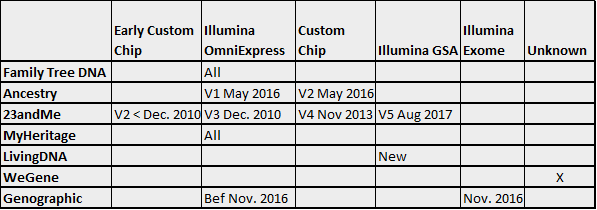
Of course, where you have, and haven’t already tested will impact your transfer strategy decision. I’ve prepared the following cheat sheet to be used in combination with the information discussed above.

*Unless you can transfer a 23andMe V3/V4 or an Ancestry V1 kit to Family Tree DNA, it’s better to test at Family Tree DNA. Ancestry V2 tests are only 20-25% compatible.

A transfer from Family Tree DNA to MyHeritage is best because those vendors are on the same platform and the tools at MyHeritage are free.

In my next article, we’ll discuss how to mine your matches at the various vendors to obtain accurate segments for chromosome painting – including a strategy for how to utilize Ancestry and Gedmatch together to identify at least some Ancestry segment matches.

So, for now, get ready by transferring your matches into whichever data bases they aren’t already in. The only data base where I couldn’t identify matches that I didn’t have elsewhere was at 23andMe. The rest were all there just waiting to be harvested!

_____________________________________________________________________

Disclosure

I receive a small contribution when you click on some of the links to vendors in my articles. This does NOT increase the price you pay but helps me to keep the lights on and this informational blog free for everyone. Please click on the links in the articles or to the vendors below if you are purchasing products or DNA testing.

Thank you so much.

DNA Purchases and Free Transfers

Genealogy Services

Genealogy Research

GDPR – It’s a Train and It’s a Comin’

In the recent article about Oxford Ancestors shuttering, I briefly mentioned GDPR. I’d like to talk a little more about this today, because you’re going to hear about it, and I’d rather you hear about it from me than from a sky-is-falling perspective.

It might be rainy and there is definitely some thunder and the ground may shake a little, but the sky is not exactly falling. The storm probably isn’t going to be pleasant, however, but we’ll get through it because we have no other choice. And there is life after GDPR, although in the genetic genealogy space, it may look a little different.

And yes, one way or another, it will affect you.

What is GDPR?

GDPR, which is short for General Data Protection Regulation, is a European, meaning both EU and UK, regulation(s) by which the European Parliament, the Council of the European Union, and the European Commission intend to strengthen and unify data protection for all individuals within the European Union (EU). It also addresses the export of personal data outside the EU/UK and processing of data of residents of the EU/UK by non-EU/UK companies.

There are actually two similar, but somewhat different regulations, one for the UK and one for the EU’s 28 member states, but the regulations are collectively referred to as the GDPR regulation.

Ok, so far so good.

The regulations are directly enforceable and do not require any individual member government to pass additional legislation.

GDPR was adopted on April 27, 2016, but little notice was taken until the last few months, especially outside of Europe, when the hefty fines drew attention to the enforcement date of May 25, 2018, now just around the corner.

Those hefty fines can range from a written warning for non-intentional noncompliance to a fine of 20 million Euro or up to 4% of the annual worldwide turnover of the preceding financial year, whichever is GREATER. Yea, that’s pretty jaw-dropping.

So, GDPR has teeth and is nothing to be ignored.

Oh, and if you think this is just for EU or UK companies, it isn’t. It applies equally to any company that possesses any data of any EU or UK resident in their data base or files, providing that person isn’t dead. The law excludes dead people and makes some exceptions for law enforcement and other national security types of applications.

Otherwise, it applies to everyone in a global economy – and not just for future sales, but to already existing data for anyone who stores, transmits, sells to or processes data of any EU resident.

What Does GDPR Do?

The intent of GDPR was to strengthen privacy and data protections, but there is little latitude written into this regulation that allows for intentional sharing of data. The presumption throughout the hundreds of pages of lawyer-speak is that data is not intended to be shared, thereby requiring companies to take extraordinary measures to encrypt and anonymize data, even going so far as to force companies to store e-mail addresses separately from any data which could identify the person. Yes, like a name, or address.

Ironic that a regulation that requires vendor language be written in plainly understood simple wording is in and of itself incredibly complex, mandating legal interpretation.

Needless to say, GDPR requirements are playing havoc with every company’s data bases and file structure, because information technology goals have been to simplify and unify, not chop apart and distribute information, requiring a complex network of calls between systems.

Know who loves GDPR? Lawyers and consultants, that’s who!

In the case of intentional sharing, such as genetic genealogy, these regulations are already having unintended consequences through their extremely rigid requirements.

For example, a company must appoint a legal representative in Europe. I am not a lawyer, but my reading of this requirement suggests that European appointed individual (read, lawyer) is absorbing some level of risk and could potentially be fined as a result of their non-European client’s behavior. So tell me, who is going to incur that level of risk for anything approaching a reasonable cost?

One of the concepts implemented in GDPR is the colloquially known “right to be forgotten.” That means that you can request that your data and files be deleted, and the company must comply within a reasonable time.

However, what does “the right to be forgotten” mean, exactly? Does it mean a company has to delete your public presence? What about their internal files that record that you WERE a customer. What about things like medical records? What about computer backups which are standard operating procedure for any responsible company? What happens when a backup needs to be restored? If the company tracks who was deleted, so they can re-delete them if they have to restore from backup, then the person isn’t deleted in the first place and they are still being tracked – even though the tracking is occurring so the person can be re-forgotten.

Did you follow that? Did it make sense? Did anyone think of these kinds of things?

Oh, and by the way, there is no case law yet, so every single European company and every single non-European company that has any customer base in Europe is scrambling to comply with an incredibly far-reaching and harsh regulation with extremely severe potential consequences.

How many companies do you think can absorb this expenditure? Who do you think will ultimately pay?

Younger people may not remember Y2K, but I assuredly do, and GDPR is Y2K on steroids and with lots of ugly teeth in the form of fines and penalties that Y2K never had. The worse scenario for Y2K was that things would stop working. GDPR can put you out of business in the blink of an eye.

Categories of “Processors”

GDPR defines multiple levels of “processors,” a primary controller and a secondary processor plus vaguely defined categories of “third party” and “joint controller.”

The “controller” is pretty well defined as the company that receives and processes the data or order, and a “processor” is any other entity, including an individual person, who further processes data on behalf of or as a result of the controller.

There appears to be no differentiation between a multi-million-dollar company and one person doing something as a volunteer at home for most requirements – and GDPR specifically says that lack of pay does not exempt someone from GDPR. The one possible exception that exists in that there is an exclusion for organizations employing less than 250 persons, ”unless processing is likely to result in a risk to the rights and freedoms of the data subject.” I’m thinking that just mentioning the word DNA is enough to eliminate this exemption.

Furthermore, GDPR states that controllers and processors must register.

Right about now, you’re probably asking yourself if this means you if you’re managing multiple DNA kits, working with genetic genealogy, either as a volunteer or professionally, or even managing a group project or Facebook group.

The answer to those questions is that but we really don’t know.

ISOGG has prepared a summary page addressing GDPR from the genetic genealogy perspective, here. The ISOGG working group has done an excellent job in summarizing the questions, requirements and potential effects of the legislation in the slide presentation, which I suggest you take the time to view.

This legislation clearly wasn’t written considering this type of industry, meaning DNA shared for genealogical purposes, and there has been no case law yet surrounding GDPR. No one wants to be the first person to discover exactly how this will be interpreted by the courts.

The requirements for controllers and processors are much the same and include very specific requirements for how data can be stored and what must be done in terms of the “right to be forgotten” requests within a reasonable time, generally mentioned as 30 days after the person who owns the data requests to be forgotten. This would clearly apply to some websites and other types of resources used and maintained by the genetic genealogy community. If you are one of the people this could affect, meaning you maintain a website displaying results of some nature, you might want to consider these requirements and how you will comply. Additionally, you are required to have explicitly given consent for every person’s results that are displayed.

For genetic genealogists, who regularly share information through various means, and the companies who enable this technology, GDPR is having what I would very generously call a wet blanket effect.

What’s Happening in the Genetic Genealogy Space?

So far, we’ve seen the following:

  • Oxford Ancestors has announced they are shuttering, although they did not say that their decision has anything to do with GDPR. The timing may be entirely coincidental.
  • Full Genomes Corporation has announced on social media that they are no longer accepting orders from EU or UK customers, stating that “the regulatory cost is too high for a small company” and is “excessive.” I would certainly agree with that. Update; On 3-31-2018 Justin Loe, CEO of Full Genomes says that they “will continue to sell into the EU via manual process.”
  • Ancestry has recently made unpopular decisions relative to requiring separate e-mails to register different accounts, even if the same person is managing multiple DNA kits. Ancestry did not say this had to do with GDPR either, but in reading the GDPR requirements, I can understand why Ancestry felt compelled to make this change.
  • Family Tree DNA recently removed a search feature from their primary business page that allowed the public to search for their ancestors in trees posted to accounts at Family Tree DNA. According to an e-mail sent to project administrators, this change was the result of changes required by GDPR. They too are working on compliance.
  • MyHeritage is as well.
  • I haven’t had an opportunity to speak privately with LivingDNA or 23andMe, but I would presume both are working on compliance. LivingDNA is a UK company.

One of my goals recently when visiting RootsTech was to ask vendors about their GDPR compliance and concerns. That’s the one topic sure to wipe the smile off of everyone’s face, immediately, generally followed by grimaces, groans and eye-rolls until they managed to put their “public face” back on.

In general, vendors said they were moving towards compliance but that it was expensive, difficult and painful – especially given the ambiguity in some of the regulation verbiage. Some expressed concerns that GDPR was only a first step and would be followed by even more painful future regulations. I would presume that any vendor who is not planning to become compliant would not have spent the money to have a booth at RootsTech.

The best news about GDPR is that it requires transparency – in other words, it’s supposed to protect customers from a company selling your anonymized DNA out the back door without your explicitly given consent, for example. However, the general consensus was that any company that wanted to behave in an unethical manner would find a loophole to do so, regardless of GDPR.

In fairness, hurried consumers bring this type of thing on themselves by clicking through the “consent,” or “agree” boxes without reading what they are consenting to. All the GDPR in the world won’t help this. The company may have to disclose, but the consumer doesn’t have to read, although GDPR does attempt to help by forcing you to actively click on agree.

I’m sure we’ll all be hearing more about GDPR in the next few weeks as the deadline looms ever closer.

May 25, 2018

Now you know!

There’s nothing you can do about the effects of GDPR, except hold on tight as the vendors on which we depend do their best to navigate this maze.

Between now and May 25th, and probably for some time thereafter, I promise to be patient and not to complain about glitches in vendors’ systems as they roll out new code as seamlessly as possible.

Gluttons for Punishment

For those of you who are really gluttons for punishment, here are the actual links to the documents themselves. Of course, they are also guaranteed to put you to sleep in about 27 second flat…so a sure cure for insomnia.

______________________________________________________________

Disclosure

I receive a small contribution when you click on some of the links to vendors in my articles. This does NOT increase the price you pay but helps me to keep the lights on and this informational blog free for everyone. Please click on the links in the articles or to the vendors below if you are purchasing products or DNA testing.

Thank you so much.

DNA Purchases and Free Transfers

Genealogy Services

Genealogy Research

Who Tests the X Chromosome?

Recently, someone asked which of the major DNA testing companies test the X chromosome and which ones use the X in matching. How does this difference influence the quality of our matches?

Vendor X in Download File Uses X in Matching X Included in Total cM Count
23andMe Yes Yes Yes
Family Tree DNA Yes Yes (if have a match on another chromosome) No
Ancestry Yes *No No
MyHeritage Yes No No
GedMatch N/A Separately No

*If Ancestry did utilize the X in matching, it wouldn’t benefit customers because Ancestry does not show segment information by chromosome.  In other words, no chromosome browser.

Family Tree DNA includes any size X match IF and only if the two people already match on a different chromosome.

GedMatch, of course, isn’t a vendor who does DNA testing, so they don’t provide download files.  They are solely on the receiving end.

X CentiMorgan Counts

Due to variations in the way vendors calculate matches and total cM counts, your mileage may vary a bit.

In other words, the 23andMe cM total, if an X match is involved, may be slightly more than a match between the same two people at Family Tree DNA, where the X match cM is not included in the cM total.

Conversely, you won’t show an X match with someone at Family Tree DNA if there isn’t also another segment on a different chromosome that matches.

In general, due to the thin spread of SNPs on the X chromosome, you will need, on average, a cM match that is twice as large as on other chromosomes to be considered of equal weight.

In other words, a 10 cM match on the X chromosome would only be genealogically equivalent to approximately a 5 cM match on any other chromosome.

X matches really can’t be evaluated by the same rules as other chromosomes due both to their SNP paucity and their inheritance path, which is why most vendors don’t include those segments in the total cM count.

X Matches

While including the X chromosome cM count is problematic, X matching can be a huge benefit because of the unique inheritance path of the X chromosome.

In the article, X Marks the Spot, we discussed the inheritance path of the X chromosome for both males and females. Females inherit an X chromosome from both father and mother, which recombines just like chromosomes 1-22.  However, men only inherit an X from their mother, because they inherit a Y from their father instead of the X.  Therefore, males will only inherit an X from their mother, and females will only inherit their father’s mother’s X chromosome.

Charting Companion software works with your genealogy software of choice to produce a lovely fan chart where the contributors of my X chromosome are charted in color, above. You can read more about Charting Companion here.

The great news is that if you and a match share a significant portion of the X chromosome, meaning more than 15 cM which reduces the likelihood of an identical by chance match, the common ancestor (on that segment) has to come from an ancestor in your direct X path.

I’m always excited to see with whom I share an X.  That piece of information alone helps me focus my ancestor detective efforts on a specific portion of my tree.

Some X segments can remain intact for generations and may be very old.  So don’t be surprised if the common ancestor of the X segment and another matching segment may not be the same ancestor.

Sorting by X

I wasn’t able to find a way to sort by X chromosome matches at 23andMe, but you can sort by the X at both Family Tree DNA and GedMatch.

At GedMatch, X matching shows on the one-to-many match page.  You can sort by either Total X cM or Largest X cM by using the up and down arrows, at right, below, in the X DNA columns.

After you identify an X match, be sure to run the X one-to-one match option to verify.

My GedMatch matches cause me to wonder if 23andMe is using a different reporting threshold for the X chromosome, because one of my matches at GedMatch is a close family member with no X match at 23andMe, but a total of 32 X cM and with a longest segment of 14 X cM at GedMatch.

That same individual matches me with the largest X segment of 14 cM at Family Tree DNA as well.

Family Tree DNA X Match Phasing

At Family Tree DNA, on your Family Finder matches page, just click on the X-Match header (at right, below) to bring all of your X matches to the top of your list.

If you have linked any kits of relatives to your tree, you will see numbers of phased kits on the maternal and paternal tabs with the red and blue male and female icons. In the example above, I have 3313 matches total, with 744 being paternal, 586 being maternal.

Next, click on the maternal or paternal tab to see only the people with X matches who match you on the  your maternal and paternal lines. Matches are automatically sorted into maternal and paternal “buckets” for you. Remember to check the size of the X match before deciding about relevance.

Who is your largest X match that you don’t already know?  Maybe you can find your common ancestor today.

Have fun!!!

______________________________________________________________

Disclosure

I receive a small contribution when you click on some of the links to vendors in my articles. This does NOT increase the price you pay but helps me to keep the lights on and this informational blog free for everyone. Please click on the links in the articles or to the vendors below if you are purchasing products or DNA testing.

Thank you so much.

DNA Purchases and Free Transfers

Genealogy Services

Genealogy Research

DNAGedcom Client

DNAGedcom provides an incredibly cool tool that has helped me immensely with my genealogy research, particularly at Ancestry and Family Tree DNA. This tool doesn’t replace what Ancestry and Family Tree DNA provide, but augments the functionality significantly.

I’ve been frustrated for months by the broken search function at Ancestry, and the DNAGedcom tool allows you to bypass the search function entirely by downloading the direct line ancestral information for all of your matches. So let’s use my Ancestry account as an example.

Utilizing DNAGedcom

After installing the DNAGedcom tool on your system, sign on to your Ancestry account through the tool. The tool downloads all of your matches, the people you match in common with them, and the ancestors in your matches’ trees.

The best part about this is that the results are then in a spreadsheet file that you can simply sort utilizing normal spreadsheet functions. I wrote about using spreadsheets for genetic genealogy in the article, Concepts – Sorting Spreadsheets for Autosomal DNA.

In my case, this means I can see everyone who I match that has an Estes, or any other surname, in their tree. I don’t have to look at my matches’ trees one at a time.

You can read about this very cool tool at this link, including how to subscribe for either $5 per month or $50 per year. Many functions at DNAGedcom are free, but the Ancestry tool is available through a minimal subscription which helps to support the rest of the site.

After subscribing, the DNAGedcom client will become available to you on your subscriber page at DNAGedcom.

Please note that you can click to enlarge any image.

After you subscribe, you’ll see the link for the Ancestry download tool, along with other resources.

You will want to follow the installation directions, exactly, to download the DNAGedcom client onto your PC or Mac in preparation for downloading your Ancestry match information onto your system. This is painless and goes quickly.

Next, you will be prompted to sign in to both DNAGedcom and Ancestry, through the tool, and then you will be prompted for three separate steps at Ancestry:

  • Gather Matches – took about 10 minutes
  • Gather Trees – let’s just say you might want to run this one overnight, and on a directly connected system, not wifi. Mine was about 25% complete at the 2 hour mark
  • Gather ICW – another several hours, but you can do other things on your system at the same time

The downloaded files will be stored on your computer as .csv files. On my PC, the default location was in the Documents directory and the files are named as follows:

  • a_Roberta_Estes (the ancestors of my matches)
  • icw_Roberta_Estes (the people I match and who I match in common with them)
  • m_Roberta_Estes (information about the match, such as cMs, etc.)

It’s important to make a note of this, as I didn’t find the file names documented elsewhere.

The good news is that even though these steps take a long time, having all of this information in a place where you can sort it and use it effectively is extremely useful. You can run the various steps at night or when you aren’t otherwise using your system.

In addition, if someone is sharing their DNA results with you on Ancestry (which they can under the settings gear), you can download the same data for their account – and then you can look for commonalities between groups of results using the DNAGedcom Match-O-Matic tool, also described in the introductory document.

Using the Downloaded Files

Personally, what I wanted to do was to search for all occurrences of a particular surname. Fortunately, it was Claxton or Clarkson, not Smith.

Simply using Excel (after saving the results file in Excel format), I was able to quickly sort for these surnames, an example shown below. Hmmm, I wonder if Claxon is relevant too. I never considered that possibility – nor would I have ever seen Claxon in a surname search, because I wouldn’t have searched for Claxon..

I’m brick walled on the Claxton line in Russell County, Virginia in about 1799. My ancestor, James Lee Claxton, was born someplace in Virginia about 1775. Utilizing Y DNA, we know of another man, also named James Claxton, born about 1750 first found in Granville and Bertie County, NC, who sired an entire lineage of Claxtons who migrated to Bedford County, TN.  However, that James is not the father of my ancestor, because that James had a different son named James. Other than these two distinct groups, we can’t seem to match with anyone else who has tested their Y DNA at Family Tree DNA, so my hope, for now, is an autosomal match with a known Claxton line out of Virginia.

(Shameless plug – if you are a Claxton or Clarkson male, please test your Y DNA at Family Tree DNA and join the Claxton DNA project. If you have Claxton or Clarkson ancestry from any line, and have taken the Family Finder test or transferred autosomal results from another vendor, please join the Claxton/Clarkson DNA project at Family Tree DNA. If you have Claxton or Clarkson ancestry and haven’t yet DNA tested, please do.)

Therefore, my goal is to find matches to other Claxton or Clarkson individuals who don’t share a known common known ancestor with me. Because we don’t share a known common ancestor, of course, these people would never be shown as an Ancestry green leaf “DNA+tree match,” nor is there another way for me to obtain a surname list like this at Ancestry.

After finding Claxton candidates, then I can refer to the other downloaded files or sign on to my account at Ancestry to look at the match itself and other ICW matches. Hopefully, some of my matches will also match some of my Claxton cousins as well, which would suggest that the match might actually be through the Claxton line.

The DNAGedcom client also downloads the same type of information from 23andMe, which isn’t nearly as useful without trees, as well as from Family Tree DNA.

Thanks so much to www.dnagedcom.com.

______________________________________________________________

Disclosure

I receive a small contribution when you click on some of the links to vendors in my articles. This does NOT increase the price you pay but helps me to keep the lights on and this informational blog free for everyone. Please click on the links in the articles or to the vendors below if you are purchasing products or DNA testing.

Thank you so much.

DNA Purchases and Free Transfers

Genealogy Services

Genealogy Research

2018 Resolution – Unveiling Hidden Evidence

I spent New Year’s Eve, doing what I’ve done for years on New Year’s Eve – celebrating by researching. In fact, it was at the stroke of midnight in 2005 that I ordered kit number 50,000 from Family Tree DNA.  Yes, I’m just that geeky and yes, I had to purchase several kits in a row to get number 50,000.

That kit went on to help immensely, as I used it to test an elderly cousin of my great-grandmother’s generation who took both the Y DNA test, and then, eventually, autosomal.

This year I made a wonderful discovery to mark the new year.  But first, let’s see how I did with last year’s resolution.

Last Year’s Resolution

Last year, I made 1 resolution. Just one – to complete another year’s worth of 52 Ancestor stories.

Now, that didn’t mean I had to do 52 in total.  It meant I had to be committed to this project throughout the year.  You know, unlike cleaning out that closet…or losing weight…or exercising more. Commitments that are abandoned almost as soon as they are made.

So, how did I do?

I published 37 stories.  I shudder to think how many words or even pages that was.  I’m ashamed to say that I plucked much of the “low hanging fruit” early on, so these were tough ancestors for an entire variety of reasons.

That’s not one article each week, but at least I’m making steady progress. And I must say that I couldn’t do it without a raft of helpers – all of whom I’m exceedingly grateful to.  Friends, professionals, cousins, DNA testers, blog subscribers and commenters – an unbelievable array of very kind souls who are willing to give of their time and share their results. Thank you each and every one!

Now, I’m thrilled to tell you that Amy Johnson Crow has revitalized the 52 Ancestor’s project.  It’s free and you can sign up here.  There’s no obligation, but Amy provides suggestions and a “gathering place” of sorts. Think of her as your genealogy cheerleader or coach. It’s so much easier with friends and teammates! I miss reading other people’s stories, but I won’t have to miss that much longer!

Randy Seaver (of Genea-Musings) and I will have company once again.  He’s the only other person that I’m aware of that has continued the 52 Ancestors project – and he has put me way to shame.  I do believe he published number 286 this week.  I keep hoping that some of his ancestors and some of mine are the same so I can piggyback on Randy’s research! I need an index! Randy, are you listening?

You might wonder why I enjoy this self-imposed deadline ancestor-writing so much.

It’s really quite simple.  It’s an incredible way to organize and sort through all of your accumulated research “stuff.”  I cherish the end product – documenting my ancestors lives with dates, compassion and history.  BUT, I absolutely hate parts of the research process – and the deadline (of sorts) gets me through those knotholes.

I absolutely love the DNA, and I really, REALLY like the feeling of breaking through brick walls.  It’s like I’m vindicating my ancestors and saving them from the eternal cutting room floor. DNA is an incredible tool to do just that and there are very few ancestors that I can’t learn something from their DNA, one way or another – Y, mtDNA,  autosomal and sometimes, all three.  And yes, DNA is in every one of my articles, one way or another. I want everyone to learn how to utilize DNA in the stories of their ancestor’s lives.  In many cases the DNA of theirs that we (and our cousins) carry is the only tangible thing left of them. We are wakling historical museums of our ancestral lines!

How Did You Do?

Not to bring up an awkward subject, but if you recall, I asked you if you had any genealogy resolutions for 2017?  How did you do?

Congratulations if you succeeded or made progress.

It’s OK if you didn’t quite make it. Don’t sweat last year.  It’s over and 2018 is a brand spanking new year.

New Year Equals New Opportunities

2018 is stacking up to be a wonderful year. There are already new matches arriving daily due to the Black Friday sales and that’s only going to get better in the next month or two.  Of course, that’s something wonderful to look forward to in the dead of winter.  We’ll just call this my own personal form of hibernating. Could I really get away with not leaving my house for an entire month? Hmmm….

I want to give you three ideas for having some quick wins that will help you feel really great about your genealogy this year.

Idea 1 – Finding Hidden Mitochondrial DNA

This happened to me just last night and distracted me so badly that I actually was late to wish everyone a Happy New Year.  Yes, seriously.  One of my friends told me this is the best excuse ever!

I was working on making a combined tree for the descendants of an ancestor who have tested and I suddenly noticed that one of the female autosomal matches descended from the female of the ancestral couple through all females – which means my match carries my ancestor’s mitochondrial DNA!

Woohooooooo – it’s a wonderful day.

Better yet, my match tested at Family Tree DNA AND had already taken the mitochondrial DNA test.

Within about 60 seconds of noticing her pattern of descent, I had the haplogroup of our common ancestor. That’s the BEST New Year’s gift EVER.  I couldn’t sleep last night.

So, know what I did instead of sleeping? I bet you can guess!

Yes indeed, I started searching through my matches at Family Tree DNA for other people descended from female ancestors whose mtDNA I don’t have!

So, my first challenge to you is to do the same.

Utilizing Family Finder, enter the surname you’re searching for into the search box in the upper right hand corner of your matches page.

That search will produce individuals who have that surname included in their list of ancestral surnames or who carry that surname themselves.

Your tree feeds the ancestral surname list with all of the surnames in your tree.  I understand this will be changing in the future to reflect only your direct line ancestral surnames.

Some people include locations with their surnames – so you may recognize your line that way. Click on your match’s surname list (at far right) to show their entire list of surnames in a popup box. Some lists are very long.  I selected the example below because it’s short.

Your common surnames are bolded and float to the top.  The name you are searching for will be blue, so it’s easy to see, especially in long lists of surnames. 

About half of my matches at Family Tree DNA have trees.  Click on the pedigree icon and then search for your surname of interest in your match’s tree.

Hey, there’s our common ancestral couple – William George Estes and Ollie Bolton!!!

Idea 2 – Finding Hidden Y DNA

Now that I’ve shown you how to find hidden mitochondrial DNA, finding hidden Y DNA is easy.  Right?

You know what to do.

I this case, you’ll be looking for a male candidate who carries the surname of the line you are seeking, which is very easy to spot on the match list.

Now, word of warning.

As bizarre as this sounds, not all men who carry that surname and match autosomally are from the same genetic surname line.

As I was working with building a community tree for my matches last night, I was excited to see that one of my cousins (whose kit I manage) matches a man with the Herrell surname.

I quickly clicked on the match’s tree to see which Herrell male the match descends from, only to discover that he didn’t descend from my Herrell line.

Whoa – you’re saying – hold on, because maybe my line is misidentified.  And I’d agree with you – except in this case, I have the Y DNA signature of both lines – because at one time I thought they were one and the same. You can view the Herrell Y DNA project here.  My family line is Harrold Line 7.

Sure enough, through the Family Finder match, I checked my Harrell match’s profile and his haplogroup is NOT the same as my Herrell haplogroup (I-P37.)

I could have easily been led astray by the same surname. I really don’t need to know any more about his Y DNA at this point, because the completely different haplogroup is enough to rule out a common paternal line.

Don’t let yourself get so excited that you forget to be a skeptical genealogist😊

My second challenge to you is to hunt for hidden Y DNA.

You can  increase your chances of finding your particular lineage by visiting the relevant Y DNA projects for your surname.

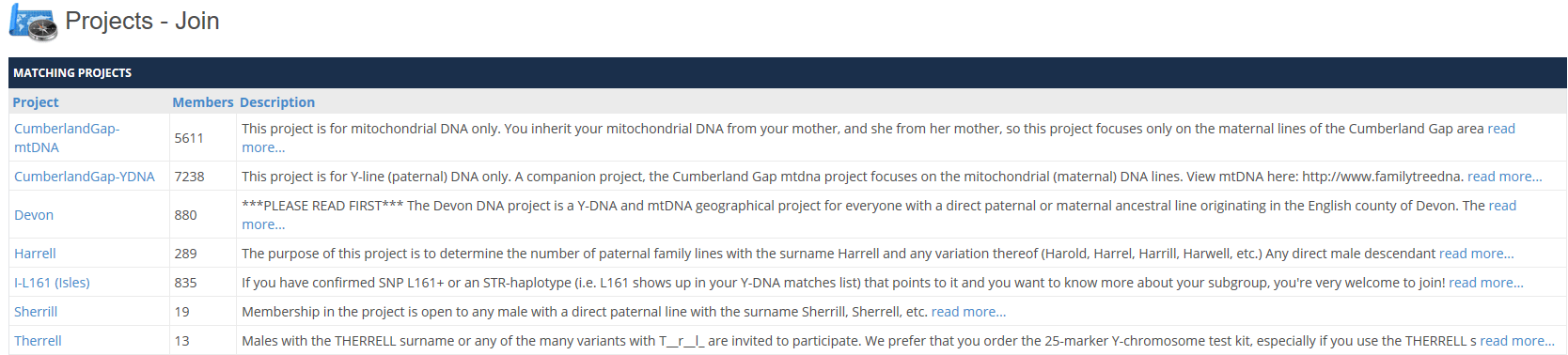
Click on Projects, then “Join a project,” then search for the DNA project that you’re interested in viewing and click on that link.

Within the project, look for oldest ancestors that are your ancestors, or potentially from a common location.  It’s someplace to start.

You can read more about how to construct a DNA pedigree chart in the article, “The DNA Pedigree Chart – Mining for Ancestors.”

Idea 3 – Pick A Puzzle Piece

Sometimes we get overwhelmed with the magnitude and size of the genealogy puzzle we’d like to solve. Then, we don’t solve anything.

This is exactly WHY I like the 52 Ancestor stories.  They make me focus on JUST ONE ancestor at a time.

So, for 2018, pick one genealogy puzzle you’d really like to solve. One person or one thing.  Not an entire line.

Write down your goal.

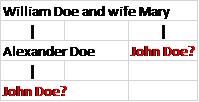
“I’d like to figure out whether John Doe was the son of William Doe or his son, Alexander Doe.”

Now admittedly, this is a tough one, because right off the bat, Y DNA isn’t going to help you unless you’re incredibly lucky and there is a mutation between Alexander Doe and his father, William.  If indeed that was the case, and you can prove it by the DNA of two of Alexander’s sons who carry the mutation, compared to the DNA of one of William’s other sons who does not, then you may be cooking with gas, presuming you can find a male Doe descended from John to test as well.

This is the type of thought process you’ll need to step through when considering all of the various options for how to prove, or disprove, a particular theory.

Make a list of the different kinds of evidence, both paper trail and genetic, that you could use to shed light on the problem. Your answer may not come from one piece of evidence alone, but a combination of several.

Evidence Available/Source Result
William’s will No, burned courthouse Verified
Alexander’s will No, burned courthouse Verified
Deeds with William as conveyor No, burned courthouse Verified
Family Bible Nope, no Bible
Deeds with Alexander as conveyor, naming John Possible, some deed books escaped fire Check through county, Family search does not list
Deeds with John as conveyor Yes, check to see if they indicate the source of John’s land John is listed in index, need to obtain original deeds from county
Y DNA of John’s line Yes, has been tested Matches DNA of William’s line as proven through William’s two brothers
Y DNA of Alexander Not tested (to the best of my knowledge), find descendant to see if they will test Search vendor DNA testing sites for male with this surname to see if they have/will Y DNA test
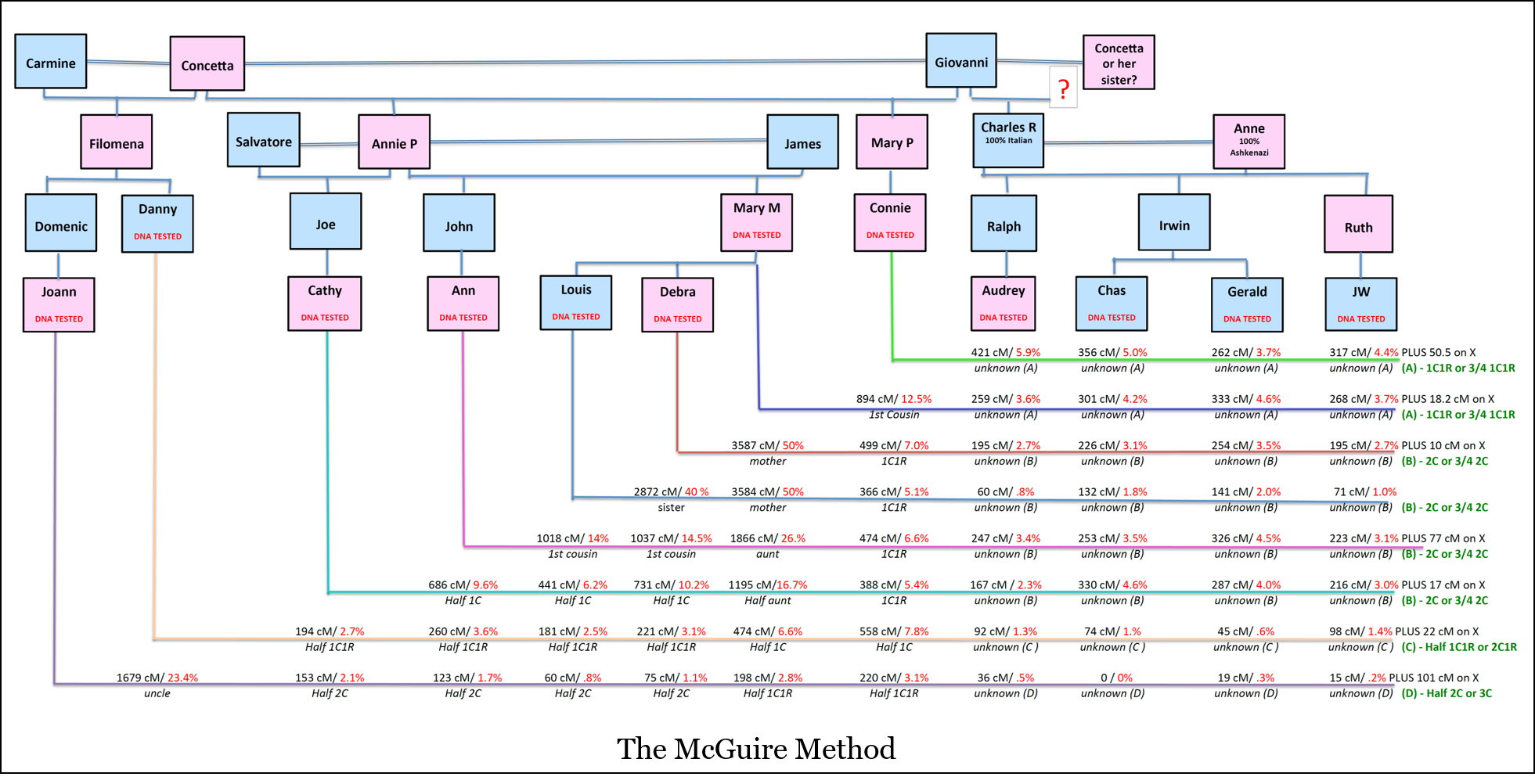
Closeness (in total cM and longest segment) of individuals autosomal matching through any of William’s descendants Mine both Ancestry and FTDNA for surname and ancestor matches This step may produce compelling or suggestive evidence, and it may not.  Make a McGuire chart of results.
Does John match any relatives of the wife of Alexander Doe? Search FTDNA and Ancestry for matches.  Triangulate to determine if match is valid and through that line. This is one of the best approaches to solve this type of problem when paper records aren’t available. Fingers crossed that Alexander and his wife and not related.

You can add pieces of evidence to your list as you think of them.

Making a list gives you something to work towards.

Your Turn!

Select one thing that you’d like to accomplish and either set about to do it, like mining for mitochondrial or Y DNA evidence, or put together a plan to gather evidence, both traditional and genetic.

In the comments, share what it is you’ll be searching for or working on.  You just never know if another subscriber may hold the answer you seek.

I can’t wait to hear what you’ll be doing this year!

Have a wonderful and productive New Year searching for those hidden ancestors!

______________________________________________________________

Disclosure

I receive a small contribution when you click on some of the links to vendors in my articles. This does NOT increase the price you pay but helps me to keep the lights on and this informational blog free for everyone. Please click on the links in the articles or to the vendors below if you are purchasing products or DNA testing.

Thank you so much.

DNA Purchases and Free Transfers

Genealogy Services

Genealogy Research

2017 – The Year of DNA

Every year for the past 17 years has been the year of DNA for me, but for many millions, 2017 has been the year of DNA. DNA testing has become a phenomenon in its own right.

It was in 2013 that Spencer Wells predicted that 2014 would be the “year of infection.” Spencer was right and in 2014 DNA joined the ranks of household words. I saw DNA in ads that year, for the first time, not related to DNA testing or health as in, “It’s in our DNA.”

In 2014, it seemed like most people had heard of DNA, even if they weren’t all testing yet. John Q. Public was becoming comfortable with DNA.

In 2017 – DNA Is Mainstream  

If you’re a genealogist, you certainly know about DNA testing, and you’re behind the times if you haven’t tested.  DNA testing is now an expected tool for genealogists, and part of a comprehensive proof statement that meets the genealogical proof standard which includes “a reasonably exhaustive search.”  If you haven’t applied DNA, you haven’t done a reasonably exhaustive search.

A paper trail is no longer sufficient alone.

When I used to speak to genealogy groups about DNA testing, back in the dark ages, in the early 2000s, and I asked how many had tested, a few would raise their hands – on a good day.

In October, when I asked that same question in Ireland, more than half the room raised their hand – and I hope the other half went right out and purchased DNA test kits!

Consequently, because the rabid genealogical market is now pretty much saturated, the DNA testing companies needed to find a way to attract new customers, and they have.

2017 – The Year of Ethnicity

I’m not positive that the methodology some of the major companies utilized to attract new consumers is ideal, but nonetheless, advertising has attracted many new people to genetic genealogy through ethnicity testing.

If you’re a seasoned genetic genealogist, I know for sure that you’re groaning now, because the questions that are asked by disappointed testers AFTER the results come back and aren’t what people expected find their way to the forums that genetic genealogists peruse daily.

I wish those testers would have searched out those forums, or read my comparative article about ethnicity tests and which one is “best” before they tested.

More ethnicity results are available from vendors and third parties alike – just about every place you look it seems.  It appears that lots of folks think ethnicity testing is a shortcut to instant genealogy. Spit, mail, wait and voila – but there is no shortcut.  Since most people don’t realize that until after they test, ethnicity testing is becoming ever more popular with more vendors emerging.

In the spring, LivingDNA began delivering ethnicity results and a few months later, MyHeritage as well.  Ethnicity is hot and companies are seizing a revenue opportunity.

Now, the good news is that perhaps some of these new ethnicity testers can be converted into genealogists.  We just have to view ethnicity testing as tempting bait, or hopefully, a gateway drug…

2017 – The Year of Explosive Growth

DNA testing has become that snowball rolling downhill that morphed into an avalanche.  More people are seeing commercials, more people are testing, and people are talking to friends and co-workers at the water cooler who decide to test. I passed a table of diners in Germany in July to overhear, in English, discussion about ethnicity-focused DNA testing.

If you haven’t heard of DTC, direct to consumer, DNA testing, you’re living under a rock or maybe in a third world country without either internet or TV.

Most of the genetic genealogy companies are fairly closed-lipped about their data base size of DNA testers, but Ancestry isn’t.  They have gone from about 2 million near the end of 2016 to 5 million in August 2017 to at least 7 million now.  They haven’t said for sure, but extrapolating from what they have said, I feel safe with 7 million as a LOW estimate and possibly as many as 10 million following the holiday sales.

Advertising obviously pays off.

MyHeritage recently announced that their data base has reached 1 million, with only about 20% of those being transfers.

Based on the industry rumble, I suspect that the other DNA testing companies have had banner years as well.

The good news is that all of these new testers means that anyone who has tested at any of the major vendors is going to get lots of matches soon. Santa, it seems, has heard about DNA testing too and test kits fit into stockings!

That’s even better news for all of us who are in multiple data bases – and even more reason to test at all of the 4 major companies who provide autosomal DNA matching for their customers: Family Tree DNA, Ancestry, MyHeritage and 23andMe.

2017 – The Year of Vendor and Industry Churn

So much happened in 2017, it’s difficult to keep up.

  • MyHeritage entered the DNA testing arena and began matching in September of 2016. Frankly, they had a mess, but they have been working in 2017 to improve the situation.  Let’s just say they still have some work to do, but at least they acknowledge that and are making progress.
  • MyHeritage has a rather extensive user base in Europe. Because of their European draw, their records collections and the ability to transfer results into their data base, they have become the 4th vendor in a field that used to be 3.
  • In March 2017, Family Tree DNA announced that they were accepting transfers of both the Ancestry V2 test, in place since May of 2016, along with the 23andMe V4 test, available since November 2013, for free. MyHeritage has since been added to that list. The Family Tree DNA announcement provided testers with another avenue for matching and advanced tools.
  • Illumina obsoleted their OmniExpress chip, forcing vendors to Illumina’s new GSA chip which also forces vendors to use imputation. I swear, imputation is a swear word. Illumina gets the lump of coal award for 2017.
  • I wrote about imputation here, but in a nutshell, the vendors are now being forced to test only about 20% of the DNA locations available on the previous Illumina chip, and impute or infer using statistics the values in the rest of the DNA locations that they previously could test.
  • Early imputation implementers include LivingDNA (ethnicity only), MyHeritage (to equalize the locations of various vendor’s different chips), DNA.Land (whose matching is far from ideal) and 23andMe, who seems, for the most part, to have done a reasonable job. Of course, the only way to tell for sure at 23andMe is to test again on the V5 chip and compare to V3 and V4 chip matches. Given that I’ve already paid 3 times to test myself at 23andMe (V2, 3 and 4), I’m not keen on paying a 4th time for the V5 version.
  • 23andMe moved to the V5 Illumina GSA chip in August which is not compatible with any earlier chip versions.
  • Needless to say, the Illumina chip change has forced vendors away from focusing on new products in order to develop imputation code in order to remain backwards compatible with their own products from an earlier chip set.
  • GedMatch introduced their sandbox area, Genesis, where people can upload files that are not compatible with the traditional vendor files.  This includes the GSA chip results (23andMe V5,) exome tests and others.  The purpose of the sandbox is so that GedMatch can figure out how to work with these files that aren’t compatible with the typical autosomal test files.  The process has been interesting and enlightening, but people either don’t understand or forget that it’s a sandbox, an experiment, for all involved – including GedMatch.  Welcome to living on the genetic frontier!

  • I assembled a chart of who loves who – meaning which vendors accept transfers from which other vendors.

  • I suspect but don’t know that Ancestry is doing some form of imputation between their V1 and V2 chips. About a month before their new chip implementation in May of 2016, Ancestry made a change in their matching routine that resulting in a significant shift in people’s matches.

Because of Ancestry’s use of the Timber algorithm to downweight some segments and strip out others altogether, it’s difficult to understand where matching issues may arise.  Furthermore, there is no way to know that there are matching issues unless you and another individual have transferred results to either Family Tree DNA or GedMatch, neither of which remove any matching segments.

  • Other developments of note include the fact that Family Tree DNA moved to mitochondrial DNA build V17 and updated their Y DNA to hg38 of the human reference genome – both huge undertakings requiring the reprocessing of customer data. Think of both of those updates as housekeeping. No one wants to do it, but it’s necessary.
  • 23andMe FINALLY finished transferring their customer base to the “New Experience,” but many of the older features we liked are now gone. However, customers can now opt in to open matching, which is a definite improvement. 23andMe, having been the first company to enter the genetic genealogy autosomal matching marketspace has really become lackluster.  They could have owned this space but chose not to focus on genealogy tools.  In my opinion, they are now relegated to fourth place out of a field of 4.
  • Ancestry has updated their Genetic Communities feature a couple of times this year. Genetic Communities is interesting and more helpful than ethnicity estimates, but neither are nearly as helpful as a chromosome browser would be.

  • I’m sure that the repeated requests, begging and community level tantrum throwing in an attempt to convince Ancestry to produce a chromosome browser is beyond beating a dead horse now. That dead horse is now skeletal, and no sign of a chromosome browser. Sigh:(
  • The good news is that anyone who wants a chromosome browser can transfer their results to Family Tree DNA or GedMatch (both for free) and utilize a chromosome browser and other tools at either or both of those locations. Family Tree DNA charges a one time $19 fee to access their advanced tools and GedMatch offers a monthly $10 subscription. Both are absolutely worth every dime. The bad news is, of course, that you have to convince your match or matches to transfer as well.
  • If you can convince your matches to transfer to (or test at) Family Tree DNA, their tools include phased Family Matching which utilizes a combination of user trees, the DNA of the tester combined with the DNA of family matches to indicate to the user which side, maternal or paternal (or both), a particular match stems from.

  • Sites to keep your eye on include Jonny Perl’s tools which include DNAPainter, as well as Goran Rundfeldt’s DNA Genealogy Experiment.  You may recall that in October Goran brought us the fantastic Triangulator tool to use with Family Tree DNA results.  A few community members expressed concern about triangulation relative to privacy, so the tool has been (I hope only temporarily) disabled as the involved parties work through the details. We need Goran’s triangulation tool! Goran has developed other world class tools as well, as you can see from his website, and I hope we see more of both Goran and Jonny in 2018.
  • In 2017, a number of new “free” sites that encourage you to upload your DNA have sprung up. My advice – remember, there really is no such thing as a free lunch.  Ask yourself why, what’s in it for them.  Review ALL OF THE documents and fine print relative to safety, privacy and what is going to be done with your DNA.  Think about what recourse you might or might not have. Why would you trust them?

My rule of thumb, if the company is outside of the US, I’m immediately slightly hesitant because they don’t fall under US laws. If they are outside of Europe or Canada, I’m even more hesitant.  If the company is associated with a country that is unfriendly to the US, I unequivocally refuse.  For example, riddle me this – what happens if a Chinese (or fill-in-the-blank country) company violates an agreement regarding your DNA and privacy?  What, exactly, are you going to do about it from wherever you live?

2017 – The Year of Marketplace Apps

Third party genetics apps are emerging and are beginning to make an impact.

GedMatch, as always, has continued to quietly add to their offerings for genetic genealogists, as had DNAGedcom.com. While these two aren’t exactly an “app”, per se, they are certainly primary players in the third party space. I use both and will be publishing an article early in 2018 about a very useful tool at DNAGedcom.

Another application that I don’t use due to the complex setup (which I’ve now tried twice and abandoned) is Genome Mate Pro which coordinates your autosomal results from multiple vendors.  Some people love this program.  I’ll try, again, in 2018 and see if I can make it all the way through the setup process.

The real news here are the new marketplace apps based on Exome testing.

Helix and their partners offer a number of apps that may be of interest for consumers.  Helix began offering a “test once, buy often” marketplace model where the consumer pays a nominal price for exome sequencing ($80), significantly under market pricing ($500), but then the consumer purchases DNA apps through the Helix store. The apps access the original DNA test to produce results. The consumer does NOT receive their downloadable raw data, only data through the apps, which is a departure from the expected norm. Then again, the consumer pays a drastically reduced price and downloadable exome results are available elsewhere for full price.

The Helix concept is that lots of apps will be developed, meaning that you, the consumer, will be interested and purchase often – allowing Helix to recoup their sequencing investment over time.

Looking at the Helix apps that are currently available, I’ve purchased all of the Insitome products released to date (Neanderthal, Regional Ancestry and Metabolism), because I have faith in Spencer Wells and truthfully, I was curious and they are reasonably priced.

Aside from the Insitome apps, I think that the personalized clothes are cute, if extremely overpriced. But what the heck, they’re fun and raise awareness of DNA testing – a good thing! After all, who am I to talk, I’ve made DNA quilts and have DNA clothing too.

Having said that, I’m extremely skeptical about some of the other apps, like “Wine Explorer.”  Seriously???

But then again, if you named an app “I Have More Money Than Brains,” it probably wouldn’t sell well.

Other apps, like Ancestry’s WeRelate (available for smartphones) is entertaining, but is also unfortunately EXTREMELY misleading.  WeRelate conflates multiple trees, generally incorrectly, to suggest to you and another person on your Facebook friends list are related, or that you are related to famous people.  Judy Russell reviews that app here in the article, “No, actually, we’re not related.” No.  Just no!

I feel strongly that companies that utilize our genetic data for anything have a moral responsibility for accuracy, and the WeRelate app clearly does NOT make the grade, and Ancestry knows that.  I really don’t believe that entertaining customers with half-truths (or less) is more important than accuracy – but then again, here I go just being an old-fashioned fuddy dud expecting ethics.

And then, there’s the snake oil.  You knew it was going to happen because there is always someone who can be convinced to purchase just about anything. Think midnight infomercials. The problem is that many consumers really don’t know how to tell snake oil from the rest in the emerging DNA field.

You can now purchase DNA testing for almost anything.  Dating, diet, exercise, your taste in wine and of course, vitamins and supplements. If you can think of an opportunity, someone will dream up a test.

How many of these are legitimate or valid?  Your guess is as good as mine, but I’m exceedingly suspicious of a great many, especially those where I can find no legitimate scientific studies to back what appear to be rather outrageous claims.

My main concern is that the entire DTC testing industry will be tarred by the brush of a few unethical opportunists.

2017 – The Year of Focus on Privacy and Security

With increased consumer exposure comes increased notoriety. People are taking notice of DNA testing and it seems that everyone has an opinion, informed or not.  There’s an old saying in marketing; “Talk about me good, talk about me bad, just talk about me.”

With all of the ads have come a commensurate amount of teeth gnashing and “the-sky-is-falling” type reporting.  Unfortunately, many politicians don’t understand this industry and open mouth only to insert foot – except that most people don’t realize what they’ve done.  I doubt that the politicians even understand that they are tasting toe-jam, because they haven’t taken the time to research and understand the industry. Sound bites and science don’t mix well.

The bad news is that next, the click-bait-focused press picks up on the stories and the next time you see anyone at lunch, they’re asking you if what they heard is true.  Or, let’s hope that they ask you instead of just accepting what they heard as gospel. Hopefully if we’ve learned anything in this past year, it’s to verify, verify, verify.

I’ve been an advocate for a very long time of increased transparency from the testing companies as to what is actually done with our DNA, and under what circumstances.  In other words, I want to know where my DNA is and what it’s being used for.  Period.

Family Tree DNA answered that question succinctly and unquestionably in December.

Bennett Greenspan: “We could probably make a lot of money by selling the DNA data that we’ve been collecting over the years, but we feel that the only person that should have your DNA information is you.  We don’t believe that it should be sold, traded or bartered.”

You can’t get more definitive than that.

DTC testing for genetic genealogy must be a self-regulating field, because the last thing we need is for the government to get involved, attempting to regulate something they don’t understand.  I truly believe government interference by the name of regulation would spell the end of genetic genealogy as we know it today.  DNA testing for genetic genealogy without sharing results is entirely pointless.

I’ve written about this topic in the past, but an update is warranted and I’ll be doing that sometime after the first of the year.  Mostly, I just need to be able to stay awake while slogging through the required reading (at some vendor sites) of page after page AFTER PAGE of legalese😊

Consumers really shouldn’t have to do that, and if they do, a short, concise summary should be presented to them BEFORE they purchase so that they can make a truly informed decision.

Stay tuned on this one.

2017 – The Year of Education

The fantastic news is that with all of the new people testing, a huge, HUGE need for education exists.  Even if 75% of the people who test don’t do anything with their results after that first peek, that still leaves a few million who are new to this field, want to engage and need some level of education.

In that vein, seminars are available through several groups and institutes, in person and online.  Almost all of the leadership in this industry is involved in some educational capacity.

In addition to agendas focused on genetic genealogy and utilizing DNA personally, almost every genealogy conference now includes a significant number of sessions on DNA methods and tools. I remember the days when we were lucky to be allowed one session on the agenda, and then generally not without begging!

When considering both DNA testing and education, one needs to think about the goal.  All customer goals are not the same, and neither are the approaches necessary to answer their questions in a relevant way.

New testers to the field fall into three primary groups today, and their educational needs are really quite different, because their goals, tools and approaches needed to reach those goals are different too.

Adoptees and genealogists employ two vastly different approaches utilizing a common tool, DNA, but for almost opposite purposes.  Adoptees wish to utilize tests and trees to come forward in time to identify either currently living or recently living people while genealogists are interested in reaching backward in time to confirm or identify long dead ancestors. Those are really very different goals.

I’ve illustrated this in the graphic above.  The tester in question uses their blue first cousin match to identify their unknown parent through the blue match’s known lineage, moving forward in time to identify the tester’s parent.  In this case, the grandparent is known to the blue match, but not to the yellow tester. Identifying the grandparent through the blue match is the needed lynchpin clue to identify the unknown parent.

The yellow tester who already knows their maternal parent utilizes their peach second cousin match to verify or maybe identify their maternal great-grandmother who is already known to the peach match, moving backwards in time. Two different goals, same DNA test.

The three types of testers are:

  • Curious ethnicity testers who may not even realize that at least some of the vendors offer matching and other tools and services.
  • Genealogists who use close relatives to prove which sides of trees matches come from, and to triangulate matching segments to specific ancestors. In other words, working from the present back in time. The peach match and line above.
  • Adoptees and parent searches where testers hope to find a parent or siblings, but failing that, close relatives whose trees overlap with each other – pointing to a descendant as a candidate for a parent. These people work forward in time and aren’t interested in triangulation or proving ancestors and really don’t care about any of those types of tools, at least not until they identify their parent.  This is the blue match above.

What these various groups of testers want and need, and therefore their priorities are different in terms of their recommendations and comments in online forums and their input to vendors. Therefore, you find Facebook groups dedicated to Adoptees, for example, but you also find adoptees in more general genetic genealogy groups where genealogists are sometimes surprised when people focused on parent searches downplay or dismiss tools such as Y DNA, mitochondrial DNA and chromosome browsers that form the bedrock foundation of what genealogists need and require.

Fortunately, there’s room for everyone in this emerging field.

The great news is that educational opportunities are abundant now. I’m listing a few of the educational opportunities for all three groups of testers, in addition to my blog of course.😊

Remember that this blog is fully searchable by keyword or phrase in the little search box in the upper right hand corner.  I see so many questions online that I’ve already answered!

Please feel free to share links of my blog postings with anyone who might benefit!

Note that these recommendations below overlap and people may well be interested in opportunities from each group – or all!!

Ethnicity

Adoptees or Parent Search

Genetic Genealogists

2018 – What’s Ahead? 

About midyear 2018, this blog will reach 1000 published articles. This is article number 939.  That’s amazing even to me!  When I created this blog in July of 2012, I wasn’t sure I’d have enough to write about.  That certainly has changed.

Beginning shortly, the tsunami of kits that were purchased during the holidays will begin producing matches, be it through DNA upgrades at Family Tree DNA, Big Y tests which were hot at year end, or new purchases through any of the vendors.  I can hardly wait, and I have my list of brick walls that need to fall.

Family Tree DNA will be providing additional STR markers extracted from the Big Y test. These won’t replace any of the 111 markers offered separately today, because the extraction through NGS testing is not as reliable as direct STR testing for those markers, but the Big Y will offer genealogists a few hundred more STRs to utilize. Yes, I said a few hundred. The exact number has not yet been finalized.

Family Tree DNA says they will also be introducing new “qualify of life improvements” along with new privacy and consent settings.  Let’s hope this means new features and tools will be released too.

MyHeritage says that they are introducing new “Discoveries” pages and a chromosome browser in January.  They have also indicated that they are working on their matching issues.  The chromosome browser is particularly good news, but matching must work accurately or the chromosome browser will show erroneous information.  Let’s hope January brings all three features.

LivingDNA indicates that they will be introducing matching in 2018.

2018 – What Can You Do?

What can you do in 2018 to improve your odds of solving genealogy questions?

  • Test relatives
  • Transfer your results to as many data bases as possible (among the ones discussed above, after reading the terms and conditions, of course)
  • If you have transferred a version of your DNA that does not produce full results, such as the Ancestry V2 or 23andMe V4 test to Family Tree DNA, consider testing on the vendor’s own chip in order to obtain all matches, not just the closest matches available from an incompatible test transfer.
  • Test Y and mitochondrial DNA at Family Tree DNA.
  • Find ways to share the stories of your ancestors.  Stories are cousin bait.  My 52 Ancestors series is living proof.  People find the stories and often have additional facts, information or even photos. Some contacts qualify for DNA testing for Y or mtDNA lines. The GREAT NEWS is that Amy Johnson Crow is resuming the #52Ancestors project for 2018, providing hints and tips each week! Who knows what you might discover by sharing?! Here’s how to start a blog if you need some assistance.  It’s easy – really!
  • Focus on the brick walls that you want to crumble and then put together both a test and analysis plan. That plan could include such things as:

o   Find out if a male representing a Y line in your tree has tested, and if not, search through autosomal results to see if a male from that paternal surname line has tested and would be amenable to an upgrade.

o   Mitochondrial DNA test people who descend through all females from various female ancestors in order to determine their origins. Y and mtDNA tests are an important part of a complete genealogy story – meaning the reasonably exhaustive search!

o   Autosomal DNA test family members from various lines with the hope that matches will match you and them both.

o   Test family members in order to confirm a particular ancestor – preferably people who descend from another child of that ancestor.

o   Making sure your own DNA is in all 4 of the major vendors’ data bases, plus GedMatch. Look at it this way, everyone who is at GedMatch or at a third party (non-testing) site had to have tested at one of the major 4 vendors – so if you are in all of the vendor’s data bases, plus GedMatch, you’re covered.

Have a wonderful New Year and let’s make 2018 the year of newly discovered ancestors and solved mysteries!

______________________________________________________________

Disclosure

I receive a small contribution when you click on some of the links to vendors in my articles. This does NOT increase the price you pay but helps me to keep the lights on and this informational blog free for everyone. Please click on the links in the articles or to the vendors below if you are purchasing products or DNA testing.

Thank you so much.

DNA Purchases and Free Transfers

Genealogy Services

Genealogy Research

Testing Strategy – Should I Test at Ancestry and Transfer to Family Tree DNA?

As most people know by now, Ancestry doesn’t accept DNA file transfers from other vendors, so many people recommend testing first at Ancestry and then transferring to Family Tree DNA.

Actually, that’s not always the best choice.

  • There is nothing inherently WRONG with that strategy, but it may not be right for you either. Transferring to Family Tree DNA from Ancestry certainly won’t hurt anything, but a transfer will only provide 20-25% of your matches if you tested at Ancestry after May of 2016 because the DNA chips used for processing are different at the two vendors.
  • If you tested at Ancestry before May of 2016, the Ancestry kit and the Family Tree DNA kits are identical, so transferring will give you the same matches at Family Tree DNA as if you had tested there. You are on the Ancestry V1 kit, so just transfer.  There is no need for a V1 kit to retest at Family Tree DNA. The transfer itself is free, as are your matches, but to unlock all features and tools costs $19. A bargain.
  • If you tested at Ancestry after May of 2016, you tested on the V2 kit. Ancestry changed the markers tested and now the Ancestry kit is only partially compatible with Family Tree DNA. As an Ancestry V2 transfer kit, you will only receive about 20-25% of the matches you would receive if you tested at Family Tree DNA.  The matches you receive will be your closest matches, but is that enough?

For some people, especially adoptees, your closest matches may be all that you are interested in.  If so, you’re golden with any Ancestry transfer.

For genealogists, you’re missing 75-80% of your matches, and your brick-wall breaker may well be in that group. Not good at all!

Let’s look at my kits for example.  I have tested directly at Family Tree DNA, and I have also transferred an Ancestry V2 kit to Family Tree DNA.

As you can see, my Family Finder kit received 3115 matches.  My Ancestry V2 transfer kit only received 26.65% of those matches.

Plus, if you attach the DNA of known family members to your tree, Family Tree DNA provides phased matching, which tells you which side of your tree a match connects to.  In the example above, that means that I know immediately which side 1236 of my matches connect to.  That’s a whopping 40% and that’s before I even look at their trees or common surnames! This is an incredible tool.

People who recommend that you test at Ancestry, today, and transfer to Family Tree DNA may not understand the unintended consequences, or they may be people who work primarily with adoptees. They may also not understand the value of phased matches for genealogists.

For people who tested at Ancestry after May of 2016, my recommendation is to take the Family Finder test directly at Family Tree DNA as well as test at Ancestry separately.

If you tested at MyHeritage, that test is fully compatible at Family Tree DNA as well, so do transfer, no retest needed!

To Order or Transfer

To order your Family Finder test, click here and then on the Family Finder test, shown below.

To transfer to Family Tree DNA for free from any company, click here and then in the upper left hand corner of the screen, click Autosomal Transfer, last option under the dropdown under the blue DNA Tests to get started.

Related Articles:

______________________________________________________________

Disclosure

I receive a small contribution when you click on some of the links to vendors in my articles. This does NOT increase the price you pay but helps me to keep the lights on and this informational blog free for everyone. Please click on the links in the articles or to the vendors below if you are purchasing products or DNA testing.

Thank you so much.

DNA Purchases and Free Transfers

Genealogy Services

Genealogy Research

Imputation Matching Comparison

In a future article, I’ll be writing about the process of uploading files to DNA.Land and the user experience, but in this article, I want to discuss only one topic, and that’s the results of imputation as it affects matching for genetic genealogy. DNA.Land is one of three companies known positively to be using imputation (DNA.Land, MyHeritage and LivingDNA), and one of two that allows transfers and does matching for genealogy

This is the second in a series of three articles about imputation.

Imputation, discussed in the article, Concepts – Imputation, is the process whereby your DNA that is tested is then “expanded” by inferring results you don’t have, meaning locations that haven’t been tested, by using information from results you do have. Vendors have no choice in this matter, as Illumina, the chip maker of the DNA chip widely utilized in the genetic genealogy marketspace has obsoleted the prior chip and moved to a new chip with only about 20% overlap in the locations previously tested. Imputation is the methodology utilized to attempt to bridge the gap between the two chips for genetic genealogy matching and ethnicity predications.

Imputation is built upon two premises:

1 – that DNA locations are inherited together

2 – that people from common populations share a significant amount of the same DNA

An example of imputation that DNA.Land provides is the following sentence.

I saw a blue ca_ on your head.

There are several letters that are more likely that others to be found in the blank and some words would be more likely to be found in this sentence than others.

A less intuitive sentence might be:

I saw a blue ca_ yesterday.

DNA.Land doesn’t perform DNA testing, but instead takes a file that you upload from a testing vendor that has around 700,000 locations and imputes another 38.3 million variants, or locations, based on what other people carry in neighboring locations. These numbers are found in the SNPedia instructions for uploading DNA.Land information to their system for usage with Promethease.

I originally wrote about Promethease here, and I’ll be publishing an updated article shortly.

In this article, I want to see how imputation affects matching between people for genetic genealogy purposes.

Genetic Genealogy Matching

In order to be able to do an apples to apples comparison, I uploaded my Family Tree DNA autosomal file to DNA.Land.

DNA.Land then processed my file, imputed additional values, then showed me my matches to other people who have also uploaded and had additional locations imputed.

DNA.Land has just over 60,000 uploads in their data base today. Of those, I match 11 at a high confidence level and one at a speculative level.

My best match, meaning my closest match, Karen, just happened to have used her GedMatch kit number for her middle name. Smart lady!

Karen’s GedMatch number provided me with the opportunity to compare our actual match information at DNA.Land, then also at GedMatch, then compare the two different match results in order to see how much of our matching was “real” from portions of our tested kits that actually match, and what portion of our DNA matches as a result of the DNA.Land imputation.

At DNA.Land, your match information is presented with the following information:

  • Relationship degree – meaning estimated relationship
  • # shared segments – although many of these are extremely small
  • Total shared cM
  • Total recent shared length in cM
  • Longest recent shared segment in cM
  • Relationship likelihood graph
  • Shared segments plotted on chromosome display
  • Shared segments in a table

Please note that you can click on any graphic to enlarge.

DNA.Land provides what they believe to be an accurate estimate of recent and anciently shared SNA segments.

The match table is a dropdown underneath the chromosome graphic at far right:

For this experiment, I copied the information from the match table and dropped it into a spreadsheet.

DNALand Match Locations

My match information is shown at DNA.Land with Karen as follows:

Matching segments are identified by DNA.Land as either recent or ancient, which I find to be over-simplified at best and misleading or inaccurate at worst. I guess it depends on how you perceive recent and ancient. I think they are trying to convey the concept that larger segments tend to me more recent, and smaller segments tend to be older, but ancient in the genetics field often refers to DNA extracted from exhumed burials from thousands of years ago.  Furthermore, smaller segments can be descended from the same ancestor as larger segments.

GedMatch Match

Since Karen so kindly provided her GedMatch kit number, I signed in to GedMatch and did a one-to-one match with this same kit.

Since all of the segments are 3 cM and over at DNA.Land, I utilized a GedMatch threshold of 3 cM and dropped the SNP count to 100, since a SNP count of 300 gave me few matches. For this comparison, I wanted to see all my matches to Karen, no matter how few SNPs are involved, in an attempt to obtain results similar to DNA.Land. I normally would not drop either of these thresholds this low. My typical minimum is 5cM and 500 SNPs, and even if I drop to 3cM, I still maintain the 500 SNP threshold.

Let’s see how the data from GedMatch and DNA.Land compares.

In my spreadsheet, below, I pasted the segment match information from DNA.Land in the first 5 columns with a red header. Note that DNA.Land does not provide the number of shared SNPs.

At right, I pasted the match information from GedMatch, with a green header. We know that GedMatch has a history of accurately comparing segments, and we can do a cross platform comparison. I originally uploaded my FTDNA file to DNA.Land and Karen uploaded an Ancestry file. Those are the two files I compared at GedMatch, because the same actual matching locations are being compared at both vendors, DNA.Land (in addition to imputed regions) and GedMatch.

I then copied the matching segments from GedMatch (3cM, 100 SNPs threshold) and placed them in the middle columns in the same row where they matched corresponding DNA.Land segments. If any portion of the two vendors segments overlapped, I copied them as a match, although two are small and partial and one is almost negligible. As you can see, there are only 10 segments with any overlap at all in the center section. Please note that I am NOT suggesting these are valid or real matches.  At this point, it’s only a math/match exercise, not an analysis.

The match comparison column (yellow header) is where I commented on the match itself. In some cases, the lack of the number of SNPs at DNA.Land was detrimental to understanding which vendor was a higher match. Therefore, when possible, I marked the higher vendor in the Match Comparison column with the color of their corresponding header.

Analysis

Frankly, I was shocked at the lack of matching between GedMatch and DNA.Land. Trying to understand the discrepancy, I decided to look at the matches between Karen, who has been very helpful, and me at other vendors.

I then looked at our matches at Ancestry, 23andMe, MyHeritage and at Family Tree DNA.

The best comparison would be at Family Tree DNA where Karen loaded her Ancestry file.  Therefore, I’m comparing apples to apples, meaning equivalent to the comparison at GedMatch and DNA.Land (before imputation).

It’s impossible to tell much without a chromosome browser at Ancestry, especially after Timber processing which reduces matching DNA.

DNA.Land categorized my match to Karen as “high certainty.” My match with Karen appears to be a valid match based on the longest segment(s) of approximately 30cM on chromosome 8.

  • Of the 4 segments that DNA.Land identifies as “recent” matches, 2 are not reflected at all in the GedMatch or Family Tree DNA matching, suggesting that these regions were imputed entirely, and incorrectly.
  • Of the 4 segments that DNA.Land identifies as “recent” matches, the 2 on chromosome 8 are actually one segment that imputation apparently divided. According to DNA.LAND, imputation can increase the number of matching segments. I don’t think it should break existing segments, meaning segments actually tested, into multiple pieces. In any event, the two vendors do agree on this match, even though DNA.Land breaks the matching segment into two pieces where GedMatch and Family Tree DNA do not. I’m presuming (I hate that word) that this is the one segment that Ancestry calls as a match as well, because it’s the longest, but Ancestry’s Timber algorithm downgrades the match portion of that segment by removing 11cM (according to DNA.Land) from 29cM to 18cM or removes 13cM (according to both GedMatch and Family Tree DNA) from 31cM to 18cM. Both GedMatch and Family Tree DNA agree and appear to be accurate at 31cM.
  • Of the total 39 matching segments of any size, utilizing the 3cM threshold and 100 SNPs, which I set artificially very low, GedMatch only found 10 matching segments with any portion of the segment in common, meaning that at least 29 were entirely erroneous matches.
  • Resetting the GedMatch match threshold to 3 cM and 300 SNPS, a more reasonable SNP threshold for 3cM, GedMatch only reports 3 matching segments, one of which is chromosome 8 (undivided) which means at this threshold, 36 of the 39 matching DNA.Land segments are entirely erroneous. Setting the threshold to a more reasonable 5cM or 7cM and 500 SNPs would result in only the one match on chromosome 8.

  • If 29 of 39 segments (at 3cM 100 SNPs) are erroneously reported, that equates to 74.36% erroneous matches due to imputation alone, with out considering identical by chance (IBC) matches.
  • If 35 of 39 segments (at 3cM 300 SNPs) are erroneously reported, that equates to 89.74% percent erroneous matches, again without considering those that might be IBC.

Predicted vs Actual

One additional piece of information that I gathered during this process is the predicted relationship.

Vendor Total cM Total Segments Longest Segment Predicted Relationship
DNA.Land 162 to 3 cM 39 to 3 cM 17.3 & 12, split 3C
GedMatch 123 to 3 cM 27 to 3 cM 31.5 5.1 gen distant
Family Tree DNA 40 to 1 cM 12 to 1 cM 32 3-5C
MyHeritage No match No match No match No match
Ancestry 18.1 1 18.1 5-8C
23andMe 26 1 26 3-6C

Karen utilized her Ancestry file and I used my Family Tree DNA file for all of the above matching except at 23andMe and Ancestry where we are both tested on the vendors’ platform. Neither 23andMe nor Ancestry accept uploads. I included the 23andMe and Ancestry comparisons as additional reference points.

The lack of a match at MyHeritage, another company that implements imputation, is quite interesting. Karen and I, even with a significantly sized segment are not shown as a match at MyHeritage.

If imputation actually breaks some matching segments apart, like the chromosome 8 segment at DNA.Land, it’s possible that the resulting smaller individual segments simply didn’t exceed the MyHeritage matching threshold. It would appear that the MyHeritage matching threshold is probably 9cM, given that my smallest segment match of all my matches at MyHeritage is 9cM. Therefore, a 31 or 32 cM segment would have to be broken into 4 roughly equally sized pieces (32/4=8) for the match to Karen not to be detected because all segment pieces are under 9cM. MyHeritage has experienced unreliable matching since their rollout in mid 2016, so their issue may or may not be imputation related.

The Common Ancestor

At Family Tree DNA, Karen does not match my mother, so I can tell positively that she is related through my father’s line. She and I triangulate on our common segment with three other individuals who descend from Abraham Estes 1647-1720 .

Utilizing the chromosome browser, we do indeed match on chromosome 8 on a long segment, which is also our only match over 5cM at Family Tree DNA.

Based on our trees as well as the trees of our three triangulated Estes matches, Karen and I are most probably either 8th cousins, or 8th cousins once removed, assuming that is our only common line. I am 8th cousins with the other three triangulated matches on chromosome 8. Karen’s line has yet to be proven.

Imputation Matching Summary

I like the way that DNA.Land presents some of their features, but as for matching accuracy, you can view the match quality in various ways:

  1. DNA.Land did find the large match on chromosome 8. Of course, in terms of matching, that’s pretty difficult to miss at roughly 30cM, although MyHeritage managed. Imputation did split the large match into two, somehow, even though Karen and I match on that same segment as one segment at other vendors comparing the same files.
  2. Of the 39 DNA.Land total matches, other than the chromosome 8 match, two other matches are partial matches, according to GedMatch. Both are under 7cM.
  3. Of DNA.Land’s total 39 matches, 35 are entirely wrong, in addition to the two that are split, including two inaccurate imputed matches at over 5cM.
  4. At DNA.Land, I’m not so concerned about discerning between “real” and “false” small segment matches, as compared to both FTDNA and GedMatch, as I am about incorrectly imputed segments and matches. Whether small matches in general are false positives or legitimate can be debated, each smaller segment match based on its own merits. Truthfully, with larger segments to deal with, I tend to ignore smaller segments anyway, at least initially. However, imputation adds another layer of uncertainty on top of actual matching, especially, it appears, with smaller matches. Imputing entire segments of incorrect DNA concerns me.
  5. Having said that, I find it very concerning that MyHeritage who also utilizes imputation missed a significant match of over 30cM. I don’t know of a match of this size that has ever been proven to be a false match (through parental phasing), and in this case, we know which ancestor this segment descends from through independent verification utilizing multiple other matches. MyHeritage should have found that match, regardless of imputation, because that match is from portions of the two files that were both tested, not imputed.

Summary

To date, I’m not impressed with imputation matching relative to genetic genealogy at either DNA.Land or MyHeritage.

In one case, that of DNA.Land, imputation shows matches for segments that are not shown as matches at either Family Tree DNA or GedMatch who are comparing the same two testers’ files, but without imputation. Since DNA.Land did find the larger segment, and many of their smaller segments are simply wrong, I would suggest that perhaps they should only show larger segments. Of course, anyone who finds DNA.Land is probably an experienced genetic genealogist and probably already has files at both GedMatch and Family Tree DNA, so hopefully savvy enough to realize there are issues with DNA.Land’s matching.

In the second imputation case, that of MyHeritage, the match with Karen is missed entirely, although that may not be a function of imputation. It’s hard to determine.  MyHeritage is also comparing the same two files uploaded by Karen and I to the other vendors who found that match, both vendors who do and don’t utilize imputation.

Regardless of imputing additional locations, MyHeritage should have found the matching segment on chromosome 8 because that region does NOT need to be imputed. Their failure to do so may be a function of their matching routine and not of imputation itself. At this point, it’s impossible to discern the cause. We only know, based on matching at other vendors, that the non-match at MyHeritage is inaccurate.

Here’s what DNA.Land has to say about the imputed VCF file, which holds all of your imputed values, when you download the file. They pull no punches about imputation.

“Noisey and probabilistic.” Yes, I’d say they are right, and problematic as well, at least for genetic genealogists.

Extrapolating this even further, I find it more than a little frightening that my imputed data at DNA.Land will be utilized for medical research.

Quoting now from Promethease, a medical reference site that allows the consumer to upload their raw data files, providing consumers with a list of SNPs having either positive or negative research in academic literature:

DNA.land will take a person’s data as produced by such companies and impute additional variants based on population frequency statistics. To put this in concrete terms, a person uploading a typical 23andMe file of ~700,000 variants to DNA.land will get back an (imputed) file of ~39 million variants, all predicted to be present in the person. Promethease reports from such imputed files typically contain about 50% more information (i.e. 50% more genotypes) than the corresponding reports from raw (non-imputed) data.

Translated, this means that your imputed data provides twice as much “genetic information” as your actual tested data. The question remains, of course, how much of this imputed data is accurate.

That will be the topic of the third imputation article. Stay tuned.

______________________________________________________________

Disclosure

I receive a small contribution when you click on some of the links to vendors in my articles. This does NOT increase the price you pay but helps me to keep the lights on and this informational blog free for everyone. Please click on the links in the articles or to the vendors below if you are purchasing products or DNA testing.

Thank you so much.

DNA Purchases and Free Transfers

Genealogy Services

Genealogy Research

Quick Tip – Making Your DNA Results More Clickable

There are many motivations for DNA testing. Some people want to connect with relatives to share information. Just think, your match may have photos of your family that you’ve never seen!

If contacting and connecting with your relatives is your motivation, you’ll want your user profile to be the most click-friendly and attractive possible.

How do people decide which profiles to click on and which to bypass, especially now that so many people are testing and one can’t possibly contact them all?

I’m including several click-friendly factors here, but probably the number one decision criteria is your profile photo, or lack of one.

Use a Profile Photo

You want your photo to be inviting and friendly. Lack of a photo means a missed opportunity.

Have someone take a smiling photo of you, without anything distracting or polarizing in the photo, and post to your profile. Look friendly! Your photo needs to say, “Talk to me.  I won’t bite your head off.”

People like to look at photos and are more likely to spend time on results that have photos attached. Do you pause, look at photos of your matches to see if they look like you?  I do.

Don’t like any of your current photos?  Have someone take a new one.  My husband took the one above in the yard last month with his cell phone.

Still don’t like your picture? That’s OK, post a baby photo or something cute.

Grow a Tree

Not every vendor has the ability to upload trees. 23and me does not, but Family Tree DNA, Ancestry and MyHeritage do today.

The purpose of genetic genealogy is genealogy – and trees are inherent to the success of finding those common lines – regardless of whether or not you’ve tested for autosomal DNA, Y line DNA or mitochondrial DNA. Your matches are going to want to see your ancestor in the line relevant to them.

Furthermore, once you’ve created a tree, you can upload the same tree to any of the vendors where you have tested, except for 23andMe who has no tree capacity.

At Family Tree DNA, you can upload a GEDCOM file or create a tree from scratch.

Be sure to link your relatives who have tested to your tree too, so that your results show your phased Family Finder matches indicating which side of your tree certain matches come from. You can see the red, blue and purple icons indicating whether the matches are related maternally, paternally, or both, below. I have over 1000 matches assigned to parental sides simply by connecting my DNA matches to their proper place in my tree.

(You can click to enlarge any image.)

After you upload a GEDCOM file, Family Tree DNA then extracts your tree surnames and populates the surname feature so that when you have matches, you can see common surnames in your trees.

In the example above, the common surnames in our trees are bolded, at right, and float to the top of the list so they are easily viewable.

You can enter the surnames by hand, but if you don’t have a tree, or hand entered surnames, you don’t receive the bolded surname matches.

At Ancestry, your tree is compared to all of your matches’ trees and if you have a common ancestor in the tree within the past 9 generations, Ancestry flags your result with a green leaf signifying that there is a DNA tree hint.

Clicking on “View Match” shows you your match’s tree and yours side by side.

If you don’t upload or create a tree, you won’t be able to take advantage of this feature. Once you upload or create your tree, be SURE to link your DNA to you in your tree, or it’s the same as having no tree in terms of DNA benefits.

To link your DNA test to your tree at Ancestry, click on the DNA tab, then on Settings and scroll down about half way.

Share, Share, Share

Nothing turns matches off quite as fast as discovering that your tree is not public. It’s akin to saying that I want to see yours, but I’m not showing you mine.

I’m not referring here to keeping living people private, or even the first generation or two. That’s understandable. I’m referring to trees that are entirely private as evidenced by the little lock by the green leaf below.

I used to contact my private matches and ask, nicely, which ancestor we share in common. They can see my tree, and benefit from seeing my tree by knowing who the common ancestor is, and the path to that ancestor, but I can’t. Truthfully, I’ve stopped asking. I received very few replies.

I simply bypass these locked trees after looking to see who I match in common, to see if I can surmise who the common ancestor is by virtue of comparison to our matches in common.

Yes, I know many people feel strongly about private trees, but if you’re looking for contacts, private trees have a very chilling effect out the gate.

In order to benefit from having a tree, but not giving away the store either, I only have a direct line tree at Ancestry – meaning only my ancestors.  In some cases, I do have siblings for my ancestors, but not extended family lines.

Use Real Names

People have a more positive reaction to real names rather than names like RJEcatlover or RJE33724306219.

Your real name option may be gone if someone else has the same name, especially at Ancestry, but in that case, use something approaching your real name. Mine is RobertaEstes13 at Ancestry because there were obviously 12 subscribers by that name in front of me. So far, none are DNA matches.

At other places, I tend to use a middle initial to differentiate myself.

Females need to consider using their birth name and not a married name.  Not only is this in keeping with their names in the tree, it’s more relevant to the genealogy at hand.

Always record your ancestors in your tree by their birth name, not their married name.  I Many of my matches to the male only of a couple are a result of the fact that John Doe’s wife was records as Jane Doe, not Jane Smith, her birth name.

Contact Information

Different vendors handle contacts between testers in different ways. Regardless of the vendor’s methodology, you need to make yourself accessible if you want contacts, and respond to requests.

Family Tree DNA provides e-mail addresses to matches. This is the most direct method of contact,and my preference because there are less steps that can go wrong.  It does mean that you have to keep your e-mail address current.

Ancestry, 23andMe and MyHeritage require you to utilize their internal message system for communications. This adds a layer of communication that can go awry. For instance, if the e-mail sent by the vendor hits the spam filter, or never gets sent, or bounces, you, as the originator, have no way of knowing. Of course, you still need to keep your e-mail address current with the vendor, regardless.

Both 23andMe and Ancestry retain the messages sent and received, so you can check on their system to see if you have new or unread communications.

Having said that, both systems have had recent, ongoing or intermittent glitches – lost messages when 23andMe transitioned to the New Experience and reports of DNA messages not being recorded in your Ancestry mailbox, meaning messages initiated through the green as opposed to the tan button.

Additionally, Ancestry’s e-mail notification system is well known for not reliably delivering messages, especially through the DNA message links, so check your messages often. That’s the little grey envelope icon at the top right of your Ancestry signon page.

I keep track of my contacts through any vendor separately, so if there is a hiccup, it’s not the end of my documentation.

Oh, and if you’re sending a contact request, use proper English and punctuation (not text-eze), along with providing your name and the name of the person you match. Many people manage multiple kits, not that we’re DNA addicts or anything like that!

Summary

I hope these quick tips have helped you “decorate” and refine your profile in a useful way that encourages your matches to click and make contact. Those contacts may be the first step in breaking down those pesky brick walls. You just never know who has that piece of information that you need – or the photo of great-grandma!

______________________________________________________________

Disclosure

I receive a small contribution when you click on some of the links to vendors in my articles. This does NOT increase the price you pay but helps me to keep the lights on and this informational blog free for everyone. Please click on the links in the articles or to the vendors below if you are purchasing products or DNA testing.

Thank you so much.

DNA Purchases and Free Transfers

Genealogy Services

Genealogy Research