Backpedaling: Irene Charitas is a Heitz, not a Schlosser – 52 Ancestors #191

You have no idea how much it pains me to write a – dare I say the ugly word – retraction.  Ugh☹

However, when I’ve reached an incorrect conclusion, no matter what the reason, I feel morally obligated to set the record straight. In addition to this article, I’m also posting links to this article in the previous Irene Charitas articles, along with the articles about Conrad Schlosser and his wife, Anna Ursula. Those articles can be found here, here, here and here.

Why am I doing that instead of removing the articles?  Simple enough. That erroneous information about Schlosser existed “in the wild” before I came along. My articles haven’t been out long, but they made that situation at least somewhat worse, AND, if I don’t leave the original articles, when new researchers come across the same information themselves, they’ll fall into the very same tar pits that I fell into.

So, I guess you could say I’m leaving them in place as a skull and crossbones warning, or more charitably (to me), to use as a learning experience. Yes, I’m really irritated with myself.

Remember what your Mom used to say: “Well, at least “they” can serve as a bad example!”

Well, this time, “they” is me.

You know, if you can’t laugh at yourself, after you get done crying over the spilt milk, then you’ve missed a great deal of life’s available humor!

And so it goes…

The Bad Example

In a nutshell, here’s what happened:

Tom and I determined months ago that Irene Charitas is a very rare name. Not only is Irene rare individually, but so is Charitas. Combine Irene and Charitas into one name together and its chicken’s teeth rare.

Need proof?

Using the Family Search “Search Records” function from 1550-1800, we find exactly one listed.

There are Anna Charitas, Maria Charitas, Joanna Charitas and plain Charitas, but no other Irene Charitas, at least not that have been indexed to date.

Based on that information, and knowing the Johann Michael Mueller and his wife, Irene Charitas <some surname> began having children in Steinwenden, Germany in 1685, it made sense when we discovered the confirmation records of Conrad Schlosser’s two daughters, Irene Charitas and Anna Ursula in the same small town that we would put 2 and 2 together and come up with 4. We concluded that Irene Charitas Schlosser is the wife of Johann Michael Mueller.

Except we were wrong. And by the way, I’m taking full credit for the wrongness. I would be entirely lost without Tom then and now the dynamic duo of Tom and Chris together.

Three Heads are Better than One or Two

Sometimes two heads are better than one and three are better yet.

Remember my German friend Chris?  He is newer to research about this family than either Tom or me who have been working with these records for years.

Chris and Tom make a great pair. Tom has years of experience with German records and script, and Chris is a Native German speaker and sniffs out the most wonderful rabbits in obtuse rabbit holes.

That’s an amazing attribute, because recently Chris e-mailed and asked how we had determined that Irene Charitas was a Schlosser.

I pointed Chris to the article about Irene Charitas wherein I was ecstatic to identify her as the daughter of Conrad Schlosser through a 1689 christening records for Conrad Schlosser’s two daughters, Irene Charitas and Anna Ursula.

Bingo, we had it! We had found Johann Michael Muller’s wife who was named Irene Charitas.

Except we hadn’t.

What Went Wrong?

One thing bugged me, but sometimes old records are “weird” for a variety of reasons.

The thing that bothered me was that Irene Charitas, wife of Johann Michael Muller, was married and having children by 1685. This 1689 Schlosser confirmation record, 4 years later, doesn’t’ say anything about Muller.

In fact, Irene Charitas’ age is the reason we originally thought that Irene was simply standing up with her sister, Anna Ursula Schlosser, not being confirmed herself. An adult confirmation would be highly unusual. However, given that records are often incomplete, and that many of the settlers were Swiss and could have been on the road or otherwise displaced when Irene should have been confirmed – this adult confirmation didn’t seem so unusual after all. We took it at face value.

Given the rarity of the combined names of Irene with Charitas, the chances of finding another Irene Charitas in the same small village was miniscule. I mean, the chances of lightning striking twice or winning the lottery are much better.

I should have bought a lottery ticket!

As it turns out, based on further information from Chris about the typical German confirmation at about age 13 or 14, Irene Charitas Schlosser who actually WAS being confirmed would have been born about 1676, far too young to have been married and having a child by 1685. We now know that Conrad Schlosser was living in close proximity by 1660, so there is no possibility that Irene’s confirmation was delayed because they were in transit at the time. However, we didn’t yet know that at the time.

Therefore, the only reasonable conclusion available with the additional information is that Irene Charitas Schlosser was not married in the 1689 confirmation record and was far too young.

Meaning that the Irene Charitas married to Johann Michael Muller by sometime in 1684 when she conceived a child had to be someone else!

Oh, Come On!!!

I can hear you saying out loud to yourself, “Right, Roberta, you’re going to try to convince me that there were two Irene Charitas’ in a population of 6 households and 25 people?”

No, I’m not actually.

I’m going to tell you that there were 3.

Yes, seriously.

How on earth can that be?

Let me explain.

Enter Samuel Hoffman

A few years earlier, Samuel Hoffman, probably the first minister of the church in Steinwenden, had a wife named Irene Charitas Buether.

According to a Geneanet site by R. K. Morgenthaler, Samuel Hofmann, husband of Irene Charitas born Beuther, was a priest in Weilersbach, close to Steinwenden, from 1657 onwards. We also know that Samuel Hofmann and Irene Charitas Beuther married in 1657 in Weilersbach, since this is stated in the 1684 burial record of Irene Charitas Buether Hofmann.

In addition, we have the 1684 Steinwenden tax list that includes Samuel Hofmann residing in Steinwenden as well. In conclusion, we may assume that Samuel Hofmann was a minister in Steinwenden in at least 1683-1684, and perhaps earlier. He may thus have been the first minister in Steinwenden after the war.

Furthermore, Irene Charitas Beuther was important in her own right.

Irene Charitas Hoffmann born Beuther had a father who was not just anybody. Her father Dr. theol. Michael Philipp Beuther was superintendent of Palatinate-Zweibrücken, that is, he was responsible for the church of the entire district. In this function, he was an important person in the so-called “second Zweibrücken reformation,” which was the change from Lutheran to Calvinist belief.

Irene Charitas Beuther Hoffman died in of July 1684, as recorded in the church book.  Given her husband’s position in the church, she probably stood up as a godparent for a lot of babies that were baptized.  As it turns out, it appears that at least two of those children were named for her.

Irene Charitas Schlosser and Irene Heitz, also called Irene Charitas in later records were probably both named for Irene Charitas Beuther – making a total of at least 3.

Yea, I know.  What are the chances? Now multiple Irene Charitas’ make sense.

The New Record

Chris, through his meticulously detailed research, threw a grenade into my nice neat story.

Chris happened across this Muller-Familien site in German by Dr. Hermann Muller, and followed a reference to the unindexed church records in nearby Miesau which began in 1681, 4 years before the Steinwenden church records began.

This is the website that drew Chris to the Muller-Heitz marriage.  A hearty thank you to Dr. Hermann Muller for the records and Chris for finding this important item.

Two things stand out as important about these records.

First, apparently Miesau is the church where people living in Steinwenden before 1684 attended, because that’s where Chris found the records for Bernhardt/Gerhardt Schlosser, believed to be either the father or brother of Conrad Schlosser.

Secondly, the Miseau records are not yet indexed, which is why we don’t find them at Family Search or elsewhere, nor have they been transcribed and translated. You have to read through the book page by page.

I use the term “read” quietly loosely here, because ”reading” German script is much more of a pattern matching exercize than reading in the context that we read today, and exponentially more difficult.

However, Chris found the following record for Johann Michael Mueller of Steinwenden marrying an Irene in 1684.

Michael Muller, widower, son of Heinsmann Muller, resident in “Schwartz Matt in the Bern area” (Switzerland), married 17 April 1684 in Steinwenden to Irene Liesabetha Heitz, daughter of Conrad Heitz.”

This is the record that rocked the Irene Charitas Schlosser boat – badly.  You might say that Schlosser boat hit an iceberg, capsized and sunk like the Titanic.

Thrilled or Mortified?

I was utterly shocked, and I didn’t know whether to be thrilled or mortified.

I was in disbelief for a few days, as was Tom, and it took Tom a bit of “proving” to convince himself, and therefore me, that indeed there is enough evidence that Irene Liesabetha Heitz is indeed the same person who married Johann Michael Muller and was later referred to as Irene Charitas.

Was it possible that there were two Johann Michael Mullers in the small village?

Ok, two different Irenes married to two different Michael Mullers from Switzerland in a village with a population of 6 families and 25 people?

Sorry, but I’m just not believing that.

Nope, nada, not going to happen.

But what additional evidence do we have?

Alliances

Remember the FAN club.  Friends and neighbors.  People didn’t live in a vacuum.

Another thing about Irene Charitas and Johann Michael Muller is that the Schlosser family does not appear with them in any records in the church. This is highly unusual, especially with so few families to choose from.

Looking through the records, we find the following additional pieces of evidence.

Tax Records

It sure seems to me, looking at the church records, like there were more people in Steinwenden than the 6 families consisting of 25 people recorded on the tax records.

I voiced my frustration and the seeming inconsistencies, and Chris found answers to that too.

It seems that in order to entice people to immigrate from Switzerland and settle in depopulated Germany after the 30 Years War, the Germans, consummately realistic, promised the Swiss land and made them tax exempt.

From Chris:

Roberta, you wondered why the families Müller, Stutzmann and so on of Swiss origin are not listed in the tax lists of 1684. I think it does not necessarily mean they had not been there yet and it is not the only possible explanation that Michael Müller stayed in with somebody else in Steinwenden. My assumption is that the Swiss immigrants were exempted from the tax during their first years in Germany.

I own the book “Schweizer im Odenwald” from 2017 and therein lies the source of my assumption:

The Odenwald region is located in the South of Hesse in Germany. Since my ancestors come mainly from Hesse including the Odenwald and I have some Swiss immigrants among them as well, I was interested in the topic. Of course, I know that Hesse is not the region we are searching for here. But nonetheless, the book contains some interesting general chapters on Swiss immigration to Germany after the 30 Years War, including about the Palatinate region next to the Odenwald.

On page 25 of the book, there is the following translated note:
“Elector Karl Ludwig of Palatinate (1617-1689), the son of “Winterkönig” Friedrich V., who had returned to Heidelberg, after the 30 Years War invited with a call people from the protestant countries spared by the war, to come to his devastated land. These people were assured land and tax exemption.”

Therefore, the only people listed on the early tax lists were non-Swiss immigrants. That is EXTREMELY useful information to know. We would not expect to find the Swiss settlers on the tax lists, but we would expect them to be found in the church records.

Therefore, if you extracted and translated all of the 1684 and 1685 records and compared them with the tax lists, I’d wager the list of families and surnames would be at least double what shows on the tax lists.

This explains an awful lot.

Conrad Heitz was missing from the 1684/1685 tax list, so this suggests that he was indeed Swiss.

But What About Irene?

The emergence of this new information held in a never-before-found record is exciting and unexpected, but it’s also very frustrating because it adds to the list of confusing items about Irene, the wife of Johann Michael Muller.

For example, her actual name is elusive too. What?

Given what I just told you, I know you’re left wondering if I’ve evaluated too much DNA and I’ve gone off my rocker entirely.

Turns out, I haven’t. The following records detail all of the occurrences of Irene in the Steinwenden area records beginning with Irene’s marriage and then the baptisms of Irene’s children. If Irene occurred in other records as a godmother, we’d have to translate all of the records for everyone to find those records. Turns out, Tom did just that. The following compilation is what was found:

Marriage record:

  • Michael MÜLLER, widower, son of Heinsmann MÜLLER, resident in “Schwartz Matt in the Bern area” (Switzerland), married 17 April 1684 in Steinwenden to Irene Liesabetha Heitz, daughter of Conrad Heitz.”

Followed by the baptisms of their children:

  • June 5, 1685 – Johann Nicholas, parents: “Michael Müller, Irene from Steinwenden”, Godparents: Hanns Georg Scheimocher; Nickel Stahl; Hans Georg ?, wife.
  • July 9, 1686 – Johann Abraham, parents: “Michael Müller, Irene from Steinwenden”, Godparents: Abraham Wochner, tailor; Hans Bergter from Krotelbach; Mar. Magd., H.
  • April 30, 1687 – Samuel Müller, parents: “Michael Müller, Irene from Steinwenden”, H Samuel Hoffman and his wife. (Irene Charitas Hoffman died in 1684.)
  • June 7, 1688 – Catharina Barbara, parents: “Michael Müller, Irene Charitas from Steinwenden”, Godparents: Maria Catharina, wife of Jonas Schror ………..Samuel Lo.., the tailor
  • April 24, 1691 – Eva Catharina, parents: “Michael Müller, Irene Charitas from Steinwenden”, Godparents: Eva, wife of Hans Ulrich? Berny, Catharina, wife of Hans Georg Dreysinger; Kilian ?, Michael Frey.
  • October 5, 1692 – Johann Michael, parents: “Michael Müller, Irene from Steinwenden”, Godparents: Johann Michael Schumacher; Balthasar Jolage; Christina, wife of Hans Bergter (Bergtol) from Krodelbach (Krottelbach).

The next record is not Irene’s child, but Irene was a godparent.

  • On January 25, 1690, the child Irene Elisabeth born to Tobias Scholl & Catharina from Miersbach was baptized in Steinwenden. Godparents: Irene Charitas, wife of Michael Muller; ? from Miersbach

At this point, the records become somewhat “odd” again, but extremely important.

There is no death record for Irene any time after the birth of Johann Michael in 1692.  There are also no missing sections or pages of death records from the church books. Tom checked specifically. We don’t need any more surprises.  One retraction is bad enough.

Johann Michael Muller died in January of 1695.

  • Evangelisch-Reformierte Kirche Steinwenden, Bavaria Church records: 31 January 1695: From Steinwenden buried Michael Muller, born in Switzerland, his age 40 years.

In November of 1696, a year and 10 months later, Hanss Jacob Stutzman married Johann Michael Muller’s widow.

  • In Konken, the couple being from Krotelbach, Hanss Jacob Stützman, surviving son of Jacob Stützman from Switzerland with Loysa Regina, surviving widow of Michael Müller from Stenweil (Steinwenden)…. Married on the 29th of November 1696 in Ohmbach.

Michael Muller’s widow of course would be Irene Charitas. Right?

You’d think so. So where did Loysa Regina come from?

Therefore, one must conclude that Irene had died and Michael had remarried sometime between October 1692 and January 1695 to Loysa Regina, at which point, Michael died.

Makes sense.

Except, where is Irene’s death and where is Michael’s second marriage to Regina?

Ok, somehow two pieces of vital information didn’t get recorded – and they both had to do with the same family.

Getting stranger and stranger.

The next records that involve Jacob Stutzman’s wife, the former widow of Michael Muller, are as follows:

  • February 3,1697, Irene Elisabeth baptized, Parents: H. Samuel Hoffmann, Maria Magdalena from Steinwenden, Godparents: Irene, Jacob Stutzman’s wife from Krodelbach (Krottelbach); Elisabetha, Balthasar Jolage wife and Dominicus Stutzman, unmarried.

Three months after they are married, Jacob Stutzman’s wife is called Irene, not Regina Loysa, AND she is for the third time paired with Samuel Hoffman in some way.

Note that this couple has moved by this time to Krottelbach, so a different minister is recording events. Is Regina Loysa Muller Stutzman really Irene Elizabetha Heitz?

Let’s look at the evidence.

  • October 22, 1697, Hanss Peter baptized, Parents Hanss Jacob Stutzman & Regina Loysa, his lawfully wed wife from Crottelbach. Godparents were: Pet. Mellinger, censor, Hans Pfauer, a Swiss, and Anna Elisabetha, surviving legitimate daughter of Jacob Stutzman of Switzerland.

Again, she is called Regina Loysa, the reverse of Loysa Regina earlier. The next records are found in 1699, in Kallstadt.

  • Page 136 Kallstadt Evangelische Kirche, Bavaria: Tuesday, the 21st of November, Hanss Jacob Sturtzmann, farm administrator (steward) for the most gracious Herrschaft (Lord of the Manor) in Weilach and his legitimately wed wife, Regina Elisabetha, a young daughter came into the world and on the following 25th Sunday after Trinity, the 26th of November (1699) received Holy Baptism. The Godparents were Maria Catharina, wife of Peter Clonstt??, co-farm administrator for the Manor in Weilach; Maria Eva, wife of Johannes Rauscher?, citizen in Turckh(eim) (Bad Dürkheim);Hanss Jacob Bernhard, citizen of Asselheim. The child received the name: Maria Catharina.
  • Baptism: page 146 Kallstadt Evangelische Kirche, Bavaria: Monday, the 12th of June (1702), Hanss Jacob Stotzmann, farm administrator (steward) at Weilach and Regina Elisabetha, his lawfully wed wife, was born to them a young son who was baptized on the 1st Sunday post Trinity, the 18th of June (1702). The godparents were: Joh. Michael Be…(margin), citizen from Asselheim, Samuel H..(Heitz?)(margin) from Stenweiler (Steinwenden) im Westrich; Elisabeth, wife of Hanss Michael Schum..(margin) from Ramsen. The Christian name of Johann Samuel was given.
  • Baptism: page 150 Kallstadt Evangelische Kirche, Bavaria: Thursday evening, the 31st of January 1704, Hanss Jacob Stotzmannen, farm administrator (steward) for the most gracious Herrschaft (Lord of the Manor) and his lawfully wed wife, Regina Elisabetha, a young son was born and was baptized on Sunday Estomihi (Quinquagesima Sunday), the 3rd of February 1704 at Weilach. Godparents were: Johann Christian Stotzmann and Matthaeus Krauss from Ungstein and Joh. Daniel Schumacher, citizen from Ungstein and wife, Anna Margretha. The Christian name given was Johann Matthaeus.
  • Baptism: page 156 of the Kallstadt Evangelische Kirche, Bavaria: Friday, the 1st of January in the year 1706 of the new year, Johann Jacob Stotzmannen, farm administrator (steward) of the most gracious Herrschaft (Lord of the Manor) at Weylach and his lawfully wed wife, Regina Elisabetha, a young son was born which on Tuesday, the 5th of January 1706 was baptized. The godparents were: Johann Jacob Schick; son of the honorable master, Johann Georg Schicken, butcher and citizen in Durckheim; Anna Elisabeth Beerin, legitimate daughter of the late Johann Martin Beer.  The Christian name given was Johannes Jacobus.
  • Anna Regina Stutzmann. Christened, 27 Feb 1706/7, in Asselheim, Grunstadt. Godparents of Anna: Anna Catharina, wife of Johann Nicolaus Trommer; Regina, wife of Johann Jacob Stutzmann, “Hofmann at Weylach”; Zacharias Stein, inhabitant in Albsheim, “married since 1702 to Margaretha Jacobea Bernhardt,”
  • Baptism: page 189; Kallstadt Evangelische Kirche, Bavaria: Friday morning the 17th of January 1716, Nicolaus Schumacher, cow herder at the Weilach Farm and from his lawfully wed wife, Catharina, a young daughter was born which on the 2nd Sunday after Epiphany, the 19th of January was baptized at Weilach. The godparents were: Regina Elisabetha, legitimate wife of the farm administrator (steward) of the most esteemed Herrschaft (Lord of the Manor), Jacob Stozmann; Susanna, wife of Hans Michael Muller, the farm administrator (steward) (refers to Jacob Stozmann above mentioned), son in Weilach; the master Johann Daniel ?, citizen and tailor in Callstadt (Kallstadt). The Christian name of Susanna Elisabetha was given.
  • Baptism: page 190; 26 May 1716; Kallstadt Evangelische Kirche, Bavaria: On Wednesday, the 20th of May 1716 was born a young son to Johann Michael M(uller), the co-steward at Weilach and his legitimate wife, Susanna. The son was baptized on Exaudi Sunday (24th May) at Weilach. Godparents: Johann Ja(cob) Stotzmann, steward for the gracious Lord of the Manor at Weilach, the child’s grandfather; Nicolaus Leist from Wachenheim an der Hardt; Catharina, legitimate wife of Andreas Neuer.burger? from Callstadt (Kallstadt). The child was named: Johann Jacob.

This may be important, because in this record, Jacob Stutzman is referred to as the grandfather of the child.  Clearly, that’s his social position, but technically, there is absolutely no question that he is not the biological grandfather, he is the step-grandfather.

  • Baptism: page 198 of the Kallstadt Evangelische Kirche, Bavaria: Monday, the 24th of April 1719, Michal Muller, farm administrator (steward) for the most gracious Herrschaft (Lord of the Manor) in Weilach and his lawfully wed wife, Susanna Agnesa, a son was born and baptized on the 27th of April. The Godparents were: Regina (margin), legitimate wife of Jacob Stotzmann, Sr., the old steward and the fathers mother(!); Johannes Schumacher, cow herder; Anna Eva, legitimate wife of Daniel ?, smith in Callstadt (Kallstadt); and Johannes (Christian) Stotzmann from Asselheim. The child was given the Christian name of Johannes Michael.

In this record, Regina is referred to as the father’s mother, meaning the father is Michael Muller (the second).  If Irene Charitas had actually died between 1692 and 1695 and for some reason, Jacob Stutzman and his wife took the child in 1696 to raise, this would make some level of sense. However, if Jacob married Michael’s mother, then this would maker perfect since.  Michael Muller’s mother is actually his biological mother and his step-father, Jacob Stutzman, who raised him from the age of about 4 is the only father he ever knew.

  • Baptism: page 204 of the Kallstadt Evangelische Kirche, Bavaria: Saturday, the 5th of April 1721, Johann Michal Muller, farm administrator (steward) for the most esteemed Herrschaft (Lord of the Manor) in Weilach and his lawfully wed wife, Susanna Agnesa, a young son was born and on the following Thursday, the 10th of April 1721 was baptized. Godparents: Johann Samuel Stozmann, legitimate son of Johann Jacob Stozmann, farm administrator (steward) for the most esteemed Herrschaft (Lord of the Manor) at Weilach; Ludwich Stozmann, legitimate son of Philip Stozmann, farm administrator (steward) on the Kohlhoffin, Nassau; Eva Catharina, legitimate daughter of Samuel Heitzen, citizen in Stannweiler.  The child was given the name: Johann Ludwig.

Heitzen is another form of Heitz. Chris mentions that the adding of en on the end of a name is very common, and this record connects the Heitz family with the Muller family once again.

  • Baptism: page 206; Kallstadt Evangelische Kirche, Bavaria:Thursday evening, the 15th of January 1722, J(ohann) Schumacher, cow herder for the Herrschaft (Lord of the Manor) estate in W(eilach) and from his legitimately married wife, Anna Catharina, a young son was born and which on the 20th of January at Weilach was baptized. The godparents were: Hans Michael Muller, b(….) at Lam(b)sheim, son of Joh(ann) Jac(ob) Stozmann, Herrschaft (Lord of the Manor) farm administrator (steward) at Weilach; Justina Margreth, legitimately wed wife of Master Joh(ann) Ja(cob) Schmiddt, citizen and shoemaker from here; Eva Barbara, legitimate daughter of Joh(ann) Conr(ad) Brül, laborer, and the local ziegelscheder? here, a Catholic. The child was given the name: Johann Mich(ael).

Again, Jacob Stutzman is referred to as the father of Johann Michael Muller who has now moved to Lambsheim.

Anna Regina’s Death

  • Laetare Sunday, the 27th of March 1729 died in Weilach as a result of consumption, Anna Regina, lawfully wed wife of Johann Jacob Stotzmann, farm administrator (steward) of the esteemed Herrschaft (Lord of the Manor). Aged 75 years and was buried at Callstadt (Kallstadt) with the ringing of (church bells); hymns and a funeral sermon.

I just love these details, “with the ringing of church bells.” I can almost hear them, chiming so that all in the village could hear their somber musical message. Of course, most of those people would have been in the church attending Irene/Regina’s funeral anyway, because everyone knew everyone and was probably related in one way or another, either by blood, marriage or by heart.

Those bells – filled with sadness for her passing, but also celebrating her life.  Her heart filled with sorrow as she buried her first 5 children, then with trepidation as she delivered Johann Michael Muller (the second.) Would he live, or would he lay as the sixth grave in that cemetery row? Baby Michael lived, but death would follow just a few months later, snatching not the baby, but Irene’s husband instead.

Her one surviving child, my ancestor, Johann Michael Muller (the second) must have been her only source of joy during that horrifically dark time.  After Irene, or Regina, or whatever her name really was, remarried to Jacob Stutzman, it would appear from what few hints we have that her life might have become somewhat easier as the wife of the farm administrator. And of course, her she bore children that lived long enough to hear those church bells themselves, adding grandchildren as sources of joy for the woman born as Irene and buried as Anna Regina.

This does cause me to wonder, though, how she felt when Johann Michael Muller (the second) and his wife left in 1727 for America.  Did she encourage him to go, knowing full well that would be the last time that she ever set eyes on him – her eldest’s and only surviving child of her first 6 pregnancies and her first marriage? Or was she devastated.  Torn perhaps, between the two?

In July 1730, Jacob remarried to a Louysa and lived for several more years.

What was Irene/Regina’s Name?

In these records, in order, we have Irene’s name or identification shown as:
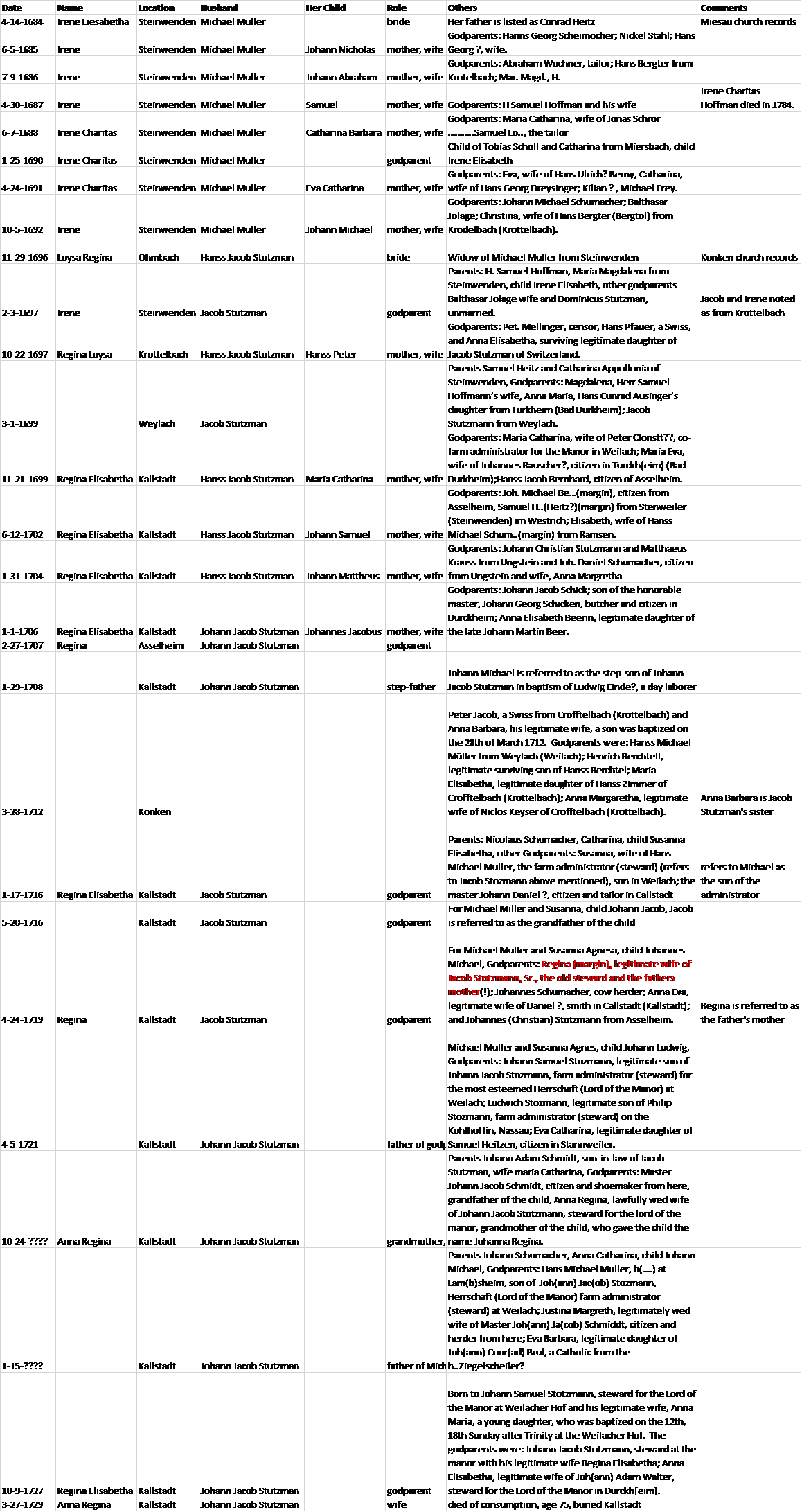
The only time that Irene Liesabetha was used was in the Miesau church records.  In Steinwenden it was always Irene or Irene Charitas. However, I’m often inclined to give more weight to the earliest records, especially if the parents are present as well as others who knew the person. Due to illiteracy, however, it’s impossible to know if what the priest or minister heard was what was meant to be conveyed. If the person was married in the same church where they were baptized, the person recording the marriage could check with earlier records.  However, the Miesau records, today, don’t extend back that far, nor do we know where Irene Liesabetha was born or baptized.

We do know that there is a consistent link to Heitz and Hoffman family members through all records, across her life.

I notice that her name changed from Irene or Irene Charitas to Loysa Regina, Regina Elisabetha or simply Regina when the family moved to Krottelbach.  However, there was one Irene record after she married Stutzman, and it was in the Steinwenden church records, not the Krottelbach/Konken church records. So, it would certainly appear that Irene and Regina are the same person, given that they are married at the same time to Johann Jacob Stutzman.

This name change is what threw me, and every other researcher in this line before Chris and Tom.  It’s unlikely that a name would “change” entirely, but in this case, the evidence is very convincing when combined in total that indeed, Irene Liesabetha is Irene Charitas is Regina Loysa, Loysa Regina, Regina Elisabetha and finally, Anna Regina.

Was Charitas only a “pet name” used about the time that the Elder Irene Charitas Hofmann born Beuther passed away? Was Irene Charitas Schlosser named after Irene Charitas Hofmann born Beuther as well?

If you thought you were confused before, you’re probably even more so now. I was, until we looked at every single record and weighed evidence including when the names changes, with moves, when and where she stood up as a godmother – and the fact that she was still called Irene in her home church of Steinwende as Jacob Stutzman’s wife after “Regina,” identified as Michael Muller’s widow had married Jacob Stutzman.  And then, of course, she is identified in the margin, no less, as the mother of Johann Michael Muller the second, “the father’s mother” many years later when Michael’s child was baptized.

Of course, Jacob Stutzman is also referred to Johann Michael Muller’s father, and he wasn’t. Jacob was Michael’s step-father, but the only father he had ever known.

So many twists and turns in this labyrinth.

I’ve given up entirely identifying Michael’s mother’s “actual” name, but I’m satisfied that I’ve determined that this woman of many names is actually the same person.

Will the Real Irene Charitas or Regina Loysa or Whomever, Please Stand Up?

How can the same woman’s name vacillate back and forth so much?

And just when I had come to the conclusion (which I’ve changed my mind about umpteen times now) that Irene, the mother of Johann Michael Mueller (the second) had clearly died between 1692 and 1696 – Jacob Stutzman’s wife is referred to as the MOTHER of Johann Michael Muller in 1719.

His MOTHER.

The one thing we do know beyond any doubt is who Michael’s mother actually is – and she’s Irene as recorded his 1692 birth record.

So, if the woman in 1719 was Michael’s mother, then she had to have been Irene and none other.

So, why is Irene’s name changing, in some cases, entirely?

My only possible explanation for this might be that Irene’s name was actually heavily concatenated. Something like Irene Charitas Elisabetha Regina Loysa with Anna thrown in there someplace too. Yes, that’s bizarre, but no more bizarre than any other explanation.

Furthermore, if she had several sponsors at her baptism, including Samuel Hoffman’s wife, Irene Charitas, and other important patrons, the family may simply have included all names. In that case, the subsequent minister selected the name or names that he wanted to use.

One other possibility is that “Irena,” if said that way, and “Regina” sounded somewhat similar.

Chris suggests that there was some kind of mis-hearing involved here.

“Peasants were often illiterate at that time and more so, women. I would assume Irene Liesabetha was, too. So the minister at her new parish in Konken asked her for her name, which she could not write. Hence, the minister could only refer to what he heard from her. The sound of “Irene” and “Regina” is not too far from each other – especially if you have not ever heard the name “Irene” many times before. Along similar lines “Liesabetha” à “Loysa” could be explained. Yes, it is a vague hypothesis. But I think one that could be added here.”

Having looked at the order of these records, I think the most probable explanation for her name change is that it occurred when she changed churches. I now believe that Irene is really Regina and that she did live as first Michael Muller’s and then Jacob Stutzman’s wife until her death in 1729.

One last sanity check is related to her age in her death record – 75.  This would give us an approximate birth year of 1654 if she had already had her birthday in March when she died.  If not, then she would have been born in 1653.

That means she would have been age 52 when she gave birth to Johann Jacob Stutzman (the second) in 1706.  Not impossible, but also not terribly likely.  Ages were often fluid in death records, unless a very specific age is recorded, like 75 years, 11 months and 2 days. That tells us that the family actually knew a birth date.

Irene Lisabetha married in 1684 to Michael Muller. He was born about 1655, so it’s conceivable that she was about the same age, although 30 would have been older than normal for a female to marry at that time. If she were 20 instead of 30 when she married, that would put her last child born at age 42 instead of 52, and would fit much more reasonably.

Regardless of which year she was actually born, her birth was right after the end of the 30 years war when much of Europe, and in particular Germany, was ravaged and abandoned. Her parents would have lived through at last part of this horrible event. I have to wonder at the circumstances surrounding Irene/Regina’s early life. Was her family burned out of their home? Where did they live? Did they have to move multiple times? Were they essentially vagabonds, subsisting? And where?

Did she have siblings? The only hint we find to answer that question is her continued interaction with Samuel Heitz who was married to Catharina Appollonia and lived in Steinwenden. Records show at least one child, Eva Catharina born in 1721 to this couple.  If Irene had additional siblings, which she surely did, the records stand stubbornly mute.

Questions that we will never likely have answers to.

Mitochondrial DNA

Now that we know that Regina is Michael Muller’s mother, not his step-mother as originally thought, her mitochondrial DNA becomes important in Michael Muller’s genealogy.  She contributed her mitochondrial DNA to her son, but since mitochondrial DNA is only passed on by females, Michael would not have passed this to his children.  Therefore, to find Irene or Regina’s mitochondrial DNA, we have to find someone living today that descends through all females from one of her daughters.

We know that all of her children by Michael Muller (the first) died, but she did have one daughter by Jacob Stutzman; Anna Catharina born in 1699 and who married Johann Adam Schmidt in Konken in 1721.

We know that Maria Catharina Stutzman and Johann Adam Schmidt had a daughter, Johanna Regina, probably not long after their marriage, although the year is obscured in the Kallstadt church book. My “educated guess” would be in 1722 or so. Our Regina was her godmother.

I find no additional records for this family, but if Maria Catharina lived, it’s certainly likely that she had more children, and hopefully, more daughters.

If you descend from Maria Catharina Stutzman Schmidt through all females, I have a mitochondrial DNA testing scholarship for you. Just leave a comment on the blog or drop me an e-mail. Your mitochondrial DNA could provide us with even more insight into the ancestors of Regina that we can obtain in no other way!

Final Thoughts

We finally (I think) have proper parents for Irene Charitas, or at least her father – Conrad Heitz. Her mother is entirely unknown.

I’m so eternally grateful to Chris for finding that record and raising these difficult questions, even if they did cost me and Tom several nights sleep. Working with those two is literally a dream team!

And while this article has been anything BUT fun to write, keep in mind that it was the fact that the record for Bernhardt Schlosser was first found on the tax list, then in the church in Miesau. Had it not been for the combination of events, meaning the tax list with the Schlosser record, the Miller family site and that pointer to Miesau, Chris might never have hunted for, and found, the marriage records for Irene Heitz and Johann Michael Muller. Indeed, this has been a trail of very convoluted bread crumbs! And the birds ate a few along the way.

So, in essence, further digging in the incorrect records (in the same geography) for the wrong family led us to the right family. Genealogical synchronicity, a meaningful or meant to be coincidence? Sometimes, I think the ancestors “help us” as much as they can from the other side. Other times, I think they have a wicked sense of humor and torture us!

I don’t have any regrets about publishing either, even though I was wrong. (Small caveat – there had been A LOT of original work done AND the name had changed, so I didn’t publish rumors.) If I hadn’t published, Chris would never have asked those difficult questions and we would not have found the puzzle pieces we didn’t even know were missing.

Besides that, if you wait until absolutely every rock has been turned, you’ll suffer from analysis paralysis and do nothing. Of course, I’m not advocating the copy/paste type of genealogy – but I am advocating for reasonable research, documentation of the research path, sources and stating why you came to the conclusions you did. That way, there are breadcrumbs for someone in the future, or God forbid, if you have to backtrack on your own work.

Yes, I’m trying to make lemonade out of lemons – but sometimes, other than serving as a learning experience, that’s all there is left to do!

Enjoy some lemonade…on me😊

______________________________________________________________

Disclosure

I receive a small contribution when you click on some of the links to vendors in my articles. This does NOT increase the price you pay but helps me to keep the lights on and this informational blog free for everyone. Please click on the links in the articles or to the vendors below if you are purchasing products or DNA testing.

Thank you so much.

DNA Purchases and Free Transfers

Genealogy Services

Genealogy Research

Baptized in Nicholas Speak’s Church – 52 Ancestors #190

It was a beautiful fall day in the mountains of Lee County, Virginia that October 10th in 2009. Basket sized fall Mums were in bloom, it was still warm and the leaves hadn’t yet begun to turn paintbrush hues that would soon cover the mountainsides.

Descendants of Nicholas Speak, founding minister of the Speak Methodist Church almost 190 years earlier gathered in Middlesboro, Kentucky, a few miles away, for a family reunion.

The highlight would be returning to worship together in the small nearly-abandoned country church NIcholas founded about 1822, as it always was when the reunion was held near the the home of our family. The humble white church sits nestled in the hollow across Speaks Branch Road from the cemetery where our Nicholas is buried with his wife, Sarah Faires, along with many of their children and grandchildren.

The Speak Cemetery isn’t much to speak of, graves marked mostly with field stones of humble settlers who probably had all they could do to clear enough land for a “burying ground.” Tombstones weren’t for poor frontier folk in the wilderness.

Field stones stand eternal sentry over beloved family members; parents, husbands, wives, children, babies – all departed too soon. They would be sorely grieved – for the rest of the lives of the people who now lay in adjacent graves. Joined together forever in the now-anonymous field of stones.

Back then, everyone knew where each person was buried. They had all dug the graves, gathered round as the final sermon was preached, first by Nicholas, and then one day – for Nicholas. Tears streaming down their faces as they sang the song that was sung for every occasion – Amazing Grace – then lowering the casket into the ground and closing the grave. Each person symbolically dropping one handful of dirt onto the coffin, full well knowing that hollow thud meant forever gone.

No one would ever forget that day. No marker with a name was needed.

Want to visit with Nicholas? Just walk across the road after church and sit a spell.

The Speak cousins, more than 100 years after Nicholas’s death in 1852 and Sarah’s in 1865, bought a memorial stone for Nicholas and Sarah, although by this time no one knew where in the cemetery they were actually buried. Their blood and that of generations of family members was scattered everyplace here.

Nicholas and Sarah’s cabin remained across the road until in the 1970s, when it was disassembled, before it fell completely down, and combined with another log cabin into a lovely log home near Middlesboro.

Nicholas and family would have walked a short distance to the church every Sunday morning for Nicholas to preach to his ever-expanding congregation of family, friends and neighbors, some of whom came quite some distance from the northern part of then-Claiborne, now-Hancock County, Tennessee.

How do we know this? Nicholas deeded the land where the church was built to church trustees, some of whom were neighbors in Claiborne County to the family of the young man, Samuel Claxton, who would marry Nicholas’s granddaughter in 1832. You can’t marry who you don’t see. In fact, Nicholas probably married the couple right in this very church, about 78 years before the picture below was taken around 1910. This building is believed to be the third church building which doubled as a school, but the first two were in the same location.

Our church service was held on Saturday during the reunion, because the volunteer minister, Tracy McPherson, worked full-time in the coal mines during the week as well as volunteered to preach in two other small churches. Speaks Chapel only had a preacher every third Sunday. With a whopping attendance of 6 people, the pews in this quaint country church were mostly empty.

They wouldn’t be today!

We filled the pews and breathed joy-filled life back into that church so cherished by our family!

The cousins who so graciously organized the reunion assembled a keepsake program.

How many remember the fans from before churches had air conditioning?  When I was a kid, they were wedged in the back of every pew, along with the hymnals. Most of us didn’t need the hymnals, but everyone needed fans!

All southern church services MUST have a program, so ours did too. Not only that, our lovely cousin, Dolores, prepared a history. Others assembled a worship service song book too. Most of us knew the words by heart anyway.

Led by Bill Hall, we began with Church in the Wildwood and ended with Amazing Grace, all sung without musical accompaniment. Our melded voices, echoing off the mountains in the distance, drifting up the hollers, were music enough. I hope Nicholas could hear the choir of his descendants, come home one last time.

Indeed, we raised our voices and made a joyful noise, well…at least noise.

How fitting this hymn, given where Nicholas decided to settle.

My wonderful cousin, Lola-Margaret Hall, twice descended from Nicholas and his wife, Sarah Faires Speaks paid us a visit in the persona of Sarah. “Sarah” mesmerized us that day with the story of her life; married to Nicholas, settling in the wilderness, carving out a home and founding the church. Her voice, transporting us all back to the early 1800s as she rocked, reminisced and read from the Bible, sitting near the pulpit where Nicholas would have preached his version of Salvation. We rode along in the wagon with “Sarah” as she and Nicholas left Washington County, crossing mountains, headed into an uncertain future and untamed frontier in Lee County, transcending time into the misty past, sharing experiences.

Although most of us were “returning home,” not all of Nicholas’s descendants left for greener pastures. Jewell Davis, now deceased, and her family lived next door and cared for the church and cemetery for many decades – including preparing a lunch for the reunion that day.

Dolores Hamm, on behalf of the family presented Jewel with a plaque and a Bible of course, what else? Jewel now rests with Nicholas.

Preacher Tracy, Bible in hand, delivered a special message.

Then, it seems that Preacher Tracy had a few questions for me.

Anyone know what the pitcher and bowl are for?

For those who aren’t aware, Methodists don’t practice full immersion baptisms. We fondly call them “sprinklings.” Or maybe that’s the Baptists that call Methodist baptisms sprinklings.

Regardless, somehow as a child I think I managed to escape being baptized, but I’m not entirely sure. For some reason, I always thought I was baptized as a child in the Methodist church my mother and grandmother attended. If so, I have no memory of the baptism, just fond memories of belting out “Jesus Loves Me” at the top of my pre-school lungs.

I always presumed that I had been baptized as an infant or young child, because I wasn’t baptized when I was older in a subsequent Methodist church we attended, and by the time we moved again and I attended a Baptist church, I think there was an assumption that I had previously been baptized because I was allowed to take communion.

Then, one day, many years later, someone asked me when I had been baptized? It occurred to me that I really didn’t know. It wasn’t written in mother’s Bible, or in either of the Bibles that I had received from the church, and by that time, there was no one left to ask.

Regardless of the circumstances, I felt that there was no better time or place on this earth, literally, than in the very church where Nicholas would have baptized so many, and in the embrace of my loving family. I had more relatives gathered that day with me in this small country church that I’ve had any time or place since.

Thank you to one of my wonderful cousins for this photo collage of an incredibly emotional event, for all kinds of reasons, to Preacher McPherson, and to Nicholas. Little did Nicholas know his legacy would reach 6 generations and almost 200 years into the future, and still counting.

What better way to honor Nicholas than to be baptized in his church and to share the story with you this Easter Sunday.

I have yet in my lifetime to get through Amazing Grace dry-eyed. Literally, it is the universal hymn played for every emotional event of my lifetime, including the funerals of my mother, step-father and siblings.

______________________________________________________________

Disclosure

I receive a small contribution when you click on some of the links to vendors in my articles. This does NOT increase the price you pay but helps me to keep the lights on and this informational blog free for everyone. Please click on the links in the articles or to the vendors below if you are purchasing products or DNA testing.

Thank you so much.

DNA Purchases and Free Transfers

Genealogy Services

Genealogy Research

Mom’s Joyous Springtime “Mistake” – 52 Ancestors #189

This is that week.

There’s one day every fall where I feel like I’ll never be warm again. I know that the earth is becoming dormant, gradually descending into what feels like eternal darkness, and I hate it. For months, when there is some semblance of light, it’s either snow or grey. Because I can’t hibernate, I just have to suck it up and dress like the Michelin man until the equivalent day arrives in the spring.

The spring equivalent day generally arrives sometime around the vernal equinox, generally around March 20th, when I actually FEEL hope in my soul. The days are getting longer, there’s light and blue replaces grey in the sky. The sun feels warm again instead of mocking me by peeking out for about 30 seconds per day, and part of the snow has melted. My cousins down south are already posting pictures of tulips on Facebook.

If I look hard in the garden, in polka dot areas where the snow had already melted, I can find something resembling spouts from a plant peeking up.

A robin is staring down at me from a tree branch, and the Sandhill Cranes with their squeaky-gate-hinge cries are complaining loudly because they can’t get to the grasses through the snow in the field behind the house.

Groggy raccoons, skunks and possums are waking up, VERY HUNGRY and staggering around like drunken sailors on their first shore leave. Squirrels are excitedly scampering across the porch, tails held high, retrieving last fall’s nuts.

Hope is in the air.

My body aches less and I cherish any tiny spot of color.

Yesterday, tiny red succulents, above, just an eighth of an inch across poked their heads out, and today, my daughter messaged me early crocus photos from bulbs newly planted last fall. At least there are a few that didn’t serve as chipmunk food. I’m hopeful that my bulbs will emerge shortly.

I am desperate for color and flowers like the most addicted junkie.

Yesterday’s Springs

It’s also this time of year that I harken back to my childhood and recall those long-ago springs of yesteryear. Life just seemed so much simpler and happier then.

Some of my fondest memories are of pink Easter dresses and white patent leather shoes with lacy anklets. I had to wear white gloves to church, but I didn’t care because Easter Sunday, new dresses and wearing gloves made me feel special. Sometimes, I had an Easter hat too, and a new spring coat, if it was a good year. Springtime rituals connected to the re-emergence of Mother Earth.

It was so liberating to shed those old depressing winter clothes and skip along the sidewalk once again, relishing spring green, cherry blossoms and warm breezes.

To me, spring is the most joyful time of year – when my soul sings out loud because nature is exhilaratingly beautiful and fresh. Everything comes alive in a chaotic rush of optimism. Even dandelions are welcome, because they are alive, bright and yellow. Yes, I’m just that desperate, waiting like a kid at Christmas for the first dandelion of the season.

For some reason, this time of year, I always think about spring traditions when I was a child. Perhaps spring elicits these feelings because we didn’t visit much in the winter. Roads were slick and treacherous, and the time between Christmas and warm seemed interminable and difficult.

As winter began to yield its icy grasp, I vividly remember Sunday rides to purchase maple syrup and visit my grandparents. At grandmother’s house, birds began chirping as I listened through freshly opened windows at the drip drip of melting snow splashing around the house, before houses had eavestroughs and downspouts. 

My grandparents’ house had a magical quality, and I always looked forward to some special activity with my grandmother.

Sometimes we baked cinnamon sugar pie dough in the bottom of a pie pan.

Sometimes she “let” me dust her dining room shelves. It’s amazing what you can convince a child to do if you tell them it’s a special honor. I’ve tried that tactic with my husband and kids, and it never worked!

Today, the salt shakers that I used to dust on her shelf are in my display case, chosen by my grief-stricken 4-year-old self as a memento when she suddenly died in the depths of winter-hell.

Sometimes we walked around the yard and looked for the first daffodil and the Easter Bunny. I always knew right where to look for the daffodils, but that Easter Bunny always managed to elude me! However, I did often find a basket he somehow left behind, hidden beneath the Spirea bush, along with some telltale colored eggs! I never did understand how a male rabbit could lay colored eggs, but I digress…

The best times were when my grandmother and Mom and I retrieved the old box of pictures from the attic. Sure, we had sorted through them many times before, but it was always just so much fun.

I asked questions, often the same questions I had asked before. I loved hearing the tales that made the pictures come alive. Mom or my grandmother would tell me the same story over again, sometimes each interleaving sentences with the other – often injecting some new twist or wrinkle. Of course, it was up to me to catch the change and ask a million or so questions.

One particular picture was always sure to cause peals of laughter. We all anticipated it and looked forward to it peeking out from under the pile.

Mom, with a wink, always made up a new story to go with the picture.

I couldn’t wait to find that photo under the others, but it would have been cheating to rifle through, so I tried to wait patiently until it appeared.

Early Photography

When my Mom was young, cameras had film rolls that you loaded onto a spindle. After you took a picture, you had to advance the film using a lever or knob, or you would take a second picture right over the first one. That’s called a double exposure, and it wasn’t a good thing. First, you’d ruin both photos, and you wouldn’t know until you paid to have them processed and printed, often weeks or months later.

By comparison, digital photos today are wonderful.

Mother danced – tap and ballet with some gymnastics thrown in. I think today that’s called expressive dance, and she was always practicing. Everyplace, all the time.

Even in the yard. She and a friend named Mary Lu lived in the same small town and danced together. Both eventually turned professional, as in the American Ballet Company, not exotic, in case you were wondering.

In the spring, they too felt released because they could free themselves by practicing outside.

My grandmother alleged as how spring freed her too. Incessant dance practice wasn’t exactly quiet. My grandfather spent a lot of time in the barn with the chickens.

In 1933, the family acquired their first (used) camera, in trade for chickens from someone who had nothing else to pay with. My grandfather took almost anything in trade during the Depression. In fact, if you couldn’t pay, he would give you what you needed anyway, which is why his hardware store went bankrupt.

A few years later, my mother was allowed to very occasionally use the camera. After all, film and processing was an expensive luxury, and the Great Depression was still in full swing. In fact, it never ended in their minds. Everything was always an unnecessary expense. That terrible dozen years of hardship and fear left an indelible mark on both generations.

Just the same, Mother and Mary Lu commenced taking pictures, but the number of photos they were allowed was strictly rationed.

Pictures had to be planned very carefully! There were no autofocus tools like today and any small movement caused a blurry picture.

Some weren’t entirely in focus.

While Mom had to practice the traditional tap and ballet routines, her joy came from “custom” rather “outrageous” dance routines that combined the two, plus moves and steps of her own not choreographed by either dance style. 

Mother said she and Mary Lu danced in the yard and on the sidewalks of the tiny crossroads village of Silver Lake, as well as on the porch – desperate to be released from the winter confines of a house. The Spirea is blooming in this picture, so I know it’s spring.

Much sought after dancers for their unique performances, they often practiced dual or difficult routines in the grass, because falling outside was softer than on hardwood floors. No one had carpet then and gymnastic pads simply didn’t exist.

The first photos went pretty well.

Until they forgot entirely about winding the film.

I’m not sure exactly why we thought this picture was so funny. Perhaps it was the way that Mom whispered about her doing handstands on her own “behind,” much to my amazement. Like we girls were sharing something super-secret.

Today, this photo belongs to me, and I still can’t look at it without laughing, along with bittersweet memories.

I can hear Mom’s voice in a far-away room. I can see the three of us at the table and hear the rustling of photos in that old cardboard box. I can eavesdrop on the various stories about what this picture was, and how it happened.

Maybe it was Mary Lu who had to walk on her hands, standing on Mom’s behind. Maybe it was when they performed for the circus. Maybe the story didn’t matter, just the fact that we were having so much fun together – three generations at the old wooden table with the rickety chairs, now in my attic.

Maybe it was because I lost my cherished grandmother soon after, and suddenly, there were no more days at the table, sitting in her lap.

I can hear, distantly, over the span of half a century, my grandmother admonishing mother with a smile, “Now Barbara Jean…” when mother made up a particularly good story. Then we laughed, all over again!

I think, in truth, my Mom and grandmother were just amazed at how well this silly mistake turned out. Lemonade out of a lemon. 

When I saw this picture, I always imagined my Mom daydreaming in the springtime about dancing on the big stage – which she went on to do, professionally.

Somehow seeing my beautiful mother’s dreamy young face gave me permission as well, along with the courage to risk making mistakes. I had no idea then how courageous mother actually was.

Afterwards, I would always run outside and dance in the yard. Spinning, doing pirouettes, falling down. I was terrible, but it didn’t matter, because I was doing it with all of my heart and inspiration, unafraid and entirely unphased by potential failure. Failure was only in not dancing.

I still approach life that way today.

We got so much mileage out of that “mistake.”

Whoever would have thought that it would transcend 5 generations.

I’ll be sharing this picture and story with my granddaughters this weekend. Hope and inspiration in this season of renewal seem appropriate attributes to infuse into future generations. One could even argue that perhaps this is the most important legacy my mother could have left – all through a “mistake.”

Clearly, it was no mistake. I’d rather call it divine inspiration or unrecognized potential. Mistakes are often only a matter of perception.

What is your favorite joyful family photo that makes you laugh or inspires you, and why?

______________________________________________________________

Disclosure

I receive a small contribution when you click on some of the links to vendors in my articles. This does NOT increase the price you pay but helps me to keep the lights on and this informational blog free for everyone. Please click on the links in the articles or to the vendors below if you are purchasing products or DNA testing.

Thank you so much.

DNA Purchases and Free Transfers

Genealogy Services

Genealogy Research

Ollie Bolton’s Inferred Mitochondrial DNA Haplogroup – 52 Ancestors #188

Try as I might, I’ve never been able to find a second DNA tester to discern my paternal grandmother, Ollie Bolton’s mitochondrial DNA haplogroup.

Why do I need a second person tested, you might wonder?

My aunt Minnie, my father’s sister, tested back in 2004 when full sequence mitochondrial DNA testing was not yet available. She had been estimated to be haplogroup H at that time, based only on the HVR1 region.

Minnie was 96 at that time and passed away just 8 months shy of her 100th birthday. Yes, this family seems to have a longevity gene. Minnie’s sister died at 99 and her father, William George Estes, at age 98. Her great-great grandfather, John R. Estes at 98 and his father, George, at 96. Now, if I could just figure out which gene it is that confers longevity, maybe I could figure out if I have it and more effectively plan the rest of my life😊

Later, when I ordered an upgrade to the Full Mitochondrial Sequence, my aunt’s DNA was no longer viable.

Ever since, I’ve been trying to find someone, anyone, descended appropriately from this line to do a full sequence mitochondrial DNA test – without luck.

A few days ago, I received a notification from Family Tree DNA that my aunt has another HVR1 match. Normally, I don’t even bother to look anymore, but for some reason, I did that day.

What I saw amazed me, for two reasons.

First, apparently her originally estimated haplogroup H was incorrect and has since been updated. She is now haplogroup J. This happened during the upgrade to mitochondrial version 17 where many new haplogroups were introduced, including J1c1e, shown repeatedly on her match list above.

It’s very difficult to estimate a haplogroup based on just HVR1 mutations. As it turns out, haplogourp defining location T16368C is also found in haplogroup H3x. My aunt has additional mutations that aren’t haplogroup defining, but that do match people in haplogroup J1c1e, but not H3x.

Second, Minnie matches a total of 72 people at the HVR1 level. Many haven’t tested beyond that level, but a good number have taken the full sequence test. Based on the fact that she matches the following people with full sequence haplogroups, I’d say she is very probably a haplogroup J1c1e, based on this alone:

  • Haplogroup J1c1e – 28
  • Haplogroup J1c3b -1

Haplogroup “J only” matches don’t count, because they did not test at the full sequence level.

What’s the Difference?

This begs the question of the difference between haplogroup J1c1e and J1c3b. These two haplogroups have the same haplogroup defining mutations through the J1c portion, but the 1e and 3b portions of the haplogroup names signal different branches.

In the chart below, J1c1e and J1c3b both have all of the mutations listed for J1c, plus the additional mutations listed for their own individual branches.

Haplogroup HVR1 HVR2 Coding Region
J1c C16069T, C295T, T489C, C462T, A10398G!, A12612G, G13708A, G3010A,  T14798C
J1c1e T16368C T10454C T482C, T3394C
J1c3b C13934T,  C15367T

There’s a hidden gem here.

Since haplogroup J1c1e includes a haplogroup defining mutation in the HVR1 region, and haplogroup J1c3b does not, we can easily check my aunt’s results to see if she carries the mutation at location T16368C.

Look, she does.

Furthermore, the only other subgroup of haplogroup J that my aunt matches that includes this mutation is haplogroup J1c2m1 which also carried a mutation at A16235G, which she does not have. This eliminates the possibility that she is haplogroup J1c2m1.

Given the information we do have, and given that it’s extremely unlikely that I’ll ever find a tester, I’m good with inferring that Ollie Bolton’s haplogroup is J1c1e.

J1c1e

What can we learn about the origins of haplogroup J1c1e?

My aunt’s matches map shows the following European cluster.

The top 3 matches have taken the full sequence test.

The pattern is quite interesting. Looks like someone crossed the English Channel at some point in time, probably hundreds to thousands of years ago.

The haplogroup J project at Family Tree DNA has not yet been regrouped since the conversion to mitochondrial V17, so the J1c1e individuals are included in the J1c1 group.

Of course J1c1 is the mother haplogroup of haplogroup J1c1e, so the map above shows the distribution of people who are haplogroup J1c1. There are other subgroups of J1c1 that have their own map and would be included in this map if they didn’t have their own subgroup. I’m sure haplogroup J1c1e will have its own group as soon as the admins readjust people’s groupings based on the new haplogroup divisions.

According to the paper, A “Copernican” Reassessment of the Human Mitochondrial DNA Tree from its Root, by Behar et al, published in 2012, the age of the birth of haplogroup J1c1 is approximately 10,090 years ago, with a standard deviation of 2228 years, so a range of 7863-12319 years ago.

Of course, haplogroup J1c1e was born some time later. Unfortunately, the mitochondrial tree aging has not been updated to incorporate the new information included in the V17 migration which includes the definition of haplogroup J1c1e.

Where was haplogroup J1c1 born 7863-12319 years ago? Probably the Middle East, but we really don’t know positively.

Not Just Ollie’s Haplogroup

The great thing about mitochondrial (and Y DNA) testing is that it’s not just the haplogroup of the person who tested.  For mitochondrial DNA, it’s the haplogroup of their mother and their mother on up the mother’s direct matrilineal line.

In Ollie’s case, all of these people carry haplogroup J1c1e.  It descended to Ollie, and then to all of her children, including her son. Only her female children passed it on.

Summary

It’s amazing what we can learn from a mitochondrial DNA match – and in this case, someone who only had the HVR1 region tested. Minnie was fortunate to have a  haplogroup defining mutation in the HVR1 region along with other mutations that match J1c1e individuals. Luck of the genetic draw.

Some of those additional mutations may also be haplogroup defining in the future.

I never thought I’d unearth this information about my grandmother, Ollie Bolton, especially since I only started out with a shred of information. I’m so glad I checked one last time.

Never give up.

Never stop checking!

Note to self: Patience is a virtue! Probably even a more critical virtue if you also inherited that longevity gene.

______________________________________________________________

Disclosure

I receive a small contribution when you click on some of the links to vendors in my articles. This does NOT increase the price you pay but helps me to keep the lights on and this informational blog free for everyone. Please click on the links in the articles or to the vendors below if you are purchasing products or DNA testing.

Thank you so much.

DNA Purchases and Free Transfers

Genealogy Services

Genealogy Research

Finding George McNiel’s Brother, Thomas, Using DNA – 52 Ancestors #187

The story of the Reverend George McNiel includes the oft-repeated 3 brothers story, and one of the three brothers in this version was named Thomas, or so the legend goes.

I’m used to 3 brothers stories, sometimes used to explain men of the same surname but with no paper trail connection, and I had rather discounted this particular version. I’ve just heard this same story about different families too many times.

That is, I discounted it until droplets of doubt arrived, served up by records in Spotsylvania County where George McNiel lived. In 1754 records included Thomas McNial, then again in 1761, followed by records of one Thomas McNiel in Caswell County, NC about the same time that the Reverend George McNiel migrated from Spotsylvania County to Wilkes County, NC.

From the book, Apprentices of Virginia, 1723-1800:

James Cartwright, a white male, son of Thomas Cartwright decd, was to be apprenticed to Thomas McNial on October 1, 1754 to learn the occupation of a tailor. This is from the Spotsylvania County court order books, 1749-1755, pages 62 and 497.

James Pey, a white male, to be apprenticed to George McNeil on March 1, 1757 to learn the occupation of tailor. From Spotsylvania will book B 1749-1759, page 307.

Robert Mitchell, a white male, was apprenticed to Thomas McNeil on Sept 7, 1761 to learn the occupation of tailor. Spotsylvania County will book B, 1749- 1859, page 540.

I discovered that both George and Thomas were tailors, or at least had tailors on their plantations. Was this possibly an indicator that these men might have both been tailors themselves. With the same surname and same occupation, perhaps that they were related in some way? Was this just a coincidence, or could the “brothers” story be true?

Generally, tailors weren’t needed in the farming countryside, so that tidbit might well mean these men worked either in cities or in wealthy households before immigration. If they were tailors, they themselves would have been apprentices someplace.

More than a decade ago, I worked with another researcher who descended from Thomas McNeil who lived in Caswell Co. He made his will dated April 20, 1781 in which Thomas named his three sons; Thomas, John and Benjamin.

Thomas McNeil’s will:

In the name of God Amen I Thomas McNeil of Caswell Co NC being weak of body but sound of mind and memory do April 20th 1781make this my last will and testament in the manner following. I give unto my living wife Ann the use of all my personal estate during her life or widowhood. I give unto my son Thomas a tract of land lying on Sanderses Creek containing 200 acres which land I bought of my son John and my desire is that my said son John do make a right of said land to my son Thomas. I give unto my son Benjamin 150 acres joining the lines of Andrew Caddell and my son John Land to him and his heirs forever. I give to my daughter Mary 100 acres of land lying on Henley’s Creek joining Wilson Vermillions line to her and her heirs forever. At the death of my loving wife that my sons Thomas and Benjamin have each of them a horse and saddle and a bed which horses to be of the value of 10 pounds in specie also the plantation working tools I desire may be equally devided between them. I further give unto my daughter Mary one feather bed and furniture and two cows and calves after the death of my loving wife. All of my negroes and their increase after the death or marriage of my loving wife be by three honest men equally divided amongst my 8 children, or the survivors of them, to wit John, Thomas, Benjamin, Elizabeth Roberts, Nancy Vermilion, Mary, Patsey Hubbert and Lois to them and their heirs forever. Lastly I nominate and appoint my wife Ann , my son John and my son-in-law Wilson Vermillion and George Lea (son of William) executors of this my last will and testament revoking all other wills by me made in witness whereof I have hereunto sett my hand and seal…signed. Witnessed George Lea, Lucy Lea, John Clixby. Proved Dec court 1781.

At that time, no relationship had been established between this Thomas and the McNeil’s of other counties.

That McNeil researcher was unable to recruit a male McNeil family member to DNA test, so for more than a decade, this research languished with no way to answer the question of whether George McNiel and Thomas McNeil were indeed brothers.

Migration

Beginning in Spotsylvania County, the journey to Wilkes County is about 337 miles, and the old rutted wagon road passed through Caswell County on the way. At about 10 miles per day, that’s a total of about 34 days, assuming nothing went wrong. It makes you wonder if Thomas just got tired of the wagon lurching and bumping along the trail and said, “I’m done, drop me off here” about 3 weeks into the trip.

It’s about 135 miles from Caswell County to Wilkes County, with Wilkes being in the mountains along the Blue Ridge Parkway. At that time, this was the frontier, and the mountains, the barrier to the next one.

Were Thomas and George Brothers?

Today, we have an answer, or at least a probable answer, thanks to Y DNA testing.

Aside from paper documentation, which we don’t have, the only way to obtain relationship evidence is by DNA testing, specifically the Y chromosome passed from father to son in every generation and not mixed with any DNA from the mother. This means that the Y chromosome is passed intact from father to son for many generations, except for an occasional mutation. The Y DNA of men who were brothers in the 1700s should match very closely.

The Rev. George McNiel’s Y DNA line is represented by two known descendants from different sons’ lines, so we know the haplotype of his DNA, meaning the STR value numbers that cumulatively read like a DNA fingerprint.

I hadn’t checked the Y DNA results of my cousin who tested to represent the Reverend George McNiel’s line in some time, so I decided to take a quick look. What a welcome surprise was waiting.

At 67 markers, our George McNiel’s descendant’s best match is to a descendant of Thomas McNeill of Caswell County. Wooohoooo!

Unfortunately, the match has not taken the Family Finder test, which might show how closely he matches to the descendants of George utilizing autosomal DNA. Of course, given how many generations back in time those men lived, their descendants might not match autosomally. But then again, some might!

Not only that, but George’s descendant matches more closely to Thomas’s descendant than to another descendant of George. Just the way the DNA dice rolled in terms of when mutations happened.

Looking at the public McNiel project display, there are several McNeil men along with other spelling variants that fall into the Niall of the 9 Hostages grouping characterized by haplogroup R1b>L21>M222.

Please note: You can click to enlarge any graphic.

These men look to have descended from a common ancestor far back in time. You can easily see that there are specific clusters of men who match each other on particular allele values. My cousin who tested to represent George McNiel’s line is highlighted in blue.

Unfortunately, not one man in this group has taken the Big Y test for further haplogroup refinement. Hmmm, we might have to do something about this.

Matches Happen

But, there’s more information on my cousin’s McNiel match page that wasn’t there before. Much more. Each match provides clues that I’ve compiled into the following table:

GD* Ancestor Location Comments
1 – 50th percentile at 3 generations Thomas McNiell 1724-1781 Caswell Co., NC Probably George’s brother
3 – 50th percentile at 4 generations Thomas MccNiell married in 1750 Rombout, NY Ancestry shows Thomas married to Rachel Hoff, English christening records shows a Thomas Macneil born to Gilbert MacNeil in Witton Le Wear, Durham, England in 1699.
5 – 50th percentile at 6 generations Hugh Neel b 1750 Ireland Ancestry shows born Ireland, lived in Camden Co., SC, died after 1792 in KY
7 – 50th percentile at 12 generations Edward McNellis 1816-1888 Died Glennageeragh, Tyrone, Ireland Father may have been Frank who died in Glenncull, Ballygawley, County Tyrone

*GD=Genetic Distance. The percentile was calculated by using the TIP calculator which estimates the average number of years to a common ancestor. I used the 50th percentile number of generations.

The information gleaned from these matches, in closest to furthest match order, above, can yield clues to where our McNiel line was before immigration in addition to further back in time.

The oral story says that George came from Edinburg, Scotland after studying for the Presbyterian ministry which tells us that he might have traveled to Edinburgh from elsewhere. There is no evidence to either confirm or refute this historical nugget. If George left from Edinburgh, it stand to reason that Thomas probably did too.

At a genetic distance of 3, a second Thomas McNiell, was reportedly born in Witton Le Wear, which is found about 95 miles south of Coldstream, which sits right on the border of England and Scotland. As you can see on the map below, Coldstream isn’t far from Edinburgh.

This does assume the Thomas born in Witton Le Wear is the same Thomas subsequently found in New York. I have not verified that information.

The Neel line with a genetic distance of 5 was born in Ireland, but they don’t know where.

The match with a genetic distance of 7 hails from Glennageeragh. On the map below, at the blue dot, we find the location of Glennageeragh Townland in County Tyrone, Northern Ireland.

County Tyrone was one of the seated plantation regions, meaning that many Scots immigrated here. However, there is much more history involving the McNiel family in County Tyrone from before the Plantation Era when displaced Scots were settled in Ireland.

The picturesque townland of Glenncull, near Glennageeragh, where Edward McNellis’s father may have died is shown in the photo below.

Interestingly, the town of Ballygawley is also known as “Errigal-Kerogue” or “Errigal-Kieran”, supposedly from the dedication of an ancient church to St. Kieran (Ciarán of Clonmacnoise). It was in the Clogher (barony), along the River Blackwater, Northern Ireland. Some of the remains of the old church were known, and an ancient Franciscan friary, founded by Conn O’Neill, 1st Earl of Tyrone. In the churchyard was a large stone cross, and a holy well.

Conn O’Neill was born in 1480 and died in 1559, both in Ireland. In 1541 he travelled to England to submit to the Henry VIII as part of the surrender and regrant that coincided with the creation of the Kingdom of Ireland and was subsequently made Earl of Tyrone.

Conn Bacach O’Neill was the son of Conn Mór O’Neill, King of Tír Eógain (Tyrone), and Lady Eleanor Fitzgerald. Con Mor O’Neill was the son of Henry Ó Néill, King of Tír Eógain. Eleanor Fitzgerald was the daughter of Thomas FitzGerald, 7th Earl of Kildare. Con Bacach O’Neill was the first of the Ó Néills whom the English, in their attempts to subjugate Ireland in the 16th century, brought to the front as leaders of the native Irish. His father, the King of Tír Eógan, was murdered in 1493 by his brother.

Conn’s grandson, Hugh O’Neill, Earl of Tyrone, was born in 1550 and came to the throne in 1587, crowned in 1595, and died in 1607.

George and Thomas McNiel were born sometime around 1720. Based on oral history, it’s suggested that they came to Maryland from Scotland sometime around 1750, as adults. The story further reveals that George had studied at the University of Edinburgh for the Presbyterian ministry and that the brothers argued about religion on the ship, during the long Atlantic crossing. George reportedly “saw the light” and became Baptist, but one of the brothers was so upset about the religious discussions during this adventure that he changed the spelling of his name to McNeill.

If that’s true, then the unhappy brother must be the third missing one, possibly named John, because Thomas and George lived in the same vicinity from about 1750 to at least 1761.

My observation is that names were spelled every-which-way in records during that time, with very little consistency – so a name change without other evidence would not indicate a dispute.

So, Is Thomas George’s Brother or Not?

Unfortunately, we can’t draw an entirely 100% firm conclusion.

The first piece of evidence is that the Y DNA clearly did not rule out a relationship. In fact, it confirmed a close relationship, but we can’t say how close from Y DNA alone.

We already know that George’s descendant matches Thomas’s descendant more closely that George’s second descendant.

So, yes, it’s very, very likely that these two men were brothers or closely related.

Autosomal tests could potentially help. I’ve e-mailed and asked the McNeil matches if they would consider upgrading to a Family Finder test. However, in a situation like his, without some paper documentation, given the number of generations between now and then, there is no way to prove absolutely that George and Thomas were brothers, as opposed to cousins, or uncle/nephew, etc.

While we can’t positively prove that George and Thomas were siblings, we can potentially look a bit further back in time by determining the terminal SNP of our McNiel line. Perhaps it’s time for me to order a Big Y test for George’s descendant.

I’m hopeful that looking back in time through the lens of the Big Y test will unwrap even more about the early history of the McNiel men, before the adoption of surnames or where these men lived when surnames were adopted. From that surname-adoption location, whereever it was, it appears that the McNeil men by whatever spelling spread throughout Ireland, Scotland and to parts of England.

Perhaps George and Thomas McNiel descended from a long line of adventurers.

And to think all of this information emerged from George’s descendant’s Y DNA matches. Amazing!

______________________________________________________________

Disclosure

I receive a small contribution when you click on some of the links to vendors in my articles. This does NOT increase the price you pay but helps me to keep the lights on and this informational blog free for everyone. Please click on the links in the articles or to the vendors below if you are purchasing products or DNA testing.

Thank you so much.

DNA Purchases and Free Transfers

Genealogy Services

Genealogy Research

The Ferverda Bible – 52 Ancestors #186

Hiram B. (probably Bauke, “Baker” in English) Ferverda (1854-1925) married Evaline Louise Miller (1857-1939) on March 10, 1876 in Goshen. Indiana. At least, that’s where their marriage license was filed.

Beyond that, and knowing that they were both Brethren, until 2010, we knew absolutely nothing more about their wedding, except that Brethren weddings, like Brethren anything, tended to be very humble and austere. No color, no decorations, and maybe even no ceremony at all. Just you, your parents perhaps, the minister, a couple of required witnesses (dang those manmade laws anyway) and the Lord.

In October 2010, my cousin, Cheryl, arranged to have a family reunion in a church in northern Indiana, not far from where the Ferverda and Miller families lived.  Cheryl’s father was Roscoe Ferverda, brother to my grandfather, John Whitney Ferverda.

I was looking forward the reunion because I had never met any Ferverda cousins except for Cheryl, her sons and her brother Don. My mother had moved away from the area as a young adult.

Upon arrival at the church that beautiful fall day, Cheryl said, rather nonchalantly, that she hoped that the person with the Ferverda Bible attended.

“WHAT FERVERDA BIBLE????????”

Had Cheryl been holding out on me?

No, Cheryl said, when she called some of the distant cousins to invite them, someone mentioned that someone had a family Bible.

Notice the number of “someones” in that sentence. I had been down this road before on other family lines. If in fact “someone” did have a Bible, it almost was never the right family line. It was almost always someone’s wife’s second cousin’s half sister’s Bible that was purchased at an estate sale.

Never, almost never, my line.

So when I heard Cheryl’s comment, I didn’t have much hope and went back to covering tables with white plastic lace covers and placing edible center pieces.  This was, after all, the “sweet-tooth” Ferverda family, and “edible” is important.

People began arriving and chattering. I felt rather like a stranger in my own family, because while everyone else greeted people they recognized, I knew absolutely no one.

I introduced myself and told people who I was. Everyone was kind and cordial, but there was no spark of even remote recognition.

After all, it was 2010 and my mother had died 4 years earlier and moved away some 70 years before that. 

Nonetheless, people brought photos with them and told stories, and we had a wonderful time eating and (no drinking) and sharing family stories. The Ferverda family certainly doesn’t lack in that capacity, either eating or storytelling. They may have been Brethren, but they were neither dead nor boring. In fact, they weren’t always terribly compliant, it turns out.

About half way through the reunion, I asked Cheryl who was supposed to bring the Bible. She found the person, and asked if they had remembered.

“Oh,” they said, “I forgot.  Would you like me to run home and get it?” 

“Well, no, you don’t need to do that…” Cheryl began, “but I quickly interrupted her with, “Oh, would you please?????”

The gentleman was perfectly willing, and off he went, returning a few minutes later with said Bible in hand. It was far more beautiful than I had expected. Given their Brethren faith, I was prepared for plain black and no decoration except for the words, “Holy Bible” in small gold letters. That’s certainly not what appeared.

Let me share with you the way we the story unfold that day. Cheryl and I, sitting side by side at the table after clearing the plates, on a beautiful fall day in Indiana, not far from where Hiram and Eva lived their entire lives, opened the cover and began turning the pages, one by one.

Hiram and Eva were Cheryl’s grandparents and my great-grandparents.

I’d wager Hiram and Eva were never more than an hour or so from home, maybe 2 hours on a long trip. Transportation was by horse and buggy.

Look at that beautiful leather tooling. Cheryl opened the cover of the Bible, not knowing what to expect.

Opening their Bible transported me to another time and place. But, was it actually their Bible?  We held our breath!

Glory be!  It IS!  How did we never know this Bible existed?

What a lovely gift from Hiram to his wife. I surely wish he, or she had added a date. Was this gift for a birthday, Easter, Christmas perhaps? Is this his writing, or hers? Looking at the shape of the letters, in particular, after 1925 when he died, I believe that this is Eva’s writing, not Hiram’s.

Genealogists always look for the Bible’s copyright date because you know the Bible wasn’t in use before that date.

This page is interesting, because we always thought her name was Evaline Louise Miller. Imagine that…all these years we’ve all had ner name backwards!

This writing is clearly Eva’s, based on the shape of the Ms, compared to the entries after Hiram died.

Furthermore, they were married at 6 in the evening. Their witnesses were Mrs. Bigler and Miss Bigler, and the minister was Reverend Bigler of Goshen, Indiana.

According to the History of the Church of the Brethren in Indiana, there were two early churches, one called Union Center (which is where Hiram’s father is buried,) and the other in Elkhart, founded in 1830 as the first Brethren Church in Indiana. 

The Elkhart church later became known as “West Goshen.”  The Bigler name appears in both churches as deacons, but the Goshen Church also shows Andrew Bigler as an elder, serving with Daniel Stutsman who died in 1887. The book indicates that Andrew served as elder during the later years of Elder Stutsman. The Stutzman and Miller families immigrated from Switzerland to Germany together in the 1600s, and then from Germany to Pennsylvania in the 1720s, then on to Maryland before 1750, then to Ohio around 1800 and Indiana about 1830. 

It’s very likely that the marrying minister was indeed Andrew Bigler, shown in the 1880 census with his wife Lydia and daughter Elizabeth. The Bigler family had been migrating with this same family group since they were first noted together in 1738 in the Little Conewago Church in Pennsylvania.

The church today probably incorporates the original building.

Eva and Hiram would have traveled about 5 miles from where Eva’s parents lived, together in the buggy. Was it cold that early of March day, or was it a glorious spring day? Where did the newlywed couple go from there? Were they married in the actual church building, or in the pastor’s home?

I do wonder why they were married in this church, because we know that there once stood a church in the cemetery on the land where Eva’s Miller grandparents lived, although her grandfather, David Miller, died in 1851.

Perhaps that church was too small to have a minister licensed to marry. Brethren ministers were generally farmers who preached “on the side.”

We know from the deed of Edward Clark who bought the land where the cemetery now stands from the estate of David Miller that the church existed in 1877 when he executed a deed to “Trustees, German Baptist Church” and stated that when the property was no longer needed for that purpose, that it be turned over to the cemetery trustees. By 1931, the Miller church was no longer in existence.   

The next page in the Bible is a record of marriages, apparently overflowed from the marriage page of the Bible. When you have 11 children who all lived to adulthood, there are lots of marriages to record. 

Next, we find births.

This Bible was given to Eva in 1895, so either she was pregnant for her 9th child, or she had an infant, plus children ages 18, 16, 14, 13, 11, 9, 4 and 2.  This list makes me wonder what happened between 1886 and 1891.  Did Eva have a couple of miscarriages, or did they bury a baby whose birth is not recorded?

Eva would have recopied her children’s births from an earlier Bible, pages probably worn thin and now long gone.

With 11 children, not to mention siblings and their children, Eva probably did a lot of praying.

This page is indeed sad, but all things considered, it’s actually amazing that it’s the shortest page. Although I have noticed that Eva did not record grandchildrens’ information. 

I’m glad the deaths page was blank for 30 years, but I can see Eva saddened and tearful, slumped and slowly writing Hiram’s name into the book. Did she pause as she wrote the word, died? Did she sit and recall the day he had given her the Bible, those three decades before? How long after his death did it take until she was able to bring herself to write those words.

Was she with Hiram as he died from a heat stroke.  His death certificate says he also had chronic bronchitis, so his end would have been quite difficult, that 3rd of June on a hot Indiana day.

The deaths of two of Eva’s children would follow, before her own.

Irvin, a farmer, died at age 52 of cardio-renal disease, according to his death certificate. He was buried just down the road in the Salem cemetery, probably close to his father.

Donald, a bank cashier, died at age 37 of cancer of the kidney and lung.  Two months before his death, surgery had removed his cancerous kidney, but without chemo, there was no chance and it was too late. He too was buried in the Salem Cemetery, beside the Brethren Church.

Finally, in the early fall of 1939, Eva joined her family in the Salem cemetery, succumbing to what would earlier have been called old age. Her death certificate says she died at 82 of acute myocarditis nephritis and hypertension, along with arteriosclerosis. We all have to die of something. I wonder who recorded her death in the Bible, closing that final door after Eva took up residence on the other side. 

Eva lived a long and full life. My mother remembers her arriving, in someone else’s car, as she never drove, to take care of her grandchildren when they were ill. Eva had enough grandchildren that she was busy all of the time. 

The fact that no further deaths were recorded after Eva herself died confirms that indeed, this was her Bible, and it was probably retired and kept as a keepsake after this. Her children and grandchildren would have wanted her record of life events recorded in this Bible in her own hand for almost 45 years. Nearly half a century.

Eva recorded the deaths of her parents, John David Miller and Margaret Elizabeth Lentz here as well. I’m sure she visited their graves often in the little cemetery where her grandfather’s church used to be. This also tells us that her mother’s middle name was Elizabeth, another tidbit we never knew.

What Eva didn’t tell us is that her mother was also married to Valentine Whitehead who died before Margaret Elizabeth Lentz Whitehead married John David Miller almost 5 years later, on March 30, 1856 and had 3 more children.

Half-Siblings

Next, we find a paper enclosed in the Bible noted as “Mother’s half sisters.”  

What? One of Grandpa Miller’s sons was in the Civil War? Say what? A Brethren man fighting in the Civil War?

Ok, who is whom where? Mother Miller would be Eva, so Grandpa Miller was John David Miller, and his sons by his second wife were born in 1859 and 1862, so it’s clearly not them in the Civil War. John David Miller’s sons by his first wife, Mary Baker who were old enough to serve were:

  •  John N. Miller, in the cemetery, but not in the 1850 or 1860 census
  • Samuel Miller in the cemetery, but not in the 1850 or 1860 census)
  • David B. Miller born in 1838 and died in 1922 (probably not him because nothing is stated about him serving in the Civil War the local history) age 12 in the 1850 census, was clearly Brethren
  • Aaron B. Miller born in 1843 and died in 1923 (Chicago, Illinois), age 7 in the 1850 census, 18 in 1860 census, moved to Chicago later in life

No Millers by these names are shown as having enlisted in Elkhart County. 

I’m unable to find any record of either David or Aaron serving in the Civil War. That doesn’t mean they didn’t serve. It only means I can’t find the record.  Perhaps as pensions are eventually scanned, indexed and brought online through the National Archives, this mystery will be solved.

That said, I can only imagine the dissention a son serving in the Civil War would have sewn among the family and the Brethren church family as well. Perhaps this is a clue as to why Eva and Hiram were married in the Elkhart church instead of Union Center church.

A Secret Family Tragedy

The family had another secret, however. A hint was found in Ira Ferverda’s obituary, obviously tucked into the Bible after his death in 1950. 

It’s interesting that Ira wasn’t Brethren. Of Eva’s children, I know John was Methodist and I don’t think Roscoe was Brethren either.  

Ira’s obituary states that he had been ill for 20 years and died in an institution, not at home. Why would that be?

Well, this is a bit delicate.

I wonder if the family knew why Ira was ill. Death certificates are now online, and Ira’s reveals what I suspect was a family secret. Ira died of gangrene of the left foot…caused by untreated syphilis. Obviously, this document wasn’t found in the Bible.

Neurosyphilis is an infection of the brain or spinal cord caused by the spirochete Treponema pallidum. It usually occurs in people who have had chronic, untreated syphilis, usually about 10 to 20 years after first infection and develops in about 25%–40% of persons who are not treated. Syphilis can be dormant for 10-20 years. Given that Ira married in June of 1904, it was either dormant at that time, or he hadn’t yet contracted the disease.

My suspicion is that Ira probably contracted the disease while serving in the Philippines during Spanish American War where he rescued General John Pershing from drowning, according to newspaper accounts. Ira was subsequently promoted to the rank of quarter-master-sergeant by Pershing, but his military career ended in March 1904 after he suffered a broken leg. Ira enlisted in the Spanish American War in March of 1901 and didn’t die until 1950.

If that’s when Ira contracted the disease, he lived with syphilis for half a century, and miserably, I’m sure. Ira married in June 1904, three months after he was discharged from the service, and by 1910, had moved with his wife and 3 year old child to Wyoming. 

However, by 1918, Ira and family were back in Kosciusko County where be both signed up for the draft and filed for an invalid pension based on his prior service.

In 1920, a child born to Ira and his wife died of toxemia a few hours after birth as a result of “Bright’s disease of the mother.” Bright’s disease was a polite name used in some earlier records for syphilis. By 1920, according to the census, Ira was a salesman selling “home products” and in 1930, had a chicken hatchery.

I can’t find the family in the 1940 census, but in 1938, the Lafayette Courier reports in an article that Mr. and Mrs. Ferverda were among 5 persons from the “Soldiers Home” that were injured in an automobile accident. In 1940, “Mrs. Ira Ferverda received word that her brother died suddenly and she has gone to Leesburg,” followed in 1944 by an article indicating that Mr. and Mrs. Ira Ferverda were on furlough. In 1945, the same newspaper reported that they had gone home to Leesburg for the summer. Of course, Ira died in 1950 and the death certificate gave his wife’s address as Leesburg. For all the world, it looks like both Ira and his wife were resident at the “camp” at the Soldier’s and Sailor’s Home in Lafayette for many years.

Ira’s wife’s death in 1972 at age 89 indicates that she had chronic nephritis, an inflammation of the kidneys, but says nothing about syphilis. Perhaps she was treated after the introduction of penicillin in the 1930s, but Ira was not. Or perhaps his disease had progressed too far by that time.

Eva may or may not have known that her son had contracted syphilis. Given the death of Ira’s daughter in 1920, I’m guessing that Eva knew something, or perhaps the cause of his illness and the cause of the child’s death was carefully hidden from her.

Regardless, I’m sure Ira, along with the rest of the family, had many regrets and a great deal of shame, pain and sorrow.  Today, I have only compassion for Ira and this family, no shame necessary. People are human, after all. Ira paid a terribly dear price for his humanness. 

It’s amazing the history that this detour caused by an interesting sentence in an obituary revealed. 

Pictures in the Bible

Next, Cheryl and I find photographs tucked safely into the Bible pages. 

Thank goodness there’s a name on the back!

Robert Dean Ferverda, son of Gerald Dean Ferverda (Ira’s son born in 1907) and Dorothy E. Lloyd was born on April 6, 1932. Love these first baby pictures.

The next photo of Eva at left is both charming and mystifying.

Imagine my disappointment to turn this photo over and discover….nothing.  I suspect, but don’t know, that this was Eva’s sister. Two of her half-sisters lived into the 1930s. Matilda “Tillie” Miller married John Dubbs and died in 1939, just a few months before Eva. Martha Jane Miller married David Blough and died in 1935. Eva’s half sister, Mary Jane Whitehead married John D. Ulery and died in 1930.

I love the wheel to wench the bucket up from the well on this farm, along with what looks like a school bell behind Eva. I do wonder where this was taken. The stone on the ground beside the bell looks like a millstone.

If I could read the city of the photographer, on the back below, I might be able to at least find a hint of who might be in the photo. I bet the photographer never dreamed someone 85 years in the future would be trying to find them!


Below, Eva on the porch of the home in Leesburg, on the farm, with the three crosses in the window indicating three sons serving in WWI.  Extremely unusual for a Brethren family.

Eva’s sons who served in WWI were George, Donald and Roscoe.  Eva was clearly proud of her sons and their service.

The article in the Fort Wayne paper, above, identifies the 3 Ferverda sons. 

This photograph was taken during WWI. One son is in uniform, in the back row.  Eva is standing at left, with Hiram behind her.  Their children are identified in this photo, but neither their children nor grandchildren are identified in the photo  (above) in the Bible, and the spouses are absent as well. My mother’s brother was born in 1915, so he could have been one of the small boys, but I don’t recognize him, and he’s not with my grandfather in the back row, third from right. 

Again, nothing on the back of the photo.

There were a few items in the Bible at the reunion that weren’t scanned at the library.

Who is Henry P. Lentz?

Not one person at the reunion had any idea who Henry P. Lentz was, but a little sleuthing tells the story. 

Henry P. Lentz died on January 3, 1915 in Adrian, Bates Co., MO. Clearly, Eva’s mother, Elizabeth Lentz Miller had kept in touch with family members, because there would be no other way for this obituary to have been in Eva’s Bible. Henry’s FindAGrave Memorial is here.

Henry’s father was Johann Adam Lentz, born on August 30, 1819 in Cumberland Co., PA and died on August 4, 1906 in Bates County, MO.  Adam was Elizabeth Lentz’s brother, so Eva’s uncle. Henry would have been Eva’s first cousin.

According to FindAGrave, Adam married Margaret Whitehead, the sister of Valentine Whitehead. Margaret Elizabeth Lentz’s first husband was Valentine Whitehead, Margaret Whitehead’s brother. Adam Lentz, Margaret Elizabeth Lentz’s brother, migrated with the Whitehead/Miller group to Elkhart County, Indiana. Adam’s wife, Margaret Whitehead, died the following year, probably in the “malarial fevers” outbreak that also killed Elizabeth Miller, David Miller’s wife.  Adam Lentz remarried and then migrated to Illinois and on to Missouri, the next frontier.

Mystery solved – and according to FindAGrave, one more piece of information as to where in Pennsylvania Margaret Lentz may have been born.

More Reunion Pictures

Other goodies from the reunion include photos and items that Cheryl and I had never seen before.

Photo of George Miller Ferverda with daughter Peg at the gas station where he worked.

No one had any idea whatsoever who this is and true to form, nothing on the back. The family does not look Brethren. The man has no beard and the woman no prayer bonnet. If you know who this family is, please let me know. I would think they are somehow connected.  

Death of Ira’s daughter, Mary Evelyn. I can only imagine the words that passed between Ira and his wife on this terrible day.

Three Ferverda brothers serving in WWI.

Eva in an out-of-focus photo in 1936 with her daughter, Margaret Ferverda Glant.

And with that, we leave the reunion and close Eva’s Bible, with much gratitude to Eva for preserving these memories and those family members who have been stewards of her Bible for the past 79 years.

Eva’s Mitochondrial DNA Legacy  

It’s somehow ironic that while we have Eva’s Bible, one single item with no copies, often very difficult to find, we don’t have her mitochondrial DNA, passed by mothers to all of their children, but only passed on my daughters. In order to find Eva’s mitochondrial DNA, we need to look to Eva’s daughters and those of her sister’s on her mother’s side, or, her mother’s sister’s offspring.

Eva’s mother, Margaret Elizabeth Lentz had three sisters:

  • Mary Lentz (1829-1918) who married Henry Overlease
  • Fredericka “Fanny” Lentz (1809-1897) who married Daniel Brusman
  • Maria Barbara Lentz (1816-1899) who married Henry Yost  

Eva had only one half-sister by her mother, Margaret Elizabeth Lentz, who had a daughter:

  • Mary Jane Whitehead  (1852-1930) married John D. Ulery and had daughter Margaret Elizabeth Ulery.

Eva had 4 daughters:

  • Edith Estella Ferverda (1879-1955) who married Tom Dye
  • Elizabeth Gertrude Ferverda (1884-1966) who married Louis Hartman
  • Chloe Evaline Ferverda (1886-1984) who married Rolland Robinson
  • Margaret Ferverda (1902-1984) who married Chester Glant

If you descend from any of these women through all females to the current generation, which can be male or female, I have a free DNA test for you. 

Gratitude

I was thrilled to discover that Eva’s Bible still existed, to be allowed to touch it, open and lovingly caress the very pages she turned, garnering the gems of family history she recorded for the future there. We are that future. 

A debt of gratitude to the Ferverda family member who allowed this Bible to be borrowed, scanned and repaired.

Thanks to Cheryl Ferverda, now retired from the Allen County Public Library, and the Allen County Public Library for scanning the Bible before returning it to the family.

______________________________________________________________

Disclosure

I receive a small contribution when you click on some of the links to vendors in my articles. This does NOT increase the price you pay but helps me to keep the lights on and this informational blog free for everyone. Please click on the links in the articles or to the vendors below if you are purchasing products or DNA testing.

Thank you so much.

DNA Purchases and Free Transfers

Genealogy Services

Genealogy Research

Dear Dave: Meet Your Family – 52 Ancestors #185

For three days and nights, the tears rained like a defective faucet that I couldn’t turn off. A combination of nerves, excitement and sadness, all tossed together in a salad-spinner. That DNA match set off a tear tsunami. Finding your family meant, of course, that I got to revisit your final departure, on the anniversary of your funeral. No irony here. 

Yep, allergies in full bloom!

Sleep, however, eluded me successfully.

Would Helen read her messages about your DNA match?

Would she reply to me?

Would she answer my questions?

Would she tell me who her grandparents were? I didn’t want to seem too nosey at first. What I really wanted to ask was, “where was your father in July of 1954?”

Would she sense the fear and trepidation in my e-mail and become wary?

Would crossing my fingers help?

And then, suddenly, ding, there it was. An e-mail from Helen. Then one from another cousin with the same surname.

Helen apparently hadn’t held it against me that I had to correct my original e-mail, not once, but twice. I shouldn’t type when I’m nervous and somewhat overwrought – but had I waited for that to subside, I’d still be waiting.

We had come this far and reaching out was the only way to end the agony – regardless of the outcome.

Then the next step in the worry-chain began. If this sounds like “over the top” anxiety, all I have to say is that you’ve never stood in the shoes of someone during the discovery process of long-lost immediate family. I thought I understood it before, but empathy is no substitute for the proverbial mile in the moccasins. 

Would I ever hear back from Helen again?

Would she tell me who her father was. 

Did she have uncles?

Where did they live in 1954?

I did (mostly) resist checking my phone every hour during the night to see if Helen had replied.  I admit, I checked twice. Ok, maybe three times.

Was it only yesterday morning that Helen sent her phone number and invited me to call? Surely, it was at least a year ago. 

I feel like I’m living in an alternate universe right now, or maybe a parallel reality.  Of course, sleep deprivation doesn’t help any. Like Helen said, it’s like we’ve stepped over some transformational line in the sand that we didn’t even see – and now we’re suddenly on the other side wondering what the heck just happened.

This just happened so fast. We’ve been run over by a bus whose passengers are every emotion on the planet.

Life changed in the blink of an eye. Helen has a new sibling – her family just expanded. DNA did in an instant what 60 years failed to do. I’m just so grateful that she is welcoming of this news and not upset. 

Yesterday, after I finally composed myself enough to call Helen, sitting at my desk in my jammies because I just couldn’t wait any longer, I promised myself I wouldn’t cry. Of course, I did.

Thankfully, Helen is a lovely person.

Then Helen called me back again. Then I called her. Then we laughed, and cried, and talked and did it all over again. Several times.

Helen told me how she and her sisters had longed for a brother.

She told me how her father had moved north from Georgia in 1952, after her mother’s horrific death, and how the rumors swirled of a half-brother someplace, born about 1955.

You were conceived in July 1954.

Helen DNA tested to make genealogical discoveries. It never occurred to her that she might find her long-rumored half-brother.

Well, Dave, meet your half-sister, Helen.

No, not me, the other one. And yes, we are truly as joyfully happy as we look.

Rest assured, we’re trouble-makers together!  You have no idea what you’ve done by introducing us😊

Of course, because our lives cannot EVER be simple, Helen’s results are low for a half-sibling match, so there’s a possibility you’re first cousins. Helen’s other sister is DNA testing as well, just to confirm. 

Would taking a look at Helen’s father help?

Dave, meet the man we believe is your father!

He is positively either your father or your uncle.  Helen and her sisters say that you don’t look anything like the one other Priest brother that may have been in a northern state about the time you were conceived. The rest of the Priest brothers never left the deep south – and let’s face it, proximity is kinda critical in this situation.

When I saw that photo of Helen’s father, my breath caught. Could this really be the man you sought for so long? Let’s look at the two of you together.

What do you think, Dave?  Is this your father? I think he’s a dead-ringer for you. Of course, those pictures of you simply don’t do you justice. (No, I am NOT biased either!)

Because yesterday was Valentine’s Day, Helen and I decided to delay our meeting until this evening. Another 24 hours of torture!

In an amazing stroke of good fortune, Helen and I live about an hour apart. So I left two hours early, just in case. 

I prepared to gift Helen with what small things I have of you. I have nothing tangible from your lifetime on earth, except for a few photos and the prayer Jim wrote for your funeral. I put the prayer in an envelope, made Helen a thumb drive of your photos to keep and took my laptop so that we could look at your pictures together. 

I told Helen about our fun times together. Your determination to climb that wall at the fair and how you succeeded, in spite of how ill you were from your treatments. You and Helen are remarkably alike – unstoppable once you set your mind to something. I was awestruck by the unmistakable similarities.

Helen and I met at a lovely restaurant whose patient staff was incredibly tolerant of our long dinner. She brought me a white rose. I brought her a brother.

We ate. We laughed. We talked about you. Were your ears burning? They should have been.

We cried. Ok, I cried.

We exchanged meaningful looks and shocking stories. We swore, in your honor, of course! And we hugged.

We discovered that somehow we had known each other forever – just like you and I did. Deja vu.

We share the same regret – that you didn’t live long enough to meet Helen and your other sisters – who are now welcoming you posthumously with open arms.  Helen had experienced exactly the same longing I felt when I searched so long for you. 

They were looking for you Dave, while you criss-crossed the country feeling so alone in the world.

All that time, THEY WERE LOOKING FOR YOU!!!

They wanted to meet you, to love you. They wanted to have with you what I had with you.

So, via me as the intermediary, today you finally met your sister. What are the odds? Your non-half-sister helping you to find your real one.  No one could make this stuff up!

I felt so honored to tell her about the beautiful man I knew so that in some small way, she can come to know you too. Through me, you two connected, across time and space. A long-distance hand-hold with me as the human extension cord..

It’s the best we can do now.

But you know the most amazing thing, Dave?

You gave us something too. A surprise Valentine. Something precious that neither of us expected.

You united us in sisterhood. Yea, I know that sounds really corny – and you would probably guffaw a bit.

Perhaps the final gift of your life is to both of us, your two sisters who both love you now. Bringing us together so we can love each other too. A beautiful new beginning.

I certainly didn’t expect to receive that gift today. I thought I was gifting Helen with you. Ending a chapter. I never expected to recognize so much of what I love in you – in her. Perhaps by finding your family, I found a piece of mine too, a new beginning. I went to give, but instead we both received. For this gift from beyond, I love you all the more  

Two sisters through another brother. Sewn together from broken hearts. Best Valentine’s Day, ever. An amazing happy ending to an incredibly sad story.  

Thank you.

Love you, now from both of us. 

Bobbi and Helen

______________________________________________________________

Disclosure

I receive a small contribution when you click on some of the links to vendors in my articles. This does NOT increase the price you pay but helps me to keep the lights on and this informational blog free for everyone. Please click on the links in the articles or to the vendors below if you are purchasing products or DNA testing.

Thank you so much.

DNA Purchases and Free Transfers

Genealogy Services

Genealogy Research

Dear Dave: I Found Your Father – 52 Ancestors #184

My Dearest Brother Dave,

It’s been 6 years last week that you left, departed this side, leaving your broken earthly vessel behind.

Six very long years. I thought the sun would never shine again, but somehow you arranged a gloriously sunny day to celebrate your funeral, and today as well. A fitting gift from a long-haul truck driver.

Since you can’t call me anymore as you crisscross the country in your big rig named The Black Pearl, I’ll just have to write to you and hope that the same airwaves that used to bring me your voice now transport my message to you.

You see, I finally found your father, or have at least narrowed the candidates and discovered your surname.

I remember how many years you searched, painfully and fruitlessly. DNA was the key, now that enough people have tested.

In 2004 when I finally found you, you explained how your mother had teased you with the names of at least three different men that were supposedly your father. How you tracked them down and arranged to visit. They were nice, understanding and sympathetic, but they weren’t your father.

I suspect that perhaps your mother didn’t know, considering the circumstances. We won’t revisit that, except to say it saddened me greatly to see you suffer so based on activities you had no part in. Worse yet, she left you an envelope hidden in a drawer with your name on it after her death in which you were positive you would find the answer. You ripped it open, but once again, no answer was forthcoming. A final disappointment. The first of two words that come to mind is heartless.

Our introductory phone call when I explained my understanding of who your father was – my father – which explained why you carry the Estes surname was one of the most emotional days of my life. You were finally found. A hole filled. The gap of almost 50 years gone.

You told me how you opened the envelope I had sent with the photos of “our” father, whom you already knew as a family member, but not as your father. I sent photos because I didn’t want you to think I was some crazy lady, or that my letter was some kind of scam.

You’d discover soon enough my own personal brand of crazy😊

Of course, at that time, I didn’t understand who in that family was actually your biological mother – and what that meant in terms of complex family dynamics. You’re so fortunate that, for the most part, your grandmother raised you, at least reducing your mother’s damage.

A few days after our first phone call, we met for the first time, talking for hours like we had known each other forever. Time and place simply disappeared and we floated on our own wave of giddy happiness. I still have that photo by my desk, with your arm around me. You watch over me every single day, right beside me.

You shared that I was your only living family member, except for your children, and how you had always longed for a sibling.

I knew in that moment what family meant to you, and that if needed, you would die for me. Literally.

I loved you instantly and completely.

I came to know you as a grizzled, hard-driving, long-haired tattooed trucker with a short temper for injustice – to animals or people. God help anyone that abused someone you loved, anyone in need, or an animal.

You told me you never said “the L word,” love. Tough as you were, love would make you vulnerable. Your wife of many years confirmed that to me. I just smiled. Love doesn’t need words.

As I said goodbye the second time, a few weeks later, you hugged me and whispered softly, almost inaudibly in my ear, “Love you, Sis.”

“What?,” I asked and you grumbled, “You heard me,” afraid that someone else would hear. I just smiled and hugged you again, tears running down both our faces. Except, yours were just allergies of course.

You told me every time we talked after that, because as a truck driver, we never really knew when our last conversation would be. Our last words spoken, always, from that day forth, were “love you.” I smiled through tears every time and I suspect you did too.

Danged allergies.

We had already missed so many years.

I still hear that Dave, and I know the next time I meet you, I’ll hear it again.

Damn, I miss you.

I knew before you died that we weren’t half-siblings after all. The original two paternity/siblingship tests we took suggested that, but they weren’t conclusive and needless to say, we certainly didn’t want to believe that message.

Our next clue was when I was eliminated as your liver donor candidate, although the medical team would not confirm why. However, the “new” autosomal DNA tests we took not long before you died proved it beyond any doubt.

I never had the heart to tell you.

It would have broken both of our hearts and we were already indelibly bonded as family. Nothing, no DNA test would ever change that.

Remember that half heart I gave you to protect you on your journeys?  You took half of my real one with you when you left.

For the sake of honesty, I tiptoed around the siblingship subject, testing the water. The limited commentary you did make told me that perhaps you already suspected, but were strongly rejecting that possibility out of hand. End of subject.

The truth could wait until the afterlife.

However, I made a vow to you that you never knew about. One day I would identify your father. I would find that puzzle piece.

Now herein lies a great irony, the best irony of all. I have to tell you – you’re going to love this story. Hope you’re sitting down on a cloud.

Your grandmother raised you in the Catholic church and sent you to Catholic school. You left the church in high school, but those childhood teachings have a way of taking hold permanently.

During your last days in the hospital and then in hospice, you requested a priest to do a “Last Confession” and whatever rituals are completed in the Catholic religion to prepare for death.

The hospital called the local priest. Then, hospice called the local priest.

No response, at all.

Then, your wife called the local Catholic churches.

Still no response, at all.

Then I called.

Nothing.

When I saw you that day, I knew the end was very near.

Still no priest to do your Last Rites.

I’m sure you remember that Jim, my husband, a former Eucharistic minister in the Catholic church before he sinned by getting divorced and continued sinning by remarrying to a non-Catholic heard your last confession. He performed the anointing of oil, (my chapstick) and holy water, (bottled water from my purse,) both of which I blessed with my very own hands. HERESY!

Jim was horrified and was just certain I was going to be struck dead by lightning on the spot for my heretical actions, but I did what needed to be done. Just like you would have done for me. Whatever you and Jim did in that room together with the chapstick and Dasani holy water brought you great peace. That’s all that mattered.

And I survived to tell the story.

Love you Brother, and I surely hope you’re not stuck in purgatory because of my last minute battlefield fox-hole improvisations. 😉

Your wife was a Baptist, which might have been part of why the Priest never showed up, or even called. Clearly, there wasn’t going to be a Catholic funeral for any number of reasons, not the least of which was because you were cremated by that time.

Yes, I know, yet another “sin.”

Oh well, we just added it to the long list and St. Peter will have to blame us because you really didn’t get to vote, being dead and all.

You had volunteered at the Baptist church, refinishing the basketball floor and other odd jobs, so your wife invited the Baptist preacher to “preach your funeral.”

Being in the middle of the winter, we worried about the weather, with me arriving from out-of-state and many truckers that had known you for decades driving hard to get back in time. We scheduled your funeral for 4 on Friday to accommodate their schedules so they could arrive in time and didn’t have to sacrifice pay to attend.

I remember hearing those big rigs parked outside the funeral home, lined up, up and down the street, their running lights turned on, with their engines all running in a rumbling trucker-tribute to you.

I smiled then to think about how much you would have liked that. The neighbors must have been mortified.

The room at the funeral home was full, standing room only, overflowing into the lobby and outside when it was time for your funeral to begin. Your photos were on the table in the front, and everyone was seated and waiting.

But, there was no preacher.

Another 5 minutes passed. Then 7. Then 10.

The preacher didn’t answer his cell phone.

Everyone was shuffling and shifting restlessly.

The funeral home said they couldn’t help.

I looked at your wife, who was in no shape to do anything.

She looked at me and said, famously, “You have to do something.”

OH GOD.

Were you there with us? Do you remember how I started your funeral?

I just walked up front, picked up the microphone and said:

“Hi, I’m Dave’s sister. I bet most of you never knew Dave had a sister. Well, he does.”

I told about how we met.

I told them how much I loved you.

And how much you loved me.  Sorry, your secret is out!

I told them that your gruff and tough exterior disguised a soft soul afflicted with pain.

I told them how you rescued animals.

Not everyone knew the story of how you acquired Dio, your abused Rotty, literally rescuing him from the hands of his abusers. But, most everyone knew he rode with you for years. Dio had more miles than most cars. It does my heart good to know the two of you are riding together once again, across the rainbow bridge.

I remember how inconsolably devastated you were when he died as you were fighting your own battle.  He went to wait for you and I know the reunion was one of sheer ecstasy.

I told them that I discovered you had taken that awful mountainous Idaho potato run so that you could see me because the drop-off terminal was about 10 miles from my house. Of course, you would never have admitted to that!

I was amused to discover that they thought your “sister,” who you stopped to see regularly, was code for a different kind of relationship. Perhaps because they teased you incessantly about loving your sister😊

That’s Ok, so did the manager at the hotel down the road where you would park your rig while we went to eat and came to the house to visit for awhile. I explained that you couldn’t get turned around on my dead-end road but he didn’t believe me. Remember the time we finally pulled out both of our IDs and showed him we were both named Estes? The shocked look on his face said it all.

Those were such good days and wonderful surprises when you’d call to say you were coming through.

I miss them so.

I still look in every black truck I see. I know better, but old habits and rituals of love die hard.

I told them how you announced you would sell your house and move up here to care for me when you thought I had cancer. Thankfully, I didn’t have cancer, but that proclamation meant the world to me. You’ll never know how much. Ok, well maybe you know now.

I told them how much you loved your children and how living long enough to walk your daughter down the aisle was your motivation to live for many months while you waited for the transplant that never arrived. I never told them that you didn’t get to.

I told them how much you didn’t want others to make the same mistakes you had – because love you as I do – you weren’t exactly perfect. None of us are.

So, that day, I became at once the comforter and the preacher. I gave you the ultimate loving send-off on that spectacular sunny winter’s day six years ago. Much like the beautiful day outside today. I always feel that these lovely sunny winter days that melt the snow on the roads are a gift from you.

“Preaching your funeral” was an honor, and one I could never have adequately prepared for. Maybe impromptu was better.

But there’s one thing I didn’t share with them.

That you really weren’t my biological brother. It didn’t matter. I don’t know how I could ever have loved you more.

In spite of thinking your surname really was Estes, biologically, it wasn’t.

Because you were on the “other side” by then, you already knew the truth. You also knew that it was out of love that I spared you that pain here on earth.

Before you passed over, you didn’t know that I had secretly sworn an oath to you as well, that one day I would unearth the truth.

Dave, that day is today.

And now, the ultimate irony. Karma at it’s very best.

You see, you never needed a priest. Despite all of our unsuccessful efforts.

Because you are one.

For years at Family Tree DNA, you’ve had matches to multiple Y DNA surnames.

Recently, two men tested whose surname was Priest, descended from John Anderson Priest born in 1798 in North Carolina.

They are your closest matches, but still, given the variety of surnames that you matched, I paid it little mind.

That is, until today.

Your autosomal DNA returned a match to a first cousin, whose surname just happens to be Priest. Looking at your matches in common, I saw several people with that surname. About 4 hours later, I had the relationships mostly unraveled!

So yes, indeed, you, my dear brother, are a Priest.

I can hear you laughing heartily.

Estes can be your middle name now.

David Estes Priest, with no comma. Our new private joke, even if you do have to enjoy it from afar.

I hope you can truly rest in priest, er, peace now. It’s solved. The last tie to bind you here is gone.

Fly free.

I’ll see you overhome.

Love you.

“Heaven,” from Dave’s rig.

______________________________________________________________

Disclosure

I receive a small contribution when you click on some of the links to vendors in my articles. This does NOT increase the price you pay but helps me to keep the lights on and this informational blog free for everyone. Please click on the links in the articles or to the vendors below if you are purchasing products or DNA testing.

Thank you so much.

DNA Purchases and Free Transfers

Genealogy Services

Genealogy Research


Conrad Schlosser: Gems Excavated from the Rabbit Hole – 52 Ancestors #183

4-15-2018 – After this story published, we subsequently discovered that Irene is not a Schlosser, meaning Conrad is not her father. I am leaving this story because parts of this information have been on the internet for some time – and I want to be sure the entire story of why people thought Irene was a Schlosser, and how we know she isn’t, is available. For the rest of the story, including her correct surname, click here.

Just when you think you can’t wring out one more drop of history, you’re at the dead end of the road and out of luck entirely – one of those genealogical acts of kindness for which we all long arrives at just the right time.

Unveiling the layers of Conrad Schlosser’s life reminds me very much of peeling that proverbial onion.  I’m making progress, but some tears have been shed!

In my recent article about Conrad Schlosser, I felt very fortunate to establish his birth year as 1635, especially since the church records in Steinwenden begin in 1684.  It’s there that we first find Conrad in 1685 with his children marrying and baptizing their own children.

Conrad’s burial on February 13, 1694 at age 59 provides his birth year as either 1634 or 1635, but it doesn’t tell us where.

I had to utilize the history of the region, to discern more.

Who Lived in Steinwenden?

Local historians tell us that in 1685, when Conrad’s daughters were marrying and having children, only 6 families lived in Steinwenden with a total of 25 people.  We also know that many Swiss immigrants settled here.

Conrad Schlosser’s family at that time consisted of:

  • Himself
  • Anna Ursula, his wife, last name unknown
  • Anna Catharina, daughter, born about 1661, never married
  • Anna Maria, daughter, born before 1665, married in 1685
  • Carl, son, born about 1664, married in 1701
  • Anna Ursula, daughter, born about 1676, married in 1696
  • Johannes Peter, son born about 1680, died 1691
  • Johannes, son, born about 1680, died 1701

That’s a total of 8 people living in his household. He had another daughter, Irene Charitas, who was married by June of 1685 when her child was baptized, so she and her husband may have counted as a second of those 6 households.

  • Irene Charitas, daughter born about 1660 who was already married to Johann Michael Muller.

With just Conrad’s family alone, we have at least 10 or 11 of the 25 reported residents accounted for.

Therefore, putting 2 and 2 together, it seemed logical that Conrad Schlosser was one of those Swiss immigrants, especially since we know that Johann Michael Muller that married Conrad’s daughter WAS a Swiss immigrant.

But guess what?

I was wrong.

Conrad did not arrive with the Swiss immigrant group in 1684 or 1685.

My German friend, Chris, found an invaluable record in this article:

“Johann Jakob Hauser around 1660 constructor of the “moor mill” in Steinwenden. During the 30 years war, the region Steinwemden, including among others the villages Weltersbach and Steinwenden, was heavily depopulated. It is only in a tax list in 1671, that inhabitants are again listed, among them Johann Jakob Hauser, miller in Steinwenden. [compare the copy from 1800 of a not conserved original; copy printed in: “Weltersbach. Streifzüge durch die Ortsgeschichte”, a.a.O., page 19]. Around 1660, Johann Jakob Hauser and CONRAD SCHLOSSER rebuilt the moor mill. In the 1680s, the mill was owned by Johann Schenkel.”

It seems that Conrad was in or near Steinwenden all along, which means that Anna Ursula, his wife, who was having children by 1661 had to have been there too. Weltersbach is only a hop, skip and a jump from Steinwenden. Literally, maybe half a mile.

Of course, we don’t know if Conrad Schlosser and Anna Ursula arrived from some other place together to make their home in the Steinwenden area, or perhaps their families arrived together or from different places at the same time.

In Search of Taxes and a Mill

The next several days after this breakthrough were spent in a frantic scramble with a friend in Salt Lake City trying to find the historical tax list cited in the paragraph above. Unfortunately, that document does not live in Salt Lake City, but in two libraries in Europe.  Whoever thought the Mormon Church WOULDN’T have something!

I reached out again to Chris, asking if he knew of any resources, and indeed, he did the logical thing.  He tracked down the author of the book, Roland Paul, and e-mailed him.  Well, duh.  Sometimes we don’t think of the simple solutions.  Of course, thankfully, Chris is a native German speaker, which overcomes the next hurdle for me.

Roland Paul, historian of the Steinwenden region, as it turns out, had also written an article about the “Moormuhle” in Weltersbach, the very mill that Conrad was helping to restore.

I generally use Google translate, but the page about the mill is entirely locked down, it seems, and Google translate doesn’t work, nor can I copy and paste manually into a German/English translator.  Chris tells me that the article is not about the early history of the mill that Conrad restored, and says that Conrad’s mill was torn down recently. Unfortunately, that means there is nothing left of the 1660 mill that Conrad rebuilt to see today.

Crumb!

It’s fun to look at the old photo in that article that is the home of the mill built in 1825 by a man whose name just happened to be Adam Muller. Of course, the word Muller translates literally into the profession, “miller” and every village needed at least one, so there are lots of German Miller families. To the best of our knowledge, this Muller isn’t related to our Johannes Michael Muller, but I’d love to have a Y DNA test of one of his Muller descendants to know for sure.

If any Miller male descends from this man, I have a free Y DNA test for you!

Ironically, I spy the same doorway in that article that was in a photo taken by cousin Rev. Richard Miller taken in 1996 when he visited Steinwenden. He obviously saw the word Muller above the doorway too.

Although this building is not the same mill that Conrad rebuilt in 1660, it’s still a part of Steinwenden’s history. Since it was only built in 1825, it wouldn’t have been there in the late 1600s and early 1700s where our family walked up and down these streets.

Strolling Through Steinwenden

Since we’re visiting Steinwenden anyway, let’s take a stroll down the very streets that Conrad Schlosser, his wife Anna Ursula, Johann Michael Mueller the first, Johann Michael Mueller the second, his wife Susanna Agnes Berchtol, and her parents Hans Berchtol and Anna Christina walked down. Yep, the whole family was here and many made the decision to immigrate to America together too. This is our ancient home!

I just love the character of these old buildings.

Welcome to Steinwenden!

Cousin Richard was very generous to share his photos.  Above, the 1825 mill again.

I recognize this building (above) as residing in the old village center, across the street from the contemporary church built in 1852, which is not the same structure as the old church. I suspect the old church was build in the same location, however. I’m hoping for confirmation of that fact soon.

Cousin Richard visited the current church in 1996 and they took him to the bell tower, the only remnant of the original church. Indeed, I wouldn’t be surprised to discover that Conrad as well as his older male children along with Johann Michael Muller (the first) helped construct the original church.

In the bell tower, we may well be looking at stones placed with their own hands, their fingerprints still in the mortar. If this bell tower could only talk!

The 1656 and 1671 Tax Lists

According to the records unearthed by Chris, there were no inhabitants of Steinwenden in 1656 as indicated in this statement, below.

Roland Paul was generous enough to send Chris a copy of the tax list from Weltersbach in 1671, along with some additional information which Chris was kind enough to translate.

Find enclosed the scan. Was Conrad Schlosser an ancestor of your acquaintance in the US? He [Conrad Schlosser] rebuilt the moor mill together with Jakob Hauser around 1660, after the mill had been destroyed in the 30 years war. My ancestors bought the mill in 1719. I am very interested in more details about Schlosser and Hauser, even more so since I currently write on an extensive chronicle about the moor mill.

So Roland’s ancestor bought the mill about 60 years after Jakob Hauser and Conrad Schlosser rebuilt it. Needless to say, I can’t wait to read his chronicle.

If rebuilding the mill was occurring as the area was being rebuilt and repopulated after the 30 Years War, in 1660, about the time that Conrad married – might this perhaps suggest that he and Jakob Hauser were potentially related?

I can’t help but wonder if Conrad’s wife, Anna Ursula is Jakob Hauser’s daughter.  Of course, there is nothing more, yet, to suggest this, BUT with few or no other families in the region, Conrad had to meet Anna Ursula somehow and we do know what Conrad was doing in 1660, about the time they married, and where.

Please note that this is unbridled speculation, and I probably shouldn’t even be thinking this out loud, let alone in print.  But maybe, just maybe, someone out there actually has some information about Jakob Hauser, the miller, and his family.


From Chris:

[The tax list] does not include information about Conrad Schlosser at all, only the names of the Steinwenden miller Johann Jakob Hauser, who rebuilt the moor mill together with Conrad Schlosser. Johann Jakob Hauser and Johannes Ingbert, a Swiss immigrant, were the only two inhabitants of the village of Weltersbach in 1671. But no names included here from the neighbor village Steinwenden, where Conrad Schlosser supposedly lived.

Where was Conrad Schlosser living?  Was he living at the mill with Jakob Hauser or with his family?  He had to be living in close enough proximity to work at the mill every day, and there are no other villages nearby.

I can’t help but notice that Johannes Ingbert was mentioned as a Swiss immigrant. This suggests that Swiss immigration began long before we find the Muller family in Steinwenden intermarried with Conrad Schlosser’s daughter in 1685.

Chris also found two additional resources, tax lists that might contain information from neighboring villages.  Would we be lucky enough to find Conrad there?

“Schatzungsbelagregister” from 1656 (no inhabitants in Steinwenden, but maybe interesting anyway because of family names in neighbor villages) and “Schatzungsprotokoll” from 1683-1684, available here at FamilySearch.

The 1683/1684 tax lists are from just before the records began on September 21, 1684 in the church in Steinwenden.

Of course, all of this begs the question of where Conrad’s children were baptized between 1661 and 1685.  And sadly, given the time and place, there were probably several children buried someplace too.  Did Conrad Schlosser and Jakob Hauser establish a cemetery for their family members?

If so, where?

The Old Cemetery Hill

As it turns out, Chris just might have found the answer to that question too.

My speculation was that the cemetery was around the original church, but that would not have been until 1684 and after.  What about between 1660 and 1684?  And what about before the 30 Year’s War?  Did the new inhabitants just continue to bury their loved ones in the same location as the inhabitants before the war?

We don’t have the exact answer to that, but Chris did find some very interesting information.

I think the old church tower would be most probably at the same location or very close to the current church. The current Steinwenden cemetery is today Northwest of the Steinwenden church. I attach a Google Maps screenshot with the Protestant church labeled with a green circle and the current cemetery labeled in red surroundings as well. That, however, does not answer at all the question, where Steinwenden inhabitants were buried at the time of Michael Müller and Conrad Schlosser. Since Steinwenden only counted a few families these days, it is quite possible that burials first took place around or close to the church and that only later on a larger cemetery was constructed. The cemetery then may have moved another time later on.

Chris provided the map below, with the current cemetery boxed in red, the contemporary church in green, and the old cemetery hill with the red balloon.

Chris provided a link to an article in German, which Google translate doesn’t, which states (as translated by Chris):

The Steinwenden centre is formed by the protestant church and the village square and the well system south of the church. Only a few metres south of it, on the old cemetery hill, is the local community house,newly constructed in 1992 and surrounded by a public park.

The photos in the article of Steinwenden are so enchantingly beautiful that they make my heart skip beats. I can just see my ancestors here.

The Location of the Mill

Chris found the location of the mill that Conrad restored.  In the aerial photo below, the mill is the red balloon and the small grey pin near the top is the church in the center of Steinwenden.

Google tells me that it’s one third mile or a 6-minute walk from the mill to church.

Steinwenden and Weltersbach are neighboring villages and obviously, Conrad lived someplace in this vicinity.

The location that Chris pointed out as the location of the mill can be seen below, as closely as I can zoom in. The creek, Moorback, runs between Moormuhle, Haupstrasse and Muhlbergstrasse. It was here, right here, that Conrad worked in 1660.  It may have been here that he lived as well.

I can’t tell you how much I wish that Google Street View was enabled here. Oh, to drive down this street!

Rabbit Holes

You know, there just have to be a few rabbit holes.  And I simply cannot help myself, so let’s take a look and see if there are any rabbits. First, let me say how very blessed I am to have friends, many of whom are blog followers and commenters.

The one hint about the origins of the Conrad Schlosser family that I do have, or might have, is the location given in this Steinwenden church entry:

28 April 1685 at Steinwenden were married Melchior Clemens, emigrant from Graffschaft Felkenburg with Anna Maria, legitimate daughter of Cunradt Schlosser, the same (place?).

Of course, what does “the same place” mean?  Does it mean the same place at the time the record was written, or the same place as in Graffschaft Felkenburg?

Update: Chris looked at the record and suggests that “the same place” refers back to where they were married – meaning Steinwenden, especially since we know that Conrad Schlosser was in the area by 1660. However, I am leaving the rest of this section for context…and just in case.

And if Conrad left Graffschaft Felkenburg in 1660 and Melchoir is listed as being from there in 1685, that’s quite a bit of time difference.  Of course, Melchoir’s family could have left at the same time as Conrad, or it might not mean that at all. But, since it IS my ONLY hint, I’m very grateful for all of my friends that are willing to go rabbit-hole hunting with me.

Another friend, George who draws maps professionally, to support his genealogy habit I’m sure, offered the following:

Roberta, I am by no means an expert on this, but I do draw maps as my day job and so took up your challenge to find out what happened to Graffschaft Felkenburg.

Treating the two words separately, it appears that Graffschaft (Grafschat) was a term for a “county” or “administrative district” (rough understanding) under authority of the Holy Roman Empire. I did find one reference to a “Principality of Felkenburg (Montefalcone) in a Google Book search.

I did a Google search on “Falkenburg County” and came up with the reference on page 465, Appendix II of a book named “Introduction to the study of international law designed as an aid to teaching, and in historical studies” written by Woosley, Theodore D. In 1879.

I have no clue if this is your Graffschaft Felkenburg, but it sounds promising and you may want to now search for Montefalcone.

Roberta, take a look at item # 7 on the following page. The spelling is Falkenburg, but the associated maps might help, or lead you further down the rabbit hole.

https://sites.google.com/site/ancestorsinthepfalz/home/1700—divisions

And because one rabbit hole isn’t enough, another friend did some footwork and offered the following:

Looking for Felkenburg and remembering one of the commenters of Conrad Schlosser’s entry said his ancestors with the same surname lived in Alsace, so I tried to google “comté felkenburg”. It seems there’s a Faulquemont in Lorraine which is named Falkenburg or Falkenberg in German, as the region passed between France and Germany quite a few times.

Then trying “Schlosser Faulquemont”, I found a book titled “Inventaire sommaire des archives communales de la ville de Strasbourg antérieures à 1790, rédigé par J. Bruncker, archiviste – Série AA Acts constitutif et politique de la commune, première partie”; roughly “Succinct summary of the district archives of the city of Strasbourg older than 1790, written by J. Brucker, archivist – constitutional and politic actes of the district, first part”.

https://books.google.ca/books?id=tpkNAAAAQAAJ&printsec=frontcover&hl=fr#v=onepage&q&f=false

On page 121, subtitled “correspondance des souverains, corps d’état, gouverneurs, etc.” “AA. 368. (liasse) 46 pièce papier en bon état”
“1530-1536 (suite) […] Réponse du comte Louis à des lettres d’intercession et de recommandation du magistrat de Strasbourg en faveur de Simon Schlosser de Faulquemont, incarcéré”

Translation:
“correspondence of the monarchs, state, governors, etc.”
“AA. 368. (bundle) 46 piece of paper in good state”
“1530-1536 (continuation) […] Reply from the earl Louis to letters of intercession and recommandation of the magistrate of Strasbourg in favor of Simon Schlosser of Falkenburg, jailed”

So, there was some Schlosser in Faulquemont, Lorraine, back in 1530. Maybe not your family though, I don’t know how widespread the surname was, but they could be.

Another interesting entry: “Le comte palatin Louis […] prévient [le magistrat de Strasbourg] que les anabaptistes de Munster ont dépêché un émissaire, nommé Jean de Goele, vers Strasbourg, pour y acheter de la poudre et d’autres munitions de guerre, et que Knipperdolling doit également se rendre dans cette ville”

Translation:
“the palatin earl Louis […] warn [the magistrate of Strasbourg] that the Anabaptist of Munster send an emissary, named Jean de Goele, to Strasbourg, to buy powder and other war ammunition, and that Knipperdolling must also go to the city”.

Earl Louis would be Louis V, elector palatine

https://en.wikipedia.org/wiki/Louis_V,_Elector_Palatine

Hmmm….Anabaptists. This is my Brethren line.

Google is my friend too.

I Googled Graffschaft Felkenburg and found an article, in German of course, and a photo of Falkenburg, a location in the Pfalz.

Von Bgfx – Eigenes Werk, CC BY-SA 3.0, https://commons.wikimedia.org/w/index.php?curid=27563727

From Wikipedia:

The ruin of the Falkenburg lies above Wilgartswiesen in the Palatinate Forest in the district of Südwestpfalz in Rhineland-Palatinate. Like almost all castles in the Palatinate Forest, it is built on a colorful sandstone rock as a rock castle. The Falkenburg was probably built in the 11th century as the successor of the Wilgartaburg and the protection of the neighboring villages.

The castle was first mentioned in 1246, although the construction of the castle, as with many castles in the area, may have taken place earlier. 44 years later, in 1290, a Werner von Falkenburg was mentioned in a document. From 1300 to 1313, the Falkenburg was pledged to Frederick IV of Leiningen, in 1317 she was mortgaged again, by Emperor Ludwig the Bavarian, this time to the Counts Palatine of the Rhine Rudolf II and Ruprecht I. 1375 Emich V. von Leiningen was the owner of Castle. Although the Falkenburg, which was measured in 1427, survived the German Peasants’ War, it was occupied in 1632 until it was returned to its owner in 1648. It was blown up in 1680 by French troops.

The fact that this location was destroyed would also explain why the location can’t be found contemporaneously.  The additional clue is that the word Graffschaft means administrative district.  Together, this seems to make sense.  The question is, of course, if it’s accurate.

If indeed, this is the location, it’s about an hour away from Steinwenden, still well within the Palatinate.

Is any of this relevant to our story?  Danged if I know.  Remember, we’re in the rabbit hole.

Aha, Finding a Rabbit – The 1684 Tax List

My friend Chris made another incredible find on the tax list from Steinwenden and surrounding villages in 1684.

The first Schlosser appearance occurs on page 271 at FamilySearch, or the original book page 185.

Conrad is listed, but I don’t see any tax calculated for him. The next film in the series is an extracted version of the tax list which gives us the date of April 17, 1684.  Note that there is one Hans Jacob Muller, mayor or sheriff (schulteuss) of the Weilerbach court, as well as a several other Mullers listed on the tax list with locations noted.

Also, Nikel Muller, Hans Muller and Hans Jacob Muller (twice) in Rodenback, along with Hans Jacob Muller in Ertzenhausen.

Hans Muller of Porbach and Hans Muller of Schweydelbach.  Are you getting the idea that Muller is a common surname?

The title says this list above is from Weylerbach and Conrad Schlosser is noted as being “of Steinwinden,” although the word looks to be Binwenden.  It’s not, it’s the German script. Why is Conrad being taxed or mentioned in Weylerbach?

It appears that the men listed at the top of this page are the “committee,” according to a German to English translation tool.

Weilerbach and Steinwenden aren’t terribly distant, about 5-6 miles with Rodenbach just beneath Weilerbach.

The next municipality in the tax book is Steinwenden.

Page 286 begins the tax list, and two pages later, we find Conrad Schlosser in the middle of the page.

The tax records for Steinwenden begin on FamilySearch page 288 or book page 220. That’s the original page 113 of the original book at the bottom right, or page 220 at the top right.

His actual tax is calculated two pages later, on page 289 at FamilySearch, or page 222 of the original book.

On this list, it shows that he either pays or is valued at 745, as compared to other people’s worth between 75 and 485 with the exception of one man, Jacob Nagel who has a value or pays a tax of 800 whatever the money was at that time.

There are a total of 15 entries, including Conrad. His son-in-law, Johann Michael Muller nor any Muller is listed other than the Mullers listed above. Are any of these relevant.  Possibly Hans Nickel Muller, but I don’t really know.

Here’s the translated page including the households.

This is slightly different than the earlier information that Steinwenden had a total of only 6 families comprised of 25 people in 1684.  This looks to be 15 households if you don’t count the people listed above as a “committee” with no tax amount. It’s also possible that some of these families lived in the same household.

Chris says the term “aussmarcker” is an old fashioned word that means a person who does not live within a parish and don’t have full resident rights, but owns lots in the parish area.

Bernhardt Schlosser’s Widow

Perhaps the best nugget is saved for last, on the following page (290 FamilySearch, original page 225) where we find the widow of Bernhardt Schlosser listed separately.

This widow is not taxed on a house, so it would be reasonable to speculate that indeed, Bernhardt might have been the father of Conrad and the still-living-widow is Conrad’s mother.  What are the possible scenarios?

  • Given that Conrad was born about 1634, and the widow is found in 1684, 50 years later, if this is Conrad’s mother, she would be between 70 and 90 years old. Chris points out that she could have not had a house and been living with Conrad (or someone else) or she could have had a home in such poor condition that it was considered to be worth nothing.
  • Bernardt could also be the brother of Conrad, so this widow could have been Conrad’s sister-in-law.
  • It’s also possible, but less likely, that Bernhardt is a son of Conrad, born around or before 1660 and having died before 1684, not long after marriage. This is the less likely of the various scenarios.

One thing we do know, though, is that the widow herself surely perished (or remarried, if she was young) very shortly after the tax date of April 21, 1684, because the Steinwenden church records begin in September 1684 and no widow of Bernhardt (or Gerhardt as it’s translated in this document) Schlosser is found in the death records. It’s also worth mentioning that the only records from 1684 in the book are baptisms and the death records don’t begin until 1685.  Does that mean no one died or was married between September and December of 1684, or were those records simply not recorded?  We don’t know the answer to that question either.

Conrad’s Wife

The two surnames we have from the 1671 tax list are Hauser and Ingbert.  By 1684, just 13 years later, I don’t find either surname in either Weylersbach or Steinwenden.

Did the miller Johann Jacob Hauser move away?  What about Johannes Ingbert?  Did they die or move?  I did find death records for both Ingbert (Ingvert) and his wife and both were born about 1600, so they were of an age that they could certainly have been having children in 1633. I find no records for any Hauser.

Was one of these two families the parents of Anna Ursula Schlosser, Conrad’s wife?

If not, would we be lucky enough to find Anna Ursula’s family name among those on the tax lists in 1684?  Perhaps if not her parents, then maybe uncles or brothers?

Here is an extracted list of the Steinwenden families in 1684:

  • Samuel Hoffmann
  • Hans Georg Schumacher
  • Conrady Schlosser
  • Nickel Orsel
  • Hans Sprentz
  • Gerdardt (Bernhardt?) Schlosser
  • Johann Engbiess (is this possibly Johannes Ingbert?)
  • Hans Peter Frolich
  • Simon Christmann
  • Jacob Schenckel (owned the mill according to local history)
  • Jacob Pletsch
  • Jacob Holtzhauser
  • Jacob Nagel
  • Michael Feyhel
  • Georg Jeserang

Is it too much to hope that Anna Ursula’s family is among these names?

Summary

Well, thanks for my rabbit-hole indulgence.

Where are we in evaluating where Conradt, probably along with Bernhardt Schlosser, came from?

I suspect that Conrad Schlosser probably arrived from closer rather than further away.

My gut feel is that generally the closer, simpler option is always more likely than further or more difficult. KISS for genealogy. Of course, during and after a time of horrific warfare, who is to say? Conrad wasn’t born yet when the 30 Years War reached the Palatinate in 1620.  His parents were either young, or young parents themselves.

By the time the 30 Years War ended, in 1648, Conrad would have been about 14 and as soon as he became of age, the lure of reconstruction and perhaps the ability to settle on land in the Palatinate was probably quite alluring.  He obviously did well for himself by 1684, about age 50, based on the fact that he was on the tax committee and one of the two wealthiest men in the village of Steinwenden. Nothing like being a big fish in a little pond. I wish we knew his occupation, the source of his wealth.

The Palatinate tended to be more protestant than Catholic, but the French were just the opposite.  Steinwenden was very clearly Protestant, so I would guess that Conrad was too. I would think the Palatinate locations for the Schlosser family would be more likely than the Wurttemberg area.

Without additional hints being uncovered, we’ll likely never know…but then again, that’s exactly what I thought about 3 articles ago too.

And since it seems that I’m destined for more rabbit holes, let me share one more hint that literally just this minute arrived from Chris:

In 1682 a daughter of Bernhard Schlosser from Steinwenden was married in the church of Steinwenden with the marriage entry recorded in the church book of Miesau. So here we go…

This tells us a couple things.  First, there was a church or at least a minister in Steinwenden in 1682 and second, perhaps their earliest books had not been started or have since been lost.

Given this new information, we may have the answer to where Conrad’s children were baptized.  Miesau is about 8 miles from Steinwenden and their church records begin in 1681. Baby steps backward in time.

You know what I’ll be doing for the rest of the day, don’t you?

I was stunned to see a second Schlosser name on those tax lists. I suspect that Bernhardt’s widow was indeed Conrad’s mother, but without any church death records, there is no way to verify. However, this brand new information tells us that Bernhardt had children marrying in 1682, so he was too old to be Conrad’s son.  We’re back to brother or father or maybe even uncle.

Chris, a Native German used to working with these records, agrees, but he said he’s not convinced enough to “put his hands in the fire over it.”  What a quaint saying, and I agree, although clearly with more rabbits to seek, we’re not done yet.

Are these people buried at the old the Old Cemetery Hill or by the old church tower in Steinwenden?  Very probably.

Where did Conrad Schlosser baptize his children, all born between 1661 and 1681?  For that matter, where was he married?  Are there church records that are awaiting us in the future? I checked and the church records for Weilersbach don’t begin until 1721, so we’re out of luck there – unless there is a burial after 1721 for someone born in the 1600s that might be relevant.  Sounds like another rabbit hole that needs to be investigated.

I’m beginning to have a rabbit hole list.

Where were Johann Michael Mueller and his wife, Irene Charitas Schlosser living in 1684?  They had a child baptized in the Steinwenden church on June 5, 1685.  I’m presuming that child was born that day since, sadly, he died the following day. Using a reverse conception calculator, Irene Charitas became pregnant about September 12, 1684, assuming the child was full term.

Given that the Steinwenden church records didn’t say anything about illegitimacy, and they surely would have if that was the case, we’re going to presume the parents were married before conception, meaning there is probably a church record for that lurking someplace too.

We know that they would have married in that region, because the Schlosser family clearly had lived there for a quarter century by that time. The couple had to live in the same proximity to “court.” Therefore, there are only three options as to where Johann Michael Muller and Irene Charitas Schlosser were living in April of 1684 when the taxes were taken:

  • They weren’t married yet, and both Johann Michael Muller and Irene Charitas were living with their respective parents or other family members. In this case, Johann Michael Muller’s family has to be present.  Who is the father of Johann Michael Muller?  Was he perhaps Hans Jacob Muller or Johannes Muller of Weilersbach? We do find a Hans Nickel Mueller and a Johannes Mueller in Steinwenden baptizing children at this same time. Hmmmm….rabbit hole.
  • They weren’t married yet and Johann Michael Muller had not yet arrived. If this is the case, then the couple fell madly in love and had a whirlwind courtship given that Johann Michael Muller arrived sometime after April and before mid-September when Irene Charitas became pregnant.
  • They were already married and living with another family, probably Conrad Schlosser, given that this family was apparently more well-to-do than their neighbors. From the 1684 list, we know that Conrad lived in Steinwenden. Furthermore, Johann Michael Muller and Irene Charitas Schlosser baptized their newborn baby, Johann Nickel Muller, in June in the church in Steinwenden – surely the closest location given that the baby was gravely ill and not expected to live. He died the following day. To assure the child’s spiritual salvation, they would have baptized the baby immediately in the closest church, which suggests they were living in Steinwenden at that time.

Lastly, were Conrad Schlosser’s wife’s parents among the families in Steinwenden on that 1684 tax list? We don’t know, but if I had to guess, and I do have to guess, I would suspect that either Anna Ursula’s father was Johann Jacob Hauser or that her family was found among the Steinwenden families in 1684.  Families tended to travel together in order to assist and support each other.

Yes, yes, I know, more rabbit holes.  But you know, sometimes you find those elusive golden rabbits!

A hearty and heart-felt thank you to all of my friends and rabbit-hole buddies. I literally could not do this without all of you!

______________________________________________________________

Disclosure

I receive a small contribution when you click on some of the links to vendors in my articles. This does NOT increase the price you pay but helps me to keep the lights on and this informational blog free for everyone. Please click on the links in the articles or to the vendors below if you are purchasing products or DNA testing.

Thank you so much.

DNA Purchases and Free Transfers

Genealogy Services

Genealogy Research

I Am A River – 52 Ancestors #182

The quilt, “I Am A River” was inspired by a dream during a very difficult period in my life in the 1990s. In fact, I refer to it as “the decade from hell.”

The “elevator pitch” summary from that decade includes the death of my sister along with the prolonged death of my step-father and my in-laws. However, the worst catastrophe was that my (former) husband had a massive stroke which did not kill him but severely disabled him both physically and mentally – meaning I was thrust literally in the blink of an eye into many roles for which I was either ill-prepared or entirely unprepared.

In the spirit of “anything that can go wrong, will,” the stroke occurred at the same time that my much-beloved step-father was dying. My mother was a basket case and so was I. Of course, all of this affected my children in different ways too, and none of it positively. The “decade from hell” doesn’t even begin to convey the magnitude of the swath of devastation.

There were many decisions that I had to make flying blind, with the future entirely unknown.

The Dream

In the dream, various people stood at the intersection of branches of a river where the river split into two divergent paths.  They reacted in different ways. One person kept looking back, regretting what had been left behind. One person crawled up on the rocks and tried very hard to avoid making any decision. Me, I craned my neck, peering as far as I could down both sides of the river, upstream and downstream, trying my best to discern the future to make an informed choice.

I felt the soul-searing anchor weight of knowing my decision affected the lives of others as much or perhaps even more than those decisions affected me. I might have a chance to recover.  Others would not if I made a poor choice.

Since it was a dream, I could have been all three people – dreams don’t have to make sense and I only remembered the essence, not the details, upon awakening. I also never forgot. The simple message of that dream haunted me.

Of course, in reality, we can’t see very far down the river or into the future anyway and even if we could, we’d never know what was hidden around the next bend. We have to make the best decision we can at the time and then simply hold on for the ride. Especially when your bucolic “Lazy River” ride has turned into a class V whitewater rapids, defined as:

Extremely difficult. Long and violent rapids that follow each other almost without interruption. River filled with obstructions. Big drops and violent currents. Extremely steep gradient. Even reconnoitering may be difficult. Rescue preparations mandatory.

Except – there is no rescue.

The dream represented different approaches to an uncertain and terrifying future – looking backwards and attempting to dwell in the high cliffs of the past, climbing out of the water onto the rock, trying to delay a decision, or trying to peer into the future.  It was impossible to simply having faith and go with the flow. “The flow,” in this case, was strewn with peril and death.

I am not that faithful “go with the flow” person. I worry. I fret. I stew. I worry some more. Especially when other people’s welfare is involved. I’m much more willing to roll the dice about my own.

The great irony in all of this is that when forced, I make a decision and simply march forward, one foot in front of the other.

I hear the poem, Invictus, and try my best to believe it. I repeat the phrases “bloody but unbowed” and “I am the captain of my soul” and attempt to convince myself I’m not afraid. Mostly, I simply refuse to acknowledge the shrill voice of fear.

It’s only when I have the luxury, or torture, of time to decide that I agonize over the “what-ifs.”

So here I am, standing in the middle of the river once again. I’ve come to believe we all stand in this river many times in our lives.

DNA

DNA has shaped both me and my life – indelibly. DNA literally created what I am in a biological sense and accounts in many ways for who I am in terms of my traits.

However, for the past 18 years, DNA has shaped me through genetic genealogy as well – allowing me to become acquainted with my ancestors in ways never before possible. To identify with them in a very personal way. It has taken me to places I never dreamed I could or would go – literally, figuratively and scientifically. A new frontier – the one within.

We have the capacity today to be closer to our ancestors through available records and DNA testing than ever before.  A new horizon has been reached – the threshold crossed.

So, it’s only natural that I would look backwards to my ancestors, perhaps hoping for some shred of advice or imparted wisdom as I stand once again on what seems like the continental divide.

What did my ancestors do when they had decisions to make? How did they make them? What were they thinking? Is there a guiding light there someplace?

I’d settle for a glimmer.

Were they wanderlusts or unwilling refugees? Some of both? Is that heritable? Did they bequeath it to me?

I picked up, moved across the country and changed my life when I was in my mid-20s. I was certainly not unafraid, but I was infinitely determined. My mother called it stubborn😊 I call it tenacious. A rose by any other name. I have no regrets.

Then, fate intervened again some 13 years later with my husband’s stroke. That was one horrific day – and only a beginning that shoved me unwillingly through a doorway from which there was no return.  A one-way portal.

More than a decade later, my life transformed again when I lost my mother. I also remarried. I didn’t anticipate or expect any of those changes back when I was making that first decision to move across the country with my small children in tow.

Sometimes you receive wonderful gifts of fate, opportunities, and sometimes you have to make lemonade out of lemons. Often, you think you’re doing one and you wind up doing the other. Gifts, lemons and lemonade all chained together in the garland of life. That, of course, is exactly why we worry and sit in the middle of that river.

The unknown. That damned terrifying unknown.

So, what would my ancestors do?

WWMAD?

Let’s take a look and see what wisdom the ancestors might impart, based on what we know about their life-altering decisions.

My mother always voiced this lament that made me laugh which made her cringe:

“If you would only just behave.”

This from the woman who danced in the 1930s into the 1940s – trailblazing for others to follow. Ironically, her decision to dance was more driven by the fact that she had no other skill with which to support herself, rather than a burning desire to perform.  What she wanted to be was a bookkeeper – but college money was for boys in the family, not girls. Girls danced.

If you’re going to dance, do it well enough to dance professionally.  That’s professionally as in stage and theater, not a strip club.  Turn lemons into lemonade.

Not to suggest I’m anything like my mother, but let’s just say this photo of me was taken after the genetic genealogy conference in Houston.

Ok. So. That “well behaved” thing is obviously never going to happen.

But where did it come from?

Grandmother, Edith Lore Ferverda and Great-Grandmother, Nora Kirsch Lore

On to my next ancestors, who, I might add, are in this motorcycle photo taken in the early 1900s when motorcycle riding was entirely verboten for women.  Not only is my grandmother, Edith, in this photo, so is her mother, Nora, (last two, at rear) and her sisters. In case anyone wants to know where I got that “not well-behaved” propensity, um, it might be here! If you’re counting, this is four generations of misbehavior in a row.  Genetic much?

My grandmother, Edith Barbara Lore, (rear of the motorcycle) used to tell my mother, “The road to hell is paved with good intentions.”

She would know.

Edith didn’t follow her heart and never really forgave herself for the lost opportunity – coloring the way she reacted to her family for the rest of her life. At some level, she spent her life grieving the opportunity she never took. Perhaps she was sitting on that rock in the river, or attempting to peer downstream.

Regret is poison.

Had my grandmother gone to Colorado with “the cowboy,” let’s just say that my life would not be the same and my grandfather would have been someone entirely different. I wouldn’t be me.

Ironically, the name of the man who so convincingly stole my grandmother’s heart and took it west with him, whom she was afraid to follow, is entirely unknown. Just “the cowboy.”

Fear – so often the ruler or our life – and our decisions.

Had Edith made a different choice, my mother and I would be different people, raised in Colorado, not Indiana. A ripple through the pond of life that would reflect for eternity – so long as my grandmother’s descendants live.

I don’t want to live my life with regrets like my grandmother – but who’s to say she wouldn’t have regretted following her love to the wild west. It’s a possibility either way. Life’s like that.  No promises. Uncertain at best. Sitting in that rock in the river.

Father, William Sterling Estes

My father, William Sterling Estes, made so many outright bad decisions from anyone’s perspective that I often want to shake him and ask, “What the Hell were you thinking?”  Clearly, I’m not looking for any advice from him.  Just like you don’t go to the bar and ask the drunk guy who is broke for financial advice.

My father wasted no time even trying to look upstream.  He was caught up in the adrenaline of the minute, swimming directly into the rapids without even a life vest. He did however, appear to develop a skill in the backstroke, especially after being caught in a net!

The best I can hope for comes from the old adage, “at least he can serve as a bad example.”

Grandmother, Ollie Bolton

My father’s mother, Ollie Bolton – that poor woman. She certainly didn’t live the life she signed up for as a misty-eyed bride of 18 tender years.

I don’t know if she lived her own dreams, or her husband’s. Did she really want to leave Claiborne County, Tennessee and move to Springdale, Arkansas almost immediately after she was married where her first few children would be born? Was that trip full of just-married “I’ll follow you anywhere” starry-eyed love? I’d bet the journey back was VERY different.

Ollie moved back to Tennessee a decade later with a husband, William George Estes, who wasn’t fond of work and was very fond of alcohol. They are pictured together below, although she may haunt me for that.

Ollie wound up with a husband that wasn’t, who drank more than worked and had a roving eye as well as other body parts. In the next chapter of her life, after a child burned to death and living in yet a third state where she caught her husband cheating, Ollie found herself alone, struggling and parceling out her children. I don’t know how much was by choice or because she had only poor choices available at that point.

How I wish I could talk to Ollie and understand how she made those horribly difficult decisions – her thought process and the circumstances I’ll never fully understand that affected my father so profoundly.

Choices.

So often our choices really aren’t our own. Thrown into the water and forced to swim or drown.

Forced upon us by circumstances in which we find ourselves. No one wants to be that person who is living with their children, destitute, ill, dependent and vulnerable in their old age.

My greatest fear isn’t death, and never has been, but that scenario! That!

GG-Grandfather, John Y. Estes

I think about my great-great-grandfather, John Y. Estes, who served in the Civil War, on the side of the Confederacy. He was listed as a deserter, supposedly captured, then became a POW. Did he put up a struggle, or was being “captured” really surrender or seeking the Union soldiers? Was he even serving of his own volition, or was he forced, conscripted? What did he think about when deciding to “desert,” if that’s in fact what happened? Was he brave or cowardly?

Eventually, after being held as a POW, John was released north of the Ohio River near the end of the war. I expect they thought the walk back to Tennessee on an injured leg would kill him, but it didn’t. Limping only slows you down. Sometimes impairments are more in the eye of the beholder and a matter of attitude. Maybe that tenacious, stubborn gene perchance?  Did I get a dose from both sides?

After his return to Claiborne County, Tennessee, John immediately sold his household goods to his eldest son who was only age 17 at the time. A transaction that raises eyebrows and provides nothing but questions. He continued to live in the home with his wife, because at least two more children were subsequently born.

Some 15 years after the Civil War, John Y. Estes walked to Texas with a bum leg. Why did he make that choice? What was the draw? Did he and Ruthy, his wife, discuss that choice before he left? What was their intention?

Was the attraction the land available in Oklahoma and Texas, although he never owned any there and appeared to abandon his land in Tennessee to his wife? Was this a form of unofficial divorce? Did he return to his roots? He lived on Choctaw land although his life in Oklahoma is murky at best.

Was he excited about an opportunity, looking forward? Or was he running from something, like his Civil War service or a marriage gone bad? Was he at odds with his wife? What was his motivation? How did he weigh the odds? Did he actually decide to walk 1000 miles, or did he just walk the first mile, then the second, then the third…until he had walked 1000? Analogous to simply jumping into the water and finding your self far downstream into uncharted waters.

Not only did he walk to Texas once, but he walked back to Claiborne County, then back to Texas again. Yes, three walks of more than 1000 miles each. Apparently his walk from the north to the south after the Civil War of 300 or 400 miles that was supposed to kill him was only training.

John was no spring chicken either. In 1865 when he was released as a POW, he was 47 and by 1880 when he first walked to Texas, he was 62. I can’t even begin to fathom walking to Texas, and back, and back to Texas again, at that age AND on a bad leg – so bad that his grandchildren’s recollection of him is that he was short and fat with bushy eyebrows and that he limped with one leg shorter than the other.

What drives, or inspires, someone to undertake a journey like that, at the age when others retire, especially with his “handicap”? Whatever in this world would cause him to undertake that journey a second and third time? Whatever it was, it must have been extremely compelling. Something caused him to plunge into the water and then swim upstream three times.

Why? What was he thinking?

And why did this man not leave a journal?  Some hint? So exasperating.

GG-Grandmother Ruthy Dodson Estes

And what of John’s wife, Ruthy Dodson? Did she proclaim “good riddance” when he left? Did he walk back to Tennessee, hoping to convince her to return to Texas with him? Did she actually decide not to go, or did she never decide, thereby deciding by not deciding? Was she attempting to peer down the river?

The only hint is that she says she is divorced in the 1880 census – but there is no divorce on record at the courthouse. Was she just saving face, missing him, and angry that John had left forever?

What did she think as he walked away for the last time? Did he turn around and look back with one last glimmer of hope? Was she too angry, stubborn or afraid to go?

Was she regretting a decision, or relieved? By 1883, when her son George moved to Texas too, she could have gone by train. But still, she stayed in Tennessee.

Ruthy had rheumatoid arthritis. Perhaps her health was simply too poor to travel that distance. The family story says that she was disabled for 22 years and her son, Lazarus, had to carry her down the mountain from her cabin to his so she could live with he and his wife. Did Ruthy’s health prevent her from making the decision to relocate to Texas?

Or, God forbid, was Ruthy’s deteriorating health part of what drove John Y. Estes to walk to Texas after being married for 39 years? Subtracting 22 years from her death date tells us that she was severely disabled by 1881.  I really, really don’t want to think John simply, literally walked away from a wife who needed help. Escaping down that river.

GGG-Grandfather, John R. Estes

The father of John Y. Estes, John R. Estes who was born and raised in Halifax County, Virginia packed his young family up after his military service in the War of 1812 and probably joined a wagon caravan through the mountains to Claiborne County, Tennessee. He was a young man then, but surely he knew that he was saying goodbye to his mother, father and siblings and would never see them again? How did he do that? Was he under the delusion that he would return to visit? His mother died not long after he moved, but his father lived another 40 years. Did he look backward up on those river cliffs, longing for what he left behind – wishing to see his parents one last time?

And what about his wife, Nancy Ann Moore who would sit in her father’s church one last time hearing him preach? Did she get to vote or did she simply get dragged into the water along with John?

At least I get to vote. Which means, of course, I bear full responsibility for the outcome of that vote. Ying and yang.

GGGG-Grandfather, George Estes

John R.’s father, George Estes, was a Revolutionary soldier, served 3 terms, moved a family in 1781 to what would become Hawkins and Grainger Counties in eastern Tennessee, stayed a year or so, but then rode back to Halifax County where he spent the rest of his life.

George’s reverse path is really quite different, because no one ever “went back.” But George did! He rode his horse eastward, backtracking, even though he wasn’t married and there was no obvious compelling reason. What caused him to return? I’d love to know what he was thinking, as his decision is counter-intuitive, especially as compared to the other people following that same migration route westward.

Why?

What caused George to swim back upstream?

GGGGGGG-Grandfather, Abraham Estes

Abraham Estes, an orphan in Kent, England, married at age 25 in 1672 and buried his young wife before setting sail for America 9 or 10 months later. There’s no question that he was leaving heartbreak. He had nothing left to lose, and everything to gain. He didn’t care about what was down that river, because staying was so much more painful than leaving.

His decision, I understand, but others are much murkier.

Those Brave Souls

One brave soul, the founder of each family line in America had to make the decision to sell everything, pay for passage on a boat – or sell themselves as indentured servants – leave their homeland and head for the colonies. Of course, that assumes they weren’t convicts or slaves who had no choice at all. Sometimes slaves threw themselves into the sea, with full intention of drowning – because they believed death was better than what would follow. Perhaps they were right.

How did our ancestors make migration decisions? Were they made with excited optimism or with faces lined with worry about potential death. Did they really have choices? It’s one thing to decide for yourself, but what of the choice made for your wife and children – knowing that the old wives’ tale foretold that one child would die in each family for each sea crossing. Would you be willing to sacrifice a child to the watery grave – or did you think you would be the lucky unscathed family? Was their faith in whatever they perceived God or their religion to be such that they felt a child’s death was pre-ordained? Or, did they believe God would watch over them?

I’m afraid my rock-sitting in the middle of the river doesn’t do those brave ancestors justice. There was no question that they were never going home. There was no going back – no breadcrumbs. There were no phones. Letters were uncertain and best case, horribly slow.  Many never arrived at all. Whatever and whoever they left behind was unquestionably forever – and the future was obscured in the fog of an uncertain journey in a small leaky boat traversing a massive and often angry sea.

There was no guarantee they would survive the passage – and they clearly knew that. Yet, they made the decision to leave anyway.

I’d love to know how they reached that decision. Oh, to be a fly on the wall.

GGG-Grandfather, Jacob Lentz

The paternal Y-line DNA tells us that our Lentz line was found along the Volga River about 3500 years ago, one of very few men living today who match ancient burials there. They belong to the Yamnaya culture whose men decided in some way to “migrate” to what is today Germany.

We know, unquestionably that they left their homes, traveling thousands of miles, but why, and how was that decision made? Were they soldiers or did they arrive as settlers with families? Did they have any idea where they were going, or did they simply follow commands to travel west and attack villages as they went? Did they stay and settle, or just leave their DNA in the local population?

And then there was Yamnaya descendant, Jacob Lentz, the humble vine-dresser, too poor to marry his “wife,” causing their children to be born without the “benefit of marriage.”  In 1816 a famine and crop failure nearly starved the family, prompting them to leave Beutelsbach, Germany and set sail for the new world in the spring 1817 – only to become shipwrecked by a murderous sea captain, nearly starved for a second time, then becoming stranded in Norway. Jacob lost almost everything – except his wife and three of his children. One of his children perished. The wives’ tale fulfilled.

There’s far more that we don’t know than we do.

Brave – Jacob Lentz was an incredibly brave leader – finding his voice when compassion called, organizing the shipwrecked survivors into a cohesive group and finding passage, with no money, a second time. He and his family became indentured servants, but after serving their time, Jacob became a Brethren, moving once again cross country and acquiring land in Ohio. In spite of that horrific life chapter, Jacob certainly achieved his dream. But, there were costs, unspeakable literal life and death costs as he buried family members and friends at sea as they died of starvation. a fate impossible to even conceive of ahead of time.

Jacob must has been inconsolably wracked as he realized how others suffered and died because of his decision, including his own child.

Sometimes we drown in that river. Sometimes we watch others drown as a result of our decisions. Sometimes we wish we could drown.

How did Jacob balance the risk versus the potential reward?  Was his driving factor hunger and poverty? Was he desperate to marry his wife? How did he muster the courage to get on the SECOND ship to America, after his horrific experience on the first one? Was his driving desire desperation?

GGG-Grandmother, Fredericka Reuhle and her Parents

Jacob’s wife, Fredericka Reuhle, left Germany with her husband, children and parents on that ill-fated journey. She and her parents left some of her siblings behind. What a gut-wrenching goodbye that must have been. I know the famine and crop failure drove them to leave – but why did some choose to stay?

Fredericka’s parents were about age 60 at that time. We don’t know for sure that they survived, but they weren’t listed among the dead in Norway. Maybe they thought their days of decisions were over – only to make the most life-altering decision of their lifetime.

Did that decision lead to a new life or a slow death? Did they find themselves indentured as servants at age 60, or did they find only a watery grave at the end of their journey? Did they too drown in that proverbial river?

Some ancestors made an active decision to leave, or stay, but refugees from famine or war often had little choice. Convicts had none.

My ancestral lines include many religious refugees. The fighting between people of different religious (and political) views is as old as humanity itself. Some seeking religious tolerance.  Some left to escape religion entirely.

GGGGGG-Grandfather, Murtough McDowell

Murtough McDowell was a political refugee from Ireland who homesteaded in Maryland by 1722, before Baltimore even existed. He and his young wife were clearly seeking opportunities. It wasn’t possible to own land in Ireland at that time – not for poor Protestants anyway. Land wasn’t guaranteed in the colony of Maryland, but it was possible – and I’m sure it was that possibility along with almost constant warfare that drew him away from Kingsmoss outside of Belfast. I’d say he left with a smile on his face – right up until he waved goodbye to his parents if they were still living. He lived to realize his dream – with three land patents to his name. That river of life was kind to him, as best we know.

GGGGGG-Grandfather, Johann Michael Mueller

Johann Michael Mueller was probably a religious refugee – one of those reviled Pietists. The Germans were probably glad to see these folks move on – as the Swiss had been a generation or two before. No matter, America was the land of opportunity where religious freedom was tolerated if not encouraged in Pennsylvania. Michael Mueller/Miller immigrated with his half-brother, Jacob Stutzman – two young men probably full of life, seeking opportunity. The decision to leave was probably relatively easy for them, and they had each other for company. They literally dove into the water together.

Eventually, Johann Michael Miller’s descendants would marry those of Jacob Lentz on the prairieland frontier of northern Indiana, adjacent the Indian village.

Great-Grandparents, Curtis Benjamin Lore and Nora Kirsch

My mother’s grandfather, Curtis Benjamin Lore, above with wife Nora, was half Acadian. C. B. Lore, as he was called, made some questionable decisions. You know, like marrying a second woman before divorcing the first wife. Those pesky details.

However, unlike the decisions made by other ancestors, I very clearly understand HOW he made that decision – and it had to do with the shotgun of his soon-to-be father-in-law, Jacob Kirsch, who was a crack shot. Jacob, of course, didn’t know that the man who had gotten his daughter, Nora Kirsch, pregnant was still married to someone else – or I’m thinking that C. B. Lore wouldn’t have been afforded the option of marrying Nora – he would have been pushing up daisies instead. Jacob Kirsch had already lynched a man just two years earlier, so there would have been no doubt in C. B. Lore’s mind about what Jacob could and would do. That decision was probably easy.

One river branch was sure and certain death and the other was unknown.

GG-Grandfather Anthony Lore

C. B. Lore’s father, Anthony Lore or Lord, led something of a sketchy life and was rumored to be either a river trader or a pirate. The one thing we do know, for sure, is that at one point, after a terrible rift in his Acadian family caused by his mother renouncing the Catholic faith and becoming, gasp, Protestant, that Anthony simply picked up and left L’Acadie, south of Montreal. He followed Lake Champlain into Vermont where he met and married his non-Acadian, non-Catholic wife, Rachel Hill.

Why he made the choice to leave is evident. That religious split within the Lord family colored both sides of that family into future generations where the religious battle was fought over and over for generations. Not for Anthony – he simply left.

Anything downriver had to be better than staying.

The Acadians

The Acadians, staunch Catholics, began settling in Port Royal, Nova Scotia about 1603, before Jamestown was founded, but their new homeland wasn’t to be forever. In 1755, some 150 years later, they were forcibly evicted by the English. Originally arriving in Nova Scotia as Catholics seeking refuge, their choice to remain neutral in Canada to maintain peace had backfired. When deported, 6 generations after arrival, it was as refugees once again – stripped of everything, at the mercy of anyone and everyone – families scattered to the winds. The only choice they got to make was whether to try to find their family members, their way back to Canada or attempt to rebuild a life wherever the ship they were herded onto landed.

The Acadian people had both literally and figuratively been herded into the river water.

These brave people risked everything to find family again.  Untold numbers perished.  True grit.

The 1709ers

The 1709ers were another group of refugees who weren’t refugees to begin with but became refugees in 1709 as a result of their decision to leave Germany in search of the elusive dream – free land. Some of the flyers distributed in Germany espousing that alluring “fake news” still exist, encouraging people to travel to America to claim “free land” supposedly being provided by the Queen of England, so we know why these German families made this choice.

We know that the decision was probably made quickly and in an adrenalin-fueled haze – sometimes the decision point to actual departure accomplished within days. What they didn’t know or expect was that they would be stranded first in Rotterdam, then in England for a year or so, then on to America where that “free land” to which they convinced themselves they were entitled never materialized.

Their lives might have been better had they had heeded the colloquialism, “if it sounds too good to be true, it probably is.”

It’s stories like this that cause me to overthink things today. Am I sure I have every piece of information I need to make the decision?  Is the info all valid?

The 1709ers are a great example of the decisions we fear making – a one-way street where the dream becomes a nightmare that won’t end and from which there is no recovery. Maybe these people were a little too anxious to plunge into that river.

Native Americans

And then, of course, my Native ancestors who are very nearly lost entirely to history in the “settling of America.” Genocide, pure and simple, using the excuse that they were pagans and in need of religious conversion.

There are only remnants of their blood running in my veins today. But their story, their history has never been stronger – even if I don’t know all of their names. Some have been resurrected through the DNA of their descendants. Even if it’s only their Y or mitochondrial DNA that introduces me to them – they are then positively identified as Native and we can honor their sacrifices. They had to make horrific decisions. Akin to “how would you like to die?” Not if, only how. They had no good options. Both sides of their river was filled with deadly, impassible, class VI rapids.

Sometimes, being nice to strangers really isn’t the answer. But, how do you know? Where do the concepts of humanity to others and self-preservation separate?

The River of Uncertainty

Decisions are frightening and difficult.  No hints as to the unknown future.  No peeking around the bend in the River of Uncertainty.

In the end, will we say that we could have missed the pain, but would have had to miss the dance – or will we, like the 1709ers, be irreparably damaged as a result of what was expected to be a choice full of smiles and opportunity. Will we drown in those rapids, nameless, like my Native ancestors? Will we wish we were dead instead, or die a burden to our children?

Or, will we be like the redeemed doubter, George Washington, who said in September 1776, writing to his cousin, after losing New York City to the British in the Revolutionary War, “If I were to wish the bitterest curse to an enemy on this side of the grave, I should put him in my stead with my feelings.” Then, uncertain, feeling inadequate and scared as hell, General Washington mustered the courage of his convictions and went on to win the war – and with it America’s freedom from England, irreversibly changing the course of history for the entire world.  Not to mention changing the life of every single American individually between then and now. He simply dove into the icy water, defying both fear and fate!

How does anyone know what’s down the river and around the bend? How can one best anticipate the future and make the decision with the least harmful outcome?

No one wants to become “that” burdensome ancestor who made a tragic decision.  We all want to be the success story – but none of my ancestors made the decisions they did knowing the outcome.

Therein lies the eternal human quandary. How to make the best choice.

Here I am, once again, having come full circle, in the middle of the river – left wondering what my ancestors would have done. The message I hear, strong and clear, is to consider carefully and then plunge with the courage of your convictions, embracing the opportunity, relishing the journey, and never looking back.

We are all the river and the river is life.

Journey

As you journey through life,
choose your destinations well,
but do not hurry there.

You will arrive soon enough.

Wander the back roads and forgotten paths,
keeping your destination in your heart,
like the fixed point of a compass.

Seek out new voices,
strange sights,
and ideas foreign to your own.

Such things are riches for the soul.

And if, upon arrival
you find that your destination
is not exactly as you had dreamed,
do not be disappointed.

Think of all you would have missed
but for the journey there,
and know that the true worth of your travels
is not where you come to be at journey’s end.

But in who you came to be along the way.

Roberta Estes

______________________________________________________________

Disclosure

I receive a small contribution when you click on some of the links to vendors in my articles. This does NOT increase the price you pay but helps me to keep the lights on and this informational blog free for everyone. Please click on the links in the articles or to the vendors below if you are purchasing products or DNA testing.

Thank you so much.

DNA Purchases and Free Transfers

Genealogy Services

Genealogy Research