Roy Eastes – A Shining Example

Some things….they’re just hard….really hard.

My cousin, Roy Eastes has been such an inspiration to me and others for decades now, and he passed over this week, just two days after his 94th birthday.

Yep, earned his wings. Finally free from pain.  Gets to see his beloved wife again.  Meeting the ancestors.  Good for him.  Sad for those of us left behind.

Roy 2004

Roy was my very first DNA project co-administrator on my first DNA project.  And he was a very, very unlikely candidate.  I kind of thought of us as Mutt and Jeff, but we were indeed a dynamic duo and he made every escapade fun.  I loved working with Roy and just having someone who was as excited as I was about every little discovery made sharing the journey wonderful.  We had a special kind of camaraderie, even though he was clearly old enough to be my father – and he was somewhat of a character.

Why was Roy such an unlikely project administrator candidate? Well, because he was too old, too set in his ways, too unhealthy and too uneducated in the science of genetic genealogy.  At least, that’s what he told me.

I am 81 and have been in bad health for the past 10 years. I am pretty much confined and can’t get out but very little.  My wife Berniece is 80 an has had two light strokes but gets around real well with a walker. We joke and say that we get up in the mornings and flip a coin to see who takes care of who!! I can only piddle with this stuff a little bit each day but like to keep up with what’s going on!

But he wasn’t too old or too disabled, and he made up for all of those things with tenacity and sheer, utter commitment and perseverance. He was a pit bull, not a piddler…except I don’t want to offend any pit bulls out there.

I first came to know Roy in the Estes family research community over the years. We all lurked on Rootsweb and Genealogy.com posting questions and finds back and forth beginning in the early 1990s.

In 2003, Roy told me that he had been researching Estes family history for 55 years and he had made it his top retirement objective in 1983. I hate to tell you this, but Roy started with his genealogy significantly before I was born.  I don’t think my Dad’s eyes were even twinkling yet or that he had met my Mom.

But Roy had a problem. He was stuck on his Estes line with an Elisha who died in Roane County, TN in 1819.

Stuck.

Really stuck.

As in brick wall stuck.

Roy knew that there were several Estes men who were candidates to be Elisha’s father, but who was? And did these men all descend from the immigrant Abraham Estes, or did some of the Estes men in the late 1700s descend from other, perhaps unrelated immigrants?

When you’ve been through all the records, there just isn’t anyplace more to go unless you can find a record in a different location that connects the two families together – family history becomes impossible and you have reached a dead end.

The other alternative, at least today, is DNA testing.

In 2003 when I first really began recruiting for the Estes surname project, Roy jumped at the chance to participate. He didn’t know what he’d find, but he knew he stood a better chance of finding something and anything was more than he already knew.

Roy ordered kit number 11,727 in July of 2003.

He told me he was too old to understand “any of this,” but after I explained it to him, he began explaining it to others. So, Roy, at a mere 81 years of age wasn’t too old at all.

Roy wanted to know who else was participating in DNA testing from the Estes community, because he understood the success of his own goals depended on other male Estes’s with proven genealogical descent from Abraham taking the Y DNA test. So, he began recruiting people himself.

After Roy’s initial recruiting drive which included calling every other Estes male researcher he knew AND writing letters, he told me that he had, after he retired, entered every Estes family he could find into his genealogy software. Most of these lines had been documented somewhat in at least one earlier published book, but that was only the beginning for Roy.  He added his own research and that of anyone who would send him sourced information.

In 2003, I asked Roy to be my Estes DNA project co-administrator. He assured me he could not do that, for the same list of reasons he always gave me…too this or too that…but I knew better.  I wasn’t sure exactly how everything would work out.  After all, this was my first project and I was learning too.  But I knew for sure that Roy had one invaluable asset – enthusiasm and a willingness to reach out to people and to learn.  Plus, Roy was extremely motivated by his own brick wall interests.

I suggested that Roy and I split the tasks and that I’d take the genetics and he could help people with the genealogy part. We agreed, but that was before all of the DNA results began coming in.

A few weeks later, Roy, who was “too old” to understand the genetics, was sending me spreadsheets comparing the various Estes lines, their mutations and trying to figure out which of Abraham’s sons he descended from. We knew by that time that Roy’s line did indeed match the DNA of Abraham the immigrant, so either Abraham was his ancestor or they shared a common ancestor.

It’s amazing what a little motivation can do – Roy could and did understand Y DNA just fine.

Roy asked me about doing a webpage. I told him that was not my area of expertise.  Then, he told me he was unable at his age to learn anything like web programming.

About two weeks later, he mentioned that he was learning html, a web programming language, so he could write his own web page. I didn’t say it out loud, but I thought to myself, “Good luck with that.”

Another few weeks later, I received a link to something that looked a lot like this:

Roy home page

He had taught himself html at age 82 or 83 and constructed a genealogy webpage that still exists today. This man puts me to shame!

Hurricane Katrina in 2005 was a bit of a turning point in Roy’s life, the beginning of a final set of chapters. Not only was it devastating, Roy refused to evacuate.  I begged him to come, family, wife, wheelchairs, pets, everyone and whatever he wanted to bring to stay with us indefinitely.  He told me he would live or die, but it would be right there – and he stayed in Gulfport, Mississippi.  We couldn’t contact Roy for days and days.  I never told him that another cousin died in that hurricane and how desperately worried we were. His mortality became crystal clear to him, his priorities shifted, and he began to work fervently on his bucket list.

Shortly thereafter, Roy told me he was too unhealthy to continue his website, and while I fervently hoped he was wrong, I did accept the gift of Roy’s website which Estes family archivist, David Powell has graciously incorporated as part of his website today, where you can visit it at http://estes.roots-boots.net/.

Over the next few years, now entirely wheelchair bound, Roy authored several books, the last of which was published in 2009. Roy wrote a large and beautifully detailed book about his Estes family history, but that book didn’t sell one single copy.  Know why?  Roy gave it away, to anyone and everyone who wanted it.

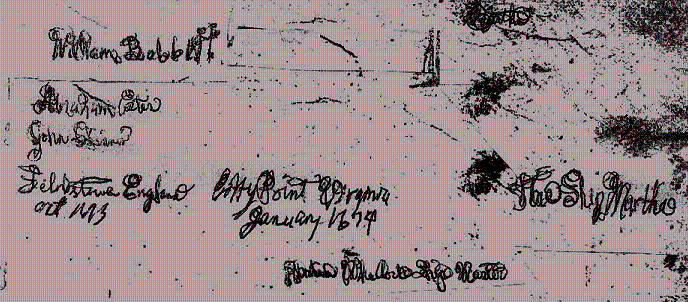
Roy was a true historian, questioning everything, driving us all to distraction sometimes requesting documentation, and digging up not only the improbable but seemingly, the impossible. His stringent military training and just under four decades of service never left him and served us all very well.  In fact, Roy poked around until he discovered the Bobbitt family whose Bible page included a record that Abraham Estes had sailed with their family immigrant on the same ship, the Martha, arriving in January 1674 at City Point, Virginia.
Bobbit Bible

As Roy and his wife’s health both deteriorated, he did have to give up his DNA project co-administrator duties and he was preparing for the inevitable day when he would no longer be here. He signed an affadivit, for example, allowing me access to his DNA forever.  That was before Family Tree DNA had their Beneficiary page for you to designate a beneficiary for your DNA.  Roy was absolutely committed to genealogy and genetic genealogy, both today and in the future when he just knew all of the answers would be unraveled.

After Roy’s wife passed away, he began living in an assisted living facility and gave up his research “cave” for a laptop. He was still involved, gladly shared his work, and encouraged anyone and everyone who would listen for half a minute…that was…until the beast called Alzheimer’s began to steal his life away.

These last few months have been exceedingly difficult, watching the once vibrant and outstanding researcher descend into the darkness of confusion. We still loved Roy of course, and we still wrote to him and shared finds with him, but his answers often no longer made sense.  But Roy knew we cared about him and sometimes a cognizant e-mail would slip in among the rest.  Those were doubly sad, because he clearly knew what he was losing as he slipped beneath the waves.  Those were heart-wrenching moments of terrifying clarity.

As I’ve looked back through Roy’s e-mails and letters these past few days, one of his e-mails really stands out in terms of clarity and prophecy.

I think when the dust clears with the DNA project we will find some fantastic information. I don’t expect this in my life time but you have really started a great thing in the project!

I will say this – My predictions are future research will show that:

  1. Nicholas Ewstas was not connected to The House of Este.
  2. Nicholas will be found connected to the Eustice line.
  3. The basic line will be traced back to the Flanders area.

Other predictions that will be proven :

  1. The spouse of Abraham Sr, was not Barbara Brock.
  2. Abraham was not an indentured servant as such.
  3. There are errors in the list of children of Abraham and Barbara that we now accept.

I only wish I knew 30 years ago what we know now! Then I would have had the time and resources to check into these things!

To date, we have evidence that indeed, Nicholas Ewstas was most likely not connected to the House of Este. The connection to the Eustice line depends on which line and who is spelling the surname.  And yes, the Estes line, first found in Kent, did come from mainland Europe – but apparently not Italy.  Big Y testing on a group of Estes men with known and proven descent helped to sort this out.  Roy didn’t get to participate in that testing, because his line is not proven genealogically beyond Elisha.  DNA can do a lot, but it can’t make up for generational genealogically connected records.

Indeed, Roy is right and there is no evidence to suggest that Abraham’s wife, Barbara, was a Brock.  You can’t prove a negative using DNA, at least not in this case.  I am hopeful that in years to come as we develop tools like ancestor libraries where haplotypes are associated with certain ancestors and lines that we can one day unravel Barbara’s surname.  It may not be in my lifetime either – but it will happen one day.

However, until then, we just don’t know, the county records we need have burned and there is just no way to discover her surname.

Unless, unless….Roy can figure out a way to tell us her name. I know, for a fact, that the first thing Roy did after greeting Berniece and his dog was to find Abraham and Barbara and ask about her surname.

Roy wasn’t too old, too disabled, too uneducated in genetic genealogy or too anything else.  He was just the opposite, extremely capable.  Roy jumped right in, in his 80s and made an unparalleled contribution on several fronts, including genetic genealogy.  And now that he is actually ON the other side, WITH those ancestors… I’m hoping against hope that Roy isn’t too far away.  I know that if there is any way for Roy to get us that surname information, he will.  And I’m counting on him.

Just so you know, Roy, I’m leaving a pad of paper out with a pen, right by the Christmas tree:)

Roy has served as a personal inspiration for me now, for years. I used to think of Roy and say to myself, thinking of him confined to his wheelchair and always working through some level of chronic pain, “If Roy can do THAT, I can surely do this.”  Roy leaves a huge legacy behind.

Perhaps the most important lesson is that you are never “too” anything, unless you decide you are.  However, if you don’t DO something, eventually, you will be too late. Roy wasn’t too late, he just left too soon.  I miss you partner.

Rest in peace Roy, right after you send me that surname:)

______________________________________________________________

Disclosure

I receive a small contribution when you click on some of the links to vendors in my articles. This does NOT increase the price you pay but helps me to keep the lights on and this informational blog free for everyone. Please click on the links in the articles or to the vendors below if you are purchasing products or DNA testing.

Thank you so much.

DNA Purchases and Free Transfers

Genealogy Services

Genealogy Research

Visiting Mom at Family Tree DNA

Mom swabbed for me, several times in fact.  She wasn’t terribly interested in DOING genealogy, but she was quite interested in the outcome of the process, and she loved to go along with me on our “larks,” as she would call them, where we would go and find our family land, or house…or something interesting…like the original bar in the Kirsch House, below.

Kirsch house 1990s

On the Kirsch House adventure, above, Mom and my daughter and I went back to Aurora, Indiana to find the location of “The Kirsch House,” the hotel and tavern owned by Mom’s great-grandfather and great-grandmother, Jacob Kirsch and Barbara Drechsel, below.

Barbara Drechsel and Jacob Kirsch

Mom didn’t know Jacob, who died the year before she was born in 1922, but Barbara didn’t pass away until 1930, so Mom knew Barbara.

Mom loved those adventures.  She just wasn’t interested in doing genealogy by herself.  I didn’t understand then, but I think genealogy made her sad.  Probably because the easiest places to visit were where she had lived, had grown up, and had personal memories of those who had passed on.  I remember visiting the graves of her mother, her grandmother and the day we found the tombstone of her great-grandmother, Barbara Drechsel Kirsch, who had died when Mom was 8.  Mom was Barbara’s namesake.

Kirsch Riverview

The Kirsch family immigrated from Germany to Aurora, so going further back in time from Aurora meant jumping the pond.  When we did get back to Germany in the records…we couldn’t visit that location in person.

It’s not that I didn’t want to take a trip to Mutterstadt, Germany to visit the Kirsch homelands, it’s that I couldn’t pry Mom away from her work long enough to take a trip like that.  Mom worked as an Avon lady, her third career, until she was 83 years old.  And she didn’t retire then because she wanted to, but because her health was failing due to dementia and other factors.

And…truthfully…she only retired then because we stole her car.  Well, we didn’t EXACTLY steal it…it’s just that after she had another of those accidents that she didn’t know how occurred…it so happened that it took months for her car to be repaired.  She forgot that she even owned a car until the insurance bill came…and was she ever hot then when she remembered about her car.  I blamed my brother who blamed the car repair place who claimed the part would be there any day now!

Do you know how difficult it is to hide a bright red sports car?  Yes, she bought a red sports car with mag wheels, dual exhaust, front and rear spoilers and a loud engine that made rumbling sounds as her last hurrah.  She had always wanted one.

Lumina

It’s pretty humorous now, but at that time my brother and I were 50 and 60 year old kids who had gotten caught with our hands in the proverbial cookie jar!  She was not a happy camper when she remembered that she had a red sports car, and she let us know about it in no uncertain terms!

I asked Mom to swab, again, in the spring of 2003.  She simply asked what this one was for and swabbed in a resigned sort of way.  I know she had to be thinking to herself, “the things we do for our children.”  Had she lived long enough, she would have been both “spittin’ and swabbin’.”  Sounds like a dance doesn’t it!

It was at that point in time that I was suspecting that perhaps one of her ancestral lines held Native ancestry – but it wouldn’t be until after her death that I was able to prove such…not by her DNA at that time, but by breaking through a brick wall and proving those lines via plain old genealogy and the DNA of direct paternal and matrilineal DNA descendants of those Acadian lines.  Oh, how I wish she could have been here to hear about that!  We would have been on our way to Nova Scotia tout suite, guaranteed.

In 2003, when Mom first tested, autosomal DNA testing had yet to be introduced, so Mom’s DNA was archived at Family Tree DNA for 25 years.  Now Family Tree DNA wasn’t started until in 2000, so they aren’t going to have to figure out what to do with archived DNA until about 2025.  Mom’s DNA has only been there for 12 years.

Mom passed away in the spring of 2006.  She was 84 years old and her health had failed.  One is never ready for the death of a parent, but one does know sometimes that it needs to happen.  Death was a release.

I took at this photo of Mom in the window of the church in Aurora, Indiana where her grandmother was baptized, as was her great-grandmother and where her great-great-grandmother attended church after arriving from Germany, probably extremely thankful that weeks-long miserable boat trip was over and everyone survived.  This reflective image is how I think of Mom.

Mom church window

Not really gone, but kind of ethereal and slightly out of reach.  But not all of Mom is physically gone.

When autosomal DNA testing became available, I ordered an upgrade for Mom in August of 2011.  Bennett Greenspan called me and told me that they had been having limited success with older samples, especially those older than 5 years.  Just because they can archive the DNA, and just because they can amplify the DNA to increase their probability of success, doesn’t mean there is enough quantity or the quality of the DNA is adequate for the kinds of tests that require a significant amount of DNA – those tests being the Family Finder and Big Y tests, although Mom obviously would never be a candidate for the Big Y (because women don’t have a Y chromosome.)  Amplifying the good DNA also amplifies any contaminant DNA as well, like from bacteria.

I told Bennett I had to try, so he agreed.  The wait seemed much longer than it was, but the day her results arrived, I cringed and clicked to open the link to find her actual results and matches, not a message saying that the test had failed.  I surely held my breath, because at that time we were at the 8 year mark since she had swabbed, and 5 years since her death, so there was no opportunity to get another DNA sample.

Mom hadn’t failed me, and neither had Bennett, luck nor technology.

A couple of years ago, I visited Family Tree DNA after the 2013 conference.  I received a lab tour in a small group, but it was pretty quick and the space was small and tight.

This fall, I visited again and was afforded a private tour.  (Thank you Bennett.)  It was much quieter and more personal.  The lab looked a lot like the tour of a couple years ago, except for some new equipment, but this time, I actually got close to the freezer.

Mom wore a ring that her parents gave her when she was 16.  She wore it every day for 68 years.  Now I wear it on a chain around my neck because I don’t want to have it sized.  The band is too thin, and although I know I can have it built back up, I wanted to wear it as she had.  The fact that the band is hair thin speaks of her lifetime and all the activities that wore the metal away, and I don’t want to change that memory.

I wore the ring to Houston, taking Mom along with me.  She goes with me on many journeys now.  We’ve been to places Mom could never have imagined and assuredly wouldn’t like.  For example, evacuating during a hurricane on Hatteras Island…but I digress.

Standing in front of the freezer, touching her ring, I told Bennett that I was visiting Mom, that she was in there and there was more of “her” in there now than any other place in the world, except maybe in me.  But then again, I only carry half of her DNA.  Bennett just kind of paused for a minute, smiled, and opened the freezer door for me.  I could see the robotic arm moving back and forth and of course, I have no idea where Mom was in this little mini-freezer-cemetery.  But she was there just the same, and I visited her.

FTDNA freezer

I stood there for a long minute peering inside, said a little private prayer and tried to hide the tears welling up in my eyes.

I know Bennett probably had no idea just how important it would be to people, like me, to be able to resurrect a little bit of Mom, and along with her, our ancestors’ history, after someone’s death.  Had it not been for his foresightedness to archive the DNA for 25 years, and his willingness to purchase a custom $600,000 (choke) freezer to do it, I would never have been able to recover Mom’s autosomal DNA, and along with it, that half of her autosomal DNA that I didn’t inherit.  Not only that, when someone matches both mother and I, it’s a sure fire way to know that match is from her side of the family.

I thank mother for swabbing and giving me the eternal gift of her DNA, the gift that truly does keep on giving, every single day.

So, when you’re wondering where to test your DNA, strongly consider the fact that Family Tree DNA archives your DNA.  You may not care, but your family just might.  Transferring your results from another company is not the same as having your DNA at Family Tree DNA.

Mom is not the only case I’ve come across.  There are many, including Bennett’s own father – and the DNA archival service is included in the cost of the test.  Of the three primary testing companies, Family Tree DNA is the only company that offers more than one test – so even if the other companies did or do archive your DNA, if there is nothing more to order, that archived DNA can’t be of benefit to you.

I wanted to take flowers when I visited Mom, but flowers aren’t allowed in the lab due to contamination concerns, so I guess Mom will just have to make do with this rose from my garden.

rose for mom

I surely do miss Mom, but at least I didn’t have to miss out on everything!  There’s no bringing Mom back, but at least we were able to salvage a bit of her.

And now that I think of it, she’s not at all alone in that freezer-cemetery.  I’m in there with her, as are some 610 of her cousins who match her autosomal DNA as well as her mitochondrial matches. I hope she’s getting to know them.  Knowing Mom, she has organized a mini-freezer-reunion and has rearranged everyone so her cousins can be in the same tray with her.  I surely hope she is getting all those connections straightened out and will find a way to share that information with me!  I’m dying (pardon the pun) to know how her matrilineal ancestors got from Scandinavia to Germany, for example.

I guess I should be telling Mom to rest in peace, but that isn’t really what I want.  I want her to help out from the other side.  She can rest in peace when I get there.  We’ll have a lot of catching up to do about these great adventures, and I can’t wait to sit down and have a cup of tea with her.

I’m betting I’ll have some “splaining” to do about her red car too.  I’m just sure that my brother, my accomplice…who, by the way, wound up with that car after Mom’s passing and is already “there,” has implicated me as the guilty party!

______________________________________________________________

Disclosure

I receive a small contribution when you click on some of the links to vendors in my articles. This does NOT increase the price you pay but helps me to keep the lights on and this informational blog free for everyone. Please click on the links in the articles or to the vendors below if you are purchasing products or DNA testing.

Thank you so much.

DNA Purchases and Free Transfers

Genealogy Services

Genealogy Research

Facebook – A Sense of Connection…and Betrayal

First of all, let me say I’m a fan of Facebook.  Yes, it has warts and there are aspects I dislike, but overall, I feel it gives us a sense of connection that is otherwise impossible to have in our geographically dispersed world.  In our hectic world today, most of us no longer live down the block or next door to our parents, siblings, aunts and uncles.  We may not even know our cousins, aside from their names.  Families are no longer nuclear or close by.

When I was younger, the Christmas letter was what connected people across the years – and each one was hand written in the Christmas card.  Later, when computers and word processing debuted, one letter was written, several copies printed and a copy put into each card.  People got offended due to the impersonal nature of the letter.  Times were changing.

Today, the Christmas card letter is nearly obsolete, in any format.  I haven’t sent cards in years.  (I know, bad cousin, bad cousin.)  I actually received an annual card and letter from someone I had no idea who was, for years.  And by that time I was too embarrassed to ask who they were and how we were connected.

So I was extremely glad when Facebook came along, because it allows us to have a sense of connection and continuity with our family, and friends….along with people who want to “friend” us who are unknown to us.  Yes, unfortunately, the world of “stranger danger” has come along with the connectivity for both children (who aren’t supposed to be on Facebook) and adults.

Facebook is also a wonderful way to get to know your new cousins, often found through genealogy and genetic genealogy.  It’s a lot more personal than an occasional e-mail or letter – and you get a much more balanced perspective of their life – their interests and who they are.

However, the way Facebook inherently works, or doesn’t, can sometimes lead to hurt feelings.  When you’re friends with someone on Facebook, you expect that they will see all of your posts and you will see all of theirs.  Right???  Wrong.  And that’s exactly what leads to hurt feelings.

Twice now within the past month, someone who I’m Facebook friends with has posted something expressing dismay and hurt feelings about what didn’t happen.  They had posted something serious, asking for prayers, and they did not hear from many of the people they expected to hear from.  That’s hurtful – especially if you think it’s intentional.  But, don’t get your knickers in a knot just yet – because it’s probably NOT an act of neglect or worse yet, a slap-in-the-face type betrayal from your family and friends. It’s all about how Facebook works, or doesn’t.

Facebook is not like mailing a letter or sending an e-mail directly to someone.  You can have some level of expectation that they received the letter or e-mail, although not 100% – but that’s not the case with Facebook.  Facebook SELECTS posts to display on friends newsfeeds.

How does Facebook do that and which posts?  Who knows – but they do.  In both cases mentioned above, the people later expressed how hurt they were that no one or few replied.  I went back and looked in my feed, and neither had been posted to my timeline.

I looked at their postings on their page, and sure enough, there they were.  I felt awful, and so did other people who also replied that they had never seen the prayer requests.  Just think how many people would have never mentioned how hurt they were and just suffered in silence.  The rest of us would have never known and they would have thought they were slighted.  This may sound trivial, but it’s certainly not when the topic at hand is something this serious.  If they had understood how Facebook works, and doesn’t, it would have helped a great deal and avoided those unnecessary hurt feelings.

How Facebook Works – and Doesn’t

So, how does Facebook posting work?  I’ve received permission to use my friend, Janine, as an example.  Janine and I have several common interests, genealogy, genetic genealogy, NASCAR and photography.  Suffice it to say, most of her posts are of interest to me.

Let’s take a look at some options you can check to see if you’re receiving the maximum about of information from another person – or maybe to tone it down if you’re receiving too much.

This assumes that you are Facebook friends with someone.  All of the setting we’re going to review are accessed from their page.

To see their page, click on their name or enter their name in the search box and then click on their name.

facebook profile

Following People

facebook friends

By clicking on the “Folllowing” box, “See First” gives you the option to always see this person’s posts at the top of your feed if you would like.  I don’t think that this means ALL of their posts – but when Facebook decides to put their post on your news feed, it will be at the top.

Unfollow

The small “unfollow” option at the bottom can be a lifesaver – but in a bit of a different way.

If you find that someone is posting things you don’t really want to see – you can click on “Unfollow Lisa.”  This does NOT unfriend her – so you’ll still be friends – and she won’t know that you unfollowed her.  Unfollow just means her posts won’t be included on your newsfeed.  And you can undo it quickly by the click of a button.

I refer to this as the “political and religious filter.”  Unfortunately, I wish there really was a way to filter out only content of a specific type, but there isn’t, so if you unfollow someone, their posts will never be placed in your timeline.

Why do people unfollow others?  Mostly, because they have a difference of opinion on something and the person on the receiving end doesn’t want to see those specific types of posts.  These types of postings seems to increase exponentially during the political season or after something happens that is contentious and elicits strong feelings in either or both directions.  Like what?  Well, judging by today’s postings on my newsfeed, those topics would include refugees, abortion, gun control and of course the ever popular political candidates.   No, nothing controversial there.

Yes, I have opinions on all of these.  No, you will never know what they are unless you are a very close friend or a very close family member.  You will never find my opinions on volatile or controversial subjects on Facebook.  First, I don’t want to start a war.  Second, I fully realize that no one really wants to see any more of this stuff and third, none of it is going to change anyone’s mind about anything.

If you have doubts, just think Thanksgiving table when Uncle Joe and Uncle Ted had the “discussion” about Protestant vs Catholicism, or racism, or whatever that difficult topic was at your house.  That was the quietest Thanksgiving ever…until my mother jumped up and said, “Amen” to close the topic and asked who wanted pie.  The rest of us were greatly relieved and Mom had a little “talking to” with both of them later, forbidding them from ever doing that again at Thanksgiving.  Facebook is no different except Mom isn’t around to solve things anymore and to send the offenders to the adult version of timeout, which, on Thanksgiving afternoon was in front of the TV glued to football.

Worse yet, much of what is posted online as fact isn’t.  http://www.snopes.com is a good resource to figure out what is fact and what is fiction.

One of the best ways to get yourself quickly unfollowed by me is to participate in what I consider to be manipulative behavior.

facebook manipulation

Telling me that if I don’t do something it means that I “don’t love Jesus,” God and country, my children, or something similar is the best way EVER to assure that I’ll never do what you want.  This is pure and simple manipulation and I don’t play that game – no matter what anyone thinks it means.

Asking is fine – that’s “please share.”  Telling or subtly threatening is not.  Threatening includes inferring a negative interpretation of what my noncompliant behavior means to you (see above) – and by inference anyone else reading my timeline and seeing that I did not do what you wanted.  Sorry, no one gets to paint my world except me.  Most people intensely dislike other people trying to manipulate their behavior, whether they say anything out loud or not.  Worse yet, if you do pass it on by “sharing,” then you’re the one twisting the arms of your Facebook friends.

Often these things get passed on by well-meaning but naïve people.  Sometimes the graphics harbor malware like a highly contagious flu bug – which is why the original person launched it in the first place – intending to take advantage of people who will, by virtue of guilt or arm twisting, participate in this new rendition of the old-fashioned chain letter that tells you if you don’t send a dollar to the last person on the list within 48 hours that someone in your family will die within 10 days.  Oh yes, and pass the letter on to 10 more people because in just another 10 mailings, if no one breaks the chain, you’ll receive $10,000,000,000 in dollar bills.  So not only can you prevent your family members death, you’ll get rich in the process!  Yeah, right.  How did that work out for you?

So, if you have a Facebook friend who is over-posting, posting things you don’t want to see or attempting to twist your arm, you can unfollow them without causing a ruckus and without unfriending them.  However, if you unfollow them, you will NEVER see a post from them – which may or may not be what you wanted to achieve.  You can always check their page from time to time.

If you don’t want to be unfollowed, you might considered not posting about topics that are volatile, emotional, controversial or manipulative in nature.

Friends

facebook friends2

Next, check the “Friends” status.  You can see that I have Janine marked as “get notifications” and “close friend.”

Get notifications means that I will receive notifications of comments on her postings.  If I turn “get notifications” off, I’ll only see replies to her posts that I’ve commented on or things I’ve posted to her feed.  Since she and I have lots of interests in common, I have “get notifications” selected.

Facebook says that “Close friends get priority over people who you don’t designate as close friends.”  When you share something on your timeline, one of your choices is to share with “close friends.”  I tried to verify this but did not see this designation.  What Facebook doesn’t say is whether or not close friends receive all of our postings, although based on personal experience, it appears that there is nothing you can do to receive all postings from someone.  Facebook says you “will see more of them in your newsfeeds.”

Conversely, by selecting “acquaintances,” according to Facebook, “you’ll see less of their feeds.”  I don’t know if that means less than if you select nothing or less than “close friends.”

“Family member” used to be a category, but is no longer.  My daughter-in-law who posts pictures of my grandchildren used to be designated as a family member.  Today, she is listed as a close friend and with “get notifications,” but I still don’t see all of her postings.  I check her page periodically to see which of my grandchildren’s photos I’ve missed.  Bah humbug Facebook.

The default is that nothing is checked.

Unfriend

The “Friend” box also holds the dreaded “Unfriend” button, at the bottom.  Unfriend means that person can no longer see what you post and vice versa.  You, and they, can see in a number of ways if you and they are still friends or not.

So, if you unfriend someone, they will, or can, know about it.  They are not notified but if they check, it’s obvious.  I think I’ve only ever unfriended two people who were clearly toxic.  But then, I’m extremely restrictive about who I become Facebook friends with because spammers and scammers abound.

The only way to undo an unfriend is by sending that person a friend request again.

Blocking People

This brings us to the topic of blocking people.

facebook dots

If you click on the three little dots, there are more options, including block.

Block means just that – entirely.  They can’t send you a friend request and you won’t ever see their posts anyplace they post.  They won’t see what you post either – in essence, neither of you exists in the others world.  So if you and they are in a common group or have a common friend or family member – you won’t see their posts or comments and they won’t see yours.  Sometimes, this means that what you do see doesn’t make sense because posts made by them or replies from them are missing and are referenced by other people, leaving you scratching your head.

Other Options

Just out of curiosity, I tried “Poke.”  It just sent Janine a note saying I poked her and asks if she wants to poke me back.  Yes, some programmer had far too much time on their hands one day it seems.

facebook friendship view

The “See Friendship” tab shows things that we’ve done together.  It’s kind of like a diary.  You can see here that Janine posted something on my timeline about fabric.  This can actually be very useful if I can manage to remember that it’s Janine who sent me something in particular that I’m hunting for.  You know, like the recipe I want to use this week for Thanksgiving and can’t find.

Oddities

facebook timeline

One last thing.  On Facebook, things change and aren’t always where you think they might be.  One day, I looked at my page and realized that posts people have posted to my timeline weren’t in the regular feed, but were on the left below all kinds of other things.  I’ve never seen this since, but just suffice it to say, keep your eyes open and look around.  The only thing that is constant is change – in life and on Facebook.

Private Messages

Check for private messages periodically.  The message icon is at the top of your page, next to the people icon which is where you see who has requested to be your friend.  If people message you, they presume you received, and read, the message and they are going to be hurt or offended if you don’t reply.

facebook private messages

There used to be a separate inbox that was relatively hidden where messages from people who weren’t Facebook friends ended up, but I believe that second inbox has been removed and all of your messages from friends and those not your Facebook friends are combined into one message box now.

In Summary

I hope this little spin through Facebook has helped a bit.  I hate to see something that can be such a positive tool to build communities and relationships cause hurt feelings because people don’t understand how to utilize their options to maximize their chances of getting what they want out of Facebook.  Just remember, no matter what you select, it’s Facebook and they get to choose.

Why?  Facebook is free, although I should put “free” in quotes because you’re doling out a lot of informatoin about yourself that is useful and valuable to marketers.  If you doubt this for a moment, just google some product and then watch ads for that product show up in your Facebook feed for weeks afterwards.  I wish they had an “I already bought it” button.  I saw children’s Mavis halloween costumes for weeks!

Facebook has never given us any indication they won’t change how things work, and they do change things often, and without notice.  So, stay vigilant, stay flexible, and don’t assume that your cousin is blantantly and willfully ignoring you – because there is a good chance they aren’t.  It’s just Facebook.

______________________________________________________________

Disclosure

I receive a small contribution when you click on some of the links to vendors in my articles. This does NOT increase the price you pay but helps me to keep the lights on and this informational blog free for everyone. Please click on the links in the articles or to the vendors below if you are purchasing products or DNA testing.

Thank you so much.

DNA Purchases and Free Transfers

Genealogy Services

Genealogy Research

Living the Life You Only Hoped For

Thanksgiving is hard for some folks.  Life didn’t turn out exactly as they hoped or planned.

It’s easy for me to sometimes get tied up in the melancholy.  Thanksgiving when I was younger was a festive time on the farm.  The kitchen was overflowing onto tables in the living room. Aunts, uncles, siblings, lots of kids, sometimes foster children, boyfriends, girlfriends…the house was full. Mom and I were cooking and everyone brought a dish to pass.  It never occurred to me that one day those times would only be a memory.

It’s not like that now.  All of those people are gone, including my siblings.  In fact there are only a handful of people alive now who experienced those days and most of them are scattered to the winds.

So, I have to actively think of things to be thankful for at Thanksgiving.  Obviously, I’m thankful for my family, my children, their spouses, grandchildren and grandpuppies who do live close by.  And I’m really thankful that my husband likes to cook – and so are my kids!!!

Then, last night, on Facebook, I saw this inspirational saying by http://www.ibelieve.com.

thankful

That is just spot on.  I have never thought about things quite like this before.

And of course, my thoughts immediately turned to genetic genealogy.

Twenty years ago, DNA testing didn’t exist nor did we have any clue that it might.

Fifteen years ago, Bennett Greenspan and Max Blankfeld were just starting Family Tree DNA.  They are today the only one of the early testing companies still in business and the only one to offer a full complement of DNA tests for genealogy.  Am I ever thankful for them and their success.

Ten years ago, we thought we had come a long way because we could test males Y chromosomes to 25 or 37 markers and the female line mitochondrial DNA.  I don’t recall whether we were doing full sequence testing yet a decade ago.

Five years ago, autosomal DNA testing had just been introduced and we were ecstatic.  Little did we know it would open the floodgates.

And today, the genetic genealogy world is one I couldn’t even have dreamed of.  I wonder what the next 5 years holds.

Indeed, times have changed dramatically, and for all we’ve lost through the natural processes of life, we’ve gained incredibly.  Not only have we gained new relatives and immediate family through birth and marriage and birth…but we’ve gained the tools to get to know our distant relatives.

By distant, I mean both in terms of miles and ancient.  The new relatives who live distantly we now get to know through social media like Facebook.  One of the ways we find those new relatives is through genealogy and sometimes, DNA testing.  I’ve become very close to some of the people I’ve met through genealogy.

But I also mean distant as in distant or ancient ancestors, my great-great-great-great-great grandfather Estes.  My most distant Estes ancestor was Nicholas Ewstas born in 1495 in Deal, Kent, England.  Today, through the magic of DNA testing, I know what his entire Y chromosome looked like, through his descendants.  I know that many of us today probably share small portions of his autosomal DNA.  I know how to identify his descendants by matching them to his Y chromosome results.  I know where in the world he came from, before Kent.  I know how his ancestors got from Africa to Europe and then to England, at least roughly.

Furthermore, the more people who test, the more direct Y and mtDNA relatives I can find to complete my DNA pedigree chart.  The more I can learn about these distant ancestors, by meeting more of my distant relatives in this lifetime.  The more people who test, the more ancestors available for all of us to find!!!

My biggest regret is that I didn’t know about DNA testing back in the day – that I can’t go back and swab those aunts and uncles.  I wouldn’t make that mistake today.  I now carry swab kits in my purse.  And yes, those of you who know me know I’m dead serious.  I would test all of them for autosomal DNA, Y and mtDNA if those lines had not already been tested and posted publicly for other descendants to find.

Indeed, I am extremely fortunate to find myself living in a time of miracles I didn’t even know enough to hope for.  I am very thankful.

thankful 2

______________________________________________________________

Disclosure

I receive a small contribution when you click on some of the links to vendors in my articles. This does NOT increase the price you pay but helps me to keep the lights on and this informational blog free for everyone. Please click on the links in the articles or to the vendors below if you are purchasing products or DNA testing.

Thank you so much.

DNA Purchases and Free Transfers

Genealogy Services

Genealogy Research

Ancestry’s New “Amount of Shared DNA” – What Does It Really Mean?

Yesterday, Ancestry quietly introduced a new feature of their AncestryDNA autosomal product called “Amount of Shared DNA.”

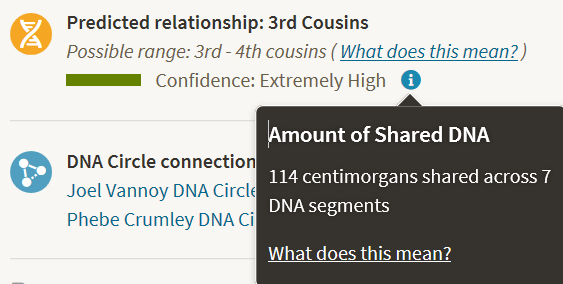
This can be seen when you view your match, beside the confidence bar, as shown below.  Fly over the little “i.”

shared dna

It’s nice to know how much DNA we share and across how many DNA segments – but what does this really mean, how is it calculated, and how do these calculations stack up against the same information from other vendors?

Why would it be any different, you ask?

Because Ancestry runs their academic phasing program, Timber, and removes segments identified as matching to many people, constituting pileup areas.  Remember when Timber was introduced and people lost more than half of their matches?  I went from 13,500 to 3,350.  Today, 50 weeks later, I have about 6,700.

Real phasing is when you utilize your parents DNA to divide your own DNA into half.  Half your matches match you and your mother, and half your matches match you and your father.  If not, then they are not IBD matches.

Timber attempts to remove segments that are too matchy – areas where Ancestry feels you have too many matches so they might be “population” based match segments instead of real genealogical segments.

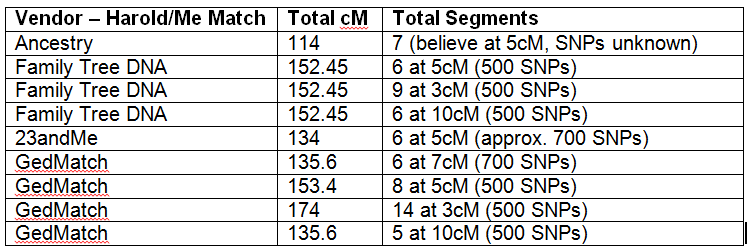
This new “Amount of Shared DNA” feature gives us the opportunity to test their matching against other vendors.

Thankfully, my cousin Harold has tested at all the vendors and uploaded to GedMatch, as have I.

Therefore, we can compare our results on all platforms.

shared dna 2

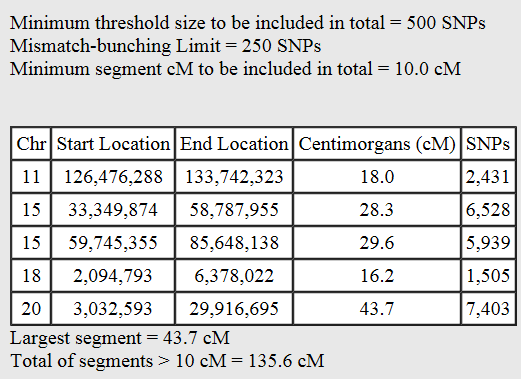
Why is the Ancestry total cM so much smaller than the other vendors, at any threshold?  Timber.  Ancestry is removing many segments that other vendors are counting and using, even at higher thresholds like 10 cM.  In fact, at GedMatch, their maximum threshold is 10cM and even at that level, the total match cM was 135, 21 more than Ancestry, and the SNPs were all well over 1000.

shared dna 3

The Acid Test

I’ve believed since the introduction of Timber that it removed too many segments – segments that are valid and useful – thereby removing valid matches.

However, the acid test is a parent/child match.  Each child should match their parents on exactly 23 segments (or 22 if Ancestry is not counting the X chromosome), one complete match for each chromosome.  Once in a while you’ll have a read error that may divide a chromosome into two match segments, so an occasional 24 or 25 wouldn’t be surprising.

What are we seeing?  A quick read of forums and looking at the results I have access to shows me that parent match segments are ranging from about 85 to about 110, which, in case you are counting, is from 64 to 87 more than the 22 (or 23 counting the X) chromosomes that we have.

What this tells us is twofold:

  1. Timber is removing 64 to 87 VALID segments in parent/child matching, believing that pileups are invalid. Rule #1 of DNA – you must match your parents. If you double this number, because you have two parents, each person has in the ballpark of from 130 to about 200 areas where their DNA is “too matchy” and segments/matches are removed. This illustrates the magnitude of the Timber problem.
  2. You cannot draw or correlate any relationship inferences from either the total amount of shared DNA nor the number of segments by utilizing the typical tools utilized by genetic genealogists because Ancestry’s totals will be lower and their segments will be broken into more pieces due to the removal of segments identified by Timber as invalid matches.  Blaine Bettinger is beginning to collect information at this link on Ancestry’s shared cM data for known relatives.  This information will be made public for all to utilize, as has his earlier shared cM work.  Please contribute if you can.

Hopefully Ancestry will take this opportunity to address the Timber issue, and hopefully they will eventually provide a chromosome browser type tool.  Now all we need is the chromosome number and start/end addresses for those chopped up segments.  These tidbits and pieces of solutions are not appeasing the genetic genealogy community and this new “amount of shared DNA” feature will not “do” in place of a chromosome browser.  I know this sounds like a broken record…and it is.  While Ancestry seems to be inching in the chromosome browser direction by providing additional information….I wouldn’t hold my breath.  I don’t think it will ever happen – but I would really, REALLY like for Ancestry to prove me wrong!

Fortunately, Ancestry’s tree matches and Circles are useful and thankfully, we can download our autosomal DNA results to both Family Tree DNA and to GedMatch and utilize their chromosome browsers and other tools.  Unfortunately, not everyone is willing to download, so we do really need that chromosome browser.

______________________________________________________________

Disclosure

I receive a small contribution when you click on some of the links to vendors in my articles. This does NOT increase the price you pay but helps me to keep the lights on and this informational blog free for everyone. Please click on the links in the articles or to the vendors below if you are purchasing products or DNA testing.

Thank you so much.

DNA Purchases and Free Transfers

Genealogy Services

Genealogy Research

Get Your Ducks in a Row – Time May Be Shorter Than You Think

ducks

Helen Rutledge is my cousin.  She and I have been sniffing around the same records in the same counties for many years now.  I only wish we had met earlier so we could have shared more of the chase.

Helen is no “spring chicken” as we say on the farm.  In fact, Helen has continued to research far into her golden years – being in her 90s now.  Want to hear the great irony? Helen has no children to leave her work to – but this does not deter her.  Helen is the aunt that every one of us wants to have in our family.

Recently Helen sent me an e-mail that both saddened me and inspired me, and with her permission, I’m sharing it with you.  I have omitted some of the more personal portions.

After 13 days in the hospital I returned to long term nursing care. I brought my computer and genealogy records from Assisted Living to my new level of care. However, now instead of researching, I am organizing my research to leave for my nephew and some research archives. I have been forewarned in the most urgent way that there may not be time to think about how I will do this when the research is done. Well, we all know research is never finished.

Keep urging perseveration of research on your blog. It is as important as the research itself. Answers are no good if I am the only one who knows the answer to the puzzle…I must share it with others whether they give me credit or not. I thank you for alerting me to that truth and God for allowing me extended days to get my records in order as a gift to other researchers. Oh, the many little tidbits I have garnered, documented, and put together for those who follow in my footsteps with our family lineage.

Organization is not just entering our data into a genealogy program. It is documenting, making copies of the documents available when possible, and recording the ORDER of our research so those who are not familiar with the records, can follow the generations and become acquainted with their ancestors.

Be honest, say information is not documented, when such is the case, and challenge your readers to find documentation. Try to inspire descendants to fill in the blanks and record those who are yet unborn. While they will miss the thrill of solving the puzzle after years of frustration, they will know the joy of learning who they are.

Thank you, Helen, for your lovely, inspirational message. Sometimes we aren’t fortunate enough to receive a warning. (Note – Helen passed away in February, 2018.)

Another e-mail this week told of another cousin’s husband who died suddenly, with no warning, and he was 30 years younger than Helen.

DNA in Perpetuity

I would add one thing though, and that is to record your user names and passwords – especially relative to DNA accounts and tests and anyplace, like GedMatch, you have uploaded your results.  Your DNA can never, and I repeat, NEVER, be replaced, while genealogy research could be with enough effort.  Don’t let your DNA results become inaccessible.

At Family Tree DNA, you can designate a beneficiary.

On your personal page, under “Your Account” on the left hand side, select “Manage Personal Information.”

ducks2

Then select Beneficiary Information and complete the form which includes your beneficiary’s name, e-mail and phone number.  If you should pass away, this is who Family Tree DNA will allow to access your account.  Other companies, to the best of my knowledge don’t include this information or provide this option, so you’ll need to be sure to leave your account access information available for your family members.

ducks3

If you have not prepared for the inevitable, please take a few minutes to do so.   You can make the DNA arrangements now, and easily.

Remember, at Ancestry, your DNA won’t be available unless your account (subscription and login) remains active, so you’ll need to take how to handle that into consideration.

You might want to download not just your raw data files, but matches as well when possible.

Public Sites

Upload your Y and mitochondrial DNA to sites like http://www.ysearch.org and http://www.mitosearch.org.  Be sure to record the most distant ancestor and enough information to positively identify them, like birth and death dates, locations and spouse’s name.  This is the only way to get your info into a public data base that is accessible without having DNA tested for a match.  You can also enter Y and mito info at http://www.wikitree.com and attach it to the proper ancestor.  This helps others in the future learn about their ancestors.  Be sure to include your full haplogroup in the notes and a link to anything you may have published about that line.

Upload your autosomal results to http://www.gedmatch.com and upload trees where possible.

Don’t put all of your eggs in one basket, because baskets aren’t forever either.  Think about how many genealogy companies have come and gone and what happened to our Y and mitochondrial DNA with both Ancestry and Sorenson (also destroyed by Ancesty).

Genealogy Research

You can take a few minutes to put together a plan for how to preserve and present the balance of your genealogy information.  Preserving and publishing my genealogy research has been on my bucket list for some time now and is the purpose of the 52 Ancestors articles I’ve been writing for the past 18 months.  I’ll write them until every ancestor is covered….or I can no longer write the articles – and I sincerely hope I have the opportunity to finish.  Not just for my own sake, but for the benefit of everyone else who follows.  I hope future researchers make huge breakthroughs and add immensely to what I know today.  My work will at least give them a firm foundation to start from and they won’t have to replow the same ground.
One of the avenues to preserve your work online is a blog.  WordPress offers free blogs and they will be available into perpetuity, whatever that really means.  I am also printing my articles and will be donating them to archival facilities like the Allen County Public Library.  And of course, I’ll have a set of binders for each of my children.

WikiTree is another public resource for your trees, your Y and mtDNA results and additional information, although that’s not the same as offering the detail in an article.

So, however you choose to do whatever you choose to do… just do it.

And do it now.

You may not have an opportunity later.

Time may be shorter than you think.

Get your ducks in a row.

______________________________________________________________

Disclosure

I receive a small contribution when you click on some of the links to vendors in my articles. This does NOT increase the price you pay but helps me to keep the lights on and this informational blog free for everyone. Please click on the links in the articles or to the vendors below if you are purchasing products or DNA testing.

Thank you so much.

DNA Purchases and Free Transfers

Genealogy Services

Genealogy Research

Thinking Outside the Box

Some of you may know that I’m speaking again at the Family Tree DNA Conference for project administrators being held in November in Houston.  This is the 11th conference, and I’ve attended them all.

I want to first and foremost thank Bennett Greenspan and Max Blankfeld for hosting this legendary conference, for the 11th time, and for the opportunity and honor to speak to the attendees.

As I’ve been getting my thoughts and my presentation together for this conference, a couple of things have come to mind that I’d like to share.

My conference topic is “Y DNA to Autosomal Case Study – Kicking it Up a Notch.”

I know, the title doesn’t sound terribly interesting, but believe me, after beginning innocently enough, it turned out to be the project from Hell.  Followed by very interesting discoveries whereby it redeemed itself from Hell.

The session description is:

The Crumley surname project was relatively small and had already answered the burning question for which it was created.  Had it served its only purpose?  What else could be done?  The project administrators transitioned this Y DNA project to a Y-plus-autosomal DNA project quite successfully – and made some surprising discoveries along the way.  How did they go from a base of 5 to more than 50 participants in a few weeks?  What did they discover?  How do the descendants of two men born in the 1730s compare autosomally? (Yes, we have autosomal comparative data to 9th cousins.)  What can you learn and how can existing Y projects become the foundation of a hugely successful autosomal project?

But I have to tell you the truth….I made myself insane with this project.  I have over 50 people that had to be hand compared to each other – one by one.  If you’re counting, that’s 1250+ individual comparisons.  The results had to be compiled – which resulted in a spreadsheet of almost 9000 rows.  The relationships of the participants had to be defined, their genealogy collected and assembled and the results analyzed.  Which is what, of course, led to the discoveries I’ll be discussing at the conference.

During the time when I was doing all of those comparisons, I asked myself over and over, “why the dickens am I doing this?”

I realized sometime in the middle of the night last night – the answer to “why I’m doing this,” is really the answer to all of the questions about genetic genealogy research.

In fact, it’s exactly like this quilt.

Thinking Outside the Box

Ok, so what is a quilt doing in the middle of this genetic genealogy article?

Is it even a quilt?

It’s not square like a quilt…but it has blocks – well triangle blocks, three layers and a binding…and it was made by a quilter.  Me.  So it must be a quilt – but it’s unlike any other quilt in many ways.

Its name?

Thinking Outside the Box

That’s at once the disease and the cure!  And it’s the answer.

And it all started with Bennett Greenspan.

undeniable bennett

In the middle of the night, I realized that the fundamental questions in all of genetic genealogy research begin with the words, “Why can’t we…..”
Had Bennett Greenspan not asked that question, and not once, but repeatedly, until he received a satisfactory answer, the field of genetic genealogy would never have existed.

For those not familiar with this legendary story, Bennett, a genealogist (just like the rest of us) back in the prehistoric days of 1999, wanted to know why he couldn’t compare the Y chromosome of one man with a particular surname to another man with the same surname to see if they shared a common ancestor.  He took that question to scientists who worked with the Y chromosome.  Let’s just say the scientists weren’t terribly receptive.

Bennett was politely refused, then more firmly refused, but Bennett persisted until Michael Hammer gave up resisting and just ran the test to get rid of Bennett.  But that didn’t work either, because Bennett had more questions.  Couldn’t someone form a company to do this?  Couldn’t Michael Hammer’s lab at the University of Arizona run those tests for that company, which would come to be known as Family Tree DNA.  Questions begat questions.  History was, unknowingly, being made.  The answers and results of course, we all know about…but had it not been for Bennett’s bravery to ask that initial question – and to persist in the face of rejection and adversity – none of this would have happened.

Bennett didn’t have a crystal ball.  He couldn’t have known that an entire industry would evolve from his simple act of genealogical frustration.  But Bennett is who he is and he continued to ask that question and pursue the answer.

As I spent days and days working through the 50 participants’ data in the Crumley project, I often wanted to quit, but I’m either too anal or too OCD or too persistent to do that.  (No, we’re not voting on that topic:)  I had to finish.  And thank goodness I did, because the discoveries were there waiting for me – but I couldn’t have known that until AFTER I did the work that revealed them.  Had I stopped or never begun, I would never have known.  Same with Bennett – thank goodness he persisted.

So first, I had to first ask the question, “Why can’t we….?” Or more appropriate, “What can we…?” and proceed to find out.

In the field of genetic genealogy, and much more broadly applicable as well, if you never ask that question, you’ll never be wrong or make mistakes.  You’ll never be made fun of.  Your work will never be criticized.  You’ll never be rejected.  You’ll be entirely safe.

But you know what else????

You’ll never be right either.

You’ll never push the frontier.

You’ll never inspire other people to ask that same question.

You’ll never make that discovery.

Because you never took the risk of thinking, and acting, outside the box.

Thanks Bennett.

For being brave enough to persist in the face of adversity…

For allowing that question to burn you to action…

For the revolution you started…

For being a leader, an inspiration and our champion…

For providing a supportive and encouraging environment to conduct our own personal and broader genetic genealogy research…

For facilitating our insanity as citizen scientists…

For thinking outside of the box…

THANK YOU!

______________________________________________________________

Disclosure

I receive a small contribution when you click on some of the links to vendors in my articles. This does NOT increase the price you pay but helps me to keep the lights on and this informational blog free for everyone. Please click on the links in the articles or to the vendors below if you are purchasing products or DNA testing.

Thank you so much.

DNA Purchases and Free Transfers

Genealogy Services

Genealogy Research

Mass Pre-Contact Native Grave in California Yields Disappointing Results

In 2012 during excavation for a shopping mall near San Francisco, a mass grave containing 7 men was unearthed.  The manner in which they were buried led archaeologists to believe that they had been murdered, and quickly buried, not ceremonially buried as tribal members would be.  They were found among more than 200 other burials.

The victims ages ranged from about 18 to about 40 and scientists concentrated on analyzing the wounds, cause of death and DNA of these men.  In part, they wanted to see if they were related to each other and if they originated in this area or came from elsewhere.  In other words, were they unsuccessful invaders as suggested by the circumstances of their burials?

This article tells more about the excavations and includes some photos.

Analysis suggests the men lived about 1200 years ago, clearly before European contact.  Analysis of the men’s teeth provided information about their history.  These men had spent their lives together, but their isotope signatures were clearly different than the individuals in the balance of the burials.  Indeed, they look to have been invaders.

An academic paper titled “Isotopic and genetic analysis of a mass grave in central California: Implications for precontact hunter-gatherer warfare” was published a few weeks ago in the American Journal of Physical Anthropology.  The article itself is behind a paywall available here.  The abstract is provided below:

Abstract

OBJECTIVES:

Analysis of a mass burial of seven males at CA-ALA-554, a prehistoric site in the Amador Valley, CA, was undertaken to determine if the individuals were “locals” or “non-locals,” and how they were genetically related to one another.

METHODS:

The study includes osteological, genetic (mtDNA), and stable (C, N, O, S) and radiogenic (Sr) isotope analyses of bone and tooth (first and third molars) samples.

RESULTS:

Isotopes in first molars, third molars, and bone show they spent the majority of their lives living together. They are not locals to the Amador Valley, but were recently living to the east in the San Joaquin Valley, suggesting intergroup warfare as the cause of death. The men were not maternally related, but represent at least four different matrilines. The men also changed residence as a group between age 16 and adult years.

CONCLUSIONS:

Isotope data suggest intergroup warfare accounts for the mass burial. Genetic data suggest the raiding party included sets of unrelated men, perhaps from different households. Generalizing from this case and others like it, we hypothesize that competition over territory was a major factor behind ancient warfare in Central California. We present a testable model of demographic expansion, wherein villages in high-population-density areas frequently fissioned, with groups of individuals moving to lower-population-density areas to establish new villages. This model is consistent with previous models of linguistic expansion. Am J Phys Anthropol, 2015. © 2015 Wiley Periodicals, Inc.

http://www.ncbi.nlm.nih.gov/pubmed/26331533

Genetic Information

I was extremely disappointed with the genetic information.  Working with the local Ohlone community, the scientists did attempt to extract DNA from the 7 individuals in the mass grave, with 6 extractions being successful.

They only analyzed the HVR1 region of the mitochondrial DNA.

Eerkens 2015 table

In the paper, the authors indicate that nuclear DNA which would include the Y chromosome as well as autosomal DNA was too degraded to recover.  While disappointing, there is nothing they can do about that.

However, only analyzing the mitochondrial DNA, which they clearly were able to amplify, at the HVR1 level is an incredible lost opportunity.  They obtained enough resolution in 6 of the individuals to obtain general haplogroup assignments.  However, the HVR2 and coding regions would have provided the defining information about extended haplogroups and individual mutations, including, perhaps, haplogroups rarely or never seen previously in the Americas.

Furthermore, given the information above, we can’t tell if the D1 individuals are related to each other matrilineally or not.  The B2 individuals are clearly not related in a recent timeframe nor are the A2, B2 and D1 people related to each other on their matrilineal line.  What a shame more information wasn’t obtained.

While I’m grateful that DNA testing was undertaken, I’m saddened by the partial results, especially in this day of full genomic sequencing for ancient DNA specimens.  I’m perplexed as to why they would not have obtained as much information as was possible, given the significant effort expended in recovering any ancient DNA specimen.

______________________________________________________________

Disclosure

I receive a small contribution when you click on some of the links to vendors in my articles. This does NOT increase the price you pay but helps me to keep the lights on and this informational blog free for everyone. Please click on the links in the articles or to the vendors below if you are purchasing products or DNA testing.

Thank you so much.

DNA Purchases and Free Transfers

Genealogy Services

Genealogy Research

Finding Hidden Treasure in Estate Inventories

Recently, I spent an entire day in Richmond at the Library of Virginia, also known as the State Archives.  Like always, I prepared a research list.  While most of my research procured nothing, which isn’t unusual after you’re already plucked all the fruit you can readily see – I did come up with one big winner.

The estate inventory of Edward Mercer who died sometime between May 4th 1763 when he last appears in the Frederick County, Virginia court minutes in a road order, and November 1, 1763 when his estate was probated.  At that same court session, he was replaced as overseer or the road, so he apparently was still “working” up to a few months before he died, even though he prepared his will “being sick, aged and weak of body” in September of 1762.  Edward was probably just shy of 60, certainly not an old man – so his estate should reflect an active life, not a “retirement,” if there was such a thing then.

The first bingo I found in the library was a book of transcribed wills and estate inventories.  I was quite relieved because that meant I might not have to ask them to pull the microfilm and read that.  Old books on microfilm are not always legible nor is the indexing ever complete.  The only individuals indexed are the primary individual – not witnesses or wives or anyone else.  Many times the “rest of the story” is told in who surrounds individuals during their lifetime – so we need all of that additional information.

So, when I found Edward Mercer’s estate inventory listed in the transcribed book, I was ecstatic.  I read the estate inventory, and it was short and general.  It listed things like, “agricultural produce and farm animals.”  Well, I have to tell you, I’ve seen a lot of colonial wills and I have never seen one list something like that.  They list the produce and they list the animals, individually, or at least by breed.  In other words, you in far more danger of receiving far more information that you wanted than not enough, if an estate inventory was taken and filed.

It appeared that I was going to have to get the microfilm after all.

Estate inventories are a vastly overlooked source of information not available elsewhere.  The wills tell who your ancestors left his or her worldly goods to, but the estate inventory tells you what those goods were and those goods tell a huge story about your ancestor’s life.  In addition to what IS in the estate inventory, what ISN’T in the inventory tells a story too – especially in the context of the time and place in which they lived.

Many men did have a will.  Most wills were not written much in advance.  Sometimes wills were made verbally as the individual was on death’s doorstep to whomever was nearby.  These are called noncupative wills.  Sometimes, death was unexpected and there no opportunity for a will.

Most women did not have wills because most women did not own items outright, meaning outside of a marriage where the man was assumed to be the owner of the land (except for her dower rights.)  Often women retained what is known as a “life estate” where the woman holds either property or other items for the term of her life, at which point their ownership reverts to others, generally one or several children as specified in her husband’s will when he died.

If the woman dies before the man, the husband automatically owns everything so no will for the wife is necessary.  I’m talking about historical US wills, not current law.  I’m not a lawyer…I don’t play one on TV or anyplace else:)

Understanding how wills and ownership of both property and personal items worked helps in unraveling what estate inventories tell us.

When the man died, an inventory of everything was taken, even if the wife was to retain “household items.”  While that seems vastly unfair, especially since she often had to bid to buy her own cooking utensils back at a sale, it’s a huge boon for genealogists.

Sometimes individuals are mentioned in inventories – and in some cases, an item is left to a daughter in a will, but by the time she collects that item, she is married and a married name is listed.  In other cases, if something is left specifically to an individual, it is not included in the appraisal.  It doesn’t seem standardized, you say?  It’s not – and often it helps to look at other wills and estates from that county and time to observe what was customary.  Any deviation from custom must have been caused by something…and that something could be interesting to a genealogist.

Even the individuals who appraise your ancestor’s estate are important.  In Virginia, if your ancestor’s spouse was still living, one person who was from the “wife’s family” was chosen, keeping her interests in mind, the largest debtor of the person who died was selected, keeping their interests in mind, and one person completely disinterested in the outcome of the estate appraisal was selected.

With that information, you can sometimes add to your knowledge of the family, especially if you know the wife’s family is likely in the area.  How would you know that?  If your ancestor lived in that area when he married, his wife’s family would have been from that area too.  Young people often met at church or social functions – and with limited transportation – that social group wasn’t from any great distance.

People often married their neighbors or individuals from just a mile or two away.  Courting was likely done on foot, or maybe on horseback.  You can’t marry someone you can’t court!

So, let’s take a look at Edward Mercer’s will and see what is actually in the estate inventory.

The subscribers by virtue of an order of Frederick County Court being first sworn has met and appraised such of the estate of Edward Mercer, deceased, as was brought to our view by Ann Mercer and Joseph Fanset the executors – viz –

The values would be given in pounds, shillings and pence.

Edward Mercer estate 1

  • One old loom 0-15-0
  • Red Cow 0-15-0
  • 1 Cow and bell 3-0-0
  • 1 brindle cow 2-10-0
  • A brindle cow 2-0-0
  • A white cow 2-10-0
  • White back heifer 2-0-0
  • White bull 2-0-0
  • White heifer 1-15-0
  • Speckled heifer 2-0-0
  • Red yearling steer 1-0-0
  • White steer 1-7-0
  • White faced heifer 1-10-0
  • Brindle calfe 0-15-0
  • A pide yearling 1-0-0
  • A brindle yearling 1-0-0
  • Six calves 3-6-0
  • 2 pide steers 3-15-0
  • 2 heifers 2-10-0
  • One stear 2-10-0
  • A roan horse 6-0-0
  • An old mare 2-10-0
  • A mare and colt 3-10-0
  • A bay mare and colt 5-0-0
  • Old wagon and gears 9-0-0
  • A pen and gears 1-3-0

Edward Mercer estate 2

  • Eight swine 0-?-0
  • 2 sows and pigs 0-16-0
  • Harrow pens 0-10-0
  • Cart wheels 1-0-0
  • A rick of hay 3-0-0
  • 2 ricks of hay 6-10-0
  • Hay in the barn 2-0-0
  • Grain in the barn 12-0-0
  • Unbreak flax 0-5-0
  • 2 caskes and flax seed 0-9-0
  • Corn foder 0-10-0
  • Hay in the stable 0-15-0
  • A mall and wedges 0-5-0
  • 2 old axes 0-5-0
  • Indian corn 2-0-0
  • 2 old hoes 0-7-0
  • Small grind stone 0-3-0
  • An old gun 0-15-0
  • Another old gun 0-10-0
  • 2 bells and collar 0-5-0
  • Some old carpenters tools 0-14-0
  • Old iron 0-2-6
  • A pair of small stilliards 0-5-0
  • Few nails 0-2-0
  • Some more carpenters tools 0-10-0
  • An old saddle 1-5-0
  • Suit of cloathes 5-10-0
  • Side saddle 1-5-0
  • Old lumber 0-6-0
  • 8 old chairs 1-0-0
  • Old dough trough 0-3-0
  • A chaf (?) bed and cloaths 1-15-0
  • One bed and furniture 4-0-0
  • Seven old bags 0-7-0
  • Old casks and reel 0-5-0
  • Old chest 0-10-0
  • A morter 0-2-6
  • A warming pan 1-0-0
  • Old reeds and wifts (or mosts or wefts) 0-4-0

Edward Mercer estate 3

  • Some salt 0-6-6
  • Smoothing box and candlestick 0-3-0
  • Hand and gridirons 0-8-0
  • Iron poths (pots?) hangers and frying pan 1-3-0
  • Old books 0-6-0
  • Puter (pewter) 2-6-0
  • Some old tins 0-2-0
  • Sythes and hangings 0-14-0
  • Old copper 0-1-3
  • 3 old casks 0-5-6
  • 1 cask of cyder 1-4-1
  • 2 old whelbs(?) and branding iron and old tea kettle 0-11-0
  • Warping barrs and boxes 0-5-0
  • Hannah Mercers puter 5-0-0
  • Her bed and furniture 8-0-0

Jesse Pugh, Joseph Babb, Peter Babb

At court held for Frederick County the first day of May 1764.  This appraisement was returned and ordered to be recorded by the court.

The first thing this inventory tells us is that Edward Mercer was very involved in animal husbandry and likely only farmed enough to feed his animals.  He did not have plows and other typical farming implements and had many more animals than the typical farmer.

Edward’s family had chairs, not just a bench to sit on. And almost enough chairs for each person to sit at the same time.  He had 7 children, so the estate is one chair short for the entire family to sit together.  Perhaps one chair broke.  They are described as “old.”  However, there is no table listed.  That’s rather odd.

Edward was a good-hearted person.  He did not kill his old mare who was probably no longer useful.

Edward was likely a carpenter.  Every man on the frontier had a specialty skill, and his appears to be carpentry based on his tools.  This means that when you find homes built in that timeframe in that area, Edward may have worked on those.

Edward owned no slaves, but he clearly could have afforded slaves had he so chosen.  His lack of slaves then must have been either a personal moral judgment or a religious conviction.  However, other Quakers did own slaves including the family his daughter, Hannah, married into.

The flax and loom suggest that his wife and daughter spun and wove, although interestingly enough, a spinning wheel is not listed.  However, you can’t get from flax to weaving without spinning it into thread first.

There is cyder, but no alcohol.  There is no still.  This is highly ironic, since Edward Mercer was kicked out of the Quaker church in 1759 for…you guessed it….drinking.  In fact, “too frequently drinking strong drink to excess.”

Edward Mercer signed his will and owned books, so obviously this man could read and write.  How I’d love to know what those books were.

There is no Bible, although Edward was a Quaker up until he was kicked out of the church in 1759, ironically, for drinking, not attending meetings and not being penitent about either.

Other than Hannah’s furniture, which did include a bed, there were two other beds mentioned.  Was there a bed for the parents, then a boys bed and a girl’s bed?  There were two girls and five boys.

And speaking of Hannah, she is mentioned in the estate inventory, but it’s very likely that she was married by this time.  However, the fact that she is mentioned by her maiden name does not prove that Hannah was not married.  They may simply have referred to her as she was listed in the will. I have often wondered if she was already married when the will was written, even though Edward does not refer to Hannah by a married name.  The reason I question this is because Edward says that the “puter” (pewter) is already “in her possession.”  That would likely mean that she is not living at home, but unless she were married, where else would she be living?  Edward said the same thing about Hannah’s 6 head of cattle as well, that they are already in her possession.  But then he goes on to say she can leave her mare on his plantation as long as she remains unmarried, so obviously she is not married at that time.  There must be something here that I’m missing.  Perhaps she was living with another family member before she married.

Edward does have two old guns, and he fought in the French and Indian War, so this makes sense.  These are likely the guns he carried with General George Washington at Fort Necessity.  What I wouldn’t give to see those guns.

And speaking of things I’d love to see…that old chest is one.  I want to open that chest and see what is inside.  I’m guessing that might be where Edward kept any spare clothes he had or anything of value – like maybe letters!!!

We also know that Edward’s wife, Ann, was living because she was one of the individuals who administered his will and “presented” his estate to the court.

We know that the family had candles.  The poorest families didn’t and worked only by the light of the sun.  Sundown meant bedtime.

In Edward’s case, either his estate was not sold at public auction, or there is no court record of the sale.  Many times, the sale is recorded, item by item, and who was present at the sale can tell you a huge amount.  In some cases, you can track valuable family heirlooms this way.

In one case, I knew who bought my ancestor’s family Bible – which means I know who subsequently lost it by leaving it when they sold a house and moved (in the 1880s.)  Yep, it’s in the possession of the family of the new homeowners who have no idea WHY they have this old German family Bible – but they are convinced that it’s important and valuable.  The good news is that they are protecting it.  The bad news is that they do not wish to part with it.

The moral of this story?  Don’t think you’ve found everything when you find your ancestors will, or even if you don’t find a will.  There is likely to be an estate appraisement with or without a will, and sometimes the information in the estate inventory tells you far more about your ancestors life and how they actually lived than the will itself.  Wills tell you who is supposed to get what, but estates tell you the story of your ancestors life through what they left behind.

If you look around your own house, you’ll realize that your sewing machine and quilting tools, for example, at my house, are far more personal and representative of what you do with your daily life than the land you own.

In terms of getting to know your ancestor, their stuff is far more important than their land.

Let me close with one very personal example.

The farm I grew up on was lost to the family through a long series of estate errors and complex legal maneuvers.  I swore I’d never return.  However,  I decided a couple years ago to “drive by” out of curiosity when I was driving cross country to a speaking engagement and had to drive within a couple of miles of the property.  The draw was just too strong and several years had passed since all of the drama.  The individual who wound up with the property immediately sold it, so there was no one living there that I knew.  The coast seemed to be clear.

I pulled into the driveway by the road, not pulling up any further, and about a minute later, a man in a pickup truck approached from behind asking if he could help me.  I could tell he wasn’t terribly happy.  I explained who I was and why I was there.

The man in the truck was the current owner (who I didn’t know and who was not involved in the legal mess) and he was very kind and gracious.  It was a very emotional visit for me (understatement!), as it was the first time I had been back since I moved my mother to town back twenty years before, after Dad’s death.

We chatted for a few minutes, talking about the property, and he asked me if I wanted to walk around with him.  The house had burned, which was another shock, but the barn looked just the same, just with a new coat of paint.

It was the barn that represented Dad in my mind anyway, so we walked in that direction.  We went inside and I was sharing with him my memories of how the barn used to be, when I spotted something in the hayloft, right above where my Dad used to sit in his favorite “barn chair.”  I asked the owner what it was.  He climbed up in the hayloft and retrieved an old box, handing it down to me.

It was Dad’s old box.  I recognized it right away.  He made it years ago and kept “stuff” in it.  Dad was always making something utilitarian like this out of almost nothing.

There were only a couple small things of no value in the box, plus some straw, but it was undoubtably, unquestionably his box.

Dad's box open

I no longer cared about the land or the farm, but I desperately wanted this box that my Dad had made with his own hands.  The current owner said he liked old boxes like that, and my heart just sank.  He had every right, of course.  But then, he gave me the box. I was ever so grateful.

This box which carries the spirit of the man who crafted and made it with his hands means far more to me than the land.

Dad's box closed2

I feel like this was a wink from Dad.  A special gift to me some 20 years after he left this earth.

Perhaps there is a surprise ancestor-wink waiting for you in an estate inventory too.

______________________________________________________________

Disclosure

I receive a small contribution when you click on some of the links to vendors in my articles. This does NOT increase the price you pay but helps me to keep the lights on and this informational blog free for everyone. Please click on the links in the articles or to the vendors below if you are purchasing products or DNA testing.

Thank you so much.

DNA Purchases and Free Transfers

Genealogy Services

Genealogy Research

Family Societies – Converting a Doubter

For those of you who don’t know me well, I’m not a joiner. I’m not a member of the DAR, although I qualify on several lines and all I’d really have to do is connect to another cousin who has already done the work. I’m a member of a small quilt group, but no large guilds. I’m not an alumni society member from the universities where I graduated either. I’m just not likely to become involved with organizations of any type. Yes, I know there are benefits, but I’ve just never been a joiner.

So, having said that, I’m going to tell you why family groups or societies are really incredibly important. Sound a bit odd? It took a huge, and I mean a HUGELY inspirational motivation for me to join….but I did and I couldn’t be happier. However, it took me more than 20 years to get to that point. Let’s hope it doesn’t take you that long.

I’ve been involved with research on several family lines with different researchers for many years, but there are collaborative benefits an organization can offer that just can’t be matched by individuals.

More than 30 years ago, back in the days of pen and ink letters that were mailed in envelopes with stamps affixed, I was introduced to my cousin, Dolores. She and I wrote back and forth sporadically for years. She suggested at some point that I join the Speak(e)(s) Family Association (SFA). I was hesitant, extremely hesitant, but she indicated that they had done rather extensive research on my, our, line and that it would be beneficial for me to receive the newsletters. I joined, albeit very reluctantly.

Sometime, and I really don’t know when, Dolores introduced me to Lola-Margaret, another cousin from the same line. I really don’t remember knowing Dolores and not knowing Lola-Margaret. These two cousins have been a part of my life now for more than half of my life.  Although I’ve known them for a long time, I’ve only become quite close to them in the past few years.  This is the story of how that happened.

Our common ancestor was the Reverend Nicholas Speak and his wife Sarah Faires who died in Lee County, Virginia in 1852 and 1865, respectively. However, during and after the Civil War, their descendants were scattered far and wide, and we didn’t know each other through family. We found each other through genealogy.

Over the past many years, we’ve shared the deaths of our parents. Not just one of our parents, all of our parents. We’ve suffered through the deaths of siblings and our own health issues. We’ve celebrated the births of grandchildren, marriages and more.

In the mid-80s, while I was raising young children, the Speaks Association had their yearly “convention” in Nashville. Part of the activities took place at the Grand Ole Opry. In the newsletter, there were a few photos and the group talked about how much fun they had, and the presentations…and for the first time ever, I actually wanted to attend one of those types of functions. I felt like I was missing out.

You see, my family was so small that we never had reunions. Three of my grandparents and my father were all dead before I was 8. I never knew my fourth grandparent. My mother only had one sibling who lived hundreds of miles away, so I never had close relations with extended family. I had no concept of what that was like. A reunion in my family was anytime there were more than two of us in the same room at the same time.

I wouldn’t be able to attend a Speaks Family Association “convention” until 2004 when the event was held just 100 miles from my home and I had absolutely no excuse NOT to attend. Plus, I had a new reason.

DNA.

????????????????????????????????????

Yep, DNA is what got me there. We had established the Speak DNA project and we needed people to test. Cousins are much more likely to become DNA participants if they hear a presentation personally and have the opportunity to ask questions – and if they feel they can actually make a positive contribution.

That year, I asked for a small amount of money from the SFA organization to fund DNA testing for those who would be beneficial participants but might not be able to fund the testing themselves. We refer to these as scholarships, and the SFA has generously funded several for more than a decade now.

Seven years…it took 7 whole years – but our investment eventually paid off. In 2011, we discovered where our ancestors originated in England when a Y DNA participant from New Zealand matched our US immigrant Y DNA line. Our New Zealand cousin knew where his ancestors were from, exactly…as in had the church christening records. Two years later, in 2013, twenty of us, including that gentleman, would be standing on that very land. The photo below shows the group at St. Mary’s Church in Whalley.

Speak Family at St Mary Whalley

The funding for the DNA testing and the trip planning and organization were all accomplished by the SFA – along with arranging for testing of three more Speak males from that part of England.

In 2014, the SFA funded another round of testing including 4 Big Y tests to help establish when and how certain lines dating back to the 1600s are related. We’ve made incredible discoveries with our genealogy that would never and could never have been made prior to DNA testing.

  • Without the funding power of the organization, none of this would have happened.
  • Without the organizational power of the group, none of this would have happened.
  • Without the conventions that brought people together physically, none of this would have happened.
  • Without the volunteers, none of this would have happened.

While genealogy was my driving force for originally joining the organization, and DNA my driving force for originally attending conventions, those things are no longer my motivation. You see, I’ve come to love my cousins, not just as research partners, but as family that is near and dear to my heart – my “sisters and brothers of another mother,” so to speak. My own siblings and family are all gone now. My husband, children, grandchildren, family of heart and my cousins are all that I have. I envy people with large families and siblings.

These next few photos explain this in a way I can’t even begin to. I can’t imagine life without my cousins and I can’t wait to see them again. Each time is richer and more meaningful and we’ve built something far more valuable than I could ever, ever have imagined. Our time together is utterly joyful, filled with laughter and love. I’m just sorry it took me so long to arrive.

????????????????????????????????????

We three cousins. This is not a “proper” society hug, but a full fledged “I am so glad to see you and I love you with all my heart” hug.

????????????????????????????????????

One of our cousins, Lola-Margaret, left, could not go on our trip to England. She is a missionary in India and was busy performing minor miracles like building an orphanage and a widow’s home. So, I bought fabrics and made her a quilt. (Ok, I made myself a quilt too, as well as one for Susan, our president, as a thank you for planning the English trip.) So Lola-Margaret was with us and now we and our trip are with her. This is her “English Flower Garden” quilt and each fabric has a story. We love Lola-Margaret and are so glad she is back with us this year at the convention!  Thank goodness we can all stay in touch and “see” each other via Facebook!  Above and below, the cousins at this year’s convention in Richmond, VA who were on the England trip gather around Lola-Margaret’s quilt.

????????????????????????????????????

Lola-Margaret, me, Dolores and another cousin, Susan, above.  I’m telling the story of something.  Just look at the smiles.  We’re all so happy.

societies5

Me, Susan and Lola-Margaret. Discovering and walking on our ancestors land. Sharing our lives, our ancestors, and our DNA. Metaphorically walking through life together, united in the shadow or our common ancestor in so many ways.

societies6

Life just doesn’t get better!!!  I just wish I hadn’t waited so long.  Amazing what DNA begat and the discoveries we’ve made by all pulling together as a group!

The moral of the story – join, participate, test – and don’t wait!  You could be the one person to make that huge difference!

______________________________________________________________

Disclosure

I receive a small contribution when you click on some of the links to vendors in my articles. This does NOT increase the price you pay but helps me to keep the lights on and this informational blog free for everyone. Please click on the links in the articles or to the vendors below if you are purchasing products or DNA testing.

Thank you so much.

DNA Purchases and Free Transfers

Genealogy Services

Genealogy Research