Anna Christina Berchtol (c1666-c1696), Pietist Rabble Rouser, 52 Ancestors #102

Anna Christina Berchtol, with Berchtol (Bechtol, Bechtel, Berchtel, etc.) being her married name, was born sometime before 1666, probably in Switzerland.  We don’t know for sure when, or where, but we can infer her birth year as 20 years or more before the birth of her first known child, born in Konken, Germany, shown below, in 1686.

Konken Germany

Could Anna Christina have been older?  Certainly.

We actually first find a record of Anna Christina in Konken when her children’s births were recorded at the local Reformed protestant church.

  • Hans Jacob Berchtol born in 1686 who married Anna Marie Glosselos
  • Susanna Agnes Berchtol born on May 3, 1688 and married Michael Mueller (1692-1771) (One source reports her birth in Ohmbach, a nearby village.)
  • Hans Peter Berchtol born on May 1, 1690 and married Maria Elizabeth Zimmer
  • Hans Heinrich Berchtol born on May 1, 1690
  • Barbel (Barbara) Berchtol born about 1693
  • Ursula Berchtol born about 1696

Unfortunately, in none of these church records is a surname recorded for Anna Christina.

We believe she was born in Switzerland for two reasons.  First, the family group which includes Johann Michael Mueller seems to have migrated together from Switzerland.  Johann Michael Mueller was born in Zollikoffen just outside of Bern in 1655.  This entire group appears by 1685 in the Konken, Krottelback and Steinwenden area of Germany.

Konken Steinwenden map

Another Berchtol family, Hans Simon Berchtol, lived in Steinwenden and they were also involved with the Johann Michael Mueller family.

Hans Berchtol witnessed the baptisms of two of Johann Michael Mueller’s children in Steinwenden, about 15 miles distant from Konken.

Anna Christina had her last child, recorded in the Konken church records, in 1696.

We don’t know why there were no children noted after 1696.  Was Anna Christina of an age where she was no longer having children?  If so, that would put her birth at about 1653.  Did she die?  Possibly.  There is no further record of her, but then again, there is also no death record.  Are those records complete?  Again, we don’t know.

What we do know is that her husband, Hans Berchtol died in Konken on June 15, 1711.  His death record in the church tells us that he resided in Krottelbach, just a couple of miles away.  I will have his death record retranslated, because it may indicate whether or not his wife was dead or living.

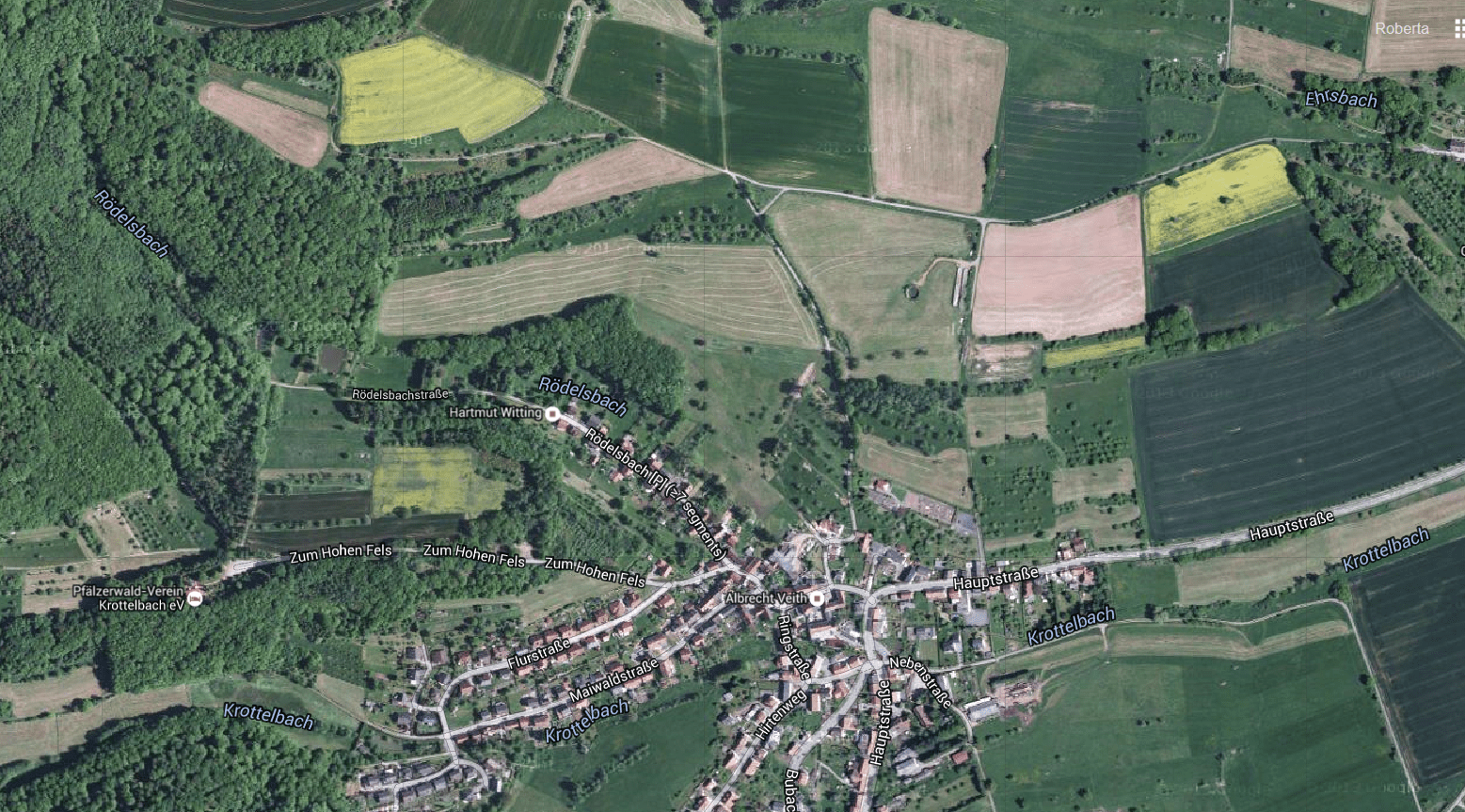
Krottelbach Germany

Just three years after Hens Berchtol’s death in 1711, Susanna Agnes Berchtol, Hans and Anna Christina’s daughter, would marry Johann Michael Mueller.

In a twist of irony, Johann Michael Miller was the child born in Steinwenden in 1692 that Hans Berchtol and Anna Christina stood up with as godparents when he was baptized on October 5th.

Anna Christina could not have had any idea in 1692 that her daughter, Susanna Agnes, born in 1688, would in 1714 marry Johann Michael Mueller.  Does this sound like a fairy tale or Disney princess story to you?  All we need now are some really cute little woodland critters.

Given that Anna Christina was Johann Michael’s godmother, and that his mother and father had both died by 1695, it’s certainly possible that Anna Christina and Hans Berchtol raised Johann Michael Mueller.  In essence, that means Susanna and Michael could have been raised together.  That certainly would have made courting much easier.

Johann Michael Mueller would have been 19 years old when Hans Berchtol died in 1711.  We don’t know if Anna Christina had already died, or if she was left as a widow.  Regardless, Anna’s youngest child would have been 15 and not yet an adult.  Perhaps when Hans Berchtol died, Johann Michael Mueller stepped in to help the family, assuming an adult male role, and three years later, married the eldest daughter.

The record from Konken Reformed Church shows that Michael Muller, son of Johann Michael Muller, from Steinweiler in Churpfalz, married Susanna Agnes Berchtel, a Swiss, at Crottelbach on January 4, 1714.  “A Swiss,” in fact confirms that indeed, the Berchtel family too immigrated from Switzerland.  This bit of evidence is what suggests that Anna Christina was likely born in Switzerland.

We don’t have a lot of information about Anna Christina, aside from scanty information from church records that includes her children’s births and the Mueller births that she witnessed as well.

What we do know is that she was part of the pietist group that left Switzerland and settled in Germany.  These pietists became both Brethren and Mennonites after their descendants, specifically, Johann Michael Miller and Susanna Agnes Berchtol, moved to Pennsylvania in the 1720s.  One Samuel Berchtol also migrated to the US and is found closely associated with Johann Michael Mueller, jointly owning land, and was Mennonite in Hanover Co, PA.  Johann Michael Mueller (Miller) was Brethren.

The early pietist movement in Switzerland led to the founding of several religions that had the same core values, although they did develop some differences that led to different sects.

The original pietist believers in Switzerland tried to avoid religious labels.  They had become convinced that the established church was thoroughly corrupt and sought to meet quietly and privately among themselves, studying and adhering strictly to the written word of the Bible and avoiding anything political in nature, including conflict.  Most families kept a loose association with the Reformed protestant churches.  Attempting to establish a new religion would have been illegal at that time.

At one point, the pietists and Anabaptists would suffer a difference of opinion, being that the Anabaptists did not believe in infant baptism.  In fact, they did not believe in baptism until the individual was old enough to make their own commitment based on a personal understanding of the Bible.  However, the pietists and Anabaptists shared many convictions and were more alike than different, especially in the eyes of the government.  They found the state-church squaring up against them, viewing them as one group and attempting to squash what was viewed as a dissident religion.  Oftentimes, other church members who weren’t pietist or Anabaptist felt sorry for the aggrieved patrons and joined them, ashamed of and put off by the actions of the official church.

What role did women, like Anna Christina play in this emerging religion?  The book, “Sisters: Myth and Reality of Anabaptist, Mennonite and Doopsgezind Women, ca 1525-1900” discusses female pietists in a quite surprising light.

Like many religious movements, the “born again” movement had a sense of urgency fueled by the belief that the end of mortal time was near.  It’s easy to understand why they might have felt this way, given that war had ravaged the European landscape for decades, plagues had run rampant, killing one third of the European population and as a result of those disasters, economic and social upheaval was at hand.  Pietism offered spiritual comfort and the promise of a heavenly afterlife.  And comfort was something in short supply at that time.

Chiliasm was one of the widespread concepts of pietism.  The more radical Anabaptists believed that they would help usher in a new economy, meaning a new phase of history in which God’s order, not a corrupt world order would dominate.  I think we’re still waiting for that.

Chiliasm contributed to the prominence of women leaders in Pietism since women were able to claim an authority that the Bible reserved for women prophets at the end of time.

Joel 2,28:  “I shall pour out my spirit on all mankind; your sons and daughters will prophesy, your old men will dream dreams and your young men see visions; I shall pour out my spirit in those days even on slaves and slave-girls.”

Pietist women justified speaking out directly by claiming that God inspired them.  And who was to argue?  Not only that, but this direct inspiration by God gave them more authority than theologians with university degrees because God spoke to these women personally and directly.

Pietist women claimed that the old traditions of shutting women out were no longer valid and that all Christians needed to act boldly to save as many souls as possible before the coming apocalypse.

Other pietists pointed out that Christ appeared first to women after he was risen and that women were prominent in the early church.

These newly founded groups met in homes, in the domestic domain, so to speak, where women often interpreted the scripture.  That would not have been allowed in churches.  While these “conventicles” were not intended to replace churches, in time, they did indeed become the foundation for a new religion.

In the 16th century, women were still barred from formal education, but they were taught to read by private tutors.  They could then read the Bible for themselves, and anything else they wanted to read too.  Their justification was that they were the primary educators of children.

Women’s roles went further than just hosting conventicles.  They acted as enthusiastic prophets, lay preachers and in some cases, as aristocratic patrons funding institutions such as missions and schools.  In general, it was considered “unseemly” for women to act in a public way, and women were not believed to be intellectually capable of understanding complex ideas and certainly incapable of writing, so books written by women were published under pseudonyms.

This movement was not popular with either the established church or the government, and in 1704 the German historian Johann Feustking published a book attributing the formation and leadership of pietism to female agitators, arguing in the book that women had to be limited to the home if traditional society was to be preserved.  This seems to be a case of wanting to close the barn door a bit too late.

Another author from the 1700s characterized the pietist movement as led by foolish and naïve women who had been hoodwinked by smarter, unscrupulous men.  Ironically, that author was herself a woman and had to publish her book, “Pietism in Petticoats” anonymously.

The area around Bern, Switzerland, where the Johann Michael Mueller family originated, had its own set of problems.  Political and military threats surrounded Bern; a recent war with the Turks, a war of succession in the Pfalz and the Swiss-French struggle in the Piemont.  The economy was floundering.  To help address these problems, the Swiss had opened their doors to the Huguenot and Waldensian refugees, but those groups, along with the pietists were monitored closely.  Both were forbidden to recruit new members.  The last thing Bern wanted was more threats to stability – and women involved in anything, let alone in a prominent religious role, shook their very foundation and confirmed the potential for social upheaval.

One Anabaptist women, Elizabeth Tscharner died and her son eulogized her life.  He said that she spent several hours each day on her knees in prayer, a style of praying associated with Anabaptists.  Combining personal devotion with practical Christianity, Elizabeth translated written tracts, had them published and handed them out to the poor.  Ironically, the poor probably couldn’t read them.  Elizabeth knitted and sewed clothes for the needy.  She concerned herself with the welfare of Anabaptists in Bern’s prisons…jailed for their Anabaptist activities.  Often too weak to even sit up, she brought them food and fed them.

One group of Anabaptists was being sent on a ship to the Pfalz to join their spiritual kin, not exactly by choice.  Elizabeth took up a collection of clothes, food and money for provisions for their trip.  This story also illustrates that perhaps not everyone who settled in the Swiss villages of Germany did so by direct choice.  Some may have arrived with absolutely nothing.

Near her death, Elizabeth asked her son to wash her feet, an activity still performed in Brethren churches today, viewed by Elizabeth as “the foot washing of the apostles.”

 Christ Washing the Feet of the Apostles by Meister des Hausbuches, 1475


Christ Washing the Feet of the Apostles by Meister des Hausbuches, 1475

One of Elizabeth’s female Anabaptist friends wrote a book at the age of 76, sharing with us an eternal bit of wisdom about the roles we play on the stage of this world, “No matter whether our mortal lives are comedy or tragedy, at the end of our lives we all look alike.”

Bern’s records show that authorities were particularly concerned about situations where women were involved in pietist religious activities and their men were not, leaving the women “unsupervised and uncontrolled.”  These, women, tsk, tsk, tsk, left the house at night and went to meetings where men and boys were attending, returning home late at night.  They tried to equate women’s religious activity with promiscuity and played on their husband’s fears.  Council protocol addressed activities of “willful wives” as well as “disobedient housemaids.”

While focused on the women, they weren’t above trying to control men either.  Knowing that pietists refused to take oaths, they required a yearly oath of allegiance from all men.  Men who wouldn’t swear allegiance were arrested and assumed to be pietist.  No wonder women had so many men to visit in the prisons.

It’s no surprise, in light of this oppressive environment, that so many removed to much more accommodating and welcoming Germany, whose lands had been depopulated in the wars and needed settlers to work the farms.  In return, Germany offered religious tolerance, at least to a degree.

By 1699, when Bern officials began enacting even stricter measures and interrogating those suspected of pietist leanings, most of the pietists were dead, gone to Germany either willingly or in exile, or very quietly living underground.

It’s ironic that we think of the Brethren and Mennonites today as extremely conservative and the women as very obedient, subservient and compliant, when, in Europe, they were considered quite the opposite – uncontrollable rabble rousers.  Imagine…..women believing they had a legitimate voice and expressing an opinion – and possessing a God given right to do so no less.  For shame!

Anna Christina …you rabble rouser you…..

You know, I’m pretty sure I inherited some of her DNA!!!

Unfortunately, unless one day we can identify some of her autosomal segments, her DNA is unavailable to us.

She had three daughters, but there is only one, Susanna Agnes, that we know anything about.  She married Johann Michael Mueller and had several children, but there are no documented daughters.  There are rumored and inferred daughters, but none with any suggestive evidence that they were in fact the daughter of Susanna Agnes Berchtol Mueller.  Since mitochondrial DNA is passed from mother to daughter to daughter, down the line to the current generation, intact, if we could find someone who descended from Anna Christina through all females, we could obtain her mitochondrial DNA signature today which would tell us about her deep ancestry.

Unless something is discovered of Barbara and Ursula, her two youngest daughters, or a daughter is confirmed from Susanna Agnes, Anna Christina’s mitochondrial DNA line is dead to us.  However, her rabble rousing spirit is not and survives quite intact today!

______________________________________________________________

Disclosure

I receive a small contribution when you click on some of the links to vendors in my articles. This does NOT increase the price you pay but helps me to keep the lights on and this informational blog free for everyone. Please click on the links in the articles or to the vendors below if you are purchasing products or DNA testing.

Thank you so much.

DNA Purchases and Free Transfers

Genealogy Services

Genealogy Research

Hans Berchtol (1641/1653-1711), Twice a Godfather, 52 Ancestors #101

We know that Hans Berchtol’s death was recorded in the church in Konken, Germany, the beautiful hamlet shown below, on June 15, 1711.  His death record in the church records tells us that he resided in Krottelbach, just a few miles away.

Konken Germany

Hans Berchtoll and his wife, Anna Christina reportedly had the following children:

  • Hans Jacob born in 1686 who married Anna Marie Glosselos
  • Susanna Agnes born on May 3, 1688 and married Michael Mueller (1692-1771) (One source reports her birth in Ohmbach, a nearby village.)
  • Hans Peter born on May 1, 1690 and married Maria Elizabeth Zimmer
  • Hans Heinrich born on May 1, 1690
  • Barbel (Barbara) born about 1693
  • Ursula born about 1696

Konken Steinwenden map

In 1686, in Steinwenden (shown below,) not terribly far from Konken, we find mention of Hans Berchtol in the baptismal record of Johann Abraham Mueller, the son of Johann Michael Mueller and his wife, Irene Charitas whose last name is unknown.

Steinwenden Germany

Hans Berchtol’s wife was not with him in the baptismal records of this child, likely because she was herself quite pregnant or had recently given birth.  The first child born to Hans Berchtol and his wife, Anna Christina was born in 1686 as well.

The infant, Johann Abraham Mueller, would die shortly after his birth, but again, in 1692, Hans Berchtol would be called upon to attend another baptism of a child of Johann Michael Mueller and his wife.  These two couples were obviously close, even though they didn’t live nearby.  Why?  Were they in some way related?  What was their common bond – a bond strong enough to survive a 15 mile distance in the mountains over several years.

The child born in 1692, Johann Michael Mueller (Jr.) would one day marry the daughter of Hans Berchtol and Anna Christina.  How strange is that?  Michael’s in-laws-to-be were his godparents.  That doesn’t happen often.  Hans Berchtol’s daughter, Susanna Agnes Berchtol was born on May 3, 1688 in Konken (or Ohmbach).  Whether this family was previously related in some fashion or not, their descendants were destined to be.  I wonder if Johann Michael Mueller grew up playing with Susanna Berchtol, his future wife.  Did they sit beside each other in Sunday School from time to time? She was more than 4 years his senior, so maybe she wasn’t terribly interested in him until they were teenagers or young adults. And they did live 15 miles apart.

Then another thought struck me.  Konken and Steinwenden are really too distant for easy accessibility.  Since Hans Berchtol and his wife had stood up with Johann Michael Mueller at his baptism, they would have been his godparents.  Godparents were technically responsible for the religious education of the child, and were the people who would have taken the child to raise if their parents died.  It has always been assumed because of the close relationship of Johann Michael Mueller (the second) and Johann Jacob Stutzman (born 1706), son of Michael’s father’s second wife, that Michael’s step- mother, Anna Loysa Regina, and her second husband, Jacob Stutzman raised Michael.  I know this is confusing, so I’ve created a little chart representing the relationships.

Miller Stutzman chart

But maybe that wasn’t true, and Anna Loysa Regina and Jacob Stutzman didn’t raise Johann Michael Mueller (the second), or maybe not for the entire time.  Maybe Michael was raised by Hans Berchtol and his wife, his godparents.  That would explain how the 15 mile difference between Steinwenden and Konken was overcome for courting purposes.

I don’t have the Konken church records or their direct translations, but it would be very interesting to see if Johann Michael Mueller (the first) and his wife, Irene Charitas Mueller, witnessed the baptisms of any of Hans Berchtol’s children.  It would also be interesting to check the neighboring church records to see if we can find any additional children for Hans baptized in neighboring churches.  I don’t know if the family moved, or if they simply went to the closest church for baptisms, or they changed churches occasionally.  Why didn’t they attend the church in Krottelbach where they lived?

As it turns out, Krottelbach historically formed the boundary between the parishes of Ohmbach and Konken, so Krottelbach didn’t have its own church.

Konken Krottelbach map

This caused some difficulty in ascertaining what the village’s population was in the so-called Konker Protokollen of 1609 in which the 12 hearths (“households”) with 65 inhabitants listed for Krottelbach were actually only the ones on the north side of the brook, in the parish of Konken. Corresponding statistics for the part of the village on the south bank are not available. All in all, though, the village as a whole may have been rather large for the circumstances of that time.  However, that wasn’t to last.

Like all villages in the region around Kusel, Krottelbach suffered heavily under the twin blows of the Plague and the Thirty Years’ War (1618-1648).  After that war, there were only four people living in the village.  The populace was devastated.  This area of Germany was barren and desperate for settlers who were willing to work and farm, and actively sought people from Switzerland and other regions.

The newcomers welcomed the opportunity and settled, but more lives were lost towards the end of the 1600s in French King Louis XIV’s wars of conquest.  It seemed that there was no end to wars and violence.

Krottelbach belonged to the village church in Ohmbach, which Count Gerlach V of Veldenz had bequeathed to the Werschweiler Monastery after 1258. During the Reformation, the monastery was dissolved, whereafter some of the then Lutheran villagers still belonged to the parish of Ohmbach, while others belonged to the parish of Konken.  Until 1817, the village of Krottelbach remained solidly Reformed, a faith that in 1817 united with the Lutherans.  At that point, the whole village once again belonged to the parish of Ohmbach.

What this history of Krottelback, along with the Konken church records, tells us is that Hans Berchtol lived on the north side of the brook in Krottelbach.

Krottelbach creek map

Perhaps Hans farmed one of these beautiful fields or maybe he lived on Krottelback Creek, meaning “Toadbrook.”  At this time, farmers did not live on farms in the countryside, but they actually lived in the villages clustered together and then went to farm their fields that surrounded the village.

Krottelbach fields

A second Berchtol male was having children in Steinwenden where Johann Michael Mueller lived.  Hans Simon Berchtol and his wife Catherine had the following children according to Steinwenden church records:

  • Hans Samuel born 1685, godparent Hans Michael ?
  • Maria Magdalena born 1686, godparents Hans Michael Muller of Steinwenden and Anna Catherine
  • Maria Elizabeth born 1691
  • Anna Catherine born 1696, godparents Anna Catharine, Johannes Lampon, frau, Jacob ??
  • Johannes Theobold born 1697, godparent Maria Elizabeth
  • Johannes born 1698, godparents Johannes Berchtol and Anna Maria

Hans Samuel Berchtol, born in 1685 above is believed to be an immigrant and possibly the Samuel Berchtol found in records in Pennsylvania with Johann Michael Mueller born in 1696.  One Samuel Becktel arrived on the ship Robert and Alice on September 30, 1743.

Were Hans Berchtol of Krottelbach and Hans Samuel Berchtol of Steinwenden brothers?  These families were surely related, but how?

These villages, Krottelbach and Steinwenden were nearly as far apart as Konken and Steinwenden, being a distance of about 18 km.

Krottelbach Steinwenden map

The fact that both families were of Pietist leanings and settled in this part of Germany, traveling a non-trivial distance between locations, suggests that perhaps they had a pre-existing connection before settling here, other than their obvious religious leanings and refugee status.  Remember, we don’t know the maiden name of either man’s wife, Hans Berchtol’s Anna Christina or Johann Michael Mueller’s Irene Charitas.

We know that the Mueller family was originally found in the Canton of Berne, Switzerland where Johann Michael Mueller, the elder, was born in 1655 in Zollikofen.  Many Pietist families from this region removed to this same part of Germany in the 1680s.  So it’s not unlikely that the Berchtol family did the same thing, which would explain why Hans Berchtoll was willing to travel 18km, each way, twice to stand up with the Mueller family for the baptism of babies.

The record from Konken Reformed Church shows that Michael Muller, son of Johann Michael Muller from Steinweiler in Churpfalz, married Susanna Agnes Berchtel, a Swiss, at Crottelbach (sic) on January 4, 1714.  “A Swiss,” in fact confirms that indeed, the Berchtel family too immigrated from Switzerland.

The Steinwenden records begin in 1684, but the Konken records begin in 1654, so perhaps more information awaits in those records, once they are translated and indexed in some location so that you can find entries without reading the entire church book – or more accurately stated – paying someone else to read the entire church book.

Just three years after Hens Berchtol’s death in 1711, his daughter would marry Johann Michael Mueller Jr., that baby born in 1692.  Maybe when Hans died, Johann Michael Mueller stepped in to help the family.

Krottelbach Germany

Krottelbach, shown above, is about 5 miles from Konken.

So, by piecing scant records together, we know that Hans Bechtol, Bechtel or Berchtol was “Swiss,” lived in Konken or more likely Krottelbach by 1686, but traveled that same year to Steinwenden, without his wife, for the baptism of the child of Johann Michael Mueller and his wife, Irene Charitas, whose last name is unknown.

During this same time period, a Hans Simon Berchtol was living in Steinwenden and having children there.  Johann Michael Mueller was a godparent to one of Hans Simon’s children as well.  These three families were likely related in some fashion.

Hans Berchtol and his wife continued to have children in Konken until about 1696.  We don’t know if this was when his wife died, or whether she had reached the age where children were no longer forthcoming.  If that was the case, it would put their birth year at about 1653 or so. It would be worth checking Hans actual death record to see if his wife is mentioned as either living or dead.

Hans died in 1711 where the Konken church records reflect that he lived in Krottelbach.  He was born probably before 1653, which means he would have been at least 57 when he died.  Another source states that he was born on June 15, 1641 in Germany, but they do not provide the source of this information.  Regardless, Hans was not a young man when he died.

We know that two of Hans sons lived to marry, although I have no information about their children, or if they immigrated.

I noticed that in the Biddle/Bechtel project at Family Tree DNA, there are several Bechtel and Bechtol males who have Y DNA tested.  Unfortunately, there are eight different groupings, and none of them reach back to Hans Bechtol in Germany.  Several are found in Germantown, Delaware Co., Huntington Co., York and Berks Counties in PA.  These would, of course, be the exact locations where these German families would have settled.  Bechtel immigrants are documented here and none of these seem to be candidates for sons of our Hans.

Many of the Bechtol/Bechtel families were Mennonites and one group arrived in 1729.  These men don’t look to be Hans sons, but we don’t really know, apart from the fact that we are looking for a Jacob, a Peter or a Heinrich.

However, we know positively that there were Bechtol men with the Brethren families in Chester and York Counties in PA.

On February 7, 1744, Michael Miller, Nicholas Garber, Samuel Bechtol and Hans Jacob Bechtol, who all lived in Chester Co, PA, purchased a tract of land consisting of 400 acres northeast of Hanover, PA in York County.

Chester Co Hanover Co

Today this land is near Bair’s Mennonite Church, probably lying south from the church, shown below.

Bair's mennonite cemetery

Today, that land has a cemetery on both sides of the road.  It’s possible that the church is on the original land owned by these 4 men.

Let’s see if we have a participant from this line in the Bechtel DNA project.

Bechtel dna project

The last group of Bechtel men in the DNA project track back to one Samuel Bechtel, reportedly born in 1700, died in 1785, and is buried in the York Road Cemetery in York County, PA.  A little bit of digging shows us that indeed, the church shown in Samuel’s Find-A-Grave picture is Bair’s Mennonite Church, shown below from Google maps, street view.

Bair's mennonite church

Is this the same family line of Samuel Bechtol who purchased land there in 1744? Assuredly.  Additional deed work would likely confirm the land history.  Is the Samuel Bechtol of Chester County, PA the same Bechtol family as was found in Konken and Steinwenden, Germany.  Most likely, but we don’t know for certain.  The dates don’t align exactly.  Hans Simon Berchtol of Steinwenden had son Hans Samuel in 1685.  It’s hard to imagine the continued connection with the Mueller/Miller family if it is not the same Berchtol family line, but we need more than circumstantial evidence.

If any Bechtol, Bechtel or Berchtol male, meaning any of Hans Bechtol’s or Hans Simon Berchtol’s descendants who are males and still carry the surname, by any spelling, are discovered, I have a DNA testing scholarship for the first individual.  Let’s find out more about our ancestors.  I’m betting that Samuel Berchtol and Hans Berchtol from Germany are related, one way or another, and so is the Samuel buried in the Mennonite cemetery at Bair’s Mennonite Church.

Various kinds of DNA testing could help unravel this puzzle.

It’s possible that autosomal DNA testing can solve this puzzle as well, even though there are several generations between Hans and descendants today.  If we don’t look, we’ll never find that connection.  If you descend from these lines, let me know.

It’s amazing that DNA has the potential to answer these questions that have been burning for decades – and questions that our ancestors knew the answers to and thought nothing of.  They are probably chuckling at our inquisitiveness today, given that they still know those answers, and we still don’t.

______________________________________________________________

Disclosure

I receive a small contribution when you click on some of the links to vendors in my articles. This does NOT increase the price you pay but helps me to keep the lights on and this informational blog free for everyone. Please click on the links in the articles or to the vendors below if you are purchasing products or DNA testing.

Thank you so much.

DNA Purchases and Free Transfers

Genealogy Services

Genealogy Research

Irene Charitas (c1665-c1694) and Her Aching Mother’s Soul, 52 Ancestors #100

For a very long time, and on most online trees, Irene Charitas is listed as the wife of Johann Michael Mueller who was born about 1655 in Zollikoffen, Switzerland and who died in 1695 in Steinwenden, Germany.  Her last name is listed as Charitas, but it isn’t.  Charitas is Irene’s middle name.

At this time in history, in Germany and the Germanic speaking Protestant regions of Europe, females were given two names, a first “saints” name and a second name by which they were typically called.  Irene is quite unusual for a Saint’s name and Charitas is very unusual for a middle name.  So unusual in fact that I’ve only seen it one other time, ever.

Charitas is a Latin word meaning charity and “for the love of God.”  Charitas, or charity, is one of the 7 virtues.

Steinwenden 5

We don’t know where Irene was born, but what we do know is that we first find her as Johann Michael Mueller’s wife in Steinwenden, Germany, shown above and below, when she gives birth to the first child recorded to this couple in the church records in 1685.  Could this couple have lived there, or had children elsewhere, previously?  Of course.  Could they have had other children that were baptized in a different church?  Yes.  Michael was born in 1655, so if Irene was his age, they could have married by about 1673-1675 and had another 5 children or so before they appear in the Steinwenden records.  But did they?  We’ll never know for sure, but there is no evidence today to suggest such.

Steinwenden 6

Unfortunately, the only part of the original Steinwenden church that survives today is the bell tower.

Steinwenden 4

Sometime in the early 1680s, the Mueller family arrived in Steinwenden from the Zollikoffen area near Bern, Switzerland. It’s likely that Irene’s family was among the same immigrant group – but we just don’t know and to the best of my knowledge, no research has been done on that topic.  Furthermore, the Johann Michael Mueller family could have made an intermittent stop along the way that we are unaware of.  In other words, Michael could have married Irene Charitas anyplace between Zollikoffen and Steinwenden.

I’m not quite sure how Charitas became her last name on the internet.  Perhaps it’s an assumption based on the fact that her middle name is an unfamiliar name and someone assumed it was her last name.  In any event, it’s been that way for years now and I’m hopeful that records from the actual church can help reduce or eliminate this misinformation.  I’m currently in the process of having the church records retranslated by a professional German genealogist, just to be sure.

When our cousin, the Reverend Richard Miller visited the church in Steinwenden in 1996, the church historians and a German genealogist prepared a summary of the church records involving Johann Michael Mueller, shown below.

In all of the birth records of children born to Michael, Irene Charitas was his wife, and Charitas was not her birth name.  If the child born in 1685 was their first, then Irene Charitas was likely born about 1665, give or take a couple years in either direction.

Steinwenden 7

Recently, Richard sent me the original record of Johann Michael Mueller’s birth from the Steinwenden church.  It’s the second to last entry, below.

Miller 1792 birth steinwenden

Needless to say, I can’t read this, on two fronts, the language and the script, which is why I’m having this and the other records retranslated.

The next we hear of Irene is a church record for a confirmation of Irene Charitas Schlosser, a daughter of Conrad Schlosser, of Steinwinden.  Often, children were named after their godparents with the idea that the Godparents were relatives and they were the appointed relatives responsible for the religious education of the child – and whether spoken or unspoken, it was also expected that if the parents died, the Godparents would raise the children – or at least the one(s) named for them.  Unfortunately, in the age of marginal medical care, no antibiotics and an era where every pregnancy was high risk, that happened all too often.  So, it appears that Conrad Schlosser’s daughter was named for Michael Mueller’s wife, Irene Charitas.

It’s likely that Irene was in some way related to Conrad.  She could have been his sister or aunt or a favorite cousin.  Or, Conrad could have been related to Johann Michael Mueller.  One way or another Conrad trusted Irene enough to name his daughter after her, making Irene Charitas Mueller the first in line to raise her namesake should something happen to Conrad and his wife.  Additional research on the Schlosser family church records is in order.

Steinwenden 1

The first record on this transcriptions says that Jacob Ringeisen of Schweitz was “serving for his cousin” Michael Muller.

In other words, even though the daughter was named for Irene, Michael’s wife, Irene wasn’t present, possibly due to pregnancy herself, and apparently neither was Michael.  However, Michael’s cousin in essence represented Michael and the couple’s commitment at the baptism.

Of course, now this makes me ask just how Michael and Jacob were cousins, and was it through marriage via Irene Charitas?  It looks like we may have yet another family connection hint.  So often in these old church records there is so much more buried in the details that is missed if all you get is a translation of the actual “event.”

In genealogy, always, always, more questions.

Irene Charitas’ life was short.  She probably died before she was 30.  There are no more known records of her, at least not directly.

What we do know is that the last child in these church records is born to Irene and Michael in 1692.  This is the only one of the six children she bore that lived.  This is an incredibly sad story that seems to stretch beyond just “bad luck.”   

Child Birth Death Age at Death
Johann Nicholas Muller June 5, 1685 June 6, 1685 1 day
Johann Abraham Muller July 9, 1688 1696 Less than 6 months
Samuel Muller April 30, 1687 April 30, 1687 Shortly after birth
Catherine Barbara Muller June 7, 1688 June 21, 1691 3 years, 2 weeks
Eva Catherine Muller April 24, 1691 June 29, 1691 2 months
Johann Michael Muller October 5, 1692 1771 78 years

Looking at these children’s deaths, I find the month of June, 1691 particularly heartbreaking.  Clearly, something contagious was occurring and both of Irene’s children died, 8 days apart.  I wonder if the church records reflect a rash of deaths within the village.  Just 11 months later, she would bear her 6th child.  I bet those months between June of 1691 and May of 1692 were living Hell for Irene, between the sorrow and grief of losing her children and the uncertainly of the one she was carrying.

Fortunately for me, Johann Michael Mueller, the second, born in 1692, named after his father, did live, as he is my ancestor.

Johann Michael Mueller Sr. died in Steinwenden in 1695, just three years later. For some reason, from 1692 to 1695, there were no more children born to Johann Michael Mueller and Irene Charitas – nor to Johann Michael Mueller and anyone else.

Why is this important?  Because another rumor that has been rampant over the years is that Johann Michael Mueller was married to Anna Loysa Regina and that she was the mother of Johann Michael Mueller.  At least I was able to figure out where this information originated.

On September 29, 1695, Anna Loysa Regina married Jacob Stutzman in Steinwenden, although I have not seen the original record myself.  She is noted at that time as being the widow of Michael Mueller.

For Anna Loysa Regina to be the window of Michael Mueller, that means that Irene Charitas died sometime after giving birth to Michael Jr. on October 5, 1692 and sometime before Michael Sr.’s death on January 31, 1695, just 2 years and 3 months later, allowing Michael Sr. enough time to remarry after Irene’s death and before his own.  Remarriage often didn’t take much time actually, given that most people already knew each other through church and it was simply a matter of taking stock of the available spouses and making a choice from the willing and most compatible selection.  No, it was not about love but one would hope it was at least about like and that love evolved.  Regardless, marriage was a practical matter of survival as men and women needed each other’s assistance in the daily activities of living and raising children.  Michael would have had a small child who needed a mother.

Michael and Anna Loysa Regina must not have been married long, because there are no children recorded to she and Michael, but she did go on to have children with Jacob Stutzman, one as late as 1706.  Jacob Stutzman Jr. born in 1706, and Johann Michael Mueller Jr., born in 1692, step-brothers of a sort, would in 1727 immigrate to America together.

If all of these records have been accurately translated, Irene Charitas probably died about 1694, possibly in childbirth.  In the natural order of things, March or April 1694 would be about 18 months after Michael was born, representing the typical spacing between children.  Why no record of her death exists in the church records is a mystery.  Perhaps we need to look again, and maybe in the surrounding church records as well.

Cemetery plots in Germany, as is customary in Europe, are reused.  In some cases, they continue within the family, with generation upon generation (pardon the pun) being buried in the same location.  In other cases, the grave is considered “abandoned” if no one pays upkeep, and the site is reused at the discretion of the church.  Gravesites that aren’t abandoned are still reused, but generally by the family and perhaps not as quickly as abandoned graves.  While this is very foreign to those of us in the US, if Europeans did not employ some “recycling” burial strategy, the entire continent would be blanketed with cemeteries and there would no room for the living.

Being someone who wonders about everything, I asked at a Dutch church during a European visit in 2014 about what happened if there were still bones in the grave when they set about burying the next person.  I’m glad I asked, because I then discovered that those little buildings in or near cemeteries weren’t what I thought.  I assumed they were the gardener’s or sextant’s shed, containing things like shovels, lawnmowers, etc.  Well, I was wrong.  Those little buildings are ossuaries containing the bones of the former inhabitants of graves.  The photo below is the ossuary in Wolsum, the Netherlands.

Ossuary Wolsum

This is truly the final resting place until the bones turn to dust, generally stacked something like cordwood with similar types of bones stacked with like bones on shelves.  Yes, seriously.  Once moved from the grave to the ossuary, the bones are not kept together as a “person.”  This photo is an ossuary in Hallstatt, Austria.

Ossuary Austria

From a DNA perspective, these ossuaries, found in almost all cemeteries, are just torture to me, because I can just see the DNA of my ancestral lines in that ossuary, all mixed in with the DNA of the other families…which are probably mine as well, given that these people married their neighbors in the community for generations.  There they are, my ancestors and their DNA, right in front of me, but entirely anonymous and completely unidentifiable.  If we knew who they were, we could obtain the Y and mtDNA lineage of every family in the village, including mine!

The bones in the ossuaries are just waiting to finish turning to dust – a process that takes longer than they are allowed to rest in the ground.  So a grave in Europe is not a place of perpetual rest, it’s a temporary resting point but not the last stop on the journey.  I just can’t help but think what a wonderful scientific study it would be to analyze the bones in an ossuary and compare the results to the DNA of the current village inhabitants, and those descendants who moved away.  And yes, you know I’d be in the front of the line, volunteering.  You could reconstruct an entire village in the 1700s or maybe 1800s from their DNA – maybe even further back.  You could tell who settled there, where they were from originally… you could learn so much.  But back to reality….

Not only do we not know where Irena Charitas and her infant children were buried, their dust assuredly shares that location today with several subsequent generations of Germans, most likely not her descendants because her only known descendant immigrated to America in 1727 with his Stutzman step-brother.  Irene Charitas’ son Johann Michael Mueller, Jr. never knew his mother or father, never remembered seeing his mother’s face, beaming down at him, so joyous that he was alive.  He had no memory of her loving touch.  He was raised by his step-mother and her subsequent husband, Jacob Stutzman, after both of Michael’s parents died by the time he was three.

There was no happy ending for Irene Charitas.  In fact – it seems that her entire adult lifetime was filled with serial grief, except for those few brief months when she and baby Michael both lived.  Irene Charitas’ grief was caused by the births and deaths of 5 children in 5 years, followed by her own death not long after her 6th child was born and survived.  Then, the terrible irony.  When a child finally lives, she herself succumbs.

I can only imagine the excitement Irene felt about her first pregnancy, followed by the shattering death of the baby.  Surely, she would have told herself that it wouldn’t happen again.  It was a first birth, probably difficult.  The second one would be easier.  Just a few months later, she became pregnant again and full of hope, only to have her dreams shattered again with the death of that child.  And then again…and again and again, year after year after year.  Just five years after that first baby died, she was pregnant for her sixth child.  I wonder if she started out in dread when she discovered she was pregnant again, never allowing herself to be excited, to plan, to hope for that baby to live.  I could understand how she might feel that way after 5 dead babies in 5 years.  I know how frightened I was when I was pregnant for my third child after my second child died.

And then the baby lived but she died.  Oh, the horrible irony.  Poor Irene.  In death, leaving behind her one child that lived.  She must have fought the grim reaper with every ounce of her being until the very end.  But it wasn’t enough.  It just wasn’t enough.

I hope that Irene Charitas was able to see, from afar, her son, Johann Michael Mueller Jr. growing up strong, being raised by his step-mother and step-father in a pious pietist home and that it helped sooth her aching mother’s soul.

4-15-2018 Update – We now have a surname and parents for Irene.  Click here to read the next article!

______________________________________________________________

Disclosure

I receive a small contribution when you click on some of the links to vendors in my articles. This does NOT increase the price you pay but helps me to keep the lights on and this informational blog free for everyone. Please click on the links in the articles or to the vendors below if you are purchasing products or DNA testing.

Thank you so much.

DNA Purchases and Free Transfers

Genealogy Services

Genealogy Research

Phebe (c1747-c1803), Is Jotham Brown’s Wife Zopher Johnson’s Daughter?, 52 Ancestors #99

I love her name, Phoebe.  There have been other Phoebe’s in the family line – her granddaughter, Phoebe Crumley, assuredly named for her.  Nine generations later, we have another Phoebe, but her parents had never heard of Phoebe Brown or Phoebe Crumley.  I like to think that they were somehow influenced by forces unseen to select a beautiful family name.

We don’t know a lot about the original Phoebe, Jotham Brown’s wife, whose name was also spelled Phebe, Pheby and Feby.  For example, we don’t know who her parents were.

There has been speculation for years based on the close relationship of the Brown and Johnson families in Frederick County, Virginia and Greene County, Tennessee, that Phebe was the daughter of Zopher Johnson the Elder.  I wish she was, because I think Zopher is a really cool name and someone else has already done a lot of quality research on this family who was originally found near Philadelphia, but alas, I really don’t think so.  Let’s take a look at Phoebe’s life and see how the evidence stacks up.

We know that Phoebe was living in Virginia in 1768, because on the 1850 census, her daughter, Jane Brown Cooper gave Virginia as her birth location.

We also know that Zopher Johnson, “the Elder” who is Phoebe’s speculative father, was living at the Forks of the Delaware between 1754-1762 when his son, Zopher Johnson, Sr., was born.

Zopher Johnson the Elder clearly did moved to Virginia sometime before 1781 when he was on the tax list in Frederick County, VA.  This is also the first location where we find Zopher Johnson living in the same location as the Jotham Brown family.  They are both found on the 1782 tax list.  We also know that Jotham Brown was living in Hampshire County in 1778 and remained there until about 1781.

Spring Gap Road with Mountain

This land in Hampshire County is still very remote and wooded today as shown by Google Maps street view.  I can’t even imagine how forbidding it looked 237 years ago when the first settlers were obtaining land grants.

Spring Gap Hamphire Co

Spring Gap and Bethel Road where they cross the creek feeding into Little Cacapon River.  This is the area where Jotham and Phebe Brown owned land.

In 1778, Jotham Brown would have been about 38 years old and Phebe maybe a few years younger.  Given that their oldest daughter, Jane was born in 1768, and is believed to be their oldest child, Jotham would have married Phoebe about 1767 – wherever they were both living at the time.

The problem is that we don’t know where they living in 1767, although it’s likely they were living in Virginia given that their daughter was born there a year later in 1768.

Had Zopher Johnson moved to someplace in Virginia by 1767?  If so, where?  He wasn’t in Hampshire County, or at least not that we can tell, although most Hampshire County records are missing, but Virginia land grants for this area exist.

Conversely, was Jotham Brown living in Pennsylvania in 1767?  There are no records that indicate that’s the case – but it’s possible.

However, in order for Zopher Johnson’s daughter to marry Jotham Brown, they had to be in the same location at the same time.  You can’t court someone who doesn’t live nearby – at least not then in Virginia.

By 1781/1782, both families had moved to Frederick County, VA.  Was this move coordinated or pre-planned or simply circumstantial?

The 1782 tax records tell us that Jotham Brown and Phoebe had 8 children, which could mean that they had been married roughly as long as 16 years, about 1766, which correlates with their the known birth year of Jane in 1768.

There was a strong Quaker presence in Frederick County, and the Crumley and Babb families into which the Brown family would eventually marry years later in Greene County, TN were both Quaker.  Did the Johnsons and Browns live near the Quaker families on Apple Pie Ridge in Frederick County?

Catherine Crumley 2

It’s likely, because, in 1787, when Berkeley County, West Virginia was formed from Frederick County, the Johnson family is found in Berkeley County.  So was William Crumley whose land actually spanned the states, with the state line running between the fence and the white barn below.  This area was heavily Quaker, but not to the exclusion of others.

William Crumley 6

By 1790, Zopher Johnson had moved to Greene County, Tennessee.  Within a few years, William Crumley’s son, William (the second), moved to Greene County, TN as well.

However, Jotham and Phoebe Brown didn’t stay long in Frederick County.  They were gone by 1783 when they bought land in Botetourt County, VA on Brush Creek (below) where they lived until Jotham died sometime between March of 1797 when he and Phoebe sold a plot of land and May of 1800 when Phoebe and Jotham’s eleven children sold Jotham’s remaining land in preparation to move to Greene County, TN.  It’s that deed that tells us the names of all of Jotham and Phoebe’s children, at least the ones that were living at that time.  We don’t know of any that died, but in that time and place, for all of your children to live to adulthood would be remarkable indeed.

brush creek mountain from the creek

By this time, Phoebe’s oldest daughter, Jane, had married Cristopher Cooper and Phoebe probably accompanied them when they moved to Greene County.  Of Phoebe’s eleven children, nine moved to Greene County and two moved to Kentucky – so certainly Phoebe went someplace and didn’t stay in Montgomery County alone with no family and no land. That would have been a death sentence.

By this time, the Johnson and Crumley families were already established in Greene County.  The Brown/Cooper family would join the Johnson and Crumley families in the Cross Anchor area.  Was this planned, and if so, as a function of knowing each other in Frederick County…or was there something more – an already established family tie other than Sylvanus having married Ruth Johnson in Montgomery County?  If Phoebe was Zopher’s “the Elder’s” daughter, Ruth would have been Sylvanus’s first cousin.  This marriage does tell us that at least some of the Johnson family was also in Montgomery County.

William Crumley (the second) had helped to establish the Methodist Church in Greene County, TN in 1797.  At least two of Phoebe Brown’s sons-in-law were Presbyterian as both Christopher Cooper and William Stapleton signed a religious petition in Botetourt County in 1785 to establish a Reformed Church of Scotland.  Zopher the Elder’s son, Zopher Sr., is buried in the Kidwell Cemetery in Greene County which was a Methodist churchyard at one time, and some of his descendants married Presbyterian, so although we don’t know Zopher the Elder’s religious conviction, it doesn’t appear to be Quaker.  He’s not mentioned in any Quaker church records.

We know that Phoebe Brown was still alive in 1802 when she witnessed the sale of land by her daughter Jane and Jane’s husband, Christopher Cooper in Montgomery County.  By December 1803, Jane and Christopher were purchasing land in Greene County, and it’s very likely that Phoebe was along with them with her two youngest, unmarried children.  By this time, Phoebe would have been less than 60 years old, probably about 55 given that she had her last child about 1790 – not elderly by any means.

Cooper land

We don’t know when Phoebe passed away, but assuming she did not die before leaving Montgomery County, she would be buried on her daughter, Jane’s land in what is now referred to as the “Old Cooper Cemetery.”  Cousin Stevie Hughes set a beautiful marker so that it will never be lost in the underbrush again.

There are other tidbits and hints too – but those tidbits don’t speak favorably about Phoebe being the daughter of Zopher Johnson.

Phoebe and Jotham Brown had the following children, according to Stevie Hughes excellent research:

  • Jane Brown, born 1768 in Virginia, married Christopher Cooper on October 20, 1786 in Montgomery County, VA.  She died between 1856 and 1859 and is buried in the Old Cooper cemetery on Spider Stines Road near the Cross Anchor area in Greene County, on the land where she had lived.

Old Cooper burial stone

  • Sylvanus Brown born about 1771, married Ruth Johnson, daughter of Moses Johnson, a son of Zopher Johnson, in 1794 in Montgomery County, VA.  They moved to Greene County in 1805 and lived on Smith’s Fork, also known as Tillman’s Fork, very close to William Crumley who also lived on Tillman’s Fork.  In fact, four of Sylvanus’ children married Crumleys.
  • David Brown born about 1773 married Nancy Craig in 1795 in Montgomery County.  He also came to Greene County where he served in the War of 1812.
  • John Brown was born about 1774, married Elizabeth Wilson and migrated from Montgomery County to Lincoln County, KY by 1802.
  • Esther Brown born about 1775 married John Willis in 1793 in Montgomery County.  She was in Montgomery County in 1818 when John died and in 1820, but is believed to have migrated to Greene County by 1830.
  • Elizabeth Brown born about 1780 married Joshua Wilson in Lincoln County, KY in 1802.  She apparently moved there with her brother John.
  • Mary Brown born about 1780 married William Stapleton in Montgomery County.  They were in Greene County by 1812.  The family migrated to Hawkins Co., TN and then to Lee Co., VA where Mary died in 1843 and is buried in the Roberts Cemetery.  They lived close to sister Lydia Brown and her husband, William Crumley the Third.

Mary Brown Stapleton gravestone

  • Jotham Brown Jr. was born October 2, 1783 and moved with his family to Greene County where he married Margaret “Peggy” Maloney and served in the War of 1812.  He lived on the Waters of Lick Creek.  There is a Malone Cemetery on the land by the Union Church where this couple may be buried.  This is very near Tilman’s Fork.

malone cemetery

  • Mercy Brown born about 1784 married William Babb in 1807 in Greene County,  eventually settling in Hawkins County, TN..  The Babb family had lived near the Crumley family in Frederick County, VA and were Quakers.
  • William Brown was born about 1789 and married Martha Blair in 1811.  He likely died young with only one son and possibly a daughter.
  • Lydia Brown, the youngest child, was born about 1790 in Montgomery County, VA.  She would have come with her mother and siblings to Greene County where she married William Crumley (the third) on October 1, 1807.  There has been a lot of discussion, along with mitochondrial DNA testing, to determine whether or not Lydia died before 1817 or whether she lived beyond 1817.  While this may seem trivial, it isn’t, at least not to me, because my ancestor, Phebe Crumley was born to William Crumley (the third) and his wife in March of 1818.  One William Crumley married in October of 1817 to one Elizabeth Johnson.  William Crumley the Second and his son, William Crumley the Third were both living in Greene County at that time.  Suffice it to say that based on mitochondrial DNA testing, it appears that William Crumley (the third) was not the William Crumley who married Elizabeth Johnson in 1817.

With all of these children, if one’s father was named Zopher, wouldn’t you think one child, or one grandchild would be named Zopher?  Well, there isn’t, except for a son of Sylvanus but then Sylvanus married a granddaughter of Zopher Johnson….so that isn’t unexpected.  No other children or grandchildren named anyone Zopher.

To me, this is fairly damning evidence – but it isn’t everything.

Several weeks ago, I set a “honey pot” trap on Ancestry.com.  That means I intentionally added Zopher Johnson to my family tree.

Ancestry Zopher Johnson

This would cause anyone who matched my DNA and also had Zopher Johnson in their tree to pop up as a shakey leaf DNA match.  Now, clearly, some of these could be valid in that Sylvanus Brown married a Johnson granddaughter of Zopher – so I could legitimately match those descendants who legitimately have Zopher in their tree.  I could certainly match them through the Brown side.

Needless to say, I have to be exceedingly careful when I evaluate those matches – well, I would be – if I had any matches to descendants of Zopher Johnson.  At Family Tree DNA, I don’t have any Zopher matches either except for people from my own line who have Zopher in their tree as Phoebe’s father.  What I’m looking for are matches to people with whom I share no other common ancestor.

We recently found a man who descends from Zopher Johnson’s son and whose family did not intermarry with any Crumley lines.  He graciously tested, and there are no matches between any of the known Crumley descendants of Phoebe and Jotham Brown.  I have several cousins who have tested.

There are no matches to our Zopher Johnson descendant by any of the people who descend from Phoebe, Jotham Brown’s wife.

There are two things to consider – the distance of the proposed relationship and that you can’t prove a negative.

This relationship is quite a ways back in the tree, if it exists, but still, you could expect the Johnson descendant match to someone since there are several cousins who have tested.  For example, Zopher is 7 generations back from me, counting my father as generation 1, but others descended from this line are as much as 2 generations closer.

Unfortunately, we can prove, genetically that Phoebe DOES descend from Zopher Johnson (if she does), but we can never prove that she DOES NOT descend from Zopher Johnson – at least not this far removed generationally.  You simply can’t prove a negative in this case.  At this point in time, there are no matches and it doesn’t look like Phoebe is Zopher Johnson’s daughter.

We do have the mitochondrial DNA information for Phoebe, Jotham Brown’s wife, but since Zopher Johnson the Elder’s wife is unknown and there are no known daughters, there is no one available who descends from Zopher Johnson’s wife to test.

In time, there could be DNA matches that contradict the combined genealogical, location and autosomal DNA match implications so far.  But I have a feeling that’s going to be a very, very long wait.  I really don’t think that Phoebe, the wife of Jotham Brown, is the daughter of Zopher Johnson the Elder, although I’d certainly welcome any unknown information of any kind proving or even hinting otherwise.

Regardless of who her parents were, Phoebe moved a lot for a pioneer woman.  She married about 1767 and had a child someplace in Virginia in 1768.  She was first found in Hampshire County in 1778 with husband Jotham Brown.  Just a few years later, in 1781, and with a family, they moved across several mountains to Frederick County, VA where they only stayed for a year or two.  Then, in 1783, probably quite pregnant, Phoebe headed off to Botetourt County, the part that would become Montgomery County, VA where they lived on Brush Creek.  She continued to have children until about 1790 when Phoebe would have been in her early/mid-40s.  You would think by then the family would have been quite established, especially since her older children were marrying and settling nearby in Montgomery County, but that wasn’t the case.  After Jotham’s death sometime between 1797 and 1800, the entire family picked up once again and moved on, most of them to Greene County, TN.

In just under 25 years, from 1778 to 1802, Phoebe lived in 4 different frontier locations, all of which required exceedingly difficult work to clear the lands and build cabins to make them inhabitable.  This would be hard enough without children, but she had at least 11, in anything but optimal conditions, plus any she buried along the wagon trail or on those lands where they lived.  Those children, she would have had to leave behind when they moved on.

Phoebe was no shrinking violet, no wall-flower and clearly wasn’t afraid of hard work. I can’t help but wonder if she delivered her own babies, then rested for a bit before going to chop firewood to fix supper.

From today’s perspective of a nice heated house with no drafts, watching the snow fall, I can’t even imagine the privations of Phoebe’s life.  Yet, she not only survived, she thrived as did her children…who had children…who had children…who eventually had me.  I think when I want to complain about something, I’ll stop and think about Phoebe first.  After all, there is a part of her in me…and I’m doubting seriously if Phoebe, the woman who survived unknown challenges and created a family life on four frontiers, was very tolerant of whiners and complainers.

Update:  I’ve never had to update an article before I hit the publish button, but there’s a first time for everything.  I’m adding this tidbit with the hope that it will ring a bell with someone and produce actual verifiable information.

Recently, the Jotham Brown line had a Y match to a Sylvanus Brown/Esther Dayton family from Long Island, NY who was found there in the early 1700s.  Sylvanus is such an unusual name that along with the Y DNA match, it’s quite compelling.  We know they do share a common Brown ancestor, we just don’t know where or when.

In addition, another long-time researcher tells me that the Cooper family was already established in Montgomery County when Jotham Brown and Phebe moved there in 1783.  Jotham and Phebe’s daughter, Jane, married Christopher Cooper, son of James, whose will was contested, and whose brother was named…Sylvanus.  So we have two families that include the very unusual name of Sylvanus meeting (again?) in Montgomery County, VA.

According to “Annals of Southwest Virginia”, Christopher and John Cooper were the first to acquire land on Brush Creek of Little River (Feb. and Nov., 1782). Jotham acquired land there August 20, 1783.  Moses Johnson acquired 200 acres on Brush Creek August 20, 1783, the same day Jotham Brown acquired his land.  James King (another Long Island and New Jersey surname) acquired 300 acres on Brush Creek September 2, 1782, so he was there early with Christopher Cooper.

Furthermore, the Zopher Johnson line that went to Illinois carries a story that Zopher Johnson Jr. (the grandson of Zopher Johnson the Elder) had an inheritance on Long Island but never pursued it due to lack of money.  True?  We don’t know, but that’s a very odd location for oral history out of Illinois.

Is this coincidence?  We don’t know, but if anyone has any information about the Johnson, Brown or Cooper families that can unite them on Long Island (or elsewhere) or provide an explanation for what is today, circumstantial evidence, I would be exceedingly grateful.

______________________________________________________________

Disclosure

I receive a small contribution when you click on some of the links to vendors in my articles. This does NOT increase the price you pay but helps me to keep the lights on and this informational blog free for everyone. Please click on the links in the articles or to the vendors below if you are purchasing products or DNA testing.

Thank you so much.

DNA Purchases and Free Transfers

Genealogy Services

Genealogy Research

Johann Georg Dorfler (1732-1790), Suicide, 52 Ancestors #98

If you’re cringing already, suicide is an ugly word.

It makes us uncomfortable.

And it’s shocking when you find a record that says your ancestor died by suicide – and describes how.

And of course, the next question is “why.”

I spent a great deal of time several years ago working with a professional translator, Elke, a woman skilled in both high German, German script and Latin.  The earliest German records utilized all three of these show-stopping methodologies and languages – at least show-stopping if you’re not familiar with all three.  People who are familiar with all three are rare as hen’s teeth, let me tell you.

So when I received this translated church record about Johann George Dorfler, I was utterly dumbstruck.

“He has cut his throat all the way through and died, age 58, and was buried quietly.”

I didn’t understand what all of this meant – other than the “cut his throat” part.  I was pretty clear on that.

But, “all the way through”?  How did he even manage that?

And what does “buried quietly” mean?

Elke says this means that he was likely buried without a church service, or with a minimal church service as suicide was looked upon as a sin that could keep you out of Heaven and was highly frowned up on in German society.

So his family never really got closure on his death in the normal way.  Not only was he deprived, but so were they.

What happened?

Johann Georg was born on October 31, 1732 in Wirbenz, Germany to Johannes Dorfler and Anna Gerlin.  He died January 25, 1790 in Speichersdorf.  Both of his parents predeceased him – so neither of them had to suffer from his suicide.

Johann Georg was married on January 23, 1755 in Wirbenz (shown below) to Anna Magdalena Buntzman, the daughter of Johannes Buntzman.

wirbenz church

This view of the church across the farmlands surrounding the village would have been quite familiar to Johann Georg Dorfler.

wirbenz church distance

His death record says that Johann Georg was a weaver and quartermaster in Speichersdorf.  Elsewhere he is noted as a farmer.

A quartermaster is typically a non-commissioned officer in charge of supplies.  Johann Georg seems to have been a farmer that did well for himself in the local community.

Given the records in both Wirbenz (at right, below) and Speichersdorf (at left below), his farm may have been one of these well-groomed fields between the two locations.

Speichersdorf-Wirbenz

When possible, I reconstruct families, but I was unable to do that with his children.  I’m hopeful that someday perhaps the records will be available, translated, online.

My ancestor, their daughter, Anna Barbara Dorfler was born in Wirbenz in 1762.

Wirbenz farmland

Photo by Milchi

Wirbenz is a village beside Speichersdorf, less than a mile distant, so the family didn’t move far, likely just attended a different church.  What a beautiful area.

Speichersdorf church

Photo by Steini83

This may be the church in Speichersdorf where Johann Georg’s service, such as it was, was held.

Is he buried in the cemetery here?  If not, where did they bury him?

In the Catholic faith, one who dies by suicide cannot be buried in consecrated church ground, but the Protestants weren’t so strict.

The Protestant faith sprung from the Catholic faith, and even though they are different, some cultural biases and superstitions don’t die easily – and suicide along with its stigma seems to be one of those.

I have to wonder what caused a 58 year old man to kill himself and in such a gruesome manner.

How did he even have the strength to carry through with this act?  He must have been incredibly resolved.

Based on his occupation as Quartermaster, I first checked German history to see if anything striking happened in Bavaria in 1790.  The only thing I found was this:

“1790 brought a fundamental reform of the Bavarian army. All field troops received an identically-cut uniform, including a leather helmet with a horsehair plume.”

Nothing about losses or sieges or anything that might upset someone to the point of suicide.  Johann Georg didn’t seem to have all of his eggs in one basket either with multiple sources of income – a failure in any one would not devastate the family.

His daughter, my ancestor was then 28 years old and had an 18 month old baby when her father died.

Johann Georg’s wife outlived him by 8 years, dying of “weakness,” so his death had nothing to do with her death.

Most suicides today are related to one of, or a combination of, several things:

  • Depression
  • Alcohol or Drug Addiction
  • Terminal Diagnosis
  • Accidental
  • Extremely Traumatic Event

We can rule out two or three of those.

It clearly wasn’t accidental.  You don’t cut your throat “all the way through” by accident.

In 1790, there were not cancer diagnoses, so it was likely not something of that nature.

To the best of my knowledge, recreational drugs weren’t an issue in 1790 in Germany, although alcohol consumption has been an issue ever since alcohol has existed.

So we’re left with depression, a traumatic event or perhaps alcohol addiction – or some combination thereof perhaps.

Another possibility is that he did something terrible and couldn’t live with it – but my experience has been that people who do terrible things generally don’t have enough conscience to feel remorse at that level, or even at all – so that is probably ruled out too.  Generally, when kidnappers or mass murderers, for example, take their own lives, it’s in an attempt to evade the justice coming their way – not because of remorse.

One last possibility is that something so terrible happened to him, or his family, that he couldn’t stand it.  That something would have to be pretty profound – like maybe the accidental deaths of several of his children.  I know of an instance like this in another family line.

We will never know.  It’s not like there are court notes or old newspapers we can peruse.  Nothing more in the church notes.  No hints of any kind.  Just that one shocking sentence.

My own close encounters with suicidal family members indicate that often, those with depression don’t actively want to kill themselves – they simply want the pain to stop and that is the only avenue they see as possible.  In other words, the only way out.  Today, we have medications, counseling and support groups to help people.  Then, they didn’t.

It saddens me terribly to know the depths of despair this man must have felt to do something so incredibly drastic.  Worse yet, to remove yourself from your family in that time and place also meant that they would have no way to make a living.  He had to know that, yet he took his life anyway.  I simply cannot comprehend this even though I understand it logically.

And sometimes, sometimes the results were even worse.  In Europe during this timeframe, suicide was thought of as the result of sin.  In order to discourage people contemplating sin, the body of the person who took their own life was desecrated in various ways and their entire estate was confiscated.  So not only was the family traumatized by the death, but again by the physical desecration of their family member and the assured financial ruin that followed.  This was no trivial matter and resounded and rippled downstream generationally.

We know, in his case, that his body was buried two days later which tells us it was not desecrated.  A review of the book, “From Sin to Insanity: A History of Suicide in Early Modern Europe” states that by the end of the 1700s, suicide was looked upon socially more like a medical or lunacy issue.  In other words, you weren’t responsible for sinning if you were crazy.  Still, the laws about estate confiscation weren’t rescinded until significantly later.  Did they actually confiscate his estate?  We’ll never know that either.

Another downstream aspect of suicide was financial.  Not only did it ruin the immediate family, it stigmatized the family and cast them into the lower social classes.  In the servant class, if you could not afford to marry, you often wound up as an unmarried servant with illegitimate children who were also stigmatized.  This situation was very difficult, if not impossible, to work yourself out of, and this is the situation the granddaughter of Johann Georg Dorfler found herself cast into.

I wonder if the genesis of this situation began with the financial and social ramifications of the suicide of Johann Georg. Some 60 years and a generation later, that illegitimate child would immigrate to America with his “wife to be” and their illegitimate children and would marry immediately upon arrival – leaving that stigma behind forever.  No one knew here – at least not until I dug it up 150 years later.

Today, there is no judgement, of either Johann Georg or his illegitimate descendants.  Only profound sorrow for Johann Georg and his family, and respect for the descendants who had the courage to risk everything and leave for unknown but more promising lands.

So what happened to the family home, Anna Magdalena and their children?

Johann Georg’s wife, Anna Magdalena, was born in 1732, so she likely had children until she was 42 or 43, so until about 1775.  In 1790, when Johann Georg died, she was only 58 years old.  They would have had a child or two left at home, plus Anna Magdalena herself who needed to be provided for.  If his estate was confiscated, there would have been no opportunity for Anna Magdalena and the children to eek out a living on the same land.

Suicide affects so many people, far more than just the person who dies.  I don’t think families ever really recover from suicides – in a different way than a regular death.  Partly from the violence and terrible nature of the death, partly from the stigma, partly from unresolved and undeserved survivor guilt and partly from the trauma. In 1790 in Germany, add to that the financial aspect of estate confiscation.

Someone has to find the body, someone has to tell the rest of the family, someone has to clean up the mess, someone has to offer what meager comfort they can, someone has to prepare the body for burial.  It’s a horrible and in this case, gruesome, event for all concerned.  And assuredly, it made everyone uncomfortable, at best.  Everyone probably crossed the street when they saw family members approaching for lack of knowing what to say.

I mean, in 1790s Germany – what would you say?  “Gosh, I’m sorry your husband killed himself and your family is starving now?  By the way, how are you doing?  Will we see you Sunday in church?  Oh, you have no clothes to wear???”  Not a conversation anyone wants to have, so I’m sure avoidance became the order of the day.

And sadly, it’s his suicide that defines him.  And if he felt he had a good reason, that reason is lost to us in the shock and magnitude of the suicide itself.  The church record doesn’t provide that information – only the dry facts – and some small comfort – to me at least – that his body was buried without making a spectacle or example of him.  Thank Heavens the family was spared that.  I’m not going to discuss what was done previously to the bodies of suicide victims, but “From Sin to Insanity” tells you.

I surely hope the religions are wrong that believe those who take their own life are condemned to eternal hell.  He obviously was miserable in his lifetime, for whatever reason, so I hope and pray he can at least rest in peace in death.  And I pray his family didn’t suffer additionally believing that he was roasting in Hell on top of everything else.

And I hope, I really hope, that he did not pass this trait to his offspring.  Let’s just say this is not the only brush with suicide in my family – this is just the oldest that I’ve found.  We know that the propensity for depression is from 40-50% heritable, and possibly higher for severe depression.  I’d say depression fueled suicide falls into that category.

On the DNA side of things, I have not been able to find anyone who descends from this Dorfler family via Y DNA – meaning patrilineally.  The Y chromosome follows the surname in males, so male Dorflers who descend from Johann Georg will carry his Y chromosome.

At Ysearch, there is one Dorfler, but their information indicates that particular male Dorfler’s ancestor’s mother never married and he carries her surname and unknown Y DNA.  If you are a Dorfler male who descends from Johann Georg Dorfler’s family line and you carry the surname, I have a Y DNA testing scholarship for you.  Johann George’s Y chromosome will tell us where his paternal line originated.

______________________________________________________________

Disclosure

I receive a small contribution when you click on some of the links to vendors in my articles. This does NOT increase the price you pay but helps me to keep the lights on and this informational blog free for everyone. Please click on the links in the articles or to the vendors below if you are purchasing products or DNA testing.

Thank you so much.

DNA Purchases and Free Transfers

Genealogy Services

Genealogy Research

Johann Michael Mueller the First (1655-1695), Pietist Refugee, 52 Ancestors #97

The Johann Michael Mueller, now Miller, family began in the Germanic area of Europe long before the advent of written records.

European Beginnings

With the decline of the Roman Empire in the 5th century, the Elbe Germani moved south into Southern Germany and Austria.  The Alemannians lived in what are now Bavaria and the Baden areas, but was then called Swabia.  Around 500 AD, or 2500 years ago, the Burgundians (French speaking) moved into western Switzerland.  The Allemannians (German speaking) moved into what is the Middleland area of Switzerland. The Alemannians were an agricultural people, but pagan and barbarian.  The Franks who lived in central Germany and who also moved into Switzerland conquered the Alemanni tribe and after a struggle, “Christianized” the people and set the moral code for the next generations.  They also introduced feudalism to the area.

Bern 2

Thus a roaming Germanic tribe was given a moral and religious structure as they resided in and farmed the area later known as the Canton of Berne, where our German speaking Miller family is first found.

Bern 3

These ancestors lived in small villages and small inter-related family groups called clans.  This organization was similar to that which was seen later on the American frontier.  Many family surnames associated early in this part of Switzerland are seen later in Pennsylvania and Ohio among the Pietist religions. Hence the family associations that are seen in relationship to the Millers on the American frontier were linkages that go back many, many generations into Europe.

For many generations these people farmed the land in Switzerland and most likely were faithful Catholics.

When the Protestant Reformation came to the Canton of Berne, Switzerland, some of these rural families followed the teachings of Zwingli and became part of the Reformed Church.  Others followed the teachings of Conrad Grebel and became part of the Anabaptist movement in Switzerland. These became known as the Swiss Brethren.  The map below shows Berne as a fortified city in 1638.  Perhaps our ancestors walked those very ramparts, entered through the city gate, conducted business and sold their wares.

Bern 4

Here’s an aerial view of the old part of the city today.

Bern 5

In the later part of the 17th century, the Swiss Pietists split into two groups; the Swiss Mennonites under the leadership of Hans Reist and the Amish who derived their name from Jacob Ammann of Erlenbach.

Thus the small clans and inter-related family groups who were farmers in the valleys of Switzerland now become members of three separate religious movements, namely the Reformed, Mennonite and the Amish.  This is why years later on the frontier in America, the Reformed (now transformed into German Baptists known as Brethren or Dunkards), the Mennonites and the Amish have similar and seemingly related surnames and practices.

Switzerland to Germany

Our Miller family line begins in Switzerland with Johann Michael Mueller, born in 1655 in Zollikofen, Switzerland.

Zollikofen 1

Zollikofen is just outside of Bern.

Zollikofen 2

During the first half of the seventeenth century, Switzerland was relatively untouched by the horrors of the Thirty Years’ War, (1618-1648), a Catholic-Protestant conflict, fought principally on German soil. Switzerland enjoyed peace and prosperity and had a good market for its excess products. During the second half of the same century a social reaction set in, which was made acute by political and religious confusion. In 1653, the peasants of the Cantons of Bern, Lucerne, Solothurn and Basel revolted against the authorities, chiefly for social reasons. Since there were good opportunities for new settlers in depopulated Germany, many people left the Canton of Bern during this period and journeyed northward into foreign parts, specifically Germany.

The Rhine River was the way out of Switzerland and these families settled wherever it led.  Beyond Germany, emigration into the “lowlands” (Netherlands) as the destination of the emigrants used to be called, lasted into the eighteenth century and was much more numerous than emigration to America – although many did eventually emigrate. The Millers, (then spelled Mueller), came from a village about 10 miles north of Bern Switzerland, called Zollikofen and were a part of the Reformed church there.

The earliest ancestor that has been documented is Johann Michael Mueller, who is believed to have been born in 1655, in the City of Zollikofen, Canton of Bern, Switzerland.

Richard Miller

The Zollikofen church, above, shown inside today, built in 1306, still stands.  Our cousin, the Reverend Richard Miller is, appropriately, standing in the pulpit.

Zollikofen church 1

Above, a view of the beautiful church from a distance and below, a street view thanks to Google maps street view.

Zollikofen church 2

It is likely that in the late 1680’s the Miller family along with perhaps other friends and relatives moved north along the Rhine River and settled in the Rhineland-Pfaltz area of southern Germany. They became part of the Steinwenden and Konken (Germany) Reformed parish churches and records of their respective families are recorded in the church records. The Steinwenden records began in 1684 and Konken in 1653, but the churches reach further back in time.  There are other churches in the area whose records to not exist and those may have held other family records as well.

The Konken records include those of the Berchtoll family, including Hans Berchtol, whose daughter would marry the son of Johann Michael Miller (the first.)

Johann Michael Mueller married Irene Charitas, whose last name is unknown.  That’s right, Charitas is NOT her last name, as is reflected universally on internet trees, but her middle name as recorded in church records, as was the custom of the time.

Cousin Reverend Richard Miller visited Zollikofen and provided the following information.

“On Friday, 04 October 1996, I was in Steinwenden and was entertained by the Burgermeister of Steinwenden. A television crew from Mainz came and interviewed me for a personal interest story of me coming back to the home of my ancestors, i.e., Johan Michael Mueller. Also present was genealogist Roland Paul of the Institue für Pfälzische Geschichte und Volkskünde located in Kaiserlautern. The Burgermeister of Steinwenden and the television station had asked Roland to research Johan Michael Müller, born 1692 in Steinwenden. The attached are two records which Roland gave me. He asserted that Michael’s mother’s maiden name is unknown, and that Irene Charitas is her first and middle name rather than first and maiden name.”

Steinwenden 1

Irene may have been related to the Schlosser family, as there was a 1689 confirmation of Irene Charitas Schloser, daughter of Conrad Schlosser, of Steinwenden, if I’m reading this correctly.

At this time however, Irene Charitas was already married to Michael Mueller as they had their first child’s birth recorded in the church records in June of 1685, or earlier.  They likely married in 1684.  Their children were baptized in the Reformed church in Steinwenden, Germany, near Mannheim.

Steinwenden 2

Steinwenden 3

The bell tower of the original Steinwenden church is all that is left standing (1996) and is shown here.

Steinwenden 4

Johann Michael Mueller and Irene Charitas Mueller had 6 children.  Sadly, all of their children died other than Johann Michael Mueller who was the youngest, born October 5th, 1692.  I can’t imagine the depth Irene’s grief at the deaths of her first 5 children – and her joy at the one that lived.

We don’t know where those children are buried, but my best guess would be the churchyard.

Steinwenden, Germany

The village of Steinwenden is shown below, photography courtesy of Richard Miller during his visit to the Miller homeland.

Steinwenden 5

Steinwenden 6

Irene may have been joyful about her son that lived, but her husband, Johann Michael, their father, died three years later on January 31, 1695, still a young man, at age 40.

Some genealogical records show that Irene died and Michael remarried to Anna Loysa Regina, but the church records indicate that all of Johann Michael Mueller’s children were born to Irene Charitas.  The summary record, below, provided to Richard Miller when he visited Steinwenden in 1996 lists Irene Charitas (with no last name listed) as the mother for all 6 children born between 1685 and 1692.

Steinwenden 7

Many times the people who were designated as Godparents were relatives of the father or mother of the children.  Godparents at that time were extremely important, and the children were generally named after the Godparents.  In the case of the death of the parents, which happened all too often, it was the Godparents who would raise the children.  The Godparents of these children were Hans George Shoemaker and his wife, Mich. Stahl – I can’t tell if this is two people or three.  The second is Abraham, Hans Berchtol, Hoffman.  Third was Samuel Hoffman.  Fourth is Maria Catherine.  Fifth is Eva ?, Catherine, Samuel Shoemaker.  Finally, the sixth child’s Godparents standing up with Johann Michael Mueller born on October 5, 1692 were Johann Michael Shoemaker, Hans Berchtol and wife.

Little did they know that Hans Berchtol’s daughter, then 4 years old, would one day marry this baby boy.

After Johann Michael’s death, his widow reportedly married Jacob Stutzman whose wife had died.  However, there exists a great deal of confusion about who Jacob Stutzman married.  In the Gene Miller book, he attributes Jacob Stutzman’s wife, Anna Loysa Regina as the widow of Johann Michael Mueller – but as we’ve seen – based on the church records, Johann Michael Miller’s wife was one Irene Charitas, not Anna Loysa Regina, at least as late as 1692.  Perhaps Irene died and Johann Michael Miller remarried to Anna Loysa Regina before his death in 1695.  This conflicting information may never be entirely resolved, at least not until the entire set of church records is transcribed and translated, in full, such that the various families can be reassembled.  However, there were many little villages in this area and people didn’t always stay in one place.

Johann Michael Mueller, born in Switzerland in 1655, died in the Steinwenden German Reformed congregation on January 31, 1695, at the age of 40 years.  His reported widow, Anna Loysa Regina Mueller remarried a Hans Jacob Stutsman of the Konken German Reformed Congregation on September 29, 1695.  If this is accurate, and Anna Loysa Regina was the widow of Johann Michael Mueller, that would indicate that Irene Charitas died between January 1692 when her only child to survive was born and 1695 when her husband died – and with enough time for him to remarry.   That could explain why they didn’t have another child in 1694 – perhaps she was dead or perhaps she and the child both died during childbirth.  If this is the case, the only mother Johann Michael Mueller would have known was Anna Regina and the only father, her second husband Jacob Stutzman.  No children are attributed to Johann Michael Mueller and Anna Loysa Regina in church records, although she did have children with Johann Jacob Stutzman..

The Pietist Movement

Lake Thun 2

The Stutzman family was originally from the Lake Thun area in Switzerland, according to the book, “Jacob Stutzman, His Children and Grandchildren” by John Hale Stutesman, Jr. who reports that they fled from religious persecution to the welcoming Palatinate in Germany before 1700.  Of course, this is also the area where the Mueller family originated as well.

Ironically, this is less than an hour away from where I lived in the summer of 1970 – one of the most stunningly beautiful areas I’ve ever had the privilege of seeing.

Lake Thun crop

This drawing of Thun isn’t far from Zollikofen where the Miller family is first found.  So it appears that the Mueller and Stutzman families were located in the same area of Switzerland.  One might surmise that they were part of a group that migrated together to Germany.

“Thunersee” by Roland Zumbühl, Arlesheim

A beautiful view of Lake Thun today.

In Germany, later, the combined Miller/Stutzman family is found near Bad Dürkheim where Johann Jacob Stutzmann was born on January 1, 1706, on the Weilacher Hof, near Hardenburg, son of the tenant farmer on the Weilacher Hof, Johann Jacob Stutzmann and his wife Regina Elisabetha.

Given that Johann Jacob Stutzman married Regina Elisabetha Mueller after the death of Johann Michael Mueller (the first), and in 1706 Jacob Stutzman’s wife’s name was recorded as Regina Elisabetha – it’s likely that Irene Charitas had died before 1695 when Johann Jacob Mueller died given that Johann Jacob Stutzman apparently married his widow.  This makes Johann Jacob Stutzman (the second) born in 1706 a “step-brother” to Johann Michael Mueller (the second.)  Said differently, Johann Michael Mueller’s step mother remarried after his father’s death and his step-mother and her new husband had a son, Johann Jacob Stutzman (the second.)  This son and his “step-brother” Johann Michael Mueller were lifelong friends and companions – eventually immigrating to America together and moving in tandem across the frontier.

Many of the Swiss families had Pietist leanings.  Some were Mennonite and eventually became Brethren, as did Johann Jacob Mueller (the second) and Johann Jacob Stutzman (the second.)

The Brethren sect itself began in 1708 in the village of Schwarzenau, in Wittgenstein, Germany with the rebaptism of eight people.  The Brethren faith spread rapidly and it was only 11 years later that the first group of Brethren landed in Philadelphia.

It’s certainly possible that an entire group of Anabaptist leaning families relocated from Switzerland to the Bad Dürkheim area in Germany.  In 1714, the Miller family was in Krottelback, not far from Hardenburg.

Lake Thun Krottelbach

The next step for these families, of course, was to safety in Holland, then on the ship Adventure in 1727 to America.  Justin Replogle states that the Brethren in Holland had been in exile since 1720.  It’s unlikely that Michael was among this group, because his son Philip Jacob was born in Germany in about 1726.

Lake Thun Rotterdam

I surely would like to know the individual stories of the families involved and what prompted these decisions.  What kinds of factors were involved?  Did they know they would be kindly received when they relocated from Switzerland to Germany, then from Germany to Rotterdam and then from Rotterdam to Philadelphia, or was the future entirely unknown?  Were they joining families who had already departed and were doing well in the new lands?  What prompted the entire group of Brethren to depart – in fact causing the sect to die out in Europe?  Were these families Brethren before they left, or did they convert after arriving in the US?  We know the Bechtol family was Mennonite.

The 30 Years War may have had a lot to do with the decision to leave Switzerland.  Germany was depopulated after the 30 Years War which ended in 1648, with some areas being entirely devastated.  Overall, the population loss was from 25-40% with the Palatinate being particularly hard hit, losing 75 to 80% of the population.  After the war, settlers from other part of Germany and Switzerland were invited to repopulate the area which included both Catholic and Lutheran (Protestant) churches.

According to the book, “Becoming German: The 1709 Palatine Migration to New York,” (pages 12-14), misery in this area wasn’t over yet.  From 1688-1697, the War of the Palatine Succession brought French armies overrunning the German southwest, laying waste to vineyards, farmland and the regions cities and smaller towns.  Mannheim was destroyed and Speyer stood uninhabited for 10 years.  Farmland stood abandoned and German rulers sought to attract new settlers by offering tax concessions and religious toleration which specifically included Catholics, Lutherans, Mennonites and Jews.

This may have been part of the reason these Protestant families selected this area.

Colonies of religious dissidents moved to Germany from neighboring counties, in particular, Switzerland.  In 1656 and 1657, more than 1000 Swiss moved to the Palatinate.  In 1671, over 1600 Mennonites arrived from Bern.  Portuguese Jews attracted by the elector’s concessions settled in Mannheim.  Huguenot refugees followed as well.

Migration became a fact of life in this part of Germany.  In one study, it was found that between 1593 and 1780, about half of one town’s citizens were not born there.

This area of Germany became extremely religiously diverse.  In 1705, an edict called the Religionsdeklaration clarified the religious situation, unquestionably giving religious freedom to all individuals.  Lutherans fell under the Reformed, as did other Protestant sects, which may be why we find both the Miller and Stutzman children baptized in Reformed or Lutheran churches.  By this time, the pietists, an offshoot of the Lutherans, were calling for a more inward-looking and emotional faith than the established churches but were meeting privately, not able to establish open churches.

In 1675, Philipp Jacob Spener, a Lutheran pastor in Frankfurt encouraged his followers to create small, private groups to read and discuss the Bible.  He didn’t intend for those groups to leave the established churches, but they formed what they called conventicles which further split the already fractured religious communities in Germany.  Pietists become very closely bound within their own group, and the pietist groups throughout Germany tended to bind together tightly as well, between villages which weren’t spaced very far apart, forming a network.

What were these early Brethren people like?

To begin with, they didn’t care much about official clergy and buildings.  They preferred to hear their neighbor farmer preach who farmed the other 6 days a week, gathered in his barn.  The word congregation did not necessarily mean a stand-alone church building, it may have meant only a gathering of like-minded people.

Pietists did not stress the intellectual side of Christianity.  They emphasized the literal text of the Bible and didn’t worry about theory.  The community stressed humility, work and service to others.  The Brethren were plain people, pacifists, remaining aloof during the worldliness of political office, military service, oaths, litigation and filing anything in court or at the courthouse, unfortunately including deeds and marriages.

The Brethren practiced shunning of church members and even their children who did things they did not approve of.  Alexander Mack Jr., the son of the founder of the Brethren church shunned both of his daughters.  One for marrying outside the faith and because the marriage “was performed with a license.”  The second, who was shunned to the point where the family would not even eat with her, was shunned for doing something we’ll have to surmise, but it was said that the “sin was not so great because they had been engaged never to leave each other.”  An entire Brethren congregation shunned another young woman because she sat in the lap of a man who was trying to force her into immorality, for an hour, pretending to be asleep.”  Her father argued that she had not actually committed fornication, and left the congregation, taking several members with him.

Church historian Morgan Edwards summarized Brethren like this in 1770: “They use great plainness of language and dress, like the Quakers; and like them will neither swear nor fight.  The will not go to law; nor take interest for the money they lend.  They commonly wear their beards…They have the Lord’s supper…love feasts, washing of feet, kiss of charity…use the trine immersion…as the party kneels down to be baptized…”  (Replogle)

We see this same culture in the Brethren, Mennonite and Amish, then as now.

The area where I grew up in Indiana had a well-established Amish, Mennonite and Brethren community.  They tended to live in the same area, but they did not intermix, or at least not much.  As much as they looked “alike” to those of us who were not members of those religions, their differences, to them, were chasms, especially the adoption of modern technology and conveniences like electricity, farm equipment and automobiles.

The Amish, typically called the “Old Order” were the most restrictive, not embracing any modern technology at all.  These were and are the horse and buggy families.

The Mennonites were in the middle.  They would ride in or drive cars, but they had to be very plain – always black, nothing shiny, no hubcaps or radios.  The local car dealership always had to special order a group of Mennonite cars.

The Brethren were the least restrictive.  Their men dressed almost normally, although some still had beards.  Their women often still wore prayer bonnets, but their clothes weren’t always black.  Their homes were plain, but did include modern conveniences.  However, in our family, one will includes instructions for the man’s gravestone not to be highly polished.  They were known as highly conservative “plain people.”

ferverda family original photo

This photo is of my mother’s Brethren grandparents, Hiram Bauke Ferverda and Evaline Louise Miller, and their family taken about 1918.  Other than their relatively “plain” dress, you would never know they were Brethren.  Their son, third from right in the front row is also wearing a uniform, having served in WWI – something VERY un-Brethren.  In this photo, the women are not wearing prayer bonnets, but mother said that she distinctly remembers this woman, her grandmother, wearing a prayer cap.  My mother’s father, John Whitney Ferverda (b1882) is the second from right, back row.

john david miller family

This photo taken about 18 years earlier, around 1900, of Evaline Louise Miller, middle, and her parents, Margaret Lentz Whitehead and John David Miller looks much more typically Brethren.  The men have beards and the women are wearing darker colors and prayer bonnets, covering their hair.

My mother’s family was Brethren until my grandfather, gasp, married a Lutheran woman and because there was no Brethren or Lutheran church in the small town where they lived, they chose to become Methodist!  Oh, the scandal!  With that religiously “mixed” marriage ended at least a 7 generations long line of Pietists who became Brethren, reaching back hundreds of years into Germany and Switzerland – back into the mists of time so far that we no longer have records, only the knowledge of how strongly those people must have felt about their religion to willingly suffer the persecution and displacement that they withstood.

I’m suspecting they literally rolled over in their graves to know that one of their descendants married outside the faith and became something un-Pietist.

The Miller DNA

One of our Miller participants has tested to 111 markers and taken the Big Y test.  Although our haplogroup is a subgroup of typically European R1b, we have only Miller matches at 12 through 111 markers, except at 25 and 37 markers where we have a match to a Morgan man whose ancestor, Morgan Morgan, hails from Wales and was born in 1688.

The Big Y DNA results, a test which not only checks for all known SNPs, but scans for new and unknown mutations as well, shows that our Miller participant most closely matches a man from Bulgaria.  In this case, the word close does not mean in a genealogical timeframe.  This match reaches back before the advent of surnames, as there are 3 known SNP differences and only 58 of 100 novel variants or previously unknown SNPs.  This means that our common ancestor with this man is probably someplace around  3,000 or 4,000 years ago.  Our next closest match is from Austria and from about as long ago.  These are followed closely by three English surnames and a Spanish surname.

The Miller terminal SNP, which defines our haplogroup, is called R-Z2106.

The Y haplotree looks like a branching tree or a pedigree chart on steroids.  Our twig, R-Z2106 is a part of a larger stick which is a part of a larger branch, etc.

z2106 tree crop

Each of these branches becomes increasingly smaller and more granular.  The 100 or so novel variants found in the Miller DNA will also become branches someday, so there may be several more.  As DNA mutates, new novel variants, which are unnamed SNPs because they have just been discovered, continue to occur every few generations in each line.  This means that our own personal branch of the tree may have several SNPs or mutations that no one else has.  Whatever valley our ancestors may have been isolated in hundreds or thousands of years ago, perhaps during the last glacial maximum, may hold many men with the same mutations that today will become a small subgroup of a haplogroup – like Z2106.  We don’t know the history, but by looking at groups of men with these same mutations, and estimating when the mutation happened, and pairing that with what we know historically and geologically was happening in the world at that time, we can piece some semblance of our own deep personal history together.

This is a map of the distribution of haplogroup L23.  It’s estimated that L23 occurred in the first male about 7000 years ago.

L23 map

Generally, the darker or most saturated regions are the origins of the haplogroup.  L23 is interesting because it is typically not found in high frequencies in Europe, typically less than 5% or haplogroup R, except in Switzerland’s Upper Rhone Valley where it is found at 27%.  That could be a clue for us.

This same paper, “Massive migration from the steppe is a source for Indo-European languages in Europe” by Haak et al, 2015, states that there is virtually no haplogroup R1b found in Europe before the period beginning about 4500 years ago in the Late Neolithic and Bronze Ages, and that this R1b found in these Russian burials appears to be mixed with Near East (Anatolian) DNA as well.  This implies, of course, that one of the migration routes to Europe was north through Russia, and one was crossing at present day Istanbul and going through the Baltic.

Z2103 map

Subgroup Z2103 is referred to as the Balkan and Asian branch of the L23 tree.  Z2103 is found in a high percentage of Armenian men today.

Armenia map

Armenia is, of course, dead center in the middle of the migration path from the Near East to the Russian steppes, shown on the map above with a red balloon.

Referencing the Armenian DNA project, two men within that project carry the R-Z2106 SNP – the same one the Miller men carry.  SNP Z2106 is exceedingly rare.  I’ve been able to locate less than a dozen samples.

However, there are 21 men who carry the Z2103 SNP and 14 men who carry the Z2109 SNP in the Armenian project.  Another 2109 SNP is found in Iraq and one in Germany.

Balkans 2400 BC

This map shows what was occurring in the Balkan region about 4500 years ago.

In 2015, six graves were excavated near Samara, Russia, shown on the map below, that represent the Yamna culture and of those, four carried the mutation Z2103 which is estimated to have been born about 6000 years ago, as are SNPs Z2109 and Z2106.

SNPs Z2106 and Z2109 were not reported in the ancient burials, but we don’t know if they were tested for or not.

These men of the Yamna culture lived between 2700 and 3300 years ago (BCE).  We share a common ancestor with these men. Where and when is the question that remains.

Samara, Russia

It is in the history of these maps, these peoples and our DNA that the story of our ancestry is told.  We’re still trying to put the pieces together, but looking at these maps, and our SNPs and novel variants, we know that our ancestors were first found in Switzerland in contemporary records, but their history extends back into Eastern Europe and back to Anatolia before that.  They may have moved into Europe with the waves of farmers from that region, or they may have arrived from the Russian steppes.  Given where our other SNPS, Z2103 and Z2109 are (and aren’t) found, I’m betting that they migrated from Anatolia across the Balkan region into eastern Europe as part of the migration of the European Neolithic farmer culture.

Neolithic Europe

None of this is cast exactly in concrete – more like in jello molds.  We continue to make discoveries and learn every day in this emerging field.  However, what we do know is exciting and tantalizing and every puzzle piece we find adds to the story of our Mueller family.

Wouldn’t Johann Michael Mueller be surprised to know the secrets his DNA shared with his irreverent Methodist descendants!  But Johann Michael, take heart, because there are still many Miller Brethren families.  In fact, we even have a Miller-Brethren DNA project to help sort and reconstruct those families!

If you descend from a Brethren Miller family, you are most welcome to join.

______________________________________________________________

Disclosure

I receive a small contribution when you click on some of the links to vendors in my articles. This does NOT increase the price you pay but helps me to keep the lights on and this informational blog free for everyone. Please click on the links in the articles or to the vendors below if you are purchasing products or DNA testing.

Thank you so much.

DNA Purchases and Free Transfers

Genealogy Services

Genealogy Research

John Combs Wife (c1710-c1749) and The Eagle, 52 Ancestors #96

We don’t know her name.  In my genealogy software she is simply listed as “unknown” or “wife 1.”  But assuredly, she lived, because she had a daughter named Luremia, my ancestor, a daughter Martha and a son George.  She may have had other children too, before she died an untimely death.

Her husband, John Combs was born about 1705, so she was probably born about the same time or maybe slightly later. Let’s say she was born about 1710.  We know she had three children, at least three that survived, and they were born around 1740-1743.  Then she died.  Sometime before 1750 when her husband remarried.  She died knowing she was leaving three small children behind – and perhaps more.  Did she die in childbirth?  Did she know she was dying?  Maybe she prayed that her husband would find another wife who would love those children.  What does a dying woman pray for under those circumstances, other than a miracle?

We may not know her name, when or where she was born, or to whom, but we do know where she lived.  Amelia County, Virginia.  I was able to visit Amelia County in the fall of 2015.  I was able to find the lands of John Combs and his unknown wife as well as the land of Moses Estes whose son, Moses Estes Jr. would marry their daughter, Luremia Combs.  These families were close neighbors and their families intermarried.

Amelia County carries a chapter of the Estes family history that intersects with the Combs family.  That’s also the chapter of Luremia’s mother with the unknown name.  Moses Estes Jr. married Luremia Combs who was born about 1740, probably in Amelia County, to John Combs and his first wife.  John’s wife, Luremia’s mother, is buried someplace here, as is John himself following his death in 1762.  John’s second wife, Frances Elam, married him on September 11, 1750 knowing he had three motherless children, had 4 more children with John Combs, remarried and outlived him significantly, until sometime after 1778.  Luremia Combs and Moses Estes Jr. married about the time John died.

The Estes Land

Moses Estes Jr., Luremia’s husband, was likely born in Hanover County.  It’s unclear when the Estes family, at least Moses Sr., moved to Amelia County, but he is listed in a deed in 1749 selling land in Louisa County and noted as “of Amelia County.”

By 1769, both Moses Sr. and his brother Elisha were living in Amelia County when Moses sued his brother relative to his father’s estate, and in the very early 1770s, Moses Sr. and Moses Jr. had moved to Halifax County, Virginia.

We know that in Amelia County, Moses Estes owned land that abutted Nicholas Gillington’s land, and Gillington’s land was on Horsepen Branch of Raleigh Parish which would put Horsepen Branch on Flatt Creek, located 3 or 4 miles east of the Grub Hill Church on 636, Lodore Road.

Combs wife 1

Yes, I know chasing the neighbors’ property is the long way around to find my ancestors – but sometimes that is the only way to find your ancestor’s property, and it can be done.  Thank heavens for landmarks with names.  If you pull the deeds for all of the neighbors, at least one of them will likely have a creek name or some landmark you can find today.  You then know, based on the land description, where your ancestor’s land was located in proximity to the land and landmark you just found.

Is this a royal pain in the patoot?  Oh yea.  Does it work?  Oh yea!!!!

Combs wife 2

Today you can visit the location of Moses Estes’ land on Lodore Road.

Combs wife 3

Dykeland Road (632) crosses Horsepen Branch.  Moses’ land seems to be closer to this location.

Combs wife 4

You can’t visit the Dykeland Road location on Google street view, probably because it’s dirt.

The Combs Land

John Combs and Luremia’s mother lived in very close proximity to the Egglestetton family and the Booker family, making his land easier to find, in general terms.  Grub Hill Church seems to be the center of this entire neighborhood and probably was then too.

Combs wife grub hill

Starting our tour at Grub Hill Church, founded in 1754, so known to the Estes and Combs families, I have to wonder if this is where John Combs and Luremia’s mother are buried.  Luremia’s mother died before 1750, so she may be buried on John’s farm, but then again, this cemetery could predate the church, so one never knows.  For all I know, this cemetery could have been ON the Combs farm.

Combs wife grub hill 2

This church was rebuilt in the 1800s, but this is the old section of the cemetery.

John died in 1762, and I’d bet he is buried with Luremia’s mother, wherever she is buried.

The Egglestetton family lived on Egglestetton Road, which, combined with the fact that one of the Egglestetton homes is on the register of historic places, and well-marked, makes them easy to find.

Combs wife eggletetton

After I returned home, I also discovered a second Egglestetton historic home, Locust Grove, located at the end of route 638 off the north side of Route 681.

Robert Farguson patented 400 acres on the lower side of Flatt Creek on Sept. 28, 1732 and sold it to Thomas Pettus who sold it to William Egglesten in 1753 – the land beginning at the mouth of Cabbin Branch.

According to the book, “Old Homes and Buildings of Amelia County, Virginia, Volume II” by Gibson McConnauhey, Locust Grove was the original Egglestetton plantation, and this included the land that was sold to Egglestetton by John Combs.

On December 23, 1778, William Egglestetton purchased from Frances Hubbard and her husband, Joseph, Frances’s dower right in the land of her late husband, John Combs, which had been patented to him on September 28, 1732.  This confirmed that indeed, John’s land is very near Locust Grove, if not the land of Locus Grove itself.

In 1798, Judith Egglestetton gave to her son, Edward, the life estate in the 400 acres that her husband, William Egglestetton had purchased of John Combs (DB20, p 425).

On the map below, the Locust Grove location is noted with the grey balloon and to the right, 630 is Egglestetton Road where the other historic Egglestetton home is located.

Combs wife 5

Looking at this map, I have to wonder if Haw Branch was formerly called Cabbin Branch when Joseph Ferguson patented the land.

It looks like Ferguson’s bridge could be the one over Flatt Creek on Lodore Road.  Even today, this is a wooden bridge.

Combs wife 6

What we know is that John Combs land was someplace in this area, and that he was keeping the road from the Flatt Creek bridge to the courthouse open and in order.

Combs wife 7

John’s land was between Nibbs and Flatt Creek and it looks like Combs bridge is the bridge on Grub Hill Church Road over Flatt Creek, shown above with the grey balloon.  The Farguson land and bridge is where N. Lodore Road crosses Flatt creek, on the left.

The Booker Home

Edmund Booker was a very wealthy planter in Amelia County – THE rich and influential man in the neighborhood.  He was also the neighbor of John Combs and his wife.

Combs wife 8

The old Edmund Booker home is now a lovely restored Bed and Breakfast and wedding event center called Winterham.  I stopped and was fortunate enough to find the owner available to talk for a few minutes.  It turns out that she is a history buff and has written several of the Amelia County articles and books.  She also shared with me a map of Winterham from 1869 which shows the original lines of the Booker plantation.

Combs wife Winterham survey

Combs wife Winterham survey 2

You can see the Egglestton lines to the left in the top photo.  North is not at the top.

Riding Down Egglestetton Road

Combs wife Egglestetton road

So let’s take a ride down Egglestetton Road.

This is the land on the southwest corner of Grub Hill Church Road and Egglestetton Road.  This is what most of the area looks like.  Slightly rolling and fertile.  This was indeed good land to patent.

Combs wife 10

Part of Egglestetton Road is still forested.

Combs wife 11

We found this lovely old tractor on one of the farms along Egglestetton Road.

Combs wife 12

I do believe this is a bit of a fixer upper.

Combs wife 13

It’s just beautiful farm country here.

Combs wife 14

Flatt Creek

From here we rode north on  Grub Hill Church Road to see George Combs bridge on Flatt Creek.

Combs wife 15

Flatt Creek isn’t terribly large here, but it is large enough that a bridge would have been needed.

A second small bridge exists today on Grub Hill Church Road but south of Flatt Creek, yet north of Egglestetton Road.  This may well have been the branch that Edmund Booker referred to on George Combs land that he agreed to keep open.

At court, in January 1747, John Booker requests that the road near his house on the way to Richard Booker’s mill be stopped and the old road near John Comb’s be kept open and Booker agrees to build a bridge over the run near Comb’s house and keep it in repair.

Of course, the road has changed between now and then, so perhaps this is not the exact same location, but there aren’t many candidates.

Combs wife 16

This is a branch of Nibbs Creek on Grub Hill Church Road, north of the church but before Flatt Creek.

Combs wife 17

If that is George Combs branch, then this is George Combs land.

Combs wife 18

Luremia’s Mother’s DNA

We may not know her name, but we can still perhaps discover more about Luremia’s mother.

Luremia’s mother had two daughters, both of whom would have passed on her mitochondrial DNA to her granddaughters through both daughters.  Mitochondrial DNA is passed from mothers to all of their children, but only the females pass it on.

Therefore, both daughters, Luremia and Martha would pass their mother’s mitochondrial DNA to their daughters, who would pass it on through their daughters, to the current generations.  Mitochondrial DNA is never combined with the DNA of the father.

  • Luremia Combs married Moses Estes Jr. and had the following daughters:
  • Patience Estes born before 1780 and married Peter Holt in Halifax County, VA.  Patience died before 1837, lived in Smith County, TN, and had at least one daughter, Cointhiana (or Cintha) Holt who married Johnson Moorefield.
  • Clarissa Combs Estes born in the 1760s, married Frances Boyd in Halifax County in 1786, lived in Georgia in 1837, and had daughters May Isabel Irving Boyd, Lorany Combs Boyd, Clarice Combs Boyd and Nancy Lawson Boyd.
  • Judith Estes born before 1787, married Andrew Juniel in Halifax County in 1806 and died before 1837 in Henderson County, KY.  She had daughters Sally, Nancy, Luraney and Jane.
  • Patsy Martha Estes, married before 1799 to Robert Jackson (also spelled Hackson) and was married in 1837 to a Lax, children unknown.
  • Maga Estes married in 1792 in Halifax County to William Patrick Boyd, children unknown.  Not mentioned as a child in 1837 suit.  Either she was dead with no heirs, or perhaps she was not a child of Moses and Luremia.

Luremia’s sister, Martha Combs married James Bowlen or Bowls, but nothing more is known of this couple.

If you descend from Luremia Combs Estes or Martha Combs Bowlen (or Bowls) through all females, I have a DNA testing scholarship for you.

Wouldn’t it be ironic to not know Luremia’s mother’s name, but to know about her ancestors through her DNA.

A Hint

We do have one hint as to a possible identity of Luremia’s mother – and it comes through lawsuits that followed John Combs death.  In those lawsuits, Jamie Farguson is refered to as George Combs uncle.  George Combs is Luremia’s brother, both children of John Combs and his unknown wife.

Now we know that the surnames are different, so Jamie Farguson/Ferguson is not John Combs’, brother unless he is a half-brother.

So, either James Farguson’s wife is a Combs, or John Combs first wife, Luremia’s mother, was a Farguson, now spelled Ferguson.  That’s certainly possible, because the Farguson/Ferguson family and the Combs family arrived at about the same time in Amelia County and their land was adjacent.

Tracking down the Ferguson family, it appears that John Ferguson was the first and only Ferguson of his generation to patent land in Amelia County – although his son, Robert, wasn’t far behind.  John was the son of James Ferguson of Essex County, and James Ferguson’s daughters seem to be accounted for – with no Combs involved, so perhaps John’s wife, Elizabeth was indeed a Combs.  Or perhaps John’s son, James married a Combs.  John Combs died in 1778, with a will, and mentions his children and some of his grandchildren, but no Combs.  Of course, if Luremia’s mother was John Combs daughter, she predeceased him. It’s also possible that the John who died in 1778 was the son of the original John.

Unfortunately, we have nothing more than this one vague reference to “uncle Jamie Farguson.”

If descendants of Luremia, George and Martha Combs stumble over any unusual Ferguson DNA matches, this could be the source.  However, having said that, John Ferguson who died in 1778 has a daughter who married an Estes man, so Luremia Estes’ descendants may well match with Ferguson descendants due to the Estes DNA, if their matches descend through John Ferguson’s daughter Kesia.

Truthfully, the Ferguson family, while prolific and using the same names repeatedly, is fairly well documented.  It think it’s much more likely that Jamie Ferguson’s wife, Polly, was a Combs than that John Comb’s unknown first wife was a Ferguson.

The Guide

This Virginia trip included an incredible gift.  The Amelia County adventure was part of a 2 week trip to Virginia that encompassed several counties and side trips to ancestral lands.  I was hoping for some fall color.

Various raptors have been with us for most of the way – soaring on the thermals and keeping a watchful eye on us.

However, in Amelia County, an eagle joined us near the Booker plantation, which, according to the map at Wintherham, abutted the Egglestetton land which had originally been that of John Combs and his unidentified wife.  I was here that John Combes wife and Luremia’s mother lived and bore her children.  It is here that she died, knowing she was leaving small, helpless children behind.  It was here that those children were raised and married.  It is here that Luremia’s mother is buried.  Someplace nearby.

Combs wife eagle

The eagle landed in the tree and surveyed us.

Combs wife eagle 2

He then lifted off beautifully, his white tail glowing in the sunshine.

Then, he led the way.  Maybe he was telling me where Luremia’s mother was buried.

Combs wife eagle 3

What an absolutely amazing gift and a wonderful way to end my visit to Amelia County.  If you’re a Combs or Estes descendant, and you decide to take this drive, I hope the eagle accompanies you too.

______________________________________________________________

Disclosure

I receive a small contribution when you click on some of the links to vendors in my articles. This does NOT increase the price you pay but helps me to keep the lights on and this informational blog free for everyone. Please click on the links in the articles or to the vendors below if you are purchasing products or DNA testing.

Thank you so much.

DNA Purchases and Free Transfers

Genealogy Services

Genealogy Research

Ann Mercer (1699/1705-c1786/1790), Weaver and Quaker Mother, 52 Ancestors #95

The first actual documentation of Ann’s name is found in a 1760 lease where Ann and her husband, Edward Mercer, are leasing land in Frederick County, Virginia to their son, Moses Mercer.  This land was located “under the mountain on the easternmost part of Back Creek.”  Both Edward and Ann sign, so Ann was able to at least sign her name.

Mercer 1

This is a picture of that land today.

This branch of the Mercer family was found in Back Creek Valley during the 18th and 19th centuries very near and adjacent to Babb’s Mountain.

Edward Mercer died in 1763, and he named his wife Ann in his will, in addition to his children.

Edward stipulates:

I give and bequeath unto my son Edward Mercer the plantation whereon I now Live containing two hundred and nine Acres and also a survey adjoining thereto containing Ninety six Acres of Land to him his Heirs and assigns forever.

I also Will that my wife shall have the best Rooms in the new House now part built until my son Edward shall build her a compleat house on some part of the plantation at his proper cost which House shall be sixteen foot wide and Twenty foot Long. I also give to my wife Ann Mercer one third part of my parsonal Estate that may remain after the debts and Legacies mentioned are paid.

Lastly I constitute and ordain my well beloved wife Ann Mercer and my son Edward Mercer and Joseph Foset my sole Executors of this my Last Will and Testament revoking and declaring void all former wills and Testaments by me made and done in witness whereof I have hereunto set my hand and seal.

It’s interesting that Edward stipulated that Ann received a new house.  At that time, a house the size of 16X20, especially for only one person, was indeed a luxury.  This also tells us that there were two houses involved, an older home and a new house, partly built.  If Edward Jr. built the new house for his mother, there would be a third house too.

Of course, without more completely identifying the land and doing deed work, we would never be able to tell exactly which land was his and if any of the houses are still standing today.  It’s certainly possible that at least one of them remains.  There are a number of historic houses in the area.

Who was Edward Mercer’s wife, Ann?

A letter written by one Harrington to Wilmer Kerns on Oct. 27, 1993 states that Edward Mercer married Ann Croat, Croats (or Coats) in 1726, and he married second to Mary Gamble. However, we know that Edward was married to Ann when he died, based on his will, so this makes no sense.  Another rumor bites the dust – at least the Mary Gamble portion.

Unfortunately, the Croat portion may be incorrect as well.  We have no direct evidence and only scanty indirect evidence that isn’t particularly positive.

The indirect evidence consists of none of the descendants of Ann Mercer matching anyone with a Croat family  line – except for people who have entered Ann Croat in their family tree.  Even if Ann’s surname was Croat, we might still not have an autosomal DNA match for several reasons.

People from that line might not have tested or the line could have died out, at least the American part of the line.  Europeans aren’t nearly as likely to DNA test as Americans. Or, maybe Croat descendants have tested, but we just just not have inherited any of the same DNA from our common ancestors, or not in sufficient quantity, nine generations later.  So while DNA could potentially prove the Croat surname, it can never truly disprove it unless we discover a different surname to prove – and do.

Edward Mercer was born about 1704 or maybe slightly earlier.  Edward and Ann were having children by about 1724, or shortly thereafter, so Ann was probably born about this same time or maybe just a couple years later.  Aaron Mercer was her youngest child and was not of age in 1762 when Edward wrote his will, so Aaron was born after 1741.  Aaron obtained his own land grant in 1774.  This puts Aaron’s birth between 1741 and 1753, which puts Ann’s birth, if she was age 42 when she had her last child, at between 1699 and 1712.  We know she was born before 1712, because she was having children by 1724, so Ann was likely born between 1699 and 1705.

Edward Mercer Jr. began selling land in 1786 when he sold land near Thomas Babb’s fence and in 1790 when he sold the land left to him my his father, which abutted Thomas Babb’s corner.  This would be the land that his mother was supposed to have the house built upon, so this likely tells us that Ann was deceased by this time, although there is an Ann Mercer on the Southampton County tax list in 1791.  Doubtful that this is her, at the other end of the state and at about 90 years of age, but then again, you never know – and the age fits.  Ann, were she living, would have been about 90 in 1790, give or take a couple years.

Ann and Edward first appear in Frederick County in 1744.  Most of their children would already have been born wherever they came from before Frederick County.  Unfortunately, we don’t know where that was, although from the work done for the Edward Mercer article, it appears that this family was in Chester County, PA at least for a while, and before that possibly in New Castle or Marcus Hook, Delaware.

Rumor states that Edward Mercer immigrated in 1737, but this is very unlikely, unless Ann and children came with him.

Another rumor says that youngest child Aaron’s Revolutionary War pension papers state that he was born in Ireland.  This would mean that his parents were still in Ireland between 1741 and 1753 which we know are the bracketing years of Aaron’s birth.  We know that Edward was already in the court records in Frederick County in 1744, so this gives a brief window of 1741-1742 IF Aaron was actually born in Ireland.

I doubt this evidence seriously, especially in light of the fact that Aaron died in 1800, a full 18 years before the first Revolutionary War pensions were given for those veterans who were destitute.

Aaron Mercer stone

Regular pensions weren’t awarded until 1832.  The only way Aaron could have a Revolutionary War pension application is if his widow lived long enough to collect, and never remarried.  Just to be safe, I checked www.fold3.com and found no Revolutionary War pension application for Aaron.  If this actually does exist someplace, please send it in my direction.  I’d be very grateful.

Aaron did receive a bounty land warrant for his Revolutionary War service , however, which may be how and why he migrated to Hamilton County, Ohio in the 1790s, building Mercer Station with his sons and sons-in-law at what became Cincinnati.  I did not find bounty land application for Aaron at Fold3 either, but if it exists, his birth information might be included in that document.

Life in Frederick County

What was Ann’s life like in Frederick County, Virginia?  She lived there for at least 20 years and probably 30 or 40.  Ann lived here while the French and Indian War was escalating.  Her husband, Edward, marched off in 1754 to Fort Necessity with General George Washington to participate in the Washington’s first defeat.  What did Edward do?  He did what every self-preserving Virginian would do under the circumstances.  He turned tail and ran, with the rest of the Virginians, back to the fort, leaving the professional soldiers standing alone in an unprotected field to face the French and Indians.  Then, the Virginia men broke into the liquor and got drunk.  Probably not Edward’s proudest moment.  But maybe Ann never knew.  Maybe what happens in Fort Necessity stays in Fort Necessity.  And it would have too, were it not for George Washington’s report describing the event.  But the people of Frederick County would never have seen that report.

What was Ann doing while Edward was off chasing French and Indians?  She was home defending the homestead if need be.  She would have had 2 children who were adults, possibly two more who were of age, and several at home.  She needed to do everything that had to be done with her husband present, except without her husband.  If the family was lucky, they had two guns.  One for Edward to take with him, and one for Ann to use at home.  Edward’s estate showed “2 old guns” so perhaps this is exactly what happened.  I’m betting Ann could shoot with the best of the men.  Frontier women had to be able to take care of themselves – and their family.  It was that or perish – and we know that Ann’s family did not perish.

Edward and Ann also owned land abutting the Indian trader, John VanMeter and his sons.  It’s certainly possible that the friendly relations garnered by the VanMeter family, and the Tuscarora living on the land of neighbor James Crumley paved the way for these families to be left alone – although many of their neighbors up and down the valley were killed or kidnapped.

The brutality was unrelenting.  George Washington reported that many families had abandoned their land and returned back east.  He further said that there were no settlers beyond Winchester, that Winchester was now the edge of the frontier.  That means that they could no longer defend anything further west, and the line of mountains that we see in these photos was indeed the edge of the frontier, where raids occurred daily and one’s property was very likely to be burned.  Only the brave or crazy stayed, and maybe those who remained were some of each.  Needless to say, the Mercer’s remained, but they may have had friends among the traders and Native people that helped pave the way.

Someone else writing about this timeframe also said that anyone who lived in this region has surely lost at least one family member.  Unfortunately, there are no records, but I have to wonder what life was like for Ann, especially when Edward was gone to war.

The year 1763 brought another terror in the form of Pontiac’s War where Chief Pontiac tried and very nearly successfully eradicated European settlers to the seacoast.  Once again, farms were abandoned and life was quite tentative.  Most of Maryland along the eastern side of the mountains was abandoned.  The Virginians weren’t quite as likely to leave – they didn’t in 1754.  But as Quakers, they weren’t very likely to fight either.  These attacks abated in 1765 when Pontiac was killed and the Indians realized their French cohorts were truly defeated.

If Ann lived long enough, she would also have lived to see the Revolutionary War which began another decade later, in 1776.  In many ways, the Revolutionary War was the second or third act of the French and Indian War which culminated with a treaty relative to European settlement that was almost immediately broken, before the ink was even dry.  The Proclamation Line of 1763 might as well not have existed, for all the good it did.  This line was the boundary of which settlers were not to encroach.  That lasted about half a day, if that long.  It’s no wonder that the Native people were constantly furious with the Europeans and their broken promises.  In this case, it appeared that this promise was never meant to be kept and only made to appease the Indians immediately.  If that was the case, it was very short-sighted and caused an immense amount of grief on the frontier.

Line of 1763

Apple Pie Ridge

The area of Frederick County where Ann and Edward Mercer settled was bountiful, a good farming area without too many rocks and with plentiful game and clean water.

The area received its name from the numerous apple trees in the area which still exist in abundance today.

mercer 2

Everyplace you look you find apple trees weighted heavily with fruit.  Today, the area is a major exporter for apple juice, but it has always been an apple harvest area.

Mercer 3

The ridge, ever-present and always in the distance marked the border and boundary for a long time.  For the Native people, it marked the north/south path across this part of the continent, which became the Wagon Road and then contemporary interstate 81.

Mercer 4

We’re fortunate that we are able to generally locate Ann and Edward Mercer’s land based on the proximity to both the Babb Family and James CrumleyHannah Mercer, Ann’s daughter married William Crumley, the son of James Crumley, who also lived on Apple Pie Ridge Road.  The photo above is taken on the land between Edward Mercer’s land and William Crumley’s land, near the border of Virginia and West Virginia, in northern Frederick County.  The ridge however, runs the entire distance of the county, and much further.  Winchester, Virginia is not called the gateway to the Shenandoah Valley for nothing.

I was recently able to take a driving tour of the area that would have encompassed Ann and Edward Mercer’s land in Frederick County.

On this map of Frederick County, the forested area to the right of and above Cedar Grove is Babb’s Mountain.  To the right of Babb’s Mountain would have been Babb’s Great Meadow.  Cattail Run is the eastern most portion of Back Creek.  The road labeled 677 is known as “Old Baltimore Road” and it is the old way, literally, from the east coast.  You can always tell which are the truly old roads by the age of the homes on the road.

Mercer 5

Just slightly on north, we find White Hall and then just north, at the top of this screen shot, the James Crumley home on Apple Pie Ridge Road (just above the 739 sign) – about 3 miles today between the Mercer area and the James Crumley area.

Mercer 6

Let’s take a driving tour and see what the area is like.

Babb’s Mountain and the Old Baltimore Road

Mercer 7

Starting at Old Baltimore Road and Babb’s Mountain Road, the area looking towards Apple Pie Ridge is quite pleasant.  People graze cattle, as Edward Mercer did.  The could well have been the area called “Babb’s Great Meadow.”

Mercer 8

Looking back toward Babb’s Mountain, which can be seen from anyplace within several miles proximity, we can clearly see the mountain and the lands at the base or “under the mountain” as the early deeds said.

Mercer 9

This is the land of beautiful barns.  Stunningly beautiful barns.  The Mercer’s barn was surely much larger than their house.  They were then and still are today.

Mercer 10

And of course, this is the land of never-ending apple trees with the ever-present ridge in the background.

Mercer 11

When a man died in Virginia in the 1700s, his estate inventory included everything in the household.  The wife had to “buy back” whatever she wanted, AFTER his debts were settled, if anything was left, so the estate inventory was comprehensive.

Edward Mercer’s estate inventory would reflect Ann’s possessions too, although legally, she didn’t have any possessions except her dower right which was one third of the value of the land.  Edward left Ann one third of his personal possessions, which would have included furniture, pots and pans and such.  I’ve always wondered how the man though his wife would “make do” without two thirds of her things – meaning all of the tools she had been using before his death to take care of the family.  Two thirds of the need didn’t disappear because he did.  Some men just split everything between the children and omitted the wife entirely.  Of course, I’m sure the wife wasn’t absolved of the work, just relieved of most of her tools to do that work.

Edward’s estate included apple cyder, of course, which tells us they had apple trees.  Apple presses, similar to the one shown below, were used to extract the juice from the apples before it became cyder, or hard cyder.

Mercer 12

Apples not made into cyder were boiled in large cauldrons and turned into apple butter which was used in place of butter.

Mercer 13 v2

Interestingly enough, a newly found cousin who grew up in Frederick County sent me this tidbit about local apple tradition:

“When I was a kid, the neighbors annually gathered and snitzed apples for cider on Friday, then all day Saturday would be cooking down apple butter.  A high school classmate of mine lives near where you were in Virginia and they continue the ritual every year.”

Of course, I had to ask what snitzing apples was.

“Scnitz or Snitz is Pennsylvania “Dutch” for dried apple slices. We used it as a verb (to make snitz’s) as we sat around peeling, coring and slicing the apples. We didn’t dry them.. they went for apple butter.  As a kid, my favorite part was the apple peeling machine. I was pretty happy over there cranking away watching the apple whirl around while the blade took the peeling off.”

Thank you so much cousin Tom for sharing a bit of our apple culture heritage.

Another item in Edward’s estate that certainly wasn’t his was a loom.  The loom would have been paired with the unbroken flax (flax that had not yet been shelled) which would have eventually been spun and woven.  Interestingly enough, there is no spinning wheel, which makes me wonder why.  Was Ann only a weaver and someone else did the spinning.  A loom is no small item, which maybe is why Edward stipulated the size of Ann’s house to be built.  Colonial Williamsburg includes a wonderful page on Weaving, Spinning and Dyeing practices of this timeframe.

This, along with casks of flax seeds tells us that one of the plants grown on the Mercer plantation was flax, used to spin linen threads which was then woven into cloth, then made into clothing.  It’s no wonder that clothes were listed in estate inventories and most people only had one outfit – and that’s what they were buried in.

Cloth itself was quite valuable, not just within the home, but as a commodity.  Thread and linen fabric was quite difficult to make and required several discrete steps after harvest including shelling, bleaching, drying, crimping, cleaning, combing or hackling and spinning.  It was easier to spin linen if you added a bit of wool, hence linsey-woolsey.  In spite of this, the average frontier home would produce about 62 yards of cloth per year.  Of course this had to clothe everyone.  A good piece of clothing would buy 20 acres or more.

Ironically, those women who wove that valuable cloth went barefoot in the summer – hence the saying, “barefoot and pregnant.”

Religion

Religion, in some cases, is guilt by association.  That’s the way Quakers are.  We know that Ann was a Quaker because Edward was a Quaker.  We know Edward was a Quaker because he got thrown out of the Quaker church in 1759 for drinking to excess.

Ironic isn’t it that his estate had absolutely no liquor, nor still.  Perhaps Edward was too friendly with his Quaker neighbor, James Crumley, who did indeed own a still.  Edward’s daughter Hannah married James Crumley’s son, William.  James and Edward would have been contemporaries.  James died in 1764, about the same time that Edward died.  They lived down the road from each other for the entire time they lived in Frederick County, and they attended the same church – well – up until Edward got the boot.  There is a good possibility that they came to Frederick County together, because both men are first found there in 1744.  During this time, there was a significant migration of Quakers from the Chester County, PA region – and Ann and Edward Mercer may have been among them.

If Ann was not a Quaker, Edward would have been thrown out of the church much sooner, for marrying outside the church.  Therefore we know Ann was Quaker.

Mercer 14

The Hopewell Friends Meeting House was established in Frederick County in 1734 and this is the church that both the Crumleys and Mercers would have attended.

Mercer 15

Ann would certainly have attended this church from 1744 up until 1759 when Edward got himself removed from the church.  How Ann reacted to this is unknown.  She still had young children at home.  Was Ann too embarrassed to attend church after Edward got into trouble?  Was she painted with the same brush?  Was she ostracized or unwelcome because of his behavior?  Or did Ann just lift up her chin and attend, deciding that she could not control Edward but she was going to go to church with him or without him?  Was that allowed once he had gotten himself in trouble?  How did Edward’s actions affect Ann’s relationship within the church, officially and unofficially?

Mercer 16

How did this episode affect Ann’s relationship with others in the community?  How did if affect Edward’s relationship with Ann?  Was she supportive of Edward or disgusted with him?  Was she simply tolerant of his activities, or actively opposed?  Did Edward truly have a drinking problem, or did he have a wild Saturday night?  From the church statement, it appears that he is “drinking to excess” not just having an isolated binge or having too much fun at an apple snitzing.  This is also the same church that overlooked the fact that James Crumley was distilling liquor and made him a vestryman in the Anglican church representing the Quaker interests.

Did Edward have a drinking problem by “Quaker standards” or did Edward truly have a drinking problem?  I hope he was not mean to Ann or the children.  Alcoholism seems to be such a continuing theme in my family.

Mercer 17

How this affected the family has a direct impact on where Ann was buried.  Was she still a Quaker at her death?  Was she a practicing Quaker?  Did her children bury her in the Quaker Cemetery or did they bury her beside Edward, who was surely NOT buried in the Quaker Cemetery?

Mercer 18

This also makes me wonder where Ann’s son, John Mercer, was buried in 1748 when he died.  Is he buried in the Hopewell Cemetery?  This was before Edward Mercer got himself into trouble, so it’s likely that Ann and Edward’s son, John, is buried here.  I surely wonder what caused the death of a young man.  And I wonder if Ann is buried by John or by Edward.  Ann outlived Edward by at least 23 years and possibly more.  A lot can change in that time.  Had she initially been very angry with him, that could have mellowed, especially after his death.

One of my friends whose husband had been exceedingly difficult for her to deal with for many years was grieving her husband after his death.  Talking to her before his death, I would have expected her to be the merry widow.  I knew her well enough to ask her about the discrepancy, and she blessed me with these words of wisdom, “Honey, some of them are a lot easier to love after they are dead.”  Touche!!!

Furthermore, Ann didn’t have to decide where she was going to be buried.  That fell to her children.

Mercer 19

Perhaps the earliest burials at Hopewell are found here, in the center, under this ancient tree who stands silent sentry.  Perhaps Ann rests here.  If trees could only talk.

Children and Descendants

Ann and Edward Mercer had seven children that lived to adulthood.  Son John died before both Edward and Ann in 1748, in Frederick County, already an adult.

  • Richard Mercer could have been the Richard who married a woman named Mary and lived in Berkeley County. John Mercer mentioned a brother Richard in his 1748 will that was filed in Winchester.  It’s difficult to tell when Richard first appears in the records because there is an earlier Richard that is found with Edward Mercer as well.
  • Elizabeth Mercer was born about (or after) 1724 and married by 1748 to William Heath who was born on Sept. 18, 1724. William was mentioned in the 1748 will of his brother-in-­law, John Mercer.
  • John Mercer was born circa 1727 and died in 1748, apparently unmarried. John lived in Frederick County, where his will is on file in the courthouse. His father, Edward Mercer, was named administrator for his estate.
  • Moses Mercer was of age and leasing land from his father by 1760. Moses was born in 1732 and died in 1805, in Frederick County. Appraisers of Moses’ estate were Jacob Rinker, Richard Barrett, and Thomas Babb. Moses married Dinah Morrison, who was called Dianna in his will. She was born Dec. 24, 1729, and died in April 1810. After Moses’ death in 1804, Dinah received all moveable property during her natural life, plus one-third of profits from real estate. She wrote her will on April 10, 1810 and it was probated June 7, 1810. Witnesses were Aaron and John Mercer, and John Barnard. Her close friend, Abraham Lewis was named the executor. Moses and Dinah signed their names with an X “His mark” and “Her mark,” respectively.
  • Hannah Mercer married William Crumley about 1763 and had died by 1774. Hannah was mentioned in the will of her brother John in 1748, and in the will of Elizabeth Morris in 1760. This begs the question of the identity of Elizabeth Morris? Might this be a clue to the identity of Hannah’s mother, Ann?
  • Edward Mercer (Jr.) was given “the plantation where I now live – 209 acres plus adjoining 96 acre survey” by his father. Edward was born about 1744. His age was proven from a deposition given in the Augusta County Circuit Court. The name of his spouse is not known.
  • Aaron Mercer, the youngest son, not of age in 1752 – served in Revolutionary War. On October 28, 1799 he obtained a Virginia Revolutionary War land grant in Ohio and moved to Ohio. Reportedly in his pension application (which is not at www.fold3.com as of 9-15-2015) he says he was born in Ireland. Aaron died on December 17, 1800 in Hamilton County, Ohio and is buried in the Old (Columbia) Baptist Graveyard. Given that there were no Revolutionary War pensions before 1818, there would have been no pension application by him, although if his wife, Elizabeth Carr, was still living, she could have applied in either 1818 as destitute or 1832/33 as a surviving veteran’s wife. She is reported to have died in 1820, so I’m quite suspicious of the claim that his Revolutionary War pension paperwork stated that he was born in Ireland.

Of these children, only two are females.  Both Ruth and Hannah had daughters.  These daughters would propagate the mitochondrial DNA of Ann Mercer.  Woman give their mitochondrial DNA to both genders of their children, but it is only passed on by the females.  Today, to see what Ann’s mitochondrial DNA looks like, we need to find someone who descends from Ann through all females to the current generation.  The current generation can be male.  From Ann’s mitochondrial DNA, we can look through a periscope back in time to see where her ancestors were from in the world – and we might be lucky enough to match a Croat female line.  Could we be that lucky?

  • Hannah Mercer married William Crumley and had daughter Ann who married Thomas Reese and had four daughters, Hannah, Nancy, Rachel and Sarah.
  • Hannah Mercer Crumley also had daughter Catherine who married James Mooney and then John Eyre. She had daughters Catherine, Mary (Polly), Eliza, Hannah and Nancy. This family migrated to Fayette County, Ohio.
  • Ann’s daughter Elizabeth Mercer married William Heath. Nothing further is known about this couple.

If you descend from these women, I’d love to hear from you and if you descend through all females to the current generation (you can be a male), there is a DNA scholarship waiting for you!

Mercer 20

______________________________________________________________

Disclosure

I receive a small contribution when you click on some of the links to vendors in my articles. This does NOT increase the price you pay but helps me to keep the lights on and this informational blog free for everyone. Please click on the links in the articles or to the vendors below if you are purchasing products or DNA testing.

Thank you so much.

DNA Purchases and Free Transfers

Genealogy Services

Genealogy Research

Catherine Crumley (c1712-c1790), Raised Her Family in a Two Room Cabin, 52 Ancestors #94

Catherine Crumley 1

I had been planning to make my way to Apple Pie Ridge for some time now, when an opportunity presented itself by way of a speaking engagement in Richmond, VA in the fall of 2015.  I checked the map, and sure enough, Apple Pie Ridge, where my Quaker ancestors, James Crumley and his wife, Catherine, lived, was right on the way home.

When driving in Frederick County close to Apple Pie Ridge, how the Ridge obtained its name becomes immediately obvious.

Catherine Crumley 2

There are indeed apple orchards everyplace.  This time of year, the apples are being harvested and there are semis taking the apples to be processed into yummy goodies that will provide people from all over the US with apple products until next year’s harvest.

However, this is not how James and Catherine would have harvested apples or what they would have done with them.  The Museum of the Shenandoah, in Winchester, VA, provides a wonderful exhibit of farm implements of yesteryear, including an apple picker, right under the “What is it?” question, below.

Catherine Crumley 3

I had no idea what this was, being so long, but when they provided the answer – it seemed obvious.

Since we’re on the subject, the item on the bottom is a mash stirrer.  Mash, for those who don’t know, is part of the whiskey making process.  James Crumley was a Quaker, but a still was listed in his estate inventory, so he would likely have used one of these as well.

Directly under the basket of the apple picker is a weighing system.  James had a brass scales, stillyards and money scales in his estate inventory too, so it probably looked something like this.

Apples, however, were not made into whiskey, but into “cyder’ and sometimes hard cyder and things like applesauce and applebutter.  Not to mention items like pies, but pies didn’t keep.  Apples were also dried.

Below, an apple butter pot probably similar to one Catherine would have used.

Catherine Crumley 4

When I was a child, we made a lot of applesauce and applebutter, but we did not cook it in a pot outdoors, although some of the “less progressive” families did – in the same outside facility they used for maple sugar in the winter time.

And of course, there was apple juice which preceded hard cyder.

Catherine Crumley 5

The first step to juicing apples were to press them in an apple press similar to the one above.

Apples were a staple in Frederick County and were raised with little effort to provide for the family for the upcoming winter and until next fall.  Today, they are an important cash crop for the families of the region.  The orchards are beautiful, but it’s surprising that there are few farm markets.  We did find one, but it was a bit north, towards Martinsville in Berkeley Co., West Virginia.

Catherine Crumley 6

Orr’s Farm Market sells lots of different varieties of apples.  They also allow tasting and the apples were so good.  I was surprised at how different the differing varieties tasted.

The Ridge

Sometimes when you visit a location, things become obvious which were not obvious previously.  For example, that there was a ridge of mountains that “began” the Blue Ridge just to the west of James and Catherine Crumley’s land.  Apple Pie Ridge Road runs along that ridge, parallel, in the valley, north to south.

Catherine Crumley 7

The “good land” for faming lies in that valley to the east of those mountains which run the length of the county and of course into two adjacent counties, one to the south in Virginia, the beginning of the Shenandoah Valley and then extending north into Berkeley County, West Virginia.  In fact, James and Catherine also owned land in Berkeley County, just a hop, skip and a jump up the road.

Who Was Catherine?

Catherine has been rumored to be a Gilkey, but I doubt seriously if she is.  Or better stated, other than family stories, there is nothing at all to substantiate this claim, and several reasons to introduce questions.

In Paul Morton’s book, “The Crumley Family,” he reports that James married a Scottish lass named Catherine Gilkey in 1732 in Chester County, PA, but he provided no documentation.  A Scottish lass would have been Presbyterian.  If James had married a Presbyterian, he would have been dismissed from the Quaker Church, so either she became Quaker or he did not marry a Presbyterian.

Paul Nichols reports in his document, The Crumley Family, that “very old family records from Richard Griffith, a prominent Frederick County genealogist, indicate that the Gilkeys may have been the parents of his wife Catherine, but no marriage documentation has ever been found.”

At the Handley Library and Archives in Winchester, VA, among the papers of Richard Griffin, a local genealogist from the 1930’s is the following dating from 1872:

“NOTES ON MY FAMILY”

Written by Aaron H. Griffith, 1872

“My grandfather John Griffith 2nd married Mary Faulkner daughter of Jesse Faulkner and Mary his wife. Mary Faulkner was the daughter of James Cromley and his wife Catherine. James Cromley lived on Apple Pie Ridge on land he bought from his father-in-law Davie Gilkie. This land was originally granted by the King to our kinsmen James Wright and John Litler in 1734 who sold it to John Cheadle the eminent Friend who lived in eastern Virginia. John Cheadle sold it to David Gilkie who as I have said sold it to his son-in-law James Cromley, who in turn, willed it to his son John Cromley. John Cromley sold it to his brother-in-law Jesse Faulkner who sold it in 1778 to his son-in-law John Griffith. There my father was born, and there I was born on the 11th of the 3rd Mo. 1802.”

Of all the evidence, this seems to be the most credible, because Aaron Griffith was born only 40 years after James Crumley died, and only a couple years after James’ wife Catherine died.  His parents and family would have known this family first hand.

In 1758, it seems that James Crumley had a bit of a meltdown in court, potentially having to do with Barbara Gilkey Hagen, the remarried wife of David Gilkey.  If Catherine Crumley is a Gilkey, Barbara is her mother.  In the court records, the first record immediately before a proceeding with Barbara Hagen having to do with her bond (probably in conjunction with an estate, probably David Gilkey’s estate), states that it was ordered “that the sheriff take James Crumley into custody for behaving indecently before the court.”  In a 1936 letter, J. W. Baker, another Frederick County genealogist interpreted this behavior as evidence of some kind of family row.

However, James could have been in court to testify for Barbara, or it may have been circumstantial.  I do have to wonder what would provoke a Quaker into doing something “indecent” before the court.

If Catherine was the daughter of David and Barbara Gilkey, why are there no children named David or Barbara?

Sometimes family stories are true, but sometimes, they aren’t.  In this case, we have two stories to choose from.

There is also another family story that Catherine in a Bowen which has exactly as much credibility as the Gilkey story, and for exactly the same reason.

The Bowen rumor says that Catherine was the daughter of Henry Bowen.  James Crumley and Henry Bowen were neighbors in Frederick County, VA, but James Crumley’s marriage to Catherine took place years before in Pennsylvania.

However, “A.C. Nash, David Williams Cassat and Lillian May Berryhill: their descendants and ancestors,” (1986) has a chapter on the Crumleys. This book indicates Catherine may have been a Bowen and not a Gilkey.

Dorothy T. Hennen in “Hennen’s Choice: a compilation of the descendants of Matthew … “(1972), page 390, also suggests Catherine was a Bowen.

There is other circumstantial evidence that also hints at this possibility.  In Virginia, at that time, when a man died, three men were assigned to appraise his estate.  Typically, one was the dead man’s largest creditor, one was someone in the wife’s family, and one was a disinterested party.  The three individuals had to agree on the value of the man’s estate, with the exception of his land, and submit their report to the court to be filed.

The three men who appraised James Crumley’s estate after his death in 1764 included Henry Bowen.  If Catherine was a Bowen, then this Henry was her brother.  Of course, the Bowens were neighbors, so it’s impossible to surmise whether this interaction was a result of living in the same neighborhood or being related to Catherine.

There is a Bowen family in the Nottingham Quakers book referencing the church in Cecil County Maryland, adjoining Chester County, PA, but there is no Henry and no David or Barbara Gilkey, nor a Catherine Gilkey or Bowen mentioned.

I do, however, know why both stories exist.  James Crumley bought land from both David Gilkey and Henry Bowen, both men reputed to have been the father of Catherine.

On October 1, 1745, James purchased 219 acres of a 438 acre tract, part of a November 12, 1735 patent from the Colony issued to James Wright and John Littler who later sold the land to David and Barbara Gilkey his wife. (Tract 71A, Map 5.) James Crumley paid 37 pounds to the Gilkeys, who had lived on the land. James then sold the Gilkey land to his son John on February 28, 1757 for 25 shillings. Later, the same 219 acres was willed to John in his father’s will.  Perhaps James wanted to assure that John did actually receive this land.

On April 1, 1755, Henry Bowen sells to James Crumley for 5 shillings a tract of land containing 53 acres being part of a larger tract containing 103 acres.  It’s signed by Henry Bowen and witnessed by Charles Parkins and Evan Thomas and recorded in Deed Book 3, page 447.

Granted, 5 shillings is an artificially low price for 53 acres, but then again, we don’t know what kind of land constituted that 53 acres.  It could have been prime, cleared farmland or swamp – and that would make a huge difference in how much the land was worth.

Henry Bowen’s land abutted James land – so they were neighbors as well.

However, Henry Bowen left a will and named his children; Henry, John, Jacob, Mary, Hannah, Margaret, Jean, Ann and Persilla.  He lists both Isaac Eaton and Peter Babb as sons-in-law, but neither a daughter Catherine nor a son-in-law James Crumley are mentioned.  Henry did, before his death, deed land to daughter Presilla and her husband, William Gaddis, but Presilla is still mentioned in Henry’s will. In the deeds where Henry Bowen sells to his children, the price is “for love and affection.”  Of course, none of this resolves the 5 shilling question relative to James Crumley.

James Crumley married his wife, Catherine, before they came to Frederick County.  In fact, he married her several years before, back when they were living in Chester County, PA, and I have yet to find any record of either David Gilkey or Henry Bowen in Chester County, PA. Now of course, one can’t prove a negative, but autosomal DNA testing and matching has also failed to connect to either of these families.  Again, that’s not proof that Catherine is not a Gilkey or a Bowen, but together the evidence is suggestive that she is not.  Said another way, the DNA evidence is not suggestive that Catherine was a Gilkey or a Bowen, but new people test daily and we don’t know what the future will hold.

Unfortunately, we have no idea, besides those two stories, what Catherine’s surname might be.

However, what we do know is that James and Catherine did not live on the Gilkey land.  How do we know this?  Because James was considerate enough to die with a will.  In his will, he left ”the plantation” to his youngest son Samuel, and when John sold that land in 1793, the deed very specifically said that this was the land James purchased of Giles Chapman.  In James Crumley’s will, John inherited the Gilkey land.  We know this because John states such when he sells that tract as well.

Virginia tax records indicate that Catherine lived for at least another 18 years after James Crumley’s death, as she is listed as a white female head of household in 1782 with one white male and three blacks, and in 1783 with two slaves, two horses, and seven head of cattle. Her name continues to appear in the records until 1787, with an additional 3 slaves.  The white male was probably John, because Samuel appears to be dead by 1768 or Samuel.

There is no 1790 census, and John sells the land in 1793, so Catherine is assuredly gone by this time.  By 1782, Catherine would have been about 70 years old, or perhaps slightly younger.  She lived to be at least 75.

The 1793 deed from John Crumly and wife Hannah, then of Newberry in the 96 District of SC, tells us that the tract contains 150 acres and is part of a larger tract granted to Giles Chapman by grant and that he conveyed that land to James Crumley and then a second tract granted by James Crumley and devised in his will to Samuel Crumley and said John Crumly was his heir.  This tells us that Samuel probably was underage when he died and John was likely James’ eldest son.  Another possibility is that Samuel was not underage when he died, and moved away, leaving a will elsewhere that names his brother as his heir.  There is no Samuel Crumley will in Frederick County.

There is also a very interesting deed from William Crumley, Henry Crumley and Thomas Doster, all of Frederick County, on January 30, 1768 where they are bound to their brother John Crumly for the sum of 1000 pounds to secure their obligation that after the death of their mother Katherine Crumly they convey all their rights to the plantation on which she now resides and to allow said John Crumly the quiet possession of said property, signed by the same.  Witnesses were Henry Ross, M. Morgan, John Lindsey Jr. and Josiah Pickett, recorded in Deed Book 12, page 351.

Thomas Doster marries Mary, the daughter of Catherine and James, so he is the brother-in-law of Henry, William and John.

This indicates that Samuel had died by 1768, but sometime after the 1757 will.  That would explain why Katherine was living on the estate that John owned and he would eventually retain possession. If Samuel were living, Katherine would have been living with him on the home plantation that Samuel would have owned.

This means that Catherine, probably after burying her husband, also buried her son.

The Crumley Home

Sometimes luck smiles on a genealogist, and it smiled on me.  When researching James Crumley, cousins discovered that the home he and Catherine once owned was now a historic property and had been lovingly restored.

When visiting Frederick County, I had only planned to drive by, pull into the driveway by the road, and take some photos.  I was accompanied by my Crumley cousin, Pam.  However, when we arrived, the property is fairly heavily treed, and while you can see the house, you can’t see all of the house.

Pam and I decided to muster our combined courage and go to the door to ask permission to take closer photos of the house.  The dog was chained, so we felt relatively safe.  The owner came to the door, was a bit surprised to say the least, but was extremely gracious and provided a great deal of information.  She went inside to call her husband who had information in his office, and when she came back outside, she offered to give us an impromptu tour of the old section of the house.

Pam and I thought we had died and gone to heaven.  This is the house that Catherine would have lived in – all two rooms of it – from the time she was about 30 years old until her death.  She clearly had children within these walls, because in 1757, when James made his will, at least one of her children, Samuel, was underage, indicating he was born sometime after 1736.  Catherine would have had children until she was in her early-mid 40s, 42 or 43, so about 1754 or 1755. When Catherine was the woman of the house, she would have been managing at least 5 children, if not more, plus her husband, herself and at least 4 slaves in these two rooms.  Not exactly a wealthy plantation owner.

The second half of the house was added in the 1800s as a separate building that shared a wall, but at that time, there was no connection inside between the two halves of the house.  You had to go outside to go into the “other half” from whichever half you were in.  You can clearly see the divide, looking at the front of the house.  Cousin Pam and a friendly cat are posing, below.  The old half is on the left.

Catherine Crumley 8

In the photo below, the original log cabin is the part with the fireplace, and the entire section beginning with the door that extends to the rear (left) was added as a third section much later.

Catherine Crumley 9

Eventually, the owners, sometime in the late 1800s cut an inside doorway between the two halves of the house.  A rear addition was also put on, doubling the size of the house.  However, the piece that Catherine would recognize was the left part, looking straight on to the house from the road, which is the right section in the photo above, taken from the side.  Furthermore, the upper level was at one time raised to make a full story.  In Catherine’s day, it was about half-height – perfect for children.

Catherine Crumley 10

This picture is of the original chimney.  You can see that it was extended with bricks when the roof was raised.  The chimney must extend above the roof to prevent the roof from catching on fire, so the original roof was likely below the second story window that was added when the second floor was raised.

When Catherine lived here, it was a half story and probably where the children slept.

This floor, upstairs, is most likely original.

Catherine Crumley 11

My ancestor, Catherine’s son William Crumley, born in 1735 or 1736, climbed these stairs and played on this floor, perhaps, and slept in this very room, but probably not in a bed by himself.  Children shared beds – those children lucky enough to sleep in a bed and not on straw on the floor.

Catherine Crumley 12

The upstairs was accessible through an unusual stairway beside the fireplace.  In the photo below, you can see the yellow door to the far right.

Catherine Crumley 13

It’s extremely narrow and is accessible today.  Here is what it looks like from the upstairs.

Catherine Crumley 14

Here is cousin Pam emerging from the stairway on the bottom floor.  You can tell from her smile what a wonderful day we are having!

Catherine Crumley 15

There are two original windows that remain.

Catherine Crumley 16

One original windows is shown in the photo above to the right of the fireplace on the lower floor  An exact duplicate looks into the second half of the house.  Of course, at one time, that second window looked outside.

Catherine Crumley 17

The house is dark (without lights) as it would have been when Catherine lived there.  The only other source of light would have been a front and back door.  The front door is original.  That in itself is absolutely incredible, almost 300 years later.

Catherine Crumley 18

This “old” door is far more substantial than any door manufactured today.

Catherine Crumley 19

The logs of the house itself can still be seen in the rear of the original part where the new addition was added.  The owners exposed that portion and it’s beautiful.  It’s now part of a hallway.

Catherine Crumley 20

You can see the square headed forged nails.

It’s unusual, but there were rows of rock between the logs.

Here, you can see the logs chinked together at what was the original corner of the house.

Catherine Crumley 21

Looking down, there is a metal something sticking out of the log.  We don’t know what this is.

Catherine Crumley 22

You can see another view of this metal piece in a photo provided by Pam.

Catherine Crumley 23

If anyone knows what it is, please let me know.

Pam and I both had to touch the logs – knowing that James and Catherine both touched them.

Catherine Crumley 24

The current owner has marked “age lines” with each of her children’s birthdays on the door jam.  I remember my mother doing the same thing, and it makes me wonder if Catherine did something similar, oh so long ago.

Looking at James Crumley’s estate inventory, we can get some idea of how much furniture they had and where it might have fit in the two room cabin.

James had “beds and furniture” but unfortunately, they don’t tell us how many beds – although we know there was more than one.  About the only other things inside the house were brass scales, stillyards and money scales for conducting business, chests, pewter, stove and kitchen iron ware.  It says nothing about plates and such, and often those things are listed individually.  It also does not list any books or a Bible.  Nor a mirror.  Nor pewter plates, so they likely ate out of wooden trenchers.  While James did have a nontrivial amount of “cash, silver, gold and paper” to the tune of 26 pounds, and he was owed notes for 119 pounds, they didn’t seem to have much in terms of physical property.

Catherine probably cooked over the fire in the fireplace.  There could possibly have been an outside kitchen as well, but so far, nothing like that has come to light.  There would be evidence of a cooking area, and none has been found.

Furthermore, there have been no slave quarters found either, and we know that James had at least four slaves and Catherine continued to have slaves through the 1787 tax list.  Did they sleep with the family or perhaps upstairs with the children?

And then there was the matter of the still…

The Still

A still was not a common estate inventory item in Frederick County.  This means that not everyone had one, and I’m guessing that most of the Quaker men did not have a still.  But James assuredly did, and used it liberally according to his estate inventory where he had 15 gallons of liquor, a cyder mill and casks.

This still likely caused Catherine no small amount of heartburn.  This family was Quaker, but they apparently weren’t fanatically Quaker.  How much trouble did this still cause Catherine at church or within the community?  For that matter, did it cause trouble at home?

Or is the fact that there was so much debt owed to James indicative of the fact that he was a successful “businessman” within the community?  Yes, he appeared to be a shoemaker, but he also appeared to be what we would term a moonshiner today.

However, there may be more to this story than we already know.

The road that intersects Apple Pie Ridge Road in front of James and Catherine’s home is called Tuscarora Road.  The current owner told us that the Tuscarora migrated through the area.  This makes perfect sense given that they left North Caroline beginning in 1713 after the Tuscarora War, and groups migrated back and forth from then until the last group left North Carolina for New York in the early 1800s.  There are many place names along the Blue Ridge mountains, roughly paralleling I81, that include the word Tuscarora. In fact, Tuscarora Creek runs through the center of Martinsville, West Virginia, the next county north of Frederick County.

The local people tell us that the Tuscarora camped and lived in these locations for some time.  It’s unlikely that they all left.  Some would have worked and traded within the community.

We visited the historic village of Gerrardstown, about 10 miles north of James Crumley’s land where the “History of Gerrardstown” also told us the same story – that the Tuscarora were found throughout this area and along the ridge as they migrated to the north – except this book also says that the Tuscarora lived here.  There are many local areas and landmarks there with Tuscarora in their name.

Did the fact that James Crumley had a still have something to do with why the Tuscarora continued to stay and perhaps live on his land?  Was he simply an opportunist after discovering that the Tuscarora, whose chiefs had asked the whites not to provide drink to their Indian men, were camping and perhaps living on his land?  Is that part of why he carried so very much debt owed to him?

How did Catherine feel about this?  It makes me wonder if their “slaves” were African or if they were perhaps Indian – although if they were Indian it begs the question of why they simply did not just leave.  If they were Indian, they would not have been Tuscarora, but captives of other tribes that the Tuscarora held or sold or maybe used to pay their debts.  The men captives were often killed, but the women and children, being much easier to control and less likely to cause trouble, were generally sold into bondage.

There may be yet more to this story to be unraveled.

The French and Indian War

This part of the country was incessantly raided, up and down this valley, during the French and Indian War which began in 1754.  The old Indian Path became the Wagon Road which has now become I81.  During the French and Indian War, this area became the ingress and egress for both the French and hostile Indians conducting raids, hoping to drive the settlers out of their area and back from whence they came.

Areas from Martinsburg into Gerrardstown and down the valley through Winchester and further south were raided by the French and Indians.  This is exactly where James and Catherine lived – on the old main road.

Prisoners were taken, settler families were killed and life during this time period was in a state of upheaval.  In some areas, entire counties were abandoned, to be resettled later.  But that didn’t happen in Frederick County.  These settlers stayed put right where they were.  They had put down roots and they weren’t going anyplace, not even upon threat of death.

The Tuscarora Indians sided with the Americans.  Perhaps the proximity of the Tuscarora to James Crumley provided him with some modicum of protection – or at least forewarning.  Neither James nor any of his sons show any record of having served in this conflict, with the exception of one entry regarding being absent from militia service.  James would have been in his early 40s and his eldest sons between 18 and 20, so any of these men could have served.  Maybe their Quaker religion precluded it in their case, but their Quaker religion did not seem to preclude the still.  Perhaps they were selectively Quaker.

Cousin Jerry Crumly in his book, “Pioneer Ancestors: Crumley, Copeland et al” states the following:

At a Court Martial convened in Frederick County, Virginia on October 13, 1760, Captain Lewis Moore returned his muster roll and ordered that John Crumley, of the company commanded by Captain Moore, be fined 40 shillings for absenting from three private and one general muster.i Again, it seems unusual for a Quaker to be a member of a military unit, but here is evidence that John was in the militia during the French and Indian War. Hopewell Friends History, 1734 to 1934, Frederick Co., VA records that “in the years 1754-1755 a determined effort was made by the colonial government to force Friends to bear arms against the French and Indians, and upon their steady refusal some of them were beaten and imprisoned.”ii Perhaps John Crumley and his father, James, both found it preferable to serve in the militia rather than to be beaten and imprisioned. John’s Court Martial would indicate that his heart really wasn’t in it.

I have to wonder if Catherine ever hid in the cellar.  This is one of the very few log cabins I’ve ever seen with a cellar.  Would the cellar have been considered an area of safety or a sure trap with no exit?  Did the men have guns to protect the homeplace?  No guns are listed in James Crumley’s estate inventory in 1764, just a few years later.

Catherine was raising her children on a frontier that was also a war zone – a situation that never entirely resolved until after the Revolutionary War ended.  Catherine lived to see that as well.  Of her three sons, we know nothing of the children of Henry, but William and John had 8 sons between them.  We know that son William, then living just north of Catherine on land once owned by James and Catherine spanning the border with Berkeley County, now West Virginia, provided supplies for the use of the Revolutionary army.  He was allowed 5 pounds for 8 days of service as a “receiver” in collecting clothing and provisions.  He also contributed 11 bushels and a peck of wheat along with his wife’s brother-in-law and his wife’s step-father.

Catherine Crumley 26

Perhaps those supplies were stored in William’s barn, shown above, on land left to William by his father, once granted to James and Catherine by Lord Fairfax.

Fortunately for Catherine, and the other settlers, there were no actual battles in Frederick County in the Revolutionary War.  However, when living there, with war and raids raging all around, following the French and Indian War which was not really resolved until 1763 – it must have felt like there was always some kind of unrest and conflict that threatened not only your possessions and home, but your very life and that of your children and grandchildren. This must have somehow become “normal” to Catherine, because life went on.  She raised her children and did all the things that needed to be done – somehow.  Both before and after James’ death.

Let’s take a look at how Catherine would have lived on the farm, outside of her 2 room cabin.  One thing is for sure, with very little space, most activities other than some cooking, sleeping and keeping warm in the winter likely took place outside.

Out Buildings

There were some outbuildings on the property.  The one I find the most interesting is nestled behind the house.  It’s quite close today, but before the additions, it was a bit further away.  The owner thinks it may have been a smokehouse just for hanging meat, since no evidence of fire has been found there either.  She does not think it’s original to the property, but it does look quite old and I wonder if it is.  It’s log, not sawed planks, so it likely predates a sawmill.

Catherine Crumley 27

This little building is just fascinating.

Catherine Crumley 28

I wondered about this house being for the still, but a still would have required a fire as well, and there is no evidence of a fire being built inside this building.  The owner told us that the construction was said to have been of Irish origin by on one of the individuals who came to look at the property when it was being listed on the Historic Register.  of course, since we don’t know when it was constructed, we don’t know if this is a hint as to James and Catherine Crumley’s origins or not.  We don’t even know who said it was Irish, why, and if that was accurate or not.

Catherine Crumley 29

There are two other outbuilding, but both of them date to after the Crumley’s owned this land.

Catherine Crumley 30

This building was rebuilt with many of the original materials.

Catherine Crumley 31

This corn crib has never been rebuilt, but doesn’t date to when Catherine lived here.

The original well still exists too, just a few feet in front of the house.  Behind the house, down a hill, is a creek.  I’m sure the well was a welcome addition, but I doubt it was here when Catherine was alive.  She, I’m sure, walked to the creek, or sent her children or slaves.

Catherine Crumley 32

Another outbuilding that is “gone” would be the outhouse, of course.

One final building was the all-important barn.  The barn on this property was substantial.  The owner indicated that the barn was in very poor condition when they bought the property some 40+ years ago.  They felt it was a second barn built on an original foundation.  The foundation remains, and we could see differences in construction styles in different sections.

Catherine Crumley 33

Ironically, the barn was substantially larger than the original log cabin house.

Last on the tour was the cellar.  While many people would not find this exciting, we did.  We don’t know if James built this cabin or not, but it was rather “deluxe” for its time with two rooms and a cellar – albeit a dirt floor cellar.  It would have provided storage for root vegetables through the winter and probably storage for perishables like milk in the summer as well.

Catherine Crumley 34

These steps would have been original of course, although the doors have been just recently replaced..

Catherine Crumley 35

These stones are huge and very heavy.  I wonder how they found or quarried them, transported them and placed them.

The chestnut beams supporting the house are in amazing condition considering their age and moist conditions under the house.

Catherine crumley 36

Based on modifications made to the walls for ductwork, we could see the significant depth of the walls.  This looks more like a fort than a house.  Maybe this is part of the answer as to the defense of the family.  It could also explain why there are rocks between the logs.  Rocks deflect gunfire better than wood.

Catherine Crumley 37

These walls appear to be more than 2 feet thick in some areas.

The Cemetery?

Where is Catherine buried?  That’s a good question.  Most likely, where James and her son Samuel are buried.  So, where is James buried?

He would have been buried in one of two places.  Either on his own land or at the Hopewell church.

James and Catherine were Quakers.  Some of their children and their descendants continued that Quaker tradition for generations.  Some may still be Quaker today.

However, James didn’t seem, from his estate inventory, considering his liquor and still, to be a fundamentalist Quaker, although we have no evidence he was ever in any trouble within the church.  Whether he was discreet, meaning perhaps the church elders were among those who owed him money, or the elders were simply turning a blind eye – we’ll likely never know.  He was also a vestry member of the Anglican church which was likely political in nature but shows that he was a respected citizen.  For the rest of that story, see the James Crumley article.

The property owner told us that when they bought the property, there was one single gravestone propped up in the barn.  They wanted that stone, but the previous owners took it when they left.  We don’t know where on the property that stone would have been located, or why it was in the barn.  It was from a later date when the Lodge family owned the land.  But it does tell us one thing.  There was a cemetery at one time.  Was it the Crumley cemetery repurposed for new owners?  Or was it truly the Lodge cemetery with only one burial?  Are James and Catherine along with their son Samuel buried at their home or at Hopewell Friends Church?

The Hopewell Friends Church

Catherine Crumley 38

Churches and religion were extremely important to these pioneer families.  Many had sacrificed greatly in order to be able to participate in their religion of choice – and not just in the present generation – but often for many preceding generations.  Most of these people demonstrated a willingness to lay their lives down and risk everything for their religion.  This leads me to believe that, if possible, James Crumley would have wanted to be buried at Hopewell, according to his Quaker beliefs.

Catherine Crumley 39

The Hopewell Church was the first Quaker Church or Meeting House in this area and was established in 1734, before James and Catherine arrived, but not terribly long before they arrived.  They would have worshipped in this church, part of which has been expanded.

Catherine Crumley 40

If James and Catherine Crumley are buried here, it is likely in the center part under this very old tree where the earliest burials likely took place.  There are many unmarked graves.

Catherine Crumley 41

This church, except for modernization somewhat, likely has not changed much since Catherine attended.

Catherine Crumley 42

Did Catherine pick flowers and sit them in the windows of the house or the church to cheer the family or to lift her own spirits when warfare, strife and sorrow invaded her life?

Catherine Crumley 43

Gazing across the fields from the back of the church, we see the ever-present mountains in the distance.  These mountains at once defined boundaries and opportunity.  Did Catherine look at them and think about the lands she came from?  Did she think about her parents and perhaps children buried in hallowed ground left behind?  What did Catherine think about when she gazed at these mountains?  Did she have any idea that her descendants would spread across and settle the rest of the country within just a few generations?

Catherine Crumley 44

Those mountains would be both a barrier and a highway. It would be down those mountains and through the valleys that at least one of Catherine’s sons and many of her grandchildren would venture.  It would be across those mountains that the husbands and sons of settlers would march to fight the French and Indians in 1754 and to settle distant places, founding Quaker churches wherever they went.  The mountains were somewhat of a barrier for settlers, at least for a little while, but they provided no barrier at all to Indians who raided the settlements, hoping to stem the ever-growing tide of intruding settlers.  That didn’t work, and the settlers pressed on, through the mountains, into the heartland and eventually, from sea to sea.

Catherine’s Children

Catherine and James had a total of five known children, four that lived to adulthood.

  • John Crumley, probably the oldest, born about 1733 or 1734 in Chester County, PA. He married Hannah Faulkner and moved to Newberry County, SC before 1790.
  • William Crumley, born about 1735 or 1736, also in Chester County. William lived his life on land bordering Frederick County, VA and Berkeley County, West VA left to him in his father’s will. William married Hannah Mercer.
  • Mary Crumley married Thomas Doster and possibly secondly to Jesse Faulkner.
  • Henry Crumley married Sarah whose last name is unknown. All we know about Henry is that he left the area and apparently died about 1792.
  • Samuel Crumley is mentioned in his father’s will as underage, but he did not live to claim his inheritance.

In that day and time, there would likely have been at least twice and maybe three times that many children born to a pioneer couple, so at least some of those children are buried someplace in Frederick County – likely the same place James, Catherine and Samuel are buried.

Catherine’s Mitochondrial DNA

Of the four surviving children, only one was female, which limits our ability to find someone who carries Catherine’s mitochondrial DNA.  Fortunately, daughter Mary Crumley who married Thomas Doster and had three daughters, Ruth, Sarah and Mary.

Mother’s pass their mitochondrial DNA to both genders of their children, but only females pass it on.  Mitochondrial DNA can tell us a great deal about the ancestry of Catherine – information we will likely never know unless we find someone who carries her mitochondrial DNA and who is willing to test.

If you descend from Catherine’s daughter, Mary Crumley, who married Thomas Doster and possibly Jesse Faulkner, through all females to the current generation, in which you can be male or female, and you’re willing to DNA test – I have a DNA testing scholarship for you!!!!

______________________________________________________________

Disclosure

I receive a small contribution when you click on some of the links to vendors in my articles. This does NOT increase the price you pay but helps me to keep the lights on and this informational blog free for everyone. Please click on the links in the articles or to the vendors below if you are purchasing products or DNA testing.

Thank you so much.

DNA Purchases and Free Transfers

Genealogy Services

Genealogy Research

Lady Godiva (c1040-1066/1086), Gift of God, 52 Ancestors #93

You just never know who you’re going to find hanging around in your family tree.

OLYMPUS DIGITAL CAMERA

In the upper left hand corner of the wonderful royal lineage chart created by Ky White for me, you can see Lady Godiva on her trusty steed.

Chart Godiva crop

Lady Godiva, of all people, is my 32 times great-grandmother.  Yes, that means that the word great appears 32 times before the word grandmother.  Amazing isn’t it.  And you know, the very first thing I wonder is if I carry any of her autosomal DNA at all.  As remote as it seems, at the 34 generation level, I obviously carry the DNA of some of my ancestors from 34 generations ago, or I would have no DNA at all.

The problem with finding DNA at this genealogical distance is first, that the DNA would likely be chopped into such small pieces that it would be extremely difficult to differentiate from other DNA – like IBP (identical by population) or even DNA inherited from other common ancestors.  I have just one line back this far, so in the past 32 generations, were I to match someone else who also descended from Lady Godiva, it’s very possible, if not probable, that we both descend from other common ancestors as well.  So DNA, at least today, isn’t an option for proving descent.

Discovering Lady Godiva as an ancestor was fun.  Researching her was fun too.  Of course, as luck would have it, I discovered that I descended from Lady Godiva about a year AFTER I stood in the square in Coventry (England), by her statue, entirely oblivious.  Couldn’t she have whispered in my ear????

Wanna hear something really bad??  I left because I spotted a Starbucks down the street as the tour guide was talking about Lady Godiva.  No kidding.  I’m kicking myself now, let me assure you!  My husband even said I was probably related to her, and I assured him that I was not.  Duh.  DUH!!!!!  Kicking self.

I had not found my gateway ancestor yet at that time, who connected me back many generations through lots of royalty.  A gateway ancestor is kind of a jackpot – because once you find them, a whole new world of royalty opens up to you.  The difference between royalty and peasantry is that someone has done the genealogy of royalty already!  Woohoooo.

So, let’s take a look at Coventry and the life of Lady Godiva.

Coventry, Warwickshire, England

The first chronicled event in the history of Coventry took place in 1016 when King Canute and his army of Danes were laying waste to many towns and villages in Warwickshire in a bid to take control of England, and on reaching the settlement of Coventry they destroyed the Saxon nunnery.  Leofric, Earl of Mercia and his wife Lady Godiva (a corruption of her given name, “Godgifu”) rebuilt on the remains of the nunnery to found a Benedictine monastery in 1043 for an abbot and 24 monks, dedicated to St. Mary.  Leofric had been appointed Earl by Canute and was one of the three most powerful men in the country, while Godiva was already a woman of high status before marriage and owned much land.

“He [Leofric] and his wife, the noble Countess Godgifu, a worshipper of God and devout lover of St Mary ever-virgin, built the monastery there from the foundations out of their own patrimony, and endowed it adequately with lands and made it so rich in various ornaments that in no monastery in England might be found the abundance of gold, silver, gems and precious stones that was at that time in its possession. ”

— John of Worcester

Edward the Confessor, who had been crowned King by this time, favored pious acts of this nature and granted a charter confirming Leofric and Godiva’s gift.

So, Lady Godiva was a powerful woman in her own right.

Lady Godiva by John Collier

“Lady Godiva by John Collier” by John Collier in about 1897 – Unknown. Licensed under Public Domain via Wikimedia Commons – https://commons.wikimedia.org/wiki/File:Lady_Godiva_by_John_Collier.jpg#/media/File:Lady_Godiva_by_John_Collier.jpg

Godiva, or Godgifu in old English, known as Lady Godiva, lived from about 1040 to about 1067.  She was an Anglo-Saxon noblewoman who, according to a legend dating back at least to the 13th century, rode naked – only covered in her long hair – through the streets of Coventry in order to gain a remission of the oppressive taxation imposed by her husband on his tenants.

This sounds like the ultimate marital disagreement and subsequent dare.  Never challenge a strong woman!

The name “Peeping Tom” for a voyeur originates from later versions of this legend in which a man named Tom had watched her ride and was struck either blind or dead.

Godiva was the wife of Leofric, Earl of Mercia. They had one proven son Aelfgar, Earl of Mercia.  So much for my hopes of mitochondrial DNA!

Godiva’s name occurs in charters and the Domesday survey, though the spelling varies. The Old English name Godgifu or Godgyfu meant “gift of God”; Godiva was the Latinized version. Since the name was a popular one, there are contemporaries of the same name.

Ely Cathedral

“Ely Cathedral by John Buckler” by John Buckler (1770-1851) – http://oxfordprints.com/Cambridge%20Prints.htm (cropped and straightened by uploader). Licensed under Public Domain via Wikimedia Commons – https://commons.wikimedia.org/wiki/File:Ely_Cathedral_by_John_Buckler.JPG#/media/File:Ely_Cathedral_by_John_Buckler.JPG

If she is the same Godiva who appears in the history of Ely Abbey, now the Ely Cathedral in Ely, Cambridgeshire, the Liber Eliensis, written at the end of the 12th century, then she was a widow when Leofric married her. Both Leofric and Godiva were generous benefactors to religious houses. In 1043 Leofric founded and endowed a Benedictine monastery at Coventry on the site of a nunnery destroyed by the Danes in 1016.  Writing in the 12th century, Roger of Wendover credits Godiva as the persuasive force behind this act. In the 1050s, her name is coupled with that of her husband on a grant of land to the monastery of St Mary, Worcester and the endowment of the minster at Stow, St. Mary, Lincolnshire.

Lady Godiva and her husband are commemorated as benefactors of other monasteries at Leominster, Chester, Much Wenlock and Evesham. She gave Coventry a number of works in precious metal made for the purpose by the famous goldsmith Mannig, and bequeathed a necklace valued at 100 marks of silver. Another necklace went to Evesham, to be hung around the figure of the Virgin accompanying the life-size gold and silver rood, a type of medieval cross, she and her husband gave, and St. Paul’s Cathedral in the City of London received a gold-fringed chasuble. She and her husband were among the most munificent of the several large Anglo-Saxon donors of the last decades before the Conquest.  The early Norman bishops made short work of their gifts, carrying them off to Normandy or melting them down for bullion.

So, all things considered, she is the last person I’d expect to find riding naked through town.

Maidstone

“Maidstone 018” by Linda Spashett Storye_book – Own work. Licensed under CC BY 3.0 via Wikimedia Commons – https://commons.wikimedia.org/wiki/File:Maidstone_018.jpg#/media/File:Maidstone_018.jpg

Maidstone side

The manor of Woolhope in Herefordshire, along with four others, was given to the cathedral at Hereford before the Norman Conquest by the benefactresses Wulviva and Godiva – usually held to be this Godiva and her sister. The church there has a 20th-century stained glass window representing them.

Her signature, “di Ego Godiva Comitissa diu istud desideravi”, [I, The Countess Godiva, have desired this for a long time], appears on a charter purportedly given by Thorold of Bucknall to the Benedictine monastery of Spalding. However, this charter is considered spurious by many historians. Even so it is possible that Thorold, who appears in the Domesday Book as sheriff of Lincolnshire, was her brother.

The Nude Ride

The legend of the nude ride is first recorded in the 13th century, in the Flores Historiarum and the adaptation of it by Roger of Wendover.  Despite its considerable age, it is not regarded as plausible by modern historians, nor is it mentioned in the two centuries intervening between Godiva’s death and its first appearance, while her generous donations to the church receive various mentions.

According to the typical version of the story, Lady Godiva took pity on the people of Coventry, who were suffering grievously under her husband’s oppressive taxation. Lady Godiva appealed again and again to her husband, who obstinately refused to remit the tolls. At last, weary of her entreaties, he said he would grant her request if she would strip naked and ride on a horse through the streets of the town. The painting below, from 1892, depicts her moment of decision.

Lady Godiva took him at his word, and after issuing a proclamation that all persons should stay indoors and shut their windows, she rode through the town, clothed only in her long hair. Just one person in the town, a tailor ever afterwards known as Peeping Tom, disobeyed her proclamation in one of the most famous instances of voyeurism. In the story, Tom bores a hole in his shutters so that he might see Godiva pass, and is struck blind. A wooden statue of “Peeping Tom” shown in an 1826 article is shown below.

Peeping Tom

“Peeping Tom effigy Coventry-Gentlemans Magazine-vol96(1826)-p20” by W. Reader – Reader, W. “Peeping Tom of Coventry and Lady Godiva”, p.20-, “Show Fair at Coventry described,” p.22- Gentleman’s Magazine: and Historical Chronicle. Vol. XCVI (Jul-Dec 1826) (books.google). Licensed under Public Domain via Wikimedia Commons – https://commons.wikimedia.org/wiki/File:Peeping_Tom_effigy_Coventry-Gentlemans_Magazine-vol96(1826)-p20.png#/media/File:Peeping_Tom_effigy_Coventry-Gentlemans_Magazine-vol96(1826)-p20.png

In the end, Lady Godiva’s husband keeps his word and abolishes the onerous taxes.

So, if this is true, then indeed, Lady Godiva is a heroine, a martyr of sorts and probably venerated by the townspeople.  Too bad all she is remembered for is the naked part.

Some historians have discerned elements of pagan fertility rituals in the Godiva story, whereby a young “May Queen” was led to the sacred Cofa’s tree, perhaps to celebrate the renewal of spring. Cofa’s Tree was likely the source of the name Coventry and may have been a central or boundary tree around which Coventry sprung up.

The oldest form of the legend has Godiva passing through Coventry market from one end to the other while the people were assembled, attended only by two knights. This version is given in Flores Historiarum by Roger of Wendover (died 1236), a somewhat gullible collector of anecdotes, who quoted from unnamed earlier writers.

The truth of the matter is likely much more mundane.

Coventry was still a small settlement, with only 69 families (and the monastery) recorded in the Domesday Book some decades later. At that time, the only recorded tolls were on horses. Thus, it’s questionable whether there is any historical basis for the famous ride. The story is particularly doubtful since Countess Godiva would herself have been responsible for setting taxation in Coventry; Salic law, which excluded females from the inheritance of a throne or fief, did not apply in Anglo-Saxon society, and Coventry was unquestionably Anglo-Saxon. If only because of the nudity in the story, its popularity has been maintained, and spread internationally, with many references in modern popular culture – including a brand of chocolate named after her.

Other attempts to find a more plausible rationale for the legend include one based on the custom at the time for penitents to make a public procession in their shift, a sleeveless white garment similar to a slip today and one which was certainly considered “underwear” at that time.

Thus Godiva might have actually travelled through town as a penitent, in her shift. Godiva’s story could have passed into folk history to be recorded in a romanticized version. Another theory suggests that Lady Godiva’s “nakedness” might refer to her riding through the streets stripped of her jewelry, the trademark of her upper class rank. However, these attempts to reconcile known facts with legend are both weak; in the era of the earliest accounts, the word “naked” is only known to mean “without any clothing whatsoever.”

A modified version of the story was given by printer Richard Grafton, later elected MP for Coventry. According to his Chronicle of England (1569), “Leofricus” had already exempted the people of Coventry from “any maner of Tolle, Except onely of Horsse (sic.)”, so that Godiva (“Godina” in text) had agreed to the naked ride just to win relief for this horse tax. And as a pre-condition, she required the officials of Coventry to forbid the populace “upon a great pain” from watching her, and to shut themselves in and shutter all windows on the day of her ride. Grafton was an ardent Protestant and sanitized the earlier story.

The ballad “Leoffricus” in the Percy Folio (ca. 1650) conforms to Grafton’s version, saying that Lady Godiva performed her ride to remove the customs paid on horses, and that the town’s officers ordered the townsfolk to “shutt their dore, & clap their windowes downe,” and remain indoors on the day of her ride.

Godiva's ride

Marshall Claxton: Lady Godiva (1850), the Herbert, Coventry

Lady Godiva’s Death

After Leofric’s death in 1057, his widow lived on until sometime between the Norman Conquest of 1066 and 1086. She is mentioned in the Domesday survey as one of the few Anglo-Saxons and the only woman to remain a major landholder shortly after the conquest. By the time of this great survey in 1086, Godiva had died, but her former lands are listed, although now held by others. Thus, Lady Godiva apparently died between 1066 and 1086.

The place where Godiva was buried has been a matter of debate. According to the Chronicon Abbatiae de Evesham, or Evesham Chronicle, she was buried at the Church of the Blessed Trinity at Evesham, which is no longer standing, although the bell tower (below) remains today.

Evesham Belltower

According to the account in the Oxford Dictionary of National Biography, “There is no reason to doubt that she was buried with her husband at Coventry, despite the assertion of the Evesham chronicle that she lay in Holy Trinity, Evesham.”

Dugdale (1656) says that a window with representations of Leofric and Godiva was placed in Trinity Church, Coventry (below), about the time of Richard II (1367-1400)

Trinity Church, Coventry

No matter when she lived or died, or whether she rode naked or not, Lady Godiva is certainly a venerated figure of both mythology and history in Coventry today.  And regardless, she is my ancestor.  I’m so grateful that information about her does exist, and that it’s so very interesting.

A beautiful statue celebrates Lady Godiva’s ride forever in the old marketplace at Coventry.

OLYMPUS DIGITAL CAMERA

______________________________________________________________

Disclosure

I receive a small contribution when you click on some of the links to vendors in my articles. This does NOT increase the price you pay but helps me to keep the lights on and this informational blog free for everyone. Please click on the links in the articles or to the vendors below if you are purchasing products or DNA testing.

Thank you so much.

DNA Purchases and Free Transfers

Genealogy Services

Genealogy Research