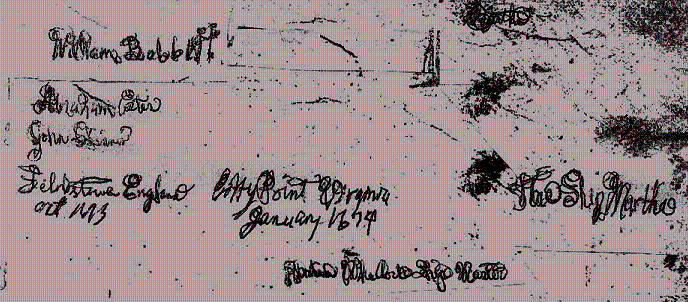
Sylvester Estes (c1522-1579), Fisherman of Deal, 52 Ancestors #29

Sylvester Estes was born probably in or near Deal, Kent, England about 1522, well before baptismal records were kept, beginning in 1559.  He would have married before that time as well, so we don’t know his wife’s maiden name, only that her name was Jone.  Their marriage date of 1545 is estimated based on the birth year of their first known child in 1547 and his birth date estimate is based on that as well, so he could have been born earlier.  Jone Eustes, Sylvester’s wife, was buried on May 15, 1561 at St. Leonard’s Church in Deal, Kent.  Her grave is not marked.  Tombstones were not being used at that time in history.

st Leonard sylvester

Sylvester, described as “emeritus fisherman,” died and was buried on June 7, 1579 in the churchyard at Ringwould, his last name spelled Eastye.  His grave is unmarked as well.

st nicholas ringwould sylvester

What little we do know about Sylvester, aside from his death and burial, comes from a court record.

On December 10, 1549, Sylvester, along with John Lamond, appeared before the Consistory Court of Canterbury (approximately 20 miles from Deal), charged by the Rector of Deal for not paying their tithes from their herring catch.  Lamond asserted that “in the time of his rememberance … he paid no tithe.” Sylvester responded that in the past two years he and his colleagues had taken two or three “last” (a dozen 6-9 pound barrels) and that “the school of herring hath always comined there away but they had not netteth there to take them well before that time.” It has been suggested that the failure to pay the tithe was a political gesture, rather than just oversight, church tithes becoming increasingly unpopular at that time.

Stewart Estes provides the following information about tithes, especially upon fish:

From the above history of Sylvester Eastes, it appears that he may have been an early tax protester. A tithe (from Old English teogoþa “tenth”) is a one-tenth part of something, paid as a usually voluntary contribution or as a tax or levy, usually to support a church. Historically tithes could be paid in kind, such as agricultural products. Farmers had to offer a tenth of their harvest, while craftsmen had to offer a tenth of their production.

In the Middle Ages the tithe from the Old Testament was expanded, through a differentiation between a Great Tithe and a Little Tithe. The Great Tithe was analogous to the tithe in the Bible where one had to tithe on grain and large farm animals. The Little Tithe added fruits of the field: kitchen herbs, fruit, vegetables and small farm animals.

After the Reformation the tithe was increasingly taken over from the church by the state. In England, church tithes remained until the 19th century. The right to receive tithes was granted to the English churches by King Ethelwulf in 855. The Saladin tithe was a royal tax, but assessed using ecclesiastical boundaries, in 1188. Tithes were given legal force by the Statute of Westminster of 1285. The Dissolution of the Monasteries led to the transfer of many tithe rights from the Church to secular landowners, and then in the 1530s to the Crown.

Tithes of fish (and mills) were the last survivors of what were referred to as personal tithes. Traditionally, fish taken from the sea or common rivers were not titheable under the principal that they were ferae naturae or wild animals. The only exception was if a local custom existed.

A 1549 statute made a tithe of fish payable only in parishes where it had customarily been paid within the past 40 years, such as those on the sea coast. This would likely include Kent. The system ended with the Tithe Commutation Act 1836, which replaced tithes with a rent charge decided by a Tithe Commission.

Based on church records, we know that Sylvester and Jone had 3 children.  It’s likely that they had several more who may have died or not been reflected in the records.  If they were married about 1545 and Jone died in 1561, according to the burial record, they would have had 16 years as a married couple to produce offspring, so they could have been expected to have had approximately 8 children.  The births of those children would only have been recorded in church records after 1559.  This suggests that there are several children born, and probably buried, as children.  However, given that daughter Jone was married in Ripple in 1563, it wouldn’t hurt to check the Ripple church records to see if Sylvester and Jone’s children were baptized there.  Marriages traditionally took place in the bride’s church, although just two years earlier, Jone’s mother, Jone, was buried at St. Leonard’s in Deal.

Jone’s untimely death in her 30s would have left Sylvester, a fisherman, with 3 young children and no wife.  His children, at the time of Jone’s death would have been 14, 12 and 6.  It’s likely that his mother, Anny, if she was still living, would have raised his children while he provided for the entire family by fishing.

The three known children of Sylvester Eastes and Jone are as follows:

1. Jone Eastye, born 1547, probably at Deal, Kent, married on 9 July 1563, at Ripple, Kent, located between Ringwould and Deal, to Henrye Baker, born in 1546, they had a daughter, Jone, who married her first cousin Henry Estes, the son of Jone’s brother.

2. Henry Eastye, a fisherman and master-owner of a pinasse (two masted vessel), the Mynion, born in 1549, at Deal, Kent. He married Mary Rand on July 3, 1574, in Deal. “Henry Eastice of the parish of Deale in the County of Kent fisherman,” made his will on April 30, 1590 at Deal. Mary was buried June 19, 1601 at St Leonard’s, Kent.

3. Robert Eastye, mariner, born about 1555 at Deal, Kent, died about 1616 at age 61 in Ringwould, Kent. He married Anne Woodward on December 2, 1591 at Sholden, Kent. Anne was born about 1574 (or in 1570), died between the making of her will on April 21, 1630 and when she was buried on May 18, 1630 at Ringwould. Robert and Anne spent the first few years of their married life at Sholden, moving to Ringwould about 1595.

Due to the change in the English religion from Catholic to Protestant, these children would have been baptized as Protestants, while Sylvester and Jone would have been baptized at Catholics.

In the Ringwould church records, Sylvester’s burial is the very first Estes record, recorded thus:

Jan. 7, 1579 – Silvester Eastye buried

This begs the question of why, with his wife buried at St.Leonard’s 18 years earlier, was Silvester buried at Ringwould?

The second Estes record at Ringwould doesn’t follow for another 17 years, and it’s the christening of Silvester, the son of Robert, who is the son of Silvester buried in January of 1579.  Between 1579 and 1596, Robert has married Anne Woodward at Shoulden in 1591, with their first child, Matthew being baptized there in 1592.

Sept. 26, 1596 – Silvester Estey, son of Robert, christened

Robert Estes and Anne Woodward continued to be members of St. Nicholas of Ringwould until Robert’s death about 1616.

Between 1561 when Jone was buried in Ringwould, to 1591 when Robert was married at Sholden, we have church records of this family involved with four different churches, albeit in close geographic proximity of a mile and a half range.  As you can see, below, the entire circle between all 4 locations, using today’s roads which are not the most direct routes, is only a total of 7 miles.

kent 4 villages

Changes

Sylvester saw a lot of changes in his lifetime.  His father died when he was 11 or 12, leaving his mother a widow.  Sylvester may well have been apprenticed to the mariners to learn a trade in order to be able to support himself, and possibly his widowed mother and younger siblings as well.

Changes were afoot in England itself as well.  England was in the process of politically becoming a Protestant nation with the King at the head of the church, instead of a Catholic nation with the Pope at the head of the church.  In the 1530s, Henry VIII wanted to remarry because his wife did not produce a male heir, and his Catholicism prevented that, especially when the Pope refused to annul his marriage.  As a result Henry renounced Catholicism and became Protestant, ordered the destruction of all things Catholic, such as monasteries and abbeys.  The churches “became” Protestant overnight, along with their parishioners.  In some places, of course, there was strong resistance and the resisters were called ‘recussants.’  That did not seem to be a problem in Kent.

In addition to the national issues, there were local and regional problems to contend with as well.

In October 1536, when Sylvester would have been about 14, four Flemish ships entered the Downs, landed and plundered the local boats of their “herrings, hogbushes, arrows and beer.”  A few days later, those same ships robbed a Deal fishing boat of its entire catch and then sent a pinnace ashore on St. Leonard’s Day (November 6  and feast day at Deal’s St. Leonard’s church) to cut the cable of Captain Rychardson’s boat and tow it away.  Rychardson’s inventory of his losses reflects a typical fishing boat of the time – two long bows, sheaves of arrows, barrels of beer, bread, candles, boots and bonnets.  Sylvester’s ship probably was provisioned with the same things.

Piracy, especially in the Downs was very troublesome during this time.  In 1536 Henry VII made it an offense punishable by death in some cases.

Queen Elizabeth, after coming to reign in 1558 did not take kindly to pirates either.  In one month alone, sometime after 1573, William Holstock, commander of the Queen’s Navy, captured pirates of several nationalities from 35 rogue ships and sent about 1000 captives ashore at Deal.  But then, he too turned rogue and captured 15 merchant ships.

In the 1539, Henry VIII ordered the construction of three castles to defend the Downs which were heavily exposed, faced Europe and were the most likely places for a Catholic army to make landfall in England.  Deal Castle was one of the castles, and still stands majestically today.  It was built, along with Sandown and Walmer Castle, in about 18 months in 1539 and 1540 utilizing 1400 men along with local laborers.

This was a very important, high profile project.  In fact, King Henry himself visited the Downs to “inspect his defences” on Easter Sunday in 1539.  He fully expected an invasion from Catholic Europe.

Sylvester would have been 17 or 18 at the time, a very impressionable age, and if he weren’t fishing already, he was surely involved in the castle construction.  If he was fishing, the influx of workers certainly created an unending market for their fish and probably just about anything else you could create to sell to the workers.  It would certainly have been an economic boon for the region around Deal.  It would have been an exciting time to be a young man as well – an era full of adventure.

After the castles’ construction, garrisons were assigned.  King Henry’s policy was to make any defense the responsibility of the local district and that garrisons were drawn from the area and officers were drawn from the local gentry.  Soldiers were expected to provide their own weapons – a dagger, sword, halberd and at their own expense.

The expected attack from Catholic Europe did not materialize in 1540, probably causing everyone along the Kent coastline to heave a collective sigh of relief.  Piracy and smuggling continued in the Downs, but the next threat from another nation would be Spain in 1588, nine years after Sylvester’s death.

Queen Elizabeth I, daughter of Henry VIII, ascended the throne in 1558 and inspected the castles in Kent in 1573.  After leaving Dover, the Queen journeyed through Walmer and Deal before being carried on a litter along the Ancient Highway to Sandwich.  You can rest assured that every person who was able lined the roads to catch a glimpse of the Queen.

queen eliz litter

Perhaps Sylvester Estes, then 51 years old, was among them with his son Robert, just 18.  Did they see the Queen?

Mobility

I expected that we would find the Estes family in one church and that the family members would remain within that church for generations.  This also implies that they lived in the same location.  That’s not what we’ve found.  In the 5 known generations beginning with Nicholas and ending with Abraham Estes who immigrated to the US in 1673, we know that the Estes family participated in services in at least 8 churches, not including Sandwich where one can rest assured that Abraham attended church when he was an apprentice there.  That’s a lot of mobility for an early family whose main avenue for transportation would have been on foot.

It’s also somewhat unusual in that early vassalage arrangements would have precluded mobility between farms, let along between towns, and in essence kept the vassals tied to the lands of the monarchy or their lords in perpetuity.  Given that history, finding this much movement, even within a region, just a few years later is quite surprising.  Feudalism, meaning feudal land tenure, began to decline with the War of the Roses in the mid-1400s (1455-1485), effectively ended when the country became Protestant in 1536, but wasn’t abolished in England until 1660.  Under the feudal system, tenants, or vassals, would not have been allowed to move around from place to place.

So, why did they move?  Well, knowing the Estes family, perhaps because they couldn’t, then they could, and did, because they could.

This pattern of movement tells us that the Estes family was likely not tied to land, per se, at least not by the 1500s – so maybe tenant farmers working the lands of others, or craftsmen – or eventually, as we know, mariners.  Mariners are tied to the sea, not the land, so they would have lived relatively close to the shore.  Most of these churches and communities certainly fit that criteria.

The movement of people is more the norm, over time, than not, unless there is a constraining factor.  We do sometimes find families in villages nestled in the mountains of some remote location that haven’t left since the beginning of written records, which is often reflected in the very unusual markers in their Y DNA, suggesting a population bottleneck of sorts.  In other words, mutations happened but no one left to spread them around, so they are only found in a particular region.  For genealogists, these are blessings in disguise, because they can help us pinpoint locations where our ancestor lived, if enough people test.  They will, of course, carry different surnames today, but their DNA will match, especially on unusual markers that have mutated in that region.

We find that often people migrated in groups – probably family units – increasing their chances of survival if there are others available who have a vested interest in helping out if trouble loomed.  Someone else who wouldn’t hesitate to paint themselves blue and hurl projectiles at Caesar’s ships, if the need arose.

So, if we look at the more ancient aspect of the Estes DNA, what does it tell us?  Where did the Estes family come from, before the advent of surnames?  And does it tell us anything about the d’Este family myth?

Who Settled Near Deal?

Let’s start by looking at who settled in the Deal area.  We know that Ceasar said that in the year 55 this area was inhabited by “Belgic and Celtic” tribes, a mixture of Germanic and Celtic stock who had arrived on “these shores a generation before but had continued to trade with their counterparts on the continent.”  He says specifically that:

“The coast (was populated) by Belgic immigrants who came to plunder and make war – nearly all of them retaining the names of tribes from which they originated – and later settled to till the soil. They think it is wrong to eat hares or chickens or geese but they breed them as pets. As the cold is less severe, the climate is more temperate than in Gaul.”

Caesar tells us that his fleet encountered Celts hurling missiles from the soaring cliffs at Dover.  The fleet then sailed 8 miles, hugging the coast until they came to ‘low lying land’ (Saxon, ‘dylle’).

white cliffs map

Warring Britons, their naked bodies daubed with woad and their wild hair stiffened with lime relentlessly rode their sleek chariots into battle and drove the Romans from the shore.

celtic 2 wheel chariot

An Ancient Briton from Barnard’s New Complete & Authentic History of England, 1783, below.ancient briton

I can’t tell you how I wish someone had made a painting of that!  Naked men painted blue with spikey hair in a chariot.  Is that legal?

Caesar tells us more, and it’s complimentary in spite of the naked blue spikey factor.

“The most civilised people are those in Kent which is entirely a coastal area; they have much the same customs as the Gauls. Most of those living further inland do not sow corn but live on milk and flesh and wear clothes of animal skins. All the Britons, though, dye their skins with woad which produces a blue colour and thereby look all the more terrifying in battle.

By far the most civilized inhabitants are those living in Kent.  The population is large, the ground thickly studded with homesteads…and the cattle numerous.

They do not cut their hair but shave all the rest of the body except the head and upper lip. Wives are shared between groups of ten or twelve men, usually made up of brothers or fathers and sons. The children are reckoned as belonging to the man each girl marries first.”

Now, that would play havoc with the DNA is more ways than one.  So, you could wind up being the father to your own brother, or nephew….so you really could be your own grandpa.  Don’t ponder this too long – it will only make you crazy.

We know that the word Deal itself is derived from the Saxon word “dylle” meaning low lying land or “del” referring to a dale or valley.

A Druid shrine was found on the eastern slope of Mill Hill, just a few blocks from St. Leonard’s Church in Deal, rich in Celtic art from the second century BC.

In fact, the “Deal Warrior” was found here with his armour, wearing what looks to be a crown with a LaTene style of incised pattern.

deal warrior

The Celtic LaTene culture followed the Hallstatt in Iron Age Europe about 450BCE.

Halstatt latene 2

Above, an overview of the Hallstatt and La Tène cultural regions. The core Hallstatt territory (800 BCE) is shown in solid yellow, the area of influence by 500 BCE (HaD) in light yellow. The core territory of the La Tène culture (450 BCE) is shown in solid green, the eventual area of La Tène influence by 50 BCE in light green. The territories of some major Celtic tribes are labelled. Map drawn after Atlas of the Celtic World, by John Haywood (2001: 30–37).

celtic europe expansion

This map shows the Celtic expansion in Europe, including the British Isles, and Italy.

Ok, so are the Estes men Celtic?

The DNA

The good news is that the Estes STR markers are quite unique.  The bad news is that the Estes STR markers are quite unique.  The STR markers, or short tandem repeats, are the marker results that you receive when you order the 12, 25, 37, 67 or 111 marker tests from Family Tree DNA.

The Estes men don’t match men with other surnames at 111, 67 or 37 markers.  In fact, their marker values at that level are very unique.  The good news is that this means that it’s very easy to tell when someone matches the group, or doesn’t.  The bad news is that there are no breadcrumbs left by matching other people.

Breadcrumbs?  What do I mean by breadcrumbs?

A DNA breadcrumb, in this instance, could be one of two things.  First, it could be an extended haplogroup SNP test that would tell me by virtue of who I match closely on STR markers that my ancestor’s haplogroup is likely to be the same as the other person who took the extended testing.  In other words, a poor man’s pseudo SNP test.  No such luck, in my case.

The second DNA breadcrumb would be the matches maps – where are the oldest ancestors of my closest matches found?  This can be important in locating on origin in continental Europe.  In my case, the closest not-Estes matches with locations are 12 and 25 markers.  It’s not that I can’t use these, it’s that they are far back in time, quite far sometimes, so far that the common ancestor may not be on the same twig of the Y tree, especially with haplogroup R, old R1b1a2.

And yes, of course, the Estes men are smack dab in the middle of haplogroup R – in fact, L21.

Estes Y hap

On the first map, below, the locations of the oldest known European ancestors of the Estes matches are shown.  There aren’t many in continental Europe.  Most are in the British Isles.  Keep in mind that none of these hold up (or perhaps didn’t test) above 25 markers, so the common ancestors with these individuals would be far back in time, hundreds to thousands of years – which is exactly what we are looking for – sometime around Caesar’s arrival in the year 55 when the woad covered Celts were pummeling his ships from the white cliffs of Dover.

estes matches map 25

The red balloons below show the oldest ancestors of 12 marker matches.

estes matches map 12

Hey, what are those two in Italy?

Turns out one is in Rome and other shows it’s in France, but it’s still in the right general location to perhaps be an indication that some of the Estes DNA is living in the region.  That doesn’t do anything to put to bed the oral history of the d’Este family.  In fact, it fans those flames a bit.  If those matches held above 12 markers, it would fan those flames a lot…..but they don’t.

However, the general distribution pattern indeed looks like the traditional “Celtic” L21 migration into the British Isles, shown below.

Eupedia L21

It is believed that subgroup L21 was born about 4000 years ago in the Celtic region of Europe, perhaps in Southwest Germany.

A few days ago, Britain’s DNA released information about L21 which equates to their SNP S145.

The map below, for S145 shows their Pretani distribution.  The best definition I could find for Pretani was that the earliest known reference to the people of the British Isles, made by the Greeks between 330 and 300 BC describes them as the Isles of the Pretani, the ‘Pretani’ thus becoming the most ancient inhabitants of Britain and Ireland to whom a definite name can be given. In Ireland these ancient British Pretani (or Britanni) were later to become known as the Cruthin, while in Scotland they became known as the Picts.

s145

While their map does not include any downstream variants, it still meshes with the Eupedia L21 map.  It looks like the Celts stepped ashore in England and started moving north and west and didn’t stop until they had to.  Of course, they were followed by Angles and Saxons and Romans and Normans so they did have some pressure to keep moving.  Apparently not all moved on, because there are still between 13% and 15% in the east and southeast of England, as determined by DNA testing of people whose 4 grandparents lived in that location – implying that they are not recent immigrants to the region.

So, what next?

Ok, so the Estes men are descended from Celts.  Now we at least know that much.

But I’d still like to know if my ancestors were d’Este Kings in Italy wearing crowns, Druid priests in England wearing crowns, or blue woad painted Celts with spiked hair driving chariots while defending the white cliffs of Dover.  Can’t you just see them here?

white cliffs of dover 2

I mean, it does make quite a bit of difference in the telling of the family story.

I want to know more.  I’d like to test for more SNPs to see if I can refine what we know, but which SNPs to test?

The Estes men have joined the R-L21 project and the British Isles by County project, and I’ve asked the administrator for haplogroup L21 for suggestions about how to test further.  Part of the decision about how to test will be financially based.  If he can tell me, based on his experience that what I really need to do is test one or two SNPs based on what he sees in terms of matching within other L21 subgroups, I’ll happily do that.  If he tells me that I need to do the Geno 2.0 or Big Y, I’ll probably do that as well, but I’ll be eating hotdogs and mac and cheese for a few weeks.  But hey, it’s grilling season and genealogy is way more important that eating!

In the L21 project, the Estes men, along with a few thousands of our closest friends are in the group titled “1. L21+ (L11>P312>L21; If you can, test for DF13 status).”  This means, in plain English – you need more testing, so that’s the answer I’m expecting.

What this means is that the testing results are too vanilla to narrow the location origin.  Below are the locations of the oldest ancestors of the “you need more testing” group.

l21 cluster

And for comparison, here’s a subclade of L21 – a group of people who share a terminal SNP further down the tree – and the locations of their most distant ancestors.  If what I’m looking for is a source on continental Europe – this is much more useful than the map above which shows the distribution of L21 over the past 4000 years or so.

l21 subgroup cluster

I did receive a recommendation from the haplogroup L21 project administrator.  Just what I was afraid of – the L21 project administrator wants 2 Big Yfull Y sequence tests from the Estes line – from hopefully our two most divergent men who are definitely from the same family.  This will show which of the SNPs or Novel Variants (personal or family SNPs) they share are actually haplotree branch SNPs and which are family only, meaning much more recent in time.  Makes sense.  I expected this advice, I was just hoping for a less expensive option, but as the administrator says, we are, indeed, the explorers in this new field.  Well, good thing we are Celts now isn’t it!

Now, all I have to find the appropriate Estes male candidates and the funds.  If you have an Estes in your family tree, you can contribute directly to the Estes DNA project towards the tests, which will be about $1200 in total.  Any amount is appreciated and it all helps.

To put this in perspective, raising these funds has to be easier than getting naked, shaving my body, painting myself blue and liming my hair while driving a chariot and throwing projectiles off of the white cliffs of Dover!!!

______________________________________________________________

Disclosure

I receive a small contribution when you click on some of the links to vendors in my articles. This does NOT increase the price you pay but helps me to keep the lights on and this informational blog free for everyone. Please click on the links in the articles or to the vendors below if you are purchasing products or DNA testing.

Thank you so much.

DNA Purchases and Free Transfers

Genealogy Services

Genealogy Research

Nycholas Ewstas (c1495-1533), English Progenitor, 52 Ancestors #28

Nycholas, or Nicholas, was the first Estes we can document, even though the name then was spelled as Ewstas.  At that time, the U and W in the English language were synonymous and spelling was not yet standardized.  Most people were illiterate, so spelling didn’t matter one bit.  Clerks spelled names as they heard them.

Nicholas was born about 1495, possibly in Deal, Kent, England.  We just don’t know.  We haven’t found his christening in any of the local churches because baptismal records weren’t kept until nearly 65 years later.  Baptism, marriage and death records were not kept in England until Queen Elizabeth ordered that records be maintained by the churches beginning in 1559.  Fortunately, St. Leonard’s Church in Deal has individual records from that date and historical records from earlier.  But that doesn’t help us with Nicholas’ birth date.

All was not peaceful in Deal and surrounding area in 1495, about the time Nicholas would have been born.  According to Gregory Holyoake in his book, Deal, All in the Downs, a war was taking place in 1495.

Perkins Warbeck, the personator of Richard, younger son of Edward IV, one of the two princes presumed murdered in the Tower of London, arrived with his army in the Small Downs on July 3, 1495.  The Pretender, promoted as “The White Rose of England” intended rousing the support of the Kentishmen in his claim to the throne as Richard IV.  Warbeck had sailed from Vlissingen on July 2, confident that the men of Kent – Yorkish in their inclination – would support him against the Lancastrian King, Henry VII.  Instead, the Kentishmen hotly defended their country from these presumptuous invaders.

Trained bands from Sandwich ambushed Warbeck’s army in the Sandhills and captured most of the leaders who were then tried in London.  Afterwards they were executed and hung in chains “for seamarks or lighthouses” along the coast.  Henry VII commended his loyal subjects and commanded beacons to be built in celebration across Kent.

Perhaps Nicholas’ parents, especially a very pregnant wife, sought refuge in another location and Nicholas was baptized in a church elsewhere.  Every village had a church.

If it weren’t for his will, in 1533, we wouldn’t even know Nicholas’ name, or the first name of his wife, Anny.

Nicholas’ will was dated January 1, 1533/34.  This year is written in the old style/new style date.

From 1087 to 1155 the English year began on 1 January, and from 1155 to 1751 on 25 March.  In 1752 it was moved back to 1 January.  Even before 1752, 1 January was sometimes treated as the start of the new year – for example by Pepys – while the “year starting 25th March was called the Civil or Legal Year.”  To reduce misunderstandings on the date, it was not uncommon in parish registers for a new year heading after 24 March, for example 1661, to have another heading at the end of the following December indicating “1661/62”. This was to explain to the reader that the year was 1661 Old Style and 1662 New Style.

But back to Nicholas.  He left his estate to his wife, Anny, one child, Sylvester and to an unknown person, Felyx Beane.

The Beane name is interesting.  I found it in the records of at least 4 early Estes families in Kent, some of whom can be tied together and some who cannot.  I suspect that the Bean family is related to the Estes family and possibly before Nicholas’ generation.

We may not know where Nicholas was born, or when, but we know when and where he died, because his will called for him to be buried in the churchyard of “Saynt Leonard in the parisshe of Deale.”

We don’t know if Sylvester was actually Nicholas’ only child, or the only child he mentioned in the will.  We know that Sylvester was born in 1522, so Nicholas’s marriage date is estimated in 1520 and his birth then estimated as 1495. Of course, Sylvester might not have been the first child born. And if Sylvester was their only living child, their lives must have been full of heartache, burying baby after baby, at least half a dozen.

All of the Estes descendants today who can track their genealogy back to Kent, descend from Nicholas in some way, excepting adoptions and such.  This has been confirmed by DNA testing.

In 1495, surnames were established, but hadn’t been established for a long time.  They began to be used by the wealthy after the Norman invasion in 1066, were in common use by the 1200s, and by the middle of the 1400s, pretty much everyone, rich and poor, had a surname.  It’s likely that Nicholas wasn’t the first Estes man to carry that surname, but we don’t know.  Thankfully, he did leave a will.

nicholas estes will

Roy Eastes has this will transcribed and translated.  It is written in a medieval script called secretarial script.  To me, it simply looks like scribbles.  In fact, it could be my own handwriting!

Will of Nicholas Ewstas

In dei no’ie Amen, the xviith day of June the yere of our Lorde mlcccccxxxiiith, I Nycholas Ewstas beyng of hole mynd and remembraunce ordeyne and make this my last Wyll and Testament in manner and form folowyng

Fyrst I bequethe my soule to Almyghty God, our Lady Siynte Mary and all the holy company of Hevyn and my body to be buryed in the church yerde of Saynte Leonarde in the parisshe of Deale.

Also I bequethe to the hygh aulter for my tythes undelygently forgotten viiid.

Item I wyll that my wyffe cause to be dun at the day of my buryall v mases with placebs and dirige and as many at my monthes mynde.

Item I bequethe to Sylvester my sone one ewe and a yong horsse.

Item I bequethe to Felyx Beans one ewe.

The resydue of all my goodes, moveables and unmoveables I wyll and bequethe to Anny Ewstas my wyff whom I make sole Executrix of this my last Wyll and Testament the yere and day above rehersyd.

Wytnessys beyng present and requyred Robert Whyte, John Myselson

Translation:

In the name of God, Amen, the 17 day of June the year of our Lord 1533 I, NYCHOLAS EWSTAS, being of whole mind and remembrance ordain and make this my last Will and Testament in manner and form following,

First, I bequeath my soul to Almighty God, our Lady Saint Mary and all the holy company of heaven and my body to be buried in the church yard of Saint Leonard in the parish of Deal.

Also I bequeath to the high alter for my tithes undiligently forgotten 8 pence.

Item, I will that my wife cause to be done at the day of my burial five masses with placebos and dirige and as many at my month’s mind.

Item I bequeath to Sylvester, my son, one ewe and a young horse.

Item I bequeath to Felix Beans one ewe.

The residue of all my goods, moveables and unmoveables I will and bequeath to Anny Ewstas my wife whom I make sole Executrix of this my last Will and Testament the year and day above rehersed.

Witnesses being present and required

Robert Whyte, John Myselson

We need to remember that Nicholas and family were Catholic, because the Protestant reformation and associated political difficulties had not yet taken place in England.  They were yet to occur in the Reign of Henry VIII in the 1530s.

The Catholic faith of that time placed a lot of importance on leaving money to the church, the more the better, for special prayers that were meant to pray one’s soul out of purgatory and into Heaven, more quickly.

Later generations of Estes men were mariners, including Nicholas’ son, Sylvester, but it doesn’t appear that Nicholas was a mariner.  He left nothing nautical, just sheep and a horse.

I do have to laugh though at his commentary about his tythes (taxes) being “undiligently forgotten.”  He must not have expected he would die, or he wouldn’t have been so forgetful.  His conscience must have been plaguing him.  The health and afterlife location of one’s soul depended in that time and place upon enough prayers being said on your behalf…and no one in the church was going to pray for a man who forgot to pay his tythes.  This also tells us that he must have had some money – he wasn’t destitute because he had money to pay his back tithes and to leave additional funds to the church.

It’s ironic that one of the only records we have of his son is from the Court of Canterbury.  Want to guess the subject?  A case was brought against him for not paying his tithes for 2 or 3 years.  Apparently “forgetting” tithes runs in the family.

It’s interesting that another very early record is of a Richard Eustace buried in the church in Dover in 1506, leaving a wife, Alice, and unborn child.  His will was witnessed by a Thomas Eustace.  Richard appeared to be a wealthy man, probably a merchant.  Not only was he buried inside the church, but he left quite a bit of money for special prayers.  We have no idea what happened to his wife, or child, if it survived, but we know that he wasn’t in our direct line because Nicholas was born about 1495, too late to be his father and too early to be his son.  Richard could have been a brother, nephew, uncle or cousin to our Nicholas – or maybe entirely unrelated.  However, Dover is just 6 miles or so from Deal.

However, it does tell us that there were other Estes in the region before Nicholas, or at least contemporaneous with him.

Estes Trails editor and family researcher Larry Duke explained some of the more unusual provisions in Nicholas’ will as follows:

His reference to his monthemynde (monthmade) is the same as our birthday. The saying of a mass for the deceased, in their memory, on their birthday, is still a common practice in the Catholic Church. The only other observation that could be made about Nicholas’ will, is that it was uncommon to name ones wife as executor. Normally, this duty was left to ones oldest brother or oldest son. His naming Anny could mean that he had no living brothers or none nearby. [His son] Sylvester was too young, being only about 11 years old.

We know that Nicholas was buried in the cemetery at St. Leonard’s Church in Deal, although his grave has probably been recycled.  We can say with certainly that there is no stone today, if there ever was one.  Gravestones in England were not welcomes in churchyards until about 1650.  The stone for Moses Estes in 1708 is the oldest Estes stone, although we could speculate that Nicholas is probably buried fairly close to the church itself, based on Moses burial location in 1708, some 175 years later.

Come on, let’s take a walk around the churchyard.  Nicholas has to be here someplace!

It’s difficult to photograph the church because you can’t really get far enough away without obstructions.  Jim and I walked back from the church at Shoulden and this is St. Leonard’s Church from the round-about in front.

st leonard roundabout

We enter the churchyard, which is the cemetery, through the wall.

st leonard's wall

Tombstones are scattered throughout the property.

st leonard's front

It’s interesting that for the most part, strangers weren’t buried here.  There are records of a “Stranger’s Burial Ground” where the bodies of drowned sailors thrown up on the foreshore were buried.  It had been used since 1668, at the far end of St. Patrick’s road, but has since been used for building modern homes.  I have to wonder if they are haunted and if the residents know their homes are literally on the graves.

st leonard's south

Half of the walkway through and around the cemetery is paved, and the other half has stones, at least part way.  The path is to the right of the church, on the south side, and the paved walkway is to the left, if facing the front door, or on the North side.  Note that the walkway crosses several graves.

st leonard's north

Every nook and cranny has burials.

st leonard's stone path

Church records show that the church purchased the walled area called Church Path at the end of the 1700s, once called Stone Lane, which served as the parish cemetery until Deal Cemetery was opened.  Church Path is today a road that leads directly from Lower Deal to the St. Leonard’s Church north doorway, right where Moses Estes’ stone lies.

st leonard's north addition

You know that the vacant spots aren’t vacant – just unmarked.  Our Nicholas lies in one of them, or his grave has been reused.  Still, his remains are here someplace.  The cemetery has been used for hundreds of years.  The earliest marked burial is dated 1675.  In 1690, the skull and crossbones appears for the first time.

st leonard's north yard

There are even burials inside the church, in the aisle ways – which was an honor reserved for only the most wealthy and important church members.

st leonard's floor burial

In fact, this entire church aisle is graves – right down the middle.  This is typical in English churches of this age.

OLYMPUS DIGITAL CAMERA

We know our family isn’t inside, so let’s go back outside and walk around the church.  We’re going out the side door that was added when the North wing was expanded in 1819.  This was after Moses Estes was buried in 1708, and the walk to the “new door” lays right across his grave.  I guess if you can’t afford to be buried inside, then being buried in the walkway on the way to the door is probably second best.  Everyone walks by your grave and visits you every Sunday!

st leonard's moses estes

The tombstone of Moses Estes, complete with skull and crossbones, above, rests in the side yard of the church.  You can see the north door close to his grave.

st leonard's north door

Some burials are fenced and in crypts.  You can see behind this one that an old door has been bricked in.

st leonard's crypts

st leonard's towards back

Rounding the side of the church to the back, above.

st leonard's rear

At the back of the church, we can see the nave with the 3 windows.  This is the original part of the church, covered with flint.

st leonard's wall stones

Here, as in most old churches in England, many stones have been “rearranged” along the outer wall for ease of maintenance, especially when they are no longer legible.

st leonard's outside nave

It’s a stunningly beautiful church.  The wing to the right is where Moses is buried.  You can see the “seam” of the addition.  I wonder if Nicholas is actually buried under the church afterall, by virtue of the extension.

st leonard's rear burials

It’s certain that the ashes of Nicholas rest someplace in these photos.

The House of Este

There has been a great deal of speculation that the Estes family descended from the House of Este in Italy.  Part of this is due to the fact that the Estes family in England firmly believed this, in part, because the monarchy believed it.  King James I of England and Scotland was convinced that a gentleman in his service by the name of East was in fact a descendent of the d’Este family and suggested he change his name to Este.  One didn’t argue with the King, and I have to wonder if the King thought that for a reason.  In other words, he may have been right.

este castle ferrara

Painting of Este Castle in Ferrara, Italy.

David Powell reports that even earlier, one Thomas Estes (1540-1608), an Englishman who published Italian music, used the names of East, Est, Este and Easte and hinted at a connection with the famous Italian d-Este family.  Of course, it might have been beneficial to his career.

The Estes family has spent decades trying to figure out if there is any truth to this story or if it is just a wishful myth.  Frankly, it seems unlikely given that the Estes men were primarily mariners in Kent, after Nicholas, and there is no firm trail from Italy to Kent, from the d’Este line to the Estes line.  But still, we can’t prove a negative, at least in this case, not without DNA testing.

Unfortunately, we have been unable to find any Estes male from the d’Este family.  They apparently daughtered out, except for one possible line, that no longer carries the Estes or d’Este surname.

Roy Eastes, in his book, “Estes Families of America,” did a fine job of distilling the rumors and various stories into something cohesive.

One of the most popular theories is that Nicholas descended from of the House of Estes of northern Italy. The House of Este was very famous during the Renaissance and the evidence of their history can be seen yet today in the splendor of their famous Palaces and Gardens.

castelo estence ferrara

The Castello Estense in Ferrara, Italy

The surname Este came from a small town by that name in the Providence of Ventia in northern Italy. In ancient times, before the birth of Christ, it was known as Ateste.

History shows that the town was a Roman stronghold and military base. However, in este castle closeup589 AD after a severe flooding of the Adigo River, the town was abandoned and re-inhabited at a later time. In this town, Albert Azzo II was born in the year 996. This great Roman adopted the name of the town and started the House of Este. This line has been passed down through the years to modern days.

este castle este

The House of Este held the city Este until 1240 when they moved their capital to Ferrara.

Probably the most contributing factor that has led to the belief in the Este/Estes connection was a book published in 1894. This book, “Estes Genealogies” – was written by Charles Estes, of Warren, Rhode Island.

The following is an extract from that book:

“Upon looking back at the early days of our ancestry, we find unlike other tribal histories in their incipiency, so little in the Este that is condemnatory and so much that is worthy of praise. We have no reason to be otherwise than proud. “

“We here present the letter of Richard Taylor, M.D., to Rev. Charles F. Deems, which will give some idea of the history of the Este family in what shall follow:”

 “From The New York Watchman”

 “Rev Deems: In reading your paper some times since, I noticed some verses written by Mr. Alston Bacon Estes. The name recalled some recollections of researches undertaken by my father many years ago, when becoming interested in the family, he sought to trace its history, which is both curious and interesting. Thinking you might be pleased to know it, I give it to you in as few of words as possible.                                                                Richard Taylor, M.D.”

“About the year 1097, Albert Azzo II, Marquis of Liquria was born (actually 996- 1097) and his history is commensurate with the lapse of the 11th century. He was the acknowledged founder of the houses of both Este and Brunswick the former were conspicuous in Italy as late as the middle of the 18th century when their direct line failed with the death of Hercules III, he being the twenty-second generation from Azzo II; the latter (House of Brunswick) after centuries of time, emerge from their quiet stations as Dukes of Brunswick and Hanover, and occupy the most prominent positions in Europe as British Kings.”

“One branch however, of the Italian family exists in America. The Marquis Aldobrandino, about the middle of the 14th century, in order to procure means for prosecuting a war against the Auconites, hypothecated (pledged) his younger brother to the usurers (money lenders) of Florence. The untimely death of the Marquis put an end to the war but left his brother unredeemed. These were the sons of Azzo VI. The younger brother did not return to his ancestral home on the accession of the seventh Azzo (another older brother) but proceeded to France, thence to England, where he became acquainted with the family of Lord Bacon, then moved from England to Wales, always maintaining a position of influence and respectability, inheriting the distinguishing traits of character and talents possessed by their ancestors. From Wales they immigrated to Virginia. “

“The name Este is derived from a colony planted in the seventh century of Rome, about fifteen miles to the south of the City of Pudau, and called Ateste, or Este a name known in history 136 years B.C. This is the surname the Marquises of Liquria assumed in the beginning of the fourteenth century, namely Marquises of Este, and their descendants, have ever since assumed the surname, Este. The name written Estes is plural, and was used to represent the whole family; thus Byron, in his Parisina speaks of the Estes:

“And if she sets in Este’s bower,
“Tis not for the sake of its full bloom flower:”

 – or is meant to convey, belonging to the family. The name is more frequently written Estes than as it should be, Este.”

    ***************

“You will see by the above that the Estes name represents a family, one of the oldest and also one of the most illustrious, living in the world; though short, this will give you an inkling of the American Estes’ and show you that the antique brood of Este is still in existence.”

<<<<<   End of Extract   >>>>>

 ducal palace modena

Ducal Palace in Modena built in 1634 by Francesco d’Este.

David Powell provides another glimpse at that favorite family rumor in his paper, “Origins of the Estes/Eastes Family Name.”

“…The Marquis Aldobrandino, about the beginning of the 14th century, in order to procure means for prosecuting a war against the Anconites, hypothecated his youngest brother to the usurers of Florence. The untimely death of the Marquis put an end to the war and left his brother unredeemed. These were the sons of Azo VI (of d’Este). The younger brother did not return to his ancestral home on the accession of the seventh Azo, but proceeded to France, thence to England where he became acquainted and connected with the family of Lord Bacon. The family then moved from England to Wales, always maintaining a position of influence and respectability … From Wales they emigrated to Virginia.”

We know for sure that part of this is incorrect – the sailing for Virginia from Wales portion.  We have that information and will be discussing Abraham Estes and his embarkation for America in a future article.

However, there’s more:

“…Francesco of Este, who was the son of Marquis Leonello [1407-1450], left Ferrara [1471] to go and live in Burgundy, by the will of Duke Ercole [Francesco’s uncle, who succeeded Leonello] .. and, in order that he should go at once, he gave him horses and clothes and 500 ducats more; and this was done because His Excellency had some suspicions of him .. ‘Francesco .. went to Burgundy and afterward to England’. These were the words written on the back of the picture of Francesco found in a collection of paintings near Ferrara.”

Many of the details are similar to the earlier story. But why would Francesco flee Italy? In 1471 Francesco’s brother, Ericolo, led a revolt in an attempt to overthrow Duke Ercole. The attempt was unsuccessful and in typical royal tradition, Ericolo lost his head and Francesco exiled, if only because he was Ericolo’s brother. Did Francesco really travel to England? The only evidence for this is the writing in the back of the painting, the existence of which is unconfirmed. Essentially the same story is told by Charles Estes in his book:

“.. Francesco Esteuse (born c.1440), the illegitimate son of Leonnello d’Este. Francesco was living in Burgundy. In the time of Duke Borso he came to Ferrara, and at Borso’s death was declared rebellious by Ercole because of efforts made by his brother, Ericolo, to seize power. Francesco returned to Burgundy and was heard of no more from that time (1471). As the time coincided with that when Edward conquered [sic] England with the aid of Burgundy, it was possible that Francesco followed Edward and after Edward’s victory made England his home.”

 David goes on to say:

If Francesco did travel to England, it would have been around 1480, leaving sufficient time for him to have fathered Nicholas and possibly also Richard and Thomas Eustace of Dover. Indeed, Francesco’s father was Niccola, or, in English, Nicholas.

In the end, David concludes that the myth is probably just that.  However, that opinion is not shared by all Estes researchers.

Kitty Estes Savage, in her article, “Saints and Sinners’ in the December 1998 edition of Estes Trails tells us a little more about the alleged painting:

Duke Ercole’s next goal was to get rid of Francesco, Niccolo’s half-brother, so he bribed him because he was suspicious of him and “because he was much loved by the people because of his courtesy and liberality and also because he was a handsome well-disposed young man”. He gave him a monthly stipend, and “in order that he go at once, he gave him horses and clothes, and five hundred ducats more”.

Francesco left Ferrara on 15 September 1471. No more is known about him except that his portrait hangs in the Metropolitan Museum in New York City with this inscription on the back: “Francesco, natural son of Leonello went to Burgundy and afterwards England.”

francesco d'este

I checked with the Metropolitan Museum of Art about the portrait of Francesco d’Este, which they do own, shown above, and here is the information provided about the portrait.

The sitter for this striking portrait is Francesco d’Este, illegitimate son of Leonello d’Este, ruler of Ferrara. In 1444, Francesco was sent to the Netherlands, where he received his education and military training at the court of Philip the Good, duke of Burgundy. He was educated with Philip’s son, Charles de Charlerois (later Charles the Bold), and became a permanent chamberlain to the duke, acting frequently as an envoy to Italy. This portrait was painted in the Netherlands about 1460, when Francesco was around thirty years old. The hammer and ring he holds may be prizes won for a jousting victory, or symbols of his office and power. On the verso of the panel are painted the splendid coat of arms and crest of the Este family, quartered with the honor bestowed on the house of Este in 1432 by Charles VII of France. Above and below the armorials is the inscription, which reads, in part: “entirely yours, marquis of Este, Francesco.” This apparent dedication suggests that the portrait was not kept by the sitter but was presented by him to a close acquaintance or member of the court as a gift of friendship. The portrait was painted by Rogier van der Weyden, who undertook a number of portrait commissions for members of the Burgundian court, while the verso was probably painted by a workshop assistant.

There is no mention of the inscription reported, but there is an inscription which is included in their documentation.

There is another hint, also provided by the museum, that suggests that Francesco may have died in Burgundy.

The Este family coat of arms and crest on the reverse of the panel emphasize the heraldic quality of the portrait. The inscription, “v[ot]re tout…francisque” (entirely yours, Francesco), forms a dedication to the portrait’s recipient, perhaps a friend or member of Philip the Good’s court. The “m” and “e,” stand for “marchio estensis,” the title extended to Francesco. The enigmatic scratched inscription in the upper left, “non plus / courcelles,” may refer to the village in Burgundy where Francesco died.

este coat of arms

Wikipedia tells us even more:

The crest emblazen on the reverse of the panel shows a coat of arms consisting of two quarters of the family crest along representations of the honours bestowed to the family by Charles VII of France by letters patent in January 1431. The coat of arms is held up by two lynxes-a pun on the word Leonello, his father’s first name. Another lynx sits blindfolded on the coat of arms. On either side of the animal are the letters M E – assumed to be abbreviations for Marchio Estenis (Marquis of Este), although they could stand for “Marchio Estenses” a title know to have been used by Leonello. On both sides, these letters are bound by tasseled chord. Lettering resembling inscription in the later gothic style above these reads VOIR TOUT (to see all) and is reminiscent of Leonello’s motto Quade Vides ne Vide (Shut your eyes to what you see), the latter described by art historian Robert Fry as indicative of the “idea of astuteness, the most necessary virtue for a ruler of Leonello’s type.

The crest contains Francesco’s name in French, the Burgundian court language, and at the top left hand corner the words non plus courcelles (no longer courcelles). This phrase is established as a later addition but has not been satisfactorily interpreted. It may be a reference to the then French village of Courcelles, in today’s Belgium. The village is located near the site of the Battle of Grandson, a major defeat for Charles the Bold, where the sitter may been killed in 1476 (he is last mentioned in records in 1475). Giving the similarity of the crest to that of his father’s, awell as the significance of various letterings, many art historians see it as indicative of the illegitimate sitter’s aspiration to be recognised as Leonello’s son, with all the entitlements and historical recognition such acceptance would entail.

It looks as if we have pretty well debunked the myth of the inscription on the reverse of this portrait at the Metropolitan Museum indicating Francesco went to England, and we know that Francesco was in the Netherlands in 1475, possibly deceased, 20 years before Nicholas Ewstas was born in Deal.  On the other hand, it is possible that he disappeared from the records in the Netherlands because he went to England, although I find this highly unlikely that he, a member of a royal house, would simply disappear and live a very different kind of life on the coast of Kent, his grandson becoming a mariner.  We have also not addressed the story that a painting in Italy holds an inscription that indicated that Francesco went to England.

Where are the Descendants?

One of our original goals of the Estes DNA project was to see if we could find an Este descendant from Italy to determine whether or not we truly do descend from the d’Este family.  So far, we have found only 1 family of presumed direct line descendants, and that family is relatively unapproachable.

Ernst august prince of hanover

The gentleman is Ernst August, Prince of Hanover, Duke of Brunswick-Luneburg, etc., husband of Princess Caroline of Monaco, direct paternal descendant of Albert Azzo I d’Este, born about 970.  He has 2 sons.

I wouldn’t even begin to know how to approach this man, although, according to Wiki he seems inclined to urinate in public, so maybe there’s an avenue – a urinal.  (Just kidding – well – about the urinal part – not the urinating part.)

I mean, how exactly does one approach this?  A little curtsey perhaps, then “Excuse me sir, I mean Prince, er, your Highness, but would you mind swabbing the inside of your cheek for this DNA test as I’d like to see if my Estes line is related to you???  Or, you could just pee in the bottle if you’d prefer.”  Pretty please.

Followed by:

“No officer, I swear, I meant the man no harm.  I’m not harassing him.  No, I’m not taking any medications….”

I spoke with a physician in England who has tested in our project by the last name of East, hoping he might feel like he could approach the Prince, but we speculated that there is no “up side” for royalty to test. Plus, I’m thinking that the Prince’s phone number isn’t just listed in the phone book, and if it were, I’m doubting his calls are unscreened.

I suspect that royalty might be concerned about DNA testing showing a break in the line between them and whatever royal houses they descend from, or are supposed to descend from, or about us peasants wanting to gold-dig.  Of course, this does not imply that there is a break, just that royalty might feel they have lots to lose and nothing to gain, except for several American cousins whose acquaintance they just might not be  interested in making.  After all, they know they’re descended from the d’Este line, it’s the rest of us who are having the problem.  You can view the Prince’s genealogy at this link as well as in the footnotes.[i]

If in fact the Prince would match our Estes line, the common ancestor, Alberta Azzo I d’Este would be some 29 or 30 generation in the past.

You’ll notice that some of these lines extend into the 1900s, and probably several more would with appropriate research.  The author of the Genealogics site, Leo van de Pas, is primarily interested in the famous people in this line, while we’re interested in folks who would probably welcome the opportunity to prove descendancy from these royal houses.   Many of these lines have not been fully explored.  Just because no males are listed doesn’t mean there aren’t any.  Furthermore, we’d be most interested in any illegitimate lines, as they would probably be far more interested in proving descendancy from royal lineage via DNA testing.

So, if you just happen to run into Prince Ernst, or any other d’Este descendant, you know, at the market or the yacht club or some royal function that you happen to be attending in Monaco, would you do me the favor of broaching the subject of DNA testing for genealogy?  And in case that goes bad, your American Express card is good for bail money:)

[i] Prince Ernst’s Este genealogy:.

His lineage is as follows beginning with his father:

To follow just the male descendancy of  Alberto Azzo born in 970, click here.

______________________________________________________________

Disclosure

I receive a small contribution when you click on some of the links to vendors in my articles. This does NOT increase the price you pay but helps me to keep the lights on and this informational blog free for everyone. Please click on the links in the articles or to the vendors below if you are purchasing products or DNA testing.

Thank you so much.

DNA Purchases and Free Transfers

Genealogy Services

Genealogy Research
 

Lazarus Dodson (1760-1826), Revolutionary War Veteran, 52 Ancestors #27

jigsawWhen I first started researching Lazarus Dodson, Sr., he seemed impossibly vague.  He moved from place to place throughout his life, across states and on the frontier of early America in areas not yet states, and never left a forwarding, or return, address.  We don’t know who his wife was, and his life was only reassembled from pieces and tidbits.  We still have more questions than answers, but some of the hints we’ve picked up along the way are incredibly tantalizing.

Was his wife Native?  Why was he encamped with the Indians?  Was his son really an Indian Trader?  Was another son murdered?  Follow along as we piece the clues of Lazarus life together into something resembling a partially completed puzzle.

Lazarus Dodson, son of Raleigh Dodson and his wife, Mary, surname unknown, was probably born about 1760, perhaps slightly earlier, probably in North Farnham Parish in Richmond County, Virginia.  However, there is some evidence that his father, Raleigh was living in Prince William County between 1759-1761, based on a court case, Raleigh Dodson vs John Webb in trespass found in the Prince William order book 1759-61, p 241, so Raleigh could have been born in Prince William County, Virginia.

Notes from the Broad Run Baptist Church in Faquier County, Va., after October 1763 but before May 1764 state that Lazarus Dodson was dismissed to Halifax, but this can’t be our Lazarus, given his age, so it must be the Reverend Lazarus Dodson.  Yes, of course, there had to be multiple men with the name Lazarus Dodson.  That’s just how these southern families work!

Raleigh, Lazarus’s father, is not mentioned beyond his birth which is recorded in North Farnham Parish register on February 16, 1730.

The Farnham Parish church as it stands today is believed to have been built about 1737.  It has been restored, although it was used as a stable during the Civil War.  It is located in Farnham, Virginia, in Richmond County at the intersection of North Farnham Church Road (County Route 692) and Cedar Grove Road (County Route 602) on North Farnham Church Road.  Given that the parish register included dates preceding 1737, this was obviously not the first church at this location, or the church met in private homes before the building was constructed.

North Farnham Church

We do find a Raleigh Dodson in Halifax County, VA, by 1766 when a Raughley Dodson and Lazarus Dodson witnessed a deed of Joseph Terry to Thomas Dodson, Halifax Deed book 6-363.  If this is our Lazarus, the son of Raleigh, he would have to have been born significantly before 1750 to be of age to sign a legal document.  Therefore, this is not our Lazarus and it’s probably not our Raleigh either.  There are two Raleigh/Lazarus pairs in Halifax County about this time, so it’s difficult to tell them apart.

On Feb. 19, 1768, John Roberson and wife Margaret of Orange Co. NC sold to Rolley Dodson of said county for 16# Virginia money 50 acres on the east side of the Country Line Creek.  Witnesses Hugh Kelly, Henry Hicks and Henry Willis.  Caswell Co., NC, was created from Orange in 1777 and Raleigh’s land fell into Caswell.  The Caswell tax list for that year shows him assessed for property in the Richmond District.  He and his wife Mary sold 50 acres of land on the south side of Country Line Creek (shown on the 1833 map below, just below the Dan River) on July 5, 1778 to Clement Gann (being purchased of John Robinson) and evidently moved to Hawkins County, TN about this time.  By this time, Lazarus would have been about 18 and would surely have welcomed the adventure of moving to the frontier of what would, in 1796, become Tennessee.  Lazarus would have been too young to have been married in 1778.

country line creek

We know Raleigh and Lazarus are still in the Virginia/NC area in May of 1777 when they signed the following oath of Allegiance in Pittsylvania County, which borders Halifax Co., Va. and Caswell Co., NC:

“I do swear or affirm that I renounce and refuse all allegiance to George the Third, King of Great Britain, his heirs and successors and that I will be faithful and bear true allegiance to the commonwealth of Virginia as a free and independent state and that I will not at any time do or cause to be done any matter or thing that will be prejudicial or injurious to the freedom and independence thereof as declared by congress and also that I will discover and make known to some one justice of the peace for the said state all treasons or traitorous conspiracies which I now or hereafter shall know to be formed against this or any of the United States of America.”

After Raleigh had left Caswell County, NC, the name of Rawley Dodson shows up there once again in the records in matters pertaining to the estate of John Moore, Jr (1786-1791).  A list of accounts included the name of Rawley Dodson in Caswell Co., Will Book C in June court 1792.

The marriage records of both Halifax County, Virginia and Caswell County, North Carolina, respectively, are intact and neither holds a record for Lazarus Dodson’s marriage to Jane whose surname is unknown.  Lazarus likely married her after his move to the frontier of then North Carolina, now Tennessee.

Arrival in East Tennessee

The next place we find Lazarus is in what would become Eastern Tennessee in the current County of Hawkins.  This 1783 entry gives us a glimpse at what Lazarus was doing in the winter of 1781/1782, based on this land grant:

Page 105, grant 1262 –  Dec. 4 1783 – James Lea enters 317 acres on the North side Holston below the mouth of Richland Creek at a “certain place where Francis Maberry, Major John Reid, and Lazarus Dodson camped with the Indians as they was going down to the Nation last winter and opposite the camp on the other side of the river.”

This record, along with his later involvement with Indian lands in Alabama, his son Jesse being found living on the Indian lands in 1797, near or on the lands later to be settled by Lazarus himself, and Jesse later becoming an Indian trader, has always caused me to wonder if Lazarus Dodson married a Native woman.

Interestingly enough, the Lea family is also found on Country Creek in Caswell Co. NC.  The Dodson family is involved with the Lea family for generations.

The land entry that indicates that Lazarus was with Major John Reid may give us clues as to what Lazarus did during the Revolutionary War.

John Reid, a Major in the Revolutionary War, resided on the Holstein in Washington Co. VA and was appointed ensign in Illinois Regiment commanded by Lt. Col. John Montgomery. He immediately raised his quota of men, joined the regiment at Long Island on Holstein and served there, from January 9, 1779 to January 1781 during which time he acted as Adjutant from April 9 to June 1779 and as Quartermaster from June 1 to December 25, 1779. Reid also carried expresses from Cols. Evan Shelby, Arthur Campbell and David Smith. He was under Col. Campbell in the battle of Kings Mountain in October of 1780, and served as Quartermaster with Col William Campbell in the battle of Guilford Courthouse in March of 1781.

If Lazarus Dodson was with Major Reid in late 1781 or early 1782, this suggests he may have also been with him in the battles of Kings Mountain and Guilford Courthouse.  Lazarus may well have been among the men raised at Long Island of the Holston.

The Revolutionary War

Both Lazarus and his father, Raleigh Dodson served in the Revolutionary War.

Their Revolutionary War service is documented in “North Carolina Revolutionary Army Accounts, Index to Soldiers residing in Washington and Sullivan County, 1781-1783

NC Army Acct

Both Raleigh and Lazarus Dodson are listed.

nc army acct detail

After finding this tantalizing nugget, I contacted the NC Archives and eventually, visited, in order to obtain the original records.

According to pay records found in the NC Archives, in Raleigh, NC, Lazarus Dodson served in the Revolutionary War in August of 1783.  That is likely the date of his discharge, so he may have served earlier in the year.

Laz dodson rev war pay record

In 1783, an Act authorizing the opening of a land office for the redemption of specie and other certificates was passed, and all soldiers holding specie or certificates were enabled to redeem them by taking land in exchange, at a rate fixed by the state of North Carolina.

When I first saw this list of Specie certificates, I also noticed George Eastis, two names above Lazarus Dodson.  George lived in East Tennessee for a time, but ultimately went back to Halifax County, Virginia.  However, his son, John R. Estes settled in Claiborne County, TN and his son, John Y. Estes married Rutha Dodson, daughter of Lazarus Dodson (Jr.) and his wife, Elizabeth Campbell.  Nothing like a little synchronicity in genealogy.

laz dodson rev war auditor record

Believe it or not, there were two holes punched in this document, reflecting how it has been stored.

Raleigh and Lazarus Dodson both served in the Revolution and are both found in the Morgan district which includes the land that would become East Tennessee.

raleigh rev war record

A second Rolley Dotson is found in the Hillsboro district (auditors Mebane and Nichols), which is the area of NC below Halifax/Pittsylvania in VA.  We know that our Raleigh was in East Tennessee prior to this time.

district auditors

The auditors and their corresponding districts found in the archives helped define which Raleigh was which.

nc rev war districts

On April 16, 1784, Lazarus Dotson transferred land to David Rose – 5000 acres on a big creek that runs into Elk River on the south side of said river where a Buffaloe Road crosses the said creek running down said creek for compliment.  Warrant issued Feb 19 1787, #1691.  This may have been the land he claimed in payment for his Revolutionary War service.

Hawkins County, TN

In 1786, Lazarus signed the petition seeking the formation of Hawkins Co. from Sullivan along with his father, Raleigh, and brother, Toliver.

On Feb. 19, 1787, a warrant was issued to Lazarus Dodson for 5000 acres of land on the south side of Elk River which he had entered on April 16, 1784.  This warrant he had previously transferred to David Ross (Elk River runs primarily through the counties of Warren, Franklin and the SE corner of Giles in Tennessee).

Beautiful pool at the bend in Dodson Creek where it leaves the road.

By 1787, if not before, the family had selected the location across the Holston River from Rogersville that would eternally carry the Dodson name in the form of Dodson Creek (above) and later, the Dodson Creek Cemetery and Church (below).

dodson creek cemetery

The following photo shows the landscape from across the Holston river.  The TVA plant today is located on the east bank of Dodson Creek where it empties into the Holston River.  Raleigh and Lazarus owned the land on both sides of the creek into the rolling hills.

OLYMPUS DIGITAL CAMERA

In 1787, the entry book for John and Landon Carter, entry takers for Washington Co., NC, now Tennessee, shows a warrant, 1783, dated May 21, 1779, directing the surveyor of Sullivan Co. to lay off for William Payne 150 acres on the Holston River adjoining a tract of land known as the “burnt cabin”.  This land was surveyed on April 28 1787 for Rawleigh Dodson by Rawl Dodson, deputy surveyor.

The State of NC issued grants to Raleigh Dodson for two tracts of 150 acres, both apparently entered before Hawkins Co. was created from Sullivan in 1786, #1481 for 150 acres on the left fork of Dodson’s creek and #31489 for 150 acres on the south side of Holston River.  Dodson’s Creek, no doubt was named by or for Raleigh Dodson, is a branch of Holston River on the South side of the river and nearly opposite the town of Rogersville.  On this site was Dodson’s Ford where the Great War Path and Trading Path crossed the Holston river at the mouth of Dodson’s Creek.  The spot is marked by a Tennessee Historical marker.

Indian war path

The land around Dodson’s Ford is some of the most beautiful in E. Tennessee.  The photo below shows the area where Dodson’s Ford was located, across this field and behind the trees.  The Great Warrior Path also crossed here and a campsite was located near the river.

In October, 1780, the forces under Col. Arthur Campbell gathered here before going downriver to the attack on the Overhill Cherokee towns of Chota, Talequah, Tallassee, and others.

dodson ford

In 1788 Rolly Dotson enters 300 acres on the South side of Holston River and on both sides of Dotson’s Creek, beginning on Dodson’s line on a branch at a white oak marked D, runs along said Dodson’s line and up the branch, paying 7 pounds, 10 pence.[1] The warrant was issued and a duplicate warrant was issued as well on Sept 28, 1792.  In 1788, this warrant was assigned on August 12th from Raleigh to Lazarus Dodson.[2]

In 1789, Lazarus Dotson applied for his own 300 acres in Sullivan County on the South side of the “Holstein River”, grant #1491.

The photo below is peeking at the river near where Dodson’s Ford was located on the land that Raleigh and Lazarus owned.

holston river at dodson ford

In 1793 a survey for 300 acres was made for Lazarus Dodson assignee of Raleigh Dodson, Raleigh Dodson, Raleigh Dodson Sr. and Alexander Deberty chain carriers.[3]

The Amis Store in Hawkins County kept a ledger book.  Raleigh had a great number of transactions, but we just find this short entry for Lazarus in 1794.

Mr. Lazarus Dodson

1794, March 14 – to balance brought forward from LBF 91 (LB credit leaf missing)

1794, July 30 – by grindstones to balle (same amount as above)

Horse Breeder Too

Based on an article from the book, Making the American Thoroughbred: Especially in Tennessee, 1800-1845 by James Douglas Anderson published in 1916, it appears that Lazarus was involved in a horse-breeding operation with his brother-in-law, James Manasco.  One or the other of them, or maybe both, lived in Greene County at this time.

Chapter IV

HARDY TENNESSEE PIONEERS

The pedigrees of practically all thoroughbreds produced in Tennessee and Kentucky, and the pedigrees of a majority of all the thoroughbreds produced in the United States, between 1 883 and 1 896, trace to some of the horses named in this chapter and the next, as standing in Tennessee prior to 1845.

As early as 1790, according to Killebrew’s “Resources of Tennessee,” the following named thoroughbred stallions were brought to Sullivan County, which joins Virginia: Stately, Milton, Genus (doubtless Genius), Flag of Truce, Don Quixote, Diomed and Peter Quicksilver. The leading men in this movement were Col. John Scott, Col. William Blevins and members of the Snapp, Tipton, Greene and Rutledge families. Killebrew gives no pedigrees, hence I am unable to identify any of the horses. The records show, however, that horses of these names were of this period. The only imported horse named Diomed was the sire of Sir Archy, and he was not imported until 1 799.

Though I can find no authority other than Killebrew for the statement above made, there is still indisputable evidence that the thoroughbred beat the Constitution to Tennessee; or, to state it another way — “the Constitution followed the flag” of the thoroughbred to Tennessee.

Between 1790 and 1795 the following named stallions (pedigrees given here as in advertisements) were advertised in The Knoxville Register and State Gazette to stand in East Tennessee. The words in parentheses are mine.

Young St. George, by imp St. George, dam ” by the old Arabian who was imported and come out of the famous Rosetta.” Season 1792 at James Manasco’s and Lazarus Dodson’s, Greene County; $2 and a bushel of corn. (The imp St. George referred to was most likely the one foaled 1771, by Dragon, out of a mare by Blank.)

White Horn Branch of Bent Creek

Charles Campbell and his sons John and George also lived on Dodson’s Creek.  John and George Campbell would marry Jenny and Elizabeth Dobkins, daughters of Jacob Dobkins, also a Revolutionary War Veteran.  This entire family group, minus Raleigh Dodson and Charles Campbell who remained on their land in Hawkins County, would move to Claiborne County about 1800.

Lazarus maintained his residence on Dodson’s and Honeycutt’s Creeks, Hawkins Co., until he moved about 1797 to the Whitehorn Fork of Bent Creek, then in Hawkins Co., but now in Hamblen Co.

lazarus-dodson-white-horn

Charles Campbell and Lazarus’s brother, Oliver, Dodson witnessed this deed.

Bottom part of Lazarus Dodson's land purchase.

Jacob Dobkins lived there, and it is only about 9 or 10 miles on the main road that crossed the Holston River at Dodson’s Ford to Bull’s Gap where Whitehorn is located.  Lazarus Dodson’s son, Lazarus, who was born about 1795 would eventually marry Elizabeth Campbell, daughter of John Campbell, about 1819 after the entire group had moved to and settled in Claiborne County.

On March 29, 1800, Lazarus Dodson of Claiborne County sold to Johnathan Ling for $900 the 575 acre tract of land on White Horse Fork (also White Run Fork).  This deed is repeated in 1804, for some reason, but includes the words “being the same place whereon said Dodson formerly lived.”

An 1805 deed from Johnathan Long to Mathias Mires references this 111.5 acres as being part of 2 surveys that said Long bought of Lazarus Dodson and the same place that Mires is now living adj Walker and Manasco.  Lazarus’s brother-in-law was James Manasco, which probably explains why he moved to White Horn Branch of Lick Creek.

Claiborne County, Tennessee

By the spring of 1800 Lazarus (Sr.) was in Claiborne Co. where he settled on Gap Creek near Cumberland Gap.  His land lay on the west side of the Kentucky Road that ran from Tazewell to Cumberland Gap and near the “Back Valley Road” (Highway 63) which goes from near Cumberland Gap to Jacksboro in Campbell Co., Tn.[5]  Today this land is located on Tipprell Road between the town of Cumberland Gap and the town of Arthur.

A January 28, 1802 document filed in Hawkins County shows that Lazarus has obtained land or had some interest in the land where he lived.  Richard Mitchell and Rodham Kinner of Hawkins County are bound to Lazarus Dodson for $2700 payment to be made to said Lazarus in 12 months.  Condition is that tract in Powel’s Valley adjoining land of Elisha Wallice [Wallen] below Cumberland Gap being 640 acres.  If money not paid, obligation to remain in effect.  Witnesses A Nelson, John Gore.

Lazarus was a member of Gap Creek Baptist Church in Claiborne Co. and is referenced in the minutes on June 5th, Saturday, 1805.  Another church in the association had asked for their help with determining what to do about “a breach of fellowship with James Kenney and it given into the hands of members from other churches, to wit Absolom Hurst, Lazarus Dodson and Matthew Sims and they report on Sunday morning a matter too hard for them to define on for they had pulled every end of the string and it led them into the mire and so leave us just where they found us.”

This 1809 and 1810 Hawkins County entries confirm that indeed, the Claiborne County Lazarus Dodson is one and the same as the Lazarus Dodson in both Hawkins County and on the White Horse Fork of Bent Creek.

1809, Dec 26 – Mathias Miers of Jefferson Co. Tn to Edward Walker for $350 tract in Hawkins on Bent Creek, part 2 surveys bought of Lazarus Dodson and the same place where on said Walker now lives and adj line of other survey of Dodson’s and Manazius? (probably James Menasco, his brother-in-law).  Wit William Berry, Samuel King, Registered March 16, 1814

1810, Jan 17 – Lazarus Dodson of Claiborne to William Right of Hawkins for $400, 100 acres on the s side Holston River on Honeycutt’s creek, Mooney’s line.  Wit George Mooney, Edmond (Edward) Mooney, Proved Feb 1810 by both Mooney’s

Honeycutt’s Creek is beside Dodson Creek.  This does cause me to wonder why Lazarus owned an interest in land in Hawkins County.  This begs the question of whether Lazarus Sr.’s wife is a Honeycutt.

By 1810, Lazarus had sold all of his land in Hawkins County and subsequently purchased land in Claiborne County from Abner Lea.  The deed thus describes Lazarus’ place of residence, “560 acres in Claiborne where said Dotson now lives, on the Indian Country line, Joseph William’s corner, Gap Creek, a stake near Cumberland Mountain, the top of Poor Valley Ridge adjoining where John Jones formerly lived, Aaron Davis’ line.”  The “Indian Country line” ran from the Cumberland River in Kentucky to the Clinch River in Claiborne Co., Tn. on the west side of the Kentucky Road. It was created by treaty and it encompasses the territory referred to in the list of inhabitants for which the sheriff of Grainger Co was exempted from collecting taxes in 1797.  Jesse Dodson, possibly Lazarus’s son, was noted as living in the Indian area in 1797.  That fact that he was living on the Indian side may be very significant.

You can see, on map titled “A Map of Tennessee, Formerly Part of NC” from Mathew Carey’s American Atlas in 1795 that the Indian Boundary is shown colored pink just to the left of the Kentucky Road where it passes through the Cumberland Gap.

1795 map claiborne co

The court minutes of Claiborne reveal that Lazarus was appointed at the September term 1803 to serve as a juror for the December session.  He failed to appear.

At the March session 1804, Lazarus was appointed overseer of the Kentucky Road (now 25E) from Powell River in place of John Wallen with the following hands to work: “all of Capt. McKinney’s Company from the Kentucky road down to a line dividing between William Jones and Timothy Jennings and so across the valley leaving the house of Archibald McKinney in the said list of hands.”  At the same session, Lazarus was one of those appointed to the jury to view and mark a road the nearest and best way from the intersection of Jurden’s path with the Kentucky road on a direction to Cumberland Gap as far as the state line.

At the September term 1805 Moses Davis replaced Lazarus Dodson as overseer.  Lazarus continued serving as juror off and on through 1816.  At about this time, Lazarus Jr. becomes of age and it is not possible to distinguish between him and his father.  At no time in the records is either referred to as Sr. or Jr., so Lazarus Jr. may already have made his way to the Indian lands in Alabama as soon as he was old enough.

There is a gap in the surviving Claiborne records between Nov. 1808 and May 1812, and another between Aug. 1817 and Nov. 1819.  No reference is made in the surviving minutes to an estate settlement for Lazarus Dodson Sr.  The early Claiborne estate records are also missing.  Therefore we are unable to determine if Lazarus died in Claiborne Co.  It is a possibility that he went early into the Cherokee lands of Northern Alabama where some of his children went, and died there or in one of the Tennessee border counties or in McMinn County where his estate was divided among his heirs.

It’s unclear, but likely that these 1819 transactions involved Lazarus Sr., not Lazarus Jr., given when Lazarus Jr’s children were born in Alabama. The first item in 1819 is the sale of Lazarus land to William Hogan, the second the sale of the same land from Hogan to Lazarus Dodson and Abner Lee just a couple months later.

April 1819 – Indenture in 1819 between Joseph Williams of Surry Co., NC and Thomas Williams by his attorney in fact and William Hogan of Claiborne for $600, tract of land in Claiborne in Powells Valley commonly known by the name of Butcher Springs tract below Cumberland Gap.  Beginning on the Indian boundary line on three post oaks thence north 20 degrees, east 320 poles to 5 post oaks then south 68 degrees east 320 poles to a stake thence south 22 degrees west 320 poles to a stake thence north 68 degrees west 320 poles crossing Gap creek to the beginning containing by estimation 640 acres the same land granted by the state of NC to said Joseph Williams by pat no 485 referenced thereto being had will more fully appear with all and singular rights….Joseph Williams by his atty Thomas L. Williams wit Charles F. Keith, Anderson Barton, April term 1819 ack by Thomas L. Williams in open court, Registered October 16 (or 18) 1819.

On May 4, 1819, Lazarus sells his land to William Hogan – William Hogan of Lee Co., Va. bound into Lazarous Dotson and Abner Lea both of Claiborne in the penal sum of $5000, the condition being that “I this day purchased of Lazarous Dotson and Abner Lea a certain tract of land containing 640 acres.”  Wit Martin Beaty, William Jones, David Dodson.[7]  This may well have been in preparation for going to Alabama.  Some of the children of Lazarus Jr. were born in Alabama.  Lazarus Dobkins Dodson’s Civil War records indicate his birth location is in Alabama about this timeframe.

Oliver Dodson, brother to Lazarus Dodson (son of Raleigh), settled in Anderson County, Tn.  He was alive in 1803 and 1806, but deceased by Oct 16, 1819 when his brother Lazarus conveys land to his 5 children.

Oct. 16, 1819 – Lazarous Dodson of Claiborne Co. to William Dodson, Moses Stout, Willie Mullins, Henry Guttry, and Prudence Dodson, all of Anderson Co., for $1, 100 acres in Anderson Co on Cane creek by entry made by Lazarous Dodson, certificate #31 on Jan. 22, 1812, including the improvements where Oliver Dodson formerly lived.  Wit Elijah Jones, Jesse Dodson, John Cooper, John Lewalen. Proved Jan. session 1820.

In 1822, William Dotson, Lazarus’s nephew, son of his brother Toliver , of Dicature (sic) County, Alabama conveyed his one-fifth share of Oliver’s land to Michael Spesard.  William was in Jackson County by August 1820 when he commissioned Justice of the Peace in Jackson County.

William died in Jackson County, Alabama in 1872 and is buried in the Dodson Cemetery at Lim Rock, Alabama.

In 1826, Lazarus Jr., because Lazarus Sr. is now dead, buys back the same land, but for less money it appears.  Abner Lea, William Hogan, Lazarus Dodson and John Pace may all be related.

1826, Sept 20 – William Hogan to Lazrous Dodson and John Pace, all of Claiborne for $3500, 640 acres in Claiborne adjoining Peter Huffaker’s field, a compromise line between Hogan, Aaron David and William Jones, excepting 4 acres heretofore conveyed to said Huffaker and 2 acres donated by Hogan to the Baptist Church, including the meeting house and also a donation to the trustees of the Washington School, including the schoolhouse.  Wit William McCubbin, Thomas Taylor, Proved April term 1829, Claiborne “the within deed between William Hogan of McMinn Co., Tn to John Pace and Lazerous Dodson for 640 acres by William McCubbin and Thomas Taylor.” Book I-285.

Given these records, we know that Lazarus was living in Claiborne County in 1819 but that in 1812 he had patented land in Anderson County.

Lazarus died sometime between 1819 and 1826.

In 1826 in McMinn County, we fine the following entry: “Abner Lea and Others Obligation to William Dodson: State of Tennessee McMinn County. Know all men by these presents that the Abner Lea and Oliver Dodson and Eligha (sic) Dodson and William Dodson and Jessee Dodson and Lazrus Dodson and held and firmly bound in the penal sum of two thousand dollars which payment will and freely to be maid now(?) and each of us do bind our selves our heirs executor and administrators to the abounded signed sealed and delivered this day and date above written. This is our obligation is as such that has the above abound to appoint Abner Lea and Oliver Dodson to be the gardeans [guardians] of the estate of Lazarous Dodson dc’d also we authorize the said Abner Lea and Oliver Dodson to make to William Dodson a deed of Conveyeance to the part of land granted to the said William Dodson North East Quarter of Section 11 Township 5 Range first east of the meridian. Also that we confirm the sale made on the 13 day of May 1826 we also agree to give unto the heirs of David Dodson a certain piece or parcel of land designated to David Dodson by Lazarus Dodson dec’d be it further understood that this is to be there part and all that they are entitiled to by us, where unto we have set our hand and quill this 11 day of September 1826. Abner Lea, Oliver Dodson, Eligha Dodson, Lazarous Dodson, Jesse Dodson

Witnesses: Landford and Rhodes William Dodson

The land above is roughly the Cochran Cemetery area near Englewood in McMinn Co.  David Dodson who died on August 15, 1826 is buried in this Cemetery.  It appears that David and Lazarus Dodson may have died in very close proximity to each other relative to their death dates.  Poor Jane apparently lost a husband and a son within a very short time.

Abner Lea is certainly an interesting player in this scenario.  He is reported (although unverified) to have been married to a Mary Dodson.  Based on the heirs listed above, it strongly suggests that Mary was the daughter of Lazarus Sr.  His birth date is reported to be about 1770, so too young to be a brother-in-law to Lazarus and about the right age to have married his eldest daughter.  In 1810, Lazarus purchases land from Abner in Claiborne County.  If this is the Abner born in 1770, he was about 40 at this time.

In 1830, Jane Dodson, probably Lazarus widow, born 1760-1770 is living in McMinn County adjacent her son William Dodson and Fannie Dodson, David Dodson’s widow.

It was unclear what had become of the land Lazarus owned on Tipprell Road, but this deed signed in 1861 solves that mystery by referencing a sale in 1833 by Lazarus Dodson [Jr.].

1861, May 6 – Lazrous (sic) Dodson formerly of Claiborne Co, Tn. but now of Pulasky Co., Ky., to David C. Cotterell for $100 “to me the said Lazarous Dodson paid in the year 1833 having then sold to David Cotterell a tract of land on Gap Creek known as the Robert Chumbley land who had entered said land and sold and assigned said entry over to me and when the grant issued it came out in said Chumley’s name and afterwards was assigned by my request to said Cotterell”…beginning at a white oak two poles below Walker’s line, crossing Gap Creek, etc…his mark Lazarus Dodson. Witnesses: Lewis Chumbley, Andrew Chumbley.[8]

This rather odd suit brought in Hawkins County Tn. shows that by 1835 Lazarus Jr. was no longer in Tennessee.

May 7, 1835 – John A. McKinney vs David C. Cotterall, John Pace and Lazarus Dodson – the def John Pace and Lazarus Dodson are not residents of this state…ordered that they make appearance at Rogersville on the first Monday of Nov. next term or complainants bill will be taken pro confesso  and a copy of order to be published in the Abington newspaper and on motion of said complainant leave is given him to take depositions of the def, Dodson subject however to all just exceptions.

Nov. 3, 1835 – they failed to appear.

Sept. 18, 1837 – ordered by court that the clerk and master ascertain the amount of interest due on $87.50 being half the amount of the obligation executed by the def John Pace and Lazarus Dodson to the complainant.

Sept. 1837 – cause came for final hearing by responses made that Cottrell by an agreement made with the complainant pending this suit has assumed to pay the sum of $100 which at that time was half of the obligation and he was bound to do with as the agreement with Pace and further that Dodson is liable to pay the complainant the remaining half of said obligation with interest in the amount of $118.56 with interest from this date until paid.

dodson land poor valley ridge

Above, Lazarus Dodson’s land in Claiborne County, TN, looking towards Poor Valley Ridge.

dodson land tipprell road

Heading North on Tipprell road.  Lazarus’s land is on either side of the road here with Butcher Springs to the right, out of sight.

dodson land rr tracks

Gap Creek runs just over the railroad track and alongside it.  This would be the perfect place for a homestead.  It’s actually flat and farmable here between the ridge and the valley center.

The Cottrell Cemetery was established by David Cottrell, the man who bought the land from Lazarus in 1826.  The earliest marked burial is Moses Cottrell who died in 1857, but there appear to be many older unmarked graves and graves marked with fieldstones.  If Lazarus Sr. died in Claiborne County, he would be buried here, under the oldest trees.  This photo is taken from inside the cemetery, looking back over Lazarus’s land towards Tipprell Road.

cottrell cemetery

Lincoln Memorial University owns most of the adjacent land today.  The photo below overlooks Lazarus’s land towards the Southeast and you can see the “old Kentucky Road” in the photo in the upper left hand corner, which is 25E today.  At one time, Lazarus headed the crew that maintained the old Kentucky Road.

cottrell cem overlook laz land

A Civil War map shows us exactly where the homestead of David Cottrell was located, which of course had previously been the homestead of Lazarus Dodson.  The lane above his house is the road that at one time went to the Cemetery and on to the Kentucky Road.  Today, that lane no longer goes through to the cemetery, which is accessed through LMU.  Tipprell Road was then called Gap Creek Road and the Kentucky Road was labeled Tazewell Road on this map.  Patterson’s Smith shop looks to be the intersection of 25E and Back Valley Road today.

camp cottrell civil war map

The soldiers camped at Butcher Springs which is labeled “Camp Cottrell” on the map.

Children of Lazarus Dodson Sr.

Based on this following 1842 McMinn County court record entry referencing an earlier 1826 entry, we know the names of some of Lazarus’s children, at least those who were living and those who had died and left heirs.

Oct. 5, 1846 – Abner Lea and Oliver Dodson to the heirs of David Dodson decd in compliance with agreement made Sept 1826 – this is from the wills and estate book.

Sept. 11, 1826 – Abner Lea, Oliver, Elijah, William, Jesse and Lazarus Dodson to William Dotson, obligation they appointed Abner Lea and Oliver Dodson the 2 guardians of the estate of Lazarus Dodson decd to make deed to William Dodson, also agree to give land to heirs of David Dodson decd that was assigned to him by Lazarus Dodson decd; Oct. 3, 1842 – the ? of the witnesses Garrett E. Lankford and David Rhodes? is identified as they reside outside the state of Tn.

The children of Lazarus Dodson and Elizabeth, his wife, surname unknown, are:

  1. Lazarus Dodson Jr., born about 1795 in Hawkins Co., Tn. and died in Pulaksi Co., Ky. on October 5, 1861 where he was residing at the time of the 1860 census. He married first Elizabeth Campbell who died probably during the late 1830s, daughter of John and Jane Dobkins Campbell and married second to Rebecca Freeman in 1839.[9]

There is every indication that Lazarus Jr. went to Jackson Co., Alabama soon after his marriage to Elizabeth Campbell, but still held land in Claiborne Co.  In May 1819 Lazarus Dotson and Abner Lea both of Claiborne Co. sold to William Hogan of Lee Co., Va. by $5000 bond a tract of 640 acres.  This appears to be Lazarus Sr. preparing to leave the area, along with most of his children.  This deed was witnessed by Martin Beatty, William Jones and David Dodson.  The witness David Dodson may be the one who moved to McMinn Co. and is likely son David of Lazarus Dodson Sr.

Lazarus Jr. is out of Claiborne Co., during the years 1819 until September 1826.

In Sept. 1829, William Hogan living in McMinn Co., Tn. sold to Lazarus Dodson and John Pace of Claiborne Co., for $3500 a tract of 640 acres adjoining Peter Huffakers field, a compromise line between Hogan, Aaron Davis and William Jones, excepting four acres heretofore conveyed to the said Huffaker and two acres donated by Hogan to the Baptist Church, including the meeting house and also a donation to the Trustees of the Washington School, including the schoolhouse.  This has to be Lazarus Jr. since Lazarus Sr. is dead and appears, based on earlier and later deeds, to be the original land that Lazarus Sr. owned.

In 1827 Lazarus appears in the court minutes for the June session as the security for Andrew Chumbly in the case the State vs Andrew Chumbly.  Thereafter Lazarus appears in the court minutes, serving as juror in Sept 1827, sued for debt by Moses Ball in March 1828 (Ball awarded damages in Sept. 1828), ordered to a road jury in Dec 1829, serving as juror in March 1830, as constable in March 1831, after which his name disappears from court records until March 16, 1835 when John Hunt, sheriff and collector of public taxes lists Lazarus Dodson on his list of “persons being removed out of my county or insolvent so their poll tax cannot be collected for the year 1833 or 1834”.

It was unclear what had become of the land Lazarus owned on Tipprell Road, but this deed signed in 1861 referencing a sale in 1833 by Lazarus Dodson (Jr.) solved the mystery.

1861, May 6 – Lazrous Dodson formerly of Claiborne Co, Tn. but now of Pulasky Co., Ky. to David C. Cotterell for $100 “to me the said Lazarous Dodson paid in the year 1833 having then sold to David Cotterell a tract of land on Gap Creek known as the Robert Chumbley  land who had entered said land and sold and assigned said entry over to me and when the grant issued it came out in said Chumley’s name and afterwards was assigned by my request to said Cotterell”…beginning at a white oak two poles below Walker’s line, crossing Gap Creek, etc…his mark Lazarus Dodson Wit Lewis Chumbley, Andrew Chumbley.[10]

In 1835, we find the Hawkins County record that states he is not a resident of the State of Tennessee.

May 7, 1835 – John A. McKinney vs David C. Cotterall, John Pace and Lazarus Dodson – the def John Pace and Lazarus Dodson are not residents of this state…ord that they make appearance at Rogersville on the first Monday of Nov next term or complaintants bill will be taken pro confesso  and a copy of order to be published in the Abington newspaper and on motion of said complainant leave is given him to take depositions of the def, Dodson subject however to all just exceptions.

Nov. 3, 1835 – they failed to appear.

Sept. 18, 1837 – ord by court that the clerk and master ascertain the amount if interest due on $87.50 being half the amount of the obligation executed by the def John Pace and Lazarus Dodson to the complainant.

Sept. 1837 – cause came for final hearing by responses made that Cottrell by an agreement made with the compl pending this suit has assumed to pay the sum of $100 which at that time was half of the obligation and he was bound to do with as the foot of the agreement with Pace and further that Dodson is liable to pay the complainant the remaining half of said obligation with interest in the amount of $118.56 with interest from this date until paid.

However the name of Lazarus Dodson is on a list of free male inhabitants, 21 and upwards, of Claiborne in 1833.  The foregoing records suggest that Lazarus was living in Claiborne Co., in 1830, though he is not found there on census records for that year.  It is possible he lived in the household of another family, perhaps his in-laws.  These records also suggest that he left the county again for a few years, returning to marry his second wife, Rebecca Freeman, in 1839.

In 1841 Wiley Huffaker was appointed by the court of Claiborne Co. as guardian of the minor heirs of Lazarus Dodson and of Elizabeth Dodson, decd.  This was relative to the settlement of the estate of Elizabeth’s father, John Campbell, who died in 1838.  The children received land, slaves and cash from their grandfather’s estate which was first rented and then sold for their benefit.  The guardianship records continue until Dec. 1845 when the final settlement was made with Lasrus Dotson, the youngest heir, who would be Lazarus the third.

Lazarus and Rebecca Freeman Dodson have not been located on the 1850 census.  They are not on the census of Pulaski Co., KY that year.  The children of Lazarus and Elizabeth Campbell Dodson appear to have been raised after Elizabeth’s death by their Campbell grandparents.  Lazarus, their father, left the area but these children were raised in Claiborne County, married there and established homes.  The children’s names were taken from the records relative to the estate of John Campbell, their grandfather, as a guardian was appointed for them relative to their inheritance.  The children of Lazarus Dodson Jr. and Elizabeth Campbell were Ruthy, born 1820 in Alabama, married John Y. Estes in 1841 in Claiborne County, died in 1903 and buried in the Venable Cemetery in Little Sycamore.  John Campbell Dodson, born 1820-1821 in Alabama, married Barthenia Dobkins in 1839 in Claiborne County, died after 1860.  Nancy Ann Dodson born about 1821, married James S. Bray in 1840 in Claiborne Conty, died between 1852 and 1860.  Lazarus Dobkins Dodson born between 1822-1828 in Alabama, married Elizabeth H. Carpenter in 1845 in Claiborne County, died in 1885 in New Madrid County, Missouri.  Mary Dodson born in 1831 in Tennessee, died after 1860.

  1. Oliver Dodson – born August 31, 1794 in Hawkins Co., Tn. and died Dec. 8, 1875 in McMinn Co., Tn. married Elizabeth, surname unknown, born March 16, 1795 in Va. and died Aug. 7, 1883 in McMinn Co., Tn.  Both are buried in the Mt. Cumberland Cemetery, McMinn Co.

oliver dodson stone

The first record of this Oliver is in the Claiborne court minutes in August 1815 when he proved he killed a wolf in Claiborne Co.  On Jan. 16, 1820 he was relieved as road overseer of the Kentucky road from where Powell’s Valley Road intersects the same at Wallen’s field to the state line at Cumberland Gap.

At the August term 1820 he exhibited the scalp of a wolf he had killed in Claiborne in 1819.

In June 1824 he sued William Hogan for a debt and was awarded damages and costs.

Sometime before or after these events, he spent some time in Jackson Co., Al. where one of his sons Marcellus M. Dodson claimed to be born in 1819.  By 1830 Oliver was settled in McMinn Co, Tn. where he lived the remainder of his life.

A chancery suit filed in McMinn in 1893 involving the estate of Oliver Dodson gives us a list of his children and some of his grandchildren.  The suit, chancery case #1282, Lazarus Dodson vs Mary Jane Reynolds stated that all were nonresidents of McMInn Co. except for Lazarus who files for himself and as administrator of Oliver Dodson and Mary Jane Reynolds.  Some grandchildren lived in Knox Co., Tn. and the others lived in California, Texas, Missouri, Oregon, Montana, Georgia and other states.

  1. Jesse Dodson a son of Lazarus Sr. was born by 1781 or earlier and he was of age in March 1802 when he served as a juror in Claiborne Co., Tn. at the March term and also the June term of 1802, when he was designated as Jesse Dodson Jr.  This was no doubt for the purpose of distinguishing him from Rev. Jesse Dodson, a much older man who was also a resident of Claiborne Co. at this time.  Jesse, the son of Rev. Jesse, was born in 1791, thus being too young to serve as a juror in 1802.  At the June 1805 term of court Jesse Dodson again served as a juror and was designated “Little Jesse Dodson”.

Prior to this, Jesse Dodson Jr. was “assessed for 1 white poll and was included among those living within the Indian Boundary for the year of 1797 which the county court of Grainger released the sheriff from the collection of taxes.”  Apparently these people it had been determined were living beyond the treaty line on Indian land and were not within the jurisdiction of Grainger Co.[11]

Given this information, if this Jesse is the son of Lazarus, then he preceeded his father to Claiborne County by a couple of years and may well have settled on the land where Lazarus eventually lived, which was indeed, just inside the Indian Boundary and was Cherokee land.

Jesse Dodson and Mary Stubblefield Dodson joined the Big Spring Baptist church “by experience”  in March 1802.  They received letters of dismissal from the church in Nov. 1805, but Jesse returned his letter in May 1806.  Apparently in early 1807 Jesse got into a dispute with the church over a theological question which continued on through Sept. 1807 when the question was dismissed.  In Aug. 1808, Jesse was “excluded” from the church for “withholding from the Church”.  He is not again found in the records of Claiborne County.

On June 20, 1811, Jesse Dodson was licensed to trade with Indian tribes in Madison Co., Alabama.  Descendants of this man have the oral tradition that he was an Indian Trader.  He was said to be the oldest son of a large family of boys.  Once when the Indian trader returned from one trip and was preparing to leave on another, the father implored his older son to take along his younger brother.  The trader refused, saying the boy was so inexperienced that he would be killed by Indians.  The father was adamant and insisted, so the trader relented and took the boy along.  He has killed by Indians before the trader’s eyes.  From then on there were hard feelings between the Indian Trader and his father.  This is a tradition which may have grown with the telling over the generations, but there could be some grains of truth in the tale.  If would certainly be interesting to know for sure if Jesse the Indian Trader is the son of Lazarus Sr.

The land that became Jackson Co., Alabama was originally part of the Mississippi Territory and was occupied by the Cherokee until they gave it up by treaty on Feb. 27, 1819.  It is certainly possible that Jesse Dodson, Indian Trader of the Mississippi territory, was a son of Lazarus Dodson, Sr., who, himself was camping with the Indians in the winter of 1781/1782.  Indeed, he did appear to have a family of mostly boys and the name Raleigh is conspicuously absent from a list of descendants, perhaps indicating a death.

1819 is also the years that Lazarus sold his Claiborne County land and when several of his children apparently went to Alabama.

A Jesse Dodson was on the 1830 census of Jackson Co., Al. though the family statistics are puzzling.  The household consisted  of 2 males 5-10, 1 male 10-15, 1 male 20-30, 1 female under 5, 1 female 10-15, 1 female 30-40 and 1 female 50-60.  This would not be Jesse Dodson the Indian Trader unless he were away from home on the date of the census enumeration or unless the census taker made an error in recording the statistics.  We have no record of the children of this Jesse Dodson except for one son, who wound up in Texas. That son may also be the Jesse in Jackson County in 1830.

  1. David Dodson is not in the records of Claiborne Co except for the one time when he witnessed the deed, William Hogan to Lazarus Dotson and Abner Lea, in May 1819.  Apparently David was of age at this time when his father purchased the land for possibly the second time.

If it is the same David Dodson who later appeared in McMinn Co., Tn., then he was probably born between 1790 and 1800.  David Dodson (Dotson) died in McMinn Co. about 1826.  His widow was Fanny Dotson b 1790-1800.  The 1830 census of McMinn Co. with a household consisting of herself, 1 male 5-10, 1 male 10-15, 1 female under , 2 females 5-10.  Living next door was William Dotson whose household was 1 male under 5, 1 male 20-30, 1 female under 5, 1 female 5-10 and 1 female 20-30.  He was the administrator of the estate of David Dotson and seems a little old to be a son of David and Fanny, so was likely his brother instead.  It should also be pointed out that here a Jane Dotson, aged 50-70, born 1760-1770, living alone, also resided next to Fanny Dotson.  She was probably David’s mother, the widow of Lazarus Dodson Sr.

The estate of David Dodson was not settled until April 1846, presumably after all the children had come of age or married.  Apparently all this family left Tennessee before the 1850 census was taken.

  1. As mentioned, William lived adjacent David and Mary Dodson in McMinn County in 1830.  Also, a William L. Dotson was appointed one of the arbitrators between the administrators of the estates of Thomas and William Burch, decd, in June of 1834.  Thomas Burch died circa 1830 and had been the administrator of the estate of his father, William Burch, who died about 1828.  One of the daughters of William Burch was Mrs. Aaron David, apparently a former neighbor of Lazarus Dodson in Claiborne Co.  Mentioned in Thomas Burch’s estate is a note against the estate of William Burch, decd and an unidentified piece of land in Claiborne Co.  Aaron Davis was a member of Gap Creek Church, Claiborne Co. Tn. in 1818.

There were several William Dodsons in McMinn Co and it is not entirely possible to separate them without further records, but one of them was the son of Lazarus Sr.  William L. Dodson, believed to be the son of Lazarus, was born December 11, 1804 and died August 29, 1873.  He is buried in the Cochran Cemetery in McMinn County, shown below, along with Lazarus’s son David.  It’s likely that Mary, Lazarus Sr.’s widow, is buried here as well, given that she was living adjacent to David and William in 1830, and William owned the land on which the cemetery stood.  It’s possible that Lazarus is buried here as well.

cochran cemetery

  1. Elijah Dodson was a son of Lazarus Sr. as well. He is connected in the records of Claiborne with Martin and Jehu who are not listed as Lazarus’s sons.  Elijah was born in 1790 in Hawkins Co. according to information in the Oregon Donation land claims.  He died in Yamhill Co., Oregon in 1859.  His first wife was Mary, surname unknown, whom he married March 12, 1807 in “Clayborn Co, Tn.”.  His second wife was Elizabeth, surname unknown, who died in the Autumn of 1854.  They were married Sept. 1848 in Pilk Co., Oregon.

In the June 1805 term of court, Claiborne Co., Tn. Elijah along with Jehu was appointed as a road hand to work on a road of which Martin Dodson was overseer.  It was a segment of the Kentucky road from the top of Wallen’s Ridge to Blair’s Creek.  In Aug. 1814, Elijah proved a wolf scalp he had killed in 1814 and at the Aug term 1815 he served as a juror.  There are no records of Elijah in Claiborne beyond this date.

It is possible that Elijah eventually went to Henry Co., Ohio and Clay Co., Missouri before moving to Oregon where he made a claim to land in Yamhill Co. on which he lived from Feb. 1848 until his death.  It is believed that two of his sons were with him in Oregon.  The record stated that his first wife left 6 children.

DNA and the Dodson Family

According to the Dodson DNA Project at Family Tree DNA, several people are members who descend from Charles Dodson of Rappahannock Co., VA.  Charles, born in 1649, was the great-great-grandfather of Lazarus Dodson.  Several years ago when I checked, this group was simply labeled as R1b1a2, now R-M269.  Since then, it appears that several people have confirmed SNP tests, among them, R-P25 and R-L2.  How can that be?  Easy.  These are all sub-branches of haplogroup R and the men have tested at different levels.  R-P25 used to be R1b1 before the renaming event and R-L2 used to be R1b1a2a1a1b3c1, which illustrated perfectly one of the reasons why they are only using haplogroup SNP names today.

This confirms that the Dodson male line was European.

However, it can’t address whether or not the wife of Lazarus Sr. was Native or not.  To discover that, we need to test someone descended from Lazarus and his wife, Jane, through all females.  The current generation can be a male, because women pass their mitochondrial DNA to all of their children, but only females pass it on.

If you descend from Lazarus and his wife Jane through all females to the current generation I have a DNA testing scholarship for you!!!

I sent an e-mail to the Dodson DNA Project administrator asking if someone from Lazarus’s line has DNA tested, but I haven’t heard back.  I descend through Lazarus Sr. through Lazarus Jr. and his wife, Elizabeth Campbell, through daughter Ruthy.  Therefore, on the Dodson paternal side, “my paternal line” would have to be represented by one of the descendants of the sons of Lazarus Jr. or Lazarus Sr.  I’m hoping someone from these lines has already tested.  Otherwise, I have a scholarship for a male Dodson from Lazarus Dodson Jr. or Sr., or his father, Raleigh Dodson.

Honoring Lazarus Dodson, Patriot Ancestor

Lazarus Dodson (Sr.) was a patriot.  He served in the Revolutionary War.  He was paid on August 1783 for his service, along with his father, Raleigh Dodson.  Extensive research over the years has helped us to piece the lives of Raleigh and Lazarus together.  Lazarus died between 1819 and 1826, and his heirs sold his land on Tipprell Road, in Claiborne County, Tn. in 1833.  Most of his children were living in McMinn County at that time, and shortly thereafter, along with his widow.  When they moved there is uncertain.  Assuming Lazarus Sr. did not die in Jackson County, Alabama, Lazarus is either buried on his land in Claiborne County or in McMinn County.  Jackson County wills and probate records burned during the Civil War.

Given that Lazarus owned land in Claiborne, it’s most likely that he died on his land and is buried there, perhaps the first grave in the Cottrell Cemetery.  There are many older, unmarked graves in this cemetery.  Lazarus’s heirs sold this land to David C. Cottrell in 1826 and the land, until recently, has remained in the Cottrell family.

laz dodson marker

On June 11th, 2011, at 2 PM, the Dodson family descendants, the Cottrell family, and members of the local Joseph Martin Chapter of the SAR (Sons of the American Revolution), DAR (Daughters of the American Revolution) and staff from LMU gathered to honor Lazarus Dodson and set a long overdue headstone for him.

debbie and george frantz

Debbie Frantz, one of Lazarus descendants through the Estes family, and her husband George (below) were instrumental in arranging this ceremony.  George is an active SAR member as is Debbie in the DAR.  Debbie joined the DAR based on Lazarus’s service, so this was a particularly significant event for her.  Also representing the Dodson family was Roberta Estes, also descended from Lazarus through the Estes family, and Daryl Peters, descended from Lazarus’s father, Raleigh.

It was a beautiful but very hot day, near 100.  Daryl felt faint, and recalled the words of her grandmother, “women don’t sweat in the heat, they swoon”.  She and a few other people were swooning alright.

The Cottrell cemetery is now on Lincoln Memorial University property and LMU has agreed to take over maintenance of the cemetery.  This time in 2010, Daryl and I were there finding out the name of the man to contact about the cemetery.  This year, that gentleman, Keith Cottrell, who cared for the cemetery for years, has passed away, but many of the Cottrell relatives were present to help us celebrate.

debbie at dedication

It’s such a beautiful location.  You can see for 20 miles to the east if it’s not foggy.  The LMU campus is right there as well.  Lazarus’s heirs sold this land to David C. Cottrell in 1826 after Lazarus Dodson died.  It was an honor and a privilege to be able to provide a marker for his grave, overlooking his land.

debbie with laz marker

Debbie Frantz read about his life, his history, and what we have been able to piece together about him.  There were other speakers as well, and two ladies sang.  All in all, a lovely service, even if Lazarus’ death date is 10 years too early on his stone.

Below, Debbie and I have placed the “Descendants” wreath.  His three descendants present were me, Debbie and her grandson.  I wonder if Lazarus knows that nearly 200 years after his death, that his descendants are returning to set a stone and honor him.

debbie and bobbi

Wreaths were lain of honor of Lazarus Dodson by the TNSSAR, General Joseph Martin Chapter, Kentucky Path DAR Chapter, Martin Station SAR chapter VASSAR and the  Dodson Family Descendants.  Flags were flying high.

wreaths and stone

Frank Smith, Dean of Students at LMU  was the main speaker of the event and did a spectacular job.  His topic was about the significance of “the dash“.  That dash – the dash between the birth and death dates – the importance of the lives we live.  It’s the dash that we celebrate, not the beginning or the end.  And it’s the dash of Lazarus life that we have reconstructed to the best of our ability.  May all of our ancestors inspire the days of our dash.

frank smith lmu

The legacy of Lazarus Dodson will live on through his descendants and through the accomplishments of the students that will be given a chance to fulfill their dreams as educators of tomorrow through the Cottrell Endowment fund, which will give LMU a great legacy to be proud of.  Anyone who wishes to contribute may do so by writing a check to LMU and noting that it is a contribution for the Cottrell Endowment Fund.  They have committed to raise $25,000 as an endowed fund so a scholarship can be offered every year.  This was in exchange for LMU agreeing to maintain the cemetery in perpetuity.

laz descendants

After the service ended, we got to meet the Cottrell family with whom we’ve been communicating for months to document the cemetery.  The photo below is of Lazarus’ descendants and the Cottrell family together.

dodson cottrell

Below, the Cottrell family gathers at David Cottrell’s stone.  It seems so long ago, but David Cottrell probably knew Lazarus Dodson (Sr., the Patriot), certainly knew his son, Lazarus (Jr.), and lived in the home that Lazarus (Sr.) built, farmed his land and eventually, was buried alongside Lazarus.

cottrell with stone

Jim Rowland, one of the Cottrell family members mentioned that he knew where the old David Cottrell house had been located.   He’s about 60 or so and said it was torn down when he was a teenager, but it had been abandoned years before.  So off we went caravan style to see the location of the old house. Of course, we went via the roads, but in the old days, they would just have walked over the hill.  Too hot and too many snakes today.

at laz land

Here we are, all gathered in the road in front of the land that once held the cabin of Lazarus Dodson, Sr.  We’re by the bend in the road, by the word Cottrell, on the map inset below from the Civil War map of the 1860s.

laz land on map

After arriving, Jim pointed out the location of the old house and barns.  At the bend in Tipprell Road, the house used to stand where the dead tree is today (photo below), and the barn was in the clearing to the right.  This was rather unusual land, because it’s almost flat here.

The barn had been located to the right of the clump of trees, in the little clearing just as it starts up the little hill.  This location is also shown on the Civil War map and it is the only homestead on Tipprell road at that time.  As the crow flies, the cemetery is just behind the house and over the hill.  There was originally a road that connected the two sites, and the road still exists, but has been abandoned and is blocked at both ends today.

laz house location

Lazarus was also a member of the Gap Creek Church and helped to found it as well.  It was on his 640 acres that he received for his Revolutionary War service, located on Gap Creek.  The Church backs up to Gap Creek has been rebuilt several times, but surely some of the original lurks beneath the surface.

???????????????????????????????

Before we left, we had seen where Lazarus was buried, where he lived, where he worshipped and the creek on his land that quenched the thirst of his family and his animals. We have seen the Indian lands and Butcher Springs where the local story says that long hunters were ambushed by Indians.  Lazarus’ land is steeped in history.

???????????????????????????????

We were glad to get back to the hotel and air conditioning.  We drove back via Tipprell Road, a little one lane road (sometimes stretched to two lanes, but you have to stop to pass).  This would have been the road Lazarus took to the village of Cumberland Gap, “above” his place on the mountain.  Even today, after being paved, it is extremely quiet and peaceful.  We stopped and shut the car off and just listened to the sound of Gap Creek tumbling down the mountain, the birds….and nothing else except for the occasional rustle of the leaves.  How beautiful and peaceful this land is today.

As fate would have it, a Tennessee artist, Tamara Hogshead painted Gap Creek and donated the painting to a nonprofit group for their fundraising auction.  I bid on, and won, that painting which I love dearly and graces my home today.  What are the chances of finding this painting and then discovering that it is of Gap Creek, the creek that ran through Lazarus property?

hogshead gap creek

However, it wasn’t always serene.  We know that this is the place where battles of the Civil War were fought as well as bloody battles between Indians and migrating European settlers.  Today, it is peaceful and stunningly, almost hauntingly, serenely,  beautiful.  This is the Appalachia our ancestors loved, where Lazarus lived, the roads he trod, and the land where we return to honor him and to visit the landscapes of our ancestors.

???????????????????????????????

If no one ever thanked you Lazarus, for your service to your country, or told you they were proud of you, proud to be your descendant, let me do it now.  All of your descendants thank you, those who were able to be present in 2011, and those not.  Those who searched for and documented the meaningful events of your life, those moments between the dash, and those who will, in the future read about them.  We are all here because of you, and we live in a free country.  That freedom is thanks to you, your father, and the other Patriots.  You will never be forgotten, nor will your service to your country.  We have set a memorial stone for you to insure that others can visit you, on your land, in the future.  Hopefully future generations will come, sit a spell in this magical location, ponder the dash, yours and theirs, learn a little about your life, and find a piece of their heritage on the tract known as Butcher Springs, just below Cumberland Gap.

Thank you, from your descendants!

laz wreath

Footnotes:

[1] Page 124 – 798 (681)

[2] [Lazarus Dodson 300 ac and Joseph Beard 400 ac (warrant number mentioned twice) – on warrant list; for grant to L Dodson see file 523 in Sullivan Co; warrant issued Jan 19 1782 by John Adair, warrant assigned Aug 12 1788 by Rawleigh Dodson to Lazarus Dodson (William Smith witness); 300 ac in grant (survey not in shuck, see Sullivan Co file 531); Carter’s entry 1014 in same shuck; grant 539 issued Nov 26 1789.

[3] Page 64 – 427 (311) March 16 (or 15) [RJE – looks to be several surveys under this same number] Grant 534 issued Feb 13 1791

[4] Hawkins deeds 1-94, 2-3184-65, 4-66, 6-196, 6-264. 1800, March 29 – Lazarus Dodson of Claiborne Co and Johnathan Ling of Hawkins $900 for tract in Hawkins on White Horse Fork (also White Run Fork in next deed which is exactly the same except dated March 29 1804.  Actually this is White Thorne Fork) of Bent Creek being same place where said Dodson formerly lived, adj fence of Walker, being 575 acres of land as set out.  Wit William Paine, JP, M_Myres.  Reg Nov 21 1804

[5] See Claiborne deed B-316, D-4, E-366 one of which might refered to Lazarus Jr.  Deeds were also recorded in H-291 and L-23 but these books are missing from the courthouse.

[6] Decatur County was a short lived county crated from territory of Madison and Jackson Counties.

[7] Ack Aug term 1819 by William Hogan  Reg Oct 14, 1819 book E-366.

[8] Ack May 6, 1861 by Lazarus Dodson by appearance before James Allcorn, Clerk of Court in Pulaksi Co., Ky.  Registered Oct. 13, 1870 Claiborne Co.

[9] Claiborne marriages 2-10.

[10] Ack May 6, 1861 by Lazarus Dodson by appearance before James Allcorn, Clerk of Court in Pulaksi Co., Ky.  Registered Oct. 13, 1870 Claiborne Co.

[11] Claiborne was not formed until 1801.

______________________________________________________________

Disclosure

I receive a small contribution when you click on some of the links to vendors in my articles. This does NOT increase the price you pay but helps me to keep the lights on and this informational blog free for everyone. Please click on the links in the articles or to the vendors below if you are purchasing products or DNA testing.

Thank you so much.

DNA Purchases and Free Transfers

Genealogy Services

Genealogy Research
Jacques “dit Beaumont” de Bonnevie, Acadian from Paris, 52 Ancestors #26

Frère Jacques, Frère Jacques,
Dormez-vous? Dormez-vous?
Sonnez les matines, sonnez les matines
Ding ding dong, ding ding dong.

I always loved that lullaby from childhood.  Brother John, Brother John, are you sleeping, are you sleeping?  Morning Bells are ringing, morning bells are ringing….

I had no idea I had my own French Jacques and that the morning bells were those of Notre Dame in Paris.

river cruise 2

Little did I know on the day I found my first Acadian ancestor what a floodgate was opening.  Now, that’s both a good thing and a bad thing.  Wonderful because so much research has been done on Acadian families, and terribly frustrating because in so many cases, in spite of all of that research, we still can’t get them back to France.

world vine

The families are also, in some cases, hopelessly intertwined….and I don’t even want to talk about what the autosomal DNA of these families looks like.  Let’s just say that it’s not a family tree, but more line a family vine.

Jacques “dit Beaumont” de Bonnevie is an exception in that we know where he was born in France.

Before I tell you about Jacques, what little we know about him, let me thank a few people who’ve helped me immensely.

First, Paul LeBlanc, who tells me we are related in 37 different ways, is the host of the Acadian list at Rootsweb.  To subscribe to this list,  please send an email to ACADIAN-request@rootsweb.com with the word ‘subscribe’ without the quotes in the subject and the body of the message.

I think it was also Paul who told me that if you’re related to one Acadian, you’re related to all Acadians.  I thought it was cute at the time.  Little did I realize he was serious!  I didn’t know, then, just how true that was!

Secondly, the research on Jacque and much of what has been done on my other Acadian ancestors was contributed by Karen Theriot Reader, a librarian and genealogist extraordinaire, focused on Acadian immigrants to Louisiana.  Fortunately for me, those families all originated in Acadia, in far northeastern Canada, shown on the map below.

Acadia 1754

I am also very grateful to the administrators of DNA projects that include or focus on Acadian families.

There is the Mothers of Acadia project as well as the Amerindian Ancestor Out of Acadia project.

There are also various related projects, such as the Louisiana Creole and the French Heritage projects.

Sorting out the families and separating myth from fact has become much easier with the advent of genetic genealogy.  In fact, it’s how I proved my first Acadian connection through the Lore family – but that’s a story for another time.

Dit Names

Oh yes, and there’s one more thing I’d better explain and that’s about “dit” names.  Dit names, often found in French Canadian, specifically Acadian, families are nicknames, for lack of a better term, either attached to a surname or to a particular person.

Dit translates literally as “to say” so a “dit” name means “that is to say.”  Sometimes dit names are location based, military based or something else that doesn’t make much sense today.  For example, if the dit name is LaMontagne, or “the mountain,” does it mean the man was built like a mountain, he was of great social stature, was it that he lived near the mountain, or was it, perhaps, a joke?

As if Acadian genealogy wasn’t complex enough, ancestors can be listed under either name, or both, variously, or at the same time.

When I knew I was going to Paris in the fall of 2013, I searched through my files to see if any of my ancestors had a historical connection to Paris, and sure enough, Jacques was born there.

Jacques “dit Beaumont” de Bonnevie

Jacques was born about 1660, although some references state as late as 1678, in Paris. However, Karen Theriot Reader’s source provides proof that the 1660 date is much more accurate than later dates.

Karen provided me with the following information about Jacques and how we know he was in fact, born in Paris.

The citation from Stephen A. White is from his highly respected genealogical dictionary of Acadians. He does go into detail on the historical document which says Jacques was a “native of Paris.” It is in French in the original citation, but I have the English translation he published somewhat later. Footnote/Endnote Citation: Stephen A. White, English Supplement to the Dictionnaire généalogique des familles acadiennes (Moncton: Centre d’Études Acadiennes, 2000). Published as [vol. 3] of the Dictionnaire Généalogique des Familles Acadiennes.

He is listed as Jacques Bonnavie dit Beaumont.

Another note from Karen provides us with additional information.

Jacques BONNEVIE dit BEAUMONT, Biographical Note: 20 Dec 1732: List of the disabled retired from the French forces at Ile Royale proposed to my Lord the Compte de Maurepas to receive half-pay.

Jacques Bonnevie called Beaumont, aged seventy-two years, native of Paris, former corporal in the troops of Acadia, where he served for seventeen years. He is not in condition to serve, nor to earn his living, because of a wound to his thigh he received in the King’s service.

Document found in Stephen A. White’s Dictionnaire (French ed.):  (ANF, Col, D2C, vol 47, fol 475)   That would be in the Archives of New France (ANF). Also, Isle Royale is now Cape Breton Island in Canada.

Jacques died on April 23, 1733 at the Hospital de Louisbourg, Ile-Royal, Acadia.

Karen also provided from Bona Arsenault, HISTOIRE ET GENEALOGIE DES ACADIENS; 1625-1810; Ottawa, Editions Lemeac, 1978, 6 vols.; p. 438 (Port Royal); own copy:

Entry says name also BEAUMONT. Jacques was born around 1678, married around 1699 to Francoise MIUS, “doubtless” the daughter of Philippe MIUS Jr. of Pobomcoup & a “sauvagesse” Marie, whom he had married.

Karen’s tree shows the six children listed, born from 1701 through 1715.  There were no births listed from 1707-1714, suggesting that at least 4 children perished.

“Sauvagesse” means Native American.  Because she has a Christian name, Marie, we can rest assured that she had been baptized into the Catholic faith.

One of the daughters of Jacques dit Beaumont de Bonnevie was Marie Charlote Bonnevie, born May 12, 1706 in Port Royal, Acadia.  On August 18, 1721, Marie would marry Jacques “dit LaMontagne” Lore/Lord.  They are my 7G-grandparents.

DNA

Unfortunately, I have been unable to find any record that anyone by the name of Bonnevie or deBonnevie has been DNA tested, but at Family Tree DNA there are 15 individuals with the surname Beaumont who have tested.  There is no Beaumont surname project, unfortunately, so I checked the French Heritage project.  Unfortunately, there is only one and they are from England.  At Ancestry.com, there is only one Beaumont who has tested and there is no information attached to their account.  I have sent them a message, but I’m not at all convinced that my message-sending capability at Ancestry isn’t broken, considering that I haven’t received a reply from anyone in over a year.

I have a scholarship for Y DNA testing for any male who descends from this line and carries the surname, whatever it is today, Bonnevie, de Bonnevie, Beaumont, or whatever.

Renaissance Paris

I know what Paris was like in 1970 when I lived there, and what it is like today, but what was Paris like when Jacque de Bonnevie lived there as a child in the 1660s and 1670s?

Like everyplace else in Europe at that time, religion played a very big part of the lives of the populace.  Paris wasn’t immune to the religious turmoil plaguing the rest of Europe after the beginning of Protestantism in 1530. This problem didn’t begin in the 1600s though, but much earlier, in the 1500s,althoug the ramifications reached forward centuries.

An ominous gulf was growing within Paris between the followers of the established Catholic church and Protestant Calvinism and Renaissance humanism. The Sorbonne and University of Paris, the major fortresses of Catholic orthodoxy, forcefully attacked the Protestant and humanist doctrines, and the scholar Etienne Dolet was burned at the stake, along with his books, on Place Maubert in 1532, on the orders of the theology faculty of the Sorbonne; but despite that, the new doctrines continued to grow in popularity, particularly among the French upper classes.

Beginning in 1562, repression and massacres of Protestants in Paris alternated with periods of tolerance and calm, during what became known as the French Wars of Religion. Paris was a stronghold of the Catholic party. On the night of 23–24 August 1572, while many prominent Protestants were in Paris on the occasion of the marriage of Henri of Navarre—the future Henry IV—to Margaret of Valois, sister of Charles IX, the royal council decided to assassinate the leaders of the protestants. The targeted killings quickly turned into a general slaughter of Protestants by Catholic mobs, known as St. Bartholomew’s Day massacre, and continued through August and September, spreading from Paris to the rest of the country. About three thousand Protestants were killed in Paris, and five to ten thousand elsewhere in France.

st bartholomew massacre

This painting by Francois Debois shows the massacre with Admiral Cologny’s body handing out of a window in the rear to the right.  The left rear shows Catherine de’Medici emerging from the Chateau de Louvre to inspect a heap of bodies.  Another drawing, below, by Frans Hogenberg, shows the massacre as well.

st bartholomew massacre 2

People left Paris in droves, about one third of the population, fearing for their safety.  Many houses were destroyed during the Religious Wars and the grand projects of the Louvre, the Hôtel de Ville, and the Tuileries Palace were left unfinished.

This was a very dark time in French history.

By the middle of the 1600s, the city had recovered and new churches were being built, inspired by those of Rome.  By 1650, the population had doubled and reached about 400,000.  Bridges were being built to replace ferries and new construction was everyplace.  The Church of Les Invalides was built between 1671 and 1678 and the College of 4 Nations from 1662-1672.  New theaters were created to entertain people and the first café opened in 1686.  Paris was growing and prospering.  Jacque, born about 1660, would have been witness to this prosperity.

For the poor however, life was very different.  They were crowded into tall, narrow, five or six story high buildings lining the winding streets on the Île de la Cité and other medieval quarters of the city. Crime in the dark streets was a serious problem. Metal lanterns were hung in the streets and the number of archers who acted as night watchmen was increased to four hundred.

Of course, we don’t know Jacque’s social or financial status – but I doubt a wealthy man would serve in the military as an enlisted man, and be shipped to Nova Scotia.

Paris in 1660

We know that Jacques was born in Paris in 1660.  We know that he was in Acadia by 1699 when he married.  He likely did not arrive in Acadia until he was at least age 20, so he was in Paris from at least 1660 to 1680 and possibly another 18 or 19 years.

We know that he was in the military for 17 years, and he know that he had a “dit” name that translates as “beautiful mountain.”  (Thank you for the translation to Marie Rundquist.)  You’ll have to pardon my wondering about how that name was bestowed up on him, and whether it was before or after he arrived in Acadia.

What was happening in Paris when Jacques lived there?

Kings entry 1660

In 1660, all of Paris gathered to see the entry of King Louis the XIV.  Were Jacque’s parents among the crowd?  Was his mother pregnant for Jacques, or perhaps she had a newborn infant and couldn’t attend the festivities.

louvre 1660s

Here’s the Louvre, as Jacque might have seen it as a young boy, in the 1660s.  In fact, he could have been one of those children playing in the street.

If, in fact, Jacques was born anyplace near the city center, he could have been baptized in Notre Dame.

notre dame 1669

Here is a painting of “Choeur de Notre Dame de Paris” from 1669.

ile de la cite 1550

This first map is of Paris in 1550. You can see this map in detail at this link.  The detail is incredible, neighborhoods and even individual houses.  Were Jacques’, and my, ancestors living here then?  Is their house on the map?

The first bridge, The Pont Notre-Dame, shown on the map above, was built in 1512 and held a street and 68 houses.

paris 1607

Here’s a perspective view of Paris from 1607.  Notice that there were many churches.

The island at the city center is quite visible and so are the walls, although it’s evident that there is already some constructions and people living outside the walls.  If Jacques was born in 1660, this would have been the Paris of his grandparents.

paris 1660

This 1660 map shows not only the city, but the dress of Parisians at that time as well.  This would have been what his parents wore or saw people around them wearing.

Paris 1705

In 1670, King Louis ordered the destruction of the city walls, feeling they were no longer necessary.  This 1705 map shows the location of the old walls and the new construction outside the walls.  Did Jacque watch the old walls being torn down?  Might he have helped? He would have been a strapping man of about 20, in his physical prime.

Les Invalides

Jacques would have watched the construction of Les Invalides, above, from 1662-1672.

We don’t know when Jacques left Paris, but we do know he was in “His Majesty’s Service” for 17 years, and it’s very likely that he arrived in the New World as a soldier.  Life would have been dramatically different for Jacques, moving from Paris to, comparatively, a wilderness.

We also know he was wounded in the thigh, but we don’t know how or when that injury occurred although it would have not been before his arrival in Acadia.  It could well have been in 1710 in the Siege of Port Royal when the British took Port Royal, renaming it Annapolis Royal.

His 17 years in service could have ended shortly after his arrival in Nova Scotia.  If he enlisted when he was age 20 in 1680, his 17 years of service would have ended in 1697, for example.  However, the wording in his pension application says specifically that he served as a “former corporal in the troops of Acadia, where he served for seventeen years.”  If he served in Acadia for 17 years, then his retirement was probably about 1715 or so.  It certainly was not after 1716 if he married in Port Royal about 1799.  His retirement could have been earlier than 1716.

It’s likely that Jacques was involved with the building of the fort at Port Royal.  With the outbreak of the War of the Spanish Succession in 1702, colonists on both sides again prepared for conflict. Acadia’s governor, Jacques-François de Monbeton de Brouillan, had, in anticipation of war, already begun construction of a stone and earth fort in 1701, shown below, which was largely completed by 1704.

Fort Royal 1704

Fort Royal was defended by about 300 troops, many of whom were poorly trained recruits from France.  We don’t know when Jacques was injured, but to entirely disable him, it must have been severe.  In 1710, the French lost both Fort Royal and Port Royal.  The painting below shows the evacuation of the fort.  Whether Jacques was still in the military at this time, or not, he surely was involved in many ways during this decade of instability.

Did he and his wife worry constantly about an impending attack?  Did they finally decide that it was never coming, and relax, only to be surprised?  How did they cope with living under constant threat?  Life apparently went on, because several of their children were born during this decade.

Fort Royal 1710

Jacques would have been 50 years old in 1710 when Fort Royal was taken by the British.  He requested a half-pay pension on December 20, 1732, at age 72, and subsequently died on April 23, 1733.

Maybe it’s a good thing he died when he did and didn’t live another 22 years to see his children and their families uprooted and forcibly deported from Acadia in the 1755 event known as “Le Grand Derangement.”

Jacques saw a lot in his lifetime.  The rebuilding and expansion of the City of Paris, the removal of the medieval city walls, a transatlantic crossing, the fort at Port Royal and the loss of Port Royal to the British in 1710 when he had young children to protect.  He was likely involved in battles, or at least one battle, and was severely wounded.  He would have watched his children become adults and marry as the fort area expanded.  Still, his children were close by.  In 1732, probably as he was becoming feeble and unable to care for himself, he asked for a half-pay pension for his 17 years of service, passing away only four months later..

I wonder if he agreed to go to Acadia (Canada) with the expectation that he would never return home to France, or if the company of French/Indian Francoise Mius changed his mind and was the reason he remained.  We have no records from Paris, but his age at the time he married Francoise, nearly 40 years old, suggests that he might have had a family in France at one time as well.  Perhaps they perished and he went to Acadia to begin anew.

We are very fortunate to know as much as we do about Jacques “dit Beaumont” de Bonnevie.  Like all genealogists, I’d love to know more.  I’d also love to test the DNA of a Bonnevie male descendant, if there are any.  If you are a male Bonnevie and descend from this line, I have a DNA scholarship waiting just for you!

______________________________________________________________

Disclosure

I receive a small contribution when you click on some of the links to vendors in my articles. This does NOT increase the price you pay but helps me to keep the lights on and this informational blog free for everyone. Please click on the links in the articles or to the vendors below if you are purchasing products or DNA testing.

Thank you so much.

DNA Purchases and Free Transfers

Genealogy Services

Genealogy Research

1348 – It Was a Very Bad Year – 52 Ancestors #25

It was the worst of times, it was the worst of times…it was the season of darkness…it was the winter of despair.  (Apologies to Charles Dickens.)

In my family history, 1348 was probably the worst year, ever, and I do mean EVER – and if you have European ancestry – it was, undoubtedly, for your family too.  Why?

The Plague.

The Black Plague.

The Black Death.

The Great Plague.

The Great Pestilence.

The Great Mortality.

Bubonic Plague.

And it was probably, worse, far worse, than you know, or can even imagine.

It was one of the most devastating pandemics in human history – or at least the part of human history that we know about.  Between 1348 and 1350, estimates are between 30% and 60% of all Europeans died.  DNA from victims tells us that the source of the plague was indeed the Yersinia Pestis bacterium, originating in Asia and spread by rat fleas on ships.  The epidemic began on the island of Sicily, spread from south to north, eventually encompassing all of Europe.

And it didn’t just happen once, it happened over and over again, beginning in the mid-1300s.  It appeared again and again throughout the 1300-1700s, especially in major cities, but not as widespread and all-encompassing as the initial 1348 outbreak.  By the year 1400, it’s estimated that the plague had reduced the world population from about 450 million to about 300-350 million.

According to historians, the plague was reported someplace in Europe every year between 1346 and 1671. Repeated outbreaks in some areas took high percentages of the population several times.  London, for example, lost half of its population initially, then again in 1471, 10-15% of the population died, and in 1479-80 another 20%.  In 1563, 1593, 1603, 1625, 1636 and 1664, London lost 20% of its population with each subsequent outbreak.

plague 1665

This drawing depicts the Great Plague of London in 1665, which killed up to 100,000 people.

plague London burials

Anyone who could afford to left London for six months or so during the worst of the plague. All cats and dogs were destroyed as a preventive measure. This allowed rats to flourish and spread the disease which was carried by their fleas. The painting shows a scene of horror. After sunset carts were driven through the streets to collect the dead. They were taken to the nearest graveyard to be buried in plague pits, as shown above. Fires burned to make smoke. Pipes of tobacco were smoked, posies of herbs worn and faces covered with masks. This was thought to be protection against contagion. London was overwhelmed with fear, terror and grief.

This scene was repeated throughout Europe.  Norway lost 60% of its population between 1348-1350.  Paris was stricken about every 3 years, repeatedly.  There were 22 outbreaks in Venice between 1361 and 1528, and again in 1576 when one third of the population, about 50,000, people died.  What do you do with 1000 dead bodies every day?

So, how bad was it, personally?  Wiki gives us this information about symptoms.

Contemporary accounts of the plague are often varied or imprecise. The most commonly noted symptom was the appearance of buboes (or gavocciolos) in the groin, the neck and armpits, which oozed pus and bled when opened.

Boccaccio’s description is graphic, and I’m sparing you the photos:

“In men and women alike it first betrayed itself by the emergence of certain tumours in the groin or armpits, some of which grew as large as a common apple, others as an egg…From the two said parts of the body this deadly gavocciolo soon began to propagate and spread itself in all directions indifferently; after which the form of the malady began to change, black spots or livid making their appearance in many cases on the arm or the thigh or elsewhere, now few and large, now minute and numerous. As the gavocciolo had been and still was an infallible token of approaching death, such also were these spots on whomsoever they showed themselves. ”

Ziegler comments that the only medical detail that is questionable is the infallibility of approaching death, as if the bubo discharges, recovery is possible.

This was followed by acute fever and vomiting of blood. Most victims died two to seven days after initial infection. David Herlihy identifies another potential sign of the plague: freckle-like spots and rashes which could be caused by flea-bites.

Some accounts, like that of Louis Heyligen, a musician in Avignon who died of the plague in 1348, noted a distinct form of the disease which infected the lungs and led to respiratory problems and which is identified with pneumonic plague.

“It is said that the plague takes three forms. In the first people suffer an infection of the lungs, which leads to breathing difficulties. Whoever has this corruption or contamination to any extent cannot escape but will die within two days. Another form…in which boils erupt under the armpits,…a third form in which people of both sexes are attacked in the groin.”

What did this mean to our ancestors who survived?  To begin with, people were dying so fast that they could not be afforded a proper burial.  Below, the citizens of Tournai burying plague victims.

plague tournai

Most telling, perhaps are the testimonials of the people who survived, and wrote about what they endured – the unwilling chroniclers, as it were.

“They died by the hundreds, both day and night, and all were thrown in … ditches and covered with earth. And as soon as those ditches were filled, more were dug. And I, Agnolo di Tura … buried my five children with my own hands … And so many died that all believed it was the end of the world.”

—The Plague in Siena: An Italian Chronicle

He didn’t say that he buried 5 of his children, but that he buried “my five children.”  As a parent, I can’t imagine a worse day in my worst imaginings of Hell.

“How many valiant men, how many fair ladies, breakfast with their kinfolk and the same night supped with their ancestors in the next world! The condition of the people was pitiable to behold. They sickened by the thousands daily, and died unattended and without help. Many died in the open street, others dying in their houses, made it known by the stench of their rotting bodies. Consecrated churchyards did not suffice for the burial of the vast multitude of bodies, which were heaped by the hundreds in vast trenches, like goods in a ships hold and covered with a little earth.”

—Giovanni Boccaccio

In fact, it may have been even worse than we know, and killed even higher percentages of people, especially in some locations.  Geoffrey reveals that 90% of the English population may have died.

“The seventh year after it began, it came to England and first began in the towns and ports joining on the seacoasts, in Dorsetshire, where, as in other counties, it made the country quite void of inhabitants so that there were almost none left alive.

 … But at length it came to Gloucester, yea even to Oxford and to London, and finally it spread over all England and so wasted the people that scarce the tenth person of any sort was left alive.”

—Geoffrey the Baker, Chronicon Angliae

Because of the massive number of deaths, mass graves were utilized, like this one in Martigues, France.

plague mass burial

Now the good news is that archaeology digs at the sites of the mass graves, allow scientists to unquestionably identify the DNA of the culprit bacteria in different locations, across Europe, including France, Holland and England, and compare them.  It appears from the genetic evidence that the plague may have come in waves, at least two different times, but the plague of the 1300s and 1400s is almost identical to that which hit Madagascar in 2013.  So, the plague is not dead, just lurking, in the fleas of rats.

I wondered, how many of my ancestors died?  We know that every one of my ancestors lived at least long enough to procreate, and at least one of their children lived long enough to procreate too.  When you think about it, given all of the death – repeatedly – it’s nothing short of a miracle that we’re here at all.  We are the offspring of the lucky ones.

How does that translate into what happened to my family members?  I may not know who they were, their names, but assuredly, they lived then, were alive, functioning members of medieval society.  How many were there?  Assuming a 25 year generation, here’s how many ancestors we had living in the year 1350.

Generational Years Ancestors
1950 2
1925 4
1900 8
1875 16
1850 32
1825 64
1800 128
1775 256
1750 512
1725 1,024
1700 2,048
1675 4,096
1650 8,192
1625 16,384
1600 32,768
1575 65,536
1550 131,072
1525 262,144
1500 524,288
1475 1,048,576
1450 2,097,152
1425 4,194,304
1400 8,388,608
1375 16,777,216
1350 33,554,432

If you allow for pedigree collapse, let’s say that half of these people were actually the same person, meaning that I’m descended from that person twice.  That reduces the number of ancestors alive at that time to only about 16.5 million.  Ok, now let’s say one third of them died, which is about 5 million.  If half died, that’s about 8 million.  Even if we collapse the pedigree by another 50%, which would be equivalent to a 30 year generation, 2.5 to 4 million ancestors, all dying at about the same time is a cataclysmic event in any family tree.  And if you’re European and alive today, your tree suffered this same agonizing event, or series of events.  The great irony is, that as horrific as this had to have been – I’ve never heard of a story, any oral history, in any family, that details or even suggests that this happened – and it was only about 650 years, or 23-25 generations, ago.

It’s a huge, huge loss, however you count it.  The agony for those who remained to grieve their losses must have been immense, and intense.  The very social fabric of families, communities and governments was torn from asunder the population.  Blame was laid in many places, with many people, for many reasons, but never attributed to rats.  And the people just kept dying.

plague aftermath

This painting, from 1562, titled “The Triumph of Death,” by Pieter Bruegel reflects the social upheaval and terror that follow the plague that devastated Europe.  The aftermath of the plague created a series of religious, social, and economic upheavals, which had profound effects on the course of European history. It took 150 years for Europe’s population to recover.  No family was left untouched, and I’m sure many were simply wiped from the face of the earth.

Which brings up a question – how did my ancestors manage to survive?  Was there some sort of advantage conferred upon some that others didn’t have? And if so, why?

Indeed, there may have been a protector.  It’s called CCR5-delta32, where delta means deletion, and its found on chromosome 3.  The receptor looks like this:

CCR5 receptor

This particular deletion of a gene sequence has a specific impact on T cells and blocks the entry of disease agents.  This deletion is found in between 4 and 20% of Europeans, but not in Africans or Asians.  We know that it historically has protected people from smallpox, and it protects people from AIDS today.  Initially it was thought that it also played a role in protecting people from the plague, but a second paper suggests otherwise.  The jury is still out.

It would be interesting to determine the percentage of people who died from the plague that carried the deletion.  If the percentage of plague victims with the double deletion is equal to the European percentage that carry CCR5-delta32 today, then it’s unlikely that the deletion conferred any protection, assuming the European percentage of CCR5-delta32 would have been approximately the same at that time as it is today.

If you want to know if you have the CCR5-delta32 deletion, there are two ways to find out.

If you tested at 23andMe before the FDA shut down their health reporting in late November, 2013,  you can view your own results under the “Resistance to HIV/AIDS” trait by clicking on this link.

You can also browse your raw data, as shown below.  In this case, if you have two copies of the deletion, you’re “fully protected,” whatever “fully protected” turns out to mean.  One copy means you’re partially protected, which may mean that you can become infected but the infection does not progress to full blown AIDs, or it progresses more slowly.  No deletion means that you have no protection.  The individual in the example below has one copy of the deletion, the other is normal.

23andMe CCR5

If you ordered your 23andMe test after November 2013 and don’t have health results, you’re not entirely out of luck.  You can order the test individually at Family Tree DNA, if you are already a customer, by clicking on “Order an Upgrade,” then “Order an Advanced Test,” then follow the instructions below.  The test costs $39.

FTDNA CCR5

The CCR5 mutation is autosomal, which means, of course, that you receive a copy from each parent.

In my case, I don’t carry the deletion, so neither of my parents carried two copies of the deletion or I would have inherited the deletion.

Of my children, one does have one copy of the deletion, and the other has no copies.

So, obviously, the plague did not kill everyone who didn’t carry two copies of the mutation, or today’s European descendants would only carry the mutated (deleted) version of the gene in question.

Still, for our ancestors, and our individual European families, regardless of how, why or protection conferred, 1348 was a really, really bad year from every possible perspective.  It was indeed, the season of darkness, the winter of despair.

While I can’t tell you their names, I know they died, horrible deaths, buried in mass graves – and all I can do today is to remember them namelessly – my thousands of ancestors who died in 1348.

______________________________________________________________

Disclosure

I receive a small contribution when you click on some of the links to vendors in my articles. This does NOT increase the price you pay but helps me to keep the lights on and this informational blog free for everyone. Please click on the links in the articles or to the vendors below if you are purchasing products or DNA testing.

Thank you so much.

DNA Purchases and Free Transfers

Genealogy Services

Genealogy Research

Elisabetha Mehlheimer (c1800-c1851) and Her Scandinavian Mito-Cousins, 52 Ancestors #24

We know very little about Elisabetha Mehlheimer.  Were it not for her daughter’s children’s christening records, we wouldn’t know anything at all.

What do we know?  Elisabetha was born probably about 1800, judging from the fact that she had her daughter, Barbara (possibly Maria Barbara), on December 12, 1823. Elisabetha could have been born as early as 1780 or as late as 1810.

We know that Elisabetha lived in Goppsmannbuhl in 1823, because that is where Barbara was born.

We know Elisabetha was dead by 1851.

In the christening record of her daughters second child, born in 1851, Elisabetha is listed as “the former day laborer in Goppsmannsbuhl,” which indicates she is deceased.

We know she was a day laborer.  What was a day laborer?

From FamilySearch, we learn the following:

The social hierarchy of a village was determined by the size of farmland and personal property. People with little or no property found themselves at the bottom on the social ranking. These were the sons and daughters of farmers who were not entitled to inherit the farm. The number of people in such predicament grew steadily after the Thirty Years War (1618-1648). They had to work as day laborers or seasonal workers and had to be very creative to make ends meet.

Priests during that timeframe wrote of the deplorable conditions in which day laborers lived.  Often, they slept on hay in the corner or loft of a peasant’s home.  They have few or no belongings, and lived at only a subsistence level.  If they did live in a separate “house,” it was often a poorly made shack on the periphery of the village.  Their children left home as quickly as possible to work for themselves or to marry.

There was an entire underclass of day laborers, a significant social notch below peasants who tended to live on and work the same homestead generation after generation.  Sometimes day laborers were younger children who stood to inherit nothing. Day laborers often moved from place to place, so can be especially difficult to track genealogically.

Wonderful, just wonderful – Germanic cultural gypsies.

Perhaps Barbara Mehlheimer’s status as a servant was a step up from her mother’s status as a day-laborer.  No wonder opportunities in America looked so wonderful.

We know Elisabetha was never married.

In that 1851 christening record, Elisabetha’s surname is listed as Mehlheimerin which indicates she never married and she gave her daughter her maiden name.  In German naming practices, the “in” is appended to show a maiden name.  Since her daughter’s surname was also Mehlheimer, we know that Elisabetha was not married, at least not when she gave birth to Barbara.

Elisabetha’s daughter, Barbara, was an unmarried servant, so it’s not an unlikely stretch that Elisabetha was in the same social structural class.

The only other clue we have to any possible family connection is that the witnesses to the christenings of Barbara’s two children born in Germany were  Barbara Krauss of Windeschenlaiback (today probably Windischeschenbach) and Margaretha Kunnath of Berneck.

Barbara Mehlheimer also was not married at the time she gave birth, so it’s likely that these women were related to her and not to the child’s father.  They may have been her sisters, aunts or first cousins.  Barbara ultimately immigrated to the US, with both children and did marry the father, George Drechsel (Americanized to Drexler.)

The State Archives in Amberg, Germany, found in a record for the administration of the upper Palatinate that Barbara Mehlheimer of Goppmansbuhl am Berg received permission to emigrate with her two illegitimate children, as well as Georg Drechsler from Speichersdorf, on April 18, 1852.

If Barbara’s mother, Elisabetha, had died, Barbara would have had no reason to remain in Germany when opportunity in the US beckoned.

George Drechsel and Barbara Melhheimer were married shortly after their arrival in the US, on the same say George Drechsel applied for US citizenship.  They must have been very happy.

According to the Reverend who found these christening records for me in the church in Wirbenz, Germany, Barbara and George probably had to immigrate to be allowed to marry.  He commented on how brave this young couple must have been.  In Germany, a young man had to prove he could support his family before he was allowed to marry.  Immigrating to America at that time was the social equivalent of eloping.  George would have had to work long and hard enough to save enough for both his and her passage, and those of their two children.  This was likely their only opportunity, and they seized it, marrying at their first opportunity.  Marriage is a right we take for granted today, but one they risked their lives and fortunes to obtain.

This could also explain why Elisabetha never married.  Her child’s father couldn’t prove he could support a family.

There were no further records pertaining to Elisabetha in the church in Wirbenz where Barbara’s children’s records were found.  The church in Wirbenz is the church closest to Goppsmannbuhl.

berneck map

I was unable to find any record of either Barbara Krauss or Margaretha Kunnath, but I was able to find both locations mentioned.  They seem to be about equidistant in either opposite directions from Goppmansbuhl.

wind map

You can also see Speichersdorf, located just beneath the Goppmansbuhl label.

Here is the little village of Goppmansbuhl, today, via satellite and thanks to Google Maps.

Goppsmanbuhl map

In the image below, Goppmansbuhl is at the top, and the little village of Wirbenz, about a mile away, is at the lower right.  To put things in perspective, the village of Wirbenz is only about 1000 feet from side to side.

Goppsmanbuhl and wirbenz

Here is the church in Wirbenz where Barbara’s children were baptized.

Did Elisabetha’s view of the church look something like this?

These are slim pickings for an ancestor – very slim pickings.  Perhaps as more records are digitized and transcribed, more information will emerge.  We’re dead ended right now, as the church records in Wirbenz don’t provide us with any direction further back in time.

Mitochondrial DNA

The only other thing we know about Elizabetha Mehlheimer is her mitochondrial DNA.  Fittingly, it’s just as elusive.

I carry Elisabetha’s mitochondrial DNA, through my mother, and through all females between Elisabetha and me.  My children also carry her mitochondrial DNA, but my son’s children carry his wife’s mtDNA and my daughter’s children would continue the line of Elisabetha.

We know that our full haplogroup is J1c2f.  We know that haplogroup J, Jasmine, was born in the Middle East some 30,000 to 50,000 years ago.  Jasmine’s descendants traveled from the Middle East about the age of the spread of agriculture – and over time, that 4 distinct subgroups, J1, J1c, J1c2 and finally, J1c2f emerged.  Dr. Doroh Behar in his paper “A ‘Copernican’ Reassessment of the Human Mitochondrial DNA Tree from its Root,” places the age of J1c2f at about 1900 years plus or minus 3000 years.  In reality, that means that anything between relatively recently and about 5000 years ago.

This map shows the grouping in the haplogroup J project of J1c (and subgroup) participants.  You can see that there are a few in the Middle East, but very few, so most of J1c and her descendants look to be in Europe today.

J1c cluster

My own full sequence matches tell a bit of a different story.

mitomatches

My two exact matches aren’t in Germany, they are in Norway.  My matches that are one mutation different are found in Sweden, the Czech Republic and Russia.  My two mutation match is found in Sweden.

This is confusing.  What happened?  What is going on?

In total, I have 9 full sequence matches, although not all of them provided the geographical location of their most distant matrilineal ancestor. One individual does not have e-mail, so I can’t exactly ask them.

Of these matches, 3 are exact, 4 have one mutation difference and 2 have two mutations difference.  I’m very curious to know which mutations we don’t share.  I have to wonder if there is a mappable pattern to the mutations that would infer sublines.  I wrote to my mito-cousins and asked if they would share their mutation information.  Two responded, the rest did not.  Frustrating.  This means that I can’t work from the mutation mapping angle.

Time to find a different approach.

Let’s Go Fishing!

There has to be some type of historic connection between Germany and Norway, or the Scandinavian region.  Normally, when dealing with Y DNA, we think of warfare.  We look at the history of wars and invasions, because soldiers did leave their DNA sprinkled around the countryside where they visited – if they didn’t outright settle there.  But mtDNA is different.  Women aren’t soldiers and one can’t just leave mtDNA scattered in quite the same way that Y DNA gets left behind.  Mitochondrial DNA is passed from the women to all of her children, and is only passed on by the female children.  So, generally, where you find the children, you also find the mother – they don’t deposit their DNA and then go back home.

So, let’s poke around and utilize Google and Wiki, our friends.  In other words, let’s go fishing and see what we catch.

Bayern aka Bavaria

Bayern, also known as Bavaria, comprises the entire southeast portion of Germany.  It borders The Czech Republic, Austria and Switzerland along with 4 other German states.  Bavaria is divided into 7 regions.  Bavaria is one of the oldest continuously existing states in Europe; it was established as a stem duchy in the year 907.

The Bavarians as a people emerged in a region north of the Alps, originally inhabited by the Celts, which had been part of the Roman provinces of Raetia and Noricum.

early roman empire

The Bavarians spoke Old High German but, unlike other Germanic groups, probably did not migrate from elsewhere. Rather, they seem to have coalesced out of other groups left behind by Roman withdrawal late in the 5th century. These peoples may have included the Celtic Boii, some remaining Romans, Marcomanni, Allemanni, Quadi, Thuringians, Goths, Scirians, Rugians, Heruli. The name “Bavarian” (“Baiuvarii”) means “Men of Baia” which may indicate Bohemia, the homeland of the Celtic Boii and later of the Marcomanni. They first appear in written sources circa 520. Saint Boniface completed the people’s conversion to Christianity in the early-8th century. Bavaria was, for the most part, unaffected by the Protestant Reformation that happened centuries later.

Wirbenz, Goppmansbuhl and surrounding areas are located in Upper Franconia whose capital is Bayreuth.  Upper Franconia was annexed to Bavaria in 1815 and borders the Czech Republic and the German states of Saxony and Thuringia.  With more than 200 independent breweries which brew approximately 1000 different types of beer, Upper Franconia has the world’s highest brewery-density per capita. A special Franconian beer route (Fränkische Brauereistraße) leads along popular breweries.

Bavarians tend to place a great value on food and drink. In addition to their renowned dishes, Bavarians also consume many items of food and drink which are unusual elsewhere in Germany; for example Weißwurst (“white sausage”) or in some instances a variety of entrails.  Oh yum…

At folk festivals and in many beer gardens, beer is traditionally served by the litre in a Maß, a glass beer mug that holds exactly one litre.

mass mug

Bavarians are particularly proud of the traditional Reinheitsgebot, or purity law, initially established by the Duke of Bavaria for the City of Munich in 1487 and the duchy in 1516. According to this law, only three ingredients were allowed in beer: water, barley, and hops.  Bavarians are also known as some of the world’s most beer-loving people with an average annual consumption of 170 litres per person, although figures have been declining in recent years.

Ok, so now we know that Bavarians aren’t migrants, but the original people of the region and they not only love beer, they are very good brewmeisters.

Bayern is part of Upper Franconia, so…

Who were the Franconians?

Franconia is named after the Franks, a Germanic tribe who conquered most of Western Europe by the middle of the 8th century. Though one might assume that Franconia was the homeland of the Franks (indeed in German, Franken is used for both modern day Franconians and the historic Franks), this is not the case. Until the 6th century AD, the region of today’s Franconia was probably dominated by Alamanni and Thuringians. After the Frankish triumphs over both tribes around 507 and 529–534, most parts were occupied by the Franks.

Ok, so Franconians could be Alamanni, Thuringians or Franks.

The Frankish Empire (at its greatest extent around the year 800) included most of modern Franconia, which was situated at its easternmost borders. The vast majority of ethnic Franks, divided between Salians and Ripuarians, were confined respectively to the Low Countries, the northeastern tip of modern France and the Rhine river banks all the way down to near the Main and Hesse areas. However, there was a Frankish elite which was dispersed all across the empire, and it is from this elite that Franconia derives its name.

Hmmm, I wonder where else they might have been dispersed to…

Around the 9th century Frankish identity gradually changed from an ethnic identity to a national identity. The original ethnic Franks ceased to be called by others and themselves Franks, whereas certain groups of people who were not Franks but were mostly ruled by Frankish nobility now began to use it as a term to describe their respective land and people. At the beginning of the 10th century a Duchy of Franconia (German Herzogtum Franken) was established within East Francia, which comprised modern Hesse, Palatinate, parts of Baden-Württemberg and most of today’s Franconia. These areas had been dominated and settled by the Burgundians and the Alemanni before being removed and resettled much further south around Switzerland. The vacuum left may have been resettled then by some Frankish nobles with some more or less numerous retainers from their original core area.

A vacuum?  I wonder who actually did settle there.  This is an opportunity and possibility for how Elisabetha’s mtDNA got to Germany.

While Old Bavaria is overwhelmingly Roman Catholic, Franconia is a mixed area. Lower Franconia and the western half of Upper Franconia (Bamberg, Lichtenfels, Kronach) is predominantly Catholic, while most of Middle and the eastern half of Upper Franconia (Bayreuth, Hof, Kulmbach) are predominantly Protestant (Evangelical Church in Germany).

Elisabetha’s records were found in a Protestant church.

Now we know more about this region of Germany, and there does seem to be some opportunity for resettlement here around the year 1000, and we also see that some Franks were settled elsewhere, in particular, the elite.  But still, that doesn’t connect us to Scandinavia.

Let’s look at this from the perspective of historical Scandinavia, in particular, the locations where my mtDNA matches are found.

Loten, Norway

There has been traffic from east to west through Løten, throughout all recorded periods of history and archeological evidence supports earlier trade along this route.

Loten map

When King Christian IV of Denmark prohibited the importation of German beer in the early 17th Century, distillation began in Norway. In 1624, distilled alcohol was prohibited at weddings, and by 1638 King Christian forbade the clergy the right to distill in their own homes. The corn-growing districts of Løten, Vang (the former municipality in Hedmark), and Romedal all became famous for their distilleries.

Within Løten lies the “border” between cultivated farmland and the winderness.  It begins with the wheat fields of the lower eastern Norway, continues around and south of lake Mjøsa, and borders the taiga, the boreal coniferous forests that stretches from eastern Norway until Siberia. The moorland Hedmarksvidda lies in the north.

So, Loten was a trade route, and Norway imported beer until in the 1600s.  This timeframe would have been during the 30 Years War in Germany.  Now that beer connection is quite interesting, because it tells us that trade between the two locations was indeed healthy and prosperous, at least until 1624.  And we already know that Bayern was the heart of beer production in Germany.

Let’s look at Christian IV, King of Denmark.

Christian IV – King of Denmark

Christian IV was King of Denmark-Norway from 1588 until his death in 1648.

He was quite interested in the Thirty Years’ War in Germany where his objectives were twofold: first, to obtain control of the great German rivers— the Elbe and the Weser— as a means of securing his dominion of the northern seas; and secondly, to acquire the secularized German Archdiocese of Bremen and Prince-Bishopric of Verden as appanages for his younger sons. He skillfully took advantage of the alarm of the German Protestants after the Battle of White Mountain in 1620, to secure coadjutorship of the See of Bremen for his son Frederick (September 1621). A similar arrangement was reached in November at Verden. Hamburg was also induced to acknowledge the Danish overlordship of Holstein by the compact of Steinburg in July 1621.

Interesting, but this all took place in the northern part of Germany, so probably not relevant to Bavaria which is located in the southwest quadrant of Germany.

Sweden

Sweden, however, was another matter.  In 1631, Sweden invaded Bavaria.  Over the following months, they decimated Germany, destroying up to 2000 castles, 18,000 villages and 1,500 towns.  That’s equivalent to one third of all German settlements.  While this was a horrific development, it doesn’t explain how Scandinavian mtDNA might have arrived in Germany.  There is no record that the soldiers brought any women with them.  It did however, prove extremely disruptive to the region and may have opened the door for new settlers in some locations. 

Let’s take a look at the next location where a full sequence match is located.

Inderoy, Norway

The municipality is primarily an agricultural community, but also has some industry.

The municipality is named Inderøy which comes from the Old Norse form of the name: Eynni iðri, meaning is “the inner island”, probably referring to the peninsula which sticks out into the fjord.

inderoy map

During the Middle Ages Inderøy was called Eynni iðri, meaning the inner island, which is still the meaning of the word Inderøy. Saurshaug (now Sakshaug) was an important political centre until the 20th century. In the Middle Ages it was the centre of the county

During the late Middle Ages and until the breakup of the union between Sweden and Norway Inderøy was the seat of the Governor, Judge, and Tax Collector of Nordre Trondhjems amt, thus it was the county capital of what now is known as Nord-Trøndelag. The Trondhjems, shown below in red, is an area that abuts Sweden and divides Norway in half, north to south.  It was important prior to and in the Viking age, but was almost entirely depopulated during the 1300s.  The Sami people and others repopulated this region over the next two centuries.  All of my Scandinavian matches, except one, are in proximity to this region.

norway map

Just as this article was ready to go to press, I received another full sequence match and it is also found in this region, in Nesna, just above the red area, in the fjords, on an island.  This is just beneath the Arctic Circle.

nesna map

We know that haplogroup J1c2f is not Sami, so this is not the source of our ancestors.

Let’s take a look at the areas in Sweden where my matches are found.

Strand, Strom, Sweden (Stronsund)

Strand is a very small village in Sweden whose claim to fame is that it has the largest population of black bears.

Laxsjo, where my second Swedish match’s ancestors are located is too small to even be called a village.  Both are located in Jämtland, which was originally an autonomous peasant republic, its own nation with its own law, currency and parliament. However, Jämtland lacked a public administration and is thus best regarded as an anarchy, in its true meaning.

jamtland map

Jämtland was conquered by Norway in 1178 and stayed Norwegian for over 450 years until it was ceded to Sweden in 1645. The province has since been Swedish for roughly 350 years, though the population did not gain Swedish citizenship until 1699.

Historically, socially and politically Jämtland has been a special territory between Norway and Sweden. This in itself is symbolized in the province’s coat of arms where Jämtland, the silver moose, is threatened from the east and from the west. During the unrest period in Jämtland’s history (1563–1677) it shifted alignment between the two states no less than 13 times.  These historical and cultural bonds to Trøndelag and Härjedalen have expressed themselves in the name Øst-Trøndelag, in addition to the fact that the Jamts historically never considered themselves to be Swedish Norrlanders.

Jämtland’s name derives from its inhabitants, the Jamts. The name can be traced back to Europe’s northernmost runestone, the Frösö Runestone from the 11th century. The root of Jamt (Old West Norse: jamti), and thus Jämtland, derives from the Proto-Germanic word stem emat- meaning persistent, efficient, enduring and hardworking.

Aha, so the work Jamtland has a Germanic origin.

A Jamtish Neolithic culture emerged during late Roman Iron Age (about the year 400) in Storsjöbygden, although the hunter-gatherers had come in contact with this lifestyle long before they settled down themselves. Since the hunts were rich and successful in Jämtland, it took a long time before a change occurred.

During the Viking age, the settlement in the province grew. This confirms the sagas written by Snorri Sturluson, where he narrates about the Vikings who fled from Harald Fairhair and Norway in about the year 900 and took residence in Jämtland, just like many Norwegians at the same time fled and colonized Iceland.

This makes me wonder if some of them fled into Germany as well.

Religiously the Jamts had abandoned the indigenous Germanic tribal religion in favour of the Norse faith.  Aha, so apparently the Jamts themselves were descendants of Germanic tribes.

As the population continued to grow, the Jamts established an Thing (assembly), just like other Germanic tribes. Jamtamót, the assembly of Jamtland, came into existence shortly after the world’s oldest parliament, the Icelandic Althing, which was instituted in 930 CE.

Norse religion is a subset of Germanic paganism, which was practiced in the lands inhabited by the Germanic tribes across most of Northern and Central Europe.

Knowledge of Norse religion is mostly drawn from the results of archaeological field work, etymology and early written materials.

The literary sources that reference Norse paganism were written after the religion had declined and Christianity had taken hold, so it wasn’t painted in a positive way. The vast majority of this came from 13th century Iceland, where Christianity had taken longest to gain hold because of its remote location.

Many other ideographic and iconographic motifs which may portray the religious beliefs of the Pre-Viking and Viking Norse are depicted on runestones, which were usually erected as markers or memorial stones. These memorial stones usually were not placed in proximity to a body, and many times there is an epitaph written in runes to memorialize a deceased relative. This practice continued well into the process of Christianization.  Most, but not all of the runestones are found in Sweden.  Many runestones tell of the demise of an individual in England, probably on raids.

runestone

Like most pre-modern peoples, Norse society was divided into several classes and the early Norse practiced slavery in earnest.

Slavery – I wonder if a female slave could have been brought from Germany at some point.

One of the first things Tacitus mentions in his work Germania is that the Germanic people treasure their animals above all else. Tacitus also concludes that the Germanic people found cultivation repulsive. Instead, he states, the Germanic people devote themselves to food and sleep and besides that they prefer to remain idle. All of this, to certain extents, applied to Jämtland. When the people of Jämtland settled down they relied mostly on pastoralism. Their animals were the source of wealth and they were therefore loved by their owners.

It looks like the original people of this region were Germanic.  However, my closest matches aren’t in Germany, where Elisabetha was found, but in Scandinavia.

Did the Vikings later raid and perhaps settle in the Bayern region of Germany?

The Vikings

The Vikings seem to be everyplace in Europe – and they were – so long as there were rivers.  This part of Germany seems to have escaped most of the Viking’s wrath – so it’s unlikely that the mtDNA in Germany is a result of a Viking excursion.

viking excursion map

Conversely, it’s certainly possible that a Viking took a shine to one of his prisoners and took a nice German girl as a slave or wife – and back to Scandinavia with him.

scandinavian settlements

It appears the Vikings are an un likely migration source relative to Bavaria/Bayern/Franconia.

So, if the Scandinavians were Germanic people, who were the Germanic peoples?

Germanic Peoples

The Germanic peoples (also called Teutonic, Suebian or Gothic in older literature) are an Indo-European ethno-linguistic group of Northern European origin, identified by their use of the Germanic languages which diversified out of Proto-Germanic starting during the Pre-Roman Iron Age.

The term “Germanic” originated in classical times, when groups of tribes were referred to using this term by Roman authors. For them, the term was not necessarily based upon language, but rather referred to tribal groups and alliances who were considered less civilized, and more physically hardened, than the Celtic Gauls living in the region of modern France. Tribes referred to as Germanic in that period lived generally to the north and east of the Gauls.

In modern times the term occasionally has been used to refer to ethnic groups who speak a Germanic language and claim ancestral and cultural connections to ancient Germanic people.  Within this context, modern Germanic peoples include the Norwegians, Swedes, Danes, Icelanders, Germans, Austrians, English, Dutch, Afrikaners, Flemish, Frisians and others.

This confirms that Scandinavians are considered Germanic.

Prior to the Middle Ages, Germanic peoples followed what is now referred to as Germanic paganism: “a system of interlocking and closely interrelated religious worldviews and practices rather than as one indivisible religion” and as such consisted of “individual worshippers, family traditions and regional cults within a broadly consistent framework.  It was polytheistic in nature, with some underlying similarities to other Indo-Germanic traditions.

Many of the deities found in Germanic paganism appeared under similar names across the Germanic peoples, most notably the god known to the Germans as Wodan or Wotan, to the Anglo-Saxons as Woden, and to the Norse as Óðinn, as well as the god Thor – known to the Germans as Donar, to the Anglo-Saxons as Þunor and to the Norse as Þórr.

While the Germanic peoples were slowly converted to Christianity by varying means, many elements of the pre-Christian culture and indigenous beliefs remained firmly in place after the conversion process, particularly in the more rural and distant regions.

In Scandinavia, Germanic paganism continued to dominate until the 11th century in the form of Norse paganism, when it was gradually replaced by Christianity.

Gamla Uppsala, the center of Norse worship in Sweden, with three “royal” mounds representing the three Gods, Thor, Odin and Feyr, is shown below.

uppsala

Below, the same mounds are shown about 1700.

uppsala 1700

Towards the end of the 3rd millennium BC, Proto-Indo-European speaking Battle-Axe peoples migrated to Norway bringing domesticated horses, agriculture, cattle and wheel technology to the region.

During the Viking age, Harald Fairhair unified the Norse petty kingdoms after being victorious at the The Battle of Hafrsfjord in the 880s. Two centuries of Viking expansion tapered off following the decline of Norse paganism with the adoption of Christianity in the 11th century. During The Black Death, approximately 60% of the population died and in 1397 Norway entered a union with Denmark.

This may be our answer, but was there back immigration into Germany?  Exact matches should indicate a common ancestor in a time frame closer than 5000 years ago, according to the haplogroup age estimates of Dr. Behar.

Norway and The Netherlands

During the 17th and 18th centuries, many Norwegians emigrated to the Netherlands, particularly Amsterdam.  The Netherlands was the second most popular destination for Norwegian emigrants after Denmark.

Loosely estimated, some 10% of the population may have emigrated, in a period when the entire Norwegian population consisted of some 800,000 people.

The Norwegians left with the Dutch trade ships that when in Norway traded for timber, hides, herring and stockfish (dried codfish). Young women took employment as maids in Amsterdam.

Barbara Melhleimer was a servant in the mid-1800s where her children were baptized.

Young men took employment as sailors. Large parts of the Dutch merchant fleet and navy came to consist of Norwegians and Danes. They took Dutch names, so no trace of Norwegian names can be found in the Dutch population of today.

The emigration to the Netherlands was so devastating to the homelands that the Danish-Norwegian king issued penalties of death for emigration, but repeatedly had to issue amnesties for those willing to return, announced by posters in the streets of Amsterdam. Increasingly, Dutchmen who search their genealogical roots turn to Norway. Many Norwegians who emigrated to the Netherlands, and often were employed in the Dutch merchant fleet, emigrated further to the many Dutch colonies such as New Amsterdam (New York).

Genetics

According to the paper, “Different Genetic Components in the Norwegian population revealed by the analysis of mtDNA and Y Chromosome Polymorphisms” by Passarino (2002), both mtDNA and Y chromosome polymorphisms showed a noticeable genetic affinity between the Norwegian population and other ethnic groups in Northern and Central Europe, particularly with the Germans. This is due to a history of at least a thousand years of large-scale migration both in and out of Norway.  Norwegian and Swedish Y and mtDNA is closer to Germans than any other European region.  The authors expressed the following opinion relative to haplogroup J.

Haplogroup J, possibly brought to Europe by Neolithic farmers coming from the Near East is found at a frequency of 10% in our sample. It has also been reported elsewhere at 7% in Norway. Given its frequency in Northern and Central Europe, it is likely it has been brought by the Germanic migrations to Norway. As previously noted, the distribution of this haplogroup throughout Northern Europe indicates that during the spread of agriculture women moved throughout Europe, crossing group and cultural barriers more so than men. In addition, any asymmetric cultural factors that reduce the effective population size of men relative to women would influence the geographic patterns of mtDNA lineages relative to Y haplotypes.

Positive selection is also a possible influence. The presence of mtDNA haplogroup J in our sample, and elsewhere in Northern Europe shows that its frequency in Norway is even higher than in those areas from where it probably arrived. It would be intriguing, although very speculative, to hypothesise that the climate of Northern Europe may have played a selective pressure where the uncoupling of oxidative phosphorylation and the consequent higher production of heat in J individuals may have led to an advantage, as previously suggested for the European groups during the glaciations.

Glory be, hot flashes might have been good for something after all!

In Summary

I compared the raw results in the Passarino paper with my own results.  Of the mutations included in that paper, which did not include any coding region mutations, I carry only two, 16069 and 16126.  These were reported in every haplogroup J result, where the other 9 mutations were only found in a maximum of two participants each.

It looks very likely, barring new evidence, such as church records that say that Elisabetha Mehlheimer, or her mother, were from Scandinavia and immigrated in the 1600s or 1700s, that we’re going to have to assume the common ancestor of Elisabetha Mehlheimer and my matches lived in Germanic Europe.  Given the match below, she may have even lived in Russia, between the Black and Caspian Seas, and her descendants may have migrated to the region now known as Germany, with a subgroup moving further north into Scandinavia.

russia mtdna match

If this is the case, that means that there have been no mutations in this ancestral line since that migration occurred, at least in the case of the two exact matches in Norway, as long as 5000 years ago.

While this does indeed sound unlikely, I have seen this phenomenon in client’s DNA before.

A second possibility is that someone from Norway returned during the migration of the 1600s and 1700s, adopted a Germany surname, and we are none the wiser today.  Given that my only exact matches are in Scandinavia, this seems the most likely scenario.

We may never know for sure.  In fact, we’re not likely to know.  However, on the KISS scale, where the simplest, easiest, least complex answer is likely to be the right one, the population migration to Norway scenario comes out on top with the remigration in the 1600-1700s second.  Both of those events had many opportunities for people to move, and we know for certain that many did.  Other scenarios, such as the beer trade, are certainly still a possibility, but on a much smaller scale.  Of course, that doesn’t mean they didn’t happen.  We can only deal here with history as we know it, possibilities and probabilities.

Elisabetha Mehlheimer’s ancestry and her Scandinavian mitochondrial matches may forever remain shrouded in mystery.  However, I at least understand the possibilities.  It’s no wonder that those fjords in Norway brought me such joy.

OLYMPUS DIGITAL CAMERA

Part of me seems to be there.

Hmmm…I think I’ll go and have one of those nice German beers and ponder the situation.

______________________________________________________________

Disclosure

I receive a small contribution when you click on some of the links to vendors in my articles. This does NOT increase the price you pay but helps me to keep the lights on and this informational blog free for everyone. Please click on the links in the articles or to the vendors below if you are purchasing products or DNA testing.

Thank you so much.

DNA Purchases and Free Transfers

Genealogy Services

Genealogy Research

Marcus Younger (c1740-1816), Mystery Man, 52 Ancestors #23

The Younger story starts with Marcus Younger.  It shouldn’t but it does, because we don’t know who his parents were.  We may never know, because Marcus Younger’s Y chromosomal, paternal, DNA doesn’t match the rest of the Younger line to whom he is obviously related.  Why obviously?  You’ll see.  This story reminds me a bit of a soap opera and an onion – unpeeling one layer at a time – slowly and painfully over the past 20 years or so.

In 2007, I began the Younger DNA project.  I fully expected Marcus’s descendants to match on the Y chromosome to the descendants of Thomas Younger, a man who lived very close to Marcus in Halifax County and who many believed was Marcus’s father.  Even if he wasn’t Marcus’s father, the he was likely his uncle.  One thing is for sure – we fully expected them to descend from a common paternal male line – but we were wrong.

Not only did the men not match, there is no possibility on their Y (paternal) line that they are distantly related.  In other words, this isn’t a questionable match, it’s a flat out no-match.  They are in different haplogroups, with Thomas’s line being in haplogroup R and Marcus’s line in haplogroup I.  These men’s paternal ancestors weren’t related in 10s of thousands of years.  Well, that was a “stop me in my tracks” revelation.  So now what?

So let’s start with Marcus and tell as much of our Younger story as we know.  We have made some remarkable breakthroughs recently, compliments of autosomal DNA technology.

Marcus Younger

Marcus Younger was born probably in Essex County, VA and probably around 1730, based on his son’s 1760 birth.  He died in January 1815 in Halifax County, Virginia.  He married Susannah, possibly Hart.  Anthony Hart sold land to Marcus Younger before he moved to Halifax County.  Marcus was also taxed under Anthony.  We don’t know who Marcus’s parents are, but given recent autosomal DNA evidence, we suspect that he was the illegitimate son of a daughter of Alexander Younger and Rebecca Mills.  Alexander Younger mentions no son, Marcus, in his will.  Alexander’s son, Thomas Younger, moved to Halifax County earlier than Marcus who arrived about 1785.  They lived close to each other, Thomas on Terrible Creek and Marcus on Yellow Bank Creek on the Banister River.  Thomas died in 1791 and his will was witnessed by both Marcus and Marcus’s son, John Younger.  This implies strongly that Marcus was not Thomas’s heir, as heirs typically did not witness wills.  It also suggests that they were very close.

In 1780, Marcus Younger aided in the American Revolution in King and Queen County as documented by the Public Service Claims. He provided 1 gallon, 2 quarts and a half brandy worth 39 pounds, 1 shilling and 3 pence.  He probably didn’t have any choice about this, because then the army needed (or wanted) supplies, it needed supplies.  They gave you a receipt with the idea that someday you could turn it in for reimbursement.  In actuality, people did that, which is why we have the records today.  He’s lucky that’s all they took.  They were known for impressing horses, but then again, maybe Marcus didn’t have a horse to impress.

Marcus was in Essex County in 1782 and 1785, taxed under Anthony Hart, but is in Halifax County by December 1786 when he signs the marriage bond for his daughter, Mary, to marry George Estes, suggesting she is under the age of 21.

Interestingly enough, George Estes’s father, Moses Estes lived beside William Younger, born about 1740, wife Patience, whose parentage is also unknown.  William Younger is in Halifax County as early as 1760 when he was assigned to a road crew on Reedy Creek. He apparently lived on Reedy Creek in South Boston for the rest of his life.  Reedy Creek abutted the land purchased by Moses Estes Jr. and today Younger Street is the street that runs perpendicular to Estes Street, both of which now lead to the city dump, and is no place remotely close to Terrible Creek or the Banister River.

In 1795, Moses Estes, George Estes, his son who married Mary Younger in 1786, and William Younger, neighbors, all signed a petition.

estes younger glebe petition

I have always wondered if there is a previous pre-Halifax County connection between the William Younger and Moses Estes families.  I have often suspected that Moses Estes Sr. had daughters who would have been the perfect age to have been Patience, the wife of William Younger.  Conversely, we don’t know who the wife of Moses Estes Sr. was, only that her name was Elizabeth.

Regardless, these two families owned land that is very close to each other on the border of Essex and King and Queen Counties in northern Virginia prior to coming to Halifax County.  This is detailed in the unpublished document, “Estes of King and Queen County.”  An excerpt is provided below.

King and Queen and Essex County, Virginia

Using various hints, tips and what few records do still exist, we were able to locate fairly reliably the land of Abraham Estes, the original immigrant in the Estes line.  As luck would have it, we also discovered the Younger holdings in that area as well.

My cousin Wilma, long time Younger genealogist, posted the following information on the Younger rootsweb list in 2002.

Recently I have come into possession of a map which was the project of a Woman’s Club started in 1937 and published in 1972. It attempts to located the early tracts of King and Queen County. Unfortunately some very significant pieces of the map were omitted. I’m referring to the various hundreds and parishes which would better pinpoint a known location.

That said, I studied the map first, for familiar names. I found the name Boulware not far from Caroline County. Many of you will remember that a Boulware was a business associate of John Younger (from Whitehaven, England) in Caroline County which adjoins King and Queen directly to the north. A Boulware also married the daughter of John Price and Ann Younger, daughter of Alexander. [Note: Alexander is the proven father of Thomas Younger who moved to Halifax County.]

The next name is a little more disconnected but it caught my attention.  The name of the property was Fleetwell. Thomas Younger’s daughter by his first wife married a Fretwell and her father (apparently) was prominent in transferring property to Thomas. This Fleetwell certainly may have no relevance but, as I said, it did catch my eye.

Then there was Armistead Hill. Now we all can agree that Armistead is not a very common given name but it has been repeated throughout the Virginia family. I cannot say for sure but I suspect this piece of property was not far from Alexander’s in Essex and King and Queen (to be explained below).

I also noted the name Aylett and remembered having seen it before. I checked Alexander Younger’s notes and found that in 1716 a Robert Farish of St. Stephen’s Parish, King and Queen County bought 100 acres lying in both Essex and King and Queen Counties upon the head of the Dragon. The land adjoined Maj. Aylett’s Quarter and also adjoined the land of Alexander Younger.

I had thought Alexander Younger’s son Thomas had left Essex County (perhaps in anger that his mother had remarried so soon) and had gone to King and Queen. He was known to be in King and Queen County in 1751/2.  [Note – based on a merchant’s account book.] Thomas Younger sold his property to his mother and step-father and it was noted that the property he sold was adjoined by John Farish and Capt. William Aylett.

The man I believe to be the father in law of Thomas Younger, (William Fretwell) obtained the property in question from the mother and stepfather and resold it to Thomas Younger.

No record of any other purchase by Thomas Younger has as yet come to light so one can assume (I hope) that half of the land left to Susannah by her father Thomas was the same described property. The other half was willed to Samuel also without a description. The subsequent lawsuit among the heirs did not deal in property but delineated money instead.

This little exercise put things a bit into perspective for me. It is amazing somehow that maps can be so enlightening – even incomplete ones.

I now suspect that the Younger’s lived fairly close to the border between Essex and King and Queen Counties and being located at or near the head of the Dragon, they were also not terribly far from Middlesex County which accounts for some of the Younger records there.

I took Wilma’s information and ran with it and in doing so, using contemporary maps, I located the approximate location of both the Estes and the Younger land.

Abraham Estes’s land in 1783 abuts the Hoskins and Grymes land.  Today this marker resides on 360 East of St. Stephen’s Church.

estes essex map

Going with the info from the various locations to my trusty atlas, I find that in King and Queen County, on 360 where it crosses 14 and then East on 360 from that location, we have an intersection with 631 and 621 before getting to Miller’s Tavern.  Miller’s Tavern is too far East,  It looks like this land is between Bruington which is at the intersection of 14 and 621 as one point on the triangle, 621 itself as another point on the triangle, and probably St. Stephen’s church as another point.  You also see Dogwood Fork which surely is connected to Dogwood swamp.  Abraham Estes’s land seemed to be on the NE quadrant of this land, so probably nearer to 621.  In a much larger sense, it’s between the Rappahannock and the Mattaponi, but nearer to the Mattaponi.

Essex County Land Grants

June 22 1722 – Grant of Robert Farish described as 775 acres in the Counties of King and Queen and Essex. Beg. of Silvester Estice standing in Thomas Cranes line; thence &c. on the south side a branch of Mattapony River. And then 775 acres in the Counties of King and Queen and Essex adjoining the land of Silvester Estice, Thos. Crane &c. on the south side of a branch of Mattapony River and crossing several branches of Rappa: River.

Here are 3 transactions that position Alexander Younger’s land in this same area:

Essex County Deed Book 22 (1738-1742), Pg 215
3 Dec 1740

Thomas Younger of St Stephen’s Parish, King and Queen County, VA to Timothy Driscoll [sic] of Southfarnham Parish, Essex County VA for 5000 lbs of tobacco and cash, all interest now or hereafter in 100 acres in Essex in the Parish of Southfarnum adjoining John Farish, Capt. William Aylett and John Croxton it being all that tract purchased by his father, Alexander Younger, dec’d of Richard Jones and Leonard Hill

Witnesses – Thomas Barker, John Croxton, Henry Brown
Acknowledged 17 Mar 1740 at a court held for Essex County at Tappahannock

3 Dec 1740

Know All Men by these presents that I Thomas Younger of King and Queen County stand indebted to Timothy Driscoll in the sum of ten thousand pounds of good tobacco and cash. The condition of the above obligation is such that Thomas Younger at all times upon request of Timothy Driscoll  his heirs sufficiently grant all that parcel of land now in the tenure of Timothy Driscoll clearly aquitted and discharged from all manner of former bargains and incumberances whatsoever done by Thomas Younger then this obligation to be void otherwise to remain in force.

Signed: Thomas Younger
Witnesses: John Croxton, Henry Brown

Then received the full sum of thirty pounds current money, it being the full consideration.

Essex County VA Deed Book 24, Pg 354 and Virginia Colonial Abstracts, p.353
10 Aug 1749

William Fretwell of Southfarnham Parish, Essex County VA to Thomas Younger of Drisdale Parish in County of King and Queen County for 30 pounds, all interest now or hereafter in 100 acres in Essex, purchased of Thomas Younger by Timothy Driscoll and by him conveyed to William Fretwell

Signed: William Fretwell
Witnesses – Thomas Barker, Richard Hodges
Acknowledged 19 Sep 1749.

Another set of records that involved Thomas Younger also positions this family on the Mattaponi.

Thomas Younger was still living in King and Queen County in 1751-1752. (King and Queen Merchants Ledger 1751-1752. Accession #25110, Virginia State Library, Pg. 49).  He made purchased in both 1751 and 1752.

Thomas Younger Mar 1751
Thomas Younger July  1752

An Index – Magazine of Virginia genealogy, Vol 29, Number 3, Aug 1991

The King and Queen County merchant’s account book has been abstracted and is identified in the Virginia State Archives by Accession number 28893.

Ledger A covers 25 Feb 1748-21 May 1750 and the unpaid accounts on the latter were transferred to Ledger B as opening balances. Ledger B covers 23 May 1750 to 16 Mar 1751. Balances on 16 Mar 1751 were transferred to Ledger C which covers 19 Mar 1751-4 Aug 1752. These ledgers came from the store of Nininan Boog, factor for Buchannan and Hamilton, Liverpool Merchants. Boog’s King and Queen store was apparently located at Todd’s on the Mataponi about a mile above Aylett where state route 628 now ends.

Name                              A                                    B                               C

Thomas Younger           68                                 104                              49

Alexander Younger in America

We know very little about the origins of Alexander Younger before his arrival in Virginia.  There is a parish register entry in Lanark, Glasgow, Scotland showing an Alexander Younger christened on May 2, 1681.  We don’t know if that record is for our Alexander, but it could be, especially given the 1699 court record which indicates his age as 18 years of age.

There are at least four possibilities for his importation records which begs the question of what happened to these other Alexander Youngers.

1. Old Rappahanock County, VA Order Book 2 1698-1699, Pg 148

10 June 1699 – Deposition – Alexander Younge (r), a servant of Edward Rowzee, said to be eighteen years old.

2.  General Index to Court Orders, Essex County VA 1684-1714

11 Oct 1704 – An Alexander Younger imported by Thomas Dickinson 0-3-124

10 May 1705 – An Alexander Younger imported by Ralph Rowze 0-3-164

Considering that Alexander was a servant in a Rowze household it seems plausible that he immigrated in 1705.

These first two records cause me to wonder if Alexander went back and forth a couple of times.  That was not unheard of, especially if he was the personal servant to a wealthy man.

We do know that Alexander Younger wrote his will in 1725, designating his wife and son, Thomas to be his executors.  His son would have had to have been born very shortly after his arrival.  If Alexander was a indentured servant, it’s unlikely that he would have been allowed to marry for the requisite 5 or 7 years to complete his indenture.  This record says he is a servant, but it does not say that he is indentured, but it certainly does imply that he is.

3.  From angelsmurfholly2@aol.com on Genforum under the Younger forum:

Alexander received 100 acres of land for transporting himself and his servants, James Morrison, to Somerset Co., Maryland.  He later signed it over to Henry Bishop, a planter from Maryland.  From G. Spades “The Early Settlers of Maryland”.  Alexander came to York Co., VA in 1680.  As per Virginia Colonial abstract #9.  Essex Co. will and deeds of 1714-1717 Alexander Younger was sold 100 acres of land for 3250 pounds of tobacco in the Parish of Southfarnham, Essex Co. Record Book 15 page 359.

I question whether the records above are for the same person.  We know that “our” Alexander was in Essex County, but I would like to see some documentation that ties the Maryland Alexander Younger with ours in Essex County, VA.

Alexander witnessed wills in both 1706 and 1707, suggesting that he was not an indentured servant at that time.

Virginia Colonial Abstracts, p. 155 (Essex County)

Will of Richard Matthews of Essex County
Written 12 Jan 1705/6, Pro 11 Feb 1705/6

To eldest son Richard a Bible. To youngest son Giles and daughter Elizabeth. the balance of  the estate for their maintenance. To  Ann a cow.

Exec. John Boulware, John Mottlin
Witnesses: John X Williams, Robert Parker, Alexander Younger

Essex County VA Records, Abstracted by John Frederick Dorman,

p. 36,37 – 18 Jan 1707 – Will of Daniel Browne of Essex County VA witnessed by Alexander Younger

p. 224 – Jean Browne wife of the deceased Daniel Browne, Sr. of Southfarnum Parish gave her interest in her 1/3rd to son Henry.

Witnessed by Alexander Younger

4.  General Index to Court Orders, Essex County VA 1684-1714

10 Aug 1708 – Alexander Younger grants 50 acres of land for his own importation 0-4-47 – 10 Sep 1708

This record actually suggests that Alexander Younger was not indentured, as the person who paid for his transportation would have been the person to claim his 50 acres.  However, if the land were part of his agreement, and he arrived in 1799, and was indentured for 7 years, he would have been freed in 1706, in time to witness the 1706 will.

Alexander Younger’s Land

Records show that in 1715, Alexander Younger purchased 220 acres of land in South Farnham Parish, Essex County, VA (Virginia Colonial Abstracts #9, pp. 319-320, Essex County VA Wills and Deeds Bk 14, p 359)

By 1716, Alexander had land and we know where it was, near the head of the Dragon Branches.

Records of Essex Co, VA, No 15, p. 1
18 and 19 Mar 1716

Deed and Release

Casper Coston, smith, and Mary his wife, of St Anne’s Parish, Essex Co, sell to Robert Farish of St Stephen’s Parish, King and Queen Co, for 48 pounds, 250a, part of 100a granted to Richard Jones and George Turner, 8 Feb 1672, lying in Essex and King and Queen Counties, upon the heads of the Dragon, Ashnamscot and Piscatua branches adj a marsh at the head of one of the Dragon branches, by Maj. Aylett  the Quarter formerly known as Goodrich’s land, the land of Sheffells old field, Alexander’s house and the head of a branch of Fisher’s mill. Also Capt Brerton’s land “descending to me Mary Coston as being heir at law to my only sister Sarah Shipley, late dec’d, which was left by will of George Boyce to my sd sister, (adj land of Major Aylets Quarter formerly known by the name of Goodrich land, and also adjoining the land of Alexander Younger. Also Capt Brereton’ land)

Witnesses: John Bates, John Boughan, Thomas X Shipley

(Extracted from Virginia Colonial Abstracts, Vol II, Beverly Fleet, Genealogical Publishing Company, Baltimore, MD, 1988, p.83) SW: Sheffield

This is apparently Mary Cosston, sister of Keziah. The second entry of this record on p. 179 of this same source states Jasper Coston, not Casper, Goodrick, not Goodrich. Third record on p. 296 (filed under King and Queen Co) states “the head of Kissells old field, Alexander Youngers house, branch of Fishers mill, etc.” George Boyce record not yet located.

By 1725, Alexander had died, fairly young, and with young children.  His son John died in 1733 and Alexander’s estate funds were used to bury John as well.  In 1732, his 3 youngest daughters were still under age and Thomas was appointed their guardians.

Alexander was impaneled as a juror several times.  But then, in 1724, it was his turn to face the jury.

Essex County VA Order Book 1723-1725, p. 107 – 19 Mar 1723

The suit brought by John Bagge against Alexander Younger is dismissed.

p. 138 – 20 May 1724

Alexander Younger of the Parish of South Farnham for not frequenting his Parish Church according to Law.  Presented by the Grand Jury and therefore ordered the Sheriff to summon all said persons to appear at the next court for this County to show cause if any they have why they should not be fined according to Law.

p 161, 17 June 1724

The presentment of the Grand Jury agt. Alexander Younger is dismissed.

The 1724 presentment against Alexander for not attending church was dismissed.  Obviously, he wasn’t attending.  The question is why.  Given that he made his will in 1725, it causes me to wonder if he wasn’t ill by 1724 and not attending church for that reason.

p. 167, 17 Jun 1724

In the action on the case brought by Nathaniel Sanders against John Griggs it is ordered that James Edmondson, Alexander Younger and John Haile or any two of them audit and settle the accounts between the plaintiff and the defendant. and make their report to the next court.

Given this court order, Alexander must not have been ill at this time.

p. 172 – 18 Jun 1724

The action of debt brought by John Bagge vs Alexander Younger is continued. The Plaintiff’s Attorney being absent.

On July 18, 1727, Alexander’s will was probated.  He would have been less than 50 years old.

Essex County Wills, Bonds and Inventories, Part 2, pg 222 1722-1730

Will Book 4, pp 222-223
Written 11 Aug 1725, Probated 18 Jul 1727
Virginia State Library

IN THE NAME OF GOD, AMEN…The eleventh day of Aug 1725, I, Alexander Younger of the County of Essex, being sick and weak of body yet in perfect sense and memory thanks be to God for the same I do make and constitute ordain and declare this to be my last will and testament and no other first being point out and sorry from the bottom of my heart for all my sins past most humble begging God forgiveness and remission of the same through the alone merits of my dear redeemer and only savior, Jesus Christ. I commit my soul into the hand of Almighty God, my savior and only redeemer through the merit of whose death and passion I hope to have full and perfect remission and forgiveness of all my sins. My body to be decently interred by my executors hereafter named in hopes of a happy resurrection at the last day and my soul and body to enter into perfect joy and felicity forevermore. And for the settling and disposing my temporal and such goods and chattels as it hath pleased God to bestow upon me I do order give and dispose as follows, that is to say, first all those debts and duties as I owe in right or custom to any person whatsoever shall be well and truly contented and paid within convenient time after my decease by my executors hereafter named. First I will and bequeath to the three poorest objects of pity in the parish thirty shillings in such things as may answer their wants to be paid within one year after my decease by my executors.

Secondly I will and bequeath to my son Thomas Younger that piece of land that I bought of Mr. Hill and Richard Jones, a young heifer called Fairmade and her female increase and if she happens to be barren and not a breeder then to have a young cow out of my own proper stock of chattels and if she should die then to have another young cow in her room out of my own proper stock and six pounds currency and that gun which I bought of Captain Welch.

Thirdly I will and bequeath to my son John Younger that piece of land which I bought of Mary Newton, two young cows out of my proper stock, six pound currency and his choice of my other two guns.

If either of my two sons Thomas or John die without issue then their land, money and gun to fall to the eldest female then alive only my will is that the child in whose hands any of the boy’s land falls to, the other part of

their estate shall be equally divide among the rest then alive. They themselves that have the land having one equal part thereof. It is my will that the two eldest then alive of the female kind if the male be all dead should inherit the land. Also my will is that after appraisement made that my estate be equally divided among my other six children to wit: James Younger, Elizabeth Younger, Ann Younger, Mary Younger, Jannett Younger, and Susannah Younger, and further it is my will that if any one of them died without issue lawfully begotten of their body that their part be equally divided among the rest then alive and it is my will concerning every one of my children’s parts of the estate if they die without issue lawfully begotten of their body to be still equally divided among the rest then alive and further it is my will that if my well beloved wife, Rebecca Younger, should happen to join in wedlock state after my decease it is my will that the boys should be for themselves at the age of seventeen years old and if she continues my widow then to remain till the year of twenty one and if it should please God to whom all things are subject to remove all my issue by death then it is my will that my land and personal estate be secured for my next heir in Scotland of my brother Andrew’s only wife to have the liberty of the same all her days in a moderate way to live upon without control of any person whatsoever.

The executors whom I order and appoint is my well beloved wife Rebecca Younger and my son Thomas Younger to see the same truly appointed and fully performed. In witness whereof I have affixed my seal and set my hand the day and year first above written.

Signed: Alexander Younger
Witnesses: John Haile, Bryant Edmondson, Francis Haile (his mark)

At a court for Essex County on Tuesday the 18th of July 1727, the within last will and testament of Alexander Younger, dec’d, was proved by the oath of Rebecca Younger, his executrix and being further proved by the oath of John Haile and Bryant Edmondson, two of the witnesses thereto was admitted to record.

Signed W. Beverly, C.C.

18 Jul 1727

Bond of Rebecca Younger as Executrix of Alexander Younger. Unto William Dangerfield, Benjamin Robinson, John Taliaferro and Nicholas Smith, Gent., Justices. For L 300 sterling

Securities: Thomas Covington and Richard Jones

It is ordered that James Edmondson, Henry Boughan, John Haile and William Gatewood or any three of them appraise the estate of Alexander Younger, dec’d and return their proceedings therein to the next court.

Appraisers were typically the largest debtor, someone from the wife’s family and a totally disinterested party.

Essex County VA Will Book 5, p. 152,153 – 1727

Account for the administration of the estate of Alexander Younger

This account provides the information that by later in 1727, Alexander’s son John has died, his daughter Elizabeth has married John Dillard and the widow Rebecca has remarried Timothy Driscoll, although it is odd that she signs her name as Rebecca Younger on this document.  Actually, she signed with a mark so maybe the clerk wrote her name as Rebecca Younger instead of her new married name.  The only reason Timothy Driscoll would sign this is if he had an interest and his only interest would be as her husband.

Essex County VA Court Wills #5
1727

Total Valuation L 157.12.10 including one Negro man valued at 25 pounds.

The estate of Mr. Alexander Younger, dec’d

  • To funeral expenses for Mr. Younger
  • To Dr. John Haile
  • To John Leach a legacy left by Mr. Younger
  • To Thomas Barber for sundry writing for the estate
  • To John Taylor (no reason given)
  • To Pitman Grandoff (no reason given)
  • To the appraisers of the estate (not named)
  • To the probate of Mr. Younger’s will
  • To Mr. ? Carter
  • To registering the death of the sd Younger
  • To registering the death of a negro
  • To registering the death of John Younger
  • To rolling Mr. Younger’s tobacco
  • To tobacco charged in the inventory due in his lifetime not received by the executors
  • To tobacco charged for clerks, secretarys and parsons
  • To John Dillard for his wife’s part of the estate being 1/8 of 127 pounds, 13 shillings, 4 1/2 pence.

Signed Timothy Driscoll (his mark)

Rebecca Younger (R)

At a court convened and held for Essex County on 22 Aug 1833

Timothy Driscoll and Rebecca, his wife, Executors of the last will and testament of Alexander Younger, dec’d produced their vouchers and made oath that this was a just and true account of the sd deceased estate and all the articles therein being allowed by this court, on the motion of Timothy the same is admitted to record.

Essex County VA Will Book 5: 119,120
15 Jan 1732

Thomas Younger made guardian of Mary and Ann, infant orphans of Alexander Younger, dec’d. Samuel Gatewood and John Ferguson were bondsmen with Thomas. The document continues to reveal that he is also guardian to James Younger.

Essex County VA Will Book 5: 115,116
19Dec 1732

Thomas Younger made guardian of James, Jannett and Susannah stating that they are orphans

I have to wonder why he was not appointed prior to this time.  His father has been dead since 1727.  Marcus was born sometime prior to 1740, likely to one of these sisters.  I thought at one time that perhaps his mother died at this time, but according to later deeds, she did not.  Something clearly happened during this time to precipitate this legal action.  But what?

Essex County Deed Book 22 (1738-1742), Pg 215
3 Dec 1740

Thomas Younger of St Stephen’s Parish, King and Queen County, VA to Timothy Driscoll [sic] of Southfarnham Parish, Essex County VA for 5000 lbs of tobacco and cash, all interest now or hereafter in 100 acres in Essex in the Parish of Southfarnum adjoining John Farish, Capt. William Aylett and John Croxton it being all that tract purchased by his father, Alexander Younger, dec’d of Richard Jones and Leonard Hill

Witnesses – Thomas Barker, John Croxton, Henry Brown
Acknowledged 17 Mar 1740 at a court held for Essex County at Tappahannock

3 Dec 1740

Know All Men by these presents that I Thomas Younger of King and Queen County stand indebted to Timothy Driscoll in the sum of ten thousand pounds of good tobacco and cash. The condition of the above obligation is such that Thomas Younger at all times upon request of Timothy Driscoll his heirs sufficiently grant all that parcel of land now in the tenure of Timothy Driscoll clearly aquitted and discharged from all manner of former bargains and incumberances whatsoever done by Thomas Younger then this obligation to be void otherwise to remain in force.

Signed: Thomas Younger
Witnesses: John Croxton, Henry Brown

Then received the full sum of thirty pounds current money, it being the full consideration.

Essex County VA Deed Book 24, Pg 354 and Virginia Colonial Abstracts, p.353  10 Aug 1749

William Fretwell of Southfarnham Parish, Essex County VA to Thomas Younger of Drisdale Parish in County of King and Queen County for 30 pounds, all interest now or hereafter in 100 acres in Essex, purchased of Thomas Younger by Timothy Driscoll and by him conveyed to William Fretwell

Signed: William Fretwell
Witnesses – Thomas Barker, Richard Hodges
Acknowledged 19 Sep 1749.

There are no records in subsequent Deed Books of Essex County, VA of Thomas Younger selling this land. There are no tax records of Essex County until 1782. It is also known by probate records that William Fretwell was the son-in-law of Thomas Younger.

Unfortunately, the records of King and Queen County have been burned, so while there were very likely more records that pertain to Thomas, they were destroyed.  The next time we see Thomas after the 1751/1752 merchant’s account record is in 1765 in Halifax County.

Essex County, Virginia, Summary

The deeds and land transactions tell us that the Estes and Younger families probably knew each other long before they came to Halifax Co.  Notice below that the head of Dragon Run is almost exactly on the county border between King and Queen and Essex county which is highlighted in yellow.  The purple arrow is pointing to this general area, but slightly on the Essex side.  The Younger’s lived on the Essex side and the Estes lived just across the road, right about where the “620” is printed on the way south from Miller’s tavern.

Younger essex co map

It is exceedingly frustrating for me not to be able to connect our Marcus Younger back to his father.  There were other early Younger men who also came to Halifax County, like William Younger.  Were they also from Essex county?  Was our Marcus related to them?  He was clearly associated very closely with all of the Youngers of that time in Halifax County, as they witnessed deeds and such for each other and the Estes family.  Marcus and Thomas Younger were neighbors, as were William Younger and Moses Estes Jr.

Given the DNA results, Marcus did not share a paternal line with Thomas Younger or James Younger, both sons of Alexander Younger and Rebecca Mills.  The Y DNA of Thomas and James descendants matches each other, but Marcus’s Y chromosome does not, and one of the people (Seay) he matches closely also doesn’t match the DNA of his surname family.  The Marcus Younger line also matches one single Rolland male.

Halifax County, Virginia Younger Families

The Halifax County research had two goals.  One, to piece the various Younger families together, learning and much as possible about them and second, to find the land and cemetery where Marcus Younger lived.

The following information is extracted from the deed, will, court order, and chancery suits and is combined with census and tax list information in order to assemble families.  This is not intended to be exhaustive, but to provide an overview in summary form of the results of the research in Halifax.  I have removed almost all of the detail for the Thomas and William Younger families, leaving only what might be relevant for Marcus.

In a nutshell, we have connected all of the early families into three distinct groups that apparently do not connect together in Halifax, meaning they are not father-son groupings.  They may well be otherwise related, but we just don’t know yet.

Ironically, it was neither William, Marcus nor Thomas who first appeared in Halifax County, but  James Younger in 1758 who is mentioned as providing blacksmith services in the estate management for the children in the estate of Capt. James Hill.  Halifax Will Book 0-46.  This James never reappears.  Two years later, William Younger followed.  In 1765 Thomas Younger arrived. Marcus doesn’t appear in any records until 1785.

Marcus Younger, born before 1740, died 1815, wife Susannah

Halifax County records for Marcus Younger begin in 1785.

1785 – Markus Younger is listed on the tax list with 1 white, 1 slave, no horses and 2 cows.

1785 – Marcus Younger is listed on Berryman Green’s list with 1 white tithe, 2 slaves and 1 horse.  A different records show him with 1 white, 1 slave, no horses and 2 cows.

1785 – John Younger, son of Marcus, is listed with 1 white, no slaves, no horses and 2 cows.

1786 – On December 19, Mary Younger marries George Estes, her father Marcus Younger and George Estes sign, William Martin is a witness and Daniel Parker is surety.

estes younger marriage

George signs his marriage bond, above.  Below, Marcus signs for Mary to marry George.

Younger marcus signature

1787 – Markus Younger on the tax list shows 1 white, 2 slaves, 3 horses and 2 cows.

1787 – John Younger on the tax list shows 1 white, 1 slave, 3 horses and 6 cows.

1788 – Halifax County VA Deed Book 14, Pg. 276

7 Mar 1788 Mark Younger from Meador Anderson and wife Sarah
100 acres on Branch of the Bannister River

1788 – Halifax County VA Deed Book 14, Pg. 281
7 Mar 1788
John Younger from Meador Anderson and wife Sarah
100 acres on Branch of the Bannister River for 60 pounds.
(John is the son of Marcus)

1788 – Tax list Markus Younger 1 white, 0 slaves and 3 horses.

1788 – Tax list John Younger 1 white, 1 black, 3 horses.

1789 – Marcus witnessed the will of Thomas Younger and also was on the tax list with 100 acres and tithed with one white male, no slaves and 2 horses.

1790 – Marcus Younger has 100 acres every year until 1814 when his land drops to 93.5 acres and then in 1815 to 43.5 acres and is then noted as a life estate instead of held in fee simple.  This would be his daughter’s share, I would think.  Marcus has no slaves until 1794 when he has 3, then none in1795, 1 in 1796  and each year until he acquires a second slave in 1800 and has 2 until his death.  He has no horses in 1790, but acquires 2 in 1796 and then has 4 in 1802, dropping back to 2 in 1809 and 1 in 1810.

1790 – Marcus’s son John Younger has 100 acres and maintains that land until 1812 when he adds another 3.5 acres from his father.  He has one slave until 1794 when he acquires a second and has two throughout the record period until 1817.

1795 – John Younger, road hand along with George Estes.

Note:  This road hand assignment confirms that George and Mary Younger Estes indeed were living in the north part of the county, probably on the Marcus Younger land.  Given this, the Marcus Younger farm is probably where John R. Estes, their son and also my ancestor, born in 1787/1788 was born.  There are also several spaces for children “missing” who would have been born in the 1790s, nor were any children named after George’s parents, Moses and Luremia.  I suspect those children are buried in the cemetery on Marcus’s land.

1799 – Marcus Younger is listed as a road hand.

1799 – John Younger is listed as a road hand on Terrible Creek along with George Estes.

Note:  Further confirmation that George and Mary Estes Younger were living among the Youngers as late as 1799.

1805 – Marcus wrote his will, but he did not pass away until 10 years later, in 1815.  Generally in this timeframe in Virginia, people did not write a will until they thought they were going to pass away, so he must have had a scare 10 years before he died.

1810 – Halifax County Tax list.  Marcus is taxed with 2 whites, meaning two adult white men, George Estes is not listed on the tax list, which means he was taxed under someone else, and Moses Estes, George’s father, is only taxed with one white male.  George and Mary Estes Younger are very likely living with Marcus Younger.

1811 –  Halifax County VA Deed Book 23, Pg.197
20 May 1811
Mark Younger to John Younger
6 1/2 acres on Bannister River adjoining Younger’s land.
Witnesses: Benjamin and William Landrum, James Powers

Marcus’ will, written 23 Jun 1805, Probated 25 Jan 1815:

To daughter Susannah 50 acres of land where my house stands during her natural life. Also one Negro girl (Fanny), one mare, one bed, and furniture, one cow and calf.  To grandson Younger Wyatt one mare.   The rest of my estate to be equally divided among my four children namely, John Younger, Elizabeth Clark, Mary Estes and Susannah Younger together with my forenamed grandson Younger Wyatt.

Marcus and Susannah Younger’s children:

  • John born April 11, 1760 in Essex County, married Lucy Hart, had 9 children, inherited his father’s land and lived in Halifax County. His son Joel owned the Younger land after John’s death in 1817 as well as the old Younger store. John’s land is where the cemetery is today.
  • Elizabeth married William Clark, had 5 children, but was dead by March 1816.
  • Mary Younger married George Estes in 1786 and died after her sister Susannah in 1831, but before 1842.
  • Sally Younger married a Wyatt and had Younger Wyatt. She was probably deceased by 1805.
  • Susannah apparently never married and died about 1831. She had a will and in her will she left her clothes to her sister Mary Estes and Mary Wyatt, and then she freed her negroes Fanny and Henry “to be released and given $15”. Fifteen dollars at that time was a significant amount of money.       Susannah had inherited Fanny when Fanny was a child when Marcus died in 1815. By 1831, Fanny had presumably married Henry, or perhaps Henry was her son. Neither a Fanny nor Henry Younger are found in the Halifax County region in either 1840 or 1850.

Page 568 July 1815

Land of Marcus Younger (heirs listed) decd to John Younger with agreement of all parties to make survey to Susannah Younger who becomes entitled to the part allocated her under the will of Marcus, tract on the draught of Bannister River beginning at a post on John Younger’s line.

1816 – Marcus Younger’s estate was inventoried.  Slaves Joshua, Harry (boy), Phoebe, Ceily (girl), Jacob (boy), Ben (boy), Sampson (boy), Dicey (girl), mare and sorrel colt, Fanny given by will to Susannah Younger, cow, 3 feather beds and furniture also to Susannah, one yoke oxen, cow, cow and yearling, yearling, one stack tops, two clade stacks, two vat stack, cart, 2 ploying, panel of plank, 2 head sheep, 3 fatted hogs, 1 cutting box, parcel of nubings.

I love estate inventories because they tell us so much about what the person did, and didn’t, have.  This man was not wealthy by any stretch, but with three feather beds and 8 slaves, although several were children, he also wasn’t a pauper.  The slave records hurt my heart and make me sad.  I hope they were considered part of the family.

In 1816, Marcus’s estate transferred 62 acres on Banister Creek.  Deed Book 25-568.

1816 – Susannah Younger’s land laid off.  Susanna Younger, Younger and Polly Wyatt, Thomas and Peggy Clark, William Clark, John and Sarah Henderson, Edmund and Elizabeth Henderson, John and Polly Landrum and George and Mary Estes to John Younger – prompt distribution of Marcus Younger, decd – survey to Susanna Younger part allocated to her under will of Marcus, land sold for 12 months credit $420.60 on the draughts of Banister 62 acres bounded by John Younger line, Bruce’s line, Sights corner, Susanna Younger laying off allotment of land he bequeathed her.  Halifax Deed Book 25-568

1817 – Halifax County VA Deed Book 26. Pg. 572
16 Jul 1817
John Younger, Sr. and wife Lucy to Thomas P. Anderson
107 acres on the head of Yellow Bank Branch for $700
Witnesses: Anthony Younger, George Estes, John Younger and James Bruce

1817 – Will: Halifax County Will Book 11, Pg 50 – John Younger (son of Marcus)
Written 17 Jul 1817, Probated 29 Oct 1817

Names wife Lucy – tract she lives on, furniture, stock,  all my Negroes
Children:

  • John Younger – $500 to be raised by executors 12 months after my decease
  • Elizabeth, wife of Thomas P. Anderson – $500
  • Joel Younger – 170 acres adjoining Thomas Anderson
  • Anthony Younger – 100 acres  on Big Creek on which he resides lying on the waters of Rye Creek (Bye Ck)
  • Thomas Younger- land lent to his mother after her death or marriage
  • Robert Younger – land previously given as his share (100 acres north side of Bye Creek apparently)
  • Sally, wife of Joel Anderson – $500  beds, furniture & bridles
  • Polly – $250 for each of her children
  • Nancy – $500 beds, furniture, horses $ bridles
  • Polly & children – $125 ea; Bazoil and Betsy P. Ray – 1/2 land she lives on, the children, the other half

Execs: sons Robert and Anthony Younger
Witnesses: James Bruce, Daniel Mills, George Estis and Mary Estis, her mark (daughter of Marcus)
Security: Joel Tucker, Edward Carlton

Note:  The fact that George and Mary Estes, sister to John, witnessed his deed indicates that they were close to John and trusted family members.  Also note that Mary Younger Estes cannot write.

John (son of Marcus) died in 1817.  His wife was Lucy Hart and he was obviously already married when he came to Halifax.  His children were:

  • Robert S who married Mary Polly Moore and died in 1870
  • Joel who married Lucy Cain and then Fentel Hart
  • John who married Elizabeth and lived in Pittsylvania Co.
  • Thomas married Elizabeth Willingham
  • Nancy married Vincent Carlton
  • Sally married Joel Anderson
  • Elizabeth married an Anderson and then Thomas Andrews
  • Anthony who married Nancy Carrell and sells land in 1824 to James Bruce, by 1830 they live in Franklin Co., VA
  • Polly who was widowed by a Ray and then marries Samuel Younger (son of Thomas). She has children by Ray, Bazrael (wife Jane) and Elizabeth Ray.

Joel (son of John, son of Marcus) died in 1877 and had the following children:

    • Samuel W. (presumed Younger)
    • Vincent B. (presumed Younger)
    • Harriett F. Carlton
    • Matilda E. Tune
    • Louise E. Younger
    • Martha B. Younger
    • Joseph G. Younger
    • Thomas L. Younger

This was the last Younger family to own the original Younger land.  It was sold in 1906.

Robert, (son of John, son of Marcus) married Mary Polly Moore (William D. Moore brother, James D. Moore nephew), and died in 1870.  They had the following children:

    • Philip A. Younger
    • William Polard Younger
    • Peter Palmer Younger
    • John Marcus Younger (Methodist Minister) buried in Pittsylvania Co.
    • William Younger
    • James Younger
    • Betsy Light Younger
    • Martha F. Younger marries Thomas Bradley

It’s quite interesting that the theme of the Methodist religion runs through these families.  This may indeed be the tie that binds many together, especially in situations where they don’t appear as close neighbors, but the children are still intermarrying.  Their connection could well be through their church.  At this time, the only approved State church was the Anglican church, and everyone was required to attend and to pay tithes to support the church. Methodists and Baptists were considered “dissenting religions.”  Around the Revolutionary War, Halifax County authorized three dissenting ministers to perform marriages.  William Moore was one of those ministers, and his daughter, Nancy Ann Moore would marry John R. Estes, the son of George and Mary Estes, in 1811.  The Rice and Henderson families were also known to be dissenters, and the Younger family married into the Clark family who married into the Henderson family, who was already married into the Moore family.

In 1842, a chancery suit involving Marcus’s estate was settled.  The suit claimed that when the heirs of Marcus sold 52 acres to Thomas Clark, the heirs had received the purchase money, but that the whole of them had never conveyed to him clear title, although he was in possession of the land.  All of the children of Marcus Younger were listed, and if Marcus’s children were dead, their children as heirs were listed.   This suit was invaluable in reconstructing the family of Marcus Younger and in particular, his grandchildren.  However, the mystery of his parents, remains.

Marcus Younger Chancery Suit

Suit 1842-057, Halifax Co. Va. – extracted in June 2005 by Roberta Estes

The worshipful county court of Halifax in chancery sitting:  Humbly complaining sheweth unto your worships your orator Thomas Clark that a certain Marcus Younger died many years ago leaving a small tract of land containing about 53 (58?) acres to his wife Suckey Younger (see note) for life and at her death to be divided amongst his children.  That after the death of the said Suckey Younger, the rest of the children of the said Marcus Younger (the wife of your orator being one) sold the said land to  your orator,  put him in possession of the same and have received from them the whole of the purchase money, but have not as yet conveyed to him the legal title.  The names of the said renders(?) are John Henderson and Sally his wife, John Landrum and Sally his wife, Edward Henderson and Betsy his wife, Robert Younger and Mary his wife, Samuel Younger and Mary his wife, Thomas P. Anderson, Joel Younger and Fental his wife, Vincent Carlton and Nancy his wife, Joel Anderson and Sally his wife, Thomas Younger and Betsy his wife, William Estes and Rebecca his wife, James Smith and Polly his wife, Susanna Estes, Marcus Estes, William Clark and Mary his wife, Anthony Younger and Nancy his wife, John Younger and Betsy his wife, Younger Wyatt and Polly his wife, John Estes and Nancy his wife, Thomas Estes and Sally his wife.  In tender consideration of the promises and in as much as your orator is remedyless therein at last?.  To this end therefore that the above named renders? be made parties to this suit and required to answer the allegations herein contained under oath.  That in consequence of the said partys being numerous and widely dispersed in the United States that the said court decree that the legal title to the said land be conveyed to your orator and that the parties to the said contract as vendors? be required to do so and unless they shall do so within a reasonable time that the court appoint a commissioner for that purpose and grant all other recipients relief.  May it please the court to grant the Commonwealths writ of subpoena.

Note:  This mention of his wife Suckey Younger drove me to distraction for years.  During one of the visits to Halifax County, I saw a form for a lawsuit and realized that often, forms or standard language were used at that time as well.  The standard verbiage here would be wife and not daughter.  The next sentence in fact says, “the rest of the children” and the subsequent suit and deeds all reference Susannah not as the wife of Marcus, but his daughter.  Unfortunately, in this case, the fact that his wife and the daughter who died without marrying and without heirs shared the same first name.

Next document:

The joint answer of John Henderson and Sally his wife, John Landrum and Polly his wife, Edward Henderson and Betsy his wife, Robert Younger and Mary his wife, Samuel Younger and Mary his wife, Thomas P. Anderson and Betsy his wife, Joel Younger and Fental his wife, Vincent Carlton and Nancy his wife, Joel Anderson and Sally his wife, Thomas Younger and Betsy his wife, William Estes and Rebecca his wife, James Smith and Polly his wife, Susanna Estes, Marcus Estes, William Clark and Mary his wife, Anthony Younger and Nancy his wife, John Younger and Betsy his wife, Younger Wyatt and Polly his wife, John Estes and Nancy his wife.  Thomas Estes and Sally his wife to a bill of complaint exhibited against them in the county court of Halifax by Thomas Clark – These respondents saving? Do say that the allegations of the complainants bill are true and having answered pray to be hence dismissed.

Next document

This cause came on this day to be heard on the bill of chancery and answered and was argued by counsel and consideration and decise? that Jonathan B. Stovall who is hereby appointed a commissioner for that purpose do by proper deeds convey the lands in the proceeding mentioned to Thomas Clark in fee simply with special warranty.

Two attached pages in file as follows:

Page 1

Marcus Younger left 83 acres for life to Sukey Younger for life and at her death to be divided among his children.  Note – after this statement, in a different handwriting, begins the list of his heirs.

  • Elizabeth Clark, Sally Wyatt, John Younger, Mary Estes, children of Marcus
  • Thomas, Sally Henderson wife of John Henderson, Polly Landrum wife of John Landrum, Betsy wife of Edward Henderson, William Clark, Children of Elizabeth Clark (inferring that she is deceased).
  • Younger Wyatt child of Sally Wyatt
  • Robert, Polly wife of Samuel Younger, Anthony, Joel, Betsy wife of J. P. Anderson, Nancy wife of Vincent P. Carlton, John, Thomas, Sally wife of Joel Anderson – children of John Younger.
  • John Estes, William, Susannah, Sally wife of T. Estes, Polly wife of James Smith and a grandchild name Mark Estes – children of Mary Estes.
  • Elizabeth Clark’s children are entitled each to 1/5 of 1/4th
  • Younger Wyatt entitled to ¼th
  • John Younger’s children are each entitled to 1/9 of 1/4th
  • Mary Estes children are entitled each to 1/6 of 1/4th
  • Mary Estes grandchild is entitled to 1/6th of 1/4th

Next page:

  • Thomas Clark and Peggy his wife – Halifax
  • John Henderson and Sally his wife – Halifax
  • John Landrum and Polly his wife – Halifax
  • Edward Henderson Jr. and Betsy his wife – Halifax
  • William Clark and Mary his wife – Patrick County
  • Robert Younger and Mary his wife – Halifax
  • Samuel Younger and Mary his wife – Halifax
  • Anthony Younger and Nancy his wife – Franklin
  • Thomas P. Anderson and Betsy his wife – Halifax
  • Joel Younger and Fental his wife – Halifax
  • John Younger and Betsy his wife – Pittsylvania
  • Vincent Carlton and Nancy his wife – Halifax
  • Joel Anderson and Sally his wife – Halifax
  • Thomas Younger and Betsy his wife – Halifax
  • Younger Wyatt and Polly his wife – Rutherford County Tennessee
  • John Estes and Nancy his wife – Rutherford Co Tennessee (actually ditto marks and John was actually in Claiborne by this time it is believed)
  • William Estes and Rebecca his wife – Halifax
  • Susannah Estes – Halifax
  • Thomas Estes and Sally his wife – Montgomery County Tennessee
  • James Smith and Polly his wife – Halifax
  • Marcus Estes (son of Mark) – Halifax

(Note – Marcus Estes the son of George and Mary Estes died in 1815 shortly after his marriage.  Susanna Y. Estes, the daughter of George and Mary Estes, who never married, also had a son Marcus Estes, not to be confused with this Marcus, the son of George and Mary Estes.)

Thomas Younger, born before 1806, died in 1791, wives unknown

Thomas Younger had to have been born before 1706 if he was administering his father’s estate in 1727.  His father, Alexander wrote his will in 1725.  If Thomas was 21 at that time, he would have been born in or before 1704.

Thomas Younger was in Halifax County by 1765 when both Thomas and William appeared on different tax lists.

1781 – Halifax County – Revolutionary War Public Claims from Thomas Younger.  22 diets #1-7-6, 15 do, 15 forages#1-10, 54# mutton 11s-3, .5 bu corn 1s-3, 4 gal brandy #2, .5 bu oats, 17 diets #1-2, 100# fodder 3s, 56# fodder, 1 bu corn, 2 bu oats 7s-1.75, 200# fodder 6s, 6 forrages, 1 qt brandy, 3 diets 9s-9, 5 pts brandy 6s-3 cont

Thomas owned land on Terrible Creek adjacent his son William who died in 1801.  This relationship is proven in one of the many chancery suits that follow regarding Thomas’s will and his daughter Susannah who had land for her life.  Upon her death, the heirs filed suits to determine how her assets were to be divided.  Thomas Younger’s children were:

  • Susannah who never married and inherited land
  • Samuel who married Polly Younger Ray
  • James who could not be found for an estate distribution when Susannah dies but then suddenly shows up, causing yet another chancery suit
  • John
  • Joseph
  • Thomas (of the half blood)
  • Mary Fretwell Scudders (of the half blood)
  • Jesse who dies in 1805
  • William who owns land on Terrible Creek and died in 1801 (see below)
  • Elizabeth who had the child (John G. Younger) by Rev. Gordon and marries John LeGrand
  • Nancy (Nanny) Smallman
  • Katey Brown
  • Dolly Light
  • Lucy who married George Winn
  • Rebecca married John Franklin
  • Rachel

It doesn’t help in the confusion factor that both Marcus and Thomas have daughters Susannah who never marry.

The Younger Store

The old store below is all that is visibly left of the family on the main road, 501, the L.P. Bailey Memorial Highway.  This building is about equidistant between the two families, Thomas and Marcus.  Brownie, Thomas Younger’s descendant, who took the photo about 2002, believes it was run by Joel’s family, who would have been Marcus’s grandson.  You can see that at one time this was probably an early gas station, with the cars pulling under the roof area.  This building still stood in 2008.

Younger store

The Marcus Younger Graveyard

The old Younger family graveyard is located on the original Younger land upon the North side of Banister River located off of current road 610, Murphy Grove Road, on land that included part of Yellow Bank Creek, according to early deeds.  This land passed from Marcus Younger to his son John and then to John’s son Joel.  I understood that this land was sold in about 1892 to Walter Tune, so I originally thought it could still be in the Tune family, especially given there is an “old Tune house” in that vicinity.

I found records indicating that the graveyard was apparently in the woods near the Tune house, but without a local who knew the area, locating it was going to be very difficult.

In the spring of 2008, with the help of lots of people, I eventually located and visited the original Younger cemetery.  I wrote the following story about it at the time.  The first part is written in 2007 when I first attempted to locate the cemetery, and the second part in 2008 when I finally found it with the help of one very generous farmer, the current land owner, and my cousin, Audrey.

Meeting Marcus Younger – 1740-1816

Yes, indeed, I met Marcus, just last week…..but not as you might think.

Two or three years ago when I was visiting the Halifax County, Virginia courthouse, extracting records in the damp dusty basement, a gentleman came in and began talking to Lawrence Martin, the gentleman who works in the historical records there.  This visitor’s interest was veterans of the various wars who lived in Halifax County, but in particular, those who died in service.

Later in that week, I met with my cousin to do some genealogical spelunking for the Estes and Younger surnames, and she mentioned a gentleman named Doug  who might know about the Younger line, as he too is a descendant.  Yep, it was Doug who was in the courthouse and I had already exchanged e-mails with him.

Doug and I compared notes.  I had discovered an old document in the library in Danville in a prior visit that mentioned an old Younger cemetery on the original Marcus Younger land.  The individual who wrote the document had visited it many years ago, years as measured in decades, probably between the 1930s and 1960s, as best I could tell.  Clearly her address was no longer valid and her phone number only had 5 digits.  All I had were her cryptic directions, based on landmarks of that time and road names that had since changed.  Oh yes, and a new major road was put in too, but I didn’t know that it hadn’t always been there.  The old woods had been logged, and the well that was supposed to be there apparently wasn’t…..but I’m getting ahead of my own story.

Doug and I communicated for a few months, but then Doug grew very ill.  His recovery took a long time and he faced many challenges.  In one of his e-mails, he mentioned that I should call a lady named Audrey, that she might know more about the cemetery and such, that she also descended from the Youngers.

Now I hate to make phone calls, especially cold calls, but I’d do just about anything to find my ancestors, so I put off the call as long as possible, but eventually, call Audrey I did.  Audrey was very nice when I finally made that call in August of 2007.  I was going to NC on business and planned to be in Halifax County for one day on the way back.  For a researcher who had spent weeks in Halifax, one day was little opportunity to get anything done, but one day was better than nothing, and I was looking forward to meeting my new cousin, Audrey, who was going to take a DNA kit to one of her male Younger cousins on the Marcus Younger line.

Audrey said she thought she could get us to the cemetery based on the directions in the old letter.  She knew it existed, but she had never been there herself.  In fact, she had a list of some of the people buried in the cemetery, provided by an elderly relative years ago, which she gave me and are listed below.  My identification notes as to how they connect are in parenthesis.

  1. Louise Younger Tune Younger (daughter of Joel Younger who married first a Tune (who was killed in the Civil War) and then her first cousin, Patrick (also shown as Phillip) Andrew Jackson Younger, son of Robert H. Younger, Joel’s brother)
  2. Patrick A. J. Younger (Louise’s husband & 1st cousin)
  3. Kate Younger (Louise’s unmarried sister, daughter of Joel Younger)
  4. Tom Younger (Louise’s unmarried brother, son of Joel Younger and Civil War Veteran)
  5. Nathan Younger (Louise’s unmarried brother, son of Joel and Civil War Veteran)
  6. Walter Tune’s father (Louise’s first husband, his first name unknown, killed in the Civil War)

These turned out to be the children of Joel Younger, grandson of Marcus, so this did in fact confirm we had the right family cemetery.

Audrey and I set out to find the cemetery.  We visited the old “Tune House”, now called “Breezy Hill”.

tune house

This house clearly is not old enough nor the correct style to be the original Marcus Younger home built around 1788 when he first purchased land here. However, this does fit exactly with the directions we found at the library, and with what Audrey knew from her lifetime of living in this area.

tune house 2

The Tune House in 1982, compliments of Johnny and Donna McKinney, the current owners.

tune-home-1982

According to the old directions in the library in Danville from the folks who found the cemetery years ago, this is exactly what we should find:

“Route 610 to a dirt road on the left and follow to end of public maintenance where you see a large white farmhouse.  Near the house towards the back on the right is a farm road leading down to the creek through a gate.  Drive across the creek and you will find an old rock lined well now covered by a concrete slab.  Near the well is an area slightly sunken covered by English Ivy.  Follow the road on the right about ½ mile beyond the creek.  There is a large graveyard in the woods, completely overgrown with trees and a groundcover of periwinkle.”

Route 610 to a dirt road on the left and follow to end of public maintenance where you see a large white farmhouse.  Near the house towards the back on the right is a farm road leading down to the creek through a gate.  Drive across the creek and you will find an old rock lined well now covered by a concrete slab.  Near the well is an area slightly sunken covered by English Ivy.  Follow the road on the right about ½ mile beyond the creek.  There is a large graveyard in the woods, completely overgrown with trees and a groundcover of periwinkle.

How on earth would we find this in 2007?

We obtained permission from the current owners to drive on back on their property to find the old cemetery, so off we went.  They were aware that it was there, but did not know its exact location.

After a false start going down the wrong farm lane, we indeed found Yellow Bank Creek, although the name has been lost to the current generation.  Looking at the yellow clay, the reason for the name is obvious.  However, the gate was gone and we didn’t expect such a large “dip” in the “road”, shown below.

yellow bank creek

Audrey was getting a bit nervous.  My cell phone didn’t work and she clearly did not want to be the laughing stock of the county for getting stuck in the woods with her northern cousin.  I got out and walked across the creek, determining that there was gravel in the bottom and we’d be fine so long as we didn’t tarry and maintained a good speed when crossing.  I got back in and told Audrey to hold on, and off we went across the creek in the Jeep.  She was truly a good sport, although she periodically looked terrified.

Looking across the creek below, we initially went to the right on a little road only visible by a small clearing in the trees and then determined that this must not be the way, then followed the visible tracks, although it turns out the first overgrown road was the old road we wanted.  This turned to the left and then the ground became somewhat soft and we drove on a raised burm until the washouts made us turn back.  It was pretty rough back there, even for a Jeep, with quite deep well-hidden (with underbrush and overgrowth,) unforeseen gulleys that could easily swallow a car.

We looked, but the area was so over grown that we could not see any well or anything that looked like a well had ever been there.  But then again, we weren’t quite sure what we were looking for either.

Little did we know that the well as actually about just past the clump of trees across the creek on the right, to the right of the road about where the dirt mound is showing.  I would discover that this year (2008), but we were painfully close last fall.

Audrey and I decided that we really needed to abandon our plans since we could not get to the cemetery the way we were going and it was getting into the late afternoon and it was getting more difficult to see those gulleys.

On the way out, I took photos of the creek upstream in the little pond and downstream as well, as I knew full well this was the place.  However, I desperately wanted to find the cemetery where Marcus and his family, my family, rested.

Audrey mentioned that she knew a farmer who could take us to the land, but he had recently sold it to another gentleman.  She called the farmer in question, but he wasn’t home, and besides that, he would need to chat with the current property owner before taking us back to the cemetery from the “front side”.

My visit was coming to a close, so Audrey and I parted and agreed to try this trip again in the spring of 2008 when the brush was less dense and when we could find the right people to show us where the cemetery was located.  It had become obvious that without knowing where you were going, you weren’t going to find it.

yellow bank 2

Above, Yellow Bank looking downstream.  Below, Yellow Bank looking upstream.

yellow bank 3

I left and came home, and Audrey began to pursue the people we would need to help us locate the cemetery.  She told me that the new land owner, a man named  Dennis, was building a house there and had actually rented from Larry Younger, a Thomas Younger descendant and local veterinarian, while he was getting settled.  What a small world.

What a string of coincidences, or maybe Marcus was helping.

To put things in perspective, this is the location where we were traveling.

The topo map below was provided by Denny and the yellow highlighter shows the location of the cemetery.  There is a second smaller cemetery near the main road due north of the cemetery on the old road shown that enters from the main road.  This road is now defunct, but a small cemetery remains beside this road.  The third cemetery, which we now know holds the remains of the Street family, is marked on this map near what is now Younger road.  Denny’s land is penciled.

younger topo

Note Terrible Creek just across the main road on the map above.  That’s where Thomas Younger owned land and the Younger store is on the main road between the two locations

younger topo 2

Trying to coordinate between the schedules of several people in the spring of 2008 presented some challenges, plus the challenge of not exactly knowing where the cemetery was located.  Discussions with Denny, the current land owner, several days in advance disclosed that there wasn’t just one, not two, but three different cemeteries on his property, and that he had purchased his property in segments from different people.  To confuse matters even more, there is a 4th cemetery near his land, between his land and the Banister River, which houses the grave of Hawkins Landrum, a very early dissenting preacher in that area who died about 1804.  The local folks tell of the time that his “people” came from Texas to see the grave and there are probably only 1 or 2 people still living who know where that cemetery is located.  We have determined that it is not on Younger land.

Denny was kind enough to contact the title companies involved and they did produce some helpful documentation, which I was able to use as a baseline to work from in my courthouse research.  My first day was spent at the courthouse in an attempt to track Denny’s various land purchases backwards in time to meet Marcus Younger’s descendants coming forward in time.

What an interesting exercise that was!

Fortunately, we had isolated the land to that just north of the Horseshoe Bend in the Banister River, which was a readily recognizable landmark.  You can see the bend on the map below, at the bottom.  The approach we took in 2007 shows up in white, and you can see where it crosses Yellow Bank Creek, about an inch to the left of where the white line ends.

Yellow bank arrow v2

On the map below, you can see Younger Road and Bessie Marion Trail as well.

yellow bank arrow v22

The Yellow Bank Creek crossing is shown by the red arrow.  Here is a closer view.  The cemetery is between the house and barn and the Creek crossing.  Below, you can clearly see Dennis’s new construction.

marcus topo2

Here we are, in 2008, back at the infamous creek crossing.  But this time, I’m on the right side of the creek with someone who knows where they are going.

You can see the yellow clay and can tell why it was named Yellow Bank Creek.

yellow bank creek 2

Cemeteries, especially abandoned pioneer cemeteries and homesteads are often marked by daffodils and periwinkle in the spring.  This one was no different.  These flowers are often wonderful guides.  Marcus Younger or maybe his wife may have planted these.

In the earlier directions, a well was mentioned.  Dennis knew exactly where it was.  This is probably the original house well that Marcus Younger used and he perhaps dug the well himself.  The original stones are there but it was shored up in later days and then of course, the well was eventually abandoned.

younger well

The area behind the well shows evidence that it had once been a homestead.  Daffodils were getting ready to bloom in a wide area.  This is probably where the original log cabin was located and where Marcus lived.

younger by well

Younger step

Was this the original step to the house?

The current owners of the Tune House, Donna and Johnny McKinney, contacted me a couple years after this original article was published.  Donna and Johnny who are researching the history of the property, indicated that they believe this well was associated with the original Tune home that had burned, prior to the current one being rebuilt.  The clump of trees below is believed to be the location of the original Tune home, as told to them by Walter Tune’s great-grandson, Doug Tune.  These trees can be seen in the background of the photo of the Walter Tune family, shown earlier.

tune-home-place

Johnny located another foundation, about 600 feet from the well, which he believes to be the original Younger cabin, with the cemetery sitting directly up the hill maybe 300 feet from the remains. He promises to take some photos as soon as the winter weather lets up!

Dennis, the current Younger property owner, knew exactly where the cemetery was.  It is, like the original records said, located in the woods.  I could not help but think how difficult these graves would have been to dig.

younger cem

younger cem 2

Many graves are still marked by fieldstones, hidden under the leaves and periwinkle.

younger cem 3

None of the graves are actually marked with contemporary stones, all have simple field stones.

younger cem 4

This cemetery is not small.  Among this family must surely be Marcus and his wife, Susanna and their unmarried daughter, also Susanna.  Another daughter, Sally, died young, after having only one child, and she is probably here too.  Marcus’s son John, who inherited this land, died only a year after his father at about age 57 and assuredly is buried here.  John’s wife, Lucy Hart, died 17 years later, in 1834, and probably rests here too.  Any of their children who died would also be buried here, surrounded by their parents and grandparents.

Marcus and his wife only had 5 documented children.  They were married their entire adult life to each other, as best we know, having had son John in 1760, probably their first child.  They could have been expected to have 10-12 children during a normal reproductive marriage, which implies that 5-7 children died.  Some may be buried here, some back in King and Queen or Essex Counties.  How hard it must have been for Susanna to leave the graves of her babies.

If Susanna married Marcus Younger at approximately age 20 and had her first child, John, in 1760, we could expect that she would be bearing children for approximately the next 25 years, or until 1785.  We know she was dead by 1805 when Marcus made his will, as was her unnamed daughter who married the Wyatt.

Our ancestor who was Marcus and Susanna’s child was Mary Younger who married George Estes in 1786, roughly two years before Marcus Younger purchased this land on Banister River.  In fact, this was before George’s father, Moses Estes Jr. had bought the land abutting William Younger in what is now South Boston.  The first records of George Estes are in the north part of the county, possibly living and working on the Younger land.  Thomas Younger lived here long before Marcus first bought land. George Estes and Mary Younger may also have children buried here.  Mary died sometimes after 1831 and before 1842 and we’ve always presumed she was buried in the Estes cemetery, now under the landfill, in South Boston.  If she is not buried there, then she is surely buried here.

Joel Younger, son of Marcus’s son John Younger and his wife Lucy Hart, inherited the Marcus Younger land and died in 1877.  Joel’s first wife, Lucy Caine, died in 1818, probably in childbirth, only 4 years after their marriage and a year after Joel’s father, John died, the year after Marcus died.  The Younger family visited this sacred burying ground often.

Joel’s second wife, Fentel Hart, died in 1862, during the Civil War.  Where else would Joel and his wives be buried?  Other family members could well be buried here as well.  Many children died young and we don’t even know their names.  After the census began to be recorded for every family member in 1850, complete with ages, we know these children existed because there is a gap in the living children of the exact spacing for one who died.  It’s certain that many are buried here with their parents, grandparents and siblings.

When property passed out of the hands of the original owners, the new family often started a new family cemetery elsewhere on the property.  This land did not pass from the Younger family hands until in the 1900s and according to the list provided by Audrey, several of the Tunes are buried here as well.  The Tunes were Younger descendants through Joel’s daughters Louisa and Matilda who both married Tunes.  Louisa’s husband, William R. Tune was taken prisoner during the Civil War, and died, but their only child, a son, Walter T. Tune, born in 1864, would own and live on this land.  Louisa’s second husband was her first cousin, Phillip A.J. Younger, son of Robert, brother to her father, Joel.  This means that Louisa’s name was Louisa Younger Tune Younger.  Louisa and Phillip lost at least 4 children who are recorded in Audrey’s note as having been buried here as well.  Walter T. Tune died in 1945 and is buried in the McKendree United Methodist Church Cemetery, located just down the road, the first generation not to be buried in this Younger family cemetery.

tune_family1

There are abandoned buildings on the property.  I think this building below is too new to be the original home.  Dennis said this is an old barn.

younger barn

Dennis said the photo below may have been the original house.  I question that because it’s not a log cabin, but maybe planks were made by the 1780s when Marcus moved to Halifax County.  Although the original house/cabin would have been very close to the well and this one is not.  Some building was located by that well and the daffodils near Yellow Bank Creek.  It’s certainly possible that at one time both Marcus Younger and his son John both lived on this land, along with possibly other families as well, such as George and Mary Younger Estes.  Multigenerational family farms were not uncommon.  Later generations, such as Joel, may have built a “new” house too.

younger house

The second cemetery on the property is shown below.

second younger cem

Did someone lovingly plant this daffodil on their family member’s grave?

second younger cem daffodil

The property owner, Dennis, showed me a second cemetery on the property as well.  He believes this may be a slave cemetery.  It is much smaller and many fewer graves, above and below.  The graves are marked with the same kind of field stones as the larger cemetery.

second younger cem fieldstone

The 2008 visit was just wonderful, to find and stand on the land that Marcus owned and to visit his grave, someplace in that cemetery, nearly 200 years after his death.

Reflections Upon Marcus’s Parents

While there are many records we don’t have for Halifax County’s early residents, such as birth and death records, there are also many that do exist.  Unfortunately, the same can’t be said for King and Queen County, Virginia, whose early records are entirely lost.

By combining all of those juicy tidbits, we discover that there is actually a lot of information, in bits and pieces, about Marcus Younger as well as the other Younger families found in Halifax County, even though we still don’t know how they are related.   We are provided with a glimpse into Marcus’s life and the lives of his children.  We know where he lived and died, and where his daughter, Mary lived after she married George Estes.

Who was the father of Marcus Younger?  Speculation abounds, but no genealogical hints have been forthcoming at all.  Y DNA tests test males of the same surname and can determine if they share a common ancestor.  They don’t tell you which common ancestor though, just if you match others of the same last name. Originally, this was the extent of DNA testing available.  Today, in 2014, autosomal DNA testing that matches both male and female cousins is also available.  People from both the Thomas and James Younger lines, both sons of Alexander match the descendants of Marcus Younger utilizing autosomal testing, so he appears to be descended from the Younger family, just not through the paternal line.  Given all of the evidence available, it’s likely that he descends through an illegitimate birth by one of Alexander Younger’s daughters.

Currently, the Marcus Younger Y-line matches a Seay and a Rolland.  Autosomally, we know that Marcus is descended from the Younger family, and he carries the surname, so by process of elimination, it must be through a female, because it is clearly not on the paternal male line.

The Promise of DNA

There are two types of DNA testing that is relevant to the Younger family in terms of sorting out who Marcus’s family and parents were.

The first is Y DNA testing, in which the father contributes the Y chromosome to only his sons.  That DNA is not mixed with any DNA from the mother, so it is passed unchanged from male generation to male generation, all carrying the same surname, Younger.  Therefore, when we Y DNA test two Younger men, if their Y DNA matches, we know they share a common paternal (surname) ancestor, and if it doesn’t, then no common paternal ancestor.

There is no question that the male Younger descendants of Marcus Younger don’t match the male descendants of either Alexander Younger or his son, Thomas Younger.  However, the descendants of Alexander Younger do match each other, through two different sons, Thomas and James.  Therefore, we know what the “true” Younger line looks like, and which of these is the “undocumented adoption.”

The second type of DNA testing is autosomal testing.  This test differs from that of the Y, because it tests all of your DNA that is contributed by both Mom and Dad’s lines, equally.  Therefore, in each new generation, the autosomal DNA that you received from your ancestors is divided in half as the next generation is created by combining the DNA of mother and father together.  Half of the DNA of each parent is used, in effect roughly halving the DNA of each ancestor passed on to the child.

Several generations downstream from any given ancestor, descendants carry small amounts of DNA from that ancestor.  You carry half of your parents DNA, roughly 25% of the DNA of each grandparent, 12.5% of the DNA of each great-grandparents, until eventually, in the 7th generation, or your 4th great-grandparents, you carry about 1% of their autosomal DNA, and so do all of their other great-great-great-great-grandchildren.  Marcus is in fact my 4th great-grandfather, so I carry about 1.5% of his autosomal DNA.

Comparing our autosomal DNA is how we identify cousins.  By matching, we know we share a common ancestor, and by comparing genealogy, we figure out which common ancestor we share.  When we have three or more descendants that share a common piece of DNA, we can then identify that DNA segment as belonging to that specific ancestor, and anyone else who matches us on that same segment is confirmed to have come from that ancestral line in some fashion.  For example, if someone matches me and two Younger cousins on the same DNA segment, we know they are either descended from the Younger line or the line of one of the Younger wives upstream, genealogically, from our common ancestral match.

Let’s say that three Younger descendants match autosomally: me who descends from Marcus, someone who descends from Thomas, son of Alexander and someone who descends from James, son of Alexander.  This tells us that all 3 of us either match through the Alexander Younger line, or his ancestors, or though Alexander’s wife or Alexander’s ancestor’s wives lines.  Of course, Alexander’s ancestors become Alexander’s line, but his wife’s line becomes his children’s biological line.

This is important to understand because Alexander’s wife was Rebecca Mills.  It’s certainly possible that we will match Mills cousins who have no Youngers in their line, because our common ancestor with those Mills cousins through Alexander Younger’s children was not Alexander, but his wife.

To shed light on the Younger family connections, we’ve utilized both Y line and autosomal DNA.

The DNA Evidence 

Descendants of Thomas Younger and of Marcus Younger both took the Y DNA test some years ago, and we were absolutely stunned to discover that their Y DNA did not match.  We have two descendants of John, the only son of Marcus, and they do match each other, but no other Youngers.  It is possibly that Marcus did match the Alexander Younger line of DNA, but his son John, did not.  However, given that John’s descendants match Alexander’s descendants autosomally, that virtually eliminates that possibility.  If that were the case, that John was not Marcus’s biological son, he would not match the Younger line at all on autosomal tests, because his mother was not genetically a Younger.

The several descendants of Thomas Younger match each other and also the descendants of Alexander’s other son, James.  So Marcus seems to be related to the family, carries the surname, but does not share a direct paternal ancestor on his father’s side.

Our candidates for his parents are quite limited.

Barring a totally unknown Younger person, we have the following candidates.

John Younger, son of Alexander – but that would also mean that John was not the biological son of Alexander but did share a mother since Marcus’s descendants autosomally match this line today.  Since Alexander’s estate paid to register the death of John, that implies that John was not yet married at the time of his death and responsible for himself.  This effectively eliminates John as a possibility.  If Marcus was John’s illegitimate son, he would not carry the Younger surname.

The other alternative is that Marcus is the illegitimate child of one of Alexander’s daughters.  His daughters were named Ann, Mary, Janet, Susannah and Elizabeth.  Unfortunately, three of those names are repeated in Marcus’s daughters, but it could effectively eliminate Janet and Ann, unless Marcus had a child with that name that died young and he did not reuse the name as so many people did at that time.  As it turns out, Ann and Janet married about 1732, which would probably eliminate them since Marcus appears to have been born about 1740 – but it doesn’t completely eliminate them as possible mothers as Marcus could have been born earlier.  We have no information on the other 3 daughters, Mary, Susannah and Elizabeth other than they were minors at their father’s death in 1727 and Thomas was appointed their legal guardian in 1732, indicating they were still minors at that time, so born after 1711.

This scenario, that Marcus was the child of one of Alexander’s daughters would fit what we do know about this family both genetically and genealogically.

The DNA Jackpot

This brings us to December 2013.  Until then, none of the descendants of Marcus Younger autosomally matched the descendants of Thomas Younger, at least not on large enough segments to be counted as a match at the testing companies.

I manage the kit of one of the descendants of John Younger, Marcus’s son.  We’ll call him Larry.

I received a query from someone about matching Larry autosomally.  I sent the note that I always do, with some basic genealogy info.  What I received back was a pedigree chart screen shot from the match, David, that included Thomas Younger as his ancestor.  He descended from Thomas via a daughter.

younger pedigree 2

Once again, I was stunned, because here was the link we had sought for so many years…a genetic bond between Thomas and Marcus.

Of course, the first thing I did was to ask about other lines as well through which Larry and David might be related.  There were none.

Then I turned to DNA.  Larry matches me and Larry matches David, but I don’t match David.  This could well be because we don’t have any segment matches above the match threshold of approximately 7.7cM at Family Tree DNA, but since we both match Larry, I could look at Larry’s matches and then drop the comparison level to below the matching threshold to see all of our common matches between the three of us.

Below are our default 5 cM matches on chromosome 1-10.  We show a match on chromosomes 1, 4 and 10, but no common segments between the three of us.  There were no matches on chromosomes 11-22, so they are not shown.

I am orange.  David is blue.  Larry is who we are being compared against and is represented by the black background chromosome.

younger chromosome

Dropping the cM matching threshold level to 1 shows us that golden nugget we have searched for so diligently on the following graph.  In this case, with the matching threshold lowered, we now have matches on chromosomes 1, 2, 4, 6, 7, 8, 10, 11, 12 and 15.

Look at chromosome 1.  All 3 of us match on a small segment of DNA.  That DNA is Younger DNA.  And that little orange and blue segment proves that indeed, Marcus and Thomas were related, because all 3 of us match on the exact same segment of the chromosome.  In other words, that segment comes from a common ancestor of all 3 of us, and there is only one common line, the Youngers.

younger match

This also means that there will be others who fall into this “too small to be a match but hugely relevant small segment” scenario.  In order to take a look, I triangulated all of the matches for my cousin Larry and David, and there were a total of 15 individuals.

But here’s the amazing part.

There are 16 people in total, including Larry and David who match.

I compared them in the chromosome browser, and downloaded all of them.  I then sorted them by chromosome and start/end segment.  Here is that oh so beautiful “proof” match on chromosome 1.

younger match chart

There are a total of 191 individual segments across all chromosomes where these people match Larry.

Of those 191 segments,  there are also 94 segments on which one or more of us also match each other.  Those are shaded green above for chromosome 1.

Of those 94 segments, only 8 were large enough to be above the matching threshold.  That means that there were a total of 86 segments that were below the matching threshold but that were useful genealogically.  On chromosome 1 above, only Larry and I would have been over that threshold, and we were already matching.

Looking at those 8 large segment matches, some were between known relatives on both sides, like me and Larry on chromosome 1, but until there was someone who connected the dots and matched someone on both sides, like David, on a segment large enough to be counted as a match, the connection wasn’t there and the other matches weren’t meaningful to the question and answer of whether Marcus and Thomas were related.

David matches Larry on a large enough segment to be counted as a match on chromosomes 4 and 10, neither of which is a match to me in that location.

The golden “proof” egg, in this case, for the three of us, was hidden in a very small segment on chromosome 1 that would have gone entirely unnoticed and unreported because it was not over the vendor match threshold.

Are We Done?

Of course, we’re not “done.”  Genealogists are never “done” because as soon as you find one more ancestor, there are two more needing to be discovered, their parents.  I’d still like to know where the Younger family originated overseas before we find them in Glasgow, Scotland, although that could be before the advent of surnames.  I’d like to know who Marcus’s paternal line is and I’d like to identify the surname of his wife.  For that matter, I’d also like to know who his mother was and the circumstances surrounding his birth.  You know there has to be a story there and probably some scuttlebutt too.

Given that we do now know that Marcus is descended from the Alexander Younger line, even though we don’t know exactly how, let’s take a look at what we do know about this Younger line.

Glasgow, Scotland, the Younger Ancestral Home

There’s a lot we don’t know about the Younger line, but there is a whole raft of information that has been discovered, that tells us about the lives of our Younger ancestors and their descendants.  Halifax County is rich with Younger family history beginning around the time of the Revolutionary War.  Prior to that, the Younger family was found in Essex and King and Queen Counties, in Virginia.

We know that Alexander Younger was married to Rebecca Mills around 1700 in Essex County and that their son was Thomas Younger.  We know that Marcus and Thomas are related, in some way.  I’ve speculated that Marcus’s mother was a sister of Thomas Younger, and if this is correct, then Alexander Younger would be the grand-father of Marcus Younger.  DNA tells us that they are related.  We just don’t know how.

The identity of Marcus’s wife as a Hart is also suggested by DNA testing, but needs additional matches to be confirmed, although I’m fairly confident at this point.

What we do know is this.  Alexander Younger was born probably around 1675 in Scotland.  We know that because his will, after immigrating to America and having children with Rebecca Mills, stated that if his entire family died, his estate was to be left to his brother Andrew, in Scotland.

From this point, we move to the Scottish records, but we can’t prove beyond a doubt that the Alexander in the 1681 Glasgow baptismal records is ours.

Alexander Younger’s father, born January 15, 1652 in the High Church in Glasgow, Scotland, is believed to be one Thomas Younger who married Anna Smith.  We have no way of knowing whether or not the Alexander who immigrated to America and married Rebecca Mills is the same Alexander who was born to Thomas Younger and Anna Smith, although three of Alexander’s children carried the same first names as the children of Thomas Younger and Anna Smith: Janet, Mary and Thomas.  Mary and Thomas aren’t unusual, but Janet is rather rare.   Thomas Younger and Anna Smith also had a son named Andrew, which aligns with Alexander Younger’s 1725 will which leaves his estate, if none of his children survive, to his brother Andrew in Scotland.

According to the book, Scottish Church Records, Thomas Younger and Anna Smith’s children were christened in the High Church in Glasgow, as follows:

  • Janet Younger – Feb. 25, 1673
  • Jean Younger – Oct. 18, 1674
  • Agnes Younger – March 11, 1678
  • Alexander Younger – May 2, 1681
  • Andrew Younger – Nov. 13, 1683
  • Mary Younger – Feb. 16, 1690

Thomas Younger’s father, reportedly Alexander Younger was born about 1608 is a weaver and a burgess.  He married Margaret Steinson (Steinsoun) and was listed in the guild records as follows:

The Burgesses and Guild Brethren of Glasgow, 1573-1750
This is the roll of the parish of Portpatrick above “tuelve yeirs of age”
1639
County: Lanarckshire
Country: Scotland
Younger, Alexander, weaver, B., as third son to dec’d William Younger, burgess (G.B., as mar. Margaret, dau to dec’d Neill Steinson. B. and G.B., 24 Sep 1646) 31 Oct. 1639

Here’s a carving of 16th century burgesses from Glasgow.  Burgesses were free men, often in a guild.  Therefore all guild members were by default burgesses in the earliest meanings of the word.  Eventually, it could mean an elected official of the municipality.

burgess

Although the guild note referring to Alexander Younger is dated 1646, there is a marriage record for Alexander Younger and Margaret Steinsoune Feb. 9, 1632 and their first child was christened in January, 1633.

This record gives us his father’s name, as well as his home location of Lanarkshire, where Glasgow is located.  From this, we know that his father was William Younger and he is deceased in 1639, meaning that he would have been born before 1590 and probably earlier.

In summary, this gives us the following generations:

  • William Younger, burgess, born before 1590 and died by 1639
  • Alexander Younger, born circa 1608, married Margaret Steinson
  • Thomas Younger born before 1653, married Anna Smith
  • Alexander Younger born May 2, 1681, immigrated to America, married Rebecca Mills, will probated July 1727, Essex Co., VA

What do we know about Glasgow?  Who was living there, how was it settled and what was occurring during this timeframe that might have affected the lives of the residents?

The present site of Glasgow has been used since prehistoric times for settlement due to it being the furthest downstream fording point of the River Clyde, at the point of its confluence with the Molendinar Burn. After the Romans left Caledonia the settlement was part of the extensive Kingdom of Strathclyde, with its capital at Dumbarton 15 mi (24 km) downstream, which merged in the 9th century with other regions to create the united Kingdom of Scotland.  The origins of Glasgow as an established city derive ultimately from its medieval position as Scotland’s second largest bishopric. Glasgow increased in importance during the 10th and 11th centuries as the site of this bishopric, reorganized by King David I of Scotland and John, Bishop of Glasgow.

There had been an earlier religious site established by Saint Mungo in the 6th century.

Glasgow grew over the following centuries, the first bridge over the River Clyde at Glasgow was recorded from around 1285, giving its name to the Briggait area of the city, forming the main North-South route over the river via Glasgow Cross. The founding of the University of Glasgow in 1451 and elevation of the bishopric to become the Archdiocese of Glasgow in 1492 served to increase the town’s religious and educational status, and landed wealth. Its early trade was in agriculture, brewing and fishing, with cured salmon and herring being exported to Europe and the Mediterranean.

Following the Reformation and with the encouragement of the Convention of Royal Burghs the 14 Incorporated Trade Crafts federated as the Trades House in 1605 to match the power and influence in the Town Council of the earlier Merchants Guilds who established their Merchants House in the same year. Glasgow was subsequently raised to the status of Royal Burgh in 1611.

This was about the time that William Younger would have been a young man.  For William’s third son, Alexander, to marry in 1646, at the probable age of between 25 and 30, he would have been born between 1616 and 1621.  We know for sure he was over the age of 12 in 1639, so definitely born before 1627.   His father, William, therefore, to have Alexander as his third son would have therefore been born before 1580 and probably before 1570.

Glasgow is today’s largest city in Scotland, but in the early 1600s, Glasgow was a relatively young and undeveloped city, as we can see by various maps.

In Glasgow, there are two churches referred to as High Church, Inner High Church at St. Mungo’s cathedral and Outer High Church or St. Paul’s.  The Glasgow Cathedral is called the “High Kirk” of Glasgow and is located between High and Cathedral Streets, also referred to as St. Mungo’s.  It was originally the Roman Catholic mother church before the Scottish Protestant Reformation in 1560.

William’s parents and grandparents would have lived through the Reformation , and William, depending on exactly when he was born, could have been baptized either Catholic or Protestant.  By the time Alexander came along, he would definitely have been baptized or christened as Protestant.

The Younger timeline in Glasgow, Scotland, as best we can reconstruct it, is shown below.

  • 1560 – Protestant Reformation
  • 1560 -1580 – William Younger, shown as a burgess, deceased in 1639, his third son Alexander is over the age of 12 at that time.
  • 1600 -1612 – Alexander Younger (Sr.), son of William, born. In 1639, he is over the age of 12 and in 1646, he marries Margaret Steinson.
  • 1632 – Alexander Younger married Margaret Steinsoune and in 1633, their first child is christened.
  • 1639 – Burgesses and Guild Brethren roll list Alexander Younger (Sr.) as over the age of 12 and his father, William, as deceased, with Alexander being his third son.
  • 1646 – Note in guild roll indicating Alexander Younger (Sr.) married Margaret Steinson.
  • 1652 – Thomas Younger, born in 1652.
  • 1656 – Alexander Younger is shown in the guild records as a weaver.
  • 1665 – Alexander Younger is shown in the guild records as a weaver.
  • 1672 – Thomas Younger married Anna Smith based on the christening of their first child in 1673 in the High Church in Glasgow.
  • 1681 – Alexander Younger (Jr.) born to Thomas Younger and Anna Smith and christened in the High Church in Glasgow, Scotland.
  • 1687 – Alexander Younger (Sr.) dies in Glasgow.
  • 1695 – Thomas Younger died in Glasgow. His wife, Anna died in 1690.
  • 1699 – Alexander Younger (Jr.) is found in Virginia records and said to be 18 years old, which would place his birth in 1681.
  • 1704 – Alexander’s son, Thomas Younger, born about this time based on the fact that when Alexander wrote his will in 1725, he indicated that Thomas was to be his executor which indicates that Thomas was 21 years of age.
  • 1725 – Alexander Younger (Jr.) writes his will in Essex Co., VA, referring to his brother Andrew in Scotland.
  • 1727 – Alexander Younger’s will is probated in Essex Co., VA.

This engraving, below, shows the High Church in Glasgow in 1693.  This would have been about 100 years after William Younger lived, given that he was born sometime before 1580, and not far removed from the time that William’s son, Alexander and his grandson, Thomas, died in Glasgow, in about 1687 and 1695, respectively.  This is also likely the church where their funeral rites were carried out, and it is likely where they are buried as well, although their gravestones, if they ever had one, surely don’t remain today.

The next generation, Alexander, the immigrant was born, probably in Glasgow, probably in 1681, so this is what Glasgow would have looked like about the time he left for America.

glasgow

The following photo is of the College of Glasgow in the late 1660, with Blackfriars Church on land granted to them in 1246, shown on the right.  Alexander, born in the early 1600s and his son, Thomas born in 1652 would have looked upon this very scene.

glasgow college 1660

Below, engraving of Glasgow Cathedral and neighborhood in 1811.

glasgow cathedral 1811

glasgow cathedral 2

Here is the Glasgow Precinct in 1574.  Later maps all show graveyards by the churches and in fact that may be what the “Yairds” are.

glasgow precinct 1574

This undated engraving shows a communal washing green near the Cathedral, shown in the background.  Our ancestors surely visited this area and did just that.

glasgow washing

The front of the Cathedral today from Cathedral Square.

glasgow cathedral today

The history of the cathedral is linked with that of the city, and is allegedly located where the patron saint of Glasgow, Saint Mungo, built his church. The tomb of the saint is in the lower crypt.

This crypt and the remains of St. Mungo were a much venerated pilgrimage site, so our Younger ancestors would have been very aware of this heritage held within their church.

glasgow crypt

Below, the Crypt of Glasgow Cathedral where Glasgow University was founded.

glasgow crypt univ

Built before the Reformation from the late 12th century onwards and serving as the seat of the Bishop and later the Archbishop of Glasgow, the Cathedral is a superb example of Scottish Gothic architecture. It is also one of the few Scottish medieval churches (and the only medieval cathedral on the Scottish mainland) to have survived the Reformation not unroofed.

Today, the church stands majestic and intact, shown below with the Royal Infirmary, the Cathedral and the Necropolis.

glasgow aerial

Someplace on these lands, the bones of our ancestors surely rest, as our family brought new life into the world, were baptized and married in this church and laid their dead to rest here as well.  It’s from here that our family sprang and Alexander Younger would leave on a ship, from the port of Glasgow, below, about 1700, sailing past the port, Grennock, shown below, to settle in Virginia.  I visited Grennock in the fall of 2013, and it assuredly looks much different today.

glasgow distance

Ponderings In Closing

Sometimes just putting things in order helps to straighten them out and makes otherwise obscured patterns emerge.

One pattern, of note, is the repeated name of Janet in the daughters of the Younger family beginning with Alexander Younger and Margaret Steinson and continuing for the next three generations through Alexander Younger and Rebecca Mills children.  Unfortunately, neither Thomas nor Marcus continued that tradition, or if they did, those children did not survive, but the name Janet does help us connect Alexander Younger in early Virginia with the Younger families in Glasgow, Scotland.  The names of Thomas and Alexander also repeat, as does the name Susannah as a sister to Thomas Younger and a child of both Thomas and Marcus Younger.

From the evidence we have, it appears that the Glasgow Younger family is indeed ours.

Another pattern that emerges is of family groupings moving from the Essex/King and Queen County area of Virginia to Halifax County about the time of the Revolutionary War.  This includes both the Estes and Younger families as well as the Harts, Fergusons and Landrums.

A third pattern seems to be one of belonging to a dissenting religion, in this case, Methodists.  This tale is told by the fact that two of the 3 dissenting ministers in Halifax County were marrying family members of the various Younger families.  This is true of the Marcus, Thomas and William Younger family lines, even though we still don’t know exactly how they are connected.  Hawkins Landrum, one of those dissenting ministers, is buried next to the Marcus Younger land.  The Landrum family also came from Essex County.

A fourth pattern is the connection between the South Boston Younger and Estes families whose lands abut, with the Banister River and Terrible Creek Younger families, some 12 miles distant.  This connection likely reaches back to their common location on the Essex/King and Queen County borders.  Mary Younger and George Estes were married before George’s father, Moses (Jr.), purchased land abutting William Younger, and before we find records of Marcus Younger, Mary’s father, In Halifax County.  In addition, it now appears that George Estes and Mary Younger, daughter of Marcus may have lived on Marcus’s land from the time of their marriage in 1786 until when either Marcus Younger or Moses Estes died, in 1813 and 1815, respectively.  In 1810, they appear to be living with Marcus.

After Marcus Younger’s death in 1815, his land went to son John and in life estate, to daughter Susannah.  George Estes was the eldest son of his father, Moses (Jr.), who died in 1813 and George stood to inherit significantly from that estate.  We do know that later in his life, from at least 1820 on, George and Mary Estes Younger unquestionably did live on the Estes land in South Boston.  On the map below, the path from Estes Street in South Boston is shown to Younger Road, running through and north of Halifax, where the courthouse stands.

Halifax map2

Additional records that could well illuminate the Hart connection to this family may be available in Essex County.  I checked the chancery suit index at the library of Virginia for Essex County, and no Younger, Hart or Estes suits are old enough to be relevant to these families. It does, however, beg the question of who these Youngers in Essex County in the 1800s belong to, since Alexander had only 3 sons and we know the location of all 3.  Thomas moved to Halifax County, John died shortly after his father, and James went to Chatham Co., NC.

As with many things in life, and all things genealogy, answered questions beget new ones.   We answered quite a few questions recently, including the long-burning question of whether Thomas and Marcus Younger were related.  They were in some way.  We also have DNA evidence that indicates that Marcus’s wife, Susannah, was a Hart, or related to the Hart line.

With this information, of course, we have simply substituted new burning questions for old ones.  We still don’t know who Marcus Younger’s father was, nor his mother, and we may never know.  We do know that the men who his Y DNA matches also don’t match their family, or anyone else for that matter.  I can’t help but think of a traveling salesman, or in that timeframe, the peddler or maybe an itinerant minister.  Were it not so frustrating, it would be quite humorous really.  I’m sure our ancestors, who, of course, know the answers, are all having a good chuckle!

______________________________________________________________

Disclosure

I receive a small contribution when you click on some of the links to vendors in my articles. This does NOT increase the price you pay but helps me to keep the lights on and this informational blog free for everyone. Please click on the links in the articles or to the vendors below if you are purchasing products or DNA testing.

Thank you so much.

DNA Purchases and Free Transfers

Genealogy Services

Genealogy Research

Deciphering the DNA of Sarah McSpadden Faires (c 1745 – c 1820) – 52 Ancestors #22

Pict Daughter

“A Young Daughter of the Picts” attributed to Jacques le Moyne de Morgues, circa 1585.

Sarah McSpaden or McSpadden was born about 1745, probably near Lexington, Augusta Co., VA to Thomas McSpaden and his wife.  We know the McSpadden family was settled in Augusta County as early as 1748.  We are uncertain about the identity of Thomas’s wife.  It is reported as Mary and then as Dorothy Edmiston, but there is no evidence that I’ve been able to find for either, so we will simply let her remain unnamed for now.

Sarah married Gideon Faires, alternately spelled Farris, Ferris, etc., before 1767 as their son Robert was born that year.

Not much is known about Sarah, and what is known about her is via her husband’s records.

For example, we know that Washington County Survey Book 1, page 38 states that Gideon Faris has proven to the commissioners that he made actual settlement in the year 1768.  The date is 1781 and Gideon is claiming his 250 acres on the south fork of the Holston (just north of Damascus on route 91).

Gideon served as a private in Col. Christian’s campaign against the Cherokees in August 1776 and he served on juries in Washington Co.

In 1776, while Gideon was gone, Sarah would have kept the house in order, defended their homestead if need be, took care of her young children, probably totaling about 5 by then ranging from a babe in arms to age 10, and maintained the crops. She would have been all of 31 years old and possibly pregnant.

Life was tough on the frontier.  Sarah has been raised watching her mother do the same thing.  Her father was listed in the Augusta County, VA militia in 1742, fought in the French and Indian War between 1754 and 1763 and lastly, was noted as an officer at the Battle of Point Pleasant on October 10, 1774.

Gideon is listed in the 1810 Washington County, Va census, over the age of 45, with a female the same age, presumably Sarah.  There are also two other females living with them, one under the age of 10 and one age 16-26.

Both Gideon and Sarah died before March 1821 when Gideon’s will was probated.  They are not listed in the Washington County, Virginia census in 1820, although several of their descendants are.

Gideon is known to be buried in the Rock Spring Cemetery, in Lodi, Virginia, so it’s presumed that Sarah is as well.

rock spring cemetery

The Rock Spring Presbyterian Church was established on this site in 1784, adjacent to the cemetery.  It’s very likely the church that they attended.

Rock spring church

 rock spring church sign

Sarah’s DNA

While we know little about Sarah’s life itself, we know more about her through her mitochondrial DNA that she passed to some of her descendants.

We have been exceedingly lucky.   Mitochondrial DNA, a special kind of DNA that is only passed from mothers to their children, and only passed on by females to succeeding generations can only be tested if the ancestor had daughters who had daughters down to the current generation.  And of course, you have to be able to find them, and they have to be willing to DNA test.

Sarah Faires Speak (1786-1865), wife of Nicholas Speak (1782-1852) who died in Lee Co., VA, had several children, among them four daughters. Rebecca married William Henderson Rosenbalm and then died young.  William then married Rebecca’s sister, Frances, known as Fanny.  Sarah married James Bartley and Jane (1818-1878) married George Ball and moved to Kentucky.

The children of Jane Speak and George Ball are shown in the photo below.

Jane Speak George Ball

On the back of photo, people are identified as follows.  Front – Nick Ball, Fannie Ball Taylor, Back – Timothy Ball, Rebecca Ball, Harriet??? One descendant thinks the third person is Mary Jane Ball Lickliter, the other sister.

Jane Speak Ball’s daughter, Frances, also known as Fannie (1840-1919) married Elisha Taylor.  She is the lady in the bottom right corner of the photo above.  I wonder if any of these people favor Sarah Faires or Nicholas Speak.  Seeing their grandchildren will be the closest we ever get to seeing them.

Fannie Ball Taylor’s daughter named Rebecca (1869-1909) married James William Dunn and had daughter Helen Edith Shafer (1915-1988) who had daughter Nell, who agreed to take a DNA test to show us what the mitochondrial DNA of Sarah Faires Speak looked like.

Why do we care?

Mitochondrial DNA is never admixed with the DNA from the father’s line.  Therefore, it is passed virtually unchanged from generation to generation of females in a direct line.  That means that we can look back, both genetically and historically, in a direct laser line at the ancestors who preceded us, and who gave us the mitochondrial DNA we carry today.  On the chart below, you can follow the mitochondrial line directly up the matrilineal line by following the red dots.  Note that the brother in the current generation receives the mitochondrial DNA of his mother, but he doesn’t pass it on to his children.

DNA Pedigree Y mtdna

In the case of Sarah Faires, she carries the mitochondrial DNA of her mother, Sarah McSpadden, born in 1745 in Augusta Co., VA, who married Gideon Faires, and who died sometime after the 1810 census before March 1821, when her husband’s will was probated.  Sarah McSpaden carries the mitochondrial DNA of her mother, variously listed in different places as Dorothy and Mary.  The surname Edmiston has been attached to Dorothy in several trees because Thomas McSpaden was named, but did not serve, as executor to the will of Robert Edmiston in 1750.  He had a daughter named Dorothy, but there is no evidence that Thomas McSpadden’s wife’s name was either Dorothy or that he married Dorothy Edmiston.    From here, we fade to gray and then to black.  We’ve lost Sarah’s mother’s genealogy line, her surname and her parents, but we haven’t lost her DNA nor her genetic history because Nell provided it to us when she tested.

Nell’s family carries oral history of a Native American ancestor, but which genealogical line is Native is uncertain.  The mitochondrial DNA will tell us if it’s this line, because we can look back in time and track genetic ancestry in ways similar to tracking genealogy.

Nell’s, and Sarah’s haplogroup, or deep clan is shown by the DNA test to be haplogroup H.  What does that mean?  First, we know that haplogroup H is European, not Native American, so out of the gate, we have answered that first question.  Any of Nell’s other ancestors could have been Native, but Sarah McSpaden’s mother’s direct maternal line was not.

Based on the mutations that Nell and Sarah’s DNA have accumulated over time, since the original mitochondrial Eve, we know that Sarah is a member of haplogroup H subgroup H49a1.

This means that her base tree branch on the human genomic tree is H, then she is a member of subgroup or branch 49, stick letter “a” and leaf 1.  So, Sarah had 3 major branching mutations since haplogroup H was born.

When was haplogroup H born, and where?  The chart below shows what we know, and how we descend from Mitochondrial Eve.

Haplogroup When Developed Where
Mitochondrial   Eve – Haplogroup L1 150,000-170,000   years ago East    Africa,   today the San and Mbuti people
L3 –   Migrated from Africa 80,000-105,000 Africa,   mostly East Africa, L2 and L3 represent 2/3   of all Africans today
N 60,000-80,000 Horn of Africa, founder of Eurasian Haplogroups
R 55,000 Near    East
Pre-HV   (also called R0) 40,000 Near the Red Sea
HV 30,000 –   40,000 Anatolia,   probably near the Caucasus Mountains
H 30,000 –   40,000 Near the   border of Europe and Asia
H49 5,000 –   11,000 Probably   Europe
H49a 2,000 –   7,800 Europe
H49a1 unknown Europe

Today, about half of the population of Europe carries haplogroup H, but when you descend down the branches to H49 and then H49a and finally H49a1, our subclade of H is quite rare.  So while our H ancestor, known as Helena, was very successful in her reproduction efforts 30,000 to 40,000 years ago, her daughters in our line are quite unusual.  That could mean that there were only a few to begin with, that entire groups died out, or that these mutations are so new that they haven’t had much time to reproduce and distribute.  If you look at the timeframe in which H49a1 developed, as compared to the rest of the mutations, it’s quite recent.

This is evident when you look at the actual matches that Nell has to other participants.  In the HVR1 region of her DNA, where we have no unusual mutations, Nell has over 10,500 matches.  This would in essence equate to the haplogroup H matches and stretched back thousands of years.  In the HVR2 and coding region areas, where we have 9 unusual mutations, Nell has no direct matches at all.  Translated, this means that we don’t match anyone in a genealogically relevant timeframe, unless they have not tested above the HVR1 level, and there isn’t enough information to differentiate at that level.  That is why there are three levels of testing.  Nell had tested her entire mitochondrial region, so there is no higher test to be taken.  If Nell does have exact full sequence (coding region) matches in the future, then we can rest assured we are actually related to that person, on that line, in a genealogically relevant timeframe.  Of course, then it falls to us to figure out the genealogy connection, but at least we know the genetic connection exists.

Let’s take a look at where the oldest descendants of group H49 are found today, they are found in two distinct groups.  One is in Scandinavia, but they have a different mutation set than we do.  The mutation set that matches ours is found in Poland, Lithuania and Belarus.

Our next closest twig, H49a is found in the Netherlands and in Berlin, Germany.  And finally, our leaf, H49a1, is found in Austria.  As we obtain more haplogroup or Nell acquires HBR2 or coding region personal matches, we will be able to learn more.

This tells us that in the big picture, our ancestors were running around the Germanic region of northern Europe for several thousand years.

Unfortunately, there are maybe a total of 10 samples of H49, H49a and H49a1, in total, for me to compare against.  Slim pickings, at best, and difficult to draw conclusions from such scant information.

So were the ancestors of our Sarah Faires Germanic, or did she maybe immigrate from the British Isles?  Those are two different questions, and the timing of the answer makes a big difference.

Sarah, in Augusta County, Virginia, is found among the Scotch-Irish population.  Look at the surname, McSpaden.  The population among which she is found is highly suggestive that her parents were Scotch-Irish as well.

But where did the Scotch-Irish come from?  Ireland, and before Ireland, Scotland.  And what were the Scottish people before they came to Scotland?  Celtic.  And where did the Celts come from?  You’ve got it, the Germanic region of Europe.  So, the answer is yes, to all of those questions.

The map below shows the core Celtic homeland, about the 6th century BC, followed by the green expansion areas.

Celtic distribution cropped

Where was haplogroup H before that, before they made their way to Europe?  The map below, compliments of Family Tree DNA, shows the path that haplogroup H took out of Africa.

H Migration cropped

The journey of haplogroup H is our journey.  It’s the journey of our ancestors, every one of them, beginning with Mitochondrial Eve.  It’s Sarah McSpaden’s journey, Sarah Faires journey and the journey of every descendant who carries the mitochondrial DNA of Sarah and her ancestors.  And for those who don’t carry Sarah’s mitochondrial DNA, it’s still a journey of your ancestors, because Sarah’s ancestors were yours as well.

A big thank you to Nell for testing and unlocking the secrets of Sarah Faires and her mother, Sarah McSpaden’s matrilineal ancestry and sharing with all of us.

You can discover more about Nell’s ancestors at her website:  http://familytreemaker.genealogy.com/users/l/a/m/Nell-E-Lamantia/index.html

______________________________________________________________

Disclosure

I receive a small contribution when you click on some of the links to vendors in my articles. This does NOT increase the price you pay but helps me to keep the lights on and this informational blog free for everyone. Please click on the links in the articles or to the vendors below if you are purchasing products or DNA testing.

Thank you so much.

DNA Purchases and Free Transfers

Genealogy Services

Genealogy Research

The Reverend George McNiel (c 1720 – 1805), Frontier Baptist Preacher – 52 Ancestors #21

Do you ever save old letters?  Thank goodness someone saved this one!

This letter is 116 years old and shares with us valuable information that we would otherwise have never known.  Some of the information in this letter has been substantiated with historical research.  For example, we know for sure that George McNeil (also spelled McNiel) was a Baptist preacher.  There are many records that confirm that.  But without this letter, we would not have been able to connect the William McNiel/McNeal who was a Revolutionary War soldier in Spotsylvania County, Virginia with my ancestor, William McNiel, son of Reverend George McNiel.

McNeal, William rev war

Unfortunately, it appears that William McNiel died just before the legislation passed in 1832 to provide pensions for Revolutionary War soldiers.  Had he and his wife not died before 1832, his pension application would have told us a great deal more.  To date, we have been unable to find the location of his original land in Hancock County (then Claiborne County), Tennessee.  He is assuredly buried there in a little family cemetery, and I’d love to place a Revolutionary War marker for him.  We live today in freedom because of the sacrifices of these early pioneers, our forefathers and foremothers.

The letter was written on May 28, 1898 in Maple Springs, Wilkes, North Carolina. It is recorded in the book, “George Michael Eller and Descendants of His in America,” by James W. Hook, 1957, New Haven, CN, pg. 400-404. [This book is on-line in Ancestry.com’s Card Catalogue and in many libraries.] The following letter was written in 1898 by George W. McNiel Sr., son of Thomas McNiel and grandson of Rev. George McNiel. It helps to name and identify descendants of Rev. McNiel.

Maple Springs, Wilkes Co., N. C.

May 28, 1898.

‘Mr. W. H. Eller,’

Dear Cousin and Friend:

With respect to you I will answer your kind letter of June 25, 1896, hoping that you will excuse my neglect of not answering sooner. I will gladly give you all the information concerning the McNeils in Wilkes that I am able.

My grandfather, George McNeil, came from Scotland and his two brothers, John and Thomas, also came from Scotland. They left their native land, looking back with love as long as they could see a green leaf, on account of their religious freedom. George McNeil, my grandfather, came into the State of Virginia and married a Miss Coats, and as the country settled up, being a Baptist minister by profession, was called for to constitute Baptist churches and to attend as pastor of Baptist churches.

He came into Grayson County, Va., after which he came into Wilkes County, N. C., and constituted and attended churches here. He attended more or less churches down the Yadkin River. He was pastor of a church near the head of the Yadkin River. He lived in Wilkes County in about two and one-half miles of New Hope church on the north fork of Lewis’ Fork Creek.

He was afterwards registrar of deeds of Wilkes County (this was about the date of 1802). His son, William McNeil, volunteered in the war of Revolution, and his son, Joseph McNeil, said he would volunteer and go with William, but he was not old enough.

(Rev.) George McNeil and wife lived near the farm of Esq. Henry Lenderman, late deceased; from this union six sons and two daughters were raised, viz.

John, who married a Cleveland and who lived near Greenville, S. C., where Col. Benj. Cleveland, the hero of King’s Mountain, lived; my uncle.

William McNeil, moved to the State of Tennessee, Clayborn Co.

My uncle, James McNeil, settled in Ashe County, but moved to Redie’s River in Wilkes and married a Miss Shepherd – they raised six sons and three daughters.

Uncle Joseph McNeil lived on the homestead of his father and married a Miss Wilson and they raised three sons and three daughters. The Rev. James McNeil, his second son, was well known by his friends as a Baptist minister, living near Moravian Falls, N. C., at the time of his death, and was a faithful and respected preacher of great ability. The eldest son of Jos. McNeil, being named Larkin, married a Ferguson and raised three sons named respectively, Franklin, John and Milton; Franklin being a soldier of 1861. The Rev. Milton McNeil, and family are well known in the county of Wilkes.

My uncle, Benj. McNeil living on South Lewis Fork, three miles from old Lewis Fork Baptist Church, married a Miss Lips and raised seven sons and one daughter, all moving west but Enoch McNeil, who died near Moravian Falls in the year of 1865 or 1866.

My father, Thos. McNeil, married a Miss Parsons, being a daughter of Rev. James Parsons, of Surry County, living on New River, near the Old Fields in Ashe County, and was a soldier in the war of 1812. He labored as a Baptist minister in Ashe and Wilkes Counties.

You stated that you wanted me to give information about any ministers living at that time. I will give the names of Rev. Thomas Proffit and Rev. Smith Ferguson, who won many friends.

My father, Thos. McNeil, and my mother raised three sons and three daughters. The oldest being named James and being near fifty years of age, who died near Salisbury in the service of the Southern States on Feb. 16, 1855. The second son, Jesse McNeil, died from typhoid fever at his father’s home on North Lewis Fork on the date of June 8, 1830, being near twenty years of age. I, the youngest. My father, Thos. McNeil, lived to the great age of eighty-three years. He died September 8, 1865, He had two sisters not yet mentioned in this article.

Their names were: Elizabeth and Polly respectively. Elizabeth married Robt. Bingham, of the State of Virginia, being a Revolutionary soldier and living once near Hall’s Store, Stony Hill. They raised three sons named respectively William, Joel and George; Esq. George Bingham, of Watauga County, raised five sons, one of whom, Maj. Harvey Bingham, well known by many friends, went to the Senate of North Carolina in 1876. Mr. Thos. Bingham, having many friends, represented Watauga County three times in Legislature of North Carolina. Esq. John Bingham and Dr. Philmore Bingham are known by many friends.

My aunt, Polly McNeil, married Mr. Henry Miller, a son of Uncle William Miller, who was a soldier of the Revolutionary war, and lived on the farm where Mr. F. D. Hall now lives on the south fork of Lewis Fork Creek. They raised two daughters, one married a Parks, the other a Lankford. Mr. Harry Miller lived on a farm in Caldwell County on the Yadkin River, moving from there to the State of Illinois; Uncle Henry Miller’s grandaughter wrote to me giving her name as Mrs. Clarisa Rebecca Parks.

My uncle, James McNeil, raised his family on Redie’s River, having six sons and three daughters, the oldest named Larkin; others were John, George, William, Oliver and Eli. Fanny, married Capt. Simeon Eller, Rebecca, married the Rev. John Vannoy, a Baptist minister well known in Wilkes and Ashe; the younger sister being Nancy and married Edward J. Dancy, who lived in the town of Wilkesboro about the date of 1840. I further state that I was acquainted with Esq. John McNeil, Jr. He lived in Overton County, Tenn. He visited North Carolina about the date of 1840. His grandfather was uncle James McNeil, Sr. His widowed mother was a Miss Vannoy. He has or had four brothers, viz; John, Jesse, Neil and James.

The Rev. John Vannoy, a Baptist minister who married Miss Rebecca McNeil, lived in Ashe County on Beaver Creek. He was pastor of the old Baptist church at Beaver Creek many years. They had many friends as far as they were known, and raised quite a large family of children, four sons and four daughters, viz.: Jesse, William, James and Wiley, Mary, Louisa, Tilda. Mr. James Eller, of Wilkes County, married Louisa and Henry Hardin married Miss Tilda. The latter named moved to Colorado. Mr. Jesse Vannoy was in the late war of the ’60’s and died there.

So I will not write any more. I have given the most important history according to my knowledge of the McNeils in Wilkes. With my best wishes I will now close.

Your friend and cousin,

G. W. McNeil, Sr.

This old letter provided the family with a great deal of information otherwise not available, and certainly not available some 116 years later.

What I wouldn’t give to have a letter like this for all of my lines.

The Reverend’s Children

In summary, the Reverend George McNiel (spelled variously other ways including McNeil and both ways with double ls) was born about 1720 and died on June 7, 1805 in Parsonsville, Wilkes County, NC, at home.  He is very likely buried on his own land.

The spelling of McNiel always generates discussion.  George’s version is spelled McNiel, although not all of his descendants spelled it that way.  How and why is the stuff of family lore – the two brothers had a disagreement story – but I always check all spellings including McNeal and McKneal, neither of which he used personally but under both of which I’ve found records pertaining to this family.

George McNiel’s wife, Miss Coates, called variably Mary and Sarah, raised 9 children.  I’ve seen notes that she died in 1816, after George, but given that George’s 1790 census entry did not include a female of the correct age to be his wife, I suspect she died before 1790.  I’ve seen no actual evidence of an 1816 death.

The children of Rev. George McNiel and Miss Coates were:

  • Mary Hillary McNiel born 1757 – no further information and it is unknown if Hillary is accurate or not. If so, it could be a family surname.
  • John McNiel born 1759 married Fanny Cleveland
  • William McNiel born 1760/1761 died circa 1832 in Claiborne Co., TN, married Elizabeth Shepherd (my line)
  • James McNiel born circa 1763 died August 1834, married Mary “Polly” Shepherd
  • Benjamin McNiel born 1765 married Elizabeth Lips
  • Joseph McNiel born 1767 died circa 1855 married Hannah Wilson and Elizabeth Powell
  • Elizabeth McNiel born 1769 married Robert Bingham
  • Mary “Polly” McNiel born 1771 married Henry Miller

Additional information about George McNiel’s life has become available through other sources.

Revolutionary War Service at the Battle of King’s Mountain

As it turns out, the Reverend George McNiel had some part in the Revolutionary War himself.

In the North Carolina General Assembly, it is recorded that a bill to pay Elder George McNiel a pension for his Revolutionary War service was introduced.  It bounced around between committees, but no one questioned his service. However, the pension was denied on the basis that he had not officially enlisted in a militia unit and he had already been compensated for his horse.

It’s very likely that this is a result of the Battle of King’s Mountain.  Many descendant families carry the oral history that Elder George was at that battle on October 7, 1780, even though he was nearly 60 years of age.  The McNiel family was closely tied to the Cleveland family, and Benjamin Cleveland commanded the Wilkes militia in that battle.  George McNiel’s son, John was married to Benjamin Cleveland’s niece.

George McNiel is listed in the book, “The Patriots at Kings Mountain” by Bobby Gilmer Moss, as having been one of the soldiers at King’s Mountain, although no additional information is provided.

The Family Stories

What do we really know about the Reverend George McNiel?

We know that George was supposed to be from Glasgow, Scotland, born about 1720, but we have not one shred of evidence to prove that.  He and his brothers were supposedly educated at the University of Edinburgh for the Presbyterian ministry but again, no evidence.  I did check the University of Edinburgh web page and it said that, “Our records of students date back to the very first class which graduated in 1587. However they do not cover every student who ever attended the University. Because formal matriculation and graduation did not become mandatory until the nineteenth century, many do not appear in the records.”  I checked the records, which do not seem to be complete, and there was no McNiel or McNeal during this timeframe, but only the medical school was listed, so we still haven’t proven anything about George.

He reportedly immigrated about 1750 and landed in Maryland.  Reasonable, but again, no proof.  Other stories tell us he landed on the Cape Fear River.  Also possible.

He was Baptist minister.  Of that, we are positive, but we don’t know when he became Baptist.  However, there is a family story that covers that too.

The story says that for three months George and his brothers, unnamed, sailed the Atlantic and on the way to America, George and his brothers discussed religion, disagreed, and George seeing the light became a Baptist.  To show his disapproval, one brother changed the spelling of his name to McNeill.

The family story continues and part of it conflicts with the Baptist conversion on the boat above:

They came to N. C. and settled in Moore Co. between 1745-1750.  After arrival, George married Mary Coats.  They had 6 sons and 3 daughters.  He came as a Presbyterian preacher, but believing that he could reach the people better through the Baptist Church, switched and joined the church about the time of the Regulators Movement in 1771.  He joined the Regulators and after the Battle of Alamance fled for safety into Va. where he lived for a long time in Grayson Co.

I don’t believe that Moore County records have ever been checked, and they should be.  His signature does not appear on the Regulator Petition.  We do know that he was in Spotsylvania County, VA records in 1757, which seems to conflict with the dates above.  Although, the above information was provided by a grandson, so one would think he would be at least relatively familiar with his grandfather’s life.

Reverend George McNiel established churches, served as moderator of associations and served as the Wilkes Co. Register of Deeds 1787 to June 1805.

That we know is true.

He was a Chaplain in the Regiment of Col. Benjamin Cleveland during its famous campaign at Kings Mountain in the Revolutionary War.

This too appears to be true, according to the NC State Records, although I’d love to see the actual memorial document being referenced.  (N.C. State Records, Vol. p10, 14, 18, 58, 241, 287-288 296).

Several descendants have written articles, or in one case, a small book, about the Reverend George McNiel and his descendants, this one being from a 1934 reunion.

During the past several years I have accumulated a lot of information on the McNiel family, including the reports by various branches of the family filed at the McNiel reunion held at Millers Creek in Wilkes Co., September 2, 1934.

The McNiels and their relatives in Wilkes, Caldwell, Watauga, Ashe, Surry and Tennessee, South Carolina, Iowa and Texas are descended from Rev. George McNiel who was born in Scotland.  He is said to have married Mary Coates in Virginia.  We are able to know that he was living at Deep Ford Hill of Reddies River as early as March 1778 for in that month he filed an entry no 35 for 120 acres of land, including his improvements (buildings), adjoining the lands of Roland Judd and Robert Shepherd, see entry 35, deed book B-1, page 188.  This affords good proof why George’s sons, James and William, married Mary and Elizabeth Shepherd, daughters of Robert.  There are sixteen references to him in the “Land of Wilkes” besides the one on page 444 referring to his land entry and his improvement at Deep Ford Hill of Reddies River.

For convenience I shall spell the name McNiel although it often appears McNeal, McKneal or McNeill (or NcNeil).

In addition to his extensive activities as an early Baptist preacher, establishing churches, serving as Elder (pastor) and his attendance at the associations over which he often served as moderator, he served Wilkes Co., as Register of Deeds from 1787 to June 1805, having died June 7, 1805.

The exact time is not known but he moved from Deep Ford Hill to the north prong of Lewis Creek at what became the Parsonsville Post Office where he died and was buried.  Rev. W.H. Eller of Greensboro caused a monument to be erected at his grave on June 7, 1905, the 100th anniversary of his death, a pamphlet of which was published and a historical sketch is copied in Hook’s Book on George Michael Eller, pages 397-400.  This book is in the Wilkes Public Library and in the libraries of the Wilkes High Schools.

On the map below, which shows the 1786 Wilkes County militia districts, you can see that both Reddies River and Lewis Fork are between the numbers 6 and 10, just below the Blue Ridge Mountain divide.  Today, that divide defined the path of  the Blue Ridge Parkway.

Wilkes 1786 militia districts

Another record tell us that the Reverend George McNiel was a charter member of the Brier Creek Baptist Church in 1783.  Of course, he formed the Deep Ford Church.  In 1790, he was moderator of the meeting of delegates  who formed the Yadkin Valley Association of Baptist Churches.  It was this group who funded the Reverend George to “travel on” in the name of the association, which he apparently did.  Other churches in the region listing the Reverend George McNiel in their formation or as a member include Beaver Creek, Head of Yadkin, Three Forks (3 miles east of Boone, served as pastor,) Roaring River and Lewis Fork where he was a pastor.  Many McNiels are buried at Lewis Fork on highway 421 between Wilkesboro and Boone, NC.

Where Is George?

We first find George McNiel in the records of Spotsylvania County, VA, an unlikely location if he arrived via the Cape Fear River in NC.  There are also other McNiel men there at that time, possibly the brothers of the “3 brothers” story.  To add to the long debated topic of whether the George McNiel (McNeil) of Spotsylvania County is the brother of Thomas McNiel of that same county, I offer the following information from the book Apprentices of Virginia, 1723-1800.

James Cartwright, a white male, son of Thomas Cartwright decd, was to be apprenticed to Thomas McNial on October 1, 1754 to learn the occupation of a tailor.  This is from the county court order books, 1749-1755, pages 62 and 497.

Robert Mitchell, a white male, was apprenticed to Thomas McNeil on Sept 7, 1761 to learn the occupation of tailor.  Spotsylvania Co. will book B, 1749, 1859, page 540.

James Pey, a white male, to be apprenticed to George McNeil on March 1, 1757 to learn the occupation of tailor.  From Spotsylvania will book B 1749-1759, page 307.

I do find that both George and Thomas were tailors (or had tailors on their plantations) is an indicator that these men might have both been tailors themselves, or that they were related in some way.

In 1786, George McNiel witnessed a deed for John Shepherd in Spotsylvania Co., Va.  Keep in mind that George’s son, William, married Elizabeth Shepherd, daughter of Robert Shephard in 1781/1782.  These records put George in Spotsylvania County for 20 years and perhaps more.  The Shepherd family was from Spotsylvania County, as well.

The book “The McNeil Family” written by Mrs. Dorothy McNeil Moore (looks like about a 1950s booklet) of which the original is in the Wilkes Co. NC library, states that Rev. McNiel came to NC about 1750, later moving to Grayson Co., VA and then back to NC.  We know that he was living at Deep Ford Hill of the Reddies River as early as 1778, for in that month he filed entry no 35 for 120 acres of land, including his improvements adjoining the lands of Roland Judd and Robert Shepherd.

However, the 1786 deed in Spotsylvania County and the 1778 land application seem to conflict with each other, unless he was going back and forth, which is possible.

George McNiel, the Preacher

From the book, History of Western North Carolina, chapter entitled Pioneer Preachers:

First Church in the Mountains – According to Col. W. L. Bryan of Boone, the first church established west of the Blue Ridge and east of the Smokies was at what is still called “Three Forks of New River in what is now Watauga county, a beautiful spot.” It was organized November 6, 1790. The following is from its records:

“A book containing (as may be seen) in the covenant and conduct of the Baptist church of Jesus Christ in Wilkes county,… New River, Three Forks settlement.”

“This is the mother of all the Baptist churches throughout this great mountain region. From this mother church using the language of these old pioneers, they established arms of the mother church; one at what is now known as the Globe in Caldwell county, another to the westward, known as Ebinezer, one to the northeast named South Fork . . . and at various other points. Yet, it should be remembered that the attendance upon the worship of the mother church extended for many, many miles, reaching into Tennessee.” After these “arms” had been established “there was organized Three Forks Baptist association, which bears the name to this day, and is the oldest and most venerated religious organization known throughout the mountains. Among the first pastors of the mother church were Rev. Mr. Barlow of Yadkin, George McNeill of Wilkes, John G. Bryan who died in Georgia at the age of 98, Nathaniel Vannoy of Wilkes…”

Reverend McNiel was very active in the formation of the Yadkin Valley church association.

Minutes of the Mountain Asson. Began & held the 4th Saturday in August 1800 at Fox Creek in Grayson County, Virginia.

Names of Churches No. Delegate Names Readyes River 1 Thos. Johnson, Jas. Querry, Natt. Judd Three Forks of New River 2 Jos. Chambers, Jas. McCaleb & Shadrack Brown Beaver Creek 3 Wm. Landsdown Hd. Of the Yadkin 4 Solomon Smith, Jonathan Boon Lewises Fork 5 George McNeil, Natt. Vannoy…

He was then given the assignment of visiting another church and helping them with making decisions.

Yadkin Baptist Association. — This association constituted the Three forks association in 1790. From it many other churches had been organized east of the Blue Ridge.

{1} – William’s History of the North Carolina Baptists. In 1779 King’s Creek Church, in Caldwell, and Beaver Creek, in Wilkes, were organized. A few years later Brier Creek, in Wilkes, was constituted. It had many “arms,”{2} and from it grew Lewis Fork, in Wilkes, and Old Fields Church, in Ashe County. Three Forks was constituted by the Yadkin Baptist Association. It became an association itself in 1840. {3} – According to Rev. Henry Sheet’s History, “arms” were church communities which had not been regularly organized into constituted churches.

In 1790 Three Forks Church, the first in Watauga, was constituted. Part of the original members of this church came from the Jersey Settlement Church. Cove Creek was the second church in Watauga, being organized in 1799. At first these churches had only log houses in which to worship. The floors were rude, and large cracks were in the walls, so that they were often uncomfortable in winter. But the praises of God rang out from the lips and hearts of these old Baptist fathers. These churches first joined the Strawberry Association in Virginia, but in 1790 withdrew to organize the Yadkin Association. The first ministers of this body were George McNeil, John Cleveland, William Petty, William Hammond, Cleveland Coffee, Andrew Baker and John Stone . . . Later on, the Mountain, Catawba and Brier Creek Associations were formed, and so the Yadkin Baptists continued steadily to grow.

Note that the McNiel line and the Vannoy line were closely connected and intermarried often.  The Vannoy family came from the Jersey Settlement in Rowan County.

The Reverend George McNiel’s name was found in association with several churches.  He appeared to have “traveled on” in the name of the association, judging from their minutes, and helped to establish many churches, including the Brier Creek Baptist Church in 1783, Beaver Creek, Head of Yadkin, Three Forks (3 miles east of Boone, as pastor,) and Roaring River.  Lewis Fork Baptist Church, very near where he lived, was established in 1792 and he was the first pastor. Many McNiel’s are buried there today in the cemetery shown below.

Lewis fork

This current photo is from Find-A-Grave where you can view the burials.

The 100th Anniversary – 1905

Other tidbits of information came to us in other ways.  One hundred years after his death, his descendants honored him with a speech and a monument among other things.

Captain SIMEON ELLER married Frances McNeill, daughter of James McNeill, the third son of Rev. George McNeill. This Rev. George McNeill was a man of great power and influence. He came to North Carolina and settled in Moore County about the time of the French and Indian War. About 1771 he joined the Baptist Church, and, his denominational brethren having suffered much at the hands of the royalists, with them he went into the famous Regulator Movement, which met its overthrow as an organization at the Battle of Alamance. Fleeing for safety from Governor Tryon’s revenge, he lived for a short time in Western Virginia, finally, however, returning to North Carolina, where he settled in the Yadkin Valley above Wilkesboro, near New Hope Church. He was ordained as a Baptist minister in 1776 and became the great pioneer Baptist preacher of northwestern North Carolina, organizing the Yadkin Association in 1786, which is the parent of associations now claiming a membership of 35,000. On June 7, 1805, after a long and useful life and a most remarkable and successful career in the ministry, he passed away. Upon the centennial of this event in 1905 his large number of descendants and the Baptists hosts of northwestern North Carolina erected a monument to his memory, Rev. W.H. ELLER, of Greensboro, a great-grandson, delivering the address.

A memorial booklet of 17 pages, with paper cover, was printed in 1905 by the committee authorized in the above resolution, to record the address of Mr. Eller and other papers concerning the life and times of Rev. McNiel. this booklet was distributed to the various Baptist Associations in North Carolina, to certain libraries and Historical Associations, to descendants of Rev. McNiel and to friends of the family.

Mr. Eller spoke as follows;

In accordance with the resolution of the Brushy Mountain Association providing therefor the committee of Arrangements has made it my privilege to address you at this place where the repose of the mortal remains of our ancestor. He entered into his rest one hundred years ago today, an old man and full of years, and his sons buried him in this mountain field across the stream from which he had his home when the country was new and where he had for some years passed his days, when not upon his itinerant gospel missions. This piece of ground was his also and dedicated to become and remain the resting place of the dead until by the will of God the trumpet shall sound and the dead in Christ shall arise.”

The oldest piece of manuscript in which we find any written account of the subject of this Memorial is without date. It is signed by his son Joseph McNeil, and was found among papers left by Rev. James Vannoy (who was born June 27, 1792, and died February 19, 1857), It was probably written for Benedict’s History of the Baptists. Joseph McNeil, as memory has marked him, was born in the year 1767 and lived to 185-. We remember him as a man of advanced age and decrepitude in 1852. His statement with reference to his father reads as follows:

The Rev. Mr. George McNeil was bornd on or about the year 1720 and was ordained some time before the year 1776, but the exact time I cannot tel, and he was frequently a corresponding messenger to different associations, frequently appointed a help to churches whose difficulties arose in them, and was called to ordain preachers, and constitute churches, and was Moderator of the Yadkin Association for a number of years, and he and the Rev. Mr. John Cleveland went in the Revolutionary War with the army as they went from Kings Mountain and preached to them until they got up into Burke County. Him and the Rev’d Mr. A. Baker yoused to preach a great deal together. He departed this life June the 7th, 1805. This is correct an account as I am able to give.

(signed)                              Joseph McNiel

George’s Voice

Do we have anything that the Reverend George McNiel said, himself, something in his own words.  Indeed, I think we do, in the form of information taken from the book, George Michael Eller and Descendants of His in America compiled by James W. Hook.

Being assembled together in the fear of the Lord we thought it expedient to write unto you certifying that we have received a very agreeable account from the different quarters of our District Association especially when the brethren came to testify by their gifts that you walked in the truth, they being faithful. both to brethren and strangers. Seeing that the Lord hath afforded you the gracious visitations of his divine favors by sending forth his servants, crying at the door, thereby figuring out the glorious dispensation under which you live.

Brethren remember the wonderful displays of divine power amongst you and rejoice when you hear the voice of the turtle sounding in our land. Gird on the whole armor of God. March in order at the sound of the trumpet, be continually on the watch guard and see that you fall not by the way, believing always that He that is your Advance Guard has promised that he will lead captive your enemies and put them under an eternal arrest. Therefore beloved march forward in the powerful influence of his Holy Spirit, strive to love and serve Him in this world and finally to enjoy Him in the world to come, and as we have been favored with much harmony in our deliberations we trust that the Lord hath enabled us to act for the welfare of Zion. Whilst we bid you farewell in the Lord, be ye faithful. Be ye of one mind and the God of love and grace be with you all-Amen

‘signed by order of the Association’                     George McNiel, Moderator

I sort of feel like I just heard a mini-sermon from George.  Amen!

What About George’s Brothers?

Thomas McNeil was living in Caswell Co., taken from Orange in 1777, when he made his will dated April 20, 1781 in which he named his children.  He named three sons, Thomas, John and Benjamin.  No relationship has been established between that Thomas and the McNeil’s of other counties.

Thomas McNeil’s will:

In the name of God Amen I Thomas McNeil of Caswell Co NC being weak of body but sound of mind and memory do  April 20th 1781make this my last will and testament in the manner following.  I give unto my living wife Ann the use of all my personal estate during her life or widowhood.  I give unto my son Thomas a tract of land lying on Sanderses Creek containing 200 acres which land I bought of my son John and my desire is that my said son John do make a right of said land to my son Thomas.  I give unto my son Benjamin 150 acres joining the lines of Andrew Caddell and my son John Land to him and his heirs forever.  I give to my daughter Mary 100 acres of land lying on Henley’s Creek joining Wilson Vermillions line to her and her heirs forever.  At the death of my loving wife that my sons Thomas and Benjamin have each of them a horse and saddle and a bed which horses to be of the value of 10 pounds in specie also the plantation working tools I desire may be equally devided between them.  I further give unto my daughter Mary one feather bed and furniture and two  cows and calves after the death of my loving wife.  All of my negroes and their increase after the death or marriage of my loving wife be by three honest men equally divided amongst my 8 children, or the survivors of them, to wit John, Thomas, Benjamin, Elizabeth Roberts, Nancy Vermilion, Mary, Patsey Hubbert and Lois to them and their heirs forever.  Lastly I nominate and appoint my wife Ann , my son John and my son-in-law Wilson Vermillion and George Lea (son of William) executors of this my last will and testament revoking all other wills by me made in witness whereof I have hereunto sett my hand and seal…signed.  Witnessed George Lea, Lucy Lea, John Clixby.  Proved Dec court 1781.

It has long been rumored that Thomas is the brother of George.  DNA testing would certainly shed light on that question.  He had sons John, Thomas and Benjamin, so it’s certainly possible that Thomas McNeil has male descendants that carry his surname, meaning they also carry his Y chromosome, today.

I’d also love to DNA test any of the Spotsylvania County McNiel lines.  I’d also love to find baptism or other records in the old country, but I really have no idea how to go about that search, beyond what I’ve already done.  Seems like a needle in a very large haystack.

A Visit to Wilkes County

When I visited Wilkes Co. in 2003 and 2004, I spent time with historian George McNeil whose wife, Joyce, also my cousin in the Vannoy side, had recently passed away.  This was a very sad time for George, but he was kind and gracious and took me to see the grave of the Reverend George McNiel as well as where George McNiel had lived, shown below.  I believe this photo is of Deep Ford Hill where George originally live.  Unfortunately, I only labeled it as “George McNiel’s land” after my Wilkes County visit several years ago.

McNiel land

Originally, George was the minister at the Deep Ford Meeting house, and there used to be a cemetery there.  George McNiel, currently living, tells me that the owners sometime in the 1900s bulldozed all of the markers into the ditch/creek and farm the land now.

Another cousin, Jack Peterson, told me in 2003 that Reverend George McNiel’s home that he owned when he died, and where he is buried, on the north fork of Lewis Fork Creek is still visible “from Parsonsville Road when the leaves aren’t out.” He says it’s known as the old Walsh House, which still stands in front of the remains of George’s home. Lewis Fork is about 15-20 miles from Wilkesboro, the county seat, where George was the registrar of deeds from 1787-1805.  Maybe he stayed in town for part of the time.

The Reverend George McNiel’s grave is located in a location where someone who didn’t know the area would stand no chance of finding it.  It’s behind a mobile home, up lane, across a field, and not visible from the road.

geo mcniel cem

The stone was placed in 1905 to celebrate the 100th anniversary of the passing of this legendary man.  His descendants certainly didn’t forget him.  Unfortunately, his wife’s grave, which most likely lies beside his, is entirely unmarked and she is only remembered in passing as “Miss Coates.”  I find that very unfortunate and very sad, especially since it would have been George’s wife that kept the home fires burning and everything running well while George was traveling the country visiting and founding churches.

Geo McNiel stone

Geo McNiel stone 2

The names of the committee members are inscribed on the third side of the monument.

Geo McNiel stone 3

It’s actually a quiet and beautiful location.

Geo Mcniel stone 5

This is known as the Elder George McNiel site and is available on Find-A-Grave here.

Cousin George McNiel told me that the old chimney standing across the road (at that time) was what was left of George’s daughter’s home.

geo mcniel dau house

George also gave me a copy of the book, Genealogy of the McNiel Clan by Johnson J. Hayes 1846-1929, Wilkesboro, NC.  From which much information has been taken, including annotations made by George and his wife over the years.

DNA and the McNiels

Between the years of 1755 and 1770 one or more McNiel families emigrated to NC and settled on the Cape Fear River.  Others came and settled in the Shenandoah Valley of Va.  Are these families related?

Cousin George McNeil, in 2005, provided a DNA sample to represent the Wilkes County McNiel family in the McNeil family DNA project.  The results indicated that this McNiel clan is from Ireland, not Scotland, originally.  This cross immigration is not unusual.

We need a DNA candidate from the Thomas McNeil of Caswell Co., NC.

McNiel Clan History

The history of the McNiel clan is set forth in the book, The Clann Macneil by the Macneil of Barra, chief of the clan, published in 1923 by the Caledonian publishing company.  It tells a fanciful story of how one Niall of Scythia was invited into Egypt by Pharoh Cingeris and of the great work he accomplished in regulating the flow of the Nile River, which was named for him.  He married Princess Ecota, the Phariah’s daughter who rescued Moses from the bullrushes and by her had a son, Gaedhal, or Gael, after whom the race was named.

According to the book,

The McNiel family itself descends from one of the Noblest clans of Scotland, which traces its ancestry without interruption through a long dynasty of Irish kinds to Niall of the Nine Hostages who ascended the Throne of Ireland in the year 379 AD.  Before that, according to Irish chroniclers, the line runs back to Niall of Scythia dn beyond him to Fenius the Antiquarian, son of Boath, son of Magog, son of Japhet, son of Noah.

The first Macneil of Barra settled on the island of that name off the west coast of Scotland about 1050 AD.  From him is descended the Highland Scottish Clan Macneil.  The Clann Macneil Association was formed to perpetuate interest in the family and all members of which claim descent from Scottish progenitors of common ancestry.

Cousin George McNiel of Wilkes County was convinced that our McNiel family was from the McNeil of Barra line, and so was everyone else.  That’s what our family had been told.  In fact, in George’s home, a beautiful water-color of Kisimul Castle on the Isle of Barra is framed and hangs, matted in McNeil tartan colors.

Kisimul castle

The DNA Story

That, however surprisingly, is not what the DNA tells us.  It tells a different story.

Cousin George tested his Y DNA at Family Tree DNA.  Needless to say, when we saw the “Niall of the Nine Hostages” badge, we were thrilled.9 hostages

However, that turned to shock when we realized that while we were confirmed to be descended from Niall of the Nine Hostages, we don’t match the Barra McNeil families, and they don’t descend from Niall of the Nine Hostages.  Furthermore, there are two Barra McNiel lines and we don’t match either of them.

We do match several McNiels and a few O’Niels from Ireland, of whom a few have tested positive for M222, previously known as R1b1a2a1a1b4b, a subclade of haplogroup R1b1a2 (M269).

However, much to our surprise, according to the subgrouping on the MacNeil project at family tree DNA, the two Barra groups test at SNPs L176 and L165, both of which are Norse.

barra groups

Cousin George does have several STR 67 marker matches, two of which are from Ireland but who don’t know where in Ireland.

The M222 Northwest Irish group in the McNiel project is quite sizeable, although at 67 markers, cousin George only matches 4 other McNiel (by any spelling) men.

niall group

Several participants haven’t tested at 67 markers, so cousin George has a lot more matches at lower levels.

So, what does this tell us?

Well, the McNeils of Barra aren’t descendants of Niall of the Nine Hostages, and our line is.  Maybe cousin George should take his picture of Kisimul castle down and install a picture of Tara, legendary seat of Niall of the Nine Hostages instead.

Who Is Niall of the Nine Hostages?

For many years, doubt existed that Niall of the Nine Hostages, known as Niall Noigiallach, existed as an actual person outside of mythology.  However, DNA findings first published in 2005 out of Trinity College in Dublin confirm genetically that indeed, a very powerful and prolific male did live about 1700 years ago, and from that male one out of every five males, 21.5%, living in Northern Ireland today have inherited his Y chromosome.   Researchers and historians indicate that there could be as many as 3 million descendants of Niall alive today.  If you live in Ireland, it’s almost inconceivable that you’re not descended from Niall, if not directly through the patrilineal line, then via marriage someplace in the approximately 64 generations between Niall and those of us alive today.

The following is reported by Geoffrey Keating in 1636:

After the Scots from Ireland, together with their king Niall Naoighíallach, had plundered many territories in opposition to the Roman sovereignty, they severely pillaged Britain—the northern portion of it at first; and when they had banished the old tribes from it, they themselves dwelt in it.

Histories vary, but the older and less well known version states that Niall’s hostages were taken from each of the nine subjugated tribal dynasties of the Ulster kingdom of Airghialla, among the first of Niall’s conquests.  Later scribes record that he took one hostage each from Ireland’s 5 provinces, Munster, Ulster, Leinster, Connacht and Mide, as well as from the Scots, Saxons, British and French.  Today, the Aghade Stone is endowed with folklore that associates it with one of Niall’s hostages.

An ancient bard composed the following lyrics about Niall and his hostages:

Son of the noble Eochaidh of honour
Was Niall, modest in each high distinction;
He held the sovereignty of successions
In Erin and in Alba.
He got a hostage from each province
In Erin through high valour;
He brought under his sway, without blemish,
Four hostages from Alba.
Hence he was called
In the mansions of the great,
Through the gold of the prosperous kings,
Niall of the nine hostages, the heroic.

Four accounts survive of Niall’s death, all of them in texts dating after the 11th century. In each Niall is pursued by Eochaid, son of the archrival Leinster king Énna Cennselach. Eochaid’s enmity begins when he is refused food by Laidcenn, Niall’s poet, for which he burns Laidcenn’s house and kills his son. In revenge, Laidcenn satirizes Leinster, depriving it of all foliage for a year, and Niall invades it. Eventually Eochaid is turned over to Niall by the Leinstermen, but kills Laidcenn with a stone, causing Niall to banish him for the rest of the ruler’s life.

Later, while Niall is abroad, Eochaid kills him either (1) in Scotland, while Niall is being entertained by Pictish bards; (2) in the Alps (which may be a confusion with Alba [Scotland]); (3) in the English Channel; or (4) by the River Loire in France.

In all versions his body is returned to be buried at Ochann/ Ocha [folk-etymologized into och cáini, sighing and weeping], now known as Faughan Hill, Southwest of Kells and 3 miles South of the assembly at Tailtiu.

Niall’s place in Irish history was assured by the Uí Néill dynasty, founded by eight of his (perhaps) fifteen sons. Four sons established the northern branch, displacing the Ulaid of Ulster, with small, powerful kingdoms in Tír Chonaill [Donegal] and Tír Eógain [Tyrone], and four other sons along with Diarmait mac Cerbaill established the southern branch in the midlands, adjacent to Tara, over the modern counties of Meath, Westmeath, and Longford. They kept the kingship at Tara between them, deeply influencing the writing of history as well as the development of Christian institutions.

niall pedigree

Interestingly enough, the ancient bard’s verbiage further tells us that Niall was blonde, primrosevery blonde; “as yellow as the primrose was the hair upon the head of Cairenn’s son.”  Furthermore, the next line tells us that his mother had black curly hair, inferring that it’s likely that Niall inherited his blonde hair from his father’s side.

Tara today is an archaeological site which includes the Hill of Tara, aerial view below, passage mounds, one named Mound of the Hostages in honor of Niall, and the reputed Lai Fail, coronation stone, named the “Stone of Destiny”, immediately below, although some dispute that this is the original stone.

stone of destiny

Most of Tara is unexcavated today, although it is known to have been in use as early as 3500BC and is known as the seat of the “High King of Ireland.”  Most of its known 300 features are below ground.  Recently a huge temple, over 170 feet in diameter, has been discovered.

tara hill

Amazing isn’t it where your DNA and genealogy will take you….Wilkes County, NC to Tara in Ireland nearly 2000 years ago.  Go figure.  Wouldn’t Reverend George have been surprised!

______________________________________________________________

Disclosure

I receive a small contribution when you click on some of the links to vendors in my articles. This does NOT increase the price you pay but helps me to keep the lights on and this informational blog free for everyone. Please click on the links in the articles or to the vendors below if you are purchasing products or DNA testing.

Thank you so much.

DNA Purchases and Free Transfers

Genealogy Services

Genealogy Research

John Campbell (c1772-1838) of Little Sycamore Creek – 52 Ancestors #20

John Campbell’s early life is shrouded in the mists of time.  We can’t positively identify him until he’s an adult, living in Claiborne County, Tennessee, beginning in 1802.  By that time, he would have been roughly 30 years old, married, and probably had 2 or 3 children by his wife, Jane “Jenny” Dobkins, daughter of Jacob Dobkins and Dorcas Johnson.

The closest thing to proof we have that Jane was a Dobkins is Claiborne County lawyer and historian, P.G. Fulkerson (born in 1840) who interviewed old-timers and documented the early families.  He stated that Jacob’s daughter, Jane, married John Campbell and his other daughter Elizabeth married George Campbell. Jacob Dobkins died in 1833, and the Claiborne County courthouse burned in 1838, so if Jacob had a will or estate settlement that named his children, it’s lost to flames.

We believe that John Campbell was born in Virginia based on census information from his children in 1880.

John’s children were:

  • Jacob Campbell born about 1810, died 1879/1880, Collin Co., TX, married Temperance Rice
  • Elizabeth born about 1802, dead before 1842, married Lazarus Dodson
  • Elmira born about 1804 married John Pearson
  • Jane born about 1807, married a Freeman, then a Cloud
  • Martha born 1807/1808, died after 1850, married Elisha Jones, moved to Coles County, Illinois before 1839
  • Rutha born about 1813, died after 1870, married Preston Holt
  • George Washington Campbell born about 1813, died after 1870, probably in Denton County, Texas, married Nancy Eastridge, then Mary unknown
  • William Newton Campbell born 1817, died 1908 Tillman Co. OK, married Sydnia Holt, shown in the photo below

???????????????????????????????

I spent years, decades actually, chasing the wrong parents for John Campbell.  I’ve chased so many parents for this man that I’ve just about ruled everyone out and the ones I haven’t ruled out HAVE to be his parents by process of elimination.  If only it were that easy.  Campbells are like rabbits – they have huge families, are found everyplace and they all have the same first names.  John – how could you be any more generic?  And the man we presume is his brother is named George.  Not much better.  Why not Hezekiah and Azariah???

Several years ago a cousin sent me part of her Campbell research, 4 pages of a 23 page document.  In the portion she sent, she states that back in the 1950s, some Campbell relatives were interviewed who were quite elderly, and they reported that John’s father had been James, as told by their grandparents.  That information morphed into the James Campbell from the northern part of Hawkins County who was also descended from the Crockett line.  This did make some sense, as John’s grandson’s middle name was Crockett, although his first name was David.  The problem is that when you track that James in Hawkins County, TN and his widow and children, there is no John and absolutely no hint of a connection with the John Campbell in Claiborne County, Tennessee, nor the George he is so closely associated with.  Not only that, but James Campbell lived in Carter’s Valley, no place near Jacob Dobkins whose daughters John and George Campbell both married.

In Hawkins County, there are two very distinctive groups of Campbell men.  The group that lived about 20 miles north of Rogersville in Carter’s Valley, who believed they were actually settling in Virginia originally, and Charles Campbell who lived just south of Rogersville across the Holston River on Dodson Creek.  The North group is who James Campbell descended from the Crockett family is associated with.  Charles Campbell, living on Dodson Creek, had 2 sons, John and George, and Jacob Dobkins, whose daughters John and George married, lived just up the road at Bulls Gap, about 9 miles or so.  Charles Campbell lived at the ford of the Holston River, so I’d wager that everyone who crossed the river stopped by to visit, probably including Jacob Dobkins and his daughters.

Charles Campbell was living on Dodson’s Creek in 1788 and possibly as early as 1783.  In 1793, he deeded land jointly to John and George Campbell, from Hawkins Co., for 45#, 150 acres on the south side of the Holston River on the west fork of Dodson Creek.  Charles signed the deed and John Payne was the witness.  The description was metes and bounds except for a stake at the mountain.

On Feb. 26, 1802, book 3-54, George and John Campbell of Hawkins Co. sell to Daniel Seyster the 149 acres on the fork of Dodson Creek where “John Campbell now lives” for 225#.  Both men signed and the witnesses are William Paine, Michael Roark and Charles Campbell. It was proved in the May session of the court in 1802 by Michael Roark, which implies that the Campbell men were gone by that time.

John Campbell is no longer found in Hawkins County.  On May 1, 1802, John first appears in Claiborne County when he purchases land from Alexander Outlaw.  This deed is in the loose papers in the front of deed book A.

Alexander Outlaw of Jefferson Co. TN to John Campbell of Claiborne, copied from Book A page 32 – May 1, 1802 – for $400 in hand and paid by John Campbell, tract of land on the North fork of Sycamore Creek adjoining a survey of 640 acres of James Cooper and Nathaniel Henderson beginning on a grassy hill on the North side of said Creek…300 acres.  Alexander signs.  Witness Jacob Dobbins and James A. Perreman.  Registered July 7 1802.

In the same court session, John Campbell is assigned with other men to “view and lay out a road from Fort Butler to Mulberry Gap and report to next court.”

In 1809, John purchases slaves on the same day, from the same person who sells slaves to Jacob Dobkins.  Note that this same male slave, or another by the same name, is sold within the family in 1839 after John Campbell’s death.

March 29, 1809 – Jesse Cheek of Grainger County to John Campbell, negro boy Charles for $300, signed and witnessed by Solomon and Reuben Dobkins. (note this same day Jesse Cheek and his daughter sold slaves to Jacob Dobkins as well).

1809 – Elizabeth Cheek of Grainger does sell and deliver a negro girl named Jamima aged six years unto John Campbell of Claiborne and by virtue and effect of these presents to bind myself and my heirs to warrant and defend said negro from all persons and claims…Elizabeth signs…March 24, 1809 witness Jesse Cheek Senior and Jr.

Followed directly by…

I, Jesse Cheek, hath bargained and sold unto Jacob Dobkins 4 negroes names Aneker or Anekey, Mitilty, Jiary, Amelyer for the consideration of $130 in hand paid.  March 29, 1809 Jesse signs, registered July 30, 1809.  John Campbell and Solomon Dobkins witness.

In 1811, John Campbell purchases more land.

Jan. 21, 1811 Abner Chapman of Warren Co., Georgia to John Campbell of Claiborne $100 the land where said John Campbell now lives at the head of the north fork of Sycamore Creek (metes and bounds)…original corner of Chapman grant for 400 acres….stake in Campbell’s line…Campbell’s corner…crossing line in Chapman grant…containing 300 acres more or less.  Signed.  Wit Walter Evans and Abel Lanham.  Registered May 18, 1811

For the next many years, John Campbell along with George Campbell and often Jacob Dobkins are assigned as jurors and to work on and lay out roads.  This is normal activity for the timeframe.  Courts, which were held quarterly, were quite the social event of the season – and everyone attended.  If they weren’t a juror, they certainly wanted to watch the proceedings.  It’s said that one time there was so much imbibing that court had to be adjourned because the justices fell off the bench.

It appears in 1812 that John managed to upset someone, although there were two John Campbells, the other being the son of Arthur Campbell of Middlesboro, KY, who lived just beyond the Cumberland Gap.  This Martin Beaty did sue numerous people in the Arthur Campbell family, so maybe our John didn’t get himself sued.

March 25, 1812 – pages 18 and 19 – Martin Beaty vs John Campbell, defendant appears in court by Jacob Peck and Charles F. Keith his attys for slander, appealed for unit of error – moved to next court.  (Note – Beatty lives where Kentucky Rd. crosses Gap Creek, very near Middlesboro, KY where Arthur Campbell lived.)

In 1817, John Campbell was security for Solomon Dobkins, who was a constable.

In 1823, John Campbell buys and sells some land.

1823, June 4 – William Willoughby of Sullivan Co and John Campbell of Claiborne $600 paid in hand tract of land beginning on Brumfield Ridley’s corner chestnut then down the Valley south…stake in the side of Powell’s mountain…200 acres…being the tract where John Condry and others now live.  William Signs.  Witness Hugh Graham and R. Rose.

1823 – John Campbell to Jacob Campbell for $300 land on both sides of main road from the spring fork of Sycamore Creek to Little Mulberry Creek being one half of a two hundred acre tract of land granted by the St of NC to Matthew Willoughby of number 79 dated Feb. 13, 1791 and said half begins at a chestnut tree at the beginning of said grant running with the grant line…crossing said road…stake in the side of Powell’s mountain in the grant line…containing 100 acres to Jacob Campbell.  John Campbell signs.  Witness Walter Evans (he is the clerk).  Registered Jan 15 1824.  Proved in open court May 1823.

John Campbell dies in 1838.  There remains some confusion about exactly where John died.  He had some connection to Coles County, Illinois, possibly only because his daughter lived there and the documents in question may only be referring to her residence in Coles County.  Some indication is that John died there, but in the subsequent deeds, it suggests that he died in Claiborne County.  Regardless, we know that he was dead on or before Sept 22, 1838 when William Hicks built John’s coffin and submitted a receipt for payment for $5.

In 1840, a William Hicks was living 2 doors away from a William and George Campbell, so I’m betting that John Campbell was buried in Claiborne County. William Hicks also purchased items at the estate sale of John Campbell in 1838.  If John was buried in Claiborne County, in September, I’m thinking that no one would want to transport a body from Illinois to Claiborne County for burial, by wagon, at about 20 miles a day.  Google maps says that it’s about 445 miles so that would equate to about 3 weeks.  By that time, I’m thinking they would be burying him along the road someplace or giving him a water burial in the Ohio River.

If John died in Claiborne County, which seems very likely, he could be buried in the old Jacob Dobkins Cemetery which seems to be the family cemetery, shown below, and has many early unmarked graves, including that of Jacob Dobkins and his wife.  There was not a cemetery on John Campbell’s land, unless there was an early cemetery where Liberty Church and cemetery stand today, which is certainly possible.

Dobkins cemetery

On the 1839 tax list, John is listed thus in the Rob Camp District in the far northeast part of the county:

  • John Campbell, decd – 443 acres worth $1300, 25 school acres worth $10, 2 slaves worth $900

Will Book A – page 71 – inventory of the estate of John Campbell, decd and of sales (3 pages) William Fugate and Jacob Campbell admin.

In the cousin’s research that she sent, she indicated that Henley Fugate was the uncle of John Campbell, and was married to Elizabeth Campbell, sister of John, although that would make Henley John’s brother-in-law, not his uncle.  Henley and Elizabeth’s son, William, according to the cousin, was administrator of John’s estate, along with Jacob Campbell, John’s son, and that somehow William Fugate and Jacob Campbell cheated the heirs out of their money.  There are 4 different court entries accounting for the funds, which don’t look in any way unusual, but there is always a back story to be found, it seems, especially having to do with estate settlements.  The Fugates do seem very connected to the Campbell family, so there may well be a family relationship there. The cousin also indicated that the families had lived adjacent in Virginia but since I can’t seem to find a location in Virginia, I have been unable to confirm that tidbit of data.

John Campbell’s sale was huge, as these things go, and as compared to other estates of the time.

  • Cash on hand after paying note – $649
  • Note from Johoel and William Fugate  – $15
  • Notes from others – $385.22

Apparently John was in the business of lending money as he was owed notes from several people.

John’s estate sale was Feb. 25, 1839.  We don’t know what the weather was like that day.  In Claiborne County, it could have been anything from snowing, slick and miserable to sunny and warm.  The administrators of John’s estate likely wanted to get things sold and felt early spring was a good time because farmers were likely to purchase things they needed for the upcoming planting season.

Sadly, the widow, Jane Campbell, had to purchase her own things at the estate sale, because all property was deemed to be that of the husband.  Therefore, Jane Campbell, widow, purchased the following items for a total of $87.63 and a half cents:

  • 1 saw
  • 1 little wheel
  • 1 set spools
  • 1 cupboard furniture
  • 1 reel bed and bedding
  • 1 chaff bed and feather bed
  • 1 lot of gums (guns?)
  • Sheet of cotton
  • 1 trunk
  • 1 clock and case
  • 1 lot of hay
  • 1 bucket
  • 1 set fire irons and shovel
  • 1 tin trunk
  • 1 set chairs
  • 1 lot barrels
  • Tub and lard
  • 1 ewe and lamb
  • 1 mare
  • 1 lot of casting
  • 1 cow

She obviously purchased her spinning wheel.  I have to wonder at the lack of a listing for the family Bible.

Others at the same purchased:

  • 1 tub
  • 1 chipping ax
  • 1 lot tubs
  • 690 lbs bacon
  • 1 broad ax
  • 1 big wheel
  • 1 trunk
  • Raxor and box
  • Table
  • Ax
  • 2 pr gears
  • 1 yoke oxen
  • 2 baskets
  • Hoe
  • Curry comb and chair
  • Piece of steel
  • Ax
  • Harrow
  • 1 bull
  • 1 grindstone shovel, plows and bridle
  • Remnant of corn
  • 1 box shoemakers tools
  • Side leather
  • 2 lots tools
  • Fire irons
  • 1 coult
  • 1 cow
  • Cow
  • Horse
  • 1 lot sheep
  • 4 yearlings
  • 1 scythe blade
  • Cross cut saw
  • Candle stand
  • 1 saddle
  • 2 pitch forks
  • Double tree
  • Wheet sive
  • Wagon
  • Skillet and lid
  • Lot plunder
  • Lot corn basket and pickett book
  • Yoke of oxen
  • Lot of tools
  • Coult
  • 1 horse
  • 1 lock chain
  • Cow and calf
  • 1200# ?
  • 1 plain
  • 1 mare
  • 1 bridle
  • 2 hoes
  • Coulter and iron
  • Remnant of oats
  • Cutting knife and hammer
  • 202 lb bacon
  • 1 lot castings
  • Saddle
  • Lot of hogs
  • Set of chains
  • Big plow
  • 13 bushels and 3 peck wheat
  • Plow
  • 50 bushels corn
  • Big plow
  • Mill peck
  • Plow
  • Sack of cotton
  • Large plow and matchk
  • Hoe and stretchers
  • 1 bridle
  • Grindstone
  • 1 shovel, plows
  • 1 chair
  • Lot tools
  • 1 beef hide
  • 1 bee gum
  • Hoe and rake
  • Bridle and lot of corn
  • Big sugar
  • Bureau
  • 1 pair chains
  • 1 little when
  • 1 side leather and castings
  • 1 press
  • 1 bee gums
  • Blacksmith tools
  • Piece of iron
  • 2 leather aprons
  • Lot of castings and coffee mill
  • 1 pair steelyards
  • 1 cack bank
  • 1 scythe and cradle and houe
  • 1 cupboard
  • 100 dozen binds of oats
  • 1 mattock
  • 1 bedstead
  • 3 scythes
  • 1 cutting knife and scythe
  • Plow

The total of the estate sale was $958.58

Was John a shoemaker or a blacksmith?  Was his slave trained to one of these professions?

What else does this tell us about John’s life?  He was obviously a farmer, but everyone was.  He had several horses; 2 mares, 2 colts, 3 horses and 4 yearlings.  He had a “lot of hogs,” which of course means a group that was sold together, and he also had almost 1000 pounds of bacon.  Fall was slaughtering time, so there were quite a few hogs that had been killed and processed, probably in a smoke house.  There was one ewe and lamb and obviously Jane felt fondly towards them.  There was also a “lot of sheep.”  There were 3 cows and a bull and there were 2 yoke of oxen.  Oxen were matched and trained to work together, so they were often sold together as well.

They also had bee gums, which were gum trees that bees lived in.  So in essence, he was an early beekeeper.  This means, of course, that they also had honey, which might be connected to the item called “big sugar.”

They had 3 beds, 3 trunks, 2 cupboards, a bureau and a clock, which was a luxury. John was not a poor farmer.  In fact, few people in Claiborne County had slaves, so John having 2 was rather unusual.  Those who did have slaves had 1 or 2 and a very few people had 10 or more.  In the 1830 census, John had 2 slaves and his father-in-law, Jacob Dobkins, had 4.  Finding this heritage of slavery within the family saddens my heart, although I realize that it was socially acceptable, even desirable, at the time.  Well, desirable by everyone except the slave.  Slaves on small farms were often well treated and had good lives, and I hope that is how these people were treated.

John’s children and their spouses also attended his estate sale except for his daughter, Martha, who lived in Illinois.  It’ must have been a sad day to see your parents things being divided like so much excess and being sold away from your mother.  Jane did, of course, retain her dower right to one third of his estate, but that didn’t stop the estate sale.

In July of 1839, the court record shows each of the children of John Campbell and what they received during their lifetimes.

July 22, 1839 – Estate of John Campbell, amounts received during this lifetime:

  • Jacob Campbell $210
  • George Campbell (blank)
  • Lazarus Dodson 192.95
  • Preston and Ruth Holt 170.00
  • Jane Freeman 43.50
  • Jefferson and Elmire? (Eliza?) Pearson 124.50
  • William Campbell 214.00
  • Martha Jones 65.75 of Illinois

Page 206 – settlement estate of John Campbell by William Fugate and Jacob Campbell before Wiley Huffaker, clerk of court – paid William Hicks for coffin- Sept 22, 1838 – $5.00  Paid Jane Campbell for her dower June 25, 1839

By 1839, John’s heirs are selling his land to their sibling, along with a slave described as a boy in this document, so not the same person purchased in 1809.

July 29, 1839 – Elisha Jones and Martha Jones his wife, formerly Martha Campbell and daughter of John Campbell, now decd of Coale Co., Illinois, to William and George Campbell of Claiborne Co., for $187.50 assign all right and interest of 1/8th share in consequence of Martha being a daughter and heir of the said John Cambell in tract of land containing 345 acres adjacent the lands of William McVay and Marcurioius Cook it being the tract of land where on the John Campbell formerly lived and whereon the said John Campbell died seized and possessed of subject to the dower of the widow and all right and title after the death of the widow.  Elisha signs and Martha with an X.  Witness William Niel and Jacob Campbell.

This is the entry that caused the confusion about where John died.  We know that Martha Campbell lived in Illinois, and given the other information we do have, I believe this is mean to convey that Martha Jones is of “Coale Co., Illinois” and not John Campbell.  The words “formerly lived” is always used after death.  John was clearly still very invested in Claiborne County, judging from his significant estate.

The East Tennessean Newspaper on Saturday, March 7th, 1840 ran the following legal notice:

On the 13th day of Match next at the late residence of John Campbell, dec’d, upon Little Sycamore Creek in Claiborne County – offer at public sale to the highest bidder, three slaves, Charles, 51 or 52, Jenny, 38 years and Berry, 25 years.  William Fugate and Jacob Campbell administrators of John Campbell, decd.  February 8, 1840.

On March 30, 1840, John Campbell’s negroes were sold.

In April 1841, the court notes reflect that John’s estate was now worth $2897.64 and two thirds cents.

In July 1841, Wiley Huffaker was the guardian to the children of Elizabeth Campbell Dodson, deceased, and Lazarus Dodson.

Feb 1843 – Settlement of the estate of John Campbell by William Fugate and Jacob Campbell admin.  Amount given to each heir of John Campbell as received by them in the lifetime of said deceased.

  • Jacob Campbell $210.00
  • George Campbell 103.65
  • Lasarous (Lazarus) Dotson 192.75
  • Preston Holt 170.16 and a half cents
  • Jane Freeman 43.50
  • Elmire Pearson 124.50
  • William Campbell 214.00
  • Martha Jones 65.75

This is a great list, as it shows that John Campbell loaned or gave his children part of their inheritance early.

Jacob Campbell, George Campbell, Jane Freeman, Jefferson Pearson, Preston Holt and Jane Campbell sell to William Campbell for $33.03 and 1/3 cents negro boy Charles which John Campbell died seized and possessed and Jefferson Pearson and Preston Holt having interest in said negro by their marriage with daughters of said John Campbell.  Signed except Jane who makes mark of a plus sign.  Witness Gray Garrett and Hugh Dobkins and registered Jan. 13, 1840.

In October 1843, a final settlement was made with the children of Elizabeth Campbell Dodson which lists her children, by name.

On Jan. 24, 1852, William Campbell sells to Daniel Jones of the same for $1300 the land where Daniel Jones now lives including the residence of John Campbell decd lying on Little Sycamore Creek including part of 2 grants, one to Alexander Outlaw and the other to Abner Chapman, beginning….southwest corner of Outlaw grant…closing line of Chapman grant…conditional corner between William Campbell and Daniel Jones…Outlaw grant.  Signed.  Registered March 10, 1852.  Witness Tennessee Cook and William Fugate.

This last deed clearly identifies which John Campbell we are talking about.  I brought these deeds forward in time, hoping to find a landmark of some sort that I could locate today. I was very lucky.  Skipping several transactions, I found this:

1903 – Jane Ann Jones et all to G.R. Sulfridge – deed of trust – all the old Daniel Jones home farm and tract deeded to Ann Jane Jones except that previously deeded to H. Friar and others, beginning at Sycamore Creek at Nancy Coles, Nancy Cooks line, across ridge to John Cunningham’s line, Buis corner, top of ridge, George Runions, Friar’s line, public road in Little Sycamore Valley, except the grave yard plot of 3/4 acre deeded to Liberty Church, 140 acres.

liberty cemetery sign

The Liberty Church!  I knew exactly where that was located.  Here’s a photo of some of the old settlers and the Old Liberty Church taken about 1902.  The church itself was founded in 1856 and the building in this photo was built in 1883, so this church did not exist when John Campbell was alive, but the fact that the cemetery was deeded to the church helped us locate John’s land.

liberty church

The Liberty church sits down on Little Sycamore road, but the cemetery sits up on a ridge beside the church and directly behind John Campbell’s house.

From this vantage point, you look down over the valley.  It’s quite beautiful!  John Campbell might be buried here.

Liberty cemetery

This photo, below, is John’s house from in the cemetery.

Campbell house from cemetery

It’s very likely that when John died, William Hicks made his casket, someone preached his funeral, and John was carried up the hill, probably in his wagon by his own team of oxen, and he was buried right here, forever standing silent sentry, looking over his land from what is called Little Ridge.

Here’s the house from the road.  My cousin, Daryl and I went to visit.  Once we discovered the landmark of Liberty Church, we couldn’t NOT visit.

Campbell house

The cemetery stands above the house on top of the ridge.

This was a prime piece of real estate, because it had a natural spring which still flows today.  The head of the spring is under the rocks and you can see that it has hollowed out a bed downstream.

Campbell spring

You can see the stream here, located in front of the house, where it’s not far to carry fresh water to the house.

Campbell spring 2

Campbell property

The current owners were very gracious allowing us to photograph the property and answering many questions.

campbell house 2

You can easily see the original house in the center.  The owners told us the center part is made of logs.

Campbell foundation

We asked about this odd part of the foundation and discovered that there is a hidden “room” under the house.  The owners told us that they had been told that it was for travelers from long ago so that they could stay someplace without disturbing the household if they arrived at night.  I wondered about the Civil War because this area was rife with marauding soldiers from both side and many families have stories about hiding from the soldiers.

Campbell step

The door into the original cabin and the original steps.  Most of the steps in this region are stones like this.  I have the stone from one of my ancestor’s cabins that is now my back step.  I’m not sure how I’d have gotten this one in my Jeep, but had it been offered, Daryl and I would have found a way, rest assured!

George and John Campbell, Brothers or Not?

One enduring mystery is the relationship of George Campbell and John Campbell.  If you believe Fulkerson, and there isn’t any reason not to, they married Dobkins sisters, but what he did not say was that they were brothers, although based on the joint deed from Charles Campbell, the timing and the enduring relationship between the Campbell men, it’s certainly a logical conclusion.  But is it accurate?

One fine day, when Daryl and I were researching on one of our many library trips, we stumbled on one right juicy lawsuit in which the divorce of one of John Campbell’s daughters is discussed.  It seems that one fall during “hog killing,” while married, she was “discovered” in a compromising position in the barn with her Campbell cousin, George’s son, who was named and identified as her cousin.  Woohooo…..our lucky day.  Until we realized that John’s daughter and George’s son would have been cousins through their mother’s as well.  If John and George were brothers then their children would have been double first cousins.  Thankfully, she apparently didn’t get pregnant from the encounter, just divorced.  I bet that was the talk of the neighborhood for a very long time.

These families didn’t live far apart.  It was closer over the mountains, and they had wagon trails and roads across the ridges that don’t exist today.

On the map below, the red arrow at left shows the approximate location of the land of George Campbell on Russell Creek.  The top arrow shows Jacob Dobkins land and the bottom arrow shows the circle drive today around the cemetery above John Campbell’s home.  These properties were about 3 miles from each other, John’s being “across the ridge” from the others.

Campbell map

I turned to DNA hoping that perhaps I could discover something more about the relationship between John and George Campbell.  Maybe, if I was lucky they would have a family mutation that linked them.  Maybe, today, they would match exactly to a family line out of Virginia.  When the descendants of both George and John were first Y DNA tested, several years ago, we certainly weren’t that lucky.

John’s descendant who tested is Jim Campbell and George’s descendant is Paul Campbell.

I would expect both Jim and Paul to match closely.  They do match, but not closely.

Both men are 5 generations from their oldest known ancestor, meaning John and George, so they would be 6 generations from a common ancestor if George and John are brothers.

At 67 markers they have 4 mutations difference.  This would be expected, at the 50th percentile, at about 8 generations, using the TIP tool at Family Tree DNA.  Of course, I’ve discussed this tool, its drawbacks and the fallacy of averages, but sometimes it’s the only tool you have and it’s certainly better than nothing.

At 37 markers Jim and Paul have 2 mutations, at 25 markers, they aren’t shown as a match, so that means 2 mutations (deduced because that is what they have at 37).  They are not showing as a match at 12 markers either, so more than 1 mutation difference in the first panel.

Moving to the Campbell DNA project, I can see the DNA results for the group that the administrator, Kevin Campbell has grouped both Jim and Paul into.  Fortunately, it is the same group, R1b-group 30.

Comparing their results with others in the group, we see that Jim (yellow 80569) has several mutations, and Paul (blue 81430) seems to match the modal value perfectly, so in essence has had no mutations since the common ancestor of this group.

Campbell group 30

Paul is the closest match to kit 23564 whose oldest ancestor is:

David J. Campbell, a son of Mark Washington Campbell and Mary Ann Campbell, was born on 26 August 1846 in Franklin County, PA.  It is speculated that he was born in Dry Run.  Also, according to speculation, his father, Mark W. Campbell, was born 15 December 1815 in the same county.  David married Marie Edna Gribble in 1870 and had six children. The family migrated to Clinton County, IA, McLean County, IL, Kearney County, NE, and Payette County, ID.

Jim’s closest match has 3 mutations, which isn’t terribly close, kit 28877 whose oldest ancestor is:

Solomon Campbell born Sept 1805, married Margaret Laurie, John N’s son James N Campbell Born Feb 2 1835.  Other children of John N are Martha, William, Margaret, Thomas L., James N., Solomon J., Jane.  It states on the 1841 Scottish census (Crofthead, Neilston, Renfrewshire) that John N and family were born in Ireland except for Jane who was born in Neilston.  Family also listed in Scotland 1851 census. Came to America in June of 1853, settled in Mason NH, John N. died 1878 Townsend Mass.

There is clearly no commonality in terms of either ancestors or location comparing the two closest matches.  Furthermore, Jim’s closest match is in Massachusetts when we know that John Campbell did arrive from Virginia, born in the 1770s, and was very likely part of the Scots/Irish migration from Pennsylvania through Virginia – simply given the historical patterns and logistics.

Let’s move to the individual markers and see what we can tell.

Campbell headingCampbell 389

I looked at the markers, and I think that DYS389(2) is having spontaneous mutations.  I say this because IF and assuming that truly, kit 81430 has not mutated, then all of the mutations in the 80569 kit happened after Charles Campbell who was born about 1750 or maybe slightly earlier.  It’s obvious from looking at oldest ancestors of the matches who have a value of 31 at DYS389(2) that  they could not all be descended from someone who lived since Charles Campbell.

Both Paul and Jim have taken the Family Finder autosomal test.  Let’s see what that says about their relationship.  I searched Jim’s account for matches having a surname of Campbell.  Sure enough, there were 5 results, but none of them were Paul.  These men should be 5th cousins if Charles Campbell is the father of both John and George.  That is a long way back and we would expect, on average for 5th cousins to carry only about 3cM of common DNA and less than 1%.  The FTDNA threshold is 7cM.

Jim’s sister has also taken the Family Finder test.  On the chance that she inherited differently, I checked to see if she perhaps matches Paul.  She does not.

We know that at Family Tree DNA matching threshold is set to approximately 7cM and that matches have to meet other criteria as well to be considered a match, like minimum SNPs and a minimum total cM as well.  Therefore, people with small amounts of matching DNA are not shown as matches at Family Tree DNA, but may share DNA that is important to find.  At GedMatch, you can set the matching thresholds yourself.

Let’s take a look at GedMatch to see if the John Campbell descendants match the George Campbell descendants.  Below, Jim and Paul’s autosomal DNA is compared for matches.

Campbell, paul vs jim

Sure enough, Jim and Paul match each other on four segments, one just above 3cM, just as predicted, and three more just over 1cM each.  Without a proven family connection, we would ignore segments of this size, but in a known family situation, these are important matching segments.

Let’s see if Jim’s sister matches Paul.

Campbell, paul vs jim sister

Yes, Jim’s sister and Jim both match Paul and in the same location on chromosome 7.

Do I match Paul?

Campbell, paul vs me

I do match Paul significantly.  On two chromosomes, the segments are 12 and 13 cm.  On chromosome 12, I match Paul on the same location at Jim’s sister.  On chromosome 13, I match on the same location as Jim matches Paul.

The GedMatch estimate is interesting in that it is 4.2 generations.  We know positively that we are a minimum of 7 generations distant, assuming that Charles is the father of both George and John.  Paul and I do not share any other ancestors.

Do I match Joy, the other George descendant?

Yes, I do, below.  Again, a minimum of 7 generations between us.

Campbell, me vs joy

Does Jim match Joy? No.

Does Joy match Jim’s sister? No.

Does Paul match Joy?  Both are descended from George.  Yes, on 10 different chromosomes.  These should be more closely matched than any John/George descendant matches, but they are further than 2.7 generations.

Campbell, paul vs joy

Do I match Jim, who is also descended from John Campbell?  Yes.

Campbell, me vs jim

Do I match Jim’s sister? Yes, on far more segments that I match Jim.

Campbell, me vs jim sister

The segments on chromosome 5 are identical between me, Jim and his sister.  Clearly, that came from John Campbell.  Our common ancestor, John Campbell is 5 generations from Jim and his sister, and 6 from me.

I created the following table of the results.  We have two descendants from George who match each other most closely.  Conversely, the descendants of John match each other more closely than the descendants of John match the descendants of George.  However, given the generational distance, the descendant of John and George do fall into the expected tolerance in the case of Paul matching Jim, John and me.

Jim (John) Jim’s sister Paul (George) Me (John) Joy (George)
Jim na siblings 1,3,7,13 5, 7, 11, 15 No
Jim’s sister siblings na 7, 10, 12, 13 2, 3, 5, 10, 11, 12, 13 No
Paul 1,3,7,13 7, 10, 12, 13 na 4, 9, 10, 12, 13 1, 2, 3, 5, 6, 7, 9, 12, 15, 16
Me 5, 7, 11, 15 2, 3, 5, 10, 11, 12, 13 4, 9, 10, 12, 13 na 16, 17
Joy No No 1, 2, 3, 5, 6, 7, 9, 12, 15, 16 16, 17 na

What else can we do now to further identify the parents of John and George Campbell, presuming that they are indeed brothers as the results above suggest?

At this point, there are three avenues open for study.

  1. Upgrade both Jim and Paul to 111 markers and hope for line marker mutations.
  2. Upgrade both Jim and Paul to the Big Y hoping for identical mutations, and if not, ones that will connect to another Campbell line. This option is very expensive at this time, and according to the Campbell surname administrator there are either few or no project members who have ordered the Big Y.
  3. Utilize Family Finder to search both Jim and Paul’s matches for consistent matches and hope for a clear genealogy clue as to where to begin the search for the common family of John and George.
  4. Add a dash of luck!

One thing is certain, whether John and George share a father or not, and whether that father is Charles Campbell who died before 1825 in Hawkins County, TN, or not, they do at some point not terribly distant past, share a common Campbell ancestor.  I surely wish there were any other proven children of Charles Campbell to test against.

As a matter of curiosity, I did check to see if any of the five of us Campbell descendants have matches to people with Fugate as an ancestral surname – and we all do.  However, many of these people also have Campbell ancestry and/or are from the Claiborne County region where we all have roots, so it would require more research to draw any inferences or conclusions on the Fugate question.

The Campbell lineage has been exceedingly frustrating. Why, oh why, didn’t they register that deed in 1825 in Hawkins County listing the heirs of Charles Campbell???

______________________________________________________________

Disclosure

I receive a small contribution when you click on some of the links to vendors in my articles. This does NOT increase the price you pay but helps me to keep the lights on and this informational blog free for everyone. Please click on the links in the articles or to the vendors below if you are purchasing products or DNA testing.

Thank you so much.

DNA Purchases and Free Transfers

Genealogy Services

Genealogy Research