Sibilla Muller (1672-1746), Midwife and Typhoid – 52 Ancestors #319

Sibilla Muller was born September 6th, 1672 in Grossheppach to Rudolph Muller and his wife, Margaretha.

Grossheppach isn’t far from Beutelsbach where Sibilla’s future husband lived. He probably walked the short distance to court her regularly.

Marriage

Sibylla married Johann Georg Lenz, a vinedresser, in 1698. We are fortunate that while they were married in the church in Beutelsbach, her home church in Grossheppach also recorded the marriage the following week. I don’t know, of course, but I’d wager that the newlywed couple attended the bride’s church the Sunday following their wedding, taking with them news of the good tidings of their marriage.

Johann Georg was turning 25 in a couple of weeks. Sibilla was already 25 and would turn 26 that September. High time to marry and start a family.

My friend, Tom, translates the Beutelsbach record:

The Purification (of Mary) (February 2nd), (married):

Hanss Georg Lentz, legitimate son of Hanss Lentz, citizen and vinedresser from here and Sibilla, legitimate, surviving daughter of the late Johann Rudolph Müller, former smith from Hoppach (Grossheppach).

Next, the Heppach record:

1st Sunday after Epiphany in the local church was proclaimed, Hanss Jerg Lentz, legitimate son of Hanss Lentz, citizen in Beutelsbach and Sibylla, surviving, legitimate daughter of the late Hanss Rudolph Muller, citizen and smith here; were married in Beutelsbach on the 2nd of February (1698).

Why would the couple marry in the groom’s church instead of the bride’s church, as was the custom?

Perhaps because her parents were deceased, and his father was still living?

Sibilla’s mother had died in 1689 and her father in 1692. The young couple made their home in Beutelsbach where he could tend the vines in the vineyard, as his ancestors had done for generations. They probably lived with his father.

Sibilla, also spelled Sibylla, died May 28, 1746 when she was 73 years old from a combination of asthma and typhoid, at least as best I can tell from present-day translations combined with older names for known illnesses.

Martin Goll compiled family information for Sibilla, here. Using an automated translation tool, we discover:

Daughter of Joh. Rudolf Müller, gew, blacksmith Heppach.

Can print and read something written. Has 8 1/2 year in Großheppach served here all. About 1740 was chosen for Midwife. Due to the head disease.

Cause of death: Asthma and typhoid

Profession: midwife

I don’t know what head disease translates to in modern terms. I don’t understand this translation in its entirety, but I can pick out relevant pieces.

The word “gew” did not translate.

It’s interesting, if this translation is literal then Sibilla did not begin her midwife career until 1740 when she was already 68 years old. I wonder if this translated strangely. Or maybe the 8.5 years in Grossheppach refers to midwifing there before Beutelsbach.

Maybe I can learn more by researching midwifery in Germany in that era.

Midwifery

According to the book, The Art of Midwifery, midwives in southern Germany in the 1600s and 1700s were actually public employees. Furthermore, midwife was the “best” career for women, of which there were very few, providing the midwives with a degree of independence not normally allowed women.

Most midwives were the wives or widows of artisans, minor city officials or day laborers. Many were not wealthy enough to own their own homes. They were respectable, but certainly not bourgeois, and were generally referred to by their clients and in municipal notes as either “Weib” or “Mutter,” not the more respectable “Frau.”

Midwives were actually sworn public officials beginning in 1489 in nearby Stuttgart, so probably in Beutelsbach as well about that time. The city councils took care to regulate the midwives, issuing, and changing ordinances.

Midwives were different from other women in this context, not to mention that they were actually paid. In the city and village payment records, midwives were listed right after surgeons and apothecaries, but of course, they were paid much less. Midwives received 2 to 8 gulden per year while the city barber-surgeons received 10-25 gulden. In the 16th and 17th centuries, the pay disparity increased.

Therefore, midwives earned money, but not enough to support themselves. Perhaps this was a subtle, or maybe not-so-subtle way to control these women, lest they become *too* independent.

Sometimes, when midwives performed additional responsibilities, such as caring for pregnant women during times of the plague, or in the city hospital, the midwife would receive a grant or additional money from the council – not because she deserved it, of course, but as a sign “of our goodwill and not their rights,” to quote municipal council records.

Sometimes midwives had to approach the council directly to request payment. They generally did not employ the supplicatory language common for women asking assistance but directly requested either salary increases or “the payment of rye and wood which is due to us.” It strikes me that they shouldn’t have had to ask at all, but perhaps that’s my 21st-century perspective showing through.

It’s also worth noting that a midwife who moved into a city or town would often ask specifically to be granted citizenship – a status not normally accorded to women specifically and which was accompanied by obligatory rights and responsibilities. Sometimes citizenship was offered in order to entice a midwife and her husband to move to a town. Apparently, a good midwife was in demand.

I wonder if this might be related to the commentary about Sibilla being in Heppach for eight and a half years. Perhaps as that village’s midwife before becoming midwife in Beutelsbach about 1840.

Wealthy women might want to arrange for their own midwife instead of receiving the services of the midwife selected by the council. Midwives who didn’t have a husband to rely on for income often took private clients in addition to their civic duty.

Wealthy women paid fees comparable with the fees that barber-surgeons received.

The cost of a simple, uncomplicated birth was similar to that of a circumcision. (I’m sorry, but this comparison just makes me cringe.)

A more difficult birth, such as a breech birth or twins was comparable to setting a bone or removing tonsils. (This made me cringe too, for other reasons.)

These comparisons are fascinating because I would not think of them as equivalent.

Midwives had to study as an apprentice with an experienced midwife for generally a year or more, then pass an examination in order to be licensed.

Sometimes physicians, who did not deliver babies and were not trained to do so, decided who was qualified to become a midwife.

As time passed, another layer of bureaucracy was added in many places in order to minimize the appearances of midwives who were considered to be “peasants” before the council. Upper-class women known as “honorable women” were paid to “manage” the midwives so that the councils didn’t have to deal with them directly. Both “honorable women” who knew nothing at all about the practice of midwifery and physicians participated in the quizzing, testing, and selection of midwives.

The questions in such an examination reveal the level of knowledge which city councils hoped every new midwife would have. First came questions about her training and experience. With whom had she studied and for how long? Had she had children herself? How many births had she seen or taken part in? Then came questions about the content of her training. What food, drink and baths will help a woman have an easy birth? How does she know if a woman is pregnant and does not simply have some other kind of swelling? How does she know whether the fetus is healthy or sick, alive or dead? What is the normal position for birth, and how is this to be brought about in the case of abnormal presentation? What should be done with the umbilical cord and afterbirth, especially to make sure that the latter has emerged? How are the new mother and infant to be best taken care of, and what advice should she give the new mother?

The doctors judged the prospective midwife’s answers about the medical aspects of delivery and pre and post-natal care while the ‘honourable women’ assessed her morality and character. Though the questions appear sensible, it is important to remember that the physicians holding the examination had received all their training through the reading of classical medical texts and perhaps observing a single autopsy on a female cadaver; they were thus testing the skills of women who may have observed or assisted in as many as a hundred deliveries, while they had never even witnessed the birth of a live child.

Additional Responsibilities and Expectations

Midwives were expected to determine if the mother was in need of food or clothing, in the case of indigent women in particular.

Another responsibility of midwives was the emergency baptism. The first known ordinance about midwives stated that if the midwife determined that a child was near death that she should perform an emergency baptism or “she would have to answer to God for her laziness and irresponsibility.”

I recall at least one instance in the church record where it was recorded that the grandmother performed an emergency baptism of a child immediately following birth.

Religious differences entered this realm, because when babies were supposed to be baptized, and in what way was deemed critically important – especially if they had to be rebaptized, just in case the child survived and/or the midwife might have performed the baptism incorrectly. At one point, “rebaptism,” because it was related to the “radical” Anabaptist religions, carried the death penalty, so everyone was walking on eggshells. It was perceived that the midwife literally held the destiny of the child’s soul in her hands.

Municipalities varied in their requirements – but some passed ordinances requiring the midwife to seek out a member of the clergy, a councilman, or in one case, the mayor, before baptizing an ailing child to be absolutely positive that the baptism was done correctly. Of course, the midwife had to weigh the responsibility of protecting the child’s soul by baptizing the baby without seeking permission-disguised-as-assistance and following the “rules,” which might mean the baby died without being baptized at all. The city that enacted the ordinance requiring midwives to seek out the mayor reported exactly zero cases of that actually happening. Apparently, midwives had plenty of common sense in addition to birthing skills.

In some cases, during a difficult birth that might or would result in a deceased child, such as when hooks had to be utilized to extract the infant from the birth canal, the child was actually baptized by pushing something with either “holy water” for Catholics or “baptismal water” for Protestants, into the mother’s vagina to reach the head of the child before it died. I have heard these colloquially called “sponge baptisms.”

I can only imagine what the mother was going through as this occurred, understanding exactly why, and that she herself was also on the verge of death.

It was up to the midwife to report the identity of the father if the birth was illegitimate and the father was previously unidentified. Midwives weren’t always trusted, so often one of the “honorable women” was sent to monitor illegitimate births where the father was unknown. It was believed that the mother would “exclaim the name of the father during the pains of birth.”

In larger cities, especially as guilds and others began to regulate the morality of their members, midwives were expected to report on any child that was born “prematurely,” or full-term, before 9 months had elapsed after the wedding.

Several church records over the years have commented about the bride being pregnant, although clearly, not all pregnancies were evident yet when the wedding occurred.

Additionally, midwives were entirely prevented from assisting with an abortion or participating in infanticide. Mothers who engaged in strenuous physical activity were suspected of attempting an abortion, as were women who took herbs or drugs.

Midwives were forbidden from burying a deceased child or fetus. Any child that died during or as a result of childbirth was to be observed by “3 or 4 unsuspecting female persons.”

Not only was it bad enough if your baby died, but 3 or 4 non-family members were requested to come into your house to view your dead baby. Peachy.

If something foul was suspected in the death of a child or fetus, the midwife was required to take a barber-surgeon with her to inspect the deceased child. The physician or barber-surgeon would possibly perform an autopsy which midwives were not allowed to do.

While the midwife could not normally bury a deceased child, since these already-dead babies had not been baptized and were therefore relegated to hell, the midwife was allowed to bury them since nothing more could be done for their souls and “no one would have worried about the type of funeral such a child received.”

I had to read that section more than once because even though I realize their beliefs were different then, the callousness of that way of thinking is still quite shocking.

The word of a midwife could easily condemn another woman.

Anytime witchcraft accusations were on the increase, so were accusations of abortion and infanticide. Some midwives were even accused of causing deaths through “natural” methods or witchcraft.

As if the midwife didn’t have enough to worry about, eventually, they were also responsible for attempting to enforce the desired level of morality.

As cities enacted more stringent sumptuary codes in the sixteenth century, midwives were required to inform parents about laws that governed baptisms so they would not, for example, spend too much money on the infant’s baptism gown or invite too many people to the baptismal feast.

Interestingly, this tells us a bit about what happened, socially, surrounding a baptism. In a small village like Beutelsbach, I wonder if the entire village attended the baptismal feast. Everyone would have been related.

I also wonder if baptismal gowns became heirlooms and were passed from child to child within the family.

How Many Babies Did Sibilla Deliver?

Beutelsbach was not a large village.

I counted the baptisms in the church book in Beutelsbach in 1740-1745. Of course, if there had been deaths where Sibilla baptized the child before it died, that child would probably not have been recorded in the births/baptisms – but then again – who knows. I did not look through the deaths to see if any children that died on the day they were born were also recorded in births.

Suffice it to say that assuredly, Sibilla had to perform at least a few emergency baptisms as infant death was rather common.

Year Number of births/baptisms
1740 40
1741 35
1742 36
1743 40
1744 49
1745 33

I stopped counting at the end of 1745 because Sibilla died midway through 1746.

Sibilla would have averaged about 39 births per year, or one birth every 9 or 10 days. if she was a midwife for 8.5 years, that equates to about 330 births.

At least some of those deliveries would have been close family members – grandchildren and children of her husband’s family members who had been living in Beutelsbach for generations. Some of her family members probably also lived in the same village since Heppach was only a half-hour walk or a mile or so away.

This birth information also tells us something about the size of the village in those years.

How Large was Beutelsbach?

A couple whose child did not die would have a baby every 18-24 months. For ease of math, let’s figure that couple would have a child in the baptismal register every other year.

Therefore, the number of child-bearing couples is double the yearly birth rate, or about 78. Granted, some couples appeared more often, but some couples had “aged out” of bearing children, so the number of households was likely not more than double the number of reproducing couples. Therefore, the village probably had about 150 houses, assuming each family lived separately. If each household had an average of 7 residents at any one time, the village had a total of about 1000 people.

This 1797 map of southwest Germany shows Beautelsbach, along with Grossheppach. Note the cemetery beside the church, which is difficult to see, right beside the cemetery. The actual village is located at 11 o’clock, above the blue pin, and the cemetery is at the end of the U-shaped street, on the way out of town. Based on a wider view of this map, I believe the little black dots aren’t houses, but are small stands of forest. Notice the rows of vineyards on the hillsides.

Children

Sibilla had 8 children herself, all born in Beutelsbach, the first child arriving just 10 days or so before her first wedding anniversary. No need for the midwife to report Sibilla to the council, although I suspect most midwives were discrete and understanding.

  • Anna Barbara Lenz was born on January 23, 1699, and died July 15, 1770. She married Johann George Vollmer on October 26, 1729, and had 9 children. Given that 2 of her children were born in 1740 or later, it’s probable that Sibilla delivered at least these two of her own grandchildren. Three of these grandchildren died before Sibilla.

I would think that delivering your own grandchild who subsequently died would be doubly difficult. Thankfully, none of these children died at birth, but one died about 10 days later. Did Sibilla wonder if she could have or should have done anything differently, even if the death was clearly not her fault and had nothing to do with delivery?

There is a comment about Anna Barbara being in the house in 1746 with the “heated illness,” which is typhoid. This is when Sibilla died as well and is clearly remembered many years later. Anna Barbara could read and write.

  • Johannes Lenz born December 15, 1700, died December 24, 1700.

This must have been a miserable Christmas for Sibilla.

  • Jakob Lenz born April 1, 1702 died July 8, 1702.
  • Johann Adam Lenz born July 1, 1703, died July 11, 1746, just a few weeks after his mother died of typhoid. He too was a vinedresser. Martin Goll says, “When he was already married he had to be under occupation for 7 weeks, but deserted there because he already had a brother in the war.” He could read and write.

Johann Adam married Maria Katharina Bauer in 1735 and had 7 children before his own death 11 years later of typhoid. His last child was born two months after his death.

At least three of Johann Adam’s children were probably welcomed into the world by his mother. Two of his children died before he and his mother passed away, one that she would have delivered died about 2 weeks later, probably also of typhoid.

  • Margaretha Lenz born October 21, 1704, died March 15, 1717, at the age of 12. No cause of death is given, but I have to wonder why she died.
  • Johann Georg Lenz born December 2, 1707, died January 26, 1710, of smallpox. Smallpox was highly contagious and deadly about 30% of the time.
  • Elizabetha Lenz was born in 1709. Nothing more is known but she likely died. Some records are missing during this time.
  • Johann Jakob Lenz born July 25, 1712, died March 8, 1793, of a “sore throat.” Can read and write. Has served here and in Stetten for many years. Was elected as a Grenadier in 1734, was Captain of the Roman Company, and bought out in 1742.

Johann Jakob married Catharina Beerwarth on April 25, 1741, and had one child who was born and died a few days later in 1742. Sibilla likely delivered this child and knew there was a problem of some sort. Three months later, Catharina died too.

Johann Jakob remarried on November 12, 1744, to Katharina Haag in Heiningen. There was some question about his marriage certificate and military service at the time he was married and his first child was born. His mother may have delivered this child. The child was baptized in Beutelsbach but could have actually been born in Heiningen.

Typhoid

Clearly, Sibilla’s household and apparently the household of at least one adult child experienced an outbreak of typhoid during 1746. Typhoid is bacterial and treatable with antibiotics today, but it likely infected the entire village, if not the entire region.

In the book, A brief history of epidemic and pestilential diseases; with the principal phenomena of the physical world, which precede and accompany them, and observations deduced from the facts stated. : In two volumes, we find:

At Zurich in Switzerland and in Saxony prevailed a very malignant dysentery. Indeed for a number of years, at this period, dysentery was epidemic in many parts of Europe and America.

Typhoid is a person-to-person transmitted bacterial disease that can be passed through water, often through wells located in close proximity to septic pits. This 1939 conceptual illustration shows various ways that the typhoid bacteria could contaminate a well, creating a never-ending cycle of infection. Wells in German villages were generally in the center of the town, shared by all residents. Waterways, meaning creeks and rivers would be even more susceptible to contamination from fecal runoff.

Typhoid is mentioned decades later in reference to one of Sibilla’s adult children who did not die, so the outbreak must have been widespread and devastating.

I counted the deaths from 1744 through 1747 in the church records. It appears that the records may be incomplete in 1746 and 1747, with at least a couple of months missing from both years. The records are at least in disarray. This likely reflects the chaos of what was occurring in the village and it’s certainly possible that the Reverend and his family were ill too.

Year Deaths recorded in the church book
1744 34
1745 28
1746 71
1747 66

The death rate began to increase in April of 1746, rapidly, so the contamination must have occurred in March since typhoid takes about a month to kill its victims. Sibilla died on May 28th.

Life and Death

As I write this, in the midst of a pandemic at the very end of 2020, I’m struck by several thoughts.

Sibilla was one of the few women of her time who actually had a career, and one that paid, even if the pay was minimal and not on par with other medical providers. I’m so proud of her.

Clearly, Sibilla was well-respected or she would not have been asked to be a midwife and continued in that role until her death.

I wonder if Sibilla caught typhoid in the process of midwifing.

I wonder how much was understood of hygiene and the role of washing hands in both the prevention of infection during childbirth and as well as the prevention of transmission of disease. Based on later writings, I suspect that correlation had not yet been made.

Sibilla must have been concerned as she felt the first of the Typhoid symptoms that would have started about the end of April. Headache, low fever, weakness, fatigue, muscle aches, sweating, dry cough, loss of appetite – then progressing into more serious symptoms including a very high fever – then into death roughly 4 weeks later on May 28th.

At some point, Sibilla’s symptoms went from “not feeling well” to a nagging worry, to knowing, to being alarmed, to being terrified, to being so sick she just wanted to die.

According to WebMD:

People with acute illness can contaminate the surrounding water supply through stool, which contains a high concentration of the bacteria. Contamination of the water supply can, in turn, taint the food supply. The bacteria can survive for weeks in water or dried sewage.

About 3%-5% of people become carriers of the bacteria after the acute illness. Others suffer a very mild illness that goes unrecognized. These people may become long-term carriers of the bacteria — even though they have no symptoms — and be the source of new outbreaks of typhoid fever for many years.

This surely makes the moniker, “Typhoid Mary” much more understandable.

Given how many people died, that suggests that the entire village had to be sick. No wonder the burial records are incomplete and in disarray. And God help anyone who delivered a baby during this time.

Given what we are living through now, I don’t think I’ve ever felt such camaraderie with any ancestor before. While I’m not entirely surprised at that feeling, I am amazed to have that connection because of uncontrolled, fatal illness. The difference is, of course, that in 1746, they didn’t understand about transmission and how to prevent it. It would have, of course, required the entire village (and maybe neighbor villages too) to adopt those same prevention measures. Perhaps that would have meant boiling their drinking and cooking water at that time along with hygiene routines that included more hand-washing.

We do clearly understand what’s needed today, although many in our modern “village” refused and still refuse to take the proper precautions to protect everyone and modify their behaviors accordingly – just for long enough to get the current pandemic under control. Maybe small German villages would have had a better conformance rate, especially if the minister preached it from the pulpit and everyone literally knew and were related to people who were suffering and dying.

Sibilla and her son’s burial entries both convey the story of their deaths – as do so many others in the village. Her daughter’s death entry, 24 years later mentions that she lived through the 1746 “heated illness” as typhoid was described because fevers topped 104, followed by delirium, seizures, and death as the brain overheated and fried.

One day, the obituaries or burial entries for those of us who don’t succumb to Covid will also reflect that we lived through the epidemic of 2020, the dark winter of our time.

Sibilla, if she’s watching, must be incredulous and wondering why our “village” refuses to do the simple things we can, before it’s too late. After all, we have the advantage of knowledge. Knowledge of how the dread illness spread and how to protect themselves is something Sibilla and her family didn’t have and would have given anything for – and an opportunity we are collectively squandering.

It does, indeed, take a village.

_____________________________________________________________

Disclosure

I receive a small contribution when you click on some of the links to vendors in my articles. This does NOT increase the price you pay but helps me to keep the lights on and this informational blog free for everyone. Please click on the links in the articles or to the vendors below if you are purchasing products or DNA testing.

Thank you so much.

DNA Purchases and Free Transfers

Genealogy Products and Services

Genealogy Research

Books

Phebe Crumley’s Mother Really IS Lydia Brown (c1781-c1830) – 52 Ancestors #318

This day took its sweet time arriving!

And yes, I’ve used DNA evidence along with every other shred of traditional evidence that I could dig up about either Lydia Brown or her husband, William Crumley. I’ve been trying to prove that the William Crumley who was the father of Phebe (Phoebe) Crumley either WAS or WAS NOT the William Crumley that married Elizabeth “Betsy” Johnson in October of 1817, just months before Phebe’s birth on March 24, 1818, as recorded on her gravestone.

Of course, we all know that gravestones can be wrong.

Mitochondrial DNA testing told me that the mitochondrial DNA of the daughter, Clarissa, born on October 10th, 1817 to William Crumley and his wife, just a few months before some William Crumley married Betsy Johnson, matched the mitochondrial DNA of Phebe.

For good measure, the mitochondrial DNA of the daughter, Belinda “Melinda” Crumley born on April 1, 1820, also matches both Clarissa and Phebe. But again, we know that birth dates have been known to be wrong by several years – not to mention that there’s a possibility that the two women, Lydia Brown and Elizabeth “Betsy” Johnson, could have been related. Nothing is ever simple, it seems.

A group of families including Crumley, Johnson, Cooper and Brown had traveled together for at least a couple of generations and we are unable to document these lines very well.

I even analyzed the handwriting of the various William Crumleys, and of course, there were several.

If you’d like to read the articles about this extremely difficult family to unravel, here’s a list along with a cheat sheet of who was whom. Yes, you need a dance card to keep track of this family.

Phebe’s father was William Crumley (the third) and either Lydia Brown or Elizabeth “Betsy” Johnson was her mother.

This William is the grandfather to Phebe and appears to be who married Elizabeth “Betsy” Johnson. He was the father of William Crumley (the third.)

William Crumley the third married Lydia Brown. The question has always been whether Lydia Brown died in 1817 after the birth of Clarissa, followed by William marrying Elizabeth “Betsy” Johnson who gave birth to Phebe a few months later.

So, was Lydia dead, or wasn’t she?

Mitochondrial DNA results of the three daughters of William Crumley all match each other. I wish those early records hadn’t been so sparse. Unfortunately, the Hancock County, TN records have twice burned.

I think I’ve solved it – finally – based on the signatures of William Crumley.

Jotham Brown is the father of Lydia Brown.

Of course, if Phebe’s mother was NOT Lydia Brown, then Lydia’s parents don’t matter in my tree.

Angst

I’ve spent years going through twister-like perturbations trying to identify which William Crumley married Betsy Johnson. Whichever woman gave birth to Phebe in 1818 was my ancestor. Obviously, which William Crumley married Betsey Johnson makes a huge difference in my tree. I mean, I think I have it nailed down, but with this family, I’m never sure. Given all that, I’m sure you’ll understand my angst when an e-mail arrived this week.

When I saw the topic was this family again, I didn’t know whether to be hopeful or cringe.

Marlene, an unpaid volunteer was attempting to help a lady prove that Jotham Brown, Lydia Brown’s father, was a patriot through the Frederick County, VA tax lists.

Marlene, who is very nice, explained:

This is relevant because the revenue from 1782 and 1783 taxes were partly used to fund supplies to support the Revolution, so [Jotham Brown] appearing on the tax list may be considered patriotic service.

Do you have a copy of or a link to this 1782 tax list, in which Jotham Brown appears?

Any assistance you are able and willing to provide is VERY much appreciated!

When I wrote Jotham Brown’s story, I was only looking to place him in Frederick County. It never occurred to me that Jotham might be determined to be a Patriot in the DAR sense because he was on a tax list.

I didn’t need the original tax list, so I utilized a transcribed version of the 1782 Virginia census, provided by another researcher. Marlene reports that Binns Genealogy doesn’t show him on their lists.

A cousin found the Frederick County personal property tax lists for 1782, here, and there is no Jotham Brown in either 1782 or 1783 on the actual tax list. I read page by page.

A couple of days later, I heard from Marlene again about Phebe’s brother, Aaron Crumley.

Aaron

I just read your 29 Jun 2019 blog about County Formation Petitions and found it very interesting. Your conclusions about which William Crumley married who and when made me wonder if you have looked at the marriage records of Aaron F. Crumley. Since the lady I’m trying to help descends from Aaron F. Crumley [and his 2nd wife] I’ve spent some time on this and note that when Aaron married for the 4th time, at age 63 [2 May 1886], the record in Miami County, Kansas indicated that his parents were William Crumley and [no first name listed] Brown. This leads me to the conclusion that Lydia Brown lived until at least 1823 when Aaron F. Crumley was born, so it must have been a different William Crumley who married Betsy Johnson.

Glory be. Marlene had just found what neither I, nor any of the other Crumley researchers had been able to find for decades. And, she very kindly shared. Thank you Marlene!

Truthfully, I didn’t know that Aaron had married a fourth time.

I showed Aaron’s birth occurring about 1821. The 1850 census Hancock County, TN shows him as age 29, so born in 1821. Other census records show him born in 1822, 1823, or 1824. Regardless of whether Aaron was born in 1821 or as late as 1824, all those years are after the births of all three daughters whose mitochondrial DNA matches each other, including Phebe who was born in 1818.

Aaron’s marriage record shows exactly what Marlene said.

Aaron’s age on May 2, 1886, was given, by him, as age 63, meaning he was born in 1823 or perhaps 1822 if he had not yet had his birthday for 1886. His Civil War draft registration from 1863 shows the same information.

Aaron married Mary Murry, age 32, which makes me wonder if he has previously unknown children from this fourth marriage. Mary’s FindAGrave entry, plus additional information indicates that yes, they did have children.

In 1913, Mary Crumley, widow of Aaron F, is living in Portland Oregon with Fred, Frank, and J. Harvey Crumley.

In 1909, in Spokane, we find Frank, Fred, and James K, a blacksmith all living at 2024 Augusta Avenue.

I do think Mary did have children, because the 1910 census shows Mary Crumley living in Spokane, Washington, age 54, widowed, married for 6 years, had 4 children, 2 living. She is living with sons Frank Crumley and Fred Crumley, ages 24 and 21, both born in Kansas.

Mary’s 1910 census entry, of course, tells us that Aaron Crumley died in 1892 at age 69.

While Aaron’s information is interesting, the real gold nugget here, for me, is that marriage entry for Aaron F. Crumley where he gives his mother’s maiden name as Brown.

Not Johnson.

Of course, this makes me wonder why her first name wasn’t recorded as Lydia. Other mothers in these records had first names. But then again, some mothers had no name.

Clearly, Aaron provided this information himself, because no one else would have been applying for his marriage license. He knew who his mother was – this is first-hand information. Thank goodness the clerk wrote SOMETHING down.

It’s a Wrap

We now have genetic evidence with three mitochondrial DNA tests, evidence based on the various William Crumleys’ locations and signatures, and finally, first-person evidence with Aaron providing the maiden name of his mother.

We now know that Lydia Brown lived at least past Aaron’s birth. Aaron appears to be the last child born, or at least the last one we know about.

From this information, we can estimate Lydia’s birth year.

If Aaron was born in 1822 and Lydia was age 41, that would put her birth about 1781.

We know Lydia married in 1806, so she would have been perhaps 21 at the time, putting her birth at about 1785.

I would say it’s safe to bracket her birth between 1781 and 1785, give or take another year or so in either direction.

We know for a fact, based on the 1850 census that says William had been married within the year, that William did marry in 1849 or 1850 before the census to a woman named Pya or Pequa.

The 1830 and 1840 census are inconclusive, although William is shown with a female the right age to be Lydia in 1830. In 1840, William, age 50-60 has no female his own age in the household, but is living with a female aged 60-70 which could be his step-mother, Betsy Johnson, after his father’s death.

The best evidence we have is that Lydia Brown lived beyond Aaron’s birth and probably beyond 1830, passing away sometime between 1830 and 1840 in Claiborne County, TN, likely living near what is now Turner Hollow Road, near Littleton Brooks and Eli Davis. We know from previous research that was where William lived.

One of William’s daughters married a Davis, one married a Walker from down Mulberry Gap Road, and Phebe married a Vannoy who lived nearby. Clarissa and William both went back to Greene County, TN, and married. The children seem to have scattered a bit, possibly after their mother’s death – so maybe Lydia’s death was closer to 1830 than 1840.

Crumley Cemetery

Today, there’s a Crumley cemetery on Burchett Hollow Road in Hancock County, the portion that was previously Claiborne, although Findagrave doesn’t show a mapped location.

Several years ago, my cousin provided a map of the Josiah Ramsey land division. Eli Davis lived near what today seems to be the Burchett Hollow land.

Overlaying that map with this map, today, and following Burchett Hollow to the end, I can see something that very much looks like a fenced cemetery with a few headstones.

The children of Aaron’s brother, John, and their descendants are buried in the Crumley Cemetery.

In the 1840 census, William and his son, John Crumley, are living side by side, between Eli Davis and Littleton Brooks.

I would wager that this land was indeed where the Crumley family lived – and where Lydia died when she was about 50 years old, then buried in a long-lost grave, probably marked with a fieldstone.

_____________________________________________________________

Disclosure

I receive a small contribution when you click on some of the links to vendors in my articles. This does NOT increase the price you pay but helps me to keep the lights on and this informational blog free for everyone. Please click on the links in the articles or to the vendors below if you are purchasing products or DNA testing.

Thank you so much.

DNA Purchases and Free Transfers

Genealogy Products and Services

Genealogy Research

Books

Johann Georg Lenz (1674-1758), Stones Fell on His Body and Back – 52 Ancestors #317

Johann Georg Lenz, known as Jerg, was born on February 21, 1674 in the beautiful wine-region village of Beutelsbach, Germany to Hans Lenz and Barbara Sing.

Martin Goll, the local historian has kindly documented the various families Beutelsbach, here.

Martin, through a German to English automatic translator, provides the following information about Johann Georg Lenz:

Can read and write. Has always stayed with his parents. Has had to be sent to the field 5 times, and has had to endure a few months each time. He was unlucky several times while breaking stones, when stones fell on his body and back.

Cause of death: Old age

Occupation: Vinedresser

Let’s look at what each one of those statements tells us about Johann Georg Lenz, known as Jerg in the village.

If he can read and write, that tells us that Jerg went to school which would likely have been associated with the local church.

“He has always stayed with his parents,” would suggest that he never married, but that isn’t the case. I do wonder if this means that Jerg always lived in his parents’ homeplace, both before and after their deaths. Or perhaps it means stayed in the local village.

Martin Goll located and documented the Hans Lenz home in Beutelsbach. Whether or not Jerg lived here as an adult, he assuredly was raised here.

Homes of the farmers and vinedressers were located in the village, and the men walked up to the vineyards on the hillsides every day.

These vineyards had been long established when Jerg worked those vines, beneath the ever-watchful sentry-like ruins of the castle, here. Today, those same vineyards line the hillsides surrounding Beutelsbach, creating artistic flowing designs.

I wonder about the commentary, “sent to the field 5 times.” Based on mandatory military service required for males, I would suspect that’s what this is referencing – not the literal fields where he went to work daily, probably from the time he was a small child, toddling along beside his father and the other village men as they manicured the vines.

1674, the year Jerg was born was after the Thirty Years’ War which had ended in 1648, although peace, such as it was, was short-lived in Germany.

Jerg’s younger brother served in the military at various times, including 1705, and it’s likely Jerg did as well.

Jerg’s occupation is given as that of a Weingärtner, the same as his father and generations of his descendants to follow.

A weingartner is a vine tender in the vineyards, literally a vine gardener or wine grower.

Given his occupation, passed down for generations, it’s unlikely that Jerg would be “breaking stones” in the vineyards, which had already been established for centuries by this time, so I suspect that his wounds from breaking stones would have occurred during his time “in the field” in military service, or perhaps elsewhere.

Photo courtesy of Sharon Hockensmith.

This ancient building in Beutelsbach assuredly stood when Jerg lived there and shows  squared stones used for the first story. Those would have had to be gathered or quarried, and cut and chiseled to shape.

I feel Jerg’s pain though. Having suffered a back injury in my 20s, I can vouch for the fact that while you may heal somewhat, your back is never the same again and you never recover completely. It reminds you exactly who is in charge every single day.

Chronic pain at some level was probably just a fact of Jerg’s life. At least the vineyards were beautiful and peaceful, even if you did have to climb up to them. Beutelsbach is in the valley along the river.

Photo courtesy of Sharon Hockensmith.

Blog reader, Sharon, attended college in Beutelsbach when Stanford rented part of an estate, now the Hotel Landgut Burg, high above Beutelsbach. She returned for a reunion, and was kind enough to share her photos with me and allow me to share them with you.

As steep as this hillside is, I hope Jerg tended the lower regions or rode in the cart or on the wagon.

You can see more photos of Beutelsbach, here.

Photo courtesy of Sharon Hockensmith.

This photo was taken by Sharon from the top of one of those hillside vineyard rows. I can’t help but wonder if any of those vines were tended by Jerg. Probably not, given that grapevines appear to live 100-120 years at the top end – but hey – maybe these vines are the descendants of those earlier vines just like I’m Jerg’s descendant.

You can see the incredibly beautiful vineyards above Beutelsbach, with wildflowers planted between the rows, here. They will take your breath away.

Warfare

Germany, located in a strategically important location with the Rhine River at its east border, and also bordering France, was anything but a peaceful location.

By Ssch – Own work, CC BY-SA 3.0, https://commons.wikimedia.org/w/index.php?curid=350991

Wurttemberg, located mostly east of the Rhine except where it bordered the Rhine on its south was positioned in the center of Europe which is on the way to and from almost everyplace. A crossroads that almost every army seemed to tromp through, if not attack. Some of the most chronic offenders were the French although they certainly didn’t have a monopoly on attacking the area that is today modern Germany.

In 1688, 1703 and 1707, the French entered the Duchy of Wurttemberg and inflicted brutalities and suffering upon the inhabitants.

Jerg was born in 1674, so in 1688, he would have only been 14 years old, not old enough to serve in a war.

However, in 1703, he would have been 29, and 33 in 1707, a prime age to defend Wurttemberg.

It’s likely then that he would have been called into the military “field” and was breaking boulders when injured.

I would think for a back injury to be significant enough to warrant a legacy, the injury would have had to be substantial.

Yet, he died of old age, at age 84. His back didn’t kill him, although it may have felt like it was trying.

Little Ice Age

All of Europe suffered during the 1690s from failed harvests due to a Little Ice Age in which growing seasons were significantly shortened. The result was smaller harvests, less food, and in some locations, starvation, and depopulation.

Massive eruptions of volcanoes in Iceland in 1693 followed by two different volcanoes in Indonesia in 1693 and 1695 likely caused or contributed to these crop failures which continued to some extent through 1699.

One of the worst famines in the seventeenth century occurred in this part of Europe due to the failed harvest of 1693. Millions of people in France, Germany, and surrounding countries were killed. The effect of the Little Ice Age on Swiss farms was severe. Due to the cooler climate, snow covered the ground deep into spring. A parasite, known as Fusarium nivale, which thrives under snow cover, devastated crops. Additionally, due to the increased number of days of snow cover, the stocks of hay for the animals ran out so livestock was fed on straw and pine branches. Many cows had to be slaughtered.

This time of famine also led to economic strife, which in turn led to aggressive behavior of countries towards each other in an attempt to obtain scarce commodities.

Johann George Lenz Marries

People will be people, no matter what. In the midst of the famine and food shortage, Johann Georg Lenz got married.

On January 9, 1698, in the Grossheppach church book, we discover the entry for the marriage of Sybilla Mullers and Hanss Jerg Lentz, short for Johann Georg Lenz/Lentz, of course.

My friend and cousin, Tom, translates:

1st Sunday after Epiphany in the local church was proclaimed, Hanss Jerg Lentz, legitimate son of Hanss Lentz, citizen in Beutelsbach and Sibylla, surviving, legitimate daughter of the late Hanss Rudolph Muller, citizen and smith here; were married in Beutelsbach on the 2nd of February (1698).

Wait?

What?

This entry says they were married the week before in a church in another village? It’s not like Beutelsbach was far away either – just a mile and a half and a thirty-minute walk. If someone was hoping to “live in sin” in one village claiming they had been married in the other – rest assured that everyone would have known in BOTH villages.

Typically, a marriage was only recorded in the church books where the marriage occurred, by that minister.

Interestingly, this marriage seems to have been recorded in both churches, the home church of both the bride and groom, a week apart, something I haven’t seen before. I can’t help but wonder why.

Beutelsbach record, below, also translated by Tom:

The Purification (of Mary) (February 2nd), (married):

Hanss Georg Lentrz, legitimate son of Hanss Lentz, ciitizen and vinedresser from here and Sibilla, legitimate, surviving daughter of the late Johann Rudolph Müller, former smith from Hoppach (Grossheppach).

Why was this marriage recorded in both churches? Maybe to give genealogists twice the opportunity to find it some 322 years later😊.

The timing of the marriage in terms of the “Little Ice Age” may explain, at least in part, why the newly-married couple might well simply have joined his parents in their home. Houses couldn’t just be built willy-nilly either, so the “best” solution for everyone was likely to combine households.

However, that might not have been the only reason.

Jerg’s Mother Dies

1686 was a terrible year. The preceding ones hadn’t been much better.

Jerg’s parents, Hans and Barbara were married in January 1669, and like normal, their first child followed a few months later, a month before their first Christmas as a married couple. What a joyous Christmas that must have been.

Their next two children were born in 1671 and 1672, and both died within two days of each other in July 1678, at 6 and 7 years of age. I can only imagine their parents’ heartbreak. Something was probably contagious in the village and there was likely much more death too. It may not be a coincidence that while the plague was smoldering throughout Europe during this time, 1679 would see a massive outbreak.

Of course, right now I can certainly identify with that.

Johann George, Jerg, was their first son, born in 1674, followed by Daniel in 1675.

Elisabetha was born in 1677, and nothing else is known so it’s presumed that she must have died.

Anna Maria was born in December of 1678, 5 months after her sisters died, followed by Johann Jacob in 1680 and Philipp in 1681.

Additionally, Martin born in 1683 died 17 days later.

In April 1684, Jerg’s maternal grandparents both died. That’s 6 deaths if you’re counting, in less than a decade.

Finally, there was Barbara Lenz who was born on July 2nd, 1686. This must have been a difficult delivery, because Barbara, the baby’s mother, died 8 days later, on July 10th. The baby, Barbara, died 17 days after her mother.

Barbara’s daughters who died in 1678 had died on July 11th and 13th. This entire family must have dreaded every July which was probably remembered as a month of death.

Jerg was 12 years old when his mother died. At that time, he had 4 younger siblings ranging in age from 11 years on down to 20 months.

What were they to do?

The Burial

You can see a drawing of the church in Beutelsbach in 1883 with the adjacent cemetery, here. The description reads, “View over the fortified cemetery to the church with its half-timbered house.”

Sharon’s photo shows that same area today – and it’s almost exactly the same except the stream is now a street. Jerg would have walked up those steps many, many times.

Jerg might have vague memories of burying his sisters two days apart in 1678, when he was 4 years old.

He might have remembered burying his sister, Elisabetha, depending on when she died.

Jerg would have remembered burying his younger brother, Martin when he was 9 years old in 1684.

Jerg would have remembered burying both of his maternal grandparents in this same cemetery,11 days apart, in April of 1684 when he was 10 years old. His mother must have been horribly distraught. I wonder if whatever took them is the same thing that took both daughters two days apart in 1678.

In July of 1686, with the birth of Barbara, Jerg’s mother must have suffered terribly. Who knows what went wrong, but something very clearly did. Barbara died 8 days after giving birth and followed her parents into the cemetery just 27 months later.

Then, 17 days later, yet another funeral for the baby named after her mother.

Whatever happened during that birth, it likely affected both mother and child. In a German village, had the child been alright, a wetnurse could certainly have been found.

In addition to Jerg having suffered an incredible amount of grief in his short 12 years, his father, Hans, would have been grief-stricken too.

Worse yet, how was Hans supposed to go and work in the fields without a wife to care for the household and children? He did have a daughter who was 17, but she couldn’t keep house and take care of all those children herself. She needed to attend school and prepare for her own married life.

Life After 1686

I’d wager that Hans and his children banded together as best they could, with the help of their relatives who, of course, were their neighbors in this village – at least for the next 13 months until Jerg’s father did what any sane German man did under those circumstances. He remarried to a widow.

Jerg gained a step-mother and perhaps step-siblings. His step-mother would go on to “mother” him for 17 years, 5 years longer than his biological mother had been able to do.

Marriage

When Jerg married Sybilla Muller in 1698, a few days before his 24th birthday, there would have still been three of his siblings living at home. His oldest sister had married 5 years earlier.

Daniel, at 22, would have been quite valuable as a hand in the vineyards where his “stupid eyes,” probably meaning crossed eyes or eyes that don’t look the same direction at the same time wouldn’t have prevented him from working with the vines. Daniel was unable to learn to read. Jerg’s father was in his mid-50s by then, and probably couldn’t work as hard as he used to. He was likely very grateful for both Jerg and Daniel.

Anna Maria who at age 20 was being courted by suitors, or at least one suitor, would marry later that year.

Johann Jakob at 18 and Philipp at 17 would have worked shoulder by shoulder with their father and their brothers, Jerg and Daniel, in the vineyards. All 4 boys spent their life as vinedressers and vintners. Neither of these younger brothers would marry until 1716 and 1717, although Daniel married in 1702.

Daniel, according to Martin Goll, spent most of his life with his parents too, except for a year that he spent working on field walls in Bittenfeld, 10 miles up the road.

It’s this note about Daniel that might, indeed, shed light upon why his brother, Jerg, was breaking stones, if not due to serving in the military. Field walls. While the fields today above Beutelsbach don’t appear to have walls, some fields did and do have walls. In some locations, hillsides had to be reinforced and on others, vines grew up walls.

We won’t ever know what Jerg was doing when he injured his back so severely, or why those stones fell on him, but we do know that he managed to work throughout his life in spite of his disability, dying on April 7, 1758 in Beutelsbach, beneath his much-loved vineyards, as an 84 year-old man.

He joined both his first and second wife, along with his parents and all but one of his siblings, Daniel, in the cemetery – although Daniel followed just 7 months later. Six of his own children awaited him there as well. Jerg only outlived two of his children and his third wife.

Life was harsh, hard and often devastating. Very hard. While our current pandemic is a once-in-a-hundred-years event – the plague festered, ebbed and emerged continuously in Europe. Losing children today to death is the exception rather than the rule, while for them, losing half their children to death before adulthood was “normal.” Death, warfare, and often hunger was their nearly constant companion.

Yet, somehow, Jerg mustered his strength and courage to survive all of those challenges.

It makes me feel good to know that my ancestor overcame a chronic back issue too, one severe enough to be recorded for posterity, becoming part of his legacy. Jerg gives me hope and inspiration to persevere. If Jerg can do this, before the days of physical therapy, hot baths, ice packs, and Tylenol while laboring long hours in the vineyard – so can I.

_____________________________________________________________

Disclosure

I receive a small contribution when you click on some of the links to vendors in my articles. This does NOT increase the price you pay but helps me to keep the lights on and this informational blog free for everyone. Please click on the links in the articles or to the vendors below if you are purchasing products or DNA testing.

Thank you so much.

DNA Purchases and Free Transfers

Genealogy Products and Services

Genealogy Research

Books

Steffan Koch (born before 1595), Lutheran Pastor in Fussgoenheim – 52 Ancestors #316

Steffan Koch was probably named Johann Steffan Koch. Koch translates to “cook” in English, which I suspect may hold an invaluable clue as to the family history at the time surnames were first adopted in the region where his family lived in Germany.

Were it not for the Dürkheim marriage document of his daughter, Margretha, we would know absolutely nothing about Steffan – not even his name.

My friend, Tom, translates:

On the same day (9 Sept 1650) Hans Georg Kirsch and Margretha, legitimate dau of M Steffan Koch, former pastor in Fussgonheim.

This record is absolutely fascinating for more than one reason.

  • First, this 1650 marriage does not take place in Fussgoenheim, but in Durkheim.
  • Second, the word “former” here could mean either of two things, or both. Former in this context often means deceased. However, Tom, a retired German genealogist is of the opinion that in this case, “former” probably means that he used to be the pastor in Fussgoenheim. Of course, it could mean both – that he was the Fussgoenheim pastor, and that’s he’s deceased.
  • Third, regardless of whether “former” means currently deceased or not, it clearly means former in the sense of “used to be,” because in 1650, the 30 Years’ War had just ended and no one had returned to Fussgoenheim. The question is, when was he the pastor?

Therefore, this marriage record provides us with extremely valuable information not available anyplace else.

We know Steffan was a minister and that the Koch family originally lived in Fussgoenheim before the Thirty Years’ War.

Von Immanuel Giel, CC BY 3.0, https://commons.wikimedia.org/w/index.php?curid=53102712

While no buildings remain from this time, this early house in Fussgoenheim probably dates from the rebuilding that occurred in the late 1600s or early 1700s and is similar in nature to the homes in Fussgoenheim when Steffan was the pastor there.

Fussgoenheim’s Lack of Records

There are no records from Fussgoenheim during or before the Thirty Years’ War. The church and all homes were burned and destroyed – along with all of the fields. In that time, homes were clustered centrally in villages, with barns attached, and the fields stretched out lengthwise behind the houses.

This arrangement provided at least some protection for the families.

The History of Fussgoenheim book tells us that there was a “court box” of court records, along with the Weistum, a document detailing accepted village customs, family history, and land ownership from 1627/28 that did survive, but was subsequently destroyed by the devastation in the War of Palatinate Succession (1688-1697) when the village was again burned to the ground.

Hereditary rights in this part of Germany at this time were not based on the eldest son receiving everything, but distributed among the heirs, including lessee rights to the farming the church properties. Therefore, from time to time, a Weistum, or summary, was produced and recorded, along with the various responsibilities.

For example, there were two schools and two mayors, one in the upper and one in the lower village, but one court with representatives of each “half” attending. The church marked the division between the two halves. The village fell under the jurisdiction at that time of two noble families, not one. Since time immemorial, according to the Weistum, one of the tasks shared by the entire community was the maintenance of the bells and the clock – oh – and yes, free wine for everyone.

Fussgoenheim produced two history books, both in German, one published in 1993 and one in 2001. By scanning select pages and using both Google and DeepL translators, I was able to sift through information about this timeframe.

Martin Luther

Before looking specifically at religion in Fussgoenheim, it’s important to note that Martin Luther only nailed his 95 Theses to the Castle church door in Wittenberg in 1517, sewing the first seeds of the Protestant Reformation. The Holy Roman Empire frowned on his activities, to put it mildly, and in 1521, he was banned and exiled, which only served to strengthen his resolve. Upon being freed in 1522, he decided it was time to act forcefully. From then until the actual Reformation in 1534 and until his death in 1546, Luther continued to guide his followers away from the Catholic tenets, rituals, and traditions, although he did call his services “Lutheran masses.”

By the time of his death, the Lutheran faith was sweeping across not only Germany, but much of the rest of Europe – and along with it, sowing division among the people, as you might imagine, and raising the ire of the established Catholic church. Luther’s ideas and concepts represented radical change that were believed to be heresy by many and the true salvation by others.

Lutheranism Comes to Fussgoenheim

The Fussgoenheim history book tells us that the transition to the Lutheran faith from Catholicism happened in Fussgoenheim no earlier than 1553 when Count von Falkenstein decreed the Reformation in this region. In 1560, the Count of Leiningen, who ruled over Fussgoenheim directly, converted to Lutheranism. In 1567, a request was made for a Lutheran pastor for the Fussgoenheim church, which was denied. Clearly, by this time, the conversion had occurred and the residents had little choice in the matter given that they were serfs, peasants, living under noble rule.

Another clue as to the effective date of the Lutheran conversion is a stone with the date of 1563 in a wall that was demolished in 1832 in the Fussgoenheim parish house that is believed to represent the date of the first rectory.

We only know the name of one other minister before the Thirty Years’ War in Fussgoenheim – Elias Roschel. The only two gravestones remaining from before 1700 are the 1605 and 1606 stones of Roschel’s wife and son. Until 1732, when Jacob Tilman von Hallberg, a noble who established another Catholic church, there was only one Lutheran church in the village, with one pastor at a time. Fussgoenheim was small and didn’t need more than one church.

These two stones are embedded in the outer wall of the nave of the church in Fussgoenheim which was reconstructed sometime about 1726, based on documents where von Hallberg was complaining because the townspeople did not (or would not?) pay for the building of the Lutheran church. Extant Lutheran church records also began in 1726.

This information tells us several things.

  • First, the local pastors were not local men. A call was issued and a Lutheran minister, when approved, came from elsewhere to serve the local congregation. Googling did not reveal where Lutheran ministers were trained at that time, but given that Catholic priests had to train in special seminaries, I’d wager that Lutheran ministers did too. The Lutheran faith was different than Catholicism but still used the same foundation pattern. Martin Luther was heavily involved with the University of Wittenberg.
  • Second, this tells us that although Steffan Koch was the pastor in Fussgoenheim before the war, it’s unlikely that his family originated in Fussgoenheim. We find no Koch families in the church records after the war, although that’s not necessarily unexpected because many families did not return to their original location from 30 years prior.
  • Third, the stones from 1605 and 1606 tell us that Elias Roschel was probably the minister in 1605 and 1606, so Steffan Koch was likely the minister sometime between 1606 and when the village was abandoned. But when was that, exactly?

Palatinate Campaign

Steffan Koch was probably the minister sometime between 1605/1606 and 1620.

The 30 Year’s War started in 1618 with the Bohemian revolt. The Spanish Hapsburgs committed to eradicating Protestantism from the face of the earth, with Jesuit-educated Ferdinand famously saying, “I’d rather see my lands destroyed than tolerate heresy for a single day,” and he set about ruthlessly doing exactly that.

By Barjimoa – Own work, CC BY-SA 4.0, https://commons.wikimedia.org/w/index.php?curid=84113547

Not only was Germany, Belgium, and the Netherlands profitable to the Holy Roman Empire, it was also a hotbed of Protestants – and the “Spanish Road” ran directly through the Palatinate. France, also strongly Catholic, sided with Spain and Italy, and the battle lines were drawn. Unfortunately, France also bordered the Palatinate.

Fussgoenheim, with fertile farmland and desirable vineyards, was nestled between the Rhine River and the Palatinate Forest, southwest of Mannheim, within about 40 miles of the French border.

By 1620, the Palatinate Campaign had begun, and the Pfalz was no longer simply “collateral damage,” but targeted directly.

In August 1620, 25,000 soldiers left Brussels and invaded the lower Palatinate. Disease followed the soldiers as well, infecting the troops as well as the residents.

For two years, battles raged incessantly until the villages were depopulated and the final cities, one by one, fell. In September of 1622, the Heidelberg fortress fell, followed by Mannheim on November 2nd and Frankental, without a fight, on November 29th.

Only two cities, Dürkheim and Speyer still held. Both of those, on the other hand, were nearly completely destroyed in 1689 during the Nine Years’ War.

In 1626, all Protestant clergy had to leave the country on pain of death. Fortunately for the Germans, the Swedish King came to their aid and took back much of the land and cities previously lost, including Frankenthal. Between 1630-1634, many of the Protestant pastors returned to Germany, but shortly thereafter, France would attack directly through the Palatinate. Fussgoenheim was always “on the way” to everyplace it seemed, because the roads followed the river.

I can’t help but wonder where Steffan Koch and his family were sheltered during this time. What I wouldn’t give for his journal. As refugees, it’s unlikely they had more than literally the clothes on their back. While they may have found temporary refuge in cities, they would not have been residents, and therefore second-class citizens, serfs, with virtually no rights. Non-residents would have been the last to receive any type of assistance, including food.

While these military campaigns killed the residents and caused the remainder to flee by the fall of 1622, the war itself was far from over and would continue until a truce was finally called in 1648.

By then, the human and economic toll was devastating. The war was no longer really about religion, but about control and who would rule Europe.

Those who hadn’t starved or died had abandoned the farms, villages and cities, decades earlier. In some regions, the loss was 90% of the population, such as in Oberamt Zweibrucken and 87% in Kaiserslautern. In 1635 alone, 50% of the inhabitants of Speyer died of hunger and plague and the rest were impoverished and starving. How could they have even buried that many people? That year in Speyer was bracketed by years of plague and famine.

A peasant begs for mercy in front of his burning farm; by the 1630s, being caught in the open by soldiers from either side was tantamount to a death sentence

Constant troops, looting, combat operations, and decimation of both the population and farms meant that there wasn’t food for anyone – and the soldiers on both sides, often mercenaries, took what little could be found.

In 1649, the Deidesheim tax role noted that in many taxable places, including both Fussgoenheim and Ruchheim, “no living soul can be found anymore.”

The parish descriptions of the 19th-century lament the loss of tradition:

Now follows the time of the third Big Years War, whose darkness, as far as Fussgoenheim is concerned, has not been illuminated by anything shines as through the complete darkness that lies above it. For there are no after-judges are available, neither from priests nor others.

Twenty years after the end of the war, by about 1670, still, only 30 people lived in the village of Fussgoenheim.

By 1670, we know that Jerg Kirsch and his wife, Margretha Koch were two of those people. If children were counted among the 30, then their children would have accounted for another 6 or 7, if not more. We know of a total of 7 sons and no daughters, so it’s likely that they had children we are unaware of.

We also know that Jerg was co-lessee of the Jostens estate, so there was at least one other family involved who might well account for another 10 people. At that time, the former monasteries and religious orders owned much of the land in the Palatinate, and in Fussgoenheim.

The archivist at neighboring Schaurenheim was exactly right when he said that only a handful of families returned to any of these villages during this time after the war, and then very, very slowly. It’s likely that the villages were rebuilt by the offspring of those few families intermarrying.

However, the villages would again be abandoned in 1684 due to the Nine Years’ War, also known as the War of Palatinate Succession, when the rest of the Fussgoenheim records were destroyed. Still, some families returned, yet again.

Those hereditary rights to farm the land were likely powerful draw cards – and although rebuilding represented untold hours of labor – it was still better than nothing accompanied by no hope for better.

Questions – More Questions

I have so many questions.

  • Where was Steffan Koch from, before Fussgoenheim?
  • When did he serve the Fussgoenheim congregation?
  • When did he and his family leave Fussgoenheim?
  • Did they go directly to Dürkheim, now Bad Dürkheim, or did they attempt to shelter in other locations first?
  • Based on the description of Steffan as the former pastor in Fussgoenheim, it’s possible that he married a local gal.
  • Was Steffan deceased in 1650?
  • Did Steffan and his family have to leave the country in 1624, and if so, where did they go? Was Margretha born there?
  • Why did they come back?
  • Why was Steffan not involved as a pastor in the church in Dürkheim?
  • What did Steffan do to support his family during that time, assuming he did not die in Fussgoenheim?
  • Did either Steffan or his wife survive the war? What about their children?

Steffan might have known Elias Roschel. In fact, if the wife and son died after Elias himself, Steffan might have been the minister to perform those funerals. If Elias died after this wife and son, Steffan could have been the minister to bury him.

Based on the dates we do have, we can estimate Steffan’s age, very roughly.

He was a pastor in Fussgoenheim, which tells us that he was an adult before 1618.

If his daughter was born between 1620 and 1630, based on her marriage date of 1650, it’s very likely that Steffan indeed did survive to leave Fussgoenheim and she was born in Dürkheim or wherever they were living between 1618 and 1630.

Assuming Steffan’s daughter was born about 1630, and his wife was his same age, they could have been newly married, or married for 25 years when Margretha was born. We know Steffan was an adult by 1618, and let’s assume he would not be a pastor until he was at least 25 years old. This brackets his birth year between 1585 and 1593.

If Steffan lived to see his daughter marry, he would have been between 57 and 65 years of age.

Not elderly by today’s standards, but between the war, starvation, plague, and what would be considered normal health issues – it’s unlikely that Margretha’s parents were in the church with her on September 9, 1650. They were probably buried just outside, in the churchyard.

Steffan’s Religion

Steffan Koch was a man of the cloth. A believer in a new, or relatively new, religion, Protestantism, born of the desire to reform Catholicism. He probably knew people who had personally known Martin Luther.

Steffan was probably inspired with a convert’s fire – and he literally risked his life and those of every family member to defend those beliefs.

This wasn’t just a religion, but a movement questioning papal authority, errors, abuses, and discrepancies in the Catholic Church, such as the selling of indulgences.

Indulgences were sold in order to raise money and in order to reduce the amount of punishment one had to undergo for a sin.

Reconciliation

Steffan would have been either first or second-generation Protestant. If he was born between 1585 and 1593, his father would have been born before 1565/1573, about the time that various regions in the Palatinate were converting.

Steffan’s grandparents would have been born Catholic and were probably practicing Catholics, so Steffan might well have been viewed as quite the rabble-rouser and trouble-maker, not just by the authorities, but by his family as well.

Clearly, Steffan’s beliefs were steadfast and unmovable, and he was completely committed. The church where he was assigned to serve would become his family away from home, even if his family, or at least some members, were supportive. Unquestionably, Steffan was on the leading edge of a new movement and any change that radical is bound to make many people uncomfortable for a variety of reasons.

Steffan would have known first-hand of the trials and tribulations being suffered by converts. He would have heard from other ministers when he was studying and from his family as well if they were the first generation to convert. He would have likely been warned and was prepared to suffer because anyone who has ever been on the leading edge of anything that’s disruptive to religious beliefs knows full well they’re on the bleeding edge.

Yet, Steffan clearly could not have understood or even imagined the magnitude of the suffering to come – although he did have the example of Christ’s life, especially at the end. Would that be enough to sustain him? We don’t know.

Steffan may have felt that the trials and tribulations he, his wife, and family had to undergo and suffer through were divinely ordained.

Having said that, I have to wonder if his wife and children survived the war. What about his parents, siblings and their children?

If they did not die a natural death, how did Steffan frame his understanding of the “purpose” of their deaths? How did he correlate a loving God with the fact that millions of people were dying? Did he not wonder why an all-powerful God did not stop the invading armies – either physically like the Red Sea parting, or by causing them to have a change of heart?

Did Steffan not wonder how a loving and caring God could allow his followers and believers to starve – including innocent children – perhaps his own?

How did Steffan reconcile this in his mind, with his family and parishioners who would have looked to him for guidance as a man of the cloth – even if he wasn’t the active pastor in Dürkheim?

How did the heartache and utter devastation affect his faith? Did his faith sustain him in those dark days, or did he question his decisions of the past that led to the horrific suffering of the time in which he lived?

For. Thirty. Long. Years.

11,000 days of Hell on Earth.

Was his faith somehow reinforced or shaken? After all, the Catholics weren’t suffering.

What did he say if he was preaching funerals for those who starved to death?

Was Steffan angry with God?

The Comet

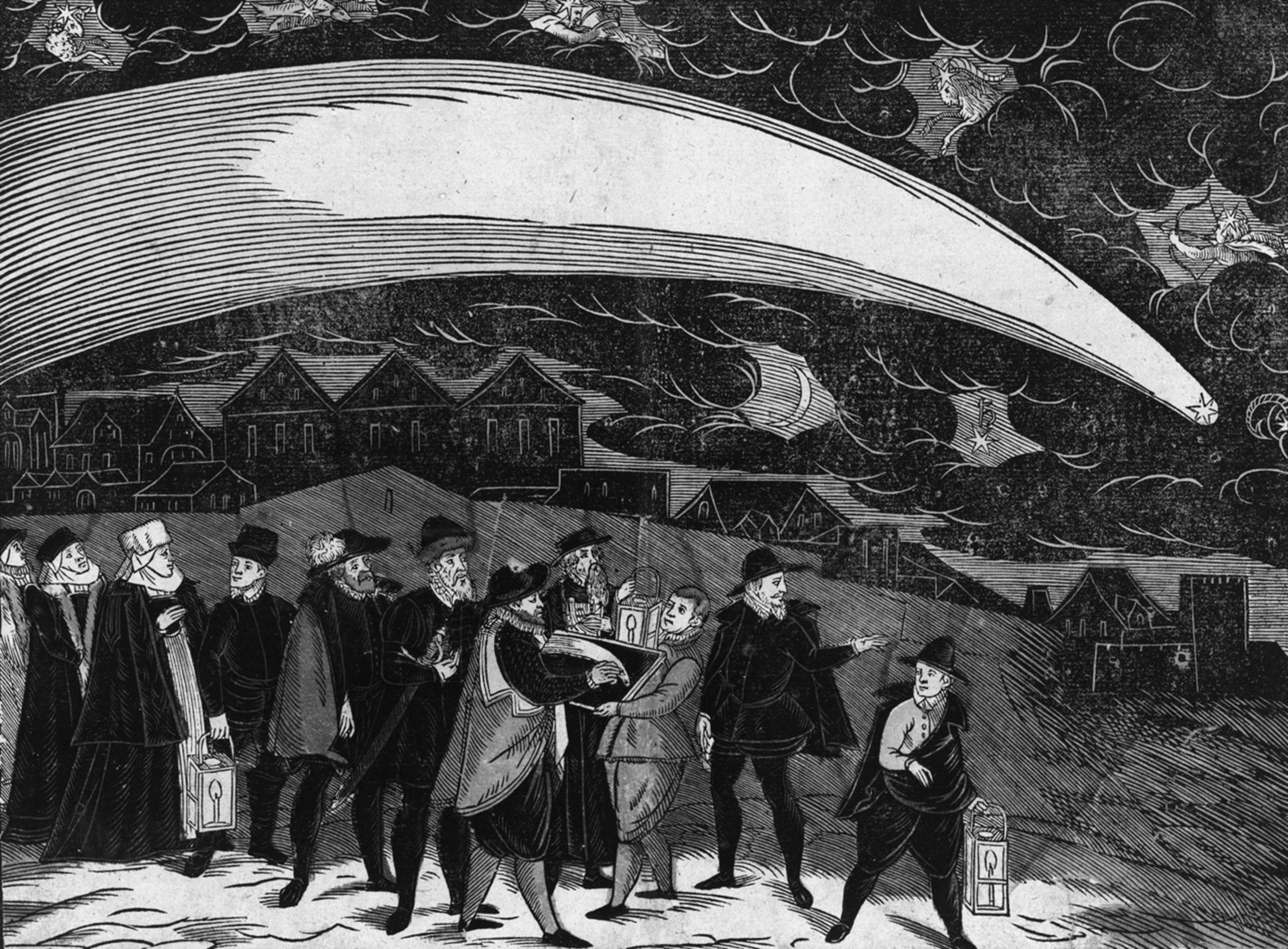
According to the article, Jeremiah in the Village: Prophecy, Preaching, Pamphlets, and Penance in the Thirty Year’s War, in 1618, at the height of the Lutheran apocalyptic fervor, a great comet blazed across the European sky, visible from September 6-25, sparking more than 100 pamphlets warning of God’s anger and prophesying doom. Pastors preached from the Old Testament in the spirit of the prophet, Jeremiah, in lengthy mournful lamentations that would come to be known as jeremiads.

As the war unfolded, ministers used the misery and suffering to call for more pious action. Seeing themselves as the chastened Israelites, ministers admonished that only increased religious action and adherence could save their countrymen. Jeremiah stated that God punished those who deviated from his commandments. Therefore, the Germans suffering such horrible devastation were undergoing punishment for their sinfulness and lack of repentance. God even sent a comet to warn them, yet they still had not adequately repented.

I shudder to think how the father or mother felt who watched their home burn, their children die and even their spouse perish. The guilt must have been as devastating as the war itself – to be blamed for something so incredibly beyond your control or even influence.

Conrad Dietrick, a Lutheran minister, on New Year’s Day 1619 published a pamphlet of his sermon that was very straightforward:

  • What comets are
  • What they mean
  • What we should do as a response to the meaning

Then, he answered his own questions:

  • God sent the comet as a warning because sin abounded in Germany, although that theme had been ever-present since the Turkish threat in the 1580s.
  • Mend your ways.
  • Stop disregarding God’s commandments and live a moderate and pious life.
  • God might not have to follow through on his threat to destroy his people if they heeded the celestial warning and subsequent warfare and live within the bounds of Lutheran discipline.

One pamphlet called out the deadly sins of the parishioners responsible for the devastation, such as the following, therefore making Germany responsible and subject to punishment:

  • Excessive pride and display
  • Swearing
  • Fornication
  • Disobedience to authority

Oh, and by the way, good deeds alone aren’t enough to get you out of this pickle and earn God’s Grace, because your sins are very deep.

Preachers and pamphlets were the social media, television and radio of the day.

By the end of the war, in 1648, one pamphlet published regarding the Treaties of Westphalia opened with the comet’s prophesying appearance in 1618 and closed with the war ending, “by God’s Grace,” in 1648. In other words, the people were suffering and had suffered through their own choices and actions. No one was going to feel sorry for them. They deserved what God saw fit to do to them, and probably worse.

It’s interesting to note, that whether true or not, the idea that the comet had appeared for 30 days across the skies was connected to the fact that the war had lasted for 30 years. In other words, by that time, the comet wasn’t just a warning, it was simply accepted as having been an accurate prophecy of what was to come.

During the war, the ministers attempted to make the essence of the sermons reach home in their communities – tailoring the message as needed. As the war dragged on, they became discouraged that their parishioners, the “common men,” were apparently unable to either understand or fulfill their messages. Many pastors became increasingly desperate for the much-needed change within their congregation necessary to end the war and suffering, and their sermons became increasingly reproachful and filled with missionary zeal.

They continued to predict that war would devastate Germany, and they would continue to be correct. Preaching itself became a form of prophecy and the ongoing war and atrocities only confirmed the message.

Sermons of one minister included the following New Years’ Day messages:

  • 1623 – Amos 4:6-12 – On the 3 punishments of the land/dearth, war and devastation with which God now afflicts our dear Germany because of its sins and how we should properly view them.
  • 1624 – Haggai 1:6-7 – Laid out reasons why it has happened that in these times no happiness, blessing, and increase for timely nourishment can be found.
  • 1625 – How we should act when we hear of foreign war preparations, recruiting, and troop movements.
  • 1626 – Habakkuk 1:12 – Why the armies on the march are an instrument of God’s punishment.
  • 1627 – Ephesians 5 – How one may properly get along in the current troubled times of war.
  • 1628 – How Christian subjects should pray for their rulers in these troubled times.
  • 1629 – Jeremiah 47:6-7 – The Lord’s sword – that is the word of the Prophet Jeremiah wherein the only proper cause is laid out, why one sighs and calls in vain for peace and an end to the war.”
  • 1632 – Jeremiah 15:11 – Land ruin and war consolation.
  • 1636 – The year of the plague in Ulm, the minister stated that 15,000 people had died that year, including thousands of beggars and refugees from neighboring villages. About one third were deaths of citizens from Ulm. Some days as many as 170 died – going on to say that those figures of death and misery needed no more explanation other than that provided in Psalm 107:17-20.

17 Fools by reason of their transgression, and because of their iniquities are afflicted.

18 Their soul abhorreth all meat and they are brought to death’s door.

19 Then they cry unto the Lord in their trouble, and he delivereth them from their distress.

20 He sendeth his word and healeth them, and delivereth them from their graves.

  • 1637 – Jeremiah 14:19-20 – Hammer of Peace, wherein is reported, what the causes are that the Peace that we have longed for for so many years has not come at all or let itself be seen.
  • 1638 – Psalm 14 – Heartfelt Zionish New Year’s Sigh – This was the year that cannibalism was reported in Breisach during a siege.

One preacher said 8 times in a funeral oratory for a minor noblewoman, “O, that we have sinned so much.” The topic and images of both punishment and penance, along with exhortations, were common themes in the sermons of Lutheran pastors during the war. They repeatedly referred to and lamented, “Oh woe, oh woe, the great sinfulness.”

How did the residents feel who heard these sermons that clearly placed the blame for the war and their great suffering squarely on their own shoulders?

In 1630, the shoemaker, Hans Heberle, in Neenstetten wrote as a preface to his journal that he began with the 1618 comet:

Anno 1618 a great comet appeared in the form of a large and horrible rod of punishment, with which God mightily threatened us because of our sinful lives, which we deserved many times over and still deserve today…what it means – what also will come of it – that is something we may cry hot tears over, as we, alas, experience now and have experienced from 1620 up to 1630 and which can’t be described.

Depending on one’s perspective, two other dates for the “beginning” of the war are given in contemporaneous literature; 1617 which is the 100 year anniversary of Martin Luther’s 95 Theses, a particularly galling event to Catholics, and 1619 when Ferdinand was elected Holy Roman Emperor.

It seems that the more pious believers suffered inwardly, feeling responsible for the devastation by their failings. The less pious certainly suffered, but not from the added layer of guilt.

Most people seemed to believe what they were being told and accept the horrible responsibility for what befell them. In the words of one man, “our sins are more than the stars in the heavens, more than the sand on the sea, more than the dust on the earth. Because we have sinned excessively, the punishment has overwhelmed us.”

The ministers and people of the Palatinate, along with the rest of Germany, tried their best to make sense, through the lens of religion, of a situation over which they had no control. Anything resembling normalcy was entirely absent. By the time the war had ended, not only were millions dead as a result, untold more had died not directly due to the war, but due to age or being displaced, having begun their lives in bucolic villages where they expected to live out their lives.

Nothing could have been further from the truth.

We don’t know if Steffan Koch lived to see the end of the war and his daughter’s marriage in 1650, but another pastor celebrated the end of the war in 1648 with one last passage from Jeremiah 33:47:

Thus says the Lord: In this place of which you say:

It is a waste without man or beast,” in the cities of Judah and the streets of Jerusalem that are desolate, without man or inhabitant or beast, there shall be heard again the voice of mirth and the voice of gladness, the voice of the bridegroom and the voice of the bride, the voices of those who sing, as they bring thank offerings to the house of the Lord: “give thanks to the Lord of hosts, for the Lord is good, for his steadfast love endures forever!” For I will restore the fortunes of the land as at first, says the Lord.

Indeed, two years later, Steffan Koch’s daughter would be the voice of the bride in the church in Dürkheim.

The Church of St. Johannis in Dürkheim

The church in Fussgoenheim was destroyed during the Thirty Years’ War, so we have no record of what that church looked like, or even who was buried in the churchyard. The books of baptisms, confirmations, marriages, and burials, written in Steffan’s own hand was destroyed.

We don’t know much about Steffan’s life after Fussgoenheim, aside from the fact that Dürkheim is one of only two cities that stood, and that his daughter married into another Fussgoenheim family in 1650. Of course, we don’t know that Jerg Kirsch’s parents were actually from Fussgoenheim before the devastating war, or if the couple returned there because Jerg was able to obtain an order to become the co-lessee of the Josten’s estate in 1660.

What we do know is that from the time Steffan left Fussgoenheim, probably between 1620 and 1622, likely before the birth of his daughter, Margretha in about 1630, the church in Dürkheim, for however long he lived, was his church home.

To the best of our knowledge, Steffan was never the pastor there, because he was not referenced as such in Margretha’s marriage record. Given that he certainly didn’t die until after Margretha was conceived, it’s likely that he spent at least some time in Dürkheim, in the church there which does survive.

I would wager that Steffan helped the pastor there as he could – perhaps filling in when necessary. Dürkheim suffered terribly from both plague and starvation during the war, so there would likely have been many funerals, some occurring hurriedly so that the body or bodies could be quickly buried.

So much suffering, so much need – so many who would welcome the comforting hand and prayers of a minister, even if Steffan wasn’t their official minister. He was still a man of God, having answered a higher calling. He would have known what to say to provide comfort for the grieving.

I can only extrapolate about how Steffan felt in Dürkheim. It must have been some torturous combination of every-single-day terror, gratitude for surviving, at least so far, grief at the life they had to leave behind, grief over what their family, friends, and neighbors were suffering, probably grief over the deaths of his own family members, hunger, and overwhelming guilt if he indeed believed that God was punishing him for his lack of…well…pretty much everything. I can’t even begin to imagine what it would be like to see your child starve and die if you believed their suffering was doled out by God because YOU weren’t pious enough.

On the other hand, Steffan may have somehow taken comfort in his religion. Given that his faith would have been strong enough to commit his life to convincing others that Lutheranism was indeed the way and the light, he probably believed that whatever happened was “God’s will” and that those who passed over were indeed sitting at the feet of God in Heaven – relieved from their earthly worries here.

Or, maybe some combination of all of that.

Since I don’t know what or how he felt but do know what the church looked like, I’d like to take a walk with Steffan and perhaps, to be able to glimpse at least this much through Steffan’s eyes.

Walking in Steffan’s Footsteps

The church of St. Johannis, or St. John, now known as the Castle Church was built in Dürkheim sometime before 946, obviously as a Catholic church. Around 1300, the current church, minus the current spire, was built on the original foundation. Ironically, the church was built in part with indulgences for those believers who visited the church – one of the very things that caused Martin Luther to part ways with the Catholic Church.

In 1504 and 1508, burial crypts and a chapel were built on to the church and would have been present when Steffan walked those hallways.

Dürkheim was not a small town. This illustration from 1450, 200 years before Margretha was married in the church there, shows that the houses were clustered closely together.

Limburg Abbey was destroyed in 1504, the remains resting high above Dürkheim. You can take a stunning flight over by drone, here. While Steffan wouldn’t have had this bird’s-eye-view, he would have seen the ruined Abbey above the town – and you can see the town from the drone footage. Wow, just wow.

The Hardenburg castle stood sentry over Dürkheim when Steffan trod these streets, although it lies in ruins today.

This 1630 drawing of the church with the Latin school across the yard doesn’t’ show the wooden crosses marking the graves in the churchyard. Steffan and others stood here all too often. I can’t help but wonder about mass graves during that time of inordinate death resulting from warfare, plague, and starvation.

By comparison, you can see the church today, with the churchyard now paved with brick or cobblestone. I can’t help but think of the generations of people whose ashes rest below. And yes, my mind does wander to bones and DNA.

This engraving, from 1650 shows the fortress and the church that Steffan attended, and where his daughter, Margretha, was married that very year. This scene would have been very familiar to the Koch family.

This drawing from 1787 shows the ruined abbey in the distance

Today, the church which sports a tall spire that was replaced in the 1800s nestles in the modern city of Bad Dürkheim.

The ancient streets and a few old houses remain today, probably rebuilt after the devastating 1689 fire.

You can still walk up to the church on the old cobblestone streets, approaching from the rear, here. Steffan probably walked this pathway hundreds if not thousands of times. I have to wonder if the residents sought refuge inside the church from time to time as troops advanced.

Only the walls of the church remained after the church was burned in 1689, taking roughly 20 years to repair and rebuild. These walls stood when Steffan walked in the churchyard surrounding the church, now covered with bricks.

Von Immanuel Giel – Eigenes Werk, CC BY-SA 3.0, https://commons.wikimedia.org/w/index.php?curid=33547176

The original church was constructed at different times. Beautiful stonework with quarried stone corners on the rear of the Leininger burial chapel that was added in 1505. The door allowed the Count to exit the service without going through the church proper.

Von Immanuel Giel, CC BY 3.0, https://commons.wikimedia.org/w/index.php?curid=57943700

The church is beautiful, even without the new spire.

Walking around the church, we can see the burial chapel, built in 1505 and already more than 100 years old when Steffan lived there.

I wonder if the vine harkens back to the time before the churchyard was bricked or paved with cobblestones. We can’t see the beautiful door on this side of the church very well.

Steffan walked through the larger double side doors on the other side of the church. The door in place at that time would have led to the churchyard and was probably the doorway through which coffins were carried after the funeral service on their final journey.

The size of this side door and stones shows just how massive this church is and gives us some idea of why it took 35 years or so, from about 1300 to 1335, an entire generation, to build.

Inside the burial chapel, we find this stone of Agnes von Leiningen-Hardenburg who died in 1586. Did Steffan perhaps seek solitude in the quietness of this chapel from time to time? As refugees, they probably lived in cramped and noisy quarters with other families.

In the same burial vault, the stone of the Count who built the chapel beside his consecration cross.

Inside the burial crypt.

Today, the tombstone of the Limburg abbot who died in 1531 has been moved outside, but when Steffan sat inside this church, this stone was there was well. I wonder how Steffan felt about this, given that the Abbott was clearly Catholic at that time, and the devastation Steffan was living through day-to-day was wrought by a war with Catholics and Catholicism.

Von Altera levatur – Eigenes Werk, CC BY-SA 4.0, https://commons.wikimedia.org/w/index.php?curid=53165415

Another stone moved outside shows the alliance coat of arms of the Lords of Weingarten and those of Sickingen.

Von Immanuel Giel, CC BY 3.0, https://commons.wikimedia.org/w/index.php?curid=57943697

Steffan would have walked past, and perhaps stopped to tough this double epitaph carving of Count Emich XII. and Maria Elisabeth von Pfalz-Zweibrücken in the castle church, carved in 1612. She died in 1629, so it’s certainly possible that Steffan was present at her funeral.

Behind the figures is a relief of the Hardenburg Castle, home of the Leiningen family.

Von Immanuel Giel, CC BY 3.0, https://commons.wikimedia.org/w/index.php?curid=57943744

Did Steffan absentmindedly run his fingers along these carved branches, leaves, and acorns, silently praying for strength?

A lovely, friendly gargoyle that Steffan saw and perhaps loved too. Did he tell his children or grandchildren stories about this mythical beast? Gargoyles are said to protect what they guard against evil or harmful spirits. If the gargoyle’s mouth was open, it was devouring a giant. This gargoyle looks kind of like it’s contentedly chewing its cud.

This south aisle, facing west, probably looked much the same, without the modern accouterments, of course. Did the thick walls deaden the city sounds, allowing deep reflection?

Perhaps the single most iconic item of the Lutheran faith representing inclusion into the flock, both earthly and Heavenly, is the baptismal font. This font survived from 1537 and if any of Steffan’s children were baptized in this church, this was the font in which that holy ritual occurred. Given that he was a minister, Steffan may have baptized his children himself.

I can close my eyes and witness that act of faith, love, and devotion.

Von Immanuel Giel – Eigenes Werk, CC BY-SA 3.0, https://commons.wikimedia.org/w/index.php?curid=33547186

While the stained glass windows and cross are new, the nave is not. Steffan may have preached here and assuredly prayed in this sacred space; for safety, for deliverance, for himself, for his family, and for so many others. But more than anything, Steffan probably prayed to find a way to live better, more religiously, more piously, in order that God would not be angry with him.

Punishing anyone with warfare punished everyone with warfare. Steffan would have prayed to find a way to be a more convincing leader, not so much for himself, but for the other parishioners who suffered for 30 years, and more. If only, if only, he could successfully obtain God’s Divine assistance to convince them. If God would just grant him the words that would be convincing enough.

Not unlike how many of his descendants feel today, in the midst of another plague that could, in fact, be affected and slowed by convincing enough people to do so. A direct link from me to Steffan, across 400 years, almost exactly.

Given what Steffan went through, whether or not he survived the actual war and accompanying horrors, I’d expect that prayer is what defined his life – and probably his death. A lifetime of increasingly desperate prayer.

_____________________________________________________________

Disclosure

I receive a small contribution when you click on some of the links to vendors in my articles. This does NOT increase the price you pay but helps me to keep the lights on and this informational blog free for everyone. Please click on the links in the articles or to the vendors below if you are purchasing products or DNA testing.

Thank you so much.

DNA Purchases and Free Transfers

Genealogy Products and Services

Genealogy Research

Books

Margretha Koch, (born 1625-1630), The Preacher’s Daughter – 52 Ancestors #315

I surely wish we knew more about Margretha Koch. We’re fortunate to have a few tidbits.

The first and only record for Margretha directly is her marriage to Johann Georg “Jerg” Kirsch in Dürkheim on September 9, 1650. Given the customs of the time, she was probably 20 or 21 years old.

My friend, Tom, translates:

On the same day (9 Sept 1650) Hans Georg Kirsch and Margretha, legitimate dau of M Steffan Koch, former pastor in Fussgonheim.

By inference, this tells us that Margretha grew up entirely during the Thirty Years’ War which started in 1618, a few years before she was likely was born. By 1622, all of the remaining population in the Palatinate that hadn’t been killed or died as a result of the initial onslaught of the war had left the countryside with what little they had left, but not by choice.

The entire population became exiles with nothing more than they could carry, as shown by this painting, seeking shelter someplace, anyplace as a simple matter of survival. The cities swelled, then one by one, they fell either in battle or by siege.

This drawing of Casale Monferrato in 1630 shows the soldiers waiting. During a siege, the attacking soldiers simply surrounded a city and waited as the pinned-in residents starved and died. No food could get in, and they couldn’t escape without surrender.

During the siege of Prague in 1648, the soldiers waited until the residents were weak from hunger and thirst, then attacked.

Life in Exile

Humans have amazing resiliency. Margretha was probably born between 1625 and 1630. Only three Palatinate cities withstood the ravages of war and weren’t burned to the ground. Dürkheim, now Bad Dürkheim, was one of those, and that’s where Margretha would have been born to refugee parents. The first wave of attack in 1618 burned most of the Palatinate, so by the time Margretha entered the world, they were likely settled in Durkheim and had been for some time.

I wonder if the family lived in a communal home, crammed to the gills with other families in the same dire situation. Dürkheim was a walled city, which afforded protection, but also prevented expansion to accommodate masses of refugees.

Margretha’s parents would have worried night and day about where their next meal was coming from and simply if they would survive to the next day and the next week. Since the fields had been burned by the advancing army, there were no crops nor animals. The grim reaper arrived as starvation. Estimates range as high as 60% of the population died, someplace from 4.5 to 8 million in a political-religious war with the French Catholics attempting to eradicate German Protestantism.

Note the devastated landscape in this 1647 painting of marauding soldiers.

Surviving a year might have seemed impossible, but one year poured into the next while the war was constantly fought around them – for 30 long years – one after the other.

Somehow, miraculously, Margretha survived.

Margretha, growing up had never known anything else. However and wherever they lived in Dürkheim – it was “normal” to her.

The Church

The church was always the center of a German town, but in Margretha’s case, even moreso. Margretha and her family probably lived within sight of the church. Dürkheim wasn’t exactly a large city and her father would have wanted to be near the church. After all – it was their cherished religion for which they were willing to sacrifice their lives.

We know that Margretha’s father, Steffan Koch, was a Protestant minister in Fussgoenheim before the war, so their home would likely have been filled with prayer and they would have attended church every Sunday in the nearby St. Johannis Church, today known as the Castle Church.


The Latin School Margretha would have attended was located just across the churchyard, which, at that time would have been filled with wooden crosses. This church had already been in use by then for hundreds of years, so graves were probably already being reused.

It’s certain that Margretha would have buried her parents here, unless of course by some miracle, they returned with Margretha and Jerg to Fussgoenheim sometime around 1660. There wouldn’t have been much if anything to return to.

The French burned everything more than 40 years earlier. The ONLY reason Jerg Kirsch with his young family would have left Dürkheim at that point was for opportunity – and that came their way when, somehow, they became co-lessees of the Jostens estate. I must say, given that this was a lease from a religious body, I have to wonder if Steffan Koch was somehow involved with those arrangements.

We have no reason to doubt that Margretha was Jerg’s only wife, although it’s certainly possible that she died and he remarried.

The end of the war and the move to Fussogoenheim was neither immediate nor uneventful. The archivist in neighboring Schauernheim tells us that people didn’t begin to return immediately after the war. A few brave souls began returning about 1650 and even then, only a handful in each village.

Another War, Another Evacuation

After settling in Fussgoenheim in 1660 or so, the family had to hurriedly evacuate again in 1674 when France again annexed the Palatinate to the Rhine, declaring War on this region and in 1688, the French king instructed his soldiers that “the Palatinate should be made a desert.” They did their best. War had returned with a vengeance, along with starvation, with warfare not subsiding until 1697.

By the time they moved to Fussgoenheim, Jerg and Margretha would have had several small mouths to feed. By the time they left again, their youngest children, if they survived, could have been marriage age.

They remained in Dürkheim the second time until after 1695 when their son, Wilhelm, married. If Margretha was still living, she likely returned to Fussgoenheim with her sons by 1701 when Adam was noted as Mayor.

Children

We know, based on records from the mid-1700s in Fussgoenheim that Jerg had 7 children, which of course, means Margretha did too:

  • Johann Jacob Kirsch born about 1655, died before 1623 and married Maria Catharina, surname unknown. They had 6 known children beginning in about 1695 through about 1710.
  • Daniel Kirsch born about 1660, died before 1723. Nothing more known.
  • Johannes Kirsch, born about 1665, died November 15, 1738 in Ellerstadt, single.
  • Andreas Kirsch, born about 1666, died April 21, 1734, single or at least no children in Fussgoenheim. Lived in Oggersheim and Ellerstadt.
  • Johann Michael Kirsch, the Judge, born about 1661, died January 1, 1743, married Anna Margaretha Spanier, and had 6 children beginning in about 1700.
  • Johann Wilhelm Kirsch born about 1670, died before 1723, and married Anna Maria Boerstler in Durkheim in 1695. They had 4 known children beginning in about 1700 through 1718. A daughter, born about 1718 was named Anna Margaretha, likely for her grandmother.
  • Johann Adam Kirsch, born between 1650 and 1677, died before 1740, married a Greulich female, then Anna Maria Koob. He had 5 children, beginning about 1700 and continuing until about 1716.

Notice that there are no females listed. It’s possible they had no daughters, or we were unable to identify them through later death and baptismal records of other Fussgoenheim village residents. Many times women’s birth surnames were not recorded.

Let’s hope that Margretha had the opportunity to enjoy at least some of her grandchildren.

What Happened to Margretha?

We don’t have any idea when Margretha died, but we do know that by 1695 when Johann Wilhelm married, she was either deceased or a widow. Johann Wilhelm’s marriage record in the church states that Jerg is deceased.

Given that Margretha’s sons that we are aware of moved back to either Fussgoenheim or that region, if she were living at the time her son was married in 1695, she may well have returned to Fussgoenheim with her adult children.

By 1701 when we know that Adam was living in Fussgoenheim, Margretha would have been between 70 and 80 years old, so it’s certainly possible that she is buried in the graveyard outside the beautiful church in Dürkheim, She could also have been buried in Fussgoenheim if she died while the family lived there between 1660 and 1674, or if she returned to Fussgoenheim after 1697 with her children.

_____________________________________________________________

Disclosure

I receive a small contribution when you click on some of the links to vendors in my articles. This does NOT increase the price you pay but helps me to keep the lights on and this informational blog free for everyone. Please click on the links in the articles or to the vendors below if you are purchasing products or DNA testing.

Thank you so much.

DNA Purchases and Free Transfers

Genealogy Products and Services

Genealogy Research

Books

Christoph Bechtold (<1619 - <1671), Baker in Ebersbach – 52 Ancestors #313

Christoph Bechtold’s daughter, Margaretha, married on July 28th, 1671 to Michael Hag in the village of Ebersbach. That marriage record led us to her parents and her birth record.

Marriage: Friday, the 28th of July 1671

Michael Hag, legitimate son of Hanss Hag, Koss, & Catharina Bäur(in) and Margaretha, legitimate daughter of Christoph Bechtold deceased baker in Ebersbach and Margaretha Ziegeler. Bride pregnant.

Christoph’s Children

Margaretha wasn’t Christoph’s firstborn child.

Christoph’s name was spelled Bechtoldt when twins, Maria and Margaretha were baptized in 1640, Christophorus Bachtoldt in the baptism of Leonhardus in 1642, and Bechteles when Jacobus was baptized in 1644.

Margaretha was born on May 1, 1646, two years before the end of the 30 Years War, a time of massive heartache and depopulation in this part of Germany.

Neighbor villages were sacked in 1634, with many villagers being massacred, leading to a population drop to 20% of pre-war levels. By the time Margaretha was born, the war had raged for 28 years, an entire generation, and villagers probably wondered if they would ever be safe.

It’s certainly possible that Christoph had absolutely no memory of life without warfare.

Yet, life, to some extent, went on. People married and babies were born. According to church records, there were a total of 25 baptisms in 1646, suggesting a reproductive population of about 50 families.

Village Life

Christoph and his family attended the Lutheran church in Ebersbach, By the time they lived there, that church was already old, having been built in the 1200s.

Church in a German village was the center of life and generally the center of the village as well. People were married there, attended services on Sundays, baptized their babies, celebrated confirmations, attended funerals, and buried their family in the churchyard outside. Birth to death, life revolved around the church.

The Protestant religion was extremely important to villagers – worth fighting and dying for. The 30 Years’ War was a religious war between Catholics and Protestants, beginning in 1618 and not ending until 1648.

Christoph lived much of his adult life, perhaps most of his entire life, as this war raged around him. We’ll never know how this affected him, but I’d wager that a baker suffered significantly because the grain crop had to be planted, allowed to grow without being trampled or burned, harvested, dried, and then ground into meal or flour before a baker begins the actual baking process. No flour or ingredients? No baking.

The military approach to the 30 Years’ War was to destroy everything in the German countryside, including the fields. I wonder how enough grain managed to make it through the entire growing season – how any did, actually. We know that much of the population starved.

In a way, I’m actually amazed that this family was able to survive at all. For all we know, Christoph didn’t. We don’t know when he was born, or died, nor when his wife died. They could have been war casualties.

Other than Margaretha, the only thing we know for sure about his children is that the twin named Margaretha born in 1640 died. Otherwise, the daughter born in 1646 would not have been named Margaretha.

When Was Christoph Born?

We don’t know when Christoph was born, or where, but it was most likely in this same village or at least nearby.

Christoph would have had to apprentice as a baker to learn the trade, and the most likely place to have done that was in his own home. In a small village, there would have been only one baker.

If Christoph’s first child was born in 1640, Christoph would have been born about 1619 or earlier. Of course, there’s no way to know if the child or children, twins actually, born in 1640 was his first, or if that’s just the first child we have a record for.

If that birth was the first, then Christoph likely married about 1639 which means he would have been born before 1619.

I have found mention of a Christof (Stofel) Bechtold born August 3, 1615, in Esslingen, not far away, but I don’t have that record and I can’t confirm that it’s him.

Of course, Christoph could have been substantially older. If Margaretha born in 1646 was his youngest child, and his wife was the same age, Christoph could have been born about 1600.

A Baker

I keep hearing the refrain, “the butcher, the baker, the candlestick maker.” These were the all-important trades that any village required. Christoph’s daughter, Margaretha married a baker as well, so it’s certainly possible that Christoph had an apprentice who caught his daughter’s eye.

This medieval baker is working with his apprentice.

You can learn about reconstructing medieval bread, here. After reading that article, I had a MUCH greater appreciation for what Christoph did – every single day.

The Bechtold home would have incorporated the large oven required to bake bread and other pastries such as savory meat pies and treats such as gingerbread, daily.

Gingerbread, from a manuscript dating about 1520, being lovingly baked by a barefoot medieval baker. Ok, I give, why was the baker barefoot?

Gingerbread in medieval Germany was so popular it was regulated by a gingerbread guild!

By Wolfgang Sauber – Own work, CC BY-SA 3.0, https://commons.wikimedia.org/w/index.php?curid=12749977

The tops of gingerbreads were decorated with designs from molds.

Next, my research revealed an AMAZING thing. Gingerbread + dark chocolate. Oh yea!

There was both “regular” gingerbread and dark chocolate Lebkuchen as well, an assortment shown today. That combines two of my very favorite things.

By SElefant – Own work, CC BY-SA 4.0, https://commons.wikimedia.org/w/index.php?curid=3235229

I actually sampled some of these when I was in Germany from a tin just like this, and never realized the connection. I need a dark chocolate gingerbread recipe!!!

I clearly have the gingerbread gene and so did my mother. My son still asks for gingerbread as his birthday cake every year!.

Apparently, lots of other people love gingerbread too. I’d wager Christoph was a VERY popular man at the local market! In fact, this might explain a lot.

Ebersbach, first mentioned in 1170, was an old market town, located on the oft-traveled Roman road between Italy and the Netherlands, nestled at the feet of the Swabian Alps.

Of course, the only people traveling that road during the 30 Year’s War were likely refugees and soldiers. Soldiers, like it or not, had to eat too, and perhaps the fact that bakers were essential and ovens weren’t transportable played a part in Christoph’s family’s survival. Maybe gingerbread, and chocolate, literally saved the day for my ancestors.

_____________________________________________________________

Disclosure

I receive a small contribution when you click on some of the links to vendors in my articles. This does NOT increase the price you pay but helps me to keep the lights on and this informational blog free for everyone. Please click on the links in the articles or to the vendors below if you are purchasing products or DNA testing.

Thank you so much.

DNA Purchases and Free Transfers

Genealogy Products and Services

Genealogy Research

Books

When Did Michael Miller Really Die? The Answer May Lay in the Land – 52 Ancestors #312

It’s been widely reported, including by me, that Johann Michael Miller died in 1771. That’s where the evidence all pointed – until perhaps now.

Do we have it wrong?

There’s conflicting evidence that I can’t resolve, so I’m hoping that perhaps someone else has some insight, or records that I don’t. Plus, this is a great story! So kick back and enjoy while Johann Michael Miller tortures me once again😊

Credit Where Credit is Due!

First, I’d like to thank two other researchers, both of whom reached out to me after I published the primary Michael Miller article. This article dovetails with the earlier one.

Johann Michael Miller (Mueller) the Second (1692-1771), Brethren Immigrant, 52 Ancestors #104

One of the things I love about these articles is that they engage other people. Initially, a year ago, Wayne Diehl contacted me with new information.

Recently, Robert Atteberry wrote to me about what he believes to be a different death year for Michael Miller.

I should have known when I read the first sentence of Robert’s document that he attached!

“You may need to buckle your seat belt, as this will be a rather long and bumpy ride.”

And truly, that was an understatement.

Yep – Buckle Up

It’s ironic that my Johann Michael Mueller, shortened to Michael Miller in the US, isn’t a direct interest of Robert. At least not yet.

Robert needs to resolve the multiple Michael Miller connections to discover more about another Michael Miller, along with Henry Miller, who married the daughters of Jacob French II. Oh, the things genealogists do in the process of tracking down those pesky ancestors.

I’m noting Robert Atteberry’s Miller interest early in this article in the hope that someone may possess some information to help him along his journey. Robert writes:

In my research of my Henry Miller line, I have come across a Michael and Henry Miller living in Berkeley County WV in the latter part of the 18th Century, who appear to have married daughters of Jacob French II. When I encounter other persons of the same surname living contemporaneous and in near geographic proximity to my target ancestor, I am obliged to investigate the ancestry of those allied parties, so that they can either be excluded or included as part of my ancestor’s family. When I discovered that Jacob French, and his brother, George French owned property in Forbush Branch in close proximity to Michael Miller, of course I felt compelled to study Michael Miller. That imperative heightened even more when I found that Jacob Good had actually purchased Huckleberry Hall from Jacob French II.

Note that Martinsburg, West Virginia near Forbush Branch is only about 20 miles south of Ash Swamp, owned by my Michael Miller, the immigrant, in Frederick County.

Jacob Good is believed (but not proven) to have been the step-son-in-law of Michael Miller through his second wife, Elizabeth Garber, widow of Nicholas Garber, along with John Riffe. One thing is for sure, Jacob Good was involved in several land transactions with some Michael Miller in Frederick County, MD whose land was very close to the proven land of our Johann Michael Miller.

There are lots of moving parts, and either we have multiple coincidences, which is possible, or we’re making headway, little by little.

Robert is currently looking for a male Miller descendant from his line of interest to Y DNA test. That would answer the question – well – at least one question.

From Robert:

My interest really lies in a totally separate, and probably unrelated Miller line: Henry Miller and his wife, Magdalena of Martinsburg WV.

Even though I do not at present have any direct evidence that the Michael and Henry Miller, who married daughters of Jacob French II, were kinsman of the Brethren Michael Miller, I cannot as yet rule out that possibility. More to my specific purpose, I cannot even state with any certainty that any of these Washington County Miller’s have any connection to my ancestor, Henry Miller of Opequon Creek.

Please click here for Robert’s story and use your browser search for “Jacob French.”

But before I share Robert’s potentially apple-cart-upsetting discovery, it’s important to flesh out more of the story of Michael Miller’s land. Because the devil is in the details, and the answer may lay in the land.

Johann Michael Miller’s relevant land ownership begins in Pennsylvania with Batchelor’s Choice in what was then Lancaster County, PA, soon to become York and then Adam County.

Batchelor’s Choice

In 1744, the same year our Michael Miller is mentioned in Brethren letters, Batchelor’s Choice was purchased by Michael Miller, Nicholas Garber, Samuel Bechtol and Hans Jacob and Elizabeth Bechtol who lived in Chester Co. PA. These families had migrated from Chester County where they were found on the 1737 tax list.

Batchelor’s Choice was subdivided with 150 acres each to Michael Miller and Samuel Bechtol, Michael’s wife’s brother who is buried in the adjacent cemetery, and 100 acres to Nicholas Garber.

Wayne Diehl plotted the location of Batchelor’s Choice outside of Hanover, PA.

Here’s the land (Batchelors Choice) purchased in 1744 by Michael Miller (plat 3, 150 acres), Samuel Bechtol (plat 2, 150 acres) and Nicholas Gerber (plat 1, 100 acres.)  It’s just outside Hanover, PA, and I visited the site last year and took some pics.

A big thank you to Wayne for allowing me to include his photos.

From York/ Hanover Road, Wayne looked across the fields that Michael owned to see the farm in the distance.

Of course, Michael would have had a barn, probably multiple barns, but no silos back then. Otherwise, this land, once cleared, which would have been a massive undertaking, has probably changed little.

This photo shows Michael’s land that lay south of present-day Gitts Run Road.

Michael’s portion of the land had an old road, now Gitts Run, that runs directly through the middle of the property today. That’s exactly how old farm paths became eventual roads.

Wayne visited in October of 2018 and took this photo driving through Michael’s land, with his fields on both sides. The bridge across Oil Creek is just about where that vehicle is in the photo.

Oil Creek runs alongside, and like all early homesteads, the house was found nearby. Settlers would have walked a few feet to the creek to fill buckets. The closer the creek, the better.

The curve hugs the barn closely, a road design that would never be approved today. The house sits back from the road.

This beautiful, historic home is just stunning. I can’t help but wonder if that tree dates to when Michael lived on this property.

Rounding the curve, we see the back of original farmhouse in the distance, along with a beautiful partly-bricked barn. They don’t build barns like that anymore.

Driving past the silos and barn, I see what might be a farm stand to the right, under the roof. In the Amish/Mennonite area where I grew up, farm stands dotted the landscape with jars or boxes and neighbors paid on the honor system.

There are electrical wires to the home today, so the home is wired for electricity.

The photos above are from Google street view, but Wayne was able to take a lovely photo of the home, below, which I strongly suspect was either Michael Millers’ or built shortly after he sold the property.

Of course we don’t know if this was the original home, but the dual fireplaces with the two small windows at either end of the house tell us that this structure is quite old, very likely pre-1800.

Of course, the homestead is surrounded by farmland all around.

Looking in all directions. The aerial below shows all of Michael’s portion of the land.

The deep black loam of these fields looks incredibly fertile, even yet today.

This view encompasses all of Michael’s land including the Bechtel and Garber tracts, plus some of the neighboring area, including Bairs Mennonite Church. I can’t help but wonder who owned that adjacent tract.

It’s interesting that the Bairs Mennonite Church along with the very large York Road Cemetery, also known as Bair’s Meeting House Cemetery, is located right beside what was once Michael’s land. The Bechtel’s who bought that land from Michael Miller were Mennonite and there are lots of Bechtels buried in the cemetery, including Samuel Bechtel, Michael’s brother-in-law, who died in 1758. This church was established early, along with the cemetery, and is very likely the location where Michael Miller’s wife, Suzanna Bechtel along with Nicholas Garber were buried.

It’s possible that Michael is buried here as well. Given that he married Nicholas Garber’s widow, he could have moved back, and potentially died here.

This meeting house certainly hadn’t been built yet at that time, but an earlier structure could have stood here. There had to be something here by 1758 when Samuel Bechtel was buried, and likely before.

Meetings may have been held exclusively in the homes of members, or clergy, and this cemetery might well have simply been the Garber, Miller, Bechtel extended family cemetery, at least initially. Or, perhaps by that time there was a log cabin meeting house.

The oldest graves would have been located closest to the church, radiating outward with each ensuing generation. Michael’s home was just “over yonder” a bit, within view and just across the field. You could look out the window and see your family members’ resting places as you went about your daily chores. They were always nearby, watching over you.

This aerial shows all of Batchelor’s Run, the land where Michael lived along with his brother-in-law, Samuel Bechtol and Nicholas Garber.

The original portion of this home on Gitts Run with its beautiful barn on the Garber tract may have been the home where Nicholas Garber lived – and perhaps the home where Michael Miller lived after he married the widow of Nicholas Garber.

Whether Michael ever lived here or not, the Garber and Bechtel homes were assuredly like second homes to these families who migrated and established homesteads together. They all would have helped each other build homes and barns, probably all living together in one home until they managed to build the rest. We still had barn-raisings and house-raisings where I grew up in an Amish/Mennonite community, 200+ years later. Everyone depended on their neighbors who often were family.

The Garber property, in particular, becomes important later on in Michael’s story.

Michael may not have actually lived on this property long – or perhaps he actually settled on this land before he purchased in 1744. In any event, a year later, Michael purchased land several miles away, on what was even further out on the edge of the frontier.

Ash Swamp

In 1745, the year after he purchased Batchelor’s Choice, Michael Miller bought land in what was then Prince George County, MD, the part that would become Frederick County in 1748. The deed states that Prince George was where Michael lived at that time, however, this entire region was under dispute. Michael may have thought he lived in Maryland and actually lived in Pennsylvania. As strange as that sounds, it wasn’t. I discussed the border war in the original Michael Miller article.

Regardless of where Michael believed his old or new land to be located at that time, his new land was located unquestionably in the portion of Prince George County that would become Frederick County three years later.

Batchelor’s Choice and Ash Swamp are only about 45 miles apart.

Three years later, on February 24, 1748, Nicholas Garber/Gerber wrote his will which was proved on June 6, 1748, naming his eldest son, Samuel who was to receive his plantation if he lived to be of age, otherwise to the younger son, his eldest daughter, Elizabeth who was to get an additional cow above the others. Other names were not given. Witnesses were Christian Kehr and Samuel Bechtol. Nicholas’s estate wasn’t settled for at least 6 years, because in 1754, Michael Miller was administering his estate.

If further estate papers exist, including land transactions, this could shed a lot of light on when Michael Miller was living, where he lived at the time, and the identity of Nicholas and Elizabeth Garber’s children. It’s believed that in addition to Samuel Garber they had a son Martin Garber, both found in Frederick County, MD in 1776 on the list non-Associators, Elizabeth Garber who married Jacob Good, Anna Garber who married John Riffe, both also listed as non-Associators, and John Garber who married Barbara Miller, rumored daughter of Johann Michael Miller, and joined Jacob Riffe and Lodowick Miller in Rockingham Co., VA.

In 1749, York County, PA, was formed from Lancaster. Batchelor’s Choice is located in York County. There were two Michael Millers in York County at that time.

By October 1751, Michael’s son, Philip Jacob Miller had taken over the Ash Swamp land warrant in Frederick County, MD, and enlarged it to 290 acres. It was resurveyed for Philip Jacob on April 25, 1752 with the patent issued on November 17, 1753.

On March 7, 1752, Michael Miller sold his 150-acre portion of Batchelor’s Choice in York County to Samuel Bechtol. This would have signaled his move to Maryland, or at least that’s what logic would tell us, especially given that’s when the majority of the Brethren community departed York County in Pennsylvania for Frederick County in Maryland due to the continuing and escalating border wars.

But, maybe Michael never moved. Maybe he sold his land for another reason.

Also, in 1752, Ash Swamp was resurveyed for Michael’s son, Philip Jacob Miller. There is no deed conveying this land from Michael to Philip Jacob.

In 1783, Philip Jacob and his brothers Lodowick and John conveyed it to each other, with the outcome being that John owned the portion to the north, Philip Jacob to the south and Lodowich bought an adjoining farm to the south, “Tom’s Chance,” in 1751. The brothers were all living adjacent.

By 1754, one Michael Miller had married Elizabeth Garber, the widow of Nicholas Garber, which would have given him possession of Nicholas Garber’s 100 acres. I have not seen the actual will or administration/court records.

Is this why Michael sold his own land in 1752? Was that when he married Elizabeth Garber? Is that why he in essence “gave” his survey in Frederick County to his son(s)? Did he use the money from the sale of his land in Pennsylvania to purchase more land in Maryland?

An orphans’ court record on December 10, 1754 states that Elizabeth Garber, the widow of Nicholas, is now the wife of Michael Miller and that he is administrating the accounts for the will which suggests that some of the children were yet underage.

Perhaps Michael and Elizabeth had both moved to Frederick County, Maryland by this time.

More Land in Maryland

Some Michael Miller acquired significantly more land in Maryland, subsequently giving most of it to those believed to be his Garber step-children in 1765, with wife Elizabeth relinquishing her dower rights.

By 1762 and 1763, we find three Michael Millers mentioned in Frederick County in the form of Michael Miller Sr. in 1762 and 1763, Michael Miller Jr. in the same years through 1772 and Hans Michael Miller in 1772.

To separate the three Michael Millers, Michael Miller Sr., Michael Miller Jr. and Hans Michael Miller, we use the information that is recorded in the Land Tax records at Annapolis MD in the archives. This is what was found:

Michael Miller Sr. 1762 and 1763
Skipton on Craven – 100 ac – sold in 1765 to Jacob Good and John Riffe
Miller’s Fancy – 36 ac – sold in 1765 to John Riffe but Michael continued to pay taxes on 36 acres
Skipton on Craven – 180 ac – sold in 1765 to John Riffe and Jacob Good, where they now live
Resurvey of Well Taught – 409 ac – sold in 1765 to Jacob Good and John Riffe but Michael continued to pay taxes on 8 acres

Michael Miller Jr. 1762 and 1763
Miller’s Chance – 50 ac – 1762 – the same land seems to be called Blindman’s Choice
Blindman’s Choice – 50 ac – 1763 to 1772
(Most years Miller’s Choice was called Blindman’s Choice)

Hans Michael Miller – 1772
In addition to land in Antrim Twp, Franklin Co, Pa and New Creek, now Mineral Co, WV as given in his will, he paid taxes in 1772 in Frederick Co., MD on the following:
Resurvey of Nicholas Mistake – 1025 ac
Garden’s delight – 146 ac – also called Teagarden’s Delight – combined into Pleasant Garden Resurvey
Add Garden’s delight – 28 ac – became part of Pleasant Garden
Plunket’s Doubt – 133 ac – became part of Pleasant Garden
Maiden’s Walk – 35 ac – became part of Pleasant Gardens
Tonas Lott – 16 ac
Small Hope – 20 ac
Small Hope – 43 ac
Rocky Creek – 150 ac

It’s believed that Hans Michael Miller is the son of Johann Michael Miller, the immigrant because Hans Michael Miller was given 1000 pounds in 1771 by Michael Miller Sr. to purchase Pleasant Gardens according to Gene Edwin Miller in “A History and Genealogy of David Y. Miller 1809-1898.” He noted that activity under 1771, but I wish he had given a specific reference.

I don’t know if the deed states a relationship, but it has been presumed to be a father-son transaction, but it would also be a grandfather-grandson transaction. Looking at the signature on the deed might tell us a great deal, because the Michael who sold property in 1765 signed with an “M” mark, while the one who bought land in 1769 signed with a signature.

We don’t discover more about Pleasant Gardens itself, but on the 1772 tax list, there are two entries called “Garden’s Delight” and “Add Garden’s Delight.” Robert, when plotting deeds, shows 5 different properties condensed into Pleasant Gardens, including those two.

This same Michael Miller owned land in Antrim Twp., Franklin Co., PA which is located just across the Pennsylvania line from Frederick County, and in New Creek, now Mineral Co., WV, “as was given in his will.” I don’t have that will.

New Creek is about 90 miles west of Maugansville.

Information about another Michael Miller’s death about 1792 was found in a deed recorded in 1792 in Frederick County, Maryland Land Record Book WR-11, Pages 365, 366, and 367:

“This Indenture made the twenty-ninth day of October anno Domini seventeen hundred and ninety-two between Tobias Hainley and Elizabeth his wife formerly Elizabeth Miller, Christian Miller, John Bower and Margaret, his wife formerly Margaret Miller, Michael Miller, and Henry Miller heirs at law to Michael Miller late of the County of Frederick and State of Maryland of the one part and Adam Miller of the said County of Frederick of the other part.”

We don’t know the relations between any of these Michael Miller’s other than by inference and the breadcrumbs of their transactions. Garden’s Delight and Add Garden Delight is the land that Michael Miller sold to Jacob Good, believed to be the son-in-law of Elizabeth Garber.

Somehow, these people are connected, but how?

Michael Miller’s death has been reported as 1771 based on a letter written by his old friend and Dunker minister, Nicholas Martin, where he mentions Michael’s death in a letter dated May 24, 1772.

 “You will perhaps know that the dear Brother Michael Miller died a year ago. Brother Jacob Stutzman is again quite improved; he was very feeble this past winter.”

Jacob Stutzman was Michael Miller’s half-brother, a few years younger, which would make sense that they were referenced together. I wrote their story, here.

This means, of course, that the two Michael Millers who paid taxes in 1772 could not have been the Michael Miller who died – limiting the Michael who died in 1771 to only Michael Miller Sr. who had paid taxes on Skipton of Crave, Miller’s Fancy, and Resurvey of Well Taught in 1762 and 1763.

After Michael’s death in 1771, Michael Miller Jr. and Hans Michael Miller were both paying taxes in 1772. The area was vacated due to Indian incursions, and taxes were not paid again until 1768. The lengthy tax debt list from 1769-1772 notes that taxes were paid by “the heirs” of Michael Miller.

In 1768-1769, the delinquent tax list notes that several people are “under the circumstances as renders it out of the power of…to collect the rents.” This is also the same time that Iroquois raids were occurring in Frederick County. On that list we find the following Miller men:

  • Conrad Miller
  • Isaac Miller
  • Jacob Miller Jr.
  • John Miller
  • Lodwick Miller
  • Michael Miller heirs
  • Oliver Miller, Balt. Co
  • Thomas Miller

The entry for “Michael Miller heirs” is very interesting. It’s worth noting that John Riffe paid the taxes on the 481 acres of Resurvey on Wel Taught through 1774. In the years 1768 and 1769, there were two entries in the tax debt book, one for the Heirs of Michael Miller and one for John Riffe which look to be the same. Given that Michael Miller continued to pay taxes on a portion of both Miller’s Fancy and Resurvey on Well Taught after he conveyed the land itself, this makes sense.

John Riffe and Jacob Good have long been attributed as the sons-in-law of Elizabeth Garber, widow of Nicholas Garber and Michael Miller’s second wife. Reading what I can find online, I don’t know why.

The fact that this tax list says “heirs of Michael Miller” combined with the fact that the Riffe land appears to be the same as the Michael Miller land suggests that indeed John Riffe is the heir of Michael Miller and therefore will pay the taxes. Loosely, this could mean “family” but it does confirm that in some sense, John Riffe is considered to be an heir of Michael Miller.

The most logical “heir” would be Michael’s son-in-law, not his second wife’s son-in-law, so Michael’s step-son-in-law, who technically is not an heir of Michael Miller. Michael’s only heirs at law would be his wife at the time of his death and his children since Michael did not leave a will. His second wife’s children would not be Michael’s heirs unless he left a will naming them.

I’m left wondering if we have discovered two of Michael Miller’s daughters and not his step-children. Nicholas Garber’s estate papers have just become even more critical to unraveling Michael Miller’s family.

This information supports that Michael Miller died in 1771. He may well have been behind on his taxes, based on age, infirmity and the fact that warfare had been occurring in the region and families had repeatedly vacated and returned some years later.

In 1783, three Miller men, son of Johann Michael Miller, conveyed the land of Ash Swamp back and forth. On Dec. 9, 1783 we find a deed for 220 acres from Lodowich Miller to Philip Jacob Miller for 5 shillings (Washington Co., Land records, Book C, pages 563-47). On December 26, 1783, Philip Jacob Miller conveys 144 acres to John Peter Miller for 5 shillings “and brotherly affection.” Book C, pages 260-262.

It appears that these men are handling the distribution of their father’s land between themselves. If Michael Miller died on 1771, why wait 11 years to divide his land? If he died before 1752, why wait 31 years? It would appear that this is when Lodowick was preparing to leave the area, so perhaps that’s what precipitated the deed filings.

How Lodowick came to own 220 acres of the 290 acres surveyed to Philip Jacob, without a deed, though, is a complete mystery. Another missing puzzle piece.

Ash Swamp and Ashton Hall

In 1745, Michael Miller purchased land which was subsequently resurveyed in 1752 under the name of his son, Philip Jacob Miller. That land was known as Ash Swamp and was eventually divided between three of Michael’s sons as noted above.

Fortunately, we have the 1752 resurvey, and Wayne overlayed it using Plat Plotter software to discover the actual property lines, outside Hagerstown, Maryland.

For reference, Grace Academy is the location where I sat and photographed the landscape during my visit a few years ago. While I was actually ON the southwest corner of Michael Miller’s land where the left red arrow below is pointing, it appears that perhaps I should have been sitting in the parking lot to the right of the building, looking northward at the subdivision. Most of his land was behind me.

The manor, Ashton Hall, built in 1801, after the land was sold out of the Miller family is located at the red arrow to the right. We believe that Ashton Hall was built where the Miller home had been, or very close. Regardless of whether this was the exact location of Michael’s homestead, given that Ashton Hall still exists, it acts as an anchor for Michael’s land.

Original settlers would have built within a few feet of a water source, both for them and their animals. Generally, you wanted to locate at the head of a spring because you didn’t want anyone or anything contaminating your water upstream.

It’s worth noting that both the Maugan’s homestead and another early local homestead actually built directly OVER a spring, probably due to the danger of Indian attacks. If Michael Miller did the same thing, then his original home, probably initially a log cabin, would have been over the head of this spring which appears to be almost exactly where Ashton Hall is located today.

In fact, Ashton Hall fits that bill, exactly. The tree line shown with red arrows that begins at Ashton Hall is a stream that intersects with Rush Run. In fact, Wayne mentions this as well:

I wrestled with several alternate, close-by locations, as well. Ultimately, I settled on this one because Deed Book BB1, p. 362 Prince Geo. Co., says, “beginning a bounded Spanish Oak Tree standing near the head of an Ashton Swamp…” (modern day Rush Run). Accordingly, I felt that the plat had to be “anchored” on Rush Run with the first survey segment, which this placement satisfies.

Wayne’s email in the fall of 2019 shared the exciting survey information. I’ll let Wayne tell you in his own words:

I have discovered some additional information that I thought might be of interest to you regarding this subject.

First, I secured an actual survey of the 290 acre Ashton Swamp tract from 1752. Using the meets and bounds from the survey and the PlatPlotter program by Jason Rushton I was able to approximate where the plat “fits” on a modern satellite view. The 1752 survey was helpful in anchoring the tract on what is now Rush Creek, stating, “beginning at a Spanish Oak standing near the head of an Ashton Swamp, it being the original beginning tree of the old Land called Ash Swamp.”

The beauty of PlatPlotter is that after constructing an outline of the plat, one is able to move it around a satellite view of the earth in order to find modern day property lines that have survived and coincide with the plat, itself. When there has been a lot of development, this can be especially problematic, as is the case at Maugansville.

Another helpful aid is aerial photographs taken at various times since the 1940’s, often before the development of the past 50 years. These photos are easily accessible at the United States Geological Survey web site.

Lastly, an article regarding the Ashton Hall house, built in 1801 by John Schnebly, led to locating the house which still stands in the middle of a sub-division.

The photo, below, is from Google Streetview. The location is the southwest corner of Chads Terrace and Jennifer Lane.

This home was built by John Snavely in 1804. Note the same double chimney with double small windows on each side of the chimney on the third floor – same style as the Batchelor’s Choice home.

The next photo is the PlatPlotter view of the 290-acre Ash Swamp tract along with the 150-acre Toms Chance tract which was owned by Lodowich Miller. The starting point for both surveys was a Spanish Oak on the northeast corner of the Toms Chance plot and the southeast corner of the Ash Swamp plot. I felt comfortable with the placement of the survey on the map because several modern boundaries coincide. And, now knowing that Ashton Hall, itself, is in the sub-division further confirms this placement.

On May 14, 1745, Johann George Arnold sold Ash Swamp (200 acres at that time), to Michael Miller. The deed stated that Arnold’s house was about 500 yards from the starting point of the survey. The current Ashton Hall is 600 yards from the starting point of the survey, but it could well have been the location of an earlier dwelling. All of this interests me because I am descended from Arnold as well as Lodowich and Johann Michael Miller.

Below: Aerial view of Ash Swamp about 1965

click to enlarge

Robert Atteberry had simultaneously been plotting Ash Swamp, Ashton Hall and other Michael Miller and associated properties, although we hadn’t met yet. That wouldn’t happen until late summer 2020 – and then almost not at all thanks to technical gremlins.

I introduced the three of us, plus Doug, another friend, who weighed in some on the surveys.

Robert writes to our little research group:

Thank you for sharing your plot of Ash Swamp overlaid on the 1960 aerial. It was very useful in our efforts to more precisely identify the location of the Ash Swamp property on the ground.  Attached you will find a .pdf file containing three images.

The first image is of my Ash Swamp layout, which was overlaid on a Google Map base. I have taken Wayne’s aerial map and overlaid it on top of my layout.

click to enlarge

I used the Interstate 81 alignment, and specifically the Maugans Avenue Interchange on the north and the Maugansville Road Exit Ramp on the south to correlate and fit Wayne’s aerial to my Google Map base. As you can see in this image, there is a fairly precise fit. I rendered Wayne’s image with a transparency filter so that the Google Map features are visible in the background.

The second image is an enlarged rendition of my Ash Swamp plat map reconstruction, sans the Google Map base. I have traced a fairly precise copy of Wayne’s layout of the Ash Swamp property, which I have overlaid atop my Ash Swamp plat reconstruction, and positioned it essentially the same as it appeared in the first image. As you can see, Wayne’s layout fits fairly well with my layout, except that it is positioned about 200 feet northerly on my southern boundary. The western boundaries are an almost perfect fit for alignment and placement. There are several variances between Wayne’s rendition and mine along the northern and eastern borders, which I do not believe are important or relevant to our purpose, but which could probably be reconciled if need be.

The third image is a copy of Wayne’s aerial map to which I have applied what I consider to be a more precise location of Ashton Hall. This location was obtained from the first figure, in which I have marked the present-day location of Ashton Hall at the intersection of Jennifer Lane and Chad Terrace.  As you can see, the actual location of Ashton Hall is several 100 feet to the west of the location suggested by Wayne.

click to enlarge

You may do with this information as you will, I simply provide it for your further consideration.

Now, as for the location of the Ash Swamp property on the ground, I do not believe that we can state with any certainty its exact location without knowing its placement within the 196 acres acquired by John Schnebley from Philip Jacob Miller. I believe the only thing we can state with any certainty is that Ashton Hall probably fell somewhere within the boundaries of that property. I have assumed that Ashton Hall fell somewhere near the center of that property, but in fact, it could have been virtually anywhere within the bounds of the Ashton Swamp tract. By placing it near the center of that tract, I have minimized the amount of variance from its true location.

That being said, I think it worthwhile to share with you one other piece of information regarding my plat map reconstructions. In my enlarged plat map layout, which includes Resurvey on Plunks Doubt, I have included a much larger area extending all the way across the state line into Pennsylvania. By having developed a conjoined layout connecting the Ash Swamp area to the Plunks Doubt resurvey map, I was able to incorporate another piece of historical property, which I was able to utilize as another target for establishing geographic proximity. That property is the historic Kammerer House, which was located within the CitiCorp Industrial Park to the northeast of the Hagerstown Regional Airpark. The Kammerer House still existed until it was demolished about 10 years ago. Its location was somewhere within a 107.44 acre tract sold by Allen and Elizabeth Clopper to the Hagerstown-Washington County Industrial Foundation (CHIEF) on 19Jul1985.

Unlike the Ash Swamp plats, the old Kammerer House property deed contained several fairly precise geographic references, i.e. a point on the south side of State Line Road, and a point on the west side of Route 11. From these geographic references I was able to fairly accurately place the Kammerer House property on my plat map reconstruction. In fact, it was that tract location siting that allowed me to locate and overlay my Resurvey on Plunks Doubt plat map reconstruction on the Google Map base to a fairly high level of precision. Having done that, I then added the Ash Swamp plats to that same Google Map base.

Interestingly enough, it was the Pleasant Garden tract containing 358 acres acquired by Michael Miller from William Teagarden on 30Jun1769, which allowed me to interconnect the Ash Swamp plats with the Resurvey on Plunks Doubt. Now, I recognize that plat map reconstructions and placements on contemporary base maps is fraught with ambiguities, so I cannot say that my work is any better than the next guys. But, what I can say is that by having developed my plat map reconstructions with the methods just described, in the end, the Ash Swamp property location as shown in my plat map reconstructions is what appears in the exhibits I have put forward. Having started from a fairly precise known fixed point (the Kammerer House Property), the Ash Swamp Plats, when combined with the Resurvey on Plunks Doubt, fit almost dead center on the Ashton Hall site.  Make of it what you will.

Using Corel Draw, Robert painstakingly drew not only the Ash Swamp property, but also incorporated other nearby Miller-associated properties. A picture really is worth 1000 words.

click to enlarge

click to enlarge

The Hans Michael Miller who was alive in 1772, owned Pleasant Garden and was deceased by 1792. He owned land very close to the Ash Swamp land owned by the immigrant Johann Michael Miller – less than a mile apart as the crow flies, noted above.

Philip Jacob Miller had acquired Prickly Ash Bottom in 1774, which immediately abutted Pleasant Garden.

Furthermore, Miller’s Desire and Plunket’s Doubt abut the Pleasant Garden land to the northwest.

These three properties may well have been within view of Ash Swamp, making it very likely that this entire region was owned by Miller men, probably sons of Johann Michael Miller, with Hans Michael Miller possibly having been a grandson.

Robert then overlaid that image on the Google Map aerial view.

click to enlarge

The dotted black horizontal line on the map above is the state line between Maryland and Pennsylvania. The lower joining portion of this map is shown below.

click to enlarge

The Great News

The great news is that we’ve established, unquestionably where Michael Miller’s Ash Swamp land was located. Two independent researchers came within a few feet of each other’s work.

Robert gave us an incredible gift and plotted the remainder of Michael Miller’s land purchases in this area over the years which shows us how close they actually were.

All of those pieces of land were originally believed to have been owned by Michael Miller, the immigrant, prior to his death in 1771 as reported by Nicholas Martin.

Now, however, we have a fly in the ointment.

The Problem

The problem is introduced by the language in the 1783 deed between Lodowick Miller and Philip Jacob Miller, his brother, as pointed out by Robert in his transcription, below, red and bolding, mine:

At the request of Philip Jacob Miller was the following deed recorded 26Dec1783, to wit: This indenture made this 9th day of December, 1783 between Lodowick Miller of Frederick County in the state of Maryland, farmer, of the one part, son and heir at law to a certain Michael Miller, deceased, formerly (of) Frederick County, but now of Washington County in this state of Maryland, and a certain Philip Jacob Miller, his brother, of Washington County in the state of Maryland, farmer, of the other part, witnesseth that he, the said Lodowick Miller, for and in consideration of the sum of five shillings of current and lawful money of the state of Maryland and as well as formerly received full satisfaction for my part of my father, Michael Miller’s, estate in the after mentioned land and premises received by me, Lodowick Miller, the above sum of five shillings current money as aforesaid well and truly paid in hand before the signing, sealing and delivery of these presents the receipt whereof, I the said Lodowick Miller, doth hereby acknowledge and himself therewith fully satisfied, contented and paid and from same and every part and parcel thereof doth acquit, exonerate and discharge him, the said Philip Jacob Miller, his brother, his heirs and assigns forever, hath given, granted, bargained, sold, aliened, transferred and made over and by virtue of these presents doth give, grant, bargain, sell, alien, transfer and make over and absolutely confirm unto him, the said Philip Jacob Miller, my brother, his heirs and assigns forever, all my right, estate, title, claims and demand whatsoever of me, the said Lodowick Miller and all my heirs of a certain tract of land situate, lying and being in Washington County in the state of Maryland called Ash Swamp, originally granted by patent to a certain John George Arnold, bearing date the 16th day of January 1739, and by him, the said John George Arnold conveyed by deed of conveyance bearing date on the 14th day of May 1745 unto a certain Michael Miller, deceased, being my father, said deed being recorded amongst the land records of Prince Georges County in said state of Maryland aforesaid, that being this the county wherein said land was laid out in the said state by recourse thereunto had, will more fully appear and afterwards said original tract being resurveyed by and with my consent and free will as son and heir at law to my father, Michael Miller, deceased, and leaving no will, I ordered and agreed that my brother, Philip Jacob Miller, should resurvey the said original tract called Ash Swamp as aforesaid, which was resurveyed on on the 25th day of April 1752, and afterwards patented unto him, my said brother, Philip Jacob Miller, his heirs and assigns for 290 acres, with the vacancy added therein included with the original tract and the whole called the Resurvey on Ash Swamp, which lands and rights, privileges, as above mentioned, both of the original tract called Ash Swamp and the resurvey thereon, I convey all my right, title, estate and property thereof, and the whole as above mentioned unto my brother, Philip Jacob Miller, his heirs and assigns forever…

And yes, Robert sent the original deed along too, and it reads exactly the same.

Let’s take this piece by piece.

  • “John George Arnold conveyed by deed of conveyance bearing date on the 14th day of May 1745 unto a certain Michael Miller, deceased, being my father, said deed being recorded amongst the land records of Prince Georges County in said state of Maryland aforesaid, that being this the county wherein said land was laid out…”

This portion is confirmed by deed, and we know that by 1783, based on the Nicholas Martin letter in 1772, Michael was assuredly deceased by that time.

  • “…original tract being resurveyed by and with my consent and free will as son and heir at law to my father, Michael Miller, deceased, and leaving no will…”

We have never been able to locate a will for Johann Michael Miller. It has always been presumed to be because he had already conveyed his land by 1765, signing only with an M at that time, and possibly had nothing left to give in 1771. Or, of course, the documents could be lost. Records aren’t always complete and things are often misfiled. Not to mention the Indian issues that caused residents to vacate more than once. This confirmed that Michael Miller had no will which probably means he died unexpectedly.

  • “…I ordered and agreed that my brother, Philip Jacob Miller, should resurvey the said original tract called Ash Swamp as aforesaid, which was resurveyed on the 25th day of April 1752, and afterwards patented unto him, my said brother, Philip Jacob Miller, his heirs and assigns for 290 acres…”

This is the really problematic section. It clearly says that Lodowick agreed that his brother should resurvey the tract, which Philip Jacob, under the name Jacob, did, and is confirmed by the grant in 1753.

What this does NOT say is that Johann Michael Miller was deceased when the resurvey occurred, in 1752.

Here’s the resurvey document.

This resurvey, dated April 25, 1752, says that it was originally laid out for 150 acres on October 26, 1751. It says nothing about how an additional 140 acres was added.

I have tried to navigate the Maryland Archives website to find the earlier 1751 survey. I believe that site is the very least intuitive, least helpful website I’ve ever attempted to use. I hoped to discover in the 1751 survey that Michael had signed the land over to Philip Jacob, or both sons perhaps.

This statement about Michael Miller’s death is one of those situations that raises far, far more questions than it answers.

Questions, I Have So Many Questions

  • Does Lodowick say that Michael had no will because Michael died AFTER the resurvey and patent, and Lodowick was saying that the original land grant was agreed upon and conveyed orally, and the resurvey was agreed upon orally too?
  • Was Lodowick saying that everything was agreed upon BEFORE his father’s death and since his father died with no will that he is not disputing the land ownership with his brother? This means his father could have died anytime between 1752 and 1783.
  • Was Lodowick saying that everything was agreed upon AFTER his father’s death and since his father died with no will, and apparently no estate administration either (or it’s lost), that he is not disputing the land ownership? This also does not mean that Michael died before 1752, only that the two men agreed in 1752, perhaps anticipating that they would one day both inherit this land that they had been promised. If Michael died without a will, the land was never actually left to both men, and since it was in Philip Jacob’s name, was Lodowick simply signing off to make the title “clean” because he had already received something else? Lodowich did purchase land in 1751.

The Brethren were known to prefer NOT filing anything with any government body, which is why we have no marriage records. But Michael Miller did file other deeds, even with other family members like Samuel Bechtol. Why not the Ash Swamp land, or was the fact that Philip Jacob applied for the resurvey and received the grant considered “good enough”?

If Michael Miller had died WITH some estate of value, such as this land grant, why was there no administrator appointed? Typically that’s a legal requirement and the judge orders commissioners to report to the court whether the deceased has any property. I found nothing in the Maryland records, checking both Frederick County which was formed from Prince George in 1748, and Prince George County. Perhaps I should check both Lancaster and York Counties in Pennsylvania too.

Let’s look at the timeframe.

Michael Miller sold land that was unquestionably his to Samuel Bechtol in Hanover, PA on March 7, 1752. The Philip Jacob Miller survey took place in October of 1751, and the resurvey took place in April of 1752. If Michael Miller died, it would have had to have been after March 7th of 1752 when he sold his land, and before April 25 when the resurvey took place, based on Lodowich’s 1783 deed language. That’s only a window of about 6 weeks.

Of course, that doesn’t explain why in October of 1751, the survey of the same land was in the name of Philip Jacob Miller if that occurred after Michael’s death.

If the October 1751 survey occurred after Michael’s death, then the land sale to Samuel Bechtel could not have occurred because Michael would have already been deceased.

In 1754, Michael is mentioned as the husband of Elizabeth Garber, administering her husband’s estate. If Michael Miller is dead, he can’t be administering that estate. It’s been suggested that Michael’s son, Michael Jr. married the widow – but based on the ages of the people involved, Michael’s son would be the age of Elizabeth Garber’s children – so that marriage is extremely unlikely.

There are notes from three different authors, but no primary sources, that state that there was a 1752 deed conveying the Ash Swamp land to Michael Miller’s sons. I don’t have that deed and Robert, who does have originals of most deeds, says it doesn’t exist. Robert’s original “page by page” research at the Maryland archives far outstrips my distanced research. Those authors may have meant that the re-survey serves as a deed – except that it isn’t a deed unless the 1751 October original survey includes a conveyance. Again, a missing puzzle piece.

After the Michael Miller 1765 land sales of most of Miller’s Fancy and Resurvey on Well Taught (although he continued to pay taxes on 44 acres) to the (believed) children of Elizabeth Garber, which are detailed in this article, some Michael Miller purchased a large parcel in Frederick County, including parts of 5 different tracts, totaling over 1000 acres in 1769. That Michael signed with a signature, not an M.

Robert provides this:

30Jun1769 – Frederick County Deed Book M, pp 362-4:  Michael Miller purchased from William Teagarden, both of Frederick County, for sum of £1000, parts of five different parts of tracts all contiguous and joining to one another: (1) part of Teagardens Delight containing 146 acres, (2) part of Addition to Teagardens Delight containing 28 acres, (3) part of Resurvey on Plunks Doubt containing 133 acres, (4) part of Maidens Walk containing 35 acres, and (5) part of Joneses Lot containing 16 acres; all combined into a new tract called Pleasant Garden containing 358 acres

It sure would be nice to know what happened to this land, and if it ties in with any other known family members.

Was this Michael, referred to as Jr. on the tax lists, the son of Michael Sr. who either died before the 1752 resurvey or in 1771? Of course, Jr. can simply mean the younger of two men by the same name – it does not necessarily indicate a relationship between those two men.

If so, and if Michael Miller Sr. did NOT convey the Ash Swamp land to his sons Philip Jacob, Lodowick and possibly John before the resurvey in 1752, then why was son Michael Miller (or his descendants) NOT included in the 1783 land swaps involving Ash Swamp after Michael Sr.’s death? At least to sign off, if nothing else.

We know Michael Sr. was alive in 1745 when Ash Swamp was purchased by him, and that he was dead before 1783, certainly deceased in or by 1771, and possibly before 1752.

This region was in an uproar during part of this time and the residents had to flee. A record exists that states the taxes from 1769-1772 were paid by the heirs of Michael Miller. Some records indicate that this tax was owed for many years, so perhaps his heirs paid the taxes for all of those years after his death. But again, this begs the question of what happened to the land he was paying tax on during this period and why no estate administrator was appointed. Perhaps that was the 44 acres that he had already conveyed but was paying taxes on – suggesting that he was living on at least part of that land.

Some Brethren Michael Miller clearly died in 1771. In 1772 and thereafter, Michael Miller Jr. and Hans Michael Miller were still paying taxes on some land, detailed in this article, so it wasn’t one of them that died in 1771.

If things weren’t already complicated enough, we find this deed from another blog reader, Landis, who thinks they may indeed be descended from the original Michael Miller, the immigrant through…you guessed it…Michael Miller Jr.

I believe I am a descendant of Michael Miller Jr., who is supposed to be a son of Michael Miller and Susanna Berchtol. Frederick County, Maryland Land Record, Book WR-11, Pages 365, 366, and 367 shows a deed, “This Indenture made the twenty-ninth day of October anno Domini seventeen hundred and ninety-two Between Tobias Hainley and Elizabeth his wife formerly Elizabeth Miller, Christian Miller, John Bower and Margaret, his wife formerly Margaret Miller, Michael Miller, and Henry Miller heirs at law to Michael Miller late of the County of Frederick and State of Maryland of the one part and Adam Miller of the said County of Frederick of the other part.” – It seems that Adam Miller, who I believe to be my 5th Great Grandfather, 1768-1833 (died Napier, Bedford, PA), had to pay his siblings for land belonging to their father, Michael Miller which he had not paid for in full. Subsequent deeds show Adam Miller and his wife Eve sold the land to a John Bower and moved to Bedford County in 1818.

It’s worth noting that Bedford County was a stepping stone for many Brethren families as they migrated westward to central Ohio (Montgomery, Preble and Darke Counties) and eventually, Elkhart County in northern Indiana.

In this deed, we find a reference to both Henry and Michael, the names Robert is seeking. What we don’t know is where this land was located. Was it part of the Michael Miller real estate empire, and if so, which part?

Perhaps the answer to Robert Atteberry’s Henry and Michael Miller found in New Creek as well as more information about my Johann Michael Miller and his descendants will be revealed in:

  • The Michael Miller and his descendants from Martinsburg, WV, although those locations aren’t exactly close.
  • A clue in the estate of Nicholas Garber and the identification of Nicholas and Elizabeth Garber’s children who would have been the step-children of whichever Michael Miller married their widowed mother.
  • The relationship to other players to John Schnebley, son of Dr. Henry Schnebley, that purchased all of Ash Swamp and additional lands from Philip Jacob Miller, son of Johann Michael Miller, the immigrant, in 1795.
  • Information about Jacob Good, Elizabeth Garber’s presumed son-in-law who seems to be connected to the original Michael Miller who conveyed more than half of Skipton-on-Craven to him in 1765, the land where Jacob Good was living at that time. John Riffe/Rife whose wife is reported to be Jacob Good’s wife’s sister, daughters of Nicholas and Elizabeth Garber, sold out in 1775 and went to Rockingham County, VA along with Lodowick Miller and others of the Brethren faith during the Revolutionary War timeframe when they were being fined and their property confiscated.
  • The same Jacob Good who was deeded land from Michael Miller in 1765 on Little Antietam Creek, also known as Forbush’s Branch. Robert places this land northeast of Hagerstown, near Leitersburg, which is very close proximity to Huckleberry Hall.
  • The same Jacob Good who purchased Huckleberry Hall from John Schnebley in 1787 who bought it from Jacob French, his brother in law.
  • The Michael Miller in New Creek who lived near Jacob French whose 2 daughters married men named Michael and Henry Miller.

Little Antietam Creek is less than 500 feet from Huckleberry Hall.

In fact, today, at the bridge of Poplar Grove Road over Little Antietam Creek, we find an abandoned stone home. Did Jacob Good own this land too? Is this part of Skipton-on Craven, which we know that Jacob Good owned and was living in 1765. Robert couldn’t place that land, exactly, although the tract was situated someplace on Little Antietam Creek. Hmmmm…

How are these people connected, because surely at least some of them are – one way or another.

A long and bumpy ride, indeed, Robert.

Can DNA Help?

Landis joined the Miller-Brethren project at Family Tree DNA to see if he matched other Miller descendants. I hope Robert will too.

I encourage everyone whose Miller family was either Brethren, Amish or Mennonite to join and upload a tree. Members can compare specifically to other members (through the advanced search) who have joined the project which makes common lines much easier to identify. Of course, not everyone joins projects, so reviewing all Miller connections is critical. I would suggest using Genetic Affairs autotree feature to see if each of these men match other people who have Miller lines in their trees.

The Miller-Brethren project welcomes Y DNA Miller testers and people related to Brethren, Amish or Mennonite Miller families though other (non-Y DNA) lines. If you haven’t yet tested, Miller men can order a Y DNA test, and everyone can order the autosomal Family Finder test, here.

If you have tested elsewhere, you can transfer your autosomal DNA file to FamilyTreeDNA for free. Instructions are here.

We may unravel this puzzle yet!!!

No Answers

I realize that there are no answers here, at least not yet. Why couldn’t Michael Miller have just written a will? Is that really too much to ask?

We do have more places to search for additional information, though. Still stones waiting to be turned.

Perhaps a Garber, Good or Riffe researcher will find this article and be able to offer useful information.

Perhaps DNA will provide clues. Perhaps Robert will find a Miller male to test.

Perhaps an old Bible will pop up on e-Bay. Ok, I know, I’m dreaming, but there are many possibilities.

Sometimes asking more questions IS a sign that you’re making progress, albeit slow, halting, and bumpy. Very, very bumpy!.

_____________________________________________________________

Disclosure

I receive a small contribution when you click on some of the links to vendors in my articles. This does NOT increase the price you pay but helps me to keep the lights on and this informational blog free for everyone. Please click on the links in the articles or to the vendors below if you are purchasing products or DNA testing.

Thank you so much.

DNA Purchases and Free Transfers

Genealogy Products and Services

Genealogy Research

Is Adam Greulich’s Daughter the Mother of Johann Michael Kirsch? – 52 Ancestors #311

Not that this is confusing or anything. Just sayin’…😊

So, who was Johann Michael Kirsch‘s mother, and was she Adam Greulich’s daughter? I thought this was all settled, but come to find out, it’s not! Maybe I should have named this article, “Who Tipped Over My Apple Cart?” All it takes is one new piece of evidence to bring everything into question.

Hot on the Miniscule Breadcrumb Trail

Let’s follow this trail of tiny breadcrumbs and see where we emerge. We’ll start with the evidence we know, positively, to frame the quandary.

  • We know that Johann Georg “Jerg” Kirsch was married in 1650 in Dürkheim to Margretha Koch.
  • We know that in 1660, Jerg was mentioned in a feudal letter as a co-lessee of the Josten estate in Fussgoenheim.
  • Based on that information, it’s presumed that Jerg and his family moved back to Fussgoenheim, from Dürkheim about 1660.
  • We also know that about 1684, probably until after 1695, the family had to take shelter again in Dürkheim. In fact, Jerg’s son, Johann Wilhelm Kirsch married in 1695 in Dürkheim.
  • We know that by 1701, Johann Adam Kirsch, Jerg’s son is the mayor of the northern half of Fussgoenheim.

These records are all proven with documented evidence.

My deceased cousin, Walter Schnebel who lived in Fussgoenheim and descended from the Kirsch family included a reference about Adam Kirsch’s testimony in 1717 before the village council as they attempted to record information. The old records had been lost, and the only way to recover anything was to record what the oldest few people in the village knew. Adam’s brother, Wilhelm Kirsch was the “court man” who recorded the testimony.

Records, history, and customs had disappeared and faded away because of the need to seek refuge outside the village from about 1618 to after 1648 during the 30 Years’ War and from about 1684 to about 1698 during subsequent French aggressions that again burned and totally destroyed the quaint town and surrounding fields of Fussgoenheim.

Published village history revealed part of the Kirsch story, but unfortunately, it referred to an earlier book, Ortsgeschichte von Fußgönheim, written in 1925 by Ernst Merk that was only available in two locations in the US. One is the Church of Jesus Christ of Later-Day Saints Family History Library in Salt Lake City, stored offsite, and not available online. This tells me that this old book has not been scanned – and the library is not open during the present Covid situation. For now, this option is off the table.

The second location is the library in Buffalo, NY.

I called my local library, although they do not participate in interlibrary loan outside of Michigan. I’ve never, not once, had any success obtaining any book through this library. Out-of-state libraries, generally, will only work with a local library, not individual out-of-state patrons to loan books. Talk about caught between a rock and a hard place.

Fortunately, a nice young man in the local library called the interlibrary loan librarian in Buffalo and explained the situation. He couldn’t actually “help” me in the traditional way, but he did by explaining to her what I needed and asked if I could call her directly. She indicated that I could, and I did.

I offered to pay, I explained about genealogy, and pretty much – I begged.

She told me that she could NOT scan this entire historical book for me (rats!), but she WOULD scan the cover, the table of contents, the first page in the section where Adam was mentioned, and the page plus next page that was referenced in the earlier work. Bless that woman! Beggars can’t be choosers!

I feel like I’m chasing a magic pink unicorn squirrel down a rabbit hole.

How did I get here anyway?

Walter’s Record

Walter’s exact verbiage, in German, about Adam Kirsch is as follows:

(?) N.N. Greulich (* um 1680 † vor 1706, T.v. Adam Greulich); seit ca. 1677 in Fgh. (OG Merk, siehe Weistuhm 1717 Vern. 1717)

Using Deepl translator, this translated to:

(?) N.N. Greulich (* about 1680 † before 1706, T.v. Adam Greulich); since about 1677 in Fgh. (OG Merk, see Weistuhm 1717 Vern. 1717)

This means that Adam was married to a Greulich female who was born about 1680 and died before 1706, the daughter of Adam Greulich, and that Adam Kirsch had lived in Fussgoenheim since about 1677.

I’m still not sure exactly what the Weistuhm 1717 and Vern. 1717 means, or how to access whatever those records are. Note – I’ve discovered that weistuhm means wisdom and in this context, conveyed in 1717.

Then, Walter shows all of Adam Kirsch’s children as being born to his wife, Anna Maria Koob, including Johann Michael Kirsch who was born about 1700.

Wait?

What?

Anna Maria Koob

The only reason we know about Anna Maria Koob is because she died on March 18, 1734, and was buried in Fussgoenheim. Her burial was recorded in church records indicating that she was buried on March 21st, age 54 years, which tells us that she was born in either 1679 or 1680, depending on when her actual birthday occurred. That record also tells us that she was the wife of Adam Kirsch.

This means that Anna Maria Koob would likely have married no earlier than 1700, and likely between 1700 and 1705.

Church records don’t begin in Fussgoenheim until 1726, but through death and other records Walter shows Johann Adam Kirsch’s children being born as follows:

  • Johann Michael Kirsch (eventually the Mayor) born about 1700 and died before 1759.
  • Johann Wilhelm Kirsch born in 1706, married in 1727.
  • Johann Jacob Kirsch born about 1710
  • Maria Catharina Kirsch born about 1715 and died in 1778.
  • Johann Peter Kirsch born in 1716 and died before 1760.

Johann Michael Kirsch is my ancestor, which means, of course, he’s the child of Adam Kirsch I’m most interested in.

Michael is Adam’s oldest known child.

If Adam had two wives, meaning that Anna Maria Koob was not his first wife, Michael Kirsch was the most likely of any of those children to descend from Adam’s first spouse – if any do. It would be very unusual for a couple to have no children, assuming the wife didn’t die in childbirth and also assuming that those children survived.

  1. Walter indicated in his spreadsheet that Adam’s first wife was deceased by 1706, but he gave no indication as to why he recorded that information.
  2. Walter also indicated, in Johann Michael Kirsch’s spreadsheet row that he was born about 1700 and that his mother was Anna Maria Koob.

Even more confounding – where did Walter find the information about Anna Maria Koob being Michael’s mother?

Both of those things can’t be true. One has to be false. Michael could not have been married to Ms. Greulich at the same time as Anna Maria Koob was the mother of the child born before Ms. Greulich died. Not only that, but Anna Maria Koob would have been barely old enough to marry by 1699/1700.

I’m so confused!!!

But now you understand why I felt that book was beg-worthy. It’s my last possible source.

The Long-Awaited Book

I waited, and waited, and waited, and waited.

I didn’t want to be “that person,” but 4 weeks later, I finally called to see if the library had been able to send the scans.

They had sent them, the next day, directly from their scanner which does not provide feedback regarding bounced email messages, etc. My e-mail provider didn’t recognize some strange email address consisting of all numbers, apparently, decided it was not legitimate, and bounced the email. I’ve been having issues with my email provider. Genealogy is difficult enough with email interfering!

Therefore, the library was done and I was waiting. I would have waited forever.

Thankfully, my friendly librarian found that file again.

So, the very first question I have is how a foot is connected to Fussgoenheim? As it turns out, fuss=foot in German, so this is a “canting arm,” meaning that it’s a sort of medieval play on words – or play on the town’s coat of arms. One mystery solved!

Next, the table of contents.

The following page reveals some of the early history of Fussgoenheim. We don’t know where the Kirsch family lived before the 30 Years’ War, but we do know that Jerg Kirsch’s wife, Margretha Koch’s family did indeed come from Fussgoenheim.

Maybe I can convince the Family History Library to scan this booklet when they open again. Maybe I can even go there myself and scan the book. Maybe I can find a portable OCR scanner. One way or another, I really, REALLY, want to read this entire history. I do have a newer 2 volume set of Fussgoenheim history, published in 1993 and 2001, but there is no index. I wonder if the local library in Fussgoenheim has an index, perhaps. Hmmm….

Adam is first mentioned on page 153 of the Merk book.

The portion involving Adam Kirsch’s testimony begins in item 5 and continues on to page 154.

Adam’s testimony is delivered in quotes, so this is literally what he said. His words, preserved 313 years later. If I could find the actual original document, the handwriting is probably that of his brother, Wilhelm, who is also my ancestor. In a way, it’s like being in the room with them, just for a moment.

Challenges

However, we have three challenges.

First, this page was scanned as an image, not text or copyable to be pasted into a translator. That means, of course, that I needed to retype this.

Second, this script is just awful. I struggled mightily to just read the letters, especially since I don’t speak German, so I can’t figure anything out based on known words.

Third, according to Christoph, a native German-speaker, the words Adam spoke were somewhat medieval and archaic – the German spoken in 1717, of course. It literally doesn’t translate well to today’s meaning, and we can’t discern any nuances.

The best we can do is to type it and combine the translation with Christoph’s interpretation.

Thankfully, my friend Tom typed it too, and between us all, I think we have the important gist of this passage, beginning with item 5.

Here’s Tom’s German version:

Hatte die gemeinde im oberen und niederen dorf die villige fronfreiheit and stunde hierbeivon undenklichen Jahren her in ruhigem besiss und genuss dergeftalten, oass hierinnen weder den dorfherrfchaften (damals Lothringen und Leiningen) noch der Liebsherrschaft (damals Kurpsalz) nichts zukommen mag. Adam Kirsch sagte zu diesem Punkt: “Sei wahr und wusste er in den vierzig Jahren, da er hier hauslich wohnte, oasf niemalen den Dorfherrschaften gesront worden, solches auch von seinen Dorfahren gehort; erinnert sich doch, als der hr. Graf Joh. Kahimir von Leiningen, Kammerprasident, auf Spener in vorigen Zeiten gezogen und er durch diefen Ort Fussgoenheim gezogen, die Untertanen ersucht worden waren diefelben Bagages nach ged. Spener zu fuhren, oass auch gemeldte Untertanen zum schuldigsten Respekt gegen der gnadigen Mitherrschaft folches eingegangen, doch aber dieses Angefinen bei dem loblichen Oberamt Neustadt durch Ad. Gruelich, Feinem Schwagervater fel. Anbringen lassen, welcher dann zuruckgebracht, dass diefes begehrten Zumutens wegen Gnad oder Freiheit obhanden fei. Es ware aber nachgehends diefem Schultheissen wieder acht Malter Habern in dessen Scheuer gestellt gewesen, welche aber die Gemeinda nicht wegfuhren wollen nach ?Spener, fodern der Schultheiss batte solche selbsten nach Spener fuhren mussen; ja als deffen, fuhr zuruckgekommen, aren sieben asen im Keller gehangen, welche der Schultheiss ebenmassig durch seine Leut (bat) fortschafen mussen und der Gemeind diesertwegen keine Fron aufburden dorfen.”

Und Jakob Antes bekundet: “Wenn er auch einen lieblichen Eid ablegen sollte, wisse er nicht, dass jemalen gefrant oder mur ein Pferd bis nor nas Dorf gegeben habe, desgleiden auch von feinem alten Nater, der fleichwohlen 88 Jajre alt geworden, niemalen gehort, dass sie gefront. Doch lieferte jesco ein jedes Dorf (das Ober – und das Unterdorf) fein Beethkorn der 14 Malter der gnadigen herrschaft der 4 Stunden weit, so sonsten porthero durch die Pachtgeber auf ihr Rathhaus…

Next, the translation using both Deepl and Google translate.

Adam’s Testimony

If the community in the upper and lower village had complete freedom from the civil liberty, and if it had been in quiet possession and enjoyment from time immemorial, it would have been able to ensure that neither the village lordships (then Lorraine and Leiningen) nor the body rule (then the Electoral Palatinate) would have nothing to do with it.

Adam Kirsch said on this point: “Be true and if he knew in the forty years since he lived here at home that no indulgence was ever given to the village rulers, and that he had heard such things from his ancestors; for he remembers when Count Johann Kasimir of Leiningen, chamber president, moved to Speyer in former times and he passed through this village of Fußgonheim, the subjects would have been asked to follow the same bagages to ged. Speyer, that even registered subjects had received such a request to show the same bagages to ged. Speyer, that they too had shown the most due respect for the gracious co-signership [co-rulership?], but that this request had been made to the commendable Oberamt Neustadt by Ad. Greulich, by his father-in-law himself, who then returned that this coveted unreasonableness was in custody because of grace or freedom.

Alternate last sentence translation: …but this turning to the laudable Oberamt Neustadt through Ad. Greulich, had blessed his father-in-law affixed, who then brought back that this coveted impertinence was incumbent on account of grace or freedom.

But it would have been placed after this sheriff against eight times in his barn, but which do not want to lead the congregation away to Speyer, but the sheriff would have had to lead such of his own to Speyer; yes, when he went back, there would have been a great number of hares hung in the cellar, which the sheriff (had to) remove evenly by his people, and for this reason the congregation must not burden any front.

Alternate translation: But afterwards it would have been put against eight Maltern in his barn against this mayor, who, however, did not want to lead the community away to Speyer, but the mayor himself would have had to lead them to Speyer; Yes, when he came back, there would have been bunnies hanging in the cellar, which the mayor had to carry away with his people and which the community could not burden the community with.

And Jacob Antes testifies: Even if he were to make a bodily oath, he did not know that someone had indulged himself or only gave a pure horse to the village, nor did he ever hear from his old father, who, though he was 88 years old, that she indulged herself. But each village (the upper and the lower village) delivered its grain of beets [beethkorn] to the 14 maltsters of the gracious dominion of the 4 hours far, otherwise the tenants to their town hall…

Father-in-Law

Of course, for me, the important sections are twofold:

First, Adam tells us that he has lived in Fussgoenheim for 40 years.

What we don’t know is whether that means that Adam was born in Fussgoenheim, or elsewhere.

We don’t know if that means Adam is currently age 40, so born in 1677.

We don’t know if it means that Adam was born someplace earlier and has simply lived in Fussgoenheim for a total of 40 years.

We do know that Adam’s parents were married in 1650, so Adam was born sometime after that and before 1678.

We also know that Adam didn’t live in Fussgoenheim for this entire time, because this entire area evacuated again in 1684 for more than a decade.

We know Adam was Mayor in 1701, but we don’t know when he became Mayor.

When Adam was mayor in 1701, if he was born in 1677, he would only have been 24 years of age. Part of me is doubtful, but I also know that the surrounding village histories tell us that very few people returned to the villages in the countryside to rebuild. So it’s possible that there were only a few people to choose from. His father, Jerg, the Josten estate leaseholder, was dead so perhaps Adam was the choice to become mayor. He was the youngest son, not the eldest. Maybe at that time, he was the only Kirsch son who had returned, although we know that eventually, more brothers lived in Fussgoenheim.

Does Adam mean he lived in Fussgoenheim for a total of 40 years? If we know the Kirsch family returned by about 1697 or no later than 1701, and had left in 1684, then Adam might have been born between 1661 and 1664, not in 1677. That’s certainly possible too and would get us to a total of 40 years actually living in Fussgoenheim.

The men testifying were referred to as “elder men,” the definition of which was not provided. I’m not sure a man of age 40 would qualify as either elder or elderly. AGe 60 might have been elderly at that time, and having been Mayor, he would have been considered a “village elder,” regardless. Given his father’s position and with his mother’s family having been from Fussgoenheim a century earlier, that alone might have been enough. He would have heard about the village customs through his parents and perhaps grandparents, providing him with perspective into the past.

Second, Adam Kirsch says very specifically that Adam Greulich is his father-in-law. Christoph indicated that Adam Greulich is deceased in 1717.

So Adam Greulich’s daughter, at some point, was indeed Adam Kirsch’s wife and may have been Michael Kirsch’s mother.

There is no marriage record in Dürkheim for Adam and either wife, which could mean he married in Fussgoenheim before 1726, or elsewhere, or simply that the record no longer exists.

The fact that there is no marriage record for Adam Kirsch and his second wife, Anna Maria Koob suggests that marriage occurred before 1726 when the Fussgoenheim church records began, However, we also know that those existing records are incomplete.

What we do know positively is that in 1734, when Anna Maria died, Adam was still alive and she was married to Adam at that time.

What I Don’t Know

What I don’t know is whether there is documentation providing information that any of Adam’s children were born to Anna Maria Koob, although Walter attributed Adam’s children to Anna Maria.

It’s possible that some of Adam’s grandchildren, if born before 1734 when Anna Maria died could have been baptized with their grandmother, Anna Maria Koob, standing up at their baptism. If this occurred, that might explain why Walter would have assigned Johann Wilhelm Kirsch born in or around 1706 as the child of Anna Maria Koob.

I have only found one child that is even a possibility. Johann Wilhelm’s brother, Mayor Michael Kirsch and his wife served as Godparents to their child born in 1732. If other grandchildren were born and baptized before that time, it occurred in a neighbor village.

I don’t know if Walter simply noted Adam Kirsch’s testimony, but accidentally assigned Anna Maria Koob as the mother of all his children. Or perhaps he found that passage after he assigned her as the parent to Mayor Michael Kirsch who was born about 1700 and simply forgot to remove Anna Maria as Michael’s mother.

Walter seemed to be a meticulous genealogist with decades of experience reading original records, which is why I was so surprised to see him record conflicting information for Adam’s first wife and Johann Michael Kirsch’s mother.

For that matter, I would absolutely love to know why Walter assigned Anna Maria Koob as the mother of any of Johann Adam’s children and where he obtained that “died before 1706” information. To me, this would suggest he discovered something indicating that Anna Maria Koob was the mother of Johann Wilhelm Kirsch born in 1706.

(?) N.N. Greulich (* about 1680 † before 1706, T.v. Adam Greulich); since about 1677 in Fgh. (OG Merk, see Weistuhm 1717 Vern. 1717)

Walter might have entered Anna Maria Koob as Michael’s mother by accident or a copy error. But Walter would never have written that Adam Gruelich’s daughter’s death occurred before 1706 if he hadn’t found something, someplace.

But what was it that Walter found, and where?

I don’t know.

Will DNA Help?

I checked church records in the database at Ancestry for Fussgoenheim and for any Greulich in the Pfalz in the right timeframes. Nothing. I can’t locate the family or even a candidate.

Unfortunately, Y DNA won’t help because I don’t carry the Y DNA of this line. Neither will mitochondrial, so we’re left with autosomal DNA.

Johann Adam Kirsch is my 7th great-grandfather. His wife, whichever one is my ancestor, would be as well. That means that she’s 9 generations back in time.

Carrying some autosomal DNA wouldn’t be unheard of at that distance, but I’d need to be able to identify someone else from the Greulich family.

Fortunately, I do have my mother’s autosomal DNA at both Family Tree DNA and MyHeritage. She’s a generation closer so more likely to match.

I checked for matches to the Greulich surname at both vendors. Of course, descendants might spell that name differently today. Three people had Gruelich in their tree at Family Tree DNA, but neither the trees nor the common segment track to that line. There is no match for Greulich at MyHeritage.

Searching for Koob won’t help, because Mom and I descend from Koob through at least one other line.

My Mom’s DNA is not at Ancestry, but I did search for the Greulich surname there in my own DNA match list. Three people have Greulich in their tree, but one definitely matches on a much closer, different line.

The shared matches with the other two suggest that we match through the same “other” line. Without a chromosome browser, there’s no way to discern more.

The End of the Line

I’m at the end of the line, up against that brick wall. Either way – whether Adam’s wife who gave birth to Michael Kirsch was Ms. Greulich or Anna Maria Koob. He was unquestionably married to both women.

Fortunately, we know the name of the father of Ms. Greulich. Based on what Adam Kirsch said in 1717, Adam Gruelich came “back” from Neustadt which suggests he lived in Fussgoenheim, even though there are no Greulich in the church records after they began in 1726. Perhaps the rest of his family was lost in the wars or eventually settled elsewhere. If his daughter who married Adam Kirsch was born about 1680, Adam Greulich would have probably been born before 1655 and maybe as early as 1630.

If Michael’s mother is Anna Maria Koob, we can’t identify her father either. There is a Johann Nicholas (Hans Nickel) Kob who is Mayor of the lower part of Fussgoenheim in 1701, the same year that Adam Kirsch is Mayor of the upper part of the village.

We have identified three of Hans Nickel’s children. Anna Maria could be another daughter.

The Koob family has lived in and near Fussgoenheim since the beginning of recorded history. In 1480, Debalt Kalbe was Mayor. Kalbe could be the phonetic pronunciation of Koob. In 1528, Lorenz Kob was Mayor. We also find the Koob family in Dürkheim during the 30 Years’ War, living in nearby villages and eventually, leasing the Munchoff estate just south of neighboring Schaurnheim.

There are several Koob men in the region in 1485 when a tax was collected to raise money to fight the Turks. The Koob family is found early in at least three nearby villages, within walking distance, plus Fussgoenheim, of course.

If Walter is correct and Ms. Greulich died before 1706, Michael Kirsch probably only remembered his mother vaguely, if at all.

If she passed away while Michael was young, regardless of which woman was Michael’s biological mother, Anna Maria Koob would have raised him. She would have kissed his boo-boos and comforted him, taken him to church, watched proudly as he married and celebrated the birth of his first 5 children – her grandchildren one way or another.

If Michael’s mother died when he was older, and Anna Maria Koob didn’t raise him from childhood, she likely knew him his entire life. She may have even been related to his mother – a very common occurrence in small villages. If Anna Maria Koob wasn’t Michael’s birth mother, she was still his step-mother, probably having married Adam Kirsch sometime before the church records began in 1726.

Anna Maria Koob passed on when Michael was about 34 years old, before Adam who would join both wives within just a few years.

Michael would have sat with his father, perhaps with his hand resting on his leg or around his shoulders for comfort, in the church pew while the minister preached one last sermon that March day in 1734. Was Anna Maria’s death unexpected? She wasn’t elderly – only 54, with at least three children still at home. Michael was the oldest.

After the service, they would have carried Anna Maria’s casket out the side door, directly into the churchyard where Michael and Adam, along with the rest of the family, stood over her coffin – someplace near the graves of his maternal grandparents.

Michael would have said a somber goodbye over the grave of his mother, or perhaps both of his mothers, as the nesting spring birds sang them off to Heaven together.

Perhaps he watched them take flight.

_____________________________________________________________

Disclosure

I receive a small contribution when you click on some of the links to vendors in my articles. This does NOT increase the price you pay but helps me to keep the lights on and this informational blog free for everyone. Please click on the links in the articles or to the vendors below if you are purchasing products or DNA testing.

Thank you so much.

DNA Purchases and Free Transfers

Genealogy Products and Services

Genealogy Research

Kirsch House Facelift, and a Brick – 52 Ancestors #310

Twice now, I’ve been fortunate enough to visit the Kirsch House, or at least that’s what it was called when Jacob Kirsch and his wife, Barbara Drechsel owned the property.

Jacob and Barbara were immigrants, both born to German parents who immigrated in the 1850s and settled in Aurora, Indiana, a riverfront town a few blocks long nestled between the railroad depot and the Ohio River. The Depot is shown at the red arrow, beside the Kirsch House at the red pin.

In this postcard, you can see the Kirsch House to the right of the depot, with the freight ticket office – the white area behind the pole – where a large window is positioned today.

Behind these people on the platform, you can see the freight and ticket sales window. This had to be a good thing for the Kirsch House, because it encouraged travelers to mosey over that way. If Jacob and Barbara were early innovators, they might just have sold cold (or hot) drinks and snacks through that window for travelers who didn’t have time to go inside, sit down, and enjoy some beer or wine along with their renowned (mock) turtle soup, made every Tuesday by Barbara.

A door existed to the left of the little boy that doesn’t exist today. The sign on the door says “hotel” and the sign on the window says “hotel and bar.” Nothing like advertising facing the depot.

The family living quarters were located upstairs. When Mom and I visited in the 1980s, the bar was the front portion of the building and the restaurant was the room to the rear, starting with the “hotel” door and to the left in the photo above. The upstairs rooms were rented. We were able to see the public portions, but not the rest at that time.

In the 1800s, prime retail land in Aurora consisted of an establishment high enough from the river not to flood but close enough to both the river and the bustling depot to attract travelers.

Then as now, location, location, location!!! The Ohio River is at the end of the street, four blocks away.

When you look at the geography of the area, Aurora is surrounded on three sides by water, so floods are a real and present danger. The Ohio River is as far across as Aurora is wide. In other words, just about the entire town would fit in the river.

On May 27, 1866, Jacob and Barbara were married in St. John’s Evangelical Lutheran Church, then held in the old Baptist church house.

A few years later, in August of 1875, Jacob and Barbara bought the property, named The French House, from James and Ellen French and renamed it the Kirsch House.

Their Kirsch House advertisement read, “The house is pleasantly situated near the railroad depot and will be found the most desirable place in the city of Aurora at which to stop. Good wines, liquors and cigars.” Of course, they forgot to mention Barbara’s wonderful German food, ordered by the locals and delivered by their daughters pulling a wagon.

The census notes Jacob as a saloon keeper and says that they ran a boarding house.

This photo was taken in front of the Kirsch House and shows 5 of Jacob and Barbara’s 6 children probably around the turn of the century. Bicycle-riding was quite the rage, even in skirts.

The street in front was still dirt, but Earl Huffman who knew Jacob Kirsch and the Kirsch House said that “The Kirsch House catered to tobacco buyers and other prominent businessmen who visited Aurora. It was a plush and modern hotel at that time, with a resplendent history and a stone gutter and a wooden portico over the cement sidewalk which was laid in 1905. Jacob Kirsch catered to only high-level traveling men.”

This undated photo shows part of the Kirsch House and the depot and was laminated onto the bar in the Kirsch House in the 1980s when Mom and I visited. Apparently, the sidewalk covered with a roof was quite the status symbol. Nora’s daughter, Eloise, and my mother, Nora’s granddaughter through daughter Edith both mentioned that covered walkway.

From 1875 until 1921, the Kirsch House was operated by Jacob and Barbara and functioned as the hub of the extended Kirsch and Drechsel families for almost half a century. This photo below, probably taken in 1907 but definitely after 1905 and before 1909 is the only known family photo that includes all of the Kirsch children, along with two grandchildren.

The identities are not entirely certain, but seated left to right, probably Carrie Kirsch, Nora Kirsch Lore, standing child, probably Eloise Lore, adult female sitting behind child, probably Lou Kirsch, woman seated with black skirt, Barbara Drechsel Kirsch, probably Curtis Lore. Standing left to right, C. B. Lore, probably Edward Kirsch, probably Martin Kirsch, probably Ida Kirsch, Jacob Kirsch.

During this time, the Kirsch family saw their fair share of drama and tragedy. Perhaps more than their fair share.

  • In 1879, Jacob’s brother-in-law, Martin Koehler died.
  • In March 1880, Jacob entered politics in a bid for local councilman.
  • In May 1880, Barbara’s brother, John Drechsel, died unexpectedly.
  • In May 1880, Jacob’s father, Philip Jacob Kirsch, died.
  • In 1887, Jacob “sold” the Kirsch house to his wife, Barbara, because he was being sued for his part in the 1886 lynching of an itinerant brick mason who was caught in the act of murdering a local resident.
  • In 1889, Barbara’s sister, Margaretha died, leaving 5 young children, having already buried 2.
  • In 1889, Jacob’s brother, William was involved in some kind of accident going over the Platte River Bridge and died in 1891 from those injuries.
  • In 1889, a boarder shot himself in the right groin at the Kirsch House while target shooting.
  • Jacob’s elderly mother, Katharina Barbara Lemmert, lived, and died, at the Kirsch House in 1889.
  • Jacob and Barbara’s granddaughter, Hazel Kirsch, died in August of 1891.
  • In 1892, Jacob lost one eye in a hunting accident. It was questionable whether he would live as the entire side of his face was affected. He was also a sharpshooter and won the tri-State championship AFTER this devastating accident that in essence destroyed half of his face. Jacob wore a glass eye after the accident and loved to scare the children by popping his eye out.
  • Jacob and Barbara’s granddaughter, Pauline Kirsch, died in July of 1896.
  • Jacob’s sister, Katharina Kirsch Koehler died in 1900.
  • Jacob’s brother, a Civil War veteran and disabled pensioner lived with the family and died at the Kirsch House in 1905.
  • Barbara’s parents, Barbara Mehlheimer and Georg Drechsel died in 1906 and 1908, respectively.
  • Jacob and Barbara’s granddaughter, Curtis Lore, died in February 1912 after contracting tuberculosis from her father.

Floods!

Amidst all of this, they fought the ever-present danger of massive floods and the soggy, stinky moldy mildewy aftermath.

Floodwaters reached the Kirsch house in 1883, 1884, 1907, twice, three months apart in 1913, and in 1917. 1913 must have been brutal. It would have destroyed lesser people.

The 1884 flood was said to have reached the second floor of the Kirsch House. In the above picture, people are standing on second-floor balconies along an Aurora street.

The April 1913 legendary flood was said to be “the greatest disaster of modern times.” The basement and walls of the Kirsch House carry those flood scars.

And then, there was the never-ceasing daughter drama!

Daughter Drama!

  • Jacob’s daughter, Carolyn “Carrie” Kirsch married in 1902 to Joseph Wymond, the wealthy son of a local businessman who owned the Wymond Cooperage. Joseph, however, was a debonair ladies’ man and riverboat gambler who carried a dapper gold-headed and gold-tipped cane. The problem was that he caught syphilis and of course gave it to Carrie. Syphilis was fatal. There was no cure. Amazingly, Jacob Kirsch didn’t kill the man, so Joe eventually took his own life in 1910. Sixteen years later, Carrie, institutionalized, succumbed to that horrific disease as well.
  • Jacob’s daughter, Louise, known as “Aunt Lou” married Todd Fiske in 1899, son of the owners of the local Fiske Carriage Business. A civil engineer, Todd found himself out of work. Despondent, he took his own life with a gunshot to the head in the garden of the Kirsch House on October 31, 1908.

When Mom and I visited, there was no sign of a lovely garden, although Nora Kirsch’s daughter, Aunt Eloise, who visited the Kirsch House, spoke of it. The only place a “private garden” could have been located was on these two triangles of land.

Eloise and her sister, MIldred, at the depot beside the Kirsch House in 1907.

  • Jacob’s daughter, Nora Kirsch, lost her husband, C. B. Lore, to tuberculosis in 1909. It’s unclear if Nora ever knew that C.B. had not divorced his previous wife in Pennsylvania before the shotgun wedding to Nora in 1888 – likely at the end of a shotgun held by Jacob himself. C. B. Lore was a handsome wildcatter, an oilman who likely stayed at the Kirsch House while he drilled for oil and gas locally, consuming wine, liquors, and fine cigars – and winning the heart of Nora in the process.

Nora made her own wedding gown and descended the stairs at the Kirsch House to meet her groom on their wedding day.

Nora was quite the seamstress, earning her living for decades with that trade after her husband died.

In 1933, Nora represented the State of Indiana at the Chicago World’s fair with one of her quilts.

Nora’s granddaughter, my mother, me, and my daughter many years ago with Nora’s winning quilt when it was honored at a museum exhibition.

I might have, just might, have inherited that “quilt gene” from Nora😊

  • Daughter Ida had a physical disability and remained single for a long time, but married in 1921 to a man 15 years her senior who eventually died of “acute alcoholism” in 1946 and was known to be extremely mean and abusive.

Somehow, between cooking and cleaning, the Kirsch girls found time for sewing, quilting, and lacemaking.

This crazy quilt, sewn together by the Kirsch daughters incorporates a block dated 1884 and was made at the Kirsch House.

They surely sewed their hopes, dreams, cares, and tears into this quilt, together, probably by candlelight in the evenings.

Servicemen

During WWI and WWII, the bodies of servicemen lost in war were transported to the railroad depot, then carried next door to the Kirsch House where they were taken to private rooms and covered with flags while waiting for their families to claim their fallen members.

Jacob’s Death

Jacob died, after a long battle with cancer in 1917, but Barbara struggled on to run the Kirsch House alone until 1921 when she sold it to the Neaman family who renamed it the Neaman House.

The 1989 Trip

In 1989, Mom, my daughter, and I traveled to Aurora and located the former Kirsch House. We planned our trip carefully with the hope of finding information about our ancestors. This was long before “online” anything existed. All we had to go on was oral history and the knowledge that it was beside the Depot.

We were very fortunate in that the former Kirsch House was a local restaurant and we could go inside and see for ourselves, including that stunning hand-carved bar. We were also in the right place at the right time, because Telford Walker, the local historian who had actually known Jacob Kirsch when Telford was a child happened to be eating lunch there with the Rotary Club on the day Mom and I visited.

Looking at the side of the Kirsch House building in the 1980s, you can see the structures of the earlier Depot era building. While the rear section of the Kirsch House was obviously added later than the original construction, it was already in place on an 1875 map, so Jacob and Barbara Kirsch bought this property in its current basic configuration.

Eventually, the restaurant closed and the property was abandoned. I visited again in 2008 when the Kirsch House, for sale, was in terrible shape. I wondered if there was any prayer of salvaging this building and wished that I could have afforded to do so.

After that visit, I became friendly with the local historian, Jenny Awad, who told me she would keep her eye on the Kirsch House property.

Then, miraculously, two things happened. And no, neither one was me winning the lottery.

You’ve Got Mail!

My husband went to retrieve the mail one day recently and came in telling me I had a very heavy padded envelope.

“What did you do,” he asked, “convince someone to mail you a brick?”

I laughed and said, “Well, I hope so.” He knows my penchant for having “something” of my ancestors, be it a brick or a rock from their land. Something to connect us.

But, as it turns out, he was right.

It really WAS a brick, from the Kirsch House, mailed by Jenny.

I was thrilled to receive this brick that connects me tangibly to my ancestors, 4 of them who lived in this building during their lifetimes, and two that died there, wrapped in love and history.

At first, I thought perhaps that the Kirsch House been torn down, but that wasn’t the case at all.

Jenny had another surprise for me.

Remodel!

Jenny reported that a new owner had purchased the Kirsch House and was doing an extensive remodel, turning the downstairs into retail stores with four apartments upstairs.

Jenny visited the local tire store where someone told her that a remodel was happening at the Kirsch House and that there were nails everyplace. Indeed, I’m sure there were. Jenny drove over to see and photograph.

Jenny, I can’t thank you enough!! What an amazing gift.

The great thing is that with the last century of updating stripped away, we can actually see the original building that would have been familiar to Jacob Kirsch and Barbara Drechsel as they went about their daily lives. The room where Barbara’s sisters lived as they worked in the Kirsch House before they married. The room that Nora grew up and quilted in. The room where Jacob and his mother both died. The room where Barbara slept by herself after Jacob’s death, until that last time she walked out the door. Forty-seven years, a half-century of our family history, exposed beneath the plaster.

Over the years as the building deteriorated, so did the clientele and the once resplendent Kirsch House became a flophouse, all too familiar to the local EMTs.

The family had once lived upstairs, above the restaurant and tavern, along with travelers and boarders.

You can see the roof of the Depot through the window above. The sound of the train whistle must have been so familiar that they probably didn’t even “hear” it anymore.

I wonder if those original floors were oak. These would have been the floors that Barbara and the girls scrubbed.

Oh, the stories these walls could tell if they could but talk.

The hallways were quite narrow. It wasn’t obvious if there were owners quarters separate from visitor rooms in the boarding house. Heat and electricity were retrofitted years later, of course.

Since these rooms connect, I wonder if they were some of the original Kirsch living quarters. Aside from bedrooms, they would have wanted some sort of family area, such as a living room or parlor where they could gather with some degree of privacy.

I can’t wait to see what the new owner does with these historic, haunted hallways.

This hand-shaped banister protects the one stairway between the floors and the landing from where Nora would have descended in her wedding dress.

I can see Nora walking, slowly, down, each step, one by one. Looking in the eyes of C.B. Lore, waiting for her.

C.B. Lore would have stood here, at the bottom waiting for his bride, hoping his father-in-law didn’t discover his guilty secret that included children.

We don’t know where Jacob’s office would have been in this building.

If you close your eyes, you can imagine Jacob’s desk looking much like this as he managed the boarding house, the tavern, cigar store, and the restaurant, along with family matters. Jenny sent this photo. We don’t know who it is, but it would have been a businessman that Jacob knew and probably frequented the Kirsch House.

Back to the Brick

What was I going to do with my brick? I love it, but what does one DO with a brick?

I had an idea.

I needed a doorstop, but I didn’t want to break a toe kicking the brick. I didn’t want to damage the wood floor with the brick scooting over the surface, and I didn’t want the brick to deteriorate. After all, the historical commission estimates the age of the building to be 1855ish – so this brick is 170ish years old and tiny pieces are shedding.

As I pondered the brick, I realized that the brick was passed to me, and so was the DNA of the ancestors who lived there. Both were random events.

As you know, I’m sure, I speak regularly at conferences, and each year I make a new DNA clothing item to wear.

In 2017, for my Ireland visit, I made a reversible DNA vest.

The way I construct the vests is to have the fabrics quilted first, then cut out and construct the vest. This means that I have pieces of quilted fabric left over.

Now, to figure out how to make a quilted brick cover that would allow me to see the brick, but that would protect both the brick, the floor, and my toes.

Hmmm, do I have any quilted DNA material scraps left anyplace? I had already made a bag, a laptop sleeve, and a few other things.

Yes, as it turns out, I did!

A few hours later I had made a quilted brick basket.

If you’re interested in how I did this, I’m including instructions so you can do something similar. If not, just scroll down to the next picture.

I measured my brick across the bottom and up the sides. I allowed an extra half inch at the top so that I could make a hem.

So, if the brick is 3 inches across and 6 inches long, and the sides are 2.5 inches each, the piece of already quilted fabric I cut was calculated:

Fabric Width:

  • 3 inches wide brick
  • 2 X 2.5 inch sides = 5 inches
  • Extra half inch on both sides = 1 inch
  • Total = 9 inches

Fabric Length

  • 9 inches long brick
  • 2 X 2.5 inch sides = 5 inches
  • Extra half inch on both sides = 1 inch
  • Total = 15 inches

The handle was 2.5 inches wide and long enough that the brick could fit in the basket under the handle after allowing about 1.5 inches to sew both ends inside the basket. So, my handle is about 6 inches showing, with 1.5 inches sewn inside the basket on both ends for a cut piece of fabric of 9 inches by 2.5 inches.

First, I zigzagged all of the quilted fabric edges to avoid fraying. You can see that if you look closely inside.

Then, I turned the edges inside and zigzagged them flat for a hem on the main brick piece of fabric.

At that point, you have a large flat piece of fabric and you need a basket-shaped piece of fabric.

I sat the brick on the fabric, centering it exactly using a ruler, then folded the corners up like I was wrapping a gift. I pinned each corner in place. In my case, that meant when I took the brick out and went to sew the corners in place, I sewed a seam 2 inches exactly from the tip of the folded corner triangle of fabric.

After I sewed all 4 corners, I had these little ear flaps sticking out. I tried the basket on the brick for size. It fit, so I then flattened the corner triangles against the corners and sewed them flat on the basket edge. That gave me the cute little cat-ears. It also serves to buffer the corner of the brick which protects my toes from the brick, along with the corners of the brick.

You can practice with a sheet of paper to get the idea and dimensions. You can purchase pre-quilted fabrics at stores like Joann and online.

To finish the handle, fold the sides to the middle back and zigzag in place. Sew the bottom of the handle inside the basket at the bottom of the handle piece and again at the top of the handle where it touches the top of the basket.

Next, put your brick in your basket and you’re done. This project isn’t “quilt show” grade – but I was going for fun and function, and this was both!

I felt this was a wonderful way to honor my great-grandmother, Nora, her struggles, and her beautiful, creative quilting. It allowed me to remember wonderful adventures with my mother, now gone forever, and daughter, now grown, chasing those ancestors. I honored Jacob and Barbara Drechsel Kirsch, proprietors of the Kirsch House whose DNA I carry today. In all of their honor, I created a DNA-themed keepsake, a nod to me, that I hope will one day be an heirloom, holding a door open and loved by my descendants too.

_____________________________________________________________

Disclosure

I receive a small contribution when you click on some of the links to vendors in my articles. This does NOT increase the price you pay but helps me to keep the lights on and this informational blog free for everyone. Please click on the links in the articles or to the vendors below if you are purchasing products or DNA testing.

Thank you so much.

DNA Purchases and Free Transfers

Genealogy Products and Services

Genealogy Research

Johann Georg “Jerg” Kirsch (c1620- 1677/1695), Co-Lessee of the Josten Estate Provides 400 Year Legacy for his Descendants – 52 Ancestors #309

Jerg, or Johann Georg Kirsch, was my 10th generation ancestor, my 8 times great-grandfather, born about 1620 someplace in Germany, probably in the Pfalz region during the first part of the Thirty Years War.

Jerg was the nickname for Georg and all German boys in that time and place whose name wasn’t Johannes were named Johann plus a middle name by which they were called. Hence, Jerg, an affectionate name for Georg.

Actual records involving Jerg are few and far between. The history of the region and what was happening at that time help us flesh out his life. Unfortunately, we don’t know where the Kirsch family came from before we find Jerg in Dürkheim, marrying Margretha Koch on September 9, 1650.

Marriage

My friend Tom found the marriage record and provided the translation too.

On the same day (9 Sept 1650) Hans Georg Kirsch and Margretha, legitimate dau of M Steffan Koch, former pastor in Fussgonheim.

Tom, a retired German genealogist, said that the M might be a sign of respect for Steffan Koch being a minister.

Wow, talk about a bonus – not only Margretha’s father’s name, but his occupation and the fact that the Koch family came from Fussgoenheim.

Dürkheim and Fussgoenheim

This Gazetteer shows both Dürkheim and Fussgoenheim. The map was created to represent every German location mentioned between 1871 and 1918.

click to enlarge

Fussgoenheim is only about 6 miles from Dürkheim. While the distance isn’t far, even walkable, how the Koch family arrived in Dürkheim was a function of the Thirty Years’ War.

The Thirty Year’s War, which I wrote about here, began in 1618 and officially ended in 1648. By 1622, this area of the Pfalz was depopulated, with the residents taking shelter in one of three cities; Dürkheim, Frankenthal, or Speyer. The villages were decimated, completely burned, the fields destroyed. Thirty years later, around 1650, a few people began to very slowly return to some of the villages – or better stated – where the villages had been.

A neighbor village, Seckenheim, only saw 5 families return. Two-thirds of the population was killed during the war plus the people who would have naturally died during a thirty-year period. That meant that minimally, one of two parents in every family died, and 6 or 7 of 10 children. Virtually everyone past child-bearing age at the beginning of the war wasn’t alive to see the end.

Of course, that’s assuming that 10 children survived in each family, which generally wasn’t the case either. Many families would have lost all their children, and many children would have lost both parents and perhaps all of their siblings. The trauma of this war would have haunted survivors and their descendants for generations.

A male marrying in 1650 would have been born, most likely, between 1620 and 1625. In other words, in the worst part of the Thirty Years’ War when his family was seeking refuge, with absolutely nothing more than they could carry with them. His mother could have been, literally, on the run while heavily pregnant.

Jerg Kirsch would have probably been born in Dürkheim, to refugee parents, grew up and married there.

St. John’s Church in Dürkheim

This 1630 drawing of St. John’s church is exactly what Jerg would have seen, and probably Margretha as well. The Latin School was located across the church yard which would have been filled with tombstones of parishioners, already passed over. The children probably wove between them, perhaps playing hide and seek.

The history of the church itself reaches back to the year 946, before the present structure, minus the spire, was built. The spire was added during an 1800s renovation.

The current gothic St. John’s Church, now known at the Castle Church, was begun in 1300 and completed in 1335, so was already 350 years old in 1650.

This church contains many artifacts that shaped what Jerg would have seen every Sunday as he attended services in the beautiful Protestant church, probably approaching up the hill from behind the church in the residential area. This same street remains today.

Between 1504 and 1508 Count Emich (d 1535) IX built a burial chapel with an inaccessible crypt, attached to the south-eastern aisle of the church.

This late Gothic Leininger Burial Chapel has two gables, a saddle roof, ribbed vault and is spatially connected to the church. The “rulers box,” a private viewing area from which the count followed the service is on the right with the smaller window. This division is also visible from the outside. To the west, you can see the burial chapel with its three-part pointed arch window. To the east, a small pointed arch window lets light into the ruler’s box and a separate outer door allows access directly outside.

Von Altera levatur – Eigenes Werk, CC BY-SA 4.0, https://commons.wikimedia.org/w/index.php?curid=53096264

Several Gothic tombstones and Renaissance epitaphs have been preserved, many inside. One, the stone of the Limburg Abbot, above, who died in 1531, was moved outside.

The most important internal monument is the double epitaph of Count Emich XII. von Leiningen-Hardenburg and his wife Maria Elisabeth von Pfalz-Zweibrücken, daughter of Duke Wolfgang von Pfalz-Zweibrücken.

The Speyer sculptor David Voidel created this masterpiece around 1612 and you can see behind the princely figures a relief that shows the buildings of the Hardenburg castle, shown below in 1630, now in ruins.

There are also the grave slabs of the builder, Count Emich IX, in the chapel. von Leiningen and his wife Agnes geb. von Eppstein-Münzenberg (died in 1533), below, as well as remains of Gothic wall paintings.

Jerg would have seen all of this routinely. Did he touch the engraved letters and gaze up at the praying stone figures beneath the crucifix? Or maybe he was so used to seeing them that they didn’t even register anymore.

Baptism

Jerg would have been baptized in this now-orange baptismal font that dates from 1537. Then, it would simply have been carved stone.

This font would have stood silently in the church as Jerg and Margretha repeated their vows to each other, in front of family and God, nearby. This font patiently waited for them to return with their first child a year or 18 months later. This baptismal font would have wetted at least three generations of Kirsch family members, and perhaps more.

Those baptismal records don’t exist today, but assuredly Jerg and Margaretha’s first children were baptized here, in the same font where they were both likely baptized too. Her father, Steffan, may have even been the minister to baptize them!

Their first 5 children were probably baptized here, but in 1660, it appears that Jerg and Margretha moved back to Fussgoenheim.

Co-Lessee of the Jostens Estate

On January 12, 1660 a feudal letter was written naming Jerg as co-lessee of the Josten estate in Fussgoenheim – in other words, a tenant of the church lands.

Of course, as tenant, Jerg and family would have moved the 6 miles down the road to what was left of Fussgoenheim and set about rebuilding – something. There was likely nothing left.

We don’t know who the other co-lessee was, but there were at least two. The church obviously wanted the land to be worked again. A lease of this type was typically hereditary in nature. In other words, this was the family’s ticket to stability and prosperity – perhaps leaving the hunger and strife of life during and after the Thirty Years’ War behind, permanently.

This move would have represented a lot of work, but also opportunity. It would have been a happy family that walked the 6 miles to Fussgoenheim, dreaming of and chattering about the future.

Yes indeed, things were looking up for Jerg!

Children

We know of 7 children, all boys. We discover most of these children in their own records later, or those of their children, in Fussgoenheim. Plus, there’s the matter of the 1743 attempted land grab of Jerg’s hereditary land rights – but I’m getting ahead of myself.

We have to estimate the ages of Jerg’s sons, and all but one was probably born after 1660. That means that his older children born in Dürkheim, with one possible exception, were daughters, or died young. If they perished before the family left Dürkheim, they may reside eternally in that churchyard beside the church.

Based on the ages of his children, we know that Jerg and Margretha were still having children in roughly 1677 which would have put Margretha’s age at about 47, somewhat on the old side to still be bearing children. Of course, we’re assuming that she was Jerg’s only wife and that she was age 20 when they married. That might not have been the case.

In a 1717 document, their son Adam was mentioned as having been born about 1677. If Margretha was born in 1620, she would have been 47 in 1677. Perhaps she was a couple years younger and perhaps his age was misremembered.

Nevertheless, we know Jerg had at least 7 living children with son Johann Adam born about 1677. They probably had 12 or 13 children over the 27 years between 1650 and 1677, with some being daughters and likely, some passing away at birth or as children.

But Then…

Just when it seems like everything was going so well, suddenly, it wasn’t.

In 1673, the King of France declared war on this part of Germany, annexing the lands between France and the Rhine, including Fussgoenheim and all villages in this region.

In 1674, this area was once again ravaged by the French army.

We don’t know where Jerg and his family were during this time. Did they evacuate? If so, how soon? Did they try to stay? Did they stay until their homes were burned again?

We just don’t know. Clearly, the population was in dire straits – no food, not even clothes. You can’t trade if you can’t farm. You can’t eat with no crops in the field.

In the midst of this, their youngest son Adam was born about 1677. The next younger surviving child was born about 1670, before the French incursion.

The Bishop wrote on January 9, 1679.

The town of Lauterburg and the villages around there are in such a desolate and pitiful state that the people don´t even have anything to wear. Some have run away, and those who remain do not even have bread to eat.

Things became even worse in 1688.

In 1688, the French King sent nearly 50,000 men with instructions “that the Palatinate should be made a desert,” launching what would become known as the Nine Years’ War or the War of the Palatine Succession.

The French commander gave the half-million residents a 3-day notice that they must leave their homes, causing thousands to die of cold and hunger. Many who survived became beggars on the streets of other European cities. Again, in a bloody campaign of carnage, France devastated the area, annexing it for their own.

click to enlarge

This etching shows the city of Speyer before and during the fire of 1689 when the French methodically burned almost every town and village in the Palatinate. Speyer was one of the locations where refugees from the villages and farms had sought refuge. Once again, they would have to seek safety elsewhere – the city of Speyer almost totally destroyed.

We know two definitive things about the Kirsch family, and about Jerg.

We know that the family once again sought refuge in Dürkheim, although we don’t know when they left Fussgoenheim. And we know that Jerg was dead by 1695.

Jerg’s Death

Jerg’s son, Johann Wilhelm Kirsch married Anna Maria Borstler on February 22, 1695 in Dürkheim. That marriage record tells us that Jerg had died.

Marriage: 22 Feb 1695

Were married by the pastor J. Darsch? Joh. Willhelm Kirsch, surviving son of the late Joh. Georg Kirsch with Anna Maria, surviving legitimate dau of the late John. Adam Borsler, former resident and kirchengeschworener from here.

The “late Joh. Georg Kirsch” tells us that sometime, in the horrific years between 1777 when Adam was born and 1695 when Johann Wilhelm was married, Jerg had succumbed.

The upheaval in the Pfalz began before Adam was born, assuming 1677 is accurate – so we know that Jerg survived the 1674 attacks. We know the family survived, someplace, with at least 6 children before Adam’s birth.

That means that at least 7 of Jerg’s children survived to adulthood.

So, if there are no church records in Fussgoenheim, few records elsewhere, with the exception of the two Kirsch records, one in 1650 and one in 1695, found in Dürkheim, then how do we know that Jerg had 7 surviving children?

Good question!

Jerg’s Legacy

The Kirsch sons, at least four of them, Johann Jacob, Johann Michael, Johann Wilhelm and Johann Adam returned to Fussgoenheim. Two sons, Johannes and Andreas lived in Ellerstadt, and Johannes died there. We know that Daniel lived to adulthood, but we don’t know more about him.

How do we know this?

The records within Fussgoenheim are scant, but a few do exist.

In 1701, Adam Kirsch is noted as being the mayor. Clearly, with the war having just ended a couple of years before, very few families would have returned, and those who did needed to have some reason, meaning some potential way of earning a living.

The number of families that had returned by 1701 was probably only a handful. It had been nearly a quarter century since they had left – again – after only living in Fussgoenheim about 15 years after returning after the 30 Years’ War. Altogether, in the 100 years between 1618 and 1718, the Kirsch family had lived elsewhere for about 66 years.

Of course, we don’t know if the Kirsch family originated in Fussgoenheim before the Thirty Years War. We only know that Jerg married a wife whose father was the pastor in Fussgoenheim before the war, and that Jerg was the co-lessee of the Josten estate in 1660.

In 1717, we know that both Johann Wilhelm Kirsch and Johann Adam Kirsch participated in a reconstruction of the social customs and morays lost during the century of warfare. Some records of that testimony do exist.

By 1720, the entire village only consisted of 150-200 people, according to village records, or about 15-20 homes by my estimate. Of those, we know that at least four of those residences would have been Kirsch homes. Those Kirsch sons were entitled to Jerg’s “ownership” of the leasehold rights of the Jostens estate. That’s what would have brought Jerg’s family back to Fussgoenheim. They had the right to farm the land that Jerg had the right to farm before the war. The war didn’t change those rights – and those rights were all that his sons had.

In 1733 and 1734, once again, the French sought to invade this part of Germany in the War of Polish Succession. Their military map shows the region, with Fussgoenheim labeled as Fugelsheim. Ellerstadt as Elstatt and Dürkheim as Durckeim. You can see that Durckeim, far left, is walled with corner turrets.

Enlarging this map of Fussgoenheim shows that there are about 9 buildings, clustered around the crossroads at the center of town.

In 1729, the fuedal lord, Jacob Tilman von Hallberg attempted to resurvey the land, meaning that the residents’ rights were dramatically reduced by as much as two-thirds.

Hallberg submitted his redrawn property map to the village elders for a rubber stamp of approval in 1743. None of Jerg’s sons sat on the council by this time, but his grandsons did. By 1743, Jerg’s grandsons had inherited his co-lessee rights, and one, Johann Michael Kirsch was mayor. The village elders, Michael Kirsch included, soundly rejected Hallberg’s revisionist history – and as a result, the Kirsch men and several others were all kicked out of Fussgoenheim.

The Kirsch family had nothing – their homes and belongings left behind and auctioned by Hallberg. They became serfs in nearby Ellerstadt. They had no choice.

However, Jerg would have been proud of his grandsons because, even as impoverished peasants, they stood up and fought – for a decade. In courts across the land. Hallberg ignored the courts’ verdicts ordering him to accept the Kirsch families back into Fussgoenheim and return their homes and land. Hallberg turned an entirely deaf ear, requiring the Kirsch families to return to court, again. I think Hallberg hoped he would simply wear out their resolve, but that didn’t happen.

Eventually, the families did return, but they never reclaimed their original lands. They did however retain the redrawn lands shown on the 1743 map – some of which remained in the Kirsch family beyond WWII.

However, between 1660 when the feudal letter stated that Jerg was the co-lessee of the Jostens estate, and 1753 when the families were allowed back into the village – 93 years has passed, along with at least two entire generations. The third, fourth and fifth generation were living by then. The lines of succession – who was entitled to what portion of Jerg’s leasehold rights were unclear – so an accounting occurred in 1753.

Cousin Walter Schnebel obtained those accounting documents. Now deceased, he lived beside the Kirsch home in Fussgoenheim as a child and spent many years attempting to reconstruct the various family members – many carrying the same names generation after generation. Who was born to whom?

The church records, although incomplete, began in 1726. Large parts are missing altogether and the ones that do exist are often frustratingly sparse with gaping black-holes of time with years unaccounted for.

We know that in 1733, the church was complete because von Hallberg complained that the residents had refused to pay for the church. However, a church is not specifically shown on the 1733/34 French military map.

In that 1753 accounting, according to Walter, and from other information, we glean quite a bit about Jerg’s sons. Some grandchildren are mentioned in the accounting, but the families have been reassembled in part from other church records as well.

  • Daniel (probably Johann Daniel) Kirsch born circa 1660, died before 1723 – nothing more is known. This could mean that he didn’t live in Fussgoenheim, so had no citizenship rights that would have descended from Jerg. He may have had children elsewhere.
  • Johannes Kirsch born about 1665 and died in 1738, single, in Ellerstadt. This was before the 1743 eviction, so he was living in Ellerstadt by his own choice.
  • Andreas (probably Johann Andreas) Kirsch born about 1666 and died in 1734, lived in Ellerstadt and Oggersheim and had no children in Fussgoenheim. This means no one from his line had any rights to Jerg’s leasehold rights. He may have had children elsewhere.
  • Johann Jacob Kirsch, the oldest known son, born about 1655 and died before 1723. He had children:
    1. Maria Catharina Kirsch born about 1695.
    2. Johann Andreas Kirsch born about 1700 died 1774.
    3. Johann Martin Kirsch born about 1702 died 1741, widow Anna Elisabetha Borstler mentioned in the 1753 accounting. He is shown on the 1743 map.
    4. Anna Barbara Kirsch born about 1705 died 1771.
    5. Johann Adam Kirsch born about 1710, widower in 1735.
    6. Johann Wilhelm Kirsch born about 1710 died 1741/42.
  • Johann Michael Kirsch born about 1668, died in 1743. Anna Margaretha Spanier, his widow was mentioned in 1753. They had children:
    1. Johann Daniel Kirsch born about 1700 died 1737.
    2. Johann Jacob Kirsch born 1703 died 1762 in Dürkheim.
    3. Johann Georg Kirsch born 1704, mentioned in 1753 accounting.
    4. Johann Michael Kirsch, the baker, born about 1705, died after 1753, mentioned in the 1753 accounting.
    5. Johann Nicolaus Kirsch born about 1710, mentioned in 1753 accounting along with a possible son, Johann Adam born in 1731, died in 1777. Johann Adam in the 1753 accounting is possibly the son of Johann Jacob Kirsch.
    6. Anna Catharina Kirsch born in 1717, confirmed in 1730, nothing more is known.
  • Johann Wilhelm Kirsch (my ancestor) born about 1760, died after 1717 and before 1723. (Clearly, there is a 1723 demarcation of some sort that Walter found, but I have no idea what it was, or where he found those records.)
    1. Maria Catharina Kirsch (my ancestor) born about 1700 married Johann Theobald Koob in 1730.
    2. Anna Catharina Kirsch born about 1705 – nothing more known.
    3. Johann Andreas Kirsch born in 1716 and died before 1745.
    4. Anna Margaretha Kirsch born in 1718.
    1. Johann Michael Kirsch, the Mayor, (my ancestor) born about 1700 died in 1759. Mentioned in the 1753 accounting. On the 1743 map with three houses.
    2. Johann Wilhelm Kirsch born about 1706. On the 1743 map, shown adjacent the church on the south side.
    3. Johann Jacob Kirsch born about 1710.
    4. Maria Catharina Kirsch born about 1715.
    5. Johann Peter Kirsch born in 1716 died before 1760. Mentioned in the 1753 accounting and is on the 1743 map living across from Michael Kirsch.

The 1743 Map of Fussgoenheim

As you can see on the 1743 map, above, the Kirsch property was scattered throughout the village at locations 1, 7, 8, 14, 15, 22, 24 and possibly a couple more locations that are illegible.

If Jerg was a co-lessee, where was the land of the other lessee, or lessees? The leasehold rights of Jerg’s descendants are scattered across the northern portion of the village, with one house below the church which was considered the line in the sand between the upper and under mayor’s bailiwicks.

Jerg’s Legacy

Jerg may have died sometime after evacuating from Fussgoenheim around 1674 and before his son’s 1695 wedding, but his legacy reached far beyond. In 1753, the court was unraveling his leasehold estate. I don’t know how Jerg initially obtained those leasehold rights, but they were likely the reason the Kirsch family returned to Fussgoenheim. That leasehold may have been why they survived – giving them at least roots from which to grow – a place they could make their home. That’s far more than most peasants could claim.

Jerg did right by his children – but he likely had no idea the magnitude of the gift he was actually bestowing upon future generations.

The home, above, constructed probably not long after the family’s 1690 return and owned by Johann Michael Kirsch, the mayor, in 1743, wrapped the Kirsch family, standing in front in the 1940s, in warmth and safety for another 250+ years.

The Kirsch home, in fact, still stands today, some 300 years later.

We don’t know what the village of Fussgoenheim looked like before the Thirty Year’s War, or before the reconstruction following the return to the area after the Nine Years’ War ended in 1697. Jerg lived in Fussgoenheim in the period between 1660 and 1684. He was deceased by 1695. We know from the records that the church was rebuilt sometime between 1726 and 1733, and the existing homes probably in the same timeframe.

German farm homes then, as now, were arranged such that the houses were close together, generally connected. The farm fields stretched out behind the houses. This view, today, includes the farm area, several homes and the church in the distance.

The 1743 map that emerged from the 1729 resurvey shows Jerg’s sons’ 8 residences/properties scattered throughout the northern portion of the village called the Unterdorf. William Kirsch lived adjacent the church on the south side which was the border between the Unterdorf and Oberdorf which was administratively separate from the Unterforf, having different mayors and councils. The cluster of Kirsch homes in the Unterdorf, combined with the statement that Jerg was co-lessee of the Josten estate in 1660, causes me to  wonder if Jerg had the right to farm, and live on, the entire Unterdorf with the other lessee farming the Oberdorf.

The entire village, according to the 1729 resurvey by Hallberg totaled 532 acres, of which he confiscated 386 for himself, leaving only 146.75 acres in private hands, including the Kirsch families.

While the Oberdorf and Unterdorf, shown approximately in the red square, above, may not have been equal in size, half would be 266 acres. Large for a German farm, but certainly earning the Kirsch family the reputation of being “wealthy farmers” which lasted in family lore into the 20th century. You can still see the farm fields, stretching out behind the homes today. The home of Michael Kirsch, the Mayor in 1743, is noted with a star. This was assuredly at least one of the properties left by Jerg to his sons, and through them, grandsons as well.

Fussgoenheim remains a farming center, albeit expanded somewhat, surrounded by world-class vineyards. You can view beautiful Fussgoenheim, here , here and here.

I can’t help but wonder if this is what Jerg saw, minus the church spire, of course. Fussgoenheim represented hope for Jerg in 1660, and hope that his children would one day return when the family had to leave once again in the 1670s.

This stunning photo as well as this one was taken by Jurgen Kirsch, whom I would love to contact. I wish there was an option to leave a message for the photographers who upload photos to Google maps, but I can’t find any way to contact the photographer.

Is Jergen a cousin, also descending from Jerg Kirsch? Jerg’s namesake all these generations later? I’m dying to know. Perhaps Jergen will be googling one day and find me😊. He has certainly taken a lot of photos of Fussgoenheim, including a short video of a local band in a parade that seems to be taken from an upper window.

Hmmm, it appears that Fussgoenheim has an Oktoberfest. But of course it does – it’s a German village, after all!

Jerg’s legacy reaches far, far beyond anything he could ever have imagined, many generations into the future.

Looking Back

Unless a miraculous record somehow escaped the devastation of the Thirty Years’ War, we’ll never know where Jerg came from.

However, we do have a couple of general clues, such as they are.

First, the Kirsch surname. I don’t know when surnames were adopted in the Pfalz region of Germany, but I know they were in use before 1600, based on the few remaining tombstones, one of which has been preserved in the churchyard in Fussgoenheim from before the Thirty Years’ War.

When surnames were first adopted, they were generally either professions like millers or blacksmiths, or some defining word that would separate that particular man from another man of the same first name.

Kirsch translates to cherry. The Pfalz is the fruit basket of Germany. The Black Forest area of Germany, not terribly far away, traditionally made a lovely cherry brandy called Kirschwasser.

Based on Jerg’s surname, it wouldn’t be unreasonable to speculate that his ancestors might well have raised cherries.

Today, Lindt makes a Kirschwasser chocolate. I might just have to do some tasting – in the name of genealogy of course.

Oh good heavens – as an act of self-preservation, do NOT Google Kirschwasser chocolate. Hmmm, looks like Kirschwasser is also in Black Forest cake. Excuse me for a bit while I excavate this rabbit hole!

Y DNA

It will be the Y DNA of Jerg Kirsch that transports us further back in time, if anything does.

Today, Jerg’s descendant who has Y DNA tested has no matches above 25 markers. His Big Y-500 tells us that Jerg’s haplogroup is R-A6706, but that he has no Big Y (SNP only) matches within 30 mutations, or about 1500 years, today. The one other person who falls into haplogroup R-A6706 does not provide a location. There are several downstream branches which suggests that perhaps if we upgraded my Kirsch cousin’s test to the Big Y-700, we would gain additional information and he might fall actually reside on one of those branches. Eleven other German men have placed beneath R-A6706.

click to enlarge

Sub-branches of R-A6706 appear to have split about 52 generations ago, or roughly 5000 years, and are found across Europe.

I maintain hope that indeed, the various Kirsch lines, other than Jerg’s, weren’t all destroyed during the century of warfare that defined the 1600s.

To date, no Y DNA matches are forthcoming, but the great news is that indeed, DNA is the gift that fishes forever.

In the meantime, I think I’ll find some black forest cake and sip some lovely German wine, relishing my Kirsch heritage and pondering what life must have been like for Jerg.

_____________________________________________________________

Disclosure

I receive a small contribution when you click on some of the links to vendors in my articles. This does NOT increase the price you pay but helps me to keep the lights on and this informational blog free for everyone. Please click on the links in the articles or to the vendors below if you are purchasing products or DNA testing.

Thank you so much.

DNA Purchases and Free Transfers

Genealogy Products and Services

Genealogy Research