Roy Eastes – A Shining Example

Some things….they’re just hard….really hard.

My cousin, Roy Eastes has been such an inspiration to me and others for decades now, and he passed over this week, just two days after his 94th birthday.

Yep, earned his wings. Finally free from pain.  Gets to see his beloved wife again.  Meeting the ancestors.  Good for him.  Sad for those of us left behind.

Roy 2004

Roy was my very first DNA project co-administrator on my first DNA project.  And he was a very, very unlikely candidate.  I kind of thought of us as Mutt and Jeff, but we were indeed a dynamic duo and he made every escapade fun.  I loved working with Roy and just having someone who was as excited as I was about every little discovery made sharing the journey wonderful.  We had a special kind of camaraderie, even though he was clearly old enough to be my father – and he was somewhat of a character.

Why was Roy such an unlikely project administrator candidate? Well, because he was too old, too set in his ways, too unhealthy and too uneducated in the science of genetic genealogy.  At least, that’s what he told me.

I am 81 and have been in bad health for the past 10 years. I am pretty much confined and can’t get out but very little.  My wife Berniece is 80 an has had two light strokes but gets around real well with a walker. We joke and say that we get up in the mornings and flip a coin to see who takes care of who!! I can only piddle with this stuff a little bit each day but like to keep up with what’s going on!

But he wasn’t too old or too disabled, and he made up for all of those things with tenacity and sheer, utter commitment and perseverance. He was a pit bull, not a piddler…except I don’t want to offend any pit bulls out there.

I first came to know Roy in the Estes family research community over the years. We all lurked on Rootsweb and Genealogy.com posting questions and finds back and forth beginning in the early 1990s.

In 2003, Roy told me that he had been researching Estes family history for 55 years and he had made it his top retirement objective in 1983. I hate to tell you this, but Roy started with his genealogy significantly before I was born.  I don’t think my Dad’s eyes were even twinkling yet or that he had met my Mom.

But Roy had a problem. He was stuck on his Estes line with an Elisha who died in Roane County, TN in 1819.

Stuck.

Really stuck.

As in brick wall stuck.

Roy knew that there were several Estes men who were candidates to be Elisha’s father, but who was? And did these men all descend from the immigrant Abraham Estes, or did some of the Estes men in the late 1700s descend from other, perhaps unrelated immigrants?

When you’ve been through all the records, there just isn’t anyplace more to go unless you can find a record in a different location that connects the two families together – family history becomes impossible and you have reached a dead end.

The other alternative, at least today, is DNA testing.

In 2003 when I first really began recruiting for the Estes surname project, Roy jumped at the chance to participate. He didn’t know what he’d find, but he knew he stood a better chance of finding something and anything was more than he already knew.

Roy ordered kit number 11,727 in July of 2003.

He told me he was too old to understand “any of this,” but after I explained it to him, he began explaining it to others. So, Roy, at a mere 81 years of age wasn’t too old at all.

Roy wanted to know who else was participating in DNA testing from the Estes community, because he understood the success of his own goals depended on other male Estes’s with proven genealogical descent from Abraham taking the Y DNA test. So, he began recruiting people himself.

After Roy’s initial recruiting drive which included calling every other Estes male researcher he knew AND writing letters, he told me that he had, after he retired, entered every Estes family he could find into his genealogy software. Most of these lines had been documented somewhat in at least one earlier published book, but that was only the beginning for Roy.  He added his own research and that of anyone who would send him sourced information.

In 2003, I asked Roy to be my Estes DNA project co-administrator. He assured me he could not do that, for the same list of reasons he always gave me…too this or too that…but I knew better.  I wasn’t sure exactly how everything would work out.  After all, this was my first project and I was learning too.  But I knew for sure that Roy had one invaluable asset – enthusiasm and a willingness to reach out to people and to learn.  Plus, Roy was extremely motivated by his own brick wall interests.

I suggested that Roy and I split the tasks and that I’d take the genetics and he could help people with the genealogy part. We agreed, but that was before all of the DNA results began coming in.

A few weeks later, Roy, who was “too old” to understand the genetics, was sending me spreadsheets comparing the various Estes lines, their mutations and trying to figure out which of Abraham’s sons he descended from. We knew by that time that Roy’s line did indeed match the DNA of Abraham the immigrant, so either Abraham was his ancestor or they shared a common ancestor.

It’s amazing what a little motivation can do – Roy could and did understand Y DNA just fine.

Roy asked me about doing a webpage. I told him that was not my area of expertise.  Then, he told me he was unable at his age to learn anything like web programming.

About two weeks later, he mentioned that he was learning html, a web programming language, so he could write his own web page. I didn’t say it out loud, but I thought to myself, “Good luck with that.”

Another few weeks later, I received a link to something that looked a lot like this:

Roy home page

He had taught himself html at age 82 or 83 and constructed a genealogy webpage that still exists today. This man puts me to shame!

Hurricane Katrina in 2005 was a bit of a turning point in Roy’s life, the beginning of a final set of chapters. Not only was it devastating, Roy refused to evacuate.  I begged him to come, family, wife, wheelchairs, pets, everyone and whatever he wanted to bring to stay with us indefinitely.  He told me he would live or die, but it would be right there – and he stayed in Gulfport, Mississippi.  We couldn’t contact Roy for days and days.  I never told him that another cousin died in that hurricane and how desperately worried we were. His mortality became crystal clear to him, his priorities shifted, and he began to work fervently on his bucket list.

Shortly thereafter, Roy told me he was too unhealthy to continue his website, and while I fervently hoped he was wrong, I did accept the gift of Roy’s website which Estes family archivist, David Powell has graciously incorporated as part of his website today, where you can visit it at http://estes.roots-boots.net/.

Over the next few years, now entirely wheelchair bound, Roy authored several books, the last of which was published in 2009. Roy wrote a large and beautifully detailed book about his Estes family history, but that book didn’t sell one single copy.  Know why?  Roy gave it away, to anyone and everyone who wanted it.

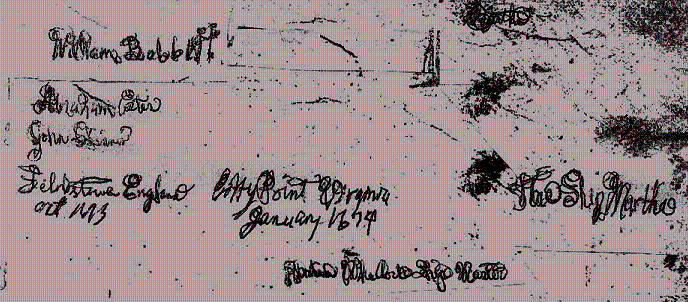
Roy was a true historian, questioning everything, driving us all to distraction sometimes requesting documentation, and digging up not only the improbable but seemingly, the impossible. His stringent military training and just under four decades of service never left him and served us all very well.  In fact, Roy poked around until he discovered the Bobbitt family whose Bible page included a record that Abraham Estes had sailed with their family immigrant on the same ship, the Martha, arriving in January 1674 at City Point, Virginia.

Bobbit Bible

As Roy and his wife’s health both deteriorated, he did have to give up his DNA project co-administrator duties and he was preparing for the inevitable day when he would no longer be here. He signed an affadivit, for example, allowing me access to his DNA forever.  That was before Family Tree DNA had their Beneficiary page for you to designate a beneficiary for your DNA.  Roy was absolutely committed to genealogy and genetic genealogy, both today and in the future when he just knew all of the answers would be unraveled.

After Roy’s wife passed away, he began living in an assisted living facility and gave up his research “cave” for a laptop. He was still involved, gladly shared his work, and encouraged anyone and everyone who would listen for half a minute…that was…until the beast called Alzheimer’s began to steal his life away.

These last few months have been exceedingly difficult, watching the once vibrant and outstanding researcher descend into the darkness of confusion. We still loved Roy of course, and we still wrote to him and shared finds with him, but his answers often no longer made sense.  But Roy knew we cared about him and sometimes a cognizant e-mail would slip in among the rest.  Those were doubly sad, because he clearly knew what he was losing as he slipped beneath the waves.  Those were heart-wrenching moments of terrifying clarity.

As I’ve looked back through Roy’s e-mails and letters these past few days, one of his e-mails really stands out in terms of clarity and prophecy.

I think when the dust clears with the DNA project we will find some fantastic information. I don’t expect this in my life time but you have really started a great thing in the project!

I will say this – My predictions are future research will show that:

  1. Nicholas Ewstas was not connected to The House of Este.
  2. Nicholas will be found connected to the Eustice line.
  3. The basic line will be traced back to the Flanders area.

Other predictions that will be proven :

  1. The spouse of Abraham Sr, was not Barbara Brock.
  2. Abraham was not an indentured servant as such.
  3. There are errors in the list of children of Abraham and Barbara that we now accept.

I only wish I knew 30 years ago what we know now! Then I would have had the time and resources to check into these things!

To date, we have evidence that indeed, Nicholas Ewstas was most likely not connected to the House of Este. The connection to the Eustice line depends on which line and who is spelling the surname.  And yes, the Estes line, first found in Kent, did come from mainland Europe – but apparently not Italy.  Big Y testing on a group of Estes men with known and proven descent helped to sort this out.  Roy didn’t get to participate in that testing, because his line is not proven genealogically beyond Elisha.  DNA can do a lot, but it can’t make up for generational genealogically connected records.

Indeed, Roy is right and there is no evidence to suggest that Abraham’s wife, Barbara, was a Brock.  You can’t prove a negative using DNA, at least not in this case.  I am hopeful that in years to come as we develop tools like ancestor libraries where haplotypes are associated with certain ancestors and lines that we can one day unravel Barbara’s surname.  It may not be in my lifetime either – but it will happen one day.

However, until then, we just don’t know, the county records we need have burned and there is just no way to discover her surname.

Unless, unless….Roy can figure out a way to tell us her name. I know, for a fact, that the first thing Roy did after greeting Berniece and his dog was to find Abraham and Barbara and ask about her surname.

Roy wasn’t too old, too disabled, too uneducated in genetic genealogy or too anything else.  He was just the opposite, extremely capable.  Roy jumped right in, in his 80s and made an unparalleled contribution on several fronts, including genetic genealogy.  And now that he is actually ON the other side, WITH those ancestors… I’m hoping against hope that Roy isn’t too far away.  I know that if there is any way for Roy to get us that surname information, he will.  And I’m counting on him.

Just so you know, Roy, I’m leaving a pad of paper out with a pen, right by the Christmas tree:)

Roy has served as a personal inspiration for me now, for years. I used to think of Roy and say to myself, thinking of him confined to his wheelchair and always working through some level of chronic pain, “If Roy can do THAT, I can surely do this.”  Roy leaves a huge legacy behind.

Perhaps the most important lesson is that you are never “too” anything, unless you decide you are.  However, if you don’t DO something, eventually, you will be too late. Roy wasn’t too late, he just left too soon.  I miss you partner.

Rest in peace Roy, right after you send me that surname:)

______________________________________________________________

Disclosure

I receive a small contribution when you click on some of the links to vendors in my articles. This does NOT increase the price you pay but helps me to keep the lights on and this informational blog free for everyone. Please click on the links in the articles or to the vendors below if you are purchasing products or DNA testing.

Thank you so much.

DNA Purchases and Free Transfers

Genealogy Services

Genealogy Research

Charlemagne (742/748-814), Holy Roman Emperor, 52 Ancestors #103

Charlemagne statue

“Charlemagne Agostino Cornacchini Vatican 2” by Photo: Myrabella / Wikimedia Commons. Licensed under CC BY-SA 3.0 via Commons

Above, a 1725 statue representing Charlemagne housed in St. Peter’s Basilica in Rome.

Wow, do I ever have a lot of cousins.  According to Graham Coop, everyone in Europe today is descended from Charlemagne.  Which either means I’m special and so is everyone else, or we’re all just normal.  National Geographic wrote an article about the results of the Coop study in more easily readable verbiage, here.  The Coop team also wrote a nontechnical FAQ, here.

In 2002, Steven Olson wrote this verbiage in the Atlantic magazine about the work of statistician Joseph Chang:

The most recent common ancestor of every European today (except for recent immigrants to the Continent) was someone who lived in Europe in the surprisingly recent past—only about 600 years ago. In other words, all Europeans alive today have among their ancestors the same man or woman who lived around 1400. Before that date, according to Chang’s model, the number of ancestors common to all Europeans today increased, until, about a thousand years ago, a peculiar situation prevailed: 20 percent of the adult Europeans alive in 1000 would turn out to be the ancestors of no one living today (that is, they had no children or all their descendants eventually died childless); each of the remaining 80 percent would turn out to be a direct ancestor of every European living today.

Now, granted, Charlemagne was indeed prolific, siring 18 known children.  I guess I’m just lucky in that I descend from two known children, one who was the King of Italy and one who was the King of France.  I must tell you, all this king stuff sounds very surreal to me.

Charlemagne chart crop

Now, the bad news.  In spite of all of these children, it appears that none of Charlemagne’s male lines survived more than a dozen or so generations.  In generation 8, only two descendants produced a male child, so that severely limited the possibilities for his Y DNA to reproduce – and it didn’t.  It apparently died out in 1122 with the death of the last male in an illegitimate line through Charlemagne’s son, Pepin of Italy.  This means that today, we don’t know what Charlemagne’s Y DNA looked like.  That’s very disappointing.

By the same token, Charlemagne could not pass on his own mtDNA.  To find that information, we’d have to find a female sibling or someone from his mother’s line who descends from a matrilineal female through all females to the current generation.  We don’t have that either.

And as for autosomal DNA…well, we have two problems.  The first is that Charlemagne is so far back in my or anyone else’s lineage – between 40 and 49 generations roughly – that we would carry very little if any of his DNA today…and there is no way to assure that we don’t have other common lines too.  In fact, at that distant point, it far more likely that we do share other common lines that we don’t, especially given what Graham Coop’s paper indicates.

So, Charlemagne’s autosomal DNA hasn’t been identified either.  Short of digging him up, I’m doubting we’ll know much more.  Actually, poor Charlemagne has been dug up, several times in fact, and parts of him given away as religious relics.  In 1988 scientists tried to reassemble him, and their report was delivered 26 years later, without DNA unfortunately, but confirming as best they can that the remains they have, shown in the photo below, are indeed Charlemagne.  I must say, it’s a very odd feeling to look at the bones of my ancestor, reassembled during the study.  In fact, I don’t think I’ve ever seen the bones or even one bone of any of my ancestors before now.  I’m not exactly sure what I think of this.

Charlemagne bones

I’m striking out here genetically, although I’m hopeful for the future since his bones are already exhumed.  To begin with, DNA could tell us if all of those bones are really from the same person.  If they are, or most of them are from the same person, it’s more likely to be Charlemagne.  We could potentially tell when and where this skeletal person lived from isotope testing as well, which could help us confirm or eliminate the possibility that these skeletal remains are Charlemagne.  Y and mitochondrial DNA would tell us a lot about his ancestors, and therefore, ours too.  I hope this avenue is being pursued.

Let’s see what we can discover about Charlemagne outside of genetic genealogy.

Charlemagne’s Birth and Ascent to Power

Charlemagne was born on April 2, in either 742, 747 or 748 and died on January 28, 814.  No, those aren’t typos, they are genuinely three digit years.  It’s hard for me to come to grips with the fact that I have ancestors that I can identify that were born 1270 years ago.

Charlemagne’s father was Pepin the Short and his mother, Bertrada of Laon.  He was of the Carolingian dynasty and was, of course, Catholic. In fact, Charlemagne was DEVOUTLY Catholic, which plays a big part in the decisions he made in his lifetime.  Either that, or he used his religious fervor as an excuse for his invasions of other non-Christian domains.  It’s much easier to track the history of what he did rather than to discern his motivations.

The Carolingian dynasty was a Frankish noble family with origins in the Arnulfing and Pippinid clans of the 7th century AD.

Charlemagne Carolingian chart

This Carolingian family tree, above, dates from the Chronicon Universale of Ekkehard of Aura from the 12th century, but reflects earlier generations.  The Carolingian empire came to a close not long after after Charlemagne’s rule, about 888.

The name “Carolingian” was in Medieval Latin, karolingi, an altered form of an unattested Old High German karling or kerling, meaning “descendant of Charles.”

Charlemagne’s birth year remains uncertain.  The most likely year of Charlemagne’s birth is reconstructed from several sources. The date of 742, calculated from Einhard’s date of death of January 814 at age 72, predates the marriage of his parents in 744.  Einhard was a Frankish scholar and servant of Charlemagne (and his son) who also served as Charlemagne’s biographer – thankfully.

The year given in the Annales Petaviani, a year by year history of the Carolingina empire, 747, would be more likely, except that it contradicts Einhard and a few other sources in making Charlemagne seventy years old at his death. The month and day of April 2 is established by a calendar from Lorsch Abbey.

In 747, that day fell on Easter, a coincidence that likely would have been remarked upon by chroniclers but was not. If Easter was being used as the beginning of the calendar year, then April 2, 747 could have been, by modern reckoning, April 2, 748 (not on Easter). The date favored by the preponderance of evidence is April 2, 742, based on Charlemagne’s being a septuagenarian at the time of his death. This date would appear to suggest that Charlemagne was born illegitimately, which is not mentioned by Einhard.

Einhard said the following:

It would be folly, I think, to write a word concerning Charles’ birth and infancy, or even his boyhood, for nothing has ever been written on the subject, and there is no one alive now who can give information on it. Accordingly, I determined to pass that by as unknown, and to proceed at once to treat of his character, his deeds, and such other facts of his life as are worth telling and setting forth, and shall first give an account of his deeds at home and abroad, then of his character and pursuits, and lastly of his administration and death, omitting nothing worth knowing or necessary to know.

We also don’t know where Charlemagne was born, but Aachen in today’s Germany has been suggested.

Charlemagne became king in 768 following the death of his father. He was initially co-ruler with his brother Carloman I. Carloman’s sudden death in 771 under unexplained circumstances, left Charlemagne as the undisputed ruler of the Frankish Kingdom. Charlemagne continued his father’s policy towards the papacy and became its protector, removing the Lombards from power in northern Italy, and leading an incursion into Muslim Spain. He also campaigned against the Saxons to his east, Christianizing them upon penalty of death, leading to events such as the Massacre of Verden in which 4500 captive Saxons were slaughtered.  Charlemagne was not always a kind man – but history remembers him as an exceedingly effective ruler.

Charlemagne and Pipin the Hunchback

Above, Charlemagne on the left and his son, Pepin the Hunchback, who revolted against his father.  Pepin the Hunchback was subsequently censured and exiled to a monastery instead of put to death after his father commuted his death sentence.

We don’t know how much this drawing actually looks like Charlemagne since it is a 10th century copy of a lost original from about 830.

In this next drawing, Charlemagne instructs his son, Louis the Pious.

Charlemagne and Louis the Pious

Charlemagne was also known as both Charles the Great (Carolus Magnus) or Charles the First.  He became the King of the Franks beginning in 768 with the death of his father and King of Italy beginning in 774.  He was crowned Holy Roman Emperor (Imperator Augustus) in the now demolished Old St. Peter’s Basilica in Rome (shown sketched below between 1483-1506) on Christmas Day in the year 800 and he ruled in that position until his death.

Charlemagne Old St. Peters

This fresco below shows a cutaway view of the Old St. Peter’s from the 4th century, so it looked much like it would have to Charlemagne.  This basilica is built over the location believed to be the burial site of St. Peter.

Charlemagne St Peters cutaway

Today, a new St. Peter’s Basilica stands on this site, the dome visible from the Ponte Umberto I on the Tiber River, below.

"Vatican City at Large" by Sébastien Bertrand from Paris, France - Flickr. Licensed under CC BY 2.0 via Commons

“Vatican City at Large” by Sébastien Bertrand from Paris, France – Flickr. Licensed under CC BY 2.0 via Commons

Although he already ruled both Italy and France, becoming the Holy Roman Emperor bestowed upon him divine grace and a Godly legitimacy sanctioned by the Pope.

This painting from 1516-1517 by Raphael by depicts Charlemagne’s coronation.

"Raphael Charlemagne" by Raphael - Licensed under Public Domain via Commons

“Raphael Charlemagne” by Raphael – Licensed under Public Domain via Commons

Charlemagne’s Rule
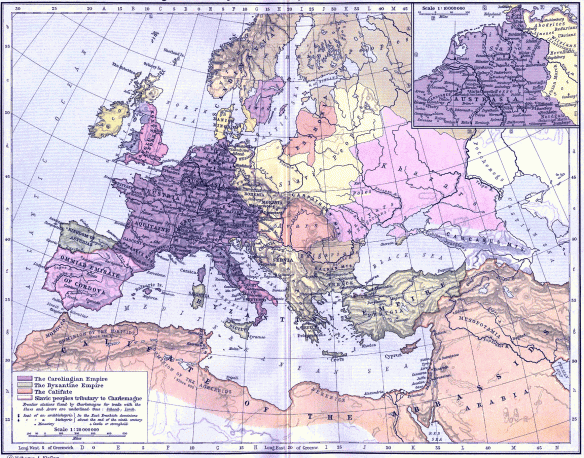
Charlemagne map 800

Called the “Father of Europe” (pater Europae), Charlemagne united most of Western Europe for the first time since the Roman Empire and laid the foundations for both modern France and Germany. His rule spurred the Carolingian Renaissance, a period of energetic cultural and intellectual activity within the Church. Both the French and German monarchies considered their kingdoms to be descendants of Charlemagne’s empire.

Charlemagne didn’t seem to stay home much.  In fact, this military and political history reads like a soap opera, with intrigue, betrayals, a brother who died in unexplained circumstances, but apparently of natural causes, invasions, rebellions and saving an injured Pope.  His life was assuredly interesting and it’s nothing short of amazing that he managed to live past 70 and did not die on the battlefield.

Charlemagne was engaged in almost constant warfare throughout his reign, often at the head of his elite scara bodyguard squadrons, with his legendary sword Joyeuse in hand.

Charlemagne sword

“Épée de charlemagne” by Chatsam – Own work. Licensed under CC BY-SA 3.0 via Commons

Joyeuse is stunningly beautiful and is on display in the Louvre today.

"Epée Joyeuse" by Siren-Com - Own work. Licensed under CC BY-SA 3.0 via Commons

“Epée Joyeuse” by Siren-Com – Own work. Licensed under CC BY-SA 3.0 via Commons

It just kills me that I have been in this building with this sword but didn’t know at that time that Charlemagne was my ancestor.

The 11th century “Song of Roland” describes the sword:

[Charlemagne] was wearing his fine white coat of mail and his helmet with gold-studded stones; by his side hung Joyeuse, and never was there a sword to match it; its colour changed thirty times a day.

Some seven hundred years later, Bulfinch’s Mythology described Charlemagne using Joyeuse to behead the Saracen commander Corsuble as well as to knight his comrade Ogier the Dane.

The town of Joyeuse, in Ardèche, is supposedly named after the sword.  Joyeuse was allegedly lost in a battle and retrieved by one of the knights of Charlemagne; to thank him, Charlemagne granted him an appanage (estate) named Joyeuse.

Today, Joyeuse is used as the French coronation sword.

Charlemagne’s Additions to His Empire

Charlemagne spent his entire life increasing the size and power of his empire, some of which was done under the banner of expanding Christianity to the Muslim world and to the pagan Saxons as well.

The map below shows the land that Charlemagne added to the Frankish Kingdom.

"Frankish Empire 481 to 814-en" by Sémhur - Own work, from Image:Frankish empire.jpg, itself from File:Growth of Frankish Power, 481-814.jpg, from the Historical Atlas by William R. Shepherd (Shepherd, William. Historical Atlas. New York: Henry Holt and Company, 1911.). Licensed under CC BY-SA 3.0 via Commons

“Frankish Empire 481 to 814-en” by Sémhur – Own work, from Image:Frankish empire.jpg, itself from File:Growth of Frankish Power, 481-814.jpg, from the Historical Atlas by William R. Shepherd (Shepherd, William. Historical Atlas. New York: Henry Holt and Company, 1911.). Licensed under CC BY-SA 3.0 via Commons

Charlemagne’s reign of Aquitaine began in 768 with the death of his father, although it was initially a joint reign with his brother, Carloman, with whom he had, at best, lukewarm relations fostered by his mother.

It didn’t take long after Charlemagne’s father death for trouble to brew.

In 769, a small uprising in the Basque region was subdued, but that region was unstable for years, a constant thorn in Charlemagne’s side.  Finally, in 781, Charlemagne proclaimed his son, Louis the Pious, then a young child, the first Frankish king of the area, assuring loyalty and displacing those whose loyalty he had reason to doubt.

In 770 Charlemagne married the daughter, Desiderada, of a Lombard King as a political move to form an alliance with her father and in doing so, surround  brother Carloman with Charlemagne’s allies.  However, by the end of 771, Carloman was dead and Charlemagne no longer needed the marriage with Desiderada, so he repudiated her and set her aside to marry 13 year old Hildegard.

In rejecting Desiderada, Charlemagne incurred the wrath of her father, the Italian King Desiderius.  Carloman’s widow and children took refuge in King Desiderius’ court at Pavia for protection.

This drawing is of the Carolingian cavalry from that timeframe.

"Karolingische-reiterei-st-gallen-stiftsbibliothek 1-330x400". Licensed under Public Domain via Commons

“Karolingische-reiterei-st-gallen-stiftsbibliothek 1-330×400”. Licensed under Public Domain via Commons

Sometimes Charlemagne’s military campaigns overlapped each other.  In the Saxon Wars, spanning thirty years and eighteen battles, Charlemagne eventually conquered and subdued Saxonia.  The conquering part wasn’t terribly difficult, most of the time, but the subdueing part proved nearly impossible.  Charlemagne proceeded to convert the conquered to Christianity, beginning in 773 with his campaign against the Engrians where he cut down the Saxon pagan pillar of Irminsul.  However, trouble in Italy caused that campaign to be cut short.

In 773, Charlemagne and his uncle crossed the Alps, chasing the Lombards back to Pavia which he then besieged.

Charlemagne met the Lombards at the pass in Susa Valley, shown below.

Charlemagne Susa Valley

“Susatal” by Fotogian from it. Licensed under CC BY-SA 3.0 via Commons

By 774, the siege of Pavia was over and Charlemagne had himself declared King of the Franks and Lombards and crowned with the traditional “Iron Crown of the Lombards.”

"Iron Crown" by James Steakley - photographed in the Theodelinda Chapel of the cathedral of Monza. Licensed under CC BY-SA 3.0 via Commons

“Iron Crown” by James Steakley – photographed in the Theodelinda Chapel of the cathedral of Monza. Licensed under CC BY-SA 3.0 via Commons

This crown is called “The Iron Crown” because of the narrow band of iron within the crown said to have been beaten out of the nail used at the Crucifixion of Jesus Christ.

In 776, Charlemagne was back in Saxony, having subdued the Saxons and causing their leader, Widukind, to seek refuge in Denmark.  Many Saxons were baptized as Christians.

Although the Lombards surrendered, all was not quiet on that front.  In 776, Charlemagne rushed back from Saxony to squelch a rebellion in Lombardy.

In 778, Charlemagne turned back southwards and tried to overpower the Muslim Saracen rulers of Barcelona and nearby areas.  He marched to face them, meeting them at Saragossa.  He received homage from them, but their cities did not fall.

Charlemagne was facing the toughest battle of his career where the Muslims had the upper hand and forced him to retreat. He decided to go home, since he could not trust the Basques, whom he had subdued by conquering Pamplona. He turned to leave Iberia, but as he was passing through the Pass of Roncesvalles (shown below) one of the most famous events of his long reign occurred.

Charlemagne Roncesvalles

The Basques fell on his rearguard and baggage train, utterly destroying it. The Battle of Roncevaux Pass, though less a battle than a mere skirmish, left many famous dead, including the seneschal Eggihard, the count of the palace Anselm, and the warden of the Breton March, Roland, inspiring the subsequent creation of the Song of Roland (La Chanson de Roland).

Charlemagne battle tapestry

This tapestry portraying the Battle of Roncevaux Pass was woven between 1475 and 1500.

In 779, while Charlemagne was focused elsewhere, Saxony again revolted and he again invaded and reconquered.  I’m sure by now he wondered how many times he had to do this.  He divided the land into missionary districts and personally assisted with the baptisms of masses at Lippe.

From 780-782, Saxony was quiet.  Charlemagne was back in Italy during this time.

In 782, Charlemagne returned to Saxony and was not pleased that the majority of the population was still pagan.  He implemented draconian laws prescribing death to Saxon pagans who refused to convert to Christianity.  This spurred the return of their leader, Widukind, and was followed by three years of bloody battles precipitated by the Massacre of Verden wherein Charlemagne executed 4500 trapped Saxon soldiers.  Three long years later, Widukind, defeated, accepted baptism.  At this time, the Frisians were also brought to heel.

In 787, Charlemagne focused on bringing southern Italy into the fold.  He besieged Salerno where Arechis who reigned independently submitted to vassalage.  However, upon his death in 792, Arechis’ son proclaimed independence and Charlemagne never personally returned, and was never able to bring this region fully under his control.

In 788, Charlemagne was back in Gascony trying to once again reign in a rebellion.  He had appointed his son “King” in that region and replaced Gascon individuals in power with his Frankish officers.

In 788, the pagan Asian Avars (Einhard called them Huns) had settled in Hungary and invaded Fruili and Bavaria.  Charlemagne was busy elsewhere until 790, but at the time he marched down the Danube and ravaged Avar territory.  A Lombard army did the same to Pannonia.

In 789, Charlemagne seeing an opportunity, marched into the Slavic Obotrite territory north of the Elbe, encountered little resistance, and subdued the Obotrites, sending in missionaries to convert them.  They became loyal allies, fighting alongside Charlemagne in 795 when the Saxons broke the peace.

In 792, the Saxons rebelled again in Westphalia, breaking several years of peace and distracted Charlemagne from the Avars, occupying him instead with those relentless Saxons.

However, Charlemagne’s troops continued to assault the Avars’ ring-shaped strongholds.  The great Ring of the Avars, their capital fortress, was taken twice. The booty was sent to Charlemagne at his capital, Aachen, and redistributed to all his followers and even to foreign rulers, including King Offa of Mercia. Soon the Avars had lost the will to fight and traveled to Aachen to subject themselves to Charlemagne as vassals and Christians. Charlemagne accepted their surrender and sent one native chief, baptized as Abraham, back to Avaria with the ancient title of khagan, meaning someone who rules an empire. Abraham kept his people in line, but in 800, the Bulgarians under Khan Krum also attacked the remains of Avar state.

Charlemagne Ring of Avars

From time to time, rebellions would flare up in the conquered Saxon territory.  In 793 a rebellion erupted in Eastplania and Bordalbingia, but that uprising was over by 794.  In 796, an Engrian rebellion followed.

In 794, Charlemagne set his eye upon Bavaria and was shortly thereafter dividing the land into Frankish counties, as he had done with Saxony.

From 791 to 806, Charlemagne was focused on taking the County of Toulouse for a power base and asserting his authority over the Pyrenees, making those counties vassals.

In 797, Barcelona, the greatest city of the region, previously held by the Moors, fell to Charlemagne, but was retaken in 799.  However, Louis of Aquitaine marched the entire army of his kingdom over the Pyrenees and besieged it for two years, wintering there from 800 to 801, when it capitulated.  Today, the Moorish influence can be seen in Barcelona in the architecture of the buildings.

Barcelona building

The Medieval influence can be felt in any portion of the old city and in the plazas.

barcelona plaza

I absolutely loved Barcelona when I visited in 2011, having no idea that I had ancestral history here.

Barcelona 2011

Charlemagne viewed his battle with the Muslim Moors as the battle of and for Christianity.  He wanted to convert the Muslims to Christianity.

In 799, Charlemagne conquered the Balaeric Islands, often attacked by Saracen (Moorish and Muladi) pirates.

In either 797 or 801, Charlemagne send a delegation to Baghdad where the caliph of Baghdad presented Charlemagne with an Asian elephant and a clock.  The elephant, Abul-Abbas, was transported to Charlemagne’s headquarters in Aachen where his life was chronicled.  He died in 810, possibly a war elephant, although others report that the elephant was more than 40 years old, had rheumatism, developed pneumonia while on campaign with Charlemagne, and died suddenly.  I don’t think any of my other ancestors had a pet elephant.

In 799, Pope Leo III had been mistreated by the Romans, who tried to put out his eyes and tear out his tongue.  Pope Leo escaped and fled to Charlemagne at Paderborn, asking Charlemagne to intervene in Rome and restore him. Charlemagne, advised by scholar Alcuin of York, agreed to travel to Rome, doing so in November 800 and holding a council on December 1.  On December 23, Leo swore an oath of innocence relative to the charges brought against him, and his accusers were exiled.  Two days later, at Mass, on Christmas Day, December 25th, when Charlemagne knelt at the altar to pray, the Pope crowned him Imperator Romanorum, “Emperor of the Romans,” in Saint Peter’s Basilica.  It is unclear whether Charlemagne knew this was going to happen or if the coronation was unexpected, a point debated by historians for hundreds of years.

Charlemagne coronation

Miniature of Charlemagne crowned emperor by Pope Leo III, from Chroniques de France ou de Saint Denis, vol. 1; France, second quarter of 14th century.

In 803, Charlemagne sent a Bavarian army into Pannonia ending the Avar confederation.

In 804, one last rebellion occurred in Saxony, but by this time, 30 years after being conquered, most of the original inhabitants were dead and the rest had never known anything but Charlemagne’s rule and warfare.  They were tired of fighting in their homeland.

Einhard tells us:

The war that had lasted so many years was at length ended by their acceding to the terms offered by the King; which were renunciation of their national religious customs and the worship of devils, acceptance of the sacraments of the Christian faith and religion, and union with the Franks to form one people.

In 808, an attack arrived from an unexpected source, the pagan Danes, “a race almost unknown to his ancestors, but destined to be only too well known to his sons,” as Charles Oman described them.  Wikukind, whose wife was Danish, and his allies had taken refuge among the Danes.  The king of the Danes, Godfred, built the vast Danevirke (shown below) across the isthmus of Schleswig. This defense was at its beginning a 30 km (19 mi) long defensive earthenwork rampart. The Danevirke protected Danish land and gave Godfred the opportunity to harass Frisia and Flanders with pirate raids.

Charlemagne danevirke

Godfred invaded Frisia, joked of visiting Aachen, but was murdered before he could do any more, either by a Frankish assassin or by one of his own men. Godfred was succeeded by his nephew Hemming, who concluded the Treaty of Heiligen with Charlemagne in late 811.

Europe at the end of Charlemagne’s rein looked a lot different than it did at the beginning.  The balance of power had shifted dramatically.

"Europe in 814, Charlemagne, Krum, Nicephorus I" by Stolichanin - Europe_plain_rivers.pngThe map is made according to:"World Atlas", part 3: Europe in Middle Ages, Larrouse, Paris, 2002, O. RenieAtlas "History of Bulgaria", Sofia, 1988, Bulgarian Academy of Sciences, V. Kamburova"World Atlas", N. Ostrovski, Rome, 1992, p.55Атлас "История на средните векове", Sofia, 1982, G. Gavrilov"History in maps", Johannes Herder, Berlin, 1999, p. 20"European Historical Globus", R. Rusev, 2006, p.117. Licensed under CC BY-SA 3.0 via Commons

“Europe in 814, Charlemagne, Krum, Nicephorus I” by Stolichanin – Europe_plain_rivers.pngThe map is made according to:”World Atlas”, part 3: Europe in Middle Ages, Larrouse, Paris, 2002, O. RenieAtlas “History of Bulgaria”, Sofia, 1988, Bulgarian Academy of Sciences, V. Kamburova”World Atlas”, N. Ostrovski, Rome, 1992, p.55Атлас “История на средните векове”, Sofia, 1982, G. Gavrilov”History in maps”, Johannes Herder, Berlin, 1999, p. 20″European Historical Globus”, R. Rusev, 2006, p.117. Licensed under CC BY-SA 3.0 via Commons

Education

Charlemagne was determined to have his children educated, including his daughters, as he himself was not. Below, we see Charlemagne’s monogram from the subscription of a royal diploma.  Signum Karolvs Karoli gloriosissimi regis.

Charlemagne signum

For an uneducated man, he made amazing changes, including the standardization of the monetary system and instituting principles of accounting practice.

Charlemagne’s children were taught all the arts, and his daughters were learned in the “ways of being a woman.” whatever that meant at the time. His sons participated in archery, horsemanship, and other outdoor activities.  This renaissance of education was referred to as the Carolingian Renaissance because it ushered in a new cultural era in which scholarship, literature and art thrived.

Charlemagne was brought into contact with the culture and learning of other countries (especially Moorish Spain, Anglo-Saxon England, and Lombard Italy) as a result of his vast conquests.  He greatly increased the provision of monastic schools and scriptoria (centres for book-copying) in Francia.

Most of the presently surviving works of classical Latin were copied and preserved by Carolingian scholars. Indeed, the earliest manuscripts available for many ancient texts are Carolingian. It is almost certain that a text which survived to the Carolingian age survives still, thanks to Charlemagne.

Charlemagne took a serious interest in scholarship, promoting the liberal arts at the court, ordering that his children and grandchildren be well-educated.  In a time when even leaders who promoted education did not take time to learn, Charlemagne studied.  Under the tutelage of Peter of Pisa, Charlemagne learned grammar; with Alcuin, he studied rhetoric, dialectic (logic), and astronomy (he was particularly interested in the movements of the stars); and Einhard assisted him in his studies of arithmetic.

Charlemagne’s great scholarly failure, as Einhard relates, was his inability to write: when in his old age he began attempts to learn – practicing the formation of letters in his bed during his free time on books and wax tablets he hid under his pillow – “his effort came too late in life and achieved little success.”  Charlemagne’s ability to read – which Einhard is silent about, and which no contemporary source supports – has also been called into question.

It appears that the man who was personally responsible for the salvation of so much literature was, himself, illiterate.  Charlemagne was however very foresighted and progressive.  What an amazing legacy.

Children and Heirs

Charlemagne had eighteen children over the course of his life with eight of his ten known wives or concubines.  Nonetheless, he only had four legitimate grandsons, the four sons of his fourth son, Louis. In addition, he had a grandson (Bernard of Italy, the only son of his third son, Pippin of Italy), who was born illegitimate, but included in the line of inheritance. So, despite eighteen children, the claimants to his inheritance were few.

Charlemagne’s personal life is somewhat colorful for a devout Catholic, although maybe the cultural aspect of the church at that time was different.  Then again, being the protector of the Pope may have gained Charlemagne special favors or caused some behaviors to be overlooked.Charlemagne children

As I look at the dates, I have to wonder if these women and children all lived in one place and knew each other.  Did the wife and concubine glare at each other when they met in the hallway, or were they more like compatriot sisters?  Did they live in different locations?  Did they consider themselves sucky to be Charlemagne’s partner, or did they wish things were different and that he was monogamous, as they had surely be raised in the Catholic church to expect of a husband.

I found the many references to Charlemagne’s concubines confusing, given his Catholicism and marriages at the same time, so I turned to the Catholic encyclopedia for clarification:

The Council of Toledo, held in 400, in its seventeenth canon legislates as follows for laymen (for ecclesiastical regulations on this head with regard to clerics see Celibacy): after pronouncing sentence of excommunication against any who in addition to a wife keep a concubine, it says: “But if a man has no wife, but a concubine instead of a wife, let him not be refused communion; only let him be content to be united with one woman, whether wife or concubine” (Can. “Is qui”, dist. xxxiv; Mansi, III, col. 1001). The refractory are to be excommunicated until such time as they shall obey and do penance.

It would appear, based on that edict, that Charlemagne’s concubines and extra-curricular activities were overlooked by the church, although many of his children were very active within the church as abbots and abbesses.  Charlemagne recognized and provided in some way for all of his children, legitimate or otherwise.

Charlemagne’s sons fought many wars on behalf of their father when they came of age.

Charles was mostly preoccupied with the Bretons, whose border he shared and who insurrected on at least two occasions and were easily put down, but he was also sent against the Saxons on multiple occasions. In 805 and 806, he was sent into the Böhmerwald (modern Bohemia) to deal with the Slavs living there (Bohemian tribes, ancestors of the modern Czechs). He subjected them to Frankish authority and devastated the valley of the Elbe, forcing a tribute on them.

Pippin had to hold the Avar and Beneventan borders but also fought the Slavs to his north. He was uniquely poised to fight the Byzantine Empire when finally that conflict arose after Charlemagne’s imperial coronation and a Venetian rebellion.

Finally, Louis was in charge of the Spanish March and also went to southern Italy to fight the duke of Benevento on at least one occasion. He took Barcelona in a great siege in 797.

Charlemagne’s attitude toward his daughters has been the subject of much discussion. He kept them at home with him and refused to allow them to contract sacramental marriages – possibly to prevent the creation of cadet branches of the family to challenge the main line, as had been the case with Tassilo of Bavaria – yet he tolerated their extramarital relationships, even rewarding their common-law husbands, and treasured the illegitimate grandchildren they produced for him.  At least one of them, Bertha, had a recognized relationship, if not a marriage, with Angilbert, a member of Charlemagne’s court circle.

Charlemagne also refused to believe stories of their wild behavior. He’s certainly not the first father to do that!

After Charlemagne’s death the surviving daughters were banished from the court by their brother, Louis, to take up residence in the convents they had been bequeathed by their father.  That’s what happens when you are a bit rowdy and your brother who is known as Louis the Pious becomes king.

Charlemagne’s Death

In 806, Charlemagne first made provision for the traditional division of the empire on his death. For Charles the Younger he designated Austrasia and Neustria, Saxony, Burgundy, and Thuringia. To Pippin he gave Italy, Bavaria, and Swabia. Louis received Aquitaine, the Spanish March, and Provence. There was no mention of the imperial title however, which has led to the suggestion that, at that particular time, Charlemagne regarded the title as an honorary achievement which held no hereditary significance.

This division might have worked, but it was never to be tested. Pippin died in 810 and Charles in 811. Charlemagne then reconsidered the matter, and in 813, called Louis the Pious, king of Aquitaine, his only surviving legitimate son, to his court. There Charlemagne crowned his son with his own hands as co-emperor, granting him a half-share of the empire with the rest to follow up on Charlemagne’s death.  Louis the Pious then returned to Aquitaine.  The only part of the Empire which Louis was not promised was Italy, which Charlemagne specifically bestowed upon Pippin’s illegitimate son Bernard.

Charlemagne then spent the autumn hunting before returning to Aachen on November 1st.  In January, he fell ill with pleurisy.  In a deep depression (mostly because many of his plans were not yet realized), he took to his bed on January 21st.  With all Charlemagne did achieve, I can’t imagine what he yet wanted that was severe enough to induce a depression of that magnitude.  Historians attribute his depression to his plans not being realized, but I have to wonder if the deaths of his three sons and two daughters in two years (810-811) didn’t contribute to his depression.  Another daughter had died in 808.  That’s a lot of death in a short time.

Einhard tells us:

He died January twenty-eighth, the seventh day from the time that he took to his bed, at nine o’clock in the morning, after partaking of the Holy Communion, in the seventy-second year of his age and the forty-seventh of his reign.

Charlemagne was buried the same day as his death, in Aachen Cathedral, although the cold weather and the nature of his illness made such a hurried burial unnecessary.  This causes me to wonder why he was buried so quickly.

Charlemagne Aachen Cathedral

Above, the Aachen Cathedral today.

Charlemagne is buried in the Palatine Chapel.  He commissioned its construction in 792 and it was consecrated in 805 by Pope Leo III in honor of the Virgin Mary.

"Aachener Dom Pfalzkapelle vom Münsterplatz 2014" by CaS2000 - Own work. Licensed under CC BY-SA 3.0 via Commons

“Aachener Dom Pfalzkapelle vom Münsterplatz 2014” by CaS2000 – Own work. Licensed under CC BY-SA 3.0 via Commons

Charlemagne’s floor plan, below, includes a sixteen-sided ambulatory with a gallery overhead encircling the central octagonal dome.

Charlemagne Aachen floor plan

The plan and decoration owe much to the sixth-century Basilica of San Vitale in Ravenna. Indeed, Charlemagne visited Ravenna three times, the first in 787. In that year he wrote to Pope Hadrian I and requested “mosaic, marbles, and other materials from floors and walls” in Rome and Ravenna, for his palace.

"Aix dom int vue cote" by Velvet - Own work. Licensed under CC BY-SA 3.0 via Commons

“Aix dom int vue cote” by Velvet – Own work. Licensed under CC BY-SA 3.0 via Commons

Interior view of the chapel.  Charlemagne was buried someplace here, although the exact location evades detection.  Theories abound and I have to believe that Charlemagne enjoys every minute of this mystery that his bones visit upon his descendants – which remember, includes all or most of Europe today.

"Königsthron Aachener Dom" by ​German Wikipedia user Holger Weinandt. Licensed under CC BY-SA 3.0 via Commons

“Königsthron Aachener Dom” by ​German Wikipedia user Holger Weinandt. Licensed under CC BY-SA 3.0 via Commons

Charlemagne’s throne, above, resides in the chapel as well.

Charlemagne shroud Aachen

This piece of fabric is part of Charlemagne’s death shroud, manufactured in Constantinople (present day Istanbul), and represents a quadriga, a cart or chariot that was drawn by 4 horses abreast.  Typically Gods were depicted in this manner.

A later story, told by Otho of Lomello, Count of the Palace at Aachen in the time of Otto III, about the year 1000, would claim that he and Emperor Otto had discovered Charlemagne’s tomb.  They claimed that Charlemagne was seated upon a throne, wearing a crown and holding a sceptre, his flesh almost entirely incorrupt.

In 1165, Frederick I re-opened the tomb again and placed the emperor in a sarcophagus beneath the floor of the cathedral.

Charlemagne sarcophagus

Sarcophagus, above and below.

"Karl Martell" by J. Patrick Fischer - Own work. Licensed under CC BY 2.5 via Commons

“Karl Martell” by J. Patrick Fischer – Own work. Licensed under CC BY 2.5 via Commons

In 1215 Frederick II re-interred him in a casket made of gold and silver.

Charlemagne casket

Charlemagne’s death greatly affected many of his subjects, particularly those of the literary clique who had surrounded him at Aachen.  An anonymous monk of Bobbio lamented:

From the lands where the sun rises to western shores, people are crying and wailing … the Franks, the Romans, all Christians, are stung with mourning and great worry … the young and old, glorious nobles, all lament the loss of their Caesar … the world laments the death of Charles … O Christ, you who govern the heavenly host, grant a peaceful place to Charles in your kingdom. Alas for miserable me.

Charlemagne was succeeded by his surviving son, Louis, who had been crowned the previous year.  Charlemagne’s empire lasted only another generation in its entirety; its division, according to custom, between Louis’s own sons after their father’s death laid the foundation for the modern states of Germany and France.

Below, the mask reliquary of Charlemagne.  If this is a death mask of the man, he was in wonderful shape for 72 years of age and the battles he had been through.

"Aachen Domschatz Bueste1" by Beckstet - Own work. Licensed under CC BY-SA 3.0 via Commons

“Aachen Domschatz Bueste1” by Beckstet – Own work. Licensed under CC BY-SA 3.0 via Commons

Reliquary’s were and remain very popular in the Catholic Church.  Below, Charlemagne’s arm reliquary.

"Charlemagne arm at Cathedral Treasury Aachen Germany" by Prof-Declercq - Own work. Licensed under CC BY-SA 4.0 via Commons

“Charlemagne arm at Cathedral Treasury Aachen Germany” by Prof-Declercq – Own work. Licensed under CC BY-SA 4.0 via Commons

Charlemagne’s throne remains today in the Achen Cathedral as well.

Charlemagne throne

“AachenerDomKarlsthron 1661a” by Bojin. Licensed under CC BY-SA 3.0 via Commons

Below, the interior of Charlemagne’s chapel in the Aachen Cathedral.

"Aachen-cathedral-inside". Licensed under CC BY-SA 3.0 via Commons

“Aachen-cathedral-inside”. Licensed under CC BY-SA 3.0 via Commons

What Was Charlemagne Like?

We’re exceedingly lucky that Einhard was Charlemagne’s biographer.  Otherwise we would know very little about him.

Charlemagne spoke French and German in addition to Latin and understood some Greek but spoke it very poorly.  He mandated that sermons be preached in either “Romance” (French) or “Theotiscan” (German) and not in Latin so that the common person could understand the lessons being imparted.

How Did He Look?

Charlemagne’s personal appearance is known from a description by Einhard in his biography of Charlemagne titled “Vita Karoli Magni.” Einhard describes in his twenty-second chapter:

He was heavily built, sturdy, and of considerable stature, although not exceptionally so, since his height was seven times the length of his own foot. He had a round head, large and lively eyes, a slightly larger nose than usual, white but still attractive hair, a bright and cheerful expression, a short and fat neck, and he enjoyed good health, except for the fevers that affected him in the last few years of his life. Toward the end, he dragged one leg. Even then, he stubbornly did what he wanted and refused to listen to doctors, indeed he detested them, because they wanted to persuade him to stop eating roast meat, as was his wont, and to be content with boiled meat.

The physical portrait provided by Einhard is confirmed by contemporary depictions of the emperor, such as coins and his 8-inch (20 cm) bronze statue kept in the Louvre.

"Charlemagne denier Mayence 812 814" by PHGCOM - Own work by uploader, photographed at Cabinet des Médailles, Paris.. Licensed under CC BY-SA 3.0 via Commons

“Charlemagne denier Mayence 812 814” by PHGCOM – Own work by uploader, photographed at Cabinet des Médailles, Paris.. Licensed under CC BY-SA 3.0 via Commons

It’s uncertain whether this bronze statue from the Louvre depicts Charlemagne or his grandson, Charles the Bald, who reportedly favored his grandfather, Charlemagne.

Charlemagne at Louvre

Photographs credited © RMN, Musée du Louvre / [etc.] are the property of the RMN. Non-commercial re-use is authorized, provided the source and author are acknowledged. Photo by Jean-Giles Berizzi

In 1861, Charlemagne’s tomb was opened by scientists who reconstructed his skeleton and estimated it to be measured 1.95 metres (6 ft 5 in).  A later estimate of his height from a X-ray and CT scan of his tibia performed in 2010 is 1.84 metres (6 ft 0 in). This puts him in the 99th percentile of tall people of his period, given that average male height of his time was 1.69 metres (5 ft 7 in). The width of the bone suggested he was gracile but not robust in body build.

Charlemagne wore the traditional costume of the Frankish people, described by Einhard thus:

He used to wear the national, that is to say, the Frank, dress—next his skin a linen shirt and linen breeches, and above these a tunic fringed with silk; while hose fastened by bands covered his lower limbs, and shoes his feet, and he protected his shoulders and chest in winter by a close-fitting coat of otter or marten skins.

He wore a blue cloak and always carried a sword with him. The typical sword was of a golden or silver hilt. He wore fancy jeweled swords to banquets or ambassadorial receptions.  To Charlemagne, a sword was his ever-present and indispensable weapon, just in case, and sometimes a fine piece of jewelry too.

Charlemagne robes

Nevertheless:

He despised foreign costumes, however handsome, and never allowed himself to be robed in them, except twice in Rome, when he donned the Roman tunic, chlamys, and shoes; the first time at the request of Pope Hadrian, the second to gratify Leo, Hadrian’s successor.

He could rise to the occasion when necessary. On great feast days, he wore embroidery and jewels on his clothing and shoes. He had a golden buckle for his cloak on such occasions and would appear with his great diadem, but he despised such apparel, according to Einhard, and usually dressed like the common people.

The Beautification of the Blessed Charles Augustus

Charlemagne was accorded sainthood inside the Holy Roman Empire after the twelfth century. His canonization by Antipope Paschal III, to gain the favor of Frederick Barbarossa in 1165, was never recognized by the Holy See, which annulled all of Paschal’s ordinances at the Third Lateran Council in 1179. Charlemagne’s name does not appear among the 28 saints named Charles who are listed in the Roman Martyrology. However, his beatification has been acknowledged as cultus confirmed and is celebrated on 28 January.  Even in death, Charlemagne was contentious and deeply involved in the politics of religion.

Ummmm…so how does one act appropriately if one is twice descended from a King who was also a Saint???  Do I need to learn how to curtsey or do that Queen wave maybe?  No one prepared me for this when I was learning proper manners.  I had no idea how proper “proper” was!

Afterlife

Charlemagne, being a model knight as one of the Nine Worthies, enjoyed an important afterlife in European culture.

The Nine Worthies are nine historical, scriptural and legendary personages who personify the ideals of chivalry as were established in the Middle Ages.

The Nine Worthies include three good pagans: Hector, Alexander the Great, and Julius Caesar, three good Jews: Joshua, David, and Judas Maccabeus, and three good Christians: King Arthur, Charlemagne, and Godfrey of Bouillon.

Gateway Ancestors

If you’d like to see if you too are descended from Charlemagne through known gateway ancestors, please click here for a list.  But beware, you just might have to learn how to behave “properly.”  If you figure out exactly what that means, let me know.

______________________________________________________________

Disclosure

I receive a small contribution when you click on some of the links to vendors in my articles. This does NOT increase the price you pay but helps me to keep the lights on and this informational blog free for everyone. Please click on the links in the articles or to the vendors below if you are purchasing products or DNA testing.

Thank you so much.

DNA Purchases and Free Transfers

Genealogy Services

Genealogy Research

Visiting Mom at Family Tree DNA

Mom swabbed for me, several times in fact.  She wasn’t terribly interested in DOING genealogy, but she was quite interested in the outcome of the process, and she loved to go along with me on our “larks,” as she would call them, where we would go and find our family land, or house…or something interesting…like the original bar in the Kirsch House, below.

Kirsch house 1990s

On the Kirsch House adventure, above, Mom and my daughter and I went back to Aurora, Indiana to find the location of “The Kirsch House,” the hotel and tavern owned by Mom’s great-grandfather and great-grandmother, Jacob Kirsch and Barbara Drechsel, below.

Barbara Drechsel and Jacob Kirsch

Mom didn’t know Jacob, who died the year before she was born in 1922, but Barbara didn’t pass away until 1930, so Mom knew Barbara.

Mom loved those adventures.  She just wasn’t interested in doing genealogy by herself.  I didn’t understand then, but I think genealogy made her sad.  Probably because the easiest places to visit were where she had lived, had grown up, and had personal memories of those who had passed on.  I remember visiting the graves of her mother, her grandmother and the day we found the tombstone of her great-grandmother, Barbara Drechsel Kirsch, who had died when Mom was 8.  Mom was Barbara’s namesake.

Kirsch Riverview

The Kirsch family immigrated from Germany to Aurora, so going further back in time from Aurora meant jumping the pond.  When we did get back to Germany in the records…we couldn’t visit that location in person.

It’s not that I didn’t want to take a trip to Mutterstadt, Germany to visit the Kirsch homelands, it’s that I couldn’t pry Mom away from her work long enough to take a trip like that.  Mom worked as an Avon lady, her third career, until she was 83 years old.  And she didn’t retire then because she wanted to, but because her health was failing due to dementia and other factors.

And…truthfully…she only retired then because we stole her car.  Well, we didn’t EXACTLY steal it…it’s just that after she had another of those accidents that she didn’t know how occurred…it so happened that it took months for her car to be repaired.  She forgot that she even owned a car until the insurance bill came…and was she ever hot then when she remembered about her car.  I blamed my brother who blamed the car repair place who claimed the part would be there any day now!

Do you know how difficult it is to hide a bright red sports car?  Yes, she bought a red sports car with mag wheels, dual exhaust, front and rear spoilers and a loud engine that made rumbling sounds as her last hurrah.  She had always wanted one.

Lumina

It’s pretty humorous now, but at that time my brother and I were 50 and 60 year old kids who had gotten caught with our hands in the proverbial cookie jar!  She was not a happy camper when she remembered that she had a red sports car, and she let us know about it in no uncertain terms!

I asked Mom to swab, again, in the spring of 2003.  She simply asked what this one was for and swabbed in a resigned sort of way.  I know she had to be thinking to herself, “the things we do for our children.”  Had she lived long enough, she would have been both “spittin’ and swabbin’.”  Sounds like a dance doesn’t it!

It was at that point in time that I was suspecting that perhaps one of her ancestral lines held Native ancestry – but it wouldn’t be until after her death that I was able to prove such…not by her DNA at that time, but by breaking through a brick wall and proving those lines via plain old genealogy and the DNA of direct paternal and matrilineal DNA descendants of those Acadian lines.  Oh, how I wish she could have been here to hear about that!  We would have been on our way to Nova Scotia tout suite, guaranteed.

In 2003, when Mom first tested, autosomal DNA testing had yet to be introduced, so Mom’s DNA was archived at Family Tree DNA for 25 years.  Now Family Tree DNA wasn’t started until in 2000, so they aren’t going to have to figure out what to do with archived DNA until about 2025.  Mom’s DNA has only been there for 12 years.

Mom passed away in the spring of 2006.  She was 84 years old and her health had failed.  One is never ready for the death of a parent, but one does know sometimes that it needs to happen.  Death was a release.

I took at this photo of Mom in the window of the church in Aurora, Indiana where her grandmother was baptized, as was her great-grandmother and where her great-great-grandmother attended church after arriving from Germany, probably extremely thankful that weeks-long miserable boat trip was over and everyone survived.  This reflective image is how I think of Mom.

Mom church window

Not really gone, but kind of ethereal and slightly out of reach.  But not all of Mom is physically gone.

When autosomal DNA testing became available, I ordered an upgrade for Mom in August of 2011.  Bennett Greenspan called me and told me that they had been having limited success with older samples, especially those older than 5 years.  Just because they can archive the DNA, and just because they can amplify the DNA to increase their probability of success, doesn’t mean there is enough quantity or the quality of the DNA is adequate for the kinds of tests that require a significant amount of DNA – those tests being the Family Finder and Big Y tests, although Mom obviously would never be a candidate for the Big Y (because women don’t have a Y chromosome.)  Amplifying the good DNA also amplifies any contaminant DNA as well, like from bacteria.

I told Bennett I had to try, so he agreed.  The wait seemed much longer than it was, but the day her results arrived, I cringed and clicked to open the link to find her actual results and matches, not a message saying that the test had failed.  I surely held my breath, because at that time we were at the 8 year mark since she had swabbed, and 5 years since her death, so there was no opportunity to get another DNA sample.

Mom hadn’t failed me, and neither had Bennett, luck nor technology.

A couple of years ago, I visited Family Tree DNA after the 2013 conference.  I received a lab tour in a small group, but it was pretty quick and the space was small and tight.

This fall, I visited again and was afforded a private tour.  (Thank you Bennett.)  It was much quieter and more personal.  The lab looked a lot like the tour of a couple years ago, except for some new equipment, but this time, I actually got close to the freezer.

Mom wore a ring that her parents gave her when she was 16.  She wore it every day for 68 years.  Now I wear it on a chain around my neck because I don’t want to have it sized.  The band is too thin, and although I know I can have it built back up, I wanted to wear it as she had.  The fact that the band is hair thin speaks of her lifetime and all the activities that wore the metal away, and I don’t want to change that memory.

I wore the ring to Houston, taking Mom along with me.  She goes with me on many journeys now.  We’ve been to places Mom could never have imagined and assuredly wouldn’t like.  For example, evacuating during a hurricane on Hatteras Island…but I digress.

Standing in front of the freezer, touching her ring, I told Bennett that I was visiting Mom, that she was in there and there was more of “her” in there now than any other place in the world, except maybe in me.  But then again, I only carry half of her DNA.  Bennett just kind of paused for a minute, smiled, and opened the freezer door for me.  I could see the robotic arm moving back and forth and of course, I have no idea where Mom was in this little mini-freezer-cemetery.  But she was there just the same, and I visited her.

FTDNA freezer

I stood there for a long minute peering inside, said a little private prayer and tried to hide the tears welling up in my eyes.

I know Bennett probably had no idea just how important it would be to people, like me, to be able to resurrect a little bit of Mom, and along with her, our ancestors’ history, after someone’s death.  Had it not been for his foresightedness to archive the DNA for 25 years, and his willingness to purchase a custom $600,000 (choke) freezer to do it, I would never have been able to recover Mom’s autosomal DNA, and along with it, that half of her autosomal DNA that I didn’t inherit.  Not only that, when someone matches both mother and I, it’s a sure fire way to know that match is from her side of the family.

I thank mother for swabbing and giving me the eternal gift of her DNA, the gift that truly does keep on giving, every single day.

So, when you’re wondering where to test your DNA, strongly consider the fact that Family Tree DNA archives your DNA.  You may not care, but your family just might.  Transferring your results from another company is not the same as having your DNA at Family Tree DNA.

Mom is not the only case I’ve come across.  There are many, including Bennett’s own father – and the DNA archival service is included in the cost of the test.  Of the three primary testing companies, Family Tree DNA is the only company that offers more than one test – so even if the other companies did or do archive your DNA, if there is nothing more to order, that archived DNA can’t be of benefit to you.

I wanted to take flowers when I visited Mom, but flowers aren’t allowed in the lab due to contamination concerns, so I guess Mom will just have to make do with this rose from my garden.

rose for mom

I surely do miss Mom, but at least I didn’t have to miss out on everything!  There’s no bringing Mom back, but at least we were able to salvage a bit of her.

And now that I think of it, she’s not at all alone in that freezer-cemetery.  I’m in there with her, as are some 610 of her cousins who match her autosomal DNA as well as her mitochondrial matches. I hope she’s getting to know them.  Knowing Mom, she has organized a mini-freezer-reunion and has rearranged everyone so her cousins can be in the same tray with her.  I surely hope she is getting all those connections straightened out and will find a way to share that information with me!  I’m dying (pardon the pun) to know how her matrilineal ancestors got from Scandinavia to Germany, for example.

I guess I should be telling Mom to rest in peace, but that isn’t really what I want.  I want her to help out from the other side.  She can rest in peace when I get there.  We’ll have a lot of catching up to do about these great adventures, and I can’t wait to sit down and have a cup of tea with her.

I’m betting I’ll have some “splaining” to do about her red car too.  I’m just sure that my brother, my accomplice…who, by the way, wound up with that car after Mom’s passing and is already “there,” has implicated me as the guilty party!

______________________________________________________________

Disclosure

I receive a small contribution when you click on some of the links to vendors in my articles. This does NOT increase the price you pay but helps me to keep the lights on and this informational blog free for everyone. Please click on the links in the articles or to the vendors below if you are purchasing products or DNA testing.

Thank you so much.

DNA Purchases and Free Transfers

Genealogy Services

Genealogy Research

Confusion: Family Tree Maker, Family Tree DNA and Ancestry.com

ftdna ftm

I wish very much that the names of Family Tree DNA and Family Tree Maker weren’t so similar, because it has created a lot of confusion over the years and that confusion has intensified this past week with Ancestry.com’s announcement that they are discontinuing support of their genealogy software package, Family Tree Maker.

Let’s clear up that confusion right now.

  • Family Tree Maker is a genealogy software package to track your genealogy information and it is owned by Ancestry.com.
  • Ancestry.com also offers a DNA testing product called AncestryDNA that tests your autosomal DNA and provides you with a list of DNA matches.
  • Ancestry.com’s DNA product offering, AncestryDNA, and their genealogy software program, Family Tree Maker, are in no way connected to each other. They don’t share any functionality and their only commonality is that Ancestry owns them both.
  • Family Tree DNA is a DNA testing company that does NOT provide genealogy software and DOES provide an extensive array of DNA testing products and tools, such as autosomal DNA through their Family Finder product, similar to the AncestryDNA product. Family Tree DNA also provides additional DNA testing such as Y and Mitochondrial DNA, which Ancestry.com does not offer. Family Tree DNA’s only products are DNA tests.
  • There is no connection whatsoever between Family Tree DNA and Family Tree Maker.
  • There is no connection whatsoever between Family Tree DNA and Ancestry.com.

Ancestry Retires Family Tree Maker Software

On December 5, 2015, Ancestry.com announced that it would no longer be selling their genealogy program, Family Tree Maker and will be retiring the product.  You can read their announcement here.

This has absolutely NOTHING to do with Ancestry’s DNA testing product, AncestryDNA and nothing whatsoever to do with Family Tree DNA, an entirely different company.

  1. If you are an AncestryDNA customer, you are entirely unaffected by this announcement.
  2. If you are a Family Tree DNA customer, you are entirely unaffected by this announcement.
  3. If you are a Family Tree Maker genealogy software user, you’ll be needing to find a new genealogy program in the next year or so.  Ancestry will be supporting the current Family Tree Maker software through January 1, 2017 and it will likely continue to function after that, at least until you purchase a new computer or update your operating system software – but you’ll be on your own at that point.  I would not recommend using the software beyond when Ancestry terminates support.  So, you have time – a full year.  There is no reason to panic.

Selecting New Genealogy Software

You can easily convert to a new genealogy package by exporting a GEDCOM file from Family Tree Maker into your new software package of choice.

There has been a lot of online discussion about the pros and cons of various software packages for both the PC and MAC platforms since Ancestry’s announcement.

Judy Russell covered the topic here and Shannon Christmas covered it here.

Here’s a wiki page of genealogy software programs, but I found it a bit overwhelming.  Here’s another review site by feature.

On the ISOGG Facebook group, we’ve been discussing this very topic as well.  To distill this conversation for you, I would suggest considering either Legacy or RootsMagic software if you are a PC user and either Rootsmagic or Reunion if you are a MAC user.

My understanding is that all of these programs support Y and mitochondrial DNA information in some fashion, although I’m sure exactly how varies by program.  Personally, I just record the haplogroup as a “second middle name” so I can see the haplogroup lineage on pedigree charts. So while DNA support is important, there are multiple ways to achieve this and I don’t think it’s a make-it or break-it criteria when choosing your new software.  My biggest concern is that all of my images and notes transfer, regardless of size/length.

The good news is that most of the genealogy software packages are taking advantage of Ancestry’s retirement of Family Tree Maker with sales to entice you and even step by step instructions and videos of how to convert and use their software.

So, take a deep breath.  Family Tree DNA is totally unaffected by this.  DNA results at either company are entirely unaffected by this.  And if you are a Family Tree Maker user, you have plenty of time to evaluate alternatives and make your decision.

______________________________________________________________

Disclosure

I receive a small contribution when you click on some of the links to vendors in my articles. This does NOT increase the price you pay but helps me to keep the lights on and this informational blog free for everyone. Please click on the links in the articles or to the vendors below if you are purchasing products or DNA testing.

Thank you so much.

DNA Purchases and Free Transfers

Genealogy Services

Genealogy Research

Anna Christina Berchtol (c1666-c1696), Pietist Rabble Rouser, 52 Ancestors #102

Anna Christina Berchtol, with Berchtol (Bechtol, Bechtel, Berchtel, etc.) being her married name, was born sometime before 1666, probably in Switzerland.  We don’t know for sure when, or where, but we can infer her birth year as 20 years or more before the birth of her first known child, born in Konken, Germany, shown below, in 1686.

Konken Germany

Could Anna Christina have been older?  Certainly.

We actually first find a record of Anna Christina in Konken when her children’s births were recorded at the local Reformed protestant church.

  • Hans Jacob Berchtol born in 1686 who married Anna Marie Glosselos
  • Susanna Agnes Berchtol born on May 3, 1688 and married Michael Mueller (1692-1771) (One source reports her birth in Ohmbach, a nearby village.)
  • Hans Peter Berchtol born on May 1, 1690 and married Maria Elizabeth Zimmer
  • Hans Heinrich Berchtol born on May 1, 1690
  • Barbel (Barbara) Berchtol born about 1693
  • Ursula Berchtol born about 1696

Unfortunately, in none of these church records is a surname recorded for Anna Christina.

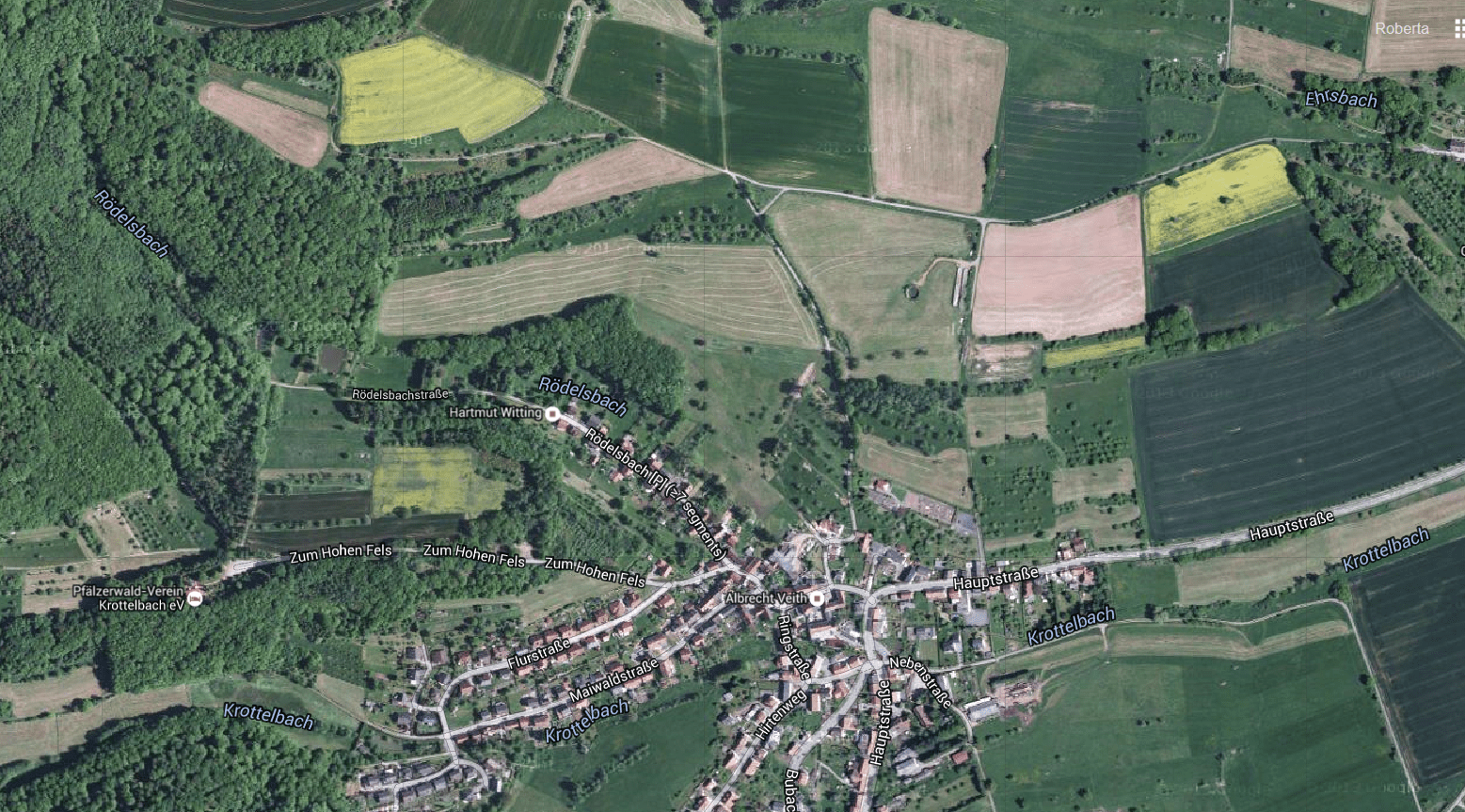
We believe she was born in Switzerland for two reasons.  First, the family group which includes Johann Michael Mueller seems to have migrated together from Switzerland.  Johann Michael Mueller was born in Zollikoffen just outside of Bern in 1655.  This entire group appears by 1685 in the Konken, Krottelback and Steinwenden area of Germany.

Konken Steinwenden map

Another Berchtol family, Hans Simon Berchtol, lived in Steinwenden and they were also involved with the Johann Michael Mueller family.

Hans Berchtol witnessed the baptisms of two of Johann Michael Mueller’s children in Steinwenden, about 15 miles distant from Konken.

Anna Christina had her last child, recorded in the Konken church records, in 1696.

We don’t know why there were no children noted after 1696.  Was Anna Christina of an age where she was no longer having children?  If so, that would put her birth at about 1653.  Did she die?  Possibly.  There is no further record of her, but then again, there is also no death record.  Are those records complete?  Again, we don’t know.

What we do know is that her husband, Hans Berchtol died in Konken on June 15, 1711.  His death record in the church tells us that he resided in Krottelbach, just a couple of miles away.  I will have his death record retranslated, because it may indicate whether or not his wife was dead or living.

Krottelbach Germany

Just three years after Hens Berchtol’s death in 1711, Susanna Agnes Berchtol, Hans and Anna Christina’s daughter, would marry Johann Michael Mueller.

In a twist of irony, Johann Michael Miller was the child born in Steinwenden in 1692 that Hans Berchtol and Anna Christina stood up with as godparents when he was baptized on October 5th.

Anna Christina could not have had any idea in 1692 that her daughter, Susanna Agnes, born in 1688, would in 1714 marry Johann Michael Mueller.  Does this sound like a fairy tale or Disney princess story to you?  All we need now are some really cute little woodland critters.

Given that Anna Christina was Johann Michael’s godmother, and that his mother and father had both died by 1695, it’s certainly possible that Anna Christina and Hans Berchtol raised Johann Michael Mueller.  In essence, that means Susanna and Michael could have been raised together.  That certainly would have made courting much easier.

Johann Michael Mueller would have been 19 years old when Hans Berchtol died in 1711.  We don’t know if Anna Christina had already died, or if she was left as a widow.  Regardless, Anna’s youngest child would have been 15 and not yet an adult.  Perhaps when Hans Berchtol died, Johann Michael Mueller stepped in to help the family, assuming an adult male role, and three years later, married the eldest daughter.

The record from Konken Reformed Church shows that Michael Muller, son of Johann Michael Muller, from Steinweiler in Churpfalz, married Susanna Agnes Berchtel, a Swiss, at Crottelbach on January 4, 1714.  “A Swiss,” in fact confirms that indeed, the Berchtel family too immigrated from Switzerland.  This bit of evidence is what suggests that Anna Christina was likely born in Switzerland.

We don’t have a lot of information about Anna Christina, aside from scanty information from church records that includes her children’s births and the Mueller births that she witnessed as well.

What we do know is that she was part of the pietist group that left Switzerland and settled in Germany.  These pietists became both Brethren and Mennonites after their descendants, specifically, Johann Michael Miller and Susanna Agnes Berchtol, moved to Pennsylvania in the 1720s.  One Samuel Berchtol also migrated to the US and is found closely associated with Johann Michael Mueller, jointly owning land, and was Mennonite in Hanover Co, PA.  Johann Michael Mueller (Miller) was Brethren.

The early pietist movement in Switzerland led to the founding of several religions that had the same core values, although they did develop some differences that led to different sects.

The original pietist believers in Switzerland tried to avoid religious labels.  They had become convinced that the established church was thoroughly corrupt and sought to meet quietly and privately among themselves, studying and adhering strictly to the written word of the Bible and avoiding anything political in nature, including conflict.  Most families kept a loose association with the Reformed protestant churches.  Attempting to establish a new religion would have been illegal at that time.

At one point, the pietists and Anabaptists would suffer a difference of opinion, being that the Anabaptists did not believe in infant baptism.  In fact, they did not believe in baptism until the individual was old enough to make their own commitment based on a personal understanding of the Bible.  However, the pietists and Anabaptists shared many convictions and were more alike than different, especially in the eyes of the government.  They found the state-church squaring up against them, viewing them as one group and attempting to squash what was viewed as a dissident religion.  Oftentimes, other church members who weren’t pietist or Anabaptist felt sorry for the aggrieved patrons and joined them, ashamed of and put off by the actions of the official church.

What role did women, like Anna Christina play in this emerging religion?  The book, “Sisters: Myth and Reality of Anabaptist, Mennonite and Doopsgezind Women, ca 1525-1900” discusses female pietists in a quite surprising light.

Like many religious movements, the “born again” movement had a sense of urgency fueled by the belief that the end of mortal time was near.  It’s easy to understand why they might have felt this way, given that war had ravaged the European landscape for decades, plagues had run rampant, killing one third of the European population and as a result of those disasters, economic and social upheaval was at hand.  Pietism offered spiritual comfort and the promise of a heavenly afterlife.  And comfort was something in short supply at that time.

Chiliasm was one of the widespread concepts of pietism.  The more radical Anabaptists believed that they would help usher in a new economy, meaning a new phase of history in which God’s order, not a corrupt world order would dominate.  I think we’re still waiting for that.

Chiliasm contributed to the prominence of women leaders in Pietism since women were able to claim an authority that the Bible reserved for women prophets at the end of time.

Joel 2,28:  “I shall pour out my spirit on all mankind; your sons and daughters will prophesy, your old men will dream dreams and your young men see visions; I shall pour out my spirit in those days even on slaves and slave-girls.”

Pietist women justified speaking out directly by claiming that God inspired them.  And who was to argue?  Not only that, but this direct inspiration by God gave them more authority than theologians with university degrees because God spoke to these women personally and directly.

Pietist women claimed that the old traditions of shutting women out were no longer valid and that all Christians needed to act boldly to save as many souls as possible before the coming apocalypse.

Other pietists pointed out that Christ appeared first to women after he was risen and that women were prominent in the early church.

These newly founded groups met in homes, in the domestic domain, so to speak, where women often interpreted the scripture.  That would not have been allowed in churches.  While these “conventicles” were not intended to replace churches, in time, they did indeed become the foundation for a new religion.

In the 16th century, women were still barred from formal education, but they were taught to read by private tutors.  They could then read the Bible for themselves, and anything else they wanted to read too.  Their justification was that they were the primary educators of children.

Women’s roles went further than just hosting conventicles.  They acted as enthusiastic prophets, lay preachers and in some cases, as aristocratic patrons funding institutions such as missions and schools.  In general, it was considered “unseemly” for women to act in a public way, and women were not believed to be intellectually capable of understanding complex ideas and certainly incapable of writing, so books written by women were published under pseudonyms.

This movement was not popular with either the established church or the government, and in 1704 the German historian Johann Feustking published a book attributing the formation and leadership of pietism to female agitators, arguing in the book that women had to be limited to the home if traditional society was to be preserved.  This seems to be a case of wanting to close the barn door a bit too late.

Another author from the 1700s characterized the pietist movement as led by foolish and naïve women who had been hoodwinked by smarter, unscrupulous men.  Ironically, that author was herself a woman and had to publish her book, “Pietism in Petticoats” anonymously.

The area around Bern, Switzerland, where the Johann Michael Mueller family originated, had its own set of problems.  Political and military threats surrounded Bern; a recent war with the Turks, a war of succession in the Pfalz and the Swiss-French struggle in the Piemont.  The economy was floundering.  To help address these problems, the Swiss had opened their doors to the Huguenot and Waldensian refugees, but those groups, along with the pietists were monitored closely.  Both were forbidden to recruit new members.  The last thing Bern wanted was more threats to stability – and women involved in anything, let alone in a prominent religious role, shook their very foundation and confirmed the potential for social upheaval.

One Anabaptist women, Elizabeth Tscharner died and her son eulogized her life.  He said that she spent several hours each day on her knees in prayer, a style of praying associated with Anabaptists.  Combining personal devotion with practical Christianity, Elizabeth translated written tracts, had them published and handed them out to the poor.  Ironically, the poor probably couldn’t read them.  Elizabeth knitted and sewed clothes for the needy.  She concerned herself with the welfare of Anabaptists in Bern’s prisons…jailed for their Anabaptist activities.  Often too weak to even sit up, she brought them food and fed them.

One group of Anabaptists was being sent on a ship to the Pfalz to join their spiritual kin, not exactly by choice.  Elizabeth took up a collection of clothes, food and money for provisions for their trip.  This story also illustrates that perhaps not everyone who settled in the Swiss villages of Germany did so by direct choice.  Some may have arrived with absolutely nothing.

Near her death, Elizabeth asked her son to wash her feet, an activity still performed in Brethren churches today, viewed by Elizabeth as “the foot washing of the apostles.”

 Christ Washing the Feet of the Apostles by Meister des Hausbuches, 1475


Christ Washing the Feet of the Apostles by Meister des Hausbuches, 1475

One of Elizabeth’s female Anabaptist friends wrote a book at the age of 76, sharing with us an eternal bit of wisdom about the roles we play on the stage of this world, “No matter whether our mortal lives are comedy or tragedy, at the end of our lives we all look alike.”

Bern’s records show that authorities were particularly concerned about situations where women were involved in pietist religious activities and their men were not, leaving the women “unsupervised and uncontrolled.”  These, women, tsk, tsk, tsk, left the house at night and went to meetings where men and boys were attending, returning home late at night.  They tried to equate women’s religious activity with promiscuity and played on their husband’s fears.  Council protocol addressed activities of “willful wives” as well as “disobedient housemaids.”

While focused on the women, they weren’t above trying to control men either.  Knowing that pietists refused to take oaths, they required a yearly oath of allegiance from all men.  Men who wouldn’t swear allegiance were arrested and assumed to be pietist.  No wonder women had so many men to visit in the prisons.

It’s no surprise, in light of this oppressive environment, that so many removed to much more accommodating and welcoming Germany, whose lands had been depopulated in the wars and needed settlers to work the farms.  In return, Germany offered religious tolerance, at least to a degree.

By 1699, when Bern officials began enacting even stricter measures and interrogating those suspected of pietist leanings, most of the pietists were dead, gone to Germany either willingly or in exile, or very quietly living underground.

It’s ironic that we think of the Brethren and Mennonites today as extremely conservative and the women as very obedient, subservient and compliant, when, in Europe, they were considered quite the opposite – uncontrollable rabble rousers.  Imagine…..women believing they had a legitimate voice and expressing an opinion – and possessing a God given right to do so no less.  For shame!

Anna Christina …you rabble rouser you…..

You know, I’m pretty sure I inherited some of her DNA!!!

Unfortunately, unless one day we can identify some of her autosomal segments, her DNA is unavailable to us.

She had three daughters, but there is only one, Susanna Agnes, that we know anything about.  She married Johann Michael Mueller and had several children, but there are no documented daughters.  There are rumored and inferred daughters, but none with any suggestive evidence that they were in fact the daughter of Susanna Agnes Berchtol Mueller.  Since mitochondrial DNA is passed from mother to daughter to daughter, down the line to the current generation, intact, if we could find someone who descended from Anna Christina through all females, we could obtain her mitochondrial DNA signature today which would tell us about her deep ancestry.

Unless something is discovered of Barbara and Ursula, her two youngest daughters, or a daughter is confirmed from Susanna Agnes, Anna Christina’s mitochondrial DNA line is dead to us.  However, her rabble rousing spirit is not and survives quite intact today!

______________________________________________________________

Disclosure

I receive a small contribution when you click on some of the links to vendors in my articles. This does NOT increase the price you pay but helps me to keep the lights on and this informational blog free for everyone. Please click on the links in the articles or to the vendors below if you are purchasing products or DNA testing.

Thank you so much.

DNA Purchases and Free Transfers

Genealogy Services

Genealogy Research

Hans Berchtol (1641/1653-1711), Twice a Godfather, 52 Ancestors #101

We know that Hans Berchtol’s death was recorded in the church in Konken, Germany, the beautiful hamlet shown below, on June 15, 1711.  His death record in the church records tells us that he resided in Krottelbach, just a few miles away.

Konken Germany

Hans Berchtoll and his wife, Anna Christina reportedly had the following children:

  • Hans Jacob born in 1686 who married Anna Marie Glosselos
  • Susanna Agnes born on May 3, 1688 and married Michael Mueller (1692-1771) (One source reports her birth in Ohmbach, a nearby village.)
  • Hans Peter born on May 1, 1690 and married Maria Elizabeth Zimmer
  • Hans Heinrich born on May 1, 1690
  • Barbel (Barbara) born about 1693
  • Ursula born about 1696

Konken Steinwenden map

In 1686, in Steinwenden (shown below,) not terribly far from Konken, we find mention of Hans Berchtol in the baptismal record of Johann Abraham Mueller, the son of Johann Michael Mueller and his wife, Irene Charitas whose last name is unknown.

Steinwenden Germany

Hans Berchtol’s wife was not with him in the baptismal records of this child, likely because she was herself quite pregnant or had recently given birth.  The first child born to Hans Berchtol and his wife, Anna Christina was born in 1686 as well.

The infant, Johann Abraham Mueller, would die shortly after his birth, but again, in 1692, Hans Berchtol would be called upon to attend another baptism of a child of Johann Michael Mueller and his wife.  These two couples were obviously close, even though they didn’t live nearby.  Why?  Were they in some way related?  What was their common bond – a bond strong enough to survive a 15 mile distance in the mountains over several years.

The child born in 1692, Johann Michael Mueller (Jr.) would one day marry the daughter of Hans Berchtol and Anna Christina.  How strange is that?  Michael’s in-laws-to-be were his godparents.  That doesn’t happen often.  Hans Berchtol’s daughter, Susanna Agnes Berchtol was born on May 3, 1688 in Konken (or Ohmbach).  Whether this family was previously related in some fashion or not, their descendants were destined to be.  I wonder if Johann Michael Mueller grew up playing with Susanna Berchtol, his future wife.  Did they sit beside each other in Sunday School from time to time? She was more than 4 years his senior, so maybe she wasn’t terribly interested in him until they were teenagers or young adults. And they did live 15 miles apart.

Then another thought struck me.  Konken and Steinwenden are really too distant for easy accessibility.  Since Hans Berchtol and his wife had stood up with Johann Michael Mueller at his baptism, they would have been his godparents.  Godparents were technically responsible for the religious education of the child, and were the people who would have taken the child to raise if their parents died.  It has always been assumed because of the close relationship of Johann Michael Mueller (the second) and Johann Jacob Stutzman (born 1706), son of Michael’s father’s second wife, that Michael’s step- mother, Anna Loysa Regina, and her second husband, Jacob Stutzman raised Michael.  I know this is confusing, so I’ve created a little chart representing the relationships.

Miller Stutzman chart

But maybe that wasn’t true, and Anna Loysa Regina and Jacob Stutzman didn’t raise Johann Michael Mueller (the second), or maybe not for the entire time.  Maybe Michael was raised by Hans Berchtol and his wife, his godparents.  That would explain how the 15 mile difference between Steinwenden and Konken was overcome for courting purposes.

I don’t have the Konken church records or their direct translations, but it would be very interesting to see if Johann Michael Mueller (the first) and his wife, Irene Charitas Mueller, witnessed the baptisms of any of Hans Berchtol’s children.  It would also be interesting to check the neighboring church records to see if we can find any additional children for Hans baptized in neighboring churches.  I don’t know if the family moved, or if they simply went to the closest church for baptisms, or they changed churches occasionally.  Why didn’t they attend the church in Krottelbach where they lived?

As it turns out, Krottelbach historically formed the boundary between the parishes of Ohmbach and Konken, so Krottelbach didn’t have its own church.

Konken Krottelbach map

This caused some difficulty in ascertaining what the village’s population was in the so-called Konker Protokollen of 1609 in which the 12 hearths (“households”) with 65 inhabitants listed for Krottelbach were actually only the ones on the north side of the brook, in the parish of Konken. Corresponding statistics for the part of the village on the south bank are not available. All in all, though, the village as a whole may have been rather large for the circumstances of that time.  However, that wasn’t to last.

Like all villages in the region around Kusel, Krottelbach suffered heavily under the twin blows of the Plague and the Thirty Years’ War (1618-1648).  After that war, there were only four people living in the village.  The populace was devastated.  This area of Germany was barren and desperate for settlers who were willing to work and farm, and actively sought people from Switzerland and other regions.

The newcomers welcomed the opportunity and settled, but more lives were lost towards the end of the 1600s in French King Louis XIV’s wars of conquest.  It seemed that there was no end to wars and violence.

Krottelbach belonged to the village church in Ohmbach, which Count Gerlach V of Veldenz had bequeathed to the Werschweiler Monastery after 1258. During the Reformation, the monastery was dissolved, whereafter some of the then Lutheran villagers still belonged to the parish of Ohmbach, while others belonged to the parish of Konken.  Until 1817, the village of Krottelbach remained solidly Reformed, a faith that in 1817 united with the Lutherans.  At that point, the whole village once again belonged to the parish of Ohmbach.

What this history of Krottelback, along with the Konken church records, tells us is that Hans Berchtol lived on the north side of the brook in Krottelbach.

Krottelbach creek map

Perhaps Hans farmed one of these beautiful fields or maybe he lived on Krottelback Creek, meaning “Toadbrook.”  At this time, farmers did not live on farms in the countryside, but they actually lived in the villages clustered together and then went to farm their fields that surrounded the village.

Krottelbach fields

A second Berchtol male was having children in Steinwenden where Johann Michael Mueller lived.  Hans Simon Berchtol and his wife Catherine had the following children according to Steinwenden church records:

  • Hans Samuel born 1685, godparent Hans Michael ?
  • Maria Magdalena born 1686, godparents Hans Michael Muller of Steinwenden and Anna Catherine
  • Maria Elizabeth born 1691
  • Anna Catherine born 1696, godparents Anna Catharine, Johannes Lampon, frau, Jacob ??
  • Johannes Theobold born 1697, godparent Maria Elizabeth
  • Johannes born 1698, godparents Johannes Berchtol and Anna Maria

Hans Samuel Berchtol, born in 1685 above is believed to be an immigrant and possibly the Samuel Berchtol found in records in Pennsylvania with Johann Michael Mueller born in 1696.  One Samuel Becktel arrived on the ship Robert and Alice on September 30, 1743.

Were Hans Berchtol of Krottelbach and Hans Samuel Berchtol of Steinwenden brothers?  These families were surely related, but how?

These villages, Krottelbach and Steinwenden were nearly as far apart as Konken and Steinwenden, being a distance of about 18 km.

Krottelbach Steinwenden map

The fact that both families were of Pietist leanings and settled in this part of Germany, traveling a non-trivial distance between locations, suggests that perhaps they had a pre-existing connection before settling here, other than their obvious religious leanings and refugee status.  Remember, we don’t know the maiden name of either man’s wife, Hans Berchtol’s Anna Christina or Johann Michael Mueller’s Irene Charitas.

We know that the Mueller family was originally found in the Canton of Berne, Switzerland where Johann Michael Mueller, the elder, was born in 1655 in Zollikofen.  Many Pietist families from this region removed to this same part of Germany in the 1680s.  So it’s not unlikely that the Berchtol family did the same thing, which would explain why Hans Berchtoll was willing to travel 18km, each way, twice to stand up with the Mueller family for the baptism of babies.

The record from Konken Reformed Church shows that Michael Muller, son of Johann Michael Muller from Steinweiler in Churpfalz, married Susanna Agnes Berchtel, a Swiss, at Crottelbach (sic) on January 4, 1714.  “A Swiss,” in fact confirms that indeed, the Berchtel family too immigrated from Switzerland.

The Steinwenden records begin in 1684, but the Konken records begin in 1654, so perhaps more information awaits in those records, once they are translated and indexed in some location so that you can find entries without reading the entire church book – or more accurately stated – paying someone else to read the entire church book.

Just three years after Hens Berchtol’s death in 1711, his daughter would marry Johann Michael Mueller Jr., that baby born in 1692.  Maybe when Hans died, Johann Michael Mueller stepped in to help the family.

Krottelbach Germany

Krottelbach, shown above, is about 5 miles from Konken.

So, by piecing scant records together, we know that Hans Bechtol, Bechtel or Berchtol was “Swiss,” lived in Konken or more likely Krottelbach by 1686, but traveled that same year to Steinwenden, without his wife, for the baptism of the child of Johann Michael Mueller and his wife, Irene Charitas, whose last name is unknown.

During this same time period, a Hans Simon Berchtol was living in Steinwenden and having children there.  Johann Michael Mueller was a godparent to one of Hans Simon’s children as well.  These three families were likely related in some fashion.

Hans Berchtol and his wife continued to have children in Konken until about 1696.  We don’t know if this was when his wife died, or whether she had reached the age where children were no longer forthcoming.  If that was the case, it would put their birth year at about 1653 or so. It would be worth checking Hans actual death record to see if his wife is mentioned as either living or dead.

Hans died in 1711 where the Konken church records reflect that he lived in Krottelbach.  He was born probably before 1653, which means he would have been at least 57 when he died.  Another source states that he was born on June 15, 1641 in Germany, but they do not provide the source of this information.  Regardless, Hans was not a young man when he died.

We know that two of Hans sons lived to marry, although I have no information about their children, or if they immigrated.

I noticed that in the Biddle/Bechtel project at Family Tree DNA, there are several Bechtel and Bechtol males who have Y DNA tested.  Unfortunately, there are eight different groupings, and none of them reach back to Hans Bechtol in Germany.  Several are found in Germantown, Delaware Co., Huntington Co., York and Berks Counties in PA.  These would, of course, be the exact locations where these German families would have settled.  Bechtel immigrants are documented here and none of these seem to be candidates for sons of our Hans.

Many of the Bechtol/Bechtel families were Mennonites and one group arrived in 1729.  These men don’t look to be Hans sons, but we don’t really know, apart from the fact that we are looking for a Jacob, a Peter or a Heinrich.

However, we know positively that there were Bechtol men with the Brethren families in Chester and York Counties in PA.

On February 7, 1744, Michael Miller, Nicholas Garber, Samuel Bechtol and Hans Jacob Bechtol, who all lived in Chester Co, PA, purchased a tract of land consisting of 400 acres northeast of Hanover, PA in York County.

Chester Co Hanover Co

Today this land is near Bair’s Mennonite Church, probably lying south from the church, shown below.

Bair's mennonite cemetery

Today, that land has a cemetery on both sides of the road.  It’s possible that the church is on the original land owned by these 4 men.

Let’s see if we have a participant from this line in the Bechtel DNA project.

Bechtel dna project

The last group of Bechtel men in the DNA project track back to one Samuel Bechtel, reportedly born in 1700, died in 1785, and is buried in the York Road Cemetery in York County, PA.  A little bit of digging shows us that indeed, the church shown in Samuel’s Find-A-Grave picture is Bair’s Mennonite Church, shown below from Google maps, street view.

Bair's mennonite church

Is this the same family line of Samuel Bechtol who purchased land there in 1744? Assuredly.  Additional deed work would likely confirm the land history.  Is the Samuel Bechtol of Chester County, PA the same Bechtol family as was found in Konken and Steinwenden, Germany.  Most likely, but we don’t know for certain.  The dates don’t align exactly.  Hans Simon Berchtol of Steinwenden had son Hans Samuel in 1685.  It’s hard to imagine the continued connection with the Mueller/Miller family if it is not the same Berchtol family line, but we need more than circumstantial evidence.

If any Bechtol, Bechtel or Berchtol male, meaning any of Hans Bechtol’s or Hans Simon Berchtol’s descendants who are males and still carry the surname, by any spelling, are discovered, I have a DNA testing scholarship for the first individual.  Let’s find out more about our ancestors.  I’m betting that Samuel Berchtol and Hans Berchtol from Germany are related, one way or another, and so is the Samuel buried in the Mennonite cemetery at Bair’s Mennonite Church.

Various kinds of DNA testing could help unravel this puzzle.

It’s possible that autosomal DNA testing can solve this puzzle as well, even though there are several generations between Hans and descendants today.  If we don’t look, we’ll never find that connection.  If you descend from these lines, let me know.

It’s amazing that DNA has the potential to answer these questions that have been burning for decades – and questions that our ancestors knew the answers to and thought nothing of.  They are probably chuckling at our inquisitiveness today, given that they still know those answers, and we still don’t.

______________________________________________________________

Disclosure

I receive a small contribution when you click on some of the links to vendors in my articles. This does NOT increase the price you pay but helps me to keep the lights on and this informational blog free for everyone. Please click on the links in the articles or to the vendors below if you are purchasing products or DNA testing.

Thank you so much.

DNA Purchases and Free Transfers

Genealogy Services

Genealogy Research

Heads Up about the 23andMe Meltdown

As I’ve written before, 23andMe is going through a rather dramatic revision of their product following their FDA approval.  Their “upgrade” is rolling out in waves and began November 11th.  I had decided to wait until it was complete, and things had settled down before writing anything.  Transitions are notorious for being difficult and people are notorious for not liking or dealing with change very well.

However, given the significant problems being encountered by the community, and the uniformly negative feedback by those with the new account format, I feel compelled to give you a heads up about this.  If you’re interested in specifics, you can check out Kelly Wheaton’s December 2 posting on the ISOGG group on Facebook where this has been discussed at length.

Kelly Wheaton, a long-time genetic genealogist, community member and educator states:

“I am temporarily suspending my recommendation to use 23andme for genetic genealogy. This is based on several factors but the most important are the fact that it is functioning poorly and there has been a concerted effort by management to disregard the genealogist in the design and implementation of its new format. When it is functioning I will make a final determination. I have posted this on my website and will post in all places I frequent. Feel free to quote me if you’d like. This is a very sad day for me for its implications to the genetic genealogy community. It is not a step I take lightly.”

Kelly is certainly not alone and her commentary reflects the sentiments of many.  Truthfully, right now, the whys and wherefores and debate doesn’t matter.  All that matters is that it is what it is at this minute.  So, where are we right now and what do you need to do to protect and preserve your information if you have tested at 23andMe?

Current Status

If you tested on the version 4 (V4) chip, since December 2013, your account may have already been transitioned.  Good luck to you.

If you are on the V3 chip, testing prior to December 2013, your account probably has not been transitioned.  You still have time to preserve your information, but do it quickly…as in now.

Here’s the warning.

Download or Print Everything

Go into your account and print or download anything you think you might want or need – ever.

It’s unclear how much of your existing health and medical information will be available under the new system.  V3 users received information before the FDA’s shutdown of 23andMe’s medical information service in November of 2013 that has not been provided since, and is not provided under 23andMe’s new agreement with the FDA.  It’s unclear how much of their previous information V3 users will be able to retain, and in what format.

You will be losing some genealogy related functionality.  Feedback from V4 people already transitioned is extremely negative – and they never received the health information V3 people received – so they didn’t have that to lose.

Currently, on the new version, you cannot download your genealogy segment match information, although 23andMe has said this will be available later.  This may be a function of everyone not being on the same platform yet.  However, don’t take chances.

Here are four things you need to do.

Countries of Ancestry

I spoke in this article about downloading your Countries of Ancestry information if that is relevant to you.  It will be disappearing.

Health Information for V3

Currently, when you sign into your account, it appears that you cannot access your health information without answering those %#$@** questionnaires.  In other words, it seems that even though I have opted out of the research aspect of 23andMe (you can’t opt out entirely), I was being forced to answer information for their use before I could see my health information.

23andme meltdown

You can see here that when I click on “Surgical Complications” to see that information, I’m presented with this form that I must complete before I can view my results.  Let me tell you, I am NOT a happy camper about this method of arm-twisting.

23andme meltdown1

In essence 23andMe is telling me that in order to have access to my own information, I must opt back in.  That’s not going to happen.

I sent an inquiry to 23andMe about this, wanting to be sure I really did fully understand what they were doing.  Is this really as bad as it looks?

23andme meltdown2

In essence, it is and it isn’t.  It is in that you do have to answer those questions to see that information.

23andme meltdown3

I was not happy, so I reached out to 23andMe to clarify.

23andme meltdown4

Unfortunately, this focus on obtaining your medical information, one way or the other, seems to define the new 23andMe.

Based on their reply, to see the Surgical Complications information, one must complete the form, BUT there is also another avenue to access your health information which was not at all evident.

23andme meltdown5

Here’s the 23andMe “final answer” after a couple of clarifying exchanges back and forth.

Is the information in the health overview section truly the same as would have been presented to me on the Surgery Complications report?  I don’t know.  I can’t find out without opting in to their research again and answering that form…and I will never be a participant or victim of genetic extortion.

That aside, let’s make lemonade out of lemons and see how to access the complete health information as they instructed.  The Health Overview summary below is from an anonymous person.

23andme meltdown6

There’s the print link, at the upper right.  The printed report includes elevated risks.  If you click on the link below each group, “See all 122 risk reports,” above, you can see all the individual risk factors you were evaluated for in all 4 groups.  You must click on the link for each group located at the bottom of that group.  Even though there is no print button on the detailed report, on a PC, CTRL+P will print the entire page.

Download Your Genealogy Matches

To download all of your genealogy match information, fly over “My Results” at the top of your toolbar.

23andme meltdown7

Click on “Ancestry Tools,” then on “Family Inheritance: Advanced.”

Once there, you will see the comparison tool.

23andme meltdown8

At the bottom of the blue boxes, you’ll see “Download all of Roberta Estes’s shared segments as aggregated as of <date> or re-request the aggregation.”  Depending on when you last downloaded, you likely want to re-request the aggregation.

This provides you with all of your match information for those people who are sharing with you.

Other Changes

It’s unclear what else might be changing or how.  We do know that the half versus fully identical segment comparison information is gone now.  Suffice it to say, if there is anything, on any screen, that you want – find a way to preserve it.  Screen shots work too. On a PC that’s PrtScr and then paste to a document so you can save it either as document or the screen shot as a jpg file.

In Summary

I don’t know how all of this is going to shake out in the end.  It’s not looking positive for the genetic genealogy community.  Regardless, I felt compelled to speak up now, even before we know all of the specifics, in order to warn you so that you can preserve as much of your useful information as possible.  Better safe than sorry.  Don’t delay.

______________________________________________________________

Disclosure

I receive a small contribution when you click on some of the links to vendors in my articles. This does NOT increase the price you pay but helps me to keep the lights on and this informational blog free for everyone. Please click on the links in the articles or to the vendors below if you are purchasing products or DNA testing.

Thank you so much.

DNA Purchases and Free Transfers

Genealogy Services

Genealogy Research

Talking to Yourself aka E-Mail Spoofing

Have you ever gotten an e-mail from yourself that you didn’t send?

Here’s an example from my inbox.

inbox

Yep, there are 4 messages to myself from myself that I never sent.  The modern day version of talking to yourself – except they aren’t legit.

They are supposedly from my e-mail address – but I didn’t send them.

That is something called “spoofing” on the internet.  It happens when someone, a “bad guy” for lack of a more descriptive term, wants to send spam or junk mail, or worse, and hijacks your internet e-mail address to do so.

No, they have not broken into your e-mail account, they are just appending your address as the “sent” address so that it gets through filters and such.  However, if this happens to you, the FIRST thing you should do is to check your “sent” folder to be sure you don’t have a virus or some kind of malware sending things from your computer.

The bad news is that there is nothing at all I can do about this – except wait until the wave is over and hope there isn’t another one anytime soon.

Why did they pick me?  Because they can – they search for valid addresses and the more widely received, the better, because it makes their target audience larger.

A few Internet Service Providers use “source assured addressing” schemes where they connect the sending ID with the address it’s supposed to come from and “flag” suspicious e-mails.  You can see that AT&T did just that and put it the messages into my spam folder, labeled “bulk.”  It’s up to me to delete them.  Some spam never makes it this far and the vendors just throw the messages away.

Now the bad news on my end is that my address may become associated with spammers and get blacklisted.  There’s nothing I can do about that.

On your end, consider this a heads up – for my e-mail address and others.  If you receive something you don’t expect from someone, or just a link to click – DONT CLICK.  Don’t EVER click.

If you receive something from someone you know with a vanilla sounding message like:  “You have to see this,” followed by a link – your internal neon danger sign should be flashing like crazy.  And for goodness sake, DON’T CLICK.

Another tactic is to attach a document of some sort that you are instructed to open.  Don’t do that either.  If you’re not expecting a refund or a package or whatever…the message is fake.  And by the way the IRS does not contact you via e-mail and neither does the court requesting jury duty, etc.

Conversely, if you’re sending a link to someone, send at least enough of a message that the recipient knows it really is from you.  For example, “I found this link about the first Algonquian Bible which was the first Bible printed in the US.”  Then add your link.  My friends will know that is something I would be sending – not a message that’s so generic they have no way of knowing if the e-mail is legitimately from me.

I received an e-mail last week from Justin, someone connected to genealogy with whom I communicate regularly.  The e-mail said Justin had sent me a message through XYZ and to “click here” for the message, shown below.  I found that odd since Justin regularly e-mails me and has never used any kind of message service.

scam email crop

I was suspicious, so I didn’t click.  I didn’t want to miss something from Justin, so  I forwarded the e-mail to Justin and asked if he sent it.  He said that he had clicked on that same link in an e-mail he received and it then sent itself to his entire e-mail list.  You can rest assured that’s not all it did and now he has some malware someplace on his computer as well doing who-knows-what.  The bad guys don’t do these things just for fun.

I quickly deleted that e-mail and was very grateful for my second sense that told me something was amiss.

While most genealogists do talk to themselves, it’s not quite like this.  Stay vigilant and if there is any doubt, don’t click.  Better wary than sorry.  Otherwise, you won’t be talking to yourself, you’ll be swearing at yourself!

______________________________________________________________

Disclosure

I receive a small contribution when you click on some of the links to vendors in my articles. This does NOT increase the price you pay but helps me to keep the lights on and this informational blog free for everyone. Please click on the links in the articles or to the vendors below if you are purchasing products or DNA testing.

Thank you so much.

DNA Purchases and Free Transfers

Genealogy Services

Genealogy Research

Irene Charitas (c1665-c1694) and Her Aching Mother’s Soul, 52 Ancestors #100

For a very long time, and on most online trees, Irene Charitas is listed as the wife of Johann Michael Mueller who was born about 1655 in Zollikoffen, Switzerland and who died in 1695 in Steinwenden, Germany.  Her last name is listed as Charitas, but it isn’t.  Charitas is Irene’s middle name.

At this time in history, in Germany and the Germanic speaking Protestant regions of Europe, females were given two names, a first “saints” name and a second name by which they were typically called.  Irene is quite unusual for a Saint’s name and Charitas is very unusual for a middle name.  So unusual in fact that I’ve only seen it one other time, ever.

Charitas is a Latin word meaning charity and “for the love of God.”  Charitas, or charity, is one of the 7 virtues.

Steinwenden 5

We don’t know where Irene was born, but what we do know is that we first find her as Johann Michael Mueller’s wife in Steinwenden, Germany, shown above and below, when she gives birth to the first child recorded to this couple in the church records in 1685.  Could this couple have lived there, or had children elsewhere, previously?  Of course.  Could they have had other children that were baptized in a different church?  Yes.  Michael was born in 1655, so if Irene was his age, they could have married by about 1673-1675 and had another 5 children or so before they appear in the Steinwenden records.  But did they?  We’ll never know for sure, but there is no evidence today to suggest such.

Steinwenden 6

Unfortunately, the only part of the original Steinwenden church that survives today is the bell tower.

Steinwenden 4

Sometime in the early 1680s, the Mueller family arrived in Steinwenden from the Zollikoffen area near Bern, Switzerland. It’s likely that Irene’s family was among the same immigrant group – but we just don’t know and to the best of my knowledge, no research has been done on that topic.  Furthermore, the Johann Michael Mueller family could have made an intermittent stop along the way that we are unaware of.  In other words, Michael could have married Irene Charitas anyplace between Zollikoffen and Steinwenden.

I’m not quite sure how Charitas became her last name on the internet.  Perhaps it’s an assumption based on the fact that her middle name is an unfamiliar name and someone assumed it was her last name.  In any event, it’s been that way for years now and I’m hopeful that records from the actual church can help reduce or eliminate this misinformation.  I’m currently in the process of having the church records retranslated by a professional German genealogist, just to be sure.

When our cousin, the Reverend Richard Miller visited the church in Steinwenden in 1996, the church historians and a German genealogist prepared a summary of the church records involving Johann Michael Mueller, shown below.

In all of the birth records of children born to Michael, Irene Charitas was his wife, and Charitas was not her birth name.  If the child born in 1685 was their first, then Irene Charitas was likely born about 1665, give or take a couple years in either direction.

Steinwenden 7

Recently, Richard sent me the original record of Johann Michael Mueller’s birth from the Steinwenden church.  It’s the second to last entry, below.

Miller 1792 birth steinwenden

Needless to say, I can’t read this, on two fronts, the language and the script, which is why I’m having this and the other records retranslated.

The next we hear of Irene is a church record for a confirmation of Irene Charitas Schlosser, a daughter of Conrad Schlosser, of Steinwinden.  Often, children were named after their godparents with the idea that the Godparents were relatives and they were the appointed relatives responsible for the religious education of the child – and whether spoken or unspoken, it was also expected that if the parents died, the Godparents would raise the children – or at least the one(s) named for them.  Unfortunately, in the age of marginal medical care, no antibiotics and an era where every pregnancy was high risk, that happened all too often.  So, it appears that Conrad Schlosser’s daughter was named for Michael Mueller’s wife, Irene Charitas.

It’s likely that Irene was in some way related to Conrad.  She could have been his sister or aunt or a favorite cousin.  Or, Conrad could have been related to Johann Michael Mueller.  One way or another Conrad trusted Irene enough to name his daughter after her, making Irene Charitas Mueller the first in line to raise her namesake should something happen to Conrad and his wife.  Additional research on the Schlosser family church records is in order.

Steinwenden 1

The first record on this transcriptions says that Jacob Ringeisen of Schweitz was “serving for his cousin” Michael Muller.

In other words, even though the daughter was named for Irene, Michael’s wife, Irene wasn’t present, possibly due to pregnancy herself, and apparently neither was Michael.  However, Michael’s cousin in essence represented Michael and the couple’s commitment at the baptism.

Of course, now this makes me ask just how Michael and Jacob were cousins, and was it through marriage via Irene Charitas?  It looks like we may have yet another family connection hint.  So often in these old church records there is so much more buried in the details that is missed if all you get is a translation of the actual “event.”

In genealogy, always, always, more questions.

Irene Charitas’ life was short.  She probably died before she was 30.  There are no more known records of her, at least not directly.

What we do know is that the last child in these church records is born to Irene and Michael in 1692.  This is the only one of the six children she bore that lived.  This is an incredibly sad story that seems to stretch beyond just “bad luck.”   

Child Birth Death Age at Death
Johann Nicholas Muller June 5, 1685 June 6, 1685 1 day
Johann Abraham Muller July 9, 1688 1696 Less than 6 months
Samuel Muller April 30, 1687 April 30, 1687 Shortly after birth
Catherine Barbara Muller June 7, 1688 June 21, 1691 3 years, 2 weeks
Eva Catherine Muller April 24, 1691 June 29, 1691 2 months
Johann Michael Muller October 5, 1692 1771 78 years

Looking at these children’s deaths, I find the month of June, 1691 particularly heartbreaking.  Clearly, something contagious was occurring and both of Irene’s children died, 8 days apart.  I wonder if the church records reflect a rash of deaths within the village.  Just 11 months later, she would bear her 6th child.  I bet those months between June of 1691 and May of 1692 were living Hell for Irene, between the sorrow and grief of losing her children and the uncertainly of the one she was carrying.

Fortunately for me, Johann Michael Mueller, the second, born in 1692, named after his father, did live, as he is my ancestor.

Johann Michael Mueller Sr. died in Steinwenden in 1695, just three years later. For some reason, from 1692 to 1695, there were no more children born to Johann Michael Mueller and Irene Charitas – nor to Johann Michael Mueller and anyone else.

Why is this important?  Because another rumor that has been rampant over the years is that Johann Michael Mueller was married to Anna Loysa Regina and that she was the mother of Johann Michael Mueller.  At least I was able to figure out where this information originated.

On September 29, 1695, Anna Loysa Regina married Jacob Stutzman in Steinwenden, although I have not seen the original record myself.  She is noted at that time as being the widow of Michael Mueller.

For Anna Loysa Regina to be the window of Michael Mueller, that means that Irene Charitas died sometime after giving birth to Michael Jr. on October 5, 1692 and sometime before Michael Sr.’s death on January 31, 1695, just 2 years and 3 months later, allowing Michael Sr. enough time to remarry after Irene’s death and before his own.  Remarriage often didn’t take much time actually, given that most people already knew each other through church and it was simply a matter of taking stock of the available spouses and making a choice from the willing and most compatible selection.  No, it was not about love but one would hope it was at least about like and that love evolved.  Regardless, marriage was a practical matter of survival as men and women needed each other’s assistance in the daily activities of living and raising children.  Michael would have had a small child who needed a mother.

Michael and Anna Loysa Regina must not have been married long, because there are no children recorded to she and Michael, but she did go on to have children with Jacob Stutzman, one as late as 1706.  Jacob Stutzman Jr. born in 1706, and Johann Michael Mueller Jr., born in 1692, step-brothers of a sort, would in 1727 immigrate to America together.

If all of these records have been accurately translated, Irene Charitas probably died about 1694, possibly in childbirth.  In the natural order of things, March or April 1694 would be about 18 months after Michael was born, representing the typical spacing between children.  Why no record of her death exists in the church records is a mystery.  Perhaps we need to look again, and maybe in the surrounding church records as well.

Cemetery plots in Germany, as is customary in Europe, are reused.  In some cases, they continue within the family, with generation upon generation (pardon the pun) being buried in the same location.  In other cases, the grave is considered “abandoned” if no one pays upkeep, and the site is reused at the discretion of the church.  Gravesites that aren’t abandoned are still reused, but generally by the family and perhaps not as quickly as abandoned graves.  While this is very foreign to those of us in the US, if Europeans did not employ some “recycling” burial strategy, the entire continent would be blanketed with cemeteries and there would no room for the living.

Being someone who wonders about everything, I asked at a Dutch church during a European visit in 2014 about what happened if there were still bones in the grave when they set about burying the next person.  I’m glad I asked, because I then discovered that those little buildings in or near cemeteries weren’t what I thought.  I assumed they were the gardener’s or sextant’s shed, containing things like shovels, lawnmowers, etc.  Well, I was wrong.  Those little buildings are ossuaries containing the bones of the former inhabitants of graves.  The photo below is the ossuary in Wolsum, the Netherlands.

Ossuary Wolsum

This is truly the final resting place until the bones turn to dust, generally stacked something like cordwood with similar types of bones stacked with like bones on shelves.  Yes, seriously.  Once moved from the grave to the ossuary, the bones are not kept together as a “person.”  This photo is an ossuary in Hallstatt, Austria.

Ossuary Austria

From a DNA perspective, these ossuaries, found in almost all cemeteries, are just torture to me, because I can just see the DNA of my ancestral lines in that ossuary, all mixed in with the DNA of the other families…which are probably mine as well, given that these people married their neighbors in the community for generations.  There they are, my ancestors and their DNA, right in front of me, but entirely anonymous and completely unidentifiable.  If we knew who they were, we could obtain the Y and mtDNA lineage of every family in the village, including mine!

The bones in the ossuaries are just waiting to finish turning to dust – a process that takes longer than they are allowed to rest in the ground.  So a grave in Europe is not a place of perpetual rest, it’s a temporary resting point but not the last stop on the journey.  I just can’t help but think what a wonderful scientific study it would be to analyze the bones in an ossuary and compare the results to the DNA of the current village inhabitants, and those descendants who moved away.  And yes, you know I’d be in the front of the line, volunteering.  You could reconstruct an entire village in the 1700s or maybe 1800s from their DNA – maybe even further back.  You could tell who settled there, where they were from originally… you could learn so much.  But back to reality….

Not only do we not know where Irena Charitas and her infant children were buried, their dust assuredly shares that location today with several subsequent generations of Germans, most likely not her descendants because her only known descendant immigrated to America in 1727 with his Stutzman step-brother.  Irene Charitas’ son Johann Michael Mueller, Jr. never knew his mother or father, never remembered seeing his mother’s face, beaming down at him, so joyous that he was alive.  He had no memory of her loving touch.  He was raised by his step-mother and her subsequent husband, Jacob Stutzman, after both of Michael’s parents died by the time he was three.

There was no happy ending for Irene Charitas.  In fact – it seems that her entire adult lifetime was filled with serial grief, except for those few brief months when she and baby Michael both lived.  Irene Charitas’ grief was caused by the births and deaths of 5 children in 5 years, followed by her own death not long after her 6th child was born and survived.  Then, the terrible irony.  When a child finally lives, she herself succumbs.

I can only imagine the excitement Irene felt about her first pregnancy, followed by the shattering death of the baby.  Surely, she would have told herself that it wouldn’t happen again.  It was a first birth, probably difficult.  The second one would be easier.  Just a few months later, she became pregnant again and full of hope, only to have her dreams shattered again with the death of that child.  And then again…and again and again, year after year after year.  Just five years after that first baby died, she was pregnant for her sixth child.  I wonder if she started out in dread when she discovered she was pregnant again, never allowing herself to be excited, to plan, to hope for that baby to live.  I could understand how she might feel that way after 5 dead babies in 5 years.  I know how frightened I was when I was pregnant for my third child after my second child died.

And then the baby lived but she died.  Oh, the horrible irony.  Poor Irene.  In death, leaving behind her one child that lived.  She must have fought the grim reaper with every ounce of her being until the very end.  But it wasn’t enough.  It just wasn’t enough.

I hope that Irene Charitas was able to see, from afar, her son, Johann Michael Mueller Jr. growing up strong, being raised by his step-mother and step-father in a pious pietist home and that it helped sooth her aching mother’s soul.

4-15-2018 Update – We now have a surname and parents for Irene.  Click here to read the next article!

______________________________________________________________

Disclosure

I receive a small contribution when you click on some of the links to vendors in my articles. This does NOT increase the price you pay but helps me to keep the lights on and this informational blog free for everyone. Please click on the links in the articles or to the vendors below if you are purchasing products or DNA testing.

Thank you so much.

DNA Purchases and Free Transfers

Genealogy Services

Genealogy Research

Facebook – A Sense of Connection…and Betrayal

First of all, let me say I’m a fan of Facebook.  Yes, it has warts and there are aspects I dislike, but overall, I feel it gives us a sense of connection that is otherwise impossible to have in our geographically dispersed world.  In our hectic world today, most of us no longer live down the block or next door to our parents, siblings, aunts and uncles.  We may not even know our cousins, aside from their names.  Families are no longer nuclear or close by.

When I was younger, the Christmas letter was what connected people across the years – and each one was hand written in the Christmas card.  Later, when computers and word processing debuted, one letter was written, several copies printed and a copy put into each card.  People got offended due to the impersonal nature of the letter.  Times were changing.

Today, the Christmas card letter is nearly obsolete, in any format.  I haven’t sent cards in years.  (I know, bad cousin, bad cousin.)  I actually received an annual card and letter from someone I had no idea who was, for years.  And by that time I was too embarrassed to ask who they were and how we were connected.

So I was extremely glad when Facebook came along, because it allows us to have a sense of connection and continuity with our family, and friends….along with people who want to “friend” us who are unknown to us.  Yes, unfortunately, the world of “stranger danger” has come along with the connectivity for both children (who aren’t supposed to be on Facebook) and adults.

Facebook is also a wonderful way to get to know your new cousins, often found through genealogy and genetic genealogy.  It’s a lot more personal than an occasional e-mail or letter – and you get a much more balanced perspective of their life – their interests and who they are.

However, the way Facebook inherently works, or doesn’t, can sometimes lead to hurt feelings.  When you’re friends with someone on Facebook, you expect that they will see all of your posts and you will see all of theirs.  Right???  Wrong.  And that’s exactly what leads to hurt feelings.

Twice now within the past month, someone who I’m Facebook friends with has posted something expressing dismay and hurt feelings about what didn’t happen.  They had posted something serious, asking for prayers, and they did not hear from many of the people they expected to hear from.  That’s hurtful – especially if you think it’s intentional.  But, don’t get your knickers in a knot just yet – because it’s probably NOT an act of neglect or worse yet, a slap-in-the-face type betrayal from your family and friends. It’s all about how Facebook works, or doesn’t.

Facebook is not like mailing a letter or sending an e-mail directly to someone.  You can have some level of expectation that they received the letter or e-mail, although not 100% – but that’s not the case with Facebook.  Facebook SELECTS posts to display on friends newsfeeds.

How does Facebook do that and which posts?  Who knows – but they do.  In both cases mentioned above, the people later expressed how hurt they were that no one or few replied.  I went back and looked in my feed, and neither had been posted to my timeline.

I looked at their postings on their page, and sure enough, there they were.  I felt awful, and so did other people who also replied that they had never seen the prayer requests.  Just think how many people would have never mentioned how hurt they were and just suffered in silence.  The rest of us would have never known and they would have thought they were slighted.  This may sound trivial, but it’s certainly not when the topic at hand is something this serious.  If they had understood how Facebook works, and doesn’t, it would have helped a great deal and avoided those unnecessary hurt feelings.

How Facebook Works – and Doesn’t

So, how does Facebook posting work?  I’ve received permission to use my friend, Janine, as an example.  Janine and I have several common interests, genealogy, genetic genealogy, NASCAR and photography.  Suffice it to say, most of her posts are of interest to me.

Let’s take a look at some options you can check to see if you’re receiving the maximum about of information from another person – or maybe to tone it down if you’re receiving too much.

This assumes that you are Facebook friends with someone.  All of the setting we’re going to review are accessed from their page.

To see their page, click on their name or enter their name in the search box and then click on their name.

facebook profile

Following People

facebook friends

By clicking on the “Folllowing” box, “See First” gives you the option to always see this person’s posts at the top of your feed if you would like.  I don’t think that this means ALL of their posts – but when Facebook decides to put their post on your news feed, it will be at the top.

Unfollow

The small “unfollow” option at the bottom can be a lifesaver – but in a bit of a different way.

If you find that someone is posting things you don’t really want to see – you can click on “Unfollow Lisa.”  This does NOT unfriend her – so you’ll still be friends – and she won’t know that you unfollowed her.  Unfollow just means her posts won’t be included on your newsfeed.  And you can undo it quickly by the click of a button.

I refer to this as the “political and religious filter.”  Unfortunately, I wish there really was a way to filter out only content of a specific type, but there isn’t, so if you unfollow someone, their posts will never be placed in your timeline.

Why do people unfollow others?  Mostly, because they have a difference of opinion on something and the person on the receiving end doesn’t want to see those specific types of posts.  These types of postings seems to increase exponentially during the political season or after something happens that is contentious and elicits strong feelings in either or both directions.  Like what?  Well, judging by today’s postings on my newsfeed, those topics would include refugees, abortion, gun control and of course the ever popular political candidates.   No, nothing controversial there.

Yes, I have opinions on all of these.  No, you will never know what they are unless you are a very close friend or a very close family member.  You will never find my opinions on volatile or controversial subjects on Facebook.  First, I don’t want to start a war.  Second, I fully realize that no one really wants to see any more of this stuff and third, none of it is going to change anyone’s mind about anything.

If you have doubts, just think Thanksgiving table when Uncle Joe and Uncle Ted had the “discussion” about Protestant vs Catholicism, or racism, or whatever that difficult topic was at your house.  That was the quietest Thanksgiving ever…until my mother jumped up and said, “Amen” to close the topic and asked who wanted pie.  The rest of us were greatly relieved and Mom had a little “talking to” with both of them later, forbidding them from ever doing that again at Thanksgiving.  Facebook is no different except Mom isn’t around to solve things anymore and to send the offenders to the adult version of timeout, which, on Thanksgiving afternoon was in front of the TV glued to football.

Worse yet, much of what is posted online as fact isn’t.  http://www.snopes.com is a good resource to figure out what is fact and what is fiction.

One of the best ways to get yourself quickly unfollowed by me is to participate in what I consider to be manipulative behavior.

facebook manipulation

Telling me that if I don’t do something it means that I “don’t love Jesus,” God and country, my children, or something similar is the best way EVER to assure that I’ll never do what you want.  This is pure and simple manipulation and I don’t play that game – no matter what anyone thinks it means.

Asking is fine – that’s “please share.”  Telling or subtly threatening is not.  Threatening includes inferring a negative interpretation of what my noncompliant behavior means to you (see above) – and by inference anyone else reading my timeline and seeing that I did not do what you wanted.  Sorry, no one gets to paint my world except me.  Most people intensely dislike other people trying to manipulate their behavior, whether they say anything out loud or not.  Worse yet, if you do pass it on by “sharing,” then you’re the one twisting the arms of your Facebook friends.

Often these things get passed on by well-meaning but naïve people.  Sometimes the graphics harbor malware like a highly contagious flu bug – which is why the original person launched it in the first place – intending to take advantage of people who will, by virtue of guilt or arm twisting, participate in this new rendition of the old-fashioned chain letter that tells you if you don’t send a dollar to the last person on the list within 48 hours that someone in your family will die within 10 days.  Oh yes, and pass the letter on to 10 more people because in just another 10 mailings, if no one breaks the chain, you’ll receive $10,000,000,000 in dollar bills.  So not only can you prevent your family members death, you’ll get rich in the process!  Yeah, right.  How did that work out for you?

So, if you have a Facebook friend who is over-posting, posting things you don’t want to see or attempting to twist your arm, you can unfollow them without causing a ruckus and without unfriending them.  However, if you unfollow them, you will NEVER see a post from them – which may or may not be what you wanted to achieve.  You can always check their page from time to time.

If you don’t want to be unfollowed, you might considered not posting about topics that are volatile, emotional, controversial or manipulative in nature.

Friends

facebook friends2

Next, check the “Friends” status.  You can see that I have Janine marked as “get notifications” and “close friend.”

Get notifications means that I will receive notifications of comments on her postings.  If I turn “get notifications” off, I’ll only see replies to her posts that I’ve commented on or things I’ve posted to her feed.  Since she and I have lots of interests in common, I have “get notifications” selected.

Facebook says that “Close friends get priority over people who you don’t designate as close friends.”  When you share something on your timeline, one of your choices is to share with “close friends.”  I tried to verify this but did not see this designation.  What Facebook doesn’t say is whether or not close friends receive all of our postings, although based on personal experience, it appears that there is nothing you can do to receive all postings from someone.  Facebook says you “will see more of them in your newsfeeds.”

Conversely, by selecting “acquaintances,” according to Facebook, “you’ll see less of their feeds.”  I don’t know if that means less than if you select nothing or less than “close friends.”

“Family member” used to be a category, but is no longer.  My daughter-in-law who posts pictures of my grandchildren used to be designated as a family member.  Today, she is listed as a close friend and with “get notifications,” but I still don’t see all of her postings.  I check her page periodically to see which of my grandchildren’s photos I’ve missed.  Bah humbug Facebook.

The default is that nothing is checked.

Unfriend

The “Friend” box also holds the dreaded “Unfriend” button, at the bottom.  Unfriend means that person can no longer see what you post and vice versa.  You, and they, can see in a number of ways if you and they are still friends or not.

So, if you unfriend someone, they will, or can, know about it.  They are not notified but if they check, it’s obvious.  I think I’ve only ever unfriended two people who were clearly toxic.  But then, I’m extremely restrictive about who I become Facebook friends with because spammers and scammers abound.

The only way to undo an unfriend is by sending that person a friend request again.

Blocking People

This brings us to the topic of blocking people.

facebook dots

If you click on the three little dots, there are more options, including block.

Block means just that – entirely.  They can’t send you a friend request and you won’t ever see their posts anyplace they post.  They won’t see what you post either – in essence, neither of you exists in the others world.  So if you and they are in a common group or have a common friend or family member – you won’t see their posts or comments and they won’t see yours.  Sometimes, this means that what you do see doesn’t make sense because posts made by them or replies from them are missing and are referenced by other people, leaving you scratching your head.

Other Options

Just out of curiosity, I tried “Poke.”  It just sent Janine a note saying I poked her and asks if she wants to poke me back.  Yes, some programmer had far too much time on their hands one day it seems.

facebook friendship view

The “See Friendship” tab shows things that we’ve done together.  It’s kind of like a diary.  You can see here that Janine posted something on my timeline about fabric.  This can actually be very useful if I can manage to remember that it’s Janine who sent me something in particular that I’m hunting for.  You know, like the recipe I want to use this week for Thanksgiving and can’t find.

Oddities

facebook timeline

One last thing.  On Facebook, things change and aren’t always where you think they might be.  One day, I looked at my page and realized that posts people have posted to my timeline weren’t in the regular feed, but were on the left below all kinds of other things.  I’ve never seen this since, but just suffice it to say, keep your eyes open and look around.  The only thing that is constant is change – in life and on Facebook.

Private Messages

Check for private messages periodically.  The message icon is at the top of your page, next to the people icon which is where you see who has requested to be your friend.  If people message you, they presume you received, and read, the message and they are going to be hurt or offended if you don’t reply.

facebook private messages

There used to be a separate inbox that was relatively hidden where messages from people who weren’t Facebook friends ended up, but I believe that second inbox has been removed and all of your messages from friends and those not your Facebook friends are combined into one message box now.

In Summary

I hope this little spin through Facebook has helped a bit.  I hate to see something that can be such a positive tool to build communities and relationships cause hurt feelings because people don’t understand how to utilize their options to maximize their chances of getting what they want out of Facebook.  Just remember, no matter what you select, it’s Facebook and they get to choose.

Why?  Facebook is free, although I should put “free” in quotes because you’re doling out a lot of informatoin about yourself that is useful and valuable to marketers.  If you doubt this for a moment, just google some product and then watch ads for that product show up in your Facebook feed for weeks afterwards.  I wish they had an “I already bought it” button.  I saw children’s Mavis halloween costumes for weeks!

Facebook has never given us any indication they won’t change how things work, and they do change things often, and without notice.  So, stay vigilant, stay flexible, and don’t assume that your cousin is blantantly and willfully ignoring you – because there is a good chance they aren’t.  It’s just Facebook.

______________________________________________________________

Disclosure

I receive a small contribution when you click on some of the links to vendors in my articles. This does NOT increase the price you pay but helps me to keep the lights on and this informational blog free for everyone. Please click on the links in the articles or to the vendors below if you are purchasing products or DNA testing.

Thank you so much.

DNA Purchases and Free Transfers

Genealogy Services

Genealogy Research