The Future of Genetic Genealogy – Dream Big

I spent many years working with clients in the technology space and when I did needs assessments for them, I used to tell them, “Dream Big, the sky is the limit.  Do not edit yourself by using the word “but.”  Let me do the editing.”  That freed them of all the reasons why they couldn’t and allowed them to look at everything as potentially possible.

One of our blog followers asked me what I saw as the future of genetic genealogy and what my wish list would be.  That was a few weeks ago.  I’ve been thinking.  And dreaming big.

As many of you know, I have been on a many-years (OK, multiple decades) quest to prove or disprove my Native American heritage based on tidbits and whispered secrets.  Ironically, the line where it was supposed to have existed came up quite barren, although there are still some females without surnames.  However, other lines have shown both Native and African ancestors.  So I have been duly rewarded for my years of persistence, some would say obsessiveness.

Many years ago, back in the genetic genealogy dark ages, in 2003, a company that no longer exists introduced a test that provided customers with percentages of ethnicity based on about 150 autosomal markers.  My test results were returned as 10% Native American and 15% East Asian, which was interpreted to be another flavor of Native American, for a total of 25%.

You can read about this test and others to detect minority admixture, meaning minority in the sense of not your primary ethnicity, in the paper titled Revealing American Indian and Minority Heritage Using Y-line, Mitochondrial, Autosomal and X Chromosomal Testing Data Combined with Pedigree Analysis.  This paper was published in the Journal of Genetic Genealogy, Vol. 6 #1 in 2010.

As excited as I was about these 2003 results, I knew the percentages had to be wrong, because I had done enough genealogy that I knew that 25% equaled one grandparent, and I didn’t have that much Native ancestry.  However, it did confirm that I was not hunting for a needle in the proverbial haystack that did not exist.  And yes, I eventually found more than one needle along with a few slivers along the way.

However, obtaining that confirmation that I had Native ancestry did not satisfy me.  That would be like saying that finding a new ancestor satisfies the genealogist, and we ALL KNOW that finding a new ancestor simply whets your appetite and stokes the fires for more.  That’s why genealogy is never done.  Each discovery, each question answered, leads to at least two more.

So I began to mercilessly hound those whom I could corner and asked about using autosomal DNA for ancestor identification. I asked Bennett Greenspan about this, several times, in several different ways.  I remember him groaning and simply saying it wasn’t going to happen.  He had a million reasons why.  I didn’t care.  I knew that those were only temporary constraints.  I asked Michael Hammer, Max Blankfeld, Matt Kaplan, Bruce Walsh and I think I even asked Spencer Wells.  All of them said no, in a number of different and very innovative ways.  Well, I’m a mother, and I can say no with the best of them, and no matter how nicely or covered in techno-speak it is, no is still no.

They told me it would be too expensive, there were not enough reference models, it had never been done before, and the technology wasn’t there.  I knew they were right at that time, but logically, I knew it could be done and I hoped, would be someday. I think it was Bruce that said “never” when I pushed him a little.  He was very gracious about eating those words a few years later and kind of chuckled, shrugged his shoulders, smiled and said, “Science is science.”  It’s so true, what couldn’t be done yesterday and was barely imaginable is now routine.  Bennett’s infamous story of how Michael Hammer finally agreed to test his Y chromosome back in 2000 (if Bennett would just go away and stop hounding him) is living proof of that.  So is Michael’s “throw away line” of “You know, someone should start a business doing that.”  Never says that to an entrepreneur.  Of course, the result is Family Tree DNA.  I love living in an age of innovation and being able to work with wonderful and innovative scientists and businessmen.

My autosomal questions that met with repeated rejection were in 2003-2004 timeframe.  In 2007, just a mere 3 or 4 years later, 23andMe introduced their wide spectrum testing product.  This product tested hundreds of thousands of locations, not a few, and was really focused towards health.  However, they offered “cousin matching” and percentages of ethnicity. So, now we know how long “never” is in this industry – between 3 and 4 years.

Bennett groaned the next time I talked to him.  I’m amazed that the man still speaks to me at all.  Yes, we hounded Bennett and Max relentlessly, but being the savvy businessmen that they are, they realized that the future of genetics and therefore genetic genealogy was founded in more information, more data, and he (or she) who would be king of that mountain would not only offer the testing, but user friendly tools to use the data and results effectively and integrate them into a larger whole.

So here we are today, with the Geno 2.0 product having been just released – sporting new autosomal SNPs and thousands of Yline SNPS, more than 10,000 of them – all chip based of course using newly written coding techniques to achieve accuracy never before available.  These are all innovations that we could have only dreamed about 5 years ago, before the current technology was available, or maybe we couldn’t even dream that big back then.  After all, that was before “never.”

So here is my wish list, where I think we can and should go – and why.  And yes, I know there will be people who tell me why we can’t or how difficult it will be.  But I have learned some modicum of patience and now that I know how long never is, I’m prepared to wait…

Mitochondrial DNA Data Base

As an industry, we are really missing the boat on this one.  Do you want to find out if anyone has tested who descends from your ancestor, Ann McKee born in 1805 in Washington County, Virginia?  You simply can’t do that.  Can’t be done today.

If you want to check on a male ancestor, her husband, Charles Speak, for example, or her father, Andrew McKee, you can go to the Speak or McKee projects and see if either line has been tested or you can go to Ysearch.

But you can’t do that for women.  Between Anne Mckee and me are 4 surnames (generations), Speak, Claxton, Bolton and of course, Estes.  Descending through females means dealing with multiple surnames, because every female in each family married someone with a different surname and began that domino effect of surname changes.  Anne McKee had 7 sisters and between all of them, they have literally hundreds of descendants today, some of whom carry her mitochondrial DNA.  I find it hard to believe that none of them have tested their mitochondrial DNA, but there is no way to find them if they have.

We need a centralized Mitochondrial DNA Data base where you can upload a Gedcom file or you can enter the direct mitochondrial DNA line via prompts.  Why prompts?  Because I can’t tell you how many people complete the oldest mitochondrial ancestor field with some man’s name.  If you prompt them with words like “her mother” at each step of the way, we won’t wind up with the wrong ancestral line attached to the mtDNA.

Recently someone sent me a request having to do with a particular family line and whether or not their ancestor was Jewish.  If I had been able to look in any data base, anyplace, I would have perhaps been able to see if anyone from that maternal line has tested, and the results, similar to projects and Ysearch.  In Ysearch, you can search by surname and it will also show you other pedigree charts in which the name is found, but Mitosearch has no such capability.

Unfortunately, this is a vicious circle.  People tell me that there isn’t the interest in mitochondrial DNA testing that there is in Y DNA.  While that’s true, it’s not an absolute and the lack of these tools and data base is decreasing the interest and fostering a sense of hopelessness.  Adding this tool and encouraging people to use it, and prompting them through the steps, would not only increase interest, but would provide a huge service to the genetic genealogy community as a whole.

How many of your mitochondrial lines have been tested but you don’t know it because you have no tools to find them???

Personal Genome Mapping Projects

Today, those on the bleeding edge of autosomal technology are mapping their chromosomes – but we have to do this the hard way today.  There are no tools.

The first step is phasing if you are fortunate enough to have parents or someone you can positively identify from either side or both sides of your family.

This nicely divides your genome in half – your Mom’s side and your Dad’s side.  This allows you to determine, when you receive a match, based on whom else they match, mother or father’s line, which side the match is from.  This immediately narrows the match possibilities to half of your ancestors which is a huge benefit.

As this phasing and matching of people continues, it means that we can color in parts of our personal genetic map with certain ancestors.  For example, I know that I match 3 Vannoy cousins on chromosome 15, so the part of chromosome 15 that I received from my Dad is “Vannoy” and I can “color in” that part as confirmed Vannoy.

The first company to provide us with a tool to allow us to “color” our chromosomes by ancestral family and keep track of who is connected to which location will be a big winner overall.  Today, we do it manually on a spreadsheet.

This could be done much easier with automated tools and the information is available to do it.  Obviously some type of data base and Gedcom type tools would be required for this as well but perhaps some of the effort invested in the mitochondrial DNA data base could be leveraged here as well, especially if both were designed as an integral part of a large system encompassing and combining the genealogy with the genetic tools we need.

Ancestor Reconstruction Mapping Projects

The next logical step in this progression is the reconstruction of our ancestors (on paper, not literally) using genetic mapping.  If we can map our own genome, then we can take the parts of all of the descendants and map the ancestor.

For example, if I know that my common ancestor with all of these Vannoy cousins is John Francis Vannoy, born in 1719, through his various sons, then I can “create” a chromosome model of John Francis Vannoy and begin to reassemble him, sort of a genetic reconstitution.  Over time, as more cousins match and prove their genesis to John, then we can color in more parts of John or his ancestors that I don’t carry, but others do.

Maybe someday we can also further divide John into his ancestors.  His father was Francis Vannoy and his mother was an Anderson.  John Francis Vannoy carries parts of those and other ancestors as well.  His grandmother was an Opdyke and his other grandmother was possibly a Cornwall.

I’d love to have a chromosomal GIS map in the future.  For those who don’t know what a GIS map is, GIS stands for Geographic Information Systems and these maps can be peeled away in layers.  For example, we could start with ourselves and then “assemble” the Vannoy parts of us and also the Vannoy parts of other cousins into a “Vannoy” ancestor whose various parts, like Anderson, Cornwall, Opdyke and of course earlier Vannoys could then be layered onto their own maps so what we could virtually “see” what our ancestors looked like genetically.  Other layers of ourselves, like a Miller layer, an Estes layer, etc. could also be peeled away to become part of Johann Michael Miller and Abraham Estes, the progenitors of those lines as well.  Of course, this requires collaboration.  We could call these our Wiki-Ancestor maps.

Ancestor Matching

If we can map ancestors then we can also match those ancestors.  Let’s say I’m brick walled for example on my Moore line.  I have the Y DNA, but I’m stumped beyond that with no matches that can take me beyond my brick wall in Halifax Co., Va.  My William Moore born about 1750 was the son of James, born about 1720 and wife Mary Rice, but William’s wife only has a first name, Lucy.  We have always suspected that she might be a Henderson.

Let’s say we can genetically map some of William and James.  In this process, we discover that parts of William’s children in that Moore line also match a Henderson ancestor who is being reconstructed by the Henderson project administrator.  If Henderson matches are only present for the children of William, not his siblings descendants, this would strongly suggest that his wife was a Henderson or at least closely related to them.

Taking this a step further, we have very few matches with Moores on the Y line and all that we do match are brick walled as well, often later in time than we are.  If we can genetically map some of our Moore line, we can then potentially match another Moore line that is also being mapped, but that who doesn’t have any people who have tested the Y-line.  In some cases, one could still be related to the Moore line, but not through the Y-line, but through a son born illegitimately to a Moore daughter, hence carrying the Moore surname, but not the ancestral Moore Y chromosome.  That would explain why the Y DNA doesn’t match, but would connect to the correct Moore family in spite of that little difficulty.

Ancestor matching would increase our opportunities of knocking down those pesky long-standing brick walls that have failed to fall with Y DNA testing and genealogy alone.

Full Genome Testing

All of what I’ve described above is just the tip of the iceberg.  When full genome testing becomes available, it will be the power of the matching tools that make a difference.  Full genome testing without associated tools will be worthless.  I hope that we as a community take the opportunity now to lay the foundation for the wonderful future that lies in front of us, beckoning and begging us to pave the road to get there.  Our ancestors are waiting to be discovered.  I can see them just beyond the horizon, waiting to be plucked from obscurity.  Can you?

______________________________________________________________

Disclosure

I receive a small contribution when you click on some of the links to vendors in my articles. This does NOT increase the price you pay but helps me to keep the lights on and this informational blog free for everyone. Please click on the links in the articles or to the vendors below if you are purchasing products or DNA testing.

Thank you so much.

DNA Purchases and Free Transfers

Genealogy Services

Genealogy Research


The Malhi Molecular Anthropology and Ancient DNA Labs

I’ve known Ripan Malhi for years now, but until this past week, I had never met him in person.  Dr. Malhi attempted to extract the DNA from both a stamp, supposedly licked by my grandfather, and my father’s hair, complete with follicle.  I could hardly wait those long days to determine if any DNA was present.  I tried not to pester him, but I felt like the proverbial child constantly asking “are we there yet?”

Unfortunately, none of the multiple attempts were successful, but they established a relationship between Ripan and myself.  Ripan and I were trying to figure out this week just how long ago that was and we think it was about 10 years.  We know it was more than 7 years, since he has been at the University of Illinois since 2006 where he established the Malhi Labs, and it was significantly prior to that.

After finishing his PhD, Ripan founded a company called Trace Genetics.  It was there that I first met Ripan.  They specialized in ancient DNA processing.  A few years later, in 2006, Ripan sold that company and established both the Malhi Ancient DNA Lab and the Malhi Molecular Anthropology Lab at the University of Illinois where he is an Associate Professor.

Ripan has a long list of publications to his credit.   It won’t surprise you to discover that Native American and ancient DNA are both areas in which he specializes, and in particular, ancient Native American DNA.

The Malhi Molecular Anthropology Laboratory generates DNA variation data from different genetic systems (i.e. mitochondrial genome, Y chromosome, autosomal) to infer evolutionary history of populations and species. Currently, research in the lab is split into two independent research areas, the evolutionary history of Native Americans and evolutionary genetics of non-human primates in the areas of:

  • Molecular Anthropology
  • Ancient DNA Analysis
  • Evolutionary Genomics
  • Forensic Science
  • Population Genetics

Dr. Malhi was very gracious during my visit to the University of Illinois and agreed to show me both of his labs.  Not only that, he came to the Native American House to get me so that I wouldn’t get lost navigating the campus and delivered me back as well.  For that, I’m extremely grateful!  A campus with 40,000 students isn’t a campus, it’s a city and parking is almost non-existent!

First we visited the Ancient DNA Lab.  This lab is separate from the rest of the processing, and is actually in a different building altogether.  Access is extremely limited and only those who need to go inside, do.  I’m not one of those people.

Why such limited access?  In a word, contamination, the arch-nemesis of ancient DNA processing.  Ancient DNA, by definition is old, degraded and generally in short supply.  The process of extracting it from whatever medium you are working with, teasing out whatever is left, without introducing any outside contamination, is tricky at best.  Limiting the exposure in the room itself is the first step in a series of protocols designed to limit, prevent and then identify contamination if it exists.

The room is double air locked and pressurized so that when someone enters or exists the air is blown out and none of the surrounding air enters the lab.

The room itself can accommodate two researchers.  The window is tinted yellow as the lighting is also controlled within the lab.  So if these photos look yellow, it’s because they are.

You can see the DNA extraction area in this photo.  Work is done inside a cubicle, again, to limit contamination.  You can see the mortar and pestle used to sometimes grind the materials.  Other times, such as with teeth, drills are used.

After the DNA is extracted and amplified, assuming DNA is found, and it’s not contaminated, the results are then taken to the second lab, down the street, for processing.

This is the Molecular Anthropology lab where most of the people work, since they deal only with already extracted ancient DNA or contemporary DNA.

Contemporary DNA is considered a medical hazard while the DNA is still in a body fluid of some type (saliva, blood, cheek swab), so medical precautions must be taken.  In many ways, this lab looks just like a lab at a medical facility.  In fact, it’s in the Medical Sciences building.

DNA is extracted from contemporary samples in this work area.  After extraction, it is no longer considered a medical hazard, so from that point forward, only normal lab protocols are in force, not medical biohazard protection.

The DNA is then further processed in this area.  Ripan discussed some of his current projects as we toured.  He continues his work on Native American population genetics, and in particular, the migration and settlement of the Native people on this continent.  Currently he collaborates with Canadian tribes and is involved with an ongoing project to analyze the remains of several hundred Native burials that have previously been discovered.

Not only does he work with Native population genetics, and remains, but he also encourages Native American students to join his programs and work in the labs. He works closely with the Native American House.

I’m hopeful that Ripan’s projects and ongoing analysis will bring some answers to questions like whether or not mitochondrial haplogroup X is found in any tribes west of the St. Lawrence Seaway (inferring that it did come from Asian, not Europe), whether haplogroup M is found in the founding Native population and whether European or African haplogroups of any description are found pre-Columbian contact in the Americas.

I want to thank Dr. Malhi for his hospitality, for making time for the tour this week, and to wish him Godspeed in his continuing research.  And yes, that does mean I want him to hurry.  That hasn’t changed in the past decade!

______________________________________________________________

Disclosure

I receive a small contribution when you click on some of the links to vendors in my articles. This does NOT increase the price you pay but helps me to keep the lights on and this informational blog free for everyone. Please click on the links in the articles or to the vendors below if you are purchasing products or DNA testing.

Thank you so much.

DNA Purchases and Free Transfers

Genealogy Services

Genealogy Research

Lenny Trujillo: The Journey of You

In the fall of 2010, Lenny Trujillo embarked on a journey unaware that he was going anyplace.  That was the journey to discover himself, his ancestry….and what a journey it has been.  Lenny was unique, very unique.

After Lenny’s results came back, he purchased a DNA Report.  In the process of analyzing his DNA, I realized what an opportunity was at hand.  Lenny was Native American  and his Y DNA likely harbored new SNPs that would identify a new sub-haplogroup, and we needed to take a look.  When I wrote Lenny and asked if he would consider a Walk the Y (WTY) test, he told me that he had retired that very day.  My heart sunk, because I presumed that meant “no”, that he’d be making financial adjustments like so many retirees.  But then Lenny went on to say that he wanted to proceed in order to leave a legacy for his grandchildren.

And what a legacy Lenny has to leave them.  Lenny made history and advanced science.  Indeed, by comparing Lenny’s DNA to another European man in haplogroup Q1a3, 7 new SNPs were discovered. I wrote a paper about this process and Lenny’s contribution.  This was a red letter day for Native American ancestry, as well as for Lenny, delivered as fate would have it, Christmas week.

However, Lenny’s remarkable story doesn’t end there.  That’s only the beginning.  But, I’ll let Lenny tell his own story, in his own words.  He wrote an article for the Los Angeles Beat which was published today.   His story is so heartwarming and inspirational and the records that document his Native ancestry that Lenny has been able to find have been absolutely amazing.

Lenny also tells his story on the Family Tree DNA YouTube Channel in various segments for those who haven’t yet seen Family Tree DNA’s infomercial.

So whether you read it or watch it, or both, come along, share Lenny’s journey, and enjoy!

______________________________________________________________

Disclosure

I receive a small contribution when you click on some of the links to vendors in my articles. This does NOT increase the price you pay but helps me to keep the lights on and this informational blog free for everyone. Please click on the links in the articles or to the vendors below if you are purchasing products or DNA testing.

Thank you so much.

DNA Purchases and Free Transfers

Genealogy Services

Genealogy Research

Doug McDonald on Biogeograpical Analysis

Dr. Doug McDonald developed what is known at BGA software, meaning Biogeographical Analysis, before either 23andMe or Family Tree DNA offered their products.  In fact, Doug contracted with Family Tree DNA to write the underlying code for their Population Finder ethnicity software.

I have worked with Doug for years on several projects.  He has always been very gracious with his time and resources in the genetic genealogy community, for which I am always grateful.

There has been a lot of discussion about the meaning of various descriptions of ethnicity, specifically, Orkney and Middle Eastern, in the Family Finder results. I asked Doug about this and his reply is below.

“The  Family Tree DNA population database was generated before an English comparison panel became available. Hence, Orcadian had to be used. Irish is quite different from English or Orcadian.

So, to fit typical English, something more southern and eastern has to be mixed in. However, the proportion is usually fairly small, unless French fits well, which it frequently does not. Thus the program chooses some place in Eastern Europe or the Mideast, or, rarely, Pakistan or India. There is nothing “wrong” with this genetically. There is, however, something “wrong” genealogically on a genealogical time scale. Pop Finder was designed to do as well as possible on a recent time scale. That it does, but this leads to seeing, sometimes, these “strange” results.

The problem is that the people using these results from FTDNA and Ancestry are genetic genealogists and not population geneticists and at the genealogical level it seems that many people are taking their results far too literally so I was really trying to caution against this approach. If people see that they have this Middle Eastern percentage they are sometimes trying to find explanations in their recent ancestry. They think that the Middle Eastern component might represent Jewish ancestry, Native American ancestry, Moorish ancestry, etc, whereas in reality this is mostly not the case at all, if the rest is Orcadian/Irish.

Mideast won’t represent American! But it does mean something! There are several possibilities.

1)    If a person is shown as mostly Orcadian and just a few percent Mideast, the Mideast probably means that they are, as mentioned above, on average from a few percent of the way from the Orknies to the Mideast.  If the Mideast percentage is getting up to 15% or more then one must start considering that the Mideast is real and recent.

2)    If a person is listed as mostly from somewhere in France or Spain, then the first thought for Mideast is that it is real. Small bits of African listed make it likely that there is North African.

3)    People from far southern Italy (Calabria), Sicily, Malta, Greece, etc. should expect large amounts of Mideast listed along with Spanish/Italian/Tuscan. Part or all of the Mideast in these cases is usually listed as Jewish, for two reasons: these people derive from the same ancestral populations as the Jews, and large numbers of Jews moved to Sicily after the Inquisition.

Also …

4)    Native American is listed as just that. It is quite uncommon for it to be listed in error … except for genuine people from Siberia and Saami. FTDNA does not mistakenly show American as Asian.  “Mayan” is the usual listing for any Native American north of Panama, through all of Mexico, and east of the Rockies in the USA and Canada.

5)    South Asian also sometimes appears in otherwise near-pure Europeans for the same reason as Mideastern.

6)    People who are highly mixed on a continental level are generally fairly accurately represented. However, FTDNA does have a fairly high threshold for listing small components, like Native American in Europeans or Afro-(European)Americans.

For the genetic genealogist, a single “canned” report like provided by FTDNA can provide valuable clues on a continental level.  For a clearer picture on a detailed level, people need more analysis from third party tests on their raw files. There are several ones out there, of varying nature.

The best place to start other than my own reports are those from Dienekes Pontikos, such as “DIYDodecad” and “Dodecad Oracle” which “cover the field” and are very accurate. Some of these are somewhat user unfriendly, however, because they require you to load programs on your computer and run them.

People often suggest that data on more populations will help with the “Mideast in Europe” problem. It would, but only for people who are of one, unadmixed, present-day European population. Otherwise it will just muddy the waters.”

I want to thank Doug for his explanation.  Doug’s analysis is complementary, but you’ll need to contact him at  mcdonald@scs.uiuc.edu and send your raw autosomal data files.

I noticed that at www.gedmatch.com, John Olson offers an admix page where he has included several different software tools to evaluate admixture, including five versions of Dodecad.  This eliminates the need to install software on your computer.  However, you do need to upload your raw autosomal data files to GedMatch in order to be able use his utilities.  You can see instructions for uploading your file from either Family Tree DNA or 23andMe on the home page.

GedMatch is free, but donations are always welcome and needed.  GedMatch really is a very useful tool in many ways.  You can see by the commentary on their main page that they are experiencing significant issues to to high usage and desperately need a new server.  You can scroll to the bottom of the main GedMatch page to donate.  I just did!

______________________________________________________________

Disclosure

I receive a small contribution when you click on some of the links to vendors in my articles. This does NOT increase the price you pay but helps me to keep the lights on and this informational blog free for everyone. Please click on the links in the articles or to the vendors below if you are purchasing products or DNA testing.

Thank you so much.

DNA Purchases and Free Transfers

Genealogy Services

Genealogy Research

It’s Not Junk Afterall!

You know, I hate it when people label things they don’t understand.  In this case, the pieces of our genetic code that weren’t understood were labeled “junk DNA” or were referred to as “dark matter.”  I’ve always disliked this immensely, because I did not for one minute believe it was junk, just because we didn’t yet understand what it did.

I personally always thought part of that junk DNA had been created especially for genealogists, and that all we had to do was to figure out how to unravel it:)  At least that’s what I tell people in my presentations.

Finally, today, validation.  Scientists have discovered more about our DNA, and our junk DNA isn’t junk.  Eighty percent of it has a purpose as gene switches.  How about that!  Us genealogists knew all along that it wasn’t junk.

Take look at this very interesting article in the New York Times.

Here are the first six papers from the ENCODE project.  In addition, 24 more papers are being published in Genome Research and Genome Biology.  Six review articles are on the way in The Journal of Biological Chemistry and Science is publishing an article as well.

______________________________________________________________

Disclosure

I receive a small contribution when you click on some of the links to vendors in my articles. This does NOT increase the price you pay but helps me to keep the lights on and this informational blog free for everyone. Please click on the links in the articles or to the vendors below if you are purchasing products or DNA testing.

Thank you so much.

DNA Purchases and Free Transfers

Genealogy Services

Genealogy Research

Dutch Genealogy – Maybe Not So Hopeless Afterall…

When we blog, we think about helping others.  I never thought that it might help me….but it has and in a most unexpected way.

One of the blog subscribers, a lovely lady named Yvette Hoitink, posted the following comment in response to my DNA Pedigree Chart blog where I mentioned that my Dutch line was pretty much hopeless:

“I’m sorry that you’re having such a hard time finding your Dutch ancestors. BTW, it’s not true that Dutch people didn’t have surnames until 1811. When surnames became hereditary differs greatly from province to province. In Friesland, most people used patronymics like you described until 1811.  In provinces like Zuid-Holland and Noord-Brabant, most people had hereditary surnames by the end of the medieval period.

What are your Dutch brick walls? Perhaps I can help you break through them.”

We began an e-mail exchange at that point.  Never being one to turn away a possible ancestor lead, I answered Yvette:

“Thank you very much for your offer of help.  I am obviously ignorant of Dutch resources and I appreciate your kindness.

I have primarily three Dutch lines.  One is rather recent and that is the one I’d love to break through the most.

Bauke Hendrick Ferverda was born, probably in Leeuwarden, where his father lived and was a school teacher, on Jan. 26, 1830.  He married Geertje Harmens de Jong probably in 1853 as their first of 3 children was born in Sept. of 1854.  She died on October 3rd, 1860.  Their daughter, Lysbertus, was born on Nov. 21 1859 and died on July 23, 1860.  I would guess that the mother and daughter are buried someplace together.

Bauke remarried in 1863 in the Netherlands.  He and his new wife immigrated to the states in 1868.

Back in the 1970s, one of the Ferverda family members went back to Holland, to Leeuwarden and discovered quite a bit about the Ferverda family side, but they neglected her side of the family.

I don’t even know where to begin to look for information in the Netherlands, or where the records might be.  Do you have any online research tools?

Thank you in advance for any enlightenment.”

Yvette’s answer gave me hope like I haven’t had in years.

“Boy do we have online resources:)  I think the Netherlands has a great combination of very reliable records, many of which are available online for free.”

Ok, Yvette, now you have my attention.

“Ferverda sounds like an Americanization of Ferwerda. That’s a typical Frisian name, which they probably took in 1811 to denote that they came from the municipality of Ferwerderadeel. In Friesland, most people had patronymics only until 1811.”

She’s right, it did used to be Ferwerda.  I’m impressed.

“Some Frisian resources: http://www.tresoar.nl (Friesland provincial archives) and http://www.allefriezen.nl (genealogical database + images, all free!).

On the Alle Friezen website, which is also available in English by clicking the British flag, you can find a lot of the birth, marriages and death records of the period of the civil registration (1811 onwards). You can use the Advanced search option to search for first person – family name: Ferwerda and first name: Bauke and second person – family name: Jong (careful: don’t include “de” because that is a prefix and not considered to be a part of the family name). This will yield 3 results. The first is their marriage, with the option to click through to a scan.”

You know, I’m sure, that I never read the next paragraph for several hours.  When I discovered that my ancestor’s marriage record was on that site…I slipped into some type of genealogical stupor from which I only regained consciousness after I had tried every single family member’s name in that website’s search engine.  I then discovered it was the middle of the night.  It was afternoon when I started.

“Both the index and the scan provide you with her parents’ names: Harmen Gerrits de Jong and Angenietje Wytses Houtsma. You can now repeat the same process by searching for the first person: Jong and second person: Houtsma to find their marriage certificate which shows their parents names.  Their marriage would have been prior to 1811, so you can’t find that on AlleFriezen but you may have more luck on the Tresoar site (see below). You can try to find their death records as chances are that they died after 1811.”

Oh no, a new brick wall….

“Go to http://asksam.tresoar.nl/ (no English version) and select Dopen voor 1811 (baptisms before 1811), Trouwen voor 1811 (Marriage before 1811) and Begraven voor 1811 (Burials before 1811) and then type in the names you’re searching for in the ‘Zoeken naar’ (Search for) textbox and then click “Zoek” (Search). You can first try to search for their family name but it’s very probably that they only started using this name since 1811 so search for the first name and patronymic as well.”

Ok, now this is getting tough.  That “no English version” put a bit of a damper on things….but then again, Yvette obviously speaks and reads Dutch.  Hmmmm……

“You can also consult the records of who took which name by going to http://www.tresoar.nl/mmtresoar/main/content_pagina_volledig.jsp?lang=nl&pagina=famnaam&stylesheet=onderzoek.css%20target= and type in the family name in the “Zoek op” (search for) textbox and then press “Zoek” (Search).”

These are the actual naming records.  I think I’ve died and gone to Heaven.  They tell you who was in the family in 1811 when they adopted their surnames.

“Another good site is http://www.archiefleeuwardercourant.nl/, which is a newspaper archive of the most popular provincial newspaper. Just type in a last name to see what pops up.”

Well, the only thing that popped up was Dutch.  Of course.

“By using these sources, you should be able to go back to at least the middle of the 18th century. If you’re lucky, the family will have some unusual first names and you’ll be able to go back further. Feel free to ask me again once you’ve hit your new brick walls:)”

Why yes, I’ve already hit new ones already.  That didn’t take long at all.

“You might also be interested in the slides of a presentation I gave earlier this year. The slides are available at http://www.dutchgenealogy.nl/index.php?option=com_content&task=view&id=159&Itemid=1 and give an overview of the most important records for Dutch research. The focus is mainly on records that are available online.”

Am I really drooling on myself???

“Another favorite website of mine is http://www.geneaknowhow.net/digi/resources.html. That’s a portal website with links to all online sources, transcriptions, scans and databases. Just click the ‘internet’ link below Friesland and you’ll find more than enough to get you through the winter.”

Wow, Yvette, Wow!  I haven’t slept in 3 days.  I love those words, online and free.  And on many of these sites are the actual images.  I saw my ancestor’s actual SIGNATURE!  An incredible find for a genealogy junkie.  I just love bureaucracy because it taxed people, kept records of them and made them sign things.  YES!!!

I mined and dug and browsed and it all worked well, until I ran out of dates.  Since I can’t read Dutch, I couldn’t read the various documents to determine if the Jan Ferwerda in question was mine.  And while Ferwerda (Ferverda) is an extremely unique name here, believe me, it’s like Smith in the village where they lived in Holland.

Now what?

Yvette to the rescue again.  Turns out, Yvette is also a professional genealogist.  Who-hoooo….my lucky day.  But it gets better.  She works at the National Archives.  I’ve died and gone to Dutch ancestor Heaven.  Be still my beating heart!

Here’s the website about her services….but only on one condition….you folks can’t have her until I’m done:)

http://www.dutchgenealogy.nl/index.php?option=com_content&task=view&id=160&Itemid=77

Yvette sent me a wonderful research plan based on what I have (not a lot) and what I want (well, duh….everything) and we get started tomorrow.  She of course had to tell me what was reasonable given the extant records….and there is actually an amazing amount.  And just think, I thought this line was hopeless.  Apparently not!

And maybe, just maybe, I can add to my number of ancestors found, including wonderful details of their lives.  Maybe eventually, I can also to the list of those whose DNA I have as well.  I can hardly wait as I embark on this unexpected genealogical journey through Friesland in Holland, the land of my ancestors with Yvette!  Let’s go!

______________________________________________________________

Disclosure

I receive a small contribution when you click on some of the links to vendors in my articles. This does NOT increase the price you pay but helps me to keep the lights on and this informational blog free for everyone. Please click on the links in the articles or to the vendors below if you are purchasing products or DNA testing.

Thank you so much.

DNA Purchases and Free Transfers

Genealogy Services

Genealogy Research

To SNP or not to SNP??

I received an e-mail the other day from someone who had been asked to take a SNP test by their project administrator.  What they asked me was, “Why would I want to do this and what’s in it for me?”  Seems like a simple enough question, but not exactly.

The quick answers are twofold:

  1. It further defines your haplogroup and…
  2. You can participate in science research.

Unfortunately, this just leads to the next question, “Why do I care?”

So here’s the longer but more accurate answer….and by the way…when you’re done reading this, you’ll understand why it matters, personally, to you.  And you’ll probably want to order a SNP test or two.

I’m going to use the haplogroup E project for an example.  I’m a co-administrator of the project, along with two other individuals, one of which is a population geneticist.  I am very, very grateful for Aaron’s interest in the project.

As project administrators, we feel that it’s our responsibility to group people within the project in a way that is both helpful to them and to scientific research.  Fortunately, these goals do not conflict and are one and the same.

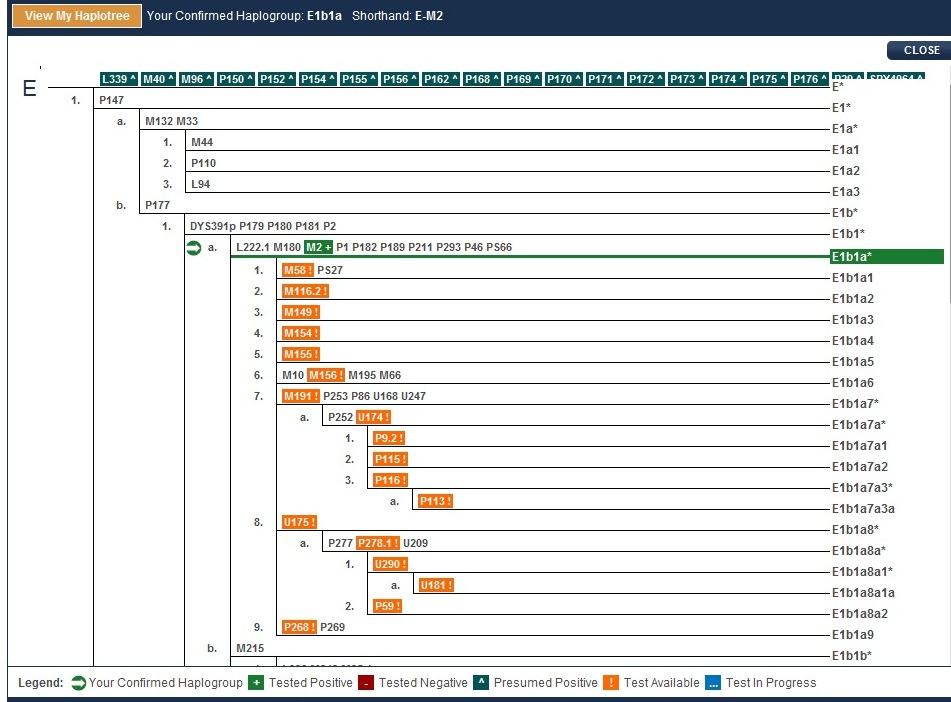
The haplogroup E1b1a, which is the core haplogroup of this project, as opposed to brother haplogroup E1b1b, is defined by a series of SNPs.  Each letter and number after the initial E is defined by a SNP.  So each additional letter or number makes the resulting haplogroup more specific.  More specific means more granular in both geography and time when the haplogroup, and subgroups, were born.

  • Haplogroup E, itself, is defined by L339 and 10 more “equivalent” SNPS
  • E1 is defined by P147
  • E1b is defined by P177
  • E1b1 is defined by P179 and 4 more equivalent SNPs
  • E1b1a is defined by M2 and 9 more equivalent SNPs

In the haplotree, there was a big split between E1b1a, which is Sub-Saharan African and E1b1b, which is North African/Mediterranean, known colloquially as the Berber haplogroup.  Therefore, two separate projects make sense.

The project is officially known as the E1b1a-M2 project.  M2 is what is known at the “terminal SNP,” meaning the one furthest down the tree that defines E1b1a.

On the haplotree above, you can see the lighter green M2+ SNP that was tested to confirm that this person was indeed in haplogroup E1b1a.  The plus means that they have the SNP.  If they didn’t have this SNP, then they would not be in this subgroup of haplogroup E1b1.

The orange SNPs listed below the E1b1a branch, on the haplotree above, are all of the SNPs available to be tested to see if you are in those haplogroup subgroups.  Want to know which branch is yours?  If so, then now you know why you’d want to test.

Let’s look at the project map to see why you might want to determine a subhaplogroup.

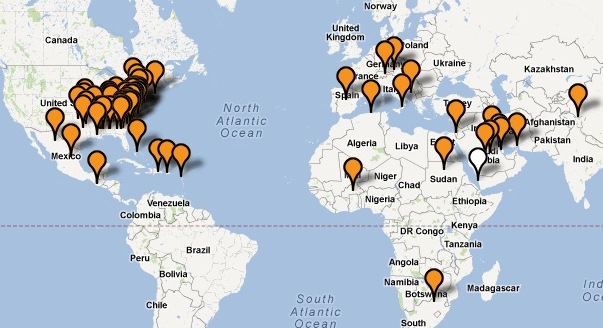
The map below shows the entire E1b1a project with all of the participants.

Do you see all of those people in the Americas?  Well, those are participants who are people of African heritage who very much would like to see their balloon in the African continent, not on the shores of the Americas.  The only way to determine where these people originated in Africa is to do the research that will connect the dots genetically, because we can’t do it via paper records, to where their ancestors lived in Africa.

In order to do this, people need to take SNP tests for specific markers so that their results can be correlated with African groups.  Tests for individual SNPs are only $29 each, so really quite inexpensive for the benefit you, and science, receive.

Aaron, the haplogroup E1b1a geneticist, has divided the participants into groups, and using his expertise, has determined which individual SNPs are the most beneficial.  A Deep Clade test is $139, but generally, Aaron can tell which subgroup people are likely to fall into, so he requests just a SNP or two.  You can test a lot of individual SNPS for $139.  Additionally, sometimes Family Tree DNA makes SNPs available for research testing that are not on the price list yet, and the only way to get these tested is via what is called “boutique testing,” where you order one at a time, through the haplogroup administrator.

When Aaron sees someone who would benefit from this kind of test, he e-mails the person and asks them if they will take the specific SNP test.

Let’s look at an example.

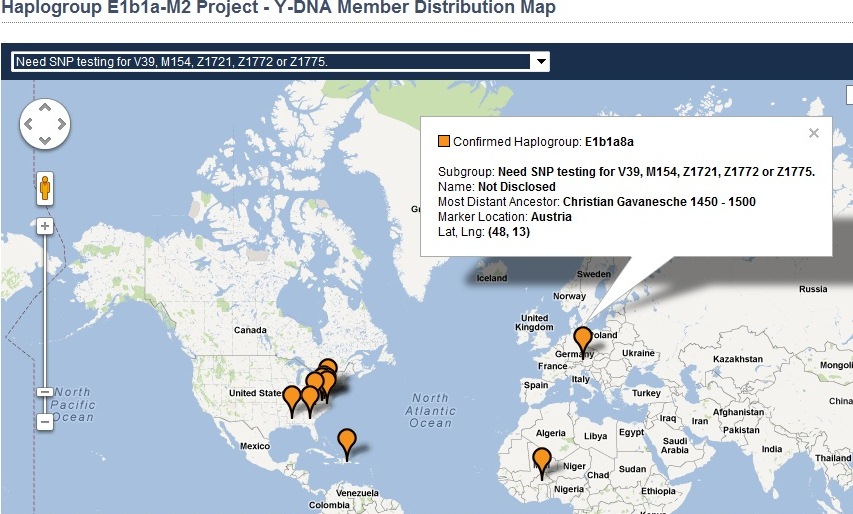
We have a very, very interesting situation where we have a man whose ancestral line is confirmed to be from Austria.  This is highly unusual, as E1b1a is very clearly African and is seldom to never found in Europe ancestrally.  However, this genealogy is well documented.

You can see on the above map that Aaron has grouped a number of people together whose DNA has similar characteristics, meaning groups and values of markers.  He wants all of these people to take specific SNP tests, which you can see on the drop down box as the title of the group.  This is standard practice for haplogroup project administrators.

On the map, you can see where these participants’ oldest ancestors are found. One in Austria, one in Africa and the rest in the Americas who are brick walled.

This map shows project participants.  In order to look at where the research papers place these people ancestrally using genetic information, we need to use a different tool.

We don’t know the African location origins of this particular group of people, which is why these SNP tests are so critically important.  We need to match them in research data bases with other people who have these same SNPs.

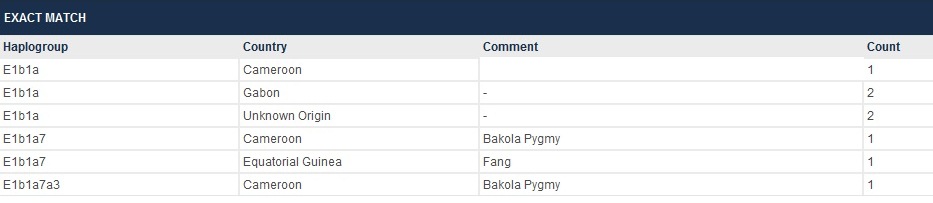
Let’s look at the haplogroup origins of someone within a different subgroup of E1b1a who is also brickwalled in the US. Shown below is the Haplgroup Origins chart from their personal page, showing their matches.

You can see that several haplogroup matches, progressively more detailed (E1b1a to E1b1a7 to E1b1a7a3), have origins in Africa.  The more detailed your SNP test, the more detailed your haplogroup, the more detailed and specific your location can and will be, if not today, then eventually.

You can see above that this person, who has only tested to the E1b1a level, matches an E1b1a7a3 individual who is from the Bakola Pygmy tribe in Cameroon.   If this person were to take the SNP tests, they would know if they too are haplogroup E1b1a7a3.  If so, there is a very good possibility they too are a descendant of the Bakola Pygmy tribe in Cameroon. This is extremely powerful information for someone searching for their roots – the Holy Grail of genetic genealogy.  But they will never know if they don’t SNP test, either by individual SNPs ($29 or $39 each) or the Geno 2.0 test ($199).

If you’re lucky, the research on your particular SNP location in Africa has already been done.  But you’re never too late to this party, because as new SNPs are discovered, there are always new opportunities to test.  That’s the ying and the yang of pushing the frontiers of science.

We are REALLY fortunate, because we live in a time where we can be participants in scientific discovery that not only helps us find your our own ancestors, but helps many others who are brick walled with no other hope of finding their ancestral homeland.  This doesn’t just apply to the African haplogroups, but to all haplogroups.  This is exactly how the revolutionary discoveries of the past few months and years that led to the new Geno 2.0 test came about.  One person and one SNP test at a time.

Want to find your ancestors AND make science happen???  SNP test!

This is a companion article to Where is my Haplogroup From?

______________________________________________________________

Disclosure

I receive a small contribution when you click on some of the links to vendors in my articles. This does NOT increase the price you pay but helps me to keep the lights on and this informational blog free for everyone. Please click on the links in the articles or to the vendors below if you are purchasing products or DNA testing.

Thank you so much.

DNA Purchases and Free Transfers

Genealogy Services

Genealogy Research