Out of Eden – Retracing the Steps of Humanity

So how long would it take a human, today, to walk the path that humanity traveled? Paul Salopek, a prize-winning journalist, (including a Pulitzer for his article about the Human Genome Diversity Project) and National Geographic fellow is going to find out, if it’s even possible.

According to Paul’s calculations, it will take him about 7 years to walk from the Garden of Eden, Herto Bouri, a village in Ethiopia’s Middle Awash valley, which has the longest and most continuous record of human evolution of any place on Earth, to the southern-most tip of South America. Paul left yesterday, January 10, 2013, so only another roughly 6 years and 364 days until his arrival. But then again, I’m thinking it’s not so much about the destination as the journey.

The map, below, released by National Geographic, documents the path Paul will take.

Pauls map

This same path, taken in essence by ancient humans, took 30,000 to 40,000 years, depending on the timeframe used for humans leaving Africa and arriving at the tip of South America. Of course, they didn’t have a nifty map, most of them didn’t make it, as the path then was entirely by trial and error. What Paul will accomplish in 7 years, it took ancient people between 1200 and 1600 generations to complete.

You can read more about Paul’s journey and see some great National Geographic photos at this link: http://news.yahoo.com/man-begins-7-walk-path-ancient-humans-170907164.html

Better yet, you can follow his progress at this link: http://www.outofedenwalk.com/
Click on the “follow” tab to sign up for e-mail notifications when Paul posts something interesting.

Under “The Storytelling” tab, be sure to watch the short video about Paul’s inspiration for making this epic journey.

______________________________________________________________

Disclosure

I receive a small contribution when you click on some of the links to vendors in my articles. This does NOT increase the price you pay but helps me to keep the lights on and this informational blog free for everyone. Please click on the links in the articles or to the vendors below if you are purchasing products or DNA testing.

Thank you so much.

DNA Purchases and Free Transfers

Genealogy Services

Genealogy Research

Decoding and Rethinking Neanderthals

decod neanderthal 1

On January 9, 2013, PBS ran a wonderful documentary, Decoding Neanderthals, about Neanderthals, what we have recently discovered about them, and what it means to us as humans. There has been a lot of discussion about this topic spurred by both the 23andMe and the Geno2.0 tests that provide a percentage of Neanderthal to participants. Geno2.0 also provides a percentage of Denisovan.

Program Description:
Over 60,000 years ago, the first modern humans—people physically identical to us today—left their African homeland and entered Europe, then a bleak and inhospitable continent in the grip of the Ice Age. But when they arrived, they were not alone: the stocky, powerfully built Neanderthals had already been living there for hundreds of thousands of years. So what happened when the first modern humans encountered the Neanderthals? Did we make love or war? That question has tantalized generations of scholars and seized the popular imagination. Then, in 2010, a team led by geneticist Svante Paabo announced stunning news. Not only had they reconstructed much of the Neanderthal genome—an extraordinary technical feat that would have seemed impossible only a decade ago—but their analysis showed that “we” modern humans had interbred with Neanderthals, leaving a small but consistent signature of Neanderthal genes behind in everyone outside Africa today. In “Decoding Neanderthals,” NOVA explores the implications of this exciting discovery. In the traditional view, Neanderthals differed from “us” in behavior and capabilities as well as anatomy. But were they really mentally inferior, as inexpressive and clumsy as the cartoon caveman they inspired? NOVA explores a range of intriguing new evidence for Neanderthal self-expression and language, all pointing to the fact that we may have seriously underestimated our mysterious, long-vanished human cousins.

I’m going to share some of the highlights of the program, but this is in no way a spoiler, as the program contains lots of visual information that just can’t be conveyed by a review.

Chris Stringer from the Natural History Museum in London introduced us to the Neanderthals. It turns out that our perception of what a Neanderthal looks like is a result in large part of skeleton that was reconstructed improperly due to advanced arthritis, causing the individual to appear to walk hunched over, much like, well, our stereotypical view of a caveman. Just goes to show what bad PR can cause.

neanderthal skull

Neanderthal skeletons can be positively identified. Their facial structure is different than that of modern man, with an identifiable brow ridge and bones that push forward in the nose and mouth region, as compared to our flatter faces today.

Neanderthals lived a short life, most were dead by age 30. They were large and strong. They participated in up-close and personal hunting, using spears, which meant they had to come in close contact with their prey.

Neanderthals began living in Europe about 300,000 years ago, having exited from Africa. They evolved to fit the European, colder, climate. It had been thought up until recently that they lacked the brainpower of humans, had no spoken language, or the ability for such, no personal ornamentation, art or evidence of ritual or religion. These are the functions that make us uniquely human and separate us from the non-human world, and we fully believed that Neanderthals lacked these defining characteristics.

We have learned differently, much as a result of genetic discoveries that tell a different story of Neanderthals.

Homo sapiens left African about 40,000 years ago, and within 10,000 years, Neanderthals, who had spread throughout most of Europe and much of Asia were gone. The map below shows the locations where fossilized Neanderthal remains have been found.

decod neanderthal 3

The assumption has been made that Homo Sapiens were responsible for the Neanderthals demise, either by killing them off or providing too much competition for scarce resources, outnumbering them 10 to 1.

decod neanderthal 4

Svante Paabo, a Swedish geneticist now at the Max Planck Institute for Evolutionary Anthropology forever changed the genetic world, how we perceive Neanderthals, and paradoxically, how we think of ourselves.

Pääbo is known as one of the founders of paleogenetics, a discipline that uses the methods of genetics to study early humans and other ancient populations.

In August 2002, Paabo published findings about the “language gene”, FOXP2, which is lacking or damaged in some individuals with language disabilities. This research would prove critical, later, in the humanization of the Neanderthal.

In 2006, he announced a plan to reconstruct the entire genome of Neanderthals. In 2007, Pääbo was named one of TIME Magazine’s 100 most influential people of the year.

In February 2009, at the Annual Meeting of the American Association for the Advancement of Science (AAAS), it was announced that the Max Planck Institute for Evolutionary Anthropology had completed the first draft version of the Neanderthal genome. Over 3 billion base pairs were sequenced in collaboration with the 454 Life Sciences Corporation. This project, led by Pääbo, shed and will continue to shed new light on the recent evolutionary history of modern humans.

In March 2010, Pääbo and his coworkers published a report about the DNA analysis of a finger bone found in the Denisova Cave in Siberia; the results suggest that the bone belonged to an extinct member of the genus Homo that had not yet been recognized, the Denisova hominin.

In May 2010, Pääbo and his colleagues published a draft sequence of the Neanderthal genome in the journal Science. Below, a scientist at Max Plank extracting Neanderthal DNA.

decod neanderthal 5

Paabo shared in the program that many times during the Neanderthal sequencing project, he himself “despaired many times of being able to do it”, doubting that it could be done. It took a total of 4 years. The team found good candidates, 3 well-preserved female bone fragments from the Vindija Cave in Croatia.

decod neanderthal 6

Because of the age of the fragments, and because they had been in the ground for so long, much of the DNA recovered wasn’t Neanderthal, but that of bacterial organisms and fungus. The team developed a method to eliminate the bacteria, leaving only Neanderthal DNA. However, those genetic fragments still had to be reassembled, piece by piece, like a huge jigsaw puzzle with no picture on the box, into the Neanderthal genome.

Four long years later, the puzzle was finished. I hope the team had a very big celebratory party!

Ed Green, a scientist on Paabo’s team said that the first thing the scientists looked for was to determine whether or not Neanderthals had the FOXP2 gene for language, and if so, is it identical to the human version, or is it different. The answer was that it was identical to the language gene carried by Homo Sapiens, modern humans. This tells us not only that Neanderthals had the capabilities for language, but that this gene evolved in Africa, before Neanderthals left, 300,000 years ago.

The next question, of course, was whether or not modern humans carried any DNA that could be labeled as Neanderthal. In other words, the question of inter-species breeding arose. It was believed that this was impossible, because two different species cannot have fertile offspring. This was proven to be an inaccurate assumption relative to Neanderthal and Homo Sapiens.

Paabo’s team sequenced the DNA of 5 individuals from different parts of the world. They isolated parts of the Neanderthal DNA that were measurably different from that of modern humans. In other words, those sequences could be positively identified as Neanderthal. Compared against the DNA of the 5 contemporary individuals, only the person from Africa had none of the Neanderthal DNA.

Paabo didn’t believe the results, thought they might be an artifact of statistical error or the result of not enough data, so he had his team repeat the exercise with different people, again, and again, and again, and every time, the results came back the same. Neanderthals and humans inbred, and to the degree that there is Neanderthal DNA in every population on every continent outside of Africa today.

John Hawks, an anthropologist at the University of Wisconsin used jelly beans to illustrate Neanderthal DNA in worldwide populations today. It turns out that the Chinese have the least amount, with about 1% and the people of Tuscany have the most, with about 4%. So the mountainous areas of Europe and Italy were a hotbed of Neanderthal activity and human interbreeding.

This caused other experts to think again about the Neanderthals in what could be called a radical shift in perspective. All of a sudden, when we realized that they were part of us, they became more human to us. They could and probably did have speech, so they could and probably did other “human” things too.

Joao Zilhao, a paleolithic archaeologist at the University of Bristol, also a flintknapper, spent years reconstructing the process of making Neanderthal tools, what were once believed to be scraps of flint with sharp edges. He proved, among other things, that obtaining these “scraps” involved a complex process of very specific flintknapping strokes. This skill was far from the previously perceived unintelligent caveman, and furthermore, it likely required language instruction.

neanderthal tools

Another early technology, in use 250,000 years ago, involved a complex process to create a type of pitch to secure spearheads to spear shafts.

The Neanderthals began evolving before our very eyes.

Michael Walker, a professor of Zoology and Physical Anthropology at the University of Murcia, discovered indeed that Neanderthals likely did have ceremony and ritual, the hallmarks of religion, which involved the ability for complex thought and reasoning. Shells and bones, drilled or punched to be worn as ornaments have been identified, along with pigments believed to have been used as body paints.

We still do this today; look at the fans at any football game.

In addition, it appears that a burial may have been found in Spain, along with two panther paws. Michael mentioned them as a trophy, I thought more in terms of spiritual significance.

John Hawks discussed what the Neanderthal parts of our genome have done for humans. Many of the Neanderthal genes have no known purpose, but there is one significant exception. It’s somehow ironic that we may indeed have survived as a species in a foreign environment, colder Europe, thanks to inbreeding with the Neanderthals. Humans carry a very specific Neanderthal piece of DNA that is essential to the immune system’s ability to attack viruses and bacteria, the HLA or Human Leukocyte Antigen. Because individuals who carried HLA might well have survived when others didn’t, the HLA became naturally selected for, and therefore present in the descendant population, us, “saving lives to this day.’

As John said, we are just beginning to understand our debt to the Neanderthals. Not only that, we also are rethinking what extinction really meant. We have presumed that Neanderthals went extinct, or died out, because we could no longer find their remains in fossil evidence. Perhaps, as Mark Twain said “reports of my demise have been greatly exaggerated.”

Is the reason we could no longer find separate Neanderthals because they interbred and assimilated into the Homo Sapiens population who were probably the dominant species, outnumbering them ten to one? Was their extinction not a dying out at all, but an absorption? Perhaps that was simply the natural progression of things, or maybe they realized that their recipe for success, for long-term survival, was not to remain separate, but to become part of the larger population. In fact they do survive today in just that way, as a part of all of us outside of Africa.

Decoding Neanderthals is available to watch online at http://www.pbs.org/wgbh/nova/evolution/decoding-neanderthals.html

______________________________________________________________

Disclosure

I receive a small contribution when you click on some of the links to vendors in my articles. This does NOT increase the price you pay but helps me to keep the lights on and this informational blog free for everyone. Please click on the links in the articles or to the vendors below if you are purchasing products or DNA testing.

Thank you so much.

DNA Purchases and Free Transfers

Genealogy Services

Genealogy Research

Autosomal Testing Comparison

Currently, there are four different entities, 3 corporations and a nonprofit, that test autosomal DNA using the newest technology, the Illumina chip.  There are different features and functions of each one.

I am describing them below in broad terms, and including links to articles where I and others have discussed their autosomal products.

23andMe – The first company to enter the chip based world of genetic processing by introducing a health traits and genealogy product that provided genealogists with cousin matches and percentages of ethnicity.  They provide raw data files that can be downloaded and then uploaded to Family Tree DNA and GedMatch.  In December 2012, after a significant capital investment, they dropped the price of their autosomal product to $99 with a goal to reach one million customers as a result.  They currently have about 180,000.

http://dna-explained.com/2012/12/07/new-worldview-at-23andme/

Family Tree DNA – Clearly the leader in genetic genealogy testing, they offer the Family Finder test using the same chip based platform as 23andMe.  Customers of 23andMe can upload their raw data file to Family Tree DNA for $89, effectively allowing them to fish in both pools for cousin matches and to obtain the ethnicity predictions from both companies.  Family Tree DNA provides raw data files and numerous tools to assist the genealogist, including integrated searching of autosomal, Yline and mitochondrial matches.  The Family Tree DNA Family Finder product is currently $199.  Family Tree DNA customers are generally interested in genealogy, while 23andMe clients are often only interested in the health traits aspect of their test.

http://dna-explained.com/2012/10/14/what-to-order-geno-2-0-vs-family-tree-dna-products/

Ancestry – Ancestry introduced their AncestryDNA test in early 2012 by initially giving away tests, then selling tests for the reduced price of $99 to build their autosomal data base.  Today, the tests range from $129 to $199 depending on whether or not you have an Ancestry.com subscription.  Continued, complete access hinges upon maintaining a subscription at some level.  Their test reports cousin matches and percentages of ethnicity.  If your matches have attached their genealogy, and it’s not marked private, you can see if you share common ancestors by viewing their tree.  Ancestry’s ethnicity predictions have significant issues, they provide no autosomal tools, such as a chromosome browser for cousin matching and they do not provide your raw data to download, although they have said they will provide that sometime in 2013.

http://dna-explained.com/2012/10/24/ancestrys-mythical-admixture-percentages/

http://dna-explained.com/2012/09/10/ancestry-autosomal-results-are-back/

http://www.isogg.org/wiki/AncestryDNA

National Geographic Genographic 2.0 – The latest autosomal test to be released is focused somewhat differently that the other tests.  This test looks more at deep ancestry using the discoveries made within the Genographic project over the past 6 years.  This test provides the deepest clade testing for the Y chromosome available from any test at any company.  It also provides ethnicity percentages based on many newly discovered SNPs not in use elsewhere.  The price is $199.

http://dna-explained.com/2012/07/25/national-geographic-geno-2-0-announcement-the-human-story/

http://dna-explained.com/2012/07/26/geno-2-0-qa-with-bennett-greenspan/

http://dna-explained.com/2012/07/30/geno-2-0-answers-from-spencer-wells/

http://dna-explained.com/2012/12/11/geno-2-0-results-first-peek/

http://dna-explained.com/2012/12/12/geno-2-0-results-kicking-the-tires/

In addition, Debbie Kennett has added a wiki page about comparing autosomal testing companies in the ISOGG Wiki at:

http://www.isogg.org/wiki/Autosomal_DNA_testing_comparison_chart

Thanks Debbie for your efforts to help everyone!

______________________________________________________________

Disclosure

I receive a small contribution when you click on some of the links to vendors in my articles. This does NOT increase the price you pay but helps me to keep the lights on and this informational blog free for everyone. Please click on the links in the articles or to the vendors below if you are purchasing products or DNA testing.

Thank you so much.

DNA Purchases and Free Transfers

Genealogy Services

Genealogy Research

2012 Top 10 Genetic Genealogy Happenings

2012 has been a very busy year for genetic genealogists.  There have been lots of discoveries and announcements that affect everyone, now and in the future.  The watchwords for 2012 would be “churn” and “explosive growth.”  Let’s take a look at the 10 most important events, why they are important and what they mean for the future of genetic genealogy.

These items are in what I think are relatively good order, ranked by their importance, although I had a very difficult time deciding between number 1 and 2.

1. The New Root – Haplogroup A00

At the Family Tree DNA conference in November, Michael Hammer, Bonnie Schrack and Thomas Krahn announced that they had made a monumental discovery in the age of modern man known as Y-line Adam.  The discovery of Haplogroup A00 pushes the “birth” of mankind back from about 140,000 years ago to an amazing 338,000 years ago.  Utterly amazing.  The DNA came from an American family from South Carolina.  This discovery highlights the importance of citizen science.  Bonnie is a haplogroup administrator who recognized the potential importance of one of her participants’ DNA.  Thomas Krahn of course is with Family Tree DNA and ran the WTY test, and Michael Hammer is at the University of Arizona.  So you have the perfect blend here of participant, citizen scientist, commercial lab and academia.  What was never thought possible a decade or so ago is not only working, it’s working well and changing the face of both science and humanity.

http://dna-explained.com/2012/11/16/the-new-root-haplogroup-a00/

http://www.haplogroup-a.com./

2. Geno 2.0

Geno 2.0 is the Nickname for the National Geographic Society’s Genographic Project version 2.0.  That mouthful is why it has a nickname.

This amazing project has leveraged the results of the past 7 years of research from the original Genographic project into a new groundbreaking product.  Geno 2.0, utilizing the GenoChip, a sequencing chip created specifically for Nat Geo, offers the most complete Y tree in the world today, expanding the SNP tree from just over 800 SNPs to over 12,000.  They are in essence redrawing the Y chromosome tree as I write this.  In addition, the person who purchases Geno 2.0 will receive a mitochondrial DNA haplogroup assignment.  Over 3300 new mitochondrial mutations were discovered. A brand new anthropological “percentages of ethnicity” report is featured based on over 75,000 Ancestry Informative Markers, many only recently discovered by the Genographic project.  Additionally, participants will receive their percentage of both Neanderthal and Denisovan ancestry based on 30,000 SNPs identified that signal interbreeding between the hominids.  A new website will also facilitate social networking and uploading information to Family Tree DNA.

The wonderful news is that there is a massive amount of new information here that will change the landscape of genetic genealogy.  The difficulty is that we are struggling a bit under the load of that massive amount of information that is just beginning to descend upon us.  It’s a great problem to have!

http://dna-explained.com/2012/07/25/national-geographic-geno-2-0-announcement-the-human-story/

http://dna-explained.com/2012/07/26/geno-2-0-qa-with-bennett-greenspan/

http://dna-explained.com/2012/07/30/geno-2-0-answers-from-spencer-wells/

http://dna-explained.com/2012/07/31/geno-2-0-wty-mtdna-full-sequence-participants-and-more/

http://dna-explained.com/2012/10/14/what-to-order-geno-2-0-vs-family-tree-dna-products/

http://dna-explained.com/2012/10/16/geno-2-0-the-kit-arrives/

http://dna-explained.com/2012/12/11/geno-2-0-results-first-peek/

http://dna-explained.com/2012/12/12/geno-2-0-results-kicking-the-tires/

3. Reconstructed Sapiens Reference Sequence (RSRS)

In July, Family Tree DNA implemented the RSRS that in effect reconstructs the genetic profile of Mitochondrial Eve and bases the comparison of our DNA today against the RSRS sequence as opposed to the Cambridge Reference Sequence (rCRS) created in 1981 that is or was the current standard.  The RSRS is a result of the watershed paper published in April 2012 by Dr. Doron Behar and 8 other authors titled “A “Copernican” Reassessment of the Human Mitochondrial DNA Tree from its Root.”  A complementary research website, www.mtdnacommunity.org, accompanies the paper.

http://dna-explained.com/2012/07/14/what-happened-to-my-mitochondrial-dna/

http://dna-explained.com/2012/07/15/the-crs-and-the-rsrs/

http://dna-explained.com/2012/07/16/the-mtdna-community/

http://dna-explained.com/2012/12/02/little-a-big-a-mitochondrial-dna/

4. Full Genome and Exome Sequence Offered Commercially by Gene by Gene

It was announced at the November DNA conference that Gene by Gene, the parent company of Family Tree DNA, through their division titled DNA DTC is offering full genomic sequencing for the amazing price of $5495 for the full genome and $695 for the exome.  This is a first in the consumer marketspace.  Today, this doesn’t have a lot of application for genetic genealogy, but as the price continues to drop, and utilities are built to process the full genomic data, certainly a market and applications will emerge.  This is an important step forward in the industry with a product that still cost 3 million dollars in 2007.

http://dna-explained.com/2012/11/30/gene-by-gene-announces-landmark-dna-dtc-full-genome-sequence/

5. Neanderthal and Denisovan DNA

It’s official – they did it.  Yep, they interbred and well, they are not them anymore, they are us.  Given that everyone in Asia and Europe carries a part of them, but not people from Africa, it would appear that two populations admixed rather thoroughly in Eurasia and/or the populations were small.  The amount of Neanderthal and Denisovan DNA will continue at approximately the proportions seen today in Europe (2% Neanderthal) and Asia unless a significant amount of admixture from a population (Africa) that does not carry this admixture is introduced.  So if you’re European, you carry both Neanderthal and Denisovan DNA.  They are your ancestors.  The good news is that you can find how much of each through  the Geno 2.0 test.  23andMe results give you the percentage of Neanderthal, but not Denisovan.

http://dna-explained.com/2012/08/31/denisovan-dna-tells-a-story/

http://dna-explained.com/2012/12/12/geno-2-0-results-kicking-the-tires/

6. Ancestral Genome Reconstruction Begins,  Led by Falling Autosomal Prices and the Ability to Fish in Multiple Ponds

2012 has been the year of autosomal testing price reductions and a great deal of churn in this marketspace.  Companies are playing leap-frog with one another.  However, sometimes things are not all that they seem.

Initially, 23andMe opted for an initial payment plus monthly subscription model, which they abandoned for a one time payment price of $299 in early 2012.  Family Tree DNA was slightly less, at $289.

Ancestry led the price war by giving away kits, then selling them for $99, then $129 plus a subscription as an entrance into this market.  However, looking at the Ancestry consent form hints at possible reasons why they were selling below the cost of the tests.  You are in essence giving them permission to sell your DNA and associated information.  In addition, to gain full access to your results and matches, you must maintain some level of subscription to Ancestry.com, increasing the total effective price.

Next came Family Tree DNA’s sale where they dropped their autosomal price to $199, but they were shortly upstaged by 23andMe whose price has now dropped to $99 permanently, apparently, a result of a 50 million dollar investment in order to reach 1 million customers.  They currently have about 180,000.  23andMe has always been in the medical/health business, so their clients have always understood what they were consenting to and for.

Not to be outdone, Family Tree DNA introduced the ability earlier in 2012 to upload your data files from 23andMe to FamilyTree DNA for $89, far less than a second test, which allows you to fish in a second pond where genealogists live for matches.  The challenge at 23andMe is that most of their clients test for the health traits and either don’t answer inquiries or match requests, or know little about their genealogy if they do.  At Family Tree DNA, matches don’t have to answer and allow a match, testers are automatically matched with all participants who take the Family Finder test (or upload their 23andMe results) and testers are provided with their matches’ e-mail address.

Of course, Geno 2.0 was also introduced in the midst of this, in July, for $199 with the additional lollipop of new SNPS, lots of them, that others simply don’t have access to yet.

The good news is that consumers have benefitted from this leapfrogging, I think.  Let’s hope that the subsidized tests at Ancestry and 23andMe don’t serve long term to water down the demand to the point where unsubsidized companies (who don’t selling participants genetic results to others) have problems remaining viable.

Personally, I’ve tested at all of these companies.  I’ll be evaluating the results shortly in detail on my blog at www.dna-explained.com.

The tools provided by most testing companies, plus GedMatch, and multiple ponds to fish in are allowing the serious genetic genealogist to “reconstruct” their genome, attributing segments to specific ancestors.  Conversely, we will also be able to “reconstruct” specific ancestral family lines as well by identifying autosomal segments in multiple descendants.  This new vision of autosomal genetic genealogy will allow much more accurate ancestral line matching, and ancestor identification in the not-so-distant future.

http://www.yourgeneticgenealogist.com/2012/01/family-tree-dna-now-accepting-23andme.html

http://www.yourgeneticgenealogist.com/2012/05/23andme-eliminates-subscription-model.html

http://www.yourgeneticgenealogist.com/2012/10/clarification-of-what-is-available-to.html

http://www.yourgeneticgenealogist.com/2012/12/23andme-receives-50-million-and-drops.html

http://www.thegeneticgenealogist.com/2012/12/26/23andme-and-labcorp-sued-for-patent-infringement/

7. Ethnicity Tests Mature – Minus 1

The good news is that the various ethnicity tests (known as BGA or biogeographical ancestry tests) that provide participants with their percentages of various world populations are improving.  The bad news is that there is currently one bad apple in the card with very misleading percentages – and that is Ancestry.com.

23andMe introduced a new version of their ethnicity product in December, expanding from only 3 geographic categories to several.  The Geno 2.0 test results are just beginning to be returned which include ethnicity predictions and references to several base populations.

Family Tree DNA finally has some competition in this arena where for years they have been the only serious player, although opinions differ widely about which of these three organizations results are the most accurate.  All four are Illumina chip based, using hundreds of thousands of locations, as compared with the previous CODIS type tests which used between 15 and 300 markers and are now outdated.  All companies use different reference populations which, of course, provide somewhat different results to participants.  All companies, except Ancestry, have documented and shared their reference population information.

Outside of these companies, Doug McDonald offers a private analysis and Gedmatch offers a series of BGA comparisons written by third parties.

While this industry continues to grow and mature, I’m thinking about just averaging the autosomal ethnic results and calling it good:)

http://dna-explained.com/2012/07/21/ethnicity-finders/

http://dna-explained.com/2012/10/24/ancestrys-mythical-admixture-percentages/

http://dna-explained.com/2012/12/07/new-worldview-at-23andme/

http://dna-explained.com/2012/09/09/doug-mcdonald-on-biogeograpical-analysis/

http://dna-explained.com/2012/12/11/geno-2-0-results-first-peek/

http://www.yourgeneticgenealogist.com/2012_12_01_archive.html

8. Finding Your Roots PBS Series with Henry Louis Gates

PBS sponsored a wonderful series in the spring of 2012 hosted by Henry Louis “Skip” Gates, the chair of African American Studies at Harvard.  This series followed a lesser known 2010 series.  The 2012 inspirational series reached tens of thousands of people and increased awareness of genetic genealogy as well as sparked an interest in genealogy itself, especially for mixed race and African American people.  I was disappointed that the series did not pursue the Native American results unexpectedly obtained for one participant.  It seemed like a missed opportunity.  Series like this bring DNA testing for genealogy into the mainstream, making it less “strange” and frightening and more desirable for the average person.  These stories were both inspirational and heartwarming.  I hope we can look forward to similar programs in the future.

http://en.wikipedia.org/wiki/Finding_Your_Roots

CeCe Moore covered this series in March and April on her blog.

http://www.yourgeneticgenealogist.com/2012/03/finding-your-roots-with-henry-louis.html

http://www.yourgeneticgenealogist.com/2012/04/finding-your-roots-with-henry-louis.html

http://www.yourgeneticgenealogist.com/2012/04/finding-your-roots-with-henry-louis_09.html

http://www.yourgeneticgenealogist.com/2012/04/finding-your-roots-with-henry-louis_16.html

http://www.yourgeneticgenealogist.com/2012/04/finding-your-roots-with-henry-louis_23.html

http://www.yourgeneticgenealogist.com/2012/04/finding-your-roots-with-henry-louis_30.html

9. Ancestry, GeneTree and Sorenson

GeneTree, a for profit company and Sorenson, a non-profit company were both purchased by Ancestry.com.  This was about the same time as Ancestry introduced their autosomal AncestryDNA product.  Speculation was that the autosomal results at Sorenson might be the foundation for the new autosomal test comparisons, although there has been no subsequent evidence of this.

Ancestry initially gave away several thousand kits in order to build their data base, then sold thousands more for $99 before raising the price to what appears to be a normalized price of $129 plus an annual ancestry subscription.

While GeneTree was never a major player in the DNA testing marketspace, Sorenson Molecular Genealogical Foundation played an important role for many years as a nonprofit research institute.  There was significant distress in the genetic genealogy community related to the DNA contributed to Sorenson for research being absorbed by Ancestry as a “for profit” company.  Ancestry is maintaining the www.smgf.org website, but no additional results will be added.  Sorenson has been entirely shuttered.  Many of the Sorenson/GeneTree employees appear to have moved over to Ancestry.

The initial AncestryDNA autosomal product offering is poor, lacks tools and the ethnicity portion has significant issues. It’s strength is that many people who test are already Ancestry subscribers and have attached their trees.  So you can’t see how you connect genetically to your matches (lack of tools), but you can see the trees, if they are attached and not marked as private, of those with whom you match.  Ancestry provides “hints” relative to matching individuals or surnames.

Eventually, if Ancestry improves its products, provides tools and releases the raw data to consumers, this may be a good thing.  It’s an important event in 2012 because of the massive size of Ancestry, but the product is mediocre at best.  Ancestry seems unwilling to acknowledge issues unless their feet are held to the fire publicly as illustrated with a “lab error” erroneous match for an adoptee caught by the consuming public and ignored by Ancestry until CeCe Moore exposed them in her blog.  Whether Ancestry ultimately helps or hurts the genetic genealogy industry is a story yet to be told.  There is very little positive press in the genetic genealogy community surrounding the Ancestry product, but with their captive audience, they are clearly going to be a player.

http://www.yourgeneticgenealogist.com/2012/05/ancestrycom-buys-genetree-and-launches.html

http://dna-explained.com/2012/07/12/did-you-test-at-genetree/

http://dna-explained.com/2012/08/30/is-history-repeating-itself-at-ancestry/

http://dna-explained.com/2012/07/18/the-trouble-with-ancestry-com-matches/

http://dna-explained.com/2012/08/14/y-dna-family-tree-dna-vs-ancestry/

http://dna-explained.com/2012/08/16/ancestrys-consent-form-for-ancestrydna-autosomal-test/

http://dna-explained.com/2012/09/10/ancestry-autosomal-results-are-back/

http://dna-explained.com/2012/10/15/ancestrys-dna-survey/

http://dna-explained.com/2012/10/23/ancestry-to-release-array-data-in-2013/

http://dna-explained.com/2012/10/24/ancestrys-mythical-admixture-percentages/

http://www.thegeneticgenealogist.com/2012/06/19/problems-with-ancestrydnas-genetic-ethnicity-prediction/

http://www.yourgeneticgenealogist.com/2012/08/ancestrydna-confusing-relationship.html

http://www.yourgeneticgenealogist.com/2012/08/follow-up-on-ancestrydna-and-adoptees.html

http://www.yourgeneticgenealogist.com/2012/09/23andme-says-no-match-for-adoptees.html

10. GedMatch

GedMatch, www.gedmatch.com, created by John Olson and Curtis Rogers, isn’t new in 2012, but it’s maturing into a tool that is becoming the defacto workhorse of the serious autosomal community.  People who test at either 23andMe or Family Tree DNA download their raw results and other match information and then use a variety of tools at GedMatch to look at results in different ways and using different thresholds. GedMatch is currently working to accept the newly arriving Geno 2.0 data files.  Ancestry does not at this time allow their customers access to their raw data files, so there is nothing to upload. The bad news is that not everyone downloads/uploads their information.  Only the most savvy users, and the download/upload is not always a smooth process, often necessitating several attempts, a magic wand and some fairy dust for luck.

GedMatch is a volunteer effort funded by donations on the GedMatch site.  The magnitude of this project came to light when they needed new servers this year because the amount of traffic disabled their internet service provider.  It may be a volunteer effort, but it has mainstream requirements.  Therefore, while occasionally frustrating, it’s easy to understand why it’s light on documentation and one has to poke around a bit to figure things out.  I would actually prefer that they make it a subscription site, clean up the bugs, add the documentation and take it to the next level.  It would also be very nice if they could arrange something with the major players in terms of a seamless data transfer for clients.  All told, it’s an amazing contribution as a volunteer site.  Hats off to Curtis and John for their ongoing contribution to genetic genealogists!!!

www.gedmatch.com

http://www.legalgenealogist.com/blog/2012/08/12/gedmatch-a-dna-geeks-dream-site/

______________________________________________________________

Disclosure

I receive a small contribution when you click on some of the links to vendors in my articles. This does NOT increase the price you pay but helps me to keep the lights on and this informational blog free for everyone. Please click on the links in the articles or to the vendors below if you are purchasing products or DNA testing.

Thank you so much.

DNA Purchases and Free Transfers

Genealogy Services

Genealogy Research

Proving Native American Ancestry Using DNA

Every day, I receive e-mails very similar to this one.

“My family has always said that we were part Native American.  I want to prove this so that I can receive help with money for college.”

The reasons vary, and not everyone wants to prove their heritage in order to qualify for some type of assistance.  Some want to find their tribe and join to reclaim their lost heritage.  Some want to honor their persecuted and hidden ancestors, undoing some of the wickedness of the past, and some simply seek the truth.  Regardless of why, they are all searching for information lost to them.

I’d like to talk about three topics in proving Native Ancestry.  First, I’d like to do some myth-busting.  Second, I’d like to talk a little about conventional research and third, I’d like to discuss what DNA can, and can’t, do for you.

As you read this blog, please click on the links.  I’m not going to repeat something I’ve already covered elsewhere.

Myth-Busting

Myth 1 – Free College

There is no free college for Native Americans.  There are sometimes scholarships and grants available, mostly by the individual tribes themselves, for their official members.

Myth 2 – Joining a Tribe

Many people think that if they can only figure out which tribe their ancestor descends from, they can join.  This is untrue.  Each tribe is a sovereign nation, and they get to determine their criteria for membership.  Most tribes require a specific percentage of Native “blood,” called blood quantum, in addition to being able to document which tribal member you descend from.  Some tribes require as much as 25% Native heritage, and most require at least 1/16th Native heritage, which is one great-great grandparent.  If you don’t know who in your family was a tribal member it’s unlikely that you would be able to meet the blood quantum requirement.

Myth 3 – DNA Testing Will Reveal my Tribe

Generally, DNA testing does not provide us with the information needed to determine a tribe, although it can clearly tell, using y-line or mitochondrial DNA testing, whether your direct paternal or maternal line was or was not Native.  Sometimes you will be able to infer a tribe based on your matches and their documented history, but the definition of tribes, their names and locations have changed over time.  We are working on improving this ability, but the science simply isn’t there yet and the number of Native people who have tested remains small.

Simply put, most federally recognized tribes aren’t interested in more tribal members.  More members mean a smaller piece of the pie for existing members.  The pot of resources, whatever resources you’re discussing, is only so large and it must be shared by all tribal members.

What is a Tribe?

Tribes in the US fall into two categories.  When most people think about tribes they are talking about federally recognized tribes.  Those are tribes that have some continuity with the past, such as they have always been a tribe, or they still retain tribal lands, etc., and the federal government recognizes them as such.  These are the tribes that qualify for government programs and many own casinos.  As you might imagine, with the influx of casino money, the desire to join a tribe has increased significantly.

The second category is non-federally recognized tribes.  Some are state recognized and others, not at all.  State recognition does not in any way guarantee federal or state funding and there are no universal standards for state recognition.  In other words, your mileage may vary, widely.  Non-federally recognized tribes are often run as non-profit entities.  In many cases, these tribes will help people research and document their genealogy and may be more open to tribal membership for those connecting with their Native heritage.

Be aware that some “tribes” that fall into the non-federally recognized category may be less than ethical.  Some tend to come and go.  In one case, to apply to join, one had to provide information such as social security numbers and a complete family pedigree including your children. In some cases, membership is very expensive, hundreds of dollars, but is available to almost anyone for the right price.  When evaluating tribes that are not federally recognized, if something sounds fishy, it probably is.  Caution is the watchword.

In general, the federally recognized tribes do not feel kindly towards the non-federally recognized tribes and view them as “fake,” interlopers trying to get part of that pie.  Of course, the non-federally recognized tribes feel differently; that they are reclaiming their heritage denied them.  Native American politics is nothing new and is fraught with landmines.

No federally recognized tribes, to the best of my knowledge, have considered DNA testing as a criteria for membership.  No federally recognized tribe has endorsed or participated in DNA testing that I’m aware of.  This does not mean that individuals have not privately tested.

Traditional Genealogy Research

Given the criteria for membership in federally recognized tribes, traditional genealogy is the only way to obtain the type of information required.  If your family history includes a tribal name, and east of the Mississippi, that most often is Cherokee, contact the various Cherokee tribes to inquire about membership criteria.  If the membership criteria is 25% blood quantum, and you must live on the reservation, you’re toast…..no need to continue that line of research if your goal is to join the tribe.

If your goal is simply to find your Native ancestor, that’s another matter entirely.  Begin by using the traditional research tools.

First, look at where your ancestor or that family line was located.  Did they migrate from elsewhere?  How were they listed in the census?  Was someone listed as other than white, indicating mixed race?  Check the records where they lived, tax records and others to see if there is any indication of non-European heritage.  Remember that your non-white ancestor would have retained their “darker” countenance for at least 2 generations after being admixed.  Many Native people were admixed very early.

So first, check the normal genealogy records and look for hints and traces of non-European ancestry.

Second, turn to Native resources that might reflect the Native people in the areas where your family is or was found.  The Access Genealogy site is absolutely wonderful and has an amazingly complete set of records including searchable tribal rolls.  In addition, I add information almost daily to the Native Heritage Project at www.nativeheritageproject.com, which is searchable.  There are many more resources including several collections at Ancestry.com.

Hopefully, these records will help narrow your focus in your family tree to a particular person or two, not just a general branch.  Family rumors like “Grandma was a Cherokee Princess” are particularly unuseful.  What they more likely mean is that there was indeed some Native ancestry someplace in her line.  Cherokee has become a generic word like Kleenex.  It may also have meant that Indian heritage was claimed to cover much less desirable African heritage.  Institutionalized discrimination existed against any people of color in pre-1967 America, but Indians generally retained some rights that people of African ancestry did not.  Laws varied by state and time.  Take a look at my blog about Anti-Miscegenation Laws and when they were overturned.

Now, let’s look at DNA testing to see what it can do for you.

DNA Testing to Prove Native Ancestry

There are three types of DNA testing that you can do to prove Native Ancestry.  Two are very focused on specific family lines, and one is much more general.

  • Mitochondrial for your direct maternal line.
  • Y-line for your direct paternal line – if you are a male. Sorry ladies.
  • Autosomal to test your ethnic mix and one direct marker test for Native ancestors.

On a pedigree chart, these genealogical lines look like this:

adopted pedigree

You can see the path that the blue Y chromosome takes down the paternal line to the brother and the path the red mitochondrial DNA takes down the maternal line to both the brother and the sister.  Autosomal tests the DNA of all of the 16 ancestral lines shown here, but in a different sort of way.

Let’s look at each type of testing separately.

Y-Line DNA – For Paternal Line Testing for Males

The Y-line testing tests the Y chromosome which is passed intact from father to son with no DNA from the mother. This is the blue square on the pedigree chart. In this way, it remains the same in each generation, allowing us to compare it to others with a similar surname to see if we are from the same “Smith” family, for example, or to others with different surnames, in the case of adoption or Native heritage.  Native American genetics isn’t terribly different than adoptees in this situation, because different English surnames were adopted by various family members, into the late 1800s and sometimes into the early 1900s, depending on the location.

Y-line DNA can tell you whether or not you descend from a common male genealogically when compared to another testing participant.  Small mutations do take place and accumulate over time, and we depend on those so that we don’t all “look alike” genetically.  It can also tell you by identifying your deep ancestral clan, called a haplogroup, whether or not you descend from early Native Americans who were here before contact with Europeans.  For that matter, it can also tell you if you descend from those of African, European or Asian ancestry.

Scientists know today that there are only two primary haplogroups indicating deep ancestry that are found among Native American males who were here prior to contact with Indo-Europeans, and those haplogroups are C and Q3.  It is not accurate to say that all C and Q3 individuals exist only in the American Native population, but the American Native population is part of the larger group worldwide that comprises C and Q3.  We find some haplogroup C and Q3 in Europe but none in African populations, although we do learn more every single day in this infant science.

This sometimes becomes confusing, because the single most common male haplogroup among current Cherokee tribal members who have tested is R1b.  How can this be, you ask?  Clearly, one of three possibilities exists:

  1. The Cherokee (or those tribes who were assimilated into the Cherokee) adopted a European male into the tribe or a European male fathered a child that was subsequently raised as Cherokee.
  2. The R1b ancestor was not adopted into the tribe, maintained their European/American identity but married a Cherokee individual woman and their descendants are recognized as Cherokee today.
  3. There is some level of R1b admixture in the Native population that preceded contact with Europeans that we have not yet identified.

Because of the unique haplogroups for Native Americans who preceded European contact, Y-line is the only way to positively confirm that a specific line is or is not of Native American descent.  This obviously applies to all of the individuals in the pedigree chart who directly descend from the oldest known ancestor in this paternal line.

Y-line testing does not indicate anything about the contributions of the other ancestors in this family tree.  In other words, you could be 3/4th Native, with only the direct paternal line being European, and this test would tell you nothing at all about those other three Native lines.

When ordering DNA tests at Family Tree DNA, which is where I recommend that you test, everyone is encouraged to join projects.  There are several types of projects, but to begin with, you should join your surname project.  Not only does this group you with others whom you are likely to match, but this also assures that you receive the project based discounts.  I blogged about how to find and join relevant projects.

You can test at 12, 25, 37, 67 or 111 marker “locations” on the Y chromosome. I generally recommend 37 or 67 to begin which gives you enough to work with but isn’t terribly expensive.  At Family Tree DNA, you can always upgrade later, but it’s less expensive in total to test more initially.

Family Tree DNA provides significant tools for Y-line DNA as well as Mitochondrial DNA. At Family Tree DNA, for all their tests, you are provided with the e-mail addresses of your matches. At Ancestry and 23andMe, you contact matches through their internal message system. My experience has been that direct e-mails have a better response rate.

The person looking for Native Heritage will be most interested in their haplogroup designation.  If your haplogroup is either Q or C, you’ll want to join your haplogroup project, minimally, as well as other relevant Native American projects, and work with the administrators for further testing.  Remember, neither haplogroup Q nor C are always Native, so deeper testing may be in order.  You may also match others with confirmed Native heritage, including a tribe.

If the haplogroup is not Native, then you’ll have to take a look at possible reasons why.

One can never interpret non-Native haplogroup results of any one line to answer the much broader questions of, “do I have Native heritage”, “how much” and “where?”  What you can do at that point is to continue to test other lines in order to discover the identity of your Native American ancestor.

Obviously, the Y-line test is only for males. Ladies, I feel your pain. However, these next tests are for both sexes.

Mitochondrial DNA – For Direct Maternal Line Testing for Both Sexes

Mitochondrial DNA is inherited by all children from their mother only, with no admixture from the father. Women obtain their mitochondrial DNA from their mother, who got it from their mother, on up the line into infinity. This is the red circle on the right hand side of the pedigree chart. Like Y-line DNA, mitochondrial DNA is passed intact from one generation to the next, except for an occasional mutation that allows us to identify family members and family lines.

Unfortunately, it does not follow any surname. In fact the surname changes with every generation when women marry. This makes it more challenging to work with genealogically, but certainly not impossible. Because of the surname changes in every generation, there are no “surname” projects for mitochondrial DNA, per se, but there are other types of projects.  For example, the Mothers of Acadia project is using mitochondrial DNA to reconstruct the Acadian families including those of Native American heritage.

There are three levels of testing you can take for mitochondrial DNA at Family Tree DNA, which is where I recommend that you test. The mtDNA, the mtDNAPlus and the Full Sequence. The mtDNA test is a starter test that will provide you with a base haplogroup, but will leave people searching for Native ancestry needing a more complete test for full haplogroup identification confirming Native ancestry. I strongly recommend the full sequence test, but if the budget just won’t allow that, then the mtDNAPlus will do until you can afford to upgrade. Family Tree DNA is the only major lab that tests the full sequence region, plus, they have the largest matching data base in the industry.

To put this in perspective for you, the mtDNA and the mtDNAPlus tests both test about 10% of your mitochondrial DNA and the full sequence test tests all of your 16,569 mitochondrial locations. You can then compare them with other people who have taken any of those 3 tests.  Pricing for the mtDNAPlus is currently $139 and the full sequence is $199.

MtDNA testing is not as popular as Y-line testing because it’s more difficult to use genealogically as last names change every generation.  When you look at your matches, you have no idea whatsoever if you might be related to these people in a genealogically relevant time frame by looking at their last names.  Those who have invested the effort to collaboratively work on their mtDNA matches, assuming a full sequence match and a shared geographical history as well, have been pleasantly surprised by what they’ve found.

A haplogroup assigning deep ancestry is provided through mitochondrial testing, so like the Y-line, depending on the haplogroup assigned, you will know if your ancestors were here before European contact.  Maternal haplogroups that indicate Native heritage include A, B, C, D and X.  Like Y-line DNA testing, none of these haplogroups are exclusive to Native Americans, so a full sequence level test will be required to confirm a Native American subgroup.

After you receive your results, you can enter the mtDNA and mtDNAPlus portions into public data bases. There are no public data bases for the full sequence segment because there may be medical implications in some of those mutations, so they are not displayed publicly although they are compared privately within the Family Tree DNA data base. You will want to enter your data and check for matches at www.mitosearch.org (upload directly from your matches page at Family Tree DNA), www.smgf.org and www.ancestry.com, although beware of Ancestry’s accuracy issues.

Update: As of 2019, mitosearch and SMGF no longer exist and Ancestry no longer sells Y and mitochondrial DNA tests, having destroyed their database.

Testing the Y-line and mitochondrial DNA individually gives us a great deal of very specific information about 2 lines in your pedigree chart.  The best method of identifying Native American ancestors is indeed to test as many lines on your DNA pedigree chart using this methodology as possible.  Let’s take a minute to look at how to create a DNA pedigree chart.

DNA Pedigree Chart

If your Y-line and mitochondrial DNA have proven not to be Native, that doesn’t mean that the rest of your lines aren’t.

Let’s take a look at how to create a DNA pedigree chart so that you can focus your Y-line and mitochondrial DNA testing for other lines.

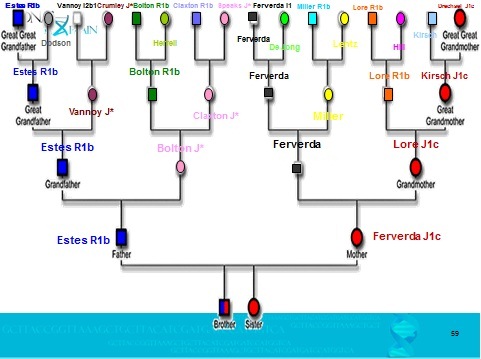
The purpose of a DNA pedigree chart is to provide guidance in terms of inheritance and also to provide a way of documenting your progress.  My chart is shown below, as an example.
DNA Pedigree

You can see the Y-line of my father and the mitochondrial line of my mother, on both ends of the pedigree chart.  At the top of each line, I have recorded the haplogroup information for each family.  Color coding each line helps in tracking descendants who would carry the DNA of the ancestor of that line.  For example, my mother’s father’s mother’s line is the yellow Miller line.  I need to find a daughter of my grandfather’s sisters, or their children, or their daughter’s children, to test for that mitochondrial DNA line.  Which reminds me, I need to call my cousin.  Family reunions, picnics and holidays are great for this type of thing.  Sadly, so are funerals.

I blogged about how to put together your own DNA pedigree chart. If you’re Native and adopted, then refer to the adoptee blog instead, or in addition.

But sometimes, we can’t find the right people in order to test, so we move to autosomal testing to help us fill in the blanks.

Autosomal Testing – For Both Sexes – The Rest of the Story 

Autosomal DNA testing tests all of your 23 pairs of chromosomes that you inherit from both of your parents. You get half of each chromosome from each parent. You can see this pattern on the pedigree chart, represented by all of the 16 genealogical lines. Therefore, as you move up that tree, you should have inherited about 25% of your DNA from each grandparent, about 12.5% of your DNA from each great-grandparent, as have all of their other great-grandchildren.

Therefore beginning with your parents, you carry the following approximate amount of DNA from each of these ancestors. I say approximate, because while you do receive exactly 50% of your DNA from each parent, there is no guarantee that their parents DNA was admixed in your parents such that you receive exactly 25% from each grandparent, but it’s close.  You can see the percentages in the chart below.

Generation Relationship % of Their DNA You Carry

1

Parents

50

2

Grandparents

25

3

Great-grandparents

12.5

4

GG-grandparents

6.25

5

GGG-grandparents

3.125

6

GGGG-grandparents

1.56

7

GGGGG-Grandparents

0.78

Given this chart, if the Native percentage is back beyond 6 generations and drops below the 1% threshold, it’s extremely difficult to discern today.

Autosomal testing will pick up relationships reliably back to about the 6th or 7th generations, and sporadically beyond that.

Autosomal testing provides you minimally with two things.  First, with a list of “cousin matches” by percentage and estimated relationship.  Second, percentages of ethnicity.  It’s this second part that’s most important for the person seeking to prove Native American heritage.

Percentages of Ethnicity

As the field of genetic genealogy has moved forward, research has begun to indicate that certain autosomal markers are found in higher or lower frequencies in different ethnic populations.

For example, if someone has the Duffy Null allele, or genetic marker, we know they positively have African admixture.  We don’t know how much African admixture, or from which line, or when that individual with African admixture entered their family tree, but we know for sure they existed.

Attempting to determine the population frequency of varying markers and what that means relative to other populations is the key to this analysis.  Few markers are simply present or absent in populations, but are found in varying frequencies.  Some populations are widely studied in the research literature, and others are virtually untouched.  Thousands have only been recently discovered as part of the National Geographic, Genographic project.

The process of compiling this information in a meaningful manner so that it can be analyzed is a formidable task, as the information is often found in nearly inaccessible academic and forensic research publications.  It’s difficult to determine sometimes if the DNA analysis of 29 individuals in a small village in northern Italy is, for example, representative of that village as a whole, of northern Italy, or more broadly for all of Italy.  Is it representative of Italy today or Italy historically?  These and other similar questions have to be answered fully before the data from autosomal testing can be useful and reliable.

Let’s take a look at all 3 of the contemporary autosomal tests and what they have to offer.

Note: as of 2019, MyHeritage is also a major player in the autosomal DNA testing space.

Family Tree DNA

Family Tree DNA sells the Family Finder test. Right now it is priced at $79 or bundled with attractive pricing with either the Y-line or mitochondrial DNA tests. I often like to use this tool in conjunction with the Y-line and mitochondrial DNA tests to see, if you match someone closely, whether you are actually related to them in a recent timeframe or if it is further back. Family Tree DNA is the only one of the autosomal testing companies that has the ability to do this type of advanced comparison.  Compared to 23andMe and Geno 2.0, they are the only ones to offer traditional Y-line and mitochondrial DNA testing which provides individual marker results and matches.

In addition to a list of autosomal matches, you will receive your breakdown of ethnicity, by percent.  The results below are for the same man with Native ancestry whose Geno 2.0 results are shown in the Geno 2.0 – First Peek blog.

native pop finder

You can read more about the Family Tree DNA autosomal product on their FAQ.

23andMe

Another company that sells autosomal testing is http://www.23andme.com. In addition to a list of cousins, you also receive admixture percentages, and their specialty, health traits.  You also receive a paternal and maternal haplogroup, but with no markers for personal comparison.  These Y-line and mitochondrial results are not as accurate at the Geno 2.0 nor the Family Tree DNA Y-line and mitochondrial DNA full sequence tests.

Be aware that while people who test at Family Tree DNA are interested in genealogy, the typical person at 23andMe tested for the health portion, not the genealogy portion, and may not answer contact requests or may know very little about their family history.

Right now, their test is $99, and you can download your results and upload them to Family Tree DNA for an additional $89, making the total price similar to the Family Tree DNA test. However, you need to be somewhat technically savvy to complete the download/upload process.

23andMe recently released a new version of their software which added quite a bit of resolution after years of being woefully behind.  Native American wasn’t even a category previously.

Ancestry

Ancestry.com recently introduced an autosomal test.  You receive matches and ethnicity percentages.  However, their ethnicity percentages have significant issues and I would not recommend them at this time.  Their cousin matches come with no analysis tools.  So for now, just skip Ancestry and concentrate on the other resources.

One Last Autosomal Test

One marker value in particular, known as D9S919 is present in about 30% of the Native people.  The value of 9 at this marker is not known to be present in any other ethnic group, so this mutation occurred after the Native people migrated across Beringia into the Americas, but long enough ago to be present in many descendants.  You can test this marker individually at Family Tree DNA, which is the only lab that offers this test.  If you have the value of 9 at this marker, it confirms Native heritage, but if you don’t carry 9, it does NOT disprove Native heritage.  After all, many Native people don’t carry it.

To order this test, for existing Family Tree DNA clients, click on the “Order Upgrade” orange button on the right hand side of your personal page, then on “Advanced Test”, then enter “autosomal” in the drop down box, then you will see the list below. D9S919 is the last one and it costs $15.  There may be a $10 one time transfer fee as well if your DNA sample is not in the Houston lab.

native d9s919 order

Swimming in Many Pools

As you can see there are lots of tools available to you that can be used individually or in conjunction with each other.  Like anything else, the more work and effort you are willing to devote to the search, the more likely you are to be successful.

Most people test their Y-line and mitochondrial DNA, not just for Native ancestry, but to learn more about the lines they can test for themselves without reaching out to other family members.

Use your DNA pedigree chart to plan who to ask in your extended family to test for which lines.

Plan to test with multiple autosomal testing companies.  Autosomal testing in particular is still in its infancy. I like to use the results of multiple companies, especially when you are dealing with small amounts of admixture.  They use different markers, combinations, analysis tools and reference populations, so you can expect slightly different results.  One company may pick up slight minority admixture while another may not.  This has happened repeatedly with both my Native and African minority admixture.

GedMatch

After you obtain your results from either Family Tree DNA or 23andMe, you’ll want to download your raw data results and then upload the file to www.gedmatch.com. This is a privately run “donation” site, not associated with any of the testing companies, meaning there is no subscription or fee to use the tools, but they do appreciate and are funded by donations.

After uploading your results you can utilize several admixture tools to compare and contrast your results.

Getting Help

If you’re struggling with working through your family possibilities for who to test, I do offer a DNA Test Plan service.

If you would like a Personalized DNA Report for Y-line or mitochondrial results, those are available as well.

If you have what amounts to a quick question that I can answer in less than an hour, including prep, I offer the Quick Consult service.

For more extensive consulting, contact me.  You can see my services here.

In Summary

Finding our Native ancestors is a way to pay homage to their lives and to the culture that was stripped from their descendants, ironically, by using their own DNA that has been gifted from them to us.  Native people, after contact with Europeans were marginalized, and that’s the best that can be said.  Many were killed, either intentionally or by European diseases, or enslaved.  The results are that Native people left few if any individual records and those that might be available often can’t be identified or linked to them personally.  For those who cannot unearth their Native ancestry using conventional genealogical means, genetic testing is the last hope left.  Fortunately, the tools and our knowledge improve every day.  We’re making great strides with what we can do, enlarging what was a pinhole into a keyhole, allowing us to peer into the past.  So, click your heels, order your tests and let’s see where your DNA takes you.

______________________________________________________________

Disclosure

I receive a small contribution when you click on some of the links to vendors in my articles. This does NOT increase the price you pay but helps me to keep the lights on and this informational blog free for everyone. Please click on the links in the articles or to the vendors below if you are purchasing products or DNA testing.

Thank you so much.

DNA Purchases and Free Transfers

Genealogy Services

Genealogy Research

Geno 2.0 Results – Kicking the Tires

Update: Please note that the Genographic Project discontinued public sales of kits in 2019. I am leaving this article for historical context.

Yesterday, my husband’s Geno 2.0 results arrived.  I bought his kit for him for Christmas initially, but couldn’t wait that long so had him swab the very day it arrived.  So much for Santa’s surprise.  But wait, maybe his results will hold a surprise – and isn’t this the first day of Christmas?  Oh, it’s not?  Well, I’ve decided to establish a new tradition this year, that it is the first day of Christmas and this year we will simply have 15 days of Christmas.  The extra three days will be dedicated to Y-line SNPs, a mitochondrial haplogroup and ethnicity results.  Who wants a bird in a pear tree anyway?

Geno Kick JimMeet Jim.  Since you’re going to be looking as his “innards,” so to speak, I think you should formally meet him.  Pretty soon you’re going to be wondering what a Neanderthal, Denisovan, German, Greek, Mediterranean Hun looks like.  I wanted to use the photo of him kissing the dolphin in the Carribbean, but he wouldn’t let me.  Harumph.  I guess Huns have no sense of humor.

There’s a lot of information included on the new Genographic results webpage with some very cool features.  We’re not going to look at everything in-depth today, but we’ll do a flyover so you can see everything.  Right now, because everyone is checking the status of their results, the Genographic webpage is experiencing difficulties.  So if you click and wait, well, go get a cup of coffee.  It will eventually respond and multiple clicks only cause buffer problems when it does respond.  I know this from experience.  How many times have I said that patience is not a virtue attributed to me!

Oh yes, and I had much better luck with the webpage using Chrome as opposed to Internet Explorer 7.

The first screen you see is “Your Story.”  It’s large so I’ll break it into three parts for review.  Notice the 5 tabs at the top of the page.  You’ll be using those.  Actually, if you follow the story line, the story walks you through them all.

Geno kick story

The middle portion of this page shows your mitochondrial DNA, autosomal in the center, followed by your Y-line, if you’re a male.  Your haplogroup is displayed as well for mitochondrial, and your terminal SNP for males, which is the SNP that ultimately defines the deepest level of your haplogroup.  Well, at least until a new terminal SNP is discovered.

geno kick story 2

There are a couple of items of note here.

The tab titled “Your Map” simply won’t load, using either browser.  I’ve sent a note to National Geographic.  I know this is loading for other folks though.  I wonder if it has anything to do with Jim’s haplogroup.

Second, for Jim’s paternal line, CTS11962 is a new SNP not previously tested at Family Tree DNA.  CTS stands for Chris Tyler-Smith, a researcher in the UK at the Sanger Institute who discovered this particular SNP, and named it.

We knew in advance that the new standard for both the Geno 2.0 and also Family Tree DNA will be to only provide the terminal SNP and no longer rename the haplogroups in the way they used to be, such as R1a or R1b1a2.  However, the problem with this approach is that someone looking at this terminal SNP has no reference whatsoever at this point.  There isn’t even a “main” haplogroup branch given, nor a link to any explanation, or at least not that I can find.

After transferring Jim’s results to Family Tree DNA, I noticed that he is now labelled R1a1a1g on his Family Tree DNA haplogroup page.  It looked like his mitochondrial results didn’t transfer initially, but this morning after the Family Tree DNA webpage update, he does have results on his mtDNA Haplogroup Origins page, which is about all you can do with haplogroup only information.  Nat Geo, of course, does not test beyond haplogroup designation for mitochondrial.  However, it looks like his autosomal results didn’t transfer anyplace.  Hmmm….maybe a bug.  I’ll have to contact the helpdesk who is probably swamped this morning.

geno kick ftdna snp

Looking at his Family Tree DNA Haplogroup and SNPs page, all of the SNPs Jim was tested for at Nat Geo appear to be listed, but CTS11962, his terminal SNP, seems to be missing, so others may be as well.  Family Tree DNA updated the data base and web page today, but this didn’t seem to be resolved with the update this morning.  It also looks like it might be a page real estate issue in that this section of his page is quite full.

The bottom portion of the introductory Geno 2.0 page provides an interesting tidbit.

geno kick story 3

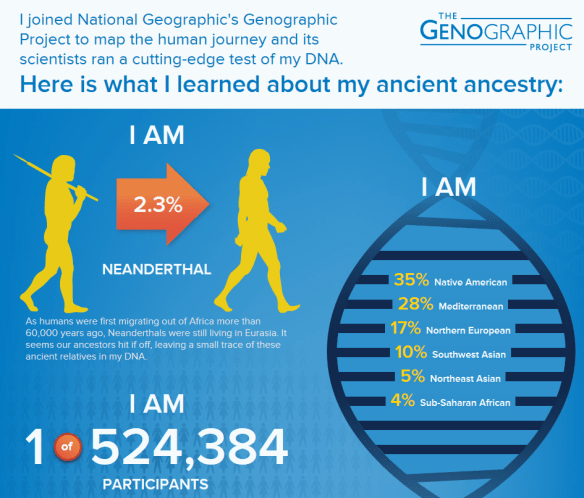
Yesterday, when one of my blog followers sent me his initial results, the “you are 1 of” number was 524,384, and that number had been used for some time, so it’s not dynamic.  This new number appeared a few hours later, so I’m thinking that the answer to the number of Geno 2.0 kits sold might be someplace in the ballpark of 35,131.  Just speculation on my part.

Let’s go back now and look at each section.

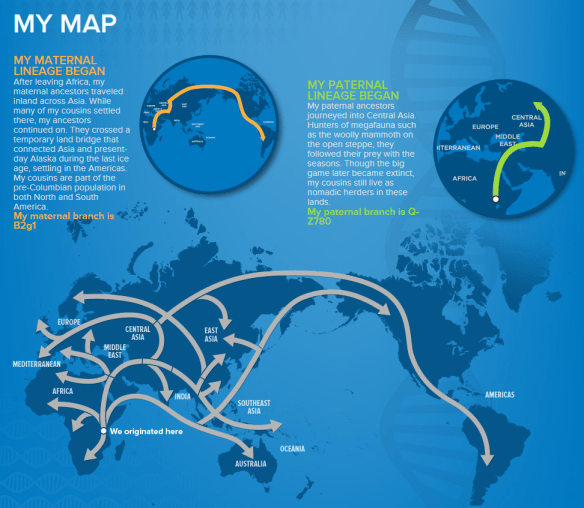
The mitochondrial DNA area provides a basic description of the haplogroup’s journey, then you can click to see the map.

Since his map won’t load, taking a look at another account I have access to, we see the following map information.

geno kick mito map

See the “share” button on the top right hand side of the next page?  This allows you to send e-mails or a number of other types of messages to friends with a nice summary page of your results.  Be sure to type a message in the message box with your full name because otherwise the recipient will have no idea whose info they are viewing.

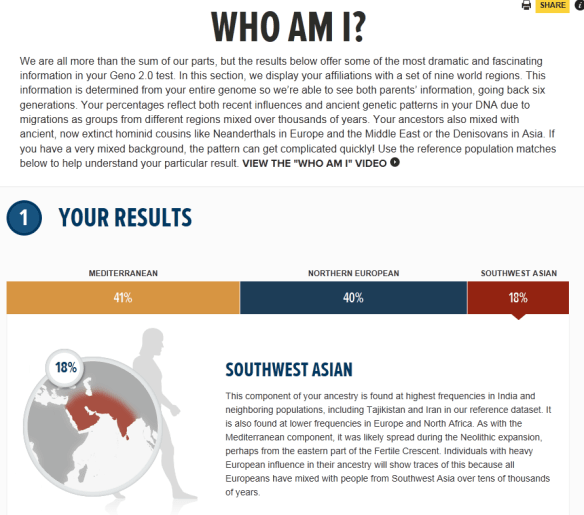
Moving to the autosomal section, we see that they have divided the world into 9 regions, plus Neanderthal and Denisovan.

Geno kick auto 1

Jim is Mediterranean, Northern European and Southwest Asian.  His genealogy is entirely German and Hungarian.   He’s a second generation immigrant, so none of his genealogy is lost here in the US.  Of course, the term Hungarian should translate into “churning people” because the devastation of multiple wars spanning centuries has disrupted this population significantly.  The same holds true for Germany.  I would suggest that Germanic and Slavic would perhaps be a better description of his heritage.

In any case, the Mediterranean and Southwest Asian were somewhat of a surprise, but when you look at migration patterns, maybe not so much.  After all, we all came through the Middle East on our way out of African and if your ancestors migrated to Germany, they probably went through the Mediterranean unless they went over the Caucus Mountains instead. And that would give you Southwest Asian heritage most likely.

The only problem is, now Jim wants to go on another Mediterranean cruise to commune with his ancestral homeland.  DNA cruises anyone???

The next section explains what the results mean.  This is actually quite interesting because it compares you to the actual reference population.  In his case, in Germany.

geno kick auto 2

His second reference population was somewhat of a surprise.  It’s Greek.  Perhaps it’s the best reference population they have for “Mediterranean” as the Greeks are truly a mixture of just about everyone in the Mediterranean basin.

geno kick auto 3

They do provide links here to more information.  By clicking on the overview of all reference populations, they provide information about how these populations as a whole are made up today.

geno kick ref

I counted and there are 43 populations.  Another option is to click to review the 9 world regions.

geno kick world 1geno kick world 2

The Neanderthal and Denisovan ancestry is particularly interesting since it has been only recently, in the past couple of years, that humans were believed to have interbred with either group.  Neanderthals have been found throughout most of Europe and western Asia, and Denisovans lived in the Altai Mountains of Siberia.  If you click on the little links imbedded in many place on your page, you’ll see that there is more information about almost every topic.  For example, they tell us that everyone outside of Africa carries some Neanderthal and Denisovan.

geno kick hominid

On Jim’s Genographic page, the terminal SNP shown is M458, shown below the map.  Referring now to the ISOGG Y tree, we see that this equates to haplogroup R1a1a1b1a1.  I didn’t expect CTS11962 to be on the ISOGG tree just yet, and it isn’t, but neither is it anyplace else, so we basically have our hands tied relative to where this falls on the R tree until someone places it someplace.  I know that there is what is affectionately referred to as the “Big Paper” in the works that reworks the haplotree, and I surely hope it’s published sooner than later.  Yes, I know, that patience thing again…..sigh.

geno kick y map

You can also view this haplogroup information as a heatmap.

geno kick heat map

Under the “future” button, they ask you to complete your profile and contribute your story.  You may have noticed that these options are stepping you across the tabs at the top of the introductory page.

geno kick next

Under the “Our Story” tab, which is where the “Contribute Your Story” link takes you, they explain about the community and social networking aspects of Geno 2.0.

geno kick our story

Most interesting is the relationship circle, which looks like either a 45RPM record, a CD/DVD or the front of an i-pod, depending on your age.  The stars and planets are the people who are “related” to you and the larger planets are those with stories attached.  You just click on a planet to see their “story.”  The closer they are to the center, the more closely related they are to you, but I’m unsure how “related” is gauged.  For example if you click on the CTS11962 link, does this mean that everyone carries that mutation, or that it’s the terminal SNP for everyone listed?  If it’s the terminal SNP for everyone listed, wouldn’t they all be equally as closely related?  Jim’s V link doesn’t work, but the same questions apply.

geno kick circle

And at the bottom of this page, you can add your own story.

geno kick your story

I understand in the future that one will be able to contact these “related” people.  If so, and if they haven’t tested their STR markers or their mitochondrial DNA at Family Tree DNA, we can encourage them, or invite them, to do so.

And speaking of which, the one thing I really DON’T like is what they’ve done with the download to Family Tree DNA option.  In Geno 1.0, the transfer option said something like “to learn more,” but was tiny and obscure, at the bottom of a page where you had to scroll multiple times.  I’m sure the reason that only 20% of the people ever transferred to Family Tree DNA was because only 20% of the people stumbled across the link and followed it.  Actually, the fact that 20% actually found it is pretty amazing and speaks highly of how interested people actually are in the Genographic project and their results.  This function and where it’s located is even worse in this version.

To initiate a transfer to Family Tree DNA, first, you have to know that you want to do this. There is no enticing “advertising” or education like there is for other information.  This would be a wonderful opportunity for a nice video or at least a writeup and a link that at least says “to learn more” encourages people to investigate.  Now, you need to go to your Profile link, and under the profile link, click on the Advanced Options.

Nope, I don’t think even 20% of the people will find this.  I’ve very disappointed and hope they will reconsider and rework this option.

I am very hopeful that with some constructive and pleasant feedback that perhaps Nat Geo will reconsider and bring this transfer option into line with the otherwise wonderfully designed and world-class project pages.  Their e-mail address is genographic@ngs.org.

Genographic has so much to offer and Family Tree DNA’s customers and project administrators have played a huge role in recruiting for both Geno 1.0 and 2.0.  I’d really like to be sure that all Geno 2.0 participants receive everything they can out of the total genetic genealogy and anthropology experience.  After all, this is the story of all of us, the human population, and we’re all connected.  The only question is how closely we’re related, and when we get close enough in that tree, can we put names and faces on our ancestors, preferably with a few dates and locations as well?  Hence, it’s a continuum from anthropology to genealogy.  It needs to be a continuum from Nat Geo to FTDNA too.

One thing is for sure, we’re getting closer and closer as we learn more and more.  The tools keep improving and one by one, those brick walls are falling.

Well, we’ve kicked the tires a bit and I think this one is a keeper.  I think National Geographic has done a wonderful job of making a topic that has become increasingly complex over the past few years understandable to the average citizen who will take this test and look at their results with a sense of adventure and curiosity.  The website is beautifully designed.  Don’t shortchange yourself by hurrying through and not taking time to look at all of the photos, stories and videos, and be sure to click on the little “i” icon which means more information.  There’s a lot here to savor, slowly, like a connoisseur of fine food or a wonderfully spellbinding book.

I think what I’ve decided though, relative to autosomal DNA testing and ethnicity is that there is no one answer, there is really only a matter of degrees.  Today, with the different testing companies using different population data references, we receive differing results. I don’t worry too much unless they are significantly different, then I have to scratch my head a bit.

When my own results come back I’ll be doing some comparisons on how minority admixture stacks up using the different autosomal tests and analysis tools available.  We kicked the tires today, but soon, we’ll be taking a test drive to see what we can actually do with all of this. So, stay tuned and in the mean time, savor those results!  After all, on the first day of Christmas, my true love gave to me, a new SNP on my own family tree.

______________________________________________________________

Disclosure

I receive a small contribution when you click on some of the links to vendors in my articles. This does NOT increase the price you pay but helps me to keep the lights on and this informational blog free for everyone. Please click on the links in the articles or to the vendors below if you are purchasing products or DNA testing.

Thank you so much.

DNA Purchases and Free Transfers

Genealogy Services

Genealogy Research

Geno 2.0 Results – First Peek

The results for males just started coming in yesterday.  One of our blog subscribers was kind enough to allow me to use his results.  You’ll notice that there is no identifying information about you on this page, so if you forward this to someone, and that is something you can do, you’ll need to be sure to sign it with your name.  It comes as a “no-reply” type of e-mail from National Geographic, not from you.

try 1

There’s lots of info provided here.  First, you can see how much Neanderthal you carry.  Ok, so no more Neanderthal jokes about your brother-in-law.

You can also see the division of your ethnicity.  Compared to this person’s Family Finder results, this test seems to be more sensitive, picking up admixture not found in Family Finder.  Their Family Finder results were 43% Europe, 5% East Asian (Siberian), 38% Native American and 13% Middle Eastern, rounded to the nearest percent.  It looks like the Native American is about the same, the Middle Eastern may be absorbed by Mediterranean or Southwest Asia, and the Sub-Saharan African is new, but accurate according to this person’s genealogy.

The second half of his display shows both the y-line and mitochondrial DNA map along with the migration path for the haplogroup.  His mitochondrial DNA is B2g1.  This is different from his B2 assigned at Family Tree DNA as a result of the full sequence test.  His Y-line is haplogroup Q with a terminal SNP of Z780.  He had tested for this SNP at Family Tree DNA also (as well as many others), and was classified as Q1a3.

try 2

It’s really exciting to see these results.  Of course, now the questions begin, and there are already a lot of them.  One of the first is about the ability to upload results to Family Tree DNA.  Apparently you cannot do that if you have already SNP tested, have a mitochondrial DNA haplogroup assigned or have taken the Family Finder test.  I sincerely hope this is simply a delay in development and that this will be addressed shortly.  We need this information on our home pages.

Other questions are about the Y-line SNPs, which SNPs are included, and which aren’t, how to reference a new tree to see where you fit, and how has the tree, either the YCC tree at Family Tree DNA or the ISOGG tree, been shuffled.  It’s obvious from seeing results for someone whose terminal SNP has not changed, but whose haplogroup has changed significantly that there has been major surgery to the tree.  It’s difficult to figure out quite what you’re seeing at a deeper level.

And for autosomal of course, there are lots of questions about reference populations.  Dave Dowell has already pointed out that there is a big discrepancy between his Geno 2.0 autosomal results and the ones returned by 23andMe last week.  But 23andMe references 500 years and the Geno 2.0 test is billed as more of an anthropological test, so maybe they are measuring differently.  Plus, there are all those new SNPs Nat Geo discovered and is using.  I’m sure those are making a big difference too.

It’s been a great week or so for genetic genealogy, but yes, lots more questions than answers, so stay tuned.

______________________________________________________________

Disclosure

I receive a small contribution when you click on some of the links to vendors in my articles. This does NOT increase the price you pay but helps me to keep the lights on and this informational blog free for everyone. Please click on the links in the articles or to the vendors below if you are purchasing products or DNA testing.

Thank you so much.

DNA Purchases and Free Transfers

Genealogy Services

Genealogy Research

News From National Geographic

AA010638

National Geographic released some additional information today about both Version 1.0 and the new Version 2.0 of its tests and the program as a whole.

Phase 1 – Geno 1.0

“Our first phase drew participation from more than a half-million participants from over 130 countries. It is evidence of enormous interest in deep ancestry among the global public — tracing the paths their ancestors took as they migrated around the world over the past 60,000 years,” said Project Director Dr. Spencer Wells, a population geneticist and National Geographic Explorer-in-Residence.  “Now, the Genographic Project’s second phase creates an even greater citizen science opportunity — and the more people who participate, the more our scientific knowledge will grow.”

spread6_1Final

During Genographic’s first phase, Wells and project scientists traveled the globe to collaborate with tens of thousands of indigenous people, whose genetics are particularly significant in determining human migratory routes. Wells and Pierre Zalloua, principal investigator in the Middle East, for example, collaborated with the Toubou people of northern Chad, whose DNA has revealed insights into ancient migrations across the Sahara. Genographic’s principal investigator in the Oceana region, Lisa Matisoo-Smith, worked intensively with people on the remote south Pacific island of Emirau, collecting DNA samples and sharing the results with them.

geno_2_Spencer Wells watches as men from the town of Gouro pray to commemorate the end of Ramadan_Photo by David Evans_Gouro, Chad

The Genographic Project team worked with individuals, institutions and organizations all over the world to find and tell their genetic stories, including the prime minister of Kazakhstan, who invited Wells and his colleagues to collect DNA samples in his country after becoming fascinated with his family story as revealed by his Genographic kit results; the people of Barbados, who requested a study on the pattern of diversity in the country using the public participation kits; and members of the public in South Africa, who learned that they carry links to the region’s earliest inhabitants, the San people, in addition to genetic lineages from elsewhere in Africa, India and Europe.

geno_2_The bright head turbins worn by Chadean men are for more than just show, a valuable adaptation to the harsh Saharan Desert they helps to keep valuable water in and annoying sand out_Photo by David Evans

The project also tested 200 random people on a single day on a block of Queens, New York, to demonstrate the area’s diversity. In a collaboration with cellist Yo-Yo Ma’s multidisciplinary education foundation The Silk Road Project, more than 400 students at four New York City public schools swabbed their cheeks and traced their ancient ancestry.

geno_2_A student looks at the Genographic Project map_Photo by Lindsay Maiorana

Geno 2.0 – New Interface

National Geographic says that participants will receive their results through a newly designed, multi-platform Web experience. In addition to full visualizations of their migratory path and regional affiliations, participants can share information on their genealogy to inform scientists about recent migratory events. These stories also can be shared with the broader Genographic Project community; as the number of contributions grows, the experience will become richer, as participants learn more about themselves and their shared ancestry. Results also can be shared as an infographic for social platforms.

Scientific Papers Published

Seven years into this project, benefits are being reaped at unprecedented levels.  Already, project results have led to the publication of 35 scientific papers, reporting results such as the origin of Caucasian languages, the early routes of migrations out of Africa, the footprint of the Phoenicians in the Mediterranean, the genetic impact of the Crusades and the genetic origins of the Romanian royal dynasty that included Vlad the Impaler. The project’s DNA results and analysis are stored in a database that is the largest collection of human anthropological genetic information ever assembled.

NGS Picture ID:1049085

“The Genographic Project truly represents another facet of a new age of exploration. The newest Genographic technology will push the limits of our research, inspiring us to learn more about ourselves and leveraging the insights gleaned so far to take citizen science and genetic testing to a whole new level,” said Terry Garcia, executive vice president of Mission Programs at National Geographic.

New Grants Available

New to the second phase of Genographic, the project will invite applications for grants from researchers around the world for projects studying the history of the human species.  Sample research topics could include the origin and spread of the Indo-European languages, genetic insights into regions of high linguistic diversity such as Papua New Guinea, the number and routes of migrations out of Africa, the origin of the Inca or the genetic impact of the spread of maize agriculture in the Americas.

geno_2_Two women in Khorong, Tajikistan_Photo by David Evans

While this press release does not mention it specifically, my understanding from previous discussions with Spencer Wells suggested that this would not be limited solely to academic researchers and that project administrators and citizen scientists’ applications would be considered as well.

Legacy Fund

Geno 2.0 continues the tradition of the Legacy Fund, established 7 years ago with the first tests.  A portion of the proceeds from the sale of Genographic Participation Kits funds project research and the Genographic Legacy Fund, which awards grants to support community-led cultural conservation and revitalization initiatives among indigenous and traditional communities around the world. So far, the Genographic Project has provided 62 Legacy Fund grants worth $1.7 million. Efforts supported by the grants include the creation of teaching materials on the ancient wisdom of the Chuj in a Maya community in Guatemala and the revitalization of indigenous languages in Nepal, India, Taiwan, French Polynesia, Mexico and Bolivia.

geno_2_A man looks into the sunset in the Sahara Desert_Photo by David Evans

New Education Initiative – GenoThreads

A new education program called GenoThreads enables science, culture and geography to be naturally woven into a shared educational experience. GenoThreads connects students and teachers around the world who are using Genographic participation kits; this allows a cross-cultural exchange between students via email and videoconference for a truly global experience. In the first GenoThreads project, high school students in Switzerland are sharing their results with those halfway across the world in Singapore.

geno_2_Spencer Wells speaks to an audience

New Website

Members of the public are encouraged to visit the Genographic Project’s newly created website at www.genographic.com.  Featuring National Geographic photography, as does this blog today, the website gives Genographic participants the opportunity to learn more about their own ancestry and find ancestral connections. The Genographic Project remains nonmedical and nonprofit, and all analysis results are placed in the public domain following scientific publication. The Genographic Project serves as an unprecedented resource for geneticists, historians, anthropologists and citizen scientists.

Excitement Surrounding Geno 2.0 Tests

There is a lot of excitement about the new Geno 2.0 tests in the genetic genealogy community, and more than a little restless shuffling of feet.  Genetic genealogists are not a patient lot, albeit from the best of motives.

We want to see our results, sooner than later, and we want to play with them.  We want to upload them to Family Tree DNA and have them integrated with the rest of our DNA tests and information, available to use – one stop shopping.  We want to download them to our computers and use them in a myriad of ways. We want to see if we gained branches, or twigs, on our haplotrees.

We want to see who we connect to, and how closely.  We want to ping our anthropological neighbors on the new website and invite them to download their information to Family Tree DNA as well.  We want more project members.  We want matches where we have none and more where we have some.

We want to know if we are Neanderthal or Denisovian, and how much.  We wonder if our minority admixture, whatever it is, will be revealed or if it’s too far back in time.  And on a research level, we want to know which populations were used, which new autosomal SNPs were discovered, and the frequencies they are found worldwide.  I know, we want, we want, we want.

Exciting tidbits arrive periodically, whetting our appetite.  We already knew that the Y-tree had to be rebuilt during vetting of the Geno 2.0 chip, but more recently, it appears that perhaps the tree is being reorganized, again, already, with the first run of data.  Such conflicted feelings.  So glad such wonderful discoveries are being made, but so impatient to see what they are.  And that’s the whole lot of us, not just a few:)

Good thing it’s December…looks like Santa has a big wish list from us to fulfill and National Geographic, indeed, is going to be one of Santa’s biggest helpers!  Now if they could just HURRY:)  Maybe we should add a dose of patience to the things we want……Nah.  I just hope lots and lots of other people want this too!!!

geno_2_A local guide signals to a lost vehicle in the Sahara Desert_Photo by David Evans

All photos are copyright protected by the National Geographic Society and used with their permission.

______________________________________________________________

Disclosure

I receive a small contribution when you click on some of the links to vendors in my articles. This does NOT increase the price you pay but helps me to keep the lights on and this informational blog free for everyone. Please click on the links in the articles or to the vendors below if you are purchasing products or DNA testing.

Thank you so much.

DNA Purchases and Free Transfers

Genealogy Services

Genealogy Research


Family Tree DNA Conference 2012 – Nits and Grits

First things first!  I want to thank Max and Bennett for graciously hosting the 8th Annual Genetic Genealogy Conference in Houston, Texas!  This is actually the 9th year, but a pesky hurricane interfered one year.  Max and Bennett are very generous with their time and resources and heavily subsidize this conference for us.  We’re registering in the photo above.

Georgia Kinney Bopp said it best.  At some point during this amazing conference, someone tweeted an earlier quote from a conversation between Ann Turner and Georgia:

“it’s hard to realize you’re living history while it happens…”

This was ever so true this weekend.  Even my husband (who is not genetic genealogy crazy) realized this.  I’m not sure everyone at the conference did, or realized the magnitude of what they were hearing, as we did have a lot of newbies.  Newbies are a good thing.  It means our obsessive hobby and this industry have staying power and there will be people to pass the torch to someday.

I’ve already covered the Native American focus meeting in an earlier blog.

For those of you who want the nitty gritty play by play as it happened at the conference, go to www.twitter.com and search for hashtag #ftdna2012.  If you want some help with Twitter, I blogged about that too.  Twitter is far from perfect, but it is near-realtime as things are happening.

As always, Family Tree DNA hosts a reception on Friday evening.  This helps break the ice and allows people to put faces with names.  So many of us “know” each other by our e-mail name and online presence alone.

We had a special guest this year too, Nina, a little puppy who was rescued by Rebekah Canada just a few days before the conference.  Nina behaved amazingly well and many of us enjoyed her company. 

Bennett opened the conference this year, and in the Clint Eastwood political tradition, spoke to his companion, the chair named Max.  The real Max, it turns out, was losing his voice, but that didn’t prevent him from chatting with us and answering questions from time to time.

While Bennett was very low key with this announcement, it was monumental.  He indicated that the parent company of Family Tree DNA has reorganized a bit.  It has changed its name to Gene by Gene and now has 4 divisions.  You can check this out at www.genebygene.com.  This isn’t the monumental part.

The new division, DNADTC’s new products are the amazing parts.  Through this new division, they are the first commercial company to offer a full genome sequence test.  The price, only $5495.  For somewhat less, $695, they are offering the exome, which are your 20,000 genes.  Whoever though it would be a genetic genealogy company who would bring this to the public.  Keep in mind that the human genome was only fully sequenced in 2003 at a cost of 3 billion dollars.

The amazing part is that a full genome sequence cost about 3 million in 2007 and the price will continue to fall.  While consumers will be able to order this, if they want, it comes with no tools, as it is focused at the research community who would be expected to have their own analytical tools.  However, genetic genealogists being who and what they are, I don’t expect the research market will outweigh the consumer market for long, especially when the price threshold reaches about $1000.

Bennett also said that he expects that National Geographic will, in 2013 sometime, decide to allow upgrades from Family Tree DNA clients for the Geno 2.0 product.  This will allow those people who cannot obtain a new sample to participate as well.  However, an unopened vial will be required.  No promises as to when, and the decision is not his to make.

The first session was Spencer Wells via Skype from Italy.  Spencer has just presented at two conferences within the week, one in San Francisco and one in Florence, Italy.  Fortunately, he was able to work us into his schedule and he didn’t even sound tired.

Of course, his topic was the Geno 2.0 test which is, of course, run on the new GenoChip.  The first results are in the final stages of testing, so we should see them shortly.  Sometime between the 19th and the end of the month.

This product comes with all new migration maps.  He showed one briefly, and I noticed that one of the two Native Y-lines are now showing different routes than before.  One across Siberia, which hasn’t changed, and one up the pacific rim.  Hmmm, can’t wait for that paper.

The new maps all include heat maps which show frequency by color.  The map below is a haplogroup Q heat map, but it is NOT from the Geno project.  I’m only using it as an example.

Spencer indicated that the sales of the 2.0 product rival those of the 1.0 product and that they have sold substantially more than 10K and substantially less than 100K kits so far.  In total, they have sold more than 470,000 kits in over 130 countries.  And that’s just the public participation part, not the indigenous samples.  They have collected over 75,000 indigenous samples from more than 100 populations resulting in 36 publications to date with another half dozen submitted but not yet accepted.  Academic publication is a very long process.

Nat Geo has given 62 legacy grants to indigenous communities that have participated totaling more than 1.7 million dollars.  That money comes in part from the public participation kits, meaning Geno 1.0 and now 2.0.

Geno 2.0 continues to be a partnership between National Geographic and Family Tree DNAFamily Tree DNA is running all of their samples in the expanded Houston lab.  Also added to the team is Dr. Eran Elhaik at Johns Hopkins University who has developed a new tool, AIMSFINDER, that locates never before identified Ancestral Informative Markers to identify population specific markers.  This is extremely important because it allows us to read our DNA and determine if we carry the markers reflective of any specific population.  Well, we don’t do the reading, they do with their sophisticated software.  But we are the recipients with the new deep ancestral ethnicity results which are more focused on anthropology than genealogy.  Spencer says that if you have 2% or more Native American, they can see it.  They have used results from both public and private repositories in developing these tools.

This type of processing power combined with a new protocol that tests all SNPS in a sequence, not just selected ones, promises to expand the tree exponentially and soon. It has already been expanded 7 fold from 863 branches of the Y tree to 6153 and more have already been discovered that are not on the GenoChip, but will be in the next version.

The National Geographic project will also be reaching out to administrators and groups who may have access to populations of interest.  For example, an ex-pat group in an American city.  Keep this in mind as you think of projects.

Another piece of this pie is a new educational initiative in schools called Threads.

This isn’t all, by any means, on this topic, I really do encourage you to go and use Twitter hashtag #ftdna2012.  Several of us were tweeting and the info was coming so fast and furious that no one could possibly get it all.

The future with Nat Geo looks exceedingly bright.  We have gone from the Barney Rubble age to the modern era and now there is promise for a rosy and as yet undiscovered future.

Judy Russell was next.  I have to tell you, when I saw where they positioned her, I was NOT envious.  I mean, who wants to follow Spencer Wells, even if he’s not there in person.  Well, if anyone was up to this, it certainly was Judy.  For those who don’t know, she blogs as The Legal Genealogist.

Judy is one of us.  That means she actually understands our industry, what drives genealogists and why.  In addition to being a lawyer, she is a certified genealogist and a genetic genealogy crazy too.  Maybe I shouldn’t call a lawyer crazy….well…it was meant as a compliment:)

Judy has the perspective to help us, not just criticize us remotely.  She reviewed several areas where we might make mistakes.  After all, we’re all volunteers coming from quite varied backgrounds.  She suggests that we all put some form of disclosure on our projects explaining what participants can expect in terms of use.  She used the Core Melungeon project as a good example, along with the Fox project.

“The goal of this project is to use DNA to better understand the origins of the Melungeon people, and this will be done by comparing the DNA with other project members, those outside of projects, and will incorporate relevant genealogical and historical research. All participants will be included in the ongoing studies and by joining the project, you are giving consent for your information to be anonymously included in ongoing genetic genealogy research. Your personal identity will not be revealed, but your results will be used to better understand the Melungeons as a people and their ancestors.”

From the Fox project:

“The exact function of these STR markers is not yet known and they have no known medical function but recent research shows they have some sort of regulatory function on the genes. While there is no medical information in these numbers, the absence of a certain few markers near a fertility gene could indicate sterility – something that would certainly already be known.

The results do provide a partial means of personal identification and, for this reason, our haplotype tables list only the FTDNA kit number and the most distant known male line ancestor. Within the project, however, the administrators feel free to disclose identities, particularly when a close match occurs.”

Judy’s stressed that we not tell people that there is no medical information revealed.  Partially, because we’ve discovered in rare cases that’s not true, and partially because we can’t see into the future.

Judy talked about regulation and that while we fear what it might intentionally or inadvertently do to genetic genealogy, it’s important to have regulations to get rid of the snake oil salesman, and yes, there are a couple in genetic genealogy.  They give us all a black eye and a bad name when people discover they’ve been hoodwinked. However, without regulation of some sort, we have no legal tools to deal with them.

Regulation certainly seems to be a double-edged sword.

I hope that Judy writes in her blog about what she covered in her session, because I think her message is important to all administrators and participants alike.  And just to be clear, the sky is not falling and Judy is not Chicken Little.  In fact, Judy is the most interesting attorney I have ever heard speak, and amazingly reasonable too.  She actually makes you WANT to listen, so if you ever get the chance to see one of her webcasts or attend one of her sessions, take the opportunity.

Following the break, breakout sessions began.  CeCe Moore ran one about “Family Finder,” Elise Friedman about “Group Administration” and Thomas Krahn provided the “Walk the Y Update.”  Bennett called this the propeller head session.  Harumph Bennett.  Guess you know which one I attended.  All sessions were offered a second time on Sunday.

Thomas said that they have once again upgraded their equipment, doubling their capacity again.  This gives 4 times the coverage of the original Walk the Y, covering more than 5 million bases.  To date, they have run 494 pre-qualified participants and of those, 198 did not find a new SNP.

There are changes coming in how the palindromic region is scored which will change the matches shown.  Palindromic mismatches will now be scored as one mutation event, not multiples.  Microalleles will able be reported in the next rollout version, expected probably in January.  The problem with microalleles is not the display, but the matching routine.

Of importance, there has not been an individual WTY tested from haplogroups B, M, D or S, and we need one.  So if you know of anyone, please contact Thomas.

Thomas has put his Powerpoint presentation online at  http://www.dna-fingerprint.com/static/FTDNA-Conference-2012-WalkThroughY.pdf

The next session by Dr. Tyrone Bowes was “Pinpointing a Geographical Location Using Reoccurring Surnames Matches.”  For those of us without a genetic homeland, this is powerful medicine.  Dr. Bowes has done us the huge favor of creating a website to tell us exactly how to do this.  http://www.irishorigenes.com/

He uses surnames, clan maps, matches, history and census records to reveal surname clusters.  One tidbit he mentioned is that if you don’t know the family ethnicity, look at the 1911 census records and their religion will often tell you.  Hmm, never thought of that, especially since our American ancestors left the homeland long ago.  But those remaining in the homeland are very unlikely to change, at least not in masse.  I’m glad he gave this presentation, or I would never have found his webpage and I can’t wait to apply these tools to some of my sticky-wickets.

This ended Saturday’s sessions, but at the end of every day, written questions are submitted for that day’s presenters or for Family Tree DNA.

Bennett indicated that another 3000 or 4000 SNPs will be added to the Family Finder calculations and a new version based on reference samples from multiple sources will be released in January.

Bennett also said that if and when Ancestry does provide the raw downloadable data to their clients, they will provide a tool to upload so that you can compare 23andMe and Ancestry both with your Family Finder matches.

Saturday evening is the ISOGG reception, also called the ISOGG party.  Everyone contributes for the room and food, and a jolly good time is had by all.  There is just nothing to compare with face to face communications.

For me, and for a newly found cousin, this was an amazing event.  A person named Z. B. Stroud left me a message that she was looking for me.  When I found her, along with her friend and cousin Revis, she tells me that she matches me autosomally, at 23andMe, and that she had sent me a sharing request that I had ignored.  I am very bad about that, because unless someone says they are related, I presume they aren’t and I don’t like to clutter up my list with non-related people.  It makes comparisons difficult.  My bad.  In fact, I’m going right now to approve that sharing request!!!

I will blog about this in the future, but without spilling too many beans….we had a wonderful impromptu family reunion.  We think our common ancestor is from the Halifax and Pittsylvania County region of Virginia, but of course, it will take some work to figure this out.

I’m also cousins with Revis Leonard (second from left).  We’ve known that for a long time, but Z.B. whose first name is Brisjon (second from right) is new to genealogy, DNA and cousin matching. I’m on the right above.  The Stroud project administrator, Susan Milligan, also related to Brisjon is on the left end.  In the center are Brisjon’s two cousins who came to pick her up for dinner and whom she was meeting for the first time.

But that’s not all all, cousin Brisjon also matches Catherine Borges.  Let me tell you, I know who got the tall genes in this family, and I’m not normally considered short.  Brisjon’s genealogical journey is incredibly amazing and she will be sharing it with us in an upcoming book.  Suffice it to say, things are not always what you think they are and Brisjon is living proof.  She also met her biological father for the first time this weekend!  I’m sure Houston and her 2012 visit where she met so many family members is a watershed event in her lifetime!  She is very much a lovely lady and I am so happy to have met her.  Cousins Rule!

ISOGG traditionally has its meeting on Sunday morning before the first session.  Lots of sleepy people because everyone has so much fun at the ISOGG party and stays up way too late.

Alice Fairhurst, who has done a remarkable job with the ISOGG Y SNP tree (Thank you Alice!) knows an avalanche is about to descend on her with the new Geno 2.0 chip.  They are also going to discontinue the haplogroup names, because they pretty much have to, but will maintain an indented tree so you can at least see where you are.  The names are becoming obsolete because everytime there is an insertion upstream, everything downstream gets renamed and it makes us crazy.  It was bad enough before, but going from 860+ branches to  6150+ in one fell swoop and knowing it’s probably just the beginning confirms the logic in abandoning the names.  However, we have to develop or implement some sort of map so you can find your relative location (no pun intended) and understand what it means.

Alice also mentioned that they need people to be responsible for specific haplogroups or subhaplogroups and they have lost people that have not been replaced, so if anyone is willing or knows of anyone….please contact Alice.

Alice also makes wonderful beaded double helix necklaces.

Brian Swann (sorry, no picture) is visiting from England this year and he spoke just a bit about British records.  He said it’s imperative to learn how they work and to use some of the British sites where they have been indexed.  He also reminded us to check GOONS (Guild of One Name Studies) for our surnames and that can help us localize family groups for recruiting.  He said that you may have to do family reconstructions because to get a Brit to test you have to offer them something.  That’s not terribly different from over here.  He also mentioned that today about half of the British people having children don’t marry, so in the next generation, family reconstruction will be much more difficult.  That too isn’t so terribly different than here, although I’m not sure about the percentages.  It’s certainly a trend, as are varying surname practices even within marriage.

Dr. Doron Behar began the official Sunday agenda with a presentation about the mtCommunity and a discussion of his recently published paper “A ‘Copernican’ Reassesement of the Human Mitochondrial DNA Tree from its Root.”  This paper has absolutely revolutionized the mitochondrial DNA community.  I blogged about this when the paper was first released and our home pages were updated.    One point he made is that it is important to remember is that your mutations don’t change.  The only thing that changes between the CRS (Cambridge Reference Sequence) and the RSRS (Reconstructed Sapiens Reference Sequence)  model is what your mutations are being compared to.  Instead of being compared to someone from Europe who live in 1981 (the CRS) we are now comparing to the root of the tree, Mitochondrial Eve (RSRS) as best we can reconstruct what her mitochondrial DNA looked like.

He also said that when people join the mtCommunity, their results are not automatically being added to GenBank at NCBI.  That is a separate authorization check box.

A survey was distributed to question participants as to whether they want results, when they select the GenBank option, to be submitted with their kit number.  Now, they are not, and they are under Bennett’s name, so any researcher with a question asks Bennett who has no “track back” to the person involved.  About 6000 of the 16,000 submissions today at GenBank are from Family Tree DNA customers.  Dr. Behar said that by this time next year, he would expect it to be over half.  Once again, genetic genealogy pioneers are leading the way!

At these conferences, there is always one session that would be considered the keynote.  Normally, it’s Spencer Wells when he is on the agenda, and indeed, his session was wonderful.  But at the 2012 conference, this next session absolutely stole the show.  Less public by far, and much less flashy, but at the core root of all humanity.

You can’t really tell from the title of this session what is coming.  Michael Hammer with Thomas Krahn and Bonnie Schrack, one of our own citizen scientists, presented something called “A Highly Divergent Y Chromosome Lineage.”  Yawn.  But the content was anything but yawn-material.  We literally watched scientific discovery unfold in front of our eyes.

Bonnie Schrack is the haplogroup A project administrator.  Haplogroup A is African and is at the root of the entire haplotree.  One of Bonnie’s participants, an African American man from South Carolina agreed to participate in WTY testing.  In a nutshell, when Thomas and Astrid began scoring his results, they continued and continued and continued, and wound up literally taking all night.  At dawn’s first light, Thomas told Astrid that he thought they had found an entirely new haplogroup that preceded any known today.  But he was too sleep deprived to be sure. Astrid, equally as sleep deprived, replied with “Huh?” in disbelief.  It’s certainly not a statement you expect to hear, even once in your lifetime.  This is a once in the history of mankind event.

Dr. Michael Hammer confirmed that indeed, they had discovered the new root of the human Y tree.  And not by a little either, but by a lot.  For those who want to take a look for yourself, Ysearch ID 6M5JA.  Hammer’s lab did the age projection on this sample, and it pushed the age of hominid men back by about 100,000 years, from 140,000 years ago to 237,000 years ago.  They then reevaluated the aging on all of the tree and have moved the prior date to about 200,000 years ago and the new one to about 338,000 years ago with a 98% confidence level.  This is before the oldest fossils that have been found, and also before the earliest mitochondrial DNA estimate, which previously had been twice as old as the Yline ancestor.

The previous root, A1b has been renamed A0 and the new root, just discovered is now A00.  Any other new roots discovered will simply get another zero appended.

How is it that we’ve never seen this before?  Well, it turns out that this line nearly went extinct.  Cruciani published a paper in 2012 that included some STR values that matched this sample, but fortunately, Michael Hammer’s lab held the actual samples.  A search of academic data bases reveals only a very few close matches, all in western Cameroon near the Gulf of Guinea.  Interestingly, next door, in Nigeria, fossils have been found younger than this with archaic features.  This is going to cause us to have to reevaluate the source of this lineage and with it the lineage of all mankind.  We must now ask the question about whether perhaps we really have stumbled upon a Neanderthal or other archaic lineage that of course “became” human.  Like many scientific discoveries, this answer only begs more questions.  My husband says this is like Russian tea dolls where ever smaller ones are nested in larger ones.

This discovery changes the textbooks, upsets the proverbial apple cart in a good way, and will keep scientists’ thinking caps on for years.  And to think, this was a result of one of our projects, an astute project administrator (Bonnie) and a single project member.  I wonder what the man who tested thinks of all of this. He is making science and all he thought he was doing was testing for genealogy.  You just never know where the next scientific breakthrough will come from.  Congrats to all involved, Bonnie, Thomas, Michael and to Bennett and Max for having this evolution revolution happen right in their lab!

If I felt sorry for Judy following Spencer, I really felt sorry for the breakout sessions following Thomas, Michael and Bonnie’s session.  Thankfully at least we had a break in-between, but most people were wandering around with some degree of stunned disbelief on their faces.  We all found it hard to fathom that we had been among the first to know of this momentous breakthrough.

I had a hard time deciding which session to attend, CeCe’s “Family Finder” session or Elise’s.  I decided to attend Elise’s “Advanced Admin Techniques” because I work with autosomal DNA with my clients and I tend to keep more current there.  Elise’s session was great for newer admins and held tips and hints for us old-timers too.  I realized I really need to just sit down and play with all of the options.

There are some great new features built in that I’ve never noticed.  For example, did you know that you can group people directly from the Y results chart without going to the subgrouping page?  It’s much easier too because it’s one step.  However, the bad news is that you still can’t invite someone who has already tested to join your project.  Hopefully that feature will be added soon.

The next session was “A Tale of Two Families” given by Rory Van Tuyl detailing how he used various techniques to discern whether individuals who did not show up as matches, meaning they were beyond the match threshold, were actually from the same ancient family or not.  Rory is a retired engineer and it shows in his attention to detail and affinity for math.

We always tell people that mutations can and do happen at any time, but Rory proved this.  He ran a monte-carlo simulation and showed that in one case, it was 50 generations between mutations, but in others, there was one mutation for three generations in a row.  Mutations by no means happen at a constant rate.  Of course, this means that our TIP calculator which has no choice but to use means and averages is by definition “not calibrated” for any particular family.

He also mentioned that his simulation shows that by about 150 generations, there are a couple of back mutations taking place.

The final session before the ending Q&A was Elliott speaking about IT, which really translates into new features and functions.  Let’s face it, today everything involves IT.

Again, I was having trouble typing fast enough, so you might want to check the Twitter feed.

They added the SNP maps (admins, please turn them on) and the interactive tour this year.  The tour isn’t used as much as it should be, so everyone, encourage your newbies to do this.

They have also added advanced matching, which I use a lot for clients, but many people didn’t realize it.  So maybe a quick tour through the website options might be in order for most of us.

They are handling 50 times more data now that a year ago.  Just think what next year will bring.  Wow.

They are going to update the landing page again with more color and more visible options for people to do things.  I hope they prompt people through things, like oldest ancestor mapping, for example.  Otherwise, if it isn’t easy, most don’t.

They are upgrading Population Finder and the Gedcom viewer.  They are adding a search feature.  Thank you!!  Older Gedcome will still be there but not searchable.

But the best news is that they are adding phasing (parent child) and an advanced capability to “reconstruct” an ancestor using more distant relatives, then the ability to search using that ancestral profile against Family Finder.  Glory be!  We are finally getting there.  Maybe my dreaming big wasn’t as far away as I thought.

They will also remove the 5 person autosomal download restriction and the “in common with” requirement to see additional information.  All good news.  They are also upgrading the Chromosome browser to add more filtering options.

They are also going to offer a developer “sandbox” area for applications.

The final Q&A session began with Bennett saying that their other priorities preclude upgrading Y search to 111 markers.

They are not planning to drop the entry level tests, 12 or 25 markers or the HVR1. If they do, lots of people will never take that plunge.  I was very glad to hear this.

And by way of trivia, Family Tree DNA has run more than 5 million individual tests.  Wow, not bad for a company that didn’t exist, in an industry that didn’t exist, 12 years ago!

It’s an incredible time to be alive and to be a genetic genealogist!  Thank you Family Tree DNA for making all of this possible.

______________________________________________________________

Disclosure

I receive a small contribution when you click on some of the links to vendors in my articles. This does NOT increase the price you pay but helps me to keep the lights on and this informational blog free for everyone. Please click on the links in the articles or to the vendors below if you are purchasing products or DNA testing.

Thank you so much.

DNA Purchases and Free Transfers

Genealogy Services

Genealogy Research

Native American DNA News

It’s a good DNA day for Native American DNA research.

Yesterday, I was talking to Bennett Greenspan at Family Tree DNA.  He knows of my interest in Native heritage.  Our conversation turned to the new Geno 2.0 chip, now called the GenoChip, and the expected ethnicity results relative to Native heritage.

It turns out that Bennett and Spencer Wells had just been talking about the same thing.  Spencer said that the GenoChip is exceptionally good at picking up Native American ancestry and that it’s one of the key features built into the autosomal SNPs they chose and the resulting admixture analyses.  Spencer says that as long as the admixture is above 2%, we’ll see it.

Two percent equates to between 5 and 6 generations.

I can’t wait to compare Geno 2.0 results of people who previously tested at 23andMe and with Family Tree DNA’s Family Finder, and especially those who showed the Middle Eastern percentage with the Family Finder test.

This information dovetails nicely with a new paper to be published in the American Journal of Human Genetics, the February 10th edition.

In this new paper, Dr. Theodore Schurr has used Y and mitochondrial DNA evidence collected from 500 Siberian people living in remote villages and more than 2500 Native Americans from Canada, the US and Mexico.  The paper confirms the homeland of the Native people in the Americans was originally the Altay Mountains in Siberia (photo above).  This isn’t new news, but it’s nice to have confirmation and it will be interesting to see the details in the paper.

In an article published this week by the National Geographic Society titled “Is this Russian Landscape the Birthplace of Native Americans?”, they mention that there is one marker in a male Y-line that mutated about 18,000 years ago and is still carried by Native men today.

http://news.nationalgeographic.com/news/2012/01/120203-native-americans-siberia-genes-dna-science/

I know that many recently discovered Y-line SNPs were included for haplogroup Q on the new GenoChip.  I’m very hopeful that the DNA of the Siberian people was vetted for new autosomal SNPs and included as well.  It’s likely, as Dr. Schurr, in addition to his work at the University of Pennsylvania is also the North American Director for the Genographic Project.

______________________________________________________________

Disclosure

I receive a small contribution when you click on some of the links to vendors in my articles. This does NOT increase the price you pay but helps me to keep the lights on and this informational blog free for everyone. Please click on the links in the articles or to the vendors below if you are purchasing products or DNA testing.

Thank you so much.

DNA Purchases and Free Transfers

Genealogy Services

Genealogy Research