Concepts – Undocumented Adoptions vs Untested Y Lines

So you took the Y-line test and you don’t match the surnames you expected to match and now you’re worried. Is there maybe an “oops” in your lineage?

One of two things has happened. Either your line has simply not tested or you have an undocumented adoption in your line.

An undocumented adoption is any “adoption” at any time in history that is not documented – so if you didn’t know about it, it’s an undocumented adoption. Often, these events in genetic genealogy are referred to as NPEs, Non-Paternal Events, but I prefer undocumented adoptions.

Yes, there are myriad ways for this to happen, and I mean besides the obvious infidelity situation, but right now, you only care about figuring out IF you have an undocumented adoption, not how it happened.

How can you tell if your line is one that simply hasn’t been tested of if there is an undocumented adoption in your line? Sometimes you can’t, you’ll simply have to wait until more people of your surname test. Of course, you can always recruit people through the Rootsweb and Genforum lists and boards and social media.

Most of the time this is a process of elimination. If you can’t find anything to suggest that you have an undocumented adoption, then your line is simply probably untested, especially if it’s not a common surname or your ancestors had few male children.

However, there are often clues lurking relative to undocumented adoptions.

Scenario 1 – Right Family, Non-Matching DNA

If you are part of DNA surname project and there are other people who have tested, that you don’t match, that claim the same ancestor as you do – you might have an undocumented adoption on your hands.

In this case, someone’s genealogy is wrong, yours or theirs. By wrong, that doesn’t mean you made a mistake. You (or they) may have tracked the line back to the right ancestor, but instead of being the child of a son of John Doe, for example, your ancestor was the child of the daughter of John Doe, who wasn’t married at the time and had a child by a Smith, but gave the child her surname, Doe.

undoc-1

So right Doe family, wrong child giving birth. There are also other family situations that are discovered utilizing Y DNA testing, like a child simply using the step-father’s name. In this case, finding more descendants to test, especially through other sons will help resolve the paternity question. Given the scenario above, we really don’t know whether the green or red DNA is the Y DNA of John Doe. We need the DNA of another son to resolve the question.

Scenario 2 – Accurate Genealogy, Undocumented Adoption

If you are part of a DNA surname project and two other people who descend from two separate sons of the same ancestor you claim, both having good solid genealogy back to that ancestor – you do have an undocumented adoption on your hands. This situation pretty much removes any doubt about your ancestral line if you are Steve, below.

undoc-2

Assuming their genealogy is correct (and yes, the genealogy could be wrong), theirs (the green) is the paternal line from that ancestor, so you need to start looking at situations that might lend themselves to your ancestor having that name but not sharing that paternal genetic line.

The break in the ancestral line can have occurred anyplace between John Doe and son Steve and the tester, Steve V.  You might want to test males descended from men between Steve Doe and Steve Doe V.  Word of warning here – if you don’t want to know the answer, don’t test.  The break could be between you and your father or your father and grandfather.  Sometimes, these possibilities are just too close for comfort.

At this point, I would turn to autosomal testing to see if any of the people in the surname project match you autosomally. That may tell you if you are actually descended from this line at all – perhaps through a female child as described above. With autosomal testing, especially of distant relatives, you can prove a positive, that you are related, but you can’t really prove a negative, that you aren’t related.

If you’re testing second cousins or closer, you can prove a negative.  If you don’t match your full second cousins, there is a problem – and it’s not the genealogy.

Scenario 3 – Matching a Group of Men with a Particular Surname

If you match a significant number of men with other surnames, with one surname in particular being closely matched and quite prevalent, it’s a large hint. For example, let’s say you have 6 matches at your highest marker level, and 5 of them are Miller men descended from the same ancestor. Chances are very good that you are of Miller descent too.

Again, I’d turn to autosomal testing at this point to see how closely you are related to your closest matching Y DNA Millers or others descended from this same ancestral line.

undoc-3

Scenario 4 – Your Line is Untested

If your surname is something quite unusual, like Ferverda for example, and you don’t fit the situations described above, then it’s likely that your line simply hasn’t tested yet. In this case, the grandfather of our tester was the immigrant from the Netherlands, and Ferverda, both there and in the US, is a very unusual name.

undoc-4

Of course, your line having not tested can happen with common surnames too.

Utilizing Y Search

Update: Please note that YSearch was obsoleted due to GDPR. It has been replaced by mitoYDNA.org.

Check www.ysearch.org periodically to see if others of your surname took the Y chromosome test elsewhere and just got around to entering the results into YSearch, even though the other testers (Ancestry, Sorenson) have been defunct for some time now relative to Y DNA.

undoc-5

You can also search at YSearch by surname. You don’t have any way to view results by surname, outside of projects, at Family Tree DNA, so the only way to discover that someone who claims your paternal line and doesn’t match you is to search by surname at YSearch and hope they have included a tree.

undoc-6

In this example, one person with the Estes surname has results at YSearch, but 40 have Estes in their tree, just not as their patrilineal surname.

undoc-7

Keep in mind that depending on how far back in time an undocumented adoption occurred, you may find matches to people with that same surname who descend from your common biological ancestor, but you may still not share the original ancestor. In the example above, the Doe men red all match each other, because their unknown Smith ancestor is the same, but they don’t match the descendant of John Doe through son James.

A non-match to men of your same surname isn’t a cause for panic, but it is time to do some additional digging to see if you can discover why.

Happy ancestor hunting!

______________________________________________________________

Disclosure

I receive a small contribution when you click on some of the links to vendors in my articles. This does NOT increase the price you pay but helps me to keep the lights on and this informational blog free for everyone. Please click on the links in the articles or to the vendors below if you are purchasing products or DNA testing.

Thank you so much.

DNA Purchases and Free Transfers

Genealogy Services

Genealogy Research

The 1709ers – German Palatinates – 52 Ancestors #137

I’m betting that a lot of you don’t know who the 1709ers were. I didn’t until I discovered I was descended from 1709ers, and then became immediately and compulsively interested in these people, their travels, travails and fate.

As luck and irony would have it, synchronicity smiled on me one day. I like to think that some favor I paid forward just got paid back. This was a big one.

A woman, Doris, was my “room angel” at a conference where I was speaking about DNA years ago – ironically, the Palatinate of America conference.  Doris contacted me after reading an article I wrote about X chromosome mapping and said that she had identified the parents of my Barbara Kobel who I had mentioned in the article as an “end of line” person – in other words – a brick wall. Indeed, Doris was correct, and she pointed me towards Jacob Kobel and his wife, Anna Maria. I have since added another 5 generations to this previous brick wall based on information that began with her kind note and information that she included. I can’t thank Doris enough! She’s an angel alright!

Doris told me that Jacob Kobel was part of the 1709 Palatine Immigration. The next question I had for her was “what was that?” The answer came in the form of a Wiki article and a couple of books, the best of which was “Becoming German: The 1709 Palatine Migration to New York” by Philip Otterness, a history professor at Warren Wilson College.

Who Were the German Palatines?

The German Palatines were natives of the Electorate of the Palatinate region of Germany, although a few had come to Germany from Switzerland, the Alsace, and probably other parts of Europe. Towards the end of the 17th century and into the 18th, the Palatine region was repeatedly invaded by French troops, which resulted in continuous military requisitions, widespread devastation and famine.

The “Poor Palatines” as they came to be called were some 13,000 Germans who arrived in England between May and November 1709 in response to a false rumor that the Queen was giving free land in America. Their arrival in England, and the inability of the British Government to integrate them, caused a highly politicized debate over the merits of immigration. The English tried to settle them in England, Ireland, and the Colonies. The English transported nearly 3,000 in ten ships to New York in 1710. Many were first were assigned to work camps along the Hudson River to work off the cost of their passage.

The Palatinates had left Germany believing that the English Queen was giving land in America in return for settling there. It wasn’t true, but the Germans didn’t discover that until after arriving in either Rotterdam or London, and then many refused to believe it. In fact, decades later, many were still trying to obtain their free land to which they were just sure they were entitled.

The 1709ers received their nickname because that’s the year they arrived, en masse, in London, descending on a city that was not prepared for them.

The first boats packed with refugees began arriving in early May 1709. The first 900 people were given housing, food and supplies by a number of wealthy Englishmen. The immigrants were called “Poor Palatines”: “poor” in reference to their pitiful and impoverished state upon arrival in England, and “Palatines” since many of them came from lands controlled by the Elector Palatine. The majority came from regions outside the Palatinate and often against the wishes of their respective rulers, they fled by the thousands down the Rhine River to the Dutch city of Rotterdam, where the majority eventually embarked for London.

Within a few days another 800+ Germans had crowded together in miserable rooms in St. Catherine’s parish in London. This was just the beginning of the tidal wave.

1709er-tower

In 1598, St. Katherine’s was described as “inclosed about or pestered with small tenements and homely cottages” and it remained so a hundred years later when its inhabitants consisted “of weavers and other manufacturers and of seamen and such who relate to shipping and are generally very factious and poor.” The parish, on the City’s east side just beyond the Tower had long been a community of poor English families and foreigners.  You can see the neighborhood to the right of the tower, both above and below.  The 1709ers would have fit right in were it not for the fact there were so many of them.

1746 London Map

Throughout the summer of 1709, ships unloaded thousands of refugees, and almost immediately their numbers overwhelmed the initial attempts to provide for them.

They were initially crowded into St. Katherine’s, also written as St. Catherine’s, today known as St. Katherine’s by the Tower.

At that time, these accommodations were tenements by the docks in an unsavory area. Having entirely overrun all buildings available, they lived in tents in squalid conditions and the local London people came to view them as entertainment.

By summer, some were moved to the fields and barns of Blackheath and Camberwell, now part of metropolitan London. A Committee dedicated to coordinating their settlement and dispersal sought ideas for their employment. This proved difficult, as the Poor Palatines were unlike previous migrant groups — skilled, middle-class, religious exiles such as the Huguenots or the Dutch in the 16th century.  The 1709ers, by contrast, were rather unskilled rural laborers, neither sufficiently educated nor healthy enough for most types of employment. Their health wasn’t improving by living in those squalid conditions, either.

The Germans already in London now realized that the queen had never planned to settle them in America and had been completely unprepared for their arrival. Now all they could do was to wait for the queen to determine their fate. They tried to make life as normal as possible. A woodcut of one the German camps at St. Katherine’s published in 1709 shows the women cooking and hauling wood while the children sleep next to the tents. This woodcut is part of an article describing the state of the Palatines.

1709ers

Some worked on surrounding farms. Some men joined the British army. The rest lived off of English generosity and the Queen.

In 1709, when the Palatinates were living at St. Katherine’s by the Tower, a beautiful church and hospital were located there as well, known as St. Katharine’s Church. The 1709ers would have worshipped in this church that was by that time already nearly 600 years old. Sadly, this church was destroyed in 1825 when the area was razed to build the St. Katharine Docks.

1709er-st-katherines

This map below shows the area to be destroyed to build the docks. You can see the church and cloisters and surrounding small streets and houses.

An intensely built-up 23 acre site was earmarked for redevelopment by an Act of Parliament in 1825, with construction commencing in May 1827. Some 1250 houses were demolished, together with the medieval hospital and church of St. Katharine. Around 11,300 inhabitants, mostly port workers crammed into insanitary slums, lost their homes.  Of course, only property owners received compensation and that didn’t include the tenants.

I shudder to think about more than 11,000 people crammed into 23 acres, what it would have looked and smelled like, but this map gives us some idea what this area would have been like with 16,000 Palatinates in tents in this same region, in addition to the residents.

1709er-st-katherines-map

You can see, on the current Google map below that the entire neighborhood was replaced by docks.  The water in the dock area looks dark, but you can see the boats moored today.

st-katherines-today

Life Gets Worse

Soon an alternate image of the “poor Palatine refugees” emerged. A physician wrote:

”I wish you the recovery of your health and a better neighborhood than the palatines, which I fear have infected your pure air. Our country has whole loads of them and call them gipsies, not knowing the language and seeing their poor clothes.”

Gypsies were often portrayed in Britain as parasitic intruders who invaded civilized societies while maintaining their own closed and mysterious communities. In 1711 gypsies were described as “this race of vermin.”

By the beginning of August, the people of London had visited their camps and the “poor Palatine refugees” had not lived up to their billing. Rather than being fit objects of charity, they had become, in the words of an anonymous pamphleteer, “a parcel of vagabonds, who might have lied comfortably enough in their native country, had not the laziness of their dispositions and the report of our well-known generosity drawn them out of it.”

Life was bad and getting worse for the German families. Many had been reduced to begging in the streets. Others were shipped back home. England became desperate to get rid of this group of people they hadn’t wanted nor invited and who couldn’t support themselves. When the opportunity to send the entire group to New York and Pennsylvania arose, they were all too happy to take advantage of the opportunity and send them on their way.

On To America

In mid-April, 1710, almost a year after the first migrants had arrived in London, a convoy bearing the 3000 Germans and New York’s Governor Hunter left England.

Jacob Cobel (Kobel), a miller, age 27, reported to be a Catholic, his wife and a son aged one half, were in the 4th group of arrivals in England in 1709 according to the London Lists. He had left Hoffensheim-Sinsheim. This is somewhat remarkable in that he was reported to be Catholic AND that he continued to immigrate to America. Most Catholics, in fact, all that the English knew about, were returned to Holland. I am not convinced that he was Catholic. If he was, how he and his family evaded deportation is both unknown and miraculous.

In 1710, Jacob along with his wife and child continued on to America, in fact, settling eventually in a location that would be named after him, Cobleskill, NY.

The postcard below shows Cobleskill Creek in Coblesill, NY. This is likely Jacob’s mill creek. He was documented as being a miller in the US as well.

1709er-cobleskill-creek

Jacob Cobel’s wife was Anna Marie Egli and they had daughter Maria Barbara after their arrival in the US. Maria Barbara married Johann Jacob Schaeffer, a member of another 1709er Palatinate family. His parents were Johan Nicholas Schaeffer and Maria Katherine Suder from Relsburg, Germany.

However, the story doesn’t stop here. It does however, skip forward some 304 years, to September 2013.

St. Katherines Today

My husband, Jim, and I were visiting London. We only had 2 and a half days.

On the day of our arrival, after finally finding our hotel, walking from a train station pulling heavy bags, we discovered that the travel agent had not made the reservation for the correct days. We had to find a different hotel. With the help of the hotel, we were able to do so, but it took a couple of hours that we didn’t have to spend. We missed any possibility of the tour I had so been looking forward to. Our next two days were already spoken for. With all of the frustration and disappointment, I just wanted to cry. Things were not going as planned. What to do?

After getting settled, we regrouped, and realizing we only had part of the afternoon, we decided to visit a couple of quilt shops I had found online. The hotel was gracious and called us a taxi, and a few minutes later our driver arrived, ready to take us anyplace we wanted.

On the way to the first of three quilt shops, we told him about our travel snafu and the tour we had hoped to take. One of the places I was really looking forward to seeing was the Tower of London so I could, from there, hopefully, see St. Katherine’s by the Tower. My ancestors, the 1709ers, “camped” there and I wanted to visit that area – or at least see it from a distance.

Our driver, whose name was Said, was beyond wonderful, and he wove a tour into the quilt shop visits. We spent the most wonderful afternoon with this gentleman and he took me directly to places that were on no canned tour.

Of course, with his London driving experience, he knew exactly how to get to all the best places.  That travel snafu turned out to be a lovely gift in disguise!

From this area on the Thames near St. Katherine’s, you can see Tower Bridge, located beside the Tower of London.  St. Katherine’s is between the Hermitage Park, where I’m standing in this photo, and the Tower Bridge.  St. Katherine’s begins on the other side of the brown building, to the far right in this photo, about half way between me and the bridge. This gives you an idea of how small the neighborhood of St. Katherine’s actually was. Google maps shows the area of St. Katherine’s to be roughly 1000 feet by about 700 feet.

London Bridge

In the most ironic twist of fate, today, this area has once again been redeveloped and is now comprised of very high-end, upscale condos, some directly on the Thames and some on the Marina. My ancestors wouldn’t recognize it.

1709er-st-katherines-redevelopment

Beautiful buildings on what is now a beautiful setting.

1709er-st-katherines-dock

You don’t have to look too far though to see some of the warehouses that were adjacent to the docks. There are still warehouses a block off of the waterfront. You can see them behind Said’s car, waiting patiently for me to get my ancestor-fix.

Said's Mercedes

The city walls, a remnant shown below behind the men at the bus stop, would have still been intact when the 1709ers were there, but not much remains today. I love these old brick streets too.

1709er-london-city-wall

The old ship ties still exist at St. Katherine’s docks. These were at one time used to tie the large cargo ships to hold them secure while they were loaded and unloaded.

1709er-st-katherine-ship-tie

You can still read “St. Katherine by the Tower.”

St Katherines by the Tower

I had to pinch myself to believe I was really standing here where my ancestors stood. Truthfully, between being sleep deprived after an all-night flight, followed by the hotel debacle, this unplanned experience felt entirely surreal.

1709er-st-katherine-park

This area has been made into a lovely waterfront park which includes the docks of course, and the historic Dickens Inn, shown with the red hanging baskets, above.  What a transition from how cramped and miserable this area was in 1709 and how spacious and lovely it is today.  The 1709ers would be shocked and probably mortified at all of that “wasted space” that they so desperately needed.

st-katherines-park

The redeveloped park where I’m standing, is located in the area between the green “St. Katharine Docks and The Dickens Inn on the current map above, in the lower right hand quadrant.  You can click to enlarge.  On the old map, this would have been just in front of the St. Catherine’s church – a place certainly familiar to the 1709ers who were assuredly praying daily for deliverance of some sort.

1709er-st-katherine-condos

The photo above is difficult to see because I took it through glass, but it shows pictures of the inside of the condos or apartments that are for sale in the area, all for over half a million pounds – and those are the cheap ones.

It’s somehow a supreme irony that the former poorest area, the waterfront tenement slums, are now the posh area. This is the third life of St. Katherine’s. I guess that is the very meaning of redevelopment.

I was so very grateful to Said for taking me to where my ancestors camped.  It brought history to life in a very memorable way.

I’d love to know more about these families before their arrival in England.  In particular, I’d like to know more about their deep ancestry, before the advent of surnames.  Where did they come from?  Who were their people?  Were they Celts or Saxons or maybe Huns before they were Germans seeking refuge?  Y DNA testing can give us those answers, but we need a male from the surname lines in question to test.

DNA Projects and Participants

Given that I certainly can’t test my Y DNA (females don’t have Y DNA) for the 1709er lines, I need to find males who descend from these family lines to test. Y DNA is always passed from father to son, generally along with the surname. The best way to start that search is to check the projects at Family Tree DNA, along with YSearch.

I checked the Family Tree DNA Y database and discovered no Cobel, Kobel or derivative surname, so I started the Kobel/Coble Y DNA project. While this project was initially focused on Kobel/Coble males, anyone who descends from a Kobel/Cobel line is welcome to join. Fortunately, we do have a Coble male from Jacob Kobel’s line, and he matches other Coble males as well. I would invite and encourage any Kobel (or similar spelling) male to join. I’ll be writing about Jacob Kobel’s line soon.

Viewing the Shafer project, it does appear that the 1709er Schaeffer line has probably tested and is a subgroup of haplogroup U106. I say probably because it’s a line believed to connect to my line, from a group that went to NC. Still, I’d much prefer to test someone from my own proven line, just in case. You can view the grouping of men that match, in yellow, below.

shafer-dna-project

There are no projects for either Egli, Suder or Sonsst. There are apparently 8 people with the Egli surname who have tested, but the only one I could find in any project was from France. One Suder has apparently tested, and no Sonssts. Sonsst could easily have been corrupted into something I wouldn’t recognize today. YSearch showed several people with either the Egli surname or Egli in their pedigree charts, but nothing that would suggest that they connect to the Egli family from Hoffensheim-Sinsheim.

Hopefully, someone, someplace is researching these family lines and will pass the word. I’m offering a Y DNA testing scholarship for a male carrying the surname and descending from these various 1709er family lines. If you qualify, please contact me.

  • Johann Peter Schaeffer (born c1640) family from Relsburg, Germany
  • Michael Suder (born c 1650 or earlier) family from Relsburg, Germany
  • Marx Egli (born probably 1664 or earlier) family probably from the Hoffensheim-Sinsheim area of Germany
  • Han Sonsst (born probably 1680 or earlier) family probably from the Hoffensheim-Sinsheim area of Germany

______________________________________________________________

Disclosure

I receive a small contribution when you click on some of the links to vendors in my articles. This does NOT increase the price you pay but helps me to keep the lights on and this informational blog free for everyone. Please click on the links in the articles or to the vendors below if you are purchasing products or DNA testing.

Thank you so much.

DNA Purchases and Free Transfers

Genealogy Services

Genealogy Research

Stephen Ulrich Sr., (born c1690), The Conewago Settlement and the Border War, 52 Ancestors #136

Unfortunately, we have very few records on Stephen Ulrich Sr., and those we do have often introduce more questions than they provide answers.

The Ulrich, Miller and Stutzman families reach back into Germany together. We first find records for Johann Michael Mueller, Jacob Stutzman and the Ulrich family in Lambsheim, Germany.

If you research these families and this is the first time you’ve heard of Lambsheim, you can thank our trusty retired genealogist who specializes in German records, Tom – he found this treasure trove.  This is the first time this information has ever hit the airwaves!

lambsheim-1645

This early drawing of Lambsheim in 1645 is likely what the town looked like when Michael Miller, Jacob Stutzman and Stephen Ulrich lived there. You can see what looks to be the same church tower in the photo below. Also note the watch tower in the city wall.  You can see the gate into the city, at left and the fields outside the walls where the farmers would go to work each day.  Below, the city today.

ulrich-lambsheim

By The original uploader was Romantiker at German Wikipedia – Transferred from de.wikipedia to Commons., CC BY-SA 3.0, https://commons.wikimedia.org/w/index.php?curid=1955104

In 2002, John and Eleanor Blankenbaker traveled to Lambsheim to visit where their ancestors lived and they have made two photos, below, available for genealogy usage.

ulrich-lambsheim-church

Clearly, the tower is the old part of the church.

ulrich-lambsheim-tower

This photo shows the watch tower which is depicted in the 1645 drawing. The Blankenbakers indicated that the date in the stone wall was from the 1500s.  Stephen Ulrich, Jacob Stutzman and Michael Miller would have seen and maybe stood watch in this tower. The town is even older, dating from at least the 1300s when the first reference is found, but the Millers, Stutzmans and Ulrich families came from elsewhere in the early 1720s, roughly 1721. I have to wonder what drew people to this town at that time.

We don’t have proof positive, yet, that this is the same Ulrich family – but it’s very likely, given various pieces of evidence. What evidence, you ask? Let’s take a look.

Associated Families

We find Johann Michael Mueller, called Michael Miller in this document, as he is referenced by his descendants today, in Lambsheim beginning in 1721 and until 1726 where the Lambsheim records indicate that both he and Jacob Stutzman immigrate. In addition, the same records indicate that both a Johannes and Christian Ulrich immigrate on the ship, Adventure, in 1727. Unfortunately, the Family History of Lambsheim is in German, but Tom helped sort through that.

Indeed, on the same ship roster where Johann Michael Miller and Johann Jacob Stutzman are found, we also find Johannes Ulrich and Christopher Ulrich. The ship’s name is Adventure and the list made upon arrival is dated October 2, 1727.  These 5 men and their families embarked on a journey that would change their lives forever, as well as all of their descendants.

1727 adventure passenger list

In Pennsylvania, ship rosters weren’t kept until 1727 when a law went into effect that all Germans, age 16 or over, were required to take an oath of allegiance upon arrival. No oath, and you didn’t get to get off the boat – except to march to the courthouse or the magistrates to take the oath.  From volume I of the series, “Pennsylvania German Pioneers” by Strassberger and Hinke:

oath

Oath 2

Lambsheim Records

Once again, my friend, Tom, comes to my rescue, because Heaven knows, I’m way, WAY out of my league here.

In the Lambsheim city history, I found these records, and asked Tom what they meant.

Ulrich Christoph der Alt,oo Agnes NN;beide 2.3.1723‚20.

3.1724;”wei1and Christoph U.des Alten Erben u.

Kdr”:1.Gg.Phil.,oo Marg.(lebt 1725),(1991);2.M.

Marg.oo Deschler (2282);3.Stefan (1995);4.Jo— hannes (1994)‚3o.11.1725.

Ulrich Stefan;20.3.1724‚50.11.1725,(1995).

2388 Ulrich Joh.,oo Susanne NN‚verkaufen Haus,15.2.27.

(1996?) ““ ‘”

2389 Ulrich Joh.‚oo Kath.NN,beide 12.11.172}‚(1997?)‚

This is from page 264, above, and on page 22, we see

Ullrich Johannes, Taglöhner‚ ebenfalls 1727 auf “Adventure” aus— gewandert; Ullrich Christoph, Taglöhner‚ ebenfalls 1727 auf “Adventure”

Tom replies:

Christoph Ulrich, Sr. and Agnes NN of Schriesheim, Heidelberg, Baden are the parents of Johannes and Christoph, Jr. who came to America with Michael Miller and Jacob Stutzman. Stephen is their brother.

The records seem to indicate that Stephen became a citizen of Lambsheim in 1721. It also indicates there are documents related to him for the period 1664-1712.

It further indicates that Christoph Ulrich, Sr. died in 1724 and his heirs were Georg Philip married to Margaretha (left in 1725); M. Marg. married to Deschler; Stefan and Johannes. No mention of Christoph Jr.

Also states:

Ulrich Stefan: 20.3.1724; 30.11.1725

Additional information from the “Purchase Protocol of the Municipality of Lambsheim:”

(C 49) for the years 1719-49. Numbers in brackets refer to the Numbers in Part D.

The sale of fields and houses. The purchases had to be done at the town hall. The corresponding data have been collected, respectively.

The above paragraph is translated by Google from German. It is the prefatory material prior to the listing of buying and selling of land in Lambsheim.

It definitely mentions Johannes Ullrich and Christoph Ullrich sailing on the Adventure.

I find nothing definitive about Stephen Ulrich departing unfortunately.

From page 22:

  • Ullrich, Johannes, daylaborer, likewise 1727 on the ?Adventure? emigrated.
  • Ullrich, Christoph, daylaborer, likewise 1726 on the ?Adventure) emigrated.

These lists evidently are from documents in the Lambsheim City Hall that concern the buying and selling of land. Emigrants would be usually selling land and disposing of property before emigrating if they had anything to sell.

Your crew is definitely “interesting.”

Tom, you’ve surely got that right!!!

So it looks like Stefan is the son of Christopher who died in 1724 and his wife Agnes. This is a great day!!!

Then Tom started digging a bit deeper and found the following:

According to the Lambsheim yome, noting that the bracketed numbers are reference numbers, not years:

Christoph Ullrich Sr. married Agness NN, children:

  • Johann (1994)
  • Stefan (1995)
  • Christoph (1993)

Christoph (1993), Jr. was married to Anna Margaretha Miller:

  • Children: Peter born 1720 who was a soldier in 1744
  • Georg who married in 1751 to Dorothea Haack:
  1. Childre Elis. born 1752
  2. Johann Heinrich 1752
  3. Georg Friedrich 1758

Stefan (1995) married NN in 1716

Johann (1994) the middle one) who became a citizen in 1712, born in Schriesheim, apparently the one who came to America??

Christoph Ullrich who came to America in 1727 is obviously not Christoph Sr. who died in 1724. I would think it not probable that Christoph Jr. (1993) would appear not to be the one who came to American as he has kids who were born in 1720’s and stayed in Lambsheim.

Who were the Ullrichs who came to PA on the Adventure? Pretty complicated at best. Will be hard to determine without some better records. Schriesheim records might shed some light.

Oh NOOOooooo, this might not be our Stephen after all?  Why do the records say nothing about Stephen immigrating?  Was this information just omitted? And why, oh why, oh why couldn’t they have listed Stephen’s wife’s name???  The lack of a few pen strokes in 1716 means this information is forever lost to us because the church records in Lambsheim don’t exist for this period.

These Lambsheim records are so confusing and frustrating and to some extent, contradict themselves, if not directly, then by virtue of omission. I’m sure, at the time, everyone knew everyone and there was no question about who stayed and left and did what to whom and when. But nearly 300 years later, we don’t have the luxury of personal insight.

But if this isn’t the right family, then who was Christopher Ulrich who immigrated on the adventure with Johannes Ulrich in 1727? Were there three Christophers, one who immigrated in 1726 and another one in 1727 and one who remained in Lambsheim? Clearly the Christopher who immigrated didn’t leave his small children behind, did he???

If this is our Stephen, he must have taken another ship, because he is not listed on the roster of the Adventure in October 1727, nor any other ship that year or in future years. My bet, at this point, is that if this is our Stephen, and I do believe it is, then he left in 1726 with the Christopher who immigrated.

If this is our Stephen, his 1716 marriage is dually frustrating because his wife’s name isn’t mentioned. However, if he immigrated 10 years later, in 1726, with 6 children born before arrival, that means that either they had 6 children in 10 years or this wasn’t his first marriage. Six children in 10 years is one child every 20 months, which is certainly possible. That does assume that all of those children lived, which would be unusual, but again, not impossible.

It’s certainly feasible that if Stephen sold his land in 1724 and 1725, that he immigrated in 1726, before the lists of immigrants were required, or recorded. The fact that he did not take an oath of fidelity might explain why he was naturalized in 1738 and Michael Miller and Jacob Stutzman were not. They had taken those oaths in 1727.

Per the records, George Philip Ulrich left two years earlier. I wonder what happened to Georg Philip and his wife, Margaretha.

It is of note that one of the persistent family oral history stories is that Stephen immigrated with (or had, in America) two brothers, one named John and the other name not recalled.

If this is the case, then those two brothers were likely Johannes and either Christopher or Georg Philip.

Given that we do find these families co-located in Germany, and members of all three families sailed on the same ship for the colonies, I’m going to make the leap of faith here that the Ulrich family in Lambsheim is one and the same with the Ulrich family later found in Lancaster, which becomes York, County, Pennsylvania with Jacob Stutzman and Michael Miller.

Just keep in mind that this may not be an accurate leap of faith, but given the evidence, I feel that it is certainly reasonable, at least until those Schreisheim records totally upset my apple cart.

Tom has made inquiry to the City of Lambsheim for additional information, but to date, no reply has been received.

Naturalization

The first glimpse we have of Stephen Ulrich in the colonies is his naturalization in 1738, in Baltimore County, Maryland. Typically, Brethren declined to be naturalized, although several were naturalized in 1767, probably in order to protect their land. This could well tell us that in 1738, Stephen had not yet become Brethren, or he bent the rules because he had never taken the original oath. If he was already Brethren, perhaps he too was attempting to protect land. For whatever reason, thank goodness for this rule bending.

On page 57 of the Council of Maryland, “Commission Book No. 82,” which contains miscellaneous entries from 1733 to 1773, we find an entry that says: “Ulderey, Stephen, Planter of Baltimore county, native of High Germany, naturalized 4 June, 1738; and his children Stephen, George, Daniel, John, Elizabeth and Susanna.” (provided by Dwayne Wrightsman)

If you’re wondering why Stephen would have been naturalized in Maryland and not Pennsylvania, that’s a great question. The area of Pennsylvania where Stephen lived was disputed between Pennsylvania and Maryland, and the residents in 1738 believed they were living in Maryland.

The absolutely wonderful thing about this naturalization document is that it lists his children born in Germany. If the children had not been born in Germany, there would have been no need for them to be naturalized. It’s worth noting that additional children could have been and probably were born after arrival, especially if Stephen was around the age of 20-25 in 1716, as was his bride.

  • Stephen
  • George
  • Daniel
  • John
  • Elizabeth
  • Susanna

Thank goodness for this list!

We don’t know and have never discovered Stephen’s wife’s name, although family trees are full of the first name of Elizabeth and various surnames, one of which is Waggoner. No proof has ever been found of any wife’s name, to the best of my knowledge, although perhaps the Lambsheim or Schriesheim records might give up some gems with further mining.

I suspect that the genesis of the name Elizabeth Waggoner is that the Waggoner family was a neighbor to the Ulrich family both in Lancaster County (1743 land grant on Conewago) and in Frederick County in 1751. However, for Stephen’s wife to be Elizabeth Waggoner, the Waggoner family would have to be found with the Ulrich family in or near Lambsheim, Germany before immigration.

We don’t know when Stephen immigrated, but we know it’s not before 1725 and not after 1738. I would hazard a speculative guess that it was about 1726, because that’s the year that the other Ulrich men who were selling property in Lambsheim began immigrating, along with Michael Miller and Jacob Stutzman.  1726, as opposed to 1727 or after would also explain why Stephen Ulrich’s name is not found on any ship’s passenger list from 1727 forward when oaths of allegiance were required.

The Land at Conewago

We believe Stephen Jr. was born no later than 1720 based on the fact that be obtained land in 1742 in Lancaster County, PA, adjacent land of Stephen Sr.

We know that indeed, Stephen Sr. did own land before 1742, although we don’t have a land grant.

Based on secondary information, Stephen Ulrich Sr. purchased his original tract directly from John Digges, who originally settled “Digges Choice in the Back Woods,” a supposed 10,000 acre parcel near present day Hanover, PA under a Maryland land grant. Today Digges Choice includes all of Penn Township and most of Heidelberg Township in York County, along with part of Conewago, Germany and Union Townships in Adams County. This land was surveyed in 1732 but a patent was not issued until October 11, 1735.

Some of the “squatters” that had originally settled west of the Susquehanna on what were still Indian lands were attracted to Digges Choice. Digges was advertising these lands as early as 1731. The first land record given by Digges was to Adam Forney in October of 1731, but clear title couldn’t have passed at that time, so Digges gave Forney his bond upon which he identifies himself as “of Prince George’s County, Maryland,” clearly indicating that he believed this land to be located in Maryland, not in Pennsylvania. Note that Adam Furney is one of the men naturalized along with Stephen Ulrich in 1738.

The Conewago Settlement, where Stephen Ulrich Sr. lived, was also on Digges’ Choice and is now located in Adams County.

On Feb. 16, 1742, Lancaster County, PA issued warrants 7-U and 8-U for Stephen Ulrick, Junr. to take up lands west of the Susquehanna. He staked out adjoining tracts in what was then a dense wilderness on Little Conewago Creek on land adjoining that of his father according to the warrant descriptions. We know that Stephen lived there as early as 1738 when the family surname is listed retrospectively in 1770 as a founder of Little Conewago Church.

Stephen Ulrich Sr. and Stephen Ulrich Jr. both owned land in or near Digges Choice in York, now Adams County. Hanover was at the center of Digges Choice, which was laid out about 1739.

Stephen Jr.’s warrant tells us where Stephen Sr.’s land is, approximately.

Stephen Ulrich Junior of Lancaster County, 100 acres of land situate on Little Conewago Creek adjoining his father Stephen Ulrich’s land and William Hoolerd? On the west side of Susquehanne River for 15 pounds 10 shillings and yearly quit rent of one half penny sterling for every acre thereof.

Stephen Jr.’s second warrant mentions Little Conewago and Indian Run, locations we can identify today.

I’m unclear about the exact location of Stephen Ulrich Sr.’s land that he purchased from Digges. There is no warrant and no deed, but original records do need to be checked. However, we do have hints from other sources.

In addition to Stephen Jr.’s 1742 warrant, we’re very fortunate to have a 1783 deed that provides us with a little more information about Stephen Sr.’s land.

This 1783 record further clarifies that Stephen Sr. lived on the main road in York County, which would have been present day Hanover Pike.

1783 – Deed – May 17th – George Adam Stum of Heidelberg Twp, York County yeoman and Mary Apelone his wife for better securing the payment of….sold to Sebastian Opold a 150 ac tract of land in Heidelberg Twp part of larger tract called Diges’ Choice adj the Conestoga Old Road which tract of land John Digges conveyed unto Stephen Ullery and the said Ullery conveyed unto Peter Neffziger….

Land Records of York Co, Pa 1775-1793 by Mary Marshall Brewer, p 70-71

Interestingly enough, there is a 1754 will for one Ulrich Naftsiger in Lancaster County, which surely makes me wonder – although Ulrich seems to be a much more popular first name at that time than as a surname.

Unfortunately, the location of this deed seems to introduce some ambiguity and discrepancy in terms of the location of the land of Stephen Ulrich Sr.  The land of Stephen Ulrich Jr. is unquestionably in Conewago Township in what is now Adams County, not Heidelberg in York County.  The mention of Heidelberg Township really threw men for a loop for awhile.

However, additional research in “Conewago: A Collection of Catholic Local History,” page 25, states that the area that is now Conewago Township in Adams County was previously Heidelberg Township.

I’m beginning to suspect that Stephen Ulrich Sr. may have owned more land than we know about today. Finding John Digges conveyances might answer a lot of questions.

Locating Stephen’s Land

As luck would have it, the area in York (now Adams) County owned by Stephen Ulrich and his son includes a section of the old road, laid out in 1740 and 1741, that was bypassed by the current Hanover Pike.

ulrich-hanover-shoe

On the map above, you can see the short stretch of the old road just below Hanover Shoe Farms. Below, the aerial view satellite view. It just does my heart good to know that I’m looking at Stephen’s land, even if I don’t know the exact location. However, we can get pretty close utilizing several pieces of information.

ulrich-conewago-crosses-road

The arrow above shows where Little Conewago Creek crosses the road. Little Conewago can be followed visually by following the treed area.

Apparently, the bypassing of the old road occurred long ago, because the old road appears to be very narrow, probably one lane or two if moving very slowly.

ulrich-old-road-south

Today, utilizing Google Maps Street View, we can see the current Hanover Pike at the location where it intersects with Old Hanover Road, now privately owned. Above, the southern end of the old road. It just looks like a driveway today and you’d never know the difference without satellite view.

Below, driving on down Hanover Pike to the northewast, we can see the location of the south branch of Little Conewago Creek. This is the only intersection of Little Conewago Creek and what was then the main, and only, road.

ulrich-little-conewago

Below, we can see the field beside the creek, at left, between the current road and the remnants of the old road.

ulrich-viewing-old-road

You can see the “old road” in the distance if you look closely through the trees.

Unfortunately, Google doesn’t “drive” privately owned roads, so we can’t drive down this one lane old road today, sadly.

Here’s another peek at the old road that Stephen Ulrich lived along and certainly traveled often, from the north end of the Old Hanover Road.

ulrich-old-road-north

The new road, Hanover Pike, is to the left and you’re looking directly down the old road. Only about half a mile of the old road is preserved today.

Here’s an aerial of just this area. The intersection above is at the top right beside the 194 road marker. There had to be a cemetery and an original homestead. Death was a constant, and both Stephen and his wife likely died while living here. I wonder where the homestead and cemetery were located. Sometimes you can see a very old structure, but that’s not the case here. There has been significant development today, so they could have been obliterated. If the graves were not marked with more than wooden crosses, they could simply have been overtaken by nature after the children moved on to the next frontier. It doesn’t seem that any of Stephen’s children remained in this area, at least none that we know of. There was no one to visit or maintain graves.

ulrich-old-road-close

I’ll look more closely to see if I can spy anything that could possibly be an old cemetery. Oh look, there’s a quilt shop! Now I HAVE to visit.  (Note that you can click to enlarge any of these images.)

ulrich-quilt-shop

The only way this could get better is if I walked into the quilt shop to find a deed from Stephen framed on their wall, and they tell me that the old family cemetery is just out back. I dream about things like this.

Pardon my little fantasy flight of fancy there…back to reality!

John Hale Stutzman, when writing his book, Jacob Stutzman (?-1775), was apparently able to locate the land of Stephen Ulrich, Jr.

On the document below, the outlines of tracts A and B from John Hale Stutzman’s book are based on official survey, patent and deed records. This land was purchased by Jacob Stutzman from Stephen Ulrich Jr., and one of Stephen’s two land warants was described as adjoining his father, Stephen Sr.’s, tract.

ulrich-stutzman-book-page-6

Page 6, Jacob Stutzman (?-1775) by John Hale Stutzman, Jr. (JHS)

The Old Monacacy Road is today’s Hanover Pike and was referenced in a later deed as the “Conestoga Old Road.”

Tract C was purchased in 1759 from John Digges by Jacob Stutzman, according to JHS.  Jacob also owned tracts A and B which he purchased from Stephen Ulrich (Jr.). This suggests strongly that the boundary of Digges Choice was between tracts A and B which were obtained in Warrants from Pennsylvania and tract C which was obtained by purchase from John Digges.  This also suggests that tracts A and B were very likely in the area contested by Digges as lawfully his, which means that life likely became a living hell for Stephen Ulrich because the contested lands were the central flash points in the “Border War.”

Interestingly, based on the map above and the Google map today, it’s possible that Stephen Sr. owned the land roughly bracketed by Schiebert Road today (top left arrow, below), which crosses both old Hanover Road and Hanover Pike, then continues southeast to intersect with Sheppard Road (bottom arrow) which turns north to intersect with Narrow Drive (right arrow). Narrow Drive, just to the right of the intersection where Lovers Drive and Narrow Drive intersect, where the woods is seen on both sides of Narrow Drive (bottom right arrow), is the location indicated by Stephen Ulrich Jr.’s land grant. That area of foliage is Indian Creek and it intersects Little Conewago between Narrow Drive and Sheppard Road. This area between the arrows forms roughly an oval.

This would be a very logical location for Stephen Ulrich Sr.’s land and it meets all of the criteria – adjacent to Stephens Jr.’s, the old road and Little Conewago Creek.

ulrich-land-oval

Here’s the exact same image without the foliage so you can see the creek locations. Indian run, owned by Stephen Jr. crosses Narrow Drive and dumps into Little Conewago just below Narrow Drive, at right. At left, we can see where Little Conewago Creek runs between the old Hanover Road and today’s Hanover Pike (194).

ulrich-map

Aha – We can’t drive down Sheppard Road, as it’s privately owned too.

ulrich-sheppard-road

Below, we can see Sheppard Road across the field, from Narrow Drive.

ulrich-stephens-land

The intersection of Lovers Drive, Sheppard Road and Narrow Drive is closed too. It looks like many of the old roads are privately owned now. I bet that field that we’re looking at from this interesection was Stephen’s.

ulrich-sheppard-at-lovers-lane

Given that John Digges did not convey land to Stephen Ulrich Jr., the 150 acres described in the 1783 transaction has to be that of Stephen Sr. and is likely his original land. Given that we have the owners name in 1783, it might well be possible to bring this deed to current and locate the land, exactly, today.

I did not find a deed to Peter Neffziger, but I also have not viewed the original deed books for Lancaster County, where this transaction would have taken place before 1749 when York was formed. If the transaction took place in 1749 or later, then it would have been in York County. Variant spellings for both Ulrich and Neffziger also need to be considered and researched.

It is believed that in 1738, during the time Stephen Ulrich lived here, he and his friend Jacob Stutzman organized the Conewago Congregation of the German Baptist in Conewago Twp. near Hanover, Pennsylvania. Notice I didn’t say church, because at that time, Brethren met in their homes and barns and didn’t build church buildings until much later. Even then, many were against building church buildings, fearing it would destroy the camaraderie of staying with other Brethren families who were hosting “church” on Sunday. Eventually, the Black Rock Church of the Brethren was established in 1876, about 10 miles distant from the area near Narrow Drive, shown below.

ulrich-to-black-rock

Given that the Millers, Stutzman’s and Ulrich’s lived near Hanover, they likely had church in their homes in that vicinity.

Michael Miller lived near or at the location of Bair’s Mennonite Church today, shown on the map below, in Heidelberg Township.

ulrich-to-miller

Brethren descendant and researcher, Dwayne Wrightsman says:

According to Morgan Edwards, writing in 1770, the Little Conewago congregation of Brethren was started in 1738, by “Eldrick, Dierdorff, Bigler, Gripe, Studsman and others under the leadership of Daniel Leatherman.” It is commonly thought that Eldrick was Ulrich, Gripe was Greib/Cripe, and Studsman was Stutzman. All were Brethren, friends, neighbors, and related by marriage. It is also commonly thought that Eldrick and Ulderey were one and the same.

That “all related by marriage” comment bothers me a bit. I hope he was referring to 1770 and not 1738, because if they were related by marriage in 1738, which means in Germany, we’ll never get this figured out.

We know that Stephen Ulrich Sr. was in Lancaster County, near present day Hanover, before 1742 and that he was naturalized in Baltimore County, Maryland in 1738.

The land where he lived was in a border area claimed by both Pennsylvania and Maryland, and was embroiled in what become known as the Border War until 1767 when the Mason-Dixon line was finalized.

PA-MD boundary issue

—“Cresapwarmap” by Kmusser – self-made, based primarily on the description at http://cip.cornell.edu/DPubS/Repository/1.0/Disseminate/psu.ph/1129771136/body/pdf. Licensed under CC BY-SA 2.5 via Commons

Stephen Ulrich Sr., was actually probably one of the more fortunate souls, because he purchased at least some land directly from Digges, himself. That land did not seem to be in dispute, other than the fact that Digges sold some 4,000 acres more than he actually owned. The land that Digges sold that he didn’t legally own is he same land that Pennsylvania issued land warrants for.  Since the 1783 deed says that Stephen Ulrich purchased the land from Digges, and not that he obtained it by warrant, this suggests that Stephen’s land purchase from Digges was deemed to be legitimate and was not in the contested area.  However, his 1743 land warrant and those in 1742 of his son, Stephen Jr. abutted the original Digges Choice grant and were assuredly in the contested area.  In fact, the “war” with Digges erupted at their neighbor, Martin Kitzmiller’s home.

Digges attempted to file a modified survey for his Maryland patent, to extend it to the full 10,000 acres, but in the interim, several men, likely including Stephen Ulrich Jr. in 1742, and Stephen Sr. in 1743 had already been granted warrants by Pennsylvania on this same land. Stephen Sr.’s 1743 grant is shown below.

ulrich-1743-warrant

ulrich-1743-warrant-2

Stephen Ulrich of Lancaster County, 100 acres of land situate on the west side of Susquehanna River adjoining the land of George Wagoner on great Conewago. The closest portion of “Great Conewago,” known simply today as Conewago, was 7 or 8 miles, as the crow flies, north of the land at McSherrytown where Stephen Sr.’s original land abutted that of Stephen Jr. Stephen Sr. likely did not live on this land on Conewago patented in 1743..

ulrich-1743-warrant-map

On the map above, Stephen Jr. and Sr.’s land was just south of Pennville on 194 (bottom arrow).  Conewago Creek, known as “Great Conewago” to differentiate it from Little Conewago, is the blue ribbon at the top of the image, running left to right between 15, 394, 94 south of Hampton and then to East Berlin at 234 (top arrows).

The great irony in this is that mother and I visited the Gettysburg National Battlefield years ago, located just slightly to the west, and while we appreciated the history at the historic site, we had absolutely no idea that we had our own history within ten miles or so. It makes me heartsick to think we were so close, but didn’t know, and now it’s too late to take Mom back again.

One Hot Mess – The Border War

This 1743 patent by Stephen Ulrich does not say “Jr.” so I’m presuming the patent is to Stephen Sr. If so, this land would likely have been in the contested area where Pennsylvania granted land to settlers and Digges thought the land fell within his patent. That may have been solely wishful and opportunistic thinking on Digges part.

Digges subsequently attempted to bully the men who had obtained grants from Pennsylvania into releasing their land in the disputed area to him. When that didn’t work, he tried intimidation and wanted them to repurchase their land, from him. That didn’t work either, and emotions escalated until the situation exploded like a tender box at the neighbor, Martin Kitzmiller’s, mill, shown below.  Kitzmiller’s land abutted that of Stephen Ulrich Jr.

ulrich-kitzmillers-mill

According to an 1886 edition of the Gettyburg Compiler, quoted in the book “The Murder of Dudley Digges – 1752,” this mill had the year 1738 inscribed on a log in the gable 14 feet from the ground. So this building is the very structure that Stephen Ulrich saw and assuredly visited, standing inside, probably chatting, in German, of course, with Martin Kitzmiller as his grain was ground. The brick portion of the structure above was added in 1755 and in 1886, the article states that the older folks still remembered a house standing beside the mill. The article further states that the mill was located near the headwaters of Little Conewago, in Conewago Township and was a major hostelry stop on the main road. Locating this land would also give us a boundary on Stephen Ulrich’s land, because Kitzmiller owned the land adjoining Stephen Ulrich Jr.

John Digges’ son, Dudley, was shot and killed at the mill in 1752, and the situation became an untenable tenderbox. Most of the Brethren left at this time or had already fled for Frederick County, Maryland.

This wasn’t the first time that violence had erupted in the area known as Digges Choice, nicknamed Rogue’s Resort, reflecting on the general perception of Digges.

Another rabble-rouser, Thomas Cresap who became somewhat of a spokesman for the German community had killed a man in the 1730s as well, before returning to Frederick County, Maryland, becoming a Brethren and selling land to Michael Miller.

It seems that the group sympathetic to Maryland left for Maryland and the Pennsylvania contingent tried to tough it out in York County. For the Brethren, who wouldn’t take up arms, even to protect themselves and their families, it must have seemed like a good time to consider other options. There wasn’t an option without risk though, so the options boiled down to the one that seemed “less bad” at the moment.

Needless to say, it was one hot mess on the frontier in York County. It was also about this time, or a few years earlier as the situation began to escalate, that many of the Brethren began purchasing land in Frederick County, Maryland, about 50 or 60 miles due west, believing that this land was not involved in the border dispute. They began moving about 1751 and many relocated together. While we know that Stephen Ulrich Jr. moved in 1751, there is nothing to suggest that Stephen Ulrich Sr. did so. He may have passed on by then. It’s hard to believe his sons would leave an elderly parent behind in that volatile and hostile environment.

Stephen’s Death

What we don’t know is when Stephen died. Some descendants report his death in 1749, but there are no sources listed. I found no will or estate in either Lancaster or York County, although I have not looked at the books personally.  Indexes are listed online. Unfortunately, unless you can browse the index, it’s hard to find misspelled surnames. If we could find the deeds where Stephen Sr. sold his land, that would be helpful, as it would at least bracket the date of his demise. More effort should be expended in this regard.

If Stephen had 6 children when he immigrated, in roughly 1726/1727, and they were born every two years, and one was an infant, and none died, then Stephen would have married about 1714. Of course, he could have married significantly earlier or the children could have been born closer together, as we already discussed.

If Stephen married in about 1714, he was born no later than 1694, and possibly significantly earlier.

I don’t know if his children would have had to be naturalized under their own names if they were of age or not, or if they could still be covered by their father regardless of age, so long as they immigrated with him when they were children.

If those children were listed in birth order on the naturalization document, Stephen Jr. was born between 1716 and 1720, assuming it was our Stephen Sr. who married in 1716, the younger children would have been born every year and a half to two years, so possibly before 1726 or 1727, or perhaps as late as 1732.

If Stephen Ulrich Sr. was born in 1694, he would have been 49 years old in 1743 when he applied for his land grant in Pennsylvania. If he was born earlier, he would have been older.

Stephen Sr.’s Children

We do know something about some of Stephen Sr.’s children.

  • Stephen Ulrich Jr. was born about 1720, or possibly somewhat earlier. If the Stephen who married in Lambsheim in 1716 is his father, and assuming our Stephen was the eldest, he was likely born in either 1716 or 1717. Stephen Jr. died about 1785 in Frederick County, Maryland. He married Elizabeth whose surname is unknown, probably around 1742. His children are documented by the sale of his land following his death.
  • George Ulrich died in Frederick County before August 1753, his estate being administered by Stephen Ulrich and Nicholas Martin who were listed in the court document as “Protestant dissenters.”
  • Daniel Ulrich moved first to Frederick County, Maryland and then to Bedford County, Pennsylvania, owning the mill at Roaring Springs. This Daniel is often attributed to Stephen Ulrich Jr., but there is no Daniel shown as the heir of Stephen Ulrich Jr. in 1785, nor would one of Stephen Jr.’s children be old enough to have purchased land and built a mill prior to 1775. Therefore, the Daniel in Bedford County must be the son of Stephen Ulrich, Sr., not Jr. This Daniel is also not the Daniel Ulrich who married Susanna Miller, born in 1759, the daughter of Philip Jacob Miller.
  • John Ulrich lived on his home place in Frederick County and had 300 acres, 4 horses, 8 cows and two negroes (I believe this is from a 1782 or 1788 tax list.). John had started accumulating land years before with 50 acres. In 1802 he bought 2252 acres on the middle branch of Frankstown Creek (Bedford County, PA) about 2 miles west of Hollidaysburg, a town that came into being about 5 years later. He was 82 when he bought this land and he died the next year. Justin Replogle, Ancestors on the Frontier, pages 163-164. If this is accurate, it places John’s birth in 1719. The “negroes” who I presume were slaves surprise me, as the 1782 Brethren annual meeting spoke against slavery, according to Brethren church historian, Reverend Merle Rummel.
  • Elizabeth Ulrich is probably the Elizabeth to whom Stephen Ulrich and Nicholas Martin deeded land in Frederick County, Maryland in 1766. Elizabeth had apparently married by 1768 when this land was sold by Jacob Snively. The only explanation set forth by researchers for why Stephen Ulrich and Nicholas Martin would have been deeding Elizabeth land is as part of her estate settlement from her father, although that could explain Stephen but not Nicholas unless they were both administrators. If this is the case, Elizabeth was at least age 28 given that she was listed in her father’s naturalization in 1738. She may well have been significantly older. However, this calls the 1749 date for Stephen Ulrich’s death into serious question. If he died in 1749, his estate would have been distributed to his children, at the latest, when they came of age, which for Elizabeth would have been no later than 1759.  Furthermore, if this deed was as a part of her father’s estate settlement, why was Elizabeth the only Ulrich to who a transaction was made? Elizabeth has also been rumored to be the wife of Nicholas Martin, but given that we know, from the 1766 deed that she was an Ulrich in 1766 and a Snively in 1768, she clearly was not married to Nicholas Martin at this time.
  • Susanna Ulrich, about whom nothing more is known. Mary Kay Coker, a descendant of Nicholas Martin reports that his wife was named Susanna. Susanna Martin did not sign the 1766 deeds to Elizabeth Ulrich, but she did sign a 1794 deed with Nicholas. Susanna Ulrich could have been the wife of Nicholas Martin, but there is no proof. Finding any estate or land sale information about Stephen Sr. could go a long way in resolving the identity of his children.

Additional Research

Based on multiple land records, of Stephen Ulrich Jr. and others, it appears that Stephen Ulrich Sr. owned at least two and possibly three parcels of land, as follows:

  1. 1743 Pennsylvania land grant on Conewago
  2. Land abutting Stephen Jr.’s 1742 grant
  3. Land purchased from Digges, date unknown, but in 1783 located in Heidelberg Township, York County (now Conewago in Adams County) along the old conestoga road.

Items 2 and 3 could be, and probably were, the same land, given that Stephen’s land is referenced in Stephen Jr.’s grant.

Finding these deed conveyances from Digges to Stephen Ulrich and from Stephen Ulrich to the subsequent owners would be extremely useful. Of course, Brethren often times did not register deeds, but in the case of Digges, these deeds may not exist. Quoting from research about John Digges and Digges Choice, we find:

John Digges…settled on Digges’ Choice with his wife and children. His financial position can be gleaned from surviving information. He was heavily in debt in 1743 to Charles Carroll and Daniel Dulaney of Annapolis, Maryland. Digges was unable legally to deed land to settlers until after repaying these debts. A number of deeds were issued by Charles Carroll in the early 1750s to various settlers of Digges’ Choice. There is never a cost mentioned in these deeds. They appear merely to give clear legal title to the settlers for land for which they had already paid Digges.

These debts may be the reason for a resurvey of Digges’ Choice in 1745. There is evidence that Digges traveled east of the Susquehanna River to recruit settlers for Digges’ Choice, and by the 1740s he may be attracted an appreciable number of them. There was only one problem: many of these settlers were buying patents from the Pennsylvania authorities and settling on the borders of Digges’ Choice, rather than paying Digges for land inside of it. Consequently, by 1743, Digges realized little profit from land sales in Digges’ Choice. This, coupled with the fact that between 1735 and 1743 Digges may have had financial difficulties, might explain the resurvey of 1745.

It should be remembered that the original warrant to Digges was for 10,000 acres, but that the survey in 1735 was returned for only 6,822 acres. In 1743, Digges applied to the Pennsylvania authorities for a resurvey of the full acreage, blaming the error on the surveyor of 1735. Take notice of the year of this request. We know that Digges was in debt by this time. The application was refused. In 1745, he applied for, and obtained, a resurvey for 10,501 acres from the Maryland authorities.

The resurvey was illegal. It was in direct opposition to the terms agreed to in the Royal Order of 21 May 1738, which authorized the survey of the Temporary Line of 1739. That Order guaranteed legal rights to original tracts in Pennsylvania warranted and surveyed by Marylanders, and vice versa. However, it prohibited the owners of these tracts authority over land contiguous to the tracts, and also forbade resurveys of the original tracts. Because of these terms, the resurvey of Digges’ Choice was illegal.

In many instances, individuals tended to settle a tract and set up farming before buying a warrant for the tract. In some cases, a son of the original settler paid for a tract of land a generation after the fact. For settlers inside Digges’ Choice, pinpointing settlement dates can be no more accurate. As mentioned earlier, John Digges was unable to deed land to settlers until after 1750. Because of this unfortunate situation, some of the earliest settlers escape our notice entirely. We can discover cases of settlers moving into the area, settling for several years, and then moving west or south, all without leaving a record in official deeds, warrants or patents.

In the case of Stephen Ulrich, if we could find the land conveyance to Peter Neffziger or from Neffziger to Adam Stum, even that could potentially be helpful.

Additional research into estate records, inventories, administrations, court or any other records that may not be quite as popular as actual will records might yield some clue as to the death of Stephen Ulrich Sr. Even land records, if we could find them, might help narrow those dates.

Access to original records for both Lancaster and York Counties could prove very useful, as could every name indexes. It’s also possible that Baltimore or Prince George’s County, Maryland could hold early records as well, since that’s where Stephen believed that he lived.

I don’t believe every stone has yet been turned. I hope that other researchers, if they have researched these records will step forth so we can eliminate them as possibilities, and that future researchers will finish the due diligence in the early records that Stephen Ulrich Sr. so richly deserves.

I will post updates if they are forthcoming. 

DNA?

We certainly could benefit from some types of DNA testing.

If a male Ulrich who descends from any of Stephen Sr.’s sons takes a Y DNA test, we can obtain useful information about our Ulrich ancestors via the Y DNA results. There are several Ulrich males that have tested whose ancestors are from Germany, and it would be very useful to know if we match any of those Ulrich men.

I have a DNA testing scholarship for the first male Ulrich who steps forth who descends from this line.

Unfortunately, the mitochondrial DNA line of Stephen’s wife seems to be dead to us. We know nothing of daughter Susanna. If daughter Elizabeth is the same Elizabeth who married Jacob Snively, there is only one reported child, a son, Jacob – although that doesn’t mean additional children didn’t exist. If Elizabeth was born in 1726, just before leaving Germany, then she would have been 40 years old in 1766 when the land was deeded to her. There are a lot of assumptions here, some of which may be incorrect, because she apparently did have one child, so she may not have been quite 40 when she married.

Mitochondrial DNA is inherited by all children from their mother, but is only passed on by the daughters. Therefore, to obtain Stephen Ulrich’s wife’s mitochondrial DNA, we would need to find someone who descends through her daughters through all females to the current generation. It appears that we have no candidates unless someone discovers what happened to Susanna or that Elizabeth had a previously unknown daughter.

Autosomal DNA, passed to all descendants, but divided in (roughtly) have in each subsequent generation might be interesting if descendants of Stephen Sr. match each other AND don’t also share other lines in common. One of the great challenges of Brethren genealogy and endogamous groups is that these lines are often so intermarried after generations of living together and migrating in communities that the DNA is extremely difficult to sort through and assign to specific ancestors. However, if any of Stephen Sr.’s descendants have taken autosomal DNA tests, please do let me know and let’s see if we share any of his segments.

In Summary

We don’t have Stephen’s signature or even know exactly where his land was located, nor can we visit his grave.  Perhaps if we can identify a segment of Stephen’s DNA that would be something very personal of his that still remains, intact and viable more than 300 years after his birth in Germany – in us, his descendants.

ulrich-world

It’s amazing to think, in world so large, through an Atlantic crossing so perilous, and amid constant warfare on the frontier for all of Stephen’s adult life – that he survived and gave part of his DNA to me. I am the carrier of the torch, Stephen Ulrich’s torch, through many generations. But it’s only through the comparison of my DNA to other descendants who are also torch carriers and have tested their DNA that we can discover, collaboratively, which pieces of Stephen still exist.  Assuredly, something of Stephen remains.

Finding the DNA that exists from Stephen must be a “we” and not a “me” endeavor, bringing the descendants of Stephen together one more time…to find what remains of Stephen today.

______________________________________________________________

Disclosure

I receive a small contribution when you click on some of the links to vendors in my articles. This does NOT increase the price you pay but helps me to keep the lights on and this informational blog free for everyone. Please click on the links in the articles or to the vendors below if you are purchasing products or DNA testing.

Thank you so much.

DNA Purchases and Free Transfers

Genealogy Services

Genealogy Research

Concepts – Why DNA Testing the Oldest Family Members is Critically Important

Recently, someone asked me to explain why testing the older, in fact, the oldest family members is so important. What they really wanted were talking points in order to explain to others, in just a few words, so that they could understand the reasoning without having to understand the details or the science.

Before I address that question, I want to talk briefly about how Y and mitochondrial DNA are different from autosomal DNA, because the answer to the “oldest ancestor” question is a bit different for those two types of tests versus autosomal DNA.

In the article, 4 Kinds of DNA for Genetic Genealogy, I explain the differences between Y and mitochondrial DNA testing, who can take each, and how they differ from autosomal DNA testing.

Y and Mitochondrial DNA

In the graphic below, you can see that the Y chromosome, represented by blue squares, is inherited only by males from direct patrilineal males in the male’s tree – meaning inherited from his father who inherited the Y chromosome from his father who inherited it from his father, on up the tree. Of course, along with the Y chromosome, generally, the males also inherited their surname.

Y and mito

Mitochondrial DNA, depicted as red circles, is inherited by both genders of children, but ONLY the females only pass it on. Mitochondrial DNA is inherited from your mother, who inherited it from her mother, who inherited it from her mother, on up the tree in the direct matrilineal path.

  • Neither Y or mitochondrial DNA is ever mixed with the DNA of the other parent, so it is never “lost” during inheritance. It is inherited completely and intact. This allows us to look back more reliably much further in time and obtain a direct, unobstructed, view of the history of the direct patrilineal or matrilineal line.
  • Changes between generations are caused by mutations, not by the DNA of the two parents being mixed together and by half being lost during inheritance.
  • This means that we test the oldest relevant ancestor in that line to be sure we have the “original” DNA and not results that have incurred a mutation, although generally, mutations are relatively easy to deal with for both Y and mitochondrial DNA since the balance of this type of DNA is still ancestral.

Testing the oldest generation is not quite as important in Y and mitochondrial DNA as it is for autosomal DNA, because most, if not all, of the Y and mitochondrial DNA will remain exactly the same between generations.  That is assuming, of course, that no unknown adoptions, known as Nonparental Events (NPEs) occurred between generations.

However, autosomal DNA is quite different. When utilizing autosomal DNA, every person inherits only half of their parents’ DNA, so half of their autosomal ancestral history is lost with the half of their parents’ DNA that they don’t inherit. For autosomal DNA, testing the oldest people in the family, and their siblings, is critically important.

Autosomal DNA

In the graphic below, you can see that the Y and mitochondrial DNA, still represented by a small blue chromosome and a red circle, respectively, is inherited from only one line.  The son received an entirely intact blue Y chromosome and both the son and daughter receive an entirely intact mitochondrial DNA circle.

Autosomal DNA, on the other hand, represented by the variously colored chromosomes assigned to the 8 great-grandparents on the top row, is inherited by the son and daughter, at the bottom, in an entirely different way.  The autosomal chromosomes inherited by the son and daughter have pieces of blue, yellow, green, pink, grey, tan, teal and red mixed in various proportions.

Autosomal path

In fact, you can see that in the grandfather’s generation, the paternal grandfather inherited a pink and green chromosome from his mother and a blue and yellow chromosome from his father, not to be confused with the smaller blue Y chromosome which is shown separately. The maternal grandmother inherited a grey and tan chromosome from her father and a teal and red chromosome from her mother, again not to be confused with the red mitochondrial circle.

In the next generation, the father inherited parts of the pink, green, blue and yellow DNA. The mother inherited parts of the grey, tan, teal and red DNA.

The answer to part of the question of why it’s so important to test older generations is answered with this graphic.

  • The children inherit even smaller portions of their ancestor’s autosomal DNA than their parents inherited. In fact, in every generation, the child inherits half of the DNA of each parent. That means that the other half of the parents’ autosomal DNA is not inherited by the child, so in each generation, you lose half of the autosomal DNA from the previous generation, meaning half of your ancestors’ DNA.
  • Each child inherits half of their parents’ DNA, but not the same half. So different children from the same parents will carry a different part of their parents’ autosomal DNA, meaning a different part of their ancestors’ DNA.

The best way to understand the actual real-life ramifications of inheriting only half of your parent’s DNA is by way of example.

I have tested at Family Tree DNA and so has my mother. All of my mother’s DNA and matches are directly relevant to my genealogy and ancestry, because I share all of my mother’s ancestors. However, since I only inherited half of her DNA, she will have many matches to cousins that I don’t have, because she carries twice as much of our ancestor’s DNA than I do.

Mother’s Matches My Matches in Common With Mother Matches Lost Due to Inheritance

920

371

549

As you can see, I only share 371 of the matches that mother has, which means that I lost 549 matches because I didn’t inherit those segments of ancestral DNA from mother. Therefore, mother matches many people that I don’t.

That’s exactly why it’s so critically important to test the oldest generation.

It’s also important to test siblings. For example, your grandparent’s siblings, your parent’s siblings and your own siblings if your parents aren’t living. These people all share all of your ancestors.

I test my cousin’s siblings as well, if they are willing, because each child inherits a different half of their parent’s DNA, which is your ancestor’s DNA, so they will have matches to different people.

How important is it to test siblings, really?

Let’s take a look at this 4 generation example of matching and see just how many matches we lose in four generations. We begin with my mother’s 920 matches, as shown above, but let’s add two more generations beyond me.

4-gen-match-totals

As you can see in the above example, the two grandchildren inherited a different combination of their parent’s DNA, given that Grandchild 1 has 895 matches in common with one of their parents and Grandchild 2 has 1046 matches in common the same parent. Those matches aren’t to entirely the same set of people either – because the two siblings inherited different DNA segments from their parent. The difference in the number of matches and the difference in the people that the siblings match in common with their parent illustrates the difference that inheriting different parental DNA segments makes relative to genealogy and DNA matching.

However, if you look at the matching number in common with their grandparent and great-grandparent, the differences become even greater and the losses between generations become cumulative. Just think how many matches are really lost, given that in our illustration we are only comparing to one of two parents, one of four grandparents and one of 8 great-grandparents.

The really important numbers are the Lost Matches, shown in red. These are the matches that WOULD BE LOST FOREVER IF THE OLDER GENERATION(S) HAD NOT TESTED.

Note that the lost matches are much higher numbers than the matches.

Summary

In summary, here are the talking points about why it’s critically important to test the oldest members of each generation, and every generation between you and them.

Autosomal DNA:

  1. Every person inherits only half of their parents’ DNA, meaning that half of your ancestors’ DNA is lost in each generation – the half you don’t receive.
  2. Siblings each inherit half of their parents’ DNA, but not the same half, so each child has some of their ancestor’s DNA that another child won’t have.
  3. The older generations of direct line relatives and their siblings will match people that you don’t, and their matches are as relevant to your genealogy as your own matches, because you share all of the same ancestors.
  4. Being able to see that you match someone who also matches a known ancestor or cousin shows you immediately which ancestral line the match shares with you.
  5. Your cousins, even though they will have ancestral lines that aren’t yours, still carry parts of your ancestors’ DNA that you don’t, so it’s important to test cousins and their siblings too.

Y and mitochondrial DNA:

  1. Testing older generations allows you to be sure that you’re dealing with DNA results that are closer to, or the same as, your ancestor, without the possibility of mutations introduced in subsequent generations.
  2. In many cases, your cousins, father, grandfather, etc. will carry Y or mitochondrial DNA that you don’t, but that descends directly from one of your ancestors. Your only opportunity to obtain that information is to test lineally appropriate cousins or family members. This is particularly relevant for males such as fathers, grandfathers, paternal aunts and uncles who don’t pass on their mitochondrial DNA.

I wrote about creating your DNA pedigree chart for Y and mitochondrial DNA here.

Be sure to test the oldest generations autosomally, but also remember to review your cousins’ paths of descent from your common ancestors closely to determine if their Y or mitochondrial DNA is relevant to your genealogy! Y, mitochondrial and autosomal DNA are all different parts of unraveling the ancestor puzzle for each of your family lines.

You can order the Y, mitochondrial DNA and Family Finder tests from Family Tree DNA.

Happy ancestor hunting!

______________________________________________________________

Disclosure

I receive a small contribution when you click on some of the links to vendors in my articles. This does NOT increase the price you pay but helps me to keep the lights on and this informational blog free for everyone. Please click on the links in the articles or to the vendors below if you are purchasing products or DNA testing.

Thank you so much.

DNA Purchases and Free Transfers

Genealogy Services

Genealogy Research

Another Daniel Miller – A Y DNA Tale – 52 Ancestors #135

Just when you think you have the family all straightened out, a left hook comes along, sneaks up and sucker-punches you.

Indeed, as if there wasn’t enough confusion about the various Daniel Millers, we now have yet another very interesting twist in the Daniel Miller saga, thanks to DNA.

And a conundrum it is too.

In the article, “Daniel Miller (1755-1822), Musical Graves, 52 Ancestors #130” I provided this summary of the various Daniel Miller’s that we know existed in Montgomery County, Ohio at or about the same time that my Daniel Miller (1755-1822) lived there, or subsequent generations. Below is the summary from that article.

Daniel (1) is my ancestor and was born to Philip Jacob Miller and his wife, Magdalena, whose last name is unknown, on April 8, 1755 in Frederick County, Maryland. Daniel was married to Elizabeth Ulrich and died in Montgomery County, Ohio on August 26, 1822. Those are the easy dates. The rest are difficult.

Daniel (2) arrived in Montgomery County from Huntington County, PA. Daniel (2)’s wife was Susanna Bowman and Daniel (2) lived in what would become the City of Dayton proper where he settled on Wolf Creek in November of 1802, according to the History of the City of Dayton and Montgomery County, Ohio, Volume 1.   For those specifically interested in this line, the Brethren Heritage Center has an article available written by Gale Honeyman.

Daniel (3) is the son of Daniel (1). According to the family Bible he was born on March 30, 1779 and he died on June 25, 1812. He would have been 33 years old, and unless he was disabled in some way, he was likely married and may well have had children. He would only have been about 20 when his father Daniel floated down the Ohio on a raft, probably in 1799. Daniel (3) could have remained in Clermont County when his father and uncle, David Miller, left for Montgomery County sometimes around 1802. There is no mention of an estate for Daniel (3) in Montgomery County.

Daniel (4) is the grandson of Daniel (1) through his son Stephen Miller. Daniel (4) was born in 1797 in Bedford County, PA and died in 1879 in Preble County, Ohio.

Daniel (5) is the son of Michael Miller and Salome Cramer of Montgomery County. Michael is the son of David Miller who died in 1845. David was the brother of Daniel (1). Michael obtained and farmed his father’s farm in Randolph Township. Daniel (5) was born in 1822, died in 1903 and was married to Isabella Cook.

Daniel (6) is the grandson of Daniel (1) through son Jacob A. Miller born in 1776 who married first to Elizabeth Metzger and second to Catherine Zimmerman. Jacob farmed his father’s land in Randolph Township past 1851 and likely until his death in 1858. Jacob’s son Daniel (6) by his first wife was born about 1800, married Susanna Hardman on November 1, 1819 and died about 1835 in Montgomery County.

Daniel (7) born in 1815 is the son of Isaac Miller, son of Daniel (1) and his wife Elizabeth Miller who is the daughter of David Miller, brother of Daniel (1). I know nothing more about Daniel (7).

Daniel Y. (8) born in 1808 is the son of John Miller, son of Daniel (1).  John’s wife Esther Miller, daughter of David Miller, brother of Daniel (1). Daniel Y. (8) married Margaret Bainter and died in 1833.

Daniel (9) is the son of Daniel (2) and his wife, Susan Bowman. Daniel (9) was born about 1808 and died about 1863 in Montgomery County, marrying Susan Oliver.

Daniel (10) is the son of the Elder Jacob Miller by either his first or second wife, who are unknown. This Daniel was born on September 6, 1780 and died on November 15, 1858 in Monroe County, Iowa. Daniel (10) married Elizabeth Shidler or Shideler on April, 13, 1808 in Montgomery County, Ohio, but by 1813, it appears that they had moved on to Union County, Indiana. When Daniel lived in Montgomery County, he owned land near the 4 Mile Church, east of Cottage Creek, about one and one half miles west of the Lower 4 Mile Church.

Today’s article specifically deals with Daniel (2), referred to in this article as Dayton Daniel to keep him separate from Daniel (1) who lived in Montgomery County at the same time as Dayton Daniel (2).

To this group, we need to add two more Daniels. It’s OK to groan now. I’ve been groaning all week!

Daniel (11) who is the son of Lodowich Miller, brother of Philip Jacob Miller. Daniel (11) was born about 1752, probably in Frederick County, Maryland and moved with Lodowich’s family to the Shenandoah Valley about the time of the Revolutionary War. Daniel (11) died in Rockingham County, Virginia in 1819.

Daniel (12), the son of John Miller, also a brother to Philip Jacob Miller. This Daniel was probably John’s eldest son and was one of the executors of his father’s estate in 1794 through 1799 when the estate paid the heirs.

Therefore, Daniel (1), Daniel (11) and Daniel (12) were all first cousins to each other – and Daniel (2), Dayton Daniel, we’ve discovered this week, was also somehow related as well.

The question is, who is Dayton Daniel and how is he related?  And how do we know he’s related?

Michael Miller’s Sons

As a short review, let’s take a look at the immigrant Michael Miller’s sons. He has three proven sons, and only three; Philip Jacob, Lodowick (Lodowich) and John, parents of Daniel (1), Daniel (11) and Daniel (12), respectively.

For many years, every stray Miller male in a several-hundred-mile radius around Frederick County, Maryland was pinned to Michael Miller like tails on the proverbial donkey. To date, we have disproved every line that has tested utilizing Y DNA. In fact, that’s the purpose of the Miller Brethren DNA Project – to sort out the various Brethren Miller lines.  I expected several lines to match Michael’s descendants, but surprisingly, they haven’t – until now.

Before this week, not one line that was not from Michael Miller’s proven sons has ever matched Michael’s line utilizing Y DNA. But then came today and all that changed.

And of course, the end of line oldest ancestor for the new Miller Y DNA participant was none other than Daniel Miller (2), Dayton Daniel, found originally in what would become the City of Dayton, in Montgomery County, Ohio, very early – his arrival date stated variously as either 1802 or 1804 and having come from Huntingdon County, Pennsylvania.

If you recall from the article about “my” Daniel Miller, the son of Philip Jacob Miller, the son of Michael Miller, the immigrant, Daniel lived in Bedford County from sometime in the 1780s until around 1800 when he floated down the Ohio River and joined his father and siblings in Clermont and Warren Counties in Ohio. My Daniel migrated on to Montgomery County by 1805, about the same time as Dayton Daniel. In fact, when I first began researching Daniel Miller in Montgomery County, I found the information about the Daniel in Dayton and thought for some time that he WAS my Daniel, until I found additional information and pieces of the puzzle began not fitting. I figured out that there were indeed two Daniel’s living in Montgomery County at the same time, thanks to tax lists and other information. Actually, there were three Daniels until 1813 when Daniel (10), who is not descended from the Michael Miller line, did us the huge favor of moving on.

Dayton Daniel was also Brethren, but that alone does not mean he is related to my Daniel. Another man was Brethren too – the Elder Jacob Miller, who everyone thought surely WAS related to Michael Miller, but who, it turns out, is not – at least not through the paternal line. So just being a Miller male, a Brethren and being found in Frederick County, Maryland, then Montgomery County, Ohio does not guarantee a kinship relationship – as unlikely as that seems. I can see why people reached those earlier conclusions, before Y DNA testing, but they were wrong.

Michael Miller, the immigrant, had three proven sons – and only 3, who were:

  • John Miller who died in 1794 in Washington County, Maryland, formerly Frederick County, with a will which listed his children. This John had a son Daniel (12).
  • Lodowich Miller who died about 1782 and whose children (if not Lodowich too) moved south to the Shenandoah Valley about this same time also had a son Daniel (11) who died in Rockingham County, Virginia in 1819.
  • Philip Jacob Miller also had a son Daniel (1) who married Elizabeth Ulrich, moved to Bedford County, Pennsylvania, then on to Ohio where he was the Daniel who wound up in Montgomery County but did NOT live in Dayton. This is my Daniel.

After I published my article about Daniel, sorting through the various Daniel Millers in Montgomery County, a cousin, Doug, contacted me and was confused. Doug descended from Dayton Daniel (2), born in 1765, and he wondered, if his Daniel was not descended from Johann Michael Miller, why did Doug’s autosomal DNA so strongly match my mother and cousins. Obviously, I couldn’t answer that question, so Doug set about finding a male Miller, his second cousin, who descended from Dayton Daniel, to test. That participant is referred to as TM in this article.

Obviously, if TM’s DNA representing Dayton Daniel’s Y DNA had not matched my Daniel’s Y DNA, you either would not be reading this article right now, or it would be a very different story. But Dayton Daniel’s Y DNA does match the Michael Miller line.

Um….so now what? Who is Dayton Daniel (2) and who are his parents?  They can’t be the only three proven sons of Michael Miller – because all 3 of them had sons named Daniel and all 3 are accounted for.  So, who were Dayton Daniel’s parents?  Let’s walk through the possibilities and look a the DNA results.

The Y DNA

Looking at the Miller Brethren project, we can see 5 men descend from Michael Miller. There are also two additional men, but they are not project members.   One is private, so I can’t even e-mail him.

robertas-view

The first thing I noticed was that marker 449 has two different values, shown at far right, in purple, above. I mapped them to the participants, with the hope that TM’s marker 449 would tell us which line he was from. In other words, I was hoping that 449 was a line marker mutation.

michael-miller-desc-pedigree

TM, shown at far left, has a value at marker 449 of 30. One of Philip Jacob’s descendants, RM as well as both of Lodowich’s descendants carry the same value. So no, marker 449 does not indicate a specific son’s line of Johann Michael Miller.

How can this same marker show up in two of Daniel’s sons’ lines, represented by HAM and RWM, but not in the third son’s line, represented by RM? Apparently this marker value has mutated in both Isaac and John’s lines, sons of Daniel, independently, someplace between Daniel and the testers, HAM and RWM today. We know that the original marker value is 30 because it is found independently in the lines of two different sons, Daniel and Lodowich, and probably a third son now with TM.

Ok, we know that marker 449 doesn’t help us, so where do we look next?  Let’s take a look at the genealogy.

Candidates for Dayton Daniel’s Father

Obviously, the first place to look for this Daniel is among the grandchildren of Michael Miller.

Dayton Daniel’s wife is Susanna Bowman who was born in Bedford County, Pennsylvania. They are both buried with tombstones that give their age at death, so we can extrapolate that information to obtain a birth date and year.  Thanks to the tombstone, we know that Daniel was born in 1765 and because he married Susanna who was born in the next county, we know that they were living there about 1785, marriage age.

Knowing Daniel’s birth year helps us rule out various grandchildren of Michael Miller.

We have already ruled out Philip Jacob Miller as Dayton Daniel’s parent, because his son was my Daniel (1), according to the family Bible.

Two of our other Y DNA testers descend from Lodowick’s son, Daniel (11), who was born in 1752 and died in 1819 in Rockingham County, Virginia. Clearly, this is not the Daniel living in Montgomery County, Ohio who died in 1849.

That leaves Michael Miller’s son, John, who also had a son Daniel (12).  Could Daniel (12) actually be Dayton Daniel?  Let’s see.

John Miller, Michael’s third son did us the favor of executing a will just days before his death listing his children.

john-miller-will

Children named:

  • Daniel
  • John
  • Jacob
  • Abraham
  • Ludwick
  • David
  • Michael
  • Catherine
  • Susanna
  • Mary
  • Elizabeth

Underage sons were Ludwick, David and Michael.

Son Daniel Miller and son-in-law John Fisher were executors.

The will was made Dec 13, 1794 and recorded Dec. 20, 1794. Clearly John was literally on his death bed when he made his will.

On April 9, 1799, Daniel Miller and John Fisher, executors of John Miller’s estate made a distribution of 2010 pounds, 5 shillings and 9 pence, in equal parts to the 10 remaining children, all apparently now 21 years of age. The order of the named heirs is: Daniel Miller, John Fisher, Susanna Wissinger, Mary Studanbaker, Elizabeth Cameron, Jacob Miller, Abraham Miller, Lodwick Miller and David Miller. Michael is missing in the distribution list so he apparently died sometime between 1794 and 1799. Washington County Distribution Liber I, folio 80.

In 1799, when the estate was paid, all children would have reached the age of 21. The youngest child, Michael, apparently did not survive, so if we can presume he wouldn’t have become 21 until 1801, that means that he was born in about 1780. There were a total of 11 children, so a child was born every two years, with no deaths, then the oldest child, presumably Daniel, would have been born about 22 years before the youngest, or about 1758.

There is some confusion about John Miller’s name, because while most deeds and documents, such as his will, refer to him clearly as John, which would mean his German name was Johannes, with no middle name, one deed refers to him as Peter, not Johann Peter, just Peter. Was the deed in error, or was John really Johann Peter? We don’t know.

Did Michael Miller Have Other Sons?

The answer to this question is yes, he did, according to German church records. What we don’t know is if they lived, how many he might have had that are unrecorded, and if he had children after he arrived in Pennsylvania. Yes, there are a lot of unknowns.

In Frederick County, Maryland in the 1760s, there is a Michael Miller Jr. and a Hans Michael Miller, both of whom are involved with Michael Miller, the immigrant. It would be very unlikely for Michael to have two sons named so closely, but then again, stranger things have happened. One or both could also be grandsons. Or the two men could be one and the same.

In the Michael Miller article, I introduce both of these men. I did not follow either one forward in time, but it might well behoove the descendants of Dayton Daniel to pick up the trail where I left off.

Birth Records in Germany

My retired German genealogist friend, Tom, has found records of the births of several of Michael Miller’s children, in Germany. Unfortunately, the church records are missing for a time period, so we don’t know if all of the children lived, or how many more children might have been born. Tom is reading every single entry on every single page, just to be sure we don’t miss something.

Yes. Every. Single. Entry. On. Every. Single. Page.

Tom is my super-hero!

Michael Miller married Susanna Berchtol in 1714, who was born in 1688, in Konken, Germany. Their first child was born the following year, also in Konken.

  • Hans Peter Miller born January 19, 1715 (This might be John.)

The next children were born in Kallstadt.

  • Johann Jacob Miller baptized May 26, 1716
  • Regina Maria Elisabetha born August 30, 1717
  • Johannes Michael Miller born April 24, 1719 (This could be Hans Michael or Michael Jr.)
  • Johann Ludwig born April 10, 1721. (This would be Lodowich.)

Very unfortunately, by 1722, Johann Michael Miller and Susanna Berchtol had moved to Lambscheim where they live until 1726 where the records indicate they immigrated. I will be documenting these movements in a special update article about Michael Miller and Jacob Stutzman soon, but for today, we just needed the names of Michael’s sons.

We next find Michael’s immigration record, along with Jacob Stutzman, in 1727.

We know that Philip Jacob Miller was born about 1726, so he was probably a babe in arms on the boat.

If Michael Miller and Susanna Berchtol continued having children in the same pattern, they would have had another child in 1723.

Susanna would have probably had children until she was in her early 40s, so until about 1730. Therefore, in addition to Philip Jacob in about 1726, they could have had another child in 1727, 1729 and perhaps even 1731.

This gives us the opportunity for 4 additional sons (besides Philip Jacob) not recorded in existant church records. Of course, additional children may not have been male, and may not have survived.

Is John the Same Person as Hans Peter?

If John who died in 1794 is the same child as Hans Peter born in 1715, then he would have been age 43 in 1758 when his first child was born. That’s actually quite unusual for a man in that timeframe, so one of a number of situations have to be the case.

  1. The John Miller who died in 1794, brother to Philip Jacob is not the same Hans Peter who was born in 1715.
  2. The John Miller, brother to Philip Jacob who died in 1794 had more than one wife, and had children before 1758 who are all omitted from the will.
  3. The Hans Peter born in 1715 died and Johann Michael Miller had another son by the same or a similar name either in 1723, 1727, 1729 or 1731. This would make John between the ages of 27-35 in 1758, which is still on the older side for a Brethren man to be marrying, but more believable than age 43 for a first marriage.

However, even allowing for these possibilities, it still doesn’t seem reasonable that Dayton Daniel Miller who died in 1849 in Montgomery County, Ohio and was born in 1765 is the oldest child of John Miller. That would mean that the next 10 children were born beginning in 1767 and continue being born until 1787. However, we know that all of John’s surviving children were of age by 1799. Therefore, Dayton Daniel simply cannot be the son of John.

It’s also possible that John’s son Daniel was not the eldest, but the children seem to be listed in order, twice – once in the will and once in the distribution.  Daniel is listed first in both documents. It’s typical for the eldest son to be the executor.

Therefore, for all these reasons, I don’t think it’s feasible that Daniel Miller of Huntingdon County, Pennsylvania who was born in 1765 is the son of John Miller who died in 1794.

However, Dayton Daniel’s descendant matches the Y DNA of Johann Michael Miller. Furthermore, Dayton Daniel’s descendants match several of Johann Michael Miller’s proven descendants utilizing autosomal DNA, so he has to be related in a reasonable timeframe. Autosomal DNA becomes less and less likely to match with each passing generation beyond third cousins.

Other Candidates?

Our next best candidate as the father of Dayton Daniel is Michael Miller Jr. and/or Hans Michael Miller.

I did not track them forward in time, but other researchers have spent some time on this endeavor. It is reported that Hans Michael Miller lived in Franklin County, PA and what is now Mineral County, West Virginia, and had a will. He reportedly paid taxes in Antrim Township in Franklin County and New Creek, now in Mineral County, WV, according to the 1772 Frederick County Tax list. He was given money by Michael Miller to purchase land called Pleasant Gardens, which could be Garden’s Delight and Add Garden’s Delight on the 1772 tax list as well.  This information is detailed in the Michael Miller article.

Michael Miller could have had other sons that did not accompany him to Frederick County in about 1750 from York County, Pennsylvania, or who do not appear recognizably as his sons in the Frederick County records. Those sons would have been 20 or slightly older by the time that Michael left Pennsylvania and moved to Maryland. It’s certainly possible that one of Michael’s sons survived infancy, the voyage overseas and the frontier, married, and did not elect to move to yet another frontier – instead, remaining in York County or striking out on his own.  Possible, but not terribly likely.  There was safety and help in groups, especially for a small religious denomination who were known as “dissenters” and not terribly well liked because they would not defend themselves, or the neighborhood where they lived.  Brethren tended to stick together, moving in groups.  Young families would not be inclined to stay behind, especially not if the rest of the family moved on.

If Michael Miller’s son, Johann Michael Mueller, born in 1719 is the father of Dayton Daniel, he would have married sometime around 1740 and could still have been having children in 1765. It’s also possible that Dayton Daniel was the grandson of Johann Michael born in 1719, but to do so, both Johann Michael and his firstborn son would have bad to have married young.

DNA Findings

When Doug and I first realized we were cousins, and I mean via DNA, we didn’t know exactly how. Doug had always assumed that Dayton Daniel was indeed a descendant of Michael Miller, the immigrant. However, as the documentation surrounding Michael Miller’s life unfolded, we realized that we needed more information and documentation. Doug and I discovered additionally that we are also both descended through the Stephen Ulrich line, so Doug and I could have been matching through that line and not the Miller line. That’s when Doug reached out to Dayton Daniel’s Miller descendant, TM.

Unlike Doug, TM does not descend through the Ulrich line, so any of the known Michael Miller descendants that TM matches should be matching through the Miller line only.

michael-miller-autosomal-pedigree

TM’s matches are shown above, in red. Of course, he matches his second cousin, Doug, as expected. But aside from that, he matches four of Philip Jacob’s descendants, and none of Lodowich’s, as shown above and below on the chromosome browser.

tm-mtches

It’s exciting to think that the segment on chromosome 14 is shared by four of Michael Miller’s descendants. A piece of Michael or his wife that still exists today and is identifiable. That’s just amazing for a man and his wife who were born before 1700.

Is this Michael Miller or Susanna Berchtol’s DNA?

I have access to the kits that TM matches, and the DNA segments that match the other Miller descendants do triangulate, so we know for sure that these segments do indeed belong to the Miller line, descended from Michael Miller or his wife, Susannah Berchtol.  We can’t tell which, of course, without matching someone from another Miller, like Michael’s brother, or a Berchtol.  So now, we can simply say this matching DNA comes from this couple.

I know what you’re going to ask next? Did Michael have a brother that could have also immigrated and father’s children who, in turn, had Dayton Daniel in 1765?  Great question.

There is absolutely no evidence that Michael had a Miller brother who immigrated. In fact, according to the church records in Steinwinden, Germany, no other children born to Michael’s parents survived. Michael was the last child born before his father’s death.

Autosomal Messages

Let’s look at what the autosomal DNA suggests in terms of how closely related TM and these 4 matching individuals might be. The table below shows TM’s matches to the 4 Miller descendants, except for Doug.  We already know how TM and Doug are related.

Shared cM Longest block Segments >5cM *Estimated Relationship **Shared DNA Range ***Predicted Relationship Average DNA****
Barbara 98 27 5 6C 0-21 2-4C 2C1r-2C2r
Donald 87 29 4 6C 0-21 2-4C 2C2r
HAM 77 35 2 5C1r 0-41 2-4C 3C
Cheryl 57 29 3 6C 0-21 2-4C 3C1r

*Estimated relationship presumes (I know, bad word) that Dayton Daniel is Michael Miller, the immigrant’s grandson. Dayton Daniel cannot be Michael’s son, because Michael married a widow woman about his same age by 1754, after his wife died. In 1765, Michael would have been 73.

** Shared DNA Range is the range of the lowest and highest amounts of DNA found for the estimated relationship in the Shared cM Project.  In other words, this is how much DNA someone of that Estimated Relationship is found to share.  6th cousins share a range of 0-21 cM DNA, not 98cM like TM and Barbara share.

***Predicted Relationship is the relationship level predicted by Family Tree DNA based on the amount of shared DNA.

****Average DNA is the best fit from the chart I compiled in the article, “Concepts – Relationship Predictions” that combines information from several sources on the expected, actual average and ranges of DNA for each relationship type. The average DNA is taken from the column titled “Blaine’s Shared cM Average” which are results from a crowd sourced project indicating the actual amount of shared centiMorgans from various relationships.  In this case, the best fit for Barbara and TM would be between second cousins once removed (2C1r) and second cousins twice removed (2C2r).

Even though the average DNA suggests that these people are some flavor of second or third cousins, we know from the proven genealogy that these relationships cannot be in the second or third cousin range, because we know beyond a doubt that Dayton Daniel born in 1765 cannot be more closely related to Barbara, Donald, HAM and Cheryl than the nephew of Philip Jacob Miller, their common ancestor.  In fact, they cannot be related more closely than the 5th or 6th cousin level, as shown in the Estimated Relationship column.

Clearly, the amount of shared DNA exceeds the expected average for 6th cousins or 5th cousins once removed, significantly, for all 4 matches – comparing the value in the Shared cM column with the Shared DNA Range column. The amount of shared DNA also exceeds the maximum amount of shared cMs in the range, by at least double. In the case of Barbara and Donald, they exceed the maximum DNA for 6th cousins by 400%.  That’s not a slight deviation.   What could cause this?

There can be three possible causes for the amount of shared DNA to so dramatically exceed the maximum amount found for the estimated relationships.  I’ve listed these in the order of probability.

  • TM is related to Barbara, Donald, HAM and Cheryl through a secondary line. However, TMs mother is English and his paternal line is well researched back through Dayton Daniel. If TM and Barbara, Donald, HAM and Cheryl share more than one line, that occurred in or before Dayton Daniel’s father’s generation and Philip Jacob Miller’s generation. We do not know the surname of Philip Jacob Miller’s wife, Magdalena, nor have we identified the parents of Dayton Daniel. This shared secondary line is the most likely scenario for why TM shares so much DNA with Barbara, Donald, HAM and Cheryl.
  • For some reason, a very large amount of common DNA has been passed to TM and Philip Jacob Miller’s descendants. This is not one “sticky segment” but multiple segments, which makes this scenario less likely.
  • All 4 matches, meaning TM to Barbara, TM to Cheryl, TM to Donald and TM to HAM are extreme outliers in the relationship range shared centiMorgans. This is the least likely scenario and it would have had to have happened independently four different times.

If Philip Jacob Miller and the father of Dayton Daniel married women who were related, that would cause a higher amount of matching DNA in the descendants of both lines – but not to people the Lodowich line, which is exactly what we are seeing.

It’s also possible that in addition to being related to each other, both of their wives were also related to or descended from the Berchtol line, which would also drive up the shared amount of DNA in the descendants. We know during that timeframe it was not unusual for people to marry their first cousins and there were not a lot of Brethren brides to choose from on the frontier.

What Have We Learned?

This exercise has been very interesting and we have learned a number of things.

  • Via DNA and genealogy combined, we have probably confirmed that the immigrant Michael Miller did in fact have another son that survived and had offspring. Based on records alone, that son may be Michael Jr., or Hans Michael Miller. Additional genealogy work needs to be done to follow the records for these men from Frederick County, Maryland forward in time.
  • Via Y DNA, we know that Dayton Daniel does positively share a common ancestor with the descendants of Philip Jacob Miller and Lodowich Miller, both sons of Johann Michael Miller, the immigrant.
  • Via genealogy records, we have proven that Dayton Daniel cannot be the son of Philip Jacob Miller, Lodowich Miller or John Miller, the three proven sons of  Michael Miller, the immigrant.  All three of Michael Miller’s sons had sons named Daniel, but all three Daniels are accounted for and eliminated as being Dayton Daniel born in 1765 by other records.
  • Via autosomal DNA, we confirm that the relationship between TM and the Miller descendants he matches is in a genealogical timeframe, not back in Germany several generations. Due to the fact that Michael had no Miller siblings that survived, if the relationship was further back in time, it would have to be at least two generations before Michael Miller, the immigrant, making DNA matching between TM and Michael’s descendants unlikely at all, and certainly not at the level they match, as they would be at least 8th cousins.
  • Via autosomal DNA, we suspect that there may be a secondary matching line, and the best candidates for secondary lines would be Magdalena, the wife of Philip Jacob Miller along with the mother of Dayton Daniel.
  • Given the very high amount of shared DNA, more than double the expected maximum amount, it’s also suggestive that in addition to being related to each other, than the wives of Dayton Daniel’s mother and Philip Jacob’s wife, Magdalena Miller, may also have been related to Michael Miller and Susanna Berchtol. We know that Susanna Berchtol had relatives in York County. Michael Miller did not, except for his step or half-brother, Jacob Stutzman, whose will we have and who did not have a daughter Magdalena who married a Miller, nor another unknown daughter who also married a Miller.
  • Because of the Brethren Miller DNA Project, we have gathered together the descendants of several Brethren Miller lines which allows us to compare the Y and autosomal DNA and work together to solve this ongoing mystery.
  • Doug and I have now confirmed that we are related on both the Miller and Ulrich lines – and now perhaps a third mystery line as well.

As with all genealogy, every question answered produces several new ones. What a wonderful puzzle to unravel and how lucky we are to have DNA tools in our genealogy toolbox today!!!

______________________________________________________________

Disclosure

I receive a small contribution when you click on some of the links to vendors in my articles. This does NOT increase the price you pay but helps me to keep the lights on and this informational blog free for everyone. Please click on the links in the articles or to the vendors below if you are purchasing products or DNA testing.

Thank you so much.

DNA Purchases and Free Transfers

Genealogy Services

Genealogy Research

Stephen Ulrich (c1720–1783/1785), Twice Naturalized Brethren, 52 Ancestors #133

There is a lot of unsourced information about Stephen Ulrich (Jr.) on the web. As Dwayne Wrightsman, another of Stephen’s many descendants, said about Stephen, “so much has been said and so little is known.”

One of the documented but unproven items about Stephen is this “Oral History of Ulrick Family” from a private letter documented in Kinsey’s My Family Tree, which states:

Stephen Ulrick was born about 1680 near the German and Swiss border. Some records give His birthplace as Swebeland, Germany….He had two brothers, John and another whose name is unknown…all members of the German Baptist Church. Early in the eighteenth century they left their European home to escape religious persecution and came to the New World. They settled east of the mountains–probably first in northern Maryland and later removing to Huntingdon Co. Pa. near Hollidaysburg…Now Blair Co. These three brothers were all short and heavy set. They married three very tall sisters. Stephen (our ancestor) also had three sons, David, Samuel, and Stephen. They were all German Baptist preachers.

How much of the above letter is true? At least some.

We know that Stephen Ulrich (Sr.), the father of Stephen Ulrich (Jr.) born in about 1720 could well have been born in 1680. We also know there was a Mathias Ulrich in in York County, Pennsylvania living in the same group of Germans where Stephen Ulrich (Sr.) and (Jr.) were both living.

Holidaysburg is in Morrison’s Cove, just north of Bedford County where indeed, several of the children of Stephen Ulrich (Jr.), including Stephen (the third) settled – along with Stephen Jr.’s brother, John and probably his brother Daniel. And yes, Stephen Jr. did settle in northern Maryland, having moved from Pennsylvania and he did have three sons named David, Samuel and Stephen. So, we know that there is quite a bit of truth to this family letter. As for the rest, we don’t know, but given that there are some accurate items, it’s not unlikely that there are more.  There is, however, some generational intermixing of at least three generations.  Of course, in all fairness, there were (at least) three generations of Stephen Ulrichs.

I must admit, I’m fascinated by the physical description of these men and their wives.  That’s information that could only ever be forthcoming from a source like this.  Did the original Ulrich men marry sisters?  Would that have been Stephen Sr. the immigrant and two unknown brothers, or would this commentary have been referring perhaps to Stephen Jr. and two of his brothers?  Stephen Jr.’s brothers John, George and Daniel all moved with him to Frederick County, so it’s certainly possible that they could have married sisters and remained close.  There clearly weren’t a lot of Brethren females to choose from in the 1740 timeframe on the Pennsylvania frontier.

If anyone has documented information not included in this article, please do me the favor of sending it my way and I’ll be glad to update the article. I don’t however, want to be a party to spreading speculation or misinformation, so if it’s not documented, it’s not here, other than the above letter which I feel could provide important clues to the genesis of the Ulrich family.

I should probably explain, by virtue of introduction, that the Johann Michael Miller, Jacob Stutzman, Stephen Ulrich (Sr. and Jr.) families were all intertwined very early, certainly in the US if not in Germany previously. In fact, we do find the Miller and Stutzman families together in Germany, and possibly also the Ulrich family, but more on that in another article. In Lancaster, then York County, Pennsylvania, the Greib/Cripe family joins this group of Brethren families. In the US, the way to find any one of these families is to find any of these other families, because it seemed they were always together. They also intermarried, a lot, so sorting them out has proven challenging at best.

The Brethren Encyclopedia

For a Brethren family, a good place to check first is the Brethren Encyclopedia. It’s certainly not infallible, but often has valid information and equally as important, sources.

The Brethren Encyclopedia, The Brethren Press, 1983, p. 1285: Ulrich (Ullery, Ulery) Family

Families of this name of German/Swiss origins appear early in Pennsylvania records, but the first identifiable with Brethren communities (George, Matthew, Stephen, relationship unknown) settled in the Little Conewago valley (now Adams and York Cos., PA) ca. 1740. They were probably the Eldrick identified by Morgan Edwards among the founders of the Little Conewago congregation.

Stephen Ulrich, born abroad prior to 1725, took up land in 1742 adjoining his father Stephen Ulrich south of present McSherrystown, Adams Co., PA. In 1752 he moved to the Conococheague valley of Maryland (near Clear Spring), where he was active in Brethren affairs.

In 1767 Stephen Ulrick of Frederick Co., MD, was naturalized in Pennsylvania, an act which troubled his conscience as reported by Nicholas Martin to Alexander Mack, Jr., in 1772. His wife, Elizabeth Cripe (?) having died, he married in 1782 the widow of neighbor Jacob Stutzman. The children of the first marriage were three sons: David, Stephen, Samuel; and five daughters: Christina (m. Jacob Stutzman, Jr.), Elizabeth (m. Daniel Miller), Mary (m. George Puterbaugh), Hannah (m. Henry Puterbaugh), and Lydia (m. Jacob Lear). Daniel Ulrich, probably related, bought land from Stephen in 1754, then moved to Bedford Co., PA, where he died in 1792. John Ulrich, probably related, settled near Stephen in 1758, then moved west and died in Huntingdon Co., PA, in 1804. Numerous descendants of these pioneers, committed Brethren, including several eminent ministers, educators, and missionaries, spread along the frontiers of Pennsylvania, Ohio (by 1803), Indiana (by 1837), and west across the continent. In 1855 Jacob Ulrich was among the first Brethren settlers in Breckenridge Co., KS, where he knew John Brown and where his house and barn were burned by Quantrills raiders in 1863. JHS (John Hale Stutzman)

PA Land Records, Lancaster Co. Warrants 7 (U) and 8 (U), Feb. 16, 1742; Frederick Co., MD, Land Records Book E., 57-59; J. H. Stutesman, Jr., Jacob Stutzman (1982) index; Pennsylvania Archives, 2nd Series, 11:399; Washington Co., MD, Deed Book Co, 180-81; Washington Co., MD, Land Records Book D., 588-91; Colonial America (1967) 148, 184, 255, 266, 601; E. Pennsylvania (1915) index; Kansas (1922) esp. 13-26, 153-55.

Researcher Carol Henson tells us more:

Like other families, the Ulrich name changed quite a bit — especially in the first couple of generations in America. The family name generally appears as Ulrich or Ulrick — and then some of the Ulrich family members began using Ullery.

Ulrich and Ulrick has the same meaning as the old Germanic name “Uodalrich” or “Odalrik”. “Odal” means inheritance, and “rik” or “rich” means mighty or ruler, sovereign. Ulrich was the name of two German saints. There appear to be Ulrichs that were located in Baden Germany and Switzerland about the time of our first ancestor, Stephen Ulrich, Sr.

Ulrich family of Frebershausen in the Principality of Waldeck (is the first known Ulrich family), whose known roots first began in the 1500s. The earliest known Ulrich was Georg, a man whose story is clouded and whose parentage is uncertain. Waldeck in German means the corner of the woods. The area occupied by the former principality of Waldeck, even at this time, is a beautiful wooded region to which Germans and other Europeans come to vacation because of its beautiful woods, lakes, rivers, streams and spas.

ulrich-castle-waldeck

Castle Waldeck, Hesse, By Christian Bickel – Own work, CC BY-SA 2.0 de, https://commons.wikimedia.org/w/index.php?curid=7854387

Is this Ulrich family ours? We don’t know, but with Y DNA testing, we may one day be able to answer that question.

Being A Pietist Was Dangerous

The ongoing warfare in Europe, and in particular in Germany for centuries created a group of small fiefdoms where the ruler owned all of the land and dictated the religion of everyone who inhabited his fiefdom – generally meaning Protestant (Lutheran) or Catholic. This was legitimized by the Treaty of Augsburg on September 25, 1555.

If that ruler died, or was overrun, the new ruler, who might have entirely different views, took over – along with his religious preference, which became a mandate. The penalty for noncompliance was death, and people would run like rats from a sinking ship to escape into a friendlier fiefdom, often just a few miles down the road. However, with no land ownership and vacillating religious rules and policies, there was no reason for any peasant to develop much loyalty to any one place – other than family. And the family was also peasantry, so they weren’t tied either. More often than not, they moved together – sometimes leaving one or a few behind, like bread crumbs, along with the dead whose records might be found in church books, of course.

In the early 1600s, itinerant preachers roamed the German countryside preaching “unofficial doctrines” and working the populace into a lather. Local rulers tried to get rid of them, because social unrest of any kind was not a good thing to a landowner.

While all these groups are lumped together and called pietists, they often fought bitterly among themselves, but they were all united in their rejection of bureaucracy that could and did tell them what to do, and how. They each felt that they held the “only key” to salvation and grace. The church, both Catholic and Lutheran, dictated “correct” beliefs, but the pietist sects believed in a personal relationship with God and rejected all intermediaries.

To the pietists, the Bible was the doctrine, period, and all one needed to do personally was to read and follow the Bible. No interpretation necessary by churches, ministers or rulers…thank you very much.

Many of these groups also were opposed to infant baptism because they did not believe one could be “saved” before one had the capacity to choose salvation for oneself. The official churches condemned unbaptized babies to hell. The pietists sects began baptizing, or rebaptizing adults, an act punishable by death.

These groups were called Anabaptists, or rebaptizers, and the Moravians, Brethren, Mennonites, Amish and others fell into this general group.

The first recorded adult baptism happened in Zurich in 1525 and by 1574, more than 2500 Anabaptists had been put to death for adult baptism – the unrepentant being burned at the stake. If you repented, the men were beheaded and the women drowned. A quicker terrible fate, although all three just make me shudder.  And to think they were performed in the name of religion.

The official state religion kept changing too, first to Reformed, then to Lutheran, and each change caused more upheaval and more underground worshipers. Amazing that something that is supposed to be bring peace and comfort, like religion, caused so much pain and death.

By 1644, the foundation for immigration to Pennsylvania where William Penn openly recruited the downtrodden refugees and weary worshipers, specifically targeting the Quakers, Mennonites and other pietists and eventually, the Scots-Irish. Maryland welcomed Catholics, where Virginia was an English colony requiring membership in the Anglican church with stiff penalties otherwise.

In 1683, William Penn founded Philadelphia with 300 houses and negotiated his Great Treaty with the Indians. Later that year, the first German Mennonites arrived and established Germantown. The wave of German immigration had begun. On that wave, a few years later, would ride Stephen Ulrich.

Stephen’s Immigration

I have to wonder what would motivate someone to undertake an adventure into the completely unknown. What they were leaving must have been perceived to be worse than anything they could encounter where they were headed. Warfare was not unfamiliar to the pietists in Europe, and they had feared for their lives and property there as well. They must have felt like their entire existence was going from one conflict to the next. Maybe they felt these trials were sent by God to test their faith.

One big difference, and it may have made all the difference, is that in Germany, the rulers owned the land. In the colonies, the settlers had the opportunity to own land – something that would never happen in Europe. Indeed, even with its problems, America was the land of opportunity. That is, if you survived the voyage.

The voyage itself was dangerous and you could expect to lose part of your family. On some voyages, half the people perished. On some, more than half, two thirds, 80%. These were not anomalies. And the voyage took weeks. God forbid you were pregnant. I suspect that was a death sentence. What could have been so bad that one would choose uncertainly and a very, very high risk endeavor?

Justin Replogle in his book recounts both the 30 Years War that ended, finally, in 1648, only to be followed by the War of Spanish Succession from 1684 to 1713. Villages and farms were plundered and ruined and legions of people killed. From 1688 to 1697, every big city north of Cologne was plundered. On a single day, the Elector of Mannheim wrote that from the city walls he could see 23 villages burning. During this time, many Germans fled to Switzerland. A few years later, many Swiss would migrate to Germany for religious freedom and toleration – the price of resettling the naked German landscape. However, for the pietist sects in Switzerland, these were magical words.

So this landscape of warfare was sadly familiar to the German immigrants. They had lived with it, endured and survived for their entire lifetimes and the lifetimes of their parents and grandparents. Frightening? Certainly. But nothing terribly new. However, for a sect that refused to fight, even to protect themselves, they must have been sitting ducks. It’s amazing that any survived.

Many of the Pietist sects, meaning Mennonites and Brethren, immigrated between 1719 and 1729. We don’t know exactly when Stephen immigrated. We also have no information to suggest that he, or the families associated with Stephen, were pietist before immigration. What we do know is when he was naturalized.

Naturalization

The first actual piece of documented information we have about Stephen Ulrich is that he was born in Germany, because he, along with his father, also named Stephen, was naturalized in 1738, which would not have been necessary if he were born in the colonies.

On page 57 of the Council of Maryland, “Commission Book No. 82,” which contains miscellaneous entries from 1733 to 1773, we find an entry that says: “Ulderey, Stephen, Planter of Baltimore county, native of High Germany, naturalized 4 June, 1738; and his children Stephen, George, Daniel, John, Elizabeth and Susanna.” (Dwayne Wrightsman)

This could imply that Stephen Sr.’s wife had died, although at that time, wives were not individually listed and were simply included in their husband’s naturalization.

I have to ask why, if Stephen was living in Pennsylvania in 1738, near Hanover, was he being Naturalized in Baltimore County, Maryland. The answer to that question is  that the state border was in dispute and Stephen believed that his land was indeed in Maryland, not Pennsylvania. If Stephen’s land was in Maryland, Baltimore County would have been where it was located. Frederick County, Maryland was later formed from parts of Baltimore and Prince George Counties. As it turned out, Stephen was wrong and his land wound up being in Lancaster County (subsequently York County, now Adams County) in Pennsylvania, a few miles north of the Maryland/Pennsylvania state line, or where it would eventually be.

Also listed on pages 57-58 of “Commission Book No. 82” were six of Stephen Ulderey’s neighbors, all of whom were known to reside at or near Digges Choice on Little Conewago Creek in what turned out to be Lancaster County, PA. Stephen Sr. had purchased his initial land from Digges, so we know positively that’s where he lived.

People naturalized on this date – all ‘natives of High Germany now planters of Baltimore County’ were:

  • John Morningstar and his children Philip, Elizabeth and Joanna
  • John Martin Ungefare and his children George, Francis and Catherine.
  • Adam Furney and his children Mark, Nicholas, Philip, Charlott, Mary and Clara
  • George Coontz and his children John, Eva and Catherine
  • Stephen Uldery and his children Stephen, George, Daniel, John, Elizabeth and Susannah
  • John Lammon (of Prince George County, Maryland) and his children John, George, Louisa, Lenora, Catherine and Margaret.

Where is “High Germany?” According to Wikipedia, “High Germany is a geographical term referring to the mountainous southern part of Germany.” They also report that is was a common reference to Alpine Germany in the 16th century, but had fallen out of use by the 19th. When referring to language, it means the German spoken south of the Benrath line.

ulrich-benrath-line

By Hardcore-Mike – Own work, CC BY-SA 3.0, https://commons.wikimedia.org/w/index.php?curid=11681300

Dwayne Wrightsman says:

According to Morgan Edwards, writing in 1770, the Little Conewago congregation of Brethren was started in 1738, by “Eldrick, Dierdorff, Bigler, Gripe, Studsman and others under the leadership of Daniel Leatherman.” It is commonly thought that Eldrick was Ulrich, Gripe was Greib/Cripe, and Studsman was Stutzman. All were Brethren, friends, neighbors, and related by marriage. It is also commonly thought that Eldrick and Ulderey were one and the same.

Little Conewago is near Hanover, PA, in present day Adams County, about 100 miles from Philadelphia. At that time, this area was still very much unsettled frontier. Just 20 years earlier, Conestoga, 20 miles west of Philadelphia, had been described as wilderness.

Researchers report that there is another Naturalization for Stephen Ulrick in Philadelphia County on April 5, 1741. However, that’s actually incorrect. He was naturalized a second time, but the document actually says that the naturalization was pursuant to an act in the general assembly in 1742. It’s easy to understand how the confusion arose, looking at the following page.

Miller Naturalization

Stephen Ulrick from Frederick County, Maryland was naturalized with Michael Miller from the same place, his son Philip Jacob Miller, and Jacob Stutzman from Cumberland County, Pennsylvania, just across the border from Frederick County, Maryland.

Ordering the actual document from the Pennsylvania Archives made a world of difference, because the month and year, April 1767, is right on the outside of the document packet.

Philip Jacob Miller naturalization 1

Philip Jacob Miller naturalization 2

Philip Jacob Miller naturalization 3

Philip Jacob Miller naturalization 4

The 1738 original naturalization date tells us that Stephen Ulrich Sr. immigrated before that date and possibly in or before 1731. I’m unclear on the Maryland requirements for naturalization in 1738, and each colony was different, but in some locations, naturalization required residence for 7 years.

We don’t know exactly when Stephen Jr., along with his father, immigrated, or exactly when he was born, but it was surely before 1720 because in 1742, we find Stephen Jr. obtaining land and he would surely not have been any younger than age 22 or so.

Land at Little Conewago

One of the issues with records from early Pennsylvania is that the counties changed.

The earliest records of what is now Adams County, PA are found in what was originally Chester Co., PA. which successively changed to Lancaster Co. in 1728, to York County in 1748 and to Adams Co., PA in 1800.

And it wasn’t just counties that changed, but the state line itself was in dispute, as was the actual land ownership – meaning that the Indians still felt they owned at least the frontier and borderlands, exactly where the Brethren families were living, until at least 1736.

Ironically, these people who eschewed all forms of conflict wound up right dab smack in the center of a protracted heated battle.

Both Maryland and Pennsylvania claimed the land where Chester (then Lancaster/York/Adams) County lay. Initially the Pennsylvania government complained when Marylanders settled this area, but since no one else, except the Indians, was complaining, nothing was done until 1728 when Pennsylvania ran the settlers off and burned their homes. By 1732, Pennsylvania, Maryland and Virginia were all three competing for settlers on the frontier to stabilize the region and provide a buffer between the settled portions and the “savages.”

In 1732, Pennsylvania began giving out “licenses” to settle west of the Susquehanna with the idea that the licenses could later be turned into warrants when the colony actually bought the land from the Indians. No wonder the Indians were unhappy.

Note on this present day map that all of the area near Hanover was significantly west of the Susquehanna, shown to the right, by about 20-30 miles.

ulrich-hanover-and-susquehanna

Between 1733 and 1736, 52 licenses were issued, mostly to German families, although the original list created by Samuel Blunston later disappeared. Presumably some went to the group who settled in the Conewego area where the Ulrich and Cripe families were living at that time. These licenses were confirmed in 1736 when the land was purchased from the Five Nations and an order for a resurvey was issued in 1762. It could have been at this time that the list was lost.

This same land had been issued under Maryland grants as early as 1731, according to “The Beginnings of the German Element in York County Pennsylvania,” a wonderful paper written in 1916 by Abdel Ross Wentz, PhD, Professor of History at Pennsylvania College. Thomas Cresap had built a cabin west of the Susquehanna as early as 1728. Dr. Wentz’s document includes a great deal of historical detail that provides enlightenment about how our ancestors who settled in that area lived, and the conditions they were subject to.

Maryland still claimed this land and by 1730, things were getting ugly. Maryland granted the same land, much of it to Thomas Cresap, a very early pioneer and Indian trader. Pennsylvanians tended to paint Cresap as an aggressive villain who terrorized the region and Marylanders viewed him as a hero who saved the day. One thing is for sure, he became the spokesperson for the Maryland faction of the German community, joined the Brethren Church, and ultimately bought the land Michael Miller would purchase from him called Miller’s Choice on Antietam Creek near Hagerstown, MD.

Living on the west side of the Susquehanna River, in the disputed land were 40 Germans, Michael Miller listed among them in 1736, just before the “Revolt of the Germans” ensued.

Because of the uncertainty of boundaries and the questionable legality of the Digges Choice land transactions, the area was often referred to as ‘the disputed land” and later, the community was referred to as “Rogue’s Resort.” This didn’t reflect upon the settlers, but upon Digges himself who was selling land he didn’t have clear title to.

In the 1730s, local warfare ensued with both Maryland and Pennsylvania jailing people. At one point, Cresap got thrown off of his own ferry mid-river, but survived. In 1734, Cresap shot a Pennsylvania sheriff’s ranger who came to arrest him. I’m suspecting that perhaps he wasn’t yet Brethren at this time.

Some settlers returned back east at this point, having had enough – but turning back never seemed to be an option for the Brethren who also wouldn’t fight.

As militias on both sides became involved, the frustrated Brethren and German settlers must have become quite desperate because in 1736 they sent a resolution to the Governors of both states pledging their loyalty. However, when the duplicate loyalty was discovered, Governor Oglethorpe of Maryland offered rewards for the apprehension and arrest of nearly 40 men. John Wright was apparently the ringleader, because the bounty on his head was 40 pounds. However, Michael Miller was included but his bounty, and that of most of the other men, was only 2 pounds. We don’t know if this was the Michael Miller of the Ulrich/Cripe/Stutzman group, but it could have been. Cripe, Stutzman and Ulrich were certainly there by 1738, according to Brethren historical church records, but Michael Miller may have still been living in Chester Co., PA. His tax records don’t begin in this area until 1744. Certainly this regional war affected everyone.

Pennsylvania did purchase the land from the Indians in 1736 and land warrants were issued in 1738 – but given the uncertainty about who owned what and which state it would actually fall into, it was no wonder nothing much was done.

In 1738, a temporary line between Pennsylvania and Maryland was established, and the Digges Choice lands fell 4 miles north of that line.

In 1743, the German families had Digges Choice surveyed and exposed that Digges didn’t own all of the land he had sold.  In fact, he was about 4000 acres short.

In 1745, Digges attempted to obtain additional lands, in Pennsylvania, through his Maryland patent, claiming this was simply a resurvey and adjustment of his original survey. Unfortunately, this new Maryland patent and survey included some lands that had already been granted to German families from Pennsylvania. Needless to say, a great deal of consternation and hard feelings, to put it mildly, ensued, causing years of conflict.

In 1746, several German families petitioned Pennsylvania to protect their rights against Digges aggressions. Violence followed, and in April 1746 Matthias Ulrich and Nicholas Forney (son of Adam Forney), both men living on the disputed lands and refusing to surrender their patents to Digges, were arrested.

Digges attempted to continue to press the issue, trying to force these families to either surrender their land or repurchase it from him, but he soon learned just how stubborn and tenacious Germans can be. John Lemon, Lammon in the 1738 naturalization was one of the German men involved whose land lay outside of Digges original survey but inside the resurvey bounds.

Maybe this settlement should have been called “Digges Sorrow,” because certainly everyone who lived there was sorry about something!

Eventually, we find our Brethren families in the records, but things really didn’t improve. In fact, this conflict wasn’t settled for another 30 years with the running of the Mason-Dixon line, which, ironically cut right through Jacob Stutzman’s land – even after the Brethren had finally had enough and left Hanover in Pennsylvania for Frederick County in Maryland where they thought they would be immune to these issues.  They weren’t.

PA-MD boundary issue

“Cresapwarmap” by Kmusser – self-made, based primarily on the description at http://cip.cornell.edu/DPubS/Repository/1.0/Disseminate/psu.ph/1129771136/body/pdf. Licensed under CC BY-SA 2.5 via Commons

By the time the Mason-Dixon line was run, these families had been embroiled in this  mess for 30 years, or more.

Based on the location of Stephen Ulrich’s land, and the secondary information that Stephen Sr. purchased his original tract directly from John Digges, who originally settled “Digges Choice in the Back Woods,” a supposed 10,000 acre parcel near present day Hanover, PA under a Maryland land grant. Today Digges Choice includes all of Penn Township, most of Heidelberg Township in York County and part of Conewago, Germany and Union Townships in Adams County. This land was surveyed in 1732 but a patent was not issued until October 11, 1735. Some of the “squatters” that had originally settled west of the Susquehanna were attracted to Digges Choice. Digges was advertising these lands as early as 1731. The first land record given by Digges was to Adam Forney in October of 1731, but clear title couldn’t have passed at that time, so Digges gave Forney his bond upon which he identifies himself as “of Prince George’s County, Maryland,” clearly indicating that he believed this land to be located in Maryland, not in Pennsylvania. Note that Adam Furney is one of the men naturalized along with Stephen Ulrich in 1738.

The Conewago Settlement, where Stephen Ulrich Sr. lived, was also on Digges’ Choice and is now located in Adams County.

On Feb. 16, 1742, Lancaster County, PA issued warrants 7-U and 8-U for Stephen Ulrick, Junr. to take up lands west of the Susquehanna. He staked out adjoining tracts in what was then a dense wilderness on Little Conewago Creek on land adjoining that of his father. We know that Stephen lived there as early as 1738 when he is listed as a founder of Little Conewago Church.

Stephen Ulrich Sr and Stephen Ulrich Jr. both owned land in or near Digges Choice in York, now Adams County. Hanover was at the center of Digges Choice, which was laid out about 1739.

ulrich-lancaster-warrant-register

It’s interesting to note on this page of Lancaster County Warrant Register that Stephen Jr. obtained two tracts of land and neither warrant was returned until in the early 1800s.

The Pennsylvania Land Warrants and Applications 1733-1952 data base on Ancestry shows the following:

ulrich-1742-warrant

ulrich-1742-warrant-2

Stephen Ulrich Junior, Lancaster County, 100 acres situate on Indian Creek a branch of Little Conewago adjoining Henry Eastle? (Castle?) land on the west side of Susquehanna River, 15 pounds 10 shillings and yearly quit-rent of one half penny sterling for every acre thereof.

ulrich-1742-second-warrant

ulrich-1742-second-warrant-2

Stephen Ulrich Junior of Lancaster County 100 acres of land situate on Little Conewago Creek adjoining his father Stephen Ulrich’s land and William Hoolerd? On the west side of Susquehanne River for 15 pounds 10 shillings and yearly quit rent of one half penny sterling for every acre thereof

I’m unclear about where Stephen Ulrich Sr.’s land is located. There is no warrant and no deed.

There is also a Lancaster Co. Warrant to Ansted Ulrick on Nov. 4, 1743 for 200 acres in Lebanon Twp, Lancaster County, although we don’t know who Ansted is and he may or may not be related.  The name Ansted does not repeat in the Stephen Ulrich family that I’m aware of.

John Hale Stutzman was apparently able to locate the land of Stephen Ulrich, Jr.

On the document below, the outlines of tracts A and B from John Hale Stutzman’s book are based on official survey, patent and deed records. Stephen’s land was described as adjoining his father, Stephen’s, tract.

ulrich-stutzman-book-page-6

Page 6, Jacob Stutzman (?-1775) by John Hale Stutzman, Jr.

Tract C was purchased in 1759 from John Digges by Jacob Stutzman.  Jacob also bought tracts A and B from Stephen Ulrich. This suggests strongly that the boundard of Digges Choice was between tracts A and B which were obtained in Warrants from Pennsylvania and tract C which was obtained by purchase from John Digges.

This land was located about one mile south of McSherrytown, shown below in Adams Co., PA but was in Lancaster County originally, then in York in 1749 when it was formed, then in Adams beginning in 1800.

Hanover PA

You can see Stutzman’s drawing above on the map below from Google Maps. Indian Creek intersects with Little Conewago just below Narrow Drive and Hanover Pike is the old road.

ulrich-indian-creek-and-little-conewago

If this drawing is accurate, Stephen Ulrich would have owned the land between the two 194 markers on Hanover Pike, meaning roughly between Race Horse Road and Pennville.

Here’s a satellite of the same area.  This is certainly nice farmland.

ulrich-york-land-satellite

The photo below from Google Street View shows Indian Run Creek today from Narrow’s road. If the warrant is accurate, this would have been Stephen’s land although that’s not reflected in Stutzman’s drawing.   Indian Run is not very large.

ulrich-york-indian-run

Let’s drive down the road towards Hanover Pike.

This picture is just north of the intersection of Narrows Road and Hanover Pike. Stutzman’s drawing shows that this would have been Stephen’s land.

ulrich-york-hanover-pike

When Stephen first rode in his wagon on what would one day become this road, it would have been entirely wooded.  This flat farmland is just south of the same intersection.

ulrich-york-hanover-pike-2

If you are a farmer, flat is good.

ulrich-york-hanover-pike-3

This 1783 record further clarified that Stephen lived on the main road in York County, which would have been Hanover Pike.

1783 – Deed – May 17th – George Adam Stum of Heidelberg Twp, York County yeoman and Mary Apelone his wife for better securing the payment of….sold to Sebastian Opold a 150 ac tract of land in Heidelberg Twp part of larger tract called Diges’ Choice adj the Conestoga Old Road which tract of land John Digges conveyed unto Stephen Ullery and the said Ullery conveyed unto Peter Neffziger….

Land Records of York Co, Pa 1775-1793 by Mary Marshall Brewer, p 70-71

Given that John Digges did not convey land to Stephen Ulrich Jr., this land, above, has to be that of Stephen Sr.

It is believed that in 1738, during the time Stephen Ulrich lived here, he and his friend Jacob Stutzman organized the Conewago Congregation of the German Baptist in Conewago Twp. near Hanover, Pennsylvania.

Stephen Ulrich (Jr.) was reported to be a German Baptist minister based on Nicholas Martin’s notes. Stephen is believed to be the son of the immigrant Stephan Ulrich, given that their land was adjacent and they were referred to as Sr. and Jr, and Stephen Sr.’s 1738 naturalization record includes Stephen Jr.

About 1740, Stephen Jr. married his wife, reported, but not documented, to be Elizabeth Cripe. I sincerely believe that her surname was not Cripe, but I will delve into that topic in Elizabeth’s article.

Stephen Ulrich sold his Lancaster/York County land to his friend, Jacob Stutzman. This transaction is described in John Hale Stutzman’s book, “Jacob Stutzman, His Children and Grandchildren.” Unhappily for us, these two devout Dunkers, under the strictures of their church doctrine, avoided engagement with government authorities and did not record the deed of sale. “Heaven perhaps for the Dunkers but Hell for the genealogist,” as quoted by John Hale Stutzman. I’m glad I’m not the only Brethren researcher that feels that way!

We only know about this land sale because of a subsequent sale by Jacob Stutzman to George Wine. The Wine family intermarried with the Miller family through son Lodowich (Ludwig.). And around and around we go…

In 1743, another battle broke out and Stephen Ulrich was certainly in the middle of it, although his name is not specifically recorded. We know he was, though, because of John Digges and an unnamed Mathias Ulrich, possibly a relative.

In a deposition given August 29, 1746, Matthias Ulrich stated that he arrived in 1738 but he did not settle on Digges’ Choice until 1742 just before visiting Germany. So Mathias arrives at Digges Choice at least 4 years after Stephen Ulrich.

In 1743, the Germans sent one Martin Updegraf to Annapolis, Maryland to check on John Digges grant. It was found that Digges had sold some land he didn’t own, so he obtained a new grant from Maryland which included farms of 14 Germans under warrant from Pennsylvania. Both sides tried to intimidate the German farmers. The Pennsylvania surveyor warned them against violating royal orders. Mathias Ulrich apparently told the sheriff “to go to the devil,” an action very out of character for a Brethren. Eventually Digges son was killed but Pennsylvania would not surrender the killers to Maryland to be tried. It was clearly one hot mess on the frontier, and petitions and requests for help went unheard and unanswered by those back east who cared little if a bunch of Germans killed each other.

The Brethren tried to stick it out for a few more years, but in 1745, Michael Miller began buying land in Frederick County, MD, near present day Hagerstown and not long thereafter, the entire group of Brethren would sell out and remove themselves to what they hoped would be a more peaceful and secure, undisputed area.

The final straw, perhaps, came in 1748 when the sheriffs from both states insisted on collecting quick rent, which in this case, was in essence extortion money for being left alone. A 1748 deposition complaining to the Maryland governor said that “a great number of the Germans and some others were so much alarmed by the sheriff’s proceedings that several of them have already left the province and others have declaired they would go.” Many of the German families held land authorized by Pennsylvania.

In 1748, Frederick County, Maryland was formed from Baltimore and Prince George’s County.

On November 15, 1749, Stephen Ullery bought 150 acres in “Digges Choice” from John Digges and on June 3, 1758, “Stephen and Elizabeth Wollery of Frederick County, Maryland sold this land, according to Baltimore County, Maryland land records listed by John Hale Stutzman.  This land purchase from Digges is a bit confounding, knowing that Stephen Ulrich held land patented by Pennsylvania adjacent Digges land, so assuredly in the midst of the land that Digges tried to extort from the Germans by bullying them into either giving him their patents or making them repurchase their land from him.  This is also about the time Stephen Sr. is reported to have died.  Did Stephen repurchase his own land?  His father already had purchased land directly from Digges.  Would Stephen Jr. have purchased land in 1749, just before moving to Frederick County from the despised Digges?  We will likely never know “the rest of the story,” but surely there is more to the story than is readily apparent.

“Stephen Ullery” appears in the official records of York Co., Pennsylvania in 1749 in the Little Conewago area.

Frederick County, Maryland

However, by 1750, Stephen had had enough. Both Maryland and Pennsylvania tried to tax Heidelberg Township in the Conewago area. Stephen Ullery was taxed 7 shillings and Mathias Ullery, 2 shillings. It’s unclear whether this was Maryland or Pennsylvania tax, but regardless, Stephen sold his land and moved. Mathias apparently does as well, but I can’t find a deed.  Many of the Brethren simply passed the deed to the new owner and if they didn’t register the deed, it didn’t matter to the person who sold the land. In many cases, the deeds passed hand to hand several times and were never registered. Unfortunately, this plays havoc with any historical continuity.

By 1752 Stephen Ulrich Jr. had moved about 60 miles almost due west to Frederick County, Maryland, near today’s Hagerstown, but then it was the edge of the frontier. The closest village in 1752 was Conococheague where the creek of that name empties into the Potomac River. This is the area where Stephen would spend the rest of his life after purchasing land from one Hance (Hans) Waggoner in 1751.

ulrich-hanover-to-frederick

To illustrate life on the frontier, Evan Shelby, who had sold Stephen’s eventual land to Waggoner also sold land to Indian trader, John Hager, 5 years after Shelby initially acquired the land. When Shelby sold the land to Hager, it had been improved with “two sorry houses” and “3 acres of cornfield, fenced in.” That was it – 5 years worth of improvements on the frontier.  According to land surveys in Frederick County, this was the rule, not the exception.

Most land in this area was entirely unimproved, but Stephen’s land that he purchased from Waggoner may have been. Another man purchased the other half of Waggoner’s land, and one of the two men received these improvements:

One dwelling house 20 by 16 feet made of hewd logs and covered with lap shingles, a stone chimney, one dwelling house 27 by 22 feet of hewd logs and covered with lap shingles, plankd above and below, a stone chimney, a new barn of hewd logs covered with lap shingles, 49 feet by 27, 69 apple trees, 72 peach trees and 6 acres of cultivated land well fenced.

In 1750 on the frontier, this was a palace. I do have to laugh, because true to form, the barn is much, much larger than the house, more than twice as big.

On September 25, 1752, Stephen Ulrich (Jr.), “of Frederick County, Maryland” bought 235 acres from a very early settler in the region, Hans Waggoner. The same day, Hance Waggoner sold another 200 acres of Germania to Walter Friendesburgh. The Waggoner family had lived adjacent the Ulrich family in York County as well.

ulrich-stutzman-book-page-12

Page 12, “Jacob Stutzman (?-1775)” by John Hale Stutzman, Jr.

The Ulrich’s settled right at the base of the first mountain range, about 8 or 9 miles northwest of today’s Hagerstown. John Hale Stutesman’s map has Stephen Ulrich’s original farm just below today’s Mason-Dixon line which forms the state line . This would be on Maryland 494 just below the state line where 494 becomes 75 in Pennsylvania.

ulrich-frederick-satellite

Stutzman states that the X is near where highway 57 intersects 75, which would today be 494, although that appears to be about half a mile south of the state line.  Stutzman didn’t have the benefit of Google satellite when he wrote his book in 1982.

ulrich-frederick-57-and-494

This picture above is taken just north of the intersection of 57 and 494.

ulrich-frederick-st-paul-road

Based on that description, this land should be Stephen’s, and there are the mountains in the distance.

You can drive for miles seeing nothing but farms and cornfields, punctuated from time to time by a very old house that is located very near the road. I always wonder if these houses stood when our ancestors passed by in horse and wagon.  This house may have been located on Stephen’s land.

ulrich-frederick-old-home-on-stephens-land

This end of the house, which is the original portion, looks like it might have been fortified at one time. Other similar homes on the Tennessee frontier have these same strategically placed windows at the highest portion of the end of the home so that the men can gain a height advantage when shooting at their foes.  Note the two windows on either side of the chimney in the highest portion of the home.

ulrich-fortified-house

Even the trees are ancient, as are the barns to the right of the house above.

ulrich-frederick-old-barns

Adjoining Stephen Ulrich’s land is the Jacob Stutesman place, purchased in 1761, straddling the state line and ultimately the Butterbaugh holdings were right here on both sides too, according to Stutzman. Jacob Cripe lived somewhere in this region too, northwest of John Hager’s house. The relationship between the Cripe and Ulrich families is unclear, but some individuals suggest that Jacob Cripe’s wife was the sister of Stephen Ulrich Jr. I have never seen documentation to this effect, but given the lack of Brethren records, it’s possible.

Stephen Ulrich and his wife raised a large family of nine children. Their daughter Christina married Jacob Stutzman, Jr., the son of their neighbor.

Frederick County Maryland Land Records Liber B Abstracts 1748-1752 by Patricia Abelard Andersen, p 4:

Stephen Ulary recorded Jan. 6, 1753, made Sept 5, Hans Willaree Waggoner of Frederick Co., farmer, for 340 pcm, tract called Garmina at first line of tract called Maidins Choice, m&b for 235 acres. Signed Hans Willarae Waggoner before Thomas Prather. Ack. Elizabeth Waggoner, his wife released dower. Receipt AF paid.

On February 19, 1753, Stephen and Elizabeth Ulrich sold 25 acres to Lodowick Miller, the son of Michael Miller. Michael Miller’s grandson, Daniel, through son Philip Jacob Miller would marry Stephen Ulrich’s daughter, Elizabeth some 20 years later. Also on February 19, 1753, Walter Friendesburgh sold 100 acres to Lodowich Miller.

Given this close connection with the Miller family, it’s also possible that either Stephen Ulrich’s wife or Jacob Cripe’s wife was Lodowich Miller’s sister.  I do need to state that this is purely speculative, and I almost hate to even mention it because they is no proof, in either direction.  There is only the possibility given the limited number of Brethren in York County at an early day when those men would have been marrying.

Jacob Stutzman was thought to have been the step-brother of Michael Miller, the immigrant and father of Lodowick Miller, but recent information that has come to light strongly suggests Jacob Stutzman was actually Michael Miller’s half-brother.

In 1753, Stephen Ulrich’s brother George had apparently also moved to Frederick County, and subsequently died.

ulrich-1753-george-ulrich-estate

Nicholas Martin and Stephen Willarick (Ulrich) as administrators of George Willarick (Ulrich) deceased late of Frederick County MD reported the value of the deceased property to the court on August 27, 1753.

1754 – 483-484 – Lodewick Miller recorded July 7, 1754 and made Feb 19 same year between Stephen Ulrich of Frederick County for 25 acres, Pennsylvania current money tract called Garminia (Germania) in Frederick County in his actual possession, metes and bounds given, signed Stephen Ulrich before Thomas Prather, Walter Tenderback, Elizabeth wife of Stephen Ulrich released dower right. Receipt. AF paid.

484–485 – Lodewick Miller recorded July 7, 1754, made Feb 19, 1754 between Walter Fundenberg farmer, for 100pcm, tract part of land called Garminia, m&b given. Signed Walter Gondeback, before Thomas Prather, Stephen Ulrich. Katern wife of the said Walter released dower right. Receipt. AF paid.

1754 – 590-591- Daniel Ularick recorded November 20, 1745 made May 31, 1754, between Steven Ularick of Frederick Co., farmer for 100 pcm MD, part of a tract called Garminia (Germania) beginning on the 10th line, m&b given for 86 acres, signed Stephen Ularick before Thomas Prather, Joseph Smith. Elizabeth wife of Stephen Ularick released dower right. Receipt AF paid.

In August of 1754, Stephen Ulrich was appointed overseer of roads in Conococheague Hundred in Frederick County for 1755.

Stephen’s Maryland lands butted up against the first rampart of the Alleghenies, called in whole “The Endless Mountains.” This particular mountain was called “The North Mountain” and his land was on the eastern flank.

The years of 1754 and 1755 signaled the beginning of the French and Indian war.

All was not tranquil on Conococheaque and the worst was yet to come. In 1755, the French and Indians smashed General Braddock’s column a few miles to the west, killed Braddock himself, and set the frontier aflame. In 1756, Gov. Sharpe of Maryland wrote, “The fine settlement of Conococheaque is quite deserted”.

Stephen Ulrich and family had hurredly abandoned ship, but where did they go?

The War Years

This land looks beautiful, idyllic and serene today, but it wasn’t always this way.

Philip Jacob Miller land Allegheny Mountains

During the time that the Brethren were settling, first near Hanover, PA, then Maryland, they weren’t the only people who felt they had a right to this land.

The Native tribes had good relations for decades with both Pennsylvania and Maryland. Both colonies bought land from the tribes. The problem was twofold.

First, the Native idea of land use and ownership was different from that of Europeans. While the Europeans “bought” the land from the Indians whose villages were physically on the land, those weren’t the only Indians with an interest in the land. Other tribes could well feel an ownership towards the land in terms of using it for hunting, or for travel. Once the Europeans owned it, they felt they owned it exclusively and anyone else that infringed in any way was trespassing. The worldview of the Indians and the Europeans was quite different, which put them squarely at odds with each other.

While Pennsylvania and Maryland were negotiating in good faith, others were not. For example, the Indians were promised land in the Ohio Valley, undisturbed, and that settlers would not cross the Proclamation line in 1763, promises which were immediately broken.  There was a long history of European misrepresentation, mis-set expectations, broken promises and treaties.

1763-proclamation-line

Secondly, both the French and English in the northern part of the colonies, and the Spanish in the southern tier were trying to do two things at once. They were trying to displace the Indians and at the same time, trying to win them over to their side in terms of warfare. This means that the Indians were in conflict with the French, English and Spanish and having internal conflicts between tribes as well. Old conflicts were not forgotten, and new injuries added to the list as the Indians sided with the French and raided the colonies of Pennsylvania and Maryland, for example.

The Braddock expedition, also called Braddock’s campaign or, more commonly, Braddock’s Defeat, was a failed British military expedition which attempted to capture the French Fort Duquesne (modern-day downtown Pittsburgh) in the summer of 1755 during the French and Indian War. Braddock was defeated at the Battle of the Monongahela on July 9, and the survivors retreated. The expedition takes its name from General Edward Braddock, who led the British forces and died in the effort. Braddock’s defeat was a major setback for the British in the early stages of the war with France and has been described as one of the most disastrous defeats for the British in the 18th century.

Before setting out on this expedition, Braddock had been warned about the Indians and their ambush style of attacks, which he poopooed. A decision he would regret, but did not live to regret. The families in Frederick County, Maryland would watch more than 200 of Braddock’s men move between the Potomac River and Antietam Creek on land owned by Brethren Johann Michael Mueller.

Braddock’s men marched through the woods in their red coats, in formation, in columns, drums and pipers playing and flags flying. They made one fine target of themselves. The Indians must have thought them insane.

General Braddock’s defeat in 1755 left the entire frontier at the mercy of the French and their Indian allies, who were both trying to displace the settlers in Pennsylvania, Maryland and part of Virginia against the “Endless Mountains,” the Blue Ridge and Alleghenies. Attacks on the settlements began at once with Braddock’s defeat.

There were plenty of British and German settlers who had moved to the frontier who were sitting ducks, and the Indians descended upon them.

By June 28th of 1755, Governor Sharpe of Maryland sent a document to the lower house: “a party of French Indians last Monday morning (June 23) fell on the inhabitants of this province and killed two men and one woman…eight other persons they have taken prisoners and carried off…”

In general, with some exceptions, you were far better off to be killed quickly than taken captive. The horrors that captives were subjected to are simply too gruesome to describe.

A French Captain wrote shortly after Braddock’s defeat that they had succeeded in “ruining the three adjacent provinces of Pennsylvania, Maryland and Virginia, driving off the inhabitants and totally destroying settlements over a tract of country thirty leagues reckoning from the line of Fort Cumberland.”  Thirty leagues is about 103 miles.  Fort Cumberland is at the right upper end of the map below.

braddocks-military-road

Col. Adam Smith reported from Fort Cumberland that “the smoak of burning plantations darkens the day and hides the neighboring mountains from out of sight.”

“They kill all they meet…” wrote Claude Godfrey, a priest. Women and maidens were reported to be abused, then slaughtered or burned.

Fort Cumberland was about 65 miles west of the area near Hagerstown where the Brethren lived, and the border between Pennsylvania and Maryland.  Stephen’s land was well within the circle of destruction – and he would have had to go at least 40 miles east to be even remotely safe.

ulrich-frederick-to-fort-cumberland

On October 9, 1755, the Maryland Gazette ran this story:

Last Wednesday morning the Indians carried off a woman from Frazier’s plantation…killed Benjamin Rogers, his wife and 7 children, and Edmund Marle, one family of 12 persons, besides 15 others, all in Frederick County. On Patterson Creek many families have within this month been murdered, carried away or burnt in their houses.” It goes on to say that “near Town Creek…a few miles this side of Cresaps more settlers were killed or carried away.

Patterson’s Creek is near Fort Cumberland and Town Creeks is west of Stephen Ulrich’s land.

By 1756, the territory around Cumberland was almost entirely deserted and George Washington wrote on April 22 that stories of the “butchering enemy melt me into such deadly sorrow that I would willingly offer myself a willing sacrifice…provided that would contribute to the people’s ease.”

And then on March 11, 1756, the Maryland Gazette reports this incident very close to where the Brethren families lived:

On the 26th instant…we found John Meyers house in flames and 9 or 10 head of large cattle killed. About three miles further up the road we found one Hynes killed and scalped with one arm cut off and several arrows sticking out of him. Further on they found a fortified house full of 40 women who told them they had been surrounded by Indians. But when the attackers tried to burn the house, the women extinguished it with ‘soapsuds’.

Never, never underestimate the ingenuity of a group of desperate women.

Those who didn’t leave were virtual captives in their home. Going to the fields to work or the creek for water was a life-threatening adventure. Many entire families lost their lives. Most families lost someone.

Near the close of the Revolutionary War, one Mr. Butterfield reported, “From Pittsburgh south…there are few families who have not lived therein any considerable length of time that had not lost some of their number by the merciless Indians.” (Replogle)

Living on the frontier was not for the faint of heart or spirit. But then again, being of a dissenting religion in Europe hadn’t been safe either.

On November 15, 1749, Stephen Ullery had purchased 150 acres in “Digges Choice” from John Digges and on June 3, 1758, “Stephen and Elizabeth Wollery of Frederick County, Maryland sold this land, according to Baltimore County, Maryland land records listed by John Hale Stutzman.

This 1758 record in Baltimore County may provide us with a very important clue. Stephen Ulrich claims he is from Frederick County, but this deed is filed in Baltimore County, where he may have taken refuge during the time the family was seeking shelter from the Indian raids. My assumption had always been that Stephen, and indeed the entire Brethren group had returned to Pennsylvania, but that appears to be incorrect – at least relative to Stephen.

Eventually things quieted down and the survivors returned to their homes. Just what became of the Ulrich family during this time is not known. But when he returned, Stephen Ulrich Jr. had his land resurveyed and named it “Good Neighbor” and was able to persuade his old friend Jacob Stutsman to buy land adjoining his in 1761.

On March 9th, 1761, Jacob Stutzman of the Province of Pennsylvania, farmer, paid 300 pounds to Bernard Stuller for 245 acres called “Good Luck,” with 24 acres of Flaggy Meadow lying on the northeast border of “Good Neighbor.”

On April 21, 1761, Stephen and Elizabeth Wollery of Frederick Co., Maryland sold 150 acres in “Digges Choice” to George Wain or Wine. The surname is likely Wine, because the Wine family married into the Johann Michael Miller family. One tract had been sold to Jacob Stutzman by 1759 and Stutzman sold his land to Wine as well, probably when Stutzman moved to Frederick County and purchased “Good Luck.” Deeds were made to clear the record.

1761 – April 21 – Deed – Stephen Ulrich of Manham Twp York Co for 10 pounds sold to George Wain of same place 200 acre tract of land whereon the said George Wain now dwells in Manheim Twp which was granted unto me by warrant dated Feb 17 1742…wit Jacob Danner, Ludwig Miller. Ackn April 21 1761 before Michael Danner . (B: pg 179)

Please note that Lodowick’s name is recorded as Ludwig here.

1761 – June 2, 1763, Deed George Wain of Manham Twp, York Co yeoman sold to Conrad Keefaver of same place yeoman one half of a 200 acre tract of land being part adj Martin Kitsmiller Digges and the same Conrad Keefaver…whereas in pursuance of a warrant dated Feb. 16, 1742 there was surveyed and laid out unto Stephen Ullrick a 200 ac tract of land in Manhiem Twp. and the said Stephen Ullerick on April 21, 1761 did convey the tract of land unto the said George Wain. Wit John Wagner, Henery Harris ackn June 12, 1763 before John Pope esqr justice (B: pg 183)

Land Records of York County, pa 1746-1764 by Mary Marshall Brewer p 177

The fact that this land, previously owned by Stephen Ulrich is adjacent the tract owned by Martin Kitsmiller is quite interesting. Martin Kitsmiller was a miller whose land was part of the “disputed land” caught up in the Digges resurvey. A cornerstone in the former mill is dated 1738 and the mill was located near the headwaters of the Little Conewago Creek. He bought his 100 acres on Conewago Creek which was contiguous to Digges Choice from John Lemmon in 1736. It was at Kitzmiller’s Mill in 1752 that John Digges’ son, Dudley was killed when the Baltimore County sheriff attempted to arrest Martin Kitzmiller when Digges tried to force him to repurchase his land. Kitzmiller’s son, Jacob, killed Dudley, but it may well have been accidental during the scuffle. Ironically, it was during this trial that it was determined that Kitzmiller’s Pennsylvania warrants were valid and Maryland, where Jacob Kitzmiller was being tried, had no jurisdiction to do anything at all, including collect taxes or arrest anyone, for anything, in Pennsylvania.

On September 29, 1761, Stephen Ulrick and Nicholas Martin of Frederick County, Maryland received a patent for 425 acres for which they obtained a warrant on August 27, 1759. This tract was called “Stephen’s Hope” and included a former survey, “Much Grumbling,” which had not been taken up by Jacob Funk.

Stephen Ulrick recorded a release September 24, 1762.

I, Charles Carrol of Annapolis, barrister, heir and executor of Charles Carroll the mortgage for 193 pounds 19 shillings paid by Stephen Ulrich, farmer and interest. Signed Chas Carroll. Duty paid.

Frederick County Land Records, Liber G and H Abstracts, 1761-1763, Abstracted by Patricia Abelard Andersen, p 56

More Warfare – Pontiac’s Revolt

However, in 1763, this area would see a repeat of the warfare that occurred in 1754-1756 in the French and Indian War – except even worse, if that can be imagined.

From Francis Parkman’s book, “History of the Conspiracy of Pontiac,” we learn frightening details about Pontiac’s Revolt. In May of 1763, with Indians from as far away as the Mississippi, Pontiac descended on the English settlers and garrisons from Detroit to the Carolinas in a concerted warfare effort.

Parkman tells us:

It was upon the borders that the storm of Indian war descended with appalling fury, a fury unparalleled through all the past and succeeding years. For hundreds of miles from north to south, the country was wasted with fire and steel…the ranging parties who visited the scene of devastation beheld, among the ruined farms and plantations, sights of unspeakable horrors; and discovered in the depths of the forest, the half-consumed bodies of men and women, still bound fast to the trees where they had perished in the fiery torture.

Somehow both Stephen Ulrich and Jacob Stutzman survived. We don’t know if they went back east and stayed with families there, or perhaps they took shelter in Fort Frederick, located 8 or 10 miles distant, as the crow flies. On the map below, the Ulrich property is just below Maryland/Pennsylvania border at Dry Run. Fort Frederick is on the Potomac River.

ulrich-to-fort-frederick

Today the fort is restored.

fort-frederick

“Fort Frederick walls” by Acroterion – Own work. Licensed under CC BY-SA 3.0 via Commons – https://commons.wikimedia.org/wiki/File:Fort_Frederick_walls.jpg#/media/File:Fort_Frederick_walls.jpg

Here is an artist’s rendering of how the fort would likely have looked when these families would have been living in the vicinity – and perhaps taking shelter here.

fort-frederick-rendering

“Fort Frederick, Hagerstown vicinity (Washington County, Maryland)” by Albert S. Burns, Photographer – This image is available from the United States Library of Congress’s Prints and Photographs division under the digital ID hhh.md0835.This tag does not indicate the copyright status of the attached work. A normal copyright tag is still required. Licensed under Public Domain via Commons – https://commons.wikimedia.org/wiki/File:Fort_Frederick,_Hagerstown_vicinity_(Washington_County,_Maryland).jpg#/media/File:Fort_Frederick,_Hagerstown_vicinity_(Washington_County,_Maryland).jpg

There were other, smaller forts as well – basically fortified homes – probably similar to the home found on the land that may have been Stephen’s. We know at least one of these, the Philip Davis home wasn’t far from Stephen’s land, because Charles Mason and Jeremiah Dixon, of the Mason-Dixon line fame stayed at his home while surveying the line that would eventually dissect Jacob Stutzman’s land into two states. On October 4th, 1763 the surveyors crossed a spring at the foot of the North Mountain. It’s quite surprising that the surveyors and homesteaders were still in this area.  Perhaps the warfare had not spread this far east yet.

I’m sure the families of Jacob and Stephen watched this surveying process with great curiosity and perhaps some trepidation, uncertain of what the results would mean.  I wonder if they were more frightened of the Indians or what the surveys could mean to them if they found themselves in the “wrong” state.  And as for Stephen, he had to worry regardless, given that it appears his land was in both states.

One thing is certain, the Brethren, including Stephen Ulrich, didn’t remain in their homes as warfare descended upon them once again. We have historical records stating that all of this area of Maryland was abandoned. We know that some of the area families took shelter in the Fort – although I would think the men in the fort would have been expected to defend it, were it to be attacked. Under those circumstances, the Brethren families were probably more likely to have taken their families back east and found refuge among family or church members. Perhaps Stephen went back to Baltimore County, again.

However, we do know where Stephen was on May 28, 1763. In 1763, in the midst of all of the wartime upheaval, which included vacating their land in Frederick County for several years, we find Stephen Ulrich and Nicholas Martin attending the Great Council of the Brethren in 1763 in Conestoga.

Conewago, in the book, “A History of the Church of the Brethren in Southern District Pennsylvania” is noted as being near current Ephrata, PA and also as being the current congregation of White Oak in Lancaster County.

ephrata-to-hagerstown

Stephen’s name appears on an annual report with that of Nicholas Martin, Jacob Stutzman and both Nicholas and Daniel Leatherman in the Conestoga area, near Germantown, where the annual Brethren meeting was held. Does this imply that this is perhaps where the Brethren families on the frontier retreated to when their homes were in danger? Stephen may have been unwilling to fight, but he surely would not have left his family in danger to attend the meeting in Germantown.  Had the warfare not yet reached Frederick County?  Did they go back home to their families, only to have to vacate shortly?

We don’t know where these Brethren families lived from late 1763 until about 1765 when they returned to Frederick County, but it’s likely this entire area evacuated eastward and joined other Brethren families.

It was also about this time that these two families became even more intertwined. About 1765 Christina Ulrich married Jacob Stutzman Jr.

Stephen’s Hope

In 1766, an unusual transaction takes place, that upon analysis, is most likely a deed to Elizabeth Ulrich, sister of Stephen Ulrich (Jr.). We know that Stephen Ulrich Jr.’s daughter Elizabeth married Daniel Miller about 1774, so the only other known Elizabeth that this could be in Stephen Jr.’s sister – and the only reason that seems logical for a deed to be conveyed to Elizabeth, yet unmarried, is as an estate settlement.

On November, 18,1766, Elizabeth Ulrich is deeded part of the land called “Stephen’s Hope”, which was then sold to Anthony Hartman, 17 Nov. 1768, (Frederick County, MD deed Book L, page 559, 560) in consideration of the sum of “sixty pounds current money of Pennsylvania.”

Elizabeth was deeded this property by Stephen Ulrich, Jr.  and Nicholas Martin who had patented this land together in 1761, obtained originally in 1759. Elizabeth was not yet married to Jacob Snively in 1766. The “Stephen’s Hope” tract was located in the Middle Creek Valley in Frederick Co. some miles distant from the Ulrich and Shively homesteads.

On the map below, you can see Stephen’s “Good Neighbor” land near North Mountain at the state line in the upper left hand corner of this map, and the Middle Valley lies just north of Ellerton, in the south corner of this map.  As the crow flies, this land is at least 15 or 16 miles distant, and further as the wagon travels.

ulrich-middle-valley

1766 – P 851-853 – Stephen Ulrick Jr recorded Dec. 8, 1786 made Nov 18 between Nicholas Martin and Stephen Ulrick for 48 pounds sells part of a track called Stephen’s Hope. M&b given for 141 acres. Signed in German Script by Stephen Ulrich, Nicolays Martin before Joseph Smith, Peter Bainfridge, receipt ack by partied and AF paid.

Pg 153-155 Stephen Ulrick Jr recorded Dec. 8, 1766 made Nov 18th between Nicholas Martin and Stephen Ulrick for 3 pounds part of a tract called Much Grumbling, m&b given for 21 acres. Signed same as before.

Pg 855 Elizabeth Ulrick recorded Dec. 8, 1766 made Nov 18 between Stephen Ulrick and Nichlas Martin of FC for 4 pounds sells part of tract called Stephen’s Hope.

Pages 856-858 are missing.  We have no idea what might have been held on these pages.  One this is certain, it likely had to do with this land because pages 859 and 860 still regard these transactions.

Pages 859-860 – m&b for 133 acres signed in German script by Stephen Ulrick, Nicholas Martin, Receipt from Elizabeth Ulrick for 48#. Ack and AF paid.

Frederick Co. Md Land Records Liber K Abstracts, 1765-1768 abstracted by Patricia Abelard Andersen, pg 71

Pages 922 – 924 – Daniel Gaver recorded January 9, 1767 (or 1761) made Dec 18 between Stephen Ulrick and Nicholas Martin for 48 pounds sells tract Stephen’s Hope m&b given adj to Much Grumbling containing 80 acres. Signed in german script by Stephen Ulrick and Nicollaus Martin before Thomas Price, P. Bainbridge. Receipt of deed. AF paid

Frederick Co. Md Land Records Liber K Abstracts, 1765-1768 abstracted by Patricia Abelard Andersen, p 76

When you read the survey narrative for Stephen’s Hope, it states:

30 day March 1753.  Surveyed for a certain John Leatherman added by a resurvey to a tract of land called Much Grumbling as any other vacant land thereto contiguous.

The patent info shows Leatherman’s tract ‘Much Grumbling’ is dated 1743, and was for 30 acres. It is hard to read, but the narrative lists a stream that runs into what looks like Kittowakin Creek. However, there is no stream that carries that name today in either Washington or Frederick County, MD. (Bill Thomas)

When Anthony Hardman bought this Frederick Co. MD farm in 1768, he paid in cash with Pennsylvania money.

Frederick Co., MD Land Record, Liber L, folio 559 dated 17 Nov. 1768, Anthony Hardman from Jacob Snively, sell tract, part of “Stephens Hope” for 133 acres.

Obviously Elizabeth had married “Jacob Snively” by this time.

ulrich-stephens-hope-survey

ulrich-stephens-hope-survey-1

ulrich-stephens-hope-survey-2

ulrich-stephens-hope-survey-3

This 425 acres wasn’t developed land.  The note on the survey says that there are about 4 acres of cultivated ground and about 500 “old fense logges.”

Stephen’s Second Naturalization

1767 – The division of Jacob Stutzman’s land between Maryland and Pennsylvania may ultimately have caused him to have to be naturalized in Pennsylvania, an act that went directly against his Brethren beliefs. The survey that established the Mason-Dixon line was begun in 1763 and completed in 1767, and the crew would have worked directly through Jacob’s land.  If indeed, part of Stephen Ulrich’s land was also bisected by this line, the same logic would apply as to why he would be naturalized a second time.

ulrich-mason-dixon-3

In the actual survey map of the Mason-Dixon line above, you can see this area just to the right of North Mountain which is located above the V.  Coneccocheague is the river between the I and the N in Province, below the drawing.  Little Conococheague Creek runs between North Mountain and the mountain range shown between North Mountain and Conecocheague Creek, right above the I.  It’s possible that Jacob Stutzman’s house is shown beside the mountain on the Pennsylvania side – which would be Cumberland County.  Both Stephen Ulrich’s and Jacob Stutzman’s land would have fallen between these two landmarks – the first row of mountains and Conecocheague Creek.

Jacob and Stephen’s naturalization record on April 10, 1767 says that Jacob Stutzman of Cumberland County, PA appeared before the Supreme Court of Pennsylvania at Philadelphia to be naturalized. Stephen Ulrich of Frederick Co. Maryland was naturalized as well as several other “foreigners…who conscientiously scruple to take an oath…but took the affirmation and made and repeated the Declaration according to the Directions of the Act of King George the Second.”

The only Stephen Ulrich that could be being naturalized in 1767 would be Stephen Jr., who we know was born in Germany due to the 1738 Maryland naturalization. His father was presumed dead by this time, and Stephen Ulrich (the third) would have been born in the colonies, so wouldn’t need to be naturalized.

I can just see this group of reluctant Brethren men, standing there uncomfortably shuffling and probably staring at their feet. There were at least two other Brethren too, Michael Miller and his son, Philip Jacob Miller. There were also a few other men from Frederick County who were also “affirmers” so likely Brethren as well. It’s no trivial feat to get from Hagerstown to Philadelphia, so this must have been important, regardless of the reason.  And for Stephen, he got to be “shamed” twice.  Being naturalized once wasn’t enough.  Perhaps he wasn’t yet Brethren the first time.

Map Frederick co to Philly

Good Neighbor

In 1767, Stephen Ulrich resurveys his existing Germania, along with two other tracts that are “vacant,” into a 694 acre tract called “Good Neighbor.”  Stephen lived on Germania (also spelled Germony) from 1751 until he died. His brother John lived nearby, reportedly (but no confirming deed) next to the mountains.  John could well have lived on some of Stephen’s land.

Stephen’s Good Neighbor survey, amended, is shown below.

ulrich-good-neighbor-survey

ulrich-good-neighbor-survey-1

ulrich-good-neighbor-survey-2

ulrich-good-neighbor-survey-3

This survey combines the original Germania property with two more and is now called Good Neighbor.  The improvements are listed as a quarter acre cleared and 230 old fence posts.  The survey says that Germania was originally purchased from Hance Waggoner on May 24, 1751 and that Hance held the original warrant for 435 acres.

1768 – Stephen Ulrich sells 60 acres to George Butterbaugh, 139 to Daniel Ulrich, 106 to John Snider and 40 to John Metzger. Elizabeth is no longer mentioned, so she may have died by this time. Replogle 117

This sale totals 345 of the total 445 acres.  Did Stephen retain 100 acres for himself?

A Butterbaugh descendant’s map of George Butterbaugh’s holdings places this 60 acre tract just slightly above the Mason-Dixon line. If correct, this means that in 1765 the Mason-Dixon line crossed the very top of “Good Neighbor.”

On May 24, 1772, Nicholas Martin, the Brethren minister in Frederick County wrote a letter to Alexander Mack Jr. in which he says, “as regards Brother Stephen…has now become more reluctant (to be ordained) because he thinks he has become estranged to the brethren throughout the country because he became naturalized…” This is supposed to refer to “Stephen Woller,” Martin’s assistant. This letter also said that brother Stephen’s brother John moved away, which is accurate, given that John Ulrich moved to Bedford County, PA prior to 1772. (Olds referencing Donald Durnbaugh in “The Brethren in Colonial America.”)

1773 – Jacob Stutzman wrote his will and Stephen Ulrich signed as a witness in German script. The Stutzman book says this will still survives in the archives of Cumberland County, PA probate court records, will Number 28. I’d love to obtain a copy of Stephen’s signature.    Jacob Stutzman’s will was probated February 3, 1775.

I wrote to Cumberland County, PA and Diane from the Clerk’s office was kind enough to call me, but the news wasn’t good.  Jacob Stutzman’s will had been “reinforced” with Scotch tape years ago, and is now so hard and fragile they were afraid to handle he document.  She told me they would have an archivist “look at it” which I figured was the kiss of death in terms of ever hearing anything.  But fortunately, I was wrong.

A couple weeks later, I received high quality photographs in the mail, printed on full size paper.  The archivist had managed to open the document, and insert the document into an archival quality plastic sleeve.  Diane then took photos for me.  I’m telling you this so that you will appreciate the effort that Diane and Cumberland County went to, and the photos below are the best we can do.

Diana also sent a copy of Jacob Stutzman’s will as it is written into the will book.  This helps decipher words and names, because the person who copied that will into the official will book knew the players.  Plus, it suggests that the original way Ulery or Ullery was pronounced probably sounded like Woolery to an English-speaker.

jacob-stutzman-will-7

jacob-stutzman-will-8

From these documents, we can see that the witnesses to the will were David Davis, Stephen Woolery (Ulery) and Daniel Woolery (Ulery).  Stephen Woolery (Ulery) also swore an oath when the will was probated, but this signature is partially obscured in the photos.

Now, let’s look at the original document.

The back of the document is shown below.

jacob-stutzman-will-2

The back of this document holds something not recorded in the will book.  Hannah’s statement saying that she is fully satisfied.  Additionally, we find the signature of Stephen Ulrich witnessing her statement, in German script.

jacob-stutzman-will-3

How do we know that the signature above David Davis is Stephen Ulrich’s signature?  By looking at the rest of the document compared to what is recorded.

jacob-stutzman-will-4

Here’s the entire main page of Jacob Stutzman’s will.  It’s very difficult to see the signatures of the witnesses due to the glare.

jacob-stutzman-will-5

Take a look at just the top half, above.  You can see that the translated version says there are three witnesses with the third being David Woolery and the second being Stephen Woolery and the first, obscured under the tape here, being David Davis.

Here’s just the witness signature section.

jacob-stutzman-will-5-cropped

Even though there is glare, you can see the pattern of the signature pretty well.  Now, compare it to the top signature witnessing Hannah’s statement, below.

jacob-stutzman-will-3-cropped

Furthermore, the second half of the main page shows part of Stephen Woolery’s signature under David Davis again.

jacob-stutzman-will-6-cropped

The pattern of the two signatures identified in the clerk’s book as Stephen Woolery match the signature we can see best under Hannah’s statement.

This confirmed that indeed, we do have Stephen’s signature – not once, not twice, but three times. It’s a good thing, because it took all 3 to confirm it actually is his.

1776 – Deed. Joseph Rentch of Frederick Co Md and William Duffield of Peters Twp, Cumberland Co, Pennsylvania, executors to the will of Jacob Stutzman late of Cumberland Co, PA, decd in consideration of the premises and also 5 shillings sold to George Wine of Heidelberg Twp, York Co, yeoman a 55 acre tract of land in Heidelberg Twp….whereas on Nov 19, 1759 John Digges of Baltimore Co., MD sold to the said Jacob Stutzman then of Baltimore Co MD a 55 ac tract called Digges’ Choice then in Baltimore County but now in Heidelberg Twp, York Co adjacent Stephen Ullery (Book 4 fol 53 and 54 in Maryland) and the said Jacob Stutzman in 1761 sold the tract of land unto the said George Wine for which he hath been since fully paid and whereas the said Stutzman by a bond dated April 18, 1770 became bound unto the said George Wine of 200 pounds conditioned that they should execute unto the said George Wine a deed of conveyance for the 55 acre tract within 7 years, and he said Stutzman on March 15 1773 made his will and did appoint the said Joseph Rentch and he said William Duffield executors and shortly after died without having conveyed the tract of land unto the said George Wine….Wit. James Stevenson, David Moreland, Ack April 24 1776 before William McClean Justice (G:P 217)

This 1776 document confirms that Digges Choice was originally considered to be in Maryland, and that Stephen Ullery (Ulrich) at one time owned this land.

Remarriage and a Prenuptial Agreement

After Stephen’s wife, Elizabeth, died, he married Hannah Stutzman, widow of his devout German Baptist friend and neighbor Jacob Stutzman, Sr. and mother-in-law of his daughter Christina Ulrich Stutzman.

Stephen’s wife, Elizabeth Ulrich probably died between 1761 and 1768 and assuredly before March of 1782, for what now would be called a “Pre-Nuptial Agreement” was signed March 25, 1782 and recorded in the deed records, book C. P. 180 in Washington Co. MD. by “Stephen Ulrich and Hannah Stootsman,” both of Washington Co., Md. Hannah was the widow of Jacob Stutzman who died in 1775. The agreement stipulated that their individual heirs would have no claim to the estates of the other spouse.

This would be a case of Christina Ulrich Stutzman’s father, Stephen Ulrich, marrying Christina’s mother-in-law, Hannah Stutzman – so Christina became her own step-sister-in-law. Her mother-in-law was now her step-mother as well. Stephen was 70 – 72 years old at the time of this marriage and unfortunately, died sometime between 1783 and June of 1785.

Stephen’s Estate

The 1783 tax list of Washington County, Maryland which had been formed from Frederick County lists Stephen Wolery with 324 acres, 3 horses and 3 cattle.

Stephen Ulrich’s “Good Neighbor” consisted of 324 acres, 10 acres of “meadow”, 70 acres of ‘arable’ and 244 acres of ‘wood’. In 1785 his heirs sold this tract. Replogle 118

Jacob Replogle, whose research has been impeccable, tells us that the 324 acres is “Good Neighbor.”  I don’t know whether the tax list says this, or Replogle surmised this, but from the sale calculations, Stephen should only have 100 acres of “Good Neighbor” left.  Because of the missing pages, we don’t know how much, if any, of “Stephen’s Hope” Stephen retained in joint ownership with Nicholas Martin.

We are very fortunate indeed that Stephen Ulrich’s heirs sold his land, as follows:

This indenture made June 17, 1785…between David Ulrick, Stephen Ulrick, Samuel Ulrich, Jacob Stutsman, Christina Stutsman, Daniel Miller, Elizabeth Miller, George Butterbaugh, Jacob Liear, Lidia Liear, all of Washington County, Maryland, for 1510 pounds sold to John Cushwa…tract of land called Good Neighbour which contained 322 acres.

Without this important transaction, we would have no comprehensive record of Stephen’s children, nor who they married.  This record also seems to confirm that the land that Stephen retained at the end of his life was indeed, Good Neighbor.  Perhaps some of the 1768 land sold was Stephen’s Hope.

I can’t help but wonder if there is really a 2 acre discrepancy, of if this is a transcription issue.  Or, was part of Stephen’s land a cemetery?  He had to have buried Elizabeth someplace – as well as be buried someplace himself.

Where was Stephen buried? There was no Brethren church building in 1785, so no official Brethren cemetery. I wonder if he was buried on his farm, along with Elizabeth, in a now-lost cemetery.  Is that the 2 missing acres?  Two acres would be awfully large for a cemetery. 

A Visit to Frederick County, Maryland

When I set out to find Johann Michael Miller’s land in Washington County, Maryland near Hagerstown, in the fall of 2015, I’m ashamed to admit that never thought about the Ulrich land – probably because I didn’t think I could find it. The locations are vague at best.

Michael Miller’s son, Philip Jacob Miller, would marry a woman named Magdalena whose surname is unknown. By the time Philip Jacob’s son, Daniel would marry Elizabeth Ulrich, about 1774, I was under the assumption that they were already in Bedford County, PA…but they weren’t. I hate the word assume. Or more specifically, I hate it when I assume anything because it almost always turns out to be incorrect.

Daniel Miller and Elizabeth Ulrich were likely married in Frederick County about 1774. In reality, we don’t know for sure, but what we do know is that the Ulrich family was living in the area as part of the Brethren group that formed and continued to move together to new lands, eventually finding their way to Bedford County, PA, Dayton, Ohio, Elkhart County, Indiana and some on to points further west.  They generally established Brethren Churches along the way.

We also know that Daniel and Elizabeth Ulrich Miller were still (or again) living in Washington County in 1785 when Elizabeth Ulrich and Daniel Miller sold her father’s property.

After I was already on the road, I read in my Miller notes that John Hale Stutzman had placed the Ulrich family, by using deeds, west of Conococheague Creek, right on or maybe even spanning between the Maryland/Pennsylvania line, and near Fairview Road.

I looked on Google maps, and that’s all I needed. I was off!!!

ulrich-land-frederick-satellite

I figured the best chance I had at actually driving across the Ulrich land is to drive across Wishland Road (unlabeled above) which runs from just north of Conococheague Creek, parallel with the Creek for a ways, then intersecting at the state line on Cearfoss Pike. I did just that.  I might have been a bit off in terms of location, slightly east, but come along anyway.  Certainly this land has not changed much, other than clearing trees.

Below, Conococheague Creek from the bridge.  Stephen would have been quite familiar with this waterway.  He probably forded this “creek” here, at least when the water was low.

ulrich-conococheague-creek

Beautiful farm land.

ulrich-field

The “Endless Mountains” are quite close here. It is reported that Stephen’s brother John lived near the mountains as well, before he moved to Bedford County prior to 1772. Stephen’s brother, Daniel, would have lived in the area too, buying land from Stephen, before he too moved to Bedford County.

ulrich-mountains

This probably is not the actual Ulrich land, but this home is just stunning, as is the barn. I can see Stephen Ulrich here, can’t you? Hardly the “quarter acre cleared and 230 old fence posts“ anymore!

ulrich-farm

Looking close, you can see the satellite dish.  Times have changed, but not terribly visibly otherwise.

ulrich-farm-house

While much of Virginia and West Virginia are reforested, Maryland is not, and flat land here is farmed.

ulrich-fall-field

John Stutzman’s book provides a map and tells us that Stutzman’s land was where Pennsylvania 75 intersects Maryland 57 which is today’s 494, Fairview Road in Maryland and Fort Loudon Road in Maryland.  The road that continues to the west become 57 in Maryland.

On the map below, you can see all of the landmarks, North Mountain to the west, the three roads mentioned above, Cearfoss Pike and Conocheague Creek.  The total distance, as the crow flies, between Cearfoss Pike at the state line to North Mountain in about 4 miles.  Stephen lived here for about 34 years and probably knew these roads, which were no more than wagon trails at that time, like the back of his hand.  Someplace, both he and his wife are buried here.

ulrich-land-frederick-satellite-2

Here’s the state line today, about where the barn stands, and the old road running beside the modern one.

ulrich-state-line

Stephen’s Wife

Stephen’s wife’s name was Elizabeth, according to several deeds, who is reported to be Elizabeth Cripe, but with absolutely no documentation of any surname. It stands to reason that if Stephen bought land in 1742, he was probably recently married and he assuredly married within the Brethren community if he and/or his father were Brethren church founders in 1738. 

Stephen’s Children

Much has been written about the children of Stephen Ulrich, and much confusion exists between generations, mostly because the same first names were used over and over again.

I’m using the document written by Dan Olds in 2003, because his research is impeccable and he does not “add” children who are not present in Stephen’s estate settlement.

I should probably mention here that Daniel Ulrich of Bedford County is often attributed to Stephen (Jr.) but there is no Daniel mentioned in the 1785 estate distribution, and since there was no will, all of Stephen’s children would have been included in that distribution. We know that one Daniel Ulrich was the brother of Stephen (Jr.) The Daniel appearing in Bedford County seems to be too old to be a son of Stephen Jr. If he was Stephen’s son, he would have already purchased and been running a mill when he was about 20 years old, and that’s pretty much unheard of.

Stephen Ulrich Jr.’s children were:

  • David Ulrich born about 1746 and died in 1823, married Barbara and had 7 children. They lived in Montgomery County, Ohio.
  • Stephen Ullery born about 1750 and died in 1835. He married Susan Rench and they lived in Morrison’s Cove in Bedford County, PA and then in Montgomery County, Ohio.
  • Christina Ulrich born about 1752 and died about 1810. She married Jacob Stutzman (Jr.) who later became her step-brother when their widowed parents married. They eventually moved to Montgomery County, Ohio.
  • Samuel Ulrich born about 1754 and died in 1822. He married Mary Brumbaugh and they lived in Bedford County, PA.
  • Elizabeth Ulrich born about 1757 and died in 1832. She married Daniel Miller and they moved first to Bedford County, PA, then to Clermont County Ohio, then to Montgomery County, Ohio.
  • Mary Ulrich born about 1760 and died about 1842. She married George Butterbaugh and they lived in Bedford County, PA.
  • Hannah Ulrich born about 1762 and died in 1798. She married Henry Butterbaugh and they lived in Washington County, Maryland.
  • Lydia Ulrich born about 1764 and died about 1810. She married Jacob Lear, Jr and they lived in Cambria County, PA.

Stephen’s Y DNA

Unfortunately, no directly descended Ulrich males from either Stephen Jr. or Stephen Sr. have taken the Y DNA test. That’s hard to believe, I know, given how many children these Brethren families had. Stephen’s male children, whose direct male line descendants are eligible to take a Y DNA test are bolded above.  The test requires a male who descends from one of the Ulrich male ancestors and carries the Ulrich (by any spelling) surname.

The Y chromosome is passed from father to son, without any of the mother’s DNA, and the Y chromosome lineage follows the surname line of descent.

By testing a male Ulrich that descends from this line, we can determine Stephen’s deep heritage, his clan, for lack of a better word. In addition, we may match a male Ulrich from Germany who has tested – and there are some – which will help us determine where our Ulrich line is from.

If you are a male Ulrich who descends from this line, I have a DNA testing scholarship for the first male Ulrich to come forth.

If not you, do you know an Ulrich male who might be interested?

Sources and Acknowledgements:

  • Replogle – “Ancestors on the Frontier” by Justin Replogle (1998), self published and out of print
  • Wrightsman – “The Elusive Stephen Ulrich” (Dec 2004) Dwayne Wrightsman
  • Olds – “Ulrich Line” by Dan W. Olds (January 26, 2003)

______________________________________________________________

Disclosure

I receive a small contribution when you click on some of the links to vendors in my articles. This does NOT increase the price you pay but helps me to keep the lights on and this informational blog free for everyone. Please click on the links in the articles or to the vendors below if you are purchasing products or DNA testing.

Thank you so much.

DNA Purchases and Free Transfers

Genealogy Services

Genealogy Research

The Stranger in my Genes – A DNA Test That Changed a Life

Bill Griffeth, anchor of CNBC’s Closing Bell, and now author of the book, “The Stranger in My Genes” had something startling to say in a recent interview:

“My father wasn’t my father….and I blame this man…Max Blankfeld.”

No, Max isn’t Bill’s father, but Max is the COO of Family Tree DNA, established in the year 2000, the company that ran Bill’s DNA test.

max-cnbc

You can watch this great interview here.

This is absolutely wonderful exposure for DNA testing, whether for heritage, ethnicity or genealogy and yes, to see if your Y DNA matches the line you think it will. Using DNA to confirm your family lineages is something every genealogist should do.

After the initial, shocking, finding, Bill wanted a second opinion, so he ordered a second test from the National Geographic Society’s Genographic project. The results confirmed that Bill’s original test was correct. It was only afterwards that Bill discovered the irony that Family Tree DNA is the partner to the National Geographic Society and the Family Tree DNA on-premises lab runs the tests for Genographic.

Bill’s story isn’t unique, by any stretch, but every person who makes an unexpected discovery in either traditional or genetic genealogy has a unique and interesting story to tell. Everyone’s story is different and begins a journey. Many people, after that initial discovery, use genetic genealogy to solve the mystery of their missing ancestor, whether it’s a parent or further back in time.

Here’s what Amazon has to say about “The Stranger in my Genes”:

stranger-in-my-genes

“Bill Griffeth, longtime genealogy buff, takes a DNA test that has an unexpected outcome: “If the results were correct, it meant that the family tree I had spent years documenting was not my own.” Bill undertakes a quest to solve the mystery of his origins, which shakes his sense of identity. As he takes us on his journey, we learn about choices made by his ancestors, parents, and others—and we see Bill measure and weigh his own difficult choices as he confronts the past.”

You know, I am going to have to read this book. I hope that everyone who reads this book DNA tests.

Personally, I find it amazing, as one who began their genetic journey in 2000 or 2001, that 15 years later, I can watch Max on CNBC. I’m so proud of what Max Blankfeld and Bennett Greenspan have done with Family Tree DNA, taking it from a startup company, forming a partnership with the National Geographic Society and ultimately, becoming the foundation of an entire industry.

I suppose it would be unprofessional to jump up and down, shouting “WooHoo” and “Way to go Max!”, but that’s what I wanted to do when I saw this interview!!!!  This segment is great exposure for genetic genealogy.

______________________________________________________________

Disclosure

I receive a small contribution when you click on some of the links to vendors in my articles. This does NOT increase the price you pay but helps me to keep the lights on and this informational blog free for everyone. Please click on the links in the articles or to the vendors below if you are purchasing products or DNA testing.

Thank you so much.

DNA Purchases and Free Transfers

Genealogy Services

Genealogy Research

Daniel Miller (1755-1822), Musical Graves, 52 Ancestors #130

There are just too many Daniel Milles in Montgomery County, Ohio in the early 1800s, all Brethren, of course, and therefore, running with the same crowds and very difficult to tell apart.

In order to sort through the confusion surrounding the various Daniel Millers, and who they are related to, and how, I’ve numbered them.  This must be the German trait for love of organization coming out in me:)

Daniel (1) is the subject of this article and my ancestor. Daniel Miller was born to Philip Jacob Miller and his wife, Magdalena, whose last name is unknown, on April 8, 1755 in Frederick County, Maryland. Daniel was married to Elizabeth Ulrich and died in Montgomery County, Ohio on August 26, 1822. Those are the easy dates. The rest are difficult.

Daniel (2) arrived in Montgomery County from Huntington County, PA. Daniel (2)’s wife was Susanna Bowman and Daniel (2) lived in what would become the City of Dayton proper where he settled on Wolf Creek in November of 1802, according to the History of the City of Dayton and Montgomery County, Ohio, Volume 1.   For those specifically interested in this line, the Brethren Heritage Center has an article available written by Gale Honeyman.

Daniel (3) is the son of Daniel (1). According to the family Bible he was born on March 30, 1779 and he died on June 25, 1812. He would have been 33 years old, and unless he was disabled in some way, he was likely married and may well have had children. He would only have been about 20 when his father Daniel floated down the Ohio on a raft, probably in 1799. Daniel (3) could have remained in Clermont County when his father and uncle, David Miller, left for Montgomery County sometimes around 1802. There is no mention of an estate for Daniel (3) in Montgomery County.

Daniel (4) is the grandson of Daniel (1) through his son Stephen Miller. Daniel (4) was born in 1797 in Bedford County, PA and died in 1879 in Preble County, Ohio.

Daniel (5) is the son of Michael Miller and Salome Cramer of Montgomery County. Michael is the son of David Miller who died in 1845. David was the brother of Daniel (1). Michael obtained and farmed his father’s farm in Randolph Township. Daniel (5) was born in 1822, died in 1903 and was married to Isabella Cook.

Daniel (6) is the grandson of Daniel (1) through son Jacob A. Miller born in 1776 who married first to Elizabeth Metzger and second to Catherine Zimmerman. Jacob farmed his father’s land in Randolph Township past 1851 and likely until his death in 1858. Jacob’s son Daniel (6) by his first wife was born about 1800, married Susanna Hardman on November 1, 1819 and died about 1835 in Montgomery County.

Daniel (7) born in 1815 is the son of Isaac Miller, son of Daniel (1) and his wife Elizabeth Miller who is the daughter of David Miller, brother of Daniel (1). I know nothing more about Daniel (7).

Daniel Y. (8) born in 1808 is the son of John Miller, son of Daniel (1).  John’s wife Esther Miller, daughter of David Miller, brother of Daniel (1). Daniel Y. (8) married Margaret Bainter and died in 1833.

Daniel (9) is the son of Daniel (2) and his wife, Susan Bowman. Daniel (9) was born about 1808 and died about 1863 in Montgomery County, marrying Susan Oliver.

Daniel (10) is the son of the Elder Jacob Miller by either his first or second wife, who are unknown. This Daniel was born on September 6, 1780 and died on November 15, 1858 in Monroe County, Iowa. Daniel (10) married Elizabeth Shidler or Shideler on April, 13, 1808 in Montgomery County, Ohio, but by 1813, it appears that they had moved on to Union County, Indiana. When Daniel lived in Montgomery County, he owned land near the 4 Mile Church, east of Cottage Creek, about one and one half miles west of the Lower 4 Mile Church.

Y DNA testing has proven that the Elder Jacob Miller and Johann Michael Miller lines were not related through their paternal Miller line.

Therefore, Daniel (2) and (9) are related to each other, but probably not the rest of the Daniels. We know that Daniel (10) is not related to the Daniels descended from Philip Jacob Miller (son of Johann Michael Miller) because Y DNA testing eliminated that possibility. If a Miller male descendant of Daniel (2) or (9) were to test, we could determine if that Miller line shares a common male ancestor with either the Elder Jacob Miller of Johann Michael Miller lines. Please note that you can click on any of the graphics to enlarge.

Daniel Miller Daniel descendants

Judging from 5 grandsons names Daniel Miller, Daniel who died in 1822 was both well-loved and well-remembered. I wonder if there are any Daniels today who still descend through a line of Daniels, named for the original Daniel Miller.

Let’s take a look at the life of Daniel Miller (1), the subject of this article.  For a Brethren man with no church records to depend on, we’ve amassed a huge amount of information – probably because I had to dig so deeply and in such obscure places to find hints about his life.  This was not a short process.  I’ve worked on Daniel for at least 20 years now.  And he has frustrated me for all of those 20 years!

Having said that, and having FINALLY finished researching Daniel’s life, he is one of my most interesting ancestors.  The fact that I was able to track him across the country, on four different frontiers, and that he managed to survive in the middle of multiple wars and Indian attacks, a Brethren man unwilling to defend himself, is nothing short of miraculous.

Make yourself a pot of coffee or tea, and come along on this most amazing journey…

Daniel Miller (1), the Amazing Brethren

Daniel Miller was born to Philip Jacob Miller and his wife, Magdalena, whose last name is unknown and probably not Rochette, on April 8, 1755 in Frederick County, Maryland. We know this for a fact because both Philip Jacob Miller and Daniel Miller had a family Bible and Daniel’s birth is recorded in that Bible, along with those of his siblings.

In fact, the Bible that was once believed to be the Philip Jacob’s Bible wasn’t the original Bible, and was recopied at some point and found in the possession of Daniel – so it may have been recopied specifically for Daniel. You can see that the entries for Philip Jacob’s children look to be in the same writing, probably copied at the same time – although the copying may well have been done by Philip Jacob himself.

Daniel, along with his parents and grandparents were members of the Brethren faith, which means that there are no church records available today to help with our search. It also means that other records, such as marriages, deeds and wills were sporadically filed, since Brethren by and large tried to avoid courthouses, avoided having to swear an oath having to do with anything, or fees of any kind. So we are exceedingly lucky to have this Bible – otherwise we would know much less about the Miller family.

Let’s take a look at that wonderful Bible and see what secrets it holds for us.

The Philip Jacob Miller Bible 

First, this Bible is simply stunningly beautiful.

Philip Jacob Miller Bible front

Philip Jacob Miller probably sat in front of his fireplace in his home on Ash Swamp, about the time of his father’s death in 1771, reminded of his own mortality, and dutifully wrote the names and dates of his children’s births into his new Bible. His old Bible may have been destroyed during the two evacuations of Frederick County during the Indian Wars. If the old Bible was left behind in a hurried exit, it assuredly burned when the houses and barns were torched. Regardless of why, Philip Jacob Miller obtained a new Bible about the time his father died. We know Philip didn’t purchase the Bible before 1770, because that is the printing date, in Germany.

Philip Jacob Miller Bible front page

On February 11, 2009, I was fortunate enough with some hints and sleuthing to find the Philip Jacob Miller Bible in Elkhart, Indiana. The custodial family, who has no idea how the Bible originally came to be in their family, has taken wonderful care of the Bible and allowed it to be photographed.

Both the custodial family and I spent a significant amount of time trying to figure out how they came to be in possession of the Miller family Bible, which they greatly cherish as a family heirloom. I suspected a second marriage or something of that sort, but the only connection we could find was that their family bought a house that was in a John Miller family. Although further research suggests that John Miller is not from our line. However they obtained it, thank goodness they do cherish it, because that’s the only reason it still exists today.

Upon arriving to visit the Bible, another surprise was awaiting me, as the front section holds the children’s birth records of Philip Jacob Miller, and the back holds the same for the children of Daniel Miller, son of Philip Jacob Miller. Given a signature in the Bible, along with Daniel’s estate records, Daniel’s son John was the next custodian, taking the Bible to Elkhart County, Indiana, where he subsequently settled.  This John Miller is NOT the same John Miller that the custodial family’s ancestors bought the house from.

This Bible was printed in 1770, but the first child’s birth recorded is in 1752, and Philip Jacob’s children are not entered in birth order. Furthermore, the handwriting in the back matches Daniel’s exactly. This tells us that this Bible is probably not the original Philip Jacob Miller Bible. One look at what happened in Frederick County, Maryland in 1750s and 1760s and we’ll quickly understand why.

The residents all evacuated twice and their houses were burned. If the family Bible didn’t manage to somehow get put in the wagon as the family was evacuating, then it burned. The Miller family was back in the region by 1765 when Michael Miller, Philip Jacob’s father, was deeding land, but I’m guessing a new Bible didn’t get purchased until after Michael’s death in 1771. Perhaps Philip Jacob thought the purchase of a new Bible would be a fitting remembrance for funds received after his father’s death. Or maybe Michael bought it for Philipp Jacob. Or perhaps Philip Jacob bought a Bible for each of his children when they married or when they left the area. We’ll never know. I’m just thankful this one still exists.

A single entry gives away the subsequent owner. Beside the first entry in the Bible, which is the birth of Daniel in 1755, there is another entry which says “1775 Daniel Meines Sohn Sohn zur Welt geboren” (my son’s son was born into this world). In the back portion, we show the birth of Stephen in 1775, the eldest son of Philip Jacob’s eldest son Daniel. An earlier 1947 translation (apparently before the tape was applied) says “my grandson was born March 7, 1775”, which was obviously translated before the tape was applied, and matches exactly with Daniel’s own entry of his son’s birth.

Philip Jacob Miller Bible Daniel entry

The fact that this entry says “My son’s son” tells us that in 1775, Philip Jacob indeed was in possession of this Bible, so it was not given to Daniel for his marriage in 1774 and did not travel with Daniel to Bedford County in 1775. Philip Jacob was recording the births of his grandchildren.

This photo is me holding the Bible. What a glorious day.

Philip Jacob Miller Bible and me crop

The following page is the front inside page with Philip Jacob’s children’s births recorded.

Philip Jacob Miller Bible children

The births are recorded as follows:

  • My son Daniel Miller was born at 4 o-clock at night April 8, 1755. He died August 26, 1822.
  • My daughter Lidia was born at 3 o’clock at night, December 18, 1754. The zodiac sign was the Waterman (Aquarius).
  • My son David was born December 1, 1757, at 3 o-clock at night. The zodiac sign was the lion (Leo).
  • My daughter Susannah was born March 2, 1759, at 7 o’clock in the morning. The sign was the Bull (Taurus).
  • My daughter Christine was born December 4, 1761 at 10 o’clock in the forenoon, the sign was the Fish (Pisces).
  • My daughter Mariles was born — 1762 at 8 o’clock in the morning. The sign was the Virgin (Virgo). (Virgo runs from September 17 to October 17)
  • My son Abraham was born April 28, 1764.
  • My son Solomon was born March 20, 1767.
  • My daughter Ester was born February 13, 1769.

I find it interesting that Michael recorded the astrological signs for the births of some of his children, but not all.  I’m not at all sure of the significance of the signs, if any.

The following page is the inside back page recording the births of Daniel’s children.

Philip Jacob Miller Bible Daniel children

The first entry is that of Daniel himself, again, and the second entry is that of his sister Lizbeth born in 1752 who was not recorded on the page with the rest of Philipp Jacob Miller’s children.

  • Lizabeth Miller was born in April 1752.

The fact that Elizabeth was omitted suggests a recopy after all of the children were born in 1769. Daniel’s children begin after Lizabeth Miller’s entry, so the Bible appears to have been recopied after 1770 and before 1775.

The only other possibility is that Lizabeth Miller in the Bible was referring to Elizabeth Ullery (Ulrich) Miller, Daniel’s wife, not Daniel’s sister, Elizabeth. I don’t believe that to be the case because Lizabeth is actually referred to in the Bible entry as Elizabeth Millerin, which indicates a maiden name of an unmarried woman. We know that Philip Jacob did indeed have a daughter, Elizabeth, because she married Jacob Shutt or Shott, both signing the agreement between siblings as to the land distribution of Philip Jacob Miller after his death in 1799.

This Bible survived the trip west in a wagon, then floating down the Ohio River. This Bible has been wet one or more times. We know that in the early 1800s, this Bible went to Clermont County, Ohio, then Montgomery County, Ohio, then in the 1830s, to Elkhart County, Indiana where it remained for the next 177 years or so. An amazing journey for a Bible!

The top back entry for Daniel also has his death entry beside it to the right in a different hand and ink.

Philip Jacob Miller Bible Daniel's death

Following those entries we find Daniel’s children. Oddly, we find no other deaths recorded, nor marriages. It pains me greatly that there is no information for Daniel’s wife, Elizabeth Ulrich, or her parents.

Daniel’s children are recorded as follows:

  • My son Stephen was born March 1 (or 7) 1775
  • My son Jacob was born November 20, 1776
  • My son Daniel was born March 30, 1779. He died June 25, 1812.
  • My son David was born July 30, 1781.
  • My son Samuel was born March 17, 1785.
  • My son Johannes was born December 15, 1787.
  • My son Isaac was born December 8, 1789.
  • My son Abraham was born March 16, 1794.
  • My daughter Elisabeth was born April 2, 1796.

We do find the signature of Daniel’s son, John, in the Bible twice, once at the bottom of the back page (shown second image above) and once a few pages inside the front on a water-stained page. I wonder why John never recorded his children’s births in the Bible as well.  There was clearly a blank page available.

Philip Jacob Miller Bible John signature

It looks like Philip Jacob Miller and his wife lost a child in 1756, as there is a child born in April 1755 and then not another one until 2 and a half years later, suggesting that they lost a child about September 1756. 1756 was the year that the Brethren were evacuated and was reported to be the worst of that time. Did Magdalena have that child in a wagon perhaps? We are left to wonder what happened. One thing is for sure, that child’s death and the grief it brought to the family would have made whatever else was happening in 1756 even worse. For all we know, that child may have had to be laid to rest along the roadside someplace in an anonymous grave.

Daniel and Elizabeth also have a nearly 5 year gap between children born in 1789 and 1794.  It looks like they lost at least one if not two children during that time.

Philip Jacob Miller Bible corner2

The beautiful leather and metal workmanship on this Bible is just incredible.  I can just see both Philip Jacob and Daniel lovingly handling the same Bible I held and lovingly opened too, to step back hundreds of years into their world.

Bible Chain of Possession

The strange thing is that the custodial family has no, and I mean no, idea how they obtained this Bible in the first place or if or how they are related to the Miller family.  I did some research as well, and for them to be related looks virtually impossible.

Here’s what I have between the custodial family, their research and mine:

This Bible was handed down from:

  • Mollie Knopp Rupp to
  • Sophia Rupp Rowe to
  • George Rowe
  • Chester Rowe
  • William Rowe Beardsley (sister of Chester) and then we’re down to the last couple of generations.

This is documented on a paper with the Bible.

So I started by finding Sophia.  The Bible would have come into that family’s possession above Mollie Knopp Rupp for her to have passed it on.

The 1880 Elkhart County census shows Sophia with husband Benjamin.  Sophia was born in 1843 in Ohio and her parents were born in Pennsylvania.

Her son George was born 1876.  Benjamin Rowe was born in 1843 in Indiana.

Benjamin Rowe is the son of either Peter or Henry (two census look different) and wife Eliza both born in PA in 1815. According to their children’s ages, they were in Ohio between 1838-1842 then moved on to Indiana.  Of course, Eliza could be a second wife.

We find Sophia with her father George Rupp who was born in 1805 in PA along with his wife, Magdalena, born in 1807 in PA.  They migrated to Ohio from PA between 1831 and 1838 according to kids ages, and were still in Ohio in 1844, but in Elkhart County by 1850.  They were also not living near the Millers in Elkhart County, and they were all grouped together in Concord Township.

According to the document, Mollie Knopp Rupp would be Magdalena Rupp, wife of George so Mollie would be a nickname.  I could find no Mollie’s.  There is nothing on Rootsweb, nothing on Ancestry and neither can I find anything with the name Knopp, Rupp or Rowe in the Miller book by Mason.

My issue with all of this is that there is no reasonable opportunity that I can see for the Bible to get from the John Miller (son of Daniel) family to Mollie Knopp Rupp, but yet it did.  We know that Daniel had this Bible until his death in 1822 when it was purchased by John from Daniel’s estate, we know where this Bible was until the 1830s when the first Miller settled in Elkhart County, probably the 1840s and possibly as late as 1856 when John Miller died. This Bible was the second highest item in price at Daniel Miller’s estate sale, so obviously quite valuable to his son John.

Of course, we can’t determine what happened to his Bible after John’s death, but given that he paid top dollar for this Bible, it’s very unlikely that he intentionally allowed it to exit the family. John Miller and his wife Esther Miller were first cousins and both descended from sons of Philip Jacob Miller, meaning the Bible had personal significant to both of them.  John Miller died first in 1856 and Esther lived with her son Jacob until her death in 1861.  I suspect that the Bible never entered the estate and may have been inherited by son Jacob by virtue of the fact that his mother was living there when she died. Jacob died in 1872.

In the 1880 census, Magdalena and George Rupp who are age 72 and 75 are living beside John W. Miller, age 43, born in Indiana, in Concord Twp.  John’s wife is Mary Stutsman, age 48, children Cyrus 19, Manerva 17, Ira 16, Lewis 14, Ortha 11, Edward 5 and Lawrence 3.  John is reportedly the son of Jesse Miller, born in 1809 in Pennsylvania and who married Lucy Dalrymple. So if John W. Miller is related to our Miller line, his line never went to Montgomery County, nor is there a connection that I can discern aside from the fact that his wife was a Stutzman, a family long associated with the Brethren Miller family.

The man who owns the Bible presently has a note that says: Bible was passed from Mollie Rupp to Sophia Rupp Rowe to George Rupp.  George was his grandfather and the Bible owner tells me that his grandfather “bought the Miller farm.” Apparently from the plat map, that was the Miller farm that belonged to John W. Miller that was beside Magdalene (known as Mollie) and George Rupp in the 1880 census.

Philip Jacob Miller Bible 1880 census

I have simply found no reasonable explanation for how the Bible came into the possession of the current family, sometime after John Miller settled in Elkhart County and died, in 1856, and Mollie Knopp Rupp’s death at 88 years of age in 1896, when she passed the Bible to her daughter. Sophia.  If anyone ever solves this mystery, I’d love to know.

Let’s go back to Frederick County where both the Bible and Daniel had their beginnings.  

Frederick County, Maryland

Daniel Miller’s parents had moved to Frederick County, Maryland with a group of Brethren settlers from York Co., PA in 1751 or 1752, so by the time that Daniel was born, in 1755, they would have had at least some land cleared and been farming in Frederick County, at least in some capacity, for 3 or 4 years.

Stephen Ullerick or Ullery was the first Brethren to settle in this area in 1738 and is the father of Elizabeth Ulrich, Daniel’s eventual wife.

We’re actually assuming that Daniel was in fact born IN Frederick County, because we don’t know otherwise. I know that’s an odd statement to make, but Daniel was born in April of 1755 just before his father, Philip Jacob Miller, had his land resurveyed in May. In July, General Braddock was defeated, leaving the entire frontier exposed. The residents evacuated and left Frederick County and surrounding areas, for approximately six years, returning to find their farms destroyed, their buildings burned and of course, their livestock long gone. Given that we know Philip Jacob was still in Frederick County in May, it stands to reason that Daniel was born there the previous month.

The Brethren, of course, being pacifists, would not defend themselves. Many died. In the fall of 1756, 20 people were scalped in the Conococheague Valley, which includes the area where Philipp Jacob Miller lived, including one Jacob Miller, relationship, if any, unknown. By August, the entire valley was vacant, except for two families, according to a report received by George Washington.

We don’t know where the Miller family went when they evacuated, but Daniel spent his early years with his family wherever they lived. They may well have gone back east to join other Brethren settlements that were less endangered.

The French and Indian War ended officially in November of 1758 and Indian attacks had diminished by 1762.

We also don’t know when the Miller family returned. Certainly not before 1759, and we know they were back by 1761 when Daniel’s grandfather, Michael Miller, was purchasing land.

Daniel would have been 6 years old in 1761, so while he certainly didn’t remember the evacuation when he was 4 months old, or maybe slightly older, he probably did remember returning to Frederick County. To him, it wasn’t a return, but the first time he laid eyes on the land that his father owned, originally purchased by his grandfather.  I wonder if Daniel’s parents cried when they saw what had become of their home.

There is no sign today on this essence-of-Americana landscape of the bloodshed and terror that took place on this gently rolling farmland owned by Philip Jacob Miller with the mountains in the distance, foreshadowing the future.

Miller farm west 2

This is the land where Daniel grew up, looking at those mountains. One has to wonder if the boy ever dreamed of crossing them, or wondered what was on the other side.  The mountains were probably equated with danger when he was a child.

Miller farm mountains

Braddock’s Road

The land that General Braddock was fighting for, between Frederick County, Maryland and what is today Pittsburgh, PA, then Fort Duquesne, would be a very important road in the history of the Miller family, 20+years down the road, pardon the pun, and again, 40 years into the future.

While General Braddock was killed in 1755, a victim of his own insolence and unwillingness to heed the advice of men who knew Indian war tactics, General Forbes picked up the ball and came up with a strategic plan. Were it not for Forbes, we might all be speaking French today.

In 1758, General Harris extended a road from Harrisburg, PA to Fort Duquesne on the Ohio River (Pittsburgh.) Highway 30 follows this road most of the way today.

Forbes road went from Cumberland to Bedford and by August 1758, 1400 men had completed the road to Bedford, just wide enough to get a wagon through. A contemporary writer said it took 8 days to travel from Bedford to Ligonier, a distance of about 45 miles.  This military strategy succeeded.  General John Forbes took Fort Duquesne, now Pittsburg, the French abandoned it, and ended the French and Indian War on November 25, 1758.  Indian attacks diminished and by 1762, the French had given up Canada.  Replogle 107-108, 110

Forbes Road

There is one item of particular significance – during the war, a small fort was built at Raystown, which would eventually become Bedford, PA, a location that would, in the 1770s and 1780s, become quite important to the Brethren Miller family. It was the next stop on the frontier and four of Philip Jacob’s children, including Daniel Miller, would find themselves traveling that road and settling in in Bedford County, Pennsylvania for a few years, at least until their father rallied the family round once again.

Philip Jacob Miller would eventually follow Forbes old road, as would his son Daniel, to Pittsburgh, then down the Ohio River to Campbell Co., KY, where Philip Jacob Miller would settle one last time – this time, with his adult children – in a place where he could purchase land for each of them.

But before Daniel Miller can do any of that, he has yet to grow up – and that he did in Frederick County. But things were not always peaceful and his life was probably far more exciting that a little Brethren boy would have wished.

Pontiac’s War

After returning to Frederick County after the long evacuation caused by Braddock’s defeat, the years of 1761 and 1762 were probably spent rebuilding homes, barns and sawmills, trying to normalize life once again. Sunday would bring church services, held in one of the homes or barns of the Brethren families. Life slowly returned to normal as the seasons changed, but then, once again, they had to run for their lives.

Pontiac’s War descended upon them and from 1763 to 1765, the Brethren families in this area had to take shelter elsewhere. According to historical records, the devastation and fear was even worse than the first time. And true to form, we don’t know where the Miller family went, or for how long. What I wouldn’t give for a journal…even just one sentence a week…anything.

The Maryland Gazette, written at Frederick on July 19, 1763 said:

The melancholy scene of poor distressed families driving downwards through this town with their effects…enemies, now daily seen in the woods….panic of the back inhabitants, whose terrors at this time exceed what followed on the defeat of General Braddock.

Ironically it also reported that the season had been remarkably fine and the harvest the best for many years.

Once again, Frederick County put together two companies of militia and once again, no Brethren names appeared on the list. Replogle 113 – 114

By this time, Daniel would have been eight years old. Was he thrilled at the excitement, or terrified? Did he understand the imminent danger, or did his parents attempt to shelter the children? Was there any sheltering the children from something like that?

Perhaps the entire group of Brethren returned to Conestoga. Conestoga is near present day White Oak in Lancaster County, PA and both Conestoga and Conewago, another Brethren settlement, aren’t far from the Brethren settlement in Ephrata. It would make sense for the Brethren to return to areas they knew and relatives with whom they could shelter for as long as need be.

Ephrata to Hagerstown

I suggest this possibility because we know that two Brethren, Nicholas Martin and Stephen Ulrich, are found attending the Great Council of the Brethren in Conestoga in 1763. Where you find one Brethren, or a group, you’re likely to find more – and we know that Stephen Ulrich lived in Frederick County.

By 1765, we know that the Millers are back in Frederick County once again, because Daniel’s grandfather, Michael Miller is selling land to his children.

Daniel would have been 10 by this time, certainly old enough to help. Once again, the homes and barns would have needed to be rebuilt – and you can rest assured that Daniel did what he was capable of doing. On a farm, every able hand helped, from the youngest to the oldest.

Beyond the Allegheny Mountains

Philip Jacob Miller land Allegheny Mountains

Pontiac’s defeat served to make the lands west of the Allegheny Mountains, the ones seen in the distance, standing on Philip Jacob Miller’s land, safe, or safer, anyway, for settlement. Events began to happen that enabled the settlement of these areas. The British government bought large tracts of land from some Indian tribes, but unbeknownst to them, they were not negotiating with all of the interested parties, and new raids ensued.

It would take decades for the European takeover of the Native lands to be complete. But settlers didn’t wait on that eventuality. In 1755, the first Brethren settlers found their way to Bedford County, Pennsylvania, an area that would soon attract other Brethren as the next frontier. Why people who would not defend themselves continued to put themselves in harm’s way is beyond me, but they did consistently on every frontier.

Johann Michael Miller’s Death

Daniel would have been 16 or 17 when his grandfather, Johann Michael Miller, died. This family had been close, evacuating twice together, and returning together. Michael Miller had purchased the land eventually owned by Philip Jacob and his brothers, John and Lodowich. This, of course, is the land where Daniel grew up. The fields he roamed. The lands they left and returned to, twice, and built upon, three different times.

Daniel would have known his grandfather well, and he would have wept at his graveside, probably on the now missing cemetery on his uncle John’s land, the farm next to his father, Philip Jacob Miller. The patriarch was gone – the original German immigrant – the original Brethren in the family – the anchor.

There was one less thing to hold Daniel in Frederick County.

Marriage

We don’t know exactly when Daniel Miller married Elizabeth Ulrich, but we can estimate based on the birth of their first child, conveniently recorded in the Bible.

Their first son, or at least the first child recorded in the Bible was born on March 1, 1775. This would have been slightly less than a month before Daniel’s 20th birthday, so it’s safe to say this was their first child, and that Daniel and Elizabeth were married sometime in 1774. Most brides were pregnant shortly after marriage, so a child born in 1775 would be expected.

Unfortunately, Brethren marriages were generally not recorded civilly and were simply performed by the Brethren clergy.

Alexander Mack, the son of the founder of the Brethren movement, on Feb. 14, 1776 says that he is shunning his daughter Sarah because “she married outside of the brotherhood; secondly because [the marriage] was performed with a license; and thirdly because her husband had not quite completed his apprenticeship….” Replogle 70

This certainly explains why we have so few Brethren marriage records.

We know that Daniel did marry Elizabeth Ulrich, daughter of Stephen Ulrich Jr. and wife Elizabeth, whose last name is unknown but said to be a Cripe/Greib (without any documentation that I’ve been able to find.) We’re fortunate that when Elizabeth Ulrich’s father, Stephen Jr., died and the heirs sold his land in Washington County (formerly Frederick), Maryland in 1785, Daniel Miller is listed as one of the signing heirs.

Furthermore, the Miller, Stutzman and Ulrich families had a close relationship, not only here in the US, but in Germany where they are found together as well. However, that part of the story must wait for another day, specifically, until the German research is finished.

The Revolutionary War

In 1775, about the time that Daniel’s first child was born, the Revolutionary War broke out and Frederick County, Maryland was in the midst of the conflict. A notoriously bad place to be for a Brethren family, especially a newlywed family with a new baby.

The Revolutionary War begin in April of 1775 when British troops and American Minutemen clashed at Lexington and Concord. When this news reached Pittsburg and the western counties, military companies were formed. Donald Durnbaugh, noted Brethren historian, says that about one third of the populace remained loyal to the English government, one third favored the Revolution and the final third tried to maintain an uneasy neutrality. Many Germans, especially, opposed the war. They felt that “the English government had allowed them to settle in the rich land of America and spared them the harsh feudal exaction of the princes of Germany and the city governments of Switzerland which had caused them to migrate. Furthermore, British taxes had little effect on subsistence farming.

Those volunteering for the colonist causes were early called Associators, later called Militia Companies. The Committee on Observations made lists of those not participating, whether Loyalist or members of the Peace Churches, and they were called non-enrollers or Non-Associators.

In 1775 Congress required all able-bodied men between the ages of 16 and 50 to join militia companies. “Non-Associators” could hire replacements. But Frederick County was less liberal. In Hagerstown, the Committee of Observation proclaimed that rights required responsibilities and on Dec. 18, 1776, “resolved that the Dunkard and Mennonists” pay fines for non-participation. They also had to march with the militia to help with intrenching and to care for the sick. Non-compliance would result in “rigorous measures … immediately taken.” Mennonites and Brethren petitioned to substitute produce for cash. Some had already contributed blankets and rugs.

Early in the Revolution, Mennonites, Dunkers and Quakers were given freedom to remain true to their peace positions of non-violence, but in return they would pay an additional tax of 2 shillings and 6 pence per week. This was granted at Philadelphia and Annapolis for all of PA and MD but it was carried out in the local towns and villages. Local Committees were free to make their own rules and interpretations.

Floyd Mason, in his book, “The Michael Miller and Susanna Bechtol Family Record,” tells us what he discovered about the Brethren in Frederick County during the Revolutionary War.

During the Revolution, the colonists held their national conventions and appointed certain committees of local leaders to carry out local responsibilities. In PA and MD, the main committee was the Committee of Observation who had the responsibility for raising funds to promote the war, select its leaders and furnish themselves with one committee member for each 100 families. This committee had full power to act as it saw fit, answered to no one and there was no appeal of their decisions.

The war issues divided the people’s loyalty. About one third favored the revolution, one third were Loyalists or Tories who favored the English and one third were neutral or did not believe in this manner of settling the issues. This threw the Quakers, Mennonites and Dunkers in with the Tories or Loyalists and in opposition to the efforts of the Committee of Observation, at least as the committee saw it.

The Brethren churches were bringing discipline to bear on members who did not follow the historic peace teachings of the church. Annual Conferences were held each year and members were asked to remain true to the Church’s nonviolent principles, to refrain from participating in the war, to not voluntarily pay the War taxes and not to allow their sons to participate in the war. This caused a lot of problems for the church members who wanted to be loyal to the church, loyal to the Loyalists who had brought them to the new country and loyal to the new government which was emerging.

As the war wore on and it looked as if the patriots efforts might lose, emotions raged. Non-Associators found themselves having to pay double and triple taxes. Their barns were burned, livestock stolen or slaughtered and their crops destroyed. They were often beaten and “tarred and feathered.” Church members came to the aid of those who endured the losses.

Some members chose not to pay the war taxes or participate in the war activities and chose to wait until the authorities came and presented their papers to have taxes forced from them. This was in compliance with the Church of the Brethren Annual Conference Action. The Committee of Observation provided that non-Associators could take as much of their possessions with them as they could and then they would seize the property and remaining possessions and sell them to fill their war chests.

During this time, the Revolutionary War was taking place and the Brethren would take an oath of loyalty, but would not belong to a militia unit nor fight. Many non-Brethren residents suspected them of secretly being allied with the Tories and resented their refusal to protect themselves and others. Laws of the time allowed for the confiscation of property of anyone thought to be disloyal. Records of this type of event have survived in the oral and written histories of some of the Brethren families, in particular some who migrated on down into the Shenandoah Valley. Perhaps others thought it wise to move on about this time as well.

Taken from several sources, these are some of the names of non-Associators and others who were processed by the Committee of Observance that are descendants of Johann Michael Mueller (Jr.) who died in 1771.

  • Samuel Garber who may have married one of Michael Miller’s daughters, and their sons Martin and Samuel Garber
  • Jacob Good, Michael’s step-daughter’s husband
  • John Rife, Michael’s step-daughter’s husband
  • David Miller, the son of Philip Jacob Miller
  • Michael Wine, married Susannah, the daughter of Lodowich Miller, son of Michael Miller
  • Jacob Miller, son of Lodowich Miller
  • Abraham Miller, relationship uncertain
  • Another source lists Elder Daniel Miller, stated as Lodowick’s son, as being fined 4.5 pounds.

Susannah Miller Wine told her children and grandchildren that Michael Wine, Jacob Miller, Martin Garber and Samuel Garber had their property confiscated by the authorities for remaining true to the non-violent principles of their church.

Lodowich Miller’s family group removed to Rockingham County, VA about 1782 or 1783.

William Thomas, on the Brethren Rootsweb list in 2011 tells us:

I have a copy of the 1776 non-enrollers list for Washington County, MD, that lists “Dunkars & Menonist” fines. The list includes Abraham Miller, David Miller, and David Miller son of Philip. It goes onto list an appraisal of guns (whatever that means) in 1777 and includes a Henry Miller.

Point being there were several Miller’s in Washington County, some of who were Dunkers or Mennonites, a name common to both denominations.

If you move to the 1776 non-enroller list for Frederick County, MD, you have even more Millers. You have Jacob Miller, Jacob Miller s/o Adam, Abraham Miller, Peter Miller, Stephen Miller, Solomon Miller, Robert Miller, Henry Miller, Philip Miller, David Miller and Daniel Miller, all fined, and implying a Dunker/Mennonite/Quaker religious affiliation.

Washington County, Maryland was formed in September 1776 from the portion of Frederick County where Philip Jacob Miller lived.

In March 1776, Congress declared adherence to or support of the British King as “high treason,” so the stakes became even higher for the Brethren.

Dunkers were taken into court and fined in 1776. It is stated that Maryland Dunkers fared better than Pennsylvania Dunkers and that is perhaps why many of them moved from York Co., PA to Maryland in the 1760s.

When they did not pay their fines officials confiscated their land, sold it and paid their fines for them. Some say that the court gave them permission to destroy these records and therefore the records of some of these confiscations are not available.

  • Elder Jacob Danner – 10 pounds
  • Eld Samuel Danner, son of Jaob Danner – 6.5 pounds
  • Elder Martin Garber so of John H. Garber, 7.5 pounds – then remitted
  • Elder Samuel Gerber son of John H, – 6.5 pounds – then remitted
  • John Garber (may be Elder John H.) – 6.5 pounds – then remitted
  • Elder Daniel Miller (son of Lodowich) – 4.5 pounds
  • Elder Michael Wine, son-in-law of Lodowich Miller – 6.5 pounds, reduced to 5.5 pounds. 1782 – farm and land confiscated.
  • Christopher Steel, brother-in-law of Michael Wine – 5.5 pounds reduced

Mennonites and Dunkers were watched very closely because some though they were Loyalists.

In 1777, a law was passed requiring a loyalty oath of all male citizens above age 18. Maryland allowed “Dunkers and Menninists” to make a right of affirmation instead.

There is an oath of fidelity recorded for one Daniel Miller in Washington County, Maryland in 1778, although an oath of fidelity would be quite unusual for a Brethren man. However, Daniel’s father was naturalized so maybe an oath of fidelity was simply viewed as a necessary evil of survival at that time, given the 1777 legislation, even for a Brethren. Or maybe Daniel was shunned in Washington County, Maryland after his oath. Or maybe that Daniel Miller isn’t our Daniel Miller.

In April 1778, a law made it possible to banish non-oath-takers and confiscate their property. Punishments kept escalating until in October 1778 two Quakers were hanged despite a petition with 4000 names sent to the Assembly. In 1784 John Frederick Rachel, a Moravian, wrote, “No Dunker, no Quaker took up arms. What is more all these people were so sympathetic and loyal to the government of Great Britain that they could not be persuaded to abjure the King….”

Some Brethren did take the oath, but the church took a hard line with them. At the 1778 annual meeting the official policy was unyielding: “Brethren who have taken the attest should recall it before a justice, and give up their certificate and recall and apologize in their churches….If they cannot do this, they will be deprived of the kiss of fellowship of the council, and the breaking of bread….” Replogle 147

In 1778, failure to report loyalist sympathizers became punishable and refusing to take the allegiance oath made one ineligible to buy or sell property or collect debts. Residents traveling without an oath certificate were to be considered spies. Should they refuse to take the oath, they “shall be thrown into prison without bail.” This left pacifists very little room for compromise. Replogle 147

On the matter of paying for military substitutes, the 1781 Annual Meeting said money “should not be given voluntarily without compulsion.” Replogle 147

In both Pennsylvania and Maryland, Committees of Observation operated at the local level. One member represented each 100 families. These, in effect, were the courts. In Frederick Co, Maryland they had, of course, many ”non-Associators” to investigate.

Many people migrated to Virginia about this time. Family verbal history says that in 1782 a number of Brethren farmers went to the Shenandoah valley because of property lost to the Committee. Among them were Jacob Miller, (Michael Sr.’s son) and 2 sons of Barbara Miller, (Michael Sr’s daughter) and Michael Wine (Lodowich Miller’s son-in-law). Replogle 148

Regarding the above, please note that Michael Sr. has no proven son Jacob and no proven daughters at all.

The tax list of 1783 shows that Philip Jacob Miller owned 167 acres of land in Frederick County with 98 acres in woodland and 14 acres in meadowland and 55 acres of cultivated land. He had 9 horses, 4 cows and his oldest son Daniel owned no land but had 5 cows and 5 horses. Land costs were rising in the Washington County region as the area became more settled, as witnessed by the fact that Daniel at the age of 28 still did not own any land.

It is believed that at this time Daniel and his brother David who had by this time married Magdalena Maugans, a daughter of Conrad Maugans, moved to Morrison’s Cove, Woodberry Township, Bedford County, PA.

Hagerstown was a supply point for the newly opened land in still primitive Bedford County. Miller 31

The Next Frontier – Bedford County, Pennsylvania

In 1775, families living around Hagerstown had several routes to choose from if they wanted to migrate to Bedford County, PA. If they planned to go straight west, they took the road to Cumberland which was improved and straightened in the 1750s.

Those going to Frankstown Township in Bedford County, which at that time encompassed all of Morrison’s Cove, could travel the 60 miles to Cumberland, then take Burd’s road north to Bedford, about 30 miles. It’s possible that some took a trail up the east slope of the ridge, just west of Hagerstown. This one ran very close to or over the property of Jacob Stutzman and Stephen Ulrich II, shown below.

Stephen Ulrich land Frederick County

North of Fort Bedford, there were no improved roads. An Indian trail led through the Juniata Valley. Another went along Snake Creek to a gap at the north end. This gap opened out into a much larger flat, about 20 miles long and 5 miles wide at the widest. This was Morrisons Cove, or would be.

Settlers addresses up there were vague. Before 1775 living in Frankstown meant being somewhere in a large expanse. Generally speaking, in 1770 Frankstown is the country north of Bedford Town and Colrain is the area just south. One local history says that the dimensions of the townships before 1771 cannot be ascertained. In 1767 the vague political tracts began to divide in very complex ways. One that concerns our history occurred in 1775 when Woodberry Township was carved out of Frankstown.

When the Germans first came to Frankstown, no settlers had been here legally before and not many squatted illegally. In 1748 Conrad Weiser passed through and said, “Came to Frankstown but saw no houses or cabins” and Raystown, later Bedford, to the south was just a trading post in the 1750s. Nothing but an Indian trail passed through it until Forbes Road in 1758. Replogle 126-127

The 1850 census for Daniel Miller’s son, David Miller, living in Elkhart County, Indiana, stated that he was born in Maryland, not Pennsylvania.

David Miller 1850 census

We know David’s birth date from the family Bible – July 30, 1781.

It appears that Daniel Miller actually moved to Bedford County in the 1770s, and removed back to Frederick County, Maryland, for safety.  This back and forth yo-yo settle, evacuate and resettle routine would have been all-too-familiar to Daniel.

The Historical Society of Somerset County re-published the journal of Harmon Husband a few years ago. The Journal talks about Indian uprisings in Somerset County beginning in 1778. It talks about the 250 militia from York, Cumberland and Lancaster County were called up in 1779 to defend Westmoreland and Bedford Counties. It also includes a July 4, 1779 letter from a resident of the town of Bedford, stating the county was pointed toward destruction, and mentions Simon Girty.

Simon Girty

Simon Girty, an Irish child captured and raised by the Seneca was known as “the White Savage.”

The History of Bedford & Somerset Counties has a February 16, 1779 letter from the Bedford commissioners, noting that for the last 18 months they had been dealing with Indian uprisings, and that many of the settlers didn’t grow or harvest crops resulting in food shortages, and that many had already left the county. The History goes on to talk about an evacuation that occurred in 1782, after Girty burned Hannastown (outside Greensburg, PA).

It states the settlers (including Husband) evacuated to Conococheague (Hagerstown, Maryland area), as well as Cumberland and York Counties in Pennsylvania, the area where the Miller family resided before moving to Frederick County, Maryland in 1751 or 1752. It goes onto describe the local forts, noting that they were only occupied by a few militia and rangers, had only minimal provisions, and no money to buy additional supplies.

Fort Bedford was the nearest fort, but built in the French & Indian War, and was likely in poor shape by this time. The only option was to move to a place that had food, and was safe from the Indians who were being encouraged to attack settlers.

During a visit to the Allen County Public Library, I extracted the following information from a 1776 “List of Inhabitants” from Bedford Co., PA:

  • Daniel Gripe – Frankstown Twp
  • Jacob Gripe – “
  • Jacob Gripe Jr – “
  • Ullerick – none listed
  • Adam Miller – Colerain Twp
  • Christian Miller – Colerain
  • Christian Miller – Que – not sure which township this is or where
  • Felix Miller – Hopewell
  • George Miller – Bethel Twp
  • Jacob Miller – Barree Twp
  • John Miller – Bedford Twp
  • John Miller – Brother’s Valley
  • John Miller – Que
  • Joseph Miller – freeman – Frankstown Twp
  • Joseph Miller Sr – inmate – Frankstown Twp
  • Michael Miller – Brother’s Valley
  • Nicholas Miller – Brother’s Valley

The location, “Que,” is a bit of a conundrum.  Gale Honeyman from the Brethren Heritage Center indicates that Quemahoning Township is in Somerset County, organized in 1775, and that Christian and John were likely part of the Amish community that settled in Bruder’s tal/Broterh’s Valley coming from Berks County, Pennsylvania.

Names may be listed more than once because if they are property owners, they may own more than one location. At this time, there is no mention of Daniel or his brother David Miller. Daniel’s two brothers-in-law, Daniel Ulrich married to Susannah Miller and Gabriel Maugans who married Esther Miller were probably too young to have been in Bedford County this early. Gabriel and Esther married in the late 1790s and Daniel and Susannah married about 1780.

However, a 1775 road petition in Bedford County provides evidence that several Brethren families were indeed in Bedford County including both Daniel Miller and Daniel Ullery. The petition text is as follows:

To the worshipful justices of the Court of General Quarter Sessions of the Peace held at Bedford for the County of Bedford the third Tuesday in October in the Year of our Lord 1775 ~

The Petition of diverse inhabitants of Colerain Township and FranksTown Township in the County of Bedford humbly sheweth.

That your petitioners labour under many inconveniences for want of a road leading from Robert Elliott’s at the Snakes Spring to the Gap in the Dividing Ridge between Croyle’s Cove and Morrison’s Cove, from thence to Daniel Oulery’s Mills and from thence to Frankstown Gap in Dunnings Mountain.

Your petitioners therefore pray your worships would nominate and appoint men to view and examine the same and if they find it necessary and convenient then that they lay out the same as a public road, as they shall think may be least to the damage of the neighbor or parties concerned and least injurious to the inhabitant thereabouts and make return thereof by courses and distance under their hands to the next court agreeable to an act of assembly in such cases made and provided.

The actual petition is shown below.

Daniel Miller 1775 Bedford petition 1Daniel Miler 1775 Bedford petition 2Daniel Miler 1775 petition 3

Daniel Miller 1775 Bedford petition 4

Apparently, the 1775 petition didn’t gain traction, because in the spring of 1776, an identical petition was submitted on the third Tuesday of April, but this time, there were far fewer signatures. One other difference is that one of the landmarks was slightly different, stated as “Daniel Woolrey’s Mill in Morris’s Cove.”

The petition signers are shown in the chart below.

Petition Signers 1775 1776
Conrad Brombach X
Philip Metzger X X
Johannes Martin X X
Joseph Cellar X
Jacob Kaff X
Daniel Miller X
Henrich Bender X X
Henry Braun X X
John Deeter X
Michael Hay X
Martin Miller X X
Georg Knie X
Daniel Paul X
David Ulry X X
John Kroll (Correl) X X
Jacob Neider X
Peter Bayer X
Christian Whetston(e) X X
Phillip (Philippus) Knie X X
Georg Roth X X
Daniel Oulery X
John Gillingham X
Stophel Markly X
Joseph Morrison X
Rinehart Replogle (Reblogle) X X
Jacob Easter X
Robert Frigs X
John Houser X
Powel Rood X
Daniel Frazer X
Philip Stoner X X
William Parker X
Robert Elliott X
Benjamin McFerran X
William Phillip X
Johannes Metzger X
George Brumbaugh X
Heinrich Holding Zander X
Paul Roth X
Abraham Dieter X
Feld Ober X
Jacob Neif Braller X

Was Daniel Miller still living there, but simply didn’t sign the petition, or had he returned to Frederick County, Maryland?  He’s not on the 1776 list of inhabitants either.

It’s likely that Daniel Ulrich was still there, because his mill was mentioned, and his mill is further mentioned in local histories.  He is not listed on the 1776 list of inhabitants either, which causes me to wonder if the list is incomplete.

The following year, 1777, is the year that the British launched their Indian attacks in Morrison’s Cove and Koontz says that these “frequently compelled settlers to seek safety at Fort Bedford.”

The local history agrees that “Indian hostilities were so frequent that nearly all the inhabitants left the cove….” Replogle

The 1777 Dunkard Massacre was part of the large British strategy. The main attack was probably an area between Roaring Spring and Martinsburg in Morrison’s Cove. At least 30 people died. No first-hand account exists, but U. J. Jones says, “Some few of the Dunkards….hid themselves away; but by far the most of them stood by and witnessed the butchery of their wives and children….” Jones is not entirely reliable and doesn’t like the Brethren much, but something like this surely happened. Replogle 158

Other reports from this area in 1777 are gruesome and grisly. Many people were killed. One report said that “We came safe to Bedford…the people on the road all fled for 42 miles from Ligonier.”   Another report said that “people from Morrisons, Croyals and Friends Coves are fled or fortified.”

A 1779 extract from the commissioners’ books said that so many citizens fled that the full board couldn’t meet, collect taxes, nor could they say when they could. Replogle 161

The best evidence for these families being involved in an Indian attack is the following story repeated in many accounts. Jacob Neff, a Brethren man supposedly shot and killed an Indian or two at the Neff mill. In retaliation the Indians burned the mill. The local Brethren congregation forgave him for his breach of pacifism but later banished him for bragging about it. James Sell investigated this story and found the killing and expulsion to be true, but the mill belonged to Daniel Ulrich. Though one account says he bought it later. In fact Daniel Ulrich not only owned the mill, but land that is today Roaring Spring. It is not certain which Daniel Ulrich this is, but the one that best fits is the Daniel Ulrich who married Susannah Miller, the daughter of Philip Jacob Miller. Her husband Daniel Ulrich was probably the grandson of Stephen Ulrich Sr. Susannah’s brothers Daniel and David Miller also lived in the Cove.

From the History of the Church of the Brethren in the Middle District of Pennsylvania:

During the Indian Wars of 1762 and onward there were quite a number of murders committed and captives taken. The particulars will never be known. The greatest massacre was in 1777. One history says there were thirty killed. Our tradition says twenty. The number of prisoners taken we cannot conjecture. A Brother Houser and family are mentioned among the number.

John Houser did sign the 1775 road petition, so a man by that name is present in the valley.

John Martin, a pioneer preacher, whose name heads the list of ministers of the Clover Creek congregation, suffered greatly from these Indian depredations.

John Martin signed both the 1775 and 1776 road petitions.

For want of the original, copy is taken from Jones’ History of Juniata Valley, relating the incident as follows:

Page 20:

During the Great Cove massacre, among others carried into captivity was the family of John Martin. This incursion was indeed a most formidable one, led by the kings Shingas and Beaver in person. How many were killed there is no living witness to tell; neither can we conjecture the number of prisoners taken.

The following petition was sent by John Martin to council:

August 13, 1762

“The Humble Petition of Your Most Obedient Servant Sheweth, Sir, may it please Your Excellancy, Hearing me in Your Clemancy a few words. I, One of the Bereaved of my Wife and five Children, by Savage War at the Captivity of the Great Cove, after Many & Long Journeys, I Lately went to an Indian Town, viz., Tuskaroways, 150 miles Beyond Fort Pitts, & Entrested in Co. Bucquits & Co. Croghan’s favor, So as to bear their Letters to King Beaver & Cap. Shingas, Desiring them to Give up One of my Daughters to me, Whiles I have Yet two Sons & One Other Daughter, if Alive, Among them — and after Seeing my Daughter with Shingas he Refused to Give her up, and after some Expostulating with him, but all in vain, he promised to Deliver her up with the Other Captives to yr Excellency.

Sir, yr Excellency’s Most Humble Servt Humbly & Passionately Beseeches Yr Beningn Compassion to interpose Yr Excellencies Beneficent influence in favor of Yr Excellencies Most Obedient & Dutiful Servt.

John Martin”

Page 21:

Brother Sell writes further :

The Brethren came into the Great Cove, now Morrison’s Cove, and by taking possession of the valley in the vicinity of Roaring Springs, the western portion of the Clover Creek congregation, were among its first settlers.

They set to work to clear away the forests, till the soil, build mills, and labored to promote the peace and prosperity of the country. It has been conceded to them, even by people who took no interest in their religion, that as good farmers, good taxpayers, quiet and inoffensive people — they were of the best of citizens.

But their exclusiveness, opposition to education, their lack of interest in political matters, and above all, their non-resistant principle brought them into disrepute with their neighbors.

This made their situation unpleasant and at times exposed them to more danger from their common enemy. Had they been permitted to treat with the Indian alone and manifest their love of peace and fair and honorable treatment, there is every reason to believe that not only they but their fighting neighbors would have escaped the assaults of the savage’s tomahawk and scalping knife.

The settlers all suffered from the incursions of the Indians from the time of their coming into the valley up to the time and during the Revolutionary War.

By this time by purchase and force the Indians were driven west of the Allegheny mountains. But out of hatred to their white brothers from real or imaginary wrongs, and also for spoils and scalps on which they were paid a bounty by the British government they made frequent raids into the valleys east of the mountain. When invasions were made the news was heralded as rapidly as the circumstances of the times permitted and the warning was to flee for safety. Some left their homes, others did not. All perhaps did not hear the alarm. Some could not go, and others preferred not to go. The result was that a number of them were murdered. In 1777 between twenty and thirty were killed.

During all these trying experiences of frontier life covering a period of nearly a quarter of a century, but one breach or violation of the peace principle held by our people is recorded.

Page 22, 23:

This single instance, which Brother Sell calls the “Jacob Neff Episode” occurred within the bounds of the Clover Creek congregation. U. J. Jones, after giving a copy of a report of “Thomas Smith and George Woods”, both, we believe, Justice of Peace at the time to President Wharton in which there is no direct reference to the Brethren, refers to the Neff incident as follows:

The band of Indians, after the Dunkard massacre, worked their way toward the Kittaning war path, leaving behind them some few stragglers of their party whose appetite for blood and treasure had not been satisfied. Among others, an old and a young Indian stopped at Neff’s Mill. Neff was a Dunkard; but he was a single exception so far as resistance was concerned. He had constantly in his mill his loaded rifle, and was ready for any emergency. He had gone to his mill in the morning without any knowledge of Indians being in the neighborhood, and had just set the water-wheel in motion when he discovered two Indians lurking, within a hundred yards, in a small wood below the mill. Without taking much time to deliberate how to act, he aimed through the window, and deliberately shot the old Indian. In an instant the young Indian came toward the mill, and Neff ran out of the back door and up the hill. The quick eye of the savage detected him, and fired, but missed his aim. Nothing daunted by the mishap, the savage followed up the cleared patch, when both, as if by instinct, commenced reloading their rifles. They stood face to face, not forty yards apart, on open ground where there was no possible chance of concealment. The chances were equal; he that loaded first would be victor in the strife, the other was doomed to certain death. They both rammed home the bullet at the same time — with what haste may well be conjectured. This was a critical juncture, for, while loading, neither took his eye off the other. They both drew their ramrods at the same instant, but the intense excitement of the moment caused the Indian to balk in drawing his, and the error or mishap proved fatal, because Neff took advantage of it, and succeeded in priming and aiming before the Indian. The latter, now finding the muzzle of Neff’s rifle bearing upon him, commenced a series of very cunning gyrations and contortions to destroy his aim or to confuse him, so that he might miss him or enable him to prime. To this end he first threw himself upon his face; then, suddenly rising up again, he jumped first to the right, then to the left, then fell down again. Neff, not the least put off his guard, waited until the Indian arose again, when he shot him through the head.

Neff, fearing that others might be about, left the mill and started to the nearest settlement. A force was raised and the mill revisited; but it was found a heap of smouldering cinders and ashes, and the dead bodies of the Indians had been removed. It is altogether likely that the rear of the savage party came up shortly after Neff had left, fired the mill, and carried away their slain companions.

For the part Neff took in the matter he was excommunicated from the Dunkard society. Nevertheless, he rebuilt his mill; but the Dunkards, who were his main support previously, refused any longer to patronize him, and he was eventually compelled to abandon the business.

Brother Sell speaks of the same incident as follows :

Daniel Ullery was the original owner of Roaring Spring. He built the first mill. Jacob Neff was his miller. During the Indian massacre of 1777 he shot an Indian. He was counseled by the church for his violation of her peace principles. He did not plead justification. He admitted that it was wrong to take human life but said his deed was done under strong temptation and excitement. He was excused, but required not to speak of his act in company in a boasting or justifying way. This restriction he frequently violated and he was expelled from the church.

This story has been repeated and exaggerated and the church through it is represented so that we take this opportunity to tell the story as we have it from our own traditions. The history of Juniata Valley says that when Neff rebuilt his mill the Brethren refused to patronize him. This is not correct. The chain, or abstract of title shown that Neff never owned the mill, did not build it in the first place, did not in the second place.

Pages 25, 26:

Ullery built and rebuilt it. It was a necessity in the new settlement.

The first Indian depredators, or at least the greater portion of them, were seen at a camp-fire by a party of hunters; and if the proper exertions had been made to cut them off, few other outrages would have followed. The supposition is that there were two parties of about fifteen each, who met at or near Neff’s Mill in the Cove. On their way thither, the one party killed a man named Hammond, who resided along the Juniata, and the other party killed a man named Ullery, who was returning from Neff’s Mill on horseback. They also took two children with them as prisoners.

The savages swept down through the Cove with all the ferocity with which a pack of wolves would descend from the mountain upon a flock of sheep. Some few of the Dunkards, who evidently had the latent spark of love of life, hid themselves away; but by far the most of them stood by and witnessed the butchery of their wives and children, merely saying, “Gottes wille sei gethan.” *

This sentence was so frequently repeated by the Dunkards during the massacre, that the Indians must have retained a vivid recollection of it. During the late war with Great Britain, some of the older Indians on the frontier were anxious to know of the Huntingdon volunteers whether the ” Gotswiltahns ” still resided in the Cove. Of course our people could not satisfy them on such a vague point.”

* God’s will be done.

Back to Maryland?

We have a couple of pieces of evidence that Daniel Miller went back to Maryland.

First, the local history says that the area was indeed nearly entirely evacuated and that the Conococheague Valley was one of the locations where the refugees located. For Daniel, this would simply have been going home.

Secondly, Daniel’s son indicated he was born in Maryland in 1781.

Third, in 1776 when they do not sign the road petition in Bedford County, both Daniel and David Miller appear in Frederick County on the list of non-enrollers, but there is also another Daniel Miller living in Frederick County, son of Lodowich Miller, so these two can be confused.

Fourth, in 1778, some Daniel Miller took the oath of fidelity in Washington County, Maryland, formerly the area Frederick County.

Fifth, in 1783, after Lodowich’s family, including the other Daniel, had removed to the Shenandoah Valley, Daniel Miller remains and is taxed in Frederick County with animals but no land.

However, Daniel wasn’t to stay long in Frederick County, because by 1786, we find him once again in Bedford County.

Return to Bedford County

1783 was an important year. The Revolutionary War had lasted for 7 years. On April 11, the Continental Congress proclaimed an end to hostilities. However, most of Ohio was still in dispute with the Indians which held back settlement there for another 20 years. Replogle 162

Also, in 1783, the road from Cumberland to Bedford County was improved and was eventually 12 feet wide. Replogle 57

This would have allowed wagons and might have made resettlement very attractive to Daniel Miller.

The 1784 Bedford County tax list tells us that Daniel hadn’t yet made that return journey.

1784 Bedford Co. tax returns:

  • Daniel Ullery – 408 acres in Frankstown Twp
  • No David or Daniel Miller listed but lots of other Millers
  • Jacob Stutzman – 0 acres, 1 dwelling, 2,0
  • Jacob Cripe – 900 acres

1784 Bedford County, in Brother’s Alley:

  • John Miller (1-6)
  • Peter Miller (1-5)
  • Michael Miller (1-6)
  • Christian Miller (1-6)
  • William Miller (1-2)

The Kernel of Greatness, An Informal Bicentennial History of Bedford County by the Bedford County Heritage Committee, page 134:

It is known that some Brethren settled here as early as 1785, for that was the date in a deed for a grant of land in Morrison’s Cove made jointly to Jacob Brumbaugh and Samuel Ullery. The latter was the first minister of the denomination known to have preached hereabouts. Centered around New Enterprise, the Yellow Creek (or Hopewell) congregation embraced all the territory of our county and most of Fulton. From this first group sprang the majority of all local Brethren Churches.

In 1785, Woodbury Township was formed from Frankstown. This is where Daniel Miller would live. Settlers had arrived there at first 40 years earlier, but settlement was still sparse.

The nearby town of Hollidaysburg was not laid out until next year and entire township only had 118 households. Replogle p 29

In 1786 Jacob Snyder settled in Snake Spring Valley. At his home Brethren of the area held meetings over a period of years until in 1840 a congregation was organized.

1786 Woodbury Twp. tax list

  • Daniel Miller (Cox’s land)
  • David Ulerick
  • Stephen Ulerick
  • Daniel Ulerick
  • Jacob Stutzman (Cox’s land)
  • John Ulrick – single – Cox’s land

From the tax lists, we find evidence that Daniel Miller, along with several other Brethren is living on Cox’s land. I found mention of Cox in the early deed books.

In 1780 Charles Cox in Morrison’s Cove sells John Snyder 500 acres near where Three Springs enters Yellow Creek. This tells us that Daniel Miller probably lives someplace in this vicinity as well.

Undated Tax list:

  • David Ulrich – Cox’s land
  • Stephen Ulrich – Cox’s land
  • Daniel Ulrich

In 1787, Woodbury Township was divided between Bedford County and Huntingdon County, but Daniel continues to be listed in Bedford County. In 1838, the Bedford portion is further divided into Woodbury and South Woodbury.

1788 Bedford Tax list:

  • Daniel Miller
  • David Miller
  • Daniel Ullery
  • David Ullery
  • Stephen Ullery
  • John Ullery – single

Several other Brethren families went to Morrison’s Cove and were there by 1789. At least four of Stephen Ulrich Jr.’s children: Hannah who married George Butterbaugh. David Ulrich and Stephen Ulrich III were “made subject to law to the performance of military duty” in 1789. Lydia Ulrich married Jacob Lear. Daniel Ulrich owned a mill where Roaring Spring is today. Replogle 129

Jason Replogle notes that the word “inmate” on the tax records, according to the Bedford County Historical Society means renter, non-owner.  They also say that tax assessing went on at that time every 3 years which would explain the sequence of 1782, 1785, and 1788 in Frankstown. Replogle 131

In 1789, in Morrison’s Cove, David Miller was assessed for 474 acres, 2 horses and 3 cows and Daniel for 214 acres, 3 horses and 4 cows. Replogle 129

The 1789 tax list has an unexpected benefit – ages, I think. Never before, or since, have I seen a tax list that included ages, but this one appears to. Daniel Miller was actually 34, and is shown as 37. His brother, David was 32 and he is shown as 23. If these aren’t ages, I don’t know what they would be.

1789 Bedford County Tax List

Age? Name – Woodbury Twp – Martain Loy’s Return ? Land Horses Cows
Thomas Veccory?                                             Va 125 500
Martain Loy 164 241 2 2
36 Henry Werner 96 or 46 50 2 2
43 Abraham Feeter or Jeeter 145 327 5 5
35 Jacob Good 92 150 3 4
28 Jacob Bowman – Coxes Land 102 230 2 3
40 John Bair – Coxes Land 109 230 3 1
Peter Sensebaugh – Coxes Land 76 153 1
20 John Sensebaugh – stricken through 10 Checkmark
Peter Witmar 100 300
30 Philip Mixcelle? – Snivel’s Land 182 300 2 4
40 George Bowman 10 0 1- 0
William Tatorious – one still 61 100 2 3
40 Christian Dridl 38 50 2 3
50 William Yortea – one still 36 0 2 2
45? John? Forgeson (crease in paper) 50 ? ? ?
28 Jacob Cravenston – Coxes Land 10 1- 0
Nicholas Cravenston – Coxes Land 189 279 3 3
William Beaman – Coxes land 176 278 2 2
18 George Beaman
26 Gabriel Magin – Coxes land 261 0 2 2
42 Jacob Viant – Coxes land 133 1- 1
23 David Miller – Coxes land 149 474 2 3
34 Jacob Lear – Coxes land 136 215 3 2
37 Daniel Miller – Coxes land 142 214 3 4
36 Stephen Ullreck – Cox Land 145 148 3 5
26 David Ullreck – Cox land 142 148 3 4
Ditto 37 150
56 Jacob Stutzman – Cox land 142 148 3 4
50 John Snyder 350 250 3 8
Abraham Overholtzer – one saw mill 149 220 3 3
30 John Hipple 126 419 2 2
Peter Sherman? 45 100 Torn Torn
25 Jacob Bain 60 100 2 2
34 or 39 Peter Folks 76 200 2 2
John Brannon on Capt. Hunter’s land 76 100 2 2
30 John Welch – single freeman
40 Nicolous Peticot – Capt. Hunter’s land 66 0 1- 2
37 James Ray 56 100 2
37 Henry Erllabaugh on Hunter’s land 63 5 5
36 Thoma Eyl 25 50
40 Edward Mceroy 63 100 1- 5
45 William Gilson or Gibson 66 100 5 2
John Sherley 101 150 2 2
18 Richard Sherley – struck through
Peter Werner or Verner 23 2 1
John Peterbaugh 25 100
Thomas McCune 17 70 Smudged 2
Name illegible on fold – Cox’s land 100 Hole ? 2
49 John Falkner – Cox’s land 89 Smudge 2 3
Ditto for land 25 100
30 Henry Dial 18 60 Smudge ?
27 William Adams 38 100 1 1
40 Peter Adams 65 100 2 2
44 Philip Knee, Knu or Jones 64 100 2 3
George Roth 65 100 3 2
20 Philip Roth – struck through
44 Abraham Deeter- one grist mill 175 150 3 ?
John Mets?er 11 200 3 6
40 George Broombaugh 92 130 3 4
24 John Engle 179 600 2 3
28 Casper D (or B)illinger 29 2 3
30 John Hall – half taxes 50 300 1 3
22 Daniel Hall – single freeman – one still 80 172 2 torn
21 Jacob Overholtzer – single freeman
23 John Cramer – single freeman
30 Daniel Ullerick 154 150 2 3
45 Jacob Nave 200 400 4 4
39 Ludwick Wissenger 60 100 3 2
40 Simon Hay 25 50 1 1
35 Michael Hay 51 100 2 2
35 Martain Housen? – quantity of land unknown to me 25 100
24 Edward Cowen – quantity of land unknown to me 76 209 2 2
30 Christopher Rohrer – single freeman – one still 15
Christian Newcomer 15 60
40 Harmon Deik? 100 150 2 2
23 John Ullrick – a sawmill – single freeman 70 100 2 2
40 Michael Pot? 79 227 2 3
Ditto for land 25 100
26 Nicolous Shell for Hollis land 38 100 1 1
Ditto for land 37 100
John Croal for Wallyses land 123 250 2 1
40 Abraham Newswander – Wallis land 76 2 2
23 George Faring? For Wallysis land 110 1 2
26 Rinehart Replogle Jr on Wallysis land 26 2 2
18 John Replogle – struck through
Rinehart Replogle Sr, on Wallysis land 296 476 5? 2
30 William Cohanico? – Wallysis land 226 352 2 2
46 Peter Beltser 3 1
48 Joseph Cellers 192 200 3 4
43 James Knot 25 100 2 2
40 William Nichlous 38 50 2 2
William Findley 38 50 2 2
John Adams Sr. 25 50
25 George Hanay – single freeman 35 50 1
40 John Lower 25 100
Abraham Lingin ?? 75 175 1 1
30 Jacob Devil? 75 75 1 1
23 Peter Embler 3 1 1
3? George Lingerfelt ? ? Torn Torn
25 John Overholtzer 43 80 2 1
42 Abraham Leedy 64 110 5 3
48 Henry Brown 61 110 3 2
32 William Ditts? Or Ditto? 101 200 2 2
23 George Dell or Doll 12 50
John Cellars 100 200
47 Christopher Week 58 50 4 2
22 Daniel Magin – Wallis land 160 1-
48 Crestian Wetstone – ditto 173 2 1
45 Valentine Oster 142 200 3 4
Ditto 12/10? 62
23 John George Priceler 20 70
David Hootsman 50 100
Joseph Long 326 750 2 2
Ditto 75 300
32 Daniel Ullerick 76 200 2 2
40 Lutwidk Low 28 50 1- 2
Jacob Broombaugh 275 700
Cronkleton 25 100
30 Jacob Puterbaugh 50 50 3 3
Ditto at the Long Meadows 12 25
Ditto on the Plow He?lievg 100 210
George Puterbaugh Jr 25 100
29 Adam Burcket 129 210 2 3
30 Abraham Gantsenger Jr? 75 200
25 Thomas Jones – single freeman
39 Jacob Smith – Cox’s land and tanyard 111 2 3
William Bower – single freeman 15 10 1 1
John Ditts or Ditto 54 100 2 3
George Bower – single freeman
27 Isaac Cronck – single freeman 1
John Martain 272 449 4 4
20 Coonrod Martain – struck through
John Teeter or Jeeter 172/80/1118 125 150 3 6
Ditto land 25 100
Woodbury Township Nonresident Persons Names
Samuel Wallis
Jacob Brumbaugh (4 tracts adjacent) 897
John Brumbaugh 200
Israel Brumbaugh 190
Dickson Children? 272
Ditto 84
Henry Huffman 76
Martin Houser 250
Abraham Kinsinger 200
Joseph Morris 200
Thomas Mchune 80
George Buterbaugh Jr 225
John Buterbaugh 103
John Sellery 200
Ditto 138
Daniel Hall (or Stall) 172
David Stutzman 60
Henry Snively Doc? 250
Thomas Vickroy 464
Joseph Krootleton 100
John Darne 100
Jacob Stevens 200
Joseph Long 370
Richard Vanbell 219
John Moore 503
George Ruch 369
William Gerrgas 237
Benedict Dorsey 232
Robert Lasley 298
Moses Patterson 315
Samuel Richards 367
Isaac Harvel 352
Thomas Walker 398
Abraham Robison 475
8596

On another tax list, a Jacob Miller is listed as a nonresident in 1789.

A list of the inhabitants of Woodberry Township made subject by law to the performance of militia duty, taken by Martin Loy the 26th of January 1789 includes the following names:

  • Gabriel Magin (Maugans)
  • David Miller
  • Jacob Lear (this family later found in Elkhart County, Indiana)
  • Daniel Miller
  • Steven Ullrech
  • David Ullrech
  • Jacob Stulsman (Stutzman)
  • Daniel Magin (Maugans)
  • Samuel Ullrich
  • Coonrath Martin (Conrad)
  • Daniel Ullric
  • John Ullrick
  • George Haney (descendants later found in Elkhart County, Indiana)

1789 Woodbury Twp tax list, extracted for Miller, Maugans and Ulrich by various spellings:

  • David Miller
  • Daniel Miller
  • Gabriel Maugans
  • Stephen Ulrich
  • David Ulrich
  • Samuel Ulrich
  • Daniel Ulrich

1790 or 1791 tax list

  • David Miller
  • Daniel Miller
  • Peter Maugons
  • Daniel Maugons
  • David Ulry
  • Samuel Ulry
  • Daniel Ulry
  • Stephen Ulry
  • Yearty Ulry

Daniel Miller first appeared on the Woodbury Township tax list in 1785 and by 1789, is well established, farming 214 acres with 3 horses and 2 cows. There was just one problem, those 214 acres weren’t his. He rented land from a man named Cox who was somewhat of a land speculator. Many Brethren families are noted on the tax lists as renting land from Cox. According to the “History of the Church of the Brethren in the Middle District of Pennsylvania,” by 1790, all of the desirable lands were owned and all of the good land was claimed many years before. This area began to be settled initially in 1755.

No land records have been found in Bedford County for David or Daniel Miller.  Presumably the land they rented from Cox was located near what is now New Enterprise in the southern end of the valley. This is where Samuel Ulrich, Elizabeth’s brother, was located, and many other German Baptists from the Washington County, area.

This beautiful rolling valley named Morrison’s Cove would have been where Daniel and Elizabeth farmed and raised their children among like-minded families in the Brethren church. Bedford County at that time had no established church buildings, and services were held in member’s homes and barns. Daniel, like everyone else, would have taken his turn.

David Miller Bedford fall

Daniel Miller wasn’t the only child of Philip Jacob Miller to move to Bedford County. His brother David Miller settled there too, along with sister Esther who married Gabriel Maugans and sister Susannah who married Daniel Ullery.

Susannah Miller and Daniel Ullery owned the mill at Roaring Springs, today the old mill pond with a beautiful fountain.

David Miller Roaring Springs

Daniel certainly lived nearby and visited this mill regularly, as did all farmers.

Daniel Miller roaring springs

The first census was taken in 1790, and the Bedford County census fortunately appears to be recorded in house order.

Daniel Miller 1790 Bedford census

We find Gabriel Maugans beside Daniel and David Miller. Another Maugans appears to be next door, and the entire group is near to the Ullery, Replogle and Stutzman families. All known Brethren.

It never really struck me until I saw this census that Daniel’s first 7 children were all boys.

I put together a 1788-1791 Cross Match Census and Tax lists table for Miller, Stutzman, Ullerich and Cripe in Bedford County.

Name 1790 M16+ 1790 M<16 1790 F 1788 tx 1789 tx 1790 tx 1791 tx
Phillip Miller – Ayr/Dublin – no land tax 2 1 7
Jacob Miller 1 2 4 H H
Felix Miller 2 3 1 H H
Jacob Miller 1 1 4 H
John Crull 1 3 7 W W W
David Miller 1 2 4 W W W
Daniel Miller 1 7 1 W W W
David Ullery 1 5 2 W W W
Samuel Ullery 1 1 5 W W
Jacob Miller – Bedford Twp – no land tax 1 2 2
Andrew Miller 1 6 Bd
John Crull 3 1 7 W W
Daniel Ulrick 2 2 4 W W W
Jacob Miller 4 3 3 Bd Br
Peter Miller 1 2 Bd
Peter Miller 1 1 Bd Bd
John Miller 1 2 Bd Bd
Elles Miller 1 2 Bd
Michael Miller 1 2 3 Br Br
Nicholas Miller 1 0 0 Br Br Br
Christian Miller 2 1 0 Br Br Br
Abraham Miller 1 1 Br Br
Andrew Miller – no tax lived in Br 1 1 1
John Miller 1 2 Q Q Q
Nicholas Miller 1 1 2 Br Br Br
Michael Miller 1 1 6 Br Br Br
Nicolas Miller 1 1 1 Br Br
Mary Miller, widow 0 3 1 Br
John Miller 2 3 3 M M
Barbara Miller 0 1 5 Q Q Q
Christian Miller 1 3 5 Q Q
Christian Miller 1 3 5 Q Q Q
Abraham Miller ! 1 4 Q Q Q
Christy Miller 1 3 2 Q Q Q
Hendrey Miller 1 3 2 E E
John Miller 1 1 E E
John Miller 1 1 3 E E
Peter Miller 1 3 2 E E E
Jacob Miller 1 3 2 E E E

H=Hopewell
W=Woodbury
Bd = Bedford
Br = Brother’s Valley
M= Milford
E= Elklick
Q-Que

If you’re thinking to yourself, there certainly were a lot of Miller men in Bedford County by this time, you’re absolutely right, and we know they weren’t all ours. It’s no wonder that there is so much confusion surrounding this family and surname.

The last tax lists where we find Daniel Miller are the available group from 1796-1799.

Daniel Miller 1796 Bedford tax

The 1796 list, above, shows Daniel Miller with a house and sawmill, both.  I can’t read all the column names, but he looks to also have 2 horses and 4 cows.  He was quite well off, comparatively.

Daniel is present in 1797 and 1798, but David Miller is not on the list anytime from 1796-1799. In 1799, both are absent, gone to the land of Kentucky and Ohio, the next frontier.

Bedford County Maps

What can we discern about where Daniel Miller lived in Bedford County?

From various deeds, we know that Cox owned land near where 3 Springs empties into Yellow Creek, near New Enterprise today.

Daniel Miller Cox land

The little grey balloon in the lower right quadrant marks that intersection.

Daniel Miller Cox land satellite

The road through Loysburg Gap is Woodbury Pike in present day South Woodbury Township.  The intersection of 3 Springs and Yellow Creek is just above Loysburg, shown on the topo map below.

Daniel Miller Loysburg Gap

The Topozone map below shows Dunnings Mountain forming the western border of Morrison’s Cove.

Daniel Miller Dunnings Mountain

The topographical map below shows the location of Dunnings Mountain, with the red balloon, forming a western border for Morrison’s Cove but more importantly, it also shows the valley area which is roughly 5 miles across and 20 miles north to south which constitutes Morrison’s Cove, enclosed by the mountains.  Morrison’s Cove is a beautiful valley.

Daniel Miller Morrison's Cove

This valley encompasses Roaring Spring on the North to New Enterprise on the South, Dunnings Mountain on the West to the state Game lands 73A East of 866, near Loysburg Gap where 36 crosses the mountain between New Enterprise and Yellow Creek.

Daniel Miller intersection 3 Springs

In fact, look at this beautiful historic building on 3 Springs at the intersection of 869 and Woodbury Pike, PA36.  Could this have been Daniel’s mill?

Based on the description of Cox’s land location, Daniel Miller probably lived someplace in the southern part of Morrison’s Cove. We know that Daniel Ullery owned the mill in Roaring Springs.

The headwaters of Snake Spring are about 3 miles below Loysburg, where the two mountain ranges come together and Upper Snake Spring Road becomes Church View Road which becomes Lower Snake Spring Road. This is the southernmost part of the 1775 and 1776 road petition, beginning at Snake Spring to the Gap in the dividing ridge.

Croyle’s Cove today is Snake Spring Township, and the Gap referenced would be the Gap leading between Lower Snake Spring Road and Upper Snake Spring Road. Morrison’s Cove is noted as being above this gap.

Daniel Miller Croyle's Cove

Today, Woodbury Township and South Woodbury Township are in Bedford County, while North Woodbury Township later fell into Blair County. We know that Daniel Miller lived in what was then Woodbury Township in Bedford County.

Daniel Miller Woodbury Twp

Today’s Woodbury Township

Daniel Miller South Woodbury Twp

Today’s South Woodbury Township.

Daniel Miller North Woodbury Twp Blair Co

Today’s North Woodbury Township, Blair County, PA.

On the USGS topo map, North Woodbury is not labeled as Morrison’s Cove.

Roaring Springs is in present day Taylor Township and it is also not labeled as Morrison’s Cove.

Only Woodbury and South Woodbury are labeled as Morrison’s Cove, between Woodbury and New Enterprise.

Daniel Miller lived in what was then Woodbury Township, probably near New Enterprise, and clearly on one of the streams strong enough to power a sawmill. The creeks in that area are Yellow Creek and 3 Springs and I would not be one bit surprised if the building near that intersection that still exists today was Daniel’s mill.

Philip Jacob’s Decision

In 1795, the Treaty of Grenville followed the defeat of the Indians at the Battle of Fallen Timbers near the Maumee rapids. Indians agreed to give up about two thirds of Ohio and a part of Southeastern Indiana. In Ohio large-scale Indian dangers ended and large-scale migration began. Replogle 165

Following the treaty, regular trips were established from Cincinnati to Pittsburg and back. They took a month. Boats dotted the Ohio as far as the eye could see.  A Second source says a one way trip from Pittsburgh to Cincinnati took about a week.

flatboat

As family members moved to Bedford County, and other Millers migrated to other frontier locations, the family in Frederick County was becoming thin.

Philip Jacob’s brother Lodowich had either moved to Rockingham County, VA or died in about 1782 or 1783 and their brother John died in 1794. John farmed the other half of the same land that Philip Jacob farmed. Those two men would have been extremely close, and dependent to some extent on each other for help with farming. With John’s passing, and several of Philip Jacob’s children already gone for a decade or more, he must have been thinking about what to do with his own land and assets, as well as his legacy to his children.

Philip Jacob Miller made a monumental decision. When he sold his brother, John’s land, as executor, he sold his own land to the same man in 1796.

Philip Jacob then proceeded to “sell out” as it was known, selling everything he didn’t need to be able to pack what he did need into a wagon to set off for the new frontier where he had arrived by August of 1796. Not the frontier in Bedford County. That was no longer a frontier and the land was mostly gone – but the real frontier, beyond Pittsburgh – down the Ohio River to near Fort Washington, a location that would one day become Cincinnati, Ohio. That was the real frontier where the Indians had just been defeated the year before. Trees were waiting to be chopped and land was waiting to be cleared. A repeat, for Philipp Jacob Miller, of what he had done nearly half a century earlier when Frederick County was the frontier. However, in 1751, Philip Jacob was in his 20s. In 1796, he was roughly 70.

I can just imagine an older Philip Jacob Miller sporting long grey hair, the signature look of an older Brethren man who, then, would have been considered elderly. A man that everyone knew would not defend himself, carrying his life savings in a wagon, then on a river flatboat, floating down the Ohio, landing in an untamed wilderness on a frontier that was in some ways akin to the Wild West.

I don’t know whether to be astounded or horrified. Clearly, nothing bad happened, because Philip Jacob bought about 2000 acres of land, seven times what he sold, enough for all of his children after his death to have 200 acres each. Ironically, he never got to live on the land he purchased. He never owned land in either Kentucky where he died or technically, in Ohio either, because the surveying and title transfer did not happen until after his death. So Philip Jacob actually died landless.

Thank goodness for the beginnings of his land purchase, because the transactions surrounding that land following Philip Jacob’s death in 1799 inform us of which children were still living and the names of the daughter’s husbands. 

Philip Jacob Miller left Maryland in early 1796 and arrived in Campbell County, KY later that year, just across the river and upstream a few miles from Cincinnati, then just a small village.

Son David may have actually traveled with his father in 1796, but he had assuredly joined him by 1797. In 1799, Daniel left Bedford County and followed.

The Land That Becomes Ohio in 1803

As a compromise with the other colonies during ratification deliberations on the Articles of Confederation, Virginia ceded its territorial claims to lands northwest of the Ohio River and was granted lands in the southwestern quarter of Ohio in 1784 to give as payment to Virginia’s soldiers who served in the Continental Army. This area was called the Virginia Military Reserve.

During the Constitutional Convention, Congress passed the Northwest Ordinance of 1787, which, among other things, prohibited slavery north of the Ohio River, partly to prevent farmers in the Northwest Territory from competing with the South. Nevertheless, such a prohibition was attractive to the German Baptist Brethren.

From Troy Goss’s website:

Philip Jacob Miller having acquired considerable funds from selling his property in Washington Co, MD now sought to provide for the future of his children. Sometime after Phillip’s settling in Campbell County, he purchased land warrants for two tracts of land in the still unsettled country soon to be the State of Ohio. He purchased the warrants from William Lytle who was acting as agent for James Taylor. The land was yet to be surveyed. The land was purchased for $1.10 per acre while other tracts I the area were selling for $2 per acre.

Philip Jacob’s land was comprised of 2 surveyed tracts. Tract 3790 (in Clermont and Warren County) was for 1766 2/3rd acres, according to the US National Archives. Tract 3790 consisted of 8 military warrants purchased and assembled to James Taylor and William Lytle. Philip Jacob sometime before his death acquired an interest in these warrants. The tract was then surveyed after his death and several years later, the patents were issued to his heirs.

This tract was comprised of the following warrants:

  • Warrant 4617 200 acres Robert Underwood May 19, 1798 acquired by Lytle
  • Warrant 4888 200 acres Eppa Fielding April 19 1799 acquired by Taylor
  • Warrant 3583 200 acres
  • Warrant 4828 200 acres William Lytle
  • Warrant 4902 100 acres Henry Sanders Aug 1 1799 acquired by Taylor for Reuben Rose’s service for 3 years as a private in the Virginia continental line – heir of Reuben, Feb. 7, 1802
  • Warrant 4903 for 100 acres William Plunkett Aug. 13 1799 acquired by Taylor, heir of James Feb 7 1800, for James Plunkett service for 3 years as private on Virginia line
  • Warrant 4899 for 100 acres Martin Holloways Aug. 1, 1799 acquired by Taylor Feb. 7, 1800
  • Warrant 4905 for 666 2/3 acres John Nelson Aug. 2, 1799 acquired by Taylor Feb. 7, 1800
  • Total acres 1766 2/3

The property was surveyed Feb. 20, 1800 and William Lytle acquired James Taylor’s interest in the property on June 24, 1802. A patent was issued to James Taylor, William Lytle and Robert Underwood on May 2, 1803. The property was then conveyed to David Miller and Abraham Miller administrators of the Philip J. Miller estate on Sept. 7, 1803 for $2000.

Tract 3791 was located in Warren County.

In August or September of 1799, Philip Jacob Miller died in Campbell Co., KY, before he could complete his land purchase transaction. His widow, Magdalena, lived until 1808.

An agreement was made by his heirs and children as to the disposition of the two tracts of land Philip had purchased. In an agreement dated December 19, 1799, the heirs decided to divide the 2000 acres into ten 200 acre parcels with John Ramsey and Theophilus Simonton acting as appraisers and administrators. They were to draw lots as to who received which parcel. Magdalene Miller Cripe elected to take her share in cash. In order to equalize the draw for those heirs at the last of the drawing, the following procedure was used:

  • The 10th lot was to pay $55 to the 4th
  • The 7th lot was to pay $38 to the second lot.
  • The 6th lot was to pay $33 to the 3rd lot
  • The 8th lot was to pay $28 to the first lot
  • The 9th lot was to pay $24 to the 5th

As it was in the dead of winter, the survey would have to wait until spring. On Feb. 8, 1800, entry 3790 was made for 1766 2/3 acres. On Feb. 20, 1800 the survey was made with David Miller and Jacob Snyder as chain carriers and Abraham Miller as marker. Sons David and Abraham were the executors of Philipp Jacob Miller’s estate. The survey being completed, the agreement was finalized and signed and recorded on March 29, 1800. The patent was not issued until the later part of 1803 and the heirs received their parcels during the years 1805 through 1809 as they settled into the region to receive their land.  Miller 51

Clermont County, Ohio

Excerpt from “The Brethren Encyclopedia”:

In 1796 Philip J. Miller moved to Campbell Co., KY, where he died in 1799. Members of his family were charter members of the Stonelick, OH, congregation in 1802. Later some family members (Daniel and David) moved into Montgomery Co., OH. Philip’s daughter Magdalene married Daniel Cripe, who was a leader in the southern Ohio church and later established the congregation in Elkhart Co., Indiana (1829).

While Philip Jacob Miller lived in Campbell County, KY on the south side of the Ohio River, Daniel Miller made his way 50 miles or so north into Ohio, winding up on the Clermont County border with Warren County.

While we know that Daniel Miller did wind up in Clermont County, there is one piece of evidence that suggests he may have lived in Kentucky near Philip Jacob Miller for at least a short time.

History of the Church of the Brethren of the Southern District of Ohio, 1920, p 509

When [Daniel was] eighteen months old (middle of 1799), his father (Stephen, son of Daniel, son of Philip Jacob Miller) built a raft on the Ohio River and floated down the stream to Kentucky, where they landed and lived for a while in that state. They, then, moved to Clermont County, Ohio. They next moved to Montgomery County, Ohio, where Daniel’s father (Stephen) in 1816, built the first frame house in Jackson Township.

Extracted from the History of the Church of the Brethren of the Southern District of Ohio, published originally in 1916, reprinted in 2007, page 50 – regarding the organization of Stonelick Church in Clermont County:

The following persons are remembered as being members at or soon after the final organization of the Stonelick Church in 1802: John Garver and wife, Abraham Miller, Catherine Miller, David Miller, Magdaline Miller, Stephen Miller and wife, Frederick Weaver, Elizabeth Wever, Mathias Maugans, David Bowman and wife, Joseph Myers and wife, Michael Custer and wife, Stephen Miller Jr., Lewis Caudle and wife, Gabriel Karns and wife, Jonas Bowman, Lydia Belar, Catharine Gray, Arthur McNeal and wife, Rachael Frybarger, Sarah Stouder, Sarah Binkley, Daniel Miller and wife, Daniel Replogle and wife, Jacob Metzger and wife, Esther Maugans and Daniel Maugans and wife. The first deacons included Daniel Miller. Daniel Miller was also a minister.

Magdalina was the wife of David Miller. However, Magdalena was also the widow of Philip Jacob Miller who died in 1808. Elizabeth was the wife of Daniel Miller. Abraham and Stephen were brothers to David and Daniel Miller, and all were sons to Philip Jacob Miller, deceased and Magdalena Miller.

Daniel Miller became known as the Elder Daniel Miller when he was ordained a minister in the O’Bannion Church in Clermont County, Ohio in about 1797. The O’Bannion, Obannon and Stonelick Churches are one and the same, according to the Brethren historian and minister, Merle Rummel.

What does it mean to be a Brethren Elder? From an article by Wayne Diehl titled “Miller Connections”:

What did it mean to be an Elder in the Brethren Church? “There were three levels of leadership within the church: the deacon, frequently considered the first step in the ministry in the nineteenth century: the preacher, who was frequently called a teacher; and the elder or bishop.

The deacons and preachers were elected by the vote of the local congregation, while the elders were ordained “after they have been fully tried and found faithful.”

An elder is, in general, the first or eldest chosen teacher in the congregation where there is no bishop: it is the duty of the elder to keep a constant oversight of that church by whom he is appointed as a teacher. It is his duty to appoint meetings, to baptize, to assist in excommunication, to solemnize the rites of matrimony, to travel occasionally, to assist the bishops, and in certain cases to perform all the duties of a bishop.

The O’Bannion Church was the first Brethren Church north of the Ohio on the old Indian Trail north from Bullskin Landing, the location where people landed and unloaded those flatboats.

The old log O’Bannon Church Building (c1823) was at the Stoddard (Stouder) Cemetery, shown below, about a mile east of the south edge of Goshen – so these families were in the immediate Church area, according to Merle Rummell, Reverend and Brethren Historian.
Stouder Cemetery

Daniel and David Miller didn’t wait on their inheritance of land from Philip Jacob Miller, but bought their own and lived at 132 and Woodville Pike, in the lower left hand corner of the map above.

Merle Rummell tells us the following:

Gabriel Karns lived about a mile on east of the Millers, on Manila Pike, the old Indian Road. Daniel Miller was put into the ministry at the Obannion Church.

In eastern Ohio Territory, the land back from the River was not good farmland. It was Appalachia Hills that crowded the River. David Horne travel 60 miles up the Muskingum River to the Forks of the Licking at the new Zane Trace, before he found land. John Countryman left the Massie Fort at Three Islands (now Manchester OH) and went 30 miles up the Ohio Brush Creek till he found farmland. It was at the Little Miami River, just before Cincinnati where the Brethren stopped at good farmland along the Indian Trace, the Obannon Church.

The Bullskin Landing was a goal for the Brethren migration down the Ohio River by flatboat. It was probably the best landing on the river, being a sunken valley back into the Ohio Hills.

Bullskin creek

Bullskin Creek is flooded by the Ohio River for half a mile back from the River, a wide valley opening. It was the first major landing for Ohio River flatboats above Fort Washington (Cincinnati). Here the flatboat was protected, off the river, with easy unloading facilities.

Most of the settlers on the New Frontier were frontier folk from the Old Frontier, very few were from the Settled East. The River brought them from Old Fort Redstone (now Union and Brownsville, PA), Brothers Valley and Washington Co. PA in the west; from Penns Valley, Brush Valley and Northumberland Co., PA in the north; from the Conococheague and Middletown Valley, MD; from Morrison’s Cove, Cambria Co. and the Juniata Valley, PA. The Kanawha Trace brought them from the Carolina settlements on the Yadkin; from Franklin and Floyd Counties and the lower Valley of Virginia.

These areas were the Old Frontier. It showed in the type of people who came, in their self-reliance and independent thought. They didn’t just accept being told something was true, they tried it out for themselves, and used it. They had to, or they died on the frontier. They were not stupid, while some were illiterate, most could read their Bible – maybe a Berleburg Bible, some read Greek. The Brethren knew what the Bible said, and lived it. They were definitely Brethren, and they took their Brethrenism with them, making a real Christian witness to their neighbors!

South of Goshen, came first David Miller, then his brother, Daniel. Daniel was put into the ministry there about 1798. The first minister was Elder John Garver, from Stony Creek in Brothers Valley, Pennsylvania, by way of Virginia, to North Carolina, to Kentucky. In 1805 he moved to the Donnels Creek Church, up the Indian Road. By tradition, the founding of the Obannon Baptist Church was 1795 by Elder David Stouder. He seems to have come over from Kentucky, and by research, may be the David Stover near Limestone, probably from the Log Union Church. This was the beginnings of the Obannon Church, but these families weren’t allowed to stay.

These were the Bounty Lands, claimed by Virginia as payment for service to their Veterans of the Revolution. Government survey of the lands began in 1802, and it did not matter to the Government or the surveyors if people already lived on these lands, if there were homes built and fields cleared. That the Dunker custom often included getting title from the Indians to homesteads gave them no claim to their lands in the eyes of the surveyor or state. Legally, they were squatters. There was no appeal for their claim to the land, all they could do was leave. They moved north, beyond the Bounty Lands, to the little Village of Dayton. Their move was easy, they went up the Indian Trace. From Little’s Bounty Lands Survey (1802) we have been able to identify the adjoining farms of David and Daniel Miller, they were surveyed as cleared lands.

Now other Brethren families came to Bullskin Landing. These were the second line of Brethren, moving west from the Old Frontier lands in Pennsylvania, Maryland, Virginia or Carolina, and some moved up from the churches in Kentucky. They used Bounty claims to get land, Bountys purchased back home, by self or through kin, from those who had no wish to leave for the west. The families at Obannon were mostly from Maryland and Pennsylvania: Binkley, Cripe, Grossnickle, Frey, Karns, Maugans, Miller, Moler, Pringle, Stouder; Elder John Garver and Frederick Weaver as ministers. Stonelick was a meeting house of the Obannon Congregation. This was good farmland, but it was a heavy clay and many Brethren soon moved north to better lands on the Great Miami headwaters near Dayton Ohio, where they remain strong today.

From Troy Goss’s site:

Right around the time that Daniel moved to Preble (this is an error, it was Montgomery) County, Daniel and David purchased plots from Ohio land magnate William Lytle (1770-1813), in Clermont County, on May 9, 1801. Daniel’s lot measured 100 acres (91 poles by 177 poles [1501.5′ by 2,920.5′]) for $200 and David’s, a triangular 204 acres, he bought for $400. [Deed 1801] Daniel’s plot lie between Captain William Barret’s survey (Virginia Military Reserve Survey Tract 710) to the north and David’s triangular tract to the south.

Daniel Miller Barrett MS 170

On this map from the Clermont County GIS system, Barrett MS 710 is in the upper left region in Goshen Township, where the G is located.

Troy continues:

The lot is estimated to lie to the south of Smith Road, paralleling Ohio State Route 28 (perhaps referred to as “Goshen Road,” as noted above) about 840 feet to the northwest, and up to the intersection of Smith Road and Fay Road (believed to be the southern corner of Survey 710,) shown on the maps below. Daniel and Elizabeth sold this property on April 28, 1809, to Alexander Hughey for $600, tripling what they paid for it eight years earlier. Daniel and Elizabeth were noted as living in Montgomery County at the time.  If this is correct, Daniel’s land would be in the area, shown below.

Daniel Miler 28, Smith, Fay

The corner of Barrett’s 710 is reported to be the corner of Smith Road and 28, shown above and below.

Daniel Miller Barrett land Clermont satellite

Along Smith Road, the land is much like it was 200+ years ago.  The area along 28 is sporadically developed, with homes and businesses fronting 28, so Smith Road is much more authentic to the time Daniel lived there.

Daniel Miller Clermont Smith Road field

After Daniel’s death, his heirs sold the 200-acre lot in Hamilton Township, Warren County, that he inherited from his father, to nephew-in-law Benjamin Eltzroth for $500. [Deed 1828]

There is a slightly different location for Daniel’s land provided by Merle:

Elder Daniel Miller and his brother David owned adjacent tracts of 200 and 100 acres about 2 miles south of Goshen, Ohio, on the northwest corner of OH132 and Woodville Pike – in the O’Bannon Church area.

 This area is shown on the map below, today.
David and Daniel Clermont land map

David and Daniel’s land is shown, beginning at this intersection of Ohio 132 and Woodville Pike.

David and Daniel Clermont land

Here’s a map of the two locations.  As you can see they are a little over a mile apart, not far from Goshen.

Daniel Miller map possible land locations

David and Daniel Miller’s land as reported by Merle is shown below in relation to the location of the Stonelick Brethren Church today.

David Miller Clermont

I would like to resolve this discrepancy and have contacted the GIS (Geogaphic Information Systems) Department in Clermont County to see if they have a map with the various military surveys overlaid over the current roads and landmarks.

They were very kind and sent the following map, showing Barrett’s survey 710 as well as an inset for 132 and Woodville Pike.

Daniel Miller Barrett GIS

Additional deed work, either running Daniel’s deeds backwards to the military survey, or forward to current, could probably pinpoint the exact location of Daniel’s land in Clermont County.  Regardless of exactly where he lived, we know he was very closely involved with the O’Bannion, now Stonelick Church.

Stonelick church today

The Stonelick covered bridge, shown below, now closed and undergoing renovation is located near the Stonelick Brethren Church, above, where several of Philip Jacob’s children, including Daniel, were founders.  For Daniel, this church would have held a very special place in his heart, where he was called into the ministry.

Stonelick bridge

After living between 5 and 8 years in Clermont County, the Miller clan would be on the move once again, this time to Montgomery County, Ohio.

Montgomery County, Ohio

The Ohio land office opened in 1801 and Ohio was admitted to the Union in 1803. It was about that time or shortly thereafter that Daniel Miller moved from Clermont to what would become Montgomery County, Ohio, at about the same time the state was admitted to the Union.

The government was trying to attract settlers to frontier areas by passing the Public Land Act where land could be purchased very cheaply. In 1804, the amount of land you could purchase was reduced to 160 aces from 320 acres, but the price was still $2 an acre.

We know that Daniel was in Montgomery County in 1804 because he was listed on the tax lists. He may not have been sure he wanted to stay, because he didn’t sell his Clermont County land until 1809. One of his sons could also have been farming that land as well. Daniel’s eldest son was born in 1775, so he had several sons of an age to farm.

From “Early Settlers of Montgomery Co Ohio”:

1804 Tax List:

  • Miller, David
  • Miller, Daniel
  • Miller, John Brown
  • Miller, John
  • Miller, James Sr
  • Miller, Jacob
  • Miller, James Jr

By 1805 some of the members of the Stonelick (Clermont County) group moved on to north of Dayton in Montgomery County. Magdalene Miller Cripe and Daniel Cripe moved in 1805 along with Daniel’s brothers John, Joseph and Samuel (Miami Valley Index, Lib. Of Congress, Wash DC).

In 1805, Daniel Miller was co-executor of the estate of Peter Gephart, along with the widow Catherine Gephart. David Miller, son of Daniel, married the widow, Catharine later in 1805.

In 1805, Daniel purchased land on Bear Creek in section 34, Twp 3 Range 5 in Jefferson Township (now Miami) on the east part of the section east of the creek. He purchased 150 acres. The 1806 tax list for Montgomery County also shows others living in that section were:

  • John Bowman Sr – 136 acres
  • John Bowman Jr – 100 acres
  • Daniel Bowser 75 acres
  • John Kripe – 50 acres
  • David Miller – 50 acres

Miller P 52

From the book “History of the City of Dayton and Montgomery Co., Ohio” by Rev. A.W. Drury, 1909.

Page 828 – December 9, 1829 Miami Township was formed. Parts were taken from Washington Twp. and Jefferson Twp. This township runs along the Miami river and includes her rich bottom lands. In 1788 the first exploration party was recorded, and in 1795 the first “road” cut to present day Dayton. Miamisburg is in this original township area. In 1797 Zachariah Hole settled and created Hole’s Station, several blockhouses to protect settlers from possible Indian attack.

The land in what would become Miami Township was all purchased early.

West of the Miami River in Township 2, range 5, Alexander Scott purchased sections 2 and 3, Oct. 19, 1802, William Emrick purchased section 4 Aug. 10, 1804 and G. Myers and P. Gephart purchased sections 9 and 10 on July 9, 1804. George Stettler purchased sections 15 and 16 on July 18, 1804. Samuel Tibbals purchased sections 21, 22, and 23 on Dec. 26, 1801. Arthur Vandevere purchased section 26, 27 and 28 Aug. 17, 1801. Jacob Miller purchased Township 3 range 5 sections 34, 35 and 36 in July 28, 1801. David Longhead purchased in Township 1 range 6 sections 19, 20, 29, and 30 on Dec. 28, 1803, The above descriptions include all of the land west of the Miami River, belonging to Miami township and also parts of sections 26, 27 and 28 lying south of the Montgomery Co line. Jacob Miller, named as one of the purchasers has special interest to us as he was the first Dunker preacher, settling within the limits of Montgomery Co.

It’s possible that the Elder Jacob Miller was involved in a bit of land speculation. Daniel Miller purchased his land from Jacob Miller. He probably felt that being a fellow Brethren, he could trust Jacob.

We don’t find Daniel on the 1806 or 1808 tax lists, but they may be incomplete. We do find him in 1809 and 1810. The 1810 tax list is particularly helpful because it includes a list of who entered the land patent for this land.

1810 Lands Recorded July 21, 1810

Proprietor’s Name Twp Range Twp Section By Whom Entered
Gephart, Peter (heirs) German 5 2 10 Note – more Gepharts
No Lentz
Miller, Aaron Jefferson 5 3 11 Jacob Miller
Miller, Daniel Dayton 6 2 30 D. Miller
Miller, Daniel Dayton 5 4 11 D. Miller
Miller, Daniel Jefferson 5 3 34 Jac. Miller
Miller, David Jefferson 5 3 11 Jacob Miller
Miller, David German 5 2 10
Miller, David Randolph 5 5 17
Miller, George German 4 4 26
Miller, Isaac Sr. Jefferson 5 3 7 Peter Weaver
Miller, James Wayne 6 3 33 Fryback and Miller
Miller, John Dayton 6 2 32 Jona Donnel
Miller, John German 4 4 27
Miller, Phillip Wayne 8 3 22 P. Short
Miller, Susannah Jefferson 5 3 29 John Miller

We know in the above tax list that Daniel’s son David is living in the same location as the Gephart land. David Miller married Peter Gephart’s widow in 1805. I also suspect that the Daniel and David who own adjacent land, both entered by Jacob Miller are our Daniel and his brother David, although I have no way to prove it. The Daniel in Dayton is Daniel (2) and the land owned by David in Randolph Twp. is Daniel’s brother, David. The Randolph Township land would be David’s last land purchase, as he was buried on that land in 1845.

1814 Tax List

Name Range T S Orig Patent
Dayton Twp
Daniel Miller 6 2 30 Self
Daniel Miller 6 4 11 Self
Daniel Miller 6 2 19 Self
Daniel Miller 6 2 29 Self
John Miller 6 2 25 Andrew Robinson
John Miller 6 2 15 John Neff
German Twp
David 5 2 9, 10 Moyer and Gephart
George Miller 4 4 26 Amos Higgins
Jacob Miller 4 4 30 Abraham Horner
John Brown 4 4 27 John Miller
John Carpenter 4 4 27 John Miller
Jefferson Twp
Daniel Miller 5 3 34 Jacob Miller
Elizabeth Miller 5 3 26 Bowser and Waggoner
Isaac Miller 5 3 7 Peter Weaver
Jacob Miller 5 3 11 Self
Peter Miller 5 3 36 Wm. Waggaman
Susanna Miller 5 3 29 John Miller
David Miller 5 5 13 John Miller
Randolph Twp
David Miller 5 5 17 John Miller
John Miller 5 5 17 John Miller
Michael Miller 5 5 17 David Miller

Montgomery County township map

On the Montgomery County map, above, you can see the various Township locations. While the portion of Miami where David Miller lived, German and Jefferson were located in the southern part of the County, on the west side of the Miami River, Randolph Township was located on the North side of the County. David, Daniel’s brother bought land in Randolph Township, and eventually, so did Daniel.

Jefferson Township butts up against both German and Miami Township and Daniel definitely bought land from Jacob Miller according to Montgomery County deeds, in Jefferson Township, the part of which later became Miami Township.

A review of the Daniel Miller deeds in Montgomery County shows us the following information:

Daniel Miller land

Daniel’s land in Jefferson Township was interesting, in particular, because in addition to being owned by Daniel for more than a decade, he also established a cemetery in that location. During that time, Daniel’s son, Daniel died in 1812 at the age of 33, with no sign of having married. It’s likely that Daniel buried his son on his land.

Daniel Miller land Bear Creek

The land that Daniel owned includes what is known as the Troxel Cemetery, named after the man Daniel sold it to who was also a neighbor. It was already a cemetery at the point that Daniel sold it, and it was undeveloped when Daniel bought the land from Jacob Miller who had not lived there but was engaged in land speculation – so that cemetery had to be the Daniel Miller cemetery. It may also have served other Brethren families in the area.

The burial records were obtained from the Salem’s Church in Ellerton.

There are only 14 known burials, the earliest of which was Christian Troxel, buried in May 1814, before Daniel sold the land, so it was apparently serving as a community cemetery.

Daniel Miller land Troxel

According to Find-A-Grave, this is the location of the Troxel Cemetery with the following cemetery notes and/or description:

This cemetery no longer exists. Only one stone remains. The cemetery was located between two fields and was destroyed to make access from one field to the other.

Daniel Miller land Troxel fields

If that is in fact accurate, there are a very limited number of places on this tract of land where the cemetery could have been located.  On the map above, the cemetery would be in the upper area where Bear Creek Road and the blue Bear Creek appear side by side, where the creek approaches the road.

I don’t think the Find-A-Grave location is exactly accurate, because the deed description when Daniel sold the cemetery to Troxel says that it is on the bank of Bear Creek, measured from the middle of the head race of the great mill, containing half an acre.  The Mill appears to be located approximately where the white roof building is today, so the cemetery would be right there as well.  The tree line across from the white roof building is the north end of Daniel’s property.

Daniel Miller cemetery and mill location

If the cemetery was destroyed for field access, the only location on the banks of Bear Creek with anything resembling fields was at this location.

Daniel Miller Bear Creek mill closeup

The succession of deeds confirms that Daniel Miller was indeed a miller in the truest sense of the word. His land included a mill, and given that his 1796 tax record in Bedford County also indicated that he had a mill, this would simply be a continuation of his livelihood. And who better to trust with your business than the local church elder?

This 1851 plat map shows Beck’s Mill where Daniel Miller once owned land on Bear Creek.

Daniel Miller 1851 Bear Creek

Using Google Maps and street view, I took a “drive” of the area where Daniel lived.

Daniel Miller Bear Creek distant

Daniel’s property began as the field line below South Union Road on Bear Creek Road. The mill must have been on the far north side of Daniel’s property, just about 500 feet south of the intersection of South Union Road and Bear Creek Road, where homes are located today, based on the 1851 map and the deeds referencing the cemetery, which was clearly very close to the property line as well.  You can see Daniel’s property line on the current map today, shown below.

Daniel Miller Bear Creek mill location

From the bridge on South Union Road, we can see Bear Creek. This is looking south towards Daniel’s land.

Daniel Miller Bear Creek view

Driving south of Bear Creek, we follow the road through Daniel’s land, but the creek is obscured by trees on the right.

Daniel Miller corn fields

Daniel’s land is growing fine crops of corn. As a farmer, he would be very pleased.

Daniel Miller home place

Based on the 1851 map, and the lay of the land, I’m sure this is the old homeplace. Some of these structures could have been Daniels. Perhaps his original house is “inside” one of these homes today. This hill is the highest elevation on the property, and Bear Creek is right across the road, so Daniel clearly built where he was least likely to be flooded.

Daniel Miller farm

It’s certainly not beyond the realm of possibility that at least one of these barns was Daniels.

Daniel Miller farmscape

This land probably hasn’t changed much in the last 200 years. It was exactly 200 years ago that Daniel sold this land.  What an incredibly beautiful Americana farmscape.

Daniel (2) of Dayton

There is a second Daniel Miller on the Montgomery County tax lists that lived in what would become the City of Dayton. That isn’t our Daniel, and these two Daniel Millers have been confused for years. I spent a lot of time when I initially began researching Daniel Miller in Montgomery County barking up the wrong tree.

Gale Honeyman wonders if this Daniel Miller is also related to Philip Jacob Miller, perhaps through an unknown son of Johann Michael Miller. That’s certainly a possibility, especially with an association with the Ullery family. If a male Miller descendant of this Daniel Miller ever decides to take a Y DNA test, we’ll know immediately if Daniel (2 )descends from the same line as either Johann Michael Mueller/Miller or the Elder Jacob Miller.

Extracted from the History of the Church of the Brethren of the Southern District of Ohio, published originally in 1916, reprinted in 2007:

P 93 – The south line of Lower Stillwater was finally established along the line of the Pennsylvania Railroad from Trotwood south-east to what is now called Gettysburg Avenue: thence south a half mile and east to Miami River. This detour was made to include the lands of an early settler who needs more than passing mention. Upon a marble slab erected in the family cemetery on this farm this inscription appears:

“Daniel Miller Sr. Emigrated from Huntingdon County, Pennsylvania, 1804, to this place where he died January 24, 1849. Aged 83 years, 8 months and 19 days.”

His wife Susan, was a sister of Elder David Bowman, Sr. She died December 10, 1851. When they landed at Dayton its oldest house had been built 8 years. They made their way up Wolf Creek Valley by the men going ahead and cutting away trees and vines for passage and taking possession of Section 30, three miles west of Dayton, but now adjoining the corporation. The encroachment of the city caused the removal of their remains to Fort McKinley, where their monuments now stand.

They raised to maturity 4 sons, namely: Benjamin (Elizabeth Bowser), Daniel (Susan Oliver), John (Anna Winger Sollenberger), Joseph (Catherine Funderburg) and 7 daughters: Mary who married Samuel Ullery and died leaving a daughter Susan who married David Beeghly. Elizabeth married Moses Shoup of Beaver Creek Church, Susan married Joseph Etter, Esther married Isaac Long, Margaret married Abraham Denlinger, St., Catherine married Jacob Wolf, Sarah married John Denlinger, Sr.

Indeed, there is quite a bit of information about Daniel (2), extracted from several source, including the following by Carolyn T. Denlinger:

In late 1802 or early 1803, Daniel Miller came from Huntingdon County, Pennsylvania to prospect for land. In Harrison township in Montgomery County, he found a squatter by the name of Billy Mason who had built his cabin and cleared some land in 1800, the first squatter in Harrison Twp. Daniel Miller liked the land which lay along the Wolf Creek and he bought it from Mason. The US patent for this plot was granted to him on Feb 11 1804 above the signature of President Thomas Jefferson. Miller then returned to Pa. and brought his wife and family back to Ohio.

In 1808 a large brick dwelling was erected on a rise overlooking the Wolf Creek. This house is still standing at 3525 Dandridge Avenue and is registered as a Historic Site.

Daniel Miller 2 home

In 1804 or 1805 Miller built a saw and grist mill on Wolf Creek near his home. The grist mill was later equipped with a set of French Buhrs weighing approximately 1500 pounds each which were bought in Cincinnati. Millers Mill burned in 1825 or 26 but were rebuilt shortly thereafter.

Later he added a distillery and made large quantities of liquor. He and his sons made three trips down the Mississippi River to Natchez and New Orleans to sell the products of their labors. They did so well that Daniel Miller became the owner of a large amount of land ranging in estimates from several hundred acres to two thousand acres.

When Miller arrived in Montgomery county, it was necessary for him to cut a road through the forest to his land from Dayton which was only a tiny hamlet. This was the start of his involvement with the building of roads in the area. According to the road records of the Montgomery Co. engineers office, Daniel Miller was an active participant in the building of these roads: Liberty Road (1809), road from Dayton to New Lexington (1807), Wolf Creek Pike (1810), alteration to Wolf Creek Pike (1813), Western Avenue (1818) and other transactions. A Denlinger family tradition explains the crookedness of Wolf Creek Pike from Dayton to Trotwood this way: as the ancestors were clearing the forest to build the road, it was easier to go around the largest trees than to cut them down.

Daniel Miller’s wife was Susan Bowman, daughter of John Bowman Sr. and wife Esther (maiden name unknown). The Miller’s were the parents of ten children: Benjamin, John, Joseph, Betsy (m. Shoup), Susannah (m. Etter), Catharine (m Jacob B. Wolfe), Esther (m. Long), Margaret (m. Abraham Denlinger), Daniel Jr., Sarah (m John Denlinger). The Millers were devout members of the German Baptist Brethren Church. Their large brick home was built with removable partitions between the rooms so that worship services could be held there. The Annual Meeting of the denomination for the whole country was held at Millers Crossing in 1884.

Daniel Miller lived a long, eventful and prosperous life. He saw Montgomery County change from dense forest to a populous area and he played a prominent part in that development. He died in 1849, his wife in 1851. Both were buried near their home, but the encroachment of the city necessitated their removal to the Ft. McKinley Cemetery on Free Pike.

Fortunately, between being geographically separate along with this additional information, we have enough to separate the two earliest Daniel Millers found in Montgomery County.

Daniel Miller (1) as Executor

In 1805, Daniel Miller was appointed executor of Peter Gephart’s estate.

Daniel’s son, David, would marry Peter’s widow, Catharina Gephart in late 1805.

Montgomery Co. Administrations, Wills and Guardians 1805-1850:

Peter Gephart of German Twp administrators Catherine Gephart and Daniel Miller, security John Bowman and Zachariah Hole, Jan. 4, 1805 #12 p 19

Elizabeth Gephart 8 years and John Gephart 5 years, heirs of Peter Gephart decd, guardian Valentine Gephart and Mathaias Rigal, Aug 26,1806 #29 p 41

In May 1810, Daniel Miller as executor of Peter Gephart’s estate, Catherina Miller as his former wife and the mother of his 2 children, and David Miller as her current husband and guardian of her two Gephart children, petition the court and explain how Peter Gephart and Philip Moyer divided land they bought together.

At the August 1816 court session, Betsey Gephart 10 (age is incorrect) and John 15, heirs of Peter Gephart chose Peter Barta guardian. Security George Parsons and James Chatham.

In 1810, Daniel Miller was also the administrator of the estate of one John Miller of Jefferson Township along with widow Susannah and John Mikesell. We really don’t know who this John was, but given the 1790 census, it’s a distinct possibility that John Miller was a son of Daniel’s brother, David. David has two unexplained males on the 1790 census where he is known to have only female children at that time. John was a farmer and had an extensive estate.

Daniel Miller 1810 exec

In 1813, Daniel serves as an appraiser of the estate of his neighbor, Daniel Bowser, along with the English Brethren minister, Samuel Boltin. 

Daniel Miller 1813 appraiser

Given that Daniel Bowser was Daniel Miller’s neighbor, I wonder if Daniel Bowser is buried in the cemetery on Daniel Miller’s land.

Based on this entry from Montgomery Co. Administrations, Wills and Guardians 1805-1850, it appears that Daniel Miller might well have served once more as an administrator for Adam Miller, although I don’t know who Adam is.

Page 30 – Adam Miller, administrators Daniel and John (Johannes) Miller. Securities Michael Hagar and Adam Weaver?, July 1821. Adam died in June and paperwork within the estate packet indicate he owned land in Dayton Township.

Daniel Miller 1821 exec

In 1822, just 5 months before he died, it looks like Daniel was a witness in another estate for Jacob Ullery, probably related to Daniel’s wife.

34 – Jacob Ullery will Book A p 228 exec David Miller and Samuel Stutzman witnesses David and Daniel Miller, wife Susannah, children Daniel, Jacob, John, Mary, Susannah, Lydia, Cathy. March 4, 1822.

Moving On Up, to the North Side

When Daniel first arrived in Montgomery County, he bought land in Jefferson Township in the southern part of the county, along the Miami River bottomlands.

In 1814, according to the tax list, Daniel Miller is still farming the same land, but in 1815, that would change when Daniel sells that land and buys land in Randolph Township, closer to his brother David and very close to the Happy Corner Church, then known as the upper house of Lower Stillwater.

May 27, 1815 – Daniel Miller to Michael Hoovler $2980 section 34 Twp 3 range 5 begin at Abraham Troxel SE corner…D. Bowser corner…meandering to John Bowman’s and Abraham Troxels…149.5 acres. Signed by Daniel Miller, Elizabeth Miller her mark. Witness Philip Mikesell, A. Troxel. Elizabeth releases dower.

May 27, 1815 – Daniel Miller to Abraham Troxel, $20, section 34 Twp 3 range 5, on the Bank of Bear Creek south of the mill N 25 degrees west 7 chains 81 links to post then west one chain and 25 links to the middle of the head race of the great mill, then south 43 degrees east 8 chains and 80 links to beginning containing half an acre. Daniel Miller signed, witnesses Philip Mikesell and George Hoobler – Jefferson Township

This deed of sale tells us that there was a mill on Daniel’s property. This is the only record of that mill, with the exception of the 1851 plat map. The description of this cemetery suggests that it is between the road and the creek.

When Daniel bought this land, it was bordered by the Troxel land, and he sold the cemetery to the Troxel family.  By this time, there was at least one Troxel burial in the cemetery – at least one where the stone remained a few years ago.

Daniel sold his interests in Sec 34 in Montgomery Co, on Bear Creek, selling his 150 acres for $3000 or $20 per acre, an increase of 10 times in a period of 8 years. Of course, he had built a mill. He paid $12 per acre for his new land in Randolph County.  Daniel seemed to be an astute businessman.

Sept. 1, 1815, William Farmer and Prudence his wife to Daniel Miller for $1689,12 section 26 Twp range 5 beginning at SW corner of the section…west boundary line of said section…140.76 acres. Witness Robert Russell and Archibald E. Mickle

Where did Daniel live between May and September of 1815? A receipt in his estate indicates that he hired Michael Wiltfong to assist him with looking for land. Apparently the land they found was what Daniel purchased in Randolph Township, although why Michael wasn’t paid until after Daniel’s death in 1822 is a mystery.

In 1817, the Public Land Act acreage reduced to 80 acres. Price still $2 an acre.

After Daniel’s death, his heirs straightened out the deed to his property.  He had clearly meant to take care of this before he died, another reason to think he died unexpectedly.

March 21, 1826 – David Miller administrator of Daniel Miller to Jacob Miller – Daniel Miller died seized of the SW quarter of section 26 Twp 5 range 5 and on August 22, 1820 sold 100 acres of north side of said quarter to Jacob for $1000 who is one of the sons and heirs of said Daniel who died intestate and without executing the deed to said Jacob. Some of Daniel’s heirs are underage. Court ordered the deed to be recorded. Signed by David and John Miller. Witnessed by Henry Stoddard and John Folkerth.

Received Dec 18, 1827 recorded Jan 1, 1838

On Sept. 24, 1834 John Miller of Miami County, Ohio filed in the court of pleas and quarter sessions against Stephen Miller, Jacob Miller, Samuel Miller, Abraham Miller, John Boogher and Elizabeth his wife, Daniel Miller, Samuel Miller, Abraham Miller, Daniel Cripe and Magdalena his wife, Nancy Miller, David Miller and Elizabeth Miller demanding partition of certain real estate here-in-after described. Heard at February court 1835. Real estate sold at public auction to Peter Hoffman for $500…40 acres off the south side of the SW quarter of section 26 Twp 5 range 5 lying south of and adjoining 100 acres part of said quarter with Daniel Miller deceased in his lifetime sold to his son Jacob Miller and since his death his administrators have conveyed by virtue of an order of the court February term 1826. Signed by the sheriff of Montgomery County, James Brown and witness Abraham Barnett and David John.

This is the 40 acres with a home built in 1832 that stands today. Elizabeth did not die until October 1832, so it’s at least feasible she had the home built.

Daniel originally owned a total of 140 acres in Randolph Township. In 1820 he sold 100 acres to son Jacob, but the deed was never filed. Daniel’s heirs filed it in 1826. Part of the condition of that sale was that Jacob give up his interest in the balance of the 40 acres which may have included the Daniel Miller homeplace. However, according to Daniel’s estate paperwork, he may well not have been living there at the time he died, given that a receipt to son John indicates that he moved from “Stillwater.”

Jacob Miller owned his 100 acres at least as late as 1851 according to the plat map.

The 1851 Montgomery County plat map, Randolph Township section 26 still shows Jacob Miller.

Daniel Miller 1851 Randolph

The 1827 tax lists from Montgomery County show a listing in Randolph Township for “The heirs of Daniel Miller” for tax on 40 acres of land located at Range 5, Township 5, section 26. That land is located on a later plat map, still configured as a 40 acre farm, having not been split, shown below, with the 10 acres showing above. The upper house of Lower Stillwater, now Happy Corner Brethren Church is located about a mile to the west, just past the fruit farms, visible on the corner.

Daniel Miller 1851 Randolph 40 acres

Given this information, it’s not terribly difficult to find this land today using Google maps.

Daniel Miller Old Salem Road

On this map, Daniel’s land in Randolph Township is at the red balloon, and the Happy Corner Church, then the upper house of Lower Stillwater is located at the intersection of North Union and Old Salem Road about a mile west.

Daniel Miller Randolph google

I found the land at 3705 Old Salem Rd Dayton, OH 45415, and immediately became very excited because I was just sure I saw an old cemetery, at the green arrow.

As luck would have it, my husband wandered into my office and announced that he had to go to Cincinnati the following day.  We live in Michigan, so he had to drive through Dayton. He probably wondered why I was so excited about him leaving for a business trip, and maybe a tad bit confused.  When I asked him to go to that location where I thought the cemetery might be, he thought I had lost my mind. I asked him to take a picture, and if the owners were home, to talk to them. He discovered that it isn’t a cemetery, but a garden, created by the current owners, and he also discovered that the original farmhouse actually still stands two structures away, to the east. It pays to talk to current owners.

Daniel Miller Randolph house

Was this Daniel Miller’s house? It’s certainly possible. This address is 3625 Old Salem Road. Realtor listings tell us this home was built in 1832. If they are accurate, this wasn’t Daniel’s, at least not the original home, although the original could be underneath.  The realtor’s date may not be accurate either.

Daniel Miller Randolph house 2

However, Elizabeth lived until in 1832, so the family could have potentially built this for her. I surely would love to know if there is a log cabin under this structure. I also wonder if these trees were growing when Daniel lived there.

Maybe I need to send my husband back to talk to these owners!

Daniel Miller Randolph house close

Daniel owned one more piece of land not recorded above. In 1820, he received a land grant and based on the Land Grant Act, he would have paid $2 per acre or a total of $320 for 160 acres.

Daniel Miller land grant

This is the land Daniel’s estate was paying tax on in Darke County.

On April 27, 1829 after the snows were thawed, John Miller the SE ¼ of section 8, Twp 9 Range 4 in Adams Twp, Darke Co., 160 acres. This was formerly owned by John’s father, Daniel Miller and is the 1820 land grant. It was purchased from the heirs for $200. Earlier on Nov. 13, 1816, David Miller, John’s father-in-law (and Daniel’s brother) had obtained a patent for 160 acres on Section 7 Twp 9, range 4 in Adams Twp. This land later went to David’s heirs. There is a Miller cemetery located on Daniel’s property. It is located in the corner of the SE quarter and the section line of 7 and 8 passes on the west side of the cemetery. It is fenced but not taken care of. The stones are no longer standing. Inscriptions were takin in 1966.

Darke County Common Pleas Court, July term 1829: Stephen, Jacob, David, John, Abraham Miller, John Booker & Betsy his wife vs. Samuel, Daniel, Magdalena, Nancy, David & Betsy Miller. Petition for partition. Land described as SE 1/4 section 8, Town 9, Range 4, Darke County OH. That Daniel Miller, late of Montgomery County OH, died seized of the above described land and that he left 8 heirs to which land descends, to wit: Stephen, Jacob, David, John, Abraham, Betsy, along with Samuel Miller who resides in Montgomery County OH and who is deaf and dumb and also Isaac Miller who died leaving as his heirs at law: Daniel age about 14, Nancy age about 10, David age about 8, Betsy age about 6 & Magdalena aged about 12. Said minor heirs of Isaac Miller, dec’d, reside in Miami County OH. That Jacob has since relinquished his claim because of advancements made by his father to him, in his lifetime. Widow of Daniel Miller, Dec’d relinquishes her right to dower [she is not named]. above described land sold to John Miller. Chancery Book B-1, p 277

Daniel Miller Darke County

The map above shows the location of the Miller Cemetery on this land, and the FindAGrave entry below.

Daniel Miller Darke FindAGrave

I have never before had an ancestor who owned two pieces of land that included cemeteries, and him not be buried in either.

Gale Honeyman at the Brethren Heritage Center informed me of additional land patents, although there is no record of our Daniel selling this land, nor of his estate paying taxes for this land, so these patents could be for one of the other Daniels (2 or 10) in Montgomery County, including Daniel #1’s son, Daniel who died in 1812, although there is no Montgomery County estate for him. This is the most likely possibility since the word “Jr.” is attached to one of the patents. They could also have been sold directly and never registered, so we’ll likely never know which Daniel these belonged to.  There is no record of a Daniel Miller selling these lands in Montgomery County.

Daniel Miller of Montgomery County OH had two land patents in Perry Twp, Montgomery County in section 36 on 19 Jul 1804 and section 11 on 15 Aug 1804. Daniel Miller Jr. of Montgomery County obtained a patent in the same Twp for section 19 on 20 Aug 1805. Early Ohio Settlers, Purchasers of Land in Southwestern Ohio, 1800-1840, 1986, Ellen T. Berry & David A. Berry, p 223. Section 11 is 4 miles from the Preble County line and section 36 is 5 miles from the line.

Daniel’s Death

Daniel died on August 22, 1822. We can presume from a couple of different pieces of evidence that Daniel was not ill before he died, and may have died rather unexpectedly. Daniel had just celebrated his 67th birthday. By today’s standards, that isn’t old at all, and he was clearly still very active and involved.

First, Daniel was building something and had apparently recently moved.

Second, Daniel had no will, suggesting he did not expect to die.

Third, Daniel, apparently, did not die at home, and he may have passed rather unexpectedly.

Fourth, Daniel never registered the deed to his son Jacob from the time he sold Jacob 100 acres of the home place on August 22, 1820 until his death 2 years and 4 days later.  Had he thought he was gravely ill, he would have registered that deed.

Ohio was ravaged by illness between 1820 and 1823, as is told in the following excerpt from the book, “The Midwest Pioneer, His Ills, Cures and Doctors” by Madge Pickard and R. Carlyle Buley published in 1946, page 14:

In Ohio, too, generally prevailed the most distressing sickness and great mortality, particularly from bilious fevers and cholera morbus.

Said James Kilbourne, prominent Ohio journalist and legislator:

“Respecting the healthfulness of this country, I have to repeat that it is in fact sickly in a considerable degree.” He reported the presence in 1800 of bilious fever which returned with more violence the following year: “Almost all were sick, both in towns and country, so that it became difficult, in many instances, to get tenderers for the sick. In many instances whole famihes were down at a time and many died. What seems strange to me is that the Indians who were natives of the country are as subject to the disorder as the whites. Of the few who remain in the territory some are now sick with it and they say it has always been so, and that they have often been obliged to move back from the meadows and bottoms where they always lived, into the woods and uplands during the sickly season to escape it.”

The autumn of 1819 in Ohio was particularly bad along the Scioto River bottoms, “whence deleterious exhalations arise.” “The angel of disease and death, ascending from his oozy bed, along the marshy margin of the bottom grounds . . . floats in his aerial chariot, and in seasons favorable to his prowess, spreads mortal desolation as he flies,” mourned the Portsmouth Scioto Telegraph in 1820. In 1821, “even in the memory of the oldest Indian, so unhealthy a season was never known here before,” reported the Piqua Gazette. Of the one hundred sixty-five thousand people in the seventeen counties within a radius of fifty miles of Columbus, more than one-half were sick in September, 1823. “The most extravagant imagination can hardly picture desolation greater than the reality.”

Ironically, the mystery surrounding Daniel’s death and where he is, or was, buried in one of the most profound of his life.

And I must admit, it’s driving me crazy.

Let me first share with you what we do know.

Because Daniel did not have a will, his estate was involved and generated a lot of paperwork, which still exists today. That’s the wonderful news.

Daniel’s Estate

Montgomery Co. Administrations, Wills and Guardians 1805-1850:

Page 34 – Daniel Miller will probated Sept. 23, 1822. Security John Becher and Stephen Miller, admins David and John Miller

After Daniel died, David Miller, John Miller, John Becher and Stephen Miller are all four bound as securities for David and John Miller as administrators of Daniel’s estate. There is also a receipt where Daniel Miller promises to pay Henry Marquet $7 on January 22, 1822, not long before he died. This receipt contains Daniel’s signature and is the first signature of Daniel’s I found. Today, there are a few more.

Daniel Miller 1822 signature

Daniel’s estate receipts include tax documents for taxes in Darke Co in 1822, 23 and 24, along with Montgomery Co. It also includes a charge in March 1822 for “moving him from Stillwater” and in August for hauling one load for him on Twin. Then another entry for tax in Darke Co. in 1828 and 1829 and also in Montgomery.  The taxes in both Darke County and Montgomery County are for the land we knew that he owned, so no surprises there.  Had he owned additional land, his estate assuredly would be paying taxes on that land.

Surprisingly, there are also receipts relating to the estate of Peter Gephart. Daniel was the administrator of that estate, beginning in 1805. The last child had already come of age, so this must have simply been the final “cleanup,” although Elizabeth Gephart’s husband, William Hipple filed suit against the estate, then dropped the suit. All may not have been entirely friendly.

Samuel Studebacher filed a bill for 2750 bricks at $4 per thousand.

If Daniel had built a house outside of Montgomery County, there would have been land taxes on an additional property, and his estate would have been filed in the county where he lived when he died. Clearly, he died in Montgomery County. But what and where was he building?

Daniel’s estate sale was held September 22, 1822 and the following people purchased items. Note that the purchasers all seem to be family. Johannes Bucher was his son-in-law, married to his daughter Elizabeth. His widow seems to have purchased only one thing. John was his son who bought the family Bible and subsequently took it with him to Elkhart County, Indiana.

Who What $ Cents fractions
John Bugher One stove 20
Abraham Miller One sattle 14
Abraham Miller Two axes 4 61
Steven Miller One chorn 4
Steven Miller One box of sundry articles 2 25
Abraham Miller One mans sattle 2
Samuel Miller One clowiny? Knife 1 56 2/4
Abraham Miller One cut of augers 2 18 ¼
Abraham Miller Chisels 1 81 ¼
David Miller One hand saw 1
John Miller Shackers? forge and hoes 2 50
Jacob Miller One tin and cobs sheet 1 06 ¼
Steven Miller Tin cups and funnel 37 ½
Abraham Miller Holter chain 1 61 ½
Jacob Miller Halter chain 50
Abraham Miller Lot of sundry articles 3 12 ½
John Bucher Col and books 1 38
Abraham Miller Bale and square 1 62 ½
Steven Miller One gross snet 1 6 1/9
David Miller One smelting lien? 87 ½
Stephen Miller One bair skin 75
Abraham Miller One mattik 2 61 ¼
Abraham Miller Waking can (walking cane?) 1
Steven Miller One stovel 25
David Miller Chaier and lasts 1 81 ¼
Steven Miller One bar of iron 2 55
Steven Miller Crout cutter 62 ½
Steven Miller Hors geers 9 75
Jacob Miller Hors geers 4 25
John Miller Hors geers 1 75
Chraha Miller Two bridles 1 6 ¼
John Miller One bible 44
David Miller Set of crocks 75
Abraham Miller One bottle 37 ½
David Miller One chisel 2
Abraham Miller One had? 19
Steven Miller One barrel of whiskey 6
Abraham Miller One brittle 85 ½
Steven Miller One hogsherd 1 37
Jacob Miller Bort mantle 68 ¼
Elisabeth Miller One mans saddle 5
Steven Miller One mare 58
Steven Miller One ink stand 86
Abraham Miller One stove 33
Steven Miller One crosscut saw 8
Steven Miller One grind stone 6 25
John Miller One crosscut 7
Steven Miller One logogars?? 5
David Miller Shab skin and heb stubs 25
John Bugher Cantle mats 43 ¼
Jacob Miller One dony? (dung?) Fork 87 ½
Jacob Miller One hamer 1
John Bugher Two bags 25
John Bugher Pitch fork 50
Jacob Miller Two blains 50
John Bugher One pot 3
Jacob Miller One oven 75
Steven Miller One half bushel 62
Abraham Miller One rifel and pony? 13
Abraham Miller 30 bushels whet 15
John Miller 13 bushels whet 8 19
Abraham Miller 25 bushels corn 4 62
Jacob Miller 28 bushels of corn 5 25
John Bugher 24 bushels of oats 5 6
John Miller Sith an cratle?? 5 12 5
John Bugher 17 bushels of ray 3 56
Abraham Miller One lame (lamb?) 2 12 1
John Bugher Frying pay and spinning whele 2

Surprisingly, Daniel had a barrel of whiskey. Medicinal perhaps? That’s a lot of medicine.

I love the crout cutter.  He was truly still German.  But I must admit, I don’t know what a crout cuter looks like, so I turned to google to find out.

Daniel Miller kraut cutter

This kraut cutter is probably not as old as Daniel’s, but I’d wager that kraut cutters hadn’t changed much.  The cabbage was put into the wooden box (to preserve knuckles and fingers, I’m sure) which was then slid back and forth over the blades to shred the cabbage into small pieces.  Further reading discloses that the Germans would set this contraption on top of a large crock into which they shaved the cabbage and then added salt, allowing the cabbage to naturally ferment, turning the cabbage into sauerkraut.  Daniel had a set of crocks, which were probably used for making sauerkraut.

I do wonder about the “bair skin.”  We don’t really think of bear in Ohio today, but he did live on Bear Creek when the county was quite new.  Of course the skin could also have come from any of the other frontiers Daniel helped to forge.  I wish I knew the story behind that bear skin!

I love estate inventories.  They tell us so much about our ancestors.  Daniel had 3 saddles, but only one mare and pony.  He was obviously still farming, because he had oats, corn, wheat and probably rye.  Surprisingly, Daniel had no livestock except possibly for that lamb.  The shab skin may be a sheep skin.  Also surprisingly, Daniel didn’t have a wagon – a staple on every farm.  Nor did he have a buggy.  So how did Daniel and his wife get from place to place?  He may have ridden a horse, but surely she didn’t ride a horse to church.  Besides, they only had one horse.

This is what is shown in his estate packet, but I surely wonder if it is complete.  There also doesn’t seem to be enough kitchen gear.  Everything in the house was included, as the husband was considered to own everything.  The wife was provided for by having a right to one third of the proceeds, but still, everything was sold at auction unless she bid and the items were then deducted from her one third share.  In this case, Elizabeth, assuming this Elizabeth was the widow, only purchased one man’s saddle.

Daniel’s “simple” son, Samuel, who was often described as an “idiot,” meaning in the vernacular of that time, developmentally disabled, purchased his father’s knife.  I’m glad he was allowed to buy something.  From a later deed, we discover that he was actually “deaf and dumb,” so his mind may actually have been just fine, but he was unable to hear or communicate, sadly locked into his own world, out of ours and unable to provide for himself.  There are more instances of “deaf and dumb” children in later generations, especially where the Millers married their first cousins.

From the Book Montgomery Co. Ohio Common Pleas Law Record 1803-1849 by Rose Shilt and Audrey Gilbert:

David and John Miller admins of Daniel Miller decd, petition to convey land to Jacob Miller SW ¼ S 26 T5 and R5e agreement to sell to Daniel Miller decd, son Jacob 100 acres off N end of section. Heirs of Daniel Miller being Jacob, David, John, Stephen, Abraham, Samuel (who is an idiot) and Betsey Bugher wife of John Bugher all of age, also son Isaac Miller decd leaving 5 children being Daniel, Magdalena, David, Betsey, and Nancy, all minors.

The date right below this entry is May Term 1826, so this would be the term before that, probably Feb 1826.

From the Book Mont Co. Ohio, Chancery Records 1824-1854 by Rose Shilt:

In the Chancery court in the July term of 1835, Daniel’s estate in being heard in chancery. John Miller of Miami Co., vs Stephen, Jacob, Samuel and Abraham Miller, John Boogher and wife Elizabeth all of Montgomery Co, David Miller of Elkhart, Indiana, Daniel, Abraham 2nd and wife Magdalena, Nancy, David 2nd and Elizabeth Miller. Petition – Daniel Miller of Mont. Co decd owned 40 acres off S side Sw ¼ S26 T5 R4 adjoining 100 acres Daniel decd sold to his son Jacob Miller. Daniel Miller decd left 8 children, John, Stephen, Jacob, Samuel, Abraham Miller, Elizabeth wife of John Boogher of Mont. Co Ohio, David Miller of Elkhart Indiana, Isaac Miller late of Darke Co Ohio decd who left 5 children: Daniel Miller, Magdalena wife of Abraham Miller 2nd, Nancy and David Miller 2nd, and Elizabeth Miller, last 3 minors who reside in Elkhart, Indiana. Samuel Miller is an idiot and Jacob Miller his guardian and Jacob’s share forgeit according to terms of agreement for 100 acres leaving each 1/7th share. Sold to eter (is this supposed to be Peter) Hoffman. (page 1)

This petition is particularly important because if definitively connects David Miller of Elkhart County to Daniel, as well as Isaac from Darke County and his children.

From the book Court of Common Pleas 1803-1849, I found the following for Daniel Miller:

  • Page 22 – David and Daniel Miller petition to sell the Gephart land – as admins
  • Page 38 – Benjamin Miller assignee of Daniel Miller vs Robert Graham in debt
  • 39 – John Miller admin of Daniel Miller vs John Emrick debt
  • 41 – Gephart estate – Phillip and Jacob Gephart exec of Henry Gephart decd vs Adam Whinehart and Daniel Miller in debt
  • 22 – Gephart estate – petition to deed
  • 62 – Daniel Miller vs Henry Howman debt – Vol D1- 1818-1820
  • 101 – William Hipple vs Daniel Miller – discontinued May 1823
  • 102 – David and John Miller admin of Daniel vs widow Hurdmor (can’t read my writing for her name) debt

Estate Documents

I visited Montgomery County in 2004 and photographed Daniel’s estate packet at the Montgomery County archives building. Today, his estate papers are available through Ancestry here.

Daniel Miller estate 1

Daniel Miller estate 2

This next item is a list of bills paid out of Daniel’s estate. These can be enlightening as well.

Daniel Miller estate 3

The following document is a bill from John Miller, his son, which includes the notation for moving Daniel “from Stillwater.” Given that Daniel doesn’t seem to have purchased more property and clearly lived in Montgomery County when he died, where did John move Daniel to? Did Daniel and his wife move in with one of his children? If so, why? Who was then living on Daniel’s 40 acres in Randolph Township? Was there a separate house on that 40 acres, or was the main house on the 100 acres that Daniel sold to Jacob, and Daniel simply lived with Jacob’s family until he moved? So many questions and absolutely no answers.

Daniel Miller estate 4

Twin, noted above, likely refers to the area near the Montgomery/Preble County border where the Sugar Hill Cemetery is located, probably the location of an early Brethren Church, located on Twin Creek just east of West Alexandria in Preble County. This and the note about moving both suggest that perhaps he moved to son Stephen’s place, along with his burial location.

Daniel Miller Twin

Daniel Miller 1815 bill

Apparently, in 1815, Daniel Miller’s mare escaped and Michael Wiltfong searched for her for a day and a half, and found her. I wonder if this was involved with Daniel’s move from Bear Creek in Jefferson Township to Randolph Township.

Daniel Miller estate wood

John Becker operated a sawmill in Randolph Township. If Daniel was building something, he would have purchased the lumber near where he was building.

Daniel Miller Becker mill

He would have visited John Becker’s mill, shown above.  Notice that the barn is much larger than the house.  This was typical in Indiana where I grew up as well.

Daniel couldn’t build much with 300 feet of plank. At 10 feet per plank, this is only 30 boards. If they were 8 inches wide, and didn’t overlap, he could only have covered an area 10 feet wide, the length of the planks, and 20 feet tall. Again, not enough for a house. What was Daniel building? And where? Did this have anything to do with his move?

Daniel Miller estate 5

This receipt, above, is in German script.  Not something I can read.

Daniel Miller estate Gephart

The receipts above and below are the final settlements as Daniel’s administration of the estate of Peter Gephart. John is Peter’s son.

Daniel Miller estate Gephart 2

Daniel Miller estate Gephart 3

William Hipple married Elizabeth Gephart, daughter of Peter Gephart. These receipts are the final settlement with her, or actually, her husband since at that time the husband obtained all rights to the woman’s property when they married.

Daniel Miller estate Gephart 4

Daniel Miller estate Gephart 5

Catherine Schaeffer Gephart, widow of Peter Gephart, married Daniel’s son, David Miller in 1805. The receipts above and below contain Catherine’s mark and David’s signature.

David Miller 1823 receipt

I have omitted the several receipts that were for payment of taxes, since we already know the location of his land and those receipts don’t serve to inform us of anything unknown and several marginally legible.

Those receipts do confirm that he owned land in Darke County, Ohio as well as in Montgomery County.

Receipts also show that he had recently built something and moved, although those two things may not be connected. There was a receipt for both lumber and bricks, but not enough bricks to build an entire house, only a chimney and hearth. The receipt was for 2750 bricks. A contemporary brick calculator using bricks that are 7 5/8 by 2 1/4 indicates that to cover a 19X20 foot area, you would need 2726 bricks. Clearly a 19X20 foot area is not enough to cover a home, so this must have been a fireplace, chimney and hearth or something similar. Did he just build a room onto a house?

Apparently Daniel died rather suddenly. We can presume he was not ill because he seemed to be quite active. In 1822, Daniel Miller was 67 years old, not a young man, but neither with one foot in the grave, or so one would think. It appears that his creditors didn’t expect him to die either, as at least one of them from the building project had to swear to a bill for supplies after his death, and the man who helped him hunt land in 1815 had to submit a bill to collect for his services as well.

We know where Daniel lived most of his life, right up until the last few months, and then we not only lose track of where he lived, we also don’t know where he died and was buried, at least for awhile. Daniel Miller was not originally buried where his stone rests today.

In fact, given the size of his grave, not much of Daniel is buried in Sugar Hill Cemetery.

Daniel’s Stone in Sugar Hill Cemetery

When I visited Montgomery County in 2004, I found Daniel’s stone in Preble County, just over the county line. Like a good genealogist hot on the trail, I went right over and took photographs of the cemetery and his headstone.

But things didn’t seem right.

I noticed that the marker seemed much too new for an 1822 death, but with a large number of descendants, I figured that a new marker replaced an old one. I took pictures, said my typical ancestor prayer, and left. Little did I know the mystery that would evolve.

In the first photo, you’ll notice that Daniel’s stone is wedged in-between two others. It doesn’t look like there is room for a grave here, but at the time, I just noted it but didn’t think much of it. In retrospect, there is not room for another adult burial between the two older stones.

Daniel Miller Sugar Hill

Below is Daniel’s stone. It’s not original, but I assumed that the original stone had either been replaced or that his descendants had placed a stone later and he had never had one originally. That’s not unusual.
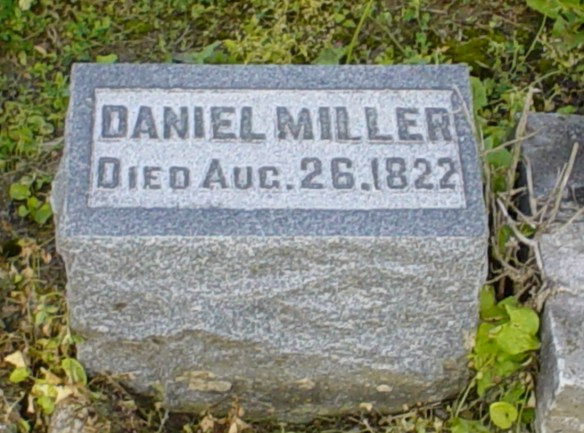
Daniel Miller Sugar Hill 2

However, take a look at the stones on either side of him. The following photo shows the stone that says, Hannah, wife of Daniel Miller, died October 4, 1876, age 65 years, 8 months, 20 days.Daniel Miller 4 Sugar Hill

The gravestone on the other side of Daniel’s stone marks the grave of Sarah Miller, wife of Daniel Miller who died on July 22, 1831 at the age of 28 years and 3 months. This woman was born in 1803. Daniel Miller is buried in-between them.  However, as confusing as this is, NEITHER of these women are the wife of the Daniel who is buried between them.  Yes, you read that correctly.  Is this some kind of morbid genealogy joke?  I mean, seriously???  Not funny.

Sarah Miller Sugar Hill

The stone directly behind these three belongs to Samuel Miller. Below is a list of all the Miller burials in Sugar Hill cemetery.

Miller Abraham       died Apr. 12, 1876, age 73y 11mo. (so born 1802)
Miller Lydia            died Jan. 7, 1891, age 87y 11mo 11da. (born 1804)

Miiller Daniel (4)           died June 8, 1879, age 8ly 5mo 9da. (born 1798)
Miller Hannah         died Oct. 4, 1876, age 65y 8mo 20da. (born 1811)
Miller Sarah                     died July 31, 1831, age 28y 3mo. (1803)

Miller Margaret       died Feb. 6, 1924, age 87y 9mo 11da. (born 1837)
Miller Samuel         died Nov. 14, 1930, age 96y 9mo 24da. (born 1834)

Miller Catharine      wife of Fred’k., died Oct. 31, 1865, age 55y 8mo 20da. (born 1810)

Miller Daniel (1)          died Aug. 26, 1822, age —.

Let’s piece these families together to see who we have and their relationships.

Abraham was the son of Stephen Miller and Anna Coleman. Stephen was the son of Daniel (1) Miller and Elizabeth Ulrich. Daniel is the man who died in 1822. Daniel’s widow, Elizabeth died in September 1834 but she does not seem to be buried here. Abraham Miller was married to Lydia Rodebaugh who is buried here as well.

Daniel (4) Miller who died in 1879 was born on Dec. 30, 1797 to Stephen Miller and Anna Coleman. His first wife was Sarah Harris whom he married on November 15, 1821 in Bedford County, Pa. and who died on July 31, 1831, as noted above. His second wife was Hannah Ernest, also noted above.

Samuel Miller was born in 1834 and died in 1930 in Preble County “on the farm where he was born.” He was the son of Daniel (4) Miller and Samuel’s wife was Margaret Marker.

In 1850, there is a Catherine Miller who lived in Perry Township, a widow and had children Levi 19, b Pa, Jeremiah 11 and Noah 3. One house away lived Joseph Miller, age 32 born in Pennsylvania and his wife Christena. Joseph is listed on Ancestry as the son of Frederick Miller and Catherine Hammer, so this Catherine who lived next to Joseph would be his mother.

Doing a bit more research on Frederick, Catherine and Joseph, we discover that in 1840, indeed we do find Joseph and Frederick living a few houses away from each other in Montgomery County, but both are age 30-40, so clearly not father and son, more likely brothers.

In 1830, in Jackson Township we find a group of men that includes Stephen (son of Daniel who died in 1822), age 50-60 and then a group of 4 men, George, 30-40, Daniel 30-40, John 20-30 and Joseph 20-30. These 4 men are likely sons of Stephen Miller   On the next page we find John B. Miller, age 50-60.

In 1820, we find two groups of Miller men in Randolph Township. Jackson was formed in 1814, so if they were living in Jackson they would have been listed there in 1820.

We have Jacob, 26-45 with Daniel, over 45. Then we have David, over 45 with John, also over 45 and Michael, age 26-45.

Looking now at the 1820 and 1830 census in Preble County, Twin Township, we find a Frederick and Jonathan in 1820. Frederick is not young then. They are still there in 1830 and Frederick is 60-70. These men don’t appear to be connected to our group of men, but one can’t be sure. What we do know is that there is no Daniel in 1820 nor are his children found there. In 1830, we do find a Daniel in Twin Township.

The pedigree below shows what we know about the relationships between the Miller burials in the Sugar Hill Cemetery. The individuals in bold are buried there.

Daniel Miller Sugar Hill pedigree

In the book, “History of the Church of the Brethren of the Southern District of Ohio” by Wayne Webb, the photo of the cabin on page 36 states that the Elder Daniel Miller built that cabin in 1830 and his son Samuel was born there in 1834. This does indeed mesh with the genealogical record that indicates Samuel lived died on the farm on which he was born. This also ties in with Daniel whose wife Sarah died in 1831. We know he was living in this vicinity by then because his wife is buried in the Sugar Hill Cemetery, so this 1830 census in Twin Township reflects what we know to be accurate based on other records.

Note:  It has come to my attention that this photograph was reproduced without permission in the book above mentioned.  According to the Brethren Heritage Center, the proper attribution should be the “History of the Church of the Brethren of the Southern District of Ohio” by the Historical Committee, 1920, published by the Otterbein Press, Dayton, Ohio.

Daniel Miller 4 cabin Twin

The problem is that the interpretation has been that this cabin belonged to the Daniel (1) Miller that died in 1822, but subsequent research shows nothing to connect the eldest “Elder Daniel” with this land, aside from the fact that a cemetery marker placed over 100 years after his death is located in the cemetery with his son, Stephen’s, children, including the Daniel (4) born in 1797, grandson of Daniel (1) who died in 1822 – whose wives Daniel (1) is buried between.

Again referring to the History of the Church of the Brethren book, on page 509, we find the following story about Stephen, son of Daniel (1) who died in 1822, and his son Daniel (4):

Stephen Miller, the father of the subject of our sketch, was twice married, first to Anna Coleman, of whose children, Daniel was the eldest. She died in Clermont County. Stephen’s second wife was Anna Deardorff (nee Lesh), who also bore him children, among whom were John J. and Stephen, who became ministers in the church.

Daniel was born in Bedford County, Pennsylvania, December 30, 1797. When 18 months of age, his father built a raft on the Ohio river and floated down the stream to Kentucky, where they landed and lived for awhile in that state. They, then, moved to Clermont County, Ohio. They next moved to Montgomery County, Ohio, where Daniel’s father in 1816 build he first frame house in Jackson Township. On November 15, 1821, he was united in marriage to Sarah Harris of Clermont County, Ohio. To this union were born 3 daughters, Anna, November 18, 1822, Sarah, November 1, 1824 and Mary, September 3, 1828. He united with the Church of the Brethren when about the age of 27, bring brought under conviction through a serious illness. A short time after this he was elected to the ministry in the Stonelick Church, and later on was ordained in the Upper Twin Church.

After his marriage he lived in Clermont County where he bought a small farm on easy terms but in the fall of 1828, he sold this farm and purchased 160 acres for $625 in Preble County, where he moved April 13, 1829. His new home consisted of a log cabin built near the center of the place surrounded by the forest.   The following winter he built a more comfortable house from hewed logs, which is yet standing. August 22, 1831, his helpmate died leaving him with three small children. January 31, 1833, he was married to Hannah Earnest, to whom were born one son, Samuel, and one daughter, Catherine, who died in 1847. All his children united with the church while young. Anna married Robert Wysong, Sarah, Josiah Woods and Mary, James Swihart. These Brethren all became deacons in the church.

Elder Miller served the Upper Twin Church as Presiding Bishop for 30 years. He was one of the first advocates of the pastoral visit and made regular calls on all the members in the congregation. He solemnized many marriages, preached many funerals and assisted in organizing many churches. His useful life came to a close June 8, 1879.

P 510 – Samuel Miller, son of Elder Daniel Miller, was born January 20, 1834. He was married to Margaret Marker Miller, Sept. 30, 1855. He was elected deacon in the Upper Twin Church in 1874, and to the ministry in 1881. His father, Elder Miller, in order that he might give more of his time to the church, sold his possessions to Samuel, with whom he and his wife lived, for 24 years. Brother Samuel and his good wife, Margaret, have grown old in the service of the Master, still living on the old home place.

Daniel Miller (1) who died in 1822 would be the oldest burial in the Sugar Hill cemetery. It seems inconceivable that his grandson, Daniel (4) Miller’s 2 wives would be buried in such close proximity to him on either side as to be touching him. If any Daniel was to be buried between the wives, it would be Daniel (4), their husband. Daniel (4) the husband of Sarah and Hannah died in 1875, a year before Hannah, and he is buried to the right of Hannah, not between his two wives. It appears that Daniel (1)’s stone was wedged in later.

So here’s the situation. Daniel (1) who died in 1822 was clearly not buried in the location where his tombstone is located today. In fact, in 1822, it’s not likely that this cemetery was even in existence. The first burial with a tombstone is in 1831, and it’s Sarah, forever resting to the right of Daniel’s stone.

The History of the Church of the Brethren of the Southern District of Ohio tell us about this location.  On page 170 the Lower Twin church is also discussed, whose name was later change to Sugar Hill, and the church later torn down. I believe, although it doesn’t say this, that is where Sugar Hill cemetery is located today. This church was organized in 1830.

As we later discover, the Elder Daniel’s grave was moved to this location, but if that was the case, why not also move his wife, Elizabeth, who died in 1834 and mark her grave as well?

It’s nearly 15 miles, and that’s 15 miles with a horse and wagon, between Daniel Miller’s land (B) in Randolph Township and the Sugar Hill Cemetery (A). Furthermore, his brother David had a family cemetery on his land and Daniel could have been buried on his own land. There was no reason to go to Sugar Hill. There has to be something we don’t know.

Daniel Miller to Sugar Hill

The answer bantered about is that Daniel Miller (1) was visiting his son Stephen at the time of his death – Stephen reportedly lived near West Alexandria, close to the Sugar Hill Cemetery. However, Daniel could easily have been transported 15 miles home in a wagon for burial, unless getting the body in the ground was a priority that trumped everything else. Daniel died in August. It could have been very hot and he could have been contagious. Others could have been ill too.

Sugar Hill Brethren Cemetery where Daniel Miller is buried is on Eaton Pike just across the county line into Preble county, slightly east of West Alexandria. Eaton Pike above is 35 on the southern border of the township line in the section map, above.

Daniel’s son Stephen owned land at the SW corner of Farmersville/West Carrollton Road and Diamond Mill Road, not in Preble county near Sugar Hill Cemetery.

On the map below, you can see Daniel’s home location on Old Salem Road, Stephen’s home on Farmersville Road and Sugar Hill Cemetery.

Daniel Miller to Stephen Miller to Sugar Hill

As it turns out, there is more to the story, much more.

Where Was Daniel Buried?

This question sent me on an incredibly frustrating journey that took about two years, and still may not be complete, because still don’t have a definitive answer, but we have tantalizing tidbits.

From Gene Edwin Miller in “Daniel Miller (1755 – 1822), a working copy and a collection of current data on Daniel Miller (1755 – 1822) son of Philip Jacob Miller, son of Michael Miller,” unpublished:

April 1979

One explanation might be as follows……….Elmer C. Miller a son of John R. Miller, son of Jacob Y. Miller, son of John Miller, son of Daniel Miller (1755 – 1822) was an evangelist and traveled throughout the midwest conducting services. In 1924, while in the Dayton, Ohio area, he wrote home to his father, telling of his meeting with a Samuel Miller. Samuel was the son of Daniel Miller, the well known Elder in the Montgomery Co. area.

Daniel was the son of Stephen Miller, oldest son of Daniel Miller (1755 – 1822).

Samuel was then 90 years old and lived in Preble Co. Samuel recalled how that he had helped his father Daniel to locate the body of Daniel Miller (1755 – 1822) from the cemetery at Farmersville to its present resting place at Sugar Hill. He said that when they found the burial place at the original location that it was marked with a little piece of marble about 12″ square and inscribed with the letters “D.M” and dated Aug. 1822. 

Then, from Merle Rummel, Brethren Historian, we have the following: 

  • Stephen William MILLER 1/m  Anna Barbara Kphlman
    born 7 Mar 1775 Conococheague MD b. 12 Apr 1774 Bedford Co PA
    died13 Jan 1851 Montgomery Co OH d. 26 Jan 1813 Clermont Co OH
    bur: Old Brower Cem, Farmersville
    Son of Daniel Miller and Elizabeth Ulrich

Merle shows Daniel’s son Stephen being buried in the old Brower Cemetery in Farmersville in 1851, roughly 30 years after Daniel’s death. However, if Daniel (1) who died in 1822 was buried with Stephen who died in 1851, why would Daniel (1)’s grave be moved? And if they moved Daniel’s grave from the Old Brower Cemetery, why didn’t they also move Stephens? This doesn’t seem logical. 

The Brower Cemetery is located just across the county line into Preble County at the intersection of 70 and Enterprise Road, shown on the map below as 4092-4498 Enterprise Road, West Alexandria, Ohio.
Daniel Miller, Stephen, Brower, Sugar Hill

Another piece of evidence, although this could be hearsay, is the undated NGS Quarterly page, below.

Daniel Miller NGS

This article, which does not give sources and has other incorrect information, such as Daniel’s father being Richard, states that Daniel died near West Alexandria. This could also have been presumed because of the Sugar Hill burial location. Unfortunately, no sources are provided.

Wayne Webb, a researcher with an interest in Brethren history, has a different theory, that Daniel was originally buried in a cemetery just half a mile from Stephen’s house, called the Troxel Cemetery, not to be confused with the Troxel Cemetery that is located on the original land owned by Daniel Miller in Jefferson Township. Truly, those two cemeteries are not connected and I drove myself crazy for months chasing that red herring. Daniel must have had a good laugh. This Troxel Cemetery is in Jackson Township.

From Wayne:

The place I gave you is the half acre tract which is the cemetery called Troxell’s in Jackson and which is no longer there.  That is the “other” Troxell you could not find (because it’s no longer there).  Stephen lived SW¼ R4E T4 S35.

Family lore says, as related by Merle, that Daniel died while on a trip to his son Stephen’s.  Then you have the “Farmersville” notation.  I gave you where Stephen lived.  The Troxell cemetery (NE¼ R4E T4 S36) is within a half mile of Stephen’s house.  I think some of Stephen’s children are living by him but not much is known about all of them and I’ve never taken the time to document them all.  Diamond Mill north-south, Farmersville-West Carrollton east-west.

Daniel Miller Stephen land

Stephen lived on his home farm in Jackson township all his adult life.

Wayne went on to say that there used to be a Brethren church in the same location with the cemetery.

The church is located on section 36 where the Troxel cemetery is located (basd on a map from 1875-76.)

Wayne’s mother who grew up in this area said this cemetery, then with markers, is located on Farmersville-West Carrolton Pike the NE section of section 36, T4 R4 – cemetery is 300 feet south of the road behind the house, 4/10th of a mile west of the Diamond Mill Road. Church was inactive in 1983 – the owner in the 1990s said he bought it in the 1940s.  There were stones then but they had disappeared by the 1990s when Wayne actually visited and walked out in the cemetery and saw that there were no stones visible.

Daniel Miller Troxel church

Wayne said that part of the church foundation is near the road behind the house, and the location of the cemetery is at the arrow towards the bottom of the photo. The road is just beyond the top of the photo.

The map below shows a better general location.

Daniel Miller Troxel church location

From Wayne:

Probably Steven’s original farm. This, above is 4-4-35 near Twin, Steven Jr. lived in 26 and the church was on 36 in the corner. SW corner 4-4-35 southwest 156 acres. Given the comments about going and getting Daniel in Farmersville, this may be the location of where Daniel was buried.

Daniel Miller Troxel to Stephen

You can see on the map below that the present address of the location of the old Brethren Church and cemetery is literally just about 1000 feet west of the easternmost location of Stephen’s land. Of course, if Stephen’s father Daniel was buried here, why then was Stephen not buried there as well? Instead, he was buried in the Brower Cemetery a few miles away in Preble County.

Daniel Miller Stephen Troxel addresses

The Montgomery County 1827 tax book, shows the landowners of 4-4-36 where the church and Troxel cemetery is located is as follows:

  • John Meyers ne section 200 acres
  • Jacob Bowman 4-4-36 NW 166
  • Michael Meyers 4-4-36 art of N 1/2 14 acres
  • Jacob Meyers Se part 140
  • Jonathan Meyers Sw part 143 acres

The cemetery listing from Wayne’ mother’s notes show mostly Troxel burials.

  • Samuel Troxel d 1836 age 35
  • Sarah wife of John P b 1808 d 1833
  • Unknown Linda d 1831
  • Stone in the base of the tree
  • Lewis b July 1828
  • Mary unknown
  • Christian d May 1814
  • Troxel, ?rail – no dates
  • David –
  • David Showe Jr b Oct 25
  • Abraham Shupe b 1818

We know that the cemetery existed in 1822 because two of the burials are prior to that date.

Here’s a second theory from Wayne relating to the Old Brower Cemetery, also possible.

The original German Baptist Brethren church in this area was called simply the Twin church in homage to the creeks by that name. The best evidence of the existence of an early congregation, and it lies just one mile from the Widdows Henderson tract of southwestern Jackson town­ship, Montgomery county, but in Lanier township, Preble county, is the Brower cemetery (the smaller of the two in the region) in which are interred members of the Baker, Brower, Holderman, Karn, Miller, Petry, Wirts, Wise and Yost families.

The photographs, taken in 2006 by this writer, demon­strates the deplorable condition of this early con­gregational burial ground. Evidence is suggestive that at one time there was a small log cabin serv­ing as a meeting-house.

It is likely that Elder Daniel Miller (1755-1822), as well as Elder Jacob Miller (ca. 1738-1815), of no known relation, visited this region during their pastorates preaching to the young congregation.

Daniel Miller Brower cem

One of the stones in this cemetery is that of Stephen Miller, Daniel (1)’s son.

My Opinion Regarding Daniel’s Burial

The only actual evidence we have of where Daniel was originally buried is the information from Samuel Miller who was born in 1834 and helped his father Daniel (4), who died in 1879 and is buried at Sugar Hill, locate and move Daniel Miller (1)’s grave. Samuel said they went to Farmersville. Unfortunately, Stephen’s land is about as far east of Farmersville as the Brower Cemetery is west of Farmersville.

Daniel Miller entire route map

The map above shows all of the relevant locations to this discussion, as follows:

  • Daniel Miller’s Randolph Township Property – 3705 Old Salem Road
  • Stephen Miller’s Jackson Township Property – 5001 Farmersville West Carrollton Pike
  • Troxel Cemetery – 10360 Farmersville West Carrollton Pike, just west of Stephen’s property in Jackson Township
  • Old Brower Cemetery – 4092-4498 Enterprise Road, Preble County
  • Sugar Hill Cemetery – just east of West Alexandria, Preble County

Daniel (4)’s father, Stephen, who died in 1851 was buried in the Old Brower Cemetery in Preble County, so I think it’s unlikely that Daniel (4) would have moved the older Daniel (1) away from his son, Stephen, in the Brower Cemetery. In other words, if Brower was good enough for Stephen, Daniel (4)’s father, it would have been good enough for Daniel (1), Daniel (4)’s grandfather as well.  If not, Daniel (4) would have moved them both.

I think it’s much more likely that Daniel who died in 1822 was buried in the Troxel Cemetery, with no other Millers, which would have prompted the move to a location with other Miller family members.

The grave would have been moved probably sometimes after 1854 when Samuel would have been 20, and sometime before 1879 when Daniel (4) died. Daniel (4) would have been 25 years old when his grandfather, Daniel (1), died in 1822, so he would have known where to look for the grave.

Looking at these two stones on either side of Daniel (1)’s final resting location at Sugar Hill, Sarah died in 1831 so that grave would already have been there. Hannah didn’t die until 1876, so she might have been buried after Daniel was moved. However, I actually kind of doubt that, because I think if she were buried after Daniel’s grave was moved, her grave would have been further away. The space between Sarah and Hannah is only about 18 inches or so, not large enough for another burial. Clearly, if Daniel’s remains were moved in the 1870s, after his death in the 1820s, there would only have been a few bones left, so he would have “fit” between Hannah and Sarah’s stones, not needing a full space.

Given this deductive reasoning, which is really all we have to go on, I suspect that Daniel (1) was moved to Sugar Hill between 1876 when Hannah died and 1879 when Daniel (4) died. Samuel, who moved the grave, would have been about 42 at the time, which explains why he did the digging and moving and not his father who was born in 1797 and would have been 78+ at the time.

I wonder what happened to that original marble slab with D.M. engraved. Perhaps they moved that with him and today’s contemporary stone replaced the small marble slab.

Daniel’s DNA

Ironically, although we don’t know where Daniel was in August of 1822, nor where he was buried for roughly 50 years, we do know about his ancestors and where they were. DNA testing has been a huge blessing for us and different kinds of DNA tests provide a great deal of information about our ancestors.

We’re fortunate that another Reverend Miller in the family, Richard, has been incredibly helpful and sharing with his information as well as his DNA to represent our Miller line, for which I am eternally grateful.

Richard took the Y DNA full 111 marker panel test, plus the Big Y test at Family Tree DNA.  He is also a member of the Miller Brethren DNA Project whose goal is to unravel the various Miller Brethren families.

Our Miller DNA markers from 12-111 are rare. Our only matches at any level are to other Miller men, with the exception of one poor misplaced Morgan at both 25 and 37 markers whose ancestor is reportedly from Wales. The Morgan gentleman did not test above 37 markers, so we don’t know how closely he would match above that level, but I have to wonder if Mr. Morgan is actually a Miller.  It’s worth noting that Maugans in some cases was changed over time to Morgan.  Things that make you go hmmmm….

When our Miller STR panel results first came back, years ago, I chalked up few matches to the fact that we were early in the testing game. Over the years, as more Miller matches were added to the list, but no other surnames, I realized that our lack of matches outside the Johann Michael Miller line was actually a blessing, because we have rare DNA that acts as its own filter.

One of the services I provide to Y DNA clients is a chart showing each of their markers and the frequency with which their marker value is found within their major haplogroup. I did the same thing for our Miller STR results, showing only the rare and very rare results in the chart below.

I have indicated very rare allele values below with red, bold and underscore. Six percent or less of the R1b (M343) population will show these values on these markers. The next group is rare markers, indicated by black bold. Less than 25% of the R1b (M343) population will match on these values. The Miller men have a very high number of rare and very rare marker values, especially in the first (yellow) panel.

Daniel Miller STRs

Each panel is color coded, so the first panel of 12 markers is shown as yellow. As you can see, 7 of the 12 markers in that panel are either rare or very rare values, meaning that for anyone to match the Miller DNA at 12 markers, they would have to carry all of these same rare or very rare values. Unless they descend from a Miller male, that’s very unlikely to happen. Happening simply by chance or convergence is extremely unlikely.

Of course, the next question was why the Miller DNA is so rare. Were they simply isolated in a mountain valley, never spreading the Miller DNA outside of that village, for hundreds or thousands of years? Surely, eventually, men of other German surnames from that same village will emerge, unless they died in battle or daughtered out in the intervening timeframe.

In hopes of understanding our deep ancestry better, Richard Miller agreed to take the Big Y test. The Big Y test scans over 35,000 locations on the Y chromosome that may carry mutations, called SNPs, or single nucleotide polymorphisms. SNPs are mutations that have been found previously and given a name, like Richard’s terminal SNP, R-CTS7822.

Prior to Big Y testing, Richard’s estimated SNP was R-M269, which was accurate, but Big Y testing shows us every branch of the haplotree that is relevant to Richard. In fact, the only way to discover every branch is with the Big Y test.

For our Miller men, all of our branches below M269 are:

  • M269
  • L150
  • L23
  • Z2103
  • Z2106
  • Z2109
  • CTS7822

Not only did we confirm M269, we added another six branches between M269 and CTS7822, Richard’s terminal SNP, meaning the one at the end of the line providing the most granularity.

Furthermore, the Big Y test also provides information about additional mutations called Novel Variants. Think of Novel Variants as mutations that are not yet named, because not enough is known about them yet. Either few people have been found with this mutation, or we don’t know yet exactly where it fits on the tree.

In Richard’s case, he has a total of 607 known and named SNPs and 37 Novel Variants, SNPs waiting to be placed on the tree and named.

Most of Richard’s Novel Variants are quite rare, meaning that none of the men he matches share them.

Richard has a total of 8 Big Y matches, and of those men, the closest match has three SNPs difference and only shares 4 of his Novel Variants. That means that Richard does share a common deep ancestral relative with this man, but not in a genealogical timeframe.

In fact, it would appear that most of Richard’s Novel Variants are rare, because he has no matches with 33 of 37. That’s actually quite unusual.

Haplogroup R is the most common Y DNA haplogroup in Europe, with about 45% of European men being some flavor of haplogroup R, meaning they share a common ancestor thousands of years ago when haplogroup R was born. However, there are still very rare sub-haplogroups, and Richard’s is quite rare. Maybe our ancestors truly were isolated in that mountain village.

Another benefit of the Big Y testing is that Family Tree DNA provides matching to other Big Y testers.

In Richard’s case, he matches 8 men. Not all matches have included their oldest ancestor information, but as best we can tell, the 8 men’s location history or surnames are as follows:

  • Bulgaria
  • Possibly Sweden
  • Austria
  • Moorman?
  • Seymer
  • Spain
  • Blair
  • Russia

However, none of these men share our terminal SNP of CTS7822.

Big Y matches are shown if there are 4 or fewer SNP differences.

In the R1b Basal SubClades Project, the Miller DNA is grouped both by STR marker values and SNP results entirely with Russian samples.

Daniel Miller Basal subclades

One of the samples carries the same terminal SNP as our Miller, but obviously they have more than 4 nonmatching SNPs, because they do not show as a Big Y match. Of course, many people who test don’t join projects.

Looking next at the project map for this subgroup, we discover that only one other individual has entered their geographic location information.

Daniel Miller project map

Fortunately for us, the person who DID enter their geographic location is the only other CTS7822 found in the project, whose ancestor is from Russia. By zooming in, we discover that what looked like one marker balloon is actually 3, 2 of which have the same surname.

Daniel Miller project map locations

Turning now to the SNP map at Family Tree DNA to view additional locations where at least two individuals have been identified within a radius of 1000 miles with the SNP of CTS7822, we see the following:

Daniel Miller SNP locations

CTS7822 has been found in a smattering of highly scattered locations in Europe. Keep in mind that these locations don’t just include individuals who have CTS7822 as a terminal SNP, meaning the end of the line for them, but includes individuals whose individual haplotree includes CTS7822, but who may have different additional SNP(s) further downstream, that the Miller line does not have.

Fortunately, one of the project’s volunteer administrators is a geneticist, Dr. Sergey Malyshev, from the Institute of Genetics and Cytology of Belarus National Academy of Sciences. He assembled a phylogenetic tree that shows the various SNPs found in ancient DNA on the M269 branch, as shown below.

Daniel Miller ancient

You can see that our CTS7822 is a major branching point which Dr. Malyshev estimates to have been born about 6,100 years ago.

Daniel Miller ancient branch

The Miller DNA is not a part of the branches of this tree above CTS7822. There are no known SNPs in our results that came after CTS7822, so, along with a few Russian men, we stand alone. As more becomes known about the Novel Variants, we may indeed discover that one or more variants are a new branch of the tree, but until more people test and match those variants, we wait.

What we know now is that our DNA is quite rare. We do not descend from the Yamnaya, but our ancestors and that of the Yamnaya culture found along the Volga River in Russia descend from a common ancestor who developed SNP Z2109, born also about 6,100 years ago, probably someplace in central Russia, perhaps along the Volga.

Additionally, Z2109 is also found among the Pathans, people who live in northern Pakistan and Afghanistan, illustrated in the 1825 painting below. Our Miller men, the Yamnaya represented by the Burzyan Bashkirs in Russia today and the Pathans of Afghanistan and Pakistan all share a common ancestor in antiquity.

Daniel Miller Pathan

Noting that within the R1b Basal project grouping, the only match to our terminal SNP is Russian, that within the project matching, our group is entirely Russian, except for our Miller ancestor, and that the SNPs found in ancient DNA also point unquestionably to central Russia – I think we may have the answer to why our DNA is so rare. There may or may not be much, at all, in Europe. As more Russians test, it’s likely that we will find addition matches – and perhaps more in Germany and the areas of Europe that were most affected by the invasions or migrations from Asia.

It has been a long journey from the Russian steppes, some 6,100 years ago, to Sugar Hill Cemetery in Montgomery County, Ohio. The Miller DNA and descendants have been dispersed by the winds of fortune further yet.

I would love to know the story of the chapters of those lives from 6,000 years ago. Who were those people? Where did they live and how did they get from Russia to Germany, a journey of more than 3,500 miles?  What prompted that migration, or was it just another frontier – the seeming story of the Miller men.  Perhaps they come by that honestly, the legacy left to them by 6,000 years of ancestors.

To me, it’s simply amazing that we can tell this much of the Miller story through the DNA passed from those Russian ancestors to the Reverend Richard Miller today.  And just think, we would never have known “the rest of the story” had the Reverend Richard Miller not tested.

References

I originally constructed a timeline of events in the life of Johann Michael Miller’s life utilizing various sources which I have referenced in this document:

Replogle – “Ancestors on the Frontier: Miller, Cripe, Ulrich, Replogle, Shively, Metzger” by Justin Replogle, self-published in 1998, now out of print.

Mason – “The Michael Miller and Susanna Bechtol Family Record” compiled in 1993 by Floyd R. and Catherine Mason, now deceased.

Miller – “A History and Genealogy of David Y. Miller 1809-1898” by Gene Edwin Miller, self-published.

Stutesman – “Jacob Stutzman (?-1775); His Children and Grandchildren” by John Hale Stutesman, Jr.

These 4 books plus two websites, Troy Goss’s Miller home page and Tom and Kathleen Miller’s pages are the primary resources for Johann Michael Mueller and the first two generations of his descendants, aside from my own research.

Wayne Webb’s research is referenced in some places in this article as well. Unfortunately, his ideas were never brought to a logical conclusion, as he failed to provide research that I paid to have completed.

For Brethren Research, I strongly recommend the Brethren Heritage Center in Brookville, Ohio. I have contributed my research to the Center.

Suffice it to say that all of these sources don’t always agree – and in fact some contradict each other. So I’ve sifted through each and compiled the information I found credible by evaluating the sources, where possible.  Where doubt remains or work needs to be done, I have said so.  I hope that others will continue the research and add to the body of information we have compiled about the Miller family.

______________________________________________________________

Disclosure

I receive a small contribution when you click on some of the links to vendors in my articles. This does NOT increase the price you pay but helps me to keep the lights on and this informational blog free for everyone. Please click on the links in the articles or to the vendors below if you are purchasing products or DNA testing.

Thank you so much.

DNA Purchases and Free Transfers

Genealogy Services

Genealogy Research

Writing Ancestor Articles in 12 Easy Steps

You might notice that this article is in place of my normal 52 Ancestors article I publish every weekend. That’s because I didn’t get this week’s article finished.  Sometimes life just gets in the way, plus, the ancestor I was working on has a HUGE amount of research data to sift through. I’ve worked on this family for decades now, as have others and I want to be sure to include everything that is correct and relevant, and exclude those items that are not. Easier said than done in some cases.

Lots of people have asked how I go about the research for these articles, so I’d like to share that with you, in the hope that you too will do something similar. If you don’t publish accurate information about your ancestor in one form or another, who will?

Not The Same As A Book

I’ve written books before, both specialized books in the technology field and books about specific ancestral lines. The weekly articles I write about just one ancestor are really different from books, although when I began the 52 Ancestors series two and a half years ago, I didn’t realize how different, or why.

First of all, if you look at writing a book, that’s an overwhelming task that you’ll do “someday.” Do you know how many books have gone to the grave in people’s heads? Surely more than have been written. But anyone can write just one article, then one more. Then, one day, before you know it, you do have a book. Voila.

These articles are different from books in other ways too.

When I was writing a book about a line or lineage of ancestors, I was not focused on just one person, but on the story of that particular lineage, which of course included every ancestor in that line. However, I never focused on just the story of any one person disconnected from the rest. I focused on all of the people in that line in the context of their relationships to the other people. In other words, I never looked at John Doe from birth to death, from only his perspective. Instead, in a book, John Doe is a son, he marries, moves to another state, has children and dies. There is little in the story about what was happening in his life at different times. How those events like warfare or drought or economic conditions might have affected him. In other words, the 52 Ancestors stories take each individual person from cradle to grave and it’s their story and theirs alone. I also write it as a story, their story, with as much empathy and detail as I can muster.  In other words, I try to walk in their shoes.

Of course, this too has presented some challenges, because I don’t want these stories to be boring and repeat information presented in parents’, children’s and spouse’s stories, so I try to utilize different information so that these individual stories could be combined into book format without too much duplicate information. So no, you won’t find the same level of detail about the 1816 famine in Europe in the father, mother, son, son’s wife, son’s wife’s parents, or their children’s stories. You may find mention of it, but only one story will have the details. Therefore, to really have the whole picture, you probably should read the story of each ancestor.

For example I generally list the children for John Doe, but I often go into more detail about the children, who they married and what happened to them in the wife’s story. Why? Because often the wife has less information – she didn’t own land, she didn’t vote, she (generally) didn’t go to court and normally didn’t get herself thrown out of church for drinking and swearing – so I save the children’s detail for her story so the stories are more balanced.

Research, Then and Now

While I attempt to compile and finalize a story each week, most of the research is not performed today. In fact, these stories have been an attempt for me to organize my information and file information away forever. I have a rule that the file folder cannot go into the file cabinet before the information in the folder is processed. Once it is in the file cabinet, it really should NEVER have to come out again.

And yes, I’m dead serious. I know that when I pass over, it’s likely that those folders will never see the light of day except maybe in the trash truck on the way to the dumpster – so I’m making sure all of that cumulative information is scanned and published which will hopefully make it more permanent. Yes, I’m also printing it, and donating it to relevant libraries. However the internet being what it is, I’m counting on the folks who are “gathering” to attach these stories to their tree records at Ancestry, etc., where, as we know, they will live into infamy! Yes, in essence, I’m hoping my ancestor stories become a sort of genealogical virus, infesting the genealogical community to last forever.  I figure it’s going to happen anyway, so I might as well take advantage of the phenomenon.

Let’s take a look at the various steps in the process.

Step 1 – Gather All Information

Step 1 is to gather all the information you have. I guarantee you, if you have researched very long, you will have information you’ve forgotten about and it’s probably scattered in various folders. Mine is.  Gather it all together in one place. 

Step 2 – Add Local History Resources

In addition to information directly about my ancestor, I check local and county history books for information about the family. You never know what you may find in a child’s vanity article that will provide information about their parents – or grandparents – for example. It was through a vanity story that I discovered that my Brethren ancestor married a German Lutheran and secondly, a non-German BAPTIST!!! Holy chimloda. Today, this isn’t remarkable, but when he did it, it was.

Many local genealogy societies have published genealogical history books where their membership has been encouraged to write articles about their ancestors. Often, these include photos and stories as well, so it’s always wise to check both local history books and more contemporary publications by genealogy societies.

Step 3 – Make a Timeline

Often, but not always, I make a timeline. When I have multiple people and families in the same location, I always make a timeline. This makes it easier to understand chronological order as well as see relationships. When you write the story, you can write it in chronological order as well. In some cases, where I have extracted huge amounts of information by surname in order to discern family relationships, I have created a spreadsheet that is sortable by column, so I can find surnames, locations, and more. In the example spreadsheet below, the Places column would include locations in deeds such as stream names.

Example timeline SS

Obviously, a timeline can be done in this manner as well. This is particularly useful when employing the FAN principle, Family, Associates and Neighbors. In other words, if I found Joseph Abbott consistently witnessing deeds for my family, I would begin to ask if and how he might be related. As it turns out, this Halifax County spreadsheet served to help me DISPROVE the family connected to John Moore. There were at least two Moore families, not related as eventually proven by Y DNA, in Halifax County quite early. DNA was a Godsend to the Moore lines, but so was the timeline spreadsheet because between the two, it allowed me to sort the families.

Step 4 – Add Events Into the Timeline

Normally, the events we track for people are:

  • Birth
  • Marriage
  • Children’s Births
  • Death

There is a lot more that affected their lives. Did their grandparents live during their lifetimes? When did the grandparents pass away? Do we know where they are buried, because if you do, you know what your ancestor was doing that day, and where. 

Religion

Whatever religion they followed, it’s likely that religion was fundamentally important to your ancestors. One common thread in my family seems to be that they were extremely devoted to their chosen religion. I have hard core Catholics, Lutherans, Brethren, Mennonites, Protestants (1709ers), and more. What was happening in that time and place relative to their religion? Add this information into the timeline.

Warfare

Did your ancestor serve in the military? Was your ancestor the wife waiting at home? If so, how might she have survived? How did the war affect the life of your ancestors? Were the wars fought on their home ground? How did they go to war? Did they walk? Can you find a regimental history? If your ancestor served in the US, don’t forget to order their entire record packet from the National Archives and check Fold3.com.

Whatever you can find, add into the timeline.

Deaths

Did they have children that died? If you don’t know the answer, are there “gaps” in the census of more than 2 years between children’s births that suggest a child might have been born and died? Where would that child have been buried? Was there a cemetery on their property, such as was common in colonial America, especially in the south, or was it customary to bury the dead in a churchyard, such as in Europe?

Is the grave still there today? Have you checked Find-A-Grave?

How do local customs affect burials? For example, in Europe, graves are reused, but often in the same family. In one case, in the Netherlands, we found my ancestors grandchildren buried in the plots he bought, so he too was likely buried there at one time. 

Step 5 – Find or Scan Documents

Everyone loves a story book with pictures. Obtain relevant documents for your ancestor and include them. The best item is one with their signature because a signature is so personal.

Deed and will books are not original signatures, as the clerks copied the deeds and wills into the book. Only the original deed or will, which went with the owner, had the original signatures, sadly.

However, applications for bounty land, receipts, some estate documents, some marriage license applications, some naturalization applications and petitions all have original signatures.  Chancery suits are Godsends because often some records from those suits are retained, and even if your ancestor isn’t the plaintiff or defendant, they may be mentioned in a relevant way.

I’ve also found my ancestors’ signatures and information about their life in other people’s chancery suits.  Like the time a couple got divorced and my ancestor, a Methodist preacher, had originally married them.  He testified he though they were “simple” at the time he married them and told about their wedding day.  He also signed his deposition.  The Library of Virginia has indexed every chancery suit by every name in the suit and it’s a goldmine.  Not all counties are complete, but many are

In addition, finding your ancestor’s deeds from the deed books, wills, estate inventories, and naturalization records all lend to the historic feel of the articles.

Sometimes an article is delayed when I discover an item exists that I don’t have, or that I have not checked all relevant sources. The good news is that today, many times, the clerk or other official, depending on the item type, will scan and e-mail you the requested items, so obtaining them is easier than ever before.

Don’t forget libraries in your search either.  You never know what kind of resources of files they might have.  I’ve had wonderful items from local newspapers sent from librarians more than once.

Step 6 – Be Anal

After you assemble everything, go back over what you have to answer the question “What don’t I have?”  Go back and check one more time. Check Genweb, Rootsweb, Ancestry, WikiTree, Fold3, AmericanAncestors.org, Newspapers.com, MyHeritage, FindMyPast, FamilySearch and any other subscription source you follow. You never know what new record sources are available now that were not before. Records are being indexed every single day.

You also don’t know who might have posted photos, stories, etc., that are new.

Furthermore, check your original records and notes in your file. You will, I guarantee, see things you didn’t see before. In one case, I realized that somehow, I had overlooked in one census that the oldest child was listed with the wife’s maiden name – but just in one census. In subsequent census schedules, the child was listed with the husband’s surname which he used throughout his life. Later, DNA testing confirmed that the child whose surname was not that of the husband in the first census after they were married was not the child of the husband. Obviously no secret then, but being “discovered” now, it could be a scandal, had that census not recorded that the child was the wife’s, clearly before the marriage.

Step 7 – Document

Document your sources. Yes, I know, you’re groaning and I do too. I initially thought I would, of course, never forget, so I didn’t document some of my early sources. Pox on me. I don’t make that mistake now.

If you check a source and your ancestor is NOT there, sometimes that’s just as telling too. Don’t just omit that information and not write it down. Absence is informational as well. Document the source and that they were absent.

In one case, who is IN the census and on tax lists, and ABSENT from the militia rosters tells us who was likely a member of the Brethren faith in a particular county during the Revolutionary War when militia duty was mandatory.

When you have an unidentified wife, which happens constantly with the Brethren who did not believe in civil marriages so they didn’t obtain marriage licenses, this is one way to identify who her family might have been. Early Brethren also didn’t keep church records. Pox on them.

A Brethren male would only have married a Brethren female (or been thrown out of the church, unless she converted), so the list of who is absent from the militia rosters is a virtual pick list of who the wife’s family might be. Later, when you begin to get DNA matches on that line to unexplained Brethren families, look on the “non-militia” list. You might be surprised. So, in this case, “absent” might just the clue to breaking down a brick wall!

Step 8 – Find Their Land

I love to actually go back to where my ancestors lived and as one of my genealogist friends says, “walk the walk.” On my own personal list, that is a #1 priority and my bucket list items are almost all comprised of “walk the walk” places.

My top 3 right now?

  • Acadia in Nova Scotia
  • Plymouth Plantation
  • Germany

Yes, I’m making plans for all 3.

When possible, and with permission of course, I take a rock from each place and bring them home to my garden, so my ancestors are all with me, both outside, in the garden, and inside (DNA.)

However, there are other ways to find their land that are almost as good. Google maps is an incredible tool. Old deeds often include landmarks such as creek names, churches, cemeteries, etc. Often, old plat or tax maps still exist that can help as well, especially if you can track their land backward or forwards to the time of that map to locate the land through the then-current owner.

Using Google, or in person, you can locate the land today and view the old homestead if it still exists, the land, their church and even cemeteries. All without leaving your chair. I know there are places I’ll never be able to visit in person, so Google maps is quickly becoming one of my best friends.

Even in Europe, where Street View is not utilized, satellite viewing is enabled and you can still “see.” Additionally, along the bottom bar, often Google Maps links to photos where the photographer has tagged the location you are searching for, or nearby, and you can then view their photographs.

Step 9 – Find Their DNA

After testing yourself and any family members you can convince to test, you’ll discover which ancestors DNA you have and which you do not. By this I mean, if you are a male, you automatically have available to you information about your mitochondrial and Y DNA. This means, of course, that you have information about your father’s Y DNA, his father’s Y DNA, on up the tree – shows by the blue squares to the left below.

Conversely, your mtDNA is inherited from your mother, her mother, on up the tree, so you have some information about those ancestors directly.  These are shown in the red circles to the right, below. Unfortunately, females only carry mitochondrial DNA, so they have to find males, such as brothers or fathers or uncles to identify their paternal line DNA.

For other people whose mitochondrial and/or Y DNA you don’t personally carry, you will have to find people who descend appropriately to test.

For example, you don’t carry your father’s mtDNA, because he carries his mother’s DNA and males don’t pass mtDNA on to their children. To find your father’s mitochondrial information, you’ll need to test your father. Don’t have access to test your father? Then test one of his siblings, or his sister’s children, since only women pass mitochondrial DNA on to their children. You may have to be creative with hunting for specific relatives whose DNA you need to complete their, and your, ancestral genetic information.

Here’s an example of what my DNA pedigree chart looks like.

DNA Pedigree

You’ll notice that I have managed to identify the haplogroup information for several lines, but there are still others I need, and a few that have died out.

When you’re out of cousins to test directly, check MitoSearch and YSearch.org.

Also check trees at Ancestry to see if you can find someone who descends appropriately and ask them if they have had their Y or mtDNA tested. If not, offer to provide that test.

Autosomal matches at Ancestry show you how you and your match descend from a common ancestor – so check those matches for people eligible to take either the Y or mtDNA test.

Unfortunately, we still don’t have any good tools to discover genetic lineage and who has tested for mtDNA.  By this, I mean you can’t enter your ancestor’s name and find out who descends from her that has tested. But I have my fingers crossed that this will be a feature someday.

Sometimes, just publishing the article will be the key to finding a tester. You never know. And let’s face it, these articles are cousin-bait.

If there is any, and I do mean any, question in your mind about how valuable and informative Y and mitochondrial DNA can be – just read these two articles.

Y- DNA – Jakob Lenz (1748-1821), Vinedresser, 52 Ancestors #128

mtDNA – Elisabetha Mehlheimer (c1800-C1851) and Her Scandinavian Mito-Cousins, 52 Ancestors #24

The Y and mitochondrial DNA provides information that isn’t possible to discover any other way – the deep ancestry of that particular line.  You have shortchanged yourself, and your ancestor, if you don’t make every attempt to discover their Y and mtDNA haplogroups and the historical information that comes along with the haplogroup designation.

Step 10 – Google is Your Friend

Aside from Google maps, Google is your friend. Google your ancestor’s name and location. Google his wife’s name, both maiden and married, and location. Google just the location with the word “history” following. Google in different ways to find information that might not appear on your first Google search.

People write blogs now and it’s easy to create a webpage. They contribute to GenWeb. They post photos and memorials to Find-A-Grave. The old Rootsweb list and boards, which are often sadly inactive now, are wonderful resources. Ancestry bought the Genealogy.com boards and while you can no longer post, they have preserved the postings and threads which were already there, which are also goldmines. Don’t forget about social media resources like Facebook. Some people have started family pages there.

Furthermore, many local history books, especially those whose copyrights have now expired are available through various scanning initiatives.

So, Google, Google, Google.

Step 11– Revisit Earlier Conclusions

There is nothing I hate worse than proving my own work wrong – and I can’t tell you how often I’ve done just that. The only person who doesn’t make mistakes is the person who does nothing. My only possible excuse is that I never set out to be a genealogist, there were no “instructions” in those early years, I’ve been doing this for 38 years now and I’ve learned one heck of a lot!

Today, you may have far more information than you did when you formed earlier opinions. You may have learned more about cultural and social norms affecting your ancestor where they lived. You may have been flat out wrong or just overlooked something that is obvious now, but wasn’t then.

Don’t just accept what you, or anyone else for that matter, has previously written, without scrutiny in light of the information you currently have.

In one case, I made a logical assumption that was wrong. After a woman’s husband died, in the next census, an older invalid male was living with her. My assumption was that it MIGHT have been a sibling, hence, his name MIGHT have been her maiden name.  I did phrase it that way. Unfortunately, when that information was repeated, the word MIGHT never got included, and today, after later finding her husband’s War of 1812 pension application that contains not only her maiden name, but the name of her father as well – I constantly have to do battle with records that reflect my own logical, but incorrect, earlier surname commentary.  Often, people have grown attached to that wrong name, and refuse to change it.

If you don’t know, say you don’t know.  If the information is ambiguous or confusing, say so, and why.  Perhaps someday someone will find something that clarifies the situation.

Step 12 – Be With Your Ancestor

I know this sounds a bit bizarre, but when I write these articles, each article gives me the opportunity to “be with” that ancestor, focusing on only them, for a week, or more, at a time. I get to see through their eyes, as much as I can in this lifetime. I get to experience what they experienced, as best we are able from our perspective today. The ONLY way I can do that, though, is to understand their world, not just within the family in terms of who was being born and baptized, but in terms of what was going on around them at that time.

One of my favorite items that allows me to “be with” my ancestors are estate inventories. Those are the closest we will ever come to peeking inside their homes. I’ve learned a great deal about what they do, their skills, and even if they distilled liquor. I just can’t tell you how much I love estate inventories.

Often, after I’m done researching and organizing, I take a walk or otherwise just allow my ancestor’s experiences and life to just kind of simmer and percolate for a day or two.

Write Your Article

You may have noticed that I name each 52 Ancestors article. Each person has something that is defining or remarkable about their life.

My friend knew that her great-grandfather had been shot and killed. The story was rather hush-hush and no one would discuss it in her family. She ordered the old newspaper films from that location into her local Family History Center.

I was there the night she found the newspaper article about her great-grandfather’s death. She emitted a shriek that rivaled any smoke detector. We weren’t sure if that was a death rattle or just what, so all of the patrons and librarians went running in her direction. She couldn’t even talk. As we’re all fawning over her, she just gasped and pointed to the microfilm reader in front of her where the front page newspaper headline said, “Shot on the Whore House Steps.” Yep, it was her great-grandfather and yep, I’d say that was a defining event.

Now that you’ve gathered the information about your ancestor, sifted and sorted the correct and relevant from the chaff, organized it as best you can, you’ll need to decide how to write the article. In general, I utilize the timeline methodology, with a few segways. I find this to be easiest to follow, in most cases. The segways are often for historical discussions about things that were occurring or relevant socially and adds flavor to their life. After the segway, which is in the timeline-appropriate place, I continue with the events of my ancestor’s lives. I try very hard to write these articles with a narrative story feel and not the dry names and dates feel that genealogy often has. I want their life experiences to come through, for people who read the article to know them as people and see life through their eyes.

I want you to leave the story knowing what a vinedresser is, even though you had never heard this word before. I want you to know what they do, when, and why. I want my grandchildren to be inspired by these stories and to know the people well enough that when the story is over, they want to go and play “Jakob the vinedresser” and have enough information to do so.

I often don’t name these articles until during or after I write them, because it’s really not until after I utilize every scrap of information that I can discover about their lives, and percolated a bit, that I feel I “know” them well enough to select an article name. More often than not, the article pretty much names itself…or maybe it’s my ancestor helping out.

______________________________________________________________

Disclosure

I receive a small contribution when you click on some of the links to vendors in my articles. This does NOT increase the price you pay but helps me to keep the lights on and this informational blog free for everyone. Please click on the links in the articles or to the vendors below if you are purchasing products or DNA testing.

Thank you so much.

DNA Purchases and Free Transfers

Genealogy Services

Genealogy Research

Maria Margaretha Grubler (1748-1823), A Woman of Steel Resolve,52 Ancestors #129

Maria Margaretha Grubler or Gribler (present day spelling) was born on May 4th, 1748 and baptized the same day in Beutelsbach, Wurttemberg, Germany to Johann George Grubler and Katharina Nopp, both also of Beutelsbach. This family is indexed incorrectly at Ancestry, under the surname Brabler and a wide variety of other ways as well that don’t remotely resemble their actual surnames.

Maria margaretha Grubler

We don’t know much about Maria Margaretha’s youth, except that she was Lutheran much as everyone else in Beutelsbach, and she was an only child – a rare occurrence in a time when pregnancies routinely occurred every 18-24 months and there was little, if anything, one could do to prevent that aside from abstinence.

Like other German girls, she was likely called by her middle name, Margaretha – an enchanting and beautiful name.

Margaretha may have originally been a Scandinavian name, where it means pearl. It’s found in some format in almost all European languages.

Beutelsbach has provided an invaluable service to genealogists seeking their family by reassembling the historical families from church and other records and providing the information online, and for free.

Maria Margaretha Grubler history

These records allow us to search specifically at Ancestry in their Wurttemberg Germany, Lutheran Baptisms, Marriage and Burials, 1500-1985 (which includes Buetelsbach) records collection for events like baptisms, marriages, births of children and burials. In German families in the 1700s, these are the activities and events that defined your life, especially if you were a female.

Margaretha grew up in this small village of just a few hundred people not far from the Rems River, where the hillsides sloped upwards and were filled with grapevines and vineyards. Beutelsbach is dab smack in the middle of the German wine region and the countryside is dotted with small villages, either within sight of each other or nearly so – scattered just far enough apart to have their own church and for people to walk to the nearby vineyards to work daily. In German villages, people lived centrally and walked a mile or so to their fields, or the fields they rented or worked for the landowners, the gentry. In Beutelsbach, the people who owned the fields would have lived in the Manor House, up on the hillside, overlooking the village. You can see the manor house in the drawing below.  Today, the manor house is a hotel and conference center.  I’d love to visit!

Beutelsbach 1598

This beautiful view of Beutelsbach from 1598 was found in the forest register books created by Andreas Kieser. It probably didn’t look much different in 1748 when Maria Margaretha was born.

Beutelsbach and other nearly small villages have been joined together today administratively as the city of Weinstadt.

Margaretha’s father, Johann Georg Grubler, died on November 27, 1764 when he was 55 and she was 16 years old.  They buried him the next day.  This was probably Maria Margaretha’s first dealing with death up close and personal, as two of her grandparents died before she was born, one died a year after her birth and one when she was 4, so she never knew her grandparents – nor would she remember their funerals.

Grubler, Johann Georg 1764

Church records don’t reflect any additional children for Maria Margaretha’s parents, but it would be highly unusual for a couple in that time who clearly could have children to have only one child. However, information unearthed by my friendly German genealogist, Tom, indicates that Maria Margaretha’s mother didn’t marry until she was 37 years old, on October 26, 1745, had Maria Margaretha in May 1748, at age 40, and never conceived another child. Knowing this, the fact that Maria Margaretha had no siblings makes a lot more sense – but she was probably the only “only child” in the entire village!

Eight years after Margaretha’s father’s death, she married Jakob Lenz, a vinedresser, on November 3, 1772. Given that Jakob’s parents had also lived in Beutelsbach their entire lives, Jakob and Margaretha likely had known each other since they were small children playing in the sunshine. They were only 3 months apart in age and were 24 years old when they married.JakobLenzmarriage

The document above, from the Lutheran church in Beutelsbach shows their marriage record.  It says they were “married the 18th Sunday after Trinity and that Jacob Lenz was the legitimate unmarried son of the citizen and vinedresser, Jacob Lentz from here.  Maria Margaretha is the legitimate unmarried daughter of the late Johann George Grubler, citizen and vinedresser from here.”

So both of their fathers worked in those vineyards above Beutelsbach. Their fathers had probably known each other their entire lives as well.

While Margaretha’s father didn’t join them on their wedding day, he was nearby, most likely buried in the churchyard just outside. The cemetery beside the church was the burial site for the House of Wurttemberg until 1311 when the official burials took place in Stuttgart. Certainly the local people continued to use the church burial ground.

Jakob Lenz and Maria Margaretha Grubler had 9 children, their first child being born just days after their first wedding anniversary.

  • Katharina Barbara Lenz was born November 17, 1773 and died September 4, 1817 in Beutelsbach of epilepsy. She never married. This makes me wonder if she was epileptic for her entire life. I expect she lived with her parents. Perhaps it was a blessing that she died before they did.

Lenz, Katharina Barbara birth

Katharina Barbara’s birth and baptism records are shown above, and death entry in the church records, below.

Lenz, Katharina Barbara death

Katharina Barbara’s parents, now age 69 would have weeped beside their firstborn child’s grave. They buried their first child 44 years after she was born. They buried their second-born within weeks of his birth.

Lenz, Jakob 1775 birth

Jakob’s birth record above, and death entry in the church records, below.

Lenz, Jakob 1775 death

On a late summer’s day, holding their first-born daughter, now 22 months old and perhaps with epilepsy, they would have buried their son, not yet 6 weeks old. This was not a happy family portrait.

  • Maria Magdalena Lenz was born October 1, 1776 and died November 1, 1849 in Beutelsbach of weakness of old age. She too never married.

Lenz, Maria Magdalena birth

Maria Magdalena’s birth is recorded above, and her death in the church records, below.

Lenz, Maria Magdalena death

  • Johannes Lenz was born January 16, 1779 in Beutelsbach and died October 29, 1813 in Beutelsbach. He was single and the cause of death; stickfluss (bronchitis or pneumonia). Occupation not given. Tom indicates that the word gebrachi is used which means frail or infirm, so he may never have been well.

Lenz, Johannes birth

Johannes’ birth record is shown above, and his death entry in the church records, below.

Lenz, Johannes death

Lenz, Philip Jakob birth

Philipp Jakob’s birth is shown in the records above, and his death, below. He lived to be almost 8 years old, past the dangerous first year or two. His parents must have been devastated at his death. His death record doesn’t indicate a cause of death.

Lenz, Philipp Jakob death

Maria Margaretha’s mother, herself a widow, likely lived very close to Margaretha, if not with Margaretha and Jakob. On July 26, 1781, Margaretha’s mother died. Being an only child, Margaretha would have laid her mother to rest beside her father who died 17 years earlier.

Nopp, Katharina death

Given that Maria Margaretha had no siblings, her mother’s death would have been her last immediate family member to pass over. Siblings help to cushion the blow, but with no siblings, Margaretha may have truly felt orphaned at 33.

On the other hand, with 4 living children at home, including a 3 month old infant, Maria Margaretha would have been very busy. Perhaps that was a good thing because she did not have time to dwell upon her mother’s death. On the other hand, in a small village, every time she would have passed by the house where she was raised, she would clearly have remembered her parents. Every Sunday attending church, she would pass by her parents graves. Did that make Maria Margaretha feel comforted that they were close, or sad that they were so close, yet so far away?

Life moved on, and Maria Margaretha continued to have 4 more children.

  • Jakob Lenz was born March 15, 1783 and left to emigrate to America just before his 34th birthday. This is my ancestor whose story is absolutely incredible. So incredible, in fact, that we had to tell the story in two parts, plus a third for his wife, Johanna Friedericka Ruhle whom he married on May 25, 1808 in Beutelsbach. The church records tell us that Jakob left with his family to immigrate on February 12, 1817.
  • Katharina Margaretha Lenz was born November 2, 1785, died January 6, 1858 and married Johann Conrad Gos on April 21, 1807 in Beutelsbach.

Lenz, Katharina Margaretha birth

Katharina Margaretha Lenz’s birth is shown above and her death is shown in the church records below.

Lenz, Katharina Margaretha death

At Katharina Margaretha’s death on January 6, 1858, she is listed as daughter of Jakob Lenz, vinedresser and Maria Griblerin, the trailing “in” often added to maiden names of single women.  Griberlin, the way it’s written, indicates that Gribler was her mother’s maiden, not married, name. Katharina Margaretha is also noted as the wife of Joh. Conrad Gos, bricklayer assistant who emigrated. She died of weakness of old age.

Katharina Margaretha had 5 children. Her husband, Johann Conrad left for Russia in 1817 where he died before the 1823 birth of Katharina’s last child, Jakob Freidrich Gos in Beutelsbach. Jakob Freidrich’s birth record is shown below.

Gos, Jakob Freidrich birth

Jacob Freiderich died in the poorhouse of emaciation and “wasting” in 1857, according to the church record below, which according to Tom, means he had tuberculosis. His occupation was that of a hafner (potter). He died the year before his mother.

Lenz, Jakob Freidrich death

It was initially unclear to me whether Jakob Freidrich was the son of Johann Conrad Goss, perhaps home for a visit, or the son of a different father. However, Tom translated the original records and answered that question, although it’s not exactly forthright.

Jakob Freidrich Gos’s baptismal record states:

Child’s parents: Katharina Margaretha, the late Konrad Gos, citizen and brickmaker, from here surviving widow.

The father according to the record extracts, noch ………..16 January 1824.

According to Tom, Jakob Friedrich Gos was considered illegitimate. His birth entry indicates his father was deceased and his death entry call him Jakob Friedrich Lenz, not Gos.

This is highly suggestive that Katharina Margaretha, while either married or a widow, conceived Jakob Freidrich and perhaps the clergy didn’t quite know what to say. Maybe the village knew Konrad Gos was dead, but didn’t know exactly when he died – and Katherina Margaretha wasn’t telling. Maybe the presumption of illegitimacy was not enough to pronounce Jakob Freidrich illegitimate at his birth.

However, the recording clerk or minister when Jakob Freidrich died 33 years later seemed to have no problem making that distinction by reverting him to his mother’s maiden name and labeling him “spurious,” meaning illegitimate.

In Tom’s words, “his father is clearly a mystery. If the child’s father acknowledged the birth at the time of his baptism or even later (in writing or as an affirmation to the minister), then the child would be considered legitimate. This was not done in this case as far as I can determine.”

We’ll never know for sure, because Jakob Freidrich Gos or Lenz never married, so never had children, at least none that we know about. If he had produced sons, we would have the possibility of Y DNA testing to see if his sons’ direct male descendants match Gos men or men by some other surname. Katharina Margaretha’s secret, if in fact it was a secret at all, has already gone to the grave. In a small village, there may have been very few true secrets.

While Katharina Margaretha was probably a bit scandalous as a widow bearing a child, we always have to consider the possibility that the conception wasn’t consensual and she may not have been the merry widow at all, but a victim. That would also be one reason the father would never have acknowledged the child.

Jakob Freidrich may never have been healthy, and Katharina Margaretha was apparently left to raise him alone. There was no happy ending to this story.

  • Johanna was born June 22, 1788 (although the Beutelsbach history information says July 2) and died October 10, 1788 in Beutelsbach.

Lenz, Johanna birth

Johanna’s birth record is shown above, and her death entry in the church book, below. Her mother only got to love her, in this world anyway, for three and a half months.

Lenz, Johanna death

  • Christina born January 1, 1793, died “8-13” but no year given. The Beutelsbach history information says “probably 1793,” but as it turns out, this was incorrect.

Lenz, Christina birth

Tom found Christina’s actual death record, shown below, on August 13, 1872 in Beutelsbach of cholera nostras, an acute bacterial disease caused by drinking fecally contaminated water.

There were cholera epidemics in Germany in both 1871 and 1873. The 1873 episode was noted as the worst cholera epidemic Germany had ever suffered. No cholera was listed in Germany for 1872, although obviously it was still lurking and was found in both Russia and Hungary in 1872. It’s only 400 miles from Beutelsbach to the border with Hungary, so that’s about the distance from Raleigh, NC to Washington, DC, an easy half day drive today.

Lenz, Christina death

Of Maria Margaretha and Jakob’s nine children:

  • 3 children, 2 boys and 1 girl, died as children at 2 months, 3 months and 8 years of age
  • 2 died as adults, but before their parents, having never married
  • 2 married and had children
  • The son who had children immigrated to America in 1817
  • The husband of the daughter who had children left for Russia in 1817
  • 2 daughters lived to adulthood but never married
  • Only 4 children outlived their parents
  • There were no sons left in Germany to care for either their aging mother or unmarried sisters upon the parents’ deaths
  • Two of Maria Margaretha’s sons were named Jakob. A third was named Philipp Jakob and was probably called Jakob. No confusion there!

It’s not terribly unusual in German records to name a second child the name of a child that died, but I still find that custom a bit disconcerting. In my very 20th Century American way of thinking, each child needs their own name so that you can remember and honor them properly.  How do you differentiate the first child Jakob who died from the second child Jakob who lived?  There were a total of 5 Jakobs in this family; grandfather, father, son who died, son who lived, son Philipp Jakob who would have been called Jakob, who also died, but after the second Jakob was born.  In other words, for a few years, they had two sons who would have been called Jakob.

When you speak about Jakob Lenz, for example, do you speak about the one who was born and died at just over 6 weeks of age in 1775 as “the first Jakob,” His father might have been referred to that way, or even his grandfather who was also Johann Jakob Lenz. Or do you refer to that first child as “the dead baby Jakob,” or do you just never refer to that child that passed? Unlike stillborn children or those who died shortly after death, the first Jakob survived for more than 6 weeks. Not in this family, but I have seen even a third child given that same identical name if the second child died. In this case, I suspect they wanted to have a child named Jakob after his father, and grandfather.

It’s somehow ironic that of 9 births recorded in the church records, only two of Margaretha’s children would give her grandchildren. One of those, Jacob left in 1817 for America, taking his four living children of course, who would have been ages 11, 8, 3 and 6 months old. Maria Margaretha never knew the rest of his children, born in America, and youngest two born in Germany would not have remembered their grandmother.

In 1775, Maria Margaretha buried her second-born child at about 6 weeks of age, in 1781 she buried her mother, then in 1788, she buried a child three months old. The next year, in 1789, another child died just before their 8th birthday. That must have been particularly difficult, because after infancy, you feel somewhat safe that they will survive.

Other than friends and distant family who lived in the village, Maria Margaretha had a reprieve for a few years, but the family deaths began again in October 1813 when her adult son, born in 1779 died of pneumonia.

Maria Margaretha would have stood by the small grave of her grandchild, Johannes, when they buried him five months later, on March 9th, 1814, a baby of 2 years and 3 months old, nearly the same age as one of her own children when she buried them. Another child she loved and lost.

A third grandchild, Elizabeth Katharina Lenz, died on the ship en route to America. In many ways, when Maria Margaretha kissed and hugged her grandchildren goodbye for the last time in the winter of 1817, they would have been functionally dead to her, given that she would never see them again. But receiving the letter that told of Elizabeth’s death, at age 4 or so, would have been devastating news. Maria Margaretha thought she was sending Elizabeth off to a new, better, life, not to a watery grave.

After son Jakob left for America in the later winter or early spring of 1817, he became shipwrecked in Norway in the fall after nearly starving to death on the high seas, and was stranded in Bergen, Norway for nearly another year. Surely, if Jakob was able to get a letter to Germany, Margaretha would have known about his predicament and been worried sick. Jakob and family managed to get themselves on another ship a year later, only to nearly perish on that voyage as well, and then had to sell themselves into indentured servitude to pay for their second passage after arrival in America.

Maybe Margaretha didn’t know those details. Maybe she did, afterwards, and was simply glad they were alive. Where there is life, there is hope. There were other Beutelsbach residents on those ill-fated ships as well, so Margaretha wasn’t alone in her grief.

In September of 1817, while Jakob’s ship was floundering on the high seas, Maria Margaretha buried another child, Katharina Barbara, who died of epilepsy at age 44. I have read accounts of people who died of increasingly worsening epileptic seizures and the reports are horrific. A small part of their brain is destroyed with each seizure and the damage is cumulative over the years, until they are often childlike, then infantile, as adults, ravaged by seizures they dread, terribly, can often feel beginning, and can do nothing to control. Maria Margaretha, after caring for her firstborn for 44 years, may have thanked God for taking her “home” so that she didn’t have to worry about if and how Katharina Barbara would be cared for after Maria Margaretha herself passed over. Maria Margaretha must have been keenly aware of her own mortality.

If Maria Margaretha believed in literal “Heaven,” she would have taken comfort in knowing that she would see her child again, on the other side of the pearly gates and Katharina Barbara would be “whole” in Heaven. That is probably what Maria Margaretha wanted more desperately than anything else in her life. But it was not to be in this world.

I can only imagine the horror Maria Margaretha felt to see her child convulse for the first time, and the second, and the third…for 44 long years. Maria Margaretha obviously took very good care of Katharina Barbara or she would never have lived for those 44 years.

Maria Margaretha’s other child who married and gave her grandchildren, her and her mother’s namesake, Katharina Margaretha, married on April 21, 1807 to Johann Conrad Gos. Katharina Margaretha had children in 1808 and 1812, but then in 1814, the third child died 12 days after birth, just before Christmas, on December 19th. This was the second grandchild that Maria Margaretha buried in 1814 with three burials of children and grandchildren in just over a year.  I have a feeling there was no joy in that Christmas season.

A fourth grandchild was born to Katharina Margaretha in 1817, the same year that her husband immigrated to Russia, leaving Katharina Margaretha and the children behind. This is an odd situation. We don’t know if Katharina Margaretha refused to leave for Russia, so he went without her. We don’t know if she planned to join him later, then didn’t. Did her pregnancy interfere? Did he go for work and perish? Did he return to visit in 1822, hence the conception of Jakob Freidrich?

What we do know is that Katharina Margaretha had another son, Jakob Freidrich, on February 19, 1823, according to the church records, whose surname was Gos at his baptism. She is mentioned as a widow, although the baptism didn’t take place until 1824. However, Jakob Freidrich’s death record shows him as illegitimate and with the surname of Lenz.

On July 2, 1821, Maria Margaetha’s husband, Jakob Lenz died of a fever typically found in people with tuberculosis. In other words, she likely had to take care of Jakob for weeks or months before his death. Maria Margaretha would have been 73 years old, no spring chicken herself, that’s for sure. Perhaps her daughters who never married and lived at home helped their mother.

On July 5, 1823, Maria Margaretha died – two years and 3 days after her husband, Jakob.

Grubler, Maria Margaretha death

Her death record in the church book, above, translates as follows:

Page 25.
Entry 22.
Maria Margarethe Lentz,
Born here 4 May 1748
Evangelical
Parents: the late Johann Georg Grubler, citizen and vinedresser here and Katharina nee Nopp.
Wife of the late Jakob Lentz, citizen and vinedresser here.
Age: 75y2m
Cause of Death: Dropsy or Edema
Place and Time of Death: here, 5 July 1823 at 3 pm
Place and Date of Burial: here, 7 July 1823 at 10 am
Folio 421 (Family Register)
Ist hier geschult und aufgezogen worden. Has been schooled and raised here.

They even tell us what time she died and what time she was buried.  Gotta love those precise Germans.

Dropsy is an old term for edema, which means the collection of fluid in the cavities of the body. Often, this is a symptom of congestive heart failure. People with pulmonary edema often pass away of pneumonia. I hope she died quickly and in her sleep without suffering so that she could see her children, grandchildren, husband and parents once again.

Maria Margaretha’s son, Jakob, was in America. Her daughter Maria Magdalena never married and didn’t die until 1849, so she must have been living at home with her mother, as was her daughter Christina who died in 1872. Perhaps the third daughter, Katharine Margaretha, whose husband left in 1817 and subsequently died, lived in the family home as well, along with her children and infant son born February 19, 1823, just under 5 months before her mother would pass away.

I have to wonder, who took care of these 4 women after Jakob Lenz died in 1821, and the three adult daughters after Maria Margaretha died in 1823? How did they earn money to survive? Did they become charity cases? Their death records don’t mention the poor house.

I’m sure friends attended Maria Margaretha’s funeral, but only three children and four grandchildren stood by her grave. That a very, very low number for a woman born in the mid-1700s in Germany. Of course, Maria Margaretha buried 3 offspring as children, two as adults, waved goodbye to one who emigrated to America and cared for 2 daughters who never married and outlived her. That only leaves one child in Germany having children among 9 who were born.

Maria Margaretha’s DNA

As hard as it is to believe, given the children that Maria Margaretha had, there is only one daughter who had children, and of those children, only one granddaughter. The church records tell us that Friederika Gos was born on January 12, 1817 in Beutelsbach and the Beutelsbach records indicate that she died after 1842 in Steinreinach. We don’t know if she married.

If she married and had daughters, she would have passed Maria Margaretha’s mitochondrial DNA on to them. If that daughter has descendants today who descend from her through all daughters, they would carry Maria Margaretha’s mitochondrial DNA.

You can see how the different kinds of DNA are passed to offspring in this short article.

If one of those descendants, through all daughters, took the mitochondrial DNA test, we could discover additional history for Maria Margaretha Grubler Lenz.

Mitochondrial DNA is passed unmixed with the father’s DNA, so it reaches back in time relatively unchanged, except for an occasional mutation, and we can tell a great deal about population migration and where our ancestors came from. The story of our ancestors is written in our DNA, and the story of Maria Margaretha’s matrilineal ancestors is written in her mitochondrial DNA, if it still exists in descedants today.

If someone does descend from Maria Margaretha through all females to the current generation, which can be a male, I have a DNA testing scholarship available for that person.

I hope that the final chapter for Maria Margaretha has not been written.

In addition to mitochondrial DNA, current descendants could well carry part of Maria Margaretha’s autosomal DNA – passed to her from both of her parents and representing her ancestors, which of course, are our ancestors too.

It’s possible that if someone descended from Maria Margaretha through any child (not just females) would match other descendants today autosomally. I would be fourth cousins with someone in my same generation descended from Maria Margaretha’s daughter, Katherina Margaretha. Some people who are 4th cousins don’t carry any of the same autosomal DNA of their common ancestor, but some do.

I would be third cousins with anyone descended from Jacob Lentz, Maria Margaretha’s son, through a child other than Margaret Lentz (also my ancestor). Third cousins share more DNA than 4th cousins, and I do match two Lentz third cousins.

If anyone else descends from Maria Margaretha Grubler/Gribler or Jakob Lenz, or these lines from Beutelsbach, I’d love to make your acquaintance.

Summary

I’m sure there were moments of great joy in Maria Margaretha’s life. Some of those are recorded as her marriage, her children’s marriages and the births of her children in the church records. Other than that, we don’t know what was joyful in Maria Margaretha’s life and made her smile. What did she like to do? Her favorite food? I wish we knew.

Great griefs and sadness are recorded in those ancient church books as well – the saddest of days were when parents, your spouse and children passed to the other side.

Aside from what is recorded in the church records, we know that beginning in 1803, the Napoleonic Wars spread fear, turbulence and social strife throughout Europe.

In 1816, following the eruption of Mt. Tambora in 1815 in Indonesia, the atmosphere was so full of particulate matter that 1816 was known as “the year without a summer” when the weather was so cold that crops failed throughout Europe and America. Some people starved. Harvests failed, including grapes. Prices skyrocket and riots for food ensued. This was not a good time to be alive and it probably seemed like the Biblical end of the world. Maria Margaretha was taking care of an adult epileptic daughter who clearly would never be able to take care of herself. Maria Margaretha must have worried increasingly about her daughter as she herself aged. Providence would soon step in and take care of that question, but what a grief-filled solution. There was no good outcome possible – only bad and worse.

Life was difficult and sometimes devastating for the last 20 years or so of Maria Margaretha’s life. However, she persevered.

In my mind’s eye, I can see her marching forward, through whatever she had to march through, scratched up, bleeding, perhaps very thin, a tearstained face, but head held high and still marching forward through whatever adversity fate served up next. That is the picture I will always hold of Maria Margaretha Grubler, a woman of steel resolve.

______________________________________________________________

Disclosure

I receive a small contribution when you click on some of the links to vendors in my articles. This does NOT increase the price you pay but helps me to keep the lights on and this informational blog free for everyone. Please click on the links in the articles or to the vendors below if you are purchasing products or DNA testing.

Thank you so much.

DNA Purchases and Free Transfers

Genealogy Services

Genealogy Research