Françoise Mius (c1684-c1715): Mi’kmaq, Acadian, French & English Culture Clash – 52 Ancestors #422

There’s more that we don’t know about Françoise than we do.

We can infer some information from the facts we have.

Françoise Mius was born between 1684 and 1687, probably closer to 1684, in a Native village. Probably in or near Pobomcoup, Acadia, now Pubnico, Nova Scotia where her (presumed) father, Philippe Mius II, was raised. Philippe was the son of the most prominent Frenchman in Acadia by the same name, and her mother was a Native woman reported to have been from a Mi’kmaq village, Ministiguesche, near present-day Barrington.

By the way, according to the Nova Scotia Archives, the correct pronunciation of Mi’kmaq is ‘Meeg-em-ach.’

Did you notice all those words of uncertainly describing Françoise Mius, like multiple instances of probably and presumed? We’ll work through each one.

The first record of Françoise is the 1703 census at Port Royal, where she is listed with her husband, Jacques Bonnevie, and their two eldest children, both girls.

A total of about 85 families are living near Port Royal.

This family is NOT shown in the 1700 or 1701 census anywhere. Given that they had two children in 1703, they would have been married about 1700. The remaining parish records in Port Royal begin in 1702, and their children are not shown as baptized there.

However, the Port Royal parish registers, on October 22 and 23, 1705, show that several mixed Native/Acadian children were baptized who were previously baptized at Cape Sable, or nearby. Residences of their parents include Outkrukagan, Pombomkou, Puikmakagan, OneKmakagan, Mirliguish, Petite Riviere, Merligueshe, Port Multois, and Kayigomias.

Along the Eastern Coast, Mi’kmaq were seasonally migratory and also located near Canso, River Sainte Marie, Chebucto, La Heve, Port Medway, Port Rossignol (Shelburne), Ministiguesch (Port La Tour) and Ouimakagan (near Pubnico). For a more detailed discussion of these village sites, see Bill Wicken, “Encounters with Tall Sails and Tall Tales: Mi’kmaq Society, 1600-1760”.

Merligueche is noted in this list of villages, and it turns out to be an especially important place for the Mius family.

Photo courtesy of the Nova Scotia Archives.

Merligueche was also the location of a large Mi’kmaq summer village and trading port.

This cluster of 1705 baptisms within a day or so of each other makes me wonder if there was some kind of community baptismal event where everyone who wanted their child officially baptized climbed into a canoe or fishing boat and set out for Port Royal, where they had access to a priest. Conversely, the gathering could have been a harvest festival, Mawio’mi (powwow), or celebration of some type. One thing is clear, lots of non-resident people were visiting Port Royal that weekend and they probably didn’t visit regularly since the children being baptized were born across several years.

Many people were recorded with place names for surnames like Anne de Pobomkou.

There was only one Catholic church on the western shores of Acadia – at Port Royal. We know that children were born elsewhere and baptized at birth as they could be, even without a priest, which may have been the case for Françoise Mius’s two eldest daughters. Unlike others, they were never rebaptized at Port Royal, or, those records no longer exist.

It’s interesting that “Philippe de Pobomkou,” who signed as Philippe Muis, baptized children in 1702.

“Sieur de Pobomkou” baptized a child in 1704, which would have been the elder Philippe Mius. “de Pobomkou” was used synonymously with Mius. Philippe Mius and his son were the highest-ranking Frenchmen in Acadia during their lifetimes and were quite well respected. Philippe Sr. had arrived in 1651 as a Lt-Major to his friend, Charles La Tour.

Philippe Mius Jr. lived among and married into the Mi’kmaq tribe, although he clearly kept many of his French ways, including the Catholic faith.

Both the Mius and LaTour families married into the Native families. This was not frowned upon or discouraged. An attitude shift developed sometime later.

We don’t know why, but something was motivating some of the mixed Acadian/Mi’qmak people to move to Port Royal. Jean Roy dit Laliberte, who was the shoremaster for Charles St-Etienne de La Tour and Jacques Mius, and his Native wife moved to Port Royal by 1698, and we know that Françoise Mius and Jacques Bonnevie were there by 1704. Of course, their motivation could have been because Jacques was a soldier. I noticed that some of the same military men were witnesses for other rehabilitation baptisms of the children of mixed couples that moved up from the Pobomcoup area.

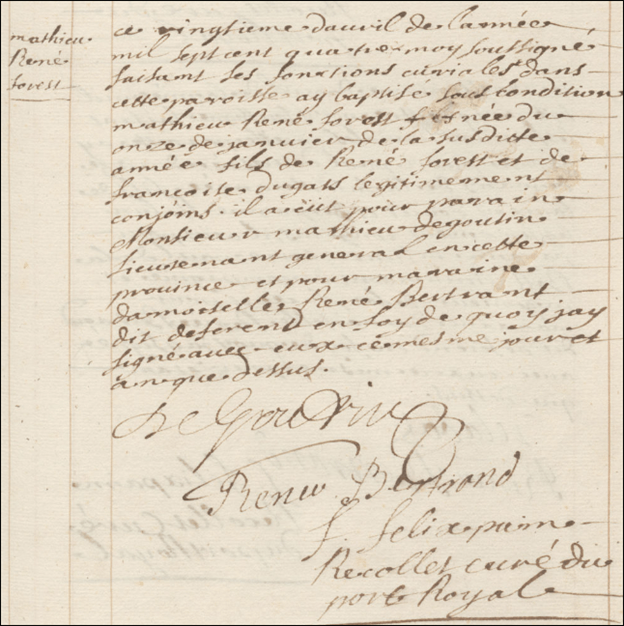
On May 31, 1704, son Jacques Bonnevie was born and baptized the next day, listing “Françoise Muis dit Beaumon” as the wife of Jacques Bonnevie

  • Register RG 1 volume 26 page 20
  • Priest Felix Pain
  • Registration Date 1 June 1704
  • Event Baptism
  • Name Jacques Bonnevie
  • Born 31 May 1704
  • Father Jacques Bonnevie
  • Mother Françoise Muis dit Beaumon
  • Godparents Jacques de Teinville
  • lieutenant of a company
  • Magdelaine Mellansson ditte de la Boulardrie

It’s worth noting here that the Godfather is indeed the lieutenant of a company.

Françoise’s husband, Jacques Bonnevie, was reported in 1732 to be a retired, disabled soldier.

Seige!

One month and one day after that baby was baptized, two English warships and seven smaller vessels entered the Port Royal basin, capturing the guard station opposite Goat Island, along with four Acadians.

A woman from a family who had been captured was sent to the fort to demand surrender. It’s unclear if this was a separate family or the four that we know were captured.

For 17 long days, the men in the fort awaited an attack. However, the fleet commander had moved on to Grand Pre where the English laid waste to the town before returning to exchange perfunctory gunfire with the fort at Port Royal before returning to Boston.

Much of the English harassment and attacks upon Acadia were coordinated out of Boston.

The siege of Port Royal lasted only 17 days. This time. With a newborn infant plus two young children, and her husband stationed inside the fort, anticipating an attack at any minute, Françoise must have been terrified. She was also alone because, as a soldier, Jacques had no family there, and as a half-Native woman from far-away Pobomcoup, neither did she.

Perhaps families sheltered inside the habitation. Perhaps Françoise took her children and retreated into the safety of the woods, relying upon the skills she learned among her family.

Life in Port Royal

Their next child, Marie Bonnevie, was born and baptized on May 12, 1706 in the Catholic Church near Port Royal.

  • Bonnevie Marie 1706
  • Register RG 1 volume 26 page 47
  • Priest Justinien Durand
  • Registration Date 12 May 1706
  • Event Baptism
  • Name Marie Bonnevie
  • Born 12 May 1706
  • Father Jacques Bonnevie
  • Mother Françoise Mius
  • Godparents Louis de Clauneuf [Closneuf]
  • lieutenant of a company
  • Françoise de Belle Isle

Again, the Godfather was the lieutenant of a company.

In 1707, the family was listed in Port Royal under the name of Jacques Bonneur, his wife, 1 boy less than 14, and three girls less than 12. The family is living on 1 arpent of land, with 2 cattle and 6 hogs. One arpent of land is clearly not enough for farming, but given that Jacques is a professional soldier, he is probably stationed at the fort and is paid for his service. Their land would be used for a garden plot and raising their livestock.

They live two houses away from Madame de Belle Isle, a widow who may well be related to the Françoise de Belle Isle, who stood as Godmother the year before. Madame de Belle Isle is Marie Saint-Etienne de LaTour who was the widow of Alexandre Le Borgne de Belle-Isle. They lived in Port Royal, and she was widowed by 1693, becoming important in her own right as a seigneuresse, managing the finances of her former husband, a seigneur, allotting and selling land among other responsibilities.

Soldiers do not appear on the census. Most returned to France at the end of their service, but some stayed, married, and settled into Acadian life.

A total of 106 families are enumerated.

On February 21, 1708, Françoise Mius, wife of Beaumont, stood as the Godmother of Anne Clemenceau, daughter of Jean Clemenceau and Anne Roye. Anne Roy was also from Cape Sable and half-Native. Her father worked for the LaTour and Mius men.

Françoise would have known Anne before they both moved to Port Royal. They spoke the same language, shared cultures, and may even have been related.

Between 1708 and 1715, Françoise would have had at least four additional children, but we have no record of their births or deaths.

The Conquest of Acadia

In 1710, the English attacked Port Royal once again, but this time armed with warships and 3400 troops.

Again, a siege ensued.

Those brave men managed to hold the fort for 11 days, but in the end, had to relinquish control. 300 men, some of whom were poorly trained new recruits, stood no chance against the mighty English warships. Plus, they were outnumbered by more than 11 to 1.

The English warships fired upon the fort all night, and their cannon had advanced to within 300 feet of the fort. It became evident that either they negotiated the best possible surrender conditions, or die. Either way, the English were going to take control of the fort, and with it, Acadia.

The English allowed the Acadian and French men to exit with at least their lives and what was left of their dignity, flags flying and drummers drumming.

This event became known as The Conquest of Acadia and ended French rule.

Françoise must have been incredibly relieved – not that the Acadians lost their homeland, but that Jacques wasn’t killed and the French soldiers were released. I do have to wonder how and when he became disabled, and if it was related to this event.

A year later, the Acadian men and the Mi’kmaq warriors attempted a siege of the now-English fort, which failed.

Living Under English Rule

Day-to-day life didn’t change much under English rule, at least not initially. The Acadians were permitted to continue Catholic worship, and the routines of the seasons dictated daily activities.

The English only took one census.

In the 1714 census, “Beaumont” was listed with his wife, one son, and three daughters at Port Royal. His career as a French soldier at the fort had clearly ended, although life must have been extremely uneasy for those previous soldiers.

How would they have earned a living? The English certainly weren’t going to give them land.

On October 13, 1715, their son, Charles Bonnevie, was born and baptized.

  • Register RG 1 volume 26 page 137
  • Priest Justinien Durand
  • Registration Date 13 October 1715
  • Event Baptism
  • Name Charles Bonnevie
  • Born 13 October 1715
  • Father Jacques Bonnevie
  • Mother Françoise Mius
  • Godparents Charles Landry
  • Marguerite Pitre
  • wife of Abraham Comeau

When Was Françoise Born?

Unfortunately, not one single record gives Françoise’s age. Not one.

If Françoise had two daughters by 1703, with the next child, Jacques, born in May of 1704, we can surmise that the youngest daughter was born in 1702 or maybe early 1703, 18-24 months before Jacques. Françoise’s oldest daughter would have been born about 2 years before that, so about mid-1700 or perhaps in 1701.

This suggests that Françoise Mius was married in either 1699 or 1700, which puts her birth at about 1680-ish. Some researchers show her birth between 1684 and 1687. 1684 is after the birth of known children of Philippe Mius with his first wife, and 1687 is the approximate birth of the first of the next group of Philippe Mius’s children with a Native woman named Marie.

All things considered, I’m using 1684 as her birth year.

If you’re thinking, “This sure is complicated,” you’d be exactly right.

Who Are the Parents of Françoise Mius?

This is where it gets a little dicey.

There are only four known Mius men in Acadia at this time, all of whom are well-known and documented. Some can be reasonably eliminated from consideration.

Philippe Mius, the elder, and father of the other three, was born in France around 1609, married Madeleine Helie around 1649, presumably in France, and had five known children between 1650 and 1669. Sometime around 1651, Philippe came to Acadia with his young family as Lieutenant to Charles de Saint-Etienne de La Tour and served as commander of the colony in La Tour’s absence. We will hear his story later.

  • Philippe Sr.’s eldest son, Jacques Mius d’Entremont, was born about 1654, married Anne Saint-Etienne de La Tour (1661-1741) about 1678, and died about 1735.
  • Philippe Sr.’s second son, Abraham Mius de Pleinmarais, was born about 1658 and married Marguerite Saint-Etienne de La Tour (1658-1748) about 1676 and died about 1700.

Both of these sons had married European women long before the 1680s when Françoise was born.

  • Philippe Sr.’s third son, Philippe dit d’Azy Mius II, was born about 1660, lived among the Native people, and was married to two Mi’kmaq women.

We know, based on the mitochondrial DNA haplogroup of our Françoise Mius, X2a2, that her mother was indeed Native, which limits the choice of father for Françoise, barring an unusual circumstance, to son Philippe Mius.

This early photo of a Mi’kmaw woman, Mary Christianne Paul Morris, was taken in 1864. She is holding a quillwork model canoe, and a quillwork box rests on the floor by her leg. She is dressed in traditional attire. Photo courtesy of the Nova Scotia Archives.

Early Census Records

Philippe Mius Sr. is shown on the 1671 census of Acadia at the Habitation of Poboncom near the Island of Touquet as follows:

Phillippe Mius, squire, Sieur de Landremont, 62, wife Madeleine Elie 45; Children: Marguerite Marie An, Pierre 17, Abraham 13, Phillippe 11, daughter “la cadette” Madeleine 2; cattle 26; sheep 25.

In the 1686 census, we find:

Philippe Mius, royal prosecutor, age 77, is shown in Port Royal with son, Philippe, 24, daughter Magdelaine 16, and 40 arpents of land. It’s worth noting that both of his sons Jacques and Abraham are married with children and living in Cap Sable beside or near the LaTour family whose surname is sometimes written Saint-Etienne de La Tour.

These two censuses show his birth year as 1660 and 1662.

The 1708 Census

In the 1708 census, which includes both French and Native families, in the section titled “Indians from La Heve and surrounding area,” we find:

  • Philippe Mieusse age 48 (birth year 1660)
  • Marie his wife 38 (so born about 1670)
  • Jacques his son 20
  • Pierre his son 17
  • Françoise his daughter 11
  • François his son 8
  • Philipe his son 5
  • Anne his daughter 3

This daughter, named Françoise, is only 11 and, therefore, cannot be our Françoise, who was married by about 1700 and had children shortly thereafter.

We do find a few more people with the surname Mieusse:

  • Cape Sable under enumeration of the French: François Vige, age 46, his wife Marie Mieusse 28, with 5 children. Marie’s age of 28 puts her birth in about 1680.
  • Indians from Mouscoudabouet (Now Musquodoit Harbour): Maurice Mieusse 26 with wife Marguerite 27 and two children. Age 26 puts his birth at about 1682.
  • Cape Sable Indians: Mathieu Emieusse 26, Madelaine 20 and one child. This puts his birth at about 1682.
  • De La Heve under “enumeration of the French”: Jean Baptiste Guedry 24 and Madelaine Mieusse 14. Age 14 puts her birth at age 1694.

Another child of Philippe Mius Sr. is found three houses away from François Vige and Marie Mieusse:

  • Joseph dazy 35, Marie tourangeau 24, with 5 children. His age places his birth about 1673. His death record on December 13, 1729, at about 55 years of age, by the name Joseph Mieux dit D’Azy, confirms his identity. His surname line among descendants was known as D’Azy.

Neither Françoise Muis nor Jacques Bonnevie is shown in 1708 under the only Port Royal category of “Indians of Port Royal.” They are considered French and live among the French families.

Philippe Mius’s Older Children

Given the age of Philippe’s wife, Marie, in 1708, she was born about 1670.

This means that it was impossible for Marie to be the mother of Philippe Mius’s oldest children, including Françoise. His older children were:

  • Joseph d’Azy Mius, born about 1673/1679, received land in 1715 and is described as “part Indian who dwelt at Port Le Tore,” and is the son-in-law of “Tourangeaut”.

We know that Philippe Mius Jr. was born around 1660, which is probably why researchers have shifted his son Joseph d’Azy’s birth closer to 1679. Various records across the years clearly show Joseph as being half-Native.

He is later noted as the “part Indian who dwelt at Port Le Tore,” which was originally known as Port Lomeron and was where Charles La Tour lived.

This map shows Port LaTare, aka LaTour, along with the other capes and early forts.

La Tour traded here between 1624 and 1635 when he established another fort at the mouth of the River Saint John.

Author Father Joseph Clarence d’Entremont states that Philippe Mius’s first unknown Mi’kmaq wife who was the mother of Françoise Mius was from what is today Barrington, Nova Scotia. Based on the 1708 census, Philippe Mius’s second Native wife, Marie was probably a member of the Le Heve tribe. Barrington may have been the village of Ministiguesche according to the authors of the Ethnographic Report.

Several of Joseph Mius’s children intermarried with the Mi’kmaq people, as did two of his full siblings, shown below:

  • Marie Mius, born about 1680, married Francois Viger. They lived at Ouimakagan, present-day Robert’s Island, near Pobomcoup in 1705.
  • Maurice Mius, born about 1682, married Marguerite, a Mi’kmaq.
  • Mathieu Mius, born about 1682, married Madeleine, a Mi’kmaq
  • Françoise Muis, born about 1684, married Jacques Bonnevie, a French soldier.

Maurice and Mathieu are shown as twins, born in 1682, and Françoise is slotted as the next child, born in 1684.

That’s certainly possible, as she would have been 16 in 1700, and young women were clearly marrying at that age in that time and place.

There is no evidence or suggestion that the other Mius men, meaning Philippe Sr. or his sons Jacques Mius d’Entremont or Abraham Mius de Pleinmarais, had children with a Native woman in the 1680s.

Of course, that also doesn’t mean it didn’t happen.

Given the age of Philippe Mius’s Native wife, Marie, born about 1670, she cannot have been the mother of those older Mius children.

Adding to the confusion, Philippe had daughters named both Françoise and Marie with both Native wives, although the children may well have been called by their Native names, not their French baptismal names.

Facts About Françoise

So, we know a few things, for sure:

  • Françoise was shown in the parish records as Mius and Mius de Beaumon(t)
  • Françoise’s mother was unquestionably Mi’kmaq, confirmed by mitochondrial DNA
  • Françoise was having children by 1700/1701, so probably born no later than 1685
  • Assuming that her father was a Mius male, the only candidates were Philippe Sr., Philippe Jr, Abraham, or Jacques
  • Philippe Sr., Abraham, and Jacques were married to European wives at that time.
  • Philippe Jr. is documented to have been living with the Native people and, according to various records, had two Native wives
  • Françoise’s mother was very unlikely Philippe Jr.’s second Native wife, Marie, as she was born about 1670, so would have been a prepubescent child when Philippe’s oldest children were born, and about 14 when Françoise was born
  • Françoise’s mother was very unlikely Philippe Jr.’s second Native wife, as she named another daughter Françoise who was born in 1697.

Constant Conflict

Acadia was in a state of constant conflict, with the English either attacking or threatening to attack at all times.

These conflicts began before Françoise was born, but one of the more memorable took place in 1690, when Françoise was a mere child. The Battle of Port Royal was fought, resulting in the fort’s surrender. That should have been the end of it, but it wasn’t, as the English burned the town and many farms before forcing the residents to sign a loyalty oath, taking a few hostages, and sailing back to Boston. A few weeks later, more English arrived to pillage anything that was left.

While Françoise would have been tucked safely in a Mi’kmaq village someplace in Southwest Acadia, this back-and-forth scenario and broken trust played out over and over again.

Beginning in 1713, the English, who had been in control of the Acadian homeland since 1710, tried to force the Acadians to sign “better” loyalty oaths to the crown. When they refused, the English tried to evict the Acadians, only to change their minds because they needed their labor to feed the English soldiers.

The unrelenting conflict with the English was ramping up again.

The Acadians wanted to and tried to depart for Ile Royal, but were stopped by the English Governor.

In 1715, the Fort’s gates were shut and locked, preventing trade with anyone, including Native people.

In 1717, Captain Doucette became the Lieutenant Governor of Acadia. By this time some Acadians had decided to stay put on peaceful terms. When the Indians learned about this, they threatened the Acadians. Though they had always been friends, and in Françoise’s case, relatives, the Indians didn’t want the Acadians defecting to the English side.

By now, everyone was upset and everyone was mad at everyone else.

Doucette demanded that the Acadians take the oath, but they thought doing so would tie them down … and they still wanted to move. The Acadians said that if they were to stay, they wanted protection from the Indians, and the oath would need to be stated so that they would not have to fight their own countrymen. But that negotiation tactic wasn’t working, because Doucette wanted an unconditional oath.

The only constant in Acadia other than Catholicism was warfare.

Given that Françoise was half-Native and given the nature of the conflict between 1710 and 1720, I wondered if perhaps Françoise and her husband, Jacques Bonnevie, struck out for parts unknown, or at least undocumented.

I quickly discounted that possibility, because their children are found in Port Royal. They wouldn’t have left them behind with no means of supporting themselves.

By 1718, Françoise’s children began to marry, and in 1719 her first grandchild arrived. Her husband, Jacques Bonnevie, stood as Godfather at the baptism, but Françoise did not stand with him. She is not found in any record again.

Clash of Cultures

Constant warfare isn’t the only undercurrent running through Acadian lives – or, more accurately, through Acadian/Mi’kmaq mixed lives.

This painting, “Homme Acadien,” Acadian Man by André Grasset de Saint-Sauveur, is reported to represent a Mi’kmaq man somewhere in the Acadian region. Looking at this man, I’m not at all sure he’s native, or at least not fully Native.

Every genealogist knows about assumptions, and we all try to avoid them. Sometimes we don’t even realize we’re assuming. Once in a while, assume gets us.

I’ve been researching Acadians and Native peoples for decades now, and I know that the Acadians were closely allied with the Mi’kmaq and probably other Native peoples too. The Maliseet lived in the Saint John River drainage, and both the Penobscot and Abenaki are found in and near the early Acadian settlements, particularly those on the mainland in New Brunswick and present-day Maine. The Acadians and Native people intermarried. The Native people helped the Acadians and lived near and sometimes integrated with their villages. They were hunting and trading partners.

Everything seemed hunky dory.

Like every place Europeans colonized, they attempted to convert the aboriginal people to their religion. We know from parish records in Acadia and elsewhere that many Native people were baptized and given European religious names.

And yes, we know that Native people and Acadians intermarried. The Catholic Church would not sanction a marriage unless both parties were Catholic, so the Mi’kmaq converted. Although it’s very doubtful that the Native people understood conversion to be what the French assumed. Still, the marriage happened, which was the point.

A list of Mi’kmaq marriages extracted were by Fran Wilcox from the Port Royal parish registers beginning in 1702 and published by Lucie LeBlanc Consentino. Another list with genealogical information can be found at WikiTree here. Stephen White’s list is available here. Some “marriages,” meaning in the legal or religious sense, are inferred.

There were rumblings of unrest between the two groups of people from time to time, especially when the Native people became concerned that the Acadians might be planning to side with the English, and against them, but nothing at all that seemed serious. Nothing suggested or even hinted that ethnic discrimination played into the equation. In fact, I thought just the opposite. People intermarried, and the blending seemed smooth. No boats seemed to be rocking.

I was wrong.

In the document, “An Ethnographic Report on the Acadian-Metis (Sang-Meles) People of the Southwest Nova Scotia,” I learned a lot – a whole lot. The authors provide a download copy, here, for noncommercial use, and I encourage Acadian researchers to download and read the document in its entirety.

This treatise was written by academics who are also Acadian descendants, specifically Acadians who carry both French and Native heritage. Little that I learned was pleasant.

To begin, let’s define a few terms.

  • French people – people from France and not yet Acadians
  • Acadian people – people who came from France and settled in Acadian, now Nova Scotia, and established a separate, unique culture over time
  • Mi’kmaq First Nations people – Aboriginal inhabitants of Nova Scotia, Atlantic Maritime Canada, and the northeast US
  • Metis – In Canada, mixed race between French/Canadian and First Nations. Initially, metis simply meant a person of mixed parentage, but today, there is an official “Metis” tribe, and the identity and definition have become complex.
  • Sang-Mêlés – defined in the Ethnographic document as people who were mixed Acadian/First Nations, perceived as an “inferior caste of people” both before and after the Deportation in 1755
  • Bois-Brûlé – this term is applied to the descendants of Joseph Mius d’Azy whose father was Philippe Mius Jr. and mother was Mi’kmaq, and the descendants of Germain Doucet, born in 1641, whose father was Native. People referenced by this term live in Tuskey Forks/Quinan, Nova Scotia.

The authors found distinct, documented marriage patterns where parents who were members of the “Pur” caste, meaning those who were not admixed with Native people, would go to extreme lengths to ensure that their children did not intermarry with those who were mixed, specifically the “caste dêtestée des gens mêlés,” which translates to “detested caste of mixed people.” This was particularly pronounced in the Cape Sable region where the Mius descendants are prevalent, both pre-deportation and after members of the Mius and Doucet families returned after the Exile.

It hurts my heart to even type these words. I was truly shocked. This was not at all what I expected.

But it also explains A LOT in my own family. I had a HUGE AHA moment.

The authors point out that the degree of blood quantum, or the generational distance between the individual being discussed and their original Native ancestor makes no difference at all.

This reminds me of the dreaded “one drop rule” in portions of the US, specifically stating that anyone with even “one drop” of nonwhite blood was considered to be non-white or “colored.” Of course, discriminatory practices were visited upon anyone non-white in the 20th century and earlier.

The authors stated that even recently, one of the greatest insults to an Acadian would be to tell them that they had Native blood.

These families often intermarried within their community or with newcomers and established a distinct culture separate from the Acadians, Mi’kmaq, or, more broadly, the French/Canadian Metis.

My ancestry reaches from my mother to Françoise Mius as follows:

  1. My mother
  2. Edith Barbara Lore 1888-1960, who knew absolutely nothing about Acadian heritage and nothing about her father’s past before meeting her mother
  3. Curtis Benjamin Lore 1856-1909 – A man with a mysterious past that he attempted to escape.
  4. Antoine “Anthony” Lore 1805-1862/1868 – His family never knew he was Acadian  As a young man, he left a high-drama family situation in L’Acadie, Quebec, and died, perhaps as a river-pirate in Pennsylvania. Another mysterious man.
  5. Honoré Lore 1768-1834 – Born in New York during the Acadian exile.
  6. Honoré Lore/Lord 1742-1818 – Born in Acadia, exiled in New York, settled in Quebec.
  7. Jacques “dit LaMontagne” Lore/Lord, probably the son of a soldier, was born about 1679 in Port Royal. He married Marie Charlotte Bonnevie who was born about 1703 to Françoise Mius and Jacques Bonnevie, probably in Pobomcoup, and was one-fourth Native.
  8. Françoise Mius born about 1684 – Half Native through her unknown mother, who was married to Philippe Mius II sometime around 1679

Even 4 or 5 generations later, my mother’s grandfather and great-grandfather were very evasive and behaved in a manner that suggested they were trying to escape or avoid something. That fear and perhaps cultural avoidance had been passed from generation to generation.

Mother didn’t know they were Acadian, didn’t know she had Native blood, and didn’t know about her grandfather’s past. Neither did her mother and I doubt his wife, mother’s grandmother, did either.

Of course, that’s my perspective – it’s not from the perspective of the Acadian people, not from the perspective of the Sang-Mêlés, and not from the perspective of any of those people mentioned. I wonder about the adage, “Once burned, twice shy.” Once something is revealed, it can’t be “unseen.”

Betrayal was a constant concern.

So, my Acadian ancestors moved away and chose not to reveal a past that had burned them previously. Catholic, Native, poor, and Acadian were all things that could burn you again. Anything that wasn’t part of the mainstream, in line with the people in power, put you at risk.

Prior to the arrival of the French, before the arrival of the priests, the Native people enjoyed and functioned perfectly well within their own culture. They had their own standards, rituals, and customs about marriage and morality, how it worked, what was acceptable and what wasn’t – in their community and environment. The colonizers had other ideas and judged the Native people, their culture, and their descendants, who still bore at least traces of both Mi’kmaq culture and blood, from their pulpits and their seats of government.

A priest, Father Jean-Mande Sigogne, who served in the Cape Sable area for more than a quarter century, beginning in 1800 when he arrived in a fishing boat, was incredibly frustrated for more than a quarter century by both the behavior of the Sang-Mêlés families AND by the blatant discrimination exhibited by members of his parish who weren’t related to those families – and certainly didn’t want to be. In 1802, he wrote the following letter to church elders and mentioned that the denigration of the Sang-Mêlés was a widely accepted practice.

There reigns here a prejudice that seems to be contradictory to the charity and the spirit of the religion and also of the church because it has been carried too far, and it is supported by authority and the custom of the area, and even by the clergy. It is the marriage that is contracted or to be contracted between those who are called Whites and others who they call sang mêlé, which is not accepted by people here, despite the equality of conditions to others, superiority in wealth, and of virtue and talent. Some people prefer to see their children unmarried than to see them married into the families that are even slightly tainted, and most prefer that they marry to the degrees that are prohibited by the church: so that they have more respect for their vain prejudice than for order and rule in the church. We can see here that there is a refusal to marry any young man with any drop of Savage blood. This is new and ridiculous to me, I have never heard of such irregularities. I have found no canon from the ancient church of Africa that mentions similar; there seems to have been Roman families that were allied with the African families. This prejudice seems difficult to destroy; I said something in public, but with precaution so I would not offend the spirits; but I have been ridiculed for this on occasion; It makes me angry that to Marry couples is in violation of the laws of the church because one of the ancestors of their great-grandfathers married a Savage, perhaps more Christian than them. I wait with submission and respect for your opinion on this prejudice, your Greatness.

Father Sigogne railed against the inherent racism and denigration of the mixed Native/Acadian people in the same treatise where he called their blood “tainted.” He said in one case that the “Sauvage” might have been more Christian than a member of his own parish, yet their cultural norms frustrated him to tears.

In 1809 he wrote:

There exists here a prejudice that I believe to be unchristian, not very charitable and little just in itself. [Those in] my world have a horrible repugnance to unite with those who have what they call mixed-blood. I mean with those whose families come originally from the marriage of a Frenchman with a savage woman and vice versa; they even have a sovereign contempt for those with merit and even superior. I openly attacked this foolish prejudice to the exemptions and I have much displeased the people who have, they say, pure blood. I still fight it, though with more reserve. But people with mixed-blood, for the most part, behave so badly that they cover me with confusion for having defended them, and are truly worthy of the contempt of them. They indulge without discretion all sorts of vices. Disorders of every kind reign among them in an eminent degree. They have, it seems, passions stronger than the others, or the contempt of them reduces them to the point of having no sense of virtue or honor.

He goes on to ask for marriage exemptions for four couples who are mixed and are related to either the second, third, or fourth degree of sanguinity. In one case, the couple was related twice, through both the second and third degree. These marriages are all between the descendants of the mixed Mius and Doucet families.

The Mius family, Doucet family, and the Native people were very closely allied and, by this time, had been interrelated for generations.

If you cannot marry into the “general population,” there is no one left to marry other than people within your “caste.” The priest at one time said he had hoped that the English men would convert to Catholicism and marry within this group, but that didn’t happen.

In 1813, while attempting to assist the Mi’kmaq acquire land, which is incredibly ironic since they were the aboriginal population, he noted that Andrew James Meuse was the chief of the local tribe. He went on to describe the desperate state of the Mi’kmaq people and that people often took advantage of them. He tells of Mi’kmaw walking from as far as 300 miles carrying packs and children. You can read more here.

By 1826, the priest had not given up and clearly remained extremely frustrated after more than a quarter century of living among and working with these families. He wrote the following in a sermon:

I am forced to tell you here, O people whose blood is mixed, if you are fleeing, if you disdain, if we refuse to ally with you, is it not because of your bad conduct, scandals & disorders that reign openly among those of this caste, more than among the others? Indeed, have we not seen & not seen yet from time to time actions that make us blush & move our neighbors away from our church, seeing in it the reign of adulterers and public concubinages? & that among you, degenerate race, corrupt and incestuous race. It is necessary to tell you the truth; upon my arrival, sincerely believing before God that the contempt which I perceived they were making of you was not very charitable, I took your side because charity covered in my eyes the multitude of your sins & that I wished that the past be forgotten, and that by forming new establishments for the civil and the religion, I did not expect my care and my ministry to see reign among your union, faith, marital harmony, purity of morals, probity, temperance, and sobriety; this is the fruit that I expected from my labours by doing catechisms carefully & the first communions with solemnity. I was waiting, yes, I was waiting for all this, and not less than that of you; and that is the principle of indulgence and favour that I showed you to the scandal and reproaches of others who have given me enough testimony [sic] of their dissatisfaction. But alas, to my great sorrow, I soon saw by the wrinkle of the promises made, by the terrible scandals which have appeared, that it is necessary, by blushing at your conduct, that I change my manner of thinking about you. So I promised myself that I would no longer encourage or support disputed unions because of the stain of mixed blood, leaving the rest to God. This is before God, oh Christians, the simple exposition of my heart. You can now see who you are going to; it is my misfortune but it is not my fault. It is true, however, that there are families in the mixed caste whom I cannot reproach; so I make it a point to do them justice and to respect them, but the justice and respect which I owe them, and which I am, disposes of their render must not go to the point of leaving vice unpunished; it is an accident for them to be among those families, but I cannot help it; so I pray those to take in good part what I did & what I say. I measured and weighed my words before God. It is with vices, it is with the disorders, it is with scandals that I make war, it is to drunkards, rebels, old [sic], adulterers, public concubinaries and none who approve and support them, whether they are white or tainted families, pure or mixed, that my reproaches are directed & not to those who live as Christians, whatever they are. May the misguided and the vicious, the incestuous, and the adulterers return to the true path, to virtue and good order, in a word to penance, my reproaches will no longer look at them…”

That. Just. Brutal.

I can’t even imagine hearing this from the pulpit, and if it were directed toward me or my family, I can assure you that I would never darken the church door again.

We will never know the specifics, of course, although I certainly want details with names. Still, this reminds me of the outrage of the European colonizers when they discovered that many of the tribes in what became known as the Americas practiced a form of polygamy and had, successfully, for generations. It was their normal, and they saw no reason to change.

Extremely heated feelings and prejudice had existed prior to the Expulsion in 1755, at least as early as 1745, wherein the Acadian Lieutenant-Governor Paul Mascarene wrote, in part, that people in vessels from New England were pressing inhabitants of Annapolis Royal to “destroy all the inhabitants that had any Indian blood in them and scalp them…”

In other words, this sentiment was not restricted only to the Cape Sable region. Those seeds were planted before the Deportation and may have had roots more than a century earlier, especially if the Mi’kmaq did not completely reject their Native cultural ways and entirely assimilate into the French Catholic religious family. The only problem was, of course, that even if they did, they still looked Native, and they still had Native customs and relatives.

By Maestrobistro – Own work, CC BY-SA 4.0, https://commons.wikimedia.org/w/index.php?curid=98949742

Four Acadian women in 1895 from the Argyle Township Courthouse Archives.

Even generations later, vestiges of an earlier culture were still present in their descendants. In terms of how they looked and dressed, their handwork, how they reacted to certain situations based on previous encounters, and resulting from generationally transmitted trauma in the sense of what their ancestors had survived – or didn’t.

While the priest was frustrated with the Mi’kmaq or mixed Acadian/Mi’kmaq culture, there was plenty of blame to go around.

In 1723, Philippe Mius’s son, François Mius, half-brother of our Françoise, along with some other Native people who were also related to our family, had been captured by the English from one of the coastal Native villages and were being held in Boston.

This scene with a Mi’kmaq father and son in 1871 at Tufts Cove probably looked much the same as the same scene a century or two earlier, except for the house and their clothes.

In 1726, several Native men, including Philippe Mius, were frustrated with the fact that despite a supposed peace treaty between the English, French, and Mi’kmaq, their family members hadn’t been returned. This led to an incident we’ll review in detail in a later article, where a group of men attempted to hold an English fishing vessel in exchange for the return of their family members. This led to charges of privacy wherein four of Philippe Mius’s family members, including two sons, his son-in-law, and his grandson were hung by the English as pirates.

Of course, François was half French, as were at least some of the other hostages taken in 1723, but were considered lesser citizens when classified as “Indians.” Even worse, the French informed the Mi’kmaq that there was no treaty with the English, encouraging and emboldening their actions against the English that were subsequently interpreted as piracy instead of warfare – which resulted in several hangings. The French and English both benefitted from the intimidation, but neither paid any price. The mixed Mi’kmaq/Acadian families suffered horribly.

It’s no wonder that trust was difficult to come by. Discrimination, however blatant or disguised, seems to have been baked into life in Acadia – at least if you were mixed Native. You fit in neither culture – so you created your own.

François Mius, Chief of the Mi’kmaq

At some point after his brothers were hung in 1726, François Mius was released as a hostage and returned to Acadia.

François, sometimes known as Francis, is further discussed by Christian Boudreau, Director, L’Association des AcadiensMetis-Souriquois, in his paper, News and Reflections: “A Further Exploration of the Life of Chief François Mius of La Hève and Mirliguesche, Acadia” dated August 3, 2019.

In 1742, François was mentioned in correspondence recorded at Louisbourg.

It is necessary for the good of the Service of his Majesty & for the tranquility of the Savage Mikmak village of Mirligueche in Acadia depending on this government, to provide for the establishment of a Chief whose experience for War & good conduct Be known, & Under the good & laudable relationship that has been made to us of the person named Francois Miouce of his capacity for War & of His Zeal & attachment to France. We did not believe we would make a better choice than His person to command the said village of Mirligueche; & in consequence it was committed & established by these presents to put him at the head of all of the Savages comprising the said village in order to make them carry out the orders that we will give him. Order to all of the said Savages to recognize him & obey him in everything he will command them for the Service of the King.

For the reason why We gave him the Presents, & to this one has the stamp of our Weapons affixed. Written at Louisbourg this twenty fifth of July one thousand seven hundred and forty two.

This document confirmed that it was the French who decided that François Miouce (Mius) was the best selection for chief due to his strong connections to France, and that he was living at Mirligueche, near Lunenburg. In other words, the French clearly exerted significant control and influence over the Mi’kmaq people.

NB: The Son of Said Francis Miouce, possessor of the original hath besides a medal of Louis XV, which he wears when he appears at Church or in publick. he is now in a decrepit old age.”

In 1812, Father Sigogne wrote that he:

“Went in a neighboring wood where I knew that Jacques Muice Son to Francis was laying infirm by old age. I demanded of him His Father’s Credential Letters, which he willingly delivered…”

The authors explain that this excerpt is important because it identifies:

“Jacques as the son of said Francis Miouce, possessor of the original hath besides a medal of Louis XV, which he wears when he appears at Church or in publick. he is now in a decrepit old age” that was mentioned by Père Jean-Mandé Sigogne in the “NB.” (Notez Bien) section of his copy of the recently-discussed “Brevet de Commission of the Indian chief.” Therefore, we can conclude that the son of Chief Franois Mius who had inherited this document, as well as the “medal of Louis XV” was named “Jacques Muice” (Jacques Mius).”

François and his family clearly cherished his medal, but he was also a practical man, cognizant of which way the wind was blowing.

In 1761, Francis Mius signed a friendship treaty with the English, signing for himself and as the chief of the tribe of the La Heve Indians. This occurred after the 1755-1758 deportation of the Acadians, so the mixed people living in the Native villages were not deported – but all other French or Acadians had been.

I’m sure the Mi’kmaq understood the danger clearly.

Francis is the anglicized version of François.

The only way to survive was to make peace with the English and agree to English law. The Mi’kmaq had no option. They had seen all too clearly what happened to those who refused to capitulate. This agreement included giving two Mi’kmaq hostages at Halifax to ensure good behavior as defined in the agreement. However, no English hostages were given in exchange.

Of course, this treaty was written in English. Initially, I wondered if François had any idea what he was signing – but then I remembered that he had been held hostage in Boston for at least three years. Of course, he understood at least rudimentary English, although he could neither read nor write, based on the fact that he made a mark for his signature.

This copy of the treaty at the Nova Scotia Archives was made in 1812 from an original that no longer exists. However, the original treaty apparently detailed a Peace-Dance and Ceremony of Burying War-Weapons. This event was recorded in a letter dated May 9, 1812, written by Sir John Coape Sherbrooke detailing what was related to him by “an Acadian eye-witness,” who was the friend of the interpreter. At this time, he was living at La Hève, Acadia.

“… At the conclusion of the Treaty, according to their Custom the Indians had their Peace-Dance and Ceremony of burying war-weapons. The Priest was present with some Acadians and many English people. A hole being dug, the chief at the head of his warriors began the dance with the Casse-Tête in their hands. They made more sounds that customary and the Chief shewed some reluctance. He had much talk that was not understood by the bye Standers but by the Priest who came nearer & whispered to the Chief to fling his Hatchet in the hole; The Chief observed that perhaps they would be oppressed and could not afterwards make war again. The Priest then told him that if any wrong were done them, they might take their arms again. Then the Indians flung down instantly their weapons, which were soon covered with the earth.”

Based on various treaties, letters and documents, Boudreau concludes that, “the descendants of Chief François Mius were considered to have been Mi’kmaq, whereas the descendants of his half-brother, the “Part Indian” Joseph Mius d’Azy I were considered to have been “Sang-Mêlés” (“Mixed-Bloods”)/Métis/“Bois-Brûlés (Burnt Woods)”/Etc. As we’ve seen at various points throughout this collection, other siblings of these two men (half- and full-siblings) and their descendants were labelled as “Mulattos,” “Demi-Sauvagesses,” etc.”

One final letter from Father Sigogne to John Cope Sherbrooke, also discussing the 1761 treaty and subsequent war-weapon burying ceremony reveals the identity of the Mi’kmaq Chief as Francis Mius and statrs that he had gone into the woods and spoken with his son, Jacques.

Furthermore, Father Sigogne wrote:

The kind and obliging reception by which your Excellency has been pleased to honour my Memorial & Petition in behalf of the Indians excites my most earnest thanks, and sincere zeal in behalf of these unfortunate beings. I shall be sparing, and I will not abuse of your Excellency’s generosity. Under your auspices I have a firm hope that something shall be done from government in regard to the purposes exposed in the Memorial. It is to be wished that the Legislature would take the Indians into some consideration and forbid the selling them strong liquours as it is done in Canada, I am told. That would prove the first step to render them useful members of Society. Indeed their degenerate condition renders any of them unfit to be chief, however some trial should be made to bring them to a better order. I have heard the best character of that old chief Franc. Miuce both for Morals and Religion, from every body that knew him, but his descendants do not follow his steps. His family, however poor, is respected amongst the Indians.

Françoise Mius’s Family

Françoise Mius’s family was inextricably interwoven with the Mi’kmaq people. Her half-brother, François was eventually chief of the tribe, so he was clearly considered Indian, as were his descendants. Her full brother Jacques was considered to be half-Native. Two of her half-brothers were hung in Boston in 1726 as “Indian” pirates. I wonder if their obvious mixed-race, aka non-white, status played any part in that and if they were hung to serve as an example.

One of Françoise’s half-sisters survived the Deportation and died in France, so she and her family were clearly considered “Acadian.”

Others simply disappeared, either as a function of death or an undocumented life among the Native people. Some may have survived the deportation by “disappearing into the woods.” No family would have been better prepared to do so.

Additional information about this family can be found here.

Given this history in the years before the 1755 Expulsion, and illustrated by those Acadians who returned to Cape Sable, it’s no wonder that others who were “mixed,” especially if they could pass as “white,” settled in a new home elsewhere.

That break with the homeland had already occurred in 1755, so after a decade in exile, it might have been best to put down roots somewhere else.

Honoré Lore/Lore, born in 1742, was only two generations from Françoise Mius, who was half Mi’kmaq, and whose family was widely known and associated with the Mi’kmaq. That made him one-eighth. In that place and time, percentages didn’t matter. It seems that Indian or not was a binary question – yes or no – and our family’s answer was unquestionably yes. Everyone in Acadia knew that.

While Françoise married Jacques Bonnevie, a newly-imported military Frenchman, her family was clearly still viewed as “Indian,” and her descendants would have been as well.

So, Honoré spent a forced decade in exile someplace in New York, fought in the Revolutionary War, and then made his way to Quebec, where he probably never mentioned his mixed-race heritage. Yes, other Acadians would have or could have known, but many of them were probably related to him as well. Maybe no one else said anything, either. Those horrific deportation memories were still burned into their collective memory, and they weren’t about to say one thing to anyone about something that even might cause them to be discriminated against again.

Nope, lips were sealed.

Yet, Honoré had an “old Indian quilt” in his estate when he died in 1818. Perhaps this was his connection to old Acadia, and to Françoise, the grandmother he had never known. To his people, the Mi’kmaq, whose heritage he had lost when expelled. Did he hold it close in times of great peril, and did it protect and warm him as she could not do?

Based on the blending of cultures and traditions, this group of intermarried and endogamous families formed a unique subculture, distinct from the other Acadian families, and from the unmixed Mi’kmaq. They had feet firmly planted in both worlds – Native and French – a condition that did not endear them to the English, who were always nipping around the edges and eventually succeeded in displacing the French.

While we sometimes find Native American haplogroups among the Acadians, including the confusing Germain Doucet born in 1641, we can also expect to find European haplogroups among the descendants of the Native people.

Genevieve Massignon, who researched in the mid-1900s, came to the conclusion that the “Mius d’Entremont left many illegitimate children in different parts of Acadia.” Again, “illegitimate” is a European construct. He noted that “the strain of Indian blood is still visible,” which I interpret to mean that Native features were still evident among the families in Yarmouth, Tusket, and Belleville, near Pubnico.

This 1935 photo shows “Birch-bark summer ‘camp’ or wigwam of Micmac Indian, Henry Sack (son of Isaac Sack) and his wife Susan (in typical old Micmac woman’s costume) on Indian Point, Fox Point Road, near Hubbards, Lun. Co., N.S. Left to right: Susan Sack, Harry Piers of Halifax, and Henry Sack of Indian reservation, Truro, N.S. View looking northeast…Carrying basket made by Henry Sack.” Photo courtesy of the Nova Scotia Archives.

In 1644, Charles d’Aulnay wrote that in 1624:

“The men ran the wood with 18 or 20 men, mixed with the savages and lived a libertine life, and infamous as crude beasts without exercise of religion and similarly not having the care to baptize the children procreated by them and these poor miserable women. On the contrary, they abandoned them to their mothers as at present they do during which time the English usurp the whole extend of New France and on the said Coasts of Acadia.”

According to the authorities, such as they were, those men were having just too much fun and liberty. They adopted the Native lifestyle, not vice versa. That lifestyle persisted, at least in part, before, through, and after the deportation.

It was also recorded that La Tour had fathered mixed children, some of whom were daughters who took his surname.

Given the circumstances surrounding our Françoise’s birth with Philippe Mius II marrying into and residing among the Mi’kmaq, we really don’t know who her mother was. It’s possible that she did not share the same mother as the other Mius children. Hopefully, additional mitochondrial DNA testing of people descended from Philippe Mius’s female children (through all females) will determine how many women were mothers to his children. I expect Francoise’s descendants will match the descendants of the older set of children. Philippe was never known to have married or fathered children outside of the Mi’kmaq tribe.

Lastly, it’s interesting that the R vs. Powley Canadian Supreme Court case in 2003 surfaced many earlier historical writings that had been buried deep in archives, along with writings of earlier authors.

One author, John MacLean, wrote in 1996 that Acadian itself was a Native language, different from French, having evolved over 350 years. Of course, the Mi’kmaq cultural influence, especially among mixed families, would have influenced the Acadian language as well.

Another author, in Daniels vs Canada in 2016, noted that as early as 1650, a separate and distinct Metis community had developed in Le Heve, separate from Acadians and Mi’kmaq Indians. Of course, that’s where our Mius family is found.

I want to close this section by saying that it’s important to understand our heritage, our genesis, and the social and cultural environments that our ancestors thrived in, along with situations that they simply endured and survived.

I’m heartbroken to learn that discrimination, especially of this magnitude, existed. I had no idea. But my heart swells with pride at the endurance and tenacity of my ancestors. They did survive. Sometimes against unimaginable odds with factors far outside their control.

Viva the Great Spirit of the Mi’kmaq, the Metis, Sang-Mêlés and Bois-Brûlé by whatever name! Their blood runs in me, and I am proud of them!

About that Mi’kmaq DNA

My mother and I carry a segment of Native American DNA that is traceable back through the ancestral lines to Françoise and, therefore, her mother.

My mother and I both share this same pink Native American segment of DNA on chromosome 1, identified at both 23andMe and FamilyTreeDNA.

I copied the segment information to DNAPainter, along with other matches to people on that same segment whose ancestors I can identify.

DNAPainter “stacks” match on your chromosomes. These maternal matches align with those Native American segments.

The green match shares ancestor Antoine, aka, Anthony Lore with me.

Other individuals share ancestors further back in the tree.

Using those shared Native ethnicity segments, matches with shared ancestors, DNAPainter to combine them, and mitochondrial DNA testing to prove that Françoise mother was indeed Native – I was able to prove that I do, in fact, carry (at least) one DNA segment from Françoise Mius’s mother.

Even though the Acadian and Native heritage had been forgotten (or hidden) in my family, DNA didn’t forget, and Françoise lived on, just waiting to be found.

How cool is this??!!!

But there’s still one unanswered question.

What Happened to Françoise Mius?

Don’t I wish we knew?

Françoise Mius’s children’s baptisms were recorded in Port Royal beginning in 1704. Her children were married there as well, beginning in 1718 when her namesake daughter, Françoise, married.

The last record we have indicating that Françoise was alive was the baptism of Charlies in 1715. For that matter, we don’t have any further records for Charles either.

In 1715, Françoise would have only been about 31 years of age. The fact that we find no additional baptisms also strongly suggests she died about that time – sometime between 1715 and 1717, when the next child would be expected.

One would think that if Françoise were still alive, she would appear at least once in her grandchildren’s baptism records, but she doesn’t.

Both Françoise and her father, Philippe Mius, were clearly Catholic.

It’s important to note that while we have birth and baptism records for 1715, there are no extant death records for that year. The first death record after the 1715 baptism didn’t appear until November of 1720, so it’s very likely that Françoise and Charles both died during that time.

In fact, it’s possible that they both died shortly after his birth and are buried together in an unmarked and unremembered grave near where the Catholic church once stood in Annapolis Royal.

_____________________________________________________________

Follow DNAexplain on Facebook, here.

Share the Love!

You’re always welcome to forward articles or links to friends and share on social media.

If you haven’t already subscribed (it’s free,) you can receive an e-mail whenever I publish by clicking the “follow” button on the main blog page, here.

You Can Help Keep This Blog Free

I receive a small contribution when you click on some of the links to vendors in my articles. This does NOT increase your price but helps me keep the lights on and this informational blog free for everyone. Please click on the links in the articles or to the vendors below if you are purchasing products or DNA testing.

Thank you so much.

DNA Purchases and Free Uploads

Genealogy Products and Services

My Book

Genealogy Books

Genealogy Research

Marie Charlotte Bonnevie (c1703-after 1742): One Fourth Native & Not Her Sister Marie – 52 Ancestors #421

Marie Charlotte Bonnevie was born about 1703 to Jacques Bonnevie and Françoise dit d’Azy Mius, probably in Port Royal, Acadia. However, the Port Royal parish records begin in 1702 and she’s not there, so it’s possible that Marie Charlotte was born elsewhere, probably Pobomcoup, an outpost, where her mother’s parents lived.

Marie Charlotte Bonnevie should not be confused with her slightly younger sister, Marie Bonnevie, who was born on May 12, 1706, in Port Royal, Acadia, to the same parents.

Yes, I know, it’s quite confusing. In this article, I’ll either call Marie Charlotte by that name or Charlotte, and her sister will always be Marie.

Given that these two females both survived, we can rest assured that Marie Charlotte was called Charlotte. In fact, in most records, including her marriage, she’s listed by the name of Charlotte Bonnevie.

Her sister, Marie, born in 1706, didn’t have a middle name, at least not that we know of. Marie married François Duguay around 1737, probably in Beaubassin, and was having children there by 1740.

In the 1703 Port Royal census, Marie Charlotte’s father, Jacques Bonnevie is listed with a wife, 2 daughters, and one arms bearer, which would be him.

One daughter would be Marie Charlotte’s older sister, Françoise, and the younger of the two daughters would be Marie Charlotte.

On May 31, 1704, Marie Charlotte’s younger brother, Jacques Bonnevie, was born. As an adult, he was a blacksmith and married the niece of Marie Charlotte’s husband.

In 1707, the Port Royal census showed Jacques Bonneur, his wife, 1 boy less than 14, 3 girls less than 12, 1 arpent of land, 2 cattle, and 6 hogs. This is probably the same family and the known children fit.

This man is very clearly not a farmer because you can’t support a family on 1 arpent of land, which is similar to an acre.

In the 1714 census, we find “Beaumont,” which is probably his dit name, with no first name, a wife, 1 son, and 3 daughters. Based on the location and number of children, this is probably him.

Now we have three “surnames,” Bonnevie, Bonneur, and Beaumont.

Marie Charlotte’s brother, Charles, was born and baptized on October 13, 1715, but we never find a record of him again, so he apparently died, and his death was not recorded.

Marie Charlotte’s oldest sibling, Françoise, married Pierre Olivier in Port Royal in 1718, so we know the family was still there at that time. By at least 1741, Françoise was in Beaubassin, where she remarried Jean Pierre Helie.

On August 25, 1719, Charlotte stood as godmother for her sister’s firstborn child, Marie Joseph Olivier, who had been born the day before. I can see the two sisters hugging joyfully after that solemn moment, promising to watch over each other’s children forever. Either her father, Jacques, or her brother, Jacques, stood with her. Her brother Jacques would only have been 15 at that time, so I suspect this was her father.

Where was Charlotte’s mother?

The church, which was located on a hill at far right, overlooked the bay and the fort. The cemetery was adjacent to the church, in the small rolling hills behind those trees. Perhaps Charlotte’s brother, Charles, and her mother were already there, although there is no death or burial record for either of them. Maybe after the baptism, Charlotte, Françoise, and Jacques took a walk in the cemetery and introduced the baby to family members who had already passed over. After all, this would have been Françoise Mius’s first grandchild.

There are only two baptisms for Charlotte’s sister Françoise’s children, in 1719 and 1722. We really don’t know where she and her husband, Pierre Olivier, a tailor, were through 1732 when their last child was born. We do know that by 1741, Françoise was in Beaubassin, where she married Jean Pierre Helie.

Marie Charlotte married on August 18, 1721 in that same church in Port Royal to Jacques Lord, and her brother, Jacques Bonnevie married Jacques Lord’s niece, Marguerite Lord about 1729. These families probably lived near one another.

Marie Charlotte’s Parents

There’s something of a mystery surrounding Marie Charlotte’s parents.

According to Stephen White, we know that in 1732, Charlotte’s father, Jacques Bonnevie, was living on Île Royale and was listed as a retired disabled veteran of the French army, having served 17 years. He suffered a wound to his thigh, which caused his disability. Île Royale is now Cape Breton Island.

Cape Breton Island is located at the furthest eastern point of Nova Scotia, then Acadia.

Based on that same record, Jacques’s birth year is estimated to be 1660. We know he is not found in records prior to his presumed marriage to Françoise Mius, whose father, Philippe, lived in Pobomcoup, now Pubnico, on the opposite end of Nova Scotia, some 450 miles distant.

Somehow, Jacques had to have met Françoise.

Was he somehow connected to Philippe Mius? Perhaps through his profession as a soldier? He would have been about 40 when he married.

Why did Jacques Bonnevie and his bride, whose family lived in Pobomcoup, settle in Port Royal, which was no place close to her parents? Was Jacques Bonnevie serving at or stationed at the fort there?

On the 1758 map above, the fort is shown along with the approximate location of Julien Lord/Lore’s home with the red star, just slightly upriver, 3 or 4 miles away.

If Jacques Bonnevie served 17 years, does that mean he was disabled sometime around, say, 1716 or 1717, which would be about the time no more children were baptized?

Based on Marie Charlotte’s mother’s estimated birth year between 1684 and 1687, this probably means that her mother died between 1715 and 1717 when she would have been expected to have born the next child.

Was Jacques Bonnevie’s wound somehow related to his wife’s death?

We have so many unanswered questions.

One thing we can say, fairly confidently, is that the Bonnevie family must have lived in relatively close proximity to the Lord/Lore family on what is now the Annapolis River for two of Jacque Bonnevie’s children to have married Julien Lord’s son and granddaughter.

Of course, they would all have attended the Catholic Church together.

Marie’s Maternal Grandmother

One thing we know for sure is that Marie Charlotte’s mother was half-Native, making Charlotte and her siblings one-fourth, and Charlotte’s maternal grandmother was Mi’kmaq.

Acadian history relates this story, but the mitochondrial DNA of Marie Charlotte’s descendants through all females confirms it.

Mitochondrial haplogroup X2a2 is unquestionably Native American, found primarily in Atlantic Maritime Canada, but with one sample found in New Mexico, based on my analysis in the book, DNA for Native American Genealogy.

Warfare

Marie Charlotte’s first memories may have been of warfare. After all, her father was a soldier, and conflict ebbed and flowed in Acadia, sometimes erupting in full-throated battle, but never ending.

The English attacked Acadia in 1704, and raids continued intermittently until 1707, when an attack by soldiers from New England failed.

The Acadians began beefing up the fort and built a store within the fort in 1708, expecting more of the same. Charlotte’s father was assuredly one of those soldiers.

Prisoners taken from English corsairs reported that the English were planning attacks in either 1708 or 1709.

In 1710, when Marie Charlotte would have been about 7 or 8 years old, the English routed the Acadians with 3400 English soldiers pitted against the 300 Acadian soldiers.

Marie Charlotte’s father was among those brave soldiers who managed to hold the fort for 19 days in spite of being outnumbered more than 100-fold. Surely they, and their families, expected them to die, but miraculously, they didn’t. Charlotte must have been terrified.

Beginning in 1710, the English ruled the land and initially “encouraged” the Acadians to leave. Then, the English changed their mind and didn’t want the Acadians to leave because they realized they needed the Acadians to feed them.

About the same time, the Acadians changed their minds too, and decided they WANTED to leave. They tried various methods of moving themselves and their households to Les Mines and Beaubassin, none of which succeeded.

In 1711, the local priest was kidnapped during a skirmish and taken to Boston, along with some other Acadian captives, where they were held for two years.

This means that anyone who was born during this time would have to be baptized later and burials would certainly have occurred, but not recorded in the parish register. Acadia had no priest during this time, so the records are incomplete.

In 1713, Acadia was officially passed to the English, along with her people.

In 1715, the Fort gates were shut, and no trade was allowed with anyone, including Native people.

By 1720, Port Royal had been renamed Annapolis Royal and the Acadians were again being pressured to take a loyalty oath to the British crown. Refusal meant they had to leave within 3 months and take nothing with them.

They still refused, and they also refused to leave.

Acadians were nothing if not stubborn, a trait that is clearly heritable!

Marriage and Children

The Bonnevie family lived near the Lord family. Marie Charlotte was godmother to Pierre Laure’s baby born in February 1720 when she was about 17 or 18.

By this time, Marie Charlotte’s mother had probably died, her father was disabled, and she married Jacques Lord/Lore/Lor/L’Or, Laur or Laure the following year on August 18, 1721.

Register – RG 1 volume 26 page 327
Priest – Charlemagne Cuvier
Registration Date – 18 August 1721
Event – Marriage
Groom – Jacques L’Or, widower of Angelique Comeau
Bride – Charlotte Bonnevie
Father – Jacques de Bonnevie
Mother – Françoise Mius

Marie Charlotte is referred to as Charlotte in her marriage record.

Jacques was a widower, and Marie inherited two stepchildren: Jacques Lore, born in 1709, and Angelique, born in 1711. They were just a few years younger than Charlotte.

Marie Charlotte’s children began arriving 15 months later and were all born and baptized in the Catholic church in Annapolis Royal:

  • Charles Lord/Lore, born November 23, 1722, married Marguerite Garceau on January 20, 1755, in Port Royal, and died on November 9, 1797, in Three Rivers, Quebec.
  • Joseph Lord/Lore, born February 19, 1725, married Marie-Josephe Garceaux on February 3, 1750, in Port Royal, and died sometime after 1752. His last known child was born in January 1753, but additional children could have been born during or after the Acadian Removal in 1755.
  • Pierre Benjamin Lord/Lore was born on January 25, 1728, married Marie-Josephe Blanchard on May 31, 1763, in L’Acadie, Quebec, and died on July 20, 1813, in St.-Gregoire-de-Nicolet, Canada.
  • Jean or Jean-Baptiste Lord/Lore was born August 9, 1730, married Marie-Josephe Garceau in 1765 in New York, and died on May 12, 1809, in St-Ours, Quebec, Canada.
  • Paul Lord/Lore was born on December 21, 1733. Marie Charlotte’s brother, Jacques Bonnevie, stood up as the Godfather. Nothing more is known of this child.
  • Claude-Poncy Lord/Lore was born on September 21, 1736, but nothing more is known of this child.
  • François Lord/Lore was born on August 10, 1739. Nothing more is known.
  • Honoré Lord/Lore, the youngest child, was born June 17, 1742, married Appoline dit Hippolite Garceau in 1765 in New York, and died on May 20, 1818, in Saint-Jean-sur-Richelieu, Quebec, Canada.

We do have parish records for Annapolis Royal fairly reliably up until the Expulsion, so it’s likely that we don’t know anything about Marie Charlotte’s children born in 1733, 1736, and 1739 because they had not yet married in 1755 when the expulsion occurred.

They could have died either during that horrific event or afterward in New England, assuming they were in exile with their siblings.

However, if they got separated, it’s hard to tell where they might have wound up or if they even survived.

They could also have survived, married in the colonies, and not followed their siblings to Quebec, meaning we have no record of them. Perhaps one day DNA testing of their descendants will reveal that someone survived.

1731, 1732 and 1733

Marie Charlotte’s siblings, who lived to adulthood, eventually wound up in the Northern Acadian settlements, specifically Beaubassin and Île Saint-Jean.

Charlotte’s brother, Jacques Bonnevie, stayed in Port Royal, where his children were baptized from 1730-1741. On September 21, 1731, Marie Charlotte, called Charlotte, was the Godmother for Jacques’ daughter, Marguerite Bonnevie who had been born on September 18th and was named after her mother, Marguerite Laure.

Marie Charlotte’s father, Jacques Bonnevie, is shown on Île Royal in 1732, aged 72, listed as a retired and disabled veteran of the French Army. He reportedly died there at Louisbourg on April 23, 1733.

Jacques’s adult children had not made their way to Île Royal, so why did he? Who would have been there to help him?

Or had they?

We know that Marie Bonnevie was born in 1706, and the first sighting of her after this was her marriage to François Duguay who was from Île Saint-Jean. They settled in Saint-Pierre-du-Nord and are listed in 1752 in Riviere du Nord-Est.

Still, Île Saint-Jean, Prince Edward Island today, isn’t Île Royal, today’s Cape Breton Island.

This map shows Acadia just before the expulsion and the locations where Acadians were deported to and from, beginning in 1755.

Life Deteriorates at Port Royal, ummm, I mean Annapolis Royal

By 1745, life in Acadia had deteriorated significantly and was getting worse. It’s no wonder so many had left for points North and East.

A 1745 report from Port Royal said the Acadian homes were “wretched wooden boxes, without conveniences, and without ornaments, and scarcely containing the most necessary furniture …” A visitor in the 1750s stated that “the houses of the village (Annapolis Royal) … are mean, and in general built of wood.”

The situation deteriorated significantly under Governor Charles Lawrence, who wanted to get rid of the Acadians. He used acts of individuals to make charges against the whole population. He revoked the former governor’s orders not to use military force if the Acadians refused to comply. One example was that if an Acadian was ordered to get firewood, and he didn’t do it promptly … his house would be used for fuel.

That’s horrifically brutal.

This explains why most of Marie Charlotte’s siblings had left before 1750.

The Last Record of Marie Charlotte Bonnevie

The last actual record we have for Marie Charlotte is the birth of her last child in 1742.

We have absolutely nothing for either her or her husband, Jacques Lord/Lore, from that time forward other than this oral history for Jacques:

“He suffered the great disturbance that occurred in Acadia in 1755, when the oppressor forced the family to go into exile in New York, United States. He returned to Canada with his son Pierre-Benjamin and they settled in Kamouraska The three children of Angelique Comeau (Corriveau) did not have an heir.”

Note that we only know of two children from Jacques’ first marriage, but it’s certainly possible that there were three.

If this is accurate, and if this is the same Jacques Lord/Lore who was married to Marie Charlotte Bonnevie, then he would have been 108 in 1786.

The problem is that the burial record shows this man’s age to be 79, not 108. This would be Jacques son, Jacques, but that doesn’t mean that Jacques Sr. didn’t also die there, perhaps somewhat earlier. There is a record with both Jacques and Pierre Lore witnessing a marriage in L’Ile-Dupas in 1764.

If indeed this is the same man, he would have been deported from the Port Royal region along with the other Lore males, including son Honoré.

If Jacques and his youngest son, Honoré, were deported from Port Royal, there’s no reason to think that Marie Charlotte Bonnevie, Honoré’s mother, was living far away from her children on Île Royal during or after the deportation. In fact, that’s contra-indicated.

If this Jacques is Charlotte’s step-son, born in 1709, not her husband, which is the most likely scenario, this group of people together actually provides evidence that Charlotte was NOT on Île Royal and that she and her family were all deported from Port Royal.

There is absolutely no evidence that any of her children or step-children left the Port Royal area before the expulsion began.

The Deportation

Charlotte’s brother Jacques Bonnevie, who was found near Beaubassin but did not move to Île Royal, was deported to South Carolina in 1755. He was one of only five or six families who returned to Canada in 1756. That trickle was immediately stopped before it turned into a river. Jacques was at Ristigouche in 1760 and reportedly a prisoner at Fort Edward (Pisiguit) with his wife and five children in 1761, although I have been unable to verify that.

The deportation meant death for Charlotte’s sisters and their families.

Marie Charlotte’s Death

Everywhere I look, Marie Charlotte is reported to have died at sea on or about December 13, 1758. I know where this comes from, but I think it’s inaccurate.

There are two issues.

First, I think most people have conflated the two Maries, literally combining or at least confusing them. Our Marie Charlotte born about 1703, and her younger sister, Marie, born in 1706.

Let’s summarize what we know about where the children of Jacques Bonnevie and Françoise Mius were in the 1755 deportation era.

  • Françoise Bonnevie, born about 1701, lived in Beaubassin in 1741, where she remarried Jean Pierre Hélie dit Nouvelle. Her last child was born in Beaubassin in 1742. In 1752, she and her husband were in the La Roque census, age 50, in Rivière-du-Nord-Est, Île Saint-Jean, Prince Edward Island.
  • Marie Charlotte Bonnevie and her husband Jacques Lord/Lore have no records found after 1742. We do know that four of their children married Garceau children, one in Acadia and three in exile. I believe these families were on the Brigge Experiment together, which departed from Annapolis Royal and sailed for New York. We know positively that Honoré, born in 1742, fought at Albany, New York, in the Revolutionary War.
  • Jacques Bonnevie, born in 1704, was in Beaubassin by 1746 and at Petitcodiah in 1752. He married Anne Melanson about 1755 and was subsequently deported to South Carolina. Ships with Acadians that arrived in South Carolina departed from either Chignecto, which is near Beaubassin, or Annapolis Royal. The surname Bonnevie does appear on the roster of the ship Cornwallis, which left Chignecto on October 13, 1755.
  • Marie Bonnevie, born in 1706 and married François Duguay, was living in Riviere du Nord-Est, Isle Saint-Jean, in 1748 and 1752, probably near her sister. Today, that’s Hillsborough River or North East River, near Charlottetown, Prince Edward Island.

So, given this information, where did this 1758 death date originate?

The information came from Stephen A. White, Dictionnaire généalogique des familles acadiennes (Moncton, N.-B.: Centre d’études acadiennes, Université de Moncton, 1999) p. 178-179.

Françoise Bonnevie (Jacques Bonnevie dit Beaumont and Françoise Mius) born around 1702, (On 1752 La Roque census age 50). Married (1) Pierre Olivier (Pierre & Geneviève Roussel) on 18 Oct 1718 in Port-Royal. Married (2) at 39 years of age, Jean Hélie dit Nouvelle (Étienne & Marguerite Laporte), widower of Anne-Marie Lalande, on 16 Jan 1741 in Beaubassin. She died (according to S.A. White), around 13 Dec 1758 when the ship Violet sank during the crossing to France.

Note from S.A. White: Françoise Bonnevie and Marie Bonnevie, their husbands and many of their children are among the Acadian families from Île Saint-Jean [Prince Edward Island] who disappeared without a trace after 1758. We believe that they were among the unfortunate passengers aboard one of the two British ships that sank. (see SHA vol II, p. 286-299) Jan, Feb, Mar 1968

Click to access 18cahier_total.pdf

AHA!

Well, that explains that, but no place is Marie Charlotte Bonnevie, her husband, or her children mentioned.

Marie Charlotte Bonnevie is NOT Marie Bonnevie.

What About Marie Charlotte?

I do not believe that Marie Charlotte drowned when those two ships went down.

Why?

I don’t believe she was a passenger on those ships or ever on Île Saint-Jean (Prince Edward Island) or Île Royal (Cape Breton Island).

We have no evidence whatsoever that Marie Charlotte, her husband, nor any of her children were ever lived on Île Royal or in Louisbourg, where both the ship Violet, with 280-400 people, and Duke William, with more than 360 people, sailed from en route to France.

Her father was in Louisbourg in 1732 before his death, but that does not equate to any of his children being there then or two decades later.

By 1758, three years into the deportations, the English no longer deported Acadians to the colonies but shipped them directly back to France. The Île Saint-Jean Acadians may have thought they had escaped deportation.

Given that Marie Charlotte’s sisters were indeed on Île Saint-Jean just before the expulsion began, unless they died before those ships sailed following the Siege of Louisbourg, it stands to reason that they were on those ships. There’s no record that they ever made it to France, and we know the ships sank with hundreds of Acadians on board.

Louisbourg fell on July 26th, and over the next few weeks and months, the residents were rounded up and loaded onto overcrowded, poorly maintained transport ships. Floating death traps.

Families on Prince Edward Island were rounded up and deported as well. Only 30 families managed to remain hidden. The rest sank aboard those two cursed death ships.

Marie Charlotte’s sisters, husbands, children, and grandchildren were almost certainly among them, wiping entire families off the face of the earth.

Thankfully, Marie Charlotte was probably spared that horrific fate and may have been waiting to greet them on the other side. Perhaps this time, an early death was a blessing.

It’s also possible that Marie Charlotte had already been deported with her children back in 1755 and was living somewhere in New England. At least, I hope if she got deported, she was loaded onto a ship with her children, not separated.

Her six youngest children were unmarried, the 4 youngest were minors, and all but one of those is lost to us. Honoré, her youngest, was only 13. He would have been terrified regardless, but even more so if both of his parents were already deceased and he faced that alone.

If Charlotte was deported with them, she probably died sometime between 1755 and 1764, when her children began making their way north into Quebec, settling near Montreal.

Of course, Honoré married about that time in New York and had children baptized in 1768 in Yamachiche, Quebec, but there was no sign of Marie Charlotte.

One way or another, the record and circumstances of her death are lost to us. It seems she either died in the 13 years between Honoré’s birth and the 1755 deportation or was lost during the resulting exile.

Either way, she didn’t enjoy a long life and died someplace between the age of 40 and about 63. I hope her family was at least able to provide her with the Catholic sacraments, even if they couldn’t bury her in consecrated ground and erect a stone or wooden cross in her memory.

Maybe the “Indian quilt” found in her son Honoré’s 1818 estate was a tiny piece of her mother’s family line that she was able to salvage and pass down to her son. Perhaps it warmed and comforted them on that horrific voyage into the unknown and warmed their hearts as they remembered long-lost but much-loved family members.

RIP Marie Charlotte, wherever you lay.

_____________________________________________________________

Follow DNAexplain on Facebook, here.

Share the Love!

You’re always welcome to forward articles or links to friends and share on social media.

If you haven’t already subscribed (it’s free,) you can receive an e-mail whenever I publish by clicking the “follow” button on the main blog page, here.

You Can Help Keep This Blog Free

I receive a small contribution when you click on some of the links to vendors in my articles. This does NOT increase your price but helps me keep the lights on and this informational blog free for everyone. Please click on the links in the articles or to the vendors below if you are purchasing products or DNA testing.

Thank you so much.

DNA Purchases and Free Uploads

Genealogy Products and Services

My Book

Genealogy Books

Genealogy Research

Honoré Lore’s Land and His Neighbor’s Farm – 52 Ancestors #420

My friend, Suzanne Lesage, successfully located the land of Honoré Lore mentioned in his estate in 1818.

In essence, she has achieved what I believed to be impossible and, in doing so, has brought Honoré back to life through his land. Thank you, thank you, Suzanne!!

I had emailed Suzanne about something else when I received this reply.

Your personal e-mail gives me the opportunity to give you information regarding where the Lord [family] lived. One link is the list of concessions of la Baronnie de Longueuil – Honoré Laure at the bottom of the page – no lot number of course, but we know it is the second concession. The second link is an image of the village of Ste-Marguerite de Blairfindie in 1917 – from the picture I vote for number 114. Why? Second one on the list – no frontage (lot is pie shaped) and half the area of his neighbour.

What path led Suzanne to Honoré?

The Path to Honoré

Suzanne discovered two critical documents at the Quebec Archives, here and the corresponding map, here.

The first document is the land register of the Barony of Longueuil in 1857.

Honoré’s entry is noted as being in the second concession on the south side of La Rivière Montréal.

This map, created much later, shows all of the lots.

Click to enlarge images

On this 1917 map, you can see the River in the center, running left to right. The second concession is located in the bottom center, with the road running left to right, transecting the lots. That’s often how farms were laid out initially for convenience. Roads didn’t try to avoid farms but ran through them. This map is NOT oriented with the north at the top.

Grande Ligne, a landmark, is at left.

Based on the land descriptions, Suzanne pinpointed lot 114, which fortuitously just happens to be just to the right of a distinctive divot in the road.

Can we find it today?

Indeed we can, and here’s the divot.

Indeed, we find the divot and align the map with Grande Ligne, which becomes important to Honoré’s wife’s story for another reason.

Let’s take a virtual drive.

Driving Around

With this divot as our landmark, we can see the triangle-shaped lots that correlate to the hand-drawn map.

I’ve drawn arrows pointing to the borders of the land we believe to be Honoré’s.to the right (east side) of the road. It looks like he owned a few feet on the left side of the road as well.

Honoré bought his land in July of 1789 and must have been overjoyed! After 47 years, he finally had a place called home. He may have eventually owned more than this one parcel.

Corn graces Honoré’s field, now as it did then.

This house stands on his land, but it’s very unlikely that it dates from the late 1700s or early 1800s unless some portion of an older structure is buried underneath. What is likely is that his house stood here.

We know that Honoré had at least one barn on the property along with livestock. His 1818 estate inventory showed that he had 200 sheaves of oats, 1000 sheaves of corn, and 600 bales of hay. That’s a lot!

Today, the address is 461 Chem des Ormes, Saint-Jean-sur-Richelieu, Quebec, but when Honoré lived here, everyone knew where everyone else lived and who the neighbors were. No one needed addresses.

Many Acadians who settled in L’Acadie in Quebec had been brutally expelled from Acadia, Nova Scotia, in 1755 during Le Grand Derangement, so they were bonded, if not by blood, then by a shared experience. Even half a century later, no one had forgotten any part of that history, nor would they, their children or grandchildren. Many didn’t survive. Honoring their shared heritage was to honor their memories. They wanted to stay together, so they settled with other Acadians.

Honore and his wife, Appoline Garceau, had settled here by 1787, but she died shortly thereafter, and in May of 1788, he remarried to Suzanne Lafaille, the younger sister of his eldest son’s wife.

Those families lived on the same road.

On the Way to Church

Various records show Honoré and his family across the generations attending both Sainte-Marguerite-de-Blairfindie in the L’Acadie/Blairfindie community and St. Luc Catholic Church in Saint-Jean-sur-Richelieu beginning in 1801. A document detailing the area’s history can be found here.

Honoré and his family would have either walked or climbed into a wagon or maybe a buggy if they were lucky, and traversed the 5 miles or so to church every Sunday and on special occasions such as funerals.

On their way to Ste. Marguerite, they would have passed the Joseph Roy farm, with its stone home and matching barn across the road. Barns were generally larger than their owners’ homes.

Thirsty travelers and their steeds would have been welcome to drink from the well that still exists beside the road. Today, there’s a hand pump.

Ste. Marguerite was closer than St. Luc, so the family attended Ste. Marguerite from 1787 when they arrived until St. Luc was built in 1801. Family members are buried in both cemeteries.

I still wonder what prompted that shift, especially given that Honore Sr.’s adult children and grandchildren were still attending Ste. Marguerite.

You can drive down that same road today, tracing Honoré’s path through the countryside to Ste. Marguerite which was located near the river in L’Acadie. Of course, the roads were dirt paths then, just wide enough for a wagon.

The Bourassa Farm

Down the road a bit, very near if not adjacent Honoré’s land, this quaint old home and barn has a sign outside saying #56 and 1812, which dates this house to that time.

Acadian families were quite large, but their homes were small by today’s standards.

You can read about the Bourassa home, here, along with other landmarks on the Circuit of Heritage Homes, beginning at the Saint-Marguerite-de-Blairfindie church, where the family attended before 1801.

Life in L’Acadie

Honoré’s home probably looked a lot like this one, which is known to have been built prior to 1812. His estate revealed that despite having at least 23 children over a span of 48 years with three wives, there were only two feather beds, a hutch, a chest, and a wardrobe, along with 11 dishes. His wives would have cooked on the “small cast iron stove,” which may have provided additional heat during the cold Quebec winters. He had both a table and an old table, but only four chairs.

Based on the furnishings, Honoré’s house was small, too, but it would have been a mansion for a man born before the Acadians were evicted from Nova Scotia in 1755. He and his family wandered the colonies for two decades he fought in New York in the Revolutionary War. A decade later, the family arrived in Quebec. Any home,no matter how small, would be a Godsend when you’ve had nothing for so long.

In Honoré’s 1818 estate settlement, we find the following information, using Google Translate:

Only an undivided sixth part [marginal addition: in the equally undivided half] of a land of 3 acres of frontage out of 30 acres [arpents] of depth, located in the lordship de la Prairie La Madeleine, holding from the front to the path which leads to St Jean, in depth by representing Pierre Noël Terrien, on one side to the widow François Brosseau and on the other hand to Victor Girouard, and a similar part of the buildings built on it.

Is Francois Brosseau in this document actually Francois Bourassa? It’s possible, but based on these families at WikiTree, I don’t think so. A misspelling is always possible, though, especially since we know the Bourassa family lived in very close proximity.

Honoré Lore began traveling to Saint Luc in Saint-Jean-sur-Richelieu after that church was built in 1801, but his son, also named Honoré Lore/Lord, continued attending Ste. Marguerite.

My mother’s great-grandfather, Antoine Lore, was born to Honoré Jr. and Marie Lafay/Lafaille and was baptized at Ste. Marguerite, above, in 1805. Antoine would have spent his childhood visiting his grandparents, working and playing in these beautiful fields. He assuredly visited the Bourassa home and knew their children and grandchildren well.

I can’t help but wonder if Honoré Lore Sr.’s son, Honoré Lore Jr., lived on the same land that his father owned. Honore Jr. would have been 50 years old when his father died in 1818. I don’t know if Honore Jr. actually lived here, but I do know he purchased his siblings’ shares of his father’s land.

This location is also confirmed by a secondary indirect source. Honore Jr’s wife, Marie Lafaille, regularly walked to the Protestant Mission at Grande Ligne, reportedly a distance of 2 leagues, or about 6 miles.

If they did not live on the exact same farm as Honore Sr., their home would have been somewhere between Honore’s land and Menard, in the red box above, which would be about 6 miles as described in the Grand Ligne Mission’s documents.  

The Bourassa land is just up and across the road. Are Bourassa and Francois Brosseau in Honoré Lore’s estate settlement one and the same individual?

The Bourassa family is shown in the first entries on the following page in the land register, immediately following Honoré’s name.

Notice that Jean-Baptiste Laure is listed, too, so at least some of this land, apparently down the road a bit, is indeed still in the family. Victor Dussault was married to Honoré Sr.’s daughter, Charlotte Marguerite Lore. J. B. Laure is probably Jean-Baptiste Laure, Charlotte’s brother.

Several members of the Lafaille family are recorded, beginning 11 properties further down the list. Both Honoré Lore Jr. and Honoré Sr. married Lafaille daughters, Honoré Sr. as his second wife. This tells us that their father, Francois Lafaille/Lafay, who died in 1824, probably lived on this same road somewhere between the Bourassa home and the church. Based on that property list, the Lafaille home was probably between the Bourassa home and present-day Menard, which grew up at the crossroads.

All of these families would have been in and out of each other’s homes. No one would have knocked, and there were no locks. In many places, especially rural locations, these customs remain to this day.

Within a generation or two, these neighbors up and down the road were all related if they weren’t already when they settled there after more than a century in Acadia and more than two decades in exile.

Finding Honoré’s land and the neighboring Bourassa home allows my mind to drift back more than two hundred years when surrounding trees were being felled for teams of French-speaking men to build cabins and barns as the fields were cleared for planting. Well-manicured orchards replaced old-growth forest.

Honoré’s neighborly arrival would have been heralded by the clip-clop of horses’ hooves and a friendly “Bonjour, Mon Ami” greeting shouted from horseback as he stopped out front to see if his neighbor needed a hand with something.

Honoré’s barn probably looked something like this initially, or maybe he eventually built a stone structure like the Roy barn. It needed to be rather large, sheltering his 18 hens, 9 pairs of turkeys, and 6 young pigs that were the offspring of three old pigs. He was fattening one pig. He also had 8 old sheep and 5 young ones, along with three horses and an old carriage. We don’t know their names, which would have been French, of course, but he had one white horse, one black horse, and one grey horse.

A cow with a broken horn lived in Honoré’s barn, too, along with a red cow with a black nose, a red cow, a brown cow, and one that was red and white. He also had 4 heifers which are cows that have yet to give birth. They probably were the offspring of the other cows.

His two oxen would have been trained to work together as a team and pull the plow in the field.

When Honoré was done helping or visiting with his neighbor, he would have mounted his horse and headed for home, just over the horizon, his house perhaps sheltered behind a few protective trees as a windbreak.

Old trees still stand sentry and line the path along the road in front of the old Acadian homesteads or where they stood.

If you close your eyes, you can still hear Honoré’s galloping horse as he disappears in the distance around the curve in a cloud of dust.

_____________________________________________________________

Follow DNAexplain on Facebook, here.

Share the Love!

You’re always welcome to forward articles or links to friends and share on social media.

If you haven’t already subscribed (it’s free,) you can receive an e-mail whenever I publish by clicking the “follow” button on the main blog page, here.

You Can Help Keep This Blog Free

I receive a small contribution when you click on some of the links to vendors in my articles. This does NOT increase your price but helps me keep the lights on and this informational blog free for everyone. Please click on the links in the articles or to the vendors below if you are purchasing products or DNA testing.

Thank you so much.

DNA Purchases and Free Uploads

Genealogy Products and Services

My Book

Genealogy Books

Genealogy Research

François “dit Lavaranne” Girouard (1616/1621-1686/1690) – Guns, Farms & Dikes: Pioneering Acadia

François was born between 1616 and 1621, someplace in France.

François’s surname, Girouard was spelled a myriad of ways including Giroir, Girrior, Gerrior, Girouer and Giroud. However, Girouard really wasn’t the name by which he was known. His nickname, Lavaranne, was what he was called by other Acadians.

“Dit” names are translated loosely as “said” or ”called” names. Don’t you just love them. Nicknames with a purpose. Maybe. Maybe a hint as to where the person came from. Or, maybe something about their trade or them personally.

Was François from the La Varenne region of France? La Varenne, an ancient town whose population is still only about 1,700 people, is located Northeast of Nantes on the Loire River.

The people of the town of La Varenne are known as Varennais, Varennaises today.

You can see a lovely view of the town from the top of the old castle, here.

La Varenne is about 100 miles from La Rochelle, where many of the Acadian families originated. In fact, François’s wife, Jeanne Aucoin, and her family were from La Rochelle.

There are also other places in France that incorporate the name La Varenne.

Some researchers say that François was “undoubtedly” born in the La Chaussée commune in the Vienne department in the Nouvelle-Aquitaine region in western France. That, too, would explain Lavarenne. Lord d’Aulnay was from this region, which includes Chaussée, Aulnay, and Martaizé in the Loudon region of France. He likely recruited colonists from nearby. D’Aulnay and his cousin de Razilly were responsible for bringing at least 60 French families to Acadia between 1632 and 1636.

D’Aulnay, of noble birth and eventual Governor of Acadia beginning in 1635, established Port Royal as the headquarters by erecting a fort and maintained control of Acadia through 1643 and 1645 attacks from rival French forces. If François was there during this time, he would have been one of the soldiers defending the fort. He was assuredly there before 1654 when Acadia fell to the British again.

D’Aulnay died in 1650 in a boating accident, weakening French control of Acadia before falling to the British in 1654. Three years later, his rival, La Tour married his widow. D’Aulnay’s legacy, though, is the fact that Acadia thrived under his leadership because he focused on encouraging and transporting French families to settle in Acadia.

Where Did François Girouard Come From?

Did the Girouard family immigrate with D’Aulnay from La Chaussee?

My amazing cousin Mark has done a significant amount of trawling through original French records. Thank you so much, Mark.

He notes:

There is a lot of conflicting speculation as to François’ birthplace, and Find-a-Grave, without any evidence or source, states he was born at La Chaussée in 1621. I’m very familiar with La Chaussée records and went back online to confirm that they only go back to 1626.

Is Lavarenne just a nickname, or does it mean something more, indicating a location? Given the lack of records, we may never know – that is – unless a male with a similar surname from France tests and matches a Girouard male descendant of François.

(If you are a Girouard male descending from François or from any ancestor in France, please reach out, I have a Y-DNA testing scholarship at no cost waiting for you.)

Karen Theroit Reader rules out some possibilities on her wonderful tree:

Clarence J. d’Entremont, “The GIROUARD Family,” in LE REVEIL ACADIEN; vol. XII, no. 3 (Aug 1996); p. 63. The head of the Acadian branch of the family is François GIROUARD, but he is not the François who is found in the archives of La Chausse’e, France, since he was there in 1679 as well, in an act from a Loudon notary. (Reference: E453/118-119) He could have been from any of several La Varenne locations in France, since that was the name given him on the Belle-Ile-en-Mer genealogical declarations. According to those, as well, he and Jeanne AUCOIN were already married at the time of their arrival in Acadia, which would place them with the contingent of colonists in the “200 Elite Men” of Jacques de Poix, Sieur de Saint-Mas, brought over in 1651.

If men who descend directly from François Girouard through all males, so carry his Y chromosome, take a Y-DNA test – and so do men from various locations in France – we can tell definitively if they are the same lines. In essence, this means that while this particular man who was born in 1679 in La Chausee cannot be our François, because we know our François was in Acadia by 1671, this could still be the same Girouard line.

The English controlled Acadia from 1654 until 1670, so no French families would have arrived during that time. Therefore, it’s very likely that François and his family arrived before 1654 when Robert Sedgwick, a Puritan Englishman, captured Acadia for the English with about 300 men in three ships. We know for sure that François Girouard had already been married to Jeanne Aucoin for at least 7 years by this time, based on the ages of his children. François would have been one of the Acadian men attempting to fend off the British by defending both the fort and their homesteads.

Depositions

Two of François’ descendants gave detailed depositions a dozen years after the 1755 removal when some of the Acadian people were first exiled to Virginia, then to England, then after 1763 to Belle-Ile-en-Mer in France. The French government wanted to know as much as possible about the origins of the earliest family members of the Acadian refugees in order to determine who, by virtue of their French ancestry, was eligible for assistance.

Lucie LeBlanc Consantino’s website provides the translation of the depositions. We find two depositions from descendants of François Girouard and his wife, Jeanne Aucoin:

On February 9, 1767, appeared Louis Courtin, farmer, living in the village of Aprens de Triboutons, Parish of Sauzon, who, in the presence of Simon P. Daigre, Joseph Babin, Jean Baptiste Le Blanc, and Armand Granger, all Acadians living on this island, stated that he was born in St. Nicolas de Prete Vales, County of Dunois, Diocese of Blois of Jean Baptiste (Courtin) and Marie Anne Pellereau, born at Blois, St. Honore Parish, married at Cork, Ireland on Sept 15, 1761, to Marie Josephe Martin, born at Port Royal in 1740, of Michel Martin and Magdeleine Girouard. Michel Martin issued from Etienne and Marie Comeau, and Etienne issues from Rene Martin, who came from France and married at Port Royal to Marguerite Landry. Both died there. Madeleine Girouard was born at Port Royal of Guillaume and Anne Renauchet. Guillaume issued from Jacques Girouard and Anne Gautrot of Port Royal and Jacques Girouard descended from another Jacques who came from France with Jeanne Aucoin, his wife; both died at Port Royal.

On February 9, 1767, appeared Pierre Richard, from Kbellec, in this Parish, who, in the presence of Honore LeBlanc, Joseph LeBlanc, Oliver Daigre, and Laurent Babin, all Acadians living on this island, witnesses and states that he was born at Port Royal principal town of Acadia on November 15, 1710, of Pierre (Richard) and Madeleine Girouard. Pierre Richard, Sr., died at Port Royal in 1726, son of Rene Richard and Magdeleine Landry, both died there. Rene Richard was the son of another Rene de San Souci who came from France, married at Port Royal to Magdeleine Blanchard, and both died there. Magdeleine Girouard died at Port Royal in 1752 and was the daughter of Jacques (Girouard) and Anne Gautrot, Jacques Girouard is issue of another Jacques dit La Varanne who came from France with his wife Jeanne Aucoin, who settled at Port Royal and both died there.

First, you might notice that these depositions state François Girouard’s name as Jacques. We can verify the accuracy of his wife’s name and his children’s in the census, thereby confirming that his name was François. In the intervening generations, a lot of devastating events had occurred, and their family had literally been torn apart- children ripped from their mother’s arms. We can forgive their descendants this error three and four generations later.

What’s interesting here is the phrasing of the information regarding their arrival.

  • “…descended from another Jacques who came from France with Jeanne Aucoin, his wife.”
  • “Jacques dit La Varanne who came from France with his wife Jeanne Aucoin.”

Given that both of these descendants had been exiled together for a dozen years, it’s certainly possible that they had jointly misremembered François’s name or that somehow it hadn’t been passed down correctly. Perhaps his middle name was Jacques, or maybe genealogy just wasn’t that important when the English, then other French commanders, and then the English again, were continually attacking.

How are these people descended from François Girouard? I had to draw this out.

Louis Courtin was the husband of Marie Josephe Martin, the great-great-granddaughter of François Girouard and Jeanne Aucoin. Note that Marie was born in 1740, which means that she would have been 15 when the Acadians were rounded up and forcibly deported in 1755. Families were indiscriminately divided. Marie’s father had died in 1747, but her mother, Magdalene, was deported with her children and died in 1765 in Ireland, four years after Magdalene was married to Louis Courtin.

This tells us that at least Marie and her mother, Magdalene, were together. It also tells us that Magdalene was separated from her aged father, Guillaume, who would have been 70 years old when the deportation occurred. It’s amazing he survived at all.

Guillaume wound up in Quebec City somehow, and his death is recorded in the Parish register there two years later, in 1757. Since Marie Joseph’s only sister, Marie Anne, born about 1744, was married outside Quebec City in 1780, she got separated in 1755 from her mother and sister. Oh, what terror and grief they each must have felt. I can see their mother, Magdalene, screaming in the insanity of the human roundup, trying desperately to find both of her daughters – her only two children – to no avail. She only found one, Marie Josephe, and probably held on like steel. Her other daughter, Marie Anne, was herded away by the soldiers, never to see her mother again or even know if she lived or died. Magdalene, I’m sure, always wondered about her father and daughter.

Can you imagine the cacophony? The blood-curdling screams as Acadian families were separated?

Let’s pray that her other daughter, Marie Anne, somehow wound up with her grandfather, Guillaume Girouard, and that neither of them was alone.

Therefore, other than knowing her mother, after age 14, Marie Girouard had no contact with her grandparents or other ancestors. It would not be unexpected for Marie’s husband only to know what perhaps was told to him by her mother and her first cousin once removed (1C1R), Pierre Richard, who gave the other deposition.

Pierre Richard was born in 1710, much earlier than Marie. He would have known his grandmother, Anne Gautrot, until age 17 had the family remained in Port Royal, even though his grandfather, Jacques Girouard, died in 1703, seven years before he was born.

By the 1714 census, Pierre’s father, also Pierre Richard, is living about 65 miles further northeast, in Les Mines, a general area surrounding the Minas basin that includes Grand Pre, so Pierre Jr. would not have known his grandmother personally nor Jeanne Aucoin.

Furthermore, assuming they had lived near enough, Pierre Richard would have known his great-grandmother, Jeanne Aucoin, who did not die until 1718. Had she been able, she would have told him stories and her remembrances of France, where she was born. By the time Pierre was born, his grandfather, François Girouard, would have been dead for roughly 20 years. The 1751 census shows three Pierre Richards, a widower with 5 children in Les Planches next to Pierre Jr. with a wife and one child. I believe this is the correct Pierre, although another one is shown with a wife and 5 children in Riviere de Nanpan. Regardless, none were living near Port Royal and François Girouard.

Pierre was attempting to remember three generations back in time, through his grandfather Jacques Girouard to his father. The extreme trauma events of the 1755 deportation could well explain why Pierre Richard misremembered his great-grandfather’s first name and called him Jacques rather than François. He did remember his nickname, though. That’s probably how François had been referenced all of Pierre’s life.

La Varenne.

What was life like in Acadia when François, dit LaVarenne, arrived?

Fort Anne

Life in Acadian revolved around the Fort in Port Royal, the capital of the New France colony of Acadia. Built as Charles Fort in 1629, it is known today as Fort Anne. Soldiers were stationed at the fort, trading took place there, and the church was built nearby. In essence, this piece of land on the Bay of Fundy was the hub of life in Acadia.

Soldiers manned the fort, and the residents had to be able to reach it fairly quickly to defend it.

Prior to 1654, most people probably lived near the fort. There was safety in numbers, and their numbers weren’t great. Plus, the Catholic church and cemetery were nearby. Church attendance was incredibly important to the Acadian people.

1654

In 1654, Port Royal was still small, with 270 residents, as estimated by Nicholas Denys, a prisoner at Port Royal.

Denys did us the immense favor of describing Port Royal in 1653:

There are numbers of meadows on both shores, and two islands which possess meadows, and which are 3 or 4 leagues from the fort in ascending. There is a great extent of meadows which the sea used to cover, and which the Sieur d’Aulnay had drained. It bears now fine and good wheat, and since the English have been masters of the country, the residents who were lodged near the fort have for the most part abandoned their houses and have gone to settle on the upper part of the river. They have made their clearings below and above this great meadow, which belongs at present to Madame de La Tour. There they have again drained other lands which bear wheat in much greater abundance than those which they cultivated round the fort, good though those were. All the inhabitants there are the ones whome Monsieur le Commandeur de Razilly had brought from France to La Have; since that time they have multiplied much at Port Royal, where they have a great number of cattle and swine.

That’s VERY interesting, because La Have was the first capital of Acadia. D’Aulnay moved to the capital to Port Royal in 1635 from La Have. If this is accurate, then the settlers in 1653 arrived between 1632 and 1635 when D’Aulnay was importing settlers into La Have.

Denys also said that Robert Sedgewick of Boston had been ordered by Robert Cromwell to attack New Holland (New York). As he got ready, a peace treaty was signed between the English and the Dutch. Since Sedgewick was “all dressed up with nowhere to go,” he attacked Acadia in August 1654 and destroyed most of the settlements (even though it was peacetime), including Port Royal, La Have, and the Saint John River. He left the area but appointed an Acadian council with Guillaume Trahan in charge. At this point, some of the French may have returned to France, but clearly François Girouard and family did not.

After the initial 1654 attack, the Acadians were allowed to retain their lands, goods and to continue worshiping as Catholics. However, if your home had been burned, this turn of events would have provided motivation to perhaps move a little further upriver. Given that the Girouard Village was clearly upriver, this is probably the timeframe when they established their homestead, although they are still shown adjacent to Julien Lor, who was also upriver, living on the north side of the Dauphin River, which is now the Annapolis River.

Of course, who knows the path that the census-taker, who would have been paddling a canoe, would have traveled.

The First Census Records

The first definitive contemporaneous record that we have of François Girouard is found in the 1671 census, where the entire census near Port Royal consisted of 392 people in 60 homes in Port Royal. From 1654 to 1670, Acadia had been under the control of the English, and no new French colonists had arrived. After the reversion to French control, the first thing the new governor did was to take a census. How many Acadians were living there, and where? He was surveying his new domain and probably wanted tax revenue as well.

In the 1671 census, François Girouard, a farmer, age 50, is shown with wife Jeanne Aucoin, 40. They had three married children, Jacob, 23, Marie, 20 and Marie Magdeleine 17. Unmarried children include Germain 14 and Anne 12. They lived on 8 arpents of land with 16 cattle and 6 sheep.

Of course, Acadian farmers didn’t just build a cabin and begin plowing. It wasn’t that simple. First, they needed to cooperatively build dikes and reclaim the marshland along the river from the saltwater. Three or four years later, the land was ready to begin farming. Acadia was an investment any way you looked at it. 

Jacques Belou, a cooper, age 30, lives next door with his wife, Marie Girouard, age 20, with one daughter, Marie, 8 months, 7 cattle, 1 sheep, and no land.

Next to Jacques is Jacob Girouard, age 23, a farmer, and his wife, Marguerite Gautrot, age 17, one son, Alexandre, no age, and 7 cattle, 1 sheep, and no land.

Seventeen houses away on the list, we find Thomas Cormier, a carpenter, age 35, married to Magdelaine Girouard, 17, with one daughter, age 2, 7 cattle, 7 sheep, and 6 arpents of land.

It looks for all the world like François, Jacques, and Jacob are all living in separate houses on François’s land.

This census indicates François’s birth year as 1621, plus or minus a year, and his marriage to Jeanne Aucoin happened in approximately 1647, presuming that Jacques was their firstborn child.

Acadia hadn’t seen any new settlers in roughly two decades, so the 70 families on the census would have known each other very well.

The 1678 census shows François Girouer and Jeanne Aucoin, no ages given, with 15 “acres” and 18 cattle, according to Lucie LeBlanc Consentino. Additionally, Germain, age 22, is shown in the household.

By 1680, son Germain had made his way to Beaubassin with a small group of Acadians, where, on June 9th, he married Marie Bourgeois.

His surname was spelled Girouer in the parish marriage record, as was his surname in the 1686 census. Names during that time were spelled as they sounded. Spelling wasn’t standardized. Today, the name is pronounced similarly to Girard.

Life was good, at least comparatively, in Acadia. A new governor in 1684 reported that “the Acadians lived better than the Canadians, never lacking for meat or bread.” But, he added, they also weren’t as industrious.

The 1686 census at Port Royal (and nearby) shows Françoise Girouard, now age 70, along with Jeanne, 55. None of their children remain in the home, but they have 1 gun, 13 cattle, 16 sheep, and 8 hogs on 5 arpents of land. His age indicates his birth year is 1616. By now, he has lived more than half of his life in Acadia, and France must seem like a distant memory. I can’t help but wonder if any of his siblings were still living, and if he even knew when his parents died. Did he set sail for New France because he was an orphan and his new wife’s family wanted to go? Most, if not all, of his children were born in Acadia.

Next door, daughter Charlotte (called Anne in 1671), age 26, had married and was living with Julien Lord, age 33, along with their four children, ages 1-10. No land or livestock is shown. This does suggest that both families are living together on what became the Lor (Lord, Lore) Village or what became the Girouard Village.

Twenty houses away, François’ son, Jacques Girouard, age 38, is living with his wife, Marguerite Gotro, age 32, with their 9 children on 6 arpents of land with 13 cattle and 15 sheep.

In the past 8 years, three of François Girouard’s children had left for Beaubassin. Every parent wants their children to do better than they did – to have more opportunities, which often meant more land or increased safety in that time and place. It still must have been incredibly bittersweet to see those children leave. Perhaps exactly as his own parents and family had felt about him as he set out for the untamed New World.

While not as far away by water, which was the highway of the day, the distance to Beaubassin was still prohibitive. Regular visits simply didn’t happen. François certainly would not have known his grandchildren.

Son Germain Girouard, age 30, had relocated to Chignouctou/Beaubassin with his wife Marie Bourgeois, age 34, her 3 children by her first husband, and two children by Germain. They live on 4 arpents of land and have 8 cattle, 3 sheep, 4 hogs, and one gun.

Jacques Blou, age 47, along with his wife, Marie Girouard, the same age, have also relocated and lived 12 houses from Germain with their 3 children on 40 arpents of land with 15 cattle, 18 sheep, 20 hogs, and 3 guns.

Next door, we find Thomas Cormier, 55, married to Magdelaine Girouard, 37, along with their 9 children, including 1-year-old twins. They live on 40 arpents of land with 30 cattle, 10 sheep, 15 hogs and 4 guns.

The entire Beaubassin census consists of only 20 homes, 127 people, and 102 guns, which would have been used for both hunting and protection. They are cultivating a total of 426 arpents of land, or an average of 21 arpents a piece. They have 236 cattle, 111 sheep and 189 hogs. Everything else, they had to fish for, hunt or grow.

Twenty households could have been wiped off the face of the earth in an instant if attacked.

The largest Beaubassin landholder, Michel Leneuf Sr., the Seigneur, with 60 arpents of land has five servants, one of whom is a gunsmith. Leneuf also has 70 guns. Most families have one or two guns. Two families have 3 guns, one has 4 guns, and one has none.

Hell in 1690

François Girouard was listed as 70 years old in 1686, a quite respectable age for any man in that place and time. He had to posses some combination of skills and luck to reach that ripe old age.

François and his family had been settled on their land, living relatively pastorally since the English returned Acadia to the French in 1670. A lot would happen in the next few years. Change, like wisps of smoke from a distant fire, began wafting in the air in 1688.

François would soon find himself living in a war zone – a situation that dwarfed anything he had ever faced. That war on the horizon with the English may well have killed him. Or, perhaps François had already died of natural causes.

The Acadians were unprepared for what was coming. In 1689, the fort at Port Royal was razed to build a new one. At about the same time, Massachusetts authorized an expedition against Acadia after Fort William Henry fell at Bristol, Maine to French and Indian forces.

The stars were aligning against the Acadians.

In April of 1690, Sir William Phips was commissioned as a Major General and given command of an expedition against Acadia.

The fort at Port Royal was unfinished, essentially wide open, with incomplete walls and towers. Her 18 cannons were unmounted. Only 79 soldiers were present, and 42 men were absent from the community. A paltry 19 muskets were present. Resistance was not only futile, but impossible. The fort, town, and farms upriver were entirely undefended.

In May 1690, the British, who significantly outnumbered the Acadians, dropped anchor in the Bay and demanded surrender. From their vantage point, they couldn’t see how unprepared the Acadians were. In other words, they couldn’t see the fort, or lack thereof.

The priest, Louis Petit, went aboard the British ships and negotiated the terms of surrender, as the Acadians had no other choice. Terms included the protection of both the Acadian people and their personal property, along with the preservation of their right to Catholic worship. After decades of back and forth, these terms were pretty much the norm by now.

When the British saw the condition of the fort, they were apparently furious, feeling they had conceded far too much and, essentially, had been bested by the priest into giving anything at all. They knew they could have walked in and just taken everything.

What followed in no way resembled the negotiated agreement. There were differing stories, of course. Who said what, to whom, and when – and drinking might have been involved.

Ten days after their arrival, on May 19, 1690, the English attacked brutally.

Phips had the soldiers imprisoned in the church and confined the governor to his house, under the guard of a sentry. Then organized pillaging began. For the next 12 days the militiamen ransacked houses and gardens, seized the wheat and clothes of the Acadians, killed their cattle, sacked the church, and demolished, then burned the stockade.

Undefended Acadian farms and homes were burned for no reason and counter to the negotiated agreement. Belongings were stolen, and farmland was destroyed, severing any remaining shred of trust.

Because François lived upriver, his farm may possibly have been spared, but based on later census where households have combined, it’s doubtful.

Additionally, the English required that the Acadians sign an oath of loyalty to the British Crown. Fortunately, the priest somehow protected that oath document, taking it along with him, which tells us which male Acadians were present. I found the petition in 2008 in the Massachusetts archives, dated 1695. When I first transcribed the signatures, I didn’t understand the document’s history (or value) – that it had been signed in Acadia in 1690. The signatures and the original petition can be found here, but François Girouard is not among the signatories.

When the soldiers were finally finished, Phips sailed away, taking 65 Acadian prisoners, including the priest who was subsequently imprisoned in Boston. I can just see the priest hiding that petition beneath his frock, thinking it might prove valuable in defending the Acadians. Proof that they were indeed “loyal subjects,” an argument that might spare their lives.

François may have died in those fires or died in captivity. He may also have perished at the hands of the English pirates that followed, like vultures, after the soldiers departed, plundering anything remaining of value and killing any surviving livestock.

Many of the surviving men, and one would presume their families, fled to Les Mines.

I don’t know how François perished, but some part of me sees a 73- or 74-year-old man going down swinging, even in the face of insurmountable odds. Acadians are tenacious and gritty like that. I actually hope he died peacefully in his sleep before all that madness unfolded.

After 1690

By 1693, living arrangements had changed a bit, although families were still living in clusters. Protection was probably more essential than ever. Of course, the new arrangements could have been precipitated by the 1690 devastation, by François death, or both. Rebuilding could have occurred in a different location as well.

The 1693 census confirms François’ death and the combination of households by showing Jean Aucoin, his widow, age 60, living in the same household with Julien Lord, her son-in-law, age 41, Charlotte, age 33, their 5 children, 20 cattle, 40 sheep and 10 hogs on 20 arpents of land. They have two guns.

Jacob Giroud, age 46, is still living two houses away with his 11 children, 25 cattle, 30 sheep and 15 hogs on 20 arpents of land, with two guns.

In Beaubassin, we discover that François’ son, Germain Girouard, had died approximately 8 years earlier, according to the age of their youngest child, but his widow is living. I wonder if François knew that his son died not long after the 1686 census.

François’ daughter, Marie Girouard, wife of Jacques Blou, has 5 children, 34 cattle, 22 sheep, 10 hogs, 2 guns and 16 arpents of land.

François’ daughter, Madeleine Girouard’s husband, Thomas Cormier, has also died within the last five years. She has 7 children, 16 cattle, 4 sheep, and 12 hogs, but no land is listed.

The entire Beaubassin community consists of exactly the same number of homes with 119 people. That community hasn’t grown since 1686. But it hasn’t shrunk or perished either.

These same families are shown in the 1698 census and 1700 census as well.

The Girouard Village – Tupperville

MapAnnapolis has placed the Girouard Village on the map near what is present-day. Tupperville.

Using Google Maps, I was able to “drive by,” using the location of the school to pinpoint the Girouard land.

Today, the land originally occupied by Jacques Girouard (1648-1703) and, by inference, probably also by François Girouard is noted on the marker erected by the Congres Mondial Acadien in 2004 as having belonged to Charles d’Aulnay from 1636 to 1650. That alone may suggest that the Girouard family obtained possession of this land through d’Aulnay and may have arrived as some of his settlers.

The marker also states that Jacques was the son of François Girouard and Jeanne Aucoin of La Montagne (Granville Ferry.)

Let me introduce you to cousin Milt, who was kind enough to provide the photo above and the ones below. Thank you so much!

A decade ago, Milt drove cross-country to find his way back to the Girouard Village. You can see for yourself in his YouTube video, taken on his pilgrimage back to find his Girouard roots in Acadia.

I found Milt on WikiTree, where he has been fleshing out the biographies of our ancestors, and we began corresponding. I had lots of questions about his pictures since Milt has actually been there.

Roberta, yes, there is a stone in Tupperville for the Jacques Girouard and Girouard Villages area. It is in front of the old Tupperville school house, which now is the Girouard and Acadian museum, but it’s more like a visitor center. If you look at the photo, [above], you’ll see the old schoolhouse behind the Girouard stone. They have volunteers that work at the old schoolhouse during the summer to help tourists and those seeking genealogy information. There is also a place at Annapolis Royal that helps people with the Acadian history of the area.

The Jacques Girouard’s property area is now “Inglis Orchardview Farm” where they grow organic apples and other goodies. When I visited in 2013, I got to meet the matriarch of the family, Marion Inglis, who was 95 at the time, and her son Jim. She passed just a few years later. I believe they told me they were only the second family to own the old Girouard property area since the expulsion in 1755.

With Marion’s help, Milt found not only the original land, but the outlines of the foundations of their homes and perhaps the farm buildings as well.

Milt explained that the flowers inside the outline of their homes, including the medicinal hert Tansy, were flowers that survived from original seeds, potentially from France.

Here’s a closeup provided by Milt of the Tansy growing in the cellars of our ancestors. The Inglis family may have stored their own Tansy in those cellars as well. You can read about a traditional Acadian garden, here. The Mi’kmaq adopted the use of Tansy from the Acadians, where it was used in poultices and medicinal purposes for bee stings, flu, and intestinal problems.

Tansy has died out or perhaps been cultivated away as weeds elsewhere, but not here where it has self-seeded for generations.

Tiny bits, remnants of our Girouard family remain. But there’s more from Milt.

I believe Granville Ferry was where François and his wife Jeanne lived after marriage and I believe that is the same property Charlotte Anne and Julien Lord lived afterwards. There is a person on Facebook, The Acadian Peasant, that lives in Annapolis Royal who took a photo of François’s water well on that Granville Ferry property site. I will attach that to this email as well.

Be still my heart. The very well that served up the water that sustained generations of my ancestors.

I cannot stop looking.

I cannot stop…

I Must Journey

You may have guessed by now that I must go.

I must travel this path.

I must walk in their footsteps.

I must find this well and drink from its knowledge.

I hear them calling so loudly that I cannot silence their voices.

I am going home.

This is the year of the Acadians.

Buckle up and hold on tight, because you’re going with me.

_____________________________________________________________

Follow DNAexplain on Facebook, here.

Share the Love!

You’re always welcome to forward articles or links to friends and share on social media.

If you haven’t already subscribed (it’s free,) you can receive an e-mail whenever I publish by clicking the “follow” button on the main blog page, here.

You Can Help Keep This Blog Free

I receive a small contribution when you click on some of the links to vendors in my articles. This does NOT increase your price but helps me keep the lights on and this informational blog free for everyone. Please click on the links in the articles or to the vendors below if you are purchasing products or DNA testing.

Thank you so much.

DNA Purchases and Free Uploads

Genealogy Products and Services

My Book

Genealogy Books

Genealogy Research

Anne Charlotte Girouard (c1660-1742), Tenacious Acadian Octogenarian

Charlotte Girouard, also known as Anne, and in one case, Anne-Charlotte, was probably born in France about 1659 or 1660. Although, she may have been born after her parents arrived on the shores of Acadia, the place that would one day become Nova Scotia.

We really don’t know which of her names is technically accurate. One was probably her first name, and the second was a middle name. I suspect, based on the fact that she was buried under Anne, and she is recorded as Godmother for a granddaughter named Anne, clearly named after her, that her official name was actually Anne, but that she was called Charlotte much of the time. It’s worth noting that none of her children or grandchildren were named Charlotte. I’ll call her both here, as dictated by the documents where she was mentioned.

Our first record of Anne is found in the 1671 Acadian census, transcribed courtesy of Lucie LeBlanc Consentino, where Anne is listed with her parents, Francois Girouard, a laborer, age 50, and Jeanne Aucoin, age 40. Three of their children are married: Jacob, 23, Marie, 20, and Marie Magdaleine, 17. Children not married include Germain, 14, and Anne, 12. The family has 10 cattle and 12 sheep.

The first question this raises is why the youngest child in the family is age 12, and Jeanne Aucoin is only 40. She was born about 1631. Did she really stop having children at age 28, or did every child born between Anne in about 1659/1660 and the 1671 census die? That would have been at least five children, if not more.

Anne’s mother, Jean Aucoin, was born in La Rochelle, France. We know that in 1665, a ship, Le Saint-Sébastien, sailed from La Rochelle. The Girouard family may have been aboard or on other ships that sailed around the same time.

Per Karen Theriot Reader, a  contingent of colonists was among the 1651 “200 Elite Men” of Jacques de Poix, Sieur de Saint-Mas. I can’t find anything more about these colonists.

The Acadian colonists’ lives consisted of terrifying events alternately interwoven with the normal, mundane events that happen in most human lives. Births, baptisms, marriages, raising food, family gatherings, church services, and, eventually, funerals. Those events that make us all human and give our lives meaning. The Acadians withstood many more challenges than most. We all encounter difficult times and are incredibly grateful when those times have passed. However, for the Acadian families – they never ended.

The battle for Acadia, including the Acadians, raged for more than a century. The Acadian people were caught in the vortex and were collateral damage in a war betwen mighty monarchies.

From 1654 to 1667, Acadia, meaning the area surrounding Port Royal and La Hève, was under English control, not French.

From 1666 to about 1670, France stopped sending settlers to New France for fear of depopulating the homeland. Therefore, it’s extremely unlikely that the Girouard family arrived between 1654 and 1670. In 1670, the French regained control of Acadia from the English, and several colonists arrived. Based on the 1671 census, we know that the Girouard family was there by that time, but we don’t know when they arrived. If Anne was born in Acadia around 1660, her parents would have been some of the earliest immigrants, probably arriving prior to 1654.

In 1667, France recovered Acadia by treaty, but the English didn’t actually leave until 1670. During this time, another 30 soldiers and 60 settlers were dispatched with orders to restore French authority and keep those English OUT.

In 1671, the census revealed that Acadia had a very small population with less than 400 non-Native residents in about 70 households, distributed along the 5 or 6 miles of the Rivière Dauphin above Port Royal.

Based on the following census, we know that Charlotte married Jullien Lor (Lore, L’Or, Lord, Laure) about 1675 in Acadia – probably joined in matrimony by the parish priest in the church in Port Royal.

Their first child, Alexander, blessed their marriage in 1676.

In the 1678 census, Francois Girouer and Jeanne Aucoin are shown with 15 acres and 18 cattle, along with Germain Girouer, age 22, but nothing more is listed.

Julien Lore is missing from this census, by any name, which has fueled speculation that he might have been one of the English soldiers, and not French. However, given that he signed the 1690 loyalty oath to the English, that’s unlikely. If he was an English citizen, he would not have needed to sign that oath to the British crown. Only the French needed to sign.

Government officials came and went in Acadia with an alarming frequency. The area was anything but stable. In 1684, a new governor was appointed, who described the Acadians as living simply and pastorally. He claimed they lived better than Canadians, never lacking meat or bread, but weren’t as industrious. He said they never put anything away for a bad year, and their dowries were small – a few francs and a cow in calf, a ewe, and a sow. Some wealthy families even had a feather bed.

Charlotte and her family certainly weren’t wealthy and probably slept on straw pallets.

Before the next census, both sons Jacques and Pierre Lord were born, along with at least two and probably three children who perished. Marie was born in 1685.

In the 1686 census, in Port Royal, Julien Lord is shown as age 33, Charlotte as age 26, Alexander, 10, Jacques, 8, Pierre, 5, and Marie, 1. Given this information, Charlotte was born about 1660 and therefore married about age 15. They are living beside her parents. Her father Francois Girouard is 70, and her mother, Jeanne Aucoin, is 55. Julien and Charlotte do not have any land or livestock, but her parents farm 5 arpents of land and own 13 cattle, 16 sheep, 8 hogs, and 1 gun, suggesting that Julien and Charlotte live in a separate house, but farm her parents’ land.

By this time, most of Charlotte’s siblings have settled in Beaubassin, but Charlotte’s brother, Jacob/Jacques, is living several houses away.

Daughter Anne, named for her mother, was born about 1687.

In 1688, the Acadians who were draining the marshes to obtain recoverable farmland were experiencing a labor and manure shortage. Long hours for everyone – sunup to sundown.

Two more children were probably born and died during this time.

On May 9, 1690, the Acadians were brutally attacked once again by the English. Their farms were torched and their homes plundered – for days on end. The mill and some upriver farms were spared, but we don’t know which ones. The Acadians were forced to swear an oath of allegiance.

English pirates followed, taking anything that was left and killing any remaining livestock for sport. Pure cruelty.

Life was hell. Based on the next census, I suspect that their homes didn’t survive. Anne’s father has died, and they are now living with her mother.

In 1692, daughter Magdelaine was born.

In the 1693 census, Charlotte, age 33, is shown with husband Julien Lord, age 43, living with Charlotte’s mother, Jeanne Aucoin, age 60, widow of Francois Girouard, in or near Port Royal. They have son Alexander, 17, Jacque, 14, Pierre, 12, Marie, 6 and Magdeleine, 1. They own 20 cattle, 40 sheep, 10 hogs, and 2 guns and farm 20 arpents of land.

This puts Charlotte’s birth year at about 1660 and confirms her marriage date at about age 15 in about 1675.

They are also shown one house away from Charlotte’s brother, Jacob. Discrepancies in various census documents about how closely they live to him probably stem from either a difference in the census taker’s path, or recording the results out of order.

Another child probably died, then son Louis or Jean-Baptiste, based on different census records, was born about 1695. He (or they?) probably died too, but not as an infant.

In 1696, the English attacked – again burning and slaughtering animals. This time, however, they also ruined the dykes so the Acadians couldn’t plant crops.

Another nameless child died.

In 1697, Acadia was returned to the French by treaty. Life should be better now!

In the 1698 census, Charlotte is shown in the Port Royal census, age 38, as the wife of Julien Lord, age 46. They have several children: a son, Jacques 20, Marie 18, Pierre 16, Anne 11, and Jean-Baptiste 3. Julien has done well. They have 20 sheep, 12 hogs, 21 arpents of land, 6 fruit trees and 1 gun.

I can see Charlotte picking apples, at least eventually, as soon as they are large enough to bear fruit.

Their eldest child, Alexander, is missing from the census, and daughter Marguerite was born the same year.

Charlotte’s age indicates that she was born in 1660.

The 1700 census lists Charlotte’s mother, Jeanne Aucoin, widow of Francois Girouard, age 87, as the head of household. Clearly, Julien Lord, age 48, noted as her son-in-law, and Charlotte, age 40, were living with her mother and farming the farm, an arrangement that assuredly benefited everyone. Their children were listed as Alexandre, 24, Jacques, 21, Pierre, 18, Louis, 5, Madelaine, 8, and Marguerite, 2. Charlotte’s age indicates that she was born in 1660 and was married in about 1675.

The population has grown to about 2000 Acadians, four or five times what it was 29 years earlier.

Of course, the question is, whose farm was it, and where was it located? We know where Julien Lord’s children lived, and we know where Charlotte’s brother who established the Girouard Village lived. We also know where the wife of Charlotte’s youngest brother, Marie Bourgeois, lived – just upstream from the Girouard Village.

The Bourgeois and Girouard families lived about a mile and a half apart, as the crow flies, and the Girouard Village was about 6 miles as the crow flies from Julien Lord. Of course, the river was a winding route, so slightly longer by batteau or canoe. However,  Charlotte’s brother, Germaine, clearly married the Bourgeois neighbor girl. One saw their neighbors more often than they saw anyone else.

The location is further hinted at by the fact that Jeanne Aucoin and Charlotte Girouard Lor’s neighbor in 1700 was Charlotte’s brother, Jacob (Jacques) Girouard, age 53, with his wife Marguerite Goutrot.

The wonderful GIS maps at Map Annapolis show us where they lived and provide additional information.

Clearly, they lived very close to Jacques Girouard.

In 1701, Anne’s age is given as 41, so she would have been born about 1660. They have 17 cattle, 15 sheep, 12 hogs and live on 10 arpents of land in or near Port Royal. They also have two guns.

While Anne’s youngest children are still being born, her eldest are beginning to marry. Anne’s son, Alexandre, married Marie Francoise Barrieau not long before the remaining Catholic parish records began in 1702. 

In the 1703 census, no ages are given for residents other than the head of household, and Julien’s wife is not listed by name, nor are their 4 boys and 4 girls. There are 4 arms-bearers within the family, and they live in or near Port Royal.

Based on the census, it looks like a female child was born after 1703, and a male between 1701 and 1702 who died before 1707.

Son Charles was born in 1703 or 1704

One final daughter may have been born after Charles.

Attacks were launched by the English again in 1704. Settlements and churches were looted, and dams were “dug down” and destroyed.

In the 1704 census, the family is listed only under the dit name “La Montagne.” Is there a reason for this?

Anne stood up as godmother for her namesake granddaughter, Anne Lore born to son Alexander on April 5th, 1705. That must have been a glorious day of celebration.

The 1707 census does not show Julien and Charlotte’s family at all.

Peace, such as it was, was short-lived. Anticipating more conflict, Fort Anne was expanded with a new powder magazine and barracks.

Amidst this unfolding disaster, on November 19, 1708, Jacques married Angelique Comeau. I hate to say life went on like normal, because I’m sure nothing was “normal,” or maybe normal had become living under a cloud of constant fear.

In 1708 and 1709, escaped prisoners from English corsairs reported that the English were planning to attack – soon.

The long-anticipated and much-dreaded assault came on September 24, 1710, heralded by five warships carrying 3,400 troops. The Acadians, with 300 soldiers, stood no chance of successful resistance. Now, the only question was one of survival.

Anne, at age 51, must have been terrified for her husband, her sons, and her family in general. Did she take her children up the mountain behind their home and join the Mi’kmaq people there?

Cannons boomed, echoing up and down the river, the sounds of war reaching even the most distant homesteads with their ominous warning. The meager band of Acadians attempted to defend themselves. The fort was under siege.

A lost cause, the Acadians relented and pledged allegiance to the Queen of England. Port Royal was renamed Annapolis Royal. England was now in charge.

Amazingly, the local Acadian men were allowed to leave the fort with at least a few shreds of dignity and not slaughtered.

In 1711, the local priest was captured by the English and taken to Boston.

Anne’s daughter-in-law, Angelique Comeau, died not long after the birth of her second child, who was born on September 22, 1711. Her son, Jacques, wouldn’t remarry for a decade, so it’s certainly possible that Anne raised, or at least assisted with raising, those children.

Church services weren’t held during this time because baptisms weren’t recorded until months later, in February 1712.

Daughter Anne married Mathieu Doucet a few weeks later on June 15, 1712.

At first, the English tried to force the Acadians to leave and relocate elsewhere. However, about the time the Acadians decided they actually wanted to leave, the British soldiers realized they couldn’t survive without the Acadians to feed them. Then, the Acadians were forbidden to leave, which had the effect of making them want to leave all the more.

France ceded Acadia to England with all her residents in April of 1713 – a dark day indeed. France abandoned Acadia and decided to focus on Louisiana instead. One source reported that in the last 100 years, France had sent less than 200 colonists to Acadia. It’s truly amazing that any survived.

At this point, the Acadians decided they wanted to leave and join other French families in other parts of New France. Enough is enough.

On January 16, 1714, daughter Magdelaine married.

In 1714, in the only English census, Julien is recorded in the census only by his “dit name,” or nickname, “La Montagne,” along with his wife, 3 sons, and 2 daughters living “near the fort” in Port Royal.

Unfortunately, the censuses ceased at this point in time.

On June 17, 1715, son Pierre Lore married Jeanne Doucet.

The English shut the gates to the fort, prohibiting trade with both the soldiers and the Native people. Boats were seized. Now, the Acadians were being held hostage in their own land.

In 1717, the Acadians, under significant duress, relented and decided to stay under peaceful terms, which upset their allies and kin, the Mi’kmaq, who were afraid the Acadians would “sell out” to the English.

What a mess!

Daughter Marguerite married Joseph Amiraux on January 30, 1718.

The “stay or go” and under what conditions yo-yo continued through 1720. I can only imagine the constant frustration and upheaval in the Acadian community. Those neighborly discussions must have been plenty heated!

The English continued to pressure the Acadians to take a new loyalty oath, and the Acadians continued to refuse. The Acadians, unable to travel by water, begin to carve out a cart road to Minas, determined to walk away, literally. The governor caught wind of that plan and stopped all work, prohibiting all moves.

The Acadians were declared to be both ungovernable and stubborn – which makes me laugh right out loud. That’s a heritable trait!

Anne’s son Jacque married for a second time in 1721 to Charlotte Bonnevie.

Julien died in 1724, leaving Anne-Charlotte a widow at about 64 years of age. His death and burial entry were never completed in the church records, which makes me wonder about “the rest of the story.”

How did she survive after that? According to the best information we can squeeze out of existing records, and sometimes the absence of records, Charlotte would have had one unmarried daughter and one unmarried son remaining at home. Charles married two years after his father died, so he may have already been managing the farm by that time. Unfortunately, without a census, we really have no idea about the household structure.

It’s probably safe to say that Anne lived with her children and helped however she could. There was always food preparation, making clothes, bathing children, and a myriad of chores to be completed within the home.

Life went on – it had to. There were chores to do if anyone wanted to eat.

Anne’s youngest child, Charles, married Marie-Josephte Doucet on February 19, 1726. I hope this brought the family at least some joy – at least for a few days.

Children

Anne or Charlotte had several confirmed children, some known by name and some only by their presence in a later census. Based on “blank spaces,” she probably gave birth to several others as well.

  • Alexandre Lord (1676-1740) married Marie Francoise Barrieau before 1702, when existing parish records began.
  • Possibly a child that died
  • Jacques Lord 1679-died circa 1742, married Angelique Comeau in 1708 and then Charlotte Bonnevie in 1721.
  • Probably a child that died
  • Pierre Lord 1682-1738 married Jeanne Doucet in 1715
  • Possibly a child that died
  • Marie Lord 1684/1687-died after 1733 when a Marie witnessed a baptism, if this was her.
  • Anne Lord 1687-1770 died in Trois Rivieres, Quebec, married Mathieu Doucet in 1712
  • Probably two children that died.
  • Madeleine Lord 1692-1780 married Francois Amiraut in 1714
  • Probably a child that died
  • Louis Lord also recorded as Jean-Baptiste Lord 1695-died sometime after 1714
  • Marguerite LORD 1695/1698-died before Nov. 1768, married Joseph Amiraux in 1718
  • Probably two children based on the census – a female who died after 1703 and a male born 1701/1702 and died before 1707
  • Charles Lore 1703/1704-1776 died in Varennes, Quebec, married Marie-Josephte Doucet in 1726
  • One daughter found on the census

Charlotte’s children are very difficult to sort out, in part because of the censuses that recorded the number of children, but no names.

Charlotte probably brought at least 17 and possibly 18 children into the world, and buried at least 9 of them as children. It’s agonizing to bury a child, but I suspect it’s even more heart-wrenching to bury your adult child. We know that Charlotte did exactly that, at least five times.

Nine of her children lived to adulthood, but only four outlived Charlotte.

Daughter Marie appears to have never married and died sometime after 1733.

Pierre died on January 17, 1738, leaving a wife and eight children.

Alexandre died on October 5, 1740, leaving a wife and 13 children. Anne would have been 80 sometime that year.

Her son, Jacques, died sometime around 1742, so it’s hard to say whether he outlived his mother. He left a wife and nine living children.

Some of Anne’s children, like Louis, Jean-Baptiste, and Marie, simply disappear from the records, a silent testimony to their demise. Before 1702, no church records remain, and even after 1702, we know that many are incomplete.

And, of course, Charlotte probably buried many of her grandchildren who were born before her death, too.

The grim reaper was a regular visitor, and the Catholic cemetery beside the St-Jean-Baptiste church near the fort was a busy place indeed.

Infant deaths and stillbirths often weren’t recorded, so we don’t really know how many grandchildren Anne had. We know that some lived into adulthood, but others are questionable, or we know that they died before Anne.

Child # of Known Children Questionable or Died Comment
Alexander 12 2 ?
Jacques 10 5 ?
Pierre 7 1 died in Le Havre, Normandy
Marie 0
Anne 7 1 died in Le Havre, France
Madeleine 4 4 ?
Louis 0
Marguerite 9 2 ?
Charles 5 1 died
Total 54

The good news is that four of Anne’s children survived the deportation in 1755 and died in Quebec. Let’s hope that many of the questionable individuals survived and we simply lost track of them in the deportation. Anne had only been deceased for 13 years by the time that occurred. It’s also interesting that two of her grandchildren were deported back to France, landing in Le Havre. Those families eventually provided depositions about Anne-Charlotte’s parents.

We don’t know what caused the deaths of Anne’s children. For those who do have death records, no cause of death is provided. Something may have happened in 1742 because Anne, one of her children, and one of her adult grandchildren died within a short span of time.

One thing is for sure: Acadia was anything but peaceful. Warfare was nearly constant, with the English attempting to burn or starve the Acadians out over and over again.

It’s absolutely amazing that Anne survived 80+ years in that environment. She also lived there for most of the century or so that Acadia was actually a viable colony. It’s nothing short of luck that they weren’t simply wiped off the map. Call it stubbornness if you want – I’ll call it tenacious.

Anne Finally Rests

Anne’s death was recorded in the parish register as Anne Girouard dit la Montagne. She died on January 10th, 1742, at about 80 years of age, the widow of Julien Lor dit La Montagne.

Anne’s original death record is found in the Nova Scotia archives, here.

FamilySearch shows a different record, though. This copy looks to be a recopied or transcribed version. Note the word “Lord” in this copy but not in the left-hand margin of the original document.


Anne or Charlotte, or whatever combination of those names, would have been given a Catholic burial and then interred in the same cemetery as her husband, parents, children, and other relatives. A white wooden cross probably marked her final resting place. Her family would have visited from time to time, and thought of her each Sunday as they arrived to worship. Right up until no Acadians could worship there anymore.

Anne would have heard the distant mass for another 23 years until the church was silent and the Acadians were no more.

Now, no markers remain, and the exact location of these graves has been lost to time. We simply know they are there. The graves were destroyed during the forced deportation of the Acadians in 1755 – one last insult. The English attempted to remove even the final vestiges of the Acadian families. Today, known as the Garrison Graveyard, the Acadian section is marked only by grass. A place of reflection and reverence for those brave Acadians who settled and tamed these wild shores.

I doubt the Acadian settlers ever dreamed that the Indians and wild beasts were much less dangerous than the wrath and greed of the vengeful English.

Anne’s life was difficult – incredibly difficult, beyond something I can even imagine. She lived her entire life under the constant threat of warfare on the horizon. Sometimes, it wasn’t just a threat – it rolled over them like one devastating storm after another. I wonder how many homes were burned and how many family members died at the hands of the English.

I’ve long suspected, but will never know, that both her father, Francois, and husband, Julien met their deaths in some kind of accident or skirmish. Her father was elderly, but Julien was not – and warfare was unrelenting and ever-present.

Grand-maman

Anne lived her life surrounded by her 54 known grandchildren and at least 33 great-grandchildren who were born in her golden years. That had to bring her joy.

When Anne reached the age where she was unable to help with the hard work in the fields or patching the dikes, she assuredly could assist by watching over her brood of grandchildren, regaling them with stories of far-away France, a trip in a sailing ship across the wild sea, and a grandfather, or great-grandfather named Julien who was an oh-so-brave soldier.

How I yearn for the chance to sit quietly at her feet, unnoticed among the others, absorbing her captivating stories. I can close my eyes and hear her voice…

_____________________________________________________________

Follow DNAexplain on Facebook, here.

Share the Love!

You’re always welcome to forward articles or links to friends and share on social media.

If you haven’t already subscribed (it’s free,) you can receive an email whenever I publish by clicking the “follow” button on the main blog page, here.

You Can Help Keep This Blog Free

I receive a small contribution when you click on some of the links to vendors in my articles. This does NOT increase your price but helps me keep the lights on and this informational blog free for everyone. Please click on the links in the articles or to the vendors below if you are purchasing products or DNA testing.

Thank you so much.

DNA Purchases and Free Uploads

Genealogy Products and Services

My Book

Genealogy Books

Genealogy Research

Miss Connie – Quilt Sister, Angel of Mercy, Legacy of Hope

Miss Connie concluded her earthly journey last night, slipping peacefully away in the early hours, just before dawn. Her life was a cherished gift to us for a time, and now she has returned to the embrace of the cosmos.

Today, I’m both wracked with grief and overcome with gratitude.

This is a love story like none you’ve ever heard, enveloping both of our families, binding us together like twine. It’s an incredible testimony of inspiration too, a triumph of the human spirit. Connie set the bar high – very high.

This is a long article, so consider this the “get your cup of tea and Kleenex warning.”

The Accidental Meeting

Connie and I didn’t start out knowing each other. We didn’t begin our lives as family.

In fact, we didn’t meet until after both of us had experienced devastating personal losses. Maybe it was because of those events that our lives intertwined. They certainly propelled us on the journey towards that intersection. It’s like fate was trying to introduce us, but we weren’t cooperating.

We literally saved each other – and were thereby bonded into eternity as sisters.

I’m not being facetious. Continue reading

Honoré Lore or Lord’s 1818 Estate Inventory Provides a Window Into His Life

Honoré Lore, or Lord (1742-1818) lived an incredibly interesting life. He was born near Annapolis Royal in Nova Scotia, survived the Acadian exile, and served in the Revolutionary War at Fort Albany in New York before settling in Quebec in the late 1780s.

Honoré outlived two wives, Appoline Garceau and Suzanne Lafaille, having seven children with each. He married Marguerite Babin when he was 61 years old and brought forth eight more children with her. Marguerite was his wife at his death in 1818 at the age of 76.

After publishing Honore’s life story, two readers contacted me with additional information.

Justine and Suzanne located and transcribed Honoré’s estate inventory and other documents, each contributing different pieces of the pie. I didn’t realize Honoré had an inventory, and not speaking French or being familiar with French-Canadian documents, I was absolutely over the moon and oh so grateful to both Suzanne and Justine. I can’t thank these ladies enough.

From Suzanne Lesage:

I was curious of how Justine got to the inventories. Last fall, BAnQ totally revamped their website and have improved a lot the accessibility of the documents with genealogists in mind. Going back to the page she mentions, I did a search all “Lord” in the Montreal area and got a list of 6, with this one on top. The good news is there was indeed an inventory for Honoré who died in 1818 – the bad news is that it is not yet available on-line at BAnQ…

1 – Honoré Lord & Marguerite Babin

Notaires

Titre de l’instrument : Inventaires après décès de la région de Montréal, 1791-1840 (2003) Détails

Nom du défunt : Lord

Préonom du défunt : Honoré

Nom du conjoint : Babin

Prénom du conjoint : Marguerite

Profession :

Résidence : Saint-Luc

Nom du notaire : Dandurand, Roger-François Année de l’acte : 1818 Date de l’acte : 1818-09-22 Remarque :

Source : Archives nationales à Montréal, CN601,S107, disponible sur microfilm

But FamilySearch comes to the rescue…

https://www.familysearch.org/ark:/61903/3:1:3QHV-L3V7-L97Q?i=136&cat=675092

Image 137

The script is quite good, so transcription should not be too difficult. Any details you are interested in? It seems he had a will (name of notaries Edm Henry &  RF Dandurand?) where his children were the heirs, but his widow could stay put until her death.

Suzanne Lesage GFA

GFA stands for Généalogiste de filiation agréée and is the first level of formal recognition for genealogists in Quebec.

I explained to Suzanne that essentially, I can’t transcribe the documents because unless you know the language, and know what to expect, transcribing handwriting is almost impossible – at least for me.

If I had French text, as in typed out, I could do the translation using online tools. Thankfully, Suzanne took pity on me.

Poor Roberta … Ok then – let’s start with who was there.

Between Suzanne and Justine, we wound up with a reasonable transcription to contemporary French, which I then translated using Google translate. Not everything translated perfectly, of course, and I’m more than happy to make corrections.

Le 22 septembre 1818 inventaire des biens qui étaient communs entre Honoré Lord, défunt et Marguerite Babin sa veuve

Translation:

September 22, 1818 inventory of property that was common between Honoré Lord, deceased, and Marguerite Babin, his widow

Image 138

L’an 1818 le 22e jour du mois de septembre à midi à la requête de Marguerite Babin veuve de Honoré Lord demeurant en la paroisse de Saint-Luc, tant en son propre nom comme commune en biens avec son défunt mari qu’en celui comme tutrice à Rose, Augustin, Claire, Maryse (or Moyse for Moise), Catherine et Modeste Lord enfants encore mineurs issus du dit mariage.

En présence de Jean Lord, leur frère consanguin, subrogé tuteur des dits mineurs.

Plus de François Lafaye, oncle maternel et tuteur et Julien Lord frère et subrogé tuteur de Jacques Lord, enfant encore mineur issu du 2nd mariage du dit défunt Honoré Lord et défunte Suzanne Lafaye.

English translation:

The year 1818 on the 22nd day of September at noon at the request of Marguerite Babin, widow of Honoré Lord, residing in the parish of Saint-Luc, both in her own name as common property with her late husband and in that as guardian to Rose, Augustin, Claire, Maryse, Catherine and Modeste Lord, still minor children from the said marriage.

In the presence of Jean Lord, their consanguineous brother, subrogated guardian of said minors.

Plus François Lafaye, maternal uncle and guardian and Julien Lord brother and subrogated guardian of Jacques Lord, still minor child from the 2nd marriage of the said deceased Honoré Lord and the deceased Suzanne Lafaye.

Image 138 Second Half

En plus la dite veuve comme tutrice à ses dits enfants, Jean Lord comme subrogé tuteur, François Lafaye comme tuteur de Jacques Lord et Julien Lord comme son subrogé tuteur par avis de testament homologué en justice.

Pour la conservation des biens et droits des susdites parties et de tous autres qu’il appartiendra, par les notaires soussignés, va être procédé à l’inventaire exact de tous les biens demeurés après le décès dudit Honoré Lord, trouvés en

la maison où il est décédé, située en ladite

English translation:

In addition the said widow as guardian of her said children, Jean Lord as subrogated guardian, François Lafaye as guardian of Jacques Lord and Julien Lord as his subrogated guardian by notice of will approved in court.

For the conservation of property and rights of the above-mentioned parties and all others he will belong, by the undersigned notaries, an exact inventory will be carried out of all property remaining after the death of the said Honoré Lord, found in the house where he died, located in the said

Image 139

ladite paroisse et à nous montrés et enseignés par lad. Marguerite Babin, après erment par elle tout présentement entre nos mains prêté de tout montrer et enseigner, sans en cacher ni détourner aucunes choses, se soumettant où il se trouverait le contraire aux peines en tels cas introduites qui lui ont été expliquées par nous notaires qu’elle a dit bien savoir. Les biens sujets à prisée estimés par Les sieurs Victor Girouard et Denis Loupris notables de ladite paroisse St Luc, priseurs choisis par les susdites parties, lesquels à ce présents ont promis le tout priser et estimer dans sa juste valeur, suivant le meilleur de leur connaissance, eu égard au tems présent, la criée non comprise attendu que les parties sont d’accord de les faire vendre publiquement dès jeudy prochain. Fait et passé maison dudit défunt, en ladite paroisse St Luc, les jour et an que dessus et ont François Lafaye et Denis Loupris signé avec les notaires, quant aux autres parties et l’autre des priseurs ont déclaré ne savoir signer de ce enquis, ont fait leurs marques.

English Translation:

said parish and showed and taught us by lad. Marguerite Babin, after oath by her now in our hands ready to show and teach everything, without hide or divert anything, submitting where he would be contrary to the penalties in such cases introduced which were explained to him by we notaries that she said she knew well. Goods subject to price estimated by Mr. Victor Girouard and Denis Loupris notables of the said St Luc parish, auctioneers chosen by the above-mentioned parties, which at this present have promised to take it all and estimate in its fair value, following the best of their knowledge, having regard in the present tense, the auction not included whereas the parties agree to have them sold publicly as soon as next Thursday.

Made and passed in the house of the said deceased, in the said St Luc parish, the day and year above and have François Lafaye and Denis Loupris signed with the notaries, as for the others parties and the other of the auctioneers declared not know how to sign this inquiry, have made their brands.

Suzanne’s Quick translate – the widow for herself and as tutor of her minor children, and Jean Lord their brother (subrogé tuteur = deputy guardian according to Google). And François Lafaye, uncle of Jacques Lord, who was there for the interest of Jacques the minor child of the first wife – Suzanne – apparently the will had to be probated.

Image 140 Signatures

Marques lecture faite: Marguerite Babin/sa marque

Jean Lord/ sa marque                     Julien Lord/sa marque

Victor Girouard/sa marque François Lafay [signature]

Du Loupret [signature]

Dandurand [signature notaire]

This seems like a very complex situation, yet probably not that unusual. Indeed Roberta, you will beg for a computer!

You can be very glad for these inventories. Can you imagine nowadays someone going through your house listing everything down to the pillowcases and the forks, and not only listing them, but appraising their quality and pricing them?

An interesting fact is that although Quebec had been under British rule for more than 50 years, they allowed the French legal system in Quebec and Louisiana (still is to this day). Sometimes we hate the French for their lengthy papers, but this document is a goldmine to reconstruct the life of our ancestors.

I was going to suggest using “transkribus” and decided to give it a try for page 2 of the “Inventaire”

Text Recognition powered by transkribus.ai

lade srarisse a à nous montrez eten seignes par lade. Mangurité s’Dabine cepris derment parelle taut présentement entre nos mains preté de tout mantrer chenacienes, aans en cacher ni deteurner aucunes choses se commettent où il se trouverait le contraire aux feines en tels cas introduites qui lui ont été expliquées par nous snataires qu’elle a etit bien davoir Les 1 diens sujets à finisée, estimés par les Srs Victoy Girouna Denes confires, chotables de lad. Banoisse & sue presente choisis par les auso. pranties, lesquels ce ci présents ont paromes détant finiser à eatimes sans sa Luste valeur suivant le meilleur de leur Connaissance en égard au tems présent La bénüe non comprise attendu que les parties dont d’accond de les faize vendre publiquement des Veudy Brochain etait a preché maison desd. defeunt en lad paaroise dt duc, les Lour et an que depus et ent Fmançais Pafaire damis confirêt signé avec les notaires; quent aux autres parlies d l’autre des pniseurs cnt déclaré ne savoir signer, de ce onques ent fait leurs Marques

Which I correct to:

la dite paroisse à nous montre et enseigner par la dte Marguerite Babin après serment par elle tout présentement entre nos mains preté de tout montrer et enseigner, sans en cacher ni detourner aucunes choses de soummettre où il se trouverait le contraire aux peines en tels cas introduites qui lui ont été expliquées par nous notaires qu’elle a dit bien savoir Les d Biens sujets à prisés estimés par les Srs Victor Girouard & Denis Lonprêt, notables de lad. paroisse St Luc priseurs, choisis par les sudtes parties lesquels ici présents ont promis le tout priser a estimers dans sa juste valeur suivant le meilleur de leur Connaissance en égard au tems présent La Criée non comprise attendu que les parties sont d’accord de les faire vendre publiquement dès Jeudy prochain Fait a (Marché?) maison dudt défunt en lad.

paroisse StLuc, les saux etanque dessus et ont François Lafaye & Denis Lonprêt signé avec les notaires; quant aux autres Parties & l’autre priseur ont déclaré ne savoir signer, de ce enquis ont fait leurs marques.

I am not convinced yet…I think this is what Ancestry uses to transcribe the Canadian Census.

Suzanne’s Quick translate:

The widow swears she is not hiding anything – they hire, chosen by the heirs, two appraisers – one of whom cannot sign – and announce that there will be a public auction the following Thursday.

Public Sale

This may finish you… After the inventory, the next act is the public sale of all the goods and farm animals with the names of those who bought them! The widow got to bid on her own things to buy them back from the inheritance! If I understand correctly, two men – the local Innkeeper and a neighboring farmer were to bid on her behalf.

The actual inventory begins with image 140 and continues through image 169. The first portion is the inventory or items, and the later part details who purchased what.

This estate is quite large.

Roberta’s note – This is gold to me. I can hardly wait. I couldn’t sleep.

Image 140 Part 2

Premièrement dans la maison s’est Trouvé et a été prisé et estimé aux livres et Sols ancien cours, savoir

English translation using Google:

First in the house was found and was prized and esteemed in books and old course floors, know.

Note – the list of inventory items begins here. French is in the left column, and English is in the right. There are several items that didn’t translate well, so if anyone has any corrections or explanations, please let me know by referencing the image number.

Une petite marmitte de fonte prisée 2 livres 8 sols A small, prized cast iron pot 2 livres 8 sols 2£ 8s
Item une moyenne ditto et

Son couvercle 48 sols

Item an average ditto and

Its lid 48 sols 2£ 8s

2£ 8s
Item un canard de fonte

30 sols

Item a cast iron duck

30 sols 1£ 10s

1£ 10s
Item une grande marmitte

3 livres

Item a large pot

3 pounds £3

Item un fanat/favat de fer blanc

24 sols

Item a tin fanat/favat

24 sols 1£ 4s

1£ 4s
Item une paire fers à repasser

48 sols

Item a pair irons

48 sols 2£ 8s

2£ 8s
Item un antonnoir et un

moule à chandelle fer blanc

15 sols

Item a funnel and a

tinplate candle mold

15 sols 15s

15s
Item quatre faucilles 40s Item four sickles 40s £2
Item deux haches 40s

chaque

Item two axes 40s

each £4

Item deux grattes 20s

chaque

Item two  scrapers

each £2

Image 141 Page 4

Item une équerre de fer et une

egolline 4£

Item an iron square and a

egolline £4

Item une poële à frire 3£ Item a frying pan £3
Item un demi minot 4

livres

Item half a pound £4
Item 6 bouteilles 20s Item 6 bottles 20s
Item 2 bouteilles et une

cruche 20s

Item 2 bottles and one

Jug 20s

Item 10 assiettes de fayence

30s

Item 10 earthenware plates

30s

1£ 10s
Item 4 tasses et 4

cuillers à thé 15s

Item 4 cups and 4

teaspoons 15s

15s
Item une vieille theyère d’étain

et 2 goblets de crystal 20 sols

Item an old tin sheera

and 2 goblets of crystal 20 sols

Item un chandellier de fer et

un poids de plomb d’une livre

20s

Item an iron candlestick and

a lead weight of one pound

20s

Item 9 cuillers d’étain, 4

fourchettes et 2 couteaux

avec une paire 30s

Item 9 pewter spoons, 4

forks and 2 knives

with a pair 30s

1£ 10s
Item une herminette 3£ Item an adze £3
Item une ferée 30s Item a fairy 30s 1£ 10s
Item une fourche de fer

40s

Item an iron fork

40s

Item 4 bizeaux 48s Item 4 wedges 48s 2£ 8s
Item un gros sarrière/tarrière 15s Item a big quarry / quarrier 15s 15s
Item un compas et une petite

lime 20s

Item a compass and a small

lime 20s

Item une tinette et des ferailles

Item a tin and scraps

£4

Image 141 Page 5

Item une paire de traits de fer

Item a pair of iron bolts

£3

Item un lot de tuilles faulx

30s

Item a lot of faux tiles

30s

1£ 10s
Item 3 manches et 2 faulx

30s

Item 3 sleeves and 2 scythes

30s

1£ 10s
Item un vieu quart rempli

de divers articles 30s

Item an old quarter filled

various items 30s

1£ 10s
Item 2 paires baiches

et chaines 40s chaque

Item 2 pairs of basins

and chains 40s each

Item un petit baril 20s Item a small barrel 20s
Item une vieille baratte et du

sel 15s

Item an old churn and some

salt 15s

15s
Item 2 paniers 6s

chaque

Item 2 baskets 6s

each

12s
Item des membres de sleigh et

un morceau de bois de noyer

24s

Item members of sleigh and

a piece of walnut wood

24s

1£ 4s
Item 5 poches 100s Item 5 pockets 100s
Item 6 dittos 6£ Item 6 dittos £6
Item un vieu sac 5s Item an old bag 5s 5s
Item un collier et une paire de

traits 6£

Item a necklace and a pair of

features £6

Item un vieu harnois et un

vieu collier 6£

Item an old harness and a

old necklace £6

Item un ditto et ditto 9£ Item one ditto and ditto £9
Item 2 peaux de vau

30s

Item 2 cowhides

30s

1£ 10s
Item un petit rouet 6£ Item a small spinning wheel £6
Item un dévidoir 10s Item a dispenser 10s 10s
Item un filet à sauntes

40s

Item un filet à sauntes 40s

Image 143 Page 6

Item un lot de fève en gousse

40s

Item a batch of bean pods

40s

Item un vieu quart et de la

plume 40s

Item an old quarter and

feather 40s

Item 2 manteaux 30s Item 2 coats 30s 1£ 10s
Item un seau feré et un goblet

30s

Item a bucket and a goblet

30s

1£ 10s
Item une huche 3£ Item a hutch £3
Item un coffre 3£ Item a chest £3
Item 4 vieilles chaises 40s Item 4 old chairs 40s
Item un lot de 6 fioles 6s Item a batch of 6 vials 6s 6s
Item un miroir la glasse fendue

en deux 3£

Item a mirror with split glass

in two £3

Item une armoire 18£ Item a wardrobe £18 18£
Item un dressoir 40s Item a 40s dresser
Item un vieux poële de fonte à fourneau et 4 feuilles de tuyau 90£ Item an old cast iron stove and 4 sheets of pipe £90 90£
Item une table 30s Item a table 30s 1£ 10s
Item une vieille ditto 10s Item an old ditto 10s 10s
Item 2 barils 40s

chaque

Item 2 barrels 40s each


Item une baratte 30s Item a churn 30s 1£ 10s
Item une chaudière et un coudoir

30s

Item a boiler and an elbow rest

30s

Item une ditto seule 20s Item a single ditto 20s
Item 20 terrines 24s Item 20 terrines 24s 1£ 4s
Item 10 ( 6 ?) plats prisés 20s Item 10 (6?) popular dishes 20s
Item un grand plat 10s Item a large dish 10s 10s
Item 3 dittos 20s Item 3 dittos 20s

Image 144 Page 7

Item une grande charrette et une paire

de roues 18£

Item a large cart and a pair of wheels £18 18£
Item une petite ditto et ses roues 36£ Item a small ditto and its wheels £36 36£
Item un vieu tombereau 30s Item an old dumper 30s 1£ 10s
Item une charrue et ses ferrements

12£

Item a plow and its fittings

£12

12£
Item un grand auge 10s Item a large trough 10s 10s
Item 12 poteaux et une sablière

12£

Item 12 posts and a sand pit

£12

12£
Item 3 herses de bois 10s

chaque

Item 3 wooden harrows 10s

each

1£ 10s
Item une traine et son travail

12£

Item a train and its work

£12

12£
Item une vieille ditto 9£ Item an old ditto £9
Item 26 bottes de lin 12£ Item 26 bales of linen £12 12£
Item une vieille calèche 24£ Item an old carriage £24 24£
Item une tasserie de pois en gousse

120£

Item a cup of peas in pods

£120

120£
Item 200 gerbes d’avoine

18£ le cent

Item 200 sheaves of oats

£18 per cent

36£
Item 1000 gerbes de bled

30£ le cent

Item 1000 sheaves of corn

£30 per cent

300£
Item 600 bottes de foin à

18£ le cent

Item 600 bales of hay

£18 per cent

108£

Les animaux et bestiaux

Animals and livestock

18 poules 9£ 18 hens £9
Item 9 couples de dinde

48s le couple

Item 9 pairs of turkey

48s the couple

10£ 16s
Item 6 jeunes cochons 6£

chaque

Item 6 young pigs £6

each

36£

Image 145 Page 8

Item 3 vieux cochons 18£

chaque

Item 3 old pigs £18

each

54£
Item un cochon à l’engrais 36£ Item a fattening pig £36 36£
Item 8 vieux moutons 12£

chaque

Item 8 old sheep £12

each

96£
Item 5 jeunes dittos 6£

chaque

Item 5 young dittos £6

each

30£
Item 3 chevaux dont un

blanc, le second noir et le dernier

gris, 108£ chaque

Item 3 horses including one

white, the second black and the last

grey, £108 each

324£
Item une vache, une corne cassée

60£

Item a cow, a broken horn

60£

60£
Item une brune nez noir

54£

Item a brunette black nose

£54

54£
Item une ditto rouge

48£

Item a red ditto

£48

48£
Item une ditto brune

48£

Item a brown ditto

£48

48£
Item une ditto roux et blanc

36£

Item a red and white ditto

£36

36£
Item une taure rouge

24£

Item a red heifer

£24

24£
Item une taure caille

18£

Item a quail heifer

£18

18£
Item 2 vaux de l’année

24£

Item 2 worth of the year £24 24£
Item une génisse 9£ Item a heifer £9
Item une paire de bœufs

120£

Item a pair of oxen

£120

120£

Encore dans la maison

Still in the house

Un lit de plume, une paillasse,

Un traversin, 2 oreillers

2 drapes et une courtepointe

Et couchette 48£

A feather bed, a pallet,

A bolster, 2 pillows

2 drapes and a quilt

And berth £48

48£

Image 146 Page 9

Item une boete et une paillasse

et un drap, 4£

Item a box and a pallet

and a sheet, £4

Item un autre lit de plume

30£

Item another feather bed

£30

30£
Item 4 nappes de toile

du pays, 30s chaque

Item 4 canvas tablecloths

of the country, 30s each

Item un drap de laine et une

vieille courtepointe d’indienne

Item a woolen cloth and a

old Indian quilt

£3

Item une bouteille et un verre

10s

Item a bottle and a glass

10s

10s

Ce fait ayant vaqué sans interruption jusqu’à 4h de relevée, la vacation a cessé et adjournée sine die par rapport aux dettes actives, celles passives, les immeubles et papiers – Et tout le contenu ci-dessus du consentement des parties intéressées a été laissé en la garde et possession de ladite veuve qui s’en est volontairement chargée pour le représenter toutes fois quantes et à qui il appartiendra.Fait et passé maison dudit défunt, les jour et an que dessus et ont comme ci-devant signé – lecture faite.

English Translation:

This fact having continued without interruption up to 4 hours off, the session ceased and adjourned sine die in relation to active debts, passive debts, buildings and papers – And all the above contents of the consent of interested parties was left in the custody and possession of the said widow who voluntarily took charge to represent it all times as and to who it will belong to. Made and passed in the house of the said deceased, the days and year that above and have as above signed – reading done.

Jean Lord (sa marque)                    Marguerite Babin (sa marque)

Victor Girouard (sa marque)           Julien Lord (sa marque

François Lafay [signature]  Du Loupret [signature]

Dandurand [signature notaire]

Image 147 Page 10

L’an 1818, le 26 du mois de septembre à 10 heures du matin, à la requête de Marguerite Babin veuve d’Honoré Lord et tutrice aux 6 enfants issus de sondit mariage, en présence de Jean Lord subrogé tuteur desdits mineurs, plus de François Lafaye comme tuteur et Julien Lord comme subrogé tuteur de Jacques Lord, enfant encore mineur issu du mariage dudit Honoré Lord et défunte Suzanne Lafaye, par les notaires soussignés va être procédé à la continuation de l’inventaire ci-dessus conformément à l’adjournement donnée le 22 du mois courant, au bas du procès-verbal de la précédente vacation – comme suit, savoir

Les dettes actives

Ladite veuve déclare qu’il est du à ladite communauté par Joseph Boudreau pour reliquat du prix de vente d’une terre que ledit défunt lui a vendue 300£ ancien cours de cette province

English Translation:

The year 1818, the 26th of month of September at 10 a.m., at the request of widow Marguerite Babin of Honoré Lord and guardian of the 6 children born of his said marriage, in the presence of Jean Lord subrogated guardian of said minors, more of François Lafaye as tutor and Julien Lord as substitute guardian of Jacques Lord, still a minor child born of the marriage of the said Honoré Lord and late Suzanne Lafaye, by the undersigned notaries will be carried out to the continuation of the inventory above in accordance with the adjournment given the 22nd of the current month, at the bottom of the minutes of the previous vacation – as follows, know

Active debts

The said widow declares that it is due to the said community by Joseph Boudreau for remainder of the sale price of land that the said deceased sold to him 300£ old price of this province

300£

Ensuivent les dettes passives

Passive debts follow

Ladite veuve déclare que ladite communauté doit, savoir A M. Richard Wheeler par

compte

The said widow declares that the said community must, know To Mr. Richard Wheeler by account 30£ 19s


Item au docteur Léonard Pour médicaments durant La maladie du défunt et par Compte Item to Doctor Leonard For medications during The illness of the deceased and Account 39£

Image 148 Page 11

Item à M. JM Raymond marchand pour ballance de compte de marchandises Item to Mr. JM Raymond merchant for balance of merchandise account 88£ 13s
Item à la fabrique de la paroisse St Luc pour reliquat de vente d’un banc dans l’église Item at the parish factory St Luc for remaining sales from a bench in the church 2£ 8s
Item au Docteur Doucet par compte de médicaments durant la maladie du défunt cent trente trois [sic] livres 8s


Item to Doctor Doucet per medication count during the illness of the deceased one hundred and thirty three [sic] pounds 8s 153£ 8s [sic]
Item à Jean Lord Item to Jean Lord 24£ 2s
Item encore à la fabrique de la paroisse St Luc pour enterrement

et frais funéraires dudit défunt

Item still in the factory St Luc parish for burial and funeral expenses of said deceased


27£
Item à M. Jourdain LaBrosse Par compte de marchandises Item to Mr. Jourdain LaBrosse By merchandise account


19£
384£ 10s


Ensuivent les immeubles

Seulement une seixième partie indivise [ajout en marge : dans la moitié aussi indivise] d’une terre de 3 arpents de front sur 30 arpents de profondeur, située dans la seigneurie de la Prairie La Madeleine, tenant par devant au chemin qui conduit à St Jean, en profondeur en représentant Pierre Noël Terrien, d’un côté à la veuve François Brosseau et d’autre côté à Victor Girouard, et une pareille partie des bâtiments dessus construits Quant au restant de la terre [en marge: et bâtiments une moitié desdits bâtiments et cinq sixèmes d’iceux], un arpent et demi de large sur sa profondeur est propre audit défunt, ainsi que 5 sixièmes de l’autre arpent et demi sur sa profondeur

Se trouvent conquets de la seconde communauté

English Translation

Next are the buildings

Only an undivided sixth part [marginal addition: in the equally undivided half] of a land of 3 acres of frontage out of 30 acres of depth, located in the lordship de la Prairie La Madeleine, holding from the front to the path which leads to St Jean, in depth by representing Pierre Noël Terrien, on one side to the widow François Brosseau and on the other hand to Victor Girouard, and a similar part of the buildings built on it As for the rest of the land [in the margin: and buildings one half of the said buildings and five sixths of them], one acre and a half wide by its depth is own deceased audit, as well as 5 sixths of the other acre and a half on its depth. They find themselves conquered by the second community.

I’d love to know where this land was located.

Image 149 Page 12

de biens dudit défunt Honoré Lord et Suzanne Lafaye – les bâtiments désignés en l’inventaire des biens de la communauté dudit Honoré Lord et Suzanne Lafaye

Il y a encore une terre conquit de la communauté de biens dudit Honoré Lord et ladit Suzanne Lafaye située audit lieu de la paroisse St Luc, à l’Est du chemin qui conduit à St Jean, y tenant par devant, par derrière et d’un côté à Denis Laupret et d’autre côté à

[blanc] sur laquelle se trouve une grange construite – et laquelle grange a été construite par amême et des deniers de la communauté dudit défunt Honoré Lord et sa présente veuve – même qu’il a été mis et fait de plus sur ladite terre durant ladite dernière communauté 200 perches et les piquets pour les employer et 4 arpents de fossé. Pour constater la valeur du tout, les susdites parties ont choisi et nommé les sieurs Victor Girard et Denis Louprit personnes expertes qui ont évalué,

Savoir

English Transation:

property of the said deceased Honoré Lord and Suzanne Lafaye – the buildings designated in the inventory of the property of the community of the said Honoré Lord and Suzanne Lafaye. There is still a land conquered by the community property of the said Honoré Lord and the said Suzanne Lafaye located at the said place of the parish of St Luc, to the East of the path which leads to St Jean, holding there from the front, from behind and on one side to Denis Laupret and on the other side to [white] on which there is a barn built – and which barn was built by himself and with money from the community of the said deceased Honoré Lord and his present widow – even though he was put and made more on said land during said last community 200 poles and the stakes to use them and 4 acres of ditch. To see the value of the whole, the above-mentioned parties have chosen and named the gentlemen Victor Girard and Denis Louprit expert people who evaluated,

Know

La grange 600£ The barn £600 600£
Item les perches et piquets Item poles and stakes 36£
Item les 4 arpents de fossés

12£

Item the 4 acres of ditches

£12

12£
648£

Il faut encore observer que pendant cette dernière communauté audit Honoré Lord et sa présente veuve [en marge : il a été paié] savoir à Henry Lord pour ses droits mobiliers au chef de feue Suzanne Lafaye sa mère de principal 515£ 18s 9 deniers, et d’intérêt sur cette somme 135£ fesant 650£ 18s 9d – 650 £ 18s 9d

English Translation

It must also be observed that during this last community audit Honoré Lord and his present widow [in the margin: it was paid] know to Henry Lord for his movable rights to the head of the fire Suzanne Lafaye, her principal’s mother 515£ 18s 9 pence, and interest on this sum 135£ costing £650 18s 9d – £650 18s 9d

1298£ 18s 9d

Image 150 Page 13

Rapport des sommes à rembourser à ladite Dernière communauté ci

English Translation

Report of the sums to be reimbursed to the said

Last community here

1298£ 18s 9d


Item à Louise Lord femme de Pierre Babin pour ses droits du chef de Suzanne Lafaille sa mère, de capital Pareille somme de 515£ 18s 9 deniers, Et d’intérêt durant 11 années 340£ 9s 10 deniers, fesant 856£ 8s 9d


Item to Louise Lord, wife of Pierre Babin for his rights as head of Suzanne Lafaille her mother, capital Same sum of £515 18s 9 pence, And interest for 11 years £340 9s 10 pence, weighing £856 8s 9d 856£ 8s 9d
Item à Julien Lord ses droits Mobiliers aussi échus du chef De feue Suzanne Lafaye sa Mère, de capital même somme De 515£ 18s 9d, et l’intérêt à constater


Item to Julien Lord his rights Furniture also from the chef From the late Suzanne Lafaye

Mother, same capital Of £515 18s 9d, and the interest to be noted

515£ 18s 9d
Item enfin à Charles Hissiau et [blanc] Lorde sa femme Du chef de ladite Suzanne Lafaye Mère de ladite [blanc] Lord en Acompte des droits mobiliers Qu’elle a recevoir Item finally to Charles Hissiau and [blank] Lorde his wife From the head of the said Suzanne Lafaye Mother of the said [blank] Lord in Deposit of movable rights That she received


240£
Il faudra encore observer En partage que durant cette communauté Ledit défunt Honoré Lord a vendu Une terre qui lui étoit propre à Jean Baptiste Sire pour la somme de 1800£ de 20s cours ancien


It will still be necessary to observe Sharing only during this community The said  deceased Honoré Lord sold A land that was his own Jean Baptiste Sire for the sum of

1800£ of 20s old course


2 955£ 6s 1d


1800£

Image 151 Page 14

S’ensuivent les titres Primo, l’expédition du contrat de mariage entre Honoré Lord et Marguerite Babin devant Maître Pinsonant/Pinsonaut et son confrère notaires le 11 du mois de février 1804 Inventorié et cotté – 1

Secondement l’inventaire des biens qui ont été communs entre Honoré Lord et Suzanne Lafaye sa défunte femme fait par les mêmes notaires le 3 de février 1804 – inventorié et cotté 2

Troisièmement le procès-verbal de la vente publique des effets mobiliers communs

entre Honoré Laure et feue Suzanne Lafaye dressé par les mêmes notaires le 10 février 1804 Inventorié et cotté trois – 3

Quatrièmement partage d’une terre entre Honoré Lord et ses enfants, devant Maître

Décoigne notaire le 7 de août 1810 inventorié et cotté – 4

Cinquièmement vente de droits successifs immobiliers maternels par Jean Baptiste

Lord à Honoré Lord son père devant Maître Demetot notaire, le 2 janvier 1815 inventorié – 5

Sixièmement vente de portion de terre par Marie Charlotte Laure à Honoré Lord son père devant Maître Pinsonaut notaire le 1er juillet 1802 Inventorié et cotté – 6

Septièmement vente par Pierre Dussault et Marguerite Laure son épouse à Honoré

Laure frère (ou père ???) et beau-frère (ou beau-père ???) devant Maître

English Translation:

The titles follow

First, sending the marriage contract between Honoré Lord and Marguerite Babin

in front of Maître Pinsonant/Pinsonaut and his fellow notary on February 11, 1804

Inventoried and listed – 1

Secondly, the inventory of goods which were common between Honoré Lord and Suzanne Lafaye his late wife made by the same notaries on the 3rd of February 1804 – inventoried and side 2

(RJE – Can we find this document and the following two?)

Thirdly the minutes of the public sale of common movable effects between Honoré Laure and the late Suzanne Lafaye drawn up by the same notaries February 10, 1804

Inventoried and rated three – 3

Fourth division of land between Honore Lord and his children, before Master Discoigne notary on August 7, 1810 inventoried and quoted – 4

Fifth sale of successive rights maternal real estate by Jean Baptiste Lord to Honoré Lord his father before Maître Demetot, notary, on 2 January 1815 inventoried – 5

Sixth sale of portion of land by Marie Charlotte Laure to Honoré Lord his father before Master Pinsonaut notary July 1, 1802 Inventoried and listed – 6

Seventh sale by Pierre Dussault and Marguerite Laure his wife to Honoré Laure brother (or father???) and brother-in-law (or father-in-law???) in front of Master

Image 152 Page 15

Maître Baussa notaire le 14 juin 1800

Inventorié et cotté – 8

Neuvièmement vente par Gabriel Christie écuyer d’une terre de 3 arpents

de front sur 30 arpents de profondeur à Thomas Donets devant Maître Lublin ( ?) notaire

le 28 septembre 1792 inventorié – 9

Vente par Ed. W. Gray écuyer Sheriff du district de Montreal au Général Christie, en date du 29 Juillet 1789, inventorié et cotté – 10

Ce fait ayant vaqué sans interruption jusqu’à 5h de relevée, ne s’étant plus rien trouvé à inventorier, la vacation a cessé et tout le contenu au présent, du consentement des parties, a été laissé en la garde et possession de ladite veuve qui s’en est volontairement chargée pour le représenter toutes fois, quantes et à qui il appartiendra Et attendu que par le testament solemnel dudit défunt Honoré Lord reçu par Edme Henry et R. H. Dandurand

notaires le [blanc] ,

ledit Honoré Lord auroit légué [en marge : la propriété de tous ses biens] aux enfants issus de son mariage avec sa présente veuve mais la jouissance et usufruit à sadite veuve durant sa viduité seulement, pour plus grande sûreté

English Translation

Maître Baussa notary on June 14, 1800

Inventoried and listed – 8

Ninth sale by Gabriel Christie Squire of a land of 3 acres front on 30 acres of depth to Thomas Donets before Master Lublin (?) notary September 28, 1792 inventoried – 9

Sale by Ed. W. Gray Esquire Sheriff of the Montreal district General Christie, dated 29

July 1789, inventoried and quoted – 10

This fact having passed without interruption up to 5 a.m. raised, having found nothing to be inventoried, the sale has ceased and all content in the present tense, from consent of the parties, was left in the custody and possession of the said widow who voluntarily took care of it to represent it all times, quantes and who it will belong to.

And expected that by the will solemn memorial of the said deceased Honoré Lord received by Edme Henry and R. H. Dandurand

notaries on [blank],

the said Honoré Lord would have bequeathed [in the margin: the ownership of all his property] to the children from his marriage to his present widow but enjoyment and usufruct to said widow during her viduality only, for greater safety

Image 153 Page 16

Sûreté de la conservation et entretien d’iceux, sont intervenus et furent présents devant les notaires soussignés les sieurs Richard Wheeler aubergiste, et Antoine Wheeler Brosseau cultivateur tous deux de la paroisse St Luc dans le comté de Huntingdon, dans le district de Montréal, lesquels se sont volontairement rendus pleiges et cautions pour ladite Marguerite Babin veuve, envers et au profit de sesdits auxquels ils ont conjointement et solidairement les uns pour les autres et un d’eux seuls pour tous, sans division, discussion ni fidéjussion à quoi ils renoncent, promis de bailler, payer et livrer quand dus seront tous et chacun les droits successifs, mobiliers et immobiliers afférants auxdits enfants du chef de leurdit défunt père et dont ladite veuve a droit de jouir durant sa viduité comme [en marge : dit est ci-devant] à titre d’usufruit et précaire par et en vertu du testament de leurdit défunt père sus-cité à peine etc.

Et pour sûreté lesdites cautions ainsi Que ladite veuve affectent et hipothèquent

Dis ce jour tous leurs biens immeubles présents et à venir.

Et pour l’exécution des présentes ont élu leurs domiciles irrévocables en leurs présentes demeures auxquels lieux veulent et consentent etc. Nonobstant etc. car ainsi etc. promettant etc.

English Translation

Safety of conservation and maintenance of these, intervened and were present before the undersigned notaries Richard Wheeler innkeeper, and Antoine Wheeler Brosseau cultivator both of the parish of St Luc in the county of Huntingdon, in the district of Montreal, who voluntarily surrendered pledges and deposits for the said Marguerite Babin widow, to and for the benefit of these to whom they jointly and in solidarity for each other and one of them alone for all, without division, discussion or discontent with what they give up, promise to yawn, pay and deliver when due everyone will have the rights successive, movable and immovable relating to the said children of the chief of their said late father and of whom the said widow has the right to enjoy during his widowhood as [in the margin: said is above] as usufruct and precarious by and under the will of their said late father mentioned above etc. And for safety the said sureties as well That the said widow affects and mortgages Tell this day all their real estate present and future.

And for the execution of these have elected their irrevocable domicile in their present homes to which places want and consent etc. Notwithstanding etc. because so etc. promising etc.

Image 154 Page 17

obligeant etc. renonçant etc.

Fait et passé maison dudit défunt en la paroisse St Luc les jour et an que dessus, et a ledit sieur Wheeler signé avec les notaires, quant audit Antoine Brosseau et ladite veuve, ainsi que ledit Jean Lord subrogé tuteur à ce présent, ont déclaré ne savoir signer de ce enquis ont fait leurs marques lecture faite.

Jean Lord (sa marque)        Marguerite Babin (sa marque)

Antoine Brosseau (sa marque)

Richard Wheeler [signature]

Dandurand [signature]

English Translation:

Page 17 (view 154)

obliging etc. renouncing etc.

Made and passed in the house of the said deceased in the parish of St Luc on the day and year that above, and has the said Mr. Wheeler signed with the notaries, as for audit Antoine Brosseau and the said widow, as well as the said John Lord subrogated guardian of this present, have declared not knowing how to sign this inquiry have made their mark reading done.

Jean Lord (his brand) Marguerite Babin (his brand)

Antoine Brosseau (his brand)

Richard Wheeler [signature]

Dandurand [signature]

The Sale

Image 155 

Le 24 et 25 septembre 1818

Vente publique des biens meubles de la communauté d’entre Marguerite Babin et Honoré Lords, son défunt mari

English Translation

September 24 and 25, 1818

Public sale of goods community furniture of among Marguerite Babin and Honoré Lords, her late husband.

Roberta’s note: What follows are the images of the record of the sale. Honore’s son, Honore, is my ancestor, and he apparently purchased three things. One is a box of « compiled items and two old sheep. Of course, based on the earlier information, it appears that he also wound up with either all of or part of the farm.

I can’t help but wonder if Marguerite remained there or exactly how that worked out. She purchased a great number of things from his estate. At that time, a man’s entire estate was put up for sale.

I remember my Dad’s sale, and even though we really didn’t want all that “stuff,” it was still an extremely emotional day, watching his life be disassembled in pieces and partitioned out to the highest bidder.

Thankfully, my Mom didn’t have to buy her things back, but there were still a significant number of hard feelings over events surrounding that sale.

Image 156

I do not speak fluent French anymore, but the text above states that this is the sale of Honoré Lord’s estate and that Jean Lord, son of Honoré is the brother of the six minor children.

Something about Francois Lafaye and Jacques Lord, minor child of Honore Lord and Suzanne Lafaye, also Julien Lord, his brother. I believe this means that Francois is essentially the guardian of these children. Francois is the uncle of Honoré’s children with Suzanne. In 1818, Jacques turned 19 in July, and Julien turned 23 in March.

At the end of this page, it says something about the door of the church.

Image 157

In various places in this document, Francoise Lafaye, free (brother), purchases items for the minor son. I don’t know why some names are struck through.

The word “veuve” means widow. She clearly bid on several items, but some items apparently were purchased by others whose names are struck through and veuve written in.

This must have been traumatic for Honoré’s wife and children.

Image 158

Image 159

Image 160

Image 161

Image 162

Image 163

Image 164

Image 165 

Total: 1838£ 5s

Image 166 :

Avenant le 25 septembre

Animaux

Animals

Image 167

Image 168

Image 169 :

Total : 1821£ 6s

I scanned through the names on these images, and one thing I found remarkable is that few, if any, of Honoré’s adult children purchased items from his estate. There are a couple of people with the Lafaye surname, his second wife’s family, also the family of his daughter-in-law, but not nearly as many as I would have expected.

This causes me to wonder if most people, those whose names were lined out, purchased on behalf of the widow to keep the items from the homestead within the family, for her use.

My friend, Justine, who is a native-French speaker took a look at the translations performed by Suzanne and attempted to find the referenced land records. I would LOVE to know where Honoré lived.

From Justine:

Since I had the time, I had a closer look at Honoré Lord’s inventory in 1818, especially the papers listed at the end.

I misspelled some of the notaries’ names and can’t find them on the BanQ website so I am afraid it is a dead end.

Here are my notes :

– Theophile Pinsonnault from La Prairie (Montreal) is not online on BanQ, but I have not checked FamilySearch. Those acts would be the most interesting for you: if you find them, do not hesitate to ask me for a transcription.

– several deeds are relating to a land in the « prairie de la Madeleine » :

7/08/1810 (notary Louis Decoigne, Lacadie district of Iberville): land sharing between the children and their father : https://www.familysearch.org/ark:/61903/3:1:3QHV-53LJ-Z9L3-M?cat=1215614 (several children mentioned)

28/09/1792 (notary Peter LUKIN, not Lublin, Montreal): sale of the same land by Gabriel Christie to Thomas Donets

https://numerique.banq.qc.ca/patrimoine/details/52327/4171362?docref=P7YPvKx5TbfhTdGJyzu8jA

Weirdly enough, the sale from Donets to Honoré is not mentioned.

The Deed

Honoré’s second wife, Suzanne Lafay (Lafaille) died on August 7, 1803 leaving children ranging in age from 12 to 4 years of age. Her two youngest children died in the last two years of her life.

Her children were Henri, Louise Marie married Peter Babin in 1803, Julien, Suzanne married Charles Ficiault in 1814, and Jacques Lord.

Honoré had five living children with his first wife, Appoline Garceau, who died in 1788. Those children are Honoré, Marie Anne who married Antoine Brousseau 1788, Francois, Charlotte “Marguerite” who married Pierre-Victor Dussault 1797, and Jean-Baptiste Lore (Lord).

On July 10, 1810, Honoré would have been 68 years old. He remarried Marguerite Babin in 1804, so this deed was not in response to his marriage.

And of course, I wonder how the children from his first marriage were provided for. When their mother died, Honoré was still getting settled in Canada after years of exile in the States and serving in the Revolutionary War in New York.

He wouldn’t have been terribly well off in the 1780s. I’m guessing he slowly amassed farm animals and perhaps property too, over the years.

I can’t help but wonder if his eldest son, Honoré, his namesake, wound up with his land. Someplace, there’s probably a clue.

On one hand, his eldest son, who was born in 1768, was not included in the deed above and was 50 years old by the time his father died. He was clearly already well established, had been married for 29 years, and had 15 children. It’s unlikely that he needed his father’s farm.

On the other hand, the eldest son traditionally inherited the land.

However, If Honoré’s son, Honoré, was provided for, what about the other 4 or 5 children from that marriage who were still living when their father died in 1818?

Image 1792 #777 page 1

Very rough translation limited to the names of the individuals involved:

Honoré Lord of St. Luc parish, father of Henry, Louise, Julien, Susanne, and Jaques Lord his minor children from his marriage with Susanne Lafaille, his deceased wife.

Image 1793, page 2

Image 1794, page 3

This document includes a bonus – the signature of Honoré. Apparently Honoré could not sign his name, so signed with a mark. In fact, only one of three men could, including Honoré’s brother-in-law, Francois Lafay.

Until this deed, we didn’t know if Honoré could sign his name or not. Honoré was born in Acadia, Nova Scotia, a dozen years before the removal. The Lord family lived upriver, so he probably spent his days working on the farm, not learning to read and write from the priest. Of course, that’s assuming any children were learning to read and write in that time and place – and I’m not sure that’s true.

The families were horrifically rounded up, forced onto ships, and deported to shores unknown in the winter of 1755. Clearly, all Honoré’s family could do was to survive. He never learned to read or write as an adult, but by then, he probably didn’t need to. The priests read the Bible and interpreted the results for their parishioners, notaries took care of anything legal, and Honoré spent his life working on his farm after he and Appoline arrived in Ste. Marguerite de Blairfindie with their children about 1787.

Inventory Provides Silent Testimony to a Successful Life

Honoré lived a long life and didn’t die suddenly, based on the sizeable medical bills owed to the local doctor. It’s remarkable that his youngest child was just two years and three weeks old at his death.

Based on the lengthy inventory of his estate, plus some telling items, Honoré was anything but poor. To his credit, in addition to the normally expected farm tools and pots and pans, he had a pair of oxen, an old carriage, 3 horses, 18 cows including one with a broken horn, sheep, pigs, hens, pairs of turkeys, tables, chairs, two feather beds, iron candlesticks, pewter silverware, 4 chairs, a hutch, chest, wardrobe, 11 dishes and a “small, prized cast iron stove.”

Items noted as still in the house, aside from the beds and barest of furniture included a spinning wheel, 2 coats, a pen and plume, a bolster, 2 pillows, quilt, 2 drapes (for the bed), a sheet, a mirror, a bottle, tablecloth, a quilt and lastly, specifically noted, “an old Indian quilt.”

What I wouldn’t give to know the story of that old quilt. Where did it come from?
What did it look like? Is there any possibility that it belonged to Honoré’s grandmother, Francoise d’Azy Mius, the daughter of an unnamed Mi’kmaq woman? Could it possibly have survived the Grand Dérangement?

All told, Honoré’s inventory tells the tale of a man who started with nothing and built a relatively comfortable life for the time and place in which he lived. He owned land and livestock and left an inheritance for his many children. Not bad for a man who was forcibly deported with his family at the age of 13 with nothing except their lives.

_____________________________________________________________

Follow DNAexplain on Facebook, here.

Share the Love!

You’re always welcome to forward articles or links to friends and share on social media.

If you haven’t already subscribed (it’s free,) you can receive an email whenever I publish by clicking the “follow” button on the main blog page, here.

You Can Help Keep This Blog Free

I receive a small contribution when you click on some of the links to vendors in my articles. This does NOT increase your price but helps me keep the lights on and this informational blog free for everyone. Please click on the links in the articles or to the vendors below if you are purchasing products or DNA testing.

Thank you so much.

DNA Purchases and Free Uploads

Genealogy Products and Services

My Book

Genealogy Books

Genealogy Research

Uncle William Claxton’s Remarkable Century – 53 Ancestors #416

As a genealogist, we are always cautious when we hear reports of someone who lives to be over 100 years old. Sometimes we find “evidence,” but the “go to” is always that we’re actually looking at something else. Either two people by the same name or perhaps misremembered. In other words, we actually presume that the story is incorrect or maybe embellished, and we have to work to prove that the person actually did reach that age.

Especially before the days of modern medicine, without medications like antibiotics, living to be a centenarian required an incredible amount of luck many times over. Winning both the genetic and lady luck lottery.

By way of example, the story that “Grandpappy Estes lived to be 109” turned out to have grown after his death. Based on George Estes’s Revolutionary War pension application and the reporting of his death, we actually have been able to reconstruct his age. Grandpappy Estes was born in 1763 and died in 1859 at the age of 96.

His son, John R. Estes also “lived to be over 100,” except he was actually 98 when he died. Many of his grandchildren lived into their 90s too, with a few approaching 100.

Longevity certainly does run in this family line. Two of John R.’s great-great-granddaughters, my aunts, lived to be 99.

Of course, today, ages are much easier to confirm with birth and death records. Even before that, census data helped a lot, but was nonspecific and often didn’t exactly correlate from one census to another.

I truly believe that sometimes people didn’t know what year, or day, they were born. Reading old depositions, sometimes birth and age information wasn’t specific and didn’t seem to be important.

Of course, the older one gets, the more often one needs to do math to determine their age, so someone’s age sometimes becomes “fuzzy” as memory fades. It’s easy to see how people began to simply remember someone as achieving that century milestone. All in all, it was remarkable to become anyplace near that aged – so family members could be forgiven for remembering their revered elder in the most favorable or remarkable of circumstances.

Enter William Claxton.

William isn’t my ancestor, but he’s the son of my ancestors, Fairwick/Fairwix Clarkson/Claxton and Agnes Muncy, on my paternal grandmother’s side of the tree.

William, it appears, was quite a colorful character.

Uncle William

Years ago, one of my cousins, Daryl, was chasing information about William Claxton and his first wife, Martha Patsy Gillus Walker.

Things get complicated and confusing quickly.

Martha’s first husband was not William Claxton, but was Henry Claxton, the son of James Lee Claxton and Sarah Cook. Henry died in August of 1838 at age 23.

Martha then married her second husband, William Claxton in July of 1843. William is the son of Fairwix/Fairwick Claxton, the son of James Lee Clarkson or Claxton. William Claxton was Henry Claxton’s nephew, so Martha married her deceased husband’s nephew.

Both Claxton men that Martha married were born in 1815. Fairwix was the oldest child of James Lee Clarkson, and Henry was the youngest, born the same year as Fairwick’s oldest child, William. Did you get all that?

Adding to the confusion just a bit is that Martha and Henry had three children, Edward Hilton, Angeline, and Flora Jane Claxton/Clarkson who later appear on the census with Martha and William after they married. Given that the children’s surnames were Claxton or Clarkson, it’s very easy and even normal without contradictory evidence to presume they were William’s children, but they weren’t.

That was only revealed in the pension re-application after the Civil War for James Lee Clarkson’s widow Sarah’s benefits that had been suspended during that war. Afterward, as her executor, Fairwick, her son, applied for her back benefits and had to include a statement of loyalty from all of her descendants.

Initially, there wasn’t any reason to think this was a banyan tree version of genealogy, but slowly, in trickles, the truth started seeping out, tidbit by tidbit, here and there.

It took years, and I mean decades, of unraveling to sort through this, and some of the findings are rather remarkable, seemingly more related to a tall tale than the truth. Seriously, though, who could make something this convoluted up?

The Census

William Claxton/Clarkson was recorded in several censuses during his lifetime.

In 1850, William, 29, was living in Hancock County, TN, with his wife, Martha, and all of their combined children. He was born about 1831, according to the census taker, and can read and write.

I should probably have mentioned that the Claxton surname is consistently butchered, too. We don’t even know what it “should” be. Y-DNA testing shows us that we match other men in other counties by the surname spelling of Claxton, but James Lee’s War of 1812 documents are filed under Clarkson. It’s also spelled Clarkston from time to time, and in the 1850 census, it’s spelled Caxton.

In 1850, William was living beside his brother, Samuel Claxton, my ancestor, who was living beside their widowed grandmother, Sarah Cook Claxton.

The identity of John Helloms, who was living with Sarah, has never been figured out, although there has been lots of speculation that he was her brother. The problem is that in a deposition, she says her father is Joel Cook, so John can’t be her brother since he’s five years younger than Sarah and her father, Joel Cook, was still alive past 1805.

In 1858, according to the Rob Camp Baptist Church notes, William Claxton was baptized in August, along with his brother Samuel and William’s stepson who was also his first cousin, Edward Hilton Clarkson.

In 1860, William is living in the same place and is listed as age 37, so born about 1823 and has apparently only aged eight years in a decade. He can read and write.

Of course, the Civil War disrupted everything, and families were cleaved cleanly in two. Martha Gillis Walker was the “adopted” daughter of Edward “Ned” Walker Jr., who died in 1860. His descendant, Phillip Walker, reports that in the lawsuits regarding Edward’s estate, there’s a mention of William Clarkson by Henry Walker, Ned’s oldest son and estate administrator. Henry said that William had gone bankrupt during the war and had been loaned some money from the estate that he felt William would never be able to repay. The general sense was that Bill was broke and would always be broke. Perhaps this was part of why he moved away.

By 1870, William had moved to Claiborne County, the adjacent county to the west. He’s 49 in the census, so born about 1821 and living with Martha and their children. He doesn’t own real estate, has some personal property, and cannot read or write.

We know from other records that he probably lived near Cave Springs, some 15 miles from where he was born and lived in 1850 and 1860. That’s 15 miles through the mountains on dirt roads. By today’s standards, not far away, but times were different back then. In essence, he had moved away and wasn’t really part of the nuclear family anymore.

The Lawsuit

According to the lawsuit, William wasn’t there to help when needed during the last seven years of his father, Fairwick’s life, when the rest of the family was tending his farm for him as best they could. Fairwick died in 1874.

William was Fairwick’s eldest child. His two younger brothers had died prior to and during the Civil War. Brother Samuel was the next eldest, and he was gravely ill and incapacitated due to his Civil War service and died in 1876 as a result.

Samuel was followed by two sisters, then John, who also died in the war. Their youngest sibling was a sister who had died, probably in the 1860s.

Feeling completely betrayed and abandoned by William, his only remaining, healthy son, in his hour of need, Fairwick wrote William and the rest of his family, other than Samuel and two grandchildren who did help him, entirely out of his will.

In 1874, Fairwick died, and in 1875, William, then living in Union County, TN, some 45 miles away, filed suit against Samuel contesting Fairwick’s will. That suit made it all the way to the Tennessee Supreme Court in 1878, which is the only reason we have this information. The Hancock County records no longer exist.

To say this lawsuit succeeded in destroying what was left of the family is an understatement.

My heart aches for William and Samuel’s mother, Agnes Muncy, who had to testify about what happened in Fairwick’s last years, as well as about the death of her son Samuel and the deaths of her other children.

She also testified in a deposition about what Fairwick told her about the division of his land:

He and my self were alone and he said he wanted his business wound up that he intended to make three deeds one to Samuel Clarkson, one to Rebecca Wolf and one to Nancy Ferry (was then). I asked him what he intended to do with his other children and he said he would do by them as they had done by him they had left him in a bad condition and he had nothing for them. I persuaded him to leave some land for them and he said I need not talk to him for he would not.

Essentially, Agnes lost all five of her sons, four to death and William to distance, both physical and that imposed by his choices and the resulting heartache.

Union County

In 1880, William was still living in Union County, TN, and is listed as age 57.

We know he lives near Maynardville, in part because Martha, who died in 1884, is buried in the Campbell-Clarkston cemetery there.

In 1880, William was living beside his son, Jonathan Clarkson, and George Campbell from Claiborne County, who had married his daughter, Matilda, in 1869. William’s age, 57, suggests his birth about 1823.

My cousin, Daryl, was given this picture of Matilda Clarkson Campbell, who we originally thought was the person marked with the X – but it isn’t. Daryl later figured out, with assistance, that the people are, left to right in the rear, Dora Campbell (with the X), born 1890, and Matilda Haynes Campbell, born 1873. Front row, left to right: Broda Campbell born 1898, George Campbell born 1845, Matilda Clarkson/Claxton born 1846, Jesse Campbell, born 1875, and William McTeer Campbell born 1872. This photo would have been taken about 1899, given that Broda was born in January of 1898.

Broda and Jesse are the children of Matilda Haynes and William McTeer Campbell. William Campbell is the son of George Campbell and Matilda Claxton, the older seated couple, whose youngest daughter, Dora is standing behind them with the X. In other words, this is a three-generation photo. William Claxton would have still been living, but is not in the picture, but Martha Patsy Gillus Walker had already died.

According to the census, Martha Gillis Walker was older than William Claxton. She died in 1884. Today, the Campbell-Clarkston cemetery outside of Maynardville has been destroyed. When Cousin Daryl was researching, it was reported that only three stones remained and that the rest were either gone or broken. The top is broken and lost from hers, but the dates remain.

Mar. 8, 1815 – Feb. 15, 1884

In addition to Martha, others buried in that cemetery are reported to be:

  • Harvey Clarkston, July 16, 1826 – Nov 26, 1886. Noted as the son of A. P. and M. Clarkston. I have no idea who this might be, but that early date seems like he’s important to unraveling this family.
  • Jonathan McTeer “Mack” Clarkston, July 3, 1849 – August 23, 1928 – the son of William Clarkson and Martha Walker.
  • William Campbell, 1807-1870 – the identity of William and his wife, Martha, below, are unknown.
  • Martha Campbell, 1820 – ? – Noted as “wife of William Campbell, Mother of George Campbell. This may be true, but Martha Nevils and James Campbell were the parents of the George Campbell who married Matilda Clarkson/Claxton, so it’s not this couple.
  • E. Clarkston, March 15, 1819 – October 3, 1895 – I have no idea who this is, but the early date seems important.

Who are these people? The oldest ones died before the days of death certificates, which began after 1900. Sorting out these connections seems important and might lead to answers in earlier generations. If anyone knows, please clue me in.

William Remarries into the Manning Family

On August 17, 1888, in Claiborne County, William Clarkston married Lizer (probably Elizabeth) Jane Manning, born in 1837 to William Mannon. Hancock County had yet to split from Claiborne, which would occur in the 1840s.

Even though disowned, William was apparently still somehow connected with the Hancock County Clarkson family, because in 1884, a transaction took place between William’s step-son, Edward Hilton Clarkson, and William Mannon.

1884, Feb 21 – E.H. Clarkson and Mary his wife of Hancock Co. to William Mannon of the same for $12 land in the 14th civil district of Hancock on the N side of Powell’s River bounded by Herel’s corner, Yearys and E.H. Clarkson’s conditional line, containing 2 acres more or less.  E.H. and Mary sign with their marks. Witness J.N. Thomas and R.D. Green

This is a piece of the original family land where Fairwick Claxton lived on the Powell River and adjoins the Herrell land. I have absolutely no idea how E. H. Clarkson obtained these 2 acres of land, especially given that he had been living in Union County with William and his mother. 

This could have been Edward’s inheritance from his father, Henry, that finally trickled down to him.

Henry did have a land claim adjacent Fairwix and Sarah’s grants. We do know that the earliest Mannon was living in fairly close proximity to Sarah, the widow of James Lee Clarkson – but that’s a story for another day.

The Hancock County courthouse burned, twice, so remaining records are sporadic.

Two Hancock County Clarkson Cemeteries

Not that it’s confusing, but the original Claxton/Clarkson Cemetery is located on the land owned by Fairwick, where James had originally settled with Sarah, and a second Clarkson Cemetery is located further north, near the Mannon/Manning land.

Due to Edward’s involvement in this transaction, for a long time I thought this was the land where the northern Clarkson Cemetery is located, which is near the Manning Cemetery. However, given the land description and location, it’s clearly not. The confusing factor is that William Mannon is involved with and lived near the northern Clarkson Cemetery and purchased the two acres of E. H.’s land that was the original Claxton family land claim several miles away.

However, E. H. Clarkson IS buried in the newer, northern Clarkson Cemetery near the Manning Cemetery, which is very probably where he lived. I told you this was confusing.

We will visit that cemetery in a few minutes. Let’s get back to William who is now married to Liza Manning, and missing from the census.

Twenty Year Gap

The 1890 census is missing, and I can’t find William Claxton anyplace in 1900. He would have been someplace around 77 by that time, so it would have been reasonable to think he had died.

But nope, he didn’t. He was just AWOL.

In 1910, William is still in Union County living with his son, Mack, whose name is really Jonathan McTeer Clarkson. William’s age is given as 85, so born in about 1825, and he’s listed as a widower again. This suggests that his second wife, Liza Manning, is probably buried in the Campbell-Clarkston Cemetery in Union County.

The Newspaper Article

Whoever would have thought William Claxton would have wound up in the newspaper.

Travis Chumley, a native of Claiborne County posts the most interesting photos and historical tidbits in his Facebook feed.

I searched his feed by surname and came up with this gem.

In the Sunday Telegram on April 23, 1916, in Clarksburg, WV, they marveled that “Uncle William” Claxton was 103 years old and had never worn a coat nor called a doctor. I’m here to tell you, it gets cold in those hills and hollers. It snows.

But that wasn’t the only place William’s story was published. William went viral, at least for that time, and the story was picked up in Atlanta, Georgia, Laramie, Wyoming, and probably more locations. Ironically, I’m not sure which of the local papers originated this story, but surely one of them did. Uncle William was famous!

For those who aren’t “southern,” Uncle and Aunt are terms of respect and affection for an older person. For example, my “Uncle George” was a term of endearment for an elderly second cousin once removed (2C1R) who helped me immensely when I first began my genealogy journey. Yea, “Uncle” is much simpler, and everyone “down home” understands. So Uncle and Aunt may or may not be your actual uncle and aunt, or they might be. Is it any wonder our genealogy is confused?

Newspaper articles are full of gold nuggets. William walked 10 miles a day with no or little fatigue. First, why? I can’t even do that today. I don’t know, of course, but based on the culture in the hills at the time, I’d bet he smoked unfiltered cigarettes, too.

Albert is indeed his son, so that’s accurate, although William did live in Union County for some years – from about 1874 through at least 1910. However, he may have gone back and forth between Union and Claiborne.

This article is definitely about the right William Claxton/Clarkson. It’s interesting to note that the old man was deaf.

In the final census before his death, taken on January 30, 1920, William lives with Robert and Emma Patterson. Robert is 63, and William’s relationship to him is listed as grandfather-in-law. William is noted as being 103 and widowed – so born about 1817. He can no longer read and write.

Claxton Reunion – Dinner on the Ground. Held at the William Richie and Flora Claxton Gray home

I came across this photo of the Claxton Reunion that reportedly includes William and his son, Albert, at the home of Albert’s daughter, Flora Claxton (1881-1965), who married William Richie Gray in September 1909.

“Uncle William” Claxton died in 1920. If these children at left are really Ruby and Caltha Grey who were born in 1922 and 1924, respectively, then the William in this photo is not our “Uncle William.”

Posted on Ancestry by a descendant, this photo shows Flora revisiting Albert’s homestead in Ousley Hollow, which is located on Straight Creek, probably today’s Ousley Lane, which runs through “Ousley Holler” in Claiborne County. This is where “Uncle William” lived with his son.

The old log cabin in Ousley Hollow doesn’t look terribly different than the old Clarkson Home adjacent to the northern Clarkson Cemetery in Hancock County, TN, the part that was originally Claiborne, where Edward Hilton Clarkson lived.

The Northern Clarkson Cemetery

Mary Parkey (1927-2000) and I visited this cemetery in 1992 during our great adventure. This cemetery is on private land and you can’t find it if you don’t know exactly where it is and have someone generous enough to escort you.

Both Edward Hilton Clarkson and his sister, Flora Jane Clarkson Chadwell are buried there.

Mary Parkey said that Edward’s wife, Mary Marlene Martin whom he married in 1860, is buried here in an unmarked grave as well, having died in 1893. Edward clearly maintained his connections with the Hancock County families because Mary’s parents were Anson Cook Martin and Margaret Herrell whose family lived adjacent James Clarkson’s original land.

Today, both the northern Clarkson and Manning cemeteries are under the stewardship of the Manning family. I really think this should be called the Edward Hilton Clarkson Cemetery.

William Mannon donated the land for the Mt. Zion Baptist Church, where E. H. Clarkson served as moderator, which is also located nearby.

Clarkson/Claxton Cabin in Hancock County

Edward Hilton Clarkson was the moderator of the Mt. Zion Church for many years.

This land was quite rugged and extremely remote when Boyd Manning took Mary Parkey and me back to the cemetery on his tractor back in 1992.

We climbed aboard the back of the tractor at Boyd’s barn, then he drove down a rough path part way. Towards the end, the tractor could go no further, so we trekked through the woods and overgrowth the rest of the way.

After we were finished at the cemetery, we walked down a steep incline, down a hill to the old Clarkson home, snugged into the holler. I believe this is the roof, still remaining today, but I can’t tell for sure.

No access road was available, and there’s no road to that structure today, either.

None of us knew how those abandoned vehicles managed to get there. Boyd said that once they got there, they never got out.

It was very steep up to the closest path, which wasn’t at all a road. We climbed.

The abandoned home looks like it has been enlarged at least once.

Unfortunately, the early Hancock County deeds are gone, so we may never know exactly how Edward came to own this land, assuming he did. It’s clear that he lived here.

The interior looked like someone just walked away – or died. Dishes were still sitting in the kitchen, and canned goods were eerily waiting for someone to come home and make dinner.

This house had been abandoned for years, probably decades, when we visited.

There was no running water, and one wire for electricity had been strung at some point, held up with nails. Wash tubs sat beneath a lean-to with a roof, and water was carried from the spring.

Every desirable homestead had a fresh spring or well. The Clarksons were lucky, and this spring is probably why they chose this location. Less desirable properties obtained their water from a spring or creek downstream of others, but you never knew if the water was contaminated by the time it got to you.

The cool water runs out of this small cave and pools below.

I actually considered purchasing this property many years ago, with the goal of restoring the cabin in a peaceful location that I could visit from time to time. Maybe escape to was more like it. I think the cabin was a lost cause, truthfully, but I surely wanted to own a piece of family land. I thought my ancestors had owned this land, but now I know better – although it was the land of James Claxton’s grandchild, Edward. Ironically, Edward’s wife, Mary Martin, was also the child of a different ancestor of mine, Margaret Herrell. The DNA of my ancestors is scattered and buried here.

This wasn’t where William Claxton was born, nor his father or grandfather. The original Claxton land was about five miles away.

I wouldn’t find the original Claxton/Clarkson land in the Clarkson bend of the Powell River for another 15 years. 

William’s Burial

FindaGrave suggests that William Claxton/Clarkson is buried in the Campbell-Clarkson Cemetery in Union County, but he’s not.

I would have expected him to be buried maybe someplace on Straight Creek in western Claiborne County, given that’s where he was living in 1920, but he’s not there either. Surprisingly, he’s buried at Cave Springs.

Cousin Daryl took this photo years ago and confirmed his birth and death dates on the stone in person.

The last testimony to William’s advanced age is this stone, which gives his birth day and year as September 20, 1815, and his death as June 29, 1920.

If these dates are indeed accurate, William was three months shy of his 105th birthday, an incredible milestone. He would have actually been 104 when the census was taken earlier that year, so that’s mighty close.

William’s Trail

I mapped William Claxton’s life, as best we know. Granted, there are gaps.

William Claxton/Clarkson was born on the old Claxton homeplace, just down the road from Camp Jubilee in what was then Claiborne County, but is now Hancock.

After 1860, but before 1870, he moved to someplace near Cave Springs in Claiborne County, near where the Campbell family lived, then on to Union County, where the Campell-Claxton Cemetery is located on Rosewood Lane.

Some years later, between 1910 and 1920, he had moved back to Ousley Hollow on Straight Creek, along present-day Ousley Lane, and then, finally, was buried back at Cave Springs.

Intrigue

The Claxton family is one of suspense and intrigue.

There are people who seem to be important buried in the Clarkston-Campbell Cemetery in Union County, but we have no idea who they are.

I still can’t figure out who the father of James Lee Clarkson/Claxton is. Or where James came from before Russell County as a young adult around 1795. Daryl and I always thought the unusual middle name McTeer descended from the Campbell line, but now it looks like it may have somehow come through the Claxton/Clarkson line.

James Lee Claxton’s father-in-law, Joel Cook, disappears into thin air.

James’s widow, Sarah Cook, is found in the census with John Helloms in 1850. Who the heck is that and why is he living with her? Some widows cared for people who could not care for themselves, but this seems different.

Sarah was somehow connected with William Hulloms, who died in Claiborne County in 1820. Sarah is the administrator of his will. Why is that? That’s very unusual. Are those two men connected? If so, how? And how are they connected to Sarah?

What’s Next?

All I can say is that one tiny tidbit has finally turned up – in the most unexpected place. And it’s one juicy morsel.

Stay tuned. I have a collaborator, and we’re digging as fast as we can.

We might have a lead.

Or, perhaps, we have one more mystery on our hands.

One thing’s for sure – Uncle William, who assuredly knew those answers, isn’t telling!

_____________________________________________________________

Follow DNAexplain on Facebook, here.

Share the Love!

You’re always welcome to forward articles or links to friends and share on social media.

If you haven’t already subscribed (it’s free,) you can receive an email whenever I publish by clicking the “follow” button on the main blog page, here.

You Can Help Keep This Blog Free

I receive a small contribution when you click on some of the links to vendors in my articles. This does NOT increase your price but helps me keep the lights on and this informational blog free for everyone. Please click on the links in the articles or to the vendors below if you are purchasing products or DNA testing.

Thank you so much.

DNA Purchases and Free Uploads

Genealogy Products and Services

My Book

Genealogy Books

Genealogy Research

Winning the War with Grinch

I really considered saying nothing this holiday season because it’s been really a difficult year

However, I’ve always been quite transparent with my readers, so I invite you to listen while I talk to myself.

Do you talk to yourself?

Sometimes I have to.

You see, 2023 has been one devil of a year.

Let me give you just a few lowlights.

  • I’ve had Covid twice and RSV once. Yes, I took the vaccines, which is probably why it didn’t kill me.
  • I have a very close family member with horribly debilitating long Covid, and he has had it for almost a year. Not only can he not work, he can’t even stay awake through a meal. Forget doing anything enjoyable. If anyone dares to say anything about how Covid isn’t real or long-Covid is just laziness, I’ll not only ban you from my blog, I’ll curse you with fleas to your armpits and private region for the duration of what I hope is your very long flea-ridden life.
  • A young family member took her own life after being bullied at school. And yes, the school knew about the bullying and DID NOTHING. Not only do I remain furious, but the family is beyond devastated. I can’t even imagine Christmas at their home right now.

I just can’t even…

  • A month later, my closest family member, other than my immediate family, died unexpectedly when I was quite ill with RSV. Cheryl, my sister-cousin.
  • I can’t even begin to explain the huge hole in my heart. She’s the last of my generation. Saying goodbye was both extremely difficult and very cathartic. No mixed emotions here. Being the last one standing does a number on your psyche.
  • Then, my house was struck by lightning. This is beginning to sound like a really bad country song isn’t it?
  • I’m not even going to begin to list everything that got fried. Let’s just say it would be easier to list what wasn’t fried and even that list is dwindling. We’ve become good friends with the electrician, is all that I can say.

Ok, enough of that. See, I’m already talking to myself. I’ve been doing a lot of talking and swearing and muttering under my breath this year.

I truly thought that losing 22 people to Covid, including my husband’s best friend and some very close family members over the past 2-3 years, was the bottom of that barrel. Covid isn’t “over,” but not as many people are perishing now. Or maybe we aren’t counting anymore.

I also lost four very close family members in another devastating event during that time.

Anyway, I thought “everything” would be better by now. Less trying. Fewer disasters. At some point, surely, the worst would have to be behind us.

We can’t even get past one issue or challenge before the next one arrives, screaming, “Hold my beer!” Hey, at least the tornado bounced OVER my house.

We aren’t discussing the flood, though. We were spared this year, but so many weren’t. People around here are building arks.

And the floors. If anyone even mentions floors to me, I’m liable to launch either into an apoplectic fit or a sobbing breakdown. We are now on the 7th round of packing up and moving around the house from room to room to remediate floor issues. Yes, 7. That’s not a typo.

Some days, we have multiple disasters or multiple work crews stepping over each other here while I’m trying to work.

I don’t want to leave you with the idea that everything has been bad this year because that isn’t the case, but the year has been pretty much saturated with ongoing issues and disasters.

I was glad to be just about to usher 2023 out the door with a swift goodbye, but 2023 wasn’t done with me yet.

As I watch my social media feed, I’ve realized that many other people are experiencing this same thing – which is why I’ve decided to invite you to follow along as I talk to myself.

Meet Grinch

This brings us to Grinch.

Meet grinch.

Grinch looks like this, at least at my house this year.

After electronics take a huge power surge, like a lightning strike, some electronic parts and appliances fail immediately, and others fail more slowly. It’s like they are stressed, but they don’t give up the ghost right away.

After the initial hit (while we were traveling AND had Covid), I paid to repair the heat pump, which serves as a combined heating and AC unit.

Well, it turned out that I was throwing money away because right after Thanksgiving, we started having issues again.

So, after several service calls and a few parts, two very expensive pieces of the unit failed one after the other.

We were now facing the “fix or replace” decision.

I don’t need a stress test because receiving the quote for the repair started heart palpitations, followed by the quote for the new unit. Since I lived through that, I’ll probably live to see the century mark.

The new unit comes with a warranty. Parts and labor don’t, yet cost two-thirds as much as the new unit.

Couldn’t get parts for six weeks, best case.

And – we were freezing because we had no heat. It was a 4-quilt, 3-cat night, and I was still cold. The good news is that we had hot water, because I really needed hot showers.

So, the decision was made, and the installation of a new unit was scheduled for December 21st. Merry Christmas. Well, those aren’t exactly the words I said.

However, the day before the installation, the experienced technician we really had confidence in quit. My anxiety level leaped right off the charts. I swear, the Grinch has secretly moved in.

The following day, the installation was on once again, staffed with other people, but everything had to be torn out first. The floor crew was here, too. Four trucks in the driveway and one on the street. I had to go sit in the car for some silence.

Regardless, I could hear my checkbook screaming.

Yes, the Grinch visited and stole the Christmas spirit for a month or so.

When the crew finished installing the new unit, they hauled the broken parts away, hopefully removing Grinch, too.

Thank goodness for multiple credit cards is all that I can say.

I’ve had to tell myself to take a deep breath and just breathe more than once.

So, now that I’ve told you about that evil Grinch, let me tell you what’s NOT wrong, and what I did to combat Grinch.

Grinch can put a huge damper on things, but Grinch CANNOT steal everything.

Holiday Spirit

Whether you celebrate Solstice, Hannukah, Christmas, or something else, the holiday season embodies a spirit of celebration, love, positivity, and generosity.

Gifts and colorful decorations remind people that others care.

Those who can, do for others who cannot.

I’ve been that single Mom with no help, so I stuck some cash in an envelope and gifted our favorite server – who is also a single young mom whose mother died.

My first thought was that I couldn’t afford it, because, you know – evil Grinch and the heat pump. But guess what? Trust me, that heat pump cost so much that the cash I put in that envelope for her isn’t going to matter one iota. Not to me. However, it did matter to her.

She exclaimed, joyfully, “Oh, now I can get my daughter a stocking.” I wished I had put more in there.

At least I HAVE a house, and I CAN replace the heat pump, and I’m NOT debilitated by Covid. I’m also NOT sleeping on the sidewalk in the cold or begging for food for my dog. (Yes, I bought the dog food and gave the guy something for himself too. Yes, I also know it might have been a scam, but it also might not have been. If it was a scam, he deserves an Oscar. I’d rather risk the $ than risk allowing another human and his dog to starve in the cold.)

There’s something else too.

My path through the valley of the Shadow of the Grinch is strewn with boulders, but so far, I’ve been able to navigate them. Alright, I have a few bruises on my shins and my credit cards have been brutalized, but I’ve survived.

This is NOT a life sentence of cold and misery. I’m not condemned.

Ancestral Life

Historian Travis Chumley posts daily photos of life in Appalachia from the first half of the 20th century on Facebook. These photos are of common people – workers, miners, farmers, women keeping house, and children.

Their everyday lives.

These are the lives of my ancestors on my father’s side.

My ancestors were poor, and some lived in grinding poverty – the kind that never leaves your soul.

I’ve been spared and remain spared that fate.

I searched Travis’s feed for both my family surnames and their locations, by county. I also searched the UNT Library collection, here, too, along with the Library of Congress photos.

Let me share this part of the story with you.

Harlan County, 1946

My grandfather lived in a shack up on Black Mountain in Harlan County, Kentucky.

The shacks were numbered. They lived in shack #74 for years, as listed on their child’s death certificate and the census.

Moonshine still – 1940s in Claiborne County.

My grandfather, along with his eldest son made moonshine for the miners. Their young daughters delivered it in a wagon during Prohibition. Yes, most of this family line suffered from alcoholism, a “gift” that descended generationally.

Miner’s home in 1946 in Bell Co. KY. This is one of the nicer homes.

Kerosene lamps. String beans on a thread were how beans were dried, which you can see at right, and newspapers served for wallpaper and insulation. These shacks were people’s homes but were not insulated. Snow drifted in through the cracks in the roof and windows. One family told me that their puppy froze one night, in bed with their three sons.

Bell County, Kentucky, 1946…

Mrs. Leanore Miller, widow of a miner, with a picture of her husband. She said, “there’s more widows and orphans in this holler than men at work”. Kentucky Straight Creek Coal Company, Four Mile, Bell County, Kentucky…

Source
National Archives Russell Lee photographer

Life was unrelenting, and there was no avenue of escape.

Wash day about 1920. Water was carried from the spring. Often clothes were boiled because they were worn for so long between washes. Notice the washboard. The Claxton land still had remnants of wash day down along the creek, long abandoned when we found it in the 1980s.

Everything was done wearing those long skirts, even in the heat of summer. Many women died when their skirts caught fire.

Walking the coffin up the mountainside.- 1940.

Medicine was scarce, and people were often afraid to turn to doctors. Not only was medicine unfamiliar, many women wouldn’t allow a man to treat them.

Death was common. Coffins were handmade in the barn, neighbors dug the grave, and family members were buried in cemeteries “up the hill.” My great-grandparents were buried on the same day, some say together, in the flu epidemic of 1918. They put one body in the barn to wait for the other person to die.

If you didn’t have medicine as a resource, then you were left with prayer. People went to church in wagons. The lucky ones got to ride in trucks like this lady in Springdale, TN, in 1940.

My cousin first took me “up the mountain” in the back of his truck that looked a lot like this, except without the roof.

Oklahoma in 1895.

After Tennessee and sometimes Missouri, the next frontier for many was Oklahoma and Texas. The government divided much of the tribal land and granted individual allotments to Native families. That started the next land rush of settlers who were eager to purchase land for pennies on the dollar.

Some made the journey with their entire family and belongings in a Conestoga wagon, but many of the Native people who were forced onto the Trail of Tears decades earlier, walking during the winter, didn’t make it.

A hitchhiking family waiting along the highway in Macon, Georgia, in 1937. The father repairs sewing machines, lawnmowers, etc. He is leaving Macon, where a license is required for such work (twenty-five dollars), and heading back for Alabama.

Source
Farm Security Administration Dorothea Lange photographer

Everything that family owned was in those bags.

Depression-era home, Wayne County, Michigan 1937

This isn’t in the South, but many people from Appalachia went north seeking work in factories or on farms.

1937 was the year my grandfather’s youngest child starved to death up on Black Mountain.

West Virginia 1937

Life was tough, and many were impoverished. This young woman is picking alongside the road for pieces of coal that fell off of trucks. Some scavenged along train tracks for the same reason. Coal and wood were both used to heat homes.

Walking to school, 1921

Notice that this girl is wearing a coat and hat but is barefoot. My aunt told me that they had one pair of shoes that the children shared for “good” and everyone was mad when the foot of the largest child stretched the shoes out. They went everyplace barefoot.

Clothes were shared in hand-me-down fashion from child to child until nothing was left. Scraps and remnants were often remade and repurposed.

Tennessee, March 1936…

Mother and daughter of an impoverished family of nine… FSA photographer Carl Mydans found them living in a field just off US Route 70, near the Tennessee River.

Source
Farm Security Administration

This mother’s skirt is made from a coarse feed sack, and her top appears to be a sweater in tatters. The baby doesn’t look much better. This is what hopelessness looks like.

I can’t help but wonder what happened to these people.

Scott’s Run, West Virginia. Miner’s child.

This boy was digging coal from mine refuse on the road side. The picture was taken December 23, 1936 on a cold day; Scott’s Run was buried in snow. The child was barefoot and seemed to be used to it. He was a quarter mile from his home.

Source
Records of the Work Projects Administration Lewis Hine photographer

This is no life to aspire to.

Many tried to leave, or did leave, but often what awaited them wasn’t any better.

Florida, 1939

“Buddy,” youngest child of migrant packinghouse worker from Tennessee, sitting on the only bed for six people, which is rolled out on the ground at night and pushed into the back during the day. Belle Glade, Florida.

Source
Farm Security Administration (Marion Post Walcott photographer

I don’t even have any commentary about this one except to say thank the Lord because there but for the grace of God and some amount of good luck goes every family.

Claiborne County outhouse in field. Clark, Joe. [Outhouse in an Open Field], photograph, undated, crediting UNT Libraries Special Collections.

Photograph of a wooden outhouse in an open field. A line of fence posts can be seen in the middle ground of the photo while trees are scattered throughout the background.

I grew up on a farm, and yes, we had an outhouse, but by that time, it was only used for emergencies.

In the south, everyone had outhouses. Many were still in use when I first visited Claiborne County in the 1980s.

Attitude Shift

All of this makes my first-world problems look privileged and trivial by comparison.

If my ancestors can and did survive that as routine life, I can assuredly survive this. I’m embarrassed to admit that I’ve been whining, grousing and complaining so much.

This is why I talk to myself. To remind myself that:

  • My country isn’t under attack.
  • My friends and family aren’t starving.
  • We have clothes and food.
  • There’s no outhouse outside, because there’s plumbing inside, including multiple bathrooms.
  • We don’t have to find wood or pick coal from the side of the road for heat.
  • I have shoes.
  • My children had shoes, and they didn’t have to share them.
  • I may have to pack up my belongings and shuffle them around my house to fix the floors, repeatedly, but I have more than a few suitcases of belongings.
  • And I have floors – that I don’t have to sleep on.
  • I’m no longer that single mother trying to figure out how to acquire the things that I know my kids asked Santa for.
  • I no longer need to ration food from Friday to Friday to have enough to get to the next payday.
  • I no longer have to live in terror of any “strange” noise my car makes, knowing I can’t afford to fix it.
  • I have the ability to alleviate some of that suffering and those challenges for others through various means.

Grinch, I hate to tell you this, but you’re outta here. You’ve been evicted – run right out of town!

This is a Grinch-free zone now!

My Wishes for You

The best that life has to offer

Tranquility.

Kindness

Safety.

Wisdom

The wisdom to know when to walk away

Time

Time to do what you need to do

Time to do what you want to do

May your lightning bolt

Be one of awakening

Freedom from fear

Warmth

Family

Someone who loves you

Unconditionally

Loving another

Unconditionally

Fur family who loves you,

And that you love

Hope

The ability to help others,

Change lives,

Make a difference

The willingness to reach out with love

The desire to give

Motivation

Grace

Gratitude

Both given and received

The satisfaction of bringing joy to others

Great gifts,

But most of all

 I wish you peace

And Inspiration

That you may find your Calling

Or it finds you

And know that you are doing the work of the Divine

Not just for this day

Or month

But until the end of time

Happy Holidays, and no Grinch!

First Aid for the Holidays: It’s OK to Grieve, Just Breathe

As you begin this article, I want to assure you that it ends on a VERY positive note, with tools to help you or others who find themselves in a dark place. The holidays is a very difficult time for many.

Grief wears many faces, and we grieve many things.

This is about my journey out of the tunnel and life on the other side.

These past three years have been indescribably brutal for many people who have experienced loss, and often, multiple losses.

People, family, parents, siblings, children, pets, jobs, homes, and even more devastating losses sometimes – relationships and even entire families. Poof, just gone, sometimes without explanation or reason. Fractured forever, irreparably.

Funerals, when they were held, were often unable to be attended.

There’s no closure.

And now, once again, we face the holidays in this landscape of absence, in an even more politically charged and divisive environment.

Did you just feel your stress level increase?

I know it can be dark and brutal, but I want to share rays of hope with you, and some tools for getting there.

The only way to it is through it.

Please walk with me in this landscape for a bit.

Suicide Hotlines – Just in Case

I know the holidays can be particularly difficult, so just in case you’re overwhelmed, here’s a list of international suicide prevention hotline numbers. Please, please reach out if you need help.

In case you’re wondering, I’m fine. Today, I just talked to someone who isn’t, though.

Change is Tough

For many, including me, the holidays are not and can never be what they once were. Yet, we torture ourselves trying to paste on a smile and go through the motions of the traditions that were once warm and joyful in another time and place. But they aren’t anymore for a wide variety of reasons.

Do yourself a favor.

Just stop.

You don’t HAVE to do this.

And you shouldn’t try to recreate past times through tradition if it’s painful.

Let me share some personal experiences with you. You may have experienced or are experiencing something similar in your life. If you aren’t, good, but rest assured that someone you know and love probably is.

Grief and vulnerability are the secrets no one talks about.

Vulnerability

We are all more vulnerable during holidays or periods of traditional cultural celebration, partly because we have expectations based on past experience. Or maybe it’s actually hope for the holidays and the relationships with the people in our lives. Maybe this year will FINALLY be better than the last, and the last, and the last, and everyone will be “home for the holidays” once again.

After all, traditionally, holidays have been a homecoming that looks like a Hallmark greeting card, at least in our minds.

Real life just doesn’t work this way. And if it once did, it doesn’t anymore.

As life moves on, so do people, pets, and family members, for a wide variety of reasons, including death, often making those memories increasingly painful. In some cases, it’s the cumulative number of those events, layer upon layer of grief. Sometimes, it’s how quickly they occur, an agonizing cluster that changes things forever. And sometimes, it’s the fracture of finality, leaving people feeling like they were thrown away like so much trash.

Sometimes, in our efforts to uphold our own expectations and those of others by recreating legendary family traditions and events, we inadvertently fall into a cycle of repeated disappointment, which can lead us to dread these very events in the future.

That’s a downward spiral.

Let Me Give You an Example

My mother cherished Christmas, treasuring it as a time when all the people she loved gathered together, united under one roof in celebration and togetherness.

The house was bustling, and conversations flowed in every room.

Food was abundant, and children zigzagged excitedly through adult legs on the way to their special table.

Sometimes, Santa even visited, although he looked a lot like my brother or the neighbor from the farm down the road. I’m sure that was just a coincidence, though.

In my family, Christmas was both a holiday and our only family reunion.

After Dad passed away, Mom moved to an apartment, and those large family Christmas gatherings were no more, although we regrouped in a different setting. Mom used to be so joyful, singing in the kitchen, but she often cried at Christmas after Dad and others were gone, although she tried to hide her tears from the rest of us.

After Mom passed away, Christmas was just PAINFUL. We tried to focus on our wonderful memories of Mom, but the pain of her departure was very real. Everyone experiences some version of these events, and it’s normal to feel grief, but what we often aren’t prepared for is that someone’s absence changes the dynamics of everything.

For a few years, we still tried to connect with each other and have something resembling a “family holiday,” but not everyone was interested, and people drifted away. The “glue” was gone.

After both of my brothers died of cancer within a few months of each other just six years later, any semblance of family tradition fell completely apart.

I then tried to pivot into the matriarch role and provide family Christmas traditions for my own offspring. I longed for those earlier joyful days, too. They lovingly remembered “Christmas at Mawmaw’s house,” which, in turn, was some iteration of her family Christmas traditions that had been passed down in her maternal line for unknown generations.

I wanted to continue those warm traditions and create loving memories for my family, passing the tradition of togetherness and love to future generations.

That was a wonderful aspiration, but it just wasn’t to be.

Life is what happens when you’re making other plans.

Physical Mementos

I was bound and determined to continue family traditions. That’s just what the next generation does. My mother picked up the mantle when my grandmother passed away in 1960, and nearly a half-century later, it was my turn.

Mom gave each of her children and grandchildren a special Christmas ornament every year, most of them handmade. She loved to crochet and started working on ornaments and Christmas gifts months before the holiday season. After all, she had several to make and enjoyed every minute. Love was woven in every stitch.

Sometimes, the ornaments were representative of the year, like an Olympics year, for example, or maybe a ballerina or football ornament for children who participated in those activities. The theory was that each child would have a “starter set” of personal Christmas ornaments with loving memories when they fledged from the nest and started their own home with their own Christmas tree.

Mom even taped a tiny year someplace on the ornament, generally on the hanger, so they would know which ornament went with which year.

I thought that was wonderful, so I began to do the same thing.

In addition to making ornaments for my children, I made this ornament for Mom the year she won a Best of Show ribbon at the Indiana State Fair. Mom and I so enjoyed attending those exhibits together, often with grandchildren in tow. That was a red-letter year for her, and she proudly displayed the ornament on her tree, right in the front. Then, 17 years later, I inherited that ornament. It’s bittersweet, of course, but reminds me of our wonderful times together and Mother’s beautiful handwork.

I made and gifted special ornaments each year, not only to my children, but eventually to my grandchildren.

While my children began their adult life with their own ornament set, the next generation wasn’t interested and didn’t even remember that they received ornaments year to year. I tried everything, special boxes, allowing them to select ornaments from my tree that they liked, but nothing worked.

Then, in time, it wasn’t just the ornament tradition that bit the dust, but all of the traditions. Put simply, no one cared. I finally got the message.

That left me with boxes full of Christmas tree ornaments, and two trees. I tried putting the tree up regardless, because – you know – Mom and memories, and she would have liked that. And maybe, just maybe, things would be different this year.

But I sat alone, sadder every year, because there was no family gathering Christmas tradition anymore, despite my continuing efforts. There were no songs, no Christmas smells in the house, and what at one time had been a wonderful, warm tradition became just the opposite. Those ornaments seemed to mock me and served to remind me of pointed absence, not presence.

I dreaded the holidays more each year.

The family had shrunk dramatically and been cleaved into two. One of my adult children continued to come with their spouse and remained engaged, but the silence of the absence of the balance of the family members was deafening.

It’s not like we could pretend that empty chairs weren’t empty.

Then came Covid and unraveled the rest.

Enough is Enough

In some families, Covid, sometimes combined with ugly politics, broke traditions and relationships that haven’t resumed or recovered.

The forced isolation of Covid and traditions shattered by estrangement have continued for many. That situation now exists by choice, not by Covid.

Life is simply too short to continue enduring the repeated pain of rejection, especially for no discernible reason.

Hope is not a strategy, and repeated disappointment evolves into a cycle of ever-deepening grief.

At some point, enough is enough. There needs to be an end to the spiral of recurring pain.

Wishing, hoping, inviting, and even begging simply can’t make people care or succeed in recreating past traditions. People don’t show up if they don’t want to. Recurrent flimsy excuses that really say “I don’t care,” take the place of people. I think guilt then discourages showing up and “facing people” in the future, too, so it’s a self-perpetuating cycle of “can’t bother, don’t care.”

Even if the wished-for people begrudgingly attend, somewhat under duress, or maybe from a sense of obligation, it’s not the same because it’s obvious that they really don’t want to be there. That’s almost worse than absence.

When things no longer work, it’s time to accept that fact, release them, and move on. It’s much like going through the motions in a bad marriage – not good for anyone and never gets better.

For me, that moment arrived when I almost died. I found myself perilously close to death, and in those moments, as life hung perilously in the balance, something inexplicable changed.

Moving

Working from home during Covid provided the opportunity to move – something we had considered for years. We knew it was time to move, and move on.

The next challenge was packing, which means you have to sort through everything and decide what to do with things. Take, leave, give away, sell, or trash. As you come across all those things you boxed up years ago, you relive all of those shallowly buried memories. Ghouls come leaping from the grave.

After consulting with my daughter, I gave away all the Christmas ornaments and both trees to loving homes. I kept a few ornaments – some that Jim and I had purchased on special occasions, those yearly ornaments from Mom, some made by my children, and the ones from my grandmother as well. My daughter will inherit those someday.

The rest just needed to go.

I no longer feel obligated to “try” to recreate traditions that died.

I no longer feel obligated to put up a Christmas tree that simply makes me cry every time I see ornaments that remind me of people, lives, traditions, and relationships that have passed away, either literally or figuratively.

I don’t do any of that anymore.

Life’s too short, and self-care is critically important.

Triggers

Triggers are like unexpectedly poking an old wound. Maybe cracking your shin or crazy bone against something sharp. OUCH!

It seems that we are more susceptible to triggers during the holidays. That’s when holiday decorations, ads, and songs are more in evidence, reminding us of times past whether we want to be reminded or not.

Sometimes, though, triggers are found when and where we least expect them – like in the cedar chest.

This past week, I was ill and wanted to add an extra quilt to the bed, so I grabbed a quilt that one of my friends lovingly made for my small family wedding 20 years ago.

It seemed like such a good idea at the time, asking attendees to sign squares. Each of those yellow centers holds a signature and, often, a message too.

It was late at night, and I was already “sick and tired,” literally. For some reason, I decided to read those squares. It seemed like such a positive thing to do, because it was such a joyful day, and they had been lovingly penned.

What was I thinking? I thought they would be comforting. I should have known better.

As I began, the one signed by my daughter, who stood up with me as my maid of honor, made me smile. There were lovely messages from long-time friends and my quilt sisters.

I saw Mom’s shaky signature, a couple of years before she left us, and that made me both smile and cry. That response didn’t surprise me, but some of the rest did.

Most of the people have either passed away or migrated away. I don’t necessarily mean that in a universally negative sense because, in some cases, it was due to aging and necessary life changes. Even for the best of reasons, it represented a loss of sorts, like Christmas tree lights that dim and wink out one by one.

Sometimes, the reason was darker. Some people died, and in other cases, relationships ended – some horribly and bitterly, inflicting great pain.

But the square that absolutely gutted me was the tiny traced handprint of a child, no longer here. Ripped my heart right out of my chest, threw it on the floor, and stomped on it. Daggers to my soul.

That was it. I folded that quilt up and put it away. I may never unfold it again.

It vividly resurrects all the memories of those now-gone people and traditions in both their glory and deepest tragedy.

We all reach a low at some point, often for unexpected reasons. The proverbial straw that breaks the camel’s back, but that does not need to be the end of the story. It’s just the shutting of that door and the opening of another.

Let’s open a door.

New Traditions

I am determined that I will not allow change, even unwelcome or forced change, to defeat me and define my life.

I did not die on that life-changing day, nor with those traditions, relationships, or those people. Those who love or loved me would not want me to, and the rest don’t matter.

Let me say that again, THE REST DON’T MATTER.

I’m still here, relatively healthy, and living the next chapter of life in beautiful surroundings.

Yes, Thanksgiving is on the calendar, and so is Christmas. You can’t miss those dates or events. There will be Thanksgiving dinner, but just for me, Jim, and maybe a friend or two – and that’s now fine.

Yes, just fine.

My daughter and I have mutually agreed to release old habits and make glorious new ones that better suit our lives now. Or, maybe just the tradition of enjoying the moment whenever it occurs. Let’s face it: travel is brutal in the middle of the winter, so we select easier, less-crowded times.

There will be no traditional Christmas tree, for either me or her. And guess what, that’s not only absolutely fine, it’s cathartic and a relief. This is my Charlie Brown Christmas tree now, and I love it. It comes with no hassle and no tears.

Our small remaining family has decided that gifts will no longer be exchanged during the holiday season. We will simply do things for each other during the year, as the opportunity arises and we see something a family member would enjoy.

For example, my daughter and I took a glorious trip together this summer.

Art, gardens, parks, dogs, eagles, moose, coffee, luscious food in little-known quaint restaurants and family – how does it get better???

Sometimes, surprise boxes arrive. That’s such fun. I’m now the proud human adopter of a rescued manatee, Ariel.

Here’s the beautiful part. We are both very much looking forward to our next adventure together – not dreading the holidays.

We will embark on a wonderful journey soon, together, on a white sand beach in a place neither of us ever imagined. I can hardly wait.

No more dreading the holidays and trying to breathe life into dead traditions. She’s probably relieved, too.

We’re free.

It wasn’t easy or immediate, but…

We. Are. Free.

We are no longer adrift or cast away on a sea of grief.

Just Breathe

Today, I can breathe instead of grieve. No more tightness of dread in my chest, increasing each day as the holidays approach, knowing assuredly that things will go wrong, just not how this year. No more fighting back hot, unwelcome tears from mid-November to New Year’s when the holidays are finally over.

Now that I’ve found peace in embracing change, it no longer feels like chronic loss, but a stream of new opportunities to be enjoyed. The joy is being spread in different, less traditional ways.

The past no longer binds me. It wasn’t working any more.

As for Christmas Day, I’m starting a new tradition for myself. I’m going to walk on the beach and feel the salty breeze in my hair. Either alone or with Jim.

No one else will be there. I will commune with Mom and Dad, my brother Dave, my sister Edna, my cousin Cheryl, and the rest of those I’ve loved and lost.

They will be with me there, gliding with the gulls on the ocean breeze.

With immense gratitude, I’ll remember my ancestors who survived incredibly difficult journeys. Without them, I wouldn’t have this priceless opportunity to live and make a difference in other people’s lives.

I will be thankful for those opportunities and send positive energy into the universe for the earth and her people.

I’ll lift a prayer for peace and unity, which we so desperately need right now.

But I won’t, I will NOT grieve the past. I’ve had that funeral, and it’s at rest now.

I, too, will be at peace.

Your Turn

Put whatever brings you pain to rest and release it so that you can make space to breathe in the new.

You’re not obligated to uphold old traditions. Don’t stay trapped in what no longer works.

This is a labyrinth, not a maze.

There’s a way out, an exit, an off-ramp.

Your ancestors will help you. They walk with you in unseen ways, offering guidance and wisdom.

Move on to something new, more suited to you.

Give yourself permission.

Release yourself from the pain of the past.

Create beautiful, new, imaginative traditions, or none at all.

Either is fine.

When life gives you scraps, make quilts.

Find or make something new and joyful.

Allow yourself flights of fancy and to dream.

The sky is not the limit.

There is no limit.

And breathe.

Just breathe.

Help With Inspirational Positivity

What we view interacts with our brain. As a quilter, I’m very aware of how color and pattern make us feel. The images I used in the section above were created with that in mind. How did they make you feel?

If you’re having trouble feeling positive, and who doesn’t from time to time, motivational or inspirational images will help. AI is your friend, so let’s give it a try.

If you subscribe to ChatGPT 4, enter a request into DALL-E, the image generator. If you don’t subscribe to ChatGPT, my favorite, use a free image generator. You can ask ChatGPT’s free version for free AI image generators to get started, or you can try DALL-E for free through Bing’s Image Creator, here. Personally, I think the $20 a month for ChatGPT 4, which includes Dall-E, is well worth the investment, even if you just use it for one month for a daily dose of positivity during a difficult time.

Ask ChatGPT 4’s DALL-E or your AI generator of choice to create an inspirational image. You may or may not provide more direct or additional instructions. You can even just google.

I asked DALL-E to “create a picture by interpreting the phrase, ‘when life gives you scraps, make beautiful quilts’.”

Next, I included a photo of myself as a young person and asked ChatGPT to “put the person in a positive and inspirational setting with a labyrinth.”

ChatGPT doesn’t use people’s photos, but it generates images with likenesses. This is what I received. I can continue refining this image by asking ChatGPT to change it or by submitting a new request. (Please note that ChatGPT’s image generator is sometimes overburdened, and you have to wait a bit and try later.)

Be sure to include words in the instructions like “uplifting, “positive,” “ethereal”, “beautiful,” or “colorful.”

Next, I asked Dall-E to add a quilt theme to the same labyrinth image, above.

ChatGPT’s DALL-E doesn’t always follow directions exactly, but I must admit, I really love this, and now I want to make it as a quilt.

If you’re in a difficult space and can do nothing else right now, utilize ChatGPT, other AI image generators, Pixabay or even Google to bombard yourself with positive, hopeful images of your new or imagined life.

I’m serious.

Inspiration comes from many places, and beautiful images lift our spirits.

You WILL feel better.

Happy Holidays

Thanksgiving week begins now, so gird your loins if you need to, and maybe consider something novel. If you’re concerned about Thanksgiving dinner going off the rails, CNN’s newsletter today, here, provided a list of “20 Questions to Spark Gratitude.” It’s a thoughtful piece and worth taking a look, even if you don’t need it for Thanksgiving. I exchanged answers with Jim, which was fun, and we both learned something.

I asked ChatGPT for nontraditional Thanksgiving celebration ideas, and it suggested a barbeque or picnic celebration on a beach, a craft day, or a gratitude scavenger hunt.

You can ask the free version of ChatGPT for ideas, too.

I wish you the happiest of holidays over the next few weeks, no matter how you do, or don’t, decide to celebrate.

Please do something that brings YOU joy.

_____________________________________________________________

Follow DNAexplain on Facebook, here.

Share the Love!

You’re always welcome to forward articles or links to friends and share on social media.

If you haven’t already subscribed (it’s free,) you can receive an email whenever I publish by clicking the “follow” button on the main blog page, here.

You Can Help Keep This Blog Free

I receive a small contribution when you click on some of the links to vendors in my articles. This does NOT increase the price you pay but helps me to keep the lights on and this informational blog free for everyone. Please click on the links in the articles or to the vendors below if you are purchasing products or DNA testing.

Thank you so much.

DNA Purchases and Free Uploads

Genealogy Products and Services

My Book

Genealogy Books

Genealogy Research