Michael McDowell (1747-1840): Children & Land Dispute Revealed in Chancery Suit 21 Years After His Death – 52 Ancestors #389

My wonderful cousin, Tom, found something that doesn’t relate to his family, but certainly relates to mine. Thank goodness he remembered that Michael McDowell is my ancestor.

Tom found this because John McDowell was married to Nancy Busick, a family he is researching.

This 1861 chancery suit in Hancock County, TN was related to land title and begins, here.

William Overton claims that he purchased 97 acres of land from William McDowell on March 20, 1846, but that McDowell did not have clear title to the land. Michael McDowell, the father of William McDowell had grants from the state of Tennessee for a portion of the land sold to Overton; specifically, a grant for 15 acres and one for 25 acres.

Three acres had previously been purchased of Michael McDowell and Overton says he paid Michael McDowell for those acres. That portion is not in dispute.

Overton claims that William McDowell never had title to the rest of the land that was previously owned by Michael McDowell, except as one of the heirs of Michael, his father. The suit complaint stated that Michael, who “died a good many years ago leaving a number of legitimate heirs so that William McDowell’s interest therein was only an undivided portion. He never had any conveyance from his father for the land.”

According to Overton’s court filing regarding the balance of the land, “William McDowell had once made an entry but never claimed the same out of the office and never procured the grant. Some time since William McDowell died, William Franklin McDowell is his executor and brought suit against complainant for the balance of the purchase price.” Overton had stopped paying the note to William McDowell because he didn’t have clear title. Thank goodness for title companies today.

Several depositions were included that indicate that this land had been in dispute for some time already and that the local court had failed to provide the hoped-for relief. Unfortunately, Hancock County’s records have burned, twice. It’s nothing short of amazing that the chancery records survived.

Here’s a transcription of the pages that Tom found, downloaded and sent along to me. This is not the entire suit.

Transcription

In chancery at Sneedville. [Sneedville is the county seat of Hancock Count, TN.]

William D. Overton vs William F. McDowell

The deposition of John McDowell, a witness on behalf of respondent taken upon notice before me on the 17th day of August 1861 in presence of complainant and respondent’s agent.

The said John McDowell aged about 78 years being duly sworn deposes as follows.

Question 1 by respondent: Mr. McDowell please state how many children Michael McDowell had and also give the name of each child.

Answer: There was 8. Ned McDowell, Michael McDowell, John McDowell, Dolly Herrald, Lute McDowell, Nancy McDowell, William McDowell and Sally McDowell.

Question 2: State where Ned McDowell died and whether or not he left children and how many.

Answer: I think it has been about two years. He left some children but I don’t know how many. When he was out here last he had six children.

Question 3: State how long Michael McDowell Jr. has been dead, whether his children are dead or still living and whether his children left any descendants.

Answer: I can’t tell, but I think it has been 30 odd years and the last account I had from his children they were all dead, but don’t know that it is so. I don’t know whether his children left any descendants or not.

Question 4: Please state if you are the John McDowell you speak of as being one of the children of Michael McDowell Sr. and state your age.

Answer: I am and my age is about 78 years.

Question 5: State whether Dolly Herrold formerly Dolly McDowell is yet alive, how old she is, and state when her husband died. State when she was married to Mr. Harrell?

Answer: She is yet alive, she is about 75 or 6. I cannot tell when her husband died, but I supposed two years next October. The time of her marriage I can’t tell.

Question 6: State whether Lute McDowell is now dead and how long he has been dead, and state also whether he has left any children, giving the number, names and ages.

Answer: I understood he was dead but don’t know it to be true. He had children but I don’t know how many. They had a Syntha, William and John. The rest of their names I don’t know, nor none of their ages.

Question 7: State how long Nancy Bradford, formerly Nancy McDowell has been dead, when she was married to Bradford. State how many children she left and give the names and ages of each.

Answer: I cannot tell, she has been dead a good many years. Don’t recollect what time she was married. I know one of their children’s names, Michael. Don’t know the number nor their ages.

Question 8: State when Sally McDowell died and state whether she was ever married or had children.

Answer: I can’t say how long. She was never married nor had any children.

Question 9: State if the William McDowell mentioned in the pleading in this case as being the testator of William F. McDowell is the same person you speak of as being the son of Michael McDowell Sr. State when he died.

Answer: He is the son of Michael McDowell Sr. He died 3 or 4 years ago.

The depositions are hand-written by William McNiel.

The Survey

One additional item of interest in the chancery suit packet is the survey made in 1867 to sort this mess out.

Today, the aerial of this land looks like this.

The red pin is the McDowell family cemetery where many family members are buried, including John who testified in the deposition.

I cropped and rotated the survey so north is up.

The lands in dispute are the surveys that include the dotted lines. Michael owned more acreage than this during his lifetime, including most of the land in Slanting Misery. Son John obviously wound up owning the cemetery land.

Additionally, John had applied for his own grant in 1825 that included the tip of Slanting Misery adjacent his earlier grant.

Ironically, I have no idea of the outcome of this lawsuit. It was not contained in the packet, which is not unusual. For me, the important part was the historical information in the depositions.

How Does This Information Stack Up?

This was a bit surprising, because there are children of Michael listed that I didn’t know about, and also children who I was fairly certain existed, with names, that John doesn’t list.

I wrote about Michael here, here and here.

I wrote about his wife, Isabel, whose surname is unknown, here.

Let’s compare information.

John’s Deposition Information I Had (Incomplete)
Ned McDowell died circa 1859 – at least 6 children Edward McDowell 1773-1858 Pulaski Co., KY – 12 children
Michael McDowell Jr. died before 1830, children decd by 1861 Michael McDowell born before 1774 – 3 children
John McDowell – gave deposition John McDowell May 10, 1783 – Nov 17, 1877, 11 children
Dolly McDowell Herrald – born 1785/86 – living in 1861, husband died c 1859 Mary McDowell 1785-aft 1872 married William Harrell – 6 children
Lute McDowell – believe dead, had more than 3 children, remembers Syntha, William, John Luke McDowell 1791/2-1879 Dekalb Co., TN – 5 children
Nancy McDowell – deceased several years, multiple children but only one name recalled – Michael Nancy McDowell c 1795-1850/60 DeKalb Co., TN married Thomas Bradford – 8 children
William McDowell – died 1857-1858, at least one son William Franklin McDowell William McDowell 1795-1857/8 Hancock Co. TN – 1 known child
Sally McDowell – never married, no children
James McDowell – born circa 1779 – died circa 1831 Pulaski Co., KY
Nathan S. McDowell born 1797 – no known children
Elizabeth Caroline McDowell born 1789 married John Boyle in 1822 in Wilkes County, NC

I’m presuming here that Ned and Edward are the same person.

James McDowell is found in Wilkes County, NC, in 1801 and a James is found with Edward in Pulaski County, KY in 1820. The James who witnessed the deed in 1801 would have been born in 1779 or earlier. He may or may not have had any connection to Michael.

In 1820, that James is too old to be a son of Edward, so I have no idea who he is or how he connects. These may be two different men. It makes me wonder if perhaps Michael was raising other McDowell children, like maybe nephews. Clearly, John knew without question who his siblings were.

Michael McDowell granted a deed to “W” McDowell and “S” McDowell in 1833 “for love.” No one knew about Sally whose name was probably Sarah before this deposition, and since Nathan’s middle initial was S., it was widely accepted that the “S” who received the land was Nathan. This deposition has caused me to reevaluate that assumption, and at this point, I believe that the “S” was Sally and the “W” was William. Michael, who would have been 86 years old in 1833, was trying to take care of his children, and in particular, his daughter who had never married and would have been about 44 years old. Sally was apparently deceased by 1850 because she is not recorded in the census.

There is no other connection between Nathan and Michael, so it’s certainly possible that Nathan was a descendant of the “other” McDowell Family out of Virginia. He may have circumstantially wound up in Claiborne County.

There is also a John P. McDowell that is associated with Michael McDowell who was born about 1802. It’s unlikely that he belonged to Michael and Isabel, especially since we know that John McDowell is Michael’s son, but he could have been another nephew or a grandson.

I believe Elizabeth Caroline McDowell who married John Boyle in 1822 was simply misattributed as Michael’s child based on the Wilkes County connection. Michael McDowell was not living in Wilkes County in 1822, so it’s very unlikely that his daughter would be marrying there a dozen years after he left. It’s possible that Elizabeth Caroline is somehow connected to the James McDowell in Wilkes County.

Thanks to this deposition, we know which children were Michael’s and which were not.

Commentary

I’m rather stunned that John gave an approximate age of 78, twice, and not an exact age. Did he not recall? I do realize that ages were much less specific in that time and place. Perhaps people didn’t celebrate birthdays within families. A few months earlier in April 1861, John gave his age as 71 and signed as to his age.

John’s not alone though, because I’ve seen people giving approximate ages for themselves, and, like John, different ages at different times in historical documents. Not much was written down back then. If they didn’t have a family Bible, or it burned, those dates were probably not recorded anyplace and they relied on the “best of their recollection.”

I’m even more surprised that John didn’t know if his siblings were deceased. This also means that my ancestor, Mary McDowell Harrell, whom John called Dolly, also wouldn’t have known for sure if her siblings were deceased. I had presumed that a letter would have been written when someone’s child, or sibling, died, and that everyone back home would have quickly shared the news when the letter arrived. This makes me wonder why that didn’t happen.

In a deposition for Mary McDowell Harrell in 1872, when he says that he is 90 years old, John stated that he was at her wedding in Wilkes County, NC. He gave an approximate marriage date for her of 1809 based on the fact that they left Wilkes County (for Claiborne) in 1810 and they were married about a year before that departure. He didn’t mention that in the 1861 deposition.

We do know that Ned, who was actually Edward, came back to visit according to John. That trip, from Pulaski Co., KY, would have been about 120 miles, so about a 6-day journey each way on horseback. He clearly wouldn’t have returned home often, and it’s unlikely that his family came along, especially given that his wife was not from the Claiborne/Hancock County region. A wagon trip would have taken even longer.

I’m surprised that John only knew the names of four of his nieces and nephews – one of Nancy’s sons who was named after Michael McDowell, and three of Lute’s children, whose name was actually Luke.

I’m guessing that John did know the names of Mary’s children because she and her husband William Harrell were neighbors to Michael McDowell and therefore to her brother John, and William McDowell’s land as well.

Unfortunately, John was not asked about William McDowell’s children. It was probably assumed that topic was taken care of since Overton had sued William’s son.

Based on the census and where John McDowell is buried, in the McDowell family cemetery on Michael’s land, it appears that John lived on at least part of Michael’s original land.

It’s ironic that we only have the name of one of William McDowell’s children, William Franklin McDowell, the man who was suing to collect the balance of the money for the land that his father, William, apparently sold but did not have title to.

Obviously, Mary McDowell’s nickname was Dolly, but never have I seen it recorded as such anyplace. Normally the nickname for Mary is Polly, but unless John was wrong or misunderstood, hers was Dolly. Clearly, in the intervening years since her death in 1859, her descendants living a hundred years later didn’t know her name. The last of her great-grandchildren’s generation was dying by the mid-1900s and many families had moved away. My grandmother died in Chicago in 1955.

I don’t think there was anyone who knew any stories about Mary/Dolly or her life, or even the names of ancestors three or four generations back in time. We found her through genealogical records, not oral or written history. I began doing genealogy in the 1970s and there was no one who knew anything about those people or generations that far back. Not even the nickname the family called her. Ironic that I’ve been calling her Mary as long as I’ve known about her, but her nickname, and the name she was called every day was very clearly Dolly. I can’t help but wonder if she’s breathing a sigh of relief someplace that we finally know her by her everyday familiar name. Or maybe she’s still frustrated because it was actually Polly.

The existence of Michael’s daughter, Sally McDowell was a surprise too. Before the age of detailed census records listing the names of every family member, the only hint as to the existence of a child who never married and never lived on their own would have been a mystery hash-mark entry in the 1790-1840 census for an unknown child, or perhaps a will. Michael had no will and while William McDowell was appointed as his estate administrator, no inventory was ever filed in court. Clearly something was very strange about Michael’s estate and the fact that the court failed to oversee the process. Perhaps this fell between the cracks when Hancock County separated from Claiborne, but that process didn’t begin for another couple years.

Sally is clearly gone by 1850 and I can’t locate her with any of her three local siblings in 1840, so she may well have been deceased by that point in time.

In the 1800 census, Michael McDowell has three daughters which accounts for all three female siblings that John named.

In the 1790 census, Michael has 4 males under 16, so born between 1774 and 1790. In 1800, he has only two boys under 10 who would not have been born in 1790. What happened to the rest of those boys on the 1790 census? We know from later records that at least 3 of 4 didn’t die. We know for sure that Edward, Michael and John were born in the 1780s. Luke and William were both born in the 1790s. That still leaves one missing son born in the 1780s, which we thought was James – but all of the boys born in the 1780s are missing in the 1790 census. No wonder genealogists are so chronically confused.

Additional Records

For those researching the John McDowell family, additional records can be found in the following references:

  • Coleman vs John McDowell – land 1888 & 1890

https://www.familysearch.org/ark:/61903/3:1:3Q9M-C3QN-J875?i=17&cat=1104143

  • John McDowell – debt 1888

https://www.familysearch.org/ark:/61903/3:1:3Q9M-C3QN-J8W3?i=28&cat=1104143

  • John McDowell vs G. B. Short et al 1878 and 1880, answer, order, estate
  • John McDowell vs Josiah Ramsay 1890 debt

https://www.familysearch.org/ark:/61903/3:1:3Q9M-C3QN-J895?i=51&cat=1104143

  • Catherine Short vs John McDowell 1881, 1882, 1888 civil suit and land

https://www.familysearch.org/ark:/61903/3:1:3Q9M-C3QN-J835?i=67&cat=1104143

____________________________________________________________

Follow DNAexplain on Facebook, here or follow me on Twitter, here.

Share the Love!

You’re always welcome to forward articles or links to friends and share on social media.

If you haven’t already subscribed (it’s free,) you can receive an email whenever I publish by clicking the “follow” button on the main blog page, here.

You Can Help Keep This Blog Free

I receive a small contribution when you click on some of the links to vendors in my articles. This does NOT increase the price you pay but helps me to keep the lights on and this informational blog free for everyone. Please click on the links in the articles or to the vendors below if you are purchasing products or DNA testing.

Thank you so much.

DNA Purchases and Free Uploads

Genealogy Products and Services

My Book

Genealogy Books

Genealogy Research

Joel Cook (c1745 – after 1805); Sold Out and Disappeared into Thin Air – 52 Ancestors #388

Joel Cook was the father of Sarah Cook who was born about 1775. She married James Lee Clarkson in 1799 in Russell County, VA.

That was the easy part, or comparatively easy.

Joel, it turns out, is quite the mystery man.

Mysterious in that we don’t know where he came from, nor where he went. In fact, we only have about 10 years’ worth of information about Joel Cook, and beyond that, he simply dissolves into the mist.

I don’t like to publish ancestor articles until I have what I think is a “full story.” I’m making an exception with Joel Cook because I’m hoping that someone, someplace can help flesh out this story. There’s power in collaboration!

We are probably looking for Joel Cook’s family in Virginia. We know his daughter says she was born in Virginia in 1775, but Joel could have been anyplace before that. There are a lot of Cook men in North Carolina, and the name Clayton Cook, a man closely associated with Joel, is found there. It’s not the same Clayton Cook, but the name is distinctive. After 1805, we’re probably looking for Joel Cook in Kentucky.

However, nothing, but nothing, about Joel is certain. In fact, I think his middle name is “Uncertain.”

Joel’s First Appearance

Joel Cook first appears in the Russell County, Virginia records in 1795. He was clearly an adult in 1775 when his daughter was born, so he would have been living someplace in the 1790 census. But where?

Utilizing Binn’s Genealogy master list for the Virginia reconstructed 1790 census reveals no Joel Cook, nor a Clayton Cook who is often found with Joel. In 1850, Sarah reports that she was born in Virginia, so it makes sense to look in Virginia in 1790, although there’s nothing that precludes Joel from moving to North Carolina or elsewhere after Sarah’s birth and before arriving in Russell County.

There is a Joel Cook in Bertie County, NC in 1790, but no Clayton which is a pretty distinctive name. Joel does have 3 males under 16, so it’s possible that Clayton could fall in this family group. However, Joel in Bertie married Bellison Floyd in 1784 and continued living in North Carolina through 1805, which eliminates him as our Joel.

Early Russell County, Virginia

Russell County was on the wild, unsettled and dangerous side of the frontier line. A petition was submitted to form Russell County in 1785 by about 300 petitioners, but no Cook was yet living in Russell County at that time.

The petition of sundry inhabitants of Clinch River, Moccasin Creek, Powells Valley, and others, citizens of Washington County humbly represent that your petitioners are situated from the line of Montgomery as it crosses near the source of the Clinch River, down the same eight miles; thence to the extreme settlements of Powells Valley forty more.

The greatest portion of your petitioners have to travel from twenty five miles and some eighty or an hundred; moreover are generally interrupted by Clinch Mountain and the north branch of the Holstein River; the former affording very difficult passes; the latter much danger and difficulty in crossing it in spring and after considerable rains; continuous to its southern bank, a chain of hills almost as difficult as Clinch Mountain; so that great difficulty arises to your Petitioners not only in attending Courts, but Courts Martial. And from the extent of schism between our small settlements make it exceedingly difficult to arrange companies without subjecting some to travel 15 and 20 miles to private mustery. There are two difficulties in the militia law that principally affect your Petitioners. There are evils small indeed to the feelings we constantly undergo when obliged to leave our helpless families exposed at so very great distances to obey the laws of our country. And however evident the danger may appear to us will not certainly on our failure of duty plead our excuse. Circumstance alone is sufficient to claim the human respect of the Legislature to remove the grievance. We therefore pray your Honorable House will take our case into consideration and divide the county. We further pray a line may be fixed along Clinch Mountain to the Carolina line; or with the line at present dividing the county into two regiments to the aforesaid Carolina line; then with the said line to Cumberland Mountain including that existing county between Cumberland Mountain and Montgomery line and Clinch Mountain, or the aforesaid regimental line for the new county and southeast of the said Clinch Mountain remain Washington County; and we your Petitioners as in duty bound will ever pray.

Forts and Stations lined the Wilderness road through western Virginia to the Cumberland Gap.

The first mention of a Cook occurred in relation to the Indian incursions.

From the unpublished manuscript, Indian Atrocities Along the Clinch, Powell and Holston Rivers, page 39.

From Draper Mss 2 DD 193, is a copy of the pension statement of William Barron, State of Tennessee, Washington County:…on this 23 January 18__, William Barron, aged 78 years…That while living in Montgomery Co., VA he was drafted as he believes in the fall of 17__ and entered the service under Sergeant John Brooley and served about one month. That he again enlisted or volunteered in the company commanded by Sergeant Alexander Neeley (Draper appends a handwritten note “perhaps Alexander Neely) under whom he served between two and three months in guarding the Lead Mines of Montgomery County. That he again enlisted under Lt. Frederick Edwards and served three months under Captain (John) Stevens (at Long Island). That after remaining at Long Island, a few days, an express came to Col. Preston (who was also at Long Island) from Rye Cove Fort on Clinch requesting assistance as the Indians had made some incursions in that quarter and killed a few of the inhabitants. That Captain Stevens Company marched to their assistance affiant being one of them. That after remaining a few days at the Rye Cove Fort intelligence was received that Mr. Cooke, who had been sent out as a spy, had been killed by the Indians that affiant with the balance of Stevens company spent a few days in scouring Powells Valley with the view of discovering the Indians, but failing in this, they buried Cooke and returned to the fort. (Data courtesy of Gordon Aronhim, Bristol, VA)

Who was that Cook man? Cook is not exactly an unusual surname, but neither is it Smith.

In the 1780s and 1790s, many deaths occurred as a result of white settlers settling on land claimed by the Indians.

The Musick Family

Joel Cook settled near the Musick Family, along Musick Spring Branch.

David Musick lived on a farm in the Big A Mountain section in 1792, near present-day Honaker, with his wife, Annie McKinney, and their four children.

His home had been once previously burned, which damaged his gun. On August 12, 1792, David’s sons were surprised by Indians when going for firewood, but made it back to the house. Unable to defend the homestead due to the warped gun, the Indians broke in, killed and scalped David, and kidnapped his wife and children. The Shawnee set out with their captives for the Ohio Valley, on foot.

Thirty miles and three nights later, a posse of settlers caught up with the party and rescued Mrs. Musick and the children, including the babe in arms.

The last Indian incursion in this part of Virginia occurred in April 1794 near Yokum Station in neighboring Lee County, but of course, the people didn’t know it was the last incursion at that time.

It was here, on the dangerous frontier, near the Musick home, that Joel Cook, for some reason long lost to time, chose to settle in 1795.

Joel’s Arrival

We learned about Joel Cook from his daughter, Sarah, in her War of 1812 application for pension and bounty land after her husband, James Claxton or Clarkson perished. James, born in 1775, died in 1815 during the War of 1812, but Sarah’s depositions that provided her father’s name and details of her marriage to James were filed in 1851, many years after James’s death.

Joel Cook was in Russell County by about 1795, although he may have arrived earlier. He was closely associated with Clayton Cook who is believed to be his son. Whether Clayton was his son or another family member, it’s clear that those two men were closely associated.

We believe that Clayton eventually went on to live in Kentucky near Salyersville in present-day Magoffin County.

Please note my “weasel words of uncertainty,” such as “believe.” There’s frustratingly little proven about these connections.

Joel’s Family

There is only one proven child of Joel Cook (the elder), daughter Sarah Cook, born about 1775, who married James Clarkson (Claxton) in 1799 in Russell County. From her 1851 widow’s pension application, we know when and where she was married, and who was present.

A second child is probably Clayton Cook who reportedly went to Floyd Co., KY about the same time Joel Sr. disappears from the records. Clayton eventually settled near Salyersville, Kentucky. Clayton and Joel could be brothers, father and son or some other relationship. It’s likely, given that they witnessed documents together that they were somehow related.

Based on the age of Sarah alone, Joel Sr. is believed to have been born before 1755, but he could have been born significantly earlier. Sarah was born about 1775, married in 1799 with her first child born in 1800. Men in Virginia during that time very rarely married before age 25 and more likely 30, so Joel was probably born in 1750 or earlier.

If Clayton is also Joel’s son, which is certainly feasible, he is on his own by 1794 or so, so probably age 25 or 30 by then, born 1764-1769, pushing his father’s birth to before 1745. I think this is a more likely scenario. One piece of conflicting information is that the Clayton Cook found in Kentucky wasn’t born until about 1777, which means that this Clayton, on his own in 1795 would have had to have been born before 1777. This is just one of about a million frustratingly conflicting tidbits.

Are these two different Clayton Cooks, or is the information incorrect?

We do know that Joel Cook Sr. was living in Russell Co. because Sarah was married at his house.

George Cook and John Cook, also found early in Russell Co., could be related, but we have nothing except their names on the tax list to potentially connect them to Joel Sr.

The 1794 Magoffin County, KY Settlement Attempt

It’s possible that Joel Cook attempted to settle in present-day Magoffin County, Kentucky in 1794. Several settlers from South Carolina, including Clayton Cook, were reported to have settled at Prater’s Fort, only to have been repelled by Indians. They returned in 1800, trying once again.

It’s uncertain if this is the same Clayton Cook as the Clayton Cook found in Russell County with Joel Cook. I have also seen no documentation that the Clayton Cook who attempted to settle in Kentucky in 1794 was actually from South Carolina. It’s possible that the other settlers were, but he was not.

Earliest Land and Court Records and Tax Lists

Lack of records is our biggest impediment in our search for Joel Cook, both in Virginia and Kentucky.

Please note that marriage, birth and death records don’t begin in Russell County until 1853, will and probate books do not exist before 1803 and tax lists are sporadic. Court and land records begin in 1786 and 1787, respectively. No census before 1810. I have created a timeline using all available records related to all early Cook records in Russell County.

  • In 1795, 18 acres to Joel Cook from the WPA book, assignee of Daniel Wilson, on Swords Creek.
  • Joel Cook, grantee, assignee of David Nelson, Russell Co., warrant 13687 issued Aug 3, 1782, 18 acres on the S side of Clinch River, surveyed July 1, 1795.
  • In 1796, Joel and Alexander Cook were on the tax list. Alexander Cook never appears again.
  • In 1797-1799, both Joel and Clayton Cook were on the tax list.
  • Page 156 – December 31, 1798 between Moses Damron, Jr. of Fleming Co., KY and John Tollet of Wythe Co…300 ac granted to John Bredon by patent dated December 17, 1792…on Clinch River…Beginning…corner to John Bredons settlement right…by the ford of the River…to the mouth of a gap of a ridge…through the gap…by Weavers Creek…Signed: Moses Damron & Sarah Damron. Witnesses: John Stinson, C. Holliday, Abraham Musick, Martin Honaker & Joel Cook
  • Court Notes 5 – June 25, 1799 – Henry Smith vs. Joel Cook, debt
  • Court Notes p.23 – Sept 24, 1799 – Joel Cook member of Jury Comm. vs. John Osborne
  • Court Notes p.26 – September 25, 1799 – Henry Smith vs. Joel Cook, debt dismissed
  • Court Notes p. 35 – November 26, 1799 – Walter Preston vs Jeremiah Patrick Jr, dept, Joel Cook undertakes for the defendant.
  • Court Notes p.36 – November 26, 1799 – Henry Smith vs. Joel Cook, debt, Jeremiah Patrick, Jr. undertakes for the def.
  • 346 – Joel Cook – March 25, 1799 – 100 ac – part Treasury Warrant 12364 – on the north side of the north fork of Clinch River – at the mouth of Musicks Spring Branch – corner John Wilson.

Note – I surely wish I could locate Musick’s Spring Branch, today.

  • 346 – March 25, 1799 – Joel Cook – 50 ac – part Treasury Warrant 2320 – on the south side of the Stone Mountain.
  • 1799 – Court Notes p. 436 Martin Honaker vs Clayton Cook, petition and summons, dismissed. There is a town named Honaker today.
  • 17 – January 25, 1800 – Henry Bowen – 500 ac – part of Treasury Warrant 2320 dated November 18, 1797 – on both sides of the north fork of Clinch River – on the bank of said fork in a line of Fowlers Orphans Tract – by the side of a path – corner to a 50 ac tract of Joel Cook – corner to Richard Colier
  • Court Notes p.50 – March 25, 1800 – Daniel Collins vs. Joel Cook, petition & summons
  • Court Notes p.51 – March 25, 1800 – Jeremiah Patrick, assignee vs. Clayton Cook, petition & summons
  • Court Notes p.62 – June 24, 1800 – Joel Cook member of Jury, Comm. vs. Benj. Harris
  • Court Notes p.63 – June 24, 1800 – Indenture between Moses Damron & Sarah to John Tallet “oath of Joel Cook
  • Page 148 – October 28, 1800 – between James Connard and Joel Cook…50 ac on the north side of the upper north fork of Clinch River…Beginning…in a Valley on the south side of the Stony Mountain…Signed: James Kinnard. No witnesses.
  • Page 149 – October 28, 1800 between James Kinnard and Solomon Ward for “…150 ac… on both sides of the north fork of Clinch River … Beginning on the north side of a Cedar Clift … to the mouth of a cove … to the top of the River Hill … at the mouth of a branch then crossing the river … at the foot of Kents Ridge then crossing the River …” Signed: James Kinnard & Molley Kinnard. Witnesses: Joel Cook, John Watson & Claton Cook.

Kent’s Ridge is the ridge running on the south side of the Clinch River but parallel to Stone Mountain.

  • Page 151 – October 28, 1800 between Joel Cook and Henry Smith…18 ac, part of a survey dated July 4, 1795..on the south side of Clinch River…Beginning…along the River Bend…Signed: Joel Cook. No witnesses.
  • Court Notes p.91 – October 28, 1800 – Indenture James Kinnard to Joel Cook
  • Court Notes p 91 – Indenture Joel Cook to Henry Smith
  • In 1801, Clayton, Joel and John Cook are all on the tax list.

  • A petition signed on December 17, 1801 includes the names of both Clayton and Joel Cook, adjacent, along with several of the neighboring landowners. The petition references the incursions of savages, then a road that has been opened in Russell and Lee Counties, except for 10 or 12 miles which the petitioners who live near the border with Kentucky request to be opened.
  • 36 – November 24, 1801 – Andrew Hebourn – 4300 ac – part of Treasury Warrant 1856 dated March 18, 1796 – on the north side of the north fork of Clinch River and on the east side of Swords Creek, including the Stone Mountain – corner to Joel Cook – corner to Henry Bowen – corner to another tract of Hebourn – corner to Patrick Kindrick – corner to a tract of land granted to Josiah Fugate – corner to Fugate & Harry Smith – corner to Jesse Evans – corner to Evans and Richard Smith surveys #1 & 5 of 10,000 ac – corner to Richard Smiths survey of 7223 3/4 ac – corner to Jeremiah Patrick – corner to Harris Wilson – corner to Jeremiah Patrick, Jr. – corner to Patrick Kindrick, Jr. – corner to John Wilson – corner to Wilson & Joel Cookopposite the mouth of a branch in a survey made for Elexious Musick – in a valley.

Please note that while I found the transcribed surveys, I would love to locate the actual drawn surveys which would allow me to pinpoint this land much more accurately. Assistance is welcome.

  • Elexious Musick (1788-1874) was the son of David Musick who died in the massacre. He is buried in the Musick Cemetery, just above Fullers. An earlier Elexious Musick (1718-1798), born in Spotsylvania County, VA died in 1798 in Russell County and was a member of the same Musick family.
  • Joel Cook, grantee, Dec. 11, 1801 – warrant 2320, issued Nov. 18, 1797 – Russell Co. – 50 acres on the S side of the ____ Stones Mountain adjoining his own land (note – see also Cooke it says)
  • Joel Cook, grantee, Dec. 12, 1801 – warrant 12364 May 18, 1782, Russell Co., 100 acres on the N side of the N fork of Clinch River beginning at the mouth of Musick’s Spring Branch.
  • Page 573 – April 6, 1802 – between Solomon Ward & Susannah and William McCormack for “… 150 ac on the north fork of Clinch River … Beginning … at the mouth of a cave … crossing said branch joining James Kinnard & John Wilson … to the mouth of the branch … to Abednego Whites line …” Signed: Solomon Ward & Susanna Ward. Witnesses: George Kindrick, Clayton Cook, Joel Cook.
  • Page 342 – October 26, 1802 between James Connard and Joel Cook…on the waters of the north fork of Clinch River…50 ac…adjoining the tract of land of Connard…Beginning in the road and crossing the road…Signed: James Cannard & Mary Cannard. No witnesses.
  • Court Notes p. 227 – October 26, 1802 – Two indentures from James Canard and Mary, 1 to James Nesbet and 1 to Joel Cook, recorded.
  • Court Notes p. 227 – October 26, 1802 – Indenture from Solomon Ward & Susanna to William McCormick, oath of Joel Cook, continued for further proof.
  • Court Notes p. 229 – October 26, 1802 – George Cook exempted from paying levies & poor rates on account of age & infirmities.

This means George was probably over age 45 and could have been over age 55 or 60. If George was 45, he was born in 1757ish. He was probably more likely born before 1750. The other possibility is that he was disabled, referenced as “infirm.” Of course, we don’t know if he’s connected to Joel.

  • 1802 – Joel Cook, Clayton Cook, George Cook, and John Cook on tax list. This is the first mention of John Cook.
  • 1803 – Joel Cook, Clayton Cook, John Cook, James Cook on tax list. I never find James again.
  • 1803 – 3 Nov., Thomas Cook of Russell Co VA sold 150 ac of land to Thomas Stanley of Iredell co NC originally granted to Henry Cook.
  • Page 450 – March 6, 1803 between Harris Wilson and Richard Wilson…on the waters of the north fork of Clinch River…100 ac, part of a survey of 350 ac granted by patent dated September 23, 1789…Beginning…crossing a branch above Nathaniel Barnetts improvement…a conditional line between Richard & John Wilson…Signed: Harris Wilson. Witnesses: Andrew Shorbridge, C. Holliday, Joel Cook
  • Page 452 – March 6, 1803 between Harris Willson and John Willson…, part of a survey of 350 ac granted to Harris Willson by patent dated September 23, 1789 on the waters of the north fork of Clinch River…100 ac…Beginning at the foot of the Stony Mountain…Signed: Harris Willson. Witnesses: C. Holliday, Joel Cook, Andrew Shortridge
  • Court Notes p.260 – July 26, 1803 – Joel Cook, surveyor of road in place of Harry Smith.
  • Court Notes p. 262 – August 23, 1803 – Indenture from Harris Wilson by oath of Joel Cook.
  • 1803 – Patrick Kindrick will September 10, 1803, beneficiaries children William, Jane Lock, Frances Ritchie, Patrick, Rachel Johnson, George; others, Molly Horton, Isabel Horton; executors, none named but George Kendrick appointed by the court; witnesses Harry Smith, Travis Kendall, Joel Cook, probated June 4, 1805, page 87
  • 1804 – Thomas Cook, Clayton Cook, Joel Cook, and John Cook on tax list. Thomas Cook is never mentioned again.
  • Court Notes p.332 – August 28, 1804 – 2 Indentures, Joel Cook & Aley to Abednego White
  • Court Notes p.332 – August 28, 1804 – Indenture from Sol. Ward & Susanna to Wm. McCormick, oath of Clayton Cook
  • Page 571 – August 28, 1804 – between Joel Cook & Elisy and Abednego White…on the south side of the Stone Mountain…50 ac by survey dated March 25, 1799…Beginning corner to said Cook…near a spring…to the top of the Brushy Ridge…Signed: Joel Cook & Ailey Cook. No witnesses.
  • Page 572 – August 28, 1804 between Joel Cook and Abednego White…on the waters of the north fork of Clinch River…50 ac….Beginning on the top of the Brushy Ridge…on the south side of the Stony Mountain…crossing the valley…Signed: Joel Cook & Ailey Cook. No witnesses.
  • Court Notes p. 349 – October 23, 1804 – Court expenses, Clayton Cook for killing one old wolf
  • In 1805 Joel Cook witnessed a will for Patrick Kerchick or Kerchill.
  • Page 626 – July 29, 1805 – between Joel Cook & Alice and James Canard…100 ac on the north side of the north fork of Clinch River…Beginning at the mouth of Musicks Spring branch…corner of John Wilsons tract of land…Signed: Joel Cook & Alice Cook. No witnesses
  • Page 627 – August 6, 1805 between Joel Cook & Alice and Abednego White…on the north side of the north fork of Clinch River…50 ac…Beginning corner of John Youngs tract by the side of the road…near the mouth of a wet-weather spring …Signed: Joel Cook & Alse Cook. No witnesses
  • Court Notes – August 6, 1805 – Two Indentures from Joel Cook and Alice, 1 to James Cannard and 1 to Abednigo White, recorded

Joel Cook has sold the last of his land by August 1805. He had probably moved on at this point.

However, in 1809, we find Joel and John on the tax list once again. This is believed to be the younger Joel, possibly either a son of the older Joel or the son of John Cook.

  • 1809-1811 – Joel and John Cook on tax list
  • 1812 – Joel Cook on tax list and sporadically through 1820
  • 1812 – James Cook placed under good behavior bond
  • 92 – August 19, 1816 – James Taylor – 330 ac – part Treasury Warrant 11962 dated May 10, 1782 – on both sides of the north fork of Clinch River – corner to a big survey of Andrew Hebourn – corner to John Wilson – corner to Hebourn, James Madison & Harris Wilson – on the west side of a gap – corner to Joel Cook – at the mouth of Musicks spring branch – corner to Abednego White – corner to Henry Bowen.

This is clearly the description of Joel Cook’s original land and involved James Taylor who witnessed the marriage of Sarah Cook. This description does not mean that Joel still lived on this land.

Joel’s Land

The Virginia Archives includes a 1937 record for Joel Cook’s land in their Historical Inventory Project. Apparently, his land included an old Indian campground on the Clinch River where spears and other relics emerged and were plowed up for decades. In 1937, it was owned by Sam Hale.

The challenge is that the road directions are given with some road numbers that have been replaced over time.

On this old map that shows the county road numbers, I was able to confirm the location. Virginia Route 82 is now 67.

How Much Land Did Joel Own?

According to the various land records, Joel owned either 250 or 300 acres. One entry may have been recorded twice as it appears to be very similar. We are very fortunate because these descriptions of Joel’s land that include his neighbors allow us to place his land relatively accurately.

Based on the 1937 historical information, there are only two locations where you can turn left and drive along the Clinch River.

The first is Gardner Road, in green, and the second is Kent Ridge Road, in red which is on the south side of the river, as described in the original land grant and survey.

There are only two locations where there is a valley on the south side of Stone Mountain and a road where Joel could own land on both sides of Clinch River. We also know this is on the east side of Sword’s Creek, which narrows the site to the land with the red arrows.

Stone Mountain is directly north of the red arrows, and east of Swords Creek Road.

It would help immensely if we knew the names of the small creeks to locate Musick’s Spring Branch, but we don’t. Those small branches aren’t labeled, at least not that I can find today.

The most likely location for Joel’s land is at the intersection of Clark’s Valley Road just east of Swords Creek Road for maybe 1000 feet. It’s the only location where the Clinch River is close enough to the road to fulfill the various location criteria, although given that Joel owned at least four pieces of land, he could have owned land in both the green and red locations.

Since Joel Cook had more than one land grant, we can use the locations described in his other grants to assist our search.

TopoZone shows Stone Mountain and the Clinch River, right at the intersection of Sword’s Creek Road.

Based on the descriptions of Joel’s land, we find:

  • Swords Creek
  • North side of the north fork of Clinch River at Musick’s Spring Branch
  • South side of Stone Mountain
  • North side of the upper north fork of Clinch River…Beginning…in a Valley on the south side of the Stony Mountain
  • South side of Clinch River…Beginning…along the River Bend
  • North side of the north fork of Clinch River and on the east side of Swords Creek, including the Stone Mountain – corner to Joel Cook
  • South side of Stone Mountain joining his own land
  • N side of the N fork of Clinch River beginning at the mouth of Musick’s Spring Branch
  • Waters of the north fork of Clinch River…50 ac…adjoining the tract of land of Connard…Beginning in the road and crossing the road
  • south side of the Stone Mountain…50 ac by survey dated March 25, 1799…Beginning corner to said Cook…near a spring…to the top of the Brushy Ridge
  • North side of north fork of Clinch, beginning at mouth of Musick’s Spring Branch
  • North fork of Clinch River…50 ac….Beginning on the top of the Brushy Ridge…on the south side of the Stony Mountain…crossing the valley
  • North side of the north fork of Clinch River…50 ac…Beginning corner of John Youngs tract by the side of the road…near the mouth of a wet-weather spring
  • On the west side of a gap – corner to Joel Cook – at the mouth of Musicks spring branch

Above and below, the intersection of Swords Creek and Clarks Valley Road. This appears to be the only location that includes both a road in the valley, and the Clinch River, that’s east of Sword’s Creek and at the base of Stone Mountain. Kent’s Ridge is also mentioned, and Kent’s Ridge Road is shown on the south side of the Clinch River. This section of road is about 1500 feet west to east, or about one third of a mile. Joel owned significantly more than this, but very likely included this land along the road to the river.

The intersection of Swords Creek Road and Clarks Valley Road is shown above. Joel Cook’s land is found here, but I don’t know the exact location. Based on our several hints, I suspect that Joel’s land is just to the right (east) of that intersection. Gardner Road is just to the left of that mining operation.

The Russell County, VA Surveyor’s Books are available at a Family History Center or Library, so I’ve added these surveys to my research list for February.

Today, the railroad runs along the Clinch river between the road and the river.

Using Google Street View, I “drove” down Clark’s Valley Road heading east from the intersection with Swords Creek.

Clarks Valley road looking at Stone Mountain. Joel’s land was strikingly beautiful and is still very remote and unspoiled today.

Visiting Joel

I visited Russell County in 2009 and located the portion I believe to be Joel’s land on the Clinch River, near Sword’s Creek, according to the various deeds.

In this region, you can’t traverse the smaller roads using Google Street View, which is most of what’s there, so I’m very glad I visited in person.

These pictures that follow may or may not be Joel’s exact land, but it’s close.

The Clinch River area in Russell County is still quite rugged. Much of the mountain area is used for mining today.

It’s interesting that there was a swinging bridge crossing the Clinch on Joel’s land. I have to wonder if this was the location.

Moving On – Someplace

 In 1805, Joel Cook sold his land and moved on, someplace. That million-dollar question is where?

Joel Cook, Cla(y)ton Cook and James Claxton (Clarkson) are found throughout the first part of the Russell County, VA court book in a normal way, meaning the swearing of signing of deeds, witnessing for people, road work, etc.  However, the last entries we find for Joel are in 1805 when he sells his land and after that, there is nothing for Joel. At least not for this Joel.

Clayton Cook, if this is the same Clayton, was supposed to have returned to Magoffin County, KY (then Floyd Co.) again in 1800. However, we find Clayton in Russell County in 1801, 1802, 1803, and 1804. The records could be “off,” or it could be two separate Clayton Cooks. If it’s two Claytons, then were did the Russell County Clayton, and a few months later, Joel, go?

It’s worth mentioning that there is a Clayton Cook in Granville County, NC in 1800, age 26-44, but he appears to have stayed in North Carolina during and after this time.

It’s difficult to know whether this Russell County Clayton Cook is the same Clayton who was reportedly in Magoffin County, KY. The Original Clayton Cook who supposedly attempted to settle in 1794 before Indians pushed the party of settlers back was reportedly from South Carolina. There’s no documentation for the SC location that I’m aware of.

I do know that according to the Cook DNA project there is a Cook line from Anson County, NC that descends from a Clayton Cook born around 1720 in VA, and a separate Cook line from Russell County, VA.

The line for John Cook born in 1804 in Russell Co., VA does not match the above line.

These are very clearly not the same family lines.

I searched my Family Finder matches for Cook males fitting the description of any of these people, with no luck.

We first find Joel Cook on the Russell County tax lists in 1796, which would make sense because his land was surveyed in 1795 and he probably moved onto it at that time. Clayton Cook is on the same list in 1797, so likely has a home of his own and one could surmise is at least 21, so born about 1776ish or earlier.

In 1802 we find a Joel, Clayton, George and John Cook on the tax list, although I don’t know if they are in the same district or not. Unfortunately, the tax lists are woefully incomplete for this timeframe. Note the John born in 1804 was probably the son of John Cook, by process of elimination based on what we know about the other Russell County Cook men. George Cook was elderly, Joel was in his 50s or 60s too, Clayton was young but moved on and would not have left an infant son. That only leaves John as a candidate to be the father of the John born in 1804.

In 1799 (with 2 polls meaning he paid tax on 2 men) we find a William Hullum. The Hullum, Hellom, family is somehow connected to Sarah Cook as she is the estate executor in 1820 in Claiborne County, TN for a William Hellom. Living with her in the 1850 census, John Hellom, a 70 old man, just five years younger than Sarah, is labeled as an idiot.

In 1810 in Russell County, VA we find George, Joel and John Cook, plus William Hullum. This is probably the younger Joel, not Joel Sr.

Joel Cook, Sr. began selling his land in 1801, sold the last of it in August 1805 and disappeared from the records. He had to live someplace and earn a living somehow. Clayton Cook was last found in Russell County in October 1804.

I couldn’t keep the various Joel Cook’s straight, so I created a table and numbered the Joels. Documentation is provided below, followed by the table.

Joel Cook the Elder (#1)

Joel the elder, father of Sarah Cook, had to be born prior to 1755, probably in VA Sarah was born in VA in 1775, which tells us that’s where Joel was in 1775 too, someplace.

If Clayton Cook was born about 1767, and if Joel is indeed his father as well, then Joel the elder was likely born before 1742. Joel the elder disappears from Russell Co. VA in 1805, when he would have been about 60 years old, and we do not find him again.

However, there are some Joel Cooks. Are any of these men possibly the Joel Cook who left Russell County in 1805 or his descendants?

Joel’s Birth

Before we go searching for Joel, what do we actually know unquestionably about his age and birth year?

We know that by 1795, he was living in Russell County and transacting business for land. However, he had been living elsewhere, because his daughter, Sarah, was born in 1774 or 1775.

The youngest Joel could have been was to have been born 21 years or so before his daughter, if she was his eldest child.

In that case, Joel would have been born no later than 1754, and much more likely before 1750, assuming Sarah was his eldest.

If Sarah was his youngest child by his first wife, Joel might have been born as early as 1730.

For purposes of this search, we are looking for a man born in 1754 or earlier.

Let’s start with Russell County, VA, itself.

Russell County Census

By 1820, the older Joel is not found in Russell County. I suspect the entire family moved in 1805 or so, Clayton Cook to Kentucky, James Lee Clarkson and his wife Sarah Cook to Claiborne County, TN.In the War of 1812, a young Henry Cook died, a drummer and fifer, typically a boy between 12 and 15, died in the unit along with Sarah’s husband.

In 1817, the Claiborne Co., TN court shows the State vs Henry Cook alias Hulins. He pled guilty. The word “alias” was often used in early court records to denote a man who was born outside of wedlock. His legal name could have been his mother’s surname, but if he was using his father’s surname without his father legally recognizing him in court, the word “alias” would have been used. The Cook and Helloms family were somehow connected.

In the 1820 census in Russell County, we show:

  • Joel aged 26-45 so born 1775-1794. He has 1 young son, 1 young daughter and possibly an older daughter. This is possibly the son of Joel Sr. or perhaps John Cook. There is no will or estate for Joel Sr. or Jr. that I have been able to find.

This younger Joel Cook found in Russell County after the elder Joel sells his land and leaves is Joel Cook #2.

In 1830, the Russell County census shows quite a few Cook families. But where were they in 1820?

Henry and Jacob are side by side

  • Henry – 20002 10001 (he is age 20-30)
  • Jacob – 00201 age 20-30 and one female 50-60
  • Elizabeth – 0011 0010001 (Elizabeth appears to be 40-50)
  • Joel – 0110001 10111 (he is age 40-50 so born 1780-1790 – so clearly not the father of Sarah)
  • John – Male 20-30 and female 15-20

In 1840 we find:

  • Henry
  • Shelton
  • Anderson
  • Jacob
  • Solomon

By 1850 there is:

  • Anderson Cook age 32 farmer born Russell Co wife Priscilla 28
  • Jacob Cook 42 (born 1808) born in Russell Co.
  • Henry Cook (Polly 45) age 42 (born 1808) farmer born in Russell Co. Va.
  • James Cook (Polly 24) age 24 farmer born Russell Co.
  • John Cook (Hannah 38) age 46 (born 1804) farmer born in Russell Co. (have child Sarah age 6.5)

The only men living in Russell County in the 1808 timeframe that were of child-bearing age were John who appears on the tax list in 1801, and Joel #2 who appears on the 1809 tax list.

In 1860 we find:

  • Joseph 26
  • William 31
  • Henry 32
  • Polly Hannah 56

In 1880 Jacob Cook born in 1808 says his parents were born in VA and W. VA.

The Younger Joel Cook (#2) in Russell County, VA

Joel Cook #2, is the Joel Cook found in Russell Co. in the 1820 census (age 26 to 45) and the 1830 census (age 40-50). He appears to have been born between 1780 and 1790 and is probably the man who married Elizabeth Ring. He is not on the 1826 and later tax lists but is on the 1830 census. All other Cooks are gone or were missed in 1820. In 1830 Joel appears to have either a younger wife (20-30) or possibly a second wife or older daughter. He is on the 1831 tax list, but not on the 1840 census. This family is found in Dickensonville district which is about 28 miles southwest of Sword’s Creek where our Joel Cook lived.

In 1848 a Joel Cook is indicted for assault with Jesse Cook. He has probably the same 4 counts recorded in 1849 and 1850 as well. He is not on the census in Russell Co in 1850. Is this one or two different Joel Cooks? What happened to him, who was his father, and where did he go?

Joel Cook (#2) and Elizabeth Ring – The younger Joel Cook in Russell County married Elizabeth Ring sometime before 1823, the date of Elizabeth’s father’s will. By 1820, they had two children.

A researcher shows a son Joel, with no further information, and one researcher shows a daughter Rachel who is born in 1823, married in 1838 in Carter Co., KY to Andrew Stuart, and who subsequently had children and died in Carter County. This may imply that is where Joel Cook and Elizabeth Ring also settled, given that their daughter married there in 1838. If this is the Joel Cook who died in Carter County in 1854, his father’s name was George Cook.

Given the lack of and spotty documentation, perhaps this would be a good place to start. The Joel Cook who married Elizabeth Ring could well be the Joel with a second wife and family living in Carter County in 1850. He could also be the Joel who was living in Russell Co in 1820 and 1830.

Russell County Virginia Law Order Book No. 7 page 47 March 6, 1823 – It is ordered to be certified to the War Department of the United States that it is satisfactory proven to this court that Rachel Ring is the widow and relict of Stephen Ring deceased late a private in the Army of the United States, that she resides in this county and is unmarried.

Russell County Law Order Bk. 7, pg 47 on 6 Mar 1823 Rachel Ring proven widow of Stephen Ring, “Elizabeth … who hath intermarried with Joel Cook” proven as daughter of Stephen Ring.

Russell County Virginia Law Order Book No. 7 page 233 November 2, 1824

“It is satisfactorily proven to this court by the testimony of Andr. Caldwell and Stephen Gose, Junr. two credible witnesses that Elizabeth Cook who hath intermarried with Joel Cook, Thomas Ring, Delilah Keith who intermarried with William Keith, Jesse Ring, Lavina Ring, Mahala Barty who intermarried with Jesse Barty and Nancy Ring are the sons and daughters and all the sons and daughters and heirs at law of Stephen Ring late a private and who died in the Army of the United States in the late war with Great Britain.”

We find a Joel Cook in Carter County on the 1839 tax list, so some Joel Cook is there by then. What we don’t know for sure is if he’s the same Joel Cook that married Elizabeth Ring.

Where is Joel Cook Sr.?

The 1810 Russell County, VA census is lost, but Joel Sr. sold his land in 1805 so probably isn’t there in 1810 anyway.

The 1820 census shows us these possibilities for Joel Cook Sr, assuming he is still living at that time.

  • Sumner Co. Tn – Joel Cook 1 male 16-26, 1 26-45 (born 1775 or earler), 1 over 45, 1 female under 10, 2 10-16, 1 over 45, 3 people engaged in agriculture. This Joel is later eliminated because this man came from Bertie County, NC and was living there when our Joel’s daughter, Sarah, was born in Virginia in 1775. This Joel married Bellison Floyd on March 26, 1784 in Bertie County, then married again in Bertie County on May 9, 1797 to Patience Brassell during the time when Joel the Elder was living in Russell County. The Joel in Sumner County did have a daughter, Sarah, but she wasn’t born until 1808.
  • Isle of Wight Co., VA – this Joel is age 26 to 45 in 1820 and 40-50 in 1830 so too young. Isle of Wight proved to be a red herring and this Joel is not a candidate.
  • Union, Ross Co., Ohio 1 male 10-16, 1 male over 45, 1 female 16-26, 1 female over 45 and 1 person engaged in agriculture.

This person is enumerated beside Isaac Cook, age 45 and up, with 2 males 10-16, 1 16-18, 3 females under 10, one 10-16, 1 26-45. If Joel is Isaac’s father, and we don’t know that he is, then Joel has to be 65 or older, so born 1765 or earlier. The name Isaac has not been seen before in this family.

The History of Ross County, Ohio states that Isaac Cook is a descendant of Henry Cook who came to Plymouth, Massachusetts. No Joel is mentioned, but a son, Joe is. I believe this family can be eliminated as our Joel.

  • Owingsville, Bath Co., KY – Joel Cook, age 45 or older (so born before 1775) with 2 males under 10, 1 female under 10, 1 female 10-16, 1 female 26-45 – This is probably not our elder Joel unless he remarried to a younger wife, which is not unheard of. This is not the younger Joel Cook from Russell County because he’s listed in the Russell County census in 1820.

The 1830 census shows us the following for older Joel’s:

  • Morgan Co. KY – Joel age 60-70 (1760-1770) with a younger woman, 30-40, probably a daughter or daughter in law, with younger children, 2 males under 5, 1 10-15, 2 females 5-10 and 2 15-50. This is probably Joel Cook #3.
  • Gasconade Co. Missouri – Joel B. Cook age 60-70 (born 1760-1770), wife same age, also a couple age 30-40 and younger children. This man is 70-80 in 1840 but dead by 1850. Our Joel never goes by Joel B., and a later man, probably his son, Joel Burton Cook was born in New Jersey. I am eliminating this man from consideration.
  • Cook – Bath Co., KY listed twice, once with David Young and once with Jonathan Burns – not old enough. Is this the younger Joel?

None of these man can be Joel the elder, and this analysis has eliminated all Joels except the Bath and Morgan County, KY men for Joel #2 and Joel #3, Joels appearing in the next generation.

More (and More) Joels

The two volume “Pioneer Families of Eastern and Southeastern Kentucky” focuses on early adventurers and explorers, pioneers in the region that originally included the counties of Floyd (1799), Knox (1799), Greenup (1803) and Clay (1806), as formed by the General Assembly of Kentucky. Many of the early Russell County, VA families are also found in these early Kentucky counties, including the Honaker family. The crossroads town in Russell County closest to Joel’s land is named Honaker. Joel Cook is mentioned several times.

Clayton Cook is found among the 550 families on the tax list in 1810, but no other Cook family is listed.

Joel Cook #3 is the Joel who died in Carter Co., KY in 1854. He was born in 1767 in Virginia, and may be the son of the George Cook who was indeed elderly (or infirm, or both) in about 1800 in Russell County, VA. There are so many questions.

  • Is this the Joel who was the ordained minister in 1817 in Floyd Co., Kentucky?
  • Is that the same Joel in Bath County in 1820 over age 45 (so born before 1775)? Morgan County was established in 1822 from Floyd and Bath. If so, he is not the younger Joel in Russell County, who is there in both 1820 and 1830.
  • Is he the Joel who is in Morgan County in 1830 age 60-70 (born 1770-1780) with a younger wife (or older daughter,) age 30-40 and either her children from a former marriage or a blended family with new children of his own? The older kids listed in the 1820 census would be gone by 1830.
  • Joel Cook, the minister is mentioned in the Pioneer Families book several times. Is this the Joel who died in 1854 in Carter Co. KY?

The 1854 death certificate of Joel Cook is the source for the following: Cook, Joel (born about 1767) aged 87; d. Aug. 3, 1854; born in Virginia; died in Carter Co., Kentucky. Parent: Father: George Cook. In Russell County, George Cook was exempted from paying levies & poor rates on account of age & infirmities.

Prior to his death, some Joel Cook appeared in the 1820 census (Bath Co.), the 1830 census (Morgan Co.) and the 1850 census (Carter Co.).

By 1839 a Joel is on the tax list of Carter County. Carter was formed in 1838 from Greenup and Lawrence Counties.

In 1850, Joel Cook in Carter Co. is age 83 and born in VA which puts his birth in 1767. He dies in 1854 and his death certificate say his father is George. This Joel Cook was married to Euda Patrick, daughter of Jeremiah Patrick who once lived in Russell VA. Jeremiah’s will was probated in January 1824 in Bath KY. Joel Cook is listed in 1820 in Bath Co., KY census, and Morgan Co., KY in 1830. A portion of Bath in 1820 abutted what would become Morgan, and eventually Carter. This is probably the Joel in Bath County in 1820, but that means he’s not the Joel that married Elizabeth Ring and was living in Russell County in 1820.

By 1850, it’s very clear that our Joel #1 would have been deceased. I was hoping to find some proven family members, or records. Something to connect with our Joel, wife Alice and daughter, Sarah, with other people.

In Carter County on the 1850 census there is a Joel Cook McKinney, age 59 (same as the head of household, Daniel McKinney), that appears to be Joel Cook. The McKinney ditto mark may be incorrect. Researcher Maureen states that Daniel McKinney was from Russell County, VA. In 1860 Joel is in Lewis County & gives his state of birth as TN. In 1870 Joel is in the household of John Dickenson, grandson of Archelous Dickenson of Russell County, VA, and in this census he gives his state of birth as TN. John Dickenson married Sarah Francis Cook on January 10, 1865 in Carter County, KY and Maureen believes her to be the younger Joel Cook’s daughter or granddaughter.

1853 – John S. Cook died on March 6, 1853 at age 25 in Carter KY. Parents listed as Joel & Ealdy Cook. Born Morgan Co. KY 1828. John is living with Joel in 1850, so this pretty much confirms that this Joel is the Joel in Morgan Co. in 1830. However, that means he can’t be the Joel who married Elizabeth Ring because that Joel was still living in Russell County in 1830.

The Bath, Morgan and Carter County Joels, meaning #4 and #5, seem to be one and the same.

1856 – Angelina Cook died on 12 Dec. in Carter County, KY age 15 (born 1841), parents names given as Joel & Elizabeth Cook. Note that in 1850 Angelina Cook is living in Carter County but with John Haney, age 63, two Elizabeth Haney’s, age 28 and 17, one baby Sarah Haney age 1 and then Angelina 8 and Martha A. Cook age 5. This points to a different Joel Cook, not the Joel married to Ealdy, perhaps Joel #2.

John Haney married Elizabeth Cook in 1843. Elizabeth was likely the older sibling of Angelina.

Are these females the children of the Joel Cook who died in 1854? If so, his wife was Elizabeth and she was deceased by 1850. That Joel was 83 in 1850, so born in 1767,

The Elizabeth Cook, wife of John Haney, who was 27 years old in the 1850 census, so born about 1823 in Kentucky, is clearly not Elizabeth Ring, but she could have been the daughter of Joel Cook and Elizabeth Ring, meaning Angelina’s sister. The challenge with this is that Elizabeth claims to have been born in KY in 1823 and the Joel Cook married to Elizabeth Ring was still in Russell County in both 1820 and 1830.

It appears that we have multiple generations of Joel Cooks. All of them confusing.

1850 and Later

By 1850, it’s very clear that our Joel #1 would have been deceased. I was hoping to find some proven family members, or records. Something to connect with our Joel, wife Alice and daughter, Sarah with other family members.

In Carter County on the 1850 census there is a Joel Cook McKinney, age 59 (same as the head of household, Daniel McKinney), that may actually be Joel Cook, and the McKinney ditto may be incorrect.

If so, this man may be the Joel (b KY) age 69 in Lewis County in 1860 with wife Eliza and daughter Louisa age 10, although I feel this is unlikely as Louisa is stated as age 10, not age 9 and in 1850 this man was living with another family.

In the 1870 census, we find Joel Cook in Carter Co., with the Dickison family, age 70, so born about 1800 born in TN. It’s very unlikely that any of these 3 men are the Russell Co. Joel Cook of 1820/30.

In 1871 Joel Cook of Carter County applies for a War of 1812 pension stating that he was drafted in Knoxville. The unit in which he was drafted was from primarily Greene, Sullivan, Washington, Carter, and Hawkins Counties, not Virginia.

The researcher who found this data proposed that this is the Joel that is the father of Sarah, but that’s impossible. Sarah was born in 1775 and all of these Joels were born after her.

The Joel Chart

Groupings are color coded, but open to correction based on additional research. Earliest appearance is shown in red. Highlights in the first row for family clusters.

Year Joel #1 elder – Russell Co. Clayton Cook – Floyd Co. (records < 1808 burned) Joel #3 Floyd Co, KY Joel #2 – the Younger in Russell Co. m Elizabeth Ring Joel #4 Carter County, KY Joel #5 Bath & Morgan Co., KY Joel #6 the Younger in Carter Co. KY Joel #7 Lewis Co., KY
Birth Before 1754, probably before 1750, possibly as early as 1730 Abt 1767-1777 Before 1800 1780-1790 1767 VA father George Before 1775, prob 1760-1770 Born TN 1799/1800 Born TN 1791
1795 Russell Co., VA land
1799 Sarah Cook married James Claxton
1805 Sells last of  land Russell Co., VA
1808 Road work order
1809 Tax list
Tax list
1810 26-44 1765-1784 Tax list
1810 tax list – only Cook
1817 ordained minister
1820 census 26-45 1775-1794 16-45 b 1775-1794 Bath >45 bef 1775
1823 Husband of Elizabeth Ring – father’s will
1830 census 50-60 1770-1780 40-50 1780-1790 Morgan 60-70, 1760-1770, also Bath Co. J. Cook but younger *2  


1831 In Hamilton Co., IN
1839 Tax list
1840 Hamilton Co., Indiana
1848 Assault *5
1850 LaClede Co., MO age 73
1854 Died, father George
1856 Angeline dies father Joel mother Elizabeth
1860 Age 69 b 1791
1870 B 1800 with Dickison family
1871 1812 pension app drafted Knoxville *4
Comment *1 *3

*1 Joel’s daughter reported by researchers to have daughter Rachel born in 1823 married in 1838 in Carter Co., KY to Andrew Stuart.

*2 Morgan Co. formed from Floyd and Bath in 1822.

*3 Carter County formed in 1838 from Greenup and Lawrence.

*4 Knoxville unit in which he was drafted was from primarily Greene, Sullivan, Washington, Carter, and Hawkins Counties

*5 Probably a different Joel.

The Joel Cook Chart Analysis and Discussion

Fortunately, or unfortunately, this chart helped a bit, but not enough.

  • Joel #1 is the Joel we are seeking, of course – meaning him or his descendants. He’s clearly associated with Clayton Cook who disappears from Russell Co., VA and is believed to be the Clayton who appears in Floyd Co., KY. There are no other good candidates for Clayton.
  • We can set aside Joel #6 and #7 because they are later generations.
  • That leaves us with Clayton Cook and Joel #3 who is also found in Floyd Co., KY.
  • Joel #3, associated with Clayton, is the man who is the minister, recorded such in 1817.
  • Joel #3 is NOT the same man as Joel #2, the younger Joel who is living in Russell County in 1820, because they are both on the 1820 census in different locations. They are in the same age bracket.
  • There is also a Joel #5, born before 1775, found in Bath County, KY in 1820, so he is not Joel #2 (who is in Russell County) but may be the Joel #3 (who is in Floyd in 1817.) In 1830, he’s in Morgan County.
  • Some researchers lump Joel #2, Joel #3 and Joel #5 together as one person, but that’s impossible based on the census and the fact that Joel #3 was ordained and recorded in Floyd County in 1817, but Joel #2 is still living in Russell County in both 1820 and 1830.
  • Joel #2, the younger man in Russell County, and Joel #4 who died in 1854 and gave his father’s name as George could be the man from Russell County, EXCEPT, we linked Joel #4 and #5 as the same man and Joel @ and #4 are both in different location in the 1820 census.
  • The connection between George Cook and Joel #1 in Russell County remains unclear, if there is a relationship.
  • However, it appears that Joel #4 from Carter County was living in Morgan County in the 1820s, which introduced another quandary, because it means that Joel #2 and #4 cannot be the same person.

In summary (yea, I know, too late:)

  1. Clayton Cook and Joel Cook #1 are associated in Russell County, VA.
  2. Clayton Cook is associated with Joel #3 in Kentucky. The presumption (dangerous word) is that this is the same Clayton that was found in Russell County, VA.
  3. I have no idea who Joel #5 is, but he’s not Joel #2 and he’s the same age as Clayton Cook, so he’s clearly not Clayton’s son. He’s probably not the man ordained in 1817.
  4. Joel #4 and Joel #5 appear to be the same Joel who was born in 1767 in Virginia to George Cook.
  5. Joel #2 and #4 cannot be the same person if Joel #4 is the same as Joel #5 who was living in Morgan County in 1830 because Joel #2 was living in Russell County in1830.

If you’re scratching your head and thinking to yourself, “what a mess,” I’d certainly concur. I feel like every time I find a sliver of evidence it calls into question or disproves something else that was previously believed to be “proven.”

I’m hoping that by reading the following information that other researchers may have more information than I do, and might be able to piece something together, or have relevant DNA matches.

Floyd Co., KY Extracted Data

Floyd Co. KY records prior to 1808 burned. Floyd County probate records begin in 1812. If Joel Cook from Russell County, VA went with Clayton to Floyd or Magoffin County, KY, around 1805, and died before 1812, we find no record of him.

Magoffin County was created from this portion of Floyd County in 1860.

Annals of Floyd Co., KY – 1800-1826

  • Page 12 – June 4, 1811 – Indenture by William Winslow etc to Mason Williams and Jacob Henry in consideration of $150 in horse flesh for 300 acres of land on Licking River. Attest: William Prater, Claton Cook, Jacob Cook and Elizabeth Stone
  • 13 – June 4, 1811 – Indenture by William Winslow to Clayton Cook and Samuel Hanna in the amount of $150 in horse flesh for 120 acres land on Burning Fork of Licking River. Attest: William Williams, William Prater, Ezekiel Stone
  • 13 – Dec. 18, 1811 – Indenture between Samuel Hannah and Claton Cook, Hannah selling his interest in 120 acres of land on the Burning Fork of Licking River, Witness: Joseph Hannah, Ebenezer Hannah, William Prater and Mason Williams
  • 50 – October 1808 – Court close levy, payment made to Clayton Cook and a long list of others.
  • 56 – Clayton Cook appt surveyor of the road from where the road stricks the last fork of Middle Creek to John Williams to replace the said Williams who resigned.
  • 58 –Oct. 1809 – Ordered Clayton Cook and his hands help James Cope open his road.
  • 74 – May 28, 1811 – Archibald Prater appt surveyor of the road from where the road from the Floyd Courthouse strickes the last fork of Middle Creek to John Williams to replace Clayton Cook who resigned.
  • 104 – July 3, 1815 – Clayton Cook appt surveyor of the road from the Burning Spring to John Williams. Also on Sept 25, 1815, Jeremiah Patrick was subpoenaed to show cause why he failed to give their list of taxable property.
  • 115 – May 19, 1817 – Joel Cook produced credentials of his ordination in the Methodist Episcopal Church.
  • 180 – June 21, 1819 – William Patrick Sr is appt to administrator of the estate of Jeremiah Patrick, decd. Isaac Williams, Clayton Cook, William Carter and Lewis Power are appt to appraise said estate.
  • 210 – August 1823 – Clayton Cook appt surveyor of the road from the Morgan County line to Kezee’s Mill. Daniel Gullet is assistant.
  • 226 – May 22, 1826 – Danie Clark appt surveyor in place of Clayton Cook who resigned.
  • 229 – Aug. 28, 1826 – On the motion of Christopher Gullett, ordered that Clayton Cook, Daniel Clark, James Cook and William Cook view and mark the best way for a road around said Gullett’s farm.
  • 244 – July 20, 1822 – Indenture from Thomas Patrick to John Cook in the amount of $70 for a tract of land on Burning Fork of Licking Creek.
  • 249 – June 24, 1824 – Indenture from Mason Williams of Morgan Co, Ky to Daniel Clark of Floyd Co for $200 for 60 acre tract on the waters of Licking Creek. Attest: John Williams and Clayton Cook. I also noticed that on April 27, 1824 Jeremiah Patrick sold 50 acres on Licking River to Samuel Regen for $285.

The Patrick and Kenard families are the same as had been neighbors in Russell County.

  • 256 – December 7, 1820 – bond by Samuel Kenard and Daniel Gullett for marriage shortly to be had between Samuel Kenard and Joanna Cook. To the clerk of Floyd Co. This will authorize you to give marriage lisons for my son Samuel Kennard and Joanna Cook as I am willing to the mach. Given under my hand this 5th of December 1812. signed James Kennard.  Marriage date is given as Dec. 10, 1820.
  • 288 – Bond dated April 28 1826 by James Cook and James Lacey for a marriage shortly to be had between James Cook and Ealy Ann Lacy. Marriage date is given as April 28, 1826.

County Court Records 1821-1835 Court Records

  • 36 – June 1822 – On the motion of Elijah Prater ordered that Clayton Cook, William Prator, Christopher Gullett, Isaac Adams view road up the State Road Fork to intersect the road leading to Keezees mill.

  • 111 – Daniel Clark appt surveyor of the road from the 22-mile Branch to the forks of the road near the head of the State Road Fork and that he call on the hands of Clayton Cook and Price Baily to assist him to keep the same road in repair according to law 15 and 9 feet.
  • 118 – On motion of C. Gullet ordered that Cook, ? Clark, James Cook and William Cook being first sworn do view and mark a way for a road around his land and report to court according to law.
  • 245 – 1830 or 1831 – Ord that Elizabeth Cook be subpoenaed to appear before the next county court to show cause if any she can or hath to say why her Stephen, Jesse and Eliza shall not be bound out as the law directs.
  • 246 – Elizabeth Cook continued

County Court Records 1835-1847

 105 – 1838 – Commonwealth against Solomon Cook, deft, vagrancy, the def appeared in open court in discharge of his recognizance entered into herein who was craved in custody of the sheriff and being demanded of him whether he was guilty or not guilty.  He stands charged as stated and says he is in no wise guilty thereof and there upon came a jury (names omitted) who say the defendant is not guilty and the def is discharged.

1856-1860

No Cooks

County Court Records 1865-1873

  • 176 – 1868 – Solomon Cook be exonerated from the payment of county levy in the future on account of age and infirmity.
  • 160 – William Cook, Judge in 1871 and forward, did not extract his entries

County Court Records 1873-1880

  • 214 – 1876 special term – Commonwealth of KY against Solomon Cook on a charge of lunacy and jurors impaneled (names omitted) and an attorney appointed to defend for said lunatic…we the jury find the def to be on unsound mind, that he is a lunatic, has lost his mind within the last 6 months, cause not known, was born in Pike Co., KY and has resided in this county 9 or 10 years, owns no estate, parents dead, 3 children living, wife has no estate, Solomon is a pauper, he is vicious and dangerous and uncontrollable and should be transported to the asylum, but not alone. (Part of the last part is half cut off, page 215.)

Note he was age 30 in the 1870 census.

  • 338 – 1879 – Ordered that Thomas Hopkins, Samuel H. Isaacs and Harvy Johnson be appt as reviewers to review a new road beginning at the house of Miles Hall on Right Beaver thence up the same by way of John Henry Cook’s and across the mountain to intersect with the proposed new county road being made by Pike County.

County Records 1897 – 1901

  • 81 – 1898 – George W. Cook in dist 6 stands charged upon the assessors books with personal property amounting to the sum of $247….said Cook has left the county and left no property.
  • 83 – 1898 – N. Cook in dist 6 stands improperly charged upon assessors book for the year 1898 with 35 acres land valued and $77…said Cook is not the owner of any land.

Floyd Co. Marriages 1800-1850

  • George W. Cook married Ealiann Lacy April 28, 1826
  • William Cook m Sally Prater March 22, 1829
  • Samuel Kennard m Joanna Cook Dec 10, 1820 by William Coffee (see file #499) (she age 30-40 in 1840 census, found among the Patrick’s, probably the daughter of Clayton)
  • James Randall m Elizabeth Cook 18, 1859

Deaths 1852-1859

No Cooks

Rev Soldiers

No Cooks

1810 taxpayers – heads of household

Clayton Cook – no other Cooks

Cemetery book is only indexed by cemetery. I did not search those.

Index to Survey Books A, B, C and D

  • Clayton Cook, book A, p 459, 50 acres on Licking River in 1825
  • Pierce Cook, book B, p 278, 200 acres on Dry Creek, 1881
  • Soloman Cook, book B, page 82, 100 acres, Dry Creek, 1869
  • William Cook, book B, page 145, 70 acres on Dry Creek, 1872

Floyd County, KY Census:

1820

  • Clayton Cook 1 male under 10, 2 10-16, 1 16-18, 2 16-26, 1 26-45 (born 1775-1794), 5 females under 10, 1 10-16, 1 26-45 (page 7)
  • Henry Cook – 1 male under 10, 1 26-45 (born 1775-1794), 1 female 16-26 (page 20)

1830

  • Clayton Cook – 1 male 10-15, 1 50-60, 1 female 5-10, 2 10-15, 2 15-20, 1 50-60 (he was born 1770-1780, she was probably born about 1777 given the age of the youngest child, so he is probably older than her so closer to the 1770 than the 1780) (page 27)
  • William Cook lives next door – 1 male under 5, 1 20-30, 1 female 20-30 (likely the son of Clayton) (William Cook married Sally Prater in 1829.)
  • An Elizabeth Cook lives in Prestonburg, 1 male 5-10, 1 10-15, 1 female under 5, 1 15-20, 1 30-40. We know from the court case three of her children’s names.

1840

  • Sally Cook, 1 male under 5, 1 female under 5, 2 5-10, 1 30-40 (page 35) This is the same group of Cooks because she is among the Praters and Patricks where the Clayton group was previously. She is likely a young widow of one of Clayton’s boys. William Cook married Sally Prater in 1829 and this is likely her.
  • The only Clayton Cook in 1840 of the age to potentially be this Clayton is found in Clay, Hamilton, County, Indiana and is age 60-69, so born in 1780-1790.

Tracking Clayton Cook

Clayton Cook is quite relevant to Joel Cook, so let’s track Clayton forward in time.

  • November 19, 1831, Clayton Cook entered a tract in Deerfield Township, Hamilton County, Indiana: The East Half of the Northeast Quarter of Section 9, Township 17 North, Range 3 East, containing 80 acres.
  • Clayton Cook obtained a land grant for 80 acres in Hamilton County, Indiana in 1834 and for 40 acres in Marion County, Indiana in 1837. This Clayton’s daughter, Sally Cook married Fieldon Clark in Marion County, Indiana on August 8, 1833.
  • Hamilton County, Clay Township, Indiana history states that Clayton Cook arrived about 1832 as well as the following people; John Pierce, Elias Harvey, Abraham Jacob, William Jessup, William Hawkins, Jacob Cook, Stephen Hinshaw, Jonas Hoover, Eli Johnson, David Smith, Micajah Elston, Robert Ellis, James Sanders, John Essex, Joshua Wright, Owen Williams, Nathaniel Webber, Henry Davis, Daniel Smith and Absalom Harold.
  • January 19, 1836 Rec. November 8, 1836Book “E” page 230: Clayton Cook conveys to James Cook: A part of the East half of the North East quarter of section number Nine in Township number seventeen north of range three east Beginning a‑ stake on the line dividing section nine and ten where there is two white oak witness trees thence north on said line dividing section nine and four thence west sixty nine poles thence South Eighty poles then East thirty six poles thence south fourteen poles thence east forty six poles thence North fourteen poles to the place of beginning containing forty acres more or less. SIGNED: Clayton Cook, Anna Cook. ACKN0WLEDGED: Clayton Cook and Anna Cook, she being ex­amined separate and apart from her said husband, before Y. Carey Davis, seat, a Justice of the Peace in and for Hamilton County, Indiana.
  • In 1850, a Clayton Cook, age 73, so born in 1777 in Virginia is found in Laclede, Missouri, with a 42-year-old female, Virginia.

WikiTree provides a relatively complete bio for Clayton, here, along with a Find-a-Grave entry, here. Unfortunately, no Clayton Cook descendants are listed as having taken DNA tests at WikiTree.

Are there multiple Clayton Cooks who are intermingled and actually not related?

Do these men descend from one Clayton Cook, born about 1720 in Hanover County, Virginia, the son of Abraham Cook and Martha Clayton? Here’s a great discussion of what is and is not known of this early lineage, and here as well.

Assembling the Pieces

Considering their proximity to each other in Russell Co. combined with the proximity of Joel Cook and Clayton (or Claton) Cook in Floyd County, it’s likely that this Clayton Cook is the same Clayton found in Russell County, and that this Joel in Floyd County is somehow related to Clayton – probably a son. I wish we had more evidence.

The Joel in 1817 who was ordained as a minister is clearly not the elder Joel, but he could easily have been a son of Clayton. Unfortunately, we have no record of what ultimately happened to this Joel.

However, there is a connection between the minister Joel and Russell County, VA. The Montgomery family was found in Russell County in 1799 and also migrated to Floyd County, KY. We find:

I Joel Cook minister of Gospel in the Methodist church do hereby certify that I this day solemnized the Rites of Matrimony between Joseph Montgomery and Matildah Howard agreeable to the ceremonies od said church given under my hand the 29th of Oct 1817.

Kentucky Historical Marker No. 202 in Magoffin County, KY, near the Salyersville City limits states the following:

Archibald Prater, John Williams, Ebenezer Hanna, Clayton Cook and others attempted to settle here in 1794 but were driven out by Indians. They returned in 1800 and settled Licking Station.

If indeed Clayton arrived on the frontier in 1794, he would have been born prior to 1774.

Salyersville was originally called Licking Station and Prater’s Branch is located maybe half a mile east. Henry Scalf, in Kentucky’s Last Frontier, page 120, states that the settlement attempt was made somewhat earlier in time and states that:

“wandering bands of Indians forced them either to retreat back to Virginia or plunge deeper into Kentucky. They decided on the latter.”

This doesn’t say anything about Russell County, but it might well explain why Joel and Clayton both appear in Russell County, VA in 1795, and then a few years later again back in Floyd County, with some families of the same surnames of their neighbors in Russell County before 1808 when the first records appear.

Floyd County records in the Annals of Floyd Co 1800-1826, record court payments to Clayton Cook and various appointments as surveyor for road work beginning in 1808. Claton Cook and Jacob Cook witnessed a deed for 300 acres of land on Licking River in June 1811. Given that Jacob was likely related to Clayton, he had to have been born wherever Clayton came from, because Jacob would have been at least 16, and likely 21 to witness a deed.

In 1810, Clayton is listed in Floyd Co., KY as between 26 and 44 with 7 children and a female 16-25. In 1820, he’s still between 26 and 45 and now has 12 children and a female 26-45. I’m guessing they are both around 45, but if so, Clayton would have been born about 1775. In 1830, Clayton is in Floyd Co. and is age 50-59, so born 1770-1780.

The question is, who is this Joel in Kentucky and how is he related to Clayton. The Joel in Floyd County clearly is not Joel, the father of Sarah who married James Claxton in 1799 in Russell County, VA. And our Joel is not the Joel found in Russell County in 1820 or so.

What happened to our Joel and is he the father of Clayton who went to Kentucky, and then on to Indiana, then Missouri?

Did our Joel the elder die in eastern Kentucky, living near Clayton before 1808 when the Floyd County records begin? Maybe buried along the trail? Or did he go someplace else entirely and perhaps live with a child?

Where did our Joel come from before arriving in Russell County? The fact that the Y DNA lines for different Cook lineages that seemingly “should” be related, aren’t, given the name of Clayton and geographic proximity of Russell County is both confusing and frustrating. Clayton Cook is a very uncommon name.

The family descending from Abraham Cook through son Clayton in early Virginia is one haplogroup, and the later John Cook (born 1804) descendants in Russell County descent from a completely different Cook line.

It’s certainly possible that we have two (or more) distinct Cook families in Russell County. It’s also possible that these lines began as one, but then had a genetic fork in the Russell County group.

Autosomal DNA

Customers can search their DNA matches at Ancestry, MyHeritage and FamilyTreeDNA by Ancestral surname, but not by ancestor. Cook is a fairly common surname, but having the ability to search for either Joel Cook or Clayton Cook would narrow those matches to only those that are potentially significant.

Unfortunately, that’s not an option.

While I clearly wouldn’t match all of Joel’s descendants, I should match some of them. Joel is my 5th great-grandfather, or 7 generations back in time, and I match several people through his daughter, Sarah.

Brick Wall Standing Firm

As of today, we are still firmly brick-walled with Joel Cook in in Russell County, Virginia who disappeared from the records in 1805. I feel like this is more like an infinity knot than a brick wall – no matter where you pull on a string, it only gets tighter. Will Joel ever give up his secrets?

Given that Joel seems to be connected to Clayton Cook who we think is the same Clayton Cook that went to Floyd County, KY, and on to both Indiana and Missouri – I’d love to make contact with any descendants. Also, I’d love to connect with any descendants of the various Joels in Kentucky. Maybe, eventually, multiple relevant autosomal DNA matches will reveal something resembling an answer.

If you descend from any of these Cook families and have DNA tested at any of the vendors, please check and see if I’m on your match list, or anyone with the ancestral surname of Clarkson or Claxton that descends from Sarah Cook and James Lee Clarkson/Claxton. I’d be oh so grateful.

If you’re descended from these lines, please do reach out.

_____________________________________________________________

Follow DNAexplain on Facebook, here or follow me on Twitter, here.

Share the Love!

You’re always welcome to forward articles or links to friends and share on social media.

If you haven’t already subscribed (it’s free,) you can receive an email whenever I publish by clicking the “follow” button on the main blog page, here.

You Can Help Keep This Blog Free

I receive a small contribution when you click on some of the links to vendors in my articles. This does NOT increase the price you pay but helps me to keep the lights on and this informational blog free for everyone. Please click on the links in the articles or to the vendors below if you are purchasing products or DNA testing.

Thank you so much.

DNA Purchases and Free Uploads

Genealogy Products and Services

My Book

Genealogy Books

Genealogy Research

Moments Frozen in Time in Our Collective Memory: The Challenger Explosion – 52 Ancestors #387

On January 28th, 1986, a bright, sunny Florida morning, the space shuttle Challenger exploded 73 seconds after launch, killing all 7 crew members aboard. Later, we learned that their deaths probably occurred instantaneously or within seconds after the explosion ripped the capsule apart, but we didn’t know that at the time. Thank goodness they didn’t suffer and may have been blessedly unconscious, unaware of what was happening.

In the US, many people still listened to and watched the shuttle launches. This launch, in particular, was more widely viewed because teacher Crista McAuliffe was among the crew members. The launch feed was piped into many classrooms, including to Crista’s own students who had been celebrating and cheering wildly, then fell into stunned silence.

Newspapers.com shared this image today.

Most people who are old enough to recall remember exactly what they were doing that day.

I was driving on Interstate 96 in Michigan, on the way to the Hewlett Packard office where I worked. I was listening to the launch on the radio, as I did most space launches, given that I was then and remain a space geek. This launch, this time, though, was different.

Something was wrong. Very wrong.

Of course, I couldn’t see the images in the car, but I can still hear the newscaster’s voice and recall vividly where I was on the expressway. I knew I was only about 10 minutes from the office.

I clung to every word along the way. The newscaster didn’t tell us outright that the Challenger had exploded, but simply that there was something wrong, and there had been a “major malfunction,” followed by complete and utter silence. That NEVER happens on air. Never. I turned the radio up, but it was still eerily silent.

After what seemed like the longest minute or two ever, he simply said that the “vehicle had exploded.” We know now that he was listening to mission control and was probaby trying to digest what he was hearing, and weighing exactly what to say, knowing he had to say something.

He spoke dryly in very measured tones of “recovery and contingency procedures,” and then that they had “impact in the water.” You could tell he was well-trained, but the lack of urgency, panic and shock in his voice allowed us to be hopeful that it wasn’t as bad as the situation suggested.

Remember, I was in a vehicle and couldn’t see anything. I was shocked and numb. Tears began to slip down my cheeks, but I couldn’t cry because I had to drive. I needed to get to that television and see what was transpiring. Maybe I was misunderstanding.

I wanted to believe that the capsule had simply fallen into the ocean and the crew would be picked up. Maybe it was just the booster and the capsule itself was alright. Maybe.

This launch had been previously delayed. I already had a bad feeling about it. I wanted to be wrong.

You can view the NASA video here. It’s still very difficult for me to watch.

When I arrived at the office about 10 minutes later, everyone was clustered tightly around the single small television on the premises, in dead silence. Many were crying.

By this time, more commentary had emerged. I have no idea who was speaking, but the explosion and pieces cascading in graceful smokey arched contrails into the ocean was replaying. I was horrified. When I saw all those separate pieces, I realized what we were watching.

I knew that Crista’s parents and children were in the stands watching, along with the families of the other astronauts. Nothing prepares you to watch that, even though everyone knew space travel held inherent risk.

Given that a school teacher was allowed to join the crew, we believed that perhaps space travel had become safter and one day, more civilians would join those ranks.

The difference between this disaster and others is that in an instant, it was burned with a branding iron into the collective consciousness of an entire set of generations.

We witnessed it, then again and again on replay, and it was shockingly horrible. Most of us remember vividly where we were at the time.

Many were confused at first. We didn’t believe or maybe understand what we saw. We were in collective shock. No, no, this couldn’t possibly be real.

Slowly, as the day wore on, our worst fears were realized and we understood that we had witnessed the deaths of 7 incredibly brave people in the clear, blue sky above Cape Kennedy.

This wasn’t supposed to happen.

This was never supposed to happen.

High Flight

The poem High Flight was written by John Gillespie Magee, Jr. in 1941, but was quickly associated with the Challenger accident when then-President Reagan spoke some of these legendary words to a shocked and grieving nation in his public address to the country in lieu of the previously planned State-of-the-Union. His speech still makes me cry – it was and is incredibly inspirational, as is “High Flight.”

“Oh, I have slipped the surly bonds of earth,
And danced the skies on laughter-silvered wings;
Sunward I’ve climbed and joined the tumbling mirth of sun-split clouds –
and done a hundred things You have not dreamed of –
wheeled and soared and swung high in the sunlit silence.
Hovering there I’ve chased the shouting wind along
and flung my eager craft through footless halls of air.

“Up, up the long delirious burning blue
I’ve topped the wind-swept heights with easy grace,
where never lark, or even eagle, flew;
and, while with silent, lifting mind I’ve trod
the high untrespassed sanctity of space,
put out my hand and touched the face of God.”

By Tim1965 – Own work, CC BY-SA 3.0, https://commons.wikimedia.org/w/index.php?curid=16542681

High Flight is carved on the back of the Challenger Memorial in Arlington National Cemetery where the co-mingled cremated remains of the crew were laid to rest that May.

By Jtesla16 – Own work, CC BY 3.0, https://commons.wikimedia.org/w/index.php?curid=6930389

For years, I had a copy of High Flight magneted to my filing cabinet, the words brought me comfort, honoring the pioneering spirit of those brave souls, along with others less famous and often forgotten.

Dave’s Departure

Twenty-six years later, on the same day in 2012, about the same time, my brother Dave slipped his bonds of earth too.

Not long before, Dave took this picture through the windshield of his big rig in the mountains someplace out west, probably on his last run. I always think of him, “there,” in that light. I think of them “there” too.

This day and date are forever seared into my memory. Those two events are now forever linked by a common day in terms of grief and disbelief, but also because of bravery, inspiration, admiration and love.

Share Your Memories?

What are your memories of the Challenger explosion? Have you shared them with your family members? Where were you? How did it affect you?

_____________________________________________________________

Follow DNAexplain on Facebook, here or follow me on Twitter, here.

Share the Love!

You’re always welcome to forward articles or links to friends and share on social media.

If you haven’t already subscribed (it’s free,) you can receive an email whenever I publish by clicking the “follow” button on the main blog page, here.

You Can Help Keep This Blog Free

I receive a small contribution when you click on some of the links to vendors in my articles. This does NOT increase the price you pay but helps me to keep the lights on and this informational blog free for everyone. Please click on the links in the articles or to the vendors below if you are purchasing products or DNA testing.

Thank you so much.

DNA Purchases and Free Uploads

Genealogy Products and Services

My Book

Genealogy Books

Genealogy Research

Sarah Cook (1774/1775-1863), Epitome of Perseverance – 52 Ancestors #386

Sarah Cook was the wife of James Lee Claxton, or Clarkson. That name changed like a chameleon and trust me, those changes caused Sarah massive headaches too.

Much of what we know about Sarah comes from her application for her husband’s War of 1812 pension benefits and bounty land. These applications were quite difficult and fraught with bureaucratic red tape. This process of application and reapplication requiring several affidavits must have been horribly frustrating for Sarah, but it is quite the boon for genealogists, telling us a lot about Sarah and the people in her life.

It’s in those documents that we discover that Sarah’s father’s name is Joel Cook and that she was married on October 10, 1799 (or 1805) in Russell County, Virginia by Justice of the Peace, John Tate.

Ironically, while Sarah gave two different years in which she was married, her marriage month and day remained constant.

I tend to think that 1799 is accurate, in part because three of her children were born before 1805, by which time she and James were living in Claiborne County, TN.

On June 16, 1805 and twice in September, James Claxton appears in the Claiborne County court notes. It’s very unlikely that he married in Russell County on October 10 of that year. It’s equally unlikely that Sarah had three children before marrying James, and moved to another county and state without the benefit of marriage.

They would not have returned to Russell County, a week’s hard journey across the mountains by wagon to be married by the Justice of the Peace there.

In 1810, in Claiborne County, James Claxton bought land from John Hall – 100 acres on the north side of Powell River.

By 1810, Sarah would have had about 6 children. Number 7 was born in 1811, and number 8 was born between 1813 and 1815.

Sadly, Sarah said goodbye to James for the last time on November 13, 1814, as he left to do his patriotic duty and serve his county in the War of 1812. In February of 1815, just days before the end of the war, James died in distant, cold Fort Decatur, hundreds of miles away from home, on the banks of the Tallapoosa River across from the Creek Nation in what would become Alabama in 1819.

James was buried beside the fort in a now-lost grave, probably marked only with a wooden cross at the time, if that. No one other than his fellow soldiers that dug his grave was at his funeral, such as it was. There probably wasn’t much of a funeral, because every minute the men were outside the fort, they were exposed to attack. Not only that, but many men at Fort Decatur were sick, very sick.

Sarah never got to bring James home, never got to bury him, never got to dress and wash his body, never got to weep over his grave, and never got to plant flowers and speak to him in the springtime. James may never have seen his last child who was probably born after he died.

Sarah was left with at least 8 children, and that’s 8 children that we know about. We don’t know how many might have passed away as infants or as children. It would have been terribly unusual for all children born to a woman to live to adulthood.

If Sarah and James were married for 15 and a half years, and had 8 children, that would have meant Sarah had a baby about every 2 years – about normal for a pioneer couple.

I do wonder if Sarah gave birth the last time after James’ death. Perhaps she did, but before she knew that he had died.

Sarah may not have known that James had perished until the rest of the men in his unit made their way home, on foot, after their discharge in May of 1815.

The soldiers from eastern Tennessee marched the 400 miles or so to Fort Decatur, and they would have marched home, much the worse for wear, only half as many as marched to Fort Decatur the previous November. At the rate of 15 miles per day, the sad march home by the bedraggled men would have taken almost a month, about 26 days – only to bear the burden of telling the families of the men who weren’t with them where they were.

I can envision Sarah, holding a baby and the hands of 7 stairstep children as she excitedly waited for James to appear with the rest of the soldiers. She had probably given the children baths and they would have been wearing their best clothes to welcome Daddy back home.

The soldiers must have been excited to be returning home, but horribly saddened and dreaded seeing the hopeful faces of the families of the men who were buried back at Fort Decatur or along the way.

Perhaps it was Tandy Welch who served beside James and was at his deathbed – the man who would one day become Sarah’s son-in-law – that imparted the terrible news.

I have always wondered if somehow Sarah knew. Maybe she had the second-sight, or maybe she just had a “feeling.” Maybe she was hoping against hope, watching the group of soldiers approach, then pass by, one by one, until one of the men she knew walked up to her and put his hands on her arms to steady her.

Untold grief had arrived, and with it, Sarah’s life as she knew it was upended.

Sarah’s Birth

Based on Sarah’s age given on the various petitions she signed related to James Claxton’s military service, she was born in either 1774 or 1775. In 1851, Sarah gave a deposition on March 8th and in that deposition states her age as 76, which means she was born in 1775. Given that the deposition was given the first week of March, there’s a roughly 25% chance Sarah had already had her birthday in 1851. If Sarah’s birthday happened after March 8th, then her birth year would subtract to 1774.

On October 16, 1858, Sarah signed a deposition in which she states that she is 83 years old, which means that she was born about 1775.

In 1853, Sarah gave a deposition on November 29, 1853 and gave her age as 79, indicating that she was born in 1774.  By the end of November, there was only a one in twelve chance that Sarah had NOT yet had her birthday in 1853.

We even have Sarah’s signature along with son, Fairwick.

Given the two bracketing depositions, it’s most likely from these records alone that Sarah was born sometime between March 9, 1774 and November 28, 1774, someplace in Virginia, according to the 1850 census.

While we find it odd today that someone would provide inconsistent information about their age, birth date or marriage year, it was quite common in that place and time to not know your birthday or year. Even today, sometimes I have to think about how old I am and substract to be sure.

Sarah’s Death

Sarah spent the rest of her life after James’ death as a single woman. She was only 40 or so when he died and lived for 48 years as a widow, longer than she lived before James died and three times as long as she was married. She was reported to be 88 years old on December 21, 1863 when she passed away, which would have put her birth firmly in 1775.

According to this paperwork filed in conjunction with James’s pension, Sarah “died very suddenly of no particular disease being recognized,” with Rebecca Wolf and Nancy Eaton in the room with her when she died.

I wish Sarah had a gravestone, but given that she died in the midst of the Civil War, a gravestone probably wasn’t possible.

I’m positive that Sarah is buried in the Claxton/Clarkson Cemetery in Hancock County, Tennessee where she lived with her son Fairwick and where he is buried as well.

In the photo above, the Claxton/Clarkson Cemetery, now called the Cavin Cemetery, is fenced on the Claxton/Clarkson original land. Sarah is buried here someplace in one of the many unmarked graves.

Sarah’s Records

In contrast with most women of her era, Sarah was quite active in land acquisition.  Some land may have been awarded to her as a result of her husband’s military service, but certainly not all of her land was thanks to James.

First, we find Sarah mentioned in her son’s land survey.

Claiborne County Survey Book 29 – page 693, Claiborne Co. Tn number 28765 March 16, 1826 – Farwix Claxton assignee of JP Shackleford, assignee of Farwix Claxton, assignee of Sarah Claxton – 100 acres granted to Farwix Claxton and his heirs lying in the county aforesaid adj Sarah Claxton on the north side of Powell’s river, crossing a public road, Sarah’s old corner. Surveyed Oct 14, 1826, filed June 4, 1853, chainers Henry Cook and John Plank

Is the Henry Cook who was the chainer significant, given that Sarah was a Cook before marriage?

It’s rather unusual that this survey wasn’t registered until in 1853, but surveys weren’t free and neither was registering deeds.

Did Fairwick and Sarah each have a 100-acre survey?  It would appear so.

On the same day in 1826, Sarah’s own 100 tract was surveyed, but the survey wasn’t entered for another 4 years, probably indicating Sarah didn’t have the money to pay the surveyor and the registration fee, both. This new survey adjoins her “old tract” which was probably the land that James Claxton purchased in 1810.

On August 16, 1826, Sarah had another 30 acres surveyed. In this deed, she is called Sally, which would have been the nickname for Sarah. So, now we know her nickname as well, called such by the surveyor who clearly knew her personally. This parcel too adjoined her “old tract.”

Chainers were often family members, and Henry Cook, found in all 3 of these surveys, may have been related to Sarah. John Plank was the neighbor, and he would surely have wanted to be sure this land was surveyed accurately.

In the 1830 census, Sarah is shown living with 5 people in her household.

  • 1 male 15-20 – unknown, probably Henry Claxton
  • 1 male 30-40 – unknown
  • 1 female 15-20 – probably daughter Martha Patsy
  • 1 female 30-40 – uncertain
  • 1 female 50-60, which would have been Sarah herself

Sarah’s daughter Rebecca had married John Collingsworth in 1829, so they could be the couple age 30-40 living with Sarah, although the dates and ages don’t align exactly.

In 1832, 25 acres was surveyed for Farwix Claxton on the Powell River adjoining his mother’s land. His brother, Henry, was a chain carrier for the surveyor.

A drawing from the Claiborne County survey book dated December 18, 1832 shows the survey for Sarah Claxton’s 30 acres bordering on Henry Clarkson’s and Levi Parks’ grant and on the Montgomery grant. Shadrack Moore and Henry Clarkson were chainers and the land was on the Powell River near 4 Mile Creek.
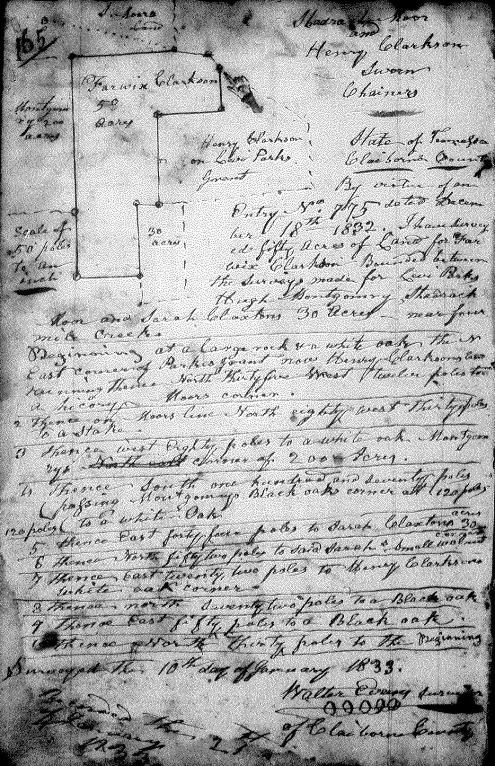
We are actually quite fortunate, because we know exactly where this bend of the Powell River was located. In fact, it was even called Claxton’s bend, as shown in this 1831 survey.

In 1834, in the Claiborne County Court Notes we find a lawsuit that may have forced the children of James Claxton to sell their land to their mother to protect it from being sold out from under them by court order. Fairwick, it seems, owed a debt.

Hugh Graham vs Fairwick Claxton – Fidelie S. Hurt JP returned with warrant judgement and execution for sum of 38.30 with the following returned endorsements on said execution to wit: There being no goods or chattels of def in my county I have levied this execution of F. Claxton “undivided interest in 100 ac of land on Powels River whereon Sarah Claxton now lives – June 16 1834”.  Order of sale issued.

It appears that the family was right, because they executed the deed of sale in March and the following June, the next court session, the court orders the land to be sold.  However, by this time, the land had already been sold and Fairwix had enough money in hand to pay his debt, if he so chose. However, if he chose not to pay the debt, the land his mother was living on was protected from his creditors. I’m assuming that Fairwix did indeed pay his debt, because we find nothing else in the court records that suggests otherwise.

We are quite fortunate because the resulting 1834 deed lists the children of James Claxton and Sarah, or at least the ones who were adults by this time. I would wager there were some heated discussions about this transaction, and how it would or might occur. I can’t imagine Sarah and her other children being happy about this turn of events.

1834 – Fairview (Fairwick) Claxton to Sarah Claxton, 1834, Book O-233 for $70.00 – original reads March 27th, 1834, between Farwick Clarkson, Andrew Hurst and wife Mahala, John Plank and wife Elizabeth, Levi Parks and wife Susannah, John Collinsworth and wife Rebecca, Jacob Parks and wife Patsy, heirs at law of James Clarkson deceast of the one part and Sarah Clarkson widow of the aforesaid James Clarkson decd of the other part, all of Claiborne Co. Tn. In consideration of:

    • Farwick Clarkson, $70 (signs with a signature – but all of the rest make marks. Fairwick’s wife is not included for some reason.)
    • Andrew Hurst and wife Mahala – $70
    • John Plank and wife Elizabeth – $70 or 20
    • Levi Parks and wife Susannah – $70
    • John Collensworth and wife Rebecca – $20
    • Jacob Parks and wife Patsy “Polly” – $20

To Sarah Clarkson, widow aforesaid, 100 acres, Claiborne on the North side of Powell river where Sarah lives and land that was conveyed to James Clarkson from John Hall of Sumner Co. Tn… beginning at Hobbs line, bank of Powell river. Witnessed by John Riley and Johiel Fugate. Registered Jan. 1, 1841

Sarah’s youngest child, Henry is conspicuously absent from this deed which probably suggests he was still living with Sarah and was yet underage.

Did Sarah have to borrow the money to pay her children? Did the children accept IOUs from their mother in order to convey the land to her?  Did they expect to receive their payment after her death?  Were they angry with their brother, Fairwick, or were there forces at work that we can’t understand from a distance of 179 years?

Because of the surveys, deeds and later generation lawsuits, we know exactly where Sarah’s land is today. Seen here, looking across the fence from the road, we see the old barn in the distance with the fenced cemetery in front of the barn.

This land, beautiful, but oh so rocky would have proved difficult for Sarah to work as a farm. Not to be deterred, she did work that farm, for 48 years after James died, raised her family, and from all indicators, was successful by any measure they had in her lifetime.

In 1839, Sarah was listed on the Claiborne County Tax list with 100 acres of land worth $250. The tax was 12 and a half cents and 30 acres was valued as school land, although I’m not entirely sure what that meant.

Almost everyone had a “school land” amount, and clearly everyone didn’t have a school on their property. Sarah’s entire tax was 12 and a half cents.

In the 1840 census, Sarah Claxton is shown living with one male, age 60-70 and two females aged 60-70.

One of those females would have been Sarah, but I have no idea who the other is. I have only a slight inkling of who the male might be. He might possibly have been John Helloms who we find living with Sarah in 1850.

Helloms

I hate it when my research starts forest fires of rumors that I can’t later extinguish. More than two decades ago, I discovered that Sarah was living with an elderly Helloms male in the 1850 census and made the mistake of excitedly sharing my discovery with other researchers. It appears that they were excited too, and before long, Sarah’s maiden name was Helloms in countless online trees. Sarah’s maiden name was actually Cook, discovered later, but there is no catching up with a tidal wave of misinformation once it is unleashed.

In 1850, Sarah is age 75, born in Virginia, with one John Helloms, age 70, listed as idiotic, living with her. Both Sarah and John were born in Virginia. Sarah’s grandson through son Fairwick, Samuel Claxton lives next door, probably on the same land and just another house away we find Farwick with his wife, now age 50. The census was taken on December 13th, but was supposed to be taken as of April in that year. In any case, Sarah’s birth year subtracts to be 1775.

This is the record that caused many researchers to infer that Sarah’s middle name was Helloms, and that John Helloms was her brother. Until we discovered Sarah’s birth name given in James’ War of 1812 records, that assumption that John Helloms was probably her brother and she was caring for a family member stood as the conventional wisdom. However, that was incorrect and illustrates quite aptly why one should never draw even tentative conclusions, at least not out loud. Unfortunately, the majority of trees available still show Sarah’s maiden name as Helloms.

Conversely, it’s probably accurate to speculate that Sarah is somehow involved with or related to the Helloms family. In the Claiborne County Court Notes of the Court of Pleas and Quarter Sessions 1819 – 1822, on page 106 we find:

May 9, 1820 – Sarah Claxton admitted to administer on all the singular goods and chattels rights and credits of William Hulloms (this is clearly the name) decd who entered into bond with Josiah Ramsey for her security and was qualified as the law directs.

The combination of this record and that of John Hulloms living with Sarah in 1850 was truly convincing that her maiden name was Hulloms or Helloms, but it wasn’t, as sworn to by Sarah herself. However, there is very clearly a connection in some fashion to the Helloms of Hulloms family.

It’s worth noting that there is no Helloms entry in the reconstructed 1790 Virginia census using tax records from the 1780s, as provided by www.binnsgenealogy.com, but there are several Helms.  There is, however, one William Hulloms in Westmoreland County on the 1791 “census.”

There is also a William Hulloms in Ashe County, NC in 1790, although he appears to be fairly young with 3 young children – so he can probably be ruled out – but not positively.

An 1804 tax list for Knox County, TN shows a William Helloms Sr. with 229 acres on Hickery Creek with 1 white poll, along with a John Hellams with 237 acres on Hickery Creek with 2 black polls (but no white polls.)

While these might be red herrings, they may not be. Clearly there is some connection to the Helloms/Hulloms family, by whatever spelling. Sarah was a close enough relative to become administrator of William’s estate and 30 years later we find John Helloms, “idiotic,” living with Sarah.

The Helloms/Hulloms mystery stands to this day.

John Riley

Sarah continued to be involved in the community, and once again, we find her interacting with John Riley.

On August 8, 1855 she is noted as having a receipt for $24.22 in the estate of John L. Riley.

John Riley appears throughout Sarah’s life, including having been at her wedding in Russell County, according to depositions relating to Sarah’s attempts to receive both a pension and bounty land as a result of James’ death during the War of 1812.

The Russell County, Virginia deed abstracts tell us that John Riley lived on Mockason Creek in Russell County, at the foot of Clinch Mountain adjoining the Hustons and Fugates and with James Tate as a neighbor as well. John Tate was the JP that married Sarah Cook and James Claxton/Clarkson.

Members of the Riley family, along with James Claxton and the Fugates migrated together to the Powell River in then Claiborne County, Tennessee.

The Riley family was one of the earliest founders in Russell County, information provided by the Riley family history. In other words, the Riley family was already well established in the region, with their first land grant in 1774, long before the Cook family arrived 20 years later in about 1795.

The Last Census

Sarah lived an amazingly long time in an era with little medical care, or at least not as we know medical care today. They didn’t have antibiotics, or assistance during childbirth other than midwives. No matter how skilled they were, fate determined in many cases whether you survived or not.

In the last census where Sarah appears, 1860, she is 85 years old, born in Virginia, and still living in her own household beside son, Fairwick. Living with her we find her grandson, Robert Shiflet, spelled Shifley in the census, along with his wife Sary (Sarah, named for her grandmother) and their daughter Elizabeth.

Sarah’s occupation at age 85? Housework. Not retired. How does a woman ever retire from housework?

It looks like Sarah spent her entire life taking care of a long list of people. Perhaps as she aged, some of those same people helped make her life a little easier. I hope so.

Sarah’s granddaughter, Sarah Claxton Shiflet is shown above. I can’t help but wonderif she looked like her grandmother.

The Civil War

The Civil War in Hancock County was brutal. Families into the late 1900s told stories of hiding their livestock and what little food they had in caves, and finally, secreting themselves there as well.

To begin with, this part of Tennessee was highly divided. Tennessee was the last state to secede and join the Confederacy on July 2, 1861. Most of the men in this part of Hancock County crossed the state line into Virginia, then into Kentucky, under cover of darkness in the night and enlisted with the Union forces. But not all.

Hancock County saw fighting, as did every county in eastern Tennessee. Making the situation even worse, this area was a crossroads for the marauding soldiers of both the north and south, and all soldiers arrived hungry. The area was savaged.

Most of the families in Hancock County did not own slaves. The land was rocky and difficult to farm. I would describe the lifestyle as subsistence living. Most people were too poor to afford slaves, had they been inclined. However, the neighbor, William Harrell owned one slave, a female name Harriet and her son, who, it turned out, was also William Herrell’s son, Cannon.

In 1862, at the height of the Civil War, Confederate troops occupied Tazewell, the county seat of neighboring Claiborne County, burning the town in November.

Cumberland Gap, directly north of Tazewell was a strategic military point between the north and the south, and the Gap itself changed hands several times during the war.  Each time, the forces encamped at the Gap didn’t have enough supplies to feed the men, and the soldiers of both sides ravaged the landscape of everything available to eat, leaving the residents with virtually nothing.

Food was scarce and life was incredibly dangerous throughout the Civil War. At least two and probably four of Sarah’s grandchildren died during the Civil War. We don’t know why Sarah died. It could easily have been attributed, at least in part, to the war.

By the time the war ended in 1865, Sarah was gone – having joined James a half-century later in watching over her family from the other side.

Military Records

Poor Sarah. James’ military files were then, and remain, a mess.

After I initially received part of them about 25 years ago, I managed to misplace some. When reordering those same records, they aren’t there. I’m glad I took notes at the time. I wish I had made copies, but that was before scanners.

To begin with, the military recorded his service records as Claxton on the unit’s roster, and Sarah applied as Clarkson. Eventually, they got that straightened out, but the Civil War interfered in that process too.

Sarah did succeed in receiving half of James’ pay for 5 years. She eventually received a 40-acre land grant, which she subsequently had cancelled, persevering to obtained an 80-acre grant instead, claiming she had been short-shifted. Forty acres was awarded to those who served for 30 days and 80 acres was awarded for four months service. Apparently, the powers-that-be agreed that an error had occurred, because Sarah received her 80-acre grant. We don’t know where that land was located, or if she simply sold the grant. By that time, she already had obtained her own land grants in Claiborne, now Hancock, County, TN and I’m sure she wasn’t the least bit interested in moving elsewhere. Sarah would have needed her family to help with the farm, and eventually, probably to help care for her.

For all the headaches this process caused Sarah, it provided wonderful information not available elsewhere.

On May 3, 1861, Sarah signed a Power of Attorney assigning Fairwix, her son, as her attorney to act on her behalf. In most of her documents, in later years, she signed with an X. Note that her surname is spelled as Clarkston. Unfortunately, the surname vacillates between Claxton, Clarkson and Clarkston. Based on Y-DNA matches, it appears to have originally been Claxton , but there is little consistency in James’s records.

This list of pensioners and their payments from Knoxville, TN shows Sarah Clarkson, widow of James, as a pensioner. Unfortunately, this record series is titled U.S., Revolutionary War Pensioners, 1801-1815, 1818-1872, which is clearly incorrect, because he served in the War of 1812, not the Revolutionary War.

This record shows that Sarah was restored to the pension list in May of 68, meaning 1868 of course, correcting sheet June 8/69 in the amount of 3.50 per month. James was a Private. Commencement is February 3,1858, and then September 4, 1860.

The columns appear to be March and September of each year, and she is noted with 4 and 2 until in 1861, then 1, and then September of 1863, it looks like she did not receive anything. Sarah died in December of 1863, so it looks like her heirs were finally paid in full in January 1869.

What this summary record doesn’t tell us is that Sarah had been dealing with this in one form or another since 1816, shortly after James’ death. Nor does it hint at the disruption caused for these families by the Civil War. For that, we need to look at Sarah’s various applications beginning in the 1850s.

Benefit Applications

In the 1850’s, Congress passed several acts benefiting military survivors and widows. It was during that period that Sarah Clarkson applied for both James’ pension and bounty land. An act passed on September 28, 1850 provided for the granting of bounty land warrants. We know about the circumstances of James’ death because Sarah applied for both land and his pension.

According to the Treasury Department letter dated Dec. 30, 1853, James Claxton enlisted on November 8, 1814 and died on February 11, 1815. His widow, Sarah, had received a soldier’s half-pay pension of $4 per month under the Act of April 16, 1816 which was to last for 5 years, at that time. This means, of course, that James was paid $8 a month. In other words, he marched 400 miles and died at Fort Decatur for the sum of $24.

Hancock Co, State of Tennessee – On this 8th day of March 1851 personally appeared before me a JP John Riley of Hancock Co., Tn. and John Taylor of Lee Co., Va. who being duly sworn according to law declare that Sarah Clarkson is the widow of James Clarkson decd who was a private in the company commanded by Capt. John Brockman in the 4th regiment of East Tennessee militia commanded by Col. Baylis – in the War with Great Britain declared by the United States of the 18th day of June 1812. That said Sarah Clarkson was married to James Clarkson decd in Russell Co. in the St. of Va on the 10th of October 1805 by one John Tate a JP in their presence, that the name of the said Sarah Clarkson before her marriage aforesaid was Sarah Cook, that her husband the said James Clarkson died at Fort Decature on the 20th of Feb. AD 1815 and that she is still a widow, and they swear that they are disinterested witnesses. Signed by both John Riley and John Taylor and witnessed by AM Fletcher. Sworn before William T. Overton JP

There’s John Riley again. A disinterested witness means that they don’t stand to benefit from the statement.

A second sworn statement is given below:

On March 8th, 1851 personally appeared before me Sarah Clarkson aged 76 years a resident of Hancock Co. Tn. who being duly sworn according to law declares that she is the widow of James Clarkson decd who was a private in the company commanded by Capt. Brock (number of regiment not recollected) regiment of E. Tennessee militia commanded by Colonel (too light to read) in the war with Great Britain declared June 18th, 1812. That her said husband was drafted at Knoxville Tn. on or about the 13th of November AD 1814 for the term of 6 months and continued in actual service as she is informed and believes in said War for the term of 3 months and 7 days and died at Fort Decatur or near there on or about the 20th of February 1815 as will appear on the muster rolls of his company on account of sickness. She further states that she was married to the said James Clarkson in Russell Co. VA on October 10th 1805 by one John Tate JP and that her name before her marriage was Sarah Cook and that her said husband died at Fort Decatur as aforesaid on the 20th of February AD 1815 and that she is still a widow. She makes this declaration for the purpose of obtaining the bounty land to which she may be entitled under the act passed September 25th, 1850. Witness Fairwick Clarkson (possibly others as the bottom of page is cut off) and she makes her mark.

James Lee Claxton’s death date is given variously as February 11 and February 20, by different sources.

In another statement, Sarah gave her marriage date to James Lee Claxton as October 10, 1799 which meshes better with the births of their children. By 1805, James and Sarah were living on the Powell River in what is now Hancock County, Tennessee, raising a family. Their oldest son, Fairwick (Fairwix, Farwick, Farwix) Claxton/Clarkson, also my ancestor, was born in 1799 or 1800.

A third document tells us a little more about the circumstances of James death.

State of Tennessee, County of Hancock, on the 29th day of August in the year of our Lord 1853, personally appeared before me a JP within and for the county and state aforesaid. Foster Jones and Tandy Welch citizens of said state and county who being duly sworn according to law declare that they were personally acquainted with James Clarkson decd (sometimes called and written Claxton) who was a private in the company commanded by Capt. Brock in the 4th regiment as well as recollected of E. Tennessee militia commanded by Col. Bales in the War with Great Britain declared June 18 1812 and that the said James Clarkson (or Claxton) sickened and died before the expiration of the time for which he engaged to serve in the said war and he belonged to the said company and regiment to which we did and that we each of us have applied under the act of Sept. 28 1850 and obtained land warrants for our service in said war. Tandy Welch and Foster Jones both make their marks, AM Fletcher a witness and Stephen Thompson a witness.

Another statement indicates that both Tandy Welch and Foster Jones swore that they witnessed the death of James Claxton.

Tandy Welch, the man who was at James’ side when he died, five years later, on June 22, 1820, married James’ daughter, Mary. I wonder, did Tandy promise James, on his death bed, to take care of his family?

On November 29, 1853, personally appeared before me Mrs. Sarah Clarkston, a resident of Hancock County aged 79 years…widow of James Clarkson…married about 1799…drew 5 years half pay in 1816…obtained 40 acres of land bounty dated Sept. 22, 1853 number 92928.

One of the absolute best things about these applications is that we actually have Sarah’s signature and it’s not an X.

We also have her son, Fairwick’s signature, as well, in several locations. Now that I see this, the surname looks identical so I wonder if he signed for her. On other documents, she signed with an X.

Sarah filed another deposition in March of 1854, claiming she was entitled to 80 acres instead of 40. The 40-acre grant was canceled (a copy of the canceled certificate is in the pension file) and the 80-acre grant was approved. Sarah also received a widow’s pension of $3.50 per month. However, under the Act of Congress of February 4, 1862 her pension was suspended due to the war with the Confederate States of America. As Tennessee had seceded to join the Confederacy, all pensions payments in the state were stopped. This, combined with the effects of the war itself in Hancock County surely had to be a hardship for Sarah.

After the war had ended, Fairwix Clarkson applied for a restoration and arrears of payment on September 25, 1866. He filed as the administrator of the estate of Sarah Clarkson, who had died on December 21, 1863, at his home on the Jonesville Road. That’s some “Merry Christmas,” especially in combination with the ongoing war.

After the Civil War, on September 24, 1866, to obtain payment, Fairwick, as administrator of Sarah’s estate was required to sign an oath of allegiance, which he gladly did, I’m sure. His son, Samuel Claxton/Clarkson (below) would yet die of injuries and illness he received in the war, enlisted as a union soldier.

Missing Documents

In addition to the information, above, now available at Fold3, I’m missing the following documents:

  • Sarah started receiving James’s half pay amount under the 1816 Act, but I don’t have that 1816 application and associated paperwork. She mentions in later documents that she submitted proof of her marriage in 1816.
  • Anything between 1816 and 1851
  • I do not have the 80-acre bounty land grant, or any information about it.

One of these documents included the statement that her father was Joel Cook.

I paid an on-the-ground researcher to pull these files at the National Archives, and the records mentioned above seem to have been misfiled someplace, probably together. The only saving grace is that I know I didn’t dream it, because the documents we do have refer to earlier, now missing, documents.

James Taylor

In addition to John Riley, another family that Sarah was involved with in early Claiborne County was James Taylor. James, then living in Kentucky, also signed that he was present at her marriage.

Who was James Taylor?

According to an 1816 survey in Russell County, James Taylor’s land shared a property line with Joel Cook, at the mouth of Musick’s spring branch.

92 – August 19, 1816 – James Taylor – 330 ac – part Treasury Warrant 11962 dated May 10, 1782 – on both sides of the north fork of Clinch River – corner to a big survey of Andrew Hebourn – corner to John Wilson – corner to Hebourn, James Madison & Harris Wilson – on the west side of a gap – corner to Joel Cook – at the mouth of Musicks spring branch – corner to Abednego White – corner to Henry Bowen.

Sarah’s Burial

Although no record officially tells us, I’m positive that Sarah is buried right here, in the Claxton cemetery, where the rest of her family is found.

Sarah’s son, Fairwick is buried here, along with his son, Samuel.

Samuel’s name is misspelled for eternity as Saluel. If one couldn’t read, how would they have known? Or did they get such a good “discount” on the stone because of the error that they just decided to leave the name alone? After all, they knew who he was.


This cemetery, now called the Cavin Cemetery, is found in Claxton bend on the original Claxton land on what would then have been known as the Jonesville Road. This picture, taken from the road, shows old barn behind the cemetery.
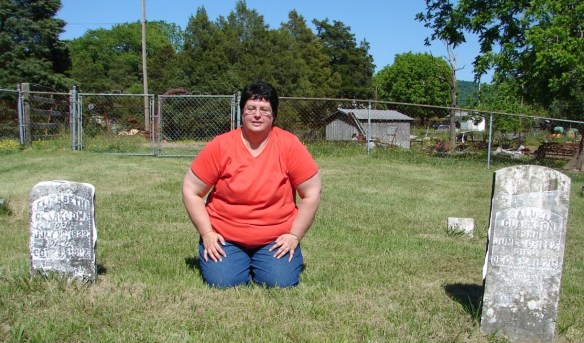
Me, inside the cemetery one VERY hot May day.

My cousin and I were infamously trapped inside the Clarkson Cemetery by an amorous bull who wanted to add us to his harem.

Oh, the things memories are made of.

There are many fieldstone headstones and even more graves entirely unmarked.

Sarah is here someplace.

Sarah’s Life and Times

We know that Sarah endured a great deal in her lifetime, but nothing ever defeated her except the grim reaper himself, and then not until she was 88 years of age. Sarah was the epitome of perseverance and tenacity. Indeed, she persisted.

Her life was incredible. She was a child during the Revolutionary War, lost her husband in the War of 1812 and lived to lose grandchildren in the Civil War, dying herself in the midst of the fighting.

During her lifetime Sarah moved across state lines and lived on the frontier when land on the Powell River was first being settled. She and James were the first settlers on Claxton’s Bend, and their choice of location would inform who their children and grandchildren would marry. There was no one else to marry except your neighbors.  That old adage about the choices of the parents affecting the children into the 7th generation holds true. My children are that 7th generation.

Not long after Sarah and James moved to Claiborne County, Sarah’s father, Joel Cook, sold the family land in Russell County and literally disappeared. It’s speculated that he went to Kentucky, but we really don’t know.

In any event, if the family ties had not already been severed when Sarah moved to Claiborne County, they surely were at that point by simple virtue of geography.

We don’t know if Sarah had any children that died young. We do know she had 8 children that lived between her marriage in October 1799 and James’s death in February of 1815. Four may have been two sets of twins, but twins that survived in that time are rare. It’s more likely that we just don’t know their accurate birth years. Keep in mind that Sarah gave conflicting information herself about the year in which she was married – and she was certainly present and old enough to remember. If she was born in 1774 or 1775, she would have been 14 or 15 when she married in 1799.

Birth and marriage years didn’t seem to matter terribly in that time and place. Close enough was good enough.

Sarah and James had 8 known children:

  • Fairwick born 1799/1800 in Virginia, died Feb. 11, 1874 in Hancock County, TN, the 59th anniversary of his father’s death. He married Agnes Muncy and had 8 children.
  • Mahala born Dec. 7, 1801 in Virginia, died March 1892 in Claiborne Co, TN, married Andrew Hurst, had 10 children.
  • Elizabeth born 1803 in TN, died May 1, 1847 in Claiborne Co., TN, married John Plank, had 11 children.
  • Mary Polly born September 4, 1803, died June 22, 1887 in Hancock Co., TN, married Tandy Welch Sr., had 17 children.
  • Susannah “Sukey” born October 11, 1808, died May 22, 1895 in Iowa, married Levi Parks, had 11 children.
  • Rebecca born December 6, 1808, died September 4, 1880 in Union Co., TN, married John Collingsworth, had 12 children.
  • Martha Patsy “Polly” born September 11, 1811, died December 23, 1898 in Claiborne County, TN, married Jacob J. “Tennessee” Parks, had 9 children.
  • Henry born ? 21, 1815, died August 1838, married Martha “Patsy” Gillus Walker, had 3 children.

If Henry was indeed born in 1815, Sarah was pregnant when James marched off to war, and James never saw his son, Henry, who died young himself.

We receive information about Sarah’s children at her death from this 1868 letter detailing her son Fairwix’s attempts to obtain her War of 1812 pension payments that were suspended during the Civil War.

Sarah’s children and grandchildren here are stated as:

  • Fairwix who was loyal and who had 3 sons in the Federal Army. Samuel, Henry Avery and John – two of whom died in the war, and Samuel who died later of illness contracted during the war.
  • Mahala Hurst who left the county long before the war.
  • Polly Welch of Hancock County thoroughly loyal through the Rebellion.
  • Patsy Parks of Claiborne County – she and her family thoroughly loyal.
  • Rebecca Collingsworth of Union County who is reported as disloyal but from personal knowledge can say nothing.
  • Sukey Parks who moved to Iowa many years before the war.
  • Two children of Henry Clarkson deceased who died some 20 years ago named Edward H. and Flora A. Clarkson who were both loyal all during the war.
  • The heirs of Elizabeth Plank who died some 20 years ago and all of whose children were considered loyal.

In 1815, when James died, Sarah was 40 years old, give or take a few months, and she had 8 children at home, or 7 and 1 on the way. The oldest, Fairwick or Fairwix, was 15 or 16. The youngest, Henry, if born yet, was just a baby. It’s certainly possible that Henry was born after James’ death, meaning of course that James left a pregnant wife when he enlisted. James enlisted in November of 1814 and died in February of 1815. Henry’s birth was recorded in 1815. If Sarah became pregnant about the time James left, that tells us that Henry was born sometime before September of 1815. It’s certainly possible that Sarah was pregnant, with 7 children, when she received the devastating news that James had perished.

The younger children would have had no memory of their father.

Life couldn’t have been easy. Later depositions taken regarding the death of Fairwick gave us a glimpse into the drama that took place in these early very-interrelated family families living on the banks of the Powell River. All was not a bed of roses.

The Civil War introduced additional strife and upheaval. The families in this area were horribly divided, a rift that was to last for decades, certainly into the 20th century.  When I first visited Claiborne and Hancock Counties in the 1980s, more than 115 years after the Civil War ended, the families still identified each other by which side their “kin” had fought for in “the War.” While most of the families in this part of Hancock County fought for the Union, that wasn’t universal and almost every family had its share of “disloyal” or traitors. Of course, the definition of traitor depended on your perspective.

The division was still palpable and real in the early 1900s when these families still actively feuded and denied any relation to each other over Civil War alliances.

Sarah’s grandsons and great-grandsons marched off to war. For Sarah, this must have been a horrible déjà vu, a repeat of her James marching off to the War of 1812, never to return. Sure enough, just like James, some didn’t

In Sarah’s lifetime, two of her children died. Henry, her baby, died in August of 1838 and Elizabeth who married John Plank died in 1847.

Sarah’s grandson, James Claxton, son of Fairwick who named him for his father, James, had died by 1845, and Fairwick raised James’ 4 children. Of course, they lived next door to Sarah, so in reality, the entire family raised those children.

One of those boys that Sarah raised, William, died on May 4, 1863, serving the Union, at Camp Dennison, Ohio.

Fairwick lost 2 sons and a son-in-law during the Civil War. The Civil War was cruel to this family.

John Clarkson enlisted for the Union on March 15, 1862 and was killed on March 20, 1863 in Nashville, TN, almost 9 months to the day before Sarah died. John was likely buried near where he fell, so the family never got to bury him or say their goodbyes. For Sarah, a repeat of what happened to her beloved James.

The other two died a few months after Sarah. Perhaps she greeted them on the other side. Henry died February 2, 1864 in Louisville, KY and John Wolfe, Fairwick’s son-in-law and Sarah’s grandson-in-law, died March 16, 1864.

Before Sarah’s death, Fairwick’s other son-in-law, Calvin Wolf, had been captured in Atlanta, Georgia during a battle, also serving the Union, and was held prisoner under utterly horrific conditions at Andersonville Prison for 3 very long years. Sarah died without knowing what happened to this man, or what would become of her granddaughter and her great-grandchildren. Miraculously, somehow Calvin survived.

Sarah’s grandson, Levi Hurst, the son of Mahala Clarkson, shown above, who had married Andrew Hurst, also died in the Civil War. Levi was a Confederate and died September 18-20, 1863 at the Battle of Chickamauga, three months before Sarah’s death.

It must have been incredibly difficult for Sarah to have grandchildren literally fighting each other on both sides of the war.

Mahala’s granddaughter, Charity, appears to have died sometime between the 1850 and 1860 census, or she married and left no trail. Mahala’s son James Hurst married Elizabeth Farmer and we lose track of him as well.

In case you’re keeping track, that’s a total of 2 grandchildren, 2 grandchildren-in-law and 1 great-grandchild killed in the un-Civil war, along with 1 who served three tortuous years as a POW.

Sarah suffered another kind of grief as well – that of departure. Her daughter, Susannah married Levi Parks about 1824. Sarah witnessed the births of 11 grandchildren, born to Susannah. The last arrival, a baby girl joined the family in 1848, just before Susannah and Levi would sell their belongings, hitch up a wagon, and head for David County, Iowa. That sweet baby girl born in 1848 would die in 1850, the first member of that family to be buried in Iowa soil. Departure was, in those days, a form of death – because Sarah and Susannah, mother and daughter, both very clearly knew that their departure was a final goodbye and they would not be reunited until after their deaths.

So, Sarah grieved the absence of Susannah and all 11 of her children, and then the death of the baby. That bad news would have arrived by letter, if Sarah ever knew at all. It’s somehow ironic that I can discover more today about what happened to Sarah’s children who moved away than Sarah could in her own lifetime.

We know less about what happened to the rest of Sarah’s children and grandchildren, but it stands to reason that those families were negatively affected by the war as well.

Sarah Cook and James Lee Claxton had 8 children and 91 grandchildren. Sarah wouldn’t have known all of her grandchildren, because daughter Susannah Parks moved to Iowa in the 1840s and Rebecca moved to Union County, TN. Two other daughters, Patsy and Mahala were living close by in neighboring Claiborne County, so Sarah probably saw them from time to time.

Mary who married Tandy Welch (cabin shown above) and their family lived close, as did Fairwick of course, who lived next door, and several of his children.

Henry, Sarah’s son, had lived just down the road, before his death, near the Edward Walker cabin, above, where his wife, Martha “Patsy” Gillus Walker had lived with the Edward Walker family.

After Henry’s death, Henry’s widow, Martha, married William Claxton, son of Fairwick and moved to neighboring Claiborne County where they became estranged from the Claxton family. I told you there was drama!

Sarah said premature goodbyes to a lot of family members in her lifetime, if she got to say goodbye at all. Aside from her parents, Sarah lost her husband, several children and grandchildren to early deaths and warfare.

She was one of very few people who saw three monumental wars in her lifetime.

Sarah’s life was anything but easy and pain-free, yet, she persevered, a testament to fortitude.

Sarah’s Mitochondrial DNA

I was fortunate enough to connect with a cousin who descends from Sarah Cook Claxton through all females. I am ever so grateful to her for testing her mitochondrial DNA.

Several of her matches have taken the full sequence test, the test needed to obtain the full haplogroup designation, which allows us to narrow the scope of the geography where Sarah’s ancestors may have been found.

Sarah’s mitochondrial DNA is haplogroup H100, meaning she is the 100th branch named in haplogroup H.

On the FamilyTreeDNA  haplogroup tree, you can see that H100 is a branch of H.

Haplogroup H100 is found in the FamilyTreeDNA  database in Ireland, Canada, France, Saudi Arabia, the US and Scotland. Saudi Arabia? That’s unusual.

Our tester who descends from Sarah shows exact full sequence matches to four people, none of whom have entered their most distant ancestor information, and only one has provided a tree. Their ancestor is first found in Ohio in the 1800s.

Sarah’s descendant is fortunate to have 7 additional mutations that, along with her four exact matches, will likely form a new haplogroup together when the new mitotree is released. That should also provide a time estimate for a common ancestor which will help everyone immensely.

Sarah inherited her mitochondrial DNA from her mother whose name was Alsy, probably short for Alice.

Alsy was born sometime around 1750, probably in Virginia. Hopefully, eventually, we’ll have mitochondrial DNA matches to Virginia families. Then, Sarah’s mitochondrial DNA, combined with genealogy records and autosomal matches will help us break down that next brick wall.

_____________________________________________________________

Follow DNAexplain on Facebook, here or follow me on Twitter, here.

Share the Love!

You’re always welcome to forward articles or links to friends and share on social media.

If you haven’t already subscribed (it’s free,) you can receive an email whenever I publish by clicking the “follow” button on the main blog page, here.

You Can Help Keep This Blog Free

I receive a small contribution when you click on some of the links to vendors in my articles. This does NOT increase the price you pay but helps me to keep the lights on and this informational blog free for everyone. Please click on the links in the articles or to the vendors below if you are purchasing products or DNA testing.

Thank you so much.

DNA Purchases and Free Uploads

Genealogy Products and Services

My Book

Genealogy Books

Genealogy Research

Happy Whatever Kind of Holidays You Celebrate

Wherever you are and whatever you’re doing this holiday season, I wish you light, much joy and cheer.

Perhaps your heart is singing because you’re with family you haven’t seen in three years now.

Or, maybe you’re making new memories, with new friends, someplace different.

Or perhaps you flew the coop and you’re not “staying home” at all.

Maybe you’re not visiting someone else either.

Perhaps you’re gathering someplace new, making memories you never imagined possible, penning a brand-spanking-new chapter.

Far, far from home.

Maybe the old surroundings were just too painful.

Because a loved one slipped away. Remember them as their most beautiful selves – inside and out.

Take them with you in your soul. They are part of you and your new journey, guiding and protecting you along the way.

Life has changed a lot in the past few years, months and even weeks. There is more than one kind of death.

Maybe your life is in complete disarray, down to bare bones and seriously “under construction.” Nothing in its place or where it belongs, wherever that might be.

Maybe you feel like this chapter will never end.

I’m so with you on this one, but sooner-or-later, it will. Perhaps one day, you will even laugh at this adventure, “the good old days,” once it’s a distant memory of course.

Maybe you feel like you just can’t face tomorrow, or don’t want to. I’ve had those “I just want to stay in bed” days recently.

Too many of them.

But then, I glance up and I’m reminded of the simple beauty there just for the viewing. An envoy sent by Mother Nature.

Hi baby!

I’m holding you in the light and wishing you warm and sunny days. Basking in beauty

The fog and grey does lift and gives way to the glorious sunshine.

Sometimes sunshine is delivered in the form of a flower.

Or a few.

Or “furever” puppy love when you’ve rescued someone in desperate, life-threatening need.

Morning comes, even from the longest and darkest of nights. Just ask Savoy. He may be blind and can only use three legs now, but he feels love deeply and says that love and friendship arrives when you’ve given up and least expect it – in surprise packages.

Like, you, for instance.

Lighting the way for another illuminates the path for you too.

Sometimes small things are the biggest and mean so much – arriving just when you need them.

Sometimes the past just has to stay there. Cut those binding anchor ropes and float free.

Perhaps you need to light up your life with something new. Someplace new.

Dive right in and keep moving forward.

I know it sounds like a bird-brained idea, but let your imagination take flight.

May you embark on a grand new adventure.

And perhaps gain a new and different perspective along the way.

Sometimes, releasing, giving away, downsizing and beginning anew is actually gaining, not reducing.

Perspectives change. Maybe your “things” are seeds for another.

May your waters be calm, and your smiles reflect glorious happiness.

May new memories weave their way into the fiber of the old as you paddle your way through life’s currents.

May you decorate your life in unconventional ways.

Even if the familiar is completely gone. Sometimes we just have to seize the moment and redecorate our own lives.

Take a deep breath. Refresh and renew.

If old traditions are painful, leave them behind and make a new one.

Even if you need to be incognito.

Don’t displace your sense of humor😊

Wherever life has taken you, and wherever you find yourself, I wish you safe journey, safe harbour and smiles as you savor the path along the way.

Even if the trip has has been long and you’ve had to wait awhile.

Don’t worry though, because I’m sure Santa can always find you.

May your ancestors visit or at least send a message, share their wisdom and sustain you this holiday season.

And maybe, if you’ve been very, VERY good, they’ll even tell you who their parents were!

WHAT????

Oh wait, wait – sorry – I think maybe Santa drifted off and fell asleep again.

Their names are John Smith and Mary, last name unknown, but probably Jones, at least I think that’s what it says. There you go!

😊

Your ancestors, John and Mary, followed their path, from who-knows-where to some county where all the records burned.

For all we don’t know about them, we know that eventually, they begat the people who begat the people who begat you. All those tiny, seemingly unimportant choices made a HUGE difference.

You descend from a long line of dreamers and adventurers, on that journey of life through the land called Unknown.

May your life be blessed so that you, in turn, can make a difference. Opportunities exist at nearly every turn.

Light a candle. Change the darkness.

Fulfillment isn’t about what we get, but what we have the privilege to contribute, the differences we make in the lives of others.

When you have taken that final step on your winding and uncertain path and are ready to walk on, may you look back upon your footprints and reflect upon a very long and cluttered trail, strewn with all of differences that you made.

Happy Holidays

Estes Ancestors to 1495, Plus Wives – 52 Ancestors #385

I’ve been asked several times to compile a list of all of my Estes lineage articles in one place.

I’ve created a table below, and I will update with links as I write additional articles or expand the lineage, although I suspect we are at the end of the Estes line at 1495.

I’ve also included the wife or partner that I descend through for each ancestor, when known. I will create a separate lineage document beginning with the wife as the first person in her family line.

Think of these as chapters in my Estes lineage book! I hope some of these people are your ancestors too, and if not, I encourage you to write your ancestors’ stories.

Ancestor Article My Ancestral Spouse
William Sterling Estes (1901 or 1902-1963) Searching for Ilo’s Son – 52 Ancestors #1 Barbara Ferverda (1922-2006)
Finding Ilo’s Son, Lee Devine – 52 Ancestors #3
William Sterling Estes – The Missing Years – 52 Ancestors #5
April Fool Meltdown Thanks to William Sterling Estes, 52 Ancestors #154
WWI – 100 Years Ago – Thou Art Gone, 52 Ancestors #155
Unwelcome Discoveries and Light at the End of the Tunnel, 52 Ancestors #156
On This Day – What Were Your Ancestors Doing? – 51 Ancestors #170
Suicide – 52 Ancestors #197
Eleven “Soldier Boy” Love Letters from the Lost Summer of 1919 – 52 Ancestors #205
William Sterling Estes and the Backwards Tombstone, 52 Ancestors #209
Aunt Margaret’s Bombshell Letter – 52 Ancestors #210
William Sterling Estes’ Court Martial and Escape: 3 Wives and 4 Aliases – 52 Ancestors #217
Edna Estes Miller (1920-1990), Sister: Once Found, Twice Lost – 52 Ancestors #361
Seriously, Addie Browning (1909-1996) is NOT my Father’s Wife – 52 Ancestors #365
William George Estes (1873-1971) William George Estes (1873-1971), You’ll Never Leave Harlan Alive, 52 Ancestors #53 Ollie Bolton (1874-1955) Need mitochondrial DNA – testing scholarship available *1
My Crazy Estes Aunts – 52 Ancestors #2
Unraveling the Odd Fellows Lodge Meeting in Claiborne County, Tennessee – 52 Ancestors #343
MyHeritage New Photo Enhancer – Seeing Family Faces for the First Time
Lazarus Estes (1848-1918) Lazarus Estes (1845-1918), Huckster and Gravestone Carver, 52 Ancestors #59 Elizabeth Vannoy (1847-1918)
John Y. Estes (1818-1895) John Y Estes (1818-1895), Civil War Soldier, Walked to Texas, Twice, 52 Ancestors #64 Martha Rutha Dodson (1820-1903)
John Estes Goes to Jail – 52 Ancestors #265
John R. Estes (1787-1885) John R. Estes, War of 1812 Veteran (1787-1885), 52 Ancestors #62 Nancy Ann Moore (c1785-1860/1870) 
Need mitochondrial DNA – testing scholarship available *1
George Estes (1763-1859) George Estes (1763-1859), Three Times Revolutionary War Veteran, 52 Ancestors #66 Mary Younger (c1766-1820/1830)
Moses Estes (1742-1813) Moses Estes (c1742-1813), Distiller of Fine Brandy and Cyder, 52 Ancestors #72 Luremia Combs (c1740-c1820) 
Need mitochondrial DNA – testing scholarship available 1
Moses Estes (1711-1787) Finding Moses Estes (1711-1787), 52 Ancestors #69 Elizabeth “probably not Webb” Estes (1715/1720-1772/1782), Wife of Moses, 52 Ancestors #86 *2
Abraham Estes (1647-1721) Abraham Estes, (c 1647-1720), The Immigrant, 52 Ancestors #35 Barbara “Not Brock” Estes (c1670-1721), Abraham’s Wife, 52 Ancestors #70  Need mitochondrial DNA – testing scholarship available *1
Sylvester Estes (1596-1647) Visiting Deal, Kent, UK – The Estes Homelands Ellen Martin (c1600-1649)  Need mitochondrial DNA – testing scholarship available *1
Deal and Deal Castle – Kent, England
Sylvester Estes (1596-c1647), Sometimes Churchwarden, 52 Ancestors #31
Robert Eastes (Eastye) (1555-1616) Robert Eastes (1555-1616), Householder of Ringwould, 52 Ancestors #30 Anne Woodward (1571-1630)
Need mitochondrial DNA – testing scholarship available *1
St. Nicholas Church at Shoulden and St Leonard’s at Deal
Sylvester Estes (Eastes, Eastye) (1522-1679) Sylvester Estes (c1522-1579), Fisherman of Deal, 52 Ancestors #29 Jone (<1535-1561)
Need mitochondrial DNA – testing scholarship available *1
Nycholas Ewstas (c1495-1534) The White Cliffs of Dover Anny (c1500->1533) *2
Nycholas Ewstas (c1495-1533), Progenitor, 52 Ancestors #28

Brief  Estes Progenitor Synopsis

It’s hard to comprehend that the earliest known Estes progenitor, Nycholas Ewstas was born in 1495, the same year that Columbus sailed the ocean blue.

Nycholas owned a sheep and a horse, and was found living near Deal, England, along the white cliffs of Dover.

Despite a persistent and enchanting story, there is no evidence, genetic or otherwise, that the family descends from the d’Este family of Italy. Trust me, I wanted it to be so, but I’ve pretty well disproven that oral history.

Nycholas Ewstas’s descendants, for generations, were mariners.

If you have information about these lines that I have not included in these articles, please let me know. You never know what’s going to pop up.

Estes Resources

My family trees are available at:

The Estes family archivist, David Powell, maintains free research sites here and here.

The Estes Trails Newsletter, current and back issues are available from Larry Duke at estestrails@aol.com.

The Estes DNA Project is available here, and all Estes descendants are welcome to join by either taking a Family Finder test, here or uploading a DNA file from another vendor. Step-by-step upload instructions are found here.

Estes men are strongly encouraged to order the Y DNA test, here. The most detailed results are available with the Big Y-700 test.

Footnotes:

*1 – Mitochondrial DNA descends through all females to the current generation, which can be males. Anyone who descends from this woman through all females carries her mitochondrial DNA today, so is eligible for a free testing scholarship if you have not already taken a mitochondrial DNA test at FamilyTreeDNA. Either way, please reach out! There’s a lot we can learn.

*2 – No daughters known, so mitochondrial DNA would not be available.

_____________________________________________________________

Follow DNAexplain on Facebook, here or follow me on Twitter, here.

Share the Love!

You’re always welcome to forward articles or links to friends and share on social media.

If you haven’t already subscribed (it’s free,) you can receive an email whenever I publish by clicking the “follow” button on the main blog page, here.

You Can Help Keep This Blog Free

I receive a small contribution when you click on some of the links to vendors in my articles. This does NOT increase the price you pay but helps me to keep the lights on and this informational blog free for everyone. Please click on the links in the articles or to the vendors below if you are purchasing products or DNA testing.

Thank you so much.

DNA Purchases and Free Uploads

Genealogy Products and Services

My Book

Genealogy Books

Genealogy Research

Hugh Benson (c1650-1687) and Wife, Catherine; Landowners in Leonard’s Town – 52 Ancestors #384

Let’s begin this journey by disproving Hugh Benson’s birth.

He might have been the Hugh Benson born on September 5, 1653 to William Benson in Yorkshire. The timeframe fits, and so does the location for Catholics.

Transcribed; “Hugh Benson, sone to Wm. Benson, the 4 of September.” The year, “53” is recorded at right.

This record is attached to many trees, but it’s incorrect. How do we know that?

Further digging in this church’s records reveals that this child, Hugh Benson, was buried on November 7, 1653, so this is NOT our Hugh Benson unless he came back to life.

And no, there were not multiple Hugh Bensons born to William Benson in this same church, at least not that are indexed.

This is a reminder about getting excited and failing to check further. A name and place does not a match make, no matter how much we want that to be the case. I ws very disappointed, to put it mildly.

There are other Hugh Bensons born about this time in England, but we don’t know which one, if any of those, is ours.

Arrival

The first record we can attribute to our Hugh Benson is his arrival in Maryland which would have taken between two and four months onboard a ship, assuming nothing went wrong.

We know Hugh Benson was transported into the colony of Maryland on February 16, 1671 by Thomas Notley. He was apparently one of 53 “adventurers” and was free by 1682. The fact that Notley describes them as “adventurers” tells us that they weren’t convicts, political prisoners, petty thieves, or perhaps even common indentured servants. Researcher Kent Walker believes that this shipload of men were handpicked by the Catholic gentry because they were known and trusted.

Many ships arrived at St. Clement’s Island at the entrance of St. Clement’s Bay, as did the first settlers in 1634. Blackistone Lighthouse marks the location, along with a cross, today marks the location in the St. Clement’s Island State Park.

While we don’t know the name of the ship that transported Hugh, the St. Mary’s Historic District created a full-sized working replica of the Dove, above, the smaller of two ships that arrived in March of 1634 with settlers, Jesuit missionaries, and indentured servants to establish what would become Maryland. The Calvert family was fulfilling their dream of establishing a safe haven for Catholics who were persecuted in England beginning in the mid-1500s during the rule of Henry VIII. Life as a Catholic became increasingly dangerous in the 17th and 18th centuries.

The larger ships looked something like this replica in Amsterdam

Confined on these ships for weeks, mostly below deck, sleeping like cordwood in rows of hammocks, passengers would have been anything but comfortable. I tried a hammock, and not only could I not get in, I barely got out. Let’s just say there was a lot of laughter.

I’m not even going to mention personal hygiene on these ships, because there wasn’t any.

If you were lucky, the water wasn’t contaminated, lasted the length of the voyage, and the food didn’t rot or become spoiled on the way.

Danger loomed everyplace.

The ships, the masts, something going wrong, weather, dysentery, typhoid, falling or being washed overboard, not to mention issues like chronic seasickness.

One had to really, REALLY want to make this journey, or maybe have no choice in the matter.

Some died, some traveled once and never again, but others make a life on the sea.

Thomas Notley, the man who transported Hugh Benson, was a Catholic planter, merchant, and attorney in St. Mary’s County. He was active as a Burgess beginning not long after his arrival in 1662. He lived in St. Clements Hundred, and in St. Mary’s City.

In 1663, Notley purchased 500 acres from Thomas Gerrard and then added another 1800 acres. He built Notley Hall, a manor about 2-3 miles south of what is today, Maddox, Maryland. This may well have been where Hugh Benson spent at least part, if not all of his indenture.

The archives of Maryland report that their council meetings on August 6, 1676 and January 1678 were held at Manahowick’s Neck, meaning Notley’s Manor. Hugh was likely there in 1676, as indentured servants weren’t generally freed for 7 years. During a full council meeting, Notley probably had all of his servants and enslaved people at the location where many people were gathered. Notley would have needed prodigious amounts of food, lodging, and personal services for his many guests.

You can get an idea of what this area looked like by viewing the photos from the Lower Notley Hall Farm event facility, here.

Notley died testate in 1679, with no children. In his estate, he had “11 male slaves, 8 female slaves, 2 male servants, 1 female servant, 10 undetermined slaves, 5 undetermined servants.”

Hugh Benson may have been one of those servants, depending on the length of time he had to serve for his transportation. The normal length of indentured servitude was 7 years, so he might have been freed in 1678. The length of time could have been more or less depending on the contract or specific circumstances.

Dr. Carr summarized her findings about Hugh in her work and reflects that Hugh was free by 1682.

What’s somewhat confusing is Hugh’s marriage and wife, Catherine, whose birth surname is unknown.

It wasn’t common practice for indentured men to marry before arrival. Indentured people generally weren’t allowed to marry during their servitude, either.

However, we know that Hugh had at least two children with his wife, Catherine, before his death in 1687.

Mary Benson was born to Hugh Benson and Catherine sometime after his 1671 immigration, probably between 1673 and 1680, in St. Clement’s Hundred.

It’s thanks to records relating to that daughter, Mary, that we know as much about Hugh Benson as we do.

St. Clement’s Hundred was defined as St. Clements Island and 5 miles into the mainland. St. Clements is where Thomas Notley lived as well as the colonial capital at St. Mary’s City.

This inset from a 1685 map shows the Pamunkey Indian land, Portabaco, Clements Bay and St. Clements Island, and then St. Marys City. Zachia Swamp, spelled Zachkia and noted by its Native name of Pamgayo played a huge role in the lives of the next generation of settlers.

What was going on at that time in Maryland, based on the few existing St. Clements manorial records?

September 1670 – We prsent That the Lord of the Mannor (Thomas Gerard) hath not provided a paire of Stocks, pillory, and Cucking Stoole. Ordered that these Instrumts of Justice be provided by the next Court by a generall contribution throughout the Manor

“Instruments of Justice”

Stocks and pillories were both installed in the public square.

Stocks, as opposed to the pillory, only restrained the legs, and while seated. Stocks were used as both punishment as well as restraint while the accused was awaiting trial. Often people were sentenced to more than a day confined in the stocks, so they would have to soil themselves.

Since part of the point was humiliation, passerbys were encouraged to do whatever came to mind. Fiendish boys would often remove the shoes of the person in the stocks and tickle their feet. Trash and other objects were thrown, and whipping occurred, sometimes to the bottoms of the bare feet.

These stocks remain in Belstone in Dartmoor, England, as a historical marker. Notice that there is no backrest.

A pillory restrains the hands and head while the victim is standing.

Here’s me in a replica pillory in Williamsburg.

Traditional pillories were often elevated on a platform for spectator sport and designed as a torture device. I couldn’t find any historical images that weren’t nauseating and I’m not going to describe what else was done to pilloried people. Humans can be unbelievably cruel and take such perverse pleasure in inflicting cruelty upon others, and watching. I’m amazed what crowds can be convinced to go along with sometimes.

I might be smiling in this photo, but trust me, no one who was there for more than about 5 minutes would have been smiling. If you relaxed your legs, you effectively hung yourself.

What offenses got you sentenced to time in the pillory in colonial America? Public intoxication, blasphemy, fortune telling, arson, and if you were enslaved, escaping or attempting to. The pillory was also a method of disabling someone while others abused, tortured, or murdered, them.

The third “instrument of justice,” the cuckolding stool was used to dunk offenders, primarily women, who were deemed disorderly or “too scoldy,” as indicated by this 1615 ballad:

Then was the Scold herself,
In a wheelbarrow brought,
Stripped naked to the smock,
As in that case she ought:
Neats tongues about her neck
Were hung in open show;
And thus unto the cucking stool
This famous scold did go.

Sadly, many women were immersed for so long that they drown. And yes, people watched for sport.

Eventually, dunking, with or without benefit of a chair, was a test for witchcraft. If you didn’t drown, you were deemed to be in league with the devil, and you were then killed. If you’re thinking to yourself that there was no “win” here, you’d be exactly right.

Yes, unfortunately, there were witchcraft trials in Maryland. Moll Dyer, who died about 1697, was reportedly chased from her home by local townspeople in the winter of 1697 in Leonard’s Town, Maryland, after being accused of witchcraft. It’s thought that Moll was actually a healer, but a flu epidemic during the winter of 1697 led to her being an easy mark for people looking for a scapegoat.

Moll was found a few days later, dead, frozen to a stone, now named the Moll Dyer’s rock. The rock was rediscovered and transported to the courthouse square several years ago.

You could be a Catholic in Maryland, but don’t even think about being a healer or, Heaven forbid, being “scoldy” or talking back to your husband. So, I wonder if scolding people for not going to church was acceptable. And what about scoldy men?

I think if I lived in early Maryland, I might just get dunked for even asking those questions out loud.

Everyday Life

Reading the transcribed documents in the Maryland archives is quite interesting, not just for witches, but to understand the drumbeat of everyday life.

For example, an October 28, 1672 list of residents, leaseholders, and freeholders shows within St. Clement’s Manor shows Thomas Notley, but not Hugh Benson, which of course, means that Hugh was a servant.

Citizens were mentioned or reprimanded for a variety of offenses in St. Clement’s Hundred, including

  • keeping a tippling house
  • a man’s dogs injuring another man’s hogs
  • creating an affray and shedding blood
  • annoying another by keeping hogs, a mare and foal
  • selling drink without a license at unlawful rates
  • reporting a stray horse
  • not showing up for court
  • unlawfully cutting timber
  • killing a hogg but not sharing with the “lord of the manor”

The next peek we get into the life of Hugh Benson is in 1682, nearly a dozen years after his arrival, when his unnamed daughter is mentioned in the will of Collins Mackenzie.

The Maryland Calendar of wills provides us with this tantalizing tidbit.

Who was Collins Mackenzie, and why did he leave something to the unnamed daughter of Hugh Benson? That daughter had to be quite young. Is there a relationship with either Hugh or his wife, Catherine?

Whatever he left Benson’s daughter had to be tangible, because in Collin’s estate payments, nothing was paid to either Benson or Trench, which, it turns out, was actually James French who was also transported by Notley and indentured to Luke Gardiner on St. Clement’s Island.

There’s Richard Gardner, spelled elsewhere as Gardiner, again.

Because Mackenzie didn’t name a daughter, this also suggests that Hugh Benson only had one daughter, but since it was a nuncupative (spoken) will, he could simply have been very ill and near death.

If that unnamed daughter is Mary Benson, and we have to assume it is, she married Bowling Speake (of Charles County, MD) sometime in the early 1790s and they purchased land from the Gardiner family. How are these families interlaced?

According to a 1741 lawsuit, Richard Gardiner sold land to Hugh Benson of St. Mary’s County, MD, sometime after 1681.

Your Committee further find that the said Richard Crackborne by his Deed bearing date the 17th day of November 1681 did Bargain and Sell the said Tract of Land to Richard Gardiner of Saint Marys County in Fee Your Committee also find that Richard Gardiner and Elizabeth his Wife of St. Marys County aforesaid did Convey to Hugh Benson of the same County Planter 100 Acres Part of the said Tract in Fee [p. 273]

The following paragraph states the location.

Your Committee likewise find that Mary Speake is the reputed Daughter and Heiress at Law of Hugh Benson and that she intermarried (as it is said) with Bowling Speak of Charles County and that the said Bowling Speak and the said Mary his Wife, by their deed Bearing date the 31st of March 1739 did Convey the said Parcell of Land unto the Petitioner Thomas [Spalding] in Fee All which deeds appear to Your Committee to be duly Executed Your Committee further find by the Information of W James Swann a Member of your House that the Land called Crackbornes Purchase mentioned by the Petitioners to be Granted is of greater Value than that Part of the Land the Petitioners pray to be enabled to dispose of called Seamour Town or known by the name of Leonards Town.

Leonard’s Town, now Leonardtown, was part way between Notley Hall and St Mary’s City, so located just about perfectly. Given that Hugh Benson was Thomas Notley’s servant, he probably traveled this route many times between Notley Hall, the docks at Colton’s Point at St. Clement, and St. Mary’s City on behalf of his master. That path runs right through the center of Leondard’s Town. Perhaps Hugh spent the night there on his journey which would have been too distant for one day.

Leonardtown remains small, with quite a bit of land remaining undeveloped.

Leonardtown is charming and quaint today, with its old jail, now serving as a museum and visitor center still standing beside the courthouse. The original jail was apparently across the street.

The cannon in the garden outside is from the original ship, the Ark, one of two that transported the first settlers to Maryland in 1634.

The early bayside settlements like Leonard’s Town were ports, with towns established dockside to enable loading, unloading, and transacting business.

Hugh Benson was a planter, meaning a farmer in the vernacular of the day.

By Sarah Stierch – Flickr: St. Mary’s City, Maryland, CC BY 2.0, https://commons.wikimedia.org/w/index.php?curid=13157964

Historical St. Mary’s City has reconstructed a typical 17th-century planter’s house based on their findings in more than 200 archaeological digs. The home of Hugh and his family probably looked very much like this, with an outside kitchen.

Or, if Hugh was a little more well-do-do, perhaps he built a home with fireplaces, 4 rooms, and two partial stories like 1700s-era St. Mary’s Manor West.

Or, maybe their home looked more like Resurrection Manor, built as early as 1660, but now demolished. Library of Congress photos, here.

This internal photo was taken after Resurrection Manor had survived for nearly 300 years. Fireplaces heated homes which were quite small by comparison to today’s structures. Many, if not most, residences had outside kitchens, but Katherine may have cooked in a fireplace like this, with a grate, cauldron and pothooks, especially in the winter.

By Kathleen Tyler Conklin – Flickr: Leonard Calvert in the State House, CC BY 2.0, https://commons.wikimedia.org/w/index.php?curid=32277068

A period actor playing the role of Leonard Calvert at the colonial statehouse in St. Mary’s City gives us a glimpse into how the people Hugh interacted with would have dressed.

Hugh, of course, was probably dressed in much less opulent attire.

When in St. Mary’s on business for or with Thomas Notley, Hugh may well have worshipped in the Catholic Church built in 1667, reconstructed today.

The original settlers purchased land from the Piscataway Indians with whom they lived and traded peacefully for many years. The Indians befriended and helped the early colonists, being eager to learn more about their advanced methods and metal tools, like guns which made hunting much easier.

I found listings for three Testamentary Proceedings involving Hugh Benson although I have not examined the folios:

  • 1682 – St. Mary’s Liber 12B, folio 309
  • 1687 – St. Mary’s Liber 13, folio 514 (his estate filed)
  • 1687 – St. Mary’s Liber 14, folio 43

Hugh Benson died in 1687 as a relatively young man, under 40, and probably suddenly, given that he had no will. What happened? Was there an accident?

On August 19, 1687, Katherine renounced administration of his estate to Richard Gardiner, who died not long thereafter in England. Gardiner was a fellow Catholic and Burgess.

In Gardiner’s estate proceedings, payment for a debt was received from Hugh Benson. Of course, that could have been an old debt, or given that the settlement was in 1696, that Hugh Benson could have been Hugh’s son.

The second to last mention of Hugh Benson was in 1694, although it could have been retrospectively:

Act for payment and assessing the publick charges of this province Acts of 1694 ch 32: Tobacco is paid: to Hugh Benson two hundred and Seaventy

There is a Hugh Benson who died in Stafford County, VA, unmarried, in November of 1699. There appear to be two Hugh Bensons in Stafford County during this time, as one was noted as a runaway from the service of John Doxsey in 1702.

Hugh Benson leaves us with several mysteries.

Katherine, then a widow, had at least one small child, Mary, to raise, and possibly more.

Katherine Remarries

Catherine or Katherine, widow of Hugh Benson, must have married Thomas Cooper, born around 1650, almost immediately after Hugh’s death. She would have been about 35 years old.

She had at least two more children with Cooper and possibly three.

Katherine was deceased 28 years later, by 1715, when Thomas Cooper made his will. She wasn’t named, and Thomas left all of his property to sons Thomas and Richard Cooper, both real and personal, jointly and equally.

Seems pretty straightforward, right?

Well, this is where things get complicated.

Who are Thomas Spalding and Catherine?

Thomas Cooper, Jr. appears to have been the oldest child. He married Mary Riley about 1712-1713, so he would probably have been born in the 1680s.

When Thomas Cooper Jr. died in 1722, he left, “To cousin — Cooper, 310 A. of “Crackbourn’s Purchase,” now owned with bro. Richard.” Also, “To dau. Katherine, personalty and all lands except dwell. plan. — during life of wife; at her decease, to pass to dau. afsd. She dying without issue, to cousin Thomas and hrs.” I think that 310acres should be 210 acres, but that’s not relevant to this discussion.

Is the Catherine married to Thomas Spalding the daughter of Thomas Cooper Jr., meaning the granddaughter of Hugh Benson’s wife, Katherine? It certainly appears so.  Note the mention, above of Crackbourn’s Purchase.

Catherine Cooper and Thomas Spalding appear to own the original 200 acres (or 210 acres) of Crackbourn’s Purchase in 1741.

By the Committee appointed to enquire into the Facts contained in the Petition of Thomas Spalding and Catherine his Wife June the 6. 1741

Your Committee find on Inspecting the Papers of the Petitioners that the Land called Crackbornes Purchase containing 200 Acres was Granted on the 24th day of October Anno Domini 1659 unto Richard Crackborne Assignee of Walter Peak and Peter Mills Assignees of Paul Simpson in Fee. Your Committee further find that the said Richard Crackborne by his Deed bearing date the 17th day of November 1681 did Bargain and Sell the said Tract of Land to Richard Gardiner of Saint Marys County in Fee Your Committee also find that Richard Gardiner and Elizabeth his Wife of St Marys County aforesaid did Convey to Hugh Benson of the same County Planter 100 Acres Part of the said Tract in Fee [p. 273] Your Committee likewise find that Mary Speake is the reputed Daughter and Heiress at Law of Hugh Benson and that she intermarried (as it is said) with Bowling Speak of Charles County and that the said Bowling Speak and the said Mary his Wife, by their deed Bearing date the 31st of March 1739 did Convey the said Parcell of Land unto the Petitioner Thomas in Fee All which deeds appear to Your Committee to be duly Executed Your Committee further find by the Information of W James Swann a Member of your House that the Land called Crackbornes Purchase mentioned by the Petitioners to be Granted is of greater Value than that Part of the Land the Petitioners pray to be enabled to dispose of called Seamour Town or known by the name of Leonards Town.

Does this suggest that Hugh’s widow, Catherine married her neighbor, Thomas Cooper, who literally lived next door on Crackborne’s Purchase? Meaning that Crackborne’s Purchase, divided at one time into two pieces, has now been reunited?

It certainly looks that way.

Catherine’s daughter Mary Benson who married Bowling Speak sold that tract of land to Catherine’s granddaughter, Katherine, through her deceased son, Thomas Cooper Jr.

Did you get that? It was a mouthful. I had to draw this out, above.

The St. Francis Xavier Cemetery

This also suggests quite strongly that Hugh Benson, Catherine, Thomas Cooper, and probably Thomas Cooper Jr. are all buried together here in the original St. Francis Xavier Cemetery on Newtowne Neck Road, where the original Catholic church was located.

Hugh Benson and Katherine’s daughter, Mary Benson, was born around 1675. Given that Hugh didn’t die until 1687, they assuredly had at least 6 more children, if not more. Those children would have been laid to rest here too, hopefully near their parents’ eternal watch.

The Chesapeake was never far away.

The cemetery is only 400 or 500 feet from the Bay, on either side, bordered by Saint Clements Bay to the left, and Breton Bay to the right. The present-day church, which, along with the restored manor house, originally dated from 1731, is about half a mile south.

The Chesapeake, her moods, her ports, estuaries, swamps and swamp-fevers shaped the lives of the immigrant, Hugh Benson and his wife, Catherine.

The brave and hearty souls who pulled up stakes and left the known for the unknown set the stage for the next many generations of descendants.

Life in Leonard’s Town

My friend, Maree found luscious details in the book, Origins of Clements-Spalding and Allied Families of Maryland and Kentucky.

In this excerpt, we verify that Thomas Spalding married Catharine Cooper, the child of Thomas Cooper, and by inference, his wife Catherine, who was the widow of Hugh Benson.

Thomas Cooper had willed his entire estate to his daughter, Catherine, named for her mother, of course.

However, Catherine Cooper wasn’t her mother’s only child or her only daughter. Mary Benson was Catherine Cooper’s half-sister, the child of Hugh Benson and Catherine. Mary Benson married Bowling Speake, and she too had to convey her portion of Crackburn’s Purchase.

Crackburn was where the mill was located, and where the town of Leonard’s Town, now Leonardtown, was laid out, which ties back to the 1739 deed where Bowling and Mary conveyed that land to Thomas Spalding, of course.

That 1741 court action literally says, “…Part of the Land the Petitioners pray to be enabled to dispose of called Seamour Town or known by the name of Leonards Town.” Mary Benson and her husband Bowling Speake had owned part of what would become Leonard’s Town, thanks to her father, Hugh Benson, who obtained that land about 1681ish.

The history of Leonardtown tells us that Leonard’s Town, an important port, began in the 1650s as “Newtown” or “Newtown Hundred,” but began being called Leonard’s Town shortly thereafter in honor of Leonard Calvert.

In the early years, “court” was held in various private homes in the area, one of which was possibly Hugh Benson’s, given that he owned part of the town.

In 1708, twenty-one years after Hugh Benson died, but seven years before Catherine’s second husband, Thomas Cooper died, a designated courthouse was ordered to be established, and Leonard’s Town was renamed Seymour Town in honor of the then-current governor of Maryland. However, two decades later, in 1728, the name reverted, and Leonard’s Town became the location of official business within the colony. Unfortunately, the St. Mary’s County courthouse burned in 1831, destroying the valuable records within, which is why the paucity of records today. No deeds, no marriage records, nothing.

In 1708, the Mayor of St. Mary’s City also ordered that 50 acres of land at the head of Britton’s Bay be divided into 100 lots, including one for the courthouse. This officially became Seymour Town, then Leonardtown and appears to be, at least in part, the land occupied and mentioned in the Bowling Speake and Mary Benson Speake 1739 deed to Thomas Spalding and Catherine.

Thank goodness that transaction was referred for evaluation because otherwise, we would never have known any of this.

A walking tour of Leonardtown is available, here.

Of course, I can’t discern acreage from this map, but we can see the courthouse location in the center of town. The courthouse was supposed to be on one lot, and lots would have been about half an acre each.

The mill mentioned would have probably been located on Town Run.

Or maybe the mill was on McIntosh Run literally on the other border of Leonardtown.

A small branch runs right through the western side of Leonardtown.

McIntosh Run is where McIntosh Park is located today. I’m guessing it’s a park because it floods. With the original deeds burned in that courthouse fire, there’s no way of really knowing exactly which land Hugh Benson owned.

William Spalding’s 1741 will, he left to his son, Benedict, a tenement of land called Mill Land on which my Water Mill stands.” He also left his “Watermill” to his wife and sons with a lot of land in Leonard’s Town. Judging from this, the mill was someplace within the town limits.

It was here, someplace here, that Hugh Benson lived with Catherine. Their 100 acres was twice the size of the town, and probably somehow abutted it, including part of the town itself.

Given that Hugh was noted as being from St. Clements, I suspect that his land might have been between Breton Bay, meaning Leonardtown, and Saint Clements Bay. We know they attended church just north of Newtowne Neck State Park.

It looks like present-day Maryland 243, Newtowne Neck Road, was the road out of Leonardtown, white, bordered in red above, to the west, so let’s take a drive. It’s 3 miles to Compton and 5 miles to the end of the road.

At one point, just outside town, the road runs right alongside McIntosh Run and crosses a branch.

Most of this area remains heavily treed, swampy, or both, but Society Hill Road splits off of Newtowne Road about halfway to Compton, and you can see the Bay from the end of the road there.

Hugh and Katherine would have glimpsed the bay every time they traveled this road to church.

Higher, farmable land is polka-dotted along the way, carved out of the woodlands.

Generally, the road, in the center of the peninsula, or “neck” as it’s called in the local vernacular, is the highest elevation.

It’s clear why the economy here was focused on trade and ports, not agriculture except for occasional corn fields, a rare orchard, and interspersed patches of tobacco. Animals, mostly hogs, grazed freely in the woodlands.

No matter where you were, the saltwater bay was never far away.

Fresh, non-brackish water had to be at a premium. Settlers needed to be far enough inland to live on a freshwater stream, and not in a swamp, but still close to the port.

There were probably few good options, and the best locations would have been snatched up first by the wealthy proprietors. It’s no wonder that mortality was so high. Yet, this was the land of opportunity, better than the oppression in England if you were Catholic or another “non-conformist” religion.

The Remaining Questions

Of course, there are many questions that remain, but a few stand out.

  • Did Hugh and Catherine Benson have two children, Mary and Hugh? Is the Hugh Benson mentioned in 1694 and 1696 their son, Hugh? If so, he would have had to have been born before 1673, which is just after Hugh Benson immigrated and while he was still an indentured servant.

That’s possible, especially if he arrived married, but it’s unlikely. Is there more to this story?

  • Are either of the two Hugh Bensons in Virginia the son of Hugh and Catherine? If so, what happened to that child’s land holding given that Hugh died intestate? Why wasn’t a guardian appointed for the child or children? Or did those records burn in the 1831 fire? Was his land relinquished before or when/if he died in Virginia?
  • Did Catherine have more than one surviving child with Thomas Cooper?
  • According to Thomas Cooper’s will, he had two sons, Thomas Cooper (Jr.) and Richard Cooper. Was Richard also the son of Catherine, or was Thomas married previously? I don’t see anything to indicate that Thomas Cooper Sr. had a previous marriage.

Dr. Carr estimates Richard Cooper’s birth at 1693.

  • Did Catherine, Hugh Benson’s widow, and Thomas Cooper have a third child, a daughter named Elizabeth who married James Wheatley? If so, it appears that Wheatley died relatively young and they had no children, unless Elizabeth remarried and disappeared from the records.

If Elizabeth Cooper who married James Wheatley was Katherine’s daughter, are there any descendants living today through all females to the current generation, which can be male? Those living people carry Catherine’s mitochondrial DNA. If that’s you, please reach out. I have a free DNA testing scholarship for you.

If you have answers, any information, or descend from Elizabeth Cooper and James Wheatley, I’d certainly love to hear from you!

Oh yes, and there’s one last burning question. Who was Catherine, wife of Hugh Benson and Thomas Cooper?

_____________________________________________________________

Follow DNAexplain on Facebook, here or follow me on Twitter, here.

Share the Love!

You’re always welcome to forward articles or links to friends and share on social media.

If you haven’t already subscribed (it’s free,) you can receive an email whenever I publish by clicking the “follow” button on the main blog page, here.

You Can Help Keep This Blog Free

I receive a small contribution when you click on some of the links to vendors in my articles. This does NOT increase the price you pay but helps me to keep the lights on and this informational blog free for everyone. Please click on the links in the articles or to the vendors below if you are purchasing products or DNA testing.

Thank you so much.

DNA Purchases and Free Uploads

Genealogy Products and Services

My Book

Genealogy Books

Genealogy Research

Seats at the Table

It’s been a year. What a year.

Three years actually.

First, I hope you’re able to gather with family this Thanksgiving, and if not, I hope it’s by your choice.

For the past two holiday seasons, many families didn’t gather. Some did and paid a horrific price.

My immediate family didn’t gather, but groups of my more distant family did, and not everyone survived.

Aside from Covid, a word I shudder to even utter, time took its toll too.

So has the increasing hatefulness and vitrol at play in the US, and perhaps in other places too, which has irrecoverably fractured families.

Additionally, lots of people moved. I’ve actually been shocked how many, especially given that we spent months in the grip of pandemic that killed 6.6 million worldwide and over a million in the US, disabling millions more. Moving was difficult and more challenging than ever given the circumstances – yet more than 15 million households moved in the US alone according to address forwarding orders submitted to the USPS.

On the flip side, home office freed up many people who would not have previously been able to relocate.

Just looking at a handful of my colleagues, of a group of 6 people who work together regularly, four people moved, three across the country, and one person moved across the country twice.

Change

Thanksgiving and holidays have changed for many, and maybe most, families.

Those who’ve moved will need to create new traditions and memories in new surroundings.

No more “over the river and through the woods,” because either grandma doesn’t live there anymore, or many of those chairs at that table are now empty.

There are four forever-empty chairs at my table, and yes, it has been a struggle – and that’s an understatement. If you’re struggling with this situation, regardless of why those places are vacant, let me share some thoughts and suggestions that might help. I welcome yours as well.

  • We can’t go back in time.
  • Enjoy and cherish the current moments, because they will be memories as soon as they are over.
  • Family is who we make it.
  • Empty chairs cause tears because the people who filled them enriched our lives. We were fortunate to have had them for however long.
  • Having loved deeply means grieving equally as deeply.
  • Grief is part of life. (Yea, that sucks!)
  • If your chairs are empty because of betrayal or divisiveness, understand that death occurs in many ways.
  • Anger is part of grief. It’s OK.
  • Time helps.

Sometimes when you’re in so much pain, it’s really difficult to do big things, or anything, so here are some tiny first steps.

“At Least…”

If you’re struggling to be grateful, try flipping that equation and begin a few statements with “At least…”.

  • I don’t have cancer.
  • I’m not disabled.
  • I don’t live in Ukraine.
  • My power isn’t out.
  • I don’t have 3 feet of snow.

What are you glad that you aren’t? With a little creativity, this could really make you laugh.

“At least I don’t have green ink on my face anymore.”

Your turn!

For a touch of humor, let your phone autofill the words after “At least.”

It’s the Little Things

Sometimes little things make such a big difference.

  • Someone helped me lift a heavy thing.
  • I love my cat/dog so much.
  • That baby at the store smiled at me and melted my heart.
  • My family member, even though they aren’t here, is healthy and happy wherever they are on life’s adventure.
  • I really enjoy watching the birds at the feeder (or fill in the blank.)
  • I’m looking forward to…
  • That sunset (or…) is really beautiful.
  • I love <favorite musician> singing <favorite song>

Might be a good time to queue up a few YouTube videos and songs and really listen to the lyrics, or simply close your eyes and cherish soothing voices. Maybe have a good cry, but not tears without end. You are not alone.

Let me repeat that.

You are not alone.

Peach Pie

Empty chairs are difficult and painful anytime, especially those “remembrance” days and holidays when the people who once sat there aren’t physically present. Past memories are a mixed blessing.

So wonderful that we have those memories. So heartbreaking at the same time. Sometimes we grieve lost possibilities and potential too – a future that never happened.

Other times, those memories transport their spirits to our heart and they slip in through the darkness.

Sometimes just looking at a peach pie near Thanksgiving makes me cry. But it also makes me laugh remembering Mom’s peach pie antics.

Mom loved peach pie. She became so frail in her last years that she really couldn’t handle days worth of prep for Thanksgiving, although she still desperately wanted to. We found a smorgasbord restaurant that served a wonderful Thanksgiving meal and created a “new” tradition, even though it wasn’t to last long.

On that final Thanksgiving, although of course we didn’t know it was, we arrived at our reservation time.

They seated us at a lovely table with a white tablecloth, set in a traditional, festive way. Mom spied the dessert table. Others of the family headed for the hot food line, but not Mom. Nope, Mom headed directly for dessert.

Hey, when you’re in your 80s, you can eat dessert first.

My brother asked her if she wanted “food’? She slipped right past him and made a beeline for the dessert table. Why waste time on anything else??!

Mom loved desserts, but especially chocolate and peach pie. We took this picture a month later during our last Christmas celebration together.

That Thanksgiving dessert table was full of luscious treats, all served and ready on individual plates, but there were only two slices of peach pie left.

Mom found both of them, retrieved them like buried treasure, and began making her way back through the maze of tables and people, carrying one plate in each hand.

Jim was afraid she’d fall, as she wasn’t terribly steady, so he had gone along to “assist” this tiny but mighty woman who wanted nothing to do with assistance. He tried to carry one of those plates with pie, but she was having none of that.

She sat back down at the table as everyone else arrived with plates piled high with Thanksgiving goodness. Not Mom. She had scored two pieces of peach pie and was happy as a clam with her trophies, beaming like a Cheshire cat.

Jim’s eyes started twinkling, and he reached his fork out to take a bite of the end of Mom’s peach pie.

She threatened to stab him, playfully, with her fork, and exclaimed in her shaky voice, “Don’t you dare.”

We all laughed. I don’t remember if she ever did eat any turkey, but I surely do remember laughing together and the peach pie.

And yes, she did eat both pieces.

Today, Jim and I shared that story with two unsuspecting “victims” who visited to help with something at the house. We all wound up sitting around the table together, eating peach pie, using Mom’s silverware, and laughing out loud. Those chairs weren’t vacant anymore. They were filled with smiles and laughter, seeded by Mom all these years later. Yes, she was with us.

You know, it’s hard to laugh and cry at the same time.

Trust me, we all really needed that. There are empty chairs at all of our tables this year.

I hope you can find a way to fill your heart, maybe around those tears.

Coping Strategies

Let me share with you what I’m doing this week.

  • The father of a local family that I met a few months ago has experienced a devastating medical issue. We made food because they can’t be visiting the hospital and preparing food at the same time. They are already in a difficult situation from an accident not even two years ago. I can help them, and I am.
  • We invited someone to join us who has recently moved and has no local family. I think we’re adding to the family, actually.
  • Instead of cooking in a house that’s, ummm, a disaster right now (don’t ask), we are supporting a local business by purchasing a “heat it up” Thanksgiving turkey meal.
  • We are choosing to make “lemonade” out of the situation by having a picnic with paper plates on a folding table, maybe outside. Also, did I mention peach pie?
  • I am working with someone to help with their fragile family member.
  • I assisted a cousin with a thorny genealogy challenge. Quick and easy for me but made a huge difference to them.
  • I submitted a friend’s photos to the new MyHeritage AI tool. They love them and it made them smile. Not just because the photos were wonderful, but because someone cared.

The theme here is that we feel better when we do things for others. It’s not about what “I’m” doing, it’s about doing something beneficial.

There was an old parable growing up on the farm about what to do when things are really crummy, and you’re feeling really sorry for yourself. Dad was not having that. Go over to the other side of the tracks, he said, where they have less than you do, and do something for someone over there. You’ll feel better for a multitude of reasons.

What Can You Do?

I can think of a few ideas, but I’m sure you can think of more.

  • What about a food bank or soup kitchen?
  • Maybe clean out a closet and donate to a shelter. That’s win-win.
  • Volunteer your time at a local animal shelter or rescue facility. They often need in-home fosters too.
  • Find a way to help someone feel valued or safe.
  • Visit people at nursing homes, specifically those with no family. Dementia patients may not realize you’re not family. To them, their family came to visit, and they will be overjoyed. (I view this as paying it forward or maybe karmic insurance.)

I’m Grateful For…

Looking past the immediate challenges and taking my focus off of empty chairs, I am so incredibly grateful for:

  • Special friends who help me by digging into really difficult challenges.
  • My sisters-of-heart who are always there. When blood family has walked away, they haven’t.
  • My quilt-sisters.
  • My wonderful “adopted” family around the world. You know who you are and every one of you is smiling now😊
  • My cousins who have become my family of choice.
  • My friends who have joined me, or maybe I joined them, side by side, proverbially walking together for awhile on our journeys.
  • Seeing a smile on the face of someone who hasn’t seen me for awhile.
  • Seeing someone I haven’t seen for awhile. (I can’t wait for RootsTech.)
  • Hugs, and people to hug.
  • Feeling joy and laughter.
  • For those who reach out and have reached out to help me so that I can, in turn, help others too.
  • Those who kicked my butt and told me I could. (I might not have been, ahem (clears throat), appropriately grateful in the moment.)

Love is Infinite 

While those chairs will never be filled with the same people again, they don’t have to remain empty either. Neither do our hearts.

You see, those chairs aren’t empty, they’re musical – filled by a continuum of love, from the past into the future.

Beings will fill those voids, and love will envelope you, wherever you are in your life’s journey. They are not gone, they are just a different, transformational, form of energy, and you are the sacred steward.

Happy Thanksgiving

Mary Benson (c1675–c1758) Heiress of Crackbornes Purchase in Leonard’s Town – 52 Ancestors #383

Mary Benson was born to Hugh Benson sometime after his 1671 immigration, probably between 1673 and 1678 in St. Clements’s Hundred. Her mother’s name was Catherine.

St. Clement’s Hundred was defined as St. Clements Island and 5 miles into the mainland of present-day Maryland.

Mary was married to Bowling Speake sometime before March 31, 1739, when they conveyed land that she inherited from her father to Thomas Spalding.

Bowling Speak was born in 1674, so it’s likely that Mary was born around the same time. She would have been about 65 years old in 1739.

Were it not for that deed, we would have no link to the identity of Mary’s father.

Archives of Maryland, Volume 42, Assembly Proceedings, May 26-June 22, 1741.
The Lower House. Page 212; Liber L. H. J., Page 272: (Saturday Morning June 6.
1741) By the Committee appointed to enquire into the Facts contained in the Petition of Thomas Spalding and Catherine his Wife June the 6. 1741

Your Committee find on Inspecting the Papers of the Petitioners that the Land called Crackbornes Purchase containing 200 Acres was Granted on the 24th day of October Anno Domini 1659 unto Richard Crackborne Assignee of Walter Peak and Peter Mills Assignees of Paul Simpson in Fee.

Your Committee further find that the said Richard Crackborne by his Deed bearing date the 17th day of November 1681 did Bargain and Sell the said Tract of Land to Richard Gardiner of Saint Marys County in Fee Your Committee also find that Richard Gardiner and Elizabeth his Wife of St. Marys County aforesaid did Convey to Hugh Benson of the same County Planter 100 Acres Part of the said Tract in Fee [p. 273]

Your Committee likewise find that Mary Speake is the reputed Daughter and Heiress at Law of Hugh Benson and that she intermarried (as it is said) with Bowling Speak of Charles County and that the said Bowling Speak and the said Mary his Wife, by their deed Bearing date the 31st of March 1739 did Convey the said Parcell of Land unto the Petitioner Thomas in Fee All which deeds appear to Your Committee to be duly Executed Your Committee further find by the Information of W James Swann a Member of your House that the Land called Crackbornes Purchase mentioned by the Petitioners to be Granted is of greater Value than that Part of the Land the Petitioners pray to be enabled to dispose of called Seamour Town or known by the name of Leonards Town
All which is humbly Submitted to the Consideration of the House
Signed p Order Richard Dorsey Q Com.

On page 252, Crackburns is mentioned again.

And Whereas the Land also lying at the Head of Britains Bay in Saint Marys County called Crackburns Purchase Containing One hundred Acres which he Conceived to be of much more Value than the other and is desirous the same may be settled to the same uses as the aforesaid Part of a Tract of Land…

These records tell us that this land was located at Leonard’s Town, today Leonardtown, at the head of Breton Bay, very close to, if not a part of, St. Clements.

Mary would have grown up here.

It’s possible that Mary and Bowling Speak lived at Crackborne’s Purchase, aka Leonard’s Town, after their marriage which probably occurred sometime between 1795 and 1798.

Mudd’s Rest

In 1708, Bowling and Mary purchased Mudd’s Rest from Barbara Mudd, a daughter of Thomas Mudd. Thomas’s first wife was Juliana Gardiner, daughter of Captain Richard Gardiner, who died in 1674. His second wife was Sarah Boarman. Bowling bought land in Boarman’s Manor and in Zachia Manor from Luke Gardiner, so these families were tightly intermingled. I’ve always wondered if Mary’s mother is a member of these early families but to be very clear, that’s pure speculation.

Unfortunately, early land and lease records are incomplete, and marriage records are nonexistent.

We know that Bowling and Mary had at least three children who were living when Bowling wrote his will in 1750.

Truth be told, they probably had several more children, assuming that they married about the time Mary was 20 years old, so roughly 1795. If she had her last child at age 43, and had one child every 18 months, she would have birthed approximately 15 children. If some babies died at birth, she may have had more.

While they were living in Leonard’s Town, they would have attended the original St. Francis Xavier Catholic Church established in 1661, located where the cemetery is today.

Clearly, Mary buried many children. At least some very likely rest here in tiny graves that are unmarked today, but would have been marked with small wooden crosses at the time.

After Bowling and Mary moved further north, their children were probably buried in the cemetery that became the Original St. Peter’s Cemetery on land owned by Bowling beginning in 1718.

St. Peter’s Church cemetery, then just known as the Upper Zachia chapel, was much closer to where they lived near Bryantown than St. Francis Xavier’s near Leonard’s Town.

It was 27 miles back to St. Xavier but only 6 to St. Peter’s which was then just a cabin surrounded by the cemetery that started with one burial beside the “church,” then grew. The “cabin,” perhaps someone’s home, would have been where services were held. Catholicism was illegal, so there were no official Catholic Churches, nor publicly-known services. Burials would probably have been small and quiet.

Based on the fact that Bowling and Mary purchased Mistake in 1718, where the old cemetery and the present-day church are located – Bowling and Mary’s land was the location where the early clandestine Catholic church was located. It’s also a possibility that the burials of their children were among the first in the early cemetery.

This is undoubtedly where Mary rests too, surrounded by her loved ones, buried on her son’s land.

Mudd’s Rest Location

Bowling and Mary were living in Mudd’s Rest after 1708. Where was Mudd’s Rest?

According to Mudd family researchers, they conclude that Thomas Mudd’s children were born in Port Tobacco, as was Bowling Speake, and that the land included in Mudd’s Rest was included with or near other land owned by Mudd at the southern end of Zachia Swamp, as can be seen here.

I circled this area on the map, above. You can see the southern portion of Zachia Swamp to the left.

This land driving north from Allen’s Fresh in the area where Mudd’s Rest was located is still a combination of forest, woodland, farmland, and modern-day homes. This road parallels and curves along Zachia Swamp to the west.

We don’t know when Bowling and Mary sold Mudd’s Rest, but in 1718, Bowling bought both “The Mistake,” land that would one day be inherited by his two sons, in addition to “Boarman’s Manor,” where he and Mary lived for the rest of their lives.

Boarman Manor

You can see Bowling’s Boarman land on the map above, with a closer view, below. The red pin marks the beginning of his land on Hunter’s Run.

In 1718, Bowling and Mary would have been about 44 years old. They would have had a young family – children from newborn or toddlers to maybe 20 or so. Their son, Thomas of Zachia, would have been 18 or 20 in 1718. Eventually, Thomas and his brother would inherit Mistake.

It looks like Bowling and Mary were trying to provide for their children by purchasing two tracts of land from the Gardiner family.

The Speake family was very closely allied with the Gardiners. I don’t know if that’s because of neighborly proximity, their Catholic faith coupled with the fact that the Gardiner family amassed in excess of 5000 acres of land, or if they were related through Mary’s unidentified mother.

We know almost nothing of Mary’s life on Boarman’s Manor.

Part of their land was tillable, part was forest, and part was swamp.

Archaeological excavations show that the early families interacted with the local Native people who may have lived in a village on their land.

Mary’s children would have grown up roaming the woods and learning to navigate the swamps.

The boys would have hunted and farmed, and the girls would have learned how to spin, weave, probably tend the garden, and of course, cook.

Life in Colonial Maryland

What was life like in Maryland just a few years after settlement in 1634 on St. Clement’s Island? According to the National Register of Historic Places registration for Port Tobacco:

According to contemporary descriptions, most of those lots maintained as private residences or inns and stores with living quarters above were usually fenced with paling or posts and rails for the better properties and wattle or brush fencing for others. Almost all of the lots included a small garden, a detached kitchen, a meat house and one or two smaller outbuildings. Lot sizes were a half-acre or less and a surprising number had as many as 7 or 8 buildings standing on them.

I would wager that this description of the homestead was probably similar for outlying plantations too. The more compact your buildings and homestead footprint, the more tillable land.

One building in Port Tobacco was 18X22 with a brick chimney.

One of the early homes in Port Tobacco known as Chimney House, for obvious reasons.

The largest and most opulent home was 46X34, or just over 1500 square feet. I wonder if inns were larger. Perhaps not, since men were expected to share beds with other male guests.

Within a generation, many of the original families had procured land further away. Port Tobacco was located on a swamp, stiflingly hot and humid in the summer. Waste disposal from both humans and animals was problematic due to the chronically low water table. Stagnant water is unhealthy in many ways.

It’s no wonder that when Bowling didn’t inherit his father’s land in Port Tobacco, he turned to farming. Bowling purchased Mudd’s Rest in 1708, then, described as a planter, bought Boarman’s Manor and Mistake at Zachia Manor in two separate transactions, 3-months apart, in 1718.

In 1743, when Bowling, again described as a planter, sold 250 acres of Mistake, Mary signed a release of dower.

Bowling’s 1750 Will

According to Bowling’s will, prepared in 1750, they had three living children. Bowling also remembered, by name, two grandchildren, although he and Mary unquestionably had several more:

  • Son Thomas (of Zachia) Speake to whom Bowling left part of Mistake where Thomas lived. Thomas was born about 1700 and married an unknown woman named Jane. They had 8 living children in 1755, including Edward, below.
  • Son William Speake to whom Bowling left part of Mistake with his dwelling place. William was born about 1716 and married Elizabeth Hagan, his sister’s husband’s cousin, and possibly a woman named Mary later in life. In 1779, he sold his portion of Mistake and was living in Frederick County, MD.
  • Granddaughter Ann Higdon to whom Bowling left “second choice of my beds an furniture my great chest one Dish & three plates one iron pot & Cattle and Sheep.” What we don’t know and can’t tell from this is which of Bowling’s children Ann Higdon was born to. We also don’t know what happened to Ann.
  • Daughter Mary Baggott to whom Bowling left cattle, sheep, one feather bed and furniture and one chest. Mary was born about 1710 and married John Baggott.
  • Grandson Edward Speake, son of Thomas Speak, to whom Bowling left “my Dwelling Plantation and also a small tract of land c(alled) the meadow also his first choice of the negroes and the first choice of my beds and fuz”

Men in colonial America didn’t write wills “just in case.” They wrote wills when they believed they were going to need them imminently. This tells us that Bowling was ill in 1750, and by inference, Mary was caring for him.

However, Bowling clearly recovered. In fact, so much so that in 1752, two years later, on March the first, he got himself in trouble.

Trouble!

Catholicism was outlawed in Maryland, and the Speake family was very clearly Catholic. We find Bowling in the court record in the Lower House of the Maryland judicial records:

The Lord Proprietary against Bowlen Speak} The said Bowlen Speak being bound by Recognizance for his Appearance here this Court, to answer of and concerning a Presentment by the Grand Jurors, for the Body of the Province of Maryland, against him found; for that he, on or about the first Day of March last, did, in a public Manner, drink the Pretenders Health, and good Success in his Proceedings; and being demanded whether he is guilty of the Premisses in the Presentment aforesaid mentioned, or not guilty, says he is guilty thereof, and submits to the Court’s Judgment thereon.

Bowling was fined 10 pounds of current money, but didn’t have it, so off to jail he went.

Jail!!!

A historic survey of the Port Tobacco jail site identified CH-172, above, as the historic location.

The old jail was built in the 1860s on the location of an earlier jail, conveniently located behind the 1820s courthouse. In 1727, the county built a courthouse and jail on this 3-acre site adjacent Chandler’s Town that eventually became Port Tobacco.

In 1729, the county surveyor laid out the town. More than 100 lots were arranged along a grid of streets, lanes, and alleys, plus a marketplace. A number of already improved lots were incorporated, including one owned by Mary Speake, the widow of Bowling Speake’s brother, John. Mary, John’s widow, succeeded her husband as an innkeeper.

Although we don’t know exactly where the Speake Inn was located, we do know that John Speake, Bowling’s brother, was the most prosperous innkeeper in Portobacco. On May 12, 1717, for example, while establishing some specific property lines, the commissioners met at the “House of John Speake’s in Portobacco Towne” to inspect land records.

I can just see those men, in their colonial era attire of long-sleeved collared shirts, knee-breeches, long stockings, a waistcoat or vest, and black buckled shoes, wearing their powdered wigs, huddled around a table, with mugs of grog, of course, pouring over parchment papers.

Today, little remains of the original Portobacco Towne of more than 80 homes.

The red arrow points to the location of the jail, behind the courthouse.

I visited a few years ago, but I had no idea at the time that my ancestor was confined in that jail, even if it was for a relatively short time. I should have walked around back.

Today, only the courthouse and three historic homes remain of Port Tobacco.

The other homes lining the market square would probably have resembled these.

Today, the old brick courthouse functions as a museum.

The interior of the courthouse is restored in the style of a colonial courtroom. Bowling would have seen something like this, minus the contemporary people, of course.

Did Mary attend court with Bowling that fateful day? Was she watching? What about their children? Were they sitting with their mother? Women didn’t typically “attend court,” but maybe Mary did anyway.

Did Mary stare out the window at the jail with a sinking feeling as Bowling defiantly and perhaps a little too gleefully, with absolutely no remorse, pronounced that he was, indeed, guilty, and submitted to the court’s judgment thereon?

Did she know what was coming? She knew they didn’t have money to pay, and his fine wasn’t payable in tobacco. Actual coinage was required.

Was Mary frightened for her 72-year-old rather outspoken and unapologetic husband to be remanded to jail?

Were Catholics safe? What if he got into an argument? He clearly had no hesitation when it came to expressing his sentiments about what was, at that time, a highly controversial and political subject. Politics and religion, especially combined, are extremely volatile topics. A 72-year-old man wouldn’t be able to protect himself in jail.

Bowling’s friends pledged security that he would pay his fine and bailed him out, but apparently, the judge, obviously knowing Bowling, was not convinced that he would behave. His friends had to fork over 50 pounds to ensure his good behavior until the next court.

I’d wager that Mary, at home was MUCH harder on him than the judge. Maybe Bowling wished he were back in jail. Or maybe he went to Edward’s house, or Thomas’s, or William’s. Or maybe we went and cleaned the barn. At least until the next court when he had to show up with the money. How would Bowling have raised that money anyway?

Why did Bowling get into trouble?

The Pretender, of course, whose health Bowling was toasting, refers to Charles Edward Stuart, “Bonnie Prince Charlie,” grandson of the deposed King Charles – a Catholic. The 1745 attempt of father and son to reclaim the throne from the Protestant monarchy is known as the Jacobite Rebellion. In other words, Bowling was very publicly proclaiming that he supported overthrowing the British King. Not a good idea.

Given that Bowling’s exclamation was public, and he drank to the Pretender’s health, it’s fairly obvious that he visited the local pub and maybe had a mite too much to drink. So, not only did he probably come home drunk, in his 70s, he also managed to get himself arrested, prosecuted, fined, and jailed.

Yep, I bet Bowling was in one HEAP of trouble with Mary.

I can just hear his children now, “Mom, PLEASE keep him at home!!!!”

Grief

In 1754, Bowling and Mary must have been feeling their age, and they sold part of both Boarman’s Manor and Mistake.

On July 23, 1755, Bowling was still transacting business. He sold 121 acres of land in Mistake to his son, Thomas of Zachia. Ten days later, Thomas wrote his will.

What happened?

As difficult as those early years must have been for Mary, burying three or four times as many children as survived, plus Bowling’s 1752 “indiscretion,” which landed him in “gaol,” 1755 had to have been the worst.

On September 13, two wills were probated, one following the other, on the same day. Mary had lost both Bowling and her son, Thomas of Zachia, between July 23 and early September. For all we know, they could have died within days or even hours of each other.

I can’t even begin to image the grief Mary experienced. It’s hard enough to lose a spouse, but to lose an adult child at the same time would have compounded that immeasurably. Not to mention that Mary had grieving grandchildren as well. Who would take care of them? How would they all survive?

Did William, her surviving son, build the coffins for his father and brother both? Were other people sick too? Were they buried side by side at St. Peter’s?

We know that Mary was living in both 1750 and 1755, because she is named as the executor of Bowling’s will. He described Mary as “my well-beloved wife” and left her life estate in his “dwelling plantation” and the rest of his personal estate. After that, it was to belong to their grandson, Edward Speake.

This bequeath to Edward is quite interesting. Edward was born to Thomas of Zachia about 1727. By 1750, Edward would have been in his early 20s – strong and marriage age.

In 1750, Bowling and Mary would have been in their mid-70s, quite aged for that time and place. I don’t know of course, but I’d wager that Edward was living with Bowling and Mary, or at least on their property, helping them and farming the plantation. Perhaps this bequeath was Bowling’s way of guaranteeing that there was someone nearby to help. After all, his two sons were living up on Mistake, six or seven miles distant.

I’m sure the idea was that Mary would continue to live on their home property and Edward would farm it and take care of things for Mary.

After that, it would be his.

Apparently, Edward didn’t love the farm quite as much as Bowling did.

Mary’s Death

Mary died sometime after Bowling’s estate inventory was filed, although, unfortunately, not detailed, on February 12, 1756. She probably died before June 17, 1758, when Edward sold 17 acres known as Speake’s Meadow adjoining the upper tract of Boarman’s Manor to Philip Edelen for 2000 pounds of tobacco. However, that conveyance may not be an outright sale. The Speak/e/s Family of Southern Maryland book reports that part of the original deed is missing, but it appears that Edward may have mortgaged this land, not sold it outright. The 17 acres remained in Edward’s name until 1769, when it appears in Philip Edelen’s name, suggesting that Edward may have defaulted on the loan.

Not to complicate matters, but It’s possible that Edward was able to take a mortgage on that land even though Mary was still living, since he clearly had a right to it after her death. By 1758, Mary would have been about 83 years old.

Mary may have died before 1758, though, because Edward is shown on the rent rolls for 1756-1758 as owning the 17 acres of Speake’s Meadow. It’s hard to know whether they would have recorded Mary as holder of the life estate, or the person who was actually working the land, paying the taxes and who would be the eventual owner in fee simple.

In 1760, Edward sold the remaining 159 acres of Boarman’s Reserve to Samuel Hanson, complete with “houses, gardens, orchard, fences and other improvements” for another 2000 pounds of crop tobacco. Mary was unquestionably deceased by this time.

I wonder at the disparity of 17 acres for 2000 pounds of tobacco, and 150 acres plus the rest of the farm for the same amount.

Having stood on this land, much of it is woodland and swamp, so perhaps this 17 acres of meadow was quite valuable, comparatively speaking.

No Mitochondrial Lineage

I think the high colonial mortality rate in Maryland, plus the various types of “swamp sickness,” have come home to roost.

Mitochondrial DNA is passed from mothers to all of their children, but only passed on to the next generation by females.

To find Mary’s mitochondrial DNA, we either need to begin with her own female descendants or those of her mother or sisters.

  • Since we don’t know who Mary’s mother is, that avenue is not possible.
  • Mary Benson had no known sisters, so we’re striking out there too.
  • Mary Benson had one daughter, Mary Speake, her namesake who married John Baggott.
  • Mary Speake Baggott may have had more than two surviving children, but the only children we know of are John Bowling Baggott and Samuel Baggott, both living with their father and listed on the rent rolls after Mary’s death.

It’s possible that there are actually female lines, but we need to be able to identify and confirm them.

At this point in time, a Bible or maybe previously unknown letters or a family story is pretty much our only hope of identifying either Mary Benson’s mother, sisters (if she had any,) or additional children of her daughter, Mary Speake Baggot, assuming, of course, that she had more than two children who survived.

If you meet this criterion, please reach out. I have a DNA testing scholarship for you.

Mitochondrial DNA might well be the only remaining key we have available to unlock the identity of Mary Benson’s mother.

_____________________________________________________________

Follow DNAexplain on Facebook, here or follow me on Twitter, here.

Share the Love!

You’re always welcome to forward articles or links to friends and share on social media.

If you haven’t already subscribed (it’s free,) you can receive an email whenever I publish by clicking the “follow” button on the main blog page, here.

You Can Help Keep This Blog Free

I receive a small contribution when you click on some of the links to vendors in my articles. This does NOT increase the price you pay but helps me to keep the lights on and this informational blog free for everyone. Please click on the links in the articles or to the vendors below if you are purchasing products or DNA testing.

Thank you so much.

DNA Purchases and Free Uploads

Genealogy Products and Services

My Book

Genealogy Books

Genealogy Research

Thomas Speake of Zachia (c1700-1755): Life and Death in Zachia Swamp – 52 Ancestors #382

Thomas Speake of Zachia was born about 1700, the son of Bowling Speake and Mary Benson. He was named after his grandfather, Thomas the Immigrant.

To understand Thomas’s life, we need to tell his story, at least partly, in reverse.

Thomas’s father, Bowling wrote his will on October 20, 1750, but he didn’t pass away for another five years.

Bowling left a life estate to his wife, Mary, but after her death, his plantation was to descend to Edward, Thomas’s son, along with another tract of land. Edward was also to receive first choice of enslaved persons owned by Bowling, and first choice of beds and furniture.

Bowling’s will was quite unusual, given that Bowling’s son, Thomas of Zachia (Edward’s father,) was living, as was Bowling’s other son, William.

Why was Bowling’s grandson Edward his primary heir and not sons Thomas or William? Why not Bowling’s other grandchildren?

Was there friction within the family?

Was Edward living with Bowling, helping his grandparents, perhaps? Bowling would have been 75 or 76. Was Edward a favorite grandchild?

Was Thomas ill? And what about William?

At that time, it was typical for men to marry about age 25, so if Edward was Thomas’s eldest son and was approximately 25 in 1750, and Thomas was 25 when he was born, that puts Thomas’s birth around 1700, or possibly before. Thomas could have been born as late as 1708 if Edward was 21 in 1750, and Thomas was 21 when he was born.

Thomas of Zachia

Bowling’s son, Thomas Speake is called Thomas of Zachia to differentiate him from other men by the same name, including his first cousin. He was listed by that name on the St. Mary’s County, Maryland 1750 rent rolls and that’s also how he refers to himself in his will.

To fully understand what was transpiring, we need to step back a generation.

Bowling Speake’s brother, John had inherited land from Thomas the Immigrant in Port Tobacco that included an inn, giving him the name of John the InnKeeper or InnHolder.

Bowling, on the other hand, not inheriting as the eldest son, had to fend for himself. He purchased, leased, and otherwise farmed various parcels further out, in the Manor of Zachia. These lands were swampy and much less productive than land near and in Port Tobacco. Sacaya, later Zachia was reported to have meant “dense thicket” in the Algonquian-Fox dialect of the Native people who hunted and camped there before white settlers arrived.

In an article about the Alvin family, we discover some interesting information about the lands of Zachia Manor, which would certainly include the Speak lands that abutted those lands.

“The lease was relatively cheap—Zachia Manor had the poorest soil of any of Lord Baltimore’s manors. And Lord Baltimore’s leases were on better terms than private landlords could afford to offer.”

Therefore tenants in Zachia Manor, also known as the Jourden Tract, tended to be relatively poor, and the land comparatively inexpensive.

Added to that, within a few years, the nutrients in the land would be depleted by continuous tobacco growth, requiring more land to produce as much tobacco. With multiple sons inheriting, productivity dropping, and less land available, the next frontier was quite inviting. Maryland was no longer a place of opportunity by the 1770s. There just wasn’t enough land to go around.

Thomas of Zachia was caught up in that transition generation.

Early Years

We know almost nothing of Thomas of Zachia’s early years, other than through his father, Bowling Speake.

We know the family was Catholic, so Thomas would have been baptized by a traveling priest, probably in his own father’s home.

We also know that Thomas inherited some of his father, Bowling’s, land.

Bowling’s Land – It’s Complicated

Over his lifetime, Bowling owned various tracts of land, and had one resurveyed, both losing part of the acreage and gaining adjacent acreage.

I told you it was complicated.

You can read about the Maryland land in detail, here and here. This article only deals with that land that involved Thomas of Zachia.

  • In 1718, Bowling bought 220 acres from Luke Gardiner in Charles County called Mistake, located on the northern boundary of Zachia Manor, for 5000 pounds of tobacco.

Thomas would have been 18 or 20 years old, or maybe older when his dad bought that land. Perhaps Bowling bought Mistake with the idea that his son, Thomas would work it. In Bowling’s will, 32 years later, he still lived on his land at Boarman’s Reserve at his death, so there’s no reason to think he ever lived on Mistake.

Part of me can just hear that original landowner, after maybe claiming that land, then having it surveyed and realizing just what he had, saying, “Wow, what a mistake.” And his wife, “Yep, that’s what we’ll call it, the mistake. Maybe you can sell it.”

  • In 1735, a resurvey of Mistake increased the size to 572 acres, more than doubling the total, although Bowling lost part of the original tract. Surveying was difficult in swampland.

The St. Peter’s Church 300th Anniversary book tells us that the land now occupied by St Peter’s Church includes 37 acres of Mistake where the church and school stand and another few acres between St. Peter’s Church Road and Poplar Hill Road where the present-day cemetery is located, pictured below.

  • In 1738, Bowling acquired Speaks Meadow which added another 17 acres.
  • The 1742 rent roll shows Bowling with a total of 869 acres, of which Mistake was 572 acres.
  • In March of 1744, Bowling sold 250 acres of Mistake where he’s described as a planter.

In this drawing contributed years ago by Jerry Draney, the original Mistake is in green, the resurveyed Mistake is in burgundy, and the St. Peter’s Church land is in yellow.

  • In February of 1754, Bowling sold 60 acres of Mistake to Philip Edelin and in December, 100 acres of Mistake to James Montgomery which are today still undeveloped swamp.
  • On July 23, 1755, Bowling deeded his son, Thomas Speake of Zachia, 125 acres of land that included the home where Thomas was living. Both men were clearly alive at this time.

However, the deed was not recorded until September 20, 1755, a week after Bowling’s will was probated on September 13, 1755. His will left:

  • Tract 1 – to Thomas of Zachia, 121 acres (parcels E and F on the map, below, also contributed by Jerry Draney)
  • Tract 2 – to William Speake, 202 acres (probably should have been 102), with his dwelling place (parcels C and D on the map)

Unfortunately, this map conflicts with the map, above, and the contributor is deceased. Using the St. Charles County GIS system, I can’t resolve these boundary lines. Typically I can see at least some of the original survey lines, but not this time.

These maps and some other information are from the comprehensive book, The Speak/e/s Family of Southern Maryland, which I highly recommend for any Speak researcher, published by the Speak Family Association, John Morris, Editor. While it doesn’t answer every question, the book provides a HUGE amount of wonderfully organized information.

So, does Thomas of Zachia have a total of 125+121 acres, or does he just have 121 (or 125) acres? Did Bowling simply deed Thomas the land he was going to inherit, or does Thomas actually own two parcels totaling 246 acres?

Thomas of Zachia’s Will

On August 2, 1755, just ten days after that deed was conveyed, Thomas wrote his own will.

Thomas willed his portion of his father’s land, as follows:

  • Tract 1 – to Thomas Bowling Speak and John Speak, 120 (sic) acres in Mistake to be divided equally between them the crossways and not the length unless they should so agree. Thomas Bowling was to have first choice. Parcels E and F on the map.
  • Tract 2 – to Charles Beckworth Speake and Nicholas Speaks, all the remaining part of that track called Speak’s Enlargement and the remaining part of Mistake containing together 90 acres after the decease of his wife, Jane. That land to be equally divided by a line drawn from Jordon’s Swamp to the opposite line, with Charles having first choice. There is no record of the disposition of this land.

This is clearly more land than Thomas had received in his father’s will. But it’s not equal to what was deeded to him plus what was willed to him. This only totals 210 acres, not 246.

Ironically, both Bowling and Thomas’s wills were probated on the same day, September 13, 1755, so they had died within days, or maybe even hours of each other. It’s likely that both of their deaths occurred after the prior court session, a month earlier.

My assumption was that Bowling deeded his son the land that he wllled to him, but now I don’t think that was the case.

There is no record of Thomas purchasing any land. Bowling deeded Thomas 125 acres and then willed him 121 acres, although Bowling wrote his will in 1750, before he deeded the land to Thomas. That totals 246 acres.

However, a month later, Thomas leaves a total of 210 acres to his heirs.

Something, someplace, is missing. Like 36 acres.

However, this wasn’t Thomas’s first confusing land transaction. Nor Bowling’s.

Marriage

We know that Thomas was married before August 28, 1734, when he and his wife, Jane, conveyed two tracts of land in St. Mary’s County to George Plater. One was called Pope’s and contained 200 acres, and the other was Mount Clipsaw, containing 68 acres and adjoined the first parcel.

Thomas Speake and Jane to George Plater. Liber P.L. #8 p.284-286. Indenture 28 Aug 1724 / recorded 28 Apr 1724 between Thomas Speake of Charles County, planter and Jane his wife to George Plater, Esq. of St. Mary’s Co for 18 lbs 15 shillings current money, tract called Pope’s whereon John Pope formerly dwelt near Potomac River at the mouth of a creek called Baker’s Creek in CC. 200 acres. Also land called Mount Clipsaw, 68 acres which land was conveyed by Thomas George Plater to a certain Barton Smoot of Charles County.

We have no idea where Thomas and Jane obtained this land, but it was located near the Potomac River at the mouth of Baker’s Creek. John Pope had previously lived on Pope’s and, according to the rent rolls, Plater had owned both tracts before that and conveyed them to Barton Smoot in April 1724.

This probably accounts for the persistent rumors that Jane was a Smoot, but to date, there is no evidence to support that. There is no Jane listed in either Barton Smooth’s will, nor that of his father.

You may be noticing a persistent theme that the St. Charles County early property records are incomplete.

The Catholic Church

Thomas and Jane were probably married by a visiting priest in the fledgling mission church on Upper Zacchia Swamp that was founded in 1700. That “church” may very well have been in his own father’s home.

Jesuit Priests from St. Ignatius Church at St. Thomas Manor, 20 miles distant, visited the area occasionally on horseback to minister to the needs of the faithful and would ring a bell that they carried in their saddlebag to announce to everyone within earshot that a priest had arrived, and services would be held.

In 1692, Maryland barred Catholics from all civil rights, establishing the Church of England as the official religion. However, the Upper Zachia Parish was established in 1700, located near the headwaters of Upper Zachia Swamp. In 1704, it became illegal to practice Catholicism openly, so churches were officially closed. Priests then disguised themselves as peddlers, and of course, there was no more bell-ringing to announce services, although chalices disguised as bells were hung from the sides of their horses. Catholics worshiped in small, private chapels or private homes. Religious freedom would not be secured again until 1775.

This chalice, housed at St. Ignatius Church was carried by the priest and would have been used for communion. Bowling and Thomas both would have taken communion from this very cup.

Additionally, the priest from St. Ignatius carried a “relic of the true cross” in a silver and glass case which he wore around his neck. This relic was a piece of wood that is supposed to be part of the cross upon which Christ was crucified that was brought back from the Holy Land during the Crusades.

In the photo, above, I’m holding both, knowing that very likely four generations of my ancestors took communion and drank from this chalice and marveled at this relic.

Church services were held either in a log cabin, or after 1704, in the home of fellow Catholics, such as Bowling.

The original St. Peter’s cemetery is found on Bowling’s land. Many unmarked graves are located in the open, grassy space.

The name of St. Peter’s was conferred after the Revolutionary War when Catholicism could once again be practiced openly.

The land once owned by Bowling, then by his sons, was donated to the Catholic church by Thomas Reeves in 1825, and a church building was built in 1860 where the current St. Peter’s Church stands. However,  Reeve’s Chapel stood across the road from the old cemetery. In 1941, the current St. Peter’s Church was built in the current location, a couple of miles away. The old church, Reeves Chapel, shown in a painting, above, was demolished in 1972.

Thomas Reeves (1753-1825) and his wife, Elizabeth Edelen (1755-1840) are buried in the St. Peter’s Cemetery across the road.

Elizabeth’s parents were Philip Edelen and Jane Gardiner. Bowling sold his Boarman Manor land to Philip Edelen, and Thomas of Zachia’s son, Edward sold the land he inherited from his grandfather to Edelen as well.

It’s worth noting that Bowling purchased his land in Boarman Manor in 1718 from Mary Gardiner, and Mistake on Zachia Swamp in 1718 from Luke Gardiner whose wife was Mary Boarman. This may or may not be significant genealogically. These families were connected one way or another – perhaps only through these purchases, or perhaps more.

It’s certainly possible that the lands of Upper Zachia Swamp, six or seven miles on north of where Bowling lived, was the next location of available, unsettled land.

Zachia, now Zekiah Swamp is the dominant feature of this landscape, and the lives of the people who lived here.

It remains the largest and densest hardwood swamp in Maryland, meandering some 21 miles through Charles and Prince George’s counties.

This very remote area even has its own urban legend – the Goat Man, a strange hairy man-creature with horns who has been “spied” off and on for decades and maybe centuries. He is reported to hack his victims to death while bellowing like Satan.

Clearly, Bowling hadn’t heard that tale before he purchased!

Zachia Manor

In December of 1749, Thomas leased Lot 69 of Zachia Manor, owned by the Lord Proprietor.

According to an old map, this was likely at the northern end, probably close to the land that Bowling purchased, near or even abutting the blue stars.

Lot 69 is not shown on the map, but probably beside or close to Ignatius Baggett.


Zachia Swamp also known as Jourdan’s Swamp or Jordan’s Run, marked with red arrows on this topo map, runs from the St. Peter’s Church at the top, where Bowling, then Thomas owned land, to the Wicomico River at the bottom of the map which then feeds into the Potomac.

Zachia Manor ran right along that swamp. Bourman’s Manor where Thomas may have been born, and where Bowling lived is marked with a red star, and the Zachia Manor/Zachia Swamp land, with blue stars.

Thomas’s three-life lease for Lot 69 meant it was in effect until as long as any of the three people named were alive. In this case, that would be, presumably Thomas, Jane, and John. In 1768, the proprietor conducted a survey of the Manor and indicated that two of the three were still living, Jane, age 54, and John, age 35. Clearly, Jane would have had to have been a decade older to have been married before 1724.

On the 1750 and 1753 rent rolls, Thomas of Zachia is noted with 100 acres, plus 20 acres, of Mistake. In 1754, the parcels were combined.

In 1755, Bowling conveyed 125 acres of Mistake to Thomas where he lived, presumably the land Thomas was already paying taxes on.

Bowling Speake to Thomas Speake. Liber A #1 ½, p.388. 23 Jul 1755 / 20 Sep 1755. Bowling Speake of CC, planter. For the love and affection for my son, Thomas Speake, 125 acres of land being part of a tract of land called Mistake, where said Thomas Speake’s dwelling place now is and at that end of Mistake next to Speake’s Enlargment, lying in CC. Signed Bowling Speake. Wit: Smith Middleton and John Pigion Vincent.

Thomas also received 121 acres of Mistake in his father’s will.

I’ve drawn the approximate location of Thomas’s land based on Jerry’s earlier map. The 121 acres accounted for in Thomas’s will is shown in the red triangle, with Thomas of Zachia’s dwelling place in the top 60 acres chosen by his son, Thomas Bowling Speake.

The bottom 60 acres was inherited by Thomas of Zachia’s son, John.

However, there’s another 90 acres that are included somehow in Mistake and Speak’s Enlargement that I can’t account for. Basil’s original land isn’t entirely accounted for either, so I just don’t know.

I created this spreadsheet to track Basil and Thomas of Zachia’s land, but some transactions are clearly missing. Suffice it to say that Thomas owned another 90 acres of land adjacent the portion of Mistake that he willed to his sons.

It may also be worth noting that Mudd Road is nearby, just west of this land, and was owned by the Mudd Family in the mid-1800s. Dr. Samuel Mudd conspired with John Wilkes Booth, Abraham Lincoln’s assassin who became lost in Zachia Swamp after attempting to escape through the Swamp after being treated by Mudd.

If you crossed the swamp behind the Mudd home, you would have been on the land that had belonged to Bowling, then Thomas of Zachia and his brother, John. 

You can view a YouTube video of Zachia Swamp behind the Mudd farm, here.

Bowling bought land from the Mudd family in the early 1700s. These families are all found down by Bourman Manor, and then a few miles further north in Zachia.

Poplar Hill Road, running east to west, Gardiner Road running south, then Piney Church Road running west, then angling north, traverses Bowling’s land and probably Thomas’s. Piney Church Road is now the Gardiner Mine Site and is inaccessible from either end.

This area is still extremely dense and unpopulated, and I really don’t know how Thomas or either of his sons would have been able to eek a living out of this triangle of land. It’s evident from the aerial that some has been cleared and is being farmed today, but not much.

Historical documents indicate that plantations were set out in three-to-ten-acre plots for growing tobacco, the major source of revenue and currency in colonial Maryland. Access to the bay was essential to be able to transport and sell one’s produce.

Perhaps this is why this parcel was named Mistake, although if Thomas enslaved two people, plus a poor pregnant convict, clearly he was engaged in some type of farming that required labor. It’s also evident from his estate inventory that they were living at a subsistence level.

It’s possible that the map reconstruction is incorrect and this portion of Mistake is closer to St. Peter’s Church. Jerry, the individual who did the original map work is deceased now, and his two maps conflict somewhat with one another.

Regardless, we know positively that we are very close.

The Original St. Peter’s Cemetery

One big hint is the location of the original St. Peter’s Cemetery at the intersection of Poplar Hill Road and Gardiner Road.

One thing is for sure – Thomas is assuredly buried here. His father, Bowling probably is as well. Catholics would have wanted to be buried in consecrated ground.

The family would have buried two men within days. Thomas’s mother lost her husband and her son. Thomas’s children, their father, and grandfather. It would have been a time of great sorrow.

The earliest stones here date from the 1820s and the most recent burial was in 2017.

The Original St. Peter’s Cemetery is at the intersection of Gardner Road and Poplar Hill Road, on Bowling’s land.

Thomas’s portion of his father’s land was south on Gardiner Road. Just turn right at this corner.

This was definitely Bowling’s land, but we may not be able to see far enough to view Thomas’s land.

That’s likely Thomas’s land in the distance. I’d love to know where his homestead was located.

Unfortunately, the Google Street View vehicle didn’t drive down those side roads.

Thomas’s Death

It’s unclear whether Bowling or his son, Thomas died first. Their wills were probated the same day. Thomas’s was filed first, which may not mean anything.

We know for sure they were both living in July.

  • July 23, 1755 – Bowling deeded land to Thomas
  • August 2, 1755 – Thomas of Zachia wrote his will

Thomas was clearly unwell by August 2nd, just days later. I hope they didn’t infect one another on July 23rd.

  • September 13, 1755 – Wills of both Bowling and Thomas were probated

In the Name of God Amen, I Thomas Speake of Zachia of Charles County in the province of Maryland being weak in body but of perfect sense and memory thanks be to almighty God for it do make & ordain this my last will and testament in Manner & form following:

FIRST my soul unto the hands of God who gave it & my body to the Dirt from whence it was taken to be buried at the Discretion of my Executer herein after named;

Also I give & bequeath to my loving wife Jane Speake my Dwelling plantation on whereon I now live during her natural life together with all that tract or parcel of land called Speakes Enlargement during her natural life also all my personal Estate as negroes crattles & cattle household furniture and plantation utensils of all sorts whatsoever except one Dun Mare;

Also I give & bequeath to my son Edward Speake five English Shillings;

Also I give & bequeath to my two sons Thomas Bowling Speake & John Speake one hundred and twenty acres of land to them & their heirs & assigns forever the said land to begin at the second course or line of a tract of land called Mistake & to run with the courses of the said land as they are laid out for me in the said tract of land called Mistake & at the end of the course next to Jordan Swamp take in part of a tract of land called Speakes Enlargement with one line & from the last end of that line to run with one straight line to their beginning and then to divide it equally between them the cross way & not the length way unless they should so agree & my son Thomas Bowling Speake to have the first choices provided that they nor either of them or any person or persons by or through their means may not disturb or molest my aforesaid wife Jane Speake from occupying and abiding on that part of the said land on which tract of my Dwelling plantation now is;

Also I give and bequeath to my two sons Charles Beckworth Speake & Nicholas Speake all the remaining part of that tract of land called Speakes Enlargement & my remaining tract of that tract called Mistake containing both together ninety acres to them & their heirs and assigns forever after the Decease of my wife Jane Speake to be equally divided between them by a line drawn from Jordan Swamp to the opposite line & my son Charles Beckworth Speake to have first choice;

Also I give to my daughter Elizabeth Ann Mary Smith the wife of Peter Smith that tenement whereon they now live for the space of five years & no longer provided they keep but one labouring hand (as we commonly call it, threon) at one time besides their two own slaves.

Also I give & bequeath all my personal estate aforementioned after the decease of my wife Jane Speake to be equally divided among my two sons Charles Beckworth Speake & Nicholas Speake and my three daughters Elizabeth Ann Mary Smith the wife of Peter Smith, Ann Speake & Eleanor Speake

I do ordain constitute & appoint my said loving wife Jane Speake to be the sole executrix of this my last will & testament. In Witness whereof I have hereunto set my hand & affixed my seal the second day of August in the Years of our Lord One Thousand seven hundred & fifty five.

Signed sealed published & declared by the said Thomas Speake to be his last will & testament in the presence of us.

Edwd X Miles
John Baggot
James Smith
Thomas X Speake seal

John Baggott witnessed his will, and Ignatius Baggett leased Lot 67 and 68 of Zachia Manor.

On the back of the foregoing will was endorsed the following probate

To wit: Maryland for 13th September 1755 Edward Miles John Baggot and James Smith the three subscribing witnesses to the within will who being duly and solemnly sworn on the holy Evangelists of almighty God does depose & say that they saw Thomas Speake the Testator sign & seal the within Will and heard him publish & declare the same to be his last will & testament and at the time his so doing was to the best of their appurtunicions of sound & disposing mind & memory and that the severally subscribed as witnesses to the said will in the presence of the Testator and at his Request which probate was taken in the presence of Edward Speakes heir at Law who did no object to the same.

7 1/2 Lides Sworn before Dan. Jenifer DC of Chas.Cty.

[Will Book 29, p. 544]

Thomas signed with an X, although he may have been too ill to sign his name.

It was startling to turn the page and see his father’s will, written into the book the same day.

Thomas only left Edward five shillings, but if you look as Bowling’s will, you’ll see why. Bowling left his grandson a substantial inheritance, and apparently, Thomas knew that. Edward already had his share, so his father remembered him in his will, but left the balance to his other children.

I hate to even ask, but what happened to Thomas’s daughters? Unfortunately, the St. Ignatius Catholic records burned in a church fire, and county marriage records don’t exist until the mid-1800s, so we may never know. The marriage records for Thomas of Zachia’s sons perished too.

Thomas’s Inventory

Fortunately, Thomas’s estate had an inventory, but for some reason, his father’s did not, or at least it wasn’t recorded.

An inventory of Thomas’s estate was taken on February 2, 1756 and included:

  • One young negro man
  • One old negro man
  • One servant woman, a convict, bigg with child 3.25 years due
  • One feather bed and sorry? covering, bedstead and ?
  • 30 pounds of good feathers
  • 45 pounds of old feathers
  • One servant’s bed of hen feathers
  • One bedstead and some sorry bed covering
  • Two mares, four cowes and four yearlings
  • Seven yews and 1 yearling a ?
  • 12 shoats and 1 sow
  • 40 barrels of indian corn
  • 4 bushels of corne beens
  • 20 bushels of wheat
  • 23 pounds of old puter (Pewter)
  • 5 pounds of old broken puter
  • 1 old gun and hale part of a pair of shoot molor?
  • One pr pincher shoe hammer, 3 pegging aules and two lathes
  • One pair coopers compasses and small parcels of carpenter tools
  • Small parcel of old tin
  • Three horn bells, one old box iron and heaters
  • One small looking glass, one wore out ?, wore out sifter
  • One broken King sever? And a small parcel of stone ware
  • Six wore out cape books, some old books
  • 1 very small gilt trunk
  • Three sides of sole leather and a dog skin
  • 513 pounds of corn fed pork
  • 17 hogs gutt fatt
  • 6 old hundred gallon sider casks
  • 8 bushels of oates
  • One old frying pan and parcel of planters tooles
  • 2 iron wedges and 8 pounds old iron
  • The 8th part of a wore out saine and rope
  • 1 large old chest
  • Wearing apparel
  • A parcel of old lumber
  • 1 old tobaco box, three glass bottles,
  • 54 pounds pott?
  • 3 pounds of wrought iron
  • 1 small grind stone and a ? of old ? lanyards

Errors excepted James Keetch, ? Darnall

Some of this document is very difficult to read.

It’s worth noting that there is no Bible, which I found unusual.

The hundred-gallon “sider casks” tell us that Thomas had apple trees and of course, pressed cider. Maybe hard cider.

There’s no tobacco, which suggests his land was planted in corn, beans and wheat. This is very unusual for this region, but tobacco is back-breakingly labor intensive.

There are lots of old, worn-out, and broken items.

Someone was making shoes. Were some of those shoes made out of dog skin?

Cooper and carpentry tools are in evidence too, although it’s impossible to know if those items were for farmstead use or if Thomas and/or his enslaved people were providing these services for neighbors. They might have been making cider casks.

The highest value items are, in order:

  • Young negro man – 55 pounds
  • Old negro man – 45 pounds
  • 40 barrels of Indian Corn – 20 pounds
  • Two mares, 4 cowes and 4 yearlings – 14 pounds
  • The female servant with more than three years left to serve was only 4 pounds, the same as the feather bed, bedstead and covering or 20 bushels of wheat.

The fact that Thomas owned humans hurts my heart. I wish we knew their names, but they are effectively lost to history.

I’m curious how Thomas came to be the master of a female convict servant. Was she deported while pregnant, or did she become pregnant after arrival?

I hope, really, really hope that the servant’s bed of hen feathers was where this woman slept.

What happened to her and her child? Whose child was it? What was she convicted of, and where?

According to the Journal of American Studies in the article, Convict Runaways in Maryland, 1745-1775:

“The existence of convicts in Virginia and Maryland stemmed from the provisions of the Transportation Act passed by the British parliament in 1718. This stated that felons found guilty of non-capital crimes against property could be transported to America for seven years while the smaller number of criminals convicted on capital charges could have their death sentence commuted to banishment for either fourteen years or life. Between 1718 and 1775, when the traffic ended with the approach of war, more than 90 percent of the 50,000 convicts shipped across the Atlantic from the British Isles were sold by contractors to settlers in the Chesapeake, where there was a continuous demand for cheap, white, bonded labour. Though many convicts were people who had resorted to petty theft in hard times rather than habitual criminals, they were often viewed with jaundiced eyes in the Chesapeake as purveyors of crime, disease and corruption. They also had to endure, along with slaves and indentured servants, the everyday reality of lower-class life in colonial America: the exploitation of unfree labour. It is therefore not surprising that many convicts, like other dependent labourers, tried to free themselves from bondage by escaping from their owners.”

If the woman was convicted for 7 years, she would have arrived in 1752 and become pregnant in Maryland. Indentured servants weren’t allowed to marry, so it’s unlikely that convicts were permitted to marry either. Furthermore, if an indentured servant had a child, years were generally added to their servitude for the “bother” to their master. I wrote about Enforced Bastardry in Colonial America, here.

Of course, this also begs the question of whose child she was carrying.

And did either of them survive?

What happened to those two enslaved men? How old was “old” in this context?

Death in the Chesapeake

I’m fascinated by the fact that Thomas died within days of his father. Is there a story here?

Life expectancy in the Chesapeake was a full decade shorter than in New England.

Why?

The Chesapeake region was swampy and the residents battled malaria, dysentery, and typhoid.

Average life expectancy from 1650-1700 was 41 years, and from 1700-1745 was 43 years.

Both dysentery and typhoid killed fairly quickly. Malaria, a mosquito-borne disease can torture its host for a long period before death, is almost always fatal if untreated, and thrives in the heat. Many people die of complications. Those who survive can become infected again. The cause of malaria wasn’t understood until 1897, having been attributed to “bad air” or miasma. The colonists had no idea why they got sick, nor how to protect themselves.

Of course, malaria is caused by bites of infected mosquitos, but so is yellow fever. The death rate from yellow fever is so high that those not-yet-infected often had to work day and night to bury the dead during an outbreak.

Due to the low water table creating stagnant water, risk of human waste contamination, the cause of both dysentery and typhoid, was significant.

Typhoid was more common in hot months and anyone unfortunate enough to get both typhoid and dysentery at the same time simply wasn’t going to survive. The hallmark of both was “bloody flux” accompanied by fever, often high fever, followed by severe dehydration and systemic organ shutdown.

Nearly half of the indentured servants in the Chesapeake died before finishing their contract. Colonists began to learn that the area was unhealthy, and their children moved toward the Piedmont.

Given that Bowling and Thomas lived six or seven miles apart, they wouldn’t have been sickened by the same contaminated water supply, unless they were visiting with each other. However, smallpox was a recurrent, contagious, epidemic that would affect many people within a region.

We haven’t even mentioned consumption, known as tuberculosis today, but it seems that many people would have died of something else before they had the opportunity to contract a disease that would kill them slowly.

So, what killed Basil at about age 81 years of age, and his son Thomas at about 55, within days of each other, but not the wife of either man?

Spouses share water supplies, so the women would have contracted dysentery or typhoid as well. Of course, they could have survived.

Spouses also shared close living quarters, not to mention drinking water from the same gourd dipper, for example. If one person had something contagious, every other person in the household could be expected to contract it.

My guess would be malaria, also known as ague or marsh fever due to its association with swamps, and because it’s not contagious from person to person.

After all, Bowling and Thomas both lived along the length of Zachia Swamp. They died in the summer. Mosquitos would have been rampant. And their wives didn’t die.

Zekiah Swamp Run is literally the name of the intertwined, braided stream system snaking through Thomas of Zachia’s land.

It’s ironic that his own nickname may hold the clue to his demise.

All things considered, Bowling was exceptionally lucky to live double the local life expectancy of 41 or 43 years, and Thomas outlived that by a decade or so as well.

Such was life in 1755 in Zachia Manor, aka Zachia Swamp.

_____________________________________________________________

Follow DNAexplain on Facebook, here or follow me on Twitter, here.

Share the Love!

You’re always welcome to forward articles or links to friends and share on social media.

If you haven’t already subscribed (it’s free,) you can receive an email whenever I publish by clicking the “follow” button on the main blog page, here.

You Can Help Keep This Blog Free

I receive a small contribution when you click on some of the links to vendors in my articles. This does NOT increase the price you pay but helps me to keep the lights on and this informational blog free for everyone. Please click on the links in the articles or to the vendors below if you are purchasing products or DNA testing.

Thank you so much.

DNA Purchases and Free Uploads

Genealogy Products and Services

My Book

Genealogy Books

Genealogy Research