Ann McKee (1804/1805 – 1840/1850), Methodist Convert, 52 Ancestors #55

We know that Ann McKee was born before March 24, 1805 because on that day, her father, Andrew McKee, wrote his will and named Ann as one of his daughters.   Andrew McKee did not die until 1814, so the 1810 census of Washington County, Virginia, shows us that Ann was one of 7 daughters, 5 that were under the age of 10 and 2 that were age 10-16.

Given that Ann married Charles Speak who was born in either 1804 or 1805, it’s likely that Ann was born sometime between 1800 and 1805, most probably about 1801.

On June 21, 1814, Ann’s father, Andrew’s will was probated in Washington County, indicating that he had died in the spring or early summer.  Court was held every 3 months, so we know that he died sometime after the March court session.  Ann would have been about 10 years old.  Ann’s mother, Elizabeth, was left with 13 children, from about age 24 to less than 4 years of age.

The 1820 census shows Elizabeth McKee with 1 male under 10, no females under 10, 2 females 10-16, two females 16-26 and one female over 45.

This means that Ann was in the 16-26 group because we know there were two daughters born after Andrew wrote his will in 1805 and before it was probated in 1814.  Therefore, Ann was born between 1804 and 1810 according to the census, and before March of 1805 according to her father’s will, so she was born in either 1804 or the early part of 1805.

Ann grew up on the Middle Fork of the Holston River, just across the Holston from Hutton Creek, according to her father’s land records.  Road 751 follows Hutton Creek south out of Glade Spring to where it empties into the Holston River, so Andrew McKee’s land was easy to find.

Andrew McKee Washington Co Va land

Today, this land lays several miles north of Abington, between Glade Spring and Chilhowie, on the south side of 81 on the bends of the Holston off of Friendship Road.

Andrew McKee Washington Co Va land map2

By 1828, the provisions of Andrew McKee’s will had taken effect, and this land was sold, but by then, Ann had married and been in Lee County, VA with her husband Charles Speak for 5 years and had a family of her own.

Andrew’s will stated that his sons were to pay his daughters each $200 when they came of age, which in Virginia was age 18 or marriage, whichever came first.  Ann would have received her $200 about the time of her 18th birthday which would have been in 1822 or 1823.  Perhaps her $200 functioned as a form of dower money and was partly the money Charles and Ann used to move to Lee County, Virginia.  Maybe that money was part of the money used for the Speak land, or maybe they purchased a wagon and livestock.  Today it would be worth about $4500, but then, you could buy a nice farm with that much money.  Land in the west that needed to be cleared and had no buildings, called improvements, certainly cost less than land that had already been improved and was being cultivated.

Ann’s mother, Elizabeth McKee is shown in the 1830 Washington County census, but by 1840 she has either passed away or is living with one of her children.

Update: Please note that this information has been updated. Please see this article, here, about Elizabeth McKee and her children. Ann was Presbyterian, but the William McKee below is NOT her brother.

Ann McKee’s family was assuredly Presbyterian, because her brother, William who was born in 1783 and died in 1833, possibly before his mother, is buried in the Sinking Springs cemetery, with a marker. (This has been proven to be inaccurate. This William is not Ann’s brother.)

Sinking springs McKee marker

Sinking Springs was the church founded by the Presbyterian Minister, Reverend Cummings in 1784.

By 1840, four of Ann’s siblings had passed away, brother William about 1811, Andrew in 1831, Jane and Rebecca before March of 1839. Two siblings were under 40 when they died, and one was under 50. Of course, childbirth is a constant danger to women.

Ann switched religions, probably before she went to Lee County, Va.  The dashing young man, Charles Speak, son of Nicholas, the preacher who would found Speak Methodist Episcopal Church in Lee County, Virginia may have influenced young Ann to convert.  Her family may have been very unhappy with her choice, and perhaps her leaving Washington County was a final separation from Presbyterianism and a new beginning in many ways.  Clearly, at least part of Ann’s family continued to embrace the Presbyterian religion, because her brother and his family were buried in the Presbyterian cemetery.

At that time, the Methodists were looked down upon by the Presbyterians for very emotional “exhorting.”

Nicholas Speak, Ann’s father-in-law, founded the Speak Methodist Episcopal Church in the 1820s in Lee County, Virginia, where the entire family settled, on land that Nicholas purchased in 1823.  In 1839, Nicholas deeded a piece of that land for the church to the trustees, and Charles was one of them, so we know for sure that not only did the Speak family all live together, adjacent, as indicated in the census records, but they all built that church and worshipped together too.

Ann Spent every Sunday of her adult life, and probably many other days too, in the original log cabin church that burned, replaced in the late 1800s by this beautiful little white country church, as viewed standing in the cemetery across the road.

Speak Chapel from Cemetery

Ann McKee and Charles Speak had 4 girls and 2 boys, all born in Lee County, Virginia.  The last child, that we know of, was born in 1829, but Ann did not pass away until between 1840-1850.  So either they had children we don’t know about, or several children died, or Ann may not have been well the last decade of her life.

We don’t know whether Ann or her husband Charles died first.  What we do know is that in 1840 they were both living and by 1850, they had both passed away.  Their children who were yet unmarried were living with relatives.

Ann and Charles were undoubtedly buried in the cemetery across the road from the Speak Methodist Church.  Everyone in the Speak family was buried there.  I’ve never been clear whether this is a “family” cemetery or a “church” cemetery, but it probably matters little because most of the people who attended the church were family, and if not initially, were in the next generation.

You can see the cemetery standing in the doorway of the church, looking across the road.  After Charles and Ann McKee Speak passed, Nicholas and Sarah must have looked at the cemetery and thought about them every day, along with their other children and grandchildren buried there.  Nicholas surely preached a lot of funerals there, one for each of those fieldstones.

Speak Cemetery from church

The only contemporary marker is one placed by the Speak Family Association for Nicholas and Sarah Faires Speak.  It looks for all the world like their family is gathered around them – and they are – together in eternity as they were here on earth.  You held them close when they were alive, saw them most every day, and buried them close when they passed over.  Their Methodist faith told them they would see each other again.

Speak cemetery fieldstones

Ann’s mitochondrial DNA was carried by all of her children, but only her daughters passed it on to their daughters.  Mitochondrial DNA can tell us a great deal about Ann’s ancestors in the past.  For example, their ethnicity and what part of the world her ancestors came from.

To find out about Ann’s mitochondrial DNA, we need to find someone who is descended from Ann through all females to the current generation.  In the current generation, the person can be male or female, since females give their mitochondrial DNA to both sexes of children, but only the females pass it on.

Ann McKee and Charles Speak had the following children, where bolded individuals represent Ann’s descendants who passed her mitochondrial DNA on to their children:

  • Sarah Jane Speak born about 1824, died 1888, married Andrew M. Callahan and had three daughters, one of whom died young. The surviving daughters were:
    • Mary Ann Callahan born in 1849 who married Samuel Patton Bartley, moved to Brown Co., Kansas, and who had daughters Estte Callahan (b 1879), Nannie Callahan (B 1881), Della Callahan (B 1886), Stella Callahan (B1888), Dora Callahan (b 1890) and Gladis Callahan (b 1898)
    • Elizabeth Matilda Callahan born in 1863 and married Sterling Brown Owsley.  They moved to Woodlawn, Nemaha Co., Kansas and had daughters Minnie May Owsley (b 1887) and Carrie L. Owsley (b 1892)
  • Nicholas Speak born December 13, 1825, died after 1864, married Rachel Rhoda Callahan
  • Andrew McKee Speak born about 1826, died December 19, 1900 in Grant Co., KY, married Lavina Chance
  • Rebecca Speak born about 1827, married James Painter in 1853 and lived in Claiborne County, TN, then in Kentucky. She had at least one daughter.
    • Martha G. Painter born in 1863
  • Charity Speak born about 1829, died after 1880, married Adam Harvey Johnson and lived in Claiborne County on Little Sycamore Road. They moved to Grainger county and had daughters:
    • Elizabeth Johnson (b 1867)
    • Safrona Johnson (b 1868) married Henry Cook and had daughters Alice Cook (b 1891), Margaret Cook (b1893), Abie Cook (b 1896), Evie Cook, (b 1896), Nellie Cook (b 1903), Lucy Cook (b 1905) and Nancy Cook (b 1917)
  • Elizabeth “Bettie” Speak born July 26, 1832 in Indiana, died Oct. 3, 1907 in Hancock County, TN, married Samuel Claxton and had the following daughters:
    • Margaret Clarkson/Claxton born in 1851and married Joseph “Dode” Bolton and had daughters, Ollie Bolton (b 1874), Elizabeth Bolton (b 1879), Ida Bolton (b 1886), Mary Lee Bolton (b 1888) and Cerenia Elizabeth “Lizzy” Bolton
    • Surrilda Jane Clarkson/Claxton born in 1858 and married Luke Monday having daughters Connie Elizabeth Monday (b 1876) and Hester Monday (b 1888)
    • Clementine Clarkson/Claxton 1853-1880, no record of marriage
    • Cynthia (Catherine) Clarkson/Claxton born in 1860 married William Muncy and had Jelina Muncy?, Geneva Muncy (b 1892), Bessie Muncy (b 1897) and Emma Muncy(b 1893)

______________________________________________________________

Disclosure

I receive a small contribution when you click on some of the links to vendors in my articles. This does NOT increase the price you pay but helps me to keep the lights on and this informational blog free for everyone. Please click on the links in the articles or to the vendors below if you are purchasing products or DNA testing.

Thank you so much.

DNA Purchases and Free Transfers

Genealogy Services

Genealogy Research

Charles Speak (November 19, 1804/5 -1840/1850), Church Trustee, 52 Ancestors #54

Charles Speak was born on November 19 in either 1804 or 1805, in Washington County, Virginia, the first child of Nicholas Speak and Sarah Faires.

We know little about the childhood of Charles, except by inference.

On August 12, 1804, Sarah and Nicholas were married in Washington  County, VA by the Rev. Charles Cummings.  Rev. Cummings was of the Presbyterian faith as were many of Sarah’s relatives, indicating that they were probably of Scotch-Irish descent. Reverend Cummings answered the call to minister about a mile northwest of present day Abington, VA and established the Sinking Springs and Ebbing Springs Churches.  Rev. Cummings died in 1812 and was buried at Sinking Springs, so it’s very likely that the Faires and Speak families were members of the Sinking Springs Church at that time and that the church of Charles’ childhood was likely Presbyterian.

Cummings Cabin Sinking Springs

Today, the log cabin of Reverend Cummings sits in the Sinking Springs Cemetery, founded in 1774, where the early settler burials are found in unmarked graves.  The photo above, courtesy the Historical Society of Washington County Virginia, shows the current church in the background.

There is a notation in the journal of Methodist Bishop Francis Asbury that he had visited in the home of Gideon Faires, so it is likely that Gideon embraced the faith of this new religion of Methodism sometime between 1802 when Nicholas and Sarah were married and 1816 when Francis Asbury died.  Perhaps Sarah and Nicholas were also caught up in this new faith.  In addition to Asbury, Methodist circuit riders traveled the area evangelizing the settlers.

In 1814, Charles’ father, Nicholas left in August to serve in the War of 1812 and was gone until he was discharged in February of 1815.  Sarah had 5 children by then, ranging in age from 9 or 10 to the baby at 13 months.  Charles was the eldest, turning 9 or 10 that November, and he would have been left to help his mother as best he could.  Nicholas would have left crops in the field which had to be harvested that fall, and I’m betting that young Charles did far more work than most children that harvest season.  While they expected and hoped that Nicholas would come home, they didn’t really know.  Many men didn’t.  This must have been a trying time for the family.

In the 1820 Washington County census, Charles would have been 14 or 15 and he is shown living with his parents.  Not long after the 1820 census, his father, Nicholas Speaks, would decide to move to Lee County, Virginia where he purchased land on  November 29, 1823 on Glade’s Branch, now known as Speak’s Branch, in the southern part of the county not far from the border with Tennessee.

Charles Speak married his sweetheart, Ann McKee on February 27, 1823, the same year that the Speak family bought the land in Lee County.  I wonder how that marriage proposal occurred.  Did Charles know his father was pulling up stakes and moving?  Had Nicholas been contemplating this move for some time, discussing it with his eldest son?  Did Charles tell Ann that he was going, moving to the frontier, and that he wanted her to come along?  Did she try to convince him to stay in Washington County?  Ann’s father was deceased, but was her mother still living?  Was this looked upon with high expectations and great anticipation, or dreaded, knowing the amount of work they faced, homesteading in the wilderness?

Was this move precipitated by religious conviction?  Nicholas Speak founded the church still known as Speak Chapel on Glade Branch and founded the Methodist religion in Lee County, shortly after his arrival.

The photo below of the original Nicholas Speak cabin was taken in the 1960s, more than 140 years after it was built.

Nicholas Speaks Cabin

Regardless of how it happened, it did, and Charles took his young bride to Lee County where they settled, their first child arriving about a year later in 1824.

Charles and Ann had the following children:

  • Sarah Jane Speak born about 1824, died 1888, married Andrew M. Callahan
  • Nicholas Speak born December 13, 1825, died after 1864, married Rachel Rhoda Callahan
  • Andrew McKee Speak born about 1826, died December 19, 1900 in Grant Co., KY, married Lavina Chance
  • Rebecca Speak born about 1827, married James Painter
  • Charity Speak born about 1829, died after 1880, married Adam Harvey Johnson
  • Elizabeth “Bettie” Speak born July 26, 1832 in Indiana, died Oct. 3, 1907 in Hancock County, TN, married Samuel Claxton

We have a picture of Elizabeth Speak with husband, Samuel Claxton/Clarkson in his Union army uniform before his death in 1876.

Samuel Claxton Elizabeth Speaks

Charles’ son, Nicholas Speak, named after his grandfather, fought with the Confederacy in the Civil War.

Nicholas enlisted on Sept. 30, 1861 as a private.  He was promoted to 2nd Lieutenant, served in Virginia, and was commissioned an officer in Company C, Virginia 21st Infantry Battalion.  He then transferred to company E, Virginia 64th on Dec. 1, 1862.  He rejoined on October 20, 1863.  He is “present” on pay muster rolls through August 30, 1864.  However, it is noted in September and October of 1864 that he “is dismounted at present” which means he was without a horse.  In November and December 1864, he is “absent to get a horse but his time has expired.”  His last record is that he is a prisoner of War and was paroled on April 29, 1865 at Cumberland Gap at the end of the war.  The record on Ancestry which is a compiled service record says he did not survive he war, but I find nothing in his actual records on Fold 3 to indicate otherwise.  He was a POW, released at the end of the war.

I found Nicholas’s POW records as well which say he was at the Military prison in Louisville, KY, captured in Lee Co., VA, on May 17, 1864, initially sent to Nashville, received in Louisville on July 14, 1864 and sent to Camp Douglas in Illinois the same day.  Nicholas’s record says that he, “claim to have been loyal.  Was conscript in the rebel army and desire to take oath of allegiance and become a loyal citizen.”  That tactic, true or otherwise, apparently did not work, because he remained a POW until the end of the war.

Samuel Patton Speak, son of Charles’ brother, Samuel Speak, also served and was captured the same day but died Nov. 20, 1864 of smallpox and was buried near Camp Douglas.  Samuel Patton Speak’s brother, William Hardy Speak was also captured the same day as the other two Speak men, sent to the same prison, but survived the war.  There are abbreviated notes that indicate he may have claimed he was conscripted as well.

Charles Speak’s sister, Rebecca, had been married to William Henderson Rosenbalm (Rosenbaum.)  Rebecca died in February of 1859 and with four small children to raise, William remarried that November to her sister, Frances, known as Fannie, also a sister of Charles.  They had 4 more children in quick succession.  William Henderson Rosenbalm enlisted as a confederate soldier on April 18, 1863, was captured in Lee County, VA on May 17, 1864.  On July 17th, he was in Louisville in the Military prison and was transferred to Camp Douglas, noted as conscripted, where he was received the next day.  His military records show that he died on September 25, 1864, a prisoner of war, also at Camp Douglas.

All 4 men were captured the same day in Lee County.  They must have been together, probably patrolling at night from the pieces I put together of their combined service records.  These men were Charles son, Nicholas, Charles’ nephews Samuel and William and Charles’ (deceased and living) sisters’ husband, William Rosenbalm.  This must have been a terribly devastating day for the Speak family.  And this at the same time that Charles’ sister, Elizabeth’s husband, Samuel Claxton, was serving the Union and several of his family members died in that service.  The families only lived 6 or 7 miles apart although clearly their allegiances were worlds apart.

Camp Douglas, south of Chicago, Illinois, on the prairie, was one of the largest POW camps for Confederate soldiers and became known as the North’s Andersonville.  In the aftermath of the war, Camp Douglas came to be noted for its poor conditions and death rate of between seventeen and twenty-three percent.

Toward the end of 1864, surgeons refused to send recovering prisoners back to the barracks due to the rampant scurvy, attributed to the policy of withholding vegetables from the prisoners. In October 1864, 984 of 7,402 prisoners were reported as sick in the barracks and were believed to have been significantly underreported.

Meanwhile, in November 1864, as repairs were being carried out, water was cut off to the camp and even to the hospital. Prisoners had to risk being shot in order to gather snow, even beyond the dead line, for coffee and other uses.  This was the time during which both William Rosenbalm and Samuel Speak died, on September 25th and November 20th, 1864, respectively.

Some 4,275 Confederate prisoners were known to be reinterred from the shallow camp cemetery to a mass grave at Oak Woods Cemetery after the war.

It’s doubtful that Nicholas was conscripted, given that he was an officer and he signed this receipt as such.  It’s impossible to tell without being there, but it would appear that the Speak family in Lee County, Virginia, were Confederates.

Nicholas Speaks Civil War

It must have been difficult after the Civil War for Charles Speak’s adult children to resolve the breach of the Civil War.

Elizabeth Speak Claxton’s husband, Samuel Claxton, died as a result of his Union service in 1876 while Elizabeth’s brother, Nicholas Speak, fought for the Confederacy and was a POW under horrific conditions.  Nicholas reportedly died in the 1860s, after the war ended.  Samuel Patton and William H. Speak, two of Charles’ nephews also fought in the same unit with Nicholas, were captured along with him on “nite duty.”  One of the newphews died.  William Rosenbalm, Charles’ brother-in-law was also captured that fateful night and died as a POW as well.  If those men really were conscripted, then perhaps family relationships might not have been so difficult.  Regardless, having spent all of those months in a Union prison would have been life altering and would not make anyone fond of the Union.  Maybe it’s a good thing Charles and his wife didn’t live to see this misery and the very large wedge the Civil War probably drove between their children.

Other than the census, the only other piece of information we have about  Charles Speak is his mention in a deed in 1839 when Nicholas Speak transferred the land for Speaks Methodist Church to the trustees that included his son Charles.

To Tandy Welch, Trustee of Speaks Chapel Methodist Episcopal Church

This Indenture made this ____ day of ____ in the year of our Lord one thousand eight hundred and thirty nine Between Nicholas Speak of Lee County and State of Virginia of one part and Tandy Welch, William Morgan, Adam Yeary, Charles Speak and Nathan Hobbs, trustees in trust for the use and purpose herein after mentioned all of the County of Lee and State aforesaid (Morgan, Welch and Yeary of Claiborne County and State of Tennessee) Witnesseth that the said Nicholas Speak for and in consideration of the sum of one dollar in specie to him in hand paid the receipt whereof is hereby acknowledged hath given granted bargained and sold and by these presents doth grant bargain and sell unto the said Tandy Welch, William Morgan, Adam Yeary, Charles Speak and Nathan Hobbs and their successors (trustees) a certain lot or parcel of land containing one acre and 9 poles lying and being in the county and State aforesaid and bounded as follows Beginning at a white oak on the west side of Glade branch S 150 W 13 poles crossing the branch to a white oak near rocks N700 E 13 poles to a double dogwood & white oak N 150 E 13 poles to a white oak thence a strait line to the Beginning to have and to hold the said tract of land with all appurtenances, and privileges thereunto belonging, or in any ways appertaining unto the said Tandy Welch, William Morgan, Adam Yeary, Charles Speak and Nathan Hobbs and their successors in office forever for the use of the members of the Methodist Episcopal Church in the United States according to the rules and disciplin which from time to time may be agreed upon and adopted by the ministers and preachers of the said Church, at their general Conference in the United States. And in further trust and confidence that they shall at all times permit such ministers and preachers, belonging to said M. E. Church to preach and expound the word of God therein. And the said Nicholas Speak doth by these presents warrant and forever defend the before mentioned piece of land with the appurtenances thereto belong unto the before mentioned trustees and their successors in office forever against the claim of all persons whomsoever. In testimony whereof the said Nicholas Speak has hereunto set his hand and seal the day and year aforesaid.

Nicholas Speak {Seal}

At a court of quarter sessions continued and held for Lee County at the courthouse thereof on the 19th day of June 1839 This Indenture of bargain and sale for land between Nicholas Speak of the one part, and Tandy Welch, William Morgan, Adam Yeary, Charles Speak and Nathan Hobbs of the other part, was acknowledged in open court and ordered to be recorded.

Teste F.W.S. Morison CC

Speak Chapel

The church, shown above, is not the original which was a log structure and burned in the late 1800s.  The current church was constructed about 1900 and still stands.

In the 1840 census, Charles is shown with 1 male age 30-40, wife age 30-40, 6 children; 2 males 10-15, 1 female 10-15, 2 females 5-10, 1 female under age 5.

The 1840 Lee County census is taken in house order and has not been alphabetized.  There are 6 Speak households living adjacent in Lee County so I’m suspecting that the entire Speak family all lived on Nicholas’ land adjacent the church.  James Bartley, married to Charles’ sister, Sarah Jane Speak, also lives next door.

Speak Lee Co 1840 census

Speak Lee Co 1840 census 2

Charles and his wife both died between 1840 and 1850 and are assuredly buried in the Speak family cemetery, across from Speak Methodist Church, even though they have no stone.  Their graves are among those unmarked or marked with field stones.  At the time, the family members knew where they were buried, as they stood beside the graves at the funeral, and that was all that mattered.  They weren’t thinking about great-great-great-grandchildren returning 170+ years later.

speak cemetery

Charles and Ann were both between 40 and 50 years of age when they died, certainly not elderly.  They had no children after 1829, or at least none that we know of.  Ann would have been just under 30 in 1829, so perhaps she had health issues, or children were born and died.  Apparently whatever killed Charles and Ann wasn’t terribly contagious, because none of their children died, nor did Charles parents or siblings who obviously lived in close proximity.

Both of Charles parents, Nicholas and Sarah Faires Speak would have stood beside the grave as they buried Charles.  It was unusual in that time for both aged parents to be alive.  They would have stood over Ann McKee Speak’s grave too, as they buried her, probably without any of her family in attendance since Ann and Charles moved away from Washington County, Virginia, when they married.  Nicholas likely preached the sermon for both his son and daughter-in-law.  He was not a young man himself, between 58 and 68.  While Nicholas committed their bodies to the soil and their souls to God, Sarah assuredly gathered their 6 children to her and cried as she buried her son and daughter-in-law, her grandchildren’s father and mother, both within such a short period of time.

Neither Charles nor Ann are found in the 1850 census.  Charles’ daughter Rebecca is living with her grandparents Nicholas and Sarah Speak.  Charles’ daughter Charity is living with her sister, Sarah, who married Andrew Callahan.

Elizabeth Speak, age 18, Charles’ youngest daughter was married to Samuel Claxton earlier in 1850, by her grandfather, Nicholas Speaks, the Methodist minister, by then 68 years of age, at the home of Tandy Welch.  Tandy Welch had married Mary Polly Clarkson (Claxton), daughter of James Lee Clarkson and his wife Sarah Cook.  James and Sarah also had a son, Fairwick Clarkson, who married Agnes Muncy, and their son Samuel Claxton married Elizabeth Speak.  Tandy was one of the Speak Chapel church trustees noted in the 1839 church deed.

On the map below, the Claxton land where Elizabeth Speak and Samuel Claxton lived is represented by the red balloon, and Speak Chapel is at the top.  The walking directions and options are shown. Certainly a horse and wagon would have been quicker, but still, it’s not like the siblings lived next door.  Tandy Welch lived near the Claxton’s as well, so Speak Methodist Church was a long way to go for Sunday services.  He was obviously very committed.

Speak chapel map

Charles and Ann only had 2 sons, and those two sons only had 3 sons between them.  We weren’t able to obtain a Y DNA sample from Charles’ line, but this is when having a large family comes in quite handy.  When the Speak(e)(es) DNA project was founded in 2004, we were able to obtain a Y DNA sample from another of Nicholas’ sons, James Allen Speak’s descendant.

Many times in DNA testing, when you can’t find a suitable candidate in your own line, you need to go back up the tree and follow sons lines until you find someone with living direct male descendants who are willing to test.

In our case, the SFA, Speak Family Association was the key to finding other Speak descendants who are interested in genealogy and therefore, willing to test.  Since that time, we have another two Nicholas lines represented, through sons Joseph and Jesse, but still no Y DNA candidates for son Charles.  Three of Nicholas’s 7 sons are now represented in the Speak Y DNA project.

Autosomal, another type of DNA testing for genealogy, confirms that the cousins from the various lines are related, but still, I’d like to see Charles Y DNA results, because he’s my direct ancestor.

Maybe someday!

That’s the great thing about DNA testing, you never know who is going to test and match.  There is a new surprise just about every day.

______________________________________________________________

Disclosure

I receive a small contribution when you click on some of the links to vendors in my articles. This does NOT increase the price you pay but helps me to keep the lights on and this informational blog free for everyone. Please click on the links in the articles or to the vendors below if you are purchasing products or DNA testing.

Thank you so much.

DNA Purchases and Free Transfers

Genealogy Services

Genealogy Research

William George Estes (1873-1971), You’ll Never Leave Harlan Alive, 52 Ancestors #53

Bloody Harlan, it’s called, and aye, for a reason it is.  Yes, indeed, Harlan County, Kentucky is and was a place where justice is decided and meted out outside of the law as often as within the law.  Families often live by the “old school” there and people believe, right or wrong that the laws don’t apply to them.  Sometimes vigilante justice is much swifter and with much less mercy that the laws of the land, and other times, justice never occurs.  One way or another, Harlan County, Kentucky is certainly an interesting location.

harlan map

And Harlan County, of course, is where my grandfather, William George Estes, known as Will, wound up living after he and my grandmother, Ollie Bolton divorced in the mid 19-teens in Indiana.

Harlan still

Harlan, a center of bootleg moonshining activity for all of the 1900s and before, is, ironically a dry county, in which one single small city, Cumberland, allows liquor sales.  I guess that means it’s a damp county, not entirely dry.  Now that’s no problem, since many stills (examples shown here) survive up on that desolate mountain.

Harlan still 2

That would be Black Mountain, the largest, tallest mountain in all of Kentucky.  I drove for 70 miles and still wasn’t at the top.  Black Mountain is the border between Kentucky and Virginia, and the further East you go into Harlan County, the further up you go as well, until you either turn around or descend across the crest into Virginia.  There are two roads in, both culminating in the city of Harlan and two roads out, both crossing the ridge into Virginia.  One of the roads in is called “Kingdom Come” which is the original 119.  That’s where Will Estes lived in his later years, I’m told, “above Cumberland” on 119.  He’s buried in the D.L. Creech cemetery near the red balloon below, probably close to where he lived.  Notice the “new” 119 is relatively straight, but the “old road” looks like a snake’s path back and forth winding across the new road like laces in a shoe.

Harlan Creech cemetery map

Words like remote don’t even begin to describe the step back in time one experiences when visiting Harlan County. Harlan is also stunningly beautiful.

harlan view

Most people in Harlan County are very nice, albeit a bit suspicious about why you are there and asking questions, unless you startle them or cross them.  The rest, well, just beware.

Today, along with moonshine, Harlan produces both marijuana and meth, and that population doesn’t want either of those crops interfered with. Now when you’re graveyard hunting….you’re not on the beaten path, so it tends to be a little more, um, precarious.

To put things in perspective, Harlan County has one fast food restaurant.  There is one gas station between Pineville and Harlan, a distance of 70 miles, and that gas station has a very large padlock on the restroom door and once inside, it smells worse than any outhouse I’ve ever visited.  It was last cleaned about 1960.  The convenience store clerk is openly wearing a gun and the “fried chicken” portion of the store closed long ago but the greasy smell still permeates everything.  Yep, you’ve arrived.  Gas station pumps don’t take credit cards.  The sign on the door says three things.

The first sign says:

  1. Prepay after dark.

That sign is marked through and written in is:

  1. Only customers that are known to cashier don’t have to prepay.

That is marked through and below that is scratched.

  1. Cashier says everyone including Jesus Christ must prepay.

I wish I had taken a picture.

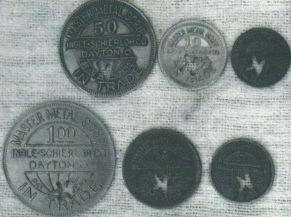
Pretty much all jobs in Harlan County, the legal ones that is, revolve around the mines.  Harlan has a love/hate relationship with the mines and mining companies.  Back in the 1930s the mines and mining companies owned the towns and people.  Workers were paid in “script”, below, money only redeemable at the company stores, where everything was overpriced.

minimg script

Poverty was rampant. Eventually, riots ensued in the 1930s with many murders on both sides of the fence, the miners and their families and the “company men”.  The nickname “Bloody Harlan” arose during this time.  Another similar strike occurred in the 1970s.  Women were actively involved in the “war” too, and an award winning documentary film was created in 1976 entitled “Harlan County, USA”.  Life has never been easy nor peaceful in Harlan County.  Life has always been tough, really tough.

The country song “You’ll Never Leave Harlan Alive” strikes the chord I felt in Harlan County.  Please listen to Darrell Scott sing this hauntingly beautiful song.  Soulful country music at its best – recording the history of our people.  Patty Loveless originally recorded this song and her video includes photos of the region that speak thousands of words.

“Spend your life thinking about how to get away”…..but few do.

“Sun comes up about 10 in the morning and goes down about 3 in the day”…..that’s because the valleys are so deep and steep.  GPS and satellite radio don’t work there because they can’t see outside the valleys to the satellites.  Cell phones?  Mine was useless.  Don’t bother trying.

My grandfather lived the second half of his life in Harlan County, died there and is buried in a grave with no marker.  So very Harlan.

No, you’ll never leave Harlan alive…

William George Estes obit

We don’t have any photos of William George Estes as a child, but one of his earliest known photos with Ollie is shown below.  Ironically, one of the things that Will did was to take photographs of people, so he’s not in many, at least not until he acquired a timer for the camera.

Ollie and William Estes

Will was probably about 40 years old in this photo.  He was born in Claiborne County on March 30, 1874 to Lazarus Estes and his wife Elizabeth Vannoy Estes.  On September 26, 1892 he married Ollie Bolton in Claiborne County.  Their first child, Samuel, was born in July the next year and would live only 6 weeks before they buried him in the family cemetery.  Not a good start for a young couple.

William George Estes and Ollie Bolton would have several children:

  • Samuel Estes born and died in 1893

Venable - Samuel Estes

  • Charles Estel Sebastian Estes (1894-1972) married Edith May Parkey

His delayed Arkansas birth certificate was issued in 1957 and signed by his father, attesting to his birth.

Estel Estes

  • Infant (1896 – before 1900) born and died in Arkansas
  • Robert Estes (1898 – before 1907), died when the house burned
  • Infant (born and died about 1900)
  • William Sterling Estes (1902/3-1963), below, married several times.

William Sterling Estes in WWI

  • Joseph “Dode” Estes (1904-1994) married Lucille Latta and had two sons. Robert Vernon Estes (1931-1951) was taken as a POW in Korea and died in captivity, his body never returned. Charles Arthur Estes (1928-1986) married and had a daughter. This photo, according to Aunt Margaret, was taken either in Quantico, VA or Balboa in San Diego when he was 13, posing as 18 to join the military.

Joseph Dode Estes in WWI

  • Margaret Estes (1906-2005) married Ed O’Rourke, had one son that died.

Margaret Estes

  • Minnie Estes (1908-2008), married several times but had one son with John Raymond Price.

Minnie Estes pearls

  • Twins (born and died in roughly 1913)
  • Elsia (born and died roughly 1914 or 1915)

After their first child died, William George Estes and Ollie left Claiborne County for a new beginning and moved to Springdale, Arkansas, shown below outside the post office about the time that Will and Ollie lived there.

Springdale Arkansas downtown

Fifteen months after Samuel died, their next child Charles Estel was born in Arkansas.

Two years later another baby was born, died and was buried in the Arkansas soil, alone.  In 1898, Robert was born.  Ollie ran a boarding house in Springdale.  By all reports, Will spent his days fishing and his nights drinking.

During my visit to Springdale in 2004, I noticed the bridge and creek across from the old “hotel” in what is now “old town.”  I figured while Ollie was changing beds and cleaning chamber pots and spittoons and taking care of her young children, Will was fishing off the bridge.  It must have been a tough life for Ollie.  For some reason, this area was settled by several Claiborne County families, so they did have at least some distant Clarkson/Claxton family there.

By the 1900 census, they were back in Claiborne County and Will has been out of work for 6 months.  Uncle George (Estes) told me before his death that Will and Ollie moved back to Estes Holler and lived in a little cabin just down from Lazarus’s land, along the creek.  I suspect that they might have had another child that died in 1900.  However, we do know that my father was born in (or about) 1902, followed by Joseph “Dode” in 1904, Margaret in 1906 and Minnie in 1908.  Sometime before 1907, the cabin caught on fire.  Some family said that Ollie was outside in the yard.  Others said she was at a party.  No one said anything about where William George was.  Estel tried to get little Robert out, but he crawled under the bed.  Robert died in the fire.  William George and Ollie buried Robert beside their first child in Estes Holler. Uncle George later planted a willow tree where the cabin burned, and that tree has since fallen and is gone, with nothing left to mark the place where they lived and their child died.  I am probably the last person alive who knows where that cabin was located.  Perhaps it’s a memory better left to dissipate with the winds of time.

Ollie 1907

The photo above shows my father, standing on the ground, along with Estel, the oldest child, standing.  The blonde child on the chair was probably Joseph Dode since he looks to be younger than my father and Dode was born in 1904. The baby is Margaret, born in 1906.  This photo was probably taken about 1907 and the note on the back says Cumberland Gap.  Ollie Bolton Estes does not look like a happy woman.  She would have recently lost her son, Robert.

Shortly thereafter, Ollie and Will departed again, this time for the farmlands of Indiana.

Outside of Fowler, Indiana, farms needed tenant farmers and it seemed like a land with more opportunity than the limited land that Estes Holler had to offer.  Aunt Margaret, before she passed away, and before she became too demented, told me that there were twins born and died in 1913.  She told me that Will and Ollie’s last child, Elsia, was born in 1914 in Fowler and that she later died in Cook County, Illinois. She said that Elsia was “retarded” as special needs children were called at the time.  At one point Margaret also mentioned another set of twins born in 1918, but if this is correct, they may not have been Will’s and they did not survive.  He was back in Tennessee/Kentucky by 1918.  Margaret was one of the Crazy Aunts, so you never really knew what or how much to believe.

Estes family 1914

The photo above, the only photo of the entire family, minus the deceased children, of course, was taken in Fowler, Indiana in about 1914.

It was in Fowler that Ollie and Will’s marriage deteriorated to the point of divorce.  According to several sources, Ollie’s cousin, Joice, said as Joicey, was visiting in Indiana.

Now just out of curiosity, I had to figure out just how Ollie and Joice were related.  And this just goes to show how the word “cousin” is interpreted in Appalachia.  Are you ready for this?

George Hatfield had a son Lynch who had a son Walter who married Mary Polly Hurst, whose mother was Mahala Claxton, daughter of James Lee Claxton and Sarah Cook.  George Hatfield also had a son Ralph who had a son Lynch who had a son Lynch who had daughter Joice.  So Ollie’s grandfather’s 1st cousin (or Ollie’s 1st cousin twice removed), Mary Polly Hurst, married Walter Hatfield.  Walter Hatfield’s father’s brother’s great-granddaughter was Joice Hatfield. So, in case you’re having trouble following this, I tried to chart the connection.

Hatfield Clarkson Tree

If you’re looking at this saying to yourself, “they aren’t related by blood, only by marriage,” you would be right.  Not only that, but related by marriage going back up the tree 4 generations, then down two, from both sides.  This explains, better than anything else, the concept of kinship in the south – or at least in this part of Tennessee.  Probably more important than anything was that these families still lived, for the most part, on the same land or at least in the same holler that their ancestors did, as close neighbors, so the kinship connection remained strong and encompassed everyone closely or distantly related.  So, four generations out, you were literally related to everyone in that part of the county.  By the way, that also made their business your business….just saying.  Oh, and if you didn’t like them, you just claimed they “weren’t kin” even if they lived across the road with the same last name.

Ollie came home one day to find Will “in the act” with her young teenage cousin, born in 1893, 20 years younger than Ollie.  Ollie took a horsewhip to them both and from all accounts, nearly killed Will.  The neighbors had to restrain Ollie and it reportedly took several men to get it done.  She was pregnant with either Elsia or the twins at the time, depending on whose version of the story you are listening to.  One version says the incident made Ollie go into labor early and she had the twins prematurely and they were stillborn.  If that is true, then she subsequently got pregnant with Elsia, if the dates are correct.  I have never been able to substantiate the births or deaths of either the twins or Elsia, but I have no reason to think they did not exist, especially since multiple people told me of their births.

Regardless of the exact timing and order of those unfortunate events, sometime around 1915, Ollie left Fowler for Chicago, without Will, and took Minnie and Margaret with her.  Aunt Margaret’s letters written many years later to my step-mother said that neither Ollie nor Will wanted the boys.  Estel, by then age 19 or 20 was old enough to fend for himself.  However, my father William Sterling known as “Bill” and also as “Sterl,” and Joseph known as “Dode” were only early teens, if that, and didn’t know exactly what to do.

Bill and Dode hopped a freight train for Tennessee and found their way back to Claiborne County looking for family and food.  They showed up half-starved and filthy and telling tales about what happened between their mother and father.  By the time Will showed up back in Estes Holler with young Joice in tow, Lazarus Estes, his father, was having none of that, and Will got himself chased out of Estes Holler for “doing Ollie wrong.”  To my knowledge, no one had ever been run out of Estes Holler, and we’ve got some pretty colorful characters to our credit.  Lazarus told Will if he came back, he’d kill him, or so the story goes.  Lazarus Estes and his wife Elizabeth Vannoy are shown below.

Lazarus and Eliabeth Vannoy Estes

The only place rougher than Estes Holler was Harlan County, and Will could go there and “hide out” (Will’s words) from both his Estes kin, Ollie’s kin and Joice Hatfield’s kin.  It seems that everyone except Joice was mad at Will.  And she would be shortly.

And yes, these are the Hatfield’s of Hatfield and McCoy feud fame and yes, Will fit right in in Harlan County.  In March of 1918, Joice had daughter, Virginia Estes, shown together below.

Joice Hatfield and Virginia Estes crop

This photo is from Virginia’s obituary in 2000.

Virginia Estes Brewer obit - dau of william George

We don’t know exactly when William George Estes came back to Claiborne County, but do know he registered for the draft on September 12, 1918 and he was living in Claiborne County at that time and Joisce is listed as his nearest relative.

WGEstes crop

The 1920 census shows us that Will is living with wife Joice, daughter Virginia, and with them, we find Joice’s younger cousin, Croice (also Crosha, Croshie) Brewer, along with her young son, Horace.  There is no further record of Horace.  Crocie was listed as “deaf and dumb.”  You know what’s coming next don’t you?

What is the best predictor of future behavior?  Past performance.

Yep, Will, again, finds himself involved with his wife’s younger cousin who is living with them.  You’d think that Joice would have known better, all things considered.

According to Margaret and cousins in Estes holler, Will actually wound up married to both of these women at the same time, one “over the mountain” in KY and one in TN.  Does this sound familiar?  Did his son, William Sterling Estes, follow in his bigamist footsteps?  That old apple and tree saying seems to hold true.  What a mess Will made.  Eventually he reportedly would live with neither wife.  I have no idea how he got himself untangled from two simultaneous marriages, or if he ever did, assuming the story is true in the first place.

Josephine Estes crop

Will had three children by Crocie, Josephine, above, born in 1923.  There appear to be pages missing, or at least several residences missed in the 1930 census on Black Mountain, but the 1940 census reports that Josephine was born in Arkansas, so Will and Crocie may have lived there for a time but were back in Harlan County by 1925.

In 1925, a baby girl names Helen May Estes was born in Lynch, Kentucky.  No one in the family ever talked about this child, or, for that matter, their son William James Estes. Helen May died when she was six years old.  Her death certificate says that she died of broncho-pneumonia on April 3, 1931, and that she had smallpox.  She was buried in the Gillam Cemetery, where their son would also be buried a few years later.  I found it odd that Helen wasn’t buried until almost a full month later, on April 4th.  It must have been a terrible month for the family.  Given that the address on the death certificate was listed as “Shack #74, Lynch,” the issue could have been money for a burial plot.  Crocie was also heavily pregnant for Evelyn as well, and may have been ill herself.

“Red-headed Evelyn” was born shortly after Helen’s death in 1931 in Kentucky and a son, William James, who was born in 1935 died as an infant in 1937 under questionable circumstances.  His death certificate states the following:  “Died of acute intestinal indigestion” and it’s noted that it was “from improper food. 2 years 6 months old and buried in the Gilliam Cemetery,” located just above Cumberland on the map below.  Remembering what Margaret said about having no food when they were children, and being fed alcohol, I have to wonder what happened to poor William James Estes.

William James Estes burial

There was some question for a long time whether Josephine was the child of Joice or Crocie.  However, since Josephine is buried in the cemetery where Evelyn, Will and Crocie are buried, she is most probably Crocie’s daughter.

Joice went back home to Hancock County, Tennessee. In the 1930 census, she is listed as Jaysey Hatfield, living with her parents, Lynch Hatfield and Virginia Foley Hatfield.  Daughter Virginia is also listed under the Hatfield surname, and there is no daughter Josephine.

In 1940, Virginia Estes is found married to Little Brewer in Hancock County, with Dorothy aged 2, and Gennett (Jannette,) 7 months old.  Virginia and Little Brewer moved to Anderson, Indiana and lived there most of their lives, working in the auto plants.  They had one more child, a son, Ambrose, born in 1942 who predeceased Virginia, who passed away in 2000.

Both Evelyn, who married Marco Pusice, a polish miner, and Josephine who married Andy Jackson lived their lives in Harlan County.  Both women, their husbands, Will and one of his wives, a “Mrs. Estes” who we presume is Crocie who died in 1961, are all buried in Harlan County in the D.L. Creech cemetery.  Joice died in 1965 in Anderson, Indiana where Virginia, her daughter, lived.

I’m sure that the Bolton/Hatfield/Brewer family reunions were interesting after that, especially given that Virginia married into the family of Crocie, Will’s third wife and Joice’s cousin who cheated with Will.  Of course, that’s kind of karmic in a sense, because Joice also cheated with Will, on her cousin, Ollie.  What’s that saying…what goes around, comes around.

If Will was a smart man, he steered very clear of any family of these women, especially male family members.  Maybe he just stayed out of Hancock County altogether.  He’s lucky he didn’t just “disappear” although the remoteness of Black Mountain and the roughness of Harlan County was probably very intimidating to anyone not from there – and it probably served to protect Will.

William George Estes in tie

To the best of my knowledge Will never worked inside the mines.  He reportedly made pilings for shoring up the mines.  Some said he wound up with a lot of mine land, but the deed index of Harlan County shows that Will owned no land at all, neither did he have a will.

The 1940 census and the entries surrounding those of William George Estes are quite interesting and gives us a flavor of what life was like in Harlan County.  Among other things, this census tells us that William George Estes never attended school.  Crocie has 4 years of school. Josephine at age 17 was classified as H3, probably 3rd year of high school.  Sadly, Eveline had no school at 8 years of age.  Perhaps Josephine was staying with someone in town.

1940 Harlan Ky census

Most of the families, for pages and pages in each direction were listed with a margin note that said “shack.”  William George was listed with a note that said “lease.”  However, the number is “74” which is the same location as given in the 1931 death certificate for Helen May.  William George is listed as a farmer and everyone else, with no exceptions, is listed in some way associated with the coal mines, or as a timberman.  I’m reminded of the family stories that said Will “made a lot of money” selling timbers to shore up the mines.  A “lot of money” may have been relative, when compared to hundreds of families living in shacks.  Someone who leased land might have been considered wealthy.  And given that we know that he was a moonshiner, we know in this case, what farmer really meant.

There is a column for where each family lived in 1935 and a surprisingly high number of these families lived in the “same house.  Will’s says the same thing, so this is where they were living in 1935 when their son was born and in 1931 when their daughter died.  They are missing in the 1930 census, but this is also likely where they were living then as well and possibly in 1925 when Helen was born.

Three entries before Will we find a margin note saying “Big Looney Creek” on leased land and 5 shacks before that another lease that says “Looney Creek.”

Seven shacks after Will’s leased land, we find Looney Creek listed again, and right beside that, two shacks later, “Top Black Mountain.”  So, Will didn’t live quite at the highest elevation in all of Kentucky, “in the last house at the end of ‘bad ass street'” as it was termed where I grew up, he lived about 10 houses below the summit.

This red balloon shows Looney Creek just below the top of Black Mountain where it crosses at the summit into Virginia.  The road follows the creek path from the top of the mountain through Lynch and Benham to Cumberland.

Looney Creek Harlan

Below is a satellite image of this area today.  We know that Will lived “above Cumberland” near Looney Creek and below the top of Black Mountain.

Looney Creek Harlan satellite

On the census, Gap Branch In Lynch, KY, is shown before Will’s location, several pages.  Today, there are no houses or “shacks” on 160 south of the two 160 markers at the top of the photo, below.  Lynch is the community that includes Gap Branch located between those top two 160 markers (below), between Benham and the red balloon (above).

Gap Branch and Looney Creek

To put this in further perspective, Will is buried above Cumberland on 119 near the first red arrow on the map below.  His son William James and daughter Helen May are buried “above Cumberland” between Cumberland and Benham, near the second arrow.  William lived someplace on 160 between Gap Branch (In Lynch, KY), the red arrow between the two 160 markers below Benham on this picture, which in Harlan County would be termed “above Benham” because of the elevation.  This arrow is located between the two 160 markers, between Benham and the top of Black Mountain.  The fourth, furthest right, red arrow is the last location of any housing today, at the 160 marker.  The red balloon is the google location for Looney Creek.  Looney Creek actually begins about half way between the red balloon and the top of the Mountain.  That would be where the freshest water would be found, so the safest to drink.  Black Mountain is the highest and most rugged and inaccessible location in Kentucky.  In the earlier 1900s, when coal was first discovered here, it was reported that there was only one mule path across this mountain.

Harlan satellite with arrows

Mom said that when she went to visit with my father in the 1950s, his house was extremely remote and difficult to get to.  She shuddered to think of it.  Mom met Crocie so she apparently lived with him at that time.  Mother didn’t care for how he treated Crocie, although she was never specific.  Mother never went back. Others referred to Crocie as Will’s virtual slave.

By the 1960s, Will was writing letters to my father about having Evelyn “hid out” until things settled down.  I don’t know what Evelyn was doing that time, but another letter mentions “bad checks.”  Both Evelyn and Josephine were exceptionally beautiful women and known in the vernacular of the day as “sirens.” It’s not surprising that they were somewhat wild, given their genetic heritage.  Furthermore, their Dad was a known moonshiner and bootlegger.  White lightning greasing the skids of popularity I’m sure for those girls, as did their beauty.

Black Mountain Harlan County

But moonshining wasn’t the whole story.  The whispered family history, and there was a LOT of whispered family history, revealed stories of Will killing a revenuer in the 1920s or 1930s.  The story goes that the revenuer had the bad judgment to try to take Will alone up on Black Mountain, shown in the photo above.  It never happened, and the revenue agent was never seen again.  Now I chalked this up to old family gossip, known in the south as “no account talk,” especially since so many of the stories about this family have proven to be unfounded or at least unsubstantiated.  However, a few years ago, through another source entirely, I heard the story of a revenue agent, who supposedly went up on Black Mountain after a moonshiner in the 1920s and was never heard from again.  It seems very odd that a revenue agent would work alone in that venue.  It almost smells like some kind of payola deal gone bad.  I have always wondered if those two stories are just coincidence – or maybe one fed the other.  Only Will knows for sure, and he’s not talking.

That’s not the end of the extraordinary stories about this family either.  It seems that something happened to Evelyn, Will’s daughter.  Two different children of Estel’s told me that Evelyn was murdered, her throat cut and she was nearly decapitated in front of her children.  One version says that she was married to a “Jake”  whom she divorced, then married “an old man,” one source says a doctor, who she took care of until she died.  Another family source says that a robber broke into their home and she was nearly beheaded in front of her children, murdered.

I found Evelyn’s death certificate and she died of a hyperglycemic coma at age 46, BUT, an autopsy was indeed performed, which is extremely odd under those circumstances.  Anemia was a contributing factor, but no injuries were listed.  If you were “anemic” because your throat had been slashed, I’d think that would be noted on the death certificate as a contributing factor.  Evelyn had one daughter, Joyce, according to her obituary and the obituary said nothing about being murdered.  I told you my family had incredible stories, and these weren’t even from the Crazy Aunts!

My visit in October 2009 to Harlan County was to locate and visit my grandfather’s grave.  With all of the genealogy work I’ve done on my older ancestors, it seemed unholy somehow that I had never made it to Harlan County to visit my grandfather.  You know, it’s not like Harlan County is on the way TO anyplace.

Will lived to be a very old man and he was only ill for a few days before his death of pneumonia.  He died November 29, 1971 in Harlan, KY, age 98.  He was buried 2 days later.  He is shown below with his sister Cornie Epperson who died in 1958.

Will Estes and Cornie Estes Epperson

I was a teenager in 1971.  I didn’t even know my grandfather was still alive, let alone that he died.  I don’t think mother knew he was alive either.  He did not attend my father’s funeral in 1963.  It was in 1973 that Virgie, my step-mother, who kept in touch with Aunt Margaret, told me that my grandfather had died. Since my father was gone, it never occurred to me that my grandfather might still have been alive.

I would have at least liked to have had the opportunity to have known him, although I’m not sure my mother would have approved, all things considered, and with good reason.  There appeared to be at least 14 grandchildren in total, although he outlived at least two of them and probably more.

My trip to locate and visit his grave was, thankfully, not reflective of the drama that heralded his life.  I had called ahead to the “rescue squad” which is associated with the Johnson Funeral home where Will’s services were held to see if they knew where the D.L. Creech Cemetery was located.  They did, and told me if I’d come up to Lynch, they’d take me and show me.  I learned a long time ago that volunteer fire and rescue are the best sources in these areas.  They know everyone and know how to get everyplace.  And they know how to stay safe.

I told them I was stopping at the courthouse on the way to Lynch, as Harlan is the county seat and you have to pass right through there on the way to Cumberland, then Lynch.  Harlan is a very small town.  One Arby’s and that’s it for fast food.

Harlan Courthouse

The courthouse and “justice center,” a building adjacent to and the size of the courthouse, was easy to find.  Outside the courthouse was a large sign that says something akin to “no firearms, knives, weapons, etc.” which is typical for a courthouse, but then there was another sign that said something like “cell phones must be turned off and by decree of Judge Jones on such and such a date, anyone observed using a cell phone in the courthouse will have the cell phone confiscated and the phone will not be returned.”  Hmmm, welcome to no nonsense Harlan County.  I turned off my cell phone.  It didn’t work anyway.  I wondered how doctors were supposed to get calls, and then I remembered that I was in Harlan County and the closest doctor was probably in Pineville, a good 35 miles away.  Question answered, there were none.  No problem.  Well, there used to be two doctors, but they were both arrested and convicted for illegal drug trafficking, per the mortician.

I went inside and through the metal detector which looked sorely out of place and appeared to be a serious intrusion from the 21st century into this 19th century courthouse.  After determining that deeds were in the next building, I left.  I had to return though as probate records for individuals without wills were located back in this initial building. Back through the metal detector, except this time, when I walked in the door, I stopped dead in my tracks, for in front of me, a man had pulled out his gun.  I drew a short breath and was trying to unroot my feet from under me while my mind was racing, along with my heart, trying to decide if I should stand still and hope he doesn’t notice me or turn tail and run like the wind.  Fortunately, he put the gun in a locker, locked the lock and took the key and then went through the metal detector.

I was quite stunned, to say the least, especially in light of their exceptionally strict policy regarding cell phone usage (as if cell phones worked there anyway.)  After the man left, I asked one of the deputies attending the metal detector about what I had just witnessed and he said that they allow people to check their guns because everyone knew you were coming out of the courthouse not “packing heat,” because it wasn’t allowed, so the street in front of the courthouse became prime pickins for murders.  So now, you can check your gun in a locker.  Yep, welcome to Bloody Harlan.

I didn’t want to bother the rescue squad unless it was absolutely necessary, so I went on up to where Google maps showed me the D.L. Creech cemetery should be.  However, at the beginning of Creech Cemetery Road, I stopped short and turned around.  There was a large hill crossing a railroad track leading to a cluster of mobile homes and there was an iron gate that could be closed across the tracks.  I couldn’t see the cemetery, so I had no idea how far up this dirt road I’d have to drive.  With the terrain and elevation of the tracks, there was one way into this place and one way out, even with a Jeep, and I was not about to get caught behind that iron gate. Off I went to the rescue squad.

They were expecting me, as I had called twice with questions in preparation for my trip.  The younger men were on a run, but an older gentleman, Derrell, the retired mortician, was there to help me.  His daughter, Stephanie had taken over the funeral home and the ambulance business and he is now officially “retired”, but he was also bored out of his mind so this was a good diversion for him and he enjoyed talking about the area and its colorful population.

I learned that Josephine wore red lipstick, literally, until the day she died, that she was considered a “siren.”  Andy Jackson, her husband, who had lived at Jackson Bottom, had “gone crazy” on them at one time and that he had only died 3 or 4 years before.  I told you, the rescue guys know everything about everyone.

I followed Derrell to the cemetery and felt much better with him along.  It was actually a very nice cemetery, well maintained, but that’s because Derrell had his crew take care of it when they had breaks in their other duties.  We walked the cemetery looking for Will’s grave, twice, with no results.  I asked if there was a cemetery map or a sextant.  Derrell said that a very cranky eccentric old woman had the map and you couldn’t get it or any information from her.   Will didn’t have a headstone.  I commented to Derrell that it’s too bad that we couldn’t locate my grandfather’s grave, because if I wanted to purchase a stone, I wouldn’t be able to do so because we wouldn’t know where to place it.

All of a sudden, Derrell remembered who to ask about the cemetery map, and maybe the women’s son-in-law had it.  He did.

Creech Cemetery plots

The map seems to be a plot of when the lots were sold, and in the case of the Jacksons, just a suggestion of how people were to be buried.  Josie Estes and Andrew Jackson are buried side by side in lots 2 and 4, not one in front of the other.  It’s unclear if anyone is buried in lot 3.  Back to the cemetery we went to locate Will’s grave. On the cemetery map above, the road into the cemetery runs along the left side and the 40 foot area is a graveled parking area.  Will’s grave should be easy to locate.

We had already located Evelyn’s stone.  She was married to Marco Pusice who predeceased her and they both share a common stone.

Pusice Stone

Apparently, Crocie was the first of the group to die in 1961 followed by Will in 1971,  Marco Pusice in 1972,  Evelyn Estes Pusice in 1977, Josephine Estes Jackson in 1979 and Andrew Jackson in 2004.  Crocie only has a fieldstone for a headstone.  Josephine, her husband Andy Jackson, Will and apparently Crocie are buried together near the front of the cemetery.  None of them have stones except for Crocie (assuming she is Mrs. Estes) and she just has a rock, as shown below.  Will is buried beside her to the left in front of the grey flat stone marker with the metal inscription on top.

Will Estes burial lots

To the left of the large Dixon stone in the photo below, you can see two metal markers, one lying flat and one upright. Those are the graves of Josephine and Andrew Jackson.

Creech cemetery view

Andy still had the funeral home metal marker, but when it’s gone, that will be all there is. Josephine has a concrete block and her funeral home marker is stuck in the top of the concrete block that has sunk into the ground.  Rather sad, actually.

Andy and Josephine Jackson burials

Derrell purchased the funeral home in the 1980s, so he didn’t know my grandfather Will, although his daughter knew Andy and remembered Josephine.

Derrell did, however, tell me some other stories of Harlan County, such as about the undertaker that embezzled all of the funeral prepayments.  He went to jail for that, because he preferred that to being dealt with by the local families.  Probably a good thing and much safer.  They do have a sense of humor in Harlan County and he would probably have been buried in one of those unmarked graves.

In addition to moonshining and womanizing, William George Estes was also a photographer.  I know that’s a really unlikely occupation for someone in the hills and hollers of Appalachia.  I suspect that it was something he rather “fell into” in some fashion.  He had a large black camera with a black cloth and a tripod and he could set the timer to take pictures.  The photographs of the family between 1907 and 1915 or so when he and Ollie divorced were taken in that manner.  He must have gotten the camera about 1907 because there are no family photos before that.

When I first visited Claiborne County, many people told me he used to go to family reunions, which used to last for several days, and took pictures of people.  Of course, he ate and drank with them.  Then, after the pictures were developed, he would go back down and visit with the family for a couple days to deliver the pictures.  I’m sure he also delivered some other products as well, and probably stayed to help drink that product.  Everyone seemed to like Will, well, except for his x-wives families, which was probably half of the county.  So the other half of the county liked him.

Will Estes and Worth Epperson

The photo above is Worth Epperson (d 1959), Will’s brother-in-law, and William George Estes.

A few years ago, I was with family members in the old Estes cemetery in Estes Holler, which one has to be let into because it’s far up the mountain on private land behind fences.  I was laying on the ground on my belly trying to get my new camera to cooperate and take a photo of a stone where the engraving, or in this case, rough hand chiseling, was worn almost smooth by rain and time.  So I fiddled and fussed and tried to get the light to shadow the grooves in the stone. I heard one of them say to the other, “she’s certainly Will’s granddaughter.”  Apparently he had to fiddle and fuss with his camera too.

William George Estes was clearly an eccentric man who walked to the beat of his own drummer.  But that was a time when taking a couple days to do something didn’t matter, especially if you didn’t have a job to get to.  And that job thing seemed to be something that never plagued Will.  He also, amazingly, didn’t drive, but being a moonshiner, he probably always had something to trade for a ride and lots of people were probably more than happy to take him.  Since he did live to a ripe old age, I’d wager a bet that he didn’t pay up until he got out of the vehicle!

It seems that Will passed moonshining on to at least one of his sons.  Sadly, he passed the proclivity for problem drinking on to all three.  My Aunt wrote in her letters that at times there wasn’t enough to eat when they were children, so they were given moonshine to drink so that their stomach’s wouldn’t hurt and they would go to sleep.  My heart just breaks for my father and his siblings.  That’s where my father’s alcoholism started – as a child, due to hunger, through no choice of his own.

Fleming Kentucky

Fleming, Kentucky, above, was a coal mining town in Letcher County.  Will’s son, Estel lived here and worked the mines when his family was young.  Estel also had a side job, delivering moonshining.  His daughter told me that they used to paint milk bottles white on the outside and he would have the kids deliver the “moonshine” camouflaged in white milk bottles.  The family was innovative – you’ve got to give them credit for that!

Will Estes with pipe

One of the Estes cousins who lives in Claiborne County, TN, tells another story about Will.  Since he didn’t drive, he would catch the bus in Harlan County, Kentucky and ride it to the closest drop off location in Claiborne County, about an hour distant and then walk on to Estes Holler to visit, after his father, Lazarus, who had banished him, died.

Will had a bullet in his pocket with his tobacco.  He filled his pipe with tobacco and started to smoke it on the bus, but unbeknownst to him, he had also gotten the bullet in the pipe.  Well, the bullet, and with it, the pipe exploded on the bus during the trip.  Scared him and the other passengers and nearly caused the driver to wreck the bus.  From then on,  he was banned from riding the bus.  I guess you might just say that’s our special family version of going out with a bang!

In 1915, Will’s parents deeded land to one of their children, Cornie Estes Epperson and her husband, Worth Epperson, and in the deed, stipulated that she and her husband were to pay the other children a specific sum of money.  This land transaction was in lieu of a will.  In William’s case, that sum was $120.  In 1957, some 42 years later, he signed the edge of that document that he had indeed received the money.  I’ve always wondered if Lazarus and Elizabeth signed this 1915 deed before or after Will returned to Estes Holler after his escapades in Indiana.  I’m guessing that it was before, given the fact that Lazarus was evidently very angry with Will when he returned, without Ollie, with Joice and after his two young sons, about ages 10 and 12, or at most 12 and 14, had arrived as hobos in desperate need.

Will Estes signature

All things considered, it’s absolutely amazing that his man lived to be 98 and a half years old, and died after a short illness of natural causes – what would once simply have been termed “old age.”

Will Estes, Wayne, Edith and Josephine

William George Estes, his grandson, Wayne Estes, Wayne’s mother Edith Mae Parkey Estes and Will’s daughter, Josephine Estes, probably in the 1960s, not long before Will’s death.  Will would have been in his 90s.

Who’s Your Daddy?

One thing that always bothered me was that my father, at right below, really didn’t look anything like his father, William George Estes.

William George and William Sterling Estes

There are no photos of Will as a young man, and my father died in his early 60s, so I’ve tried to compare photos at ages that looked to be approximately equal.  The first row, below is of Will and the second row is my father.

William George and William Sterling Estes composite

I looked and looked, and I simply could not see much resemblance.

DNA testing promised an answer to the long-standing question of whether or not I had been doing someone else’s genealogy for 30 years or so.

However, DNA testing was not to be as easy as it sounded.

We had a baseline of what the ancestral Estes Y line DNA should look like, if there were no misattributed paternal events, or adoptions.  However, my father had no sons, at least not that we could find, until we found David.  Will’s other male children did not go forth and multiply fruitfully, and those that did had children that died young.

Suffice it to say that finding a suitable DNA candidate from William’s line proved to be extremely challenging.  We tried a couple of tactics, and let’s just say that nothing worked the way it was supposed to.  In fact, no one was matching who they were supposed to be matching, nor each other.  In the case of one of William George’s descendants, the results were off just enough to be suspicious – but not enough to be definitive.  The green line below shows the ancestral Estes DNA, as finally proven by Uncle Buster.  The yellow was unknown.  The purple should match the green, and would prove William George’s line, but the purple individual was the one with just enough mutations to be inconclusive.  David, my half-brother, didn’t match anyone.

Digging up dad 1

I studied the photographs of every person in the family who descended from Lazarus.  I think my father looked more like Uncle George than anyone.

And then there was David, my father’s supposed son, who was an entirely different haplogroup and didn’t match either the primary Estes line nor the purple descendant of William George Estes.

This was making me crazy, seriously crazy.  Bang my head against the wall crazy.

I began to doubt everyone.  There was obviously a break, or maybe two, but where?

Digging up dad 2

John Y. Estes is on the left, then his son Lazarus and his son William George to the right.

My father just didn’t look like these men, and William George really didn’t look like Lazarus either.

OMG

I’m hyperventilating by now.

Looking back up the line, we had confirmed that John R. Estes did match the ancestral Estes line, but from there to current, we had no clue except that we had problems.

Finally, I realized that Uncle Buster was still living (at that time) and I went to visit him in Tennessee.  He was so deaf that you couldn’t call him and have a conversation, plus, I hadn’t seen him in years.  How do you explain all of this to a deaf man in his 90s?  Answer – in person.

When we pulled up in his driveway after driving the two mile two-track “road” to his house, he greeted us on his porch with a shotgun.  That’s how everyone whose car isn’t recognized gets greeted.  You just get out and start waving both hands in the air and shouting at Uncle Buster.  My cousin, who was along, didn’t think that was such a good idea!

Uncle Buster was gracious enough to DNA test, that day, and thankfully, he matched the Estes ancestral line as well, so we proved that Lazarus Estes, the father of William George Estes was a genetic Estes, but was William George Estes and was my father?

The fact that my brother, David, and I didn’t match each other autosomally (using old CODIS marker technology) had raised the ugly specter for me that perhaps David WAS my father’s child, and I wasn’t.  Given that I could not dig up Dad for DNA testing, although the thought was tempting, I had to know.

My brother David had become ill with hepatitis C, contracted when he received a blood transfusion when his chopper was shot down in Vietnam.  He needed a liver transplant.  David was very ill, but if he “heard” the discussions that occurred in the hospital, it was obvious that I was not a transplant candidate. I was never clear about why – the team really didn’t seem to want to talk about “incidental findings,” until I cornered one of them.  No, they admitted, we “probably” weren’t siblings.

When the initial 23andMe autosomal tests became available, David and I tested immediately.  We have previously tested at a two private labs utilizing the CODIS markers and the results were inconclusive, stating that we were “probably not half siblings, but probably related.”  Turns out, they were dead wrong.  We not only weren’t half siblings, we weren’t related at all.

At 23andMe, David and I didn’t match.  However, I didn’t know which of us, if either, was my father’s child.  Not matching David was bad enough, but not knowing the rest of the story was worse.

A few months later, I was at the Cumberland Gap reunion, telling my cousin, Deb, who also descends through Lazarus Estes via daughter Cornie Estes Epperson, a sibling to William George Estes, about my DNA woes.

Suddenly, the light bulb clicked on.  DUH!!!

If Deb tested, she would likely match me or David, assuming that the genetic break was NOT between Lazarus and William George Estes and NOT between William George Estes and my father.  In any case, the fact that she MIGHT match one of us was a gamble I was certainly willing to take, and she agreed to test.  It was a long shot, but it was the only shot I had, and I took it.

By this time, after several years of not knowing, I no longer cared which outcome developed, I just needed an answer and closure. And I thought Dave did too.

I ordered Deb’s kit, she spat, and we waited…an interminably long time it seemed.

Finally, the day arrived and the results were in my inbox.  I clicked to open, signed on, and there it was, in living color…

…the answer…

Deb matched…

…right now I was slamming my eyes shut and peeking out the slits…

…I wanted to know…

…but I didn’t want to know what I feared the answer would be…

…the truth…

…finally, the truth…

Deb matched…

Me…

DEB MATCHED ME…

Not Dave.

OH GOD!

Oh God.

I was overwhelmed with relief and at the exact same time, overwhelmed with sorrow for my brother.  I tried to tell David a couple of times and he simply did not want to hear the results, so I never pushed it.  By this time, he was gravely ill.  He was my brother and I loved him and still do, regardless.  If anything, he needed my love more than ever, although he would never have admitted to needing anything.

However, as the consummate genealogist, it really did matter to me, and not in the way most people would presume.  I wanted to know if I should stop doing my Estes side genealogy.  I didn’t want to waste any more time, if I had been wasting time, and I didn’t want to stop if the Estes line was mine genetically.  For me, that DNA test bought me out of genealogical purgatory!

About that time, Family Tree DNA also introduced the Family Finder test.  Given that Uncle Buster had already tested his Y chromosome there, his DNA was archived there, so we upgraded his test and David’s to see who matched Uncle Buster, who is actually my first cousin once removed.  Yes, I’m a born skeptic and I guess I just needed two independent proofs.  Again, the results were the same.  Buster matched me and not David.

So, with one test, either Deb’s or Buster’s, we proved the Y lines of the men involved by inference.  We know that my father matched William George’s Y chromosome and William George matched Lazarus’s – or we would not have matched autosomally at the level we were.  We also matched with other descendants of Lazarus and other Estes cousins from on up the tree as well.  Not to mention, we salvaged my grandmother’s reputation which had come under a bit of a cloud.  Sorry grandma!

As soap operas go, this one had as happy an ending as there could have been.  Soap operas NEVER have happy endings you know.  My brother never knew or admitted that he knew we weren’t biological siblings, so he was spared any emotional pain.  I loved him regardless, so it didn’t matter to me in that way.

My great regret is that I wasn’t a transplant match, but I subsequently discovered that the hospital where Dave was being treated stopped doing live donor transplants about that time, and only used cadavers, so even if I had been a match, it’s doubtful that they would have done the surgery.  Dave never received a transplant and passed away after developing liver cancer.

On the genealogy front, I was relieved to confirm that I had not wasted 30 years on someone else’s genealogy.  And, I didn’t have to dig up Dad, or William George, to do it!  Good thing, since we still don’t know precisely where William George is buried – just a general vicinity – which would be good enough for a tombstone, but not for DNA testing.

William George Estes tombstone

Nope, he never left Harlan alive.

______________________________________________________________

Disclosure

I receive a small contribution when you click on some of the links to vendors in my articles. This does NOT increase the price you pay but helps me to keep the lights on and this informational blog free for everyone. Please click on the links in the articles or to the vendors below if you are purchasing products or DNA testing.

Thank you so much.

DNA Purchases and Free Transfers

Genealogy Services

Genealogy Research

Agnes Muncy (1803-after1880), A Grieved Mother, 52 Ancestors #52

Agnes Muncy was reportedly born on January 19, 1803 in Virginia, although I have not been able to confirm that date.  She was probably born in Lee County very near the border with Claiborne County,TN, probably on or near the Powell River, to Samuel Muncy and Anne “Nancy” Workman.

Agnes was married about 1819 or 1820 to Fairwix Claxton or Clarkson, probably in either Lee County, Virginia or Claiborne County, TN.  They lived in the part of Claiborne County that would become Hancock County in the mid-1840s.

Various members of the Muncy family owned land on the Lee County side of the Virginia/Tennessee border and many attended the Thompson Settlement Church in Lee County, Virginia where they would have met the residents living in the northern part of Claiborne County, Tennessee, living on the Powell River.  Church minutes begin in 1800, but the first Muncy’s joined in 1822. However, those records don’t include Agnes nor her husband.  Her parents records are found in church records beginning in 1833.  Agnes had to be living in the area in 1819 or 1820 in order to meet Fairwick.

Fairwix (Fairwick) Claxton and Agnes Muncy’s first child was born about 1820 with them having a total of 8 children that we are aware of.

  • James R., 1820-1845/50, unknown spouse, their 4 children living with Fairwick and Agnes in the 1850 census
  • Henry Avery, 1821-1864, married Nancy “Bessie” Manning, died in the Civil War
  • William “Billy,” born about 1822, died 1920, married Martha Walker, widow of Henry Claxton (son of James Lee Claxton and Sarah Cook,) married second to and Eliza J. Manning
  • Samuel, 1827-1876 married Elizabeth “Bettie” Speaks
  • Sarah “Sally,” 1829-1900 married Robert Shiflet
  • Nancy, 1831/33-before 1875 married John Wolfe
  • Rebecca, 1834-1923 married Calvin Wolfe
  • John, 1840-1863 never married, died in the Civil War

In the 1850 Hancock County, TN census, Fairwick and Agness are living with their 3 youngest children, their 4 grandchildren, the children of their deceased son James, and Agnes’s mother, Nancy Monsy, age 81, born in Virginia.  Their sons, William and Samuel live in adjacent homes, and Fairwick’s mother, Sarah Claxton, age 75, lives in the next house.  Truly a multi-generational family.

clarkson 1850 census

Amazingly enough, in the 1860 census, Nancy Muncy is still living with Fairwick and Agnes, now listed as age 99, and “feeble.”  Fairwick’s mother still lives next door as well.  This is a family with amazing longevity.

They all lived together on the land owned by Fairwick Claxton and his mother, Sarah Claxton, whose land adjoined Fairwick’s.

clarkson barnyard

The Rob Camp Church in Hancock County, TN was incorporated in 1845 from the mother church, Thompson Settlement, located across the border in Lee Co., VA, although there had been separate services in different locations for decades.

In October 185? – Agnes Clarkston was received into the congregation by letter, although it does not say what church the letter was from.  This means that she had already been baptized elsewhere and was a member in good standing.  Regardless of what church she had been attending, moving to Rob Camp made sense since it was located only a couple miles from where she and Fairwick lived – much closer than other churches that existed in that timeframe.  Her husband, Fairwick was received on February 17, 1851 by experience into the same church, which means he was baptized at that time.

According to the Rob Camp Church minutes, on the second Saturday of April, 1869, Rob Camp Church released the following people from their fellowship to form the Mount Zion Baptist Church.  On the third Saturday of May, the following list of brothers and sisters met to officially constitute the church which would be located on a parcel of land belonging to William Mannon.  Most of these people were related to each other in some fashion.

  • E.H. Clarkson (Fairwix’s nephew)
  • Mary Clarkson (Mary Martin, wife of E.H. Clarkson)
  • William Mannon
  • Elizabeth Mannon
  • Mary Muncy
  • Clarissa Hill
  • Sarah Shefley (Shiflet, daughter of Fairwick and Agnes)
  • Farwix Clarkson (husband to Agnes)
  • Agnes Clarkson (Agnes Muncy, wife to Fairwick)
  • Nancy Furry (Granddaughter of Fairwick and Agnes)
  • Elizabeth Clarkson (Elizabeth Speaks, wife to Samuel Clarkson, son of Fairwick and Agnes)
  • Margret Clarkson (granddaughter of Fairwick and Agnes through son Samuel)
  • William Bolton (son of Joseph Bolton)
  • James Bolton (son of Joseph Bolton)
  • John Grimes
  • Catherine Grimes
  • Joseph Bolton (this would be Joseph Preston Bolton Sr., the deacon whose son, Joseph “Dode” Bolton married Margret Clarkson)

One of the first things the new church did was to create a list of members and they all signed a very lengthy statement about the mission of the church.

Mt. Zion Church Covenants 1869 upon formation.

We the Baptist Church of Christ at Mount Zion, Hancock County, Tennessee being organized and constituting an independent body professing to believe and maintain the Christian faith of the general union to which we belong do covenant and agree to and with each other to live together in Christian love and fellowship endeavoring to keep the unity of the spirit in the bounds of peace and to submit ourselves to each other in church government to be ruled and guided by a gospel discipline according to the word of God and to contribute of our worldly goods when necessary to the decent support of the gospel and ordinances and to the relief of the poor and to attend our church meetings as often as providence may permit strictly adhering to the word of God and our rules of decorum, viz, our church meeting to begin and close with prayer.  A moderator and clerk to be chosen.  The clerk of our own body.  The moderator shall be at liberty to call on any other Brother to fill his place when necessary.  Every male member wishing to speak shall rise from his seat address the moderator and then speak strictly adhering to the subject matter under consideration d by ? means cast reflection on those who spoke before him.  No member of this church is permitted to address another member in any other appellation than of Brother neither is any member permitted to abruptly absent himself  in time of business without leave of the moderator.  When this church happens to be divided in sentiment on any matter of distress she shall be at liberty to call on any sister church or churches for help in testimony whereof we here unto set our names both males and females.

The Articles of Faith

  1. We believe in one only true and living God as He is revealed to us in the scripture viz: Father, Son and Holy Ghost
  2. We believe that the scripture of the old and new testament are the word of God and the only rule of all saving knowledge and obedience.
  3. We believe in the doctrine of election according to the foreknowledge of God the Father through sanctification of the spirit and belief of the truth.
  4. We believe in the doctrine of original sin.
  5. We believe in mans impotency to recover himself from the fallen state he is in by his own free will or ability.
  6. We believe that sinners are justified in the sight of God only by the imputed right of Jesus Christ.
  7. We believe that the electaccordin (sic) to the foreknowledge of God will be called connected regenerated and sanctified by the holy spirit.
  8. We believe the saints will persevere in grace and never finally fall away.
  9. We believe of a truth that God is no respecter of persons but in every nation he that fearith Him and worketh righteousness is accepted with Him.
  10. We believe in the revealed religion of Jesus Christ internally in the soul.
  11. We believe that Baptism and the Lords Supper are ordinances of Jesus Christ and that true believers are the only subjects of these ordinances and that the true mode of baptism is by immersion.
  12. We believe in the resurrection of the dead and a general judgement.
  13. We believe that the punishment of the wicked will be everlasting and that the joys of the righteous will be eternal.
  14. We believe that no minister has a right to the administration of the ordinances only such as are regularly called and comes under the impositions of hands by presbytery.

This Church shall be known by the name of Mount Zion – May 3, 1869

Constitution of Mount Zion Church Hancock County, TN of United Baptist.

  1. We do with mutual consent agree to embody ourselves together as a religious society to worship God and being a church congregation holding believers baptism by immersion our hole bodys once underwater. (sic)
  2. Final perseverance of the saints through grace and the resurrection of our bodys.
  3. Relieving the old and new testament to be the revealed will of God.
  4. Believing in a Christian Sabbath being a holy and heavenly institution.
  5. And not to forsake the assembling of ourselves together as the manner of some ??.
  6. And not expose the infirmities of our brethren to any without or within the community but in gospel order.
  7. And not neglect attending meetings.
  8. And not remove out of the bounds of the church without applying for a letter of dismission.
  9. To contribute of our worldly substance to decent support of church and ministry.
  10. Unto which with mutual consent and agreement we here unto set our hand.

Rules of Decorum

  1. Church shall be opened and closed with prayer.
  2. A moderator shall be chosen by the church.
  3. Only one member shall speak at a time who shall rise from his seat and address the moderator whit the appellation of Brother.
  4. The members thus speaking shall not be interrupted in his speech by any person except the moderator till he is done speaking.
  5. He shall strictly adhere to the subject and in no wise cast reflections on those who spoke before him so as to make remarkes on his margins? or imperfections but shall fully state he case and mater so as to convey his lite or meaning.
  6. No member shall abruptly brake off or absent himself from the church without liberty obtained.
  7. No member shall speak more than 3 times on one subject without liberty obtained from the church.
  8. No member shall have liberty of laughing or whispering in time of public worship.
  9. Members of the church shall address each other with the appellation Brother.
  10. The moderator shall not interrupt any one while speaking till he gives his views except he violates these rules of decorum.
  11. The names of the several members of this church shall be enrolled by the clerk
  12. The moderator shall be entitled to the liberty of speaking as other members provided his station be filed and he shall have no vote unless the church be equally divided.
  13. Any member knowingly and willingly shall brake any of the rules shall reproved by the church as she may think proper.
  14. This church shall be ruled a majority except in receiving and dismissing members which shall be unanimous so as not to infringe on the principles of the union.
  15. The church shall be at liberty to alter any article in these rules of decorum when two thirds of the members shall think proper.

This page is followed by an undated membership list that includes the following family names.

  • E. H. Clarkson, deacon.
  • Farwix Clarkson, deceased
  • Joseph B. Bolton
  • William Moncy, excluded
  • Solomon Mancy
  • Jane Bolton, dismissed
  • Margret (sic) Bolton, dismissed
  • Mary Clarkson
  • Nancy Furry
  • Margret Clarkson
  • Agness Clarkson
  • Elizabeth Clarkson

Another list includes:

  • Mary Clarkson, deceased
  • Margret Bolton, deceased
  • Agness Clarkson, deceased
  • Elizabeth Clarkson, dismissed

This tells us that Agnes died as a church member, so did not transfer her membership elsewhere.

According to later depositions, Agnes’s husband, Fairwick, became ill about 1867 and languished for 7 years before passing away on Wednesday morning, February 11, 1874, with Agnes at his side. It had been a brutal decade for Agnes, and it wasn’t going to get better.

After Fairwick’s death, a chancery suit was filed by his son, William, against Fairwick’s estate.  That suit managed to make its way to the Tennessee Supreme Court, which is the only reason we have those records today, including depositions.  The entire case is transcribed in the story of Fairwick’s life, but within that case, we hear Agnes’s voice in her deposition.  This is the only personal remnant of Agnes, other than the DNA that her descendants carry.

Deposition of Agnes Clarkson

July 15, 1876 – Wm Clarkson vs Samuel Clarkson et al – In the Chancery Court of Sneedville, Hancock Co., Tenn – Deposition of Agnes Clarkson, Nancy Ferry others with Nancy Snavely.

Taken by agreement on the 15th day of July at the house of Agnes Clarkson in the ?? and their attorney before H. F. Coleman a Justice of the Peace for Hancock County to be read as evidence on the trial of said case and behalf of the defendants.

The said witness Agnes Clarkson aged 74 years being duly sworn deposes as follows:

Question 1st by defendant.  What relationship are you to the parties of this said and are you the widow of Fairwic Clarkson dec’d?

Ans – I am the mother of William & Samuel Clarkson and the widow of Farwix Clarkson.

Question 2 by defendant – Were you with your late husband Fairwix Clarkson during his last sickness and up to the time of his death?

Ans – I was.

By same – What was the condition of his mind during his last sickness was he cognizant of his business and of sane and disposing mind?

Ans – He seemed like he was.  I never saw him out of his mind but one time a little and that was from the effect of medicine and that was but a few minutes.  His sister came in during the time and he knew her.

By same – Was the time you speak of being a little out of mind before or after the execution of (page 2) the deed by Fairwix Clarkson decd to defendants for the lands in controversy in this case?

Ans – It was before.

By same – Did you hear the decd Fairwix Clarkson say any thing about the disposition he had made of the lands in dispute in this case as what he intended to make of said land and at what time did you hear him talk about the matter?

Ans – I have years ago heard him talk about what disposition he intended to make of it.

By same – Please state what he said before to the disposition of said lands.

Ans – He and my self were alone and he said he wanted his business wound up that he intended to make three deeds one to Samuel Clarkson, one to Rebecca Wolf and one to Nancy Ferry (was then). I asked him what he intended to do with his other children and he said he would do by them as they had done by him they had left him in a bad condition and he had nothing for them.  I persuaded him to leave some land for them and he said I need not talk to him for he would not.

By same – Did Fairwix Clarkson decd say any thing to you about the matter after the deed was made to the lands in controversy and if so state what he said?

Ans – He did, he said he had his business as he wanted it that he had left Rebecca a little home on the other side of well hollow next Rhonda Shifletts and Samuel the old home place below the road and Nancy the west side of the well hollow this was on Sunday morning after the deeds were made.

(page 3) Cross Examination by complainant – Question – State if you can the day of the week and the day of the month that Fairwix Clarkson died.

Ans – He died on Wednesday morning the 11th day of February I think.

By the same – State whether or not Fairwick Clarkson sold them the lands mentioned in the pleadings or give it to them.

Ans – He sold the land to them.

By the same – At what time did he sell the lands to them and what did pay him for the land?

Ans – I cannot tell at what time he sold the land. They paid him in various ways there was a right smart of money paid, but I do not know who paid the money now nor do I recollect any thing else they paid him in particular.  They made him a crop every year and paid him the rent on there own crop besides.

By the same – State if any one besides your self heard the conversation that Farewick Clarkson had to you about what disposition he had made of his lands after the execution of the deeds.

Ans – Clementine Clarkson came in when he was talking to me and I think she heard the conversation.

Agnes X Clarkson – Her mark

Agnes Clarkson did not know how to sign her name, so she was also likely unable to read.  In fact, the 1880 census confirms that and also tells us that Agnes’s granddaughter, Nancy, then age 42, can’t read or write either, but Nancy’s daughter, Ann, age 15, can both read and write.  Agnes lived just one house away from her daughter-in-law Elizabeth Claxton, widow of her son Samuel.

1880 Clarkson census

Fairwick and Agnes raised their grandchildren, the children of their eldest son, James, after his death.  Their granddaughter, Nancy, probably lived on the land with them their entire life, and in their house with them from the time she was about 10 years old when her parents died.  According to the depositions, Nancy cared for Fairwix in his last years of sickness and he rewarded her with a house of her own and land.  She married James Snavely during the lawsuit after Fairwick’s death.  In 1880, we find Agnes, Nancy’s grandmother who raised her, living with James Snavely and Nancy Clarkson Furry Snavely with her daughter from her first marriage to a Furry male.  The daughter is listed as Ann J. Snaveley and the daughter of James Snaveley, which is incorrect, according to both the earlier census and the depositions.  Agnes Claxton, age 80, born in Virginia is listed as his mother-in-law when in actuality she is James Snaveley’s grandmother-in-law, according to the depositions.  This census created a huge amount of confusion for researchers for decades.  Agnes is very likely still living on her original land, just with the granddaughter.

There is no 1890 census, and by 1900 Agnes is gone.

Although Agnes Muncy Clarkson’s grave is unmarked, it is assuredly in the Clarkson/Claxton family cemetery as she lived on that land with Fairwix her entire life, and Fairwix’s grave is marked in that cemetery.  In the photo below, Agnes grave is likely beside Fairwix, whose stone is pictured with the broken corner.  There are two fieldstones beside him, one on the left and one on the right.

Fairwix stone at barn

I’d love to know more about Agnes Muncy through her mitochondrial DNA which is passed from mothers to all of their children, but only passed on by daughters

Agnes and Fairwick only had two daughters that had daughters to pass their mitochondrial DNA on down the line.

Sally (or Sarah born in 1829, died 1900) married Robert Shiflet and their female children were:

  • Elizabeth (1858-1936) who married William Lundy and had 5 daughters
  • Catherine b 1863 married Pleasant Powell, children unknown
  • Rhoda (1865-1954) married John Martin Burchfield and had 5 daughters
  • Agnes b 1869 married Tom Smith and had 3 daughters

Rebecca (183401923) married Calvin Wolfe and their female children were:

  • Nancy (1860-1924) married a Marcum
  • June or Jane E. (probably Elizabeth) b 1864
  • Agnes b 1869
  • Sasha b 1873
  • Easter C. b 1877

If you are male or female and descend from the women listed above, through all females to the current generation and have tested your mitochondrial DNA, please let me know.  If not, I have a scholarship for you for mitochondrial DNA testing.

We can learn about Agnes deep history, before surnames, thought mitochondrial DNA.  DNA gives us more chapters in the lives of our ancestors.

In Summary

We know that Agnes was a religious woman, was a founder of a church, and withstood a lot of pain in her lifetime.

We know nothing about her childhood, but we do know that births of her children were spaced in a way that suggests she lost four young children.

By 1845, she had lost her adult son, James, and his wife, and was raising his four children.  Furthermore, two of those children died, at least one, William, in service during the Civil War, and the second, John about that same time.

In addition, Agnes lost two of her own sons during that war, John and Henry, plus her son-in-law, John Wolfe. John Clarkson died of typhoid on March 23, 1863 and is buried in the Nashville National Cemetery, according to his service records. Henry Avery Claxton (Clarkson) was a blacksmith and died “of disease” on February 2, 1864 in the Brown General Hospital in Louisville, KY. He is buried at Cave Hill National Cemetrey in Louisville and was described as having dark hair, a dark complexion, and blue eyes.

Her granddaughter that she raised, Nancy Claxton Furry lost her husband about this time as well, although we don’t know the specifics.  Nancy Furry came back to live with Agnes and Fairwick with her infant daughter.

By the time Agnes’s husband, Fairwick, died in 1874, their daughter Nancy Wolfe had passed away too.

With Fairwick’s death, Agnes, then 72, would have lost 4 children as youngsters and 4 of her 8 adult children as well.  The Civil War was brutal to this family and those who did not pass away were dramatically affected.

A descendant of William Clarkson’s wife, Martha Walker, tells us the following information that he found in a chancery suite involving Edward Walker, the person who raised Martha, but likely not her father:

“One of the uncollectible debts was a loan from Edward Walker’s estate to Bill Clarkson made by Henry Walker, Edward’s original administrator, who was at this point dead for about 15 years.  A statement was made that Bill had lost all of his money during the war, was dirt poor, and didn’t stand a chance of ever repaying the debt. It doesn’t really say how or why, but it does suggest that he was a desperate man by the time that he sued over his own father’s estate.”

As I read the depositions of the various people included in the chancery suit filed by William Clarkson against his siblings, I could virtually hear the pain for Agnes Muncy Claxton.  Of the 4 children she had left in this world, 2 of the 4, Sarah Shiflet and William Claxton, were filing suit and testifying against the other two, Samuel Claxton and Rebecca Wolfe, accusing them of unduly influencing her husband, Fairwick, while attempting to gain part of his estate.  This lawsuit drug on for at least 6 years, first being tried locally, then in the Supreme Court in Memphis.  We don’t know if Agnes died before it was resolved or not.

Furthermore, Agnes’s son Samuel would die in the midst of the suit from the after-effects of his service in the Civil War as well, leaving only one child living near her and the other two at a distance and estranged.

For a woman who bore at least 8 children and probably 12, who would ever think she would wind up with only one child, Rebecca, plus her widowed daughter-in-law and grandchildren next door.  I’m sure this was not the life she imagined nor had in mind as a young bride in 1819.

I hope this woman truly can rest in peace, because she certainly deserves it and peace was not something that rested with her family in her lifetime – either by virtue of the Civil War and its aftermath nor the resulting family dynamics.

It’s bad enough, tragic, when something external, like a war, tears your family apart, but it’s living hell to watch the remainder of your family self-destruct before your eyes.  To the best of my knowledge, the Claxton family members never reconciled during their lifetimes.

______________________________________________________________

Disclosure

I receive a small contribution when you click on some of the links to vendors in my articles. This does NOT increase the price you pay but helps me to keep the lights on and this informational blog free for everyone. Please click on the links in the articles or to the vendors below if you are purchasing products or DNA testing.

Thank you so much.

DNA Purchases and Free Transfers

Genealogy Services

Genealogy Research

The Fur Family – 52 Ancestors #51

I’ve been behind all week long.  My 52 Ancestors article for this week isn’t written and it’s Sunday, the day I always post my article.  It’s not even started, and here is why….

Me and Ellie

Her name is Ellie and she is about 11 weeks old.  I never intended to have Ellie, and truth told, I’m “only” babysitting.

My daughter rescued Ellie on Wednesday evening and brought her straight to my house so we could assess the situation.  My kids grew up rescuing animals.  For years we were volunteers for the local Humane Society and a foster home for literally hundreds of animals, one or two (or a litter) at a time.  And yes, it goes without saying that a few of the most needy stayed.  We had quite the group of misfits that we loved dearly.

When my former husband had a massive stroke in the 1990s, my volunteer and foster days ended.  By then, my kids had already spent their childhood on countless rescue runs and endless days and nights of bottle feeding orphaned animals.  So, the “damage” was done and, I’m proud to say, my daughter seems to be a chip off of the old block!

Then why doesn’t said daughter have the puppy?  Great question.  Said daughter and her husband had plans to visit husband’s family, out of town, for Christmas.  Said daughter could not board this puppy who had never seen a vet in her life, and therefore had no shots, and therefore, the puppy got to come and stay with Grandma.

Suffice it to say that babysitting an 11 or 12 week old puppy who has had no structure to her life is much like babysitting an 18 month old child.  They are fully mobile and into everything, except the child wears diapers and, hopefully, doesn’t chew the furniture.  Still, as puppies go, Ellie is pretty good and smart as a whip.

Case in point – she already has Grandma and Grandpa pretty well trained.

Ellie and toys

Grandpa bought her several toys and treats and Grandma made her a puppy quilt.  She loves to lay on things and thankfully, doesn’t chew those…only furniture.

Ellie and quilt

Now, Ellie had never had a toy before so she is an EXTREMELY happy puppy and is very quickly learning what is hers and what is not.

What kind of dog is Ellie?  We don’t know.

When we adopted our animals in the past, we never knew what they were – just mutts or “looked like” a Beagle.

Today, however, you can DNA test your dog to find out what kind they are.  Ellie is supposed to be a boxer mix – and she loved, and I mean LOVED her bath, so maybe some water dog like lab too.  She also has the webbed feet.

I checked into the dog DNA testing by Wisdom, and I discovered that the reviews of doggie DNA testing are pretty much all over the map, just like the ethnicity testing of people.  In fact, surprisingly similar.  I would only have done this out of curiosity anyway, because truthfully, it doesn’t matter what Ellie is…she is a puppy who was in need and that was all that mattered.

And given how many dog chew toys she has enjoyed these past several days, I’m thinking that $79 is better spent on chew toys than on a DNA test!

Those Who Came Before

The last of our herd of misfit dogs crossed over the rainbow bridge just over a year ago now.  While I certainly miss having a dog (or two or three) on one hand, on the other, I certainly don’t miss certain aspects…like accompanying the dog outside.  It’s winter and there is snow.

And, I might add, the cats….oh, the cats….they are requesting an attorney.  They aren’t frightened, just very very VERY unhappy right now.

Ellie, on the other hand, keeps taking her toys and offering them to the cats and play bowing, inviting them in dog language to play.  The cats are having NONE of that and are insulted at the very idea.

Having Ellie here for a few days has brought back such bittersweet memories.

In many cases, we are actually closer to our fur family than to our human family.  I mean, think about it, your dog loves you unconditionally.  You are their life.

I slept with my dogs and now, the cats – at least the ones who deign to grace us with their presence.  I don’t sleep with most of my family.

But then, our fur family leaves us, all too soon.  Even if they come to us as puppies or kittens, their life expectancy is much shorter than ours.  And they leave huge, HUGE, holes in our heart.  I’ve long said that if there aren’t pets in Heaven, I simply don’t want to go.

My first official pet wasn’t even mine.  My brother had a dog named Rex.  He was a mutt of sorts, a reverse looking Dalmation that was black with white spots.  Being a toddler, I just loved Rex, and let’s just say that Rex did not share the same level of enthusiasm for me.  Rex would immobilize me by sitting on me.

Rex and Me

Then there was Timmy.

Me and Timmy crop

Timmy was a Chihuahua that my father had rescued someplace.  Timmy went just about everyplace with him.  I loved Timmy and claimed him for my own of course.  My parents were no longer married by this time, as my father was a bit of a “womanizer,” to put it mildly.

One time, I remember, in the middle of the night, the phone rang, followed by a short conversation.  Mom got me out of bed and told me to get dressed.  Now this was a GREAT adventure – on a secret mission – in the middle of the night.

Off we went.  I’m sure my mother was trying to figure out what to say to me and how.

It seems that my father had gotten himself arrested for driving under the influence.  He had fallen off the wagon, again, and gotten caught.  My Mom was not enamored with my father at this point in her life, especially after she found out about his “other family”…so why…you’re wondering…did she get up in the middle of the night?

Timmy…she went to get Timmy.  Timmy, you see, was in jail too and the jail he was about to go too would likely have been a death sentence.

So, much to my father’s chagrin, Mom bailed Timmy out and left my Dad sitting there in all of his much-deserved misery.  And rest assured, my mother was NOT a happy camper.

My first official pet, when I was about 10 or so, was Freckles.  Freckles was a fantail goldfish with freckles.  I begged and begged my mother to allow me to have a pet, but she said it was unfair to leave a pet in the house all day by themselves when she worked and I was in school.  So, a goldfish it was.  I loved Freckles and changed his water in his bowl faithfully every Saturday morning.  Freckles even let me pet him with my finger when I fed him.

When Freckles died, I had a funeral and buried Freckles in the garden. I’m sure the neighbors thought surely I had lost my mind, on my knees in the garden, digging a hole and crying.  They probably “had a word” with my mother.

My mother had a boyfriend, or a “friend” as they were called then, whose mother died in about 1968 or 1969, in the fall.  By then I was 12 or 13.  After his mother passed away, the three of us went to her house in the country to begin going through her things.  When we arrived, a small white kitten appeared out of noplace, obviously thin and in need.  It was late fall, and very cold – near Christmas.

We found something in his mother’s house to feed the famished kitten.  I knew, we all knew, that if we drove away, it was a death sentence for this creature.   I picked her up, held her frail shivering body close for warmth, and looked at mother.  There were no words of request, but in my heart, I was ready to take my first stand against my mother if I had to.  I was not leaving without that kitten.  I simply couldn’t.  My mother looked at me and Snowball, sighed, and said, “I can’t fight both of you.”  I didn’t realize until later that my mother’s real concern was money – vet bills and such.  Mother certainly didn’t want to leave Snowball either.

Snowball 1970 crop

Snowball 1970 - 2 crop

Snowball, shortened to Snowy, was a cherished part of our family for the next 18 years or so.  Well we cherished her.  She was pretty disdainful of us – unless she needed someone to escape to when taken to the vet.  Then she suddenly knew us.

She survived being an indoor-outdoor cat, a move to the farm when my Mom married (a different friend) a few years later and being integrated into a family with a dog.

I was fully an adult when Snowy passed over the rainbow bridge.  I don’t think she ever liked me as much as she did that day when she was rescued.  Cats are like that!  But she was my special friend and I surely loved her.

In 1970, I lived overseas for awhile.  When I came home, I ran into the house to see Snowball.  She ran right over to me, rubbed around my legs three times, chirped hello…and then stalked off, mad that I had been gone in the first place.  And that was as good as it ever got!

Living on the farm, there was always a dog or cat that needed help of some sort.  In addition, Dad was always bringing some other kind of creature in need to the house too.  A pig, something.  We helped them all as best we could.

After I began my own family, I rescued another dog who had been dumped.  This one had been hit, either before or after.  I opened my car door to her on the side of the road and she jumped in. She was one of the best friends one could ever have.  She was extremely close to me.  I don’t think dogs ever forget a kindness.

halloween

And tolerant, unbelievable what that dog tolerated.  The night she unexpectedly died, I was crying so hard when I called my mother that she thought either my son or my husband had died and she was trying to figure out where she needed to go – hospital, house, morgue, etc.

Thanks to my step-Dad, I began rescuing creatures in need as a part of life.  I really didn’t think anything about it.

One time, I had somehow obtained a litter of kittens without a mother that had to be bottle fed.  I worked in town which was a half hour drive each way, so I couldn’t come home to feed them mid-day.  Dad did the best he could.  One day, for some reason, I came home early to walk into the kitchen to see my father’s huge gnarly hands holding a so-fragile kitten with its tiny bottle.  It would have been so much easier for him just to dispose of the kittens, but the man had a heart of gold and would never have done that unless they were suffering.  That scene is forever burned in my mind when I think of why I love that man.

Time moved on and so did I.  College years and grad school and moving across the country.  Cats move easily, thankfully, and adapt pretty well to just about anyplace where they have food and a litter box.  They might not be happy, but then cats would never admit they were happy anyway!

After grad school, I became involved with the local Humane Society as part of their rescue group and as a foster home as well for orphaned and injured animals.

We were blessed with so many creatures that graced our lives – some for a short while as we found them their forever home and some, forever.  We surely made a difference in their lives, but they made a difference in ours too.

I’d be remiss here if I didn’t mention two incredible Siamese cats that graced our lives, each living about 20 years and spanning about 40 years between them, and both taking care of all of the other creatures in need that we drug in over the years.  The older cat even took care of an orphan goat and puppies, although she thought they were FILTHY and needed constant cat scrubbing.

Casey Jones would capture and hide the orphans when they cried, as it upset her.  And they all cried.  We had to go and find where she had hidden them.  She would be frantically washing them and trying to feed them.  We simply were deficient surrogate cat mothers.  Casey helped quilt too.  Casey, rescued from the pound because she refused to use a filthy litter box, took care of the older cat when she was too old and feeble to take care of herself.  She won my heart right there.  Casey tried to comfort me when the older cat passed within days of my sister’s death.  I still miss Casey.

Casey Jones

In the 1990s, we wound up with 4 misfit dogs, 3 Beagles and a Dalmatian who thought she was a Beagle.  Each of these dogs came from a terrible situation and all of them were not adoptable for various reasons, so they became ours.  All 4 were obedience trained to both voice and hand signals, and believe it or not, I could take all 4 of them out in the yard, at once, off leash, and they were perfectly well behaved.  I know that is particularly difficult to believe, especially with Beagles.

Missy, the Dalmatian, went deaf with age but we never knew it until we realized that she was only responding to the hand signals.

While we think of these dogs as rescue dogs, they also contributed greatly to the family in so many ways.

I was home alone with the kids one time, and a man I didn’t know knocked on the front screen door.  It was summertime, and that door wasn’t locked.  I was right inside in the kitchen.  I heard Missy growl in the living room.  She was watching him intently.  She had never growled at anyone.  Then he tried to open the door.  I say tried, because that dog was up and at the door in split second, all teeth and fangs.  Suddenly, he was trying to push the door closed to protect himself from 50 pounds of snarling dog.  Not to be defeated, Missy then tried to go through the screen.  I yelled at him….”You’d better run because I don’t know how long I can hold this dog and she’ll kill you.”  He ran like the wind and we never saw him again.  The police told us that there was a “gang” of people doing “kitchen robberies” although I shudder to think what he would have done if he was willing to walk right in with me standing there.  My door was forever locked after that.  Missy certainly earned her home.  Missy would also smile on command and loved corn on the cob.  She was also the local volunteer Fire Department mascot in parades, riding in the fire truck.

Missy

In the 1990s, I unexpectedly became single again and never expected to remarry, or even date, for that matter.  Let’s just say it would take a special person to understand that no, I cannot drive by anything and not help it, among other things.  I had known Jim for years in a professional and then a friendship setting, but I never really expected anything more.  Jim became a regular visitor and then, one day I walked in to find this.  I knew this relationship had possibilities.

Jim and dogs

Of course, I couldn’t believe he just let Bagel the Beagle lay ON the coffee table….and we had to have a chat about that.  Bagel ruled whatever part of the house you let her rule.

Which of course, brings us to Bagel the Beagle.  Some of the fur family leaves their pawprints indelibly on our hearts and Bagel was one of my very special friends.  She was a stray at the pound and her days were up, literally.  The gal who worked at the pound called me, at work, and told me that she had a pregnant Beagle and either she was to be sold to the research buyer that day, or euthanized – both a death sentence.  She begged me to take her, telling me how sweet this dog was and that if she were to take her home herself, “my ole man will beat me.”  How could I say no?

I made her a deal.  I would take the dog, but I couldn’t leave work and she would have to drop her at the vet for me and pick up the adoption money at the vet.  Then I called my vet and asked them to give her the money for the dog.  It goes without saying I knew the vet very well.  I think there is a wing of their building named after me.

By the time I got to the vet, after work, I had a pregnant beagle who my daughter named Bagel because she was so very pregnant that she looked like a Beagle in a bagel.  Her name didn’t matter, because she was only a foster dog and would get a forever home after the puppies were born and weaned.  Right????

Wrong.

Bagel the Beagle became ours.  She gave birth that night, cuddled up with my daughter in her sleeping bag on the floor.  My daughter was “camping” by the dog’s bed so she could come and get me if the dog had her puppies.  By morning, it was all over.  Bagel crawled in my daughter’s sleeping bag, had half a dozen puppies and my daughter slept through the entire thing.

By the time Bagel’s puppies were weaned and adopted, she had woven herself into our family and our hearts.  Plus, she had bitten me over a disagreement over a piece of meat she pushed a chair to the counter to steal.  That made her unplaceable.  Extremely smart, but the Humane Society could not place a dog known to have bitten.  So, Bagel became ours.  Maybe she was even smarter than I gave her credit for.  She never bit me again or even tried to.

Bagel lived for nearly 20 years.  She outlived all of the dogs who joined the family after she did.  She was irascible and stubborn to a fault and chewed whatever she could get away with chewing – including a piece of needlework I was working on.  I told her she used one of her lives that day.

Bagel was my special friend who would honk the horn in the car if I went into the convenience store and was gone for more than 2 minutes.  She would go on vacation with us and would “point” to other creatures in need.  Solely because of Bagel, we rescued orphan baby birds, a seagull and yes, a skunk.

For a long time, she was terrified of men and of rough dirt roads, telling me she had probably been an ill-used and abused hunting dog.

If you were “hers,” she would defend you to the death. She did not want unknown men to approach me or my daughter, ever.  And she “explained” that to two different men with bad judgment.

Bagel survived cancer, twice.  Bagel comforted me upon the loss of my father, husband and sister.  She was my constant companion.

She was a master of stealing the hamburger patty out of the hamburger without touching the bun at all – especially in a moving car.  I can’t tell you how many meatless sandwiches I ate.  Bagel claimed she had NO idea what happened to that hamburger.

Bagel camped and hiked with us and loved to go to the ice cream store.  One time she managed to shut herself in the pantry for the day and ate bites of almost everything – and all of some things.  We found her in a food coma when we got home that day – and she still didn’t want to come out of the pantry.  She hid under the shelf.  She spent the rest of her life trying to get shut in the pantry again.

Most of all, she loved to go to see my mother on the farm.  The farm has SO MANY good smells and nasty rotten smelly things to roll in.

After my former husband’s stroke, he was in a rehab facility for about 6 months.  With proper permissions and vet paperwork, dogs were allowed to visit family members.  Bagel went along most everyday and she went room to room, visiting every person in his wing of the building.  She was the hit of the day and everyone looked forward to her daily rounds.  One day, she disappeared from my husband’s room, and she was taking herself on her rounds.  When someone was dismissed, she would sit in their room and cry.  If someone was having a bad day, she would crawl up with them to comfort them.  One time I found her in bed with a patient.

Bagel slept with me every night for 20 years, sometimes after a bath, if we had been visiting the farm, which is more than I can say for any human, at least so far.

Bagel lived to be old, quite old, more than 20, but still left us all too soon.

Bagel

But you know, I think Bagel has a hand in this Ellie thing.  You see, Ellie reminds me a little of Bagel.  She came to us in a world of hurt, but is loving and irascible, chews everything, doesn’t listen worth a darn and makes a loving pain of herself.  Yep – I think Bagel’s pawprints are all over this.

You know, they may need us, but we need them too.  Our lives are so greatly enriched by our fur family.  The gaping holes in our heart when they leave us reflect the great depth of our love for them.

Yep, I can’t wait till Ellie gets here to visit today.  Merry Christmas!

______________________________________________________________

Disclosure

I receive a small contribution when you click on some of the links to vendors in my articles. This does NOT increase the price you pay but helps me to keep the lights on and this informational blog free for everyone. Please click on the links in the articles or to the vendors below if you are purchasing products or DNA testing.

Thank you so much.

DNA Purchases and Free Transfers

Genealogy Services

Genealogy Research

Barbara Jean Ferverda (1922-2006), Mother’s Gifts that Keep on Giving, 52 Ancestors #50

Barbara Jean Ferverda

The holidays always make me think of my mother.  My father died when I was 7 years old in a car accident, so I was always close to my mother, although I believe I am probably singularly responsible for every grey hair on her head.  Most of them appeared in my teenage years!!!

Mom Blue Lick Well crop

In this picture, Mom and I discovered the Blue Lick well that her grandfather, Curtis Lore drilled in Aurora Indiana.  She is leaning on the pump.  We had some wonderful genealogy adventures, after I outgrew (and survived) being a teenager!

Without my father and his family’s cultural influence, all of my traditions and customs were formed by my mother, and therefore by her family.

My mother was born in northern Indiana in Amish country to Edith Barbara Lore and John Whitney Ferverda.

Mother’s father’s parents were Hiram Ferverda who was born in the Netherlands to Mennonite parents who converted to the Brethren faith upon arrival in the US and Evaline Louise Miller who was Brethren and descended from many generations of Brethren ancestors.  The Mennonite and Brethren are both Anabaptist faiths who believe that only adults can be Baptized when they are old enough to understand the scripture.  In that part of Indiana, the Brethren, Mennonite and Amish communities are intermixed to some extent, living in the same area.  These religions also tend to believe in pietism, non-violence, including not serving in the military.

Mother’s mother’s father was Curtis Benjamin Lore, the well-driller, the son of an Acadian father, Antoine Lore (Lord), and Rachel Hill, his wife of English heritage from Addison County, Vermont.  Rachel’s parents were Joseph Hill, son of John Hill and Catherine Mitchell who came from New Hampshire and Nabby, whose parents may have been Gershom Hall and Dorcas Richardson from Connecticut.

Mother’s mother’s mother was Nora Kirsch, a daughter of German immigrants, Jacob Kirsch and Barbara Dreschel, proprietors of the Kirsch House in Aurora, Indiana.

This mix of cultures is actually quite interesting.  Of the groups, three, the Brethren, Mennonite and Acadians are quite endogamous, meaning heavily intermarried.  Jacob Kirsch from the Mutterstadt and Fussgoenheim area of Germany is also very probably from an endogamous group, because there was no one to marry in these little villages except your cousins, and the church records are full of cousin marriages between the same families for generations.

It’s very rewarding to be able to read about a specific population or religious group, like the Brethren or Acadians, and understand about your ancestors.  Conversely, it’s absolutely maddening when working with DNA to match everyone else who descends from that same group.  Oh, the ying and yang of genealogy.

Mom 2 gen pedigree

The good news about the DNA is that I can generally match someone to at least my mother’s grandparent level pretty easily and there isn’t much ambiguity.

When I was growing up, I never thought about family traditions as being cultural or having a “source.”  Christmas was always Christmas and it was just the way it was and had always been.  Didn’t everyone celebrate Christmas the same way our family did, other than attending different churches???

In fact, it really wasn’t until after I had been a genealogist for a long time that I realized that our holiday traditions are very likely descended from our ancestors, perhaps slightly changed in each generation, and that we can learn something about our ancestors from those traditions.

In general, when you’re evaluating traditions, first look towards the mother’s family.  Historically, the mother is the homemaker, the cook and she will be passing on the recipes and traditions celebrated in her family.  Now, that doesn’t mean that some of Dad’s haven’t been incorporated too – especially if his family lived nearby.

In our family, Christmas Eve was the big family celebration day.  I remember Mom standing by the window in the kitchen over the sink anxiously watching the roads until the entire family was accounted for.  The weather wasn’t always wonderful and the worse the weather, the more pacing and looking out the window Mom did.

Everyone in the extended family arrived, generally with a side dish in hand, and the day was spent eating and visiting, with a gift exchange in the evening.  Often, when there were young kids, Santa would arrive, generally after dark, and asked the kids what they wanted, handing out sweet treats and admonishing them to be good.

Where might that tradition have come from?

As it turns out, Christmas Eve is the big celebration day in Germany.  Family arrives, food is eaten all day…sound familiar?  In addition, the Christmas Tree was secretly decorated by the mother – as it was in our household too.

Christmas Day was much quieter, with gifts only between the parents and children – although sometimes I wouldn’t exactly have called it quiet with paper ripping and excited squeals when the contents were revealed.  Indeed, it’s amazing how Santa always knew exactly what each child wanted, even things they forgot to tell him!

Of course, Santa came during the night on Christmas Eve and gifts from Santa awaited both naughty and good children on Christmas Day underneath the tree.  I know that’s true, because my brother always received gifts, in spite of himself.  Santa, by the name of “Kerstman” or “Christman Man” is a Dutch tradition.  The Germans have the tradition of the religious figure, Saint Nicholas, as well but by the late 1900s, Santa Claus had become quintessentially American.  In other words, I don’t think the Santa tradition was handed down in our family from any particular culture, but from how the American culture evolved as a whole.  After all, who doesn’t love a magical jolly good elf wearing a red suit that brings presents!

The Mennonites were much more practical, not utilizing wrapping paper for gifts and shying away from anything commercial or decorative or that might detract from the birth of Christ.  So, no Christmas tree, no paper, no decorations…nada.  But remember, my Mennonite family became Brethren in the 1800s. I bet their kids were thrilled!

The Brethren seemed to be more traditionally German.  They included candles and a five pointed star to symbolize the birth of Christ.  My Brethren family was probably very liberal for the Brethren faith.  I base that statement up on the fact that two of my grandfather’s brothers served in the military and his father held public office, a typical Brethren no-no because it required swearing an oath.  However, they were active church members and my grandfather’s father and his wife are both buried in the Brethren church cemetery.

Candles were a part of Christmas at home and at my grandmother’s.  A village scene which included a crèche or manger scene was set up on the top of the piano and candles were part of the display, as well as in windows.  The window candles were lit as dusk approached.  In later years, window candles were replaced with electrical candles in wreaths.  As candles became commercially available in shapes such as pine trees, reindeer and even Santa Claus, those types of candles were incorporated into the piano-top village scene, replacing the traditional candles.

My mother’s Brethren grandmother lived until 1939 when my mother was age 17, so Mom would assuredly have been exposed to whatever traditions took place in her family.  The Brethren typically did not celebrate Christmas or Thanksgiving elaborately, if at all, outside of religious services, gathering and eating, which was both the Brethren and Mennonite answer for every occasion.

As I looked for Acadian Christmas cultural traditions, everything I found involved food, and in particular, meat pies called tourtiere.  My family did not make these pies, but my mother made a similar dish with chicken instead of pork, but not specifically for the holidays.  However, I recognized another Acadian traditional item from our family holidays – Nun Farts.  Yep, Nun Farts, or in French, pets de soeurs.

SONY DSC

Now, my grandmother would never have said that f word, so they were certainly not called that in my family.  In fact, I’m sure she just rolled over in her grave.  In our family, they were called something like Pettyswars.

However, I’d recognize them anyplace.  My mother modified them a bit by drizzling different concoctions over the top…maple syrup, powdered sugar icing or chocolate, my mother’s answer to everything.  I can’t find a recipe for these in Mom’s recipe box either, so I’m guessing this was handed down orally, or the recipe was lost.  I think she made these with scrap pie dough, so she didn’t need a recipe.  She just used whatever was handy.

The Acadian heritage was a generation further back in the family.  While this seems to be the only tradition I recognize, there may be a reason, aside from cultural attrition.  You see, Antoine Lore left his Acadian family in Canada in the early 1830s for a less volatile area…Vermont, where he married Rachel Hill who appears to have descended from early English colonists.

Antoine’s mother, Marie Lafaille had committed the heinous error in judgment, at least by Acadian standards, of becoming Protestant.  This conversion created a huge rift in the family, driving a wedge between her and her husband, Honore Lore, and dividing the children into two camps – Protestant and Catholic.  In fact, her husband would not attend her funeral and she was buried alone, not with the family in the Catholic cemetery, by the Methodist missionaries.  By that time, son Antoine had already left and had been married in Vermont to Rachel for 5 years.  To the best of my knowledge, he never embraced any religion.

Perhaps Rachel made these Christmas pastries for Antoine.  Perhaps they were one of his good memories, before the Big Divide.  Rachel died when her son Curtis was about 10 years old, so maybe this family recipe brought him comfort as well, reminding him of his mother.

One of the common themes among these cultures is the tradition of sweets and candy for children, before or at Christmas, and in Germany in particular, days were set aside for baking.

When I was young, my mother and I would begin making cookies and candy after Thanksgiving but before Christmas.  It was something we planned for and looked forward to.  We would make and decorate the cookies and give assortments for gifts in colorful Christmas tins.  I never thought of this as cultural, more as economic, but I now realize it was indeed the extension of a tradition from her childhood.  We used my grandmother’s cookie cutters and cookie press.

Christmas cookies

The assortment looked something like this, and I especially liked making the green Christmas trees and decorating them with garland made out of candy beads.

Recently, I was talking to my cousin, Cheryl, about Christmas customs when she was young.  Cheryl’s father and my mother’s father were brothers, and they lived across the street from each other most of their adult lives.

Cheryl shared with me that they too had their main celebration on Christmas Eve.  Cheryl and my mother shared the Dutch Mennonite and Brethren grandparents.

And then Cheryl mentioned the tradition of a pickle on the tree.  A pickle?  Really?  Hmmm…..maybe that explains why my grandmother had a pickle ornament.  But I had no idea why.

Catholic Supply of St. Louis, who sells pickle ornaments of course, tells us this, “In Old World Germany, the last decoration placed on the Christmas Tree was always a pickle…carefully hidden deep in the boughs. Legend has it that the observant child who found it on Christmas Day was blessed with a year of good fortune…and a special gift.”

Wiki, however, tells us a slightly different story.

This tradition is commonly believed by Americans to come from Germany and be referred to as a Weihnachtsgurke, but this is probably apocryphal. In fact, the tradition is largely unknown in Germany. It has been suggested that the origin of the Christmas pickle may have been developed for marketing purposes in the 1890s to coincide with the importation of glass Christmas tree decorations from Germany. Woolworths was the first company to import these types of decorations into the United States in 1890, and glass blown decorative vegetables were imported from France from 1892 onwards. Despite the evidence showing that the tradition did not originate in Germany, the concept of Christmas pickles has since been imported from the United States and they are now on sale in the country traditionally associated with it.

Whether it was originally a German tradition or not, it’s clearly a tradition in Cheryl’s line of the family now, although my grandmother’s pickle ornament has disappeared along the way.

pickle ornament

Now, truthfully, I had never though anything much about that pickle ornament.  My family was prone to hang just about anything on a Christmas tree, so a pickle didn’t really stand out.

For example, a green hippopotamus.  This is my bathtub toy from when I was a child, so Mom stuck it in the tree, and it’s still in the tree every year today.

green hippo

When the light bulbs burned out, my grandmother made ornaments out of them.

tree light ornament

In fact, I accidentally started a new tradition when I hung my children’s first baby shoes on the tree.  Now those children have hung their children’s shoes on their trees too.

baby shoe ornament

After Mom passed away, I realized that I was the only one left who knew anything at all about the stories surrounding the various Christmas ornaments.

One ornament, Baby New Year, still had the date of 1940 on his back in grease pencil.  Mom said they changed it every year – but since 1940 was the year she graduated from high school, I’m guessing it was Mom that changed the year and she got distracted and never did it again.

Baby New Year

I knew if I didn’t write these stories down that they would be lost forever, so I decided to create a memory book for my family.  I photographed all of the ornaments while putting them away one year.  I wrote what I knew about each ornament, put the stories along with their photo into a Word document, and gave both of my children a book of family ornaments for the following Christmas.  Hopefully, this will help preserve these memories and heritage.

Grandmother's ornament

This ornament isn’t extraordinarily beautiful, but it is in evidence on my grandmother’s tree in the 1950s, below – near the top at right.  See it?

Grandmother's tree

You can also see it on Mom’s tree from the 1970s – dead center front slightly left – forgive those horrid drapes but they were very stylish at the time.

Mother's tree

Here is the same ornament on my tree a few years ago, plus 3 or 4 more of grandmother’s in the picture.  Notice the cat???  That’s a family tradition too!  You can tell she had been playing with some of the decorations.

my tree

As I was looking through the ornaments, I found one that I made for Mom the year that she won Best of Show at the Indiana State Fair.  Now this was a REALLY big deal.  To enter the state fair, you had to win a special “State Fair” ribbon on the county level, then you could enter that item into the State Fair.  A reception was held the evening before the State Fair opened for all entrants so that you could come and see if you had won, or placed.  In the middle of the exhibition hall, for the full length of the building, was a row of tables, end to end, full of the desserts that were entered in the cooking categories.  They were served to the entrants.  What were you going to do with hundreds of cakes and pies, otherwise?

It was difficult for me to attend with Mom, because it was always on a weeknight and I lived out of state, but often, one of my children went with her.  In 1989, she won a Best of Show for her crocheting and I made her a Christmas ornament to celebrate.  What fun we had and what wonderful memories for me and for my children too…although I do admit I shed a lot of tears decorating the Christmas tree every year.

Best of Show ornament

Another year, I created a different heirloom gift for my children.  I took mother’s recipes from her recipe box and scanned them into a document.  Then, I wrote about my memories of that particular recipe.

Mom's recipe box

There are wonderful memories in that box.  My children used to go and visit my folks on the farm for a week at a time in the summer – generally in August when it was “fair time.”  They have memories of recopying recipes for my Mom at the kitchen table while she cooked, when she had soiled a recipe card, like this original gingerbread recipe.  Lots of good memories in those spots on the cards.  Mom often made gingerbread at Thanksgiving – with homemade whipped cream of course!

Mom had recopied this recipe, so I have the older one with the note about her mother, and the newer one – both obviously used!

gingerbread recipe

This gobbledygook recipe is served over angel food cake, but when you serve it, not ahead of time as an icing or it soaks in and makes the cake soggy.  This recipe was recopied when my daughter was in elementry school, but it’s one of her staples for carry-ins now that she is an adult.

gobbledegook

Carmel popcorn balls is in my handwriting as a teen.

carmel popcorn balls

Ummm, yum…. popcorn balls – those were a Christmas tradition – from my step-Dad’s side of the family.  I remember Dad making popcorn for the balls in the popcorn popper on the stove, similar to this one. I have it someplace.

popcorn popper

Then, after he made the candy, he would grease his hands and use wax paper to handle the hop popcorn and hot candy and form it into balls.

beer bread recipe

Beer bread anyone?  This recipe, in Mom’s handwriting, is wonderful toasted with some butter and home made applesauce.  Mom made beer bread loaves, wrapped them in aluminum foil, put a red bow on the top and gave them for gifts.  She always had a couple of spare gifts like this put aside, just in case unexpected company arrived.  No one left empty-handed at Christmas.  You should have heard her, a Baptist church deacon, trying to justify why she was buying 2 or 3 six-packs of beer!

I can’t leave the topic of Christmas traditions without talking about Turtle Soup.  No, not with real turtle.  Mom always used to say, “Turtle Soup, well, it’s really mock-turtle soup.”  My grandmother used veal and then as veal turned into an ethical issue, Mom used some type of beef bones with meat.

The Turtle Soup tradition came to the US with one of mother’s German great-grandparents, Jacob Kirsch and Barbara Drechsel, from Germany.

Barbara Drechsel and Jacob Kirsch

Jacob and Barbara established the Kirsch House in Aurora, Indiana, on the Ohio River near Cincinnati.  The Kirsch House was located beside the train station just a couple blocks above the pier where the steam boats docked – a prime location not likely to flood but readily accessible to travelers.  The Kirsch House had a bar and facilities that would be similar to a bed and breakfast today.  The family lived there as well.  A beer and a bowl of turtle soup for dinner cost 10 cents.

Every Tuesday Barbara Drechsel Kirsch made (mock) turtle soup.  People in Aurora would order it in advance, and when the soup was finished, Barbara would ladle it into buckets.  The four Kirsch daughters, including mother’s grandmother, Nora, all born within a decade, would take their wagon, pulling it along the sidewalks, and deliver the buckets of soup to the residents.  When you finished your soup, you would return your bucket to the Kirsch House.

Nora’s daughter, Edith, my mother’s mother, went to live with her grandmother, Barbara, after Jacob’s death in 1917.  Edith was then a part of the turtle soup making process on Tuesdays.  That tradition lived as long as the Kirsch House, which closed in the 1920s when Barbara, then in her 70s, could no longer manage everything herself.

We’re fortunate to have a recipe for turtle soup on Kirsch House stationary.  Well, I’m using the word recipe loosely.  Clearly Barbara did not need a recipe or a reminder of any kind.  This document is reportedly in her handwriting but reads more like a stream of consciousness conversation than a recipe as we think of it.

I also have a turtle soup recipe written by my grandmother which was a bit different, and a third one written by my mother that is different yet.  I think each generation modified it a bit according to what they had available and perhaps to taste.  Like cultural traditions, recipes evolved too.

turtle soup 1

turtle soup 2

Notice that the letterhead says the proprietor is Mrs. B. Kirsch, so we know this was written after Jacob’s death in 1917.  It must have been unusual at that time to see a female listed as a proprietor.  A margin note says “Mawmaw’s recipe” at the top.  In my family, the grandmother was always called “Mawmaw” although that tradition has not extended to my grand-children’s generation, so I guess there will be no more Mawmaws in the family.  This recipe could have been written by Barbara, her daughter Nora or her daughter Edith who was staying with her after Jacob died.  I doubt that it was Edith because we have a different recipe, in different handwriting that was hers, and my brother who lived with Edith at one time verified her handwriting.  If it was written by Barbara or Nora, it suggests that the recipe probably came through Barbara’s family in Goppsmannbuhl, not the Kirsch family from Mutterstadt/Fussgoenheim.

Several years ago, I met a cousin, also descended from one of the Kirsch daughters.  She too had a super-secret copy of the turtle soup recipe which she absolutely would not share because it was a closely guarded family secret.  I explained to her that I didn’t need the recipe, but that I just wanted to see how it might differ from the 3 that I already had.  No dice.

Kirsch House Bar

In the 1980s, my mother and my daughter and I went to Aurora, Indiana to hopefully find the Kirsch House and connect with our heritage.  At that time, it was an Italian restaurant.  Miracle of miracles, the original bar installed by Jacob Kirsch was still there.  Jim and I stopped a few years ago, and the building is gravely deteriorated and the bar was gone.  I would have purchased that bar.  It would have looked great in my living room!

On the top of that bar, the current owners had decoupaged old postcards of Aurora, including one of the building in earlier days, at right, beside the train depot, at left.  Barbara Drechsel Kirsch always fed the hobos who rode the trains too, at the back door of the Kirsch House.

Kirsch House postcard

I’m so glad that the three of us made the trip to Aurora together.  There weren’t many.  Mom worked until she was 83 before she agreed to retire, and only then because of her health.  By then, it was too late to do much genealogy travel.

Making turtle soup became a Christmas tradition.  In my family, my uncle, Mom’s brother, loved turtle soup.  He too was raised on it as a special family treat.  My brother and I both loved it, as did Mom, but no one else really cared much for it. For one thing, it didn’t look terribly appealing.  I made it this week, and to me, this looks wonderful, but maybe not so much if you’re just looking at it for the first time.

Turtle soup bowl

From the time I was little, after my grandmother died, when I was 5, I remember Mom preparing to make turtle soup.  While Barbara Drechsel Kirsch made it weekly, we made it occasionally, and it was always a process.  This soup took 2 days to make.

First, you boiled the meat and the vegetables together for a few hours.  Then you removed the meat and boiled the vegetables to death.  The vegetables were then removed and thrown away.  That was day 1.  On day 2, the meat was ground in a meat grinder, along with hard boiled eggs, and added to the broth with browned flower, spices and wine.  Everything German has wine.  When the soup was finished, lemons were peeled and then sliced and the slices were floated on the top of the soup.

I inherited Mom’s meat grinder, which she inherited from her mother as well.  It looks something like this, except older, much older.  I still remember cranking the grinder.  We would bolt it to the table and one person would hold it steady while the other person cranked.  This is much easier described than done, I might add.  Four hands and not much space.

meat grinder

As a child, I got to help by browning the flower.  That was my special job.  Mom would pull a chair up to the stove and I would get to stir the flower in the cast iron skillet with a wooden spoon until it browned.  You had to stir all the time to keep it from sticking or burning.  I was SO HAPPY to get to do that, because it meant I was a big girl.  It was a hot job but I would never complain because that would mean I’d lose the privilege.

Because turtle soup was such a treat, Mom froze it and gave it as Christmas gifts to family members, right along with those tins of cookies or beer bread.  She also made summer sausage as gifts.  Nothing German about this family.

Mom made turtle soup up until her last year or two, and I helped her those years.  The kettle became too heavy for her to lift.  I have her kettle too.

I miss the turtle soup. I’ve never made it alone.  The memory always seemed too raw, but the turtle soup craving is just about to overtake the painful memories and this just might be the year.  I can freeze it and have lunches for months.  There is no one left to give it to as a gift.

Yes, I think I’ll make turtle soup for Christmas this year!  Maybe my grandkids will like it.

Update:  I made the turtle soup and it came out simply wonderful.  Mom would be proud. You can’t make a little bit of this recipe, so I’ll be freezing it and having it for lunches all winter!!  In a way, I’ll be having lunch with Mom.

Turtle soup pot 2

As I look at the holiday traditions, mostly the food, they are full of cultural memories and hidden information.

However, one of the very best gifts that my mother ever gave me was to agree to test her DNA.  Seldom a day goes by that I don’t silently thank her – and I’m not being facetious – I’m dead serious.

By having Mom’s and my DNA both, I can tell when someone matches me autosomally, immediately, onto which side of the family they fall. If they match me and Mom both, then obviously they are from her side.  From there, they often fall into the Acadian, Brethren or Dutch Mennonite groups.  So, in one fell swoop, I can often categorize my matches to three or 4 generations.  That’s a wonderful gift.

Not only that, but her DNA is going to keep on giving, to her grandchildren and great-grandchildren.

This Christmas, we’re starting another tradition.  We’re testing my grandchildren too – they’ll all be swabbing on Christmas Day – and thanks to Mom, we will have 4 generations of DNA to work with.  My grandchildren are going to grow up knowing about their culture, about traditions, about their ancestors, and yes, about their DNA.  Mom’s DNA and the information it provides will be available to her descendants into perpetuity.  Truly, the gift that keeps on giving – forever.

Thanks Mom.

Thanks.

Mom's stone

______________________________________________________________

Disclosure

I receive a small contribution when you click on some of the links to vendors in my articles. This does NOT increase the price you pay but helps me to keep the lights on and this informational blog free for everyone. Please click on the links in the articles or to the vendors below if you are purchasing products or DNA testing.

Thank you so much.

DNA Purchases and Free Transfers

Genealogy Services

Genealogy Research

Henry III, King of England, Fox in the Henhouse, 52 Ancestors #49

I had been so looking forward to the results of the DNA processing of King Richard the III.  Richard was killed in the Battle of Bosworth in 1485 and was reportedly buried in the “choir of the church” at the Greyfriars friary in Leicester. The friary was dissolved in 1538, following the orders of King Henry VIII who ordered all monasteries destroyed.  The building was later destroyed, and over the years, the exact location of the cemetery was lost.  In 2012, the friary location was found again, quite by accident and remains believed to be King Richard III were discovered buried under the car park, or what is known as a parking lot in the US.

Richard had a very distinctive trait – scoliosis to the point where his right shoulder was higher than his left.  He was also described, at age 32, as a fine-boned hunchback with a withered arm and a limp.  This, in addition to his slim build and his battle injuries led investigators to believe, and later confirm through mitochondrial DNA matching, that it was indeed Richard.  At least they are 99% sure that it is Richard using archaeological, osteological and radiocarbon dating, in addition to DNA and good old genealogy.

Mitochondrial DNA testing was initially used to identify Richard the III by comparing his mitochondrial to that of current individuals matrilineally descended from his sister, Anne of York.  That DNA was rare, and matched exactly in one case, and with only one difference in a second descendant, so either the skeleton is Richard or another individual who is matrilineally related.  Fortunately, Richard’s mtDNA was quite unusual, with no other individuals matching in more than 26,000 other European sequences.  The scientists estimated that the chances of a random match were about 1 in 10,000.  The scientific team has utilized other evidence as well and feel certain that they have identified King Richard III himself.

King Richard III did not have any surviving descendants, so why was I so excited?

As it turns out, his Y DNA is representative of the Plantagenet family line which includes King Richard III’s great-great-great-great-grandfather, King Edward I, who is also my 19th great-grandfather, which would make King Richard III my 5th cousin, 16 times removed, I think.  Maybe.

According to a paper released this week by Turi King, et al, “Identification of the remains of King Richard III”, it seems that there is a bit of a fly in the ointment.  It’s no wonder this paper was in peer review forever.  The authors knew that when it was released, it would be the shot heard round the world.  For one thing, a tiny trivial matter, one of the possible outcomes could call into question the legitimacy of the current English monarchy.  Only a detail for an American, but I’m thinking this is probably important to many people in England, especially those who think they should be the ruling monarch, and in particular, to the ruling monarch herself.

I wonder if Dr. Turi King rang up the Queen in advance with the news.  I mean, what would you say to her???  How, exactly, would one begin that conversation?  “Um, Your Highness, um, I think there has been a fox in the henhouse…”

In order to confirm the Y DNA line of King Richard III, his Y DNA was compared to that of another descendant of King Edward III, the great-grandson of my ancestor, Edward I.  Edward III had two sons, Edmund, Duke of York from whom King Richard III descended and John of Gaunt, from whom the other Y DNA testers descend.  Five male descendants of Henry Somerset were tested for comparison.  Of those five, four matched each other, and one did not, indicating an NPE (nonparental event) or undocumented adoption in that line.  The pedigree chart provided in the paper, below, shows the line of descent for both the Y and mitochondrial DNA participants.

Richard III tree

Now, what we have is an uncertain situation.  We know that Richard’s mitochondrial DNA matches that of his sister’s descendants, Michael Ibsen and Wendy Duldig, shown at right, above.

We know that the Y DNA of Richard does not match with the Y DNA of the Somerset line.  We know that in the Somerset line, there were two illegitimate births, according to the paper, in the 13 generations between John of Gaunt and Henry Somerset, which were later legitimized.   The first illegitimate birth is John Beaufort, the oldest illegitimate child of John of Gaunt and his mistress, Katherine Swynford, who later became John’s third wife.  Katherine was previously married to a knight in the service of John of Gaunt, who is believed to have died, and was governess to John of Gaunt’s daughters.

The second illegitimate birth is Charles Somerset (1460-1526) who was the illegitimate son of Henry Beaufort and Joan Hill, about whom little is known.

The Somerset line proves to be downstream of haplogroup R1b-U152 (x L2, Z36, Z56, M160, M126 and Z192) with STR markers confirming their relationship to each other.  King Richard III’s haplogroup is G-P287.

Richard III haplotree

In this case, we don’t even need to scrutinize the STR markers, because the haplogroups don’t match, as you can see, above, in a haplotree provided in the paper.

The paper goes on to say that given a conservative false paternity rate of between 1 and 2% per generation, that there is a 16% probability of a false paternity in the number of generations separating King Richard III and the Somerset men.

What does this really mean?

According to the paper:

“One can speculate that a false-paternity event (or events) at some point(s) in this genealogy could be of key historical significance, particularly if it occurred in the five generations between John of Gaunt (1340–1399) and Richard III). A false-paternity between Edward III (1312–1377) and John would mean that John’s son, Henry IV (1367–1413), and Henry’s direct descendants (Henry V and Henry VI) would have had no legitimate claim to the crown. This would also hold true, indirectly, for the entire Tudor dynasty (Henry VII, Henry VIII, Edward VI, Mary I and Elizabeth I) since their claim to the crown also rested, in part, on their descent from John of Gaunt. The claim of the Tudor dynasty would also be brought into question if the false paternity occurred between John of Gaunt and his son, John Beaufort, Earl of Somerset. If the false paternity occurred in either of the three generations between Edward III and Richard, Duke of York, the father of Edward IV and Richard III, then neither of their claims to the crown would have been legitimate.”

While the known illegitimate births in the Somerset line lead us to look at those generations with scrutiny, the break in the Y chromosome inheritance could have happened in any generation, on either side of the tree.

According to the BBC article announcing the DNA results:

“Henry’s ancestor John of Gaunt was plagued by rumors of illegitimacy throughout his life, apparently prompted by the absence of Edward III at his birth. He was reportedly enraged by gossip suggesting he was the son of a Flemish butcher.

“Hypothetically speaking, if John of Gaunt wasn’t Edward III’s son, it would have meant that (his son) Henry IV had no legitimate claim to the throne, nor Henry V, nor Henry VI,” said Prof Schurer.”

So where does this leave us? I wonder if anyone has the name of that Flemish butcher????

Will the real Plantagenet, please stand up…or maybe be dug up.

What we need is a tie-breaker.  Although the paper did not state this explicitly, I’m sure that the scientists also knew that they needed a tie-breaker – a male that descends through all males from someone upstream of Edward III.  It appears that the Plantagenet line may well be a dead end, other than the Somerset line.  I’m sure, with all of the resources brought to bear by the authors of this paper, that if there was another Plantagenet Y DNA male to be found, they would have done so.

So, the bottom line is that we don’t know what the real Plantagenet Y DNA line looks like, short of exhuming one of the Plantagenet Kings.  They are mostly buried in Westminster Abbey in crypts. The Plantagenet line could be a subgroup of haplogroup R1b-U152. It could be haplogroup G.  And, it could be yet something else.  How?  There could have been a NPE in both lines.  I have seen it happen before.

Purely looking at the number of generations, meaning the number of opportunities for the genetic break to occur, there were 3 opportunities between King Richard the III and his great-great-grandfather, King Edward III, and there were 14 opportunities between Henry Somerset and King Edward III, so it’s more likely to have occurred in the Somerset line.

Richard III Y descent

But that is small comfort, because all it took was one event, and there clearly was one.  We don’t know which one, where.  In this case, probabilities don’t matter – only actualities matter.

Back to my ancestor, King Henry III, father of King Edward I….

Dear Grandpa King Henry III,

I was just writing to catch you up on the news.  This is your 20 times great-granddaughter….you do remember me…right?

I am sorry to report that there seems to have been a fox in the henhouse.  Yes, that would be the Plantagenet henhouse.  No, I don’t know when, or where.  We just have fox DNA.  Yes, we probably also have hen DNA, which would be your DNA, but you see, we can’t tell the difference between fox DNA and hen DNA.

By the way, would you mind trying that Houdini message thing and sending me a message about which DNA is fox and which is hen?

Thanks a million….

Your 20 times great-granddaughter

Even though we will probably never know what the Plantagenet DNA line looks like, we do know a lot about King Henry III, the father of King Edward I.  We also have some idea what King Henry himself looked like.  The effigy on his coffin in Westminster Abbey is shown below.

Henry IIi effigy

King Henry III was born on October 1, 1207 in Winchester Castle, shown below, the son of King John and Isabella of Angouleme, and died on November 16, 1272.  He was known as Henry of Winchester and was King of England, Lord of Ireland and Duke of Aquitaine from 1216 until his death.

Winchester Castle

He ascended the throne at age 9, on October 28th, 1216, at Gloucester Cathedral, and ruled under a guardian, council of 13 executors and the tutelage of his mother until he became of age.  He assumed formal control of the government in January 1227, although he didn’t turn 21 until the following year.  He ruled for a total of 56 years.  A 13th century depiction of his coronation is shown below.

Henry III coronation

Henry took the cross, declaring himself a crusader, which entitled him to special protections from Rome.  While Henry never did actually go on Crusade, he might well have joined the Seventh Crusade in 1248 had he not been engaged in such a negative rivalry with the King of France.  After Louis’s defeat at the Battle of Al Mansurah in 1250, Henry announced that he would be undertaking his own crusade to the Levant, but that Crusade never happened.  Henry was aging by that time, at 43. It would he Henry’s son, Edward, who would represent the family in the Crusades, leaving in 1270 for the Eighth Crusade.

Henry was also crowned a second time, after the first Baron’s War, on May 17, 1220, at Westminster Abbey, in an effort to affirm the authority of the King, and with the Pope’s blessing.  The medieval manuscript by Matthew Paris depicts the second coronation.

Henry III second coronation

While the first coronation was hurried after his father’s death and with, in essence, a borrowed crown from Queen Isabella, since the royal crown had been either lost or sold during the war, the second coronation used a new set of royal regalia.

Henry III great seal

Engravings of Henry’s great seal.

Eleanor of Provence

Henry married Eleanor of Provence, daughter of Raymond-Berengar, the Count of Provene and Beatrice of Savoy, whose sisters all married Kings as well.  Eleanor had never seen Henry before their marriage at Canterbury cathedral on January 14, 1236.  At the time of their marriage, she was age 12 and he was 28.  It was feared she was barren at first, but they went on to have 5 children, including Henry’s successor to the crown, Edward I.  Her first child was born when she was age 15.

Royal 14. B. VI, membrane 7

This medieval manuscript chronology from the early 1300s shows Henry III at the top, with his children left to right, the future King Edward I, Margaret, Beatrice, Edmund and Katherine.

In 1239 when Eleanor gave birth to their first child, Edward, named after Henry’s patron saint and ancestor, Edward the Confessor, Henry was overjoyed and held huge celebrations, giving lavishly to the Church and to the poor to encourage God to protect his young son.  Their first daughter, Margaret, named after Eleanor’s sister, followed in 1240, her birth also accompanied by celebrations and donations to the poor.

Eleanor accompanied Henry to Poitrou on a military campaign, and their third child, Beatrice, named after Eleanor’s mother, and born in Poitou, France in1242.

Henry III return from Poitou

This manuscript by Matthew Paris depicts Henry and Eleanor returning to England from Poitou in 1243.

Their fourth child, Edmund, arrived in 1245 and was named after the 9th-century saint.  Concerned about Eleanor’s health, Henry donated large amounts of money to the Church throughout the pregnancy. A third daughter, Katherine, was born in 1253 but soon fell ill, possibly the result of a degenerative disorder such as Rett syndrome, and was unable to speak. She died in 1257 and Henry was distraught.

Henry’s children spent most of their childhood at Windsor Castle and he appears to have been extremely close to his family, rarely spending extended periods apart from them.  King Henry III and Eleanor had the following children:

  1. Edward, eventually King Edward I, was born on June 17, 1239 and died on July 7, 1307. He married Eleanor of Castile in 1254 and Margaret of France in 1299.
  2. Margaret was born on September 29, 1240 and died on February 26, 1275, at age 35. She was the Queen of Scots and married King Alexander III, the King of Scotland at age 11. She had three children; Margaret born in 1261 who married King Eric II of Norway, Alexander born in 1264 who died at age 20 and David born in 1272 who died at age 9.
  3. Beatrice was born on June 25, 1242 and died on March 24, 1275 at the age of 33. She married John II, Duke of Brittany, a love match, and had 6 children. Two of her descendant females would marry kings.
  4. Edmund, known as Edmund Crouchback, was born on January 16, 1245 and died on June 5, 1296, at the age of 51. Crouchback reportedly refers to “crossed-back” and refers to his participation in the Ninth Crusade, although with King Richard III’s scoliosis, I have to wonder. He married Lady Aveline de Forz in 1269 at age 11. She died 4 years later, at age 15, possibly related to childbirth. He then married Blanche de Artois in 1276, in Paris, widow of Henri I, King of Navarre, with whom he had three sons, two of whom revolted against King Edward II.
  5. The story of Katherine is sad indeed. She was born either deaf or a deaf-mute at Westminster Palace on November 25, 1253 and died on Mary 3. 1257, before her 4th birthday. It was obvious at her birth, that in spite of her beauty, something was wrong. As she aged a bit, it also became evident that she was mentally challenged. Matthew Paris, chronicler of King Henry III, described her as “the most beautiful girl, but dumb and useless.” She was therefore not a political asset and was never betrothed. Her parents, however, loved her devotedly.

A few days after her christening, on the day of Saint Edward the Confessor’s death, January 5,1254, the King held a massive banquet, to which he invited all the nobility. The provisions for this banquet included “fourteen wild boars, twenty-four swans, one hundred and thirty-five rabbits, two hundred and fifty partridges, fifty hares, two hundred and fifty wild ducks, sixteen hundred and fifty fowls, thirty-six female geese and sixty-one thousand eggs”.

After Katherine’s death, both Henry and Eleanor were heartbroken.

Although the marriage of Henry III and Eleanor was clearly political in nature, Henry was kind and generous and they apparently came to love each other.  Henry, unusual as compared to other English Kings, had no illegitimate children.

Henry was reported to have a drooping eyelid and an occasional fierce temper, but was generally known to be “amiable, easy-going and sympathetic,” as reported by historian David Carpenter.

Henry III sketch

The sketch above is from Cassell’s History of England published in 1902 but it does not reflect a drooping eyelid.  The painting, below, from an unknown artist in 1620 is titled simply “Edward,” but it does depict the drooping eyelid.  King Edward I was the son of Henry III.  Now, if Richard III had only been reported with a droopy eyelid, we’d have another clue.  Interestingly enough, the National Portrait Gallery has a discussion about the “crooked eye group” of kings, the latest of which is Edward II.

Edward droopy eyelid

Henry III was known for his piety, celebrating mass at least once a day, holding lavish religious ceremonies and giving generously to charities.  He fed 500 paupers each day, fasted before the feast days of Edward the Confessor and may have washed the feet of lepers.  He was often moved to tears during religious ceremonies.  The King was particularly devoted to the figure of Edward the Confessor, whom he adopted as his patron saint.  Edward the Confessor was an early English King who lived a very pious life and who was also Henry III’s 6 times great-grandfather.

Henry reformed the system of silver coins in England in 1247, replacing the older Short Cross silver pennies with a new Long Cross design, shown below. Between 1243 and 1258, the King assembled two great hoards, or stockpiles, of gold. In 1257, Henry needed to spend the second of these hoards urgently and, rather than selling the gold quickly and depressing its value, Henry decided to introduce gold pennies into England, following the popular trend in Italy. The gold pennies resembled the gold coins issued by Edward the Confessor, but the overvalued currency attracted complaints from the City of London and was ultimately abandoned.

long cross pennies

In 1247, Henry was sent the “Relic of the Holy Blood” by the Patriarch of Jerusalem, said to contain some of the blood of Christ.  He carried the Relic through the streets of London from its storage location at the Church of the Holy Sepulchre in a procession to Westminster Abbey, shown below, by Matthew Paris.  He then promoted the relic as a focus for pilgrimages, but it never became popular.

henry III carrying relic

Henry III’s reign in England was marked by multiple insurrections and allegations of ineffective government at best and improprieties at worst.

Henry started out at a disadvantage due to his age and of course, inexperience as a child.  The first problem happened before Henry was of age.

Taking advantage of the child-king, Louis VIII of France allied himself with Hugh de Lusignan and invaded first Poitou and then Gascony, lands held by the English monarchy. Henry III’s army in Poitou was under-resourced and lacked support from the French barons, many of whom had felt abandoned during the years of Henry’s minority and as a result, the province quickly fell. It became clear that Gascony would also fall unless reinforcements were sent from England.

In early 1225 a great council approved a tax of £40,000 to dispatch an army, which quickly retook Gascony. In exchange for agreeing to support Henry III, the English barons demanded that the King reissue the Magna Carta, originally issued by King John in 1215. Henry complied, declared that the charter was issued of his own “spontaneous and free will” and confirmed the new with the royal seal.  This gave the new Great Charter and the Charter of the Forest of 1225, shown below from the UK National Archives, much more authority than any previous versions. The barons anticipated that the King would act in accordance with these definitive charters, subject to the law and moderated by the advice of the nobility.

1225 great charter

Henry invaded France in 1230, in an attempt to reclaim family lands lost since the reign of King John, but his attempts were both unsuccessful and very expensive.  As you can see, most of the Plantagenet family holdings in France had been lost, except for Gascony.

Plantagenet land in France

The drawing below depicts Henry travelling to Brittany in 1230, by Matthew Paris.

Henry III to Brittany

The English people paid for military actions as well as Henry’s expensive lifestyle, carrying out major remodeling of royal properties, through increased taxes, which caused Henry, over time, to become very unpopular.

In 1258, a group of Barons seized power in a coup, reforming English government through a process called the Provisions of Oxford, which is regarded at England’s first constitution.  This document was the first to be published in English since the Norman Conquest 200 years previously. As a result, Henry ruled in conjunction with a council of 24 members, 12 selected by the crown and 12 by the barons.  Those 24 then selected 2 men to oversee decisions.  This certainly wasn’t what Henry wanted, but he had little choice at the time.

However, in 1261, Henry overthrew the Provisions of Oxford and the superceeding Provisions of Westminster, with assistance from the Pope in the form of a papal bull which started the second Baron’s War.  In 1264, Henry was defeated and taken prisoner at the battle of Lewes, but his oldest son, the eventual King Edward I, escaped from captivity and freed his father the following year.

This time, Henry won and was restored to power, initially reacted harshly, confiscating all of the land and titles of the revolting Barons.  In an effort to bring eventual peace, the Dictum of Kenilworth was issued to reconcile the rebels of the Baron’s War with the King.

Death of Simon de Montfort

Their rebel leader, Simon de Montfort, Henry’s brother-in-law who had married his sister, Eleanor, was now dead at the Battle of Evesham in 1265, shown above. The Dictum pardoned the revolting Barons and restored their previously confiscated lands to them, contingent on payment of penalties equal to their level of involvement in the rebellion, typically 5 times the value of the annual yield of the land.

The spirit of peace and reconciliation established by the Dictum of Kenilworth lasted for the remainder of Henry III’s reign and into the 1290s, although reconstruction was slow.  Henry died in 1272, succeeded by his son, Edward, who became King Edward I, who was on crusade in the Holy Lands at the time of his father’s death.

Although unpopular due to his spending habits, Henry invested significantly in many properties still enjoyed by people today, improving their defenses and adding facilities, including rebuilding Westminster Abbey and his favorite palatial complex by the same name in London.

Westminster complex

The Tower of London was extended to form a concentric fortress with extensive living quarters, although Henry primarily used the castle as a secure retreat in the event of war or civil strife.

Tower of London map

Tower of London as it appears today from the Thames.

Tower of London

Henry also kept a menagerie at the Tower, a tradition begun by his father, and his exotic specimens included an elephant, a leopard and a camel.

Henry III elephant

Henry was given an elephant, above, as a gift by King Louis IX of France.

Henry III visiting Louis IX France

King Henry III visiting Louis IX of France.

Winchester Castle great hall

Among other projects, Henry built the Great Hall of Winchester Castle, shown above.

Perhaps Henry’s legacy contribution is the creation of what would become the English Parliament.  The term “parliament” first appeared in the 1230s and 1240s to describe large gatherings of the royal court, and parliamentary gatherings were held periodically throughout Henry’s reign. They were used to agree to the raising of taxes which, in the 13th century, were single, one-off levies, typically on movable property, intended to supplement the King’s normal revenues for particular projects. During Henry’s reign, the counties began to send regular delegations to these parliaments, and came to represent a broader cross-section of the community than simply the major barons.

In Henry’s last years, he was increasingly ill. He continued to invest in Westminster Abbey, which became a replacement for the Angevin mausoleum at Fontevraud Abbey in Anjou, France,  In 1269 Henry oversaw a grand ceremony to rebury Edward the Confessor in a lavish new shrine, personally helping to carry the body to its new resting place in the rebuilt Westminster Abbey.  Edward the Confessor has built the original Westminster Abbey in 1065 which was demolished by Henry III to construct the new Westminster Abbey in its place.

In 1270, Henry’s son, Edward left on the Eighth Crusade and at one time, Henry voiced his intention to join Edward.  That never happened, and Henry III died at Westminster Palace on the evening of November 16, 1272.  Eleanor was probably at his side.

At his request, Henry was buried in Westminster Abbey in front of the church’s high altar, in the former resting place of Edward the Confessor. A few years later, work began on a grander tomb for King Henry III and in 1290, Edward moved his father’s body to its current location in Westminster Abbey.

Henry III crypt

See, it wouldn’t be difficult at all to access the remains of King Henry III…no digging involved!!!  For that matter, we could just skip to the beginning and start with the remains of Edward the Confessor.

______________________________________________________________

Disclosure

I receive a small contribution when you click on some of the links to vendors in my articles. This does NOT increase the price you pay but helps me to keep the lights on and this informational blog free for everyone. Please click on the links in the articles or to the vendors below if you are purchasing products or DNA testing.

Thank you so much.

DNA Purchases and Free Transfers

Genealogy Services

Genealogy Research

Sarah Hickerson (c1752-?), Lost Ancestor Found, 52 Ancestors #48

chocolate

Sarah Hickerson.  That was her name.  It’s a new name to me, well, new in the sense of being an ancestor… rolling around on my tongue like sweet dark  chocolate – the best – from Belgium – my favorite.  Let me say it again and savor its flavor.

Sarah Hickerson.

Sarah was my great-great-great-great grandmother.  Those are glorious words, because before now, she was a brick wall – a maybe and nothing more.  I want to introduce you to Sarah, but first, I need to introduce you to Harold.

Cousin Harold

Harold is my long-suffering cousin.  I met Harold more than 20 years ago now, probably about a quarter century ago.  I remember things relative to life events – landmark events in my life – and I know where I was living when I met Harold and that it was before my previous husband’s massive stroke.  He is my longest-standing genealogy research partner – what a testimony to his endurance!

Harold and Jayden

Harold with Jayden, his great-granddaughter.

You see, this week when I mentioned that we had broken through a 30 year brick wall, he told me that for him, it was more like a 45 year brick wall.  Suddenly my 30 year brick wall didn’t look nearly so bad.  Or maybe I should say his 45 year brick wall made me even more jubilant.

Harold and I didn’t know each other before we met through genealogy.  You’d think we would.  Our common ancestors, Joel and Phoebe Crumley Vannoy died in 1895 and 1900 respectively, and their children were our great-grandparents who clearly knew each other – and so did their children.  It seems that it was in our parent’s generation that the families lost track of each other – probably that the generation who began to move away from Appalachia in earnest – often in order to find jobs elsewhere.  Harold’s grandparents moved to Missouri, and mine moved to Arkansas and then Indiana, before divorcing a decade later and a half later, in the 19-teens.  The families moved apart and not only lost track of each other, the next generation didn’t even know the other families existed.  That was the generation of our parents.  So it was something of a miracle when Harold and I found each other, and even more amazing when we discovered we lived within 35 miles of each other in an entirely different state.

It was progress that divided the family, plus maybe a bit of bootlegging on my grandpa’s part, and it was genealogy that reunited us more than half a century later.

Harold and I are both old fashioned genealogists – meaning diggers – think of us as hound dogs after a bone.  Both of us have visited many locations over the years and we share our results and research with each other.  In this case, it’s the cumulative effort of both of our research work that has brought us this breakthrough – although in this case, much of the Hickerson research, especially the pieces that led to Higginson, is entirely Harold’s.

Who Was Elijah Vannoy’s Father?

The Vannoy family in Hancock and Claiborne Counties of Tennessee had kept good records, for the most part, since they had moved from Wilkes County, North Carolina to then Claiborne County in about 1812. Before that, not so much.

The earliest record of Elijah Vannoy is an 1807 entry in the Wilkes County, North Carolina Deed Book G-H.  He married Lois McNeil (daughter of William McNeil and Elizabeth Shepherd) sometime before 1810 and he is listed in the Wilkes County, NC 1810 Federal Census. He left Wilkes County, NC after 1811 with the McNeil family and an Elijah Vannoy is listed in the Bedford County, Tennessee 1812 Tax List.

Later in 1812, he appears in the Claiborne County, TN court notes where he lived for the rest of his life, even though his homeplace shifted to be in Hancock County in the 1840s when Hancock County was formed.

The problem is that we didn’t know who Elijah’s father was.  This should not have been so tough.  There were only 4 candidates.  All 4 Vannoy men who lived in Wilkes County in the 1784 timeframe when Elijah was born were sons of John Francis Vannoy and Susannah Baker Anderson.  How tough can this be?

Very tough, let me tell you.  Half a century tough!

Not all Wilkes County records are existent.  Seems that at some time, or times, in the past, the clerk decided to have a large bonfire because they didn’t need those old records anymore.  If you’re cringing and groaning, well, so was I.  I still do, every time I think of that being done intentionally.  The county next door, where we think Elijah and his parents may have lived for at least part of the time, Ashe, has incomplete records as well.  Ashe County was created from Wilkes in 1799.

The four candidates for Elijah’s father are:

  • Nathaniel Vannoy (1749/50-1835) and wife Elizabeth Ann Ray (1754 – before 1830), daughter of William Ray and Elizabeth Gordon
  • Andrew Vannoy (1742-1809) and Susannah Shepherd (1758-1816), daughter of John Shepherd and Sarah J. Rash(?)
  • Francis Vannoy (1746-1822) and Millicent Henderson (1754-1794/1800), daughter of Thomas Henderson and Frances, last name unknown
  • Daniel Vannoy (1752-before 1819) and Sarah Hickerson (1752-?), daughter of Charles Hickerson and Mary Lytle (Little)

Fortunately, the Wilkes County local tax records are still existent as well as the 1790 census records.  Utilizing those records, I reconstructed, as best I could, the family structures and rough ages of the various children.  Then, utilizing family records, Bibles, deeds and such, I assigned the children to the parents.

At the end of this process, I had narrowed the parental candidate to either Daniel or Nathaniel Vannoy.  Harold had an uncle who told him that Elijah was “Nathaniel’s boy” and given what we had, we pretty much took that at face value.

But then, then, a Bible record emerged from a family member.  Nathaniel’s Bible, and guess what….there was no Elijah.  Now, people didn’t leave children out of the Bible.  Nonetheless, I tried to decide if there was “room” for Elijah there, because Nathaniel seemed to be such a good fit.  And there was, barely, but not very reasonably.  He would have had to have been conceived when his sibling was about 3 months old, and left out of the Bible – and both of those things individually were very remote possibilities, let alone to have happened together.

Nathaniel died at the home of his daughter in 1835 in Greenville, SC.  A few years ago, I visited Greenville, SC, on the way to another destination.  I spent the night and the next day in the local courthouse pouring over will records, deed records, probate records….anything and everything, only to determine that Nathaniel had pretty much distributed his estate to his children before his death.  However, there was no mention of an Elijah.

Daniel was the most difficult of the men.  He died early, for one thing, we think, as did his wife, leaving very few records.  Daniel married Sarah Hickerson on October 2, 1779.  He filed for a land patent in 1780, obtained the grant in 1782 and was on the Wilkes County tax list with 100 acres until 1787.  After that, he was still taxed, but he was no longer taxed on land.  He shows up in the 1790 census and on the personal property tax lists until 1795, but in 1796, he is gone and there is nothing further.  However, we know the family didn’t move away, because Elijah is living there when he married Lois McNiel not long before 1810.  Their proven son, Joel, also married in Wilkes County in 1817, so they had to be living someplace in the vicinity!

If Daniel died and had no land, there was likely no estate.  Furthermore, his widow would not have been required to pay tax because only adult males over the age of either 16 or 21 were taxed, depending on where they lived and the laws of the time.  In 1795, unquestionably, Elijah was under the age of 16 and any child born after 1880 would have been as well.

The 1800 census doesn’t exist, but in the 1810 census, we find Sarah Vannoy shown with three females.  There is no further record of Sarah, unless an 1820 census record that shows a Sarah Vannoy age  26-45 is Daniel’s widow.  This seems extremely unlikely, unless someone simply counted the boxes on the census form incorrectly, because in 1820, someone 45 years of age would have been born in 1779, the year Sarah was married to Daniel.  That’s an awfully large mistake to make.

The only known male child of Daniel Vannoy is Joel, known as “Sheriff Joel” in the family.  A daughter Susannah is also attributed to Daniel Vannoy and Sarah Hickerson.  In the 1790 census, they had two male children, and given that we only know of one son, Joel, the slot for a second male born before 1788 is enticingly vacant.

In 1810, Sarah Vannoy is shown to be age 26-45, which is too young for our Sarah.  If this is our Sarah, she is shown with three females, which would make three daughters and 2 sons, at least, if it is Sarah Hickerson Vannoy.

I tried to correlate names as well.  Elijah’s oldest son was named Joel, the same name as Daniel’s only known son.  Elijah had a daughter named Sarah too, but no male child named Daniel…at least not that survived.  But then, Joel didn’t name a son Daniel either, but he did have one named Elijah.  We didn’t have a lot to work with here.

So there we stood, for more than a decade.

I had journeyed to Wilkes County, NC, Greenville, South Carolina and the NC State Archives in Raleigh.  Harold had been to the Allen County Public library searching for Hickerson information.  That’s where he discovered that the Hickersons were originally Higginsons.  We had information alright, but nothing to tie it all together and nothing to tie it to any specific Vannoy male.

It was still only data, information, not evidence.

The New Age – DNA

When DNA testing first became available, Harold and I decided that we could at lease rule in or out one possibility, and that was that Elijah wasn’t the son of any of the Vannoy men, but was instead illegitimate or adopted.  Harold tested, and we found other males as well not in our line of descent, confirming that Elijah was indeed a Vannoy male genetically.  At least one possibility was removed.

I surmised years ago that the only way I was ever going to solve this mystery was through the wives lines.  By that, I mean that because we are going to match descendants of all 4 men utilizing both Y and autosomal DNA, because they all 4 shared a father, that the only differentiating factor was going to be the DNA of the various wives lines.

To make this even tougher that means that we had to match someone ELSE, preferably multiple someone elses, descended from the wives lines utilizing autosomal DNA.

We have just one more fly in the ointment.  Harold and I are descended from one of the wives too.  Yep, everyone married their neighbors and it was inevitable.  Andrew Vannoy’s’s father-in-law, John Shephard is the brother of our ancestor, Robert Shephard who married Sarah Rash and had daughter Elizabeth Shepherd who married William McNiel.  William and Elizabeth had daughter Lois who married…you guessed it….Elijah Vannoy.  And around and around we go.

So, if Elijah’s father was Andrew Vannoy, we were up the proverbial creek without a paddle.  And we’d never know it because only sign would be if many people who descended from the other wives lines tested and we consistently did NOT match any of them.  That’s not exactly proof – not at more than 6 generations removed.

Fortunately, Andrew had been fairly well ruled out pretty early in the game as a candidate to be Elijah’s father.

I tentatively entered Daniel Vannoy and Sarah Hickerson as Elijah’s parents in my genealogy software, more than anything as a placeholder because I knew who Elijah’s Vannoy grandparents were, unquestionably and I needed someone to connect the generations.  I felt Daniel was my best shot, although I really hesitated when I added this record to Ancestry because I felt the link was so tenuous and I didn’t want anyone else copying it as gospel.

So, that brings us to today, or this week, anyway.  It seems appropriate that I’m finishing this article on Thanksgiving day!!!

Periodically, I’d go and look, rather half-heartedly to see if I had any DNA matches with any Hickersons, Hendersons or Ray/Reys and periodically, I would find out that I didn’t…or not anyone I could connect to anyway.

Each of the three autosomal DNA vendors has the ability to search on surnames, including ancestral surnames.  However what I didn’t do was twofold.  I only searched my own account.  I did not ask Harold to search his, nor did I search the accounts that I manage who also descend from Elijah.  Duh!!!  What was I thinking?

Actually, truthfully, after so many years of that wall standing so firmly, I thought it would never fall and so I stopped pushing the envelope.  We are right at that 6 generation threshold, so I was painfully aware that I might not match someone on a big enough piece of DNA to be over the threshold for matching.

Here’s my direct line to Sarah.

  • Sarah Hickerson married Daniel Vannoy (1752-c1796)
  • Elijah Vannoy (c1784–1850/1860) married Lois McNiel (c1786-c1839)
  • Joel Vannoy (1813-1895) married Phebe Crumley (1818-1900)
  • Elizabeth Vannoy (1846-1918) married Lazarus Estes (1845-1919)
  • William George Estes (1873-1971) married Ollie Bolton (1874-1955)
  • William Sterling Estes (1902-1963)
  • Me

We don’t yet have advanced tools that are flexible enough to say “find all the Hickersons in the data base, drop the threshold to 3cM and tell me if I match them and if they match each other.  Oh yes, and tell me if any of my Vannoy cousins match these people too.”  Nope, not here yet, still a dream… so I searched my own account periodically with no results.

Secondly, I didn’t search for the surname Higginson.  I have a really good excuse for that.  I didn’t realize that Higginson was the earlier form of Hickerson.  Cousin Harold shared that with me this week.  He found it a couple years ago when he visited the Fort Wayne library, and while it didn’t seem to matter at the time, today, it matters a great deal.

A Bad Day Improves

It’s winter in Michigan…far too early, way too cold and rather a brutal and dramatic entrance.  The wind was howling the snow blowing straight sideways.  Here, just look out my back window for yourself.  You used to be able to see a lake, but not anymore!

Michgian early winter

I had just spent two days researching and writing about the new Ancestry DNA Circles rollout.  Truthfully, this seems “cute” and very easy and enticing, but certainly not adequate as compared to what genetic genealogists want and need, and not terribly relevant to me.  By this, I mean that the only thing that DNA Circles does, is, well, group your DNA matches and those who also match each other’s DNA and have a common ancestor in a pedigree chart.  That doesn’t mean that all of your DNA matches because you descend from this ancestor, but it does increase the odds, the more people in the circle.

For example, the only circle I have that is relevant to this discussion is a circle for Joel Vannoy that is made up of me, cousin Harold, a kit he administers and a fourth cousin who doesn’t reply to messages.

joel vannoy circle

Joel Vannoy circle2

I already know I’m descended from Joel Vannoy, so really, there is nothing for me here.  Now if there had been a  Hickerson circle, THAT would have been news!!!!

Given Ancestry’s suggestive “soft science” approach, I was terribly frustrated and rather grumpy when you combine the hours that the articles took and the terrible weather.  Grumpy cat’s got nothing on me.

However, because I was writing about the before and after aspect of Ancestry’s new software, I had to review all of my shakey leaf matches, before and after.  Among other things, ancestry changed the way their software sorts and matches.

Before, I had no shakey leaf match to a descendant of Charles Hickerson and Mary Lytle, but afterwards, I did.

Ancestry Hickerson match

There it was, in color, sitting there just calmly staring at me.  OMG!!!!

Was this the real McCoy??  Or was this the proverbial case that we have so often found on Ancestry where the DNA does match and the pedigree does match, but they point to two different ancestors?

Need I mention that there are no tools at Ancestry, no chromosome browser, nada, to solve or resolve this issue?  Ancestry feels we don’t need them.  I’m here to tell you, we do.  Here’s the perfect example of why.

So, what was I to do?

I did what any good genealogist cousin would do.  I e-mailed Harold right away with the news!!!!  I asked him to check his results at Ancestry and those of his brother as well, and let me know if he matches the same person, or any Hickerson descendant.

And then, I waited, of course, for his answer.

I didn’t have to wait long.

Harold’s brother had a Charles Hickerson/Mary Lytle match at Ancestry too.

Vannoy Hickerson match

Neither Harold nor his brother matched the same person that I did, but one of the people they both matched was very interesting, because a third cousin, Cindy also shared a match with this person.  Cousin Cindy descends through her ancestor known as “Sheriff Joel Vannoy,” the proven son of Daniel Vannoy and Sarah Hickerson.  This match is shown above, with the current tester’s screen name and current generation removed.

So three Vannoy cousins, one not through Elijah, but through his suspected brother, all match the same Hickerson descendant.

OMG this is enticing, but the problem is that we can’t prove it because we have no tools.  This is exactly why we need a chromosome browser that shows us they not only match the same descendant, but match on the same segment of DNA.  That’s confirmation of a genetic match – and the only way to provide that confirmation.  So close but so <insert swear word of choice here> frustratingly far away.

Below, a little summary table of our Hickerson/Higginson matches at Ancestry.

Hickerson Higginson
Me 1 0
Harold 3 1
Harold’s Brother 2 2

About this time, I received another message from Harold. He told me that while cousin Cindy had tested at Ancestry, her brother had tested at Family Tree DNA – and she had just joined him to the Vannoy DNA project which Harold and I administer.

If I was ever glad that I have embraced autosomal participants in surname projects, today is that day.

Digger the Dog

I quickly signed onto the the Vannoy project and looked at Cindy’s brother’s Family Finder results.  Utilizing the “ancestral surname” search capability, I discovered that Cindy’s brother indeed matches three people who descend from a Hickerson line, including one who descends from Charles Hickerson and Mary Lytle through a son.

Oh, I’m in Digger the Dog heaven now, because I do have tools at Family Tree DNA – and I also have cousins – lots of cousins.

I hadn’t really realized the true power of cousins until this exercise.

There are a total of 10 cousins, nine of whom descend from Elijah Vannoy and Lois McNiel and one from Daniel Vannoy and Sarah Hickerson’s son, Joel, who have tested at Family Tree DNA, all of whom are in the Vannoy DNA project.

Needless to say, I searched each one for both Hickerson and Higginson ancestral suranme matches, and what I found was a goldmine.  Individually, these results were interesting with a nugget or two, but cumulatively, it was the Gold Rush!!!

After I made a matrix of who matched whom, I then began the process of pushing the results into the chromosome browser.  I won’t bore you with the many iterations of that exercise, but suffice it to say that it’s very exciting to see the Vannoy, Hickerson and Higginson segments overlap.

In this example, individuals are being compared to my cousin Buster at 1cM.

  • Me – orange
  • Harold – blue
  • Reverend John Higginson descendant – green
  • Hickerson descendant – pink
  • Vannoy cousin – yellow

vannoy higginson hickerson browser

At the end of the day, we had the following match matrix.  All of the Vannoy cousins are shown at left, including William who descends from Sheriff Joel Vannoy, proven son of Daniel Vannoy and Sarah Hickerson.  The rest of the cousins all descend from Elijah Vannoy and Lois McNiel.  The top row represents all of the individuals who show Hickerson or Higginson in their ancestral surnames.  The two green individuals descend from Charles Hickerson and Mary Lytle (Little).

vannoy hickerson higginson matrix

You’ll notice, above, that there are several instances where more than one cousin matched the same Hickerson/Higginson descendant.  This was very important, because it allowed me to compare their DNA by segment in the chromosome browser.

I downloaded all of the match data for the matches to the Hickersons and Higginsons, and to each Vannoy cousin as well.  Needless to say, the Hickerson and Higginson matches won’t be displayed at Family Tree DNA unless they are over the matching threshold of around 7.7cM, which does not mean they would not match at lower segment thresholds.  That can be discovered by a composite spreadsheet in which all of the matches of all of the cousins plus the Hendersons and Hickersons are compiled. Downloaded match data at Family Tree DNA includes segments of 1cM or above.

The spreadsheet is 614 rows and includes 64 matching clusters of individuals which include Vannoy cousins and at least one Hickerson/Higginson match.  Some of these matches are as large as 20cM with 6000 SNPs.  More than twenty Hickerson/Higginson triangulated matches are over 10cM with from 1500 to 6000 SNPs.   Many are much smaller.   An excerpt of one match cluster is shown below.  This is the same group as is shown on the chromosome browser on chromosome 2, at the very top of the graphic.

vannoy hickerson higginson SS

Note that the cousins are matching each other on this segment, and they are also matching the Hickerson/Higginson descendants as well on this same segment, which strongly suggests that this “Vannoy” segment is descended from the Hickerson/Higginson line of the family.

Bingo!  Checkmate!  Wahoo!!!!  Happy Dance!

Sarah Hickerson – you are now MY confirmed ancestor, along with your husband Daniel Vannoy.  Welcome back to the family – we’ll be celebrating you at the Thanksgiving table today.  You have been resurrected to us, reconnected after more than 100 years of being lost!

The dead may be dead, but our ancestors don’t have to be dead to us, even if the records are gone – they aren’t.

Their DNA runs in our veins, and that of our cousins.  The power of this solution was found in the many cousins who have tested.  Without all of us, the ancestral connection would not have been revealed.

Thank you, cousins, on this wonderful Thankgiving Day!!!!  Thank you Harold for your tireless research, and for never giving up.

And thank you Family Tree DNA for the chromosome browser, the matrix and other tools necessary to break down this brick wall.

I am truly thankful!

brick wall breakthrough

______________________________________________________________

Disclosure

I receive a small contribution when you click on some of the links to vendors in my articles. This does NOT increase the price you pay but helps me to keep the lights on and this informational blog free for everyone. Please click on the links in the articles or to the vendors below if you are purchasing products or DNA testing.

Thank you so much.

DNA Purchases and Free Transfers

Genealogy Services

Genealogy Research

Fairwix Clarkson/Claxton (1799/1800-1874), In His Right Mind?, 52 Ancestors #47

Fairwix – what kind of a name is that?

Seriously?

I’ve never been able to figure out where it came from, literally or figuratively.  I can’t find it’s derivative, Fairwick either, or Farwix, or Farwick or even Farwich or Fairwich.  I’m sure if I could figure out the derivative of the name itself, there would be a huge hint there as to where the family came from – at least one of his ancestral families – whichever one Fairwix inherited the name from.

They didn’t just make a name like that up.

Did they?

I mean, with a name this unusual, he had to have been named after someone.  But who?  I’ve spent years now looking for anything Fairwick or Fairwix or any derivative…and so far…nothing.  The only Fairwicks I’ve found are his descendants.

In his honor, I’ll be changing how I spell both his first and last name every sentence or two – because – well, that’s what this family did!

Fairwick was probably born in then Claiborne, now Hancock County, TN around the turn of the century – that would be the 1799/1800 century. If the 1800 census was existent, we would know a lot more about this family, but it isn’t and we don’t.  His parents were James Lee Claxton/Clarkson and Sarah Cook. Who were reportedly married on October 10, 1799.  If so, then Fairwix was likely born in 1800.  He was their oldest child.

Fairwix died on February 11, 1874, possibly in the very same house he was born in – assuredly on the very same land he grew up on. How many people can make that claim?  Given that he died in February, and we know from later depositions that he was age 74 – it’s most likely that he had his 74th birthday in 1873, so born in 1799, or he was born between January 1 and February 11th of 1800.

In 1815, Fairwix’s life would be forever changed. His father, James Lee Claxton, died on February 20, 1815, in the service of his country, at Fort Decatur, Alabama in the War of 1812.  One has to wonder if James had a father/son talk with Fairwix before he left.  Maybe he asked him to help his mother with the chores, the farm work and the younger children while he was gone.  They probably never imagined that gone would be forever – just thought it would be for a few months.  The War of 1812 militia groups in East Tennessee were generally mustered for about 90 days.

The family didn’t even get to have a funeral. I wonder how, and when they were notified of his death.  James was buried beside the fort where he died.  Fairwix would have been 15 when his father died.  Certainly old enough to work the farm, but awfully young for the full brunt of responsibility that would fall upon his shoulders.  Fairwix was the only male child until his youngest sibling, Henry, was born sometime between 1813-1815.  In essence, Fairwick became the man of the house.

Fairwick married Agnes Muncy in about 1819 because their first child, James, named in memory of his father, was born about 1820. Agnes was born in 1803 in Lee County, VA and died sometime after 1880.

Fairwick and Agnes Muncy Claxton/Clarkson had 8 children:

  • James R. 1820-1845/50, unknown spouse, their 4 children living with Fairwick and Agnes in the 1850 census
  • Henry Avery 1821-1864, married Nancy “Bessie” Manning, died in the Civil War
  • William “Billy” 1815-1920 (that is not a typo), married Mary Walker, widow of Henry Claxton (son of James Lee Claxton and Sarah Cook) married second to and Eliza J. Manning william clarkson stone
  • Samuel 1827-1876 married Elizabeth “Bettie” Speaks

clarkson cemetery samuel

  • Sarah “Sally” 1829-1900 married Robert Shiflet
  • Nancy 1831/33-before 1875 married John Wolfe
  • Rebecca 1834-1923 married Calvin Wolfe
  • John 1840-1863 never married, died in the Civil War

If the 1810 or 1820 census were existent – we’d know more about this family….but we don’t.

Fortunately, until about 1845 or so, this part of Hancock County was in Claiborne County, and Claiborne’s records didn’t burn. Hancock lost part of their records during the Civil War, and then the courthouse burned…twice.  Miraculously, some records survived at least the second fire.

Fairwick didn’t wait long after his marriage to begin to build his land holdings. On Monday, November 12, 1821, in the Claiborne County Court notes, in the Minutes of the Court of Pleas and Quarter Sessions, 1821-1824, Fairwick Claxton obtains a deed from Enos Hobbs for 30 acres and the deed was ordered to be recorded.  That deed is never found in the deed books.

I love court records, because they speak to the normalcy of community life, whatever that was, wherever they lived.  In early Appalachia, court days were big social events.  The Court of Pleas and Quarter Sessions was held just like it says – quarterly – four times each year, beginning in January.  Everyone went to town, to participate, to watch and to commune with the neighbors.  Well, not everyone – most women and children stayed home.  But the men attended and often imbibed.  In one session, the court had to be adjourned because the judge and jurors were so drunk they fell out of their chairs.  Yes indeed, court days were very interesting.  Reality TV before TV.

The following records were transcribed from the Claiborne County court and minute books.  Spellings have been, for the most part, retained.

On Monday, November 11, 1822, Farrwix Claxton is appointed a juror to the next court session (page 167).

1825 – Farwise Claxton (sic), deed from Harmon Houston, 1825, Deed Book I-187 for $120 – original states March session 1826 – Oct 8th 1825 between Farwix Claxton and Harmon Hutson of Claiborne County, said Fairwix for $120, 30 acres granted by the state of TN on the North side of Wallens Ridge, on the waters of Powels river beginning on a spur of said ridge near John Grimes old sugar camp.  Farwix Claxton signed in the presence of William Rogers, register by his deputy Walter Evans.

In his lifetime, Fairwix seemed to have accumulated quite a bit of land, although without the Hancock County deeds, we can’t fully understand his land transactions.

This photo is taken from the neighboring McDowell lands, called Slanting Misery, looking across the Powell River and onto the Clarkson/Claxton lands.

Slanting Misery looking to Clarkson land

As you can see, this territory was anything but tame.  The Peter Parkey land survey, below, shows the locations of the family lands involved, with Claxton’s bend labeled to the left of the Parkey land survey – the square in black on the river.

parkey survey 2 crop

Dec. 19, 1826

Page 45 – Fairwick Claxton juror

Page 47 – Fairwick Claxton constable in the bounds of Capt. Mcnight’s company – he gave bond and security

Dec. 20, 1826 – page 63 – Fairwick Claxton ordered to next court as constable

March 19, 1827 – page  72 – Henry Cook overseer of the road from Waggon Ford on the Powell River to 4 mile creek and have hands Thomas Lawson, Gabriel Ayres, Drury Lawson, Reuben Lawson, John Riley (2 hands), Henly Fugate, (2 hands), William Fugate, Hugh Montgomery, James Dooley, Enoch Townsen, Henry Grimes, John Overton, Shadrack Moore, Thomas Hobbs, Fairwick Claxton and John Plank

Road orders are actually very interesting. During this time in history, all taxpayers were required to provide “road hands” for the maintenance of public roads.  These road orders tell us who lived in the neighborhood and used that road.  They were the people assigned to work on the road – to keep it free of potholes and brush and fallen timber.  Henry Cook may well have been related to Fairwick through his mother, Sarah Cook.  Road records are a wonderful way to establish neighborhoods, in addition to or when census records are lacking.

March 20, 1827

Page 87 – Fairwick Claxton constable appointed by the court to attend at the grand jury at the present term

June 1827

Page 109 – Fairwick Claxton to attend court as constable this term to attend grand jurors

Sept 1827 – Page 152 – Farwick Claxton constable appointed to attend at the present session

September 15, 1828

Page 203 – Fairwick Claxton overseer of road from Powell’s River to 4 Mile Creek near McDowell’s in stead of Henry Cook, hands Hugh Montgomery, James Montgomery, Peter Riley, John Plank, Henry Cook, Joheal Fugate, Thomas Lawson, Arnor Lawson, Gabriel Ayres, Riley and Figate hands (road of 2nd class)

Page 283 – Fairwick Claxton overseer of road from Powells River to 4 Mile Creek near McDowells instead of Henry Cook.

December 15, 1828

Page 320 – In Capt. McNight’s company Farwick Claxton duly elected constable

Page 1829 – March – Martin Reace of Claiborne County to Joseph Campbell of Hawkins County for $300, 40 acres north of Clinch River beginning at a line that Johnson conveyed to James Givens, line between Reece and John Rhea. Signed Martin Rease.  Witnesses were John McNiel and Farwix Claxton (Claiborne Deed book I page 101-103)

March 18, 1829 – Fairwick Claxton to attend court as constable

June 16, 1829, Page 402 – Fairwick Claxton constable

June 17, 1829

Page 415 – Fairwick Claxton constable again for 2 years

December 21, 1829 – Page 31 – Fairwick Claxton overseer of road from Powell River to 4 Mile Creek near McDowell’s instead of Henry Cook

Page 38 – Farwick Claxton allowed $4.68 for stone hamer to ?? out of the ?? ??

May 15, 1830 – Page 57 – Fairwick Claxton, ? Vandeveter, Joseph Mahan, Jonathan Teepey, Abner Hatfield, John Skidmore, Stephen Wilborn lay off road from Abner Hatfields and leaving Mulberry road crossing Wallen’s Ridge at Bales Gap then best way to VA line near Nedham Iron Works

Page 60 – Fairwick Claxton a constable to attend court of present term

December 20, 1830

Page 176 – Farwick Claxton constable in bounds of Capt. Ward’s company for ensuing 2 years

The 1830 census shows Fairwick with the following:

  • Fairwick 20-30
  • Male 10-15 (James R.)
  • 2 males 5-10 (Henry and William)
  • 1 male under 5 (Samuel)
  • wife age 30-40 (Agnes)
  • female 50-60 (possibly Agnes’ mother)
  • female under 5 (Sarah)

The only names that appear in the 1830 census are those of the head of household. I have added the names of the family members who are known to fit those dates, in parenthesis.

September 20, 1831 – Page 304 – Farwick Claxton testified 2 days as witness for state in trial of St vs Samuel H. Gully (paid $1)

Page 307 – Fairwick Claxton witness for state – 2 days – $1

June 18, 1832

Page 363 – Fairwick Claxton constable to attend present session

Cousin Dolores send me a wonderful gift some years ago, back before the days of the internet. Imagine how pleased I was to open a letter, one from the real mailbox by the road, and find Fairwix’s signature.

Furthermore, it looks like Fairwix was the sheriff. It also appears that he signed his name as Fairwix Clarkson.

Fairwick Clarkson signature

In 1832, 25 acres was surveyed for Farwix Claxton on the Powell River adjoining his mother’s land. His brother, Henry, was a chain carrier for the surveyor.

Fairwick Clarkson 1832

In 1833, 50 acres was surveyed for Fairwix Clarkson. This land abutted both Henry Clarkson, his brother and the land of Sarah, his mother, as well.  Again, Henry was the chain carrier.

Fairwick Clarkson 1833

You know that Fairwick was right there when his land was being surveyed. There are very few days in the life of an ancestor, especially in the 1830s, more than 180 years ago, where we know exactly where they were.  The 1832 survey was in May.  This is the Clarkson land and barn in May 2006.

clarkson barnyard

The 1833 survey was taken on January 10th.  It was likely cold then.  The average temperature in Hancock County is 25-44 in January.

snow at the gap

This is snow on the pinnacle overlooking Cumberland Gap. It does snow in this part of Tennessee, and when it does, it’s quite ugly – although people didn’t have to worry about cars and mountains back then.  Hopefully, they just stayed home.  Generally, the snow doesn’t last long and melts rather quickly because the ground generally doesn’t freeze.

snow in the woods

In the 1833 tax list Fairwick is listed as free white and 21 or older.

Jan-June 1833 – Page 4 – Fairwick Claxton allowed $3 to serve on traverse jury

A traverse jury is a trial jury – a jury impaneled to try an action or prosecution, as distinguished from a grand jury which reviews evidence submitted by the prosecutor and determines whether a person should be charged with a crime (indictment.)

Dec. 16, 1833 – Page 159, 161 – Fairwick ordered to sell land at public sale (probably as constable.)  I note that Sarah is also mentioned on page 159 so it is very likely James Claxton’s land. Here is the entry:

Hugh Graham vs Fairwick Claxton – Fidelie S. Hurt JP returned with warrant judgement and execution for sum of 38.30 with the following returned endorsements on said execution to wit: There being no goods or chattels of def in my county I have levied this execution of F. Claxton “undivided interest in 100 acres of land on Powels River whereon Sarah Claxton now lives – June 16, 1834”.  Order of sale issued.

Page 174 – Fairwick Claxton reports on laying out road

December 27, 1833

Page 80 – mentions Claxton’s company

In 1834, Fairview Claxton (now we know this has to be Fairwix) bought land from Sarah Claxton, deed book O, page 233, for $70. This would have been his parents land, probably the land adjacent his own. He apparently bought it just 3 months before the court order for the land to be sold.

1834 – Fairview Claxton from Sarah Claxton, 1834, O-233 for $70.00 – original reads March 27th, 1834, between Farwick Clarkson, Andrew Hurst and wife Mahala, John Plank and wife Elizabeth, Levi Parks and wife Susannah, John Collinsworth and wife Rebecca, Jacob Parks and wife Patsy, heirs at law of James Clarkson deceast of the one part and Sarah Clarkson widow of the aforesaid James Clarkson decd of the other part, all of Claiborne Co. Tn.  In consideration of:

  • Farwick Clarkson, $70 (signs – but all of the rest make marks. Fairwix wife is not included for some reason.)
  • Andrew Hurst and wife Mahala – $70
  • John Plank and wife Elizabeth – $70 or 20 (Debra’s note – marked through)
  • Levi Parks and wife Susannah – $70
  • John Collensworth and wife Rebecca – $20
  • Jacob Parks and wife Patsy “Polly” – $20

From Sarah Clarkson, widow aforesaid, 100 acres, in Claiborne county on the N side of Powell river where Sarah lives and land that was conveyed to James Clarkson from John Hall of Sumner Co.. Tn. – beginning at Hobbs line, bank of Powell river.  Witnessed by John Riley and Johiel Fugate.  Registered Jan. 12, 1841

Note that the order to sell the property was issued three months after this deed was made. However, this deed wasn’t recorded until in 1841, so it apparently still was relevant at that time.  Was this sale the children’s attempt to keep their mother from losing her land?  There’s certainly a story here…if we just had access to a time machine.

March 18, 1835 – Page 319 – Fairwick Claxton reports as juror

Page 345 – Fairwick Claxton no longer overseer of road

Page 353 – juror – Fairwick Claxton

In 1836, on the Claiborne County tax list, the surname has been misspelled Clanton, and was surely supposed to be Claxton. Fairwiss, Sarah and the heirs of Henry are shown on pages 139 and 140.  Then Farwick Claxton is shown as well on page 133.  Henry is paying taxes on two separate parcels of land.

In 1839, Fairwix, Sarah and the heirs of Henry Claxton are all three on the Claiborne County tax list.

1840 – Page 181 – Settlement made with Johile? Fugate admin to the estate of Henly Fugate, decd, sales of property to Farwix Claxton $34.25 and second, Farwix Claxton’s act proven July 16 1839 (Yearry)

Fairwick and his mother both apparently patented additional land, based on what was found in the Tennessee Land Grants from the book of the same name, found in the Middlesboro, KY library.

Last First Year Acres District Book Page Grant County
Clarkson Fairwick 1841 75 E dist 25 459 24242 Claiborne
Clarkson Fairwick 1841 50 E dist 25 451 24339 Claiborne
Claxton Fairwin 1853 100 E dist 29 693 28765 Hancock?
Claxton Sally 1849 30 E dist 28 564 27436 Hancock?

In the 1840 census, Fairwick’s children align the same except for the following changes that are inconsistent with 1830.

  • Fairwick is 40-50
  • female not his wife is 70-80
  • additional male under 5 (John)
  • additional 2 females 5-10 (Nancy and Rebecca)

The female, age 70-80, based on the 1850 census, is very likely Fairwix’s mother-in-law.

Fairwick Clarkson 1850 census

In the 1850 census, we find 4 additional people with Fairwick plus Nancy (Workman) Moncy (Muncy) age 81 born in Va. This is definitely Fairwick’s mother-in-law.  However, it took me forever to figure out what G. Chile was.  Care to guess?  Think southern.  Say it out loud.

Gran chile or grandchild. These were Fairwix’s grandchildren through son James and an unknown wife.  James wife died after 1842 and probably before 1845 and James died between 1845-1850.

  • Nancy G. Chile 13
  • John Chile 10
  • William G. Chile 10
  • Fernando G. Chile 8

The census says that Fairwix was born in Virginia. If so, it was probably in Russell County, just before James Lee Clarkson moved to the Powell River area on the Lee County/Claiborne County border.

clarkson 1850 census

In addition to living with his grandchildren, Fairwix is also living beside sons William and Samuel Claxton. That relationship would turn ugly and William would move away, for unknown reasons, causing a rift between father and son and eventually between the two brothers as well.  We don’t know if the rift was the reason for moving, or the result.

On February 17, 1851, Fairwick Clarkson was received by experience into the Rob Camp Church. His wife, Agnes has been received by letter in 1850, so the family was attending Rob Camp at this time.  Within a few months of Agnes joining the church, children Sary, Rebecca and Henry A. Clarkston were received by experience.  Fairwix followed a few months later.

Rob Camp church was located about 2 miles from where Fairwick lived, indicated by the red balloon, below.

Rob Camp church map

On August 2nd, a Saturday in 1854, Farwick Claxton and John Bolton were delegates to the Mulberry Association which would meet at Chadwell Station in Lee County.  They were to bear a letter and a contribution of $1.50.

Settlement of the Estate of William Graham, deceased.  Notes returned in the inventory: Fairwix Claxton note $19.50

Notes returned insolvent: Fairwix Claxton $19.50

The Graham administrator’s report is dated December 2, 1854

Survey Book 29 – page 693, Claiborne Co. TN number 28765 March 16, 1826 – Farwix Claxton assignee of JP Shackleford, assignee of Farwix Claxton, assignee of Sarah Claxton – 100 acres granted to Farwix Claxton and his heirs lying in the county aforesaid adj Sarah Claxton on the north side of Powell’s river, crossing a public road, Sarah’s old corner. Surveyed October 14, 1826, filed June 4, 1853, chainers Henry Cook and John Plank

Sarah Claxton 1826 survey

This probably wasn’t filed for 27 years because Sarah and then Fairwix didn’t have the money.

On Saturday, February 2, 1856, in the Rob Camp church notes, Fairwick Claxton was reported for drunkenness.

On March 2nd, the case of Brother F. Claxton was deferred until May “in order to give the brother time to become reconciled in his feeling.”  In May, the case was deferred to June, but in June, Brother Fairwick Clarkston was “restored by giving satisfaction to the church.”

In August 1858, Fairwix’s sons Samuel and William were both received by experience into the church as well as daughter Nancy, within three days of each other. This sounds very much like a revival was held.  There was a note in the church records a few days later that “converts were baptized by church elders.”

The 1860 census is extremely difficult to read. Fairwick still claims a birth in Virginia as does his wife Agnes.  Grandchildren John, Nancy and William are still living with them, but all of their children have flown the coop.  However, as amazing as it seems, Agnes’s mother, Nancy Muncy, age 99, shown as “feeble,” is living with them.  She too is born in Virginia.

Next door, we find Sary Clarkson, age 85. Sarah is Fairwick’s mother.  With her is living Robert Shifley (Shiflet) and wife Sary along with Elizabeth, age 1.  This is Sarah “Sally,” daughter of Fairwix and Agnes, and they are clearly living with their grandmother, next door, to help out.  She probably helps them too with the baby.  The picture below is of Sarah Clarkson Shiflett.

Sarah Clarkson Shiflett

Sarah H., known as Sally was born on May 8, 1829, and died on June 28, 1900, married Robert H. Shiflet about 1857 in Hancock County, TN. They look to be in their 60s, below.

We only have pictures of two of Fairwick’s children, Sarah, above, and Samuel’s Civil War photo, below.

Clarkson, Samuel Civil War

I must admit, I look at the two of these photos because their common features would be those of their parents, Fairwick and Agnes…and seeing these two photos is as close as we’ll ever come to seeing Fairwick and Agnes.

On May 4, 1863, William Claxton, the grandson that Fairwick and Agnes had raised since their son James death, nearly 20 years before, was killed in the Civil War. He mustered in on March 13, 1862 and his record states the following:

Left in hospital sick at Camp Division Ohio December 28, 1862. Reported dead May 4, 1863.  Died in hospital at Camp Denison May 4, 1863 – 22 years old.  Record of death and interment:  William Clarkson, grave 199 –  then it says number 287, not sure what this number is.  We know this is our William, because in 1876, his sister Nancy states that she is going to get money for her dead brother from the government.

Their grandson John also disappears from all records about this time. He died, without heirs, sometime between the 1860 census and when the chancery suit was filed in 1875.  I did not find John in the 1870 census.  Family oral history states that he was a war casualty as well.

???????????????????????????????

Mount Zion Baptist Church

On the second Saturday of April 1869 Rob Camp Baptist Church released the following from their fellowship:

  • H. Clarkson (Fairwix nephew through Henry, decd)
  • Mary Clarkson (Mary Martin, wife of E.H. Clarkson, through Margaret Herrell and Anson Martin, Margaret Herrell remarried to Joseph Bolton)
  • William Mannon
  • Elizabeth Mannon
  • Mary Muncy (probably Agnes Muncy Clarkson’s relative)
  • Clarissa Hill
  • Sarah Shefley (Fairwix daughter, married to Robert Shiflet)
  • Farwix Clarkson
  • Agnes Clarkson
  • Nancy Furry (Fairwix granddaughter through son James, decd)
  • Elizabeth Clarkson (Elizabeth Speaks, wife of Samuel Clarkson, son of Fairwix)
  • Margaret Clarkson (daughter of Samuel Clarkson and Elizabeth Speaks Clarkson, Margaret would marry Joseph Bolton Jr. in 1873)
  • William Bolton (son of Joseph Bolton)
  • James Bolton (son of Joseph Bolton)
  • John Grimes
  • Catherine Grimes
  • Joseph Bolton (husband to Margaret Herrell Martin, father to William and James)

Fairwix was related in one way or another to almost everyone in the new church.

These members were released for the purpose of constituting Mount Zion Baptist Church. On the third Saturday of May 1869 these brothers and sisters met, along with representatives from Cave Springs, Big Spring Union and Chadwell Station to officially constitute a church.  The church would be located on a parcel of land belonging to William Mannon.  A short time later William deeded over to the church without reservations 3.4 acres of land where today (three buildings later) the church still stands.  The property is now in the NW corner of district 5.

Initially I thought that they would have formed a church closer to where they lived, but that wasn’t the case, so there must have been another reason.  The new church was about twice as far as the old one, 4 miles distant.

Mt. Zion Church map

There is no date on the record, but at some point, Fairwick is noted in the church records as deceased, as is Agnes.

Fairwick’s Final Years

In the 1870 census, Fairwick is age 70, a retired farmer and Agnes is 66 and keeping house. Women never get to retire.

samuel clarkson 1870 census

In the 1870 census, a Nancy Furrah, age 30, and a child Janah or Sarah age 5 of the same last name, are found living with Fairwick. This is Fairwix’s widowed granddaughter.  She may have lost her husband in the Civil War as well.

Son Samuel is living next door. Son William has apparently moved as he is not found in 1870 in Hancock County.

On February 11, 1874, Fairwick Clarkson/Claxton dies and is buried in the cemetery on his farm.

Estate of Melbourn Overton, after Fairwick’s death, shows 1 “note of hand” on Farewick Claxton for $2.

The Chancery Suit

Our big find…meaning breakthrough… in the Clarkson family research was a suit filed by William, Fairwick’s son, against two of Fairwick’s other children, Samuel Clarkson and Rebecca Wolfe and a grandchild, Nancy Furry. Chancery suits are a genealogists dream, although they were probably very clearly a seemingly never-ending nightmare for the people involved.  These suits include a great deal of family history information and depositions that, cumulatively, allow us a peek into their lives.  In this case, we get to view Fairwick’s final days with an amazing lens of clarity.  I can just envision these scenes, especially having visited the actual locations.  The vivid descriptions allow us to sit by his bedside as a silent, invisible visitor some 140 years later.

In a way, it’s much like reading the script for a soap opera, but it’s our own personal family soap opera!

I am including all of the depositions and filings in this case except for minor things like receipts and notifications of service of paperwork. To read these documents in their entirety gives one a sense of the situation and allows us to be present in some small way.  However, I have bolded the important sections of the testimony.

On January 19, 1875 in Hancock Co., a Chancery Suit was filed as follows:

Complaint

William Clarkson vs Samuel Clarkson, etal

Enrolling docket – chancery court – Page 167 – January 19, 1875 – To the Honorable H.C. Smith chancellor for the first chancery district of Tennessee sitting at Sneedville…your orator William Clarkson, a resident of Union Co., Tn., that on the 11th day of Feb. 1874, his father Fairwix Clarkson died intestate in the said county of Hancock.  A few days before the death of said Fairwix and while on his death bed, and in his last sickness, he was by means of undue influence induced to sign deeds which purported to convey his real estate to his son Samuel Clarkson and one of his granddaughters, Nancy Furry, and a daughter Rebecca Wolfe, each getting a separate tract by a separate conveyance.  The deed to the said Samuel Clarkson conveyed a tract lying in the 14th civil district of said county of Hancock adjoining the land of Melburn Overton, James Overton and others, the tract conveyed to said Nancy Furry lies in the same civil district and adjoins lands of Montgomery and Clarkson and others and the tract conveyed to Rebecca Wolfe lies in the same civil district and adjoins the lands of Rhoda Shiflett, Henry Yeary and others.  Said lands are valuable and are worth $2000 or more. The consideration named in each of said deeds in the sum of $150 but nothing was paid.  These lands constituted almost the entire estate of said Fairwix.  He left a widow surviving him and several other children and grandchildren who were in no way provided for by said intestate. 

(page 168)Your orator shows dates and expressly charges that the two said deeds were pretended to have been made and executed, the said Fairwix Clarkson was so enfeebled in mind that he was incapable of doing any binding act, and that therefore the said pretended conveyances were not his acts and deeds and that he really died the true owner of said lands and the same of rightly belong to his heirs-at-law.

He left a widow Agnes Clarkson and two other surviving children aside from your orator and said Samuel, viz, Sarah Shiflet, wife of Robert Shiflet and Rebecca Wolf wife of Calvin Wolfe. He had a son James Clarkson who died some years ago leaving two children viz the said Nancy Fury a widow and Fernando Clarkson.

He also had a son Henry Clarkson who died in his lifetime leaving 4 children, viz. Elizabeth Harris, wife of Burrell Harris, Hugh Clarkson, Jerusha C. Clarkson and Sarah C. Clarkson.

He also had a daughter Nancy Wolfe who died in his lifetime leaving two children, viz., Sterling Wolfe and William Wolfe. The above noted children and grandchildren were the only heirs at law of the said Fairwix Clarkson.

The said Sterling Wolfe, William Wolfe, Jerusha C. Clarkson and Sarah C. Clarkson are minors without a general guardian.  The said parties all reside in Hancock Co. except your orators and the said Sterling Wolfe who lives in Claiborne Co and William Wolfe who lived in Union County in said state.  The premises considered your orator prays that all of the above named parties that process issue, that the defendants be required to answer fully, but an answer an oath is expressly named, that the said Samuel Clarkson, Nancy Furry and Rebecca Wolfe be required to file with their answers said pretended deeds, which rest as a cloud upon the title to said land, that a guardian ad litum be appointed to defend for said minors, that….the rights of said widow be declared in said land and dower assigned her in case she is entitled, therefore that commissioners be appointed to portion said lands among the parties entitles thereto or in case it is necessary, that the same be sold for partition and if in anything he is mistaken in his proper ?? for relief he prays for all such …(page 169) and further and general relief that equity and good conscience will entitle him to.   Vincent Mayers and F. M. Fulkerson def for complaintant.

William Clarkson swears at to the truth of his statements and signs with his mark.

Answer to Complaint

(page 184) June 2, 1875 – The answer of Samuel Clarkson, Nancy Fury, Rebecca Wolf and Agnes Clarkson to the bill of complaint of William Clarkson filed in the chancery court in Sneedville…these respondents reserving all the benefits of exceptions to the complaints said bill answering say – They admit the death of Fairwick Clarkson as stated and that he died intestate – that 5 days before his death he executed the deeds mentioned in the bill and while in his last sickness and in his proper mind. That some 12 months or two years before his death, (page 185) he expressed the same feeling and agreed to the same contracts as mentioned in the deeds as being his free and voluntary act and such as he intended to carry out.  He was in his proper mind all the while during his last sickness and equally so 12 months or two years before the execution of the deeds mentioned in the bill and the deeds only carried out his expressed contract two years before his death and without any undue influence or inducement of any kind whatever.  These respondents admit the conveyance were made to them and made in good faith and for a valuable consideration – Respondent Samuel Clarkson’s 100 acres more or less lies in the River Bluffs and is of little value.  Respondent Nancy Furry has about 100 and 20 acres on the top of the river bluffs in the limestone and cedar and Rebecca Wolfe has about 56 acres on the same lonts? of land.  These respondents state they have paid fully for the land and will probably have to pay more than their contracts on the debts on matters the deceased much desired should be paid and hence said deeds were executed in good faith and for the purposes stated.  Respondents have lived with the deceased and his wife, now his widow, for at least 7 years working hard for his support and his hers?, who has relinquished her dower interest to these respondents.  The lands are properly bounded and located by the bill, but the estimated value is too much. Respondents admit the number of heirs stated, respondents now repeat and state that their Father the deceased was properly at himself when the deeds were executed and only executed a contact contemplated 12 months before that time – the there was no undue influences used or persuasion to induce the execution of the deeds, that they were freely and voluntarily executed by the deceased.  Respondent also shows the estate was indebted and no personal estate to payment and these respondents has paid up the debts.  Respondents here file therein deeds as required in the bill.  Jarvis and David – solicitors for respondents – filed June 2, 1875.

Answer of Sterling Wolfe, William Wolfe, Jerusha Clarkson, and Sarah Clarkson by their Guardian

(page 248) March 15, 1876 – The answer of Sterling Wolfe, William Wolfe, Jerusha Clarkson and Sarah Clarkson by their guardian ad litum, Isaac W. Campbell to the bill of William Clarkson filed against them and others in the chancery court at Sneedville – Respondents answering say they admit the death of Fairwix Clarkson, that he left the children and grandchildren named his heirs at law, that he ? the pretended deeds mentioned and they admit that they (page 249) were signed at a time when the said Fairwix was incapable of doing any binding act. They admit that the said pretended deeds were the result of undue influence brought to bear upon said Fairwix in the enfeebled condition of his body and mind and that the same were not his acts and deeds.  Respondents ask that the court will protect their interests in this case and having answered they pray to go home.

Robert and Sarah Shiflet Depositions

January 26, 1876 Wm Claxton vs Samuel Claxton, Rebecca Wolf, Nancy Furry, Agnes Claxton – In the Chancery Court of Hancock County and State of Tennessee. Depositions of Robert Shiflet and Sarah Shiflet, M. B. Overton, Henry Yeary, J. T. Montogomery, Ferdinand Clarkston, Williams Owens, James Owens, Calvin Brown, Rhonda Shiftet, Granvile Shiflet, Narcisses Bottom, and witnesses for Plantiff in the above case taken upon notice on the 26th day of January 1876 at the dwelling house of Emuel Stafford Exq. In the presence of the plantiff (Defer).

The said witness Robert Shiflett age forty eight years being duly sworn deposed as follows.

1st question by complainant – State if you were well acquainted with Farwick Clarkston and if you served him during his last sickness. 

Answer – I was well acquainted with him for 25 years. Yes sire I was there pretty near every day and some of the nights ??? to his death claimed him.  

State whether or not the said Fairewick Clarkston was in his proper mind for the last week before his death…(page 2) and coming to his sickness was he in a condition to do business properly.  

Answer – He was Not – He was Not.

By same – State all about the condition of his mind during his last sickness and up to his death.

Answer – He was out of his mind for about 10 days before his death at times and as he grew weaker he was more so.  

By same – State if you were with said Fairwick Clarkston on Saturday before he died and Wednesday following and if so when was the condition of his mind.

Answer – I was there part of the day. I don’t consider that he was in his proper mind on that day.  

By the same – State if you are well acquainted with the lands owned by said Farewick Clarkston before his death and the land mentioned in the Bill and if so.. What would be a fair valuation of the rents by the year.

Answer – I was well acquainted with it. It suppose it to be worth one hundred dollars a year.

By same – Would that amount have been sufficient to have supported the said Clarkston and his wife. (page 3)

Answer – I suppose that it ought to support them.

By same – State who cultivated that land for the last seven or eight years before the death of the said Clarkston.

Answer – Samuel Clarkston apart of the time or about seven years also Calvin Wolf a part of the time and the old man Clarkston tended it apart of the time.  

Cross Examination by Defendant – Question are you any way related to Farwick Clarkston.

Answer – I am his son in law.

Question – Are you intrusted [interested] in this suit.

Answer – My wife is.

Question – Who cultivated the land for said Clarkston.

Answer – He had Calvin Wolf’s boys two years.

Further more this deposat say it not…. Robert X Shiflet (his mark)

Sarah Shiflet next examined aged 48 years being duly sworn deposed as follows. States she has heard the fore going deposition of Robert Shiflett and adopts the same as her sworn deposition and further thus deponent sath not.    Sarah X Shiflett (her mark)

William Owens Deposition

(page 4) William Owens aged 40 years being duly sworn deposed as follows.

1st question – State if you seen Fairwick Clarkston during his last sickness and if so state if you seen him out of his right mind during that time. 

Answer – I saw him in his last sickness and saw him out of his write mind one time.

By same – State if you was present a few days before his death and seen the said Clarkston see give the deeds to the spaitrer? mentioned in the Bill.

Answer – I did.  

By same – State if the deeds were read and there contents fully explained to the said Farewick Clarkston at the time he assigned them.

Answer – They were not read in my presents, but said Clarkston acknowledged to the contents though the contents were not explained to him.

Question by complainant – At the time of the execution of the deeds mentioned in complete bill did you consider Fairwick Clarkson the maker of the deeds of sain and disposing mind.

Answer – According to my judgement I consided him capable of transacting business as any sick man and that he’s my uncle and was well acquainted with him.

Further more this deponent deposeth further. Signed William Ownes

M.B. Overton Deposition

M.B. Overton age 52 years and after being sworn deposed as follows.

1st question by complainant – State if you was present and seen Farewick Clarkston during his last sickness. 

Answer – I was there during his sickness frequently.

By same – State if you seen him Clarkston sign the deeds mentioned in complainants bill and if so was the deeds read to him and the contents explained to him.  

Answer – I saw him sign the deeds. The deeds were not read to him at that time and the content was not explained. 

By same – State if you are or was one of his administrators and if so what amount of debt came against the state.

Answer – I was one of his administrators and there was some where seventy five or a hundred dollars.

By same – State whether or not there was any consideration paid for the lands conveyed at the time the deeds was executed.

Answer – The wasn’t any that I know of.

Cross examination – Question by respondent

State how long you had been acquainted with Fairwick Clarkson the maker of the deed mentioned in complete bill.

Answer – I have been acquainted 40 years.

2nd question – Was he a schooled man capable of adding and considerable …..

Answer – He was a man of considerable business, capable of riting and understanding a deed.  

3rd  – State all you know about this circumstance as of the execution of the deeds mentioned in the …..

Answer – I was there when Mr. Yeary came in with the deeds. He went to the bed and spoke to him and he said not until after breadfast. Not long after that he was raised in the bed and said to Mr. Yeary to bring them deeds or….. and he said to me Burg I want you to come here and witness this deed and Mr. Yeary unfolded one of the deeds and laid it down on the books.

Mr B. Overton

Deposition of Granville Shiflett

Granville Shiflett age 24 years being sworn deposed as follows.

1st question by complainant.  State if you was with and seen Farewick Clarkston during his last sickness.

Answer – I was there a portion of the time.

2nd by same – State whether his mind was good all the time or was he out of his mind any of the time. 

Answer – I don’t think that he was write at all times.

3rd by same – Are you well acquainted with the land mentioned in the pleading and if so what is the value of the lands.

Answer – I am ??? well acquainted with the said land – a thousand dollars is as much as I would give for it.

4th by same – What would be a fair valuation for the rents of the lands by the year.

Answer – One hundred and twenty five dollars a year.

Further more this deponent sayeth not.   Signed Granville Shifilet

James Owens Deposition

James Owens aged 30 years old being duly sworn deposed as follows.

1st question by complainant – State if you are acquainted with the lands mentioned in the pleadings and if so what is the value of said lands.

Answer – yes, I am acquainted with the land and I recond it would be worth twelve hundred dollars.

2nd by same – What would be a fare valuation of the rent of said lands by the year.

Answer – I recond something like one hundred dollars.

Further more this witness sayeth not.   James X Ownes (his mark)

Calvin Brown Deposition

Calvin Brown age 39 years being duly sworn deposed as follows.

1st question by complainant – State if you are acquainted with the lands mentioned in the pleadings and if so what is a fair valuation of said land.

Answer – I am tolerable well acquainted with it and I would not give more than one thousand dollars.

2nd by same – What would be a fare valuation for the rents of said lands.

Answer – I would not give more than fifty dollars for it. Further this deposed sayeth not.

Calvin X Brown (his mark)

E. H. Clarkson Deposition

E. H. Clarkston age 40 years being duly sworn deposed as follows.

1st question by complainant – State if you was well acquainted with Fairwick Clarkston and if you seen him often in his last sickness. 

Answer – I was well acquainted with him and stayed there two knights.

2nd by same – if you seen him in his last sickness out of his proper mind. 

Answer – I did not consider him in the later part of his sickness in his write mind. He called the doctor that night 6 or 7 different names. 

3rd by same – What is the value of the lands mentioned in the findings.

Answer – I think it would be worth fifteen hundred dollars.

4th by same – What would be a fair valuation for the rents of said lands by the year.

Answer – Well the way the land is I would put it at one hundred dollars.

Cross examiner – Question by respondents – Was you present at the time the deed mentioned in the pleadings was executed.

Answer – I was Not.

2nd – at the time you say you think Fairwix Clarkson was not in his proper mind was that before or after the execution of the deeds. 

Answer – Before and after the deeds were signed.

3rd – What kin are you to Wm Clarkson the complainant in this case. 

Answer – Cousin and step son.

Further more this witness sayeth not.   Signed E. H. Clarkson

Deposition of John Montgomery

Depositions of Henry, John L. Montgomery, Isaac Parky, Fernando Clarkson, Narcisus Bolton, taken on the grant of the complainants by ?? on the 11th day of February 1876 before Emuel Shafford Esq. at his residence in Hancock County to be ?? in said court.

The said John F. Montgomery aged 44 year being duly sworn deposes at follows:

1st question of complainant – State whether so not you was with Fairwick Clarkston repeatedly during his last sickness. 

Answer – I was.

By same state – What was the condition of his mind for the last weeks before his death was he in a condition to do business?

Answer – I could state that he was out of mind at any when I saw him at every time that I saw him.

By same state – If you are acquainted with the lands owned by the said for Fairwick Clarkston and the lands mentioned in pledings and if what is said lands worth?

Answer – I was what was it worth it was worth and Thousand Dollars.

By same State – What would be a fare valuation of the rents of said lands by the year.

Answer – It was worth sixty dollars.

Cross examination

Question 1st.  Did Fairwix Clarkson tell you at any time what disposition he was going to make of his lands and of at what time was that.

Answer he told me that he intended to give Nancy Ferry beginning at ferry it Montgomery loine with the bigrade to the cross fence to graveyard. Then with that crop fence this being the lands on which she now resides.  Not being long before his last sickness.

Examination by complainant – State if the title executed by Clorvernt? Clarkston to Nancy Snavely alias Furry cover the same lands as shown and pointed out to you by said Fairwick Clarkston that he said he intended to convey to said Nancy Furry or does this here cover more land than said and pointed out by said Fairwick Clk.

Answer – It covers more land than should he pointed out to me according to the Calls of the Deeds it must go leave where he shade me.

2nd by complainant – do you know who waited upon Fairwix Clarkson and attended to his affairs for some years before he died and for who?

Answer – I have a knowledge of Samuel Clarkson and family cropping him would and doing his milling.

Oral Examination of complainant – state if Samuel Clarkston lived on the land so mentioned and cultivated the same during the time.

Answer – he was living on the place and cultivated part of it.

Farther this oath – John T. Montgomery

Isaac Parkey Deposition

The said Isace Parkey after being duley sworn age 37 years deposes as follows:

1st question by complainant.  State if you was with Fairwick Clarkston during his last sickness and if so was he out of his proper mind any of the time. 

Answer – I was there Saturday before his Death. I went in and spoke to him and don’t think he made me any answer.  I don’t think that he was not calculated to do himself he was suffering a grate deal.

By same state if you are acquainted with the land mentioned in the pledings and if so what is it worth?

Answer – now the land it is worth the hold land is worth eighteen hundred dollars.

By same state – What would be a fair valuation for the rits [rents] of the lands to mentioned including the orchard by the year. 

Answer – I think it is worth from seventy five to one hundred dollars farther more….

Witness oath Isacc Parkney

Fernando Clarkston Depositio

Fernando Clarkston next examined aged 30 years being duly sworn deposed as follows:

1st question by complainant.  State if you was with Farewick Clarkston repeatedly during his last sickness and state if he was out of his proper mind any of the time. 

Answer – I was with him during his last sickness from the talk he used I don’t think he was on Saturday, before he died on, Wednesday ??? in his write mind this was about a week died on Wednesday weake.

By same state if you are acquainted with the lands in the pleadings and if so what is said land worth.

Answer – I am acquainted with it I was raised on it. It worth from eighteen to two thousand dollars.

By same state what would the rents of said lands be worth by the year.

Answer – its worth one hundred and twenty five dollars a year.

No. 204 Filed March 13, 1876

Deposition of Henry Yeary

Taken March 1876 at the hotel of Joseph Brooks of Sneedville. Henry Yeary about 65 years of age deposes as follows:

I was at Fairwix Claxton’s while he was sick and he called me to his bed and told me he wanted me to write a deed from him to Nancy Furry. I asked him how and he said he wanted to begin at or near the lower end of his land near the upper side of the road, then with the road to the second cross…the well…include the peach trees at Wolfe’s, then with the hollow as to divide the well(?).  So at to leave Fernando Clarkson 50 acres.

He said he wants to preserve the full use and benefit of the same for life. He said he would give me a deed to write by and that I could go home to do the writing.  He then called some member of the family to give him his box containing his papers and he got the deed and give it to me.  I asked him what was the consideration.  He told me $150.  He told me when I got the writing done he wanted me to write some more.  I got the deed done and took it back to him next morning when he said he wanted me to write one to Rebecca Wolfe and Samuel Clarkson.  I know he wanted them written and he said he wanted Rebecca to have the land above the road and Samuel to have the land below the road and the consideration was to be $150 and that he wanted to reserve the use of the lands during his life.

I omitted a sliver of land from Samuel Clarkson’s without being instructed to do so for Fernando to have access. I took the deeds back to Fairwix the second day and he told me to keep all 3 of them.  I told him I had all 3 deeds with me and that B. Overton was there if he wished to sign them.  He said “very well” and he called to his son Samuel and Calvin Wolfe to prop him up in the bed, which they did.  He called for his spectacles and a pen and ink and a docket book to write on and I opened the deeds one at a time and handed them to him and he signed them.  When he had finished signing, I asked him if he wished M. B. Overton and myself to witness them and he said that he did.

I asked him is he ? the deeds for the purpose herein contained and he said he did. We then witnessed them.  There was nothing said between us about the strip I had left out.  I understood from Fairwix that Fernando was to have a passway but I never heard him speak of it that I remember.  I lived about a half mile from Fairwix and lived about that distance from him some 35 or 40 years and knew him during that time.  He could read and write and was a very good judge of business.  He was a Justice of the Peace at the time of his death.  I considered by the way he acted and done at the time he signed the deeds that he was in his right mind so far as anything was called to his attention.  Oweing to the weakness of his body, he may not have given attention to everything as a man would in good health.  I considered his mind good at the time.  ???  I was well acquainted with the land and knew its location according to the way he told me to write the deeds. 

The day I wrote the first deed I did not leave it he told me to keep it until I wrote the others. He did not read the deed.  The day I brought all the deeds, M. B. Overton was there when I went there.  Fairwix did not read the deeds.  I don’t think he took the time.  He might have read some of the first part of them.  We did not read the deeds to him.  I left out a little piece of the deed to Nancy Furry to make a passway for Fernando Clarkson.  There was a piece left out of Fernando Clarkson’s for the same purpose.  He spoke to me about writing the first deed on the 5th of July, 1874.  I wrote the other 2 deeds on the 6th and he signed on the 7th.  I suppose he was somewhat weaker on the day he assigned the deeds than on the day he first spoke to me to write them.  I don’t know that there was a material difference.  He was rather going down all the time.  I reckon he was sick some 2 weeks.  I don’t exactly recollect.  It might have been a little longer.  I think the doctor said his disease was stricture of the bladder. 

Nancy Furry lived with him and had lived there several years. Samuel Clarkson had lived on the place some years before that time and lived there when the deeds were executed.  Rebecca Wolfe lived on the place when the deeds were executed and had lived there some 2 years before.  The plaintiff William Clarkson had moved out of the county some years before the execution of the deeds.  I did not see or know of any of the consideration mentioned in the deeds having been paid.  Myself and M.B. Overton…the land is worth ? hundred dollars, the 3 pieces together.

The ??? of said three deeds have paid some of the debts of the estate of Fairwix Clarkson to between $60 and $80. I do not know of the complainant paying anything on the debts of the estate.

Filed March 13, 1876

Deposition of Jonathan Boles

June 14 1876 – William Clarkson vs Samuel Clarkson et. al – In the Chancery Court at Sneedville, Hancock County, Tennessee

Deposition of Samuel Clarkson & Jonathan Boles witnesses for the defendant in the above cause taken upon notice on the 9th day of June 1876 at the Clerk & Master’s office in Sneedville Hancock County Tennessee in presence of plaintiff and defendant Samuel Clarkson and their attorney.

The said witness Jonathan Boles aged 52 years old being duly sworn deposed as follows.

1st question by respondent.  State if you were acquainted with Farwick Clarkson in his life time and how long and the distance you lived from him? 

Answer – I was acquainted with Farwick Clarkson in his lifetime, for thirty years, lived four miles and one half from him.

2nd question by respondent – State how long before his death you saw him last? 

Answer – Two or Three days before he died, on Sunday, before hid died. I think he died on Tuesday or Wednesday after I was there on Sunday.  (page 2)

3rd question by respondent – State if Farwick Clarkson was in his proper mind when you last saw him? 

Answer – I thought he was.              

Jonathan Boles

Deposition of Samuel Clarkson

The said witness Samuel Clarkson aged about 49 years being duly sworn deposed as follows.

Please state if you are the son of the said Fairwick Clarkson and one of the defendant in this case.

Answer – I am said to be the son of Fairwick Clarkson and am one of the defts in the case.

2nd question – State if you were well acquainted with your father before his death and for what length of time?  

Answer – I was well acquainted all of my life with him.

3rd question – State where you lived at the time of your father’s death? 

Answer – In the 14th Civil District of Hancock County Tennessee on the lands I got of my father.  

4th question – State how far you lived from your father?  (page 3) 

Answer – I live some two hundred and fifty or three hundred yards from father.

5th question by defts – State who provided for your father before his death and how long? 

Answer – I provided for my father about seven years before his death. I made the grain and took care of it for him, and paid the rents of my own crop.  And I also got his firewood for him, that is the principal part of it – and prepared it for the fire place and put it on the fire for him.  

6th question by respondent – State if your father was properly in his mind up to the time of his death?

Answer – To my knowledge he never was out of his proper mind.

7th question – State how long before your father’s death he contracted to you the part of the land you live on, and any thing you may know about the balance owned by the other defendants? 

Answer – My father contracted the land to me that I now live on in the year 1867. And he died in the year 1874.  He said that he was going to strike off the lands on the side of the road he lived to Nancy Furry and Rebeca Wolfe except fifty acres to Furnando Clarkson. 

8th question – State if at any time (he) your father ever showed you any of the lines and what he said about them? 

Answer – (He) my father showed me a corner tree to the part I got of him. He said that was the corner to which he was going to make me deed.  He said he was going to go and show deft Wolfe his line he said that his wife had paid him for it and was going to make them a deed to it.  He said he was going to cut-off to Rebecca Wolfe about fifty acres, and deed the other to Nancy Furry.  He said she had paid for it value received and he was going to make her a deed to it.  The deeds were after words made to Defts.  This talk all passed before he was taken down sick.  The deeds were made after wards. 

9th question – State if you paid for your part of the land and how? 

Answer – I did pay for it… In pure hard labor. I am still paying for it by taking care of my mother as was my contract.  I paid about thirty five dollars and Calvin Wolfe and wife and Nancy Furry paid about forty-five dollars.  On fathers debts since his death. 

10th question by same – State if the above payments were part of the consideration of the deed mentioned. 

Answer – No they were not (page 5)

Deposition of Agnes Clarkson

July 15, 1876 – Wm Clarkson vs Samuel Clarkson et al – In the Chancery Court of Sneedville, Hancock Co., Tenn – Deposition of Agnes Clarkson, Nancy Ferry others with Nancy Snavely.

Taken by agreement on the 15th day of July at the house of Agnes Clarkson in the ?? and their attorney before H. F. Coleman a Justice of the Peace for Hancock County to be read as evidence on the trial of said case and behalf of the defendants.

The said witness Agnes Clarkson aged 74 years being duly sworn deposes as follows:

Question 1st by defendant.  What relationship are you to the parties of this said and are you the widow of Fairwic Clarkson dec’d.

Ans – I am the mother of William & Samuel Clarkson and the widow of Farwix Clarkson.

Question 2 by defendant – Were you with your late husband Fairwix Clarkson during his last sickness and up to the time of his death?

Ans – I was.

By same – What was the condition of his mind during his last sickness was he cognizant of his business and of sane and disposing mind?

Ans – He seemed like he was I never saw him out of his mind but one time a little and that was from the effect of medicine and that was but a few minutes his sister came in during the time and he knew her.

By same – Was the time you speak of being a little out of mind before or after the execution of (page 2) the deed by Fairwix Clarkson decd to defendandts for the lands in controversy in this case?

Ans – It was before.

By same – Did you hear the decd Fairwix Clarkson say any thing about the disposition he had made of the lands in dispute in this case as what he intended to make of said land and at what time did you hear him talk about the matter? 

Ans – I have years ago heard him talk about what disposition he intended to make of it.

By same – Please state what he said before to the disposition of said lands.

Ans – He and my self were alone and he said he wanted his business wound up that he intended to make three deeds one to Samuel Clarkson, one to Rebecca Wolf and one to Nancy Ferry (was then). I asked him what he intended to do with his other children and he said he would do by them as they had done by him they had left him in a bad condition and he had nothing for them.  I persuaded him to leave same land for them and he said I need not talk to him for he would not.

By same – Did Fairwix Clarkson die say any thing to you about the matter after the deed was made to the lands in controversy and if so state what he said?

Ans – He did, he said he had his business as he wanted it that he had left Rebecca a little home on the other side of well hollow next Rhonda Shifletts and Samuel the old home place below the road and Nancy the west side of the well hollow this was on Sunday morning after the deeds were made.

(page 3) Cross Examination by complainant – Question – State if you can the day of the week and the day of the month that Fairwix Clarkson died.

Ans – He died on Wednesday morning the 11th day of February I think.

By the same – State whether or not Fairwick Clarkson sold them the lands mentioned in the pleadings or give it to them.

Ans – He sold the land to them.

By the same – At what time did he sell the lands to them and what did pay him for the land.

Ans – I cannot tell at what time he sold the land. They paid him in various ways there was a right smart of money paid, but I do not know who paid the money now nor do I recollect any thing else they paid him in particular.  They made him a crop every year and paid him the rent own there own crop besides.

By the same – State if any one besides your self heard the conversation that Farewick Clarkson had to you about what disposition he had made of his lands after the execution of the deeds.

Ans – Clementine Clarkson came in when he was talking to me and I think she heard the conversation.       

Agnes X Clarkson – Her mark

Nancy Snavely Deposition

Nancy Snavely aged 39 years after being duly sworn deposed as follows.

Question 1st by defendant – State if you are one of the defendants in this suit and (page 4) where you resided at the time of the death of Fairwix Clarkson decd. 

Ans – I am a defendant in this suit I resided with Fairwix Clarkson when he died as one of the family.

By same – What was the condition of his mind during his last sickness and at the time he executed the deed to the lands mentioned in this case.

Ans – I did not see any thing wrong with his mind at the time he signed the deeds.

By same – State which payments you made upon said lands deeded to you by Fairwix Clarkson decds. In what you paid the same and at what time as you can.

Ans – I paid a good portion in money. I paid him sixty five dollars at one time at other times paid him small amounts. And other things that he accepted of as payments.

Cross examination by complainant – 1st question by complainant.  State at what time you purchased the lands from your grand father and what amount you was to give for the same and where you paid the same. 

Ans – I do not remember the time but I think it was about eight years before his death. I was to give one hundred and fifty dollars for the land and have paid for it.  I paid back flour & lard besides what money I paid.

By same – state whether or not when you went to your grandfathers to live you had child and if so how old was the child.

Ans – I did and it was seventeen months old (page 5)

By same – state what amount of means you possessed or had coming to you available at the time you went to live with your grandfather.

Ans – I had nothing but my house plunder? But had money coming from the Government that was due my deceased brother and received one hundred and two dollars and some cents.

By same – State if your child is still living and what has been your occupation since you have lived with your grandfather.

Ans – My child is still living. I have followed working in the house and out of doors.

By same – State if you hold a note executed to you by Farewix Clarkson and if so for what amount.

Ans – I did have one for sixty dollars

By same – State whether or not that note was executed to you by Farewix Clarkson for money loan him and was the money the same that you speak of drawing from the government and what has he came of that note.

Ans – He gave me the note for the money above spoken of and said I could hold it until he made me a right to the land. I have the note yet.

Reexamination of defts – Do you hold the note you say you have against Fairwix Clarkson decd now as a claim against the estate or do you consider the (page 6) note paid by the execution of the deed to you.  State also if you have ? claimed any thing from said estate  – only the land described to you by said decd. 

Ans – I consider the note paid by the execution of the deed and do not hold it as a claim against the estate.

Re Cross Examination by complainant – State whether or not you have presented the note since the death of Farewix Clarkson to the Overton or Henry Yearry the administrators of Farewix Clarkson for acceptance and payment.

Ans – I presented the note to M.B. Overtan one of the Administrators of Farewix Clarkson decd but I don not know wheather he excepted it or not but I do not hold it as a claim against the Estate.

By same – State if you did not call on Overton to pay off the note and did not Overton agree to pay the note. Please produce the note now. 

Ans – I did not call on him to pay off the note and he did not pay it off.  

Nancy X Snavely (her mark)

The foregoing depositions were taken before me as stated in the caption and reduced to wrting by me and I certify that I am not of him nor course to either of the parties nor no wise interested in the cause. And that I delivered them to Henry Tyler C & M without being out of my possession or altered since they were taken. Given under my hand this July 15th 1876.  H. F. Coleman, Justice of the Peace for Hancock County.

Deposition of Robert Sandifer

August 9, 1876 – William Clarkson vs Samuel Clarkson estate in the Chancery Court Hancock County, Tennessee. Deposition of Robert Sandifers witness for defendant in the above case taken by agreement of the plaintiff an defendant on the 9th day of August 1876 at the dwelling house of James Brown Esq.  in the presence of the plaintiff and defendant.   The said witness Robert Sandifer aged 45 forty five years being duly sworn deposed as follows.

1st question by defendant – Are you acquainted with Fairwick Clarson if so how long. 

Answer – I was acquainted with him about three years before his death.

2nd question – Was you there before his death in the time of his sickness. 

Answer – I was from Saturday evening until Tuesday morning next before his death.

3rd question – Was he in his rite mind in during ………    he seem to be as much as a man could be in the fist he was in and suffering as he was.   

4th question – please state what conversation he had to you when you went there. 

Answer – he said he was in his rite mind. He seem to answer me correctly in all the talk I had with him. 

5th question – What conversation did he have with you about a certain piece of land he pouinter? His lands and showed to you previous before his sickness. 

Answer – I was at his house, he saw his granddaughter Nancy Furry had been staying there and waiting on him the intended for her to have a home at his death. Them that do the most for him he intended to do the most for them.

Cross examination by plantiff – State whether during the time of his sickness while you was there if the old man Clarkson was speechless.

Answer – He was speechless on Saturday & threw the day on Sunday he could talk.  

Signed Robert S. Sandiefer.

The fore giving deposition were taken before me as stated in the caption and reduced to writing by me and I certify that I am not interested in the cause nor of kin or council to either of the parties and that I sealed them up and delivered it to James Snavley with out being altered after it was taken given under my hand this 9th day of August 1876.  signed James C. Brown, J. P.

Deposition of James Smith

Fairwix was at my house and while there told me that he had divided his land among three of his children. He said he given his son Sam all that lay on the south…rest between Bethey Wolfe his daughter and Nancy Furry his granddaughter.

Did Fairwick say anything about the ? or payment for said lands.

I asked him if the other heirs would not complain and he said that he had made deeds or would make them for $150 in hand paid. He said that he would do nothing for them that did nothing for him.  This was about a year before his death

Filed Aug. 22, 1876

Samuel Clarkson’s Death

(Page 27) March 13, 1877 – In this case the death of the defendant Samuel Clarkson is suggested and admitted to be true and the deft left a widow Elizabeth Clarkson and several children viz., Margaret Bolton wife of Joseph Bolton, Rena Clarkson, Clementine Clarkson, Jane Monday wife of Luke Monday, Catharine Clarkson, Matilda Clarkson, Jerusha Clarkson, Mary Clarkson, Elizabeth Clarkson, John Clarkson, Henry Clarkson and the two first named children being adults. Thomas McDermott solicitor of said minors, Elizabeth, Rena and Joseph Bolton and wife Margaret Bolton enter their appearance and waives service of process.  It is therefore ordered and decreed that this cause be and the sheriff is ordered to summon Luke Monday and the other children of said deceased to appear at the next term of this court to show cause if any why this suit should not be revived against them.

(page 53) August 21, 1877 – In this cause it appearing that at the last term of the court the death of the def Samuel Clarkson was suggested and admitted of record and scire facias awarded to reddie the cause against his surviving children namely Clemenoria (all Clarksons), Catharine, Matilda, Jerusha, Mary, Elizabeth, John and Henry and Sarar scire facias was subsequently issued and duly served upon them notifying them to appear at the present term and to present any cause why this suit should not be filed upon them. Be it further mentioned that said children are minors without guardian, a motion is ordered that William B. Davis, a solicitor at the bar be hereby appointed guardian at litem to make defense on behalf of the children.  (Note – the married children are not listed here.)

(page 63) August 22, 1877 – William Clarkson vs Samuel Clarkson et al – On the cause scire facias having been awarded at the last term to bring Luke Monday and wife Jane Monday, Clementine Clarkson, Catherine Clarkson, Matilda Clarkson Jerusha Clarkson, Mary Clarkson, Elizabeth Clarkson, John Clarkson and Henry Clarkson before the court of the present term to show cause why this suit should not be revived against them….the cause is revived against them. The complainants may retake the deposition of M.B.? Overton and Fernando Clarkson provided the same should be done at Sneedville during the next January term of the court and that the complainant may take by service notice alone on James Snavely. And the marriage of def. Nancy Furry with James Snavely being suggested and admitted to be true by consent this cause is revived against James Snavely and wife Nancy Snavely, formerly Nancy Furry.

Fernando Clarkson Deposition

State of Tennessee, Hancock County

(Page 1) This the 2 day of March 1878 I have on this day proceed to take the deposition of Fernanado Clarkson and M. B. Overton witnesses for the plantiff. Fernando Clarkson aged 32 years and M. B. Overton aged 54 years taken by agreement of the parties at Breeding & Parkey’s Store in presents of the plantiff and defendents to be read as evidence in a suit now pending in the Chancery Court in Sneedville Hancock County and State of Tennessee where in Wm Clarkson is plantiff and Rebecca Wolf and Nancy Snavely and others is defendents.  The said Fernando Clarkson and M. B. Overton after being duly sworn on the Holy Evangilist to speak the oath and the hole truth and nothing but the truth considering the matters in dispute between the said parties.  Deposes as follows.

Fernando Clarkson deposes as follows.

Questions by the plantiff. State the number of cross fences there is along the road and if the line (Page 2) claimed by Nancy Snavely does not go to the fourth cross fence.

Ans – They was four cross fences when the line was done.

Ques – State whether the line claimed Nancy Snavely goes to the fourth cross fence.

Ans – It did at the time the line was run.

Ques – State all you know about the note that Nancy Snavely held on Fairwix Clarkson.

Ans – I heard her say it was and my understanding it was money that she deserved from the government that her brother.  What was in the army and I heard her different times tell Fairwix Clarkson that he aut to give her his note for the money.

Question by the defendants. Please state if a fence has been moved since Nancy Snavly obtained a deed for said land.

Ans – I do not know.

Question – Did you ever hear Farwick Clarkson say that he intended his home place for Nancy Snavely.

Ans – I heard him say that if Nancy stayed at home and did as she had done that he intended to give her a little home.

(Page 3) Question – Did you hear Fairwix Clarkson say that he intended Rebecca Wolf to have the land she now lives on?

Ans – He said that he intended to give Calvin Wolf a home if he staid where he there was, if he done right –

Furthermore this witness deposeth at…….. Fernando Clarkston

M. B Overton Deposition

M.B. Overton Deposed as follows:

Question – Did Nancy Snaveley present to you after the death of Farwix Clarkson a note for him to pay off as the adm. of Farwis.  

Ans – I was at Nancy Snaveley’s one day and she asked me what she must do with the note she held on her grandfather (Farwix Clarkson).   I asked her what she wanted to do with it she said they had them sued for the land and if they taken the land a way from her she thought she ought to have the money.  She said she did not intend to collect the money if she held the land.  I said to her to present the note to me as administrator and I would mark on it presented and if she lost the land she could collect her money.

(Page 4) Question – What was the amount and date of the note.

Ans – The amount I think was sixty dollars

Question – What became of the note.

Ans – I gave it back to Nancy Snaveley.

Question – Did Nancy Snaveley present an acct and call for the note an account.

Ans – She came to my house and proved the account and stated if she lost the land she intended to have pay for what she done, as to the amount I can’t recollect but I think it was between two and three hundred dollars

Furthermore this witness deposedth not. M. B. Overton

I certify that the foregoing depositions are all written under my controle. That I am in no wise related to either of the parties.  That the same were taken before me on the day at the place in the presence of the parties set forth in the case and it has not been out of my possession or in any wise altered added to or changed since it was signed by the said M. G. Overton & Fernando Clarksons till it was delivered to Fernando Clarkson.  The said day of March 1878.

William Hest, J. P.

Partial deposition of Dr. Bales

How long have you been practicing as such?

I’ve been practicing about 6 years…attended Fairwix Clarkson in his last sickness till a few days before he died. I believe I saw him on Saturday preceding his death on Wednesday.  He was of sound mind and disposing memory.  To the best of my knowledge, I don’t think he was entirely rational by same state if he was very low and weak and he as low but he had rite smart strength.

Final Decree

(page 76)March 14, 1878 – Final Decree – Be it remembered that this cause to be finally heard…upon the pleadings….proof ?? the deeds made by Fairwix Clarkson to the defendants Samuel Clarkson, Nancy Furry and Rebecca Wolfe which were filed with and as parts of defendants answers and are hereby ordered to be made a part of the record in this cause. From all which it appears to the satisfaction of the court that the execution of said deeds was not procured by the said ?? y the exercise of any undue influence or improper means but that the said Fairwix Clarkson was of sound mind when he made the same and that the bill attacking said deeds on the grounds appeared and misstate imbecility on the part of the maker the ?? as the date of their execution is not sustained by the proof.  And it is therefore ordered and adjudged and decreed by the court that complainant is entitled to no relief, that his bill and the same is hereby dismissed and that defendents recover of complainant costs.  The cost of the cause for which execution was awarded – and it appearing that Jarvis and Davis and McDermott and Kyle solicitors for the def have entered their certain services in this cause in ?? defending their titles to the lands in controversy and their application the court is pleased to declare a ?? in their favor respectively to secure the payment of such fees as may be due them for their said services, and it further appearing that some of the defendants are minors and incapable of contracting with said solicitors in reference to the claim for said services it is ordered that the matter be referred, the matter to ascertain and report what would be reasonable compensation to said solicitors for their said services, and the cause is retained in court for the purpose of enforcing the lien? Heretofore declared in their favor.  And from its decree discussing his bills the plaintiff prays and appears to the next term of the superior court late held at Knoxville on the second Monday of September 1878 which is granted on condition that he execute a proper appeal bond or otherwise (page 77) comply with the law within one month close of the present term. Upon the hearing the def. objected to the deposition of Robert Shiflet and wife on the ground that they are incompetent witnesses for or against each other and the same were excluded by the court and will not be included in the transcript for the supreme court.  As parties to the cause, def also objected to court evidence of all the witnesses (except the subscribing witnesses to the deeds and the physician in attendance) who gave their opinions as to whether the maker of said deeds was of sound or unsound mind, unsupported by any facts observed by themselves, and on the hearing of the cause the deposition of Agnes Clarkson was excluded on the application of the complainant, and will be excluded from the transcript to be made out for the superior court. In this case the complainant submits a bill of exceptions which is signed and sealed by the court and ordered to be made a part of the record of the cause.

March 1881 – Order Clarkson vs Clarkson et al – an application of the defendants unto leave is given them to withdraw their title papers filed in this cause by leaving a receipt for paid title deeds with the clerk ……..

And off they went to the Tennessee Supreme Court.

The Cemetery

The cemetery played a part in the case of Fairwix’s land division. This cemetery is part and parcel of the Claxton/Clarkson family land, the heart of it, along with the hand dug well that nourished the family for generations.  Fairwix’s mother, Sarah Cook Clarkson and his mother-in-law, Nancy Anne Workman Muncy both rest here, as do Fairwick and Agnes and their son Samuel and his wife Elizabeth along with some of their children.  Rest assured that babies and children of earlier generations are here too, some never known to those who live today.  This cemetery remained under the watchful eyes of all the family.  Everyone walked by this hallowed land every day as they did their chores.  Their ancestors, several generations of ancestors and kinfolks, were never far removed.  Burials started here, probably with any children lost by James Lee Clarkson and his wife Sarah Cook Clarkson after they arrived in the area not long after 1800 and before James’ death in 1815.

We know that Fairwick’s son James is probably here too, because Fernando deposes that he was raised on this land.

Fairwix stone at barn

Here is a picture of Fairwix’s tombstone with its broken corner, looking at the barn and the location of the house which stood between the cemetery and the barn. In the Google satellite image, below, the arrow points to the fenced cemetery.

clarkson cemetery on map

The cemetery is on the historic Clarkson land, of course, at the junction of River Road and Owen Ridge Road. It is at the farm right on the corner and it is fenced and behind the barn.  You can see it from the road.  There is a newer Owen cemetery within view just up from it on River road.  You can access the Clarkson cemetery through the barnyard.  In 2005, J. Howard Cavin ( rhymes with gave in) and his wife owned the property.  Just up Owen Ridge Road is the Jubilee Camp run by the Ronnie Owen Evangelical Ministeries and if you follow the signs you’ll find the farm at the corner of River Road and Owen Ridge Road.  Mrs. Cavin said the original road ran right beside the cemetery, but they moved the road when they paved it and it is further away today.  She also said that the original house sat behind the cemetery in the clearing, shown below, and that there were three different families who lived in the general area.

Clarkson house clearing

There was a spring back in the holler, looking up Owen Ridge Road from the barn/cemetery and the families dug a 20 foot well or so and it always flowed into the basin. The women went down there to wash clothes.

Those three original families were likely Samuel, his sister and his niece – and their descendants – those three deeds executed by Fairwick just days before his death. The 1900 census tells us that Elizabeth, Samuel’s widow was still living in her own home in that area at that time.

This was James Lee Clarkson’s original land and in the deeds and chancery suit it states that what is now known as River Road is the main road from Tazewell to Jonesville.  Fairwick bought this land along the road from his mother and more than 40 years later deeded the “old home place,” “below the road” to Samuel.

Ironically in 1891, Fernando Clarkson deeded land to Joseph Bolton, who had married Margaret Clarkson, daughter of Samuel Clarkson. It’s very possible that the land that Joseph Bolton bought was originally the land that Samuel Clarkson had deeded Fernando.  Stranger things have happened, especially in my family.

clarkson land on map

Clarkson/Claxton by Whatever Name – Origins

We’ve learned so much about Fairwick or Fairwix Clarkson or Claxton or Clarkston in death, due to the chancery suit, but we haven’t learned a thing about where his family was from. That wasn’t relevant to the land in Hancock County in the 1870s.  However maybe we can still discover something about the genesis of the Clarkson family from those who have passed before and those who are living today.

I decided to look at the matches for the Clarkson family men in the Clarkson/Claxton DNA project. This is the matches map from one of the Claxton men in the match group that includes the Hancock County family.

Clarkson DNA matches map

At 37 and 67 markers, there were no matches other than to other Clarkson men, but at 25 markers, there are some matches to other surnames as well. The map above shows the location of the oldest European ancestors for those matches who know (and have provided) that information.  You’ll notice that in the UK, all of the markers are in England.  There are none in Scotland, Wales or Ireland, so this family looks to be of English origin.

Twelve marker matches, below, take us back even further in time to a common ancestor, but we’re still looking at the same type of settlement pattern.

Clarkson DNA matches map 12

This strongly suggests that we should be omitting Scotch-Irish groups and looking at early colonial English settlements for our Claxton immigrant ancestor.

In Summary

The first thing we know about Fairwick, aside from his birth, is that his father died when he was just 15, and from that time forward, Fairwick was the patriarch of the family. As difficult as that had to be, Fairwick seems to have risen to the occasion.

By the time he was 20, he had married Agnes Muncy and in another couple of years, he began to amass a significant amount of land on the Powell River, on River Road, the main road from Tazewell to Jonesville, according to the deeds.  Fairwick and Agness would be married for about 55 years – that’s amazing for that time and place.  I wonder if they remembered the date on their 50th anniversary, in 1869?.  Did Agnes mention it to him?  Did he pick her flowers from the field?  Did the kids come over and make a pie or cake and celebrate, or did milestone anniversaries in that time and place go unnoticed?

We learned in the depositions that Fairwick was an astute business man. In the 1820s, when he was in his early 20s, he was a constable, served on juries, managed road crews and collected taxes.  Those tax receipts are how and why we have a copy of his signature.  Someplace in those mountains, he learned to read and write when most men didn’t.

Fairwick homesteaded land and obtained land grants. He planted and valued his orchards.  He eventually bought his parents land and lived in the main house.  Later, he deeded that same land and house to son Samuel who died not long after his father.

Fairwick joined the Rob Camp church in the 1850s, probably as a result of a revival and at the behest of his wife. His children joined about the same time, and they were all likely baptized in the Powell River.  He and his family went on to be founders of the Mt. Zion church, a few miles up the road from where the family lived.

Fairwick died at age 74, in 1874, but he was ill and somewhat incapacitated for 7 years prior to his death, which dates to 1867, just a couple years after his son Samuel came home from the Civil War, nearly dead with pneumonia.

Fairwick and Agnes saw more than their share of grief and heartache. After Fairwick’s father, James Lee Claxton/Clarkson died in 1815, his mother lived for another 48 years, until 1863.  In that time, Fairwick’s sister Elizabeth and his only brother, Henry died in the late 1830s and early 1840s.

In about 1845, or between 1845 and 1850, Fairwick’s son James died, along with James’ wife. They left 4 children which Fairwick and Agness would raise, along with their own.  Two of those grandchildren died, but the other two would remain on the home land and take care of their grandparents until their death, both winding up with some of Fairwick’s property because they “did right” by their Grandpa.

In 1856, it seems that Fairwick tipped the bottle a little too far, or in front of the wrong people, and was reported to the church for drunkenness.

The Civil war devastated this family. Fairwick’s son John died in March of 1863 in the Civil War, just a few months before his mother’s death.

Fairwick’s mother, Sarah, died in December 1863, not long after the beginning of the Civil War, and not long after several of her grandsons mustered into the service. If she was a religious woman, she had a very long prayer list every day.

Fairwick’s son Henry died in February, 1864, just two months after Fairwick buried his mother.

Fairwick’s daughter, Nancy was married to John Wolfe who died in the war in March, 1864, just a month after Fairwick’s son Henry.

Fairwick’s grandson William, whom he raised, enlisted and died in the service in May 1864, just 2 months after Henry and a month after John Wolfe.

John, Fairwick’s other grandson that he raised died about this time as well. Fairwick’s granddaughter, Nancy was widowed between 1865 and 1867, possibly as a result of the Civil War. She, along with her infant daughter, lived with Fairwick and Agnes from then until Fairwick died.

Fairwick buried one adult daughter before he died, as well. Nancy died about or not long after 1860, so may have been part of those couple of years of grief in the early/mid 1860s.

That’s 7 or 8 deaths within a relatively short time period and several within just months or days of each other. Fairwick and Agnes must have dreaded seeing anyone they weren’t expecting walk or ride up their path to the house.  Of all of the Clarkson men and family members who enlisted, only two, Samuel and Fernando came home alive – and Samuel, barely.  He would die as a result of the Civil War, but it took 11 miserable years.  Most of the time, the family never received the soldier’s body as they were buried where or near where they died.

Samuel fought in the war and came home in 1865, nearly dead and severely disabled. He cared for his father for the last 7 years of his life in spite of his own disability.

Fairwick’s son, William, known as Billy, had moved away from the family by 1870 and apparently some sort of rift occurred either before or after the move.

According to the depositions of family members, Fairwick was sick and miserable towards the end of his life. He didn’t receive the blessing of the big old widow-maker heart attack in the field as he worked.  Nope, he died of uremic poisoning, as he had “stricture of the bladder,” which in essence means that he couldn’t urinate.  The results, as you might imagine are horrible and eventually the individual dies of kidney failure if not a septic infection or other resulting disease process.  Strictures, which are in essence a blockage, can be caused by a physical injury, a disease process like kidney stones that are passed but causing injury that results in scar tissue buildup in the urethra, or an actual disease like prostate cancer that presses on the urethra reducing or eliminating the body’s ability to urinate.  Generally, urination becomes difficult, requiring straining and then, eventually, impossible.  Today, this could be easily treated, but then, it was fatal.

Fairwick’s decision about what to do with his land and how to divide it reflected his pain that only two of his children and his two grandchildren that he raised helped him in his hour, or in his case, months and years of need. Fairwick surely didn’t miss the fact that his son, Samuel, who was himself disabled, was the son who stayed to help.

Fairwick’s daughter, Sarah Clarkson Shiflet was deposed. She married Robert Shiflet and for some reason, they were judged to be unreliable witnesses.  Rebecca married Calvin Wolfe and stayed on the homeplace or nearby to help Fairwick.

Fairwick was obviously very hurt by William and Sarah’s departure, and for right or wrong, he voted with his land – the only tool he had available. Fairwick would surely have been saddened had he been witness to the lawsuit after his death.  It would likely have confirmed his opinions of his various children. We know that the Hancock County court upheld the three deeds in question and determined that no undue influence was exerted.  We know the case was appealed to the state Supreme court, but we never discovered the outcome of the case.  Given that we found no record of William ever owning any of the land in that area, it’s most likely that the case was upheld at the Supreme court level.  That would have left William with some hellatious lawyer bills to pay since it was found in Hancock county that he had to pay all expenses for the defendants.

And with that, sometime in the 1880s, after 1881, at least 7 years after Fairwick’s death, the suit was finally settled one way or the other, and the horrible domino series of events that began with the onset of the Civil War in 1863 finally came to rest – two decades later.

clarkson cemetery fairwix

______________________________________________________________

Disclosure

I receive a small contribution when you click on some of the links to vendors in my articles. This does NOT increase the price you pay but helps me to keep the lights on and this informational blog free for everyone. Please click on the links in the articles or to the vendors below if you are purchasing products or DNA testing.

Thank you so much.

DNA Purchases and Free Transfers

Genealogy Services

Genealogy Research

Samuel Claxton/Clarkson (1827-1876), Civil War Veteran, 52 Ancestors #46

It’s amazing what a trip to the old home land can do for you – mind, body, spirit and genealogy.

In 2006, Daryl, one of my cousins, and I, went on our annual journey south.  We set out to find the cemetery of the Clarkson/Claxton family in Hancock County, Tennessee, and with help from our distant cousins who are locals, we found it.  We would never have found it without their help!

In this area, everyone is buried in a “family plot” on the old family farm. Current property owners are generally pretty good about granting access, but they do want to know when you’re coming.  Otherwise, you might get to see the business end of a shotgun.  And no, I’m not kidding.  Just ask Daryl!!!

This cemetery was literally out in the middle of a field. You can see it in the photo below, half way to the barn.  This farmer was very generous to have fenced it and maintained it as well.  No wild brambles like in so many.

clarkson field crop

Here’s a picture from the side road, easy walk, no woods. Yippee!!!

It’s rough land there for farming, although beautiful landscape. Daryl says it reminds her of Scotland.  Lots of surface boulders that can’t be plowed.  I can’t imagine how they eeked a living out of this terrain.  Although you have to admit, it’s stunningly beautiful with it’s tiny yellow flowers among lush green grasses, cedar trees and grey boulders.

clarkson field2

We walked across the field and entered the cemetery. Here, I’m between the gravestones of my great-great-grandparents, Samuel Clarkson and his wife, Elizabeth Speaks Clarkson.

Fortunately, we thought to close the gate…

clarkson cemetery me

…because shortly we had company.

clarkson cemetery cows

The first few cows were pretty curious. Mostly they just gazed at us like, “look at those humans, inside the fence, golly gee.”  About this time, it occurred to Daryl and I that we were the ones in the fence, not the cows. It wasn’t keeping them out, but keeping us in.

clarkson cemetery curious cow

But then, things took a turn for the worse….and this guy showed up. He was not curious, he was undecided at first whether he wanted to add us to his harem….after all, we were in his field….or whether he wanted to get rid of us.  Now this bull could easily have torn through that fence had he wanted to.  We knew that, but fortunately, he didn’t.

???????????????????????????????

Daryl and I suddenly became very grateful for that fence, for the gate, and that we were inside it and he was outside. So we went about our business, delaying the question of how we would ever get out of the cemetery to our car which was parked on the other side of the barn, across the open field, and where the bull could be hiding where we couldn’t see.  Unfortunately, the farmer and his wife had gone to town, so no help was forthcoming from that direction.  And there were no trees in the cemetery, and it was HOT!!!  We had to escape, but how?

clarkson cemetery elizabeth

So Daryl and I set about photographing headstones which was why we were there in the first place. We kept a watchful eye on Mr. Bull, and he did the same with us, following us around the cemetery perimeter outside the fence, every now and then, making snorting noises, which I think translated into “Hey, baby!”.

This was the land owned by James Lee Claxton and his wife, Sarah Cook, then their son Fairwick Claxton and his wife Agnes Muncy, then Samuel Claxton/Clarkson and his wife Elizabeth Speaks. My ancestors lived and died here.  Samuel’s daughter, Margaret Claxton/Clarkson who married Joseph Bolton who had my grandmother, Ollie Bolton, was born here.  Fairwick’s mother, Sarah Cook Claxton/Clarkson is probably buried here as well in one of the graves marked only by fieldstones.  Her husband, James Lee Clarkson/Claxton died in 1815 in Fort Decatur, Alabama and is buried there.

Fairwick’s tombstone is broken, and his wife Agnes Muncy’s isn’t inscribed, but probably a fieldstone near Fairwick’s. His gravestone is spelled Fairwix, but all that is left of his first name today is “ix.”  I’ve also seen it spelled Farwix and Farwick.

clarkson cemetery fairwix

Fairwix’s son, Samuel is buried quite near to him.

clarkson cemetery samuel

I always wondered if the family knew Samuel’s name was misspelled. If so, I can hear the discussion now, “Just put the stone in the cemetery….it doesn’t matter.  I’m not paying for another one.”

The 1870 census indicates that both Elizabeth and Samuel could read and write, but Samuel’s mother, Agnes, could not. Samuel’s children attended school, and the older ones could read and write as well.

After awhile, the bull lost interest in us, mostly because his harem cows wandered off to graze someplace else and I think he thought his odds were better with them. However, when it came time to leave, we still snuck out of that fence, carefully shutting the gate, and set a new world’s record making the dash to the car.  After all, we couldn’t see behind the barn and who might be lurking there.  In the photo below, we are in the cemetery and the family barn is just outside.  You can see several unmarked graves, or more specifically, ones marked only with fieldstones, which was certainly the norm.  I was actually quite surprised that Fairwick had a stone.

clarkson cemetery view

The Clarkson barn is a beautiful old barn and the only building left from the time when Fairwick and Samuel would have lived.  The current owner told us that the original house sat between the cemetery and the barn, in the barnyard

Mrs. Cavin, the current owner, said the original road ran right beside the cemetery, but they moved the road when they paved it and it is further away today. She also said that the original house sat behind the cemetery in the clearing and that there were three different families who lived in the general area.

There was a spring back in the holler, looking up Owen Ridge Road from the barn/cemetery and the families dug a 20 foot well or so and it always flowed into the basin. The women went down there to wash clothes.

clarkson barn

I love this old barn. I wonder if Samuel sat on these rocks in the barnyard to take a break from time to time.

clarkson barn2

We took this photo, below, getting into the Jeep, following our record-setting dash.  The mirror is in the lower right hand corner. You can see the cemetery in the distance behind the dead tree and the rusted car.  We were fortunate that the bull didn’t chase us.  Others have, but those are stories for another time.  Where I grew up, one farmer had a bull and others shared.  In Tennessee, everyone has their own bull.  No bull:)

clarkson farm

When we were saying goodbye to this land, I don’t think we realized that we wouldn’t visit again.

These old trees on the Clarkson/Claxton land were probably young when our ancestors lived there. What stories they could tell.

clarkson trees

Now I don’t know if our ancestors can see us from the “other side,” but I’m telling you, if they can, Samuel, along with the rest of the family had one great laugh at us, trapped in the family cemetery on a hot spring day, by a bull.

Samuel Claxton/Clarkson, my great-great-grandfather, was born on this land on June 26, 1827. He served in the Civil War on the Union side, which is the only reason we have a photo of him along with his wife Elizabeth.  He died in 1876 of the after-effects of his service, just two years after his father, Fairwick, and in the middle of a messy lawsuit involving Fairwick’s estate.  Elizabeth delivered her last child in 1876 too, the same year her husband died, and that child had also been buried in this cemetery before she applied for her widow’s pension in 1878.  Elizabeth had a lot of loss and grief in just a few years.

clarkson samuel and elizabeth

Samuel’s physical description by the War Dept. was that he was 5’6” tall, dark complexion and hair and blue eyes. The physical description for both his brother and his nephew were nearly identical except their heights were 5’8”.  Samuel’s pension file number is 239822 and his widow filed under Clarkston on Oct. 18, 1878.  As it turns out, he served under the spelling of the name Claxton although in records we find the name as Clarkson, Claxton and Clarkston, all 3 varieties.  No wonder researchers today are confused.

Clarkson, Samuel Civil War

When Samuel died, he was only 49 years old. What we know of him is mostly through court, census and military records.  There is only one record in his “own” voice.

Samuel Clarkson married Elizabeth Speaks, daughter of Charles and Ann McKee Speaks and granddaughter of Nicholas and Sarah Faires Speaks and Alexander and Elizabeth McKee.

According to Elizabeth’s pension application, in an affidavit signed on December 8, 1879, Sarah Shiflet aged 51 of Alanthus Hill and Calvin Wolfe aged 56 of Alanthus Hill appeared and declared the following:

Sarah Shiflet declares:

“I was present when Samuel Clarkson and Elizabeth L. Speak, now Elizabeth L. Clarkson, claimant, was married on the 22nd day of August, 1850 by Rev. Nicholas Speak at the house of Tancy Welch in Hancock County, TN.”

Samuel would have been 23 and she would have been 18.

Calvin Wolfe declared exactly the same thing. Calvin was married to Rebecca Claxton, Samuel Claxton’s aunt.  Tandy Welch (also spelled Welsh) was married to Mary Claxton, also Samuel’s aunt.  Sarah Claxton married Robert Shiflet and was also Samuel’s aunt.

Nicholas Speaks, Elizabeth’s grandfather, was the founder of the Speak Methodist Church in Lee County, Virginia, just over the border. Tandy Welch was one of the elders of that church as well as a brother-in-law to Samuel Clarkson.

So we know where they were married, and that their wedding was well attended by aunts and uncles.

Samuel and Elizabeth Speak(s) Clarkson/Claxton had the following children:

  • Margaret N. 1851-1920 married Joseph “Dode” Bolton
  • Cyrena “Rena” M. 1852-1887 Clarkson cemetery Cyrena
  • Surrilda Jane 1858-1920 married William Luke Monday. Her death certificate says that she “had fits and fell into fire and burned to death.”

Clarkson, Jane cemetery

  • Clementine 1853-after 1877
  • Sarah Ann 1857-1860/1870
  • Cynthia “Catherine” 1860-1939 married William Muncy, died of epilepsy
  • John 1861- ?
  • Matilda 1867-1944 never married

Clarkson cemetery Matilda

  • Henry Clint born in 1869, may have married Amanda Jane Estep
  • Mary W. 1872 – after 1930, married Martin Parks

Clarkson, Mary

  • Jerushia 1874-1925 married Thomas Monroe Robinson, below

Clarkson, Jerusha

  •  Elizabeth 1876-1877/1878

The 1900 census indicated that Samuel and Elizabeth had 12 children and 9 were still living. The deceased children would have been Elizabeth, Cyrena and Sarah Ann.  I believe they may have had one more child, Ellen.  In the Clarkson cemetery, without a date, is one last stone that says “Ellen sleeps here.”  Elizabeth Clarkson was the last Clarkson wife to have children, and it’s only her and her children’s generation that have carved headstones instead of fieldstones.  There are several gaps between children that could indicated children who died before a census recorded them for posterity.

A very interesting fact that has become evident by finding a few of the death certificates of Samuel and Elizabeth’s children is that two of their children had epilepsy to the point that the condition directly or indirectly caused their death. This strongly suggests a genetic influence.  Epilepsy does have a genetic component although other factors like head trauma make epilepsy more likely.

According to Stanford Medical School, doctors have discovered a technique called the gene chip, which can quickly screen thousands of genes in an individual. Each bright spot in the chip represents a strong presence of a particular gene in the person being tested. This quick test will help diagnose and treat epilepsy in the near future.

Fortunately, by my generation, if a predisposition to epilepsy was found in Samuel and Elizabeth’s children, it has not manifested itself in either my generation or that of my father, his siblings or my grandmother. Ah, the beauty of genetics.  In this case, I was most certainly on the lucky side of the dice.  Soon, it seems there will be help for those who weren’t as lucky.  I was just sick to think of my great-aunt falling into the fire during a seizure.

The photo below, taken about 1900-1905, is the Tandy Welch home where Samuel Clarkson and Elizabeth Speaks were married. Note Cecil Wolfe sitting on top of the chimney!

tandy welsh house

In the 1850 census, the newlyweds, Samuel and Elizabeth Clarkson/Claxton are living beside his parents in Hancock County, where they would both live for the rest of their lives. They also lived beside Samuel’s brother, William, who would sue Samuel relative to their father’s land in the 1870s.  Samuel also lived beside his grandmother, Sarah Claxton.  All of their surnames were spelled Claxton in 1850.

clarkson 1850 census

On February 16, 1854, a note was recorded as due December 25, 1854 from Samuel Clarkston to William Kincaid for $4.75.

About the same time, Samuel buys items at the estate of Isaac Larimore; a satchell for 50 cents, a crock for a dime, a crock for a quarter and a set “t cups and saucers” for a quarter. Those were probably for Elizabeth.  He then bought a shoat (young pig) for 1.55.

samuel clarkson 1860 census

In 1860, life was pretty much the same as it was in 1850. They lived in the same place, but had 5 children.  He is listed as a farmer and his wife’s occupation is listed as “scowering.”  With a houseful of kids and doing laundry in the river on a washboard, I’d bet she did a lot of scowering.

The Civil War

During the Civil War, Samuel Clarkson was a private in Company F of the 8th Tennessee Cavalry of the Union Army. He enlisted May 31, 1863 at London, KY for the term of 3 years and was discharged May 24, 1865 in Knoxville.  What happened in-between those dates would cost him his life in 1876.

This region was torn between those serving with the Union and those in the Confederacy. I have to wonder why he close to volunteer to fight with the Union.  Apparently this sentiment was prevalent in the entire family, as his brother Henry enlisted for the Union in July 1862 and would perish of disease in Louisville, KY in 1864.  His brother, John, enlisted On March 15, 1862 and died on March 20, 1863.  Samuel’s nephew, Fernando, enlisted about 10 days after his uncle, Henry in the same location at Cumberland Gap.  Samuel wasn’t drafted, he went willingly and enlisted for a 3 year term of service.  That means that his wife, now age 31 with 7 children would be left at home to farm, tend the children, fend of marauding soldiers from both sides and anything else that needed to be done.  That would be a difficult decision for a man to make.  But I bet she was a crack shot!

Samuel’s Civil War unit saw action in the following locations.

  • Duty at Cynthiana, Ky., and along railroad till August, 1863.
  • Pursuit of Morgan July 1-20.
  • Buffington Island, Ohio, July 19.
  • Operations against Scott July 25-August 6.
  • Near Winchester, Ky., July 29.
  • Irvine July 30.
  • Lancaster, Stanford and Paint Lick Bridge July 31.
  • Smith Shoals, Cumberland River, August 1.
  • Assigned to 8th Tennessee Cavalry August, 1863
  • Skirmish, Hawkins County, August 1, 1863.
  • Burnside’s Campaign in East Tennessee August 16-October 17, 1863. Occupation of Knoxville September 2.
  • Greenville September 11.
  • Kingsport September 18.
  • Bristol September 19.
  • Carter’s Depot September 20-21.
  • Zollicoffer September 20-21.
  • Watauga River Bridge September 21-22.
  • Jonesboro September 21.
  • Hall’s Ford, on Watauga River, September 22.
  • Blountsville, Johnson’s Depot and Carter’s Depot September 22.
  • Blue Springs October 10.
  • Henderson’s Mill and Rheatown October 11.
  • Zollicoffer October 12.
  • Blountsville October 14.
  • Bristol October 15.
  • Knoxville Campaign November 4-December 23.
  • Siege of Knoxville November 17-December 5.
  • Duty at Knoxville, Greenville, Nashville and Columbia and patrol duty on line of Nashville & Chattanooga Railroad from Columbia to Nashville till August, 1864.
  • At Bull’s Gap till October, 1864.
  • Rheatown September 28.
  • Watauga River September 29.
  • Carter’s Station September 30-October 1.
  • Operations in East Tennessee October 10-28.
  • Greenville October 12.
  • Bull’s Gap October 16.
  • Clinch Mountain October 18.
  • Clinch Valley, near Sneedsville, October 21.
  • Mossy Creek and Panther Gap October 27.
  • Morristown October 28.
  • Russellville October 28.
  • Operations against Breckenridge in East Tennessee November 4-17.
  • Russellville November 11.
  • Bull’s Gap November 11-13.
  • Russellville November 14.
  • Strawberry Plains November 16-17.
  • Flat Creek November 17.
  • Stoneman’s Saltsville (Va.) Raid December 10-29.
  • Big Creek, near Rogersville, December 12.
  • Kingsport December 13.
  • Near Glade Springs December 15.
  • Near Marion and capture of Wythevill December 16.
  • Mt. Airey December 17.
  • Near Marion December 17-18.
  • Capture and destruction of Salt Works at Saltsville December 20-21.
  • Stoneman’s Expedition from East Tennessee into Southwest Virginia and Western North Carolina March 21-April 25, 1865.
  • Wytheville April 6.
  • Shallow Ford and near Mocksville April 11.
  • Salisbury April 12.
  • Catawba River April 17.
  • Swannanoa Gap April 22.
  • Near Hendersonville April 28.
  • Duty in District of East Tennessee till September, 1865. Mustered out September 11, 1865.

Samuel’s regiment lost during service: 1 Officer and 37 Enlisted men killed and mortally wounded and 1 Officer and 241 Enlisted men by disease. Total 280.  Disease took six and a half times more men that actual warfare – and that’s not counting the men like Samuel who would succumb later.

Stoneman’s Expedition would be Samuel’s last battle. He came back from that battle quite ill, with bronchitis, and according to his military records, was hospitalized in Knoxville from then until he was mustered out in May and went home to Hancock County.  I wonder how he got home.  After arriving at home, according to later testimony, he was confined to home for 10 weeks to recover.  He did recover somewhat, but never entirely, and was never able to “labor” normally.

Elizabeth’s Pension Application

In 1878, Elizabeth applied for a pension for herself and her four minor children based on Samuel’s service during the Civil War. This proved to be more difficult than anticipated.

Apparently there was some issue in terms of proving who Samuel Clarkson/Claxton actually was, and if he did or did not serve in the Army. Elizabeth had to jump through lots of hoops.  Fortunately, she was able to do so.

On the 14th of Sept. 1878, Elisabeth L. Clarkson of Alanthus Hill age 46 swears that in order to obtain the pension provided by an act of congress approved July 14, 1862, that she is the widow of Samuel Clarkson who was a private in company F commanded by Fielding L. McVey in the 8th regiment of the Tennessee Cavalry volunteers in the war of 1861 and that her maiden name was Elizabeth  L. Speak and that she was married to the said Samuel Clarkson on the 22nd day of August in 1850 at Tandy Welch’s in the county of Hancock an the state of Tennessee by Nicolas Speak, Minister of the Gospel and that there is a record evidence of marriage.

She declares further than Samuel Clarkson her husband died at home in Hancock County Tennessee on the 5th of December in 1876 of bronchitis which disease he contracted while in the service of the US and of which he died.

There are several correspondences between the War Dept. and Elizabeth. She was forced to find people who were present at the births of her children and at her marriage since the Hancock County marriage records were burned during the Civil War.  She did, and they testified or gave depositions.  She was awarded a pension until her death in 1907 in the amount of $8 a month, plus $2 a month for each child under 16.

Elizabeth had to prove that Samuel Claxton in the War Department records was the same person as her Samuel Clarkson. A letter from the War Dept. dated Nov. 4 1878 referencing pension 239,822 states that Samuel Clarkson is not on the roster but that Samuel Claxton mustered out May 20, 1865.

On July 5, 1880, the Clerk of Hancock Co., stated that he find no marriage record for Samuel Clarkson and Elizabeth Speak, but that “much of the marriage records of about the date 1850 were lost during the late war.”

Elizabeth also had to prove that Samuel’s illness that caused his death was service related.

In 1879, Rachel Lemons, age 52, who along with Margaret Clarkson Bolton has been present at the birth of Matilda, testified to the following:

“Samuel Clarkson came home from the army sick. Henly F. Robinson MD, now dead, was his physician. I was present and heard the doctor say that Clarkson was afflicted with bronchitis and that he, the doctor, could patch him (Clarkson) up for awhile but that no man could cure him, he was very weakly until he died with said disease.”

General affidavit in the case of Elisabeth Clarkson widow of Samuel Clarkson March 1, 1879. Samuel Payne age 38 a resident of Hancock County and William Sulfrage, aged 57, of Claiborne Co., TN declare:

Samuel Payne declares that he was a soldier in the 8th regiment Tennessee Cavalry Company E and that he knows that Samuel Clarkson belonged to the same regiment (F).

William Sulfrage declares that he was a soldier in the 8th regiment TN Cavalry Company F and the he knows that Samuel Clarkson belonged to the same regiment and company.  The discharge of Samuel Clarkson sets forth the same fact.

Samuel Payne signs, William Sulfrage with his mark.

A “Proof of Disability” form was completed by a Justice of the Peace in Hancock Co.   On June 19, 1879, M.B. Overton, Sneedville, age 56 of Hancock Co., swears “that he was acquainted with Samuel Clarkson and that he was the same Samuel Clarkson who was a private in Company F, 8th regiment of the TN Cavalry and who was discharged at Knoxville on the 20th of May 1865.”  He further states that he “was acquainted with the said Clarkson from his youth and he appeared to be as stout as men of his size and that he joined the US army and that in the year 1864 he was at Knoxville, TN and found the said Clarkson in the hospital under medical treatment and ever after that time he was very feeble and died in 1876.”  Affiant further states that “he was with the said Clarkson at different times and places and noticed that he was very feeble and that he was not by any means stout as he was prior to his enlistment in the army and that his breath was very offensive.”

In an affidavit on June 27, 1879 Samuel M. Payne 39 years of age a resident of Hancock County declares that he “and Samuel Clarkson belonged to the 8th TN Cavalry and that Clarkson was a good soldier until after Stoneman’s Raid in December 1864 when the said Stoneman returned to Knoxville the said Clarkson was sick and was treated in the hospital at that place for he was in the Raid.”

Payne further states that he was in the hospital with Clarkson and that he, Clarkson, told him that he had bronchitis and that he had been personally acquainted with Clarkson since the war and Clarkson told him different times that he had bronchitis which was contracted while in the Army and that it would terminate in his death sooner or later and his information is that Clarkson died with that disease.

Samuel’s doctor testified in an affidavit in Madison Co., KY in the matter of Elizabeth L. Clarkston. On November 18, 1879, Doctor C.J. Bales age 30 a resident of Kingston, Madison Co., KY states that:

Swears “that he is a practicing physician and knew claimant for about 6 years and he did not know claimant prior to enlistment, but have known him since the spring of 1873. He was his family physician and lived 7 or 8 miles from him.  I do not know if he was a sound man or not prior to the enlistment.”  He further stats that he “did not treat claimant while in service but treated him since his discharge.  My first treatment was on Dec. 2, 1876.  His physical condition was bad, he had pneumonia from which disease he died. He had bronchitis the first time I ever saw him and told me he became diseased while in the Army.  He labored some after his discharge but was not able to perform hard labor.”

Bales also stated:

“Samuel Clarkson died Dec. 4 1876.  Immediate cause of death pneumonia.  I knew him from March 1873 to the date of his death.  He was afflicted with chronic bronchitis while I knew him.  He told me that he became afflicted while in the Army. Pneumonia an inflammation of the ?? lungs.  Chronic bronchitis is an inflammation of the bronchial tubes.  Therefore when pneumonia sets up in connection with chronic bronchitis the danger is increased as in the case of Samuel Clarkston.”

Affidavit On June 24, 1880 of Calvin Wolfe age 57 of Alanthus Hill in Hancock Co., TN. and Margaret Bolton of the same place, do state as follows:

“Samuel Clarkson came home sick with bronchitis after he was discharged from the service of the US, was confined to his house 10 weeks and was treated by Dr. H.F. Robinson, now dead. He, Clarkson, partially recovered and got able to walk and ride around through the country and labor a little.  He never got well.  Complained all the time.  Sometimes he could do about half days labor at other times he was not able to do anything.  He was troubled more or less all the time with a cough.  Also general debility up to the time that he was treated by Dr. Bales.  We have personal knowledge of these facts.  We lived a close neighbor to him.”

Affidavit of Clementine Clarkson, age 24, of Alanthus Hill in Hancock County on June 23, 1879.

Clementine states that at the time of her father, Samuel Clarkson’s illness, she was away from home and her mother sent for her to come home. She did so and when reached home and finding her father very feeble she asked him “what’s the matter?”  His answer was “I have got that old disease that I had when I came out of the Army, bronchitis and I want you to come home and your mother wait on me.”

She further declared that she never heard of her father having bronchitis until he came home from the US Army and that he died on the ___ day of December.

A letter from the War Department dated April 28, 1879 states that for Samuel Claxton there is no original enlistment or muster-in roll, but the muster rolls for company F of the 8th Regiment of the TN Cavalry show the following evidence of service.

“Enlisted as a private May 31, 1863 at London, KY to serve 3 years. On roll from enlistment to October 31, 1863, he is reported present and so born on sub rolls to March and April 1865 when reported absent sick since March 12, 1865 Knoxville, TN.  He was mustered out on ? Roll May 20, 1865 at the Asylum US A Genl. Hospital in Knoxville, TN.  Name not borne Samuel Clarkson on any roll on file.”

A letter from the Surgeon General’s office dated Aug. 8, 1879. Samuel Clarkston private Co F 8 TN Cav entered Asylum G.H. Knoxville TN March 12, 1865 with chronic bronchitis and was discharged from service May 20, 1865.  No regt records on file.

A July 5, 1880 affidavit before JP of David N. Louthen 43 (or 48) years, resident of Hancock Co., TN, Mulberry Gap, in the case of Samuel Clarkson.

“I was with the said Clarkson many times after he was discharged from the service. He stated to me that he was still troubled with bronchitis or lung disease that he contracted in the service.  Some 2 weeks before said Clarkson died he stated to me that he was becoming worse with the said disease.”

Rachel Lemons declared relative to Elizabeth Clarkson’s pension application:

“Samuel Clarkson came home from the army sick. Henly F. Robinson MD, now dead, was his physician. I was present and heard the doctor say that Clarkson was afflicted with bronchitis and that he, the doctor, could patch him (Clarkson) up for awhile but that no man could cure him, he was very weakly until he died with said disease.”

Indeed, he did become worse and succumbed on December 5, 1876, just three weeks before Christmas. Given his health and his obvious misery for the decade before his death, one wonders if this was perceived as a tragedy or as a blessing – a release from interminable torture.

Elizabeth, Samuel’s widow, declares that Samuel Clarkson, her husband, died at home in Hancock County Tennessee on the 5th of December in 1876 of bronchitis which disease he contracted while in the service of the US and of which he died.

She declares she has remained a widow since the death of Samuel Clarkson. She has the following children under the age of 16 living at home whose names and date of birth are given below:

  • Matilda Clarkson born March 5, 1867
  • Henry Clarkson born June 19, 1869
  • Mary W. Clarkson born May 5, 1872
  • Jerusha Clarkson Feb. 1, 1874

Elizabeth signs as Clarkston.

elizabeth clarkson signature

Elizabeth finally received a pension retroactively of $8 per month commencing on Dec. 5, 1876 and an additional $2 per month for Matilda, Henry, Mary W. and Jerusha until they reached the age of 16.

The Church

The Clarkson family members attended the Rob Camp Baptist Church which was located not far from where they lived.

Church notes reflect that in August 1858, Mary Martin, Malinda Martin and Saliner Tankersley of color, Elizabeth Clarkson, Nancy Clarkson, William Clarkson, Samuel Clarkson and Edward H. Clarkson were received by experience. This typically means they were then baptized and became members of the church after having a revealing religious experience.  From the number of people joining that month, I suspect that there had been a revival.  Given that a church revival was THE only social outlet for the area, aside from regular church services, pretty much everyone attended, coming from miles around and camping for as long as a week in their wagons.  Revivals were legendary.  And revival fever – it was infectious – terrible ketchin’.

If you’ve ever heard one of those southern fire and brimstone preachers, you’ll understand what I mean. They’ll literally scare the Hell out of you, or scare the you out of Hell, one way or the other!  By the time they’re done with you, you can feel and see the flames lapping at your toes!!!  And you certainly don’t want to be the only one left behind when all of your siblings and neighbors are escaping Hell’s firey reach – so it’s into the river and into the church.  In Samuel’s case, it would have been the Powell River, beside his house and near the church as well.

powell river

This baptism, below, was typical of this region and occurred in the same part of Hancock County, in the same way, near the Tennessee/Virginia state line in 1963.

creek baptism

Almost exactly a decade later, we find a note about Samuel in the Rob Camp Baptist Church minutes dated Saturday, Sept. 2, 1868: “Excluded Samuel Clarkson for getting drunk and not being willing to make any acknowledgements whatever.” This means that he wasn’t willing to publicly apologize and admit that he “did wrong” and promise to mend his ways. Clearly, he didn’t think he had “done wrong,” or he wasn’t about to mend his ways.  One way or the other, Samuel was done with church altogether.

In May of 1869, a group of people including Elizabeth, Samuel’s wife and several other family members were excused from Rob Camp Church to establish a new church, but Samuel’s name was not among them nor was his name among the new Mt. Zion Church membership. His severance with organized religion was apparently permanent.  I wonder if there was a preacher at Samuel’s funeral.

samuel clarkson 1870 census

In the 1870 census, Elizabeth Speaks and Samuel Claxton have 8 children and are living beside his parents, Fairwick and Agnes Muncy Claxton.

Samuel’s father, Fairwick Claxton died on February 11, 1874. On Jan. 19, 1875, a lawsuit was filed in Hancock Co. Chancery Court that eventually would be settled after Samuel’s death in the Tennessee State Supreme Court. That’s where Daryl and I found those records which had been transferred from Hancock County before the courthouse burned.  Thanks Heavens for small favors!

The Lawsuit

Samuel’s brother, William Clarkson filed suit against Samuel Clarkson, etal.

Enrolling docket – chancery court – Page 167 – January 19, 1875 – To the Honorable H.C. Smith chancellor for the first chancery district of Tennessee sitting at Sneedville…your orator William Clarkson, a resident of Union Co., Tn., that on the 11th day of Feb. 1874, his father Fairwix Clarkson died intestate in the said county of Hancock.  A few days before the death of said Fairwix and while on his death bed, and in his last  sickness, he was by means of undue influence induced to sign deeds which purported to convey his real estate to his son Samuel Clarkson and one of his granddaughters, Nancy Furry, and a daughter Rebecca Wolfe, each getting a separate tract by a separate conveyance.  The deed to the said Samuel Clarkson conveyed a tract lying in the 4th civil district of said county of Hancock adjoining the land of Melburn Overton, James Overton and others, the tract conveyed to said Nancy Furry lies in the same civil district and adjoins lands of Montgomery and Clarkson and others and the tract conveyed to Rebecca Wolfe lies in the same civil district and adjoins the lands of Rhoda Shiflett, Henry Yeary and others.  Said lands are valuable and are worth $2000 or more.  The consideration named in each of said deeds in the sum of $150 but nothing was paid.  These lands constituted almost the entire estate of said Fairwix.  He left a widow surviving him and several other children and grandchildren who were in no way provided for by said intestate.  Your orator shows dates and expressly charges that the two said deeds were pretended to have been made and executed, the said Fairwix Clarkson was so enfeebled in mind that he was incapable of doing any binding act, and that therefore the said pretended conveyances were not his acts and deeds and that he really died the true owner of said lands and the same of rightly belong to his heirs-at-law.

The suit goes on to name the many heirs of Fairwick.

June 2, 1875 – The answer of Samuel Clarkson, Nancy Fury, Rebecca Wolf and Agnes Clarkson to the bill of complaint of William Clarkson files in the chancery court in Sneedville…these respondents reserving all the benefits of exceptions to the complaints said bill answering say – They admit the death of Fairwick Clarkson as stated and that he died intestate – that 5 days before his death he executed the deeds mentioned in the bill and while in his last sickness and in his proper mind. That some 12 months or two years before his death, (page 185) he expressed the same feeling and agreed to the same contracts as mentioned in the deeds as being his free and voluntary act and such as he intended to carry out.  He was in his proper mind all the while during his last sickness and equally so 12 months on two years before the execution of the deeds mentioned in the bill and the deeds only carried out his expressed contract two years before his death and without any undue influence or inducement of any kind whatever.

These respondents admit the conveyance were made to them and made in good faith and for a valuable consideration – Respondent Samuel Clarkson’s 100 acres more or less lies in the River Bluffs and is of little value. Respondent Nancy Furry has about 100 and 20 acres on the top of the river bluffs in the limestone and cedar and Rebecca Wolfe has about 56 acres on the same lonts? of land.  These respondants state they have paid fully for the land and will probably have to pay more than their contracts on the debts a matters the deceased much desired should be paid and hence said deeds were executed in good faith and for the purposes stated.  Respondents have lived with the deceased and his wife, now his widow, for at least 7 years working hard for his support and his hers? who has relinquished her dower interest to these respondants.  The lands are properly bounded and located by the bill, but the estimated value is too much.  Respondents admit the number of heirs stated, respondents now repeat and state that their Father the deceased was properly at himself when the deeds were executed and only executed a contract contemplated 12 months before that time – the there was no undue influences used or persuasion to induce the execution of the deeds, that they were freely and voluntarily executed by the deceased.  Respondent also shows the estate was indebted and no personal estate to payment and these respondents has paid up the debts.

This document tells us that Fairwix was unable to attend to the farm for the last 7 years, which means since 1868, and Samuel, in addition to his own health issues, assisted his ailing father, helping to support his parents, sister and niece.

Depositions ensued. In one taken Feb 11, 1876, we find the following testimony by John T. Montgomery:

2nd by complainant – do you know who waited upon Fairwix Clarkson and attended to his affairs for some years before he died and for who?

Answer – I have a knowledge of Samuel Clarkson and family cropping him would and doing his milling .

Oral Examination of complainants state of Samuel Clarkston lived on the land so mentioned and cultivated the same during the time.

Answer – he was living on the place and cultivated part of it.

On June 14, 1876, Samuel Clarkson was deposed. This is the only record we have of his actual words.

The said witness Samuel Clarkson aged about 49 years being duly sworn deposed as follows.

Please state if you are the son of the said Fairwick Clarkson and one of the defendants in this case.

Answer – I am said to be the son of Fairwick Clarkson and am one of the defts in the case.

2nd question – State if you were well acquainted with your father before his death and for what length of time?

Answer – I was well acquainted all of my life with him.

3rd question – State where you lived at the time of your father’s death?

Answer – In the 14th Civil District of Hancock County Tennessee on the lands I got of my father.

4th question – State how far you lived from your father? (page 3)

Answer – I live some two hundred and fifty or three hundred yards from father.

5th question by defts – State who provided for your father before his death and how long?

Answer – I provided for my father about seven years before his death. I made the grain and took care of it for him, and paid the rents of my own crop.  And I also got his firewood for him, that is the principal part of it – and prepared it for the fire place and put it on the fire for him.

6th question by respt. – State if your father was properly in his mind up to the time of his death?

Answer – To my knowledge he never was out of his proper mind.

7th question – State how long before your father’s death he contracted to you the part of the land you live on, and anything you may know about the balance owned by the other defendants?

Answer – My father contracted the land to me that I now live on in the year 1867. And he died in the year 1874.  He said that he was going to strike off the lands on the side of the road he lived to Nancy Furry and Rebeca Wolfe except fifty acres to Furnando Clarkson.

8th question – State if at any time (he) your father ever showed you any of the lines and what he said about them?

Answer – (He) my father showed me a corner tree to the part I got of him. He said that was the corner to which he was going to make me deed.  He said he was going to go and show deft Wolfe his line he said that his wife had paid him for it and was going to make them a deed to it.  He said he was going to cut-off to Rebecca Wolfe about fifty acres, and deed the other to Nancy Furry.  He said she had paid for it value received and he was going to make her a deed to it.  The deeds were after words made to Defts.  This talk all passed before he was taken down sick.  The deeds were made after wards.

9th question – State if you paid for your part of the land and how? Answer – I did pay for it… In pure hard labor.  I am still paying for it by taking care of my mother as was my contract.  I paid about thirty five dollars and Calvin Wolfe and wife and Nancy Furry paid about forty-five dollars on fathers debts since his death.

10th question by same – State if the above payments were part of the consideration of the decd mentioned.

Answer – No they were not (page 5)

On July 15, 1876, Agnes Clarkson, the mother of both Samuel and William Clarkson was deposed. Among other things, she said the following:

By same – Did you hear the decd Fairwix Clarkson say anything about the disposition he had made of the lands in dispute in this case as what he intended to make of said land and at what time did you hear him talk about the matter?

Answer – I have years ago heard him talk about what disposition he intended to make of it.

By same – Please state what he said before to the disposition of said lands.

Answer – He and myself were alone and he said he wanted his business wound up that he intended to make three deeds one to Samuel Clarkson, one to Rebecca Wolf and one to Nancy Ferry(was then). I asked him what he intended to do with his other children and he said he would do by them as they had done by him they had left him in a bad condition and he had nothing for them.  I persuaded him to leave same land for them and he said I need not talk to him for he would not.

This document was found in the case file and includes Samuel Clarkson’s signature, unless a clerk wrote and signed everything.

1876 Samuel signature

It was acknowledged that the deposition be taken at the house of Agness Clarkson on June 9th.  Agness was the mother of both William and Samuel, and this entire situation must have grieved her heart deeply as she watched it destroy what was left of her family.

On December 5, 1876, Samuel died, officially of pneumonia, but probably of tuberculosis contracted during his Civil War service.

1877 Clarkson chancery filing

Court record on March 13, 1877 – In this case the death of the defendant Samuel Clarkson is suggested and admitted to be true and the defendant left a widow Elizabeth Clarkson and several children viz., Margaret Bolton wife of Joseph Bolton, Rena Clarkson, Clementine Clarkson, Jane Monday wife of Luke Monday, Catharine Clarkson, Matilda Clarkson, Jerusha Clarkson, Mary Clarkson, Elizabeth Clarkson, John Clarkson, Henry Clarkson and the two first named children being adults. Thomas McDermott solicitor of said minors, Elizabeth, Rena and Joseph Bolton and wife Margaret Bolton enter their appearance and waives service of process.  It is therefore ordered and decreed that this cause be and the sheriff is ordered to summon Luke Monday and the other children of said deceased to appear at the next term of this court to show cause if any why this suit should not be revived against them.

March 14, 1878 – the court finds that there was no undue influence, and William Clarkson requests a trial transcript for the supreme court, where he intends to file, which is where Daryl and I found this case.

Shortly thereafter, Elizabeth applies for a widow’s pension based on Samuel’s service in the Civil War. She could have applied earlier, but maybe she just needed to end one crisis before beginning a separate legal action.

That’s about all we know about Samuel Clarkson/Claxton’s life, at least from the records that existed at the time he lived. Fortunately, there are a few records, all born out of conflict of some type.  That conflict certainly was a detriment to his life.  The Civil War cost him his life, and the lawsuit over his father’s land had to make his last year of life miserable.  He passed over, worried I’m sure, about the outcome of that suit and his wife’s ability to support herself and raise the underage children still at home.  Not to mention, Samuel was supporting his mother as well, apparently an arrangement promised to his father, Fairwick, before his death.  What would happen to her?

There is a great irony here, and that is that cousin Daryl and I descend, one of us from Samuel, and one of us from William. Do you think they were both turning over in their graves?  Daryl is one of my closest cousins and friends, while I’m sure that the rift over Fairwick’s estate stood between the brothers as insurmountable as a mountain.

There is something else that William and Samuel shared with all of their Clarkson/Claxton male kin who carried the surname, and the Y chromosome of Fairwick and of James Claxton before him, and that is their DNA.

The Claxton/Clarkson DNA

The Y chromosome is passed from father to son, unchanged, and unmixed with any DNA from the mother, which gives us the ability to track this DNA back in time.

Several Claxton/Clarkson men have tested in the Clarkson/Claxton DNA project.  As it turns out, there are several separate groups of Clarkson/Claxton men in the DNA project.  There are, however, 19 Clarkson/Claxton/Williams men who are unquestionably matches to each other that include this group of Clarkson/Claxton men.

We don’t know exactly how all of these men are related, but we know positively that they are, because their DNA matches and their surnames are very similar.  Based on the surname, it’s seems that the original name was Claxton, not Clarkson, which makes research somewhat easier and explains the constant confusion in Hancock County surrounding the surname.Clarkson Y dna group

The first group labeled Bedford and Claiborne Co., TN group reflects the ancestry of Samuel Claxton. Fortunately, our Claiborne/Hancock County line is represented by three different kits, number 48133, 139774 and 117479.  Yes, for two of those kits, the surname is Williams, the result of a common law marriage wherein the children took their mother’s surname, but research has proven, along with the DNA, that biologically this line is Claxton.  Kit 48133 descends through Fernando Clarkson, son of James, son of Fairwick.  The Williams line descends through Hugh Claxton, son of Henry Avery Claxton, son of Fairwick.

The Claxton DNA markers are unique enough that at both 37 and 67 markers, these men only have matches to other Claxton and Williams men. That’s certainly a blessing since their haplogroup is R-U198, a subgroup of about a quarter of European men who test.  I am thankful for our rare STR marker values which make us unique.  Not everyone is that fortunate.  If one of our participants were to test further, I’m sure that we would be members of a smaller haplogroup subgroup as well.  Maybe someday someone will take the Big Y, after we find that common ancestor, which seems to be a more pressing focus than haplogroup definition.

On the chart below, notice the “mode” line. We could just as easily call this the “earliest ancestor reconstructed” line for our Claiborne/Hancock Claxton group.  This is because the mode is the most frequently found number for each STR marker within the group.  In other words, whoever our common ancestor is, this is what his DNA looks like, using all of the results to determine the original value.

clarkson Y dna group2

Each of the colored boxes within the group shows the difference from the mode, in coloration.  You can double click to enlarge the chart.

You can see that Fairwick has three kits who descend from him. Kit number 48133 has had a mutation at location DYS439 and kit 139774 has experienced a mutation at location CDYb.  For both of these men’s lines, those will be line marker mutations.  We know they happened between Fairwick and their generation.  In the case of kit 139774, we know that CDYb mutation happened between Hugh and the current generation, because kit 117479 who also descends from Hugh does not carry that mutation.  In fact, kit 117479 has had no mutations since Fairwick, and judging from the fact that he matches the mode exactly, as well as the Bedford County Group, shown by kit 23358, directly above his, exactly.  He has had no mutations since the original common ancestor, probably a few generations earlier, probably someplace in North Carolina.  This tells us that Fairwick also matched that original ancestor exactly.  We don’t know about Samuel directly, since no one in his direct line has tested, but he is most likely to match Fairwick exactly.

It’s ironic, in this family drama, that what we do know about Samuel’s DNA is courtesy of his two brothers, both of whom were probably estranged from him, based on what happened to his father’s estate

In Summary

In many ways, Samuel’s life, and death, make me sad. This isn’t the way life is supposed to work.  There was no “happily ever after.”  Elizabeth and Samuel had a normal beginning, married in her uncles house, and began their family.  I’m sure they were like every young couple, starry-eyed, very much in love, and excited to set up housekeeping.  He bought her teacups and saucers, a luxury in the back woods, hills and hollers of Appalachia.  However, the Civil War interrupted their life and as fate would have it, defined their future, abbreviated as it would be.

We’ll never know what inspired Samuel to volunteer to fight. The Claxton’s didn’t own slaves and neither did most people living in Hancock County.  It was a rocky area not generally able to support more people than lived there – let alone anyone extra.  Most of the residents are clannish and while they are very interested in the neighbors business, who they are likely related to several times over, they want to remain out of the business of anyone they don’t know.  For some reason, Samuel must have felt strongly about the Civil War, because he, two brothers, one brother-in-law and a nephew, Fernando,volunteered as well.  Three of those four men would perish in the war and Samuel afterwards.

The illness that Samuel contracted during the war clearly made the man miserable. The testimony of the people who knew him and the physicians who treated him make that evident.  He complained all of the time and his breath was very offensive.  He coughed constantly, was weak and couldn’t work.  He spent from late 1864 until his death in 1876 as an ill man with increasingly degenerating health, but still caring for his aging parents.

His wife, Elizabeth, called one of her daughters home to help. The only thing that saved this family was likely that they lived in a nuclear family unit, meaning several generations lived on the land, including Samuel’s father, Fairwick, his mother and several of his siblings lived in close proximity.  Looking back and at the testimony about his father, Fairwick, during his last 7 years when he was disabled, I have to wonder if some of the reason that Samuel’s siblings all-too-willingly left was to escape a disabled and needy father, grandmother and brother.  Life during this time was very difficult for the Clarkson family, and they could have used any help they could have gotten.  Fairwick was obviously very hurt by the fact that so few of his children helped him when he was in need and chose to treat them as they had treated him.

To make Samuel’s life even more miserable, two of his brother’s, John and Henry died in the Civil War, as did his brother-in-law, John Wolfe. This family was wracked with tragedy and sorrow during the Civil War and never escaped that long shadow.

Samuel apparently drank. We don’t know the circumstances, or how often, but he was obviously unrepentant, according to church records in 1868.  I guess if anyone deserved to get drunk, it was probably Samuel Clarkson.  He earned the right.  I hope that drinking didn’t become yet another chronic problem for him.  He might have used alcohol to deaden pain, either physical or emotional, or both.

By the time Samuel’s father, Fairwick, died in 1874, 3 of Fairwick’s sons were dead, two of them in the Civil War, his son-in-law of the same cause, and one daughter. In addition, Samuel was gravely ill and Fairwick had to know he was not long for this earth.  That left only 2 daughters and William as the healthy son, but William moved away from the homeplace, to Union County.  Fairwick’s wife, Agness’s, depositions about how only Samuel, one daughter and one granddaughter helped them are hard to read without heartache, especially knowing how ill Samuel was while he was trying to help his father.

Agness would bury her son Samuel, before her own death sometime after 1880.

On top of all of that, Samuel’s wife, Elizabeth, would bury her last child born in the year Samuel died, along with at least 3 more before 1900.  Oral family history is unproven but indicates that both of her sons died about 1900 as well. Some of Samuel and Elizabeth’s children and grandchildren are shown in this photo taken about 1896.

Elizabeth Speaks 1896

Samuel’s last days weren’t heralded by being surrounded by a loving family, but by a lawsuit filed by his only living brother alleging that Samuel unduly influenced their father prior to his death. He would have died in the house that sat in this clearing between the rocks and the barn.

clarkson barnyard

The pictures reveal the true value of that land – it was, in essence, unfarmable, full of rocks – but Samuel had to deal with the allegations and the turmoil of the lawsuit in addition to his rapidly failing health. Elizabeth must have been a wreck.  In addition to everything else, she had two epileptic children.  After Samuel’s death, she also had her mother-in-law to care for.  How did she manage?

Samuel gave a deposition at his mother’s house just weeks before his own death and died before that lawsuit was complete. No undue influence was found, but then William refiled the suit in the Supreme Court, so the drama continued.  We never did discover exactly how that Supreme Court cases ended, but since William never owned any land in Hancock County, I would presume that that suit too was found in favor of Samuel’s heirs.

I hope that Samuel truly was proud to wear his military uniform. He seemed to be, and he and Elizabeth make a beautiful couple.  I’m so grateful for that photo – it’s the only one of Samuel, although he doesn’t look particularly happy – although no one smiled in pictures taken during that timeframe.  Both Samuel and Elizabeth sacrificed greatly.  He gave the ultimate sacrifice – that of his life, after fighting a valiant battle for 11 years after the war, while helping his father.  It was a battle Samuel would not win.  Elizabeth carried far more than her share of the load, beginning with the war and never ending until she was buried alongside Samuel in the Clarkson Cemetery in 1907, still his widow, 31 years after his death.

______________________________________________________________

Disclosure

I receive a small contribution when you click on some of the links to vendors in my articles. This does NOT increase the price you pay but helps me to keep the lights on and this informational blog free for everyone. Please click on the links in the articles or to the vendors below if you are purchasing products or DNA testing.

Thank you so much.

DNA Purchases and Free Transfers

Genealogy Services

Genealogy Research