Ruthy Dodson (1820-1903), Survivor, Divorced, Land Owner, 52 Ancestors #61

We thought her name was Martha.  They said her name was Martha – but it wasn’t…or if it was there is no direct evidence of that.  She never once used Martha on documents, signing deeds or in the census from 1850 through 1900.

The name Martha came to us from P. G. Fulkerson, a long-time attorney and historian in Tazewell, Tennessee who was born in 1840 and died in 1929.  He wrote about many of the early pioneer families.  His records indicated that John Y. Estes married Martha Dodson.  For all the good information he did provide, he was also wrong a non-trivial part of the time, and he might have been wrong about her name as well.

Ruthy Dodson, often called Rutha, was born in 1820, we’re not sure where, and died in 1903 in Estes Holler, in Claiborne County, Tennessee.  Martha was a family name.  One of Rutha’s daughters was named Martha as was Rutha’s aunt, Martha Campbell Jones, so Rutha’s given name could actually have been Martha, maybe Martha Ruth.

We might have Rutha’s picture too, but we’re not sure.  This photo was found in Uncle Buster’s picture box, along with the photo we think was John Y. Estes, the man once Rutha’s husband.  Uncle Buster said he thinks that he recalls being told that Rutha had red hair.

Ruthy suffered from debilitating arthritis in her later years, and the hand of the woman in the picture is disfigured, suggesting perhaps that she had arthritis.

Rutha Dodson Estes v2

Photo restorers have suggested that her clothes in this photo look more like the 1860s or 1870s, but of course that would assume that they clothes were contemporary.  I know that clothes were kept, passed down and used for generations, so even if her clothes were from the 1860s or 1870s, that doesn’t mean that’s when the photo was taken.  Ruthy looks to be maybe 50 or 60 in this photo, which would make the year 1870 or 1880.  The photo below is restored and colorized.  I owe a debt of gratitude to the restorer.  I can’t believe how much this brings Ruthy to life.

ruthy-dodson-colorized

If this picture is Ruthy, or Rutha, she is the mother of Lazarus, George Buchanan, Elizabeth and John Reagan Estes.  Her original photo, enlarged, is shown below.

Rutha cropped

Do these people look like she could be their mother?  It’s sad that this photo had nothing to identify it except what Buster thought he could remember.

Rutha Dodson Estes children

Rutha’s four children above, from top left clockwise are Elizabeth Estes Vannoy, George Buchanan Estes (hat), Lazarus Estes (bottom right) and John Reagan Estes (about 1905).  Of these, I think that both Elizabeth and Lazarus have Lazarus’s nose – which apparently continued to grow for their entire lives.  Elizabeth is age 95 in the photo and John Reagan’s nose grew as he aged too, as you can see in the photo below.

John Reagan Estes

But in the younger photo of John Reagan Estes, about 1905, when he was 34, I think he looks a lot like the woman in the photo who may be Rutha.  It’s difficult to see George Buchanan under his hat, and this is the only known photo of him.

Where was Rutha Born?

Ruthy Dodson was born on March 1, 1820, possibly in Alabama, to Lazarus Dodson and Elizabeth Campbell, although her family was definitely a Claiborne County, TN family, both before and after that time, which is what made an Alabama birth seem so unusual.

This potential Alabama birth location was a bit of a surprise.  Where did that come from?  Is it true?  These families were surprisingly mobile for people without automobiles.

Lazarus Dodson, either Sr. or Jr. sold land in Claiborne County in 1819 and both Lazarus Dodson Sr. and Jr. disappeared from the records entirely until about 1826 when Lazarus Dodson reappears, about the time Lazarus Dodson Sr. died.

Alabama became a state in 1819 and the lands ceded or taken from the Indians in the War of 1812 would become available shortly.  However, many pioneer families knew this and attempted to beat the rush.  Many of the militia from Tennessee returned to Tennessee, packed up their belonging, and returned with their families in two wheel carts to “Squat” on the Indian Lands in Georgia, Alabama and Mississippi until they could obtain title.

The Dodson family seems to have been involved with Indian trading in Alabama since at least 1797, so Lazarus may have simply been joining family there and he may well have gone with his father, Lazarus Dodson, Sr.

Or, Rutha may have been born in Claiborne County or elsewhere in Tennessee before they left or along the way.  She certainly would not have been the first child to be born in a wagon on the trail.  Rutha gives her birth location as Tennessee on every census from 1850 through 1910 – so you’d think if she were born in Alabama, at least one census would tell us that – but it doesn’t.

Another researcher indicates that Rutha’s brother, Lazarus Dobkins Dodson’s (say that 3 times fast) Civil War records support that he was born in Jackson County, Alabama as well.

Jackson County is located on the far northeastern border of Alabama, not far from Chattanooga, TN. and bordering both Franklin and Marion Counties in Tennessee and Dade County, in Georgia.  It was formed in 1819 from land acquired from the Cherokee Indians.

Jackson County, Alabama

Jackson County isn’t as distant as it sounds either – just over 200 miles from Tazewell.

Tazewell to Scottsboro

Lazarus Dodson returned to Claiborne County at some point, because he is on an 1833 Claiborne County tax list, but then he’s gone again in 1833 and 1834 because his taxes are unpaid.  In 1835, a Hawkins County court record relative to a lawsuit shows him to be out of the state entirely.  Was his family with him?

We don’t know when his wife, Elizabeth Campbell died, but it may have been before 1830.  In 1830, there are 4 young children living with Elizabeth Campbell’s  parents, John and Jane “Jenny” Campbell in Claiborne Co. TN.  The last surviving child born to Lazarus and Elizabeth Campbell Dodson was Lazarus, born in 1827, so I strongly suspect Elizabeth died between 1827 and 1830.

After the death of Elizabeth Campbell Dodson’s father, John Campbell, in 1838, an administrator was appointed for Elizabeth Campbell’s children who were in Claiborne County at that time.  This record actually threw me for a loop, because these children were listed as minor heirs of Lazorous Dodson, implying that he was dead, but he wasn’t.  He may well have been living out of the state though.

From “Claiborne Co., TN Will Book A / 1837-1846” by Claiborne Co. Historical Society:  June Term 1841 – Settlement application – Wiley Huffaker, Clerk & James A. Hamilton, Guardian.  Guardian’s report of minor heirs of Lazorous Dodson.  John C., Nancy, Ruth, and Lazorous Dodson, minor heirs of Lazorous Dodson.

Whether Rutha was born in Tennessee or Alabama, I think it’s probably safe to say she spent the earliest years of her childhood in Alabama, until she was at least 6 or 7.  She probably found the adventure of the ten day or so wagon ride back to Tennessee exciting…unless it was because her mother had died and Lazarus was going home to bring his children to his wife’s parents.  How does a single man raise 4 small children alone on the frontier, especially if one of the children is a nursing infant?

Rutha was probably very glad to see her grandmother, even though she likely had no prior memory of her.  You know, however, that Jenny Dobkins Campbell welcomed her granddaughter home with open arms.  Grandmothers are like that!

Rutha’s mother, Elizabeth may have died after their return to Claiborne County, and if that is the case, then she is probably buried in the Campbell family cemetery.  The Campbell family cemetery is on the hill above the homestead, in the photo below.  This is looking towards Estes Holler over the landscape.  The Campbell (now Liberty) Cemetery is on the top of a hill.

Liberty cemetery

In 1839, Lazarus Dodson remarried to Rebecca Freeman and in the 1840 census, Jane Campbell, Rutha’s grandmother, is living with one female between the ages of 15 and 20 and one male between the ages of 10 and 15, so it’s very likely that both Rutha and her younger brother, Lazarus, are living with their grandmother on Little Sycamore Road.

That arrangement probably suited everyone, especially since by then, Rutha might have been being courted by John Y. Estes who lived nearby.

Rutha’s two older siblings had married in 1839 and 1840.

The John Campbell homestead still stands, within walking distance of Estes Holler – and probably a shorter distance “the back way” over the hills than down the roads.

The Campbell homestead where Rutha was raised, below, is down the hill from the cemetery.  Standing in the cemetery, you can see the roof of the house.  Literally, John Campbell, after his burial, “watched over” the house.

Campbell house from cemetery

John Y. Estes probably walked Rutha out to the spring, shown here in front of the house in what looks like a ditch, to help her draw water for her grandmother.

Campbell property

He likely carried the buckets for her, showing how strong and capable he was.  Rutha was obviously smitten.

Campbell spring

Maybe John kissed Rutha under these trees by the spring that seeps out of the ground by the rocks on the right.  Do you think her grandmother was watching from behind the curtains?  Maybe Grandma sent Rutha’s little brother, 5 years younger, out to “help,” especially if the kissing got too serious or took too long.

Married Life

On January 3, 1841, Rutha married John Y. Estes and moved just down the road into Estes Holler.  I wonder if John asked Rutha to marry him at Christmas.  I wonder if he asked her grandmother “for her hand in marriage” first.  Was Rutha’s father, Lazarus anyplace close enough to attend the wedding, or was he in already in Kentucky by this time?  Lazarus Dodson is not found in the 1840 census in Claiborne County.

One thing you know for sure, Rutha’s grandmother was right with her when she married and Rutha’s siblings probably were too.  At that time in Claiborne County, the “marriage return” was shown on the page to the right of the license.  John McNeil, a Justice of the Peace in Claiborne County married John and Ruthy.  He lived in or near Estes Holler, so would have known all parties concerned.  And besides, John McNeil was married to another Elizabeth Campbell, likely a cousin, although we’re not quite sure how.

John Y Estes Rutha Dodson marriage

The old Liberty Church (shown below) stands right beside the Campbell homestead but wasn’t organized until 1856, and Pleasant View church at the mouth of Estes Holler wasn’t founded until 1909, so it’s very likely that John Y. Estes and Rutha Dodson were married in a now forgotten little church on Little Sycamore Creek near where Liberty Church was organized in 1856 called Little Ridge Church.  Little Ridge Church was located on Joseph McVey’s land, and in 1850, John Y. Estes is living beside Joseph McVey.  Joseph McVey’s sister, Jennie, married John Y. Estes’s brother, William.

Truly, in these hills and hollers, everyone was related to everyone, one way or another – and often in several ways.  That “I Am My Own Grandpa” ditty is funny, quite funny actually, until you realize it’s your family they are talking about.

liberty church

In 1842, John Y. Estes signed for Ruth’s final estate settlement money from her grandfather, John Campbell’s estate. From the court records, “John Y. Estes receipt dated 5th Sept. 1842 for $54.35.”

Wiley Huffaker, the court appointed guardian, goes on to tell us a bit more.

“Leaving yet in my hands, one hundred eleven dollars & fourty one cents which is each heirs share & which is due & owing to Lazarous Dotson, the youngest heir. The other three having received their whole share as appears from the vouchers on file. Which settlement was presented to the court at October term 1842 & by the court examined & ordered to be filed and recorded, being received by the court. Wiley Huffacker, Guardean.”

From this, we know that in total, Rutha received $111.41, the same as her brother Lazarus. In 1841, this would have purchased a small farm in Claiborne County.  Rutha would have been considered an attractive catch.

By 1850, both Rutha and her younger brother Lazarus had married and were both living a few houses from each other and close to their grandmother as well, who was by this time age 70.

Ruth’s brother John Campbell Dodson married Barthena Dobkins, his first cousin, in 1839.  In the 1850 census, they were living near the other siblings and John listed his birth location as Alabama and his age as 29, so the family was in Alabama in the 1820/1821 timeframe.

A land transaction in 1851 shows that John Estes is renting land in Estes Holler, which turns out to be the land that some 30 years later, Rutha would own. A lot would happen between 1851 and Rutha’s land ownership days.

Rutha’s husband John Y. Estes is listed as a laborer in 1850, as a shoemaker in 1860, just before the Civil War

Normally, in the 10 years between census records, if the family is living in the same location, one assumes that nothing much changed, but that wasn’t the case between 1860 and 1870, although both census records look relatively normal.  They don’t even begin to tell the story of the hellatious decade in-between.

The Civil War

From the beginning of the Civil War in 1861 until mid-1865, John Y. Estes was gone close to four years – four very long years, both for John and Rutha who was left in essence living in a battlefield close to Cumberland Gap.  The battles there never ended and neither did the search for food.

John fought for the Confederacy in bloody battles, marched across at least three states and was finally captured when he was probably attempting to come home after being dismissed from a hospital for his leg injury in 1864.

John was held as a POW until March of 1865 and then deposited north of the Ohio River with orders to stay there until the War was over.  When John arrived back home, his family had survived without him for four terrible years. His wife was 45 years old and yet she would have another child in 1867 and yet another in 1871, at age 51.  By 1880, they were divorced according to the census.

In October of 1865, shortly after his return, John deeded all of his worldly belongings to Lazarus, his teenage son.  I don’t know what happened, but I can hear a huge fight after he returned from the war between Rutha and John.  In the 1870 census, they have no land and no personal estate, but then, neither does Lazarus, their son, who lives two houses away.

On top of whatever the situation was with Rutha’s marriage to John and the devastation in Estes Holler, the war had also been fought on the land just beneath the Cumberland Gap where Rutha grew up when her family lived in Tennessee.  It’s the land that her grandfather, Lazarus Dodson, Revolutionary War veteran, owned and where he is buried, we think, or at least where his tombstone rests today, and she clearly would have had some sentimental attachment.  I wonder how she felt knowing that her family land was in the midst of the active fighting for three solid years – that the family homes and cemetery were assuredly destroyed.  Soldiers were encamped by the springs and cannon fire resonated, being fired from the Cumberland Gap, directly above the homestead.

Rutha was probably grateful that her father sold the last of the land in 1861 and had moved to Pulaksi Co., KY – a fortuitous move, and perhaps a farsighted one too.

Dodson Cottrell cemetery

This is the Cottrell Cemetery, formerly the cemetery on the land owned by Lazarus Dodson, in Claiborne County, on the Lincoln Memorial University campus today, but previously accessed off of Tipprell Road.

Cottrell Cemetery overlooking Dodson land

From the Dodson/Cottrell cemetery, overlooking the valley where Lazarus Dodson owned land.

For Rutha, her husband’s role fighting for the Confederacy wasn’t the entire story – not by a long shot.

Rutha’s sister, Nancy, married James Bray who fought for the Union, as did Rutha’s brother Lazarus.  The Bray’s were near neighbors in Estes Holler, living beside brother Lazarus Dodson in the 1850 census and one house away from sister Rutha and John Y. Estes.  Sometime between 1852 and 1860, Nancy died.

Nancy’s death must have been devastating for Rutha, especially after losing her mother, her father living elsewhere and the death of her grandfather who was raising the four Dodson children.  Did Rutha help to raise her sister’s children?  I cannot find these four children in the 1860 census.  Did they perish as well?

By 1860, all three of Rutha’s siblings were gone from Claiborne County and her beloved grandmother had passed away.

Rutha’s brother, John Campbell Dodson had moved to Pulaski County, KY and was living near his father, Lazarus Dodson.

Rutha’s brother, Lazarus was living in Trimble Co., KY in 1860 with his birth location noted at Tennessee, as it was in 1850.  However, his birth place is noted as Jackson Co., Alabama from his Civil War records.

Lazarus Dodson was a Union soldier.  He enlisted at Charlestown, Indiana on Sept. 10 1862 to serve 3 years and was described as being 6 feet tall with light complexion, blue eyes and light hair.  Because Lazarus Dobkins Dodson’s grandfather, Lazarus Dodson, was an Indian trader, there has been some question about whether or not Lazarus Dodson Sr.’s wife was Native.  Given this description of light complexion, blue eyes and light hair, it’s very unlikely that his grandmother was an Indian, unless she too was significantly admixed.

Lazarus Dobkins Dodson was discharged in August 1864 at Rock Island, Illinois, a Union Prisoner of War Camp, by reason of a surgeon’s certificate of disability on account of disease – deafness contracted in service.  Lazarus received a certificate of disability for discharge on August 2, 1864 at which time his address was Bethlehem, Clark Co., Indiana.

In 1880, Lazarus Dodson and his family were living in Fulton Co., KY at New Madrid Bend, just across the Mississippi River from New Madrid, Mo. where Lazarus and his second wife, Harriett died.

Rutha’s brother, brother-in-law and husband were all serving at the same time, fighting for opposite sides.  Rutha had to be very torn and perhaps did not pray for any specific side to win, but for the personal safety of the men in her life.

Was Rutha outcast because her husband fought for the South?  She must not have been entirely ostracized, because Lazarus Dobkins Dodson’s children later went to Claiborne County to visit their “Aunt Ruthy” according to family stories.

After the War

Life in the south, especially in the areas where fighting had occurred or that were otherwise devastated by the war, was divided permanently into two pieces – before and after.  Life changed forever.  It wasn’t so much a matter of who won, but of the effects of the conflict itself.  Everyone picked up the pieces and went on as best they could.  They had no other choice.

Beginning with the 1865 deed where John deeded all of his belongings to his son, Lazarus, we see the foreshadowing that things aren’t quite right in Estes Holler.

Starting in 1867, Rutha’s household would begin to shrink when Lazarus married Elizabeth Vannoy.  Of course, they didn’t go far, just next door.  In 1870 Elizabeth married William George Vannoy and they moved next door too.

In 1878, George Buchanan Estes married neighbor, Elizabeth King and they too would move a few doors away for the next 15 years.

In 1879, John Y. Estes signed a deed granting access across his land and by 1880, he was in living Texas, having walked the entire distance, never to return.

The 1880 census shows us that Rutha cannot read or write, and neither can her youngest daughter, but her son, 3 years younger, can both read and write.  However, this does not seem to be a gender based issue, as Rutha’s two oldest daughters, both still at home at ages 23 and 21 can read and write and her 19 year old daughter. Rutha, can read but not write.  Youngest daughter Rutha was born when her mother, Rutha, was 47 years old, so she may have had a learning impairment.

estes 1880 claiborne

Also on the 1880 census, Rutha was noted as divorced, a status that carried a great deal of stigma in that day and time.  Today, the very fact that she was noted as divorced may signal to us that she was a very brave and self-confidant woman.  Many “divorced” women never officially divorced and claimed they were widows.  Occasionally one of those “dead husbands” would show up causing quite a ruckus!

On December 6, 1881, at 61 years of age, Rutha bought land, the land she had been living on for years. The court records show that Ruth Estes and her heirs made an indenture, to W. H. Cunningham, for $150.00 for 90 acres of land – meaning Rutha had to take a loan to purchase the land.

The property was adjoining the land of Jechonias Estes, Lazarus Estes and others; beginning on a hickory stump, an old baud ? in Houstans line of Wallins Ridge. Thence north 9, west with Harkins line 94 poles to the Buzzard Rock on top of Wallins Ridge. The debt was satisfied and the deed was filed on February 9, 1883.

Buzzard Rock

Buzzard Rock, above, is a local landmark at the top of Wallin’s Ridge.  Everyone who lives there knows where it is.  Every family has a story that their grandpa is the one who named Buzzard Rock because he hunted up on the ridge and cleaned his kill there.  Of course, I didn’t tell all, or any, of those people that Buzzard Rock is mentioned in the original land grants and deeds in the early 1800s, long before their grandpa’s were a twinkle in anyone’s eye.  People love their family stories and connection to the land and there is no reason to tell them otherwise.  This way, everyone gets to share in the lore and “own a piece of the rock.”  Of course, Rutha did actually own up to Buzzard Rock, so maybe she did clean things up there.  It wouldn’t surprise me any!  She had to feed her family one way or another in the desperate days of the Civil War.

In 1884, daughter Martha, known as Nannie, married Thomas Ausban and they lived close by as well.  However, they didn’t have children, or at least none that lived.

Then, in 1888, tragedy struck.  Both Martha and her unmarried sister, Margaret Melvina, would die within two days of each other in April, on the 7th and on the 9th.

With John Y. Estes in Texas, I’m guessing that their brother, John Regan Estes, then age 17, dug their graves with the help of their grandfather, Lazarus, who carved their gravestones.  Their deaths two days apart suggest some type of disease or illness.  There were no death certificates at that time, so other than vague family stories about smallpox and no one other than Lazarus being willing to dig graves, we have no inkling of why or how they died.  We only know it was a tragedy.

Venable Estes stones

Margaret Melvina, known as “Vina,” is buried here among the Estes stones in the Venable, now known as Pleasant View, cemetery.  At one time you could read the hand carving on her stone.  Her brother, Lazarus would have carved her stone, just like he carved the stones for the rest of the family.  Martha probably rests here too, but her husband could have buried her elsewhere.  If she is here, her grave is marked with a fieldstone that was probably carved at one time, but has since succumbed to the elements.

Rutha would have been devastated.  Her life had not quite worked out the way she anticipated in terms of her marriage and the horrible events of the Civil War.  Rutha’s children were marrying and leaving home, her husband gone permanently to Texas, her health was deteriorating and now her two daughters were suddenly dead.  It must have seemed like her world was coming to an end.  That must have been the worst week of Rutha’s life.

Rutha developed crippling arthritis.  The family in Texas tells us that she was disabled for 22 years, which would date from about 1881, right after John Y. left for Texas.

I hope John Y. Estes didn’t intentionally marry a young woman with an inheritance and leave an old woman who had a disabling disease.  I tend to think not, because several of his children joined him in Texas eventually.

The family tells that Rutha lived “up above” Lazarus Estes, and eventually her condition got so bad that the men had to go and get her and carry her down on a litter because she was too “crippled up” to walk.  The clearing on the side of the mountain in the photo below is just above Lazarus’ land.

John Y Estes clearing

Rutha’s three adult daughters lived with her until Margaret died in 1888, but Nancy and Rutha both lived with their mother as long as she lived.

Rutha’s youngest son, John Reagan, however, was another matter.  He married Docia Johnson in Claiborne County in 1891, but by 1893, he had Texas fever.  He told his mother goodbye and headed, on a train, unlike his father who walked, to Texas.  A few days later, he had left Tennessee behind forever and on November 1st, John Reagan Estes stepped onto the platform at Belcherville, Texas to start a new life there, in Texas, the land of promise.

Rutha probably knew when she waved goodbye to her baby, John, on that fall day as he stepped into a wagon for someone to take him to the depot, that she would never see him again.  He was all of 22 years old.  She was 73.  I imagine she shed a lot of tears.  It seems that mothers have been doing this since the beginning of time.

Rutha must have been feeling her age, because on October 20, 1893, just before John Reagan left for Texas, Rutha deeded her 90 acres of land to daughters Nancy and Rutha for $150.  Rutha signed with her mark.

Rutha Dodson Estes deed

This barn is on Lazarus’s land, but it looks “up the mountain” in the direction of Buzzard Rock where Rutha lived.

Lazarus barn toward rutha

In the 1900 census, we find Rutha living with her daughters Nancy and Ruthy.  Ruthy gives her birth year and month as March 1825 and her status as widowed.  John Y. Estes had died in 1895 in Texas, so if they never divorced officially, Rutha was then a widow, legitimately.

Rutha, at age 75 in the census, and more likely actually age 80, is shown as a farmer and her two daughters, 38 and 32, are shown as “farm labor.”  Rutha says she had 8 children and 6 are living, but based on the spacing of her younger children, I suspect she lost 3 if not 4 children early in her marriage, as infants.  She may have been counting children that lived past infancy.  The two who died of course would have been her two adult daughters, Margaret and Martha, in 1888.

In 1903, Ruthy passed away, at age 83.  Lazarus carved her gravestone and she rests with the rest of the Estes Family in the Venable Cemetery.

Rutha Estes stone

Rutha lived a long life for that place and time and saw some amazing history.  Her life certainly did not unfold the way she would have anticipated, beginning with her young mother’s death, probably followed by her father’s absence.  Rutha was most likely living with her grandparents, John and Jenny Campbell in 1838, at about age 18, when her grandfather passed as well.

The Civil War interfered with her married life, with her husband gone for years, a Confederate soldier who was a Union POW, and her brother and brother-in-law fighting for the Union forces.  To make matters even worse, Estes Holler was embroiled in the fighting with regular skirmishes, not to mention under constant threat of hungry soldiers trying to find food for themselves and their horses.  It’s a miracle the family survived at all, and they would not had it not been for Rutha and her daughter.  Rutha’s daughter, Elizabeth, stole the family cow back from the soldiers who had taken the cow during their plundering.

The grim reaper visited far too often, showing no mercy in taking Rutha’s two daughters two days apart.  Rutha probably lost 2 or 3 children when they were young, after she was first married.  She buried at least 10 and probably more than a dozen grandchildren in Estes Holler, including three other instances when there were multiple deaths within a few days.

When Rutha died, the only family left in Tennessee to bury her would have been Lazarus and her two daughters, Ruthy and Nancy.  Everyone else was dead or gone to Texas.  Soon, only Lazarus and his family would remain.

Once again, Lazarus carved a grave stone as they laid Rutha to rest in the Venable Cemetery where her daughters waited for her and Lazarus would join her in a few years.

In the 1910 census, daughter Rutha is living with Lazarus and Elizabeth, but Nancy has gone on to Texas and is living in Comanche County, Oklahoma with her brother, George Buchanan Estes.

In 1911, Lazarus Estes sold Nancy and Rutha another acre of land – probably the acre that held their mother’s house.

Just a year later, in 1912, both Rutha and Nancy appear before a notary in Montague Co., TX to sign a deed selling their land, 90+1 acres, to J.C. Estes and Charlie Estes, their nephews, Lazarus’s sons – the third generation to own this land.

By 1920, both Lazarus and Elizabeth would be dead and Nancy and Ruthy would both be living in Texas in Montague Co., enumerated under last name Easter.

And because, just because, we thought we had the mystery of where Ruth was born resolved, daughters Nancy and Ruthy say their father was born in Virginia and their mother in Alabama. So while Ruthy never claimed her birth in Alabama on her own census records, her daughters and siblings did.

The amazing thing about Rutha is that she not only survived, she triumphed over adversity.  She survived a rough start necessitating that her grandparents raise her and her siblings.  She survived the deaths of her children and grandchildren, an obviously problematic marriage, the Civil War along with the resulting starvation conditions, and being left alone to raise several children when her husband left for Texas.  I’m guessing that might have been easier than the Civil War era.

Not only did Rutha survive, she went on to purchase land in her own name, to pay a mortgage in full and register the deed, free and clear just two years later, and she was the one to leave an inheritance to her children, in spite of her chronically painful condition.  An incredible and inspirational woman.  I wish we knew more.  I hope I carry some of her admirable qualities – even if I didn’t inherit her red hair gene and I certainly don’t want to share her arthritis gene.

Missing Mitochondrial DNA Information

We don’t know anything about Rutha’s mitochondrial DNA.  We know, of course, that she inherited it from her mother, Elizabeth Campbell, and she from her mother, Jenny Dobkins, and she from her mother, Dorcas Johnson and she from her mother Mary Polly Phillips who was supposed to be from Scotland, if all the records are right.  But, those records have gotten might flimsy and unproven by the time we’re back to Mary Polly Phillips – one might say that they fall into the bailiwick of hearsay.

I’d love to have Rutha’s mitochondrial DNA tested.  With that, we’ll be able to tell a great deal about their matrilineal ancestors and where they were likely from.  Who were they?  Scots, Irish, Celts?  Where did they come from?

Ruthy only had one daughter that survived to have children, Elizabeth who married William George Vannoy.

Elizabeth Estes and William George Vannoy had two daughters who lived to adulthood and married.

Eliza Vannoy, also known as Louisa and Liza Vannoy, born in 1871 married Joe Robert Miller.  They had one daughter who married:

  • Nell Lee Miller born in 1902 married William Homer Jackson.

Doshia Phoebe Vannoy born in 1875 who married James Matthew Hutson.  They had three daughters who married as well:

  • Opal Hutson who was born in 1900 who married Grady Murphy.
  • Lizzie “Lucille” Hutson born in 1907 who married a Luttrell.
  • Audrey Hutson born in 1917 who married Alfred Long

In addition to Ruth’s daughter’s children, Ruth’s sister also carries her mitochondrial DNA and passed it to her children as well.  Nancy Dodson is reported to have had the following daughters with James Bray:

  • Margaret Rhoda Bray born 1853, married Johnson Isaiah Davis and had daughter Flora Ann.
  • Mary born 1848
  • Carline (probably Caroline) born 1838

There could be other children whose names I don’t have.

If you descend from any of these women through all women, I have a DNA scholarship for you.  Males in the current generation are just fine – but must descend through all females.

If this is your family, contact me regardless of how you descend, because more importantly, we’re kin!  I’m guessing we might have some interesting stories to share!  Our family may be described a lot of ways, but boring is not one of them.

______________________________________________________________

Disclosure

I receive a small contribution when you click on some of the links to vendors in my articles. This does NOT increase the price you pay but helps me to keep the lights on and this informational blog free for everyone. Please click on the links in the articles or to the vendors below if you are purchasing products or DNA testing.

Thank you so much.

DNA Purchases and Free Transfers

Genealogy Services

Genealogy Research

Elizabeth Vannoy Estes (1847-1918), Cherokee?, 52 Ancestors #60

“You do know there were two of them don’t you???”

“Huh?”

“Yea, Elizabeth Estes and Elizabeth Estes, don’t get them confused.”

“Huh?”

“They were sisters, well, sisters-in-law anyway.”

“HUH?”

“Yea, they married brothers?”

“WHAT???”

“Actually there were three of them…”

“SHUT UP!”

“And Elizabeth was half-Cherokee, you know.”

And so began the conversation about Elizabeth Estes, my great-grandmother, or more specifically, Elizabeth Vannoy Estes.

But of course, the very first thing I did was to get confused, because, well…. it’s damned confusing.  Let’s start at the beginning.

My great-grandmother, Elizabeth Ann (called Betty, Bet and Bets) Vannoy, was born on June 23, 1847 to Joel Vannoy and Phebe Crumley in Hancock County, TN.  The family eventually moved “down the valley” to the little valley across from Estes Holler which is now called Vannoy Holler, in Claiborne County, TN.

vannoy holler

Joel built a house at the mouth of the holler, not too far from Little Sycamore Creek, a little over a mile from the main road.

The Estes homestead was at the far end, a couple miles from the road, up against the mountains, across “Little Ridge” that lay between the lands.

vannoy holler 2

On February 6, 1867, Elizabeth Vannoy married Lazarus Estes, the boy from Estes Holler, becoming Elizabeth Estes, just like Lazarus’s sister, Elizabeth Estes.

Now here’s where it starts to get complicated.

Lazarus’s sister, Elizabeth Ann Estes, was born July 11, 1851 in Claiborne County, in Estes Holler to John Y. Estes and Martha “Rutha” or Ruthy Dodson. Elizabeth Ann Vannoy and Elizabeth Ann Estes were friends, growing up as the closest neighbors and flirting with each other’s brothers.  In 1867, Elizabeth Vannoy married Lazarus Estes, and then, Elizabeth Estes, on Sept. 11, 1870, married Elizabeth Vannoy Estes’s brother, William George Vannoy, becoming Elizabeth Vannoy.  So now we have Elizabeth Ann Vannoy Estes and Elizabeth Ann Estes Vannoy. Yessiree….nothing confusing about that.

So yes, a brother and a sister married a brother and a sister.  The two females had the same first and middle names.  All I can say is thank heavens the men didn’t.

But wait, we’re not done yet, because George Buchanan Estes, brother of Lazarus Estes and Elizabeth Estes (Vannoy) married neighbor, Elizabeth King, who then became….Elizabeth Estes.  Two of these couples eventually left for Texas, but for about 20 years, living within feet of each other in Estes Holler, we had Elizabeth Vannoy Estes, Elizabeth Estes Vannoy and Elizabeth King Estes, all sisters-in-law.  I’m guessing if you hollered out, “Lizzie,” several people would answer.  They may also have had nicknames to differentiate them.

We have a few photos that we know positively are of Elizabeth Vannoy Estes, because she is photographed with her husband Lazarus Estes and the photos are, thankfully, labeled.

3 Elizabeth Vannoys

But then, there is this photo, below.

vannoy siblings

I was told that this is the 3 Vannoy siblings, left to right, Nancy Vannoy Venable, JH (James Hurvey) Vannoy and Elizabeth Estes.

So, is this Elizabeth Vannoy Estes (who was married to Lazarus Estes) or is this Elizabeth Estes Vannoy who would have been married to the brother of Nancy Vannoy Venable and JH Vannoy?

If it is Elizabeth Vannoy Estes, then the woman at right should look like the rest of the photos, above.

Does she?  Is it the same person?

Uncle George, her grandson, said this woman is Elizabeth Vannoy Estes, one of the Vannoy siblings.

These people look to be between 40 and 50 years old.  That would date this picture to about 1895, given that Elizabeth was 10 years older than Nancy and JH was in the middle.  By 1895, Elizabeth Estes Vannoy had been in Texas for 2 years.  I know this is slim pickins in terms of evidence, but it’s the best I can do, in addition to the fact that the photo is represented to be siblings.  This would also make sense in that Elizabeth Vannoy Estes’s son, William George Estes started taking pictures around this time with his new-fangled camera.

If Elizabeth is half-Cherokee, her siblings are too.  Do they look half-Cherokee?

This last photo was taken sometime after 1914, based on the birthdates of the children.  The man is Charlie Tomas Estes and his wife is Nannie Greer Estes.  Their children are George, born 1911, Grace born in 1912 and Jesse born in 1914.  Elizabeth died in 1918, so the photo was taken between 1914 and 1918.  Both grandmothers are in this photo, with Nannie’s mother, Elizabeth “Lizzie” Edens Greer to the far left and Elizabeth Vannoy Estes to her right, beside her son Charlie.  From the looks of Elizabeth’s mouth, droopy on one side, I wonder if she has had a stroke.

Charlie Tomas Estes with wife and both mothers

So, I have to ask myself, did Elizabeth ever smile???

The Early Years

Elizabeth Vannoy was born on June 23, 1847 to Joel Vannoy and Phebe Crumley Vannoy in Hancock County, TN.

In the 1850 Hancock County census, Elizabeth is shown as the second child born to Joel Vanoy and Pheby.  Joel was a farmer and the family lived next door to the Baptist minister.  Joel was born in Tennessee and Pheby (Crumley) was born in Virginia, with all of their children born in Tennessee.

Vannoy 1850 censusThe 1860 census shows them living in the same location, in Hancock County.  Joel owned land, shown below.

Vannoy Hancock Co land

Elizabeth would have been 15 when the Civil War began in 1861.  The war would  continue in full force in this area until 1865 when the South surrendered, partly at Cumberland Gap.  The Civil War ravaged this region for more than three full years.

The Cumberland Gap was a strategic location and several times, a pivotal point in the war.  The Gap wasn’t located far from where the Vannoy family lived, not to mention they were just a few miles south of the Virginia/Tennessee state line which was heavily patrolled.  Hancock County soldiers were split between the north and south.  Elizabeth’s brothers were too young, and her father was too old to serve.  Elizabeth’s sister, Sary Jane, married John Nunn in 1864 and he was a Confederate soldier.  One of Elizabeth’s uncles by marriage, although her aunt had died, was Sterling Nunn, and he fought for the Confederacy as well.  Isaac Gowins (Goins), another uncle, fought for the Union, although according to his service records, he deserted. There was no such thing as a unified family during this time, and emotions ran high in all quarters.

The Vannoy family tells of how they gathered their livestock, in particular chickens, and left their cabin, going up to the top of the mountain and hiding in a cave so that the soldiers would not take their livestock nor harm them.  They feared all soldiers, from both sides.  We don’t know where the cave was, exactly, but this is part of the ancestral Vannoy land in Hancock County.  One thing we do know, that cave was well hidden.  No one knows where it is today.

Vannoy Hancock wooded land

It was about this time that Joel Vannoy moved to Little Sycamore, eventually acquiring land and built this house which still stood more than 100 years later, in the 1980s and 1990s.

Joel Vannoy home

In the 1870 census, Joel Vanoy lived beside his daughter, Elizabeth who had married Lazarus Estes on February 6, 1867 in Claiborne County.

Elizabeth Vannoy Lazarus Estes marriage crop

Two houses away, daughter Sarah had married John Nunn as well.

Based on this information, we know that Joel had to have had a presence in Estes Holler so that his children would have an opportunity to “court” with the neighbors.  In these hills and hollers, you don’t marry who you don’t see.  And you only saw the neighbors and the other families who attended your church.

In the 1870 census, Elizabeth and Lazarus are both age 21 and have a two year old daughter, Phebe, named after Elizabeth’s mother and a baby just born in February of 1870, Rutha, named after Lazarus’s mother.  Neither of these girls would survive to adulthood, but in 1870, Lazarus and Elizabeth had not been visited by the grim reaper of death and had not yet had to bury a child.  That would happen soon enough, in another 2 years when twins were born and died the same day, and again in 1873, when daughter Ruthy died.

Venable cemetery

Their children are buried just down the road in the Venable Cemetery at Pleasant View Church.

Pleasant View church

Lazarus and Elizabeth did have a cemetery on their land as well, shown below, although I’m not sure how early it was established.

Lazarus Estes cemetery

Uncle George told me that Lazarus buried a school teacher there that died and it’s now marked with a stone that says “first grave” which was later installed by the family.  No one remembered the teacher’s name as the family had the stone set, long after Lazarus’ death.

Lazarus Estes first grave

The 1870 census also tells us that Lazarus and Elizabeth didn’t own land, but lived beside Joel who did, so Lazarus may have farmed part of his father-in-law’s land.  The deeds tell us a bit of a different story, but deeds often weren’t filed for some time after the land actually changed hands.

And, as it turns out, this family wasn’t exactly “normal,” which we’ll talk about later.

Lazarus can read and write, but Elizabeth cannot write, although the records vary over the years on this tidbit.  She apparently can read.  According to later deeds, sometimes she signs her name and sometimes with an X.

The 1880 census doesn’t show Lazarus and Elizabeth living beside Joel Vannoy anymore, but then again, it could be a function of how the census was taken.  They do still live close, and we know that they did for the rest of their lives.  To the best of my knowledge, neither Lazarus nor Joel ever moved.

Lazarus and Elizabeth are now age 32, both can read and write, they have 4 living children, Phebe age 12, William G., my grandfather, Thaddeus and Corna L.  Of those children, only William G. and Cornie would live to adulthood.  Phebe and Thaddeus would die a month apart in 1884.  This must have been devastating to Elizabeth.  It makes me wonder if the entire family was ill.  We do know that small pox visited Estes Holler at some point in time, causing several deaths.

What the census doesn’t tell us is that Elizabeth is pregnant when the census was taken, and Martha was born on October 25, 1880.

The land where Elizabeth and Lazarus lived was beautiful.   This photo was taken as Uncle George and I approached Lazarus and Elizabeth’s land for the first time on my first visit.

Approaching lazarus land

The house, located in this clover meadow, is gone today.  It was a relatively flat area, something of an oddity, located at the far end of Estes Holler.  It was shaded and had a fresh spring, an extremely valuable commodity, and no one lived “upstream” which reduced the likelihood of getting typhoid, a regular killer by contaminating water.

In the photo below, the spring is on the left by the fence and the house was in the clover, according to Uncle George.

Lazarus Estes land

This beautiful little spring brought forth cool water for Elizabeth and Lazarus and their family.  It was located just outside the house, and maybe 50 feet downstream, it joined the slightly larger creek that ran down the center of Estes Holler a mile or so to join Little Sycamore Creek.

Lazarus Estes spring

A similar creek ran down Vannoy Holler and joined Little Sycamore too.  In fact, a creek ran down the center of every Holler in Appalachia joining a larger creek at the foot of the holler.  The entire settlement of the Appalachian mountain range depended on these springs and creeks providing fresh water, while the mountains themselves with their forests provided cover for the wildlife and vegetation needed to sustain pioneer families.  Farming was difficult.  There was little flat land.  What there was, was covered with trees, and there were a lot of rocks.  LOTS of rocks – peeking out the ground everyplace just waiting to dull plow blades and trip the unwary.  Reminds me very much of the highlands of Scotland. It’s no wonder the Scotch-Irish were so comfortable here.

Uncle George and I stood quietly, reverently, beside this beautiful little spring, listening to the musical gurgling as it emerged from the earth and laughingly ran downward to join the larger creek.  Brook sounds are life giving sounds.  This moment was timeless and is with me still.  George somehow knew I needed to stand in silence for a long time. to drink this into my soul.  Maybe he was visiting Lazarus too – after all, George lived on this land and understood.

I knew that Elizabeth had heard the same thing I was hearing, standing in this same place, for most of the days of her life.  This spring was the umbilical cord tying me in the here-and-now to her across the years.  She had lived in Estes Holler, likely on this same exact spot, from the time she married in 1867 and was a young bride, looking forward to a glowing future with her oh-so-charming husband.  She walked these lands and drew water from this spring for the next 51 years, more than half a century, with every meal she cooked, every time she washed clothes and every time someone bathed.  She would have come to this spot several times a day to fill the water bucket, for her young family, her ailing children, for her mother-in-law perhaps, for her grandchildren and for her aging husband. Finally, her children and grandchildren probably visited this spring when they buried Elizabeth on that fall day in October of 1918.

George told me that when he was a boy, they had dug out a little basin in the spring and on a rock beside the basin, which is where they filled the water buckets for people and livestock both, laid a gourd dipper.  Everyone used that gourd dipper to get a drink of fresh water – share and share alike.  The family shared, kids and adults and probably neighbors shared too.  Butter and milk sat in crocks on those rocks too, with their bottoms in the water to stay cool in the shady spring on Lazarus’ land.  This was, in essence, Elizabeth’s refrigerator.

I could see that gourd sitting on the rock, reaching back in time through Uncle George to the days when Lazarus and Elizabeth drank from this life-giving spring.

Elizabeth probably also stood here and cried some days, because life was not always rosy and her family faced a dire situation.

The Problem We Don’t Discuss

Things had not been well in the Joel Vannoy household for some time.  This situation wasn’t something people talked about, but it assuredly existed, and probably with increasing severity for quite some time.  It was probably a constant worry to Elizabeth.

Regardless of the diagnosis he would receive today, Joel Vannoy became very delusional and nonfunctional.  The family had to take turns “sitting with” him night and day so that he didn’t hurt himself, someone else, or burn the house down.  Finally in May of 1886, the Eastern State Mental Hospital was opened in Knoxville for the insane.

On Oct. 4, 1886, Lazarus Estes was granted $26 by the court for “conveying Joel Vannoy to the hospital for the insane.”  It must have been a terribly sad day.  Or maybe it was a relief that Joel had some hope of getting help.

I doubt that the illness came upon Joel suddenly.  This is probably something that the family had been living with in some capacity for a long time.  I have to wonder, thinking about the stories of the Civil War, just 20 years prior, if that time and the constant fear and paranoia required to survive would have triggered a permanent condition for Joel.  We see “odd” signs in land documents beginning in 1872.

Like I said, no one talked about this.  When I discovered this notation in the court records and specifically asked, it turns out that some people did know about it, but they were very quick to say it was NOT from the Vannoy side of the family, but from his mother’s side.  Of course, his mother’s side says just the opposite.

Everyone seemed to be very embarrassed and uneasy, a full century later.  Mental illness tends to make people uncomfortable, in general.  Mental illness in the immediate family makes people VERY uncomfortable.

A series of very odd transactions began in 1872, running through 1893, which begin with a deed to Joel’s wife, Phebe and the adult children of Joel Vannoy, conveying land to them “where Joel Vannoy lives.”  Typically, the land would be conveyed to Joel, which tells us that Joel was already considered unable to attend to his affairs by that point in time.  Then, in 1877, Phebe and children convey land to Joel’s son George W. Vannoy.  A third deed conveys what appears to be Joel’s land to Joel.  There is no Joel Jr., so the deed had to be to Joel himself.  A fourth deed is to Lazarus and Elizabeth Vannoy Estes.

However, for the strangest deed I’ve ever seen, take a look at the last transaction, in 1893.  This is from Lazarus Estes to his wife, Elizabeth Vannoy Estes in which he “deeds” to her the money from the sale of her father’s land back in 1877.

I don’t know what happened, but it smells like the result of a huge fight to me.  And if they had a loud fight, you can bet that everyone up and down the holler could hear them.  The neighbors were probably were betting on the outcome and taking sides.  The preacher would have preached about it on Sunday.  Everyone would have known.

Date From To Acres Comment
January 15, 1872 John McNiel power of attorney for William N. McNiel Phebe Vannoy, George W. Vannoy, Lazarous Estes and wife Elizabeth and John Nunn and wife Sary Jane. 465 $1100, where Joel Vannoy now lives


March 22, 1877 Phebe Vannoy, Lazerous Estes and Elizabeth, Sarah and John Nunn George W. Vannoy and Elizabeth, his wife $300 the land where George now lives
March 22, 1877 Phebe Vannoy, George W. Vannoy, Lazarus Estes and wife Elizabeth, John Nunn and wife Sarah Joel Vannoy 200 $800 – land where Joel now lives – this must be Joel’s land because it mentions the Lazarus Estes line
April 17, 1877 Phebe Vannoy, George W. Vannoy, Sarah and John Nunn Lazarus and Elizabeth Estes 140 $436.65 – children and wife of Joel Vannoy convey this, but he has not died
Feb, 27, 1878 Lazarus and Elizabeth Estes James Bolton and William Parks 60 $150 adjoin lands of Lazarus and J. Y. Estes – then J. Y. signs permission for them to put a road across his property to get to their land
March 25, 1884 Joel and Phoebe Vannoy James H. and M.J. Vannoy, his wife $600 – to take effect after the death of both Joel and Phebe
Oct 15, 1888 Jechonias and Nancy Estes Lazarus and Elizabeth Estes $200 – this is not the same land as he sold to William Buchanan Estes
Nov. 30, 1893 Lazarus Estes Elizabeth Estes Paid $436.65 by money from sale of her father’s property – this is very odd

The Final Years

The 1890 census is missing, of course, but the 1900 census shows us three generations in a row, living in Estes Holler.

Lazarus and Elizabeth are now ages 55 and 53, respectively, have been married for 33 years, and had 10 children of which, 5 are living.  Since the 1880 census, Martha was born in the fall of 1880, followed by James C. (Columbus) and Charlie T. (Tomas) in 1883 and 1885, respectively.

On one side of their household lived Lazarus’s mother, Rutha Estes, now age 75 and next door, on the other side, Cornie had married Worth Epperson and William George Estes had married Ollie Bolton.

Lazarus claims he owns his land mortgage free and both Lazarus and Elizabeth can read and write.

Elizabeth’s parents had passed away, Joel in 1895 and her mother, Phoebe in 1900.  Joel lived to be 82 in spite of his mental illness and Phoebe outlived him by 5 years and lived to be 82 as well.

The 1910 census is the last census where we find Lazarus and Elizabeth Vannoy Estes.  Their 3 married children still live within sight of their home and Lazarus’s unmarried sister lives with them.  Lazarus’ mother Rutha has passed.  Cornie and William George are still living probably exactly where they were before, and Martha has been married to William Norris for 10 years.  They live beside William George Estes, but tragedy would strike in 1911, when Martha dies, probably in or related to childbirth.

Elizabeth has also buried 3 grandchildren in the past decade, children of William George Estes and Ollie Bolton – one who burned to death when William and Ollie’s cabin burned in Estes Holler.  That would have been a terrible, heartbreaking funeral, especially given that the family traditionally prepared the body for burial.

In the census, all three of Elizabeth’s children are shown as renting, not owning land, and one can rest assured that they are renting from Lazarus and Elizabeth.  I know where at least three of the houses were in relation to Lazarus’s house, which was gone by the time I found Estes Holler, and they were within a stone’s throw.

The cabin that burned was built beside the creek where this willow, below, had fallen in the 1980s.  Uncle George planted the willow when he was a young man where that cabin had stood.  This is a few hundred feet, at most, down the holler from Lazarus’s house.

Cabin burned

Lazarus and Elizabeth knew they were aging and they were faced with a dilemma.  Their daughter Martha was now dead.  Their son William George was, how shall we say this graciously, less than reliable, and their two sons, James “Lum” and Charlie were the youngest and just starting families.  The only solidly stable child of the bunch was Cornie who was married to Worth Epperson and had been since about 1895.

Lazarus Elizabeth 1915 deed

In 1915, Lazarus and Elizabeth deeded their land to Cornie and Worth Epperson, making provisions within the deed for William George and the children of their deceased daughter Martha.  Cornie and Worth, in essence, paid them cash over time for their shares.

There wasn’t enough land to divide and provide a living for all of the children, so the rest of the children moved elsewhere, except for James “Lum” who is buried on Lazarus’s land.  Charlie built the house down the hollow, but then he sold it to Lum who lived and died in Estes Holler.  Uncle George, Charlie’s son, eventually wound up living on Estes land in Estes Holler, in the house, now abandoned, shown below.  We all migrate back, it seems.

George Estes house

Elizabeth died on October 25, 1918, just 3 months after Lazarus, and her death certificate shows that she had no medical attention, which was not unusual at all in that time and place if you look at the rest of the death certificates.  She died of old age and heart dropsy, an old term for what was probably congestive heart failure.

Lazarus had no death certificate, but Elizabeth had two.  Go figure.  Death certificates were not reliably completed at this time, nor were they reliably filed.  It’s amazing that any remain.

Her second death certificate shows that Elizabeth’s father was Joel Vannoy, born in Jonesville, VA, which is incorrect.  He was not born in Jonesville, although he was born in Lee County.  It says that Elizabeth was buried in the Estes Cemetery on Oct 28th, Bill Estes listed as undertaker, which would mean who was in charge of her burial, not undertaker as embalming as we think of it today.  This is also incorrect.  As per this death certificate, she was buried in the Venable cemetery with the rest of the family.  Bill was my grandfather, William George who was not in favor at the time – but based on this, he does not seem to be entirely disenfranchised either.

Elizabeth’s other death certificate was has not been indexed or filmed and was badly smeared when I saw the originals probably two decades ago.

Elizabeth Estes death cert crop

Elizabeth was buried in the Pleasant View Cemetery, then called the Venable Cemetery, right beside Pleasant View Church.  She is with her children, her husband, her mother-in-law and her parents – surrounded by her family – much in death as it had been in life in Estes and Vannoy Holler.

Venable Vannoy stones

Elizabeth’s parents stones are beside the road, above.  The Estes stones are towards the back and grouped together, below.

Venable Estes stones

Uncle George and I had stones made for Lazarus and Elizabeth, who was called Betty, Bet or Betz, in the 1980s.  I wish we had had one made for Rutha too.

Elizabeth Estes stone

George placed them at the end of their graves so that the original stones can still be seen at the heads, even though Elizabeth’s appears to have no carving on the field stone.  If it did originally, it was worn away by the 1980s.

Venable Estes new stones

The Cherokee Mystery

Elizabeth left us with an even larger mystery.  You see, she was our Indian princess.  Every Appalachian family has one it seems, and she was ours – although our story didn’t say anything about a princess.

Per Margaret and Minnie, the Crazy Aunts, Elizabeth’s granddaughters, the children of William George Estes, Elizabeth Vannoy Estes was half Cherokee Indian and half Irish and her brother claimed head rights in Oklahoma.  They knew this woman personally, having lived in Estes Holler.  Her son, William George Estes also wrote about her, and his, Indian heritage in letters.  He knew his grandmother, Phebe, who hadn’t died until he was 27 years old and he grew up just a few feet away from her house. It’s so hard for me to believe this isn’t true, because Phebe herself would have had to have said she was Indian, assuming she would discuss it at all.

And yes, Elizabeth did have a reason to lie, but not what you’re thinking.  That lie would have been that she was NOT Indian, because at that time, Indian was considered to be “of color” and discrimination was rampant.  No one in their right mind would have claimed they were any portion “of color” if they had any other choice, and most certainly would never had made up a story saying that they were.  If they were “of color” they might well have claimed they weren’t, and most mixed-race people “became white” at the very first opportunity.  In the south, that was called “passing,” as in passing for white.

Uncle George Estes, Elizabeth’s grandson, was told that Elizabeth Ann was part Black Dutch and that Lazarus was part Irish.  George wasn’t sure exactly what “Black Dutch” meant, but it was part of “that bunch” up in Hancock County “where she was born” and it probably means, whispering now, “not entirely white.”  I was then advised that the topic was best left alone.

The Vannoy family did live very near to the Melungeon families and one of Joel’s sisters married into the mixed race Melungeon Goins family.  They also came from Wilkes County, at the same time and location as many of the Melungeon families as well.  Furthermore, Phebe’s father may have married a Native woman as his second wife.  That family is still not completely sorted out and may never be.

Other family members from other family lines had some version of this same story as well, although in some, it’s Elizabeth’s mother, Phebe who is half Cherokee.

Margaret and Minnie, separately, both said Elizabeth was half Cherokee and that Lazarus was ashamed of it and would not let Elizabeth claim head rights.

Head rights was a slang term used in the 1890s and early 1900s that refers to funds paid by the government to individuals through Indian tribes who were relocated to Oklahoma in the 1830s for their land, an ordeal better known as the Trail of Tears.

In order to qualify, you had to prove that you descended from someone on specific removal rolls and join the appropriate tribe via an application process.  The allure of land or money caused many to attempt to qualify who would otherwise never had admitted they were part Native.  Those applications, both those accepted and declined still exist, and neither Elizabeth, nor her brother, are in those records.

Elizabeth’s brother did move to Texas on the Oklahoma border, so maybe that added to the confusion.

If the family story was true, then Elizabeth or Phebe’s mother or father had to have been Native.  We know for sure that the Vannoy family is not Native, so it would have had to be on Phoebe’s side.  We know for sure that Phebe’s father wasn’t Native, because we know where his father came from and who his parents were, so that only leaves Phebe Crumley’s mother, whose parentage and past is murky at best – and that’s today, after years of research.  At that time, it was entirely shrouded in mystery.

That’s it, we had nailed it, Phebe’s mother was Native…or so we thought.

It turns out that indeed, Phebe’s parentage and past is murky, but that doesn’t necessarily equate to Native American.  It can mean a lot of other things too.

I spent a lot of years pouring over the various rolls and the Cherokee removal and pre-removal records, all to no avail, I might add.  I also looked for “head rights” in Oklahoma obtained by her brother, also to no avail.  I visited Talequah looking for records.  No dice.  I have gone on so many wild goose chases and road trips tracking this down that I get invited to the wild goose family reunions now as an honorary member.

Native records were notoriously sparse and difficult to access in the 1970s and 1980s.  I know beyond a doubt that my family believed, and had believed this for decades, so it was not a story of convenience.  It’s written in early letters.  In fact, they were rather ashamed of it because it caused their neighbors to “look down” on them because of their “mixed race” heritage although no one in polite company discussed it.  It was always conveyed as a secret.  We were all “dark.”   When I was a child, I remember my mother being asked to take me and leave the play area for white children and go to the one for “colored.”

My grandfather, William George Vannoy was secretly proud of his Indian heritage and referred to his ancestor as a brave squaw, intermittently discussing this topic in several letters over decades.

I looked at the census records – no one was mixed race in that line back as far as the records go.

Finally, the age of DNA testing arrived.  The mystery of Elizabeth’s Native heritage still remained. It could neither be proven or disproven, and I knew DNA testing was the way to go.  In fact, all I needed was one person, descended from Elizabeth though all females, to test her mitochondrial DNA.  That test, giving me her haplogroup, would tell me positively – given that Elizabeth would have inherited her mitochondrial DNA from her mother directly, and she from her mother, ad infinitum, on up the tree.

Finally, with the help of another cousin, we found the right person, descended through Elizabeth’s daughter, Cornie Epperson.

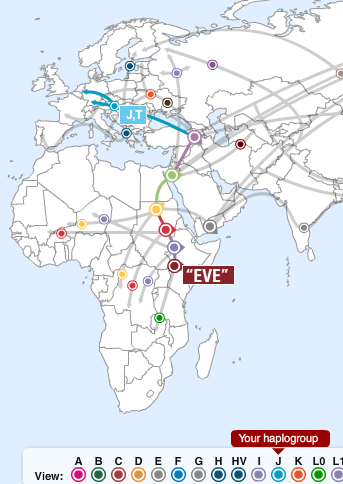
Given the complete agreement throughout the family about the story of Native heritage, imagine my utter shock when her haplogroup came back as haplogroup J, and not just J, but the full sequence would later reveal, J1c2c – unquestionably European as shown on the haplogroup J migration map from the Family Tree DNA results pages, below.

hap j migration

Ok, so now we’re back to where we started, with “Huh?”

But what about our Cherokee history?

Let’s face it, the evidence just doesn’t add up and the haplogroup was the icing on the proverbial cake.

  1. There is no census that shows us that Elizabeth or her mother or siblings or aunts are people of color. If they were 100% Indian, they would very likely, at some point, be noted as some category other than white, probably mulatto.
  2. There is no record of Native heritage like being on the Dawes or Guion Miller Rolls.
  3. There is no record of “head rights” in Oklahoma.
  4. There is no record of delayed tribal application that would entitle the family to both citizenship and land payments.
  5. The Trail of Tears, Indian Removal was in the late 1830s, fully 90 years, or about 3 generations before Elizabeth was born. For her ancestors to remain “fully Native” for 3 generations outside of a reservation would be almost impossible.
  6. The Cherokee were highly admixed prior to removal, so finding Cherokee after the removal who were not admixed would be very unusual – in the best of circumstances.
  7. The DNA is European, not Native.

However, there are a couple of outside possibilities so let’s discuss them

  • Adoption – The Native tribes did adopt white women into the tribe as full tribal members – generally women who were kidnapped or who had been previously enslaved. If that were the case, then the tribal member would have removed to Oklahoma with the rest of the tribe.
  • An Undiscovered Native Haplogroup – Haplogroup J might be a previously unknown Native haplogroup. For it to be considered Native, it would mean that eventually we would have to find Native burials, pre-Columbus, carrying this haplogroup, and that hasn’t happened today. In the US there is limited access to Native burials, but those issues are not as prevalent in Mexico, Central and South America and Canada. To date we have never found burials carrying mitochondrial haplogroups other than subgroups of A, B, C, D, X and possibly M. Furthermore, we do have solid matches in Europe, so this is a very, extremely, unlikely scenario.  In fact, it can be ruled out.

Aside from the very prevalent family oral history, there is just no evidence for recent Native ancestry through Elizabeth Vannoy Estes’s matrilineal line.  However, that does NOT mean that she has no Native heritage at all.  Her lines do disappear into the mists of time in pre-1800s Montgomery County, VA.

If Elizabeth Vannoy had been half Native, then her children would have been 25% and their children, her grandchildren would have been 12.5%.  We have the autosomal DNA of one of her grandchildren, and he carried no Native American admixture that is detectable by Family Tree DNA, which would cover to about the 5th or 6th generation.  We also have autosomal DNA from other descendants as well, with the same results except for me, but I have known Native heritage from other lines.

I ran Elizabeth’s grandson’s results at GedMatch too, also showing no Native results.  Ok, it wasn’t exactly none, it was about one tenth of one percent, which is most likely noise.

There is simply no actual evidence at all that Elizabeth was Native or had any Native heritage.  Of course, we also can’t prove that she didn’t, but what we can say is that if she did, it’s not on her direct matrilineal side according to her mitochondrial DNA, and it was likely not in the 4 generations prior to Elizabeth’s birth according to her descendants autosomal DNA – although there are a lot of blank spaces on her pedigree chart, and one of those, upstream, still could be Native.

Elizabeth Vannoy pedigree

So, it appears that Elizabeth Vannoy Estes is not Indian after all – at least not that we can tell.  Believe me, I fully understand why people don’t like this message when they receive it from DNA testing and often question whether the results can possibly be correct.  But alas, the truth is the truth and DNA doesn’t lie – like it or not.

I’m glad to have the truth, but between you and me, I liked the story much better!  It’s difficult when we have to lay a treasured family myth to rest.

gravestone

______________________________________________________________

Disclosure

I receive a small contribution when you click on some of the links to vendors in my articles. This does NOT increase the price you pay but helps me to keep the lights on and this informational blog free for everyone. Please click on the links in the articles or to the vendors below if you are purchasing products or DNA testing.

Thank you so much.

DNA Purchases and Free Transfers

Genealogy Services

Genealogy Research


Lazarus Estes (1848-1918), Huckster and Gravestone Carver, 52 Ancestors #59

Lazarus.

I’ve always loved that name.  It’s just so interesting and different – and thankfully, not another John or William.  I have so many of those names that I can’t keep them straight.  But Lazarus is much more unique and he turned out to be a very unique individual as well, as I came to know him through various tidbits of his life.

Lazarus holds a special place in my heart.  Lazarus was my first official “find” in genealogy, you see.  Well, his marriage record anyway.

One evening, many, MANY years ago, I took advantage of a free seminar the Mormon Church was offering on searching for your ancestors.  They said to bring what records you did have, so I gathered up my family group sheets, all half a dozen of them, and off I went.  I was a bit nervous, as I knew nothing about the Mormons, except they “did genealogy,” and I was, you know, raised Baptist.

Was lightning going to strike me as I stepped into the Mormon church???  And if so, was the bolt from the Mormons or the Baptists, or both?  Or worse yet, was someone going to try to convert or recruit me??

I decided to risk it.  I later learned that my concerns were entirely unfounded.

After their little talk, they had several volunteers available to help.  One very nice lady sat down with me and looked at what I had brought along, and then suggested that we look on the “reader” for “something.”  Ok.

She did, and said, “hey, look at this.”  Now, genealogists among us know those as the Fatal Words of Addiction.

And this is what we saw…..

Elizabeth Vannoy Lazarus Estes marriage crop

Oh my gosh – it was THEM – reaching out from more than 100 years ago and touching me…my heart just stopped.

Sure enough, she had found an index entry for the marriage record of Lazarus Estes and Elizabeth Vannoy, in Claiborne County, Tennessee.  And yes, I was hooked, hopelessly hooked.  We ordered the film, and then another film, and another film….and the rest, as they say, is history.  I developed tendonitis in my right arm associated with cranking microfilm machines.  All “old” genealogists are now laughing…and remembering.

Lazarus Estes was born in May 1848 in Claiborne County, TN, to John Y. Estes and Rutha Dodson.  They lived in a place known as Estes Holler, right off of Little Sycamore Road, just past Pleasant View Church (below), where they probably attended, then past a couple of cemeteries, and across Little Sycamore Creek which they would have forded at the time, because there was no bridge then.

Pleasant View Church 2

Lazarus was born where two generations of Estes’s had lived before him and several would live after.  Estes families still live in Estes Holler today, and it’s still called Estes Holler – right across the ridge from Vannoy Holler.

estes holler map

Some years later, I went to visit and meet Uncle George, Lazarus’s grandson, in person.  I wanted to see Estes Holler for myself and visit Lazarus’s grave.  Uncle George and his wife, Edith, who is also my cousin on two different lines, were the most gracious hosts.

George and Edith Estes

George took me in his truck “up the mountain.”  Here we are, in the back of George’s truck, in the livestock pen.  The livestock pen?   If I said, “don’t ask,”  would that do?  Let’s just say trucks are sometimes a bit rough there.

Uncle George and Me

Uncle George, who is really my cousin, but “honored” as an uncle, remembered when Lazarus was buried, standing by his grave as a child during the funeral.  George would take me to visit the same cemetery, to stand by the same grave, some 70 years later.

When I got to Claiborne County, Uncle George had a little surprise for me.

Lazarus Estes and Elizabeth Vannoy

This is a picture of Lazarus Estes and Elizabeth Vannoy Estes, my great-grandparents.

I remember being utterly mesmerized by this picture – staring into the eyes of my ancestor.  It’s hard to see Elizabeth’s eyes, but Lazarus is looking right at me, across the years, almost 100 years after his death – piercingly.

In the family history center, before I went to Claiborne County, I eventually found Lazarus on a census roll.  I ordered the roll and then waited for 2 weeks for it to arrive.  Today, we just sign on to Ancestry.com and look.

Estes 1850 census

John Y. Estes and Rutha Dodson hadn’t been married long, and Lazarus was their first child, named for Rutha’s father, Lazarus Dodson.  Lazarus is shown here as 2 years old, born in 1848, and I’m inclined to think this this is more correct than the 1900 census which shows that he was born in 1845.  By 1900, when Lazarus is more than 50, age can be misremembered or approximated, but pretty much everyone is going to know if their only child is 2 or not.  Furthermore, this census was taken in September, and if his birthday was in May, he would have just turned 2.  His mother was likely pregnant with her next child.  As icing on the cake, cousin Debbie found a Bible that we think belonged to his daughter after a death in the family a few years ago, and Lazarus’s birth year is given as 1848, so 1848 it is!!!

By 1860, Lazarus has 4 siblings and was 12 years old.

After that, life in Claiborne County got complicated – and downright ugly.  The Civil War erupted in January 1861 when 7 southern states seceded from the Union.  Claiborne County found itself in the middle of the conflict.  The first shots were fired in April, and although Tennessee wasn’t one of the first states to secede, they did after April, 1861, aligning themselves with the South, along with their neighbor state, Virginia. However, Kentucky, their other neighbor to the north permitted slavery but did not secede.  This created a dividing line between the states which just happened to be at the Cumberland Gap, not far from Estes Holler.

Cumberland Gap was just a few miles up the Old Kentucky Road and the Gap was a critical and strategic location to control the entrance to the north from the south and vice versa. In 1863, slaves were freed via the Emancipation Proclamation, but the war didn’t end until 1865.  No one in Estes Holler owned slaves.

The war was brutal on both sides, and fighting took place in and around Estes Holler.  People in that region were still digging cannon balls out of their land in the 1980s.

One of the houses in Estes Holler, still standing, was used as a Union hospital.  The locals know which house and where the bodies are buried too.  The area looks a lot more cheerful today!

Estes holler garden

The soldiers scavenged the countryside for food, constantly, since the thousands of men stationed at Cumberland Gap, whether from the Union or Confederacy, depending on who was holding the Gap at the time, never had enough food.

Lazarus would have been 13 when the war broke out.  He would have been 17 when it ended.  Those four years were living hell for the Estes family, their land constantly embattled and the sounds of cannon and gunfire echoing in the holler a regular occurrence.

Lazarus’s father, John Y. Estes fought for the south, as did neighbors, Sterling and John Nunn.  I was dumbstruck when I discovered this fact, especially since no one in Estes Holler owned slaves.  John Y. Estes was eventually captured and served time in a northern prison camp, being paroled at the end of the war.

Did the family know John had been captured?  Did they think he was dead?  How were they notified, if they were notified?  Sometimes, POW camps, on both sides were a fate worse than death, often followed by death.

The family, back in Claiborne County, had all they could do not to starve to death – and Lazarus, as the oldest male child, a teenager, was likely in charge.

The soldiers took the family’s one cow.  The baby of the family needed milk to drink.  Lazarus’s younger sister, Elizabeth, then 12 or 13, had been taking care of the cow as one of her chores, and she decided that she was simply going to go and get the cow.  As soon as it got dark, she slipped through the woods to where she knew the soldiers were camped.  The cow knew her voice and scent, and as soon as she found the cow, she simply slipped the bell off the cow and led the cow home, under cover of darkness.  She was the family hero and the family told that story in Tennessee and where Elizabeth eventually lived in Texas –  for the next 150 years.  Her descendants told me that story when I visited Texas in 2005!  It’s a family legend.  Another version of the story says it was the family horse that she recovered, and a third story says she did both!  In one version when she retook the horse, she snuck through enemy lines.

Her grandchildren tell of how Elizabeth, in the photo below, would regale them for hours with stories of life in a remote place called Tennessee during the Civil War when Rebel soldiers would come into their house and take everything.  She told about how the family hid, afraid they would be harmed.  She shared stories about the hardships on the trail in the covered wagon as they came to Texas and about the wagon rush when they opened up Indian Territory to homesteaders.  Maybe land is why all of Lazarus’s siblings wound up living in Texas.  In the end, only Lazarus remained in Tennessee.

Elizabeth Estes Vannoy

This is Lazarus’s sister Elizabeth Estes who married George Vannoy, the brother of Elizabeth Vannoy that Lazarus married, celebrating her 95th birthday in Nocona, Texas.  I think she looks a lot like her brother, Lazarus.

Lazarus is lucky that he was not captured and conscripted, on either side, during the Civil War.  Rutha probably depended heavily on Lazarus, as her next oldest boy wasn’t born until 1855.

John Y. Estes was finally discharged and released as a POW on March 20, 1865.  He probably walked home, begging food along the way, like so many other bedraggled soldiers, probably fearful of what he would find at home when he arrived.  Would there even be a home left?  Was his family alive?  All of them?  Part of them? Which part?

Shortly after arriving home, on October 9, 1865, John Y. Estes stated that he was moving and gave six head of sheep, one horse, fourteen head of hogs, one cow and calf, two yearlings, the corn crop, all the fodder, and all the household and kitchen furniture to his son Lazarus.  But John didn’t move.  Lazarus would only have been 17 or 18 at that time.  What precipitated this unusual transaction to an underage, unmarried boy with no household of his own?

Lazarus Estes married Elizabeth Vannoy sixteen months later, on February 6, 1867.

The 1870 census shows us a nuclear family, the way families worked in Tennessee.  Newlyweds just built a cabin by their parents.  In this case, Lazarus and Elizabeth lived beside both his and her parents.

Estes 1870 census

Now, the census can be deceptive, because the Esteses and Vannoys actually lived across the holler from each other, but that tells us that there was only one unoccupied house between them so the holler didn’t have as many people living there that it does today.

Still, they lived very close.

Lazarus lived on this V where Nunn Road and Vannoy Road leaves Estes Road.

Lazarus Estes homesite

You can see where a house used to be and a little cemetery – but that is NOT where Lazarus is buried. It is where some of his adult children are buried….and no, I do not know why.

Lazarus Estes land 2

In this picture, taken from across the road, you can see the location of the cemetery on Lazarus land, just about dead center, with a man inside and a truck to the right behind a big cedar tree.  Lazarus’s house sat to the left of the cemetery probably just inside or just outside of the picture.

There is an untold story involving the cemeteries in Estes Holler that I suspect involves a family feud of some sort.  In part, I think this because even in the 1970s, the two families living on opposite sides of the only road in Estes Holler would claim they “weren’t kin” to each other, when they clearly were.  They did not WANT to be kin to each other….so they weren’t…end of subject.  Although both families were very nice to me.  Feuds in Appalachia outlive the fueders and the descendants don’t even know WHY they are feuding, just that they are.

The “Upper Estes Cemetery” which is likely on the original John R. Estes land, eventually owned by son Jechonias, was not used by Lazarus who descended from Jechonias’s brother, John Y. Estes.  Furthermore, while Lazarus had a cemetery on his own land that included a grave for the unknown school teacher that Lazarus buried, he himself was buried in Pleasant View, then known as the Venable Cemetery, as was his wife and mother and his children that died in his lifetime.  Pleasant View is the cemetery at the end of Estes Holler, past the Cook cemetery, beside Pleasant View Church, although Lazarus was never reported to be terribly religious.  To me, being buried away from Estes land almost sounds like a protest of some sort.  I’m clearly missing some piece of the puzzle and I doubt anyone living has that piece.

We know there was some kind of problem and although the chancery court records tell us tantalizingly little – they do tell us something.

In 1888, George Estes, son of John Y. Estes, filed suit against his uncle Jechonias Estes regarding the boundaries of some land that Jechonias had sold to George in 1887.  Lazarus was the security for George, his brother, so his allegiance is clear.  From the May 1893 chancery docket, we know that Jechonias cross-filed and the court found that no one was entitled to anything from anyone, except the lawyers who put a lien on the property for payment of their fees. Jechonias had died in 1888, is buried in the Upper Estes Cemetery, and George Buchanan Estes along with his younger brother, John Reagan Estes, subsequently left for Texas where their father, John Y. Estes, was already settled.  However, at least three of George Buchanan Estes’s children are buried in the Upper Estes Cemetery.

John Y Estes clearing

This is actually the land behind Lazarus’s house, or where his house stood, but the ridge between Estes Holler and Vannoy Holler looked much the same.  I think that John Y. Estes lived in that clearing on the hillside.  The old Upper Estes Cemetery would be to the right about 3 or 4 photo-lengths, also on the hillside.  Of course, in Estes Holler, everything is on a hillside.  You can see the Upper Estes Cemetery, below in the clearing.

Upper Estes Cemetery clearing

Uncle George took me up the mountainside in his truck so that I could see the holler.  It’s a beautiful place, often bathed in the blue/grey mists that give the Smokey Mountains their name.

Estes holler mists

There is a steep wagon path, or put in modern terms, a 2 track Jeep path, over the ridge between the hollers at the end because it’s a mile or two to the front where you can go around – and then of course a mile or two back on the other side.

estes holler pano

The people who live there know every nook and cranny well – but to outsiders, it’s a confusing labyrinth of intertwined mountains, paths and valleys and very, VERY easy to become disoriented and lost.

This is the land where Lazarus was born, lived his entire life, and died.  He probably never went further than Knoxville, about 50 miles away.

This photo is labeled as Lazarus, but I’m not entirely convinced – although the woman does look something like Elizabeth.

Estes possibly Lazarus and Elizabeth

In this photo, Lazarus and Elizabeth look to be maybe 35 or 40, so this would have been taken in about the 1880s.  Lazarus, if this is him, has full facial hair, so he doesn’t even look like himself, compared to the other photos.  Furthermore, it looks like a caterpillar is crawling up one side of his nose.  I have my doubts if this is Lazarus, and I actually think it may be a photo of his father, John Y. Estes.

Update: Two subscribers offered expertise, for which I’m very grateful.

Therese overlayed the photo of the middle-aged couple onto the photo of Lazarus and Elizabeth as seniors in Photoshop and says:  “I’m sure they’re the same couple, you can take it to the bank. 😉 Even accounting for the different head angles and posture, their features lined up really well. Lazarus still had the same light-colored, slightly downturned eyes, straight brows, and the same mole or scar on the left cheek, which had grown some by his later years (Along with his ear lobes!! Too bad the ears and nose never stop growing.) The “caterpillar” appears to be some discoloration of the photo itself. The wrinkle between his brows also lines up well, although it became more pronounced with age. His shoulders appear to have atrophied some, which is to be expected. The hairlines and marionette lines for both Lazarus and Elizabeth in the two photos are also perfect matches. He even kept the same part in his hair. Elizabeth’s deep set eyes, thin lips, and square chin were little changed through the years.”

Jan says, “The sleeve of her black-striped jacket did not come into fashion until 1890. The pouf at the upper arm area grew to outrageous proportions over the next 7-8 years. With that in mind, I believe the photograph was likely take in 1890-93. It was certainly taken after 1890, making Lazarus at least 51-52.

By 1880 things had changed a bit in Estes Holler, to put it mildly.

I don’t think things were ever “right” after the Civil War.  John Y. probably witnessed the unspeakable and many men in this area fought for the Union, so he may not have been well accepted back in Estes Holler.  That deed he signed just a few months after his release tells us that something was amiss.  Perhaps his wife told him that his son, Lazarus, had taken care of all of the “man things” on the farm for the past several years while John Y. was gone.  We’ll never know.

On June 20, 1879, John Y. Estes signed papers granting James Bolton and William Parks permission to make a road across his land in order to enable Bolton and Parks to have access to their own lands. That same day, Lazarus and Elizabeth sold the men acreage and obviously, John’s land stood between that acreage and the road.  As long as the land was within family, access to the road didn’t matter, but now being sold, it did.

In the 1880 census, a year later, Ruthy is shown in Claiborne Co. with children Nancy, Rutha and John Reagan Estes, as divorced. Back then, no one ever got divorced – it was rare as chicken’s teeth.  Not to mention, this couple was 60 years old.  They had already tolerated each other most of their adult lives.  What precipitated a divorce?

John Y. Estes is shown in Montague Co., Texas, living with the S. C. Clark family as a lodger.

The Texas Estes family tells the story that John Y. Estes walked to Texas, twice – implying of course that he walked back to Tennessee once.

John Y’s last child was born in 1871, so I’m wondering if he didn’t go to Texas and return home, sign that deed, and go back to Texas by the 1880 census.  To the best of my knowledge, he never returned to Claiborne County.

And once again, Lazarus was left to take care of things.  His mother had children from the ages of 9 to 22 at home and the only son was the youngest, John.  Someone had to plow and farm and put food on the table.

The 1880 census showed Lazarus and Elizabeth with 4 living children and his occupation was a huckster.

Now that’s a very interesting occupation.  I asked cousin George about it, and he knew exactly what that meant.

Lazarus became an entrepreneur, of sorts, although not the same kind of “entrepreneur” his son, William George Estes would become.  Lazarus had a wagon and once a month he would hitch up his oxen and go to Knoxville.  It took him two days to get there and then he would sell whatever people from Little Sycamore in Claiborne had to sell or trade.  Then, he would load the wagon up with supplies and come back home.

We don’t know that this was Lazarus’s wagon, but it was in the Estes pictures and although we don’t know who is sitting in the wagon, we do know that the ox’s name is Jim Bow.

Estes wagon

In the field just across Little Sycamore creek, at the end of Estes Holler, Lazarus would park his wagon and everyone could come and visit to pick up their order or just to see what he had.  I guess he was a peddler of sorts.

Lazarus huckster field

Today, this homemade bridge is the entrance into Estes Holler, crossing Little Sycamore Creek.  There was no bridge then.

Bridge over Little Sycamore Creek

You can see, across the bridge and to the left that there is an open field.  Lazarus would pull the wagon into that field and set up shop, so to speak, according to Uncle George.

Lazarus huckster field 2

You know that word traveled like wildfire up and down the holler that Lazarus was back, and everyone wanted to see what he had brought, what was available, how much their goods sold for….and maybe more importantly, the news….what was the news.

Lazarus huckster field 3

I can see his wagon parked here, can’t you?  Is that his old wagon wheel?

However, this family had another little problem that no one probably discussed – at least not out loud.

Imagine my surprise to find this in the court records:

On Oct. 4, 1886, Lazarus Estes was granted $26 by the court for “conveying Joel Vannoy to the hospital for the insane.”  Joel Vannoy was Lazarus’s father-in-law.

That hospital was opened in Knoxville in May of that year.  You know, right about now, I’m tempted to say something like, “Well, that explains a lot.”  However, that’s probably inappropriate, because this really is very sad for everyone in the holler.  Lazarus was the one to take care of things, probably the same way he did for his mother during the Civil War.  Lazarus always seemed to be the one to “take care of things.”

So, in addition to his own mother, Lazarus now was taking care of his mother-in-law as well who had older children and grandchildren living with her.

Lazarus was one busy man.

In this photo, Lazarus looks to be about age 40-50, which would have been about 1890.  I cannot imagine wearing those long dresses in the Tennessee summer heat, but they did.

Lazarus and Elizabeth Estes 2

The 1890 census is missing, of course, so we don’t see Lazarus again until 1900.

In 1900, Lazarus and Elizabeth are living in-between Lazarus’s mother Ruthy and his son, William George Estes who married Ollie Bolton in 1894.

Estes 1900 census

William George has been out of work for 6 months.  I’m guessing Lazarus is once again, “taking care of things.”

Uncle George and the Texas family both tell us that Lazarus’s mother, Ruthy was bedfast for years, 22 years to be exact, with arthritis.  That means she would have been afflicted from about 1881, or about the time John Y. left for Texas.  Uncle George told me that Lazarus and some other family members had to go “up the mountain” and carry Ruthy “down the mountain” on a litter.  Lazarus and Elizabeth took care of her from that time forward.

The 1900 census also tells us that Rutha had 8 children and 6 were living.  Two of Ruthy’s adult daughters had died 2 days apart in 1888.  The family story says that there was smallpox in the holler and no one would bury the bodies, except Lazarus, so he buried all that died, alone.

Lazarus was no stranger to the cemetery.  The census tells us that he and Elizabeth had 10 children and 5 were living.  That wasn’t quite right.  They had 11 children, but one birth was twins who both either died the same day or were stillborn.

Lazarus and Elizabeth visited the cemetery far too often to bury children; in 1872 to bury twins, in 1873 to bury three year old Ruthy, in 1884 to bury 17 year old Phoebe, and in 1875 to bury 9 year old Thaddeus.  Of course, they buried Lazarus’s sisters 2 days apart in 1888 and his uncle as well.  Lazarus’s grandfather John R. Estes died in 1885, nearly 100 years old.  It’s hard to grieve that passing – more like a celebration of an amazingly long life.

So, you see, there was one more thing that Lazarus did, that he took care of for the family.  He hand carved gravestones.

Elihu and David Estes stone

This one was for twins, Elihu and David.

Lazarus Estes infant stone

And this one for his namesake.

These stones were for his brother, George Buchanan Estes’s children, buried in the Upper Estes Cemetery, where the land dispute would split the family in the 1880s and 1890s.  Maybe it was because the children were buried here that there was such a connection to this land.  George Buchanan Estes’s father in law, Rev. David King is also buried in this cemetery.  The Upper Estes Cemetery was located on Jechonias’ land, the original Estes land in Estes Holler.  This is probably where John R. Estes and his wife, the original Estes settlers in Claiborne County, are buried as well.

Upper Estes Cemetery

Lazarus and Elizabeth would bury yet one more child, Martha, in 1911, in Pleasant View cemetery before their four remaining children would bury them.

In 1902, William Norris, who had married Lazarus’s daughter Martha a couple of years earlier bought land from Lazarus.  I wonder if William and Martha Norris bought Rutha Estes’s old house.

In 1903, the family would bury Lazarus’s mother, Rutha, in Pleasant View Cemetery (then called Venable Cemetery), beside the church where Lazarus and Elizabeth would be buried next to her just a few years later.

Rutha Estes stone

Lazarus hand carved her stone too.  The photo below shows the area where Rutha, Lazarus and Elizabeth all rest together.

Estes area in Venable cemetery

The last census where Lazarus was enumerated was in 1910.  He is still farming.  His two youngest sons are living with him and his sister Rutha, age 50 is also living in the household, probably since his mother, Rutha’s, death. The census tells us Lazarus and Elizabeth have been married 45 years.  They’ve surely seen a lot together, especially given that they also knew each other as children.

They live one house from William Norris and Martha Estes, their daughter, who would die the following year, probably in childbirth.

In about 1915, there was a “small family issue” with William George Estes, Lazarus’s son.  William George and Ollie Bolton Estes, his wife, had left Estes Holler sometime after the 1910 census to live in Fowler, Indiana.  It seems that Ollie’s cousin, 20 years her junior, visited in Indiana, and Ollie came home and found William George “in the act” with her cousin.  As you might imagine, all hell broke loose, and they could probably hear the ensuing ruckus all the way to Estes Holler in Tennessee.  Ollie reportedly horsewhipped William George, nearly killing him.

Ollie was reportedly pregnant at that time, and the situation caused her to go into labor and lose the baby, or twins, the stories vary.  Long story short, Ollie and William split.  Their two sons, William Sterling (my father) and Joseph “Dode” somehow got lost or abandoned in the shuffle and not knowing what else to do, wound up hopping a freight train, at about ages 10-13, and making their way back to their grandparents in Estes Holler – arriving hungry, dirty and full of tales about their parents.  Lazarus was furious.

Shortly thereafter, William George reportedly also showed up back in Estes Holler, not with Ollie, the wife he left with, but with her young cousin instead, whom he would eventually marry.  The family story tells us that Lazarus was having none of that behavior, and he threw William George, along with the young cousin, out of Estes Holler, “for doing Ollie wrong” and told him if he came back, he’s shoot him.  To my knowledge, William George Estes holds the distinct honor of being the only person ever thrown out of Estes Holler – and that’s saying something!

Part of this story I know to be true, but I can’t vouch for all of it.  I do know that William George Estes was not entirely disowned, meaning he did have some inheritance, and he went back to visit his sister, Cornie, in the 1940s and 1950s, long after his parents were gone.

Apparently Lazarus knew his time on earth was limited and did not want to leave the fate of his land and possessions to chance, or to an executor, especially given the extenuating circumstances, so he took care of things himself before he passed over.

Lazarus Elizabeth 1915 deed

Lazarus created this deed leaving his land to daughter Cornie Epperson, but instructing Cornie and Worth, her husband, to pay Lazarus’s other heirs, William George and the heirs of his daughter, Martha, who had died in 1911, although William George received less.  On the second page, Lazarus reserved a life estate for he and his wife of half an acre and also states the condition that Cornie and Worth allow him to pasture a cow and horse on the property as well.

You don’t think of having problems finding death dates in the 1900s, but we had fits establishing in which year Lazarus died.  Cousin Debbie has a Bible that says he died in 1916.  His wife, Elizabeth died in October 1918 and is listed as a widow.  Cousin George, Lazarus’s grandson, who was at his funeral said he died in 1918.  Normally I’d say that the Bible is probably the most reliable, but in this case, we have a deed signed by Lazarus on March the 7th, 1918 – and as far as I know, the dead can’t sign deeds.  The death date we have, however, and it was on July 7th.  So, by process of elimination, Lazarus died on July 7, 1918.

As fate would have it, I’m not at all sure that Lazarus didn’t carve his own headstone, or at least part of it – the name.  I know that sounds morose, but for the man in the family that took care of everything, it’s somehow fitting.

Lazarus Estes original stone

Elizabeth’s stone, next to his, has no carving, at least none that remains today.

In the 1980s, George Estes and I bought new stones for both Lazarus and Elizabeth, because you could barely read Lazarus’s stone at all, in the 1980s.

Lazarus Estes new stone

The old stones were left in place, and the new stones put at the foot of the graves, shown below.

Venable cemetery new Estes stones

Lazarus and Elizabeth Vannoy Estes had the following children:

  • Phebe Ann born December 21, 1867, died August 21, 1884, not even a month after her younger brother Thaddeus died. I wonder if he was ill and she was caring of him. Phebe and Thaddeus’s are the only markers in this family that are not hand carved.

Phebe Ann Estes stone

  • Ruthy Jane born January 11, 1870, died Sept. 4, 1873
  • David born and died April 6, 1872
  • Alexander born and died April 6, 1872

Ruthy Jane, David and Alexander have hand-carved stones in the Venable Cemetery, but they are no longer readable.

  • William George Estes born March 30, 1873, died November 29, 1971, Harlan County, KY, married Ollie Bolton, Joice Hatfield and Crocie Brewer. Children who lived past childhood were Charles Estel, William Sterling, Joseph “Dode”, Margaret LeJean, Minnie May, by wife Ollie, then Virginia by wife Joice, then Evelyn and Josephine by wife Crocie.

William George Estes

  • Thaddeous Estes born Sept. 22, 1875, died July 28, 1884

Thaddeous Estes stone

  • Cornie Estes born June 22, 1878, died February, 14, 1958, married Worth Epperson and had children Edna, Bill, Edith, Catherine “Katy”, Kermit, Lucy Mae, William “Bill”, Everett and James “Bert”. In the photo below, Cornie and worth are celebrating their 60th wedding anniversary.

Cornie and Worth Epperson

Cornie and Worth were buried in the lower Estes Cemetery, on Lazarus old land, which was, of course, their land.

Cornie Estes Epperson stone

  • Martha A. was born Oct. 25, 1880 and died January 10, 1911, married William I. Norris and had children Jesse, Otis, Etta, Glen and Mae.

Martha Estes and William Norris family

Martha’s stone was hand carved too.  I had to dig part of it out.

Martha Estes Norris stone

  • James Columbus “Lum” Estes born March 25, 1883, died Nov. 15, 1924, married Creola “Thole” Greer and had children Myrtle, Heady “Hettie”, Charlie, Molly and Clarence. Lum and his brother, Charlie, married Greer sisters. James lived his entire life in Estes Holler and is buried in the Lower Estes Cemetery, on Lazarus’s land. He died of peritonitis because he “ruptured himself” picking apples and did not “get it taken care of.” The death certificate says he had medical attention for 3 days, but by that time, the damage was done. His death from peritonitis must have been awful.

James Columbus Estes

James Columbus Estes stone

  • Charlie Tomas (sic) born December 9, 1885, died October 2, 1927, married Nannie Greer and had children George Lazarus, Grace, Jessie, Lyde Waylen, Robert Tipton and Betty Louise. Charlie and Nannie obtained their marriage license in Claiborne County, not realizing they would not be able to marry in Hancock County. So, they married at the county line, in the road. She stood on a horse step. Charlie died of typhoid fever when he was 42. His death certificate says there was no doctor in attendance, which is not unusual in that region, although typhoid typically takes about 4 weeks to either kill the person or for them to begin to recover. George said that two of his sisters contracted typhoid too at that time, but they both recovered. His father died. Uncle George would have been 16 and Buster would have been 7. Charlie bought the farm in Hancock County, very close to the Lee County line that was still in the family when I visited Uncle Buster, his last living son, in 2005. Buster was living in the house his father had built with his own hands.

Charlie Tomas and James Columbus Estes

I particularly like this picture above of the two boys, Charlie and Lum (James Columbus) Estes, taken sometime in the 1890s.  I love their homespun shirts and pants.  You know these were their “good” clothes, yet they are barefoot.  I don’t think most of the children had shoes, and what shoes there were, were shared among family members in case someone had to go outside in the particularly cold winter months.  Of course, outhouses were all outside, so I’m guessing several trips a day were made.

Charlie, below, as an adult with Nannie Greer.

Charlie Tomas Estes and Nannie Greer

Charlie was Uncle George’s father.  Uncle George took me to see the house that Charlie built the family, in Estes Holler.  It’s where George lived until he was 10 years old, when they moved back to Hancock County where Charlie’s wife’s “people were from.”Estes house build by Charlie Tomas Estes

The land in Estes Holler, however, was sold to Charlie’s brother, Lum, when they moved to Hancock County, as reflected in the deeds, for $1.  These brothers were close their entire life.  Charlie was brought back and buried in the Lower Estes cemetery, on Lazarus’ land, near his brother, the day after he died.

Charlie Tomas Estes stone

Estes DNA and the Cousin Wedding

Estes is my maiden name.  I have always been an Estes.  I always will be.  I probably identify with my surname like most men do.  It’s mine, I own it, it owns me – and I’m very attached to my lineage.

You can understand, then, why I very much….one might say desperately….wanted to prove the Claiborne County Estes lineage to the proven ancestral Estes lineage from Kent, England.  And I don’t mean I wanted to prove it from someone 5 or 6 generations back – I mean I wanted to prove it from the current Estes family members.

Now, not that I’m saying that I had any specific reason to suspect that there might be a “problem.”  I’m not saying that at all.  Just because I’ve got a moonshiner between me and thee, Abraham Estes, immigrant, and a few other colorful characters too, is not reason to think that maybe, just maybe, “something” might have happened along the way.  Just saying, of course.  And of course, it also has nothing to do with the fact that I’ve spent more than 30 years working on Estes genealogy.  Nope, nothing to do with that either.

Unfortunately, by the time DNA testing has come upon the scene, Uncle George had passed on to the place where genealogists have all the answers.  He had no children, so that possibility was gone.  However, his younger brother, Uncle Buster was still living.  I always loved visiting with Buster.  He always came and joined in the party when I went to visit Uncle George.  He had a very dry wit, was always joking with someone and loved, just loved, a good prank.  Sometimes, it was difficult to tell when he was kidding and when he was serious.

Buster was also deaf as a post – so it’s not like you could call him up and ask him a question.  Nor was he a letter writer.  So, you just had to get in the car and go and visit Buster – 500 miles and 3 or 4 states away, depending on how you count that last winding 2 miles up the mountain on the Tennessee/Virginia border.

Now, I wish, just desperately wish, I had taken a picture from WITHIN the car when I pulled in Buster’s driveway during my last visit.  Buster was in his 90s.  He lived high up in the mountains, on the old home place, where you had to cross the state line once or twice on a twisty two-track road to get to his house.  You couldn’t see his house till you had missed it and had to turn around, but he could see you coming for 2 miles.  And that was long enough to get his gun and have it loaded, ready and leveled.  After all, no one had any business up there in “them mountains” that didn’t live there or wasn’t the postal service.  He just knew you were up to no-good – and most of the time he would have been right.  Buster was absolutely no nonsense, and everyone knew it.  I doubt he ever had to use that gun, because everyone knew unquestionably that he would.

That day, I pulled into the path to his house and pulled up, stopping maybe 20 or 30 feet before getting to his house.  He was sitting on the porch, the shotgun already on his lap and leveled.  There were only 2 things to do.

One – back the hell up and leave, or two, get out of the car, start walking toward him, smiling and waving.  Buster understands friendly gestures.  And I hadn’t come that far to turn around and leave, at least not without getting shot at, at least once.  Most people give warning shots.

My cousin, on the other hand, riding shotgun, pardon the pun, started muttering things about this not being such a good idea.  She slid down behind the dash as I got out of the car and started my friendly advance towards Buster.  About half way to the house, he lowered the gun, put it down and got up and walked out and gave me a huge hug.  I went back and got my cousin, and we went in and had a lovely visit with Uncle Buster, his Beagles and Chihuahua, Baby.  I still regret not bringing one of his puppies home.

Now, I probably shouldn’t say this, but I’m going to anyway.  Uncle Buster was one of the handsomest men I’ve ever met.  Even into his 90s, that man was not just handsome on the outside, but a lovely person inside too – and fun – such fun to be with.  Here’s Buster at about age 85.

Robert (Buster) Estes crop

That’s Buster’s “official” picture, but I like the candid shots better – not to mention he didn’t look like himself without a hat.

Buster Estes cowboy hat

Now Uncle Buster gave me an unexpected gift during that visit.  And no, I’m not talking about DNA – although he willingly gave that too.  He got a box of photos out from the bottom of a cupboard and in that box, we found photos that I never knew existed of John Y. Estes, our ancestor.  Buster thought Uncle George had already given them to me.  I don’t think George, his brother, had them, or he would have.

So Buster and my cousin and I spent a lovely afternoon at his kitchen table going through old photos and scanning them.  Here’s one of Buster on a plow in his younger years.  No tractors back then.

Buster Estes on plow

Buster told me stories that George hadn’t.  Stories about the family, about who did what to whom, and when, and why.  Stories about when his only son died in the Air Force and about his wife, before she passed over too.  And little tidbits here and there, like he thinks he recalls being told that my great-great-grandmother, Rutha, had red hair.  Buster’s parents knew Rutha, of course.  She may have had red hair, but according to 23andMe, I don’t carry the red hair gene.

As the morning wore on, the neighbors started spontaneously arriving, some on foot, some by car.  They saw my Jeep on the road too, and they knew it was a “strange vehicle” and with out-of-state plates, so it didn’t take long for their curiosity to get the best of them.  Buster wound up having a homecoming party and he didn’t even know he was expecting company.  Finally, we decided to go into town for lunch, so Buster could introduce me and my cousin to the rest of the “folk” at the one restaurant in all of Hancock County.  Buster was clearly tickled to have company.

I looked at Buster and Uncle George both and I saw my father, or the ghost of my father.  I just wanted to be positive.  I had to know – for sure.  I learned a long time ago, you can look at someone and see anything you want to see.

After we got past the shotgun on the porch incident, getting a DNA sample was a piece of cake.  I really struggled with how I was going to explain DNA for genealogy and why I needed it, to Buster.  It was, of course, complicated by his hearing loss.  I was all prepared with the best explanation I could come up with, along with drawings – and I finally decided to bag the explanation altogether and just to ask him to DNA test as a favor to me because I needed to prove I was really an Estes.  Sometimes, that’s the most effective approach.

He was perfectly willing.  However, he wanted something in return.  He wanted to go and visit his sister together.  Now, I had never met his sister, in all those years I visited Uncle George.  She was busy with her family and not interested in genealogy or meeting distant family, so I was a bit hesitant, but I could tell Buster really wanted to go and visit with her, so off we went.

Buster’s wife had passed away in 1991 and Buster had always had a “girlfriend,” never anyone he was terribly serious about, but someone to go and have lunch or dinner with and to visit with from time to time.  In fact, I think Buster might have had several girlfriends.  He certainly could have.  A man in his 70s and 80s who has enough money, a farm, can drive, has a (relatively) new truck and doesn’t want anyone to take care of him is a hot commodity anyplace!  And he was good looking and a respectful gentleman to boot!

We arrived at Buster’s sister’s house.  I was a bit hesitant, but Buster walked right in, put his arm around me, and told her that he wanted to introduce her to his new wife.

Ummm….I was not prepared for this.

You could have knocked me over with a feather.  You could have knocked her over with a feather too.  I’ll never forget the look on her face.  Buster was in hog heaven. She was not amused.  I was in shock, but recovered before she did.  Let’s just say that visit did not go well, as far as I was concerned.  Buster thought it went swimmingly!  My cousin was mortified.

Here’s how it all went down.

Buster – “I want you to meet someone.”

Sister – “I heard you were in town with someone for lunch.”

Buster – “Yep, I was.  We went to the courthouse.”

Sister – “What were you doing at the courthouse?”

Buster  – Long pause, deep breath, big smile….

Buster – “Gettin’ married.”

Sister – Shocked, horrified look, mouth falls open.

Buster – “Yep, we just got hitched.  What do you think of my new bride?  Ain’t she beautiful?”  Kisses me on the cheek.

Sister – trying to recover….immediately looks at my hand and sees a wedding ring …talking to Buster, ignoring me, like I’m not there…

Sister – “I heard she was from out of town.”

Buster – “Yep.”

Sister – now looking at me…”So what brings you here?”

Nothing like being direct.

Buster – “She came here to marry me.

Sister – hands on hips, getting agitated

Sister – “Well, how do you two know each other?”

Buster – “This is Bobbi, our cousin.  Don’t you remember her???”

Sister – “WHAT????  YOU MARRIED A COUSIN???”

Buster – looking at me… “Well, we ain’t gonna have any more kids, I don’t think, are we?”

Me – shyly… “Well, I was kinda countin on it.”

Sister’s mouth fell open again….

I finally started laughing, uncontrollably, so hard I couldn’t talk.  The more I tried to stop, the worse it got.  So did Buster.  We left.  I told him he was bad for doing that, in between guffaws, when I could speak.  Tears were streaming down my face I was laughing so hard  I could barely get my breath.  Buster shook his head yes, said he knew, and kept right on laughing too.  I bet she never forgave him – or me.  My cousin was even more mortified, having been the honorary maid of honor at the mythical wedding.  Thankfully, by this time, she was laughing too.

I laugh to this day thinking about that entire bizarre situation.  Buster’s sister was NOT amused – and I heard tell that Buster’s girlfriends weren’t either. His sister called them right up and tattled on him.  So had the girls at the restaurant in town.  You can’t do anything there without everyone knowing about it.  He probably “paid” for that little trick for years!  But knowing Buster, he probably thought it was well worth it and was right proud of himself!

However, at the end of the day, my cousin and I returned to Middlesboro with a DNA kit complete with Buster’s DNA (and signature), scanned photos, including many I had never seen, and another chapter is a set of stories that never seems to end in the Estes family.  We had a lovely day, my Jeep was undamaged, which is not always the case in these remote locations, and we had not been shot at.  And amazingly, my cousin still travels with me.

I couldn’t have been more grateful – for the DNA and the wonderful memories, old and new.  And my cousins, I love my cousins – the amused, the unamused and the co-conspirators.  My life would be so diminished without them.  There is nothing in this world as uplifting and bonding as laughing so hard you cry with your cousins.

And Buster, bless his heart, God love his soul, as they say down south, may he Rest in Peace – at least till his sister catches up with him.

Buster and Baby

______________________________________________________________

Disclosure

I receive a small contribution when you click on some of the links to vendors in my articles. This does NOT increase the price you pay but helps me to keep the lights on and this informational blog free for everyone. Please click on the links in the articles or to the vendors below if you are purchasing products or DNA testing.

Thank you so much.

DNA Purchases and Free Transfers

Genealogy Services

Genealogy Research

Phoebe McMahon (c1741-after 1815), Frontier Wife, 52 Ancestors #58

Phebe is one of those ancestors that we know little about.  We have no pictures or signatures.  In fact, we’re not even positive of her surname.  Most of the information we have about Phebe comes through her husband’s Workman family, through a book, “Some Branches of the Workman Tree” by Ralph Hall Sayer, 1979.

According to Sayer, the following marriage record shows that Phoebe McMahon married Joseph Workman in Christ Lutheran Church in York County, PA. on August 4, 1761.

“Joseph Workman, son of Abraham, married ‘PHEBE M’RAY, daughter of Hugh (Juh.) Mecmeher”‘.

This suggests that Phebe was probably born around 1741, give or take a few years, although we don’t know where.  There is a christening record for one Hugh McMahon on March 26, 1699, the son of John McMahon in County Monaghan, Clones, Ireland.  But, we don’t know if this is the same Hugh, and if so, who he married and if Phebe was born in Ireland, in transit or in the colonies.

The original marriage record was in the Dutch or German Language and the transcriber suggested that the maiden name of Phebe might have been M’Meagher.  Subsequent research reveals that the church was unquestionably German.

So was her name Phebe McRay McMeher or was it McMeagher or McMahon as it has been later reported?

A study of “History of York Co., PA” by John Gibson, gave no verification of the presence of a family named McMeagher. There was a Thomas McCreary in York Co., PA as early as 1754. There is no evidence that Joseph Workman or Phoebe actually lived in York Co., and no record of baptism for children of Joseph and Phebe was found in the church records.

In fact, this begs the question of why they were married in York County at all.  Joseph Workman is known to have been in Chester Co, PA, in 1759, which is about 40 miles from Yorktown where they were married.

Joseph Workman, son of Abraham Workman, was born about 1736 in NJ.

“Pennsylvania Archives:, Series 5 Volume 1,” gives a record of a May 6, 1758 enlistment in Chester Co., PA in Captain Paul Jackson’s Company for the Pennsylvania Regiment of the following: “Joseph Workman, laborer, 5’8″ of thin visage, age 21”, and “Abraham Workman, laborer, 5’ 9″, of thin visage age 19” and both gave NJ as their birthplace.

The Pennsylvania Historical and Museum Commission has a record reflecting “Provincial Servie” of a Joseph Workman who enlisted as a private in Captain Charles Stewart’s Company April 22, 1759 at Chester, PA. For this enlistment he gave his age as 24 and his birthplace as NJ. Although there is a difference in age, it is probably the same Joseph Workman in both enlistments. These two enlistments would have given him knowledge of the unsettled territory to the west and experience in protecting himself from the Indians.

I also wonder why Joseph and Phoebe were married in a German-speaking Lutheran Church, given that McMahon is clearly Scottish, Irish or Scotch-Irish with a name beginning with Mc.  The Scots were generally Presbyterian, the Irish were Catholics and Joseph Workman was second generation Dutch.

The answer to that question may possibly be found in the Revolutionary War pension application of their oldest son, Abraham, submitted in September of 1834 in Tazewell Co., VA.  He reports that he was born on January 25, 1761, which would have been several months before his parents married.  He also reports that he was born in Washington Township, PA but he couldn’t remember the name of the county.

Abraham Workman Pension app 1834 Tazewell Co Va

Abraham Workman Pension app 1834 Tazewell Co Va2

There is a Washington Township in York County, PA although it was not incorporated until 1805.  We know that Washington County, PA was not formed until taken from Westmoreland County in 1781, so Washington Township may well have been what Washington County was called in Westmoreland County before becoming a county.  Washington County was the area where current day Pittsburg is located, no place near York County which is in the eastern part of the state.  However, Abraham Workman, Phebe’s son, entered service in Monongalia Co., VA and served at Fort Pitt which is present day Pittsburg.

Joseph Workman, Phebe’s husband, also served in Washington County, PA, so Phebe may well have seen this fort up close and personal.  In that time and place, forts were often used to shelter residents in time of danger.  She, along with her younger children, may have taken refuge here from time to time.  If nothing else, she may have brought supplies to her son and husband at the fort.

Fort Pitt

Sometimes we are left with more questions than answers. What we can glean from this is that Joseph Workman and Phoebe may have spent little if any time in the York County area after their marriage.  They were next found on the frontier in Westmoreland County, the part that became Washington County in 1781.  Where they lived in-between?  We don’t know.

A study of “Virginia Court Records in Southwestern PA 1775-1780” by Boyd Crumrine reveals that in the minute Book of VA Court held for Yohogania Co., first at Augusta Town (now Washington, PA) and afterwards on the Andrew Heath Farm near West Elizabeth from 1776 to 1780: there is a record of several trials involving those of the Workman name and others of the McMahen (also spelled as McMahan and McMahon) name. The list of these trials gave only the surnames. Several of these names which appeared in the index also appeared later in the counties of Monroe, Tazewell, Logan and Boone in VA, areas in which the Workman families also settled.

Around 1776, six Workman families settled west of Fort Cumberland, MD, in the mountains near the border with Pennsylvania and current day West Virginia.

Fort Cumberland, MD

They were Andrew, Isaac, Jacob, John, Joseph and Stephen Workman and may be presumed to be brothers. Andrew, Isaac, Jacob, John and William Workman secured military land grants in what is now Allegany Co., MD in 1788.

Allegheny, Montgomery and Washington Counties in Maryland are located adjacent and abut the Pennsylvania border.

“Pennsylvania Archives”, Series 3, Volume 26, indicates that a Joseph Workman received two land patents in 1785; 400 acres in Washington County and 300 acres in Westmoreland county, which validates Abraham’s presence there in that timeframe as well.

Joseph and Phoebe Workman apparently moved to Westmoreland/Washington County before Joseph and their son, Abraham, both served in or about 1777 and moved to Montgomery County, VA between 1785 and 1787.  Joseph and Phoebe’s son, Abraham Workman, was married in Montgomery Co., VA in 1785. Joseph Workman appears on the 1787 Montgomery Co., VA tax list and in 1788 their daughter Anne Workman married Samuel Muncy, with Joseph writing a letter of permission.

1788 Workman Muncy letter

Some records and family tradition indicate that all or some of Joseph and Phoebe Workman’s family migrated to NC about 1788 and independently returned to Virginia at varying times. They may have been led there by Joseph’s brother, John Workman, who according to census listings settled in Orange county, NC. If this is true, Phebe may have lived in NC for a short time as well, although we know where they were in 1785 and 1787, so they didn’t have a long time to be in North Carolina.

Indications are that some of the Workman family members came back into VA about 1789 to settle around Burkes-Garden in the part of Wythe county which later became Tazewell Co.

Joseph Workman, Sr., is on the 1800 Wythe Co., tax list and on the 1802 and 1803 Tazewell Co. tax lists. In 1805, he was listed as “exempt of taxes due to old age and infirmity”.

“Pheby Workman” was listed on the Tazewell tax records in 1815 which probably indicates that Joseph had died prior to that time.

She is not listed in the 1820 census in her own household, but by 1820, Phebe, if living, would have been age 80 or older.

Most of Phebe’s life is tracked by the records of her husband and children, with the exception of her marriage and the 1815 tax record.  She was born before the French and Indian War which lasted nine years, from 1754 to 1763.  She survived that and the Revolutionary War era on the frontier, having babies and worrying about the constant threat of Indian massacres.

She probably had children from 1761 until about 1785 or so, as the family was lumbering once again in a wagon moving them from Washington County, PA to Montgomery County, VA.

Whether the family moved, or the county line moved, or the family took a short side trip to North Carolina and settled in a different location upon returning, Phebe was found in Wythe County, VA in 1800 and in Tazewell County, VA in 1815.  After that, Phebe’s life fades to black, except for the DNA found in her descendants.

It Pays To Ask

In the article about Phebe’s daughter, Anne Workman, I asked for anyone who was descended from this line through all females to please contact me.  Indeed, one cousin, Jef, did, and glory be, his father is descended directly from this line though Agnes Muncy Clarkson’s daughter Sarah Shiflett and had already tested his mitochondrial DNA at Family Tree DNA, and at the full sequence level.  His mitochondrial DNA came directly from Agnes Muncy Clarkson, from her mother Anne Workman Muncy and from her mother Phebe McMahon Workman.  It’s ironic isn’t it that this DNA also came from Phebe’s mother, a woman whose name we don’t know, but we do know about her DNA.

Oh, Happy Day!!!

Jef’s father joined the Muncy DNA project so that I could take a look at the mitochondrial results.

So, what can we tell about Phebe?

Her haplogroup is H5a1 which is European.  There were no Indian princess stories in this line, but had there been, this would definitely dispell them.  Haplogroup H is the most common mitochondrial haplogroup in Europe.

Therefore, she has lots of matches.  She doesn’t have any really unusual mutations to form a personal genetic filter so many of her matches may reach back in time hundreds to thousands of years.  That’s alright though, because it will help tell us where Phebe’s ancestors lived.

Jef’s father has no exact full sequence matches.  In fact, his closest matches are two mutations different.  The “Matches Map,” below, shows the known European location of the oldest ancestor of the testers that Jef’s father matches.

Phebe McMahon match map

You can see that these balloons clump rather according to mutation distance, meaning that the yellow balloons which have two mutations difference are found primarily in Ireland in the British Isles and the green balloons which are three mutations difference are found more in England and the continent and in a more scattered and wider pattern.  This make sense since more mutations generally means further back in  time to a common ancestor – so these yellow people would have shared a common ancestor more recently than the green group – and the green group has therefore had more time to disperse.

Zooming in on the UK part of the map, we can see that there is only one yellow balloon in Scotland, one in England and four in Ireland.  None of the yellow balloons in Ireland are from the Ulster Plantation area, which is where most of the Scots transplanted into Ireland from Scotland were settled.

mcMahon match map isles

Granted, a few yellow balloons isn’t a lot to go on, but it’s better than nothing and it does provide us with some information.  Phebe was likely Irish on her matrilineal line, at least most recently, which makes sense since her father’s surname was Mecmeher or something similar.

Looking at the Haplogroup Origins tab at Family Tree DNA, which reports academic findings, we discover that at the full sequence level, where everyone listed is H5a1, the distribution is as follows.

Location Genetic Distance 2 Genetic Distance 3
England 7 30
Germany 6 8
Ireland 7 7
Scotland 6 2
UK 4 3
Finland 1 2
France 1 6
India 1
Wales 1
Russia 1
Spain 2
Netherlands 1
Norway 2
Slovenia 1
Sweden 1
Ukraine 1
Shetland Islands 1

Looking now at the H5 project at Family Tree DNA, we can see that the administrators have grouped the H5a1 participants together in a group, which means we can see where the entire group falls on a map, so long as the participants have entered a location for the most distant ancestor.

Many of these people won’t match Phebe’s descendants today, but they certainly do share an ancestor further back in time.

H5a1 map

Think of this as a distribution and settlement map of the descendants of Phebe’s common ancestor with these people, the woman who first had the mutation that defined H5a1.

What, you ask, is that mutation?

The defining mutation for haplogroup H5a1 is 15833T.  If you have this mutation, you are a member of H5a1, and if you don’t have it, then you are a member of the parent group, H5a, without the sub-branch.

How long ago did this mutation happen?

According to the supplemental information from the paper, “A ‘Copernican’ Reassessment of the Human Mitochondrial DNA Tree from its Root” by Behar et al, this mutation happened approximately 6567 years ago with a standard deviation of 1533 years.  Translated into non-scientific speak, this means that this mutation occurred sometime between 5034 and 8100 years ago, or 3,000-5,000 BC, and based on the distribution map, probably in Europe – although sometimes distribution maps can be tricky, especially if people have not tested at the geographic origin of the mutation.

Looking backwards in time by looking at haplogroup formation is like looking through a time periscope and peeking at our ancestors at the other end.  Let’s look a little further.

Haplogroup H5a, the mother haplogroup of H5a1 is about 3000 years older and only three examples are found in the haplogroup H5 project.  Of those, one appears to be brick-walled in the US, one is found in Belgium and one in Scandinavia.

In turn, haplogroup H5, the ancestral value with no additional mutations is only represented by two people in the project and one of those is found in Scandinavia as well.

This map from Eupedia shows the distribution of haplogroup H5.

H5 heat map

H5 is only estimated to be about 500 years older than H5a, so these earlier haplogroup locations suggest that Phebe’s ancestors were living in Northern Europe 8,000 to 11,000 years ago.

Sounds like the beginning of a fairy tale doesn’t it…long, long ago in a place far away, where night lasts for most of the winter…before Vikings were Vikings and when snow ruled the earth…

But even though this is the stuff of fairy tales, this tale is true – it’s our ancestors history, what little we can discern through the time travel of DNA.

So, we don’t know Phebe’s mother’s name, but thanks to her DNA, we can tell that she was likely Irish, at least most recently, and before migrating to the British Isles, her ancestors likely lived in northern Europe for thousands of years.

And that, all thanks to a simple DNA swab test on a person who descends from Phebe through all females to the current generation.

I can’t thank my cousin enough!

______________________________________________________________

Disclosure

I receive a small contribution when you click on some of the links to vendors in my articles. This does NOT increase the price you pay but helps me to keep the lights on and this informational blog free for everyone. Please click on the links in the articles or to the vendors below if you are purchasing products or DNA testing.

Thank you so much.

DNA Purchases and Free Transfers

Genealogy Services

Genealogy Research

Anne Workman (c1761- after 1860), Centenarian, 52 Ancestors #57

Anne Workman was born sometime after her parents, Joseph Workman and Phoebe McMahen were married in 1761 in York County, PA.

Based on her marriage in 1788 to Samuel Muncy, she would likely have been born before 1768.  Later census records put the date between 1761 and 1769, although the census can be notoriously incorrect.  So, it would be safe to say she was born sometime between 1761 and 1769.

We know little about her early life, except by virtue of what was happening in the world around Anne when she was growing up.

Anne spent at least part of her youth in York County, one of the most “interesting” places to have been during the Revolutionary War.  “Interesting” of course is a matter of perspective.

Anne would have been a teenager when Yorktown, in York County, became a focal point of the War, but her family had probably moved on by then.

It’s not known exactly when the family moved from York County, at the eastern end of PA, to Washington County, near Pittsburgh, on the far western end of the state.  Washington County, PA was formed in 1781, in honor of George Washington.  It is bordered on the south by present day West. Virginia, which was at that time the state of Virginia.

Anne’s father, Joseph Workman is listed in the Pennsylvania Revolutionary War Battalions and Militia Index, 1775-1783 for Washington County, PA at the Pennsylvania State Digital archives.

Joseph Workman Wash Co PA Rev War service

Anne was one of ten children born to Joseph Workman and Phoebe McMahon.  Joseph and Phoebe started their married life in York County, PA and moved to Washington County, PA about the time of the Revolutionary War.  They did not move to Montgomery County, VA until sometime in the 1780s, probably between 1781 and 1783.  The Workman men served in the Montgomery County militia after their arrival and were on the compiled rolls that included men from 1777-1790.

These were not trivial moves.

Workman migration map

Anne’s parents were probably in Montgomery County, VA by September 1785 when Abraham Workman, probably Anne’s brother, married Hannah Lirner, according to “Some VA Marriages: 1700-1799” compiled by Cecil D. McDonald, Jr.

We know that Anne Workman married Samuel Muncy in Montgomery County three years later, the marriage bond shown below.

1788 Muncy Workman bond

Anne’s father, Joseph wrote a letter authorizing the marriage on June 16, 1788.

1788 Workman Muncy letter

Based on early land grants and deeds, the Muncy family lived on Walker’s Creek in Montgomery County.  They seemed settled there, at least until the later 1790s, but the Workman family is found moving increasingly north and west.  Anne’s father, Joseph, was found by 1793 in Wythe County, after it was formed.

In 1799, Samuel Muncy  and Agnes Craven, the parents of the Samuel Muncy that Anne Workman married, moved to Lee County, Virginia.  From the information we have, Samuel Muncy and Anne Workman went along with the family.  Several of Samuel’s siblings went as well, and the family lived on the Powell River in Lee County, very near the border with Claiborne County, Tennessee for the next dozen years.  The area of Walker’s Creek in Montgomery County and the Powell River area, shown below, in Lee County are very similar.

powell river lee co

We don’t find Samuel and Anne in the records.  It appears that the children of Samuel Muncy and Agnes Craven were fairly transparent. Some appeared on the personal tax lists, which is how we know the names of the group that left in 1811 when Samuel Muncy and Agnes Craven sold their land.

At least some of their children remained behind.

Hannah Muncey, born in 1771 to Samuel Muncy and Agnes Craven married a Bayley and remained in Lee County.

Reuben Muncy, went to Kentucky but had returned to Lee County by 1820 and had moved south in to Claiborne Co., TN by 1840.

It’s uncertain whether Francis Muncy and James were sons of Samuel Muncy and Agnes Craven or sons of their son, Samuel Muncy and Anne Workman – but regardless, it is certain that they stayed in Lee County, Virginia.

Samuel Muncy and Anne Workman remained behind in Lee County as well.

For Samuel, it must have been difficult to see his siblings and possibly his parents climb into a wagon and leave, knowing full well that he would probably never see them again.

If Samuel’s parents left for Kentucky in 1811 as well, they would have been around age 70.  It’s surmised that the sale of Samuel and Agnes’s land in 1811, the disappearance of Samuel and his sons from the Lee County tax list, and the appearance of some of these individuals in Knox (now Harlan) County, KY are connected events.

Anne Workman Muncy, however, had already said all of her good byes to her family in 1799.  She had been married for eleven years and probably had several children by that time.  To load everything you have in a wagon, including your children, and leave your entire blood family behind must have been very difficult.  She was probably about 31 or 32 years of age.  I wonder if she looked back with tears or ahead with resolve, or maybe a bit of both.

Today, that trip is 180 miles and about three and a half hours.  Then, it would have taken at least a couple of weeks, enduring whatever weather Mother Nature had to offer.

map Montgomery Co to Lee Co

Francis Muncy and James Muncy may have been children of Samuel Muncy and Anne Workman.  They were born in 1788 and about 1790, respectively.  We don’t know of any more children until Agnes is born on January 19, 1803.  Sarah Muncy who married Jeremiah Owens was born sometime between 1801 and 1807, according to later census records.   Samuel who married Louisa Fitts was born probably between 1800 and 1805.

Anne Workman Muncy would have been able to bear children until she was about 45 years of age, so until about 1813 or so.  Surely they had more children.

In 1809, Francis Muncy married Lovey Randolph.  James married Nancy Owens about 1815 and by 1820, both Agnes and Sarah had married as well to Fairwick Claxton and Jeremiah Muncy, respectively.  In 1825, Samuel Muncy married Louisa Fitts.

We know that Sarah who married Jeremiah Owens was a Muncy, because the death certificate of James B. Owens, the youngest son of Sarah Muncy Owens gives his parents as Jerry Owens and Sallie Muncy. This is the only firm documentation we have of the maiden name of Sarah.

James Owens death cert

We also know that Sarah Muncy Owens and Agnes Clarkson/Claxton were sisters based upon testimony given in the chancery suit filed after Fairwick Clarkson/Claxton’s death.  In that suit, William and James Owens testify and William states that he is the nephew of Fairwick Claxton.  Agnes Clarkson/Claxton is the wife of Fairwick.  Fairwick’s sisters did not marry Owens men and we find both William and James Owens in the 1850 census with Jeremiah and Sarah Muncy Owens as their parents.

The 1800 and 1810 census don’t exist for either Lee County, VA or Claiborne County, TN.

Anne Workman Muncy bore witness to a second war as well, the War of 1812.  While none of the actual fighting took place in Lee or Claiborne County, the men from those locations enlisted, or were drafted, and served in other locations, often walking hundreds of miles to Alabama where the Tennessee forces clashed with the Creek Indians.

Francis Muncy, of course, was a common name within the Muncy family, being the name of the American progenitor for which someone in each generation was named.  There is a War of 1812 service record for a Francis Muncy in Virginia in Bradley’s Regiment, from in Wythe County.  This is not likely our Francis.

A Samuel Muncy served in Evan’s Virginia Militia, but I was unable to determine where that militia unit was formed.

The National Archives is in the process of digitizing the War of 1812 records, so we will hopefully, soon, be able to determine if the Samuel who served was Anne’s husband or son.

The 1820 Lee County census documents Francis, Reubin, James, Jeremiah, John, Joshua and one Nancy, over the age of 45 living alone.  Of course, this causes an entire raft of questions and provides absolutely no answers.  Nancy, of course, is a common nickname for Anne.  Nancy (Anne) Workman Muncy would have been about age 52, but we know that son Samuel was not married until 1825, so he would likely have been living with his family.  Also, if this is our Nancy, where was her husband, Samuel?  Unfortunately, the census is in semi-alpha order, so we can’t tell who is living near whom.  We really don’t know who this Nancy Muncy was and the only thing we know about her age is that she was over 45.  She could have been quite elderly.  Nancy is not found in 1830.

The 1830 census shows us several Muncy men in Lee County.

  • Francis age 30-40 (born 1790-1800)
  • James age 30-40 (born 1790-1800)
  • James age 30-40 (born 1790-1800)
  • Samuel age 20-30 (born 1800-1810)
  • John age 20-30 (born 1800-1810) plus a male age 60-70 and a female age 60-70
  • John age 30-40 (born 1790-1800)
  • Jeremiah age 40-50 (born 1780-1790)

Samuel Muncy and Anne Workman would have been about 62 years of age and could well have been the couple with John, age 20-30.  John could have been their son.

We catch what is probably a glimpse of Anne Workman Muncy, by the name of Nancy, in the Thompson Settlement Church notes in 1833 when a Nancy Muncy joins the church by experience.  That means she would have been baptized and not joined from another church.  She would have been about 65 years old.  In Montgomery County, Virginia, the family would have been Anglican, based on early records that indicate two churches were formed; one Presbyterian church for the Scotch-Irish and the Anglican church for the balance of the population.

An entire group of Muncy and related folks joined the church within a few months, and many on the same days.  On the first Saturday of September and the first Saturday of October in 1833, a Nancy Muncy joined the church.

1st Sept Sat 1833

  • 1833 Frances Muncy received by experience (son of either Samuel and Anne Workman Muncy or Samuel Munch and Agnes Craven)
  • 1833 Nancy Muncy by experience (probably Anne Workman Muncy)

1st Sat Oct 1833

  • 1833 Anny Muncy by exp (probably daughter of James Muncy)
  • 1833 James Muncy by exp (possible son of Samuel and Anne Workman)
  • 1833 Nancy Muncy by exp (probably Nancy Owens, wife of James)

1st Sat November 1833

  • 1833 Samuel Muncy (probably Samuel (the fourth), son of Samuel and Anne Workman Muncy)

1st Sat Jan 1834

  • Louisa Muncy (probably Lousia Fitts, wife of Samuel (the fourth))

The 1840 Lee County, census shows several Muncy families, many younger.

However, we find Samuel Muncy, age 30-40 beside Jeremiah Owens, age 30-40, 2 doors from Willoughby Muncy (son of Francis), 2 doors from Cornelius Fitts.

This is the group of people, known relatives, who signed as executor and bond for Samuel Muncy who died in 1839, probably the husband of Anne Workman Muncy.

We also find a Francis, age 50-60 and then a John age 30-40 with a male and female, ages 70-79.  We also find James, age 40-50.

In 1840, in Claiborne County, TN, across the county/state border, Fairwick Claxton has a female living in his household, age 70-80 (born 1760-1770), likely Anne Workman Muncy.

The last two pieces of information we have about Anne are pretty amazing, actually, when you think about it

In both the 1850 and the 1860 census, Nancy Munsy was living with Agnes and Fairwick Claxton in Claiborne County, TN.  They lived just a couple doors away from Sarah and Jeremiah Owens, Agnes’s sister, and James Muncy had moved close by as well.

In the 1850 census, Nancy is shown to be age 81 (born 1769) and in 1860, she is shown to be age 99 (born 1761).

1850 Hancock census Muncy

Nancy was born in a time before modern medicine.  There were no antibiotics.  There were no childhood inoculations, and there was no clean, treated water supply.  Childbirth was risky for mother and child both, and many didn’t survive.  Roughly half the children died before reaching adulthood from illnesses today that we don’t even consider particularly dangerous.

Yet, Anne survived.  She survived at least three major moves by wagon, from one side of Pennsylvania to the other, likely during the Revolutionary War.  Then, just a few years later, from Pennsylvania to the Shenandoah Valley of Virginia where the family settled and she married.

Shenandoah River

“Shenandoah River, aerial” by La Citta Vita

In another decade, she would be loading into the wagon again, moving from Montgomery County to Lee County, VA.

Anne would have said a tearful goodbye to her parents, then in their 60s, but she would not be at their gravesides in another few years when they died.  That news, she would have received by letter or by “family grapevine,” if at all.

Anne probably lost siblings and children and she did lose her husband, yet survived another 20+ years.

In all of Hancock County, in 1860, there was only one other woman even near Anne (Nancy) Workman Muncy’s age, also named Nancy, ironically.  There were a couple within a few years in Hawkins, Scott and Lee Counties, but very few.

Anne, known as Nancy Workman Muncy beat the odds.

We don’t know how much longer she lived, only that she was not in the 1870 census.  I really hope she made it to 100 and all of her extended family visited and gathered around, and that she enjoyed her very special day with lots of visits.  After all, what else does a centenarian want?  She would have had a slew of great and great-great-grandchildren by then – more than 55 that I know of, and I’ve lost track of several lines – plus the children she assuredly had that we don’t know about today.

Anne is assuredly buried in the Clarkson/Claxton cemetery.  That cemetery figured in the land that her son-in-law Fairwick left his heirs and was described as being in the center of the land, right near the main house, where Anne would have lived for the last 20+ years of her life.

I hope Anne got to sit outside on a beautiful spring day and just soak up the warm mountain sunshine, maybe watching her great-grandchildren play on the rocks and near the barn.

I sure wish I could sit and talk with her about the century of life she saw, what changed in her lifetime and how.  She was born before the Revolutionary War.  Her father served.  I wonder what she thought – should we as a country secede and try to make it on our own, or should we remain a colony of England?  She would have been a teen when that was being decided.  And, her family was moving – two long moves within just a few years.  Why did they decide to head west at that time – to the edge of the frontier?  What she excited or frightened?  How did that affect her life?

Another 15 years later, in 1799, she herself pushed the frontier further west, homesteading in a land just surveyed and with few settlers on Wallin’s Ridge in Lee County.  She left family behind in Virginia and then, in turn, was left behind when her in-laws and Samuel Muncy’s siblings packed up for Kentucky a dozen years after settling on Wallin’s Ridge.

She saw men leave and fight, some of them not returning from the War of 1812.  Her own neighbor, James Claxton, the man who would have been her daughter, Agnes’s father-in-law, was one of those who died.  It was his land that Anne Workman Muncy lived out her life and died upon.

If the Samuel Muncy who married Louisa Fitts was her son, she stood by his grave as they buried him in 1843.  If James Muncy was her son, she buried him in 1854 and depending on when she died, she may have buried Francis Muncy in 1864.  She would have stood in the cemetery, near where her own grave would be when they buried her grandson, James Claxton, and his wife sometime between 1845 and 1850.  She probably helped raise those great-grandchildren, as they lived with Agnes and Fairwix Claxton, as did she.  They would have known their great-grandmother well.

She may have stood inside the cemetery, over and over again, as her grandsons and great-grandsons were buried as a result of the Civil War.  She would have grieved with her daughter, Agnes Muncy Claxton/Clarkson, as word came again and again of their capture and deaths.

Anne Workman Muncy was still alive as the country trembled on the brink of yet a third war in her lifetime, one that would horribly divide and not unite the country.  She could have seen the Civil War which terribly devastated Hancock County and divided the families irreparably between allegiances to the Union and the Confederacy.  Let’s hope she didn’t suffer through that catastrophe.  Let’s hope by then, Anne “Nancy” Workman Muncy was resting in peace in the Clarkson cemetery, outside the back door, with the rest of her family.

claxton land

Only the two known daughters of Anne Workman Muncy would have passed her mitochondrial DNA on to future generations.  Women give their mitochondrial DNA to both genders of children, but only females pass it on.  Since it is not mixed with the DNA of the father, it gives us a periscope to peer into the past and see where her matrilineal lines originated in the world.

Sarah Muncy Owens had several daughters, according to the census, but I have had a difficult time finding them as adults.

  • Nancy born in 1820
  • Agness born in 1826
  • Louisa born in 1828, married a David Rice in Hancock County and had two children, Sarah and Mary Ann, before dying in 1860 in childbirth, according to the census mortality schedule. Daughter Sarah married Daniel Owens.
  • Mary Ann born in 1829
  • Martha born in 1837
  • Mildred born in 1842, married Clinton Clouse and had daughters Lorinda who married George Cole, Sarah, Coraline and Elnora. Lived in Harlan County, KY in 1900.

Agnes Muncy Claxton had only two daughters who married and had children:

  • Sally Claxton born 1829, died 1900, married Robert Shiflet and had daughters Elizabeth who married William Lundy, Catherine who married Pleasant Powell, Rhoda who married John Burchfield and Agnes who married Tom Smith.
  • Rebecca Claxton born in 1834, died in 1923, married Calvin Wolfe, had daughters Nancy who married a Marcum, Elizabeth who married Francis Marion Herd, Agnes, June, Sasha (Sarah) who married Charles Hobbs and Easter who married Charles Cole.

I have a DNA scholarship for anyone who descends from these daughters through all females to the current generation.  Males are fine in the current generation, because woman pass their mitochondrial DNA to both genders of children.

Claxton land from road

______________________________________________________________

Disclosure

I receive a small contribution when you click on some of the links to vendors in my articles. This does NOT increase the price you pay but helps me to keep the lights on and this informational blog free for everyone. Please click on the links in the articles or to the vendors below if you are purchasing products or DNA testing.

Thank you so much.

DNA Purchases and Free Transfers

Genealogy Services

Genealogy Research

Samuel Muncy (1761/1768-1839), Who’s Your Daddy, Your Mamma, and Your Kids?, 52 Ancestors #56

I feel like I should give you a warning.  Get a cup of coffee, or tea, and some chocolate.

This article is long.  It was difficult.  Really difficult.  Made me wonder WHY I think genealogy is fun.  BUT, after wading through the swamp with the alligators, draining the swamp, fighting the alligators and a few snappers, analyzing the evidence including an “emergency” marriage bond retrieval from a friend who was in Salt Lake City at a conference last week (thank you Jen,) there is something resembling an answer at the end.  But man, this one was tough.  And no, do not turn ahead and peek…you’ll miss all the fun.

So get something good to drink and settle in for a bit.  If nothing else, it’s a darned good story!

The Widows

First, let me introduce you to “The Widows” and Uncle George who wasn’t my uncle.  I didn’t appreciate the widows and Uncle George nearly enough when they were still with us, although I surely hope they are continuing to help me from the other side now.

The Widows.

They called themselves that, an affectionate name for a group of elderly widows who all lived in Claiborne County, Tennessee in the 1970s and 1980s when I first began doing genealogy.

I didn’t realize I was doing genealogy, I just wanted to know something about my father’s family.  So, I picked up the phone, dialed “zero” for operator and asked the operator to connect me with any Estes in Tazewell, Tennessee.  She obliged and I talked to a very nice person who gave me the name of someone else to call who “knew more” than they did.  Within a call or two, I was talking to someone who did know a lot, and who knew my father and grandfather, and who then told me I need to talk to “Uncle George” who “knew everything about the Estes family there was to know.”

Uncle George was in his 70s and indeed, he was a wealth of knowledge. He wasn’t a genealogist either, he just knew a lot about the family.  The family storykeeper.  Everyone knew that he knew a lot and was the unofficial repository of everything Estes, so everyone gave him any piece of information or photo worth having.  In turn, he redistributed the wealth to anyone who was willing to listen and maybe take notes.  His wife, Edith, made fried chicken and sweet tea and fed you while the two of you talked.  From time to time, she would interject something she knew from her side of the family or from another source.  They were both my cousins.  Everyone there is my cousin.

There were no sources or citations, there was what “my grandpa told me before he died,” and more, like where the old cabins stood.  Sometimes there were notes and Bibles, but mostly there was what George knew.  If you asked him, often he could tell you who told him what and how they knew.  And George could take you to your ancestral land and tell you about life there long ago.

Claiborne and Hancock Counties in eastern Tennessee share rivers, mountain ranges and families.  George knew about the Estes family and a couple of other families that fed into the Estes line, but he didn’t know about my grandmother’s Bolton line.  He did know who knew.  Mollie, one of the widows.  And Mollie knew about the Claxton line too, because the Claxton’s married into the Boltons and were near neighbors “up to Hoop Creek.”

Now Mollie might not know about some other line, but she too knew which widow to call to find out.  Between all of the “widows” and a few widowers and unwidowed people, they had an entire network.  Sadly, for the most part, the knowledge died with them – and they are all gone now – one by one like lightening bugs that no longer light up the warm summer evenings.

Now, this might sound like nothing but gossip and hearsay, but that’s just not the case.

These people were born between 1890 and 1910, most of them, and were well-respected as elders within the community.  My ancestor, Agnes Claxton lived until sometime after 1880 and before 1900.  Had I thought to have asked, I’m sure Mollie would have known when she died.  Even though I’m pretty sure Mollie never met Agnes, she surely knew of her and about her.  Mollie’s mother and grandmother would have known Agnes well.  And you can rest assured….EVERYONE would have known about that lawsuit….

It was Mollie who first told me about Agnes Claxton, the wife of Fairwick.  We had a long discussion about whether the surname was Claxton or Clarkson or Clarkston and how you pronounced the surname.  Regardless of how you spelled it, it was “said” the same in that holler.  And Fairwick or Farwix was another long discussion.

Mollie told me that Agnes was a Muncy and that her parents were Samuel Muncy and Anne Workman.  She told me that Agnes’s grandparents were Samuel Muncy and Agnes, and that Agnes (Muncy Claxton) was named for her grandmother, which is how she kept the two Samuel Muncy couples straight in her mind.

Mollie never told me that Agnes’s grandmother’s surname was Craven.  She told me a lot about closer generations, but she had reached the end of her neighborhood knowledge, knowing that Agnes was named for her grandmother Agnes.  Little did I know at the time that Agnes Muncy Claxton’s mother, Anne (Nancy) Workman Muncy had lived to nearly 100, or maybe past 100 and was listed living with Agnes in the 1860 census, at age 99.

Mollie and the widows didn’t research the families outside of the county.  They did not visit the state library – they just gathered family stories.  From time to time, one of them would go to the local library, but at that time, there were very few resources.  THEY were the resources.  Sometimes one would make a quick trip to the courthouse, but mostly, they shared with you a wealth of family oral history and photos.

Mollie didn’t know there had been a book written about the Muncy family in the 1950s.  I think Mollie and the other widows thought that the only relevant information about the family was the last few generations that lived in Claiborne and neighboring counties.  Anything else was too distant and far away.

It wasn’t until the publication of the Early Settlers of Lee County book in 1977 that any of the early Muncy information became available in the general area.  This was either unknown to Mollie when I was talking to her about this line in the 1980s, or she didn’t think it relevant.

Maybe it would have upset her, or maybe she would simply have disregarded it as incorrect.  You see some of the information written in the Lee County book and the 1956 book by Mary Edith Shaw titled “The Descendants of Francis Muncy I with Allied Families” conflicted with what Mollie told me.  I can see her now, waving it off and saying, “Well, I don’t know what to tell you, Honey.  I can only tell you what Hazel told me, and Hazel was her daughter you know”…or something similar.  The widows would have put little stock in what “outsiders” would have said about the families especially if it conflicted with what they knew from their own families and experience.

For me, it became a brick wall.  An enigma.

Sooner or later, if you’re a genealogist, you hit this ancestor.  That’s the one who has two sets of parents designated, depending on the source, and I’m not counting Ancestry trees as sources.  One source was a well-researched and thorough book.  The second was a credible family source who claimed she knew, and she should have known.  Mollie’s mother and grandmother would have known Agnes Muncy Claxton and her children.  Agnes’s granddaughter, Margaret Claxton, married Mollie’s grandfather’s brother.  These people lived close, saw each other in church and knew the families well.

So, now that you’ve met “the widows” and know what Mollie had to say about Agnes Muncy Claxton, let’s see what we know about Samuel Muncy, the purported father of Agnes Muncy Clarkson/Claxton.  We immediately start out with a problem, because there were (at least) four Samuel Muncys.

The Four Samuels

In order to help keep things straight, I’m going to introduce you to the players, because there are 4 different Samuel Muncy’s that we’re going to be talking about, and the only way to keep them straight is their wives names.

  • Samuel Muncy Sr. who married Mary Skidmore
  • Samuel Muncy Jr. who married Agnes Craven. He is the son of Samuel Muncy Sr.
  • Samuel Muncy (the third) who married Anne Workman. His parentage is uncertain, which is what we’ll be discussing.
  • Samuel Muncy (the fourth) who married Louisa Fitts and is attributed to be the son of Samuel Muncy (the third.)

And just to add confusion, I’m going to assume that you know that if Samuel Muncy Sr. died, then Jr. would become Sr. in documents and the third would become Jr. – assuming they were living in the same county where they needed to be “kept separate.”  Furthermore, as if that isn’t confusing enough, Sr. and Jr. did not always mean father and son.  It meant older and younger and if the two men of the same name were father and son, that was hunky dory.  If not, it was still hunky dory.  Everyone, back then, knew who was who.  It’s only us, today, who are confused.

Samuel Muncy and Anne Workman

The subject of our discussion today is Samuel Muncy (the third) who married Anne Workman.  We actually know every little.  Let’s start at the beginning.

Samuel Muncy was born, most likely in Montgomery County, VA.  Ok, we’re good so far. We don’t know when, for sure, or to whom, or even positively where, but maybe we can assemble some evidence and piece a bit of his life together

Beginning with his birth and for most of the rest of his life, things are “fuzzy” to put it mildly, including who his parents and his children were.  For that matter, we only know where he was during oblique snippets of his life and then he disappears into the haze again, sometimes to reappear later, someplace else, and then eventually, simply to disappear into the mists and myths of time.

Samuel Muncy obtained a license to marry Anne Workman on June 16, 1788 in Montgomery County, Virginia.  That much is solid, because we have his marriage bond.  Based on the year he was married, he would likely have been born in 1767 or earlier.

1788 Muncy Workman bond

From this bond, we know that Samuel could not write his name.  Richard Coop? or Coup was his bond, and he couldn’t write his name either.  Just three months earlier, on March 23, 1788, Samuel had provided the bond for Richard when he married Dolly Loman, also in Montgomery County.  We know it was probably the Samuel who married Anne Workman who signed Richard’s bond with his mark because Samuel Muncy Jr. could write, based on his signature on an 1811 deed.

1788 Richard Coop bond

Was Richard Samuel’s best friend, or were these two men somehow related?  I can’t find anything about Richard Coop/Coup and Dolly Loman.

Herein lies the beginning of the confusion.

1788 Workman Muncy letter

This letter, which accompanies the 1788 marriage bond for Samuel Muncy (Munsey) and Anne Workman says:

“Mr. Abraham Trig, this comes from Joseph Workman and Obediah Munsey, that we are willing that Anne Workman and Samuel Munsey should be married.  This from under our hands this 15 day of June 1788.  Signed Joseph Workman and Obediah Munsey.”

What this document was interpreted by family historians to say:

Joseph Workman is the father of Anne Workman and Obediah Munsey is the father of Samuel Munsey.

This is NOT what this document says.  It’s true in most cases that the father of the individuals who were marrying did sign the bond, but that is not universally true, even if the father was living.

Well then, who was Obediah Munsey?  Obediah is another enigma.  Serial enigmas.

Obediah Munsey was the son of Samuel Munsey Sr. and Mary (who was probably a) Skidmore who moved to Montgomery County, VA sometime after 1738.  Samuel Sr. had several sons, but the two that concern us today are Obediah and Samuel Jr. who married Agnes Craven.

For a very long time, the Samuel (the third) who married Anne Workman was considered to be the son of Samuel Jr. and Agnes Craven, that is, until this marriage bond was found and Obediah was assigned as Samuel (the third)’s father.

However, I believe that Samuel (the third) who married Anne Workman IS the son of Samuel Jr. and Agnes Craven, for several reasons.  Let’s take a look at the evidence, which spans his entire life, bit by bit.

First, Obediah and Samuel Jr. were brothers.  They were together a lot in the court and other records of Augusta, Montgomery, Fincastle and Rockingham Counties.

We don’t know who Obediah married, and truthfully, we don’t even know for sure THAT he married.  He served in the militia along with his brothers, including Samuel Jr., in multiple companies over the years.  The last record we have for Obadiah is that he had land surveyed on Walker’s Creek, in Montgomery County, in 1789, but the records for Obediah may not be complete.

Walker’s Creek spans this entire distance from Pearisburg, VA where Walker’s Creek, the largest tributary of the New River, empties into the New, all the way along the river to Bland, Virginia, a distance of about 34 miles if you follow the blue route along Walker Creek.

Walker Creek, VA

Obediah’s brother was Samuel Munsey (Jr.) who married Agnes Craven.  He too lived with the other Munsey men on Walker’s Creek in Montgomery County, but in the 1790s Samuel moved to Lee County.  What we know positively is that Samuel was on the personal property tax list in 1799 in Lee County and a survey was signed over to him that year.  By 1801 he had received the deed for the survey for the land on the Powell River, on the north side of Wallen’s Ridge very near the Thompson Settlement Church, shown below at the upper right.  In the bottom left of the map is Four Mile Creek, where many Muncy descendants settled, about 10 miles distant as the crow flies

Thompson settlement church

Samuel Jr. was married to Agnes Craven by about 1761 when Agnes’s father died and mentioned her in the will.  While she was not mentioned by her married name, she was left the land she was living on, and in 1767, Samuel Muncy was paid along with the rest of the heirs.

Samuel (the third,) if he was their son, could have been born anytime between when they married prior to 1761 and 1767, given that Samuel (the third) married Anne Workman in 1788.  Because he signed a bond himself that same year (assuming it was he that signed Richard Coop’s marriage bond,) he would have had to have been 21 or older.

According to family historian Mary Edith Shaw in her book, “The Descendants of Francis Muncy I with Allied Families,” we know that Samuel Muncy (Jr.) and Agnes Craven had the following confirmed children, and she mentions more, such as Francis and James, who we will discuss in a minute:

  • Hannah born 1771 married a Bayley and stayed in Lee County
  • Peter born 1782 went to Knox County, Kentucky about 1811 and then to Indiana
  • Reuben went to Knox Co., Ky in 1811 but returned to Lee County by 1820
  • Francis A. Muncy born in 1788 who stayed in Lee County, Virginia

This photo of Peter Muncy, the son of Peter born in 1782, below was taken in Knox Co., KY, when he was 88 years old in 1916.  This Peter would have been the nephew of Samuel Muncy and Anne Workman.

Peter Muncy 1916

There is some confusion about Francis Muncy and James Muncy.  They are both attributed to Samuel Muncy and Agnes Craven as their children, but I’m not so sure.

To make matters worse, the Shaw book says that the “name” Francis (as Franklin) went with Peter to Knox County, meaning that he named one of his sons Franklin, but given the context it is easy to interpret as meaning Francis went with that group.

Francis A. Muncy was born in February 1788 several months before Samuel Muncy (the third) and Anne Workman were married, according to the Francis A. Muncy Bible record.  This suggests strongly that Francis A. Muncy was not the son of Samuel Muncy and Anne Workman, although it does not eliminate the possibility.  He was more likely  the son of Samuel Jr. and Agnes Craven.

However, there is a fly in that ointment too.  If Agnes Craven was married by 1761, she would have been about 20 years of age, or older, depending on her age at marriage and how long she had been married in 1761.  That means she was 47, or older, in 1788, probably too old to be giving birth, and age 49 in 1790 when James was born.

This makes me suspect that both Francis and James Muncy who stayed in Lee County may have been the children of Samuel Muncy and Anne Workman.  Why do I think this might be the case?

Francis Muncy would marry Lovey Randolph, daughter of Willoughby and Francis Thornton Randolph about 1809, which is probably why he stayed in Lee County.  We know from Willoughby’s will in 1822 that the James Munsey family lived on his lands at that time, along with Jeremiah Owens.  Willoughby’s will ties the families of Francis Muncy, James Muncy and Jeremiah Owens together.

James Muncy, born about 1790 married Nancy Owens and also stayed in Lee County. He bought land from Willoughby Muncy in 1819 and was living on his land in 1822 when Willoughy died, according to his will.  In 1845, James deeded his land to Francis Muncy’s son, Willoughby Muncy and moved to Four Mile Creek in Hancock County beside Sarah and Jeremiah Owens and Agnes and Fairwick Claxton.

By 1799, we know that Samuel Muncy and Agnes Craven were in Lee County, VA because Robert Walker who had land surveyed in 1798 signed that 100 acres on the North side of Wallin Ridge over to Samuel Muncy on November 2, 1799.  Samuel is also listed on the tax list in 1799.

1798 survey Walker Muncy

1799 survey Walker to Muncy

We don’t know for sure if Samuel Muncy (the third) and Anne Workman were with Samuel Muncy Jr. and Agnes Craven, but since several of Samuel Jr.’s sons were along, and Samuel and Anne do wind up in that part of Lee County with their children, it’s a safe bet.

By 1810, we know that Samuel Muncy was still in Lee County, Virginia, based on the personal property tax list, along with Francis, James and Peter, also on the list.  What we don’t know for sure is whether this Samuel was Samuel Jr. husband of Agnes Craven or Samuel (the third) husband of Anne Workman – but given that Samuel and Agnes didn’t sell their land until 1811, I would assume that is the Samuel Jr. on the tax list.

Deed Book 2, page 359, February 9, 1811

This indenture made the 9th of February 1811 between Samuel Muncy of Lee County and James Fletcher…for the sum of 200 dollars lawful money of the US in hand paid by the aid James Fletcher…tract of land containing 100 acres bearing the date August 8, 1801…on the north side of Wallings Ridge bounded…line of James McMillan…James Fulkerson’s.  Said Samuel Muncy and Agness his wife have hereunto set their hands and affixed their seals.  Samuel Munsey signed – no signature for Agness

In the presence of:

Thomas Gilbert
Isaac Sayers
Willoughby Randolph
Francis (X) Munsey

Note that this Francis Munsey cannot sign his name, but someone wrote in the Francis A. Munsey Bible, shown below.  Also note that Samuel Muncy who signed for Richard Coop’s marriage bond could not sign his name, but Samuel Jr. could.

Francis A. Muncy Bible

What happened to Samuel Jr. and Agnes after they sold their land is open to speculation, but Peter, Reuben and possibly others settled in Knox County, KY, the part that would become Harlan County, on Indian Creek near the Cumberland River.

In 1811, Samuel and Agnes would have been 70 years of age or older.

Of Samuel Jr. and Agnes’s children, Hannah and Reuben stayed in (or returned to) Lee County, on the Powell River.

It appears that Samuel (the third) who married Anne Workman also stayed in Lee County based on the fact that his children married in this region.  About 1809, Francis Muncy married Lovey Randolph, about 1814 James Muncy Married Nancy Owens, about 1820 Agnes Muncy married Fairwick Claxton, and before 1822, Sarah married Jeremiah Owens.

In addition, Samuel Muncy died in Lee County, VA in 1839 and Anne, listed as Nancy, is found living with Agnes in both the 1850 and 1860 census just across the border in Hancock County, TN.  This isn’t a smoking gun, but it’s a pretty compelling argument.

James Muncy, who bought land from Willoughby Randolph in 1819 and was living on his land in 1822, moved into Hancock County on 4 Mile Creek very close to the family of Agnes Muncy and Fairwick Clarkson in the early 1850s after selling his land to the son of Francis Muncy and Lovey Randolph in 1845.

In the survey below, you can see Claxton’s bend and just to the left of that, you can see Four Mile Creek intersecting with Powell River.  According to the 1850 census, Jeremiah Owens and Sarah his wife only lived 4 or 5 houses from Fairwix and Agnes Clarkson, who had the elderly Nancy Munsey living with them.

Claxton Bend v2

After Samuel Muncy and Agnes sold their land in Lee County in 1811, no records have been found to pinpoint their identity or whereabouts until an 1839 record reveals the death of Samuel Muncy – but which one?  We can’t tell if this is Samuel Jr., husband of Agnes, or Samuel (the third) husband of Anne Workman.  Based on the administrator and bondsman, I feel it was Samuel (the third), husband of Anne Workman.

At a court for Lee County on February 18, 1839, Order book 4 page 384:

On a motion of James Muncy who made oath as administrator and together with Cornelius Fitts, his security, entered into and acknowledged a bond in the penalty of 80 dollars, condition as the law directs, certificate is granted and the said James Muncy for obtaining letters of administration on the estate of Samuel Muncy, deceased in due form.

Ordered that Randolph Noe, Nathaniel Alsop and James Southern being justly sworn before a justice of the peace, do truly and justly appraise in current money, the personal estate of Samuel Muncy, deceased, and return this appraisement under their hands to the court.

Was this Samuel Jr., husband of Agnes who would have been nearly 100 years old  and possibly older, or Samuel (the third), husband of Anne Workman who would have been between 72 and 78?  Given the administrator, who gave the bond and the age of the Samuel’s involved, I think it was probably Samuel (the third), husband of Anne Workman.

Because of the marriage bond in Montgomery County, VA that showed Obediah Muncy signing for the marriage of Samuel Muncy and Anne Workman in 1788, that Samuel has been assigned as the child of Obediah.  I do not believe this is true, in part, because that Samuel, who married Anne Workman, named two of his children Samuel and Agnes, and none were named Obediah.

In addition, we find Anne Muncy, by the nickname Nancy, living with their daughter Agnes and husband, Fairwix Claxton in the 1850 and 1860 census where she is listed as age 81 (born 1769) in 1850 and age 99 (born in 1761) in 1860.  An older woman is also living with Agnes and Fairwick Claxton in the 1840 census, age 70-80 (born 1760-1770).  This was likely Anne, the year after Samuel died.  Fairwick’s mother is living in a separate household next door.

Furthermore, Samuel (the fourth), the likely son of Samuel (the third) and Anne Workman, married Louisa Fitts and Cornelius Fitts, Louisa’s brother, was bond for Samuel’s 1839 estate.

Thompson Settlement Baptist Church

Let’s look at the Thompson Settlement Baptist Church records which exist from 1801 and see if they can help.

The first mention of the Munsey family is in 1822 when James Muncy was received by experience, but then dismissed in 1823 for unchristian behavior.  There was nothing for another decade until, in 1833, a whole group of related people joined the church.  Makes me wonder if there was an old fashioned camp meeting where a lot of “saving” was going on.

Here’s an engraving from a Methodist camp meeting in 1819, although in Appalachia, the people would have been dressed very differently.

camp meeting

Camp meetings were very popular and were both entertainment and excitement, anticipated by people for weeks on end.  They were a combination social event, emotional religious exhortation and “reality TV.”

We’re fortunate that some of the Thompson Settlement church minutes remain.

1st Sept Sat 1833

  • 1833 Frances Muncy received by experience (son of Samuel (the third) and Anne Workman or of Samuel Jr. and Agnes Craven)
  • 1833 Nancy Muncy by experience (probably Nancy Owens, wife of James Muncy)
  • 1833 Barbary Jayne (Willoughby Randolph’s daughter, I think)
  • 1833 Mary Randolph

1st Sat Oct 1833

  • 1833 Anny Muncy by exp (probably daughter of James Muncy)
  • 1833 James Muncy by exp (is this the same one as in 1822?)
  • 1833 Nancy Muncy by exp (probably Nancy (Anne) Workman Muncy)
  • 1833 William Jayne
  • 1833 Willoughby Randolph by exp and after being baptized requests letter of dismission and is granted

1st Sat November 1833

  • 1833 Samuel Muncy (probably Samuel (the fourth))

1st Sat Jan 1834

  • Louisa Muncy (probably Lousia Fitts, wife of Samuel (the fourth))

1st Sat May 1834

  • Hannah Jayne (Willoughby Randolph’s daughter)
  • Lucy Jayne

The Thompson Settlement Baptist church minutes mention a Samuel Muncy beginning in 1833, probably the son of Samuel (the third) and Anne Workman Muncy, who married Louisa Fitts.  Louisa was also a church member.

We don’t find two Samuels, so it’s also unlikely that Samuel (the third) was a member.  He would have been in his early 70s at this time, as would Anne Workman Muncy who did join.

In 1835, an Anny Muncy was excluded, but it is believed to have been Anna Muncy, the daughter of James, who had two illegitimate children.  That would certainly have gotten her dismissed from the church.  Six months later, James Muncy was also excluded, probably her father or possibly her brother.

A second Nancy Muncy is shown in 1833, which is probably Anne Workman Muncy.  Nancy and Anne were often used interchangeably.  The 1850 and 1860 census both refer to Nancy Munsy.

Which Samuel is Which?

The next thing we find, in 1839, is the death of one Samuel Muncy.  But which one?

We know that Samuel (the 4th) married to Louisa Fitts was still having children until 1843 or 1844, so it’s not that Samuel.

So all of this brings me to the third reason why I think that Samuel (the third)’s parents were Samuel Muncy and Agnes Craven, not Obediah.

If Samuel (the third, who married in 1788, was the first born child, he would have likely been named Samuel.  He named his son Samuel (the fourth) as well.  No place in the family is there a child named Obediah, not in any of the grandchildren either.  However, Samuel and Anne Workman also named a daughter Agnes.

That Agnes is the Agnes Muncy that married Fairwick Claxton about 1820.  We know that Muncy was her name because of the widows and their cumulative information

I was also told that Agnes Claxton’s father was Samuel Muncy and her mother was Anne Workman, but I don’t know where they obtained that information.  My cousins, the widows, had notes stuck in drawers and books and boxes and Bibles that they retrieved when I visited.

There’s more evidence too.  In the chancery suit filed in Hancock County, TN, in 1876 following Fairwick Claxton’s death, William Owens, age 40, testified that he was the nephew of Fairwick Claxton.  James Owens, age 30, testified as well, but did not give his relationship to Fairwick.  William and James Owens are shown in the 1850 census as the children of Sarah and Jeremiah Owens who lived 5 houses from Fairwick Claxton and his wife, Agnes Muncy.  Sarah and Jeremiah Owens also had children named Agnes and Samuel, but no Obediah.

Further connecting these families, in 1822, Jeremiah Owens was also listed as living on Willoughby Randolph’s land with James Muncy.  According to family members, Sarah Muncy Owens is buried in the Claxton Cemetery at the intersection of River and Owens Road in Hancock County with her sister Agnes Muncy Claxton and family.

Furthermore, James Muncy, after selling his land to Willoughby Muncy, son of Francis Muncy who married Lovey Randolph, moved in to the 4 Mile Creek area, which is very close to where Sarah and Agnes lived.  James Muncy died there in 1854.

In the 1850 and 1860 census, Nancy Muncy was living with Agnes and Fairwick Claxton.

1850 Hancock census Muncy

She was given as age 81 in 1850 and age 99 in 1860.  So Anne Workman survived to a great age.  I do wonder where they lived from 1811 until 1839 when Samuel died.

It is assured that Anne Workman Muncy is buried in the Claxton cemetery since she lived with daughter Agnes and the cemetery was literally out the back door.

Claxton Cemetery Hancock Co.

When Anne’s husband Samuel died, where he was buried is open to speculation.  Given that his estate order was filed in Lee County, they were probably not living in Claiborne County, TN (now Hancock County) at that time – but the entire family lived along the Powell River within a few miles of each other and the county and state line was just a detail.

Samuel Muncy (the third) and Anne Workman probably had several children but it has been most difficult to ascertain their names.

Further confusing the matter, there are many family members sharing names like Francis and Samuel.  Additionally, the Hancock County records have burned.

A Fifth Samuel

Information provided by another Muncy cousin adds more confusion.  According to “Some Branches of the Workman Family Tree,” by Ralph Hall Sayre, the following are “known issue of Samuel and Anne (Workman) Muncy:”

1. James Muncy, born ca. 1790
2. Thomas Muncy, born ca. 1792
3. Samuel Muncy, born ca. 1798; married Hannah Black [The researcher disagrees with this and feels he married Dicy Spalding.]
4. William Muncy, born ca. 1803; married Peggy Hensley
5. Levi Muncy, born ca. 1808
6. Nancy Muncy, born ca. 1810; married Francis Aldridge
7. Polly Muncy, born ca. 1811; married Henry Davis

Of course, it doesn’t say how they know.  These families are found in Kentucky, with the cousin providing the information descending from Nancy, #6.  She provides this further information.

“Are you aware that Anne Workman’s brother Moses married an Elizabeth Muncy (born ca. 1781) in 1802 Tazewell County, VA? It’s believed Elizabeth was a daughter of Obediah Muncy, and indeed she named her first son Obediah Workman. Moses and Elizabeth Muncy Workman moved to Logan Co. VA. I believe that’s my Samuel Muncy taxed in Tazewell County the same year Moses and Elizabeth married. Samuel was taxed in Tazewell County, VA 1801-4,

Your Samuel and Agnes were already in Lee County by that time. By 1810 my Samuel was taxed in Cabell County, WV (which I believe was a case of new county formation, not a physical move.) By 1819 Samuel was taxed in Floyd Co. KY, apparently living in the area which later became Lawrence Co. KY. By 1822 he appears in the Lawrence County, KY tax lists, where he appears consistently through 1827.

So it appears that as your Samuel and Agnes moved further south and west my Muncy line moved a bit north and west.

I know Nancy Muncy married Francis (Frank) Aldridge who was the son of James and Margaret Muncy Aldridge. I believe, but cannot prove, that Margaret was somehow related to the Samuel Muncy who was living in Cabell County, WV when Margaret’s husband James was convicted of “moonshining.”  This Margaret Muncy Aldridge also appears in the Floyd Co./Lawrence Co. KY records along with Samuel and his oldest sons. As you know, I believe this Lawrence Co. KY Samuel is the one who married Anne Workman. And I also believe this Samuel is the son of Obediah, not Samuel.”

If those are the children of Samuel Muncy and Anne Workman, then who is the elderly Nancy Munsey living with Agnes Claxton in 1850 and 1860?  What other Samuel married an Anne of that same age and would name his children, Agnes and Samuel?

Clearly, the Samuel noted above born in 1798 cannot be the son of Samuel (the third) if the Samuel Muncy (the fourth) who lived with the other Muncy group in Lee County on the Hancock County border is Samuel’s son.  If Samuel Muncy (the fourth) is not Samuel (the third)’s son, then why did Cornelius Fitts, his brother-in-law, post bond at Samuel’s death?

Clearly, we have yet a fifth Samuel, also believed to be the Samuel who married Anne Workman.  It’s worth noting here that Lawrence County (where this family is found) and Harlan County (where Samuel Jr. and Agnes Craven’s children settled), although both are in eastern Kentucky, are not adjacent or even close.

eastern kentucky county map

Furthermore, Samuel (the third) and Anne Workman were not having and raising children in Lawrence County, Kentucky while their children in Lee County, VA near the Claiborne County border were being raised and marrying there.  We clearly have two different Samuel Muncys involved and identified as the same person.

The Lee County VA and Hancock County, TN Munseys

The following group of people are found together in Lee and Hancock County and I feel certain they are related to each other. In addition, because Nancy is found with this group in 1850 and 1860 and we have Samuel’s death in 1839, I feel that this group can be none other than the children of Samuel Muncy and Anne Workman.  There likely are more children.

Children candidates of Samuel Muncy (the third) and Anne Workman:

Francis Muncy, born in 1788, married Lovey Randolph about 1809, daughter of Willoughby Randolph and was very active in the Thompson Settlement Baptist church.  Francis was born on February 3, 1788, before Samuel (the third) and Anne Workman obtained their marriage license on June 16th.  On the other hand, Agnes Craven Muncy was nearing 50 years old by that date.  It remains unclear whether Francis was the son or brother to Samuel Muncy (the third).

Francis Munsy’s children, according to the Lee County Settlers Book which used the transcribed Bible, and confirmed through the Thompson Settlement Church records where possible, were:

  • Hannah born 1810 married John Jayne
  • William Joseph Muncy born 1812 married Lucy Jayne
  • Willoughby Randolph Muncy born 1816 married Catharine Jayne
  • James Frances Muncy born 1819 (restored to the church 1842)
  • Sarah Sally Muncy born 1821 married Harvey Thompson about 1840 (Sally Muncy, daughter of Francis received in the church 1842)
  • Mary Polly Muncy born 1824 married James Sims
  • Frances Minerva Muncy born 1826 married James Jayne (received in the church 1842)
  • Andrew Jackson Muncy born 1829
  • Nancy Ann Muncy, unmarried, died 1858 or typhoid
  • Samuel R. Muncy born 1834 married Letitia Hedrick
  • Elizabeth born 1838 married William S. Rollins

James Muncy, born about 1790, according to the census, married Nancy Owens about 1815, bought land from Willoughby Randolph in 1819, was living on Willoughby Randolph’s land in 1822.  In 1845, he, sold that land to Willoughby Muncy, son of Francis Muncy and Lovey Randolph, moving to 4 Mile Creek beside both Sarah Muncy Owens and Agnes Muncy Claxton after 1850.  This family was also active in the Thompson Settlement Church, although eventually withdrew.  In 1850, James was deaf, according to the census.

His known children were, although there were likely more:

  • Ann, born about 1815, had two children in about 1837 and 1840, never married
  • Jeremiah Muncy born in 1827 married Mary before 1850
  • Ellen Jane, born in 1815, married Henry Yeary before 1850 (and lived by Henry Claxton in the 1850 census)
  • John born 1830
  • William born 1832 and married Anna
  • Peter born 1834 married T. Catherine
  • Sarah born 1836 married Martin Brown
  • Ruben born 1838
  • Hannah born 1840 married John Hatfield

Samuel Muncy (the fourth), probably born between 1800 and 1805, married Louisa Fitts who according to the 1850 census was born in 1805 in North Carolina.  They were married in Lee Co., VA about 1825 and after their marriage they became members of the Thompson Settlement Church.  He was received a member the first Saturday in November 1833 and Louisa, the first Saturday in January 1834.  In 1835 Samuel Muncy was appointed a delegate to the Association.

Fitts Gap is very close to the Thompson Settlement Church in Lee County.

Fitts Gap

Samuel Muncy (the fourth) died in 1843-44 and is buried in the Campbell-Curry family burial plot, located near the old Towell Ford of Powell River in Lee county.  A marker has been placed at the grave in recent years without dates.  His youngest son was born in 1844.  Louisa died November 5, 1857 of a fever at the age of 46.

Their children were:

  • Henry Towell Muncy born July 27, 1826 and died December 11, 1893
  • Melinda Muncy born 1829, married Martin Van Buren Wynn
  • William Muncy born 1832, Sallie Muncy born 1833, died 1897, never married
  • Preston Muncy born 1844, married Millie McDaniel.

Henry Towell Muncy, born in 1823, is shown in the photo below, the grandson of Samuel Muncy (the third) and Anne Workman.

Henry Towell Muncy 1826-1893

William Muncy 1832-1923, below.

William Muncy 1832-1923 crop

These pictures of Henry and William would be the sons of this Samuel Muncy (the fourth) and grandsons of Samuel Muncy (the third) and Anne Workman.

This stray picture, below, found in the Estes family picture box was labeled Bill Muncy.    Maybe someone can better or positively identify this person.

William Muncy Hancock County TN

Agnes Muncy, born in 1803, married Fairwick Claxton/Clarkson about 1820.  They lived within 5 houses of Sarah Muncy and Jeremiah Owens.

Their children were:

  • James born 1820, married unknown, died 1840-1845
  • Henry Avery Claxton, born 1821, married Nancy Manning, died 1864 Civil War
  • William Claxton born 1815, married Martha Walker and Eliza Manning, died about 1920
  • Samuel Claxton born 1827, married Elizabeth Speak and died in 1876
  • Sally Claxton born 1829, married Robert Shiflet, died 1900
  • Nancy Claxton born 1831-1833, married John Wolfe and died before 1875
  • Rebecca Claxton born 1834 married Calvin Wolfe died 1923
  • John Claxton, born 1840, died 1863 Civil War

Samuel Claxton/Clarkson, below, born in 1827, is the son of Agnes Muncy and Fairwick Claxton, so another grandson of Samuel Muncy (the third) and Anne Workman.

Samuel Claxton

I think Samuel Claxton looks a lot like Henry Towell Muncy.  They would have been first cousins.

Samuel’s sister, Sally Claxton Shiflet is shown below.

Sarah Clarkson Shiflett

Sarah Muncy, born between 1801 and 1807.  In 1876, William Owens, age 40, testified that he was the nephew of Fairwick Claxton.  James Owens, age 30, testified as well, but did not give his relationship to Fairwick.  William and James Owens are shown in the 1850 census as the children of Sarah and Jeremiah Owens who lived 5 houses from Fairwick Claxton and his wife, Agnes Muncy.  Today, there is an Owen Cemetery within sight of the Clarkson (Cavin) Cemetery where Fairwick is buried and that land sits at the intersection of Owen Ridge Road and River Road.

In 1822, Jeremiah Owens was living on the Willoughby Randolph land with James Muncy.

In 1830 and 1840, the Jeremiah Owens family was in the Lee County census, but by 1850 they were living as neighbors to Agnes Muncy and Fairwick Claxton near Four Mile creek on the Powell River in Hancock County, TN.  The children of Sarah Muncy and Jeremiah Owens, according to the 1850 census, were:

  • Nancy born in 1820
  • Agness born in 1826
  • Louisa born in 1828
  • Mary Ann born in 1829
  • William born in 1835
  • Martha born in 1837
  • Samuel born in 1840
  • Mildred born in 1842
  • James born in 1845

Sarah was born in 1807, according to the census, and was married when she was about 13, so about 1820.  She shows her birth in Tennessee.  In 1860, her birth year is shown as 1801.

Regardless of the relationship of James and Francis to Sarah and Agnes, meaning whether they are brothers or uncles, Sarah and Agnes are confirmed as sisters to each other via the chancery suit testimony.

Sarah’s sons, who gave depositions in the Clarkson/Claxton suit are shown below:

William Owens

James Owens (below) and William Owens (above), grandsons of Samuel Muncy and Anne Workman.  I particularly love the quilt.

James Owens

Samuel Owens, shown below, served in the Civil War for the Union.

samuel owens

It’s fun to look at old photos.  Peter would have been Samuel Muncy’s nephew, so his brother’s child.  The rest of these would have been Samuel (the third) and Anne Workman Muncy’s grandchildren.  Do you see any resemblance?

Can DNA Help?

In this case, there is only one way that I can think of that DNA testing could potentially help.

We have connecting evidence to believe that several people are siblings and descendants of Samuel Muncy (the third) and Anne Workman, meaning Francis Muncy, Sarah Muncy Owens, Agnes Muncy Claxton, James Muncy and Samuel Muncy (the fourth.).  If this is the case, then some of the DNA of Agnes Craven would have been passed to them if they are descended from her.

In fact, if Agnes was their grandmother, they would have inherited about 25% of her DNA.

Today, I’m several generations downstream of Agnes Muncy Claxton.

Ancestor % of Agnes Craven DNA
Agnes Craven 100
Samuel Muncy (the third) 50
Agnes, Sarah, James, Francis, Samuel (4th) and other children 25
Samuel Claxton 12.5
Margaret Claxton/Clarkson 6.25
Ollie Bolton 3.12
William Sterling Estes 1.56
Me 0.78

If DNA inheritance actually happened at the 50% level in each generation for each segment, which we know it doesn’t, then I would carry under 1% of Agnes’s DNA and it would likely not show up in a large enough total or a large enough segment to be over the vendor matching thresholds.  However, if we have a particularly sticky segment, we might find some of Agnes Craven’s DNA in descendants today.

And you know what…the answer is no if you don’t look.

If we find Craven autosomal DNA, it would confirm that Agnes was the mother of Samuel and not Obediah’s unknown wife, unless she too was a Craven.  Of course, that we’ll never know.

In order to prove the Craven connection, we would actually need to match a descendant of any proven Craven who is not related to the Muncy line on a segment that is shown to come from the Muncy line in the descendants of Agnes, Sarah, James, or Francis.

After looking at the various cousins that might be involved, I found a total of 8 cousins who descend from Fairwick Clarkson/Claxton and Agnes Muncy or Jeremiah and Sarah Muncy Owens.

Of those cousins, Jim matches one Craven descendant who descends from the Craven line upstream of Robert Craven.

However, two cousins from separate children of Fairwick and Agnes both match Larry who descends directly from Robert Craven and Mary Harrison, the parents of Agnes Craven.  Larry has no Muncy or other common ancestry.  His Craven line is shown below:

  • Robert and Mary Harrison Craven
  • William Craven
  • Abigail Craven
  • Thomas Hayes
  • Nicholas Hayes
  • Mary Hayes
  • Flaude Johnson
  • Private
  • Private
  • Tester

The two cousins who descend from Agnes Muncy Claxton are Stacy and Brian.  This is the best possible matching scenario we could have – a descendant of Agnes Craven’s parents and two separate lines from Agnes Claxton.

Stacy is my great-niece, so even though I don’t match Larry, it stands to reason that I’m just not over the threshold, and Stacy is, so I may carry some smaller segments that match both Stacy and Larry.  In other words, the DNA carried by both Stacy and I was provided my by father.

I downloaded Stacy’s matches to me and to Larry, as well as Brian’s matches to Larry.  In this case, we need to triangulate to Larry, the Craven descendant, since he is the only person who matches both Stacy and Brian.

Since Brian doesn’t match either Stacy or me over the Family Tree DNA matching threshold, let’s hope that Larry matches both Stacy and Larry on some segments, making a triangulated group.

Craven Claxton DNA

In the two dark red locations, Larry matches both Stacy and Brian, creating a triangulated group, proving that all three members of this group does share common DNA with the descendant of Robert Craven and Mary Harrison.  Unless we are really unlucky enough that Obediah would have also married a Craven, this proves that Agnes Claxton/Clarkson was a descendant of Agnes Craven.

Note the light red segments that include Stacy, me and Larry.  While these do triangulate, Stacy and I both share a recent ancestor – my father.  The triangulation between Larry and Brian Stacy is much stronger evidence since Brian and Stacy’s common ancestor is Agnes Muncy Clarkson/Claxton.

This was a really long way around the block to prove who Samuel Muncy (the third)’s parents were, by proving who his grandparents were.  Once again, small segments came to our rescue – 8, 9 and 10 generations after our common ancestor.

I tried to do the same thing for Joseph Workman and Phoebe McMahon, Anne Workman’s parents, but I wasn’t as successful at Family Tree DNA.  There are suggestive matches, but nothing conclusive and I haven’t heard back from people about their ancestry.

However, there is a piece of very interesting evidence at Ancestry.com.

I have two matches with people who descend from Joseph Workman and Phoebe McMahon, all 3 of us through different children.  Neither of my two matches at Ancestry have Muncy DNA nor do they appear to have other lines in common with me.

However, as we know, DNA matches without triangulation are not proof, they are only suggestions of a common ancestral line.

And we also know at Ancestry that there are no chromosome browser tools to prove common DNA segments, so we can never have proof there.

So, we can count these Ancestry matches as pieces of evidence, along with our other evidence, but not as proof.

Samuel Evidence

So, is Agnes Claxton/Clarkson the daughter of Samuel Muncy (the third,) and Anne Workman Muncy, or not?

If so, is Samuel (the third) also the father of Sarah who married Jeremiah Owens, James Muncy who married Nancy Owens, Samuel Muncy (the fourth) who married Louisa Fitts and Francis Muncy who married the daughter of Willoughby Randolph?

I believe the answer to at least some of these questions is yes.

  • We know that Samuel Muncy Jr. and Agnes Craven were in the Wallin Ridge/Powell River area from 1799 through 1811 based on land transactions.
  • We know that Samuel and Agnes sold their land and probably left for Kentucky in 1811 with some of their children. Willoughby Randolph and Francis Muncy witnessed that transaction.  Samuel and Agnes were about age 70 at that time.
  • We know that in 1809 Francis Muncy married Lovey Randolph and by 1815, James Muncy had married Nancy Owens, so it’s very likely that their parents were living in this area at the time.
  • Francis Munsy was born four months before Samuel (the third) and Anne Workman were married, but by the same token, Agnes Craven Munsey would have been about 47 years old , and perhaps older, at the time of his birth.  James was born about 2 years later.
  • We know that slightly before 1820, Sarah Muncy married Jeremiah Owens and Agnes Muncy married Samuel Claxton.  From the 1876 lawsuit, we know that Agnes and Sarah were sisters.
  • In 1819 James Muncy purchased land from Randolph Muncy and in 1822, James Muncy and Jeremiah Owens are living on Willoughly Randolph’s land according to his will.
  • Samuel Muncy (the fourth) married Louisa Fitts about 1825.
  • In 1839 Samuel Muncy dies with James Muncy appointed administrator and Cornelius Fitts posts bond for the estate. Cornelius Fitts is the brother of Louisa Fitts who marries Samuel Muncy (the fourth) who is thought to be the son of Samuel Muncy (the third) and Anne Workman.
  • In 1845, James Muncy sells his land that be bought from Willoughby Randolph in 1819 to Willoughby Muncy, the son of Francis Muncy who married Lovey Randolph.
  • James Muncy moved in the 1850s from Lee County to very near Sarah Muncy Owens and Agnes Muncy Claxton on Four Mile Creek in Hancock County.
  • In the 1850 and 1860 census, the Jeremiah Owens family and Agnes Claxton along with Nancy Muncy are all living adjacent in Hancock County
  • Nancy Muncy is living with Agnes and Fairwick Clarkson/Claxton in the 1850 and 1860 census. An older woman of the right age to be Nancy is living with them in 1840 as well, which is a year after Samuel died.
  • Sarah Muncy Owens names children Agnes and Samuel. Agnes Muncy Claxton names her son Samuel. There are no Obediah’s in the family line.
  • Robert Craven’s descendants autosomal DNA triangulates with that of two of Agnes Muncy’s descendants, albeit on small segments.
  • I match to two descendants of Anne Workman’s parents, Joseph Workman and Phoebe McMahon at AncestryDNA.  Our matches are via three of their children’s lines.

So, what do you think?

Is Agnes Claxton the daughter of Samuel Muncy (the third) and Anne Workman?

Is Samuel Muncy (the third) who married Anne Workman in 1788 the son of Samuel Muncy Jr. and Agnes Craven or of Obediah Muncy?

Tell me what you think based on the evidence.

______________________________________________________________

Disclosure

I receive a small contribution when you click on some of the links to vendors in my articles. This does NOT increase the price you pay but helps me to keep the lights on and this informational blog free for everyone. Please click on the links in the articles or to the vendors below if you are purchasing products or DNA testing.

Thank you so much.

DNA Purchases and Free Transfers

Genealogy Services

Genealogy Research

Ann McKee (1804/1805 – 1840/1850), Methodist Convert, 52 Ancestors #55

We know that Ann McKee was born before March 24, 1805 because on that day, her father, Andrew McKee, wrote his will and named Ann as one of his daughters.   Andrew McKee did not die until 1814, so the 1810 census of Washington County, Virginia, shows us that Ann was one of 7 daughters, 5 that were under the age of 10 and 2 that were age 10-16.

Given that Ann married Charles Speak who was born in either 1804 or 1805, it’s likely that Ann was born sometime between 1800 and 1805, most probably about 1801.

On June 21, 1814, Ann’s father, Andrew’s will was probated in Washington County, indicating that he had died in the spring or early summer.  Court was held every 3 months, so we know that he died sometime after the March court session.  Ann would have been about 10 years old.  Ann’s mother, Elizabeth, was left with 13 children, from about age 24 to less than 4 years of age.

The 1820 census shows Elizabeth McKee with 1 male under 10, no females under 10, 2 females 10-16, two females 16-26 and one female over 45.

This means that Ann was in the 16-26 group because we know there were two daughters born after Andrew wrote his will in 1805 and before it was probated in 1814.  Therefore, Ann was born between 1804 and 1810 according to the census, and before March of 1805 according to her father’s will, so she was born in either 1804 or the early part of 1805.

Ann grew up on the Middle Fork of the Holston River, just across the Holston from Hutton Creek, according to her father’s land records.  Road 751 follows Hutton Creek south out of Glade Spring to where it empties into the Holston River, so Andrew McKee’s land was easy to find.

Andrew McKee Washington Co Va land

Today, this land lays several miles north of Abington, between Glade Spring and Chilhowie, on the south side of 81 on the bends of the Holston off of Friendship Road.

Andrew McKee Washington Co Va land map2

By 1828, the provisions of Andrew McKee’s will had taken effect, and this land was sold, but by then, Ann had married and been in Lee County, VA with her husband Charles Speak for 5 years and had a family of her own.

Andrew’s will stated that his sons were to pay his daughters each $200 when they came of age, which in Virginia was age 18 or marriage, whichever came first.  Ann would have received her $200 about the time of her 18th birthday which would have been in 1822 or 1823.  Perhaps her $200 functioned as a form of dower money and was partly the money Charles and Ann used to move to Lee County, Virginia.  Maybe that money was part of the money used for the Speak land, or maybe they purchased a wagon and livestock.  Today it would be worth about $4500, but then, you could buy a nice farm with that much money.  Land in the west that needed to be cleared and had no buildings, called improvements, certainly cost less than land that had already been improved and was being cultivated.

Ann’s mother, Elizabeth McKee is shown in the 1830 Washington County census, but by 1840 she has either passed away or is living with one of her children.

Update: Please note that this information has been updated. Please see this article, here, about Elizabeth McKee and her children. Ann was Presbyterian, but the William McKee below is NOT her brother.

Ann McKee’s family was assuredly Presbyterian, because her brother, William who was born in 1783 and died in 1833, possibly before his mother, is buried in the Sinking Springs cemetery, with a marker. (This has been proven to be inaccurate. This William is not Ann’s brother.)

Sinking springs McKee marker

Sinking Springs was the church founded by the Presbyterian Minister, Reverend Cummings in 1784.

By 1840, four of Ann’s siblings had passed away, brother William about 1811, Andrew in 1831, Jane and Rebecca before March of 1839. Two siblings were under 40 when they died, and one was under 50. Of course, childbirth is a constant danger to women.

Ann switched religions, probably before she went to Lee County, Va.  The dashing young man, Charles Speak, son of Nicholas, the preacher who would found Speak Methodist Episcopal Church in Lee County, Virginia may have influenced young Ann to convert.  Her family may have been very unhappy with her choice, and perhaps her leaving Washington County was a final separation from Presbyterianism and a new beginning in many ways.  Clearly, at least part of Ann’s family continued to embrace the Presbyterian religion, because her brother and his family were buried in the Presbyterian cemetery.

At that time, the Methodists were looked down upon by the Presbyterians for very emotional “exhorting.”

Nicholas Speak, Ann’s father-in-law, founded the Speak Methodist Episcopal Church in the 1820s in Lee County, Virginia, where the entire family settled, on land that Nicholas purchased in 1823.  In 1839, Nicholas deeded a piece of that land for the church to the trustees, and Charles was one of them, so we know for sure that not only did the Speak family all live together, adjacent, as indicated in the census records, but they all built that church and worshipped together too.

Ann Spent every Sunday of her adult life, and probably many other days too, in the original log cabin church that burned, replaced in the late 1800s by this beautiful little white country church, as viewed standing in the cemetery across the road.

Speak Chapel from Cemetery

Ann McKee and Charles Speak had 4 girls and 2 boys, all born in Lee County, Virginia.  The last child, that we know of, was born in 1829, but Ann did not pass away until between 1840-1850.  So either they had children we don’t know about, or several children died, or Ann may not have been well the last decade of her life.

We don’t know whether Ann or her husband Charles died first.  What we do know is that in 1840 they were both living and by 1850, they had both passed away.  Their children who were yet unmarried were living with relatives.

Ann and Charles were undoubtedly buried in the cemetery across the road from the Speak Methodist Church.  Everyone in the Speak family was buried there.  I’ve never been clear whether this is a “family” cemetery or a “church” cemetery, but it probably matters little because most of the people who attended the church were family, and if not initially, were in the next generation.

You can see the cemetery standing in the doorway of the church, looking across the road.  After Charles and Ann McKee Speak passed, Nicholas and Sarah must have looked at the cemetery and thought about them every day, along with their other children and grandchildren buried there.  Nicholas surely preached a lot of funerals there, one for each of those fieldstones.

Speak Cemetery from church

The only contemporary marker is one placed by the Speak Family Association for Nicholas and Sarah Faires Speak.  It looks for all the world like their family is gathered around them – and they are – together in eternity as they were here on earth.  You held them close when they were alive, saw them most every day, and buried them close when they passed over.  Their Methodist faith told them they would see each other again.

Speak cemetery fieldstones

Ann’s mitochondrial DNA was carried by all of her children, but only her daughters passed it on to their daughters.  Mitochondrial DNA can tell us a great deal about Ann’s ancestors in the past.  For example, their ethnicity and what part of the world her ancestors came from.

To find out about Ann’s mitochondrial DNA, we need to find someone who is descended from Ann through all females to the current generation.  In the current generation, the person can be male or female, since females give their mitochondrial DNA to both sexes of children, but only the females pass it on.

Ann McKee and Charles Speak had the following children, where bolded individuals represent Ann’s descendants who passed her mitochondrial DNA on to their children:

  • Sarah Jane Speak born about 1824, died 1888, married Andrew M. Callahan and had three daughters, one of whom died young. The surviving daughters were:
    • Mary Ann Callahan born in 1849 who married Samuel Patton Bartley, moved to Brown Co., Kansas, and who had daughters Estte Callahan (b 1879), Nannie Callahan (B 1881), Della Callahan (B 1886), Stella Callahan (B1888), Dora Callahan (b 1890) and Gladis Callahan (b 1898)
    • Elizabeth Matilda Callahan born in 1863 and married Sterling Brown Owsley.  They moved to Woodlawn, Nemaha Co., Kansas and had daughters Minnie May Owsley (b 1887) and Carrie L. Owsley (b 1892)
  • Nicholas Speak born December 13, 1825, died after 1864, married Rachel Rhoda Callahan
  • Andrew McKee Speak born about 1826, died December 19, 1900 in Grant Co., KY, married Lavina Chance
  • Rebecca Speak born about 1827, married James Painter in 1853 and lived in Claiborne County, TN, then in Kentucky. She had at least one daughter.
    • Martha G. Painter born in 1863
  • Charity Speak born about 1829, died after 1880, married Adam Harvey Johnson and lived in Claiborne County on Little Sycamore Road. They moved to Grainger county and had daughters:
    • Elizabeth Johnson (b 1867)
    • Safrona Johnson (b 1868) married Henry Cook and had daughters Alice Cook (b 1891), Margaret Cook (b1893), Abie Cook (b 1896), Evie Cook, (b 1896), Nellie Cook (b 1903), Lucy Cook (b 1905) and Nancy Cook (b 1917)
  • Elizabeth “Bettie” Speak born July 26, 1832 in Indiana, died Oct. 3, 1907 in Hancock County, TN, married Samuel Claxton and had the following daughters:
    • Margaret Clarkson/Claxton born in 1851and married Joseph “Dode” Bolton and had daughters, Ollie Bolton (b 1874), Elizabeth Bolton (b 1879), Ida Bolton (b 1886), Mary Lee Bolton (b 1888) and Cerenia Elizabeth “Lizzy” Bolton
    • Surrilda Jane Clarkson/Claxton born in 1858 and married Luke Monday having daughters Connie Elizabeth Monday (b 1876) and Hester Monday (b 1888)
    • Clementine Clarkson/Claxton 1853-1880, no record of marriage
    • Cynthia (Catherine) Clarkson/Claxton born in 1860 married William Muncy and had Jelina Muncy?, Geneva Muncy (b 1892), Bessie Muncy (b 1897) and Emma Muncy(b 1893)

______________________________________________________________

Disclosure

I receive a small contribution when you click on some of the links to vendors in my articles. This does NOT increase the price you pay but helps me to keep the lights on and this informational blog free for everyone. Please click on the links in the articles or to the vendors below if you are purchasing products or DNA testing.

Thank you so much.

DNA Purchases and Free Transfers

Genealogy Services

Genealogy Research

Charles Speak (November 19, 1804/5 -1840/1850), Church Trustee, 52 Ancestors #54

Charles Speak was born on November 19 in either 1804 or 1805, in Washington County, Virginia, the first child of Nicholas Speak and Sarah Faires.

We know little about the childhood of Charles, except by inference.

On August 12, 1804, Sarah and Nicholas were married in Washington  County, VA by the Rev. Charles Cummings.  Rev. Cummings was of the Presbyterian faith as were many of Sarah’s relatives, indicating that they were probably of Scotch-Irish descent. Reverend Cummings answered the call to minister about a mile northwest of present day Abington, VA and established the Sinking Springs and Ebbing Springs Churches.  Rev. Cummings died in 1812 and was buried at Sinking Springs, so it’s very likely that the Faires and Speak families were members of the Sinking Springs Church at that time and that the church of Charles’ childhood was likely Presbyterian.

Cummings Cabin Sinking Springs

Today, the log cabin of Reverend Cummings sits in the Sinking Springs Cemetery, founded in 1774, where the early settler burials are found in unmarked graves.  The photo above, courtesy the Historical Society of Washington County Virginia, shows the current church in the background.

There is a notation in the journal of Methodist Bishop Francis Asbury that he had visited in the home of Gideon Faires, so it is likely that Gideon embraced the faith of this new religion of Methodism sometime between 1802 when Nicholas and Sarah were married and 1816 when Francis Asbury died.  Perhaps Sarah and Nicholas were also caught up in this new faith.  In addition to Asbury, Methodist circuit riders traveled the area evangelizing the settlers.

In 1814, Charles’ father, Nicholas left in August to serve in the War of 1812 and was gone until he was discharged in February of 1815.  Sarah had 5 children by then, ranging in age from 9 or 10 to the baby at 13 months.  Charles was the eldest, turning 9 or 10 that November, and he would have been left to help his mother as best he could.  Nicholas would have left crops in the field which had to be harvested that fall, and I’m betting that young Charles did far more work than most children that harvest season.  While they expected and hoped that Nicholas would come home, they didn’t really know.  Many men didn’t.  This must have been a trying time for the family.

In the 1820 Washington County census, Charles would have been 14 or 15 and he is shown living with his parents.  Not long after the 1820 census, his father, Nicholas Speaks, would decide to move to Lee County, Virginia where he purchased land on  November 29, 1823 on Glade’s Branch, now known as Speak’s Branch, in the southern part of the county not far from the border with Tennessee.

Charles Speak married his sweetheart, Ann McKee on February 27, 1823, the same year that the Speak family bought the land in Lee County.  I wonder how that marriage proposal occurred.  Did Charles know his father was pulling up stakes and moving?  Had Nicholas been contemplating this move for some time, discussing it with his eldest son?  Did Charles tell Ann that he was going, moving to the frontier, and that he wanted her to come along?  Did she try to convince him to stay in Washington County?  Ann’s father was deceased, but was her mother still living?  Was this looked upon with high expectations and great anticipation, or dreaded, knowing the amount of work they faced, homesteading in the wilderness?

Was this move precipitated by religious conviction?  Nicholas Speak founded the church still known as Speak Chapel on Glade Branch and founded the Methodist religion in Lee County, shortly after his arrival.

The photo below of the original Nicholas Speak cabin was taken in the 1960s, more than 140 years after it was built.

Nicholas Speaks Cabin

Regardless of how it happened, it did, and Charles took his young bride to Lee County where they settled, their first child arriving about a year later in 1824.

Charles and Ann had the following children:

  • Sarah Jane Speak born about 1824, died 1888, married Andrew M. Callahan
  • Nicholas Speak born December 13, 1825, died after 1864, married Rachel Rhoda Callahan
  • Andrew McKee Speak born about 1826, died December 19, 1900 in Grant Co., KY, married Lavina Chance
  • Rebecca Speak born about 1827, married James Painter
  • Charity Speak born about 1829, died after 1880, married Adam Harvey Johnson
  • Elizabeth “Bettie” Speak born July 26, 1832 in Indiana, died Oct. 3, 1907 in Hancock County, TN, married Samuel Claxton

We have a picture of Elizabeth Speak with husband, Samuel Claxton/Clarkson in his Union army uniform before his death in 1876.

Samuel Claxton Elizabeth Speaks

Charles’ son, Nicholas Speak, named after his grandfather, fought with the Confederacy in the Civil War.

Nicholas enlisted on Sept. 30, 1861 as a private.  He was promoted to 2nd Lieutenant, served in Virginia, and was commissioned an officer in Company C, Virginia 21st Infantry Battalion.  He then transferred to company E, Virginia 64th on Dec. 1, 1862.  He rejoined on October 20, 1863.  He is “present” on pay muster rolls through August 30, 1864.  However, it is noted in September and October of 1864 that he “is dismounted at present” which means he was without a horse.  In November and December 1864, he is “absent to get a horse but his time has expired.”  His last record is that he is a prisoner of War and was paroled on April 29, 1865 at Cumberland Gap at the end of the war.  The record on Ancestry which is a compiled service record says he did not survive he war, but I find nothing in his actual records on Fold 3 to indicate otherwise.  He was a POW, released at the end of the war.

I found Nicholas’s POW records as well which say he was at the Military prison in Louisville, KY, captured in Lee Co., VA, on May 17, 1864, initially sent to Nashville, received in Louisville on July 14, 1864 and sent to Camp Douglas in Illinois the same day.  Nicholas’s record says that he, “claim to have been loyal.  Was conscript in the rebel army and desire to take oath of allegiance and become a loyal citizen.”  That tactic, true or otherwise, apparently did not work, because he remained a POW until the end of the war.

Samuel Patton Speak, son of Charles’ brother, Samuel Speak, also served and was captured the same day but died Nov. 20, 1864 of smallpox and was buried near Camp Douglas.  Samuel Patton Speak’s brother, William Hardy Speak was also captured the same day as the other two Speak men, sent to the same prison, but survived the war.  There are abbreviated notes that indicate he may have claimed he was conscripted as well.

Charles Speak’s sister, Rebecca, had been married to William Henderson Rosenbalm (Rosenbaum.)  Rebecca died in February of 1859 and with four small children to raise, William remarried that November to her sister, Frances, known as Fannie, also a sister of Charles.  They had 4 more children in quick succession.  William Henderson Rosenbalm enlisted as a confederate soldier on April 18, 1863, was captured in Lee County, VA on May 17, 1864.  On July 17th, he was in Louisville in the Military prison and was transferred to Camp Douglas, noted as conscripted, where he was received the next day.  His military records show that he died on September 25, 1864, a prisoner of war, also at Camp Douglas.

All 4 men were captured the same day in Lee County.  They must have been together, probably patrolling at night from the pieces I put together of their combined service records.  These men were Charles son, Nicholas, Charles’ nephews Samuel and William and Charles’ (deceased and living) sisters’ husband, William Rosenbalm.  This must have been a terribly devastating day for the Speak family.  And this at the same time that Charles’ sister, Elizabeth’s husband, Samuel Claxton, was serving the Union and several of his family members died in that service.  The families only lived 6 or 7 miles apart although clearly their allegiances were worlds apart.

Camp Douglas, south of Chicago, Illinois, on the prairie, was one of the largest POW camps for Confederate soldiers and became known as the North’s Andersonville.  In the aftermath of the war, Camp Douglas came to be noted for its poor conditions and death rate of between seventeen and twenty-three percent.

Toward the end of 1864, surgeons refused to send recovering prisoners back to the barracks due to the rampant scurvy, attributed to the policy of withholding vegetables from the prisoners. In October 1864, 984 of 7,402 prisoners were reported as sick in the barracks and were believed to have been significantly underreported.

Meanwhile, in November 1864, as repairs were being carried out, water was cut off to the camp and even to the hospital. Prisoners had to risk being shot in order to gather snow, even beyond the dead line, for coffee and other uses.  This was the time during which both William Rosenbalm and Samuel Speak died, on September 25th and November 20th, 1864, respectively.

Some 4,275 Confederate prisoners were known to be reinterred from the shallow camp cemetery to a mass grave at Oak Woods Cemetery after the war.

It’s doubtful that Nicholas was conscripted, given that he was an officer and he signed this receipt as such.  It’s impossible to tell without being there, but it would appear that the Speak family in Lee County, Virginia, were Confederates.

Nicholas Speaks Civil War

It must have been difficult after the Civil War for Charles Speak’s adult children to resolve the breach of the Civil War.

Elizabeth Speak Claxton’s husband, Samuel Claxton, died as a result of his Union service in 1876 while Elizabeth’s brother, Nicholas Speak, fought for the Confederacy and was a POW under horrific conditions.  Nicholas reportedly died in the 1860s, after the war ended.  Samuel Patton and William H. Speak, two of Charles’ nephews also fought in the same unit with Nicholas, were captured along with him on “nite duty.”  One of the newphews died.  William Rosenbalm, Charles’ brother-in-law was also captured that fateful night and died as a POW as well.  If those men really were conscripted, then perhaps family relationships might not have been so difficult.  Regardless, having spent all of those months in a Union prison would have been life altering and would not make anyone fond of the Union.  Maybe it’s a good thing Charles and his wife didn’t live to see this misery and the very large wedge the Civil War probably drove between their children.

Other than the census, the only other piece of information we have about  Charles Speak is his mention in a deed in 1839 when Nicholas Speak transferred the land for Speaks Methodist Church to the trustees that included his son Charles.

To Tandy Welch, Trustee of Speaks Chapel Methodist Episcopal Church

This Indenture made this ____ day of ____ in the year of our Lord one thousand eight hundred and thirty nine Between Nicholas Speak of Lee County and State of Virginia of one part and Tandy Welch, William Morgan, Adam Yeary, Charles Speak and Nathan Hobbs, trustees in trust for the use and purpose herein after mentioned all of the County of Lee and State aforesaid (Morgan, Welch and Yeary of Claiborne County and State of Tennessee) Witnesseth that the said Nicholas Speak for and in consideration of the sum of one dollar in specie to him in hand paid the receipt whereof is hereby acknowledged hath given granted bargained and sold and by these presents doth grant bargain and sell unto the said Tandy Welch, William Morgan, Adam Yeary, Charles Speak and Nathan Hobbs and their successors (trustees) a certain lot or parcel of land containing one acre and 9 poles lying and being in the county and State aforesaid and bounded as follows Beginning at a white oak on the west side of Glade branch S 150 W 13 poles crossing the branch to a white oak near rocks N700 E 13 poles to a double dogwood & white oak N 150 E 13 poles to a white oak thence a strait line to the Beginning to have and to hold the said tract of land with all appurtenances, and privileges thereunto belonging, or in any ways appertaining unto the said Tandy Welch, William Morgan, Adam Yeary, Charles Speak and Nathan Hobbs and their successors in office forever for the use of the members of the Methodist Episcopal Church in the United States according to the rules and disciplin which from time to time may be agreed upon and adopted by the ministers and preachers of the said Church, at their general Conference in the United States. And in further trust and confidence that they shall at all times permit such ministers and preachers, belonging to said M. E. Church to preach and expound the word of God therein. And the said Nicholas Speak doth by these presents warrant and forever defend the before mentioned piece of land with the appurtenances thereto belong unto the before mentioned trustees and their successors in office forever against the claim of all persons whomsoever. In testimony whereof the said Nicholas Speak has hereunto set his hand and seal the day and year aforesaid.

Nicholas Speak {Seal}

At a court of quarter sessions continued and held for Lee County at the courthouse thereof on the 19th day of June 1839 This Indenture of bargain and sale for land between Nicholas Speak of the one part, and Tandy Welch, William Morgan, Adam Yeary, Charles Speak and Nathan Hobbs of the other part, was acknowledged in open court and ordered to be recorded.

Teste F.W.S. Morison CC

Speak Chapel

The church, shown above, is not the original which was a log structure and burned in the late 1800s.  The current church was constructed about 1900 and still stands.

In the 1840 census, Charles is shown with 1 male age 30-40, wife age 30-40, 6 children; 2 males 10-15, 1 female 10-15, 2 females 5-10, 1 female under age 5.

The 1840 Lee County census is taken in house order and has not been alphabetized.  There are 6 Speak households living adjacent in Lee County so I’m suspecting that the entire Speak family all lived on Nicholas’ land adjacent the church.  James Bartley, married to Charles’ sister, Sarah Jane Speak, also lives next door.

Speak Lee Co 1840 census

Speak Lee Co 1840 census 2

Charles and his wife both died between 1840 and 1850 and are assuredly buried in the Speak family cemetery, across from Speak Methodist Church, even though they have no stone.  Their graves are among those unmarked or marked with field stones.  At the time, the family members knew where they were buried, as they stood beside the graves at the funeral, and that was all that mattered.  They weren’t thinking about great-great-great-grandchildren returning 170+ years later.

speak cemetery

Charles and Ann were both between 40 and 50 years of age when they died, certainly not elderly.  They had no children after 1829, or at least none that we know of.  Ann would have been just under 30 in 1829, so perhaps she had health issues, or children were born and died.  Apparently whatever killed Charles and Ann wasn’t terribly contagious, because none of their children died, nor did Charles parents or siblings who obviously lived in close proximity.

Both of Charles parents, Nicholas and Sarah Faires Speak would have stood beside the grave as they buried Charles.  It was unusual in that time for both aged parents to be alive.  They would have stood over Ann McKee Speak’s grave too, as they buried her, probably without any of her family in attendance since Ann and Charles moved away from Washington County, Virginia, when they married.  Nicholas likely preached the sermon for both his son and daughter-in-law.  He was not a young man himself, between 58 and 68.  While Nicholas committed their bodies to the soil and their souls to God, Sarah assuredly gathered their 6 children to her and cried as she buried her son and daughter-in-law, her grandchildren’s father and mother, both within such a short period of time.

Neither Charles nor Ann are found in the 1850 census.  Charles’ daughter Rebecca is living with her grandparents Nicholas and Sarah Speak.  Charles’ daughter Charity is living with her sister, Sarah, who married Andrew Callahan.

Elizabeth Speak, age 18, Charles’ youngest daughter was married to Samuel Claxton earlier in 1850, by her grandfather, Nicholas Speaks, the Methodist minister, by then 68 years of age, at the home of Tandy Welch.  Tandy Welch had married Mary Polly Clarkson (Claxton), daughter of James Lee Clarkson and his wife Sarah Cook.  James and Sarah also had a son, Fairwick Clarkson, who married Agnes Muncy, and their son Samuel Claxton married Elizabeth Speak.  Tandy was one of the Speak Chapel church trustees noted in the 1839 church deed.

On the map below, the Claxton land where Elizabeth Speak and Samuel Claxton lived is represented by the red balloon, and Speak Chapel is at the top.  The walking directions and options are shown. Certainly a horse and wagon would have been quicker, but still, it’s not like the siblings lived next door.  Tandy Welch lived near the Claxton’s as well, so Speak Methodist Church was a long way to go for Sunday services.  He was obviously very committed.

Speak chapel map

Charles and Ann only had 2 sons, and those two sons only had 3 sons between them.  We weren’t able to obtain a Y DNA sample from Charles’ line, but this is when having a large family comes in quite handy.  When the Speak(e)(es) DNA project was founded in 2004, we were able to obtain a Y DNA sample from another of Nicholas’ sons, James Allen Speak’s descendant.

Many times in DNA testing, when you can’t find a suitable candidate in your own line, you need to go back up the tree and follow sons lines until you find someone with living direct male descendants who are willing to test.

In our case, the SFA, Speak Family Association was the key to finding other Speak descendants who are interested in genealogy and therefore, willing to test.  Since that time, we have another two Nicholas lines represented, through sons Joseph and Jesse, but still no Y DNA candidates for son Charles.  Three of Nicholas’s 7 sons are now represented in the Speak Y DNA project.

Autosomal, another type of DNA testing for genealogy, confirms that the cousins from the various lines are related, but still, I’d like to see Charles Y DNA results, because he’s my direct ancestor.

Maybe someday!

That’s the great thing about DNA testing, you never know who is going to test and match.  There is a new surprise just about every day.

______________________________________________________________

Disclosure

I receive a small contribution when you click on some of the links to vendors in my articles. This does NOT increase the price you pay but helps me to keep the lights on and this informational blog free for everyone. Please click on the links in the articles or to the vendors below if you are purchasing products or DNA testing.

Thank you so much.

DNA Purchases and Free Transfers

Genealogy Services

Genealogy Research

William George Estes (1873-1971), You’ll Never Leave Harlan Alive, 52 Ancestors #53

Bloody Harlan, it’s called, and aye, for a reason it is.  Yes, indeed, Harlan County, Kentucky is and was a place where justice is decided and meted out outside of the law as often as within the law.  Families often live by the “old school” there and people believe, right or wrong that the laws don’t apply to them.  Sometimes vigilante justice is much swifter and with much less mercy that the laws of the land, and other times, justice never occurs.  One way or another, Harlan County, Kentucky is certainly an interesting location.

harlan map

And Harlan County, of course, is where my grandfather, William George Estes, known as Will, wound up living after he and my grandmother, Ollie Bolton divorced in the mid 19-teens in Indiana.

Harlan still

Harlan, a center of bootleg moonshining activity for all of the 1900s and before, is, ironically a dry county, in which one single small city, Cumberland, allows liquor sales.  I guess that means it’s a damp county, not entirely dry.  Now that’s no problem, since many stills (examples shown here) survive up on that desolate mountain.

Harlan still 2

That would be Black Mountain, the largest, tallest mountain in all of Kentucky.  I drove for 70 miles and still wasn’t at the top.  Black Mountain is the border between Kentucky and Virginia, and the further East you go into Harlan County, the further up you go as well, until you either turn around or descend across the crest into Virginia.  There are two roads in, both culminating in the city of Harlan and two roads out, both crossing the ridge into Virginia.  One of the roads in is called “Kingdom Come” which is the original 119.  That’s where Will Estes lived in his later years, I’m told, “above Cumberland” on 119.  He’s buried in the D.L. Creech cemetery near the red balloon below, probably close to where he lived.  Notice the “new” 119 is relatively straight, but the “old road” looks like a snake’s path back and forth winding across the new road like laces in a shoe.

Harlan Creech cemetery map

Words like remote don’t even begin to describe the step back in time one experiences when visiting Harlan County. Harlan is also stunningly beautiful.

harlan view

Most people in Harlan County are very nice, albeit a bit suspicious about why you are there and asking questions, unless you startle them or cross them.  The rest, well, just beware.

Today, along with moonshine, Harlan produces both marijuana and meth, and that population doesn’t want either of those crops interfered with. Now when you’re graveyard hunting….you’re not on the beaten path, so it tends to be a little more, um, precarious.

To put things in perspective, Harlan County has one fast food restaurant.  There is one gas station between Pineville and Harlan, a distance of 70 miles, and that gas station has a very large padlock on the restroom door and once inside, it smells worse than any outhouse I’ve ever visited.  It was last cleaned about 1960.  The convenience store clerk is openly wearing a gun and the “fried chicken” portion of the store closed long ago but the greasy smell still permeates everything.  Yep, you’ve arrived.  Gas station pumps don’t take credit cards.  The sign on the door says three things.

The first sign says:

  1. Prepay after dark.

That sign is marked through and written in is:

  1. Only customers that are known to cashier don’t have to prepay.

That is marked through and below that is scratched.

  1. Cashier says everyone including Jesus Christ must prepay.

I wish I had taken a picture.

Pretty much all jobs in Harlan County, the legal ones that is, revolve around the mines.  Harlan has a love/hate relationship with the mines and mining companies.  Back in the 1930s the mines and mining companies owned the towns and people.  Workers were paid in “script”, below, money only redeemable at the company stores, where everything was overpriced.

minimg script

Poverty was rampant. Eventually, riots ensued in the 1930s with many murders on both sides of the fence, the miners and their families and the “company men”.  The nickname “Bloody Harlan” arose during this time.  Another similar strike occurred in the 1970s.  Women were actively involved in the “war” too, and an award winning documentary film was created in 1976 entitled “Harlan County, USA”.  Life has never been easy nor peaceful in Harlan County.  Life has always been tough, really tough.

The country song “You’ll Never Leave Harlan Alive” strikes the chord I felt in Harlan County.  Please listen to Darrell Scott sing this hauntingly beautiful song.  Soulful country music at its best – recording the history of our people.  Patty Loveless originally recorded this song and her video includes photos of the region that speak thousands of words.

“Spend your life thinking about how to get away”…..but few do.

“Sun comes up about 10 in the morning and goes down about 3 in the day”…..that’s because the valleys are so deep and steep.  GPS and satellite radio don’t work there because they can’t see outside the valleys to the satellites.  Cell phones?  Mine was useless.  Don’t bother trying.

My grandfather lived the second half of his life in Harlan County, died there and is buried in a grave with no marker.  So very Harlan.

No, you’ll never leave Harlan alive…

William George Estes obit

We don’t have any photos of William George Estes as a child, but one of his earliest known photos with Ollie is shown below.  Ironically, one of the things that Will did was to take photographs of people, so he’s not in many, at least not until he acquired a timer for the camera.

Ollie and William Estes

Will was probably about 40 years old in this photo.  He was born in Claiborne County on March 30, 1874 to Lazarus Estes and his wife Elizabeth Vannoy Estes.  On September 26, 1892 he married Ollie Bolton in Claiborne County.  Their first child, Samuel, was born in July the next year and would live only 6 weeks before they buried him in the family cemetery.  Not a good start for a young couple.

William George Estes and Ollie Bolton would have several children:

  • Samuel Estes born and died in 1893

Venable - Samuel Estes

  • Charles Estel Sebastian Estes (1894-1972) married Edith May Parkey

His delayed Arkansas birth certificate was issued in 1957 and signed by his father, attesting to his birth.

Estel Estes

  • Infant (1896 – before 1900) born and died in Arkansas
  • Robert Estes (1898 – before 1907), died when the house burned
  • Infant (born and died about 1900)
  • William Sterling Estes (1902/3-1963), below, married several times.

William Sterling Estes in WWI

  • Joseph “Dode” Estes (1904-1994) married Lucille Latta and had two sons. Robert Vernon Estes (1931-1951) was taken as a POW in Korea and died in captivity, his body never returned. Charles Arthur Estes (1928-1986) married and had a daughter. This photo, according to Aunt Margaret, was taken either in Quantico, VA or Balboa in San Diego when he was 13, posing as 18 to join the military.

Joseph Dode Estes in WWI

  • Margaret Estes (1906-2005) married Ed O’Rourke, had one son that died.

Margaret Estes

  • Minnie Estes (1908-2008), married several times but had one son with John Raymond Price.

Minnie Estes pearls

  • Twins (born and died in roughly 1913)
  • Elsia (born and died roughly 1914 or 1915)

After their first child died, William George Estes and Ollie left Claiborne County for a new beginning and moved to Springdale, Arkansas, shown below outside the post office about the time that Will and Ollie lived there.

Springdale Arkansas downtown

Fifteen months after Samuel died, their next child Charles Estel was born in Arkansas.

Two years later another baby was born, died and was buried in the Arkansas soil, alone.  In 1898, Robert was born.  Ollie ran a boarding house in Springdale.  By all reports, Will spent his days fishing and his nights drinking.

During my visit to Springdale in 2004, I noticed the bridge and creek across from the old “hotel” in what is now “old town.”  I figured while Ollie was changing beds and cleaning chamber pots and spittoons and taking care of her young children, Will was fishing off the bridge.  It must have been a tough life for Ollie.  For some reason, this area was settled by several Claiborne County families, so they did have at least some distant Clarkson/Claxton family there.

By the 1900 census, they were back in Claiborne County and Will has been out of work for 6 months.  Uncle George (Estes) told me before his death that Will and Ollie moved back to Estes Holler and lived in a little cabin just down from Lazarus’s land, along the creek.  I suspect that they might have had another child that died in 1900.  However, we do know that my father was born in (or about) 1902, followed by Joseph “Dode” in 1904, Margaret in 1906 and Minnie in 1908.  Sometime before 1907, the cabin caught on fire.  Some family said that Ollie was outside in the yard.  Others said she was at a party.  No one said anything about where William George was.  Estel tried to get little Robert out, but he crawled under the bed.  Robert died in the fire.  William George and Ollie buried Robert beside their first child in Estes Holler. Uncle George later planted a willow tree where the cabin burned, and that tree has since fallen and is gone, with nothing left to mark the place where they lived and their child died.  I am probably the last person alive who knows where that cabin was located.  Perhaps it’s a memory better left to dissipate with the winds of time.

Ollie 1907

The photo above shows my father, standing on the ground, along with Estel, the oldest child, standing.  The blonde child on the chair was probably Joseph Dode since he looks to be younger than my father and Dode was born in 1904. The baby is Margaret, born in 1906.  This photo was probably taken about 1907 and the note on the back says Cumberland Gap.  Ollie Bolton Estes does not look like a happy woman.  She would have recently lost her son, Robert.

Shortly thereafter, Ollie and Will departed again, this time for the farmlands of Indiana.

Outside of Fowler, Indiana, farms needed tenant farmers and it seemed like a land with more opportunity than the limited land that Estes Holler had to offer.  Aunt Margaret, before she passed away, and before she became too demented, told me that there were twins born and died in 1913.  She told me that Will and Ollie’s last child, Elsia, was born in 1914 in Fowler and that she later died in Cook County, Illinois. She said that Elsia was “retarded” as special needs children were called at the time.  At one point Margaret also mentioned another set of twins born in 1918, but if this is correct, they may not have been Will’s and they did not survive.  He was back in Tennessee/Kentucky by 1918.  Margaret was one of the Crazy Aunts, so you never really knew what or how much to believe.

Estes family 1914

The photo above, the only photo of the entire family, minus the deceased children, of course, was taken in Fowler, Indiana in about 1914.

It was in Fowler that Ollie and Will’s marriage deteriorated to the point of divorce.  According to several sources, Ollie’s cousin, Joice, said as Joicey, was visiting in Indiana.

Now just out of curiosity, I had to figure out just how Ollie and Joice were related.  And this just goes to show how the word “cousin” is interpreted in Appalachia.  Are you ready for this?

George Hatfield had a son Lynch who had a son Walter who married Mary Polly Hurst, whose mother was Mahala Claxton, daughter of James Lee Claxton and Sarah Cook.  George Hatfield also had a son Ralph who had a son Lynch who had a son Lynch who had daughter Joice.  So Ollie’s grandfather’s 1st cousin (or Ollie’s 1st cousin twice removed), Mary Polly Hurst, married Walter Hatfield.  Walter Hatfield’s father’s brother’s great-granddaughter was Joice Hatfield. So, in case you’re having trouble following this, I tried to chart the connection.

Hatfield Clarkson Tree

If you’re looking at this saying to yourself, “they aren’t related by blood, only by marriage,” you would be right.  Not only that, but related by marriage going back up the tree 4 generations, then down two, from both sides.  This explains, better than anything else, the concept of kinship in the south – or at least in this part of Tennessee.  Probably more important than anything was that these families still lived, for the most part, on the same land or at least in the same holler that their ancestors did, as close neighbors, so the kinship connection remained strong and encompassed everyone closely or distantly related.  So, four generations out, you were literally related to everyone in that part of the county.  By the way, that also made their business your business….just saying.  Oh, and if you didn’t like them, you just claimed they “weren’t kin” even if they lived across the road with the same last name.

Ollie came home one day to find Will “in the act” with her young teenage cousin, born in 1893, 20 years younger than Ollie.  Ollie took a horsewhip to them both and from all accounts, nearly killed Will.  The neighbors had to restrain Ollie and it reportedly took several men to get it done.  She was pregnant with either Elsia or the twins at the time, depending on whose version of the story you are listening to.  One version says the incident made Ollie go into labor early and she had the twins prematurely and they were stillborn.  If that is true, then she subsequently got pregnant with Elsia, if the dates are correct.  I have never been able to substantiate the births or deaths of either the twins or Elsia, but I have no reason to think they did not exist, especially since multiple people told me of their births.

Regardless of the exact timing and order of those unfortunate events, sometime around 1915, Ollie left Fowler for Chicago, without Will, and took Minnie and Margaret with her.  Aunt Margaret’s letters written many years later to my step-mother said that neither Ollie nor Will wanted the boys.  Estel, by then age 19 or 20 was old enough to fend for himself.  However, my father William Sterling known as “Bill” and also as “Sterl,” and Joseph known as “Dode” were only early teens, if that, and didn’t know exactly what to do.

Bill and Dode hopped a freight train for Tennessee and found their way back to Claiborne County looking for family and food.  They showed up half-starved and filthy and telling tales about what happened between their mother and father.  By the time Will showed up back in Estes Holler with young Joice in tow, Lazarus Estes, his father, was having none of that, and Will got himself chased out of Estes Holler for “doing Ollie wrong.”  To my knowledge, no one had ever been run out of Estes Holler, and we’ve got some pretty colorful characters to our credit.  Lazarus told Will if he came back, he’d kill him, or so the story goes.  Lazarus Estes and his wife Elizabeth Vannoy are shown below.

Lazarus and Eliabeth Vannoy Estes

The only place rougher than Estes Holler was Harlan County, and Will could go there and “hide out” (Will’s words) from both his Estes kin, Ollie’s kin and Joice Hatfield’s kin.  It seems that everyone except Joice was mad at Will.  And she would be shortly.

And yes, these are the Hatfield’s of Hatfield and McCoy feud fame and yes, Will fit right in in Harlan County.  In March of 1918, Joice had daughter, Virginia Estes, shown together below.

Joice Hatfield and Virginia Estes crop

This photo is from Virginia’s obituary in 2000.

Virginia Estes Brewer obit - dau of william George

We don’t know exactly when William George Estes came back to Claiborne County, but do know he registered for the draft on September 12, 1918 and he was living in Claiborne County at that time and Joisce is listed as his nearest relative.

WGEstes crop

The 1920 census shows us that Will is living with wife Joice, daughter Virginia, and with them, we find Joice’s younger cousin, Croice (also Crosha, Croshie) Brewer, along with her young son, Horace.  There is no further record of Horace.  Crocie was listed as “deaf and dumb.”  You know what’s coming next don’t you?

What is the best predictor of future behavior?  Past performance.

Yep, Will, again, finds himself involved with his wife’s younger cousin who is living with them.  You’d think that Joice would have known better, all things considered.

According to Margaret and cousins in Estes holler, Will actually wound up married to both of these women at the same time, one “over the mountain” in KY and one in TN.  Does this sound familiar?  Did his son, William Sterling Estes, follow in his bigamist footsteps?  That old apple and tree saying seems to hold true.  What a mess Will made.  Eventually he reportedly would live with neither wife.  I have no idea how he got himself untangled from two simultaneous marriages, or if he ever did, assuming the story is true in the first place.

Josephine Estes crop

Will had three children by Crocie, Josephine, above, born in 1923.  There appear to be pages missing, or at least several residences missed in the 1930 census on Black Mountain, but the 1940 census reports that Josephine was born in Arkansas, so Will and Crocie may have lived there for a time but were back in Harlan County by 1925.

In 1925, a baby girl names Helen May Estes was born in Lynch, Kentucky.  No one in the family ever talked about this child, or, for that matter, their son William James Estes. Helen May died when she was six years old.  Her death certificate says that she died of broncho-pneumonia on April 3, 1931, and that she had smallpox.  She was buried in the Gillam Cemetery, where their son would also be buried a few years later.  I found it odd that Helen wasn’t buried until almost a full month later, on April 4th.  It must have been a terrible month for the family.  Given that the address on the death certificate was listed as “Shack #74, Lynch,” the issue could have been money for a burial plot.  Crocie was also heavily pregnant for Evelyn as well, and may have been ill herself.

“Red-headed Evelyn” was born shortly after Helen’s death in 1931 in Kentucky and a son, William James, who was born in 1935 died as an infant in 1937 under questionable circumstances.  His death certificate states the following:  “Died of acute intestinal indigestion” and it’s noted that it was “from improper food. 2 years 6 months old and buried in the Gilliam Cemetery,” located just above Cumberland on the map below.  Remembering what Margaret said about having no food when they were children, and being fed alcohol, I have to wonder what happened to poor William James Estes.

William James Estes burial

There was some question for a long time whether Josephine was the child of Joice or Crocie.  However, since Josephine is buried in the cemetery where Evelyn, Will and Crocie are buried, she is most probably Crocie’s daughter.

Joice went back home to Hancock County, Tennessee. In the 1930 census, she is listed as Jaysey Hatfield, living with her parents, Lynch Hatfield and Virginia Foley Hatfield.  Daughter Virginia is also listed under the Hatfield surname, and there is no daughter Josephine.

In 1940, Virginia Estes is found married to Little Brewer in Hancock County, with Dorothy aged 2, and Gennett (Jannette,) 7 months old.  Virginia and Little Brewer moved to Anderson, Indiana and lived there most of their lives, working in the auto plants.  They had one more child, a son, Ambrose, born in 1942 who predeceased Virginia, who passed away in 2000.

Both Evelyn, who married Marco Pusice, a polish miner, and Josephine who married Andy Jackson lived their lives in Harlan County.  Both women, their husbands, Will and one of his wives, a “Mrs. Estes” who we presume is Crocie who died in 1961, are all buried in Harlan County in the D.L. Creech cemetery.  Joice died in 1965 in Anderson, Indiana where Virginia, her daughter, lived.

I’m sure that the Bolton/Hatfield/Brewer family reunions were interesting after that, especially given that Virginia married into the family of Crocie, Will’s third wife and Joice’s cousin who cheated with Will.  Of course, that’s kind of karmic in a sense, because Joice also cheated with Will, on her cousin, Ollie.  What’s that saying…what goes around, comes around.

If Will was a smart man, he steered very clear of any family of these women, especially male family members.  Maybe he just stayed out of Hancock County altogether.  He’s lucky he didn’t just “disappear” although the remoteness of Black Mountain and the roughness of Harlan County was probably very intimidating to anyone not from there – and it probably served to protect Will.

William George Estes in tie

To the best of my knowledge Will never worked inside the mines.  He reportedly made pilings for shoring up the mines.  Some said he wound up with a lot of mine land, but the deed index of Harlan County shows that Will owned no land at all, neither did he have a will.

The 1940 census and the entries surrounding those of William George Estes are quite interesting and gives us a flavor of what life was like in Harlan County.  Among other things, this census tells us that William George Estes never attended school.  Crocie has 4 years of school. Josephine at age 17 was classified as H3, probably 3rd year of high school.  Sadly, Eveline had no school at 8 years of age.  Perhaps Josephine was staying with someone in town.

1940 Harlan Ky census

Most of the families, for pages and pages in each direction were listed with a margin note that said “shack.”  William George was listed with a note that said “lease.”  However, the number is “74” which is the same location as given in the 1931 death certificate for Helen May.  William George is listed as a farmer and everyone else, with no exceptions, is listed in some way associated with the coal mines, or as a timberman.  I’m reminded of the family stories that said Will “made a lot of money” selling timbers to shore up the mines.  A “lot of money” may have been relative, when compared to hundreds of families living in shacks.  Someone who leased land might have been considered wealthy.  And given that we know that he was a moonshiner, we know in this case, what farmer really meant.

There is a column for where each family lived in 1935 and a surprisingly high number of these families lived in the “same house.  Will’s says the same thing, so this is where they were living in 1935 when their son was born and in 1931 when their daughter died.  They are missing in the 1930 census, but this is also likely where they were living then as well and possibly in 1925 when Helen was born.

Three entries before Will we find a margin note saying “Big Looney Creek” on leased land and 5 shacks before that another lease that says “Looney Creek.”

Seven shacks after Will’s leased land, we find Looney Creek listed again, and right beside that, two shacks later, “Top Black Mountain.”  So, Will didn’t live quite at the highest elevation in all of Kentucky, “in the last house at the end of ‘bad ass street'” as it was termed where I grew up, he lived about 10 houses below the summit.

This red balloon shows Looney Creek just below the top of Black Mountain where it crosses at the summit into Virginia.  The road follows the creek path from the top of the mountain through Lynch and Benham to Cumberland.

Looney Creek Harlan

Below is a satellite image of this area today.  We know that Will lived “above Cumberland” near Looney Creek and below the top of Black Mountain.

Looney Creek Harlan satellite

On the census, Gap Branch In Lynch, KY, is shown before Will’s location, several pages.  Today, there are no houses or “shacks” on 160 south of the two 160 markers at the top of the photo, below.  Lynch is the community that includes Gap Branch located between those top two 160 markers (below), between Benham and the red balloon (above).

Gap Branch and Looney Creek

To put this in further perspective, Will is buried above Cumberland on 119 near the first red arrow on the map below.  His son William James and daughter Helen May are buried “above Cumberland” between Cumberland and Benham, near the second arrow.  William lived someplace on 160 between Gap Branch (In Lynch, KY), the red arrow between the two 160 markers below Benham on this picture, which in Harlan County would be termed “above Benham” because of the elevation.  This arrow is located between the two 160 markers, between Benham and the top of Black Mountain.  The fourth, furthest right, red arrow is the last location of any housing today, at the 160 marker.  The red balloon is the google location for Looney Creek.  Looney Creek actually begins about half way between the red balloon and the top of the Mountain.  That would be where the freshest water would be found, so the safest to drink.  Black Mountain is the highest and most rugged and inaccessible location in Kentucky.  In the earlier 1900s, when coal was first discovered here, it was reported that there was only one mule path across this mountain.

Harlan satellite with arrows

Mom said that when she went to visit with my father in the 1950s, his house was extremely remote and difficult to get to.  She shuddered to think of it.  Mom met Crocie so she apparently lived with him at that time.  Mother didn’t care for how he treated Crocie, although she was never specific.  Mother never went back. Others referred to Crocie as Will’s virtual slave.

By the 1960s, Will was writing letters to my father about having Evelyn “hid out” until things settled down.  I don’t know what Evelyn was doing that time, but another letter mentions “bad checks.”  Both Evelyn and Josephine were exceptionally beautiful women and known in the vernacular of the day as “sirens.” It’s not surprising that they were somewhat wild, given their genetic heritage.  Furthermore, their Dad was a known moonshiner and bootlegger.  White lightning greasing the skids of popularity I’m sure for those girls, as did their beauty.

Black Mountain Harlan County

But moonshining wasn’t the whole story.  The whispered family history, and there was a LOT of whispered family history, revealed stories of Will killing a revenuer in the 1920s or 1930s.  The story goes that the revenuer had the bad judgment to try to take Will alone up on Black Mountain, shown in the photo above.  It never happened, and the revenue agent was never seen again.  Now I chalked this up to old family gossip, known in the south as “no account talk,” especially since so many of the stories about this family have proven to be unfounded or at least unsubstantiated.  However, a few years ago, through another source entirely, I heard the story of a revenue agent, who supposedly went up on Black Mountain after a moonshiner in the 1920s and was never heard from again.  It seems very odd that a revenue agent would work alone in that venue.  It almost smells like some kind of payola deal gone bad.  I have always wondered if those two stories are just coincidence – or maybe one fed the other.  Only Will knows for sure, and he’s not talking.

That’s not the end of the extraordinary stories about this family either.  It seems that something happened to Evelyn, Will’s daughter.  Two different children of Estel’s told me that Evelyn was murdered, her throat cut and she was nearly decapitated in front of her children.  One version says that she was married to a “Jake”  whom she divorced, then married “an old man,” one source says a doctor, who she took care of until she died.  Another family source says that a robber broke into their home and she was nearly beheaded in front of her children, murdered.

I found Evelyn’s death certificate and she died of a hyperglycemic coma at age 46, BUT, an autopsy was indeed performed, which is extremely odd under those circumstances.  Anemia was a contributing factor, but no injuries were listed.  If you were “anemic” because your throat had been slashed, I’d think that would be noted on the death certificate as a contributing factor.  Evelyn had one daughter, Joyce, according to her obituary and the obituary said nothing about being murdered.  I told you my family had incredible stories, and these weren’t even from the Crazy Aunts!

My visit in October 2009 to Harlan County was to locate and visit my grandfather’s grave.  With all of the genealogy work I’ve done on my older ancestors, it seemed unholy somehow that I had never made it to Harlan County to visit my grandfather.  You know, it’s not like Harlan County is on the way TO anyplace.

Will lived to be a very old man and he was only ill for a few days before his death of pneumonia.  He died November 29, 1971 in Harlan, KY, age 98.  He was buried 2 days later.  He is shown below with his sister Cornie Epperson who died in 1958.

Will Estes and Cornie Estes Epperson

I was a teenager in 1971.  I didn’t even know my grandfather was still alive, let alone that he died.  I don’t think mother knew he was alive either.  He did not attend my father’s funeral in 1963.  It was in 1973 that Virgie, my step-mother, who kept in touch with Aunt Margaret, told me that my grandfather had died. Since my father was gone, it never occurred to me that my grandfather might still have been alive.

I would have at least liked to have had the opportunity to have known him, although I’m not sure my mother would have approved, all things considered, and with good reason.  There appeared to be at least 14 grandchildren in total, although he outlived at least two of them and probably more.

My trip to locate and visit his grave was, thankfully, not reflective of the drama that heralded his life.  I had called ahead to the “rescue squad” which is associated with the Johnson Funeral home where Will’s services were held to see if they knew where the D.L. Creech Cemetery was located.  They did, and told me if I’d come up to Lynch, they’d take me and show me.  I learned a long time ago that volunteer fire and rescue are the best sources in these areas.  They know everyone and know how to get everyplace.  And they know how to stay safe.

I told them I was stopping at the courthouse on the way to Lynch, as Harlan is the county seat and you have to pass right through there on the way to Cumberland, then Lynch.  Harlan is a very small town.  One Arby’s and that’s it for fast food.

Harlan Courthouse

The courthouse and “justice center,” a building adjacent to and the size of the courthouse, was easy to find.  Outside the courthouse was a large sign that says something akin to “no firearms, knives, weapons, etc.” which is typical for a courthouse, but then there was another sign that said something like “cell phones must be turned off and by decree of Judge Jones on such and such a date, anyone observed using a cell phone in the courthouse will have the cell phone confiscated and the phone will not be returned.”  Hmmm, welcome to no nonsense Harlan County.  I turned off my cell phone.  It didn’t work anyway.  I wondered how doctors were supposed to get calls, and then I remembered that I was in Harlan County and the closest doctor was probably in Pineville, a good 35 miles away.  Question answered, there were none.  No problem.  Well, there used to be two doctors, but they were both arrested and convicted for illegal drug trafficking, per the mortician.

I went inside and through the metal detector which looked sorely out of place and appeared to be a serious intrusion from the 21st century into this 19th century courthouse.  After determining that deeds were in the next building, I left.  I had to return though as probate records for individuals without wills were located back in this initial building. Back through the metal detector, except this time, when I walked in the door, I stopped dead in my tracks, for in front of me, a man had pulled out his gun.  I drew a short breath and was trying to unroot my feet from under me while my mind was racing, along with my heart, trying to decide if I should stand still and hope he doesn’t notice me or turn tail and run like the wind.  Fortunately, he put the gun in a locker, locked the lock and took the key and then went through the metal detector.

I was quite stunned, to say the least, especially in light of their exceptionally strict policy regarding cell phone usage (as if cell phones worked there anyway.)  After the man left, I asked one of the deputies attending the metal detector about what I had just witnessed and he said that they allow people to check their guns because everyone knew you were coming out of the courthouse not “packing heat,” because it wasn’t allowed, so the street in front of the courthouse became prime pickins for murders.  So now, you can check your gun in a locker.  Yep, welcome to Bloody Harlan.

I didn’t want to bother the rescue squad unless it was absolutely necessary, so I went on up to where Google maps showed me the D.L. Creech cemetery should be.  However, at the beginning of Creech Cemetery Road, I stopped short and turned around.  There was a large hill crossing a railroad track leading to a cluster of mobile homes and there was an iron gate that could be closed across the tracks.  I couldn’t see the cemetery, so I had no idea how far up this dirt road I’d have to drive.  With the terrain and elevation of the tracks, there was one way into this place and one way out, even with a Jeep, and I was not about to get caught behind that iron gate. Off I went to the rescue squad.

They were expecting me, as I had called twice with questions in preparation for my trip.  The younger men were on a run, but an older gentleman, Derrell, the retired mortician, was there to help me.  His daughter, Stephanie had taken over the funeral home and the ambulance business and he is now officially “retired”, but he was also bored out of his mind so this was a good diversion for him and he enjoyed talking about the area and its colorful population.

I learned that Josephine wore red lipstick, literally, until the day she died, that she was considered a “siren.”  Andy Jackson, her husband, who had lived at Jackson Bottom, had “gone crazy” on them at one time and that he had only died 3 or 4 years before.  I told you, the rescue guys know everything about everyone.

I followed Derrell to the cemetery and felt much better with him along.  It was actually a very nice cemetery, well maintained, but that’s because Derrell had his crew take care of it when they had breaks in their other duties.  We walked the cemetery looking for Will’s grave, twice, with no results.  I asked if there was a cemetery map or a sextant.  Derrell said that a very cranky eccentric old woman had the map and you couldn’t get it or any information from her.   Will didn’t have a headstone.  I commented to Derrell that it’s too bad that we couldn’t locate my grandfather’s grave, because if I wanted to purchase a stone, I wouldn’t be able to do so because we wouldn’t know where to place it.

All of a sudden, Derrell remembered who to ask about the cemetery map, and maybe the women’s son-in-law had it.  He did.

Creech Cemetery plots

The map seems to be a plot of when the lots were sold, and in the case of the Jacksons, just a suggestion of how people were to be buried.  Josie Estes and Andrew Jackson are buried side by side in lots 2 and 4, not one in front of the other.  It’s unclear if anyone is buried in lot 3.  Back to the cemetery we went to locate Will’s grave. On the cemetery map above, the road into the cemetery runs along the left side and the 40 foot area is a graveled parking area.  Will’s grave should be easy to locate.

We had already located Evelyn’s stone.  She was married to Marco Pusice who predeceased her and they both share a common stone.

Pusice Stone

Apparently, Crocie was the first of the group to die in 1961 followed by Will in 1971,  Marco Pusice in 1972,  Evelyn Estes Pusice in 1977, Josephine Estes Jackson in 1979 and Andrew Jackson in 2004.  Crocie only has a fieldstone for a headstone.  Josephine, her husband Andy Jackson, Will and apparently Crocie are buried together near the front of the cemetery.  None of them have stones except for Crocie (assuming she is Mrs. Estes) and she just has a rock, as shown below.  Will is buried beside her to the left in front of the grey flat stone marker with the metal inscription on top.

Will Estes burial lots

To the left of the large Dixon stone in the photo below, you can see two metal markers, one lying flat and one upright. Those are the graves of Josephine and Andrew Jackson.

Creech cemetery view

Andy still had the funeral home metal marker, but when it’s gone, that will be all there is. Josephine has a concrete block and her funeral home marker is stuck in the top of the concrete block that has sunk into the ground.  Rather sad, actually.

Andy and Josephine Jackson burials

Derrell purchased the funeral home in the 1980s, so he didn’t know my grandfather Will, although his daughter knew Andy and remembered Josephine.

Derrell did, however, tell me some other stories of Harlan County, such as about the undertaker that embezzled all of the funeral prepayments.  He went to jail for that, because he preferred that to being dealt with by the local families.  Probably a good thing and much safer.  They do have a sense of humor in Harlan County and he would probably have been buried in one of those unmarked graves.

In addition to moonshining and womanizing, William George Estes was also a photographer.  I know that’s a really unlikely occupation for someone in the hills and hollers of Appalachia.  I suspect that it was something he rather “fell into” in some fashion.  He had a large black camera with a black cloth and a tripod and he could set the timer to take pictures.  The photographs of the family between 1907 and 1915 or so when he and Ollie divorced were taken in that manner.  He must have gotten the camera about 1907 because there are no family photos before that.

When I first visited Claiborne County, many people told me he used to go to family reunions, which used to last for several days, and took pictures of people.  Of course, he ate and drank with them.  Then, after the pictures were developed, he would go back down and visit with the family for a couple days to deliver the pictures.  I’m sure he also delivered some other products as well, and probably stayed to help drink that product.  Everyone seemed to like Will, well, except for his x-wives families, which was probably half of the county.  So the other half of the county liked him.

Will Estes and Worth Epperson

The photo above is Worth Epperson (d 1959), Will’s brother-in-law, and William George Estes.

A few years ago, I was with family members in the old Estes cemetery in Estes Holler, which one has to be let into because it’s far up the mountain on private land behind fences.  I was laying on the ground on my belly trying to get my new camera to cooperate and take a photo of a stone where the engraving, or in this case, rough hand chiseling, was worn almost smooth by rain and time.  So I fiddled and fussed and tried to get the light to shadow the grooves in the stone. I heard one of them say to the other, “she’s certainly Will’s granddaughter.”  Apparently he had to fiddle and fuss with his camera too.

William George Estes was clearly an eccentric man who walked to the beat of his own drummer.  But that was a time when taking a couple days to do something didn’t matter, especially if you didn’t have a job to get to.  And that job thing seemed to be something that never plagued Will.  He also, amazingly, didn’t drive, but being a moonshiner, he probably always had something to trade for a ride and lots of people were probably more than happy to take him.  Since he did live to a ripe old age, I’d wager a bet that he didn’t pay up until he got out of the vehicle!

It seems that Will passed moonshining on to at least one of his sons.  Sadly, he passed the proclivity for problem drinking on to all three.  My Aunt wrote in her letters that at times there wasn’t enough to eat when they were children, so they were given moonshine to drink so that their stomach’s wouldn’t hurt and they would go to sleep.  My heart just breaks for my father and his siblings.  That’s where my father’s alcoholism started – as a child, due to hunger, through no choice of his own.

Fleming Kentucky

Fleming, Kentucky, above, was a coal mining town in Letcher County.  Will’s son, Estel lived here and worked the mines when his family was young.  Estel also had a side job, delivering moonshining.  His daughter told me that they used to paint milk bottles white on the outside and he would have the kids deliver the “moonshine” camouflaged in white milk bottles.  The family was innovative – you’ve got to give them credit for that!

Will Estes with pipe

One of the Estes cousins who lives in Claiborne County, TN, tells another story about Will.  Since he didn’t drive, he would catch the bus in Harlan County, Kentucky and ride it to the closest drop off location in Claiborne County, about an hour distant and then walk on to Estes Holler to visit, after his father, Lazarus, who had banished him, died.

Will had a bullet in his pocket with his tobacco.  He filled his pipe with tobacco and started to smoke it on the bus, but unbeknownst to him, he had also gotten the bullet in the pipe.  Well, the bullet, and with it, the pipe exploded on the bus during the trip.  Scared him and the other passengers and nearly caused the driver to wreck the bus.  From then on,  he was banned from riding the bus.  I guess you might just say that’s our special family version of going out with a bang!

In 1915, Will’s parents deeded land to one of their children, Cornie Estes Epperson and her husband, Worth Epperson, and in the deed, stipulated that she and her husband were to pay the other children a specific sum of money.  This land transaction was in lieu of a will.  In William’s case, that sum was $120.  In 1957, some 42 years later, he signed the edge of that document that he had indeed received the money.  I’ve always wondered if Lazarus and Elizabeth signed this 1915 deed before or after Will returned to Estes Holler after his escapades in Indiana.  I’m guessing that it was before, given the fact that Lazarus was evidently very angry with Will when he returned, without Ollie, with Joice and after his two young sons, about ages 10 and 12, or at most 12 and 14, had arrived as hobos in desperate need.

Will Estes signature

All things considered, it’s absolutely amazing that his man lived to be 98 and a half years old, and died after a short illness of natural causes – what would once simply have been termed “old age.”

Will Estes, Wayne, Edith and Josephine

William George Estes, his grandson, Wayne Estes, Wayne’s mother Edith Mae Parkey Estes and Will’s daughter, Josephine Estes, probably in the 1960s, not long before Will’s death.  Will would have been in his 90s.

Who’s Your Daddy?

One thing that always bothered me was that my father, at right below, really didn’t look anything like his father, William George Estes.

William George and William Sterling Estes

There are no photos of Will as a young man, and my father died in his early 60s, so I’ve tried to compare photos at ages that looked to be approximately equal.  The first row, below is of Will and the second row is my father.

William George and William Sterling Estes composite

I looked and looked, and I simply could not see much resemblance.

DNA testing promised an answer to the long-standing question of whether or not I had been doing someone else’s genealogy for 30 years or so.

However, DNA testing was not to be as easy as it sounded.

We had a baseline of what the ancestral Estes Y line DNA should look like, if there were no misattributed paternal events, or adoptions.  However, my father had no sons, at least not that we could find, until we found David.  Will’s other male children did not go forth and multiply fruitfully, and those that did had children that died young.

Suffice it to say that finding a suitable DNA candidate from William’s line proved to be extremely challenging.  We tried a couple of tactics, and let’s just say that nothing worked the way it was supposed to.  In fact, no one was matching who they were supposed to be matching, nor each other.  In the case of one of William George’s descendants, the results were off just enough to be suspicious – but not enough to be definitive.  The green line below shows the ancestral Estes DNA, as finally proven by Uncle Buster.  The yellow was unknown.  The purple should match the green, and would prove William George’s line, but the purple individual was the one with just enough mutations to be inconclusive.  David, my half-brother, didn’t match anyone.

Digging up dad 1

I studied the photographs of every person in the family who descended from Lazarus.  I think my father looked more like Uncle George than anyone.

And then there was David, my father’s supposed son, who was an entirely different haplogroup and didn’t match either the primary Estes line nor the purple descendant of William George Estes.

This was making me crazy, seriously crazy.  Bang my head against the wall crazy.

I began to doubt everyone.  There was obviously a break, or maybe two, but where?

Digging up dad 2

John Y. Estes is on the left, then his son Lazarus and his son William George to the right.

My father just didn’t look like these men, and William George really didn’t look like Lazarus either.

OMG

I’m hyperventilating by now.

Looking back up the line, we had confirmed that John R. Estes did match the ancestral Estes line, but from there to current, we had no clue except that we had problems.

Finally, I realized that Uncle Buster was still living (at that time) and I went to visit him in Tennessee.  He was so deaf that you couldn’t call him and have a conversation, plus, I hadn’t seen him in years.  How do you explain all of this to a deaf man in his 90s?  Answer – in person.

When we pulled up in his driveway after driving the two mile two-track “road” to his house, he greeted us on his porch with a shotgun.  That’s how everyone whose car isn’t recognized gets greeted.  You just get out and start waving both hands in the air and shouting at Uncle Buster.  My cousin, who was along, didn’t think that was such a good idea!

Uncle Buster was gracious enough to DNA test, that day, and thankfully, he matched the Estes ancestral line as well, so we proved that Lazarus Estes, the father of William George Estes was a genetic Estes, but was William George Estes and was my father?

The fact that my brother, David, and I didn’t match each other autosomally (using old CODIS marker technology) had raised the ugly specter for me that perhaps David WAS my father’s child, and I wasn’t.  Given that I could not dig up Dad for DNA testing, although the thought was tempting, I had to know.

My brother David had become ill with hepatitis C, contracted when he received a blood transfusion when his chopper was shot down in Vietnam.  He needed a liver transplant.  David was very ill, but if he “heard” the discussions that occurred in the hospital, it was obvious that I was not a transplant candidate. I was never clear about why – the team really didn’t seem to want to talk about “incidental findings,” until I cornered one of them.  No, they admitted, we “probably” weren’t siblings.

When the initial 23andMe autosomal tests became available, David and I tested immediately.  We have previously tested at a two private labs utilizing the CODIS markers and the results were inconclusive, stating that we were “probably not half siblings, but probably related.”  Turns out, they were dead wrong.  We not only weren’t half siblings, we weren’t related at all.

At 23andMe, David and I didn’t match.  However, I didn’t know which of us, if either, was my father’s child.  Not matching David was bad enough, but not knowing the rest of the story was worse.

A few months later, I was at the Cumberland Gap reunion, telling my cousin, Deb, who also descends through Lazarus Estes via daughter Cornie Estes Epperson, a sibling to William George Estes, about my DNA woes.

Suddenly, the light bulb clicked on.  DUH!!!

If Deb tested, she would likely match me or David, assuming that the genetic break was NOT between Lazarus and William George Estes and NOT between William George Estes and my father.  In any case, the fact that she MIGHT match one of us was a gamble I was certainly willing to take, and she agreed to test.  It was a long shot, but it was the only shot I had, and I took it.

By this time, after several years of not knowing, I no longer cared which outcome developed, I just needed an answer and closure. And I thought Dave did too.

I ordered Deb’s kit, she spat, and we waited…an interminably long time it seemed.

Finally, the day arrived and the results were in my inbox.  I clicked to open, signed on, and there it was, in living color…

…the answer…

Deb matched…

…right now I was slamming my eyes shut and peeking out the slits…

…I wanted to know…

…but I didn’t want to know what I feared the answer would be…

…the truth…

…finally, the truth…

Deb matched…

Me…

DEB MATCHED ME…

Not Dave.

OH GOD!

Oh God.

I was overwhelmed with relief and at the exact same time, overwhelmed with sorrow for my brother.  I tried to tell David a couple of times and he simply did not want to hear the results, so I never pushed it.  By this time, he was gravely ill.  He was my brother and I loved him and still do, regardless.  If anything, he needed my love more than ever, although he would never have admitted to needing anything.

However, as the consummate genealogist, it really did matter to me, and not in the way most people would presume.  I wanted to know if I should stop doing my Estes side genealogy.  I didn’t want to waste any more time, if I had been wasting time, and I didn’t want to stop if the Estes line was mine genetically.  For me, that DNA test bought me out of genealogical purgatory!

About that time, Family Tree DNA also introduced the Family Finder test.  Given that Uncle Buster had already tested his Y chromosome there, his DNA was archived there, so we upgraded his test and David’s to see who matched Uncle Buster, who is actually my first cousin once removed.  Yes, I’m a born skeptic and I guess I just needed two independent proofs.  Again, the results were the same.  Buster matched me and not David.

So, with one test, either Deb’s or Buster’s, we proved the Y lines of the men involved by inference.  We know that my father matched William George’s Y chromosome and William George matched Lazarus’s – or we would not have matched autosomally at the level we were.  We also matched with other descendants of Lazarus and other Estes cousins from on up the tree as well.  Not to mention, we salvaged my grandmother’s reputation which had come under a bit of a cloud.  Sorry grandma!

As soap operas go, this one had as happy an ending as there could have been.  Soap operas NEVER have happy endings you know.  My brother never knew or admitted that he knew we weren’t biological siblings, so he was spared any emotional pain.  I loved him regardless, so it didn’t matter to me in that way.

My great regret is that I wasn’t a transplant match, but I subsequently discovered that the hospital where Dave was being treated stopped doing live donor transplants about that time, and only used cadavers, so even if I had been a match, it’s doubtful that they would have done the surgery.  Dave never received a transplant and passed away after developing liver cancer.

On the genealogy front, I was relieved to confirm that I had not wasted 30 years on someone else’s genealogy.  And, I didn’t have to dig up Dad, or William George, to do it!  Good thing, since we still don’t know precisely where William George is buried – just a general vicinity – which would be good enough for a tombstone, but not for DNA testing.

William George Estes tombstone

Nope, he never left Harlan alive.

______________________________________________________________

Disclosure

I receive a small contribution when you click on some of the links to vendors in my articles. This does NOT increase the price you pay but helps me to keep the lights on and this informational blog free for everyone. Please click on the links in the articles or to the vendors below if you are purchasing products or DNA testing.

Thank you so much.

DNA Purchases and Free Transfers

Genealogy Services

Genealogy Research

Agnes Muncy (1803-after1880), A Grieved Mother, 52 Ancestors #52

Agnes Muncy was reportedly born on January 19, 1803 in Virginia, although I have not been able to confirm that date.  She was probably born in Lee County very near the border with Claiborne County,TN, probably on or near the Powell River, to Samuel Muncy and Anne “Nancy” Workman.

Agnes was married about 1819 or 1820 to Fairwix Claxton or Clarkson, probably in either Lee County, Virginia or Claiborne County, TN.  They lived in the part of Claiborne County that would become Hancock County in the mid-1840s.

Various members of the Muncy family owned land on the Lee County side of the Virginia/Tennessee border and many attended the Thompson Settlement Church in Lee County, Virginia where they would have met the residents living in the northern part of Claiborne County, Tennessee, living on the Powell River.  Church minutes begin in 1800, but the first Muncy’s joined in 1822. However, those records don’t include Agnes nor her husband.  Her parents records are found in church records beginning in 1833.  Agnes had to be living in the area in 1819 or 1820 in order to meet Fairwick.

Fairwix (Fairwick) Claxton and Agnes Muncy’s first child was born about 1820 with them having a total of 8 children that we are aware of.

  • James R., 1820-1845/50, unknown spouse, their 4 children living with Fairwick and Agnes in the 1850 census
  • Henry Avery, 1821-1864, married Nancy “Bessie” Manning, died in the Civil War
  • William “Billy,” born about 1822, died 1920, married Martha Walker, widow of Henry Claxton (son of James Lee Claxton and Sarah Cook,) married second to and Eliza J. Manning
  • Samuel, 1827-1876 married Elizabeth “Bettie” Speaks
  • Sarah “Sally,” 1829-1900 married Robert Shiflet
  • Nancy, 1831/33-before 1875 married John Wolfe
  • Rebecca, 1834-1923 married Calvin Wolfe
  • John, 1840-1863 never married, died in the Civil War

In the 1850 Hancock County, TN census, Fairwick and Agness are living with their 3 youngest children, their 4 grandchildren, the children of their deceased son James, and Agnes’s mother, Nancy Monsy, age 81, born in Virginia.  Their sons, William and Samuel live in adjacent homes, and Fairwick’s mother, Sarah Claxton, age 75, lives in the next house.  Truly a multi-generational family.

clarkson 1850 census

Amazingly enough, in the 1860 census, Nancy Muncy is still living with Fairwick and Agnes, now listed as age 99, and “feeble.”  Fairwick’s mother still lives next door as well.  This is a family with amazing longevity.

They all lived together on the land owned by Fairwick Claxton and his mother, Sarah Claxton, whose land adjoined Fairwick’s.

clarkson barnyard

The Rob Camp Church in Hancock County, TN was incorporated in 1845 from the mother church, Thompson Settlement, located across the border in Lee Co., VA, although there had been separate services in different locations for decades.

In October 185? – Agnes Clarkston was received into the congregation by letter, although it does not say what church the letter was from.  This means that she had already been baptized elsewhere and was a member in good standing.  Regardless of what church she had been attending, moving to Rob Camp made sense since it was located only a couple miles from where she and Fairwick lived – much closer than other churches that existed in that timeframe.  Her husband, Fairwick was received on February 17, 1851 by experience into the same church, which means he was baptized at that time.

According to the Rob Camp Church minutes, on the second Saturday of April, 1869, Rob Camp Church released the following people from their fellowship to form the Mount Zion Baptist Church.  On the third Saturday of May, the following list of brothers and sisters met to officially constitute the church which would be located on a parcel of land belonging to William Mannon.  Most of these people were related to each other in some fashion.

  • E.H. Clarkson (Fairwix’s nephew)
  • Mary Clarkson (Mary Martin, wife of E.H. Clarkson)
  • William Mannon
  • Elizabeth Mannon
  • Mary Muncy
  • Clarissa Hill
  • Sarah Shefley (Shiflet, daughter of Fairwick and Agnes)
  • Farwix Clarkson (husband to Agnes)
  • Agnes Clarkson (Agnes Muncy, wife to Fairwick)
  • Nancy Furry (Granddaughter of Fairwick and Agnes)
  • Elizabeth Clarkson (Elizabeth Speaks, wife to Samuel Clarkson, son of Fairwick and Agnes)
  • Margret Clarkson (granddaughter of Fairwick and Agnes through son Samuel)
  • William Bolton (son of Joseph Bolton)
  • James Bolton (son of Joseph Bolton)
  • John Grimes
  • Catherine Grimes
  • Joseph Bolton (this would be Joseph Preston Bolton Sr., the deacon whose son, Joseph “Dode” Bolton married Margret Clarkson)

One of the first things the new church did was to create a list of members and they all signed a very lengthy statement about the mission of the church.

Mt. Zion Church Covenants 1869 upon formation.

We the Baptist Church of Christ at Mount Zion, Hancock County, Tennessee being organized and constituting an independent body professing to believe and maintain the Christian faith of the general union to which we belong do covenant and agree to and with each other to live together in Christian love and fellowship endeavoring to keep the unity of the spirit in the bounds of peace and to submit ourselves to each other in church government to be ruled and guided by a gospel discipline according to the word of God and to contribute of our worldly goods when necessary to the decent support of the gospel and ordinances and to the relief of the poor and to attend our church meetings as often as providence may permit strictly adhering to the word of God and our rules of decorum, viz, our church meeting to begin and close with prayer.  A moderator and clerk to be chosen.  The clerk of our own body.  The moderator shall be at liberty to call on any other Brother to fill his place when necessary.  Every male member wishing to speak shall rise from his seat address the moderator and then speak strictly adhering to the subject matter under consideration d by ? means cast reflection on those who spoke before him.  No member of this church is permitted to address another member in any other appellation than of Brother neither is any member permitted to abruptly absent himself  in time of business without leave of the moderator.  When this church happens to be divided in sentiment on any matter of distress she shall be at liberty to call on any sister church or churches for help in testimony whereof we here unto set our names both males and females.

The Articles of Faith

  1. We believe in one only true and living God as He is revealed to us in the scripture viz: Father, Son and Holy Ghost
  2. We believe that the scripture of the old and new testament are the word of God and the only rule of all saving knowledge and obedience.
  3. We believe in the doctrine of election according to the foreknowledge of God the Father through sanctification of the spirit and belief of the truth.
  4. We believe in the doctrine of original sin.
  5. We believe in mans impotency to recover himself from the fallen state he is in by his own free will or ability.
  6. We believe that sinners are justified in the sight of God only by the imputed right of Jesus Christ.
  7. We believe that the electaccordin (sic) to the foreknowledge of God will be called connected regenerated and sanctified by the holy spirit.
  8. We believe the saints will persevere in grace and never finally fall away.
  9. We believe of a truth that God is no respecter of persons but in every nation he that fearith Him and worketh righteousness is accepted with Him.
  10. We believe in the revealed religion of Jesus Christ internally in the soul.
  11. We believe that Baptism and the Lords Supper are ordinances of Jesus Christ and that true believers are the only subjects of these ordinances and that the true mode of baptism is by immersion.
  12. We believe in the resurrection of the dead and a general judgement.
  13. We believe that the punishment of the wicked will be everlasting and that the joys of the righteous will be eternal.
  14. We believe that no minister has a right to the administration of the ordinances only such as are regularly called and comes under the impositions of hands by presbytery.

This Church shall be known by the name of Mount Zion – May 3, 1869

Constitution of Mount Zion Church Hancock County, TN of United Baptist.

  1. We do with mutual consent agree to embody ourselves together as a religious society to worship God and being a church congregation holding believers baptism by immersion our hole bodys once underwater. (sic)
  2. Final perseverance of the saints through grace and the resurrection of our bodys.
  3. Relieving the old and new testament to be the revealed will of God.
  4. Believing in a Christian Sabbath being a holy and heavenly institution.
  5. And not to forsake the assembling of ourselves together as the manner of some ??.
  6. And not expose the infirmities of our brethren to any without or within the community but in gospel order.
  7. And not neglect attending meetings.
  8. And not remove out of the bounds of the church without applying for a letter of dismission.
  9. To contribute of our worldly substance to decent support of church and ministry.
  10. Unto which with mutual consent and agreement we here unto set our hand.

Rules of Decorum

  1. Church shall be opened and closed with prayer.
  2. A moderator shall be chosen by the church.
  3. Only one member shall speak at a time who shall rise from his seat and address the moderator whit the appellation of Brother.
  4. The members thus speaking shall not be interrupted in his speech by any person except the moderator till he is done speaking.
  5. He shall strictly adhere to the subject and in no wise cast reflections on those who spoke before him so as to make remarkes on his margins? or imperfections but shall fully state he case and mater so as to convey his lite or meaning.
  6. No member shall abruptly brake off or absent himself from the church without liberty obtained.
  7. No member shall speak more than 3 times on one subject without liberty obtained from the church.
  8. No member shall have liberty of laughing or whispering in time of public worship.
  9. Members of the church shall address each other with the appellation Brother.
  10. The moderator shall not interrupt any one while speaking till he gives his views except he violates these rules of decorum.
  11. The names of the several members of this church shall be enrolled by the clerk
  12. The moderator shall be entitled to the liberty of speaking as other members provided his station be filed and he shall have no vote unless the church be equally divided.
  13. Any member knowingly and willingly shall brake any of the rules shall reproved by the church as she may think proper.
  14. This church shall be ruled a majority except in receiving and dismissing members which shall be unanimous so as not to infringe on the principles of the union.
  15. The church shall be at liberty to alter any article in these rules of decorum when two thirds of the members shall think proper.

This page is followed by an undated membership list that includes the following family names.

  • E. H. Clarkson, deacon.
  • Farwix Clarkson, deceased
  • Joseph B. Bolton
  • William Moncy, excluded
  • Solomon Mancy
  • Jane Bolton, dismissed
  • Margret (sic) Bolton, dismissed
  • Mary Clarkson
  • Nancy Furry
  • Margret Clarkson
  • Agness Clarkson
  • Elizabeth Clarkson

Another list includes:

  • Mary Clarkson, deceased
  • Margret Bolton, deceased
  • Agness Clarkson, deceased
  • Elizabeth Clarkson, dismissed

This tells us that Agnes died as a church member, so did not transfer her membership elsewhere.

According to later depositions, Agnes’s husband, Fairwick, became ill about 1867 and languished for 7 years before passing away on Wednesday morning, February 11, 1874, with Agnes at his side. It had been a brutal decade for Agnes, and it wasn’t going to get better.

After Fairwick’s death, a chancery suit was filed by his son, William, against Fairwick’s estate.  That suit managed to make its way to the Tennessee Supreme Court, which is the only reason we have those records today, including depositions.  The entire case is transcribed in the story of Fairwick’s life, but within that case, we hear Agnes’s voice in her deposition.  This is the only personal remnant of Agnes, other than the DNA that her descendants carry.

Deposition of Agnes Clarkson

July 15, 1876 – Wm Clarkson vs Samuel Clarkson et al – In the Chancery Court of Sneedville, Hancock Co., Tenn – Deposition of Agnes Clarkson, Nancy Ferry others with Nancy Snavely.

Taken by agreement on the 15th day of July at the house of Agnes Clarkson in the ?? and their attorney before H. F. Coleman a Justice of the Peace for Hancock County to be read as evidence on the trial of said case and behalf of the defendants.

The said witness Agnes Clarkson aged 74 years being duly sworn deposes as follows:

Question 1st by defendant.  What relationship are you to the parties of this said and are you the widow of Fairwic Clarkson dec’d?

Ans – I am the mother of William & Samuel Clarkson and the widow of Farwix Clarkson.

Question 2 by defendant – Were you with your late husband Fairwix Clarkson during his last sickness and up to the time of his death?

Ans – I was.

By same – What was the condition of his mind during his last sickness was he cognizant of his business and of sane and disposing mind?

Ans – He seemed like he was.  I never saw him out of his mind but one time a little and that was from the effect of medicine and that was but a few minutes.  His sister came in during the time and he knew her.

By same – Was the time you speak of being a little out of mind before or after the execution of (page 2) the deed by Fairwix Clarkson decd to defendants for the lands in controversy in this case?

Ans – It was before.

By same – Did you hear the decd Fairwix Clarkson say any thing about the disposition he had made of the lands in dispute in this case as what he intended to make of said land and at what time did you hear him talk about the matter?

Ans – I have years ago heard him talk about what disposition he intended to make of it.

By same – Please state what he said before to the disposition of said lands.

Ans – He and my self were alone and he said he wanted his business wound up that he intended to make three deeds one to Samuel Clarkson, one to Rebecca Wolf and one to Nancy Ferry (was then). I asked him what he intended to do with his other children and he said he would do by them as they had done by him they had left him in a bad condition and he had nothing for them.  I persuaded him to leave some land for them and he said I need not talk to him for he would not.

By same – Did Fairwix Clarkson decd say any thing to you about the matter after the deed was made to the lands in controversy and if so state what he said?

Ans – He did, he said he had his business as he wanted it that he had left Rebecca a little home on the other side of well hollow next Rhonda Shifletts and Samuel the old home place below the road and Nancy the west side of the well hollow this was on Sunday morning after the deeds were made.

(page 3) Cross Examination by complainant – Question – State if you can the day of the week and the day of the month that Fairwix Clarkson died.

Ans – He died on Wednesday morning the 11th day of February I think.

By the same – State whether or not Fairwick Clarkson sold them the lands mentioned in the pleadings or give it to them.

Ans – He sold the land to them.

By the same – At what time did he sell the lands to them and what did pay him for the land?

Ans – I cannot tell at what time he sold the land. They paid him in various ways there was a right smart of money paid, but I do not know who paid the money now nor do I recollect any thing else they paid him in particular.  They made him a crop every year and paid him the rent on there own crop besides.

By the same – State if any one besides your self heard the conversation that Farewick Clarkson had to you about what disposition he had made of his lands after the execution of the deeds.

Ans – Clementine Clarkson came in when he was talking to me and I think she heard the conversation.

Agnes X Clarkson – Her mark

Agnes Clarkson did not know how to sign her name, so she was also likely unable to read.  In fact, the 1880 census confirms that and also tells us that Agnes’s granddaughter, Nancy, then age 42, can’t read or write either, but Nancy’s daughter, Ann, age 15, can both read and write.  Agnes lived just one house away from her daughter-in-law Elizabeth Claxton, widow of her son Samuel.

1880 Clarkson census

Fairwick and Agnes raised their grandchildren, the children of their eldest son, James, after his death.  Their granddaughter, Nancy, probably lived on the land with them their entire life, and in their house with them from the time she was about 10 years old when her parents died.  According to the depositions, Nancy cared for Fairwix in his last years of sickness and he rewarded her with a house of her own and land.  She married James Snavely during the lawsuit after Fairwick’s death.  In 1880, we find Agnes, Nancy’s grandmother who raised her, living with James Snavely and Nancy Clarkson Furry Snavely with her daughter from her first marriage to a Furry male.  The daughter is listed as Ann J. Snaveley and the daughter of James Snaveley, which is incorrect, according to both the earlier census and the depositions.  Agnes Claxton, age 80, born in Virginia is listed as his mother-in-law when in actuality she is James Snaveley’s grandmother-in-law, according to the depositions.  This census created a huge amount of confusion for researchers for decades.  Agnes is very likely still living on her original land, just with the granddaughter.

There is no 1890 census, and by 1900 Agnes is gone.

Although Agnes Muncy Clarkson’s grave is unmarked, it is assuredly in the Clarkson/Claxton family cemetery as she lived on that land with Fairwix her entire life, and Fairwix’s grave is marked in that cemetery.  In the photo below, Agnes grave is likely beside Fairwix, whose stone is pictured with the broken corner.  There are two fieldstones beside him, one on the left and one on the right.

Fairwix stone at barn

I’d love to know more about Agnes Muncy through her mitochondrial DNA which is passed from mothers to all of their children, but only passed on by daughters

Agnes and Fairwick only had two daughters that had daughters to pass their mitochondrial DNA on down the line.

Sally (or Sarah born in 1829, died 1900) married Robert Shiflet and their female children were:

  • Elizabeth (1858-1936) who married William Lundy and had 5 daughters
  • Catherine b 1863 married Pleasant Powell, children unknown
  • Rhoda (1865-1954) married John Martin Burchfield and had 5 daughters
  • Agnes b 1869 married Tom Smith and had 3 daughters

Rebecca (183401923) married Calvin Wolfe and their female children were:

  • Nancy (1860-1924) married a Marcum
  • June or Jane E. (probably Elizabeth) b 1864
  • Agnes b 1869
  • Sasha b 1873
  • Easter C. b 1877

If you are male or female and descend from the women listed above, through all females to the current generation and have tested your mitochondrial DNA, please let me know.  If not, I have a scholarship for you for mitochondrial DNA testing.

We can learn about Agnes deep history, before surnames, thought mitochondrial DNA.  DNA gives us more chapters in the lives of our ancestors.

In Summary

We know that Agnes was a religious woman, was a founder of a church, and withstood a lot of pain in her lifetime.

We know nothing about her childhood, but we do know that births of her children were spaced in a way that suggests she lost four young children.

By 1845, she had lost her adult son, James, and his wife, and was raising his four children.  Furthermore, two of those children died, at least one, William, in service during the Civil War, and the second, John about that same time.

In addition, Agnes lost two of her own sons during that war, John and Henry, plus her son-in-law, John Wolfe. John Clarkson died of typhoid on March 23, 1863 and is buried in the Nashville National Cemetery, according to his service records. Henry Avery Claxton (Clarkson) was a blacksmith and died “of disease” on February 2, 1864 in the Brown General Hospital in Louisville, KY. He is buried at Cave Hill National Cemetrey in Louisville and was described as having dark hair, a dark complexion, and blue eyes.

Her granddaughter that she raised, Nancy Claxton Furry lost her husband about this time as well, although we don’t know the specifics.  Nancy Furry came back to live with Agnes and Fairwick with her infant daughter.

By the time Agnes’s husband, Fairwick, died in 1874, their daughter Nancy Wolfe had passed away too.

With Fairwick’s death, Agnes, then 72, would have lost 4 children as youngsters and 4 of her 8 adult children as well.  The Civil War was brutal to this family and those who did not pass away were dramatically affected.

A descendant of William Clarkson’s wife, Martha Walker, tells us the following information that he found in a chancery suite involving Edward Walker, the person who raised Martha, but likely not her father:

“One of the uncollectible debts was a loan from Edward Walker’s estate to Bill Clarkson made by Henry Walker, Edward’s original administrator, who was at this point dead for about 15 years.  A statement was made that Bill had lost all of his money during the war, was dirt poor, and didn’t stand a chance of ever repaying the debt. It doesn’t really say how or why, but it does suggest that he was a desperate man by the time that he sued over his own father’s estate.”

As I read the depositions of the various people included in the chancery suit filed by William Clarkson against his siblings, I could virtually hear the pain for Agnes Muncy Claxton.  Of the 4 children she had left in this world, 2 of the 4, Sarah Shiflet and William Claxton, were filing suit and testifying against the other two, Samuel Claxton and Rebecca Wolfe, accusing them of unduly influencing her husband, Fairwick, while attempting to gain part of his estate.  This lawsuit drug on for at least 6 years, first being tried locally, then in the Supreme Court in Memphis.  We don’t know if Agnes died before it was resolved or not.

Furthermore, Agnes’s son Samuel would die in the midst of the suit from the after-effects of his service in the Civil War as well, leaving only one child living near her and the other two at a distance and estranged.

For a woman who bore at least 8 children and probably 12, who would ever think she would wind up with only one child, Rebecca, plus her widowed daughter-in-law and grandchildren next door.  I’m sure this was not the life she imagined nor had in mind as a young bride in 1819.

I hope this woman truly can rest in peace, because she certainly deserves it and peace was not something that rested with her family in her lifetime – either by virtue of the Civil War and its aftermath nor the resulting family dynamics.

It’s bad enough, tragic, when something external, like a war, tears your family apart, but it’s living hell to watch the remainder of your family self-destruct before your eyes.  To the best of my knowledge, the Claxton family members never reconciled during their lifetimes.

______________________________________________________________

Disclosure

I receive a small contribution when you click on some of the links to vendors in my articles. This does NOT increase the price you pay but helps me to keep the lights on and this informational blog free for everyone. Please click on the links in the articles or to the vendors below if you are purchasing products or DNA testing.

Thank you so much.

DNA Purchases and Free Transfers

Genealogy Services

Genealogy Research