Henry and Conrad Bolton, 240th Immigration Anniversary, 52 Ancestors #71

anniversaryEvery once in a while, the genealogy Gods smile on you and grant you a cousin.  Not just any cousin, but a cousin with a kindred spirit.  That’s Pam Bolton, on my Bolton side – without any doubt.  Pam is even more committed than I am to finding the parents and history of our common ancestor Henry Bolton and his brother, Conrad, who arrived exactly 240 years ago, today, May 8th, 1775.  In celebration, we’d love to confirm their parents and we’re hoping that someone who reads this article will be a Bolton, will know a Bolton, or will have some suggestions for how we might proceed to solve or at least further research this mystery.  And it’s a doosey!

In honor of Henry and Conrad’s 240th immigration anniversary, Pam has researched and written most of this article.  Thank you Pam!  You can contact Pam through this blog or though the Bolton DNA Project at Family Tree DNA.  In fact, if you’re a Bolton descendant, we encourage you to test and join.  We welcome autosomal testers and transfers from other testing companies, along with the traditional Y line tests, of course.

Henry and Conrad aka “Condery” Bolton landed at Baltimore, Maryland on May 8, 1775, on board the ship HMS Culvert aka Calvert.  Two days later, on May 10, The Second Continental Congress met, elected John Hancock president, raised the Continental Army under George Washington as commander, and authorized the colonies to adopt their own constitutions.  Henry and Conrad arrived on the very eve of the Revolutionary War.

The Captain of the ship Culvert was William Sewell, who later, in 1777, captained the HMS Dolphin, the first ship to circumnavigate the world twice.

Upon arrival in Baltimore with Henry and Conrad, Captain Sewelll went before the “Baltimore Committee.”  The Baltimore Committee in March 1775 had prepared an oath to be taken by all masters of vessels entering that port, swearing that they had not imported any products of the British Isles or British Colonies.

It read: You XX do make Oath on the Holy Evangels of Almighty God, that you have not Imported in the Ship or Vessell called the [blank] whereof you are Master during this present Voyage, except necessary Stores for A the use of the said Vessell, which are not for Sale, any Goods Wares or Merchandize whatsoever from Great Britain or Ireland or — of the growth or Manufacture of Great Britain or Ireland, or any Goods exported from them or either of them, or any East India Tea, or any Molasses Syrups, Paneles Coffee or Piemento of the Growth of the British West India Islands or Dominica or any Wines from Madiera or the Western Islands, or Foreign Indigo, or any Slave or Slaves.”

In the Baltimore Committee notes of May 8, 1775, it reads that “Captain William Sewell, of the Ship Calvert, from London, appeared, and made oath agreeable to the rules of the Committee, of his having imported no goods or merchandise whatsoever, excepting thirty-one Servants.”

Below, a map from that time period of the Baltimore docks where they must have landed.

Baltimore DocksSo, here is what we know.

Henry and Conrad, or Condery, Bolton left the port of London between March 13th and 20th, according to the document shown below.  They arrived on May the 8, 1775 in Baltimore.  According to the passenger list, Henry was 15, so born in 1760, and Conrad was 16, born in 1759, and both were listed as indentured servants for 7 years, meaning they would have to work off the cost of their passage.

Henry Bolton Immigration

Family history tells us that the boys were either tricked or abducted onto the ship.  One version tells us that an evil step-mother wished to be rid of them, “arranging” their departure.  Another family tidbit tells us that they lived “on London bridge.”  The interesting aspect of this second tidbit is that indeed, at one time, there were actual houses on London bridge itself.

London Bridge pano

That London bridge was destroyed in 1831, so no one in the past 185 years or so would have known about the historical houses on London Bridge.  Henry himself was alive until 1846 and his children would certainly have known who his parents were and the story of his arrival.  His son Joseph, Roberta’s ancestor, lived until 1887 and his daughter Elyann lived until 1903, so it appears that information we so desperately seek was only lost in the past 100 years or so.

On this map, from about 1300, we see that London Bridge, the Tower of London and St. Katherine’s, to the right, were all relatively close.  How would relatively illiterate pioneers in Virginia and Tennessee know these details, or enough of these details, to construct accurate stories about London?

London map 1300

Who were Henry and Conrad’s parents?  They obviously lived in London, or that’s at least where Henry and Conrad left from, so that is the first place to look for their records.

Indeed, Pam did come up with several documents.  Not a smoking gun, mind you, but several very interesting puzzle pieces.

Pam found a marriage bond for Henry Bolton and Sarah Corry.  It’s interesting that Henry is noted to be a “widower” in 1754, prior to the births of Henry and Conrad, in contrast to the family lore that their mother died and their father Henry remarried.  Of course, their mother could yet have died, and their father remarried, yet again.

Henry Bolton 1754 marriage

Henry Bolten [sic] and Sarah Corry were married at St. Botolph Aldgate in the parish of St. George in 1754, which was just Northeast of St. Katherine’s.

A Bolton family researcher and descendant of Henry’s son, Peter Bolton, wrote that it was family tradition that there always must be a “Sarah” in the Bolton lineage, as that was Henry’s mother’s name.  Both Henry and Conrad had daughters named Sarah.

Henry Bolton 1754 marriage 2

The St. Katherine’s area of London is very interesting.  At that time, it was the dock area in the oldest part of the city.  It was also an area where a great number of people were housed together.  In essence, it was the ghetto, the poorest section of the city.  According to Peter Ackroyd, in his book, “London,” the area smelled of too many people in too close of quarters, with their chamber pots being emptied into the streets.  If you just went, “Ewwwww,” then you’ll understand why everyone left their cramped quarters as soon as they could each morning and only returned when they had to in the evenings.  In other words, you could see why two teenaged boys would be out and about, hanging out on the docks and seeing what kind of mischief they could get into.

On the other hand, as an adult, Henry Bolton could write a letter, like the one below authorizing his daughter’s marriage, in sophisticated language and handwriting – which does not suggest he was a child of poverty.

Henry Bolton French marriage auth

The map below of London marks where Henry Bolton and Sarah Corry were married, where a son “Conrath” was baptized and where son Henry was baptized.

London Bolton map

Their residence, shown as “Ship Alley” is shown on the map above and enlarged, below.

London Ship Alley

Pam found what could well be Henry’s baptism record – meaning our Henry who immigrated – although the date on the ship’s manifest is off by 2 years.  However, if the two boys were indeed kidnapped, I doubt a lot of care was taken in giving correct ages.  The Captain might also have obtained more money for older boys, since indentured servants were often auctioned to the highest bidder.

London 1762 Henry Bolton baptism

Pam also found a baptism for a “Conrath” Ditirnick Bolton, son of Henry and Sarah.

London Conrath Bolton birth 1765

Conrath’s Baptismal record of February 24, 1765 indicates his birthdate would be February 18, 1765.  This would mean Conrad was 5 years younger than stated in the ship manifest.  Henry’s birthdate from his baptism record would be Aug 1, 1762, making Henry older than Conrad.  This actually makes a bit of sense, as Henry married before Conrad.  This means that instead of ages 15 and 16 as stated in the manifest, the boys would have been 10 and 13.  This certainly could be correct.  The Bolton men were notably large in stature, and the boys may have been large for their ages.

Pam found what could be Henry Bolton Sr.’s death record, but there is no way (that we know of) to be sure.

henry bolton death 1806

Accessing the actual record, we find that this Henry was indeed married to a Sarah, but that in 1806 he had two children under the age of 21, Sarah and Henry William Bolton.

Henry Bolton 1806 will crop

This tells us that Henry William Bolton or his sister, Sarah, or both were born after 1785.  This strongly suggests that this Henry who was married to Sarah who died in 1806 was not the Henry who was married to Sarah and had sons Henry in 1762 and Conderith in 1765.

If this is the Sarah who married in 1754, it would be extremely unlikely that she would be having children after 1785 when her age would have been approximately 50.

Pam then found what looks like William Henry’s birth (not Henry William), in 1783….to mother Ann.

William Henry Bolton birth 1783

So it looks like this entire episode of chasing Henry Bolton who died in 1806 was, well, a wild goose chase….unless he married Sarah, Ann and then another Sarah, named a second child William Henry or Henry William…and neglected to mention sons Henry and Conrad in his will, unless he assumed they were dead.

Unfortunately, we have nothing to tie these disparate records together with each other, meaning the 1754 marriage of Henry to Sarah Corry and the births of Henry and Conrath – or these later records.  We also can’t tie any of these English records or people to Henry and Conrad (by any name spelling) Bolton in the US.

Was it the same Henry Bolton and Sarah Corry marrying in 1754 and having children baptized in different churches in the area near the docks where they lived?  Were this Henry and Sarah the parents of our Henry and Conrad who set foot on colonial soil in Baltimore 240 years ago today?  Was the Henry who died in 1806 related to the Henry who married Sarah in 1754?  Is he the son, Henry, who was born in 1762?  If so, then that son Henry obviously did not immigrate with Conrath.  Is Conrath born in 1765 the same person as Conrad who was listed as Condery on the ship’s manifest?  So many questions and no answers.

What we do have is Henry’s Y DNA, so we are very hopeful that these may not have been the only Bolton males born to Henry and Sarah, although Pam was unable to find other birth records.  Obviously, this family had to come to London from someplace else at some point, probably in the English countryside, so we are hopeful that male Boltons from the United Kingdom will take Y DNA tests.

One rumor within the Bolton family was that Henry’s family was from Lancashire.  Indeed, there is a town named Bolton in Greater Manchester, not far from Lancashire.  We’d love to test a Bolton from Bolton or Lancashire.

Furthermore, we’d really like to figure out where to look next, for paper records.  Let’s just say we dream of finding an old letter, Bible or will, maybe that says something about my “sons Henry and Conrath, now living in Virginia.”  Indeed, to identify the parents of Henry and Conrad would be the best 240th anniversary gift we can imagine.

Suggestions from people experienced in British research gratefully accepted!

______________________________________________________________

Disclosure

I receive a small contribution when you click on some of the links to vendors in my articles. This does NOT increase the price you pay but helps me to keep the lights on and this informational blog free for everyone. Please click on the links in the articles or to the vendors below if you are purchasing products or DNA testing.

Thank you so much.

DNA Purchases and Free Transfers

Genealogy Services

Genealogy Research

Barbara “Not Brock” Estes (c1670-1721), Abraham’s Wife, 52 Ancestors #70

1676 Virginia Map

Francis Lamb, Virginia and Maryland, in The Theatre of the Empire of Great Britain, 1676. Huntingfield Collection, MSA SC 1399-1-197.

Barbara was at least the second wife of Abraham Estes who was born about 1647 in Kent, England and immigrated to Virginia in October of 1673, a recent widower.  Abraham’s first wife, the widow Ann Burton, whom he married in December of 1672 had apparently died by the time he immigrated less than a year after his marriage.

Abraham probably settled in New Kent County, which, in 1691, part became King and Queen County, Virginia, where we first find records of Abraham.  You can see New Kent, above, between the N and I in Virginia, and in the closeup below.

1676 Virginia Map New Kent

On the map above, you can also see the three Indian towns and Dragon Swamp, which is today in both Essex and King and Queen Counties.  This is the area where Abraham Estes lived.

Both New Kent and King and Queen Counties are burned counties, meaning the county records went up in flames at one point or another.  The New Kent records were intentionally burned, set afire in 1787 by one John Price Posey who was hanged for his dastardly deed.  Certainly, Barbara and Abraham’s marriage license was among those records that burned.

Sadly, few early records of any type remain for this part of early Virginia since New Kent was the founding county for much of this region.

What we do know about Barbara, Abraham’s (at least) second wife, is mostly due to Abraham’s will which was revealed in a 1769 chancery suite from the Amelia County, filed by Moses Estes, the youngest son of Abraham and Barbara, against his brother Elisha as executor, regarding the distribution of their father’s estate some 40 years earlier.  One can’t say that Moses was not a patient man.

Sometimes it’s just hard to grasp how early these people settled in the colonies.  Jamestown was settled in 1609 and wasn’t stable until after 1622.  Jamestown became the capital until it was burned for the third time during Bacon’s Rebellion, really our first Civil War, in 1674.  Barbara would have lived through this insurgency and her father likely fought for one side or the other – and maybe not by choice.  She may have been too young to remember.

1687 marked the 100 year anniversary of the first experimental colony established on Roanoke Island by Sir Walter Raleigh, which eventually came to be known as the Lost Colony.

In 1699, the capital was Jamestown and burned for the 4th time.  Williamsburg was then established as the capital.  George Washington wouldn’t be born for another 33 years nor the infamous Patrick Henry for another 37.  This nation was still in its infancy.  All of the colonies had a total population in 1660 of 75,000 people, in 1670 of 112,000 and by 1700, just slightly over a quarter million European people lived in what would become America.

In 1700, King and Queen County had a population of 4,206 people, was the most populous and based on its tobacco production, also the wealthiest.  Barbara’s parents had selected a good place to settle.

Most Virginians loved their horses and rode them proudly to church, court and horse races where much business as well as gambling, was transacted.  Drinking was also a part of that culture.  In another generation, gambling, horse racing and drinking would be the undoing of more than one Estes man.

Early agriculture in Virginia was primarily tobacco farming, with the tobacco being shipped back to England.

Slavery in Virginia was not yet institutionalized.  It wasn’t until 1720, about the time Abraham and Barbara died, that Virginia passed a law relegating slaves to “personal property” status, meaning they could be bought and sold and were never free.

Abraham died on November 21, 1720 or 1721.  There is a discrepancy in the year within the documents themselves.  At that time, Abraham’s wife, Barbara, was living, and made her will as well, apparently 4 days later.  We don’t know if she made her will at that time because she too was ill, which was the typical reason or if other forces were at play.  For example, she could have made her will simply because there was a lawyer available and she was already involved in settling her husband’s estate, or she could have made her will because someone was afraid if she didn’t, they wouldn’t get their fair share.  She could also have made her will because she wanted to be positive that her youngest children would be taken care of, especially Barbara who was clearly a very dependent “special needs” child. The only clue we have is that Abraham’s wife, Barbara, apparently died very shortly thereafter.  This must have been exceedingly difficult for their children, especially those who were still at home, Moses and Barbara (the daughter) who may not have had the capacity to understand – to lose both parents, possibly in a matter of days.

From the chancery suit:

Your orator Moses Eastis that in the year of our lord 1721 on the 21st day of Nov your orator’s late father Abraham Eastes departed this life after making and constituting in writing his last will and testament and thereby after specifically leaving? part of his estate did give or further lend his who personal estate to his wife Barbara during her natural life and to be disposed of amongst his children then living as she might think proper.

Note that it says two things.  First, “his children” and second, “as she might think proper.”

Here’s what Barbara’s will said, again, from the chancery suit:

He further stated? that the said Barbara Eastes agreeable to the trust and in the presence aforesaid reposed in her by your orator’s father on the 25th day of Nov. 1720 she made in writing her last will and testament in writing and surety? after giving an inconsiderable part of her aforesaid husband’s estate to several of her children therein mentioned directly that the remainder should remain in the hands of her executor Elisha Eastes, Thomas Poor and Susana his wife for the sole benefit of your orator and Barbara Eastes your orator’s sister whom she concluded were incapable of getting their living. But with a precise that they should become an ? in their leave? or either of them should die then the same to be equally divided amongst Sylvester, Thomas, Elisha, Robert, Richard, John, Moses Eastes, Martha Watkins, Susana Poor and Sarah Eastes or the survivors of them as by the said last will and testament will more fully appear reference being that there to and to which your orator for greater certainty refer and on the day of <blank> departed this life without altering or revoking the will.

It’s hard to know why Barbara made her will, but what we do know is that Moses and Barbara, her two youngest children began living with Thomas Poor and his wife, Susanna, in 1721, per the depositions in the chancery suit.

This tells us that Barbara died not long after Abraham, perhaps within a few days.  She was only about 50.  She may have had the same illness as Abraham.  We do know that there was a severe smallpox epidemic in Boston in 1721, killing upwards of 6000 and causing the entire population of the city to flee, bringing smallpox to the rest of the thirteen colonies.

This lawsuit also gives us hints as to Barbara’s age.  Her youngest child was Barbara who was born about 1713.  She was disabled and epileptic – perhaps a Downs child – very commonly found in the youngest child to older mothers.  Barbara was the last child born, so if we presume Barbara, the mother, was about age 43, that puts her birth at about 1670, and her marriage to Abraham about 1690, give or take a couple of years.

Several children were mentioned in Barbara’s will, which is referenced in the lawsuit.  Unfortunately, her will is missing and has been for years, along with Abraham’s from the Amelia County lawsuit.  It was referenced in the 1940s by researchers, and fortunately, the pleadings in the suit summarize the contents of the will.

Barbara lists the following 11 children in her will.  I’ve included a summary of what we know about each one.

  • Sylvester – wife unknown, by 1722 owned land in King and Queen County, moved to Bertie Co., NC by 1734 and was in Granville Co., NC by 1744, Northampton Co., NC by 1754.
  • Thomas – married Ann Rogers, died in Caroline County, VA in1745.
  • Elisha – married Mary Ann Mumford, was the executor of his father’s estate in 1720, lived in Amelia County as late as 1770, died in Henry County, VA in 1782.
  • Robert – married Mary “Millie” Smith, moved to Lunenburg County where he died in 1775.
  • Richard – married Mary Yancy, died in 1741/1742 in Hanover County.
  • John – married Elizabeth “Nutty” Pickett, died in 1765/1770 in Louisa County, VA.
  • Moses – born 1711, was one of two minor children upon the death of Abraham, married Elizabeth, surname unknown by whom he had children, and died in 1787 in Halifax County, VA.
  • Sarah – married James Young sometime after her mother’s death in 1721 – no further information.
  • Barbara – died as a child.
  • Martha Watkins – Also noted as Mary by some, husband Thomas Watkins. No further information.
  • Susana Poor – husband Thomas Poore, had daughter Elizabeth, born about 1710, who married a Harris and Mary who married Zachariah Williams

The bolded children are females who may have had daughters that could have descendants today, through all females, who would be candidates for mitochondrial DNA testing.

The Estes family was very fortunate.  According to the Virginia History series, if a child lived past 20, their life expectancy was about 40 years, but half of the children didn’t survive.  This is one reason why the colonies were so dependent on immigration.

If Barbara married Abraham in 1690 and had a child every other year, this would be just about perfect, although the only two children appearing to be underage in 1721 were Moses and Barbara, which suggest the other 9 were age 18 by 1721, or born before 1703.  Nine children born every two years suggests births beginning about 1785.

There are two other children believed to be Abraham’s, a son, Abraham, and a son Samuel.  Evidence for Samuel being a son is somewhat sketchy, but evidence that Abraham was Abraham’s son is rather convincing, including the same first name and the fact that it appears that Abraham may have wound up with Abraham Sr.’s land. It was not unusual in that time and place for the eldest son to inherit all of the land, sometimes by conveyance prior to the parent’s death, and then not be mentioned in the will.

Regardless of why, neither Abraham nor Samuel were mentioned in Barbara’s will.

If Abraham and Samuel were Barbara’s children, they were probably the oldest males.

Given that Abraham immigrated in 1673, and was not married to Barbara until about 1690, it’s certainly possible that he was married in Virginia prior to marrying Barbara.  In fact, it would be unlikely that Abraham remained single this entire time, even if he did serve an indentured servitude for 7 years, a possibility that has been debated within the Estes family for years.

What we don’t know from the lawsuit or any other documentation of any kind about Barbara, the wife who died in 1721 and the mother of most of Abraham’s children, is her surname.

Given that New Kent and  King and Queen are burned counties, and there is absolutely no evidence that Abraham and Barbara ever lived in any other location, there is nothing, absolutely nothing, indicating Barbara’s surname or parents.

However, when you look on Ancestry.com, her surname is listed in all the trees as Brock, and that is absolutely incorrect.  Or maybe better stated, there is not one shred of evidence anyplace that her surname is Brock.  Nada – not one.  If you find one, please, PLEASE send it to me!  By the way, evidence is not someone else’s tree or contributed family information.  Evidence is a Bible, a tax list, a deed, a will, a lawsuit – something of that nature.  Personally, I’m still hoping for that Bible on e-bay:)

The Brock surname seems to have attached itself to Barbara in the 1980s when a historical fiction book that included the Estes family was published and assigned Brock as Barbara’s surname.  It also doesn’t help any that Abraham’s probable son, Abraham, had a daughter, Barbara, who married Henry Brock, so indeed there was a Barbara Brock in the family, although she was Barbara Estes Brock, not Barbara Brock Estes – and two generations later.  Those pesky details!!!

DNA evidence isn’t going to help us find Barbara’s surname, unfortunately.

However, there is one other possible DNA avenue to learn more about Barbara Not Brock Estes.  She did have daughters, although we have no information about two of those daughters after they married. If they survived, they surely had children – and possibly daughters.

Anyone who descends through all females from Barbara carries her mitochondrial DNA.  Her mitochondrial DNA will tell us about her heritage – where her people came from – England perhaps?  Native American?  If we can find  her mitochondrial DNA, we will have that answer.  Barbara had three daughters.  Of those, we know little about 2, but the third daughter had at least 2 daughters, so there is hope that some descendant today descends from Barbara through all females.  I have a DNA testing scholarship for the first person with proof of their descent from Barbara through all females!!!

______________________________________________________________

Disclosure

I receive a small contribution when you click on some of the links to vendors in my articles. This does NOT increase the price you pay but helps me to keep the lights on and this informational blog free for everyone. Please click on the links in the articles or to the vendors below if you are purchasing products or DNA testing.

Thank you so much.

DNA Purchases and Free Transfers

Genealogy Services

Genealogy Research

Finding Moses Estes (1711-1787), 52 Ancestors #69

The story of Moses Estes begins, actually, generations before he was born.

Moses Estes Sr. was my ancestor, specifically my 6th great-grandfather.  I’ve always been fascinated by his name.  Moses.  It’s Biblical and beautiful, but it’s not common in the Estes family, at least not before my Moses.  I always wondered where it came from.

A few years ago, my cousin returned from Deal, in Kent, England, having visited St. Leonard’s church there, with a photo of the gravestone of an earlier Moses Estes.

st leonard moses estes

Moses’s stone had a skull and crossbones at the top, and an hourglass.  These are very typical of the mariners in this region, and this church is just up the hill from the ocean.  The church even had a Mariners balcony so they could escape down the back stairs when the trouble horn was sounded from the shore so that they didn’t disrupt the service unnecessarily.

The inscription reads:

Here lyeth interred ye body of
Moses Estes who departed
this life 19 of march 1708
age 65 years
Also ye body of Constant Estes
his daughter who departed this life
November 1708 age 36 years

The Moses in Deal died 3 years before my Moses was born.

This is the only other Moses Estes in the Estes family, at least preceding my Moses.  My initial thought was that my Moses descended from this Moses, but as it turns out, that’s not even close.  I’ve highlighted both of the Moses in the chart below with my Moses in the left column.  As you can see, their common ancestor was several generations previous.  So how and why did my Moses come to be named Moses Estes?

The answer to that question lies in the old records in England and with the way Abraham Estes, my Moses’s father’s life unfolded.

Nicholas Ewstas 1495-1533 m Anny, Kent, England
Sylvester Eastye c 1522-1579 m Jone, Kent, England
Robert Eastye c 1555 m Anne Woodward, Kent, England         < 2 sons > Henry Estes b 1549 m Mary
Sylvester Eastye 1596 d 1647/1649 m Ellen Martin, Kent, England Richard Estes 1578-1625/26 m Agnes Dove
Abraham Estes b 1647, immigrant, m Barbara, d 1720 King and Queen Co., VA Richard Estes b 1605 m Sara Norman
Moses Estes b 1711 d 1787/1788 Halifax Co., VA m Elizabeth Moses Estes d 1707/1708 m 2nd to Ellen Estes, daughter of Sylvester Eastye and Ellen Martin
Moses Estes 1742-1813 m Luremia Combs
George Estes 1763-1859 m Mary Younger
John R. Estes 1787-1885 m Nancy Ann Moore
John Y. Estes 1818-1895 m Martha “Ruthy” Dodson
Lazarus Estes 1845-1919 m Elizabeth Vannoy
William George Estes 1873-1971 m Ollie Bolton
William Sterling Estes 1901-1963, my father

Moses’s father, Abraham was born about 1647, during the English Civil War.  We believe Abraham was probably born in Nonington, Kent but his baptism wasn’t recorded.  His next older sibling was baptized there in 1644.  By 1649, Abraham’s father, Sylvester, was dead.  His mother, Ellen (Ellin) Martin Estes was living in Waldershare, probably in the household with her oldest son.  On April 5th, 1649, she wrote her will, saying she was a widow, and dividing her worldly goods between her children.  From then, for many years, the screen goes blank for Abraham Estes, who was only about 2 when his mother died.

Who raised Abraham?  There may be a clue in the fact that Abraham named one of his sons Moses Estes.  Abraham’s sister, Ellen, married her second cousin once removed, Moses Estes, in St. Leonard’s Church in 1667.  This tells us that the two Estes families remained close, and it also tells us that Ellen’s home church was St. Leonard’s, in Deal.  It could mean that the Estes family in Deal, Moses’s parents, Richard Eastes and Sarah Norman Estes could have raised their 1st cousin’s children, at least the younger ones.  Ellen, John and Abraham would all 3 have fit right in age-wise with the children of Richard and Sarah.

And after Ellen and Moses married, it’s likely that Abraham lived with his older sister and her husband.  And that would explain how Abraham Estes came to name his youngest son, Moses.

In America

As an adult, Abraham Estes immigrated to the colony of Virginia after his first wife died.  He remarried in Virginia to a woman named Barbara and lived his life in New Kent and King and Queen Counties, both burned Virginia Counties, so the records we have of his life are extremely scant.

Abraham’s son, Moses, was born in 1711 in King and Queen County, VA.  We know this based on a chancery suit involving Abraham’s estate filed many years, decades, after Abraham’s death.  In fact, it was Moses himself that filed the suit in 1769 against his brother, Elisha, the executor of Abraham’s estate, nearly 50 years after their father’s death.  In the suit, testimony is given about Moses as a child, and when he was born.

Amelia Co Va chancery causes 1785-007

Eastis vs Eastis

Your orator Moses Eastis that in the year of our lord 1721 on the 21st day of Nov your orator’s late father Abraham Eastes departed this life after making and constituting in writing his last will and testament and thereby after specifically leaving? Part of his estate did give or further lend his who personal estate to his wife Barbara during her natural life and to be disposed of amongst his children then living as she might think proper.  He further stated? that the said Barbara Eastes agreeable to the trust and in the presence aforesaid reposed in her by your orator’s father on the 25th day of Nov. 1720 she made in writing her last will and testament in writing and surety? after giving an inconsiderable part of her aforesaid husband’s estate to several of her children therein mentioned directly that the remainder should remain in the hands of her executor Elisha Eastes, Thomas Poor and Susana his wife for the sole benefit of your orator and Barbara Eastes your orator’s sister whom she concluded were incapable of getting their living. But with a precise that they should become an ? in their leave? Or either of them should die then the same to be equally divided amongst Sylvester, Thomas, Elisha, Robert, Richard, John, Moses Eastes, Martha Watkins, Susana Poor and Sarah Eastes or the survivors of them as by the said last will and testament will more fully appear reference being that there to and to which your orator for greater certainty refer and on the day of blank departed this life without altering or revoking the will.  Your orator further shows that in consequence of the said appointment the said Elisha Eastes did understate the trust and execution of the said last will and testament first qualifying himself as an executor thereto agreeable to law.  Your orator further sheweth that sometime after in the blank day of blank your orator’s sister Barbara Eastes died wherefore your orator concluded himself entitled to his proportionate part of his said father’s estate according to the will of the said Barbara and made several friendly applications to the said Elisha the said executor for the same who has hereto refused such reasonable requests pretending that he had expended the whole or the greatest part in the support and maintenance of your orator and his deceased sister.  Notwithstanding there is still as your orator charges the truth to be a considerable part still remaining in his hands.  Your orator is remedyless and prays that Elisha be compelled to make full answer to these several matters and especially whether your orator’s late father did not make in writing such last will and testament as before mentioned and whether your orator’s late mother and widow of the said father did not in consequence of the trust reported make and ? of the estate  before ? and to the uses and purposes aforesaid.  Whether the said Elisha did not qualify as an executor thereto and came upon himself the management and execution thereof. Whether he has fully executed the directions of the said will.  Whether there is not still a considerable part of the said ? property left in his hand sand how much your orator prays that the said Elisha may be compelled to account for he had managed the same and if on a fair settlement of account there is any part still remaining that he may have his equal portion thereof according to the will of the said Barbara Eastis and that he may have such further and other receipts as may be agreeable to the equity court.

Next document

Summons to Elisha Estis, surviving executor of Barbary and Abraham Estis decd to appear in court to answer the case on April 7th, 1769.

Next document

October 1769 – justices ordered to take depositions

Next document

Answer of Elisha Estis to the many untruths of the petition and bill contained for answer thereto or as much of as he feels is material for him to make answer to.  He was nominated as one of the executors of Barbary Estis as in the said bill and that after dividing some legacies in her will did direct the remainder to be retained in the hands of the executor for the support of Barbary and Moses Estis the said Moses being very sickly and the said Barbary accustom to have fits and otherwise helpless so that she required to be nursed and dressed as a child.  The amount of the appraisement of the estate left by the said Barbary Estis was to the sum of 98 pounds 10 shillings and 9 pence, half? being? exclusive of the slaves and one horse and mare show appraisement amounted to 50 pounds fifteen shillings which after the death of the said Barbary were allotted to the children of the said Barbary and her husband Abram by the will of the said Barbary to which together with the said appraisement this defendant for greater clarity begs leave to refer and prays may be made part of this his answer, this def further saith that he expended a considerable deal of money for doctor’s means in endeavoring to cure the said Barbary and Moses and that for the space of 8 years boarded and maintained the said Barbery and Moses of which the def had made an account to which also he beggs leave to refer and prays may be made part of his answer and whereby it appears that the def. account is considerable more ? the said estate than the said appraisement amounts to, the def denies all combination ? and prays to be dismissed with his costs expended.

Elisha Estis (signature)

June 29, 1770

Next document

The deposition of Thomas Poor of full age being sworn…says that about 49 years since Moses and Barbary Estis, orphans of Abraham Estis came to live with Thomas Poor, this deponents father, who was an executor to the decd Barbary Estis and to whom the care of these orphans was committed and this deponent remembers that when these orphans came to his father’s house that Moses Estis was about 10 years old and Barbary Estis was about 8 years old both which children were very sickly the boy being very Buston and commonly seemed inclined to the Kickiosey and for whose benefit three doctors were commonly employed the girl being deponent says lived til she was about 16 years old he also says that she was an idiot having convulsion fits frequently and that this deponent remembers his father was at the expense of 6 shillings a month as satisfaction to Elizabeth Yeates who attended this girl three years.  He also remembers that Moses Estis went to school 2 years while he lived with Thomas Poor this deponent’s father and he further says that since the death of Barbery Estis, Moses Estis and several others with him came to his father’s house and were speaking of settling the orphan’s estate upon which Thomas Poor this deponent’s father said he was ready for settlement brought some papers and as this deponent thinks satisfies those people amongst whom was Moses Estis who also seemed satisfied that nothing was due the orphans upon a just settlement.

April 16 1770                      Thomas Poor (signature)

Moses came to live with Thomas Poor, his brother-in-law, about 1721, so he was born about 1711 and Barbara his sister born about 1713.  This makes his mother’s age about 43 in 1713, so Barbara was born about 1670 and married Abraham probably about 1690.  There are 11 children listed in her will, so that is roughly 22 years, plus Abraham who was not listed, if he is in fact her child.  Abraham could have been omitted because he received land.  Were Abraham’s children from an earlier marriage already taken care of with neither Abraham Jr. nor Samuel being Barbara’s children?

Next document

Elisabeth Harris aged about 60 being first sworn…says that about 48 or 49 years ago Moses and Barbary orphans of Abraham Estis came to live with Thomas Poor, this deponant’s father who was an executor to the decd Barbary Estis and that the said Moses Estis was Buston and Kiskififid and that he had 2 years schooling as well as this deponent remembers .  The said Barbary Estis was an idiot and quite incapable of taking the least care of her self and subject to fits and that there was medicines had for ? of the said orphans and the deponent remembers that Elisabeth Yates was employed by Thomas Poor to take care of the said Barbary and that the said Barbary damaged two beds considerably in tome of her indisposition.       Elisabeth “|” Harris (her mark)

Thank Heavens for those litigious Virginians, and that Amelia County records still exist, except for Barbara and Abraham’s wills, which have disappeared from the Amelia County file boxes!

Abraham’s original will burned in King and Queen County in one of three courthouse fires, but a copy was filed in the Amelia County case.  While we don’t have the will itself today, the balance of the chancery suit provides us with the essence of the will.

What we weren’t able to discover, however, is the surname of Moses’s mother, Barbara.  It’s in all of the trees on Ancestry as Brock, and that is absolutely incorrect.  Or maybe better stated, there is not one shred of evidence anyplace that her surname is Brock.  That name seems to have attached itself to Barbara in the 1980s when a historical fiction book that included the Estes family was published and assigned Brock as Barbara’s surname.  It also doesn’t help any that Abraham’s believed but unnamed son, Abraham, had a daughter Barbara who married Henry Brock, so indeed there was a Barbara Brock in the family, although she was Barbara Estes Brock, not Barbara Brock Estes.

Based on the depositions, Elisha Eastes says that he paid board for Moses for 8 years, which would have taken Moses to his 18th birthday, about 1719.  Men of that time did not tend to marry until they were 25-30 years of age.  They set about earning money and courting after they had a little something put aside.

The first actual record we have of Moses is in 1734 in Hanover County where he and Robert Estes jointly purchase a plantation of 100 acres.  John Estes, their brother is a witness.  I always think of this purchase, with his brother, as their “starter home.”  Probably not big enough for one of the families, let alone both – and certainly not enough land to support two families.  But, it was a beginning.

Hanover County has suffered substantial record loss.  They have deed books from 1734-1736 and 1780-1790 and chancery suits don’t begin until 1831.  Most of their records were burned in the Civil War.

In 1736, Moses patents 370 acres in Hanover County, land adjoining his brother Robert’s patent.

Moses lives in the part of Hanover County which split off to become Louisa County in 1742.  That’s a lucky break, because Louisa’s records still exist.  In 1744 and 1746, we find Moses and Robert assigned as road hands in the court orders.

In 1748, John Compton sells 185 acres that be bought in 1742 from Moses Estes located on Contrary and Northeast Creek.  This is in the vicinity where Moses lives, because in 1749, Moses Estes, now listed as “planter, of Amelia County” sells 285 acres in Fredericksville Parish adjacent John Cumpton’s former corner…on said Estes line to Robert Estes line.  He signs with an X and his wife Elizabeth, releases her dower on the same day.

Using trusty Google Maps, I was able to locate the area between Contrary and Northeast Creeks in Louisa County.

Louisa Northeast Contrary Creeks

On the map, Northeast Creek is the creek near the bottom arrow, but it looks like there may be a lake that could possibly have a dam.  Only the leftmost creek is labeled Northeast Creek, but all three branches could have been Northeast Creek at that time.

Contrary Creek is at the upper arrow.  You can see that there is about a mile, as the crow flies, between these two locations.  Present day Route 522 (208) looks to be the old road between the locations.  Today, the town of Mineral lies on that route.  So does the Louisa County Middle and High School and the Dollar General Store.

Moses would have married by about 1735 or 1740 during the time he was in Hanover County and likely before he purchased the land jointly with his brother, Robert.

Beginning in 1749, we find records of Moses in Amelia County.  The initial records, of course are Moses Sr. but after about 1760 or so, Moses Jr. might be present in some transactions.

In the October court session in Amelia County in 1749, Moses records a deed from John Gillintine proved by Nicholas Gillentine, William Southall and John Chisum.  This John Chism is likely the father of Elizabeth Chism who married Moses’s son, John Estes.  Nicholas Gillentine is her grandfather.

In 1751, Moses sells land to William Compton and Elizabeth relinquished her dower right.

By 1755, Moses and Elizabeth would have been married about 20 years and she had probably born 10 children, although we only know the names of 3 sons.  She probably had another couple of children before she was of the age that nature relieved her of that task, which is also about the same time that the oldest children are marrying.  All three of their known sons, based on their birth years, were probably born in Hanover or Louisa County.

  1. The oldest son born to Moses and Elizabeth may have been John, born between their marriage and 1742, or so. We don’t know the year for sure, but what we do know is that John’s eldest son, Abraham, born in 1764, gave the following testimony when applying for a Revolutionary War pension.

“I, Abraham was born in Amelia County, Virginia.  My father moved from there to Halifax, Va. where he lived until the fall of 1779, where he moved to the Holston River until 1780.”  After that they removed to Warren Co., Ky.

John Estes married Elizabeth Chism, daughter of John Chism and Elizabeth Gillngton.  She was remembered in her grandfather, Nicholas Gillington’s will in Halifax County in 1772.  John Estes died in 1824 in Warren Co., KY.

  1. Another son, Moses Jr., was born about 1742 or maybe slightly earlier, married Luremia Combs about 1762, whose father, John Combs also lived in Amelia County. Moses Jr. bought land in Lunenburg County from his brother-in-law after John Combs death, but moved with his father, Moses Sr. to Halifax County about 1770 where they both spent the rest of their lives.

George Estes, son of Moses Jr. who was the brother to John of Warren Co, KY, states that in the fall of 1781 he moved a family to Washington Co, TN and stayed a year.  George may well have moved his Uncle, John Estes and family, although the years don’t exactly match up.  He may have stayed with his Uncle John before volunteering for a third term in the Revolutionary War and then returning to Halifax County.

  1. The third son of Moses Sr. and Elizabeth, William Estes, was also born in the same 1735-1740 timeframe. William married Mary Harris.  He died in 1780 and his estate was probated in Halifax County, VA.  Family legend says that he was a drover of horses and drove them to the East coast being gone for long periods of time.  He apparently had what was probably an appendicitis attack and became very ill.  His wife was sent for, but she was days away and did arrive but he was already dead.  She brought his body home and buried him in the family cemetery.

In 1758, the French and Indian War was in full swing.  The House of Burgesses passed an act for the defense of the frontier, and in Amelia County, we find Moses, John and William Estes on the roster.   This leads me to believe that perhaps Moses Jr. was the youngest of the three sons, not quite old enough to be on the militia roster.

On page 358 of Deed book 7, in Amelia County, on November 22, 1760, we find a deed from Francis Clement of Amelia to Lyne Shackleford of King and Queen County, 288 acres bounded by John Clement, Jacob Seay, Moses Estes and George Hamm.

On December 1, 1760, Moses Estes witnessed the sale of 5 negroes from Robert to John Farguson.  This is particularly relevant because Moses Jr’s son, George Estes, married Luremia Combs about 1762.  Luremia’s uncle is James Farguson, son of Robert Farguson and brother to both a Robert and John as well.  This puts Moses Sr. in contact with the family which gives Moses Jr. the opportunity to meet Luremia.

We know that by 1762, Moses Jr. was married to Luremia Combs because George Estes, their son, is born in February of 1763 in Amelia County.

In 1764, Moses Estes appraises the estate of John Cook Jr.

We know that Moses Jr. and Luremia purchased John Combs’ land in Lunenburg County in February of 1767.  What we don’t know for sure is where Moses Sr. lived during this time, although I suspect he was still in Amelia County because he doesn’t sell his land there until in 1772.

In 1768, Moses Jr. sells his land in Lunenburg County and is not on the tax list in 1769.  Moses Sr. and Elizabeth witnesses the sale.

In 1769, Moses Sr. files suit against his brother, Elisha who was still living in Amelia County at that time.  Moses alleges that his father, Abraham’s estate was never fully distributed.  Moses would have turned 18 in 1729 and any balance of the estate would have been distributed to all heirs at that time.  It seems odd to wait another 40 years to file suit.  The suit said Moses had asked Elisha several times, so maybe it was one of those “now or never” moments.  One thing is for sure, if Moses didn’t file soon, he would lose his opportunity because neither man would live forever.  Maybe Moses was finishing up loose business before moving south to Halifax County.  The suit was not resolved until 1775.

Based upon this lawsuit, I would deduce that Moses and Elisha not only weren’t close in their old age, but that there was friction and resentment their entire lives.  I wonder if the older children viewed the younger children as a drain on their parents estate.

In 1771, we find the first evidence of Moses Sr. in Halifax County when Moses purchases land.  John and Betty Panke sell to Moses Estes of Amelia 400 acres for #80 – Richard Echols line, George Evins, Terrys line – surveyed for William Powell and conveyed to John Panke with Thomas Tunstall, R. Williams, Moses Estes.

In 1772, Moses (Sr.) sells his land in Amelia County to John Hughes, adjoining Nicholas Gillington.  Moses signs with an X and Elizabeth relinquishes her dower right and signs with an X as well.

Interestingly, before Moses sells this Amelia land, he sells some Halifax County land to his son, William, both men noted as “of Amelia,” 200 acres in Halifax County, 100 acres in full possession of as my own during the life of me and my wife where the plantation now is…bounded by Richard Echols line, George Evans line.

After Moses sells his Amelia County land, he assuredly moves to Halifax County, to begin the final chapter of his life.

Because Moses stays in the state of Virginia, we don’t think of him moving significant distances, but he does.  The blue “route” on the map below begins (top right) at the present day location of a school that is close to where Abraham Estes settled in King and Queen County, near the Essex County border, where Moses was born.  Next, Moses moved to Hanover/Louisa where Mineral, VA is located today.  Then, he sells out and moves to Amelia County for several years before finally moving one last time to Halifax County.

Moses Virginia map

In 2005, I returned to Halifax Co., Va. for my 5th or 6th visit, and I’m going to share this visit with you as I wrote it at the time.

Return to Halifax County

By this time, the roads as I neared Halifax Co. felt like I was approaching home.  The  mountain pass through Lover’s Leap (below) didn’t look quite so ominous.

Lover's Leap

I know all of the hairpin turns for those 7 miles now.

My favorite place, “Top of the World” awaited my arrival.  I love to sit and think of my ancestors looking at this same vista, just a couple miles from the land owned by James and William Moore and on the way from the courthouse in Pittsylvania County on Mountain road to the courthouse in Halifax.  Nancy Ann Moore, William’s daughter, would marry John R. Estes in 1811, so we know that our Estes ancestors saw this vista as well.

Peaks of Otter

Top of the World (on 360 near the Halifax/Pittsylvania Co. border) at sunset. – Peaks of Otter in the distance.

Col. Byrd, when surveying this part of Virginia in 1728, referred to this area as the “Land of Eden” because of its beautify.  He wasn’t exaggerating.

When I arrived in South Boston, I actually saw my cousin Shirley, (now deceased,) crossing the street and pulled over to talk to her.  Made me feel like I belonged there to know someone.  She welcomed me back and we went straight away to our cousin Doug’s house.  Doug asked why I hadn’t stopped earlier.  I told him that I though he had company when I drove by on my way into town.  Doug proclaimed that it didn’t matter who was there, I was kin and I was to stop anyhow.  Yes, I knew I was back home in Halifax Co., if only for a week.  It’s nice to feel like you belong.  I have no relatives where I live, so this felt really, really good to me.

It was Doug that told me that he was told as a child that the Estes family once owned all of South Boston, and if they had retained that land, they would indeed be quite wealthy today.  We laughed, because we’re certainly not wealthy.  I figured that story was at best an exaggeration that some well-meaning older relative had told someone who told Doug.  I would find out differently.  Indeed, what Doug said was absolutely true – and more.

This week was to prove most memorable.  I would find the land of Moses Estes Senior.  If you’re reading this from the distance of years and miles, it doesn’t sound impressive.  However, the history of this project shines a different light on  that accomplishment.

Actually, I view finding this land as a gift – the culmination of a decades long journey – the Holy Grail.

I began looking for the Estes genealogical connection in 1978.  Garmon Estes, before me, had already been looking for 25+ years then.  During my previous visits to Halifax County, at the intersection of Estes and Main in South Boston, I had found the land of Moses Jr., subsequently owned by his heirs including my ancestor, George Estes, hidden under a modern day landfill.  I can’t even begin to express how much this saddened my heart.

Estes Land in Halifax County

Where did Moses Sr. live in Halifax County?  He didn’t’ live with his son, Moses Jr.  And where is he buried?  Surely not the landfill!

The following contemporary map of the City of South Boston shows the general locations of the various Estes land holdings.  You can see Moses Jr.’s 256 acres to the right, across from the Oak Ridge cemetery which used to be Moses Jr.’s’ land.  At the top of this map, you can also see Greene’s Folly, located on 1150 acres that once belonged not to Moses Estes, but to his older Estes brother, John, and his sons.  We knew that Moses lived someplace in this general area.  Doug told me that the Estes land used to back up to his land, located at the bottom left arrow.  I thought Moses Sr. lived someplace near the upper left hand corner of the map.  The Estes land was literally salt and peppered all over South Boston.

Estes South Boston map

However, a general location wasn’t good enough.  Where did Moses Estes actually live?  Where was his land?  I wanted to find it and see what was left.  Maybe his grave would be there.  I had to know.

I had made many trips to Halifax County without finding Moses’s land and I wasn’t at all sure it could be located.  Many old pieces of land don’t track through to the present with titles, especially if they have been sold for debt or by an estate administrator by a different surname than the family.  Complicating things further, families often held deeds for generations before registering them, as registration wasn’t free.

The search for Moses land would take me on a labyrinth of adventures, including absolutely incredible “coincidences,” bordering on the unbelievable.

Moore Information

In preparation for previous trips, I had written to every individual in the phone book with the last names I was interested in.  I told them a little about my genealogy search, and when I would be visiting the area, just in case they had something interesting and were willing to share.  Over the years, I had many meetings in the hotel lobby, at the courthouse and the library.  They probably all referred to me as “the crazy genealogy lady.”

Aside from Estes, my Halifax County names of interest are Moore and Younger, although they didn’t marry in for another couple of generations.  On a previous visit, in 2004, I had sent many letters and received a few phone calls while I was in Halifax County.  I did not receive any hot leads or old photos though, as I had hoped.

One person who called was a very nice, obviously mature, and very talkative lovely southern gentleman named Tommy.  He told me he knew where the old Moore cemetery was located, on Grubby road, down from Sinai school.  He said you can’t see it from the road, and it’s abandoned, but he could take me right to it.  I discerned within the first few minutes, based on location, that this was not my Moore family, who were located probably 10 miles on west, so I felt guilty when I told him thanks, but no thanks.  I would leave the Moore cemetery for someone else.

I talked with Tommy about an hour in all, and he shared with me wonderful stories about his ancestor walking back from the Civil War after being wounded and then changing his middle name because he didn’t want a Yankee name.  He told me this ancestor is buried in the Moore cemetery.  I asked him if it was marked, and he said it used to be, but he didn’t know if it still was or not.  He said he grew up there, on the land next door, and could always go down to the cemetery to see the graves.  I told him he was lucky to know where his ancestors were buried.

I hung up, wishing this were my cemetery that Tommy knew about, wishing someone would call and tell me where my ancestor were buried, and wishing these were my Moores.  I needed to be the “lucky one,” just once.

Little did I know.

Sometimes, I think our ancestors want to be found, and they actually do lead us to them, or to these sites, as best they can.  Sometimes we don’t hear the faint calling very clearly.

Cousin Nancy

Before setting out on this trip, I had called my cousin Nancy to tell her that I was coming back and that I wanted to try to locate Old Moses’s land.  I told her I thought I had found it on an old grant map, the land being originally granted to a William Powell prior to Moses purchasing it.  I needed to work on the deeds, running them forward in time, checking the neighbors in that timeframe to see if Moses Estes did indeed own land next to them, and fervently hoping that there would be some identifying watercourse or road, or both, to help identify where that land is located today.

Nancy indicated that her husband, an Osborne, grew up in that area and could probably help us find the land.  Now this area is not finely groomed farms.  Much of it is first or second growth timber with patches carved out to mow or farm, typically with tobacco plants.  Tobacco is hard on the land and the crops can’t continue there forever, so much land sits fallow.

In Roger Dodson’s reconstructed grant and survey book, it shows that there was a land grant for William Powell, March 5, 1754, for 400 acres on the branches of Miry Creek.  The scanned image from the book shows us the location.  Note the Peter Fontaine land in the lower right hand corner.  This is land that eventually would be owned, in part by Moses Estes Jr. and the land that reaches across the top of this land that looks like an outstretched arm is the land owned by the sons of John Estes, brother of Moses Sr., beginning in the 1750s and eventually sold about 1780, the beginning of the Rev. War period.  This land would eventually hold Greens Folly and possibly also Berry Hill.

Estes Halifax Land Grant map

The following graphic shows the Moses Sr.’s land drawn onto a topographical map.  The yellow arrow at the top is pointing to the intersection of this land and Mountain Road (360).   The bottom yellow arrow is pointing to the utility easement which is easy to find today and seems to be about the North border of the current property.  Grubby Road runs right through this property.  The curve in Grubby road above the bottom yellow arrow is where the old Moore house that Tommy referenced is located.

Estes land drawn on topo

This looked to be Moses original land purchase of 400 acres.  Title work would confirm that, hopefully.

I arrived in Halifax County on Sunday and Monday morning I arrived at the courthouse bright and early.  I’ve been there so many times the clerks greet me like an old-timer and ask how my trip was.  Another “cousin,” Cathy, is deputy clerk there.  Yep, I felt right at home.  I know where the books are located and went right to work.

In essence, I constructed a timeline of transactions that when combined, create a history of the land that Moses owned.

At the courthouse that morning, when I found the Osborne to Moore deeds, in an epiphany moment, I realized that Tommy and I were talking about virtually, if not exactly, the same location.  Could that possibly be?

Moses Estes in Halifax County

Moses Estes Sr. moved to Halifax Co. Va. with his 3 sons about 1772.  Prior to that, he had lived in Amelia County. When Moses moved to Halifax., he assured that his sons came along by giving them land, but retaining life estate for himself on part of the land.

John and William moved with him from Amelia, and Moses Jr. sold his land in Lunenburg to join his father in Halifax.  Sadly, before Moses died, one of his sons, William would predecease him by 7 or 8 years (1780) and his son John would answer the call of the westward movement (1779).  When Moses Sr. died, only his son Moses Jr. was still living near him.  It would have been Moses Jr. who helped Moses Sr. bury his son, William Estes.  John had already gone west.

I have always suspected that Moses Sr. also had married daughters, but if he did, they have yet to be identified.  One possibility is that the wife of William Younger is one of Moses’s daughters.  The evidence is very slight, but the fact that he and his wife witnessed the last transaction, akin to a will, of Moses Sr. and that Moses Jr. bought land adjacent William Younger, that Moses Jr.’s son, George, married Mary Younger, and that the Younger and Estes families had been living as neighbors in King and Queen county on the Essex County border at the time Moses Sr. began having children leads to some speculation about earlier alliances of these two families.  The first wife of Moses Sr. could also have been a Younger.  Given that this is speculation, both ideas could be wrong and unfortunately, there is really no way for DNA testing to help us with this mystery.

1771, Mar. 21 – Moses Estes bought his 400 acres of land in Halifax County that was surveyed for William Powell.  He was preparing to move from Amelia County.

1771, August 6 – Moses sells half his land to his son William, it looks like this may have been in order to encourage William to move from Amelia, but Moses retains life estate in the land.  William subsequently died in 1780, so this remainder passes to William’s underage heirs, but not until Moses Sr. dies due to his life estate.

Moses Estes of Amelia to William Estes of Amelia – in consideration of him moving and also #20 – 200 acres in Halifax – 100 acres in full possession of as my own during the life of me and my wife where the plantation now is – bounded by Richard Echols line, George Evans line, Terry’s line – signed Moses (M) Estes, Elizabeth (x) Estes – wit John Harris, James Harris, Anne Harris (Aug. 6, 1771).

The fact that William received half of his father’s land may indicate that he is the oldest.  His other two brothers split the other half of the land.

In October 1772, Moses sells the other half of his land to his 2 sons Moses Jr. and John.  John leaves for Tennessee before 1780, leaving only Moses Jr. in Halifax with the elder Moses Estes.

Moses Estes Sr. of Halifax to Moses Estes Jr, and John Estes, sons of Moses Sr., of Halifax, for 5 shillings conjointly all that Messuage parcel of land bought of John Pankey, 200 acres – head of a branch of Miry Creek called the Pole Bridge branch being a moiety (that means half) of the tract bought of John Pankey containing 200 acres – Moses Sr mark – wit Joseph Collins, John Martin, John Wooding.  Thomas Hope came into court and relinquished right title in the land conveyed which he might claim under a deed of trust made to him by John Pankey.

At this point, Moses had conveyed all the land he purchased to his 3 sons.  In 1777, his sons Moses and John who did not receive the land in which Moses reserves life estate sell their portion of the land.

I suspect that Elizabeth died between August 6, 1771 when Moses conveyed half of his land to son William, and Elizabeth signs to release her dower and October 1772 when Moses sells the other half of his land, and she does not sign, releasing her dower.

In 1772, the court binds one Littleberry Daniel, a child, the son of William Daniel, to Moses Estes.  Moses would have been responsible for feeding and clothing the child, and teaching him a trade.  I wish the court has been more explicit – because we could have identified what trade Moses was known for based on the trade he was teaching Littleberry.  Littleberry must have been quite young, because he doesn’t marry until 1790.  He clearly did not live with Moses that entire time because Moses died in 1787.

Also, in 1772, Moses was to be paid #18.5 (or 1910 lb tobacco) for building a bridge over Burches creek, not far from his home.  I wonder whether he took the money or the tobacco.  Moses would have been about 61 at this time.

In May of 1773, Moses signs as a witness for Micajah Estes who also lived in Halifax County.  Micajah is believed to be the son of Moses’s brother, John Estes.  Micajah along with his brothers owned the property that came to be known as “Green’s Folly,” located not far from where Moses lived.

Moses signature on Micijah lawsuit

A pair of 1773 records are a bit confusing, in part because we don’t know which Moses, Sr. or Jr., this court record is in reference to.

On complaint of James Mitchell against his master Isaac Coles, Gent, released from service of his said master, the indenture appearing to be insufficient and it ordered that the church wardens of Antrim Parish bind said James to Moses Estes according to law, he confessing himself to be 18 years of age.

John Mitchell, slave, vs Moses Estes, def summoned.  On complaint of John Mitchell against his master Moses Estes for the terms of his indenture not being complyed with ordered that the said Moses be summoned to next court to answer complaint and it is also ordered that said Moses do not beat or ill treat the said John on this account.

This says slave, but this cannot be a slave per se, because a slave would not have a surname.  In the first record, the situation is referred to as an indenture, which would imply indentured servitude.  Indentured servants did have rights.  Slaves in bondage did not.  The other confusing aspect of these records is that one says James and the other says John – and I checked these repeatedly in the original records.  Lastly, it never tells us an outcome, so we have no idea what happened.  It’s a very unusual court entry and I saw no others that were similar.  Was the language directing Moses Estes not to harm John Mitchell standard under these circumstances, or was there something unusual?  It must take a very brave (or desperate) man to file against the very man who can make your life a living hell in too many ways to count.

In 1774, Shadrack Powell is bound to Moses Estes.

1777 – Moses Estes Jr. and his brother John Estes sell their 200 acres to Robert Bennett.  This is not the half that Moses Sr. is living on.  That half is still held by William Estes.

Moses Estes, John Estes, his wife Elizabeth to Robert Bennett 200 acres – witnesses John Pound, Robert Estes, Alexander Moore (Moses signs, John’s mark, Robert’s mark, Alexander signs)

In 1775, 1779 and 1780, there are lawsuits involving Moses – I suspect for debt, which is the most common suit, but these don’t specify.

The Revolutionary War begins about 1775 and reaches Halifax County in earnest in 1780.  In the winter of 1780 and the spring of 1781, Moses Jr. finds himself directly in harm’s way.  I wrote about this in Luremia Combs article, as the soldiers marched right past her doorstep.  Moses Sr. would have been an old man by now, 70 or so, and certainly would not have wanted anything to do with warfare.  Fortunately, his house was not on the main road and he may have escaped notice.

Moses Sr. did contribute to the cause however, likely when Greene’s forces crossed the Dan River on Valentine’s Day, 1781.  Moses Sr. furnished the soldiers with 45 pounds of bacon worth 2# 5 shillings.

This 1780 record is quite disturbing, especially given that Moses is 79 years old.

Moses Estes vs Luke Williams, Thomas Brady, John Nash and Morris Martin for having the said Moses beat, maim’d and wounded and him ill treated against the peace of the commonwealth. – summons issued.

It sounds like 4 against 1, which isn’t a fight but a gang beating.  Moses is lucky to have survived.  1780 seems to be a really bad year for Moses, between the War itself, his son John leaving, his grandson George serving in the war, the beating and then his son, William, passing away.  Moses was alone, with Elizabeth having died some 8 years earlier.  He probably walked to the cemetery, within view of the house, to share these difficult times with Elizabeth.

1780 – William Estes, son of Moses Estes Sr., dies and leaves a will, which, judging from the sentence structure and cadence, was not written by an attorney, but probably by William just before his death:

Lend to my beloved wife Mary Estes the plantation whereon I live together with one third part of my land I now posses and allso won third part of that where my father Moses Senr now lives after his deceas adjoyning the aforesaid plantation during her naterall life and after her deceas I give the said land to my son John Estes.  To my son Ezekiel Estes won third part of my land together with the plantation where on my brother John Estes lived and also won third part of the land that my father proses after his deceas To my son Patrick Eastis the remaining third part of the last my father now poseses after his decease.  To my beloved wife Mary Estes my sorrel mare and my riding hors in order to assist her in raising my small children.  To my son Ezekiel one sorrel horse colt which is now called his.  To my dafter Luana Estes won sorrel mare colt with a blasé face.  My other oldest sorrel horse colt to be sold to pay my debts.  To Ezekiel Estes won cow and heffer earling.  Also my desire is that my dafters Leana, Levina, Sala and Drusila Estes shall each of them have a cow and calf out of my stok with either of them maries.  Like ways to my two sons Partrick and John Eastes won cow and calf when either of them marrieth.  To son Ezekiel one feather bed and furtniture also my gun.  To daughter Leana Eastis won feather bid and furniture.  Allso to dafter Levina, Sala and Drusila Eastes allso Partrick and John Estes my two sons shall each have a feather bed and then the rest of my estate to eaquale divided between my sons Ezekiel, Partrick and John Estes and my dafters Leana, Levina, Salla and Drusila after the decease of my wife Mary Estes.  Executors Ezekiel and Mary Estes and Daniel Gill – Witness James Hardwick and Elizabeth Harris – Presented April 21, 1780  – Securities Micajah Estes and Moses Estes

1782 – Moses Sr. remarries to Elizabeth Talburt with a prenuptial contract.  He was a true Renaissance man.  His first wife Elizabeth probably died between Aug. 6, 1771 and the October 1772 transaction where Moses sells his land to Moses Jr. and John, as Elizabeth does not sign for that transaction, relinquishing her dower.  Regardless, she is clearly dead by 1782 when Moses Sr. remarried.  I just love how this is written phonetically.

Moses Estes of Halifax to hereby jointer Elizabeth Tallburd, widow of Halifax, with one half of my estate, together with her one [own] estate, consisting of 1 mare, 1 feather bed and furniture, in consequence of said Elizabeth Tallburt joining with me in the whole [holy] estate of matrimony and becoming my lawful wife.  I hereby confirm to her as her joynter, in order to support her after my death, and I divest myself of power to transfer the abovesaid joyntered estate, either by will or other means, from the said Elizabeth after we are married.  Moses (M his mark) Eastis.  Wits James Hardwick, Daniel Gill, Thomas Dobson.  Recorded 19 Sep 1782.

Thomas Dodson was the neighbor of Moses Estes.  Three generations later, the Dodson and Estes lines would intermarry in Claiborne County, Tennessee when Rutha Dodson married John Y. Estes.  Indeed, a small world.

After the Revolutionary War, the tax system changed in Virginia.  Beginning in 1782, there was both a poll tax and a land tax.  Moses is exempt, according to the records due to his age.  He is shown in 1785 with two tithables and 2 buildings, but never any negroes.  I am so grateful that Moses was not a slave-owner.

We may have a signature of Moses, although for most of his life, he signed with an X.

Estes, Clarissa boyd marriage

In 1786, Clarissa Combs Estes, granddaughter of Moses Sr., married Francis Boyd.  We know what the beautiful loopy signature of Moses Estes Jr. looks like, and this signature is certainly not that of Moses Jr.  By process of elimination I think this has to be the signature of old Moses Estes Sr.  Look how shakey that handwriting it. He probably welcomed the opportunity to go to the courthouse with his granddaughter and sign for her.  I can just see the grandfather proudly signing his name for his granddaughter – feeling quite special.

William Estes’s widow, Mary, marries John August by 1786 when he is appointed the guardian of her children and Mary requests her dower be laid off.  Shortly thereafter, they too leave Halifax for points west.  The Halifax cousins still recall the story of “the widow Estes” who put all her kids and belongings in a covered wagon and went west, never to be seen again.  It’s amazing that this snippet of a story survived for more than 225 years – and we figured out who it was.

July of 1787 was a sad month for the Estes family.  Moses Sr. signs a power of attorney (POA) saying he can no longer handle his own affairs which is more suggestive of something debilitating, like a stroke, than an illness.  This is the last transaction or record of Moses Sr..  His second wife, Elizabeth, appears to be already dead as well.  Moses dies not long after that in late 1787 or 1788.

I find this document incredibly sad.  My heart sank for old Moses when I read it.  On the other hand, had Moses not signed this POA, we would have had no idea what his “estate inventory” looked like.

Moses Estes Sr. unable to take care of such worldly estate wherewith it has pleased God to bless me – give to my son Moses – grant full power of attorney – all stock of cattle except 1 white cow yearling, 1 white mare, 1 grey horse, 2 sows, 2 barrows, 2 goats, mans saddle, bridle tools, carpenters, coopers and plantation tools, all household furniture, tubs, pots, pails, kettles, butter pots and everything else in my estate – Moses mark – William Powell, William Younger, Rachel Younger witnesses.

At this point, Moses Sr.’s son William is already dead and John has gone to Tennessee – so Moses Jr. is the only one left to help his father.

Note that William Younger is a witness, along with Rachel, which may indicated that they took any warm body to be a witness if this document was created hurriedly, or just in the nick of time.  Females typically don’t witness wills unless it is an emergency situation and the will is nuncupative, or oral only.  However, this document is not a will and it does not seem to be something that would be rushed.  So William and Rachel Younger’s signatures may be significant.

William Younger is a neighbor of Moses Jr, and in fact the Street that the landfill is actually on is Younger Street which would have intersected Estes street.  However, I have always wondered about a close family connection between these families.  We have never established who Moses Estes Sr.’s first wife was, nor who William Younger’s wife was.  The Younger family owned land very, very close to the original Estes land on the border of King and Queen County and Essex County, in the vicinity of the map shown below.

estes land map

We find these families together in 1738 in that location, then later as neighbors in Halifax County.  In 1786, and the son of Moses Jr., George, would marry Mary Younger, the daughter of Marcus Younger, the probable grandson of Alexander Younger of Essex County.  Is William Younger’s wife, Rachel, an Estes, perhaps a daughter of old Moses?  Was Moses’ first wife a Younger?  Is William Younger related to Alexander Younger?  We may never know the answers to these question.  All we can say for sure is that these families clearly knew each other before settling in Halifax County.

Tracking Moses’s Land

Feb. 1788 – Moses probably died in late 1787 or very early 1788.  Evidence of this is given by the fact that his grandson, Ezekiel, son of William who died in 1780, upon which land Moses Sr. reserved life estate, sells his share of the 200 acres, 66 acres.  This land was held in a life estate given by Moses to William, so I don’t believe this could have been sold had Moses Sr. been living.  Given that these family members had moved west, I’m sure they sold it at the first possible opportunity – as soon as that letter arrived saying Moses has passed over.  They could use the money to purchase much more land in the west.

Feb 1788 – Ezekiel Estes of Spencer Co., NC to Daniel Chumbley of Halifax – 66 acres on Miry creek – Bartlett Crenshaw’s line, Hendricks line, Chappells line – witnesses David Parker, George Eastes, Isaac Easley, Mary Ann Parker.

1790 – Moses Jr. and John Estes sell their 200 acres to Robert Bennett.  This is not the land that Moses Sr. lived on.

Deed book 10-190, Moses Estes, John Estes, his wife Elizabeth to Robert Bennett 200 acres – wit John Pound, Robert Estes, Alexander Moore (Moses signs, John’s mark, Robert’s mark, Alexander signs)

1790, Sept. 27 ( Bk 14- pg 709) – In 1790 Daniel Chumbley (the son-in-law of Moses Jr.) sells this 66 acres on Miry creek to Lovill Poindexter for 35# Va. money adjoining Bartlett Crenshaw, Hendricks, Chappels, no witnesses.

Jan. 24, 1791 – Lovill sells it back to Daniel Chumbley for 25#.  Daniel made a quick 10#.

September 1793 – Patrick and John Estes, William’s remaining two sons sell their shares in 1793.

From this point, I can no longer differentiate this 66 acres nor is it evident what Daniel Chumbley does with this land.

However, the next transactions deal with the balance of the land, 119 acres, except for 15 acres that I’ve never been able to find.

Sept 23, 1793 – Partrick Estes and John Estes both of Hawkins Co. NC (which in 1796 became Tennessee) to David Chumbley119 acres on branches of Miry Creek – Bartlett Crenshaws line, James Hadwick line, Stephen Locketts line, Ann Bennetts line, Daniel Parkers – Partrick and John sign with their marks – wit William Parker, Daniel Parker and George Estes.

This 119 acres would appear to be the same 119 acres that is presently owned by the people I visited (in 2005.)  This is where the original house stood, where the graveyard is, and where the second house was located behind the first on the ridge.  This is the land where Moses lived and died.  He is almost assuredly buried in the cemetery right beside the old house.  I wonder if he knew we visited him today (June 22, 2005), 218 years after he was put in his own ground, not far from his house, and likely beside his son, William.  Moses’ first wife Elizabeth is assuredly buried there as well. There were over 25 graves evident in the old cemetery.  It made me feel good to know they were together, and not under the landfill.

1797, Sept. 25 – Daniel Chumbley and wife to William Osborne, 119 ac on Miry Ck 100 pounds Virginia money, lines of Bartlett Crenshaw, signed X, witnesses George Hamblin, Skearn Osborne and John Osborne.

That’s it, the smoking gun.

Maynard Osborne indicates that William Osborne is buried in the cemetery on his land. William Osborne’s land is Moses’ original land where he lived and where he died.  This is also known as the Old Osborne place.  Maynard, Nancy’s husband, descends from Skearn Osborne.  This stranger-than-fiction story gets stranger yet.

1825, March 28, deed book 22-209, William Osborne to Thomas Osborne, land purchased by William and Thomas Osborne of John Bennett and Clayborne Lester on April 26, 1813, signed William and Mary Osborne.  This is the 119 acres.

This land apparently stays in the family for decades.  When we next find it being conveyed, it is in relationship to an estate and the heirs conveying their various shares.  Apparently, it remained undivided, as there are still 119 acres today.

Notice that this land suddenly adjoins Moore land.  This would turn out to be the land described by Tommy, next door to the cemetery where his Moore ancestors are buried.  Tommy reports that Moore family members are buried in that cemetery as well, including at least one Moore Civil War veteran.

1902, June 18, deed book 95-456, William Ballard Osborne to James H. Guthrie, 1/6 interest on land in Banister district on waters of Little Miry Cr. Adjacent land of William H. Moore, J.R. Moore, J.R. Hart and others, 63 acres, William Ballard, divided by the will of John Guthrie to Ann J. Osborne, decd, the mother of said William Ballard Osborne.

The photo below is the Moore home.  Nancy said there was a brick in this building that held a date and dates back to before the Civil War.  This house is located on Grubby Road north of the Moses Estes land across the road on a bend.

Moore House Grubby Road

At this point, we have connected the original Moses Estes land with both the Osborne family and the Moore family.

Placing Moses’ plat on a current topographical map, we see that this is on Grubby road and looks to take in the utility easement. During this visit, we confirmed that the easement runs across the north end of the property.

Estes Grubby aerial

The land of Moses Estes Sr. is exactly at the intersection of the utility easement and Grubby road which is exactly at the tip of the purple arrow.  The first driveway south of the easement on the west side of the road leads to the current home.  The old Estes home was in the rear, beyond the current house.

Estes Grubby on map

Moses’s original land appears to have extended as far north as 360 (Mountain Road), as evidenced by the earlier plat drawing.  Neighbors at that time included Richard Vaughn, Charles Clay, Richard Echols, Alexander Moore, and James Terry.

Notice that between Moses Estes Sr., the land owned by John Estes at Poplar Creek at Key Fork, and the land owned by Moses Estes Jr. on the East side of South Boston, the Estes family owned most of the North part of current South Boston.  Add to that the 175 acres owned by Richard Estes at one time further to the east and the Estes family held even more land.

Estes plat map halifax

The above plat map shows with the yellow arrows the land of Peter Fontaine, part of which would be purchased by William Younger and Moses Estes Jr.

Further east is the land that would be owned by Richard Estes, brother to Moses Sr. and John Estes Sr. who originally patented the land adjacent to Moses Sr. and Jr., eventually to be owned, lost, regained, and eventually sold by his sons Elisha, Micajah, John, Moses and Robert.  But that is a story all its own.  Drama was never in short supply in the Estes family.

The photo below shows the green arrow pointing to Richard’s lands, the purple arrow pointing to part of John’s son’s land, and the top yellow arrow pointing to the Northern boundary of Moses Jr.’s land.  The middle yellow arrow is pointing to the actual headwaters of Reedy Creek.  Notice that it is across (directly east) from Oak Ridge cemetery, once owned by the Estes descendants and directly across from Estes Street, which is where the bottom yellow arrow is pointing.  The purple arrow points to the area owned by John’s sons.  The Southern border of Peter Fontaine’s land plot actually came out slightly north of where it actually was located.  We know this because we know that Moses owned to the current road on the South side of the cemetery where Younger Street intersects.  However, Roger Dodson did an excellent job of recreating these plots and maps and his 24 years of labor on this project is not unappreciated.  It’s amazing that they are as accurate as they are.

Estes topo map Halifax

The Poplar Creek land, shown below, which includes Green’s folly, bordered the land of Moses Estes Jr.  The Estes men were no small landholders in the late 1700s in Halifax Co. Virginia.  Sadly, most of this land was lost or sold during the timeframe of the Revolutionary War.  The plot map below shows the lands that would be owned by John’s sons using purple arrows and shows Peter Fontaine’s holding with yellow.  The green arrow shows approximately the location of the southern border of Moses Estes Sr.’s land.

Halifax topo estes lands crop

The topographical map below shows these lands drawn and located by the green arrow still showing the approximate location of Moses Sr.’s land, the purple showing the land holdings of John’s sons.  We know that the northern border of John’s land is actually slightly too far south, because the yellow arrow below is pointing to the current location of Green’s Folly, which we know both from deeds and historical accounts written by historians alive at the time, was the land originally owed by the Estes men who were sons of John.  There is actually some question about whether the mansion still standing (as a clubhouse for a golf course, and needing restoration badly) on this land was built by the Estes family or Berryman Green, depending on which purchase dates you use and the date the house was built.  However, it’s not called Estes Folly, so we won’t complain too much and will likely never know.  This house was large enough to hold court in, was in fact larger than the courthouse of that time, and they did in fact hold court here from time to time.

halifax Estes boundaries

Green's Folly today

Greene’s Folly today, above.  This land was at one time owned by Estes men, and the house may have been built by Moses’s brother, John, and his sons.

The next topographical map shows the various locations of Estes land involving Moses, Sr., Moses Jr., John and his sons assembled using the magic of transparent tape.

Estes lands south boston

The green arrow points to the lands of Moses Sr.  The yellow points to the lands of his son, Moses Jr. adjoining the lands of William Younger to the east.

The top purple arrow points to Green’s Folly.  The Key Fork is just left of that, intersects Sinai road, then leads to the second purple arrow which points to Berry Hill plantation.  Given we know that the boundary line shown is too far south, if you shift it north to include Green’s Folly, you encompass the lands of Berry Hill as well.  The Bruce family owned and apparently built this plantation, acquiring much of the land between Berry Hill and South Boston, which of course includes the lands owned by John’s sons.  And yes, as cousin Doug had said, these original lands did butt up against the land Doug owned.  So far, those old family stories have been proven true.

There has been speculation in the Estes descendants living in South Boston for years that the middle name of the original Berry Hill owner was Estes.  I have been able to find no documentation to substantiate this, but given that some of the land owned by the Estes men is still unidentified, and many of their children are unidentified, it’s certainly probable that daughters, especially, married in the area and remained.  There were Estes families here from 1752 until after the Revolutionary War whose children have never been identified.  Many women passed their maiden names on as middle names of their children.

Looking at the map above, which does not show the Richard Estes lands to the east, we see that the Estes family at one time owned most of the lands across the northern half of South Boston.  John’s sons died and those who remained sold out before the Revolutionary War, some moving to South Carolina.  Micajah, who didn’t sell, was ruined financially.  He died in 1786, his son Micajah Jr. selling the last of his land in 1794 from what would eventually become East Tennessee.  Moses seemed to be particularly close to his nephew, Micajah, as there were several transactions over the years where the men appear together.  Moses signed as witness and bond for Micajah more than once.

Standing on Moses’s Land

At the end of that fateful Monday at the courthouse when I found all of these deeds and attempted to put them together like a giant jigsaw puzzle (without the aid of the above plats and maps), I met Maynard and Nancy outside the courthouse.  We had arranged to go out on Grubby road to see if we could find the land.

Estes Osborne home

I shared with Maynard what I had found that day, and the realization dawned on all of us that the Osborne house was in fact the Moses Estes house.  We were discussing this, when Maynard said, “I have a picture of that house”, reaching into his car and pulling out a binder with the photograph of the above house on the front.  This painting was created from a black and white photo.  This is a photo of the painting that is in Maynard’s family.

I stood there, shaking, as the realization dawned on all of us that we had, in fact, found Moses land, and I was looking at his house some 225 years later.  This was truly an epiphany, un unbelievable revelation.  I was absolutely stunned, truly speechless, a decidedly rare event.  This was one of those synchronistic events that happen only a few times in any given lifetime.  The genealogical stars had aligned.

Now, we wanted to go and find his actual land, not just on paper.  Maynard, Nancy and I set out to do just that.  Maynard had been there years before.  After all, it was the old Osborne land.  He just needed to get his bearings.

Eventually, after a few false starts (and difficult turn-arounds on 2 track roads), we found the property.  The current owners were very gracious with their entirely unexpected guests.  They showed us the skeleton of the original Estes/Osborne home, and told us that the chimney of that original house had recently fallen in.  Some people had come and taken some foundation stones for a pond, and they were in fact going to bury the remainder because they couldn’t mow their field for the rubble.  The aerial view with the small white balloon marks the location in the field of the homestead, I think.  It’s difficult to tell more than a decade later, not knowing how much has changed on that farm from when we visited and when the google aerial was taken.

Moses Estes land aerial

Nancy, Maynard and I were ecstatic.  Maynard said they always knew that the Osborne’s didn’t build the house, but he didn’t know who did build it.  Nancy and Maynard also use stones in their landscaping, so I loaded foundation stones and bricks from the hearth into my brand new one-week-old Jeep and they made arrangements to get a truck and salvage the stones for their land as well.

Moses Rock

The current owners were glad to be rid of a problem in their field and shared our excitement of our wonderful, historic, find.  Part of Moses’ house lives in my garden, above, now, more than 240 years and 1000 miles away and in cousin Nancy’s as well.

Nancy Osborne rocks

Nancy Osborne selecting rocks from the old Moses Estes homesite.

As we walked out into the field, we all stood quietly, listening over the decades, actually, over the centuries, to the voices from the past carried on the wind.  We listened for the sounds of Moses time.  This was as close to a genealogical spiritual nirvana experience as I would ever have.  Standing on his land, looking at his house, visiting his grave was a religious experience of sorts, the genealogist’s Holy Grail.  And we would never have found the land or the graves without all of the disparate pieces of information from several sources, all coming together at exactly the right time, in the right place.  It was as if Moses had called us and we had found him, or at least his grave, is spite of everything.

We stood where Moses’s house once stood and looked up the hill, “above” where Moses lived, where John’s house would have been, and sure enough, there was a clearing.  The current owners said there used to be a structure there too, but it was completely gone now.  John would have left from here in 1779 for the Holston River in Tennessee, their wagon slowly creaking out of sight.  Moses stood, alone, knowing he would never see his son again.  The land Moses gave him wasn’t enough to keep him in Halifax.

The current owners said the creek was fresh and always ran, and was down the gully past the graveyard and between John and Moses’ houses.  You can see the gulley in the photo below.  Moses had chosen his land well.

Estes clearing

The clearing “up the hill” where John Estes’ house stood.

Maynard remembered where the graveyard had been, although today you’d never know it was a graveyard.  The current owners said they thought there was one grave “back there” in the underbrush, pictured in the woods across the remains of Moses’ house, below.

The graveyard, featured in the photo below, is hidden in the overgrowth.  The only hint is the day lilies growing.

Moses Estes cemetery over house crop

Facing the graveyard, looking North, our backs to the location of Moses old house.  Probably 50 to 100 feet away from the old house.

Moses Estes cemetery

We waded through the waist high weeds into the sacred space of the cemetery, stepping backwards in time.  Maynard and I worked our way into the darkened sanctuary of the box elders.  Indeed, we found the one marked grave, an Osborne.

Estes cem Osborne stone

The only grave with a tombstone in the graveyard.

After we got into the wooded area, we discovered probably 25, maybe more, graves, some inside a grouping of box elder.  This looks to be the graves of Moses, our progenitor, being honored.  There were many newer graves outside of this area, although all graves appeared to be pre-1900, many much older.  The box elders were so large and overgrown that it looked dark, like a child’s dream hideaway, a cathedral of sorts.

Estes cem box elders

Standing inside the box elders, probably looking at Moses grave.

I should have used my flash, although there were only field stones that look like ghostly silhouettes in this picture.  Someone had once clearly cared greatly about the people buried here as they intentionally encircled this area with the box elders.  The rest of the fieldstones were outside this area, but still within the treed area as a whole.  The box elder area clearly looked like the “progenitor” area.  I wonder if Moses Jr. came back here to visit his father’s grave.  I wonder if George and John R. Estes visited this grave too.  John R. Estes was born probably the same year as old Moses, his great-grandfather, died.  Did George visit his grandpa before he left for the Revolutionary War, not knowing if he’d ever be back to see him again?  Did they wonder which of them would die first?  Was George home for the funeral of his Uncle William Estes in 1780, or was he already gone to war?  Did Moses Sr. plant these box elder bushes when his wife, Elizabeth died, and then when his son, William, died?

I can feel old Moses’ sorrow burying his adult son.  Moses was already an old man himself by this time – 69 years old.  Moses must have had more children than 3 sons, so burying William left him with only 2 children that we have been able to identify, one of whom had already gone west, never to be seen by his father again.  That must have been a truly sad day for Moses.

Finding the cemetery was a dream come true alright.  Moses had called to us in muffled whispers through Tommy and Maynard, and we finally had found his home and his final resting place.  I hope he is at peace on this beautiful land.  His grave is no longer lost.  And I too am at peace knowing where he lived, loved and died.  I have found a part of myself in finding him.

Thanks Moses for the help.  Without Tommy and Nancy and Maynard and the pieces falling into place just so, we could never have found you.

Moses DNA – Answering Questions

Moses Estes was bedrock.  His descendants spread from Halifax County across the south, the Midwest and finally the western states.  His descendants probably number in the thousands today.  Moses had 29 grandchildren from the three children we know about.  The only reasons we know about these sons is because Moses sold land to them.  I would bet there are daughters we know nothing about – and there could be additional sons as well.

Thankfully, some of Moses’s descendants are interested in genealogy.  One of the first Estes researchers I ever met, some 30+ years ago, was Garmon Estes.  Garmon descends from Moses, through Moses Jr., George and then John R. Estes.  It’s only fitting that the DNA of Moses’s descendants, along with that of other Estes men, would be utilized to answer one of the long-standing questions to plague Estes researchers.

I surely do miss my research buddy and cousin, Garmon, but he would be thrilled to know that he had an active role in resolving the long debated Estes family mystery.

Because of the persistent similarity of Estes to the name d’Este, it has been rumored for years, centuries actually, that the Estes family is descended from the royal lineage of the d’Este family of Ferrara, Italy.

Of course, that would be extremely exciting and we loved that rumor.  Many researchers dug for years to find that elusive piece of confirming evidence.  That piece, of course, remains elusive, probably because it doesn’t exist.

With the advent of Y DNA testing, Garmon was the first Estes male to test when I first established the Estes Y DNA project.  Of course, having his DNA without other Estes men to compare to was futule, so many other long-time genealogists viewed this as a prime opportunity to prove or disprove a number of lines, along with that tantalizing d’Este family rumor.

The problem was, and is, that we were never able to find a male d’Este to test.  Seems the direct male line has died out, with a couple of exceptions.  However, famous people (royalty) are not inclined to talk to us mere mortals, let alone participate in DNA testing.  There is no upside for them.  They already have their genealogy, on paper, due to their royal lineage, and the only thing they are left to question is whether or not there was a biological break in the lineage, also known as an NPE (non-paternal event,) circumstances which I call undocumented adoptions.  And if you’re a royal, you really don’t want to know if one has occurred.  Plus, I’m not sure the royals really want any new cousins clamoring for whatever they might think they are entitled to, if the Estes family would match the royal line.

Instead, we had to try to discern the heritage of the Estes family utilizing the historical nature of the Y DNA.

Several men from the Estes line tested, including Garmon and other family members from Moses’s line.  Because we know that the Y chromosome is not admixed, and is passed intact, except for an occasional mutation, from father to son, we can tell a great deal about where our ancestors were in times past, both recent past in terms of surname matches, and more distant past in terms of haplogroup or ancient clan matching.

Generally, haplogroups tend to be measured in the thousands and sometimes tens of thousands of years, and STR markers, meaning the 12, 25, 37, 67 and 111 panel tests through Family Tree DNA, generally tend to measure relationships in the 400-800 year range.  We were hoping for something in the middle, because we wanted to know where our family was during the time of the d’Este reign from about the year 900 to 1495 when we first find our Estes family in Kent, England.  Records before that time are very scant.

We knew we didn’t have any STR DNA matches to anyone in Italy, but what we didn’t know was whether we would match anyone in Italy a little further back in time.

The Big Y test introduced by Family Tree DNA in 2013 reads the majority of the Y chromosome to find not only known SNPs, which are used to identify haplogroups and subgroups, but to find any personal SNPs not previously found.  In other words, it’s a test of discovery – just perfect for our Estes family.

In the parlance of Family Tree DNA, these new discoveries are called “novel variants.”  That’s just until it can be determined if novel variants are truly a family mutation or if they are pertinent to larger groups of people.  Most novel variants will become named SNPs in time, if not already.  Those novel variants not found in other families will become Estes specific line markers, perhaps indicating our own private Estes mutations. Maybe the Estes haplogroup:)

Looking at the novel variants for the Estes line, and at the SNPs discovered, we can find no relationship of the Estes DNA (by that or any other surname) to that region of Italy.  It’s extremely unlikely that the Estes family swooped in for 500 years (or longer) and left no DNA in the region.  We’re not just talking about matching STR markers, but matching the Big Y and matching the haplogroup subgroup results.  In fact, I would be happy with ANY matching of ANY kind.  It just isn’t there

I wrote about the details in an article called Estes Big Y DNA Results.  Generally, one can’t prove a negative, so while we potentially could prove that the Estes and d’Este DNA is the same, if a male d’Este were to test, we can’t prove that they aren’t without the test.  To prove the negative, we must use the preponderance of evidence.

The longer lookback into history suggests strongly that the rumor that the Estes male line descends from the d’Este family is unfounded.  However, all genealogists are always anxiously awaiting new information to be unearthed, and I am certainly interested in anything new that develops.  I would love to prove or disprove this conclusively and put this rumor to bed forever.  Today, the only known direct lineal d’Este paternal line descendant is Ernst August, Prince of Hanover, husband of Princess Caroline of Monaco, who also has 2 sons.  So, there is hope.  In the mean time, I think the Big Y results have put the family myth into permanent cold storage – at least for now.

If you are descended from any Estes ancestor, we’d love to have you join us for Y testing if you are a male who carries the Estes surname.  If you are descended from any Estes through any line, we’d love to have you join us in the Estes project after you take the autosomal Family Finder test at Family Tree DNA.  If you have already tested at Ancestry.com, you can transfer your autosomal raw data file to Family Tree DNA for $39.  Hope to see you there!

Moses rock 2

______________________________________________________________

Disclosure

I receive a small contribution when you click on some of the links to vendors in my articles. This does NOT increase the price you pay but helps me to keep the lights on and this informational blog free for everyone. Please click on the links in the articles or to the vendors below if you are purchasing products or DNA testing.

Thank you so much.

DNA Purchases and Free Transfers

Genealogy Services

Genealogy Research

John Combs (1705-1762), Slave Owner, 52 Ancestors #68

John Combs is my most distant proven ancestor in the Combs line.  His daughter Luremia, married Moses Estes about 1762 in Amelia County, VA.

According to John Combs’ deposition given in 1745, he was about 40 years old, so he was born about 1705, probably in Virginia, but we don’t know for sure.  If he was born in Virginia, his father likely did not own property, because there is no Combs, or anything similar, on the list of 1704 Virginia Tax Rent Rolls of land owners.

Furthermore, I believe John had a brother, one George Combs, who was also born about that same time according to a different lawsuit.  Bless those chancery suits.

Most of what we know about John Combs came in bits and pieces and fits and starts and I’ve had to piece it together like a big jigsaw puzzle with no picture and a few strategic pieces missing.

It has been speculated that our John Combs, was the son of another John Combs, of Richmond, who was born about 1662, probably in Old Rappahannock County, VA and died in 1716/1717 in Richmond Co., VA., appointing John Anderson the executor of his will.  John Anderson is later found as a near neighbor to our John Combs in Prince George, then Amelia, County, VA.

However, John Combes of Richmond who died in 1716 does not mention a son John, nor a son George in his will.  It’s not terribly unusual for the eldest son to be omitted from a will, especially if he already has the family land, but for two sons to be omitted?

The 1715 Essex County, VA Rent Rolls include both Edmund Booker and John Combs of Richmond.  Mason Combs was the son of John of Richmond.  He, along with Edmond and Richard Booker later removed to Amelia County where they are found adjacent to land of our John Combs.  Even if our John is not the son of John of Richmond, he may well be related.  John of Richmond is the son of Archdale Combs, who also had a son, William and also possibly sons Charles, Abraham and Phillip.  Bottom line…we don’t know who our John’s father is.

John Combs in Amelia County

The first actual record we find of our John Combs is a land patent in 1732 on Flatt Creek in the part of Prince George County that would become Amelia in 1734.

Land Grant – John Combs, 400 acres (N.L) Prince George Co. on low side of Flatt Creek adjacent Edward Booker and Farguson’s lines, page 486, 40 shillings.  Sept. 28, 1732

We find John, for the rest of his life associated continuously with the Booker, Farguson, Elam, Cobbs, Jefferson and Anderson families and sure enough, his early neighbors on his Flatt Creek land were:

  • Edward Booker (1727 and 1732 grants)
  • John Anderson (1728 grant)
  • Benjamin Ward (1728 grant)
  • Samuel Cobbs (1732 grant)
  • John Farguson (1732 grant)
  • John Elam (1735 grant)
  • Field Jefferson (1733 grant)

This is the original home of Col. Edward Booker, now restored and functioning as a bed and breakfast, located at 11441 Grub Hill Church Road in Amelia County, photo compliments of Google Maps street view.

Combs Booker plantation

Field Jefferson, the Uncle of President Thomas Jefferson, owned land between Flatt Creek and Knibbs (Nibbs) Creek adjoining Col. Samuel Cobbs.

Finding the Booker land was a great help in locating the area where John Combs lived.  On the map below, the red balloon is the Edward Booker home.  To the far right, you can see where Flatt and Nibbs Creeks intersect.  Flatt Creek is the creek at the top, and Nibbs the one on either side of the Booker’s house.

Combs booker map

Highway 630, shown both above and below, running between the creeks, is Eggleston Road.  We know that the Eggleston land and the Booker land both abutted John Combs land, so John’s land was very likely in-between Eggleston Road and Booker’s plantation.

Combs booker map 2

Here’s a satellite image of the area.  You can clearly see the cleared areas where farming would have occurred.

Combs booker satellite

Joseph Eggleston built the plantation, “Eggleston,” shown below,  on the upper side of Knibbs Creek about 1750.  It’s very likely that John Combs stood in this very building.  He may even have helped his neighbor to build it.  Eggleston still exists today and is on the National Register of Historic places and Virginia Historic Landmarks.

Combs Eggleston plantation

The location of “Egglestetton” is shown in the application for the National Register of Historic Places, below.

Combs Eggleston plantation topo

You can see the Eggleston plantation today, at 16530 Eggleston Road, in perspective to the Booker plantation, below.  My guess would be that Combs land was the land directly between the two, or to the right, touching both.  The Eggleston plantation sits on only 16 acres today, so you can extrapolate the sizes of the original land grants based on the size of that plot.

Combs Eggleston to church

So, John lived someplace in this area, likely here.  Four hundred acres would be approximately the amount of land shown below between the bottom of the picture and the three roads.

Combs about 400 acres

In the 1742 court notes, we find the following entry:

1742, April 16 – Robert Forguson appointed surveyor from Combs bridge over Flatt Creek into the courthouse, John, Robert and William Forguson, John Combs and Richard Boram to do the same.

Looking at the Amelia County map, there are only two roads in this area with bridges across Flatt Creek that would allow George’s land to be located between Flatt and Nibbs Creeks, adjacent to Eggleston’s and also to Booker.  On the map below, the Eggleston plantation is marked as well as the church Cemetery.

Either the bridge over N Lodore Road or Grub Hill Church Road has to be the Combs bridge.  The N Lodore Road bridge does not go into Amelia Courthouse, but the Grub Hill Church Road does.  This is the only candidate to be John Combs road and bridge.

At court, in January 1747, John Booker requests that the road near his house on way to Richard Booker’s mill be stopped and the old road near John Comb’s be kept open and he agrees to build a bridge over the run near Comb’s house and keep it in repair.

In 1751, the court ordered Samuel Cobbs, Gent, the surveryor of the road which leads from the church to Ferguson’s bridge and his tithes to work on the same together with the tithes at Anderson’s quarter, Robert Ferguson’s Sr’s tithes, William Southal’s tithes, James Ferguson’s tithes and William Ferguson’s tithes…in order to make a causeway on the upper side of said bridge.  Given the map below, I wonder if the Grub Hill Church Road bridges over Flatt Creek was John Combs and the Lodore Road bridge was the Farguson’s.

Combs 2 Flatt Creek bridges

If the Grub Hill Church Road (609) bridge is John Comb’s bridge, then the land between the church and that bridge must have been John’s too.  Here’s a satellite view of this land between the intersection of N. Lodore Road (636) and John’s bridge on Flatt Creek.

Combs bridge2

Through the magic of Google Maps street view, we can “drive down” that road today and take a look, just the way John Combs would have done.  This is Grub Hill Church Road moving northeast towards  Flatt Creek.  You can see that this would be very desirable farmland, very nearly flat.

Combs - John farmland

In the distance you can see the tree line where Flatt Creek runs.

Combs - John's bridge

Here is John Combs bridge today.  I was extremely lucky to be able to use the road orders plus the remaining historical buildings and the church to piece together enough information to determine where John Combs land was located.  Now, of course, I want to visit.

In 1766, John’s son George Combs and his wife Phebe sell the 50 acres on the lower side of Flatt Creek to William Eggleston, saying it joins Joseph Eggeleston and William Eggleston’s lines, the land formerly belonging to John Booker.  He mentions it is also bounded by John Ferguson, which may turn out to be a really important clue.

John Combs’ Life and Times

Given that John Combs was born about 1705, he was likely married about 1730, just about the time he obtained the land grant.  His wife and the mother of his children, whose name is unknown, is very likely among the families that lived close by, but which family?

For a very long time I believed that she was a Booker, but I have tracked each of the Booker children and there is no unaccounted for child that is a candidate.  Of course, there is always the possibility of missing children, but that is less likely with wealthier families than poor ones.  More to lose.

John Combs is found serving jury duty in Amelia County beginning in 1736, a typical task for landowners.

In 1737, a George March/Marsh Combs appears in Amelia County records.  In 1737, one George Combs was tithed by John Combs, which means he was over the age of 16.  Is this John’s brother, George Combs, or is this someone else? March/Marsh may well be a clue to someone’s maiden name.

In 1755 a chancery suit tells us what George Combs, believed to be John’s brother, was doing in 1740.  We know that Field Jefferson was a near neighbor of John Combs.  This also provides insight into life in Amelia County in 1740.

Amelia Co. Chancery 1755-005 – Combs vs Jefferson (LVA roll 232-492)

January in the year of MCDCCXL (1740) in agreement was made and entered into by and between Field Jefferson whom your orator George Combs has made defendants to this bill and your orator, touching your orator’s becoming an overseer for the said Field Jefferson.  In which agreement it was properly stipulated by…for in consideration of a share of corn and tobacco should forthwith…ownership of the said defendants plantation in the county together with 5 working slaves thereon belonging to the said defendant in order to raise a crop of corn and tobacco.  By virtue of which…and agreement your entered on the said plantation as an overseer accordingly…during the space of two years and about ten months.  That your orator raised considerable crops of corn and tobacco with the said 5 slaves on said plantation for the first 2 years for which the defendant duly accounted and that in the third year he had raised and housed among other things a very large crop of tobacco which he had mostly in bulk and shipped of near a hogshead of the same under mike? And which he fully intended to finish or compleat according to the tenor of the said agreement that about 6 weeks before Christmas in the said third year, the said defendant without any application of previous notice to your orator sent for and ordered his said 5 slaves off the said plantation from under the care of your orator his said crop of tobacco being then in the above condition and unfinished and sent a tenant (one Benjamin Hawkins) to live upon and take possession of the said plantation which the said Hawkins accordingly did and there up your orator being deprived of the assistance of the said 5 slaves and ousted of the said plantation by the said defendant was forced to leave his said crop of tobacco upon the said plantation unfinished.  That your orator however well hoped and believed that the defendant would finish and take a just estimate and amount of his said crop of tobacco and duly pay and satisfy unto your orator his jut share and proportion of the same when he should be thereunto required.  But now so it is may please your worships that the said def and although often in a friendly manner thereto requested by your orator doth altogether refuse to account with your orator ? his shares of the said crop or in any manner satisfying him for the same.  All which actions and doing of the said def are contrary to the natural equity and good conscience and tend to the manifestation injury apprehension? and impoverishment of your orator. In tender consideration whereof and for that your orator is without remedy and in the premises? Of the strict rules of law he having no proof of the quantity of his said crop of tobacco and his evidence to the said agreement being either dead or beyond the seas and in part remote or unknown by the orator and for as much as he can only…as the defendant to set forth upon his oath and declare whether the agreement aforementioned was not entered into by and between himself and the said orator and whether he did not take the said five slaves and at what time from your orator as above set forth, his said crop being unfinished and whether he did not at the same time put a tenant, the said Hawkins, in possession of the said plantation and thereby oust your orator of his employment on the same.  What was the quantity of the tobacco your orator had made ? and left behind him on said plantation?  Whether your orator hath not often in a friendly manner requested the said def to settle with him for his share of the crop and whether he hath ever made him any just satisfaction for rendering him ? and that the def may fully and particularly answer all of the matters.

A note further down on the paper says “ and this complainant doth ? that his share of the aforesaid crop of tobacco for the year aforesaid amounts to 1/6th part to 7000 pounds of tobacco which this defendant prays may be ? to him.”

Next document

For not appearing to answer the bill of complaint of George Combs exhibited against him by the rule of court.

Ordered Field Jefferson on the 4th Thursday of December next

Next document

Feb Court 1755 George Combs vs Field Jefferson Plaintiff – The court this day heard and finds against the said def Field Jefferson to pay to the said George Combs 1176 pounds of tobacco being one sixth part of the tobacco mentioned in the bill.

John Combs’ daughter, Luremia was born about 1740 or 1742, given that she was married to Moses Estes about 1762, their oldest child George being born in February 1763.  I’ve always wondered why this child was named George and not John.  If they did have a John Estes, he died, although their grandson through George would be John R. Estes.  George Estes never knew his grandfather, John Combs, because John died the year before George was born.  I wonder if John Combs ever knew any of his grandchildren.

In 1745, John Combs gives a deposition in another chancery suit, Blake vs Tabb, wherein John states that he is about 40 years old, that he “assisted Frederick Blake away with his food? whom he removed from Capt. Tabbs plantation whereon he was overseer in cold weather and it snowed that night and snow was on the ground next morning. John “+” Combs (his mark) Sept 19th 1745.”

Based on the rest of the case, Blake was the overseer, not John Combs. The punctuation or lack thereof in these old cases is sometimes distressing.  We also now know that John Combs is not literate and cannot sign his name.  This does not suggest a wealthy or “gentlemanly” upbringing.

In November, 1747, John is appointed surveyor of the road where he lives in place of Edward Booker, Jr.  At that same court session, George Combs sues Robert Ferguson, Jr.

John continues to be in the court records on juries and such until 1750.

In 1749, John tithed 6 people, which could have been a combination of both white and black people.  We know that John owned slaves at this time, because in November, 1749, York, a negro boy belonging to John Combs was judged to be age 9 at court.

We originally believed that all of John’s children were born before November of 1750 when he married a second time to Frances Elam, who may have been a widow herself.   However, now there is doubt.  Don’t you just love genealogy, disproving what you think you knew!

September 11, 1750 (Amelia Marriages C:1) John Combs and Frances Elam. Sur. John Booker. Witness to bond, Samuel Cobbs and William May Cock.

In 1751 John Combs purchased another 50 acres on Flatt Creek from John Booker that was adjacent his own land.

In 1751 and 1752, John is listed in the estate account of Frederick Blake and appraised the estate of Michael Nowland, along with attending the estate sale.

In 1752 John Combs’ negro girl Sue is adjudged to be 12 years old. (AC-COB3:72)

This suggests that Sue may not have been born to John as an owner, because if she were, he would not have had to have the court judge her age unless it was simply to confirm what he said.  Slave’s ages were judged at court in order for them to be tithed, or taxed, when they reached a certain age.

In seventeenth and eighteenth-century Virginia, the term “tithable” referred to a person who paid (or for whom someone else paid) one of the taxes imposed by the General Assembly for the support of civil government in the colony. In colonial Virginia, a poll tax or capitation tax was assessed on free white males, African American and Native American slaves (both male and female), all age sixteen or older. Owners and masters paid the taxes levied on their slaves and servants, including indentured servants.  In 1680, the age that “negro children” were tithable was dropped to 12, “Christian servants” were taxed at age 14 and Indian women the same as negro women brought into the state of Virginia.  White women weren’t tithable, but women of color, both black and Indian, enslaved, bonded or free, were.

John Combes continues to be in the court record through 1754 when he purchased 303 acres in Lunenburg County from James Mathews of Lunenburg.  Although the deed does not identify this land, later processioning records do.  You can read more about this land in the article about Luremia Combs.

In 1754, George Combs was summoned at a witness for Field Jefferson against Benjamin Hawkins, 4 days attendance at court, coming and returning 28 miles.  This is very likely a chancery suit covered in this article and George is probably coming from Charlotte County.  The Fargusons are also summoned for this same case, also as witnesses for Field Jefferson.

In September 1754, the court orders John Combs to appraise the estate of Lucy Clark who is the sister of Edward Booker.  Generally there were three appraisers, someone from the wife’s family, someone representing the largest debtor and someone unrelated and disinterested.

In 1755, George Wainwright brings suit against John Combs for debt, and wins.

On February 26, 1756 the court ordered that John Combs clear the Road from Flatt Creek to the courthouse and that the male laboring tithables of Colonel Harrison be added to those already under his direction. (AC-COB4:32)

Four months later, on June 24, 1756 in the court record we find a presentment of the Grand Jury against John Combs for not keeping the road whereof he is surveyor in repair. (AC-COB4:73)

Given that John bought land in Lunenburg in 1754, but continues to appear in the Amelia County records in 1755 and 1756, he may well have not actually moved.  I find it hard to believe the court would order someone who didn’t live there to clear the road.

In 1758, during the French and Indian War, the House of Burgesses passed an act for the defense of the frontier.  A list of men from Amelia County in included, but John Combs is not among them.  At age 53, he may have been considered too old.

In 1762, John Combs died at about age 57 – clearly not an old man, and apparently with some children still at home.  He died intestate, without a will, so his death was likely unexpected.

28 May 1762. Inventory and Account of estate of John Combs. Administratrix: Frances (X) Combs. Returned & recorded May 27, 1762. Witnesses: Wm. Eggleston, John Booker, Edward Booker. Value: 259/5/1-1/2. Slaves: Negro boy Ned and Negro man Harry. (Will Book 2X:18 Amelia County, Virginia. Gibson Jefferson McConnaughey)

  • 15 pigs
  • Four basins
  • Four dishes
  • 11 plates
  • 15 spoons
  • 1 skimer
  • 10 forks and six knives
  • 3 trays
  • 4 bottles
  • 1 butter pot
  • 1 iron
  • 2 slays
  • Loom and harness
  • 2 sack bags
  • 4 pails
  • 4 reep hooks
  • Iron pots and hooks
  • 1 flesh fork and skimmer
  • 1 mans saddle
  • 3 wheels
  • 3 washing tubs
  • 1 grindstone
  • 39 pieces of bacon
  • 7 joles of bacon
  • Some soap and barrel
  • 1 barrel
  • 1 ? pot
  • 10 pounds fat
  • 3 old sifters
  • 1 gum 1 box
  • Part of sides of leather
  • 2 sides, bed cord
  • 1 old blanket
  • Cart and wheels
  • 1 gun
  • Parcel of old iron
  • 2 drawing knives
  • 3 augers
  • 2 adz
  • 1 iron
  • 1 hammer
  • 3 files, 3 chisels, 1 gouge, 1 hand saw, 1 stock and bit, rule and ? of compasses, 3 gimblets, 1 old lock, 1 pair of fleams, 1 all, 1 parcel of brimstone – from 3 files to here is listed together
  • 4 axes
  • Hatchet
  • 4 iron wedges
  • 1 iron sadle
  • 5 hilling hoes
  • 1 gurbbing hoe
  • 1 band hoe
  • 4 harrow hoes
  • 4 plow? Hoes
  • 2 old brass kettles
  • 20 barrels corn
  • 14.5 barrels wheat
  • 9 old casks
  • 6 bushels oats
  • 1 box
  • 1 white horse
  • 1 bayhorse
  • 1 gray horse
  • 1 gray mare
  • 3 bells
  • Parcel of Harness
  • 1 bed rug blanket
  • 2 sheets and bed cord, piller and matt
  • 1 bed bolster piller
  • 3 chest locks
  • 1 basket and a parcel fo flax
  • 1 trunk
  • 3 pair cards
  • 1 box and some spun cotton
  • 1 basket and cotton
  • 1 jug
  • 1 bag and wool
  • 5 chairs and 1 table
  • 7 books
  • 3 yards linen
  • 1 looking glass
  • 1 bed run blanket, pair sheets, bolster piller , cowhide bedsted and cord (one parcel of goods)
  • 1 chest
  • Two bowls, 1 mug, 1 salt seller, pepper box and shears, 2 pair scissors (one parcel goods)
  • 1 candlestock
  • 2 flat irons
  • 1 sword bayonet cartouch box
  • 1 negro boy named Ned
  • 1 negro man named Harry
  • 1 table cloths and 1 bag
  • 1 yearling
  • 1 cart and wheels
  • Parcel of fowls
  • Plow hoe
  • Harness
  • Two cow hides
  • Two slays and harness
  • Candlestick
  • 5 books
  • One pair money scales
  • Razor straps
  • 2 cups
  • 2 galley pots
  • Four vials on pepper box
  • 5 chairs
  • Hone warping bars and boxes and meal tub
  • One bedsted and one chest and oaks
  • One cradle
  • Parcel shoe leather
  • Parcel carols
  • Parcel corn
  • Parcel pork and tub lard
  • Parcel tallow and one table
  • One hh?
  • Parcel beef and one pigeon
  • One tub and two hoes
  • 5 knives and forks
  • 1 frying pan
  • 1 side leather and one horse skin

William Eggleston
John Booker
Edward Booker

Signed by Frances Combs, admin, her mark
Ordered recorded May 27, 1762

Amelia County Tax lists exist for the next few years and give us a perspective on the Combs family.

1762 – Combs

  • Frances tithes – Thomas Tabb’s List, Raleigh Parish [between Flatt Crk & Appomattox River]
  • George – Ditto
  • Philip – John Winn & Hampton Wade’s List, [middle & lower end?] Nottoway Parish

1763 – Combs

  • Frances tithes – Capt Edmd Booker’s List, Raleigh Parish, the upper side of Flat Creek
  • George – Ditto
  • Philip – Thomas Bowrey’s List, the lower part of Nottoway Parish

Given that John’s estate was filed in Amelia County, and his widow is clearly living there, it’s unlikely that John ever moved to his Lunenburg land.

Fortunately, two chancery cases filed provide us with a lot more information about John’s family, including the names of his children:

  • George was not yet 21 when his father died in 1762, so George was born after 1741. By 1766, when George sold the additional 50 acres in Amelia County that his father had purchased, he had married as his wife Phoebe relinquished her dower. George and Phoebe Combs would move to Halifax County, VA.
  • Martha was married to either James Bowls or Bowlins, so she was likely born before 1742 or earlier.
  • Lurany, wife of Moses Estes, probably born about 1740-1742.
  • Mary Combs
  • Clarissa Combs
  • John Combs. The only other tidbit about John is that there one document in Amelia County in 1778, but we have no idea if it’s the same John Combs.
  • Samuel Combs

Estis et us vs Combs – Amelia Co. Va. Chancery Causes 1764 001 (LVA Reel 234-247)

Humbly complaining Moses Estes and Luranna his wife, James Bowlen and Martha his wife, Samuel, George, Mary, Clarissa and John Combs that one John Combs, your orators father, being in his lifetime seized and possessed of a considerable estate and on the (blank) day departed this life intestate. Soon after the deceased on the motion of Frances Combs, the widow and relict of the said John admin. of all singular the goods and chattels rights and credits which were of the said John Combs at the time of his death. And that said Frances then took into her possession all the estate, that by a certain act of assembly made in the year of our Lord 1705? And in the 4th year of the reign of her ?. The orators have appealed to the said Frances Combs for their proportional part aforesaid but the said Frances refuses unless she may be ordered by the court. Your orators show that they are in some distress in being detained form their rights above contrary to equity… beg for consideration…ask that she be compelled to deliver (writing very faint).

Next document is a summons

Summon Frances Combs, admin of John Combs decd, Samuel, Mary, Clarissa and John Combs children of he said John Combs decd to appear… to answer a bill in chancery filed by Moses Estis and Loranna his wife.

Next document

Amelia court held July 22, 1762

Moses Estes Lorana his wife vs Frances Combs wife of John Combs decd

This cause heard and answered this day and ordered that John Booker, William Eggleston and John Cooke do assign to the def her dower in the lands and slaves of one third part of the estate of her late husband John Combs and that they divide the residue of the estate of the said John Combs among the complainant, children of the said John in equal proportions and assign unto each of them his or her share according to law.

Next document

Agreeable to the order here unto annexed we the subscribers have laid off and do assign unto the said Frances Combs widow of John Combs decd her dower in the lands and slaves one third part of the personal estate of said John Combs decd and have also divided the residue of the estate of the said John Combs decd in equal portions among the children of the said John Combs decd and do lay off and assign each their part in manner following viz’

To Frances Combs for her dower in the lands of the said John one hundred and fifety acres beginning in William Eggleston line on the upper side of the same Combs plantation thence down the said Eggleston´s line to his corner at the branch and from thence along Joseph Eggeleston´s line to a new dividing line and then with the said line to the beginning in William Eggleston´s line which includes the houses and plantation whereon the said Frances Combs now lives and for the said Frances dower in the slaves of the said John decd assign unto her one negro fellow named Harry and we do further assign unto the said Frances for her third part of the personal estate the sum of 52 pounds ten shillings 9 pence three farthings.

To Moses Eastis and Lurany his wife for his part of the personal estate of the said John Coombs decd the sum of 14 pounds and 17 shillings and 7 pence farthing.

To James Bowls [could be a slightly different name] and Martha his wife for his part of the personal estate of the said John Combs decd also the sum of 14 pounds 17 and 7 pence farthing.

To George Combs for his part of the personal estate of the said John Combs decd the sum of 14 pounds 17 shillings and 7 pence farthing and being his part equal with the other children.

We also assign and allot unto Samuel Combs, Mary Combs, Clarissa Combs, John Combs each of them the sum of 14 pounds and 17 shillings and 7 pence farthing current money for their part of the personal estate of the said John Combs, decd given under our hand this 25th day of ? 1762.

In a second suit, Moses Estes filed suit against his brother-in-law, George Combs, regarding the ownership of the slave named Ned.  In this suit, we confirm that John Combs did have 6 children living when he died (although 7 are listed in the suit above) and that he had not disposed of any of his property before his death.  We then hear the story of Ned.  Poor Ned – I wonder whatever happened to him.

Eastes et al vs Combs – Amelia Co VA chancery 1769-001 (LVA Reel 235-247)

Your orator Moses Estes and ? blank Eastes that in the year 17 [blank] and George Combs of this county seized and possessed of a certain negro named [blank] and on the day aforesaid departed this life without making any deposition thereof leaving at that time blank children and on this day your orator being one and after the decease of the said Combs one George Combs being the heir at law of the deceased claiming the same possessed himself accordingly without any regard to your orators and the other children then living and since has utterly refused to make any distribution thereof not withstanding your oratrices ? from said equity she is entitled to her dividend part that being the ? upon an equal distribution all while acting and doing of the said George Combs is contrary to equity and good conscience and tend to the manifest injury and appression of your oratrices. Your orator cannot compel him the said George Combs to make an equal distribution thereof without the assistance of a court of equity where they are properly reliable to the end therefore that the said George Combs my upon his corporal oath make his answer to all the matters of things hereinto contained as to whether blank Combs father of the def was not seized and possessed of a certain negro slave named [blank] at the time of his death an if he was what has since become of him. Whether the said George Combs is not now in the possession of him and how doth he claim the same. Whether the decd did not have 6 children your oratrice being one of them. Whether the said [blank] Combs did not depart this life without disposing of any part of his estate and if any what part your orator and oratrice pray that the said negro slave in the bill set forth may be so disposed of as for them to get their equal and distribution part thereof and that they may have such further and other relief as shall be agreeable to the court.

Next document

Aug 1763 – George Combs summoned (in the third year of the rein of George the third ) to answer the bill of chancery filed by Moses Estes

Next document

The defendant George Combs by enotes? Taken not allowing confessing or acknowledging all or any of the matters and things in the said complaintants bill. He says that John Combs died and in his lifetime in the parish of Raleigh in the Co. of Amelia being then possessed of the said slave Ned in the said plaintiff´s bill mentioned as of his own proper slave made an actual gift of the said slave Ned to this def. being then an infant under the age of 21 years whereby the absolute right and interest in the said slave became vested in this def and that he this def by virtue of such gift became possessed and is now possessed of the slave as of his own proper slave and therefore this def doth plead the said gift….the def father John Combs died intestate leaving this def his eldest son and heir at law then an infant under 21 years of age and that this def is now under twenty two years of age. His father left several other children now living and lastly this def.

Next document

Order to examine “George Combs, an aged person” in relation to this case. Aug 1765

Next document

George Combs of Charlotte County aged about 60 years being sworn…says that some time about ten years ago John Combs the father of George Combs the def in the dedimus mentioned by the one certain John Baldwin one negro boy named Ned and this deponent sayeth the first time he see the said John Combs after he had bought the said negro he heard the said John say he had bought him for his son George and that he should have him and he further heard the aid John Combs say that several people had been asking him why he chosed to give all to George and nothing to his daughters when this deponent sayeth that the said John informed him that this intent w[a]s that his son George should have all his land and negroes and that the rest of his estate should be equally divided among his daughters. George “+” Combs (his mark) taken October 6 1765

Next Document

Ordered to take depositions July 1766

Next document – Deposition of James Ferguson taken November 26, 1766

James Farguson aged about 46 years being first sworn…says that he was in the company some years past with John Combs decd at John Baldwins and [t]hat the said Baldwin asked the said Combs if he knew of anybody that wanted to buy a negro when Combs asked what sort of a negro Baldwin said he would show him and brought to him a small boy named Ned when this deponent asked the said Combs what service such a small boy as this would be to him, when the said Combs answered “None at al but that it might be of service to his son George”, this deponent further sayeth the next time he went to the said Combs, the said Combs had bought the above said negro boy Ned and the said Combs says to this deponent “I have got my boy how do you like him?” when this deponent “I have no calion? to like him, how do you like him?” when the said Combs said “my boy likes him” and calling the negro boy Ned and then calling George saying “come here my son” and taking each of them by the hand said “here a negro for you my son” and taking the negro boys hand and putting it into his son George´s hand says “I give you this negro boy here before your uncle Jamey and Aunt Patty” which was then delivered to him.

James Fergusson signature

Next Document

Deposition of John Feerguson aged about 61 years old

Being sworn…says that he heard John Combs in his lifetime say at several times that he had given negro Ned unto his son George and that once he said the he would send his son to court one of my daughters and that he had given him one negro and would make something of him if he lived. John Fergusson

Nov 26, 1766

Deposition of Parriott Poindle [Prindle] aged about 47…that he has heard John Combs in his lifetime at several times say that he had bought a negro Ned for his son George and that he shall have him at his death for he had worked for to help to pay for him and he shall have him. Parriott “P” Prindle (his mark)

Next document

William Eggleston aged about 35 being sworn…says he was an appraiser for the estate of John Combs decd and that there was a young negro fellow named Ned appraised of the estate of the said John Combs and that no person laid any claim on property on the said negro at [t]he appraisement as he knowed of and he was appointed by the court to lay off the widow of the said John Combs her third of his estate and that [t]he above said negro Ned was then judged to be the estate of the said John Combs decd and that she had her third of the same. William Eggleston (signature)

Nov 26 1766

Next document

Deposition of Edward Booker aged about 35 says he was an appraiser of the estate of John Combs decd and that there was a young negro fellow named Ned appraised of the estate of the said John Combs and that no person laid any claim or property in the said negro at the appraisement as he knows of. Edward Booker (signature)

Nov. 26, 1766

The testimony of George Combs causes me to wonder if all of John’s children were by his first wife as was originally believed.  Piecing this event together, it appears that Ned was bought by John for George about 1755, a full 5 years after John married Frances Elam.  At that time, George said that people asked why he gave everything to George and not his daughters.  Not his “other children,” but specifically his daughters.  However, in the chancery suit after John’s death in 1762, his two eldest daughters were married, so they were clearly born before his 1750 marriage, but three sons are mentioned – George, Samuel and John.  If all of this is correct, then John and Samuel would have been less than 10 years old when his father died.  It’s odd that no guardianship papers were found.

The repeated useage of the name George, as in John Comb’s brother, John Comb’s oldest son and then Luremia’s oldest (but not necessarily first) son suggests that George is a family named in this Combs line.

The Fargusons

From this suit, we find our one and only clue as to a relationship between John Combs and any other people.

We know that James Farguson was age 46, so born about 1720, and was married to Patty, which could have been a nickname for something else, in about 1755 when the purchase of Ned occurred, according to George Combs the elder, probably the brother of John Combs.

If James Farguson and Patty were the aunt and uncle of George (the younger), that means that either James or Patty were the siblings of John Combs or his first wife, whose name we don’t know.

Since the surname is not Combs, we know that James Farguson is not the brother of John Combs, unless he is a half-brother.

There is a James Farguson who continues to be involved with George Combs after he moved to Halifax County.  We find those records in 1772 and 1783.

I decided to do a quick runthrough on the Farguson family to see what I could find…and I’m telling you, the Combs men, meaning both George and John, fought way too much with the Farguson’s NOT to be related.

I surely wonder if James Farguson’s wife, Patty, is a Combs.  That would explain both John and George’s constant interaction with this family. John Combs first wife could also have been a Farguson.

The Farguson family certainly is interesting.  When you look at the six families who obtained the land grants in the 1730s and in essence, cast their lots together, whether intentionally or otherwise, one would presume that they are about the same economic and social level.  Not so.  The Booker family was quite wealthy.  We find them sitting as judges at court and Edmund Booker represented Amelia County in the House of Burgesses.

John Combs seems to have been a relatively respectable “normal” man for that place and time.  This means he owned land, served on jurys, helped to maintain the roads, and yes, he owned a few slaves.  He was not a large plantation owner but owned a respectable size farm.  He was “middle class” for his day.

The Fargusons, on the other hand, were, well, the wild children of the neighborhood.  Every neighborhood has one of those families, and the Farguson’s seem to be the group that was constantly in some kind of trouble.  Usually not terrible, although there is one notorious exception to that – but ever-present and chronic.

Uncle Jamie, or James Farguson was sued so many times for debt, assault and trespassing that I stopped keeping count.  He was also presented to court several times for “profane swearing.”  I don’t know what he did, but at least once he was sent to prison directly from court for his “ill behavior” during the court session. It might be worth mentioning that at this time in history, there was a lot of drinking that went along with court sessions.

James was sentenced to jail several times too, but generally it was only until he paid his fine.  However, in at least one case, he spent at least 20 days in jail because he refused to pay.

1740 – George Combs sues James Farguson

1742, April 16 – Robert Forguson appointed surveyor from Combs bridge over Flatt Creek into the courthouse, John, Robert and William Forguson, John Combs and Richard Boram to do the same.

1743, July 25 – Court Order Book 1, Lodwick Ferguson committed on suspicion of felony.  Prisoner brought to bar and milemus read.  The following testimony given under oath.

(Note that I have omitted many depositions from this case and included only the ones that reconstruct the Farguson family, but you can read additional Farguson Amelia County entries at this link.

Thomas Whitworth said he had in a small trunk belonging to his daughter, about 35 pounds, chiefly consisting of gold pieces, which were as he believes, double doubloons, and said money was stolen from the trunk and that he has strong reason to believe that Lodwick Fergerson stole the same.

doubloons

James Fergerson, brother of said Lodwick, came to his house and asked him to go to Lodwick’s father, which he did, and said Fergerson with sons John and Robert wanted to compound with him and offered to enter into bond payable to Whitworth for payment of what money he had lost if he would discharge the prisoner and say he had gotten his money.

Thomas Whitworth, Jr., said…that Lodwick had been committed to the prison for an examination.  Fergerson offered to compound with him on behalf of his father, telling him he could make up about 22 pounds of the money and he would have bond and security for the rest, for he would rather do anything than be hanged.

John Harrison said when Fergerson was in prison, he, Fergerson, desired him to tell his brother John to help him, for he expected to die.  Lodwick told him that he had borrowed 8/14/0 from Samuel Martin, that old Fergerson, father of the prison John Ferguson, Robert Fergerson, brother to him and John Gillintine were to become liable to pay Whitworth the money he supposed Lodwick had stolen from him, if Whitworth stay 2 years.

Prisoner to be tried at next general court held at the capitol in Williamsburg next October.  Prisoner requests bail and court considers that prisoner must give 200 pounds and his securities 100 pounds each against his appearance at next general court.  Robert Fergerson, John Fergerson and Robert Fergerson Jr. securities.

I find no further records of Lodwick, so I wonder what happened to him.  Was he hung in Williamsburg?

1743, December – John and Elizabeth Fergerson vs Thomas Burton.  Jury sworn.  Verdict: By evidence of John Willson and James Robertson that “Thomas Burton did say he never wanted for f***ing the plaintiff’s wife when he pleased.”  (Yes, that really was the f word in the court notes.  I always wondered how long ago that was in use.)

1745 – George Combs sues Robert Farguson

1745 – James Farguson sent to prison for 20 days

1746 – George Combs vs Robert Farguson in trespass

1746 – James and Robert Farguson sued for debt together

1746 – John Farguson sued Benjamin Hawkins

1746 – John Farguson is on the same road crew as John Combs

1747 – John Farguson sued Benjamin Hawkins for slander

1748 – James Farguson for trespass

1748 – James Farguson – treason for speaking against the King and refusing to keep the peace

1749 – Robert Farguson to keep an ordinary at his house

1750 – James Farguson – profane swearing

1751 – James Farguson – profane swearing

1751 – James Farguson’s to the bridge which is on the same road as Winterham, the name of the Edward Booker plantation

1751 – James Farguson – assault and Battery – sent to jail with a fine of 10s until paid with costs

1753 – James Farguson – assault and battery

1753 – Bridge over Flatt Creek near James Farguson’s out of repair

1754, April – James Farguson ordered into prison for his ill behavior during the sitting of this court.

What the heck is “profane swearing?”  I mean, I think I know, but maybe not.

I couldn’t find Virginia’s statute, but here is Maryland’s from 1723.

“If any person, by writing or speaking, shall blaspheme or curse God, or shall write or utter any profane words of and concerning our Saviour, Jesus Christ, or of and concerning the Trinity, or any of the persons thereof, he shall, on conviction, be fined not more than one hundred dollars, or imprisoned not more than six months, or both fined and imprisoned as aforesaid, at the discretion of the court.”

So, I guess damn is swearing, but profane swearing would add God in front of that.  Got it.

Another researcher, using detailed tax and tithe records, found Lodwick and James both listed as tithes of Robert Farguson.

Based on all of the combined information, here is the Farguson family reconstruction as best I can tell.

  • Robert Farguson, wife Mary
  • Sons James, Robert, Lodwick and John.
  • James Farguson is the Uncle of John Combs’ son, George, so James either is a sibling or married to a sibling of John Combs or his first wife.

So, I have to wonder, what did John Combs and his wife tell their children about their irreverent uncle, James Farguson, who was always in some kind of trouble? Was he the family member that everyone uses for a bad example?

“Don’t cross your eyes like that…you’ll wind up like Uncle Dufus.”

You have to admit, life was certainly interesting, much more so than one would expect.  This is not exactly the southern plantation stereotypical lifestyle of Tara, sitting around in white dresses under parasols drinking peach brandy and sweet tea.

John’s Final Resting Place

So, after all of this, where is John buried?  Well, we simply don’t know, but let’s look at the possibilities.

First, there are a lot of early Eggleston burials in the Grub Hill Church cemetery located not far from the Eggleston property.  In fact, it’s certainly possible that this was the original Eggleston cemetery.

Combs Grub Hill Church sign

The Booker family reports that there was a family cemetery on the Booker plantation, but the current owners say there is no cemetery there now.  Likely, there were no marked graves and over the years it disappeared and either returned to nature or became farmland.  There are no Farguson burials or pre-1900 Ferguson burials, so that family may have left entirely.

Grub Hill Church, the oldest church in Amelia County, was built around 1754 and rebuilt in the 1850s and it lies in very close proximity to these plantations.

Combs Grub Hill Church cem

It’s very likely that John Combs attended this church, as it was the only church at that time and Anglican church attendance was required.  Given that, he may well be buried in this churchyard.  It is the closest cemetery to his homestead, or, he’s buried in a lost family cemetery.  The church reports that they have burials into the 1700s.  John’s first wife, mother of his children, is a candidate to be buried here as well, as is his second wife, Frances.

Combs Grub Hill Church cem 2

Slavery

As I write each one of these 52 ancestors articles, I feel like I really get to know that ancestor on a personal basis.  I try my best to learn what their life was like – how their community worked, where they went to church, and any tidbits I can find about their home life.  I try, as best I can, to see their life from the perspective of the time they lived, not from my cultural and social vantage today.  Often, the only glimpse we get inside their daily life is an estate inventory or sale – where the cumulative efforts of their life work are sold with the proceeds divided among their heirs.

After my step-father’s death, my mother had an auction before she left the farm and moved to town.  It was the equivalent of an estate sale and it was exceedingly painful to watch.

In colonial America, because our ancestors lived so long ago, there are no family stories or memories about John Combs or anyone in this timeframe to be passed down through the family.  He is my 5 times great grandfather, or 7 generations upstream from me.  Oral history stopped at about the 4th generation.  Anything we find has to be through public documents such as deeds, court notes or chancery suits.  That’s the only way we find out about rowdy cousin Jamie Farguson.  It’s also the way we find out about things like slavery.

Because slaves were treated as property, because, at that time, that’s what they were – there are often, but not always, records of transactions involving slaves.  In some cases, sales are recorded in court or deed books.  That’s not the case in Amelia County in records relevant to the Combs family.

We discover in three ways that John Combs was a slave owner.  First, two slave children that he owned, Sue and York, were presented to the court for their age to be determined.  Second, he was tithed at one point with too many people for them to have been family members – so it’s likely that at that point in time he owned 5 slaves over the age of 12 or 16.  Lastly, when he died, there were two slaves in his estate, Ned, a boy, and Harry, a man.  The chancery suits fill in a few blanks.

If we think our genealogy is difficult, try having only the first name of a slave ancestor and if you’re exceedingly lucky, an owner’s name.

John may not have owned slaves until 1749, just prior to his marriage to Frances Elam.  His son George is too young to have been tithed to him, so it’s likely that John Combs had 5 slaves that year over the age of 12.  One of them was York.  The others may have been York’s parents.  Sue may have been one of those slaves too.

We know that John bought the child, Ned, about 1755 for his son George.  I’d like to think that they were playmates, but even if they were close, the expectation that as they became older, that one would serve the other, for the rest of his life, or until sold, was clear.  It was not a friendship of equals, if it was a friendship at all.

My heart goes out to Ned.  He was called a boy in 1762 in John Combs estate, and that was several years after John had purchased Ned.  George Combs refers to Ned as a “young boy” when he was purchased.  Ned was obviously separated as a child from his parents and anyone else that might have been his family.  We don’t know the circumstances.  His parents could have been dead.  What we can probably say without fear of being wrong is that Ned was without parents or even parent-figures.  Ned was a black child in bondage, alone, except for the white child he had been given to.

Ned’s saving grace was that he did have value based on the labor it was expected he would be able to produce as an adult – and for the time being – as a playmate for George Combs.  In many cases, the fact that slaves were so valuable is what literally, saved them.  For example, indentured servants, who were only bound for a period of time, often 7 years, were sometimes literally worked to death – because they had no residual value to their masters.

Slavery, meaning bondage for life, bothers me…a lot – both in practice and in principle.  Indentured servitude does not.  It may have been rough, but people signed up for that willingly.  Slaves had no choice in the matter and no opportunity for freedom other than through the generosity of their masters or groups like the Quakers who bought slaves with the intention of freeing them.

I’m so very thankful that John Combs wasn’t involved in slave trading.  We pretty much know who those slave-trading families were.  Wealth went along with slave trading – and so did being inherently heartless.  The fact that John owned (at least) four slaves, even though not a lot by Virginia standards, bothers me.  The culture of slavery bothers me.  That fact that “everyone else was doing it” does not justify the behavior.  In fact, “everyone else” was not participating, but certainly the wealthy Virginia landowners were.  John owned a relatively small tract of land and his slaves would have been working alongside himself and his family members.  There were no overseers.  In fact, John’s brother George was an overseer for Field Jefferson – which also bothers me.  Clearly the family, as a whole, had no problem with slavery as an institution and participating in that institution.

It’s easy to make excuses, like, “If I don’t buy them, someone else will.  They’ll still be slaves anyway.  They’d be better off with me.”  While that might have been true, it still doesn’t justify slavery.  Nothing does.

I try very hard when I write these summaries of my ancestors to not judge their lives or what they did.  I try to view these people in historical context, and although slavery is a dark blot and stain on the history of our country as a whole, it is a fact of life and it was accepted as normal at the time.  It happened and it’s over.  Some even say that the slaves here and their descendants represent those who were lucky enough to live.  Before slavery offered a lucrative option for what to do with war captives in Africa, they were killed. In the colonies, the same was true of Indian wars and war captives.  Before white traders got involved as middlemen, both African and Indian slaves were captured and killed or sold, by a different tribe of their own people.

While slavery was awful, and those caught up in its tentacles were clearly victims, it wasn’t sure and certain death.  Was it better than death, for the Africans who survived the Middle Passage and went on to have descendants, and for the Indians captured as children and raised as slaves?  Probably, because without our slave ancestors, we descendants would not be alive today.  And there was always hope for a better tomorrow.

Yes, I said we.  I am mixed race – a combination of European (white), Native American from multiple lines, and African.  My white ancestry and ancestors have been much easier to find than my ancestors of color.  That’s because the black ancestors were enslaved and the Native ancestors were annihilated in a variety of ways.  Most people don’t take well to invaders taking their land and slaughtering their families.  The only alternative to death was assimilation – and my ancestors did, as quickly as possible.  It was a matter of survival.

For me, it’s particularly difficult when I read about slavery among my ancestors, because I know I have family on both ends of the stick and I feel very strongly about equality and freedom of choice.  Not only am I mixed race, having endured discrimination on both sides of that fence, especially as a child, too dark to be white but too white to be “of color,” but I am a female who grew up in an age where discrimination against women in various forms was accepted as the status quo.  It too was institutionalized, cultural and considered “normal.”  And it too was and is wrong, unjust and indefensible.

When I write these summaries of my ancestors, I’m limited by the records we can find that reflect the various stages of their life.  John Combs may not actually have been identified in his lifetime by being a slave owner, especially as compared to his neighbors with large tracts of land and lots of slaves.

For all I know he was a pious man and loved his slave family as his own family.  But we have no letters from John, no diary, no account books, nothing.  All we have is the dry court order books, tax lists and the chancery suit following his death.  And in these records, the theme of being a slave owner runs through each one.  I can’t shake it, and when I think of him, that’s really what I think of.  I wish I knew more so that I could have a better rounded picture of John Combs as a person, but I don’t.  All I really know is that he owned land and owned slaves, and that fact permeated every aspect of his life, even after his death.  It’s the elephant in the room I can’t seem to see around.  Today, it’s the aspect of his life that defines him, perhaps because there are records of slaves and there aren’t records of other things.  Regardless of why – it’s still what defines him because that is the information we have.

This certainly makes me pause to think about what will be left of my lifetime to represent me in another 250 years, assuming I have any descendants and anyone is interested.  It won’t be court orders, that’s for sure, but if they mine Facebook, they’ll discover that I take pictures of flowers in my garden, have 3 websites/blogs (will they know what a blog is?), that I have a special penchant for cats, have a fur family, including a grand-puppy, and that I’m a quilter.  Of course, it goes without saying that they’ll know I’m a genealogist too, with grandchildren.  They’ll be able to get to know me at least somewhat through my postings and my blog listings, although assuredly the blogs will be long gone so they would only be looking at the first paragraph or so posted on FaceBook and one of the photos.  They will probably be pulling their hair out, wishing that somehow, those blogs had been preserved in time.  I feel their pain!

I wonder what kinds of things we do today that won’t be considered culturally and socially acceptable in another 250 years, and how my descendants will think of me.  I’m guessing my 52 ancestors article title would be something like, “Roberta Estes, Mis-Behaved Cat Loving Genetic Genealogy Blogger, Quilter and Gardener.”  But then again, that’s from my perspective today.  Not to mention that my Facebook page omits several aspects of my life.  My 30+ year career, my college degrees, my husband and children, etc.  It’s more complete for me than the information we have about John Combs, but it’s still woefully lacking.

I’m sure there are many aspects of John Combs life that we are missing too.  John Combs might have looked at his article title, “Slave Owner,” with pride because owning land and slaves was the measure of success in Virginia in his lifetime.  Given that John started out as a man without an education, unable to even sign his name, he would likely have been very proud of his achievements – rising to the status of landowner, slave owner and juror.

John’s DNA

The one aspect of John we’ve yet to investigate is DNA.  In this case, we have a serious problem, because we only know what happened to one of his sons, George.  John’s sons, John and Samuel disappear, but they may have survived.  We don’t know.

John Combs’ son George married Phoebe, whose surname is unknown and they moved to Halifax County.  They had daughter Judith who married Jesse Dodson, Polly who married Bolling Hamblett, Larcenee who married George Shelton, Phebe who married Thomas Yates in 1788 and then moved to White County, TN, and one son, George, who married Elizabeth Yates in 1809.

To test George’s Y DNA, we would need to find a direct male descendant of his son George who married Elizabeth Yates who carries the Combs surname.  The problem is, we don’t know what happened to him.  And for all those couples who have hundreds of Ancestry trees, there isn’t one, not one, for him.

Our other possibility would be descendants of George Combs the elder, who was born 1701-1705, likely the brother of our John Combs.  He lived in Charlotte County, but we don’t know what happened to him either, or if he had sons.

Looking at the Combs DNA project, we can see that indeed, there is one person who descends from Archdale Combs, haplogroup I-M233.  Judging from the number of markers utilized, the original Combs DNA project was, unfortunately, not at Family Tree DNA.  All of the other companies have discontinued their Y DNA testing business. Based on this information, I checked at www.Ysearch.org and discovered that indeed, these testers are haplogroup I-M233.

So, if our John Combs is somehow descended from Archdale, this would be his Y DNA haplotype and haplogroup.  The problem of course is that making that determination with almost no evidence a very broad step, more like a leap of faith, an assumption with a lot of maybes and it’s a very large leap I’m not comfortable making.

Furthermore, even if our John was proven to descend from Archdale on paper, that doesn’t mean the DNA matches.  One should always, if possible, confirm by testing at least two descendants of the male ancestor in question, meaning through different sons.  Of course, in the case of our John, we can’t even find one son’s descendants, so we’re left waiting for future developments.

The next avenue I tried was to contact the Combs DNA project administrators and ask if Family Finder folks were welcome.  Many Y DNA projects don’t want to deal with autosomal matching.  Fortunately, the admin was very gracious and it says right on their project site that they welcome autosomal folks.  That’s the good news.  The bad news was that we did not match the male who tested from Archdale – assuming he has taken the FF test, which I can’t tell.

Lastly, I used Family Tree DNA’s new search function to see if I could find anyone in their data base who descends from our John, or George.  If they haven’t taken the autosomal test, this would be a great opportunity.  Unfortunately, no luck there either.

Three strikes and I’m out – for now.

I’m hopeful that someone who descends from John Combs or his brother George Combs will read this and perhaps they too will be curious.  If so, please let me know.  I have a scholarship for the first proven male Combs descendant!

Collaboration

I can’t end this article without saying something about collaborative research.

Combs researchers are very fortunate that for several years, through 2010, there was a very active research group whose work is, thankfully, preserved on the Combs-Coombs website.  I am both a contributor and a benefactor and I am very grateful for all of those who have contributed, coordinated and preserved these Combs records.  I wish all of my surnames had a site like this.

______________________________________________________________

Disclosure

I receive a small contribution when you click on some of the links to vendors in my articles. This does NOT increase the price you pay but helps me to keep the lights on and this informational blog free for everyone. Please click on the links in the articles or to the vendors below if you are purchasing products or DNA testing.

Thank you so much.

DNA Purchases and Free Transfers

Genealogy Services

Genealogy Research

Luremia Combs (c1740-c1820) and the Revolution on Her Doorstep, 52 Ancestors #67

Luremia Combs was born about 1740, probably in Amelia County, to John Combes and his first wife whose identity is unknown.  John’s wife at the time of his death was Frances Elam who he married in Amelia County on Sept. 11, 1750.

Francis would become embattled with her step-children after John’s death, although she assuredly raised at least some of those children.  Luremia would have been about 10 or 12 when her father remarried, which means, of course, that Luremia lost her mother when she was a young child.  Based on a subsequent lawsuit, and the fact that Luremia did not name a child Frances, I would hypothesize that Luremia did not enjoy a positive relationship with Frances, at least not as an adult.

Luremia was married to Moses Estes, probably in 1762, because their first child, George, was born in Amelia County on February 3, 1763 according to his Revolutionary War pension application..

In February 1767 in Lunenburg County, VA, we find a transaction where George Combs sells land to Moses Estis for £25, 300A adjoining John Combs.  Pheby, wife of George, relinquishes her dower.

It was from this land sale that previous researchers had surmised that Moses’s wife was the daughter of George Combes and Phebe, last name unknown.

On March 30, 1768, this tract of land is processioned and described as lying between “Reedy Creek, Reedy Creek old road, Coxes road and the North Meherrin River.”

Processioning of land is when, in colonial America, you got together with your neighbors once a year and everyone walked the boundaries, agreeing between themselves where the property boundaries lie.  The results of that event, and who was present, was recorded in the church vestry book.  I’d guess this became a social event of sorts as well – including spirits to stay warm of course.  Fortunately, the processioning of this area was very specific, as are some of the deeds, which allowed me to pinpoint the location of Moses’s land.

On the map below, relevant landmarks pertaining to the Estes family in Lunenburg County are shown.

Luremia Estes Lunenburg map

X identifies the location of Moses Estes land in Lunenburg County – between the North Meherrin and Reedy Creek.  According to the local farmers, this area is where the old Meherrin Indian village stood.  They find artifacts and relics regularly.

Given that I could find this specific location, I had to visit.  My ancestral lands call to me like a moth to the flame.  And in this case, 5 of my ancestors lived here, both Moses Sr. and Moses Jr., along with their wives.  This would also have been where George Estes was born in 1763, probably on this same land when still owned by Luremia’s family.

Luremia Lunenburg Trinity Courthouse road sign

Trinity Road appears to have been the original road through that area, forms a loop, and both begins and ends at Courthouse Road, where, of course, you find the courthouse.

Luremia lunenburg courthouse

The courthouse, which does not have a town around it, is shown by the upper purple arrow, on land originally owned by Robert Estes, brother of Moses Estes Sr.

Luremia Lunenburg trinity church

The old church is also on Trinity Road, and the Estes land is just off Trinity Road.  When they lived here, they were right on the main drag, although that’s certainly not apparent today.

Luremia Lunenburg field

There is only one possible location for Moses Estes land in Lunenburg County, given the geography in question, and during my 2004 trip, I found the land.  To this day, there is only one cleared area on both sides of the road, and a very old house in the clearing.  The land is beautiful.

Luremia Lunenburg estes land

This house, above, is located on the east side of Reedy Creek Road.

Luremia Lunenburg small house

This is the older house on the west side of Reedy Creek Road on the land that Moses Estes owned in Lunenburg County.  This could well be the house where Moses lived.  A newer house is located to the rear of the property.

Luremia lunenburg estes

This photo is of both the older house and the newer home in the background.

So this area, and maybe even this house, is where Luremia set up housekeeping and welcomed her first babies into the world.  The first of those babies, George, would one day take his father’s place in the Revolutionary War so his father didn’t have to serve.  Instead, Moses gave food, fodder and other goods to the cause.

On December 2, 1768, Moses Estes of Lunenburg County sells to Francis Combes of Amelia County, for £75, the tract that Moses Estes purchased of George Combes on February 12, 1767.  Witnesses to this transaction were Moses Estes, Sr., Elizabeth Estes and Thomas Munford.

Moses’s wife, “Susanna” Estes relinquishes dower, per one source.  June Banks Evans in her Lunenburg County Deed Books transcribed and interprets her name as Lurania.

July 13, 1769 – Susanna (or Lurania), wife of Moses Estis, came into court and relinquished dower in land conveyed to Richard Jones.  Relinquishing dower meant that the wife indicated that she understood that her husband sold that property and she gave up her right to her one third interest by law, were he to die.

It was from this record that Luremia’s name was ordained to be Susannah and is still shown that way in many trees.  Some trees have merged the two and given her two names, Susanna Luremia or vice versa.  And some have given Moses two wives, Susannah Combes and Luremia Combes, and a nice story that they were sisters to go along with the two wives.  For the record, this isn’t true.

How do we know it isn’t true?  Because there is juicy gossip – in the form of a chancery suit filed in Amelia County, VA.  I just love chancery suits.  They focus on divisions of equity, not on a determination of guilt or innocence and for the most part, in Virginia, unless the courthouse has burned, the depositions, complaints and responses in the case still exist.

Amelia Co. Va. Chancery Causes 1764 – 001

Estis et us vs Combs

Agreeable to the order here unto annexed we the subscribers have laid off and do assign unto the said Frances Combs widow of John Combs decd her dower in the lands and slaves one third part of the personal estate of said John Combs decd and have also divided the residue of the estate of the said John Combs decd in equal portions among the children of the said John Combs decd and do lay off and assign each their part in manner following viz”

To Frances Combs for her dower in the lands of the said John one hundred and fifety acres beginning in William Eggleston line on the upper side of the same Combs plantation thence down the said Eggleston’s line to his corner at the branch and from thence along Joseph Eggeleston’s line to a new dividing line and then with the said line to the beginning in William Eggleston’s line which includes the houses and plantation whereon the said Frances Combs now lives and for the said Frances dower in the slaves of the said John decd assign unto her one negro fellow named Harry and we do further assign unto the said Frances for her third part of the personal estate the sum of 52 pounds ten shillings 9 pence three farthings.

To Moses Eastis and Lurany his wife for his part of the personal estate of the said John Coombs decd the sum of 14 pounds and 17 shillings and 7 pence farthing. 

To James Bowls (could be a slightly different name) and Martha his wife for his part of the personal estate of the said John Combs decd also the sum of 14 pounds 17 and 7 pence parthing.

To George Combs for his part of the personal estate of the said John Combs decd the sum of 14 pounds 17 shillings and 7 pence farthing and being his part equal with the other children.

We also assign and allot unto Samuel Combs, Mary Combs, Clarissa Combs, John Combs each of them the sum of 14 pounds and 17 shillings and 7 pence farthing current money for their part of the personal estate of the said John Combs, decd given under our hand this 25th day of ? 1762.

Next document

Amelia court held July 22, 1762

Moses Estes, Lorana his wife vs Frances Combs wife of John Combs decd

This cause heard and answered this day and ordered that John Booker, William Eggleston and John Cooke do assign to the defendant her dower in the lands and slaves of one third part of the estate of her late husband John Combs and that they divide the residue of the estate of the said John Combs among the complainant, children of the said John in equal proportions and assign unto each of them his or her share according to law.

Next document – the legal complaint.

Humble complaining Moses Estes and Luranna his wife, James Bowlen and Martha his wife, Samuel, George, Mary, Clarissa and John Combs that one John Combs, your orators father, being in his lifetime seized and possessed of a considerable estate and on the (blank) day departed this life intestate.  Soon after the deceased on the motion of Frances Combs, the widow and relict of the said John admin. of all singular the goods and chattels rights and credits which were of the said John Combs at the time of his death.  And that said Frances then took into her possession all the estate, that by a certain act of assembly made in the year of our Lord 1705? and in the 4th year of the reign of her ?.   The orators have appealed to the said Frances Combs for their proportional part aforesaid but the said Frances refuses unless she may be ordered by the court.  Your orators show that they are in some distress in being detained form their rights above contrary to equity… beg for consideration…ask that she be compelled to deliver (writing very faint).

Last document is a summons

Summon Frances Combs, admin of John Combs decd, Samuel, Mary, Clarissa and John Combs children of the said John Combs decd to appear… to answer a bill in chancery filed by Moses Estis and Loranna his wife.

The last record of the Moses Estes family in Lunenburg County is Luremia relinquishing her dower in 1769.  Maybe the family is cleaning up loose ends before they leave.  Moses is not on the Lunenburg tax list that year, but is on a list of road hands in Halifax County, although we can’t tell which Moses, father or son.

On June 20, 1771 in Halifax County, Moses Estes Jr. buys 256 acres from John and Elizabeth Owen that abuts the William Younger land.  The transaction does not say Junior, but Moses Sr. never shows this land on the tax records and Moses Jr. still owns this land after Moses Sr. dies.  Moses Jr.’s estate shows this land after his death as well.  This is the land on present day Estes Street in South Boston, VA.  This is where Luremia would spend the rest of her life – the next 40 years.

Today, Moses and Luremia’s land is the landfill, but I was able to obtain some images from the back side of land that had not yet been disturbed – thanks to the magic of Google maps street view.

Luremia estes halifax

Part of the old Estes land is now the Oak Ridge Cemetery, where it’s likely that Luremia is buried.

Luremia oak ridge

The Estes family land lay on the main road in South Boston.  The world passed by on their way north or south, on their way to the courthouse, on their way to Boyd’s or Irwin’s Ferry, the only way to cross the Dan River.  In fact, the city of South Boston was formed at and as a result of Boyd’s Ferry.  If the Estes family had anything to sell, they certainly had a captive audience, living on the main road.  Judging from the family stories, I’m betting they sold fruit brandy.

By this time, in 1771, Luremia is about 30 and probably has 3 or 4 small children.  Before their family was complete, Luremia would have about 11 living children.

For the next decade, in Halifax County, life hummed along normally.  Men worked on the roads, went to court for the drama of court day and farmed.  Women tended to the kids, preserved food, made clothes and cooked.  And everybody went to church.  It was required and you were fined for not attending.

But life as they knew it would change in 1780 with the beginning of the Revolutionary War.  Halifax County was in the wrong place, and the war came to them.

To make matters worse, Luremia’s oldest son, George, was gone – serving in that War.  He would serve one term for his father, a second one for himself, and a third as a volunteer.  This family clearly believed in independence.

In the winter of 1780, it looked like the Americans were losing in the South after a severe defeat at Camden, SC.  General Nathaniel Greene, George Washington’s right hand man, was sent to NC to see what could be salvaged.  What greeted him was bleak.  His troops were severely outnumbered and what was left of his army was starving, poorly clothed and barely equipped.

Greene managed through what have been framed as “Hurclean efforts” to rebuild the army, and then undertook a brilliant military strategy.  Knowing he was outnumbered, he divided his army in half and sent half south as a decoy.  General Daniel Morgan allowed himself to be pursued by the British, specifically Cornwallis’s Lt. Col. Banastre Tarleton, known as “Bloody Ban” because he massacred surrendering American soldiers.

On January 17, 1781, Morgan turned on Tarleton and engaged at the Battle of Cowpens, decisively winning the battle, taking prisoners, weapons and supplies, and headed back for North Carolina.  The race to Carolina was on, with Cornwallis’s troops furious and in hot pursuit in an event that would become known as the “Race to the Dan,” meaning the Dan River which divided NC and VA.  Greene knew if he could cross the Dan, that he could defend that position and keep Cornwallis from crossing.  So did Cornwallis – and he was behind – but determined to recover.

Morgan advanced northward through North Carolina, pushing his prisoners as fast as possible and burning bridges, boats and ferries behind him in an attempt to slow Cornwallis.  Cornwallis was so desperate that he burned his own supply train to increase the speed of his chase.  Cornwallis was close, very close, within hours of Morgan’s men, with Morgan’s unit often just barely avoiding his clutches.  Morgan fell ill and was relieved by Col. Williams.  The two halves of the Army attempted to rendezvous for strength.  They skirmished with Cornwallis, but Greene knew that to turn and fight would be a sure loss, so he continued to race for the Dan, a location that formed a natural barrier that he could take and hold.  Cornwallis surely knew that too.

Greene’s re-united army only numbered two thousand and thirty-six men, including fourteen hundred and twenty-six regulars. Col. Edward Carrington joined the command, with the report that boats had been secured, and secreted along the Dan River in Virginia, so as to be collected on a few hours’ warning. The British army was at Salem, only twenty-five miles from Guilford. This was on the tenth of February.  The next 4 days were brutal.

To guard against Cornwallis making a detour and getting between the light troops and Greene’s army, as well as to protect his own force from surprise, Williams had to send out such numerous patrols and establish such strong pickets that half of his force was always on night duty. He halted for only six hours each night; each man got only six hours rest in every forty-eight. They never set up a tent. “The heat of the fires was the only protection from rain and sometimes snow.” They started each day at three in the morning and hastened forward to gain a distance ahead of their pursuers that would give them time for breakfast.  Breakfast, dinner, and supper in one, because this was their only meal for the day. Cornwallis came on with equal speed.  Both sides knew this was a critical juncture – a turning point – and both were desperate.

Four days later, Greene reached Boyd’s Ferry in South Boston, VA.  On this map from 1884 when South Boston was actually formed, you can see Ferry street (upper left corner) still descends to the river where Boyd’s ferry was originally located.  On this map, a railroad bridge has replaced Boyd’s ferry.

Luremia Boyd's ferry

On Valentine’s Day, 1781, Greene’s troops built defensive works, and used every possible vessel to move his men and equipment, including cannons, across the Dan River at Boyd’s ferry, located at present day South Boston, and Irvine’s ferriy located just three or four miles west of Boyd’s ferry.  Boats had been gathered from Boyd’s and Dix’s ferries (In Pittsylvania County), and represented all of the boats on the river.

Cornwallis received the news in the course of the evening. The river was too high to cross without boats, and every boat for miles in either direction was on the farther shore. Greene had won the race.  Cornwallis was stuck.  An exceptional detailed and breath-holding description of this event can be found here.

Not only did Greene hold Virginia, and therefore the north, a month later he would regroup and recross the Dan to face Cornwallis again at the Battle of Guilford Courthouse, and the British of course would march on to ultimate defeat at the Battle of Yorktown.  However, had the race to the Dan not been won by Greene and his men, we might well be British citizens today.

Oh, did I mention that the Estes home was between a mile and two miles from Boyd’s Ferry, on that main road, now called Main Street, where the Estes land and homestead was found?  On the south end of Main Street, the name changes and this same street is called…Ferry Street.  In fact, two of Luremia’s children would marry spouses from the Boyd family.

On the map below, you can see Estes Street, marked with the red balloon, Oak Ridge Cemetery in green, and Boyd’s Ferry is marked with the red arrow.  At that time, the main road was current day 129, also called Main Street.  As luck would have it, Moses Estes had been appointed surveyor of the road from Boyd’s ferry to the Banister River – so he was responsible for the upkeep and maintenance of that dirt road – which of course meant keeping it passable.  The notes from the commanders of the army talk about how the roads turned to icy cold rivers of mud with the passing of the troops, horses, wagons and supplies.  Keep in mind that the city of South Boston, nor the town of Halifax, existed at that time.

I’d say that Moses Estes had his hands full in more ways than one.

Luremia estes land boyd's ferry

So, whichever Army won the race and crossed the Dan River, they were headed straight for the Estes land.  Hungry, maybe bent on destruction, depending on which side crossed first.  By this time, Luremia was about 40 years old and probably had most of her children.  She could easily have been pregnant or had a newborn at the time.  She surely had a houseful of children to worry about.  What was she going to do?  Would anyplace have been safe?  A war was coming, one way or another – and there was nothing to assure it wouldn’t be fought right there, on her doorstep, literally.

It’s no wonder that her husband, Moses, after the war, submitted a receipt for supplies for the troops.  They contributed 6 bushels of Indian corn, 100 sheaves of oats, 100 pounds of fodder and 11 pounds of bacon.  This makes me wonder if they quartered some of the men at their home or on their land.  I’m sure they were EXTREMELY glad to see Greene and not Cornwallis.

We know, positively, that the entire army passed right by the Estes land, because they lived on the only road north.  On February 17th, Greene’s troops crossed the Banister River, which would be just north of the town of Halifax today.  The only road from the Dan River to the Banister was straight through the Estes land.  Additional troops were called into Halifax County to help and reinforce Greene, including Virginia militia, North Carolina militia and a number of Catawba Indians.  Pleas for food, hundreds of cloth sacks for horse feed, 1000 of the best stallions and other supplies were sent out to local residents who provided Greene’s army with what they needed to continue to fight and ultimately win the war.  I envision the women of Halifax County, Luremia included, gathered together making sacks and clothes for soldiers. Luremia probably prayed that someone was taking care of her son, George, who was serving elsewhere, as she was taking care of these men.

There was other wartime activity in Halifax County as well, but nothing quite so stressful as Valentine’s Day in 1781.  I can see Luremia’s children clustered around her, the younger ones perhaps hiding behind her skirts, watching in awe as the soldiers  marched past and perhaps stopping to camp at the Estes plantation.  Little did they know they were seeing history unfold at a pivotal juncture in a conflict, the outcome of which formed the foundation of the country we live in today.

In 1786, three of Luremia’s children would marry, beginning the exodus of her children, leaving the nest for lives of their own.  Her first child to marry, Clarissa, married Francis Boyd in August, followed by both George marrying Mary Younger and Bartlett marrying Rachel Pounds on the same day in December.  In that time and place, married children often didn’t go far, like next door – unless they left the area entirely.  So at least initially, both George and Bartlett were living on the same land with Luremia and Moses, and Clarissa was certainly living close by, as the Boyd’s lived just down the road in South Boston.

The next we know of Luremia, she was paid to testify in a suit in 1791, Moody vs Armstrong.  Her name is in the court records, but we know nothing more than that.

Luremia’s husband, Moses, seems to get a bit rowdy as his name appears several times in the court records in the 1790s.  He was presented for a misdemeanor in 1791, seemed to be feuding with the Douglas family, and wound up in jail in 1796, although probably not for long.

In 1799, Moses Estes wrote his will and in it names Luremia as his wife and as his executor:

I, Moses Estes of the county of Halifax in the Commonwealth of Virginia being of perfect sense and memory and in good health thanks to God for the same but calling to mind the mortality of my body and knowing that it is appropriate for all men once to die and not knowing when that period will arrive to me have thought it necessary and expedient to make and publish my last will and testament in manner to wit:…to George Estes my oldest son I have given a horse, saddle, bed and furniture and a cow value 40 pounds, to my daughter Clarissa who intermarried with Francis Boyd – to Bartlett Estes my son one mare and saddle, a bed and furniture and a cow value 40 pounds, – to my daughter Patience who intermarried with Peter Holt one bed and furniture value 8 pounds – to my son Laban property to the value of 30 pounds, to Winston Estis my son property to the same value, 30 pounds, – it is my will that whatsoever I may die possessed of that at the death of my beloved wife Luremia Estis and not before be equally divided amongst all my children viz George, Bartlet, Patience, Laban, Winstone, Judith, Josiah, Moses and Patsey (the said Patsey now intermarried with Robert Jackson) equally and fairly counting in the sums respectively advanced as part of their shares so that in the end the share shall be equal…Luremia Estes remain in possession of my land and plantation.  Executor Luremia, son George and friend Berryman Green, signed by Moses Estes (his mark) – pronounced by Moses to be his last will and testament in the presence of Arm. Watlington Jr, John Barksdale and H. David Greene.

I have often wondered if Moses became ill in 1799, even though his will says he is in good health, because in earlier (and later) documents he could very clearly sign his name, yet his will bears his mark.

Moses didn’t die until 1813, more than a dozen years later.  Luremia would have been about 70 at that time, maybe a bit older.  Her last child would likely have married a decade or so before.

Luremia did not accept executorship of his estate, and neither did Berryman Green.  Moses’s estate would be contested and would not be settled until 1834 and then not divided for another several years.

We know Luremia was alive in both 1815 and 1816 because there were supplies set aside for her from the estate in 1815 and she was at Moses’s estate sale in 1816.

We believe Luremia was still living in 1820, because George Estes, living on the family land, has a female in that age bracket living with him.  We know she is gone by the 1830s when she is not present in any census and George is living alone.

Luremia is either buried in the Oak Ridge Cemetery, which is on the original Estes land, or she was buried in the second cemetery on the Estes land between two of the houses, and was later reburied in the Oak Ridge Cemetery on the Estes plot, shown below, when the city took the land for a landfill.  So, one way or another, all or part of her remains are, today, in the Oak Ridge Cemetery.

Luremia oak ridge unmarked graves

The Estes family graves that were moved are probably reburied in this area of unmarked graves.

Graves moved would include Moses Jr., Luremia, their son George and probably his wife, Mary Younger – in addition to any children they had that died.  And you know they probably had children that died – everyone then did.  It seems the death of children was a very sad rite of passage.

Luremia oak ridge fieldstone

This small fieldstone and clump of flowers is all that remain in this area today.  Surely those flowers were planted by someone to mark the grave of someone they loved.

Luremia oak ridge flower

How can we learn more about Luremia?

Luremia did have several daughters, and through those daughters, if they had daughters to the current generation, we could test their DNA and in doing so, find Luremia’s mitochondrial DNA.

Mitochondrial DNA is passed from mothers to all of their children, but only females pass it on.  So in the current generation, testing males is fine, but they have to descend through all females back to Luremia.

Luremia’s DNA will tell us something really important – what part of the world were her matrilineal ancestors from.  We do have Native American ancestry someplace in this family line – and it’s not from any of the lines we have already tested.  Remember, Moses and Luremia bought land that the Meherrin Indians had lived on and that the Combs family owned.  Is there a connection?  We don’t know – and I’d surely like to.

Luremia’s daughters were:

  • Patience Estes born before 1780, married Peter Holt, died before 1837, lived in Smith County, TN, and had at least one daughter, Cointhiana (or Cintha) Holt who married Johnson Moorefield.
  • Clarissa Combs Estes born in the 1760s, married Frances Boyd in Halifax County in 1786, lived in Georgia in 1837, and had daughters May Isabel Irving Boyd, Lorany Combs Boyd, Clarice Combs Boyd and Nancy Lawson Boyd.
  • Judith Estes born before 1787, married Andrew Juniel in Halifax County in 1806, died before 1837 in Henderson County, KY.  She had daughters Sally, Nancy, Luraney and Jane.
  • Patsy Martha Estes, married before 1799 to Robert Jackson (also spelled Hackson) and was married in 1837 to a Lax, children unknown.
  • Maga Estes married in 1792 in Halifax County to William Patrick Boyd, children unknown.  Not mentioned as a child in 1837 suit.  Either she was dead with no heirs, or perhaps she was not a child of Moses and Luremia.

If you descend from any of these daughters, please get in touch.  There is a DNA scholarship for the first person from this line willing to test.  You may be the key to solving one last mystery about Luremia.

______________________________________________________________

Disclosure

I receive a small contribution when you click on some of the links to vendors in my articles. This does NOT increase the price you pay but helps me to keep the lights on and this informational blog free for everyone. Please click on the links in the articles or to the vendors below if you are purchasing products or DNA testing.

Thank you so much.

DNA Purchases and Free Transfers

Genealogy Services

Genealogy Research

George Estes (1763-1859), 3 Times Revolutionary War Veteran, 52 Ancestors #66

George Estes was born in Amelia County, Virginia to Moses Estes and Luremia Combs on February 3, 1763.  He tells us his birth date and his father’s name, among several other very interesting things, in his application for a Revolutionary War pension.

In 1832, Congress passed an act making men who served in the Revolution eligible for a pension.  Thank goodness they did, because it caused records to be created documenting the service and lives of these men that would otherwise never have existed.

George applied for his pension on September 14, 1833.  In his owns words, he tells us about his 3 tours of duty.  Yes, three separate tours of duty.

George Estes pension

George Estes pension 2

George Estes pension 3

“I entered the service in January 1781 as a substitute for my father Moses Estes and marched from Halifax County where I then lived under Captain Wall through the counties of Charlotte, Lunenburg, Dinwiddie and Petersburg to Cabin Point on the James River.”

I would think the word “marched” implies on foot.  And there is a lot of marching going on.

Cabin point

“At that place I was transferred to Capt. Long’s company of infantry and marched with him to Suffolk on the Nansemond River where I was stationed for some time under Colonel Dick and Gen. Michlenburg.  From there we marched to Portsmouth and many other places and arrived at Barrett’s Neck where I was discharged by Capt. Lewis in the month of April 1781 having served 3 months on this tour.  My discharge is lost and cannot be found but the service record is proved by Elias Palmer who was a soldier with me during the whole time.

In the month of May 1781 I was drafted to serve my own tour and marched from Halifax County in Capt. Clark’s company through Richmond to New Kent Courthouse where we joined General Mechlenburg’s Company.  I was then attached to Capt. Read’s company of cavalry and continued with him marching in various directions until our time of service for 3 months expired.  I was discharged by General Waine in the County of Charles City in the month of August 1781.  My discharge is lost and cannot be found and I do not know any person living who was in that service with me.

In the fall of 1781 I moved a family of people to the state of Tennessee staid in that country upwards of a year and in the month of October 1782 I entered the service of the United States as a volunteer and marched from the county of Washington in state of North Carolina in Capt. Cox’s company of mounted horsemen under Col. Campbell and Col. Shelby into the Cherokee Nation of Indians.  We marched in various directions in the said nation until we arrived at the shoemake town.  At that place we received information that a treaty had been reached with the indians and we were discharged.  The whole time of service on this term was 2 months and 20 days.  I was discharged by Capt. Cox about the end of December and came to Virginia where I have lived in the county of Halifax ever since.  My discharge is lost and cannot be found and no person [is] in this country that was in that service with me.

I was born in the county of Amelia on the third day of February 1763.  My age was recorded in a family bible that was in my father’s possession but I don’t know what became of it.  I lived in the county of Halifax when I entered the service in the said county when the war ended and have lived in the county ever since.  Christopher White, Thomas Conner and Peter F. Kent and many others can testify as to my character for veracity and their belief of my service as a soldier of the Revolution.  There is no clergyman living in my neighborhood.”

George (X) Estes

      (his mark)

Sept. 14, 1833

So George served three times in total, twice by obligation, when his father and his numbers came due, and once as a volunteer.  He served in place of his father.  War is difficult enough for a young man.

When George filed for his pension, he was 70 years old.  While he signed with an X in 1833, in earlier documents, he signed his name, so he was capable of writing.

George Estes signature 1

George’s signature is shown on a petition dated Dec. 10, 1785, above, for an assessment for religious teachers.  Note that his name appears very near that of William Younger who lived adjacent his father Moses Estes.  George would marry Mary Younger a year later, although a connection between the two Younger families has never been proven.

George Estes signature 2

This petition dated November 17, 1795 shows Moses and his son George Estes both of whom are opposed to the sale of the church glebe lands, in addition to the signature of their neighbor William Younger.  Note that George actually spells his own name in two different ways, Estes and Eastis.  And we wonder why we are confused today.

Documenting George’s first two tour service records in Virginia was difficult, but finding the third one was next to impossible.  Then, quite by accident, when looking for my Dodson family records, I stumbled across the documentation for George’s third tour, where he is listed as George Eastis, in the North Carolina archives, of all places.

From the Book “Tennessee Soldiers in the Revolution” by Penelope Johnson Allen, now digitized at Ancestry.com.

George Estes rev war accounts

Look at this, George is right across the page, directly from Lazarus Dodson, the man I was looking for.  Talk about serendipity.

George Estes Army account

My cousin, Debbie, wrote to the NC archives and was sent the following document that tells us that George Estes was paid in a specie certificate, a type of credit voucher, on June 12, 1783.  His name appears on the 10th line in the third column.  Ironically, Lazarus Dodson, whose name appears two entries below George’s is the father of Lazarus Dodson, whose daughter, Rutha or Ruthy, would marry George’s grandson John Y. Estes in Claiborne County, Tennessee in January 1841, 58 years after their grandfathers  served together in the Revolutionary War.  I wonder if they ever figured that out.

George Estes specie certificates

I called the North Carolina archives and asked if the original pay rosters and additional information were available.  They said they were, but they did not do “lookup work.”  A week later, I was standing at the research desk in the archives in Raleigh, with these papers in hand, and an amazed librarian kind of stuttered and stammered around when I introduced myself and told her where I came from (Michigan) and why I was there.  I think they are far more used to people “going away” when told the archives doesn’t do “lookup work” than showing up 1000 miles and a week later.  Sadly, that trip was for naught, because while they did have additional records for some soldiers, there was nothing more for George.  Don’t even ask how upset I was.

Why, I was then forced to do research on some of my NC lines since I was there in the archives with nothing else to do.  I mean…you can’t waste a trip like that!

George’s certificate was issued by the auditors, Bledsoe and Williams, and by referencing the attached documents, you can determine the location where the soldiers served. In this case, exactly as described by George Estes, he served in the Morgan District which included the Washington and Sullivan County areas which eventually became Tennessee.

George Estes army districts

By putting these three pieces of information together, George’s pay list, which includes the auditor, the auditor and their districts – we can confirm where George was when he served his third service term.

George Estes district auditors

In 1833, from Jasper Co., GA, Clarissa C. Boyd declares that her brother, George Easters, a resident of Halifax Co., VA in 1781, served 6 months in the Virginia militia. On January 15, 1784. George Estes, infantry, Continental Line, was issued a certificate for the balance of his pay.

George was placed on Virginia pension roll at $31.38 per annum, certificate 16886 issued on Oct. 12, 1833.

On April 5, 1855 in Halifax Co., George (X) Estes of said county, age 92, applies for bounty land.  He obtains the land and signs the bounty certificate over to his daughter Susannah immediately.

What do we know about what happened to George during his Revolutionary War service?

In his first term of service, serving in place of his father, Moses, George spent time at Cabin Point on the James River about which we discover the following:

By late summer 1780 with South Carolina under their control, the British were ready to push into Virginia and Maryland and deal Washington a final blow. In Virginia, Governor Thomas Jefferson had placed General Steuben in charge of the state’s defense. By January 1, 1781, the British were in Chesapeake Bay and Jefferson was calling up county militiamen to repel the impending attack. Benedict Arnold, now in charge of the British fleet, sailed up the James River and burned Richmond then moved back downriver to settle in at Portsmouth on the Chesapeake Bay.  The Halifax County Militia and was sent to Cabin Point on the James River to watch for Arnold’s next anticipated raid up the river. The militia had little to do but sit and wait and worry about the news coming in daily of Cornwallis’ raids in the Carolinas and his impending threat to Virginia.

It seems that all was not well at home in Halifax County during this time.  Boyd’s Ferry is the present city of South Boston and the Boyd’s Ferry crossing was very close to the Estes homestead, which was located just above the crossing on the main road.

In a letter to Governor Jefferson dated February 15th, 1781, camped at Boyd’s Ferry on the Dan River, Greene called for reinforcement of militia:

“We have crossed the Dan, and I am apprehensive they will cross it above us…If they should they will oblige us to cross the Stanton branch of the Roanoke…It is by no means certain, that Lord Cornwallis will not push through Virginia.”

Jefferson dispatched letters on February 17 and 18 to a long list of county Lieutenants and Baron von Steuben asking for militia to join General Greene who had “crossed the Dan at Boyd’s Ferry and was retreating before the enemy.” News of the alarming activities of Greene and Cornwallis aligned along either side of the Dan near Boyd’s Ferry must have reached the Halifax County Militiamen shortly after February 18. While they sat on the James River waiting for Arnold to make a move, Cornwallis and his army was camped at the doorstep of their homes in Halifax County.

The record is dated February 23, 1781 Cabin Point, Virginia and states:

“A list of the mens names belonging to Major Jones Battalion of Militia who have deserted. Distinguishing those who carried off their arms from those who did not. Also those who deserted from their post.”

The list of names does not include George Estes.  He had a decision to make, and he chose to remain at his post, although one could scarcely have blamed him had he returned home to protect and defend his home place and family.  Perhaps the knowledge that his father and siblings were there relieved his mind somewhat.

Now let’s turn to George’s third tour of duty from what would become eastern Tennessee, but was at that time western North Carolina..

In 1782, the Cherokee, who had sided with the British continued to raid.  John Sevier banded together a group of men in western North Carolina, now eastern Tennessee, and with Colonels Campbell and Shelby marched on the Cherokee towns.  Shoemake town, as it was called by whites, was located in upper Georgia and had previously been burned in May of 1781.  The Indians allied with the British because the British assured them that they would stop the encroachment of the Europeans into their traditional territory.  The Indians did not fare well in the Revolutionary War, nor afterwards.  This “march on the Cherokee” appears to have been one last final grandstand that gave the Cherokee the final nudge to end their part in the war.

Overhill towns map

Rather miraculously, George does not seem to have engaged in any actual battles during his 3 tours of duty.  By this late date in the war, most of the actual fighting was in North and South Carolina.

Back Home in Halifax County

George Estes street sign

After returning to Halifax County, George Estes spent most of his life on his father’s original land.  His father Moses died in 1813, but the estate was contested and not settled until 1837, long after many of Moses’s children had died as well.

That land is located in the city of South Boston at the intersection of Estes and Main Street.  The following photo is standing in the Oak Ridge cemetery, originally part of the Estes land, looking down Estes Street.  Note the blue water tower.  It’s a landmark we’ll reference later.

George Estes land

The Estes farm used to be beyond the blue tank on the left and the houses on the right. Today Estes Street is gated, not because it’s an upscale gated community, but because that land is now the landfill.  This was heartbreaking to me, until I learned that the graves had been moved.  It still makes me sad.

Below is what’s left of the Estes land taken from behind the area (yes, I was in the landfill but I cropped that portion from the photo.)  We are looking at the original Estes woods.

George Estes landfill

In the above photo, for perspective, notice the blue water tower in the upper right corner. In the photo below, you can see the ‘other end” of the now gated “Estes Street” emerging that originates near the blue water tower that can also be seen in the left upper corner of the photo.

George Estes landfill 2

The Estes family in Halifax County, Virginia tells the story of when the family moved the graves from the old Estes land shown above to the Estes plot in the Oak Ridge cemetery. This apparently happened in the early 1900s and the only graves not moved were those of two unrelated people, one being an unrelated child whose parents had no place to bury the child and the second, an “in-law” of a descendant whose family did not want them moved.

It turns out that when Moses Estes’ children fought so bitterly over his land, they also apparently established separate cemeteries. One cemetery was the “original” Estes cemetery where Ezekiel, Susannah,  Ezekiel’s mother who is George’s daughter, George and probably old Moses himself are buried. The other cemetery was located behind the houses, apparently, down Estes street. I believe that the Oak Ridge Estes plot is the original Estes cemetery, but I cannot definitively prove this through records still in existence today, although an early cemetery history states that this is the case. Oral history says that when they moved Moses’s grave, only a collar bone and a casket hinge were left. Whether this is accurate or a tall tale, we’ll never know, but indeed, whatever remains of the elder Estes clan is buried in the Oak Ridge cemetery directly across the street from the old Estes homestead and at the end of Estes Street. The rest, well, it’s under the landfill or dispersed.

Today Main Street is paved. When they removed the cobblestones to pave Main Street, they used them to construct the beautiful stone wall around the cemetery. George Estes served on many “road crews” as documented in court records and it is entirely possible that he laid these very cobblestones, shaped from the stones found on the Estes land. George was probably glad to get rid of them as they would have made plowing difficult.

The bright white monuments in the cemetery are the Estes family stones, made of marble apparently, after they were cleaned by family members about 2006. Ezekiel who died in 1885 has a stone that proclaims him “an honorable man,” but none of the earlier family members have stones. Ezekiel’s mother Susannah died in 1870 and his grandfather George died in July of 1859, an amazing 96 years of age.

Oak Ridge cem entrance

The Halifax County Estes family has a clearly remembered oral history of “Granpappy George who lived to be 108 (or 106 or 115).” Sometimes stories grow with time, and that one certainly did, but he was quite elderly when he passed and obviously legendary.

George lived far from a sedentary lifestyle. He was obviously not afraid of adventure or danger, serving three separate terms in the Revolutionary War, one as a substitute for his father and one as a volunteer. George returned home and married Mary Younger on December 19, 1786 the same day that his brother Bartlett Estes married Rachel Pounds. I wonder if they were married in a double ceremony.

estes younger marriage

Younger marcus signature

When I first started researching this couple, everyone in the family said that George Estes and Mary Younger could not have been the father of John R. Estes because they only had one child, Susannah. As a novice, I figured those researchers had a lot more information and years of experience, but as one by one, I worked through and eliminated many of the alternative parents, the options became fewer and fewer and I began to wonder how “they” knew that George only had one child. I certainly hadn’t found anything that said he had only one child. And having found only one child doesn’t mean there was only one child. In fact, I’ve become very suspicious of any record before the days of modern birth control that suggests that someone had only one or two children, unless the wife or husband died.

As it turns out, Susannah was the only child that was easily evident. And “they” didn’t know how “they” knew – trying to find the source of that information was like trying to find the elusive fountain of youth. And that was before the days of quick-click trees on Ancestry. If the researchers had looked at the few census records we do have, they would have seen a discrepancy that screamed for an explanation – multiple children living with George and Mary.

George and Mary positively had 7 children who survived to adulthood and probably at least two who didn’t, based on a combination of records, including the 1820 and 1830 census.

It seems that several of George’s children regularly pushed the envelope of the day and would have brushes with the law or, perhaps better stated, the court system and “polite society.” It’s thanks to those records that we can add color to our family portrait. I love lawsuits – well – historical lawsuits anyway. I extracted probably 75-100 years worth of court, deed and tax records from Halifax County and reassembled them, like a big puzzle, into family groups.

Of particular interest was the information from the “Younger, Marcus Chancery Suit 1842-057, Halifax Co. Va.” In the documents from that suit, I found the payments made to the various heirs of Marcus Younger, who had died in 1816. In the case of Mary Younger Estes, her heirs are listed in 1842 because she is deceased. This suit was filed almost 30 years after Marcus’s death.  Normally would never think to look that far out – but chancery suits are often quite different. It’s not at all unusual for chancery suits to reach back 2 generations, to a grandparent’s will, especially if unmarried children are involved, as was the case with Marcus’s will. When the unmarried child dies, Mary’s sister in this case, sometimes the assets revert to the other children or their heirs.

In the suit papers, it is noted that Mary Younger Estes’s children will receive one sixth of her one quarter share of the 83 acres to be sold following the death of Mary’s unmarried sister.

The children of Mary Younger Estes were listed as: John, William, Susannah, Sally wife of T. Estes, Polly wife of James Smith and a grandchild name Mark Estes. This means that Mary had 6 children either living or who had died but who have heirs. In this case, one child has died leaving one heir, Mark.

Of course, I found this list AFTER I had reassembled what I believed to be the family of Mary Younger and George Estes. You know it didn’t match up perfectly, or I wouldn’t even be mentioning it.

I had all of those children listed, but in addition, I had a Bartlett and Rebecca.

There is no son Bartlett listed in the 1842 document, but there is instead a grandchild named Mark Estes. This implies that Mark’s parent is of the Estes surname, the parent is dead and Mark is the only living child. We know through various records that daughter Susannah has a son, Mark, but this cannot be that Mark because Susannah is very clearly included as living. We also know that George’s son, Marcus, died in 1815 leaving a widow and no children. The Bartlett I have attributed as the son of Mary and George had 7 children, and none known to be Mark, although one male name is unknown.

There are several Bartletts living in this vicinity and I could have the various Bartlett’s confused. However, if daughter Rebecca died and left a son Mark, this would fit perfectly. But, if it is the same Rebecca, she is prosecuted in 1844 for living with a black man, which precludes her from being dead in 1842, so Rebecca is not the child of George Estes, but more likely George’s niece.

This family makes me pull my hair out.

Thankfully, it seems that several of George’s children have lived a bit of a colorful life, meaning they have records that remain about them having had brushes with the law or, perhaps better stated, the court system and running afoul of “polite society.” Here is what is known about the children of George Estes and Mary Younger.

  • John R. Estes whose photo we believe is shown below was probably the oldest child and was born sometime between March and June of 1787. He married Ann Moore in 1811 and was on the way to Claiborne Co., TN by 1820 where he died in 1885, like his father, nearly reaching 100 years of age. Obviously, there is a longevity gene in the Estes family. John R.’s great grandson, William George Estes lived to be 98 years of age and William George’s two daughter both lived to be just shy of 100.  There’s hope that I’ll live long enough to finish my genealogy research:)

John R. Estes restored

  • Marcus Estes was born about 1788 as well and is shown on tax lists in Halifax County from 1811-1814 when he dies, leaving a widow with the beautiful name of Quintinney. In 1815, his estate is assigned to the sheriff to administer. There is also a War of 1812 record for Marcus, but there may be no further service records since no one applied for either bounty land or a pension based on his service. He served in the same unit as his brother, John R. Estes and I have to wonder if he died during that time.
  • William Y. Estes was also born sometime in this timeframe. The census says 1785 or 1786, but the census is also often notoriously wrong. In 1815, William married Rebecca Miller and drank to the point where his wife’s father commented on his behavior in his will in a very unflattering manner, forbidding William to ever have any control over Rebecca’s inheritance. William died in Halifax County between 1860 and 1870.
  • Susannah Y. Estes was born about 1800 and never married. She had 5 illegitimate children between 1814 and 1835, 2 males and three females. She lived on the old home place and cared for her elderly father, George, until his death in 1859.
  • Polly Estes, born between 1801 and 1808 married in 1824 to James Smith. She died in Halifax County after 1880, having had 4 children. We know very little about Polly, because, she was apparently one of the few well-behaved Estes’s. You know that old saying about “well behaved women seldom make history.”  I relish my ill-behaved ancestors and their family members because that is often the only way we learn about their lives and put meat on their bones.  Below, George’s signature along with James Smith when Polly marries.

George Estes Polly marriage bond

This photo is of George’s grandchild, J. E. and wife Mary Anne Smith, the youngest child of Polly Estes Smith.

JE and Mary Ann Smith

I’m dying to know about that eye patch.

  • Sally Estes was born sometime around 1800 and married her first cousin, Thomas Estes, son of Bartlett Estes and Rachel Pounds. Marrying cousins was a common practice of the time. They removed to Tennessee shortly after their marriage.  George and Thomas both sign the marriage bond, below.

George Estes Sally marriage bond

I initially thought Rebecca Estes was George’s child because of her proximity in the census where in 1830, a Rebecca Estridge with 3 daughters is living near George Estes and Susan Estes, all living in separate households. In 1835, a Rebecca Estes is in the court notes with Robert Rickman for support of her child, and in 1844, Rebecca is “indicted for felony, report of grand jury – a white woman living together in open adultery with a negro man, James Bird, free man of color, as presented by Jacob W. Farguson and William Ingram.” I cannot find Rebecca nor James Bird after this time. If this is the same Rebecca in 1844 as in 1830 and 1835, then she cannot be the child of George Estes because in 1842, Rebecca would have been dead.

It’s very unlikely that either Bartlett or Rebecca are George’s children and we are simply missing one child who had son Mark. It is certainly possible that this Marcus was born posthumously to George’s son Marcus. Given that Marcus’s estate went entirely to debt, there would have been nothing left to leave to a child, so no guardian would have been appointed.  We’ll likely never know, but this is the most likely explanation.  There is no Mark or Marcus Estes in the 1840 or 1850 census.

Life in Halifax County with Daughter Susannah

We don’t have a lot of information about life as George knew it, but thanks to Susannah, we do have a couple of glimpses into what their life was like.

Susannah Estes never married, lived on the old homeplace and wound up with all of George’s assets which caused problems with his other children. By the time George Estes died in 1859, there was nothing left, so he had no will. He had already deeded his land to Susannah, plus anything left from his pension or his Revolutionary War service.

On February 12, 1833, George Estes grants to Susan Y. Eastes, “my daughter, all my right, title, claim and interest which I have for military services rendered during the War of the Revolution.”

Much to my shock, in early 1837, Susannah brings suit against her father forcing him to answer to the court why he, as executor, has not distributed his father, Moses’s estate.

On March 25, 1837, George Estes deeds to Susannah Y. Estes “for $100 land on both sides of road from Halifax to S. Boston on Dan River adjoining Adam Toot, John Ransom, John Jinnett, tract of land that my father Moses died seized of.” This occurs immediately after George’s father’s estate was settled.

If you look at a map of South Boston plotting the locations we know, this is a huge tract of land.

Estes land South Boston map

We know the land went as far north at present day Waddell Woods (top arrow) because Waddell spring is mentioned in deeds.  The Oak Ridge Cemetery is the green area pointed out by the second arrow from the top.  The blue water tower is across the street, to the right of that arrow.  The main road is 129 and is pointed to by the third arrow from the top, running from the Dan River (at the bottom) through the Estes land and on North.  Today, this land includes most of South Boston, then Boyd’s Ferry.

We get a glimpse of their possessions, when, in 1842, Susannah, who now owns her parents land, takes a mortgage which is void if it is paid. Apparently, the mortgage is paid, because nothing more is ever mentioned in any of the deed or court books.

“Tract of land where we now live, one three-horse wagon and gear, 1 bay mare, 1 grey horse, hogs and sheep, all of our present crop of corn and fodder, tobacco, 4 feather beds and furniture, household and kitchen furniture, plantation tools for debt of $50.16.”

In addition to the land George inherited from Moses, George continues to assist Susannah.

On April 15, 1857, George Estes deeds to Susan Y. Estes the bounty lands he is entitled to “by late acts of Congress and a part of proceeds being in the hands of Easley Holt and Co. In consideration of natural love and affection and value received…all right and interest to any balance that is remaining at my death after paying my debts with him.”

When she died on August 23, 1870, Susannah was not a poor woman and left a nontrivial estate, including land. Her personal property inventory probably included many items inherited from her father and mother:

Appraisement of property of Susan Estes:

  • cow
  • yearling
  • loom
  • potatoes
  • walnut chest
  • barrels
  • flax wheel
  • 3 pots
  • 2 skillets
  • oven
  • brass kettle
  • tea kettle
  • 4 jars
  • 4 jugs
  • 2 water buckets
  • 3 axes
  • lot tin
  • 2 pitchers and bottles
  • 1 jar vinegar
  • lot tableware
  • hoes
  • wedges
  • pot rack
  • candlesticks
  • 1 press
  • 1 desk
  • 1 looking glass
  • 7 chairs
  • 1 bed
  • bolster
  • pillar
  • 1 blanket
  • 1 counterpin and sheet
  • 1 quilt
  • 1 barrell cider
  • small chest
  • basket
  • 2 bee hives

I can’t help but wonder what the quilt looked like and who made it.  Was it from a time when she and her mother and sisters perhaps gathered around a quilting frame?

After Susan’s death, a lawsuit followed regarding a debt incurred before her death and the validity of the debt based on her mental state.  She was deemed competent.  Aside from the depositions, which were in themselves very enlightening as to Susannah’s life, and death, the list of items she purchased at the store, on account, I found very interesting as well:

The following are items appearing on the store account of “Miss Susan Estes”:

  • Coffee
  • Sugar
  • Bucket
  • Linen shirt
  • 2 linen collars
  • 5 yards calico (total 1.06)
  • 3 yard gingham
  • 1 bottle ? oil
  • 20 yards oznaburg
  • 75 yard pant goods
  • Weeding hoe
  • Shelves for buster
  • Coffee pot
  • Tin bucket
  • Sugar
  • Rice
  • Candles
  • Molasses
  • Coffee
  • Bacon
  • Molasses
  • Coffee
  • Nails
  • Shoes
  • 1 oz indigo
  • 1 # soda
  • Coffee
  • Sole leather
  • 2 oz indigo
  • Pale cotton
  • Sugar
  • Copperons?
  • Rubber tuck combs
  • 2 yd cambric
  • Flex thread
  • 6 8×10 window glass
  • Bacon
  • Seed oats
  • Bags
  • Frt and drayage
  • Paid on acct with bacon from house
  • Goods box
  • Plow point
  • Coffee
  • Fine iron
  • Goods box
  • Molasses
  • Hat for Buster
  • Pants for Buster
  • Coat for Buster
  • Vest for Buster
  • Bacon sides
  • Pole exe
  • Pale Box
  • Stamped envelope (.04)
  • Bacon sides
  • 2 doz henning??
  • Paid with Reg. 162 old casting

Obviously, Buster is a nickname for someone, but who?  Whoever, he was, he had a vest, hat, coat, pants and shelves.

In addition, Ezekiel Estes submitted a bill to the estate for $21.18 for shingling the house and Susannah’s doctor bill was $51.  She died a slow death of a heart ailment.

Mary Mildred Estes

Above, George Estes’s granddaughter, Susannah’s daughter, Mary Mildred Estes born April 3, 1828 and died Jan. 20, 1917 in Lynchburg, VA., married William Greenwood and second, Jesse Jacobs..

Susannah’s son, Ezekiel Estes, below, born in 1814 and died in 1885 in Halifax County, married Martha Barley.

Ezekiel Estes

A few years after I published this original article, Jerry, one of Ezekiel’s descendants contacted me and provided this amazing watch case that was owned by Ezekiel.

Ezekiel Estes watch case 2.jpg

Ezekiel Estes watch case

This beautiful pocket-watch case is made of Iroquoian beadwork, causing me to wonder how he obtained it, and if there is more significance than a simple watch case. Regardless, it’s beautiful and a huge thank you to Jerry for sharing so that everyone can enjoy this treasure.

The Court

George Estes himself had a few encounters with the legal system. People at that time seemed to be quite litigious, and George was involved with no fewer than 14 nonfamily cases, generally as a defendant, and went to court even more often as a witness.

Court days, which initially happened quarterly, then monthly, were quite the social event in the 1700s and 1800s in Virginia. Anyone who was anyone attended, and much business was transacted outside the courthouse and in the taverns. It was also one of the best ways to hear the news as well as see the news being made. The original reality TV!

I recall that when my daughter and I first went to Halifax County, we visited the clerk’s office asking asked about the various record books and such. My daughter had the book of court notes out, and was looking in the plaintiff’s index. We told the lady that we were looking for Estes and she said “Oh, well then, your people are in this book”, and retrieved the defendants ledger. Things haven’t changed much over the years apparently. The Estes family is legendary, or at least infamous!

George’s first court appearance was in 1786 when he was prosecuted for “profane swearing.” In one case, George and his father Moses were involved as witnesses in a lawsuit where someone signed a document they later regretted after partaking of the fruit brandy at the Estes home. The Estes family was well known for its fine orchards. The fruit brandies were kept cool in a special compartment under the foundation of the house.

In 1802, George put a mortgage on his household items which included 2 feather beds and furniture for 9 pounds, 2 shillings and 2 pence. You can tell that of their household goods, the coveted items were the feather beds.

In 1837, George gave a deposition in the chancery case of Light vs Yuonger wherein the descendants of Thomas Younger battled, for years, over the estate of Thomas Younger after his daughter Rachel Younger died. Thomas was likely the great-uncle of George’s wife, Mary Younger. While the outcome of the case actually doesn’t involve our family directly, we do find a deposition given by George in 1837 over the value of a slave named Peter who in 1812 had been disabled with elephantitis. George, age 74 at that time, signed his deposition.

George Estes 1837 deposition in Light vs Younger.jpg

Moses’s Land

Most of the court cases, not included in the 15 non-family cases mentioned above, involved years and years of appearances having to do with Moses estate settlement which was finally settled in 1837, 24 years after Moses’s death. George, the eldest son, was 74 years old when his father’s estate was settled and he immediately deeded his portion of the land to Susannah.

This family battled over land and inheritance for generations, beginning in 1813 with Moses’ death, followed by George’s children and then Susannah’s and continuing into the present generations whose parents were still involved with that land until the county took the land by eminent domain. At least one person refused to sell the land and instead has a ‘long-term lease”, although what they think they’ll do with a stinky landfill is beyond me. I suspect it was a matter of principle.

When I visited Halifax County, two elderly living cousins, Doug and Shirley, both now deceased, remembered the land from their childhood. Shirley told me that the original home burned in about 1933, complete with all of the family photos, Bibles, etc. She remembers that someone on the school bus told her that her grandparents’ house burned the night before.

Shirley explained that the original home had 8 rooms with 2 fireplaces. Photos of “all the family” hung there – but of course burned in the fire which is why none exist today, according to Shirley. The home had a cellar – which is reflected in a chancery suit where it’s mentioned that Moses Estes stored his fruit brandy in the cellar. Apparently, one night, someone drank too much and signed something they regretted at Moses’s house.  Although Moses wasn’t the signer, Shirley mentioned that the Estes men liked their alcohol a bit too much and alcoholism ran in the family.

Shirley said there were blackberries, raspberries, huge mulberry trees “three foot through,” grapes and 5 cherry trees. I suspect there were apple and peach trees too back when Moses planted his orchard.

Shirley said that there were three springs, making this property quite desirable for homesteading. The Walker spring is about half a mile away, the Waddell spring, and a small spring by the house which had a spring-house built over it to cool things like milk. They grew gourds, and there were always “dipping gourds” by the springs so anyone could get a cool drink of water.

The Estes family used to haul ice, cut from the river, hoping it would last until at least partway through the summer. One time Ezekiel Estes, Moses’s great-grandson through granddaughter Susannah was hauling ice for one Mr. Willingham using steers instead of oxen. When asked if he couldn’t make those steers go faster, Zeke said “no, cause I need them tomorrow.”

The man who bulldozed the property after the city purchased it told me there were 3 houses “back there,” all “farm type” homes. Apparently the first home built was a log cabin, probably about 1782 when the family first arrived from Amelia County, and it was later used for the young couples after they were first married.

The home that burned was described as a large 2 story home with upper and lower porches all around. Porches are important in the south.

There has been a great deal of speculation about why George provided only for his daughter Susannah. It could be because she was not married and he felt protective towards her, wanting to provide for her and his grandchildren after his passing. She was very young, 13 or 14 when she became pregnant, and it would be easy to see how he could have been especially protective of her and her children whom he had lived with for their entire lives. In essence, George raised her children as his own, especially Ezekiel who was the eldest. Ezekiel was born right about the time that George and Mary stopped having children, so Ezekiel probably just fit perfectly into the stair-steps of children.

It could also be that George gave his worldly good to Susannah because she took care of George in his old age – although that wouldn’t explain the 1830s deeds. George’s wife Mary probably died sometime between 1820 and 1830, and certainly before George started deeding to Susannah in 1833, because Mary signed no release  of dower rights.

Others have suggested that perhaps Susannah might have been an opportunist and perhaps manipulative or devious. Some have questioned the propriety of the situation. Susannah had only two male children. Her oldest, Ezekiel, has descendants who have DNA tested and they match a Moore family that lived in the area, although not the same Moore family that Susannah’s brother, John R. Estes married into.

I think it suffices to say that George, Susannah and Ezekiel were extremely close and given the social stigma attached to illegitimate birth in that era, let alone 5 illegitimate children, the family was probably increasingly subject to harsh scrutiny, discrimination, criticism and were socially marginalized. One hint may be held in George’s 1833 Revolutionary War pension application where he states there is no clergy in his neighborhood, but the oldest church in the county is but a few blocks down the street from his home, within walking distance. One can certainly understand why and how George could and would feel a great deal of affection for his grandchildren in particular, as he apparently lived with them as they grew up. There are several records that involve both George and Ezekiel who probably looked up to his grandfather as a role model.

In fact, it was Ezekiel Estes who reported the death of George Estes and said that he was 100 years and 4 months old, born in Amelia County. I hope, for George’s sake, that the family had a bang up 100 year old birthday celebration where everyone came to visit and eat that fine southern food, even if we know today they were a few years early. Or maybe George really was 100 years old in 1859 and simply misstated his birth year in 1833. Regardless, I hope they had a wonderful celebration and he had many guests who sat and visited and imbibed some of that fine Estes brandy! I wish I could hear the stories of his hundred years of life.  What a gift that would be.

Estes Cem white stones

George is reportedly buried here in the Estes section of the Oak Ridge Cemetery immediately to the right just inside the entrance.  The Estes family markers are all bright white here after being cleaned by now deceased cousin Nancy Osborne.  We don’t know exactly where Susannah, George with his wife Mary Younger and Moses with his wife Luremia Combs are buried, but rest assured that they are here among their descendants and family members.

It’s believed that George and Mary are buried in the unmarked area, below.

Estes cem vacant stop

In the following photograph, the picture is taken from behind the stones, before they were cleaned and restored, with the original Estes land showing across the street.  The Estes homestead was behind these houses which stand on part of Moses’ land that was sold off by descendants.  The original homestead is now the landfill, although some forest was preserved as a barrier between these homes and the landfill the last time I in visited in 2006 or so.  The cobblestones showing in the wall below are the original road cobblestones that George probably helped to lay.

Estes cem and wall

I would like to have a Revolutionary War marker placed for George Estes in the cemetery so that he will be honored and his grave will be marked for future generations.

George certainly lived an amazing life.  He was born in Amelia County during the French and Indian war, as his father and uncles serving in that conflict.  About 1770, the Moses Estes family migrated in mass, it seems, to Halifax County where his father and grandfather, both named Moses, established homes, albeit a few miles apart.

About the time George came of age, he volunteered to take his father’s place in the Revolutionary War.  After returning home, just a month later, his own “slot” came up, so he then served for himself.

Many Estes men were pushing the new frontier.  In fact, George moved an Estes family to Hawkins County, TN, probably offering to help in order to see a bit of the world.  He stayed for almost a year, and it was from there in October of 1782 that he enlisted as a volunteer to serve his third stint in the military in the Revolutionary War.  George obviously saw a lot and probably talked about that part of the country to his children when telling tales about his great adventure.  He’s one of the very few men I’ve ever heard of going BACK home from the frontier, and staying there.  His son, John R. Estes would eventually settle in Claiborne County, TN himself, some 30+ years later, near where his father was in what would become Eastern Tennessee.

We don’t know much about George’s religious leanings.  When he was young and first married, church attendance was required in the Anglican church.  That’s also about the time he was prosecuted for “profane swearing.”

We know that his wife, Mary Younger’s family was probably Methodist, a dissenting religion, but one that was “legal” by the 1780s.  Given that his son, John R. Estes married the minister’s daughter, in all likelihood, this family was Methodist.  Whether George was enthusiastically Methodist too, “went along” begrudgingly and slept through services in the back row or simply stayed at home, we’ll never know.  We do know, per a deposition, that George Estes was with the Reverend William Moore’s family on Christmas Day, 1811.  George’s son, John R. Estes was married to Reverend William Moore’s daughter, Ann Moore.

At least two of George’s children ran badly afoul of either the law of the social norms of the time.  Son William drank to excess and daughter Susannah had five children out of wedlock, as a pattern occurrence.  This would have made it difficult for the rest of George’s children to “marry well” because something like that paints the entire family with the same brush.

Today, it’s inconceivable to us, but at that time, people who were born “out-of-wedlock” really could only marry others of their same social status.  Interracial marriages were outlawed and the choices people had, both legally and in reality were much more limited than today.  Remember, I told you that the county clerk still knew that the Estes’s would be found in the “defendants” book???  Maybe this is part of why so many descendants left for lands where there was less judgment waiting and one could start anew, without stigma already attached from the behavior of others.

George’s wife Mary would pass away sometime between about 1820 and 1830.  George would have been between 60 and 70 years old at that time, and would live almost another 30-40 years.

After Mary’s death, it appears that Susannah took care of George.  Given that by this time, Susannah had 5 illegitimate children she had to provide for, George’s pension probably took care of Susannah as well.  I wonder how military pensions were figured at that time.  I would have thought they would all have been relatively equal for the same rank (private), and if unequal, perhaps George received something for each of his three stints in the military.  By way of contrast, his son, John R. Estes who served in the War of 1812 was collecting a pension at the same time received $8 a month as compared to George’s $31 year, which breaks down to $2.58 per month.  In the end, Susannah wound up with all of George’s assets although, clearly, his pension stopped when he died.

By the time George died, his son Marcus had passed away, possibly in the War of 1812, and there are a couple of children I lose in the records, but as far as we know, most of George’s children outlived him. Some had moved west but George still had Polly, Susannah and William Y. nearby, although William Y. seemed unable to even help himself, due to his drinking, based on numerous court records.

The good news is that because of where Moses’s land was located, and the ability to locate the Oak Ridge Cemetery today, then track through the landfill deeds and family records, we were able to find the original Estes land.

Furthermore, we know that graves were moved from the Estes cemetery, now under the landfill, to the Estes plot in the Oak Ridge Cemetery, which may have been the original Estes cemetery in the first place.

All I know is that when cousin Nancy started talking about having moved the graves and finding the collar bone of Moses Estes, I just couldn’t stop myself from thinking about DNA.  I know fully well that today, even with enough money, that the retrieval of ancient DNA for consumer purposes really isn’t a viable option.  But I also know that in another decade, with the advances in technology and the associated drop in prices, combined with what has been able to be accomplished with sequencing ancient genomes – that eventually – that collarbone would have been useful.

I know, bad genealogist, bad genealogist.  Bad, bad, bad.  I can’t help it.  It’s that nonconformant Estes side coming out!  It’s in my genes.  I can’t help it.  In fact, I know where there’s a bone we can dig up to prove it….

______________________________________________________________

Disclosure

I receive a small contribution when you click on some of the links to vendors in my articles. This does NOT increase the price you pay but helps me to keep the lights on and this informational blog free for everyone. Please click on the links in the articles or to the vendors below if you are purchasing products or DNA testing.

Thank you so much.

DNA Purchases and Free Transfers

Genealogy Services

Genealogy Research

Mary Younger (c 1766-1820/1830), A Really Rough Decade, 52 Ancestors #65

Mary Younger was born about 1766, give or take a few years, to Marcus Younger and his wife, probably Susanne, whose last name is believed to be Hart, but is not confirmed.  Mary was probably born in Essex or King and Queen County, VA where Marcus lived before arriving in Halifax County, VA, where he is listed on the tax list for the first time in 1785.

It wasn’t long before Mary Younger married George Estes, in 1786.  There has been some suspicion for years that there is an earlier connection between these two families in King and Queen and Essex Counties, because they were near neighbors there.  At the least, they would have known each other.  They also could have been related, because we have unknown ancestors in both family lines and a seeming familiarity with each other upon arrival in Halifax County.  Or, a really big coincidence.

In Halifax County, George Estes lived next door to a William Younger who owned the land adjacent George’s father, Moses’s, land.  Did Marcus come to visit William Younger and maybe stay with that family long enough for his daughter, Mary Younger, to meet George Estes?  Perhaps.  We’ll likely never know.  We do know that the land that Marcus purchased is not close to the Estes land, roughly ten miles distant.

Estes Younger map

William Younger had no male children, so there is no Y DNA to test to see if that line connects with the Marcus or Thomas Younger line.

The first time we actually find Mary Younger in a record is when she married George Estes on December 19, 1786, six days before Christmas.  She married George on the same day his brother, Bartlett Estes married Rachel Pounds, so that Christmas at the Estes household was one full of celebration and the richness and hope of new love.  Maybe they received gifts to help them set up housekeeping.

estes younger marriage

Younger marcus signature

Like couples of that timeframe, the first baby arrived the next year and then every couple years thereafter, like clockwork.

Given that Mary’s father, Marcus Younger didn’t buy land until 1788, it’s very likely that Mary and George spent their first few years of married life on Moses Estes’s land in what is now South Boston, across from the Oak Ridge Cemetery, shown below.

Estes land blue tank crop

In the google image above, Estes Street is the street to the left that runs beside the water plant and today, down to the landfill, behind those trees.

Below, the Estes land from the east at the recycling center today.

Estes land recycle

Below, overlooking the Estes land from the back side.

Estes land rear landfill

There is no 1790, 1800 or 1810 census for Halifax County, so we can’t tell anything about Mary and George’s children until the 1820 census.  By this time, Mary and George have been married 34 years and several of their children would have been born, grown up and left the nest, with families of their own.  Mary probably stopped having children about 1810 or so, when she would have been about 44 years old.  We’ve had to piece their family together from other documents.  Mary Younger and George Estes had the following children:

  • John R. Estes born in 1787 who married Ann Moore in 1812 and removed to Claiborne County, TN. about 1820.
  • Marcus Estes born about 1788, died 1815, married Quintenny, surname unknown, and may have had one child, Marcus.
  • William Y. Estes born 1785/1786 and died 1860/1870, married Rebecca Miller in 1815.
  • Susannah Y. Estes born in 1800, died in 1870, never married but had 5 children.
  • Polly Estes born 1801/1808, died after 1880, married James Smith.
  • Sally Estes married Thomas Estes, her first cousin, about 1819.

There may have been other children, but based on the 1842 estate settlement of Mary Younger’s sister, Susannah, to Mary’s heirs, these are the children who survive or had died but had heirs.

In 1805, Mary’s father, Marcus must have become quite ill, because he wrote his will.  That’s not something people did in that place and time in advance, which is why so many people actually died without wills.

However, Marcus Younger recovered from whatever ailed him and did not die until ten years later, in 1815.  Marcus’s wife, whose name we think was Susannah, was not mentioned in his 1805 will, which tells us that she had already died.  So, in 1815, when Marcus died, that would have been the last of Mary’s parents.  She would have been just about age 50.

Given that Mary Younger married George Estes in 1786, and Marcus Younger didn’t purchase his land on the Banister River until 1788, we don’t know if Mary actually ever lived on this land before she married.  Marcus could have been renting it before he purchased the land.

However, in the 1790s, we find George Estes along with John Younger, Mary’s brother, who owned land adjacent Marcus, assigned as road hands together among the Younger family group – so at one time it appears that George and Mary lived on Marcus’s lands, or nearby.

Given that George Estes is not individually taxed as late at 1810, and Marcus Younger is taxed with two white males, it’s certainly likely that George and Mary lived on the Younger land for several years.  This means that their children born from about 1788 through about 1815 were likely born on the Younger land on the Banister River, and not in South Boston.

We know that there were several houses on Marcus’s land.  One house would have stood by the original well, near Yellow Bank Creek.  All that is left today, are some daffodils, a stone that was either the cornerstone or the step, and the well, both shown below.

Younger step

younger well

Another house on the property still stands today, or did a few years ago.

younger house

Mary’s life was probably pretty rough about that time.  In 1813, Mary’s father-in-law, Moses Estes, died and it’s very likely that the care of Luremia, her mother-in-law fell to Mary and George which may ultimately have been part of the reason they moved back to South Boston – that plus they would be inheriting part of George’s father’s land there.  In 1814, Mary’s 14 year old daughter had a baby without being married, and in 1815, Mary’s father died. Mary probably wondered what would strike next.  Sadly, it would be her son, Marcus’s, death as well.

Mary’s mother and father would be buried in the Younger Cemetery, on Marcus Younger’s land.  All of the graves are in a wooded area on private land that Marcus owned at the time, and all marked only by fieldstones.  If you didn’t know where this cemetery was, you would never, ever, find it.  It took 3 tries and I nearly didn’t – and I never would have found it had it not been for the generosity of the current landowner.

younger cem

Mary may also have some children buried in this cemetery as well, including son Marcus who died in 1814 or 1815 who may be buried near his grandfather, for whom he was named.  This land may well have been very close to Mary’s heart.  In fact, it may have been Mary who lovingly planted the flowers that bloom in the spring here, in the heart of the forest wilderness, today.  The periwinkle, below, wasn’t in bloom a the time, but it covered the entire cemetery – obviously planted intentionally by someone.

younger cem 4

By the 1820 census, the Mary Younger/George Estes household is back in South Boston and is shown with 1 male over 45 and one male under 10, which would be Mary’s grandson, Ezekiel through daughter Susannah.  There is one female under 10, 2 females 16-26 and 2 over the age of 45.  One of those older women would be Mary.  The female under 10 would be Sarah, Susannah’s second child born in 1818.  Susannah herself would be one of the females age 16-26 (although she was age 30) and the second would likely be her sister, Polly.

The other woman over the age of 45 is likely George’s mother, Luremia.  If so, that would mean 4 generations under one roof.  Depending on how well people got along, that could be a very good thing…or not.  I’m guessing that the events of 1813, 1814 and 1815 were extremely stressful for this family, and for Mary, in particular.

After Mary’s father’s death, the family moved from her father’s land to South Boston, among the Estes family.  Things didn’t calm down much either, because Susannah continued to remain unmarried and have children – a second child born in 1818.  Mary’s son, John R. Estes and Marcus would marry and then in 1814, march off to serve in the War of 1812.  John R. Estes came back.  Marcus died either during that time, or shortly thereafter, as his estate was probated in 1815.

By 1820, Mary was saying goodbye to John R. Estes, forever, as he and Ann Moore packed a wagon with what belongings they could and set out with their young family for the frontier.  I wonder if Mary’s grandchildren waved to her from the back of the wagon until they were out sight.  Did they know they would never see their grandmother again?Mary surely knew.

John R. and Ann’s house on the Estes land would have been vacant, at least for awhile, a silent reminder of the family Mary would never see again.  Perhaps it was their house that Susannah moved into before the 1830 census.

John R. wasn’t the only child who left.  Sally who married Thomas Estes moved to Tennessee as well about the same time.  Another wagon to wave goodbye to…and cry.

And then there is the mystery child – the one we know was dead by 1842 and left a son named Mark.  Given that there is only one heir mentioned, one child, Mark, it’s likely that the Estes parent died young and Mary would have buried that child as well.  Mary’s son, Marcus’s estate mentions nothing about a child, but the 1842 documents suggest that perhaps Marcus, the grandson, was the son of Marcus Estes who died in 1814/1815 after all.  I wonder if Mary raised grandson Mark after her child died.

By 1830, George Estes is shown as living alone, and Susannah is shown living in her own household, so it’s very likely that Mary and Luremia have both died.  I wonder if George is enjoying the silence or if he is lonely.  Maybe it depends on when you ask him.

There is a bit of confusion about when Mary Younger Estes actually died.  Mary’s sister, Susannah Younger had a will dated 1831; Halifax Co., Va. pg. 25–Will Bk. 15, pg. 422, which, among other things, states that she leaves her clothes to her sister, Mary Estes.  Another version says to Susannah Estes, which would be Mary’s daughter.  If Mary was dead by 1831, these clothes would not have helped her and might explain the second version, mentioning Susannah. Of course, we don’t actually know when this will was physically written, but it suggests that Mary died closer to 1830 than 1820 and perhaps not until after 1831 – although she is not accounted for in the 1830 census.  Mary is assuredly dead by 1833 when George deeds land to daughter Susannah without Mary’s signature to release her dower rights.

We don’t know if Mary Younger Estes is buried in the Younger Cemetery on her father’s land, then owned by her brother John’s heirs, or if she is buried in the Estes Cemetery in South Boston.  If she is buried in the Estes Cemetery, she could have been originally buried in what is believed to be the Estes family cemetery,  now Oak Ridge Cemetery which was originally part of the Estes land, shown below.

Estes Oak Ridge cleaned stones

Or, depending on who was feuding with whom at the time, Mary could have been buried in the “new” Estes cemetery in what is now under the landfill.  If Mary was buried there, the graves were moved to the Estes plot in the Oak Ridge Cemetery.  So, you could say she might have a migrating grave.

I know that there were some terribly stressful times in Mary’s life, and that once they began, never ended.  Her daughter Susannah had to be a constant, lifelong concern for Mary.  How would Susannah ever support those children?  It became evident that Susannah was going to continue having children and wasn’t going to marry.  There is more to this story that we’ll never know.  Many women had their first child out of wedlock and went on to marry and have a family.  Why didn’t Susannah?

I hope that the difficult times did not overshadow the good times for Mary.  And surely, there were good times.  Mary did have 5 grandchildren through Susannah, 11 through William Y., at least 4 through Polly, plus the mystery grandchild Mark who may have lived in close proximity.  That’s 21 grandchildren that she got to love and interact with, at least the ones born before her passing.  She lived with some of these grandkids for many years so you know she had a special bond with them.

Mary’s other 17 or 18 grandchildren lived in Tennessee, but she did get to be with John R’s oldest children for the first few years of their lives.  The older children likely carried warm and loving memories of their grandmother, Mary, in their hearts forever.  There is just no one like a grandmother to make you feel loved and special.

Thankfully, Mary had some daughters who had some daughters.  If we can find someone who descends from Mary Younger Estes through all daughters today, we will be able to test them for Mary’s mitochondrial DNA.  From that, we may be able to tell where in the world, in a general sense, her mother’s family originated.

Women contribute their mitochondrial DNA to both genders of their children, but only females pass it on.  So, we’re looking for someone, male or female, who descends from Mary through all females to the current generation.

Mary’s daughters and their daughters who had daughters were:

1. Susannah Y. Estes born about 1800 who had two daughters who had daughters:

  • Sarah Estes born in 1818 who married John Mountcastle and had at least 4 daughters, Sally, Martha, Harriett and Sallie Mountcastle

Sarah Estes Mountcastle

Sarah Estes Mountcastle, at left, with daughter Sarah.

  • Mary Mildred Estes born in 1828 who married William Greenwood and had daughters Nannie Elizabeth and Mary Jane Greenwood.  After William Greenwood died, she remarried to Jessie Jacobs and had daughter Susan E. Jacobs.  Nannie married John Thomas Murray, Mary married James Nathaniel Murray and Susan married Samuel Carroll Miller.  All 3 daughters had daughters.

Mary Mildred Ested Greenwood

Back of photo: Mother Mary Mildred Estes Greenwood after she remarried to a Jacobs with daughters Mary Jane Greenwood Murray and Nannie Elizabeth Greenwood Murray.

2. Polly Estes born between 1801-1808 who married James Smith in 1824 and had 2 daughters:

  • Elizabeth Y. Smith born 1824
  • Sarah Smith born about 1839

3. Sally Estes married Thomas Estes and moved to Giles and Montgomery County, TN, having 4 daughters:

  • Rachel W. Estes born about 1825
  • Eliza A. Estes born about 1830
  • Julia A. Estes born about 1842
  • Sarah W. Estes born about 1847

If you descend from this family, please get in touch.  We’re kin.  If you descend from all women, maybe we can unravel a bit more of Mary’s life.

The lives of these pioneer women were difficult, which probably meant they appreciated their brief respites of beauty more profoundly than we do today.  You can always tell where a homestead stood, and the cemetery, by the spring wildflowers growing nearby.  This daffodil was growing in the Younger cemetery in Halifax County, and I like to think it symbolizes my family buried there – never entirely gone – not as long as we remember them.  For all we know, Mary may have planted this herself on her parents’ or her child’s grave.

Younger daffodil

______________________________________________________________

Disclosure

I receive a small contribution when you click on some of the links to vendors in my articles. This does NOT increase the price you pay but helps me to keep the lights on and this informational blog free for everyone. Please click on the links in the articles or to the vendors below if you are purchasing products or DNA testing.

Thank you so much.

DNA Purchases and Free Transfers

Genealogy Services

Genealogy Research

John Y. Estes (1818-1895), Civil War Soldier, Walked to Texas, Twice, 52 Ancestors #64

John Y Estes

John Y. Estes, whose photo we believe is shown above, started out years ago with a question, one that is probably answered now, but every time we think we answer one question about him, another dozen take its place.

Let’s start from the beginning.  When I first saw John’s name, I immediately noticed the Y.  Two things occurred to me…first, that’s someone’s last name and second, that’s shouldn’t be too difficult to find.  Y is not like S that would include something like Smith and takes up 10% of the alphabet.  Famous last words, or first thoughts, because assuredly, that second thought was NOT true.

Now don’t laugh, but one time I was at one of those fortune telling places.  The fortune teller asked me if I had any more questions.  I said yes, and asked her about John Y. Estes’s middle name.  She said something like Yarborough or maybe Yancy.  She wasn’t right about anything else either.

Nope, never let it be said that genealogists are a desperate group!

John Y. Estes was born on December 29, 1818, in Halifax County, Virginia to John R. Estes and his wife, Nancy Ann Moore.  Hmmmm, that middle initial R. might be someone’s last name….never mind….

We know that John R. Estes and his wife, Nancy Ann Moore, along with five if not six children made the long wagon journey from Halifax County, Virginia to Claiborne County, TN. sometime between 1818 and 1826 when John R. Estes had a land survey in Claiborne County.  The 1820 census doesn’t exist for Claiborne County and John appears to be gone from Halifax by then, so we’re out of luck knowing where John R. was in 1820.

In the 1830 census, John R. Estes was living in Claiborne County in the vicinity of Estes Holler, shown below.

Estes Holler 2

How do I know that?  Because these families have all become very familiar to me over my 30+ years of research.  John is living beside William Cunningham, who, in 1871 signed as a character witness for John R. Estes.  And six houses away we find John Campbell, the grandfather of Ruthy Dodson who likely raised her after her mother, Elizabeth Campbell died.  Rutha Dodson was the future wife of John Y. Estes.  And next door to John Campbell lived Mercurious Cook whose son’s widow John R. Estes would marry in another 40 years – but that is a story for a different day.

In the early 1830s, John R. Estes took his family to live in Grainger County for a short time.  Nancy Ann Moore’s two uncles, Rice and Mackness Moore lived there, Rice being a Methodist minister.  John R. Estes’s daughter, Lucy, married in Grainger County in 1833.  By 1835, John was back in Claiborne County when Temperance married Adam Clouse, so they didn’t stay long in Grainger County.

For the most part, John Y. Estes grew up in or near Estes Holler, below, from the cemetery, which, of course, is why it’s called Estes Holler today.

estes holler 5

By 1840, John Y. was probably courting the lovely Ruthy Dodson, likely at her grandfather’s house.  John Campbell had died in 1838, but his widow Jenny Dobkins Campbell didn’t die until between 1850 and 1860, so she would have still been living on the old home place, on Little Sycamore Road, below, when young John Y. Estes came to call.

Campbell house

We don’t find John R. Estes in the 1840 census, but by 1841, John R. Estes had to be living someplace in the vicinity because both his sons Jechonias and John Y. Estes married local gals.

On March 1, 1841, John Y. Estes married Ruthy Dodson, just a couple months after his 23rd birthday.

John Y Estes Rutha Dodson marriage

Ruthy Dodson’s mother, Elizabeth Campbell died before Elizabeth’s father, John Campbell, did in 1838.  After John’s death, a guardian was appointed for Elizabeth’s children to function on behalf of their financial interests in his estate.

In the 1830 census, the John Campbell household has small children, so it’s very likely that the grandparents, John and Jenny Dobkins Campbell were raising Elizabeth Campbell’s children she had with her husband, Lazarus Dodson.

On September 5th, 1842, John Y. Estes signed a receipt for receiving part of Ruthy’s inheritance.  This seems to have been paid yearly, at least until the children reached the age of majority.

“John Y. Estes rect. dated 5th Sept. 1842, $54.35. Ditto rents for the year 1841, $1.50. Ditto order for what ballence may be in my hands as guardean, amt. $56.61.”

By 1850, we find John Y. Estes living in Estes Holler along with the rest of the Estes clan.  John is listed as a laborer, age 30, Ruthy as age 25 and Lazarus as age 2.

Given that John and Ruthy were married in 1841 and their oldest child in 1850 is only 2, this suggests that John and Ruthy had already buried several children.  If they had one child per year and the child died at or shortly after birth, they could have buried as many as six children in this time.  The Upper Estes cemetery, as well as the Venable Cemetery at the end of the road have many, many unmarked graves.  The Upper Estes Cemetery was within view of the John Y. Estes home place.

Upper Estes Cemetery

Furthermore, we know that John Y. Estes was living on this land, even though we find very few records of John Y. Estes in official county documents.

This land was originally granted to William Devenport and would eventually, in part, become the property of Rutha Estes, John Y.’s wife – but that wouldn’t happen for another 30 years.

William Devenport, April 17, 1850 – James McNeil trustee to William S. McVey, Districts 6 and 8, 475 acres, Buzzard’s Rock Knob – corner of grant to James M. Patterson, from Devenport’s spring, grant to Drewry Gibson, 50 acres #14072, line of Drewry Gibson, crossing Gibson’s branch, S with John Dobkins grant owned at present by Leander and Greenberry Cloud near N.S. McNeil’s line crossing Gibson’s branch on top of Middle Ridge, Planks fence of old Wier place, John Mason’s corner and line, Cunningham’s line, Devenport-Lanham’s corner, Weatherman’s spring, middle ridge – all of above contained in grant 16628 from the St. of Tennessee to William Devenport.

Second tract – 130 acres of land on the S. Side of Wallen’ ridge, corner of D. Gibson’s 50 acres tract #14072, Houston’s line, NW of Devenport’s line, Harkins corner, large rock on top of knob called Buzzard’s Rock, Harkins corner, Abel Lanham’s corner, Henderson’s line, 100 acre tract of WH Jennings, Bise’s corner, top of Wallen Ridge at Bise’s stake corner of Hardy tract, Henderson’s corner, the above contained in grant 27438 St. of Tn. to Devenport.

Also a 25 acre tract known as the Weatherman place.

1851 – William Devenport tax sale to William McVey – bid July 7, 1851 at courthouse, land in the 8th district, but due to a change in the lines now in the 6th district living near the lines of the 6th and 8th, sold for the taxes of 1845 and 1846, $16.77, 200 acres.

Tract 1 – S side Wallen Ridge near Little Sycamore adjacent lands of William Houston, Mordica Cunningham on the South, Samuel Harkins on the North, on NE Cunningham, William Houston’s, the land commonly known as the Weatherman place where William Devenport and John Estes now live.  Census records show that this is John Y. Estes, not John R. Estes that lives beside William Devenport.

So, in 1851, William Devenport is losing his land and apparently, neither he nor John Estes can do anything about it.  John is not bidding on the land.  William S. McVey purchased this land and in 1852, William McVey also purchased a very large tract of land granted to William Estes, John’s brother, which John Y. Estes witnessed.

By 1876, this same land is being conveyed by Henry Sharp to W.H. Cunningham.  How do we know this is the same land that is where John Y. Estes lived?  Metes and bounds are included, it states that is was William Devenport’s and it says that is where David A. King lived when he died.  The Reverend David A. King, a Methodist minister fought for the Union in the Civil War, died in 1873 and is buried in the Upper Estes Cemetery.  His daughter, Elizabeth married the son of John Y. Estes, George Buchanan Estes, in 1878.  I wonder if the old Reverend rolled over in his grave to have his daughter marry the son of a Confederate.  Yes, the secret is out, John Y. Estes was a Confederate.

David King

1876, Mar 30 – Henry Sharp of Campbell Co., TN to W.H. Cunningham of Claiborne for $400, 2 tracts of land in Claiborne on the waters of Little Sycamore Creek on the South side of Wallen’s Ridge adj the land of William Houston, decd and constitute the farm on which David A. King lived at the time of his death, one part is an entry made by William Devenport and bounded as follows: Beginning at a hickory stump on a red bank in Houston’s line thence north 9 deg west with Hentins? Line 94 poles to the Buzzard Rock on the top of Wallen’s Ridge thence with the top of Wallen’s ridge 240 poles to a chestnut oak and when redused to a strait line is south 60 deg west 234 poles then south 75? Deg east on Houston’s line 34 poles to a stake in the other line of Houston’s then with the same north 70 deg east 93.75 poles to a double chestnut and gum on a spur at Houston’s corner thence with lines of Houston’s land south 390 deg east 43 poles to a maple at the branch then east 62 poles to a hickory stump then with lines of Houston’s land south 30 east 43 poles to a maple at a branch then east 62 poles to a hickory stump then north 62 poles to a large white oak corner then east 9 poles to the beginning containing 90 acres more or less.

This land would eventually be owned by Rutha Estes, the wife of John Y. Estes.

The second parcel bounded by…Houston’s line, Devenport’s grant line, 25 acres.  Witness JW Bois, WW Greer.

This was a very, very indirect “round the mountain” way to track John Y. Estes, but it worked.  However, we’re getting ahead of ourselves, so let’s go back before the Civil War.

On March 8, 1856, in the court records, we show that John Y. Estes had an account in the estate of Thomas Baker – in other words, he owed Thomas money.

In the 1860 census, John and Rutha have four more children, although with a gap of 4 years between Lazarus and Elizabeth, it looks like they lost at least one more child.

John Y Estes 1860

Interestingly, John Y. Estes is a shoemaker.  John is shown as owning no land, but he does have a personal estate of $173, which isn’t exactly trivial.

I think in 1860 that John Y. Estes is not living in Estes Holler.  He is living beside carpenters, stage drivers, a wagon maker, a wagoner and a carriage maker who was quite wealthy.  That sounds suspiciously like he was living in town which would have been Tazewell.

The Civil War

Shortly after 1860, life would change dramatically for the Estes family.  Tensions were escalating towards the Civil War, and in 1861, they erupted when initially 4, then 7, then 11 states seceded from the Union, forming the Confederacy.  Tennessee did secede, but not initially.  Claiborne County was badly torn between the North and South, the blue and grey – and families were torn apart as different brothers and sons joined opposite sides.  Loyalties were divided and family members fought against one another.

In 1862, at the height of the Civil War, Confederate troops occupied Tazewell as part of the greater struggle for the strategic Cumberland Gap. When the Confederates evacuated the town in November of that year, a fire followed, destroying much of Tazewell.  In essence, anyone who could leave, did, because Tazewell was a target of continuous raids for food and supplies.

We know by 1870, positively, from the census, that the John Y. Estes family is back in Estes Holler.  We also know from family stories about the Civil War that they spent the majority of the War in Estes Holler.

But what we didn’t know was something far, far more important.

Aunt Margaret told me that while the war was over, it was really never resolved in Claiborne County.  The Crazy Aunts used to tell stories of the men in Claiborne County wearing their Civil War uniforms once again, on Memorial Day, and head for town to “refight” the war, as long as there were any veterans left to do so.  I suspect that most of the fighting was verbal and in the form of relived memories, but assuredly, not all, especially if region’s notorious moonshine was involved….and you know it was!

The aunts, Margaret and Minnie, lived in Estes Holler as a child, and while I knew none of my direct Estes ancestors had served in the Civil War, obviously some people from that area had.  Just a couple years ago, I decided to look for Estes men in Claiborne County, TN to see if any of them had fought in the Civil War at www.fold3.com.  Was I ever in for the surprise of my life.

My great-great-grandfather, John Y. Estes served in the Civil War – but for which side?

John Y Estes reference slip

Look what that says.  Confederate.

John’s service records are confusing, to say the least.  There are documents in his file from both sides, it seems.  How can that be?  Let’s start with the basics.

The Civil War began in earnest in April, 1861 when confederate forces bombarded the Union controlled Fort Sumter, SC in Charleston Harbor.

Many people who lived in Claiborne County fought for the North and joined the Union troops, but not all.  The Civil War was a source of dissention within and between families in Claiborne County.  Few people there held slaves, so slavery was not a driving force.  By searching for his unit, I confirmed that John Y. Estes had joined the Confederate Army, but I was stunned.  All of my other family members in my various lines fought for the Union – including the families from that area.

The history of Carter’s Tennessee Cavalry Regiment F, formed in Claiborne County shows that it was formed on August 10, 1862 by Captain R. Frank Fulkerson who lived near John Y. Estes in the 1860 census.  There is no existing muster roll, although I recreated one as best I could from the various men’s service records in his unit.  Reading John’s record, along with the other men’s records in his unit, (along with regimental and other histories,)  is also how I reconstructed where that unit was, when, and what they were doing.

We don’t know when John enlisted, although it was likely when the unit was formed, nor do we know if he ever applied for a pension.  John would have been 44 years old in 1862, so no spring chicken.  His daughter, Nancy Jane has been born in November of 1861.  He had a wife and 6 children at home ranging in age from Lazarus born in 1848, so 13, to newborn.  His wife probably wanted to kill him for enlisting and save the Union Forces the trouble.

What we do know is that on March 20, 1865, in Louisville, KY, John Y. Estes signed the following allegiance document.  I later discovered that he had been captured and this was one way men obtained their freedom. This document tells us that he had dark skin, dark hair and dark eyes and was 5 feet 7 inches tall, just slightly taller than me. Information I didn’t have before.  If you look closely at John’s picture at the beginning of this article, he may have been mixed-race.

John Y. Estes allegiance

And look, we also have his signature.

So, how did John Y. Estes get to Louisville, KY in 1865 from Claiborne County?  To answer that question, I tracked the activities of his unit.  That was much easier said than done.

Here’s what we know about the activities of Carter’s Tennessee Cavalry Regiment.

Prior to the organization of the regiment, the battalion had been operating in the neighborhood of Cumberland Gap and Big Creek Gaps, at present day LaFollette, TN, about 33 miles distant from each other, along the line of the railroad.

When the regiment was organized it was assigned to Brigadier General John Pegram’s Cavalry Brigade in Lieutenant General E. Kirby Smith’s Department. This brigade was composed of Howard’s Alabama Regiment, 2nd (Ashby’s), 4th (Starnes’), I. E. Carter’s Tennessee Cavalry Regiment, and Marshall’s Battery.

Prior to the Battle of Murfreesboro, on December 29, 1862, Carter’s Regiment joined Brigadier General Joseph Wheeler’s Brigade, and participated in his raid around the Federal Army from Jefferson Springs to LaVergue, to Nolensville, to Murfreesboro, TN. The unit was engaged on December 31 along the Murfreesboro Pike.

Following this battle, the regiment returned to Pegram’s Brigade, in the Department of East Tennessee under Brigadier General D. S. Donelson.

With Pegram’s Brigade, the regiment took part in operations in Lincoln, Boyle and Garrard Counties of Kentucky, and was engaged March 30, 1863 at the junction of the Stanford and Crab Orchard Roads where it was under the command of Colonel Scott, of the 1st Louisiana Regiment. General Pegram’s comment on this operation is interesting: “For Colonel Scott’s operations, I refer you to the accompanying report. Touching this curious document I have only to say that I cannot but admire the ingenuity with which Colonel Scott has attempted to account for disobedience of orders and dilatoriness of action which it is my sincere belief lost us the fight.” Colonel Carter reported five officers and 32 men as casualties in this operation.

It was not a good day to be a Confederate soldier.  John saw his comrades die. It probably wasn’t the first time, and it certainly wouldn’t be the last.

On April 25, 1863, Colonel J. I. Morrison was reported in command of the brigade, now listed as composed of 1st Georgia, 1st and 2nd Tennessee Regiments, 12th and 16th Cavalry Battalions, and Huwald’s Battery. The brigade was at Albany, Kentucky on May 1; at Travisville, Fentress County, Kentucky on May 2.

On July 23, the Chief of Staff, at Knoxville, ordered Colonel Scott, then commanding the brigade, to send 300 horses of 1st (Carter’s) Regiment to Loudon, Tennessee.

On July 31, Pegram’s Brigade, consisting of 1st and 6th Georgia Regiments, 7th North Carolina Battalion, 1st Tennessee Regiment, Rucker’s Legion, and Huwald’s Battery was reported at Ebenezer.

From December of 1862 to August of 1863, John Y. Estes’s unit covered over 1000 miles and marched from East Tennessee, near the Cumberland Gap to central Tennessee to Kentucky, back to central Tennessee and then back to the Cumberland Gap.

John Y Estes civil war map

On August 15, Carter’s Regiment was reported as operating near Clinton and participated in the fighting around Cumberland Gap.  This fighting occurred on the land previously owned by John Y. Estes’s wife’s father, Lazarus Dodson.  The photo below is on Tipprell Road, on Lazarus’s land, looking North towards Cumberland Gap.

dodson land tipprell road

This is where Lazarus Dodson’s father, Lazarus Dodson’s Revolutionary War marker stands today, in the Cottrell Cemetery, below, now on land owned by Lincoln Memorial University.  This photo is standing in the cemetery, looking North towards the mountains and Cumberland Gap.

Cottrell cem looking north

This map shows LMU complex, the location of the cemetery with the upper red arrow and the location of the Dodson homestead with the lower arrow.  You can see the now abandoned road that used to connect the homestead with the cemetery.

Dodson homestead Cottrell Cem

The map below shows the larger area.  It’s probably a mile between the Dodson homestead and the LMU campus across the back way and maybe two and a half miles to Cumberland Gap, up Tipprell Road from the Dodson home.

Cumberland Gap Dodson homestead

This Civil War map shows where the troops camped, at Camp Cottrell, at Butcher Springs.  Lazarus Dodson had sold this land in 1861 to David Cottrell whose residence is marked on the map.  That was the old Lazarus Dodson homestead.  The main road, now called Tipprell Road, was called Gap Creek Road at the time.  It connects the valley, passes Butcher Springs and continues up to Cumberland Gap along the creek and now the railroad as well.  The road heading to the right above the Cottrell homestead used to go up to the cemetery, but is no longer a road today.

camp cottrell civil war map

This photo shows that area today.  It’s flat, so perfect for camping.  Butcher Springs is to the right in this photo, below, just out of sight.

DSCF9016

This is me standing in the Cottrell Cemetery.

Me in Cottrell Cemetery

Butcher springs would be behind me in the valley to the right.  On the Civil War map, Patterson’s Smith shop would be the cluster of buildings where you can see the church, to the left in the picture, in the distance, across the road.

Cumberland Gap was captured by the Federal troops on September 9, 1863, but the Confederate regiment had escaped up the valley before the surrender, and on September 11, Colonel Carter was reported in command of the brigade near Lee Courthouse.  Lee Courthouse is present day Jonesville, VA, about 35 miles from Cumberland Gap.  I’ve added Estes Holler here for context.

John Y Estes Cumberland Gap Lee Courthouse

On September 18, Carter’s Regiment was driven from the ford above Kingsport, TN after a severe fight.  This fight was only 7 days later and Kingsport was another 45 miles distant over rough, mountainous terrain.

John Y Estes Jonesville Kingsport

Somewhere about this time, the regiment was assigned to Brigadier General John S. Williams’ Cavalry Brigade, composed of the 16th Georgia Battalion, 4th Kentucky Regiment, 10th Kentucky Battalion, May’s Kentucky Regiment, 1st Tennessee and 64th Virginia Regiments, which on October 31, 1863 was reported at Saltville, Virginia, 60 miles northeast of Kingsport, TN.

The unit received orders to proceed to Dalton, GA, but despite these orders, Carter’s Regiment was reported near Rogersville on November 1, in Williams’ Brigade, with Colonel H. L. Gutner commanding.

Rogersville was back, through Kingsport, about 90 miles “down the valley,” so to speak.

John Y Estes Rogersville Saltville

In the meantime, Captain Van Dyke’s Company “C” had returned from Mississippi, and on November 24, 1863 was at Charleston, Tennessee with Colonel John C. Carter’s 38th Tennessee Infantry Regiment. Charleston was 145 miles from Rogersville.

John Y Estes Rogersville Charleston

Colonel Carter highly commended Captain Van Dyke and his 44 men for the part they played in helping his forces to evacuate Charleston without being captured.  On April 16, 1864, the regiment was transferred to Vaughn’s Brigade, of Brigadier General J. C. Vaughn’s Division, and reported 248 men present. It remained in this brigade until the end of the war.

By May of 1864, the majority of the fighting had shifted to Virginia.  Between mid-April and May, John Y. Estes’s unit traveled almost 400 miles, from Charleston, TN to the Lynchburg, VA region.

John Y Estes Charleton Lynchburg

The Civil War was becoming a series of constant battles which were referenced as the Campaign in the Valley of Virginia which lasted from May-July of 1864 as shown on this map by Hal Jespersen.

Shenandoah Valley Campaign 1864

As part of Vaughn’s Brigade, the regiment moved into Virginia in early 1864, fought at the Battle of Piedmont, New Hope Church, and in the subsequent campaign in the Valley of Virginia under General Early.

Germanna Ford

This drawing from Harper’s Weekly shows the troops crossing at Germanna Ford during the Battle of New Hope Church, also called the Mine Run Campaign.

Mine-Run

This drawing shows the “Army of the Potomac at Mine-Run, General Warren’s Troops attacking.”

Battle of Piedmont

This is the location, today, of the Battle of Piedmont.  This battlefield looked very different when John Y. Estes stood here on June 5th, 1864.  There were men, horses and blood all over this battlefield.  After severe fighting, the Confederates lost, badly.

It was this point, nearing the end of this chapter of the war, that John Y. Estes entered the hospital on June 12th.  But, that doesn’t mean he was done…the worst, perhaps, was yet to follow.  What happened next?  There has to be more.

Hmmm, let’s check the 1890 Civil War veterans census.  Nope, nothing there.

Well, let’s look under Eastice.  His folder says that name was used as well.

John Y Estes private

Well, Glory Be, look what we’ve found.  His index packet, indeed, under Eastice.

John Y Estes absent

This regimental return of October 1864 says that he was an absent enlisted man accounted for, “Without Cane Valley of Va. Aug. 28.”  That’s odd phrasing.  Does it mean “without leave?”  But it says he is accounted for?

John Y Estes deserter

Uh-oh, this doesn’t look good.  Now he’s on the list of deserters as of March 18, 1865.  It says he was released north of the Ohio River.  That goes along with the “Oath of Allegiance” document that he signed on March the 20th.

John Y Estes POW

Wikipedia says that during the Civil War, prisoners of War were often released upon taking at “oath of allegiance.”  General Sherman was known to ship people to Louisville and those who signed were freed, north of the Ohio, and those who didn’t remained in prison.

This documents John Y’s oath of allegiance, and the faint writing says that his name also appears as John Y. Estus.  How many ways can you spell Estes?  I checked and there are no additional records under Estus – at least none that are indexed yet.

John Y Estes transfer

This document says that he was a Prisoner of War, but this kind of Prisoner of War was a Rebel Deserter.  He was apparently “caught” on March 6th, 1865, send to Chattanooga, then to Louisville apparently in late March where he was taken across the Ohio River.  I’m thinking John Y. considered this a very bad month.

John Y Estes desertion info

This page gives us a little more info.  Apparently he deserted at Staunton, Va. on June 30 of 1864, just days after his hospitalization and release.  Where was he between June 30, 1864 and March 6 of 1865?  And where was he captured?  The first document says that in October of 1864, he was accounted for which I would interpret to mean that they knew where he was and whatever the situation, was OK.  Nothing confusing about these records….

John Y Estes medical

Well here is at least part of the answer.  On June the 12, 1864 he was hospitalized and had a partial anchyloses of his knee.  On June the 19th he was sent to a convalescent camp.  The 30th of the same month, he was reported as having deserted at Staunton.

What they don’t say here is that Staunton was devastated by the Union in June of 1864 – everything was burned including shops, factories mills and miles of railroad tracks were destroyed.  If that is where he was convalescing, it’s no wonder he deserted, or simply left.

He was accounted for in October, but sometime between then and March 1865, he apparently deserted for real, or he already had in October.  I wonder if he simply went home, or attempted to go home.  Where was he when he was caught, or deserted?  If you are a Confederate deserter, and the Union forces “catch” you, do they still hold you prisoner?  Maybe the Confederates only thought he deserted and he was in fact captured?  But the Union paperwork indicates he was listed as a Rebel deserter.  So many questions.

Ankylosis or anchylosis is a stiffness of a joint due to abnormal adhesion and rigidity of the bones of the joint, which may be the result of injury or disease, sometimes resulting from malnutrition. The rigidity may be complete or partial and may be due to inflammation of the tendons or muscular structures outside the joint or of the tissues of the joint itself.  Sometimes the bones fuse together.  This disease is considered a severe functional limitation.

So here is what we know about John Y. Estes and the Civil War.  He probably joined when the regiment was formed on August 10, 1862, although he may have been participating in the unofficial unit since 1861.  The Fulkerson’s in Tazewell, his near neighbors, were instrumental in raising Confederate volunteers in Claiborne County.  John Y. Estes fought and served until he was either injured or a previous condition became so serious in 1864 that he could not function, although he participated in some of the worst fighting and most brutal battles of the war.  John is reported to have been admitted to the hospital in Charlottesville, VA on June the 12th, transferred to a convalescent camp on June 19th, and deserted at Staunton, Va. on June the  30th.  In October, 1864 records say he was accounted for, but absent.  By March 6th of 1865, he was in prison, captured as a deserter, transferred to Chattanooga, signed the allegiance oath and by the end of March, had been taken to Louisville before being deposited on the north side of the Ohio River, having agreed to stay there for the duration of the war.

He didn’t have long to wait.  General Lee surrendered at the Battle of Appomattox Court House on April 9th, 1865.  But then John probably had to walk home on that injured leg.

That leg apparently didn’t slow him down much.  John Y. Estes eventually walked to Texas, not once, but twice, according to the family, which means he walked back to Tennessee once too.  The family said one leg was shorter than the other and he walked with a cane or walking stick.  It’s about 950 miles from Estes Holler in Claiborne County, Tennessee to Montague County, Texas.  I surely want to know why he walked back from Texas to Tennessee.  After making the initial journey, on foot, taking months, what could be that important in Tennessee?  Was he hoping to convince his wife to relocate with him?  Even then, land and other legal transactions could be handled from afar, so it must have been an intensely personal reason.  Maybe he only decided to return to Texas, forever, after he had returned to Tennessee.

I have to wonder how John’s Civil War allegiance and subsequent desertion, if that is actually what it was, affected John himself and the way that the people in Claiborne County viewed him.  He went back home and lived for several years.  His neighbor in Estes Holler, David King, fought for the North.  So did his sister’s husbands and children.  I’m betting holidays were tough and there was no small talk at the table.  Maybe there were no family gatherings because of these polarized allegiances.  They would have been extremely awkward and difficult.  Maybe John was quietly ostracized.  Maybe that’s part of why he eventually left for Texas.

On October 5, 1865, just six months after being released on the north side of the Ohio River, John Y. Estes did a very unusual thing.  He deeded his property, mostly kitchen items and livestock, to his son Lazarus who was about 17 years old and lived in the family home.

Transcribed from book Y, pages 286 and 287, Claiborne County, Tennessee, by Roberta Estes.

Deed of Gift From John Eastis to Lazarus Eastis :

State of Tennessee, Claiborne County. Personally appeared before me J. I. Hollingsworth, clerk of the county court of the said county, J. R. Eastis and Sallie Bartlett, with whom I am personally aquainted, and after being duly sworn depose and say that they heard John Y. Eastis acknowledge the written deed of conveyance, for the purpose therein contained upon the day it being dated. Given under my hand at office in Taswell this 9th day of October, 1865. J. I. Hollingsworth, clerk. Know all men by these presents that I, John Eastis of the County of Claiborne, State of Tennessee in consideration of the natural love and affection which I feel for, my son, Lazarus and also for divers good cause and consideration, I the said John Eastis, hereunto moving, have given, granted and confirmed by these presents, do give, grant and confirm unto said Lazarus Eastis all and singularly, the six head of sheep, one horse, fourteen head of hogs, one cow and calf, two yearlings, the crop of corn that is on hand, and all the fodder, and all the household and kitchen furniture, to have and to hold and enjoy the same to the only proper use, benefit and behoof of the said Lazarus Eastis, his heirs and assigns, forever and I the said John Eastis for myself and my heirs, executors, and administrators all and singular the said goods unto the said Lazarus Eastis, his heirs and assigns, against myself and against all and every person, or persons, whatever shall and will warrant and forever defend by these presents in witness whereof, I have hereunto set my hand and seal this 5th day of October 1865.  John Y. Eastis.

ATTEST: John R. Eastis, Sallie Bartlett. I certify this deed of gift was filed in my office, October 9, 1865 at 12:00 and registered the 10th day of the same month. E. Goin, register for Claiborne County. [ stamped on page 58 ].

John R. Estes is the father of John Y. Estes who would have been close to 80 years old at that time.

Is this somehow in conjunction with or a result of the Civil War?  Did it take him that long to find his way back to Claiborne County?  Was he angry with his wife?  Lazarus was only a teenager and didn’t live in his own home, and wouldn’t for another 18 months.

The verbiage in this transaction, “hereunto moving” does not mean that John was literally moving, but refers to what motivated him or moved him to make this transaction.  So, in this context, love and affection for his son “moved” John to convey this property.  Of course, this begs the question, “what about your wife?”  Rutha would be the person to use all of that kitchen gear to prepare meals for the entire family.  What about Rutha?

In the 1870 census, John is shown with his wife and family, with another baby, Rutha, named after his wife, born in 1867. John and his wife, Ruthy Dodson, would have one more child, John Ragan (or Reagan or Regan) Estes, born in March of 1871.

We know that in 1879, John Y. Estes was in Claiborne County, but whether he was “back” from Texas or whether he had not yet left, we don’t know.  On June 20, 1879, John Y. Estes signs an agreement granting James Bolton and William Parks permission to make a road across his land in order to enable Bolton and Parks to have access to their own land that they had just purchased from Lazarus Estes, John Y’s son.  This is the last document that John Y. signs in Tennessee.  And actually, it’s the only deed, ever.

Deed records show no evidence of John Y. Estes ever owning land or a conveyance to or from John Y. Estes.  My suspicion is that John was buying this land “on time” and when he failed to pay, the transaction was simply null and void and the deed never filed.  It’s still odd that he would sign to grant access on land he did not officially own.  This is very likely the same land that Rutha would eventually own in her own name.  Sometimes truth is stranger than fiction.

We know that by June of 1880 when the census was taken, John Y. Estes is living in Texas and his wife Rutha, is shown in Claiborne County as divorced, although no divorce papers have been found.  Maybe divorce was less formal then.  Given the distance involved, about 900 miles, and give that John could probably not walk more than 8 or 10 miles a day, the walk to Texas likely took someplace between 95 and 120 days, or 3 to 4 months, if he walked consistently every day and didn’t hitch rides.  So John likely left Claiborne County not long after the signing of the 1879 deed.  In fact, that might have been the last bit of business he took care of before departing.

The family in Texas tells the story that John Y. was wounded in the leg as a young man, although they don’t say how, and that one leg was shorter than the other.  He walked with a stick.  It causes me to wonder if the injury was truly when he was a child or if it was a result of his time in the Civil War, or maybe some of each.  It’s a wonder they would have accepted him as a soldier if he was disabled and his military battle history certainly doesn’t suggest a disability.  Maybe they were desperate or maybe the old injury got much worse during his military service – or maybe the injury occurred during one of the Civil War battles.  John was hospitalized and I find it difficult to believe he would have been hospitalized for an old injury.

During John’s absence, Claiborne County was not immune to the effects of the war.  In fact, they were right in the middle of the war, time and time again, and without a man in the household, Rutha and the family weref even more vulnerable.

During the Civil War, soldiers from both sides came through Estes Holler and took everything they could find: food, animals, anything of value. They didn’t hurt anyone that we know about, but the people hid as best they could. Adults and children both were frightened, as renegade troops were very dangerous.  Elizabeth Estes, born in 1851, was the second oldest (living) child of John Y. Estes and Rutha Dodson.  After the soldiers took all the family had, the 4 smaller children were hungry and crying. The baby had no milk. Elizabeth was angry, not only at what they had done, but the way they had been humiliated. She was a strong and determined young woman, about age 14 or 15, and she knew the soldiers were camping up on the hillside. She snuck into the camp of the soldiers that night, past the sentries, and stole their milk cow back. She took the cow’s bell off and the cow just followed her home. I don’t know if it’s true or not, but another story adds that she went back the second night and took their one horse back too. That one horse was all the family had to plow and earn their living.

Today, not one family member knew that John Y. Estes had served in the Civil War, not even the Crazy Aunts.  Given the way his service ended, it’s probably not something he talked about.  He would have been considered a traitor by both sides.  He didn’t claim his service on the 1890 veterans census either.  It seems a shame to have served for most of the war, in many battles, and survived, only to have had something go wrong in the end that seems to be medically related.  The term “deserter” is so harsh, and while I’m sure it technically applies, I have to wonder at the circumstances.  During the Revolutionary War, men “deserted” regularly to go home and tend the fields for a bit, showing back up a month or two later.  No one seemed to think much of it then.  That’s very likely what happened to John when he supposedly deserted in June of 1864, right after his injury.  He probably just left and went home.

I’m sure there is more to this story, much more, and we’ll never know those missing pieces.  And it’s a chapter, a very important chapter in the life of John Y. Estes and who he was.  It’s very ironic that none of his descendants alive today knew about his Civil War Service.

The Walk to Texas

Initially, I had no idea John Y. Estes ever left Claiborne County.

When I first visited Claiborne County, I did what all genealogists do – I went to the library.  I had called the library and the librarians seemed friendly enough, and they told me they had these wonderful things called “vertical files.”  I didn’t know what that was, so the nice lady sighed and said, “family files.”  Now, that I understood.

The first day I arrived in town, I went straight to the library.  I looked through the books and the family histories that had been contributed.  Most of those were for the “upstanding families” whose members had been judges and public officials.  That would not be my family.  In fact, there was very little for my family.  I was sorely disappointed.  Those promising vertical files either held little or there were none for my surnames.

I had packed up and was leaving, walking past the shelves that held so much disappointment, when one of the files literally fell off the shelf and about three feet onto the floor.  I was no place close to it, so it was prepared to fall with no help from a human, but the librarians looked up at me, and then down at the file on the floor, with great disdain and disgust.  They, obviously, felt I was careless and had knocked the file onto the floor.

I had no problem picking the file up, but I wished they hadn’t been so put out with me.  The file hit sideways and all of the papers fanned across the floor.  Most of them weren’t stapled together, so I was trying to make sure that I put them back in the file in order that they had come out, without mixing things up.  I have no idea the surname on the file.  I had already checked all of mine.  But as I was gathering those papers back into the file, a familiar name crossed my vision, Vannoy, then another, and then Estes.  I stopped and actually looked at the papers in the file.

I was holding a story about John Y. Estes, written by a Vannoy who had moved to Texas.  I put my bag and purse down, and sat down – on the floor – in the aisle way – oblivious to the librarians and their stares, now glares.  I read all three pages of the story and sat in stunned disbelief.  This had to be the wrong man. It was in the wrong family file.  Otherwise, someone would have told me….wouldn’t they?

My family didn’t go to Texas.  Did they?

This story says John Y. Estes walked to Texas, not once, but twice.  This man injured his leg somehow as a child and walked with a limp, one leg being shorter than the other. He walked with a cane or a stick, and still, he walked to Texas, twice, and back to Tennessee once.  This man had tenacity.  Of course, when I was reading this, I didn’t realize he had also fought through the Civil War with this lifelong challenge. I wouldn’t know that piece of the puzzle for another 30 years. I hesitate to call it a disability, because John Y. apparently didn’t treat it as such.  In fact, it just might have saved his life in the Civil War.

Fannie Ann Estes, John’s grand-daughter, said that John Y. brought a skin cancer medicine from Tennessee and sold it in Texas.  He traveled throughout north Texas selling his remedy and established a relationship with William Boren, a merchant that sold goods on both sides of the Red River throughout the Red River Valley.  This was also the location where the Chisolm Trail crossed from Texas into Oklahoma, so comparatively speaking, it received a lot of traffic.

So John Y. Estes was either a snake-oil salesman or a genius on top of being a shoemaker, according to the census, a Civil War veteran and a former Prisoner of War.  This man was certainly full of surprises.  What a great plot for a book!

His grandchildren said that as an old man, they remember him being short and fat.  Hardly a fitting legacy.  Thankfully, one person remembered more and wrote it down.

To the onlooker, it appears that John Y. Estes basically left his family in Claiborne County, TN and absconded to Texas.  But looking at what happened next, his children apparently did not seem to hold a grudge against him for leaving their mother….in fact, John Y. Estes seemed to be more leading the way than abandoning the family.

It’s clear from Rutha’s 1880 census designation as divorced that she viewed the relationship as over.  She never intended to leave Claiborne County, nor did she.  But that didn’t stop her relatives from going to Texas – and they all settled together, including her husband.  Many are buried in the same cemetery.

William Campbell, Ruthy’s uncle, and his family were in Texas by 1870. Barney J. Jennings married Emily Estes, daughter of Jechonias Estes, and they went to Montague Co., TX, as well.

Many of John Y’s children, in fact all of them except Lazarus, eventually moved to Texas, including brave Elizabeth who married William George Vannoy.  She left with William Buchanan Estes and Elizabeth King in 1893, in a wagon train.

Children

The following children were born to John Y. and Ruthy Dodson Estes:

  • Lazarus Estes, born in May 1848 in Claiborne Co., died in July of 1918 in Claiborne Co., married Elizabeth Ann Vannoy.  Both buried in the Pleasant View Cemetery.
  • Elizabeth Ann Estes, born July 11, 1851 in Claiborne Co., died July 7, 1946 at Nocona, Montague Co., Texas.  On September 11, 1870, she married William George Vannoy, brother to Lazarus’s wife and son of Joel Vannoy and Phebe Crumley.  They settled in Belcherville, TX in 1893 and her husband was buried in the Boren Cemetery in Nocona on Sept. 12, 1895, only seven days before her father died and was buried in the same cemetery.  I wonder what killed both men.  This must have been a devastating week for Elizabeth.  She spent most of her life in Texas as a widow – more than 50 years.

Elizabeth Estes Vannoy

Elizabeth Estes Vannoy’s 95th birthday. She liked to sit on an old seat out under a tree.  Elizabeth is buried in the Nocona Cemetery, not with her husband.

Elizabeth Estes Vannoy stone

  • Margaret Melvina Estes, born July 19, 1854 in Claiborne Co., died April 7, 1888 in Claiborne Co., buried in Pleasant View Cemetery.  Never married and no children.

Estes, Margaret Melvina2

  • George Buchanan Estes, born December 17, 1855 in Claiborne Co., died July 1, 1948 at Nocona, Texas, buried at Temple, Cotton Co., Oklahoma. In 1878 he married Elizabeth King, daughter of David King, in Claiborne Co. She died in 1920 and is buried at Temple, Oklahoma.

George Buchanan Estes and Wanda Hibdon

George Buchanan Estes and granddaughter Wanda Hibdon Russell in 1945.

  • Martha Geneva J. Estes, born October 6, 1859 in Claiborne Co., died April 9, 1888, buried in Cook Cemetery on Estes Road. She married Thomas Daniel Ausban in Claiborne Co. April 17, 1884.  It’s not believed that she had any surviving children.
  • Nancy J. Estes, born November 1861 in Claiborne Co., died at Terral, Jefferson County, Oklahoma in 1951, married a Montgomery.  Buried in the Terral cemetery.  No children.

Nancy Jane Estes Montgomery

  • Rutha Estes, born January 7, 1868 in Claiborne Co., died at Terral, Jefferson Co., Oklahoma in 1957.  She married Thomas Vannoy in 1902 in Claiborne County, or at least she took the license to marry him.  They may have never actually married, as she never used the Vannoy surname, nor is she ever found living with him.  She married William H. Sweatman after 1920 in Texas or Oklahoma and is buried in the Terral Cemetery.  No children.

Ruthie Estes Sweatman

  • John Reagan Estes, born March 25, 1871 in Claiborne Co., died July 8, 1960 in Jefferson Co., Oklahoma. On April 10, 1891 he married Docia Neil Johnson, daughter of William Johnson and Jinsey Nervesta King in Claiborne Co., She was born November 7, 1872 in Claiborne Co. and died August 30, 1957 in Jefferson Co.  John and Docia are both buried at Terral, Oklahoma.

The Texas family provides this information about John Regan Estes.

John Regan Estes grew to manhood in Claiborne Co. Tennessee, he received his schooling on the old split log seats and was taught to the “tune of a hickory stick”. On April 9, 1891 he married Docia Neil Johnson in Tazewell, with Rev. Bill Cook, the old family preacher, reading the vows. John and Docia were wed on horseback. A daughter, Fannie Ann, was born to them on May 4, 1892 at Tazewell.

In 1893, John Regan Estes had the ambition to go west. On the first day of November 1893, he stepped off the train at Belcherville, Texas. He was accompanied by his brother, George Buchanan Estes and family, Clabe Bartlett, and Lewis Taylor Nunn. He worked on the Silverstein ranch until January 1894.

He saved his money and sent it back to Docia and on February 9, 1894, Docia and Fannie, aged 20 months, arrived at the train station in Belcherville. At this time, they went to Oscar, Indian Territory. He located on a farm in the Oscar area and lived there until moving to the Fleetwood community in 1901. John’s farm was located on the Red River across from Red River Crossing where the Chisholm Trail crossed into Oklahoma. He had a shop near his barn and shod horses, sharpened plows, and did other metal work for the community.

Cousin Gib’s grandmother, granddaughter of John Y. Estes through John Reagan Estes told of life in Texas when they first arrived:

Fannie wrote about the Estes family living conditions at the time that Lula was born. She said that they lived in an old log house at the end of Ketchum Bluff, this is the area where the road going south from Oscar, Oklahoma makes a turn along a high rock formation an goes to where, at a later time, there was a toll bridge built going into Texas.

Ketchum Bluff map

Courtesy Butch Bridges

Note that the old trestle of the toll bridge can still be seen on the shore of Ketchum Bluff in the aerial photo, below, about one fourth of the way from the right hand side, directly across from the sand bar.  The bend in the river at the turn is in the lower left hand corner of the photo.  The bluff, of course, lies along the river.

Ketchum Bluff aerial

Courtesy Butch Bridges

Lula was born January 29, 1899 and Fannie said that it was extremely cold and they had snow on the ground for about six weeks. The sun would come out about noon each day for a little while and then it would cloud up again and snow all night. She said that their father would cut wood all day and carry it into the house. He did not have any gloves and his hands would crack open and bleed and hurt so bad that at night he would sit by the fire and cry from the pain.

In 1901, John got the farm a little farther west of here, just east of Fleetwood, and that is where Lula grew up.

The Estes family had moved to Indian Territory in 1894 and Oklahoma did not become a state until 1907. During this time it was pretty much every man for himself and gunfights were common. John Reagan worked as a farmer, blacksmith, farrier and lawman. The family remembers him wearing a gun.

Once, a man named Joe Barnes sent word to John that he was coming to kill him. John only had a black powder shotgun and he told Barnes to stop and to not come any closer. Barnes kept coming and John blew him full of birdshot. John had a bullet hole in his stomach and would tell the grandchildren that he had two navels.

John Reagan Estes circa 1905

John Reagan Estes about 1905.

John Reagan Estes family 1905

John Reagan Estes and family in 1905.

John Reagan Estes

John Reagan Estes in 1943.

Uncle George said that John R. Estes came to visit in the 1940s in Claiborne County Tennessee and that he was extremely tall and had very long eyebrows.

John Reagan Estes stone

The Texas family members, tell another secret too, that John Y. Estes had another family in Texas, but a search of marriage records produced nothing.  However, when I visited, I realized that the location where John lived was on the Choctaw land.  Perhaps he did have a second family without benefit of a legal marriage.  Laws and customs on Indian lands on the Texas/Oklahoma border were quite different than back in “civilized, orderly” Tennessee.  Furthermore, Indian tribes were considered sovereign Nations.  We will probably never know the details unless another family member steps forward.

John Y. Estes died on September 19, 1895 and is buried in the Boren cemetery, northeast of Ringgold, Texas.

Old Time Texas

In 2005, I visited my cousin, Gib, in Texas.  Gib had come back to Claiborne County, TN the year before and had visited Estes Holler.  Now, I was visiting Texas to retrace the steps of my great-grandfather, John Y. Estes.

Gib gave me a great piece of advice before I set out on my great adventure to Texas.

We went to see the movie “Open Range” starring Kevin Costner and Robert Duvall. The setting for the movie is 1882 and they are “free grazing” a herd of cattle on the open range as they are moving toward market. They pass through a little town, cross a river, and are tending their herd.

John Y. Estes was in Montague County Texas in 1880. The Chisholm Cattle trail came right through the little town of Red River Station which was two miles south of the Red River. From the information that I have, the movie town was exactly like what Red River Station was like in 1882. I really got intrigued with the movie by imagining John Y. being in a place just like that. This was where he would have been at that time because Nocona and Belcherville were not founded until 1887 when the MKT railroad came through going from east to west. Ringgold was not founded until 1892 when the Rock Island railroad was built going south to north and crossed the MKT at the site of Ringgold.

Of course no good western movie would be worth the price of admission without a good gun battle. They had one and people were killed. The next thing that grabbed me was the burial scene. They dug graves out on top of a hill and hauled the wooden caskets out in a wagon. This setting was just like what I found at Boren cemetery.

Another thing that caught my attention was the heavy rain storm that they experienced at the little town. Red River Station was pretty much wiped out by a Tornado in the late 1880’s and all the business moved to Belcherville and Nocona.

Anyway, go see the movie and imagine John Y. being one of the residents of the little town and then visualize all of our relatives crossing the Red River on horseback as they did in the movie. The River depth shown is also accurate of Red River. Later, John Reagan Estes owned the land on the Oklahoma side and the Campbells and Vannoys owned ranches on the Texas side.

Go see where John Y. lived in 1882, let your imagination run wild and enjoy it.

 I agree 100% with Gib’s recommendation.

The Chisolm Trail

The Chisolm Trail cut through the Estes land.

Chisholm Trail

Not far from Ryan is one of the cuts in a creek bank  worn by the pounding of thousands of hoofs when the Chisholm Trail was noted for its cattle drives from Texas to Wichita, Kansas.

This map shows Ryan and Terral, OK, and the ghost location of Fleetwood.  All that is left today is a store full of bullet holes and a cemetery.

Fleetwood OK

According to Gib, that cut is still visible on the Estes property. Although highway U.S. 81 mostly follows the route of the old Chisolm Trail, at times Engineers had to diverge from the trail itself in the interest of safety, mileage and economy. The original route crosses a cow lot owned by a man who probably knows more about that trail than anyone in this area. ( Note: the worn cattle trail rut up the hill was just west of the Estes cow lot. ) The location is about three miles east of Fleetwood.

The Chisolm Trail crossed the Red River at Red River Station.  On the Oklahoma side, or Indian Territory at that time, this was at Fleetwood and a marker has been placed today.  On the map below, you can see the balloon of the marker at Fleetwood and below the Red River, Red River Station Road.

Red River Station

Turning on the satellite image, here’s that part of the Red River near Station Road where the cattle would have crossed into Oklahoma.  Apparently, this is the area where the Estes land was located.  I thought sure I’d still be able to see the Chisolm trail today, but I can’t.

Red River Chisolm Crossing

There was a large dugout in the side of the hill where the Estes family lived while their house was being built.

dugout house

You really have to want to visit the Boren Cemetery.  It’s nearly impossible to find, to begin with, and after you to locate it, getting to it through 3 or 4 farm gates is another problem entirely.  And then there’s the issue of wild hogs – and they are not friendly.  In fact, they’re pretty testy – and they aren’t looking to you to feed them, but are looking at you as food.  I fully understand why people here carry guns – plural.

The Boren Cemetery

Boren cemetery crop

The Boren cemetery isn’t far from the Chisolm Trail and not far from where the Estes land was located.  On the map below, you can see the cemetery, marked by the red balloon, and you can also see the Red River Station Road to the right and Fleetwood on the Oklahoma side of the border.

Boren Cem near Red River Station

The Boren Cemetery is located in rolling Texas hill country – and sometimes those rolls are a bit steep.

Gib says to me, “It’s over there somewhere.”

Boren cemetery approach

Ok, Texas is a mighty big place and I don’t SEE anything that looks like a cemetery.

Gib had obtained directions and he and his wife had come out once already and scouted the area.  His wife opted not to come a second time.  That should have been a clue.

Gib had called the local farmer, so he had the lock combinations to the several gates we encountered.

Eventually, we entered a field and started driving across the field, then up the hill, then Gib’s 4 wheel drive vehicle bottomed out.  We were on foot from here on.

Gib forgot to mention about the snakes to me.  Those would be rattlesnakes.  Now, I have snake-boots at home, but those boots at home weren’t helping me one bit here.  I was not to be deterred.  Gib was wearing cowboy boots and walked in front of me.

???????????????????????????????

We found the path that led up to the cemetery,

We had to crawl under the barbed wire fence, or climb over it – because there was no gate.  By now, I could feel the rivulets of sweat running down my back.  Gib, the consummate Texas cowboy, was entirely unphased.  They make ’em tough down there – I’m telling ya!

Boren cemetery cactus

And if the barbed wire doesn’t get you, the cactus will.  Yes, that’s a bone.  I don’t know is the answer to your next question.  Just don’t ask.

Boren cemetery stones

It’s kind of rough country here, with the stones scattered in no order, graves dug where there were no rocks to interfere with the shovels.  At home on the Indiana farm where I grew up, we would have called this scrub, scratch or hard-scrabble.  Here, it is normal.  But that’s why they need a lot of it to make a living.

???????????????????????????????

This stone in front is the marker for John Y. Estes.  It’s beside a Campbell and Vannoy marker, in fact, John’s son-in-law who was buried just a week before John was.  Did John stand at his son-in-law’s grave just a week before he would be buried beside him?  John’s marker is actually very unique, as gravestones go – and the only one here like it.  In fact, it’s the only one I’ve ever seen like it.

???????????????????????????????

John’s stone was cast in concrete and then the information was drawn in the wet concrete with some kind of object – freestyle.  This tickled Gib a great deal because he had spent many years of his life working in the concrete business – so this somehow seemed fitting.

???????????????????????????????

Tracking John Y. Without GPS

So now we’ve followed John Y. Estes across half of the United States.  While his son, Lazarus likely never ranged further than Knoxville, John Y. Estes not only was very widely traveled, the biggest part was on foot – at least the Tennessee to Texas to Tennessee to Texas part – and probably much of the Civil War part too.

Let’s look at where John Y. Estes was and when.  I can’t keep track.

Location Date
Halifax Co., VA 1818 – birth location
Claiborne Co., TN 1820s, 1840-1870s
Grainger Co., TN 1830s
Tazewell, Claiborne Co., TN 1860
Claiborne County, TN Aug. 10, 1862 – Confederate Unit Formed
Murfeesboro, TN Dec. 29, 1862 – Civil War battle
Murfeesboro Pike, TN Dec 31, 1862 – Civil War battle
Stanford and Crab Orchard Road, KY March 30, 1863 – Civil War battle
Albany, KY May 1, 1863 – Civil War battle
Travisville, Fentress Co., KY May 2, 1863 – Civil War battle
Ebenezer, TN July 31, 1863 – Civil War activity
Clinton, TN August 15, 1863 – Civil War activity
Cumberland Gap, TN August 15, 1863 – Sept. 1863 – Civil War activity
Lee County, VA Courthouse Sept. 18, 1863 – the North took the Gap – Civil War battle
Kingsport, TN Sept. 18, 1863 – Civil War battle
Saltville, VA Oct. 31, 1863 – Civil War battle
Rogersville, TN Nov. 1, 1863 – Civil War battle
Charleston, TN Nov. 24, 1863 – Civil War battle
Battle of New Hope Church, Orange Co., VA Nov 27 – Dec. 2, 1863
Valley of Virginia Campaigns, Shenandoah Valley, VA May-July, 1864
Battle of Piedmont, Augusta Co., VA June 5, 1864
Charlottesville, VA June 12, 1864 – hospital
Stanton, VA June 30, 1864 – deserted
Chattanooga, TN March 6, 1865 – POW
Louisville, KY March 20, 1865 – POW signed oath of allegiance – released north of the Ohio
Claiborne Co., TN 1865-1879
Nocona, TX 1880-1895

I would have loved to sit for a day and talk to this man.  What stories he had to tell.

The John Y. Part of Me

I have to tell you, this man had hootspa.  He was tenacious.  He walked to Texas, twice, using a cane or stick to walk, more than 900 miles each way, when he was 61 years of age.  And it didn’t kill him.  I can’t even begin to imagine this trip, once, let alone once there, walking back to Tennessee and then back to Texas, again.  In essence, just one of those trips took 3-4 months.  Three of them probably took more than year of his life.

The concept of that just baffles me. What could be that alluring about Texas?  And why go back to Tennessee once you had arrived in Texas?

But then again, I’m not so terribly different in some ways.  And sometimes things I do baffle others.

In the 1980s, I decided to retrace the Trail of Tears, in honor of my Native American ancestors and in protest of the atrocities that befell them.  I walked part of the trail, but that’s a lot easier said than done for various reasons – not the least of which is that the trail isn’t (or wasn’t then) marked and segments are lost or missing in many places.  In the 1980s and 1990s, I had completed the segment through Tennessee and Kentucky, into Illinois.  In 2005, I completed the section between southern Illinois and Tahlequah, Oklahoma, the home of the western Cherokee nation today, where the Cherokee settled. Altogether, this trek took me over 20 years because I had to make it in segments.  In 2005, I picked up where I had left off in Illinois and within a couple days, found myself at the location where the Native people crossed the Mississippi..

Trail of Tears State Park

I walked part of that as well, on both sides of the river, but given that I was traveling alone, I had to walk back to my car and then drive to the next segment to walk.  Take my word for it, the state of Missouri goes on forever!

Trail of Tears Crossing

I was a lot younger then that John Y. was when he walked to Texas, and he walked the entire distance, not just a few miles or a day here and there.

One of the most unforgetable stops on that journey was the Trail of Tears State Park in Missouri, just across the border from Illinois where the Cherokee spent a horrific winter, starving and freezing to death, and waiting for the ice to melt so they could cross the Mississippi.  It took eleven weeks to cover 60 miles and the Native people suffered terribly, horrifically – the local people refusing to help them with food.  Within days, there was no wildlife left to hunt.

Trail of Tears at Mississippi

This is on the Missouri side of the River, looking across the river at the land where more than 15,000 Native people camped, and waited, with no food and only light blankets in one of the worst winters recorded.  Weakened from starvation, people froze to death nightly.  The dead couldn’t even be buried, their bodies left in the snow.  There were no reports of cannibalism, but that level of desperation would not have surprised me.

The Trail of Tears as a whole, but in particular, this segment was a unfathomable act of inhumane genocide – torture, hour by hour, day by day, as you watched those you love starve and freeze, as you were doing so yourself.  One can feel their aching spirts as you stand on the land, even yet today.  Some were so devastated that they never spoke again in their lifetimes.  Their torture and grief is unfathomable and the depth of that black hole remains both tangible and palpable today.  There simply are no words.

My final destination in 2005, 125 years after John Y. Estes walked to Texas?  Texas.  Why?  To find John Y. Estes’s grave.  I never, at that time, realized the parallels.  But then, I didn’t really know the rest of the story.  Today, I find the parallels mind-boggling.

What of John Y. Estes do I have in me?  Do I carry his tenacity?  My mother would assuredly have voted in the affirmative, and she would not have meant that as a compliment!  I, on the other hand, am quite proud of that trait.

Sometimes it’s difficult to answer these kinds of questions – meaning how much of one particular ancestor’s DNA you carry.  One reason is that generational DNA is often measure in couples.  By this, I mean that if I compare myself to another individual who descends from John Y. Estes, like cousin Buster for example, the DNA that Buster and I share will not be just the DNA of John Y., but also the DNA of John Y’s wife, Rutha Dodson.

The only way to avoid this “spousal contamination,” and I mean that only in the nicest of ways, is by comparing the DNA of descendants of John Y. to someone who only descends from the Estes side, not the Dodson side.  What this really means is that the comparison has to be against someone who descended from John R. Estes, the father of John Y. Estes (or another Estes whose ancestor is upstream of John Y. Estes and who doesn’t share other family lines.)  Unfortunately, this means that it pushes the relationship back another generation, which means that less DNA will be shared between the cousins.

The cousins I have to work with are as follows, at least at Family Tree DNA.

Estes descent chart

In order for the closest descendants of John Y. Estes to be compared to a descendant of John R. Estes, I utilized the chromosome browser at Family Tree DNA.  Garmon is descended from John R. Estes, so carries none of Rutha’s DNA.  Therefore, any DNA that John Y’s descendants share with Garmon had to come from the Estes side of the house.

The chromosome browser graphic below shows the chromosome of Garmon, with the following individuals with matching DNA displayed as follows:

  • Me – Orange
  • Iona – Blue
  • David – Green
  • Buster – Magenta

On chromosome 1, Buster and Iona match Garmon, but I don’t and neither does David.  This is clearly John Y. Estes’s DNA, but I don’t carry it.

On chromosome 7 there is a small segment shared by everyone except David.

On chromosome 10, there is another small segment shared by me, David and Garmon.

Part of chromosome 13 is shared by Garmon, Iona and David.

To me, the most interesting part of this equation is that chromosome 19 holds a fairly large segment shared by everyone except Buster.

Garmon chromosome

So, let’s answer the question of how much of John Y’s DNA I carry.  I downloaded the segment chart that accompanies the chromosome browser and used that information to triangulate my matches – meaning that I noted when I matched two other cousins.  Not all matches are triangulated, proving a common Estes ancestor, but some are.  I then checked those cousin’s accounts to be sure they did, indeed, match each other on those segments – which is the criteria for triangulation.

This chart shows all of my matches to Garmon, which, precluding a second line or matches by chance, would all be John Y.’s DNA.

Garmon Roberta DNA matches

As we know, the only way to actually prove that these segments descend from John Y. is through triangulation but how can I triangulate more DNA to John Y. Estes?

The answer is the Lazarus tool at GedMatch, a tool built to reassemble or recreate our ancestors from their descendants – to reassemble their scattered DNA.

First, Lazarus allows you to enter up to 10 direct descendants and up to 100 “other relatives,” which means brothers, cousins, descendants of those people, but not someone who descends from the same spouse as John Y. Estes’s wife, Rutha Dodson.  If he had two wives and you were comparing children from both spouses against each other, then the criteria would be a bit different.

In other words, we’re only utilizing direct Estes line descendants, upstream of John Y. Estes.

I selected 4cM and 300 SNPs as my match criteria.

I have a total of 7 descendants and 4 other relatives, not all of whom have tested at Family Tree DNA.

I was pleased to note after running Lazarus at GedMatch that we had a total of 513.9 cM of John Y. Estes’s DNA reconstructed through his descendants and his other relatives.  In essence, that’s approximately 7.6% of John’s DNA that we’ve recovered.  Not bad for someone who was born 197 years ago.

The Lazarus tool matched my DNA with other Estes relatives, but NOT descendants of John Y. Estes.  I inherited the following segments directly from John Y. Estes.  Several of these segments were triangulated with 2 or more relatives.

John Y. Estes reconstruct DNA matches

Of these, only two, on chromosomes 9 and 19, are partial matches to the original list from Family Tree DNA. While, at first glance this looks unusual, it isn’t.  Both of the matches at Family Tree DNA over the threshold selected at GedMatch are included.  The lower segment matches were not “seen” at Gedmatch.  This is one reason why I utilize both tools when possible.  GedMatch allows you to utilize people’s results who tested at a different company, and Family Tree DNA allows you to easily pick up those common small segments.

If all of these segments are from John (and not from a secondary unknown shared line or identical by chance,) then I carry 156.6 cM of John Y. Estes’ DNA that I can map.  Given that John is my great-great-grandfather, I would be expected to carry about 6.25% of his DNA.  Of that amount, I’ve been able to tentatively identify about 2.3%, so if the right people were to test, I should be able to identify about another 3.95%.  So, in rough numbers, I’ve identified around one third of the DNA that I inherited from John Y. Estes utilizing 7 descendants and 4 other relatives.

So, now if I could just figure out which one of these genes is the “walk to Texas” and wanderlust gene, we’d be all set.  If I received that from any ancestor, it’s very likely to be from John Y. Estes, the only man I’ve ever know who walked to Texas, even once.

Red river aerial

Aerial view of the Red River, Texas on the right, Oklahoma on the left.

Acknowledgements:  A special thank you to cousin Gib, who supplied most of the Texas information and a lot of camaraderie over the years.

______________________________________________________________

Disclosure

I receive a small contribution when you click on some of the links to vendors in my articles. This does NOT increase the price you pay but helps me to keep the lights on and this informational blog free for everyone. Please click on the links in the articles or to the vendors below if you are purchasing products or DNA testing.

Thank you so much.

DNA Purchases and Free Transfers

Genealogy Services

Genealogy Research

Ann Moore (c1785 – 1860/1870), The Minister’s Daughter, 52 Ancestors #63

Ann Moore, or as the family affectionately called her, Nancy or Nancy Ann Moore, is one of those ancestors we only know due to the men in her life.  Were it not for the men, her father and husband, we wouldn’t know her name or who she was at all.

Nancy was born in Halifax County, Virginia in 1785 or 1786.  She was listed in the 1850 and 1860 census of Claiborne County, TN as age 65 and 74, respectively, once by the name of Nancy, and once by the name of Ann.  We also know from these records that she was older than her husband, probably by about 2 years, but maybe a little more.

Nancy was a Methodist minister’s daughter, born to the Reverend William Moore and his wife, Lucy, whose last name is unknown.  The Moore family had settled in Halifax County in about 1770 and by the time Nancy Ann was born, was well established, as was the Moore Meeting house that stood in what is today the crossroads of Mountain Road and Oak Level Road at Oak Level.

Oak Level

The Moore land and house stood mostly on the south (right) side of the road and the Meeting House on the north (left, above), to the right of where this house stands today, in that clump of trees in the photo below.

???????????????????????????????

Beside the meeting house was a spring where the church attendees went to refresh themselves.  This is today located directly across the road from the Mt. Vernon Church which was built to replace the original Moore Meeting House.

Every Sunday and probably some evenings too, Nancy would have attended services in the Moore Meeting House from as early as she could remember.  I’m guessing that her last Sunday in Halifax County, around 1820, was also spent in this church, hearing her father preach for the last time….hearing her father’s voice for the last time.

This also tells us, by inference, that John R. Estes, the man whom she would marry, was a Methodist too, and attended her church.

How do we know that, even though his family lived miles away in South Boston?  Because there was only one Methodist Church in Halifax County at that time, and all Methodist “dissenters,” meaning those not attending the Anglican church, would have attended this church.  And the Good Reverend would never, ever have consented for his daughter to have married someone not Methodist and not a member in good standing.  John’s mother’s family, the Youngers, were also Methodist, as was his grandmother’s family, the Combs, which means that John’s parents were very likely Methodist too – forming a network of people covering at least two, if not three, generations who had intermarried.

You can’t marry someone you don’t see.  John R. Estes and Ann Moore saw each other through church and extended family.

William Moore signed for daughter Ann Moore to marry John R. Estes on November 25, 1811.  We don’t know, because there is no minister’s return still in existence, but it’s most likely that he performed the nuptials, himself, in the Moore Meeting house.

John R Estes Ann Moore marriage

By virtue of an affidavit some years later, given by John R. Estes, we also know that the family, meaning the extended family, was together that Christmas Day as well.  Howe do we know that?  Well, Lemuel Moore was there, believed to be Anne’s brother, John R. Estes was there and John’s grandmother’s Combs family line was there too.  These people were very likely all Methodist and the Reverend William Moore likely preached on Christmas Day.  Afterwards, they probably all ate together.  It would only be later that what was discussed and who said what to whom would become part and parcel of a civil suit.

We know that Ann was having children in 1812 when their first child, William, named after her father, was born.  On April 7, 1813, their first daughter, Lucy, named for Ann’s mother, joined the family.  If you’re counting, either Nancy was pregnant when they married or William or Lucy’s birth information is incorrect.  Certainly either is possible.

Based on the tax records, I believe that the young couple had set up housekeeping by John R. Estes’s family in South Boston.

Estes land South Boston

This photo is taken from the Oak Ridge Cemetery in South Boston, standing in one of the multiple (later) Estes plots but looking across the road at part of the land that was the original Estes land in South Boston, owned by Moses Estes Jr.  Moses’s son, including George, lived there and eventually, the grandchildren inherited that land.  This is the area where Nancy Ann Estes would have lived as a young bride, minus the paved road, utility poles and car of course.

John R. Estes was drafted for the War of 1812 and enlisted on September 1, 1814.  He was discharged just three months later, in Maryland.  We don’t know if he had a horse or was on foot during his service time.  One way or another, he made it back home unscathed.

We do know that Ann and John’s next son, Jechonias, was born about this time or maybe after John returned.  According to the census, Jechonias was born probably in 1814 or 1815.  I have never been able to figure out where that name came from, Jechonias, but I’m just sure there is a clue in there someplace about ancestry.  I did quite a bit of research in Halifax County surrounding the first Jechonias, which was found specifically in a couple of families, but was never able to discover any connection.

In about 1817, their daughter, Temperance was born.  Again, we don’t know who she might have been named for.

John Y. Estes was born on December 29, 1818, in Halifax County, or at least in Virginia.  Nancy, the next child would be born about 1820 and later census records indicate she was born in Virginia.  I don’t think that the family was living in Halifax County in 1820 because they are not enumerated on the census.  They could, literally, have been in transit.

About this time, Nancy Ann and John R. Estes packed their worldly belongings into a wagon and with at least 4 young children and headed west, leaving all four of their aging parents behind.  I can only imagine how difficult that parting must have been, all parties concerned knowing they would be seeing each other for the last time.

Ann’s uncles, Rice and Mackness Moore were already living in Grainger County, Tenenssee, where The Reverend Rice Moore had established the Methodist County Line church, literally on the county line between Grainger and Hawkins County.  This area was just below Claiborne County, across the Clinch River.

County Line Church,  Grainger Co., TN

We don’t know exactly where Ann and John settled at first, but we do know for sure that their daughter Lucy, married Coleman Rush in Grainger County in 1833 and they lived there for at least a few years.  The County Line Church is gone today, but stood in the above location.

However, in 1830, John Estes and Nancy were living in Claiborne County and had 8 children according to the census.  They were living among the neighbors who would shape their lives and that of their children in the decades to come.  Their neighbors within 5 houses in either direction included the Cooks (John R’s second wife), the Campbell’s (John Y’s wife), the McVeys (William’s wife), the Brays (Jechonias’s wife).  Next door lived William Cunningham, a man who would sign for John R. Estes’s character in 1871, 40+ years later.

Sometimes, my ancestors reveal themselves to me in very unique ways, but when researching Ann Moore, something happened that has never, ever happened before.  I’m just going to share this image with you of the 1830 Claiborne County, TN census from ancestry.com.  I am not cropping any of the screen shot so that you can see for yourself that this is an actual screen shot.  For the record, I did not photoshop this or do anything else to it.  This is exactly how it appeared on my screen, much to my surprise.

1830 Claiborne Census ghost picture

Those of you who look at census records regularly know, positively, there are no photos, blurry or otherwise, associated with census records.  And suffice it to say, I’ve looked at this same record several times, and this image was never there before.  In fact, I’ve never seen anything like this before.

1830 Claiborne Census ghost picture cropped

In this cropped version, John Campbell, my ancestor is at the top of the photo and John Estes, Ann Moore’s husband is at the bottom of the photo.  I’m just not going to say anything at all.

After moving to Tennessee, Ann and John had a daughter between 1820 and 1825, but she had died by the 1840 census or married very early and was never noted by P.G. Fulkerson as being one of John R. Estes and Ann Moore’s children.  I suspect she died, because she wasn’t recorded by any other family members either.  I also suspect that a second child died in this same timeframe, because George wasn’t born until 1827 and then Mary after the 1830 census, both named after John R’s parents – so there is a gap likely to represent a deceased child.

Ann’s father, William Moore, died in 1826 back in Halifax County, Virginia, but Ann may not have known that until a circuit riding minister came through the area.  Ann’s mother struggled in Halifax County and died between 1830 and 1840.  Ann’s father lost the farm to debt before he died, not long after John and Ann left Halifax County.

We don’t know much about Ann’s day to day life in Claiborne County.  John had property surveyed in 1826, but sold it immediately.  By 1850, John was a shoemaker and their only child left at home was Mary, age 19.

By 1860, John is noted as a miller, but since they owned no land, he was obviously being a miller on someone else’s land.  A few houses away, Isaac Cole is noted as a millwright, a man who would have built mills and understood the gearworks.  Perhaps these men worked together in some fashion.

The 1850 census indicates that Nancy cannot read or write, but that her husband and her daughter both can.  The 1860 census does not have a checkmark indicating that Nancy Ann can’t read and write, so we’ll never know for sure.  Since there are no documents that Nancy actually signed, we don’t know if she signed with a signature or with an X.

Nancy Ann and John spent their life in Claiborne County in or near Estes Holler on Little Sycamore Creek.  Their first child married when their youngest was just a year or so old, so Ann and John had children in their household for almost exactly 40 years.

By the 1860 census, they had a teenaged grand-daughter living with them.  It’s hard to say whether this arrangement was to help them or for them to help with a troublesome grandchild.

We know that Ann was still alive in 1860, listed as age 74, and was gone by the 1870 census by which time she would have been in her mid-80s.  Ironically, in 1871, John R. Estes completes an application for War of 1812 benefits and in it he lists his marriage to Ann Estes.  It’s appears that he was simply recording that marriage, not indicating he was at that time still married to Ann at that time.

John R. Estes 1871 pension app

Life in Claiborne County during the Civil War was miserable.  Not only were battles constantly waged for the coveted position of the Cumberland Gap which changed hands several times, but the soldiers from both sides were constantly foraging for food for both themselves and their animals.  Many of the local men were away, enlisted to fight either for the Union or the Confederacy, so taking food from women, children and the elderly was easy pickings – at least comparatively speaking.

If Nancy Ann had not already died before the Civil War began, she would have remained at home, worrying, while her son John Y. Estes fought for the Confederacy, was wounded, captured, held as a POW and in 1865 was finally released and walked home from north of the Ohio River, on a bum leg.  John R. and Nancy Ann probably tried to help feed his wife, Ruthy, and the children while he was gone.

Nancy Ann also agonized, I’m sure, over her daughter’s, Lucy and Tempy, whose husband’s were fighting for the north.  She must have been especially worried about her son William’s wife, now a widow in Kentucky, but with 4 sons and sons-in-law fighting for the Union.  And then there was always a question of whether Ann’s son, George, was really dead after he disappeared on his way back to Iowa from California with his gold rush proceeds, or if he was alive someplace.

Or maybe Ann was blessed and died before the Civil War and didn’t have to suffer through any of that.

We don’t know where Nancy Ann was buried, but given that in 1871, John was living 4 miles east of Tazewell, it’s very likely that she was buried on the land that was owned by her son, Jechonias Estes.  Today, that land includes the “upper Estes cemetery,” shown below with 5 Estes cousins in 2004 or 2005.  Actually, there were 6 cousins, but I was taking the picture.

Upper Estes Cemetery 5 cousins

This cemetery is also called the Estes Nunn Cemetery today and has more unmarked graves than marked graves.

Upper Estes Cemetery unmarked

One of the ways we could tell more about Nancy Ann Moore is through her mitochondrial DNA that she inherited from her mother.  Woman pass this DNA to both genders of their children, but only females pass it on.  So, in order to find a male or female today who carries Nancy’s mitochondrial DNA, it’s necessary to find someone who descends from her through all females to the current generation.  In the current generation, males are fine.

Nancy Ann’s daughters with their known daughters were as follows:

Lucy and Coleman Rush

  • Nancy Jane Rush born May 24, 1834
  • Margaret Amanda Rush born January 27, 1836

Nancy and Nathaniel Hooper

  • Mary Hooper born 1853
  • Malinda Hooper born 1855

Temperance and Adam Clouse

  • Ann J. Clouse born 1841
  • Mary M. Clouse born 1842
  • Jemima Clouse born 1844/1845
  • Sarah J. Clouse born about 1849
  • Louisiana Clouse born about 1856
  • Elizabeth Clouse born about 1858

Mary and William Hurst

  • Missouri Hurst born 1854
  • Marion or Mahlon Hurst born 1857
  • Malissa A. Hurst born 1860

Unfortunately, there are two Hurst couples who carry the same first names, so I can’t necessarily tell which Mary Hurst is Mary Estes Hurst.

There could easily be additional children for these women.

If you descend from any of these women, through all females, please let me know.  I have a DNA testing scholarship waiting for you!!!!

Heck, if you are related to this family at all, let me hear from you.

______________________________________________________________

Disclosure

I receive a small contribution when you click on some of the links to vendors in my articles. This does NOT increase the price you pay but helps me to keep the lights on and this informational blog free for everyone. Please click on the links in the articles or to the vendors below if you are purchasing products or DNA testing.

Thank you so much.

DNA Purchases and Free Transfers

Genealogy Services

Genealogy Research

John R. Estes (1787-1885), War of 1812 Veteran, 52 Ancestors #62

John R. Estes has been one of my favorite ancestors since I discovered him, not terribly long after I began to do genealogy, which was itself, a happy accident on a blizzardy winter’s day back in 1978.  It has been a very long and twisty path, with more than a few boulders, dead ends and false starts, to another blizzardy day, as I write this some 37 years later.

John R. Estes would become my obsession and eventually, I would come to know him very well, or at least as well as someone born in the 20th century can know a man born in the late spring or early summer of 1787.

John was a legend and even if he did remain in the shadows most of his life, he still left quite a legacy – scattered about like scraps from a quilt – which I would gather over almost four decades like colorful Easter eggs placed lovingly in a basket as each one was found.

It’s impossible not to be fascinated by this man who lived to just under 100 years of age and survived two wars – serving in the War of 1812 as a solder and living in the battlefield of the Civil War in Claiborne County, Tennessee, near Cumberland Gap.  The second, ironically, far more dangerous than the first.

Much of the information about John R. Estes has dribbled in, bit by bit, over the years. Other segments have had to be pieced together by process of elimination.  The quilt of his life wasn’t easy to reconstruct – and there are still a few missing pieces.

Based on working with all of the old records, and their dates, I’ve been able to narrow his birth date to sometime between March 13th and June 12th, 1787.  But it took all of the records and 37 years to be able to do that.  Genealogy is not for the easily discouraged or faint of heart!

It was just last year that we think we finally found a picture of John R. Estes – maybe.  One of the Estes cousins visited the family of an elderly Estes family member who had passed on, and based on who owned this picture both currently and previously, and its relative age compared to other photos we can identify, we believe this to be John R. Estes.

The original tintype is very dark.  John died in 1885, so for this to be John, it would have to have been taken prior to that time, and the man in this tintype does not look to be incredibly elderly, so perhaps taken in the 1860s or so?

John R. Estes tintype

A family member restored and enhanced the photo, digitally, and this is what was forthcoming.

John R. Estes restored

Much like his picture, John R. Estes lived in the shadows for his entire life.  Cousin Garmon summed it up when he said John “flew under the radar.”  Why?

For example, we know that John had 3 land grants, which he immediately sold, along with at least two inheritances.  Yet, he seemed to have very little in terms of worldly goods.  Not owning land and is the antithesis of the American dream, especially for pioneers pushing the frontier.  If you didn’t own land, you couldn’t vote, you couldn’t sit on a jury and you were a second class citizen.  And John R. Estes clearly had that opportunity and traded it for immediate cash…three different times over a 30 year period.  Why?

Why is a question I would ask over and over again.  So much didn’t and still doesn’t make sense.

There is much we don’t know about John R. Estes, beginning with his middle name.  That is one piece of information that has always eluded me, although we do have a hint.  His grandson, John Reagan (or Regan or Ragan) Estes is supposed to have been named for him.  If that is true, then Reagan is likely one of John’s ancestral surnames.

We know the names, positively, of three of John’s grandparents and probably the 4th as well.  But of his great-grandparents, 4 are entirely unknown, one has no surname and one is speculative.  You’ll notice in my pedigree chart below that John R. is numbered (14) – that’s because I had to number the Johns in this family to sort out who was whom.  The Estes family, like most families, tended to reuse names generation after generation, and that combined with a trend towards slow westward migration mixed the stew, so to speak.  Figuring out who belonged to whom was quite a challenge.

John R. Estes pedigree

I just know that John R. is someplace having a good chuckle because I’ve never been able to figure all of this out, at least not to my satisfaction – especially that issue of his middle name.  It will give us something to discuss one day when I get to meet him in person.  I have a list of questions for all of my ancestors for when that day comes.

I first discovered John R. Estes in Claiborne County, Tennessee, the progenitor of the Estes family of Estes Holler off of Little Sycamore.  Today, that’s Little Sycamore Road, but when John R. Estes first settled there, the road would have been nothing more than a wagon path along Little Sycamore Creek.

In the satellite view below, which covers about about 2.5 miles from the left to the middle arrow, Estes Holler is to the far left with the arrow pointing to the land owned by John R. Estes’s sons.  The middle arrow is the Campbell homestead.  We know John R. Estes lived in close proximity, as his son, John Y. Estes married Rutha Dodson, being raised in that home by her Campbell grandparents.  Based on what little information we have, John likely lived most of his adult life between these two arrows – and Little Sycamore is the road that runs along the Creek in that Valley.  You can see it just below the middle arrow.

Little Sycamore

At the end of John’s life, he had moved to Yellow Springs after he married the Cook widow, which is the third arrow at the right.  After moving to Claiborne County, he spent most of his life on Little Sycamore, the little white road in the valley where the Campbell homestead stood, beside Liberty Church today.

I first started searching for my family heritage information in 1978 and I discovered John R. not long after.  But it would be at least another 20 years until I discovered the name of his father, and where John R. Estes was from.  It was a long journey, and it took me many trips and miles on a labyrinth rollercoaster adventure.  All the time, with every journey, getting to know John a little better, his life, his children, where he lived – and where he didn’t.

Let’s share the journey and let’s start where I found John

Tazewell, Tennessee

Tazewell, that’s the name of the town nearest to where John R. Estes lived in Claiborne County.  I initially thought he lived in that town. Little did I know.  I would discover how remote Estes Holler was when I would first visit, but until that time, I didn’t know there WAS an Estes Holler and I really had no concept of the beautiful mountain ruggedness of Appalachia just south of the Cumberland Gap.  I grew up in Indiana, which was, in essence, flat.

The photo below is of the Powell River, Wallen’s Ridge on the right, just below Cumberland Gap, photographed from the Pinnacle.

This is the land of my people, my ancestors.  Their bones rest here.  Their lives were lived here in these remote and stunning mountains.

Cumberland Gap from pinnacle

Not all of me was Hoosier, because when I first visited Claiborne County, I knew in my heart that I had indeed, come home.  Those mountains spoke to a part of my soul that I never knew existed.  That part of me was dormant until I drank in the view and the essence of this amazing land.  My heart lives in Appalachia.

Back in the 1970s and 1980s, in-between motherhood duties, a career and graduate school, I wrote letters to people who lived in Claiborne County.  They sent me snippets and stories once they came to trust me and accept me as one of their own kin.  Claiborne County and that entire region is very clannish, or was at that time.  They might feud like hell between themselves, ala the Hatfields and McCoys, but let a stranger enter the picture and they were solidly one front, at least for the minute.  Eventually, they would forgive me for being a Yankee, knowing I had no choice in the matter of where I was born.

I used to wait excitedly for the mailman to arrive.  If I wasn’t home, the first thing I checked upon arrival was the mail, because some precious genealogy or family document might be in the days booty.  Letters were treasures.  Otherwise it was just junk mail or bills.

One day, a letter arrived from one of the “Old Widows,” as they called themselves, with a juicy, wonderful tidbit – a newspaper clipping.  She had been able to find information about a man named John R. Estes.

Up to this point, I had been scavenging all of the old court records, reading them page by page, and the deeds and any other early records I could find hoping to find a connection between my John Y. Estes and any earlier Estes male.  There were several Estes men who came and went through the county, found in the early records, often as road hands.  There just had to be a connection, and I was determined to find it.

In Claiborne County, P.G. Fulkerson, a local lawyer, born in 1840 and who died in 1929, had kept a ledger where he wrote information when he talked to the old families.  After his death, someone had written a series of articles from information out of his ledger which were published in the Tazewell Observer, the local newspaper, every Wednesday beginning in 1979 and extending into 1981.  The locals referred to “The Fulkerson Papers” as “The Genealogy Bible.”  After all, he knew most of the early settlers or their children, he interviewed people and he, thankfully, wrote down the results!

Given that the Claiborne County courthouse burned in 1838, destroying many, but not all, records, some of the information provided by Fulkerson would otherwise have been lost to posterity.  Some of the information Fulkerson gleaned, of course, would never have been in those records in the first place.

On January 2, 1980, the column was about the Estes family, as follows:

John R. Estes came prior to 1800 from Fairfax County, VA to Little Sycamore Creek.  He married Nancy Moore before coming.  His children were:  Jechonias who married Nancy Bray, William married Jemima McVey removed to Loudon Co., Tempy married Adam Cloud, removed to Ky, Mary married William Hurst, Nancy married William Rudledge, removed to Iowa, John Y married Martha Dotson, removed to Ky, George married a Willis removed to Iowa, Lucy married a Rush.  John R. Estes died at the age of 104.

This was it, the proverbial jackpot – the gold vein – the mother lode. Not only did I now know the identity of the father of John Y. Estes, I also knew the name of John R. Estes’s wife and where he came from.  Bingo, BIG BINGO.

I took this to the proverbial genealogy bank and began my search in Fairfax County, Virginia.  That was a long search, a veeeeerrrrryyyyy long, and extremely unfruitful search that took years between ordering and reading rolls and rolls of microfilm.  Why was it so unfruitful, producing absolutely nothing?  Because P.G. Fulkerson was wrong.

Now, with the benefit of hindsight, we know that John R. Estes did not come to Tennessee prior to 1800, but in roughly 1818 or between 1818 and 1820.  He did not come from Fairfax County, but Halifax County, Virginia.  William married Jane or Jennie McVey not Jemima and he died in Kentucky, not Loudon County.  Tempy married Adam Clouse, not Cloud.  John Y. married Rutha Dodson, not Martha Dotson, and her father removed to Kentucky, not her or John Y. Estes who removed to Texas.  George married Ollie Pittman, not a Willis. And John R. Estes did not live to be 104, but he only missed it by five or six few years.

Let’s just say that over the years, as I painfully discovered how many errors were in the P.G. Fulkerson papers, he rather fell off of his pedestal of perfection.  At least he did have the names of all of John R. Estes’s children – which is more than any other source ever provided and gave me a base to work with.  And he was right about one thing – John Y. Estes was the son of John R. Estes.

However, I think P. G. Fulkerson did us one other favor.  In the early 1900s, before 1910, the local newspaper, the Claiborne Progress ran a series of articles called “Our Early History” and I think those articles were written by Fulkerson.  In one article, the author tells a funny story about John.

John R. Estes came here before the county was organized from Virginia. He had a son John who lived to be an old man.  John said his wife had a lot of ducks that bothered him.  One Sunday she went to visit a neighbor and left him to keep house.  The ducks came up to the porch to be fed.  He said he then remembered that his wife had a lot of dried beans and he went to feeding them.  After a while they went to the spring branch to get a drink and then as usual with a duck they were ready for more and they again got all they could eat.  Soon he could see their crops were swelling and the ducks were getting restless.  After a while he heard one of their crops pop and then for a quarter of an hour he had a big fourth of July fireworks and afterwards a big paddle duck funeral.

Again, when he arrived isn’t accurate, but the story gives us one of the only glimpses into John the person and his personality.  I can only imagine how unhappy his wife was with him when she returned home.  Clearly, it became a community story that amused many for a long time.

In another article, Fulkerson tells us the following about John:

In discussing the tariff I compared Robert Patterson the manufacturer with his brother Jas. Patterson the farmer, and showed what each had accumulated. Uncle John Estes was present and I frequently called on him to verify my statements.  When the speaking was over Uncle John took me about 100 yards from the crowd and said, “Now I stood by you like a man didn’t I.  Well, I didn’t mind it this time, but I thought I ought to tell you that if you want any more blamed lies proved you must get someone else.”

I don’t know here if Fulkerson is the one with the sense of humor, or John Estes, or both!

I spent a lot of time reconstructing the family of John R. Estes based on early census and remaining marriage records, and was able to verify most of Fulkerson’s information.  There was another male Estes in Claiborne County at this same time, Elisha, a distant cousin to John R. Estes, but thankfully not in Estes Holler and with children having entirely different names except for Nancy and John, but Elisha’s son John was John J.F. not John Y.

I found, quite by accident, a land survey for John R. Estes in 1826.

John R. Estes survey

This was quite an unexpected find, because it was not indexed to John R. Estes.  He sold it immediately, signing off on the actual survey, and it was indexed to the next owner.

The actual survey metes and bounds on subsequent pages is against the “Old Indian Boundary,” a statement that alone sparked years of speculative discussion within the family.

Note John’s signature is the bottom right of the survey page relinquishing his rights and this land to John Harris “for value received.”

John had lived in Claiborne County 6 or 8 years by this time.  Shortly thereafter, John and Ann would have their last child.  Their children were:

  • William Estes born about 1812, married Jennie McVey and removed to Kentucky where he died in 1864. Two of his sons and two of his son-in-laws served in the Union Army.
  • Lucy Estes born April 7, 1813, married Coleman Rush in 1833 and removed to Waubaunsee County, Kansas where she died in 1878.  Coleman fought for the Union.
  • Jechonias Estes born in 1814 in Halifax County, Virginia, married Nancy Bray in 1841, the same week and perhaps the same day as his brother John married Rutha Dodson. Jechonias died in 1888 and is likely buried in the upper Estes cemetery in Estes Holler in Claiborne County, TN, on his land.
  • John Y. Estes born Dec. 29, 1818, married Rutha Dodson in 1841, had several children before he and Rutha divorced by 1880. He walked to Texas (twice) where he died in Nocona, Montague County, in 1895.
  • Temperance “Tempy” Estes born in 1817/1818 who married Adam Clouse about 1835. In 1880 they were living in Madison County, KY.  Adam fought for the Union in the Civil War.
  • Nancy Estes born about 1820 married William Rutledge and then Nathaniel Hooper before 1850. Widowed before 1870, she died between 1880-1900 in Claiborne County.
  • George William Estes born about 1827, married Ollie Pittman in 1847 and removed with her family to Iowa in 1852 where he departed to the California gold fields, never to return, and presumed died.
  • Mary Estes born 1830/1831, married William Hurst in 1851.
  • A female child shown in the 1830 census as born between 1820-1825 but who did not live to the 1840 census or married young. In any event, we don’t know her name.  She may have been the first Estes buried in Claiborne County or vicinity.

Next Stop – Halifax County, Virginia

It would be at least another decade before a letter from my cousin, Garmon, would arrive with a new piece of information.  A composite list of Virginia marriages had been published, and Garmon noted that John Estes had married Ann Moore in Halifax County, Virginia on November 25, 1811.

Halifax County, not Fairfax County.  Just two little letters difference – and a world apart.

Garmon had dug around a little more and felt sure that this was “it,” just as I had been sure about Fairfax County a decade earlier, thanks to P.G. Fulkerson.  Nonetheless, we had to search.

This time, I just got in the car and drove to Halifax County.  Garmon wasn’t getting any younger and I had wasted so many years on Fairfax and other wild goose chases.  I own more Virginia County history books than you can shake a stick at.  In an absolute moment of insanity, I had promised Garmon, years before, that I would find the answer – and I meant to honor that commitment – even though I kicked myself from here to Virginia for making it in the first place.

Halifax County, VA was quite different from Claiborne County, TN.  While Claiborne is unquestionably mountainous, Halifax is more rolling foothills.  There is a lot more flat land and the hills are much gentler, slower to rise and fall.

William Moore land Halifax

This photo is the land that was owned by Nancy Ann Moore’s father, William Moore, looking off in the distance.  If you travel an hour west of Halifax County, you are into the Smokey mountains, but Halifax was still the land of colonial gentleman farmers and their rolling plantations manned by slaves, tenant farmers (meaning generally poor whites) and indentured servants.

In the days when my ancestors lived in Halifax County, anyone wanting “day work,” white or black, would gather on the courthouse lawn in the morning, and anyone needing day workers or laborers would show up and hire folks.  My ancestors were surely there, some in the capacity of laborers and some likely as farmers hiring workers….and it was this courthouse that I would be visiting.  The same steps to the same building my ancestors had climbed for generations – to get married, pay taxes, file deeds and attend court – the social event of their time.

Halifax courthourse

The first thing I did upon arrival in Halifax County, as you might imagine, was to confirm that marriage record.  Indeed, it was there and contained both the signature of John Estes and William Moore, Ann’s father.  However, it was mis-indexed as Ann Moon.

John R Estes Ann Moore marriage

Given the propensity for this family to send me off on wild goose chases, I would have felt a LOT better if this document had said John R. Estes, not John Estes, but it didn’t and it was the closest thing we had to a document at the right time in the right place.

We knew that John R. Estes had migrated to Claiborne County sometime around 1820, or slightly before, based on the birth locations of his various children.  We didn’t have many years to look for him in Halifax County.  There were many, MANY other Estes men, and I spent my week in Halifax extracting dozens of records from the court records, deeds, marriages and anything else I could find to extract while I was there.

The old court records are kept in the dusty, moldy courthouse basement.  It’s actually a blessing to get to work there, because you are not in the hustle and bustle of the realtors and title people needing to look through the more current records.  Nice as those people are, novices are clearly in the way upstairs.  Besides that, the basement could have been a movie set directly from the 1700s with the stone and brick walls, not modern, except for one hanging light over the one table, so you have a much more realistic setting for looking in those old books with the handwritten notes.  It’s easy to lose yourself in those records and be transported back in time, reading the rhythmic handwriting of the court clerk in the 1700s.

Occasionally one of the ladies that works there will come downstairs to check and see if you need anything, or have died since you were last checked on.  I told one of the women that I was a bit overwhelmed with the sheer number of shelves of old record books and I wasn’t sure I was looking in the right places.  She asked me the family name and I told her Estes.  She looked at me again, doing a bit of a double take, and said to me, “Honey, your people aren’t in that book (plaintiffs), they are in this book (defendants.)”  Then she went and got another book and brought it to me and said, “And in here too.”  The court minutes.  I didn’t realize the significance of what she was telling me at the time, because I was just starting out with my Halifax research, but suffice it to say that she was right – my families role in lawsuits had not changed much over the generations.

I love my colorful family.  Those court records were just full of good stuff….like Rebecca Estes, a white woman, who was prosecuted for living with a black man, and then prosecuted for living in sin, unmarried….but according to Virginia law at that time, a white person was prohibited from marrying a black person…so what was she to do?  Next she was prosecuted for having a “mulatto bastard.”  Yep, my family for sure and the court clerk some 200 years later STILL knew it!  Rebecca had a lot of spunk, because she ran a business and sued people for debt and other infractions.  I liked and respected Rebecca a lot.  I also felt terribly sorry for what she had to endure – and I always wondered what happened to her, because she simply disappears from the records.  Perhaps she moved on…perhaps not.

Another Estes female, Susannah Y. Estes, had 5 children and NEVER married.  According to depositions about her estate after her death, she “had always conducted business as if she had been a man.”  Susannah and Rebecca, it turns out, were John R. Estes’s family.  Susannah was his sister and Rebecca was either his niece or cousin.  My family was nonconformant and unconventional.  I knew I had found the right family – and indeed – I had.  I come by it honest.  You might say it’s in my genes!

I didn’t find much that trip to tie things together, but I found a lot of fodder, scraps and puzzle pieces.  I found enough that I knew I would have to make a second trip after I went home and put the pieces of the puzzle I was gathering together.

The War of 1812

By the time I got back home, with my piles and piles of paper, another document of interest had surfaced out of Claiborne County.  It seems that back in the 1930s, the WPA (Works Progress Administration) had indexed some records in Claiborne County.

In those records were depositions for Claiborne County men who filed for military benefits for either the Revolutionary War or the War of 1812.

In the records titled, “Abstract of Pensions of the Revolution, War of 1812 and All Wars Prior to 1883 of Claiborne County, Tennessee”  compiled by Annie Walker Burns Page 78 – Section 69, we find:

John R. Estes or John R. Estis:  War of 1812, So. 2273, S.C.2147 Bounty Land Warrants 29686,40-50 and 52720-120-55

He served as a Private in Capt. Grief Barksdale’s Company Virginia Militia, enlisted 9-1-1814, discharged 12-6-1814, residence of Soldier 1851, 1871 Claiborne Co. Tenn, at Tazewell, marriage of soldier and widow 11-25-1811 Halifax Co., VA., maiden name of widow was Ann Moore, death of soldier was 5-30-1885 Yellow Springs, Tenn.

There is a huge amount of information in this document, and from John’s own mouth.  First, it confirms for us that indeed we do have the correct John Estes and Ann Moore.  Thanks Heavens!  Second, it tells us that John served, and where, that he received land, and when he died.

As it turns out, according to his service records from the National Archives, John R. Estes applied for three different benefits, at different times, spanning 20 years – all three necessitating an application then which was a goldmine now.  It’s interesting, because when I ordered his pension file then, and comparing it to the file on www.fold3.com now, there are some different documents in either set that aren’t in the other.

John R. Estes War 1812 index card

John completed an application on Sept. 28, 1850 and signed the document on February 3, 1851 swearing to his service in order to apply for a service-based land grant based on a Congressional Act of September 1850.  It seems it did not take long for word to travel.  He wrote the application the same month as the congressional act.

John R. Estes bounty app 1850

John R. Estes bounty app 1850 2

In this document, John R. Estes states that he was 63 years of age, which I presume was in September 1850 when he completed the form.  That would put his year of birth about 1787, assuming he had already had his birthday by September.  This was one of the documents used to reconstruct his birth month and year.

Forty acres was granted in Milan, Missouri in January 1854 which John R. Estes sold to George Estes of Claiborne County, TN and which was registered on April 22, 1857 in Missouri.

John R. Estes 40 acres

John R. Estes 40 acres registered

The land office however, included a very interesting letter that says in part:

Military land warrant # 29686 issued to John R. Estes under the Act of Sept. 28, 1850 located by Joshua R. Barbee at…..on Sept. 18, 1852 and returned to the land office for the reason that there was some name erased and another (Mr. Barbee) inserted.  Affiant says that the name erased was George W. Estes that he (affiant) erased the name of George W. Estes by the knowledge, consent and direction of said George W. Estes.  That said Estes went to California some time in the year 1853 and that he is supposed to have died at any rate his whereabouts is unknown to his relatives in the section of the country.  Sworn and subscribed before me this 2nd of March 1857.

John R. Estes 40 acres erasure letter

Attached to the certificate is the sale document where John R. Estes sold his land on April 23, 1852, after which time his son George left Claiborne County with the intention of settling on that land in Missouri.  You can see the “erasure” in the second line below where Joshua Barbee’s name has been overwritten over something else.

John R. Estes 40 acres signoff

Following this document is an affidavit in which Joshua Barbee says that George W. Estes directed him to remove his (George’s) name and insert his own.  He also tells us that George went to California in 1853 and his family doesn’t know his whereabouts.

John R. Estes Barbee affidavit

This land was registered in 1857 for Barbee, so apparently something convinced the land office of the legitimacy of Barbee’s claim.

We know for a fact that George W. Estes and family set out from Claiborne County for Missouri where George planned to claim his father’s War of 1812 Bounty Land.  However, something along the way changed his mind and it appears that George Estes never made it to Missouri. There are three different accounts of this story, and although they differ in details, they all agree in substance, as told by the family.

In the spring of 1852, three families living in Claiborne County, Tennessee, traveled west by covered wagon seeking a new home. They reached a spot on the line between Missouri and Iowa and there they settled. The place at that time was known as Pleasant Plains and eventually became known as Pleasanton, Iowa.

The families were those of Patrick Willis, George Estes and James Pittman, father of George Estes’s wife, Ollie Pittman. But Patrick Willis and George Estes didn’t stay long in Iowa as they had heard of the discovery of gold in California. They left their families in Iowa and went to make their fortunes.

In the course of a couple of years, Patrick Willis returned with a small fortune. George Estes was doing so well he decided to stay and add to his fortune, apparently having several productive gold claims. In the summer of 1854 George Estes wrote to his wife that he was returning, and that was the last that she ever heard from him. He sold his claims and left with a man from Kentucky.  When he didn’t return, the man was contacted. He said that Estes had become ill and that he was taken to a hospital in St. Louis. Inquiries were made but the hospitals had no record of him, and no trace of him was ever found.  It’s believed that he was murdered for his money, probably by the man from Kentucky.

Another version of this story says that George was robbed and killed on the way to California.  Is it possible that he was carrying the money from his father’s land that he had sold?  Or maybe his father’s land grant was the seed money for those gold claims.

On March 19, 1855, John R. Estes applied for additional land due to him based on the Act of Congress on March 3, 1855.  Again, word traveled fast – this time 16 days.  In this application, he says that he sold the original 40 acres to George Estes.

John R. Estes 1855 bounty

When the warrant wasn’t forthcoming, an inquiry was sent on behalf of John.  I suspect that John could not write, or not well enough to compose a letter.

We don’t know if his application went missing or the office was just overwhelmed with lots of applications for land, but on August 4, 1856 John R. Estes was awarded an additional 120 acres of land in Plattsburg, MO.

John R. Estes 120 acres

When we sometimes wonder why pioneers moved from the states east of the Mississippi to Missouri, these land grants were probably a big part of what spurred the exodus.  Most of the veterans were too old to homestead, and many of them had already done it once.  But their sons were looking for land, cheaper land, and enough land that they weren’t hemmed in by their brothers and sisters.  Plus, that pioneer spirit was burning.

John R. Estes sold this second land grant to John W. Wilson from Mifflin, PA on March 17, 1856.  There must have been some kind of exchange or system for buyers and sellers to come to arrangements, because assuredly John R. Estes was not in PA and it’s unlikely that John Wilson was in Claiborne County, TN.

On March 13, 1871, John R. Estes applied for a pension.  If John thought the land grant process was cumbersome, he hadn’t seen anything yet.

John completed an application form – yes – they had printed forms back then, and signed as the applicant – although his handwriting is a lot shakier at 83 than it was at 63.

This document tells us a great deal, like that he was drafted and did not volunteer.  He served from September 1814 to December 1814 when he was discharged at Ellicott’s Mills in Maryland. He served in VA., and Maryland was under Col. Greenhill and Gen. Joel Leftridge and had resided in Claiborne since March 1814 (which we know is incorrect) and currently lives 4 miles east of Tazewell.  This document also says that he is married and his wife’s name is Ann Moore and gives their marriage date along with his age as 83, if he remembered correctly.

John R. Estes 1871 pension app

This information is confusing, because the 1870 census tells us something different.

In the 1850 census, John Estus, age 61 is shown as a shoemaker with his wife Nancy, age 65 and youngest daughter Mary, age 19.  It does not appear that John lives in Estes Holler at this point, based on the neighbors, but does live in the general vicinity.

John R. Estes 1850 census

Martha Cook is a 35 year old widow, her youngest child being age 2.  John and Martha live no place close to each other.

Based on the neighbors, by the 1860 census, John has moved down into the Estes Holler area, probably slightly east, near John Campbell and the Cook land.  Note that there is a Cook cemetery in Estes Holler, so these families certainly lived adjacent.  In the 1860 census, both John R. Estes and Nancy Ann were living.  He is shown as a miller with no real estate but $65 worth of personal property.  So, how does a miller mill with no mill?  Just wondering.  Obviously he works for someone else, but I don’t see a miller nearby.

John R. Estes 1860 census

In 1860, Temperance’s daughter, Mary Clouse is living with John R. and Ann Estes, although it could be for her to help them as they are in their 70s.

John is living beside Thomas Campbell and a group of Cooks.  One house away we find the widow Martha Cook, significantly his junior, raising her family.

Of course, between 1860 and 1870, the Civil War ripped through Claiborne County like one forest fire after another, pretty much devastating everything in its wake.  John R. Estes was more than 75 years of age.  We don’t’ know when John’s wife, Nancy or Anne (she went by both names), died, but it was sometime in that decade.  We have no idea what happened to them during the Civil War.  There are no family stories that have been handed down.

What we do know is that John R.’s son, John Y. Estes fought for the Confederacy and was held as a Prisoner of War.  This must have worried John R. Estes terribly, presuming that somehow they had received word.  Otherwise, he was just gone…and for too long.

By this time, John’s son George had perished, or more accurately, “disappeared.”  John’s son, William, died in Kentucky in 1864, but we don’t know the circumstances.  It may have been related to the war.  William’s sons and sons-in-law both fought for the Union.  John’s daughters had all married and moved on, except for Nancy and perhaps Mary.  Lucy and Tempy’s husbands were fighting for the Union.  John’s daughter-in-law, Ruthy lived close by and managed to feed her children while John Y. fought for the Confederacy.  And of course, on top of everything else, Nancy died.

Martha Cook 1860 census

By 1870, John R. was married to Martha, age 67 (born 1803), the widow Cook, shown with daughters Rachel and Nancy, ages 25 and 21, above in 1860.  I believe these to be the Cook daughters, which is how we identified who John R. Estes married.  Note that Martha’s daughter Nancy is noted as “idiotic” on both census schedules.

John R Estes 1870 census

John R. Estes applied for a pension from the War of 1812 in 1871, stating that he was married to Ann Moore.  Did he forget who he was married to?  Was there confusion about who he was married to at the time of the war versus who he was married to when he applied for the pension?  Was he not married to Martha Cook?  If that was the case, then where was Nancy?  She is not listed living with anyone else in the 1870 census.

John R. Estes could have married Martha Cook in Hancock County, as the Hancock County records burned, but why would they have married in Hancock County, given that they were both Claiborne County residents?

John R. Estes stated that he lived 4 miles East of Tazewell.  We know that John’s children owned land at the end of Estes Holler behind Pleasant View Church, and this works out to be about 4 miles, so I’m sure this is the vicinity where John R. Estes lived too.  Jechonias is shown on the tax lists with land in 1851 in this area and John Y. Estes lived in Estes Holler in 1851, according to a lawsuit.  Jechonias bought the adjacent land in 1874.  The census shows that John R. lived in this area as well.

Estes upper cemetery

This land would be owned by several generations of Estes families.  The photo above is taken from the oldest Estes cemetery, near the top of the ridge, looking down the mountain across Estes lands.  I don’t know that John R. Estes ever actually lived on this land, but he assuredly lived close, because the name of the neighbors are all familiar and eventually, many would become relatives by marrying his children and grandchildren.  He is likely buried here.  Jechonias was the only Estes to own land at the time that Ann and John died.

Ironically, we know, at least as of 1871, how John R. claimed to have sided in the Civil War.  Men were required to have someone sign an affidavit that they were loyal during the Civil War to apply for a War of 1812 pension.  John had William Cunningham who fought for the Union, sign as testimony for his allegiance.  Whether he was always a Union man or this was revisionist history in order to obtain his pension, we’ll never know, but given that a Union veteran signed for him, it’s more likely to be true.  William Cunningham continues to be connected with the Estes family, eventually loaning Rutha money to purchase the Estes lands after John Y. Estes left for Texas.

John R. Estes Cunningham signature

This wasn’t the end of the paper work however.  There are at least 7 different bureaucratic documents and filings in John’s pension file relative to people testifying that neither John R. Estes nor his witnesses were Confederates and internal memos from one department to another requesting verification of John’s service record….and on the right forms please.  The postmaster at Tazewell testified that William Cunningham served for the Union in the Civil War.

If John R. Estes really was a Union man during the Civil War, this may have put him at odds with his son, John Y. Estes, who fought for the Confederacy, but John R. Estes did sign as a witness for John Y. when he signed all of his worldly goods over to his teenage son in 1865 a few months after returning from the Civil War.  Furthermore, John Y. names his last son, born in 1871, after his father, so it doesn’t appear they were at odds with each other.

I think if your son was held as a POW, and lived to tell the tale, after being injured, you wouldn’t care which side he fought for – only that he was back home again.  But he wasn’t home permanently.  In 1879, at about age 61, John Y. Estes left Claiborne County, walked to Texas and established a new life there.  Some say that was his second trip to Texas on foot, that he walked the first time, returned to Tennessee and then went back.  John R. Estes, at age 92 or 93, said goodbye to his son for the last time.  I wonder how John R. felt.  Was he sad to see John Y. go, upset that he was leaving his family or glad for his new opportunity?  Maybe some of each.

In 1880, John R. Estes, age 93, is shown as a pensioner and living still with Martha, age 66, and her daughter Rachel O. Cook age 35, noted as step-daughter.   Martha’s youngest daughter, Nancy, is gone and has probably died.

John R. Estes 1880 census

John R. Estis died May 30, 1885, at Yellow Springs, TN, in Claiborne County.

John R. Estes death

The postmaster of Yellow Springs signed an affidavit as to his date of death.  John had outlived at least 4 of his 9 children.
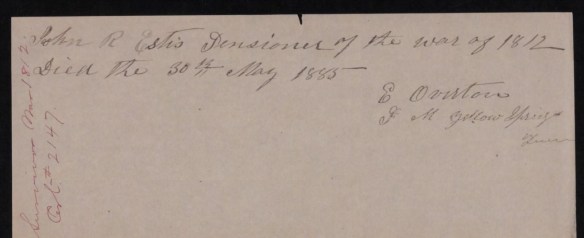
John R. Estes death 2

Yellow Springs is an area towards Hancock County from Estes Holler and it’s clearly more than 4 miles from Tazewell, so John moved once again between 1871 and 1885 when he passed away.

Now that we know when John R. died, and about his years in Claiborne County, let’s look back and see what we can discover about John’s life in Halifax County before moving to Claiborne.

We have discovered a lot about John R., but we still don’t know who his parents were.

Halifax County, Virginia

After my return from trips to Halifax County and Claiborne County, I ordered every microfilm available for either county and read them, page by page, at the Family History Center.

I made spreadsheets of what I found, because Halifax County was not only a popular place for Estes men to settle, but it was a popular “stopping off point” it seems, on the way west.  A few years there and then they were gone.

Complicating things further, there were several men named John.

The Tax Man Cometh

One of the most valuable tools turned out to be the two types of tax records.

One type of tax was taxes paid on land owned and the second type was paid on personal property.  That way, they could tax everyone on something and some people on both.  Personal property tax included tax on males over the age of 16 and items like cows and horses.  Some years they taxed people on far more, like clocks and curtains.  The sheriff took the list for each district and was responsible for collecting the taxes due.

Once you knew who the neighbors were in each location you could tell which John was which, for example, based on where they lived, which district, and their neighbors.

Now all the Estes men in Halifax County did not behave and stay put – they wandered around a bit – especially the young land-free ones.  I suspect they rented land or were laborers for others.  The men who owned land, of course, could be reliably found on both lists year after year in the same location, with their sons showing up as neighbors as they came of age and married.

John R. Estes never owned land.  Plus there were about a dozen John Estes’s.  Many were easy to eliminate, because they appeared on the tax list too early to be John R. Estes, or they were clearly associated with a specific family group, or had a middle name that didn’t begin with R.

Through this associative process, I eliminated all but 3 or 4 Johns.

Even more confounding was that the Estes families in Halifax County lived in the eastern half of the county, in and near South Boston and in the far northeast corner of the county.  On the other hand, the Moore family, William Moore, Nancy Moore’s father lived on the far western side of the county, almost to the Pittsylvania County line.

South Boston to Mount Vernon

This situation was very unusual and didn’t make sense, at least not at first.  Remember, you don’t marry who you don’t see, and in that time and place, you normally saw your neighbors, your family and the people who attended your church.  How did John R. Estes come to meet Nancy Ann Moore?

Hint – Ann’s father, William Moore, was a minister for a “dissenting religion,” according to the court records – those radical Methodists.  He married many members of John R. Estes’s mother’s family, according to marriage returns.  Of course, we didn’t figure this out until after we figured out who John’s mother was!

The 1810 tax list shows a John Estes where a John Estes never resided before, in the western part of the county, whose taxes were taken the same day as James Moore, who was exempt due to age.  James Moore was Ann Moore’s grandfather.  Perhaps John R. Estes was farming James Moore’s land for him or helping on his farm.  John was taxed for 1 white male and 1 horse.

But wait.  To add confusion, a second John Estes was also taxed in that district, and he was taxed the same day as William Moore, Nancy’s father, for 1 white male and 1 horse.  These tax lists were taken a month apart – so it’s possible but unlikely that the John Estes record was a duplicate.

From painstakingly recreating all of the Estes families over the previous decade, I know that there are four John’s of about the same age.  One is John, son of Abraham, one is John son of Bartlett who died in 1804, a third is John, son of Bartlett (son of Moses) and Rachel pounds and fourth, John, son of someone else.  But I wasn’t sure which John was ours and telling them apart was sometimes a challenge.

John, son of Abraham is easier to discern, generally, because he does not tend to live in the Estes cluster that includes Bartlett and other descendants of Moses Estes Jr, in South Boston.  His father, Abraham, lived in the northeast corner of the county.  Bartlett who died in 1804’s son was younger, born in 1793 or 1794, so he isn’t listed early.  He also lived in the north part of the county.  Bartlett and George Estes were brothers, sons of Moses Jr. and lived adjacent, on their father’s land, in what is now South Boston.

The 1811 tax list shows us one very, very important clue.  This is probably the most subtle clue I’ve ever received.  Do you see it?

Date Name White Slaves Horses Comments
Mar 4 Moses (2) 1 0 6
Mar 4 Josiah 1 0 0 Son of Moses
Apr 9 William 1 0 1 Son of Bartlett (son of Moses)
Apr 9 Marcus 1 0 1 Son of George
Apr 9 George 1 0 1 Son of Moses
Apr 9 John 1 0 0 Son of Abe or Bartlett?
Apr 10 John (SG) 1 0 0 Son of George
Mar 19 Bartlett (north) 1 0 0 Son of Moses
Mar 25 Bartlett (north) 2 1 6 Son of Bartlett, son of Moses?

SG – that’s it – that’s the clue.  In the vernacular of how Halifax County tax lists read, that means “son of George.”  Glory be.  That is our answer.  Our John R. Estes is the son of George.

The next year, 1812, cements that relationship.

We show John SD or SB.  SD makes no sense, because there is no D Estes male, but SB would be son of Bartlett.  Bartlett is George’s brother and they live adjacent in South Boston.  We show George with his other son Marcus.  The John with Marcus would be John (SG) because the other John is SD or SB, leaving John on the 27th unaccounted for and likely son of Abraham from the North.  John, son of Bartlett who died in 1804 is still too young to be shown on the tax lists individually.

Date Name White Slaves Horses Comments
Apr 4 Moses (2) 1 0 5
Apr 18 Josiah 1 0 2 Son of Moses
Apr 29 John (SD or perhaps SB) Son of Bartlett
Apr 27 John Son of Abe
May 5 George 1 0 2 Son of Moses
May 12 Marcus 1 0 0 Son of George
May 12 John (SG) 1 0 0 Son of George

In 1815, John is once again listed as (SG) and in 1816 and 1817, he is listed as John R. Estes instead of John (SG), but living in this same cluster.  Hallejuah!!!!!

These tax lists are one way that we know when John R. Estes actually left Halifax County.

Serving in the War of 1812

John R. Estes served in the War of 1812 while living in Halifax County, VA.  He was drafted for the period of three months.  What did he do while he was away in the War, serving in Grief Barksdale’s company?

According to the 1812 Virginia Historical site:

Capt Grief Barksdale’s Company of Riflemen from Charlotte County, VA during the period Sept. 1, 1814 until Dec. 1, 1814. His company was attached to LT Col William C. Greenhill’s 4th Regiment of Virginia Militia and sent to Camp Fairfield on the James River near Richmond. This regiment was made part of Brig General Joel Leftwich’s 2d Brigade and on October 12th it departed from nearby Fort Mimms and arrived at Camp Snowden, MD on Oct. 27, 1814., then it proceeded to Camp Crossroads near Elliot Mill’s, a few miles from Baltimore arriving there on November 9, 1814. They arrived too late to have any contact with the British and were discharged in late November 1814. Source: Butler’s ” A Guide to VA Militia Units in the War of 1812″, 2d edition dated 2011, pages 24,57,& 240.

On page 240, the author indicates that Lt Col William C. Greenhill’s 4th Regiment was a part of the 2nd Brigade commanded by Brig. General Joel Leftwich which was created on September 5, 1814 at Camp Fairfield located near the James River leading into Richmond. On October 5th it was ordered to march with General Breckenridge’s brigade to Washington, DC. On October 12th it left Camp Mims near Richmond and arrived at Camp Snowden, MD on October 27th. The brigade arrived at Ellicott Mills near Baltimore on November 9th and was discharged at the end of November. The Battle of Baltimore had taken place on September 13th and after their defeat the British had left the area. Colonel Greenhill’s regiment consisted of seven company sized units from the counties of Pittsylvania, Halifax and Charlotte.

The conditions, however, were punishing.  Rains that fall were unrelenting.  At one time, three fourths of the men were ill.

In a letter of September 18, Brig. Gen. Thomas Marsh Forman, commander of the First Brigade, Maryland Militia, wrote of “a most tremendous Northwester which is punishing our poor soldiers, most of whom are in very thin clothing.”

Thus, John R. Estes was not involved in any encounter with the enemy.  John R. was lucky.  He was in the right place at the right time and avoided warfare, even though he was probably waterlogged.  In years to follow, because he did serve, he would obtain two land grants and a pension for his service of $8 a month.  That pension probably made a big difference in his quality of life.

John’s son, Jechonias, was probably born while he was gone.

Courthouse Basement Finds

Another find in the basement of the Halifax County courthouse was the chancery records – and I don’t mean the index or minutes – I mean the actual case packets – tied neatly in bundles with little ribbons.  Chancery court is a court that focuses on solutions for civil actions as opposed to criminal prosecutions for breaking the law.  Today, divorces are held in chancery court since a solution as to the division of property, assets and debts needs to be found.

These old chancery records have been indexed and scanned and will soon be available at the State of Virginia archives site – so no need to sort through boxes in the basement anymore.  It’s a good thing too, because those case bundles which included all kinds of information had a habit of walking away – not to mention many were in bad shape.  Being 200 years old will do that to you!

A long and complex case in which Thomas Yates and his wife, Phoebe Combs Yates sues Joseph Farguson about the ownership of a slave styled “Halifax Co., Va. Chancery 1812-019, Yates vs Farguson and Combs” includes depositions by John R. Estes and also his father George Estes whose mother was Luremia Combs.

John Eastes says that some time since Dec. 25, 1811 he saw Joseph Farguson carry the negro boy Jess to Thomas Yates and told him he did not consider they had any right to him, but if they would pay him what they were owing him on account of said negro, he would give him up and they refused to do it.

Given under the hand and seal Nov. 27, 1812. Sarah Farguson signed with a mark, Thomas Douglas signed, Lemuel Moore with a mark, Joseph Denman with a mark, John R. Estes signed.

Agreeable to a court order dated June 15, 1813 we met at the dwelling house of Jacob Farguson decd and proceeded to take the depositions of Sarah Farguson, Thomas Douglas and John R. Estes.  All three of these depositions are the same as given earlier except there were two questions posed to John R. Estes:

Q: By the plaintiff who were they that refused to take the negro boy Jesse and pay up the money?

A: I saw Mrs. Phebe Yates and Mrs. Combs

Q: By the same did you not understand that Thomas Yates about that time was gone to Linchburg?

A: Some time before that I did

Q: How long was it before you carried the notice for to take deposition at Chalmers Store?

A: I don’t know.

This day John R. Estes came before me and made oath that he delivered a true copy of the within to Thomas Yates on the 19th (of July) given under my hand this July 23rd 1814. Charles Harris. There is a note in John R. Estes hand (in light pencil unfortunately) that says On the 19th of July 1814, I John R. Estes delivered a true copy of the within to Thomas Yates.

Another note dated Nov 27, 1814 that John R. Estes came before Joseph Sanford, a JP, and made oath that he delivered a true copy of the within notice in Thomas Yates house to Mrs. Combs and William Yates.

Yet another note dated July 19, 1814 that John R. Estes of lawful age personally appeared before William Bailey and made oath that he delivered on the 24th, 25th or 26th of November 1812 a copy of the within notice in the dwelling house of Thomas Yates with Mrs. Combs and Yates wife.

Deducing John R.’s Father

In summary, there were only 4 possible fathers for John R. Estes; Bartlett who died in 1804 and lived in the north, Abraham whose son John who married in 1808 and moved to Charlotte County, Bartlett who married Rachel Pounds or George who married Mary Younger.  There were no other men who don’t already have sons John attributed to them and accounted for, who lived in Halifax when John R. was born about 1787 and who remain in Halifax County until he reaches 21 in about 1809, so we have no other reasonable candidates.

Bartlett and Rachel had a son the same year or within a year of when John R was born, also named John.  However, one John is designated as SG, and one as SB or SD, so we now know that George did in fact have more children than just Susannah Y., including a John of exactly the right age.

Furthermore, John, son of Bartlett appears to still be living in Halifax in 1837 during Moses’ estate settlement, eliminating him as a possibility for our John.

Abraham’s son John lived in the north and goes back and forth between Halifax and Charlotte Counties.

I have never been able to find the John, son of Bartlett who died 1804.  However, he is too young regardless, having been born in 1793/1794.  Based on a subsequent lawsuit after Bartlett’s widow’s death in 1824, I believe that this John died, which would eliminate him from being our John.

George Estes who married Mary Younger and had a son John (designated as SG), was previously unknown, and is the most likely candidate for the father of our John R.  John R. named one of his sons George and one of his daughters Mary.  John R. also named one of his sons John Y.  George’s daughter Susannah was named Susannah Y. and his son was named William Y.  John R’s daughter Lucy had a daughter whose middle name was Younger.  Neither Bartlett’s name nor those of any of his children appear in John R’s family.  George Estes’s wife was Mary Younger.

Therefore, I concluded that John R. Estes’s parents were George Estes, son of Moses Estes Jr., and Mary Younger, daughter of Marcus Younger.

The final confirmation of John R’s parents came from a most unexpected set of records.

Mary Younger Estes’s parents were Susannah and Marcus Younger.  Marcus died in 1816, but in 1842, a chancery suit was filed having to do with the distribution of his estate after an unmarried daughter’s death.

I extracted data from the “Younger, Marcus Chancery Suit 1842-057, Halifax Co. Va.” and in the documents from that suit, I found the payments made to the various heirs of Marcus Younger.  In the case of John Estes, he was listed as an heir because his mother was deceased.  John was listed as married to Nancy and as living in Tennessee.

It is noted that Mary Younger Estes’s children will receive one sixth of her one quarter share of the 83 acres to be sold following the death of Mary’s unmarried sister.

The children of Mary Estes were listed as: John Estes, William, Susannah, Sally wife of T. Estes, Polly wife of James Smith and a grandchild name Mark Estes.  So, not only do we have John’s name, we have the entire list of his siblings.

This was followed by another document listing the locations of the heirs, including:

Younger Wyatt and Polly his wife – Rutherford County Tennessee

John Estes and Nancy his wife – “ditto marks” under Rutherford County.  John was actually in Claiborne at this time and there was no John Estes in the 1840 census in Rutherford County.  John’s wife was Nancy (Ann) Moore.  None of the other John’s married Nancys or Anns.

This was an EXTREMELY long way around the block to discover the identity of the parents of John R. Estes – and it’s nothing short of a miracle that I did actually find the information scattered in extremely obtuse locations – like a genealogy version of a scavenger hunt.  There were many times I just wanted to give up and asked myself if it was really, REALLY that important.

The night I made the discovery of “SG” on the tax list, I knew in that instant who John’s father was.  I was in the Family History Center and they were closing for the evening.  I was excited, very excited – decades of searching Happy Dance excited.  The librarian virtually patted me on the head and told me to go home.

I was far too excited to just do that.  I lived half an hour away so by the time I got home, it was getting late.

I decided to call Garmon, regardless of how late it was.  After all, he had been searching for the answer for 45 years, which made my 20 or so look puny.

Garmon answered the phone groggily, “hhh….hello.”

“Wake up.”

“Who is this?”

“Your cousin, Bobbi.”

“Bobbi?”

“Yes Bobbi.  I know who John R. Estes’s parents were.”

Very alert now….”You DO???”

“Yes, do you want to know?”

“Do I want to know?  I’d stand in the corner on my head and clap my hands to know.”

“George – it was George Estes…and Mary Younger.”

“Well, I’ll be.”

As I looked out my kitchen window at the peaceful moon that night rising over the trees and happily visited with Garmon, my long time research buddy and cousin, telling him the story of “SG,” I had no idea of the landmines that would lurk in the future, threatening to derail our discovery.

The DNA Landmine

When I first visited Halifax County, DNA testing for genealogy didn’t yet exist.

When I first visited Halifax County, Virginia, after the advent of DNA testing, autosomal testing didn’t yet exist and we were happily testing for 12 and then 25 Y DNA markers.

In the Estes DNA project, we had several descendants of the immigrant, Abraham Estes who had tested, but so far, no one proven from his son, Moses’s line.

Garmon, of course, was the very first Estes to test, but we didn’t know which line we descended from.  We were just pleased that we matched up to Abraham’s Y DNA genetic profile.

Abraham, the immigrant had a son, Moses, who settled in Halifax County, VA, who had a son Moses Jr., who remained in Halifax County and had several sons as well.  Moses Jr.’s son, George served in the Revolutionary War and we would eventually discover that he was the father of John R. Estes, my ancestor.  George also had three other sons.  These several generations of men made up the pool of many of the Estes families in the southern part of Halifax County.

I was fortunate to be able to meet one elderly Estes gentleman, we’ll call Beau, and spent several hours on multiple days listening to his stories about his life and ancestors, including “Granpappy George” who died at either 105 or 116, depending on which version of the story you liked and which day he was telling it.

His cousin, a female, Pat, was also very involved in genealogy and she joined us as well.  We drank iced tea and sat in the shade under trees so old they probably had stories about our ancestors themselves, had they been able to talk.  Glorious summer days in the south.

I had discovered the location of the old family land and Pat knew the story of why and where the graves had been moved.  There was no resting in peace in this family.

Beau and Pat’s line of the family descends from George, the Revolutionary War soldier, through his daughter Susannah Y. Estes who reportedly married her cousin, also an Estes, some say Tom Estes, which is why her surname remained Estes.  She lived among the rest of the Estes clan on Estes land owned originally by Moses Jr., father of George.  Susannah’s son, Ezekiel, from whom Beau descends, is shown below in what I believe is a death photo, taken in 1885.

Ezekiel Estes

Ezekiel bears a striking resemblance to his uncle, John R. Estes.

This Estes line descends to Beau and Beau was quite eager to take a DNA test to represent our George Estes line.  As a responsible genetic genealogist, I of course had a DNA kit handy, and Beau happily swabbed as I timed the event.  I brought his kit home and mailed it to Family Tree DNA.

A few weeks later, I received a message that Beau’s DNA results were available, but as a project administrator, I didn’t receive the notification that the other kits in the project had matches.  I remember thinking, “that’s odd.”

I signed in to see Beau’s results, and what awaited me was every genealogists nightmare.  The George Estes line, represented by Beau, did not match the ancestral Abraham Estes line.  And yes, to answer the next question, we had tests from several descendant lines from Abraham, so we know positively what his DNA looked like – and it looked nothing at all like Beau’s.

no match

I was sick, just sick.  It took me a day or two to process this information.  Truthfully, I was in shock and it threw a terrible monkey wrench into genealogy?

Should I stop researching my Estes genealogy since we were obviously not Esteses in the original sense of the word?  Was Moses Sr. not Abraham’s son?  Was Moses Jr. not Moses Sr.’s son?  Was George not Moses Jr’s son?  Who didn’t begat whom?  And under what circumstances?  How come Garmon matches the Abraham ancestral line, but Beau didn’t?  Was I in the wrong damned county barking up the wrong tree…..AGAIN????

And then that little voice started talking to me……was Susannah Y. Estes ever really married to her Estes cousin?

I had to know.

If Susannah was not married to an Estes cousin when she had son Ezekiel, from whom Beau descends, then the DNA wouldn’t be Estes, but the surname would be, given that the child took her surname.

But the family was sure, absolutely positive.  I called Pat and talked to her about this without saying too much, and she was very indignant that Susannah absolutely had been married to her cousin and that George, Susannah’s father, “would not have put up with any other kind of behavior.”

I could tell that another trip to Halifax County was in the offing.  I needed more records and I needed to concentrate on Susannah, someone I hadn’t necessarily neglected, but who I certainly wasn’t focused on.

On my return trip, the first place I went was the courthouse, to find Susannah’s marriage record.  Some of the Halifax records are either very thin or missing altogether.  For example, there were virtually no marriage records during the Revolutionary War.  Now you know people were still getting married, but since they didn’t know who was going to win the war, they weren’t paying any money to have anything registered – or the records have disappeared, all but 2 or 3 of them.  It’s this type of information you can’t glean from just finding your own ancestor’s records, because you have no idea if they are the only person in the marriage records for the year or just one of several thousand.  Context can make a big difference in how you interpret a missing record.

Susannah was born about 1800 and her first child, the son in question, Ezekiel, was born about 1814.  That is awfully, awfully young and there was no marriage record.  In fact, this is so young it smacks of a nonconsensual relationship of some sort.

Susannah’s next children were born in 1818, 1825, 1828 and 1835.  Three were females and one additional male, Marcus, who died between 1850 and 1860. In Susannah’s estate after her death in 1870, she said and her heirs say she had no idea where Marcus’s wife and children are or were and that she did not hear from them after they left the area years before.  She didn’t know if she had grandchildren through Marcus or not, but she had provided for them if she did.  How sad for Susannah.  She had no idea she had outlived her son by 10-20 years.

However, since there was no marriage record for Susannah, I was dead in the water at this point, with no proof of anything and DNA that didn’t match what it was supposed to match.  I felt like a fish flopping out of water, gasping, with no help in sight.

One of the things I learned a long time ago about genealogy is that the more work you do, the better the chance of opportune accidents happening. In other words, sometimes fate takes pity on you – or maybe it’s just your turn.

When I extract records for a particular surname, I extract all of the records of the relevant timeframe and often beyond.  I worry about putting them together later….and yes…I’m fully aware that I waste a lot of time doing work that turns out to be irrelevant.  But sometimes, it’s not entirely irrelevant and there may be tidbits that are extremely important….later.

Like the marriage records of Susannah’s children, for example.

Her eldest son, Ezekiel Estes married Martha Barley on December 10, 1854.

The clerk’s office had the actual minister’s return and it was chocked full of information, including that both Ezekiel and Martha were illegitimate, and both of their fathers’ were unknown, or at least not named, and that they married at the home of the bride’s mother.

Ezekiel Estes marriage

Oh.  Illegitimate…no father’s name.  Nonmatching DNA.  Hmmmmm….

Let’s look at Susannah’s other children who married in Halifax County.  Another child’s entry says that the father is unknown and a third simply has a line drawn through the father’s name space.  Another child married out of the county, but I had what I needed.

Finally, after Susannah’s death when Ezekiel was trying to settle her estate, depositions were taken regarding the division of her estate and in particular, the validity of some debts.

In this testimony, from various people, it is verified that Susannah never married and that she conducted all of her own business – in other words, there was never a male partner in her life.

Through the sources we would normally use to verify a marriage, we come up empty handed – but lack of evidence does not constitute proof that she never married.  Absence of evidence is not necessarily evidence of absence.   Susannah could have married in an adjacent county.  However, the fact that her children’s marriage licenses all reflect an unknown father and an illegitimate legal status sheds light on Susannah’s marital status, as do the depositions after her death.  And Susannah’s surname never changed.  She was born an Estes and died an Estes too.

So, Pat was wrong, but not entirely wrong – because if you look back at the chancery suit distributing the assets of Mary Younger Estes, John R.’s sister, Sally, did marry a T. Estes.  So the family had taken the information that one of George’s daughter’s married an Estes cousin and attached that information, opportunistically, to Susannah.  It made sense, and given that both of the women’s names began with S, it would have been easy to genuinely confuse the daughters, especially a generation or two later.

George indeed did tolerate Susannah having illegitimate children, 5 of them apparently, and he supported her through the process, eventually signing his Revolutionary War bounty lands over to her as well as his assets in Halifax County.  I’m sure he knew all too well that she needed the help.  After the death of George’s wife, between 1830 and 1842, Susannah likely took care of George until he died in 1859.  In fact, it was her son, Ezekiel that reported George’s death.  So George stood by Susannah and Susannah took care of George.

So, back to the DNA.  Based on Ezekiel’s marriage license, we know that his mother, Susannah was not married at the time of his birth.  We also know, from the DNA itself that she did not get pregnant by an Estes male.

The DNA of George’s line has since been confirmed by other Estes male descendants.

When I did eventually explain this to Beau, he wasn’t very happy, but I explained to him that his line can be proud to establish a new Estes DNA line and what a strong woman Susannah had been.  However, when I explained that he is still related to Granpappy George, through Susannah, just like he always was, and he carries Granpappy’s George’s surname, he was much MUCH happier.  He didn’t really care about the DNA, but he surely cared a lot about being related to Granpappy George.

Out of all of this, I have to look at Susannah through a different lens.  Yes, I do wonder why.  Why did she get pregnant so young and why did she never marry?  Why did she continue to have illegitimate children?  But I also have grown to have an admiration for Susannah, knowing how difficult it would have been in that time and place to hold your head upright in spite of everyone and the hateful and derogatory things that were assuredly said about you behind your back and in front of your face.  She must have been quite a spunky lady.  She raised her children, took loans, bought property and pretty much acted like any man of that day.  She was assuredly a woman born before her time.

But as for that pesky DNA issue – this type of situation is exactly why it’s so very important to test more than one male line from each ancestor.  You just never know if one line really represents that ancestor otherwise – unless they match a descendant of someone further upstream or a descendant of another son.

This also illustrates why it’s important to verify information provided.  I’m sure at some point that a conversation about Susannah went like this:

“Why did Susannah still have the Estes surname after having 5 children?”  and the answer went something like this:

“She must have been married to her Estes cousin.  Grandpappy George’s daughter married her Estes cousin, you know.”

That not entirely untrue answer probably took on a life of its own and became Susannah’s family truth.

I’m glad this wasn’t the first Estes DNA participant test or we could have been led badly astray.  I’m also glad that we were able to find additional descendants of George to test for DNA validation.

Over the years, I’ve become quite the skeptic about the “full truth” of both family stories and single DNA tests for any line and now I need proof of everything!  I’m not saying I think people intentionally tell untruths, I think it’s generally more like that childhood game of telephone where you whisper a phrase like, “Beau has brown shoes,” in your neighbor’s ear and 15 whispers later to 15 other people, the end result is something like, “Bows are brown mushrooms.”

I’m sorry I wasted the time in Fairfax County, but even the frustration in Halifax County caused by the Beau’s unexpected DNA results wasn’t a waste.  Indeed, it caused me to dig deeper, and even though I was searching for information about Susannah at that point, and not John R. Estes, I found more and more about the entire family that provided perspective and understanding of their life and times – including that all-important chancery suit naming Mary Younger Estes’s heirs.

It was just a jig in the road and not a dead end after all, but it certainly seemed like a disaster at the time.

???????????????????????????????

______________________________________________________________

Disclosure

I receive a small contribution when you click on some of the links to vendors in my articles. This does NOT increase the price you pay but helps me to keep the lights on and this informational blog free for everyone. Please click on the links in the articles or to the vendors below if you are purchasing products or DNA testing.

Thank you so much.

DNA Purchases and Free Transfers

Genealogy Services

Genealogy Research