What the Heck is WTY?

Update: The WTY has been superceded by the Big Y test, but I’m leaving this article for historical continuity.

What the heck is WTY….and why do I care?

One of the reasons I started a blog is to continue what I do for my clients when I write their DNA reports. I make DNA understandable and fun for the normal air-breathing genealogist.

The past few days has been a whirlwind of information and announcements, some which tend to leave folks who don’t have a lot of experience in the dust.

For that, I do apologize.  However, I’d like to tackle a much easier topic now, and that’s the WTY test.  What is it and why is it so important?

WTY is short for Walk the Y, as in walk down the Y chromosome.

The tests we all order and love, at Family Tree DNA, that would be the 12, 25, 37, 67 and 111 marker tests, tell us about genealogy – who we are related to in the past several hundred years.

Deeper ancestry, anthropological in nature, a line I draw about the time when surnames were being adopted, is different and little information of that nature is exposed by the STR (short tandem repeat) genealogy markers.

By the way, short tandem repeat means those locations in our DNA that are prone to develop repeated sequences.  Think of them as genetic stutters.  They are important to us as genealogists, because on the Y chromosome, we count the number of those stutters and that is the marker value reported.

For example, below, we see that for marker 393, we have a value of 13.  That means there were 13 repeats of the same sequence.  Obviously, combining all of these sequences, or marker values, together creates our own genealogical genetic profile or fingerprint.  This, of course, is what we use to compare to others to see whom we match.

However, deep ancestry, identified by our haplogroup, is determined by a different kind of mutation, called a SNP, a single nucleotide polymorphism.

These are mutations that happen in only one location, and they are considered to be once in the lifetime of man mutations.  In actuality, these mutations sometimes happen independently in different haplogroups, but the cumulative sequence of SNP mutations defines our haplogroup.

You can see, for example, below, a haplotree from a Family Tree DNA client’s results page.
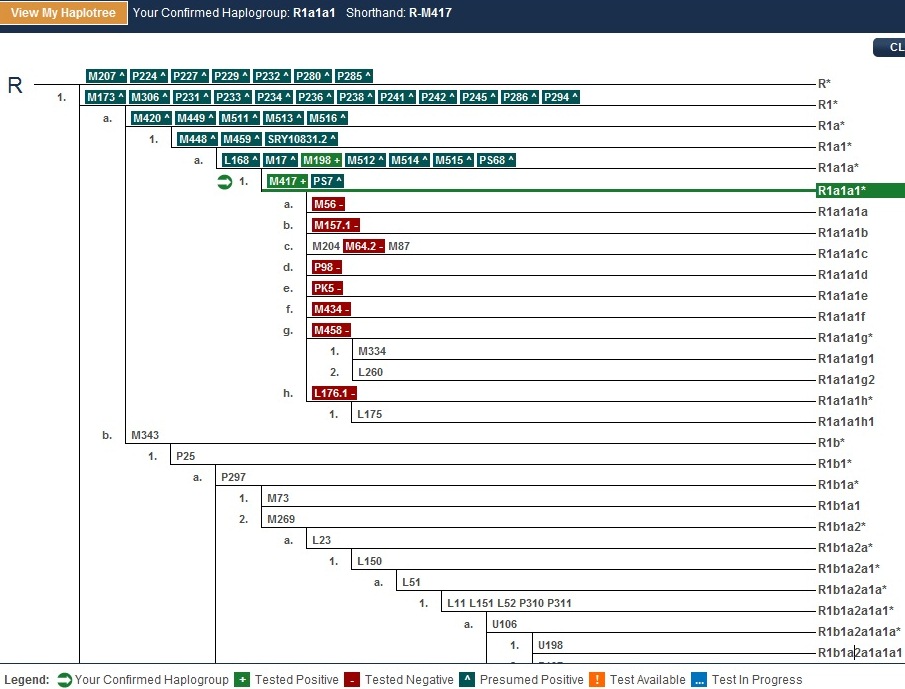
This person tested positive for the light green SNP, M417.  The plus means that they have this specific mutation.  In his case, this is his terminal SNP, meaning the one furthest down the tree that defines his haplogroup, as we know it today.  That would be R1a1a1.

The SNPs shown in red, below M417 are ones that he has also been tested for, but does not have, so he knows he is not a member of those haplogroups.  These are shown with a minus sign, such as M56-.

Now for the problem that WTY has been helping to solve.

If your STR markers take you back about 500 years, in round numbers, and your haplogroup tells you where your ancestors were between 3000 and 4500 years ago, in this case, where were they in-between?  What were they doing?  Where did they live and how did they get from where they were 4500 years ago to where you find them 300 or 400 years ago, if you’re a lucky genealogist and can go back that far?

There is a significant gap in the timeframe between STR genealogy markers and haplogroup SNP markers.  Finding additional SNPs will eventually close the gap between STR genealogy markers and haplogroups.  We will have a complete timeline of our ancestors.  In some cases, we’re even finding family-specific SNPs, known as “personal SNPs.”  How cool is that?  A new haplogroup is born in your family!

Did you notice on the tree above that some of the SNP markers begin with L?  Every SNP discovered is prefaced with a letter that tells people which lab or university discovered the SNP.  The L SNPs have all been discovered at Family Tree DNA’s Genomics Lab in Houston, Texas, run by Thomas Krahn.  They are the product of the WTY discovery process.

When there is reason to believe that a SNP might be lurking undiscovered in the DNA of a person or a group, then the WTY becomes an option.  Generally, the clue would be STR markers that are significantly different than any previously seen, or part of a small and quite unusual cluster.

Today, we test all of the known downstream SNPS, the ones in red above, and then if none are found, we would apply to Family Tree DNA to do a WTY test.  This test is quite labor intensive.  In essence, they manually look at between 450,000 and 500,000 positions to see if they spy any new mutations.

If they do, they begin the SNP naming process and the process of getting the SNP officially added onto the tree.  You can see the most current haplotree (Y SNP tree) at the ISOGG site.  Because of the long naming and authentication process, sometimes trees at different locations aren’t quite in sync.  The ISOGG tree, maintained by volunteer genetic genealogists, has become what most people look to and use as the gold standard today.

In any case, this process is how new SNPs are discovered.  The Geno 2.0 project includes 12,000 SNPs for the Y chromosome, an exponential growth from the current 862, or so.  At least some of these SNPs were discovered at Family Tree DNA, as a result of savvy project administrators and others who are familiar enough with DNA results to suspect that a new SNP might exist, and who advocated with the tester and Family Tree DNA for WTY testing.

Hopefully, you now understand better about the WTY and why WTY tests are so critically important.

How might you know if you or a family member is a good candidate?

If you have tested to 67 or more markers and have no matches, you may be a candidate.  You would need to do a deep clade test, which tests all relevant downstream SNPS at this point.  In the past this has been the Deep Clade test, but today it would be the Geno 2.0 test.  If you think you might be a candidate, you’ll want to work with your haplogroup administrator to see if there are any experimental SNPS to test for after the deep clade/Geno 2.0 is completed.

The WTY is the perfect example of collaborative citizen science.  Participants fund part of the testing, haplogroup administrators identify good candidates, Family Tree DNA underwrites part of the testing fee and of course performs the test, and everyone benefits.  Before you know it, you’ve got 12,000 new SNPs combined with new technology that promises to do more than we’ve ever dared dream before!!!

______________________________________________________________

Disclosure

I receive a small contribution when you click on some of the links to vendors in my articles. This does NOT increase the price you pay but helps me to keep the lights on and this informational blog free for everyone. Please click on the links in the articles or to the vendors below if you are purchasing products or DNA testing.

Thank you so much.

DNA Purchases and Free Transfers

Genealogy Services

Genealogy Research

Citizen Science

My husband, Jim, who is kind of a geeky guy in the best of ways and really is interested in genetic genealogy from a technologist’s perspective, asked me a question about the new mitochondrial comparative sequence, the RSRS (Reconstructed Sapiens Reference Sequence).  We’ve been talking about it on the blog and on the various DNA lists for days now.  So it stands to reason we’re talking about it at the dinner table too.

He asked, “Why now?  Why not before when the transition would have been easier?”  That’s a great question!  The answer isn’t nearly as short as the question.  I hate it when he does this to me!

The answer is Citizen Science – that means you and me – lots of us actually.  How is that possible?  Let’s take a look at some history.  It’s actually quite interesting!

In 1981 when the Cambridge Reference Sequence was published as a comparative model, the science of genetics was functionally brand new.  This anonymous person at Cambridge University was the first person to have all 16569 bases of their mitochondria sequenced, something anyone can have today for a couple of hundred dollars.  But back then in the not so distant past, it was groundbreaking.  The Y DNA hadn’t even been mapped yet, so this was the very beginning.  At that point in time, there was no concept of mitochondrial Eve or Y-line Adam.  So the CRS became the norm because we had no other basis for comparison.

In 1999, the CRS was resequenced, and surprisingly, 11 errors were found in the original sequence.  Today that is called the Revised Cambridge Reference Sequence, or rCRS, technically, and that is the sequence that is used for both academia and genetic genealogy.  Most people just refer to it as the Cambridge Reference Sequence because no one would use the older sequence today.

1999 was also the first year that any commercially available genetic genealogy tests were available to the public.  They were available from Oxford Ancestors and were prohibitively expensive, but that didn’t stop many of us from ordering one.  If you bought the book, “Seven Daughters of Eve” you could send in the form in the back of the book, with a hefty check, and you too could discover which of the 7 daughters you descended from.

What you received was one piece of paper in the mail, months later, with a gold attendance star (like from Sunday School when you were a kid) placed on your haplogroup name.  So for several hundred dollars, significantly more than a full sequence test today, I got a gold star on a J.  I still have that certificate and I was unbelievably excited to know I was a member of Jasmine’s clan.  Of course, in order to justify my DNA test, I had to test my husband’s too, so it cost me twice as much!

In the year 2000, Family Tree DNA opened their doors and began selling genetic genealogy testing kits. They also began surname projects.  I don’t know if that was a stroke of genius or a stroke of luck.  Soon thereafter, they added both haplogroup projects and geographic projects.  These various project types allowed people with specific interests to focus on those areas of genetic genealogy.  Little did we know that projects would eventually provide a huge pool of people who have been DNA tested for research areas, such as determining new haplogroups.  In the past all sequencing had been done at academic institutions and often did not use full sequences initially due to the prohibitive cost.  Many of the early academic papers were written with far fewer samples than today’s projects have members.  Full sequence commercial testing has fostered exponential change in this industry.

By 2006, Family Tree DNA was offering the full mitochondrial sequence for genealogists, something still not offered today by any of the other major commercial testing companies.  This not only enabled genealogists to determine who was actually a close match, but it also enabled the haplogroup projects to collect many samples of full sequence data.  The coding region (meaning not the HVR1, HVR2 and HVR3 regions) is not shown in the public projects because of the possibility that they may carry medical information, but they are available for project administrators to see, if the individual participant authorizes administrator view access.

Haplogroups aren’t just determined by the hypervariable (HVR) regions, but by mutations found in the entire mitochondrial sequence, including the coding region.  Never before had groupings of participants this size been available outside of academia, and often, not even within academia.

Many of the project administrators began discovering new haplogroups in a flurry of activity.  Two that come immediately to mind are both Jim Logan and Bill Hurst.  Bill began publishing about haplogroup K in the Fall 2007 JoGG issue, as did Ian Logan with a discussion of what the mitochondrial DNA of “mitochondrial Eve” might look like.  In Spring of 2008, Jim Logan published a groundbreaking paper for haplogroup J, still in use today.  Indeed, citizen science came into its own in the spring of 2005 when the Journal of Genetic Genealogy (JoGG) was launched to facilitate exactly this type of academic publishing effort.  The more traditional publications weren’t quite ready to deal with citizen scientists making discoveries.  Clearly, citizen scientists didn’t fit well into the academic publishing “box.”

Bill Hurst has been collaborating with Dr. Doron Behar for several years now and is recognized in his most recent paper.  They presented a joint session at the 5th International Conference on Genetic Genealogy for DNA Administrators in Houston, Texas in March of 2009.

During this time, Family Tree DNA implemented an authorization system for people to make their full sequence DNA results, if they wanted, available to Dr. Behar for research.

Dr. Behar’s paper (along with several other authors), “A “Copernican” Reassessment of the Human Mitochondrial DNA Tree from its Root” was published earlier this year, defining the RSRS (Reconstructed Sapiens Reference Sequence) revealing the genetic fingerprint of Mitochondrial Eve, the original mother of us all.  He was able to do this, in part, as a result of the many full sequence test results made available by Family Tree DNA customers, you and me, and by the hard work of haplogroup administrators like Bill Hurst and Jim Logan.  Of course, there are many other hard-working administrators too, and I don’t mean to slight anyone.

So, this is a long-winded way to answer Jim’s question, which, in case you’ve forgotten, was “why now for the RSRS and why not before?”  The answer is quite simply, Citizen Scientists were needed.  People like you and me.  Until the stars aligned where haplogroup projects existed, full sequence mitochondrial data became affordable and widely available, and there was a way for genealogists to contribute their results for scientific research, it couldn’t have been done – at least not yet.  It’s been a long way from the gold star on haplogroup J to the beautifully elegant RSRS, the mitochondrial map of Eve, the common ancestor of everyone living today – the entire trip made in just a dozen years.  Congratulations and thank you to everyone involved.  Indeed, it’s really quite a remarkable story!

______________________________________________________________

Disclosure

I receive a small contribution when you click on some of the links to vendors in my articles. This does NOT increase the price you pay but helps me to keep the lights on and this informational blog free for everyone. Please click on the links in the articles or to the vendors below if you are purchasing products or DNA testing.

Thank you so much.

DNA Purchases and Free Transfers

Genealogy Services

Genealogy Research