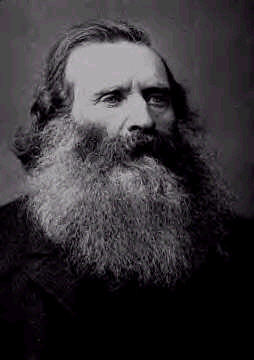
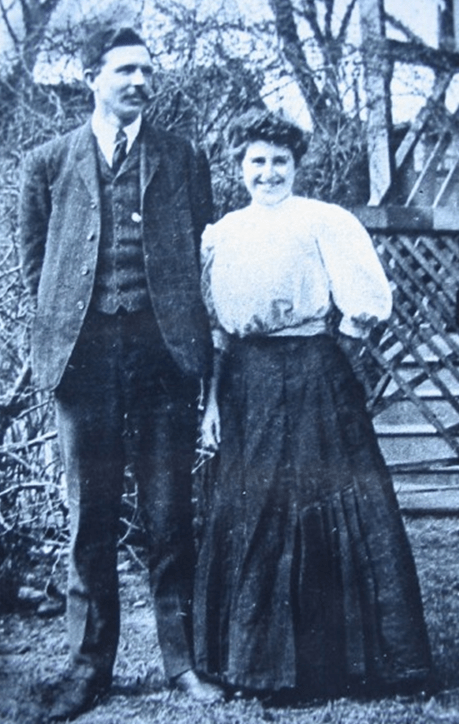
Curtis Benjamin Lore (1856-1909), Devilishly Handsome Rogue, 52 Ancestors #113

Will the real Curtis Benjamin Lore please stand up?????

How I wish it were that simple. What his story lacks in simplicity, it more than makes up for in mystery – some of which we’ve never unraveled, and never will.

Curtis Benjamin, known as C.B. Lore, was the dark and dreamy mystery man, the elusive, unavailable, field hardened, working man….the kind of man that attracts women like moths to the flame. C.B. was a survivor, an entrepreneur, successful, adaptable, an expert in his field and respected – so one side of the story goes.

The other side suggests he was a fast talker, the slippery sort, not reliable and not truthful about his past, or present – in essence, a rogue.

One thing is for sure. He survived one way or another on his own, from the time he was a child, for 20 years by the time he met Nora Kirsch, the young woman who would become his wife…well, one of them anyway.

C.B. was very probably a ladies man. And Nora was young, very beautiful and living right there at the Kirsch House.  The attraction between them was probably magnetic.

Nora’s heart likely skipped a beat at the end of each day as the men from the oilfields would knock off work and come in to the bar for a beer, some food and in his case, probably a room as well. C.B. probably lived at the Kirsch House while he worked in the area.  After discovering Nora, I’m positive that he did. He probably spent evenings in the parlor, or helping out to be with Nora.  And when the chill of autumn set in in 1887, he put his arms around Nora to keep her warm.

Kirsch house 1990s

In 1990, 103 years later, his granddaughter, and great-great-granddaughter stand by that very bar that C.B. Lore frequented in the Kirsch House.  Can you see him, there beside them, leaning on the bar, smoking a fine cigar?

C.B. Lore was a manly man, a hearty outdoorsman who worked in the rough oil and gas fields. The census in Indiana says he was born in 1860 or 1861, but the 1860 census in Warren County, Pennsylvania shows us that he was born in 1856.

In 1887 when he came to Indiana from Pennsylvania, he was 31 years old, a roughneck, strong, worldly and extremely handsome.  Did I mention that he was handsome???

Nora Kirsch was 21 and had little experience with men.  It’s no wonder that he subtracted a few years from his age, reducing the 10 year divide between their ages to a less questionable 5 years.  I don’t know whether Nora ever knew the truth or not, but C.B.’s redesigned birth year stayed with him for the duration of his life, in the census and on his tombstone.

What was C.B. Lore, born in Pennsylvania, doing at the Kirsch House in Aurora, Indiana? Well, it’s a long story.  Get a cup of coffee or tea and some chocolate, a I’ll tell you the story of our mystery man.  Yea, you’re going to need chocolate for this one!  In fact, just bring the whole box!  That’s what my mother did when she found out…ate chocolate.  To quote her, “What else is there to do?”  Yep, you’re gonna need lots of chocolate!

Born in Pennsylvania

Curtis Benjamin Lore was born on April 17, 1856 in Blue Eye, Warren County, Pennsylvania to Antoine “Anthony” Lore and Rachel Levina Hill. Anthony and Rachel had moved to this area from New York a decade or so before.

Blue Eye is a remote area, fairly heavily forested and mountainous. There really isn’t a town of Blue Eye, it’s an “area” on or off of Blue Eye Road which intersects with the small town of Spring Creek, PA.  Only the locals call it “Blue Eye,” and no one knows how it got its name.

Blue Eye PA

This photo contributed by Betty Rhodes shows Spring Creek in 1903.

Spring Creek PA 1903

The area probably didn’t look a lot different when C. B. Lore lived there.

1870 census Warren co

Looking at the 1870 census, we discover a couple of very interesting items. Two things, actually.

First, much to my surprise, Curtis is hired out as a farm hand.  At age 14.  Where was his family?

The second surprise is that Curtis is not age 9, born in 1861, as was reflected in his documentation in Indiana, but age 14, born in 1856. So he wasn’t born in 1861 as the family said?  Well, maybe.  Let’s take a look at the 1860 census and see what we find there.

1860 census Warren Co

Sure enough, the 1860 census for Spring Creek Township in Warren County, PA shows Curtis with his parents, age 4. That pretty well cinches the 1856 birth year.

But where is the rest of his family in 1870?

Curtis’s mother is living with the Farnham family. His sister Margaret, age 12, who would have been listed as Marilla in 1860, is living with that family as well, but otherwise, none of the family is to be found in Warren County.  Based on Curtis’s father’s application for citizenship, we know that he applied in 1862 and never returned to claim his citizenship in 1868, so he died sometime between those dates.

Maria Lore, Curtis’s oldest sister married Elisha Stephen Farnham in 1862, but she is missing in 1860. Most of the older children had either married, moved away, or died.  The 1860s was an utterly brutal decade for this family, aside from the Civil War.

Have a piece of chocolate.

Aunt Eloise’s Stories

Nora Kirsch and C.B. Lore would marry in 1888 and have 4 girls, Edith (1888), Curtis (1891), Mildred (1899) and Eloise (1903). Edith Barbara Lore was my grandmother and she died in 1960 when I was a child.

However, I remember Aunt Eloise well. She was 15 years younger than my grandmother.  After my grandmother died, Eloise, who had no children of her own, “took over” the role of grandmother, as best she could.  Mother was close to Eloise and even though Eloise lived in Lockport, New York and we lived in Indiana, we visited with her as often as we could.  I remember how thrilled Mother would be when letters from Eloise arrived!

Eloise worked for a company that produced plastics and every Christmas we would receive a wonderful “Santa” box filled with gifts and plastic items that were slightly flawed, just enough that they weren’t saleable. That was before the days of outlet stores.  For us, it was like winning the lottery.  How we looked forward to those boxes and carefully rationed the contents, trying not to use them up too fast.  Eloise always included a box of chocolate too.

It would be Eloise who would provide the clues to begin the process of unlocking the secrets of C.B. Lore. According to the other daughters, Eloise was his favorite.  She was also the baby of the family.  Eloise and her sister Mildred would accompany C.B. in his buggy as he made his rounds, checking on his projects and horses, and the girls would listen to his stories.

Buggy ride

Eloise was only 6 years old when C.B. Lore died of tuberculosis, which must have been devastating for both of them. Perhaps because of his illness which incapacitated him, then killed him, he may have talked more and shared more with her and the other girls when he was bedfast than he would otherwise have done.

Eloise provided quite a bit of verbal history.

She told us that C.B. had a brother they called “Uncle Lawn” (my spelling, not hers, she told me verbally) but that she didn’t know his real name. Eloise tells the story about when “Uncle Lawn” visited in Rushville when Edith and Curtis were young.  Those two sisters were quite the mischief makers and were best friends.

Eloise said, “Edith and Curtis, always devils, put a pin in the horsehair sofa so he would sit on it.”  He did. The mischievous girls of course though this was hilariously funny.  “Uncle Lawn” was enraged and told C.B. Lore that his girls were awful and stormed out, never to return.  That event had to have happened between about 1895 and 1903, given that Curtis was born in 1891 and Eloise said that event occurred before she was born in 1903.  C.B. Lore doted on his daughters and I doubt he cared what “Uncle Lawn” thought.

Eloise said C.B.’s parents’ names were Benjamin (later proved to be Anthony) and Alvira or Alvina (later proved to be Rachel Levina), and that they both had immigrated when they were 5 or 6 and that “the first Kaiser Wilhelm had signed their immigration papers.”

The first Kaiser Wilhelm reigned from 1861-1888 in Germany and Curtis Benjamin Lore was born in Pennsylvania in 1856, so this made no sense, but then, Eloise didn’t feel the need to question what she had been told.  Later research proved this to be incorrect, but one has to wonder at the genesis of the story.  Was Eloise confused, was this a different family line, or did C.B. make it up to cover some uncomfortable or sinister truth?  It seems a very odd and detailed fact to be simply “created.”

Eloise wasn’t as quick to talk about the darker story of C.B.’s father’s death, but eventually she relented. Remember, she didn’t even know C.B.’s father by his correct name.

C.B.’s father, Anthony aka Benjamin, it seems, was an “Indian Trader” on the Allegheny river and drown. After discussing this for a while, Eloise confessed that C.B.’s father was really a “river pirate.”  I was quite shocked to have a pirate in the family and questioned the existence of pirates on rivers within the US.  Unfortunately, Eloise had or gave no details, but I would find information later to flesh out this story and would discover that yes, there were in fact river pirates on the Allegheny River in that timeframe.  Who knew?

Those river pirates weren’t pirates in the traditional sense, but were bootleggers and traders – not really a “profession” one could be proud of, at least not in this context.  They flew under the radar, as tavern keepers had to be licensed to sell liquor.  So the “traders” provided their illicit wares to rafts and the bored men on those rafts traveling the Allegheny by rowing from the sides of the river, hidden in the alcoves, out to meet the rafts as they drifted downriver.  However, it’s possible that Anthony began by being a “voyageur” in Canada, one who traded with the Indians. He may simply have transported his known occupation to a new location and slightly different circumstances.

Have another piece of chocolate.

Voyageur

However, Anthony’s story becomes more sinister, because he drowned and as Eloise talked more, and began speaking in hushed tones, I discovered that Anthony was perhaps murdered. Now, this wasn’t a murder where the family was righteously indignant, but one that seemed to carry some unspoken shame.

I guess engendering sympathy for a pirate’s demise, especially if he was “pirating” at the time of his death, was probably somewhat more difficult than for the local minister’s death.

For me, this new pirate edition was an absolutely enthralling story and I longed desperately to know more.  I’ve discovered over the years that how “good” and juicy a story turns out to be is approximately equivalent to the effort someone expends to hide the truth!  Even C.B. Lore, with his own rather checkered past didn’t want to tell the truth about his father and even went so far as to mis-state his parents’ names.  So, this story must have been a doosey!

Eventually we would find three additional lines of Anthony Lore’s family. All 3 lines would share a “death by drowning” story, but the circumstances were different in each version.  One would have him die at sea, one murdered while returning to or from France for his inheritance, another one on the river, but with no mention of being a pirate, and finally, our family line’s pirate version where he was either murdered or drown.

One thing seems certain, he probably did drown. That part is consistent.  All stories involved water and travel.  Two included murder.  Eloise said his body was never found.  Perhaps that is where the murder theory arose.  Or, perhaps it is true.

Allegheny

When I visited Warren County, Pennsylvania, I fully expected to find this family having lived on or near the Allegheny River, above, the county’s only major water thoroughfare.  This was not the case.  The Lore family lived in a very remote area of the county near a small stream, Spring Creek. All streams in that area do eventually empty into the Allegheny, so that does not preclude this story, but it certainly casts doubt upon it relative to earning a living on the river.  Or, maybe Anthony kept his family safely away from the river and pirates.

Trying to find Benjamin Lore in Warren County was indeed a red herring in this search, because the man did not exist. I surely spent a lot of time looking for Benjamin, based on C.B. Lore’s death certificate and family oral history.

C.B.’s father’s name is Anthony, or actually Antoine in French, but in the US, his name was always Americanized to Anthony.

Did C.B. intentionally disguise his father’s name, changing it to Benjamin? Did Nora believe C.B.’s father’s name was Benjamin, or was she just upset when providing his death certificate information?  Death certificate information, provided not by the deceased, but by a distraught family member, is often notoriously incorrect.  However, given that C.B.’s daughters said that their grandfather’s name was Benjamin, I suspect that Nora wasn’t confused and the family had been told that his name was Benjamin, not Anthony or Antoine.  But why?

Perhaps the river pirate stories were true and C.B. did not wish to divulge the true name of his father. Whatever the reason, his father’s name was incorrectly recorded on his death certificate, and his mother’s name was not recorded at all.  That information sent me on a very long and very wild goose chase.

As it would turn out, very little of what the Indiana family thought they knew about C.B. Lore in Pennsylvania was true.

Eloise went on to say that after C.B.’s father’s death, when C.B. was young, that he and the other children “pretty much raised themselves.” There was one sister apparently, and the story says that both the mother and sister died.  The impression I had from this story was that they died under very dire circumstances, were desperately poor, living on the doorstep of starvation.  This may indeed have been true.  Records found later do indicate that Rachel, C.B.’s mother, and youngest sister indeed did have to live with another family after Anthony’s death.  There are also no gravestones for any family member, another sign of abject poverty.

When I visited Warren County, PA, I had hoped to find at least a newspaper article telling about Anthony’s death and maybe C.B.’s mother’s death too, but there are no such articles in the papers that remain and have been indexed.

When the search for C.B. Lore’s heritage first began, more than 30 years ago, there was no internet and few compiled resources. What genealogy was to be done had to be done in person, or at the Allen County Public Library which had a superb collection of records.

However, the Lore brick wall would not fall until 3 decades after it reared its ugly head….sadly, after Mother’s passing…..and then with only the happenstance lynchpin of one word…….Blairfindie…..but I’m getting far ahead of myself. Let’s visit Warren County Pennsylvania and see what we find there.

It’s time for another piece of chocolate.  A really good one!

Curtis Lore in Blue Eye, Warren County, Pennsylvania

As any good genealogist does, I left a series of bread crumbs years ago hoping that someone someday would find them and the information they have and the information I have would click like puzzle pieces for both of us.

In September of 2003, a very unusual series of events occurred that began with someone reading my internet Rootsweb posting, then attending a class reunion in Warren County, PA, with Denny Lore and thinking to mention it. That comment at the reunion would lead to Denny and I meeting online. I was thrilled to receive Denny’s e-mail, as it was the first solid lead I had had in many years on this family.

We clicked immediately, like long lost family.  This seemed too good to be true, and Denny and I felt like we had decades of catching up to do.  It was the beginning of a wonderful friendship that endures to this day and some very productive research.  At first, in spite of how well we got along, Denny and I weren’t at all sure we were related.

Denny and I had very different information. He had rescued his Uncle Stanley’s genealogy from sure and certain destruction, literally from the curb after his death. I knew immediately when Denny told me that story that I liked him immensely and we were cut from the same cloth.

We didn’t know it at the time, but Uncle Stanley and Denny are both descended from Solomon, the son of Anthony and Rachel Lore. C.B. was Solomon’s brother.

Uncle Stanley documented this family by using existing family records. Stanley was born in 1911 and died in 1998, so his research was completed post 1930, entirely before the days of internet access and when one had to visit a major library to access microfilm census records.  Fortunately for me, he knew most of these people and didn’t need to find them in old dusty records, so the information he provided was invaluable and not available elsewhere.

My research had been done almost entirely by remote access methodology, except for trips to the Allen County Public Library and my trip with Mother to Rushville in the 1990s which wasn’t terribly productive aside from finding the graves of C.B. and Nora Kirsch Lore and that red herring death certificate.  I was working backwards in time. Stanley was documenting what he knew.  The challenge for Denny and I was to connect the dots between the two methodologies and see if these were indeed the same family.

Before we look at Uncle Stanley’s records, let’s see how we determined that Warren County, Pa. was indeed the place to begin.

C.B. Lore’s death certificate lists his birth place as Pennsylvania.

We know he was married in 1888, and the 1890 census was destroyed, so we first find him and his family in the 1900 census in Rushville, Indiana.

In 1900 they were renting a home and C.B. lists himself as a machinist, 4 months unemployed. They were fairly well to do, as they had two live-in servants.

Rushville 1900 census

Nora had borne three children and all were living. Curtis’s father’s place of birth is given as France, his mother’s as New York, his as Pennsylvania.  As it turns out, this is one third accurate.  C.B.’s father was born in Canada and he was Acadian.  C.B.’s mother was born in Vermont and C.B. was born in Pennsylvania.  Often, wives provided information to the census taker, so this could well have been second hand information and not deemed terribly important.  However, this record in combination with his death certificate sent me looking in Pennsylvania for Curtis.  Thankfully, that much was right.

By 1910, C.B. was dead, so we have no further census records for him.

Based on the 1870 Warren County, PA census, where Curtis is recorded as being age 14, he should be found in the 1880 census being age 24.

In 1880, C.B. Lore (indexed as Lare at Ancestry) is found in Pennsylvania, but not exactly as we might expect to find him.

1880 Warren Co census

The 1880 census shows in Warren Co PA:

  • Curtis age 24, a laborer, born PA and father born PA and mother born in England, with his wife, Mary E, 20 and their children:
  • Maud, 2, and
  • Hebert 2/12th.

This family is living in Enterprise, PA in the far southwest corner of Warren County.

Because my Curtis had never been married, I discounted this record for quite some time as being the “wrong” Curtis, but it turns out to be the “right” Curtis after all. It seems Curtis had been married, with children, something the Indiana family never knew.

More chocolate.

The Courthouse

I decided it was time to visit Warren County and meet my cousin, Denny.

Research at the local court house in Warren, Pennsylvania would give us a different perspective of Curtis’s life.  But first, we had a challenge of a different kind.

Denny and I visited the courthouse in 2004 amidst a massive renovation.  Books weren’t where they were normally stored, and staff was not terribly interested in accommodating those pesky genealogists who want access to old records, which in this case, were stored in the furthest and most inconvenient rooms and in the heights of the attic that could only be accessed by several sets of stairs that wound upwards inside a turret.  If you were one bit claustrophobic or afraid of heights or leary of a winding circular staircase with no railing snaking up the inside of a turret with increasingly small triangle wedge shaped steps, you were sunk.  Never let a little issue like that come between me and genealogy…

Warren Co PA courthouse

Of course, it was August with no air conditioning. I bet those old records are still there deteriorating because no one wanted to carry them back down those dangerous stairs.  And there was no organization of course, just crates and boxes of records all stacked together on shelves and on the floor amid layers of dust. It was amazing we found anything at all, and it wasn’t without a battle with the staff.

Ok, just eat the rest of the box of chocolate.

Lunatics, Alcoholics and Divorcees

In one dusty old book that I peered into out of utter frustration and mild curiosity, as I had never seen one before entitled “Lunatics, Alcoholics and Divorcees,” I received the shock of my life. There were Mary Lore and Curtis Lore.  Seriously, in the lunatics book?  What were they doing in here?  Were they crazy?  Alcoholics?  Divorcees?  Were divorcees considered crazy or depraved?  Talk about social stigma!  OMG!!!!

This is not exactly the book where you want to find your ancestors.  But you know, if it’s them, there’s going to be a good story, one way or another.  If it’s them.  Maybe it’s not them???  Maybe it’s not the right Curtis.  Maybe.

Extremely excited, I copied down the numbers, as this was only an index book, and took my results to the staff. The staff was equally as unhappy as I was excited, because the papers I sought were upstairs in the attic, in that turret, and they tried every excuse possible to avoid taking me there.  Also in this book was a second Lore divorce, a man who might have been C.B.’s brother, Alonzo, but those records were not able to be found, and the staff later refused to try again to locate them.  I’m telling you, those old records were all abandoned in that attic.

I begged. I whined.  I made noise about working with local government and FOIA.  They finally relented – I’m sure only to shut me up and because to comply with a freedom of information act (FOIA) request, they would have had to haul those books downstairs to copy.  It was easier to just take me upstairs to look – which was the exact outcome I was hoping for.

We climbed the stairs, one flight at a time, each flight getting increasingly smaller, and hotter.  Each step creaked and complained under our weight.  Rivulets of sweat ran down my back under my clothes.  I didn’t care.  The woman with me did.  I told her we would get out of there more quickly if she helped me look. I HAD to see those papers.  HAD to.

We found the book, then the box with the docket papers, even though she tried to tell me they no longer existed.  I saw the packet, tied with a string.  Lore vs Lore.  I opened the packet and a century’s worth of dust fell to the floor.  The old paper was very fragile.  My hands were sweaty and shaking.  There were no archival gloves to be had.  I opened the packet very carefully and began to read.

Heavy with oppressive heat, the room was entirely silent, except for the sound of us sweating and an occasional rustle of paper as I turned a page, simply not believing what I was seeing.  I had to read it again.  I wanted to take it downstairs to copy, but according to the woman, I wasn’t taking it anyplace because she wasn’t bringing it back upstairs.

Curtis was married in the 1880 census with 2 children. In 1887, we find that his wife, Mary, has retained an attorney and filed for divorce on Nov. 16th.  It was granted April 5th, 1888, 4 months after he had married the pregnant Nora Kirsch in Aurora, Indiana.  Damn those pesky details anyway!

Chocolate.  More chocolate!

Where Was Curtis Benjamin Lore?

The papers say that Curtis Lore was verbally read the filing the next day, on November 17, 1887, so we know that Curtis was at least in Pennsylvania for some time at that point, specifically on November 17th.

Nov. 17, 1887 – served the within subpoena in divorce on within named Curtis Lore by reading to him the contents of the within writ and also by giving to him a true and attested copy thereof and informing him of its contents.

This was almost exactly the time that Nora was becoming pregnant, judging from Edith’s birth date.  In my mind, this cast some significant doubt about whether or not this really was the same Curtis Lore.  Was this another red herring?  The worse of all bad genealogy jokes?

The truth being, I didn’t want MY Curtis Lore to be a bigamist – to be married to two different women at the same time. I also didn’t want MY Curtis to be the kind of man that abandoned a wife and four children.  Or a liar.  I wanted my Curtis Lore to be an upstanding gentleman, roughneck knight in shining armor, sweeping Nora off her feet – not a cheating husband.  I wanted him to be the renaissance man his daughters believed him to be.  He wasn’t.

The copy of the decree states that Mary Lore and Curtis Lore were married in Centerville, Crawford Co, PA on June 17, 1876 and until June 1886 Mary had “cohabited with him as his wife and it was owned and acknowledged as such by him and so deemed and reputed by all their neighbors and acquaintances: and although by the laws of God as well as by their mutual vows and faith plighted to each other they were reciprocally bound to that constancy and uniform regard which ought to be inseparate from the marriage state; yet so it is that Curtis Lore in violation of said laws and his vows aforesaid has willfully and maliciously deserted the libellant and absented himself from her habitation without reasonable cause for more than one year last past.” The “one year last past” comment would support his time spent in Indiana in the oil and gas fields.

Mary signed this compliant. They had been married 10 years when he left.  “Happy Anniversary Honey – I’m leaving.”  It was either the best anniversary gift Mary ever had, or the worst.  Keep this month and year in mind, June 1886, because there is even yet MORE to this story!

Divorces were different in 1870 than they are today. There was no such thing as a “no fault” divorce where people just agree to disagree and go their separate ways.  Someone had to be wrong, and worse yet, bad, very bad.  If they weren’t bad, they had to be made to look bad.  Adultery, physical abuse or abandonment had to be involved.  Clearly, Curtis did leave Mary, although we don’t know if it was meant to be just an oil drilling trip that became indefinite, then permanent – or if he meant to leave her permanently.  We don’t know if he sent money back home for his family, or not.  We just don’t know.

I hoped to find their marriage license, but checking the Crawford Co. genealogy web site they state that marriage licenses were not required until 1885 except for 2 years in the mid-1850s. Darn.  What luck.  They also said that sometimes there would be a newspaper announcement.  The web site states that these newspapers are indexed at the Crawford Co. Historical society.  Mary had married Curtis when she was 16 and her parents would have had to consent.  I wonder if Mary and Curtis lost their first child.

In June 1876, Curtis would have been age 20 years and 2 months, assuming his birth year was actually 1856.

This is what the courthouse would have looked like in 1877. It was probably in this building where the divorce accusations were “read to” Curtis.  He was probably relieved, knowing that he was going back to Aurora – although he clearly did not know that Nora was pregnant.  That information probably greeted him on his return.

Warren Co courthouse 1877

Further records combined with Uncle Stanley’s information reveals that before their divorce in 1887/1888, Curtis Lore and Mary Bills Lore had 4 children:

  • Maud Lore born in 1878, married in 1911 to Victor Hendrickson and had one son, Roger.
  • Herbert Judson Lore born Nov 23, 1879 in Enterprise, Warren Co., PA, married in 1900/1901 to Ina Mae Bills, died Aug 5, 1968 in Titusville, Crawford Co. PA. Herbert had 4 children, Ronald, May, Guinevere and Harold.
  • John Curtis Lore born January 20, 1881 in Pennsylvania.
  • Sid Lore – probably the child listed in the 1900 census with mother Mary Gilliland as Seldon B. Lore, born in June of 1886.  I’m guessing that B. might have stood for Benjamin.

Given Seldon’s birth month and year, C.B. Lore left Mary that same month, leaving her either 9 months pregnant or with a newborn child, plus 3 children under 8. So either he was the king of all cads, or he didn’t believe the child was his.  However, that’s not mentioned in the divorce proceedings and it would have been very significant.  This situation is not looking good for C.B. Lore’s sense of integrity.  Mary remarried in 1888 as well, but in the 1900 census Seldon is listed as her husband’s step-son with the Lore last name, so clearly represented as C.B.’s child.

The 1880 census shows Maud and Hebert (Herbert?). Uncle Stanley shows both of them, Maud listed as Maud Lore Henderson Marshall Rainer (or Rasner), the last two names being handwritten later.  Uncle Stanley gives no location for where Maud lives, but shows Hebert in Pleasantville, PA. Stanley also shows a J. E. Lore in Jefferson, Ohio and then a Sid with no further info.  Sid could possibly be by a second wife, although his name appears above the words “second wife”, but the wife’s name is not indicated nor is any further info about Sid.  Maybe Sid died.  Or maybe, God forbid, there really is yet another wife and another child named Sid.

MORE FRIGGING CHOCOLATE!!!!!!

In the 1900 census we find that Curtis’s first wife, Mary, remarried in 1888 to Allen Gilliland, and is living in a household in Warren County that includes her Lore children.

In 1904, both a Seldon and a John Lore are living in Oil City, PA as a laborer and an electrician, respectively, according to the city directory.

Mary’s son, John Curtis Lore, was later found residing in Radical, Lee County, Kentucky, a very spartan, remote, mountainous area. John’s WWI draft registration card in 1918 shows he was born in 1881, has blue eyes, brown hair, is tall and of medium build.  He lists his occupation as a driller, so he has apparently followed his father into the oil fields.  His mother, Mrs. A. W. Gilliland, living in Crewe, VA is given as his nearest relative.

The name Curtis seems to repeat and must surely be a family name of some sort, likely through the Hill family of Vermont.  Curtis Benjamin Lore names his daughter Curtis as well.

Apparently, sometime between about 1910, the year after C.B. Lore died, and 1916, the year Nora remarried and left Rushville, John Lore went to find his father, Curtis.

The Illegitimate Son Story

Aunt Eloise told me “the illegitimate son” story, as did Mother. When my grandfather, John Ferverda was courting my grandmother, Edith Lore, or shortly after they were married, and they were in the home of her mother, Nora Kirsch Lore, in Rushville, Indiana, they received an unexpected visitor.  I initially had the impression that this was before C.B. died, but it may have been after, based on later conversations.  John and Edith were married in November 1908 and Edith’s father, C.B. Lore died a year later on Thanksgiving Day, 1909.

In any event sometime within a couple years of this time, one day, a young man “from Kentucky” came and knocked on the door.  Nora answered the door and he told her that he was the son of C.B. Lore and he was looking for him.  The family did not know C.B. had been married previously, so it was presumed that this son must have been illegitimate.  Unfortunately, the question of “what happened next?” must remain unanswered, because the story ends with just this tantalizing tidbit and the fact that Nora invited the young man inside and told him that he was too late.

We’re assuming here that this son was John, but truthfully, it could have been Herbert, Seldon or Sid, whether those are one or two people, or possibly, yet another son. For some reason, Eloise though this son was from Kentucky, fathered when C. B. Lore was tending to race horses in Kentucky.  John was from Kentucky, but clearly fathered in Pennsylvania before C.B. came to Indiana.

Perhaps Nora knew the truth, if not initially, then eventually, that C.B. had been married before and had 4 children from that marriage.  Perhaps the visit from C.B.’s son was as enlightening for Nora as for the son.  Maybe C.B. never told Nora exactly when he got divorced, but did confess the marriage and the children. Maybe he never told her anything at all.  Given the circumstances, perhaps C.B. would have preferred to allow Nora to think he had an illegitimate child rather than for her to know he was already married at the time he married her.  That would have been a betrayal of the first degree on many levels – giving a second wife legitimate grounds for divorce.

But I don’t think Nora wanted to divorce C.B. I think he was indeed probably the only man she ever loved.  She was buried beside him, so one way or another, they continue to be together, regardless of his indiscretions.

The Marriage

Given that Nora’s father, Jacob Kirsch, had been involved with lynching a man in August 1886, just 17 month before Curtis married Nora in January 1888 – I’m thinking that maybe Curtis decided that a marriage, regardless of the circumstances was preferable to the business end of the shotgun owned by a man with an obvious temper and a willingness to execute on that temper, pardon the pun.  Curtis also had to know that Jacob was a crack shot.  A decade later, at more than 50 years of age, with a glass eye, Jacob would win a tri-state shooting competition.  Jacob Kirsch was a non-trivial force to be reckoned with.  C.B. Lore, being a veteran of the rough and tumble oil fields would have recognized that immediately.

There is very little that will get a man riled up quicker than someone getting his daughter pregnant.  Well, unless it’s a married man with a family getting his daughter pregnant.  Where I grew up, that would have been viewed as an experienced worldly man “taking advantage” of Nora’s innocence and naivety.  Clearly, Jacob could not have known about the marriage to Mary and the four children or Curtis would already have been dead – and it would have been considered justifiable homicide.

Lore Kirsch Marriage

On January 18th, Jacob Kirsch signed for the marriage of Nora Kirsch and Curtis B. Lore.  I’m betting this was not a joyful trip to the courthouse.  They were married later that same day!  I’d almost wager a bet that Jacob found out earlier that day, or maybe the evening before and was waiting on the courthouse steps when they opened on the 18th.  I wonder if he had the shotgun with him.  I would have liked to have been a fly on the wall that day.

Someone knew at least a little in advance, because Eloise had a copy of their wedding invitation.

Nora Kirsch wedding invitation

Based on what little we know, Curtis left Pennsylvania in June 1886, the same month his wife Mary gave birth to a son, Seldon. We know for sure he was in Aurora, Indiana in November of 1887 when Nora got pregnant, and we also know he was in Pennsylvania on November 17th, 1887 because his divorce warrant was filed and “read to him” at that time.  Maybe he went back to Pennsylvania to “take care of business” so he and Nora could marry, not realizing of course that Nora had just gotten pregnant.

Using a reverse conception calculator, if the resulting daughter, Edith, was born at exactly full term, Nora became pregnant between November 3rd and November 8th.  So we know where Curtis was then too.

Curtis Lore Wedding

One thing is for sure, based on this wedding picture, Curtis is one handsome rogue.

Is Edith Curtis’s Child?

So, now the delicate question of paternity raises its head.  Not the paternity of Mary’s child, but the paternity of Nora’s child.

Given how close these dates are in terms of where Curtis was in November of 1887, is Edith really Curtis’s daughter?  I’m sure when that thought ran through my head, Nora probably rolled over in her grave a couple of times and then wanted to sit up and slap me.

But I couldn’t help wondering. Call it the cynic in me…plus…I really don’t want to do a lot of genealogy work on a line that isn’t mine, especially thinking it is mine.

Thankfully, cousin Denny agreed to test his DNA, initially for the Y chromosome, but then later when autosomal testing was available, for the Family Finder autosomal test as well. Denny, if you remember, descends from the brother of Curtis Benjamin Lore, so if my mother matches Denny appropriately, then the question of paternity for Edith is resolved.

Denny and my mother match on several segments, as shown below.

Denny Mom chromosome browser

The chromosome browser information at Family Tree DNA, above, is also available as a match table, below.

Denny Mom match

Based on this amount of DNA, Denny was estimated to be mother’s 2nd cousin.

Denny Mom pedigree

Mother and Denny are actually 2nd cousins once removed.

Furthermore, both of them match additional cousins on the Lore side, one additional through Solomon, one through Curtis’s son (by Mary), Herbert, and one through Curtis’s sister Marie.

I was curious how much of Curtis’s DNA I had inherited, and how much of Curtis’s DNA my child had inherited, so I compared Cousin Denny with all three of us.

Denny Mom Me child chromosome browser

In the above chromosome painting, I am orange, mother is blue and my child is green. You can clearly see some segments where Mom had DNA that matches Denny, but I don’t.  Chromosome 12 has a fairly large segment that I did not inherit.  On the other hand, look at chromosomes 1 and 2 where most of the large segments are passed between generations.

Chromosome 16 is another great example where I received almost all of Mother’s, but my child only received about half of that segment.

And yes, some small segments hold up quite well with this type of parental matching, which is called parental phasing because you can clearly see which parental side of your family this DNA came from.

I color coded this spreadsheet with the same colors as the chromosome browser, above.  Match groups are in the bracketed red boxes.

Looking at this matching group on chromosome 2, we have a classic example.

Denny mom me child chr 2

On chromosome 2, Denny matches mother on the largest segment, 22.46 cM and 3766 SNPs.  I inherited part, but not all of, of that segment from Mom, 19.58 cM and 3482 SNPs, and my child inherited the entire amount of that segment from me.  The table below shows all of the matching segments between Denny, mother, me and my child.

Denny mom me child matches

You can easily see which of these matches are valid, meaning which survive parental phasing. Identical by chance matches won’t match your parents as well as you.

There are also several segments where Denny matches only Mom, meaning that segment was not passed to me.  That too is normal.

I’ve sorted this next spreadsheet by match type so it’s easier to see which of these matches falls into what category.

Denny mom me match sort

The IBC or identical by chance are not valid matches because they don’t match through the generations, meaning up through my mother to Denny. The only way I can receive Curtis Lore’s DNA is through my mother, so for Denny’s match to me to be valid, he must also match my mother on that same segment.  You can read more about matching and what it means here.

The matches to my mother only may be valid or identical by chance. There is no way to tell for sure without tests from additional people who descend from the Lore line.  The larger match at 10cM is the most likely to be valid, but certainly some of the others may be too.

The match groups are comprised of at least me and mother, which means that Denny matches both of us, so the DNA is not matching by chance bouncing between two parents. Match groups that include only me and mother to Denny have the *.

Some match groups include my child as well, so that child has also inherited at least some of Curtis Benjamin Lore’s DNA.

Some of you are going to wonder why I didn’t label these as triangulation groups. They are, technically.  The definition of a triangulation group is three (or more) individuals whose DNA matches and who descend from a common ancestor. However, when three are individuals who are very closely related, I tend to count them as “one” group and not 3 people in the triangulation group.  Therefore, I’d be most comfortable calling these triangulation groups if we had Denny, plus my family group, plus a third person descended from the Lore line, preferably through yet another child.

But back to the question at hand, yes, Edith was unquestionably Curtis’s child, as proven by DNA matching, and so was Herbert.

Sorry, Nora, for doubting there for a minute! Your virtue is redeemed even if mine isn’t for doubting.

The Blue Lick Well

What brought C.B. Lore to Aurora, Indiana? He was a well driller and came to Indiana to drill for gas wells, but that wasn’t what he discovered.

BLue Lick Well

The Blue Lick Well was discovered in 1888 by Curtis Benjamin Lore, who, along with others in his crew, accidentally discovered the mineral well while drilling for gas.

Here’s Mom leaning on that very well when we visited around 1990. She was thrilled that we could find that location and the well still existed.

Mom Blue Lick Well crop

At that time it was covered under a shelter behind a building, allowing access to the water.

Blue Lick Well Mom

The above photo shows Mom at the well as it appeared in the 1990s. In 2008, it was being used as a car-port.

Today, the shelter appears to be taped off.

Blue Lick well today

The Blue Lick well is located on 350 north of Exporting on the south bank of Hogan Creek, on the left side of 350/Importing.

Blue Lick well map

In the pictures above and below, the gray balloon marks the location.

Blue Lick well satellite

The Kirsch House was just over the bridge beside the depot at 2nd and Exporting Streets.  At the bottom of the photo, right beside the white box, the Kirsch House is the light grey roof beside the red roof which is the train depot.

Indianapolis and Rushville

We know that shortly after their marriage in January of 1888, Nora and C.B. Lore moved to Rushville, Indiana, but we don’t know what attracted them to that location.

We also didn’t know that they lived in the Indianapolis area for at least a little while, between Aurora and Rushville, until my grandmother accidentaly found her birth certificate in Marion County. Until then, she thought she had been born in Rushville – the year after she was actually born.  The discrepancy was explained away by something about an insurance policy.  Even the family Bible had been “amended.”  Goodness, the webs we weave…

Adding two and two, it appears that Nora and C.B. left Aurora before their first child was born, possibly to disguise the fact that Nora was already pregnant when they were married, moving to Indianapolis where Nora was born. C.B. Lore seemed to be something of a drifter of sorts, following one thing and then another.  Maybe an opportunist or entrepreneur would be a more embracing and positive word.

C.B. and Nora lived in Rushville for all of their married life, except for that short stint in Indianapolis. Unfortunately, their married life wouldn’t last all that long, just 21 years.

Lore collage

C.B. Lore and Nora Kirsch Lore had 4 daughters (above):

  • Edith Barbara Lore, born August 2, 1888 in Indianapolis, married John Ferverda in 1908 and died in Rochester, Indiana on January 4, 1960. Edith had two children, Barbara Jean and Harold Lore Ferverda. Edith’s best friend was her sister, Curtis.
  • Curtis Lore, born in March of 1891, presumably in Rushville, died on February 9, 1912 after contracting tuberculosis taking care of C.B. Lore who died of that disease in 1909. Curtis never married.
  • Mildred Elvira Lore, born April 8, 1899 in Rushville, married Claude Martin in 1920 and died in Houston, Texas on May 30, 1987. She had two children, James and Jerry Martin. Mildred’s best friend was her sister, Eloise.  I suspect Mildred’s middle name was “in honor of” C.B.’s mother, except her name was Rachel Levina, not Elvira, although the Indiana family clearly thought it was Elvira.
  • Eloise Lore, born October 8, 1903, married Warren Cook in 1929 and after his death, married “a younger man,” Al Rutland in the 1970s. Eloise died June 5, 1996 in Leesburg, Florida. She stayed active, playing golf into her 90s until she became blind, which curtailed her activities significantly.  Macular degeneration is hereditary and my mother had that disease as well, so I suspect it was inherited from either C.B. or Nora.  Eloise never had children.

Nora and C.B. went back and forth visiting Aurora from time to time. The girls, one of whom was my grandmother, Edith, and another being my Aunt Eloise who I knew well, had many wonderful memories of the Kirsch House – a glorious place bigger than life to those children.  Mildred said that she and Edith spent the two years that C.B. was so desperately ill living with their grandmother Barbara Drechsel Kirsch at the Kirsch House in Aurora.  This may well have saves their lives, because their sister, Curtis, who remained at home contracted TB and died.

This photo of C.B. Lore was taken in Aurora.

CB Lore Martin Kirsch

C.B. Lore is to the right and Martin Kirsch, Nora’s brother, is on the left. The photo is undated, but it has to be between 1886 and 1909 when C.B. died.  He looks to be a younger man, about 30 or so, so my guess would be this was taken in the late 1880s or maybe early 1890s.  The modern “safety bicycle” was invented in 1887 and by 1890, everyone was riding the more modern bicycles in what was known as the bicycle craze.  So this photo above were probably taken before 1890 and possibly before 1887.

The only other photo we have of C.B. Lore is this family photo taken about 1907 or 1908 based on the fact that the young child is Eloise who was born in 1903 and looks to be about 4 in the photo. The photo was taken before C.B. became desperately ill and died in November 1909.

Jacob Kirsch family photo crop

Left to right, I can identify people as follows:

  • Seated left – one of Nora’s Kirsch sisters – possibly Carrie.
  • Standing male left behind chair – C. B. Lore – which places this photo before November 1909 when he died
  • Seated in chair in front of CB Lore in white dress, his wife – Nora Kirsch Lore
  • Male with bow tie standing beside CB Lore – probably Nora’s brother Edward Kirsch
  • Male standing beside him with no tie – probably Nora’s brother Martin Kirsch
  • Woman standing in rear row – Nora’s Kirsch sister, possibly Lula.
  • Standing right rear – Jacob Kirsch, Nora’s father – the man with the shotgun.
  • Front adult beside Nora – Nora’s Kirsch sister, possibly Ida.
  • Child beside Nora –Eloise born 1903
  • Adult woman, seated, with black skirt – Barbara Drechsel Kirsch, Nora’s mother
  • Young woman beside Barbara to her left with large white bow – probably Curtis Lore, C. B. and Nora’s daughter

What Did C.B. Lore Do, Exactly?

Let’s just say that I wish I had asked Aunt Eloise a lot more questions, and earlier, when her memory had not yet begun to fade.

We know that C.B. Lore worked the oil fields, which is how and why he came to Indiana.

He was listed in the 1900 census as a machinist.

The family said he had race horses in Kentucky too, and he went to check on them regularly.  According to Mildred’s granddaughter, C.B., called Curt by Nora, kept a sulky and horse at the Jones farm.  Mr. Jones had a livery stable and race horses.

C.B. also obtained contracts with the city of Rushville to do some sort of contracting or construction work. When he became ill, he apparently was bidding on something, with the hopes of being able to obtain the contract and do the work. Nora, being concerned about being left with a contract and obligations she could not fulfill, went to the “powers that be” quietly and explained that he was much more gravely ill than he wanted to admit, and asked them not to award the contract to C.B.

Another hint we have comes in the way of a death notice published in the Shelbyville Democrat November 27th, 1909 where he was referenced as a contractor..

Curtis Lore funeral

Thank goodness for small town obituaries.

CB Lore Obit 3

This obituary gives is the date they moved to Rushville, 1893, so it appears that Curtis who was born in 1891 was likely born elsewhere, perhaps Marion County where Edith was born.  Eloise had mentioned that they thought he contracted TB in Kentucky looking after his race horses, and this obituary confirms what she said.  Note that Curtis’ children from his first marriage are not mentioned, although we have no idea if Nora knew anything about that first marriage or his children.

Based on these obituaries, Curtis’s last year must have been pretty miserable.  I wonder how the family lived.

CB Lore obit 4

These obituaries confirm that indeed, Nora did think that Curtis’s father’s name was Benjamin, and that she did believe his birth year was 1861.  The past piece of evidence in that vein is this note found by Eloise in Nora’s Bible where Nora was doing some kind of calculations in 1890 and clearly thinks that Curt is 30 years old.

Nora Bible note

I must admit, this obituary is the first I had ever heard of a “sprinkling wagon,” so I had to research “sprinkling wagon.”  A sprinkling wagon sprinkled the streets of a city, likely to keep the dust down, I’m guessing.  In the picture below, you can see the water at the rear of the wagon.

sprinkling wagon

Rushville, Indiana

In the 1910 census, a year after C. B. Lore died, Nora and the girls were living at 324 W. First Street in Rushville which is, today, the state highway through town.

Nora sold fabric and such, after C. B.’s death, so this would have been a perfect location for her business, being the main drag through town.

Nora Wabash house

I don’t know if Nora lived in this location when C.B. Lore was alive, but I suspect that Nora would not have moved unless she was forced to.  Deed records don’t indicate that they ever owned property.

Trying to unravel the lives of Nora Kirsch and C.B. Lore, Mom and I visited Rushville in the late 1980s or 1990.

Mom and I found find the Graham School that the Lore girls would have attended, which was located a couple of blocks from their house, which was on Main Street according to the census.  The school was abandoned in the 1990s, but when the girls would have gone to school, it would have been a bustling place full of youthful voices.

Rushville school

I can see the Lore daughters walking up this sidewalk, perhaps holding hands and swinging them back and forth on a lovely, warm spring day.

Rushville school crop

This is the First Presbyterian Church in Rushville where Nora and C.B. were members.  This would also have been the church wee C.B.’s funeral took place on the Sunday afternoon after Thanksgiving in 1909, as well as daughter Curtis’s funeral in 1912.

First Presbuterian Rushville

This is embarrassing, but I can’t recall exactly what Mother and I discovered about the church. I obviously didn’t take adequate notes and deceived myself with “of course, I’ll remember this.”  Mom’s gone and I can’t ask her.  I can’t recall if they simply attended this church, if C.B. Lore helped to construct this church, or both.  Whatever the connection, Mom was very excited to find their church.  In Aurora they were Lutheran.  Here they were Presbyterian.  By the time their daughter Edith would move to Silver Lake, the family would become Methodist.  Mom would become Baptist.  Our German ancestors would be appalled.  I heard a minister once refer to the “church of opportunity” and this seems to be the case.  My family was flexible and bloomed in whatever accepting church was planted nearby!

Rushville church

I’m so glad I took some photos that included Mom. I cherish these trips we took together more than ever today.

Mom church Rushville

A final hint relative to C.B.’s social status is this excerpt from the Centennial History of Rush Co. (1921), and it gives us only one tidbit:

The Rushville Social Club, the leading organization of its sort in the city and recognized as one of the most substantial clubs in this section of Indiana, came into being at a meeting called for the evening of March 13, 1896 when a number of the leading men of Rushville got together to talk over the plan of organizing a club which would provide a home where friends could meet in a social manner and where the wives and families of members also might find entertainment. The project was favored and an organization at once effected.  Claude Cambern was elected first president of the Social Club and the other initial members were……Curt B. Lore.  (List of other individuals omitted.)

The Cemetery

Judging from the photos in Mother’s box, her visit with me was not the first time she visited Rushville. She apparently visited with her mother at least twice, once about 1940 and then again after Nora’s death in 1949.  She knew the location of the cemetery, but we had a difficult time finding the tombstones.

The photos below were taken by C.B. Lore’s headstone when Mom was probably 28 or 29.

Mom Rushville 1940s

The grave looks fairly new in this photo, and this is Nora’s burial, so I suspect that Mom’s visit was shortly after Nora’s September 1949 death, perhaps in the late fall of 1949 or the spring of 1950.

The Payne family crypt is located in front of the stones, so getting a good photo is difficult. However, it makes a great landmark when trying to find the stones.

Lore graves Rushville

Lore graves Rushville2

The 3 Lore family members in a row. Note no grass on Nora’s grave.

Rushville Payne memorial

The Lore headstones are to the left in the photo above taken in 1990.

Nora Kirsch Lore stone

When we visited in the 1990s, we found the three family stones together.  Given the short distance between the stones and the Payne building, I wondered how a coffin could fit there.  It wasn’t until I saw the photos from the 1940s that I realized they are buried behind the stones.

Nora stone with CB and Curtis

Curtis Lore stone

Daughter Curtis Lore, above and father Curtis Benjamin Lore, below.

CB Lore stone

C.B. Lore’s Spirit

It’s difficult to discern or understand from a distance why our ancestors might have done what they did, or their intentions. Giving him the benefit of the doubt, Curtis’s marriage with Mary may have unraveled and neither wanted to continue.  Maybe he stayed as long as he could or as long as either of them wanted.  Maybe Mary wanted out as much or more than he did.

The flip side of the coin would be that Curtis was a scoundrel, cheating on his wife, abandoning his family both physically and financially at the worst time possible – the month Mary had their 4th child which also marked their 10th anniversary.

I don’t know if either end of this spectrum is truth, or if the truth lies someplace in the middle.  Or perhaps C.B. made a mistake, or two, in judgment.  Who hasn’t.  Perhaps he learned from his mistakes.

My mother’s reaction to this was somehow very appropriate.  “There’s nothing to be done now.  It is what it is.  It was a long time ago.  We weren’t there and don’t know.  He wasn’t all bad.  Here, have some chocolate.”  What she didn’t say is that without him having made the choices he did, bad or good, neither she nor I would be here today.

One thing is for certain, C.B. Lore took the road less traveled and it brought him to Indiana where he married Nora Kirsch and had my grandmother.  None of his daughters through Nora had an unkind word to say about him.  He pretty much walked on water, as far as they were concerned.  A very different perception than the man I found in the records.  It took a lot to convince me that those two men were one and the same person, but they are.  I knew it and eventually, DNA proved it.

I do know that C.B.’s family life as a child was ripped apart with his father’s death, leaving the children to literally fend for themselves. Some died.  The family came to depend on the charity of others and by the age of 14, C.B. Lore was living on his own and working as a farm laborer.  From what Eloise said, he had been on his own since he was someplace between 10 and 12, which would place C.B.’s father’s death at between 1866-1868, within the bracket of 1862 when we know he was alive and 1868 when we know he was dead.  I could not help but notice that C.B. Lore did not name one of his 8 known children after his father.  Perhaps there is yet more to that story that shaped C.B. in ways we’ll never understand.  I ache for that poor boy child, all alone.

C.B. Lore made something of himself. Yes, he may have been a farm laborer when other boys his age were in school learning, a hard-scrabble oil field roughneck type of guy and perhaps a cad as far as his first family was concerned – but he worked his way up and took the opportunities that presented themselves.  He started with nothing and wound up a leader in his community.  He was an entrepreneur in his day, unafraid of what the future held.  The future couldn’t have been any more frightening than facing the world completely alone as a child.

C.B. was a bit of a gambler too, judging from his behavior and his love of race horses. Had he not contracted tuberculosis, that family could well have wound up being quite wealthy.  Judging from the fact that they had two servants in 1900, they seemed to be well on their way.  But fate is a mean mistress.  Curtis died when he was only 52 years old, or 48 years of age if you asked his wife.  He had a lot of life left to live – and he was deprived of seeing the daughters he loved so desperately grow up.  Karma perhaps?

It would have killed C.B. to know that the disease he had also took the life of his namesake daughter, Curtis, two years and three months after his death.  She contracted tuberculosis caring for her father.

I like to think that a bit of the good side of C.B. Lore’s irrepressible spirit came to me via my mother and grandmother. They too were status-quo-challenging rebels in their own way and time.

Edith Lore, C.B.’s daughter, my grandmother, left home, went to live at the Kirsch house and attended business school in Cincinnati. Finally, someone talked some sense into that girl and she settled down and got married, like women were supposed to do, a decision she was never at peace with and always regretted in many ways – not that she didn’t love my grandfather.  However, her business school training was the only thing that saved the family during the depression when my grandfather lost his business.  She had a job.  He didn’t and there were no jobs to be found.

Mother also did many things that women just didn’t do. For example, she moved to Chicago and was a professional ballet and tap dancer – coming out of an extremely conservative and religious region in Indiana with one Brethren parent.  She also committed the “sin of divorce” when she caught her husband cheating. Those were both outrageous scandals of magnanimous proportions.  Several years later, Mom bought a house as a single woman too – completely confounding the bank in 1960 with the audacity of her mortgage application and her refusal to obtain a co-signer.  She got the mortgage too, after a battle, and eventually paid it in full!

Much to my mother’s chagrin, I too followed suit in many ways. I mean, really, what else did she expect?  Being well-behaved for the sake of conformance does NOT run in our family.  It might be easier and more socially acceptable to be blindly compliant, but that just doesn’t happen.

In high school, when denied a seat in an advanced placement class, for those students on their way to college, because they “weren’t going to waste a seat on a girl who is just going to get married and have babies anyway,” I petitioned the school board, with absolutely no adult support – and yes, I did obtain that seat. I also graduated from college, with multiple degrees, in fields women didn’t enter at that time.  And that’s just the tip of the iceberg, believe me.  I don’t think you can ever stop being a rebel, when necessary.  It’s in the blood.  Dare I suggest the genes perhaps?  Maybe a combination of old Jacob Kirsch and C.B. Lore?

I like to think that all of this wasn’t just being “arnry,” difficult and unduly rebellious, but that C. B. Lore’s adventurous and resilient spirit was shining through, guiding our way, silently spurring us on to confront and change that what needed changing.  Perhaps we are his legacy.

Based on this photo of “well behaved women,” which are C.B. Lore’s wife and three surviving daughters, including my grandmother Edith, on the rear – Mother and I came by this honestly!

lore sisters motorcycle

______________________________________________________________

Disclosure

I receive a small contribution when you click on some of the links to vendors in my articles. This does NOT increase the price you pay but helps me to keep the lights on and this informational blog free for everyone. Please click on the links in the articles or to the vendors below if you are purchasing products or DNA testing.

Thank you so much.

DNA Purchases and Free Transfers

Genealogy Services

Genealogy Research

Barbara Mehlheimer (1823-1906), Floods, Flames and Celebrations, 52 Ancestors #112

As I work with the information I have for each of my ancestors when I write these articles, something profound, remarkable or defining seems to emerge for each person. Something that is representative of their life.  I don’t “name the article” until the end, often, because until I’ve really assembled the entire story, mulled it over and worked with it, I don’t really know that ancestor very well – regardless of how well I thought I knew them when I began.

Barbara was no exception in that vein, but she was an exception in another way.  Her life was not defined by sorrow and death as many women’s lives were, continually burying children and family members.  Barbara’s life was defined differently, by floods and flames and celebrations.  I know those things don’t seem to go together, but they do.  Let’s meet Barbara and hear her incredible story.  From an impossibly difficult beginning, she had an amazingly rich life.

Goppmannsbuhl, Germany – A Crossroads

Goppmannsbuhl is, quite literally, a wide place in the road. Using Google Earth, it looks to be about 1000 feet across, and was probably smaller when Barbara Mehlheimer was born there in 1823.  There are two Goppmannsbuhl’s, one designated “a bach,” for a brook, and one as “a berg,” for a mountain.  Barbara’s emigration papers specified Goppmannsbuhl am berg, shown below, which literally butts up against Goppmannsuhl a bach, but on the north side of the brook.

Goppmannsbuhl 1

Goppmannsbuhl am berg, above, where Barbara lived.  The two villages literally divide at the brook.  I’m sure there is an old story about why buried there someplace.

Goppmannsbuhl 2

Goppmannsbuhl am bach, above, south of where Barbara lived.

Goppmannsbuhl 3

A satellite view of this combined area today.

This area of Goppmannsbuhl am berg is less than a quarter mile from end to end. Barbara lived in one of these houses, north and east of the stream called the Tauritzbach.

Goppmannsbuhl4

I wish there was a way to identify which house Barbara lived in, and with whom.

Wirbenz

Speichersdorf to Wirbenz

Wirbenz and Goppmannsbuhl are both small villages located near Speichersdorf.  Barbara was born and lived in Goppmannsbuhl, but was baptized in Speichersdorf, probably the closest church to where she was born.  Goppmannsbuhl was then and is still too small to have a church. Wirbenz has a Protestant but no Catholic church.  It’s only a couple miles from Goppmannsbuhl to either Speichersdorf or Wirbenz.  The church in Wirbenz is where Barbara had both of her daughter’s baptized.  Wirbenz is also where other Mehlheimers were found in church records.

Records for both Speichersdorf and Wirbenz reach back into antiquity, and the three villages, today combined into the municipality of Speichersdorf, are tied together historically.

Speichersdorf was first found mentioned in a protective letter of Pope Celestine Ii on May 15, 1195. In 1802/1803, Speichersdorf and area fell to Bayern. These three municipalities were then incorporated into the Upper Palatinate while the western portion of Speichersdorf fell under Upper Franconia.

There is a Carolingian cemetery at Wirbenz. The presence of this cemetery gives us an important clue as to the history of Wirbenz and this general area.

The Carolingian dynasty (known variously as the Carlovingians or Karlings) was a Frankish noble family. The name “Carolingian,” an altered form of an unattested Old High German meaning “descendant of Charles.” The family consolidated its power in the late 7th century, eventually making the offices of mayor of the palace and dux et princeps Francorum hereditary and becoming the de facto rulers of the Franks as the real powers behind the throne. By 751, the Merovingian dynasty which until then had ruled the Franks by right was deprived of this right with the consent of the Papacy and the aristocracy and a Carolingian, Pepin the Short, was crowned King of the Franks.

The greatest Carolingian monarch was Charlemagne, also one of my ancestors through a different line, who was crowned Emperor by Pope Leo III at Rome in 800. His empire, ostensibly a continuation of the Roman Empire, is referred to historically as the Carolingian Empire, incorporating all of this part of Germany as shown on the map below depicting the Empire from 800-924.

Carolingian empire

The Carolingians were displaced in most of the Empire in 888. They ruled on in East Francia until 911 and they held the throne of West Francia intermittently until 987. So a Carolingian cemetery in Wirbenz would predate the year 1000.

If Barbara’s ancestors lived in this area during the 800s and 900s, they would have been part of Charlemagne’s empire. There may be family members buried in that ancient cemetery.

Unfortunately, we can’t reach further back in time beyond Barbara’s mother who was born sometime around 1800.

Barbara’s Birth

Barbara Mehlheimer was born in Goppmannsbuhl on December 12, 1823 and christened the same day in Speichersdorf, probably the closest church to where she was born, just a couple of miles away. The same day christening suggests that perhaps there were complications and her life may have been feared for.  Catholic children were often baptized shortly after birth, but protestants, not so much, based on a differing belief about what happened to the souls of children who die.

We know very little about Barbara’s mother and even less, as in nothing, about Barbara’s father.

Barbara was born to Elisabetha Mehlheimer who was not married and the baptismal record did not list Barbara’s father’s name. Perhaps the church clerk or minister didn’t note the father’s name.  Regardless, to put this succinctly, we don’t know who Barbara’s father is.  Because females don’t have a Y chromosome from their father to DNA test, it’s unlikely we will ever know the identity of Barbara’s father unless some additional church records turn up someplace, which is always possible.

The Reverend Greininger retrieved the records I have back in the 1980s, and I don’t know whether he meticulously went through all the records hunting for additional children of Elisabetha Mehlheimer or not. It would certainly be very interesting to reconstruct this family from the available church records.

In the christening record for Barbara’s second child born in 1851, Barbara’s mother, Elisabetha Mehlheimerin is listed as “the former day laborer in Goppmannsbuhl,” which indicates she is deceased. The fact that she is also listed as Mehlheimerin, the final “in” typically designating an unmarried woman, indicates Elisabetha never married and she bestowed upon her daughter her maiden name.  At least, that’s what is typically found.  Every region and church clerk has their own customs and quirks and the relevance of a particular record can really only be judged in relationship to other records from the same place and time.

By the time Barbara is an adult and having children herself, she is listed as a servant, which is a notch up the social scale from a day laborer.

On the social ladder, the day laborer is on the bottom rung and often led a brutally difficult life.

From FamilySearch, we learn the following:

The social hierarchy of a village was determined by the size of farmland and personal property. People with little or no property found themselves at the bottom on the social ranking. These were the sons and daughters of farmers who were not entitled to inherit the farm. The number of people in such predicament grew steadily after the Thirty Years War (1618-1648). They had to work as day laborers or seasonal workers and had to be very creative to make ends meet.

Priests during that timeframe wrote of the deplorable conditions in which day laborers lived. Often, they slept on hay in the corner or loft of a peasant’s home.  They have few or no belongings, and lived at only a subsistence level.  If they did live in a separate “house,” it was often a poorly made shack on the periphery of the village.  Their children left home as quickly as possible to work for themselves or to marry.

There was an entire underclass of day laborers, a significant social notch below peasants who tended to live on and work the same homestead generation after generation. Sometimes day laborers were younger children who stood to inherit nothing. Day laborers often moved from place to place, so can be especially difficult to track genealogically.

They were right about this. Other than Barbara’s birth to Elisabetha, we have no record of Elisabetha at all except that she was dead by 1851, but there is no death record in the local church.  We know Elisabetha was probably born about 1800, or maybe somewhat earlier to be having Barbara in 1823.  Certainly Elisabeth was born sometime between 1778 (would have been 45 in 1823) and 1805 ( would have been 18 in 1823) to be of childbearing age in 1823.

The fact that Elisabetha stayed in one area suggests that perhaps there was family or a tie of some sort in the area. In other words, she wasn’t effectively a gypsy.  But if she had family, then why was she a day laborer?

Rev. Greininger found the following four records in the death register in Wirbenz:

  • Page 50, house 28:
    1851, death of Barbara Melhleimer wife of the master weaver Johann Mehlheimer, died April 6 of a disease of the lower abdomen. 65 years 6 months.

This means that she was born in October 1785.

  • Page 128, house 28:
    1868, Johann Mehlheimer, master weaver and pensioner, widower, died March 29. 75 years 10 months old.

This means he was born May 1792.

  • Page 114, house 29:
    1865, Anna Elisabetha Mehlheimerin, wife of a weaver, died of stomach hardening on Sept. 4. 68 years 3 months old.

This means she was born December 1796.

  • Page 134, house 29:
    1868, Marie Henriette Mehlheimer, second child of the weaver and farmer Lorenz Mehlheimer died Nov 26th of diphtheria.  2 years 6 months old.

This means she was born in May 1866.

Note that the first two are in the same house, as are the last two, and the houses are adjacent.

This looks to be at least three generations of this family, so they are clearly established in the region. Elisabetha could be the sister of Johann Mehlheimer born in 1785.

It’s also interesting that the wives in these church records are noted by their husband’s names, not their maiden names as is typically found in German church records.

Elisabetha may have been a day laborer, but she was a day laborer her entire life in this one area, which strongly suggests family. This almost makes me wonder if this person wasn’t in some way impaired and was a “day laborer” but in a protected family environment.

I wish the good Reverend had copied the records and sent them to me, but alas, I’m not at all sure that the churches he was visiting at that time would have had copy machines. He was lucky to even be allowed to look at the records.

In the church records in Aurora, Indiana, Barbara is also recorded in one place as her name being Maria, so perhaps she is actually Maria Barbara.

Now that we know when and where Barbara got her start in life, let’s look at the rest of her life as a timeline.

Why A Timeline?

Sometimes a timeline allows us to see things differently, with continuity, as they happened. When I create timelines, I include events that were going on around the person that also affected their lives.  I think it helps to understand what their life was actually like to see events together.  It’s different to say a child was born in a particular year, and to see that the child was born between the deaths of someone’s parents and sibling.  Gives their life, and that event, an entirely different perspective.

Women’s lives, especially, were often heavily defined by their family, meaning their siblings, their parents, of course, their husband and the choices he made, and their children. Family generally consisted of many children, one being born about every 18 months to two years during childbearing years.  This means that one likely had a lot of siblings, scads of nieces and nephews and hopefully, lots of children and then grandchildren as well.  Often the eldest daughter was marrying and producing grandchildren while the mother still had very small children at home, or was still having children herself.  In other words, there was no generational break, one flowed into and overlapped the next, and the women simply took care of and fed whoever was around at the time, be it their own children, their siblings children, their grandchildren or great-grandchildren.  Same thing happened when parents died.  The children were just “absorbed” by other family members, typically those who were godparents at the children’s baptisms, and without skipping a beat, life just went on.

Pride was taken in the number of children and grandchildren one had and it was often mentioned in church records and obituaries. Frustratingly, for us, in Barbara’s case the number was mentioned, but the names were not so we have a “count” to attempt to reach, but few hints.

All of these different events aren’t separate stories, but an interwoven tapestry of Barbara’s life.

So, let’s take a look at Barbara’s life in timeline fashion, telling Barbara’s story as we go. Buckle up, we’re starting in Germany and this ride is full of rather unexpected twists and turns and rolling seas!

Humble German Beginnings

1823, December 12 – Barbara is born to Elisabetha Mehlheimer in Goppmannsbuhl and was christened the same day in Speichersdorf in the protestant church. No father is listed in the church records.

Speichersdorf distance

Photo by Stefan Steininger

The Speichersdorf church steeple is visible and we are looking in the general direction of Goppmannsbuhl.

1848, October 8 – Barbara Mehlheimer, now almost 25 years old, gives birth to daughter Barbara Mehlheimer (but who would always be known as Barbara Drechsel) in Goppmannsbuhl. The father is George Drechsel, but Barbara and George are not married.

1851, May 13 – Barbara Mehlheimer gives birth to daughter Margaretha Mehlheimer (but who would always be known as Margaretha Drechsel) in Goppmannsbuhl. The father is again George Drechsel, and the parents are still not married.

wirbenz church distance

1851, June 17 – Both of Barbara’s daughters were christened in the protestant church Wirbenz (above) on the same day. Godparents were Barbara Krauss of Windeschenlaiback and Margaretha Kunnath of Berneck.  These woman must surely be relatives, but further searching for both of these individuals came up empty-handed.  Godparents were the people responsible for the religious upbringing of the children and who would raise them in the event that the parents died.  We also don’t know if the surnames of these women are maiden or married names.

Windischenlaibach

Windischenlaibach is just slightly south of Speichersdorf, but the only Berneck I could find is Bad Berneck, and I’m not at all convinced this is the correct location, but it is feasible.

The 1851 records are the ones that tell us that Barbara’s mother is deceased. Typically, if a female has a child without being married, she is still living with her parents.  But we don’t know who Barbara’s father was, and her mother was dead, and for all we know, could have been dead for a long time.  Was Barbara simply living with the family to whom she was a servant?

Permission to Leave

1852, April 18 – Barbara was granted permission, along with her two illegitimate daughters and George Drechsel to leave Germany and emigrate.

The State archives in Amberg, Germany, said in a record for the administration of the upper Palatinate they find that “Barbara Mehlheimer of Goppmansbuhl am Berg received permission to emigrate with her two illegitimate children, as well as Georg Drechsel from Speichersdorf, on April 18, 1852.  We were not able to find any record for Georg Hering or Drechsel regarding paternity, but the two records for the two daughters, Barbara and Margaretha are still available.”

This event is actually much more important than it would seem at first glance.

George Drechsel and Barbara Mehlheimer were married immediately upon arrival in the US.  According to the Reverend who found these records for me in the church in Germany, they probably had to immigrate to be allowed to marry.  He commented on how brave this young couple must have been.  In Germany, a young man had to prove he could support his family before he was allowed to marry.  Immigrating to America at that time was the social equivalent of eloping and was very unacceptable.  George would have had to work long and hard to save enough for both his and Barbara’s passage, and those of their two children.  This was likely their only opportunity for marriage, and they seized it.  Marriage is a right we take for granted today, but one Barbara and George risked their lives and fortunes to obtain.

The fact that they were unmarried when their first two children were born was not a matter of choice, and was not at all what they wanted, but a state forced upon them by the social class into which they were born combined with societal rules. Barbara and George were willing to stand up to society and tradition and do what they needed to do to remedy that situation.  They were brave young social rebels.  I had no idea of the hidden message in these records and am forever grateful to Reverend Greininger for revealing the truth.

Reading what the Reverend wrote about this couple changed my entire perspective of them, their lives and their choices. In this case, illegitimacy was not a sign of irresponsibility or carelessness, but was a situation forced upon Barbara, George and their children by the culture and laws of the time and place where they lived.  Instead of meekly accepting their fate, apparently the same fate as their own parents, they gathered their resolve and changed their future and that of their children and descendants, forever.

Barbara was one extremely courageous young woman, to set out for a new world with no known family and two small infants with a man not her husband – crossing an ocean known for storms and death in order to reach the new shores of life. She didn’t have to leave.  She made that choice.  I can’t even imagine.  How I would love to sit and chat with Barbara.

Arrival

1852, July 20 or 24 – Barbara, George and their two young daughters arrive in Baltimore from Bremen upon the ship, “The Harvest.”

Drechsel passenger list 2

Baby Margaret was listed separately from her parents as an infant .01 months (years?) old. George’s emigration papers say they left from Bremen, his age was 28 when they arrived and 29 when he applied for citizenship, and they arrived in Baltimore July 24, 1852.

This “View of Baltimore” by William Henry Bartlett is probably similar to the sight that greeted Barbara and George upon their arrival.  It must have been a great relief to arrive and a bit overwhelming at the same time.

View of Baltimore

1853, January 7 – George Drechsel applies for citizenship in Dearborn County, Indiana which covers the naturalization of Barbara and his children as well.

Drechsel naturalization

Dearborn County is a long way from Baltimore.  Surely there must be a reason for selecting this area, but I have yet to discover what that reason might have been.  It’s not near the coast or a port city.  Normally, people join family already settled.  If Barbara and George did that, we don’t know who those relatives were.

Despite looking, I have never found any indication, with one exception, of anyone they might be related to in this region. That exception is when their daughter, Caroline (Lena) is living as a maid to a Heinke widower in Cincinnati in the 1880 census and is listed as his cousin.

Putting Down Roots In Aurora, Indiana

1853, January 10 – Barbara and George are married in Dearborn County, Indiana, where they will spend the rest of their lives.

This was a big day for this couple, as they obtained their marriage license the same day as they applied for naturalization. They were married 3 or 4 days later, on the 10th or 11th, by the Justice of the Peace.  This was indeed the American dream for this couple.  They embraced their new life immediately and wholeheartedly.

Drechsel marriage license crop

Above, the Drechsel-Melheimer marriage license in Dearborn Co Marriage Records, book 8 page 491, marriage performed by W. Stark, JP.

Sometime after their arrival the name was at least intermittently changed to Drexler, which was probably the English phonetic pronunciation.

1854, January 8 – Almost exactly a year after their arrival in Indiana, Barbara’s daughter Caroline, known as “Lina” and “Lena” is born in Aurora, Indiana.

1856 – Barbara’s husband, George, is reported to be among the founders of St. John’s Lutheran Church. Of course, by implication, that means that Barbara was an active church member too.

“The History of Dearborn County” tells us: “The church was formed in 1856 by a small number of settlers who were convinced that it was a necessity, as well as their Christian duty, to assemble on the Lord’s Day for divine worship. In May 1878, after renting a church from the Baptists, they began to build their own church on Mechanic Street.”

Drechsel St. John

1856, August 16 – Barbara’s only son, Johann Edward, is born in Aurora, Indiana.

Property – The American Dream

1856, November 1 – George Drechsel buys lot 254 in Aurora (book 11 page 597) from Christian Riedel, the same person who witnesses their application for citizenship. Is Christian related to them?  I can find nothing more on Christian Riedel.

I don’t know if the lot they purchased had a house, or if they built the house, but this would be the only property they ever owned, located at present day 510 4th Street in Aurora.

510 4th Street Aurora

I’m sure, with four children, that Barbara was very glad to have a house of her own.

Floods!

1859, February 22 – The Ohio River flooded, and Aurora is located at a bend in the Ohio River, just downstream from Cincinnati. The water at Cincinnati was 55 feet 5 inches and is typically 3-4 (or more) feet higher in Aurora.

If Barbara and George lived in Aurora for 7 years before the river flooded, they were lucky indeed. Floods were a quintessential part of life in Aurora, although they had to be frightening.  The Ohio River is wide in that location, and when it floods, it becomes much wider, often half a mile to a mile, dirty brown, very swift and overpowering.  In other words, it’s terrifying.  The good news is that it typically rises relatively slowly, so it’s not like a tornado where you receive no warning.  The bad news is that floods last for days and you don’t know when the waters are going to crest.  I read while researching this article that the average flood in Aurora lasts for 12 days.  That would be 12 VERY LONG days.

Recently, on the Lost Aurora Facebook page, someone posted an old newspaper article with a summary of what happened in Aurora when the river floods.

To help put things in perspective, here’s a regional view of the Ohio River including Cincinnati, Lawrenceburg, upstream in Dearborn County, and Aurora on the bend of the river.  In case you didn’t realize it, that’s Kentucky right across the river.

Aurora Cincy

The part of Aurora that floods is the peninsula part, the downtown area, that lies between Hogan Creek, South Hogan Creek and the Ohio River – right at the bend in the river where all of that water is supposed to be turning. There is just too much water and it rushes into Aurora and Hogan Creek.

Aurora flood area

This satellite view shows that the area to the south/southwest of Aurora is actually hilly, meaning that the area prone to flood is the city itself.

Aurora flood area satellite

  • 50 feet at Aurora is considered flood stage. At that point the water is over Water Street at the foot of 3rd.
  • 50 feet closes Water Street at the foot of 3rd
  • 53 feet closes Route 56 at 3rd
  • 56 feet floods Importing at George Street
  • 60 feet closes the bridge over South Hogan Creek
  • 61 feet floods behind Acapulco restaurant on 2nd
  • 61 feet floods in front of the IGA on 3rd
  • 61 feet covers 4th and Judiciary
  • 61.5 feet covers 2nd and Main
  • 65 feet floods 3rd and Main
  • 66 feet floods behind the Kirsch House from the 1883 picture
  • 68 feet floods 2nd and Mechanic
  • 69 feet closes traffic on 50 (now Eads Parkway) to Lawrenceburg

Of course, water level isn’t the entire story with Ohio floods. If the river is also carrying ice, it turns into battering rams and shreds everything in its path.  Wind makes a difference too.

The map below depicts the various water levels described, although I found a few more later, one being at Bridgeway and 2nd.

Aurora flood map

All told, it looks like, with the exception of a massive flood, the Drechsel home on 4th Street (bottom arrow on map below) was relatively high and escaped flooding.  The Kirsch house on Second Street between Exporting and Bridgeway (top arrow on map below) seems to be out of harm’s way too, most of the time, although we know it flooded at least twice (probably 1884 and 1913 when the river crested above 70 feet) when Barbara Drechsel and Jacob Kirsch owned it, and likely in 1937 (80 feet) and 1945 (69.2 feet) as well.

Aurora flood map family

1859, July 18 – Barbara’s daughter, Emma Louise, known as “Lou” is born in Aurora.

1860 – The census shows Barbara’s family in Aurora. George is a laborer.  Aurora is a bustling waterfront town on the busy Ohio River with lots of people coming and going.  The census from one decade to the next has a lot of “missing” people and a lot of “new” people as well.

Drechsel 1860 census Aurora

The 1860 census tells us that Barbara can read and write, although I’m not sure that would mean English.  We have no example of her handwriting or signature.

1862, January 24 – Another flood. The water at Cincinnati was 57 feet 4 inches and is typically 3-4 (or more) feet higher in Aurora which is downstream of Cincinnati.

1862, December 28 – Barbara’s daughter Theresa Maria, known as “Mary,” is born in Aurora.

The Civil War

1861-1865 – The Civil War intruded into the lives of the people in Aurora. No battles are fought here, but every man between the ages of 20 and 45 had to make themselves available for service.  George is on the upper end of that range, and he apparently does not serve, or at least I’ve found no record of military service, although he was on the draft list.  This must have kept everyone on edge.  War, the thought of war, war on your own land – something the Germans were painfully familiar with – and the fear of your family member leaving, fighting and dying was ever-present for a few years.

Barbara’s daughter, Barbara, would marry Jacob Kirsch who served in the Civil War.

1864 marks the half way point of Barbara’s life – but of course she doesn’t know that.

1865, March 7 – Another Flood. Water level at Cincinnati was 56 feet 3 inches and is typically 3-4 (or more) feet higher in Aurora which is downstream of Cincinnati.

The Marriages and Grandchildren Begin

1866, May 27 – Barbara’s eldest daughter, Barbara, marries Jacob Kirsch.

This photo below was taken many years later, probably about 1906-1908, but it’s one of only two with Barbara and Jacob together, and they were taken the same day.

Barbara Drechsel and Jacob Kirsch

1866, December 24 – Barbara’s first grandchild, Ellenore “Nora” Kirsch, born to Barbara Drechsel and Jacob Kirsch. Our family always celebrated Christmas on the 24th, except for “Santa” gifts.  This must have been a wonderful Christmas for Barbara.

1867, March 14 – Another flood. Water at Cincinnati was 55 feet, 8 inches and is typically 3-4 (or more) feet higher in Aurora which is downstream of Cincinnati.

1868, March 18 – Barbara’s second grandchild, George Martin Kirsch, born to Barbara Drechsel and Jacob Kirsch. George Dechsel was the witness for his christening and the child’s middle name of “Martin” was likely in honor of Jacob’s brother, probably deceased, who served in the Civil War and was never found in any records thereafter.

1868, July 5 – Barbara’s granddaughter, Ellenore “Nora” Kirsch is baptized at St. John’s Church in Aurora. This is a special day, because not only is this Barbara’s first grandchild, but she and George stood up as the godparents as well.  Now for the mystery.  Every other grandchild seems to be named “for someone,” except Ellenore.  There are no Ellenore’s on either the Kirsch or Drechsel side, that we know of – so who was Ellenore?  Is this somehow a clue to the identity of a family member back in Germany?

1870, January 19 – Another flood. Water at Cincinnati was 55 feet 3 inches and is typically 3-4 (or more) feet higher in Aurora which is downstream of Cincinnati.

1870, February 18 – Barbara’s third grandchild Johann Edward Kirsch born to Barbara Drechsel and Jacob Kirsch. Johann Edward Drexler, Barbara’s son, is listed as a witness to his christening in either May of 1870 or 1871.  The year was unclear in the church records.

1870 – The 1870 census shows Barbara’s family has continued to grow, and that the older children are beginning to leave the nest. Barbara’s oldest daughter, Barbara married Jacob Kirsch in 1866 when Barbara’s youngest daughter, Mary was only 3 years old. Barbara Drechsel Kirsch’s first child was born 4 days before her youngest sister turned 4.  That must have thrilled young Mary!  What a great birthday present.

Drechsel 1870 census

I would think that in 1870 Barbara was very comfortably happy. The threat of war was past and Barbara’s family was growing and healthy.  The todays gently turned into tomorrows and the flow of life was sunny and comfortably routine.  Life as a servant in Germany was but a distant memory of another place and time.

1871, February 18 – Barbara’s fourth grandchild, Caroline “Carrie” Kirsch was born to Barbara Drechsel and Jacob Kirsch. She was probably named after Barbara’s sister, Caroline Drechsel.

1871, September 9 – Barbara’s daughter, Barbara and her husband, Jacob Kirsch, purchase property just a few blocks away in Aurora. This must have brought Barbara some peace of mind because it meant that they weren’t moving away and were putting down roots nearby in Aurora.  Jacob Kirsch was a cooper, as was his brother and George Drechsel.  Aurora supplied a huge number of barrels for whiskey and shipping to the boats on the Ohio, more than 600 barrels per day with about 100 local coopers filling that need.

1873, September 21 – Barbara’s daughter Margaretha Drechsel marries Herm Rabe in Aurora.

1873, October 26 – Barbara’s fifth grandchild, Margaret Louise “Lou” Kirsch is born in Aurora to Barbara Drechsel and Jacob Kirsch. Note the names are now becoming less German. In the German church, she would have been named Margaretha Louisa.  Louise Drexler is noted as the Godmother.  She would have been 14 at that time and was probably thrilled!

The New Church Begun

1874 – The new window for the St. John’s church where Barbara is a member was constructed. It will be another 4 years before the new church is completed according to “The History of Dearborn County.”

Jacob Kirsch st John Aurora

1876, August 6 – A summer flood, which is quite unusual. Water at Cincinnati 55 feet 5 inches and is typically 3-4 (or more) feet higher in Aurora which is downstream of Cincinnati.

1875, August – Barbara’s sixth grandchild, Mary “Mayme” Rabe, is born to Margaretha Drechsel and Herm Rabe.

The Kirsch House Era Begins

1875 – Barbara’s daughter, Barbara Drechsel and her husband Jacob Kirsch purchase The French House, renaming it The Kirsch House. It was a fine establishment, located beside the railroad depot and served the local people as well as travelers with overnight and boarding accommodations, a pub, food and fine cigars.  Barbara Drechsel Kirsch makes Mock-Turtle Soup at the Kirsch House every Tuesday, which may well have been a family recipe handed down from her mother, Barbara, brought from Germany.  I’ll be having some of Barbara’s Turtle Soup for lunch today!  That recipe has become a family tradition.

Kirsch House postcard

The depot is to the left and the Kirsch House to the right in this old postcard that mother and I discovered decoupaged to the top of the bar in the old Kirsch House, then Perrone’s, during our visit in 1990.  Given that the Kirsch House was only a couple blocks away, Barbara assuredly visited often, probably helping with the grandchildren or maybe making turtle soup!

Kirsch house 1990s

1876, September 29 – Barbara’s seventh grandchild, Frederich George Rabe was born to Margaretha Drechsel and Herm Rabe in Cincinnati, Ohio.

1876, December 12 – Barbara’s eighth grandchild, Ida Caroline Kirsch was born to Barbara Drechsel and Jacob Kirsch in Aurora. Caroline Drexler was her godmother.  I wonder where the name Ida came from?

1877 – Barbara’s son John Edward Drechsel is noted in the church records as living in Cincinnati.

June 10, 1877 – One Lena Drexler is noted as having obtained a marriage license in Cincinnati to John Vester.  I don’t know if this is our Caroline, known as Lena, or not, but since we find Caroline in the 1880 census, I’m thinking it’s not.  However, she could have obtained the license and never married, or been widowed very shortly thereafter.  I could find no further information on John Vester.

St. John’s Evangelical Church Completed

1878 – St. John Evangelical Lutheran Church is completed and members make a procession out of moving into the new church.

Aurora st John postcard

Thanks so much to Jenny Awad for the postcard, above, that includes St. John’s Church on the right. The same view today, below.  The hill has reforested.

Aurora St. John today

Sorrow

It’s actually rather amazing that Barbara had no deaths in her immediate known family from the time of her arrival in 1852 until 1879, a span of 6 children, 7 grandchildren and 25 years. Of course, we don’t know what happened back in Germany.  A quarter of a century with no fatalities in the days before antibiotics was not only remarkable, it spoke of very good genes and probably some amount of good luck as well.  But that was coming to an end.

1879, June 24 – Barbara’s grandson, Freidrich George Rabe died in Cincinnati and was brought home to Aurora for burial in the Riverview Cemetery. St. John’s Lutheran church records in Aurora show his cause of death as lung disease due to cough.  Age 2 years 8 months and 25 days.  The verse read at the funeral is Isaiah. 40:11.

He will tend his flock like a shepherd;
he will gather the lambs in his arms;
he will carry them in his bosom,
and gently lead those that are with young.

It must have been a terribly difficult funeral. His mother was 6 months pregnant for a another child.

1879, September – Barbara’s ninth grandchild, Louisa B. Rabe, is born in Aurora.

Fire!

1879 – A fire burned the Wymond cooperage company, causing one of the two owners to retire. The remaining owner purchased the company and merged with the Gibson cooperage company, rebuilt and began producing barrels again at the rate of over 600 per day.  They employed over 100 men in Aurora.  It’s interesting that simple math tells us that coopers at that time were able to make at least 6 barrels each, per day.  Barbara’s husband was a cooper, so this fire surely affected him one way or another.  In the 1880 census, George Drechsel reports that he is a cooper but has been out of work 2 months in the current census year, perhaps as a result of that fire.

1880 – In the 1800 census, the family is down to Barbara and George and their youngest daughter, Louisa, now 21, who is a seamstress.

Drechsel 1880 census

1880 – We may have a census record for Barbara’s son, listed as John Drexler, in Cincinnati, but after this, if it’s him, there is no further information about John. He is not listed in the 1890 Cincinnati Directory.

May 6, 1880 – The Cincinnati Daily Star, on Thursday, May 6, 1880, reports that Jacob Kirsch and his wife, who is Barbara, attended the funeral the day before for one John Dreckler.  This answers the question of what happened to Barbara’s son, John.  However, it does beg the question of why Barbara and George Drechsel weren’t also mentioned as having attended their son’s funeral, along with his other sisters.

jacob-kirsch-john-dreckler

1880 – Barbara’s daughter Mary is living at the Kirsch House with her sister, Barbara.

1880 – Barbara’s daughter Caroline (Lena) is living in Cincinnati with the Heinke family as a housekeeper, where she is listed as a cousin. She later marries Gottleib Heinke, but according to census records, not for another 15 years.  What she does or where she is from 1880 to 1895 is completely unknown.  She is not listed in the 1890 City Directory, but females are not listed unless they are heads of households.  Gottfried, a salesman, and Jacob Heinke are listed as living at 13 Magnolia.

1880, December 3 – Barbara’s 10th grandchild, Caroline Louise Rabe is born in Aurora.

1881, August 30 – Barbara’s daughter, Emma Louise Drechsel, married Johann Georg Giegoldt in Aurora.

1881 – Barbara’s daughter Mary is noted in the church records as having married and moved to Cincinnati.

1880-1882 – Photo of Barbara’s daughter, Barbara Drechsel Kirsch taken about this time.

Barbara Drechsel

1882, February 9 – Barbara’s eleventh grandchild, Barbara Margaretha Josephine “Nettie” Giegoldt, is born to Louise Drechsel and John Giegoldt. Barbara, now 59 years old, and daughter Margaretha stand up at her christening.

1882, February 12 – A rather severe flood. Water at Cincinnati was 58 feet 7 inches and is typically 3-4 (or more) feet higher in Aurora which is downstream of Cincinnati.

“The Great Fire”

It seems that every city and town has one, and Aurora was no exception. You’d think that with all the floods Aurora residents had to endure, they might be excused from fires, but that wasn’t the case.  A fire during a flood might have doused itself, but that wasn’t the case either!

1882, September 4 – Aurora experienced what was known as “The Great Fire,” being the worse fire the city had ever experienced. I can’t tell for sure whether Barbara and George’s home burned or not, but if not, the neighbor’s surely did.

1875 Aurora Map color

This map from 1875 shows Barbara and George’s home on lot 254, on Fourth Street, right beside the Indiana House. Here is what “The History of Dearborn County” tells us about the fire.

September 4, 1882 occurred the greatest fire at Aurora that the city ever experienced, by which was consumed nearly a whole block of buildings. The fire originated in the chair factory of John Cobb and company on Bridgeway Street, nearly opposite the Indiana House.  The wind was blowing a sweeping gale from the burning building right into the heart of the city and most of the surrounding buildings were wooden structures.  The fire extended in every direction except to the north.  The Indiana House burned, everything east of it on Fourth Street, John Siemantel’s buildings on Third Street, also Adolph Man’s saloon and all the out-houses between Third and Fourth Street and the first alley east of Bridgeway, burned.  On the west side of Bridgeway Street the chair factory, engine house, dry house and warehouse, a carpenter shop and brick dwellings and all buildings there between Third and Fourth and First were burned.

Here’s a current map with north at the top. I have noted the Drechsel home with the arrow, and based on the description and the photo, I have “drawn” the area that burned.  Unfortunately, Aurora is on the diagonal so sometimes when they talk about directions, it’s unclear what they actually mean.  Sometimes their directions seem to conflict with each other – and this is one of those times.  The description said the fire went every direction except north, but the detailed descriptions of what burned were in fact, north of the building where the fire started.  It also mentions First and I’m unclear where First was located at the time, so I’ve simply omitted that information.  I’m not very talented drawing with a mouse.

Aurora fire map

Based on this map and the 1875 map, the Drechsel land would have been on the east side of 4th Street between Bridgeway and Exporting.

Jenny Awad with the Dearborn County Historical Society was kind enough to share this photo with me, taken after the fire.

Aurora after fire Drechsel house

The right bottom is 5th and Bridgeway.  Next street towards center is 4th and Bridgeway with the burned out building which would be where the fire started.  The Indiana House is on the corner of 4th and Bridgeway, beside the Drechsel home, according to the 1875 map.

The house with the arrow must be Barbara and George’s home. Now, the question is, did it burn, partly burn or was it spared?  The reports said the Indiana House burned and that was literally right next door.  The roof of the Indiana House is still intact, but it looks like it’s doors are all black.  Today’s Drechsel home is two stories, with the door offset to the left.  In other words, today it doesn’t look like this house in the photo. Did the Drechsel’s have to rebuild due to the fire, or was the original house rebuilt later or enlarged?

Did Barbara and George escape a second time in their lives with the clothes on their backs? Even if their house did not burn, it must have been utterly terrifying to watch the fire consume the property next to yours, and the next entire block, knowing well that fate and luck and a change of winds were all that stood between you and disaster.  Where were they huddled watching?  Were they trying to get as much out of the house as they could, just in case?  Did they have any time at all?  Did any of their children’s homes burn?  There is so much we don’t know.

1883, January 10 – Barbara’s twelfth grandchild, Wilhelm J. Rabe, is born in Aurora to Margaretha Dechsel and Herm Rabe.

Devastating Floods Three Years in a Row

In the 1880s, a photographer named James Walton had a portrait studio in Aurora. Barbara Drechsel Kirsch had her picture taken there.  In 1882, 1883 and  1884, Aurora experienced increasingly devastating floods.

1883 Aurora Flood

The photo above is labeled 1883, and the 1884 flood was worse. The 84 flood was said to have been to the second level of the Kirsch House and to the roof of the train depot.  I’m exceedingly grateful to James Walton for this photo, and to Jenny Awad for sharing it with me, because it’s the only one of the town in the 1800s that I’ve seen that includes our family properties, plus it gives us some perspective on the floods in general, and how terrible it must have been a year later, in 1884.

This photo was taken from Langley Hill, so we are looking straight down Exporting Street.

1883 Aurora flood family properties

The top right arrow off to the right side of the picture is pointing to 3rd Street. The arrow below 3rd street is pointing to 4th Street, which is the first street running parallel with the bottom of the photo, closest to us. The arrow on the corner of 4th Street and Exporting is the house that Barbara Drechsel Kirsch, Barbara’s daughter, would purchase in 1921 when she sold the Kirsch House.

Barbara and George Drechsel’s house would have been on 4th street, two lots to the right of the 4th street arrow, so just outside the picture. Fourth Street appears to be somewhat higher in elevation than the areas nearer to Hogan Creek and downtown Aurora.

The top left arrow is pointing to the train depot, and the right arrow at the top is pointing to the Kirsch House, which fronts 2nd Street. You can see its portico over the sidewalk appearing below the white front of the building. At the time this picture was taken, Barbara’s daughter, Barbara, had been married to Jacob Kirsch for 17 years and they had been the proprietors of the Kirsch house for 8 years. According to family oral history, the Kirsch House flooded at least once to the second level, in other words the portico, and I believe twice.

1883, November 6 – Barbara’s thirteenth grandchild, Caroline Louise Lillian “Lilly” Giegoldt is born to Louise Drechsel and John Giegoldt in Aurora. Her christening records show the godparents as Karoline Drexler and Lilly Louise Drexler.  Could Lilly Louise have been another name for Emma Louise or could it possibly be Johann Drechsler’s wife name? Or an unknown person?

1884, February 6-15 – One of the most devastating floods ever recorded in the Ohio Valley with the water level at Cincinnati being recorded at 71 feet 1 inch. The water level is typically 3-4 (or more) feet higher in Aurora which is downstream of Cincinnati..  “The History of Dearborn County” tells us:

The water rose to such height that the force of its lifting power alone was sufficient to upturn buildings and break them in two; but to this force was added a boisterous windstorm that shook the buildings to their bases and lashed them with the furious waves until hundreds of buildings of various kinds left their foundations to be tossed upon the waters, broken to pieces or carried bodily into the river and lost forever to their owners. On the 15th, the waters reached their highest point, being two feet 8 inches higher than ever before known.

Jacob Kirsch 1884 flood

Above, 2nd Street in the 1884 flood.  People are standing on their second floor balconies looking over the flood waters.  The records indicate that when a flood was imminent, people would take their things “upstairs” to protect them.  Floods lasted an average of 12 days.  I wonder how one managed to live on the second floor of a building with no heat, no refrigeration in the middle of the winter for days on end.  I think not knowing how high the water would get would be terribly anxiety producing.  In essence, going to the second floor as a refuge made you an isolated sitting duck for the duration – or at least until someone came by with a boat, assuming they could.

One of the interesting aspects of this flood is that even though it was worse, the fact that people actually prepared for it eliminated some of the actual losses. Based on “The History of Dearborn County,” we know the following:

As a result of their precautions, the citizens of Aurora will not suffer nearly as much as they did in 1882 or in 1883, and the destruction of property will not be one-third as much as in either of those years. Warning came over the wires: ‘Prepare for seventy feet.’ That would be three feet and six inches more than we had in 1883, and the people lost no time in preparing. All the people living in houses likely to be submerged moved into their second stories, where they were high enough, and where this was not the case they abandoned the houses and moved to higher ground. All of our merchants moved their goods and perishable property beyond the possible reach of the water, and thus saved everything, many of them working night and day to accomplish their object. Of course Cobb’s Iron & Nail Company, the Sutton Mill Company, Aurora Distilling Company, and the Aurora Valley Furniture Company were drowned out and stopped operations, but, aside from loss of time, trouble and inconvenience, their losses will not amount to much. With the river already bank full (and over its banks in many places), the rain commenced Monday night, February 4, and poured down almost incessantly till Thursday morning, February 7. Tuesday, February 5, the water was over the sidewalk from the Eagle Hotel to the Crescent Brewery, and in all that portion of town north of Hogan Creek, and between George Street and the river. Then the rise was rapid, and the water extended up Second Street to Mechanic Street, up Third to Main, up Mill Street to the office of the Aurora Distilling Company, and up Main Street to its intersection with Third.

The above part of this article was written Monday morning, when we had the faintest hope that there would not be much more to tell, but the rains kept coming up till last night, when they finished early in the night with a heavy climax, and then the wind changed, and the most welcome cold snap that ever visited any community fell upon us and put a check to the rain, and gave us hope that the river would not overflow the hilltops, at least. But the rainfall had been general through the-whole valley of the Ohio, and the greatest of all floods was inevitable. Up and up and up it climbed, driving people from one refuge to another, until 4 o’clock this Thursday afternoon, February 14, 1884, it had reached a point six feet above the once legendary flood of 1832. It stood at this height for some time, as if meditating whether to burst itself in one final effort to do yet greater things, and then it began very slowly to recede.

In order that those of our readers who are away from Aurora may understand the height of the flood, we will give them a few old landmarks to go by. The water was just to the top of the door of the old yellow brick house on Cobb’s corner, which house has stood in all the great floods since 1832. It was eight feet and ten inches deep on the floor in Cobb’s store; it stood in the gutter in front of Dr. Sutton’s office, on Third Street; it was about eight inches deep on the inside corner of the pavement at the Catholic Church, on Fourth Street; it went up Second Street as far as the front door of Tuck’s building, at the corner of Bridgeway; it backed up Broadway nearly to Hogan Creek, six inches more would have sent it through the whole length of Broadway; it stood. several inches deep in Stedman & Co. ‘s foundry; it backed up Main. Street beyond Third, so that by stepping across the pavement from the front door of the old Asa Shattuck residence, one would step into the river; it was over the door knob of Dr. Bond’s residence, on George Street, and was up into the yard at John Cobb’s residence; it was in some places over the Ohio & Mississippi Railroad, between Aurora and Lawrenceburgh; over the tops of the telegraph poles, and was over the roofs of freight cars loaded with stone that were placed on the Wilson Creek bridge. Those of you who have only seen the high water of 1832 and 1847, in Aurora, have no idea of what a real high water in the Ohio is.

In other words, we don’t believe Aurora’s loss will foot up more than $20,000, unless you count the loss of time to factories being idle; and how often are they shut down to reduce stock, or by reason of a strike, for a longer period than the flood closed them? True, Aurora has lost more houses than she did last year, and more are off of their foundations, but the loss of household goods is not nearly so great this year, and the loss of mercantile stock is actually nothing worth naming, while last year it was very great, because people would not then believe that the flood would surpass every previous one, and did not get out of the way. * * * * Taking all things into consideration, we cannot help but believe that Aurora has suffered less loss this year than she did last, although this flood has been with us, and upon us, more than twice as long as that of 1883. “—Independent, February 21, 1884.

In essence, the people of Aurora suffered devastating and disruptive floods three years in a row.

1883-1885 – Sometime between 1883 and 1885, Margaretha Drechsel and Herm Rabe move their young family to Cincinnati.

1884 – Cincinnati’s records are burned, so any marriage or legal records before 1884 are lost. This would include any marriage record for John Drexler/Drechsel and Lizzie Theisinger as well as for Mary Drechsel if she married in Cincinnati before 1884, as the church records indicate.

The Lynching

1886, August 19 – Barbara’s son-in-law, Jacob Kirsch was involved with the lynching of one William Watkins after seeing him kill another man in Aurora.

1886, October 23 – Barbara’s grandson, Wilhelm Rabe, died in Cincinnati and is buried in the Wesleyan Cemetery there. He was three and a half years old.  The entire Aurora contingent likely went by train from Aurora to Cincinnati for this sad event.

1886 – Barbara’s daughter Mary sometimes comes home and goes to church with her mother, because she is occasionally listed as taking communion in the Aurora church records.

1887 – Jacob transferred the deed for The Kirsch House to Barbara, given that the administrator of Watkins estate had filed a lawsuit. The suit came to naught, although I’m sure it caused this family a great deal of anxiety, but Barbara Drechsel Kirsch continued to own the Kirsch House in severalty, even though she was married, until 1921 when she sold the property after Jacob’s death in 1917.  Jacob apparently felt he stood a better chance with Barbara than the lawsuit, and he was apparently right since she never kicked him out!

The Third Generation Begins

1888, January 18 – Barbara’s oldest granddaughter, Nora Kirsch, married Curtis Benjamin Lore at the Kirsch House. I don’t think anyone in the family knew about the scuttlebutt that would ensue…and I don’t mean their first child’s birth a few months “early.”  To read about the scuttlebutt, you’ll need to read the article about Curtis Benjamin Lore!  He was one handsome rogue!

Nora Kirsch wedding

1888, July 18th – Barbara’s grandson, George Martin Kirsch, married Maude Powers in the rectory of the St. John’s Lutheran Church.

1888, August 2 –Barbara’s first great-grandchild, Edith Barbara Lore, below, is born in Indianapolis, the child of granddaughter Nora Kirsch Lore.

Edith as a child cropped

1889, February 21 – Barbara’s second great-grandchild, Edgar Kirsch, is born to grandson George Martin Kirsch.

1889, August – Barbara’s daughter Margaretha Drechsel Rabe dies and is buried in the Wesleyan Cemetery in Hamilton County, Ohio. She leaves behind her husband and 4 living children, ages 4-14.  The family lived in Cincinnati, so Barbara was probably unable to help with the children much unless she went by train.

1891, March – Barbara’s third great-granddaughter is born, Curtis Lore, to granddaughter Nora Kirsch Lore, probably in Rushville, Indiana.

1891, March 12 – George Drecksel transfers a part of his property to Louise Giegoldt, Book 47 page 411, lot 254 the north half. It’s rather odd that he didn’t transfer the property to Louisa AND her husband.  Perhaps this was his way of insuring his daughter’s future, but it is a bit odd for the time and might be suggestive of a story we don’t know.  “Odd” things often are.

Giegoldt Drechsel crop

The closest white house is the house Louise and George Giegoldt built on lot 254 and the second white house is where Barbara and George Drechsel lived.

1891, April 6 – Barbara’s grandson, Johann “Edward” Kirsch married Emma Miller.

1891, April 30 – Barbara’s fourth great-grandchild, Hazel Kirsch, is born to grandson Edward Kirsch.

1891, July 2 – Barbara’s fourth great-grandchild, Hazel Kirsch, died and was buried in Riverview Cemetery. She was just over 2 months old.  This must have been a terribly sad day for the family.

1892 – Barbara’s daughter, Mary, is no longer listed in the church records. Either she stopped coming home, she died or she moved away.

1892, April 28 – Barbara’s granddaughter, Mary “Mayme” Rabe marries Albert Weatherby in Cincinnati, Ohio.

1892, June – Barbara’s fifth great-grandchild, Juanita Kirsch, is born to grandson Edward Kirsch. I don’t have much information about Juanita, but I do know she lived to adulthood.

1892, September 9 – Barbara’s sixth great-granddaughter, Cecile Kirsch, is born to grandson, George Martin Kirsch.

1892, October 27 – Barbara’s son-in-law, Jacob Kirsch is involved in a hunting accident so severe that his eye is blown out of his head and the side of his face absorbed a shotgun blast.  Due to the proximity to the jugular vein and the extent of his injuries, he is not expected to live, but somehow, miraculously, he does.

1893, July 15 – Barbara’s seventh great-granddaughter, Lorine E. Weatherby, is born to granddaughter Mary Rabe Weatherby.

1895 – According to the 1900 census, Barbara’s daughter Lena (Caroline) marries Gottleib Heinke about this time, probably in Cincinnati.

1895-1900 – The 1900 census indicates that Lena Heinke has one child that has died. Assuming the child was born after Lena’s marriage to Gottleib, it would have had to be between 1895 and 1900.  Linda would have been 41 years old in 1895.

1896, February 3 – Barbara’s eighth great-granddaughter, Juanita A. Weatherby, was born to granddaughter Mary “Mayme” Rabe Weatherby.

1896, July 1 – Barbara’s ninth great-granddaughter, Pauline Kirsch, was born to grandson Edward Kirsch.

1896, July 3 – Baby Pauline Kirsch dies, just two days old, and is buried at the Riverview Cemetery.

1899, April 8 – Barbara’s tenth grandchild, Mildred Elvira Lore, was born to granddaughter Nora Kirsch Lore in Rushville, Indiana.

Copy of Mildred Lore

1899, August 6 – Barbara’s eleventh greatgrandchild, Deveraux “Devero” Hoffer Kirsch, is born to grandson Edward Kirsch in Aurora.

1899, October 15 – Barbara’s granddaughter Margaret Louise “Lou” Kirsch married Charles “Todd” Fiske in Aurora. They never have children, and Todd tragically takes his own life at the Kirsch House October 31, 1908, Halloween night, in the garden, by shooting himself.  If someplace was ever going to be haunted, it would have been the garden of the Kirsch House.

Drechsel 1900 census

1900 – The census for George and Barbara shows their daughter, Lou, living next door with her husband and two daughters. Barbara must have realty enjoyed having these two granddaughters next door as well as the Kirsch grandchildren just a couple blocks away.  The rest of Barbara’s grandchildren lived in the Cincinnati area, or perhaps further.  While that isn’t a huge distance, it’s not conducive to being a part of everyday life either.

1900 – The 1900 census shows that Barbara’s daughter, Caroline, known as Lena, is married to Gottfried Heinke, with the census showing that she had one child, but none are living. It saddens me that her only child died.  The census also shows that Lena and Gottfried have been married 5 years, but Lena has been living with the Heinke family since before the 1880 census.  The 1910 census shows that Lena and Gottlieb have been married 15 years and she has had one child, and one child is living.  Unless she had that child immediately after the 1880 census, and that child left home before the 1900 census, there was no living child in 1900.  So either the 1900 or 1910 census is incorrect.

1902, April 22 – Barbara’s granddaughter, Caroline “Carrie” Kirsch marries Joseph Smithfield Wymond, of the Wymond Cooperage company family. They did not have children.  He gives Carrie syphilis which would ultimately take both their lives.  He shot himself on July 3, 1910 and Carrie died in an institution on July 24, 1926.  I’m glad Barbara didn’t live to suffer through that.  It’s unlikely that she knew about the syphilis before her death, although not impossible.  Wymond’s illness apparently became public knowledge in about 1907, so he may have had it for some years before that.

1903, October 8 – Barbara’s twelfth great-grandchild is born, Eloise Lore, to granddaughter Nora Kirsch Lore in Rushville, Indiana.

Aurora 1907

In the photo above, Eloise (at left) and sister Mildred at right, at the depot by the Kirsch House in Aurora.  Aren’t these little girls just adorable!  I wonder how they managed to keep that white dress white.

Eloise and Mildred in Florida

Eloise and Mildred in Florida a few years later in Florida!  The sisters were very close their entire lives.

1904, November 11 – Barbara’s thirteenth great-grandchild, Margaret L. Weatherby, is born in Cincinnati to granddaughter Mary “Mayne” Rabe Weatherby.

1905 – George and Barbara deeded the east half of their property to daughter, Barbara Drechsel Kirsch.

Barbara Kirsch from George Drecksel, book 66 pg 19, Dec. 15, 1905 section E ½, lot 254.  This is an example of the words north and east being confusing in Aurora.  They previously deeded the north half to Louisa Giegoldt, and there are only two halves of the lot.

Barbara’s mother died within a month of this transaction, so I suspect that it was connected with her death and the parents’ wishes for their property.

1906, January 3 – Barbara Mehlheimer Drechsel passes away. The Board of Health shows her age as 83 years and 12 days, born in Germany, died Jan. 3 1906, sick for 5 months, died in Aurora of “Cardiac arthma” probably cardiac arrhythmia, an irregular heartbeat.  I’m glad she wasn’t ill long.

I surely wish we had a photo of Barbara and George. I am still hoping that perhaps another family member does and it will appear someday!

This photo of Barbara Drechsel Kirsch’s family was taken about the time of Barbara Mehlheimer Drechsel’s funeral. We know it wasn’t taken at the time of her funeral, because she died mid-winter and this is clearly taken in warmer weather.  Based on the age of the child, Eloise, who was born in 1903, this photo was likely taken in 1907 or so.

Jacob Kirsch family photo crop

This is the only photo where all of the Barbara Drechsel and Jacob Kirsch children appear to be present with their parents.  Left to right, I can identify people as follows:

  • Seated left – one of the Kirsch sisters – possibly Carrie.
  • Standing male left behind chair – C. B. Lore – which places this photo before November 1909 when he died
  • Seated in chair in front of CB Lore in white dress, his wife – Nora Kirsch Lore
  • Male with bow tie standing beside CB Lore – probably Edward Kirsch
  • Male standing beside him with no tie – probably Martin Kirsch
  • Woman standing in rear row – Kirsch sister, possibly Lula.
  • Standing right rear – Jacob Kirsch.
  • Front adult beside Nora – Kirsch sister, possibly Ida.
  • Child beside Nora –Eloise born 1903
  • Adult woman, seated, with black skirt – Barbara Drechsel Kirsch
  • Young woman beside Barbara to her left with large white bow – probably Curtis Lore, Nora’s daughter

Grateful

I hate to say this, but maybe it’s a good thing Barbara passed over when she did, because the next handful of years were devastating for her children and grandchildren.

1907 – Another devastating flood. River at Aurora at 66 feet.  The levee broke at Lawrenceburg.  I wonder if Barbara’s grave was underwater.

1908, February 26 – George Drechsel dies and joins Barbara at Riverview.

1908, September 4 – Barbara’s granddaughter, “Nettie” Giegoldt died of Tuberculosis after suffering for 2 years.

1908, October 31 – Barbara’s granddaughter’s husband, Todd Fiske, commits suicide at the Kirsch House.

1909, November 24 – Barbara’s granddaughter’s husband, Curtis Benjamin Lore dies of tuberculosis.

1910, July 3 – Barbara’s granddaughter’s husband, Joseph Wymond reportedly kills himself before syphilis can take him.  Unfortunately, he has infected his wife, Carrie, with syphilis, which, before antibiotics, is incurable.

1912, February 12 – Barbara’s great-granddaughter, Curtis Lore, dies of tuberculosis contracted caring for her father.

1912, November 28 – Theodore Bosse, the second husband of Barbara’s daughter, Louise, dies.

Barbara was spared all of that heartache but her daughters Lou and Barbara probably ached desperately for her presence.

Missing Grandchildren

I know that I’m missing several grandchildren. Both George’s and Barbara’s church death records tell how many grandchildren they have.  Hers says 19 and his, a couple years later, says 17.  I have accounted for 15 in total, but of those only 12 are living when either Barbara or George died, so I’m not sure how they are counting. Maybe someone simply miscounted, or maybe the discrepancy lies with the missing children and grandchildren.

Regardless, I’m short at least 2 if not 4 or more grandchildren, if they have excluded grandchildren who have passed away. I’ve accounted for all children  except John and Mary, and one of those two is dead, but certainly could have had children before their death.

I have listed all of the known grandchildren and great-grandchildren in the table below.

  Grandchild Birth Death Parents Comments
1 Nora Kirsch Dec. 24, 1866 Aurora Sept. 13, 1949, Lockport, NY Barbara and Jacob Kirsch Married C.B. Lore 1888, 4 children 1888, 1891, 1899, 1903
2 George Martin Kirsch March 18, 1868 Aurora Jan 5, 1949 Shelbyville, IN Barbara and Jacob Kirsch Married Maude Powers 1888, 2 children 1889, 1892
3 Johann Edward Kirsch Feb. 18, 1870 Aurora July 2, 1924 Edwardsport, IN Barbara and Jacob Kirsch Married Emma Miller 1891, 2 children deceased 1891, 1896, 2 living children 1892, 1899
4 Caroline “Carrie” Kirsch February 18, 1871 Aurora July 24, 1926, Madison, IN Barbara and Jacob Kirsch Married Joseph S. Wymond 1902, no children
5 Margaret Louise “Lou” Kirsch October 26, 1873 Aurora June 1, 1940 Cincinnati, Ohio Barbara and Jacob Kirsch Married Charles “Todd” Fiske 1899, no children
6 Mary “Mayme” Rabe 1875, Aurora 1961 Margaretha Drechsel and Herm Rabe Married Albert Weatherby 1892 Cincy, 3 children 1894, 1896, 1904
7 Freidrich George Rabe Sept. 29, 1876, Cincinnati, Ohio June 24, 1879, Aurora, Indiana Margaretha Drechsel and Herm Rabe Buried at Riverview
8 Ida Caroline Kirsch Dec. 12, 1876 Aurora March 5, 1966 Cincinnati, Ohio Barbara and Jacob Kirsch Married William Galbreath 1921, no children
9 Louisa B. “Lou” Rabe September 1879, Aurora Jan 30, 1963 Whiteside County, IL Margaretha Drechsel and Herm Rabe Married Irvin Isaac Denison, no children
10 Caroline Louise Engel Rabe Dec. 3, 1880, Aurora June 27, 1951 Cincinnati, Ohio Margaretha Drechsel and Herm Rabe Buried in the Wesleyan Cemetery, never married
11 Barbara Margaretha Josephine “Nettie” Giegoldt Feb. 9, 1882 Cincinnati, Ohio September 4, 1908, Aurora Emma Louise Drechsel and Johann Georg Giegoldt Buried Riverview, never married, no children
12 Wilhelm J. Rabe Jan. 10, 1883 Aurora Oct. 23, 1886, Cincinnati, Ohio Margaretha Drechsel and Herm Rabe Buried in the Wesleyan Cemetery
13 Caroline Louise Lillian “Lilly” Giegoldt Nov. 6, 1883, Aurora Dec. 3, 1951 Cincinnati, Ohio Emma Louise Drechsel and Johann Georg Giegoldt Married Theorodre Ludwig “Louis” Bosse 1907, 2 children 1911, 1915
14 Eleanor Rabe March 1885 Jan. 24, 1961 Cincinnati, Ohio Margaretha Drechsel and Herm Rabe Married Guy Nicholas Young, 4 children 1908, 1910, 1915, 1929
15 Unknown, probably a Henke Before 1900 Before 1900 Caroline Drechsel and probably Gottfried Heinke Deceased per the 1900 census

There is a total of 15 grandchildren born with 12 living at George and Barbara’s deaths, none died or were born in-between George and Barbara’s deaths – at least not of the group we know about.

Great grandchildren – 13 total before Barbara and George’s deaths, 11 living at their deaths, 19 total after their deaths, 17 lived beyond infancy.  Barbara’s church record says there were 12 great-grandchildren.

It’s inconceivable to me that my grandmother knew Barbara Mehlheimer Drechsel personally and now I’ve lost two of Barbara’s children and their children. If I could just ask my grandmother some questions!

Barbara’s DNA

Barbara carried special DNA that is inherited from one’s mother, but only passed on by females. This mitochondrial DNA is not mixed with the DNA of any of the fathers, so it is the same exact DNA that her direct matrilineal females ancestors carried.  In other words, Barbara’s mitochondrial DNA was passed to her from her mother, Elisabetha Mehlheimer and then to her from her mother who is unknown. By analyzing this DNA we can tell some of the story about this line long before we can identify the names of the ancestors, because mitochondrial DNA reaches back into ancient times.  In this case, we see a lot of Scandinavian matches, so there must be a story there someplace aching to be told.

All of Barbara’s children carried her mitochondrial DNA, but only her daughters passed it on. Only her granddaughters through daughters would inherit Barbara’s mitochondrial DNA and pass it on for another generation.

Unfortunately, a lot of the females in these lines did not have children, so Barbara’s mitochondrial DNA is only passed on by four of her grandchildren, bolded above: Nora Kirsch, Mary “Mayme” Rabe, Eleanor Rabe and Caroline Giegoldt, although Caroline had only two sons, so Barbara’s mitochondrial line died with them in that line.

Mehlheimer mtdna

Of course, if Barbara’s daughter Mary had daughters who had daughters, we could potentially have another line carrying Barbara’s mitochondrial DNA. I hope so.

However, in the known lines, it’s dead in my generation. The only possibilities for passing it on are through Nita, Linda, Erin, Marian and Nancy if they had daughters who have daughters.

I don’t know of anyone from Barbara Mehlheimer’s line who has tested their autosomal DNA. Maybe I should say this another way – I don’t know anyone from Barbara Mehlheimer’s line, at all.  If this is your family, please give me a shout!  Inside of 4 or 5 generations, sadly, the family has become entirely disconnected.

Barbara’s Passing

Barbara died of “cardiac arthmia” which I’m sure was actually arrhythmia, meaning an irregular heartbeat. Ironically, today, a pacemaker installed in an outpatient procedure would likely have bought her many more years of life.

George Drechsel purchased a lot for himself and Barbara at Riverview Cemetery when she died. They are buried on an Indian Mound in the cemetery, just a couple miles south of Aurora on the Ohio River at the mouth of Laughery Creek.

Beside Barbara’s burial record in the cemetery books is the note “charged one single grave to George Drexler credit to him on ____”. Section Q, lot #56-tier 1, Gr 3 Plot: permit # 3489.  George was later buried beside her in grave 2.

Drechsel St, John postcard crop

The St. John’s church record shows Barbara’s remaining family as “husband, 4 married children, 19 grandchildren, and 12 great-grandchildren.”

The Funeral and Procession to the Cemetery

The verse read at Barbara’s funeral as noted in the church records was Hebrew 4.9-11 in German and Rev. 14.13 in English.

I found it interesting that one verse was read in German and one in English – and for some reason, which one was read in which language was worth noting.

Hebrews 4:9-11 Authorized (King James) Version

9 There remaineth therefore a rest to the people of God. 10 For he that is entered into his rest, he also hath ceased from his own works, as God did from his.  11 Let us labour therefore to enter into that rest, lest any man fall after the same example of unbelief.

Revelation 14:13

13 And I heard a voice from heaven saying unto me, Write, Blessed are the dead which die in the Lord from henceforth: Yea, saith the Spirit, that they may rest from their labours; and their works do follow them.

Mom church window

When Mother and I visited Aurora 1990, we took photos outside of the Lutheran Church, but it never occurred to me at the time to take pictures inside. I think we were just so excited to be able to see the records that we forgot about everything else.

Many thanks to Becki Nocks, a very kind lady for sharing the card and photos inside the church. I’m sure the church has been updated since, but the basic layout and structure would still have been the same as when Barbara and George were involved with the founding and design of the church.

St. John Card

This photo above was in the form of a Christmas card. The church is beautiful and looks very “German” to me.

St. John inside

Barbara’s casket would have laid in the front of the church.

St. John's Aurora interior c

When I’m having trouble getting through a funeral service (without blubbering), I tend to look at something and attempt to focus. Stained glass windows make a wonderful focus point.  These would have been part of the original church.  Barbara would have seen them every Sunday and probably many weekdays too, judging from how much went on at a church, the social center of the community.  I expect that everyone knew everyone and so the entire community attended funerals – and there was probably at least one a week. I wonder if Barbara focused on these windows to get through difficult funerals, like those of her grandchildren.

St. John inside window

It was cold right after New Years when Barbara died. In the summer, the attendees might cluster in the church yard while the casket was loaded onto either the horse drawn hearse or the wagon, whichever they used.

Aurora St. John Church

Those windows are beautiful from the outside too. Barbara probably gazed upon them many times and thought so as well.

I don’t know if it was the case then, but now, the undertaker is just across the street from the church. This Aurora business has existed for a very long time.

Funeral St John

The funeral procession would have left the church and headed down Mechanic Street, towards the final destination, Riverview Cemetery, just a couple miles south of Aurora along the Ohio River.

Riverview map

Most of the people who attended the service would have climbed in buggies and on wagons and gone to the cemetery for the burial. Our family did not feel they had “closure” unless they attended the actual burial itself.

Let’s go along.

Leaving the church, we travel along Mechanic Street.  Can you hear the steady clip-clop of the horses hooves?

Funeral 3rd Mechanic

Passing 3rd Street. Many of these houses were probably build after “The Great Fire.”

Funeral 4th Mechanic

Mechanic approaching 4th Street.  Where you see a car today, just replace it in your mind with a horse and buggy.

I don’t know if the German Lutherans in southern Indiana did this, but the Germans in northern Indiana always make one last pass by the home of the deceased with the body on the way to the cemetery after the funeral. If they did, the Drechsel home is a block and a half up on the right on 4th Street from the intersection of Mechanic and 4th.

Funeral 4th

Turning right on 4th, to visit the Drechsel home one more time, we pass the homes Barbara knew so well.  These houses all burned during the fire too, so Barbara would have watched many of these being rebuilt.

Funeral Drechsel house goodbye

One last look at Barbara’s home, above, behind the picket fence, where she lived for 50 years, just a few months shy of half a century. Of course, in January, there would have been no leaves on the trees and this tree has probably been planted since.  Generally, a black wreath hung on the door, signifying that this house had experienced a recent death.

Funeral 4th and bridgeway

Turning around and looking down 4th Street now, towards the River from in front of Barbara’s house, we see that the brick building on the immediate left has been at least twice rebuilt, because that was the location of the Indiana House Hotel that burned in “The Great Fire,” and the 2 story white building across the road, I believe, was the Cobb building where that devastating fire began.

Funeral 4th and Mechanic

Back now to the intersection of 4th and Mechanic, we look left one last time down Mechanic at the Lutheran Church that played such a central role in Barbara’s life.  One final glimpse and goodbye.  Looking right, we can see the Ohio River in the distance at the bottom of the 4th Steet hill.  A slight flick of the reins and the horses are off to the cemetery.

Funeral 4th Main

Descending the hill on 4th from Main.  I’m sure Barbara was extremely grateful for this hill, as it protected her family from the devastating floods.

Funeral 5th hill

On our Google Street view, 3rd and 4th were both closed for construction, so we moved over to 5th Street to reach the road along the Ohio River.  Horses pull differently going downhill, using their body weight to prevent the carriage from “running away.”  You can feel the horses change their stride to a purposeful braking plod.

Funeral Ohio at 5th

From this location at the foot of 5th Street, we see a beautiful view of the Ohio, looking across the river and upstream.  Barbara would have seen this many times, for the past 54 years.  She and George may have arrived via riverboat and docked just a few feet upstream when they first arrived in late 1852.  So this location may have been both a comforting hello and goodbye.

Funeral Ohio on 56

Barbara’s procession would have turned right and followed along the river. These two miles or so between Aurora and the cemetery would have been a peaceful ride.  And it’s a journey Barbara had made several times herself, although never before riding inside the box.  That’s generally a one ticket, one way ride, just one time.

Funeral Ohio 2

The clip-clop of the horses hooves and swaying of the carriage would have been rhythmic and soothing.  Did George’s thoughts drift back to his lovely Barbara as a young woman as they embarked upon their journey along the Rhine River more than half a century earlier when they left Germany, as he looked at the Ohio that day? Rivers had played such a central role in their lives.

Funeral Laughery Creek Road

The entrance to the Riverview Cemetery is off of Laughery Creek Road.   Turning right on Laughery Creek Road, then left immediately on the private road, the procession would have entered the cemetery.

Funeral Riverview from 56

You can see the Indian mound where Barbara is buried from 56, the main road. She is actually buried very near the brick structure in this photo.

Funeral satellite Riverview

In this satellite view, you can see both the brick structure and the main road, 56, to the right. Barbara’s burial location is shown on this diagram of Riverview.

Riverview flyer 2

The entrance then would probably have looked much like the entrance shown on the Riverview flyer we were given in 1990.

Riverview flyer

The  entrance looks a bit different today.

riverview entrance

Barbara is buried within view of the entrance.

Funeral Barbara Drechsel cemetery

In this photo, Barbara Mehlheimer and George Drechsel’s matching stones are in the front, but you can see the entrance archway to the right rear of the photo.

Funeral Barbara Drechsel stone

George would pass away two years later, in February 1908, but Barbara wasn’t alone. A son-in-law and some of her grandchildren were already buried here, and more of her children, in time, would be.

The Children of Georg and Barbara Mehlheimer Drechsel

Two of Georg and Barbara’s children were born in Germany and the rest after arriving in the United States.

  • Barbara Drechsel was born October 8, 1848 in Goppmannsbuhl, Germany and baptized in Wirbenz, the closest village, on October 22, 1851. She was also christened in June 1857 in St. John’s Lutheran Church in Aurora. Her godmother in Germany was Barbara Krauss of Windischenlaiback, likely a relative and possibly a sister, aunt or other relative to one of her parents. Barbara married Jacob Kirsch on May 27, 1866, lived most of her life in Aurora, and died on June 12, 1930 in Wabash, Indiana. She is buried at Riverview, not far from her parents.  Barbara had 6 children, all of whom survived to adulthood and married, although only 3 had children.

Jacob Kirsch stone with mother

  • Margaretha Drechsel was born May 13, 1851 in Germany, baptized on October 22, 1851 in Wirbenz and probably christened on September 1857 in Aurora with her sister. She married Herm Rabe Sept. 21, 1873 and they had a total of 6 children before Margaretha died in 1889. For a long time, I could find nothing more on Margaretha, then I discovered someone had entered her burial on Find-A-Grave, along with her children.  Thank you to that volunteer.

Drechsel Margaretha stone

Margaretha’s marker has been destroyed and only the base remains today. It is located beside that of her husband, Herb Rabe, in the Wesleyan Cemetery in Cincinnati, Ohio.

Herm Rabe stone

I would suspect that Barbara was not happy that Margaretha wasn’t brought home for burial. Being “brought back” seemed to be very important to these families, judging from later letters and hurt feelings about other deaths.  Margaretha was probably Barbara’s first child to die, although either John or Mary died before Barbara’s death as well.

Margaretha Drechsel Rabe’s children were:

  1. Freidrich George Rabe was born in 1876 and died in 1879 due to “lung disease due to cough. He is buried at Riverview.
  2. Caroline Louise Engel Rabe born December 3, 1880 and died in 1951, buried in the Wesleyan Cemetery in Cincinnati, Ohio.
  3. Mary “Mayne” Rabe born 1875 and died in 1961, married to Albert Weatherby and had three daughters, Lorine, Juanita and Margaret.
  4. Louisa “Lou” Rabe born 1879 in Aurora and died in 1963 in Whiteside County, Illinois, married to Irvin Isaac Denison in 1919. No children per the 1920 (she was 41) and 1940 census.
  5. Wilhelm Rabe born in 1883 in Aurora, died in 1886 in Cincinnati, buried in the Wesleyan Cemetery.
  6. Eleanor Rabe born in 1885 in Cincinnati, died in 1961, same location, buried in the Wesleyan Cemetery, married to Guy Nicholas Young and had 4 children, Marian, Eleanor, Donald and Guy.
  • Carolina “Lina” Drechsel was born January 8, 1854 and baptized in May of that year. Little is known about this daughter. In 1876 she was the godmother for her sister Barbara’s daughter Caroline.  In 1881 in the church records she is listed as married and moved to Cincinnati, but as late as 1886 she is still taking communion part of the time in Aurora.  By 1892 she is no longer listed in the church records.

Drechsel Lina 1880

I believe I found Lina in the 1880 census in Cincinnati listed as a cousin to Jacob Heinke. This is the only hint of family in the US for the Drechsel family.  Jacob’s wife Emilie was a Gotsch.  She is buried in the Walnut Hills Cemetery in Cincinnati, Ohio. Her family seems to be from Muhlau and Ziegelheim, Saxony, according to the birth locations listed in her siblings burials.  Her father was a doctor.  There is no indication of a relationship to Lina Drechsel through Emilie.

Jacob Heinke’s father was Johann Jacob Henke born in Hanover and Louisa Maria Schafstall, also born in Hanover.

Was Lena truly a cousin? If so, first cousins share grandparents.

In 1878 and 1879, Gottfried Heinke is listed as an upholsterer at the address of 17 Adams Street, and Lena Heine is listed as a tailoress at 610 Race, so perhaps not the same person.

In 1900, I found Lena Heinke and her husband Gottfried, married for 5 years, living at 1612 Pleasant Street in Cincinnati. This census shows that she has had 1 child, but no children are living.  Of course, Gottleib could have been her second husband.

Drechsel, Lina 1900

Gottleib and Lena are still living in 1910 and 1920 where he is a polisher in a private factory.

I found Gotfried Heinke buried in the Riverview Cemetery, born March 1, 1854 and died Feb. 23, 1926. He has no stone, but buried next to him is Lena Heinke, close to George and Barbara Drechsel in section Q, lot #57, Tier 1, Grave 23.

The 1930 census confirms Lena Heinke’s identity. She is shown living with her niece, Leah Rabe at 1568 Hobart in Cincinnati.

Drechsel Lena stone

Lena’s burial information shows that she died January 24, 1938 and is buried at Riverview. She was 84 years old when she died.

  • Barbara Mehlheimer and George Drechsel’s fourth child was Johann Edward Drechsel born on August 16, 1856. In 1871 he was the godfather of Johann Edward Kirsch, his sister’s child. By 1877, he was living in Cincinnati.  In his father’s obituary in 1908 he is listed as living along with 3 daughters, but in Georg Drechsel’s church death record, it states there are 4 daughters living.  I may have found John in the 1880 census, but I cannot find him later.  He could also be listed under Edward, and Drexler could be spelled any number of ways.  I could find no burial for him either.

The John Drexler in Cincinnati, Ohio in the 1880 census is married to Lizzie Theisinger. They are living with her parents.  He is a tailor and was born in 1856 in Indiana and his parents were born in Prussia.

Drechsel John 1880

Philip Theisinger, who would have been John’s father-in-law, died in 1884 with no will or probate apparently. However, the Cincinnati court house did burn in 1884.

Probably the most frustrating part of not being able to find John Drechsel or Drexler is that he is the only male candidate for Y DNA testing. He has no male siblings and his father has no known siblings either, although there could certainly be a sibling in Germany for his father that I’m unaware of.  However, without a male Drechsel to test, we’ll never know anything about George’s Y line DNA which means I’ll never know anything about his ancient history, before the advent of surnames.  Searching for him has been like searching for a needle in a haystack, being uncertain of which first name he used and unsure of how his last name was going to be spelled at that minute in time.

Does anyone know anything about John Drexler and Lizzie Theisinger?

  • Barbara Mehlheimer and George Drechsel’s fifth child was Emma Louise “Lou” Drechsel born on July 18, 1859 and died in Aurora June 8, 1949. She was known as “Great Aunt Giegoldt”. She married Johann George Giegoldt on March 30, 1881 and had two children.
  1. Barbara Margaretha Josephine Giegoldt was born on Feb. 9, 1882 and was baptized on April 9th. Her godparents were Barbara Kirsch and Margaretha Rabe, her mother’s sisters.  In her confirmation, Margaretha is underlined and next to it the name Nettie is penned.  She never married, died in 1908 at age 26 and is buried at Riverview.
  2. Their second child was Caroline Louise “Lily” Giegoldt born November 6, 1883 and baptized on Christmas Day. Her godparents are Karoline Drechsel and Lilly Louise Drechsel. Is Lilly another name for her mother’s sister Emma Louise, or perhaps is Lilly John Drechsel’s wife?  Caroline married Theodore “Louis” Bosse, a watchmaker, moved to Cincinnati, and had sons Raymond and Wilbur.  The 1910 census shows them in Cincinnatti.

Johann George Giegoldt

After Johann George Giegoldt died in 1901 of Tuberculosis, Lou married Theodore Busse or Bosse on May 3, 1908. Yes, if you’re scratching your head wondering if Caroline Louise Giegoldt (the daughter) actually did marriy Theodore Bosse and her mother, Louise Giegoldt, also married a Theodore Bosse in the same town 11 months later.  The answer is yes, they did.  This should not be allowed.  How to confuse a genealogist!!!

Theodore Bosse (the elder) died in 1912 of kidney failure and Louise Drechsel Giegoldt Bosse then married Valentine Dietz.

I show Louise and Valentine Deitz in 1920, 1930 and 1940 in Madison, Indiana. He died in 1941.  “Great Aunt Lou,” as mother called her, was actually married to Dietz longer than she was to either of her first two husbands, combined.

Pictured here is the Giegoldt family monument in the cemetery in Aurora.

Giegoldt monument

  • Teresa Maria “Mary” Drechsel born December 28, 1862. In the 1875 she was baptized and by 1880 she was living at the Kirsch House with her sister. By 1881, church records note her as living in Cincinnati.  Nothing more is known about Mary.

Flood, Fire and Celebrations

Barbara’s life was truly remarkable. She seemed to skirt or somehow make the best of every possible tragedy.  Although starting out with a significant social handicap, she and George risked everything and left for America, which offered them the freedom to become what they would, and could, based on their own work, not on their birth circumstances and customs beyond their control.

The city lot that Barbara and George purchased seemed to have escaped most if not all of the major floods. If they did flood, it was probably only once.  Some of that may have been luck, but some may also have been their foresight living near large rivers in Germany.  4th Street was on a hill and that proved to be an excellent choice.

However, hill or no hill, fire still threatened. The major fire of 1882 burned the building next to their home and all of the buildings down the block in two directions.  Fortunately, it seems like the Drechsel family was in luck.  If the house did burn, that’s not a story we ever heard.  And most importantly, no lives were lost.

But even more remarkable is that Barbara seems to have avoided death in her family for more than 27 years. That’s more than a quarter of a century.

Of course, we don’t know when her mother died in Germany, but we do know it was before Barbara’s second daughter was born in 1851. We don’t know if Barbara had siblings or other family members she was close to.

What we do know is that from the time Barbara immigrated, in 1852, there were no deaths until her grandchild died in 1879. At the time of Barbara’s death in 1906, she had lost 2 children, a son-in-law, 3 grandchildren and 2 great-grandchildren.

Let’s look at the flip side of that though. Barbara had 6 children born, all of whom lived, meaning 6 baptisms and 6 confirmations, all days for celebration.  She attended at least 13 weddings of immediate family members.

Barbara had 15 grandchildren and 13 great-grandchildren, which means baptisms and christenings for them as well. And that’s not counting birthday celebrations, Easter and Christmas, all opportunities for family celebrations and a home filled with people, laughter, children and cheer.

While Barbara did have some grief in her life, and I don’t want to diminish those events, her life was remarkable because of the number of celebrations she enjoyed – well over 100 not counting birthdays and holidays. That’s not bad for a woman who arrived with just the man not yet her husband and 2 small daughters with nothing more than the clothes on their backs, and no family.

Barbara’s life was shaped by her remarkable bravery and being willing to take risks and act beyond her fear.  Her family and the joyous celebrations she would enjoy for more  than half a century were her reward.

Barbara’s life was also defined by rivers and water.  First the Rhine, as an escape route, then the Atlantic, and finally the Ohio which carved the landscape and shaped the lives of those in living in Aurora, and beside which, on an Indian mound, Barbara reposes today.

Ohio hill

______________________________________________________________

Disclosure

I receive a small contribution when you click on some of the links to vendors in my articles. This does NOT increase the price you pay but helps me to keep the lights on and this informational blog free for everyone. Please click on the links in the articles or to the vendors below if you are purchasing products or DNA testing.

Thank you so much.

DNA Purchases and Free Transfers

Genealogy Services

Genealogy Research

George Drechsel (1823-1908), Flight of Faith, 52 Ancestors #111

Drechsel valentine

Happy Valentine’s Day!

Today, you’re going to meet a real cupid and Valentine’s Day hero!  Georg’s story is remarkable.  I never understood the subtleties and what they meant until I really delved into the history and customs of the Germany where and when George lived.  The story on the surface is not the true story at all, and to think how easily I could have missed it.  Come along, you’ll love meeting Georg and hearing his surprising love story!

Georg Drechsel was born September 8, 1823 in Speichersdorf, in the Pfalz, in Bayern, Germany. He was born at 11:30 at night according to his birth records in the church in Wirbenz.  He was christened at 2 in the afternoon the following day.  A christening this soon after birth makes me wonder if there was some question about Georg’s health.

Speichersdorf church

Georg’s father was named Georg Drechsel as well, born in 1785 in Neuhoff/Crusen, in the Pfalz, in Bayern, Germany.

His mother was Eva Barbara Haering born in 1789 in Speichersdorf, a servant who is the single daughter of a farmer.

Georg’s parents were not married when he was born, and he was christened George Hering (Haering), but obviously used the surname Drechsel. His father’s surname was listed as Drechsel, and he is noted as being a servant.  Georg’s parents were subsequently married five years later in 1828.

Our family had humble beginnings.

You can see on the map below, with the church location noted, that fields surround the church yet today. It may well be in these fields that these families worked, as servants.  Germans lived in houses clustered in the village and worked the fields that surrounded the village.  That explains why there are so many villages scattered like polka-dots throughout the countryside, literally every couple of miles.

Speichersdorf church map

The church is shown in the old part of Speichersdorf, on the way to Goppmannsbuhl, where Georg’s sweetheart, Barbara Mehlheimer, lived.

Speichersdorf to Goppmannsbuhl

Children

Like his parents, George had children prior to marriage. He had two illegitimate daughters with Barbara Mehlheimer.

The first record we find of Georg, after his christening, is the birth record of his first daughter, Barbara, born to Georg Drechsel and Barbara Mehlheimer on October 8, 1848 in Goppmansbuhl, a little farming village outside of Wirbenz. Barbara was baptized in the church in Wirbenz, a couple of miles distant.

On May 13th, 1851, a second daughter, Margaretha was born to George and Barbara, also in Goppmansbuhl, also baptized in the church in Wirbenz.

Maybe by today’s standards, having two children out of wedlock, in Germany at the time, might be considered “odd,” but the Germans were not living by the American’s standards of then or now. And no, by the way, the couple was not “living together” as couples might do today.

But still, I had to wonder, clearly, they had 6 or 7 months after Barbara discovered she was pregnant for the first child to “fix” the marriage issue. Why didn’t they?  It clearly wasn’t a “one night stand,” because they had a second child together two and a half years later.  Barbara was no child either.  She was 2 months shy of 25 years old when she had the first child and 27 when she had the second.

Emigration

We don’t know anything else about Georg, spelled without the e on the end, until we find his permission to emigrate. Yes, then in Germany, you had to seek and obtain permission to leave the country.  You also had to pay tithes on any property you took out of the country.  I’m guessing George and Barbara took nothing but the clothes they had on their backs and their daughters, because as servants, they would have owned nothing else.

The State Archives in Amberg, Germany, said in a record for the administration of the upper Palatinate they find that,” Barbara Mehlheimer of Goppmansbuhl am Berg received permission to emigrate with her two illegitimate children, as well as Georg Drechsel from Speichersdorf, on April 18, 1852. We were not able to find any record for Georg Hering or Drechsel regarding paternity, but the two records for the two daughters, Barbara and Margaretha are still available.”

This record tells us that George was living in Speichersdorf at the time, and Barbara was living in Goppmannsbuhl.

Speichersdorf to Wirbenz

On this map. You can see that it was about 4km from Speichersdorf to Goppmannsbuhl, and that’s assuming they both lived “village center.” They may have lived much closer to each other actually.  Wirbenz, where both daughters were baptized, is shown at right.  Was George in attendance at their baptisms?

Barbara and George must have been thrilled. Emigration was their ticket to a new, better and very different life than what was available to them in Germany, and what had been available to their parents as well.  In Germany, they were destined to be servants and never more.  There was no upward mobility once you were classed as a servant, restricted in your ability to form your own family and stained with the cultural blot of illegitimacy, caused by the restrictive circumstances of servitude.  In other words, it was a vicious circle lasting generations from which there was no escape, except emigration.  A new beginning, a fresh start, an opportunity.  George and Barbara weren’t just turning over a new leaf, they were writing a whole new book and changing the future.

We know the couple obtained permission to leave on April 18th, and we know they arrived in Baltimore on either July 20th or 24th, both dates are recorded in two different places.  Regardless, they left from Bremen and the crossing itself would have taken from 3 weeks in a steamer to 6-8 weeks or so in a sailing ship.   Speichersdorf to Bremen was 561 kilometers.

Speichersdorf to Bremen

Bremen was not close, in fact, it was half a continent away.

Bayreuth Bremen map

I checked the major rivers to see if Georg and Barbara likely used the waterways to make their way to Bremen, their port of departure. Bayreuth is very close to the Czech Republic in the eastern part of Germany.  There are no direct river passages from there to Bremen, so it’s likely that they went overland to a location on perhaps connected with the Fulda or the Weser Rivers which would take them to Bremen.

Arrival

The Drechsel’s arrived in Baltimore on July 24, 1852 on the ship “The Harvest” that sailed from Bremen. Daughter Barbara was shown as 3 years old and  Margaret, an infant, was listed separately from her parents on a page with all of the infants on the ship.

Drechsel passenger list cropDrechsel passenger list 2

They were passengers 240, 241 and 242.  That ship was very full, and they weren’t at the end of the list.

Drechsel passenger list 3

Georg’s emigration and arrival papers tell us that they left from Bremen.  His age was 28 when he arrived and 29 when he applied for citizenship.  He was a farmer and they arrived in Baltimore July 20th or 24th, 1852. Georg applied for citizenship January 7, 1853 in Dearborn County, Indiana.

Working backwards from this arrival date to discover a departure date, it looks like they would have left in either May or June, so it took them about a month or 6 weeks to make their arrangements and get themselves to Bremen. I wonder if they were excited or terrified or a bit of both.

We don’t know if Georg’s parents were alive, and he had to tell them goodbye, or if he had already said his goodbyes to them graveside. Either way would have been difficult.  Georg knew he would never see any of his German family members again.

Aurora, Indiana

Within a year, Georg and Barbara’s lives changed completely, literally, like night and day. In addition to telling their family goodbye, they would apply for and obtain permission to emigrate, make their way to Bremen, leave Germany, sail the Atlantic, arrive in Baltimore, make their way to Aurora, apply for citizenship, and get married. Yes, they did!  They applied for their marriage license the same day George applied for citizenship and were married just a few days later!

This was a Red Letter Day for this couple, maybe THE Red Letter Day, as they obtained their marriage license the same day as they applied for citizenship.  What a celebration they must have had!

Georg and Barbara were married 4 days later, on the 11th, by the justice of the peace.  This was indeed the American dream for this brave couple.  Did they just leave the courthouse with quiet smiles, or did they stand on the steps, whoop for joy and wave those long-sought and much-suffered-for papers in the air with a victory dance?

Drechsel marriage license crop

Above, the much coveted Drechsel-Melheimer marriage license in Dearborn Co Marriage Records, book 8 page 491 by W. Stark, JP.

So George Drechsel and Barbara Mehlheimer were married immediately upon arrival in the US. If they were married immediately upon arrival, why didn’t they marry in Germany before they left, before they had children, or at least after the first one was born?  Ahhh – there is more to the story – it’s not at all as it might appear.

It’s so easy, and natural, to look at the history of our ancestors through the lens and filter of social and cultural norms today, but they don’t always apply – and this time they certainly didn’t.  Any assumption I might have made would have been wrong.

According to Reverend Greininger, who found these records for me in the churches in Germany, Georg and Barbara probably had to immigrate to be allowed to marry. He commented on how brave this young couple must have been.  In Germany, a young man had to prove he could support his family before he was allowed to marry, although the good Reverend did not say what constituted proof nor who had to confer their approval.  Whoever it was, they clearly didn’t.

Immigrating to America at that time was the social equivalent of eloping. This would have been going against the grain, rebelling, not conforming, bucking tradition, and likely without the approval of his or her family and certainly not the church.  The German people liked order, conformity and obedience.  George broke the mold.  George and Barbara were rebels.  It was “bad enough” having children out of wedlock, your sins recorded for all posterity to see in the church records, “staining” your daughters forever and, of course, confirming that you had s, e, x out of wedlock too.  But then to openly defy the system on top of that……tsk, tsk, tsk.

George would have had to work long and hard to save enough for both his and her passage, and those of their two children.  But saving enough for the entire family to emigrate apparently still wasn’t enough “proof” of commitment and financial stability to allow them to marry. Emigration to America was likely their only opportunity, and they seized it, marrying at their first opportunity.  Marriage is a right we take for granted today, but one they risked their lives and fortunes to obtain.

A marriage license to us might be just a technicality we have to endure to get to the wedding itself, but for them, it was a victory – proof positive they had made the right decision despite the hardships and heartache!  I can just see their smiling faces as they held that document in their hands.

For Georg, he had succeeded. He had rescued his family from a place and circumstances where he could not marry his wife and a culture that made his daughter’s forcibly illegitimate.  He worked hard enough to pay their passage, and upon arrival, he married Barbara – with his two beautiful daughters in attendance.  How could there be a sweeter love story?

A new and shiny bright future was in front of them, and they were taking full advantage of their opportunities to make a life in America!

George Drechsel’s application for citizenship is shown below, and his signature enlarged above. Notice that the old style s looked very much like an f during the timeframe when Georg lived.  Also, the German name of Georg did not have an e on the end like the English version does.  His e would get attached soon enough and the spelling of the surname would change over time too!

Drechsel naturalization

Sometime after their arrival the name “became” Drexler, which was probably the English phonetic pronunciation.

George and Barbara set out to live the American dream to its fullest. They began to save for property and just a few years later, they bought their first and only house.  Or, perhaps they bought a lot and built a house.  But regardless, it would be theirs, where they raised their children and then deeded the property to daughters Lou and Barbara in 1891 and 1905, respectively.

George and Barbara were no longer servants, or children of servants, nor did they or their children any longer carry that social stigma what was inherited in Germany. In America, they could rise above their birth circumstances, they could own property, and they could succeed as far as their hard work would carry them.  Georg and Barbara were Americans!

The American Dream – Property

When Mom and I visited in the early 1990s, we found what we believed was the location where the Drechsel family lived according to the deeds we found and an 1875 map.

We discovered that Georg Drechsel had several entries in the Grantee and Grantor Deed Indexes 1826-1982.

  • Drechsel, Georg – (from) Riedel, Christian book 11 page 597, Nov. 1, 1856, Aurora lot 254. Note that Christian Riedel is the same person who witnessed for Georg’s naturalization.  I was hopeful of finding Christian in the census, but had no such luck.
  • George Drecksel to Louise Giegoldt Book 47 page 411, March 12, 1891, lot 254 the north half.
  • George Drecksel to Barbara Kirsch, book 66 page 19, lot 254 the E half lot 254, Dec. 15, 1905.

Except, there was a fly in the ointment. The 1875 map I was using was a black and white copy of an original.  I thought I could read it, then and now, but fate played a really cruel trick on me.

Mom and I went and found these properties in 1990. We took pictures.  We bonded with them.  They have been “mine” ever since…until tonight when Jenny Awad from the Dearborn County Historical Society sent me a color scan of the original map.  I looked at it and immediately thought, “wow, how clear.”  Then, I realized it was a different map, with more landmarks identified.  Then, I looked at the lot numbers and thought something looked odd.  Yep, you’ve probably guessed it by now.  Mom and I had the wrong lot number.  THE WRONG LOT!!!

For a quarter century now, I’ve been coveting the WRONG property. But it does make the 1900 census confusion go away.  The reason George Drechsel lives on 4th Street in 1900 is because his lot IS on 4th Street and his house IS on 4th Street – and has been ever since he bought it in 1856, on 4th Street.

Sigh. So all those lovely photos of the wrong house….bye bye.  This is as bad as sawing the limb off of your own family tree!

Oh, and yes, I get to go back and “fix” a couple of other articles too. Well, all I can say is better late than never, but am I ever mad at myself.  I should have checked against the original, back then.  The person at the historical society marked the proper lot for me, being much more familiar with the town than I was – and off Mom and I went to find that property today – “today” being about 1990.  We were SOOO happy.  Little did I know that the lot numbers, which were hand written of course, and worn, would be that easy to confuse…but they certainly were.  I did it too – until I saw the second map with the really, really clear lot numbers.  I had never seen that map before.  Thanks Jenny, I think!

So, here’s the really good map where I can see the lot numbers clearly, thanks to “troublemaker” Jenny who caused me to have this disruptive epiphany and genealogical meltdown, resulting in absolutely no sleep last night. As exasperated as I am (with myself), I’m actually extremely grateful to Jenny, because she stopped me from disseminating (and believing) incorrect information.  Because I publish online, “fixing” what I’ve written incorrectly is comparatively easy.  In fact, that’s what I did most of the night.  Do you think I inherited a bit of that German propensity for order and accuracy, perhaps?

1875 Aurora Map color

The map above, from 1875, shows the Drechsel house, lot 254, on 4th Street between Bridge and Exporting.  It was a block away from the barrel factory where George probably worked as a cooper.

If the original house still stands, and it looks like it does, it’s this house, at 510 4th Street today.

510 4th Street Aurora

1860 Census

The 1860 census shows that Georg’s family is growing.

Drechsel 1860 census Aurora

George and Barbara now have 5 children:

  • Barbara, age 11, listed at Babbit
  • Margaret, age 9
  • Lina, who was Caroline, age 6
  • John, age 4
  • Louisa, 9 months old

Mary would be born 2 years later.

George says he is a laborer, but I surely wish we knew more about what he did.  Maybe the next census will tell us.

The Civil War

George Drexler is listed on the Center Township district #9 Civil War Draft List.

This is a list of all persons subject to do military duty between the ages of 20 and 45 in Dearborn Co. with the following information:

“Any person enrolled may appear at the board of enrollment at Greensburg and claim to have his name stricken off the list if he can show to the satisfaction of the board that he has been improperly enrolled and not liable to do military duty on account of

  1. alienage
  2. nonresidence
  3. unsuitableness of age
  4. manifest permanent disability”

We show no evidence that George actually served in the war, but it is a distinct possibility that cannot totally be ruled out, although Fold3 shows no record of his service.  Why his name would have been on the exclusion list above, if it was, is also a mystery, as he would have been eligible to become a citizen in 1859, although he may have been bumping up against the age limit.

Another list for Dearborn county included about three times the number of people they actually needed and the balance of the people were “dismissed” as soon as their quota was filled. Perhaps this is what happened with George as well.

1870

I finally found George in 1870 by going through the Aurora census page by page. I have no idea how his surname is indexed, but it’s not Drechsel nor does it look anything like that, but based on the names and ages of the family members, it’s clearly the correct family.

Drechsel 1870 census

George’s real estate is listed as worth $700. He was born to parents of foreign birth, but he is a citizen. And now we know he’s a cooper.

1880

In 1880, George is shown again as a cooper and was unemployed for 2 months during the census year. I’ve never thought of “layoffs” in the 1800s in the trades.  I wondered perhaps if the cooper business slowed in the winter due to ice on the Ohio River, but that didn’t make sense either – because they would just have continued to work to stockpile barrels for the “rush,” certain to follow in the spring.  The primary use of the barrels was for whiskey which knows no season.

However, reading the “History of Dearborn County” written in 1885, it appears that the Wymond cooperage burned in the great fire of 1879 that burned several city blocks before being brought under control. One of the Wymond brothers retired at that point, but Samuel Wymond rebuilt and joined with another cooperage company to produce in excess of 600 whiskey barrels per day, plus barrels for other purposes as well, employing over 100 men.  This company owned several city blocks and the owners were exceedingly wealthy.  Little did he know it at the time, but George Drechsel’s granddaughter would one day marry into this family, with devastating results.

Drechsel 1880 census

By 1880, George’s children are gone except for Louisa who is living at home and is a seamstress. Mary, his youngest daughter is living at the Kirsch House with her sister, Barbara Drechsler Kirsch.  His house must have been getting quiet.

The 1883 Flood

In the 1880s, a photographer named James Walton had a portrait studio in Aurora. Barbara Drechsel Kirsch had her picture taken there.  Given Aurora’s proximity to the Ohio, and Hogan Creek, Aurora has a history and propensity to flood, like almost every year.

1883 Aurora Flood

The photo above is labeled 1883, and the 1884 flood was significantly worse – as in the river was another 5 or 6 feet higher. It was said to have been to the second level of the Kirsch House and to the roof of the train depot.  I’m exceedingly grateful to James Walton for this photo, because it’s the only one of the town in the 1800s that I’ve seen that includes our family properties, plus it gives us some perspective on the floods in general, and how terrible it must have been a year later, in 1884.  These floods affected the entire community and no one was immune.

This photo was taken from Langley Hill, so we are looking straight down Exporting Street.

1883 Aurora flood family properties

The top right arrow off to the right side of the picture is pointing to Third Street. The arrow below third street is pointing to Fourth Street, which is the first street running parallel with the bottom of the photo, closest to us.  The arrow on the corner of 4th Street and Exporting is the house that Barbara Drechsel Kirsch, George’s daughter, would purchase in 1921 when she sold the Kirsch House.

George’s house would have been on 4th street, two lots to the right of the 4th street arrow, so just outside the picture.  Fourth Street appears to be somewhat higher in elevation than the areas nearer to Hogan Creek and downtown Aurora.

The top left arrow is pointing to the train depot, and the right arrow at the top is pointing to the Kirsch House, which fronts Second Street. You can see its portico over the sidewalk appearing below the white front of the building. At the time this picture was taken, George’s daughter, Barbara had been married to Jacob Kirsch for 17 years and they had been the proprietors of the Kirsch house for 8 years.  According to family oral history, the Kirsch House flooded at least once to the second level, in other words the portico.  The water was to the roof of the train depot, which was only one story.  I’m unclear whether this was the 1884 or 1913 floods, or perhaps both.  If that massive flood was in 1884, George would certainly have suffered through that one as well, although I don’t know if the part of town where George lived floods.  But if it was the 1913 floods, and there were two in three months, only George’s grave would have been flooded – and he wouldn’t have been worrying about it.

Church Founder

“The 1885 Dearborn Co. History for the City of Aurora” says that George Drexler was a founder of St. John’s Evangelical Lutheran Church.

“The church was formed in 1856 by a small number of settlers who were convinced that it was a necessity, as well as their Christian duty, to assemble on the Lord’s Day for divine worship. In May 1878, after renting a church from the Baptists, they began to build their own church on Mechanic Street.”

Jacob Kirsch st John's google

I don’t know if the patrons build the church themselves, or had it built. George was more than 50 years old when this building was finished.  Had the congregation dreamed about this for the past two decades?  Was this new church also a dream come true for George?

Mom and I found the church in 1990 when we visited as well. I wish we had taken pictures inside.

Aurora St. John Church

George would have been very pleased to know that his daughter, Barbara, “Mrs. Jacob Kirsch,” is listed among the members in the 50 year anniversary book published in 1924.

1900

The 1890 census is missing, of course, but in 1900, we find George and Barbara living at 148 Fourth Street. The neighbors look really familiar!

Drechsel 1900 census

Louisa Giegoldt is the daughter of George Drechsel and Barbara Mehlheimer. This is interesting because in 1891, George deeded part of this property to Louisa and she and her husband apparently built on their part of the lot.  This is one way to keep your family close!

The next year, in 1901, Louisa’s husband, John Giegoldt would die. He was only 42 in 1900, so still a young man.  I don’t know if his death was unexpected or not, but the fact that he is listed without an occupation might be a clue that he was ill.  Louisa has two daughters and both are employed as “shoe seamstresses.”  I must admit, I’m not exactly sure how that might be different than a shoemaker.

George and Barbara Drechsel show that they have been married 50 years in 1900 and have had 6 children, 4 of whom are living – which of course means two of their children have died.  One daughter, Margaretha, died in 1889, but we don’t know the identify of the second child who died.

George and Barbara show that they arrived in 1854 and have lived here for 46 years and are naturalized. Memory is slipping just a bit.

Actually, they have lived in the US 48 years, arrived in 1852 and have been married for 48 years as well, but who is counting!!! How could they forget that momentous event, although maybe their “math” was strategically a bit off, all things considered.

In reality, had George been allowed to marry Barbara in Germany, when he first wanted to, they would have been married about 53 years – a remarkable milestone, even today, in the age of advanced health care and antibiotics. For a couple of that day and age to hit the half century golden anniversary is amazing.  At Barbara’s death, in 1906, they had been “effectively married” at least 59 years, perhaps more.

I believe the street addresses have changed in Aurora since 1900, because the Kirsch House is listed as 162 Second Street in 1900 and today it’s 506 North Second.

The property shown below is present day lot 254. In 1910, it was listed as 148 Fourth Street.  George’s original house today is located at 510 4th Street, on the right in the photo below, and sure enough, another house is snugged right up on the left.  That would have been Louisa’s north half of the lot and is today 512 4th Street, according to the house number visible on Google Street View.  I love Google Street view.  I’ve visited so many places I could never otherwise visit – and certainly not on short notice.  It’s not the same as being there, but it’s doggone close!

510 4th Street both houses

Clearly George lived here beside his daughter for the rest of his life. It was probably unclear who was helping whom, at least until the end.  Louisa’s husband died in 1901.  In 1905 George deeded the rest of the lot to Barbara Drechsel Kirsch.  George’s wife, Barbara died in 1906 and George was likely becoming senile by that point.  Louisa remarried to Theodore Busse or Bosse in May 1908, just three months after her father died. Sadly, Louise’s daughter, Nettie, would died in September of the same year and then Bosse would die in 1912 as well, so poor Louisa had her hands full for a few years.

I’m glad to know that George helped Louisa and she helped him as well. Both Louisa and Barbara were very close, both to each other and to their parents, emotionally and geographically, and I’m sure they both provided their parents with a sheltering presence in their final years.

George’s Death and Funeral

George died of senility and “weakness.” His obituary reads as follows:

The death of George Drexler occurred on last Wed. from pneumonia at the age of 85 years 5 mos. and 17 days. Mr. Drexler was a respected citizen of Aurora for many years and leaves 1 son and 3 daughters to mourn his loss.  Funeral services took place from the German Lutheran Church of this city, Rev. Fisher officiating on last Fri. Feb. 27 and the remains were interred at Riverview.

The church records say that he died on the 26th, not the 25th and indicate that he died of weakness. They also give his age as 84 years, 5 mos and 18 days.  They indicate that he had 4 daughters, 17 grandchildren and 13 great-grandchildren. Does this indicate that George’s son is dead?

In both George and Barbara’s obituaries, they refer to 4 married children, or 4 married daughters. This suggests that their son and one of their daughters has died, or perhaps two daughters, but everyone who is living is married.

It’s not very often we get to visit the funeral from a distance of more than 100 years, but because the church recorded the passages read at George’s funeral, in a sense, we too can be there. German Lutherans really didn’t discuss death much, until it happened.  They viewed death not as an end, but as a new beginning in an eternal life with God.

It was here, in the beautiful church George helped to found, 52 years later, that his funeral was held.

Drechsel St, John postcard crop

What a fitting tribute.

The passage read at George’s funeral was II Kor.5, 8, 9, taken below from the King James Bible, the Protestant English speaking standard Bible of the time. I wonder why this selection was made – if it reflected something about George,  was something the preacher thought appropriate or was simply standard funeral fare.

2 Corinthians 5

1 For we know that if our earthly house of this tabernacle were dissolved, we have a building of God, an house not made with hands, eternal in the heavens.

2 For in this we groan, earnestly desiring to be clothed upon with our house which is from heaven:

3 If so be that being clothed we shall not be found naked.

4 For we that are in this tabernacle do groan, being burdened: not for that we would be unclothed, but clothed upon, that mortality might be swallowed up of life.

5 Now he that hath wrought us for the selfsame thing is God, who also hath given unto us the earnest of the Spirit.

6 Therefore we are always confident, knowing that, whilst we are at home in the body, we are absent from the Lord:

7 (For we walk by faith, not by sight:)

8 We are confident, I say, and willing rather to be absent from the body, and to be present with the Lord.

9 Wherefore we labour, that, whether present or absent, we may be accepted of him.

10 For we must all appear before the judgment seat of Christ; that every one may receive the things done in his body, according to that he hath done, whether it be good or bad.

11 Knowing therefore the terror of the Lord, we persuade men; but we are made manifest unto God; and I trust also are made manifest in your consciences.

12 For we commend not ourselves again unto you, but give you occasion to glory on our behalf, that ye may have somewhat to answer them which glory in appearance, and not in heart.

13 For whether we be beside ourselves, it is to God: or whether we be sober, it is for your cause.

14 For the love of Christ constraineth us; because we thus judge, that if one died for all, then were all dead:

15 And that he died for all, that they which live should not henceforth live unto themselves, but unto him which died for them, and rose again.

16 Wherefore henceforth know we no man after the flesh: yea, though we have known Christ after the flesh, yet now henceforth know we him no more.

17 Therefore if any man be in Christ, he is a new creature: old things are passed away; behold, all things are become new.

18 And all things are of God, who hath reconciled us to himself by Jesus Christ, and hath given to us the ministry of reconciliation;

19 To wit, that God was in Christ, reconciling the world unto himself, not imputing their trespasses unto them; and hath committed unto us the word of reconciliation.

20 Now then we are ambassadors for Christ, as though God did beseech you by us: we pray you in Christ’s stead, be ye reconciled to God.

21 For he hath made him to be sin for us, who knew no sin; that we might be made the righteousness of God in him.

2 Corinthians 8

1 Moreover, brethren, we do you to wit of the grace of God bestowed on the churches of Macedonia;

2 How that in a great trial of affliction the abundance of their joy and their deep poverty abounded unto the riches of their liberality.

3 For to their power, I bear record, yea, and beyond their power they were willing of themselves;

4 Praying us with much intreaty that we would receive the gift, and take upon us the fellowship of the ministering to the saints.

5 And this they did, not as we hoped, but first gave their own selves to the Lord, and unto us by the will of God.

6 Insomuch that we desired Titus, that as he had begun, so he would also finish in you the same grace also.

7 Therefore, as ye abound in every thing, in faith, and utterance, and knowledge, and in all diligence, and in your love to us, see that ye abound in this grace also.

8 I speak not by commandment, but by occasion of the forwardness of others, and to prove the sincerity of your love.

9 For ye know the grace of our Lord Jesus Christ, that, though he was rich, yet for your sakes he became poor, that ye through his poverty might be rich.

10 And herein I give my advice: for this is expedient for you, who have begun before, not only to do, but also to be forward a year ago.

11 Now therefore perform the doing of it; that as there was a readiness to will, so there may be a performance also out of that which ye have.

12 For if there be first a willing mind, it is accepted according to that a man hath, and not according to that he hath not.

13 For I mean not that other men be eased, and ye burdened:

14 But by an equality, that now at this time your abundance may be a supply for their want, that their abundance also may be a supply for your want: that there may be equality:

15 As it is written, He that had gathered much had nothing over; and he that had gathered little had no lack.

16 But thanks be to God, which put the same earnest care into the heart of Titus for you.

17 For indeed he accepted the exhortation; but being more forward, of his own accord he went unto you.

18 And we have sent with him the brother, whose praise is in the gospel throughout all the churches;

19 And not that only, but who was also chosen of the churches to travel with us with this grace, which is administered by us to the glory of the same Lord, and declaration of your ready mind:

20 Avoiding this, that no man should blame us in this abundance which is administered by us:

21 Providing for honest things, not only in the sight of the Lord, but also in the sight of men.

22 And we have sent with them our brother, whom we have oftentimes proved diligent in many things, but now much more diligent, upon the great confidence which I have in you.

23 Whether any do enquire of Titus, he is my partner and fellowhelper concerning you: or our brethren be enquired of, they are the messengers of the churches, and the glory of Christ.

24 Wherefore shew ye to them, and before the churches, the proof of your love, and of our boasting on your behalf.

2 Corinthians 9

1 For as touching the ministering to the saints, it is superfluous for me to write to you:

2 For I know the forwardness of your mind, for which I boast of you to them of Macedonia, that Achaia was ready a year ago; and your zeal hath provoked very many.

3 Yet have I sent the brethren, lest our boasting of you should be in vain in this behalf; that, as I said, ye may be ready:

4 Lest haply if they of Macedonia come with me, and find you unprepared, we (that we say not, ye) should be ashamed in this same confident boasting.

5 Therefore I thought it necessary to exhort the brethren, that they would go before unto you, and make up beforehand your bounty, whereof ye had notice before, that the same might be ready, as a matter of bounty, and not as of covetousness.

6 But this I say, He which soweth sparingly shall reap also sparingly; and he which soweth bountifully shall reap also bountifully.

7 Every man according as he purposeth in his heart, so let him give; not grudgingly, or of necessity: for God loveth a cheerful giver.

8 And God is able to make all grace abound toward you; that ye, always having all sufficiency in all things, may abound to every good work:

9 (As it is written, He hath dispersed abroad; he hath given to the poor: his righteousness remaineth for ever.

10 Now he that ministereth seed to the sower both minister bread for your food, and multiply your seed sown, and increase the fruits of your righteousness;)

11 Being enriched in every thing to all bountifulness, which causeth through us thanksgiving to God.

12 For the administration of this service not only supplieth the want of the saints, but is abundant also by many thanksgivings unto God;

13 Whiles by the experiment of this ministration they glorify God for your professed subjection unto the gospel of Christ, and for your liberal distribution unto them, and unto all men;

14 And by their prayer for you, which long after you for the exceeding grace of God in you.

15 Thanks be unto God for his unspeakable gift.

I don’t know what hymns were sung at George’s funeral, but I do know that in other parts of the country, one hymn in particular was much requested at German funerals, apparently in reflection of the wars, immigration and trials faced by the German immigrants. In English, it is called, “Lord, Take my Hand and Lead Me” and it was written by Julie Katharina von Hausman who was born in 1826.  One German descendant said “there is no funeral without this hymn.”

1. God, take my hand and lead me
upon life’s way;
direct, protect, and feed me
from day to day.
Without your grace and favour
I go astray,
so take my hand, O Saviour,
and lead the way.

2. God, when the tempest rages,
I need not fear;
for you, the Rock of Ages,
are always near.
Close by your side abiding,
I fear no foe,
for when your hand is guiding,
in peace I go.

3. God, when the shadows lengthen
and night has come,
I know that you will strengthen
my steps toward home,
and nothing can impede me,
O blessed Friend!
So, take my hand and lead me
unto the end.

Please enjoy this beautiful hymn in German:

And in English:

Thank you for attending George’s funeral with the family.  Now let’s go to the Riverview Cemetery.

The Riverview Cemetery

When George Drechsel passed away, he joined his wife and other friends and family in the Riverview Cemetery overlooking Laughery Creek where it joins the Ohio River, just a couple of miles south of Aurora.

Riverview flyer

Riverview flyer 2

George and Barbara are buried on an Indian Mound in the cemetery in Section Q lot 56, tier 1 grave 2 and 3, marked near the top of the brochure, above.

Drechsel riverview mound

They weren’t kidding when they said he was buried on a mound. It’s a terraced mound no less.  I’m terribly curious about what is beneath that mound, but I’m sure I’m not the first to ask and since there is no answer today, there isn’t likely to be either.  The Indiana Department of Natural Resources recognizes the cemetery as a historic site and says the “two” burial mounds at the site have never been excavated and were intentionally incorporated into the cemetery plan.  Mounds are common along the Ohio River and like the well known Angel Mounds, may be from the Mississippian culture.

Drechsel riverview terracing

Looking at the hill, George and Barbara’s tombstones are located just to the right of the middle tree with the flower basket hanging.

Drechsel Riverview closer

George and Barbara’s stones are identical. These were difficult for me to find, so I’m “walking” you there.

Dechsel Riverview tree

The cemetery information lists George Drechsel as a cooper and says he died of senility and was buried in Section Q, lot 56-1, Grave 2.

Drechsel Riverview me

George and Barbara, ran away to America together for a better life…and found one. Now they rest together for eternity.

There is one last difference between what their life, and death, in Germany versus America would have been like as well.  In Germany, as in most of Europe. The graves are “reused,” as in recycled, after a few years.  That’s normal there and no one thinks anything about it.  When it’s time to bury the next person, the bones, if any are left, are removed and put anonymously in an ossuary to finish decomposing, and the new person is buried in the same location.  Sometimes other family members utilize the plot, and sometimes, complete strangers.  In Germany, graves are not a final resting place, but more of a decomposition pit stop.

Here, your grave is your grave is your grave, forever.  Well…except in the very rare case, and I mean chicken’s teeth rare, when you are buried on an Indian Mound, and then you may well have an unanticipated buddy, or several.  As long as you have a marker, your descendants can find you and visit and we’ll just say hello to your nameless buddies too.  Somehow, I just find this the ultimate irony.

Dechsel Riverview Georg and Barbara

The Family Line and DNA

George and Barbara had six children, two born in Germany and the rest in Aurora, Indiana. Among those children, only one boy, Johann Edward Drechsel, later written Drexler, is the only possible candidate for us to be able to obtain the Y DNA of George Dreschel.  Males pass their Y chromosome only to sons.  In fact, the Y chromosome is what makes males male.

We don’t know if George had any siblings in Germany, or if his father had siblings or uncles. There are other Drechsel, Drexler and Drexel families that immigrated to other places in the US.

Drechsel 1880 names Drechsel 1920 names

Some of those other Drechsel’s may indeed be from the same family line. Drechsel is from the Old High German word drasil, or “turner,” as in wood turner, a person who makes hand-made wooden items, such as bowls, using a lathe, so there could certainly be turners from different regions that are unrelated.

But without finding a male Drechsel, by whatever spelling, that descends from George’s line, we’ll never know.

Ironically, the Drechsel surname is still found in that part of Germany, near Crussen, because in a military newsletter from April of 2015, it gives the name of one Barbara Drechsel as a contact for a “volkesmarche” or people’s walk, a health event. So, they are still there and still named Barbara.

Children of George Drechsel and Barbara Mehlheimer

In total, George and Barbara had 6 children, 5 girls and one boy.

The girls were:

  1. Barbara Drechsel was born October 8, 1848 in Goppmannsbuhl, Germany and baptized in Wirbenz, the closest village, on October 22, 1851. In Aurora, Indiana she married Jacob Kirsch and died in 1930.
  2. Margaretha Drechsel was born May 13, 1851 in Goppmannsbuhl, Germany. In Aurora, she married Herm Rabe and died in 1889.
  3. Carolina “Lina” Drechsel was born January 8, 1854. She married Gotfried Heinke in Cincinatti, Ohio and died in 1938.
  4. Emma Louise “Lou” Drechsel born on July 18, 1859 and died in Aurora in 1949. She was married three times, first to Johann George Giegoldt, second to Theodore Bosse and third to Valentine Dietz.
  5. Teresa Maria “Mary” Drechsel born December 28, 1862. She’s living at the Kirsch House with the her sister Barbara in 1880 and is shown in the Aurora church records as living in Cincinnati in 1881, but after that, she’s a mystery.  She may have been the other child to die before 1900.

Son John, or Edward, or Johann Edward, or Whatever

George and Barbara’s fourth child and only son was Johann Edward Drechsel born on August 16, 1856.  In 1871 he was the godfather of Johann Edward Kirsch, his sister’s child.  By 1877, he was living in Cincinnati, according to church records.  In his father George’s obituary in 1908 he is listed as living along with 3 of George’s daughters, but in George’s church death records, 4 daughters are listed as living.

John is particularly difficult to track for a couple of reasons. First, he could have used either John or Edward.  Edward would have been the more traditional German name to use, but traditions were changing and the one record that may be him uses John.  The surname has been misspelled and mis-indexed about 100 ways to Sunday.  The most common are Drexler and Drexel, but in some places and cases, it’s simply unrecognizable.  Had I not gone through the 1870 census page by page, knowing the family was living in Aurora at that time, I would never have found them.  I suspect this same issue applies to many other records pertaining to this family, and since John’s surname is Drechsel, his records could well be obscured by this issue.

I may have found John in the 1880 census in Cincinnatti, Ohio, but I cannot find him later and I have no way to confirm the 1880 record is our John. He could also be listed under Edward or Drexler could be spelled any number of ways.  I could find no burial or other records for this John or his wife either.

John Drexler in the 1880 census is married to Lizzie Theisinger. They are living with her parents.  John is a tailor and was born in 1856 in Indiana and his parents were born in Prussia.  That fits.

Drechsel 1880 Cincy census

Philip Theisinger, who would have been John’s father-in-law, died in 1884 with no will or probate apparently.

I chased the Theisinger family through cemeteries in the Cincinnati area. If something happened to John or Lizzie, one would think they would be buried with the rest of the Theisingers, but I came up completely empty handed.  I also don’t find them in the 1900 census, but then again, the name could be misspelled, and they could have moved to a different part of the country.  Furthermore, Lizzie, probably short for Elizabeth, isn’t exactly a unique name either.  I also checked Ancestry’s trees in the hopes that someone in the Theisinger family dove into genealogy, but that hasn’t happened.  I’m striking out here!

Probably the most frustrating part of not being able to find John is that he is the only candidate for Y DNA testing. He has no male siblings and his father has no known siblings either, although there could certainly be siblings in Germany for his father that I’m unaware of.  However, without a male Drechsel to test, we’ll never know anything about George’s Y line DNA which means we’ll never know anything about his ancient history, before the advent of surnames.  Searching for John has been like searching for a needle in a haystack, being uncertain of which first name he used and unsure of how his last name was going to be spelled at that minute and place in time.

Does anyone know anything about John Drexler and Lizzie Theisinger?

If you are a male Drechsel or Drexler, spelled in whatever way, descended from George’s line, in the US or in Germany, there is a DNA testing scholarship with your name on it!!!

On Faith Alone

George’s story is one of faith. He was a quiet, unsung hero.  A man who began life as the illegitimate son of servants who could not afford to marry and ended his life having broken that chain.  He became a successful tradesman, a cooper, owned property and risked everything, including his life, crossing two continents and an ocean to break the legacy of generational servitude and impoverishment for himself, the woman who would be his wife and his children.

George came on faith alone, because he had nothing but faith and a prayer. One could call it brave.  One might call it foolhardy.  Bravery is moving beyond fear.  George could either reach out to a terribly uncertain future, embrace his only opportunity, and risk failure, or he could never reach out.  Instead of focusing on failure, he spread his wings to fly.  And fly he did.  George soared, and in doing do, became the wind beneath the wings of his descendants.  I would not be here today were in not for George’s flight of faith to marry the women he loved.

Happy Valentines Day George and Barbara!

wedding rings

______________________________________________________________

Disclosure

I receive a small contribution when you click on some of the links to vendors in my articles. This does NOT increase the price you pay but helps me to keep the lights on and this informational blog free for everyone. Please click on the links in the articles or to the vendors below if you are purchasing products or DNA testing.

Thank you so much.

DNA Purchases and Free Transfers

Genealogy Services

Genealogy Research

Barbara Drechsel (1848-1930), The Kirsch House, Turtle Soup and Lace, 52 Ancestors #110

Barbara Drechsel’s story begins with a mystery. Who is this beautiful young woman?  Is it Barbara?

Let this be a lesson – write on the back of every photograph you own, preferably in pencil – but do it one way or the other. Crayon would be better than nothing.  Oh, and then don’t stack the pictures together either so the writing on the back of one leaches or rubs off on to the one below it.  It just kills me seeing unidentified photos that I know are someone’s ancestors, someone’s family members – and especially when they are mine!

mystery photo probably Nora

This unidentified female in the Kirsch family documents was originally believed to be Barbara Drechsel as a teen, based on comparisons to other photos that are identified as Barbara, like the ones below. Of course, we don’t know what Barbara’s sisters looked like.  However, there was a fly in this ointment.  Barbara Drechsel was born in 1848, so she would have been a teen in the 1860s, smack dab in the middle of the Civil War and before the camera was really in use.

Given that information, this is more likely to be a photograph that was taken about the same time as the known ones of Barbara Drechsel, below, and is likely one of Barbara’s daughters. Her oldest daughter, Nora, would have been about 14 or 15 at this time, and this person looks to be about that age and resembles Nora, so perhaps we have a photo of Nora here.  Nora’s next younger sister was born in 1871, so would only have been about 10, and this young lady looks to be older than 10.

I know Barbara is my relative, so I might be a tiche biased, but I think she is a beautiful woman. I wonder if her hair was naturally curly or if this was artificial for the photos.  Photography at that time was very much a “dress up” affair.

Barbara Drechsel

This photo was unlabeled, but based on the photo below where the clothes are the same, it is Barbara Drechsel Kirsch.

Barbara Drechsel 2

This photo is labeled Barbara Drechsel Kirsch. I found this necklace, now broken, in Mom’s jewelry box after she passed away.  The photo frame says Brownell’s formerly Kelly’s Photo Gallery No. 196 W. 5th St, Cincinnati, Ohio.

Research on Fold3.com in the Cincinnati City Directory tells me that Kelly, a photographer, did business at that location from 1876-1880 and Brownell, another photographer, took over at that location in 1881, so this was probably from the 1881-1882 timeframe. Brownell would not have had the “formerly Kelly’s” tag for long especially since Kelly was only in business since 1876.  So, this photo of Barbara was from when she was about 33 or 34 years old.

Let’s Meet Barbara

Barbara Drechsel was born on October 8, 1848 in Goppmansbuhl, Germany to George Drechsel and Barbara Mehlheimer. She was the oldest of their 6 children, two of whom would be born in Germany before they immigrated to the US.

wirbenz church

Barbara was baptized in the protestant church in Wirbenz, above, the closest village, on October 22, 1851. She was also christened in June 1857, according to the Aurora church records. Her godmother in Germany was Barbara Krauss of Windischenlaiback, likely a relative and possibly a sister, aunt or other relative to one of her parents, probably her mother, since Barbara’s mother was, well, ahem, not married to Barbara’s father.  However, it was not because her parents were uncommitted to each other.  In fact, that couldn’t have been further from the truth.

The records pertaining to Barbara and her parents were exceedingly difficult to obtain. Back in the late 1980s and early 1990s, I was fortunate enough to find a retired Reverend in that area who was interested and willing to drive from little village to little village and look through the old church books.  Because he was a Reverend, the churches would allow him access not otherwise granted, and he knew what to look for and transcribe.  Plus, he still read Latin, because the German of that time was interspersed with Latin and written in German script. If I recall correctly, Reverend Grieninger was in his 80s or 90s at that time, but his many years of working with the churches gave him a wonderful perspective of what life was like in Germany especially pertaining to records during the time that Barbara’s parents would have been living there, and leaving there.  He was also a very kind man and very non-judgmental.

George Drechsel’s emigration papers say they left from Bremen, his age was 29, and they arrived in Baltimore July 24, 1852 on the ship, “The Harvest.” Barbara wasn’t quite four years old.  She probably had no memory of the trip or of Germany.  Her earliest memories would have been of Aurora, Indiana.

We don’t know how the family traveled from Baltimore to Aurora, nor why they selected Aurora, but they did. They arrived sometime before the end of 1852, because George Drechsel applied for citizenship January 7, 1853 in Dearborn County, Indiana.  His citizenship application would have covered his wife and two children as well.  Barbara’s parents, George Drechsel and Barbara Mehlheimer were married three days later, a right we take for granted here, but a luxury they were not allowed in Germany.

Sometime after their arrival the name was changed to Drexler, which was probably the English phonetic pronunciation. It is also misspelled in other ways such as Drechsler and Drexel making it very difficult to find family members in records.

The Family Home

When Mom and I visited in the early 1990s, we found what we believed was the location where the Drechsel family lived according to the deeds we found and an 1875 map.

We discovered that Georg Drechsel had several entries in the Grantee and Grantor Deed Indexes 1826-1982.

Drechsel, Georg – (from) Riedel, Christian book 11 page 597, Nov. 1, 1856, Aurora lot 254. Note that Christian Riedel is the same person who witnessed for Georg’s naturalization.  I was hopeful of finding Christian in the census, but had no such luck.

George Drecksel to Louise Giegoldt Book 47 page 411, March 12, 1891, lot 254 the north half.

George Drecksel to Barbara Kirsch, book 66 page 19, lot 254 the East half lot 254, Dec. 15, 1905.

Except, there was a fly in the ointment. The 1875 map I was using was a black and white copy of an original.  I thought I could read it, then and now, but fate played a really cruel trick on me.

Mom and I went and found these properties in 1990. They have been “mine” ever since, until tonight when Jenny Awad from the Dearborn County Historical Society sent me a color scan of the original map.  I looked at it, realized it wasn’t the original map, but a better one with additional landmarks noted, and immediately thought, “wow, how clear.”

Then, I looked at the lot numbers and thought something looked odd.  Yep, you’ve probably guessed it by now.  Mom and I had the wrong lot number.  For 25 years now, I’ve been coveting the WRONG property.  But it does make the 1900 census confusion go away.  The reason George Drechsel lives on 4th Street in 1900 is because his lot IS on 4th Street and his house IS on 4th Street – and HAS BEEN on 4th Street ever since he bought it in 1856.  So all those lovely photos of the wrong houses….bye bye.

Oh, and yes, I get to go back and “fix” a couple of other articles too. Well, all I can say is better late than never, but am I ever, ever mad at myself.

So, here’s the really good “new” map where I can see the lot numbers clearly.

1875 Aurora Map color

The map above, from 1875, shows the Drechsel House on the Aurora map.

George Drechsel owned lot 254, on 4th Street between Bridge and Exporting.  It was a block away from the barrel factory where he probably worked.  He was a cooper.

If the original house still stands, it’s this house, at 510 4th street today.

510 4th Street Aurora

The Church

Drechsel St. John

The 1885 Dearborn Co. History for the City of Aurora says that George Drexler was a founder of St. John’s Evangelical Lutheran Church. “The church was formed in 1856 by a small number of settlers who were convinced that it was a necessity, as well as their Christian duty, to assemble on the Lord’s Day for divine worship.”

In May 1878, after renting a church from the Baptists, they began to build their own church on Mechanic Street, pictured above.  According to the local history, the church members made a procession out of leaving their old church and “moving into” the new one.  I of course don’t know what the procession actually looked like, but I view it probably as somewhat of a pious and somber parade with maybe everyone carrying a Bible, a hymnal and a candle.

It was a short walk from the Drechsel home to the new church, located at present day 222 Mechanic Street. The Drechsel family likely walked this path every Sunday together.

Drechsel to church map

In 1992, Mom and I visited Aurora, including the church of course, and took photos.

Every now and again you take a photo that is far more profound than anticipated. I feel like Mom is reaching across the generations in this photo.

Mom church window

The stained glass windows appeared to be original, and mother though they were beautiful. We took several photos, including the one above that shows the reflection of mother pointing to the windows.  Now she too has gone to join her ancestors who lived and worshiped here, and we are left with only the reflections of their lives on earth.

Religion played an important part in the lives of the German immigrants. Most of the German families were Protestant, but a few were Catholic.  Churches delivered their sermons in German until the advent of the First World War.  Eloise, Barbara’s granddaughter, remembers hearing German spoken at the Kirsch House, but she recalls that the adult children of Jacob and Barbara Kirsch told them that they needed to speak English, not German, when WWI broke out, and they “never spoke German again.”  They were afraid that people in America would think they were not loyal.

The Jacob and Barbara Drechsel Kirsch family attended the church that Barbara’s parents helped to found, as did their children who were educated in St. John’s Lutheran School held in the church. Free schools did not exist in Aurora at that time, so everyone who educated their children paid tuition in some location for their children to attend school.  Mother and I perused the records when we visited and found several “interesting” records that conflicted with dates in the family Bible – mostly marriage dates or birth dates that appeared in the Bible to have been “arranged” so that births occurred more than 9 months after marriages.  So much for the family Bible being the most accurate source available.

Aurora St. John Church

The side of the Lutheran church in 1992 and the front entryway, below. Note this window says 1874 where the history book says this church was completed in 1878.  Maybe it was begun in 1874 and not finished until 1878.

Jacob Kirsch st John Aurora

We do know that Barbara was involved in some way with the Fifth Street German Church, as the Cincinnati Enquirer newspaper carried as a social announcement on November 3, 1910 that “Mrs. Jacob Kirsch and Mrs. Fred Kappel entertained the ladies of the Fifth Street German Church Wednesday afternoon in the church parlors with a coffee social.”

Babbit

The 1860 census shows us that George Drexler, age 37 is a laborer in Aurora. He doesn’t have much of a personal estate, and it doesn’t show him owning property, although the deed records show differently.

Drechsel 1860 census Aurora

Perhaps the most interesting piece of information on this census is Barbara’s name, or nickname – Babbit. What a sweet name.

Married Life

Barbara Drechsel married Jacob Kirsch on May 27, 1866. He hadn’t been back from the Civil War long. I wonder if they courted before he left.  Did she write him letters while he was gone?  Their marriage probably wasn’t planned for long, because their first child arrived on Christmas Eve of that same year.  Many of these marriages that were originally a bit hurried lasted for a lifetime.  Theirs did.

By the time the census was taken in 1870, Barbara Drechsel and Jacob Kirsch had three children, Nora 3, Martin 2 and three month old Edward. Jacob is listed as being a cooper, probably working for the cooperage houses in Aurora – maybe the one behind the property that would one day become the Kirsch House.  They did not own a home, but they did live in Aurora.

Barbara and Jacob bought a house (or a lot and then built a house) in 1871, just down the road from the Drechsel home. They spent the first several years of married life in this location.  This life-event must have been a huge achievement for the young couple – to purchase and own their own home.  The land was described thus:  Dearborn County a certain lot or parcel of land known and designated as lot number six in David H. Walker’s sub-division of out lot number 49 in the City of Aurora, Dearborn Co., Indiana.

Jacob Kirsch Aurora map crop 3

That location is shown by the lowest red arrow, the Drechsel home at the middle red arrow, and the location of the Kirsch House which Jacob and Barbara would purchase in 1875 at the upper red arrow.

Jacob and Barbara didn’t live in Walker’s subdivision long, because by August of 1875, they bought the French House from James and Ellen French, renamed it the Kirsch House, of course, and moved on up the street to town, right beside the depot.

Thus would begin the legacy of the Kirsch House, an Aurora and family institution that stood as a landmark beside the train depot for the next 46 years, nearly half a century. Oh my, the stories those walls could tell if they could only talk!

The Kirsch House Legacy

In the 1880 census, Jacob is shown as a saloon keeper and having a boarding house. In fact, they have 3 boarders and Barbara’s sister, Mary Drexler, age 17, is living with them as a servant.

Barbara is “keeping house.”  Indeed, she is – and what an understatement.  Barbara has her husband, 6 children between the ages of 4 and 13, her sister who I’m sure is there to help, plus three boarders that live there – and that’s not counting overnight lodgers that come and go.  In addition, they maintain a pub and restaurant and you can rest assured it’s not Jacob who is cooking and washing dishes.

1880 census Aurora

Prior to Jacob and Barbara’s purchase in 1875, the establishment was called the French House. An ad in the 1876 business directory shows Jacob Kirsch as the proprietor, still gives the name as the French House and says, “The house is pleasantly situated near the railroad depot and will be found the most desirable place in the city of Aurora at which to stop.  Good wines, liquors and cigars.”

Kirsch House 2008

When I was able to tour the building in 2008, I recall that it seemed quite large.  There were several hotel type rooms in the annex area that reached towards the rear of the property, visible at left below.  I seem to recall that there were about 20.  The family sleeping area seemed to be on the second story above the front area, parallel with Second Street, as seen above.  All of the rooms on the second level were very small, as was the hallway and the only access to the upper level was the stairway in the parlor.

The public spaces, including the pub (accessed through the door at left, above), dining area (behind the pub) and parlor (accessed through the door at right, above) were located in the front part of the building on ground level, facing the street.  In the photo below, second street is to the right and Mom is standing in the parking lot of the depot.  The annex area where the boarders would have slept was in the extended area to the left.

Jacob Kirsch House side

This photo shows the property from the rear.  The private garden would have been the area that is growing in weeds today.  Mother said it was bricked in at the time and the well was located there.

Jacob Kirsch house rear

Surprisingly, even though the building spans 3 or 4 city lots, it is only about 2100 square feet.  That’s not a lot of space for the public spaces, the family area and the boarders areas.  I doubt the family had a lot of privacy and I suspect everyone shared a bathroom, such as it was at the time.

Not only was the Kirsch House a landmark establishment in Aurora, it was the hub of Kirsch family activity for nearly half a century. Memories of the Kirsch House, references to it and stories about it filled the 1900s and live into the 21st century, firmly planting the Kirsch House as an icon of the Kirsch family shortly after their immigration and representing the Kirsch family version of the realization of the American dream.  It seemed larger than life, especially to a child hearing all of those interesting stories from a time and mythical place “long ago.”

Mom and I found the original Kirsch House in 1992 when it was still being used as a restaurant. We were lucky enough to discover the bar that was there when Jacob and Barbara were proprietors still graced the front room of the building where the pub part of the building was located.

Jacob Kirsch bar

The Kirsch House was located beside the depot on Second Street. This allowed them the opportunity to provide service to any hungry or thirsty travelers departing or arriving on the train, and they were only a couple of blocks from the Ohio River where passengers arriving by steamer would disembark as well.  Because of the proximity to the train depot, the hobos would come to the back door of the Kirsch House and Barbara would feed them all.  The Kirsch’s were looked upon, according to Eloise, as elite shop and property owners.  Photos above and below were from our late 1980s or early 1990s visit.

Jacob Kirsch house by depot

Laminated onto the top of the bar in Aurora, we found original postcards, shown below, featuring the depot and the Kirsch House next door.

Jacob Kirsch house and depot

The Kirsch house at that time had a roof covering the sidewalk.  In 1992, the sidewalk roof, which I think they referred to as a portico, was gone.

Kirsch House postcard

It’s difficult to imagine the Kirsch house in its heyday, although having seen that bar, I can close my eyes and give it a pretty good shot!  Just look at those swinging saloon doors!  I doubt that the Kirsch girls were allowed in the pub area.

Unfortunately, over the past quarter century, the Kirsch House property has continued to deteriorate. The bar was removed and in essence ”disappeared” among legal wrangling.  The City owned the property for a while, but just today, literally, Jenny Awad with the Historical Society notified me that the property had been donated to an organization called Indiana Landmarks that is refurbishing the property and will put it on the market this spring, giving it in essence, another life as the gateway building to the City of Aurora, beside the historic depot, now functioning as the library annex.

Interestingly enough, during WWII, the former Kirsch House building served as a repository for the caskets of soldiers awaiting family.  That made sense, given that it was located beside the depot.  I wonder if they put each casket in a private room so that the family could have some privacy when they came to claim their loved one.  Finally, in the 1950s, when train travel declined and the trains from Cincinnati to St. Louis ceased operation, the establishment fell onto hard times. Hopefully this facelift will give it a new life.

It seems that the Kirsch House as an establish has always been quite unique in unexpected ways.

Barbara was an unusual woman in her own right too. She owned the Kirsch house, outright, free and clear, beginning in 1887.  Indeed something very unusual happened.  Jacob conveyed the Kirsch House to his wife Barbara Kirsch.  Now that’s something that just didn’t happen – ever.  Mom and I knew this was “odd” when we found that deed, we just didn’t know why.

In the 1960s, my mother, with down-payment money from her parent’s estate in hand and a job she had held for years, still couldn’t obtain a mortgage without a co-signer. Women simply did not own property as a “femme sole”, meaning a woman not subordinate to a husband, even some 80 years later – let alone owning land as a married woman but without your husband.  And to make things even stranger, Jacob conveyed the property to Barbara.  And no, they did not get divorced.  What was going on?  Women just simply did not own property under these circumstances.  But Barbara did.

But then again, men generally didn’t lynch people either. That’s right, Jacob was embroiled in a legal suit filed by the widow of a man who murdered another man, but was then immediately lynched by a mob, of which Jacob was apparently a member, perhaps a ringleader.  Apparently, in order to protect the Kirsch House, Jacob conveyed the property to Barbara and it remained in her name until she sold it in 1921, 35 years later, three years after Jacob’s death.

However, the years between 1885 and 1920 were simply brutal. One strange occurrence after another beset this family.  In 1886, when Jacob was involved with the lynching, Barbara was 38 years old and had six young children, all 6 born within a decade.  Then, Barbara had no more, even though her last child was born in 1876 when she was only 28 years old.  How would Barbara ever have raised those children and maintained the Kirsch House without Jacob, had he gone to prison for murder?  Why did Barbara have no more children?

By the 1870s, contraception was available, albeit underground due to the intolerant “Comstock Act” which made the trade of or mailing of anything to prevent contraception, to procure an abortion or any contraceptive information illegal. Some states went so far as to pass laws preventing contraception.  In any event, condoms were still sold as “rubber goods” and cervical caps as “womb supporters.”  I don’t know what Barbara did or how, but it was effective because she was evidently done having children.

Given the work load Barbara had with the Kirsch house, meaning the daily housework, laundry for family and guests and all of the daily cooking for the restaurant portion of the Kirsch House, in addition to taking care of and looking after her children, it’s possible that Barbara was simply, literally and figuratively, “too tired.”

Barbara maintained this pace for almost 50 years. Had her husband gone to prison in 1886, she would somehow have carried on.  When her brother-in-law, disabled by the Civil War, came to live with them, she simply carried on.  When her 80 year old mother-in-law came to live with them in August of 1887, Barbara carried on.  I’m sure Barbara cared for her mother-in-law in the final 18 months that she lived at the Kirsch house, before her death on February 1, 1889.

When Barbara’s daughters began marrying in 1888, some leaving, and some adding another family member, she carried on.  I think Barbara just got up every day and put one foot in front of the other, treading that oh-so familiar path from one end of the day from dawn to dusk, up and down the stairs a million times…and carried on regardless of what life deposited on her doorstep.

Kirsch house staircase

One thing we do know about Barbara, and that’s what she did every Tuesday at the Kirsch House.

Turtle Soup aka Mock Turtle Soup

In fine German tradition, one could purchase a mug of beer and a bowl of turtle soup at the Kirsch House for ten cents.  You could probably pull a stool up to the bar and engage in some fine conversation to go along with it too, along with a cigar.

Barbara Drechsel Kirsch made turtle soup every Tuesday, and she took orders for home delivery.  Buckets of soup were delivered by the young Kirsch daughters using a wagon, up and down the streets of Aurora, probably to other German families.  Perhaps this was the first form of take-out and delivery.

The original recipe for Barbara’s Turtle Soup is below, probably in the handwriting of Nora Kirsch Lore. Note the Kirsch House stationery and the note that says Mama’s recipe. Also, the word Kirsch on the second page still retains a bit of high German script.  Nora was educated at the German Lutheran Church School, so that would not be unexpected.  The second image is the back of the page.  The third image is the Turtle Soup recipe again, this time in the handwriting of Edith Lore Ferverda, and noted as her Grandmother’s recipe. Notice the changes and modernization of the recipe.

Given the location in Germany so near to the Rhine River, I have always wondered if the recipe came from Germany with this family, and they simply substituted veal for turtle because turtle was not readily available here. This is probably not be the case, because in Germany, Mockturtlesuppe, mock turtle soup, is a staple. Clearly, at some historical time, a real turtle was involved.  Turtle populations though cannot recover quickly when a breeding adult is killed, so it’s possible that mock turtle soup has been without turtle for hundreds of years, hence the name.  Mom always called it mock turtle soup, which I assumed was to preventatively eliminate the “ewww” that would have resulted if someone got focused on the turtle part.  I didn’t realize that “mock” was actually part of the original German name of the soup.

Although I assumed that this recipe descended originally from the Kirsch family because of their proximity to the Rhine River in Germany, it may have instead originated in the Drechsel family. It was Barbara Drechsel Kirsch who made the soup at the Kirsch house.

Mother made this soup once a year, generally in the winter at or near Christmas-time. One either loved this soup or hated it.  My brother and I both loved it, as did mother, but I suspect this heritage recipe will die with me, as neither his children nor mine care for it and it takes a long afternoon  to make.

As a child of about 5, I have vivid memories of standing on a chair in front of the stove with a wooden spoon stirring the flour in the cast iron skillet as it browned.  Unbrowned flour will not work, and the flour was easy to scorch, so browning the flour was a VERY important job, especially if you were five.

Kirsch House stationery turtle soup

Kirsch House turtle soup 2

Kirsch house turtle soup 3

I still make this family recipe today, and of course, I’ve modernized the process even more.

meat grinder

Instead of the old bolt-on-the-table meat grinder, which took two people to operate, today I use a food processor – and I feel guilty, like I’m cheating, every time. However, I still stand and brown the flower in Mom’s cast iron skillet.  What memories that brings back.

Turtle soup pot 2

There is no way to make a small batch of turtle soup, so making it once each year and freezing portions for lunches is always a memorable way to spend a Sunday, and a bright spot every time I have lunch and think of the generations of my ancestors who enjoyed this same lunch, every Tuesday at the Kirsch House. I may not be sitting at the bar, visiting with Barbara and Jacob, but I’m with them just the same.

Turtle soup bowl

I’ve modernized the recipe once again, and I hope that one of you will continue this wonderful family recipe.  If your family was German, try it and see what you think of this legacy heritage dish.

Now the contemporary version of Barbara Kirsch’s Turtle Soup:

  • 1 veal or beef shank (knee down, bone in) – have butcher slice into several pieces
  • 1 stalk celery
  • 1 large onion
  • 5 large carrots
  • 1 32 oz bottle of V8
  • 1 8 oz bottle of catsup
  • 5 or 6 hard boiled eggs
  • 6 cloves
  • 4 bay leaves
  • 1 or 2 lemons peeled and sliced thin
  • 4 or 4.5 cups of flour
  • 1/2 cup of good sherry

Also, the amounts of anything don’t have to be exact. I think this was made when they put in what they had, if you know what I mean.

Instructions:

  1. Place shank, chunked onion, carrots, and celery in a large soup kettle, and cover with water. Add cloves and bay leaves.
  2. I put the bay leaves and cloves in a little muslin baggie that I tie with a string and just throw it away afterwards. I don’t like the spices to stay in the soup.  If the bay leaves are whole, it’s less of a problem.
  3. Cook under medium heat until tender (about 2 hours or so – maybe 3)
  4. Remove meat from bone and set aside to cool, return bones back to pot, and continue to cook for at least another hour, or more, until you’ve extracted all the possible flavor out of the vegetables and bones. The vegetables should pretty much just be mush.
  5. Let cool. Strain broth removing vegetables and spices.  You will throw away what you strain out.
  6. Put the broth back on the stove. Add V8 juice, catsup, and sherry.
  7. Grind meat and hard boiled eggs (I used a food processor, it works great).
  8. Add meat and eggs to broth.
  9. Brown about 4 cups of flour over low to medium heat in a cast iron skillet until light toasty brown. Sift into warm soup, stirring to mix thoroughly.  I have my helper shake it slowly through a colander while I stir to keep it from clumping.
  10. Cut rind off of lemon and slice lemon into slices. Add to soup and heat thoroughly.  The lemon really does add something to the soup, but I don’t eat the lemon slices.  I just push them aside in the bowl if I’m served one.
  11. Taste and finish seasoning with salt if desired.
  12. Enjoy and think of the Kirsch House or your own German ancestors.

Apparently Barbara maintained the Kirsch House for a few years before she sold it after Jacob’s death. Jacob died in 1917 and the above stationery with the recipe is preprinted for the 1920s.  B. Kirsch is listed as proprietor.  She was 72 years old in 1920 when this stationery was printed. She was one ambitious lady and in none of her pictures does she look any worse for the wear.  In fact, she looks like an incredibly well put-together Victorian lady.

Jacob Kirsch and Barbara Drechsel

This photo shows Barbara Drechsel and Jacob Kirsch. It was probably taken the same day as the one below, as Barbara is wearing the same clothes.

We can date the photo somewhat by the age of Eloise who is in the photo and looks to be about 3 or 4 years old, so the photo must have been taken about 1906 or 1907 but before 1909 when C. B. Lore died and after 1905 when Philip Kirsch died, or he would have been included in the picture.  Barbara would have been 59 or 60.

Jacob Kirsch family photo crop

This is the only photo where all of the Kirsch children appear to be present with their parents.  Left to right, I can identify people as follows:

  • Seated left – one of the Kirsch sisters – possibly Carrie.
  • Standing male left behind chair – CB Lore – which places this photo before November 1909
  • Seated in chair in front of CB Lore in white dress, his wife – Nora Kirsch Lore
  • Male with bow tie standing beside CB Lore – probably Edward Kirsch
  • Male standing beside him with no tie – probably Martin Kirsch
  • Woman standing in rear row – Kirsch sister, possibly Lula.
  • Standing right rear – Jacob Kirsch.
  • Front adult beside Nora – Kirsch sister, possibly Ida.
  • Child beside Nora – Mildred or Eloise Lore, probably Eloise
  • Adult woman, seated, with black skirt – Barbara Drechsel Kirsch
  • Young woman beside Barbara to her left with large white bow – probably Curtis Lore, Nora’s daughter

The Decade(s) from Hell

I didn’t know Barbara personally. My mother knew her as a young child.  Barbara died when Mom was 8.  Mom said that Barbara encouraged her to come and sit on the porch swing beside her, but she was afraid which made Barbara sad.

My grandmother clearly knew Barbara well as she had lived at the Kirsch House as a late teenager.  Barbara seemed to be a woman who simply handled whatever she needed to at the moment and rolled exceedingly well with any punches.  She had a lot of experience.  She was dealt far more than her share of work and grief in her lifetime, and the years of her life beginning about 1905 had to be just living hell.  If she thought 1886 and 1887 were difficult, those were just training wheels.

In October 1892, Jacob was shot in the face in a hunting accident.  This devastating accident literally blew his eye out and he wasn’t expected to live.  He did, but rest assured that Barbara, now 44, not only cared for Jacob while he recovered, but also ran the Kirsch House and took care of the needs of the rest of the family.

jacob-kirsch-shot-in-face

Barbara’s brother-in-law, Philip Jacob Kirsch, who had lived with them since Jacob’s mother’s death in 1889 died on September 5, 1905. From his will and other family oral history, Barbara and her family were very close to Philip who had lived with them for about 15 years.  Barbara ran a boarding house, so it probably mattered little who was occupying a room.  She had to do the same amount of work regardless.  The difficult part was that Philip was ill and Barbara likely administered whatever medical and palliative care was available to him.  His intestinal problems that developed during the Civil War plagued him for the rest of his life and caused him a great deal of pain and suffering.  Philip’s mother, then Barbara cared for him.  He clearly knew he was very ill because he made a will in July 1905, leaving what little he had to his siblings and their children and saying very kind and grateful words about Jacob and Barbara.

“The balance that is left after all my legal debts are paid, this includes all of which is left, I want my dear brother Jacob Kirsch to have this being for the kind treatment which has always been given me by him and all of his family.”

Four months after Philip’s death, Barbara’s mother died on the third day of January 1906. Her official cause of death was listed as “cardiac arthmia” (probably cardiac arrhythmia, an irregular heartbeat), but given that she was born in 1823,  at 79 years of age, “old age” played a large part, I’m sure. However, that doesn’t make losing your mother any easier.  Not at all.  Losing your mother is losing your mother.  Losing parents is a natural progression of life, and you can take at least some comfort in that they had a long life, a good life and that they had the opportunity to live a full life.  But none of that makes burying your mother less painful.

However, losing her mother presented Barbara with the problem of what to do with her father, George, who was the same age as her mother and either was or was becoming senile. Perhaps Barbara’s sister, Lou, helped.  Lou’s husband had died in 1901 and she lived next door to her parents with her two daughters.  George had sold Lou half of the lot in 1891 and they had built a house next door.  In the photo below, George’s house is on the right and Lou’s is on the left.

510 4th Street both houses

Nora’s daughter, Edith, lived at the Kirsch House about this time. She would have graduated from high school in Rushville about 1906 and she attended business school in Cincinnati while living at the Kirsch House – taking the train back and forth to commute.  I don’t know long Edith lived with her grandmother at the Kirsch House, but Edith married John Ferverda in Rushville in November of 1908, so she was back in Rushville by then. Learning that Edith spent this time under Barbara’s tutelage perhaps explains a lot about Edith’s independent spirit that was frustrated by the social restrictions placed on women of her generation, especially in the highly conservative Brethren/Mennonite/Amish community of northern Indiana.

The other, unspoken reason that Edith may have gone to live at the Kirsch House was to help Barbara with her father or to perhaps help with duties at the Kirsch House so Barbara could attend to her father.

Barbara’s father died two years and a month after his wife, so in February 1908, Barbara found herself once again standing in the Riverview cemetery beside the Ohio River in the dead of winter, burying a parent. Barbara probably expected this at some level, even though I’m sure she dreaded it terribly.  What she could not have expected was what was lurking in the shadows.

On October 23rd, Barbara’s niece, Nettie Giegoldt died of tuberculosis, the same disease that took her father in 1901.  Nettie was one of Louisa’s two daughters.  Louisa had been living beside George before he died, married to Theodore Bosse in May after her father’s death, then was stricken by her daughter’s death in October.  But seven days later, something even more unthinkable happened.

Three of Barbara’s daughters had married; Nora in 1888 to C. B. Lore, Lou in 1899 to Charles “Todd” Fiske and Caroline in 1902 to Joseph Wymond. Barbara’s two sons had married and moved away.  Daughter Ida was living at home, unmarried.

Lou’s husband, Todd Fiske lost his job as a civil engineer and depression set in. Lou and Todd moved back to the Kirsch House.  On October 31, 1908, a Saturday night, Halloween night, Todd stepped outside behind the Kirsch House in the garden, took a gun and ended his life with a gunshot to the head.  On Saturday night, the Kirsch House would have been full of guests.  Were they hosting a Halloween party?  Did the guests hear the gunshot?  Did they think it was an act, just part of the festivities?  Did Barbara know in her heart what had happened before she got there?  Was Lou at home?  Did she see him in that condition?  Who found him in the garden?  Todd’s death had to be something that haunted everyone involved for the rest of their lives.  And poor Todd, to be so heartbroken and despondent to end any opportunity for the future.  His anguish must have been awful.  I can only imagine the chaos and heartache in the Kirsch House.  As a mother, it’s bad enough to suffer through something yourself, but it’s even worse to witness your child’s suffering and be able to do nothing about it.

It was about this same time that Barbara’s eldest daughter, Nora, would have come home to have a talk with her mother too.

Nora’s husband, C. B. Lore contracted tuberculosis. He died on the 24th November of 1909, the day before Thanksgiving and just a year and a month after Todd’s untimely death.  I don’t know if the family would have been thankful that C. B. was no longer suffering or grieving his death, or both.  I am under the impression that he was seriously ill for at least a couple of years before his death.  Finances were difficult.  I don’t know how they survived.  I know Nora began to do alterations and sewing for people.

Google tells me that 50% of untreated TB patients die within 5 years. Nora and the girls took care of C.B. at their home in Rushville.  So, during this time when Todd was out of work and subsequently killed himself, Barbara also knew that her other daughter’s husband was dying as well, that Nora was suffering trying to care for him, and there was nothing she could do to help that daughter either.

But there was even worse news waiting. I told you it was the decade from hell.

Barbara’s daughter, Carrie, had married Joseph Wymond in 1902, the son of a wealthy Aurora family. However, in 1910, Joseph too reportedly killed himself… before syphilis could take him, at least the newspaper tells us the story of his despondency over being ill and his suicide.  Of course, the newspaper said nothing about syphilis.  Yes, syphilis.  Yes, incurable.  Yes, Carrie had it too and yes, it would eventually kill her as well.  In spite of what the newspaper said, Joseph’s death certificate says that he died in the Wabash Valley Sanatorium, in Lafayette, Tippecanoe County, Indiana, of Bright’s disease…the exact same thing that Carrie’s death certificate would say 16 years later.  Perhaps Joseph’s family had friends at the newspaper?

We don’t know if Barbara knew about Carrie’s situation in 1908 or 1909. If not, she would surely learn of it sometime before July 3rd, 1910 when Joseph Wymond supposedly shot himself in the chest and the coroner determined it was suicide due to despondency over his illness.  It’s odd that a coroner’s report says one thing and his death certificate says something entirely different.  If Joseph did shoot himself, I don’t know if what he did was cowardly or brave.  I do know that he was not living with his wife at the time, and Carrie was living with her parents at the Kirsch House – so clearly Carrie knew and understood how he had contracted the disease.

That may sound like an odd comment, but I knew someone in the 1970s whose husband “gave” them a similar gift and the physicians even then were less than frank, instead asking questions like, “Have you been with someone other than your husband?”  “No.”  “Well, then…..”

That was the end of the conversation with absolutely no explanation of what “well then” meant or that the diagnoses was indeed something that could only be sexually transmitted.  People were and are extremely uncomfortable with these topics.  In the Kirsch family, what “really” killed Carrie was a topic reserved for only the closest family members and then only when adults and only conveyed in muffled whispers of modesty and embarrassment.

That must have been some conversation between Joseph and Carrie.  “Well honey, I have syphilis and guess what, so do you!  Yes, we’re going to die, but we’ll still be together.”  Disbelief, betrayal and shock must have followed.  Poor Carrie.  I wonder how long she waited before telling her mother and sisters and I wonder if anyone ever told her father.  Being the proprietor of a bar it’s unlikely that Jacob was in the dark.

How do you tell your mother that your handsome husband from the “right side of town,” from the upstanding family, whom you trusted and promised to love for better or worse…has given you syphilis? In the Victorian era, how do you even talk to your mother about a sexually transmitted disease?  Because if you have an STD, it means you had S part of STD.  OMG!   However, at some point, you have to say something.  Your mother is neither blind, deaf nor stupid – and Aurora was a small town with an active grapevine.  You know syphilis is a death sentence, a slow, horrible, torturous, death sentence.  And you know the day you tell your mother you are laying a burden on her heart that can and will never be removed.  Not to mention that your father, who lynched a man in 1886, might just go and kill said husband when he finds out.

Wymond’s 1910 obituary suggests that he had been ill for about 3 years. If that is correct, then Carrie probably had that talk with her mother sometime between 1907 and 1910.  So Barbara knew what Carrie was facing, but she didn’t know how soon or when.  Barbara didn’t know if she would live long enough to care for Carrie, or if she would be able.  All Barbara knew was that her child was going to suffer horribly and eventually die through no fault of her own, and due to the betrayal of the man she trusted to be faithful…and wasn’t.  I think Wymond is lucky Barbara didn’t kill him.

Based on what we know, Nora would have known C.B. was in trouble maybe as early as 1905, Carrie knew about Joseph’s disease about 1907 and Lou’s husband lost his job and killed himself in 1908. Those things, combined with her parent’s deaths surely made Barbara’s heart very, very heavy.

But that wasn’t all. Nora’s daughter, Curtis, had contracted tuberculosis caring for her father.  They surely knew this for several years before Curtis died, so while Barbara was dealing with Carrie’s situation, not to mention Todd’s death and that of C.B. Lore, she also knew that her granddaughter would succumb too.  In the one photo of Nora during this timeframe, she looks like a walking zombie.  I’m glad there aren’t more.

They tried everything to save Curtis, including remedies that were extremely painful to Nora, like having Curtis live on the front porch in the winter cold, with the belief that the cold air would cure tuberculosis. Nora was desperate and I believe she would have tried anything.  Fate was not to smile on the family, and Curtis died on February 12, 1912, at age 21, 2 years and 2 months after her father, leaving Nora and the rest of her daughters utterly devastated.  My grandmother, Edith, said that when Curtis died, she lost her best friend.

Nora blamed herself for Curtis’s death, unnecessarily.  Curtis wanted to go to the Southwest, either Arizona or New Mexico with her boyfriend’s family for “better air” when she was sick and her mother didn’t want her to go.  Nora wanted Curtis to be where she could help her.  In retrospect, Nora felt she should have let Curtis go because she might have been cured and lived.  In reality, at that time, nothing could have saved her, except antibiotics which had not yet been discovered.

Ironic that the same antibiotics that would have saved Carrie and her good-for-nothing husband would also have saved C.B. Lore and Curtis.

By 1912, Barbara, now 64 years old was living with 2 widowed daughters who had no children, meaning there would be no one to care for them in their old age. Not long thereafter, Carrie would move to Indianapolis until after Jacob’s death in 1917.  Syphilis is known to behave as if it has remitted, outward symptoms abating, while in reality it is wreaking havoc and destroying your internal organs.

Barbara’s third widowed daughter, Nora, was struggling to make ends meet in Rushville, Indiana by being a seamstress while taking care of her daughter who was critically, then terminally, ill. The amazing thing is that Nora did not contract tuberculosis herself, despite caring for two family members who died of the disease over a period of several years, maybe as long as a decade.

This strain of tuberculosis was not done with the family however. Nora’s daughter, Edith, married John Ferverda in 1908, before C.B. Lore passed away.  John caught TB, but it lay dormant in his lungs until the late 1950s when it reactivated, causing him to have to be admitted to a tuberculosis sanitarium.  Tuberculosis did not kill him, because liver cancer claimed him first.  Mom and I had to have chest x-rays for years afterwards to check for TB.

In 1913, the Ohio River flooded, twice, once in January and once in April, flooding Aurora so badly that it was called “the greatest disaster of modern times.”  The water was to the roof of the train depot next door, which was about the second story of the Kirsch House.

In 1916, Jacob Kirsch became ill. He had stomach cancer, according to his obituary.  He lived about a year and died on July 23, 1917.  Barbara assuredly cared for Jacob during his illness.

While all of these things were going on in Barbara’s life she still continued, every day, to do what needed to be done for and at the Kirsch House. After all, that was her living too and she had a lot of people to support.

Barbara had endured an incredible amount in a relatively short time. Deaths are terrible, but they are also an end where healing begins.  Carrie’s sickness could only end in death and the suffering on that path was daily and unremitting.  Yet, it was Carrie who moved back home to help her mother after Jacob’s death.

In the winter of 1917/1918, the Ohio flooded and caused ice dams to form and break, again flooding Aurora. What else could go wrong for Barbara?

I’m sure there were bright spots too. In 1915 and 1922, Edith Lore Ferverda would give Barbara two great-grandchildren, but unless Edith visited Barbara from Silver Lake, in northern Indiana, Barbara was in no situation to leave the Kirsch House and visit Edith.

Son Edward had 4 children, two of whom died shortly after birth in 1891 and 1896, but the other two born in 1892 and 1899 lived. He had moved away by 1910.

Martin had two children as well, in 1889 and 1892 but had moved away by 1900.

Barbara didn’t get to spend much time with her grandchildren.

In many ways, selling the Kirsch House in 1921, although I’m sure Barbara hated to do it, was liberating for her. She could go someplace.  She could stay someplace.  She was no longer tied to sheets and toilets and cooking for other people every minute of every day of every week of the year.  I hope she enjoyed her new-found freedom.

Now, the absolutely amazing thing is that when you look at this photo, below, of Barbara, at right, and Nora, at left, you would never, ever imagine the level of grief and devastation both women had survived.

Nora 4 gen 1922

A four generation picture with Barbara Drechsel Kirsch (far right), Nora Kirsch Lore (far left), Mildred Lore Martin (center) and Jim Martin, infant, born in 1922.

This picture would have been taken about a year after Barbara sold the Kirsch House. She may have been 73 years old at the time, but she does not look haggard or worn out after being an innkeeper for half of a century.  Innkeeper in this case I’m sure means cook, maid, washer-woman and not just for her family, but for however many people were staying at the Kirsch House, 7 days a week, 365 days a years, every single day of every single year.  And given that the Kirsch House catered to traveling men by advertising fine wines and liquors, you know that Barbara got to clean up after way more than her share of overly-inebriated customers.

After selling the Kirsch House in 1921, Barbara and Carrie reportedly moved to Indianapolis, although I could find no record of them living there. It is inconceivable to me that Barbara left Aurora after all those years. What I did find was a record of Barbara purchasing property in Aurora, at the corner of 4th and Exporting, lot number 247, right across the street from where she grew up.

1875 Aurora Map color

Today, this property is 516 4th Street, according to Google maps..

516 4th Street front

Mother said the property where Barbara lived with Carrie was described as “the house on the hill” and this house certainly fits that description.

516 4th Street side

516 4th Street rear

It’s interesting that we also have proof that this house is original, through the photograph taken in 1883 that included just the side of this house, but we can see enough to tell that the doors and windows are in the same location – so this is the original house that Barbara and Carrie lived in for a few years.

1883 Aurora flood family properties

The top right arrow off to the side of the picture is pointing to Third Street. The arrows below third street is pointing to Fourth Street, which is the first street running parallel with the bottom of the photo, closest to us.  The arrow on the corner of 4th Street and Exporting is the house that Barbara Drechsel Kirsch, George’s daughter, would purchase in 1921 when she sold the Kirsch House.

The top left arrow is pointing to the train depot, and the right arrow at the top is pointing to the Kirsch House, which fronts Second Street, further away. You can see its portico over the sidewalk appearing below the white front of the building.

There was no one left in Aurora to help Barbara as she aged and she eventually moved to where her family was.  But that situation may not have been exactly as it appeared outwardly either, meaning that at least initially, it wasn’t about someone caring for Barbara.

Barbara had another problem, a heartbreaking, gut-wrenching problem. Her daughter, Carrie, was getting worse and Carrie’s illness was likely part of Barbara’s decision to sell the Kirsch House when she did.

If there was any way Barbara could have cared for Carrie at home, she would have.  Between 1921 and 1924, Carrie deteriorated badly. In early 1924, Carrie was institutionalized from the effects of syphilis and finally died one very long 2 years, 5 months and 3 days later, on July 24, 1926 in the Institute for the Insane, in Madison, Indiana, about 45 miles from Aurora.  The neurological effects of Syphilis cause insanity and seizures and then it destroys your organs.

Fortunately for Barbara, and Carrie, there was train service from Aurora to North Vernon, and then from North Vernon to Madison.  Barbara could have visited Carrie easily, although every visit must have been heartbreaking in its own right.

I can’t even begin to imagine Barbara’s pain watching Carrie endure this for roughly 20 years, growing increasingly ill as the disease progressed, or how much she much she must have disliked the man who visited this horrible fate upon her daughter. Dislike is probably not nearly a strong enough word.

I can’t imagine why she actually allowed Carrie to be buried by Wymond in the Riverview Cemetery, especially when there were spaces available in the Kirsch plot. In other words, it probably wasn’t a matter of money, although we’ll never know.

Wabash, Indiana

Barbara lived the final chapter of her life in Wabash, Indiana with daughter Nora.  She probably moved there after Carrie’s death in 1926.

We know that in June of 1924, according to a notice in the Cincinnati Enquirer newspaper, Mr. and Mrs. Ed Kirsch of Edwardsport, Indiana were guests of Mrs. Jacob Kirschof Aurora.

In 1929 when Barbara applied for Jacob’s Civil War pension, she lived at 279 E. Main (shown below) in Wabash. Eloise said Barbara had no money and they applied for the pension as a final way to try to help her.  I suspect that Barbara may have used the money from the Kirsch house sale to pay for Carrie’s stay in the institution where she died.  As a final insult, her widow’s pension application was denied, as they could not find Jacob’s service record. No problem, I found it, some 87 years later, far too late, of course, to help Barbara, but not too late to vindicate her honor and his service.  I’ve got your back, Barbara!

Barbara Wabash 1929

Barbara went to Wabash, of all places, because her daughter, Nora lived there. Nora remarried after the death of C.B. Lore to a man who was a superintendent in manufacturing plants.  Nora and her husband lived in Chicago in 1920, but by 1930 Nora was living with her mother in Wabash.  Nora and her husband didn’t legally divorce, but they also didn’t live together, so it’s likely that Barbara joined her daughter whose children were raised and gone.  I hope those two women enriched each other’s lives.  I hope that after all of the pain and suffering, that these were good years of peaceful, relaxing companionship, joy and warming rays of sunshine.  Truly the golden years.  If anyone ever earned them, Barbara did.

In the 1930 census, taken April 11th, Nora McCormick is listed as renting property at 123 Sinclair in Wabash, 63 years old, no occupation, with her mother, Barbara, age 83 who arrived in in the US 1849 and is naturalized.  The census doesn’t say whether it’s east or west Sinclair and I can’t tell from other clues.  That area looks similar to the area above and is only a few blocks away.  They apparently moved between 1929 and 1930.

Barbara Joins the Family at Riverview

Barbara died on June 12, 1930 in Wabash, Indiana. Her cause of death at the Wabash Health Department is listed as cerebral hemorrhage and intestated (interstitial) nephritis, also known as acute kidney failure.  In other words, she either had kidney failure and then had a stroke and died, or she had a stroke and lingered until kidney failure finished her off.  I hope the stroke simply took Barbara quickly, in her sleep, with no pain.  Barbara’s body was returned to Aurora for burial.

Surprisingly, my mother had never been to visit Barbara’s grave, at least not that she remembered. My grandmother, Edith, tended to protect Mother from things like death and funerals under the premise that she was too young to understand.

Mother and I found the Kirsch stone in Riverview Cemetery shared by Barbara Drechsel and Jacob Kirsch.

Jacob Kirsch stone

Here, mother stands beside Jacob and Barbara, or at least as close as one can get on this side of the great divide!

Jacob Kirsch stone with mother

Several of Barbara’s children and their husbands are buried on the same plot. Charles “Todd” Fiske and Lou Kirsch Fiske Wellesley, Ida Kirsch Galbreath with her husband William J. Galbreath and Barbara’s son, Edward Kirsch.  Carrie is buried in the same cemetery beside Joseph Wymond, a location that mystifies me and causes me to ask all kinds of questions, for which there are no answers.

Barbara’s parents are buried nearby in the same cemetery as well.

DNA

It’s somewhat ironic that I’m normally begging for mitochondrial DNA lines, but in this case, I carry that line myself, so that test was easy. If you think for one minute that mitochondrial DNA isn’t interesting or useful, read about what we discovered here.

mito line

What isn’t easy is finding anyone else descended from this line to test autosomally. I can’t believe that no one has tested to date, but they apparently haven’t, or I’m incredibly unlucky and don’t match them.  We do have matches from C.B. Lore’s line.  If you descend from the Kirsch, Drechsel or Koehler lines from either Dearborn or Ripley County, Indiana, or the home locations in Germany for these family lines, please consider taking an autosomal Family Finder test at Family Tree DNA.

The Needlework

No discussion of the Kirsch women would be complete without mentioning their absolutely stunning needlework. Barbara Drechsel Kirsch was a lacemaker, and her daughters likely learned the craft from the time they were young, at home as well as in the German schools.

I have no idea how Barbara got all the tasks done she had to do, let alone have time for needlework of any kind. Aside from mock turtle soup, and the Kirsch House, Barbara Drechsel’s legacy was her handwork.  Perhaps it was her sanity.  Of course, at that time, handwork was not considered “anything special,” it was just one of the many things women were supposed to learn how to do.

Drechsel lace collar

Above, a beautiful lace collar. At that time, collars were detachable so that you could preserve the piece of lace and reuse it after the underlying dress was no longer usable.  This was also a good way to change your wardrobe, creating something “new.”

Drechsel lace handkerchief

In our family, every woman who marries receives a beautiful lace handkerchief to carry at her wedding. I guess this is our own family version of “something old, something new.”  It includes and incorporates our ancestors as well in that special day.  I don’t know whether the handkerchiefs will run out or the descendants will run out first.  The one above is mine and was later mounted and framed.

Drechsel lace collar2

In 1994, mother and I were asked to create an exhibit for the Allen County Public Library in Fort Wayne, Indiana that included both the needlework and a genealogical aspect of the history of the family.  Mother was particularly thrilled as so much of her family and her own personal history centered in and near Fort Wayne, about half an hour from where she grew up.

We titled the exhibit “Six Generations of Hoosier Needlewomen” and included works from Barbara Drechsel Kirsch, her daughters and their descendants.

Drechsel lace collar 3

In addition to Barbara’s beautiful lacework, her daughter, Nora’s Climbing Vine quilt was featured in the 1933 Chicago World’s Fair. Unfortunately, we have no photographs of it at the fair, but Mother told the story of their visit to the fair to see Nora’s quilt.  Nora had entered the quilt in the local Sears competition, then it went to the regional and then the state competitions, finally winning and going to the World’s Fair, being exhibited in the Sears Pavilion.

climbing vine quilt

Here’s a close up of Nora’s Climbing Vine quilt. This work is all hand appliqué with fine hand quilting.

The depression was in full swing, and money was scarce. The family could not afford to go for an overnight to Chicago, so they got up very early and left from Silver Lake with Nora and the entire family.  They drove to the World’s Fair, took their food and picnicked, and the entire family saw the quilt hanging in its splendor in the exhibition hall.  Then they drove the entire way back home, arriving in the middle of the night.  All in all, the trip was about 24 hours in duration.

Sadly, Barbara missed this momentous event by just three years, but she was surely involved with Nora’s quilting while the two of them lived together in Wabash. I’m sure as Nora bumped along that road in the darkness of the night on the way to and from Chicago, she wished her mother could be along to share that day.  For an Indiana woman, a quilt at the World’s Fair was about as much validation and infamy as one could ever hope to achieve.  Barbara would have been so proud of her daughter and somehow, I know she was with them!

Mother would visit Nora, her grandmother, in “the little house” in Wabash, after Barbara’s death and she told about how Nora had a quilt frame that was lowered from the ceiling so that people could sit around it and quilt in the middle of the living room. When finished for the day, the quilt frame was just pulleyed up towards the ceiling and life went on just like in any normal room.  You know that Barbara and Nora spent many hours around that frame in the 1920s.  Those must have been peaceful, beautiful years for those women, a few years of calm after decades of storm.

The photo below is from the Six Generations exhibit and it shows my lace in a tray, center, Mom’s crocheted afghan and baby booties, rear, a table runner made by the Kirsch sisters that mother displayed on the piano under the beer stein and some lace in the far right corner.

When I first began making lace, many years ago, I didn’t realize that Barbara Drechsel had been a lacemaker too, nor that lacemaking was all but a deceased art. Neither my mother nor grandmother made lace, nor quilted for that matter, so I have to wonder about genetics.  I’d be happy as a clam to find a quilting gene!

6 gen Hoosier Needlewomen case

The quilt below is called Picket Fence. Mom also referred to it as Flower Garden.  I always particularly liked this quilt, as it reminds me of the perfect family that everyone wants, and doesn’t exist anyplace.  But the beauty within our family is nurtured and grows within the white picket fence.  That is both prophetic and appropriate for the Kirsch family, especially the sisters.

This quilt is dated 1931. The fence is hand pieced, the flowers are appliquéd and the entire quilt is hand quilted with small, fine stitches.  Perhaps Nora finished this quilt to ease the grief of her mother’s passing.  These quilts took months if not years to create.

Picket fence quilt

The yellow and white quilt below reminds me of sunshine. This nine patch and snowball block quilt was never used.  Before Eloise passed away, she sent this to Mother, along with some other needlework and quilted family items.  This quilt was made in 1927 or 1928, before Barbara’s passing.

Given that Barbara didn’t pass away until 1930, I’d wager that Barbara quilted on these and if she didn’t quilt on them, she surely sat with Nora and visited as Nora quilted. Mom and I did the same thing, some 50, 60 and 70 years later.  I so wish there could have been a time for us all to quilt together.

Nora's snowball quilt

All of these quilts are hand quilted and considering the timeframe, I’d say they are also hand pieced.

The crazy quilt in the photo below was made at least in part by Barbara Drechsel Kirsch’s daughter, Carrie Kirsch, who embroidered her name and “age 11.” The quilt is shown hanging on Mom’s quilt rack adjacent Mom’s climbing vine afghan she made in honor of Nora’s award winning World’s Fair Climbing Vine quilt.  Carrie Kirsch was 11 in 1884, so this quilt is more than 130 years old.  Unfortunately, the quilt is now in very poor condition.  To me, when I look at this cheerful quilt, it speaks to me of happier times at the Kirsch House before the tsunami of devastation rolled over the family.

Kirsch crazy quilt

This quilt would have been made at the Kirsch House, probably out of scraps left over after making their clothing. Barbara surely put a few stitches in this quilt with her daughters and may have taught them how to do the embroidery work found on several of the blocks.  I can see the four Kirsch sisters and their Mom, Barbara Drechsel sitting in the parlor at the Kirsch House after all of the dishes were done in the evening, the quilt spread between them, as they all worked on some part and chatted and laughed.  Maybe they confided in each other as well and talked over any problems too.  That’s what we do today.  We’ve certainly solved all the world problems around the quilt frame!

This last quilt is actually one of my favorites because of how it spans six generations of our family and all of the “character” it has accumulated over the decades.

Handkerchief quilt

Nora made this quilt. It was probably one that Barbara witnessed or was involved with.  The heyday of Nora’s quiltmaking seemed to be in the 1920s and very early 1930s which makes sense given that her children were grown, her husbands out of the picture and her mother lived with her.  Of course, the part of the quilt that Nora would have made is the blue drunkard’s path, the original part of the quilt.

Edith, Nora’s daughter, my grandmother, owned this quilt and she used it on the beds.  I remember it.  Mom said that this quilt came to them because no one else wanted it because it was utilitarian and not showy and beautiful like the show-stopping applique quilts.  So we really used it.  Every day.  When my kids when to visit my parents when they were little, they cuddled up in this quilt.

Mom washed it, in a washing machine, which, in retrospect, she should not have done, and the fabric began to deteriorate.  Eventually, there were several rather large holes in the quilt, and Mom gave it to me to make bears or salvage what could be salvaged in some way.  I brought it home and laid it out to cut for bears.  My daughter came into the room and asked what I was doing with “Mawmaw’s quilt.”  I told her and she was heartbroken, started sobbing, and blurted out between sobs, “You can’t cut up Mawmaw’s quilt.”  So much for bears.  Thankfully, I hadn’t cut yet.  Little did my daughter know that it wasn’t Mawmaw’s quilt, but it was Mawmaw’s Mawmaw’s quilt.

At a loss as to what to do, I went and found the box of handkerchiefs, accumulated by the Drechsel/Kirsch/Lore/Ferverda women and combined into a single box over the years. We don’t carry “hankies” anymore, so we no longer crochet edges on them, embroider them or purchase them for souvenirs or gifts anymore either.  But those women did.  So, my daughter and I selected handkerchiefs that were in decent shape that we thought were probably owned and used by these women.  Some had been washed so many times they looked as old as the quilt.  I used the handkerchiefs to construct “patches” and the Kirsch family women’s handkerchief’s saved the life of Nora’s quilt.  Karmic indeed. Yes, I still have the quilt today, of course and someday, so will my daughter.

Quilts wrap you in a blanket of love but the process of quilting, and apparently repairing quilts too, is bonding like no other. That bond is never broken or compromised, not across years or generations.  If anything, it is solidified by surviving heartache together, and the deeper the heartache, the firmer the bond – creating a legacy that even survives death.  Barbara lives on.

barbara drechsel cropped

______________________________________________________________

Disclosure

I receive a small contribution when you click on some of the links to vendors in my articles. This does NOT increase the price you pay but helps me to keep the lights on and this informational blog free for everyone. Please click on the links in the articles or to the vendors below if you are purchasing products or DNA testing.

Thank you so much.

DNA Purchases and Free Transfers

Genealogy Services

Genealogy Research

Jacob Kirsch (1841-1917), Lynching Saloonist With a Glass Eye, 52 Ancestors #109

The Kirsch House was the gleaming diamond of the Kirsch family – an establishment in Aurora, Indiana that lasted for almost half a century and was remembered in glowing terms. Mom and I didn’t really expect to be able to find it nearly three quarters of a century later.  When we did, it was in terrible shape, a hollow shell of its once illustrious self.  This really didn’t surprise me, given that we could find the building at all.  It is, after all, roughly 150 years old, give or take a few years in either direction.  However, what did surprise me was the rest of the story.

Far from being overblown, the legend of the Kirsch House was only partly revealed in the family stories.  And it contained chapters that one could never, ever have guessed.  How I wish this building could talk!

Come along on my three decade journey of discovery. This ancestor, Jacob Kirsch, and his family are chocked full of amazing surprises and intrigue – and some of them are kind of, well…on the dark side!  Get a cup of tea and get comfortable…this is some story.  I think Jacob holds the OMG Ancestor Award – meaning I said that more researching him than anyone else.

jacob kirsch

This photo was noted as Jacob Kirsch in Mom’s “suitcase of my life” that she left me when she passed. The name is not on the back of the photo, but Mom says that she thinks this is Jacob.  We do have some photos of Jacob when he’s older that are positively him.  Note the military pin, probably privately made by a local jeweler.  I wonder where that pin is today.  Surely not in my jewelry box!

Jacob Kirsch was certainly an interesting man. For one thing, he had a glass eye.  When he was an old man, he used to sit outside the Kirsch House on the sidewalk in his chair, take his glass eye out and scare the children, who would run away screaming for their life…only to return for him to do it all over again.  Even more amazing, for a man who died in 1917, we have two eye-witness (pardon the pun) accounts!

As my mother, his great-granddaughter would have said, he was “some character.” How I would love to sit down in a chair beside him, watch him scare those kids and listen to stories about his life – and how he lost his eye.  Maybe the children would gather around and listen to his lifetime of adventures too!  Goodness, there were wars and murders and floods and elephants, oh my!

Eloise Lore, his granddaughter, said that Jacob’s eye was lost in a quail hunting accident, something about hiding behind a bush with another boy. Boys will be boys.  So when his mother lectured the other children about not “putting your eye out,” maybe they listened!  Nah!

Ironically, the glass eye would definitely affect two other things in Jacob’s life, although today we don’t know exactly how. First, depending the age at which the accident happened, it could have affected his ability to serve in the Civil War, as it would have affected his depth perception.  His obituary, with information obviously from a family source, said that even though he could not pass the Civil War physical, he went along anyway and served as the cook and teamster.  And yes, by the way, his family was “Union,” being from Indiana.

Additionally, another story about Jacob’s marksmanship survives within the family, but we really can’t gauge whether this is a true story or a tall tale. Eloise, his granddaughter who knew him well, told me that he was at one time called to the Cincinnati zoo to kill an elephant that had either broken out of the zoo or turned on its trainer.  In any event, the elephant had gone insane.  I shudder to think about why, but Jacob supposedly was summoned because of his superior marksmanship and went to kill the elephant.  One would think that with one eye, his marksmanship would be inferior, not superior, but then again, there are a lot of possible variables to this story.  Eloise, born in 1903, also said that he had a lot of “large hunting rifles” at the Kirsch House.  Jacob would have been 62 in 1903, so Eloise knew him from that time until his death in 1917.

The fact that Jacob does have a glass eye is visible in later photographs, if you realize what you’re looking for. In the earlier photo above, he doesn’t seem to have the glass eye, assuming that it is Jacob.  However, he is wearing some sort of apparent military pin.  I wish this pin were clearer in the photo.  That pin might hold another clue about his military service.

Certainly, all of these stories can’t be true…but we know for sure that one of them is. Telford Walker, a man in his 80s or so in the 1980s when Mom and I visited Aurora, Indiana, and the local historian, told us he was one of those small children who used to watch Jacob Kirsch remove his glass eye!!!  He told me that Jacob used to pop it in his mouth and then spit it out again.  No wonder those kids ran screaming.  That’s the stuff nightmares are made of.

Another local man, Earl Huffman, born in 1896 tells about the Kirsch House and Jacob in his column in the Journal Press, “Aurora As I Saw It Through the Years” on December 14, 1976. Earl says of Jacob, “He had only one eye but he saw everything.  He operated the business on a high level and catered only to high-level traveling men.”

Funny, that glass eye story is one Mom and I had never heard until Telford told us. We sat there in the old Kirsch House, dumbstruck, spellbound, staring at Telford and each other in disbelief.  Jacob must have been having a good laugh, watching his great-granddaughter and great-great-granddaughter come back to the Kirsch house to be shocked by his infamous glass eye.  Family memory can be quite selective – but you’d think that story would have been VERY memorable.  We asked Eloise, his granddaughter, who was elderly but still living when Mom and I first visited Aurora, and she confirmed the story.  She thought “everyone knew that,” so there was no need to mention it.

Germany to Indiana

Mutterstadt church

Photo compliments of Chris Young of the Weinacht family. http://www.seawhy.com/gvmuch.html

Jacob Kirsch was born in the Lutheran church in Mutterstadt, Germany (above) on May 1st, 1841 to Philipp Jacob Kirsch and Catharina Barbara Lemmert.

Jacob Kirsch birth

The church registry in Mutterstadt, above, records the birth of Jacob Kirsch on May 1st, 1841 and his baptism on May the 5th.  It states the names of his parents as well as his godparents, “Jacob Krick II and Anna Maria Lemmert, Protestant couple from here.”  Anna Maria was his mother’s sister, so Jacob was named for his mother’s sister’s husband.  The record also says Jacob immigrated with his parents in 1847.  Gotta love those German church records!!!

We don’t know if the church records were a year off, or it the family took some time after leaving Mutterstadt to get to their port of debarkation, because they didn’t actually set sail until June of 1848.

Another record of Jacob’s birth is from Nora Kirsch’s Bible

The following document was sent to my mother years ago by Eloise Lore, Jacob and Barbara’s granddaughter. It is from the Bible of Eloise’s mother, Nora Kirsch Lore.  The handwriting is my mother’s as she “fixed” things.  As you can see, sometimes her “fix” was inaccurate.

Nora's Bible2

Jacob and his family immigrated first to New Orleans, then boarded a steamer for Aurora, Indiana.  They left on June the 14, 1848 from the port of Le Havre in France and arriving in New Orleans on the 4th of July, the significance of which is not lost on me.

Although I’m sure it changed some between 1848 and 1920, here’s a postcard depicting the quayside in Le Havre.  Many of the old building would have been the same.  Jacob’s eyes must have been as big as saucers.

Jacob Kirsch Le Havre

I visited LeHavre in 2013, and although it didn’t look anything like the quayside above today, the surrounding countryside was still very quaint and villages were scattered about every couple miles or so – each one with a cluster of houses and a church. Scanning the horizon, you could see several at one time.  Little has probably changed between then and now except for power lines, paved roads and a few new buildings.  The little villages are still the little villages nestled in the countryside, the church at the center of the community.

The sea, however, I’m sure looks exactly the same. Timeless, vast, and sometimes dark and ominous in its beauty.

Le Havre sea

This must have been high adventure for a boy of 6 or 7 years. I bet his mother had a terrible time keeping track of him on the ships, because he would have been the perfect age to want to explore, run around and perhaps play like he was a mate or a pirate.  I wonder if he wore a patch over one eye!

1848 Ship Manifest

The ship’s passenger list gives Jacob’s age as 6.

This painting from the 1860s shows the port of New Orleans at the mouth of the Mississippi River. Their landing would have looked something like this – amazing I’m sure to Jacob.  As far as he was concerned, this trip was the adventure of a lifetime.

Jacob Kirsch New Orleans

From New Orleans, the family boarded a river paddle steamer and steamed their way up the Mississippi River, angling northeast at the Ohio River. This steamboat on the Mississippi in 1853 is probably very close to what Jacob saw.

Jacob Kirsch riverboat

On the map of Dearborn County below, you can see the City of Aurora at the bend in the River, and Lawrenceburg upstream towards Ohio.  This would be the end of the line for the Kirsch family – and the beginning of their new life.

Dearborn map

Ripley County

Aurora, in Dearborn County, would play a large part in Jacob’s life as an adult, but first the family went to Ripley County, joining Dearborn County on the west near Moore’s Hill, where Jacob lived and grew up as a child. His first sight of Indiana was likely the steamboat dock at Aurora.  Ironically, that dock was less than a quarter mile from where Jacob would spent the majority of his life as an adult, the Kirsch House on Second Street.

aurora dock to Kirsch house

The Kirsch family is found living in Ripley County in the 1850 census, and Jacob had a new baby brother, Andreas, who would die as a young child. This child was listed as 1 year old, meaning he had had his birthday by August 20th, 1850.  The gravestone in the old Lutheran Cemetery is confusing and in very poor condition, but the date was still legible many years ago, February 6th.  If this child turned 1 on February 6, 1849, that means his mother was pregnant when she was on board that ship. If she had morning sickness on top of sea sickness, she would have been one miserable woman.

Andreas death date is also given as September 19th, 1821 and 1891.  Clearly, neither year can be accurate.  Another transcribed source says 1853, which is likely closer to the truth. The year was probably 1851 since both a 2 and a 9 can look like a 5 when the stone is worn,  and 1 is the constant last number in the 1821 and 1891 transcriptions.  We know Andreas is not in the 1860 census,

We don’t know if Jacob had experienced death before or not, but we do know that on September 19th, (probably) 1851 his baby brother, age 2 years and 7 months, died and they likely buried him in a small grave beside the Lutheran church that no longer exists, in the countryside, in their new country.  Jacob would have been 10 years old. He would certainly have remembered that day, probably vividly.

By 1860, the older family members were moving to town. Jacob’s sister Barbara married Martin Koehler in 1851 and brother Philip Kirsch was living with them in a boarding house in Aurora in 1860.  Brother Martin Kirsch was living with William Kraas, a German baker in Lawrenceburg.  The young Kirsch’s were fledging.

But Jacob, along with his brother John, born in 1835, are, well, missing, for lack of anything else to call it. Actually, we know John outlived Jacob because Jacob’s obituary provides us with that tidbit – so he’s not dead. And Jacob is very much alive too…someplace.  I just can’t find him!

On May 27th, 1866, Jacob Kirsch married Barbara Drechsel in Aurora, Indiana, a nice German girl.

Between the 1860 census where Jacob was missing and his 1866 wedding, life for the Kirsch family would change dramatically.

The Civil War

Jacob’s parents, Philipp Jacob Kirsch and his wife Katharina Barbara Lemmert had five sons. One died in infancy.  Three, and possibly four, served in the Civil War.  Martin served, but is never found in records again and likely died, either in active duty or by disease.

I believe that Jacob Kirsch also served in the War. He certainly was of the age where militia participation was required. There is, however, that little issue of a glass eye, and the obituary that says that he “was unable to pass the physical examination for admission, but served in the conflict as cook and teamster when but 19 years of age.”  And there’s the painting of him wearing what appears to be a Union uniform, passed down through the family.

Jacob Kirsch civil war painting

And not only am I confused about his service, but it appears that the government was too.

Jacob Kirsch pension app

Jacob’s widow, Barbara, applied for a Civil War pension after Jacob’s death. Her pension application was declined, but she gives Jacob’s unit number as the Indiana 137th Regiment Infantry, Company F and says he enlisted in Jefferson County, Indiana. This unit was organized at Indianapolis, Ind., and mustered into service May 26, 1864. If Jacob was in this unit, he was ordered to Tennessee and assigned to duty as Railroad Guard in Tennessee and Alabama, Dept. of the Cumberland, until September, 1864. Barbara did not say when he mustered out.  Given that Barbara likely knew Jacob during the Civil War, I find it unlikely that Jacob did not serve.  Furthermore, we have that painting of Jacob in uniform.

I researched the 137th regiment, and found a daily diary kept by another soldier, removing all doubt about whether or not that particular soldier served.  This man’s name was also not on the roll of the unit.  It appears that records were not well kept during the Civil War, so although Jacob Kirsch does not appear on the official federal roster of this unit, it’s certainly within the realm of possibility that he did in fact serve.  We’ll likely never sort this out today, but I gave it my best shot!

When I received Jacob and Barbara’s records from the National archives, they included the intermingled records of two different Jacob Kirschs. Another Jacob Kirsch died in 1931 and his military records involving his burial allowance indicate that he served in company K, 13th regiment and enlisted on May 16, 1864, discharged on September 21, 1864.

The “other” Jacob Kirsch lived in North Madison, Indiana, when he died, was a cooper, born in Cincinnati, Ohio of German parents. His wife’s name was Eveline, but she predeceased him, according to his death certificate.  His step-daughter applied for burial benefits, so Eveline could have married Jacob when he was older.  In some of the service records, he is recorded as Jacob Cash.

A note on the request for award of benefits for the burial of the Jacob Kirsch in Madison County says, “Name not found on rolls of the 13th Indiana Infantry, Private Co., K 137th Indiana Infantry, 100 days, 1864, enlisted May 16, 1864, discharged September 21, 1864.”  Note, the underscore was theirs.

So, they denied Barbara’s pension request in 1929, but they “fixed” the request of the 1931 Jacob so his family could obtain the burial benefit.

Jacob Kirsch pension chart

Somehow, I just have the feeling that the mortician looked in that exact same book that I discovered, found Jacob Kirsch listed, and suggested that the “Other Jacob’s” step-daughter file for death benefits. The worst thing that could happen was that they would be turned down.  They weren’t.

I verified at Fold3.com that there is a service record index card for Jacob Kirsch, Company K, 137 Indiana infantry.

The Regiment is the same. The history of Regiment 137 shows us that it had 10 companies, lettered A to K, with different companies being raised from different geographic areas.

So, now we have Jacob of Madisonville who died in 1931 whose step-daughter claimed service in Company K, 13th Indiana infantry.  A Jacob Kirsch’s name was found on the 137th infantry, Company F.  And Barbara claims her Jacob served those same dates in the 137th, Company F but her widow’s claim was denied.

Company F shows a Jacob Kirsch from Jefferson County on the “Indiana Volunteers, 137th Regiment.”   Company K shows no Kirsch or Cash.

Jacob Kirsch enlistment document

Jacob Kirsch company F

Jacob Kirsch Company F 2

It’s beyond me why the Veteran’s Bureau could not find Jacob’s name on the roster for the unit in which Barbara says he served, when he is clearly there, and they corrected the application for another Jacob two years later. This list of rosters was published by the State of Indiana in 1867, so it was surely available in 1929, and the undertaker apparently found it two years later in 1931.

Had Barbara not believed that Jacob had served, she would not have filed for a pension. In a small community, one cannot claim service without the rest of the community knowing whether you actually served or not.  Apparently by 1929, Barbara was elderly and impoverished, and the family was very hopeful that his pension would help her.  I’m sure her daughters didn’t let Barbara starve, but it’s sad to see the widows of our servicemen reduced to dependence on others in their old age.

Jacob’s Brothers Who Served

From the Dearborn Co. History book, we find the list of men in the 32nd Regiment, Indiana Volunteer Infantry, described as “strictly a German regiment,” recruited in Sept 1861.  Dearborn Co. German men furnished most of two companies; Company C with John L. Giegoldt of Aurora as Captain, and Company D that included Martin Kirsch and Valentine Kirsch, a member of the Lawrenceburg Kirsch family.

Ripley County offered a $20 bounty for every man drafted, then in 1864, they offered a $100 bounty for every man who either served or found a suitable substitute within the county.

Jacob’s oldest brother, Philipp Kirsch served in the Civil War in the US Army Company D 3rd Regiment, Indiana Volunteer Infantry, known as the third Cavalry.  He was joined Aug. 22, 1861 at Madison, Indiana for the duration of the war.  He owned his own horse, but the equipment was furnished by the government.  He was in Capt. Keister’s company and mustered out at the end of the war on Sept. 9, 1864 in Indianapolis, Indiana.  He served a total of 3 years and a month.  Based on his regimental history, Philip was likely at the historic Battle of Antietam, the single bloodiest battle in American history, with 23,000 casualties in one day.

Miller Brethen church Antietam

Only one known photo of Philipp Kirsch who served in the Civil War exists, in the photo below with Philip on the left, Barbara Drechsel Kirsch in the middle and her husband, Philipp’s brother, Jacob Kirsch on the right. This photo had to have been taken before Philipp’s death in 1905.  Jacob Kirsch doesn’t look nearly as gray as he does in later photographs.

Philip Kirsch Barbara Drechsel Jacob Kirsch

Jacob’s brother Martin Kirsch also served in the Civil War, and may have been killed. I find nothing after the Civil War for Martin. He was recruited in 1861 and served in Company D 32nd Indiana Regiment. Part of the Army of the Ohio, the 32nd fought at Rowlett’s Station in Kentucky; Shiloh, Stones River, and Missionary Ridge in Tennessee; and Chickamauga in Georgia.

There is also a John Kirsch who served, but I’ve been unable to verify that the John who served is Jacob’s brother.

Starting a Family in Aurora

On May 27, 1866, Jacob Kirsch married Barbara Drechsel, daughter of Aurora residents George Drechsel and Barbara Mehlheimer. Barbara Drechsel was born in Germany too, and according to family members the entire group spoke German until WWI when they began speaking English publicly.  They were married by J.C. Schneider, minister at St. John’s Evangelical Lutheran church, formed in 1856, where their children were subsequently baptized and attended school.  In 1866, the Lutherans would still have been renting the Baptist church, as the “new” church wasn’t built until 1874, so that’s likely where Jacob and Barbara were married.

Barbara’s father, George is listed as one of the Lutheran church founders, so Barbara had likely attended the Lutheran church in the Baptist church house her entire childhood. The current church was built in 1874, with Barbara and Jacob likely watching it be built and perhaps participating.

Jacob Kirsch st John Aurora

Here’s the Google street view of the church where many of these baptisms took place, but it looked a little different even 25 years ago when Mom and I visited.

Jacob Kirsch st John's google

The church in the early 1990s still had a grassy area along the side. Mom and I wondered if the Kirsch children played in this yard as they attended the Lutheran school.  They assuredly walked to school, being less than two blocks to the Kirsch house and only a couple blocks to their Drechsel grandparents as well.  Plus there would have been few strangers and everyone knew everyone else.

Jacob Kirsch St. John side

The Kirsch children were educated in St. John’s Lutheran School held in the church. Free schools did not exist in Aurora at that time, so everyone who educated their children paid tuition in some location for their children to attend school.

Mother and I visited this church and perused the records when we visited. The stained glass windows appeared to be original, and mother thought they were beautiful.  We took several photos, including the one below that shows mother pointing upwards.  Now she too has gone to join her ancestors who lived and worshiped here, and we are left with only the reflections of their lives on earth.

Mom church window

Religion played an important part in the lives of the German immigrants. Most of the German families were Protestant, but a few were Catholic.  Churches delivered their sermons in German until the advent of the First World War.  Eloise remembers hearing German spoken at the Kirsch House, but she recalls that the adult children of Jacob and Barbara Kirsch told them that they needed to speak English, not German, when WWI broke out, and they never spoke German again.  The family was afraid that people in America would thing they were not loyal.

I understand the concern, but it seems odd for a group of people who fought in the Civil War some half a century earlier.

The 1870 census shows that Jacob and Barbara had started a family.

They were living in Aurora, but didn’t own property, at least not yet. Jacob is listed as a cooper and they are living in a building with another German family and possibly some additional people as well.  Nora was 3, Martin 2 and the baby, Edward, was 3 months old.

A year later, on September 9th, 1871, they bought lot 6 in David Walser’s subdivision in the city of Aurora.

Jacob Kirsch Aurora map crop 3

Mom and I were given this 1875 plat map during our visit to Aurora, and we were able to locate the properties of importance to Jacob and Barbara Kirsch during their lifetime. Barbara Drechsel’s parents’ home is located on 4th Street, and the future Kirsch House, labeled as the French House, is located on Second Street beside the depot.

Their first home in Walser’s subdivision is near the bottom, with a pencil note indicating which lot was theirs. I wonder if they built that house or if it had been previously built.

Today, this property is along Lincoln Street where it splits from Conwell.

Jacob Kirsch first property

Old maps and Google street view today are wonderful tools used jointly. We can “drive along” Lincoln.

Jacob Kirsch Lincoln driveby

The original homes are probably gone today or well disguised under contemporary siding and modernization.

Jacob Kirsch Lincoln driveby 2

Jacob and Barbara didn’t live there long, because by August of 1875, they bought the property from James and Ellen French, renamed it the Kirsch House, of course, and moved the two blocks to town, right beside the depot.  Prior to this sale, the establishment was called the French House.  An ad in 1876 business directory shows Jacob Kirsch as the proprietor, still gives the name as the French House and says “The house is pleasantly situated near the railroad depot and will be found the most desirable place in the city of Aurora at which to stop.  Good wines, liquors and cigars.”

If you were going to have a bed and breakfast type of tavern in Aurora, this was the place to be. Earl Huffman in his article mentions the crowds of people at the train station awaiting the arrival of trains and references the Kirsch House of that era as a “glamorous hotel.”  I think I would have been outside with a tray of cold drinks in the summer and hot drinks in the winter, working the crowds!  The train depot delivered people to the doorstep, and directly down second street were the docks for the Ohio River.  As they say in real estate, “location, location, location.”

Jacob Kirsch Kirsch House satellite.jpg

As a proprietor, it doesn’t get any better.

In the 1880 census, Jacob is shown as a saloon keeper and having a boarding house. Indeed, they have 3 boarders and Barbara’s sister, Mary Drexler, age 17, is living with them as a servant.

Earl Huffman who knew Jacob Kirsch and the Kirsch House says that “The Kirsch House catered to tobacco buyers and other prominent business men who visited Aurora. It was a plush and modern hotel at that time, with a resplendent history and a stone gutter and a wooden portico over the cement sidewalk which was laid in 1905.  Jacob Kirsch catered to only high-level traveling men.  Aurora had some of these men, and they frequented, and some lived at, the Kirsch House.”  The Kirsch House may have been posh and had a portico over the sidewalk, but according to Huffman, at that time in history, the street was still dirt.  Of course, horses and carriages waited at the depot for visitors who needed a ride, so the clip-clop of hooves would have been a constant backdrop at the Kirsch House.

Kirsch House postcard

You can see the depot and the porch in the photo above, which was laminated on the bar in the old Kirsch House building when Mom and I visited in the 1990s.

The Kirsch House

From 1875 until 1921, for nearly half a century, the Kirsch House was a landmark establishment in Aurora as well as the hub of Kirsch family activity.  Memories of the Kirsch House, references to it and stories about it filled the 1900s and live into the 21st century, firmly planting the Kirsch House as an icon of the Kirsch family shortly after their immigration.  My mother may have been there as a child, but she had no recollection of it.  Her brother, Lore, did visit as a child, and Eloise, mother’s aunt, had many fond memories of the Kirsch House.  Eloise was the youngest child of Nora Kirsch and C.B. Lore, born in 1903, so she spent her entire childhood visiting the Kirsch House.  My grandmother, Edith Lore, Nora Kirsch’s daughter, lived at the Kirsch House while attending business school in Cincinnati between 1905 and 1908, taking the train back and forth to classes daily.

Eloise said that there was a bar on one side, and on the other there was a parlor, dining room and kitchen. The cooper’s wagon delivered beer to the Kirsch house and the beer was kept in the basement.  I’m surprised there was a basement with the river flooding issue.

Eloise said the stairs to the upstairs were curved, and that is the staircase that Nora descended to marry Curtis Lore, Eloise’s father.  Eloise also said that Jacob always said, “Another horse, by God,” and that he lost his eye behind a bush while quail hunting.  You know, I guess it’s possible that a stick poked Jacob’s eye out, given that bush part of the story, instead of a gunshot.  I really never thought about that possibility, but it wouldn’t make nearly as good of a story.

Kirsch house 1990s

Mother, my daughter and I visited the old Kirsch House in 1992 when it was Perrone’s restaurant. The bar is original, and may have already been installed prior to Jacob owning the property when it was the French House.  Regardless, Jacob Kirsch, with his glass eye, stood behind this bar for nearly 45 years and served his patrons.  I wonder how many different stories he had in his repertoire about how he lost his eye.  You know the patrons asked!

Based on the metal seal on the bar, it was manufactured in Cincinnati, but we don’t know when. It was beautifully restored when we visited in 1992, but was missing from the building in 2008.

Jacob Kirsch bar seal

Research on the Huss Brothers Manufacturing company tells us they were in business still in 1912 when an article in a woodcraft journal tells us they had a fire in their varnish room, but the machinery wasn’t damaged and that they made billiard and pool tables and bar fixtures. The company seems to be in business as early as 1890 and specialized in high end cabinetry, including musical instruments.  The bar probably arrived via rail, right next door.

Jacob Kirsch bar

I visited the Kirsch House one last time in 2008, when it was indeed in a sorry state. It had not been inhabited in the past 15 years or so, and the bar had become the subject of a lawsuit.  I’m guessing the bar is or was the single most valuable asset on that property, and it apparently “disappeared” at some point in a real estate transaction.  In 2008, the city was evaluating their options in terms of purchasing and restoring the building and had an architect provide an evaluation and recommendations.  The mayor at that time was kind enough to not only give us a complete tour, something I had never had before, but a copy of the recommendation as well.  I told him I was hoping to win the lottery, then he wouldn’t have a funding issue.  Needless to say, I didn’t win.  As of 2013, the building was still standing, but had not been restored.

The Kirsch House was located beside the depot on Second Street. This allowed the proprietors to take full advantage of any travelers arriving on the train, and they were only three blocks from the Ohio River where passengers arriving by steamer would disembark as well.  Because of the proximity to the train depot, the hobos would come to the back door of the Kirsch House and Barbara would feed them all.  The Kirsch’s were looked upon, according to Eloise, as upper class shop and property owners.  Photos above and below were from our late 1980s or early 1990s visits.

Jacob Kirsch house by depot

The Kirsch house, when Jacob owned it, had a roof covering the sidewalk. In 1992, the roof over the sidewalk was gone.

Jacob Kirsch house rear

Mother always spoke of the private garden area behind the house. I understood that this area was enclosed with brick for privacy, included a pump, and it is indeed where one of Jacob Kirsch’s son-in-laws’ committed suicide.

In the photo below, my mother and daughter are looking at the depot side of the Kirsch House. This is a very long building and this is about half its length.

Jacob Kirsch House side

You can see in essence the same view of the Kirsch House in the postcard below, also from the Kirsch House bar.

Jacob Kirsch house and depot

It looks a lot different today. Jacob and Barbara would probably be heartsick.

The following document provided by Telford Walker (now deceased) was an envelope singing the praises of Aurora sent from the Kirsch House in 1894.

Jacob Kirsch house envelope back

Jacob Kirsch House envelope front

The Kirsch House was purchased in August 1875 by Jacob Kirsch from James and Ellen French. Twelve years later, in February 1887, a very unusual transaction occurred and Jacob sold the Kirsch House to his wife Barbara Kirsch.

The family scuttlebutt was that Jacob had been involved somehow with the murder of an itinerant bricklayer who accosted a local gal and the bricklayer’s family subsequently sued the men who killed him. As it turns out, this story was based at least partially in truth, with a bit of icing on the cake.  A suit was filed in the Federal Court in Indianapolis.

Barbara eventually sold the property in March of 1921 after Jacob’s death to G. and L. Neaman.  This location comprises four city lots, lots 280-283.

In July of 1941, George and Louise Neaman sold the property to Fred Wellman, and in 1976, the Wellman’s sold it to PGR. In 1986 PGR sold it to Ann Craft who apparently still owned it when we visited in the late 80s or early 90s.  It was then an Italian Restaurant, Peronne’s.

Emmert. L. Kirsch of Lawrenceburg Indiana in 1993, provided the following information in a letter.

City of Aurora Directory, Dec. 5 1895 – Phil Kirsch, Retired
Jacob Kirsch, Proprietor
Ed Kirsch, Clerk

Kirsch House 162 and 164 Second Street.

Emmert notes that the above address raises the question of the actual location of this establishment.  An 1876 article indicates the north end of Second Street but the 1895 directory address indicates the south end of Second Street.   Emmert goes on to speculate that perhaps Jacob had a second location at the south end of Second Street at that time.  He says there is evidence of a track at that location.  I don’t think this is the case.

The current address for the property is 506 Second Street. In the 1875 deed, it is listed as 280-285 Second Street, which were the lot numbers, and in 1900, the census lists Jacob at 148 and his son Edward at 162 Second St.  There is evidence that the addresses on the Streets were changed at some point, and from the looks of the addresses, possibly twice.

We do know that the location of the Kirsch House that Mother and I found is at the North end of town, beside the depot, and Telford Walker knew Jacob Kirsch at the Kirsch House in that location. In fact, in an incredible twist of fate or moment of synchronicity, Telford was at a luncheon taking place at Perrone’s, the former Kirsch House, when mother and I visited.  The then current owner went and got Telford and introduced us.

In the courthouse at Lawrenceburg, there is a framed “Boland’s Location Map of the Business Center of Aurora, Indiana”. It says the coffin factory had just been erected, which was built in 1889 or 1890, so this map must be from the early 1890s.

At the top of this chart, separated from the O. & M. depot grounds by only an alley is located the Kirsch House conducted by Mr. J. Kirsch, with the following ad. “The traveling world will here find every comfort and convenience of a temporary home; good viands, good beds and courteous treatment. Keep the Kirsch House in your mind when you visit Aurora.”

On the map, the Kirsch House is located between Exporting and Bridgeway Streets on Second, the same location as today. The entire block behind the Kirsch House is taken up by the Samuel Wymond Cooperage stave yards and the train depot is next door.  Jacob Kirsch’s daughter, Carrie, would marry Samuel Wymond’s son.

Cousin Irene Bultman (now deceased) recalls of the Kirsch House:

Back in the 30s or 40s, my mother’s sister and her husband bought the Neaman House, the old Kirsch house, and found some pictures in the attic, but I don’t know what happened to them. Gladys and Fred Wellmann, then their son Thomas took ownership and had it until 1976. Thomas or Tommy, as he was known, refinished the counter behind the bar.  The dining room has been redone.  When Aunt Gladys lived there, on the ground floor was a living room and a large dining room and a large kitchen.  You could go into the saloon from the dining room.  I don’t remember whether there was a bedroom on the first floor and whether the living room was used as a bedroom. I know that my female cousin slept upstairs.  The Express Freight office was also connected to this building.

The following photo is of Jacob and Barbara Drechsel Kirsch in later years. Jacob’s beard and moustache were ever-present it seems.  Jacob was apparently carrying a pocket watch and I can’t tell for sure, but it looks like he might have been wearing a lapel pin.  I wonder if it was that same military pin.  He was also wearing a ring on his left hand.

Jacob Kirsch and Barbara Drechsel

Another photo of Jacob and the family exists. We can date it by the age of Eloise who is in the photo and looks to be about 3 or 4 years old, so the photo must have been taken about 1906 or 1907 but before 1909 when C. B. Lore dies.  These two photos appear to have been taken the same day, judging from the clothing.

Jacob Kirsch family photo crop

This is the only photo where all of the Kirsch children appear to be present with their parents.  Left to right, I can identify people as follows:

  • Seated left – one of the Kirsch sisters – possibly Carrie.
  • Standing male left behind chair – CB Lore – which places this photo before November 1909
  • Seated in chair in front of CB Lore in white dress – Nora Kirsch Lore
  • Male with bow tiestanding beside CB Lore – probably Edward Kirsch
  • Male standing beside him with no tie – probably Martin Kirsch
  • Woman standing in rear row – Kirsch sister, possibly Ida.
  • Standing right rear – Jacob Kirsch.
  • Front adult beside Nora – Kirsch sister, possibly Lou.
  • Child beside Nora – Mildred or Eloise Lore, probably Eloise
  • Adult woman, seated, with black skirt – Barbara Drechsel Kirsch
  • Young woman beside Barbara to her left with large white bow – probably Curtis Lore

Apparently Barbara maintained the Kirsch House, at least for a few years before she sold it after Jacob’s death in 1917.  We found stationery predated for the 1920s with 192_.  B. Kirsch is listed as proprietor.  She was 72 years old in 1920 when this stationery was printed. She was one ambitious and apparently tireless lady.

Barbara did not inherit the property when Jacob died because she already owned it, free and clear. Based on an 1887 deed, the Kirsch House legally belonged to Barbara alone, an extremely unusual situation for that time and place.

Mother and I found the February 1887 deed from Jacob to Barbara. This was a highly unusual move, especially since they did not divorce nor was there any oral history of discord.  We wondered why, and suspected that something was amiss, or at least that there was a good story lurking someplace.  However, we were certainly not prepared for what came next.

The Lynching

Jacob Kirsch was involved with a lynching. What appears below is the newspaper coverage we were able to find, followed by the actual court documents found at the National Archives branch in Chicago, Illinois in 2008.

Aug. 26, 1886 Newspaper article:

Swift Retribution

Louis Hilbert Murdered by a Tramp Bricklayer at Aurora

The Murderer Forfeits His Life Within Twenty Minutes After Killing His Victim

A frightful double tragedy occurred at Aurora on Thursday last about the noon hour, resulting in the death of two men. The announcement that a highly esteemed citizen had been murdered by a vagabond tramp convulsed the city with excitement, but retribution was quick and horrible. 

The murderer was hanged on the street in less than thirty minutes after the commission of his crime. The Aurora fair was in progress and the many thousand people who were in attendance were wild with excitement.  The particulars of the murder and lynching are as follows:

Mrs. Randolph is putting up a business building next to the First National Bank on the principal street. Her son-in-law, Louis Hilbert, of St. Louis was sent for and came to Aurora  to oversee the work. 

Two weeks ago a tramp bricklayer named Watkins engaged to work on the building. He worked steadily until Thursday, when about noon, he appeared at the Randolph building and Hilbert ordered him to go to work.  He had been drinking and spurned the order with an oath.  Hilbert then told him to leave the premises, when he drew a knife, and flourishing it, made for Hilbert.  Valentine Grossman, a laborer, tried to hold Watkins, but he struck at Grossman with the knife and intimidated him.  He then rushed viciously onto Hilbert and stabbed him 4 times in the breast and shoulder.  Hilbert sank to the ground dead. 

Several eye-witnesses detained the murdered until Officer Anderson arrived and placed him under arrest.

An examination of Hilbert proved that he was lifeless and the crowds on the street became furious. Watkins, the murdered, was placed in a buggy and with an officer on each side of him, an effort was made to take him to jail for safekeeping.  The crowd had now swelled to hundreds and the facts were passed from pallid lips to resolute hearers.

“Hang him!”, “Mob him!”, “Kill him!” was the cry on every hand. The horse which was drawing the murdered away was stopped, men climbed into the buggy from every side and over the buggy top like demons thirsting for human blood.  Watkins was torn from the powerless officers, a handy rope was tied around his neck and he was dragged and kicked through the streets to the coal yard enclosure of the Aurora Distilling Company.  The scaffold over an old well was utilized by the mob for a gallows and here Watkins was strung and paid the penalty of his awful crime.

Watkins lifeless body was cut down and taken to the Coroner’s office. From letters found upon his person it was found that he was a married man living at No. 153 S. Lombard St., between Ohio and Wayne Streets, Louisville, KY and that his name was William Watkins.  A letter from his wife of date August 13th, inst, discloses the name to be Eliza D. Watkins.  In the dead man’s pocket was found the following letter:

Aurora Indiana, Aug. 18th

Dear wife – I received your postal and was glad to hear from you. Got the two dollars.  Here is two more.  Best I can do at present.  Don’t answer till I write again.  Maybe I will stay.  Drop a postal anyhow.  It will be no loss and let me know whether you got the two dollars or not.  Sorry to hear Mother was sick.  God bless you all.  Good by.”

The knife Watkins used was an old shoemaker’s tool – a sharp blade only two and a half inches long.

This is the first hanging that has occurred in Dearborn County since the hanging of Fuller in 1820. Hilbert, the murdered man, married the daughter of Louis Rudolph, who a few years ago was brutally beaten to death with a dray pin by two young men named Cope and Johnson who died in the penitentiary while serving out a life sentence soon after their imprisonment.  An unfortunate and untimely death soon after carried off a beautiful daughter.  A fire a few months since destroyed the homestead, and the son-in-law attempting to rebuild it now loses his life in the attempt.  So it would seem that a strange and sad fatality was attending the family. 

Almost Another Murder

While the excitement attending the affair just described was at its height, Martin Garrity struck William Dixon, felling him insensible to the ground. Instantly, the cry was raised that another murder has been committed and from every side arose the cry of “Hang him”, and a crowd of excited fellows started to enjoy another lynching bee.  Sheriff Guard appointed a number of deputies and succeeded in quieting the excitement.  Dixon was seriously injured and for a time, his life was despaired of, but he is not thought to be in a fair way to recover.  He is an old and must esteemed citizen of Cochran.  Martin Garrity, the cowardly assailant of Dixon, in a worthless character.  He is now in jail awaiting the convening of court.

About March 10th, 1887, same newspaper:

Damages Wanted

The lynching of William F. Watkins at Aurora on August 19, 1886 will be remembered by our readers. Watkins was a Kentuckian, a citizen of Louisville, and a bricklayer by trade.  While doing work at Aurora, he had a quarrel with his boss, a well known and popular contractor, and stabbed him to death.  Public indignation was so great that Watkins was taken from the arresting officers and hanged by a mob.  On Thursday last, suit was begun in the Federal Court at Indianapolis by William W. Gibson as administrator of his estate and on behalf of the widow and children of the deceased, against Jacob Kirsch, William Gerlach, George Langford, Julius Hauck, Charles Baker, Joseph Schwartz, Adolph Schultz, William Thompson, Cyrus Sterling, Albert Bruce and Valentine Grossman for $10,000 damages.  The manner of Watkins’ death is not stated in the complaint, but it is alleged that the defendants, on the late-mentioned date “did kill and murder” the deceased, thus depriving his family of his support and leaving them unprovided with any means of gaining a livelihood.

Jacob Kirsch filing

The Lawsuit

This information was intriguing, and finding the original documents was a 15 year journey itself crossing the state of Indiana from Aurora to Indianapolis, then culminating with an archival technician in Chicago at the National Archives records center doing a personal favor and preserving these documents by cleaning them of coal dust and dirt before opening this packet that was sealed by the court 119 years ago. The technician made me copies of these documents, at the exorbitant copy fee of 75 cents per page, and sent me the entire case file.  I didn’t care how much it cost.  To me, it was gold.

The file shows that the suit was filed against all of the men accused of the murder of William Watkins by his estate administrator. All of the defendants, Jacob Kirsch included, retained the same law firm.  Much of the case file is the same pleadings and responses, word for word, being filed for each defendant.

The package included the actual pleading document itself, Jacob’s response, which was identical to that of the rest of the men, although Jacob is consistently named and mentioned first, perhaps implying that he had a leadership role (or that someone though he had more assets and would be the best legal target), the settlement document and the court’s finding.  All very interesting.

Jacob Kirsch summons

Later, I found this article as well published on March 3, 1887 in the Indianapolis News.

jacob-kirsch-1887-article

The Pleading

In the Circuit Court of the United States for the District of Indiana, term 1887, William W. Gibson, the administrator of the estate of William F. Watkins, decd, plaintiff vs Jacob Kirsch (and the other 10 men named separately), shown here.

The plaintiff William W. Gibson who sues as administrator of the estate of William F. Watkins, decd, complains of the defendants, Jacob Kirsch (plus the list of other names) and says that the plaintiff is a citizen of and resident of the state of Kentucky and that the deceased herein named was at the time of his death and for 5 years theretofore a resident of the city of Louisville and that Eliza D. Watkins was on the 19th day of August 1886 a resident of Kentucky with her children.  And the plaintiff says that on the 24th day of February 1887 he was duly appointed administrator of the estate of William F. Watkins by the proper court of Jefferson County, Kentucky.

Plaintiff says that the deceased William F. Watkins was the husband of Eliza D. Watkins and that they were duly married at the City of Louisville in the State of Kentucky on December 23, 1873 and that they lived and cohabited together at said last named place as husband and wife from that time up to the time of his death hereinafter charged and that there were born to them three now surviving children, Sarah Blanche, aged 8, Francis Marion aged 6 and Emma Elizabeth aged 3 and that said Eliza Watkins and 3 children are now all living in the City of Louisville, Kentucky.

And the plaintiff says that on the 19th of August 1886 and for a short time theretofore the deceased William Watkins was temporarily in the City of Aurora, Dearborn County, Indiana employed at his usual avocation.  And plaintiff says that on said day the defendants and each and all of them at the City of Aurora unlawfully struck, beat, bruised, wounded, choked and strangled the said William Watkins and that then and there the said William Watkins died.  And the plaintiff says that the defendants and each of them did then and there kill and murder the said William Watkins and did then and there in the manner aforesaid wantonly, wickedly and unlawfully cause the death of the said Watkins.

And the said Watkins then and there died leaving surviving him as his only heirs at law the 3 children herein before named and the said Eliza Watkins, his widow.

Wherefore the plaintiff demands judgement against the defendants for the sum of $10,000 dollars and all further and proper reliefs.

Signed, George E. Downey, Lawrenceburg, Indiana, attorney for plaintiffs. Filed March 2, 1887.

As in all civil lawsuits, a response to the plaintiff’s complaint was filed, for each defendant, all of them reading the same except for the name. Sadly, all are signed by the attorney firm, not the defendant, so we don’t have a signature of Jacob Kirsch.

The Response

Now comes Jacob Kirsch, one of the defendants in the above entitled action, by Gordon, Roberts and Stapp, his attorneys, and answer to said plaintiff’s complaints says that he denies every allegation contained therein and specifically controverts the same.

And for further answer to the said complaint said defendant says that William F. Watkins, deceased, on August 19th 1886 in the City of Aurora, Indiana did feloniously, purposely and of and with his premeditated malice kill and murder one Lewis Hilbert, in the peace of God and the said State of Indiana, then and there being by then and there feloniously, purposely and of and with his the said Watkins, premeditated malice, with a certain deadly weapon, to wit, a knife which he, said Watkins, then and there had and held in his, said Watkins, right hand, striking, cutting, thrusting, stabbing and mortally wounding him the said Louis Hilbert, of which said striking, cutting, thrusting, stabbing and mortally wounding the said Hilbert then and there instantly died, and so he avers that the said William Watkins, decd, then and there became and was guilty of murder in the first degree, by reason of his then and there feloniously, purposely and of and with his premeditated malice, in manner and form aforesaid, stabbing, mortally wounding and killing the said Hilbert, and he says that immediately upon the aforesaid killing and murdering of the said Louis Hilbert by the said William Watkins, decd, in manner and form and  at the time and place aforesaid, the said William Watkins was by one Ben Anderson, a constable of the county lawfully acting as such, arrested and taken into custody and held prisoner for and on account of said murder, by him then and there committed in manner and form aforesaid, and while under said arrest, and prisoner as aforesaid in the hands and custody of said constable, and while the dead body of the said Louis Hilbert was lying on the ground, with the blood running out of the mortal wound in his body and person, which said Watkins, decd, had inflicted in the presence of the people of said city and county who were assembled in that city at and around the said dead body and scene of the said murder  – a great multitude of said people, so then and there assembled, upon seeing said murdered, William Watkins, decd, in the custody of said constable near the scene of the said murder, rushed spontaneously and simultaneously upon him and seizing him dragged him along the street of the said city to a derrick, then and there standing in the said city, and thereupon with a certain rope placed about his neck, suspending him by means of said rope to said derrick, and then and there let him hang by the neck until he was dead and whatsoever he may have done in aid or assistance of those who so hung said William Watkins, decd, or said by way of encouragement thereof before it was done or of approval afterwards, was done and said under the circumstances and in the way and manner and for the reason hereinbefore set forth and not at another time or place, or under different circumstances, or for any different reason whatever.  And he avers that at the time the said William Watkins decd was so hanged his whole natural life was forfeited and due the said State of Indiana, by reason of the deliberate, felonious and intentional killing and murdering of Louis Hilbert purposely and of his premediated malice in manner and form aforesaid, and no other person, under Heaven than said State had any legal estate, interest, right or title in or to the same and the same was of no pecuniary value in law to his said wife or children, or to his said administrator, William Gibson, in this case.

And further answering the said defendant says by the way and for the purpose of mitigating damages in this action that on the 19th of August 1886 in the City of Aurora the said Watkins did feloniously, purposefully and with and of his premedidated malice kill and murder one Louis Hilbert in the peace of God and the state then and there being, by the then and there with a certain deadly weapon, to wit, a knife which he had and held in his right hand, unlawfully and cruelly thrusting, cutting, stabbing and mortally wounding him the said Louis Hilbert of which he then and there instantly died and so he avers that the said Watkins, decd, became and was guilty of murder in the first degree, and he says that immediately upon and after the commission of the murder said Watkins was by Ben Anderson, an acting constable, lawfully authorized to act as such, duly and legally arrested and taken into custody and held prisoner for and on account of the said murder by him then and there committed in manner and form aforesaid and while so under arrest and held prisoner for said murder and while the said body of said Louis Hilbert was then and there lying dead upon the ground and the blood was running and bubbling out of his said dead body and from the mortal wounds cruelly and murderously inflicted by the said Watkins in the presence of a vast multitude of the people of the city who were assembled in the city at and around the dead body and scene of the said murder, upon seeing the said Watkins in the custody of the constable and near the dead body and scene of the said murder rushed spontaneously and simultaneously upon Watkins and seized him and dragged him upon and along the streets of said city to a derrick standing in said city and thereupon immediately with a rope placed about his neck suspended him by means of said rope to said derrick and then and there let him hang by his said neck until he was dead.  And he avers that at the time Watkins was so hanged his whole natural life was forfeited and due to the state aforesaid by reason of his murder of Hilbert and that no other person except the said State had any estate, interest, right or title in or to the same, either present or then prospective and the same was then and there of no pecuniary value in law whatever to his said wife and children, or to any of them, or to the said plaintiff.  And this he is ready to verify.  Wherefore he prays judgement and whether said plaintiff should further have and maintain his aforesaid action thereof against him.  Signed by his attorneys and filed in November 1888.

The Decision and Settlement

Next we find a handwritten note in the file dated February 1, 1889 from Jacob’s attorneys that says “the defendants here now offer to confess judgement for the sum of $5” and then a note that says “refused” and signed by the plaintiff’s attorney, George Downey.

Next we find that a letter from George Downey dated May 23, 1889 that states “On payment by the defendants of all unpaid costs herein it is agreed by the parties and requested that an entry by the parties showing submission of the cause to the court without the intervention of a jury and a finding for the defendants without judgement thereon.” From a sheet of paper in the file, it looks like the costs might have amounted to about $58.30.

The official court entry says; “No 8241, Civil Action…May 23, 1889 before the Honorable William A. Woods, Judge. “Come now the parties by their respective attorneys and thereupon agreement of the parties this cause is now submitted to the court for trial without the intervention of a jury.  And therefore the court upon agreement of the parties herein doth find for the defendants.”

Maddeningly, they never told us exactly WHAT the agreement was!

And that was the end of the lawsuit and the closing of this chapter of Jacob Kirsch’s life.  I’m left wondering what his wife and children thought of his actions.  I’m guessing no one ever messed with one of his daughters or granddaughters…at least not after that.

Knowing this tall tale wasn’t so tall and wasn’t a tale and actually did happen also perhaps provides some perspective as to why Curtis Lore married Nora Kirsch in quite the hurry that he did.

In Retrospect

I must admit, I’m totally stunned that Jacob Kirsch and the other men named were not arrested and prosecuted for murder. Today, they would unquestionably be tried, and likely convicted as well.  You can’t just take the law into your own hands, or the hands of a crowd, and lynch someone, regardless of whether they were guilty of the equivalent crime of murder or not.  And it’s not like there weren’t witnesses – there were – two police officers and the town fair taking place.  This seems to be a case of mob mentality taking over.

It’s interesting that the oral story morphed to be that Jacob killed a man, but it was protecting a woman’s honor who was being or had been attacked, the inference being that Jacob saved her from being raped and was clearly the hero in the story. Well, oral history didn’t fail us entirely, except for the rescuing the damsel in distress part which of course pokes a hole in that hero part too.

The lynching of William Watkins wasn’t’ the only drama in Jacob’s life.  He had daughters to contend with, and then there was also the matter of floods.

The Floods

Dearborn County along the Ohio was very prone to flooding. Stories were told in the Kirsch family about the flood waters, all sounding very dramatic.  In Aurora, industries established themselves along Hogan Creek, which, of course, fed the Ohio River.  The Kirsch House was located at the intersection of Second and Exporting, at the railroad tracks, near the intersection with the W. Eads Parkway today.

Aurora and creeks

Aurora was pretty much a peninsula surrounded by water, given that Hogan Creek was on two sides and the Ohio on the third. When the Ohio flooded, so did the Hogan Crreks and Aurora was underwater.

Aurora flood table*Thanks to Joe Grace for many of these numbers.

The devastating flood of 1913 was referred to as the “greatest disaster of modern times” when the water reached 69.8 feet and only the top of the depot beside the Kirsch House was visible.  That’s second floor level at the Kirsch House.  I wonder where the Kirsch family took refuge.  How did they ever get the house dried out and cleaned out?  How was it ever mold and mildew free?  Can you imagine shoveling out the basement which surely accumulated mud, trash and dead things.  I’m surprised that you can’t see water marks on the walls but maybe that’s because the water was to the top of the basement walls, and above, so there was no “line” to be seen.

Jacob Kirsch basement

The basements were probably the first to fill due to the outside access doors that were on the sidewalks and used for both loading coal for heat and the kegs of beer which needed to be kept cool. Surprisingly, the mayor told me during the tour that his family also had a hotel, with a basement, so it wasn’t uncommon.  Everyone just shoveled and cleaned.  It must have smelled terrible.

Jacob Kirsch sidewalk cellar entrance

The photo below shows the train plying flood waters near Hogan Creek.

Jacob Kirsch train in flood

Another challenge faced by the Kirsch family in Aurora was ice dams. In the winter of 1917-1918, it was bitterly cold, with only 3 days above freezing in two months, and the river froze solid at 53 feet with an ice gorge that broke with great destruction, carrying buildings away.  This was on top of 36 inches of snow.  Jacob Kirsch died in the summer of 1917, so Barbara was struggling as a widow when the elements seem to be stacked against her.  It’s amazing that she did not sell the Kirsch House then instead of in 1921.  Some of her daughters later lamented that they could not go and help when Barbara needed it.  This was surely the timeframe they were referring to.

Where I grew up in Indiana, the local creeks flooded once in a while and the main rivers too, but most people were out of harm’s way. One house I lived in got a foot or so in the yard and that was a “100 year” flood.  So, I thought to myself, how bad could these floods really have been?  The answer – they were devastating.

The 1883 and 1884 Floods

In the 1880s, a photographer named James Walton had a portrait studio in Aurora. Barbara Drechsel Kirsch had her picture taken there.  In 1884, Aurora experienced a devastating flood.

1883 Aurora Flood

The photo above is labeled 1883, and the 1884 flood was worse. It was said to have been to the second level of the Kirsch House and to the roof of the train depot.  I’m exceedingly grateful to James Walton for this photo, because it’s the only one of the town in the 1800s that I’ve seen that includes our family properties, plus it gives us some perspective on the floods in general, and how terrible it must have been a year later, in 1884.  In 1883, the river crested at 66 feet, in 1884, at 71.6 feet, so almost another 6 feet higher.  Roughly 50 feet is considered flood stage.

This photo was taken from Langley Hill, so we are looking straight down Exporting Street.

1883 Aurora flood family properties

The top right arrow off to the side of the picture is pointing to Third Street. The arrow below third street is pointing to Fourth Street, which is the first street running parallel with the bottom of the photo, closest to us.  The arrow on the corner of 4th Street and Exporting is the house that Barbara Drechsel Kirsch, Jacob’s wife, would purchase in 1921 when she sold the Kirsch House.

The top left arrow is pointing to the train depot, and the right arrow at the top is pointing to the Kirsch House, which fronts Second Street, further away. You can see its portico over the sidewalk appearing below the white front of the building.

The photo below is Second Street in the 1884 flood. The Kirsch House was located on the North end of Second Street, which is only 3 blocks long in total.  Notice that the people are standing on the second floor balconies of their homes, and the roofs at water level are the roofs normally over the sidewalks.

Jacob Kirsch 1884 flood

We know that the Kirsch family owned the Kirsch House during the 1884 flood and the subsequent floods in 1907 and two floods in 1913, just a few weeks apart, as well.  In Aurora, the floods are legendary…and devastating.

As properties in Aurora go, the Kirsch House was in a relatively safe place.  It flooded, but it was one of the last to flood.  By the time they were in trouble, so was everyone else.

The local newspaper has reported what happens in Aurora at various flood stages.  At 68 feet, water covers the intersection of 2nd and Mechanic.  They didn’t make note higher than that.  I think by then you’re in the OMG stage and everyone just needs to get the heck out of Dodge because pretty much everything is covered.  In 1937, when the river hit a historic 80 feet, every business was underwater, 780 of 1206 homes were underwater and over 3000 residents were displaced.  Floods last an average of 12 days, but the Kirsch House would only have been affected directly at the crest of the worst floods.  They probably provided shelter for displaced people the rest of the time.

One survivor of the 1937 flood, Bill McClure, said in an interview that the worst part was the mess afterwards, the mold and disease.  The drinking water wells were contaminated as well.  His sister contracted pneumonia and died in the aftermath the 1937 flood, so while she didn’t drown, the flood claimed her life just the same.

Life in Aurora

The Wymond Cooperage spanned two full blocks of Aurora along Hogan Creek, including the full block behind the Kirsch House. It’s no wonder that both Jacob and Phillip Kirsch were originally listed as coopers.  Many young men in Aurora were probably coopers. Barrels were needed for the whiskey distillers and to transport lots of things long the riverway.

Jacob Kirsch depot

With the cooperage on one side, the railroad depot (pictured here about 1920) on the other side offering passenger service, the boat dock at the far end of Second Street and the distillery nearby, the Kirsch House was ideally situated to cater to the needs of travelers as well as the local work force seeking a friendly local pub with good German food.

BLue Lick Well

The Blue Lick Well, above and below, was discovered in 1888 by Curtis Benjamin (CB) Lore, Jacob’s daughter’s husband, a well driller from Pennsylvania, who, along with others in his crew, accidentally discovered the well while drilling for gas.  Above, a photo of the Blue Lick artesian well given to Mother showing the well as it was originally.

Blue Lick Well Mom

The Blue Lick Well’s mineral waters would serve Aurora for years, and in fact, the well was still running when Mother and I visited in the early 1990s. The photo above is mother standing by the well that her Grandfather discovered about the time that he married her Grandmother, Nora Kirsch.  I wonder if C. B. Lore was a guest at the Kirsch House or if he met Nora while imbibing at the Pub, drinking some of those fine liquors and smoking cigars.  I can close my eyes and see the older, strong, tan well driller coyly flirting with the beautiful young daughter of the proprietor.

Aurora steamboat

Steamboats played an important role in life in Aurora. Not only was this the method of transportation that our Kirsch family used to thread their way from New Orleans to Wymond caneAurora when they emigrated, but steamboats were used daily to provide transportation between river towns. Night life, gambling and other less virtuous activities were readily available for the gentlemen in the Great Steamboat Era.

The temptation would prove too much for one son-in-law of Jacob  Kirsch.  Joseph Smithfield Wymond would shoot himself before he died a terrible death of syphilis after reportedly going insane from the effects of the disease, although the coroner’s report simply said, other than the gunshot wound, he had dyspepsia, which is basically indigestion.

Wymond’s wife, Jacob’s daughter, Caroline Kirsch Wymond, would also die of this hideous disease sixteen years later.  How heartbroken Jacob and Barbara must have been for their daughter.  Joseph Wymond’s gold tipped “fancy cane” is pictured here to the right.  This cane is lightweight and is not meant as a walking aid.  It was a fashion statement for a wealthy man.

Bicycling was a very fashionable and popular pastime. In the photo below from the Dearborn County Pictorial History book, these 5 cyclists posing in front of the Kirsch House appear to be the adult children of Jacob and Barbara Kirsch.  The style of the bicycles tell us that the photo was taken after 1887 when the new safety bicycle was invented, as opposed to the older bicycle with a very large front wheel.  The bicycle craze was at its height in the 1890s and many ministers thought it immoral because women wore bloomers and people were skipping church to go bicycling.

Jacob Kirsch children

The 1900 and 1910 Census

The 1900 census says Jacob lives at 162 Second Street, immigrated in 1847, has lived in the US for 53 years, is naturalized and is a “Saloonist.” I’ve never heard that term before.

Interestingly enough, another Jacob Kirsch is living with him, but I believe this is actually Philip (Philip Jacob), born in 1831, also immigrated in 1847, also naturalized, and a cooper. Daughters Carrie and Ida are living at home and unmarried, but Lulu is married to Charles Fisk, civil engineer, who is living there as well.  They have been married for 1 year.

Even more interesting is who else is living there. Joseph Wymond, the man who would marry Carrie Kirsch in 1902 and give her syphilis which would kill them both.  He is listed as “cooperage company” so he obviously wasn’t a laborer.  The Wymond Cooperage company was located directly behind the Kirsch House, so this was probably a very convenient place for a 38 year old single businessman to live, or at least live part of the time.  Carrie was all of 26.  Joseph Wymond would die in July of 1910 and Carrie would live another 16 years.  He may have already had the disease when he was living at the Kirsch House in 1900.

Syphilis takes between 10 and 20 years to kill people if untreated. Victims don’t actually die of syphilis itself, but from the effects of syphilis on the nervous system and the organs.  Syphilis affects different people differently, but it is always fatal without the use of antibiotics.  Penicillin was not discovered until 1928 so for Joseph Wymond and his unfortunate wife, Carrie Kirsch, syphilis was a slow and painful death sentence. Wymond ended his life with a gun.  Carrie suffered through until the end.  I bet she cursed him every single day.  I know her family did.

In the 1910 census, three of Jacob’s daughters are living with them at the Kirsch House, Carrie, Lulu and Ida. Ida was unmarried at 34.  The other two are widows.  Barbara immigrated in 1854.  Jacob immigrated in 1847, is naturalized, the landlord of a hotel, speaks English and both he and his wife can read and write.

It’s ironic that with all the information we do have about Jacob, we don’t have a signature.  Apparently a tracing of his signature was included in his Civil War application packet, but it was not in the package the National Archives sent me, although I could see the note saying it was in the file.  Wouldn’t you know!

Children of Jacob Kirsch and Barbara Drechsel Kirsch

Jacob Kirsch and Barbara Drechsel Kirsch had 6 children, 4 girls and 2 boys born between 1866 and 1876. While we have very few photos of the earlier generation, we have several of Jacob and Barbara’s children.  Their lives were filled with enough drama to rival any good soap opera.

Nora Kirsch Lore McCormick

Nora Kirsch wedding

My ancestor, Ellenore “Nora” Kirsch was the eldest child.  She was born on Christmas Eve in 1866 and was baptized in St. John’s Lutheran Church on July 5, 1868.  She died on Sept. 13, 1949 in Lockport, New York, living with her daughter Eloise.

Nora married Curtis Benjamin (known as C.B.) Lore on January 18, 1888 at the Kirsch House.  Jacob Kirsch signed for his daughter’s wedding the same day the wedding occurred, although he was probably not happy about the circumstances.  This is the only example of Jacob’s signature that we have.

Lore Kirsch Marriage

Nora’s children say she made her own wedding dress, and cake, and she descended the spiral staircase at the Kirsch House to marry her groom.  After Curtis Benjamin Lore’s death in 1909 in Rushville, Indiana, she married Tom McCormick, with whom she was never happy.  They never divorced, but neither did they live together. She is buried in Rushville beside C. B. Lore.

Nora Kirsch’s wedding photo, above. Below, C. B. Lore’s wedding photo.  Odd that there isn’t one together.  Little did she know that he was not yet divorced from his wife in Pennsylvania, but that story will have to wait until his article.

Curtis Lore Wedding

I know it doesn’t look like much today, but these are the stairs, in 2008, that Nora Kirsch would have descended in the Kirsch House to meet her groom. I’m sure Nora was thinking thoughts that all brides think.  How wonderful it is to start her new life.  How handsome the groom.  Am I going to trip on my dress and fall down the stairs?  Is my makeup running?  Or in her case, “I hope no one can tell that I’m pregnant?” and “Please tell me Dad didn’t bring the shotgun.”

Jacob Kirsch stairs

Curtis, or C.B. as he was known, on the other hand was probably having very different thoughts, ranging from, “has Jacob put that shotgun away?” to “he really will kill me if he finds out I’m already married.” I wonder, if you’re already married when you get married again, do you think of your first wife as your second wife descends the stairs in her wedding dress?

Of course, C.B. knew that Jacob Kirsch was indeed a man of action and perhaps with a somewhat volatile temper too, as proven by that lynching a year and a half before, in Augusts of 1886, still fresh in everyone’s mind, I’m sure…but especially preying on Curtis’s mind.

Georg Martin Kirsch

Jacob and Barbara Kirsch’s second child was Georg Martin Kirsch, who was called Martin, born March 18, 1868 and baptized July 5, 1868, the same day as his older sister. His grandfather, Georg Drechsel was his godfather.  Martin, as he was called, married Maude Powers on July 18, 1888.  It was a busy year for the Kirsch House with two weddings in just a few months, and two babies to follow.  In the family Bible, his marriage is recorded three months before it occurred.  The July date is from the church records where it says he was married in the rectory.  Martin died January 15, 1949.

German families of this era, and perhaps all families of this era, went to great pains to disguise pregnancies that did not last for 9 months and led to births that occurred “prematurely” after a marriage.  I know of at least three cases in this family of Bible records being modified or intentionally recorded incorrectly.

Martin and Maude had two children, a boy and girl. Edgar Kirsch was born Feb. 21, 1889, died Nov. 12, 1964, and married Freida Neely in 1929.  No more is known about this couple.  Martin’s second child was Cecil Kirsch, born Sept. 9, 1892 and died about 1988.  She married Frank Toner in 1923.  Cecil Toner who lived in Anderson, Indiana used to write to Mother.  Cecil was one of the last of the older generation to pass away, if not the last.  I remember Mom sadly saying, “there’s another one gone” when she died.  Mom felt her connection to her family and ancestors slipping away with each elder’s death.

CB Lore Martin Kirsch

Martin Kirsch on the left and Curtis Benjamin (C. B.) Lore on the right about 1886, possibly as late as 1888.

Martin Kirsch is buried in the Forest Hill Cemetery in Shelbyville, Indiana.

Martin Kirsch stone

Johann Edward Kirsch

Jacob and Barbara’s third child was Johann Edward Kirsch, called Edward, born July 30, 1870 and died about 1924. His baptism was witnessed by Johann Drechsel, his mother’s brother.  Edward married Emma Miller in 1891 and they had three children, two girls and a boy; Juanita Kirsch about whom nothing is known, Hazel Kirsch who was born in April and died in August of 1891, and Deveraux (also spelled Devero) Hoffer Kirsch born August 6, 1899 and died in Vigo Co., Indiana in December 1975.  Devero married Mary Schlater and they had one known child, Anita Kirsch about whom nothing is known.

Aunt Lula and Kirsch male

I believe this photo may be Edward Kirsch and his wife. What a fashionable hat! Mom’s note said Aunt Lula and Edgar Kirsch, a cousin.  Edgar would have been the son of Martin Kirsch and Maude Powers.  Lula, Martin’s sister, would have been an aunt to Edgar, not a cousin. We may never know.  None of the evidence adds up exactly.

Edward Kirsch is buried at Riverview Cemetery along with many of his siblings.

Edward Kirsch stone

Caroline Kirsch Wymond

Jacob and Barbara’s fourth child was Caroline “Carrie” Kirsch born Feb. 18, 1871. She died July 24, 1926 in a sanitarium in Madison, Jefferson Co., Indiana, of complications of syphilis which she contracted from her husband.  Mother referred to Carrie’s husband rather disdainfully as  a “Dandy,” which is defined as “a man who places particular importance upon physical appearance, refined language, and leisurely hobbies, pursued with the appearance of nonchalance in a cult of self.”

Carrie’s institutional records never mention syphilis directly, but do discuss Bright’s disease and other issues.

Carrie married Joseph Smithfield Wymond in 1902. He was 10 years older than Carrie and preceded her in death in 1910.  His family was wealthy and Eloise reported that his brothers cheated Carrie out of all of Joseph’s money and she died utterly destitute.  If that’s true, and it seems to be, he cheated on her in life, cheated her in death and then cheated her out of her life.  Wonderful man.

After Joseph’s death, Carrie and her sister Lou bought a house in Indianapolis and rented out rooms.  According to a family member, it was a brick home on the finest street in Indianapolis and had a veranda. Carrie lived in Indianapolis for a while, working at Blocks, then moved back to Aurora with her mother to help a at the Kirsch House after Jacob’s death.  After Barbara sold the Kirsch House in 1921, they purchased “the house on the hill,” according to Mother, which turned out to be at 4th and Exporting in Aurora, not in Indianapolis.  Carrie had lived in Indianapolis before returning to Aurora to help Barbara after Jacob died.  Sadly, it was only a couple years later that Carrie would have to be institutionalized.  Carrie was brought back to Aurora for burial.  She had no children, but her nieces thought the world of her.  She was spoken of very highly as a lively and vivacious and lovely woman.  Her photos show the same.

Carrie died as the Southeast Hospital for the Insane at 1:15 PM July 24, 1926 of general paralysis. She had resided there 2 years 5 months and 3 days before her death.

Holthouse was the undertaker and the body was embalmed. Carrie was 55 years 5 months and 3 days old.  Untreated syphilis is a horrible, agonizing, miserable death, and it appears that aside from destroying her organs, she also had the neurological form which causes dementia, seizures and insanity.  If you presume she contracted this disease when she married in 1902, and not later, it took 24 years to kill her.  Her husband’s obituary says he contracted it about 1907, so perhaps it only took 19 miserable years to kill her and not 24.

The 1910 census shows Carrie at the Kirsch House with her married name. Her husband is not listed, but she is noted as married for 6 years, 38 years old, not widowed. Given the circumstances, it’s not at all surprising that they were not living together at his death.  The only thing worse than contracting syphilis from your husband, which would assure your death, would be to have to care for him during his illness as well.

Joseph died of a self-inflicted gunshot wound on July 3, 1910, so the census must have been taken just before that. It is typically taken “as of” June.

In 1917, Jacob’s obituary lists Carrie as living in Indianapolis.  In 1918 the Indianapolis City Directory shows Carrie as living at 525 North Delaware and lists her as the widow of Joseph S. Wymond.  This area today is restored brownstones in the downtown area, a living arrangement that would have required little or no maintenance from Carrie and would have been a thriving and vibrant community.

N Delaware Indianapolis

The 1920 census lists Carrie B. Wymond, a widow and as Barbara’s daughter, living at the Kirsch House and noted as “assistant” to Barbara who is the “keeper.”  Carrie came back home to help her Mom, in spite of her own illness.  Just 4 years later, early in 1924, Carrie would be so ill that they had to have her institutionalized.  I’m guessing that in 1921, the Kirsch House just became too much.  Barbara was 73 and Carrie was literally terminally ill.

Carrie Kirsch Wymond

Carrie Kirsch Wymond overlooking the Ohio River, above, and below, with her bicycle.

Carrie Kirsch bicycle

Interestingly, Carrie entered the Indiana State fair and on September 11, 1911, the Indianapolis Star lists here as a first place winner in the category of pyrography. I’m not even going to pretend I didn’t have to look this word up in the dictionary.  Pyrography is the technique of decorating wood or other materials with burn marks resulting from the controlled application of a heated object.

In 1914, the newspaper shows that she was one of several renting rooms on Winona Lake, a popular tourist attraction in Indiana, “14 rooms, rooms only on front terrace above Evangel Hall.”  Religious conferences were held at Winona Lake and cottages and rooms were rented to attendees.

Joe Wymond

Mom’s notes say this is Joe Wymond, the Dandy himself, about 1908. Ironic that his obituary says, “He was a striking specimen of the advantages derived from the training received in our military schools and his splendid personal appearance and magnificent physique was frequently spoken of and coveted by those less favorably endowed.”  I’ve never seen an obituary quite like this before, especially in light of what killed him, or surely would have taken his life had he not killed himself first.  I’m sure Carrie’s family had a different opinion of Joe.

Although the coroners report says he suffered from “dyspepsia,” in addition to the gunshot wound, there was clearly more to the story that wasn’t being publicly stated.  The obituary continues by saying, “The beginning of the prolonged sickness which resulted in the death of Mr. Wymond dates back to something like three years ago.”  If that is true, then he contracted syphilis five years after his marriage to Carrie in 1902.  The obituary then says “In the early part of the present year he was taken to the Sanatorium at Lafayette with the hope that he might there recover his health.  His condition was soon found to be hopeless and death at last relieved him from the suffering of an incurable disease.”

Both Joseph and Carrie were diagnosed with “Bright’s disease” but Bright’s disease is a chronic inflation of the kidneys and is typically a symptom of another systemic problem. In this case, the “other problem” was syphilis, although I doubt that was ever discussed in “polite company,” given that there is only one way to contract that disease.  Even two generations and some 70+ years later, it was still spoken of in whispers.

Carrie’s life and death were so unnecessarily tragic. Carrie was remembered so positively and the circumstances of her death with such sorrow.  Suffice it to say her husband was not remembered kindly within the family. It’s bad enough to betray your wife, but in this case, she suffered not only the emotional side of a marital betrayal, but actually died of it, after suffering physically for someplace between 19 and 24 years.  I’m surprised Jacob Kirsch didn’t kill Wymond and save Wymond the trouble – or perhaps Jacob felt Wymond deserved to suffer for what he had done to Carrie.

If you’re thinking right about now, “Maybe Jacob did kill Wymond,” I’ve had the same thought.  Wymond was shot in the chest, not through the head like a typical suicide.

Surprisingly, Carrie was buried on the Wymond lot in Riverview beside Joseph sixteen years after his death.

Margaretha Louise Kirsch Fiske

Jacob and Barbara’s fifth child was Margaretha Louise “Aunt Lou” Kirsch, born Oct. 25, 1873 and died June 1, 1940 in Cincinnati, Ohio. Her baptism was witnessed by her mother’s sister, Louise Drechsel.  She married Charles “Todd” Fiske October 15, 1899.  The Fiske family owned the Fiske Carriage business in Aurora.

Two of Jacob’s daughters married into wealthy Aurora families.  Neither went well.

Todd committed suicide at the Kirsch House on October 31, 1908. His obituary is as follows:

Charles Fisk Jr, son of Charles and Laura Fisk born in Aurora…age 35, committed suicide last Sat. night by shooting himself through the temple with a 38 caliber revolver. He has filled some very responsible positions as civil engineer. He has been out of employment for several months owing to the business depression. It is thought that it was during a period of despondency that he committed this rash act. He leaves a wife, daughter of Mr. and Mrs. Jacob Kirsch with whom they made their residence during their stay in Aurora.

Eloise said there was a “panic”, which we could call a recession today. He lost his job and was very depressed. There was a courtyard in the back of the Kirsch House that was bricked in and he went outside in the private courtyard and shot himself.

Apparently after Todd’s death in 1908, and her sister Carrie’s husband’s death in 1910, the two sisters decided to purchase a house together and move to Indianapolis.  After Jacob Kirsch’s death in 1917, Carrie moved back home to help her mother, and in 1920, Lou remarried.

Lou married Arthur Wellesley, a man born in Australia who lived in Chicago and listed his occupation as “orthopedic specialist” on their marriage license in 1920. She had no children and lived in Miami, Florida in her later years.

The Kirsch sisters remained very close and drew strength from each other during these difficult times.

Kirsch sisters Lake Winona

The Kirsch sisters at the lake in bathing suits!  Those rowdy girls!  This photo may help us figure out the identities in some other photos.  Mom said Carrie is “Aunt Cad.”  The photo says 1905 on the back, but 1911 on the front.  Is Ida the gal in the water?

Lou and Cad Kirsch

Mom’s copy says “Lou and Cad taken on our cottage porch at Winona last summer – year 1914”. Lou on left, Carrie on right.  Another note has them reversed.  This must be the cottage that Carrie is advertising with rooms for rent in the Indianapolis Star in 1914.

I just have to mention here that summers in Indiana are HOT!!!  Look at those clothes.  That porch looks quite inviting though.

Kirsch sisters white dresses

Above, Aunt Lula on left, Carrie in the middle and Edith on the right. Original is a post card that says “place 1 cent stamp here.”  I would guess this is before Edith’s marriage in 1908.

Mom said that Aunt Lou’s second husband owned land in Florida near a beach and he massaged feet on the beach for pay. Mom was 12 or 13 (so 1934-1935) at this time.  They came north for a couple of months.  They had a little dog that came with them.  When they visited, Lore, Mom’s brother, made a bed for himself in the pump house, Mom’s parents took Lore’s room and the guests took their room.

Lou Kirsch Fiske crop

Mom had these two photos labeled Lou Fiske, but I think they look a lot more like Carrie.

Lou Kirsch Fiske formal

The note on Mom’s copy of the above photo says Aunt Louise Fisk but my note says Carrie Kirsch Wymond. I’m not sure where I got Carrie’s name or if I just matched this photo against another one.  I don’t know which is right, but probably Mom’s note.

Lou Kirsch 1931

Mom’s photo says Sou Toa and Lou, Miami Beach, FL, Dec. 25, 1931.

Aunt Lou Kirsch Fiske Wellesley was brought home to Aurora and buried beside her first husband, Charles Fiske, below.

Fisk Wellesley stones

Ida Caroline Kirsch Galbreath

Ida Kirsch 1910

Ida Kirsch in 1910, according to a note on the back.

Jacob and Barbara’s sixth and last child was Ida Caroline Kirsch born December 12, 1876.  She died March 5, 1966 in Cincinnati, Ohio. Her baptism was witnessed by “Lina” (probably Caroline) Drechsel, her mother’s sister, and Caroline Kirsch, probably Caroline Kuntz Kirsch who married Johann Wilhelm Kirsch, Jacob’s brother, two years earlier in the same church.  Ida married William “Billy” Galbreath in 1921.  Ida was 14 or 15 years older than William.  She was 45 when they married, he was 30, and they had no children.  William died twenty five years later in 1946 of “acute alcoholism” which is, in essence, drinking so much before you pass out that it kills you. He is buried in the Kirsch plot.  Mother recalled that he was incredibly mean.  Ida’s marriage could not have been pleasant.

Mom said Ida fell down the steps and caught her legs. She went to a nursing home in Cincinnati and lived for many years.  Eloise said she gave her money away, but mother said she paid it to the “widow’s home” in exchange for a place to live for the rest of her life.  She was the youngest of the sisters so there was no one to help her.

Nora Kirsch Lore and Ida Kirsch 1913

Nora and Ida in Florida about 1913.

Mom and Ida Kirsch 1950

Photo of Mom and Aunt Ida taken in Cincinnati about 1950, per Mom.  It may be out of focus and fuzzy, but they look like they are having fun don’t they – laughing and smiling.

Ida Kirsch c 1950

I had to laugh, because I think those are the same black “old lady” shoes my grandmother wore in my earliest memories of her.

Ida Kirsch and John Bucher

Mom says this is Aunt Ida Galbreath and Johnny (John Curtis Bucher) circa 1952. Her handwriting says Nora’s sister.  John was born in 1942.

Mom also recalls that Aunt Ida had one leg shorter than the other. Caroline Kirsch also had one short leg.  (I wonder if Mom was confused here.)

This following letter was found in the items Eloise sent to Mother. Lorine Weatherby is the daughter of Albert Weatherby and Mayme (Mary) Rabe, daughter of Margaretha Drechsel and Herm Rabe.  Margaretha was the sister of Barbara Drechsel who married Jacob Kirsch.

I have tried to piece together the people Lorine references in her letter and have come up with the following pedigree chart.  (Hint, you can double click on the image to make this larger.)

Drechsel Rabe pedigree

However, I have no idea who the Youngs are that Lorine references in her letter.  I suspect they are in the Drechsel line but that mystery will have to persist until another time.  If anyone knows, please give me a shout.

March 15, 1966

Dear Eloise,

I lost your address so that is why you have not heard from me. Today I was searching for unusual stamps for my nephew’s little boy’s stamp collection.  I had a box of mail that had been forwarded to Michigan last summer while I was vacationing there.  I always meant to sort it out but never got around to it.  Today I began to examine the mail for interesting stamps, and there I found your note.  I can’t read the post mark so don’t know if you wrote it last summer or in the spring.  All I can decipher is 1965.  But it does give me your address, so I can pass on to you what has occurred here.

Saturday evening March 5, my sister Juanity Heather phoned me that Bodman Widow’s Home called her to say that Ida had died that day after a short illness. She asked if they had notified any of the relatives and the woman who called said yes, you had been told.  I thought perhaps we might hear from you.  At that time, funeral arrangements had not been made.  Sunday the funeral director phoned and said services would be the following Wednesday morning at 10 with burial at Aurora Cemetery.  I phoned my cousins Eleanor, Robert and Donald Young and Eleanor and Sis phoned Ray and Wilbur Bosse (Aunt Lou’s grandsons) and the other Youngs.

We ordered a basket of flowers sent to the funeral home, white chrysanthemums, different shades of pink snap dragons and pale pink Gladiolas. And when we went to the funeral, we certainly were glad we had sent flowers, because nobody attended from the Bodman Widow’s Home and not even a small spray was sent.  Wilbur, his wife, Ray Bosse’s wife, Robert and Don and Eleanor and my sister and I were the only ones there.

The casket was a very plain gray, wood or cloth covered. Ida looked pretty with a gray silk dress with white silk collar and feather effect down front and around wrists.  Her hair was curled.  The last several times we saw her, her hair was in stringy straight patches, she was clean but in the poorest-looking faded flannelette nightgown, no stockings, propped in a metal chair, back in that basement room, mostly underground.  For awhile they had her in a ground level room, but about Nov. 1 when Sis and Eleanor and I went over to visit her, she was back in that underground room with nothing but the doll to look at.  The walls were light green and clean, the bed was clean, the white metal chair and metal stand were the only other furniture.  She was so thin, almost nothing left but skin and bones, all her teeth were out.  They were having a bazaar in the upper floors of the place.  We bought some cookies and cupcakes and I asked if I might give Ida some.  The nurse said “Only if you feed it to her.”   I broke off pieces, put them in her mouth and without teeth she managed to get it down.  She could not help herself at all, so I guess she was a great care to them.  She was mentally blank.

When I wrote to Edna Lunt at Christmas time, I asked her to send me your address, but I did not hear from Edna then or later. So I am wondering if she still is alive if she has had a stroke or other illness.  Do you ever hear from Edna Lunt (Lent?)?

William and I drove to Aurora. Sis and Eleanor went with me.  The two Bosse wives went with Wilbur.  It was a beautiful sunny day.  After the grave-side services, we walked around a bit.  And we discovered to our dismay that Ida’s grave marker was next to her mother’s grave, but they had buried Ida in a different row, next to your Aunt Lou Fisk Wellesley.  Wilbur and Sis were furious.  They told the cemetery people she would have to be moved.  Another funeral arrived at that time so we had to leave and of course we haven’t been back to see if they corrected the mistake.  There are 8 graves in the lot.

    1          2             3            4

               Monument

    5          6             7            8

1=Ida’s grave next to 2
2=Barbara (Drechsel) Kirsch, Ida’s mother
3=Ida’s father (Jacob Kirsch)
4=Billy Galbreath
5=Charles “Todd” Fisk
6=Lou
7=Where they buried Ida
8=vacant grave (no marker)

Sometime in the near future, Sis and I intend to go back to Aurora and see what they did about their error. So far as I am concerned, I think it would be better to let her rest in peace beside her sister, Lou.  I always dearly loved Lou.  She was my godmother when I was baptized and my memories of her are very pleasant.

At the funeral service, the minister read a short life history of Ida. He said she was 90 years old.  I am sure that was wrong, because she was younger than Lou.  Lou and my mother were girlhood chums and the same age.  Mother would have been 90 last August 24.  So I am sure Ida was 2, 3 or 4 years younger.  Of course, it doesn’t matter, since only her name is on the grave marker.

This isn’t a very cheerful letter. I’m sorry to have to write you all this mournful news.

You asked in your note if I knew anything of Cecile or Juanity or Devereaux Kirsch. Cecile and I used to write to each other occasionally, but as time went on, we both were busy and stopped writing.  That was before she was married.  You said her name is Mrs. Frank Toner and she lives at Anderson.  Is in Indiana?  Does she have a street and number?

Juanita and Deveraux with their parents used to come here occasionally for a visit. Their home was somewhere in Kentucky, I believe Somerset but I’m not sure.  We haven’t heard from them for I guess about 50 years.  No doubt the parents are dead.  Ida probably was the last of that generation.

Edith Ferverda used to come here several times a year for a visit and so did Edna Lent. But since they no longer come we’ve lost track of what is happening in the relationship.  Our family is somewhat scattered.  My sister Mardie Endres retired from being a public school principal in Cincinnati and is teaching English as a Presbyterian mission College at West Point Mississippi.  Her daughter Linda is a junior at Trinity University (Presbyterian), San Antonia, Texas.  Mardie’s daughter Erin is married and lived at Anaheim, California.  She has a baby boy.  Sis has three children.  Roger, her son has two boys and a 3 year old girl.  Nita, her daughter, has two boys 9 and 6.  Loren Heather, Sis’s youngest is a heart specialist at Los Angeles Co. Hospital, California. He has 4 sons, 12, 9, 4 and 18 months.  They live at Newport Beach in southern California.

Is your sister Mildred living in Texas? Does she have any children?  If so, do they live in Texas?  Do you ever hear from Edith’s family?

I hope you can decipher this letter. And I hope also that someday you can come here for a visit.  The last time I saw you, you were an adorable little girl about 4 years old.  You probably don’t remember those days in Aurora do you?

Sincerely,

Lorine

I can’t even begin to express how sad I find this letter.  My worst fear is living and dying like Ida – alone and demented with a “blank mind” in a room in some “facility” with no one to watch over and advocate for me.  Somebody kill me please, or get me a gun while I can still do it myself.  That “life” is far worse than death and who knows how long she “lived” in that condition.  The poor soul.

On another piece of paper, I found the following:

L. Weatherby
1540 Northview Ave
Cincinnati (23), Ohio 45223

According to Eloise, Lorine’s mother (Mayne or Mary) was the same age as Lou who was born in 1875, so Lorine would be born about 1895-1915. I subsequently found Lorine in the census, born in 1894, the daughter of Mary Rabe and Albert Weatherby.  Mary, known as “Mayme” was the daughter of Margaretha Drechsel (Barbara Drechsel Kirsch’s sister) and Herb Rabe.  This family seems to break down as follows:

Mardie Endres

Dau Linda – junior at Trinity University in San Antonio (Presbyterian)

Dau Erin – married living in Anaheim California

Baby boy

Sis (Juanita Heather I believe)

Roger

Two boys and a 3 year old girl

Nita

Two boys 9 and 6

Loren Heather (the youngest) – heart specialist at LA county hospital, Ca. – lives    at Newport Beach

              4 sons, 12, 9, 4 and 18 mos

Ida Kirsch Galbreath’s stone at Riverview below, with her husband William J. Galbreath.

Galbreath stones.jpg

Riverview Cemetery

riverview entrance

The entrance to Riverview Cemetery where all of my ancestors from Aurora are buried, including the extended Kirsch/Koehler and Drechsel families.

Philip Jacob Kirsch monument daughter

The Philip Jacob Kirsch monument is shown above with my daughter leaning against one side. We had fun that day in the cemetery, but it was steaming hot.  We look a bit wilted.  Ok, maybe mother and I had fun, and my daughter simply tolerated us – but today, some 25 years later, and now that mother is gone, I’m sure my daughter is glad she went along.

Philip Jacob Kirsch, the emigrant, and his wife Catharina Barbara Lemmert Kirsch are the first of my ancestors to be buried in Riverview Cemetery. They are surrounded by  many family members, children and grandchildren, including their son, Jacob.

The first family member, their grandchild, was buried here in 1860, less than a decade after their son, Andreas was buried in Ripley County.  It’s sad that they didn’t move Andreas to Riverview to be with the rest of the family.  From the looks of things, it wasn’t Philip Jacob Kirsch and Catharina Barbara Lemmert themselves who were making these arrangements, but their children, Jacob Kirsch and his sister, Katharina Barbara Kirsch Koehler who had moved to Aurora before the 1860 census.  From this time forward, all of the Kirsch family members who died locally were buried at Riverview, and many who did not die locally were sent “home” for burial.

There is another Kirsch family in Lawrenceburg, Johannes Kirsch and his wife Margaretha Boehman, that is in fact related to our Kirsch family back in Fussgoenheim, Germany. Johannes Kirsch of Lawrenceburg was a wealthy farmer and owned vineyards, a craft which I’m sure he learned in Germany.  He was born October 11, 1804 in Mutterstadt, according to church records.  Fortunately, this family is not buried at Riverview so these two families are not intermixed after their immigration.

There are two plots that include Kirsch family members at Riverview. The first one was purchased sometime before or when the first burial occurred in that plot, about 1860.  I would refer to this first plot as the Koehler-Kirsch-Knoebel plot because it was likely purchased by Johann Martin Koehler and his wife Catharina Barbara Kirsch when their child, Elisia, died in 1860.  It also includes the burials of Catharina’s parents, Philip Jacob Kirsch and Katharina Barbara Lemmert.  Based on Find-A-Grave, this lot would be in section, H, Lot 28 and there were at least 8 graves in this lot, because Catharine Barbara Kirsch Koehler Snell is buried in grave 8.

The second lot was purchased by Jacob Kirsch in 1906 and I would refer to this one as the Jacob Kirsch lot, as many of his children and some of their spouses are buried here as well. The lots at Riverview were family plots, not individual lots and would hold numerous graves.  According to the letter from Lorine Weatherby, there were 8 graves in Jacob’s plot, and 2 remained vacant in 1966.

Mother and I visited the cemetery before we had put the various relationships together, so we initially found the various graves somewhat confusing, but later sorted through the people involved. If it ever really matters to anyone whom is buried by whom, I suggest a trip to the cemetery.

Let’s take a look at who is buried on these lots, because it helps to reassemble family groups.

The Koehler-Knoebel-Kirsch Graves

This lot is found in section H, Lot 28

Philip Kirsch Catharine Barbara Lemmert stone

The tombstone above is that of Jacob Kirsch’s parents, Philip Jacob Kirsch and Katharina Barbara Lemmert.  Philip Jacob died in 1880.  In 1887 the family sold the farm and Katharina Barbara came to Aurora to live with Jacob, along with her son, Philip, who lived with Jacob until his death as well.  Barbara died about 18 months after selling the farm and is buried alongside Philip Jacob.

The immigrant, Philip Jacob Kirsch’s daughter, Katharina Barbara Kirsch married Johann Martin Koehler, her first cousin, the son of Philip Jacob Kirsch’s sister, Anna Margaretha Kirsch who married Johann Martin Koehler who died in Germany. Anna Margaretha Kirsch Koehler immigrated with her brother to America, bringing along her children.  Her son Johann Martin Koehler, named for his father, married Philip Jacob Kirsch’s daughter, Katharina Barbara Kirsch and their daughter Elizabeth, known as Lizzie, married Christian Knoebel.  After Martin Koehler’s death, Katharina Barbara Kirsch Koehler remarried to Charles Schnell.

Koehler common pedigree

If you find this confusing, well, so did I.  And I like to never figured it out.  You’d think when people come to a new country that their relationships would be straightforward from that time into the future, but guess again.  You can leave the old country behind, but you cannot leave the cat’s cradle tangle of intermarried relationships of a few families in a small village behind – especially if you bring some of those people with you and marry them…again.

The stones below belong to Martin Koehler and wife Katharina Barbara Kirsch Koehler Schnell and their daughter Lizzie Koehler Knoebel.

Knoebel stones

Knoebel Koehler Schnell

Philip Kirsch, Jacob’s brother is buried in the plot as well and has two stones, one from the family and one that looks to be government issue. His Civil War unit is inscribed on the second stone.

Philip Kirsch d 1905 stone

In the Koehler-Knoebel-Kirsch plot, we find:

  • Elisia Koehler (1857-1860)
  • Anna Koehler (Anna and Elisia are the daughters of Johann Martin Koehler (1829-1879) and Catharina Barbara Kirsch (1833-1900))
  • Mary Hornberger daughter of Johann Martin Koehler and Catharine Barbara Kirsch Koehler Snell.  She was removed to Lawrenceburg when she died, age 28, lived in Omaha at the time of death. Born Jan. 8, 1852 and died Jan. 22, 1880.
  • Martin Koehler (1829-1879, Johann Martin Koehler mentioned above)
  • Philip Jacob Kirsch (1806-1880, the immigrant)
  • Lizzie Koehler Knoebel (1854-daughter of Johann Martin Koehler and Catherina Barbara Kirsch Koehler Snell)
  • Catharina Barbara Lemmert Kirsch (1807-1889, wife of Philipp Jacob Kirsch above)
  • Catharine Barbara (Kirsch Koehler) Snell (1833-1900,  daughter of Philipp Jacob Kirsch and Catharina Barbara Lemmert Kirsch, wife of Johann Martin Koehler)
  • Philip Kirsch (1830-1905, son of Philip Jacob Kirsch)

The Kirsch footstone below.

Kirsch footstone

The Jacob Kirsch Plot

Jacob Kirsch Barbara Drechsel stone

Jacob bought lot 111, Section M, in the Riverview Cemetery in 1906, a few months after his father-in-law died. Perhaps he was thinking about his own mortality and doing what German families seemed to try to do – making arrangements to “keep the family together” if at all possible. Perhaps after losing so much family to distance when immigrating, the family they do have becomes even more precious, causing them to clutch their relatives closely, even unto death.

Jacob Kirsch cemetery ownership

People buried in the Jacob Kirsch plot are:

  • Jacob Kirsch (1841-1917)
  • Barbara Drechsel Kirsch, wife of Jacob Kirsch (1848-1930)
  • Their daughter Ida Kirsch Galbreath (1876-1966)
  • William Galbreath, husband of Ida (1890/1891-1946)
  • Their daughter Margaretha Louise “Lou” Kirsch Fiske Wellesley (1873-1940)
  • Charles “Todd” Fiske, husband of Lou (1874-1908)

Mom recalls that Todd Fisk, Joe Wymond and Curtis Benjamin Lore all died within a year and 9 months of each other in October 1908, November 1909 and July 1910, respectively.  All 3 Kirsch sisters lost their husband’s, two with terminal illnesses and two via suicide.  It must have been a very difficult time for the family and extremely hard for Jacob and Barbara to see such devastation befall their daughters, especially after having just lost Jacob’s brother, Philip in 1905, Barbara’s mother in 1906 and her father earlier in 1908.  That’s 6 major deaths in 5 years, with Nora’s daughter to follow in 1912 after contracting tuberculosis from her father, Curtis Benjamin Lore, while caring for him before his death.  On top of all that, they would have known that Carrie was also eventually terminal and the horrific road that lay ahead for her.

Jacob managed to gather three of his six children to him in death. Three are buried elsewhere.  Nora Kirsch Lore McCormick is buried in Rushville, Indiana with C.B. Lore.  Carrie Kirsch Wymond is buried at Riverview, but in the Wymond plot beside Joseph, although I was amazed to discover her there, all things considered.  Martin Kirsch, is buried in Shelbyville, Indiana.

The Jacob Kirsch stone is grey granite with  beautifully carved scrolling K.

Jacob Kirsch K

At the end of the stone, the locations of both “father” and “mother” are marked, but of course, all of the children are gone now too, the last passing away and being buried on this plot in 1966. Today, we’re into the generation of their great-great-great-grandchildren who don’t even know the names of the other great-great-great-grandchildren or if any even exist.  Jacob’s burial took place just 99 years ago, but it seems like a very long time and far removed.  Very little oral history was preserved in those intervening generations, and had it not been for one particularly long-lived granddaughter, Eloise, we would have had almost nothing.

Jacob Kirsch stone

Mother was in awe when we found Jacob’s marker. “Look”, she said, “there’s Jacob.”    Mother was so happy to find Jacob – I think finding his grave made the legendary Jacob real to her.  It was as if she had been waiting to meet him all of her life.  He only died about 5 years before her birth, so she barely missed him!

Jacob Kirsch mother pointing crop

Mom’s with Jacob now. I surely hope she’s asking him about these lingering unanswered questions!  And I wish she would share those answers…

Jacob Kirsch stone with mother

We found Jacob’s obituary taped in the cemetery book, and my daughter copied it word for word on a hot summer day in 1991.

July 27, 1917

Jacob Kirsch

Jacob Kirsch, one of the best known residents of Aurora died at his home at the Kirsch House where he has been living for the past 42 years, died at 2 o’clock on Monday, July 23, 1917 after an illness of more than a years duration from cancer of the stomach. The deceased was born in Mutterstadt, Germany, May 1, 1841, and came to this country with his parents, Mr. and Mrs. Philip Kirsch, at the age of six years.  The family settled at Milan this country.  Mr. Kirsch grew to manhood in this locality, and learned the trade of a cooper which he followed at the plant of the Gibson Cooperage in this city for a number of years.  He was unable to pass the physical examination for admission to the Army during the Civil War but served in the conflict as cook and teamster when but 19 years of age.

He was married May 27, 1866 to Miss. Barbara Drexel (Drexler), of Aurora, and they have settled in this place, where they have since resided. Six children were born to them , two boys and four girls, all of whom survived Mr. Kirsch’s death being first to occur in the family circle in 52 years of married life.  The children are: Mrs. Thomas McCormack of Wabash: Mrs. J.S. Wymond of Indianapolis; Mrs. Charles Fisk and Mrs. Ida Kirsch of this city.  Martin of Shelbyville and Edward of Vincennes.  One brother an one sister also survive, John Kirsch of Indianapolis and Mrs. Mary Kramer of St. Louis, together with 7 grandchildren and 1 great-grandchild.

One last tidbit about Jacob’s life came in the form of a small article in the Hamilton, Ohio Evening Journal July 25, 1917.

Jacob Kirsch death

DNA

I wish we had a DNA sample from this family. We have none.  We don’t have either Y DNA or autosomal. There were very few males and people in Germany don’t tend to DNA test nearly as much as families in the US and other migration destinations looking for their roots back home.  For as close as the Kirsch family once was, the descendants are entirely scattered now and unknown to each other.

Of all my genealogical lines, this one and my Dutch line are genetically barren. Why?  One reason is that these lines are recent immigrants and they did not have prodigious numbers of children.  Of Jacob’s 6 children, only 3 had children and only 6 children between them that lived.  Our odds of finding an individual today with the Kirsch surname from this line that is interested in genealogy isn’t very good.  But I’m hopeful that these breadcrumbs will work.

Another reason more recent immigrants often have few matches is because the people back home in the old country don’t feel the need to DNA test to see where they are from…because they are living where they are from…or at least they think they are.

I am offering a DNA testing scholarship for any Kirsch male with proven descent from this Kirsch family line, either in the US or in Germany. This would include a male Kirsch from the Lawrenceburg line.

And Yes, This is Finally The End

Jacob did well for himself, even with only one eye. He went from being a the son of a German farmer with no land and no hope of ever owning land to a landowner and the proprietor of a hotel that became a landmark in Aurora.  In the world of the 1800s, this is upwardly mobile and far better than he could ever have done back home in Germany.  Jacob’s parents sacrificed and risked a lot by leaving, but from the distance of 168 years, it seems to have been worthwhile for them and for their children too, perhaps with the exception of Martin who may have died in the civil war.  Of course, there were wars in Germany too.

As I looked at the idyllic rolling hills along the Ohio river in the countryside, I can’t help but think how far removed this is from Germany, but in the same breath, it’s a lot like Mutterstadt and Fussgoenheim, along the banks of the Rhine. So while it was far away, it probably also felt strangely familiar.  That may be part of why so many people from that region of Germany settled in this area along the Ohio.

I began this search for these elusive Germans who lived in the “larger than life” Kirsch House years ago on a joint mission with my mother, and I am ending it without her. I never thought about this possibility when we were on our quest for information about our heritage.  In retrospect, even though my then teenage daughter was anything but enthusiastic about our trip together, I’m so glad I dragged her along.  Those joint memories and pictures are priceless now – regardless of how hot and miserable we were that day in the cemetery.  Now, there is no one to go along.  This journey is not nearly as much fun alone.

Mom began a fan chart and added to it some as we went. When we began, we didn’t know the names of Jacob Kirsch’s parents nor where his family was from.  We didn’t even know his wife’s surname.  We were thrilled every time we could add a name or a date or some tidbit, and we both sat there and watched as Mom carefully, almost sacredly, penned their named into the chart.  We looked at each other and smiled…job well done.  Success!

Jacob and the Kirsch House had been the legend in our family that was bigger than life and it seemed there was no history, or none worth knowing anyway, before Jacob. But there surely was…and Mom and I found it.

The Kirsch House was described in a bright and glowing way by the grandchildren of Jacob and Barbara, assuredly reflecting happy years spent with their grandparents visiting and participating in the daily life in the vibrant and bustling hotel and pub by the train depot. The Kirsch House represented a glamorous steamboat era of wealthy river barons sporting gold tipped canes and fancy ladies with dramatic hats and parasols.  An age that was golden and then was gone – living only in the memories of those who were children at that time…and now, living only in legend.

That glamorous, bustling era of women in starched white dresses and men in perfect suits, tipping their hats as ladies passed by, a bygone era, is how the Kirsch House, that time in history, and the people who lived there were described to us, decades later. It was with fond memories and smiles that Eloise recanted stories to us…the last living legend…and then she was no more – taking all of those memories with her.

Mom's Kirsch pedigree

I’m including this chart, not because it’s complete, because it isn’t, and it also has some inaccuracies – but because it’s in Mom’s handwriting. The pencil updates were mine.  Today, my records are all on my computer and my laptop and the digital camera goes along on these trips.  No more paper, no more microfilm and no more of that glossy slick copy paper that distorted everything and made it fuzzy either.

It was both sweet and bitter to find this old chart, written in Mom’s own hand, in my files. Made me smile and my heart warm at seeing something so familiar and comforting as mother’s handwriting while my eyes teared up and I choked with the loss of so much.

Bittersweet. Truly bittersweet.  Every generation takes so much with them when they leave.

______________________________________________________________

Disclosure

I receive a small contribution when you click on some of the links to vendors in my articles. This does NOT increase the price you pay but helps me to keep the lights on and this informational blog free for everyone. Please click on the links in the articles or to the vendors below if you are purchasing products or DNA testing.

Thank you so much.

DNA Purchases and Free Transfers

Genealogy Services

Genealogy Research

Katharina Barbara Lemmert (1807-1889), The Pregnant Immigrant, 52 Ancestors #108

I don’t know if my mother was named Barbara for Katharina Barbara Lemmert or for Nora Kirsch Lore’s other grandmother, Barbara Mehlheimer.  Nora’s mother was Barbara Drechsel.  She married Jacob Kirsch and they had Ellenora, known as Nora, whose middle name I could have sworn was Barbara.  However, there is no record of any middle name for Nora, so apparently she simply passed the name Barbara on to her daughter, Edith Barbara Lore who passed it on to my mother.  Unfortunately, it ended with my mother’s generation.  I love the name Barbara.  Roberta – well, not so much.

barbara pedigree

True to the German naming tradition, my mother’s name was Barbara Jean, and she was called by her middle name. Everyone knew her as Jean, unless it was her mother using both names when she was in trouble, or someone who didn’t know mother well.  That’s how we knew if she was receiving “spam” phone calls.  If they asked for Barbara, Barbara was never at home.  If they asked for Barbara Jean, we asked who was calling.  If they asked for Jean, she was home and we generally knew the caller by voice.

In my generation, I only wish I had been named Barbara. I carry my mother’s middle name, but am called by my first name.  I would have much preferred Barbara.  However, by the time I was born, we were five generations out of Germany, five generations in which to “modernize” and lose the old traditions, and female children were no longer being named the same name as their mother.  It’s odd, males maintained that proud naming tradition, but it was considered very unusual and nearly unheard of for women in my generation.  One MIGHT be named for a grandmother or aunt, but never the same name as your mother.

I wish we had a picture of Katharina Barbara Lemmert. We don’t.  There might have been one missed opportunity, and that was when her granddaughter, Nora Kirsch was married at the Kirsch House in January of 1888.  If Katharina Barbara was able, you know she would assuredly have been at that wedding.  A photo was taken of both the bride and the groom, separately, although those photos might have not been taken that day since there are no “family” pictures.  I so very much wish that occasion had been memorialized with photos.

Three of Nora Kirsch’s four grandparents were living when she married and lived in the area. What a missed opportunity.

German Beginnings

Katharina Barbara Lemmert was born on September 1, 1807 in Mutterstadt, Germany to Johann Jacob Lemmert and Gerdraut Steiger.

Katharina Barbara Lemmert 1807 birth

The church registry above records the birth of Catharina Barbara Lemmert, also spelled as Katharina, and shows her baptism the next day, Sept. 2, 1807. It  gives her parents’ names, and indicates that her godparent is Catharina Barbara Wetzler, unmarried.  Typically godparents are related in some fashion to the child’s parents, but I don’t know how Catharina Barbara Wetzler was connected.  In Mutterstadt, everyone was related to everyone else.  Occasionally, a godparent it is an honorary position, such as a mayor.

The German church records were all translated by Elke Hall, now retired, but my trusty interpreter of both German language and customs for many years.

Katharina Barbara Lemmert never knew her father, because he died on February 28, 1808, exactly 6 months less one day after she was born. He was a farmer, noted as a fieldman. He was only 33 years old when he died.  I wonder what took him so early.  I always wonder about some kind of farm accident.  One thing is for sure – it wasn’t old age.

Katharina’s mother was young and had three daughters, the oldest of which would have been just under 7. Yet, Gerdraut did not remarry for another 7 years, not until 1814.  There are no church records of additional children for Gerdraut, although we may have missed them due to the name change.

We do know that Gerdraut was living in 1829 due to Katharina Barbara’s marriage record that says the following:

Kirsch Lemmert 1829 marriage

Today the 22nd of December 1829 were married and blessed Philipp Jacob Kirsch from Fussgoenheim, the legitimate, unmarried son of the deceased couple, Andreas Kirsch and Margaretha Koehler and Katharina Barbara Lemmerth the legitimate unmarried daughter of the deceased local citizen Jacob Lemmerth and his surviving wife Gertrude Steiger, both of protestant religion.

One of my favorite things about German records is that the females, even after marriage, are always referred to by their maiden name so you can tell who they are!

We don’t know what happened to the middle sister, but Katharina Barbara’s oldest sister, Anna Maria Lemmert, born in 1801, married Philip Jacob Krick in 1824 in Mutterstadt, according to church records. She reportedly immigrated in 1848 to Indiana with her sister, Katharina Barbara, but I have not been able to find any record of that happening.  I hope it did, because it would have meant that Katharine Barbara had family here.

We do know that Katharina Barbara’s husband’s sister, Anna Margaretha Kirsch who had married Johann Martin Koehler (born 1796 Ellerstadt) did immigrate after his death in 1848 or 1849, so Katharina Barbara did know someone here, other than her husband and the Weynacht family who immigrated from Mutterstadt on the same boat with the Kirsch family. The Weynacht family would live as neighbors to the Kirsch family in Ripley County.  German families tended to stay together in the new land.  It probably felt very good to have someone else in close proximity whose native language was the same as yours and whose family history was from the same place.

After they arrived, but not long after they arrived, something odd happened.

Katharina Barbara Lemmert and Philip Jacob Kirsch arrived in New Orleans on July 4, 1848 and they were married in America on July 27, 1848 in Ripley Co., Indiana. I found this exact scenario with another ancestral couple, and I discovered the other couple was never married in Germany, but that is assuredly not the case for Katharina Barbara Lemmert and Philip Jacob Kirsch, because we have their church marriage record, shown above, and their subsequent children’s baptism records.  Germans of that time were very anal about stating very explicitly if a child’s parents were married or not married.

So why would a couple decide to remarry and immediately after arriving in the US? They arrived in New Orleans on July 4th and the trip to Aurora took 8 days by steamer.  Let’s give them a day on either end for transfers, which brings us to about July 14th.  This means they were married 13 days later in Ripley County.  This suggests two things to us.

First, they already knew where they were going. They didn’t have to scout around for a location – and they had some way to get there.

Second, getting married in the US was considered to be very important for some reason. I have never been able to figure this out, nor has anyone else been able to enlighten me.  If anyone knows why this happened, please do tell.  There has to be some significance.

Not only had they been married for nearly 20 years, Katharina Barbara was pregnant for their last child, Andreas, who would be born in February of 1849.

That wedding must have been something with the couple’s 6 stair-step children in attendance, the bride holding a child of 18 months, and 2 months pregnant for another child.

On February 6, 1849, just 7 months later, Katharina Barbara would give birth to her last child they would name after her husband’s father, Andreas, who had died when he was just 13.

Roots in Ripley County, Indiana

The 1850 census shows the family having settled in on a farm in Franklin Township of Ripley County, near Milan. They own real estate worth $1200.  Indeed, they had realized the American dream – land ownership was something they couldn’t have achieved in Germany and was one of the primary immigration motivations.

Kirsch 1850 ripley

They live beside the Andrew Waynacht family who came over on the same ship with them.  They too had achieved the dream of land ownership.  The German Rader family is also a neighbor, although there are farmers from other areas too, including Scotland, NY, PA and Ohio.  This looks to be a good area in which to settle with lots of diverse neighbors seeking the same thing – opportunity.

This adorable ginger-bread house sits on their land today and certainly looks like it could be from that timeframe.  I can just see Katharina Barbara standing here.  She would have lived here from the time she was about 41 until her death, 41 years later, just shy of her 82nd birthday.  She literally lived half of her entire life here, so it was assuredly “home” in the most heartfelt way.

Kirsch ripley house

Katharina Barbara walked this land, toiled in her garden which would have been behind the house and probably watched for people arriving down the road from the front porch, if the porch existed then.  She would have sat in the shade of the trees, wearing her apron over her housedress, and “snapped” beans in her lap.  She would have cleaned peas, shucked sweet corn or maybe hulled luscious strawberries for a rare dessert treat.  Every morning, she would have walked the rows of the garden, inspecting the plants and gathered what was ripe while the dew was still glistening on the leaves, before the oppressing heat of the day.

A few hours later, those veggies plus whatever meat they had would become lunch for the family as they came in from the fields after working half the day, literally since sunup, the coolest part of the day that included daylight.  What was available in the garden often was the determining factor in terms of what she prepared for the family to eat that day.

The main meal was eaten at noon and farm wives fed everyone working on the farm that day, plus whoever happened by.  Often they didn’t know exactly how many they would be feeding, so they made a lot of whatever they made.

Plus, there was always a pot of beans simmering.  If all else failed, beans!  If you ran out of something, beans!  Need a snack, beans!  Beans was always the fallback answer, along with potatoes at my house.  Root vegetables and those that could be stored for long periods (carrots, cabbage, potatoes,) dried (beans,) or ground (corn, wheat) were staples that never failed you. I grew up on a farm much like this in Indiana and little changed in the intervening century, except for tractors with engines.

To the best of my knowledge, this was the only farm this couple would ever own. Philip Jacob Kirsch would live another 30 years and Katharina Barbara would live almost 40 more years.  It seems that once they hit solid land they put down roots and never moved again.  I can hardly say that I blame them.

The good news is that the Lutheran church they helped to found and attended wasn’t far away.

Kirsch land and cemetery

Their farm was located at the left red arrow and the Lutheran church they helped to found was at the right, about a mile and a half distant. They were Lutheran in Germany and Lutheran in Ripley County as well.  That much didn’t change.  They brought their religion with them.

Deaths, Marriages and Births – The Cycle of Life

The sad news is that the church had a small cemetery and they buried little Andreas there likely the day after he died, on September 8th, probably in 1851. His stone is so worn that the death year has been variously recorded as 1853, 1821 and 1891, but the month and day are always September 8th.  Katharina Barbara’s baby was gone.

Andreas Kirsch stone

Every time she went to church, she was reminded of that loss. Was this comforting in some way for her, or simply a weekly painful reminder of the death of her youngest child, the one that would forever be her baby? I’ve wondered if Andreas was a Down’s child.  Katharina Barbara was in her 40s when he was born.

The St. Peter’s Evangelical Lutheran Church was established by a small group of pioneers in Franklin Township in 1847, but it was disbanded in 1855. The cemetery where Andreas is buried abuts a clearing that probably held the church.

Lutheran lost church cemetery

This burial begs more questions, because Katharina Barbara’s oldest daughter, also Katharina Barbara Kirsch, married Johann Martin Koehler in Fink’s Church in June of 1851, three months before Andreas died. Perhaps the Koehlers attended Finks.  Or perhaps they didn’t have a minister at St. Peters to marry them at that time.  Or perhaps only St. Peter’s had a cemetery and that’s why Andreas was buried there.  St. Peters was less than two miles from where Barbara Katharina lived, and Fink’s was about 9 miles, via our roads today.  I suspect at that time that there were wagon roads that reduced that distance a couple of miles or more.  You can see the remnants of those roads today on the satellite map and on the 1884 plat map as well.  The map below shows Finke Church on the left, the cemetery where Andreas Kirsch is buried on the right and their home a mile or so west of old Milan where the address is displayed.

Finks to house to lost lutheran

Did Katharina Barbara begin attending Fink’s before St. Peter’s dissolved in 1855?  Did she visit Andreas’ grave often, or did she just take his passing pretty well in stride, perhaps feeling lucky that only one of her children had died?  Children’s graves tend to draw mothers, regardless of how painful.

Katharina Barbara’s first grandchildren arrived shortly after her daughter’s marriage, perhaps helping a bit to sooth her grief over the death of Andreas.

Katharina Barbara Kirsch and Martin Koehler would have 4 daughters, three of which lived to adulthood.  Sadly, Katharina Barbara Lemmert would bury her granddaughter in Aurora in 1860 when she was just 3 years old.

Johannes Kirsch would be Katharina Barbara’s next child to marry, in 1856.  It’s unclear exactly where Johannes went after his marriage in Ripley county to Mary Blotz or Blatz, as I was unable to find them in the 1860 census, but they were having babies by 1858 and by 1870, were living in Indianapolis.

The 1860 census tells us that Katharina Barbara and her family are doing well in Ripley County. They own land worth $2000 and have $400 in personal assets.  They also have two other children living with them.  Elizabeth Kaiter, age 6, born in Indiana and Matthew Weis, age 9 born in Bavaria.  I don’t find any more about Elizabeth, although her surname could be misspelled.  I do find a Matthew Weis living in Aurora Indiana in 1920, so this is likely the same man, but it doesn’t tell me why he was living with Katharina Barbara Lemmert Kirsch in 1870.  Regardless of why, these children were too young to be “servants” so Katharina was clearly acting as their mother, or foster-mother.  These two would have been her children of heart.

1860 Ripley census

We don’t know a lot about the time after Katharina Barbara and Philip Jacob immigrated and before the Civil War, but we do know that Katharina Barbara’s son, Jacob, had his “eye put out” with a gun, and I do mean literally. It’s not funny, but I do have to laugh, remembering all those warnings by mothers immemorial about not doing whatever because “you’ll put your eye out.”  Well, Jacob was living proof.  I wonder if his mother told him not to do what he was doing…

The family story says that Jacob and another boy were quail hunting and Jacob was hiding behind a bush. Apparently, and I’m extrapolating here, the other boy thought Jacob was the was a quail and shot him in the eye – or maybe the two boys were just horsing around.  I surely would have loved to hear Jacob tell this story. It’s probably a good thing they weren’t using very powerful guns, or Jacob would have lost far more than his eye and I wouldn’t be here today!

The Dark Cloud of the Civil War

The 1860s had to be an extremely difficult time for Katharina Barbara. The Civil War descended upon these people.  She had four service aged sons and all able-bodied men between the ages of 20 and 45 were required to report.  We know for sure that at least 3 of her sons served, and probably all 4.

Katharina Barbara’s oldest son, Philip Kirsch, became very ill but served the full three years of his enlistment. He did return home, but never recovered.  He lived with his parents for the rest of their lives, then lived with his brother Jacob until Philip’s own death in 1905 where he left his meager estate to his siblings, nieces and nephews.

One John Kirsch did serve, but I can’t tell if it was Katharine Barbara’s second son, John, or not. John worked with wood and it would have taken $300 for him to hire a replacement for his service – assuming he could find a replacement.  Not likely for a woodworker.

Katharina Barbara’s third son, Martin Kirsch, enlisted and is recorded in the “strictly German” 32nd Regiment, Indiana Volunteer Infantry, Company D, but is never heard of again.  We don’t know if he died or what, but he was never discharged.  Perhaps as the balance of the Civil War records are digitized, we’ll learn his fate.  We know that he was not mentioned in his brother’s will in 1905.

The fourth son, Jacob Kirsch, was the son who had the perfect “out,” meaning he didn’t pass the civil war physical, but the family history tells us he served anyway as a teamster and cook. He must have felt strongly about this cause.  After his death, Jacob’s widow filed for a pension and was declined for non-service, but the Indiana roster records do show Jacob Kirsch.

Katharine Barbara had plenty to worry about for several years, and probably got to either bury son Martin, or never got to bury son Martin because his body was not returned. Most soldiers were buried on or near the battlefield where they fell or the “hospital” where they died.

By late 1864, her sons that survived had mustered out or served their time. It has been a very long three years.  Katharina Barbara was probably trying very hard to help Philip Jacob recover from his persistent, and as it turns out, lifelong, intestinal issues.

Sunlight Again

On November 22, 1864, Katharina Barbara’s youngest daughter Anna Marie Kirsch would marry John Kramer in Dearborn County. After the years of the war, this had to be an very welcome happy event, a celebration.  By 1870, Anna Marie (Mary) and John were living in Illinois, so Katharina Barbara probably didn’t get to see much of her daughter or those grandchildren. In the 1900 census, Mary Kramer is a widow and has 9 children, all living.  In the 1920 census, she gives her parents birth location at Mutterstadt, so this is unquestionably the right Mary Kramer living in Collinsville, Madison County, Illinois, across the river from St Louis, Missouri where Jacob Kirsch’s 1917 obituary says his sister, Mary Kramer, lives.

The next wedding would be son Jacob Kirsch to Barbara Drechsel in 1866. I’m sure Katharina Barbara was relieved that they were living in Aurora.  Yes, it was a few miles, about 15, but only a few miles.  The day before Christmas, Jacob and Barbara’s first daughter, Nora, my great-grandmother, arrived in the world.  I’m sure the Christmas of 1866 was joyful.  The war was over, Jacob was married and there was a new baby.  Nora’s generation always celebrated Christmas on December 24th, a typical German tradition, so Nora’s arrival on the 24th gave everyone something extra-special to celebrate.  I sure wish we had pictures!

Katharina Barbara’s son William Kirsch followed by marrying in 1870 to Carolyn Kuntz, although we don’t know much about them. We know that William was dead by 1905 when his brother Philip remembered William’s 2 male and 1 female children in his will.  William was probably the William Kirsch that died in Nebraska in February 1891, wife Carrie, with sons Edward and Henry and daughter Mattie, the oldest of which was born in Indiana.

The 1870 census reflects Katharina Barbara’s shrinking family in Ripley County as her children married and began families of their own.

1870 Ripley census

Interestingly, in addition to Katharina Barbara, her husband and son, we also find Mathias White, age 19, now listed as farm labor, which is probably the same person as Matthew Weis in 1860. Weis is the German word for white.  He would not have been old enough to serve in the war, Mathias was very probably a great help to Philip Jacob and Katharina Barbara on the farm during the war years.

In 1874, son Philip who was living on the farm with his parents applied for a Civil War pension saying that his father’s situation had become very strained and that he, Philip (the son), could not do any manual labor due to his Civil War injuries. Philip Jacob Kirsch, the father, would have been 68 years old and Katharina would have been 67.  Indeed, their years and miles were likely wearing on them.

Grandchildren and Great-grandchilden

Katharina Barbara had a total of 24 grandchildren, but 4 died during her lifetime. Of her children, only Philip Kirsch, Jacob Kirsch and Katharine Barbara Kirsch Koehler stayed relatively close.  Philip lived with his parents, Jacob lived in Aurora in Dearborn County and Katharina Barbara Kirsch Koehler lived in both Aurora and Lawrenceburg at various times.  The rest of Katharina Barbara’s grandchildren were with her children who were scattered in Illinois, Indianapolis and possibly Nebraska.  Of course, three of Katharina Barbara’s children didn’t have children.

In 1876, Katharina Barbara’s first great-grandchild was born to Lizzie Koehler Knoebel, a boy, Harry Knoebel. Another generation began.

In 1878, Katharina Barbara’s second born great-grandchild was born to Lizzie Koehler Knoebel and would die. What would Katharina Barbara have said to her grieving granddaughter as she stood beside her at the graveside burying her baby? Barbara had certainly stood in Lizzie’s shoes a few years earlier in the little cemetery beside the log cabin church in Ripley County.  Did Katharina Barbara simply hug Lizzie and stand silently, sharing a grief for which there were no words, or did she have some words of wisdom and comfort for Lizzie.

Two years later, on April the 26th, 1880, Lizzie had a third child, a son, that would live, but just a few days later, the grim reaper would visit the family, just the same.

On May 10, 1880, Katharina Barbara’s husband, Philip Jacob Kirsch, died. Two days later, on a spring day, he was buried in the Riverview Cemetery south of Aurora where their son, Jacob lived.  Flowers were probably blooming, birds chirping, but there was no joy in the Kirsch family that day.

riverview entrance

Jacob bought the plot in which many members of the Kirsch family would be buried, including the Knoebel baby. The information at the cemetery says that Philip Jacob died of “old age” and that the couple lived near Milan.

In the 1880 census, taken just a month or so later, Katharina Barbara is living on the old home place with her son, Philip Jacob, the Civil War veteran. Philip is 49 with a disability and Katharina Barbara is 73.  Neither one of them are spring chickens, and life must have gotten very difficult for them about this time.  Did their neighbors help them out?  Did their married children that still lived locally come to help?  How did they manage to farm, given that farming was very physically labor intensive?

1880 Ripley census

The Indiana 1880 mortality census records are not yet digitized and available at Ancestry. When they are, there may be additional information about Philip Jacob Kirsch’s death.

On July 1, 1884, Katharina Barbara’s granddaughter, Lizzie Koehler died, just past her 30th birthday. I wonder if her death had anything to do with childbirth.  Lizzie is buried on the Kirsch plot in the Riverview Cemetery with her child that had died a few years before her in 1878.

Barbara would once again have visited the cemetery.  She probably put flowers on Philip Jacob’s grave before her granddaughter’s funeral and maybe pulled a few stray blades of grass growing over the base of the stone.  I know that mother always felt that “cleaning up the stone” was in essence doing something for or taking care of the person who was buried there.  Kind of like pushing the hair off of their forehead.  They didn’t much care but the person performing the caring gesture felt better.

I don’t know if Jacob had the current stone set before or after his mother passed.  Katharina Barbara probably also realized that she was in essence visiting her own final resting place too.  By this time, Katharina Barbara had been through several dress rehearsals.

On August 29, 1887, Katherina Barbara, along with all of her children and their spouses would execute a deed selling the farm in Ripley County.  Katherina Barbara turned 80 on September 1st, and son Philip, who had lived with her was 50 and disabled.  I’m sure they simply could not maintain the farm any longer, so they sold.  Fortunately, that deed is very descriptive and confirmed the location of the farm, along with the names and locations of all the living children.  Interestingly enough, Katharina Barbara and Philip were both living in Dearborn County by this time, according to the deed.  I’m sure they were living with son Jacob Kirsch and his wife, Barbara Drechsel Kirsch at the Kirsch House in Aurora.

On January 18, 1888, Katharina Barbara’s granddaughter, Nora Kirsch (below) married Curtis Benjamin Lore at the Kirsch House in Aurora. I know that, weather permitting, Katharina Barbara would have been present for that wedding.  This was her first grandchild through son Jacob to marry.

Nora Kirsch wedding

On August 2, 1888, my grandmother and Katharina Barbara’s great-granddaughter, Edith Barbara Lore was born in Indianapolis.

Edith as a child cropped

Was Nora able to take the baby back to Ripley or Dearborn County to see her grandmother? I hope so. All grandmothers love their grandchildren and particularly love babies.   Oh, how I wish there was a generational photo of the family that year.

This would be the last baby Katharina Barbara would get to love. The last set of fingers to kiss, the last baby to smile and laugh and probably drool on her as well.  The last feet to tickle, the last child to rock and sing to sleep.

Barbara Passes On

Katharine Barbara Lemmert died February 1, 1889 and was buried beside Philip Jacob Kirsch on a cold winter’s day, seven months shy of her 82th birthday, 60 years after marrying Philip Jacob (the first time) and 41 years after first setting foot on American soil. What a journey!

Barbara had seen a lot in her life, lived in two countries on two continents, crossed the ocean in either a sailing ship or a steamer, and plied the Mississippi and Ohio Rivers in a steamboat paddlewheeler…pregnant…with 7 children…and a husband. Two weeks later, she married that same husband for the second time…just to be sure I guess.  Just over a decade later, at least three of her sons, if not four, fought in the Civil War, and one of them probably perished.  Two children, four grandchildren, a great-grandchild and her husband would precede her in death.  At least, on that far shore, much the same as the far shore of America, she had someone waiting for her.

Kirsch Philip Jacob stone

Mitochondrial DNA

Katharina Barbara Lemmert’s mitochondrial DNA was passed to her by her mother. Woman pass it on, men don’t, so Katharina Barbara’s sisters would have passed it on as well.  However, since we don’t know much about those sisters, we don’t know of any descendants to test today.

Katharina Barbara’s two daughters both had daughters who passed her mitochondrial DNA on through their daughters who hopefully passed it on to someone who still carries it today. In the current generation, males also carry their mother’s mitochondrial DNA, so they can test.  They just don’t pass that kind of DNA on to their offspring.  Only females pass it on.

Katharina Barbara Kirsch who married Johann Martin Koehler had the following daughters who lived:

  • Mary Koehler, born January 6, 1852, married Henry Hornberger in 1871 in Dearborn County, Indiana. He is shown alone in Nebraska in the 1880 census, so she has apparently died by this time. There is no record of any children, but the family sources do indicate that “they went to Nebraska.” The Riverview cemetery shows her burial on January 22, 1880, age 28, and having been sent for burial from Omaha.
  • Elizabeth “Lizzie” Koehler born in 1854 married Christian Knoebel and had two male children. Lizzie died in 1884.
  • Mamie Koehler born in 1869 married John Fichter in 1892 and had two daughters, Florence and Alberta. Family oral history said that Mamie is a foster or adopted child. Not all the family agrees with that commentary – but all of the people who would have known are now dead. Mamie is shown with Barbara on the 1880 census, but in the 1870 census when she would have been one year old, she does not show in the census with this family in Aurora, Dearborn County, Indiana.

Anna Maria Kirsch born in 1847 married John Kramer and became known as Mary Kramer. She died in 1929 in Collinsville, Madison County, Illinois with her birthplace listed as Mutterstadt.  She had 9 children of which 6 were daughters.

  • Ida Kramer, 1867-1944 never married
  • Nettie Kramer, 1869-1940, married a Huber
  • Louisa Kramer, born in 1871, married Mathias Phillips and had 6 daughters
  • Lilly Kramer born in 1873, was single in 1940, so apparently never married
  • Elizabeth Kramer born in 1875, married John Bell and had one daughter
  • Florence Kramer 1887-1911, never married

It appears that the only possible individuals living today who carry Katharina Barbara’s mitochondrial DNA are people who descend from Nettie, Louisa or Elizabeth Kramer through all females to the current generation.

If this description fits you, I have a DNA testing scholarship with your name on it. I’d love to find out more about our ancestor, Katharina Barbara Lemmert.

______________________________________________________________

Disclosure

I receive a small contribution when you click on some of the links to vendors in my articles. This does NOT increase the price you pay but helps me to keep the lights on and this informational blog free for everyone. Please click on the links in the articles or to the vendors below if you are purchasing products or DNA testing.

Thank you so much.

DNA Purchases and Free Transfers

Genealogy Services

Genealogy Research

Phillip Jacob Kirsch (1806-1880), German Immigrant, 52 Ancestors #107

Following many years of genealogical detective work, we have been able to track several lines that were ancestral to the Kirsch family in Germany.  We, in this case, involves several people over a period of about 30 years.  Mom and I searched as did Irene Bultman, our cousin in Dearborn County, Indiana, before her death.  Heike and her mother Marliese, cousins in Germany, found invaluable information as well.  I ordered rolls and rolls of microfilm from my local Family History Center.  Elke Hall, now retired, served as my friend and interpreter for years.

Oh, how I loved the days when packets of translated records would arrive in the mailbox from Elke, before the days of internet. Often, I would take those envelopes into the bathroom, the ONLY place in the entire household that included children, dogs, cats and a husband where one was afforded any privacy at all, and read those packets in uninterrupted luxury.

Dearborn County, Indiana is located at the far southeastern corner of Indiana bordered by the mighty Ohio River on the South and by Cincinnati, Ohio a few miles to the East.  The photos of the Rhine River and the Ohio look remarkably similar, although the land surrounding the Ohio appears to be somewhat less rugged and friendlier towards farming.  The Ohio is the photo on the left and the Rhine is on the right below.

Rhine Ohio

It’s no wonder that my German ancestors felt at home along the Ohio.

Using electronic mapping tools today, we are able to easily find the locations in Germany where our ancestors lived. Mannheim and Ludwigshaven were the predominant areas where we find the Kirsch family in Germany.  When I first started searching German records, even finding a village on a German map was a process.  Things have changed dramatically.

Kirsch Germany map

The above locations where ancestors of the Kirsch family originated all surround the city of Mannheim, on both sides of the Rhine River, and are located within about 15 miles from point A to point I. People who lived pre-1900s most often died within 12 miles of where they were born.  Especially in Germany, many died in the same house where they were born.  Homes, even if they were on leased land, stayed within the same family for centuries.

  • A=Ellerstadt
  • B=Fussgoenheim
  • C=Ruchheim
  • D=Mutterstadt
  • E=Reingoenheim
  • F=Neckarau
  • G=Schwetzingen
  • H=Ladenburg
  • I=Heidelberg

The first of our Kirsch family immigrated from Mutterstadt to America, leaving on June 14th, 1848 from the port of LeHavre, as recorded in the immigration records of the Mutterstadt Civil Register, which actually says 1847. Philipp Jacob Kirsch (Sr.) and his wife, Katharina Barbara Lemmert, along with their 7 children, arrived in New Orleans on July 4, 1848.

Why New Orleans?

Steamboats plied the waters of the Mississippi River, and you could arrive in Aurora, Indiana only 8 days after leaving New Orleans. It was the easiest route to Aurora from Germany.

Why Aurora, Indiana?

There were probably already people from Mutterstadt, and possibly family members, living there. A welcoming committee and other people who spoke German.  Although we think of the days before the telephone as continents separated by oceans being disconnected, they weren’t.  Letters arrived and departed then as now – they just took a lot longer to be delivered.

It was a long trip from Mutterstadt to the port of Le Havre, over 450 miles, which may account for the 1847 civil register date. Goodbyes must have been very difficult.  Those leaving knew they would never see their family who remained in Germany again.  Philip Jacob Kirsch’s parents were both dead, as was Katharina Barbara’s father, but her mother could still have been living.  Those goodbyes, to parents and siblings, must have been terribly difficult.  However, Philip Jacob’s sister and family immigrated and one of Katharina Barbara’s sisters may have as well.

Many immigrants wrote glowing letters back home hoping to entice those left behind to join them in the new land. Given that the Kirsch family obviously had a specific location in mind, as they sailed directly for Aurora, it’s likely that family members were waiting on the dock for their arrival, welcoming the newest Americans.

Mutterstadt LeHavre map

  • A=Mutterstadt
  • B=LeHavre

They probably brought few things with them, and the things they did bring that weren’t essential were probably near and dear to their hearts. Family legend tells us that they brought the chocolate pot and the beer stein, still in the family.

stein

The plates that Jacob Kirsch, their son, used in the Kirsch House in Aurora were also German, but I have to wonder if they ordered them later instead of his parents having brought them on their initial journey.

Let’s take a look at the area of Germany where the Kirsch family lived. The top part of the map below, showing Mannheim on the Rhine and through Eberback on the Neckar was Kirsch stomping grounds.

Rhine Neckar map

What caused our German ancestors to migrate to the United States? Was it the failed uprising of 1848 in which citizens sought democracy and obtained only more restrictions? Most likely not, although the 1850s were one of the peaks of German immigration, with over a million Germans arriving in that decade.

German immigrants

German immigrants boarding a ship in the 1800s are shown above.

The primary reasons for migration seemed to be for the proverbial American dream. In Germany, inheritance laws such as primogeniture, which allowed only the eldest son to inherit land, and forbade him from selling, giving or sharing that inheritance with his other siblings caused a constantly expanding peasant class.

Land was becoming very scarce and expensive, beyond the reach of peasants. Opportunities were only in the cities, which were overcrowded and disease-ridden, forcing people back into the countryside, or to America, the land of opportunity, jobs and land available for farming.

The first members of our German Kirsch family to immigrate to America were Philipp Jacob Kirsch, a farmer, and his wife Katharina Barbara Lemmert.

Fussgoenheim church

According to the Lutheran Church records, Philipp Jacob Kirsch was born in Fussgoenheim, Germany (above and below) in the province of Bayerne, later to become Bavaria on August 8, 1806 to Andreas Kirsch and Margaretha Elizabetha Koehler.

Fussgoenheim, Germany

Today this area is the Pfalz- Palatinate. Katharina Barbara Lemmert, his wife was born September 1, 1807 in Mutterstadt, a neighboring village.

Mutterstadt postcard

This postcard from 1905 from Mutterstadt probably isn’t terribly different than when the Kirsch family left in the 1850s.  The protestant church on the left is where their children were baptized.

Kirsch Lemmert 1829 marriage

Philip Jacob Kirsch and Barbara Lemmert were married in Mutterstadt on December 22, 1829, shown in the church record, above. The record is translated, as follows:

Today the 22nd of December 1829 were married and blessed Philipp Jacob Kirsch from Fussgoenheim, the legitimate, unmarried son of the deceased couple, Andreas Kirsch and Margaretha Koehler and Katharina Barbara Lemmerth the legitimate unmarried daughter of the deceased local citizen Jacob Lemmerth and his surviving wife Gertrude Steiger, both of protestant religion.

Mutterstadt is near Fussgoenheim – about 5 miles distant.

Mutterstadt Fussgoenheim

Philip Jacob Kirsch left the French port of Le Havre on June 14, 1848 and arrived in New Orleans July 4, 1848 with his wife and children whose names are given on the ship’s passenger list, below.

1848 Ship Manifest

The wonderful thing about this passenger list is that it gives the names and ages of all of the children. Many don’t.

In New Orleans, the family would have transferred to yet another boat, a steamer, and steamed up the Mississippi to the Ohio River, and on to the docks at Aurora. These photos were taken in 1848 of the budding city of Cincinnati, just a few miles upstream from Aurora.  The Aurora waterfront probably didn’t look a lot different.  Notice all the steamboats.

1848 Ohio steamboat

This may well be a peek into what types of scenes they saw on the steamboat in 1848. Their son, Jacob, my ancestor, would have been six at the time and for a boy of that age, this must have been an amazing adventure.

1848 Ohio steamboat cincy

On the map of Dearborn County below, you can see the City of Aurora at the bend in the River, and Lawrenceburg upstream towards Ohio. Ripley County borders Dearborn County on the West.  The Kirsch family lived not too far west of Moore’s Hill.  Kelso Township is in the north part of the county where yet another Kirsch or Kersh family resided.  All of these locations hold significance for the Kirsch family story as it unfolds.

Dearborn map

The Kirsch family settled in Ripley County near the town of Milan.

Milan to Aurora

It wasn’t terribly far from Aurora to the 80 acre farm where we find Philip Jacob Kirsch in the 1850, 1860 and 1870 census.

1883 Kirsch plat map crop

The above Plat Map is of Franklin Township in Ripley County, in 1883. Notice the old town of Milan and to the east, the Cemetery by Fordes Hill.

Two years after the family arrived, in the 1850 census, we find Philip Jacob Kursch listed as a farmer in Ripley County, Indiana. Ironically, he is living next door to the Weynacht family, who is also listed along with him on the same ship arriving in New Orleans.  Clearly, these two families immigrated together and were likely related.  But then again, judging from those church records, everyone in Mutterstadt was related several times over.

Kirsch 1850 ripley

Their youngest Kirsch child, Andreas, was born after their arrival in 1848 and died in about 1851. He is buried in a small rural cemetery called the “Old Lutheran Cemetery” about one half mile East of old Milan, where there used to be an old log church.

old Lutheran cemetery

The cemetery is located on the left side of the road as one leaves Old Milan by the road that runs by the present Old Milan Church.

Andreas Kirsch stone

The St. Peter’s Evangelical Lutheran Church was established by a small group of pioneers in a log cabin in Franklin Township in 1847, but it was disbanded in 1855. The cemetery where Andreas is buried abuts a clearing that probably held that church.

Lutheran lost church cemetery

There is a gravestone there that says “Andreas Kirch geb.den Feb. 6, 1817 gest den Sept. 19 1891.

At FindAGrave, Andreas death date is shown as 1821 instead of 1891. As old as this stone it, it’s hard to tell the correct dates.  Andreas is missing from the 1860 census, so this must be the child, Andreas Kirsch who was born in 1847 and the death year was probably 1851.

Irene Bultman, now deceased, believed the family attended a church called Fink’s after that. She had found at least one marriage record of a Koehler family member.  Katharina Barbara Kirsch, daughter of Philip Jacob Kirsch, married Johann Martin Koehler in that church in 1851.  Irene told me that the church records still exist, but they are in German and the current minister in the 1980s when she visited could not translate them.  Today, Finke Church is located at 6960 N. Finks Road in Delaware, Indiana, not terribly distant from where the Kirsch family lived.

In 1860, the census shows Philipp Kersch living in the same location, owning land and living with his wife and youngest children, William and Mary. Two additional children Elizabeth Kaiter and Matthew Weis are living with them, although we have no idea why or if they are related.

1860 Ripley census

Andrew Wenaicht is still living next door. Checking FindAGrave for Andrew, we find Andreas Weinacht born in 1809 in Mutterstadt. So indeed, it appears that Andreas was likely a close friend of Philip Jacob Kirsch.  Looking in my family records, it appears that the Weinacht family was in Mutterstadt for quite some time as they do marry into other families as well.

By 1860, Philip Kirsch, a cooper, was living in Aurora, Indiana with his sister Barbara and her husband Martin Koehler, a hotel keeper. Along with 26 or 27 other people – boarders at the hotel.  While Martin Koehler’s occupation is noted as hotel keeper, given that the other people who lived there were residents and all had occupations such as cooper, bar keeper, carpenter, shoemaker, tailor, cigar maker, clerk, tinner, saddler, rectifier, stave cutter, ferrier and blacksmith, it looks to be more of a boarding house for single men.  There were also several servants living there.

Philip Jacob Kirsch filed his intent to be naturalized, and was in fact naturalized in 1868 in Ripley County, Indiana, according to court records.

But first, the Civil War would interrupt their lives.

The Civil War

On March 3, 1863, Congress passed the Conscription Act which calls for all able-bodied males between the ages of 20 and 45 to serve for 3 years. A drafted man, however, was allowed to pay $300 to hire a substitute.

Three hundred dollars at that time would buy a small farm. Few people had or could come up with that kind of money, and Philip Jacob Kirsch had 4 boys in that age range, although Philip Jacob himself was too old.

As German immigrants who had filed to become American citizens, Philipp Jacob Kirsch and his wife Katharina Barbara Lemmert, saw at least three of their sons serve in the Civil War – Philipp, Martin and probably Jacob. There are records for a John Kirsch as well, but I can’t tell if the John who served in the Civil War is the son of Philip Jacob Kirsch or not. John is such a common name.

Philipp Kirsch served in the Civil War in the US Army Company D 3rd Regiment. He was mustered out Aug. 22, 1861 at Madison, Indiana for the duration of the war.  He owned his own horse, but the equipment was furnished by the government.  He was in Capt. Keister’s company where all the men all owned their own horses.  Philipp was mustered out at the end of the war on Sept. 9, 1864 in Indianapolis, Indiana.  He served a total of just over 3 years.

The 3rd Regiment Indiana Cavalry (East Wing) (or Right Wing), consisting of Companies A, B, C, D, E and F, organized at Madison, Indiana, August 22, 1861, that were intended for service with the 1st Regiment Indiana Cavalry. On October 22, the six companies were designated the 3rd Cavalry and assigned to the Army of the Potomac in the eastern theater of the war. The East Wing saw action at the Battle of Antietam.

The Battle of Antietam (also known as the Battle of Sharpsburg, particularly in the South), fought on September 17, 1862, near Sharpsburg, Maryland.  The Battle of Antietam Creek was the first major battle in the Civil War to take place on Northern soil. It was the bloodiest single-day battle in American history, with almost 23,000 casualties. Phillip would likely have been there.  The picture below was the bridge over Middle Antietam Creek taken in September of 1862.

Antietam Creek Sept 1862

It’s greatly ironic that this battle took place on the land (below) of the Miller descendants of my mother’s father’s grandmother’s line. The Kirsch family is my mother’s mother’s grandfather’s line.  This twist of fate would bring these men from different family lines into close proximity some 45 years before a marriage in northern Indiana would forever cement the blood of these two families.

Battle of Antietam Miller

From the Dearborn Co. History book, we find the list of men in the 32nd Regiment, Indiana Volunteer Infantry, strictly a German regiment, recruited in Sept 1861.  Dearborn Co. furnished most of two companies.  Company C with John L. Giegoldt of Aurora Captain, and Company D that included Martin Kirsch and Valentine Kirsch.

Ripley county offered a $20 bounty for every man drafted, then in 1864, they offered a $100 bounty for every man who either served or found a suitable substitute within the county.

The 45th Regiment, Indiana Volunteer Infantry was known as the third Cavalry.  Company D was from Dearborn Co. and included Philip Kirsch.

Only one known photo exists of Philipp Kirsch who served in the Civil War.  In the photo below Philip is on the left, Barbara Drechsel Kirsch in the middle and her husband, Philipp’s brother, Jacob Kirsch on the right. This photo had to have been taken before Philipp’s death in 1905.  Jacob Kirsch doesn’t look nearly as gray as he does in later photographs.

Kirsch family pre-1905

Sadly, Philipp Kirsch suffered the rest of his life due to some type of intestinal issue that occurred during the Civil War. According to his service records, he was twice hospitalized, but never recovered either during the war or afterwards from diarrhea that he contracted during his service period.  He applied for an increase in his disability pension in 1874, stating that he had been living with his father since the war and that his father’s circumstances had become very strained.  As a result of his disability, Philip was unable to do any physical labor. He later died of complications from the effects of chronic and prolonged diarrhea.  The rather graphic description in his service records cause me to feel very sorry for the man and the chronic pain he lived with.  Philip Jacob lived with his father in Ripley County until his father’s death in 1880, then with his mother until her death in 1889, then with his brother Jacob at the Kirsch house until Phillip’s own death in 1905.

Martin Kirsch also served in the Civil War, and may have been killed or died of disease. I find nothing after the Civil War for Martin. Martin was recruited in 1861 and served in Company D 32nd  Indiana Regiment, the state’s “only German regiment” in the Civil War. Part of the Army of the Ohio, the 32nd fought at Rowlett’s Station in Kentucky; Shiloh, Stones River, Missionary Ridge in Tennessee; and Chickamauga in Georgia.  The brothers served in the same unit and would have mustered in the same day.  That also means that Phillip may have witnessed his brother, Martin’s, death.

I believe that our ancestor, Jacob Kirsch, also served in the War. He certainly was of the age where militia participation was required, and given that he was not yet married, it’s unlikely that he sought and paid for a replacement. Three hundred dollars at that time would buy a farm.

Jacob’s wife, Barbara, applied for a Civil War pension after Jacob’s death. Her pension application was declined, but she gives his unit number as the Indiana 137th Regiment Infantry, This unit was organized at Indianapolis, Ind., and mustered in May 26, 1864. If Jacob was in this unit, he was ordered to Tennessee and assigned to duty as Railroad Guard in Tennessee and Alabama, Dept. of the Cumberland, until September, 1864. She says he was mustered out September 21, 1864, at the end of the war.  Given that Barbara likely knew Jacob during the Civil War, I find it unlikely that Jacob did not serve.  Furthermore, we have a painting of Jacob in uniform.

I researched the unit in question, and found a diary kept by another soldier, removing all doubt about whether or not that soldier served. That man’s name was also not on the roll of the unit.  It appears that records were not well kept during the Civil War.  However, in a surprise turn of events, even though the federal government said Jacob did not serve in that unit, I found his service records listed with that unit in Indiana’s records, so Jacob and Barbara are both vindicated – although not without more than a little confusion and more than a century after the fact.

A painting of Jacob in which he appears to be wearing a Union uniform exists within the family and a picture of the painting is show below.

Jacob Kirsch civil war painting

Philip Jacob Kirsch, listed erroneously as Peter, was still living in Ripley County in 1870. Son Philip, now 38, having served in the Civil War, is listed as a cooper, and Mathias White is living with them as farm labor.

1870 Ripley census

In the 1880 census, we find that Philip Jacob Kirsch has just died, and Barbara, his widow, is still living on the home place with their son Philip Jacob Kirsch, the Civil War veteran who never married. For many years, I thought of Philip as the benevolent son, staying on the farm to care for his aging parents.  Now, perhaps that visage needs to change, because it appears that Philipp may have been living with his parents due to his disability or inability to work.  So maybe they all took care of each other as best they could.

1880 Ripley census

Final Resting Place

Philip Jacob Kirsch and Katharina Barbara are both buried in the Riverview Cemetery south of Aurora along the Ohio River, as is their son Philipp.  It’s somehow fitting that he watches over the Ohio River for eternity.  His life was closely connected to rivers, first the Rhine, then the Mississippi and Ohio.

riverview entrance

Philip Jacob’s tombstone says that he died in 1879, but the cemetery records say he died in 1880, as does this snippet from the Aurora Dearborn Independent on May 13, 1880.

Philip Kirsch Death crop

I was surprised to discover that there was no service for Phillipp in the church.  I was also surprised that the body was sent by train and not by horse and wagon, although the depot was right beside the Kirsch House.  The Fifth Street German Reformed Church is not the church that Jacob Kirsch, Philipp’s son who lived in Aurora, belonged to.  I don’t know if Philipp’s services were conducted by this Reverend because there was a difference in the beliefs of the two German churches, reflecting Phillipp’s personal beliefs, or maybe just because this particular German minister was available to bury a body already 2 days dead in mid-May.

Kirsch Philip Jacob stone

Cemetery records tell us that Philip Jacob was a farmer, was married, lived in Ripley County, near Milan, and died of old age. “Father of Jacob Kirsch of this city, he was 73 years, 9 months and 2 days old and is buried in section H 28” in Riverview.  The section 80 permit was obtained by Jacob Kirsch and is number #803.  Philip Jacob Kirsch was buried May 12, 1880, two days after his death.  Parents listed as “Pilip (sic) Jacob Kirsch mother Barbara Deubert.”  According to Mutterstadt church records, his parents’ names are listed incorrectly.  This is a relatively common occurrence.  Keep in mind in this instance that Philip Jacob’s children never met their grandparents, so it’s not surprising they would not remember their names.

Calculating his death date by his age given, which was calculated from his death date originally, we do indeed find that he died in 1880. This stone was likely set later.  The stone of his son, Philip Jacob, who served in the Civil War and died 25 years after Philip Jacob, the father, is shown in the right corner of the photo.

Philip Jacob’s Land

When Mom and I visited in the 1980s, I vaguely remember finding Philip’s land, or at least we thought we had.

I was quite thrown for a bit, because the roads and landmarks just weren’t lining up, until I realized that today’s Milan was not the same Milan as when Philip Jacob Kirsch lived there.

Milan map

In fact, today, it’s called “Old Milan” and once I realized that, everything fell right into place.  On the map above, Old Milan is just above Milan at the intersection of Old Milan Road and County Road 475 North, which is the road the Kirsch family lived on.

It’s a lot easier today with Google maps in conjunction with the plat map.

Kirsch land and cemetery

On the satellite map above, you can see Philip Jacob’s house location – the red arrow on the left. The address is 5828-6202 East Co Road 475 N, Milan.  The arrow at right is the location of the cemetery where their child, Andreas Kirsch, is buried.

Here is the street view. I love this house. It’s ole enough that it could be original.  It looks like a ginger-bread house.  I wonder if Philip Jacob Kirsch built this house and planted those trees, at least some of them?

Kirsch ripley house

Across the road, the barns.  Hoosier barns, corn in the field beside the house and summer dried grass always make me feel so at home.  I can still hear the crunch of gravel as the truck turned off of the macadam road into the driveway.  The slamming of the kitchen screen door.  The rustling movements and musty smell of the farm animals.  The tractor’s engine.  A dog barking and chasing after someone or something – maybe one of the barn cats that were both pets and working animals too.  Their job was to keep the barns and house mouse-free.

Kirsch Ripley barns

Often, on old farms, the barn is across the road from the house.  This road dissects Phillip’s property almost in half.

Kirsch Ripley roads

Looking down the road.

Kirsch Ripley road 2

And the other way. Roads are just SOOO inviting to me.

Kirsch top of Ripley land

This satellite view shows Philip Jacob’s land with the arrow pointing to the northernmost boundary.

Sale

Seven years after Philip Jacob’s death, his children and widow sold the land.  I’d wager that it was just too much for Barbara, his widow, and Philip, his disabled son, to maintain.

When I first saw this deed, I thought perhaps the family all came back and were together one last time on the farm, signed the deed, and had a glorious reunion.  Then, as I read the deed and the notary statements, I realized that isn’t what happened at all.  Even the family in Marion County didn’t sign in person.

kirsch-1887-deed

This indenture witnesseth that Barbara Kirsch, Jacob Kirsch Jr., Philip Kirsch of Dearborn County, Indiana and John Kirsch and Mary Kirsch of Marion County, Indiana, William Kirsch and Caroline Kirsch of Fremont, Nebraska, Mary Kramer and John Kramer of Collinswell, Illinois convey and warrant to Douglas Martin of Dearborn County for the sum of $1200 the receipt whereof is hereby acknowledged the following described real estate in Ripley County, Indiana, to wit:

The east half of the NE quarter of section 14, township 8, north of range 12 east, containing 80 acres more or less.

In witness whereof the said Barbara Kirsch, Jacob Kirsch, Barbara Kirsch Jr. and Philip Kirsch, John Kirsch, Mary Kirsch, William Kirsch, Caroline Kirsch, Mary Kramer and John Kramer have hereunto set their hands and seals this 29 of August 1887.

Signed:

  1. Jacob Kirsch
  2. Barbara Kirsch
  3. John Kramer
  4. Mary Kramer
  5. Charles Schnell
  6. B Barbara Schnell
  7. John Kirsch
  8. Mary Kirsch
  9. William Kirsch
  10. Caroline Kirsch
  11. Barbara Kirsch
  12. Philip Kirsch

Before me James F. Honson a notary public in and for the county of Dodge, State of Nebraska, personally appeared William Kirsch and his wife Caroline Kirsch and acknowledged the executrion of the annexed and foregoing deed.

September 3, 1887

State of Indiana, Marion County, before me Robert Knoff a Notary Public in and for said Marion County, Indiana personally appeared John Kirsch and his wife Mary Kitsch and acknowledged the annexed and foregoing deed. September 15, 1887

Deed Book 59, Sept 1887-Nov 1888, page 45

kirsch-1887-deed-2

Madison County, State of Illinois – Before me a Notary Public in and for the County of Madison in the state of Illinois, personally appeared Mary Kramer and her husband John Kramer and acknowledged the execution of the annexed and foregoing deed. Sept. 6, 1887

Dearborn County, Indiana – On the 12th day of September 1887 before me the undersigned Notary Public personally appeared Jacob Kirsch Barbara Kirsch his wife also Philip Kirsch and Karbara Kirsch and acknowledged the execution of the foregoing deed.

Recorded October 18, 1887 at 11 o’clock AM.

Deed book 59, September 1887-November 1888, page 46

German Naming Patterns

German families typically gave their children first names of Saints, even those who weren’t Catholic, and they were addressed by their second name. This makes records particularly challenging to locate, since the name you know the person by is often not their first name.

One pronounced exception to that rule is the name Johannes.  As a Saint’s name, the child is named Johann Jacob Kirsch, for example, but when the first name Johannes is used, then that is the only name and his actual name is Johannes.  Johannes Kirsch, for example.  Johann(es) is the German form of John.

Often many children in the family were given the same first name.  For example, Johann Michael and Johan Jacob.  Neither child would have been called Johann, but both would have been called  by their middle names, Michael and Jacob.  Also, the names of deceased children were recycled for later births, sometimes more than once.

Add to that that the names became Americanized over here.  Anna Maria Kirsch in German baptismal records became Mary Kirsch in Indiana and then Mary Kramer when she married.  Try tying Mary Kramer who died in 1929 in Illinois to Anna Maria Kirsch in the 1840s in Mutterstadt, Germany.

Philip Jacob Kirsch became Jacob Kirsch, but then so did his brother Jacob Kirsch whose name was probably actually Johann Jacob Kirsch.  So the father Philip Jacob Kirsch was (generally) called Jacob, the son Philip Jacob was (generally) called Phillip to differentiate his from his brother Jacob who was always called Jacob.  Nope, not confusing at all…..

Children of Philipp Jacob Kirsch and Katharina Barbara Lemmert

Philip Jacob Kirsch immigrated in 1848 with his wife, Katharina Barbara Lemmert and his children. Those children would join the others in the melting pot called America.  His children spoke German, of course, and they naturally gravitated towards other German-speaking children as their playmates and eventual spouses.  They were probably quite close to the Weinaught family next door.  I’m actually surprised there was no intermarriage.

The Kirsch children’s births are recorded in the Protestant church in Mutterstadt, and documentation sent by Friedrich Kirsch many years ago from Germany that he obtained in Mutterstadt (I believe, from the municipality) confirms the following:

  • The marriage date of Philip Jacob Kirsch and Katharina Barbara Lemmert
  • Their birth dates
  • Their parents, his from Fussgoenheim and hers from Mutterstadt
  • Their children and their birth dates
  • That they emigrated to America in 1847
  • That both Philip Jacob and Katharina Barbara and their parents were farmers

Their first child, a son, Philipp Jacob Kirsch was born in 1830.  He never married and lived out his life with his brother, Jacob Kirsch and his family at the Kirsch House in Aurora after his mother’s death in 1889.

Kirsch, Philip Jacob 1830

The Mutterstadt church registry entry above in 1830 gives us the date of the birth and baptism of Philipp Jacob Kirsch, that he was confirmed in 1844, and that he immigrated with his parents to America in 1847. Furthermore, it states his parent’s names, and that his godparents were Philipp Jacob Ellenberger and his wife Anna Maria Lemmert who was the sister of Katharina Barbara Lemmert.

Their second child, daughter Katharina Barbara Kirsch born in 1833 married Johann Martin Koehler, also born in Fussgoenheim, in 1851 in Ripley Co., Indiana. After Martin’s death, she remarried to Charles Schnell. Barbara died in 1900 in Dearborn County, Indiana and is buried at Riverview Cemetery, on the Jacob Kirsch lot under her remarried name, Schnell .

Kirsch, Barbara Katharina 1833

The church registry above records the birth of Katharina Barbara Kirsch in 1833. She was confirmed in 1846 before immigrating with her parents in 1847.  It gives her godparents as Katharina Barbara Reimer, wife of the barrel maker George Seitz.

Their third child, son Johann Kirsch born in 1835 was living when his brother Philip Jacob Kirsch died in 1905. When Jacob Kirsch died in 1917, his obituary said that his brother John was living in Indianapolis.  John married Mary Blatz in 1856 in Ripley County and subsequently moved to Indianapolis where we find him from 1870 until his death in 1927.

Kirsch, John 1835

The church registry entry above in 1835 for Johannes Kirsch shown his birth on the 14th, then his christening 7 days later on June 21st and says he emigrated to America with his parents in 1847, gives his parents’ names and names his godparents as Johannes Weihnacht and his wife Katharina Barbara Zimmer.  There’s the Weinaught family again.

The fourth child, Martin Kirsch born in 1838 fought in the Civil War, but then there is no more information except that he is not mentioned in his brother, Philipp’s 1905 will. I have checked www.fold3.com several times to see if I can find further records for Martin, with no luck. The full Civil War service packs are not yet entirely digitized.

Kirsch, Martin 1838

The church registry above for Martin Kirsch says he was born and baptized Sept. 16, 1838 names his parents, notes that he emigrated, and gives his godparents as Martin Kohler and his wife Maria Kirsch from Fussgoenheim.  Maria Kirsch was the sister of Philip Jacob Kirsch who was married to Martin Koehler who was also Philip Jacob Kirsch’s first cousin.

Jacob Kirsch, born in 1841, our ancestor, married Barbara Drechsel, a young German woman from Aurora.

Kirsch, Jacob 1841

The church registry in Mutterstadt above records the birth of Jacob Kirsch on May 1st, 1841 and his baptism on May the 5th. It states the names of his parents as well as his godparents, “Jacob Krick II and Anna Maria Lemmert, Protestant couple from here.”  It also says he immigrated with his parents in 1847.  Anna Maria Lemmert is the sister of Katharina Barbara Lemmert.  Anna Maria was married to Jacob Krick.  So, we now know that Jacob was named after Jacob Krick, his godfather.  In the German tradition, this also meant that if something happened to Jacob Kirsch’s parents, his godparents would be the people to raise him.  Maybe naming the child after the godparent was a way to “connect” them emotionally to each other, just in case.

Johann Wilheim Kirsch, born in 1844 married Carolyn Kuntz. We know he is dead before 1905 and that he had 1 girl and 2 boys.

Kirsch, William 1844

The church registry record above gives us the birth date of Johann Wilhelm Kirsch, his baptismal date four days later on January 7, 1844, the names of his parents and gives his godparents as Johann Wilhelm Kirsch and Katharina Barbara Koob, protestant couple from Fussgoenheim.  Johann Wilhelm Kirsch who is married to Katharina Barbara Koob is the brother of Philip Jacob Kirsch.

Anna Maria Kirsch, born January 11, 1847 married John Kramer in 1864 in Indiana and was living in St. Louis in 1917 when her brother Jacob Kirsch died, according to his obituary. Mary Kramer died in Madison County, Illinois, just across the Mississippi River from St. Louis in 1929, her birth location given as Mutterstadt.

Kirsch Anna Marie 1847 crop

The church registry above records the birth of Anna Maria Kirsch and states that she was baptized January 17th in the Protestant school house in Mutterstadt, that Philipp Roeder and his wife Anna Maria nee Baumann, Protestants, were her witnesses (godparents).

Andrew Kirsch, their only child born in the US, Feb. 6, 1849, died in roughly 1851 (one record says 1853) and is buried at the old Lutheran Cemetery near Fordes Hills near Milan. This means that Barbara, his mother, was pregnant on her journey to the US on a rocking ship, then on a riverboat steamer.  A brave woman, indeed.

Had Andreas been born in 1848, his birth would have been recorded in Germany. It wasn’t.  Instead, we find repeated commentary in the church records that the family immigrated in 1847.  They may have left Mutterstadt in 1847, but it wasn’t until June of 1848 that they left the French port of LeHavre and not until July 4th, 1848 that they arrived in New Orleans.  Truly Independence Day!

Surprisingly, we don’t know a huge amount about Philip Jacob Kirsch, the person. We know he was a Lutheran farmer who was either brave enough or foolhearty enough to sail across the ocean with his entire family of 7 children and his pregnant wife.

He surely worried when at least 3 of his 4 sons left to fight in the Civil War. I wonder if he somehow knew one of them might not come home.  Maybe he was secretly just a little thankful that Jacob had shot his eye out as a child so that Jacob wouldn’t have to put his life in danger.  However, that logic didn’t work, because Indeed, Jacob did serve.  Was Philip Jacob Kirsch proud of his American sons and their loyalty, or was he regretful that he had come for opportunities and one of the opportunities they got was civil war, just 13 years later – far above and beyond what they ever had reason to expect.

Did Philip Jacob view this as somewhat ironic in a wry way? Did he view it as a crisis?  Was he worried or accepting?  Did he take strength from his religion, and then comfort in times of death, or was he simply a “habitual attender” who attended church more out of habit (or his wife’s persuading) than conviction?  Unfortunately, we don’t have a periscope to look back in time, at least not at these questions.

Y DNA

The only periscope we do have available to us would be Philip Jacob Kirsch’s Y DNA. Unfortunately, there are very few DNA candidates.  I tracked Philipp Jacob’s son, John, forward in time with the hope of finding a DNA candidate in that line. I’m hopeful that it indeed will work.  There are some additional candidates as well.

  • Jacob Kirsch’s son Edward Kirsch had a son Deveraux “Devero” Kirsch who died in 1975 in Vigo County, Indiana.  He had a son, William Kirsch.
  • Jacob’s son Martin Kirsch had a son, Edgar, who married Frieda Neely in 1929. I don’t show any children for this couple.
  • Philip Jacob’s son, Johann William Kirsch, known as William, was dead before 1905 and had 3 children, 2 of whom were sons.  We know he married Caroline Kuntz in 1870 in Indiana.  I have found a William Kirsch living in Pohocco, Saunders County, Nebraska in the 1885 Nebraska state census, wife Carrie, daughter Mittie (13) born in Indiana and sons Edward (11) born in Nebraska and Henry (9) also born in Nebraska. This William died in February of 1891 and was apparently involved in some kind of accident going over the Platte River Bridge in December of 1889. His son Edward died in 1967 and married Beatrice.  In 1910 they had been married 12 years, had 2 children, but none were living.  Edward was living with his mother in 1930.  Henry was alive, 55 and unmarried in the 1930 census, so it’s unlikely that he has any descendants.  It appears that there are no male Kirsch descendants through this line, if this is the correct William Kirsch.
  • Philip Jacob’s son, John Kirsch, moved to Indianapolis and had son Frank Kirsch and son Andrew Kirsch.

Let’s hope that one of these sons or grandsons continued to have male children and that one of them will find us through an interest in genealogy. I have a DNA testing scholarship for any male Kirsch descended from this line.

The “Other” Kirsch Family of Lawrenceburg

As luck would have it, it appears that the neighboring Lawrenceburg (Indiana) Kirsch family may be from Fussgoenheim as well, although I did not originally think that was the case because the 1870 census shows the birth location as Rheinbier, Bavaria. However, that is a misspelling of Rheinpfalz or Rheinbayern which means the southern portion of the current Rheinland-Pfalz.  However, according to Ancestry trees, descendants think that Rheinbier is the village name based on the census.

As fate would have it, I stumbled across the records for this family in the Mutterstadt church records.

I found the marriage of Johannes Kirsch, son of George Heinrich Kirsch and Anna Barbara Elsperman marrying to Margaretha Boeckman, daughter of Immanual Bockmann and Margaretha Elisabetha Ermel in Mutterstadt on September 6, 1831.

Children subsequently baptized in the same church by this couple include:

  • Johannes born Nov. 13, 1831
  • Heinrich born Dec. 5, 1833
  • Catharina born March 8, 1835
  • Valentin born March 27, 1836
  • Johannes born Jan. 21, 1838
  • Johan Georg born June 8, 1840

I can’t find John in the 1850 census, which, based on his 1860 census information, means the family was still in Germany at that time.

In 1860 John Kirsch is living in Lawrenceburg with son George, age 20, a cigarmaker, son John born 1838 who had married.  John also had several younger children:

  • Valentine age 15 (born 1845 in Germany)
  • Jacob age 12 (born in 1848 Germany)
  • Helena age 9 (born in 1851 Germany)

Dearborn County, Indiana records indicate that:

  • Valentine Kirsch married Mary Elizabeth Kohlerman in Lawrenceburg in 1866.
  • Heinrich Kirsch married Elizabeth Schleicher in 1856.
  • Son John (Johannes) married Margaretha Bultman in1859.  In the 1860 census, they have a new son, John, as well.

This sure looks to be the same family!

So, the Lawrenceburg Kirsch family was (apparently) from Fussgoenheim as well. I don’t have John’s father, Georg Heinrich Kirsch connected on back to my Kirsch line in Mutterstadt, but I’m betting money he connects.

So, I wonder, are there any Kirsch’s still around in Lawrenceburg today?

It surely would be fun to test a Kirsch male from each line to see if indeed, they do share a common Kirsch ancestor prior to the first church records.

It would also be fun to test any descendants, male or female (with any surname), of these couples to see if we match each other autosomally. If so, that means that we can identify which segments of our ancestral DNA was inherited through the Kirsch lines, or those lines that fed the Kirsch lineage.

______________________________________________________________

Disclosure

I receive a small contribution when you click on some of the links to vendors in my articles. This does NOT increase the price you pay but helps me to keep the lights on and this informational blog free for everyone. Please click on the links in the articles or to the vendors below if you are purchasing products or DNA testing.

Thank you so much.

DNA Purchases and Free Transfers

Genealogy Services

Genealogy Research

Susanna Agnes Berchtol or Bechtol (1688-1748/1754), Wife of Johann Michael Mueller, 52 Ancestors #105

Susanna Agnes Berchtol was born on May 3, 1688, probably in Krottelbach, Germany, shown below, to Hans Berchtol and his wife Anna Christina, whose last name is unknown.

Krottelbach Germany

I say probably, because the church that the family attended and where her birth was recorded was in Konken, but since her father’s residence at the time of his death is stated in the Konken Church records as being Krottelback, just a few miles away, that’s likely where the family resided when Susanna was born as well. There was no church in Krottelbach at that time.

Another researcher shows that Susanna was born in a neighboring small town, Ohmbach, but since I don’t have the original church records of either, I’ll withhold final judgement until the records are retranslated by a professional genealogist in Germany.

The name was written as both Berchtol, Bechtol and Bechtel at various times and locations, but was primarily Berchtol in Germany and Bechtol in the US with it morphing to Bechtel in the later 1800s.

The Berchtols were one of several Swiss pietist refugee families who settled in this part of Germany. Other Swiss families included the Johann Michael Mueller family.  This Johann Michael Mueller would be “the first” or at least the first that we know of.  His son, Johann Michael Mueller (the second) would be born in 1692. Ironically, Susanna’s parents, Hans Berchtol and his wife Christina were the godparents at the baptism of Johann Michael Mueller (the second) in 1692, in Steinwenden, about 15 miles distant.  Susanna Agnes Berchtol was four years and five months old when Michael was born.

These two families were previously acquainted, because in 1686, Hans Berchtol was also the Godfather to another child of Johann Michael Mueller (the first) and his wife. That child died.  Many times, the families tried to spread the godparent responsibility out among several adults and relatives in their village.  Along with being the godparent at birth, and carrying the responsibility for the child’s religious education (which was often their only education), the godparents also were the acknowledged “foster parents” should something happen to the child’s biological parents.  All too often, that unfortunate eventuality did happen before the child was of age – and having foster parents already designated removed any doubt about intention or who was raising the children.

In the case of Johann Michael Mueller (the second), that’s exactly what happened. His parents were both dead by the time he was three years of age, which may have played a very large role in his future marriage to Susanna Agnes Berchtol.  Since Michael’s parents lived several miles distant from the Berchtols, had he been raised in Steinwenden where he was born, he would have had very limited exposure to the Berchtol family.

Susanna Agnes Berchtol’s father died on June 15, 1711, according to the Reformed church records.

We don’t know if, Anna Christina, Susanna’s mother was still living in 1711 when Han’s Berchtol died, but in either case, the family would have needed help to survive. Susanna’s youngest sibling that we know of was born in 1698, so there would have been young children still at home.

Susanna was the oldest daughter and the second oldest child, according to the church records. Of course, there could have been other children born to Susanna’s parents before they arrived in Germany in the mid-1680s.

Johann Michael Mueller, age 19 in 1711, would have been a strapping youth with a debt to repay. Not an official debt, but a debt of gratitude to his godparents who could well have raised him after his parents’ death.  Hence, Johann Michael Mueller’s presence in Krottelbach and in the Berchtol household.  Michael likely knew Susanna his entire life and may have been raised in the same household, at least for part of that time.

After her birth, the first record we find of Susanna is her marriage to Johann Michael Mueller on January 4, 1714 in Krottelbach.

Their first child was baptized in that same church a year and 15 days later on January 19, 1715.  That must have been a radiant year for Susanna – her marriage and her first child.

After that, the official records that include Susanna go silent, but we can infer a lot based on what we know about Michael.

There is a possibility that Susanna and Michael moved to Lambshein in 1721. There is a record of a Michael Mueller becoming a resident there, but we have no further records.  It would be interesting to see if the Reformed Church records exist for Lambshein, and if Johann Michael Mueller with wife Susanna Agnes are present.  Those two names, in combination, are fairly unique.

Typically, German children were called by their middle names. We know that Johann Michael was called Michael.  Most male children’s first name was Johann, a saint’s name.  Using this same tradition, Susanna Agnes would have been called Agnes, not Susanna, but for some reason I’ve always thought of her as Susanna – which of course makes absolutely no logical sense.

Regardless of how she was called, either name, Susanna or Agnes was fairly rare and that in combination with Johann Michael Mueller or just Michael Mueller would certainly identify this couple.

We believe that son Lodowich was born about 1724 and son Philip Jacob Mueller was born about 1726, someplace in Germany. We have the naturalization record for Philip Jacob, so there is no question about where he was born.  We have an undated naturalization record for Lodowich as well as one for a John Miller.  Lodowich is fairly unique, especially living in Frederick County, Maryland and being naturalized in Pennsylvania.  John is a much more common name, although he too lived in Frederick County, Maryland and was naturalized in Pennsylvania, so I’m betting it’s the same family.

Michael and Susanna and however many children they had at the time sailed for the American colonies in the summer of 1727, arriving in Philadelphia on October 2, 1727 on the ship Adventure from Rotterdam, last from Plymouth, England.

We don’t know how long the Miller family was in Holland before departing.  Some Brethren lived with the Mennonites in Holland for years before departing.

The records don’t say how the immigrants arrived in Rotterdam, but since the Rhine River was the primary “road” in Medieval times, it’s most likely they arrived by boat to Rotterdam and at Rotterdam camped outside the city, then transferred to a sea-worthy vessel. Rotterdam was “the” embarkation point for both the British Isles and the land that would one day become America.

This map shows the path of the Rhine in Europe.

Rhine map

“Rhein-Karte2” by Ulamm (talk) 02:45, 13 May 2014 (UTC) – File:Rhein-Karte.png by Daniel Ullrich (Threedots). Licensed under CC BY-SA 3.0 via Commons

Steinwenden is about equidistant between Mannheim and Bingen on the Rhine River in the yellow section. Konken is probably slightly closer to Bingen.  In either case, Susanna Berchtol and Michael Miller needed to connect with a ship on the Rhine River so they could reach their destination of Rotterdam.

The trip from Krottelbach to Rotterdam is not an easy trip. It’s more than 450 miles overland.  They surely would have taken river boats if they could.  Today a canal covers most of this distance, but then, the Meuse river winds its way towards Rotterdam as does the Rhine River which they could have connected with in several nearby cities.

Krottelback to Rotterdam crop

I visited Rotterdam in 2014 via the Rhine River. That’s Rotterdam on the horizon, below.  Susanna and her family likely traversed this same path.

Rotterdam approach

The old part of the city as seen from the water.

Rotterdam from Rhine

Except for modern buildings and ships, the approach to Rotterdam probably hasn’t changed much from when Susanna would have seen it in the 1720s and now.

Rotterdam from Rhine 2

This etching shows Rotterdam in 1665.  That looks a lot like the same church above and below.

Rotterdam 1665

Rotterdam was very much a canal city, shown below in this 1652 map.

Rotterdam map

The pietists of the 1720s didn’t follow far behind the heels of the 1709 Palatinates who swamped the city of Rotterdam and camped, by the tens of thousands, in makeshift shacks on dikes outside the city walls waiting for transportation to England and the colonies. Did the Brethren find themselves in the same location, or did they stay with people who lived inside the city?  How did Rotterdam cope with being the last stop on the European continent for Germans trying to leave for better opportunities across the sea?  How did these people eat?  Where did they obtain food?  What about bathroom facilities and hygiene?  They surely only had the barest necessities with them, anticipating a long and crowded journey in a ship.

After leaving Rotterdam, their vessel would have stopped in Plymouth, in Devon England, a regular stopping point, a port city and the last possible location to take on food, clean water, beer (for drinking as the water was often very foul), cargo and sometimes passengers if there was any space left.

Sometimes passengers got to disembark one more time in Plymouth, and sometimes not. This map was from the siege of 1643, but Plymouth probably hadn’t grown a great deal in the following 75 years and the old part of the city would remain the same.

Plymouth map

This house, now the oldest house in Plymouth built in 1498, stood at the time that Susanna would have stopped in Plymouth on the way to America. In fact, by that time, this house would have been more than 200 years old, still young by European standards.  If Susanna got a few minutes to stroll along the quay in Plymouth, she surely would have seen this house that we still can see today.

What did she think as she looked at these houses, knowing she would not set foot on terra firma or see houses for several weeks, if ever, again? Or was Susanna simply too busy with small children to take a walk?

Plymouth house

How did Susanna feel on these boats as she left everything and everyone she had ever known behind, with the exception of her husband, his step-brother and their children?  Did she know anyone else on the boat?  Was she frightened, excited or maybe some of each?  What were her thoughts as land disappeared from sight?  Was she looking forward or backward?  Did she know anyone at all in the new land, or were they simply following rumors of a better life and opportunity?

Transatlantic crossings were not without risk, and most ships buried at least someone at sea. Some ships buried many.  Children were especially vulnerable.  Not only was the ship itself in danger of sinking or passengers washing overboard in bad weather, but the passengers were always in danger due to poor health and illness, often induced by rotten food and bad water.  And then, of course, there was the ever-present issue of sea-sickness.  While it won’t kill you, at least not directly, it will make you incredibly and unrelentingly miserable.

How many children did Susanna have along with her? Did the journey end with as many children as it began, or were they “up” or “down” a child or two.  Was Susanna pregnant on the boat, or God forbid, giving birth?  Those trips typically took from 4 weeks to 3 months, depending on the winds, weather and luck.  The average was about 6 weeks.

Given that their first child was born in 1715, Susanna could have had about 8 children, if all babies born survived. We do know that at least three sons had been born who did survive, and possibly four.

Were Michael and Susanna joining people already established in the colonies, which would certainly lessen the fear, or were they simply arriving in Philadelphia and would figure it out from there? Was someone meeting them at the docks?  Did they have instructions about where to go and who to ask for?  They spoke German in a country that spoke English.

Did they stay in Philadelphia or did they leave immediately for Chester County, where they were first found in 1732?  Where were they from 1727 to 1732?  If they couldn’t pay for their own passage, they would have been indentured to someone for up to 7 years, which would have been 1734, unless their indenture was for a shorter amount of time.  If they weren’t indentured, how did they pay for their passage for a family of at least five, if not more?

Their arrival in Philadelphia in 1727 probably looked something like this. I would bet that when Susanna set foot on dry ground, she never wanted to see another ship again.  If she had survived the voyages and lost no children, she was truly fortunate.  Susanna would have turned 39 years old in May as they were preparing for this trip.

Philadelphia waterfront

This oil painting by Matthew Birth in 1820 shows the Philadelphia waterfront with a shipyard in the foreground. This harbour view probably looked something like what greeted Susanna and Michael when they arrived nearly 100 years earlier.

Philadelphia waterfront 1820

Only the adult males were listed on the passenger list, so we don’t know positively that Susanna was with Michael, but it’s the most likely scenario. The pietists brought their families and did not tend to leave them behind with the idea they would join them later.  There was no way for families left behind to survive.  In many cases, these families had little or nothing when they left.

At that time, Germans were vassals and did not personally own land. Generally, they owned some livestock, which could be quickly sold, and some farm implements, and that’s it.  Not difficult to pick up and leave.

We know that Samuel Bechtol arrived, at some point, and given the joint land ownership between Johann Michael Mueller and Samuel Bechtol, it’s very likely that Susanna was related to him. Some people indicate they were siblings, but I haven’t seen any documentation stating such.  Susanna did have a brother, Hans Jacob Berchtol, born in 1686 who married Anna Marie Glosselos, but I found no record of a Samuel as Susanna’s sibling.  Of course, it’s entirely possible that we don’t have all of the birth records.  Some children could have been born in Switzerland before the family came to Germany.

There is a Hans Simon Berchtol family in Steinwenden where the Mueller family lived who did have a son named Hans Samuel born in 1685 with a Hans Michael (surname illegible) as godfather. Clearly these families were interconnected in some fashion, both in Germany and in Pennsylvania.  There is one immigration record from September 1743 for Samuel Bechtol, but that might be somewhat late.  There is a 1737 record for Jacob (IB) Bechtel.  Estimates are that only about one third of the immigration records from this time frame have been preserved, and none before 1727 when the oath of allegiance began to be required.

We don’t know where Susanna was living from 1727 to 1732 but they were assuredly in or nearby Philadelphia in one of the German communities. It’s unclear when this family became Brethren as opposed to either Mennonite or Reformed.

There were congregations of both in Chester County.

I asked Merle Rummel, a long-time Brethren minister who is also a historian about the differences between Mennonites and Brethren in that timeframe. He was kind enough to send me some information, including his publication, “The Pietists,” which I’m trying to distill here.  I wanted to understand the differences between the Brethren and Mennonites, which, to me, an outsider and from a perspective of nearly 300 years later, look an awful lot alike.

Issue or Belief Brethren Mennonite
Pietism, Radical Pietism – separated from Protestant churches, specifically Lutheranism Anabaptist – delays baptism until adult confession of faith, rebaptizes those baptized as infants
Pacifist (against war) Yes Yes
Celibacy In some cases No
Worship Day Generally Sunday, some groups on Saturday, being the 7th day Sunday
Churches Initially in homes or barns. Sometimes walls were moveable for services.  Eventually built churches where men and women sat of opposite sides of the church.  Loud services and singing.
Also Known as Baptizing Brethren, Baptist Brethren, Dunkers, Tunkers
Method of Baptism Adult trine (triple) immersion in the name of the Father, Son and Holy Ghost Adult baptism, but not trine immersion and sometimes not immersion at all
Communion service Feet washing, agape, love feast, holy kiss Traditional communion
Focus Faith, Biblical studies, cultivation of personal piety Obedience
Divisions Moravians, Brethren, Ephrata Brethren, from the Moravians – the Methodists Mennonite, Amish, Hutterites, River Brethren
Formation Brethren – 1708 Schwarzenau, Germany, Pietist movement – 1680 in Germany 1500s
Beliefs Obedience to Christ as opposed to a church, nonviolence, nonswearing, nonconformity, refusal to take oaths, charity, Bible study, refusal to go to court or sue, simplicity of life and dress, temperance but not abstinence towards alcohol No taking of oaths, no participation in military action, no participation in civil government, simplicity of life and dress.
Affiliation Closely affiliated and lived with Mennonites in exile in Holland between 1719-1729, but became distinct and separate religion in Pennsylvania. Died out in Europe. Survived and widespread in Europe today.
Goals To establish a personal relationship with Jesus, within or outside of any religion, or for people with no religion, not to change churches. Initially did not intend to become a separate religion, just a way of worship.  Inclusive of all initially, eventually excluded many.

I can see that the differences in the ways the two religious groups approached both baptism and communion would be enough to cause them to become or remain two different groups.  Those beliefs are fundamental to the Brethren and they would not be willing to compromise on those tenets.

By 1738, three of the families that Susanna Bechtol and Michael Miller are found with throughout their lives are founding the Little Conewago Church, 80 miles west of Philadelphia in Hanover Township, York County. These are the Ulrichs, Cripes and Jacob Stutzman, Michael Miller’s step-brother who arrived on the boat with Michael and Susanna and their children.  Jacob Stutzman was born in 1706, so was significantly younger than Michael and Susan and they may have felt very parental towards him.  He was not quite young enough to be their eldest child, but he was close.

The lack of Michael Miller’s name as a founding member of Little Conewago could mean that the records are lacking or that he was Mennonite at this time. However, by 1744, Alexander Mack’s letters mention Michael, so it’s likely he was Brethren by this time.  By 1754, Michael had married a Brethren widow, so he was assuredly Brethren by that time.

On the map below, the path from Chester County to the Black Rock Church, the main Brethren church in the area where Little Conewago was located is shown, a distance of about 75 miles.

Chester Co to Little Conewago

We know Susanna and Michael were living in York County in 1744 when on February 7th, Michael bought 400 acres of land northeast of Hanover with Nicholas Garber and Samuel Bechtol.  These families had also lived in Chester County.

The Bechtol family never left York County, PA. Johann Michael Mueller sold his portion of that land to Samuel Bechtol in 1752.  As administrator of the estate of Nicholas Garber, Michael likely sold Nicholas’s portion to Samuel Bechtol as well.  By 1754, Michael Miller had married Elizabeth, the widow of Nicholas Garber.

The Johann Michael Mueller family was likely Brethren by this time, because their resistance to filing documents with the county had manifested itself. Not all deeds were filed, and neither was the marriage between Johann Michael Miller and Nicholas Garber’s widow.  We only know of this because it says in a 1754 court record that Johann Michael Mueller is now married to Elizabeth, the widow of Nicholas Garber and administering his estate.

So, this also tells us that Susanna had assuredly died by 1754. Some researchers feel she had died by 1752 when Johann Michael Mueller sold his land to Samuel Bechtol.  Michael Mueller had purchased land in Frederick County, MD in 1745 and was preparing to move to that area.  Susanna did not sign off on her dower rights on the 1752 deed, but then again, if the deed was to her brother or other family member, maybe they didn’t feel the need.  Some researchers feel that the lack of her signature indicate that she had died by this time.

In 1752, Susanna would have been 64 years of age. She probably had her last child at least 20 years prior, so there would have been no small children left at home.

It’s believed that Michael Miller actually moved to Frederick County, MD after the 1752 sale of his land in York County, PA. He wouldn’t have had any place to live otherwise.

Chester Co to Maugansville

The trip from Hanover to Maugansville was only about 60 miles, right down the new Monocacy Road.

So, Michael sold his land to a man who was possibly his deceased wife’s brother, almost certainly a relative, remarried to the widow of the other one-third property owner, sold that land as well, and removed to Maryland. It certainly appears that Susanna Agnes had died by 1752 and assuredly had by 1754..

In that time and place, widows and widowers did not remain single for long – mostly as a matter of survival, not a social or cultural preference. Life on the frontier was safer and easier with two people, you had a helpmate and a partner.  Pure and simple.

So, it’s likely that Susanna died something between 1748 when Nicholas Garber died and 1752 when Michael sold his land to Samuel Bechtol.

Since we don’t know when Susanna died, we don’t know where she is buried, but we do have a hint – such that it is.

In 1748, a land dispute that had been unfolding in York County, PA became much worse. In a letter to the governor asking for assistance it says that many of the Germans have “gone already and the rest say they will.”  This dispute turned into a war, and indeed, most of the Germans, at least the pietist ones, did leave for Maryland just over the border with Pennsylvania.  This dispute turned violent and several people were killed.  We don’t know if Susanna was perhaps an undocumented victim of these activities.  The date of Nicholas Garber’s death calls this into question for him as well.

We do know the location of the land in York County, thanks to Gene Miller’s work. The Miller/Bechtol/Garber land was dead center in the middle of the disputed land area.  These pacifist people must have wondered if God had a perverse sense of humor – all things considered.  What we do know is that Susanna’s husband was on a list of wanted men (if it was her Michael Miller) and another member of the Brethren family group, an Ullery, told the sheriff to “go to the devil” – something VERY un-pietist like and so unusual that it was recorded.  These people had been pushed to the breaking point.

Miller page 15

The land owned by the three men, Johann Michael Mueller, Samuel Berchtol/Bechtol and Nicholas Garber is shown above overlayed with dotted lines onto an 1886 map created by Gene Miller.  In the lower corner with the red arrow, you can see the notation Mennonite Church Cemetery on the land owned by these joint landowners.  You can also see that Bechtols by the surname spelling of Bechtel still live on this very land in 1886, 130+ years later.  Today that cemetery is known as the York Road Cemetery and also as Bair’s Mennonite Church Cemetery.

Bair's mennonite church

This cemetery is where Samuel Bechtol who died in 1785 is buried. The Berchtol/Bechtol family was known to be Mennonite.  It’s certainly possible that Susanna Agnes Berchtol was Mennonite as well before shifting slightly to the Brethren faith, which is very similar.  It’s also possible that both Susanna and Michael were Mennonite until after Susanna’s passing when Michael could have become Brethren to marry Elizabeth Garber.  One thing is evident – these three families were of somewhat different faiths, Brethren and Mennonite, and it didn’t seem to cause any problems between them.  The Brethren and Mennonite faiths were very similar except for their forms of baptism and communion.

Regardless, Susanna had to be buried someplace. The fact that Berchtols were buried here some time later might suggest that earlier burials occurred here as well.  Perhaps Susanna isn’t buried far from Samuel.  The church itself was not established until 1774 but a family or community cemetery certainly could have pre-dated the church in this location.

If Susanna did make it to Frederick County, Maryland, she may have been one of the first Brethren to be buried there.

Children

Beginning in the 1760s, Michael began to distribute his remaining land to his children and his step-children. By the time of his death, he owned no land and had no estate probate – unfortunately.  Therefore, the only way we have to connect the dots with his children is via land transactions.

Because Michael did not have a will, we only know of three or four children positively, and a possible fifth. The rest of the individuals attributed to Michael and Susanna are speculation, and there is a lot of speculation online.  If someone does have other children and documentation for such, I would love to add that child.  I have not included any speculative children below.

  • Hans (probably Johann) Peter Mueller, baptized on January 19, 1715, at Konken. We don’t know if this child lived to adulthood. If so, he would probably have married when the family was living in Chester Co, PA. He may be John Miller below.
  • Lodowich Miller probably born 1724 or earlier in Germany. Migrated with his parents and lived in or near Hanover, PA and Hagerstown, MD before marrying Barbara, surname unknown, and migrating to Rockingham Co., VA about 1782 where he likely died in 1792. We have an undated naturalization record for Lodowich.
  • Philip Jacob Miller born about 1726 in Germany. Migrated with his parents and lived near Hanover, York Co., PA. Inherited land from his father in formerly Frederick, present day Washington County, MD near Maugensville. Married Magdalena, probably in York County, who was reported to be a Rochette, although I have never found any documentation or that surname. Philip Jacob remained in Frederick County until 1796 when he, along with his children, migrated to Campbell County, KY where he died in 1799.
  • John Miller inherits part of Ash Swamp from Michael in 1765 and lived there until he died in 1795, likely being buried on his own land on a 50 by 50 foot cemetery plot, now lost to time. He may be Hans Peter Mueller born in 1715. There is an undated naturalization record in Pennsylvania for a John Miller in Maryland, although we can’t tell if this is the same man for sure.
  • Hans Michael Miller is given money to purchase land.
  • Michael Miller Junior is given land.

Sadly, we know of no daughters, although they almost certainly existed. There are numerous people who have suggested individuals in the community as Michael’s daughters, but so far, none have produced any evidence whatsoever.

Susanna lived in several places during her childbearing years and the rest of her marriage years. In other words, if she had other children who died, they could have been baptized and buried in a number of places.  If this happened, it must have been exceedingly difficult for Susanna to move on, leaving her children’s graves behind, and alone.  As a mother, I can tell you that there is always a part of you that remains with those children.

  • 1714-1715 – Krottelback
  • 1716-1721 – Unknown location in Germany
  • 1721 – Possibly Lambshein
  • 1721-1727 – Unknown location in Germany
  • 1727 – Rotterdam, then ship to America
  • 1727-1732 – Unknown location in Pennsylvania
  • 1732-1740 – Coventry Township, Chester County, PA
  • 1740-1744 – Unknown location in Pennsylvania
  • 1744-1752 – Near Hanover, York County, PA
  • 1752+ – Frederick County, MD

If Susanna did not pass away before 1752 when Michael sold his York County land, she could have moved with him to Frederick County, Maryland in 1752, but she was assuredly departed by 1754.

Most women of this timeframe in history never ventured more than ten miles distant from their European home. Susanna Agnes Berchtol was no stereotypical woman and saw a great deal of adventure in her life.  I wonder if she chose this path or if it was chosen for her.  Did she even get to vote on the matter?  Did she look ahead in anticipation, or did she cry every time she left her familiar home?  She did a lot of leaving in her lifetime.  A lot of climbing onto boats, into wagons and probably walking.

Daughters?

Unfortunately, because we don’t have the mitochondrial DNA line of Susanna, we can’t use the unbroken female line mitochondrial DNA to prove a daughter relationship. To do that, we would need to have two individuals who both believe they descend from Susanna through all females – and their mtDNA would need to match at the full sequence level.  Then, we could probably be fairly sure they both do indeed descend from Susanna (or at least a common matrilineal ancestor) – but not Susanna positively without proven genealogical descent.  Of course, finding someone who descends through all females from any of Susanna’s sisters would provide Susanna’s mtDNA as well, since mitochondrial DNA is passed from females to both genders of their children, but only females pass it on.  If you have proven descent from Susanna’s sisters, Barbel (Barbara) born about 1693 or Ursula born about 1696, through all females to the current generation, which can be male, I have a DNA testing scholarship for you.

There’s another kind of test for anyone who descends from Johann Michael Mueller and Susanna Agnes Berchtol through any children, male or female, and through any combination of male and female children down that line. It’s an autosomal test called Family Finder at Family Tree DNA. Several people known to descend from this couple through male children have already tested.  If people who believe they descend through female children also test, and match, that’s evidence to suggest that Michael and Susanna Agnes did have female children – and to identify who they are.

If anyone believes they descend from Susanna Agnes Bechtol and Johann Michael Mueller through a female child, they can take the autosomal Family Finder test at Family Tree DNA and join the Miller Brethren project. In this project, we have gathered together many of the descendants of Johann Michael Mueller and Susanna Agnes Berchtol and we can compare autosomal DNA against these descendants as well.  Yes, that connection would be several generations back in time.  One could not expect to match all of their descendants, but they could certainly match some of their descendants.  In this situation, the most difficult caveat would be that none of those individuals being compared share any other surname lines.  Of course, in the Brethren community, that’s a difficult goal to achieve.

Still, it’s not beyond the realm of possibility and I encourage everyone who descends from this line to test autosomally and join the Miller Brethren project. I also encourage participants to upload their results to GedMatch where we can adjust match thresholds individually.  In the cases of people matching distantly, this can make quite a difference in terms of whom matches whom.

I have to wonder what Susanna Agnes Berchtol would think of us discussing her DNA. Of course, Susanna would have had no idea what DNA was, although she certainly didn’t seem to be dissuaded by new frontiers.  These small pieces of her DNA are the ties that bind her descendants to her in an unbroken chain of life.

______________________________________________________________

Disclosure

I receive a small contribution when you click on some of the links to vendors in my articles. This does NOT increase the price you pay but helps me to keep the lights on and this informational blog free for everyone. Please click on the links in the articles or to the vendors below if you are purchasing products or DNA testing.

Thank you so much.

DNA Purchases and Free Transfers

Genealogy Services

Genealogy Research

Johann Michael Miller (Mueller) the Second (1692-1771), Brethren Immigrant, 52 Ancestors #104

Johann Michael Mueller, written Miller here in the US, has so much myth and mystery surrounding him. It has been difficult to sort out which is which and what is truth.  In part, this is due to the fact that several books have been published with varying levels of accuracy, and once in print, each one is treated as gospel.  It also has to do with the fact that Michael Miller was not exactly an uncommon name, and scrutiny has proven that there were often two or three in the same location.  Lastly, he lived on several frontiers, left no will and like many Brethren, eschewed anything to do with government, including registering marriages and deeds.  Yep, a genealogist’s nightmare.

In order to sort through all of the pieces, I made a timeline that encompasses all of the events and alleged events of Michael Miller’s life. I also included the people around him, like his wife’s family and anything else I could find that seemed relevant.  For example, the Miller family is consistently found with the Cripe/Greib, Ullery/Ullrich, Stutzman and Berchtol/Bechtol families.  Sometimes tracking those and other known Brethren families is the only way to track Michael.

Michael’s timeline reached 64 pages and it’s really not complete.  However, at some point, one must put the stake in the ground and decide that it’s either now or never.  And, it’s now.  So here we go!

Steinwenden blue door

Johann Michael Mueller (the second,) the son of Johann Michael Mueller (the first) and Irene Charitas whose surname is unknown, was born October 5, 1692 in Steinwenden, Germany.  In 1996, our cousin, the Reverend Richard Miller visited Steinwenden where he took the photo of the old house and door, above, surely a familiar sight to Johann Michael during his lifetime.  Buildings that we consider quite old here are still in their prime in the old country.  Richard was given several documents, including a copy of Johann Michael Mueller’s birth entry in the Reformed church book, second from bottom, below.

Miller 1792 birth steinwenden

I had this original document retranslated recently by a professional German genealogist to be sure there wasn’t some wonderful tidbit that had been omitted. Johann Michael’s parents were Michael and Irene from Steinwend.  The godparents were Johann Michael Schuhmacher, Balthasar Jolage, Christina, Hans Berchtold’s (?) wife from Schrodback or berg.  The translator noted that she could not find a village by that name.  As you can see, this translation was difficult at best.  The word is likely Crottelback or Krottelback, where the Berchtol’s were known to live.

On January 4, 1714 in Krottelbach, Germany, Johann Michael Mueller (the second) married Susanna Agnes Berchtol, “a Swiss,” who was born May 3, 1688, the daughter of Hans Berchtol who died in 1711 and Anna Christina whose last name is unknown. Their first child was baptized in 1715 in the same church where they were married.

The Steinwenden Reformed records begin in 1684, but the Konken records begin in 1654, so perhaps more information awaits in those records, once they are translated and indexed in some location so that you can find entries without reading the entire church book – or better stated – paying someone else to read the entire church book.

Were these families already interrelated before they moved from Switzerland to Germany in the 1680s? The families were living in relatively close proximity by 1686 when Hans Bechtol witnessed the baptism of Johnann Michael Mueller’s child in Steinwenden.  In 1711, Hans Berchtol’s death is recorded in Konken, but indicates that he lives in Krottelbach.  Krottelbach, shown below, isn’t terribly distant from Konken and Steinwenden.

Krottelbach Germany

The next record we find for Michael indicates a much more substantial move, if this record is for our Michael Mueller.

Michael Muller born in Steinweiler, Oberamt Lautern became a citizen at Lambsheim on June 4, 1721, according to Heinrich Rembe, a well-known German genealogist.

If this is our Michael, then clearly Susanna would have been with him. They would have been married 7 years by this time and probably had about 3 children.

Krottelbach Lambshein

I do question if this Michael is ours, because Steinwenden, Konken and Krottelbach are in close proximity, but Lambsheim is not and is about 131 km from Krottelbach where they married a few years earlier.

In any event, by 1727, Johann Michael Miller and his wife and children were indeed moving again, boarding a ship in Rotterdam. They arrived in Philadelphia on the ship Adventure on October 2 where Michael, along with the rest of the men from the Palatine had to sign an oath of allegiance.

The Brethren

The beginnings of the Brethren faith as we know it today began with 8 people who formed prayer groups in 1708. Led by Alexander Mack, they adopted the doctrine that infant baptism does not save your soul, and that adults must be re-baptized when they are old enough to accept Christianity.  This stood in opposition to the established religions of Catholic, Lutheran and Reformed, and caused the Brethren to become persecuted as their teachings became more in conflict with the established churches.  Furthermore, they adopted the “peace at all costs” doctrine that prevented the men from fighting, even to protect themselves or their families.

Eventually they fled both Switzerland and Germany and joined the Mennonites in Holland, but the Mennonites wanted the Brethren to adopt their beliefs, and instead, the fledgling Brethren immigrated to America beginning in 1719 with more arriving in 1727. Having been exiled in Friesland for 9 years, 59 more families, 126 people total, arrived in 1729.  After that, the sect died out in Europe.

Rotterdam canal

It is unclear whether Johann Michael Miller was Brethren at this time, as his first child born in 1715 was baptized Reformed in Konken. However, he was indeed involved in some capacity, as he was among the Brethren immigrants who arrived in Philadelphia on October 2, 1727 on the ship Adventure from Rotterdam (shown above), last from Plymouth, England. Several books claim that Johann Michael Mueller was accompanied by Jacob Berchtol, his wife’s brother, Jacob Stutzman, his step-brother, and Hans Jacob Stutzman, his step-mother’s second husband.  However, Ralph Beaver Strassburger, in 1892, transcribed the lists of Pennsylvania German Pioneers who arrived and took the oath of allegiance between 1727 and 1775.  These books were later edited and republished by William John Hinke.  Taking the oath of allegiance wasn’t an option.  If you wanted to live in Pennsylvania and you were a German male 16 or over, you took the oath.  Period.

oathOath 2

I checked in Volume I of their book, Pennsylvania German Pioneers and on page 10, the only name given is Mich’ Miller.

Strassberger p 10

Neither is there any Stutzman or similarly spelled surname listed in the index. However, Johann Jacob Stutzman surely did immigrate, because we do find him here.  He could have immigrated before 1727 when the oaths were required.

Ancestry oath

However, referencing this same book on Ancestry.com shows us a different list.

Ancestry 1727 list

As you can see, the list above does not include Johann Jacob Stutzman, but the list below, on the following page, does. What this does tell us is that there appear to be multiple Michael Mueller/Miller immigrants.  But then, that’s consistent with finding multiple Michael Millers in Pennsylvania and Maryland.

Ancestry 1727 list 2

This book has clearly been changed in its multiple printings. Furthermore, the original Volume II had original signatures, but the current Volume II has only the lists from 1785-1808.  Today, a third volume exists titled “Pennsylvania German Pioneers, Facsimile Signatures, 1727-1775 that complements volumes I and II.

The older references still refer to page numbers in Volume II as holding the actual signatures, resulting in me ordering the wrong book and having a devil of a time trying to figure out what I really needed to order. Extremely frustrating, to say the least, not to mention wasted money as well.  I could have bought a DNA test for what this actual scan of Michael’s signature cost me.  However, this is the only copy of Michael’s signature known to exist, with one possible exception I have not been able to track down.

1727 adventure passenger list

Michael’s name is first on the list, but there is also another Miller, two Ullerich or Ulrick’s and Johann Jacob Stutzman, near the bottom of the list. This list is noted as List 4B where the earlier list without Jacob Stutzman is noted as 4A.  Why there were two lists for the same ship is unexplained.  Michael’s signature is shown below.

Michael Mueller signature

Miller, of course, is a very common name, but Ullerich and Stutzman, much less so.

Some descendants report that Johann Michael Miller and his wife, Susanna Berchtol brought either 7 or 10 children with them. Again, there is no direct evidence of this.  We know based on indirect birth years that they brought at least three, and there certainly could have been more,  but it would be unusual for all of a couple’s children to survive infancy.  I would like to see whatever documentation exists for these claims.

Jacob Stutzman turns out to be an important milestone when tracking Michael Miller. While there are multiple Michael Millers, Jacob Stutzman is rather a unique name.  Jacob was younger than Michael by 14 years, being born in 1706.  Jacob Stutzman was the son of Johann Michael Mueller’s step-mother and her second husband whom she married after the death of Johann Michael Mueller’s father.  Despite their difference in age, these two men were obviously close.

Jacob Stutzman was a charter member of the Little Conewago Church along with Jacob Cripe and Stephen Ulrich. Michael Miller, as he was called in Pennsylvania, is not among the founding members listed, but his association with these families and the fact that he lived in the area is what has prompted speculation that Michael was indeed a member at Little Conewago.

Jacob Stutzman died in 1773, two years after Michael Miller’s death, and Jacob’s widow married Stephen Ulrich (the second.) Michael Miller’s grandson would marry Elizabeth Ulrich, daughter of Stephen Ulrich (the second) and his first wife, Elizabeth Cripe.  These families formed a bond that lasts into the current generations.

Ironically, sailing on the same ship with Johann Michael Mueller was one Johannas Ulrich and a Christo Ulrick. The Ullrich/Ullery family was also Brethren and settled first in York Co, PA and then in Frederick Co., MD.

It’s unclear when Johann Michael Mueller and his wife “converted,” to the Brethren faith per se. The only thing we know for sure is that in 1715, their first child was baptized Reformed.  The next we know, Johann Michael Mueller is found among the Brethren in Pennsylvania.  In 1744 he is mentioned in letters written by Brethren leaders.  It’s likely that he had at least developed some Anabaptist sympathies prior to arrival, given the families origins in Switzerland.

In the Pennsylvania Archives Second Series, Vol II reprinted under the directionof Charles Warren Stone and edited by John B. Linn and William H. Egle, MD, we find an undated record wherein “the persons hereafter named, called Quakers and other Protestants who conscientiously scruple to take an oath….took the affirmation and made and repeated the Declaration…..an act for naturalizing such foreign Protestants and others”….that includes the names of both Michael Miller and Philip Jacob Miller along with Jacob Stutzman and Stephen Ulrick as a bonus.  Obviously a group of men from Frederick County went to Philadelphia together.

Miller Naturalization

This would have been after 1747 when Philip Jacob would have turned 21.  Obviously there were clearly Pietist by this time, either Brethren or Mennonite.  Michael Miller’s wife’s family, the Berchtols were Mennonites in the US and Michael co-owned land with Samuel Bechtol in York County.

We may find a further hint as to how or why Michael Miller became Brethren in a letter written by Johann Philip Boehn, the founder of the Reformed faith in Pennsylvania. In a letter dated March 27, 1744 he says “since the founding of our churches here, there have been many people who though they were of Reformed antecedents, kept aloof, because there were no Reformed church services here, and they joined no religion or sect, because they were of the opinion that our cause could not be maintained in this country, principally because of our inability to support ministers.  They are now, within the last few years, scattered here and there, mostly among Mennonites, Tumplers (Dunkers), 7th Day as well as 8th Day (German Baptists) and such like.”

As one minister phrased religion on the frontier, “They joined the church of opportunity.” Perhaps it wasn’t exactly what they wanted, but they preferred worshipping to not worshipping.

The Brethren at this time were an open, inviting faith, so it would not be unusual for non-Brethren families to convert.

York County, Pennsylvania

The family settled, at least temporarily, in Chester County, PA, possibly the portion that became Lancaster in 1729.  Michael moved to near Hanover in York Co, PA in 1744, then to Frederick Co., MD about 1752.  York County was taken from Lancaster in 1749, so in reality, Michael may not have moved as much as it appears.  The borders may have, to some extent, moved over him, although the land he inhabited in York County was not settled in the early 1730s, so he would have clearly had to have moved to settle there.  We can’t tell for sure where he moved from, or how far, because we don’t know where he lived in Chester County which was originally a very large founding county.

It would be in York County, PA that Johann Michael Mueller and Susanna Bechtol would raise their family, at least for a while. The battles of boundaries in that part of the country drove the entire group of Brethren south into Maryland.  It appears that Susanna most likely died before the group moved to Maryland.  Michael moved on alone and married a Brethren widow, Elizabeth Garber.  But first, in York County, Michael would find himself smack dab in the middle of a war – something very uncomfortable for a Brethren.

The Pennsylvania-Maryland Border War

PA-MD boundary issue

“Cresapwarmap” by Kmusser – self-made, based primarily on the description at http://cip.cornell.edu/DPubS/Repository/1.0/Disseminate/psu.ph/1129771136/body/pdf. Licensed under CC BY-SA 2.5 via Commons

The earliest records of what is now Adams County, PA are found in what was then Chester Co., PA. which successively changed to Lancaster Co. (14 Oct. 1728), to York Co. (on 14 Oct.1748) and to Adams Co., PA in 1800.

And it wasn’t just counties that changed, but the state line itself was in dispute between Pennsylvania and Maryland, as was the actual land ownership – meaning that the Indians still felt they owned at least the frontier and borderlands, exactly where the Brethren families were living.

Ironically, the Brethren and Mennonite pietists who eschewed all forms of conflict wound up in the center of a heated battle.

Both Maryland and Pennsylvania claimed the land where Hanover in York County lay. Initially the Pennsylvania government complained when Marylanders settled this area, but since no one else except the Indians were complaining, nothing was done until 1728 when Pennsylvania ran the settlers off and burned their homes.  By 1732, Pennsylvania, Maryland and Virginia were all three competing for settlers on the frontier to stabilize the region and provide a buffer between the settled portions and the “savages.”

In 1732, Pennsylvania began giving out “licenses” to settle west of the Susquehanna with the idea that the licenses could later be turned into warrants when the colony actually bought the land from the Indians. In essence, they were encouraging people to become squatters.  No wonder the Indians were unhappy.

Between 1733 and 1736, 52 licenses were issued, mostly to German families. Presumably some went to the group who settled in the Conewego area in York County where the Ulrich and Cripe families were living at that time.

Maryland still claimed this land and by 1730, things were getting ugly. Maryland granted the same land, much of it to Thomas Cresap, a very early pioneer and Indian trader. Some paint him as an aggressive villain who terrorized the region, some as a hero who saved the day.  One thing is for sure, he became the spokesperson for the German community, joined the Brethren Church, and ultimately bought the land Michael Miller would purchase from him called Miller’s Choice on Antietam Creek near Hagerstown, MD.  This is probably a good indication about how Michael felt about Cresap.

However in the 1730s, local warfare ensued with both Maryland and Pennsylvania jailing people. At one point, Cresap got thrown off of his own ferry mid-river, but survived.  In 1734, Cresap shot a Pennsylvania sheriff’s ranger who came to arrest him.  Some settlers returned back east at this point, having had enough – but turning back never seemed to be an option for the Brethren who also wouldn’t fight.  I struggle to understand these choices and their logic.  Maybe it was a very simple faith in God.

As militias on both sides became involved, the frustrated Brethren and German settlers must have become quite desperate because in 1736 they sent a resolution to the Governors of both states pledging their loyalty. However, when the duplicate loyalty was discovered, Governor Oglethorpe of Maryland offered rewards for the apprehension and arrest of nearly 40 men.  John Wright was apparently the ringleader, because the bounty on his head was 40 pounds.  However, Michael Miller was included but his bounty, and that of most of the other men, was only 2 pounds.  We don’t know if this was the Michael Miller of the Ulrich, Cripe group, but it could have been.  Cripe and Ulrich were certainly there by 1738, but Michael may have still been living in Chester Co., PA.  His tax records don’t begin in the York County area until 1744.  However, he could have had an adult son, Michael (the third,) by this time.

Pennsylvania did purchase the land from the Indians in 1736, land warrants were issued in 1738 – but given the uncertainty about who owned what and which state the land would actually fall into, it was no wonder nothing much was done.

Eventually, we find our Brethren families in the records, but things really didn’t improve. In fact, this battle wasn’t settled for another 30 years with the running of the Mason-Dixon line, which, ironically cut right through Brethren land – even after they had finally had enough and left York County in Pennsylvania for Frederick County across the border in Maryland.

On February 16, 1742, Lancaster County, PA issued land warrants 7-U and 8-U for Stephen Ulrick, Junr. to take up lands west of the Susquehanna. He staked out adjoining tracts in what was then a dense wilderness on Little Conewago Creek on land adjoining that of his father. We know that Stephen lived there as early as 1738 when he is listed as a founder of Little Conewago Church.  This land later became York County which later became Adams County.

These families had been embroiled in this entire mess the whole time.

Ulrich land York Co.

The outlines of tracts A and B are based on an official survey, patent and deed records. Stephen’s land was described as adjoining his father’s tract.

Stephen Ulrich (the second) was a German Baptist minister, and believed to be the son of the immigrant Stephan Ulrich (the first.) About 1740, Stephen the second married Elizabeth Cripe.

It is believed that during the time Stephen Ulrich lived in what was Lancaster, then York County, he and his friend Jacob Stutzman organized the Conewago Congregation of the German Baptist in Conewago Twp. near Hanover PA, now in Adams County, probably on or near his land.

Hanover PA

Stephen Ulrich sold the above-mentioned land to his friend Jacob Stutzman. This transaction is described in John Hale Stutzman’s book, “Jacob Stutzman, His Children and Grandchildren”. Unhappily for us, these two devout Dunkers, under the strictures of their church doctrine, avoided engagement with government authorities and did not record the deed of sale. Heaven perhaps for the Dunkers but Hell for the genealogist.

We only know about this sale because of the subsequent sale by Jacob Stutzman to George Wine.

Yes, Stephen Ulrich the first and Stephen Ulrich the second both had warrants for land near Digges Choice in Lancaster, then York, now Adams County. Hanover, York County, PA was at the center of Digges Choice, which was laid out about 1739 the first time. John Digges owned the land that eventually became Hanover, PA.

See Lancaster Co, PA Land Warrant #7, February 16, 1742 for 100 acres for Stephen Ulrick Junior; also Lancaster Warrant # 10, November 21, 1743, to Stephen Ulrich Senior, land adjacent to George Wagoner. There is also a Lancaster Co. Warrant to Ansted Ulrick on November 4, 1743 for 200 acres in Lebanon Twp, Lancaster County.

In 1743, another battle broke out and Stephen Ulrich was certainly in the middle of it, although his name is not specifically recorded. We know he was, though, because of John Digges and an unnamed Mathias Ulrich, possibly his brother.

In 1743, the Germans send one Martin Updegraf to Annapolis to check on John Digges grant. It was found that Digges had sold some land he didn’t own, so he got a new grant from Maryland which included farms of 14 Germans whose land had been granted under warrant from Pennsylvania.  Both sides tried to intimidate the farmers.  The Pennsylvania surveyor warned them against violating royal orders.  Mathias Ulrich apparently told the sheriff “to go to the devil,” an action very out of character for a Brethren and remarkable enough that it was recorded.  Eventually, the situation escalated further and Digges son was killed but Pennsylvania would not surrender the killers to Maryland to be tried.  It was clearly one hot mess on the frontier, and petitions and requests for help went unheard and unanswered by those back east who cared little if a bunch of Germans killed each other.

The Brethren tried to stick it out for a few more years, but in 1745, Michael Miller began buying land in Frederick County, MD, near present day Hagerstown and not long thereafter, the entire group would sell out and remove themselves to what they hoped would be a more peaceful and secure, undisputed area.

The final straw, perhaps, came in 1748 when the sheriffs from both states insisted on collecting quit rent, which in this case, was in essence extortion money for being left alone. A 1748 deposition complaining to the governor said that “a great number of the Germans and some others were so much alarmed by the sheriffs’ proceedings that several of them have already left the province and others have declaired they would go.”  The German families held land authorized by Pennsylvania, but they would leave and go to Maryland.

“Stephen Ullery” appears in the official records of York Co. in 1749 in the Little Conewago area. But in the early 1750’s after selling their land to Jacob Stutzman, Stephen and his wife migrated southwest to the Conococheaque Valley and by 1754 had acquired a large tract of land in the present Washington Co. Maryland, where they spent the rest of their lives.

However all was not tranquil on Conococheaque. Within three years of their assuming this new property, the French and Indians smashed General Braddock’s column a few miles to the west and set the frontier aflame. In 1756 Gov. Sharpe of Maryland wrote “The fine settlement of Conococheaque is quite deserted.”

I have to wonder. Did they long for the days back in Germany?

Moving On

Lancaster and York County seemed perfect, but these families could not live with constant warfare. As much as they loved their new home, they began to cast their eyes elsewhere.

A typical farm in York County, below, looks much like Lancaster County. Soft, rolling, beautiful and fertile.

York farm

“York County PA” by I, Skabat169. Licensed under CC BY-SA 3.0 via Common

Today, many Amish and Mennonite families are found in this area, still using horse-drawn implements, much as their ancestors did.

Lancaster farm

“Lancaster County Field and Farm Implement 3264px” by Photo by and (c)2006 Derek Ramsey (Ram-Man) – Self-photographed. Licensed under CC BY-SA 2.5 via Commons

To put things in perspective, the first road in Pennsylvania, from Philadelphia to Lancaster, was authorized in 1731 in answer to a petition from settlers, and it took ten years to complete. It’s very likely that Michael Miller traversed this road, or at least parts of it.  In 1739, a second road, to Monocacy in what is now Frederick Co., Maryland was begun.  It’s certain that Michael Miller would have used this road in 1745 and access to the frontier via the road may be part of the reason the Brethren wound up in Frederick County.  In 1745, the road didn’t extend to what would one day be Hagerstown, so Michael Miller would have made his way by Indian trails to the remote homestead of John Hager, an Indian trader who patented 100 acres in 1729, and then Michael would have gone a bit further, perhaps with John as his guide, to find land.

John Hager’s home, built about 1740, is a museum in Hagerstown today. Michael Miller was assuredly in this homestead.  It’s actually incredible that it still exists.

Frederick County, Maryland

It appears that the entire Brethren congregation from Hanover moved in 1752 to Frederick County, MD, en masse. Michael Miller had apparently been doing reconnaissance work, because he began buying land there in 1745.  It was also in 1752 that he gave two of his sons a significant piece of land in Frederick County, and it was likely then that everyone moved, together.  There would have been a convoy of Conestoga wagons, if the road was finished and wide enough for a wagon to pass, with livestock and people walking.  Wagons of that timeframe did not have brakes and the wheels were chained going down slopes.  Rivers and creeks had to be forded or ferries taken.  These pioneers were pressing the frontier, forging a new way – not taking the road well-traveled.

DSC_0940

The part of Frederick County, MD that became Washington County, near present day Hagerstown, is a beautiful land of rolling, fertile farmland, punctuated by curving roads and distant hills.

Frederick Co, MD

After the wanderings of this sect in Europe, this land must have seemed like Heaven. They Brethren believed they were in Maryland, safely away from the border warfare.  This idyllic land is where Michael finally settled and amassed quite a bit of property.

Unfortunately, Johann Michael Mueller did not leave a will, and we have to deduce the names of his children from other transactions in his life. Specifically, he deeded land to 3 men believed to be his sons.  There are at least 4 other Miller males in the right place at the right time to be his sons, plus several females as well who may be daughters.  With the advent of DNA testing for genealogy, we may one day resolve the question of sons, but we may never know which women, if any, were his daughters.

maugans cabin

The Maugans family lived nearby in the cabin (above) from the same time period. They would intermarry with the Millers in the following generations.  The original Miller cabin was from the same place and time and was probably very similar.  Both the Maugan’s cabin and John Hager’s cabin were built directly over springs, probably as a security precaution relative to fetching water and not having to leave the house if it was under attack.

Johann Michael Mueller suffered through the French and Indian war, likely vacating his land at least once if not twice. He died not long before the Revolutionary War began, which also introduced a dark period for the Brethren who were torn between their love for their new county and their religious beliefs.

Michael’s son, Philip Jacob Miller would eventually leave the beautiful valley in Frederick County and join the westward movement.  Michael’s son Lodowick would join the flow of settlers into Appalachia and settle in Rockingham County, Virginia.  Son Michael Jr., we lose entirely, and son John stayed in Maryland and died on his father’s original land.  This is such a typical story of the American immigrant’s children.  Some stayed, some left in different directions, and some are lost to time.

References

Let’s take a look at the timeline of events in Johann Michael Mueller’s life and see what tidbits we can recover. Before we start, there were several sources for this information and I have listed each one with the surname of the source.  Other sources are noted individually.

Replogle – “Ancestors on the Frontier: Miller, Cripe, Ulrich, Replogle, Shively, Metzger” by Justin Replogle, self-published in 1998

Mason – “The Michael Miller and Susanna Bechtol Family Record” compiled in 1993 by Floyd R. and Catherine Mason, now deceased

Miller – “A History and Genealogy of David Y. Miller 1809-1898” by Gene Edwin Miller, self-published

Stutesman – “Jacob Stutzman (?-1775); His Children and Grandchildren” by John Hale Stutesman, Jr.

These 4 books plus two websites, Troy Goss’s Miller home page and Tom and Kathleen Miller’s pages are the primary resources for Johann Michael Mueller.

Suffice it to say that they don’t all agree – and in fact some contradict each other. So I’ve gone through each and compiled the information I found credible by evaluating the sources, where possible.  Where doubt remains or work needs to be done, I have said so.

Timeline

Michael arrived in Philadelphia in 1727 and the first actual record we find of him after that is in 1732 in Chester County, PA where he is paying taxes. Other Brethren are there as well.

Note that a second record shows another Michael Mueller arriving on a ship in 1732, and we really have nothing at all to determine whether our Michael was the Michael arriving in 1727 or 1732. Based on the information that his step-brother was along on the 1727 ship, the assumption has always been that the 1727 Michael is ours, but we don’t positively know.  I compared the 1727 and 1732 signatures, and they are not the same, so it’s not a matter of Michael going back to Germany and returning in 1732.  Regardless, Michael was here, in Chester County, by 1732. It’s unlikely that the Michael who arrived in Philadelphia on a ship on September 23, 1732 managed to travel to Chester County, settle and pay taxes before the end of the year. It looks like there were at least two Michael Mueller’s who immigrated.  Given Jacob Stutzman’s presence and the 1732 tax list, I would say that our Michael is the 1727 immigrant.

However, the ambiguity between multiple Michael Millers in the colonies begins almost immediately.

In the 1730s, Maryland and Pennsylvania fight over the Hanover area of Lancaster County, current York County, with both volleying for position, the confrontation escalating and becoming increasingly violent. In 1736 the governor of Maryland offered a reward for the apprehension of about 40 people.  On that list, with the reward at the low end at 2 pounds, was one Michael Miller.  Other Brethren were in York County by 1734, but there is the matter of the tax records in Chester County, PA from 1732 to 1740 where Michael is listed.  Michael could have been an absentee taxpayer in Chester Co., although it’s more likely that we have two Michael Millers involved.  One of the Michael’s could be the son of the immigrant.  It’s unlikely that a Brethren would be involved in a political dispute.  They were more inclined to avoid trouble if possible, at all costs, than to participate.

Pennsylvania did not purchase the disputed land from the Indians until 1736 and did not issue any land grants until 1738. This dispute and boundary was not settled until the Mason-Dixon line of 1767.

1732-1740 – Michael Miller pays taxes in Coventry Township, Chester Co, PA. There were German Baptist Brethren (ChB) churches in Coventry Township, Chester Co., PA and in Manheim Twp., York Co, PA. Miller p 12

1737 – In Coventry Twp. in Chester Co, PA, Feb 15, 1737, warrant #50, vacated in 1748, Michael Miller obtains the warrant next to Thomas Miller and Thomas Perry for 200 acres. In 1748 the warrant was vacated in favor of Adam Harkman and John Wyatt.  Miller P 23

miller page 13

1737 – Michael Miller on the Coventry Twp tax list, Chester Co PA. Miller p 13

1737 – Nicholas Carver (Garber) on the Coventry Twp tax list, Chester Co, Pa. Miller p 14

1737 – If the following is “our” Michael Miller, he was having this Chester Co. land surveyed in 1737 according to this 1758 document.

Land Transaction Caveats (1748-61): Chester County, PA

Feb 17, 1758

John Wells enters a caveat against Thomas Miller, or any person claiming under him, obtaining any survey or confirmation of land adjoining northward by land of said Miller, eastward by land of s’d Wells & southward by land of Christian Perry, in Coventry Township, Chester County, which Thomas Miller pretends to claim under an old warrant of 500 as. granted to him about the year 1717 which has been executed and the land regularly return’d into the Survey’r General’s Office, the above-mentioned land has been since surveyed to Mich’l Miller by warr’t of the 15th Feb’y, 1737, which is now vested in s’d J. Wells.  Page 222.

It would be very interesting if Miller descendants of this Thomas Miller took the Y DNA test to see if Thomas Miller was related to Michael Miller. Based on these land transactions, these men seem to be somehow connected – although this may not be our Michael Miller.  The name Thomas never appears in our Michael’s line.

1738 – Jacob Stutzman, Jacob Cripe and Stephen Ulrich listed as charter members of the Little Conewago Church in York Co, PA, indicating they were Brethren by this time. Replogle p 19 and 31

Some think that Michael Miller and some of his sons were members at Little Conewago and the Antietam congregations. Elder Nicholas Martin, the elder of the churches in the area where they lived, reports on the health of Michael Miller and Jacob Stutsman in his letters to Alexander Mack, Jr.  We understand when Nicholas Martin was naturalized in 1762 that Michael Miller and Jacob Miller were witnesses.  It was this Nicholas Martin who gave the year of death for Michael Miller as 1771.  Mason p 10

If Michael Miller and Jacob Stutzman were not Brethren, Alexander Mack would not be discussing them in such familiar terms.

1739 – Michael Miller on the Coventry Twp. tax list, Chester Co, Pa. Miller p 14

1740 – Michael Miller on the Coventry Twp. tax list, Chester Co., Pa.   There is no record of him on the tax lists there after 1740.  It is believed that Michael Miller moved west from Chester Co, PA in the early 1740s.

Monocacy road

1743 – Travel west would have been on a route called the Monocacy Road which was established in 1733. The road was the major route passing through Lancaster County, York County and crossing the Susquehanna River at Wright’s Ferry or Wrightsville, traveling along what is now US Hwy 30.  After leaving Wright’s Ferry, it headed southwest through what is now York County, through Hanover and down into Maryland to the Hagerstown area. Miller P 14

Monocacy old map

Before the road, the other side of the Susquehanna River was only Indian trails. Replogle page 82

Monocacy map 3

1744 – Nicholas Martin comments on Michael Miller’s health in a letter to Alexander Mack Jr. Replogle p 31

This probably establishes Michael Miller as a Brethren by this point in time.

1744 – On Feb 7th Michael Miller, Nicholas Garber and Samuel Bechtol, Hans Jacob and Elizabeth Bechtol, who also lived in Chester Co, PA purchased a tract of land consisting of 400 aces northeast of Hanover, PA in York Co.  See circle #12 on the PA map, below, in the upper right hand corner.  Today this land is near Bair’s Mennonite Church, perhaps lying south from the church.  Mason p 14 and 20

Mason circle 12

This land, shown in circle 12, above, was near Little Conewago Chuch.

Floyd Mason included this legend to his maps with circles.

Mason map legend

Gene Miller overlaid the York County land on an 1876 map.

Miller page 15

Today, the York Road Cemetery also known as the Bair’s Meeting House Cemetery is located on the York County land owned by these three men. Bair’s Meeting House wasn’t established until in 1774, but burials could have been taking place on this land earlier.  I have noted the location of the cemetery and meeting house on the map above with the red arrow.

Note that both the Bechtel and Miller names are found in this region on the 1876 Heidelberg Township map, more than 140 years later. However, the Miller surname is extremely common and there may be no connection with the earlier Michael Miller family.

York Road Cemetery map

Samuel Bechtol and Michael Miller obtained 150 acres, leaving 100 acres for Nicholas Garber. Michael sold his 150 acres to Samuel Bechtol in 1752 and we cannot identify what happened to the 100 acres of Nicholas Garber.  It was after Nicholas Garbers’ death in 1748 that Michael Miller sold his land to Samuel Bechtol.  Michael Miller married Nicholas Garber’s widow.  We suspect that he also sold Nicholas Garber’s 100 acres of land to Samuel Bechtol.  Samuel Bechtol was one of the administrators of the will of Nicholas Garber and Susanna Bechtol was (reportedly) Samuel’s aunt.  Mason p 12, Replogle 91

Miller only shows three people bought the land, Michael Miller, Nicholas Carver and Samuel Backall, omitting Hans Jacob and Elizabeth Bechtol.  Batchelors Choice consisted of 400 acres which had been owned by John Stinchcomb. The property was rectangular and was located about 2 miles east of Hanover and was bounded on the west by Gitts Run, on the south by portions of route 116 and on the north by the Pigeon Hills.  The land was located on the outside of the east edge of Digges Tract.  This could have been some of the disputed land in question.

Batchelor Choice

Here’s is a satellite view of this same area today, with the red balloon marking Jacob’s Mills, shown on the map above.

York Co land satellite

It is believed that these three families were related in some way. Nicholas Garber/Carver has been theorized to be a son-in-law of Michael Miller.  Others have suggested that some of Michael’s daughters married some of Nicholas’s sons.  Obviously, both of these scenarios can’t be true, or Michael’s younger children would have been marrying the children of their older sibling.

Other settlers associated with these three families also lived in the area. Jacob Stutsman and Stephen Ulrich lived to the southwest of Hanover.  Peter and John Welty, Michael Bigler, lived to the south of Hanover: Catharine the daughter of Michael Bigler became the second wife of the Dunker leader Daniel Leatherman. To the north of Hanover near East Berlin was the immigrant Jacob Cripe (1743), Hans Ulrich Wagner (1743) and George Adam Martin (1749).  Miller p 14

Cripe to Miller map

This map shows the proximity of the Cripe family to the Miller, Bechtol and Garber families.

1745 – On May 14, 1745, Michael Miller buys a land warrant for either 150 or 200 acres (reported as both in two different sources) acres called Ash Swamp in Frederick Co MD for 200 pounds from John George Arnold. Replogle p 31, Miller page 20

It was then in Prince George County and now is Washington Co., PA. Liber BB 362-363.  Miller P 20

This is the land that in 1752 Michael has resurveyed and deeds it to 3 his sons John, Philip Jacob and Lodowick. See circle 3, below, drawn by Floyd Mason, P 14 and 32.

Miller circle 3

The map below shows the migration pattern beginning in Chester County, PA, through York County, PA and then to Frederick Co., MD.

Chester Co to Maugansville

1748 – The land dispute in York County, PA got much worse. In a letter to the governor asking for assistance it says that “many of the Germans have gone already and the rest say they will.”  Replogle 92

1748 – Frederick Co. Maryland comes into existence.

1748 – Nicholas Garber dies and his will is probated in Lancaster Co, PA, Book Y, Vol 2, p 123. This part of Lancaster becomes York the following year.  By 1754 Michael Miller has married his widow.  Mason P 12

1749 – Michael Miller buys 36 acres in Frederick Co, MD called “Miller’s Fancy.”  Both pieces of his land are very close to present day Hagerstown, which wasn’t there at the time.  Replogle p 31

Replogle suggests that perhaps Michael didn’t actually move, but stayed back in Hanover and eventually gave the land to his sons John and Philip Jacob.

Michael had Miller’s Fancy resurveyed. He lived there until his death in 1771.  In 1765 it was deeded to John Riffe, husband of Michael’s step-daughter.  See Circle 4 – Mason P 14

I’m not at all certain Mason’s circle 4 is in the correct location. I believe Miller’s Fancy is located south of Hagerstown on the convergence of Antietam and Little Antietam Creeks.  Other researchers believe that Miller’s Fancy, Skipton on Craven and Well Taught are near Leitersburg, 5 or 6 miles due east of Maugansville.  Following the deeds forward (or backward from current) in time would resolve this question.

1749 – Land surveyed in 1749 and granted in 1754 located between Skipton on Craven and Resurvey of Well Taught, containing 36 acres called Miller’s Fancy. Mason P 20

Skipton on Craven is 280 acres, purchased in June 1749 for 220 pounds. Wash Co., MD. Miller p 23

1749 – York Co, PA is formed from Lancaster. Hanover is located in York County.  Part of the Hanover area was split off in 1800 to Adams Co.  There are two Michael Millers and no Rochette family. Michael’s son, Philip Jacob Miller supposedly married a Magdalena Rochette about 1751, but you can’t marry someone if their family isn’t present in the community.

There are two Michael Miller wills in York County in both 1784 and in 1796, so this means that there were at least 3 Michael Millers in York County, if all three were there at the same time. Headache!!!

1749 – Most land at this time was not improved, but Stephen Ulrich’s may be the exception. The 235 acre piece he bought from Hans Waggoner in Frederick County may have been improved.  The other 200 went to Walter Fonderbag.   One of these men received “One dwelling house 20 feet by 16 made of hew’d logs and covered with lap shingles, a stone chimney, one dwelling house 27 feet by 22 of hwe’d logs and covered with lapp shingles, planked above and below, a stone chimney, a new barn of hew’d logs covered with lapp shingles, 49 feet by 27, 69 apple trees, 72 peach trees and 6 acres of cultivated land well fenced.”  Replogle p 100 from the Stutesman book p 10-11

Replogle contrasts this land to Hager’s “2 sorry houses” and then mentions that by 1756, the Indians had probably burned these wooden structures.

True to form, in the faming community where I grew up, the barn was twice as big as the house.

1750 – Several Brethren families felt it necessary to move further west where it was safer, including the Shively, Ulrich and Cripe families. Replogle p 19

1750s – Around this time in the development of Maryland, tobacco had been the crop of importance followed by Indian corn. This usually was cultivated by the plantation’s negroes. However, in the newly developing western Maryland, the German settlers profited from the rich deep soil to raise large quantities of flax and other grains, disdaining the tobacco culture as well as slavery.  The flax was hackled and the women would spin and weave it at home into very stout linen, making also threads of different colors that found a ready market.  The seed was packed in the huge country wagons of the day and sent to Baltimore and Philadelphia.

Trade for the settlers of this day was in Baltimore. The western Maryland settlers produced goods that were needed in the eastern part of the province.  The Germans learned to make linen goods, tow (rope), thread; they knitted long yarn stockings; they tanned their leather and made horse-collars and harness; they prepared honey, firkined butter, dried apples and applebutter.  These were marketed in Baltimore which depended on the interior for their supplies.  In return, the settler purchased materials essential to survival on the frontier, namely salt, lead and gunpowder.

The early settlers typically lived for a number of years in a “log cabin.” It had large garret roots (attic) and generally a deep cellar.  The bedrooms were simply furnished.  The painted bedsteads were supplied with straw beds and ‘feather decks” for covering.  There were the barrels of sauerkraut and salt lead and apple butter in the cellar.  Each farm usually had an abundant apple orchard and rows of cherry trees, and there were plenty of home-brewed drinks in the cellar besides cider.  The frontier settlers had a diet that included pone and milk (cornbread usually made without milk or eggs), mush and milk, in wooden dishes, hominy and “cider-pap” (small hominy boiled in cider) with fat bacon fried, and “calcified” with molasses. Miller p 21

When I grew up, 200+ years later, many of those items were still being eaten by the descendants of these same German families, in particular, fried mush with molasses or maple syrup.

1751 – On October 26, 1751, Michael’s son Philip Jacob had taken over the warrant and enlarged the tract Ash Swamp to 290 acres. It was surveyed on April 25, 1752 and a patent issued on November 17, 1753.  His brother John also farmed a portion of the property or about 140 acres.

Miller page 27

This land is very near Maugansville. These resurveys were key to finding these properties today.  Gene Miller went to a great deal of trouble to fit the pieces of the Miller and neighboring surveys together.

Miller page 26

1751 – Michael’s son, Philip Jacob Miller marries Magdalena whose last name is said to be Rochette, but is unproven. The marriage year is based on the year of first child’s birth.  If this is the case, then Philip may have married her in Hanover, York Co., PA, not Frederick Co., MD.  This marriage could be why Michael gave Philip Jacob land when he did.

Replogle states from two sources that the early Brethren were very strict about not marrying outside of the faith. If this is true, then surely someplace there is a Rochette as a Brethren or Magdalena is not a Rochette.  She is more likely from within the Brethren church.  What I wouldn’t give for a membership list of Little Conewago Church in 1750.

1751 – Michael’s son, Lodowich Miller buys Tom’s Chance and sells it in 1755 to Peter Tysher, located today in what is Washington Co., MD, located adjacent to Ash Swamp, including the Salem Reformed Church on Salem Church road.  Land books B p 429 and E p 945

1752 – Road from Wrightsville to Monocacy, near Frederick, MD today. Likely the road Michael Miller took when he moved from PA to MD.  This road went right through Conewago country.  In 1752, the entire Brethren community went down this road to Frederick Co., MD.  Conestoga wagons were used on this road.  The road from Frederick to Antietam Creek was very rudimentary, later becoming the National Road.  Replogle 56-57

1752 – It is believed that Michael Miller moved to the Hagerstown area about 1752 because on March 7, 1752 he sold his portion of Batchelor’s Choice in York County, purchased in 1744, 150 acres, to Samuel Becktel for 220 pounds (York Co. Deed Bk C 445-446). Samuel Becktel probably continued to live on his farm until his death, sometime prior to March 31, 1767.  Miller p 4, 20 and 23

In 1876, on the Heidelberg Township map, there are still two listings of S. Bechtel living on this land.

1752 – About this time Michael Miller moved to Frederick Co., living on Miller’s Fancy at the junction of Antietam Creek and Little Antietam Creek and lived there the rest of his life.  His wife Susan Bechtol had recently died and he sold his Hanover land to his late wife’s relative John Bechtol.  Replogle p 31

We have no evidence to suggest that when Susan actually died, other than it was prior to 1754 when Michael has remarried.

1752 – Michael Miller deeds Philip Jacob and John Miller half of Ash Swamp each. Philip Jacob lives there most of his life. Replogle p 33

This is believed to be the first record of Philip Jacob Miller – although there was an undated records that could have been earlier. By 1752 he would have been 26 years old.

Michael Miller bought the plantation Ash Swamp from John George Arnold in 1745, had it resurveyed to his 3 sons, John, Philip Jacob and Lodowich in 1752. They conveyed it to each other so that soon thereafter John owned the portion to the north and Philip Jacob the part to the south.  Lodowich bought an adjoining farm to the southwest, “Tom’s Chance.”  Miller P 15

1752 – Tired of the Maryland/Pennsylvania border feud that had lasted for 15 years, the entire Brethren community sold their land in Hanover Co., PA (today current Adams Co.) and moved to Frederick Co., MD. Where they established 4 new churches. Replogle 97

This area is still heavily Brethren and Mennonite today.

1753 – Michael Miller bought 409 acres. Replogle

1753 or 1754 – Johann Michael Miller marries Elizabeth Garber, the widow of his neighbor Nicholas Garber. Replogle p 31

1754 – We have no death date for Susanna Bechtol, the first wife of Michael Miller, but an administrative record in the orphan’s court of York Co., PA states that in 1754 Elizabeth Garber, the widow of Nicholas is now the wife of Michael Miller and that he is administrating the accounts for the will. (Book A – 1749-1762, page 47, York Co, Pa Dec. 10, 1754)

We believe Susanna died about 1752 at the time that Michael had land “Ash Swamp” in Maryland resurveyed for the 3 sons, John, Philip Jacob and Lodowich. This explains why there was no wife’s signature and perhaps why the land was divided at that time. Mason p 12

1755 – 676-677 – Michael Miller recorded a deed March 20, 1755 made March 17, 1755 between George Pow of Frederick Co. and Michael Miller for 36 pounds current money, confirms unto him, 2 tracts called part of the “Resurvey on Well Taught, in Frederick County; 1st parcel containing 292 acres and the other tract, containing 117 acres.  Signed George Pow, before William Webb and Thomas Prather.  Catherine wife of the said George Pow, released dower right.

Frederick County Maryland Land Records Liber B Abstracts 1748-1752 by Patricia Abelard Andersen, p 59.

1755 – Michael Miller obtains a grant for Miller’s Fancy in March, 36 ac. Washington Co. MD,  Miller P 23

For the next ten years, Michael filed no deeds. It’s likely the area was abandoned for part of this time given the Indian uprisings.

1754 – All of the Indians disappear from Frederick County. French negotiators have been wooing them.  This is the beginning of the French and Indian War.

1755 – General Braddock’s expedition leaves Cumberland County, MD on May 29th.  Braddock met with George Washington and Benjamin Franklin in Frederick County, Maryland.  Braddock had recently arrived from England and had just begun his march toward Fort Duquesne.

At the end of their conference, half of Braddock’s army moved west on the north side of the Potomac and somewhere crossed Antietam Creek. It’s not known just where, but it could not have been far from “Miller’s Fancy” and may been right across it.  Replogle 32

Johann Michael Miller lived near the Upper Antietam bridge, which would have been a ford at that point.

Justin Replogle, on page 104 and 105 gives significant detail, but in summary, the troops pass, if you draw a straight line between Frederick and Conococheague, no more than a mile or so from Michael Miller’s farm. Miller’s Fancy is only about 2 miles north of the Potomac and the troops had to pass between the river and the farm.  With 2000-3000 men or more, you know that the Miller family was not unaffected by this.  Watching a British Army in red coats in June march through the woods and on Indian trails must have been quite a spectacle.

I wonder if Michael realized he was watching history unfold.

Braddock’s men may have camped in this area as well because they took a day to build a bridge over Antietam Creek. The photo below shows a portion of Braddock’s road still visible today near Fort Necessity.  Braddock’s troops often opened or expanded the road as they went to a width that allowed wagons to pass.

Braddock's road

Imagine seeing all of those red coats in the woods on or near your land, and wondering what the future would bring.

Michael had to wonder how this was any different than what happened in the 30 Years War in Europe that devastated the countryside. Did he ever question his decision to leave Germany?

Michael Miller wasn’t the only person to see the redcoats. Braddock’s troops also crossed the Potomac at Conochocheague, so Stephen Ulrich and Jacob Stutzman probably saw them as well.  These men watched history unfold, having absolutely no idea of the dire consequences that would follow.

Braddock had been warned about the Indian’s ambush style of warfare Benjamin Franklin called “ambuscade,” but Braddock poopooed that information, stating that they would make no impression upon his finely trained troops. He was wrong, in fact, he was dead wrong.

Braddock was defeated, badly, as the Indians on further up the trail ambushed the brigade. Braddock himself was killed.  Raids on settlements and settlers began immediately and within days reports say that upwards of 100 settlers had fled their homes, 50 had been killed or captured and 27 houses had been burned.  On the Maryland-Pennsylvania border in the “two coves”, just west of Hagerstown, 47 people had been killed or captured.  Now the entire western frontier lay unprotected.  Replogle 105-106

Braddock’s disastrous defeat in November set off Indian attacks along the whole frontier and Stephen Ulrich almost certainly abandoned his farm and fled east, along with the entire community. He apparently came back. Replogle p 17

From 1755 to 1757, Alfred James writes, “Raid after raid from Fort Duquesne hit pioneer settlements along the Susquehanna and the Potomac.” It was unending and relentless.  Another reports that “Frederick, Winchester and Carlisle became the new frontiers of the colony” and “Many even fled to Baltimore,” and “some to Virginia.”  Arthur Quinn writes that families went as far east as Bethlehem “where there was no more room in the inns, or the shops or even the cellars.”  Nead writes, “Terror and desolation reigned everywhere.” Repogle 106

Where was Johann Michael Miller and his family during this time? His children would likely all have been adults, with families of their own.  Given Susanna Bechtol’s birth in 1688, their last child was probably born no later than 1733, so clearly an adult by 1754 or 1755.  Susanna had died by this time, so Michael had his new wife and both sets of their children to worry about.  Did they all escape or remove to locations further east?  Together?  Separately?  In an orderly fashion?  In a panic?  What happened?

In April of 1756, Elisha Shaltor wrote, “I found the people in the greatest confusion, the troops abandoning the forts and the country people in the greatest consternation.”

The year 1756 seems to have been the worst for the Conococheague community.

Conococheague river

On April 25, 1756, “Forty-one persons deserted their cabins and clearing near Conococheague and came to Baltimore. Their houses were destroyed and their cattle killed.”  Two days earlier, Thomas Cresap, Jr. had been killed and fighting had occurred between Hanover and Bedford.  No place was safe.  Not where they moved from.  Not where they moved to.  Apparently no place except the eastern seaboard cities.  Worse yet, in those cities, no one seemed to care.

Hanover to Bedford map

Maryland and Pennsylvania legislatures were reluctant to do anything. The frontier was far from the cities and the Quakers hesitated to advocate violence.

Finally, in 1756, Maryland authorized a fort in the Conocheague area which would become Fort Frederick, about 15 miles away. That was far too little and way too late.  If anything it incensed the Indians.  The Indians easily captured this small isolated fort and killed all the settlers they encountered along the way, for good measure.

Maugansville to Fort Frederick

On October 25 Indians arrived with 20 scalps from the town of Conococheague. The list of the dead hints at the constant terror.

Conococheague

October 25 – John Loomis, wife and 3 small children
October 28 – Jacob Miller wife and 6 children
October 30 – George Falke, house, mill, barn, 20 cattle, 4 horses, wife, 9 children cut into pieces and fed to the pigs. A trader scalped, roasted alive, eaten.

The Conococheague residents tried to protect themselves at first, but then, they gave up and fled back east. The only Brethren name on the militia lists was George Butterbaugh, and Replogle suggests that he may not have been Brethren yet at that time.  All of this was taking place in the area where the Ulrichs, Cripes and Millers lived.

Those who were willing to fight must have been terribly frustrated and felt endangered by the Brethren who were not. They were surely looked upon as a burden to the rest of the community.  Did the Brethren truly watch their families slaughtered and do nothing?  It’s difficult to believe that basic human instincts didn’t kick in.

Most settlers fled east from Monocacy. George Washington received a report in the summer of 1756 that “350 wagons had passed that place to avoid the enemy within the space of 3 days” and by August the report was that “The whole settlement of Conococheague in Maryland is fled, and there now remain only two families from thence to Fredericktown…..”

Conococheague to Frederick

Surely that included Michael Miller and the rest of the Brethren families. The Indians were reported within 30 miles of Baltimore.  Frederick is 47 miles from Baltimore.

Furthermore Washington said, “That the Maryland settlements are all abandoned…is a certain fact.”

Where did the Brethren families go? Who did they stay with?  What did they do?  And for how long?

In July 1756, the commander at Fort Duquesne said that he had “succeeded in ruining the three adjacent provinces, Pennsylvania, Maryland and Virginia, driving off the inhabitants and totally destroying the settlements over a tract of country over 30 leagues wide…the Indian villages are full of prisoners of every age and sex.”

In 1757, “the frontier settlements were abandoned over a wide area.”

And so life continued, land abandoned, the residents living who knows where, but assuredly with Brethren families or congregations back east, throughout 1756, 1757 and into 1758.

1758 – General Harris extends a road from Harrisburg, PA to Fort Duquesne on the Ohio River (Pittsburg.) Highway 30 follows this road most of the way today. Replogle 55

Forbes went from Cumberland to Bedford and had hundreds of men working on the road. By August 1758, 1400 men had extended the road to Bedford, just wide enough to get a wagon through.  A contemporary writer said it took 8 days to travel from Bedford to Ligonier, a distance of about 45 miles.  This tactic succeeded.  General John Forbes took Fort Duquesne, now Pittsburg, the French abandoned it, and ended the French and Indian War on November 25, 1758.  Indian attacks diminished and by 1762, the French had given up Canada.  Replogle 107-108, 110

Forbes Road

The area was never really in jeopardy of Indians regaining control, but it was in real jeopardy of French control. The French, like the English, were using the Indians by making promises.  Were it not for Forbes, we might all be speaking French today.

When did the settlers return to this area? They likely had to rebuild from scratch.  As difficult as this must have been, they obviously did and we have absolutely nothing in our family history reflecting this extremely difficult time.  You would think there would be stories…something…but there is nothing.

We don’t know where our Brethren families lived during this time, what happened, who died, when they returned, how, or what they faced. Were their homes all burned?  Was anything left?  Did they start over again?  What happened?

There is no hint.  Brethren were never whiners.  There are no tales of woe.  The only hint is when transactions resume.  For Michael Miller, that was in 1761 when he again began purchasing land, if that Michael was our Michael, or in 1762 when taxes were again being paid in Frederick County.

Michael, by this time, was an old man, 69 years old, and assuredly tired. In particular, tired of conflict and warfare.  I’m sure he simply wanted to sit on the porch of his children’s home and look over a peaceful vista – one with no Indians, soldiers or war-like sheriffs.

One small item of significance – during the war, a small fort was built at Raystown, which would eventually become Bedford, a location that would, in 1770, become quite important to the Brethren. It was indeed the next frontier and two of Michael Miller’s grandsons through his son Philip Jacob would find themselves in Bedford County, PA.

1760 – One Michael Miller was Constable of Upper Antietam Hundred. This causes me to wonder how a Brethren can be a constable if they won’t take an oath.

The Brethren shunned anything legal. They did not marry by obtaining a license.  I don’t think they would have registered their deeds if there was any way they could have avoided it.  Many times, they simply didn’t.

For instance, on February 14, 1776, Alexander Mack Jr., the son of the founder of the Brethren faith writes in a letter that he is shunning his daughter, Sarah, because “she married outside of the brotherhood” and secondly “because the marriage was performed with a license and third because her husband had not quite completed his apprenticeship.” Shunning in the Brethren world was ostrification and the results of that could be far more severe then than now.  Protection and assistance, for example, came from the group, generally a family group, that you were a member of.  Sarah must have been one very brave young lady or blindly in love.

1761 – Michael Miller purchases Deceit in May, 108 ac for 50 lbs. Washington Co. MD  Miller p 23

1761 – Michael Miller recorded a mortgage on May 6, 1761 made March 26, 1761 between Joseph Perry of Frederick Co. for 50 pcm (Pennyslvania Current Money) mortgaging a tract called “Deceit” on a branch of Antietam near the place that George Fairbush formerly lived on, containing 108 acres. Signed Jos Perry before Mos Chapline, Peter Bainbridge.  Receipt ack, AF and duty pd.  Frederick Co. Maryland Land Records, Liber F Abstracts, 1756-1761 p 124 by Patricia Abelard Anderson (Note – I did not extract all Miller records, just first names in which we are interested.)

Given that none of the other names are Brethren, I wonder if this is a different Michael Miller, perhaps the one that was a constable.

1762 – When Nicholas Martin was naturalized in Pennsylvania in 1762,  Michael Miller and Jacob Miller were witnesses. It was this Nicholas Martin who gave the year of death for Michael Miller as 1771.  Mason p 10 (Note that Michael’s signature would be on this document if the original still exists.)

This might suggest to us that Michael spent his time in exile in Pennsylvania and not in Maryland. Of course, he might simply have traveled to Maryland to testify for Nicholas Martin.

1762-1763 – In Frederick Co., MD, Michael Miller paid taxes on more than 700 acres, Michael Miller Jr. on 80 acres and Hans Michael Miller on more than 2000 acres. Replogle 117 quoting from Mason

1762-1763

To separate the three Michael Millers, Michael Miller Sr., Michael Miller Jr. and Hans Michael Miller, we use the information that is recorded in the Land Tax records at Annapolis MD in the archives. This is what was found:

Michael Miller Sr. 1762 and 1763
Skipton of Craven – 100 ac
Miller’s Fancy – 36 ac
Skipton of Craven – 180 ac
Resurvey of Well Taught – 409 ac

Michael Miller Jr. 1762 and 1763
Miller’s Chance – 50 ac – 1762 the same land
Blindman’s Choice – 50 ac – 1763 to 1772
(Most years Miller’s Choice was called Blindman’s Choice)

Hans Michael Miller – 1772
In addition to land in Antrim Twp, Franklin Co, Pa and New Creek, now Mineral Co, WV as given in his will, he paid taxes in 1772 in Frederick Co., MD on the following:
Resurvey of Nicholas Mistake – 1025 ac
Garden’s delight – 146 ac
Add Garden’s delight – 28 ac
Plunket’s Doubt – 133 ac
Maiden’s Walk – 35 ac
Tonas Lott – 16 ac
Small Hope – 20 ac
Small Hope – 43 ac
Rocky Creek – 150 ac

For anyone tracking Hans Michael Miller, Franklin County, PA and Mineral County, WV would be good places to start.

Gene Miller found that Hans Michael Miller was given 1000 pounds by his father Michael Miller Sr. (died 1771) to purchase Pleasant Gardens. What he purchased may have been an earlier name for what he called Gardens Delight and Add Gardens Delight.  If it was this land, it was land that his 2 sons sold to Jacob Good and was located near the land, “Huckleberry Hall”, that Jacob Good bought from John Schnebly in 1787.  It was located near Maugansville, MD.  This land would go to the son-in-law and grandchildren of Elizabeth Garber, the step-mother of Hans Michael Miller, assuming he is the son of Michael Miller who died in 1771.  Jacob Good had remarried.  This is a connection between the 1st set of Michael Millers Sr.’s children and his step-children.  Mason P 13

We did not follow the land records of Hans Michael Miller, but did follow the land records of Michael Miller Sr. (died 1771) and Jr., his presumed son.

We found that Michael Miller Sr. (the second, died 1771) paid taxes on his land and in his name for 1762 and 1763. He deeded all the land to his step-children in 1765.  After that he continued to pay taxes on 36 acres of Miller’s Fancy and 8 acres of Resurvey on Well Taught.  It’s this fact that causes researchers to believe this is where Michael actually lived.

1762 – John Hager began to lay out what would one day become Hagerstown, Maryland.

1763 – The surveyors started laying out the Mason-Dixon line and they got as far as Dunkard’s Creek where Indians stopped them. Replogle 114

A historical marker is located at Dunkard’s Creek in the Mason Dixon Historical Park where the creek crosses the Pennsylvania-West Virginia border about 150 miles west of Hagerstown.

Hagerstown to Mason-Dixon

1763 – In reference to Pontiac’s War (the Pontiac Conspiracy – which lasted until 1765) and the attacks on Fort Pitt, its inhabitants, and the destruction of Ligonier – David McClure says “the greater part of the Indian traders keep a squaw and some of them a white woman as a temporary wife. The people of Virginia…are different from those of the Presbyterians and the Germans.  They are much addicted to drinking parties, gambling, horse racing and fighting.”  These people were all residents of Fort Pitt, a total of 322 people.  Most people fled east once again and the Indians attacked as far west as Carlisle.

The Maryland Gazette, written at Frederick on July 19, 1763 said, “The melancholy scene of poor distressed families driving downwards through this town with their effects…enemies…now daily seen in the woods….panic of the back inhabitants, whose terrors at this time exceed what followed on the defeat of General Braddock.” Ironically it also reported that the season had been remarkably fine and the harvest the best for many years.  Once again, Frederick County put together two companies of militia and once again, no Brethren names appeared on the list.  Replogle 113 – 114

By 1763, Michael Miller was an old man, almost 72 years of age. Again, relations with the Indians deteriorated and they attacked in waves.  “The Cumberland Valley and frontier regions are deserted,” came the reports.  “Bands of raiding Indians spread over western Maryland” Nead says and on August 13, 1763 George Washington writes that once again, “no families remain above the Conococheague road, and many are gone from below it.  The harvests are, in a manner lost, and the distresses of the settlements are evident and manifold.”  Replogle 113/114

Two Brethren, Nicholas Martin and Stephen Ulrich are found attending the Great Council of the Brethren in Conestoga in 1763. Would they have left their family in Frederick County among the massacres, or does this imply that the group had once again moved back east, and this where in the east they had moved?

Looking at the map, this seems to be an important clue. It would appear that they had been evacuating in reverse settlement order.  Perhaps they first went to join the congregants of the church in Hanover, and finding that location unsafe, went on further back to their home church, Conewago, further east.

Conewago, in the book, “A History of the Church of the Brethren in Southern District Pennsylvania” is noted as being near current Ephrata, PA and also as being the current congregation of White Oak in Lancaster, County.

Ephrata to Hagerstown

1765 – The 4 children of Nicholas and Elizabeth Garber were living in Frederick Co. MD before 1765. Nicholas’s will gives the names of two of them, Elizabeth and Samuel, and researchers have determined that the other two were Anna and Martin.

In 1765, Michael Miller is selling land, just like nothing happened, or perhaps the recent unrest is part of why he transferred the land when he did. In essence, he went on a huge deeding spree, deeding all of the land he owned, mostly to his step-children and their spouses.

1765 – Jacob Good recorded a deed on Oct. 28, 1765, made Oct. 25, 1765, between Michael Miller of Frederick Co. for 100 pounds current money, a parcel called Hamburgh, part of a Resurvey on Well Taught, metes and bounds given, containing 81 acres. Signed Michael Miller by mark M before Joseph Smith, James Smith, Elizabeth Miller wife of Michael released dower.  P 140-142  Frederick Co. MD Land Records Liber K Abstracts, 1765-1768 abstracted by Patricia Abelard Andersen p 15-16

Please note that this means that Elizabeth Garber, Michael’s second wife is still alive in 1765. There is significant confusion about Michael Miller administering the estate of her former husband, Nicholas Garber, and some researchers have construed that administration in 1754 to be the estate of Elizabeth, which it clearly is not.

1765 – Michael Miller sold the 409 acres of Well Taught to Jacob Good and John Riffe. He paid taxes on 8 acres of this 409 acres along with the 36 acres called Miller’s Fancy which has what has led some researchers to surmise that is where Michael actually lived.  Mason p 14

1765 – John Rife recorded a deed on Oct. 28, 1765, made Oct. 25, 1765 between Michael Miller of Frederick County for 200 pounds current money, a tract of land called Quarry, part of a resurvey on Well Taught patented to George Jacob Pow, metes & bounds given, 179 acres signed Michael Miller by mark M. Witnesses Joseph Smith, James Smith, receipt ack.  Elizabeth Miller released Dower.  P 166-167

1765 – Michael Miller sold in October 1765, 36 acres of Miller’s Fancy and 5 acres of Resurvey of Well Taught for 50 pounds. Wash Co., MD. Miller p 23.

This appears to be the 5 acres he paid tax on until he died, but he had already transferred the entire 36 acres to John Riffe, so this is somewhat confusing.

1765 – John Rife recorded a deed on Oct. 28, 1765, made Oct. 25, 1765 between Michael Miller for 50 pounds, a tract called Miller’s Fancy, metes and bounds given, 5 acres, signed Michael Miller by mark M. Witness Joseph Smith, James Smith.  Receipt ack.  Elizabeth wife of Michael released dower. P 175-176

1765 – Jacob Good recorded a deed on Oct. 28, 1765 made on Oct. 25, 1765 between Michael Miller of Frederick County for 300 pounds, a tract called Good’s Choice, part of Skipton and Craven, land whereon the said Jacob Good now lives, metes and bounds given, 163 acres, signed Michael Miller by mark M.  Wit Joseph Smith and James Smith, receipt acknowledged and dower released by Elizabeth Miller wife of Michael Miller. P 177-178 Wash Co Md.  Miller p 23

1765 – Jacob Good recorded a deed on Oct. 28, 1765 made on Oct. 25, 1765 between Michael Miller for 60 pounds tract called Luck, part of resurvey on Well Taught entered to George Pie. Metes and bounds given, 100 acres.  Signed Michael Miller by mark M.  Witnesses Joseph Smith, James Smith and Elizabeth Miller releases dower. P 179-180 Wash Co MD  Miller p 23

1765 – John Rife recorded a deed on Oct. 28, 1765 made on Oct. 25, 1765 between Michael Miller for 200 pounds, a tract called Rife’s Lot, part of Skipton and Craven whereon John Rife now lives, metes and bounds given, 117 acres. Witnesses Joseph Smith, James Smith and Elizabeth Miller release dower. P 185-186

Jacob Good and John Riffe were Michael Miller’s step-daughter’s husbands. Mason P 14

1765 – Michael Miller sold Michael Tanner 50 acres of “Miller’s Choice”.

1765 – Michael Miller had “Range” surveyed – 50 acres – grant. We believe that this is the 50 acres on Piney Creek that he sold in 1765 to Michael and Eve Tanner who deeded it to a son-in-law, John Storm. See circle 9.  Was Eve one of Michael Miller and Susanna Bechtol’s daughters that we have not discovered?  Mason P 14

Frederick Co. MD Land Records Liber K Abstracts, 1765-1768 abstracted by Patricia Abelard Andersen, p 18-19

1768 – The defeat of Pontiac triggers mass migration westward over the mountains. Replogle 20

1768 – November – the British government bought large tracts of land from the Iroquois and Pennsylvania now owns all the land west of the Alleghenies to the Ohio River except for the northernmost part of the colony, opening the doors for a huge migration. However, the Delaware and Shawnee were left out and the raids continued.  Replogle 115

1768-1769 – List of persons who stand charged with land on Frederick County rent rolls which are under such circumstances as renders it out of the power of George Scott Farmer to collect the rents and there claims allowance under his articles for the same from March 1768 to March 1769: (Note there are several pages of these, so much so that it looks like a tax list, not a roll of uncollectibles.)

No Cripe, Greib, Ullrich, Ullery or Stutzman
Conrad Miller
Isaac Miller
Jacob Miller Jr
John Miller
Lodwick Miller
Michael Miller heirs
Oliver Miller, Balt Co.
Oliver Miller, Balt Co additional
Thomas Miller

Inhabitants of Frederick Co. MD, Vol 1, 1750-1790 by Stefanie R. Shaffer, p 45

1770 – Michael Miller recorded on June 21, 1770 a deed made on the same date between he and Peter Apple/Apel for 50 pounds, a 20 acre tract of Small Hope. Signed in German script, Peter Apel before Charles Beatty, William Richey Receipt ack.  Alienation fine paid.  Please note that in 1772 Hans Michael Miller is paying tax on this land. P 154-155

Also note that in 1765 Johann Michael Miller was signing with an M, and this Michael Miller signs five years later in German script.

As best I can tell, the alienation fine was connected with selling the land privately away from the proprietor of Maryland. This is discussed on pages 33-35 of “The American Colonies in the Seventeenth Centuries, Volume 2” by Herbert Levi Osgood.

Frederick County Maryland Land Records Liber N Abstracts 1770-1772 Abstracted by Patricia Ableard Andersen p 24

1770 – Richard Richardson recorded June 25, 1770 made June 22 between Michael Miller for 40 pounds, sells 10 acres of tract called Small Hopes. Signed Michael Miller receipt acknowledged Pages 171-173

Frederick County Maryland Land Records Liber N Abstracts 1770-1772 Abstracted by Patricia Ableard Andersen, p 25

1771 – Michael Miller’s death is recorded by Nicholas Martin in a letter to Alexander Mack Jr. wherein he references the death of Michael Miller as a “year ago” which would be approximately May of 1771.

On May 24, 1772, when Nicholas Martin was presiding at Conecocheague, he wrote a lengthy letter to Alexander Mack, Jr., of which one paragraph reads:

“You will perhaps know that the dear Brother Michael Miller died a year ago. Brother Jacob Stutzman is again quite improved; he was very feeble this past winter.”

Michael Miller is references as “Brother” so there is absolutely no question that he died Brethren.

Elder Nicholas Martin was the ruling Church of the Brethren elder for this section of MD and PA and a friend of Alexander Mack Jr.  Alexander Mack Sr. was the founder of the Brethren Church and his son the leader after his father’s death.  In other letters he comments about the health of Michael Miller and Jacob Stutzman.  When Nicholas was naturalized in 1762, Michael Miller Sr. and his son Philip Jacob Miller were witnesses for him.  Nicholas’s farm called “Swamp of Experience” was adjoining Tom’s Chance and Ash Swamp.  Mason P 19

These men were clearly very close neighbors and friends. Nicholas Martin probably preached the funeral of his friend Michael Miller, in German of course.

1771 – Justin Replogle believes that Michael is probably buried on Miller’s Fancy. Replogle p 32

Floyd Mason believes Michael is buried on Ash Swamp.

We believe that Michael Miller was buried on his plantation where he lived or in the family cemetery on John Miller’s section of Ash Swamp. We believe he remained Lutheran or Reformed.  However he may have attended or joined the German Baptist Brethren.  Some records say that they lived and were buried at Conococheaque, Washington Co., MD near Hagerstown, MD.    Mason P 20

Gene Miller believes he is buried in the now-lost cemetery on John Miller’s part of Ash Swamp.

It is believed that Michael Miller is most likely buried in the private cemetery that was located on the John Miller portion of the Ash Swamp property. The 50 by 50 foot cemetery plot is apparently lost to history today as there is no record of it.  Miller 31

I don’t have a clue where he is buried, but if I had to guess, and I do, I would suggest it is more likely to be on his son’s property than elsewhere simply because that land is more likely to ‘remain in the family’ where the land of step-children is already outside of the blood-line family. It’s also likely that a cemetery on John Miller’s land had already been established as the “Miller cemetery” for this family.  It’s unlikely that there were no deaths between 1752 when Michael deeded this land to his sons and 1771 when Michael died.

1771 – Michael Miller dies and Ash Swamp is divided between Philip Jacob, John and Lodowich. 1000 pounds is given to Hans Michael to purchase Pleasant Gardens, Michael Jr. is given Blindman’s Choice.  Miller p 24

Note: I don’t find a deed giving Blindman’s Choice to Michael Jr.

From 1769 thru 1772 the tax on Michael’s land was paid by the heirs as seen on this tax books. There are some records that show that the tax was owed for several years and we believe that they did not get around to paying the tax until after Michael’s death in 1771.  Michael Miller Sr. (the second died in 1771) lived for years at the mouth of Little Antietam where it flows into the Antietam Creek.  Mason p 13

We found that after the death of Michael Miller Sr. (the second), in 1771, both Michael Miller Jr. (the third) and Hans Michael Miller were paying the tax in 1772 and succeeding years. Philip Jacob Miller was paying taxes on “Ash Swamp,” 290 acres and Lodowich Miller was paying taxes on land that he had bought near Taneyown, Md.  See Circle #7.  Mason P 14

The names of Michael Miller Jr. (the third) and Hans Michael Miller are confusing. Given that Michael Miller Sr.’s (d 1771) actual name was Johann Michael Mueller (Miller), and Hans is short for Johann, you would think that Michael Miller Jr. would be Hans Michael Miller Jr.  Both of these men cannot be sons of the Michael Miller who died in 1771.  However, one could be a son and one his grandson.  Further research into both Michael Miller Jr. (the third) and Hans Michael Miller would hopefully reveal additional information and in particular, about their age.  We know, for example, that Johann Michael Miller (the second’s) first child, a son, Johann Peter, was born in 1715.  If Johann Peter married when he was 20 and had a son when he was 21, whom he named after his father, that birth would have occurred about 1736.  That child, Johann Michael Miller, would have come of age about 1757.  Given that several grandchildren of Michael Miller could have been coming of age anytime after 1757, Hans Michael Miller could have belonged to any of the living or perhaps deceased male children of Johann Michael Miller the second who died in 1771.

I assembled the various land transactions of Michael Miller as shown below.

Miller land chart 1Miller land chart 2

*Troy Goss refers to the John who was involved with the Ash Swamp land as John Peter. This is the only source I have seen referring to this John as John Peter Miller.  It would be very unusual for Johann Peter to be called John instead of Peter, since Johann was the first given name of most German male children.  The only person called Johann or John would be someone whose full name was Johannes Mueller.

In 1783, these men conveyed land back and forth. Troy shows deeds on Dec. 9, 1783 for 220 acres from Lodowich to Philip Jacob Miller for 5 shillings (Washington Co., Land records, Book C, pages 563-47).  On December 26, 1783, Philip Jacob Miller conveys 144 acres to John Peter Miller for 5 shillings “and brotherly affection.” Book C, pages 260-262.

To finish the story of Michael’s land in Frederick County, when John died in 1794, Frederick County had become Washington County. The family sold all of Michael’s land that both John and Philip Jacob had inherited to one John Schnebley.

Philips Jacob’s land, sold on September 25, 1795, included Keller’s Discovery for 11 acres, Prickley Ash Bottom for 11 acres and his part of the Resurvey of Ash Swamp for 143.5 acres, for 2,175 pounds. Liber I, page 360.

John’s land included his 143.5 acres of the Resurvey of Ash Swamp for 2,044 pounds. Liber I FF page 584.

It’s interesting to note that Michael paid 243 pounds for this land in 1745 that sold for a total of 4219 pounds in 1795, about 50 years later, for a profit of 576%. He was indeed an astute investor.

Philip Jacob Miller left and went to Kentucky in about 1796, a couple of years after his brother John died. Philip had witnessed his brother John’s will.  He likely sorely missed his brother who had been his neighbor and farming companion his entire life.  While we don’t have a will in Maryland for Philip Jacob, we do have John’s will which gives us a peek into their life on Ash Swamp.

The land was referenced as both meadow and swamp. It seems there was about 100 acres of woodland and the rest was swamp, meadow and cultivated land.  The woods are entirely gone today.

In John Miller’s estate inventory, we find

  • A Bible – I have to wonder if this was his father’s Bible. If he was Johann Peter born in 1715, he was the eldest son, and this could well have been his father’s Bible if it survived all of the moves, warfare and indian raids.  I wonder what happened to this Bible.
  • Hand tools such as saws, hammers, trowels, branding irons, knives, pinchers, shovels, chains, broad axes, a grubbing hoe, a rifle, a scythe, an anvil and a corn hoe. Obviously, the rifle was for hunting, not defense.
  • Farm implements such as a tar bucket, a bushel basket, a wagon whip, a dutch oven, old flour barrels, a chisel, a compass, a dung fork, an auger, a barking iron, a shot gun, a wool wheel, tanners knives, stelyards, a harrow, a hay fork, plows, draw knives, mall rings, wedges, a windmill and sausage horn.
  • Produce such as flower, a barrel of vinegar, stacks of hay, wheat, oats, rye, corn, flax, potatoes. Some produce was still in the field such as 8 acres of barley and wheat that was seeded.
  • Farm animals including geese, turkeys, ducks, horses, cows, calves, bulls, sheep and hogs along with cured pork.
  • Household items such as chairs, a tub, a bedstead, a table, dressers, chests, a dough tray, lamps, baskets, a kettle, a stove, weaving loom and spooling wheel, wool cards, knives and forks, pewter spoons, a kitchen cabinet and shelves. It’s interesting that there is only one bedstead.

Philip Jacob’s farm would probably have been quite similar, as would Michael’s before them at his death in 1771, although Michael may have had significantly less because he had to start over so many times when war drove him out and the Indians likely burned his homes. I wonder how many homes he lost in that manner.  I’m betting at least two.

Michael and his son’s lives were filled with uncertainty in a way we find difficult to relate to today.

“For the first fifty years the Brethren suffered many privations on account of the French war in 1755, the Revolution 20 years later, and subsequent Indian wars together with many inconveniences incident to a newly settled country, as our part of the state was at that time. The dread of the Indian’s tomahawk and scalping knife, was everywhere felt. In the morning before going to the fields to work, the farmer and his sons often bid good-bye to the balance of the family, fearing they might not return, or if permitted to do so, would find their loved ones murdered by the Indians.” (From The Brethren Almanac 1879.)

That simple paragraph probably pretty much sums up the daily life of Johann Michael Miller’s life. Always wary, always on the frontier, always in some amount of jeopardy.  However, his faith sustained him and he managed to survive, as did many of his children, either because of or in spite of his Brethren faith and non-violent ways.

The Brethren Almanac goes on to report, “Under the guiding hand of their first resident Elder, Wm. Stover, the congregation worshipped in houses. Brother Jacob Miller was elected to the ministry, and in 1765 moved to Virginia.”

This is the genesis of the legend that Jacob Miller is the son of Michael Miller – a legend we will disprove.

Visiting Michael’s Land in Frederick (now Washington) County, MD

In October of 2015, I was able to visit Hagerstown, Maryland, located in Washington, County, the part formerly Frederick County. More specifically, I was able to locate Johann Michael Miller’s land, Ash Swamp, that he may have lived on and that he left to his sons, in particular, John and Philip Jacob, my ancestor.

Johann Michael Miller owned land just outside of and now partly within Maugansville, Maryland.

Gene Miller, in his book, assembled the surveys into a conglomerate. If Gene is right about where the cemetery was located, it may well be under the subdivision today, and if not, perhaps our ancestors are sleeping peacefully under some corn.

Resurvey of Ash Swamp

On this map, Michael’s land encompasses most of the land between Cearfoss Pike (58), Gardenville Road and Maugansville Road including Rush Run.

Ash Swamp map crop

Here is the satellite view of that area.

Ash Swamp satellite

The grey balloon is the old working farm that remains.

Arriving in the area from Cearfoss, approaching Michael’s farm, you notice the lovely clean farms. As I’ve been working my way north this week from Richmond, VA, I’ve noticed how much these farms resemble the Pennsylvania, Lancaster County, type of farms and buildings.  That makes sense, since the people who settled here were a group of Germans that had previously lived in that area.

The land to the south of Cearfoss Pike was also Michaels. His son, Lodowick also bought a significant amount of land here.

Lodowick's land

There is a more contemporary home very near to the road. This structure is not old enough to have been here when Michael owned this land.

Miller land current house

However, this farm that sits back could have been the original farm and house, or at least the location of the original buildings. This would have been John’s portion of the farm.

Miller land farm house

The house sits quite a ways back from the road, and I did not want to disturb the current day owners, so I took photos from a distance.

Miller land farm close

Based on the maps of this region from the 1850s through about 1900, this farm does not appear to have existed at that time, so it’s not the original farm house, as I had hoped.

Fortunately, Grace Academy purchased Michael’s land and built in the middle of the field, behind the homes on 58 and also behind the homes in the development off of Garden View and Maugansville Road.

Miller with arrows

The map above shows the original farm to the upper left, Grace Academy to the lower left, the property today owned by the car collector is to the far right and the arrow just slightly left of that is Ashton Hall. Johann Michael Mueller owned most of this land.

You can see the land overlayed on this scan from page 30 of the Miller book.

Miller book overlay crop

This 1859 Taggert plat map of Washington County shows homestead locations.

Washington 1859

It appears that the old farmhouse on Cearfoss Pike is on the Daniel Zeter land but it’s not showing as a homestead. Daniel Zeter’s actual homestead is north of Michael Miller’s property, although it looks like there was a road leading to his house over Michael’s property.  It could also have changed in the years since the 1770s or even the 1790s.  It appears that the M. Horst and John Horst properties are the car collector perhaps and Ashton Hall.

washington 1877

The 1877 atlas, above clearly shows the Zeller residence. If that is where John’s farm was located, it’s likely under the subdivision today.  Philip Jacob’s land is likely where the Horst farms were located.

The 1879 map is very similar.

Washington 1879

The Ashton Hall history confirms we have the correct land with the following:

In 1838, the farm was sold to John Horst, of Lancaster County, Pennsylvania, to settle the estate of John Schnebly. In 1865, Horst sold part of the farm to his son Samuel, …reserving that part of the dwelling house on the north side of the passage from the cellar to the garrett with privilege of using the entries and stairs for passing and repassing with free access to any of the springs and one third part of the garden… according to the deed. Samuel and his bride resided in the upstairs ballroom area, and an enclosed stairway was added just inside the kitchen door for access. In 1885, Lesher Horst, son of Samuel and Lydia Horst, built his own brick home on their portion of Ashton Hall. This property was later to become known as the Miller Asparagus Farm. Fanny Horst married Michael Martin and in 1899, the Martin family purchased the farm and continued their lineage at Ashton Hall. These were Mennonite families who continued to farm the land until 1989, 183 years. Orville Martin was the last steward of Schnebley’s fertile lands.

Ashton Hall has evolved into a community. John Schnebley’s estate has been subdivided with single-family dwellings converging over half the designated meadow, at this time. A church, a private school (kindergarten through twelfth grade), two smaller farms, and a soccer complex are on the perimeter acreage. In the midst of this, sits a quiet reminder of another way of life altogether.

The Grace Academy location, the private school mentioned above, provided wonderful access to photograph Michael’s land and the farm to the west. Most of this land was Michael’s.  You can see what wonderful farming land it would have been, especially given the reminder of the mountains within sight to the west.  These are the Blue Ridge and are maybe 8 or 10 miles distant.

Miller farm west

My husband and I had a picnic lunch of bagels with cream cheese and left over pizza in the Grace Academy parking lot. It was fun to break bread on Michael’s land, some 244 years after he passed from this earth.  He probably took food from his knapsack and did the same thing in 1745 when he scouted this land.  I’m sure it looks dramatically different, 275 years later, but still, I returned and ate where Michael assuredly did as well.  None of this land would have been cleared at that time, so Michael would not have been able to see the mountains in the distance.  We’re looking at the results of Michael’s work and that of his sons John and Philip Jacob Miller.

Miller farm west 2

Michael’s land to the left of the photo above.

Miller farm west 3

Michael’s land to the right of the farm before the subdivision.  The subdivision was his land too.

Miller farm west 4

A closer look at the farm.

Miller farm mountains

And the mountains.  Did Michael ever dream of crossing these mountains?  Or was Michael done with dreaming of new frontiers?  His son, Philip Jacob not only dreamed of crossing these mountains, he did, at age 70 or so.

Miller farm sky

The farm from Garden View Road, from the back side, across the north part of Michael’s land. This sky is stunning.

Miller farm sky 2

Thankfully Michael had his land resurveyed, because this is the only record we actually have of who received the land and where it lay.

There are however, two other properties of significant interest. On the map, below the grey balloon marks the location of 13318 Maugansville Road.

Miller Maugansville road

Just below this location we find 13220 Maugansville Road, which is Ashton Hall. These two locations are quite historic.

Here is a closer view of the two together.

Miller Ashton Hall

Michael’s son, Philip Jacob would have built a house on this land. These two properties are candidates for that home.  Ashton Hall is actually on Rush Run, which would have been the water source for both.  However, we know that the current building at this location was built in 1801 because the history of Ashton Hall has been researched.  We don’t know if Ashton Hall was built on the location where Philip Jacob’s house had been.

In 1795, John Schnebly purchased 146 and 1/2 acres of land, parts of land grants Keller’s Discovery, Prickly Ash Bottom and Resurvey on Ash Swamp for the sum of …two thousand one hundred and seventy-five pounds five shillings current money. John Schnebly named his property Ashton Hall and, in 1801, built the stone house near Maugansville.

This does, however, confirm that part of this land was indeed Resurvey on Ash Swamp, Michael’s land.

Miller Ashton Hall 2

This property, below, just north of Ashton Hall was visited in the 1970s by other Miller researchers when it was Miller Farm Market. The owners at that time believed that while the house was probably not old enough to be from that timeframe, some of the other buildings were.

Miller car collector

There didn’t seem to be anyone home, so I pulled into the driveway, snapped a few quick shots and left.

Miller car collector 2

An automobile collector lives here today. This could have been the location of the original Philip Jacob Miller homestead.

Miller car collector 3

Miller car collector 4

This begs the question of where Michael and his first wife, Susan Berchtol, are buried. The answer is that we don’t know.

Susan could have died near Hanover, PA before Michael migrated to Maryland, but it is uncertain.

However, it’s a safe bet is that Michael is buried either here or on his land on the Antietam, Miller’s Fancy. We know that someplace here on his own property is a 50 foot by 50 foot cemetery, found on John Miller’s portion, lost to time and probably being plowed or under houses.  Michael’s son John owned this land when he died as well, so he is probably buried here too.  If one of the houses in the subdivision is haunted, well, I guess we know why!

In the Mason book, Floyd mentions that they visited the Hagerstown area in 1990. He includes a photograph of a property he believes may be one of the old Miller locations.  I originally thought it was the car collector’s property above, but after looking again, I don’t think it is.

Mason pix Maugansville Road

I “drove” this area again using Google maps street view, and I saw nothing at all similar, so I’m presuming that this property is gone today, in October 2015, or it really is the same property I visited owned by the car collector. It has been 25 years since Floyd Mason took these photos, and it was an old property at that time.  If it was as old as Mason thought, it would be very difficult to maintain.  There are several new structures in the area and the couple that owns Ashton Halls has reported a lot of development.

The balance of Michael’s Resurvey of Ash Swamp is either a contemporary subdivision, or farmland surrounding Ashton Hall, which you can’t see from the road. Rush Creek crosses this property and by driving into the entrance of the soccer club, beside the Academy, you can see somewhat of the land east of the Academy, west of Maugansville Road and north of Cearfoss Pike.  This is on the western part of Philip Jacob Miller’s portion of Ash Swamp.

Miller soccer complex

The picture above is looking north. The one below looking east.  Ashton Hall would be behind those trees about half a mile as the crow flies.  The car collector’s property may be slightly visible in the distance just beyond the row of trees.

Miller Ashton Hall 3

I find it very vexing, after all of the real estate transactions Michael Miller was involved with that we still don’t really know where he lived when he died. We know that he deeded all of his land before his death, so he was clearly living with one of his children (or step-children) or at least on land owned by them.

When visiting, I didn’t make the side trip to Antietam and Little Antietam Creek because with all of Michael Miller’s activities on or near Cearfoss Pike, I really didn’t think that he would be living south of Hagerstown. I was probably wrong, and of course, now I wish I had taken that side trip.

Michael did own that land and he could have been living on Miller’s Fancy. In the deed where he conveys the Skipton on Craven land to his step children’s spouses, Jacob Good and John Rife, the deeds say “the land where they now live” indicating that it’s where they live, not where Michael lives.  But Michael continues to pay the taxes on part of the land he sold to his step-children’s spouses.  He had to live someplace.  Is that tax money his “rent” for the rest of his life?

Mason believes that Michael lived on 36 acres of Miller’s Fancy and 8 acres of Well Taught. That doesn’t seem like enough land to support a family, but then again, maybe Michael didn’t need to support a family anymore.

In general terms, the area where Michael Miller’s land lay on the Antietam Creeks was near Sharpsburg, Maryland.

Miller Antietam map

One of the bloodiest battles of the Civil War was fought here. This iconic image of the Battle of Antietam where the Confederate and Union dead lie together in front of the Brethren Church has become symbolic of the war itself. This battle was found on the land of the descendants of Michael Miller.

Miller Brethen church Antietam

The intersection of Antietam and Little Antietam Creek is on Keedysville Road.

Antietam and Little Antietam

A closer look at the intersection of Antietam and Little Antietam

Intersection Antietam and Little Antietam

This is the bridge over Little Antietam Creek.

Bridge Little Antietam

Looking at Little Antietam from the bridge.

Curve Little Antietam

If the description of where Michael Miller lived is accurate, he lived on the curve where Antietam Creek intersects with Little Antietam, below.

Antietam curve

This is the curve where Little Antietam intersects with Antietam. Antietam is on the left.

Barn Little Antietam

This barn is actually on the curve with the river slightly visible behind the barn. Was this where Michael’s barn stood?  Was this Michael’s barn?  It’s certainly in the right location.

Bridge Antietam

This is the bridge over Antietam Creek.

Of course, Floyd Miller believes that Michael’s land was northeast of Hagerstown and Maugansville, as shown on his map with circle #4. Perhaps one day a future generation of Miller researchers will run the deeds backwards and forward in time and resolve this mystery once and for all.  If we’re extremely lucky, an old cemetery will be discovered on one of these parcels.

Michael’s Children

Because Michael did not have a will, we only know of three or four children positively, and a possible fifth. The rest of the individuals attributed to Michael elsewhere are speculation.  If someone does have other children and documentation for such, I would love to add that child.  I have not included any speculative children below.

  • Hans (probably Johann) Peter Mueller, baptized on January 19, 1715, at Konken, Germany. We don’t know if this child lived to adulthood. If so, he would probably have married when the family was living in Chester Co, PA. He may be John Miller below.
  • Lodowich Miller born 1724 or earlier in Germany. Migrated with his parents and lived in or near Hanover, PA and Hagerstown, MD before marrying Barbara, surname unknown, and migrating to Rockingham Co., VA about 1782 where he likely died in 1792.
  • Philip Jacob Miller born about 1726 in Germany. Migrated with his parents and lived near Hanover, York Co., PA. Inherited land from his father in present day Washington County, MD near Maugensville. Married Magdalena, probably in York County, who was reported to be a Rochette. He remained in Frederick County until 1796 when he, along with his children, migrated to Campbell County, KY where he died in 1799.
  • John Miller inherits part of Ash Swamp from Michael in 1765 and lived there until he died in 1795, likely being buried on his own land on a 50 by 50 foot cemetery plot, now lost to time. He may be Hans Peter Mueller born in 1715.
  • Hans Michael Miller is given money to purchase land.
  • Michael Miller Junior is given land.

There exists some confusion between John Miller and Johann Peter Miller. In some cases, John, who inherited part of Ash Swamp is referenced as Johann Peter.  If this is the case, then we know that Johann Peter did live and what happened to him.  However, it also means that it reduces the number of children we know about.

Various researchers attribute Michael and Susanna with anyplace from 7 to 12 children. Given that they were married for 17 childbearing years, they would probably have had between 9 and 12 children.  It’s unlikely that their children all lived.

It seems that any male with the surname Miller living in the region gets attached as a son. Miller is an extremely common occupation name in Germany.  After all, every village had at least one miller, so there are lots of German Millers.

It’s certainly possible that the Jacob Miller and family who were massacred were Michael’s son and grandchildren, but we don’t know and we have no real evidence to suspect – other than the surname in the same place and time.

There is a Barbara who marries a Garber who is often credited with being Johann Michael Mueller’s daughter – and while she might be – there is no evidence that she is – not even land transactions. It would be interesting to see if any of Barbara’s descendants match any of Michael’s descendants utilizing autosomal DNA – assuming they share no other lines.  Given the level of endogamy in the Brethren community, that’s a tough criteria to meet – assuming you do know the surnames of all of the females.  Since the Brethren didn’t register their marriages in the counties where they lived, females surnames are particularly troublesome and elusive.

It’s almost assured that Johann Michael Miller and Susanna Agnes Bechtol had additional children. Whether those children lived to adulthood is uncertain.  It’s even uncertain that Hans Michael Miller, above is Michael’s child, especially given the fact that we also have a Michael Miller Jr. involved.  One of these men is probably a grandchild.

It’s ironic that we know more about Michael’s step-children through land transactions where he sells them land than we know about his own children, aside from Philip Jacob, Lodowich and John.

But there is one thing we do know, and it solves a very long and somewhat contentious mystery.

Jacob is Not Michael’s Child

Jacob Miller has been quite a conundrum. Jacob was born about 1735 in Pennsylvania, was a Brethren minister, lived in Frederick County and then moved to Virginia in about 1765.  He eventually moved on to Kentucky.  Eventually, Jacob is found in Montgomery County, Ohio, outside Dayton, when the county was first forming, again with our Miller family.  In fact, Daniel, Michael Miller’s grandson through Philip Jacob Miller buys land from Jacob Miller when Daniel first arrives in Montgomery County.  It has been assumed or postulated for a very long time that Jacob Miller is a son of Michael Miller, but he isn’t. Y DNA testing has shown that these Miller families do not share a common male ancestor.

One of the goals of establishing the Miller-Brethren project in 2009 was to sort through the various Miller individuals associated with the Brethren church as it expanded across America.

It took quite some time to establish the Y DNA signature of Johann Michael Miller. The first two men who believed they were descended from him did not match each other, so we needed to proceed with individuals with well documented genealogy.  Fortunately, we managed to recruit several Miller men and today, we have a total of 6 Miller males who descend from Michael.

Brethren Miller Jacob

In the screen shot above, the Jacob Miller line is lavender.  You can see that it differs significantly from the Johann Michael Miller line, in yellow, below. You can click to enlarge both graphics.

Brethren Miller Michael

You may also have noticed that one the men who descends from the Elder Jacob Miller line thought that he descended from the Johann Michael Miller line. This certainly is not an uncommon occurrence and sorting through situations like this was indeed part of the project goals.  It’s very difficult to tell the difference between people of the same name in the same county at the same time subscribing to the same religion.  Thank goodness for the tool of Y DNA.

One of the surprising aspects of this project is that there were so many different Miller lines associated with the Brethren or found in the counties where the Brethren Millers were known to be living – including a second and third Johann Michael Miller. We have 15 groups in total, plus a few people who remain in the “non-Brethren” or ungrouped groups for various reasons.

We invite all male Millers who have Brethren heritage in their Miller line or who think they might descend from Johann Michael Mueller to test at Family Tree DNA.  Please purchase the Y DNA 37 or 67 marker test and the Family Finder autosomal test as well, if the budget will allow both tests.

As more people test, hopefully Miller males who descend from “possible sons” of Johann Michael Miller, we should be able to either confirm more of his sons or put those rumors to rest once and for all.

______________________________________________________________

Disclosure

I receive a small contribution when you click on some of the links to vendors in my articles. This does NOT increase the price you pay but helps me to keep the lights on and this informational blog free for everyone. Please click on the links in the articles or to the vendors below if you are purchasing products or DNA testing.

Thank you so much.

DNA Purchases and Free Transfers

Genealogy Services

Genealogy Research

Charlemagne (742/748-814), Holy Roman Emperor, 52 Ancestors #103

Charlemagne statue

“Charlemagne Agostino Cornacchini Vatican 2” by Photo: Myrabella / Wikimedia Commons. Licensed under CC BY-SA 3.0 via Commons

Above, a 1725 statue representing Charlemagne housed in St. Peter’s Basilica in Rome.

Wow, do I ever have a lot of cousins.  According to Graham Coop, everyone in Europe today is descended from Charlemagne.  Which either means I’m special and so is everyone else, or we’re all just normal.  National Geographic wrote an article about the results of the Coop study in more easily readable verbiage, here.  The Coop team also wrote a nontechnical FAQ, here.

In 2002, Steven Olson wrote this verbiage in the Atlantic magazine about the work of statistician Joseph Chang:

The most recent common ancestor of every European today (except for recent immigrants to the Continent) was someone who lived in Europe in the surprisingly recent past—only about 600 years ago. In other words, all Europeans alive today have among their ancestors the same man or woman who lived around 1400. Before that date, according to Chang’s model, the number of ancestors common to all Europeans today increased, until, about a thousand years ago, a peculiar situation prevailed: 20 percent of the adult Europeans alive in 1000 would turn out to be the ancestors of no one living today (that is, they had no children or all their descendants eventually died childless); each of the remaining 80 percent would turn out to be a direct ancestor of every European living today.

Now, granted, Charlemagne was indeed prolific, siring 18 known children.  I guess I’m just lucky in that I descend from two known children, one who was the King of Italy and one who was the King of France.  I must tell you, all this king stuff sounds very surreal to me.

Charlemagne chart crop

Now, the bad news.  In spite of all of these children, it appears that none of Charlemagne’s male lines survived more than a dozen or so generations.  In generation 8, only two descendants produced a male child, so that severely limited the possibilities for his Y DNA to reproduce – and it didn’t.  It apparently died out in 1122 with the death of the last male in an illegitimate line through Charlemagne’s son, Pepin of Italy.  This means that today, we don’t know what Charlemagne’s Y DNA looked like.  That’s very disappointing.

By the same token, Charlemagne could not pass on his own mtDNA.  To find that information, we’d have to find a female sibling or someone from his mother’s line who descends from a matrilineal female through all females to the current generation.  We don’t have that either.

And as for autosomal DNA…well, we have two problems.  The first is that Charlemagne is so far back in my or anyone else’s lineage – between 40 and 49 generations roughly – that we would carry very little if any of his DNA today…and there is no way to assure that we don’t have other common lines too.  In fact, at that distant point, it far more likely that we do share other common lines that we don’t, especially given what Graham Coop’s paper indicates.

So, Charlemagne’s autosomal DNA hasn’t been identified either.  Short of digging him up, I’m doubting we’ll know much more.  Actually, poor Charlemagne has been dug up, several times in fact, and parts of him given away as religious relics.  In 1988 scientists tried to reassemble him, and their report was delivered 26 years later, without DNA unfortunately, but confirming as best they can that the remains they have, shown in the photo below, are indeed Charlemagne.  I must say, it’s a very odd feeling to look at the bones of my ancestor, reassembled during the study.  In fact, I don’t think I’ve ever seen the bones or even one bone of any of my ancestors before now.  I’m not exactly sure what I think of this.

Charlemagne bones

I’m striking out here genetically, although I’m hopeful for the future since his bones are already exhumed.  To begin with, DNA could tell us if all of those bones are really from the same person.  If they are, or most of them are from the same person, it’s more likely to be Charlemagne.  We could potentially tell when and where this skeletal person lived from isotope testing as well, which could help us confirm or eliminate the possibility that these skeletal remains are Charlemagne.  Y and mitochondrial DNA would tell us a lot about his ancestors, and therefore, ours too.  I hope this avenue is being pursued.

Let’s see what we can discover about Charlemagne outside of genetic genealogy.

Charlemagne’s Birth and Ascent to Power

Charlemagne was born on April 2, in either 742, 747 or 748 and died on January 28, 814.  No, those aren’t typos, they are genuinely three digit years.  It’s hard for me to come to grips with the fact that I have ancestors that I can identify that were born 1270 years ago.

Charlemagne’s father was Pepin the Short and his mother, Bertrada of Laon.  He was of the Carolingian dynasty and was, of course, Catholic. In fact, Charlemagne was DEVOUTLY Catholic, which plays a big part in the decisions he made in his lifetime.  Either that, or he used his religious fervor as an excuse for his invasions of other non-Christian domains.  It’s much easier to track the history of what he did rather than to discern his motivations.

The Carolingian dynasty was a Frankish noble family with origins in the Arnulfing and Pippinid clans of the 7th century AD.

Charlemagne Carolingian chart

This Carolingian family tree, above, dates from the Chronicon Universale of Ekkehard of Aura from the 12th century, but reflects earlier generations.  The Carolingian empire came to a close not long after after Charlemagne’s rule, about 888.

The name “Carolingian” was in Medieval Latin, karolingi, an altered form of an unattested Old High German karling or kerling, meaning “descendant of Charles.”

Charlemagne’s birth year remains uncertain.  The most likely year of Charlemagne’s birth is reconstructed from several sources. The date of 742, calculated from Einhard’s date of death of January 814 at age 72, predates the marriage of his parents in 744.  Einhard was a Frankish scholar and servant of Charlemagne (and his son) who also served as Charlemagne’s biographer – thankfully.

The year given in the Annales Petaviani, a year by year history of the Carolingina empire, 747, would be more likely, except that it contradicts Einhard and a few other sources in making Charlemagne seventy years old at his death. The month and day of April 2 is established by a calendar from Lorsch Abbey.

In 747, that day fell on Easter, a coincidence that likely would have been remarked upon by chroniclers but was not. If Easter was being used as the beginning of the calendar year, then April 2, 747 could have been, by modern reckoning, April 2, 748 (not on Easter). The date favored by the preponderance of evidence is April 2, 742, based on Charlemagne’s being a septuagenarian at the time of his death. This date would appear to suggest that Charlemagne was born illegitimately, which is not mentioned by Einhard.

Einhard said the following:

It would be folly, I think, to write a word concerning Charles’ birth and infancy, or even his boyhood, for nothing has ever been written on the subject, and there is no one alive now who can give information on it. Accordingly, I determined to pass that by as unknown, and to proceed at once to treat of his character, his deeds, and such other facts of his life as are worth telling and setting forth, and shall first give an account of his deeds at home and abroad, then of his character and pursuits, and lastly of his administration and death, omitting nothing worth knowing or necessary to know.

We also don’t know where Charlemagne was born, but Aachen in today’s Germany has been suggested.

Charlemagne became king in 768 following the death of his father. He was initially co-ruler with his brother Carloman I. Carloman’s sudden death in 771 under unexplained circumstances, left Charlemagne as the undisputed ruler of the Frankish Kingdom. Charlemagne continued his father’s policy towards the papacy and became its protector, removing the Lombards from power in northern Italy, and leading an incursion into Muslim Spain. He also campaigned against the Saxons to his east, Christianizing them upon penalty of death, leading to events such as the Massacre of Verden in which 4500 captive Saxons were slaughtered.  Charlemagne was not always a kind man – but history remembers him as an exceedingly effective ruler.

Charlemagne and Pipin the Hunchback

Above, Charlemagne on the left and his son, Pepin the Hunchback, who revolted against his father.  Pepin the Hunchback was subsequently censured and exiled to a monastery instead of put to death after his father commuted his death sentence.

We don’t know how much this drawing actually looks like Charlemagne since it is a 10th century copy of a lost original from about 830.

In this next drawing, Charlemagne instructs his son, Louis the Pious.

Charlemagne and Louis the Pious

Charlemagne was also known as both Charles the Great (Carolus Magnus) or Charles the First.  He became the King of the Franks beginning in 768 with the death of his father and King of Italy beginning in 774.  He was crowned Holy Roman Emperor (Imperator Augustus) in the now demolished Old St. Peter’s Basilica in Rome (shown sketched below between 1483-1506) on Christmas Day in the year 800 and he ruled in that position until his death.

Charlemagne Old St. Peters

This fresco below shows a cutaway view of the Old St. Peter’s from the 4th century, so it looked much like it would have to Charlemagne.  This basilica is built over the location believed to be the burial site of St. Peter.

Charlemagne St Peters cutaway

Today, a new St. Peter’s Basilica stands on this site, the dome visible from the Ponte Umberto I on the Tiber River, below.

"Vatican City at Large" by Sébastien Bertrand from Paris, France - Flickr. Licensed under CC BY 2.0 via Commons

“Vatican City at Large” by Sébastien Bertrand from Paris, France – Flickr. Licensed under CC BY 2.0 via Commons

Although he already ruled both Italy and France, becoming the Holy Roman Emperor bestowed upon him divine grace and a Godly legitimacy sanctioned by the Pope.

This painting from 1516-1517 by Raphael by depicts Charlemagne’s coronation.

"Raphael Charlemagne" by Raphael - Licensed under Public Domain via Commons

“Raphael Charlemagne” by Raphael – Licensed under Public Domain via Commons

Charlemagne’s Rule

Charlemagne map 800

Called the “Father of Europe” (pater Europae), Charlemagne united most of Western Europe for the first time since the Roman Empire and laid the foundations for both modern France and Germany. His rule spurred the Carolingian Renaissance, a period of energetic cultural and intellectual activity within the Church. Both the French and German monarchies considered their kingdoms to be descendants of Charlemagne’s empire.

Charlemagne didn’t seem to stay home much.  In fact, this military and political history reads like a soap opera, with intrigue, betrayals, a brother who died in unexplained circumstances, but apparently of natural causes, invasions, rebellions and saving an injured Pope.  His life was assuredly interesting and it’s nothing short of amazing that he managed to live past 70 and did not die on the battlefield.

Charlemagne was engaged in almost constant warfare throughout his reign, often at the head of his elite scara bodyguard squadrons, with his legendary sword Joyeuse in hand.

Charlemagne sword

“Épée de charlemagne” by Chatsam – Own work. Licensed under CC BY-SA 3.0 via Commons

Joyeuse is stunningly beautiful and is on display in the Louvre today.

"Epée Joyeuse" by Siren-Com - Own work. Licensed under CC BY-SA 3.0 via Commons

“Epée Joyeuse” by Siren-Com – Own work. Licensed under CC BY-SA 3.0 via Commons

It just kills me that I have been in this building with this sword but didn’t know at that time that Charlemagne was my ancestor.

The 11th century “Song of Roland” describes the sword:

[Charlemagne] was wearing his fine white coat of mail and his helmet with gold-studded stones; by his side hung Joyeuse, and never was there a sword to match it; its colour changed thirty times a day.

Some seven hundred years later, Bulfinch’s Mythology described Charlemagne using Joyeuse to behead the Saracen commander Corsuble as well as to knight his comrade Ogier the Dane.

The town of Joyeuse, in Ardèche, is supposedly named after the sword.  Joyeuse was allegedly lost in a battle and retrieved by one of the knights of Charlemagne; to thank him, Charlemagne granted him an appanage (estate) named Joyeuse.

Today, Joyeuse is used as the French coronation sword.

Charlemagne’s Additions to His Empire

Charlemagne spent his entire life increasing the size and power of his empire, some of which was done under the banner of expanding Christianity to the Muslim world and to the pagan Saxons as well.

The map below shows the land that Charlemagne added to the Frankish Kingdom.

"Frankish Empire 481 to 814-en" by Sémhur - Own work, from Image:Frankish empire.jpg, itself from File:Growth of Frankish Power, 481-814.jpg, from the Historical Atlas by William R. Shepherd (Shepherd, William. Historical Atlas. New York: Henry Holt and Company, 1911.). Licensed under CC BY-SA 3.0 via Commons

“Frankish Empire 481 to 814-en” by Sémhur – Own work, from Image:Frankish empire.jpg, itself from File:Growth of Frankish Power, 481-814.jpg, from the Historical Atlas by William R. Shepherd (Shepherd, William. Historical Atlas. New York: Henry Holt and Company, 1911.). Licensed under CC BY-SA 3.0 via Commons

Charlemagne’s reign of Aquitaine began in 768 with the death of his father, although it was initially a joint reign with his brother, Carloman, with whom he had, at best, lukewarm relations fostered by his mother.

It didn’t take long after Charlemagne’s father death for trouble to brew.

In 769, a small uprising in the Basque region was subdued, but that region was unstable for years, a constant thorn in Charlemagne’s side.  Finally, in 781, Charlemagne proclaimed his son, Louis the Pious, then a young child, the first Frankish king of the area, assuring loyalty and displacing those whose loyalty he had reason to doubt.

In 770 Charlemagne married the daughter, Desiderada, of a Lombard King as a political move to form an alliance with her father and in doing so, surround  brother Carloman with Charlemagne’s allies.  However, by the end of 771, Carloman was dead and Charlemagne no longer needed the marriage with Desiderada, so he repudiated her and set her aside to marry 13 year old Hildegard.

In rejecting Desiderada, Charlemagne incurred the wrath of her father, the Italian King Desiderius.  Carloman’s widow and children took refuge in King Desiderius’ court at Pavia for protection.

This drawing is of the Carolingian cavalry from that timeframe.

"Karolingische-reiterei-st-gallen-stiftsbibliothek 1-330x400". Licensed under Public Domain via Commons

“Karolingische-reiterei-st-gallen-stiftsbibliothek 1-330×400”. Licensed under Public Domain via Commons

Sometimes Charlemagne’s military campaigns overlapped each other.  In the Saxon Wars, spanning thirty years and eighteen battles, Charlemagne eventually conquered and subdued Saxonia.  The conquering part wasn’t terribly difficult, most of the time, but the subdueing part proved nearly impossible.  Charlemagne proceeded to convert the conquered to Christianity, beginning in 773 with his campaign against the Engrians where he cut down the Saxon pagan pillar of Irminsul.  However, trouble in Italy caused that campaign to be cut short.

In 773, Charlemagne and his uncle crossed the Alps, chasing the Lombards back to Pavia which he then besieged.

Charlemagne met the Lombards at the pass in Susa Valley, shown below.

Charlemagne Susa Valley

“Susatal” by Fotogian from it. Licensed under CC BY-SA 3.0 via Commons

By 774, the siege of Pavia was over and Charlemagne had himself declared King of the Franks and Lombards and crowned with the traditional “Iron Crown of the Lombards.”

"Iron Crown" by James Steakley - photographed in the Theodelinda Chapel of the cathedral of Monza. Licensed under CC BY-SA 3.0 via Commons

“Iron Crown” by James Steakley – photographed in the Theodelinda Chapel of the cathedral of Monza. Licensed under CC BY-SA 3.0 via Commons

This crown is called “The Iron Crown” because of the narrow band of iron within the crown said to have been beaten out of the nail used at the Crucifixion of Jesus Christ.

In 776, Charlemagne was back in Saxony, having subdued the Saxons and causing their leader, Widukind, to seek refuge in Denmark.  Many Saxons were baptized as Christians.

Although the Lombards surrendered, all was not quiet on that front.  In 776, Charlemagne rushed back from Saxony to squelch a rebellion in Lombardy.

In 778, Charlemagne turned back southwards and tried to overpower the Muslim Saracen rulers of Barcelona and nearby areas.  He marched to face them, meeting them at Saragossa.  He received homage from them, but their cities did not fall.

Charlemagne was facing the toughest battle of his career where the Muslims had the upper hand and forced him to retreat. He decided to go home, since he could not trust the Basques, whom he had subdued by conquering Pamplona. He turned to leave Iberia, but as he was passing through the Pass of Roncesvalles (shown below) one of the most famous events of his long reign occurred.

Charlemagne Roncesvalles

The Basques fell on his rearguard and baggage train, utterly destroying it. The Battle of Roncevaux Pass, though less a battle than a mere skirmish, left many famous dead, including the seneschal Eggihard, the count of the palace Anselm, and the warden of the Breton March, Roland, inspiring the subsequent creation of the Song of Roland (La Chanson de Roland).

Charlemagne battle tapestry

This tapestry portraying the Battle of Roncevaux Pass was woven between 1475 and 1500.

In 779, while Charlemagne was focused elsewhere, Saxony again revolted and he again invaded and reconquered.  I’m sure by now he wondered how many times he had to do this.  He divided the land into missionary districts and personally assisted with the baptisms of masses at Lippe.

From 780-782, Saxony was quiet.  Charlemagne was back in Italy during this time.

In 782, Charlemagne returned to Saxony and was not pleased that the majority of the population was still pagan.  He implemented draconian laws prescribing death to Saxon pagans who refused to convert to Christianity.  This spurred the return of their leader, Widukind, and was followed by three years of bloody battles precipitated by the Massacre of Verden wherein Charlemagne executed 4500 trapped Saxon soldiers.  Three long years later, Widukind, defeated, accepted baptism.  At this time, the Frisians were also brought to heel.

In 787, Charlemagne focused on bringing southern Italy into the fold.  He besieged Salerno where Arechis who reigned independently submitted to vassalage.  However, upon his death in 792, Arechis’ son proclaimed independence and Charlemagne never personally returned, and was never able to bring this region fully under his control.

In 788, Charlemagne was back in Gascony trying to once again reign in a rebellion.  He had appointed his son “King” in that region and replaced Gascon individuals in power with his Frankish officers.

In 788, the pagan Asian Avars (Einhard called them Huns) had settled in Hungary and invaded Fruili and Bavaria.  Charlemagne was busy elsewhere until 790, but at the time he marched down the Danube and ravaged Avar territory.  A Lombard army did the same to Pannonia.

In 789, Charlemagne seeing an opportunity, marched into the Slavic Obotrite territory north of the Elbe, encountered little resistance, and subdued the Obotrites, sending in missionaries to convert them.  They became loyal allies, fighting alongside Charlemagne in 795 when the Saxons broke the peace.

In 792, the Saxons rebelled again in Westphalia, breaking several years of peace and distracted Charlemagne from the Avars, occupying him instead with those relentless Saxons.

However, Charlemagne’s troops continued to assault the Avars’ ring-shaped strongholds.  The great Ring of the Avars, their capital fortress, was taken twice. The booty was sent to Charlemagne at his capital, Aachen, and redistributed to all his followers and even to foreign rulers, including King Offa of Mercia. Soon the Avars had lost the will to fight and traveled to Aachen to subject themselves to Charlemagne as vassals and Christians. Charlemagne accepted their surrender and sent one native chief, baptized as Abraham, back to Avaria with the ancient title of khagan, meaning someone who rules an empire. Abraham kept his people in line, but in 800, the Bulgarians under Khan Krum also attacked the remains of Avar state.

Charlemagne Ring of Avars

From time to time, rebellions would flare up in the conquered Saxon territory.  In 793 a rebellion erupted in Eastplania and Bordalbingia, but that uprising was over by 794.  In 796, an Engrian rebellion followed.

In 794, Charlemagne set his eye upon Bavaria and was shortly thereafter dividing the land into Frankish counties, as he had done with Saxony.

From 791 to 806, Charlemagne was focused on taking the County of Toulouse for a power base and asserting his authority over the Pyrenees, making those counties vassals.

In 797, Barcelona, the greatest city of the region, previously held by the Moors, fell to Charlemagne, but was retaken in 799.  However, Louis of Aquitaine marched the entire army of his kingdom over the Pyrenees and besieged it for two years, wintering there from 800 to 801, when it capitulated.  Today, the Moorish influence can be seen in Barcelona in the architecture of the buildings.

Barcelona building

The Medieval influence can be felt in any portion of the old city and in the plazas.

barcelona plaza

I absolutely loved Barcelona when I visited in 2011, having no idea that I had ancestral history here.

Barcelona 2011

Charlemagne viewed his battle with the Muslim Moors as the battle of and for Christianity.  He wanted to convert the Muslims to Christianity.

In 799, Charlemagne conquered the Balaeric Islands, often attacked by Saracen (Moorish and Muladi) pirates.

In either 797 or 801, Charlemagne send a delegation to Baghdad where the caliph of Baghdad presented Charlemagne with an Asian elephant and a clock.  The elephant, Abul-Abbas, was transported to Charlemagne’s headquarters in Aachen where his life was chronicled.  He died in 810, possibly a war elephant, although others report that the elephant was more than 40 years old, had rheumatism, developed pneumonia while on campaign with Charlemagne, and died suddenly.  I don’t think any of my other ancestors had a pet elephant.

In 799, Pope Leo III had been mistreated by the Romans, who tried to put out his eyes and tear out his tongue.  Pope Leo escaped and fled to Charlemagne at Paderborn, asking Charlemagne to intervene in Rome and restore him. Charlemagne, advised by scholar Alcuin of York, agreed to travel to Rome, doing so in November 800 and holding a council on December 1.  On December 23, Leo swore an oath of innocence relative to the charges brought against him, and his accusers were exiled.  Two days later, at Mass, on Christmas Day, December 25th, when Charlemagne knelt at the altar to pray, the Pope crowned him Imperator Romanorum, “Emperor of the Romans,” in Saint Peter’s Basilica.  It is unclear whether Charlemagne knew this was going to happen or if the coronation was unexpected, a point debated by historians for hundreds of years.

Charlemagne coronation

Miniature of Charlemagne crowned emperor by Pope Leo III, from Chroniques de France ou de Saint Denis, vol. 1; France, second quarter of 14th century.

In 803, Charlemagne sent a Bavarian army into Pannonia ending the Avar confederation.

In 804, one last rebellion occurred in Saxony, but by this time, 30 years after being conquered, most of the original inhabitants were dead and the rest had never known anything but Charlemagne’s rule and warfare.  They were tired of fighting in their homeland.

Einhard tells us:

The war that had lasted so many years was at length ended by their acceding to the terms offered by the King; which were renunciation of their national religious customs and the worship of devils, acceptance of the sacraments of the Christian faith and religion, and union with the Franks to form one people.

In 808, an attack arrived from an unexpected source, the pagan Danes, “a race almost unknown to his ancestors, but destined to be only too well known to his sons,” as Charles Oman described them.  Wikukind, whose wife was Danish, and his allies had taken refuge among the Danes.  The king of the Danes, Godfred, built the vast Danevirke (shown below) across the isthmus of Schleswig. This defense was at its beginning a 30 km (19 mi) long defensive earthenwork rampart. The Danevirke protected Danish land and gave Godfred the opportunity to harass Frisia and Flanders with pirate raids.

Charlemagne danevirke

Godfred invaded Frisia, joked of visiting Aachen, but was murdered before he could do any more, either by a Frankish assassin or by one of his own men. Godfred was succeeded by his nephew Hemming, who concluded the Treaty of Heiligen with Charlemagne in late 811.

Europe at the end of Charlemagne’s rein looked a lot different than it did at the beginning.  The balance of power had shifted dramatically.

"Europe in 814, Charlemagne, Krum, Nicephorus I" by Stolichanin - Europe_plain_rivers.pngThe map is made according to:"World Atlas", part 3: Europe in Middle Ages, Larrouse, Paris, 2002, O. RenieAtlas "History of Bulgaria", Sofia, 1988, Bulgarian Academy of Sciences, V. Kamburova"World Atlas", N. Ostrovski, Rome, 1992, p.55Атлас "История на средните векове", Sofia, 1982, G. Gavrilov"History in maps", Johannes Herder, Berlin, 1999, p. 20"European Historical Globus", R. Rusev, 2006, p.117. Licensed under CC BY-SA 3.0 via Commons

“Europe in 814, Charlemagne, Krum, Nicephorus I” by Stolichanin – Europe_plain_rivers.pngThe map is made according to:”World Atlas”, part 3: Europe in Middle Ages, Larrouse, Paris, 2002, O. RenieAtlas “History of Bulgaria”, Sofia, 1988, Bulgarian Academy of Sciences, V. Kamburova”World Atlas”, N. Ostrovski, Rome, 1992, p.55Атлас “История на средните векове”, Sofia, 1982, G. Gavrilov”History in maps”, Johannes Herder, Berlin, 1999, p. 20″European Historical Globus”, R. Rusev, 2006, p.117. Licensed under CC BY-SA 3.0 via Commons

Education

Charlemagne was determined to have his children educated, including his daughters, as he himself was not. Below, we see Charlemagne’s monogram from the subscription of a royal diploma.  Signum Karolvs Karoli gloriosissimi regis.

Charlemagne signum

For an uneducated man, he made amazing changes, including the standardization of the monetary system and instituting principles of accounting practice.

Charlemagne’s children were taught all the arts, and his daughters were learned in the “ways of being a woman.” whatever that meant at the time. His sons participated in archery, horsemanship, and other outdoor activities.  This renaissance of education was referred to as the Carolingian Renaissance because it ushered in a new cultural era in which scholarship, literature and art thrived.

Charlemagne was brought into contact with the culture and learning of other countries (especially Moorish Spain, Anglo-Saxon England, and Lombard Italy) as a result of his vast conquests.  He greatly increased the provision of monastic schools and scriptoria (centres for book-copying) in Francia.

Most of the presently surviving works of classical Latin were copied and preserved by Carolingian scholars. Indeed, the earliest manuscripts available for many ancient texts are Carolingian. It is almost certain that a text which survived to the Carolingian age survives still, thanks to Charlemagne.

Charlemagne took a serious interest in scholarship, promoting the liberal arts at the court, ordering that his children and grandchildren be well-educated.  In a time when even leaders who promoted education did not take time to learn, Charlemagne studied.  Under the tutelage of Peter of Pisa, Charlemagne learned grammar; with Alcuin, he studied rhetoric, dialectic (logic), and astronomy (he was particularly interested in the movements of the stars); and Einhard assisted him in his studies of arithmetic.

Charlemagne’s great scholarly failure, as Einhard relates, was his inability to write: when in his old age he began attempts to learn – practicing the formation of letters in his bed during his free time on books and wax tablets he hid under his pillow – “his effort came too late in life and achieved little success.”  Charlemagne’s ability to read – which Einhard is silent about, and which no contemporary source supports – has also been called into question.

It appears that the man who was personally responsible for the salvation of so much literature was, himself, illiterate.  Charlemagne was however very foresighted and progressive.  What an amazing legacy.

Children and Heirs

Charlemagne had eighteen children over the course of his life with eight of his ten known wives or concubines.  Nonetheless, he only had four legitimate grandsons, the four sons of his fourth son, Louis. In addition, he had a grandson (Bernard of Italy, the only son of his third son, Pippin of Italy), who was born illegitimate, but included in the line of inheritance. So, despite eighteen children, the claimants to his inheritance were few.

Charlemagne’s personal life is somewhat colorful for a devout Catholic, although maybe the cultural aspect of the church at that time was different.  Then again, being the protector of the Pope may have gained Charlemagne special favors or caused some behaviors to be overlooked.Charlemagne children

As I look at the dates, I have to wonder if these women and children all lived in one place and knew each other.  Did the wife and concubine glare at each other when they met in the hallway, or were they more like compatriot sisters?  Did they live in different locations?  Did they consider themselves sucky to be Charlemagne’s partner, or did they wish things were different and that he was monogamous, as they had surely be raised in the Catholic church to expect of a husband.

I found the many references to Charlemagne’s concubines confusing, given his Catholicism and marriages at the same time, so I turned to the Catholic encyclopedia for clarification:

The Council of Toledo, held in 400, in its seventeenth canon legislates as follows for laymen (for ecclesiastical regulations on this head with regard to clerics see Celibacy): after pronouncing sentence of excommunication against any who in addition to a wife keep a concubine, it says: “But if a man has no wife, but a concubine instead of a wife, let him not be refused communion; only let him be content to be united with one woman, whether wife or concubine” (Can. “Is qui”, dist. xxxiv; Mansi, III, col. 1001). The refractory are to be excommunicated until such time as they shall obey and do penance.

It would appear, based on that edict, that Charlemagne’s concubines and extra-curricular activities were overlooked by the church, although many of his children were very active within the church as abbots and abbesses.  Charlemagne recognized and provided in some way for all of his children, legitimate or otherwise.

Charlemagne’s sons fought many wars on behalf of their father when they came of age.

Charles was mostly preoccupied with the Bretons, whose border he shared and who insurrected on at least two occasions and were easily put down, but he was also sent against the Saxons on multiple occasions. In 805 and 806, he was sent into the Böhmerwald (modern Bohemia) to deal with the Slavs living there (Bohemian tribes, ancestors of the modern Czechs). He subjected them to Frankish authority and devastated the valley of the Elbe, forcing a tribute on them.

Pippin had to hold the Avar and Beneventan borders but also fought the Slavs to his north. He was uniquely poised to fight the Byzantine Empire when finally that conflict arose after Charlemagne’s imperial coronation and a Venetian rebellion.

Finally, Louis was in charge of the Spanish March and also went to southern Italy to fight the duke of Benevento on at least one occasion. He took Barcelona in a great siege in 797.

Charlemagne’s attitude toward his daughters has been the subject of much discussion. He kept them at home with him and refused to allow them to contract sacramental marriages – possibly to prevent the creation of cadet branches of the family to challenge the main line, as had been the case with Tassilo of Bavaria – yet he tolerated their extramarital relationships, even rewarding their common-law husbands, and treasured the illegitimate grandchildren they produced for him.  At least one of them, Bertha, had a recognized relationship, if not a marriage, with Angilbert, a member of Charlemagne’s court circle.

Charlemagne also refused to believe stories of their wild behavior. He’s certainly not the first father to do that!

After Charlemagne’s death the surviving daughters were banished from the court by their brother, Louis, to take up residence in the convents they had been bequeathed by their father.  That’s what happens when you are a bit rowdy and your brother who is known as Louis the Pious becomes king.

Charlemagne’s Death

In 806, Charlemagne first made provision for the traditional division of the empire on his death. For Charles the Younger he designated Austrasia and Neustria, Saxony, Burgundy, and Thuringia. To Pippin he gave Italy, Bavaria, and Swabia. Louis received Aquitaine, the Spanish March, and Provence. There was no mention of the imperial title however, which has led to the suggestion that, at that particular time, Charlemagne regarded the title as an honorary achievement which held no hereditary significance.

This division might have worked, but it was never to be tested. Pippin died in 810 and Charles in 811. Charlemagne then reconsidered the matter, and in 813, called Louis the Pious, king of Aquitaine, his only surviving legitimate son, to his court. There Charlemagne crowned his son with his own hands as co-emperor, granting him a half-share of the empire with the rest to follow up on Charlemagne’s death.  Louis the Pious then returned to Aquitaine.  The only part of the Empire which Louis was not promised was Italy, which Charlemagne specifically bestowed upon Pippin’s illegitimate son Bernard.

Charlemagne then spent the autumn hunting before returning to Aachen on November 1st.  In January, he fell ill with pleurisy.  In a deep depression (mostly because many of his plans were not yet realized), he took to his bed on January 21st.  With all Charlemagne did achieve, I can’t imagine what he yet wanted that was severe enough to induce a depression of that magnitude.  Historians attribute his depression to his plans not being realized, but I have to wonder if the deaths of his three sons and two daughters in two years (810-811) didn’t contribute to his depression.  Another daughter had died in 808.  That’s a lot of death in a short time.

Einhard tells us:

He died January twenty-eighth, the seventh day from the time that he took to his bed, at nine o’clock in the morning, after partaking of the Holy Communion, in the seventy-second year of his age and the forty-seventh of his reign.

Charlemagne was buried the same day as his death, in Aachen Cathedral, although the cold weather and the nature of his illness made such a hurried burial unnecessary.  This causes me to wonder why he was buried so quickly.

Charlemagne Aachen Cathedral

Above, the Aachen Cathedral today.

Charlemagne is buried in the Palatine Chapel.  He commissioned its construction in 792 and it was consecrated in 805 by Pope Leo III in honor of the Virgin Mary.

"Aachener Dom Pfalzkapelle vom Münsterplatz 2014" by CaS2000 - Own work. Licensed under CC BY-SA 3.0 via Commons

“Aachener Dom Pfalzkapelle vom Münsterplatz 2014” by CaS2000 – Own work. Licensed under CC BY-SA 3.0 via Commons

Charlemagne’s floor plan, below, includes a sixteen-sided ambulatory with a gallery overhead encircling the central octagonal dome.

Charlemagne Aachen floor plan

The plan and decoration owe much to the sixth-century Basilica of San Vitale in Ravenna. Indeed, Charlemagne visited Ravenna three times, the first in 787. In that year he wrote to Pope Hadrian I and requested “mosaic, marbles, and other materials from floors and walls” in Rome and Ravenna, for his palace.

"Aix dom int vue cote" by Velvet - Own work. Licensed under CC BY-SA 3.0 via Commons

“Aix dom int vue cote” by Velvet – Own work. Licensed under CC BY-SA 3.0 via Commons

Interior view of the chapel.  Charlemagne was buried someplace here, although the exact location evades detection.  Theories abound and I have to believe that Charlemagne enjoys every minute of this mystery that his bones visit upon his descendants – which remember, includes all or most of Europe today.

"Königsthron Aachener Dom" by ​German Wikipedia user Holger Weinandt. Licensed under CC BY-SA 3.0 via Commons

“Königsthron Aachener Dom” by ​German Wikipedia user Holger Weinandt. Licensed under CC BY-SA 3.0 via Commons

Charlemagne’s throne, above, resides in the chapel as well.

Charlemagne shroud Aachen

This piece of fabric is part of Charlemagne’s death shroud, manufactured in Constantinople (present day Istanbul), and represents a quadriga, a cart or chariot that was drawn by 4 horses abreast.  Typically Gods were depicted in this manner.

A later story, told by Otho of Lomello, Count of the Palace at Aachen in the time of Otto III, about the year 1000, would claim that he and Emperor Otto had discovered Charlemagne’s tomb.  They claimed that Charlemagne was seated upon a throne, wearing a crown and holding a sceptre, his flesh almost entirely incorrupt.

In 1165, Frederick I re-opened the tomb again and placed the emperor in a sarcophagus beneath the floor of the cathedral.

Charlemagne sarcophagus

Sarcophagus, above and below.

"Karl Martell" by J. Patrick Fischer - Own work. Licensed under CC BY 2.5 via Commons

“Karl Martell” by J. Patrick Fischer – Own work. Licensed under CC BY 2.5 via Commons

In 1215 Frederick II re-interred him in a casket made of gold and silver.

Charlemagne casket

Charlemagne’s death greatly affected many of his subjects, particularly those of the literary clique who had surrounded him at Aachen.  An anonymous monk of Bobbio lamented:

From the lands where the sun rises to western shores, people are crying and wailing … the Franks, the Romans, all Christians, are stung with mourning and great worry … the young and old, glorious nobles, all lament the loss of their Caesar … the world laments the death of Charles … O Christ, you who govern the heavenly host, grant a peaceful place to Charles in your kingdom. Alas for miserable me.

Charlemagne was succeeded by his surviving son, Louis, who had been crowned the previous year.  Charlemagne’s empire lasted only another generation in its entirety; its division, according to custom, between Louis’s own sons after their father’s death laid the foundation for the modern states of Germany and France.

Below, the mask reliquary of Charlemagne.  If this is a death mask of the man, he was in wonderful shape for 72 years of age and the battles he had been through.

"Aachen Domschatz Bueste1" by Beckstet - Own work. Licensed under CC BY-SA 3.0 via Commons

“Aachen Domschatz Bueste1” by Beckstet – Own work. Licensed under CC BY-SA 3.0 via Commons

Reliquary’s were and remain very popular in the Catholic Church.  Below, Charlemagne’s arm reliquary.

"Charlemagne arm at Cathedral Treasury Aachen Germany" by Prof-Declercq - Own work. Licensed under CC BY-SA 4.0 via Commons

“Charlemagne arm at Cathedral Treasury Aachen Germany” by Prof-Declercq – Own work. Licensed under CC BY-SA 4.0 via Commons

Charlemagne’s throne remains today in the Achen Cathedral as well.

Charlemagne throne

“AachenerDomKarlsthron 1661a” by Bojin. Licensed under CC BY-SA 3.0 via Commons

Below, the interior of Charlemagne’s chapel in the Aachen Cathedral.

"Aachen-cathedral-inside". Licensed under CC BY-SA 3.0 via Commons

“Aachen-cathedral-inside”. Licensed under CC BY-SA 3.0 via Commons

What Was Charlemagne Like?

We’re exceedingly lucky that Einhard was Charlemagne’s biographer.  Otherwise we would know very little about him.

Charlemagne spoke French and German in addition to Latin and understood some Greek but spoke it very poorly.  He mandated that sermons be preached in either “Romance” (French) or “Theotiscan” (German) and not in Latin so that the common person could understand the lessons being imparted.

How Did He Look?

Charlemagne’s personal appearance is known from a description by Einhard in his biography of Charlemagne titled “Vita Karoli Magni.” Einhard describes in his twenty-second chapter:

He was heavily built, sturdy, and of considerable stature, although not exceptionally so, since his height was seven times the length of his own foot. He had a round head, large and lively eyes, a slightly larger nose than usual, white but still attractive hair, a bright and cheerful expression, a short and fat neck, and he enjoyed good health, except for the fevers that affected him in the last few years of his life. Toward the end, he dragged one leg. Even then, he stubbornly did what he wanted and refused to listen to doctors, indeed he detested them, because they wanted to persuade him to stop eating roast meat, as was his wont, and to be content with boiled meat.

The physical portrait provided by Einhard is confirmed by contemporary depictions of the emperor, such as coins and his 8-inch (20 cm) bronze statue kept in the Louvre.

"Charlemagne denier Mayence 812 814" by PHGCOM - Own work by uploader, photographed at Cabinet des Médailles, Paris.. Licensed under CC BY-SA 3.0 via Commons

“Charlemagne denier Mayence 812 814” by PHGCOM – Own work by uploader, photographed at Cabinet des Médailles, Paris.. Licensed under CC BY-SA 3.0 via Commons

It’s uncertain whether this bronze statue from the Louvre depicts Charlemagne or his grandson, Charles the Bald, who reportedly favored his grandfather, Charlemagne.

Charlemagne at Louvre

Photographs credited © RMN, Musée du Louvre / [etc.] are the property of the RMN. Non-commercial re-use is authorized, provided the source and author are acknowledged. Photo by Jean-Giles Berizzi

In 1861, Charlemagne’s tomb was opened by scientists who reconstructed his skeleton and estimated it to be measured 1.95 metres (6 ft 5 in).  A later estimate of his height from a X-ray and CT scan of his tibia performed in 2010 is 1.84 metres (6 ft 0 in). This puts him in the 99th percentile of tall people of his period, given that average male height of his time was 1.69 metres (5 ft 7 in). The width of the bone suggested he was gracile but not robust in body build.

Charlemagne wore the traditional costume of the Frankish people, described by Einhard thus:

He used to wear the national, that is to say, the Frank, dress—next his skin a linen shirt and linen breeches, and above these a tunic fringed with silk; while hose fastened by bands covered his lower limbs, and shoes his feet, and he protected his shoulders and chest in winter by a close-fitting coat of otter or marten skins.

He wore a blue cloak and always carried a sword with him. The typical sword was of a golden or silver hilt. He wore fancy jeweled swords to banquets or ambassadorial receptions.  To Charlemagne, a sword was his ever-present and indispensable weapon, just in case, and sometimes a fine piece of jewelry too.

Charlemagne robes

Nevertheless:

He despised foreign costumes, however handsome, and never allowed himself to be robed in them, except twice in Rome, when he donned the Roman tunic, chlamys, and shoes; the first time at the request of Pope Hadrian, the second to gratify Leo, Hadrian’s successor.

He could rise to the occasion when necessary. On great feast days, he wore embroidery and jewels on his clothing and shoes. He had a golden buckle for his cloak on such occasions and would appear with his great diadem, but he despised such apparel, according to Einhard, and usually dressed like the common people.

The Beautification of the Blessed Charles Augustus

Charlemagne was accorded sainthood inside the Holy Roman Empire after the twelfth century. His canonization by Antipope Paschal III, to gain the favor of Frederick Barbarossa in 1165, was never recognized by the Holy See, which annulled all of Paschal’s ordinances at the Third Lateran Council in 1179. Charlemagne’s name does not appear among the 28 saints named Charles who are listed in the Roman Martyrology. However, his beatification has been acknowledged as cultus confirmed and is celebrated on 28 January.  Even in death, Charlemagne was contentious and deeply involved in the politics of religion.

Ummmm…so how does one act appropriately if one is twice descended from a King who was also a Saint???  Do I need to learn how to curtsey or do that Queen wave maybe?  No one prepared me for this when I was learning proper manners.  I had no idea how proper “proper” was!

Afterlife

Charlemagne, being a model knight as one of the Nine Worthies, enjoyed an important afterlife in European culture.

The Nine Worthies are nine historical, scriptural and legendary personages who personify the ideals of chivalry as were established in the Middle Ages.

The Nine Worthies include three good pagans: Hector, Alexander the Great, and Julius Caesar, three good Jews: Joshua, David, and Judas Maccabeus, and three good Christians: King Arthur, Charlemagne, and Godfrey of Bouillon.

Gateway Ancestors

If you’d like to see if you too are descended from Charlemagne through known gateway ancestors, please click here for a list.  But beware, you just might have to learn how to behave “properly.”  If you figure out exactly what that means, let me know.

______________________________________________________________

Disclosure

I receive a small contribution when you click on some of the links to vendors in my articles. This does NOT increase the price you pay but helps me to keep the lights on and this informational blog free for everyone. Please click on the links in the articles or to the vendors below if you are purchasing products or DNA testing.

Thank you so much.

DNA Purchases and Free Transfers

Genealogy Services

Genealogy Research