Mary Harrold (c 1750-1826), “Fly Me Back to Sweet Old Ireland,” 52 Ancestors #84

Mary is one of those ancestors whose life, what we know if it, is told mostly through the lives of those around her – specifically, her husband and children.  We don’t know who Mary’s parents were and were it not for one court note in particular, even her name would only be found in legend.  In this case, the legend of her name and the name Mary in the court notes match.

Mary was the wife of John Harrold.  She was born sometime around 1750, probably someplace in Virginia, and she died in 1826 in Wilkes County, North Carolina.

Based on a combination of the birth year of her son, John, based on census records and his tombstone, we know that Mary had at least one child by 1782, which puts her birth year at 1762 or earlier.

A potential record that mentions one Mary and John O’Harrell in Botetourt County suggests she may have had two children older than John.

The Botetourt County court record on March 11, 1779 tells us the following:

“The court doth allow Mary O’harrell, wife of John O’harrell, a soldier in the Continental Army, 30 pounds for the support of herself and two small children.”

Based on records of soldiers who served, there was no John O’Harrell and there was only one John Harrold or any similar surname who served from Botetourt County.  That would be Mary’s husband John  – so it’s likely that the John and Mary mentioned in 1779 are our John and Mary.

We know from John’s service record that he was discharged in June of 1779 after serving for 3 years, so his service began in June of 1776.

If Mary has two small children, we can presume they have been married at least 5 years, so that would mean they were married before 1774.  If the two children were born before he left in 1776, then they were likely married by 1771 or so, pushing Mary’s birth year back to about 1750 or slightly thereafter.  John is believed to have been born about 1750 based on these same records, so her birth about the same time makes sense.

If this is the case, then Mary has become nearly destitute by March of 1779 and had to rely on the county for money.  This may well imply that either her family was not from Botetourt County or they were gone, or destitute as well.

If this is our Mary, we don’t know who these two children are.  There is no document that gives us a list of her children, and the ones we do know are based on a variety of circumstances, not the least of which is that John Harrold is the only Harrold male in Wilkes County after he appears there around 1800 – so emerging children of that surname would be his.

We find John Herrald on the 1790 census for Iredell County, NC, but his wife’s age is only given as a hash mark in the “free white females” category.  By 1790, they had 3 males under 16, 1 male over 16 (John) and 4 females.  Six children means they have been married about 12 years, more or less, so by 1778 or earlier.  Given that John was gone for 3 years, followed by another 18 month stint in the army, they were probably married 4 years or so earlier than the 2 years multiplication by child suggests, so by 1774 or so.

Given that John’s discharge in 1779 says he is going home to Botetourt County, we can probably presume that is where they lived before the war, and likely where both families were from.

The challenge is that John’s Y DNA doesn’t match the other Harrold (by any spelling) families in Botetourt County.

So, given that we have all of our proverbial ducks in a row, we know the following:

1750ish – Mary born

1774 – Mary married by this date, possibly as early as 1771, possibly in Botetourt County, VA

June 1776 – Mary’s husband leaves for the War from Botetourt County

March 1779 – Mary obtains assistance from the county for herself and 2 children.

June 1779 – John is discharged after 3 years service and returns home.

1780 – John enlists for a second term in the Revolutionary War in August, leaving Mary at home with 2 small children and probably pregnant for another child.

1782 – John is discharged in February, returning home to Botetourt County just in time for spring planting.  Mary must be extremely relieved.

1782 or 1783 – son John Jr. is born in Virginia.

About 1784 – Mary has daughter Sallie.

1785 – John and by inference Mary are on the Iredell County, NC tax list.

About 1785 – Mary has daughter Elizabeth.

About 1785 – Mary has son Alexander.

1790 – Mary and John are living in Iredell County, NC according to the census and have 6 children.

About 1790 – Mary has son William.

About 1790 – Mary has daughter Charlotte.

1794 – Mary and John have probably moved to Wilkes County, because John is mentioned in the court notes regarding a transaction with one Robert Powers involving 75 pounds of indigo.  This was not registered in court until 1804, so they might not yet have lived in Wilkes in 1794.

1796 – John files in Wilkes court against one Thomas Adams against whom he obtained an execution order in Iredell County.  They do live in Wilkes County by now.

1797-1799 – Mary’s son, John, married about this time.

1800 – Mary and John are enumerated in Wilkes County in the census under the surname Harral.

We know that in 1790, John and Mary have 6 children, 3 boys and 3 girls, the boys being under 16.

In 1800, their children are reported as:

  • 1 male under 10 (William born about 1790)
  • 1 male 10-15 (Alexander born about 1785)
  • 2 female 16-25 (Charlotte, Elizabeth and/or Sallie)

We show three females in 1790 and I have three daughters listed, but only two are shown here and none are known to have married until after 1800.  So, there is a discrepancy.

In 1790, their son, John Jr., is living next door and is listed as age 16-25, putting John’s birth between 1775 and 1784, which is consistent with the information we already have.  He has a wife and one female child, suggesting they have been married between 1 and 3 years.

Both John and Mary are over the age of 45, which means they were both born before 1755.  Given that Mry’s youngest child, William, was born about 1790, Mary could have been born slightly before 1750.  Women often bore their last children at the age of 42 or 43.

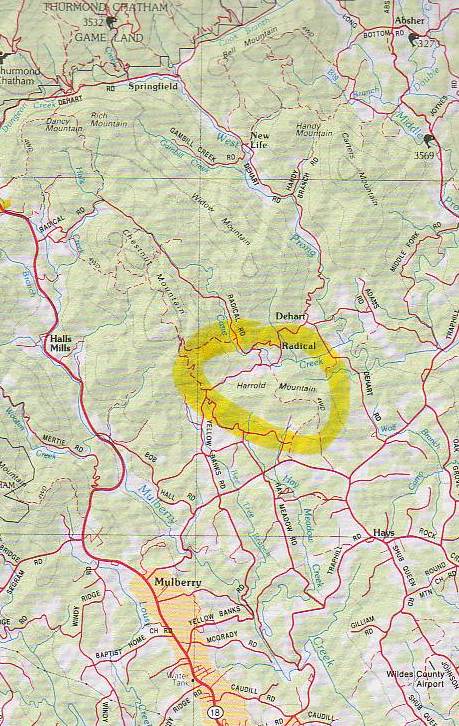
1801 – John patents land on Harrold Mountain

Harrold mountain

1803 – Daughter Elizabeth married Reuben Carter whose land abuts that of John Harrold, at least until Reuben loses his land.

1805 – Mary’s daughter Sallie marries Jessie Turner before 1805 and they leave for Breathit County, KY.

1806 – Mary’s daughter, Charlotte, married Koonrod Dick.  They were in Simpson Co., KY before 1825.

1809 – Mary’s son, William and Mary McDowell, daughter of their neighbor, are married by Jacob McGrady, the Baptist preacher.

1810 – Son William departs for Claiborne County, TN.  This is likely the last time Mary sees her son, although she lives another 16 years.  She probably never meets any of her grandchildren by William.

It must have pained Mary greatly to see her children marrying and leaving Wilkes County, one by one.

1810 – The 1810 census shows John Harrold, with one male living with him, age 16-26, plus his wife.  Both John and Mary are shown as over age 45.

1812 – Mary’s son, Alexander marries about this time and shortly thereafter, leaves for Breathit County, KY.  This is likely the last time Mary sees Alexander.  She likely never sees any of Alexander’s children either.

The 1820 census reflects John and Mary’s age the same way.  Now John and Mary are living entirely alone, all of the children gone and married.  They are living beside John Herrald Jr. who has 9 people in his family and one slave.  These grandchildren, Mary probably sees daily!

John Sr. dies in 1825 and Mary follows in 1826.  We know Mary’s name, positively, because of an allowance made to her in January 1826 from John’s estate, which was probated in October of 1825.  However, by October 1826, just a  year after John’s death, Mary’s estate sale was held – so she died sometime between January and October of 1826.

I hired a historian to retrieve John and Mary’s estate inventory and sale information, both, from the North Carolina archives in Raleigh, with absolutely no luck.  I know they existed at one time because they are referenced in the court notes complete with book and page number – however – Wilkes County says they no longer have any of those records and they are at the archives in Raleigh, and Raleigh says they never received those books from Wilkes.  And then there are those persistent rumors that the staff decades ago in Wilkes County decided to have a bonfire with the old records that no one would need anymore.  This just kills me, because Mary and John’s estate inventory would give us the most personal glimpse of their actual lives that we could get from the vantage point of where we sit today, 190 years removed – unless there is an unknown family journal or Bible hanging around someplace.  And I’m not holding my breath for that.

One of my close friends and I were discussing a week or so ago how much our descendants would be able to tell about us personally if they were building the scaffolding of our lives from only public records.  She and I concluded that while they would find the “big pieces” so to speak, like birth, marriage, death, children’s births, and moving – they would never know anything about us personally.  Meaning what we are like.  No one would know that I love color, for example, whether it be in summer flowers or quilts.  That I hate to cook, love dark chocolate, and do quite a bit of charity work.  They would have no idea of my profession, my career, my education level, my degrees or my political or religious leanings.  All of those things that make me uniquely me would be absent.  However, if they had an inventory listing from my estate sale, there would at least be clues.  I so wish we had Mary’s estate listing.

Mary is credited with saying that when she died, she wanted to be put up on the bluff on top of Harrold Mountain so that she could fly back to sweet old Ireland.

Harrold Mountain bluff

Since she doesn’t have a marker, perhaps they did.  Harrold Mountain bluff is shown above.

John Harrold burial

Mary is likely buried beside John Harrold, her husband, on Harrold Mountain.  Furthermore, we know about where that is, and she is either buried under the chicken house with John (above), or she is buried with son John in the Harrold/Brown Cemetery.

Brown Harold cemetery after

Perhaps old John is buried with John Jr. in the same cemetery, shown on the map below on Harrold Mountain.

Brown Harrold cem

Given that both sons William and Alexander leave Wilkes County, it makes sense that John Jr. would obtain William’s land upon his death.  It looks very much like he did, in part because John is buried on the land Old John owned.  So, it’s entirely possible that John Jr. lies in the same cemetery with both of his parents.  In that time and place, that’s quite unusual – often generations didn’t stay in the same place long enough for multiple generations to live, grow old and pass on.

I’ve tried to reconcile the census documents with John and Mary’s children, reconstructed from the records we do have:

Name/Birth 1779 1790 census 1800 census Other
2 children in court record 3 boys under 16, 3 girls 1 m<101 m 10-152 f 16-25
Child born before 1779 per court record Possibly James in 1805 record
Child born before 1779 per court record
John/1782-83 Age 8 Living next door Birth year of 1783 on tombstone
Alexander/c 1785 Age 5 Age 15 1850 census says he was born in NC in 1785
William/c1790 Newborn 1790 Age 10 In 1855 deposition, William says he is 65 years old, in 1850 census, says he is born in NC
Elizabeth/c1785 Age 5 Age 15 Married in 1803
Charlotte/c1790 Newborn or born after census Doesn’t work based estimated birth year of 1790 and 1800 census Married in 1806.
Sarah/c1784 6 16 Married before 1805

Note that a James appears once in an 1805 Wilkes County record, but never appears again. If this James is John’s son, then he would have had to be one of the two oldest children AND living on his own or not in John’s household by 1790.  Unlikely, but not impossible

These birth years are all estimates, with the exception of John whose birth year is on his tombstone and in the 1850 census, and William who gives his age in a deposition and in the census as well.  Other birth years are estimated by marriage date which is estimated by the age of the oldest child when not available in official records.  Long way around, I know.

The bottom line is that Mary and John are one child short in 1800, but for all we know, one of the daughters was living elsewhere.

Mitochondrial DNA

To the best of my knowledge, no one who descends directly from Mary through all females has yet DNA tested.  These people would carry Mary’s mitochondrial DNA.

Mary reportedly had three daughters.  However, there is some discrepancy in the 1800 census when only two daughters are shown.  Of course, one could have been slightly older, one could have been visiting or living with a relative – we don’t know.

However, if people who descend from either 2 or 3 daughters test, and their mitochondrial DNA which would be descended directly from Mary match each other, then we now they share a common ancestor.  There is always the possibility as well that Mary was not John’s only wife.  There could have been 2 different Mary’s as well – the one in 1779, assuming that is the right family, and the one who died in 1826.  There is no oral history of anything like this, but it’s always a possibility.

Secondly, we could tell a lot about Mary – meaning her haplogroup and where her closest matches are found in the world.  In other words, we could probably confirm that Mary was indeed Irish!

If you descend from Mary Harrell through all females to the current generation, where either males or females will work, please let me know.  There is a DNA testing scholarship waiting for you!

Mary’s female children are as follows:

1. Sarah or Sallie Herrell, born about 1784 and married Jesse Turner about 1805  in Wilkes County. They moved to Breathit County, KY and had daughters:

    • Susannah born about 1806 – nothing more known
    • Elizabeth “Mama Bets” born February 1813 and married her first cousin, Thomas T. Herrell. They had daughters Sarah born in 1841, Elizabeth born in 1845, Nancy born about 1846, America born in 1850 and Jemima born in 1852.

2.  Charlotte Herrell born about 1790, married in 1806 in Wilkes County, NC to Koonrod Peter Dick. They moved to Simpson County, KY and had daughter Mary Dick. They probably had other children as well, but I have found no records.

3.  Elizabeth Herrell born about 1785 married Reuben Carter in 1803 in Wilkes County. They moved on to Maury County TN and then, reportedly, to Crawford County, MO. Nothing is known about their children.

______________________________________________________________

Disclosure

I receive a small contribution when you click on some of the links to vendors in my articles. This does NOT increase the price you pay but helps me to keep the lights on and this informational blog free for everyone. Please click on the links in the articles or to the vendors below if you are purchasing products or DNA testing.

Thank you so much.

DNA Purchases and Free Transfers

Genealogy Services

Genealogy Research

William McNiel (c1760-c1817), Battle of Brandywine Survivor, 52 Ancestors #83

Before we talk about William McNiel, let’s talk about the name McNiel, McNeil or however it’s actually spelled.  The family story says that it was originally McNeil in Scotland, but that there were three brothers (yes, the three brothers story) and they argued on the way over to the colonies about religion.  Our Reverend George McNiel changed his name from McNeil to McNiel so that his name would not be the same as his brothers.  This sounds doubtful, because one Thomas McNiel is found in Spotsylvania County and is believed to be George’s brother.  Had the three brothers gone their own way after a dispute serious enough to merit name changing upon landing on the colonial shore of Virginia, you wouldn’t think they would both choose to settle in the same county.

There are other versions of the name story in other lines of the family.

The family story goes on to say that Rev. George McNiel was ordained as a Presbyterian minister in Scotland but here in the US, converted to the Baptist faith and was ordained in that church in 1776.  We have not one shred of evidence confirming any of this, and it’s not for lack of trying.  The Reverend George is not mentioned in any of the Virginia Baptist or Presbyterian Church records that I’ve been able to find, and they do exist.  I first find George mentioned as having preached at a Baptist church in Grayson County, VA, and then in Wilkes and surrounding counties.  Note that Grayson was not formed until 1793 from Wythe which was formed in 1790 from Montgomery which was formed in 1777 from Fincastle which was formed in 1772 from Botetourt which was formed in 1770 from Augusta which was formed in 1738 from Orange County.

One story says that Rev. George met his wife, Miss Coates and married her in Grayson County, VA, but if that is accurate, given that they married pre-1760, then how did George’s son William get back to Spotsylvania County to serve in the Revolutionary war in 1777?  Migration was east to west, not west to east.  And Grayson County wasn’t formed until 30 years after they married, although someone could have been referring to a location that was located in Grayson County at the time they were speaking.

So, if the rumor about Miss Coates and Grayson County is true, and they married before William was born, then it would have had to have been in Augusta County prior to 1760, and there is absolutely no record of George McNiel, by any spelling, in Augusta County.

George may have converted to the Baptist faith about this time, and Miss Coates may not have been George’s first wife…  We know George was eventually a Baptist preacher…of that we are sure.  His name appears as helping form the Beaver Creek Church in 1779 and in various church and association records until his death.  His grandson tells of him fighting the regulators in 1771 at Alamance Creek, after which he fled into Grayson County for safety for a short time, before returning to Wilkes County.  However, much of the rest of the story doesn’t add up with the records we do have available.

William McNiel was born about 1760/61 or possibly earlier in Virginia, probably Spotsylvania Co. but we don’t really know for sure.  One researcher gives his birth as Oct. 28, 1757 which could be true, but he doesn’t provide any source. It is about the right time.

We do know that William’s father, the Reverend George McNiel was in Spotsylvania County as early as 1754, according to court records where an apprentice was bound to him, so it’s likely that William was born in Spotsylvania County, especially since he served from there in the Revolutionary War some two decades later.

The Revolutionary War

McNeal, William rev war

The first hint we had the William McNiel served in the Revolutionary War was contained in a letter written in 1898 by George W. McNiel, Sr., son of Thomas McNiel who was a brother to our William McNiel.  In the letter, which was about the Reverend George McNiel, he states, “His son, William McNeil, volunteered in the war of Revolution, and his son, Joseph McNeil said he would volunteer and go with William, but he was not old enough.”  He goes on to say, about William, that he “moved to the State of Tennessee, Clayborn County.”

That confirms unquestionably that we are talking about the same William.

William McNiel’s records from the National Archives tell us the following:

William McNiel/McNeal/McNeil, born in 1760 in Spotsylvania County, served with Captain Thomas Posey’s Company, 7th Virginia Regiment (Company Pay Roll and Company Muster Rolls are dated 1777 and spell his last name McNiel, McNeal, and McNeil), commanded by Col. Alexander McClennahan. His papers say that he is being paid from June 77 through Nov. 1777 and that he is in a rifle regiment. He is paid 6 and 2/3 dollars for one month’s pay. On his November 1777 pay voucher, it says on the bottom that he enlisted in the Light Horse service the last of November, so he may have actually served longer in a different unit.  This does tell us one thing…he had a horse.

On September 11, 1777, William McNiel participated in his first battle of the Revolutionary war at the Battle of Brandywine, PA. Brandywine would become the largest Revolutionary war battle fought in the Northern Campaign. The battlefield is shown below.

Battle of Brandywine battlefield2

“BrandywineFieldToday” by AlbertHerring at en.wikipedia. Licensed under CC BY 3.0 via Wikimedia Commons

William fought for his life in this field.

The Virginia line was located on the right flank with 2 brigades from the Pennsylvania militia line. The Virginia line was to prevent a possible British flanking maneuver from both the North and South. The Virginians were unable to prevent the British from performing the flanking maneuver and were soon forced to retreat to a church on the battlefield named Birmingham Meeting House, shown below, in 1974.

Birmingham Meeting House

At the Birmingham Meeting House, the Virginians put up their greatest stance against the British on a hill nicknamed Battle Hill. The British assaulted the Virginians at Battle Hill five times before the Virginians were forced to retreat.

Battle of Brandywine battlefield

“Brandywine Osborne’s Hill View” by Djmaschek – Own work. Licensed under CC BY-SA 3.0 via Wikimedia Commons

These Virginians had refused to give up an inch without a fight. After the battle the wounded were taken to Bennetts farm located 10 miles from Brandywine.  William McNeil helped escort some of the wounded to Bennetts farm after the battle.

Battle of Germantown

“Germantown” by Christian Schussele – Public Domain. Licensed under Public Domain via Wikimedia Commons

William’s next battle was at the Battle of Germantown, depicted above, on October 4, 1777, less than a month after the Battle of Brandywine.  At Germantown, the Continental army forced the British to barricade themselves into a mansion called Chew House, shown below.

Chew HOuse

“Cliveden-Chew-Front1” by Djmaschek – Own work. Licensed under CC BY-SA 3.0 via Wikimedia Commons

The Americans began firing their cannons. The Cannon fire was so loud that blood began to pour from the cannoners’ ears. The Continental soldiers were winning the battle until General Adam Stephens showed up in a drunken stupor and accidently began firing on the Continental line.

This was William McNeil’s last battle.  He was probably very glad to go home.  Any romantic veneer that warfare holds for an inexperienced young man was assuredly gone by now.

Moving to Wilkes County, NC

The Reverend George McNiel had moved to Wilkes Co. NC by 1778 and William likely accompanied George, given that William was as yet unmarried.  George may have been traveling back and forth between Spotsylvania County and Wilkes County because there is a deed witnessed in Spotsylvania County in 1786 by George McNiel for John Shepherd.  George’s son, William McNiel had married John Shepherd’s niece, Elizabeth Shepherd in 1781/1782 in Wilkes Co. NC.  I’d wager that the Reverend George McNiel was the marrying minister.

The Robert Shepherd Bible states that the Shepherd family moved from Spotsylvania County to Wilkes County in December of 1777. It’s likely that William and the Reverend George McNiel both moved about this same time, perhaps with several families forming a wagon train for help and protection along the way.  Maybe it was during this move that William McNiel and Elizabeth Shepherd began to court.

In 1783, William’s father, The Reverend George McNiel, was one of several families that established the church at Deep Ford Hill in Wilkes County on land owned by John Shepherd, adjoining the land of his brother Robert Shepherd, father of Elizabeth Shepherd, by then the wife of William McNiel.

William McNiel and his wife Elizabeth Shepherd were assuredly a part of this church as well as whatever organization unofficially preceded the official church formation.  Neither the church, about where the gas stations sits today, nor the cemetery, where the trailer sits today in the photo below, still exist.

Deep Ford cemetery

In Wilkes County Deed Book A1, Page 186 – In April of 1785, William McNiel witnessed a deed with Francis Kerby and Stephen Shepherd for a land sale between Owen Hall and John Shepherd Sr.

William McNiel first appears in Wilkes County tax records in 1786, he is living three houses away from his father, George McNiel.  William owns no land until 1792, according to tax lists, by which time William has been married for about a decade.

In 1792-1793 he owns 60 acres, but then we don’t find William again on the Wilkes County tax list until 1797 when he owns 530 acres and he and his family are living beside Nathaniel Vannoy. William McNiel’s daughter, Lois, would marry Elijah Vannoy, Nathaniel’s nephew, around 1807.

It looks like William begins to accrue land about 1778, but he pays no taxes on land until 1792, so what happened to this land is a mystery.  Perhaps he bought and sold it on speculation.

Land Entry Book, Wilkes County, NC 1778-1781, Page 337 – Sept 7, 1778 – Alexander Gilreath enters 100 acres on the north side of New River including Walls improvement.  Alexander Gilreath marked out: Wm. Macniel written in.

Wilkes County Court Minutes Vol II, January 1785-November 1786 – October 24, 1787 – William NcNall serves on a jury.  This entry is quite interesting, because at that time, one had to own land to serve on a jury, but the land and tax records don’t reflect that.  Maybe William McNall is not the same person as William McNiel.

Wilkes County Deed Book D, Page 115 – on February 16, 1790, William McNiel witnesses a deed with Nathaniel Judd and William McQueary from James Sartain and Robert Shepherd for 70 acres on both sides of the south fork of Reddies River.  Robert Shepherd is William McNiel’s father-in-law.

Wilkes County Court Minutes Vol III, April 23, 1792 – Ordered John Robins, Jr, Robert Sheppard, William McNiel, John Sheppart Sr, Rowland Judd Esq, Rowland Judd, Nathaniel Judd, Asel Cross, Stephen Sheppard, John McQuary Sr, John McQuary, James McNiel, David Owen Sr, John Judd, John Trye appointed a jury to view road from Deep Ford on Redes River to Elijah Denneys over said River.

In 1792, William McNiel serves on a jury and is assigned with Francis Vannoy, James McNeil, Robert Sheppard and others to view the road round Samuel Carter’s Mill pond where water overflows on Redies River.

Wilkes County Will Book 1, February 4, 1793 – William McNiel along with John Sheppard Jr. and Stephen Shepherd witnessed a power of attorney from James Brown from the state of Georgia to Robert Shepherd to convey unto John Forester 200 acres of land and 100 ac whereon Fielding Forester and Benjamin Bruce now live.

Wilkes County, Deed Book D, Page 360 – February 17, 1794 William McNiel along with William Colvard and Samuel Robinett witnessed the sale of land between Rowland Judd and James Shepherd, 150 acres above the mouth of Mill Creek.

Wilkes County Court Minutes Vol IV – In November, 1795, William McNeil, Esq., swears an oath relative to a deed from Thomas Robins to John Forester.  Note that now William is referred to as Esquire, a title of rank, respect or office.

Wilkes County Court Minutes Vol IV – On February 4, 1796, William McNiel along with James McNiel, Robert Sheppard, Francis Vannoy, John Sheppard and others is assigned to view the road from oldfields on New River to the Puncheon Camp on the ridge.

Wilkes County Court Minutes Vol IV – On August 2, 1796, William McNeil overseer on the road from Punchen Camp Creek to Oldfields on New River.

Wilkes County Court Minutes Vol IV – On January 31 ,1797, William McNiel serves on a jury.

Wilkes County Court Minutes, January 25, 1797 – Ordered that William McNeil be appointed Collector Capt. Judd’s District instead Samuel Burdine.  That William would be appointed tax collector indicates he is well-respected and trusted.

In 1799 Ashe Co. NC was formed from part of Wilkes and we find William living in that area.

In 1799, William McNeil obtains land grant, and this grant suggests that he has other grants or has purchased other land and his new grant abuts that land.  The New River runs on the north side of the mountains in what is now Ashe County.

Page 734 – June 17, 1799 – NC Grant No 1877 to William McNeil for 73 acres on the South fork of the New River with his other lines.

Abstracts of Wilkes County Land Grant Files – File 1586.5 William McNiel received grant #1877 dated June 7, 1799 for 73 acres of land on the north side of the south fork of New River at his other line. This is based on warrant/entry number 506 dated Sept 2, 1794.  The grant itself is recorded in book #104, page 21.  Chain carriers were James McNiel and Thomas Caloway.

Page 754 – June 7, 1799 – NC Grant # 1878 to William McNeil 100 acres on the north side of the South Fork of New River, conditional line between James Calloway and McNeil.  Notice this grant is consecutively numbered after his first grant.

Abstracts of Wilkes County Land Grant Files – File 1587.5 – William McNiel received grant no #1878 dated June 7, 1799 for 100 acres of land on the north side of the south fork of New River adjoining James Calloway.  Based on warrant/entry number 505 dated Sept. 3, 1794.  Grant is recorded in book 104, page 21.  James McNiel and Thomas Calloway chain carriers.

I don’t know exactly where this land was, but I do have a suspicion.

The New River is in what is now Ashe County, which was formed in 1799.  The Shepherd family lived all along what is the north fork of Lewis Creek which reaches almost the entire way to the top of the mountains where the Blue Ridge Parkway is today.  Calloway Gap is the way through the mountains to descend into the South Fork of the New River on the other side.  The map below shows present day Ashe County with Wilkes directly below.  The Purlear area on 16 is the area where the Shepherd’s lived and where the Deep Ford Hill and Church was located.

Ashe County

The map below shows the South Fork of the New River at the top arrow, Calloway Gap at the middle arrow, and the uppermost part of the North Fork of Lewis Creek at the bottom arrow.  These locations really aren’t terribly far apart – well – if you’re a crow.

Ironically, I have driven this section of the Blue Ridge Parkway, but it was years before I realized the connections I had here.  At that time, the connection that drew me back year after year was purely in my heart.

New River Ashe County

Wilkes County Deed Book F1 – Page 189 – October 13, 1803 – From George Lawreance to William McNiel of Ashe County, NC for $400, 320 acres on the south fork of Lewis Fork…top ridge…Beech Hill.  Signed by George Lawrence and witnessed by Joseph McNiel, Thomas McNiel and George McNiel.

Page 131 – October 8, 1804 – From William McNiel to Isaiah Case for $400, 320 acres on the south fork of Lewis Fork, signed by William and witnessed by Andrew Vannoy and Joel Vannoy.

In 1805, William McNiel lost his father.  Reverend George died on June 7, 1805.  He was likely buried the next day in what is known as the McNiel Burying Ground in Parsonville, NC – on his land on Lewis Creek.  William would have been about 45 years old.  William was lucky to have his father as long as he did, but that doesn’t make the pain of his death any less.

William McNiel serves as the administrator of his father’s estate, as shown in the Wilkes County Will Book 2 Abstracts, entry 245.  At the August court term in 1808, William submits the inventory of the estate of George McNiel and wife, 1 negro man at 35 pounds VA money and 1 negro girl at 40 pounds VA money – signed William NcNiel administrator.  I’m unclear as to the meaning of “and wife” and have asked a historian at the archives in Raleigh to check this original record.

In February 1810, William moved back to Wilkes County from neighboring Ashe County and purchased 150 acres on the North Fork of Lewis Creek, probably not far from where the Reverend George McNiel had lived.

Wilkes Deed book G and H, Page 178 – February 3, 1810 – From James Steward and William McNiel of Ashe County NC for $200, 150 acres on the waters of the North Fork of Lewis Fork, it being the place where William Yates now lives.  Signed by James Steward and witnessed by Alexander Brown and Thomas Brown.

The last record in Wilkes County of William is the land record where he sells the land “where he lives” to his daughter Lois, and son-in-law, Elijah Vannoy.  There is a persistent rumor that Elijah and Lois had eloped.  If that is true, then apparently things had been smoothed over by 1810 – or William was resigned to their marriage since it was a done deal and they had children by then.

Wilkes Deed book G and H, Page 175 – December 31, 1810 between William McNeel and Elijah Vannoy for $250, 150 acres on Boller Creek, a fork of Lewis Fork, place where William McNeel now lives.  Witness John Forrester and John Forrester Jr.  Signed by William McNeel.

Taking a look at a current map today, there is a Boiling Springs Road that runs along a branch that dumps into Lewis Fork – so I’m betting this is where William’s land was located.

Boiling Spring Wilkes Co

Crossroads

William is facing a crossroads.  His father has died.  We believe his mother died in the late 1780s, so there is nothing to hold him in Wilkes County now.  Furthermore, his own children are marrying as well.  Sarah has probably married Joel Fairchild, Lois has married Elijah Vannoy, George has married Nancy Baker.

If William is ever going to move west and settle elsewhere, he has to be doing that pretty soon, or forever lose the opportunity.  I have to ask myself, what would possibly cause a man who is comfortably established at about age 50, a landowner, to up and sell everything to move to the undeveloped frontier to find himself chopping original growth trees down on rough mountainsides – 30 years after he did it the first time.

Was this the pioneer equivalent of a mid-life crisis?  Instead of a new girlfriend and a corvette, you strike out to homestead new land and chop trees to prove your strength and youthful vigor???

Or was it because his children could not afford land in Wilkes County, so the entire family went where land was more affordable?  Was leading the way William’s way of preventing his family from being split as his children would assuredly leave for parts unknown, one by one, being scattered to the wind?  Did he hear his three married children discussing moving westward to settle and decide that he could either lead or get left behind?

One thing is for sure, a large group of Wilkes County families wound up in the same five or 6 mile radius (area of about 6 (NS) x 16 (EW) miles) of northern Claiborne County on both Little Mulberry Creek and Blackwater between Wallen Mountain and Newman’s Ridge about this same timeframe – so it must have been a much discussed destination location.

Wilkes transplants in Claiborne

On To Claiborne County, Tennessee

By about 1811 or so, William McNiel and Elizabeth Shepherd McNiel would leave Wilkes and Ashe County forever, moving to Claiborne County, Tennessee.  Elizabeth, now age 44 or 45 would have her last child about the time they set out on their journey.  The McNeil book by Hayes says that William’s children were all born in Wilkes with the possible exception of William, their 10th child.

All of their married children and spouses accompanied them as well.  No child left behind.

There is a very interesting story about how this caravan of settlers got to Tennessee.  Elijah Vannoy’s daughter said they traveled by flatboat and the journey took two years.  This story is told in detail in the Elijah and Joel Vannoy stories, as Joel Vannoy, Elizabeth and William’s grandson, was reportedly born during this journey to Lois McNiel and Elijah Vannoy.

By 1816, the family was definitely living in the Claiborne/Lee Co. area of Tennessee, purchasing land on the North side of Powell Mountain near Mulberry Gap and then later, in the Pleasant View area. In his only transaction in the new neighborhood, William witnesses a land sale to his son George.

In 1816 Levi Carner sells to George McNiel a tract of land lying on the N side of Powell Mountain near Mulberry Gap containing 69 acres for $525.  Signed in the presence of William McNiel, James Anderson and Burrell G. Sullivant.

In 1817, Levi Keanus sells land to Neal McNeal on Mulberry Creek adjacent Josiah Ramsey.  Joel Fiarchild, William McNiel and John NcNeal all sign as witnesses.  However, in 1823 when this deed was registered, the sale was proven by the oath of Joel Fairchild.

In 1819 George McNiell to John Stokely part of land where McNiel now lives lying in Claiborne on Mulberry which was sold to John McKean, 5 acres to include storehouse.

There is no 1820 Claiborne census and William is not shown in the 1830 census. Elizabeth is shown in 1830 but not in 1840.  Were William or Elizabeth, his widow, alive, they would have surly filed for a Revolutionary War pension based on William’s service when pensions became available by an act of Congress on June 7, 1832.

I’m fairly certain William was gone by May of 1823 when William Inglebarger sells land to Neal McNeal and the transaction is signed by his mother, Elizabeth, his uncle, John McNeil and Joel Fairchild.  None of the witnesses can write and all signed with an X.

By 1834, the McNiel family, William’s children, were selling their land on Mulberry Creek and was buying land on Little Sycamore Creek, about 17 miles away.

McNiel Mulberry to Little Sycamore

Elijah Vannoy and Lois McNiel’s son, Joel Vannoy would follow to Little Sycamore some years later, in the 1860s.  Eventually, the Vannoy and McNiel families would comprise a big part of the Little Sycamore population.

In 1834, Nancy Hill, widow and her children sold the lands of James Hill decd to Neal McNiel, land lying on the waters of Little Sycamore Creek of the Clinch River.

In 1830 John Carmack conveyed the lands on the waters of Little Sycamore to John McNeil.

In 1848 Neal S. McNiel sells to John McNiel Sr. the land in Claiborne County District 8 containing by estimation 820 acres – William Houston’s corner of one of his Joab Hill tracts and near Peter Peck’s corner to the old James Hill line to a stake in John Bartlett’s line.  Witness RC McNiel.

Obviously Neal had accumulated quite a bit of land.

Since we don’t know when William died, we also can’t pinpoint where he was buried.  William is very likely buried on his son Neil’s land or the Elijah Vannoy land in Hancock County.  The Vannoy and McNiel families lived adjacent in what is how Hancock County and in the 1830 census, Elizabeth, William’s widow is living on her son Neil McNiel’s land.

Touring the Neighborhood

In the article about Elizabeth Shepherd, we found the land in Hancock County (formerly Claiborne) where Neal McNiel was living in the 1830s when his mother, Elizabeth, William McNiel’s widow, was living adjacent to him, according to the census.  We know that William was gone by then.  Our last whisper of William McNiel in Claiborne County was in September of 1817 when he witnessed a deed for his sons.  If William died then, he left Elizabeth with son William Jr., probably just a toddler, and children from that age to adulthood.  Her survival at that time probably depended heavily on her adult children and

There are so many questions that remain.  For a man who was quite involved in real estate and owned land in Wilkes County, why did he purchase none in Claiborne?  His sons did.  Did he give his sons or his children money and decide simply to live on their land until his death?  Was he ill or injured?

This location in Turner Hollow is where Niel McNiel’s land was located, and William’s son-in-law, Elijah Vannoy owned land located at the red balloon.  It’s a good bet that William lived with one or the other, or someplace in-between.

McNiel Vannoy land

Recently, my cousin Dolores was kind enough to take pictures of the land in this area when she visited on a genealogy adventure.  Thank you so much cousin Dolores.

To help understand what you are looking at the next few photos, let’s first look at the map of the landowners in the area.  The dot on the map above in Turner Hollow is the land shown on the map below.

Josiah Ramsey land - Niel McNiel

Cousin Dolores took the following photo from Eli Davis’s land looking toward Wallen’s ridge, meaning that she was most likely looking right at and across Niel McNiel’s land.

McNiel Hancock Wallen

This next photo is Back Valley Road near Fortner, which is shown on the following map.

McNiel Hancock Wallen map

This location would have been on Niel McNiel’s land

McNiel Hancock Wallen2

So if William didn’t live on this land, he certainly saw it regularly and it probably looked much the same then as it does now.

McNIel Hancock Wallen 3

I wonder if old William can see us today viewing the same vistas that he looked at as he looked over these fields.

McNiel Hancock Wallen 4

Did he look at these mountains and think about Wilkes County?

McNiel Hancock Wallen 5

I want to drink in what he saw and I’d so like for him to tell me about these fields and lands himself.

McNiel Hancock Wallen 6

The hills in this area are more rolling than the land in Wilkes County.  This could have been part of the allure of moving.

McNIel Hancock Wallen 7

Nothing more American than barns – although William’s barn, if he had one, would have been much smaller.

McNiel Hancock Wallen 8

William is assuredly buried here someplace, but where?  There is a Davis family cemetery on the Eli Davis land.

McNiel Hancock Wallen 9

What a beautiful place to spend your life, not to mention resting eternally.  He is assuredly buried someplace on these lands.

I don’t know, but I suspect that William died about 1817.  He stopped witnessing things and being involved in any way.  He had a long history of public service in Wilkes County and there is no reason to think that would change unless his health changed.  Secondly, his daughter Lois named a son born about 1816 William Vannoy.  William may not have gotten to spend much time living in Claiborne, now Hancock, County at all.

William’s Children

Many of William’s children carried on the tradition of local involvement and public service.

  • Sarah or Sallie McNiel, named after Elizabeth’s mother and possibly William’s mother as well, was born about 1784 and married Joel Fairchild in Wilkes County. They moved to Claiborne County where Sallie died on January 2, 1861 and is buried in the Fairchild Cemetery in Hancock County. She had 5 children.
  • George McNiel, named after William’s father, was born on September 21, 1786 in Wilkes County and died in 1870 in Claiborne County, TN and is buried in the McNiel Cemetery, probably on his own land. He married Nancy Baker in Wilkes County in 1809, having 11 children, and married Matilda Yeary in 1845, having two more children. Where he lived when he died is unknown but the land he purchased in 1816 was near Mulberry Gap on Powell Mountain.
  • Lois McNiel born about 1786 and married Elijah Vannoy about 1807 in Wilkes County. Lois died in the 1830s in Claiborne, now Hancock, County, TN. She had 10 children.
  • Neil McNiel was born about 1792 in Wilkes County and died in 1839 in Claiborne County, TN. He is likely buried on his own land, but whether he is buried in Hancock County or in Claiborne in the Little Sycamore Community is uncertain.   Neil married Elly Ramsey, daughter of Josiah Ramsey, pioneer settler of the Ramsey family and neighbor. They had only three known children, although there were likely more.  Elly is likely buried in the old Josiah Ramsey cemetery, and Niel could be buried there beside her.
  • Mary was born about 1792 in Wilkes County. She married Robert Campbell in 1817 in Claiborne County and died in 1881 in Bradley County, TN. I show only one child for her, Anderson, but I have a very difficult time believing she didn’t have additional children.
  • Nancy McNiel born in 1794 in Wilkes County married Alexander Campbell in 1815 in Claiborne County and is shown with only 3 male children. She died in 1839 in Hancock County.
  • John McNiel was born July 1, 1803 in Ashe County, NC and died in 1882/1883 in Claiborne County. In 1824 he married Elizabeth Campbell, sister to the spouses of two of his siblings. They had 8 children.

John McNeil b 1803

  • Elizabeth McNiel, named after her mother, born between 1800 and 1810 married Andrew McClary. The 1840 census shows them with 2 daughters, but I can’t find the family in 1850.
  • Jesse McNiel born about 1806 in Ashe County, died in 1890 in Claiborne County and married Bettie Campbell in June 1837. I have no information about their children. In the 1850 census, Jesse is living with his brother. I don’t find him in the 1860 census.
  • William McNiel, named after his father, was born about 1812, although where is uncertain. He could have been born in Claiborne County. In 1839 he married Nancy Gilbert and in 1849, he married Nancy Carter. I have no record of children for William and I do not find him in the 1850 census, although in 1860 we do find him in Hancock County with 3 children and he lists his birth location as Tennessee.

Some of William’s children were merchants in the small town of Sneedville, as told in various local history books.

At Greasy Rock, later known as Sneedville, Hancock Co., a store was opened in front the of the dwelling of Mrs. Elizabeth Campbell facing Main St. by Robert and Alexander Campbell and William and John McNeil with William McNeil as manager.  John McNeil eventually settled on Little Sycamore in Claiborne County where he was engaged in farming.

Little Sycamore Baptist Church in Claiborne County was built on land donated by John McNiel in 1840.  John NcNiel was trustee and the leading man in the organization and in the affairs of the church until his death in 1882.  The original church was built of logs and the plaster on the walls was mixed with cow hair to hold it together.  The hair came from John McNiel’s tannery nearby.  Members would come to church in the daylight, but would return home in the dark by the light of pine torches.

The church was used during the Civil War as a hospital for wounded Confederate soldiers.  Local people came to help tend the wounded.  Those who died were buried in the cemetery above the church, but some were removed and taken to their homes after the war.  I would not be the least bit surprised if John weren’t buried in that same cemetery

William’s son, John, seemed to have taken after his father in a number of ways – not the least of which was in the establishment of a Baptist church.

DNA

I was very fortunate that a McNiel cousin was willing to DNA test several years ago.  To date, there is still only one known cousin who has tested.  Ironic given that the Reverend George McNiel had many children and descendants.

However, that known cousin has several matches that are quite interesting and prove that other McNiel families, by other spellings, in other places are indeed from the same original family line.

  • Thomas McNeil married in 1750 Rombout, NY
  • Hugh Neel b 1750 Ireland
  • William McNeill b 1851 Blackbraes, Stirlingshire (a mining location in the central lowlands of Scotland)
  • Shamus O’Neal b 1775 County Mayo
  • Aystin McGreal b 1780 County Mayo
  • Maurice McNeely from County Antrim, Northern Ireland
  • Roger McNally from County Monaghan, Ireland (border between Northern Ireland and Ireland)

There are really two things I’d like to solve utilizing DNA.

First, was Thomas McNiel in Spotsylvania County the brother of Reverend George McNiel?  Maybe better stated, do they share a common paternal ancestor?  Clearly Y DNA testing cannot prove that Thomas was George’s brother, but it can certainly prove that he wasn’t.  Thomas is believed to have migrated to Caswell County, NC where he died before December of 1781.  He had sons, John, Thomas and Benjamin.  Several years ago, I was corresponding with a lady who descended from this line and there were males at that time.

I would very much like to confirm Thomas as a probable brother to George, or put that speculation to rest forever.

Looking at my cousin’s Y matches, I don’t see any evidence that Thomas’s line has tested nor do I see any matches to that line on his Family Finder results.

I then checked the Family Finder results of other McNiel descendants – and found no matches to the Thomas of NC either.  However, there’s nothing to indicate his line has ever tested.

I checked Y search, and no McNiel’s are found by any surname spelling who descend from Thomas.

I checked the MacNeil Y DNA project to see if someone listed Thomas, and so far, nothing, although there are several who list no “most distant ancestor” information, and Thomas could be one of those lines.

I decided to do a search at Family Tree DNA, utilizing their new search function, on Thomas McNiel who married Ann Tolbert to see if anyone has a tree uploaded on Family Tree DNA who descends from this man – and there are at least two – although we can’t tell is this is a Y, mitochondrial or autosomal test.  I sure wish there was a way to contact these people, but as of today, there isn’t, nor is there a way to determine if you match these people aside from going through each and every tree that has a McNiel listed in the matches list under ancestral surnames.

Secondly, I very much want to match a McNiel who knows where their family was from in the British Isles – and I don’t mean a large city.  What I’m looking for is the ancestral village.

When I look at my cousins matches, he has Y DNA matches with several O’neals, some Neils and Neills, a couple McNeills, one McNellis, one McNece, one McNally, one McNeely and a McGreal from County Mayo – but no specific location in County Mayo is listed.

Mayo map

County Mayo is in the western part of Ireland and is not in the English plantation area which is today, Northern Ireland.

Then, we also find County Antrim in Northern Ireland, County Monaghan in Ireland, bordering Northern Ireland and then Stirlingshire in Scotland.  Certainly nothing definitive.

If you look at my McNiel cousin’s 67 marker European matches, you’ll see the following map.

McNIel 67 marker match map

This northern Ireland location is very suggestive of an ancestral location for our McNiel line, but the Mc part of McNiel suggest perhaps Scots-Irish, as does the northern Ireland grouping of matches.  Northern Ireland was the Ulster Plantation region.

We’ve made progress over the years, but we’re just not quite there yet.

Hope springs eternal.

I guess one might say that the paternal McNiel ancestors “got around,” leaving their DNA scattered across Ireland and Scotland and the name spelled just closely enough to be confusing – and intriguing!  Nothing like a good family mystery to peak your curiosity!

Of course, with this line being descended from Niall of the 9 Hostages, it’s possible that some of these various lines simply adopted the surname based on their ancestral heritage and are not actually descended from a common ancestor since the advent of surnames.  Generally, when people of the same surname match, the assumption is that the common ancestor is since the adoption of surnames…otherwise the surnames wouldn’t match.  In this case, with the widespread fame of Niall of the 9 Hostages, I don’t think the common surname can be assumed to mean that the common ancestor occurred after the adoption of surnames.  Leave it up to my family to cast doubt where others find certainty!

______________________________________________________________

Disclosure

I receive a small contribution when you click on some of the links to vendors in my articles. This does NOT increase the price you pay but helps me to keep the lights on and this informational blog free for everyone. Please click on the links in the articles or to the vendors below if you are purchasing products or DNA testing.

Thank you so much.

DNA Purchases and Free Transfers

Genealogy Services

Genealogy Research

John Harrold (c1750-1825), Forger?, 52 Ancestors #82

My earliest identified Harrell ancestor is John Harrold (also spelled Harrald, Harald, Harold, Harrell, Herrell, Herald, Herrald, Herrold and any other way they could think of to confuse me) who died in Wilkes County, NC in about 1825. His wife, Mary died in 1826. His known children were born beginning in 1782 or 1783, so he had to be born before 1760 or even earlier.  The 1800 census shows John to be over the age of 45, so that tells us he was born before 1755.  Given the information I found in his Revolutionary War service records, I’m betting be was born around 1750.

It’s a good thing we have John’s death year and the census information, because much of the other information about his life is quite murky.  It has been quite a journey with more than one very unexpected crook in the road.  Come on along for the ride!

Visiting Wilkes County, NC

I visited Wilkes County in 2004 and asked my cousin, George McNiel, a local historian and avid genealogy researcher, to take me on a tour of all of my family lands.  There is a mountain named Harrold Mountain today.  I would never have put Herrall or Herrell, the surname in Hancock County, Tennessee and Harrold Mountain in Wilkes County together were it not for George and his knowledge of the area and families.

Harrold mountain

Cousin George took me to the grave of old John Harrold only to discover the single grave is gone and a chicken house stands in its place.  I don’t mean a cute little chicken house like grandma had, but a huge factory chicken house that stinks to high heaven.  How sad.  For both my ancestor and the poor chickens.  My cousin said this isn’t unusual because the only flat place large enough for a chicken house (40×100 feet) is often old graveyards, so off go the stones and in goes the chicken house. I wonder what old John Harrold thinks about that.

John Harrold burial

According to cousin George, this is the location where old John Herrell’s (Harrold, Herrald) grave used to be.  The chicken house is on the left, just out of sight.  This is on the top of Harrold Mountain.  John lived here during his lifetime and was probably buried in his own backyard.

This is either the same place or very near where his son John is also buried, known as the Brown Family Cemetery, shown on the map below.

Brown Harrold Cemetery map

FindAGrave has photos of the cemetery, before and after a cleanup effort.

Brown Harold cemetery before

Above, the Brown/Harrold cemetery before, which makes me wonder if the cemetery really did still exist but we missed it.  Although having said that, if anyone would know, it would be George.  He and his late wife spent more than 20 years surveying, inventorying and documenting every grave and graveyard in Wilkes County.

Brown Harold cemetery after

There is a family legend that says that John Harrold died in 1783 and was buried up on Harrold Mountain with all of his money and someone dug him up and robbed the grave. Of course, the speculation was that the culprits were his kids.  I guess that’s one way to take it with you – but I’ve always had these comical visions of several adult children sneaking up the mountain and running into each other at the grave in the dark. After the fight that would surely have ensued – who knows how many are actually buried in that grave:)

The story is interesting, but the 1783 death date is incorrect (because John wasn’t yet in Wilkes County in 1783 and he didn’t die until 1825) and would lead us to believe that maybe it was John’s son, John Harrald (Jr.) who was born in 1783.  We know he was buried on Harrold Mountain.  Regardless of the specifics, which we will never unravel now, the story is charming and there is surely some nugget of truth in there someplace, or the story wouldn’t exist at all.

So, John’s grave may have been twice insulted – once by grave robbers and once by a chicken farmer.  I don’t think John is resting in peace.

The fact of the matter is that the original John Harral (the name in Wilkes County is typically spelled Harrold and Harrald) didn’t die in 1783 and appears on the 1800 census with a male and female over 45, one male under ten which is probably son William, one male 10-16 and one daughter 10-16.  In addition, his presumed son, John Harrold Jr. is also enumerated with one male age 16-26, a female the same age and one female under the age of 10.  John (the elder) also appears in the 1810 census with his wife and only one child, the son who was 10-16 in 1800 in 1810 is listed as age 16-26.

The Church

Zion Baptist Church is a very old “primitive Baptist” church on Harrold Mountain and guess what the names are on probably 80% of the graves – yep – you guessed it – Harrold/Harrald.

Zion Baptist Church

A local cousin is a member of the Primitive Baptist Association, of which Zion Baptist is a member as well.

According to the cousin, this church was established in 1861. The white church above is the second building and the remnants of the original log cabin are found in the woods.  I suspect there was a church here long before 1861 given the remoteness of the area – simply that the church wasn’t a separate building and probably met at someone’s home before the log cabin.  It’s the only church on Harrold Mountain, so it’s a good bet that old John Harrold was a Baptist.  At least one of his children was married by a Baptist preacher.  John’s descendants were and are members of this church, that’s for sure.

The articles of faith upon which this church operates are posted on the wall.

1)       We believe in one only true God, Father Son and Holdy Ghost, and these three are One.  1st Timothy 2:5, Eph 4:6, 1st John 5:7

2)       We believe that the scriptures of the old and new testament are the word of God, and the only rule of Faith and practice. St. John 1:14, 2nd Timothy 3:16, 1st Peter 1:21

3)       We believe in the doctrine of election by Grace.  St. John 1:14, 2nd Timothy 3:16, 1st Peter 1:21

4)       We believe in the doctrine of original sin and in mans importency (sic) to recover himself from the fallen state he is in by nature, by his own free will and ability.  St. John 6:44, Romans 5:12-18

5)       We believe that sinners are called, converted, regenerated and sanctified by the Holy Spirit, and that all who are thus regenerated and are born again by the Spirit of God shall never fall away.  St. John 6:63, 10:28, 2nd Peter 1:10, 2nd Timothy 1:9, 1st John 3:9, Revelation 22:17

6)       We believe that sinners are justified in the sight of God only by the imputed righteousness of Jesus Christ.  Romans 5:1, 10:4, Ph. 3:9

7)       We believe that Baptism, the Lord’s Supper and feet washing are the ordinances of Jesus Christ and that true believers are the only subject of these ordinances, and we believe that the only true mode of Baptism is by immersion. Mark 1:9, 16:16, John 13:8-17, I Cor. 11:23-26

8)       We believe in the Resurrection of the dead and in general judgment, and that the joys of the righteous and the punishing of the wicked will be eternal.   Mat. 25:31:32, John 5:28-29, 1st Timothy 4:16.

9)       We believe that no minister has a right to administer the ordinances of the gospel except such as the regularly called and come under the imposition of hands by the presbytery.  Mark 3:14, 2nd Cor. 3:6, 4:1, 5:18, 1st Timothy 1:12, 4:14.

You can see the location of the church in proximity to the Harrold lands.  In order to help judge distance, it’s about 500 feet from the church to Yellow Banks Road, so less than a mile to John Harrold’s land above Harold Mountain Road.

Zion Baptist map

My cousin George, quite a history buff, said this was the last one of the old local churches to flatten the top of the graves for mowing. Apparently this particular denomination believed in rounding the tops of the graves – and keeping them mounded up. I don’t know why. They also had an outside eating area because they don’t believe in having food inside the church. These are still common practices of this particular sect of Baptists apparently, but most of the churches have modernized a bit.

You can see in the photos below, there were still mounds on a few graves.

Harrald at Zion Baptist

Zion Baptist cemetery

The photo below is standing at the church looking across the road and at the beautiful view of Harrold Mountain.  This is the exact view John Harrald would have seen, well, minus the silo.

Harrold Mountain across from Zion

John Harrold’s wife was named Mary. She is credited with saying that when she died, she wanted to but put up on the bluff on top of Harrold Mountain and to let her fly back to sweet old Ireland. I guess we know where she was from, if the story is true, but we have no idea who she was. Given that my cousin only said something about one stone where old John was buried, I couldn’t help but wonder if they had in fact put her on the bluff. I don’t know how they could find the bluff though, as it is very overgrown.

Harrold Mountain bluff

Above is the bluff of Harrold mountain, pieced from two photos, visible behind the tree and fence rows.

Tracking John Harrold

I will be spelling John’s name in the way it was spelled in the various documents that I’ve found.  Clearly, with a name like Harrold, it was quite likely to be spelled however the clerk decided it was to be spelled at that moment.  There was little consistency.

We first find John Herold in Deed Book C-1 in Wilkes County, on page 334, on July 6, 1794 a transaction between Robert Powers of Rowan County, NC and  John Herold…negro winch and mulatto child called Pink and Rose…property lately purchased in Camden…but if Robert Powers returned 75 pounds of indigo (sample whereof is in Herolds house) to Herald the above obligation to be null and void.  Signed by Robert Powers, witnessed by David Baxter.  Proven in open court February 1802 by comparison of hands writing by oath of Betsy Herald and William Young. Proven in open court July term 1804 hand writing of David Baxter by William Young, Esq.  The fact that this took place in 1794 but wasn’t registered until 1802/1804 suggests that indeed, the indigo was not returned and that Robert Powers either wasn’t cooperating or had died.

This of course begs the question of who was Betsy Herald.  John Herald (born in1782/1783) married a Betsy McKinney and that is likely the Betsy who gave her oath.

I have to wonder what caused John to be in possession of 75 pounds of indigo dye in the first place.

John Harrold appears in the Wilkes County court records on November 3, 1796 with an order from the court for the sheriff to sell 100 acres of property of Thomas Adams taken by execution to satisfy a judgment recovered against him by John Harrold, which judgment obtained by plaintiff in Iredell County execution issued by George Brown, Esq.

This is the first hint we have as to where John was “from” before we find him in Wilkes County.  Am I very grateful for this tie.

Iredell was formed from in 1788, so I checked the Rowan County records which begin in 1753 and found no John, with the exception of tax lists.  There is an early Hugh Herrill there as well, but his Y DNA line is not the same as John’s.  John Harrell is found on a 1785 tax list in James Crawford’s Company with one white poll and no land.

Extracting Iredell County records, specifically the minutes of the Court of Pleas and Quarter Sessions from 1789-1800 transcribed by Shirley Coulter we find a little more information about John.

On page 46, on August 24, 1792, a list of men is given who took the oath of allegiance and Jno Herril is included.  Of course, this might not be our John.  I wonder why he had to take the oath if he was a veteran and why this late.  The Revolutionary War had been over for years.

On February 17, 1796, a jury was ordered to lay open a road on part of Brush Mountain Road to go around a field of Robert Bogles, agreeable to his petition.  John Harrold was one of the men to lay out this road.  The Brushy Mountains are found in the northwest part of Iredell County.

The Deed Book from 1797-1802 shows a sale on October 5, 1798 from John Meadows to George Roberts on the waters of S. Yadkin on which John Harreld and David Roberts are listed at witnesses.  This deed was recorded on January 21, 1802.

An 1802 record from Rowan County Will Abstracts on page 113 shows the probate of the will of Stephen Roberts on January 9, 1802.  His wife is listed as Phebe and he lists children Warren, Joshua, Thomas, William, daughter Polly Harold, daughter Molly Noreton, daughter Judith Egmond, daughter Phebe Richmond, daughter Nancy Roberts and Betsy Roberts daughter of son William.  Polly is a nickname for Mary, but none of the sibling names look familiar, nor did John and Mary Harrold name a child Stephen, so this is likely not our John Herrald’s wife.

The 1800 census of Wilkes County shows Michael McDowell, Jacob McGrady (the minister who married William Herrell and Mary McDowell), and both John Herrell Jr. and Sr. (spelled Harrall) on adjoining pages.  Based on this evidence, pending further investigation, it is presumed that Michael McDowell is the father of both Mary and John McDowell and John Herrell Sr. is likely the father of William Herrell.

John Herral appears on the Wilkes County tax list in Captain Carltons District in 1800 with 1 white poll and no land.

In 1805, J? (smeared) Herrell had 550 acres and no polls, and James Herrell had 180 acres and 1 poll.  It’s interesting that John had no polls in 1805.  This could be because he was elderly, because he was an official, like a sheriff, although there is no evidence of that, a minister, but again, no evidence, or because he was disabled.  We know that by 1790, John had 6 children, so had been married a minimum of 13 years.  If he was 25 when he married, that means he was born about 1752.  He could have been born earlier.  If he was born in 1752, he would have been 53 or older in 1805, so possibly “elderly.”  The age where one didn’t have to pay polls varied by state and time and I’ve seen it range from age 45 to age 70.

In 1802, on page 345 of Deed Book F-1, John is mentioned in a land grant to Reuben A. Carter for 100 acres on Chathis Quemin Branch, the waters of Haymeadow and on John Herold’s line.  This is probably Chinquepin Branch.

This is followed on page 353 of the same book by a transaction on July 31, 180(blank) from Richard Allen, late sheriff and John Fletcher, Sr., land lost by Reuben A. Carter, court action brought by James Fletcher, 100 acres part of 200 acre tract on the waters of Cathinquemin Branch of Haymeadow on John Herold’s line.  Witnessed by John Saintclair and Hugh Brown.

John’s daughter, Elizabeth, married Reuben Carter in February of 1803.  This had to be a very upsetting time for the family, possibly in multiple ways.  Why did Reuben lose his land?  Was he irresponsible or unlucky?  Did he lose his land before or after he married Elizabeth?  Did they move in with her parents whose land abutted Reuben’s?

In 1803, in Deed Book F-1, on page 87, Charlotte Harrold witnesses a deed between Reuben Carter and William Sabastian for $10, 100 acres on Rock Creek, on Henry Carter’s corner and the road.  Also witnessed by William and Nancy Carter.  Charlotte was John Harrold’s daughter and married Coonrod (Koonrod) Dick in 1806.

John’s Land

Land grant entry number 1246, file number 2421 for 200 acres was filed for John Herrold on November 16, 1801 and states that the land is on the Chinquepin Branch of the Hay Meadow Creek on the waters of Mulberry beginning near the head of the said branch and that it is against Michael McDowell’s line.  The survey was entered November 16, 1801 and was actually recorded in February 1802.   Chainers were John Roads and Michael McDowall.  There is a drawing of the survey but it just looks like a square and there are no watercourses noted.  The fact that the land was at the head of the branch tells us it was high up on the mountain.

Note that John Harrold’s son, William, would marry Mary, the daughter of Michael McDowell, in 1809.

John Herrold grant

The grant of land was not actually made until December 5, 1811 and it is grant 2817.  It’s odd that John would not own land until this late in his life.  He was approximate age 50 in 1800.

The name is spelled variously Herrild, Herrald, Herrold.  John paid “4 pounds” for this survey in 1804.  I find it interesting that they are still using the old English money measures and not dollars.

In 1811, in Wilkes County Deed Book G-H we fine a David Harrill of Surry County, NC selling land to Jesse Allen for 200 pounds, 550 acres on Joshua Mizes line, the waters of Hunting Creek, witnessed by Richard Alley and Hugh Riley.  Hunting Creek is not near John Harrold’s land, more than 5 miles distant as the crow flies, southeast of Wilkesboro.

There is no known connection between David and John Harrell, but just because a connection isn’t known doesn’t mean it doesn’t exist.  Furthermore, we don’t know how David obtained this land, because he isn’t listed in the deeds or grants.

Haymeadow2

haymeadow3

John’s land is located on Haymeadow Creek.  You can see Mulberry to the lower left on the map above.

Haymeadow and Harrold

Haymeadow Creek runs right up beside the Zion Church and on up paralleling Harrold Mountain Road until you reach the beginning.  As we know  from the land grant, the beginning or headwaters of Haymeadow is where John’s land was located.

John’s land is very likely where his son, John’s land was located, where the cemetery is, or rather, was located, which is between the Harrrold Mountain Extension and Waddell Drive, above and below.

John's land

John’s land was about as far up as you could go on Harrold Mountain, which of course, wasn’t yet named Harrold Mountain at that time.  200 acres would have been just about all of the land above the Harold road U on the map above, including the central extension.  The original homestead was likely on the left near the cemetery.  Michael McDowell’s land abutted John’s at the southwest corner where they shared a stake and eventually, Reuben Carter’s would abut John’s land too.

John Harrold satellite

If you look at this picture, all of that treed land above John’s land is too mountainous to do anything with.  Very steep and wild.  That one little road you see is a two-track that leads to nothing.

A Willliam Herrell was witness to a will of Benjamin Sebastian in 1818 in Wilkes County.  John Harrold was a witness also.  This is likely not William, John Senior’s son, because John’s son, William, went to Claiborne County, Tennessee about 1810.

By the time John Harrold Sr. died in 1825, his son William had been gone for 15 years.  I wonder if John ever saw William again.  Did he know when William was pulling away in the wagon that it was their final goodbye?

William wasn’t the only one of John’s children to leave.  In fact, the only child we know of that stayed in Wilkes County was son John, who likely lived on John Sr.’s old place.

Harrold goats

These two photos were taken on Harrold Mountain on a beautiful spring day with the goats frolicking to celebrate the fresh spring grass.  It probably looks about the same today as it did when John Harrold lived there.

Harrold goats2

John died sometime in 1825, because in October of that year, in Will Book 3-4, on page 78 is recorded the account of sale of the estate of John Harrold.

In January 1826, an allowance was made to Mary Harrold, widow and in October of 1826, the estate sale of Mary Harrold was held.

John Herrell was born in roughly 1750 or before and died in 1825 in Wilkes County NC.  He is buried someplace on Harrold Mountain, probably on his own land.  Today this mountain remains very rugged and remote.  His grave is either marked with a chicken house or he is buried in the same cemetery as his son John.

John’s Children

What we know about John’s family is somewhat limited, but at least some of his children have been identified.

Of John’s known sons, one, John, stayed in Wilkes County and is the progenitor of the family there today.  William went to Claiborne County, Tennessee and the family surname is generally spelled Herrell or Harrell,  Alexander went to Breathit Co., KY where the name is Harrold and Herald.

  • William Harrell, born 1790 in NC married Mary McDowell, daughter of John’s neighbor Michael McDowell, in 1809 in Wilkes Co.  They were married by the Baptist Preacher, Jacob McGrady. They moved to Claiborne Co. shortly thereafter. They lived for a short time in Lee Co. Va. before purchasing land in Claiborne Co. in 1812. This is my ancestor.
  • John, born 1783, died in 1879 in Wilkes Co.  He married Elizabeth, “Betsy” McKinney about 1797.  Most of the Wilkes Co. Harrold’s seem to be descended from this man. John also lived on Harrold Mountain, probably on his father’s land, and is buried in the Harrold/Brown Cemetery.

Brown Harrold cem

You can see it closup here, the trees in the middle of the field to the right side of the photo.

John Harrold Cemetery closeup

John’s gravestone says he was born in 1782 and died in 1879.

John Herrald b 1783 stone

  • Elizabeth, born in 1785 married Reuben A. Carter in 1803 in Wilkes Co. No more is documented about this couple, but they may have gone to Maury County, TN. by 1815 and then on to Crawford County, Missouri.
  • Alexander Herrell born about 1785 in North Carolina, died about 1860 in Breathit Co, KY, married Elizabeth Turner before 1812 and moved to Breathit County shortly thereafter. The 1850 census where the name is spelled Herrald shows that he was born in North Carolina.
  • Charlotte, born about 1790 married Koonrod Dick in 1806 in Wilkes County. She and Koonrod or Conrad moved to Simpson Co. KY before 1825.
  • James, possibly a son of John, listed here because of his residence in Wilkes in 1805. This is speculative and may be inaccurate. There is no further information about this man and he does not fit on the census.
  • Sarah “Sallie” Herrell born about 1784 and died in 1845, probably Breathit County, KY.  Married Jessie Turner before 1805 and had 9 children.

We are left with a couple of burning questions about John Harrold or however the surname was spelled.

Where was John from?

We know John (the eldest or first’s) son John (Jr., the second) was born in or about 1782 or 1783, that he stayed in Wilkes County.  Because John Jr. (the second) lived past the 1850 census, we can tell something about where John Sr. was living in 1782 when John Jr. was born.

The 1850 Wilkes County census tells us that John Herald was a 67 year old farmer born in Virginia.  His wife was apparently deceased and he had 5 children living at home. This would be John Jr. (the second).

The 1860 census shows us that John Harold Sr. (the second,) who lived beside John Jr. (the third) was a 78 year old farmer born in Virginia. He still had 4 daughters living at home with him, ranging in age from 22 to 31.  The Jr. and Sr. have transitioned.  The John Jr. (the second) became John Sr. when his son John (the third) reached adulthood.  John Sr. (the first) had already died by this time.  John (the second’s) son, John, became John Jr. at that time.  Jr. and Sr. can be very deceptive because of this type of transition, and also because they may not indicate a direct relationship.  Sr. and Jr. can mean “older” and “younger” in two men with the same name who are not related or not father and son, but live in the same location.

John (Jr., the second) is not shown in the 1870 census, although according to his grave marker, he was still living.

In 1880, John Jr. (the third) is still living, age 75 and he shows that both he and his parents were born in North Carolina.  His wife shows that her parents are born in Virginia, so it’s not a matter of unthinking ditto marks.  This would indicate that his father, John (Jr. the second) born in 1782, was born in North Carolina, although we have three census records where John (born in 1782) presumably gave the information himself and said he was born in Virginia – in all 3 records.

According to the census, in 1800 we find John (the eldest) with his children in Wilkes County.  In 1790, we find only a couple of candidates in North Carolina or for that matter, anyplace in the eastern half of the US.  The Virginia 1890 census does not exist and has been replaced by tax lists which I have thoroughly scoured from 1782-1787.

One candidate is John Harrald in Iredell Co NC.  He is not listed in Iredell in 1800, so this could be our John, especially with the 1794 court record referencing Iredell County where John obtained the judgment.  In 1790, this John had enough children to be our John, which is one of the qualifiers to be a candidate.  He had 1 male age 16+ (himself), 3 males under the age of 16 and 4 females.

The second burning question is related to the first, and the question of where John came from is at least somewhat unraveled as we peel the onion of the mystery of the multiple John Harrold’s who served in the Revolutionary War.

Which John Served in the Revolutionary War?

A fellow Harrell researcher sent me the following two scanned pages a couple of years ago.  They found these years ago in a Virginia library.  We don’t know what books they are from, aside from the information at the top of the page, but it does tell us that there are two Johns who served.

One John Harrell applied for a pension from Nansemond County, VA where he was born in 1761.

We know that this is NOT our John because that John applied for a pension in 1833 in Nansemond County, VA and our John lived in Wilkes County and was dead by this time.

John Harrold Rev War

The second page, below, shows a John Harrill from NC, a private, who received or applied for a land grant on July 29, 1820, for 228 acres that went to his heirs.  Unfortunately, this entry raises far more questions than it answers.  Does this mean he served out of North Carolina or only that he lived in NC in 1820 when he applied for land?

John Harrold rev war2

I found this book at the Allen County public library, and it was Revolutionary War Records of Virginia Vol 1.  by Marcus Brumbaugh.  The book explains that these records are of bounty land warrants for the military district of Ohio from the federal and state archives.  This record for John is for a private and for 228 acres.

From the article “Military Bounty Land” by Sandra Hargreaves Luebking, we find the following.

North Carolina was the most generous, giving 640 acres (a square mile) to a private in the Continental line. The tract was in Tennessee; no bounty land warrants were located within the present-day boundaries of North Carolina.

An extraordinary flood of Revolutionary War bounty-land warrants poured from Richmond, partly because Virginia had the largest state population and partly because it granted warrants not only to its Continental line but to its state line as well. The distinction rests on who paid the soldiers—Congress or Virginia.

The first military reserve was created south of Green River in Kentucky and subsequently expanded west of the Tennessee. There were no bounty lands within present-day Virginia or West Virginia. In 1784, Virginia ceded its claim to the area north of the Ohio River, reserving the 4 million acres between the Scioto and Little Miami Rivers for redemption of its bounty-land warrants. This Virginia Military District in Ohio was federal land for which first-title land grants were reserved solely for the Virginia warrants of veterans of the Continental line. A series of ever more liberal acts broadened where warrants could be used and by whom until, in 1852, Congress agreed that all Virginia Revolutionary War warrants could be exchanged for scrip accepted at any GLO land office. Large numbers of these assignable warrants were sold; an estimated one-quarter of the Virginia Military District was acquired by twenty-five men.

The paperwork flow was: (1) warrant application to Richmond; (2) warrant issued to warrantee; (3) selection of desired land in Kentucky or Ohio reserves and survey by official surveyor; (4) paperwork for Kentucky lands to the Virginia Land Office or, from 1792, the Kentucky Land Office, or the federal capital for Ohio lands; and (5) patent for Kentucky land sent to patentee or federal patent sent to Richmond for relay to Ohio patentee.

Fold3.com Records

Next, I checked http://www.fold3.com, finding several service records.

Service Records – Company pay rolls

John Harrold’s (Herrald, Harreld) Revolutionary War pay records.

Served in the late Capt. Williams Company of the 8th Virginia Regiment commanded by Col. James Wood:

  • Pay roll of Capt. John Nevils Company of the ? Virginia commanded by James Wood for the month of June 1777 – John’s pay is noted, along with a note “Deserted July 7th”.  Others who deserted the same day were Travis Chambers, William Hutcherson and John Waters.
  • Deserted July 1778, joined April 17, 1779
  • April 1779 Camp Middlebrook
  • Virginia 8th Regiment – Late Captain Wallace’s Company of the 8th Va Regiment, commanded by Col. James Wood – private June 1779 Camp Smith’s Clove to July 1
  • Same as above but dates June 1, 1779 commence pay at 6 2/3 dollars per month – for one month amount of pay 2 pounds
  • July 1779 Camp Rampo – private – enlisted May 1, 1777 for 3 years – Each one of the pay records shows this he enlisted at this date which is how you can be sure it’s the same man.
  • Aug 1779 – Camp Smith
  • Oct 1779 Camp Ramapough
  • April 1779 – 3 days pay – not drawn for since June 78
  • March 1779 – Capt Smith’s Clove’
  • June 1779 – private, Capt Smith’s Clove, Capt. Wallace’s Company commanded by Col. James Woods
  • John Herrold, Capt Wallaces Company, appears on a list of the absentees of the 12th Virginia Regiment with the sum due each: not dated, 11 48/72 dollars, absen
  • Roll of Captain Wallaces Company of the 8th Virginia for the month of August 1779 – paid for one month as a private.

Smith’s Clove is in Suffern, NY, State Route 17.  Camp Rampo was in Ramapo, New York as well, and both of these locations were headquarters of George Washington during the Revolutionary War.

This is an entirely separate record at Fold3 as follows:

John Harald – private, Capt. Abraham Kirkpatrick’s Co in a detachment of the 2nd Virginia Brigade commanded by Col. Febiger – Dec, Jan, Feb and March 1780, pay is 6 2/3 per month, subsistence is 10 per month, amount of pay and subsistence 50 dollars.

John Harold – Soldier Infantry – appears in a book under the following heading:

“A list of soldiers of the Virginia Line on Continental Establishment who have received certificates for the balance of their full pay agreeable to an act of assembly passed November session 1781.”

Signed by Mr. Hancock, June 4, 1782 for 36 pounds

Pensions

John Harrold – 1 NC Regiment – Capt. John Summer’s Company of the 1st NC Batallion commanded by Colonel Thomas Clark – roll dated Sept. 8, 1778, enlisted April 4, 1776 for 2 and one half years.

There is also a service record for John Harrold who served in the 1 NC Regiment.

John Harrolds of Frederick Co., VA and Botetourt Co. VA

VA State Library, Archives Division, Military and Land Warrants Records for John Harrold show he served 3 yrs as a sergeant in VA Continental Line, 8th VA Regiment from Botetourt Co. He was discharged June 1777 near Valley Forge then served a 2nd time for 18 months in the 8th VA Regiment and was discharged near Salisbury, Feb 1782. In 1819 he lived in Wilkes Co., NC and in 1828 was still there when he received bounty land warrant #6718 for 200 acres.

The above record drove me nuts, because while someone was kind enough to send me the info, and I was very grateful, there is no source or context, so I couldn’t reproduce it nor did I know where to go from here.

Another contributed record tells us the following.

One John Harrold was born circa 1761 in Frederick County, Virginia.  The first record of him is from a Register of Description of Noncommissioned Officers and Privates enrolled at Albermarle Court House dated 23 December 1781 in which he is described as:  “John HARRELL, age 20, born in Frederick Co., VA, 5 ft. 10 in. tall, brown hair, grey eyes, fair complexion, occupation planter, residing in Montgomery Co. VA, engaged as a substitute from Montgomery Co.”

The John Harold of Frederick County born in 1761, so only 20 when he enlisted in 1781, cannot be the John Harrold who was a sergeant when discharged in June of 1777.  That just doesn’t work.  A 16 year old is not going to be a sergeant.  He also cannot be the man whose pay records were found from 1777-1779 at Fold3.com.

Now we know we have at least three John Harrold’s serving out of Virginia, and possibly more:

  • John of Frederick County, age 20 when enlisted in December of 1781, so born 1761
  • John of Nansemond County who served from there and requested a pension from there in 1833
  • John of Botetourt County, reported to be a sergeant who eventually lived in Wilkes County, NC.  Served twice, once discharged near Valley Forge in either 1777 or 1779 and discharged the second time in 1782 from Salisbury NC.  Received a bounty land grant.
  • John who enlisted on May 1, 1777 for 3 years who is probably the same man who deserted in 1778 and rejoined in 1779.  This could be John of Nansemond but the dates seem to eliminate John of Botetourt and does eliminate John of Frederick.  After reading John of Nansemond’s pension application, he is also eliminated.
  • Possibly another John who served under Capt. Abraham Kirkpatrick in the Virginia 2nd from Dec 1779-March 1780 according to pay records – although this could be  John of Nansemond.

I requested the records for John Harrold from Botetourt County from NARA, and they replied that they had no records for him.  How could that possibly be when Fold3 digitized NARA’s records?

I think the genealogy gremlins are out to get me.

Library of Virginia to the Rescue

It pays to recheck earlier sources.  The Library of Virginia continues to digitize their records and to them, a huge, HUGE, THANK YOU!!!  I had written to the National Archives and received nothing, so this information documents three years of John’s life for me.  These records prove, beyond a shadow of a doubt that the Botetourt County John is the John Harrold of Wilkes County.

John Harrold rev war3

Downloading the images, I found the entire packet including John’s discharges and affidavits regarding his service.  A literal goldmine.  The motherlode.

john harrold rev war 4 jpg

This is to certify that the bearer herof John Harreld (or Harrold) formerly a sargent in the 8 Virginia Regiment has duly and faithfully served the term of three years for which he was enlisted for and in and at his own request is her by discharged from any further service in the Army of the Younited Stats and is permitted to pas to his home in Botod County fre and un milisted give under my hand at Camp near the Valley Forge this 12 Day of June in the year 1779.  Signed Charles Scott B G (Brigadier General)

The bearer John Hareld Sergeant is here by entitled to ? akers of land for his three years service in the Army by the Younited Stats to ?? on the ?? waters by a nek ? assembly their troups.  Given under my hand at camp near the Valley Forge these 12 June in the year 1777.  Signed Charles Scot B.G. (Brigadier General)

I originally believed the year would be 1777, not 1779.  This discharge was probably written in the commander’s tent on the battlefield, so it’s amazing that the penmanship is as good as it is

However, based on the last paragraph, for John to have been enlisted for 3 years, the discharge date would have had to have been in 1779, because that dates John’s enlistment to June of 1776.  The war had not yet begun two years earlier, in June of 1774.

Valley Forge in Pennsylvania was the site of the military camp of the American Continental Army over the winter of 1777–1778 during the American Revolutionary War. It is approximately 20 miles northwest of Philadelphia. Starvation, disease, malnutrition, and exposure killed nearly 2,500 American soldiers by the end of February 1778.

John Harrold apparently served through this time and survived

Forgery???

Interestingly enough, Will Graves, a revolutionary war historian, transcribed this document as well, and questions whether it is a forgery based on General Scott’s signature.  Although Scott is described elsewhere as somewhat illiterate.  That’s certainly an interesting conjecture and raises unpleasant questions that need to be answered.  I must admit that the service record dates we have don’t mesh entirely with the discharge papers, nor is there ever a pay record for a John who is a sergeant.  We might shed some light on this if we knew where General Scott was, exactly, on these two different dates in 1777 and 1779, but I have been unable to do so.

Will’s transcription suggests that he believes 1779 date is accurate.

Some Fold3 pay records for John Harrold state that he enlisted on May 1, 1777.  If these are all the pay records for the same John Harrold, the enlistment date of May 1777 and the discharge date of June 1779, given that he was AWOL for part of the time might make sense, although it certainly doesn’t total 3 years.  I hate it in these types of situations when I start using the words might and could, because I know I’ve crossed that speculative line.

If John enlisted for 3 years, in June of 1776, then the May 1, 1777 enlistment date doesn’t work either.

Now, I’m left with even more questions.  If one discharge was a forgery, was the second one too?  If one or both were forged, was it simply because the original was lost, or was there something more sinister and unethical afoot?  Many men stated that their discharges were lost, but then they had to produce witnesses to vouch for their service record.  Was John ever a sergeant?  Did he even serve?

Or maybe those documents aren’t forgeries at all and I’m doubting a 3 year patriot’s service record.

The 8th Virginia

The 8th Virginia Regiment, in which John Harrold reportedly served for 18 months, was raised beginning on January 11, 1776 for service with the Virginia State Troops.

If John was discharged in June of 1779 after serving three years, then it couldn’t have been our John who joined in May of 1777.  Unfortunately, these records don’t fit together perfectly.  Furthermore, the John who joined in May 1777 was a private, not a sergeant.

The Virginia 8th’s first commanding officer was patriot leader and German Lutheran pastor Peter Muhlenberg, who became a militia colonel in 1775 at the request of General Washington. In his last sermon from the pulpit, Muhlenberg read from Ecclesiastes 3:1, “There is a time for all things, a time to preach and a time to pray; but there is also a time to fight, and that time has now come.” He removed his clerical robes to show that he was wearing his uniform as a militia colonel. He quickly enlisted 300 men from his congregation in the unit that became the 8th Virginia.

Muhlenberg was appointed colonel on March 1, 1776. The 8th Virginia organized at Suffolk County Court House between 9 February and 4 April 1776. The unit’s 10 companies came from Augusta, Berkeley, Culpeper, Dunmore, Fincastle, Frederick, and Hampshire Counties, plus the District of West Augusta. On May 25, 1776 the regiment officially became part of the Continental Army.

In 1776, Virginia regiments were typically organized into 10 companies, of which seven carried muskets and three carried rifles. The regiment’s 792-man roster had three field officers, and a staff that included an adjutant, quartermaster, surgeon, surgeon’s mate, chaplain, sergeant major, quartermaster sergeant, and drum major. Each company consisted of one captain, two lieutenants, one ensign, four sergeants, four corporals, one drummer, one fifer, and 64 privates.  John Harrold was one of the sergeants if his discharge is accurate, but he is not listed as a sergeant in this unit or in any unit.

The 8th Virginia marched south to Charleston, South Carolina and was there in time for the Battle of Sullivan’s Island on 28 June 1776, but it was not in action. On 21 January 1777, the regiment received orders to join George Washington’s main army at Valley Forge.

On 11 May 1777, the unit was assigned to the 4th Virginia Brigade, together with the 4th and 12th Virginia Regiments, Grayson’s Additional Continental Regiment, and Patton’s Additional Continental Regiment. Charles Scott, who signed John Harrold’s discharge, above, was appointed to lead the brigade.

It was a long way home for John from Valley Forge regardless of when he was discharged – about 350 miles.

John Harrold valley forge

John may have returned home in June of 1779, but he wasn’t finished with the Revolutionary War.  He enlisted again by August of 1780.

John Harrold Rev War5 jpg

I do here by sertify that the bearer here of John Harrald formerly a seargeon (or sergeant?) in 8 Virginia reagiment has faithfully served the term of 18 months for which he was in listed and is permitted to pass to his home in Bottatot County in Virginia he behaving as a good citizen I fother certify that he has received no pay for his eighteen months service in the Southern states given under my hand at Camp ner Salisbuary this 16th day of February 1782.  Signed Samuel Sned (Snead) MC

If John was discharged on February 16, 1782, by subtraction, this tells us he re-enlisted no later than August of 1780.  The pay records for John Harrold in 1779 are obviously not for this John Harrold.

The 8th Virginia was absorbed into the third Virginia brigade in May of 1779, then became part of the 4th and 12th.  The discharge says he was formerly a sergeant in the Virginia 8th, but it says nothing about the unit he was serving with that was discharging him.

Assuming this service record is legitimate, this may be how John Harrold came to be acquainted with the Wilkes County area.

The Salisbury District of North Carolina, was originally one of several colonial judicial districts established in 1766. Immediately preceding the onset of the American War of Independence, these six regions, in 1775, were broadened into “de facto” militia districts.

The Salisbury District was based in the village of Salisbury, North Carolina, in Rowan County, about 60 miles from present day Wilkesboro.

The Salisbury District originally included Anson, Guilford, Mecklenburg, Rowan, Surry, and Tryon counties. A later addition was the Washington District (also known as the original Washington County, North Carolina) which covered most of the present day State of Tennessee. Eventually, as new settlements were carved out of the wilderness, the Salisbury District encompassed the counties of Lincoln, Montgomery, Richmond, Rutherford, Wilkes (all in present day NC), and Sullivan (in present day TN) as well.

It was almost 200 miles from Salisbury, NC to Botetourt County, VA.  I hope John wasn’t on foot, but I bet he was.  Horses were at a premium.

John Harrold Salisbury

Bounty Land

John appoints a power of attorney to collect his land grant based up on his service record..

John Herrald rev war 6 jpg

Know all men by these presents that I John Harrald of the County of Wilkes and State of N. Carolina have constituted and appointed Alex. ? McKenzie of the county of Wilkes and State aforesaid my true and lawful attorney for me and in my name and stead to procure and receive from such officer person or persons or shall be legally authorized to grant this same a land warrant to which I am entitled for my services rendered the United States during its revolutionary war as my original discharge certified and I hereby further empower my said attorney to give such receipts as shall be required in obtaining said lands. Patent in my name in as full and ample a manner as I myself could do were I personally present and I hereby certify and confirm whatever my said attorney shall lawfully do in the premises given under my hand and seal this 30th day of January 1819.

Signed, John Harrald

Witnessed by George W. Smith and Joshua Shumate (his mark

I believe this is John’s actual signature.  Whether or not the discharges themselves are forgeries is irrelevant to these signatures being authentic.  Note that this affidavit states that this is his original discharge.

John acknowledges the power of attorney in open Court on Febnruary 5th, 1819.

John Herrald Rev war 72 jpg

Next, John sells his claim.

John Herrald Rev War 8 jpg

Know all men by these presents that I John Harrald Sr. of the county of Wilkes and the State of N. Carolina have bargained and sold unto Alexander McKenzie my claim for 330 acres of land to which I am entitled for services rendered by me in the Revolutionary army and I have bargained and sold unto said McKenzie my claim of 18 months pay for services rendered by me during the revolutionary war in the southern states and I bind myself my heirs assignees executors and administrator to have no recourse on said McKenzie  on the claim? of said claims by ? one hundred and fifty dollars the amount in full for my said claims.  Signed under my hand and seal this the 3rd day of January 1819.

Signed John Harrald

Witnessed

Joshua X Shumate
George (W his mark) Smoot

John Herrald Rev War 9 jpg

In this document, John swears that he has not drawn the warrant for his land and that he authorizes Alexander McKenzie to do so.

This is the third example of John’s signature.

At this point, John would have been about 70 years old

Botetourt County, Virginia

Now we know that John was from Botetourt County, Virginia and that is where he considered home.  He was returning there when he was released from Valley Forge.  He also returned there in 1782 when he was released, which just happens to be the same year (or just before) that John Harrold Jr. was born.  Even if both of these discharge records were forged by (or for) John, it gives his home location as the same place in both.  That much would be accurate.

Now, we have a new problem.  There are other Harrold men in Botetourt County, leading one to the presumption that they are the same family line…but they aren’t.  There is a James Harrold there as early as 1770 living on Harolls Creek but the Y DNA of James’ line (that went to Warren Co., KY) does not match the DNA of our John’s line.

However, there is another very interesting record found in the Botetourt County records.

Botetourt County Virginia USGenWeb Archives – Court held for Botetourt County the 11th day of March, 1779.

This court doth allow Mary O’harrell, wife of John O’harrell, a soldier in the Continental Army, thirty pounds for the support of herself & two small children.

This would imply that Mary and John have been married at least 5 years.

If this is our John, then the June 1779 discharge date would be the correct one, not 1777.

Is this our John and is O’Harrell misspelled?  Are there any other instances of O’Harrell?  There are no John O’Harrell Revolutionary War service records at Fold3.com – yet this court entry clearly says he was serving and we know the records for the Virginia 8th, the unit in which he would be serving out of Botetrout County, are intact.

And then, there is this Augusta County record…

Augusta County, Virginia

Another Harrell researcher sends the following:

John Harrold (? Harrell) became an indentured servant in Augusta County, Virginia April 15, 1773. His master was Edward Cather, as the record indicates: April 15th.1773 John Harrold (? Harrell), servant to Edward Cather of Augusta Co. Virginia. Edward Cather’s parents were from Ireland and Scotland. He was born about 1740 when his parents were listed just married in Ireland. Though they say Edward was born in Virginia, his parents are listed as coming to America about 1777. Thus it is only a guess but I would believe this John Harrold also came from Ireland/Scotland and perhaps his way over were paid by the Cather’s. He was only assigned to work for two years for Edward Cather, which I would assume would reimburse his transport to America. Edward Cather quickly left Virginia for Kentucky about the time of at least the mid 1780s. Not sure if John Harrold followed.

If this is our John, this would explain why his DNA does not match with the other Botetourt or Frederick County, Virginia Herrell lines.

What Next?

It has been a long journey finding John.  The most difficult part was actually getting my hands on his Revolutionary War records.  Once I did, so many questions were answered.  We have added another chapter in the puzzle of “where was John?” and have pushed the brick wall back a little further.  We know that he was living in Botetourt County, VA in either 1779 when he was discharged after a 3 year service commitment, so he was likely living there in June of 1776 when he would have enlisted.

And of course, now we have the added mystery of whether or not John’s discharge papers are forgeries, which begs a whole new set of questions.  That was a sucker punch – and it doesn’t help that the pay records we have do nothing to corroborate John’s discharge papers.  Of course, they don’t disprove them either.  So frustrating with no clear way to obtain answers.

In all the years I’ve been doing genealogy, I have never, not once, actually seen a discharge letter of one of my ancestors, let alone two.  Maybe I still haven’t.

We are left to wonder if the Botetourt County John and Mary O’Harrell is the same as our John, in 1782.  No John Harrold, O’harrell or any similar surname appearing on the Botetourt tax lists in 1782 or as late as 1787.

We know that by 1779, John in Botetourt, based on the court record, assuming it’s our John, already had 2 children, if they survived.  The depth of their destitution is demonstrated by the fact that Mary had to ask for money to simply survive.  This is actually a very unusual occurrence and may indicate that her own family is either dead or not living locally.  John’s 1782 discharge record indicates that he had not been paid, and even had he been paid, he had no way to get the funds to Mary.

I am still very anxious to discover more about John Harrold, although short of a DNA match to another Harrell or Harrold or Harrald overseas or from earlier colonial times, I don’t quite know how I’ll ever connect the dots.  Of course, I can always pray for that Bible on e-Bay.

The good news about the Harrald Y DNA is that at 25 markers, the three descendants of John Harrold who have tested match only one other man, a Todd from Ireland with 1 mutation difference.  The three John Harrold descendants are group 7 in the Harrell DNA project.

Harrell group DNA

Thank goodness for Y DNA, because I know that we don’t descend from any of those other Herrell groups – so no need to bark up those trees.

I checked one last possibility.  There are several known descendants of John who have tested autosomally.  I checked each of them for matches to other Harrold/Harrell/Herrell lines in case we’re dealing with an undocumented adoption or illegitimate birth to a Harrold female.  So far, only one match and that person of course could match that individual on a completely unrelated line.  That match goes back to a George Troup Harrell who is attributed to a line descending from Josiah Harrell (1733-1773) and Mary Ann Gardner out of Bertie County.  Since it’s a male Harrell that we match, I’m hopeful that I can talk him into Y DNA testing.  I’m sure he’ll likely match the large Harrell Group 1 which is the eastern Virginia, eastern North Carolina group…but I’d still like to know for sure.   Y DNA doesn’t lie and it’s not ambiguous.  No forgeries or questions about forgeries.

Harrell group 1

I think today, we’ve done all with the records we can do for now.  So, now we wait, because someday, another Harrold or man with a similar surname will test and will match, and we’ll continue to chip away at that brick wall.

______________________________________________________________

Disclosure

I receive a small contribution when you click on some of the links to vendors in my articles. This does NOT increase the price you pay but helps me to keep the lights on and this informational blog free for everyone. Please click on the links in the articles or to the vendors below if you are purchasing products or DNA testing.

Thank you so much.

DNA Purchases and Free Transfers

Genealogy Services

Genealogy Research

Jotham Brown (c1740-c1799), Maybe a Dissenter, 52 Ancestors #81

Blue Ridge

I love it when I tie into a line that has been well researched.  It doesn’t happen very often, but when it does, it’s definitely time for that happy dance.

I also love it when my ancestor has a really unique name.  Enough already with these Johns and Williams. I love the name Jotham.  I had never heard it before, outside of the Bible, before I found Jotham Brown, or better put, before I found Stevie Hughes who helped me find Jotham Brown.

We believe Jotham was born about 1740, but we don’t find any records until Jotham is in his late 30s, in 1778.  He could have been born somewhat earlier, probably in either Pennsylvania or Virginia, given the migration history of the other families where he is first located.

When Jotham was a child, the French and Indian War, also known as the Seven Years War, took place from 1754-1763 and involved both Pennsylvania and Virginia.  Not only was the land involved where Jotham most likely lived, but the conflict was protracted and often involved raids and attacks on settlers.  In many places, it was a time of fear and uncertainty.

French and Indian war

“French and indian war map” by Hoodinski – Own work. Licensed under CC BY-SA 3.0 via Wikimedia Commons – https://commons.wikimedia.org/wiki/File:French_and_indian_war_map.svg#/media/File:French_and_indian_war_map.svg

Of course, without knowing exactly where Jotham lived during that time, we can’t tell what he might have seen or how involved his family might have been.  Most healthy men in that timeframe served in the local militia, at least, which was then drafted for more active service during times of conflict or war.  Depending on his age, he could have served and his father most assuredly would have in some capacity.

Hampshire County, Virginia (now West Virginia)

The very first record we find of Jotham is in the Virginia Northern Neck Land Grants.

“Jotham Brown researchers may be interested in several deeds in Hampshire County Virginia, all of which can be found on line at the Library of Virginia. Jotham was very busy on Oct. 8, 1778.  He helped survey three tracts of land.  One can be found by looking up Frederick Royce 1789, (land surveyed earlier) and another is on surveys no. 21788-1794 page 87, and a third was on page 87 same survey no. 2.  Jotham Brown is named in a deed and survey done for John Berkeley grants R, 1778-1780 P. 170-171.  In the John Berkeley survey Jotham bought his land from John Royce. They lived on Spring Gap Mt.  John Royce was from Frederick county.  A John Brown from Frederick and a John Brown from Philadelphia are around the same community.  Hampshire records are not intact but an order book that starts around 1762 is at Library of Virginia.”

Thank you Mark Sampson for posting that information.  It’s very useful and helps us locate Jotham’s land.

A 1788 Hampshire County deed mentioned Frederick Royce (Rice’s) land on Great Capechon which is close to Spring Gap Road, as we’ll see in a minute.

Little Capecon (left arrow below) and Great Capecon (both right arrows) are both tributaries of the Potomac River.

Hampshire map

Although they are maybe 4 miles as the crow flies, the crow has to fly over a mountain range between the two, so while they are close, they aren’t direct.

Hampshire map 2

It’s pretty rough country.  Jotham Brown was obviously not intimidated by challenges.

You can see above and below that this area is also very close to Maryland, so it’s possible that Jotham’s family originated in Maryland.

hampshire map 3

In 1779, Jotham is mentioned as owning land adjacent to John Berkelery’s grant on Spring Gap Run in Hampshire County.  This also tells us that Jotham owns land.  I checked all of the Northern Neck land grants but I was unable to find the deeds mentioned online at the library of Virginia.  So if Jotham wasn’t granted land, he bought it from someone who was, like John Royce.  Clearly, Hampshire County deeds need to be checked, but they are not in existence.  Bummer!.

Virginia Land Grant Jotham

This land is close to the current Virginia/West Virginia border, bordering Berkeley County.  Spring Gap Mountain Road extends along Spring Gap Mountain running parallel to Little Cacapon.  The map below shows Spring Gap Road, end to end.

Spring Gap road

I cannot find a present day Spring Gap Run, but often a “run” was a creek that ran alongside the road.  Roads of course followed the easiest access, often carved by creeks through the landscape.  This land description mentions a fork, and on the northern end, there is indeed an unlabeled creek that includes a fork and runs along Spring Gap Mountain Road and dumps into Little  Cacapon.  This road is dirt today, so no Google street view available.  The top end of the blue line is at the fork in the creek branch near Little Cacapon.

Spring Gap Run

The Revolutionary War

Try as I might, I could find nothing at all about Jotham Brown during the Revolutionary War which lasted from 1775-1783.  Perhaps if the court records for Hampshire County were perused, there might be a mention of a contribution or a public claim.  It’s hard to believe he neither served nor contributed.  Many of the men from this area served in Augusta County units.  He did move during this time, so he could have potentially served out of Frederick or Botetourt County, but I’m sure that the Frederick County records have been thoroughly perused by earlier researchers.  Hmmm…I think I need to put this on my ever-growing “to do” list.

Most of the existing Hampshire County records begin in 1788.  Both fire and war have destroyed most Hampshire records.  Many of those not burned were carried away during the Civil War.  To make matters even worse, the remaining pre-1866 records from Hampshire are illegible.  Well, sadly, that part came off of the to-do list in record time.  There is nothing at Fold3 or at the Library of Virginia about Jotham Brown and military service, so this will likely fall in the “forever unknown” category.  During that timeframe in Virginia, all able-bodied men were minimally expected to participate in their local militia.  That was the only form of local protection.

Frederick County, VA

Jotham apparently moved from Hampshire County between 1779 and 1782 when he is found on the 1782 Frederick County Virginia census.  If he lived near the Johnson and Crumley families in Frederick County, VA, then he lived near White Hall, shown on the map below.  This is no hop, skip and a jump.  It’s 50 miles more or less from Spring Gap and not on flat land.

Spring Gap to Frederick

Stevie first finds Jotham in Frederick County, Virginia in the 1782 Virginia census in Col. Holmes district with 10 whites and no slaves, with the following neighbors:

Johnson, Topper Sr. – 8 whites
Johnson, Topper Jr. – 2 whites
Johnson, Moses – 6 whites
Brown, Jotham – 10 whites

On the same list and in the same district, but not a neighbor, we also find Catherine Crumbley with 1 white male and 3 blacks.  Catherine is the great grandmother of William Crumley (the third) who marries Lydia Brown in 1807 in Greene County, TN, the daughter of Jotham and Phebe Brown.

Crumley Brown connection

The 1782 census implies that Jotham and Phebe, assuming she is his only wife, have been married at least 15 years, given that they have 8 living children.  It’s unlikely that all of their children lived, so their marriage date is estimated as 1760 although it could have been as late as 1767.  Jotham’s eldest daughter Jane Brown Cooper was born in 1768 in Virginia according to the 1850 census.

Jotham is in Frederick County in 1782 along with Zopher (spelled Topper) Johnson “the elder,” who Stevie believes may be the father of Jotham’s wife, Phebe.

If Phebe, Jotham’s wife, is Zopher Johnson’s daughter, as has been theorized, then the Brown and Johnson families had to meet about 20 years before the 1782 Frederick County tax list for Jotham and Phebe to have married between 1760 and 1767.  In fact, in 1761 and 1762, Zopher Johnson, according to Stevie’s work, was living at the “Forks of Delaware’ in Northampton Co., PA.  Zopher was first found in Frederick County in 1771 on a tax list, so he apparently lived in Northampton County, PA for a significant time.  If Jotham Brown wasn’t in that vicinity in 1760/1765, then Phebe, his wife, can’t be Zopher Johnson’s daughter.  We need to look for Brown families near Zopher in Northampton County, PA.

If Jotham lived near the Crumley family in Frederick County, VA, who would, along with the Johnson family, migrate to Greene County, Tennessee about 5 years before the Brown family would do the same thing, then Jotham may have lived about 9 miles north of Winchester, near where the Crumley home remains today as the Crumley-Lynn-Lodge House, listed on the National Register of Historic Places, near White Hall, shown on the map above.  We know, according to Zopher Johnson (Sr.,) Revolutionary War veteran, son of Zopher the Elder, that he was living “near Winchester, Virginia” in 1781, per his Revolutionary War pension papers.  Since Jotham Brown was neighbors with Zopher, he too lived “near Winchester, VA” in 1782.

Botetourt County, Virginia

Apparently, Jotham Brown didn’t stay long in Frederick County, because in 1783, Jotham and Phebe purchased 233 acres of land in Botetourt County, Virginia on Brush Creek, a branch of Little River.  Jotham would have been about 43 by this time, having been born about 1740.  We don’t know where he was before 1778, but from 1779 to 1783 he moved at least twice – and not just the next ridge over – substantial moves.

Botetourt County was not close to Frederick County, but it was right down the wagon trail that eventually became US11, then later paralleled by the construction of I81.  I shudder to think how rough this journey was, and how long it took them to travel the 215 miles.  I just hope Phebe wasn’t pregnant during this chapter in their lives – but she likely was, because their son Jotham was born October 2, 1783.

Journey to Botetourt

Brush Creek runs for about eight to ten miles, as the crow flies, (certainly much longer as the stream zig-zags), about 4 miles southeast of but parallel with I81 in present day Montgomery County, Virginia.

Brush Creek Road, also labeled 617, runs alongside the creek for most of the distance until it intersects with 612 near Pilot.  Brush Creek itself continues along 612 to near Huffville where Brush Creek turns south, again crossing 612, and then ends, or more accurately, begins, before running its length and dumping it’s water into the Little River, at far left.

Brush Creek Botetourt Co VA

These two arrows show the headwaters, at right, of Brush Creek and at left, where it joins with Little River.  I would show you on Google maps, but not only is Brush Creek Road unpaved, so are all the roads for miles in any direction.  Google maps does “street view,” not “dirt road view.”  This is rough, mountainous, country.  Brush Creek is the area at Pilot, right of Riner Road, left of Check and above Tindall.

Brush Creek Satellite

As I looked at the larger map, I realized, I’ve been here – or at least close.  In March of 1993, a devastating blizzard hit Appalachia, known as “The Superstorm” and “The Storm of the Century.”  It truly was an inland cyclone and this part of Appalachia received about 45 inches of hurricane force driven snow.  I was snowed in for days in a truck stop motel north of Mt. Airy, NC, having gotten the last room available, and believe me, I was grateful to be there, no matter how smokey and roach-eaten, because most people were sheltered in the high school gymnasium eating sea rations as one big “happy” family.  By the end of that very long week, people had probably become engaged and gotten married, or at least begat children.  I had just read several books and done some genealogy.  Much less drama in the hotel room, not to mention hot showers!  And I found a little grocery with food.  With that and a microwave, I was all set.  I bought enough supplies to last a couple weeks if necessary.  Campbell’s soup can taste VERY good!

Brush Creek at I81

This area represents some of the roughest terrain in all of Appalachia.

brush creek in the fall

Why did Jotham select this area?  It makes you wonder if this is where his wagon broke down, so it’s where he stayed.  One thing about I81 – it actually runs along the crests of the mountains, which was part of the problem when they had that terrible blizzard.  They couldn’t get heavy equipment up to the interstate to clear it.  Originally, all of the paths and the wagon roads, such as they were, would have been twisty turny pathways through valleys and along streams and rivers.

brush creek road sign

Let’s take a tour along Brush Creek Road, thanks to the Brush Creek Facebook group.

Brush Creek road, creek, mountains

You can still follow those old roads today, like Brush Creek Road, above, if you get off of the main road and follow US11 as is slithers back and forth across and under I81, like a drunken snake seeking shelter in the mountain hollows.  Venture a mile away and you’d never know a modern road exists.  It’s a quick ticket back in time.  In the photo above, you can see Brush Creek to the left of the road.

brush creek mountain from the creek

This photo is looking at the mountains from Brush Creek.  The Brush Creek area is still very remote today.  This contemporary bridge is still wood.

Brush Creek mouth

This is Brush Creek where is drains into the New River.

Brush creek at New River

One thing you have to concede is that no matter how rough the terrain, and how difficult to eke a living out of this mountainous land, it is breathtakingly beautiful.

Brush Creek fall

Fall would be a stunning time of year in this heavily treed and mountainous terrain.

Brush creek fall mountains

I love old roads, because I know that my ancestors, Jotham, Phebe and their daughter, Lydia, traveled up and down these very same roads, more than 200 years ago.

Brush creek yellow tree

Jotham and Phebe lived on Brush Creek and Terry Creek in Botetourt, which became Montgomery County, for just under 20 years, near the Christopher Cooper family.

Brush creek old home place

This old homeplace on Brush Creek was known to be home to many families over the decades and probably across centuries.  Jotham’s early homestead probably looked much like this.

Brush creek farming2

Farming on Brush Creek was done with horses and plows, before tractors. Jotham might have used oxen rather than horses.

In Botetourt Co., VA in 1783, Jothem Brown Sr. bought land, located near William, Moses, James, Hezekiah and George Brown, Moses Johnston, Robert Foster and Christopher Cooper.

In 1783, 1784 and 1785, Jotham is listed in Capt. Eason’s District on the tax list in Botetourt County, VA with one white poll.

Jotham’s oldest daughter, and probably his oldest child, Jane would marry Christopher Cooper Sr., a Revolutionary War veteran, on October 20, 1786, in Montgomery County.

In 1788, in James Reynold’s 100 acre Botetourt County land grant, Jotham is mentioned as an adjoining neighbor on “Brush Creek, a branch of Little River.”

It was also about that time, in 1785, that two of Jotham’s sons-in-law, Christopher Cooper and William Stapleton, both Revolutionary War veterans, signed petitions to establish a “Reformed Church of Scotland” in Botetourt County.  This leads Stevie to suggest that if Jotham’s sons-in-law were Presbyterian, Jotham probably was too.  She is likely right. The Presbyterian church was the hallmark of the Scots-Irish and the Scots-Irish were the guardians of the frontier.

Fincastle Church

The Fincastle Church may have been the result of this petition.  The history of Fincastle Church tells us the following:

“After the Act of Religious Freedom was passed in 1785, the Established Church building in Fincastle came to be used by dissenters rather than by its former Anglican members. Since the tithe was no longer collected by the state, the church was destitute. Fincastle was largely populated by dissenters, chiefly Presbyterians, many of whom were member of the Sinking Springs congregation. This congregation was formed in 1754 when Robert Montgomery and Patrick Shirkey granted a tract of land about two miles east of Fincastle on Sinking Springs Creek for the use of the Presbyterian congregation. The community was interested in its own form of worship and was willing to provide for it. This was the meeting place for the inhabitants of the whole region and the beginning of the flourishing Presbyterian congregation that succeeded the Established Church in the present building.”

This tidbit may actually be part of the answer as to why Jotham Brown would choose to set forth on the Great Wagon Road and move his family to the frontier.  The official church of colonial America was the Anglican Church.  In Virginia, prior to the Revolutionary War, dissenters were jailed and worse, although, having said that, the Crumley family in Frederick County was originally Quaker.

Eventually, dissenting ministers were licensed, but still often mistreated.  The separation of church and state as we know it did not exist.  For example, tithes, meaning taxes, were levied and collected by the church.  Both Anglican church membership and attendance were required – and you were fined if you skipped church without a good reason.  What was and was not a good reason was determined by the church after you were summoned to explain yourself.

However, people were needed on the frontier to settle and to act as a buffer between the newly established settlements and the Indians, in essence, for protection.  If anyone was going to do that, well, then who better than a bunch of dispensable “dissenters” who weren’t terribly compliant anyway.  Troublemakers!  Best to ship them out where they could be useful.  As long as they paid their taxes, who cared?  So, the established church turned a blind eye, allowing the Scots-Irish or Scotch-Irish to establish Presbyterian churches on the frontier.  In fact, the colonial government offered a “bounty of lands” to the Scotch-Irish who would settle on the frontier.  And Winchester, in Frederick County, Virginia, was the gateway to the “Great Wagon Road,” ticket to the next step in freedom for those with a taste for adventure or for those unruly and unrulable dissenters. The flow westward began after the French and Indian War, which ended in 1763 and in essence opened the lands east of the Proclamation Line of 1763.

Line of 1763After the French and Indian War ended, the Great Wagon Road was the most heavily traveled road in America.  Oh, and in case you were wondering, the settlers treated the Proclamation line as if it didn’t exist, and settled where they wanted.  Needless to say, the Native people who lived on those lands were very unhappy with this turn of events – and with the settlers who were squatting without permission.  Conflict was inevitable.

1751 Jefferson map

This 1751 Fry-Jefferson map depicts “The Great Wagon Road to Philadelphia.”  For Jotham Brown, and thousands of others like him, it was the Great Wagon Road to the frontier, land and opportunity, with no guarantees.  In fact, the trip was risky, the new locations were risky, and frontier life was risky – which is one reason why families and neighbors traveled in groups.  It’s always good to have some assured help. It’s also why some people left – who wants to be the only one left behind.  By the time Jotham set forth on the Wagon Road, he knew that there were already pioneers established there – he wouldn’t be the first – and it was certainly safer than it had been during the French and Indian War or during the Revolutionary War when the Indians were fighting in alliance with the British to retain their lands and prevent further encroachment of settlers.  But settlers poured in, by the wagonloads, running like an endless stream into the backcountry.  The great tide of settlers was unstoppable.

Church on the Frontier

According to “The Tinkling Spring, Headwater of Freedom, A Study of the Church and her People 1732-1952” written by Howard McKnight Wilson, ThD, the Tinkling Spring minutes indicated that the Sinking Spring Church had been established, on the Catawba and James River, located across Sinking Creek from Fincastle, and continues today as the Fincastle Church.  In 1785, the Abington Presbytery was formed and these churches fell under its jurisdiction

It’s interesting to peek a bit into the time and place and workings of the frontier churches of this time.  While from an outside perspective, and looking back, they seem to be united in their desire to establish new churches and carry on the traditions of their church from the old country, that wasn’t necessarily the entire story if you looked from inside.

In 1936, Goodridge Wilson, Jr, delivered an address before the Abington Presbytery in connection with the Diamond Jubilee Celebration, and in it he said the following about controversy within the early church.

From the earliest days of its history Presbyterianism in America has been characterized by convulsive internal struggles over questions of doctrine and polity, and those struggles from the beginning were enacted in Abingdon Presbytery.

The infant Presbytery in the wilderness was hardly out of its swaddling clothes before figurative fists began to fly over the issues involved in Dr. Hopkins’s theological teachings. Even before the Presbytery was born some of its churches were rent asunder over the matter of psalmody. Revivalism had its advocates and its outspoken opponents. The complicated issues that brought on the great split of the eighteen thirties divided the Presbytery, and the bitter feelings involved in the issues of slavery and sectionalism profoundly affected its churches. All of these ancient controversies, and others of a more local character, made their impress upon the character of Presbyterianism within the Presbytery’s area, arid many of their effects are still with us, although the causes may he long forgotten.

The spirit in which these controversies were fought out is well illustrated in the dispute other whether Watts’s hymns should be used in worship or Rouse’s version of the Psalms be given exclusive recognition. In 1780 this issue came to a head in the congregations of Sinking Spring and Ebbing Spring, and probably in others. In these two it was brought before Hanover Presbytery and on complaint of Rev. Charles Cummings almost half of his members were dismissed from the membership of these two churches because they refused to use Watts’s hymns, insisting that only the inspired psalms should he sung in the worship of God.

The dismissed members proceeded to organize themselves into separate congregations, which accounts for the origin of Rock Spring Church and probably of Green Spring Church, the former certainly and the latter probably having been psalm singing congregations in their beginnings. As another sequel to this affair Rev. Charles Cummings asked to be released from the pastoral charge of his churches, and his request was granted by the Presbytery. Attention is thus particularly called to these intense and continuous internal conflicts because, while the bitterness and strife they engendered is to be deplored and the waste of energy that might better have been used for the saving of souls and ministering to human needs in the name of Christ is to be mourned, there are lessons of value in them that may well be pondered now.

These forefathers of present day Presbyterianism in Southwest Virginia were men of intelligence, men of courage, men of conviction. They believed what they believed, and counted their religious convictions worth fighting for, be the consequences what they would. They have thereby left us in sacred trust a hard bought heritage of truth to be maintained and passed on as new wine in new bottles. Viewing their record from the distance of many years they may seem to have been lacking in tolerance, and to have displayed more of zeal for non-essentials than of Christian charity, more of eagerness to vindicate their own opinions than of earnestness in reaching and saving men. But with our vision dimmed by the lapse of years we need to be very careful lest in our judgment of them we sin against Christian charity, and, even if these grave charges be sustained against them, their imperfection stands as a warning to us against falling into similar pitfalls, while their stubborn standing for the truth as they saw it demands that this generation be faithful to its trust, their essential faith, won by travail and held by struggle and passed from their hands to ours. This generation must not fail in that trust. If we were to put the wine of our day into bottles of theirs the result would be disastrous, hut it will he even more disastrous if we put milk and water, or even vinegar, in our bottles instead of wine

Men of courage, men of conviction, …a sacred trust, a hard-bought heritage…won by travail, held by struggle…counted their convictions worth fighting for – religious and otherwise.  He said it so well.

Jotham’s Death

As the sun sets over Brush Creek, below, the sun set on Jotham Brown’s life on Brush Creek as well.

Brush Creek sunset

In 1803, the Christopher Cooper family would move on to Greene County, another 170+ miles in a wagon.  Several more of Jotham’s children would either accompany them, or follow, including daughter Lydia, my ancestor, who would have been about 12 or 13 at the time.   In 1807, in Greene County, she would marry William Crumley (the third) who also came with his family from Frederick County, Virginia.

Botetourt to Greene County

But Jotham wouldn’t be with them.  In 1797, Jotham began to sell his land.  He was either preparing to move, or die…I guess we’ll never know which it was that he anticipated.  He would have been about 57 at that time, give or take a few years.  Certainly not old by our standards, but perhaps his body was just worn out.  The pioneer men worked exceedingly hard and had no health care, as we know it.

On March 6, 1797 in Montgomery Co., VA Jothem and Phoebe Brown sold a plot of their land to Joseph Moore.

I was able to find Terry’s Creek and Moore Road, adjacent, in what is now Floyd County, VA.

Terry's Creek from Brush Creek

Moore Road (686) runs left of but parallel to Terry’s Creek.  Dobbins Farm Road runs to the right of Terry’s Creek.  Since Jotham sold his land to a Moore, Moore’s Road is likely where Jotham’s land lay.  However, his homeplace was likely not on this piece of land, or he wouldn’t have sold it first, in 1797.

Moore Road and Terry's Creek

On the map above, Moore’s Road is at the left arrow and Terry’s Creek is indicated by the right arrow.

Moore Road only runs a short distance, maybe 4 miles, from Christianburg Pike to 679, although Terry’s Creek continues along 679 and then 673 for another couple miles.

Moore Road satellite

Looking at the satellite view, this land looks a little more farmable, judging by the fact that more has been cleared.

Floyd County farm

This picture was taken in Floyd County, VA which was taken from Montgomery County in 1831.  Floyd joins with Montgomery in the area of Brush Creek – between Terry’s Creek and Brush Creek.  Jotham’s land probably looked something like this beautiful rolling-hilled farm with the mountains in the background.

Sometime between when Jotham sold land in 1797 and when Phebe and his heirs sold the remainder of his land on Terry’s Creek, another branch of the Little River, on May 16, 1800, Jotham died.  Stevie indicates that the deed in Montgomery County deed book C, page 326 provides a complete roster of his children.  Jotham left his widow, Phebe and eleven children, six of whom were underage, although several were nearing adulthood.

May 16, 1800, Montgomery Co., VA, Deed book C, page 326. Heirs of Jotham Brown, deceased convey 104 acres lying in that county on Terry Creek, a branch of Little River to Benjamin Craig. Heirs listed as: Wife Phoebe Brown, Christopher Cooper (husband of Jane Brown), Salvanes (Sylvanus) Brown, John Willes (John Willis, husband of Esther Brown), David Brown, John Brown, Mary Brown, Lydia Brown, Elizabeth Brown, Jothem Brown, Mirey Brown, and William Brown.

Jotham Brown stone

We don’t know where Jotham was buried, but it is probably someplace on his land.

Some years ago, a descendant set this stone after researching in the area.  Unfortunately, that researcher isn’t sharing their information, so, we’re left to hope that indeed, they correctly located Jotham’s land and set this stone on the land he owned.  Tracy, a FindAGrave contributor, photographed the stone and was kind enough to send me the location.  A big thank you to Tracy.

Jotham stone location

This stone is located on Laurel Church Road in Floyd County, which used to be Montgomery, which used to be Botetourt County.

Jotham stone Laurel Church Road

The exact location of the stone is shown on the map above with the red arrow.  This is further north than Moore’s Road, but also on the upper reaches of Terry’s Creek – so this certainly could be Jotham’s last piece of land, the homeplace.  Would they have buried him here if they knew they were moving?  Might he be buried at the Fincastle church instead?  It’s possibly, but it’s more likely that in the 20 or so years that they lived in Botetourt County that there were other deaths and burials as well – so Jotham isn’t alone in the cemetery, wherever it lies.

On the map below, you can see the Laurel Church, the 608 marker which is where the stone is located, and the upper end of Terry’s Creek at the bottom of the view.

Jotham Laurel Church Terry Creek

I know this is the “hard way” to locate land, but sometimes, it’s the only option we have.  It’s rather amazing, if you think about it, that we can do it at all.

Jotham Terry Creek Moore Road Church

On this map, you can see the entire Terry’s Creek area, with Moore’s Road on the left, Terry’s Creek on the right and the location of Jotham’s stone at the top.

If this is the location of Jotham’s actual land, you’ll note that it’s equidistant between the headwaters of Brush Creek, at the top, and Terry’s Creek, at the bottom (red arrows).

Jotham Brush and Terry

We don’t know for sure if Phebe went with her daughter, Jane, and Christopher Cooper to Greene County, but most of her children did.  If Phebe did not move with them, then she too rests beside Jotham in the lost Brown cemetery, possibly located on their land between Brush Creek and Terry’s Creek in Montgomery, now Floyd, County, Virginia.

The DNA Message

When DNA testing first began, Stevie stepped up to coordinate DNA testing for the various male lines of Jotham Brown’s sons.  Not only do they match, which is always a good thing, but they established what the DNA of Jotham himself looked like.  You can see the Jotham clan in Group 34, from the Brown DNA Project page at Family Tree DNA.

Brown DNA Project

Furthermore, DNA testing provides us with the Jotham Brown haplogroup.  In old style notation is was R1a1 and new style, it’s R-M512.

In Greene County, it just so happens that another Brown family also settled early, although in a bit of a different area, near Carter’s Station, about 5 to 7 miles west of the Cross Anchor area where the Jotham Brown children are found.  However, Y DNA testing of the two groups proved unquestionably that they are not connected, at least not by sharing a common Brown direct line paternal ancestor.

Let’s see if we can use DNA matching to answer the question of whether or not the Brown family is Scots-Irish.  Looking at the matches map for one of the Brown descendant men, at 25 markers, we see that there is a proclivity of matches in England at one and two mutations difference.  His two exact non-Brown surname matches are brickwalled in the US.

Brown DNA European matches

This is not at all what I expected to see.  Hmmmm…..doesn’t look very Scots-Irish to me.  I do believe we have more yet to learn about this family.

At 37 markers, the only Brown matches are to Brown descendants.  The Brown men have a very specific haplotype, or DNA signature, which does them the very big favor of acting as a personal DNA filter, eliminating non-relevant DNA matches at 37 markers and above.  Unfortunately, there are no Brown men with known ancestral locations in the UK.

Taking a look at Haplogroup Origins, there are no matches at 37 markers, so looking at 25, we see the various haplogroup subgroups into which the Brown matches fall, and their locations – mostly England.

Brown haplogroup origins

Another tool, Ancestral Origins, which shows us the location where the Brown matches indicate that their most distant ancestors were from shows us that we have an overwhelming number of English, 61 compared to 8 in Ireland and Scotland, combined, at 25 markers.

Brown ancestral origins 25

I got excited for a minute, when I saw several 37 marker matches with Ireland and Scotland, until I realized, that’s the Brown men AND they aren’t united about where they think they are from.  The truth of the matter is, of course, that no one knows.

Brown ancestral origins 37

What we need is to find one of two things, or preferably, both.  One, a solid Brown match overseas and/or Jotham’s parents.  You know with a name like Jotham, he probably was not the first to carry that name.  He certainly wasn’t the last.

For now, but hopefully not forever, Jotham’s origins still remain a mytery.

Summary

We think Jotham was born about 1740 and we know he died between 1797 and 1800, but in between, it’s pretty foggy.

Unfortunately, we only have snippets of Jotham’s life, beginning when he was probably in his late 30s.  Before that, he saw first hand and up close both the French and Indian War and the Revolutionary War.  Both of those events had to make a profound impression on Jotham, but since we don’t know where he lived during that time, we can’t even made an educated guess as to how they affected his family.

By the 1770s, he is in Hampshire County, VA, now West Virginia, and by 1782, he had moved to neighboring Frederick County where he is found as a neighbor to the Zopher Johnson family.  Stevie suspects Jotham’s wife might be Zopher Johnson’s daughter.  I’m looking for evidence of that, but have found none so far.  We’ll visit that question more specifically in Phebe’s article, yet to be written.  DNA may be able to help answer that question.

By 1783, Jotham was off again to Botetourt County, which was more than 200 hundred miles distant – in a rough wagon with no shocks.  He settled there and lived the balance of his life.

The only clues we have about Jotham’s possible religious leanings come from Botetourt where his two sons-in-law signed petitions supporting the formation of a Presbyterian church, which was at that time, a dissenting religion.

Jotham was apparently preparing to move again in 1797 by selling land.  Instead, he died.  His family sold the balance of his land and moved on to Greene County, Tennessee.

Jotham’s DNA suggests that his family was English, although what we really need for location proof is a very close Brown Y match who can document their ancestral location in England.  That indeed will be a red letter day.

Acknowledgements:  I would like to thank Stevie Hughes for her years of research and taking the lead on the Green County Brown DNA initiative, because without her, I would have a big blank spot on my pedigree chart where Jotham Brown’s name now resides.  If you would like a downloadable “everything you ever wanted to know about Jotham Brown’s family, and more” document, written by Stevie Hughes, click here.

Update 12-19-2015

Recently, the Jotham Brown line had a Y match to a Sylvanus Brown/Esther Dayton family from Long Island, NY who was found there in the early 1700s.  Sylvanus is such an unusual name that along with the Y DNA match, it’s quite compelling.  We know they do share a common Brown ancestor, we just don’t know where or when.

In addition, another long-time researcher tells me that the Cooper family was already established in Montgomery County when Jotham Brown and Phebe moved there in 1783.  Jotham and Phebe’s daughter, Jane, married Christopher Cooper, son of James, whose will was contested, and whose brother was named…Sylvanus.  So we have two families that include the very unusual name of Sylvanus meeting (again?) in Montgomery County, VA.

According to “Annals of Southwest Virginia”, Christopher and John Cooper were the first to acquire land on Brush Creek of Little River (Feb. and Nov., 1782). Jotham acquired land there August 20, 1783.  Moses Johnson acquired 200 acres on Brush Creek August 20, 1783, the same day Jotham Brown acquired his land.  James King (another Long Island and New Jersey surname) acquired 300 acres on Brush Creek September 2, 1782, so he was there early with Christopher Cooper.

Furthermore, the Zopher Johnson line that went to Illinois carries a story that Zopher Johnson Jr. (the grandson of Zopher Johnson the Elder) had an inheritance on Long Island but never pursued it due to lack of money.  True?  We don’t know, but that’s a very odd location for oral history out of Illinois.

Is this coincidence?  We don’t know, but if anyone has any information about the Johnson, Brown or Cooper families that can unite them on Long Island (or elsewhere) or provide an explanation for what is today, circumstantial evidence, I would be exceedingly grateful.

Update January 2019

A very kind cousin, Rita, who is even more obsessed with genealogy than I am, if that’s possible, found the signature of Jotham Brown in the marriage record of his daughter, Esther Brown and John Willis on January 1, 1793, extracted as follows:

John Willis and Jotham Brown of the County of Montgomery are firmly bound…for 50 pounds current money of Virginia…this 1st day of January 1793. John Willis has this day obtained a license for his marriage with Esther Brown daughter of Jotham Brown. Now if there should be legal cause to obstruct this said marriage then the above obligation to be void else to remain in full force.

Teste (witness) Charles Taylor

John Willis his Mark

Jotham Brown

As you can see in the actual signatures below, it does not appear that the signatures were signed by the clerk, meaning that we have Jotham’s actual signature. Thank you so very much cousin Rita!!!

Jotham Brown signature

______________________________________________________________

Disclosure

I receive a small contribution when you click on some of the links to vendors in my articles. This does NOT increase the price you pay but helps me to keep the lights on and this informational blog free for everyone. Please click on the links in the articles or to the vendors below if you are purchasing products or DNA testing.

Thank you so much.

DNA Purchases and Free Transfers

Genealogy Services

Genealogy Research

William Crumley the Third (1788-1859) and The Crumley Curse, 52 Ancestors #80

Did I mention about the Crumley Curse when I wrote about William Crumley (the third’s) father, William Crumley (the second)?  It’s started out being kind of cute and was originally called “The Crumley Conundrum.”  Then it devolved into “The Crumley Curse,” and that’s one of the nicer names.  And believe me, it’s not cute at all anymore.

I’m beginning to wonder if we’ll ever get these William Crumleys and their wives sorted out.  And just when you think you’re making headway, boom, it all blows up, making one, as the quilters say “lose their religion.”  If you don’t know what that means, well, then – let’s just say it has to do with swearing.  Yep, the same thing that got more than one of my ancestors kicked out of church – so let’s just say I come by it honestly!

I just know the ancestors are practical jokers and they’re someplace saying to each other, “Hey, watch this….” as we discover once more that what we thought we knew isn’t really what we thought at all.

Some ancestors are worked on in three stages.

Discovery

The first stage is the euphoria that comes with initial discovery.  There’s just nothing like that feeling of seeing your ancestor’s name for the first time and knowing that they are YOUR ancestor, YOUR flesh and blood, and their history is YOUR history.  Which brings me to stage two.

Information Gathering

The second stage is information gathering.  You go through the census, through the deeds in the county where they lived, through the court records, through everything you can find including what others before you have written.  I extract every record for that surname….well…I do now.  I wasn’t always that wise which meant many times that I had to go through the same records multiple times.  Families, do, indeed, fit together and it’s the total picture that tells the story.  Which leads me to the third stage.

Unweaving

Unraveling what I’ve woven together.  Yep, picking it back apart strand by strand.  This is the stage where I realize what I think I know is not at all what it seems.  Maybe it’s that you discover what previous researchers stated or surmised is incorrect.  Maybe you find another puzzle piece they didn’t have.  Maybe something just seems wrong to you, causing a re-evaluation.  Regardless of what it is, it’s more like ripping out a seam with a seam ripper, and the joining seams too, than building.  In my quilt group – we call it reverse sewing.  It is indeed, reverse genealogy, but sometimes you have to unbuild in order to rebuild.  Sigh.  At least you can salvage the pieces and reassemble them in a different way.

The Crumley family has been like that – and I’m still not positive I have it right.  Welcome to genealogy where at least 4 men, 4 generations in a row, have the same name, with additional men carrying the same name in brothers’ and uncles’ lines….and no wills…and wives names either unknown or unproven. Oh yes, and owning land on two forks of the same creek, with the same name that spans two states.  In fact, it appears that the land may actually span the state line.  I guess that makes it easy to avoid the revenuer, the tax collector, the sheriff, etc.  Hide and seek.  Welcome to the Crumley family.

Frederick County, Virginia to Greene County, Tennessee

William Crumley, the third, was born sometime around 1789 in Frederick County, Virginia to William Crumley, the second, and his unknown wife.

William (the third) moved as a child to the Territory South of the River Ohio sometime after his father’s name appears on a 1789 tax list in Frederick County, Virginia and before 1796 when his father’s name is found on a document in the Territory South of the Ohio, soon to be Tennessee.  In 1797, when William (the third) was about 8 years old, his father, William (the second) was a founder of the Wesley’s Chapel Methodist Church in Greene County, TN, so we know positively that William (the third) was raised in Greene County from that time forward.

Traveling to what was then the frontier was probably a great adventure for a 7 or 8 year old boy.  To give you an idea of what the area was like, Tennessee was nicknamed “The Squabble State.”  Still, the brave and the squabblers flocked to this region, then the westernmost edge of the frontier, for land and opportunity.

Unfortunately, the 1790, 1800, 1810 and 1820 censuses are missing for Greene County, Tennessee.  This confirms that God does have a sense of humor.

We know that his father, William the second, reportedly a miller by trade, purchased land in 1797 and 1805 on Lick Creek in Greene County, TN and reportedly proceeded to build a mill, near or at Carter’s Station.  I say reportedly, because I can find no actual documentation that he was a miller, nor can I prove that he wasn’t.  There is oral history from a number of different sources, some within and some outside of the family.  Furthermore, I can’t confirm his land at Carter’s Station either.  For all the world, the evidence looks like his land was several miles to the east – but I haven’t been able to do a deed “puzzle type” reconstruction of the area.

For purposes of comparison, here is a map showing the Wesley’s Chapel Church and the location of Carter’s Station. At the opposite end of the blue route.  In-between we find both Hardin Chapel Methodist Church and Mt. Pleasant Church, the location of Cross Anchor Cemetery.  All of these locations play a part in the life of William Crumley, the third.

Wesley to Carters

Assuming that William Crumley (the second) was a miller, it’s very likely that William (the third) learned this trade as well – if for no other reason than to be able to help his father and it was the most readily available trade to learn.  However, the only documentation we have of what William (the third) did for a living is from the 1850 Hancock Co., TN census where he says he is a carpenter.  He does live 2 houses from a miller though, so there may be some significance to that.  But, back to Greene County.

We know as a child, at least from 1797 on, William Crumley (the third) attended the Wesley’s Chapel United Methodist Church.  The original building burned in 1880, but the newer church dating from that timeframe stands beside the church cemetery.

Wesley's Church

There are Crumley’s buried here yet today as well as Browns.  Lydia Brown was the wife of William Crumley (the third) and the daughter of Jotham Brown and his wife, Phebe, whose maiden name has remained elusive, but is speculated to be Johnson.

Wesley's cemetery

One Brown burial is William, a fourth generation descendant of Jotham and Phebe Brown, the parents of Lydia Brown, who would marry William Crumley, the third, in 1807.  Roots here run deep and there are no family trees, only entwined and knotted up family vines – with the leaves all having the same names…over and over.  Naming your child “after” someone is an absolutely lovely way to honor your ancestors and your siblings, parents and grandparents – unless you’re the genealogist 100 years or so later trying to unravel all of those people with the same name!

Wesley's William Brown stone

The next peek we have of William Crumley (the third) is on October 1, 1807 when he marries Lydia Brown in Greene County, TN.  The Brown family had arrived in Greene County beginning in 1803 with more members arriving in  1805.  The Browns lived about half way between Hardin Chapel and the Mount Pleasant Church, at the intersection of Spider Stines Road and Baileyton Road.

The Browns, Johnsons, Babbs and Crumleys were all living in Frederick County, Virginia and all migrated to this part of Greene County, although the Brown family took a detour to Montgomery County, VA first.  They were probably already related.  We don’t know who the mother of William Crumley, the third, was.

In 1808. William Crumley Jr. (the third) was listed as a witness, but beyond that, he doesn’t appear in the court records.

The Crumley Land

Truthfully, the Crumley land is a mess.  Let me give you an example.

William (the third, we think) purchased 126 acres of land on a branch of Lick Creek on June 12, 1811 from John Campbell.  This land lay between John McCurry and Mary Gass and the transaction was witnessed by Benjamin McNutt and Joseph Lackey.  Lick Creek runs the entire distance from Northeast of Wesley’s Chapel Church to Southwest of Carter Station, transecting the entire county.  However, one hint is that Crumley Road, Northeast of Wesley’s Chapel, is on Lick Creek.

In 1811, William Jr. (the third) is listed on the tax list for the first time, signifying that he is age 21.  If this is accurate, he was born about 1790, which would be about right.  He is listed with no land and one poll, but the list could have been taken before be bought land in June.  In 1812, William Jr. is specifically listed with 126 acres, which is why we think he is the William who bought the land.

Yet, in 1813, William Crumley, with no Sr. or Jr. designation, is taxed with 326 acres, which would be the 200 acres owned by William Sr. (the second) and the 126 owned by William Jr. (the third.)  Confused yet?  Me too.  Remember – the Crumley Curse…

The tax lists, shown in the William (the second) story contradict each other.  In order to try to straighten this out, I entered all of the land transactions into a spreadsheet.  This includes all land transactions in Greene County, TN and later Lee and Hawkins Counties on the Virginia/Tennessee border.  (Click once to see spreadsheet in a separate window and click a second time to enlarge.)

Crumley land grid

The best I can tell, it looks like William Crumley Sr. owned the 126 acres, because that land is sold in 1819 for $230 and seven months later, William Sr., specifically stated as Sr., purchases land in Lee County for $230.  So who knows which William actually purchased that 126 acres. It’s possible that the two Williams transacted a sale between themselves that was never recorded.

In 1820, William (Sr. – meaning the second) sells part of his land in Greene County to son Abraham, 54 of his 200 acres and six months later, sells 134 acres to Joshua Royston, which equals 188 acres.  Where is the other 12 of the 200 acres owned by William Crumley and the 50 acres purchased in 1797, not to mention the 10 and 20 acre grants he obtained in 1820?

No place does either the buying or the selling deed tell us how many acres William Crumley Sr. bought in Lee County, but if Isaac sold all of his father’s land in 1837, then it was 100 acres. However, he sells it for $50 after purchasing it for $230 – so this doesn’t make sense.  I would say the acreage is probably more like 460 acres if 100 of those acres sold for $50.

However, the purchaser, Polly (Brown) Stapleton, was his mother’s sister, so who knows if this is what would be considered an “arms length transaction” or if he sold the entire tract.  However, in 1852, Isaac did sell what appears to be all of his land before packing up and leaving with his father for Iowa.  Part of that is probably the balance of his father’s land.  I have not read those actual deeds.

The War of 1812

Much of the rest of what we know about William Crumley (the third) is by inference – because he had no will and none of his children are specified as children in any document.  Thankfully, he moved away from Greene County, TN where the Crumley group settled, or we would have had no prayer of figuring out which children were his.

By the time William (the third) enlisted to serve in the War of 1812, he and Lydia had 2  children.  John Crumley was born about 1808 or 1809 and William (the fourth), if William was his son, was born in 1811.

William (the third) served in the War of 1812 in Capt. Jacob Hoyal’s Company of Col. Ewin Allsion’s Regiment of East Tennessee Militia.  William enlisted January 10, 1814 to serve until May 23 but was discharged “on account of sickness and arrived at home March 28, 1814.”

However, this affidavit of power of attorney filed in Greene County in August of 1814 tells us something slightly different.  In this, he says he joined on January 6th to March 15th, 1814.  So, according to this document, he was discharged, ill or not.  I initially thought this would not be his signature, because of the “seal” and because the clerk signed most of these types of documents, but if you look at the signature, it’s significantly different than that of the clerk’s handwriting.  For example, look at the capital C in the signature and in the text.

William Crumley poa

Did William Crumley (the third) march to Alabama?  Here’s a brief regimental history of Colonel Ewen Allison’s unit provided by the Tennessee State Library.

This regiment was also designated as the First Regiment of East Tennessee Drafted Militia. The unit was part of General George Doherty’s brigade, along with Colonel Samuel Bunch’s Second Regiment. Doherty’s brigade participated in the Battle of Horseshoe Bend (27 March 1814) where they were part of the right line of attack on the Creek fortifications. There were casualties in many of the companies, especially in those of Captains Everett, King, Loughmiller, and Winsell. The Nashville Clarion of 10 May 1814 has a complete listing of the dead and wounded from this climactic battle of the Creek War.

The principal rendezvous point for this regiment was Knoxville. From there they traveled to Ross’ Landing (present-day Chattanooga), to Fort Armstrong, Fort Deposit, Fort Strother, Fort Williams, to Horseshoe Bend, and back by the reverse route. Captain Hampton’s company was ordered to man Fort Armstrong in mid-March 1814. Arms were scarce in this unit and rifles often had to be impressed from the civilian population along the line of march.

William’s brothers Samuel and Aaron also served in the same militia Company.  It might be useful to check their service records as well, although they have not yet been digitized at www.fold3.com.  Hmmm, order from NARA for $75 each, or wait???

William’s illness may well have saved his life.  This unit participated in the Battle of Horseshoe Bend on March 27th, and many casualties were sustained.  William didn’t know it when he left, but Lydia was pregnant with their third child, Jotham, who would be born in October of 1814.

Signatures

In 1814, Aaron Crumley, brother of William (the third), marries a different Lydia Brown, a cousin of his brother’s wife.  Now are you confused?  I told you this family was a vine!

William (the third), styled as William Crumley Jr. in Aaron’s marriage document, signs for him as his bond.  This should be the signature of William Crumley Jr. (the third) and not Sr. (the second.)

Note that this signature looks different than the one on both the 1807 and the following 1817 marriage document.  However it looks identical to the 1814 power of attorney document.

Aaron Crumley 1814

Also in 1816, William Crumley Jr. (the third) signs for the bond of his brother, Isaac Crumley who married Rachel Brown.  Note that this marriage record was not returned for almost a year, the bond being taken in September 1816 and the document not returned until August 1, 1817 by Christopher Kirby, likely the minister who married the couple.  This signature looks different, but there are no other known William Crumleys in Greene County.  The Crumley Conundrum strikes again!

Isaac Crumley 1816

Who Got Married in 1817?

Things get even more confusing in 1817.

Because there is a marriage record for a William Crumley in 1817 in Greene County, it has been assumed (you know about that word) that Lydia, wife of William (the third,) died in 1817 following the birth of Clarissa, and that William (the third) was the William Crumley who married Elizabeth “Betsy” Johnson, believed to be the daughter of Zopher Johnson, Sr., and his unidentified wife, and a cousin to William (the third’s) first wife, Lydia Brown.  By now, I’m positive you’re confused.

However, there is evidence to suggest that William Crumley (the third) was not the William who married Betsey Johnson.

For example, William (the third) and Lydia are reported to have had a daughter, Clarissa, born in April of 1817.  My ancestor, Phebe Crumley was born to William (the third) and his wife, whoever she was, on March 24, 1818, in Lee County, VA as reportedly by later census records, eleven months after Clarissa’s birth, according to Phebe’s tombstone.  Needless to say, if William (the third) married Betsey Johnson in October of 1817, he had a newborn child from Lydia (who would have been being nursed by someone) and had gotten Betsey pregnant about 3 months before their marriage and no more than 3 months after Lydia’s death (if she died).  Yes, that is certainly possible.  But did it happen?

The 1817 marriage bond clearly says that William Crumley Sr., married Betsey Johnson, and William Crumley Sr. was William (the second), the father of William  (the third) who would have been styled as William Jr. at that time in Greene County and clearly was styled as such on other documents from the same time period.
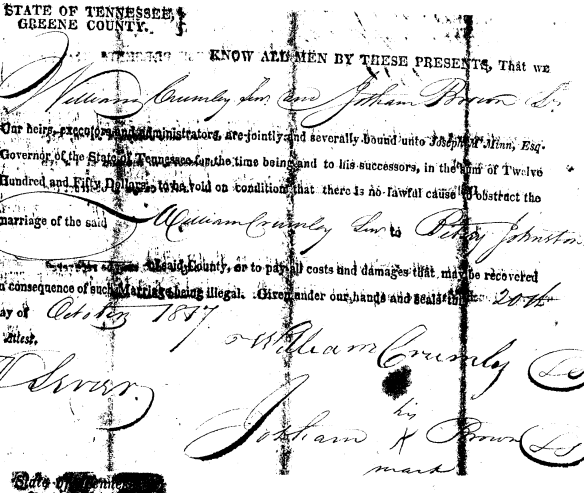
William Crumley Betsey Johnston marriage

It’s no help at all that Jotham Brown signed for both bonds.  Jotham was the father of Lydia Brown, the first wife of William Crumley (the third).  Lydia’s father died in 1799, so the Jotham who signed with an X was Lydia’s brother.

Keep in mind that Betsey Johnson was said to be the cousin of Lydia Brown.  If they were cousins, meaning first cousins, they would have shared grandparents.  Unfortunately, we don’t know who Lydia’s grandparents were, on either side.

If they are cousins, and if Jotham Brown’s wife is Phebe Johnson, daughter of Zopher Johnson, as theorized, but not proven, then indeed Betsey Johnson could have been a cousin of Lydia Brown, but, and this is a really important but – they could not have shared the same mitochondrial DNA.

Mitochondrial DNA is passed from a mother to both genders of her children, but only the female children pass it on.  Everyone carries their mother’s mitochondrial DNA and it is not mixed with any DNA of the father.

If Zopher Johnson had daughter Phebe that married Jotham Brown, Zopher’s unknown wife would have given her mitochondrial DNA to Phebe and then to Lydia Brown, Jotham and Phebe’s daughter.

Betsey Johnson would have been born to a male child of Zopher Johnson by his unknown wife.  Betsey would have inherited the DNA of that male child’s unknown wife, NOT of Zopher Johnson’s wife.  So, unless Zopher Johnson’s wife and his son’s wife shared a common matrilineal ancestor, the DNA of Lydia Brown could not match that of Betsey Johnson.  This is important because the DNA of both Clarissa, born in 1817, before William’s marriage to Betsey Johnson, and Phebe born in 1818 after William’s marriage to Betsey, is a match.  Furthermore, both women also match to another descendant of Phebe, Jotham Brown’s wife.

Zopher wife mtdna path

So, it’s very unlikely that Betsey Johnson is the mother of Phebe Crumley, which eliminates William Crumley (the third) as the William who married Betsey Johnson in October, 1817 in Greene County, TN.

Because I simply could not let this go, I asked Stevie Hughes, a Brown/Johnson researcher, to review the possibilities for Betsy Johnson’s identity and here is what she said, in probability order.

#1 Betsey is the daughter of Zopher Johnson, Revolutionary War Soldier.  I believe this is probable, given he is the ONLY one in Greene County by 1809.

#2 Betsey is the daughter of Moses Johnson, BROTHER to Zopher, the Rev War Soldier.  I THINK….but cannot prove Moses went to adjacent Hawkins Co BEFORE 1809.  I KNOW Moses was gone from Greene Co as of 1809.  He never appears in ANY Greene Co tax list or court record after 1809.  It is POSSIBLE he left Greene County as early as 1800 since there are no tax lists for the north part of the county between 1800 thru 1804 and 1806 thru 1808.  He is NOT in the 1805 list, however, neither is Zopher; so obviously the 1805 list is incomplete or for some reason Zopher (and Moses??) were “missed.”  NOTE the half brother, Harrison Johnson (son of Zopher “the elder” and a much younger, 2nd wife) IS in the 1805 list.  And, in 1809, there is a one-line entry in a Court record stating Harrison is executor of Zopher Johnson “deceased.”  I believe 1809 is the “magic” year where after the death of Zopher “the Elder,” the brothers wanted to go “seperate ways” and the family farm was split among the heirs, with Harrison and his mother going to western TN, Moses goes into Hawkins Co, and Zopher the Revolutionary War soldier is the only one who stayed in Greene Co.

#3 It is POSSIBLE, but very unlikely Betsey was a WIDOW of one of the Johnsons.  Reason being is I have “accounted for” all of our Johnsons in the tax lists from 1790 (arrival) thru 1798 (last complete tax list) until the tax lists resume in 1809 thru 1817.  Also, I have studied ALL Johnson marriages (brides and grooms) from inception of the marriage records up through 1868 (Burgner’s book).  I have an extensive “chart” of all these Johnson marriages, both male and female; and to a large degree, I have cross-indexed those acting for bondsmen (marriages, wills, deeds, etc.)  There are no other Johnsons –male or female– of our family who are in the northern part of the county during these years.  Also, there is no Orphan Court Record (if she was a widow and had children); nor does she appear in a tax list (if she was a widow and her husband’s land went to her).  There is no remarriage for her where one of our greatly intermarried “kin”….or neighbor….acted as the bondsman.  EXTREMELY unusual for our group….. and in my mind it would not have happened for an “outsider” to have been the bondsman for a 2nd marriage.

However, there is one possible fly in this ointment.  Zopher Johnson, the Elder, was born in the early 1700s. It’s very unlikely that he was still having children in 1770-1780 which is when Elizabeth “Betsy” Johnson would have been born, by a first wife.  However, if by some fluke Elizabeth is the daughter of the same mother who had Phebe born about 1745 who married Jotham Brown, then their mtDNA would have been the same.  Jotham the Elder has children from about 1745 to about 1780, so Elizabeth could have been his daughter, but not likely by the same woman as Phebe born in 1745.  Plus, family history says they are cousins, not sisters.

I have to tell you, all of this uncertainly and what-iffing makes my head hurt.  I’m reminded of this cartoon, found on the internet from Pardon My Planet.

Signature Composites

Stevie, sent me this signature composite from various documents in an effort to sort through the various William Crumleys.

Crumley signature comparison

The signature of William in 1817 is showing signs of being unsteady.  The loop on the W wobbles.  William (the third) would have been about 28 and his father, William (the second) would have been roughly 50 at that time.  That’s really not terribly old.  Maybe someone bumped his arm.

To add to the signature confusion, we also have this 1825 receipt from the court in Hawkins County.  We don’t know which William Crumly this is, the second or the third, but it is his signature.

William Crumley 1825 signature

Do you think you have this figured out?  If you’re like me, you think that the 1807 and 1817 signatures are the same, the two 1814 signatures are the same, and the others are different – although how to account for that difference without any more William Crumleys mystifies me.  But just as you get your mind all comfortable with that, I want to share one more signature with you.

William Crumley Civil War signature

Which signature do you think this looks like?  If you said either the 1807 or the 1817 signatures, you would be wrong.  Below is the full document.

William Crumley civil war document

This document is from the Civil War from the National Archives in a document series titled “Confederate Papers Relating to Citizens or Business Firms, 1861-1865,” after BOTH William Crumley (the second) and (the third) were long dead.

This William Crumley could be William (the fourth) son of William (the third,) as he was born in about 1811. Signatures can be both confusing and deceiving.  I jumped like I had been shot when I saw that curly W signature signature (pardon the pun.)

The most reasonable explanation I can find, with the least amount of stretch, is that if William Jr. – meaning the third, was born in 1788 or 1789 as the 1850 and 1852 censuses indicate, he would have been underage when he married in 1807, only 18 or possibly 19 years of age.  His father, William (the second) would have had to have signed for him, which is why the 1807 and the 1817 signatures look alike.  The 1807 William Crumley signature itself doesn’t say Jr. or Sr.  The document only says that William Jr. is getting married.  In 1811, the first year William Jr. (the third) is shown on the Greene County tax list, he would have been age 22,, born in 1789 – so this is very likely the answer.  Otherwise, where was he on earlier tax lists?

Someone Died

Regardless of whether William Crumley (the second) or William (the third) remarried in 1817, someone died.  William (the third) likely lost his mother.  If it wasn’t his mother, then he lost his wife, leaving him with a newborn infant.  I believe it was William (the third’s) mother that died, in part because of the matching mitochondrial DNA evidence between descendants of Clarissa Crumley, Phebe Crumley and Phebe Brown, their grandmother.

If the family was still attending Wesley’s Chapel, William’s wife might have been buried there, although the cemetery appears to date from the “new” church built after the church burned in 1880.  William’s wife might also have been buried at the Cross Anchor Cemetery although at that time it was likely still the Gass Family Cemetery.  Another possibility is that William’s wife is buried in the Kidwell Cemetery which was begun about 1800 when the Kidwell Meeting House stood on that land.  She could also be buried at Carter Station.  A great-grandson, Thomas Crumley, born in 1852, in a letter said that the early generations of Crumley’s were buried at Carter Station.  William (the second) was the first generation to settle in Greene County, so his wife would have been the first of the founding generation to pass over.  The other information provided by Thomas in his letter has proven to be accurate.

The Move to Lee County

Then, in 1819, for some reason, nearly the entire family decided to up and move to Lee County, VA.

Greene co to Lee co

William Crumley (the second) along with two of his sons, William (the third) and Isaac set about in 1819 making preparations for moving to Lee County, VA on the border with Hawkins County, TN.

On April 5, 1819, just before moving to Lee Co., VA., William sold his 126 acres of Lick Creek land to Humphrey Malone.

“The Early Settlers of Lee Co., VA” says that a William Crumley Sr. from Greene Co. bought 250 acres of land from William Sparks on November 11, 1819 for $250.  It was witnessed by William Crumley Jr.  The William Sr. in this case must be William (the second) and Jr. must be his son William (the third.)  Therefore, we now know that William the second did in fact move to Lee Co. along with William (the third.)  However, he is entirely missing from the 1820 census.  Where the heck was he???

TRANSCRIPTION OF CONVEYANCE – SPARKS (to) CRUMLEY

11 NOVEMBER 1819 – 100 acres – DBK 9, p 6, Lee County, Virginia]

This Indenture made this 11th November 1819, between William Sparks of Lee County and state of Virginia of the one part, and William Crumley of the County of Green and state of Tennessee of the other part; Witnesseth that for and in consideration of the sum of two hundred and 30 dollars lawful money of the state aforesaid to him in hand paid by  The sd  Crumley at or before the sealing and delivery of these present the recipt whereof is hereby acknowledged and ……therewith fully satisfied and paid ….bargained sold and deliveres with the said Crumly a certain parsel or tract of land, lying and being in the County of Lee situated on the west fork of black water creek and bounded as followeth to wit:  Beginning at a Poplar and two Beeche’s thence North 35 degrees West 50 poles to a Poplar and Burch on the side of Powell Mountain  Thence with the lines of the original patent so as to include one hundred acres by running straight along 1st survey having the last and to sd William Crumly senior together with its appertenances.  To Have and To Hold The sd delivered parsal of land with all and singular the appertenances belonging as in any anywise to sd premises free from the claim or claims him the sd Sparks or his heirs or assigns forever In Witness whereof  I have herewith set my hand and seal

Sealed, signed, dated and delivered in the presents of}          William x Sparks    {Seal}

Joseph Baker,  mark
William Crumly Junr
Thomas Anderson

Note that the Anderson Cemetery is just a mile or so north of the Lee County line on Blackwater Road and this deed is witnessed by Thomas Anderson.

By 1820, William Crumley (the third) was living in Lee County, Virginia with one male under age 10 (Jotham), 1 male age 10-16 (William or John), one male 26-46 (himself), 3 females under 10 (Clarissa, Phebe and Sarah), one female 16-26 (unknown) and one female 26-45 (presumably his wife.) It’s problematic that one male is missing and one female, Belinda, supposed to have been born in April 1820 is missing as well.

This census raises troubling questions.  Who is the unidentified female?  Only two sons are listed, one son believed to be William (the fourth) is missing.  He is not found in any public record until his 1840 marriage to Rebecca Malone in Greene Co. whereas son John married in 1828 and is found in Hawkins Co. in 1836 and in the 1840 Claiborne Co. census beside William (the third).  Jotham married in 1834 and is found in the 1840 Lee Co. census.  Is William (the fourth) really the son of William (the third) and if so, who raised him and why is he never found in Lee, Hawkins or Claiborne County?

The youngest daughter, Belinda, may actually not have been born until after the census.  Her absence is easier to explain, at least hypothetically.

William Crumley Sr. (the second) who bought the Lee County land is back in Greene County finishing up a lawsuit in October of 1821 and selling his land, preparing to remove entirely from Greene County.  Actually, we don’t know positively that the lawsuit is William Crumley (the second) and not (the third,) as the document never says.  William (whichever) petitions the court to transfer the venue for an appeal of the lawsuit to Hawkins County stating that he doesn’t feel he can get a fair trial in Green County, and that some people, obviously meant to imply the defendant, Johnson Frazier, were “fomenting” hard feelings towards William. He was obviously very troubled by this turn of events.

We’ll never know the details, but it’s certainly possible that William (the second) never meant to remove when he bought the Lee County land in 1819.  He could have been purchasing that for his son, William (the third,) whose wife’s sisters already lived there, but then decided to sell out and move on during the 1821 trial.  Regardless of why, that is exactly what he did.

In 1824, William Crumley obtained a 50 acre land grant on Blackwater Creek in Hawkins County.  This part would become Hancock County in 1845.  We are not sure which of the Williams owned this land, but I suspect it was William (the second.)

In 1834, in Lee County VA Deed Book 15 page 162, a deed from William Crumly  to Peter Louisey (sic) is registered on December 22, 1834 but dated October 31, 1831. William Crumley of Lee County. VA and Peter Livesay of Hawkins County TN, for $300, land in Hawkins County on Blackwater bounded by the Reis (probably Rice or Rheas) line, 47 acres signed W M Crumley.

We believe this 1834 land sale was by William Crumley (the second) since William (the third) had moved to Pulaski County by 1830.  But, we’re not positive since we don’t actually know which William applied for the land grant for this tract of land.

Crumley 1824 land grant

Blackwater Creek

Blackwater Creek is extremely remote, so remote that just getting there requires one to navigate a quagmire of maze like back roads, any one of which could lead to an unexpected problem.  It’s still dirt and one lane and feels more like someone’s long driveway than a road.  Cell phones nor satellite navigation systems work there due to the tall, steep mountains.

Today, bootleggers or under-the-radar farmers who don’t know you and certainly don’t want their crop discovered can be lurking on these desolate back roads.  The locals warn you about this and I was more than a little nervous.  In earlier times, Indian attacks and buffalo stampedes were the worry of the day.  Yes, there were buffalo on Blackwater Creek at one time.  And Indians too.

Blackwater road lee co border

In fact, Blackwater Creek, it turns out, was very desirable property and a very busy place at one time.  Believe it or not.  You’d never know today.

Reading the actual deeds is just so critically important.  In this deed, Isaac Crumley, son of William Crumley (the second) sells land to Polly Stapleton, the sister of Lydia Brown Crumley, the wife of his brother, William Crumley (the third.)

Lee County, VA, Deed Book 7, page 241 – January 15, 1837

Isaac Crumley to Polly Stapleton, 100 acres lying on the west fork of Blackwater, just above Blackwater Salt Works, for $50, adjoining land of John Williams.

Notice the comment about the Blackwater Salt Works.  In this next deed, the salt works aren’t mentioned, but the land granted to John Neill and William Roberts is.

Lee County, VA, Deed Book 12, page 77 – April 25, 1852

Isaac Crumley and his wife Mary of Lee County to William Chandler, Jeff Chandler and William Howe, all of Lee Co, 3 tracts of land on Blackwater Creek, 150 acres, 50 acres granted to James Fletcher, 837 acres, balance of 937 acre tract survey granted to John B. Neill and William Roberts by the commonwealth of Virginia, for $1000.  Signed by both Isaac and Mary B. Crumley

1832 Rhea map salt works

This 1832 Matthew Rhea Map, the first Tennessee map taken from surveys clearly shows the salt works.  In 1832, this is one of the few features noted, so it was obviously well known and important.  And guess who owned this land…

The Sullivan County, TN Department of Archives and Tourism tells us the following:

Blackwater is located at the crossroads of the old trading route from the Cumberland River to the Cherokee nation in East Tennessee and the old hunters trace from the New River to Kentucky. Today, Blackwater is an isolated community as to commerce and transportation, but it was not so isolated in the mid eighteenth century due to the large buffalo lick. Over the eons of time, herds of buffalo had carved out trails radiating out from the lick to the grazing meadows in Powell Valley, Rye Cove, and south to the Clinch River valley. Herd animals would travel great distances to a salt lick to replenish their need for salt, an essential mineral in their diet. A salt lick is a site where the soil and rocks contain a natural deposit of salt and was called a lick because the animals would lick the soil or rocks to a depth of several feet to satisfy their need for this essential element.

A salt lick was the favorite hunting site of the Indians and long hunters. The hunters would position themselves at strategic points along the trails the animals traveled to the lick and make their kill. Numerous historical records of the frontier give accounts of the well-known licks such as the Bledsoe lick in Sumner County Tennessee, the Blue lick in central Kentucky and the French lick in southern Indiana, but little is known about the large lick at Blackwater. Perhaps this is because the Blackwater lick was discovered at least a quarter of a century before the licks in Sumner County in Tennessee, Kentucky, and Indiana and by the time of their discovery the pressure of hunting at the Blackwater lick had depleted the size of the herd animals to near extinction; however, the trails carved out by buffalo remained and were used by the hunters as the choice route leading from the frontier to Kentucky. The long hunters knew about the lick as early as 1761, and it was a landmark on the old hunters path from the New River to Powell Valley.

Land records tell us much about the route the hunters took to seek game around the large salt lick and the grazing grounds in Lee County. The Hunters path is well defined until it reaches the little salt lick, Duffield, but from this point little is known about the route to Powell Valley; however, the land surveyors made notations on their surveys that give clues as to the route of the path. A land grant to Arthur Campbell [LO 45-325] describes the location of the grant as being at the Hunters Gap in Lee County and on both sides of the Hunters path. This tells us that the Hunters path ran along the south side of Powell Mountain from Duffield to Blackwater and crossed the mountain at Hunters Gap. The path ran down Wallen creek to near its mouth on Powell river where again the land surveys pick up the route of the Hunters path.

Another grant to Arthur Campbell [LO Q-318] is described as being on the south side of the Powell River and on both sides of the Hunters path. This grant is located about one mile west southwest of where Wallen Creek flows into Powell river. The Campbell grant [LO Q-318] is adjoined on the west side by a land grant to Robert Preston [LO 27-57]. The Preston grant is described as lying on both sides of the Hunters path. From this information, we know that the Hunters path ran from near the mouth of Wallen Creek across the area known as the Rob bottoms and crossed the Powell River at White shoals. Again, the surveys tell us that the path ran in a north or northwest direction from White shoals as a grant to Robert Preston [LO 27-41]is described as lying on the west side of trading creek and one of the survey points is described as “white oak south side of the old Kentucky trace on John Ewing line with same”. From this point, the path or trace ran to Martins station but the exact route cannot be proven by land records.

Records show that Elisha Wallin and William Newman hunted around the Blackwater buffalo lick as early as 1761. Wallins Ridge and Newman Ridge were named after them.  (Note that Wallin’s Ridge and Newman’s Ridge border Blackwater Creek on either side.) Other long hunters surely knew about the lick. Evidence of the buffalo trails remains on modern maps by the names of geographic features such as Hunters Ford, Hunters Valley, Hunters Gap and Hunters Branch. No doubt the long hunters in quest of game followed the herd animal paths from their favorite grazing grounds to the salt licks. There were many small licks in the area used by deer and other small game, but needs of the herd animals would require the mineral deposits of a much larger lick such as the Buffalo Lick at Blackwater.

The importance of the Blackwater lick is clearly pointed out by the claims of the land speculators. As early as 1775, Thomas Osburn had settled on land adjoining the Buffalo lick and obtained a land grant from the Commonwealth of Virginia by virtue of Right of Settlement.

“Washington County Survey Book 1,Page 389 Commissioners Certificate – on the forks of black water a north branch of Clynch River – beginning at the foot of Powells Mountain on the west side of the Buffalow Lick – at the foot of Newman’s ridge on both sides black water joining Powells Mountain, includes improvements, actual settlement made in 1775 – August 22, 1781”.

The name Blackwater appears in land claims as early as 1775, and the name was known far and wide. Claims were filed in the Virginia Land Office and the North Carolina Land Office for land at Blackwater so hunters from North Carolina and Virginia had spread the word about the large buffalo lick at the Blackwater.

From the North Carolina Archives, we find that Walter and Robert King filed an entry with the North Carolina Land Office for 250 acres that was to include an old buffalo lick.

“Recorded in North Carolina Land Office File No 28 Hawkins County records. Walter King & Robert King make entry No 1947 entered 12 Oct 1779,250 acres near the foot of Powell mountain by the name of Black Water: Beginning near the creek at a poplar, white oak, poplar s;150 poles to a stake, then W;280 poles to a stake, then n;150 poles to a   stake, to include an old Buffalo Lick, surveyed 16 Sep 1793. Thomas Church assigned his interest in the Wilkins land to William Hord and Hord assigned it to Walter King & Robert King 1 Nov 1792”.

In the meantime, Walter Preston was issued a land grant from Virginia that bordered the Thomas Osborne grant and included the buffalo lick. To further complicate the issue Arthur Campbell also obtained a grant from Virginia that included the buffalo lick, all of the Thomas Osborne grant and much of the Preston grant. Apparently Preston ended up as the legitimate owner as he sold his grant to James White. The heirs of Campbell made an effort to reclaim their Blackwater grant, but I find no record that they were successful.

Blackwater buffalo lick

Osborn and Preston land grants at Blackwater, Virginia. Copyright 2009, W. Dale Carter.

The Thomas Osborn grant ended up under the ownership of James and Stephen Osborn. A deed recorded in Lee County Deed Book 3, page 189:

“Stephen Osborn & Comfort & James Osborn & Mary to William Roberts, 31 Jul 1810, DB 3-189. 400A by survey only the 1/2 of the Buffalo lick excepted for James Osborn the same being the west side of the said lick running through the middle thereof with the conditional line made by John Osborn & Roberts from thence marked around the lick on or near the bank of the same $650”.

This deed shows that James Osborn reserved for himself ½ interest in the salt lick when the Thomas Osborn grant was sold to William Roberts. Apparently the lick site was developed as a salt works as a deed made 29 December 1817 and recorded in Lee County Deed Book 3, page 399, shows that William Roberts and his wife, Catherine sold ¼ part of a tract known as the Blackwater tract, to Jessee G. Rainey.

“Being a part of tract said Roberts purchased of James & Stephen Osburn. Including the lick premises and well, now occupied by said parties together and including 100 acres”.

The deed shows that by the year 1817 a well had been dug at the salt lick site. On 5 June 1818 William Roberts and wife sold 1/8  part including the lick premises and well recorded in Lee County Deed Book 3, page 405, and on 12 May 1818 William Roberts and wife sold ½ interest of the lick tract to Joseph and James McReynolds of Bledsoe County, Tennessee for $3,000. Recorded in Lee County Deed Book 3, page 406. The McReynolds deed shows that something of great potential lay within the boundary of the tract. At that point in time, land in and around Blackwater was selling for $1 to $2.50 per acre. The McReynolds paid $60 per acre.

From this time forward, the land records do not show what happened as to the ownership of the salt lick tract; however, on 19 January 1835, by order of the Lee County court, Jacob V Fulkerson, commissioner of the court, sold one moity of the Blackwater salt lick to Dale Carter of Russell County, Virginia. Carter was a large land owner and land speculator who owned large tracts in the Elk Garden and in present-day Wise County, Virginia.

Why all the interest in the buffalo lick? Most likely these early land speculators had visions of developing the site as a salt works much like the one at Saltville. In fact, a salt works was operated at Blackwater for a period of time.

There are two further pieces of information that have a bearing on the land and the road where William Crumley (the second) and probably (the third) lived.

Lee County Order Book 2, page 364 27 Jan 1818; David Burk proposes an alteration in the road leading from the Blackwater salt works up Blackwater to the state line.

The above statement shows that “up” does not mean north, because the state line is south of the salt lick.  Therefore, the land description that says that the Crumley land was “above” the Salt Lick probably means between the lick and the state line.

Lee County Order Book 2, page 374, 29 Apr 1818: John B Neil, Elisha Rogers; Thomas Roberts; William Wallin and David Lawson view a road from the forks below the Blackwater salt works to John B Neils.

This would be the road where William Crumley lived.  His land abutted that of John Neils and William Roberts .

Today, the Roberts Cemetery is near the head of Blackwater Creek in VA, very near the salt lick, located on SR 70, 10 miles south of Jonesville, VA at the foot of Powell Mountain near a group of houses across the road from the Collingsworth Cemetery.  The Roberts Cemetery is where Polly Stapleton, aka, Mary Brown Stapleton, sister of Lydia Brown, wife of William Crumley (the third) is buried.  In fact, it may also be where Lydia Brown Crumley is buried as well.

Note also that William Crumley (the third’s) grandson, John Crumley’s son, James H. Crumley born in 1839 in what became Hancock Co, married on May 10, 1865 to Martha Anderson.

Anderson Cemetery Roberts Cemetery

On this map above, the Anderson Cemetery (left red arrow) is about a mile north of the Virginia/Tennessee border, and the salt lick is another 2-3 miles north of that.  The Roberts Cemetery (right red arrow) is near the salt lick.

You could say that all of Blackwater Road was the Crumley stomping ground.  They knew every nook, cranny and mountain ridge.  William Crumley the second lived his life from 1820 or so until his death after 1837 but before 1840 and his son, William Crumley (the third) lived here from 1820 or so until he packed up his wagon and left for Pulaski County before 1830.  In 1840 William Crumley (the third) had moved back and lived nearby, one ridge over, but by 1850, he was once again living on Blackwater, on the Tennessee side of the line.  For thirty years William Crumley (the third) trod and plowed this land and the land in this area…more or less…except when he moved to Kentucky.  William (the third) buried his wife, (step)mother and father here, not to mention his son Jotham…and those are only the family members we know about.  There were surely more.

I have to believe he would have been pleased to see me on Blackwater Road, looking for his land.  Seems that the Crumleys return here much as the buffalo returned to the salt lick.

Which William Lived Where?

The 1830 census becomes even more confusing, because William (the second) has apparently moved to Pulaski Co., KY., 80-100 miles west of Lee Co., Va. where he appears on the 1830 census age 40-50, one female 20-30 (unknown), one son 5-10 (Aaron), one son 15-20 (Jotham), one daughter 5-10 (Belinda), one daughter 10-15 (Phebe), one daughter 15-20 (Sarah or Clarissa) and one female 40-50, presumably his wife.

Again, son William (the fourth) and a daughter are missing, although Belinda, or at least a female that age, is present in this census.  There is also an extra female, age 20-30.

Pulaski County records have never been searched for William although many of their records were destroyed by fire in 1871.  William could have lived there for only a short time, around 1830, or he could have lived there nearly 20 years, from not long after 1820 to not long before 1840.  A volunteer searched the tax records from 1823-1839 and found no William Crumley, although three years were missing.  I’m guessing this means that he likely did not own land there.  I searched Pulaski County grantor indexes and found no William Crumley by any similar spelling, including Chumley.  The grantee indexes have not yet been imaged, but to buy and sell you have to be both a grantee and a grantor, so it’s unlikely that William owned land in Pulaski County.

Unfortunately, this was my last hope for discovering, positively, William (the third’s) wife’s name after the 1817 marriage.

However, in 1830, there is a William Crumley living in Lee County.  Lo and behold, it appears to be William Crumley (the second).  He is shown, aged 60-70, which would be accurate.  He was shown with 2 females in the household, his wife age 50-60 (presumably Betsey) and a girl age 5-10, possibly a grandchild, or maybe he and Betsy Johnson had one child after their marriage.

Sometime during the next decade William (the third) returned from Kentucky.  I think he returned before 1838 because his daughter Melinda (Malinda, Belinda) was married to James Hervey Davis in Claiborne County in 1838 – and you have to see each other to court.  He may have returned before August 1834 when his son Jotham was married in Lee County.

William (the third) appears on the 1840 Claiborne Co., TN census, age 50-60, possibly no wife, one son 15-20 (Aaron,) two daughters 20-30, (Sarah and Phebe) and one female 60-70 who is unknown.  The female age 60-70 could Lydia and the census date column information could be wrong.  Or Lydia could have died and the female could be Betsy Johnson Crumley, since it appears that William (the second) had died.

Wouldn’t it be a great twist of irony if William Crumley (the third) actually did wind up living in the same household with Betsey Johnson Crumley after his father’s death, even though he was not her husband, but her step-son, as well as her cousin by marriage.  Sometimes, the truth is stranger than fiction.  Especially in this family line.

Finding William (the Third)

The Claiborne County residence in the 1840 census also suggests that William Crumley is living further west than his father who lived on the border of VA and TN on Blackwater Road, which was part of Hawkins County before Hancock was formed about 1845.  Blackwater Creek and Powell Mountain were originally the eastern boundaries of Claiborne County, where it intersected with Hawkins before the formation of Hancock.

Interestingly enough, I accidently discovered where William was living in 1840 – and it makes a great deal of sense.  This comes in the “truth is stranger than fiction category,” as I wasn’t looking for William Crumley at all when I made this discovery.

I had noticed that in 1840, William Crumley (the third) was listed on the census, along with his son John Crumley, living between Eli Davis and Littleton Brooks.

William Crumley 1840 Claiborne

I was looking for where Elizabeth Shepherd McNiel lived in 1830, and she lived beside her son Niel McNiel.  I noticed in some documents that Niel’s land abutted that of Josiah Ramsey.  One of my very experienced genealogy cousins descends from the Ramsey family and I knew she had done a lot of research, so I contacted her to see if she knew the location of Josiah Ramsey’s land.

Cousin Dolores sent a map with land locations overlaid, which was of primary importance.

Josiah Ramsey land division

On the 1830 census, Elizabeth McNiel and her son Niel McNiel live between Josiah Ramsey and Eli Davis in the upper right hand corner of this map.

In 1840, William Crumley is living between Eli Davis and Littleton Brooks and near the Hopkins, all shown on this map as neighbors.

In the lower left, Daniel Rice’s land is shown where it would abut Elijah and Joel Vannoy’s lands.  Why is this important?  Because in 1845, William Crumley (the third’s) daughter, Phebe, would marry Joel Vannoy, son of Elijah Vannoy.

So, not only do we now know how Phebe and Joel met, as near neighbors, we also know where William Crumley was living in 1840 after he returned from Pulaski County, KY.  Additionally, in 1848, William’s daughter Sarah would marry Edward Walker, who lived a mile or so beyond Elijah Vannoy’s land on Mulberry Gap Road.

Now, where is this land today?  On the map below, William Crumley likely lived just below the Turner Hollow label.

McNiel to Vannoy

I mapped the location where Niel McNiel would have been living next to Elizabeth McNiel and Eli Davis on present day Turner Hollow Road (on the right) and then where Joel and Elijah Vannoy owned land on Mulberry Gap Road at the red balloon on the left.  Keep in mind that they would likely have taken the “back way” since Rebel Hollow and Turner Hollow intersect and it looks like Joel and Elijah Vannoy probably owned the land between Mulberry Gap Road and the back side of Rebel Hollow Road.  Of course, at the time, it wasn’t called Rebel Hollow Road – a name it acquired during the Civil War.  The history of the Mulberry Gap church tells us that the name arose because a group of southern sympathizers lived there.  Hmmm….

William (the Second) Dies

In January 1837, William (the second) sold his land in Lee County to his son Isaac.  In 1841, Isaac had to prove the deed in court by the testimony of James Weston, Thomas Stapleton and Thomas Weston (husband of Hannah Crumley), the same men who witnessed the 1837 sale, and the deed was recorded October 18, 1841.  This, along with the fact that William (the second) is missing in the 1840 census, suggests that he died between 1837 and 1840.

Thomas Stapleton is the son of the sister of Lydia Brown, Mary “Polly” Stapleton.  In fact in an every larger twist of fate, Isaac, just a decade later, sells at least part of the William Crumley land on Blackwater to Polly Stapleton.

William (the third) lost his father about 1840.  This could have had something to do with why William (the third) returned to the area from Pulaski County.  His father may have been ill in the 1830s and needed help.

William Goes A-Courtin’

William (the third’s) children began marrying in 1828, when John, the eldest son, married a woman named Mahala, last name unknown.  In 1834, Jotham married Anne Robinette in Lee County.  Clarissa married John Graham in 1834 in Greene County and Melinda (or Belinda) married James Hurvey Davis in Claiborne County in 1838.  Aaron wouldn’t marry Anne Scofield until 1844 and Phebe married Joel Vannoy in 1845.  In 1848, Sarah, called Sallie, would marry Edward Walker, a widower who lived in Mulberry Gap Road just down from where Phebe and Joel Vannoy lived.  By 1848, William’s cabin would have been empty and quiet, so it appears that William went a-courtin’.

William (the third) married Pequa (Pya, Pqa, Paa) some time in 1849 or early 1850.  They are listed in the 1850 census of Hancock Co. as ages 61 and 53 and it’s noted that they were married within the past year.  Unfortunately, the Hancock County courthouse burned, twice, so there is no further information available.

It’s unlikely that Pequa had never been married before, given her age.  However, there are no children showing that would have been hers, so if she had children, they were already married and gone, although that is unlikely given that women generally have their last child in their early 40s.

Pequa’s name is extremely interesting.  In 1850, William Crumley (the third) lives in the middle of the Melungeon neighborhood.  John Crumley, his son, lived adjacent and very likely married into the population, as his wife’s name is Mahala, a name traditionally found in the Melungeon families, made particularly famous by legendary Melungeon Mahala Mullins, a very rotund and colorful bootlegger.

The Crumley land, on Blackwater, is also in the Melungeon neighborhood.  The name, Pequa, however, is not found in any other instance in this region to the best of my knowledge, and I’ve researched here for over 30 years now.  Pequa, is, however, a Shawnee word for Phoenix, or risen from the ashes.  There have been family rumors for years of this line being “Native,” but if this is true, and it’s through Pequa, then it’s not a direct line to any of the Crumley children, because by the time Pequa married William Crumley, she would have been too old to have children.

One More Move

Something nudged William to move on, even though he had already seen his 60th birthday.  Why William would want to pack up everything he owned, leave much of his family behind and rattle around in a wagon with no shocks, creaking and bouncing over dirt roads full of wagon ruts, or mudholes, depending on the season, is beyond me.  Appanoose County, Iowa is about 800 miles, on today’s roads, from the area where William lived in Hancock County.  At ten miles a day, the journey would have taken 80 days, or nearly an entire miserable summer.  What was this man’s motivation?

Hancock Co to Appanoose Co

Furthermore, Appanoose County is significantly further north than Hancock County, Tennessee.  I’m betting that William had no idea what was in store for him in terms of winter weather.  Genweb has a delightful page with frightening snow pictures of Iowa weather.  I doubt, if William had seen these, he would have been nearly so willing to depart.  It’s dramatically different than the South.

Appanoose snow

William and Pequa moved to Appanoose Co., Iowa in 1851.  William was shown as age 64 on the 1852 Iowa State census, so born about 1788, but did not appear on the 1860 Appanoose Co. census that listed Pequa as age 64.  William (the third) apparently died after the census in 1852 but before the census in 1860.  He did not die within a year of the census, because he is not listed in the 1860 mortality schedule.  Pequa’s death date is unknown but both are buried someplace in Appanoose Co., Iowa.  After William’s death, Pequa lived with a family in Unionville, a very small town of about 2 blocks in length.  Perhaps William is buried near here.

Unionville, Appanoose Co., Iowa

Iowa was a very different place than William (the third) had ever lived.  It was flat with a horizon that went on forever.  No hills, no mountains.  I wonder if he was happy.  I guess, in part, that answer might have something to do with why he left in the first place.  Perhaps he missed owning land and he apparently had none after returning from Pulaski County, KY.  Maybe he had never really owned land.  Or maybe he just had a case of wanderlust.

Appanoose co horizon

In the “Iowa History up to the 20th Century – History of Iowa from the Earliest Time to the Beginning of the Twentieth Century” Vol 3, in the “Early History of Iowa” section, page 349, Greene Co., it mentions William Crumley coming to Greene County in 1850-51.  This is the same time that the other Crumleys migrated to Iowa.  On the same page in the book, it mentions S.G. Crumley as county clerk and Isaac D. Crumley as sheriff.  The Crumley men apparently succeeded there.

“The History of Appanoose County, Iowa, Containing A History of the County, its Cities, Towns” tells us that land opened for survey in 1850, was initially delayed a bit due to a boundary issue, but by 1860, nearly all of the land was claimed.  The availability of land may have been why William left for Iowa.  Maybe William found something he had chased his entire life.  A review of the Iowa records has never been done.

William’s Death

Several months after I wrote and published this article, cousin Keith, a descendant of William’s son, Aaron, contacted me and said that back in the year 2000, he had visited the Unionville, Iowa cemetery and had found William’s stone.  He took a photo and was kind enough to share with me.

William Crumley stone

I was there able to find the cemetery on Find-A-Grave and found another photo as well.

William crumley stone2

“From the collection of Rhonda L. (Atkinson) Johnson – Find a grave contributor #47027837 rhondabrent Ancestry Family Tree: Atkinson Family Tree:rhondabrent1”

Indeed, this cemetery is just within the village of Unionville, in the upper right hand corner by the T61 marker, to the right.  You can see the rectangle shaped area.

Unionville Iowa map

Here’s a closeup of the cemetery

Unionville Iowa cemetery

William’s final resting place has been identified now, thanks to cousin Keith, and along with it, a mystery has been solved.  The inscription of William’s stone not only tells us when he died, but how old he was, down to the day, so we can now calculate his birthdate as well.

William died on February 15, 1859 at the age of 70 years, 8 months and 13 days.  Utilizing a reverse date calculator, this gives us a birth date for William of June 2, 1788.

Many thanks to cousin Keith.

William’s probate record is shown below as well.  Perhaps eventually the wills of Appanoose County will be online as well.

william-crumley-1859-probate

William’s Children

Children of William (the third) assembled from family information, census and land information are as follows:

  • John Crumley born 1808 in Green Co, TN married Mahala born in 1812 and lived in Hancock County. He named a daughter Lydia. The 1870 census shows a John Crumley in Lee County VA, age 62 (born 1808) with Mahalia, 58, several children, with John stating he was born in Green Co., TN.
  • William Crumley (the fourth) who married Rebecca Malone in 1840 in Greene County was attributed to William (the third,) but I have my doubts, especially since William (the third) was “missing” a child in both census where William (the fourth) should have been listed. However, this William did name a child Jotham.  It also appears that Clarissa was raised by someone in Greene County as well.
  • Jotham (also noted as Sotha) Crumley born October 23, 1813 Greene Co., TN, died August 22, 1841, Lee County, VA, married Ann Robinette on August 14, 1834 in Lee Co., VA.
  • Sarah “Sallie” Crumley born 1814/1815 in Greene County, TN, married Edward Walker in 1848 in Hancock Co., TN. The Walker homestead, a log cabin, still stands.  The Vannoy and Walker households in Hancock County were on the same road and only a mile or so apart.

walker homestead

  • Clarissa Marinda Crumley April 10, 1817 married George Graham in Greene Co January 16, 1834, buried in the Cross Anchor Cemetery, Greene County, TN. There are no children named Lydia or Jotham, but the mitochondrial DNA of Clarissa’s descendants matches that of Phebe, indicating they share a common maternal ancestor.
  • Phebe Crumley born March 4, 1818 died January 17, 1900 married Joel Vannoy and in the late 1860s, moved down the road to Claiborne County where they lived in the Little Sycamore community in Vannoy Holler and had a large family.
  • Belinda Crumley born April 1, 1820 married James Hervey Davis in 1838 in Claiborne County. She died in 1905 and is buried in the Mulberry Gap Baptist Church Cemetery.  Of note, she also named a daughter Lydia.  I would very much like to have a DNA test from someone who descends through all females through one of her 4 daughters, Martha, Lydia, Nancy and Louisa.  This would confirm or refute the tests of Clarissa and Phoebe as being the children of Lydia Brown.
  • Aaron Crumley born in 1821 in Lee County, married Mary Ann Scofield on November 21, 1844 in Claiborne County, TN. Named a son Jotham.  Aaron moved to Iowa with William and Pequa.

Cousin Keith also provided a photo of Mary’s stone, also found in the Unionville, Iowa, Cemetery, so we know that Aaron lived close by as well.

Mary Scofield Crumley stone

She died November 1, 1862 at 38 years, 7 months and 1 day.  I would have expected that Aaron would be buried here as well, in an unmarked grave, but cousin Keith uncovered information in later census that Aaron went on to Missouri and Kansas.

Cousin Keith also provided an obituary for one of Aaron’s sons, which may provide some breadcrumbs for researchers on this line.  I notice that the Crumleys continues to move to new areas as Indiana, Pennsylvania and Houston, TX are mentioned.

Crumley, Aaron's child obit

Of William’s children, the ones I most question as belonging to William Crumley (the third) and his wife, Lydia, are William and Clarissa, both because they married in Greene County, TN.  Either they were raised there, or the family traversed back and forth quite a bit.

Crumley DNA

When I first began the Crumley DNA project, there was one burning question we wanted to answer.

In addition to this Crumley family, who at that time we presumed was connected to the Greene County group, there was one George Crumley in Sullivan County, TN.

For decades, the two families searched for a common ancestor or a link to prove they were related – or that they weren’t.  That link remained elusive, although both families did have children named William,  Unfortunately, William is such a common name that one really can’t draw any inferences from that alone.

The most difficult part of this comparison was finding the first Crumley males from each group to test.  DNA testing was in its infancy.  I formed the Crumley DNA Project and began to see who I could find to test to represent the two lines.

I’ll never forget the cousin, nicknamed Wildman, who made and sold possum skin bikinis for larger women on the internet, and would give a discount if the lady would send him a picture of herself in the bikini.  Wildman wanted to know if I wanted to clone him.

I told him no, and the possums don’t want more than one of him either:)

At that time, more than a decade ago, there was little understanding of any genealogical DNA testing, so the folks who tested did so simply out of trust and good grace.  Wildman represented the Sullivan County line and my cousin Jerry represented the Greene County line.  We just knew we were all from the same ancestral line.

Except… we weren’t.

Thank Heavens, the answer is definitive.  No maybe or ambiguity about it.  Not only are we not related, we’re not even in the same haplogroup.  We were disappointed, but so glad we could stop chasing that elusive connection document that didn’t exist.

The George Crumley line is haplogroup G-M201 and the Greene County line is haplogroup I-M223.

Crumley DNA project

But, are we sure?  Was there an NPE or undocumented adoption in one line or the other.  We needed a second male descended from a second son of each ancestral line to test, just in case.

We found another Crumley male for the Greene County group three months later, but it would be another year before we found another male for the Sullivan County group.  Even today, that group hasn’t grown beyond the original two.

We did in fact confirm that yes, the two groups are entirely separate.  Now the confusion is only genealogical when their descendants move into counties where their records are co-mingled – like, oh, say, multiple William Crumleys.

Yep, the Crumley Curse lives on!

Acknowledgements:

Other contributing researchers to the Crumley family are Truett Crumley (deceased), Paul L. Nichols (deceased), Stevie Hughes, Larry Crumley, Irmal Crumley Haunschild (deceased), Jerry Crumley, and Nella Myers (deceased.)

______________________________________________________________

Disclosure

I receive a small contribution when you click on some of the links to vendors in my articles. This does NOT increase the price you pay but helps me to keep the lights on and this informational blog free for everyone. Please click on the links in the articles or to the vendors below if you are purchasing products or DNA testing.

Thank you so much.

DNA Purchases and Free Transfers

Genealogy Services

Genealogy Research

Elizabeth Shepherd (1766-1830s), Frontierswoman, 52 Ancestors #79

Elizabeth Shepherd was born July 23, 1766 in St. George Parish, Spotsylvania County, Virginia to Robert Shepherd and Sarah Rash.

We are extremely fortunate to have the Robert Shepherd Bible pages, still in existence in 1991.  A sixth great-grandson of Robert and Sarah Rash Shepherd was kind enough to copy and transcribe them, and they have been sitting in my “to do” file, which became a “to do” pile, long enough.

The cousin who so graciously sent the pages also said that he couldn’t capture the entire page in the copy because the pages were bound in the Bible.  He provided the transcription following each page – taken from the original Bible.

I am struck by the beauty of these Bible pages – the lovely calligraphy style handwriting.  I’ve also noted that the handwriting is all the same, including the death information for Robert – except for the 1858 death note about Sally.  Given that Sally is the only child with a death date, and there is also a rather illegible note about her name that looks like it notes someone’s mother – I’m surmising that this Bible was a copy of Robert’s original Bible that was passed down in the Sally Shepherd family line and her death date was of course added sometime after her passing.

The identical handwriting is a dead giveway (pardon the pun) and nobody so far as I know can record their own death after the fact – so this isn’t Robert’s handwriting.  If we had the front page of the Bible, we could look at the date the Bible was printed and I’m sure it would be after some of these events occurred.  That doesn’t diminish the value of the Bible, just lets us know more about the provenance of the information it holds and alerts us that transcription mistakes could have occurred – since the information we’re seeing has been copied, at least once.  But, I must say, copied beautifully and in the old style where the s looks like fs. Known as the long s, this practice fell out of practice in printing in the first part of the 1800s but lasted in handwriting into the second part before dying entirely.

Based on the script, whoever figured and recorded Robert Shepherd’s death date in 1817 is likely the transcriber of the rest of this document.  Given that the calculations are in the margin, this Bible was likely in use at that time, so perhaps the earlier information had already been copied into this Bible.

Just take a look at this beautiful script.

Shepherd Bible1

Marriages:

Robert Shepherd and Sarah Rash were married in Spotsylvania County Virginia by James Mcrea Church Parson on October 1, 1765.

Robert and Sarah aforesaid removed from Spotsylvania County Virginia to Reddies River Wilkes County, North Carolina on the 7th of December Annoque Domini 1777.

For all the world, it looks like something was written on the right hand side of the paper too, and has faded to the point where it is no longer legible.

Shepherd Bible2

Births:

Robert Shepherd son of George and Elizabeth Shepherd was born in Spotsylvania County and State of Virginia June 17, 1739.

Sarah Shepherd formerly Sarah Rash and daughter of Joseph and Mary Rash was born in Spotsylvania County Virginia State 23rd of April Annoque Domini 1748, and is now the espoused wife of Robert Shepherd aforesaid.

Their Genealogy born in Spotsylvania County Virginia

1. Elisabeth Shepherd born July 23rd Anno: Dom: 1766
2. James Shepherd born on March 8th A:D: 1768
3. Ann Shepherd born on the 8th of March A:D: 1770
4. Mary Shepherd born on January 17th A:D: 1773
5. Agnes Shepherd born on the 8th of February A:D: 1775

Their following children were all born on Reddies River Wilkes County No. Carolina

6. Rhoda Shepherd born on the 23rd of March A:D: 1777
7. John Shepherd born on the 26th of August A:D: 1779
8. Sally Shepherd born on the 27th of February A:D: 1782 Died November 1858
9. Fanny Shepherd born February 13th 1785

Shepherd Bible3

10. Rebekah Shepherd born on the 26th day of September in the year of our Lord 1787

Deaths:

Robert Shepherd father of the aforementioned family deceased June fifth one thousand eight hundred and seventeen 1817 – at his own house on Reddies River, Wilkes County, North Carolina State where to he removed and settled with his family from Spottsylvania County Virginia December 7, 1777.

After 17 days illness with his old disorder the Stone and Gravel and after residing about 40 years in the aforesaid spot.

Aged according to this record exactly seventy seven years eleven months and seven days, subtracting elven days for his Old Stile birth.

Sarah’s death date is not recorded here, but I think we have evidence of when it occurred in the notes.  Sarah was born in 1748, and on this last page,  in the upper right hand corner, someone was subtracting 1748 from 1829.

Moving to Wilkes County

According to their Bible, “Robert and Sarah aforesaid removed from Spotsylvania County to Reddies River, Wilkes County, NC on the 7th of December annoque domini 1777.”

I don’t know if they left on December 7th for Wilkes County, or arrived on December 7th, 1777.  Looking at the notes about the births of their children, it appears that Rhoda was born in Wilkes County in March of 1777 – so there is a conflict in the record.  However, given that this Bible is a copy of the original, perhaps a transcription error occurred.  Perhaps December is when they found a place to settle permanently in Wilkes County.  Regardless, they were moving about that time.

Hopefully December is when they arrived, as the 340 mile trip, on today’s roads, would have taken more than a month in a wagon in 1777, and certainly in December and January, snow and cold weather could be encountered.  It’s actually quite remarkable that the date of their journey is recorded in the Bible.  It was obviously seen as quite a turning point and major event in their lives.

Spotsylvania to Wilkes

Elizabeth would have just turned 11 that summer, old enough to help care for the younger children on the journey.  She was the oldest child.  Her parents, like normal pioneer parents, had a baby about every other year, so by 1777, Elizabeth had 5 younger siblings to help care for.

While Spotsylvania County had at one time been the frontier, in 1777, the county was more than 50 years old.  Wilkes County, however, was indeed the new frontier, with lots of available land, opportunity and adventure galore.  Land was almost free for the taking plus a little sweat equity.  Ok, if you’ve seen those mountains…a lot of sweat equity.  But back in Spotsylvania County, they hadn’t seen the mountains of Wilkes County – but they surely had heard about the land grants.  In fact, staking out land is just about the first thing new settlers did.

Robert Shepherd entered land in 1778 near the ford of “Readys River” on John Shepherd’s line.  On the same day John entered land on Deep Ford of Reddis River.

The Shepherds lived in what is known as the Reddies River and Purlear section, west of North Wilkesboro about 12 to 14 miles.  John Shepherd’s entry number 64 claimed 405 acres at the Deep Ford of the Reddies River.  Robert’s entry was next for 200 acres.  The Reverend George McNiel, William McNiel’s father, was also a neighbor.

The http://www.danielprophecy.com/map.html website shows the location of the various Shepherd land.  Notice Vannoy road and old Highway 16.  You’ve seen these same roads in the Elijah Vannoy story.  Elijah married Lois McNiel, daughter of Elizabeth Shepherd and William McNiel.

Shepherd land locationSometime prior to 1784, Elizabeth Shepherd married William McNiel, the son of Reverend George McNiel, probably in Wilkes County.  You might have noticed that this was in the middle of the Revolutionary War, and in many counties, not much was getting registered about that time, including marriages.  Their first child, at least the first child that survived, arrived on October 26, 1784, which would suggest that they were married probably sometime in 1783 or maybe early 1784 – although unsourced family history shows the marriage as occurring in 1781.

Elizabeth’s husband, William McNiel, was also from Spotsylvania County, Virginia, enlisting in the Revolutionary War from there in 1777.  Did she know him before they moved to Wilkes County?  It’s quite likely she did. It’s probable that the Reverend George McNiel recruited a number of Spotsylvania County families to undertake the move to Wilkes County.

Life in Wilkes County

The first church established on the Reddies River was located on the crest of Deep Ford Hill.  The name was derived from the fact that the original road leading from New River in what is now Ashe County to the Yadkin Valley crossed the Reddies River at the foot of this hill, and that the ford at this crossing was unusually deep – thus the name Deep Ford Hill.

This Baptist church was established as early as 1783 according to the records of the Flat Rock Church.  The Reverend George McNiel was the preacher and the Shepherds made up most of the congregation along with their immediate neighbors, the Rowlands, Judds and others.

The Abstract of the Reddies River Church Membership 1798-1889 by Paul Gregory shows that charter members that were members in 1798 include Robert Shepherd and wife Sarah along with Robert’s brother John and his wife Sarah and their black woman, Grace.  It does not include William McNiel or his wife, which is probably a good indication they were living in Ashe County by this time, or that the original membership, even though listed in 1798, was actually from an earlier date.  The actual title says “Charter Members” but the date on the page is 1798, which could mean that these are the charter members still attending in 1798.  I have seen in other churches where they listed charter members, almost as a retrospective, at a later date

It is also mentioned that some of the Reddies River people buried their dead at the church, probably not much later than 1825.  There is no exact census of this cemetery and it may very well simply have been the Shepherd family cemetery.

I visited George McNeil in Wilkes County in 2007 and he was gracious enough to show me all of the early family cemeteries and homeplaces.  George and his wife, Joyce, then deceased, are both my cousins on different family lines, and I had known them through genealogy research for more than 20 years.  It was wonderful to meet George, but sad to have missed Joyce with whom I exchanged pen and ink letters for years.  George and Joyce spent much of their married life visiting the various Wilkes County cemeteries and cataloging the graves.  What a wonderful legacy to leave.

George took me to the location of the Deep Ford Church and cemetery, across the road from the church.  Nothing remains today of either, sadly.

According to George, the location of the Deep Ford Church was at the intersection of Shingle Gap Road and NC 16 and the cemetery was directly across the street where a trailer today sits on the former cemetery.  Locals recalled seeing the original stones when George McNiel was doing the cemetery census.

Years ago, probably 40 now, the landowner used the gravestones to construct a chicken house.  Yes, a chicken house.  Then, he later bulldozed the chicken house including all of the gravestones into the creek.  Would it be evil of me to hope they have all haunted him?  I just so desperately wanted to go wading in that creek to see if I could find those stones.

Deep Ford cemetery

This is the land where the mobile home sits where the cemetery once stood, and across the road the church was located about where the gas station sits today.

What we do know is that Elizabeth’s father, Robert Shepherd died on June 5, 1817 and was buried in this cemetery.  In addition, Robert’s brother John died on June 11, 1810 and is buried here as well as is Elizabeth’s mother who died sometime after 1816, possibly in 1829.  Sadly, Elizabeth would have already been in Claiborne County Tennessee when her parents died, although she would have stood here to bury her uncle, John, knowing full well that her parents would one day rest here too.  If Elizabeth did marry William McNiel in 1781, then she may have buried a child here as well, as their first known child was born in 1784.

William McNiel first shows up on the 1786 Wilkes County tax list and is living 3 houses away from his father, George McNiel.  William and Elizabeth own no land until 1792. In 1792-1793 they own 60 acres, but then go missing from 1794-1796.  In 1797, they have 530 acres and are now living by Nathaniel Vannoy.

When I originally found William McNiel living beside Nathaniel Vannoy, I thought sure I had hit pay dirt, because Elizabeth’s daughter, Lois, married Elijah Vannoy about 1807 and we didn’t, at that time, know who Elijah’s father was.  As it turns out, Nathaniel Vannoy was not Elijah’s father, but his uncle.

The book “Early Settlers of Reddies River” by Paul Gregory tells us that Elizabeth’s family lived on Deep Ford Hill, but that William McNiel moved either before 1800 or about 1803, depending on which of his statements you use, to what is now Ashe County and then to Claiborne County, TN about 1810.

It’s obvious that William McNiel and Elizabeth moved around a bit.  Was she pleased with that arrangement, or did she just want to settle in one place and be done with it?  I’m guessing she had her hands full with a new child arriving every other year and the last thing she wanted to do was move back and forth over the highest mountain range within hundreds of miles.

They last record we have of William and Elizabeth in Wilkes or Ashe County is in 1810 when they deed land to Elijah Vannoy and his wife, their daughter, Lois.

Judging from these two deeds from Wilkes County Deed Book GH, Elizabeth and William moved back from Ashe County in early 1810 and then sold that land to their son-in-law, Elijah Vannoy the last day of the year.

Page 178 – February 3, 1810 from James Steward and William McNiel of Ashe County NC for $200, 150 acres on the waters of the North fork of Lewis Fork, it being the place where William Yates now lives.  Signed by James Steward and witnessed by Alexander Brown and Thomas Brown.

Page 175 – December 31, 1810 between William McNeel and Elijah Vannoy for $250, 150 acres on Boller Creek, a fork of Lewis Fork, place where William McNeel now lives.  Witness John Forrester and John Forrester Jr.  Signed by William McNeel

Apparently at that time, Lois and Elijah were not planning their migration to Claiborne County, or they probably wouldn’t have purchased the land from her parents.

Perhaps there were discussions wherever people gathered, at the church, at the mill and at the courthouse, about Claiborne County, Tennessee, because what I would term a massive exodus of Wilkes County residents occurred about this time, with many settling together in the northern part of Claiborne County, near the Lee County, VA border.  Some spilled over into the part of Hawkins bordering Claiborne and the Lee County border.  This area could have been called “Little Wilkes.”  Eventually, all of this land would become Hancock County in Tennessee

Claiborne County, Tennessee

By about 1811 or so, William McNiel and Elizabeth Shepherd McNiel would leave Wilkes and Ashe County forever, moving to Claiborne County, Tennessee.  Elizabeth, now age 44 or 45 would have her last child about the time they set out on their journey.  Elizabeth’s oldest child, Lois, would already have been married to Elijah Vannoy for 3 or 4 years by this time and they would accompany Elizabeth and William.

There is a very interesting story about how this caravan of settlers got to Tennessee.  Elijah Vannoy’s daughter said they traveled by flatboat and the journey took two years.  This story is told in detail in the Elijah and Joel Vannoy stories, as Joel, Elizabeth’s grandson, was reportedly born during this journey.

We know William made it to Claiborne County and lived to at least 1816 because he witnessed a deed.  This William McNiel has to be the husband of Elizabeth because their son, William was only born about 1810 and there were no other McNiel families, by any spelling, living in that region.

In 1816 Levi Carner sells to George McNiel a tract of land lying on the North side of Powell Mountain near Mulberry Gap containing 69 acres for $525.  Signed in the presence of William McNiel, James Anderson and Burrell G. Sullivant.

I’m fairly certain that Elizabeth’s husband, William, was gone by May of 1823 when William Inglebarger sells land to Neal McNeal and the transaction is signed by his mother, Elizabeth, his uncle, John McNeil and Joel Fairchild.  None of the witnesses can write and all signed with an X, including Elizabeth – so she cannot write.

Unfortunately, there is no 1820 census for Claiborne County, and by the 1830 census, shown below, William McNiel was gone.  Elizabeth McNiel is listed on the census however, living adjacent her son Neal or Niel or Neil, depending on how the name was spelled that day.  The last name was also spelled in a wide variety of ways, and Neal and McNeal, first and last name spellings, don’t always match either.

Elizabeth also lives just a few houses away from her daughter and son-in-law, Elijah and Lois McNiel Vannoy, spelled Vernoy here.

1830 Claiborne McNiel census

In 1830, Elizabeth is a widow.  There are no records of any deeds showing that William McNiel purchased land.  It’s worth noting that Elizabeth also lived adjacent Eli Davis, because Elijah Vannoy’s son, Joel, would marry Phebe Crumley and in 1840, Phebe’s father, William Crumley (the third) is living beside Eli Davis.  This family that makes up my ancestors is being woven together in place and time one strand at a time.

Also note that Elizabeth lives 2 houses from Josiah Ramsey.  We’ll need that in a minute too.

I wonder if William McNiel passed away about 1816, because Lois’s son, William is born about 1816 and she may have named the child after her father if he was ill.  The last sighting we have of William is when he witnessed an 1817 deed.  Given that William never owned land, he would very likely have qualified as an impoverished Revolutionary War veteran and might have applied for benefits in 1818, were he alive.

In 1840, Elizabeth is no longer listed on the census, nor is a woman of her age listed living with any of her children.  Elizabeth passed away sometime between 1830 and 1840.  I’m inclined to think she passed away between 1830 and 1832, because I have never been able to find any records that she applied for a Revolutionary War widow’s pension.  That act was passed on June 7, 1832 and while these people may have been distant and lived back in the mountains, applications were being drafted and sent from this area within a month of that legislation.  The grapevine was a powerful communications medium, especially when it involved either juicy gossip or money.

Never Underestimate Your Cousins

When I published the story about Joel Vannoy, my lovely cousin, Dolores wrote to me and asked how I knew the land on Mulberry Creek, across from the “bridge house” was the exact land Elijah owned?  To anyone familiar with this area, the house with the bridge in front, crossing the creek between the house and the road, is a landmark.  There is only one house fitting that description.

Mulberry Gap road and creek

I explained to her that cousin Dan had found the land based on the stream in Elijah’s land grant survey, and then the homeowner had Elijah’s original land grant from the state of Tennessee.  Dolores said she wondered, because the Ramsey family eventually came into possession of that land.  Nothing more was said, because while Dolores and I are cousins, it’s not through the Vannoy or McNiel lines or her Ramsey line.  Those lines did intermarry later, but are not our common ancestors.

Then, a couple weeks later, I happened across a piece of information that seemed important.

Niel McNiel’s land abutted that of Josiah Ramsey.  Josiah Ramsey is noted at being the progenitor of the Ramsey line in Claiborne/Hancock County, and, there is an old Ramsey Cemetery.  Now, the Vannoy Cemetery is “missing,” soooo, I had to ask Dolores if she knew exactly where the Josiah Ramsey Cemetery is located.  Sure enough, not only did she know where it was located, she sent me more than I asked for, including some important puzzle pieces for me that she didn’t even know she had.

Since William McNiel never owned land and Elizabeth is living beside son Niel in 1830, it occurred to me that I should see if I could locate the land that Niel patented in several land grants.  Sure enough, I did, and it’s just a couple miles north of Elijah Vannoy and Lois McNiel Vannoy’s land on Mulberry Creek.

Cousin Dolores sent two documents of primary importance.

Ramsey lands

On this map, note the Thomas Chapel Church, lower left, the Liberty School and Bales Gap.  They are and were important to finding locations on present day maps.  Josiah Ramsey’s land is noted as well.

On the 1830 census, Elizabeth McNiel and Niel McNiel live between Josiah Ramsey and Eli Davis.

Josiah Ramsey land division

On this map, Ramsey researchers have overlaid the Josiah Ramsey lands.  Two areas are of particular importance

First, Neil McNeil’s land, abutting Eli Davis, is shown on the upper right.

In the lower left, Daniel Rice’s land is shown where it would abut Elijah Vannoy’s lands, which confirms yet a third way that we indeed have located Elijah’s land correctly. Given that in the 1840 census, William Crumley (the third,) whose daughter Phebe would marry Joel Vannoy, son of Elijah Vannoy, is living dead center between Eli Davis and Littleton Brooks, we now know exactly where he was living and we can see how close he lived to Joel Vannoy’s land that abutted Elijah’s land.  Whohooooo…my lucky day!

Now, where is this land today?

McNiel Vannoy land

I mapped the location where Elizabeth Shepherd McNiel would have been living next to Niel McNiel on present day Turner Hollow Road at the far right end of the blue line.  At the far left end of the blue line, where the red balloon is located is near where Elizabeth’s daughter Lois McNiel lived on Mulberry Gap Road with her husband Elijah Vannoy.  Keep in mind that they would likely have taken the “back way since Rebel Hollow and Turner Hollow intersect and it looks like Joel and Elijah Vannoy probably owned the land between Mulberry Gap Road and the back side of Rebel Hollow Road.  The actual address of the Vannoy property is across the road from both 7321 and 6979 Mulberry Gap Road, today.

To go from Neal and Elizabeth’s to Joel and Lois’s you had to pass the Ramsey land and mill located about where the “8 minute” box is located on the blue line.

Niel McNiel land

On this map, you can see Bales Gap, then to the left you can see where Bales Ford either still does or once crossed the Powell River.  If you look at the Niel McNiel land, you can see that if you draw a line straight right from Bales Ford, it intersects the Niel McNiel upper land at the beginning, about the blue dot on Turner Hollow Road.

Ironically, I see on the upper border of this photo Bartley Hollow which is the land that was owned by cousin Dolores’s family – downstream of the Speak line she and I share.  It seems it’s always a small world in these mountain communities.

Josiah Ramsey land - Niel McNiel

On this enlarged area of the property map, you can see the driveway or private road on Neil McNeil’s land.

Niel McNiel driveway

On this map, you can see where the current day driveway or road occurs on the Niel McNiel map and its branch into the Eli Davis land.

Niel McNiel land brackets

On this map, I’ve noted with arrows the approximate location of the boundaries of both of Niel McNiel’s parcels.

Given that we know that Elizabeth Shepherd McNiel lived by her son Niel, and now we know where Niel lived – we also know where Elizabeth lived – and probably where she died as well.

In fact, this might be Elizabeth’s house.  Family lore says that this is the house that Lois McNiel eloped out of to marry Elijah Vannoy.  However, this story came out of Hancock County, not Wilkes County and this house could be Lois’s parents’ house, but in Hancock County, not Wilkes.

McNiel cabin

Given that William died sometime after 1816 but before the 1830 census, he had to be buried someplace.  Son George McNiel also lived in this vicinity.  By the 1830s when Elizabeth died, surely there was an established cemetery for the McNiel clan in this immediate area – maybe in conjunction with Elijah Vannoy.  Maybe both families had a cemetery on their land.  In either case, both are now lost, so while we know that Elizabeth was likely buried someplace on this land, or perhaps on Elijah’s land where her daughter lived, we don’t know where that might be.

One thing these Ramsey maps did point out is just how many small, undocumented family cemeteries exist, or existed – and there are surely more that we don’t know about – especially early cemeteries abandoned when the original family moved away.

After Elizabeth’s death both the Vannoys and the McNiel’s would sell their land on Mulberry Creek and move down the road a few miles into Claiborne County on Little Sycamore Creek where they were all living in the 1870s.

A hundred years later, when I first visited the Claiborne County families, all knowledge of the location of the original land in Hancock County had disappeared into the mists of time.

Elizabeth’s DNA

In the Lois McNiel article, I listed her daughters that gave their mitochondrial DNA to their children in the hope that maybe someone descends from these daughters to the current generation through all females.  The current generation can be a male, since women give their mitochondrial DNA to all of their children, but only the females pass it on.

Here, we list Elizabeth’s daughters, with the hope that we can find a descendant whose DNA we can test to add a chapter to Elizabeth’s story.  Where did her maternal line originate?

Elizabeth’s daughters who had female children who may have descendants today through all females are as follows:

  • Lois McNiel born about 1786 and married Elijah Vannoy about 1807 in Wilkes County. Lois died in the 1830s in Claiborne, now Hancock, County, TN. She had daughter Permelia born in 1810 who married John Baker and had daughters Sirena and Nancy Jane. Lois’s daughter Nancy also born about 1810 married George Loughmiller and had daughters Mermelia, Mary, Elizabeth, Sarah, Marty and Lyda. Lois’s daughter Sarah born in 1821 married Joseph Adams and moved to Arkansas.  They had daughters Nancy Jane who married Franklin Skaggs, Rebecca who married William Leroy Throckmorton Bee Boren and Margaret Ann who married John Ward and moved to Oregon.
  • Sarah or Sallie McNiel was born about 1784 and married Joel Fairchild in Wilkes County. They moved to Claiborne County where Sallie died on January 2, 1861 and is buried in the Fairchild Cemetery in Hancock County. She had daughter Elizabeth Fairchild born between 1820-1825 who married Samuel McCullough and had daughters Sarah (b 1852), Elizabeth (b 1864), Susan (b 1867) and Cordia (b 1870).
  • Mary was born about 1792 in Wilkes County. She married Robert Campbell in 1817 in Claiborne County and died in 1881 in Bradley County, TN. I show only one child for her, Anderson, but I have a very difficult time believing she didn’t have additional children.
  • Nancy McNiel born in 1794 in Wilkes County married Alexander Campbell in 1815 in Claiborne County and is shown with only 3 male children. She died in 1839 in Hancock County. She likely outlived her mother, but not by long.
  • Elizabeth McNiel born between 1800 and 1810 married Andrew McClary. The 1840 census shows them with 2 daughters, but I can’t find the family in 1850.

If you descend from any of these women through all females, please contact me.  There is a DNA scholarship waiting for you.

In Summary

Elizabeth was an amazing lady, even though we only know her through the records of the men around her, except for the 1830 census.

She saw and lived through two wars fought on our own soil, the Revolutionary War and the War of 1812.  Her husband fought in the Revolution, although they weren’t married at that time.  Two of her uncles fought as well, one at King’s Mountain.  Her father was a patriot and provided supplies.

Elizabeth was a young teen at the beginning of the Revolutionary War and a young woman when it ended.  Life must have been interesting, listening to the talk of the war as news trickled in about battles fought and lost or won…and lives lost.  Those who farmed yesterday, fought today and would never come home.  All they could do was pray.

It was during this time that the family moved from Spotsylvania County, Virginia to Wilkes County, NC.  Was the war somehow part of the reason?  Was the journey more dangerous because of the war?  Surely it was, because the Indians had allied themselves with the British.

Elizabeth was involved with the formation of the first Baptist Church in Wilkes County.  Her parents were Baptist, the neighbors were Baptist…Elizabeth was going to be a Baptist and that’s all there was to that!  An entire group of Baptists moved from Spotsylvania County to Wilkes County, along with their preacher, Reverend George McNiel, Elizabeth’s future father-in-law – and Elizabeth was among them.

A few years later, Elizabeth’s sons were old enough to have served in the War of 1812, but I don’t have any documentation that says they did.  This was during the time they were migrating from Wilkes County to Claiborne County – and if it did take 2 years as family lore suggests, that might be why her sons never served.

Elizabeth lived in two centuries and survived in the Appalachian mountains of Tennessee with children and without a husband.  She probably buried babies and children, possibly alongside the trail.  She raised ten children to adulthood.

Elizabeth left Spotsylvania County, Virginia and would ultimately live in three states and on two untamed frontiers.  At least twice, she pulled up stakes, packed up a wagon with all of her belongings along with a bounty of children, in the middle of a war, and set out for the unknown.

Indeed, Elizabeth was an amazing woman.

______________________________________________________________

Disclosure

I receive a small contribution when you click on some of the links to vendors in my articles. This does NOT increase the price you pay but helps me to keep the lights on and this informational blog free for everyone. Please click on the links in the articles or to the vendors below if you are purchasing products or DNA testing.

Thank you so much.

DNA Purchases and Free Transfers

Genealogy Services

Genealogy Research

Lydia Brown (c1790-1840/1850), Buried or Attending a Wedding?, 52 Ancestors #78

All I can say is thank heavens for the government.  Even back in “the day,” the government had a place in the lives of the citizens, whether they liked it or not, and because of the government, we have records today.  In this case, without a marriage record and land records, we would never know the name of Lydia Brown, who she married or who her parents were.  She would have been another no-name anonymous end-of-line female, but thankfully, she isn’t.

Besides, I love the name Lydia.  It’s lyrical, almost musical.  Had I known these names earlier, I might have named my daughters Lydia and Phebe.

Lydia was born sometime around 1790, or maybe slightly earlier, to Jotham and Phebe Brown, probably on Brush Creek, a branch of Little River, in Botetourt County, Virginia where they were living at that time. That part of Botetourt became Montgomery County.

By the time Lydia was about 7, her parents began selling their land, probably in preparation for moving, but Jotham died sometime between March of 1797 and May of 1800  when his widow, Phebe and heirs sold 104 acres on Terry’s Creek, a branch of Little River.  Were it not for this deed, we wouldn’t have the names of Jotham’s children, nor would we know when he died.

From the Montgomery Co., VA court records – Deed Book C – page 326, courtesy of Stevie Hughs.  May 16, 1800 – the following heirs of Jotham Brown, deceased, conveyed 104 acres lying in that county, on Terry’s Creek, a branch of Little River to Benjamin Craig of the same County.

The heirs named on the deed as follows:

  • Wife, Phoebe Brown,
  • Christopher Cooper & wife Jane Brown
  • Salvanes (Sylvanous) Brown
  • John Willis (wife unstated)
  • David Brown
  • John Brown
  • Mary Brown
  • Lydia Brown
  • Elizabeth Brown
  • Jotham Brown
  • Mirey Brown
  • William Brown

Lydia would have been between 7 and 10 when her father died and the land was sold.  By the time the family moved to Greene County, she was probably 12 or 13.

Lydia’s mother, Phebe, was probably very perplexed about what to do.  She was about 50-60 years old and she still had 3 unmarried children that she was raising.  Lydia was the baby.  Granted, she did have older children to help, but still, with many of the family members wanting to move to Greene County, or at least contemplating it, she had a decision to make.

Phebe’s oldest daughter, Jane Brown Cooper and husband Christopher Cooper obviously wanted to settle in Greene County, as they were the first to arrive in 1803.  Phebe’s sons, Sylvanus, David and Jotham would follow by 1805.  We don’t know for sure whether Phebe settled in Greene County, but unless she died before she could get there, it’s likely she did.

Phebe’s children who were at that time unmarried all married in Greene County, Lydia and Mercy both in October 1807 and William in 1811.  So either Phebe settled here, living out her final years with her children, or she died and one of her older children took the younger ones to raise.

Given Phebe’s age, probably between 50 and 60 about that time, it’s certainly possible that she lived a good many years, probably with Jane Brown Cooper and family.  We do know that Phebe signed as a witness on the deed when Christopher and Jane Brown Cooper sold their land in Montgomery County in preparation for the move to Greene County – so it’s very likely she moved right along with them.

Lydia would have lived with her mother, probably in the Jane Brown Cooper homestead, which was then, a cabin.  Stevie Hughes found the location of the cabin, sadly, after it has been torn down.  The last thing it had been used for was a storage shed.  It was located very near, within 100 feet of Baileyton Road and Spider Stines Road, in Greene County.  In the photo below, 100 feet from Baileyton Road would be about half way to the row of trees, below.

Cooper cabin crop

On down the road was the family burying ground.  In the photo below, you can see the little balloon on the site.

Cooper graveyward

If Phebe accompanied her family to Greene County, this is assuredly where she lies today.  Lydia, would have stood in this very spot to bury her mother.   We don’t know when Phebe died, but we do know that Lydia herself either died in 1817, or left Greene County in 1819.  So she too could be buried here.

Power wires at Cooper graveyard

For the benefit of anyone trying to find this cemetery, look for the high tension wires and pole, where the little balloon is located, above.  The cemetery is within a few feet and is very overgrown, although Stevie placed a lovely marker so that it will never be lost again.  It would somehow be fitting if they were Scottish with the beautiful thistle blooming right by the stone.

Old Cooper burial stone

You can see the edge of the power wires behind the stone.

Cooper cemetery overgrowth

When I say it’s overgrown, I mean as tall as a person, but the field stones are there, hidden underneath.  Only your similarly crazy cousins will do things like this with you!!!  Love my cousins!

Cooper land

This is the land where Lydia lived as a child, before she met her future husband, William Crumley (the third), as viewed from the cemetery, a location she surely visited far more than she wanted.  That was the pioneer life – the cycle of birth and death was often repeated.

There might have been a problem brewing in the neighborhood, because we know that William Crumley (the third’s) family was Methodist.  His father, William Crumley (the second) was one of the founders of Wesley’s Chapel Methodist Church.

Stevie Hughes, the primary Brown researcher for our Greene County Browns believes that the Jotham Brown family was Presbyterian, in part because two of Jotham’s son-in-laws, Christopher Cooper and William Stapleton, signed a petition in 1785 to establish a Reformed Church of Scotland in Botetourt County, Virginia.  That’s pretty telling.

If this is the case, we don’t know how this clash of religions was resolved, but it apparently was, because on October 1, 1807, Lydia Brown and William Crumley (the third) were married.  David and Jotham Brown, Lydia’s brothers, were her witnesses.  Also signing was William Crumley, although there is some question as to whether William Crumley (the second) or William (the third) signed the bond, because it appears that William Crumley (the third) may have been underage, having been born about 1789.  In which case, both William and Lydia were about 18 and probably starry-eyed in love.  They probably could have cared less which church they attended, if any.  A fourth man who signed for the marriage license, James Gibson, is a complete mystery.

William Crumley Lydia Brown marriage

We don’t know exactly where Lydia and William lived, but we know they lived nearby because three of William (the third’s) siblings married children of Lydia’s older brother, Sylvanus Brown.

Within a year or so, they did what newlywed couple of that era did, they produced a child, John, born about 1808.  William would follow and then Jotham on October 23, 1813, but then the War of 1812 would interrupt their lives.  William Crumley (the third) would march off to War leaving a wife and a 3 month old baby, along with two toddlers at home.  Lydia must have been terrified that he would die.

William enlisted on January 10, 1814 to serve until May 23rd.  Instead, he was discharged, too ill to fight, arriving home on March 28, 1814.  Lydia must have been a combination of thrilled to see William and horribly worried about how sick he was.  I wonder how he got home.

In the first decade of their marriage, William and Lydia had 5 children: John, William, Jotham, Sarah and Clarissa, born on April 10, 1817.

But then, as they say, is when the trouble started.  Now, the ancestors weren’t even aware of the trouble.  They didn’t have a problem.  The trouble is ours, caused by them.  In fact, they are probably all collectively chuckling at us.

One of two things happened, either Lydia died right after Clarissa’s death, or she didn’t.  It has been assumed by researchers, for a very long time, that Lydia died and that in October of 1817, William (the third) married Betsey Johnson, Lydia’s cousin, because the signature on the marriage bond for the 1817 marriage bond, below, looks nearly identical to the 1807 marriage bond for William (the third) and Lydia Brown (above).

William Crumley Betsey Johnston marriage

The problem is that the 1807 marriage says the groom is William Crumley Jr., who is William (the third) who was likely underage at that time and could not sign for himself, and the 1817 bond says the groom is William Sr., who is William (the second).  In neither case does the signature itself reflect Jr. or Sr.  If these bonds are accurate as stated, then Lydia did not die and William (the third) Jr. did not remarry.  Instead, the wife of William (the second) Sr. died and William (the second) Sr. is the William who remarried.

Lydia, instead of being present at her own funeral, was once again pregnant and went to her father-in-law’s wedding.  Big difference, wouldn’t you say?  But now you understand the problem.  We don’t know if Lydia was busy getting buried or busy at a wedding, pregnant for my ancestor.  Phebe, named after Lydia’s mother, would be born just 5 months and 7 days after the wedding between William Crumley Sr. and Betsey Johnson.

Because neither William Crumley the second or the third had a will, nor did Lydia or Betsey, we have had to retrofit the Crumley children by virtue of family history, opportunity, location, process of elimination of other parents, and in some cases, naming patterns.  Not fun.

Therefore, Clarissa is believed to belong to Lydia and William (the third) but she did marry in Greene County in 1834 instead of in Lee County where her parents had been living.  However, we know these families kept in close contact.  They only moved about 50 miles away and there was a main road between Hawkins County Tennessee and Lee County Virginia, where they moved to, and Greene County, Tennessee, where they moved from.  Other parent candidates for Clarissa have been eliminated.

The next child is Phebe, my ancestor, born on March 24, 1818 and she does live, marry and die in the Hawkins/Claiborne area of Tennessee where it borders Lee County, Virginia.  There is very little question about whose child she is.  Furthermore, her name is Phebe, Lydia’s mother’s name, and if Phebe belonged to Betsey Johnson, Betsey would have been several months pregnant when she married William Crumley in October of 1817.  That means if Lydia died giving birth to Clarissa or shortly thereafter, in mid-April, William would have gotten Betsey pregnant in June, just two months later, and married her in October.

The problem is that we have a lot of variables here.  Is Clarissa really Lydia’s child.  Did Lydia die in 1817?  Did Betsey Johnson marry William the second or William the third.  Is there any possibility that Phebe is really the child of Betsey Johnson and William (the second) rather than Lydia and William (the third)?

If Lydia died, then we have the answer to the questions, but I don’t think she did.  One reason is that the child born in 1818 is named Phebe, after Lydia’s mother, and the two following children, respectively, name a child Lydia and Jotham, so it certainly seems like Lydia would be the most likely candidate for the mother of all of the children of William Crumley (the third.)

So let’s move forward with the assumption that Lydia lived.  If so, then she moved to the border of Lee and Hancock County in 1819 or 1820.  William Crumley (the second) purchases land there in 1819, but in the 1820 census, it’s William Crumley (the third) and family who is found living there, probably on his father’s land.

By 1830, William (the third) and wife, according to the census, have moved to Pulaski County, Kentucky but by 1840, they are back in Claiborne County, Tennessee, the neighbor county just south across the state line from Lee County, Virginia.

The last known child is Aaron, born about 1821.  Lydia would have been 31 or 32 at that time, so it’s unusual that they had no more children.  Either some died or there are children unaccounted for, which is entirely possible since the Hancock County records have burned.  In 1845, Hancock County was formed from parts of both Claiborne and Hawkins County, Tennessee.

Lydia’s children begin to marry, with John marrying a woman named Mahala in 1828 followed by Jotham marrying Ann Robinette in 1834.  Clarissa also marries in 1834, but in Greene County to George Graham.  In 1838, Belinda (or Melinda) married James Hurvey Davis in Claiborne County.  In 1845, William married Becky Malone in Greene County.  In 1844 Aaron married Mary Ann Scofield in Lee County, followed by Phebe marrying Joel Vannoy in Claiborne County in 1845 and then the last child to marry, Sallie, also called Sarah, married the widower Edward Walker in Hancock County in 1848.

Lydia is still living in 1840, or at least in the census there is a woman of her age in the William Crumley (the third) household.  She may have lived long enough to see all of her children marry.  If she did, then she also buried her son, Jotham, who died in August of 1841, leaving a wife and three children, one of whom was named Lydia.

Lydia died sometime between the 1840 census and the 1850 census.  I suspect it was closer to 1850 than to 1840, simply because her husband, William Crumley did not remarry until within a year’s time of the 1850 census, according to the census document.  Most men who are going to remarry do so fairly quickly.  The census was taken on November 11, 1850, but it is supposed to be taken “as of” June, so William remarried sometime after June 1849.

We don’t know exactly where Lydia would be buried, because we don’t know exactly where William and Lydia would have lived after their return to Claiborne County.  However, based on the 1840 census records, they lived beside Eli Davis.  Eli Davis in 1829 bought land from Neal McNeal, whose land lay close to Mulberry Creek on present day Turner Hollow Road, half way between the left arrow and Mulberry Gap Church on the map below.

They may also have lived on Blackwater in present Hancock County when Lydia died, because that’s where William Crumley (the second) had owned land and by 1850, William (the third) is found living dead center in the middle of the Melungeon families, neighbors to the Gibson families.  Vardy, the heart of the Melungeon community is found on Blackwater Creek.  Son John Crumley is also living in the Melungeon neighborhood, which suggests strongly that both John’s wife, Mahala, and William’s second wife, Pqa (sic), are likely from that community as well.  The Gibson family is one of the prominent Melungeon families, and remember that a James Gibson signed for Lydia Brown and William Crumley’s marriage license in 1807.

Living on Turner Hollow Road in the 1840s makes a lot of sense, because Phebe Crumley, daughter of Lydia, had to be in the neighborhood to meet Joel Vannoy who she married in 1845.  Edward Walker who married Sarah Crumley lived another mile or so down Mulberry Gap road.

Mulberry Blackwater map

On the map above, Joel Vannoy lived with his parents where the left red arrow is located on Mulberry Gap Road and William Crumley (the second) owned land on Blackwater near the right arrow.  For both families, this church would have been 4 or 5 miles at most, and possibly closer.  However, if William Crumley lived adjacent the Neil McNiel land, then he lived adjacent or at least near the uncle of Joel Vannoy, so it would have been easy for Joel Vannoy to meet Phebe Crumley.

The Mulberry Gap Church is just about equidistant between where Joel lived and the Blackwater community, located in the gap between the two, and people from both areas were known to attend – although Mulberry Gap Church records that early don’t exist.  In that day and time, church events were great match-making opportunities for young people.

Mulberry Gap Baptist Church from Mulberry Gap School (road leads to gap)

This picture shows the Mulberry Gap Church, at right near the pole, snuggled into the Gap through the mountain range.  This is the only Gap between Blackwater and Mulberry Gap road.  Philip Walker took this photo from Mulberry Gap on Mulberry Gap Road.

Blackwater and Newman's Ridge

Lydia may be buried in this vicinity, along Blackwater Road, where she at one time lived.  This land spanned the Hancock/Lee County border along Blackwater Creek, where William (the second’s) land is known to have been located.

Furthermore, Lydia’s sister, Mary who married William Stapleton lived on Blackwater as well.  We know where the Stapleton’s land was located, just on the Lee County side of Blackwater Creek, between the state line and where the two Blackwater Creeks converge, a couple of miles upstream.  In fact, in a very odd twist of fate, eventually, Mary winds up owning the William Crumley land on Blackwater.

Mary, who died in 1843, is buried in the Roberts cemetery, a very small cemetery at the foot of Powell Mountain along Blackwater Road.  It’s possible that Lydia is buried there with her sister as well, especially if William Crumley (the third) did not own land at the time that Lydia died.  She had to be buried someplace.  Mary’s hand carved tombstone is show below, and is located by that of her husband, William Stapleton.

Mary Brown Stapleton gravestone

Lydia’s Children

It would certainly be helpful if we knew whether Lydia died in 1817.  If she did, then clearly, none of the children born after 1817 were hers.  So, let’s divide Lydia’s children into two groups.  The first group would be her children regardless.  The second group belongs to the wife of William Crumley (the third), whoever she was from October 1817 on.

These children have been assigned to William Crumley (the third) and his wife on a variety of evidence, including the fact that William (the second) and William (the third) relocated from the main Crumley group in Greene County, TN, so any Crumley’s found in Lee County, VA, Claiborne and Hancock Counties in TN are very likely descended from the Williams.

  • John Crumley was born 1808/1809 in Greene County, TN and married about 1828 to Mahala.  He had 13 children including one named Lydia and one named Phebe.  He died was living in Lee County, VA in the 1870 census and died sometime thereafter.
  • William Crumley IV, born in 1811, married in 1840 to Rebecca Malone in Greene County, died in August 1864 in Pickens County, South Carolina.  He named one son Jotham.  I have always questioned whether he is truly their child, but how else does one explain the name Jotham?  Plus, we don’t have any other parent candidates for him – the rest have been eliminated.
  • Jotham Crumley born October 23, 1813 in Greene County, married on August 14, 1834 to Anne Robinette in Lee County, VA and died on August 22, 1841 in Lee County.  Had 3 children and named one daughter Lydia.  When you notice Jotham’s birth date and Sarah’s, below, it’s obvious that one family or the other is incorrect and I suspect that Sarah’s is incorrect.
  • Sarah/Sallie Crumley born September 28, 1813, according to her tombstone, in Greene County.  However, her War of 1812 widow’s pension application and census documents place her birth in about 1815.  Her name is reflected both ways, Sarah and Sallie, sometimes even in the same legal document.  In 1848, In Hancock County, Tennessee, she married widower Edward Walker Jr. who died in 1860.  The marriage ceremony was attended by her brother John Crumley, according to a later affidavit.  Sarah left Hancock County about 1880 with her two sons, James Hervey and Milton Green Walker, winding up in Cocke County where Greene was elected to the State Legislature the year after Sarah died.  She died January 11, 1898 and is buried in Newport, Cocke County, TN in the Union Cemetery – at least now.  That cemetery wasn’t opened yet when she died, so her children had her buried and then exhumed and reburied in the new cemetery on the family plot when it opened.  She is buried with her sons in “lane 1.”  Sarah was a dedicated Methodist, attending the Thomas Chapel Methodist Church in Hancock County when they lived there.  In Cocke County, Sarah’s sons owned a hotel near the train station.  It burned in 1912, forcing her sons into bankruptcy and destroying all of the family memorabilia including photos and several Bibles.  If there was a William Crumley Bible, this is probably what happened to it.

Sarah Crumley Walker stone

  • Clarissa Crumley born April 10, 1817 in Greene County, married January 16, 1834 to George Graham in Greene County and died there on Sept. 23, 1883.  Buried in the Cross Anchor Cemetery.  Had a son named William, but no Lydias or Jothams.  Other parents for Clarissa have been eliminated by process of elimination.  The mitochondrial DNA of Clarissa’s descendant matches that of Phoebe’s descendant and both match that of Phoebe Brown’s descendant.

OLYMPUS DIGITAL CAMERA

  • Phebe Crumley born March 24, 1818, married January 19, 1845 to Joel Vannoy in Claiborne County, died January 17, 1900 and is buried in the Pleasant View Cemetery in Claiborne County.  Had 7 children, but no Lydia or Jotham among them.  There is a William and an Elizabeth but those are both very common names.

Phebe Vannoy stone

  • Belinda or Melinda Crumley born April 1, 1820 in Lee County, VA, married on November 4, 1838 to James Hurvey Davis who died in 1865 in Lee County, VA.  He was buried in the Mulberry Gap Church cemetery where he was a deacon and church clerk for many years.  When “Malinda” died on September 28, 1905, she was buried there alongside James.  They share a stone.  They had four children, and one daughter was named Lydia.
PENTAX Image

Photo from Find-A-Grave

  • Aaron F. Crumley was born about 1821 in Lee County, Virginia.  On November 21, 1844, he married Mary Ann Scofield in Claiborne County, TN although she died before July of 1863.  Aaron moved to Appanoose County between 1850 and 1852 with his father, William Crumley (the third) and his second wife, Pya.  Aaron volunteered for the Civil War draft in Appanoose County, giving his birth as age 41 as of July 1, 1863, unmarried, and born in Tennessee.  In 1864 Aaron married Catherine Hopkins in Appanoose County, Iowa.  He married a third time in 1876 in Appanoose County to Provy Lockman, but only had children by his first two wives.  One of his children was named William and one was named Jotham.

DNA

We decided a few years back to see if we could solve the question about whether or not Lydia gave birth to both children, Clarissa and Phebe, using DNA testing.  I described this effort and the variants in detail in the article about Phebe Crumley Vannoy, but let’s summarize here.

I utilized the mitochondrial DNA because it is passed from the mother to all of her children, without any of the father’s DNA.  Therefore what is passed to the children is exactly the same DNA that the mother carried.  Her daughters pass it on, intact, to their children, but her son’s don’t pass it on at all.

Therefore, if you can find descendants from these women who descend through all women to the current generation, then you can determine what their ancestor’s mitochondrial DNA looked like, and compare it to each other.

We found descendants of both Clarissa and Phebe, and indeed, their mitochondrial DNA does match.  We then found a descendant of Phebe Brown, Lydia’s mother, through another daughter’s line, and both Clarissa and Phebe’s descendants match that person as well.  Therefore, while it doesn’t guarantee us that this is a mother daughter relationship, what we can say positively is that those three women share a common female ancestor, likely the mother of Phebe Brown, whose mother is unknown.

Phebe Brown has been theorized to be the daughter of Zopher (Zophar) Johnson (Johnston) Sr., also found in Frederick County, Virginia in the 1780s, along with the Browns and Crumleys.  I asked Stevie Hughes if she could find a proven descendant of Zopher Johnson’s wife thought all females to the current generation.  Unfortunately, that is not an option.  Zopher had only one proven daughter, Marsy or Mercy, who married Robert Foster.  They had only one daughter whose line Stevie traced for several generations in Greene County before it disappeared.

What their DNA can tell us, aside from matches, is something about where their ancestors originated.  Can we tell if they were indeed Scotch-Irish?

Family Tree DNA gives us several tools to use.  One tool, the Matches Map shows us where the most distant ancestors of people our participants match are found in Europe.  In our case, there aren’t many, and the two we do have are not in the British Isles.

DNA Phebe Brown matches map

This screen shot is of the most distant ancestral location of the full sequence matches of one of our Lydia descendants.  As you can see, there aren’t any matches whose ancestors are in the British Isles, but let’s face it, there are only two matches who know, or think they know, their ancestor’s locations in Europe.  So that’s not much to go on.

Now, absence of evidence does not necessarily equate to evidence of absence.  We’ll need to wait for more evidence and more high resolution matches before we can make any inferences as to ancestral location of Phebe Brown’s direct matrilineal ancestors.

Another tool is the Ancestral Origins data base, shown below, which tells us the locations that the full sequence matches identify as the location of their most distant matrilineal ancestor.  You’d think it would be the same information as is shown on the map, but it isn’t necessarily because lots of people don’t complete the geographic information for the map.

DNA Phebe Brown ancestral origins

This type of information, of course, can be useful but also suffers from the age-old genealogy problem of people providing information that may or may not be correct.  Still, trends can be suggestive and enlightening.  Unfortunately, we don’t see any trends here.  I’m not using the HVR1 data alone, because it’s not specific enough to be useful.  I’m only utilizing the higher resolutions results.

A third tool, Haplogroup Origins, pulls academic data base matching at the haplogroup level into the mix.  As you can see, the geography is very broad, so while it’s interesting, it’s not definitive.

DNA Phebe Brown haplogroup origins

The Mystery Remains

So, the mystery of Lydia Brown remains.  There is no smoking gun but there is a little bit of smoking DNA evidence that suggests that Lydia was the mother of both Clarissa and Phebe.  Still, mitochondrial DNA can’t confirm a mother daughter relationship and no DNA testing can confirm a child/parent relationship that many generations ago.

Where was Lydia between April and October of 1817 – being buried or getting pregnant for Phebe and attending her father-in-law’s wedding?

Most of the existing records have been thoroughly reviewed in Lee County, Virginia and in Greene, Hawkins and Claiborne Counties in Tennessee, but the records of Pulaski County, KY have never been searched.  It’s possible that a deed or some other record there might provide the first name of William’s wife.

Be it Lydia or Betsey – it’s an answer and that’s what we need.  Of course, if it’s not Lydia, then there are a whole different set of questions that need to be answered, like…what set of circumstances would allow the DNA of both Phebe Crumley’s descendants and Clarissa Crumley’s descendants to match with the DNA of Phebe Brown?  But no need borrowing trouble, at least not yet.  Heaven knows, we have enough challenges with this line already!

______________________________________________________________

Disclosure

I receive a small contribution when you click on some of the links to vendors in my articles. This does NOT increase the price you pay but helps me to keep the lights on and this informational blog free for everyone. Please click on the links in the articles or to the vendors below if you are purchasing products or DNA testing.

Thank you so much.

DNA Purchases and Free Transfers

Genealogy Services

Genealogy Research

Lois McNiel (c1786-1830s), Eloped?, 52 Ancestors #77

Lois McNiel or McNeil, depending on which way which side of the family spells the name, has always been one of my favorite ancestors because of the wonderfully romantic love story associated with her and her beau.  Women in the south at that time didn’t have boyfriends, they had beaus.

You see, we have the picture of the cabin she reportedly eloped out of, right out of that top window, into the waiting arms of her true love, Elijah Vannoy.

McNiel cabin

I was a bit younger when I first heard this story, and I thought it was just about the most romantic story I had ever heard, and it happened right in my own family.  I mean, so in love that one would climb out of the upper window, doubtless in the dead of night, drop into the arms of her love, probably in the moonlight, and then dash off to the courthouse to get married.  I could literally see Lois, every step of the way, eloping.  How romantic!

I could see myself doing that too, well, assuming I could find a young man who was game and who wouldn’t drop me, or worse yet, not show up.  Nothing worse than being stood up on your elopement.  Lois didn’t have to worry about that – she had Elijah.

Who wouldn’t want to be that much in love?  I knew that Lois and I were certainly kindred spirits.

Now, I know that the logical group of my readers are already asking questions…like how did Lois get from the window to the ground?  How did they manage to get to the courthouse?  Wouldn’t her father go straight there, at dawn’s first light, and be waiting for them when the courthouse opened?  Who would have signed their bond, something required at that time?  And more logical questions.  Damned logic anyway.

Yes, indeed, there are questions and, ahem, issues with this story.

First, this photo was probably taken in Hancock County, Tennessee, given where it came from, clearly after color photography was available, and we know that Lois McNiel and Elijah Vannoy were married in Wilkes County, NC, in 1807 before migrating to the part of Claiborne County that is now Hancock just a few years later, in 1811 or 1812.  To the best of my knowledge, no one knows exactly where, in Wilkes County, William McNiel lived, so one certainly wouldn’t be able to take a photo of a cabin in a location we don’t know where is.

So, this cabin clearly could have been the cabin of her parents, William McNiel and Elizabeth Shepherd, in Hancock County, but Lois didn’t elope out the window, because she was already married before the family arrived in Claiborne (which became Hancock) County.  Lois and Elijah could easily have lived in the same cabin with her parents when they first arrived in Claiborne County, but any exit out of this window wasn’t Lois getting married.

Wilkes County, North Carolina

Lois was about 21 when she married, born in about 1786 in Wilkes County in the area of the county known as the New Hope District.  Her father would not have been back from the Revolutionary War long.  Lois was either the oldest, or one of the oldest children.

The Vannoy, McNiel and Shepherd families lived in the New Hope area along the north fork of the Reddies River and intermarried considerably.

Church Wilkes County

This is the land of quaint little churches, hills, mountains and dense forests.  This is Appalachia at its best.  The Blue Ridge.

Wilkes Vannoy road landscape

And of course, beautiful streams, carving their way through the countryside, running headlong for the rivers down the steep slopes of the Blue Ridge Mountains.  Here, the north fork of the Reddies River runs parallel with Vannoy Road, crossing under Buckwheat Road.  Lois assuredly knew this creek well, and perhaps she and her siblings even waded here on hot summer days, splashing in the refreshing water.

North Fork Reddies River

In 1810, Lois’s father, William McNiel sold land to Elijah Vannoy, so whether or not Lois eloped with Elijah, with or without her parent’s blessing, apparently her father recovered enough to sell them land in 1810.  Of course, their first (surviving) child, Permelia, was born earlier that year.  Lois’s marriage to Elijah would last until her death, sometime between 1830 and 1840, in Claiborne County.

Westward Bound – Giving Birth on the Trail

Apparently the McNiel and Vannoy families like stories, because the next story is about their move to Claiborne County in 1811 or 1812.  There are two parts to the story.  The first part is about the trip being via flatboat and taking two years.  That sounds like a tall tale to me, but it was written in a letter and told by Elijah’s daughter, so there is likely some truth in it, someplace.  You can read that entire saga in Elijah Vannoy’s article.

The second part of the story is that Lois’s son, Joel, was born during this journey.  Whether the family indeed traveled by flatboat, around Florida and back up the Mississippi to Tennessee, or whether they did like every other pioneer family and loaded everything into a wagon and started overland….it’s still likely that indeed, Lois had a child mid-journey.  “Aunt Lou” reported that child, Joel, to have been born in 1812, but Joel’s tombstone shows his birth as May 8, 1813.  I’ve seen tombstones be wrong, and I’ve seen aunt’s be wrong too…so one way or another, it’s still a good story, and it’s likely to be true or Aunt Lou wouldn’t have said that Joel was born during the journey.  She was 15 years younger than Joel, but she would have had first person knowledge of what her parents said about Joel’s birth…and they were there.

I can’t even begin to imagine leaving in a covered wagon, or a flatboat, being pregnant.  Those wagons had no shocks and the “roads” were entirely full of potholes and ruts.  Those women could count, and they knew at least roughly when they were due.  Woman have been “counting on their fingers” comparing birth dates to wedding dates for centuries.

But Lois apparently departed pregnant.  Perhaps that’s when the wagon train, or the flatboat was leaving and she had no choice.  Women in that time were not exactly always in charge of their own lives.  Plus, they were either pregnant or nursing most of their pre-menopausal lives and if there was in fact a group of people who traveled together, there was no convenient time when no one was pregnant, so babies got delivered when and where they decided to arrive.  I wonder if the wagons even stopped for the duration or if they just kept rolling and the baby got delivered in the back of a moving wagon, assuming it was not night time when they would have been stopped anyway.

Claiborne County, Tennessee

We don’t know where Lois and Elijah lived, exactly for the first few years they were in Claiborne County, but we do know where they lived in 1825 when Elijah applied for a land grant.  In the survey, it says that his land includes the improvements that Elijah had made, which means clearing land to farm and building some sort of house, and that he lives north of Mulberry Creek.  It’s certainly possible that they sought out this land and settled there upon arrival in Claiborne County, but didn’t file to own the land for another decade.  One had to pay to file and pay to have the land surveyed (one cent per acre) and then pay to have the survey recorded.  It was five years from the time the grant was filed in 1825 until it was surveyed in 1829 and then registered in 1830, so perhaps the grant and survey were more of a formality than anything else…albeit an important one…especially if Elijah had died in that limbo time.

I have seen lawsuits about a person filing for a claim where someone else was living.  One could call them claim-jumpers, but they were opportunists taking advantage of a multi-year delay or procrastination.  Let’s face it, first one to the land claim office wins.  It was risky not to file.

Vannoy acreage

In 1830, Lois and Elijah were happily living on Mulberry Creek with their 3 male and 6 female children, according to the census.  They had probably lived there for nearly 20 years, and it definitely felt like home.  By then, Lois would have been about 43 or 44.

Vannoy spring

Lois would have used the cool spring waters of the spring found on her land to keep her milk and butter fresh, as the spring water was a consistent 50 degrees or so and was unquestionably the coolest place on their land in the summer.  Maybe a walk down to this spring was a respite for her.  Maybe she cooled her feet in the stream too, and reminisced about the Reddies River days of her childhood.

Lois’s last child we know of was born about 1825, but since Lois died before Elijah, and the Hancock County courthouse records burned after Elijah’s death sometime after 1850, there is no will – so there is no official list of children.  Most of what we know has been reconstructed by family members who were alive in the early 1900s and by documents such as the census.

Unraveling

Things seems to be pretty stable for the first 20 years or so in Claiborne County, but after 1830, things began to unravel.

The next ten years are questionable in terms of what happened in which order.

In the 1830 Claiborne County census, Lois’s mother, Elizabeth McNiel is listed, age 60-70, so born 1760-1770.  With her are two males, one 15-20 and one 20-30, likely her youngest two sons, Jesse and William McNiel.  William McNiel, Lois’s father, has passed on.  There is no 1820 census, so we don’t really know when he died.

It’s certainly possible that William died about the time the family made the move.  In fact, it’s possible that he died before they moved to Claiborne, or in route, as he does not once appear in any Claiborne County records, but his sons do.

So Lois may have named her son, born about 1816, William in honor of her father who had recently passed.

Lois’s mother died sometime between the 1830 census and the 1840 census.  In 1830, Elizabeth is living just 7 houses from Lois and Elijah.  Elizabeth is living beside Neal McNiel, her son, who was granted land on Mulberry Creek in 1818, so we know they are near neighbors to Lois.  Unless Elizabeth died suddenly or Lois predeceased her, you know that Lois was with her mother, at her bedside, in her final days and hours.

I’d wager that Elizabeth is buried in the same family cemetery where Elijah Vannoy and Lois McNiel Vannoy are buried.  That’s the cemetery we can’t find, of course.

By 1840, ten years later, Lois herself, not yet 55 and maybe not much more than 45, had passed away and was probably buried alongside her mother.  Since Lois and her mother both died in the same decade, we really don’t know who died first, or if they both became ill from the same disease and perhaps died about the same time.  Lois’s son, William, also died sometime between 1835 and 1839, but we’re not sure when.

Other than possibly William, Lois outlived all of her children, or at least the ones we know about because they lived to adulthood.  Based on the birth years of the children we do know about, it looks like Lois may have lost 4 young children, including her first child, born something between her 1807 marriage and the 1810 birth of Permelia. The first child would have died in Wilkes County, the second probably in Wilkes as well, but the third and fourth, in the 1820s, would definitely have been in Claiborne (now Hancock) County and buried on the land along Mulberry Creek.  It’s sad that the only hint we have as to the existence of these children is a gap in the “normal” birth timing of the children who lived.  However, that’s often the case.

Pioneer women were tough.  They had no other choice.

Returning Home

Sometime prior to 1940, several descendants from the Vannoy family decided to take a picnic and go up to Hancock County and see the old homestead where Lois McNiel and Elijah Vannoy lived.  Even then, they had to find a “local” to show them where the house was located.

Vannoy homestead picnic visit

The man in the photo in front of Elijah Vannoy and Lois McNiel’s cabin is James Hurvey Vannoy, born in 1856, who would have been the grandson of Lois McNiel Vannoy.  The fact that he is holding flowers makes me wonder if they had located the cemetery at that time.

It’s hard to believe that it has been 75-100 years since this photo was taken, and nearly another 100 years since Lois passed away.  We may have lost her grave, but she is still there, someplace nearby, on the waters of Mulberry Creek, near the spring branch that kept her milk and butter cool.

If I could ask Lois three questions, I’d ask her if she eloped out a window to marry Elijah Vannoy, I’d ask her if she gave birth on the way to Claiborne County, as the family story says and I’d ask her about that flatboat story of how they traveled between Wilkes and Claiborne Counties.

Lois’s DNA

One piece of information we don’t have about Lois, but could obtain if the right people were to test, is her mitochondrial DNA.  That could provide us with information that tells us her ethnic group and where in the world her ancestors might have been from.  It could also help us identify those ancestors.

Mitochondrial DNA is passed from mothers to both genders of their children, but only female children pass it on.  Therefore, to test today, one must descend from Lois through all females to the current generation.  The current generation can be either male or female.

If this fits your situation and you have already tested, please let me know.  If this fits your situation and you have not tested, I have a DNA scholarship for you.

Lois McNiel had the following female children who married and had daughters:

Permelia Vannoy born 1810 married John Baker and had daughters:

    • Sirena Baker born in 1839, married Samuel P. Jones and had daughters Mary (b 1857) and Permelia (b 1860)
    • Nancy Jane Baker born about 1845

Nancy Vannoy born in 1810 married George Loughmiller and had daughters:

    • Mermelia born about 1839
    • Mary born in 1844
    • Elizabeth born in 1848
    • Sarah born in 1850
    • Marty born in 1852
    • Lyda born in 1853

Sarah Vannoy born in 1821 married Joseph Adams and had daughters:

    • Nancy Jane Adams born in 1849, married Franklin Skaggs and had daughters Ann and Lyda
    • Rebecca Elizabeth Adams born in 1853, married William Leroy Throckmorton Bee Boren and had daughters Julia, Laura and Sally
    • Margaret Ann Adams born in 1857, married John Ward and had daughters Mary, Sarah and Emma, died in Oregon

______________________________________________________________

Disclosure

I receive a small contribution when you click on some of the links to vendors in my articles. This does NOT increase the price you pay but helps me to keep the lights on and this informational blog free for everyone. Please click on the links in the articles or to the vendors below if you are purchasing products or DNA testing.

Thank you so much.

DNA Purchases and Free Transfers

Genealogy Services

Genealogy Research

Elijah Vannoy (c 1784-1850s), Homesteader on Mulberry Creek, 52 Ancestors #76

Elijah Vannoy was born in the extremely rugged backcountry of Wilkes County, during the Revolutionary War era, around the time that Tory’s were hung in Wilkesboro, behind the courthouse, on the infamous Tory Oak, also known as the Hanging Tree, the large tree shown here in a 1915 photo.

Tory Oak 1915

Wilkes County also decided in the 1900s that they didn’t need all of those musty old records taking up space, so they just burned some of them.  If you just gasped and caught your breath in your throat….so did I.

Wilkes County is quite unique.  Known as “The Moonshine Capital of the World,” it’s where NASCAR was born, out of moonshine running. If you’re getting the idea that Wilkes County is kind of wild, perhaps a little unsettled and a bit nonconformist…well…it is.  They did and do walk to the beat of their own drummer there.  Strong, tough, proud people.  Survivors, all, with a mind of their own..

Wilkes County is located in the Blue Ridge Mountains and the Blue Ridge Parkway transects the county.  It’s unbelievably beautiful county, and extremely remote, even today.  The people are still very clannish, exceedingly loyal, mostly religious, and Baptist.  There are more churches in Wilkes County, per capita, than anyplace else in the US.  That means there are more preachers there than anyplace else too, although many are volunteer.  It’s an extremely unique place that truly defies description.  The citizens, a study in opposites and conflicting idealogy.

One thing, however, is beyond question.  It’s one of the most beautiful places in the world.

Wilkes County view

The area where the Vannoys lived in Wilkes County is so remote that even I wouldn’t drive there…in my Jeep.  The local guys told me not to go there, because it was dirt one track road, hanging on the edge of a mountain on one side and a cliff on the other…and if you meet another vehicle, someone gets to back up.  The local guys won’t even drive that road.  So, I decided unless I wanted to meet my ancestors sooner than later…I’d just pass on that level of adventure.  This is the first and only time I’ve ever declined the opportunity to visit where my ancestors lived, although I was told they lived close to the intersection where I was parked.  If they are like the rest of my family, they found the deepest, darkest, most remote, hardest to reach location possible, and settled there – happy as a clam.

Vannoy Buckwheat road

This is the place – Vannoy Road.  I’m sitting at the intersection of Vannoy and Buckwheat Road.

Vannoy road sign

Today, it’s still dense with vegetation and humidity.

Vannoy road vegetation'

Vannoy Road follows the North Fork of the Reddies River from where it is born near the post office at McGrady, NC near the top of the mountain range, to where Vannoy Road joins with Old North Carolina 16 just a couple miles north of New Hope Baptist Church.

Road 1567, one of the spurs of Vannoy Road, as well as Old North Carolina 16 and Carolina 18 reach on up just a couple of miles to intersect with the Blue Ridge Parkway that runs the crests of the Blue Ridge Mountains through Wilkes and Ashe County.  On the map below, Vannoy Road is marked with the red balloon, the Blue Ridge Parkway is the green line above that travels left to right, and Miller’s Creek, to the south, is where the New Hope Baptist Church is located.

Vannoy road map

It’s the section from where 1501 (Vannoy Road) and 1575 (Buckwheat Road) separate to Sparta Road that the locals won’t drive.  I looked at this up close with satellite, and I see why.  Very rough switchbacks.  It’s not a short distance either.  It looks to be maybe 8 miles or so.  My poor husband would have been clinging to the door and the roll bars for his very life.

Vannoy road satellite

There Were Four Brothers

Oh, yes, and did I mention Elijah was born to parents who did not have a will or a Bible, or at least not that we’ve ever found.  Nor an estate.

For many, many years, we didn’t know who Elijah’s parents were, but we knew they had to be one of four Vannoy men living in Wilkes County, all brothers, at that time.  Elijah was born around 1784, we think.

Two of the four brothers were eliminated, after much grief and aggravation.

I thought sure I had nailed who Elijah’s father was when I discovered on a Wilkes County tax list that Nathaniel Vannoy lived beside Lois McNeil’s (or NcNiel) father.  Lois, of course, was Elijah’s eventual wife.  I decided at that point to really focus on Nathaniel…and that’s when I found it.  Nathaniel, has an extant Bible record and one just does not forget to enter their child’s birth in the Bible. I even went to Greenville, South Carolina, where Nathaniel died to see if there were any deeds, wills, estate papers, inventories….anything at all to tie into Elijah Vannoy.  There was nothing relevant…except for that Bible record.  Rats.  Foiled again.

And then there was the brother, Andrew Vannoy, who had another son, Andrew, who was born in 1784.  But Andrew (Sr.) he also had a “spare slot” in the 1790 census for a son not otherwise known, in this age bracket, so Andrew could have been Elijah’s father.  He was my next choice.

We are extremely fortunate to have the Wilkes County tax lists available, along with the 1790 and 1800 census.  Between these documents, we can bracket the ages of children, plus we can assign known children to “slots.”

A third brother, Francis Vannoy was considered to be our best possibility for a while, in part because he moved to Barbourville, KY in 1812, about 60 miles up the road from where Elijah Vannoy settled in Claiborne County.  However, a few years ago, I made contact with a descendant of Francis who had documented Francis’s children quite well, and not only wasn’t he a good fit, Francis already had every spare Vannoy child in Wilkes County given to him, in part, because he had at least 19 children, some say 22 children, and either 2 or 3 wives, or perhaps more.  Francis was difficult to eliminate, but also impossible to confirm.  He did have an estate and no place is Elijah mentioned.  Although that doesn’t necessarily prove anything.

That left the fourth brother, Daniel Vannoy.  Daniel was the youngest, quiet son.  He moved to what is now Ashe County, which fits in with the oral history of Elijah’s people being from “over yonder” and a hand-wave towards Ashe County.  They weren’t “from here” in Wilkes, according to the old people.

Unlike his brothers, Daniel never applied for land grants.  He only had two proven children, one of which was known as “Sheriff Joel.”  Elijah named one of his sons, also my ancestor, Joel.  Daniel’s son, Joel, is the only Vannoy to name a son Elijah.  Daniel disappears before 1819, and his widow may have moved back into Wilkes County, among the Vannoy clan, if she was still living.

Unfortunately, Elijah didn’t name any of his sons for any of these men…or at least not sons that survived.  They may well be buried in that lost cemetery with Elijah and Lois.

The men’s wives names were Susannah, Millicent, Elizabeth and Sarah.  Now, if a Millicent turned up, that would be really telling, because it is such an unusual name.  No such luck.  The rest are common but there is no Susannah.  There is both an Elizabeth and a Sarah, but those names are so common that it’s very dangerous to draw any conclusions or even inferences due to the naming pattern.

Because Elijah’s father was so difficult for us to identify, we began to wonder if Elijah was illegitimate, belonging to a female Vannoy who had never married and had given her child her surname.  Yes, you could say we were desperate.  I even went to the North Carolina state archives in search of bastardry bonds, to no avail.

Elijah Emerges

From Elijah’s birth to 1807 when he married is pretty much just a hazy cloud, lost to the mists of the mountains.  We know he grew up in that vicinity, because he married in Wilkes County in 1807.

The earliest record of Elijah Vannoy is an 1807 entry in the Wilkes County, North Carolina Deed Book G-H (yes, deed book, but I don’t know why).  He married Lois McNeil (daughter of William McNeil and Elizabeth Shepherd) sometime before 1810 and he is listed in the Wilkes County, NC 1810 Federal Census with his wife and one female child under 10 which was probably Permelia, born in February of 1810.  He is listed as age 16-26, which would put his birth between 1784-1794. The three years between his marriage and the birth of Permelia may imply that they lost their first child.

Knowing that Elijah married in 1807 and had a child by 1810, we know that he wasn’t age 16, and that 26 is probably much closer to reality, so that is the year we’ve used for his birth.  He could have been a couple of years younger.

In Wilkes Co., NC, December 31, 1810, William McNeil deeded 150 acres of land to Elijah Vannoy.  This land was in the New Hope section of Lewis Fork Creek.  Happy New Year, Elijah!!!

This conveyance of land suggests that the migration to Tennessee hadn’t been planned for a long time in advance.

Bedford County, Tennessee

Sometime in 1811 or 1812, the McNeil and Vannoy families migrated from Wilkes Co. to Claiborne Co., TN.

Elijah left Wilkes County, NC after 1811 with the McNeil family.  An Elijah Vannoy is listed in the Bedford County, Tennessee 1812 Tax List, along with a Joel Vannoy, possibly his brother.  Some family researchers are adamant that the Joel Vannoy who would be Elijah’s brother stayed right in Wilkes County where he was sheriff.  Regardless, here is Elijah in Bedford County, TN with some Joel Vannoy.  Clearly, there is some connection.  There are no McNiels, by any spelling, on that Bedford County tax list.  Did someone get lost???

Cemetery listings for Bedford County, Tennessee include Andrew Vannoy, born in 1783, who just happens to be the son of Nathaniel Vannoy, one of the Wilkes County Vannoy brothers.  Andrew’s brother, Joel, born in 1777, apparently lived in Bedford County for some time before moving on to Henderson County, Tennessee.

Ironically, guess what river just happens to run directly through Bedford County.  The Duck River.  Why is this important?  Because one of Elijah’s daughters, “Aunt Lou” said the family came to Claiborne via the Duck River, although that made no sense at the time to her niece who conveyed the story Aunt Lou told, or to me, since the Duck River is no place close to Claiborne County, nor is it in-between Claiborne and Wilkes County, NC.

Shelbyville to Sneedville

There is no good way to get from Shelbyville, the county seat of Bedford County, in south central Tennessee to north of Sneedville where Elijah settled, either.  It’s also a 250 mile journey, or about a month in a wagon.  And of course this begs questions of why they followed the Duck River in the first place, if in fact they did.

More questions and no answers.

I checked on www.fold.com for War of 1812 service records for Elijah Vannoy.  There were none. However, there is a Wilkes County War of 1812 record for Joel Vannoy, along with an Andrew Vannoy.  This Joel could be Elijah’s brother.  Joel’s entire file has not yet been microfilmed and indexed, so patience is in order, and maybe another donation to www.preservethepensions.org.

Claiborne County, Tennessee – The Land of…Land

The first actual record we have of Elijah in Claiborne County was found in the Josiah Ramsey papers.  Josiah was a Justice of the Peace, and he apparently kept a lot of original papers.

“One day after date I promis to pay on (or) cause to be paid to David Pugh or his assigns nine dollars—cents it being for value received of him this 8 March Day of 1817

Elijah Vannoy

Isham X Whealous (his mark)”

The question is whether or not Elijah signed that document too, or if the only original signature is Isham’s.  I’m hoping that the owner can find the original and will scan it to me.

The next records of Elijah are found in Claiborne County, Tennessee beginning in the 1812 – 1814 Court Minutes on page 39 where he was sued by one Thomas Steward, but the case was dismissed.

In 1818, the May court session, Elisha Venoy (sic) was assigned to a road crew.

In 1820, Elijah was called to be a juror, but this is the only instance I can find.  Not all court minutes are extant.

This begs the question of why Elijah was never called again, nor assigned to another road crew.  Other men were repeatedly in the court minutes for these activities.

The 1820 census for Claiborne County doesn’t exist, but in 1830 we find Elijah with his wife and 3 male and 6 female children.

In 1825, Elijah Vannoy filed for a land grant of 100 acres, described as adjoining Rheas and Robert Mann, including “said Venoy’s improvements where he lives on the waters of the north side of Mulberry Creek.”  This survey was made on August 25, 1826 and recorded on September 2, 1829.  It also tells us where he lives, and that he has been living there and built a house.

1829 Elijah grant

Elijah records another survey as well, on January 20, 1830.  The land grant was filed almost exactly a year earlier, on January 16, 1829, and it’s not exactly what you would call a square piece of land.

1830 Elijah grant

The surveyor states that the land adjoins that of John Rheas on Wallen’s Ridge, references Cole’s Corner, and is for 125 acres.  William Vannoy and Charles Baker are the chain carriers.  This survey was made on July 25, 1829 and was recorded on January 20, 1830.  I can’t imagine that this would have been fun in the stifling heat and the heavy forest overgrowth in July in Tennessee, not to mention the insects.

At this point, Elijah has a total of 225 acres.

As luck would have it, sealing the fact that this was indeed, Elijah’s land, when cousin Dan located the land, several years ago, he approached the property owner…who produced the actual land grant to Elijah Vannoy.

Elijah Vannoy original grant

This document was more than 175 years old and was issued to Elijah when he acquired the property.  It’s amazing to see the actual document that Elijah would have owned, would have held, and obviously coveted enough to keep it safe and pass it on.

In 1833, Elijah’s son, Joel would also file a land grant for 100 acres and his land would abut Elijah’s land, that of John Rhea and John Taylor. It was also on Mulberry Creek.

Joel vannoy survey2

This is not a trivial amount of land.  Between Elijah and Joel, assuming they didn’t own land we don’t know about, they owned 325 acres, which is about half of a square mile.  That means it would be a mile long and half a mile wide, or three quarters by three quarters.  From the looks of these surveys, the only thing we can discern for sure is that they weren’t square and the location where the creek exited Elijah’s land, which is how Dan located the land about 10 years ago.  Looking at the map, if the land were square, it would be almost the entire section of land from where Mulberry Creek crosses under Mulberry Gap Road, to both legs of Rebel Hollow Road.

Elijah's land

Elijah’s land via satellite.  Isn’t technology wonderful!

Elijah's land satellite

Here is a closeup of the land we know is Elijah’s.  Note the house with the bridge is at the bottom of the picture.  Someplace on this land is a cave where Joel’s family hid food, livestock and themselves during the Civil War…and someplace on this land is a cemetery.  But where?

Elijah's land closeup

On the 1836 tax list for Claiborne County, “Elijah Vonay” is listed on a list that appears to be in perhaps processioning order.”  Here are the entries a few in each direction, which would be neighbors.

  • George McNiel (Elijah’s wife’s brother)
  • Isiah Ramsey
  • Joseph Ramsey
  • James Ramsey
  • David Ramsey
  • Davis Hamlin
  • Daniel Colley
  • Robert Mann
  • Joseph Mahan
  • Sampson Mahan
  • Edward McColough
  • Elijah Vonay
  • Brail Cole
  • Arthur Edwards
  • Joshua Edwards
  • Owen Edwards
  • John Edwards
  • Nathan Lawson
  • William Lawson
  • Abner Hatfield
  • Henry Hatfield
  • Moses Hatfield
  • Jonathan Light
  • Joseph Wheeler
  • Daniel Rice
  • William Baker
  • John Baker
  • Thomas King
  • Henry Baker
  • Henry Sumpter
  • Foster Jones
  • John Chapman
  • William Simpter
  • Edward Walker (Elijah’s wife’s sister’s future husband)

The 1839 tax list is in alpha order and shows both Joel and Elijah, Jr., but not Elijah Sr.

By 1840, Elijah had lost his wife, but he is still raising children and had one male, 20-30, which would be Joel who had not yet married, a female age 15-20 who probably did the cooking and cleaning and looking after the other two female children, age 10-15.  When Elijah’s son, Joel married in 1845, it could have been a catastrophe for Elijah, but since Joel owned the adjacent land, it was easy just to build a cabin next door and for the two men to continue to work side by side.  It is rumored that Joel wound up with Elijah’s land, but not for long, as we’ll soon see.

It seems that in 1841, Elijah ran into some legal problems. On June 22, 1841, Elijah Venoy signs a deed of trust to J. H. Chapman in front of John and James McNeil.

I have this day sold and do hereby convey to J. H. Chapman for the sum of $30 to me paid, my wagon and two yoke of oxen they being the only oxen and wagon I have  but this deed is made for the following uses and trust and for no other purpose that is to say whereas John Hill became security for a stay of execution on a judgment obtained against Elijah Vannoy Senior and Joel Vannoy before Benjamin Sewell Esqr for about $28 and am desirous to secure and make sure the payment of same now if I should pay the said debt and satisfy said judgment or execution then this deed to be void but if not the wagon and team to be sold on the courthouse steps to the highest bidder with 20 days notice.  Elijah signs and William McNiel, John McNiel and Reuben Harper witness.

In 1841, Elijah sells land to Walter Evans, book P-259, for $5.  On September 21st, 1841, both Elijah and Joel Vanoy sign a deed of trust to Walter Evans for Elijah’s land , the 100 acres granted by the state to Elijah Vannoy Sr grant 16456, Maun’s chestnut, Rhes line…because Elija Venoy is indebted to William Houston merchant in Tazewell for the sum of $33 and 8 cents by note with interest due and also indebted to William Fugate for $62.50.  If Elijah fails to make the payments, Walter Evans to sell the land on the courthouse steps in Tazewell.  Signed by Joel, Elijah his mark

He also sells land that year to William Cole, book S-390, for $50.

Apparently, Elijah and Joel do lose their land.

In 1845, E and J Vannoy sell land to William L. Overton, book S 638, for $250.

May 18, 1846 – Claiborne County deed – Elijah and Joel Vanoy, 100 acres to William J. Overton.  William Fugate and James Overton appear before the court and state that they are personally acquainted with both Joel and Elijah.

Deed – October 3, 1845, deed between Elijah Vannoy of Hawkins County and Joel Vanoy of Claiborne  to William Overton, for $250, a tract of land of 100 acres granted by the state of Tennessee ot Elijah Vannoy Senr No 16456, Rheas line, Overton’s line.  Elijah Vanoy signs with his mark, Joel signs with a signature, witnessed by William Fugate, Muhlenburg Overton and James Overton.

So, as an old man, Elijah lost his land.  It does appear that it was forestalled for 5 or 6 years, but he lost it just the same and judging from the 1850 census, went to live with his daughter, Sarah.

Claiborne County Becomes Hancock County, Tennessee

In 1845, the part of Claiborne where Elijah lived became Hancock County.

That’s also when the records for Elisha stop too, except for the census, because the Hancock County courthouse burned, more than once.

Elijah is listed in the 1850 Hancock County, Tennessee census, living with his daughter and her husband, although his age is in question.  Age 76 would put his birth in 1774 which is about 10 years earlier than we had thought and was indicated by the 1810 census.  However, this does still fit into the 1790 census categories for the children of the 4 Vannoy brothers.  The 1850 and the 1810 censuses are the only direct evidence we have of Elijah’s birth year.  However, the 1850 census number puts his birth a full 5 years before the marriage of the two best candidates for his parents.  Maddening.  I tend to put more credibility in the earlier census than the latter, especially since in 1850 he was living in someone else’s household…so who knows who provided the information to the census taker.

From the census records, we can tell that Elijah can read and write.  Unfortunately, we don’t have his signature.

Elijah Vannoy 1850 census

Elijah died after 1850 and before 1860.  We don’t know when he died, exactly, nor where he is buried, although my best bet would be someplace on his or Joel’s land in a lost cemetery.

Visiting Elijah’s Land

So, where, exactly, is Elijah Vannoy’s land?  The entrance to Elijah’s land is at the little balloon on the map below.  Come along, let’s take a closer look!

Elijah's house

On the map above, Elijah’s land is located North of the little white balloon which marks the entrance to his land on Mulberry Gap Road, which is also called Brown Town Road, just southwest of the intersection with Rebel Hollow Road.  Rebel Hollow is where several murders took place during the Civil War.  Depending on the version of the story you hear, either Rebels lived there and hung a group of northern soldiers, or a group of Rebels were cornered there with no place to go, and they were hung.  Regardless of who, someone was hung, and the locals tell us that some of those ghosts reportedly haunt Rebel Holler today.

In case you were wondering, Joel, Elijah’s son, was a southern sympathizer, although this area was badly torn.

The entrance to the Vannoy land looked at once inviting and forbidding.  It looked like it led back into a secret, forbidden forest.  Maybe that’s part of why Elijah selected this location – it felt safe if he ever had to defend it.

Entrance on Mulberry Gap to Vannoy land

The land here is rocky, at best.  It would be almost impossible to plow, so the best one could hope for, I think is clearing the land for grass and grazing.

Vannoy hillside

Did I mention, it’s also quite steep?

Vannoy steep

This barn may have been on Elijah’s property and is right up against the road because Mulberry Creek is right up against the barn.  You can’t see it in this picture, but it literally runs right beside this barn.

Vannoy barn across road

Is this not an idyllic picture?  Mulberry Creek, the barn beside the road, the bridge, the house, and across the road behind the barn, the Vannoy land – those tall hills and forest.

Barn scene

The Vannoy family would be grateful for the shelter that this land would provide them, with its caverns and caves and mountainous outcrops during the Civil war – but that would be a decade after Elijah was buried, probably someplace on this land.

The far side of the road looks like the absolutely perfect American country scene, straight out of an Americana magazine.  It could be a painting, but it isn’t…it’s real.

House across from Vannoy land

This is on the flat side of the creek.  According to his original land grant, Elijah owned land on the north side of the creek, which was the hilly side.  This flat land was apparently owned by someone else.

Later, the Ramsey family would own this land, including the house with the bridge, but we don’t know how that chain of ownership happened.

Mulberry Creek at Vannoy bridge

Elijah’s land is located directly across the road from this house with the bridge.

Entering the sheltering arms of Elijah and Joel’s land feels incredibly safe, unspoiled, embracing and like taking a step back in time to when Elijah first set foot here, before it was tamed, or as tamed as it would ever be, before it was settled, before any homesteader owned this land.

Vannoy spring

It was entirely peaceful here, quiet, serene, except for the laughing bubble of the brook and the birds chirping. How could one not love this land?

This spring nurtured Elijah and Lois, their children and grandchildren, for at least 30, if not 40 or more years.

Ironically, it was this very spring that reached across time and beckoned cousin Dan, a decade ago, when he was searching for Elijah’s land.  Dan said:

“There is a small stream that comes out of the hollow and flows into Mulberry Creek. This is what helped me find the property. I noticed a stream that started as a spring located on the drawing for the land survey.”

As we moved deeper onto Elijah’s land, the mountainside forest gave way to a clearing as well, but completely surrounded by mountains, in a private valley, known here as a holler – entirely separated from humanity.  Just you, Mother Nature and the spirit of Elijah.

Vannoy acreage

In the photo below you follow the spring up into Elisha’s land, into the open area, looking northwest, land which he assuredly cleared, himself, one tree at a time, with an ax.

Elisha's land looking NW

On the other side of the trail onto the land, we saw the hillside, likely where the cave was where the family hid their belongings during the Civil War.  This land is nothing if it isn’t rugged.

Vannoy Hancock wooded land

In some places, the rocks aren’t so evident, but the land is still unrelenting.  It’s no wonder Elijah needed 225 acres to eke out a living here.

Vannoy Hancock wooded2

As we left, I looked across the road at a small patch of land and couldn’t help but wonder if perhaps this wasn’t the cemetery.  Maybe my imagination has just run away with me.  I just know that both Elijah and Lois are buried here someplace.  There was no place other than your own family cemeteries to be buried at that time – and every family had one.

Vannoy poss cemetery

The Letter

Elijah’s daughter, Lucinda Vannoy Campbell’s memories are recanted in the following excerpts from a letter written probably in the 1950s by her niece, Essie Bolton Marsee (oldest child of Dan Bolton and Pearlie E. Vannoy), as she talks about her “Aunt Lou”.

“I shall try to write down some of the memorys as told to me by Aunt Lou Vannoy Campbell when I was a little girl.  Aunt Lou was the sister of my great-grandfather Joel Vannoy.  She was an older sister, became an old maid school teacher and in later life married a former sweetheart who had been married before.  They waited until they were older because they were some kind of cousins.

She lived in Rutledge and my mother, Pearlie Vannoy Bolton was staying with her when she got married to Dan Bolton.  She had a small confederate pension which helped her out.

She said the Vannoys left North Carolina on a flat boat and sailed down the coast and around Florida.  She mentioned being on the Duck River, but I never understood how they got from the Duck River to above Sneedville where they finally settled. They were two years on the trip and great grandfather Joel was born during this time, in 1812.

flatboat

After they had been over here for some time, they learned that the governor of NC freed the slaves and since they had left some slaves in NC, Aunt Lou went back to see if she could collect for the slaves as the governor was paying something to the owners for the freed slaves.  She didn’t collect anything.

Over 40 years ago, some of us went to Sneedville to see where the people had lived.  We found a native who knew where the place was and took a picnic lunch and ate at the site of the old home.

Back row left to right: Ernest Venable, Horace Venable.  Front L to R: Bertha Venable Bray, Nancy Vannoy Venable, Sallie Venable

Back row left to right: Ernest Venable, Horace Venable. Front L to R: Bertha Venable Bray, Nancy Vannoy Venable, Sallie Venable

The house was mostly gone, but there were shade trees and some flowers growing.  We saw the cave where the family hid their valuables and food such as hams when the soldiers were foraging.  Great grandfather was a Southern sympathizer and wasn’t bothered too much by the Confederates, but they always hid everything of value when there were soldiers around.  Grandfather, James H. Vannoy, was 10 years old during the civil war.  (James Hurvey Vannoy with sister Nancy Vannoy Venable at the Vannoy homeplace, below.)

Vannoy cabin visit

The family later moved down to Claiborne County on Sycamore Creek and lived in the house where Bill Brocks now lives in the Pleasant View Community.  I remember hearing grandfather talk about playing with Lark McNeil.  The Vannoys, McNeils and Venables seem to have known each other for a long time and they seem to have been relatives of some kind.  I have always heard them speak of Uncle John McNeil.  Grandpa Vannoy’s grandmother was a McNeil.  The Vannoys and Venables have always been close and have intermarried considerable.

We have been a very lucky family.  We are fortunate in the heritage handed down from our parents, grandparents and great grandparents.  They seem to have been descended from Scotch-Irish and Dutch.  They were very strict Protestants and brought up their children in the fear of the Lord.  In general, we have all had good health and there have been no criminals or outlaws in the family as far back and I can find out.  So thank God for our family history.”

A Flatboat???

I find that story about traveling on a flatboat around Florida kind of amazing, in a sort of tall-tale way – but even that seems such a stretch for a tall tale.  I decided to look at the waterways from Wilkes County to Duck Creek.  In essence, you can’t get there from here.  There is no direct connection between the two.  The waterways out of Wilkes County flow to the south and east, not to the north and west, across the mountain ranges.

As it turns out, the Yadkin River which drains all of Wilkes County is in the PeeDee River watershed, and if you follow the rivers all the way to the end, you exit this group of rivers in South Carolina at Winyaw Bay.

Yadkin watershed

If indeed you were going to sail around to say, the Mississippi, to head back north, you would have to go around Florida.

My research on flatboats turned up a couple of interesting things.  First, flatboats floated downstream, they did not go upstream, although they could be pushed for some distance by poles.  Going upstream was a function of steamboats.

Flatboats weren’t small, typically about 16 feet wide by about 55 feet long, and they held the family, their worldly goods and even their livestock.  Think of them as floating covered wagons.

People on flatboats apparently didn’t travel alone either.  Take a look at this description of flatboat life from the Steamboat Times.

The settlers’ boat, navigated ever further down the eastern tributaries of the Mississippi in search of new land, was filled with household goods and farm stock. Such boats were a menagerie of cattle, horses, sheep, dogs, and poultry, while on the roof of the cabin that housed the family could be seen looms, ploughs, spinning-wheels, and other domestic implements. Sometimes several families would combine to build one ark.

Methodist Circuit Rider Timothy Flint recalled that it was “no uncommon spectacle to see a large family, old and young, servants, cattle, hogs [on flatboats] … bringing to recollection the cargo of the ancient ark.” Often, when they chose a place to stop, they would re-use the flatboat’s lumber when building a cabin. As these settlements multiplied, with increasing emigration to the West and southwest, river life became full of variety. In some years more than a thousand boats passed Marietta. Several boats would lash together and make the voyage to New Orleans, sometimes navigating months in company. There would be songs and dances; the notes of the violin ~ an almost universal instrument among the flatboatmen ~ sounded across the waters by night to the lonely cabins on the shores, and the settlers would sometimes put off in their skiffs to meet the unknown voyagers, ask for the news from the east, and share in their revels.

The era of the steamboat did not begin until 1811, and indeed, if Elijah and his family did take a steamboat from New Orleans north, you’d think the family would talk about that and not the flatboat since the steamboat would have been a brand new adventure.  Not to mention, they could have taken the flatboat to the Atlantic, but a flatboat simply is not going to work in the sea, so they would have had to switch to a different vessel at that point.

On the other end of the journey, the Duck River empties into the Buffalo which empties into the Ohio just above its convergence with the Mississippi.  The Duck River is not navigable along its entire length due to water falls.

Duck River watershed

It certainly would be possible to make this journey, but it would seem to be the very long way around, especially if you could just have hitched up the wagon and gone overland for all of about 160 miles.  Granted, there were mountains in the way.

Duck River route

On the map above, the blue line connects Wilkesboro in Wilkes Co., NC, to Sneedville, TN in Hancock County.  Of course, that would be a wagon route, not a boat route.  The rest of the map brackets the alternative, around Florida, route.

Or, did the family simply go on a great adventure for 2 years?  Keep in mind, this was also in the middle of a war.  The War of 1812 was being fought on several fronts, one of which was the New Orleans area, where the Mississippi meets with the Gulf of Mexico.

This trip sounds terribly impractical, on several fronts.  To make this trip, they would have had to switch from flatboat to ocean-going boat in Winyaw Bay, from ocean-going boat to steamer in New Orleans, and then to horse and wagon to cross overland from the Mississippi (or Ohio) into Rutledge County, Tennessee.  I’m left with the final question of why?  Why would they want to do this?  However, it does make a great story….AND….we do find Elijah in Bedford County.  So, he did indeed get there somehow.  Someplace in this story is a grain, or perhaps more, of truth.

Religion

Another thing we don’t know about Elijah is his religion.  We know that the Vannoy family, as well as his wife’s family, the McNiel’s, were staunch Baptists in Wilkes County.  It stands to reason that they would join the Baptist Church in Claiborne County after they moved, but we find no trace of that in the records of the churches that existed at that time.  Rob Camp, an offshoot of Thompson Settlement, would have been the closest, and there are no Vannoys in the early minutes there.  Next, Mulberry Gap was established in 1829.  The church minutes don’t begin until the purchase of a new minute book in 1852, but there are no Vannoys there either.

Did Elijah simply decide that attending church was too difficult or too far away?  Was he alienated for some reason?  It was definitely quite a distance to Rob Camp – about six miles and you had to ford the Powell River.  In late summer you could do that.  I forded it in August in my Jeep.  Thankfully I had the Jeep, because a bull was chasing me.  In the spring or the winter, no chance of fording Powell River, with or without the bull for motivation.

So, let’s end where we began.  With questions.

Who’s Your Daddy???

Who were Elijah’s parents?  Unfortunately, utilizing the available records and information of the 4 Vannoy men who were brothers and of child-rearing age in Wilkes County during the timeframe in which Elijah would have been born, there is no clear-cut winner.  Now, I know that’s not what you wanted to hear and it certainly is not what I wanted to hear either.

The first thing we did when Y DNA testing became available was to quickly recruit Vannoy males to test.  In particular we wanted to do two things.  First, to establish what the haplotype of the ancestral “Vannoy” Y DNA looked like, and second, to see if Elijah matched that DNA pattern.

In order to establish what the Vannoy Y DNA signature looked like, we had to test people who were not descended from the Elijah line.  Thankfully, there were several genealogy buffs who were anxious to test.  We quickly established the Vannoy signature.  You can see the Vannoy males in the Vannoy DNA Project at Family Tree DNA today.

Vannoy FTDNA project

By looking at the most commonly found value at each marker, we established what our Vannoy ancestor’s Y DNA would have looked like.

Next, we tested men from Elijah’s line.  To begin with they should all match each other, and they should also match the Vannoy Y DNA signature, assuming that Elijah was fathered by a male Vannoy.  If Elijah was fathered by an unknown individual, and took the Vannoy surname through his mother, then he would carry the Vannoy surname, but the Y DNA of his unknown father.

The wait was intense.  Every day I watched for results.  A few weeks can seem interminable.

And finally, the day came.  It was heralded by an announcement to me, as the project administrator, that one of our Vannoy DNA men had a match…and a few minutes later, the e-mail saying Elijah’s descendant’s test was ready arrived too.  Putting two and two together, I knew before I even looked.

Indeed Elijah’s Y DNA did match the Vannoy males.  That was one very big “what if” removed from the list of possibilities.  Now we could concentrate on solving the next question.  Which one of the four brothers really was the father?  Will Elijah’s real father please stand up?

More trips to North Carolina ensued.  I decided that perhaps the key might be in the wife’s family lines and records, so I set out to see.  Elijah’s four parent possibilities were:

  • Andrew Vannoy born 1742 and Susannah Shepherd
  • Francis Vannoy born 1746 and Millicent Henderson
  • Nathaniel Vannoy born 1750 and Elizabeth Ann Ray
  • Daniel Vannoy born 1752 and Sarah Hickerson

Fortunately, we also know the parents’ names of the wives.  Unfortunately, nothing emerged that would concretely either confirm or eliminate them as possibilities.

This research languished, er…., I mean, ripened.  Yea, it was ripening…that was it.  The truth was, I just didn’t know where else to look, so it went on the back burner while other things took precedence.  I had done all I knew to do.  I had visited the courthouse, the library, the genealogy society, the local university and the State Archives.  I purchased every book I could get my hands on and all back issues of the genealogy society newsletters.  I was out, flat out, of resources.

Autosomal DNA Saves the Day

Then, one day it happened.  It was just a glimpse, a flash in the pan, but it was enough.  After AncestryDNA reentered the DNA testing arena with their autosomal DNA test, they began creating Circles.  A DNA Circle is a group of people who match at least one other person in the group, and who share a common ancestor in the tree.  So, if there are 10 people in the circle, you may match 3 of them, but those 3 may match you and others among the 10.  All 10 match someone in the group and all share the same ancestors, at least per their family trees.

Which ancestors, you ask??

Why, Daniel Vannoy and Sarah Hickerson.

Glory, glory hallejuah.  Oh, I can hear the chorus now!!!

But, the Circle was gone shortly.  Disappeared.  Poof!  Ancestry does this, here today, gone tomorrow.  But, it was long enough for me to see the circle and realize there is a genetic connection.

One thing led to another.  There is more than one way to solve a problem.  I turned to Family Tree DNA where one has the ability to search and to compare your results with others using a chromosome browser.  I was able to connect with several people who descend from the parents of Sarah Hickerson, Charles Hickerson and Mary Lytle.  I wrote about this experience, from the DNA aspect, in nauseating detail, here, and here, and the sheer joy and beauty of finding Bill, my new Hickerson cousin, here.  It was the best Christmas present a genealogist could ask for.  Elijah’s descendants match several people who descend from Charles and Mary Lytle Hickerson.  It’s amazing what DNA can do, and that their DNA in us is enough to make that connection today.  Of course, it took several descendants of both Charles and Mary, and Elijah, to provide enough information to be relatively conclusive.  Were it not for the many cousins who have tested, I wouldn’t have enough confidence in the rather small matching segments of any one set of matchers to call this a match.

We believe we have identified Elijah’s parents – something we never, ever thought would happen.  We now know why Elijah named a son Joel – it was his brother’s name.

Elijah’s Family

Elijah probably left Wilkes County before his parents passed away, but not long before.  Records are very sketchy, but it appears that his father, Daniel, died before 1819 and his mother died sometime after 1810, possibly outliving his father, and possibly not.  Of course, Elijah would have been notified by letter, and he would never be able to get home in time for the funeral.  It’s about 160 miles from Sneedville to Wilkesboro, NC.  An easy one day drive today, even through the mountains…not so then.

Neither Elijah’s father, nor mother, died with a will.  The Ashe County courthouse was destroyed by fire in 1865, but many records survived.  Wills begin in 1799, but Daniel Vannoy’s is not among them.  Nor is a will found for Daniel or his wife in Wilkes County.

If Elijah died with a will, it burned in the Hancock County courthouse, so we’ll never know what it said.  One thing we do know.  His heirs didn’t fight enough to file a chancery suit, because those still exist.  Somehow, chancery suits escaped both fires.  What I wouldn’t give for a nice, juicy, long, drawn-out lawsuit with lots of depositions!

Elijah Vannoy and Lois McNiel’s well-behaved non-litigious children were:

  • Permelia “Pearlie” Vannoy, born February 21,1810 in Wilkes County, married in 1838 to John Baker and died February 5, 1900 near Springdale, Washington County, Arkansas.  There were several families from this area who settled in and near Springdale, including some of the Claxton family and my grandparents in the 1890s who would have been Permelia’s great-great-nephew.

Permelia Vannoy stone

  • Joel Vannoy born May 8, 1813, married in 1845 in Claiborne County to Phebe Crumley, died January 8, 1895 and is buried in the Pleasant View Cemetery, Claiborne County, TN, just a few miles from the home place where he and his father patented land.

Joel Vannoy marker

  • William Vannoy was born about 1816, married Harriett McClary and died in 1839, before Elijah.
  • Elizabeth Vannoy born 1817, married about 1858 to Elisha Bishop, died after 1880.
  • Elijah Vannoy (Jr.) born 1818, married about 1841 to Mary “Polly” Frost, who died about 1855.  He then married Isabella Holland.  At some point after 1880, they also moved to Springdale, Arkansas. In 1895, he is living in Goshen Township where he executes a deed.  Elijah is reportedly buried in the S. Bethel Cemetery in Bragg, Oklahoma in what was then Indian Territory.  Several Vannoy descendants are reported to have gone to a place named “Baggs” in Indian Territory.
  • Nancy Vannoy was born June 19, 1820 and married George Loughmiller about 1839.  In the 1850 census, they live beside sister Sarah and Joseph Adams.  Nancy died April 29, 1896 in Washington County, Arkansas, near Springdale and is buried in Friendship Cemetery, Springdale, Arkansas.
  • Sarah Vannoy born October 17, 1821, married in 1841 to Joseph Adams in Claiborne Co., TN.  Her father, Elijah, was living with them in the 1850 census.  Her husband, Joseph, was the Hancock County register of deeds.  Sarah died October 14, 1892 and is buried in the Fritts Cemetery, Madison County, Arkansas.

Sarah Vannoy stone

  • Angelina Vannoy born about 1825, married in 1849 in Claiborne County to Sterling Nunn. Angeline died before Elijah, sometime before October 1850.
  • Lucinda J. Vannoy was born March 15, 1828.  On July 6, 1886, she was married to  her cousin, Col. Joseph Campbell in Barry, Missouri where he is listed as being from Sneedville and she is listed as being from Madison County, Arkansas.  She apparently moved back to Tennessee, as in the 1900 census, they are living in Grainger County.  She died on April 2, 1919 and is buried in the Pleasant View Cemetery, in Claiborne County, near her brother, Joel Vannoy.  She was reported to have moved to Arkansas about 1890 with “Pearlie,” but apparently they left a few years earlier.  I surely wonder why Lucinda and Joseph were married in Missouri, where neither of them lived, of all places.  Lucinda was an “old maid school teacher” who did not marry Joseph, her childhood sweetheart, until after he was widowed because they were cousins.  His mother was Nancy McNiel, Lucinda’s mother’s sister.  They had no children.

Lucinda Vannoy Campbell

Lucinda was a woman before her time.  She had a marriage contract with Joseph Campbell, although it was signed in Arkansas more than a year after they had married.  I’m sure there is more to this story, and I’d love to hear it!

Lucinda Vannoy prenup

In addition to the above listed children, and based on the census and other information relative to the birth years of Elijah’s and Lois’s children, it would appear that they may have lost 4 children, one before 1810, one between 1810 and 1813, one between 1821 and 1825 and one between 1825 and 1828.

Lingering Questions

We have a few facts about Elijah’s life, and a lot more questions than answers.  We believe we have identified his parents, but I’d still like a slam dunk unquestionable confirmation.  We have a great Duck River story, but we don’t know if it’s true.  Personally, I really like that story and I’d like to know more.  It surely came from someplace, but where, and why, and is there truth in the story?

We know for sure that Elijah married Lois McNiel, that her father deeded Elijah land, and that after moving to Claiborne, now Hancock, County, TN, Elijah obtained two land grants.  Thanks to those grants, we know where he lived.  We know from census and family records who his children were, but we don’t know where he and Lois were buried.  It appears that the family didn’t know where he was buried back in the 1950s either, so that information has long been lost.

Two of Elijah’s children died before him, but as adults.  That must have been extremely difficult for Elijah.  No parent should have to bury their child, and these pioneer parents did a lot of burying.

The last official document we have is the 1850 census where Elijah was living with his adult married daughter.  Not surprising, two of his daughters married Bakers, the near neighbors.

We do find Elijah, very sparsely, in court notes, which causes me to wonder why he was not there more often.  Other men repeatedly were assigned to road duty and jury duty – and Elijah certainly had the qualifications.  He was white, owned land, was eligible to vote and of age.  Is there something we don’t know?

Elijah died between 1850 and 1860. It’s probably a blessing that he went before the Civil War, which was a terrible, heartbreaking time in Hancock County, regardless of which side you were on.

I wonder if Elijah knew that his son, Joel Vannoy was ill.  We really don’t know when Joel’s mental health began to deteriorate, although the bond he signed in 1860 was later contested, saying the person who took the bond should have gotten a better bond.  Whether that was “sour grapes” in terms of what happened financially during the Civil War, or whether it had something to do with Joel, we don’t know.  Clearly by the late 1860s or early 1870s, Joel was “not alright.”  Did Elijah see vestiges or foreshadowings of this before his death?  Is this perhaps why Elijah lived with his daughter instead of with Joel and Phebe?  Joel’s land was adjacent Elijah’s.  Again, we’ll never know.

It’s difficult for me to leave Elijah with so many questions, and no avenue for answers.  I’m just very grateful that we have the one letter, the DNA results, a few interviews with the older people before they died and that cousin Dan found the property.  Without that, we’d have even more questions.

If I could ask Elijah three things, I’d ask him who his parents were, I’d ask about that flatboat ride and migration story, and I’d ask him about his son Joel.

______________________________________________________________

Disclosure

I receive a small contribution when you click on some of the links to vendors in my articles. This does NOT increase the price you pay but helps me to keep the lights on and this informational blog free for everyone. Please click on the links in the articles or to the vendors below if you are purchasing products or DNA testing.

Thank you so much.

DNA Purchases and Free Transfers

Genealogy Services

Genealogy Research

William Crumley the Second (c1767-c1839), Methodist, Miller, Pioneer, 52 Ancestors #75

About 20 years ago, when I was really starting to dig into the Crumley line, one of the other researches on either the Crumley rootsweb or Genforum list said something very prophetic.

“Wow, it looks like these William Crumleys need a lot of work.”

I should have stopped right there and given up genealogy.  That was an understatement if I’ve ever heard one.  I had no idea how large an understatement it was.  Today, I fully comprehend.

The man who said that has now gone on to meet his ancestors, and the rest of us are left here with that pile of work.  We’ve done a lot in the past couple decades to unravel the mess, but we could surely use some assistance from the other side….if you’re listening!

Frederick County, Virginia

William Crumley (the second) was born about 1767, four years after the end of the French and Indian War, in what is now Berkley County, West Virginia, but which was then Frederick County, Virginia, on the Lord Fairfax tract, to William Crumley (the first) and his first wife, Hannah Mercer.

The Library of Congress map, shown below, shows the extent of the Fairfax Grant, including the portion in Frederick County, of which Winchester was the county seat, near the top.

Fairfax grant

William (the second’s) mother, Hannah, died when he was a boy of about 6, in about 1773. He must have been devastated.  I can see the small child, standing by his mother’s coffin in the cemetery, perhaps with a handful of flowers to put on her grave, maybe not entirely understanding the finality of death.

In 1774, William (the first) married Sarah Dunn who would be the step-mother to William (the second) and would raise him along with his 4 siblings.

We don’t really know what religion the family would have been.  William (the first) was raised Quaker, but when he married Sarah Dunn in 1774, she was disowned by the Hopewell Friends Church for marrying “contrary to discipline.”  Obviously they weren’t practicing Quakers after that and apparently William (the first) wasn’t before the marriage, but his parents were Quakers.  In 1774, William (the first’s) mother was still living but his father had passed away a decade earlier.  So William, the second, would have known his grandmother, Catherine Gilkey Crumley.  In fact, Catherine lived until after 1790, passing about the same time as the father of William (the second,) so Catherine may well have provided William comfort after his mother’s untimely passing.

Having said that, I don’t think this family was ever too far away from the Quakers.  That could be in persuasion and it could be in geography, or both.  I mention this because William’s grandson, Samuel, through his son Abraham was indeed Quaker too, in Nebraska, albeit a quarrelsome one.

Nebraska Monthly Meeting: Quaker Records:

  • 6-28-1884 Samuel Crumly & w Catherine & ch Mary S , Cynthia A , Wm R, Ida J & Owen M , rocf Richland MM, IA , dtd 6-7-1884
  • 12-26-1885 Samuel Crumly, (Crumley ) relrq
  • 7-30-1887 Samuel M Crumly, recrq
  • 11-26-1892 Samuel M Crumly, Catharine, Wm R, Owen M, & Ida, dismissed for departure from plain teaching of the Gospel by quarreling among themselves.
  • 1-28-1893 Samuel M Crumly, reinstated

William (the second) would have been a teenager in 1781 during the Revolutionary War when his father, in a later Public Service Claim, was “allowed 5 pounds for 8 days in actual service as a received in collecting the cloathing and provisions for the use of the state.”  At about age 14, William (the second) would certainly have been old enough to help his father in this endeavor and he assuredly had a clear memory of the war effort.  He and his father may have talked about the war and what it meant to them in terms of freedom and opportunity as they rode from farm to farm on a wagon pulled by horses to collect supplies.

Although there were no battles or military engagements in Frederick County during the Revolutionary War, the area was very important. General Daniel Morgan, who lived in eastern Frederick County (now Clarke County), and his “Long Rifles” played a prominent role in many battles of the Revolutionary War, including the Battle at Cowpens in South Carolina.  Many citizens furnished troops with goods and supplies, including ammunition.

A decade later, William (the second) lost his father.  He probably looked back and cherished those days riding in the wagon with his father.

William (the first) died sometime between the time he wrote his will on September 30, 1792 and when it was probated on September 17, 1793.  He must have known he was ill.  He was only 57 – certainly not an old man by today’s standards.

William (the second) is shown on the Berkley Co. tax records only once, in 1789.  He likely married about 1788 and moved before 1790.  It appears that William (the second) may have already left Virginia when his father died.

Territory South of the River Ohio

William (the second) migrated with his wife and 2 sons, William (the third) and Samuel, to an area known as “The Territory South of the River Ohio,” organized in 1790, which was the area that would, in 1796, become the state of Tennessee.

Territory south of the Ohio

An undated page torn from a Territorial Circuit Court document headed “Territory of Ye United States South of Ohio, Green County” rescheduled to Ye 2 Monday of August next, a charge of assault by David Veger? (Weger) on Joseph Williams signed by Elisha Baker, JP.  The document was witnessed by William Crumley, placing him in Greene County, in what would become Tennessee, when he was about 30 years old, before Tennessee became a state in 1796.

Crumley South of the Ohio

Greene County, Tennessee

According to Irmal Crumley Haunschild in the book, “The Crumleys of Frederick County, Virginia and Greene County, Tennessee,” published in 1975, William’s grandson wrote that William (the second) had come from Virginia to Tennessee and settled in Browns Town.  Browns Town is not a place today, at least not in Greene County, but it certainly could have been a neighborhood at that time, and might well explain why so many Crumleys married Browns.  The Browns settled in Greene County, TN in 1805.  Irmal included a copy of the original letter, a portion of which I’ve transcribed below, quaint spelling and all.

In a letter written on August 13, 1936, Thomas Atkins Crumley, born November 19, 1852, states the following:

“My great-grandfather with a cabiny of others from across the waters some what probby Scotland Irish decent.  In prospecting for a location tha cam to Lick Creek Greene Co, East Tennessee.  That part was a wilderness in that day.  Tha pitched camp.  Game was plentiful.  Tha hunted and fished.  Tha wer plenty black maple or sugar trees, up and down Lick Creek.  So tha located in that part made their own shugar from the maple trees.  Right in thar is a place called Carter Station.  Right in this old settlement Carters Station is a burial ground where some of the old set of Crumley men wer buried. But further up Lick Creek and a few miles from the creek a place or settlement called Browntown, or guesses shid, an old campground or meeting place.  Thare is whare Father’s Brothers and sister are laid away.  My grandfather and great grandfather names Aron Crumley and Abraham Crumley.  I think my grandmother’s maiden name was Brown on father’s side.  I never saw her, my grandfather Crumley.”

Thomas goes on to say that his father was born May 15, 1823 and his mother on March first, 1824.”

Note the comment about “guesses shid.”  It will be important shortly.  I didn’t understand it when I first read it, but rereading it later…it all makes sense.  Gass’s  Shed was an old campground and meeting place.  John Gass deeded a communal, nondenominational meeting house and he is buried at Cross Anchor.

Thomas was correct.  Aaron Crumley’s wife was Lydia Brown.  Aaron Crumley was the son of William (the second).  Aaron’s son was Abraham who is buried at Cross Anchor Cemetery.

It’s true that this family came to this area quite early, indeed, when it was still a wilderness.

William (the second’s) son Abraham was born on March 10, 1793 and Aaron followed two years later on January 26, 1795.

Which Way is Up?

I was able to visit Greene County in 2007 and was lucky enough to have cousin and fellow researcher, Stevie Hughes, as a guide  She spent years researching and documenting these families, as they settled and spread through this area, and then as their children and grandchildren moved on.  Stevie is not a Crumley descendant, but she is a Johnson, Brown and Cooper descendant.  Johnsons and Browns are mine as well through Lydia Brown who married William Crumley (the third), or through Betsey Johnson, in case she married William (the third) instead of William (the second.)  These families lived adjacent, intermarried and were connected through their land, their children, their churches and their culture.

This map of Greene County, provided by Stevie, shows many of the locations that are important to the Crumley family.  Unfortunately, Carter’s Station is not shown here, but both Cross Anchor and Wesley’s Chapel are on this map, just north of Greeneville, the county seat.

????????????????????????????

On the map above, you can see the Cross Anchor Cemetery near Wesley’s Chapel above Greenville, both places we’ll be visiting.  On the map below, they appear to be about 4 miles apart.

Cross Anchor to Wesley Chapel

Let’s start our visit at Carter’s Station, the first place in Greene County to be settled.

Carter’s Station

Carter's Station sign

Carter’s Station is one of the earliest locations settled in Greene County.  It is located at the intersection of Babb’s Mill Road and Lonesome Pine Trail, current TN 70, the main road through Bull’s Gap to Rogersville in Hawkins County.

The Carter’s Station Cemetery is located at the red arrow.

carter's station cem map

Notice the familiar names, Brown Spring Road, Lick Creek, Grassy Creek, Roaring Fork.  You’ll be hearing those again shortly.

The land here is beautiful and relatively flat, all things considered.

Carter's Station field

One can see why this location was chosen for a settlement.  There is water and land flat enough to farm.

The Carter’s Station Cemetery holds many unmarked graves.

Carter's Station cemetery

I particularly love this grouping, marked by a circle of trees.

Carter's Station cemetery2

My imagination can run wild as to whose grave this was, they the trees are in a circle and the significance of this group of graves.

Carter's Station cemetery3

Another area is stacked with stones, similar to a cairn.

In the distance, to the left of the cairn, you can see a wedge shaped monument.

Carter's Station cemetery4

This monument is just perfect – standing in the middle of the field of unmarked graves, with the mountains in the distance.

Carter's Station cemetery5

Something about this visage reminds me so very much of Scotland.  Of course, the people who erected this stone in 1943 would have had no way of knowing that.

Carter's Station cemtery6

What a lovely tribute to all of those who repose in this meadow.

Across from the cemetery is Carter’s Station UMC Church, established later.  By 1805, however, camp meetings were being held here.

Carter's Station church

If our William Crumley (the second) and his sons did live here, or even close by, he certainly would have participated in Camp Meetings.  Outside of court, these were the only social events in the region.  People came from miles around and stayed for days or weeks to hear the traveling preachers.

We know that William bought land on Lick Creek in both 1797 and 1805.  There is no question about that.  What we don’t know is exactly where this land was located.  Thomas Crumley, who wrote that letter, was born in 1852 and he would certainly have been in a position to know that William was a miller and where his mill was located.

Later documents suggests that at least one of William’s tracts abutted the Carter land, and the Carter land was on Grassy Creek, and Grassy Creek actually circles this church on three sides.  So we’re close, very close.

When Stevie and I visited the Carter’s Station area, very near where the station was located, where Lick Creek crosses under what is now Tennessee 70, and was then the main road, there is still evidence that a mill was once located there.

Carter's Station Lick Creek

This is Lick Creek at Carter Station.

Carter's Station Lick Creek2

In the South, old buildings don’t get torn down, they just get repurposed over and over and patched until none of the original building still remains, but it’s still called “the old shed,” or whatever.

Carter's Station Lick Creek3

This old building stands beside Lick Creek on the land where the mill is said to have been located.

Carter's Station Lick Creek4

From the back side, the white building could well have been the old mill or the miller’s home or store.

Carter's Station Lick Creek5

It was Lick Creek that sustained the settlers here, and all of the springs and branches that fed the creek.

Carter's Station Lick Creek6

Did William look off, across Lick Creek, at the mountains in the distance, in Hawkins County, and long to move, once again?

Carter's Station mountains2

William Crumley was first shown on the tax list of Greene Co in 1797 in Capt. Morris’s Company as an owner of 200 acres of land with 2 white polls, meaning males age 21 and eligible to vote.  However, a deed cannot be found in Greene Co. for more than 50 acres.  This may be explained by the custom of the time for new settlers to stake out a claim 200 acres of unoccupied land, the minimum required as the qualification as “resident” and inclusion on the census that required a minimum of 60,000 residents for statehood.

William purchased 50 acres on the waters of Lick Creek from Jacob Gass on January 20, 1797 for 27#10s Virginia currency.  Jacob Gass is the brother of John Gass, of “Gass Shed”

In 1805, William bought an addition 200 acres of land originally patented to Gass, and then in 1812, either he or his son, William (the third) bought an additional 126 acres.  William Crumley, either the second or the third, also received 2 Tennessee land grants, one on February 9, 1820 for 10 acres on Dry Fork of Lick Creek and a second for 20 acres on Filmore (is this really Tilman?) Creek on the waters of Lick Creek.

According to Greene County researcher Stevie Hughes, the Gass family was well established in Greene County, having arrived in 1783.  The Gass, Babb, Maloney, Brown, Johnson and Crumley families appear to live in close proximity, based on Greene County tax lists and other records, the Babb family also having arrived in 1787 from Frederick Co., VA.

Stevie goes on to say that the “old part” of the Cross Anchor Cemetery, across the road from the church, was originally called the “Gass Shed” and was the old Gass burial ground.  The new part of the cemetery, on the side where the church is located in where several Crumley people are buried reach back to the 1840s or earlier.  This land was deeded to the church in 1842 by Robert Maloney.  The Maloney family would marry into the Johnson family as well.

Cross Anchor Cemetery

The Mount Pleasant Cumberland Presbyterian Church is found at the Cross Anchor Cemetery.

Cross Anchor church

Look at the underside of the top of the bell tower.  I love it.

Cross Anchor crossroads

Looking directly across the road – everyplace I look, I see either Baileyton Road or Babbs Mill Road.  This is Babbs Mill.

Cross Anchor new

There are graves on both sides of the road.

Cross Anchor old

Thomas’s letter was right again, in that there are many Crumleys buried here, including his grandfather at least one of his grandfather’s siblings, just like he said.

In addition to several generations of Crumley’s, there is one that stands out.

Clarissa Marinda Crumley Graham was reported to be the sister of Phebe Crumley, the daughter of William Crumley (the third) and Lydia Brown.  By process of elimination, she really cannot be the child of anyone else, although it begs the question of why she lived and married in Greene County when her father and grandparents moved to Lee County, VA on the Hawkins County, TN border.  The mitochondrial DNA of Clarissa’s descendant matches that of Phebe’s descendant, which matches that of a descendant of Jotham Brown’s wife, Phebe, the mother of Lydia Brown who married William Crumley (the third) in 1807 in Greene County.

OLYMPUS DIGITAL CAMERA

I love the way they spelled her name on her marker.  You know that’s exactly what they called her…Clerrissee.

Sometimes trying to piece families together requires piecing the neighborhood together.  Clarissa was born in Greene County in 1817, but there are no Clarissa’s in the known family.  Who was she named after?  And is that even relevant?  The answer is…maybe.  In the Kidwell Cemetery near Hardin’s Chapel Methodist Church, which we’ll visit later in this article, we find a burial for Clarissa Hardin.  After the Kidwell Meeting House burned, the new church was called Hardin’s Chapel and it is located directly across the road from the Johnson land.  In fact, Zopher Johnson is buried in the Kidwell Cemetery.  Clearly, Clarissa Newman Hardin, born in 1787, was somehow close to Lydia and William Crumley (the third) – close enough for them to name their daughter after her.  Was she related?  We still don’t know the identify of the mother of William Crumley (the third.)

In case there is any confusion regarding the church as Cross Anchor, the Crumley’s were not Presbyterian.  They were Methodist.  So, too, were the Johnsons.  Of that, we have proof.

Wesley’s Chapel Methodist Episcopal Church

William Crumley (the second) was a trustee and co-founder in 1797 of Wesley’s Chapel Methodist Episcopal Church in Greene County and reportedly raised his children in the Methodist faith.  It’s interesting that the first church at Carter’s Station was also Methodist, as were those camp meetings that were taking place in 1805.  John Carter was one of the two Carter men to found Carter’s Station.

Wesley Chapel sign

Notice all of the Babb men.  We don’t know who William Crumley (the second’s) wife was.  It’s certainly possible she was a Babb, or a Johnson, or a Brown.  The Babb family is on the 1782 Frederick County, VA tax list along with Zopher Johnson, Jotham Brown and William Crumley (the first).  These families migrated together and were very likely related before arriving in Greene County.

These men would have lived in relatively close proximity to each other and to the church.  This land is what they would have seen then, as they looked out to the horizon, minus the power infrastructure of course.

Wesley Chapel valley

The history of Wesley’s Chapel UMC says that the church land was granted on a North Carolina land grant and was owned by John Weems in 1792.  Many of the Weems married into the Brown family and are buried in the cemetery here.  The church stands on a hill overlooking several miles of Lick Creek Valley and was known as the church on the waters of Lick Creek.

Wesley Chapel valley2

I’m turning in a circle here, standing at the sign so that we can drink in what William saw in 1797, minus the contemporary houses.  Maybe there were cabins there then, or maybe nothing at all.

Wesley Chapel old site

The original church stood about 500 feet west of where it stands now, about where this house is located.

Wesley Chapel field

The cemetery has no early burials, so either they are all unmarked or the cemetery was established about the time the new church was built.

Wesley Chapel today

The new church and cemetery carry on the legacy of the original Wesley’s Chapel Methodist Church.  William Crumley would be proud and pleased to see the church he helped to found survive for more than 200 years.  This church is a big part of his legacy.

Wesley Chapel front

I love the ancient trees in cemeteries.  If they could speak, they could tell us about our ancestors, about conversations held beneath their branches, and about many funerals – long forgotten.  The trees could tell us when the cemetery was established and whose grave isn’t marked.  They could tell us who brought flowers, and who didn’t.  Whose graves were visited, and whose weren’t.

Wesley Chapel cemetery

Even today, there are Crumleys and Browns buried here.

Wesley Chapel Crumley Brown

Gazebos are very popular in cemeteries in Greene County.  Summers are quite hot here and a gazebo provides a shady respite.

Wesley Chapel gazebo

The Crumley House on Crumley Road

Because things aren’t confusing enough in this family, in addition to the confusion created by the men with the same names, land deeds and tax lists, we also have a Crumley Road, and it’s not far from Wesley’s Chapel Church.

The first land purchased by William Crumley (the second) was in 1797, a 50 acre tract from Jacob Gass on Lick Creek.  The proximity of Lick Creek, the Wesley Church that was also founded in 1797 and Crumley Road certainly make me suspect that William’s 50 acres was in this area.  In 1820, William sells 54 acres to Abraham Crumley, so this land could have been in the Crumley family since 1797.

Crumley road

And guess what…Lick Creek runs right along Crumley Road.  Now isn’t that convenient.

Crumley Road Lick Creek

It’s also rather flat land, perfect for farming.

Crumley Road field

When we drove down Crumley Road and talked to the local folks, they told us that the “old Crumley House” still stands and they took us right to the house.

Crumley Road Crumley House

You can see it up ahead as we pull out from the creek.

Crumley House

We were excited to see just how old this house is.  It’s very old.  I wonder at the windows in the top – if they weren’t once defensive structures in the old “stations” or “forts.”

Below is a picture of the end of an old station house or private fort built by a pioneer in Washington Co., VA about the same time.  Notice those high windows.

Washington Co old station

The owners were extremely gracious letting a couple of crazy women take photos of their house.

Crumley House back

The back of the house.  On the ends, more high windows.

Crumley House end

We know that Monroe Crumley lived here in the 1900s.  We also know that roads were named originally after the early or pioneer families who lived there and settled on this land, so the name “Crumley Road” would have been “original,” even though the roads weren’t officially named until the 911 system was implemented.

We tracked Monroe’s lineage back to William (the second’s) son Aaron who married Lydia Brown.  The deed work needs to be done on this property, but it’s possible that this land was part of the original Crumley land. William sold his land to son Abraham, not Aaron, but we don’t know what happened after that.

This house is old enough to be an original house from that time period.  Brick structures that early were rare, but the original Wesley church was brick as well, built with bricks baked on site, or so the church history tells us.  William was involved with building that church, so maybe he built his own home of brick as well.

William Crumley (the second) appears several times in Greene Co. court records and was appointed a Justice of the Peace, served on juries and grand juries and was overseer of road work.  In other words, he was a normal pioneer citizen.

Which William is Which?

One of our challenges in Greene County is separating the records of William (the second), and his son, William (the third.)  William (the third) was born about 1789 in Virginia.  I don’t use the terms Jr. and Sr., unless I’m transcribing, because those terms change, for the same person, as they age.  In other words, Jr. often becomes Sr., based on whether another man by the same name lives there, and who is older or younger.

William (the third) came of age while living in Greene County, married and apparently owned land as well.  I say apparently, because the two Williams and land ownership becomes very confusing.

Stevie graciously compiled the Crumley entries on the Greene County tax lists from 1797 through 1816, where available.  I have put them in table format.  Some lists are known to be incomplete.

Year Last First Suffix Acres/Polls Location District
1797 Crumley William 100/2 Capt. Morriss
1798 Crumley William 100/1 Edward Tate
1799 Crumley William 100/1 Edward Tate
1800 Crumley William 250/0 Edward Tate
1805 Crumbley William
1809 Crumley William 200/1 Dry Fork Walter Clark
1810 Crumley William 200/1 Walter Clark
1811 Crumley William Jr 0/1 Walter Clark
1811 Crumley William Sr 200/1 Walter Clark
1812 Crumbley Samuel 0/1 Capt Clark
1812 Crumbley William 200/1 Capt Clark
1812 Crumbley William Jr 126/1 Walter Clark
1813 Crumley William 326/1 Walter Clark
1813 Crumley Samuel 0/1 Henry Bowman
1814 Crumbley* Samuel 0/1 Henry Bowman
1814 Crumbley William Sr 326/0 Tillman’s Fork Capt Bowman
1814 Crumbley William Jr. 0/1 Henry Bowman
1815 Crumbley William 0/1 Henry Bowman
1815 Crumbley William Jr 200/1 Tillman’s Fork Henry Bowman
1815 Crumbley Samuel 126/1 Lick Creek Henry Bowman
1816 Crumly Aron 0/1 Isaac Justice
1816 Crumly Samuel 0/1 Isaac Justice
1816 Crumly William Jr 126/1 Lick Creek Isaac Justice
1816 Crumly William Sr 200 Tillman’s Fork Isaac Justice

*Noted as being in the service of the US.

On the 1798 tax list of Capt. Edward Tate’s Company, William (the second) had only one white poll, raising the question of the second adult male and what happened to him after 1797.

William Crumley (the second) was reportedly a miller by trade and built a mill near Carter’s Station after February 9, 1805 when he purchased 200 acres on the branch of Lick Creek from William and Andrew Blackwood.

This Indenture Made this Ninth Day of February in the year of our Lord one thousand eight hundred and five.  Between William Blackwood and Andrew Blackwood of the Counties of Clayburn and Jackson and State of Tennessee of the one part, and William Crumley of the County of Greene and State aforesaid of the other part Witnesseth that the said William and Andrew Blackwoods for and in Consideration of the Sum of One hundred pounds to them the said Blackwoods in hand paid down by said Crumley, the recipts Whereof is hereby acknowledged, hath and by these presents, Doth Grant, Bargain, Sell, alien, enfoeff and Confirm unto the said William Crumley his heirs and assigns forever a Certain tract or parcel of Land Containing two hundred acres situate in Greene County on a Branch of Lick creek.  Beginning at a post Oak in a Conditional line between John Gass and John Waggoner running thence West Sixty three Chains twenty four links to a White Oak, thence North thirty one Chains Sixty two links to a Stake, thence East sixty three Chains twenty four links to a Stake in said Waggoners line, thence South thirty one Chains sixty two links to the Beginning – it being the Same tract of Land that was Conveyed to said Gass from North Carolina by a Grant bearing date the twenty fourth of Septr. one thousand Seven hundred and Eighty Seven, as Reference thereto will more fully appear, together with all houses, orchards, inclosures, waters, ways, and also the Right, interest, property, use, Clame, and Demand, Whatsoever of them the Said William and Andrew Blackwoods, Either in Law or Equity, to have and to hold the Said Described two hundred acres of Land and premises and every part and member thereof to the only use of him the Said William Crumley his heirs and assigns forever, and the said William and Andrew Blackwoods for themselves and their heirs, doth further covenant and agree to and with the said William Crumley that the now at the time of sealing an delivering of these presents seized of a good sure perfect and indefeasible Estate of inheritance of and in the premises and that the(y) have good power and absolute authority to Grant and Convey the same according to the manner aforesaid and the said William and Andrew Blackwoods will warrant and forever defend to William Crumley his heirs and assigns in witness whereof we have hereunto set out hands and affixed out Seal the day and Date above Written

Witnesses                                                                  William Blackwood

John Gass

Jesse Mosley                     Wm. Blackwood impow’d for A. Blackwood  by power of attorney

State of Tennessee                      April Sessions. 1806

Greene County Court

Then was the execution of this Conveyance duly proven in open court by the oath of Jesse Mosley, a subscribing witness, and admited to Record.

Let it be Registered

                                                                                                                                                Val Sevier, Clk

Registered this 26th Day of June 1806.       By George Brown, RGC

(BK 7, p 63, Greene County Land Records)

An earlier researcher indicated that he believed that the Sylvanus Brown land was at the west side of Union Road and Baileyton.  William Crumley’s land was near Sylvanus’s land, which was also located on Tillman’s Branch.  Sylvanus Brown was the older brother of Lydia Brown who would marry William Crumley (the third) in 1807.  William Crumley (the second) had three children who would marry children of Sylvanus Brown.

On the map below, Wesley Chapel is shown at one end of the blue line, and the intersection of Union Road and Baileyton at the south end of that blue route.

Wesley Chapel to Union and Baileyton Road

The 1809 tax list tells us a little more in that William (the second) is noted on Dry Fork.

Based on the Greene County Civil District definition for Civil District 11, we know where Dry Fork was located, roughly.

Beginning at RODGERSVILLE ROAD at POGUES MILL, Thence up LICK CREEK to the mouth of the roaring fork, Thence up said fork to BABBS MILL ROAD, Thence up the road to the DRY FORK, Thence up said fork to the mouth of the branch that comes from WILLIAM MALONEYS SPRING, Thence up said branch to the head near an OLD SCHOOL HOUSE, Thence with the KNOBS that extends up between BABBS MILL and the WATERS OF LICK CREEK to the road that passes between PHILIP BABBS and ISAAC BABBS PLANTATION.

Tracing this pathway, we find the intersection of Roaring Fork and Babb’s Mill Road at approximately 1101 Babbs Mill Road today.  The instructions were to continue down Babb’s Mill Road, which ends when it intersection current day 93, Kingsport Highway, so William’s initial land had to be someplace in this general vicinity.

Roaring Fork and Babb's Mill

Kidwell Cemetery

In 2007, Stevie took me to the Kidwell Cemetery, near the Hardin Chapel Methodist Church located at Baileytown Road and Roaring Fork Road.  On the map below, you can see Hardin Chapel Church.  Just north, the next road is Brown Loop Road.  Less than a mile away, off of White House Road, you can see Gass Memorial Church.  So the Johnsons, Browns, Gasses and Crumleys all lived in this area.

Zopher Johnson’s son, Zopher, is buried in the Kidwell Cemetery.  He is probably the father of Elizabeth “Betsey” Johnson that William Crumley (the second) married in 1817.

Zopher Johnson 1754 cemetery stone

Johnson and Brown Land

This land, across from the church, is Johnson land.  Stevie says that as you proceed north, the Browns owned the property on both sides of Baileyton Road, all the way to Cross Anchor Cemetery.  Sylvanus Brown’s land was supposed to be located near the intersection of Union Road and Baileyton Road, about half way between these two locations.

Hardin Chapel to Cross Anchor

This view below is of the Johnson land right across from the Hardin Chapel Church.

Johnson land

You can see the Roaring Fork, although it’s not roaring today, in the picture below running parallel with the main road.  It just looks like a mild mannered stream, more like it has been subdued into a ditch.

Johnson land2

Clearly, this is the Johnson, Brown, Crumley neighborhood.

The Crumley Stomping Ground

We have several indications that William Crumley (the second) was a miller by trade.  Indeed, there was a mill at Carter’s Station.  Given the apparent close proximity to Sylvanus Brown, I’m not entirely convinced that William’s mill was at Carter’s Station, but clearly, it was someplace in this vicinity.  This seems to be conflicting information, but remember, there were two Williams and more than one piece of land involved.

Paul Nichols, a Crumley researcher, his information no longer online, tells us the following:

The huge stone wheels of a mill had grooves cut into them.  The grooves would need to be maintained to grind grain properly.  This is done by running a tool along the grooves with one hand and smoothing away the stone chips with the other.  Frequently, stone chips would become embedded in a miller’s hand.  To judge how much expertise a miller had, he would proudly show his left palm.  That’s where the term “to show one’s mettle” came from.

Sounds painful to me.

I wonder what William’s left palm looked like.

In 1812, William obtained another 126 acres, according to the tax list, although this is believe to be land purchased by William (the third), designated as Jr. on the tax list, but in 1813, all 326 acres were paid for by one William Crumley, the second William not being mentioned at all.

In the Greene County Court minutes, on page 39 in the book including minutes from 1812-1844, William Crumley petitioned the court that a jury be appointed to view the road…and to establish said road straight to his house…and that two public roads already laid through his plantation to the injury of his tillable land.  If one was a miller, one would certainly want the road to some directly to one’s house.  This tells us that he lived someplace where three roads are found in close proximity.

I asked Nella Myers, who unfortunately passed away before she could publish her Crumley book, if she had any direct evidence that William (the second) was a miller.  She answered me as follows:

“Reading through about 100 pages of Civil War records for Daniel Patton and John Crumley, sons of Wm. Crumley IV and Rebecca Malone, I discovered that in 1912 John stated he was born “July 16, 1844 at Albany, Greene Co. Tennessee” and in 1914 he stated he was born “at what was known as William’s Mill in Greene Co. Tenn.”  On an old surveyor’s map of 1953 we found Albany, which is located approx. 3-4 miles NW of Greeneville on the Old Rogersville Rd. on the southern bank of Lick Creek just before reaching Carter’s Station, often called Carter’s Chapel.  Mosheim is a bit further.  So, it appears that this was the location of the Crumley mill (whether Wm. III or IV).”

Albany is the current name for the area where the old Carter’s Station Cemetery is located.

I don’t particularly follow Nella’s logic that the William’s Mill is the Crumley Mill, because there were always a number of mills and millers.  In the book, “Remembering Greene County Mills,” published in 2013 by Carolyn S. Gregg, there is no reference to a Crumley Mill.  Carolyn went through “every known record” to identify all of the Greene County mills.

Furthermore, Nella obtained the following information from from Carter Cousins, Vol. II, by Marie Thompson Eberle and Margaret Henley, which reads as follows:

“192.  William Crumley II b. c1765 Old Fred. Co., VA m. in VA, name of wife unknown.  The family moved to Greene Co., TN, where they settled at Brown’s Town.  The Jotham BROWN family went from Berkeley Co., VA to Montgomery Co., where Jotham died.  His widow and children moved to Greene Co., TN before 1800, settling on Lick Creek.  William Crumley built a mill on Lick Creek near Carter’s Station sometime after 1805, when he first purchased land of William & Andrew Blackwood (9 Feb. 1805), and his first appearance on Greene Co. Tax Lists is 1805.”

The Carter information is slightly incorrect.  Phebe, with her daughter, Jane Brown Cooper and family moved to Greene County in 1803, followed by her sons in 1805.

We have a bit of a geographic challenge here, because Carter’s Station is on Lick Creek, but it’s about 5-7 miles on west of the Cross Anchor area.  However, looking at the map below, you can clearly see the familiar names nearby – Brown Springs Road, John Graham Road.  Carter Station, very close by Carter’s Station United Methodist Church, is at the crossroads of Rogersville Road, leading to the county seat of Hawkins County, and Union Road leading to Greenville, the County seat of Greene County.

Crumley stomping ground

DNA testing has sorted through part of this confusion.  The Brown family of Brown Springs Road near Carter’s Station and the Brown family of Cross Anchor were not related to each other.  The Y DNA haplogroups are entirely different.  So, finding Browns in both locations is not connecting glue.

Furthermore because of the confusing tax lists, we don’t know for sure which William owned which land.

In 1811, both William Crumley’s are enumerated on the tax list separately, with William Sr. owning the 200 acres of land and William Jr. with no land but one poll.

What happened to the 100 acres in 1797-1799 and the 250 acres in 1800, we have no idea.

In 1812, William (Sr., but not designated as such) is shown with 200 acres, William Jr. with 126 acres and Samuel with no acres and one poll.

In 1812, the US engaged in warfare with Great Britain and her Indian allies. This war was really fought on three fronts – the north, New York area, the Atlantic seaboard and the Gulf area, Louisiana.  In the south, the war included warfare with the Creek Indians.  Tennessee militia were drafted or volunteered for stints lasting about 90 days, although some were longer.  Most men from Tennessee would march to Alabama, on foot, and fight there.  Three of William (the second’s) sons fought in the War of 1812.  William (the third) enlisted, but became ill and returned home.

Sons Aaron and Samuel served as well.  Aaron also become ill and was dismissed, but was eventually awarded bounty land regardless.

However, in 1813 and 1814 all 326 acres on Tillman’s fork were listed as the property of William Sr. (the second) with William (the third) Jr. owning no land.

In 1815, William Jr. (the third) is shown with 200 acres on Tillman’s Fork and William (implied Sr.) with none. Samuel, however, is shown owning the 126 acres on Lick Creek.  What the heck happened that year?

In 1816, Aaron is of age too, but neither Aaron or Samuel have land.  William Jr. (the third) is shown with 126 acres on Lick Creek and William Sr. (the second) with 200 on Tillman’s Fork.

Did these Crumley men play poker and constantly lose their land back and forth to each other?

Of course, Tillman’s Fork was also where Sylvanus Brown lived, and those two families were very busy intermarrying.  I’d bet dollars to donuts their lands were adjacent.

One of Sylvanus’s sisters, Jane, married Christopher Cooper, from whom cousin Stevie descends.  The Old Cooper Cemetery and cabin is located on Spider Stines Road, half way between Hardin Church and Cross Anchor.  Stevie located the previously lost Cooper Cemetery and placed a marker in the midst of the overgrown fieldstones.

Cooper cemetery

None of the original graves are marked with headstones, but they are eternally memorialized today, never to be entirely lost again.

Cooper Cemetery 2

Sylvanus Brown’s other sister, Lydia, married William Crumley (the third) and they are my ancestors.  Stevie and my common ancestors are Jotham Brown and his wife Phebe, 6 generations back from me.  Assuming Stevie is about the same distance removed, we would be about 5th cousins.

I think if you just drew a big circle around this entire area on the map above and labeled it “William Crumley, Brown and Johnson Stomping Ground,” you’d be dead right.

William’s Wife or Wives

It’s time to talk about William’s wife or wives because we don’t know who they were.  William (the second) may have only had one wife, or he may have had two.

It is not known who William (the second’s) first wife was.  She was the mother of William (the third) and for that matter, all of his known children.  The family reports that she may have been an Indian although we have dispelled that myth by mitochondrial DNA testing a descendant who descended from her through all females.  Her haplogroup is H2a1, very clearly European.  However, that does not exclude her from having Native heritage through a different line.  Mitochondrial DNA is inherited from one’s mother, who inherits it from her mother, etc., on up the tree.  The mitochondrial DNA haplogroup only tells us about this one line, but it tells us very clearly that she was not Native on her direct matrilineal line.  It’s odd, we know more about her DNA than we do her name.

In 1817, William Crumley Sr. (as stated on the marriage document, shown below) married Elizabeth “Betsey” Johnson in Greene County.  This marriage has stirred a great deal of controversy within the Crumley researchers.  Betsey was the daughter of either Zopher Johnson, buried in the Kidwell Cemetery, or his brother, Moses, who lived in Hawkins County.  We believe she was Zopher’s daughter, and given where these families lived, near Roaring Fork and Baileytown Roads, that certainly makes the most sense.

William Crumley Betsey Johnston marriage

It has been debated for years within the Crumley research clan whether the groom was William (the second) or his son, William (the third).

The problem is that the signatures on the two bonds, one from William Jr. (the third’s) 1807 marriage to Lydia Brown and this 1817 signature for William Sr. are for all intents and purposes, identical.  Furthermore, there are two additional signatures in 1814 and 1816, both identified as Jr. in the comparison provided by a Crumley researcher, shown below, which don’t match the 1807 and 1817 bonds.

Crumley signature comparison

These signatures have fueled a lot of speculation, but the most reasonable explanation I can find, with the least amount of stretch, is that if William Jr. – meaning the third, was born in 1788 or 1789 as the 1850 and 1852 censuses indicate, he would have been underage in 1807, only 18 or possibly 19 years of age.  His father would have had to have signed for him.  The William Crumley signature itself doesn’t say Jr. or Sr.  The document only says that William Jr. is getting married.  In 1811, the first year William Jr. (the third) is shown on the Greene County tax list, he would have been age 22,, born in 1789 – so this is very likely the answer.  Otherwise, where was he on earlier tax lists?

One last document, William’s witnessing of his son Abraham’s marriage, may or may not be William’s actual signature.  Looking at the similarity of the writing in this document from the Quaker notes from the New Hope Meeting in Greene County, TN, I have to wonder if the names were copied into the minutes by the clerk and this is not William’s original signature.

Quaker Record for Abraham Crumley son of William Greene County TN

We performed mitochondrial DNA testing, which is detailed in Phebe Crumley’s article, but in summary, descendants of Clarissa, Phebe’s sister born in 1817, Phebe, born in 1818 and Jotham Brown’s wife, Phebe, are matches, meaning that they share a common matrilineal ancestor.  In this case, that can be interpreted to mean that the most likely common ancestor is Phebe Brown, the mother of Lydia Brown, who is the mother of Phebe and Clarissa both.  Of course, Clarissa was born in April of 1817, William (the whichever) married Betsey Johnson in October of 1817 and Phebe was born in March of 1818.  Subsequence census removed William (the second) and his wife as potential parents for Phebe Crumley, so the matching DNA suggests that the women are sisters delivered of the same mother – both daughters of Lydia Brown who was the daughter of Phebe, wife of Jotham Brown.

One last piece of DNA information that is not entirely conclusive but certainly suggestive is that I have several DNA matches with individuals who descend from Jotham Brown through other children, not Lydia, and who aren’t related through any other lines.  Unfortunately, many of these matches are at Ancestry and have not downloaded their results to either Family Tree DNA or GedMatch where we have triangulation tools to prove descent from a common ancestor, so while the results are suggestive, they are not conclusive.

Taking all of this together, based on mitochondrial DNA evidence, the dates of the births of the children of William (the third) and the bond and marriage dates, I believe that the groom in 1817 was William Sr. (the second), not William (the third), but barring that Bible for sale on e-bay, it’s unlikely we’ll ever know for sure.  We discussed the possible options and the DNA evidence at length in the Phebe Crumley article.

I have not given up entirely and was hopeful that existing church records in Hancock (formerly Hawkins) County, TN would provide the answer.  Unfortunately, those records only began in 1852, so we’ve struck out once again.

My only avenue left to find the name of the wife of William (the third) after 1820 is in the Pulaksi County, KY records.  Never before have I ever had a situation where the only way to prove who the father DID marry was to prove who the son DIDN’T marry.  And to think that the identity of Phebe’s mother, my ancestor, depends on this.

Moving to Lee County, VA

The “Early Settlers of Lee County” book says that William Crumley Sr. from Greene Co. bought 250 acres of land from William Sparks on November 11, 1819 for $250, lying on the west fork of Blackwater Creek (Deed book 9 page 6).  It was witnessed by William Crumley Jr.  The William Sr. in this case must be this William (the second) and Jr. must be his son William (the third.)  Therefore, we have now confirmed that William (the second) did in fact move to Lee Co, along with his son, and where he lived.

William (the third) was listed in the 1820 Lee Co., Census as age 26-44 with his family, but William (the second) was not included, probably having returned to Greene County to sell 54 of his 200 acres to his son Abraham on Nov. 25, 1820 and 134 acres to Joshua Royston on March 21, 1821.

November 25, 1820 – William Crumley of Greene Co., to Abraham Crumley of same  for $333.33, 54 acres and 46 poles on Lick Creek, part of 200 acre tract of land granted to John Goss by State of NC Sept, 24, 1787 and conveyed unto Wm and Andrew Blackwood and then conveyed to William Crumley Feb. 9, 1805.

In March of 1821, William Crumley Sr. (the second) sells the 200 acre Lick Creek tract in Greene County to Joshua Royston.

This Indenture, Made the Thirty First day of March in the Year one Thousand and Eight Hundred and Twenty One, between William Crumley Senr. of the County of Greene and State of Tennessee of the one part, and Joshua Royston of the County of Greene and State aforesaid of the other part – Witnesseth, that the said William Crumley for and in Consideration of the Sum of Six Hundred Dollars to him in hand paid the receipt whereof is hereby acknowledged, hath and by these presents doth Grant, Bargain, Sell, Alien, Enfeoff and Confirm unto the said Joshua Royston his Heirs and assigns forever, a Certain Tract or parcel of Land Containing one Hundred and thirty four Acres, more or less, Lying and being in the County of Greene and State aforesaid, on the waters of Lick Creek.  Beginning at the place where a post oak stood – it being the beginning corner of the Original Grant from North Carolina to John Gass Number 399, for Two hundred acres – thence with said original Line West one hundred & seventy two poles to a small Hickory Sapling, a Dogwood, sugar tree and Iron wood pointers, thence off from the Original Line and Conditional Line North one hundred and Twenty six poles to a White Oak on the Original line of the old survey aforesaid, thence with said Line East one hundred and Seventy Two poles to a Stake, thence South one hundred and Twenty Six poles to the Beginning, with all and singular, the woods, waters, water-courses, profits, commodities, hereditaments and appurtenances whatsoever to the said Tract of Land belonging or appertaining, and the reversion and reversions, remainder and remainders, rents and Issues,  thereof, and all the estate, right, Title, Interest, property, claim and Demand, of him the said William Crumley, his Heirs and assigns forever of in and to the same, and every part or parcel thereof, either in Law or Equity:  To Have and to hold the said one hundred and Thirty four acres of Land, more or less, with the appurtenances, unto the said Joshua Royston his Heirs and assigns forever, against the Lawful Title, claim and Demand of him the said William Crumley Senr. and all other persons whatsoever, will Warrant and forever Defend by these presents- In Witness whereof, the said William Crumley Senr. hath hereunto Set his Hand and Seal the Day and Year above written

Signed, Sealed and Delivered

In presence of

William Crumley

George T. Gellaspie,

Carter

Sevier

[BK 12, p 284, Greene County Land Records]

The William Crumley as a witness must be William Crumley (the third.)

Also, in 1821, we find a tidbit that ties William Crumley (the second’s) land to Carter Station.  On March 6th, a land sale between William Luster and Thomas Justice, for $200, 100 acres on Lick Creek adjoining the lands of Hugh Carter and William Crumley.  Witnesses, James Patterson and James Gass.

Notice that H. Carter, likely Hugh, also witnesses the deed where William sells to Royston.

Also, further connecting William to the Carter’s Station area are two 1820 indentures that his son Samuel Crumley witnesses for transactions by Joseph Carter, Sr., the man who established Carter’s Station on his land and hosted those camp meetings, and John Olinger, his neighbor, for land on Lick Creek, on the west side of Grassey Creek.  This is where Carter’s Fort and Station were located, and very near where the Cemetery is located today.

The Hawkins County Lawsuit(s)

If there is a way to make a situation complex, the Crumley men find a way to do it.

There are two suits in Hawkins County, neighbor county to Greene, that involve William Crumley.  One is very short and sweet, and the second is long, drawn-out and juicy.

I am greatly indebted to Jack Goins, Hawkins County archivist, for finding these original documents.

First, let’s look at the 1825 juror signature.  This signature does not look like any of the other William signatures.  Sigh.

Crumley 1825 receipt signature

This signature was a result of William being a witness in the case of the State vs Andrew Coker, Littleton Brooks, James Willis and James P. McCarty tried in October of 1824.

I remember when I was a young married wife, back when we actually picked up a paycheck, signed the check and physically took it to the bank.  Typically I picked hubby’s check up at lunch and took it to the bank in the afternoon, because by the time he got off work, the bank was closed and there would be no money for the weekend.  Yes, this was before the days of ATM machines.  The only “ATM” was writing a check “over” for $20 or so at the grocery store where, of course, everyone knew you.  One week, my husband signed his own check and took it in to be cashed.  The tellers quizzed him mercilessly, and then the branch manager, because his signature did not match any of his other paychecks and they had never seen him before.  I had been signing them on his behalf.  He found no humor in this situation.  So as I look at this signature for William Crumley, in fact, all of them, especially the ones that don’t match and “should,” I wonder if William actually always signed for himself.

The 1822 lawsuit is much more interesting, albeit with no signature from William.

The Hawkins County lawsuit begins in Greene County in 1819 with a legal complaint document, William Crumbly vs Johnston Frazier, as follows:

On the 28th day of October 1821 I promised to pay Thomas G. Brown $50 to be discharged in grain at the market price delivered  (unreadable) this day bought of him it being for value received of him this 27 day of December 1819.  Signed by Johnston Frazier and witnessed by John Scott.

This is followed by a document on March 14, 1820 that says:

I assign my interest of the within note to William Crumbly for value and witness my hand and seal.  Thomas G. Brown, Witness Lettice Self.

William Crumley would come to regret that day.

Both Thomas Brown and Johnson Frazier were summoned to court.  Witnesses were Jesse Self, Christopher Kirby, Jacob Sands and John Scott and the trial lasted for 6 days – or at least that’s how long the longest witness was paid for.  Some were paid for only 5 days.

Summarizing the suit, Frazier says that he measured out the grain (102 bushels of corn, 6 bushels of wheat and 12 bushels of oats) on the day before the note was due but the plaintiff was not at the location.  He left the grain out overnight and “over Sunday” and by Monday the grain was problematic.

Depositions follow from people to whom he offered to sell the grain about the quality and the price.  Some said it looked to be weevil-eaten. Some said the wheat had lumps and was hot if you put your hand in the pile.  From my experience on a farm, that means it was fermenting and had “soured” and couldn’t be used.  That, in fact, was the crux of the lawsuit.  Did Frazier genuinely try to pay his debt to Crumley, or was he trying to scam him all along?

There may have been some previous bad blood between Crumley and Frazier, because the testimony is stricken, but you can still see that Christopher Kirby testified, among other things, that the William Crumley said he “had been used badly the year before by the defendant” and he wanted to take advantage, although the exact wording surrounding “take advantage” is not entirely legible.

On February 19, 1822, William Crumley appeals in Greene County court to transfer the venue of this appeal of this case to Hawkins County “owing to prejudice against him in Greene County and which has been greatly fomented by persons who have greatly injured him” and that he “cannot have a fair and impartial trial of the above case in Greene County.”  He says he also believes the same extends to Washington County where the defendants relatives live.

The next document is dated March 12, 1822 and is styled, William Crumley, appellant, vs Johnson Frazier, so he apparently lost the first case in Greene County.  This document says that attached is a transcript of the proceedings in this case and it is signed by the Greene County Clerk of Court.

William Crumley had a really bad half-decade.  There is a barely legible document written in 1825 that states in essence that the court has found against William.

Crumley 1826 Hawkins suit

One final document, that is very legible and dated April 1826 commands the sheriff of Hawkins County, which tells us that William is living in Hawkins County at this time, to confiscate the goods and chattels of William Crumly to make the sum of $269 and 20 and a half cents which John Frazier recovered against William Crumley.  The sheriff is to have the said money ready to render to the court on the first Monday of October, 1826 in Rogersville.

William would have been a lot better off to simply forget about the $50 debt.  He not only got nothing for the debt he paid a huge difference in costs.

I’m sure of one thing.  William Crumley was not a happy camper.

William’s commentary about how people felt about him in Greene County might well have had something to do with why he moved to Hawkins County.  I was hoping that this suit might give us confirmation as to whether William Crumley (the second) was a miller, as well as his wife’s name, but it does neither.

The timing of this also makes me wonder about whether this suit really is William (the second) and not William (the third) because William (the third) leaves this area between 1820 and 1830 and moves to Pulaksi County, KY.  If he lost his land and/or possessions, he probably doesn’t feel any obligation to stay in Hawkins County.  It might have been a good time to move on.

Let This Be A Lesson

I was so excited when I visited the genealogy library in Knoxville, TN to find a list of deeds out of Hawkins County that included William Crumley.  I greatly imposed on a friend in Hawkins County to copy those deeds and send them to me.

There are several deeds spanning years from 1823 through 1830 and calling him William Crumley of Claiborne County.  Furthermore, this land was on Big War Creek, in Hawkins County, not near where we know William (the second) and (the third) lived.

Even more confusing, we know where both William the second and the third lived in 1830.  One was in Pulaski County, KY and one was in Lee County, VA.  But these deeds all referred to William Crumley of Hawkins County and then of Claiborne County.  Now, granted, Lee, Hawkins, Hancock and Claiborne are all neighbors and closely tied together with a network of mountains, valleys, rivers and creeks.

Another confusing factor was that the one Crumley witness whose name I could read was Hugh Crumley.  There is no Hugh Crumley.

Then, I decided that something clearly wasn’t right.  These deeds are all hand written of course.

I decided to look for Hugh in the Claiborne County census, and what I found was Hugh Crawley, CRAWLEY, not Crumley, and sure enough, there was William Crawley right beside him.  I looked back at those deeds, and I can see why they were indexed as Crumley.  The writing was ambiguous.  But, given that I had found both William and Hugh Crawley, together, where the deeds said they lived – and my William Crumley’s are both accounted for elsewhere – I knew these men were not Crumley men.

If you get that little nagging “something’s not right here” sense, heed it – even if you don’t want to hear it.

Lee County, VA

There is no mention of William the second or third, by any name, after 1821 in Green County following William’s land sales.

We know William (the second) purchased land on the west fork of Blackwater Creek in Lee County in 1819.

Crumley 1824 land grant

Five years later, on June 30, 1824, William Crumley filed for a land grant in Hawkins County for 50 acres on Blackwater near where Walter Sim’s or Sinit’s lives, Rice’s line.  It was surveyed on August 5, 1824.  This part of Tennesee was Hawkins County before it became Hancock County.  My original assumption was that this land was near William’s 1819 Blackwater Creek land, but as it turns out, it wasn’t – not even close.

William (the second) appears on the 1830 Lee Co census age 60-70 when he would have been about 62 years old with 2 females in the household, his wife age 50-60 and a girl age 5-10, possibly a final child after marrying Betsey Johnson in 1817.  Next door to William (the second) we find Isaac, his son, with 2 males under 5, 1 male 5-10, 1 male 30-40 (Isaac), 1 female under 5, 1 female 5-10, 2 females 10-15, 1 female 20-30.  This tells us that Isaac married between 1815 and 1820.

On October 21, 1831, “William Crumley of the county of Lee and the State of Virginia” sold 47 acres on Blackwater Creek in Hawkins Co., Tn. to Peter Livesay of Hawkins Co., signing the deed as “W M Crumley”.  This signature of William (the second) may be an abbreviated version of Wm. as written by the clerk who recorded it, although it may also have stood for the middle name of  Mercer.  Or, it may not have been William (the second) at all, but William (the third.)

Crumley Livesay Road

The land is likely here, on the Blackwater Creek where Livesay Road runs alongside.

Just like men should not be able to name sons the same name, or marry women with the same first name, Creeks, especially in the same county should NOT have the same name either.

Blackwater to Little Mulberry

On this map on the far right, with the red balloon, is the Blackwater Creek along Livesay road.  In the middle is Blackwater Road, which also runs alongside, you’ve guessed it, Blackwater Creek.  The two Blackwater Creeks converge into a larger Blackwater Creek further north in Lee County, VA.  The 1819 deed which says the west branch of Blackwater made me think it was Blackwater Road, but the land sale to Peter Livesay and his land on Livesay Road convinced me that it’s the “other” branch of Blackwater.

Later, as I reevaluated these land purchases and sales, again, I realized that William Crumley had actually owned land on both branches of Blackwater Creek.  The 1819 land, which says the west branch of Blackwater Creek, also says, when the land is sold, that it’s on the south side of Powell Mountain.  Powell Mountain is on the north side of Blackwater Road.  Blackwater Road is the only possible location for this tract of land.

On the far left side of the map, you can see Little Mulberry Baptist church which is about a mile on south on the road where Phebe Crumley, daughter of William Crumley (the third) and some of her siblings would live.  This journey is about 20 miles, from Livesay Road to Phebe Crumley Vannoy’s home.  It just didn’t make sense to me that Phebe, Sarah and John would wind up together, so far from home. It’s very likely that William (the third) actually lived on the west branch of Blackwater – and it’s likely that the entire family lived there as well, meaning William (the second), William (the third) and his brothers, Isaac and possibly Jotham.

William owned the land he would sell to Peter Livesay for 7 years.  It’s certainly possible that one of his sons farmed this land during that time.  In fact, this land could have been owned by William (the third) or if it was owned by William (the second,) he could have sold it because his son, William (the third) moved to Pulaski County, KY sometime before 1830.

Here’s an aerial of the Blackwater Creek area and Livesay Road at the Virginia/Tennessee border where Lee County, VA and Hancock (then Hawkins) County Virginia intersect.

Satellite Livesay

It’s quite ironic that the “Trail of the Lonesome Pine” also runs very near the Carter’s Station location in Greene County.  Or, maybe it’s not ironic at all…maybe it’s meaningful.

In 1836, “William Crumley, Sr.” (the second) was shown in the Hawkins Co. 1836 Civil District tax list, district 5, located South of Powell Mountain and North of the Clinch River.  This fits the description of Blackwater Creek and Road exactly.

In January 1837, William (the second) sold his land on the west branch of Blackwater Creek to his son Isaac, apparently shortly before his death as Isaac had to prove the deed in court when it was recorded on October 18, 1841 by the testimony of James Weston, Thomas Stapleton and Thomas Weston (husband of his sister, Hannah Crumley), the same men who witnessed the 1837 sale.  This is why there are witnesses – in case the seller can’t make his own proof statement in court.

Thomas Stapleton is likely a relative as well.  Mary Brown, Lydia Brown’s sister, married William Stapleton.  They too settled in Lee County and are buried on Blackwater Creek, in the Roberts Cemetery, located at the foot of Powell Mountain.  Their daughter, Elizabeth, born in 1819, married Thomas Testerman Livesay, son of Peter Livesay who bought William Crumley’s land on the “Livesay Road” branch of Blackwater Creek.  Elizabeth is buried in the Testerman Cemetery on Livesay Road, shown below.  Oh, what a tangled web we weave.  However, now the Livesay sale makes much more sense.

Deed book 9, page 7 – William Crumley Senior of Lee County, VA to Isaac Crumley of Lee County, land laying on the west fork of Blackwater Creek, south side of Powell Mountain, for $230…

Based on this, it would appear that William Crumley owned land on both branches of Blackwater Creek, selling one to his son, Isaac, and the other to Peter Livesay.

Unless these references are incorrect, the pages in the deed books are adjacent for the 1819 purchase and the 1837 sale, so it appears that both were filed at the same time.  William (the second) couldn’t sell the land unless he registered the purchase first.  So he physically held that deed for 18 years – and we wonder why we can never find some deeds in the books.

Then William Crumley sold some land that we have no record that he purchased.

1837, Feb 20 – Lee Co, Va – William Crumley of Lee Co. sold 100 acres on the south side of the Clinch River in Hawkins Co to William McCullough of Claiborne County and signed the deed seed as William Crumley.  The metes and bounds indicate that this land is actually on the Clinch River.

This land has to be different land than the Blackwater land because Blackwater is on the north side of the Clinch River.

Livesay Road

Here’s what the deed in Lee County and the Hawkins County land grant tell us – William owned land in both counties in both states.  Here’s the state line on Lonesome Pine trail, likely where William owned the land he sold to Peter Livesay.

The VA-TN border

Since Livesay road runs alongside Blackwater Creek here, and William sold to Peter Livesay, this is assuredly the right place.

Here’s Blackwater Creek where it goes under the road and below, the intersection of Blackwater Creek and Livesay road.

Blackwater Creek at Livesay road

Below, we’ve driven a ways down Livesay Road, which isn’t very long.  This is what William (the second), and his son William (the third), would have seen.

Livesay road drive

While there are certainly hills and mountains all around, the land along Blackwater Creek is flat.  It would have been good ground to select for farming.

Livesay road distance

Here’s the Testerman cemetery, all nicely fenced.  It’s a newer cemetery.

Livesay road Testerman cemetery

Peter Livesay was married to a Susannah Testerman.  The Livesay Cemetery is just a few feet up this side road, Kinsler, on the right.

Livesay Road at Kinsler

The first Livesay buried here was born in the 1812, the son of Peter Livesay.  I have to wonder if this was once the Crumley Cemetery.

Livesay road aerial

This aerial view shows the fenced cemetery with the requisite tree in the middle and the original homestead was likely to the right at the corner.

Livesay cemetery

William bought his land on the west fork of Blackwater Creek first, in 1819, and then acquired this land 5 year later by grant.  We don’t know if William, or any of his children, actually lived on this land.  However, we do know that the daughter (Elizabeth Stapleton Livesay) of the sister (Mary Brown Stapleton) of the wife (Lydia Brown) of William Crumley (the third) lived and is buried here.

The West Fork of Blackwater Creek

Every single thing about the life of William Crumley (the second and third) has been more complex that one would expect.  Often, an ancestor has something that is unusual, but EVERYTHING in both of those Williams’ life is off of the scale.

How many men own land on both branches of a creek in the same county with the same name?  Well, part of it is in the same county.  The rest of both of the creek branches are not only in another county, but in another state.  In most places, two branches of a creek would have two different names, so people could tell them apart.  Even if they didn’t, the chances of one man owning land on both is pretty slim.  Not in the case of William Crumley.

While the two Blackwater Creeks sound like they are close, because of the layout of the land, with the mountain ranges, you can’t just bop from one branch to the other.  It’s a long way around.  On the map below, you can see the Livesay Blackwater land with the red balloon.

Blackwater to Little Mulberry

Look two mountain ranges to the left, and you’ll see Blackwater Creek and Road together.  Look on one more range to the left and you’ll see Mulberry Gap Road where two of William (the second’s) grandchildren, Phebe and Sarah lived with their husbands.  A third child, John, marries a woman named Mahala, last name unknown, and is found in 1850 living dead center in the middle of the Melungeon community between several Gibson and Collins families.  Mahala is a common name in the Melungeon community and much less so otherwise.  Newman Ridge is the heart of the Melungeon Community, and Newman Ridge runs along the right side of Blackwater Creek and Road.

Notice also that a James Gibson signed for the marriage bond of William Crumley (the third) in Greene County in 1807.  This may or may not be relevant, but why would someone that’s not a relative sign a marriage bond?  Signing that bond meant they were on the legal hook if it was discovered that the groom had deceived the bride.  Gibson is a primary Melungeon surname.

This was the first land that William (the second) purchased upon moving to Lee County and he assuredly lived here.  He didn’t sell this land until just before his death, to son Isaac, and he is likely buried here, someplace, in a lost family cemetery.

On this map, at the top, is the confluence of both branches of Blackwater Creek.  At the bottom is Vardy, the heart of the Melungeon homeland.  According to court records, William lived in Hawkins County, but his land was deeded in Lee, so it had to be right on the border.  To give you an idea of the remoteness of this location, the road is “paved,” but about the size of a driveway with no center line or markings.  On the Virginia side, it’s not paved, and it’s more of a one track path.  How did William ever find this place?

blackwater road3

I visited Blackwater in 2007 and the local people told me that there was a mill right on the border of Blackwater Road between TN and VA.  That sounds exactly right.

This is Blackwater Road where it crossed into Virginia.  There were sheep grazing in this field when I visited.

blackwater into Virginia

Such beautiful country.  This is likely where Phebe Crumley, my ancestor, the granddaughter of William (the second) was raised.

Blackwater Road2

The land is beautiful on Blackwater Road, near where William would have lived and where the mill on Blackwater was known to be.  Newman’s Ridge is to the right and Powell Mountain is to the left, outside of the photo, above.

Blackwater road

This cleared area is where Virginia and Tennessee meet, at least according to my GPS.

blackwater va tn

Blackwater Creek runs between the road and the mountain here, at the base of Newman Ridge.  There isn’t a lot of space to farm as the valley is narrow but it’s stunningly beautiful country.  Indeed, it would be a great place for a mill.

Children

In the 1840 census of Lee Co., an older female, believed to be the widow of William (the second) is shown as a female age 60-70 living in the household of her son Isaac.  A woman of the same age is also living with William the third.

In 1840, in addition, we show a Sotha (probably Jotham) Crumley, age 20-30 with a wife the same age and 3 children under 5.

Unfortunately, William (the second’s) wife does not appear on the 1850 census which indicates she died before 1850 – because if she had, we could confirm her name.

We don’t know where William (the second) and his wife are buried, but my guess would be on the land he sold to Isaac on Blackwater Creek, in the valley between Powell Mountain and Newman Ridge.

The children of William (the second) and his unknown wife whose haplogroup is H2a1 are shown below.

  • William Crumley, Jr. – born about 1775, married Lydia Brown in Greene Co., TN in 1807
  • Isaac C. Crumley, Reverend – born between 1787-1797 in Greene County, married Rachel Brown in 1816 in Greene County, TN, died in Greene County, Iowa in 1887.
  • Abraham Crumley – born March 10, 1793 in Greene County, died 1846 Greene County, married Mary Elizabeth Marshall in 1817 and Jane McNeese in 1830.  Buried in the New Hope Cemetery.
  • Aaron Crumley – born Jan 26, 1785 in Frederick Co., VA, married in 1814 to Lydia Brown (cousin to the Lydia Brown who married his brother, William Crumley), died in 1847 in Greene County.
  • Samuel Crumley – born between 1790-1800, married in 1819 to Mary Ritta Pogue in Greene County.
  • Sarah Crumley – born about 1799 in Greene County, married in 1818 to Moses Brown, died after 1880 in Greene County, buried in the Cross Anchor Cemetery.
  • Hannah (or Susannah) Crumley – married Thomas Weston July 1820.
  • Catharine Crumley – born about 1805 in Greene County, married John Brown in 1826.  Her line provided the descendant for obtaining the mitochondrial DNA of the wife of William (the second).

If the child in the 1830 census with William (the second) and wife was his daughter, we don’t know if she lived to adulthood, or who she was.

Update:  The missing daughter in the 1830 census appears to be Mary Brown Crumley, born Oct. 10, 1803 in Greene County  who married William Penn Testerman about 1831, probably in Lee County, VA or Claiborne County, TN.  She had their first child in 1833, in Lee County.  She died in 1881 in Sneedville, Hancock County, TN, having had 8 children.

Epilogue

For a man so difficult to research, we’ve actually found a lot.  William Crumley (the second’s) life was spent first on one frontier, then another.  In some cases, there were documents, and in other cases, not.  Some Frederick County VA records exist, but few do where William moved, in the area being fought over by Virginia and North Carolina known at The Territory South of the River Ohio  before Tennessee became a state in 1796.  Some of the Greene County records exist, and some don’t.  Finding documentation about William was hit and miss.  In this situation, absence of records certainly can’t be construed to mean literal absence.  As they say, absence of evidence is not evidence of absence.

William’s life extended from about 1767, just after the French and Indian War, when the Proclamation Line of 1763 was established, forbidding settlers from crossing the line into Appalachia.  In subsequent treaties of 1768 and 1770, much of Appalachia was opened, and about 20 years later, William would follow this path into the wilderness.

Before that could happen, William saw the Revolutionary War as a teenager and may have helped his father to gather supplies.  The British had discouraged settlement in the mountains, across the divide, as stipulated in the 1763 Proclamation agreement.  After the Revolution, the Wilderness Road became the superhighway of migration.

William would have seen settlers by the thousands pass through Winchester, Virginia, considered the gateway to the Shenandoah Valley, leading to Tennessee and all points west.  Along with wagons, people walked, animals were herded, the lure of the unknown adventure beckoned.  As a child he must have dreamed about joining them, until, one day, as a young married man, he did.

This was not a short trip and certainly not one to be taken lightly or without advance planning.  The route, known as the Great Valley Road (below, courtesy of Family Search) took weeks to traverse.

Great Valley Road

Today, this route parallels I81 closely and is about 400 miles.  It would take about 8 hours today, but then, if they made 10 miles a day, it took 40 days, living in a wagon, on the trail to make the journey.  These are rough lands.  Mountains.  This journey is not a walk in the park.

Great Valley Road today

There were surely a group of families from Frederick County who migrated together, because we find their names establishing the Wesley’s Church in Greene County in 1797, one year after Tennessee became a state.

William then suffered through three of his sons fighting in the War of 1812, two returning home quite ill.  As a parent, that had to be torturous – to have three of your children in danger at the same time.  As sad as he was to have ill sons return, how grateful he must have been to have sons return at all.  Many men didn’t.

William endured a 6 year lawsuit, which he lost, and lost in spades.  How much he lost – we know in dollars, but we don’t know if he lost his property in the process.

William (the second) lived for nearly another 15 or 20 years, moving to Lee County, VA, on the border of Hawkins County, TN, and started the homesteading process all over again in about 1820.  He was no spring chicken when he moved from Greene Co., TN to Lee County, VA.  At age 52, now an older man, he likely built yet another mill.  William spent his life bouncing from frontier to frontier – a true pioneer.  How I wish he had kept a journal.  I would surely like to ask him about those experiences, not to mention his wife’s and mother’s names, and yes, to take a look at his left hand.

Work to be Done

Unfortunately, William Crumley (the second) isn’t tied up as neatly as I would like.  There is no gift wrap or bow.  I’ve made progress, with the help of others, but there is still work to be done on those pesky William Crumleys.

While I’m relatively confident of William’s land location in present day Hancock County, on Livesay and Blackwater Roads, I’m much less confident about the location of his land in Greene County.  We still don’t know what happened to the 126 acres purchased in 1812, or two later grants.  Some of this land may have been purchased by his son, William (the third.)

Further deed research may shed light on whether William was actually a miller, but I have seen no actual evidence of that so far, outside of oral history.

What really needs to be done in Greene County is that the deeds for both William (the second) and (the third) need to be “run forward,” meaning tracked through sales through time to something resembling current when you have either landmarks or addresses that are currently findable.  Sometimes this works, and sometimes it doesn’t.  If the land has ever been sold by someone other than the owner, like an administrator of a will or due to tax sale or bankruptcy, the seller will not be the name of the person who bought that land, so the land is very difficult to track in those situations.  Often, I resort to tracking the neighbors lands forward in order to see who owned the adjacent land, so by process of elimination, I can figure out who bought the land from a tax sale, estate or bankruptcy.  Yes, it is the long way around, but it is often the only way to get there.

Acknowledgements

Other researchers providing information about the Crumley family include Stevie Hughes, Truett Crumley (now deceased), Irmal Crumley Haunschild (deceased), Larry Crumley and Nella Smith Myers (also deceased, sadly, never having published her Crumley book.)

______________________________________________________________

Disclosure

I receive a small contribution when you click on some of the links to vendors in my articles. This does NOT increase the price you pay but helps me to keep the lights on and this informational blog free for everyone. Please click on the links in the articles or to the vendors below if you are purchasing products or DNA testing.

Thank you so much.

DNA Purchases and Free Transfers

Genealogy Services

Genealogy Research