Frank’s Ring Goes Home – 52 Ancestors #106

Sometimes the rest of the story is still unwritten, even 70 years later – seven decades after an untimely death.

Sometimes we don’t even know there is a “rest of the story.”

Sometimes we are granted breaths of life we never expected.

Sometimes our faith in humanity is restored.

Sometimes those who have gone on can reach across miles, decades and generations.

And so it has come to be.

Frank.

Frank Sadowski

Frank Sadowski

The man who was supposed to be my father – but was instead killed saving others in WWII.

Frank.

The man who had no children, no legacy, no future because he gave everything for another human in need. He made the ultimate sacrifice.

Frank.

The man my mother loved with all of her heart.

Frank’s ring was what she had left of him after the war.

That was all.

Just the ring.

Nothing else.

Life was harsh.

That ring comforted her and nourished her soul for the next 61 years.  Then, she joined Frank and left the ring with me.

Frank's ring

Life was not kind to my mother.

Mom spent the decade after Frank’s death just trying to patch her life back together in a large city where she had no family.

Mom dance

Mom continued to dance professionally in Chicago, with the Dorothy Hild dance troupe at the Edgewater Beach Hotel and performing across the country in major cities. It sounds glamourous, but it was a brutal life.  Mom said they practiced all day and performed all evening until late at night.  She said she often lost 10 pounds a day and she had to work hard to keep her weight up.

Dorothy Hild Dancers slick

To give you some perspective, a few years ago, some of the former Dorothy Hild dancers were interviewed.

Alice Ann Knepp, Dorothy Hild dancer: Dorothy Hild was terrible to work for. She was very unpopular, but she got results. Every month, she would always have some kind of big production number with a big band. Our job included room and board and our salary was $30 a week. If you lived at home, the girls got $40 a week. We were free to choose what we wanted from the menu.

When you’re young, you can do it. I think we were ahead of our time with aerobics. Dorothy was very strict. During the summer she would prohibit us from getting suntans, and we weren’t allowed to mix or mingle with the people in the hotel. The costumes were just awful.

Ruth Homeuth, line captain, Dorothy Hild Dancers: It wasn’t as glamorous as it looked. It was like a reformatory. We used to wear uniforms and we were supposed to go to our rooms right after the show. We did get by with things, though. We had a little door on the side of the hotel that went through the garage where we would sneak out. Once in a while we used to catch Dorothy coming in the same time we did.

Ironically, the key to how mother met Frank is held in that interview. Frank’s sister was a dancer too – and Mom went home with Frank’s sister to visit.  Or maybe Frank came to see his sister dance.  But the “mingling” rules didn’t apply to Frank, because he was a dancer’s family.

After Frank’s Death

After Frank’s death, Mom just lost heart…in particular…she lost her spirit for anything. Mom went through the motions but part of her had died with Frank.

Nearly a decade later, she would meet my father. Let’s just say that relationship was rocky and doomed from the beginning.  When it ended, Mom found herself alone once again, but now with a daughter.  Then in her 30s, Mom was no longer dancing, but trying to make her way as a bookkeeper, what she had always wanted to do as a profession from the beginning.

I have vague memories of my mother wearing a ring on a chain under her clothes when I was young. After my father died in a car accident, she dated a man for a few years and was “hopeful” but thankfully, they never married.  After the split with that man, I noticed the ring again, but I never said anything.

When I was about 10 or so, I found the ring in a ring box in mother’s “special” jewelry box.  Not realizing it was a ring with special significance, I took it out, put it on and came waltzing out into the kitchen wearing the ring and waving it around on my hand like a diva princess. Until just recently, it’s the only time I ever really handled that ring.

Mom whipped around like she had been shot.  I was stunned by the intensity in her eyes.  She snatched the ring away from me.  I began to ask questions, but she was very clearly unable to answer.  That wound wasn’t healed at all…it was still very raw and open, more than 20 years later.  I really didn’t understand what I was seeing, but I certainly understood the depth of those emotions.

I had no idea about Frank at that time except for some passing references.  She would share the painful story later, much later.

A Second Chance

Mom met my step-father in the early 1970s. He was a widower with a son about my age and their relationship began simply as friends.  That friendship blossomed and they married in the fall of 1972.  Dean was a wonderful man.  I loved him dearly.

Mom began to act differently after she married Dean and moved to the farm. She began singing little ditties as she would cook in the kitchen.  She danced too, mostly kicking up her feet in the kitchen as she moved from stove to sink and back again.  Sometimes, she danced while she vacuumed.  I don’t think I’ve ever been that happy:)

Mom laughed, and smiled. I never realized, before talking to Curtis about Frank, how sad Mom had been, for years and years.  I never really put two and two together before, realizing the stark difference.  When I did, I felt desperately sorry for my mother.  She did what she needed to every day to support us, she put one foot in front of the other, but never did I realize what a joyless forced march life was for mother for more than 27 years after Frank’s death and before she married my step-father.

The Dancing Stops

Then, in 1994, after 22 years of marriage, Dean died, leaving Mom alone once again. The dancing stopped, the singing stopped, the smiling stopped, and once again, Mom went through the motions.  She tried, but it was simply never the same.  This time I realized she was unhappy and lonely, but I had no idea what to do about it. There are simply some wounds that cannot be healed.

I realized once or twice that she was wearing something around her neck on a chain again. Sometimes it was a conglomeration of “stuff” my step-father had…like the bullet he accidentally shot himself with.  (No, that was not what killed him and the entire incident became a huge family joke.)  But sometimes, it was Frank’s ring again.  Sometimes she wore both.  By this time, Frank had been gone more than 60 years, yet my mother still grieved for Frank, for their lost life, for his lost opportunity…for those dreams…hers and his both – and theirs of course.

Lost.

She was lost.

Mom’s Ring

Mom wore one particular ring all of her life. Her parents gave it to her when she turned 16.  She wore it literally until her last hospital stay when I took it off of her hand for safekeeping because she was in a coma.

A few months before Mom had the stroke that took her, she decided it was time to give me some valuable things. Not valuable in terms of money, but valuable to her – and me.

One of the most difficult discussions I ever had with mother was the “end planning” discussion. Oh God, spare me from anything like that ever again.  Mom told me she thought she had maybe 6 months left.  She was very close to right.  After a discussion about her wishes, Mom picked up a ring box from her vanity.

Frank ring box

I knew the box well. After all of the years of opening and closing, the hinge was a little worn and the top slightly crooked.

Frank's ring in box

Mom tried to give me both Frank’s ring and her ring, the one on her hand I had never seen her without – ever. That was probably one of the most difficult moments of my entire life.

I simply gave them back to mother, put her ring back on her hand, even though the ring was by then far too large as she had become very frail, and told her those rings needed to be with her.

It wasn’t time yet.

Time would come all too soon.

It arrived in late April of 2006.

Some years earlier, I had chosen to inherit the small modest ring Mom wore daily instead of the “valuable” diamond cluster ring that went to my brother’s family. Money means very little to me and I knew how much the ring my mother wore meant to her.  That’s the ring I wanted.

After Mom’s death, I wanted to wear her ring, but I didn’t want to have it sized. I wanted it to remain much like she wore it.  I had my local jeweler attach loops on the shank for a chain which allowed the ring to lie flat…and I wear it…you guessed it…beneath my clothes next to my heart.  Not every day, but often. And especially on difficult days.  Mom goes with me that way.  It feels good to have her along.

Mom's Ring

After Mom’s death, Frank’s ring remained in Mom’s special jewelry box, it’s home for the past many decades. Of course, that jewelry box is now mine.

I didn’t really know what to do with Frank’s ring.  It felt far too personal for me to even handle the ring – like I was intruding into a very private and sacred space.  I knew what a hole in my mother’s heart Frank had left…and conversely…how blessed she had been for a very short time to have known love to that depth.  That love and grief was just too private for me to intrude, even by handling Frank’s ring after her death.

I looked at the ring in the box from time to time and then put it back away, wondering what my children would do with it. There was no evident answer.

That question haunted me.

Memorializing Frank

On Memorial Day 2015, I felt the unexplained need and inspiration to memorialize Frank. True, he was not my father nor any relative, but still, he was near and dear to my mother’s heart…and if I wasn’t going to do it…who would?  There was no one else.  Frank deserved at least what little I could offer.

I wrote the article, “Frank Sadowski (1921-1945), Almost My Father,” about his service, his life and his death.  I felt like I had done what I could do for Frank.  I included every tidbit of information I had or could find about Frank…except one thing.

What did I leave out?

A photograph of the ring. Somehow, I just couldn’t.  I don’t know why.  It still seemed so raw.

Little did I know about the rest of the story…that part yet unwritten that would unfold shortly.

Curtis

On June 26th, one day less than a month after I published the article about Frank, a man named Curtis Sadowski in Illinois got a strange urge to type his uncle’s name into a google search engine.  His uncle, Frank Sadowski, had been dead since before Curtis was born.  Frank was killed in WWII, in 1945 – so why Curtis suddenly decided to google Frank in 2015, 70 years later, will forever remain a mystery.  But he did.

In Curtis’s words, he was utterly stunned when my article was the first item returned in the Google search. Curtis clicked, and for the first time, saw a photograph of his grandparents.

Frank Sadowski and father

Due to a family situation beyond the control of Curtis’s father, Frank’s brother, the family had no, and I mean no, photographs of their grandparents, or of Frank.

Curtis told me that for years after Frank died, on the piano in the living room in Frank’s parents’ home, a single photo of Frank in his military uniform “watched” the goings-on of the family and household. Curtis’s father told him that it seemed that Frank’s eyes followed you everyplace you went.

Frank’s sister lived in her parents’ home after their death, and her husband continued to live there after her death. They had no children, and when the sister’s husband died, all of the Sadowski family photos and memorabilia bit the dust – or more likely the trash can by the road.

That just made me sick to hear, but it’s not an unfamiliar story and happens all too often.

So imagine Curtis’s shock when he clicked on my blog to see his Uncle Frank, his grandfather, also named Frank Sadowski, and his grandmother looking out the door in the background.

Curtis posted a comment on my blog which started an intensely emotional back and forth exchange lasting several days. Both of us had to take breaks from time to time to gather ourselves.  Frank’s siblings joined in the conversation, and so did his son, Bert.

Bert, short for Robert, posted the following:

“Thank you for sharing this touching story with the world, I know it must’ve been hard. My name is SPC Robert Sadowski. PFC Frank Sadowski Jr. was my great uncle (my grandfather’s brother). I heard the he died as a medic during WWII, but no one in my family had any more details than that. I’m glad I got to learn more of the story, even if it’s so sad. I’m proud to be carrying on his fight.”

But there is more to Bert’s story that he didn’t share.

Bert

Before Bert enlisted in the Army four years ago to serve our country, he drove with his father to Chicago from central Illinois specifically to visit Frank’s grave. For some reason, Bert draws inspiration from his great-Uncle, Frank.  Bert had never seen a photo of either his great-grandparents or the man, Frank, who inspires him so.

Bert told his father he was taking up where Frank left off and he was going to “get it right.”  Bert is assigned to the medical corps…but right now…he’s on special assignment in the honor guard – laying to rest fallen soldiers and bringing a modicum of comfort to their families.

Bert is extremely proud to be assigned to this detail, having volunteered for a second “tour.”  A soldier can only serve in the honor guard twice.  I can’t tell you how proud I am of this exemplary young man.  I wish I had a younger unmarried daughter:)

Bert Sadowski in uniform

Here’s Bert on his way to a weekend funeral in Texas – proud to be serving.

I was also struck by how much Bert looks like Frank. Now, I do realize they are in the same family…but still.

Bert and Frank Sadowski

I knew in my heart as this scenario unfolded like scripts from a play in front of me where Frank’s ring needed to go.

Beyond any doubt.

I knew.

Yet, it was so hard to do…to wrap my head around…that I was considering giving away the ring so valuable to my mother. Without doubt, one of her most cherished possessions.

I spent several agonizing days going back and forth… talking to myself…taking both sides of the argument. Playing devil’s advocate.

I asked mother what she wanted.

I asked my quilt sisters what they thought.

I asked my daughter, my son, my daughter-in-law, my husband, my friend in NC, my friend in SC – all people who are my family of heart.

Yes, I was pretty much a wreck over this decision.

Curtis knew nothing of this. I didn’t share any of this with him.

My husband, always the pragmatic one, asked how I knew that someone in the Sadowski family wouldn’t just hock the ring. It is gold.

I told my husband that if Curtis was willing to drive half way, to meet me in Fort Wayne, Indiana, to pick up two original photographs, one of Frank and one of Frank and his grandfather…both of which were already scanned on my blog and free for the taking…that they would never hock the ring. That trip represented a several hour investment over 2 days and an overnight stay.  The photos on my blog were already there and free for the taking with no effort, at least not as compared to a trip to Fort Wayne, Indiana.  Not exactly a tourist mecca.

So, that was to be the test.

I offered Curtis the original photos but told him I was not willing to mail them. He never suggested that I should.  We discussed arrangements and decided to meet in Fort Wayne on July 15th.  By this time, we wanted to meet each other…it wasn’t just about the pictures.  The trip was a several hour drive for both of us, and Curtis is not in good health, so it was a real commitment for both he and his wife, Janet…far more than I realized initially.

Curtis never asked me about the ring, even though I mentioned it in the original article. So he had no idea if I even had the ring.

Rings Reunited

As long as I was going to visit Fort Wayne, I was going to research at the Allen County Public Library – a world-class genealogy research center.

I left for Fort Wayne the morning of the 15th and was planning to spend half a day in the library…but what to do with Frank’s ring during that time?  I wasn’t about to leave it in the car.  I couldn’t check into the hotel at noon and I wouldn’t leave it there anyway, and I was even afraid to leave it in my purse in case I turned my back in the library.  If anyone was ever going to steal my purse, it would have been that day.  I’m down to only one option – wear the ring.

Yes, wear the ring.  The sacred ring.

Would lightening strike and would I turn to dust?

I took the ring out of the box and put it on the chain around my neck with Mother’s ring. Somehow, to let the rings spend one last day nestled together, touching, as they must have when Mother and Frank held hands, seemed somehow very fitting.

I could feel their combined warmth, next to my heart.

I also took the opportunity to photograph Frank’s ring. His initials, FS, are engraved inside the band.  Frank graduated in 1940.

Frank's ring initials

Recovery

Curtis confirmed that Frank was in medical school at Northwestern University when he enlisted. Franks death not only tore my mother’s life apart, it did the same thing to Frank’s family.

Frank’s mother blamed his father for encouraging Frank to enlist.  Their other son, Curtis’s father, also served in the war and survived, but suffered terribly from survivor guilt.  Curtis said the family never really recovered.  Neither did my mother.  It’s a real testimony to Frank that he was so deeply loved, but I know that Frank would not have wanted his death to destroy the lives of those he left behind.  That’s not the kind of man Frank was.  I think Frank was the shining star, the “brightest hope” of many who loved him and he took a lot of light out of the world when he left.

The night before I left for Fort Wayne, I realized I had to SAY something to Bert. Bert doesn’t know, as I write this, that he is going to receive the ring.  Curtis is waiting until Bert comes home on his next leave, probably at Christmas, because Curtis isn’t willing to ship the ring either.

The letter to Bert began:

“Dear Bert,

You’re probably wondering what kind of crazy woman would give her mother’s soul mate’s ring to someone she doesn’t know. I’ve been asking myself that very question now since I met you and your father online after your Dad reached out to me when he found the article about Frank.”

I explained to Bert that Frank was still alive to my mother, through her memories and Frank’s ring that she cherished so dearly her entire life. By passing the ring to Bert, and along with it, the torch, I can in a small way give Frank another breath of life.  Frank can be the wind beneath Bert’s wings, his guardian angel, his inspiration.

Bert wants to live to carry on what Frank could not do.

Mother would want Frank to live on in this way. It’s the only way left to give Frank life, through a legacy of inspiration and hope.

And like I told Bert…it’s up to him now. Frank did his part, Mom did hers, I’ve done mine…and now…it’s up to him.

I have sent Frank home.

Life has come full circle.

I know, beyond a doubt, Frank’s ring is once again right where it is supposed to be. You see, it fits Bert perfectly.

When I saw this picture, it literally took my breath away, and still does every time I see it!

Mom needed Frank’s ring, but I was only it’s keeper for a little while. It has a job to do, a life of its own.  I hope Bert wears it with honor for the rest of his life and cherishes it like Mom did.  I hope that Frank’s, now Bert’s, ring continues to inspire the Sadowski family for generations to come.  What better legacy for Frank.  For Bert to achieve what Frank could not.

God Bless and protect Bert as he serves his country, and after, and may he walk in the Grace of protection, with Frank as his guardian angel. May Frank truly be the wind beneath his wings and his protector as Bert is deployed shortly to Kuwait.

Bert, may Frank raise you up so you can stand on mountains, and may you be that same inspiration to others. The torch is now yours, for a while.  Then, someday, in some way, you too will pass it on.

But until that day, may you and Frank walk together as partners in silent camaraderie.

God Bless you both.

army seal

January 2016 Update – Bert’s Comments:  I shed a few tears when I read the letter, and again just now as I lie in bed, about to get up to face the day. I don’t know if I’ll succeed, but I’ll try to do Frank’s memory justice. The ring is currently with me in San Antonio, and while I haven’t worn it since that picture was taken, I see it every day on my dresser, and it fills me with determination. Thank you, Roberta, for this gift that was so hard for you to part with. I’ll treasure it and keep it safe until it’s time for it to inspire a new Sadowski. Until then, it’ll remind me that I’m fighting with the willpower of two men, and that I’ll always have someone watching my back, even when I feel alone.

2017 Update – Bert is now deployed in the Middle East, with Frank’s ring.  May it bring him protection and comfort.

______________________________________________________________

Disclosure

I receive a small contribution when you click on some of the links to vendors in my articles. This does NOT increase the price you pay but helps me to keep the lights on and this informational blog free for everyone. Please click on the links in the articles or to the vendors below if you are purchasing products or DNA testing.

Thank you so much.

DNA Purchases and Free Transfers

Genealogy Services

Genealogy Research

Susanna Agnes Berchtol or Bechtol (1688-1748/1754), Wife of Johann Michael Mueller, 52 Ancestors #105

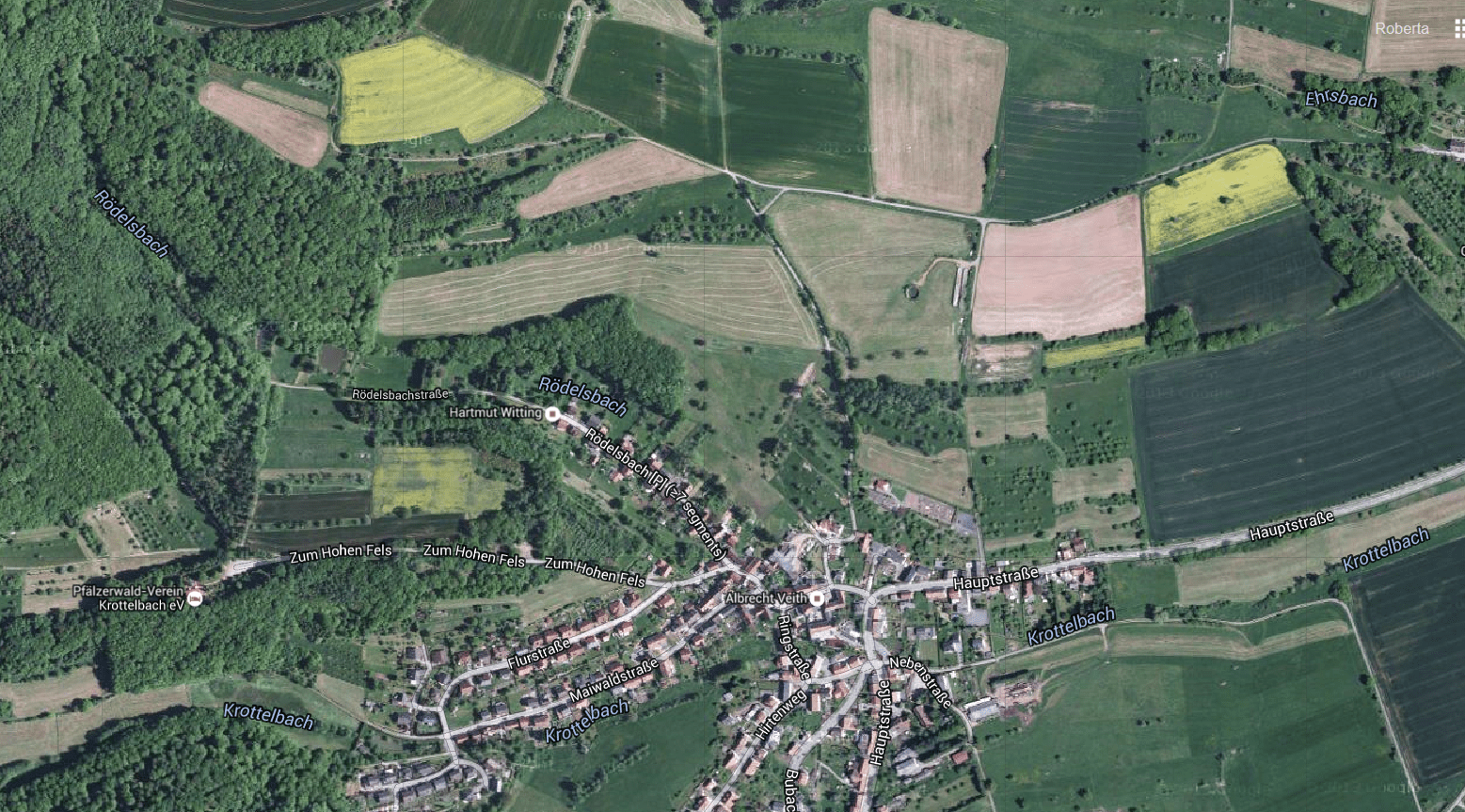
Susanna Agnes Berchtol was born on May 3, 1688, probably in Krottelbach, Germany, shown below, to Hans Berchtol and his wife Anna Christina, whose last name is unknown.

Krottelbach Germany

I say probably, because the church that the family attended and where her birth was recorded was in Konken, but since her father’s residence at the time of his death is stated in the Konken Church records as being Krottelback, just a few miles away, that’s likely where the family resided when Susanna was born as well. There was no church in Krottelbach at that time.

Another researcher shows that Susanna was born in a neighboring small town, Ohmbach, but since I don’t have the original church records of either, I’ll withhold final judgement until the records are retranslated by a professional genealogist in Germany.

The name was written as both Berchtol, Bechtol and Bechtel at various times and locations, but was primarily Berchtol in Germany and Bechtol in the US with it morphing to Bechtel in the later 1800s.

The Berchtols were one of several Swiss pietist refugee families who settled in this part of Germany. Other Swiss families included the Johann Michael Mueller family.  This Johann Michael Mueller would be “the first” or at least the first that we know of.  His son, Johann Michael Mueller (the second) would be born in 1692. Ironically, Susanna’s parents, Hans Berchtol and his wife Christina were the godparents at the baptism of Johann Michael Mueller (the second) in 1692, in Steinwenden, about 15 miles distant.  Susanna Agnes Berchtol was four years and five months old when Michael was born.

These two families were previously acquainted, because in 1686, Hans Berchtol was also the Godfather to another child of Johann Michael Mueller (the first) and his wife. That child died.  Many times, the families tried to spread the godparent responsibility out among several adults and relatives in their village.  Along with being the godparent at birth, and carrying the responsibility for the child’s religious education (which was often their only education), the godparents also were the acknowledged “foster parents” should something happen to the child’s biological parents.  All too often, that unfortunate eventuality did happen before the child was of age – and having foster parents already designated removed any doubt about intention or who was raising the children.

In the case of Johann Michael Mueller (the second), that’s exactly what happened. His parents were both dead by the time he was three years of age, which may have played a very large role in his future marriage to Susanna Agnes Berchtol.  Since Michael’s parents lived several miles distant from the Berchtols, had he been raised in Steinwenden where he was born, he would have had very limited exposure to the Berchtol family.

Susanna Agnes Berchtol’s father died on June 15, 1711, according to the Reformed church records.

We don’t know if, Anna Christina, Susanna’s mother was still living in 1711 when Han’s Berchtol died, but in either case, the family would have needed help to survive. Susanna’s youngest sibling that we know of was born in 1698, so there would have been young children still at home.

Susanna was the oldest daughter and the second oldest child, according to the church records. Of course, there could have been other children born to Susanna’s parents before they arrived in Germany in the mid-1680s.

Johann Michael Mueller, age 19 in 1711, would have been a strapping youth with a debt to repay. Not an official debt, but a debt of gratitude to his godparents who could well have raised him after his parents’ death.  Hence, Johann Michael Mueller’s presence in Krottelbach and in the Berchtol household.  Michael likely knew Susanna his entire life and may have been raised in the same household, at least for part of that time.

After her birth, the first record we find of Susanna is her marriage to Johann Michael Mueller on January 4, 1714 in Krottelbach.

Their first child was baptized in that same church a year and 15 days later on January 19, 1715.  That must have been a radiant year for Susanna – her marriage and her first child.

After that, the official records that include Susanna go silent, but we can infer a lot based on what we know about Michael.

There is a possibility that Susanna and Michael moved to Lambshein in 1721. There is a record of a Michael Mueller becoming a resident there, but we have no further records.  It would be interesting to see if the Reformed Church records exist for Lambshein, and if Johann Michael Mueller with wife Susanna Agnes are present.  Those two names, in combination, are fairly unique.

Typically, German children were called by their middle names. We know that Johann Michael was called Michael.  Most male children’s first name was Johann, a saint’s name.  Using this same tradition, Susanna Agnes would have been called Agnes, not Susanna, but for some reason I’ve always thought of her as Susanna – which of course makes absolutely no logical sense.

Regardless of how she was called, either name, Susanna or Agnes was fairly rare and that in combination with Johann Michael Mueller or just Michael Mueller would certainly identify this couple.

We believe that son Lodowich was born about 1724 and son Philip Jacob Mueller was born about 1726, someplace in Germany. We have the naturalization record for Philip Jacob, so there is no question about where he was born.  We have an undated naturalization record for Lodowich as well as one for a John Miller.  Lodowich is fairly unique, especially living in Frederick County, Maryland and being naturalized in Pennsylvania.  John is a much more common name, although he too lived in Frederick County, Maryland and was naturalized in Pennsylvania, so I’m betting it’s the same family.

Michael and Susanna and however many children they had at the time sailed for the American colonies in the summer of 1727, arriving in Philadelphia on October 2, 1727 on the ship Adventure from Rotterdam, last from Plymouth, England.

We don’t know how long the Miller family was in Holland before departing.  Some Brethren lived with the Mennonites in Holland for years before departing.

The records don’t say how the immigrants arrived in Rotterdam, but since the Rhine River was the primary “road” in Medieval times, it’s most likely they arrived by boat to Rotterdam and at Rotterdam camped outside the city, then transferred to a sea-worthy vessel. Rotterdam was “the” embarkation point for both the British Isles and the land that would one day become America.

This map shows the path of the Rhine in Europe.

Rhine map

“Rhein-Karte2” by Ulamm (talk) 02:45, 13 May 2014 (UTC) – File:Rhein-Karte.png by Daniel Ullrich (Threedots). Licensed under CC BY-SA 3.0 via Commons

Steinwenden is about equidistant between Mannheim and Bingen on the Rhine River in the yellow section. Konken is probably slightly closer to Bingen.  In either case, Susanna Berchtol and Michael Miller needed to connect with a ship on the Rhine River so they could reach their destination of Rotterdam.

The trip from Krottelbach to Rotterdam is not an easy trip. It’s more than 450 miles overland.  They surely would have taken river boats if they could.  Today a canal covers most of this distance, but then, the Meuse river winds its way towards Rotterdam as does the Rhine River which they could have connected with in several nearby cities.

Krottelback to Rotterdam crop

I visited Rotterdam in 2014 via the Rhine River. That’s Rotterdam on the horizon, below.  Susanna and her family likely traversed this same path.

Rotterdam approach

The old part of the city as seen from the water.

Rotterdam from Rhine

Except for modern buildings and ships, the approach to Rotterdam probably hasn’t changed much from when Susanna would have seen it in the 1720s and now.

Rotterdam from Rhine 2

This etching shows Rotterdam in 1665.  That looks a lot like the same church above and below.

Rotterdam 1665

Rotterdam was very much a canal city, shown below in this 1652 map.

Rotterdam map

The pietists of the 1720s didn’t follow far behind the heels of the 1709 Palatinates who swamped the city of Rotterdam and camped, by the tens of thousands, in makeshift shacks on dikes outside the city walls waiting for transportation to England and the colonies. Did the Brethren find themselves in the same location, or did they stay with people who lived inside the city?  How did Rotterdam cope with being the last stop on the European continent for Germans trying to leave for better opportunities across the sea?  How did these people eat?  Where did they obtain food?  What about bathroom facilities and hygiene?  They surely only had the barest necessities with them, anticipating a long and crowded journey in a ship.

After leaving Rotterdam, their vessel would have stopped in Plymouth, in Devon England, a regular stopping point, a port city and the last possible location to take on food, clean water, beer (for drinking as the water was often very foul), cargo and sometimes passengers if there was any space left.

Sometimes passengers got to disembark one more time in Plymouth, and sometimes not. This map was from the siege of 1643, but Plymouth probably hadn’t grown a great deal in the following 75 years and the old part of the city would remain the same.

Plymouth map

This house, now the oldest house in Plymouth built in 1498, stood at the time that Susanna would have stopped in Plymouth on the way to America. In fact, by that time, this house would have been more than 200 years old, still young by European standards.  If Susanna got a few minutes to stroll along the quay in Plymouth, she surely would have seen this house that we still can see today.

What did she think as she looked at these houses, knowing she would not set foot on terra firma or see houses for several weeks, if ever, again? Or was Susanna simply too busy with small children to take a walk?

Plymouth house

How did Susanna feel on these boats as she left everything and everyone she had ever known behind, with the exception of her husband, his step-brother and their children?  Did she know anyone else on the boat?  Was she frightened, excited or maybe some of each?  What were her thoughts as land disappeared from sight?  Was she looking forward or backward?  Did she know anyone at all in the new land, or were they simply following rumors of a better life and opportunity?

Transatlantic crossings were not without risk, and most ships buried at least someone at sea. Some ships buried many.  Children were especially vulnerable.  Not only was the ship itself in danger of sinking or passengers washing overboard in bad weather, but the passengers were always in danger due to poor health and illness, often induced by rotten food and bad water.  And then, of course, there was the ever-present issue of sea-sickness.  While it won’t kill you, at least not directly, it will make you incredibly and unrelentingly miserable.

How many children did Susanna have along with her? Did the journey end with as many children as it began, or were they “up” or “down” a child or two.  Was Susanna pregnant on the boat, or God forbid, giving birth?  Those trips typically took from 4 weeks to 3 months, depending on the winds, weather and luck.  The average was about 6 weeks.

Given that their first child was born in 1715, Susanna could have had about 8 children, if all babies born survived. We do know that at least three sons had been born who did survive, and possibly four.

Were Michael and Susanna joining people already established in the colonies, which would certainly lessen the fear, or were they simply arriving in Philadelphia and would figure it out from there? Was someone meeting them at the docks?  Did they have instructions about where to go and who to ask for?  They spoke German in a country that spoke English.

Did they stay in Philadelphia or did they leave immediately for Chester County, where they were first found in 1732?  Where were they from 1727 to 1732?  If they couldn’t pay for their own passage, they would have been indentured to someone for up to 7 years, which would have been 1734, unless their indenture was for a shorter amount of time.  If they weren’t indentured, how did they pay for their passage for a family of at least five, if not more?

Their arrival in Philadelphia in 1727 probably looked something like this. I would bet that when Susanna set foot on dry ground, she never wanted to see another ship again.  If she had survived the voyages and lost no children, she was truly fortunate.  Susanna would have turned 39 years old in May as they were preparing for this trip.

Philadelphia waterfront

This oil painting by Matthew Birth in 1820 shows the Philadelphia waterfront with a shipyard in the foreground. This harbour view probably looked something like what greeted Susanna and Michael when they arrived nearly 100 years earlier.

Philadelphia waterfront 1820

Only the adult males were listed on the passenger list, so we don’t know positively that Susanna was with Michael, but it’s the most likely scenario. The pietists brought their families and did not tend to leave them behind with the idea they would join them later.  There was no way for families left behind to survive.  In many cases, these families had little or nothing when they left.

At that time, Germans were vassals and did not personally own land. Generally, they owned some livestock, which could be quickly sold, and some farm implements, and that’s it.  Not difficult to pick up and leave.

We know that Samuel Bechtol arrived, at some point, and given the joint land ownership between Johann Michael Mueller and Samuel Bechtol, it’s very likely that Susanna was related to him. Some people indicate they were siblings, but I haven’t seen any documentation stating such.  Susanna did have a brother, Hans Jacob Berchtol, born in 1686 who married Anna Marie Glosselos, but I found no record of a Samuel as Susanna’s sibling.  Of course, it’s entirely possible that we don’t have all of the birth records.  Some children could have been born in Switzerland before the family came to Germany.

There is a Hans Simon Berchtol family in Steinwenden where the Mueller family lived who did have a son named Hans Samuel born in 1685 with a Hans Michael (surname illegible) as godfather. Clearly these families were interconnected in some fashion, both in Germany and in Pennsylvania.  There is one immigration record from September 1743 for Samuel Bechtol, but that might be somewhat late.  There is a 1737 record for Jacob (IB) Bechtel.  Estimates are that only about one third of the immigration records from this time frame have been preserved, and none before 1727 when the oath of allegiance began to be required.

We don’t know where Susanna was living from 1727 to 1732 but they were assuredly in or nearby Philadelphia in one of the German communities. It’s unclear when this family became Brethren as opposed to either Mennonite or Reformed.

There were congregations of both in Chester County.

I asked Merle Rummel, a long-time Brethren minister who is also a historian about the differences between Mennonites and Brethren in that timeframe. He was kind enough to send me some information, including his publication, “The Pietists,” which I’m trying to distill here.  I wanted to understand the differences between the Brethren and Mennonites, which, to me, an outsider and from a perspective of nearly 300 years later, look an awful lot alike.

Issue or Belief Brethren Mennonite
Pietism, Radical Pietism – separated from Protestant churches, specifically Lutheranism Anabaptist – delays baptism until adult confession of faith, rebaptizes those baptized as infants
Pacifist (against war) Yes Yes
Celibacy In some cases No
Worship Day Generally Sunday, some groups on Saturday, being the 7th day Sunday
Churches Initially in homes or barns. Sometimes walls were moveable for services.  Eventually built churches where men and women sat of opposite sides of the church.  Loud services and singing.
Also Known as Baptizing Brethren, Baptist Brethren, Dunkers, Tunkers
Method of Baptism Adult trine (triple) immersion in the name of the Father, Son and Holy Ghost Adult baptism, but not trine immersion and sometimes not immersion at all
Communion service Feet washing, agape, love feast, holy kiss Traditional communion
Focus Faith, Biblical studies, cultivation of personal piety Obedience
Divisions Moravians, Brethren, Ephrata Brethren, from the Moravians – the Methodists Mennonite, Amish, Hutterites, River Brethren
Formation Brethren – 1708 Schwarzenau, Germany, Pietist movement – 1680 in Germany 1500s
Beliefs Obedience to Christ as opposed to a church, nonviolence, nonswearing, nonconformity, refusal to take oaths, charity, Bible study, refusal to go to court or sue, simplicity of life and dress, temperance but not abstinence towards alcohol No taking of oaths, no participation in military action, no participation in civil government, simplicity of life and dress.
Affiliation Closely affiliated and lived with Mennonites in exile in Holland between 1719-1729, but became distinct and separate religion in Pennsylvania. Died out in Europe. Survived and widespread in Europe today.
Goals To establish a personal relationship with Jesus, within or outside of any religion, or for people with no religion, not to change churches. Initially did not intend to become a separate religion, just a way of worship.  Inclusive of all initially, eventually excluded many.

I can see that the differences in the ways the two religious groups approached both baptism and communion would be enough to cause them to become or remain two different groups.  Those beliefs are fundamental to the Brethren and they would not be willing to compromise on those tenets.

By 1738, three of the families that Susanna Bechtol and Michael Miller are found with throughout their lives are founding the Little Conewago Church, 80 miles west of Philadelphia in Hanover Township, York County. These are the Ulrichs, Cripes and Jacob Stutzman, Michael Miller’s step-brother who arrived on the boat with Michael and Susanna and their children.  Jacob Stutzman was born in 1706, so was significantly younger than Michael and Susan and they may have felt very parental towards him.  He was not quite young enough to be their eldest child, but he was close.

The lack of Michael Miller’s name as a founding member of Little Conewago could mean that the records are lacking or that he was Mennonite at this time. However, by 1744, Alexander Mack’s letters mention Michael, so it’s likely he was Brethren by this time.  By 1754, Michael had married a Brethren widow, so he was assuredly Brethren by that time.

On the map below, the path from Chester County to the Black Rock Church, the main Brethren church in the area where Little Conewago was located is shown, a distance of about 75 miles.

Chester Co to Little Conewago

We know Susanna and Michael were living in York County in 1744 when on February 7th, Michael bought 400 acres of land northeast of Hanover with Nicholas Garber and Samuel Bechtol.  These families had also lived in Chester County.

The Bechtol family never left York County, PA. Johann Michael Mueller sold his portion of that land to Samuel Bechtol in 1752.  As administrator of the estate of Nicholas Garber, Michael likely sold Nicholas’s portion to Samuel Bechtol as well.  By 1754, Michael Miller had married Elizabeth, the widow of Nicholas Garber.

The Johann Michael Mueller family was likely Brethren by this time, because their resistance to filing documents with the county had manifested itself. Not all deeds were filed, and neither was the marriage between Johann Michael Miller and Nicholas Garber’s widow.  We only know of this because it says in a 1754 court record that Johann Michael Mueller is now married to Elizabeth, the widow of Nicholas Garber and administering his estate.

So, this also tells us that Susanna had assuredly died by 1754. Some researchers feel she had died by 1752 when Johann Michael Mueller sold his land to Samuel Bechtol.  Michael Mueller had purchased land in Frederick County, MD in 1745 and was preparing to move to that area.  Susanna did not sign off on her dower rights on the 1752 deed, but then again, if the deed was to her brother or other family member, maybe they didn’t feel the need.  Some researchers feel that the lack of her signature indicate that she had died by this time.

In 1752, Susanna would have been 64 years of age. She probably had her last child at least 20 years prior, so there would have been no small children left at home.

It’s believed that Michael Miller actually moved to Frederick County, MD after the 1752 sale of his land in York County, PA. He wouldn’t have had any place to live otherwise.

Chester Co to Maugansville

The trip from Hanover to Maugansville was only about 60 miles, right down the new Monocacy Road.

So, Michael sold his land to a man who was possibly his deceased wife’s brother, almost certainly a relative, remarried to the widow of the other one-third property owner, sold that land as well, and removed to Maryland. It certainly appears that Susanna Agnes had died by 1752 and assuredly had by 1754..

In that time and place, widows and widowers did not remain single for long – mostly as a matter of survival, not a social or cultural preference. Life on the frontier was safer and easier with two people, you had a helpmate and a partner.  Pure and simple.

So, it’s likely that Susanna died something between 1748 when Nicholas Garber died and 1752 when Michael sold his land to Samuel Bechtol.

Since we don’t know when Susanna died, we don’t know where she is buried, but we do have a hint – such that it is.

In 1748, a land dispute that had been unfolding in York County, PA became much worse. In a letter to the governor asking for assistance it says that many of the Germans have “gone already and the rest say they will.”  This dispute turned into a war, and indeed, most of the Germans, at least the pietist ones, did leave for Maryland just over the border with Pennsylvania.  This dispute turned violent and several people were killed.  We don’t know if Susanna was perhaps an undocumented victim of these activities.  The date of Nicholas Garber’s death calls this into question for him as well.

We do know the location of the land in York County, thanks to Gene Miller’s work. The Miller/Bechtol/Garber land was dead center in the middle of the disputed land area.  These pacifist people must have wondered if God had a perverse sense of humor – all things considered.  What we do know is that Susanna’s husband was on a list of wanted men (if it was her Michael Miller) and another member of the Brethren family group, an Ullery, told the sheriff to “go to the devil” – something VERY un-pietist like and so unusual that it was recorded.  These people had been pushed to the breaking point.

Miller page 15

The land owned by the three men, Johann Michael Mueller, Samuel Berchtol/Bechtol and Nicholas Garber is shown above overlayed with dotted lines onto an 1886 map created by Gene Miller.  In the lower corner with the red arrow, you can see the notation Mennonite Church Cemetery on the land owned by these joint landowners.  You can also see that Bechtols by the surname spelling of Bechtel still live on this very land in 1886, 130+ years later.  Today that cemetery is known as the York Road Cemetery and also as Bair’s Mennonite Church Cemetery.

Bair's mennonite church

This cemetery is where Samuel Bechtol who died in 1785 is buried. The Berchtol/Bechtol family was known to be Mennonite.  It’s certainly possible that Susanna Agnes Berchtol was Mennonite as well before shifting slightly to the Brethren faith, which is very similar.  It’s also possible that both Susanna and Michael were Mennonite until after Susanna’s passing when Michael could have become Brethren to marry Elizabeth Garber.  One thing is evident – these three families were of somewhat different faiths, Brethren and Mennonite, and it didn’t seem to cause any problems between them.  The Brethren and Mennonite faiths were very similar except for their forms of baptism and communion.

Regardless, Susanna had to be buried someplace. The fact that Berchtols were buried here some time later might suggest that earlier burials occurred here as well.  Perhaps Susanna isn’t buried far from Samuel.  The church itself was not established until 1774 but a family or community cemetery certainly could have pre-dated the church in this location.

If Susanna did make it to Frederick County, Maryland, she may have been one of the first Brethren to be buried there.

Children

Beginning in the 1760s, Michael began to distribute his remaining land to his children and his step-children. By the time of his death, he owned no land and had no estate probate – unfortunately.  Therefore, the only way we have to connect the dots with his children is via land transactions.

Because Michael did not have a will, we only know of three or four children positively, and a possible fifth. The rest of the individuals attributed to Michael and Susanna are speculation, and there is a lot of speculation online.  If someone does have other children and documentation for such, I would love to add that child.  I have not included any speculative children below.

  • Hans (probably Johann) Peter Mueller, baptized on January 19, 1715, at Konken. We don’t know if this child lived to adulthood. If so, he would probably have married when the family was living in Chester Co, PA. He may be John Miller below.
  • Lodowich Miller probably born 1724 or earlier in Germany. Migrated with his parents and lived in or near Hanover, PA and Hagerstown, MD before marrying Barbara, surname unknown, and migrating to Rockingham Co., VA about 1782 where he likely died in 1792. We have an undated naturalization record for Lodowich.
  • Philip Jacob Miller born about 1726 in Germany. Migrated with his parents and lived near Hanover, York Co., PA. Inherited land from his father in formerly Frederick, present day Washington County, MD near Maugensville. Married Magdalena, probably in York County, who was reported to be a Rochette, although I have never found any documentation or that surname. Philip Jacob remained in Frederick County until 1796 when he, along with his children, migrated to Campbell County, KY where he died in 1799.
  • John Miller inherits part of Ash Swamp from Michael in 1765 and lived there until he died in 1795, likely being buried on his own land on a 50 by 50 foot cemetery plot, now lost to time. He may be Hans Peter Mueller born in 1715. There is an undated naturalization record in Pennsylvania for a John Miller in Maryland, although we can’t tell if this is the same man for sure.
  • Hans Michael Miller is given money to purchase land.
  • Michael Miller Junior is given land.

Sadly, we know of no daughters, although they almost certainly existed. There are numerous people who have suggested individuals in the community as Michael’s daughters, but so far, none have produced any evidence whatsoever.

Susanna lived in several places during her childbearing years and the rest of her marriage years. In other words, if she had other children who died, they could have been baptized and buried in a number of places.  If this happened, it must have been exceedingly difficult for Susanna to move on, leaving her children’s graves behind, and alone.  As a mother, I can tell you that there is always a part of you that remains with those children.

  • 1714-1715 – Krottelback
  • 1716-1721 – Unknown location in Germany
  • 1721 – Possibly Lambshein
  • 1721-1727 – Unknown location in Germany
  • 1727 – Rotterdam, then ship to America
  • 1727-1732 – Unknown location in Pennsylvania
  • 1732-1740 – Coventry Township, Chester County, PA
  • 1740-1744 – Unknown location in Pennsylvania
  • 1744-1752 – Near Hanover, York County, PA
  • 1752+ – Frederick County, MD

If Susanna did not pass away before 1752 when Michael sold his York County land, she could have moved with him to Frederick County, Maryland in 1752, but she was assuredly departed by 1754.

Most women of this timeframe in history never ventured more than ten miles distant from their European home. Susanna Agnes Berchtol was no stereotypical woman and saw a great deal of adventure in her life.  I wonder if she chose this path or if it was chosen for her.  Did she even get to vote on the matter?  Did she look ahead in anticipation, or did she cry every time she left her familiar home?  She did a lot of leaving in her lifetime.  A lot of climbing onto boats, into wagons and probably walking.

Daughters?

Unfortunately, because we don’t have the mitochondrial DNA line of Susanna, we can’t use the unbroken female line mitochondrial DNA to prove a daughter relationship. To do that, we would need to have two individuals who both believe they descend from Susanna through all females – and their mtDNA would need to match at the full sequence level.  Then, we could probably be fairly sure they both do indeed descend from Susanna (or at least a common matrilineal ancestor) – but not Susanna positively without proven genealogical descent.  Of course, finding someone who descends through all females from any of Susanna’s sisters would provide Susanna’s mtDNA as well, since mitochondrial DNA is passed from females to both genders of their children, but only females pass it on.  If you have proven descent from Susanna’s sisters, Barbel (Barbara) born about 1693 or Ursula born about 1696, through all females to the current generation, which can be male, I have a DNA testing scholarship for you.

There’s another kind of test for anyone who descends from Johann Michael Mueller and Susanna Agnes Berchtol through any children, male or female, and through any combination of male and female children down that line. It’s an autosomal test called Family Finder at Family Tree DNA. Several people known to descend from this couple through male children have already tested.  If people who believe they descend through female children also test, and match, that’s evidence to suggest that Michael and Susanna Agnes did have female children – and to identify who they are.

If anyone believes they descend from Susanna Agnes Bechtol and Johann Michael Mueller through a female child, they can take the autosomal Family Finder test at Family Tree DNA and join the Miller Brethren project. In this project, we have gathered together many of the descendants of Johann Michael Mueller and Susanna Agnes Berchtol and we can compare autosomal DNA against these descendants as well.  Yes, that connection would be several generations back in time.  One could not expect to match all of their descendants, but they could certainly match some of their descendants.  In this situation, the most difficult caveat would be that none of those individuals being compared share any other surname lines.  Of course, in the Brethren community, that’s a difficult goal to achieve.

Still, it’s not beyond the realm of possibility and I encourage everyone who descends from this line to test autosomally and join the Miller Brethren project. I also encourage participants to upload their results to GedMatch where we can adjust match thresholds individually.  In the cases of people matching distantly, this can make quite a difference in terms of whom matches whom.

I have to wonder what Susanna Agnes Berchtol would think of us discussing her DNA. Of course, Susanna would have had no idea what DNA was, although she certainly didn’t seem to be dissuaded by new frontiers.  These small pieces of her DNA are the ties that bind her descendants to her in an unbroken chain of life.

______________________________________________________________

Disclosure

I receive a small contribution when you click on some of the links to vendors in my articles. This does NOT increase the price you pay but helps me to keep the lights on and this informational blog free for everyone. Please click on the links in the articles or to the vendors below if you are purchasing products or DNA testing.

Thank you so much.

DNA Purchases and Free Transfers

Genealogy Services

Genealogy Research

Johann Michael Miller (Mueller) the Second (1692-1771), Brethren Immigrant, 52 Ancestors #104

Johann Michael Mueller, written Miller here in the US, has so much myth and mystery surrounding him. It has been difficult to sort out which is which and what is truth.  In part, this is due to the fact that several books have been published with varying levels of accuracy, and once in print, each one is treated as gospel.  It also has to do with the fact that Michael Miller was not exactly an uncommon name, and scrutiny has proven that there were often two or three in the same location.  Lastly, he lived on several frontiers, left no will and like many Brethren, eschewed anything to do with government, including registering marriages and deeds.  Yep, a genealogist’s nightmare.

In order to sort through all of the pieces, I made a timeline that encompasses all of the events and alleged events of Michael Miller’s life. I also included the people around him, like his wife’s family and anything else I could find that seemed relevant.  For example, the Miller family is consistently found with the Cripe/Greib, Ullery/Ullrich, Stutzman and Berchtol/Bechtol families.  Sometimes tracking those and other known Brethren families is the only way to track Michael.

Michael’s timeline reached 64 pages and it’s really not complete.  However, at some point, one must put the stake in the ground and decide that it’s either now or never.  And, it’s now.  So here we go!

Steinwenden blue door

Johann Michael Mueller (the second,) the son of Johann Michael Mueller (the first) and Irene Charitas whose surname is unknown, was born October 5, 1692 in Steinwenden, Germany.  In 1996, our cousin, the Reverend Richard Miller visited Steinwenden where he took the photo of the old house and door, above, surely a familiar sight to Johann Michael during his lifetime.  Buildings that we consider quite old here are still in their prime in the old country.  Richard was given several documents, including a copy of Johann Michael Mueller’s birth entry in the Reformed church book, second from bottom, below.

Miller 1792 birth steinwenden

I had this original document retranslated recently by a professional German genealogist to be sure there wasn’t some wonderful tidbit that had been omitted. Johann Michael’s parents were Michael and Irene from Steinwend.  The godparents were Johann Michael Schuhmacher, Balthasar Jolage, Christina, Hans Berchtold’s (?) wife from Schrodback or berg.  The translator noted that she could not find a village by that name.  As you can see, this translation was difficult at best.  The word is likely Crottelback or Krottelback, where the Berchtol’s were known to live.

On January 4, 1714 in Krottelbach, Germany, Johann Michael Mueller (the second) married Susanna Agnes Berchtol, “a Swiss,” who was born May 3, 1688, the daughter of Hans Berchtol who died in 1711 and Anna Christina whose last name is unknown. Their first child was baptized in 1715 in the same church where they were married.

The Steinwenden Reformed records begin in 1684, but the Konken records begin in 1654, so perhaps more information awaits in those records, once they are translated and indexed in some location so that you can find entries without reading the entire church book – or better stated – paying someone else to read the entire church book.

Were these families already interrelated before they moved from Switzerland to Germany in the 1680s? The families were living in relatively close proximity by 1686 when Hans Bechtol witnessed the baptism of Johnann Michael Mueller’s child in Steinwenden.  In 1711, Hans Berchtol’s death is recorded in Konken, but indicates that he lives in Krottelbach.  Krottelbach, shown below, isn’t terribly distant from Konken and Steinwenden.

Krottelbach Germany

The next record we find for Michael indicates a much more substantial move, if this record is for our Michael Mueller.

Michael Muller born in Steinweiler, Oberamt Lautern became a citizen at Lambsheim on June 4, 1721, according to Heinrich Rembe, a well-known German genealogist.

If this is our Michael, then clearly Susanna would have been with him. They would have been married 7 years by this time and probably had about 3 children.

Krottelbach Lambshein

I do question if this Michael is ours, because Steinwenden, Konken and Krottelbach are in close proximity, but Lambsheim is not and is about 131 km from Krottelbach where they married a few years earlier.

In any event, by 1727, Johann Michael Miller and his wife and children were indeed moving again, boarding a ship in Rotterdam. They arrived in Philadelphia on the ship Adventure on October 2 where Michael, along with the rest of the men from the Palatine had to sign an oath of allegiance.

The Brethren

The beginnings of the Brethren faith as we know it today began with 8 people who formed prayer groups in 1708. Led by Alexander Mack, they adopted the doctrine that infant baptism does not save your soul, and that adults must be re-baptized when they are old enough to accept Christianity.  This stood in opposition to the established religions of Catholic, Lutheran and Reformed, and caused the Brethren to become persecuted as their teachings became more in conflict with the established churches.  Furthermore, they adopted the “peace at all costs” doctrine that prevented the men from fighting, even to protect themselves or their families.

Eventually they fled both Switzerland and Germany and joined the Mennonites in Holland, but the Mennonites wanted the Brethren to adopt their beliefs, and instead, the fledgling Brethren immigrated to America beginning in 1719 with more arriving in 1727. Having been exiled in Friesland for 9 years, 59 more families, 126 people total, arrived in 1729.  After that, the sect died out in Europe.

Rotterdam canal

It is unclear whether Johann Michael Miller was Brethren at this time, as his first child born in 1715 was baptized Reformed in Konken. However, he was indeed involved in some capacity, as he was among the Brethren immigrants who arrived in Philadelphia on October 2, 1727 on the ship Adventure from Rotterdam (shown above), last from Plymouth, England. Several books claim that Johann Michael Mueller was accompanied by Jacob Berchtol, his wife’s brother, Jacob Stutzman, his step-brother, and Hans Jacob Stutzman, his step-mother’s second husband.  However, Ralph Beaver Strassburger, in 1892, transcribed the lists of Pennsylvania German Pioneers who arrived and took the oath of allegiance between 1727 and 1775.  These books were later edited and republished by William John Hinke.  Taking the oath of allegiance wasn’t an option.  If you wanted to live in Pennsylvania and you were a German male 16 or over, you took the oath.  Period.

oathOath 2

I checked in Volume I of their book, Pennsylvania German Pioneers and on page 10, the only name given is Mich’ Miller.

Strassberger p 10

Neither is there any Stutzman or similarly spelled surname listed in the index. However, Johann Jacob Stutzman surely did immigrate, because we do find him here.  He could have immigrated before 1727 when the oaths were required.

Ancestry oath

However, referencing this same book on Ancestry.com shows us a different list.

Ancestry 1727 list

As you can see, the list above does not include Johann Jacob Stutzman, but the list below, on the following page, does. What this does tell us is that there appear to be multiple Michael Mueller/Miller immigrants.  But then, that’s consistent with finding multiple Michael Millers in Pennsylvania and Maryland.

Ancestry 1727 list 2

This book has clearly been changed in its multiple printings. Furthermore, the original Volume II had original signatures, but the current Volume II has only the lists from 1785-1808.  Today, a third volume exists titled “Pennsylvania German Pioneers, Facsimile Signatures, 1727-1775 that complements volumes I and II.

The older references still refer to page numbers in Volume II as holding the actual signatures, resulting in me ordering the wrong book and having a devil of a time trying to figure out what I really needed to order. Extremely frustrating, to say the least, not to mention wasted money as well.  I could have bought a DNA test for what this actual scan of Michael’s signature cost me.  However, this is the only copy of Michael’s signature known to exist, with one possible exception I have not been able to track down.

1727 adventure passenger list

Michael’s name is first on the list, but there is also another Miller, two Ullerich or Ulrick’s and Johann Jacob Stutzman, near the bottom of the list. This list is noted as List 4B where the earlier list without Jacob Stutzman is noted as 4A.  Why there were two lists for the same ship is unexplained.  Michael’s signature is shown below.

Michael Mueller signature

Miller, of course, is a very common name, but Ullerich and Stutzman, much less so.

Some descendants report that Johann Michael Miller and his wife, Susanna Berchtol brought either 7 or 10 children with them. Again, there is no direct evidence of this.  We know based on indirect birth years that they brought at least three, and there certainly could have been more,  but it would be unusual for all of a couple’s children to survive infancy.  I would like to see whatever documentation exists for these claims.

Jacob Stutzman turns out to be an important milestone when tracking Michael Miller. While there are multiple Michael Millers, Jacob Stutzman is rather a unique name.  Jacob was younger than Michael by 14 years, being born in 1706.  Jacob Stutzman was the son of Johann Michael Mueller’s step-mother and her second husband whom she married after the death of Johann Michael Mueller’s father.  Despite their difference in age, these two men were obviously close.

Jacob Stutzman was a charter member of the Little Conewago Church along with Jacob Cripe and Stephen Ulrich. Michael Miller, as he was called in Pennsylvania, is not among the founding members listed, but his association with these families and the fact that he lived in the area is what has prompted speculation that Michael was indeed a member at Little Conewago.

Jacob Stutzman died in 1773, two years after Michael Miller’s death, and Jacob’s widow married Stephen Ulrich (the second.) Michael Miller’s grandson would marry Elizabeth Ulrich, daughter of Stephen Ulrich (the second) and his first wife, Elizabeth Cripe.  These families formed a bond that lasts into the current generations.

Ironically, sailing on the same ship with Johann Michael Mueller was one Johannas Ulrich and a Christo Ulrick. The Ullrich/Ullery family was also Brethren and settled first in York Co, PA and then in Frederick Co., MD.

It’s unclear when Johann Michael Mueller and his wife “converted,” to the Brethren faith per se. The only thing we know for sure is that in 1715, their first child was baptized Reformed.  The next we know, Johann Michael Mueller is found among the Brethren in Pennsylvania.  In 1744 he is mentioned in letters written by Brethren leaders.  It’s likely that he had at least developed some Anabaptist sympathies prior to arrival, given the families origins in Switzerland.

In the Pennsylvania Archives Second Series, Vol II reprinted under the directionof Charles Warren Stone and edited by John B. Linn and William H. Egle, MD, we find an undated record wherein “the persons hereafter named, called Quakers and other Protestants who conscientiously scruple to take an oath….took the affirmation and made and repeated the Declaration…..an act for naturalizing such foreign Protestants and others”….that includes the names of both Michael Miller and Philip Jacob Miller along with Jacob Stutzman and Stephen Ulrick as a bonus.  Obviously a group of men from Frederick County went to Philadelphia together.

Miller Naturalization

This would have been after 1747 when Philip Jacob would have turned 21.  Obviously there were clearly Pietist by this time, either Brethren or Mennonite.  Michael Miller’s wife’s family, the Berchtols were Mennonites in the US and Michael co-owned land with Samuel Bechtol in York County.

We may find a further hint as to how or why Michael Miller became Brethren in a letter written by Johann Philip Boehn, the founder of the Reformed faith in Pennsylvania. In a letter dated March 27, 1744 he says “since the founding of our churches here, there have been many people who though they were of Reformed antecedents, kept aloof, because there were no Reformed church services here, and they joined no religion or sect, because they were of the opinion that our cause could not be maintained in this country, principally because of our inability to support ministers.  They are now, within the last few years, scattered here and there, mostly among Mennonites, Tumplers (Dunkers), 7th Day as well as 8th Day (German Baptists) and such like.”

As one minister phrased religion on the frontier, “They joined the church of opportunity.” Perhaps it wasn’t exactly what they wanted, but they preferred worshipping to not worshipping.

The Brethren at this time were an open, inviting faith, so it would not be unusual for non-Brethren families to convert.

York County, Pennsylvania

The family settled, at least temporarily, in Chester County, PA, possibly the portion that became Lancaster in 1729.  Michael moved to near Hanover in York Co, PA in 1744, then to Frederick Co., MD about 1752.  York County was taken from Lancaster in 1749, so in reality, Michael may not have moved as much as it appears.  The borders may have, to some extent, moved over him, although the land he inhabited in York County was not settled in the early 1730s, so he would have clearly had to have moved to settle there.  We can’t tell for sure where he moved from, or how far, because we don’t know where he lived in Chester County which was originally a very large founding county.

It would be in York County, PA that Johann Michael Mueller and Susanna Bechtol would raise their family, at least for a while. The battles of boundaries in that part of the country drove the entire group of Brethren south into Maryland.  It appears that Susanna most likely died before the group moved to Maryland.  Michael moved on alone and married a Brethren widow, Elizabeth Garber.  But first, in York County, Michael would find himself smack dab in the middle of a war – something very uncomfortable for a Brethren.

The Pennsylvania-Maryland Border War

PA-MD boundary issue

“Cresapwarmap” by Kmusser – self-made, based primarily on the description at http://cip.cornell.edu/DPubS/Repository/1.0/Disseminate/psu.ph/1129771136/body/pdf. Licensed under CC BY-SA 2.5 via Commons

The earliest records of what is now Adams County, PA are found in what was then Chester Co., PA. which successively changed to Lancaster Co. (14 Oct. 1728), to York Co. (on 14 Oct.1748) and to Adams Co., PA in 1800.

And it wasn’t just counties that changed, but the state line itself was in dispute between Pennsylvania and Maryland, as was the actual land ownership – meaning that the Indians still felt they owned at least the frontier and borderlands, exactly where the Brethren families were living.

Ironically, the Brethren and Mennonite pietists who eschewed all forms of conflict wound up in the center of a heated battle.

Both Maryland and Pennsylvania claimed the land where Hanover in York County lay. Initially the Pennsylvania government complained when Marylanders settled this area, but since no one else except the Indians were complaining, nothing was done until 1728 when Pennsylvania ran the settlers off and burned their homes.  By 1732, Pennsylvania, Maryland and Virginia were all three competing for settlers on the frontier to stabilize the region and provide a buffer between the settled portions and the “savages.”

In 1732, Pennsylvania began giving out “licenses” to settle west of the Susquehanna with the idea that the licenses could later be turned into warrants when the colony actually bought the land from the Indians. In essence, they were encouraging people to become squatters.  No wonder the Indians were unhappy.

Between 1733 and 1736, 52 licenses were issued, mostly to German families. Presumably some went to the group who settled in the Conewego area in York County where the Ulrich and Cripe families were living at that time.

Maryland still claimed this land and by 1730, things were getting ugly. Maryland granted the same land, much of it to Thomas Cresap, a very early pioneer and Indian trader. Some paint him as an aggressive villain who terrorized the region, some as a hero who saved the day.  One thing is for sure, he became the spokesperson for the German community, joined the Brethren Church, and ultimately bought the land Michael Miller would purchase from him called Miller’s Choice on Antietam Creek near Hagerstown, MD.  This is probably a good indication about how Michael felt about Cresap.

However in the 1730s, local warfare ensued with both Maryland and Pennsylvania jailing people. At one point, Cresap got thrown off of his own ferry mid-river, but survived.  In 1734, Cresap shot a Pennsylvania sheriff’s ranger who came to arrest him.  Some settlers returned back east at this point, having had enough – but turning back never seemed to be an option for the Brethren who also wouldn’t fight.  I struggle to understand these choices and their logic.  Maybe it was a very simple faith in God.

As militias on both sides became involved, the frustrated Brethren and German settlers must have become quite desperate because in 1736 they sent a resolution to the Governors of both states pledging their loyalty. However, when the duplicate loyalty was discovered, Governor Oglethorpe of Maryland offered rewards for the apprehension and arrest of nearly 40 men.  John Wright was apparently the ringleader, because the bounty on his head was 40 pounds.  However, Michael Miller was included but his bounty, and that of most of the other men, was only 2 pounds.  We don’t know if this was the Michael Miller of the Ulrich, Cripe group, but it could have been.  Cripe and Ulrich were certainly there by 1738, but Michael may have still been living in Chester Co., PA.  His tax records don’t begin in the York County area until 1744.  However, he could have had an adult son, Michael (the third,) by this time.

Pennsylvania did purchase the land from the Indians in 1736, land warrants were issued in 1738 – but given the uncertainty about who owned what and which state the land would actually fall into, it was no wonder nothing much was done.

Eventually, we find our Brethren families in the records, but things really didn’t improve. In fact, this battle wasn’t settled for another 30 years with the running of the Mason-Dixon line, which, ironically cut right through Brethren land – even after they had finally had enough and left York County in Pennsylvania for Frederick County across the border in Maryland.

On February 16, 1742, Lancaster County, PA issued land warrants 7-U and 8-U for Stephen Ulrick, Junr. to take up lands west of the Susquehanna. He staked out adjoining tracts in what was then a dense wilderness on Little Conewago Creek on land adjoining that of his father. We know that Stephen lived there as early as 1738 when he is listed as a founder of Little Conewago Church.  This land later became York County which later became Adams County.

These families had been embroiled in this entire mess the whole time.

Ulrich land York Co.

The outlines of tracts A and B are based on an official survey, patent and deed records. Stephen’s land was described as adjoining his father’s tract.

Stephen Ulrich (the second) was a German Baptist minister, and believed to be the son of the immigrant Stephan Ulrich (the first.) About 1740, Stephen the second married Elizabeth Cripe.

It is believed that during the time Stephen Ulrich lived in what was Lancaster, then York County, he and his friend Jacob Stutzman organized the Conewago Congregation of the German Baptist in Conewago Twp. near Hanover PA, now in Adams County, probably on or near his land.

Hanover PA

Stephen Ulrich sold the above-mentioned land to his friend Jacob Stutzman. This transaction is described in John Hale Stutzman’s book, “Jacob Stutzman, His Children and Grandchildren”. Unhappily for us, these two devout Dunkers, under the strictures of their church doctrine, avoided engagement with government authorities and did not record the deed of sale. Heaven perhaps for the Dunkers but Hell for the genealogist.

We only know about this sale because of the subsequent sale by Jacob Stutzman to George Wine.

Yes, Stephen Ulrich the first and Stephen Ulrich the second both had warrants for land near Digges Choice in Lancaster, then York, now Adams County. Hanover, York County, PA was at the center of Digges Choice, which was laid out about 1739 the first time. John Digges owned the land that eventually became Hanover, PA.

See Lancaster Co, PA Land Warrant #7, February 16, 1742 for 100 acres for Stephen Ulrick Junior; also Lancaster Warrant # 10, November 21, 1743, to Stephen Ulrich Senior, land adjacent to George Wagoner. There is also a Lancaster Co. Warrant to Ansted Ulrick on November 4, 1743 for 200 acres in Lebanon Twp, Lancaster County.

In 1743, another battle broke out and Stephen Ulrich was certainly in the middle of it, although his name is not specifically recorded. We know he was, though, because of John Digges and an unnamed Mathias Ulrich, possibly his brother.

In 1743, the Germans send one Martin Updegraf to Annapolis to check on John Digges grant. It was found that Digges had sold some land he didn’t own, so he got a new grant from Maryland which included farms of 14 Germans whose land had been granted under warrant from Pennsylvania.  Both sides tried to intimidate the farmers.  The Pennsylvania surveyor warned them against violating royal orders.  Mathias Ulrich apparently told the sheriff “to go to the devil,” an action very out of character for a Brethren and remarkable enough that it was recorded.  Eventually, the situation escalated further and Digges son was killed but Pennsylvania would not surrender the killers to Maryland to be tried.  It was clearly one hot mess on the frontier, and petitions and requests for help went unheard and unanswered by those back east who cared little if a bunch of Germans killed each other.

The Brethren tried to stick it out for a few more years, but in 1745, Michael Miller began buying land in Frederick County, MD, near present day Hagerstown and not long thereafter, the entire group would sell out and remove themselves to what they hoped would be a more peaceful and secure, undisputed area.

The final straw, perhaps, came in 1748 when the sheriffs from both states insisted on collecting quit rent, which in this case, was in essence extortion money for being left alone. A 1748 deposition complaining to the governor said that “a great number of the Germans and some others were so much alarmed by the sheriffs’ proceedings that several of them have already left the province and others have declaired they would go.”  The German families held land authorized by Pennsylvania, but they would leave and go to Maryland.

“Stephen Ullery” appears in the official records of York Co. in 1749 in the Little Conewago area. But in the early 1750’s after selling their land to Jacob Stutzman, Stephen and his wife migrated southwest to the Conococheaque Valley and by 1754 had acquired a large tract of land in the present Washington Co. Maryland, where they spent the rest of their lives.

However all was not tranquil on Conococheaque. Within three years of their assuming this new property, the French and Indians smashed General Braddock’s column a few miles to the west and set the frontier aflame. In 1756 Gov. Sharpe of Maryland wrote “The fine settlement of Conococheaque is quite deserted.”

I have to wonder. Did they long for the days back in Germany?

Moving On

Lancaster and York County seemed perfect, but these families could not live with constant warfare. As much as they loved their new home, they began to cast their eyes elsewhere.

A typical farm in York County, below, looks much like Lancaster County. Soft, rolling, beautiful and fertile.

York farm

“York County PA” by I, Skabat169. Licensed under CC BY-SA 3.0 via Common

Today, many Amish and Mennonite families are found in this area, still using horse-drawn implements, much as their ancestors did.

Lancaster farm

“Lancaster County Field and Farm Implement 3264px” by Photo by and (c)2006 Derek Ramsey (Ram-Man) – Self-photographed. Licensed under CC BY-SA 2.5 via Commons

To put things in perspective, the first road in Pennsylvania, from Philadelphia to Lancaster, was authorized in 1731 in answer to a petition from settlers, and it took ten years to complete. It’s very likely that Michael Miller traversed this road, or at least parts of it.  In 1739, a second road, to Monocacy in what is now Frederick Co., Maryland was begun.  It’s certain that Michael Miller would have used this road in 1745 and access to the frontier via the road may be part of the reason the Brethren wound up in Frederick County.  In 1745, the road didn’t extend to what would one day be Hagerstown, so Michael Miller would have made his way by Indian trails to the remote homestead of John Hager, an Indian trader who patented 100 acres in 1729, and then Michael would have gone a bit further, perhaps with John as his guide, to find land.

John Hager’s home, built about 1740, is a museum in Hagerstown today. Michael Miller was assuredly in this homestead.  It’s actually incredible that it still exists.

Frederick County, Maryland

It appears that the entire Brethren congregation from Hanover moved in 1752 to Frederick County, MD, en masse. Michael Miller had apparently been doing reconnaissance work, because he began buying land there in 1745.  It was also in 1752 that he gave two of his sons a significant piece of land in Frederick County, and it was likely then that everyone moved, together.  There would have been a convoy of Conestoga wagons, if the road was finished and wide enough for a wagon to pass, with livestock and people walking.  Wagons of that timeframe did not have brakes and the wheels were chained going down slopes.  Rivers and creeks had to be forded or ferries taken.  These pioneers were pressing the frontier, forging a new way – not taking the road well-traveled.

DSC_0940

The part of Frederick County, MD that became Washington County, near present day Hagerstown, is a beautiful land of rolling, fertile farmland, punctuated by curving roads and distant hills.

Frederick Co, MD

After the wanderings of this sect in Europe, this land must have seemed like Heaven. They Brethren believed they were in Maryland, safely away from the border warfare.  This idyllic land is where Michael finally settled and amassed quite a bit of property.

Unfortunately, Johann Michael Mueller did not leave a will, and we have to deduce the names of his children from other transactions in his life. Specifically, he deeded land to 3 men believed to be his sons.  There are at least 4 other Miller males in the right place at the right time to be his sons, plus several females as well who may be daughters.  With the advent of DNA testing for genealogy, we may one day resolve the question of sons, but we may never know which women, if any, were his daughters.

maugans cabin

The Maugans family lived nearby in the cabin (above) from the same time period. They would intermarry with the Millers in the following generations.  The original Miller cabin was from the same place and time and was probably very similar.  Both the Maugan’s cabin and John Hager’s cabin were built directly over springs, probably as a security precaution relative to fetching water and not having to leave the house if it was under attack.

Johann Michael Mueller suffered through the French and Indian war, likely vacating his land at least once if not twice. He died not long before the Revolutionary War began, which also introduced a dark period for the Brethren who were torn between their love for their new county and their religious beliefs.

Michael’s son, Philip Jacob Miller would eventually leave the beautiful valley in Frederick County and join the westward movement.  Michael’s son Lodowick would join the flow of settlers into Appalachia and settle in Rockingham County, Virginia.  Son Michael Jr., we lose entirely, and son John stayed in Maryland and died on his father’s original land.  This is such a typical story of the American immigrant’s children.  Some stayed, some left in different directions, and some are lost to time.

References

Let’s take a look at the timeline of events in Johann Michael Mueller’s life and see what tidbits we can recover. Before we start, there were several sources for this information and I have listed each one with the surname of the source.  Other sources are noted individually.

Replogle – “Ancestors on the Frontier: Miller, Cripe, Ulrich, Replogle, Shively, Metzger” by Justin Replogle, self-published in 1998

Mason – “The Michael Miller and Susanna Bechtol Family Record” compiled in 1993 by Floyd R. and Catherine Mason, now deceased

Miller – “A History and Genealogy of David Y. Miller 1809-1898” by Gene Edwin Miller, self-published

Stutesman – “Jacob Stutzman (?-1775); His Children and Grandchildren” by John Hale Stutesman, Jr.

These 4 books plus two websites, Troy Goss’s Miller home page and Tom and Kathleen Miller’s pages are the primary resources for Johann Michael Mueller.

Suffice it to say that they don’t all agree – and in fact some contradict each other. So I’ve gone through each and compiled the information I found credible by evaluating the sources, where possible.  Where doubt remains or work needs to be done, I have said so.

Timeline

Michael arrived in Philadelphia in 1727 and the first actual record we find of him after that is in 1732 in Chester County, PA where he is paying taxes. Other Brethren are there as well.

Note that a second record shows another Michael Mueller arriving on a ship in 1732, and we really have nothing at all to determine whether our Michael was the Michael arriving in 1727 or 1732. Based on the information that his step-brother was along on the 1727 ship, the assumption has always been that the 1727 Michael is ours, but we don’t positively know.  I compared the 1727 and 1732 signatures, and they are not the same, so it’s not a matter of Michael going back to Germany and returning in 1732.  Regardless, Michael was here, in Chester County, by 1732. It’s unlikely that the Michael who arrived in Philadelphia on a ship on September 23, 1732 managed to travel to Chester County, settle and pay taxes before the end of the year. It looks like there were at least two Michael Mueller’s who immigrated.  Given Jacob Stutzman’s presence and the 1732 tax list, I would say that our Michael is the 1727 immigrant.

However, the ambiguity between multiple Michael Millers in the colonies begins almost immediately.

In the 1730s, Maryland and Pennsylvania fight over the Hanover area of Lancaster County, current York County, with both volleying for position, the confrontation escalating and becoming increasingly violent. In 1736 the governor of Maryland offered a reward for the apprehension of about 40 people.  On that list, with the reward at the low end at 2 pounds, was one Michael Miller.  Other Brethren were in York County by 1734, but there is the matter of the tax records in Chester County, PA from 1732 to 1740 where Michael is listed.  Michael could have been an absentee taxpayer in Chester Co., although it’s more likely that we have two Michael Millers involved.  One of the Michael’s could be the son of the immigrant.  It’s unlikely that a Brethren would be involved in a political dispute.  They were more inclined to avoid trouble if possible, at all costs, than to participate.

Pennsylvania did not purchase the disputed land from the Indians until 1736 and did not issue any land grants until 1738. This dispute and boundary was not settled until the Mason-Dixon line of 1767.

1732-1740 – Michael Miller pays taxes in Coventry Township, Chester Co, PA. There were German Baptist Brethren (ChB) churches in Coventry Township, Chester Co., PA and in Manheim Twp., York Co, PA. Miller p 12

1737 – In Coventry Twp. in Chester Co, PA, Feb 15, 1737, warrant #50, vacated in 1748, Michael Miller obtains the warrant next to Thomas Miller and Thomas Perry for 200 acres. In 1748 the warrant was vacated in favor of Adam Harkman and John Wyatt.  Miller P 23

miller page 13

1737 – Michael Miller on the Coventry Twp tax list, Chester Co PA. Miller p 13

1737 – Nicholas Carver (Garber) on the Coventry Twp tax list, Chester Co, Pa. Miller p 14

1737 – If the following is “our” Michael Miller, he was having this Chester Co. land surveyed in 1737 according to this 1758 document.

Land Transaction Caveats (1748-61): Chester County, PA

Feb 17, 1758

John Wells enters a caveat against Thomas Miller, or any person claiming under him, obtaining any survey or confirmation of land adjoining northward by land of said Miller, eastward by land of s’d Wells & southward by land of Christian Perry, in Coventry Township, Chester County, which Thomas Miller pretends to claim under an old warrant of 500 as. granted to him about the year 1717 which has been executed and the land regularly return’d into the Survey’r General’s Office, the above-mentioned land has been since surveyed to Mich’l Miller by warr’t of the 15th Feb’y, 1737, which is now vested in s’d J. Wells.  Page 222.

It would be very interesting if Miller descendants of this Thomas Miller took the Y DNA test to see if Thomas Miller was related to Michael Miller. Based on these land transactions, these men seem to be somehow connected – although this may not be our Michael Miller.  The name Thomas never appears in our Michael’s line.

1738 – Jacob Stutzman, Jacob Cripe and Stephen Ulrich listed as charter members of the Little Conewago Church in York Co, PA, indicating they were Brethren by this time. Replogle p 19 and 31

Some think that Michael Miller and some of his sons were members at Little Conewago and the Antietam congregations. Elder Nicholas Martin, the elder of the churches in the area where they lived, reports on the health of Michael Miller and Jacob Stutsman in his letters to Alexander Mack, Jr.  We understand when Nicholas Martin was naturalized in 1762 that Michael Miller and Jacob Miller were witnesses.  It was this Nicholas Martin who gave the year of death for Michael Miller as 1771.  Mason p 10

If Michael Miller and Jacob Stutzman were not Brethren, Alexander Mack would not be discussing them in such familiar terms.

1739 – Michael Miller on the Coventry Twp. tax list, Chester Co, Pa. Miller p 14

1740 – Michael Miller on the Coventry Twp. tax list, Chester Co., Pa.   There is no record of him on the tax lists there after 1740.  It is believed that Michael Miller moved west from Chester Co, PA in the early 1740s.

Monocacy road

1743 – Travel west would have been on a route called the Monocacy Road which was established in 1733. The road was the major route passing through Lancaster County, York County and crossing the Susquehanna River at Wright’s Ferry or Wrightsville, traveling along what is now US Hwy 30.  After leaving Wright’s Ferry, it headed southwest through what is now York County, through Hanover and down into Maryland to the Hagerstown area. Miller P 14

Monocacy old map

Before the road, the other side of the Susquehanna River was only Indian trails. Replogle page 82

Monocacy map 3

1744 – Nicholas Martin comments on Michael Miller’s health in a letter to Alexander Mack Jr. Replogle p 31

This probably establishes Michael Miller as a Brethren by this point in time.

1744 – On Feb 7th Michael Miller, Nicholas Garber and Samuel Bechtol, Hans Jacob and Elizabeth Bechtol, who also lived in Chester Co, PA purchased a tract of land consisting of 400 aces northeast of Hanover, PA in York Co.  See circle #12 on the PA map, below, in the upper right hand corner.  Today this land is near Bair’s Mennonite Church, perhaps lying south from the church.  Mason p 14 and 20

Mason circle 12

This land, shown in circle 12, above, was near Little Conewago Chuch.

Floyd Mason included this legend to his maps with circles.

Mason map legend

Gene Miller overlaid the York County land on an 1876 map.

Miller page 15

Today, the York Road Cemetery also known as the Bair’s Meeting House Cemetery is located on the York County land owned by these three men. Bair’s Meeting House wasn’t established until in 1774, but burials could have been taking place on this land earlier.  I have noted the location of the cemetery and meeting house on the map above with the red arrow.

Note that both the Bechtel and Miller names are found in this region on the 1876 Heidelberg Township map, more than 140 years later. However, the Miller surname is extremely common and there may be no connection with the earlier Michael Miller family.
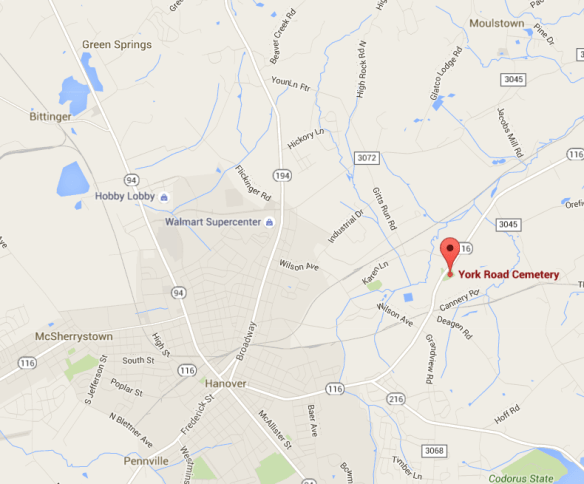
York Road Cemetery map

Samuel Bechtol and Michael Miller obtained 150 acres, leaving 100 acres for Nicholas Garber. Michael sold his 150 acres to Samuel Bechtol in 1752 and we cannot identify what happened to the 100 acres of Nicholas Garber.  It was after Nicholas Garbers’ death in 1748 that Michael Miller sold his land to Samuel Bechtol.  Michael Miller married Nicholas Garber’s widow.  We suspect that he also sold Nicholas Garber’s 100 acres of land to Samuel Bechtol.  Samuel Bechtol was one of the administrators of the will of Nicholas Garber and Susanna Bechtol was (reportedly) Samuel’s aunt.  Mason p 12, Replogle 91

Miller only shows three people bought the land, Michael Miller, Nicholas Carver and Samuel Backall, omitting Hans Jacob and Elizabeth Bechtol.  Batchelors Choice consisted of 400 acres which had been owned by John Stinchcomb. The property was rectangular and was located about 2 miles east of Hanover and was bounded on the west by Gitts Run, on the south by portions of route 116 and on the north by the Pigeon Hills.  The land was located on the outside of the east edge of Digges Tract.  This could have been some of the disputed land in question.

Batchelor Choice

Here’s is a satellite view of this same area today, with the red balloon marking Jacob’s Mills, shown on the map above.

York Co land satellite

It is believed that these three families were related in some way. Nicholas Garber/Carver has been theorized to be a son-in-law of Michael Miller.  Others have suggested that some of Michael’s daughters married some of Nicholas’s sons.  Obviously, both of these scenarios can’t be true, or Michael’s younger children would have been marrying the children of their older sibling.

Other settlers associated with these three families also lived in the area. Jacob Stutsman and Stephen Ulrich lived to the southwest of Hanover.  Peter and John Welty, Michael Bigler, lived to the south of Hanover: Catharine the daughter of Michael Bigler became the second wife of the Dunker leader Daniel Leatherman. To the north of Hanover near East Berlin was the immigrant Jacob Cripe (1743), Hans Ulrich Wagner (1743) and George Adam Martin (1749).  Miller p 14

Cripe to Miller map

This map shows the proximity of the Cripe family to the Miller, Bechtol and Garber families.

1745 – On May 14, 1745, Michael Miller buys a land warrant for either 150 or 200 acres (reported as both in two different sources) acres called Ash Swamp in Frederick Co MD for 200 pounds from John George Arnold. Replogle p 31, Miller page 20

It was then in Prince George County and now is Washington Co., PA. Liber BB 362-363.  Miller P 20

This is the land that in 1752 Michael has resurveyed and deeds it to 3 his sons John, Philip Jacob and Lodowick. See circle 3, below, drawn by Floyd Mason, P 14 and 32.

Miller circle 3

The map below shows the migration pattern beginning in Chester County, PA, through York County, PA and then to Frederick Co., MD.

Chester Co to Maugansville

1748 – The land dispute in York County, PA got much worse. In a letter to the governor asking for assistance it says that “many of the Germans have gone already and the rest say they will.”  Replogle 92

1748 – Frederick Co. Maryland comes into existence.

1748 – Nicholas Garber dies and his will is probated in Lancaster Co, PA, Book Y, Vol 2, p 123. This part of Lancaster becomes York the following year.  By 1754 Michael Miller has married his widow.  Mason P 12

1749 – Michael Miller buys 36 acres in Frederick Co, MD called “Miller’s Fancy.”  Both pieces of his land are very close to present day Hagerstown, which wasn’t there at the time.  Replogle p 31

Replogle suggests that perhaps Michael didn’t actually move, but stayed back in Hanover and eventually gave the land to his sons John and Philip Jacob.

Michael had Miller’s Fancy resurveyed. He lived there until his death in 1771.  In 1765 it was deeded to John Riffe, husband of Michael’s step-daughter.  See Circle 4 – Mason P 14

I’m not at all certain Mason’s circle 4 is in the correct location. I believe Miller’s Fancy is located south of Hagerstown on the convergence of Antietam and Little Antietam Creeks.  Other researchers believe that Miller’s Fancy, Skipton on Craven and Well Taught are near Leitersburg, 5 or 6 miles due east of Maugansville.  Following the deeds forward (or backward from current) in time would resolve this question.

1749 – Land surveyed in 1749 and granted in 1754 located between Skipton on Craven and Resurvey of Well Taught, containing 36 acres called Miller’s Fancy. Mason P 20

Skipton on Craven is 280 acres, purchased in June 1749 for 220 pounds. Wash Co., MD. Miller p 23

1749 – York Co, PA is formed from Lancaster. Hanover is located in York County.  Part of the Hanover area was split off in 1800 to Adams Co.  There are two Michael Millers and no Rochette family. Michael’s son, Philip Jacob Miller supposedly married a Magdalena Rochette about 1751, but you can’t marry someone if their family isn’t present in the community.

There are two Michael Miller wills in York County in both 1784 and in 1796, so this means that there were at least 3 Michael Millers in York County, if all three were there at the same time. Headache!!!

1749 – Most land at this time was not improved, but Stephen Ulrich’s may be the exception. The 235 acre piece he bought from Hans Waggoner in Frederick County may have been improved.  The other 200 went to Walter Fonderbag.   One of these men received “One dwelling house 20 feet by 16 made of hew’d logs and covered with lap shingles, a stone chimney, one dwelling house 27 feet by 22 of hwe’d logs and covered with lapp shingles, planked above and below, a stone chimney, a new barn of hew’d logs covered with lapp shingles, 49 feet by 27, 69 apple trees, 72 peach trees and 6 acres of cultivated land well fenced.”  Replogle p 100 from the Stutesman book p 10-11

Replogle contrasts this land to Hager’s “2 sorry houses” and then mentions that by 1756, the Indians had probably burned these wooden structures.

True to form, in the faming community where I grew up, the barn was twice as big as the house.

1750 – Several Brethren families felt it necessary to move further west where it was safer, including the Shively, Ulrich and Cripe families. Replogle p 19

1750s – Around this time in the development of Maryland, tobacco had been the crop of importance followed by Indian corn. This usually was cultivated by the plantation’s negroes. However, in the newly developing western Maryland, the German settlers profited from the rich deep soil to raise large quantities of flax and other grains, disdaining the tobacco culture as well as slavery.  The flax was hackled and the women would spin and weave it at home into very stout linen, making also threads of different colors that found a ready market.  The seed was packed in the huge country wagons of the day and sent to Baltimore and Philadelphia.

Trade for the settlers of this day was in Baltimore. The western Maryland settlers produced goods that were needed in the eastern part of the province.  The Germans learned to make linen goods, tow (rope), thread; they knitted long yarn stockings; they tanned their leather and made horse-collars and harness; they prepared honey, firkined butter, dried apples and applebutter.  These were marketed in Baltimore which depended on the interior for their supplies.  In return, the settler purchased materials essential to survival on the frontier, namely salt, lead and gunpowder.

The early settlers typically lived for a number of years in a “log cabin.” It had large garret roots (attic) and generally a deep cellar.  The bedrooms were simply furnished.  The painted bedsteads were supplied with straw beds and ‘feather decks” for covering.  There were the barrels of sauerkraut and salt lead and apple butter in the cellar.  Each farm usually had an abundant apple orchard and rows of cherry trees, and there were plenty of home-brewed drinks in the cellar besides cider.  The frontier settlers had a diet that included pone and milk (cornbread usually made without milk or eggs), mush and milk, in wooden dishes, hominy and “cider-pap” (small hominy boiled in cider) with fat bacon fried, and “calcified” with molasses. Miller p 21

When I grew up, 200+ years later, many of those items were still being eaten by the descendants of these same German families, in particular, fried mush with molasses or maple syrup.

1751 – On October 26, 1751, Michael’s son Philip Jacob had taken over the warrant and enlarged the tract Ash Swamp to 290 acres. It was surveyed on April 25, 1752 and a patent issued on November 17, 1753.  His brother John also farmed a portion of the property or about 140 acres.

Miller page 27

This land is very near Maugansville. These resurveys were key to finding these properties today.  Gene Miller went to a great deal of trouble to fit the pieces of the Miller and neighboring surveys together.

Miller page 26

1751 – Michael’s son, Philip Jacob Miller marries Magdalena whose last name is said to be Rochette, but is unproven. The marriage year is based on the year of first child’s birth.  If this is the case, then Philip may have married her in Hanover, York Co., PA, not Frederick Co., MD.  This marriage could be why Michael gave Philip Jacob land when he did.

Replogle states from two sources that the early Brethren were very strict about not marrying outside of the faith. If this is true, then surely someplace there is a Rochette as a Brethren or Magdalena is not a Rochette.  She is more likely from within the Brethren church.  What I wouldn’t give for a membership list of Little Conewago Church in 1750.

1751 – Michael’s son, Lodowich Miller buys Tom’s Chance and sells it in 1755 to Peter Tysher, located today in what is Washington Co., MD, located adjacent to Ash Swamp, including the Salem Reformed Church on Salem Church road.  Land books B p 429 and E p 945

1752 – Road from Wrightsville to Monocacy, near Frederick, MD today. Likely the road Michael Miller took when he moved from PA to MD.  This road went right through Conewago country.  In 1752, the entire Brethren community went down this road to Frederick Co., MD.  Conestoga wagons were used on this road.  The road from Frederick to Antietam Creek was very rudimentary, later becoming the National Road.  Replogle 56-57

1752 – It is believed that Michael Miller moved to the Hagerstown area about 1752 because on March 7, 1752 he sold his portion of Batchelor’s Choice in York County, purchased in 1744, 150 acres, to Samuel Becktel for 220 pounds (York Co. Deed Bk C 445-446). Samuel Becktel probably continued to live on his farm until his death, sometime prior to March 31, 1767.  Miller p 4, 20 and 23

In 1876, on the Heidelberg Township map, there are still two listings of S. Bechtel living on this land.

1752 – About this time Michael Miller moved to Frederick Co., living on Miller’s Fancy at the junction of Antietam Creek and Little Antietam Creek and lived there the rest of his life.  His wife Susan Bechtol had recently died and he sold his Hanover land to his late wife’s relative John Bechtol.  Replogle p 31

We have no evidence to suggest that when Susan actually died, other than it was prior to 1754 when Michael has remarried.

1752 – Michael Miller deeds Philip Jacob and John Miller half of Ash Swamp each. Philip Jacob lives there most of his life. Replogle p 33

This is believed to be the first record of Philip Jacob Miller – although there was an undated records that could have been earlier. By 1752 he would have been 26 years old.

Michael Miller bought the plantation Ash Swamp from John George Arnold in 1745, had it resurveyed to his 3 sons, John, Philip Jacob and Lodowich in 1752. They conveyed it to each other so that soon thereafter John owned the portion to the north and Philip Jacob the part to the south.  Lodowich bought an adjoining farm to the southwest, “Tom’s Chance.”  Miller P 15

1752 – Tired of the Maryland/Pennsylvania border feud that had lasted for 15 years, the entire Brethren community sold their land in Hanover Co., PA (today current Adams Co.) and moved to Frederick Co., MD. Where they established 4 new churches. Replogle 97

This area is still heavily Brethren and Mennonite today.

1753 – Michael Miller bought 409 acres. Replogle

1753 or 1754 – Johann Michael Miller marries Elizabeth Garber, the widow of his neighbor Nicholas Garber. Replogle p 31

1754 – We have no death date for Susanna Bechtol, the first wife of Michael Miller, but an administrative record in the orphan’s court of York Co., PA states that in 1754 Elizabeth Garber, the widow of Nicholas is now the wife of Michael Miller and that he is administrating the accounts for the will. (Book A – 1749-1762, page 47, York Co, Pa Dec. 10, 1754)

We believe Susanna died about 1752 at the time that Michael had land “Ash Swamp” in Maryland resurveyed for the 3 sons, John, Philip Jacob and Lodowich. This explains why there was no wife’s signature and perhaps why the land was divided at that time. Mason p 12

1755 – 676-677 – Michael Miller recorded a deed March 20, 1755 made March 17, 1755 between George Pow of Frederick Co. and Michael Miller for 36 pounds current money, confirms unto him, 2 tracts called part of the “Resurvey on Well Taught, in Frederick County; 1st parcel containing 292 acres and the other tract, containing 117 acres.  Signed George Pow, before William Webb and Thomas Prather.  Catherine wife of the said George Pow, released dower right.

Frederick County Maryland Land Records Liber B Abstracts 1748-1752 by Patricia Abelard Andersen, p 59.

1755 – Michael Miller obtains a grant for Miller’s Fancy in March, 36 ac. Washington Co. MD,  Miller P 23

For the next ten years, Michael filed no deeds. It’s likely the area was abandoned for part of this time given the Indian uprisings.

1754 – All of the Indians disappear from Frederick County. French negotiators have been wooing them.  This is the beginning of the French and Indian War.

1755 – General Braddock’s expedition leaves Cumberland County, MD on May 29th.  Braddock met with George Washington and Benjamin Franklin in Frederick County, Maryland.  Braddock had recently arrived from England and had just begun his march toward Fort Duquesne.

At the end of their conference, half of Braddock’s army moved west on the north side of the Potomac and somewhere crossed Antietam Creek. It’s not known just where, but it could not have been far from “Miller’s Fancy” and may been right across it.  Replogle 32

Johann Michael Miller lived near the Upper Antietam bridge, which would have been a ford at that point.

Justin Replogle, on page 104 and 105 gives significant detail, but in summary, the troops pass, if you draw a straight line between Frederick and Conococheague, no more than a mile or so from Michael Miller’s farm. Miller’s Fancy is only about 2 miles north of the Potomac and the troops had to pass between the river and the farm.  With 2000-3000 men or more, you know that the Miller family was not unaffected by this.  Watching a British Army in red coats in June march through the woods and on Indian trails must have been quite a spectacle.

I wonder if Michael realized he was watching history unfold.

Braddock’s men may have camped in this area as well because they took a day to build a bridge over Antietam Creek. The photo below shows a portion of Braddock’s road still visible today near Fort Necessity.  Braddock’s troops often opened or expanded the road as they went to a width that allowed wagons to pass.

Braddock's road

Imagine seeing all of those red coats in the woods on or near your land, and wondering what the future would bring.

Michael had to wonder how this was any different than what happened in the 30 Years War in Europe that devastated the countryside. Did he ever question his decision to leave Germany?

Michael Miller wasn’t the only person to see the redcoats. Braddock’s troops also crossed the Potomac at Conochocheague, so Stephen Ulrich and Jacob Stutzman probably saw them as well.  These men watched history unfold, having absolutely no idea of the dire consequences that would follow.

Braddock had been warned about the Indian’s ambush style of warfare Benjamin Franklin called “ambuscade,” but Braddock poopooed that information, stating that they would make no impression upon his finely trained troops. He was wrong, in fact, he was dead wrong.

Braddock was defeated, badly, as the Indians on further up the trail ambushed the brigade. Braddock himself was killed.  Raids on settlements and settlers began immediately and within days reports say that upwards of 100 settlers had fled their homes, 50 had been killed or captured and 27 houses had been burned.  On the Maryland-Pennsylvania border in the “two coves”, just west of Hagerstown, 47 people had been killed or captured.  Now the entire western frontier lay unprotected.  Replogle 105-106

Braddock’s disastrous defeat in November set off Indian attacks along the whole frontier and Stephen Ulrich almost certainly abandoned his farm and fled east, along with the entire community. He apparently came back. Replogle p 17

From 1755 to 1757, Alfred James writes, “Raid after raid from Fort Duquesne hit pioneer settlements along the Susquehanna and the Potomac.” It was unending and relentless.  Another reports that “Frederick, Winchester and Carlisle became the new frontiers of the colony” and “Many even fled to Baltimore,” and “some to Virginia.”  Arthur Quinn writes that families went as far east as Bethlehem “where there was no more room in the inns, or the shops or even the cellars.”  Nead writes, “Terror and desolation reigned everywhere.” Repogle 106

Where was Johann Michael Miller and his family during this time? His children would likely all have been adults, with families of their own.  Given Susanna Bechtol’s birth in 1688, their last child was probably born no later than 1733, so clearly an adult by 1754 or 1755.  Susanna had died by this time, so Michael had his new wife and both sets of their children to worry about.  Did they all escape or remove to locations further east?  Together?  Separately?  In an orderly fashion?  In a panic?  What happened?

In April of 1756, Elisha Shaltor wrote, “I found the people in the greatest confusion, the troops abandoning the forts and the country people in the greatest consternation.”

The year 1756 seems to have been the worst for the Conococheague community.

Conococheague river

On April 25, 1756, “Forty-one persons deserted their cabins and clearing near Conococheague and came to Baltimore. Their houses were destroyed and their cattle killed.”  Two days earlier, Thomas Cresap, Jr. had been killed and fighting had occurred between Hanover and Bedford.  No place was safe.  Not where they moved from.  Not where they moved to.  Apparently no place except the eastern seaboard cities.  Worse yet, in those cities, no one seemed to care.

Hanover to Bedford map

Maryland and Pennsylvania legislatures were reluctant to do anything. The frontier was far from the cities and the Quakers hesitated to advocate violence.

Finally, in 1756, Maryland authorized a fort in the Conocheague area which would become Fort Frederick, about 15 miles away. That was far too little and way too late.  If anything it incensed the Indians.  The Indians easily captured this small isolated fort and killed all the settlers they encountered along the way, for good measure.

Maugansville to Fort Frederick

On October 25 Indians arrived with 20 scalps from the town of Conococheague. The list of the dead hints at the constant terror.
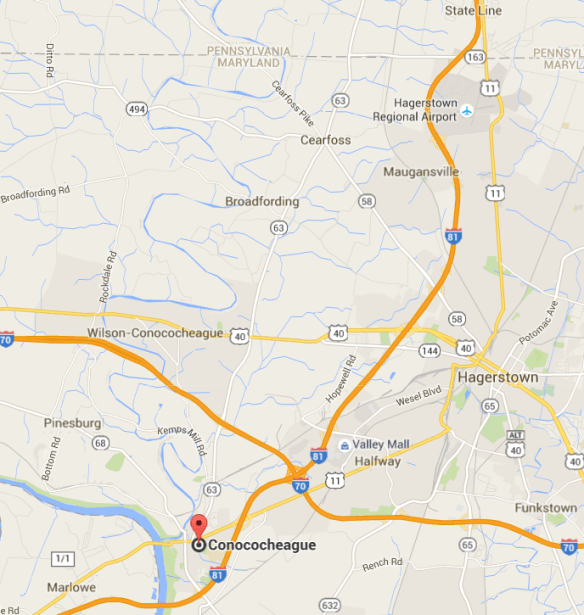
Conococheague

October 25 – John Loomis, wife and 3 small children
October 28 – Jacob Miller wife and 6 children
October 30 – George Falke, house, mill, barn, 20 cattle, 4 horses, wife, 9 children cut into pieces and fed to the pigs. A trader scalped, roasted alive, eaten.

The Conococheague residents tried to protect themselves at first, but then, they gave up and fled back east. The only Brethren name on the militia lists was George Butterbaugh, and Replogle suggests that he may not have been Brethren yet at that time.  All of this was taking place in the area where the Ulrichs, Cripes and Millers lived.

Those who were willing to fight must have been terribly frustrated and felt endangered by the Brethren who were not. They were surely looked upon as a burden to the rest of the community.  Did the Brethren truly watch their families slaughtered and do nothing?  It’s difficult to believe that basic human instincts didn’t kick in.

Most settlers fled east from Monocacy. George Washington received a report in the summer of 1756 that “350 wagons had passed that place to avoid the enemy within the space of 3 days” and by August the report was that “The whole settlement of Conococheague in Maryland is fled, and there now remain only two families from thence to Fredericktown…..”

Conococheague to Frederick

Surely that included Michael Miller and the rest of the Brethren families. The Indians were reported within 30 miles of Baltimore.  Frederick is 47 miles from Baltimore.

Furthermore Washington said, “That the Maryland settlements are all abandoned…is a certain fact.”

Where did the Brethren families go? Who did they stay with?  What did they do?  And for how long?

In July 1756, the commander at Fort Duquesne said that he had “succeeded in ruining the three adjacent provinces, Pennsylvania, Maryland and Virginia, driving off the inhabitants and totally destroying the settlements over a tract of country over 30 leagues wide…the Indian villages are full of prisoners of every age and sex.”

In 1757, “the frontier settlements were abandoned over a wide area.”

And so life continued, land abandoned, the residents living who knows where, but assuredly with Brethren families or congregations back east, throughout 1756, 1757 and into 1758.

1758 – General Harris extends a road from Harrisburg, PA to Fort Duquesne on the Ohio River (Pittsburg.) Highway 30 follows this road most of the way today. Replogle 55

Forbes went from Cumberland to Bedford and had hundreds of men working on the road. By August 1758, 1400 men had extended the road to Bedford, just wide enough to get a wagon through.  A contemporary writer said it took 8 days to travel from Bedford to Ligonier, a distance of about 45 miles.  This tactic succeeded.  General John Forbes took Fort Duquesne, now Pittsburg, the French abandoned it, and ended the French and Indian War on November 25, 1758.  Indian attacks diminished and by 1762, the French had given up Canada.  Replogle 107-108, 110

Forbes Road

The area was never really in jeopardy of Indians regaining control, but it was in real jeopardy of French control. The French, like the English, were using the Indians by making promises.  Were it not for Forbes, we might all be speaking French today.

When did the settlers return to this area? They likely had to rebuild from scratch.  As difficult as this must have been, they obviously did and we have absolutely nothing in our family history reflecting this extremely difficult time.  You would think there would be stories…something…but there is nothing.

We don’t know where our Brethren families lived during this time, what happened, who died, when they returned, how, or what they faced. Were their homes all burned?  Was anything left?  Did they start over again?  What happened?

There is no hint.  Brethren were never whiners.  There are no tales of woe.  The only hint is when transactions resume.  For Michael Miller, that was in 1761 when he again began purchasing land, if that Michael was our Michael, or in 1762 when taxes were again being paid in Frederick County.

Michael, by this time, was an old man, 69 years old, and assuredly tired. In particular, tired of conflict and warfare.  I’m sure he simply wanted to sit on the porch of his children’s home and look over a peaceful vista – one with no Indians, soldiers or war-like sheriffs.

One small item of significance – during the war, a small fort was built at Raystown, which would eventually become Bedford, a location that would, in 1770, become quite important to the Brethren. It was indeed the next frontier and two of Michael Miller’s grandsons through his son Philip Jacob would find themselves in Bedford County, PA.

1760 – One Michael Miller was Constable of Upper Antietam Hundred. This causes me to wonder how a Brethren can be a constable if they won’t take an oath.

The Brethren shunned anything legal. They did not marry by obtaining a license.  I don’t think they would have registered their deeds if there was any way they could have avoided it.  Many times, they simply didn’t.

For instance, on February 14, 1776, Alexander Mack Jr., the son of the founder of the Brethren faith writes in a letter that he is shunning his daughter, Sarah, because “she married outside of the brotherhood” and secondly “because the marriage was performed with a license and third because her husband had not quite completed his apprenticeship.” Shunning in the Brethren world was ostrification and the results of that could be far more severe then than now.  Protection and assistance, for example, came from the group, generally a family group, that you were a member of.  Sarah must have been one very brave young lady or blindly in love.

1761 – Michael Miller purchases Deceit in May, 108 ac for 50 lbs. Washington Co. MD  Miller p 23

1761 – Michael Miller recorded a mortgage on May 6, 1761 made March 26, 1761 between Joseph Perry of Frederick Co. for 50 pcm (Pennyslvania Current Money) mortgaging a tract called “Deceit” on a branch of Antietam near the place that George Fairbush formerly lived on, containing 108 acres. Signed Jos Perry before Mos Chapline, Peter Bainbridge.  Receipt ack, AF and duty pd.  Frederick Co. Maryland Land Records, Liber F Abstracts, 1756-1761 p 124 by Patricia Abelard Anderson (Note – I did not extract all Miller records, just first names in which we are interested.)

Given that none of the other names are Brethren, I wonder if this is a different Michael Miller, perhaps the one that was a constable.

1762 – When Nicholas Martin was naturalized in Pennsylvania in 1762,  Michael Miller and Jacob Miller were witnesses. It was this Nicholas Martin who gave the year of death for Michael Miller as 1771.  Mason p 10 (Note that Michael’s signature would be on this document if the original still exists.)

This might suggest to us that Michael spent his time in exile in Pennsylvania and not in Maryland. Of course, he might simply have traveled to Maryland to testify for Nicholas Martin.

1762-1763 – In Frederick Co., MD, Michael Miller paid taxes on more than 700 acres, Michael Miller Jr. on 80 acres and Hans Michael Miller on more than 2000 acres. Replogle 117 quoting from Mason

1762-1763

To separate the three Michael Millers, Michael Miller Sr., Michael Miller Jr. and Hans Michael Miller, we use the information that is recorded in the Land Tax records at Annapolis MD in the archives. This is what was found:

Michael Miller Sr. 1762 and 1763
Skipton of Craven – 100 ac
Miller’s Fancy – 36 ac
Skipton of Craven – 180 ac
Resurvey of Well Taught – 409 ac

Michael Miller Jr. 1762 and 1763
Miller’s Chance – 50 ac – 1762 the same land
Blindman’s Choice – 50 ac – 1763 to 1772
(Most years Miller’s Choice was called Blindman’s Choice)

Hans Michael Miller – 1772
In addition to land in Antrim Twp, Franklin Co, Pa and New Creek, now Mineral Co, WV as given in his will, he paid taxes in 1772 in Frederick Co., MD on the following:
Resurvey of Nicholas Mistake – 1025 ac
Garden’s delight – 146 ac
Add Garden’s delight – 28 ac
Plunket’s Doubt – 133 ac
Maiden’s Walk – 35 ac
Tonas Lott – 16 ac
Small Hope – 20 ac
Small Hope – 43 ac
Rocky Creek – 150 ac

For anyone tracking Hans Michael Miller, Franklin County, PA and Mineral County, WV would be good places to start.

Gene Miller found that Hans Michael Miller was given 1000 pounds by his father Michael Miller Sr. (died 1771) to purchase Pleasant Gardens. What he purchased may have been an earlier name for what he called Gardens Delight and Add Gardens Delight.  If it was this land, it was land that his 2 sons sold to Jacob Good and was located near the land, “Huckleberry Hall”, that Jacob Good bought from John Schnebly in 1787.  It was located near Maugansville, MD.  This land would go to the son-in-law and grandchildren of Elizabeth Garber, the step-mother of Hans Michael Miller, assuming he is the son of Michael Miller who died in 1771.  Jacob Good had remarried.  This is a connection between the 1st set of Michael Millers Sr.’s children and his step-children.  Mason P 13

We did not follow the land records of Hans Michael Miller, but did follow the land records of Michael Miller Sr. (died 1771) and Jr., his presumed son.

We found that Michael Miller Sr. (the second, died 1771) paid taxes on his land and in his name for 1762 and 1763. He deeded all the land to his step-children in 1765.  After that he continued to pay taxes on 36 acres of Miller’s Fancy and 8 acres of Resurvey on Well Taught.  It’s this fact that causes researchers to believe this is where Michael actually lived.

1762 – John Hager began to lay out what would one day become Hagerstown, Maryland.

1763 – The surveyors started laying out the Mason-Dixon line and they got as far as Dunkard’s Creek where Indians stopped them. Replogle 114

A historical marker is located at Dunkard’s Creek in the Mason Dixon Historical Park where the creek crosses the Pennsylvania-West Virginia border about 150 miles west of Hagerstown.

Hagerstown to Mason-Dixon

1763 – In reference to Pontiac’s War (the Pontiac Conspiracy – which lasted until 1765) and the attacks on Fort Pitt, its inhabitants, and the destruction of Ligonier – David McClure says “the greater part of the Indian traders keep a squaw and some of them a white woman as a temporary wife. The people of Virginia…are different from those of the Presbyterians and the Germans.  They are much addicted to drinking parties, gambling, horse racing and fighting.”  These people were all residents of Fort Pitt, a total of 322 people.  Most people fled east once again and the Indians attacked as far west as Carlisle.

The Maryland Gazette, written at Frederick on July 19, 1763 said, “The melancholy scene of poor distressed families driving downwards through this town with their effects…enemies…now daily seen in the woods….panic of the back inhabitants, whose terrors at this time exceed what followed on the defeat of General Braddock.” Ironically it also reported that the season had been remarkably fine and the harvest the best for many years.  Once again, Frederick County put together two companies of militia and once again, no Brethren names appeared on the list.  Replogle 113 – 114

By 1763, Michael Miller was an old man, almost 72 years of age. Again, relations with the Indians deteriorated and they attacked in waves.  “The Cumberland Valley and frontier regions are deserted,” came the reports.  “Bands of raiding Indians spread over western Maryland” Nead says and on August 13, 1763 George Washington writes that once again, “no families remain above the Conococheague road, and many are gone from below it.  The harvests are, in a manner lost, and the distresses of the settlements are evident and manifold.”  Replogle 113/114

Two Brethren, Nicholas Martin and Stephen Ulrich are found attending the Great Council of the Brethren in Conestoga in 1763. Would they have left their family in Frederick County among the massacres, or does this imply that the group had once again moved back east, and this where in the east they had moved?

Looking at the map, this seems to be an important clue. It would appear that they had been evacuating in reverse settlement order.  Perhaps they first went to join the congregants of the church in Hanover, and finding that location unsafe, went on further back to their home church, Conewago, further east.

Conewago, in the book, “A History of the Church of the Brethren in Southern District Pennsylvania” is noted as being near current Ephrata, PA and also as being the current congregation of White Oak in Lancaster, County.

Ephrata to Hagerstown

1765 – The 4 children of Nicholas and Elizabeth Garber were living in Frederick Co. MD before 1765. Nicholas’s will gives the names of two of them, Elizabeth and Samuel, and researchers have determined that the other two were Anna and Martin.

In 1765, Michael Miller is selling land, just like nothing happened, or perhaps the recent unrest is part of why he transferred the land when he did. In essence, he went on a huge deeding spree, deeding all of the land he owned, mostly to his step-children and their spouses.

1765 – Jacob Good recorded a deed on Oct. 28, 1765, made Oct. 25, 1765, between Michael Miller of Frederick Co. for 100 pounds current money, a parcel called Hamburgh, part of a Resurvey on Well Taught, metes and bounds given, containing 81 acres. Signed Michael Miller by mark M before Joseph Smith, James Smith, Elizabeth Miller wife of Michael released dower.  P 140-142  Frederick Co. MD Land Records Liber K Abstracts, 1765-1768 abstracted by Patricia Abelard Andersen p 15-16

Please note that this means that Elizabeth Garber, Michael’s second wife is still alive in 1765. There is significant confusion about Michael Miller administering the estate of her former husband, Nicholas Garber, and some researchers have construed that administration in 1754 to be the estate of Elizabeth, which it clearly is not.

1765 – Michael Miller sold the 409 acres of Well Taught to Jacob Good and John Riffe. He paid taxes on 8 acres of this 409 acres along with the 36 acres called Miller’s Fancy which has what has led some researchers to surmise that is where Michael actually lived.  Mason p 14

1765 – John Rife recorded a deed on Oct. 28, 1765, made Oct. 25, 1765 between Michael Miller of Frederick County for 200 pounds current money, a tract of land called Quarry, part of a resurvey on Well Taught patented to George Jacob Pow, metes & bounds given, 179 acres signed Michael Miller by mark M. Witnesses Joseph Smith, James Smith, receipt ack.  Elizabeth Miller released Dower.  P 166-167

1765 – Michael Miller sold in October 1765, 36 acres of Miller’s Fancy and 5 acres of Resurvey of Well Taught for 50 pounds. Wash Co., MD. Miller p 23.

This appears to be the 5 acres he paid tax on until he died, but he had already transferred the entire 36 acres to John Riffe, so this is somewhat confusing.

1765 – John Rife recorded a deed on Oct. 28, 1765, made Oct. 25, 1765 between Michael Miller for 50 pounds, a tract called Miller’s Fancy, metes and bounds given, 5 acres, signed Michael Miller by mark M. Witness Joseph Smith, James Smith.  Receipt ack.  Elizabeth wife of Michael released dower. P 175-176

1765 – Jacob Good recorded a deed on Oct. 28, 1765 made on Oct. 25, 1765 between Michael Miller of Frederick County for 300 pounds, a tract called Good’s Choice, part of Skipton and Craven, land whereon the said Jacob Good now lives, metes and bounds given, 163 acres, signed Michael Miller by mark M.  Wit Joseph Smith and James Smith, receipt acknowledged and dower released by Elizabeth Miller wife of Michael Miller. P 177-178 Wash Co Md.  Miller p 23

1765 – Jacob Good recorded a deed on Oct. 28, 1765 made on Oct. 25, 1765 between Michael Miller for 60 pounds tract called Luck, part of resurvey on Well Taught entered to George Pie. Metes and bounds given, 100 acres.  Signed Michael Miller by mark M.  Witnesses Joseph Smith, James Smith and Elizabeth Miller releases dower. P 179-180 Wash Co MD  Miller p 23

1765 – John Rife recorded a deed on Oct. 28, 1765 made on Oct. 25, 1765 between Michael Miller for 200 pounds, a tract called Rife’s Lot, part of Skipton and Craven whereon John Rife now lives, metes and bounds given, 117 acres. Witnesses Joseph Smith, James Smith and Elizabeth Miller release dower. P 185-186

Jacob Good and John Riffe were Michael Miller’s step-daughter’s husbands. Mason P 14

1765 – Michael Miller sold Michael Tanner 50 acres of “Miller’s Choice”.

1765 – Michael Miller had “Range” surveyed – 50 acres – grant. We believe that this is the 50 acres on Piney Creek that he sold in 1765 to Michael and Eve Tanner who deeded it to a son-in-law, John Storm. See circle 9.  Was Eve one of Michael Miller and Susanna Bechtol’s daughters that we have not discovered?  Mason P 14

Frederick Co. MD Land Records Liber K Abstracts, 1765-1768 abstracted by Patricia Abelard Andersen, p 18-19

1768 – The defeat of Pontiac triggers mass migration westward over the mountains. Replogle 20

1768 – November – the British government bought large tracts of land from the Iroquois and Pennsylvania now owns all the land west of the Alleghenies to the Ohio River except for the northernmost part of the colony, opening the doors for a huge migration. However, the Delaware and Shawnee were left out and the raids continued.  Replogle 115

1768-1769 – List of persons who stand charged with land on Frederick County rent rolls which are under such circumstances as renders it out of the power of George Scott Farmer to collect the rents and there claims allowance under his articles for the same from March 1768 to March 1769: (Note there are several pages of these, so much so that it looks like a tax list, not a roll of uncollectibles.)

No Cripe, Greib, Ullrich, Ullery or Stutzman
Conrad Miller
Isaac Miller
Jacob Miller Jr
John Miller
Lodwick Miller
Michael Miller heirs
Oliver Miller, Balt Co.
Oliver Miller, Balt Co additional
Thomas Miller

Inhabitants of Frederick Co. MD, Vol 1, 1750-1790 by Stefanie R. Shaffer, p 45

1770 – Michael Miller recorded on June 21, 1770 a deed made on the same date between he and Peter Apple/Apel for 50 pounds, a 20 acre tract of Small Hope. Signed in German script, Peter Apel before Charles Beatty, William Richey Receipt ack.  Alienation fine paid.  Please note that in 1772 Hans Michael Miller is paying tax on this land. P 154-155

Also note that in 1765 Johann Michael Miller was signing with an M, and this Michael Miller signs five years later in German script.

As best I can tell, the alienation fine was connected with selling the land privately away from the proprietor of Maryland. This is discussed on pages 33-35 of “The American Colonies in the Seventeenth Centuries, Volume 2” by Herbert Levi Osgood.

Frederick County Maryland Land Records Liber N Abstracts 1770-1772 Abstracted by Patricia Ableard Andersen p 24

1770 – Richard Richardson recorded June 25, 1770 made June 22 between Michael Miller for 40 pounds, sells 10 acres of tract called Small Hopes. Signed Michael Miller receipt acknowledged Pages 171-173

Frederick County Maryland Land Records Liber N Abstracts 1770-1772 Abstracted by Patricia Ableard Andersen, p 25

1771 – Michael Miller’s death is recorded by Nicholas Martin in a letter to Alexander Mack Jr. wherein he references the death of Michael Miller as a “year ago” which would be approximately May of 1771.

On May 24, 1772, when Nicholas Martin was presiding at Conecocheague, he wrote a lengthy letter to Alexander Mack, Jr., of which one paragraph reads:

“You will perhaps know that the dear Brother Michael Miller died a year ago. Brother Jacob Stutzman is again quite improved; he was very feeble this past winter.”

Michael Miller is references as “Brother” so there is absolutely no question that he died Brethren.

Elder Nicholas Martin was the ruling Church of the Brethren elder for this section of MD and PA and a friend of Alexander Mack Jr.  Alexander Mack Sr. was the founder of the Brethren Church and his son the leader after his father’s death.  In other letters he comments about the health of Michael Miller and Jacob Stutzman.  When Nicholas was naturalized in 1762, Michael Miller Sr. and his son Philip Jacob Miller were witnesses for him.  Nicholas’s farm called “Swamp of Experience” was adjoining Tom’s Chance and Ash Swamp.  Mason P 19

These men were clearly very close neighbors and friends. Nicholas Martin probably preached the funeral of his friend Michael Miller, in German of course.

1771 – Justin Replogle believes that Michael is probably buried on Miller’s Fancy. Replogle p 32

Floyd Mason believes Michael is buried on Ash Swamp.

We believe that Michael Miller was buried on his plantation where he lived or in the family cemetery on John Miller’s section of Ash Swamp. We believe he remained Lutheran or Reformed.  However he may have attended or joined the German Baptist Brethren.  Some records say that they lived and were buried at Conococheaque, Washington Co., MD near Hagerstown, MD.    Mason P 20

Gene Miller believes he is buried in the now-lost cemetery on John Miller’s part of Ash Swamp.

It is believed that Michael Miller is most likely buried in the private cemetery that was located on the John Miller portion of the Ash Swamp property. The 50 by 50 foot cemetery plot is apparently lost to history today as there is no record of it.  Miller 31

I don’t have a clue where he is buried, but if I had to guess, and I do, I would suggest it is more likely to be on his son’s property than elsewhere simply because that land is more likely to ‘remain in the family’ where the land of step-children is already outside of the blood-line family. It’s also likely that a cemetery on John Miller’s land had already been established as the “Miller cemetery” for this family.  It’s unlikely that there were no deaths between 1752 when Michael deeded this land to his sons and 1771 when Michael died.

1771 – Michael Miller dies and Ash Swamp is divided between Philip Jacob, John and Lodowich. 1000 pounds is given to Hans Michael to purchase Pleasant Gardens, Michael Jr. is given Blindman’s Choice.  Miller p 24

Note: I don’t find a deed giving Blindman’s Choice to Michael Jr.

From 1769 thru 1772 the tax on Michael’s land was paid by the heirs as seen on this tax books. There are some records that show that the tax was owed for several years and we believe that they did not get around to paying the tax until after Michael’s death in 1771.  Michael Miller Sr. (the second died in 1771) lived for years at the mouth of Little Antietam where it flows into the Antietam Creek.  Mason p 13

We found that after the death of Michael Miller Sr. (the second), in 1771, both Michael Miller Jr. (the third) and Hans Michael Miller were paying the tax in 1772 and succeeding years. Philip Jacob Miller was paying taxes on “Ash Swamp,” 290 acres and Lodowich Miller was paying taxes on land that he had bought near Taneyown, Md.  See Circle #7.  Mason P 14

The names of Michael Miller Jr. (the third) and Hans Michael Miller are confusing. Given that Michael Miller Sr.’s (d 1771) actual name was Johann Michael Mueller (Miller), and Hans is short for Johann, you would think that Michael Miller Jr. would be Hans Michael Miller Jr.  Both of these men cannot be sons of the Michael Miller who died in 1771.  However, one could be a son and one his grandson.  Further research into both Michael Miller Jr. (the third) and Hans Michael Miller would hopefully reveal additional information and in particular, about their age.  We know, for example, that Johann Michael Miller (the second’s) first child, a son, Johann Peter, was born in 1715.  If Johann Peter married when he was 20 and had a son when he was 21, whom he named after his father, that birth would have occurred about 1736.  That child, Johann Michael Miller, would have come of age about 1757.  Given that several grandchildren of Michael Miller could have been coming of age anytime after 1757, Hans Michael Miller could have belonged to any of the living or perhaps deceased male children of Johann Michael Miller the second who died in 1771.

I assembled the various land transactions of Michael Miller as shown below.

Miller land chart 1Miller land chart 2

*Troy Goss refers to the John who was involved with the Ash Swamp land as John Peter. This is the only source I have seen referring to this John as John Peter Miller.  It would be very unusual for Johann Peter to be called John instead of Peter, since Johann was the first given name of most German male children.  The only person called Johann or John would be someone whose full name was Johannes Mueller.

In 1783, these men conveyed land back and forth. Troy shows deeds on Dec. 9, 1783 for 220 acres from Lodowich to Philip Jacob Miller for 5 shillings (Washington Co., Land records, Book C, pages 563-47).  On December 26, 1783, Philip Jacob Miller conveys 144 acres to John Peter Miller for 5 shillings “and brotherly affection.” Book C, pages 260-262.

To finish the story of Michael’s land in Frederick County, when John died in 1794, Frederick County had become Washington County. The family sold all of Michael’s land that both John and Philip Jacob had inherited to one John Schnebley.

Philips Jacob’s land, sold on September 25, 1795, included Keller’s Discovery for 11 acres, Prickley Ash Bottom for 11 acres and his part of the Resurvey of Ash Swamp for 143.5 acres, for 2,175 pounds. Liber I, page 360.

John’s land included his 143.5 acres of the Resurvey of Ash Swamp for 2,044 pounds. Liber I FF page 584.

It’s interesting to note that Michael paid 243 pounds for this land in 1745 that sold for a total of 4219 pounds in 1795, about 50 years later, for a profit of 576%. He was indeed an astute investor.

Philip Jacob Miller left and went to Kentucky in about 1796, a couple of years after his brother John died. Philip had witnessed his brother John’s will.  He likely sorely missed his brother who had been his neighbor and farming companion his entire life.  While we don’t have a will in Maryland for Philip Jacob, we do have John’s will which gives us a peek into their life on Ash Swamp.

The land was referenced as both meadow and swamp. It seems there was about 100 acres of woodland and the rest was swamp, meadow and cultivated land.  The woods are entirely gone today.

In John Miller’s estate inventory, we find

  • A Bible – I have to wonder if this was his father’s Bible. If he was Johann Peter born in 1715, he was the eldest son, and this could well have been his father’s Bible if it survived all of the moves, warfare and indian raids.  I wonder what happened to this Bible.
  • Hand tools such as saws, hammers, trowels, branding irons, knives, pinchers, shovels, chains, broad axes, a grubbing hoe, a rifle, a scythe, an anvil and a corn hoe. Obviously, the rifle was for hunting, not defense.
  • Farm implements such as a tar bucket, a bushel basket, a wagon whip, a dutch oven, old flour barrels, a chisel, a compass, a dung fork, an auger, a barking iron, a shot gun, a wool wheel, tanners knives, stelyards, a harrow, a hay fork, plows, draw knives, mall rings, wedges, a windmill and sausage horn.
  • Produce such as flower, a barrel of vinegar, stacks of hay, wheat, oats, rye, corn, flax, potatoes. Some produce was still in the field such as 8 acres of barley and wheat that was seeded.
  • Farm animals including geese, turkeys, ducks, horses, cows, calves, bulls, sheep and hogs along with cured pork.
  • Household items such as chairs, a tub, a bedstead, a table, dressers, chests, a dough tray, lamps, baskets, a kettle, a stove, weaving loom and spooling wheel, wool cards, knives and forks, pewter spoons, a kitchen cabinet and shelves. It’s interesting that there is only one bedstead.

Philip Jacob’s farm would probably have been quite similar, as would Michael’s before them at his death in 1771, although Michael may have had significantly less because he had to start over so many times when war drove him out and the Indians likely burned his homes. I wonder how many homes he lost in that manner.  I’m betting at least two.

Michael and his son’s lives were filled with uncertainty in a way we find difficult to relate to today.

“For the first fifty years the Brethren suffered many privations on account of the French war in 1755, the Revolution 20 years later, and subsequent Indian wars together with many inconveniences incident to a newly settled country, as our part of the state was at that time. The dread of the Indian’s tomahawk and scalping knife, was everywhere felt. In the morning before going to the fields to work, the farmer and his sons often bid good-bye to the balance of the family, fearing they might not return, or if permitted to do so, would find their loved ones murdered by the Indians.” (From The Brethren Almanac 1879.)

That simple paragraph probably pretty much sums up the daily life of Johann Michael Miller’s life. Always wary, always on the frontier, always in some amount of jeopardy.  However, his faith sustained him and he managed to survive, as did many of his children, either because of or in spite of his Brethren faith and non-violent ways.

The Brethren Almanac goes on to report, “Under the guiding hand of their first resident Elder, Wm. Stover, the congregation worshipped in houses. Brother Jacob Miller was elected to the ministry, and in 1765 moved to Virginia.”

This is the genesis of the legend that Jacob Miller is the son of Michael Miller – a legend we will disprove.

Visiting Michael’s Land in Frederick (now Washington) County, MD

In October of 2015, I was able to visit Hagerstown, Maryland, located in Washington, County, the part formerly Frederick County. More specifically, I was able to locate Johann Michael Miller’s land, Ash Swamp, that he may have lived on and that he left to his sons, in particular, John and Philip Jacob, my ancestor.

Johann Michael Miller owned land just outside of and now partly within Maugansville, Maryland.

Gene Miller, in his book, assembled the surveys into a conglomerate. If Gene is right about where the cemetery was located, it may well be under the subdivision today, and if not, perhaps our ancestors are sleeping peacefully under some corn.

Resurvey of Ash Swamp

On this map, Michael’s land encompasses most of the land between Cearfoss Pike (58), Gardenville Road and Maugansville Road including Rush Run.

Ash Swamp map crop

Here is the satellite view of that area.

Ash Swamp satellite

The grey balloon is the old working farm that remains.

Arriving in the area from Cearfoss, approaching Michael’s farm, you notice the lovely clean farms. As I’ve been working my way north this week from Richmond, VA, I’ve noticed how much these farms resemble the Pennsylvania, Lancaster County, type of farms and buildings.  That makes sense, since the people who settled here were a group of Germans that had previously lived in that area.

The land to the south of Cearfoss Pike was also Michaels. His son, Lodowick also bought a significant amount of land here.

Lodowick's land

There is a more contemporary home very near to the road. This structure is not old enough to have been here when Michael owned this land.

Miller land current house

However, this farm that sits back could have been the original farm and house, or at least the location of the original buildings. This would have been John’s portion of the farm.

Miller land farm house

The house sits quite a ways back from the road, and I did not want to disturb the current day owners, so I took photos from a distance.

Miller land farm close

Based on the maps of this region from the 1850s through about 1900, this farm does not appear to have existed at that time, so it’s not the original farm house, as I had hoped.

Fortunately, Grace Academy purchased Michael’s land and built in the middle of the field, behind the homes on 58 and also behind the homes in the development off of Garden View and Maugansville Road.
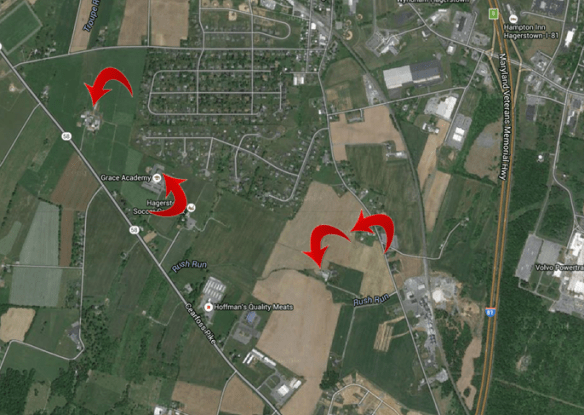
Miller with arrows

The map above shows the original farm to the upper left, Grace Academy to the lower left, the property today owned by the car collector is to the far right and the arrow just slightly left of that is Ashton Hall. Johann Michael Mueller owned most of this land.

You can see the land overlayed on this scan from page 30 of the Miller book.

Miller book overlay crop

This 1859 Taggert plat map of Washington County shows homestead locations.

Washington 1859

It appears that the old farmhouse on Cearfoss Pike is on the Daniel Zeter land but it’s not showing as a homestead. Daniel Zeter’s actual homestead is north of Michael Miller’s property, although it looks like there was a road leading to his house over Michael’s property.  It could also have changed in the years since the 1770s or even the 1790s.  It appears that the M. Horst and John Horst properties are the car collector perhaps and Ashton Hall.

washington 1877

The 1877 atlas, above clearly shows the Zeller residence. If that is where John’s farm was located, it’s likely under the subdivision today.  Philip Jacob’s land is likely where the Horst farms were located.

The 1879 map is very similar.

Washington 1879

The Ashton Hall history confirms we have the correct land with the following:

In 1838, the farm was sold to John Horst, of Lancaster County, Pennsylvania, to settle the estate of John Schnebly. In 1865, Horst sold part of the farm to his son Samuel, …reserving that part of the dwelling house on the north side of the passage from the cellar to the garrett with privilege of using the entries and stairs for passing and repassing with free access to any of the springs and one third part of the garden… according to the deed. Samuel and his bride resided in the upstairs ballroom area, and an enclosed stairway was added just inside the kitchen door for access. In 1885, Lesher Horst, son of Samuel and Lydia Horst, built his own brick home on their portion of Ashton Hall. This property was later to become known as the Miller Asparagus Farm. Fanny Horst married Michael Martin and in 1899, the Martin family purchased the farm and continued their lineage at Ashton Hall. These were Mennonite families who continued to farm the land until 1989, 183 years. Orville Martin was the last steward of Schnebley’s fertile lands.

Ashton Hall has evolved into a community. John Schnebley’s estate has been subdivided with single-family dwellings converging over half the designated meadow, at this time. A church, a private school (kindergarten through twelfth grade), two smaller farms, and a soccer complex are on the perimeter acreage. In the midst of this, sits a quiet reminder of another way of life altogether.

The Grace Academy location, the private school mentioned above, provided wonderful access to photograph Michael’s land and the farm to the west. Most of this land was Michael’s.  You can see what wonderful farming land it would have been, especially given the reminder of the mountains within sight to the west.  These are the Blue Ridge and are maybe 8 or 10 miles distant.

Miller farm west

My husband and I had a picnic lunch of bagels with cream cheese and left over pizza in the Grace Academy parking lot. It was fun to break bread on Michael’s land, some 244 years after he passed from this earth.  He probably took food from his knapsack and did the same thing in 1745 when he scouted this land.  I’m sure it looks dramatically different, 275 years later, but still, I returned and ate where Michael assuredly did as well.  None of this land would have been cleared at that time, so Michael would not have been able to see the mountains in the distance.  We’re looking at the results of Michael’s work and that of his sons John and Philip Jacob Miller.

Miller farm west 2

Michael’s land to the left of the photo above.

Miller farm west 3

Michael’s land to the right of the farm before the subdivision.  The subdivision was his land too.

Miller farm west 4

A closer look at the farm.

Miller farm mountains

And the mountains.  Did Michael ever dream of crossing these mountains?  Or was Michael done with dreaming of new frontiers?  His son, Philip Jacob not only dreamed of crossing these mountains, he did, at age 70 or so.

Miller farm sky

The farm from Garden View Road, from the back side, across the north part of Michael’s land. This sky is stunning.

Miller farm sky 2

Thankfully Michael had his land resurveyed, because this is the only record we actually have of who received the land and where it lay.

There are however, two other properties of significant interest. On the map, below the grey balloon marks the location of 13318 Maugansville Road.

Miller Maugansville road

Just below this location we find 13220 Maugansville Road, which is Ashton Hall. These two locations are quite historic.

Here is a closer view of the two together.

Miller Ashton Hall

Michael’s son, Philip Jacob would have built a house on this land. These two properties are candidates for that home.  Ashton Hall is actually on Rush Run, which would have been the water source for both.  However, we know that the current building at this location was built in 1801 because the history of Ashton Hall has been researched.  We don’t know if Ashton Hall was built on the location where Philip Jacob’s house had been.

In 1795, John Schnebly purchased 146 and 1/2 acres of land, parts of land grants Keller’s Discovery, Prickly Ash Bottom and Resurvey on Ash Swamp for the sum of …two thousand one hundred and seventy-five pounds five shillings current money. John Schnebly named his property Ashton Hall and, in 1801, built the stone house near Maugansville.

This does, however, confirm that part of this land was indeed Resurvey on Ash Swamp, Michael’s land.

Miller Ashton Hall 2

This property, below, just north of Ashton Hall was visited in the 1970s by other Miller researchers when it was Miller Farm Market. The owners at that time believed that while the house was probably not old enough to be from that timeframe, some of the other buildings were.

Miller car collector

There didn’t seem to be anyone home, so I pulled into the driveway, snapped a few quick shots and left.

Miller car collector 2

An automobile collector lives here today. This could have been the location of the original Philip Jacob Miller homestead.

Miller car collector 3

Miller car collector 4

This begs the question of where Michael and his first wife, Susan Berchtol, are buried. The answer is that we don’t know.

Susan could have died near Hanover, PA before Michael migrated to Maryland, but it is uncertain.

However, it’s a safe bet is that Michael is buried either here or on his land on the Antietam, Miller’s Fancy. We know that someplace here on his own property is a 50 foot by 50 foot cemetery, found on John Miller’s portion, lost to time and probably being plowed or under houses.  Michael’s son John owned this land when he died as well, so he is probably buried here too.  If one of the houses in the subdivision is haunted, well, I guess we know why!

In the Mason book, Floyd mentions that they visited the Hagerstown area in 1990. He includes a photograph of a property he believes may be one of the old Miller locations.  I originally thought it was the car collector’s property above, but after looking again, I don’t think it is.

Mason pix Maugansville Road

I “drove” this area again using Google maps street view, and I saw nothing at all similar, so I’m presuming that this property is gone today, in October 2015, or it really is the same property I visited owned by the car collector. It has been 25 years since Floyd Mason took these photos, and it was an old property at that time.  If it was as old as Mason thought, it would be very difficult to maintain.  There are several new structures in the area and the couple that owns Ashton Halls has reported a lot of development.

The balance of Michael’s Resurvey of Ash Swamp is either a contemporary subdivision, or farmland surrounding Ashton Hall, which you can’t see from the road. Rush Creek crosses this property and by driving into the entrance of the soccer club, beside the Academy, you can see somewhat of the land east of the Academy, west of Maugansville Road and north of Cearfoss Pike.  This is on the western part of Philip Jacob Miller’s portion of Ash Swamp.

Miller soccer complex

The picture above is looking north. The one below looking east.  Ashton Hall would be behind those trees about half a mile as the crow flies.  The car collector’s property may be slightly visible in the distance just beyond the row of trees.

Miller Ashton Hall 3

I find it very vexing, after all of the real estate transactions Michael Miller was involved with that we still don’t really know where he lived when he died. We know that he deeded all of his land before his death, so he was clearly living with one of his children (or step-children) or at least on land owned by them.

When visiting, I didn’t make the side trip to Antietam and Little Antietam Creek because with all of Michael Miller’s activities on or near Cearfoss Pike, I really didn’t think that he would be living south of Hagerstown. I was probably wrong, and of course, now I wish I had taken that side trip.

Michael did own that land and he could have been living on Miller’s Fancy. In the deed where he conveys the Skipton on Craven land to his step children’s spouses, Jacob Good and John Rife, the deeds say “the land where they now live” indicating that it’s where they live, not where Michael lives.  But Michael continues to pay the taxes on part of the land he sold to his step-children’s spouses.  He had to live someplace.  Is that tax money his “rent” for the rest of his life?

Mason believes that Michael lived on 36 acres of Miller’s Fancy and 8 acres of Well Taught. That doesn’t seem like enough land to support a family, but then again, maybe Michael didn’t need to support a family anymore.

In general terms, the area where Michael Miller’s land lay on the Antietam Creeks was near Sharpsburg, Maryland.

Miller Antietam map

One of the bloodiest battles of the Civil War was fought here. This iconic image of the Battle of Antietam where the Confederate and Union dead lie together in front of the Brethren Church has become symbolic of the war itself. This battle was found on the land of the descendants of Michael Miller.

Miller Brethen church Antietam

The intersection of Antietam and Little Antietam Creek is on Keedysville Road.

Antietam and Little Antietam

A closer look at the intersection of Antietam and Little Antietam

Intersection Antietam and Little Antietam

This is the bridge over Little Antietam Creek.

Bridge Little Antietam

Looking at Little Antietam from the bridge.

Curve Little Antietam

If the description of where Michael Miller lived is accurate, he lived on the curve where Antietam Creek intersects with Little Antietam, below.

Antietam curve

This is the curve where Little Antietam intersects with Antietam. Antietam is on the left.

Barn Little Antietam

This barn is actually on the curve with the river slightly visible behind the barn. Was this where Michael’s barn stood?  Was this Michael’s barn?  It’s certainly in the right location.

Bridge Antietam

This is the bridge over Antietam Creek.

Of course, Floyd Miller believes that Michael’s land was northeast of Hagerstown and Maugansville, as shown on his map with circle #4. Perhaps one day a future generation of Miller researchers will run the deeds backwards and forward in time and resolve this mystery once and for all.  If we’re extremely lucky, an old cemetery will be discovered on one of these parcels.

Michael’s Children

Because Michael did not have a will, we only know of three or four children positively, and a possible fifth. The rest of the individuals attributed to Michael elsewhere are speculation.  If someone does have other children and documentation for such, I would love to add that child.  I have not included any speculative children below.

  • Hans (probably Johann) Peter Mueller, baptized on January 19, 1715, at Konken, Germany. We don’t know if this child lived to adulthood. If so, he would probably have married when the family was living in Chester Co, PA. He may be John Miller below.
  • Lodowich Miller born 1724 or earlier in Germany. Migrated with his parents and lived in or near Hanover, PA and Hagerstown, MD before marrying Barbara, surname unknown, and migrating to Rockingham Co., VA about 1782 where he likely died in 1792.
  • Philip Jacob Miller born about 1726 in Germany. Migrated with his parents and lived near Hanover, York Co., PA. Inherited land from his father in present day Washington County, MD near Maugensville. Married Magdalena, probably in York County, who was reported to be a Rochette. He remained in Frederick County until 1796 when he, along with his children, migrated to Campbell County, KY where he died in 1799.
  • John Miller inherits part of Ash Swamp from Michael in 1765 and lived there until he died in 1795, likely being buried on his own land on a 50 by 50 foot cemetery plot, now lost to time. He may be Hans Peter Mueller born in 1715.
  • Hans Michael Miller is given money to purchase land.
  • Michael Miller Junior is given land.

There exists some confusion between John Miller and Johann Peter Miller. In some cases, John, who inherited part of Ash Swamp is referenced as Johann Peter.  If this is the case, then we know that Johann Peter did live and what happened to him.  However, it also means that it reduces the number of children we know about.

Various researchers attribute Michael and Susanna with anyplace from 7 to 12 children. Given that they were married for 17 childbearing years, they would probably have had between 9 and 12 children.  It’s unlikely that their children all lived.

It seems that any male with the surname Miller living in the region gets attached as a son. Miller is an extremely common occupation name in Germany.  After all, every village had at least one miller, so there are lots of German Millers.

It’s certainly possible that the Jacob Miller and family who were massacred were Michael’s son and grandchildren, but we don’t know and we have no real evidence to suspect – other than the surname in the same place and time.

There is a Barbara who marries a Garber who is often credited with being Johann Michael Mueller’s daughter – and while she might be – there is no evidence that she is – not even land transactions. It would be interesting to see if any of Barbara’s descendants match any of Michael’s descendants utilizing autosomal DNA – assuming they share no other lines.  Given the level of endogamy in the Brethren community, that’s a tough criteria to meet – assuming you do know the surnames of all of the females.  Since the Brethren didn’t register their marriages in the counties where they lived, females surnames are particularly troublesome and elusive.

It’s almost assured that Johann Michael Miller and Susanna Agnes Bechtol had additional children. Whether those children lived to adulthood is uncertain.  It’s even uncertain that Hans Michael Miller, above is Michael’s child, especially given the fact that we also have a Michael Miller Jr. involved.  One of these men is probably a grandchild.

It’s ironic that we know more about Michael’s step-children through land transactions where he sells them land than we know about his own children, aside from Philip Jacob, Lodowich and John.

But there is one thing we do know, and it solves a very long and somewhat contentious mystery.

Jacob is Not Michael’s Child

Jacob Miller has been quite a conundrum. Jacob was born about 1735 in Pennsylvania, was a Brethren minister, lived in Frederick County and then moved to Virginia in about 1765.  He eventually moved on to Kentucky.  Eventually, Jacob is found in Montgomery County, Ohio, outside Dayton, when the county was first forming, again with our Miller family.  In fact, Daniel, Michael Miller’s grandson through Philip Jacob Miller buys land from Jacob Miller when Daniel first arrives in Montgomery County.  It has been assumed or postulated for a very long time that Jacob Miller is a son of Michael Miller, but he isn’t. Y DNA testing has shown that these Miller families do not share a common male ancestor.

One of the goals of establishing the Miller-Brethren project in 2009 was to sort through the various Miller individuals associated with the Brethren church as it expanded across America.

It took quite some time to establish the Y DNA signature of Johann Michael Miller. The first two men who believed they were descended from him did not match each other, so we needed to proceed with individuals with well documented genealogy.  Fortunately, we managed to recruit several Miller men and today, we have a total of 6 Miller males who descend from Michael.

Brethren Miller Jacob

In the screen shot above, the Jacob Miller line is lavender.  You can see that it differs significantly from the Johann Michael Miller line, in yellow, below. You can click to enlarge both graphics.

Brethren Miller Michael

You may also have noticed that one the men who descends from the Elder Jacob Miller line thought that he descended from the Johann Michael Miller line. This certainly is not an uncommon occurrence and sorting through situations like this was indeed part of the project goals.  It’s very difficult to tell the difference between people of the same name in the same county at the same time subscribing to the same religion.  Thank goodness for the tool of Y DNA.

One of the surprising aspects of this project is that there were so many different Miller lines associated with the Brethren or found in the counties where the Brethren Millers were known to be living – including a second and third Johann Michael Miller. We have 15 groups in total, plus a few people who remain in the “non-Brethren” or ungrouped groups for various reasons.

We invite all male Millers who have Brethren heritage in their Miller line or who think they might descend from Johann Michael Mueller to test at Family Tree DNA.  Please purchase the Y DNA 37 or 67 marker test and the Family Finder autosomal test as well, if the budget will allow both tests.

As more people test, hopefully Miller males who descend from “possible sons” of Johann Michael Miller, we should be able to either confirm more of his sons or put those rumors to rest once and for all.

______________________________________________________________

Disclosure

I receive a small contribution when you click on some of the links to vendors in my articles. This does NOT increase the price you pay but helps me to keep the lights on and this informational blog free for everyone. Please click on the links in the articles or to the vendors below if you are purchasing products or DNA testing.

Thank you so much.

DNA Purchases and Free Transfers

Genealogy Services

Genealogy Research

Charlemagne (742/748-814), Holy Roman Emperor, 52 Ancestors #103

Charlemagne statue

“Charlemagne Agostino Cornacchini Vatican 2” by Photo: Myrabella / Wikimedia Commons. Licensed under CC BY-SA 3.0 via Commons

Above, a 1725 statue representing Charlemagne housed in St. Peter’s Basilica in Rome.

Wow, do I ever have a lot of cousins.  According to Graham Coop, everyone in Europe today is descended from Charlemagne.  Which either means I’m special and so is everyone else, or we’re all just normal.  National Geographic wrote an article about the results of the Coop study in more easily readable verbiage, here.  The Coop team also wrote a nontechnical FAQ, here.

In 2002, Steven Olson wrote this verbiage in the Atlantic magazine about the work of statistician Joseph Chang:

The most recent common ancestor of every European today (except for recent immigrants to the Continent) was someone who lived in Europe in the surprisingly recent past—only about 600 years ago. In other words, all Europeans alive today have among their ancestors the same man or woman who lived around 1400. Before that date, according to Chang’s model, the number of ancestors common to all Europeans today increased, until, about a thousand years ago, a peculiar situation prevailed: 20 percent of the adult Europeans alive in 1000 would turn out to be the ancestors of no one living today (that is, they had no children or all their descendants eventually died childless); each of the remaining 80 percent would turn out to be a direct ancestor of every European living today.

Now, granted, Charlemagne was indeed prolific, siring 18 known children.  I guess I’m just lucky in that I descend from two known children, one who was the King of Italy and one who was the King of France.  I must tell you, all this king stuff sounds very surreal to me.

Charlemagne chart crop

Now, the bad news.  In spite of all of these children, it appears that none of Charlemagne’s male lines survived more than a dozen or so generations.  In generation 8, only two descendants produced a male child, so that severely limited the possibilities for his Y DNA to reproduce – and it didn’t.  It apparently died out in 1122 with the death of the last male in an illegitimate line through Charlemagne’s son, Pepin of Italy.  This means that today, we don’t know what Charlemagne’s Y DNA looked like.  That’s very disappointing.

By the same token, Charlemagne could not pass on his own mtDNA.  To find that information, we’d have to find a female sibling or someone from his mother’s line who descends from a matrilineal female through all females to the current generation.  We don’t have that either.

And as for autosomal DNA…well, we have two problems.  The first is that Charlemagne is so far back in my or anyone else’s lineage – between 40 and 49 generations roughly – that we would carry very little if any of his DNA today…and there is no way to assure that we don’t have other common lines too.  In fact, at that distant point, it far more likely that we do share other common lines that we don’t, especially given what Graham Coop’s paper indicates.

So, Charlemagne’s autosomal DNA hasn’t been identified either.  Short of digging him up, I’m doubting we’ll know much more.  Actually, poor Charlemagne has been dug up, several times in fact, and parts of him given away as religious relics.  In 1988 scientists tried to reassemble him, and their report was delivered 26 years later, without DNA unfortunately, but confirming as best they can that the remains they have, shown in the photo below, are indeed Charlemagne.  I must say, it’s a very odd feeling to look at the bones of my ancestor, reassembled during the study.  In fact, I don’t think I’ve ever seen the bones or even one bone of any of my ancestors before now.  I’m not exactly sure what I think of this.

Charlemagne bones

I’m striking out here genetically, although I’m hopeful for the future since his bones are already exhumed.  To begin with, DNA could tell us if all of those bones are really from the same person.  If they are, or most of them are from the same person, it’s more likely to be Charlemagne.  We could potentially tell when and where this skeletal person lived from isotope testing as well, which could help us confirm or eliminate the possibility that these skeletal remains are Charlemagne.  Y and mitochondrial DNA would tell us a lot about his ancestors, and therefore, ours too.  I hope this avenue is being pursued.

Let’s see what we can discover about Charlemagne outside of genetic genealogy.

Charlemagne’s Birth and Ascent to Power

Charlemagne was born on April 2, in either 742, 747 or 748 and died on January 28, 814.  No, those aren’t typos, they are genuinely three digit years.  It’s hard for me to come to grips with the fact that I have ancestors that I can identify that were born 1270 years ago.

Charlemagne’s father was Pepin the Short and his mother, Bertrada of Laon.  He was of the Carolingian dynasty and was, of course, Catholic. In fact, Charlemagne was DEVOUTLY Catholic, which plays a big part in the decisions he made in his lifetime.  Either that, or he used his religious fervor as an excuse for his invasions of other non-Christian domains.  It’s much easier to track the history of what he did rather than to discern his motivations.

The Carolingian dynasty was a Frankish noble family with origins in the Arnulfing and Pippinid clans of the 7th century AD.

Charlemagne Carolingian chart

This Carolingian family tree, above, dates from the Chronicon Universale of Ekkehard of Aura from the 12th century, but reflects earlier generations.  The Carolingian empire came to a close not long after after Charlemagne’s rule, about 888.

The name “Carolingian” was in Medieval Latin, karolingi, an altered form of an unattested Old High German karling or kerling, meaning “descendant of Charles.”

Charlemagne’s birth year remains uncertain.  The most likely year of Charlemagne’s birth is reconstructed from several sources. The date of 742, calculated from Einhard’s date of death of January 814 at age 72, predates the marriage of his parents in 744.  Einhard was a Frankish scholar and servant of Charlemagne (and his son) who also served as Charlemagne’s biographer – thankfully.

The year given in the Annales Petaviani, a year by year history of the Carolingina empire, 747, would be more likely, except that it contradicts Einhard and a few other sources in making Charlemagne seventy years old at his death. The month and day of April 2 is established by a calendar from Lorsch Abbey.

In 747, that day fell on Easter, a coincidence that likely would have been remarked upon by chroniclers but was not. If Easter was being used as the beginning of the calendar year, then April 2, 747 could have been, by modern reckoning, April 2, 748 (not on Easter). The date favored by the preponderance of evidence is April 2, 742, based on Charlemagne’s being a septuagenarian at the time of his death. This date would appear to suggest that Charlemagne was born illegitimately, which is not mentioned by Einhard.

Einhard said the following:

It would be folly, I think, to write a word concerning Charles’ birth and infancy, or even his boyhood, for nothing has ever been written on the subject, and there is no one alive now who can give information on it. Accordingly, I determined to pass that by as unknown, and to proceed at once to treat of his character, his deeds, and such other facts of his life as are worth telling and setting forth, and shall first give an account of his deeds at home and abroad, then of his character and pursuits, and lastly of his administration and death, omitting nothing worth knowing or necessary to know.

We also don’t know where Charlemagne was born, but Aachen in today’s Germany has been suggested.

Charlemagne became king in 768 following the death of his father. He was initially co-ruler with his brother Carloman I. Carloman’s sudden death in 771 under unexplained circumstances, left Charlemagne as the undisputed ruler of the Frankish Kingdom. Charlemagne continued his father’s policy towards the papacy and became its protector, removing the Lombards from power in northern Italy, and leading an incursion into Muslim Spain. He also campaigned against the Saxons to his east, Christianizing them upon penalty of death, leading to events such as the Massacre of Verden in which 4500 captive Saxons were slaughtered.  Charlemagne was not always a kind man – but history remembers him as an exceedingly effective ruler.

Charlemagne and Pipin the Hunchback

Above, Charlemagne on the left and his son, Pepin the Hunchback, who revolted against his father.  Pepin the Hunchback was subsequently censured and exiled to a monastery instead of put to death after his father commuted his death sentence.

We don’t know how much this drawing actually looks like Charlemagne since it is a 10th century copy of a lost original from about 830.

In this next drawing, Charlemagne instructs his son, Louis the Pious.

Charlemagne and Louis the Pious

Charlemagne was also known as both Charles the Great (Carolus Magnus) or Charles the First.  He became the King of the Franks beginning in 768 with the death of his father and King of Italy beginning in 774.  He was crowned Holy Roman Emperor (Imperator Augustus) in the now demolished Old St. Peter’s Basilica in Rome (shown sketched below between 1483-1506) on Christmas Day in the year 800 and he ruled in that position until his death.

Charlemagne Old St. Peters

This fresco below shows a cutaway view of the Old St. Peter’s from the 4th century, so it looked much like it would have to Charlemagne.  This basilica is built over the location believed to be the burial site of St. Peter.

Charlemagne St Peters cutaway

Today, a new St. Peter’s Basilica stands on this site, the dome visible from the Ponte Umberto I on the Tiber River, below.

"Vatican City at Large" by Sébastien Bertrand from Paris, France - Flickr. Licensed under CC BY 2.0 via Commons

“Vatican City at Large” by Sébastien Bertrand from Paris, France – Flickr. Licensed under CC BY 2.0 via Commons

Although he already ruled both Italy and France, becoming the Holy Roman Emperor bestowed upon him divine grace and a Godly legitimacy sanctioned by the Pope.

This painting from 1516-1517 by Raphael by depicts Charlemagne’s coronation.

"Raphael Charlemagne" by Raphael - Licensed under Public Domain via Commons

“Raphael Charlemagne” by Raphael – Licensed under Public Domain via Commons

Charlemagne’s Rule

Charlemagne map 800

Called the “Father of Europe” (pater Europae), Charlemagne united most of Western Europe for the first time since the Roman Empire and laid the foundations for both modern France and Germany. His rule spurred the Carolingian Renaissance, a period of energetic cultural and intellectual activity within the Church. Both the French and German monarchies considered their kingdoms to be descendants of Charlemagne’s empire.

Charlemagne didn’t seem to stay home much.  In fact, this military and political history reads like a soap opera, with intrigue, betrayals, a brother who died in unexplained circumstances, but apparently of natural causes, invasions, rebellions and saving an injured Pope.  His life was assuredly interesting and it’s nothing short of amazing that he managed to live past 70 and did not die on the battlefield.

Charlemagne was engaged in almost constant warfare throughout his reign, often at the head of his elite scara bodyguard squadrons, with his legendary sword Joyeuse in hand.

Charlemagne sword

“Épée de charlemagne” by Chatsam – Own work. Licensed under CC BY-SA 3.0 via Commons

Joyeuse is stunningly beautiful and is on display in the Louvre today.

"Epée Joyeuse" by Siren-Com - Own work. Licensed under CC BY-SA 3.0 via Commons

“Epée Joyeuse” by Siren-Com – Own work. Licensed under CC BY-SA 3.0 via Commons

It just kills me that I have been in this building with this sword but didn’t know at that time that Charlemagne was my ancestor.

The 11th century “Song of Roland” describes the sword:

[Charlemagne] was wearing his fine white coat of mail and his helmet with gold-studded stones; by his side hung Joyeuse, and never was there a sword to match it; its colour changed thirty times a day.

Some seven hundred years later, Bulfinch’s Mythology described Charlemagne using Joyeuse to behead the Saracen commander Corsuble as well as to knight his comrade Ogier the Dane.

The town of Joyeuse, in Ardèche, is supposedly named after the sword.  Joyeuse was allegedly lost in a battle and retrieved by one of the knights of Charlemagne; to thank him, Charlemagne granted him an appanage (estate) named Joyeuse.

Today, Joyeuse is used as the French coronation sword.

Charlemagne’s Additions to His Empire

Charlemagne spent his entire life increasing the size and power of his empire, some of which was done under the banner of expanding Christianity to the Muslim world and to the pagan Saxons as well.

The map below shows the land that Charlemagne added to the Frankish Kingdom.

"Frankish Empire 481 to 814-en" by Sémhur - Own work, from Image:Frankish empire.jpg, itself from File:Growth of Frankish Power, 481-814.jpg, from the Historical Atlas by William R. Shepherd (Shepherd, William. Historical Atlas. New York: Henry Holt and Company, 1911.). Licensed under CC BY-SA 3.0 via Commons

“Frankish Empire 481 to 814-en” by Sémhur – Own work, from Image:Frankish empire.jpg, itself from File:Growth of Frankish Power, 481-814.jpg, from the Historical Atlas by William R. Shepherd (Shepherd, William. Historical Atlas. New York: Henry Holt and Company, 1911.). Licensed under CC BY-SA 3.0 via Commons

Charlemagne’s reign of Aquitaine began in 768 with the death of his father, although it was initially a joint reign with his brother, Carloman, with whom he had, at best, lukewarm relations fostered by his mother.

It didn’t take long after Charlemagne’s father death for trouble to brew.

In 769, a small uprising in the Basque region was subdued, but that region was unstable for years, a constant thorn in Charlemagne’s side.  Finally, in 781, Charlemagne proclaimed his son, Louis the Pious, then a young child, the first Frankish king of the area, assuring loyalty and displacing those whose loyalty he had reason to doubt.

In 770 Charlemagne married the daughter, Desiderada, of a Lombard King as a political move to form an alliance with her father and in doing so, surround  brother Carloman with Charlemagne’s allies.  However, by the end of 771, Carloman was dead and Charlemagne no longer needed the marriage with Desiderada, so he repudiated her and set her aside to marry 13 year old Hildegard.

In rejecting Desiderada, Charlemagne incurred the wrath of her father, the Italian King Desiderius.  Carloman’s widow and children took refuge in King Desiderius’ court at Pavia for protection.

This drawing is of the Carolingian cavalry from that timeframe.

"Karolingische-reiterei-st-gallen-stiftsbibliothek 1-330x400". Licensed under Public Domain via Commons

“Karolingische-reiterei-st-gallen-stiftsbibliothek 1-330×400”. Licensed under Public Domain via Commons

Sometimes Charlemagne’s military campaigns overlapped each other.  In the Saxon Wars, spanning thirty years and eighteen battles, Charlemagne eventually conquered and subdued Saxonia.  The conquering part wasn’t terribly difficult, most of the time, but the subdueing part proved nearly impossible.  Charlemagne proceeded to convert the conquered to Christianity, beginning in 773 with his campaign against the Engrians where he cut down the Saxon pagan pillar of Irminsul.  However, trouble in Italy caused that campaign to be cut short.

In 773, Charlemagne and his uncle crossed the Alps, chasing the Lombards back to Pavia which he then besieged.

Charlemagne met the Lombards at the pass in Susa Valley, shown below.

Charlemagne Susa Valley

“Susatal” by Fotogian from it. Licensed under CC BY-SA 3.0 via Commons

By 774, the siege of Pavia was over and Charlemagne had himself declared King of the Franks and Lombards and crowned with the traditional “Iron Crown of the Lombards.”

"Iron Crown" by James Steakley - photographed in the Theodelinda Chapel of the cathedral of Monza. Licensed under CC BY-SA 3.0 via Commons

“Iron Crown” by James Steakley – photographed in the Theodelinda Chapel of the cathedral of Monza. Licensed under CC BY-SA 3.0 via Commons

This crown is called “The Iron Crown” because of the narrow band of iron within the crown said to have been beaten out of the nail used at the Crucifixion of Jesus Christ.

In 776, Charlemagne was back in Saxony, having subdued the Saxons and causing their leader, Widukind, to seek refuge in Denmark.  Many Saxons were baptized as Christians.

Although the Lombards surrendered, all was not quiet on that front.  In 776, Charlemagne rushed back from Saxony to squelch a rebellion in Lombardy.

In 778, Charlemagne turned back southwards and tried to overpower the Muslim Saracen rulers of Barcelona and nearby areas.  He marched to face them, meeting them at Saragossa.  He received homage from them, but their cities did not fall.

Charlemagne was facing the toughest battle of his career where the Muslims had the upper hand and forced him to retreat. He decided to go home, since he could not trust the Basques, whom he had subdued by conquering Pamplona. He turned to leave Iberia, but as he was passing through the Pass of Roncesvalles (shown below) one of the most famous events of his long reign occurred.

Charlemagne Roncesvalles

The Basques fell on his rearguard and baggage train, utterly destroying it. The Battle of Roncevaux Pass, though less a battle than a mere skirmish, left many famous dead, including the seneschal Eggihard, the count of the palace Anselm, and the warden of the Breton March, Roland, inspiring the subsequent creation of the Song of Roland (La Chanson de Roland).

Charlemagne battle tapestry

This tapestry portraying the Battle of Roncevaux Pass was woven between 1475 and 1500.

In 779, while Charlemagne was focused elsewhere, Saxony again revolted and he again invaded and reconquered.  I’m sure by now he wondered how many times he had to do this.  He divided the land into missionary districts and personally assisted with the baptisms of masses at Lippe.

From 780-782, Saxony was quiet.  Charlemagne was back in Italy during this time.

In 782, Charlemagne returned to Saxony and was not pleased that the majority of the population was still pagan.  He implemented draconian laws prescribing death to Saxon pagans who refused to convert to Christianity.  This spurred the return of their leader, Widukind, and was followed by three years of bloody battles precipitated by the Massacre of Verden wherein Charlemagne executed 4500 trapped Saxon soldiers.  Three long years later, Widukind, defeated, accepted baptism.  At this time, the Frisians were also brought to heel.

In 787, Charlemagne focused on bringing southern Italy into the fold.  He besieged Salerno where Arechis who reigned independently submitted to vassalage.  However, upon his death in 792, Arechis’ son proclaimed independence and Charlemagne never personally returned, and was never able to bring this region fully under his control.

In 788, Charlemagne was back in Gascony trying to once again reign in a rebellion.  He had appointed his son “King” in that region and replaced Gascon individuals in power with his Frankish officers.

In 788, the pagan Asian Avars (Einhard called them Huns) had settled in Hungary and invaded Fruili and Bavaria.  Charlemagne was busy elsewhere until 790, but at the time he marched down the Danube and ravaged Avar territory.  A Lombard army did the same to Pannonia.

In 789, Charlemagne seeing an opportunity, marched into the Slavic Obotrite territory north of the Elbe, encountered little resistance, and subdued the Obotrites, sending in missionaries to convert them.  They became loyal allies, fighting alongside Charlemagne in 795 when the Saxons broke the peace.

In 792, the Saxons rebelled again in Westphalia, breaking several years of peace and distracted Charlemagne from the Avars, occupying him instead with those relentless Saxons.

However, Charlemagne’s troops continued to assault the Avars’ ring-shaped strongholds.  The great Ring of the Avars, their capital fortress, was taken twice. The booty was sent to Charlemagne at his capital, Aachen, and redistributed to all his followers and even to foreign rulers, including King Offa of Mercia. Soon the Avars had lost the will to fight and traveled to Aachen to subject themselves to Charlemagne as vassals and Christians. Charlemagne accepted their surrender and sent one native chief, baptized as Abraham, back to Avaria with the ancient title of khagan, meaning someone who rules an empire. Abraham kept his people in line, but in 800, the Bulgarians under Khan Krum also attacked the remains of Avar state.

Charlemagne Ring of Avars

From time to time, rebellions would flare up in the conquered Saxon territory.  In 793 a rebellion erupted in Eastplania and Bordalbingia, but that uprising was over by 794.  In 796, an Engrian rebellion followed.

In 794, Charlemagne set his eye upon Bavaria and was shortly thereafter dividing the land into Frankish counties, as he had done with Saxony.

From 791 to 806, Charlemagne was focused on taking the County of Toulouse for a power base and asserting his authority over the Pyrenees, making those counties vassals.

In 797, Barcelona, the greatest city of the region, previously held by the Moors, fell to Charlemagne, but was retaken in 799.  However, Louis of Aquitaine marched the entire army of his kingdom over the Pyrenees and besieged it for two years, wintering there from 800 to 801, when it capitulated.  Today, the Moorish influence can be seen in Barcelona in the architecture of the buildings.

Barcelona building

The Medieval influence can be felt in any portion of the old city and in the plazas.

barcelona plaza

I absolutely loved Barcelona when I visited in 2011, having no idea that I had ancestral history here.

Barcelona 2011

Charlemagne viewed his battle with the Muslim Moors as the battle of and for Christianity.  He wanted to convert the Muslims to Christianity.

In 799, Charlemagne conquered the Balaeric Islands, often attacked by Saracen (Moorish and Muladi) pirates.

In either 797 or 801, Charlemagne send a delegation to Baghdad where the caliph of Baghdad presented Charlemagne with an Asian elephant and a clock.  The elephant, Abul-Abbas, was transported to Charlemagne’s headquarters in Aachen where his life was chronicled.  He died in 810, possibly a war elephant, although others report that the elephant was more than 40 years old, had rheumatism, developed pneumonia while on campaign with Charlemagne, and died suddenly.  I don’t think any of my other ancestors had a pet elephant.

In 799, Pope Leo III had been mistreated by the Romans, who tried to put out his eyes and tear out his tongue.  Pope Leo escaped and fled to Charlemagne at Paderborn, asking Charlemagne to intervene in Rome and restore him. Charlemagne, advised by scholar Alcuin of York, agreed to travel to Rome, doing so in November 800 and holding a council on December 1.  On December 23, Leo swore an oath of innocence relative to the charges brought against him, and his accusers were exiled.  Two days later, at Mass, on Christmas Day, December 25th, when Charlemagne knelt at the altar to pray, the Pope crowned him Imperator Romanorum, “Emperor of the Romans,” in Saint Peter’s Basilica.  It is unclear whether Charlemagne knew this was going to happen or if the coronation was unexpected, a point debated by historians for hundreds of years.

Charlemagne coronation

Miniature of Charlemagne crowned emperor by Pope Leo III, from Chroniques de France ou de Saint Denis, vol. 1; France, second quarter of 14th century.

In 803, Charlemagne sent a Bavarian army into Pannonia ending the Avar confederation.

In 804, one last rebellion occurred in Saxony, but by this time, 30 years after being conquered, most of the original inhabitants were dead and the rest had never known anything but Charlemagne’s rule and warfare.  They were tired of fighting in their homeland.

Einhard tells us:

The war that had lasted so many years was at length ended by their acceding to the terms offered by the King; which were renunciation of their national religious customs and the worship of devils, acceptance of the sacraments of the Christian faith and religion, and union with the Franks to form one people.

In 808, an attack arrived from an unexpected source, the pagan Danes, “a race almost unknown to his ancestors, but destined to be only too well known to his sons,” as Charles Oman described them.  Wikukind, whose wife was Danish, and his allies had taken refuge among the Danes.  The king of the Danes, Godfred, built the vast Danevirke (shown below) across the isthmus of Schleswig. This defense was at its beginning a 30 km (19 mi) long defensive earthenwork rampart. The Danevirke protected Danish land and gave Godfred the opportunity to harass Frisia and Flanders with pirate raids.

Charlemagne danevirke

Godfred invaded Frisia, joked of visiting Aachen, but was murdered before he could do any more, either by a Frankish assassin or by one of his own men. Godfred was succeeded by his nephew Hemming, who concluded the Treaty of Heiligen with Charlemagne in late 811.

Europe at the end of Charlemagne’s rein looked a lot different than it did at the beginning.  The balance of power had shifted dramatically.

"Europe in 814, Charlemagne, Krum, Nicephorus I" by Stolichanin - Europe_plain_rivers.pngThe map is made according to:"World Atlas", part 3: Europe in Middle Ages, Larrouse, Paris, 2002, O. RenieAtlas "History of Bulgaria", Sofia, 1988, Bulgarian Academy of Sciences, V. Kamburova"World Atlas", N. Ostrovski, Rome, 1992, p.55Атлас "История на средните векове", Sofia, 1982, G. Gavrilov"History in maps", Johannes Herder, Berlin, 1999, p. 20"European Historical Globus", R. Rusev, 2006, p.117. Licensed under CC BY-SA 3.0 via Commons

“Europe in 814, Charlemagne, Krum, Nicephorus I” by Stolichanin – Europe_plain_rivers.pngThe map is made according to:”World Atlas”, part 3: Europe in Middle Ages, Larrouse, Paris, 2002, O. RenieAtlas “History of Bulgaria”, Sofia, 1988, Bulgarian Academy of Sciences, V. Kamburova”World Atlas”, N. Ostrovski, Rome, 1992, p.55Атлас “История на средните векове”, Sofia, 1982, G. Gavrilov”History in maps”, Johannes Herder, Berlin, 1999, p. 20″European Historical Globus”, R. Rusev, 2006, p.117. Licensed under CC BY-SA 3.0 via Commons

Education

Charlemagne was determined to have his children educated, including his daughters, as he himself was not. Below, we see Charlemagne’s monogram from the subscription of a royal diploma.  Signum Karolvs Karoli gloriosissimi regis.

Charlemagne signum

For an uneducated man, he made amazing changes, including the standardization of the monetary system and instituting principles of accounting practice.

Charlemagne’s children were taught all the arts, and his daughters were learned in the “ways of being a woman.” whatever that meant at the time. His sons participated in archery, horsemanship, and other outdoor activities.  This renaissance of education was referred to as the Carolingian Renaissance because it ushered in a new cultural era in which scholarship, literature and art thrived.

Charlemagne was brought into contact with the culture and learning of other countries (especially Moorish Spain, Anglo-Saxon England, and Lombard Italy) as a result of his vast conquests.  He greatly increased the provision of monastic schools and scriptoria (centres for book-copying) in Francia.

Most of the presently surviving works of classical Latin were copied and preserved by Carolingian scholars. Indeed, the earliest manuscripts available for many ancient texts are Carolingian. It is almost certain that a text which survived to the Carolingian age survives still, thanks to Charlemagne.

Charlemagne took a serious interest in scholarship, promoting the liberal arts at the court, ordering that his children and grandchildren be well-educated.  In a time when even leaders who promoted education did not take time to learn, Charlemagne studied.  Under the tutelage of Peter of Pisa, Charlemagne learned grammar; with Alcuin, he studied rhetoric, dialectic (logic), and astronomy (he was particularly interested in the movements of the stars); and Einhard assisted him in his studies of arithmetic.

Charlemagne’s great scholarly failure, as Einhard relates, was his inability to write: when in his old age he began attempts to learn – practicing the formation of letters in his bed during his free time on books and wax tablets he hid under his pillow – “his effort came too late in life and achieved little success.”  Charlemagne’s ability to read – which Einhard is silent about, and which no contemporary source supports – has also been called into question.

It appears that the man who was personally responsible for the salvation of so much literature was, himself, illiterate.  Charlemagne was however very foresighted and progressive.  What an amazing legacy.

Children and Heirs

Charlemagne had eighteen children over the course of his life with eight of his ten known wives or concubines.  Nonetheless, he only had four legitimate grandsons, the four sons of his fourth son, Louis. In addition, he had a grandson (Bernard of Italy, the only son of his third son, Pippin of Italy), who was born illegitimate, but included in the line of inheritance. So, despite eighteen children, the claimants to his inheritance were few.

Charlemagne’s personal life is somewhat colorful for a devout Catholic, although maybe the cultural aspect of the church at that time was different.  Then again, being the protector of the Pope may have gained Charlemagne special favors or caused some behaviors to be overlooked.Charlemagne children

As I look at the dates, I have to wonder if these women and children all lived in one place and knew each other.  Did the wife and concubine glare at each other when they met in the hallway, or were they more like compatriot sisters?  Did they live in different locations?  Did they consider themselves sucky to be Charlemagne’s partner, or did they wish things were different and that he was monogamous, as they had surely be raised in the Catholic church to expect of a husband.

I found the many references to Charlemagne’s concubines confusing, given his Catholicism and marriages at the same time, so I turned to the Catholic encyclopedia for clarification:

The Council of Toledo, held in 400, in its seventeenth canon legislates as follows for laymen (for ecclesiastical regulations on this head with regard to clerics see Celibacy): after pronouncing sentence of excommunication against any who in addition to a wife keep a concubine, it says: “But if a man has no wife, but a concubine instead of a wife, let him not be refused communion; only let him be content to be united with one woman, whether wife or concubine” (Can. “Is qui”, dist. xxxiv; Mansi, III, col. 1001). The refractory are to be excommunicated until such time as they shall obey and do penance.

It would appear, based on that edict, that Charlemagne’s concubines and extra-curricular activities were overlooked by the church, although many of his children were very active within the church as abbots and abbesses.  Charlemagne recognized and provided in some way for all of his children, legitimate or otherwise.

Charlemagne’s sons fought many wars on behalf of their father when they came of age.

Charles was mostly preoccupied with the Bretons, whose border he shared and who insurrected on at least two occasions and were easily put down, but he was also sent against the Saxons on multiple occasions. In 805 and 806, he was sent into the Böhmerwald (modern Bohemia) to deal with the Slavs living there (Bohemian tribes, ancestors of the modern Czechs). He subjected them to Frankish authority and devastated the valley of the Elbe, forcing a tribute on them.

Pippin had to hold the Avar and Beneventan borders but also fought the Slavs to his north. He was uniquely poised to fight the Byzantine Empire when finally that conflict arose after Charlemagne’s imperial coronation and a Venetian rebellion.

Finally, Louis was in charge of the Spanish March and also went to southern Italy to fight the duke of Benevento on at least one occasion. He took Barcelona in a great siege in 797.

Charlemagne’s attitude toward his daughters has been the subject of much discussion. He kept them at home with him and refused to allow them to contract sacramental marriages – possibly to prevent the creation of cadet branches of the family to challenge the main line, as had been the case with Tassilo of Bavaria – yet he tolerated their extramarital relationships, even rewarding their common-law husbands, and treasured the illegitimate grandchildren they produced for him.  At least one of them, Bertha, had a recognized relationship, if not a marriage, with Angilbert, a member of Charlemagne’s court circle.

Charlemagne also refused to believe stories of their wild behavior. He’s certainly not the first father to do that!

After Charlemagne’s death the surviving daughters were banished from the court by their brother, Louis, to take up residence in the convents they had been bequeathed by their father.  That’s what happens when you are a bit rowdy and your brother who is known as Louis the Pious becomes king.

Charlemagne’s Death

In 806, Charlemagne first made provision for the traditional division of the empire on his death. For Charles the Younger he designated Austrasia and Neustria, Saxony, Burgundy, and Thuringia. To Pippin he gave Italy, Bavaria, and Swabia. Louis received Aquitaine, the Spanish March, and Provence. There was no mention of the imperial title however, which has led to the suggestion that, at that particular time, Charlemagne regarded the title as an honorary achievement which held no hereditary significance.

This division might have worked, but it was never to be tested. Pippin died in 810 and Charles in 811. Charlemagne then reconsidered the matter, and in 813, called Louis the Pious, king of Aquitaine, his only surviving legitimate son, to his court. There Charlemagne crowned his son with his own hands as co-emperor, granting him a half-share of the empire with the rest to follow up on Charlemagne’s death.  Louis the Pious then returned to Aquitaine.  The only part of the Empire which Louis was not promised was Italy, which Charlemagne specifically bestowed upon Pippin’s illegitimate son Bernard.

Charlemagne then spent the autumn hunting before returning to Aachen on November 1st.  In January, he fell ill with pleurisy.  In a deep depression (mostly because many of his plans were not yet realized), he took to his bed on January 21st.  With all Charlemagne did achieve, I can’t imagine what he yet wanted that was severe enough to induce a depression of that magnitude.  Historians attribute his depression to his plans not being realized, but I have to wonder if the deaths of his three sons and two daughters in two years (810-811) didn’t contribute to his depression.  Another daughter had died in 808.  That’s a lot of death in a short time.

Einhard tells us:

He died January twenty-eighth, the seventh day from the time that he took to his bed, at nine o’clock in the morning, after partaking of the Holy Communion, in the seventy-second year of his age and the forty-seventh of his reign.

Charlemagne was buried the same day as his death, in Aachen Cathedral, although the cold weather and the nature of his illness made such a hurried burial unnecessary.  This causes me to wonder why he was buried so quickly.

Charlemagne Aachen Cathedral

Above, the Aachen Cathedral today.

Charlemagne is buried in the Palatine Chapel.  He commissioned its construction in 792 and it was consecrated in 805 by Pope Leo III in honor of the Virgin Mary.

"Aachener Dom Pfalzkapelle vom Münsterplatz 2014" by CaS2000 - Own work. Licensed under CC BY-SA 3.0 via Commons

“Aachener Dom Pfalzkapelle vom Münsterplatz 2014” by CaS2000 – Own work. Licensed under CC BY-SA 3.0 via Commons

Charlemagne’s floor plan, below, includes a sixteen-sided ambulatory with a gallery overhead encircling the central octagonal dome.

Charlemagne Aachen floor plan

The plan and decoration owe much to the sixth-century Basilica of San Vitale in Ravenna. Indeed, Charlemagne visited Ravenna three times, the first in 787. In that year he wrote to Pope Hadrian I and requested “mosaic, marbles, and other materials from floors and walls” in Rome and Ravenna, for his palace.

"Aix dom int vue cote" by Velvet - Own work. Licensed under CC BY-SA 3.0 via Commons

“Aix dom int vue cote” by Velvet – Own work. Licensed under CC BY-SA 3.0 via Commons

Interior view of the chapel.  Charlemagne was buried someplace here, although the exact location evades detection.  Theories abound and I have to believe that Charlemagne enjoys every minute of this mystery that his bones visit upon his descendants – which remember, includes all or most of Europe today.

"Königsthron Aachener Dom" by ​German Wikipedia user Holger Weinandt. Licensed under CC BY-SA 3.0 via Commons

“Königsthron Aachener Dom” by ​German Wikipedia user Holger Weinandt. Licensed under CC BY-SA 3.0 via Commons

Charlemagne’s throne, above, resides in the chapel as well.

Charlemagne shroud Aachen

This piece of fabric is part of Charlemagne’s death shroud, manufactured in Constantinople (present day Istanbul), and represents a quadriga, a cart or chariot that was drawn by 4 horses abreast.  Typically Gods were depicted in this manner.

A later story, told by Otho of Lomello, Count of the Palace at Aachen in the time of Otto III, about the year 1000, would claim that he and Emperor Otto had discovered Charlemagne’s tomb.  They claimed that Charlemagne was seated upon a throne, wearing a crown and holding a sceptre, his flesh almost entirely incorrupt.

In 1165, Frederick I re-opened the tomb again and placed the emperor in a sarcophagus beneath the floor of the cathedral.

Charlemagne sarcophagus

Sarcophagus, above and below.

"Karl Martell" by J. Patrick Fischer - Own work. Licensed under CC BY 2.5 via Commons

“Karl Martell” by J. Patrick Fischer – Own work. Licensed under CC BY 2.5 via Commons

In 1215 Frederick II re-interred him in a casket made of gold and silver.

Charlemagne casket

Charlemagne’s death greatly affected many of his subjects, particularly those of the literary clique who had surrounded him at Aachen.  An anonymous monk of Bobbio lamented:

From the lands where the sun rises to western shores, people are crying and wailing … the Franks, the Romans, all Christians, are stung with mourning and great worry … the young and old, glorious nobles, all lament the loss of their Caesar … the world laments the death of Charles … O Christ, you who govern the heavenly host, grant a peaceful place to Charles in your kingdom. Alas for miserable me.

Charlemagne was succeeded by his surviving son, Louis, who had been crowned the previous year.  Charlemagne’s empire lasted only another generation in its entirety; its division, according to custom, between Louis’s own sons after their father’s death laid the foundation for the modern states of Germany and France.

Below, the mask reliquary of Charlemagne.  If this is a death mask of the man, he was in wonderful shape for 72 years of age and the battles he had been through.

"Aachen Domschatz Bueste1" by Beckstet - Own work. Licensed under CC BY-SA 3.0 via Commons

“Aachen Domschatz Bueste1” by Beckstet – Own work. Licensed under CC BY-SA 3.0 via Commons

Reliquary’s were and remain very popular in the Catholic Church.  Below, Charlemagne’s arm reliquary.

"Charlemagne arm at Cathedral Treasury Aachen Germany" by Prof-Declercq - Own work. Licensed under CC BY-SA 4.0 via Commons

“Charlemagne arm at Cathedral Treasury Aachen Germany” by Prof-Declercq – Own work. Licensed under CC BY-SA 4.0 via Commons

Charlemagne’s throne remains today in the Achen Cathedral as well.

Charlemagne throne

“AachenerDomKarlsthron 1661a” by Bojin. Licensed under CC BY-SA 3.0 via Commons

Below, the interior of Charlemagne’s chapel in the Aachen Cathedral.

"Aachen-cathedral-inside". Licensed under CC BY-SA 3.0 via Commons

“Aachen-cathedral-inside”. Licensed under CC BY-SA 3.0 via Commons

What Was Charlemagne Like?

We’re exceedingly lucky that Einhard was Charlemagne’s biographer.  Otherwise we would know very little about him.

Charlemagne spoke French and German in addition to Latin and understood some Greek but spoke it very poorly.  He mandated that sermons be preached in either “Romance” (French) or “Theotiscan” (German) and not in Latin so that the common person could understand the lessons being imparted.

How Did He Look?

Charlemagne’s personal appearance is known from a description by Einhard in his biography of Charlemagne titled “Vita Karoli Magni.” Einhard describes in his twenty-second chapter:

He was heavily built, sturdy, and of considerable stature, although not exceptionally so, since his height was seven times the length of his own foot. He had a round head, large and lively eyes, a slightly larger nose than usual, white but still attractive hair, a bright and cheerful expression, a short and fat neck, and he enjoyed good health, except for the fevers that affected him in the last few years of his life. Toward the end, he dragged one leg. Even then, he stubbornly did what he wanted and refused to listen to doctors, indeed he detested them, because they wanted to persuade him to stop eating roast meat, as was his wont, and to be content with boiled meat.

The physical portrait provided by Einhard is confirmed by contemporary depictions of the emperor, such as coins and his 8-inch (20 cm) bronze statue kept in the Louvre.

"Charlemagne denier Mayence 812 814" by PHGCOM - Own work by uploader, photographed at Cabinet des Médailles, Paris.. Licensed under CC BY-SA 3.0 via Commons

“Charlemagne denier Mayence 812 814” by PHGCOM – Own work by uploader, photographed at Cabinet des Médailles, Paris.. Licensed under CC BY-SA 3.0 via Commons

It’s uncertain whether this bronze statue from the Louvre depicts Charlemagne or his grandson, Charles the Bald, who reportedly favored his grandfather, Charlemagne.

Charlemagne at Louvre

Photographs credited © RMN, Musée du Louvre / [etc.] are the property of the RMN. Non-commercial re-use is authorized, provided the source and author are acknowledged. Photo by Jean-Giles Berizzi

In 1861, Charlemagne’s tomb was opened by scientists who reconstructed his skeleton and estimated it to be measured 1.95 metres (6 ft 5 in).  A later estimate of his height from a X-ray and CT scan of his tibia performed in 2010 is 1.84 metres (6 ft 0 in). This puts him in the 99th percentile of tall people of his period, given that average male height of his time was 1.69 metres (5 ft 7 in). The width of the bone suggested he was gracile but not robust in body build.

Charlemagne wore the traditional costume of the Frankish people, described by Einhard thus:

He used to wear the national, that is to say, the Frank, dress—next his skin a linen shirt and linen breeches, and above these a tunic fringed with silk; while hose fastened by bands covered his lower limbs, and shoes his feet, and he protected his shoulders and chest in winter by a close-fitting coat of otter or marten skins.

He wore a blue cloak and always carried a sword with him. The typical sword was of a golden or silver hilt. He wore fancy jeweled swords to banquets or ambassadorial receptions.  To Charlemagne, a sword was his ever-present and indispensable weapon, just in case, and sometimes a fine piece of jewelry too.

Charlemagne robes

Nevertheless:

He despised foreign costumes, however handsome, and never allowed himself to be robed in them, except twice in Rome, when he donned the Roman tunic, chlamys, and shoes; the first time at the request of Pope Hadrian, the second to gratify Leo, Hadrian’s successor.

He could rise to the occasion when necessary. On great feast days, he wore embroidery and jewels on his clothing and shoes. He had a golden buckle for his cloak on such occasions and would appear with his great diadem, but he despised such apparel, according to Einhard, and usually dressed like the common people.

The Beautification of the Blessed Charles Augustus

Charlemagne was accorded sainthood inside the Holy Roman Empire after the twelfth century. His canonization by Antipope Paschal III, to gain the favor of Frederick Barbarossa in 1165, was never recognized by the Holy See, which annulled all of Paschal’s ordinances at the Third Lateran Council in 1179. Charlemagne’s name does not appear among the 28 saints named Charles who are listed in the Roman Martyrology. However, his beatification has been acknowledged as cultus confirmed and is celebrated on 28 January.  Even in death, Charlemagne was contentious and deeply involved in the politics of religion.

Ummmm…so how does one act appropriately if one is twice descended from a King who was also a Saint???  Do I need to learn how to curtsey or do that Queen wave maybe?  No one prepared me for this when I was learning proper manners.  I had no idea how proper “proper” was!

Afterlife

Charlemagne, being a model knight as one of the Nine Worthies, enjoyed an important afterlife in European culture.

The Nine Worthies are nine historical, scriptural and legendary personages who personify the ideals of chivalry as were established in the Middle Ages.

The Nine Worthies include three good pagans: Hector, Alexander the Great, and Julius Caesar, three good Jews: Joshua, David, and Judas Maccabeus, and three good Christians: King Arthur, Charlemagne, and Godfrey of Bouillon.

Gateway Ancestors

If you’d like to see if you too are descended from Charlemagne through known gateway ancestors, please click here for a list.  But beware, you just might have to learn how to behave “properly.”  If you figure out exactly what that means, let me know.

______________________________________________________________

Disclosure

I receive a small contribution when you click on some of the links to vendors in my articles. This does NOT increase the price you pay but helps me to keep the lights on and this informational blog free for everyone. Please click on the links in the articles or to the vendors below if you are purchasing products or DNA testing.

Thank you so much.

DNA Purchases and Free Transfers

Genealogy Services

Genealogy Research

Anna Christina Berchtol (c1666-c1696), Pietist Rabble Rouser, 52 Ancestors #102

Anna Christina Berchtol, with Berchtol (Bechtol, Bechtel, Berchtel, etc.) being her married name, was born sometime before 1666, probably in Switzerland.  We don’t know for sure when, or where, but we can infer her birth year as 20 years or more before the birth of her first known child, born in Konken, Germany, shown below, in 1686.

Konken Germany

Could Anna Christina have been older?  Certainly.

We actually first find a record of Anna Christina in Konken when her children’s births were recorded at the local Reformed protestant church.

  • Hans Jacob Berchtol born in 1686 who married Anna Marie Glosselos
  • Susanna Agnes Berchtol born on May 3, 1688 and married Michael Mueller (1692-1771) (One source reports her birth in Ohmbach, a nearby village.)
  • Hans Peter Berchtol born on May 1, 1690 and married Maria Elizabeth Zimmer
  • Hans Heinrich Berchtol born on May 1, 1690
  • Barbel (Barbara) Berchtol born about 1693
  • Ursula Berchtol born about 1696

Unfortunately, in none of these church records is a surname recorded for Anna Christina.

We believe she was born in Switzerland for two reasons.  First, the family group which includes Johann Michael Mueller seems to have migrated together from Switzerland.  Johann Michael Mueller was born in Zollikoffen just outside of Bern in 1655.  This entire group appears by 1685 in the Konken, Krottelback and Steinwenden area of Germany.

Konken Steinwenden map

Another Berchtol family, Hans Simon Berchtol, lived in Steinwenden and they were also involved with the Johann Michael Mueller family.

Hans Berchtol witnessed the baptisms of two of Johann Michael Mueller’s children in Steinwenden, about 15 miles distant from Konken.

Anna Christina had her last child, recorded in the Konken church records, in 1696.

We don’t know why there were no children noted after 1696.  Was Anna Christina of an age where she was no longer having children?  If so, that would put her birth at about 1653.  Did she die?  Possibly.  There is no further record of her, but then again, there is also no death record.  Are those records complete?  Again, we don’t know.

What we do know is that her husband, Hans Berchtol died in Konken on June 15, 1711.  His death record in the church tells us that he resided in Krottelbach, just a couple of miles away.  I will have his death record retranslated, because it may indicate whether or not his wife was dead or living.

Krottelbach Germany

Just three years after Hens Berchtol’s death in 1711, Susanna Agnes Berchtol, Hans and Anna Christina’s daughter, would marry Johann Michael Mueller.

In a twist of irony, Johann Michael Miller was the child born in Steinwenden in 1692 that Hans Berchtol and Anna Christina stood up with as godparents when he was baptized on October 5th.

Anna Christina could not have had any idea in 1692 that her daughter, Susanna Agnes, born in 1688, would in 1714 marry Johann Michael Mueller.  Does this sound like a fairy tale or Disney princess story to you?  All we need now are some really cute little woodland critters.

Given that Anna Christina was Johann Michael’s godmother, and that his mother and father had both died by 1695, it’s certainly possible that Anna Christina and Hans Berchtol raised Johann Michael Mueller.  In essence, that means Susanna and Michael could have been raised together.  That certainly would have made courting much easier.

Johann Michael Mueller would have been 19 years old when Hans Berchtol died in 1711.  We don’t know if Anna Christina had already died, or if she was left as a widow.  Regardless, Anna’s youngest child would have been 15 and not yet an adult.  Perhaps when Hans Berchtol died, Johann Michael Mueller stepped in to help the family, assuming an adult male role, and three years later, married the eldest daughter.

The record from Konken Reformed Church shows that Michael Muller, son of Johann Michael Muller, from Steinweiler in Churpfalz, married Susanna Agnes Berchtel, a Swiss, at Crottelbach on January 4, 1714.  “A Swiss,” in fact confirms that indeed, the Berchtel family too immigrated from Switzerland.  This bit of evidence is what suggests that Anna Christina was likely born in Switzerland.

We don’t have a lot of information about Anna Christina, aside from scanty information from church records that includes her children’s births and the Mueller births that she witnessed as well.

What we do know is that she was part of the pietist group that left Switzerland and settled in Germany.  These pietists became both Brethren and Mennonites after their descendants, specifically, Johann Michael Miller and Susanna Agnes Berchtol, moved to Pennsylvania in the 1720s.  One Samuel Berchtol also migrated to the US and is found closely associated with Johann Michael Mueller, jointly owning land, and was Mennonite in Hanover Co, PA.  Johann Michael Mueller (Miller) was Brethren.

The early pietist movement in Switzerland led to the founding of several religions that had the same core values, although they did develop some differences that led to different sects.

The original pietist believers in Switzerland tried to avoid religious labels.  They had become convinced that the established church was thoroughly corrupt and sought to meet quietly and privately among themselves, studying and adhering strictly to the written word of the Bible and avoiding anything political in nature, including conflict.  Most families kept a loose association with the Reformed protestant churches.  Attempting to establish a new religion would have been illegal at that time.

At one point, the pietists and Anabaptists would suffer a difference of opinion, being that the Anabaptists did not believe in infant baptism.  In fact, they did not believe in baptism until the individual was old enough to make their own commitment based on a personal understanding of the Bible.  However, the pietists and Anabaptists shared many convictions and were more alike than different, especially in the eyes of the government.  They found the state-church squaring up against them, viewing them as one group and attempting to squash what was viewed as a dissident religion.  Oftentimes, other church members who weren’t pietist or Anabaptist felt sorry for the aggrieved patrons and joined them, ashamed of and put off by the actions of the official church.

What role did women, like Anna Christina play in this emerging religion?  The book, “Sisters: Myth and Reality of Anabaptist, Mennonite and Doopsgezind Women, ca 1525-1900” discusses female pietists in a quite surprising light.

Like many religious movements, the “born again” movement had a sense of urgency fueled by the belief that the end of mortal time was near.  It’s easy to understand why they might have felt this way, given that war had ravaged the European landscape for decades, plagues had run rampant, killing one third of the European population and as a result of those disasters, economic and social upheaval was at hand.  Pietism offered spiritual comfort and the promise of a heavenly afterlife.  And comfort was something in short supply at that time.

Chiliasm was one of the widespread concepts of pietism.  The more radical Anabaptists believed that they would help usher in a new economy, meaning a new phase of history in which God’s order, not a corrupt world order would dominate.  I think we’re still waiting for that.

Chiliasm contributed to the prominence of women leaders in Pietism since women were able to claim an authority that the Bible reserved for women prophets at the end of time.

Joel 2,28:  “I shall pour out my spirit on all mankind; your sons and daughters will prophesy, your old men will dream dreams and your young men see visions; I shall pour out my spirit in those days even on slaves and slave-girls.”

Pietist women justified speaking out directly by claiming that God inspired them.  And who was to argue?  Not only that, but this direct inspiration by God gave them more authority than theologians with university degrees because God spoke to these women personally and directly.

Pietist women claimed that the old traditions of shutting women out were no longer valid and that all Christians needed to act boldly to save as many souls as possible before the coming apocalypse.

Other pietists pointed out that Christ appeared first to women after he was risen and that women were prominent in the early church.

These newly founded groups met in homes, in the domestic domain, so to speak, where women often interpreted the scripture.  That would not have been allowed in churches.  While these “conventicles” were not intended to replace churches, in time, they did indeed become the foundation for a new religion.

In the 16th century, women were still barred from formal education, but they were taught to read by private tutors.  They could then read the Bible for themselves, and anything else they wanted to read too.  Their justification was that they were the primary educators of children.

Women’s roles went further than just hosting conventicles.  They acted as enthusiastic prophets, lay preachers and in some cases, as aristocratic patrons funding institutions such as missions and schools.  In general, it was considered “unseemly” for women to act in a public way, and women were not believed to be intellectually capable of understanding complex ideas and certainly incapable of writing, so books written by women were published under pseudonyms.

This movement was not popular with either the established church or the government, and in 1704 the German historian Johann Feustking published a book attributing the formation and leadership of pietism to female agitators, arguing in the book that women had to be limited to the home if traditional society was to be preserved.  This seems to be a case of wanting to close the barn door a bit too late.

Another author from the 1700s characterized the pietist movement as led by foolish and naïve women who had been hoodwinked by smarter, unscrupulous men.  Ironically, that author was herself a woman and had to publish her book, “Pietism in Petticoats” anonymously.

The area around Bern, Switzerland, where the Johann Michael Mueller family originated, had its own set of problems.  Political and military threats surrounded Bern; a recent war with the Turks, a war of succession in the Pfalz and the Swiss-French struggle in the Piemont.  The economy was floundering.  To help address these problems, the Swiss had opened their doors to the Huguenot and Waldensian refugees, but those groups, along with the pietists were monitored closely.  Both were forbidden to recruit new members.  The last thing Bern wanted was more threats to stability – and women involved in anything, let alone in a prominent religious role, shook their very foundation and confirmed the potential for social upheaval.

One Anabaptist women, Elizabeth Tscharner died and her son eulogized her life.  He said that she spent several hours each day on her knees in prayer, a style of praying associated with Anabaptists.  Combining personal devotion with practical Christianity, Elizabeth translated written tracts, had them published and handed them out to the poor.  Ironically, the poor probably couldn’t read them.  Elizabeth knitted and sewed clothes for the needy.  She concerned herself with the welfare of Anabaptists in Bern’s prisons…jailed for their Anabaptist activities.  Often too weak to even sit up, she brought them food and fed them.

One group of Anabaptists was being sent on a ship to the Pfalz to join their spiritual kin, not exactly by choice.  Elizabeth took up a collection of clothes, food and money for provisions for their trip.  This story also illustrates that perhaps not everyone who settled in the Swiss villages of Germany did so by direct choice.  Some may have arrived with absolutely nothing.

Near her death, Elizabeth asked her son to wash her feet, an activity still performed in Brethren churches today, viewed by Elizabeth as “the foot washing of the apostles.”

 Christ Washing the Feet of the Apostles by Meister des Hausbuches, 1475


Christ Washing the Feet of the Apostles by Meister des Hausbuches, 1475

One of Elizabeth’s female Anabaptist friends wrote a book at the age of 76, sharing with us an eternal bit of wisdom about the roles we play on the stage of this world, “No matter whether our mortal lives are comedy or tragedy, at the end of our lives we all look alike.”

Bern’s records show that authorities were particularly concerned about situations where women were involved in pietist religious activities and their men were not, leaving the women “unsupervised and uncontrolled.”  These, women, tsk, tsk, tsk, left the house at night and went to meetings where men and boys were attending, returning home late at night.  They tried to equate women’s religious activity with promiscuity and played on their husband’s fears.  Council protocol addressed activities of “willful wives” as well as “disobedient housemaids.”

While focused on the women, they weren’t above trying to control men either.  Knowing that pietists refused to take oaths, they required a yearly oath of allegiance from all men.  Men who wouldn’t swear allegiance were arrested and assumed to be pietist.  No wonder women had so many men to visit in the prisons.

It’s no surprise, in light of this oppressive environment, that so many removed to much more accommodating and welcoming Germany, whose lands had been depopulated in the wars and needed settlers to work the farms.  In return, Germany offered religious tolerance, at least to a degree.

By 1699, when Bern officials began enacting even stricter measures and interrogating those suspected of pietist leanings, most of the pietists were dead, gone to Germany either willingly or in exile, or very quietly living underground.

It’s ironic that we think of the Brethren and Mennonites today as extremely conservative and the women as very obedient, subservient and compliant, when, in Europe, they were considered quite the opposite – uncontrollable rabble rousers.  Imagine…..women believing they had a legitimate voice and expressing an opinion – and possessing a God given right to do so no less.  For shame!

Anna Christina …you rabble rouser you…..

You know, I’m pretty sure I inherited some of her DNA!!!

Unfortunately, unless one day we can identify some of her autosomal segments, her DNA is unavailable to us.

She had three daughters, but there is only one, Susanna Agnes, that we know anything about.  She married Johann Michael Mueller and had several children, but there are no documented daughters.  There are rumored and inferred daughters, but none with any suggestive evidence that they were in fact the daughter of Susanna Agnes Berchtol Mueller.  Since mitochondrial DNA is passed from mother to daughter to daughter, down the line to the current generation, intact, if we could find someone who descended from Anna Christina through all females, we could obtain her mitochondrial DNA signature today which would tell us about her deep ancestry.

Unless something is discovered of Barbara and Ursula, her two youngest daughters, or a daughter is confirmed from Susanna Agnes, Anna Christina’s mitochondrial DNA line is dead to us.  However, her rabble rousing spirit is not and survives quite intact today!

______________________________________________________________

Disclosure

I receive a small contribution when you click on some of the links to vendors in my articles. This does NOT increase the price you pay but helps me to keep the lights on and this informational blog free for everyone. Please click on the links in the articles or to the vendors below if you are purchasing products or DNA testing.

Thank you so much.

DNA Purchases and Free Transfers

Genealogy Services

Genealogy Research

Hans Berchtol (1641/1653-1711), Twice a Godfather, 52 Ancestors #101

We know that Hans Berchtol’s death was recorded in the church in Konken, Germany, the beautiful hamlet shown below, on June 15, 1711.  His death record in the church records tells us that he resided in Krottelbach, just a few miles away.

Konken Germany

Hans Berchtoll and his wife, Anna Christina reportedly had the following children:

  • Hans Jacob born in 1686 who married Anna Marie Glosselos
  • Susanna Agnes born on May 3, 1688 and married Michael Mueller (1692-1771) (One source reports her birth in Ohmbach, a nearby village.)
  • Hans Peter born on May 1, 1690 and married Maria Elizabeth Zimmer
  • Hans Heinrich born on May 1, 1690
  • Barbel (Barbara) born about 1693
  • Ursula born about 1696

Konken Steinwenden map

In 1686, in Steinwenden (shown below,) not terribly far from Konken, we find mention of Hans Berchtol in the baptismal record of Johann Abraham Mueller, the son of Johann Michael Mueller and his wife, Irene Charitas whose last name is unknown.

Steinwenden Germany

Hans Berchtol’s wife was not with him in the baptismal records of this child, likely because she was herself quite pregnant or had recently given birth.  The first child born to Hans Berchtol and his wife, Anna Christina was born in 1686 as well.

The infant, Johann Abraham Mueller, would die shortly after his birth, but again, in 1692, Hans Berchtol would be called upon to attend another baptism of a child of Johann Michael Mueller and his wife.  These two couples were obviously close, even though they didn’t live nearby.  Why?  Were they in some way related?  What was their common bond – a bond strong enough to survive a 15 mile distance in the mountains over several years.

The child born in 1692, Johann Michael Mueller (Jr.) would one day marry the daughter of Hans Berchtol and Anna Christina.  How strange is that?  Michael’s in-laws-to-be were his godparents.  That doesn’t happen often.  Hans Berchtol’s daughter, Susanna Agnes Berchtol was born on May 3, 1688 in Konken (or Ohmbach).  Whether this family was previously related in some fashion or not, their descendants were destined to be.  I wonder if Johann Michael Mueller grew up playing with Susanna Berchtol, his future wife.  Did they sit beside each other in Sunday School from time to time? She was more than 4 years his senior, so maybe she wasn’t terribly interested in him until they were teenagers or young adults. And they did live 15 miles apart.

Then another thought struck me.  Konken and Steinwenden are really too distant for easy accessibility.  Since Hans Berchtol and his wife had stood up with Johann Michael Mueller at his baptism, they would have been his godparents.  Godparents were technically responsible for the religious education of the child, and were the people who would have taken the child to raise if their parents died.  It has always been assumed because of the close relationship of Johann Michael Mueller (the second) and Johann Jacob Stutzman (born 1706), son of Michael’s father’s second wife, that Michael’s step- mother, Anna Loysa Regina, and her second husband, Jacob Stutzman raised Michael.  I know this is confusing, so I’ve created a little chart representing the relationships.

Miller Stutzman chart

But maybe that wasn’t true, and Anna Loysa Regina and Jacob Stutzman didn’t raise Johann Michael Mueller (the second), or maybe not for the entire time.  Maybe Michael was raised by Hans Berchtol and his wife, his godparents.  That would explain how the 15 mile difference between Steinwenden and Konken was overcome for courting purposes.

I don’t have the Konken church records or their direct translations, but it would be very interesting to see if Johann Michael Mueller (the first) and his wife, Irene Charitas Mueller, witnessed the baptisms of any of Hans Berchtol’s children.  It would also be interesting to check the neighboring church records to see if we can find any additional children for Hans baptized in neighboring churches.  I don’t know if the family moved, or if they simply went to the closest church for baptisms, or they changed churches occasionally.  Why didn’t they attend the church in Krottelbach where they lived?

As it turns out, Krottelbach historically formed the boundary between the parishes of Ohmbach and Konken, so Krottelbach didn’t have its own church.

Konken Krottelbach map

This caused some difficulty in ascertaining what the village’s population was in the so-called Konker Protokollen of 1609 in which the 12 hearths (“households”) with 65 inhabitants listed for Krottelbach were actually only the ones on the north side of the brook, in the parish of Konken. Corresponding statistics for the part of the village on the south bank are not available. All in all, though, the village as a whole may have been rather large for the circumstances of that time.  However, that wasn’t to last.

Like all villages in the region around Kusel, Krottelbach suffered heavily under the twin blows of the Plague and the Thirty Years’ War (1618-1648).  After that war, there were only four people living in the village.  The populace was devastated.  This area of Germany was barren and desperate for settlers who were willing to work and farm, and actively sought people from Switzerland and other regions.

The newcomers welcomed the opportunity and settled, but more lives were lost towards the end of the 1600s in French King Louis XIV’s wars of conquest.  It seemed that there was no end to wars and violence.

Krottelbach belonged to the village church in Ohmbach, which Count Gerlach V of Veldenz had bequeathed to the Werschweiler Monastery after 1258. During the Reformation, the monastery was dissolved, whereafter some of the then Lutheran villagers still belonged to the parish of Ohmbach, while others belonged to the parish of Konken.  Until 1817, the village of Krottelbach remained solidly Reformed, a faith that in 1817 united with the Lutherans.  At that point, the whole village once again belonged to the parish of Ohmbach.

What this history of Krottelback, along with the Konken church records, tells us is that Hans Berchtol lived on the north side of the brook in Krottelbach.

Krottelbach creek map

Perhaps Hans farmed one of these beautiful fields or maybe he lived on Krottelback Creek, meaning “Toadbrook.”  At this time, farmers did not live on farms in the countryside, but they actually lived in the villages clustered together and then went to farm their fields that surrounded the village.

Krottelbach fields

A second Berchtol male was having children in Steinwenden where Johann Michael Mueller lived.  Hans Simon Berchtol and his wife Catherine had the following children according to Steinwenden church records:

  • Hans Samuel born 1685, godparent Hans Michael ?
  • Maria Magdalena born 1686, godparents Hans Michael Muller of Steinwenden and Anna Catherine
  • Maria Elizabeth born 1691
  • Anna Catherine born 1696, godparents Anna Catharine, Johannes Lampon, frau, Jacob ??
  • Johannes Theobold born 1697, godparent Maria Elizabeth
  • Johannes born 1698, godparents Johannes Berchtol and Anna Maria

Hans Samuel Berchtol, born in 1685 above is believed to be an immigrant and possibly the Samuel Berchtol found in records in Pennsylvania with Johann Michael Mueller born in 1696.  One Samuel Becktel arrived on the ship Robert and Alice on September 30, 1743.

Were Hans Berchtol of Krottelbach and Hans Samuel Berchtol of Steinwenden brothers?  These families were surely related, but how?

These villages, Krottelbach and Steinwenden were nearly as far apart as Konken and Steinwenden, being a distance of about 18 km.

Krottelbach Steinwenden map

The fact that both families were of Pietist leanings and settled in this part of Germany, traveling a non-trivial distance between locations, suggests that perhaps they had a pre-existing connection before settling here, other than their obvious religious leanings and refugee status.  Remember, we don’t know the maiden name of either man’s wife, Hans Berchtol’s Anna Christina or Johann Michael Mueller’s Irene Charitas.

We know that the Mueller family was originally found in the Canton of Berne, Switzerland where Johann Michael Mueller, the elder, was born in 1655 in Zollikofen.  Many Pietist families from this region removed to this same part of Germany in the 1680s.  So it’s not unlikely that the Berchtol family did the same thing, which would explain why Hans Berchtoll was willing to travel 18km, each way, twice to stand up with the Mueller family for the baptism of babies.

The record from Konken Reformed Church shows that Michael Muller, son of Johann Michael Muller from Steinweiler in Churpfalz, married Susanna Agnes Berchtel, a Swiss, at Crottelbach (sic) on January 4, 1714.  “A Swiss,” in fact confirms that indeed, the Berchtel family too immigrated from Switzerland.

The Steinwenden records begin in 1684, but the Konken records begin in 1654, so perhaps more information awaits in those records, once they are translated and indexed in some location so that you can find entries without reading the entire church book – or more accurately stated – paying someone else to read the entire church book.

Just three years after Hens Berchtol’s death in 1711, his daughter would marry Johann Michael Mueller Jr., that baby born in 1692.  Maybe when Hans died, Johann Michael Mueller stepped in to help the family.

Krottelbach Germany

Krottelbach, shown above, is about 5 miles from Konken.

So, by piecing scant records together, we know that Hans Bechtol, Bechtel or Berchtol was “Swiss,” lived in Konken or more likely Krottelbach by 1686, but traveled that same year to Steinwenden, without his wife, for the baptism of the child of Johann Michael Mueller and his wife, Irene Charitas, whose last name is unknown.

During this same time period, a Hans Simon Berchtol was living in Steinwenden and having children there.  Johann Michael Mueller was a godparent to one of Hans Simon’s children as well.  These three families were likely related in some fashion.

Hans Berchtol and his wife continued to have children in Konken until about 1696.  We don’t know if this was when his wife died, or whether she had reached the age where children were no longer forthcoming.  If that was the case, it would put their birth year at about 1653 or so. It would be worth checking Hans actual death record to see if his wife is mentioned as either living or dead.

Hans died in 1711 where the Konken church records reflect that he lived in Krottelbach.  He was born probably before 1653, which means he would have been at least 57 when he died.  Another source states that he was born on June 15, 1641 in Germany, but they do not provide the source of this information.  Regardless, Hans was not a young man when he died.

We know that two of Hans sons lived to marry, although I have no information about their children, or if they immigrated.

I noticed that in the Biddle/Bechtel project at Family Tree DNA, there are several Bechtel and Bechtol males who have Y DNA tested.  Unfortunately, there are eight different groupings, and none of them reach back to Hans Bechtol in Germany.  Several are found in Germantown, Delaware Co., Huntington Co., York and Berks Counties in PA.  These would, of course, be the exact locations where these German families would have settled.  Bechtel immigrants are documented here and none of these seem to be candidates for sons of our Hans.

Many of the Bechtol/Bechtel families were Mennonites and one group arrived in 1729.  These men don’t look to be Hans sons, but we don’t really know, apart from the fact that we are looking for a Jacob, a Peter or a Heinrich.

However, we know positively that there were Bechtol men with the Brethren families in Chester and York Counties in PA.

On February 7, 1744, Michael Miller, Nicholas Garber, Samuel Bechtol and Hans Jacob Bechtol, who all lived in Chester Co, PA, purchased a tract of land consisting of 400 acres northeast of Hanover, PA in York County.

Chester Co Hanover Co

Today this land is near Bair’s Mennonite Church, probably lying south from the church, shown below.

Bair's mennonite cemetery

Today, that land has a cemetery on both sides of the road.  It’s possible that the church is on the original land owned by these 4 men.

Let’s see if we have a participant from this line in the Bechtel DNA project.

Bechtel dna project

The last group of Bechtel men in the DNA project track back to one Samuel Bechtel, reportedly born in 1700, died in 1785, and is buried in the York Road Cemetery in York County, PA.  A little bit of digging shows us that indeed, the church shown in Samuel’s Find-A-Grave picture is Bair’s Mennonite Church, shown below from Google maps, street view.

Bair's mennonite church

Is this the same family line of Samuel Bechtol who purchased land there in 1744? Assuredly.  Additional deed work would likely confirm the land history.  Is the Samuel Bechtol of Chester County, PA the same Bechtol family as was found in Konken and Steinwenden, Germany.  Most likely, but we don’t know for certain.  The dates don’t align exactly.  Hans Simon Berchtol of Steinwenden had son Hans Samuel in 1685.  It’s hard to imagine the continued connection with the Mueller/Miller family if it is not the same Berchtol family line, but we need more than circumstantial evidence.

If any Bechtol, Bechtel or Berchtol male, meaning any of Hans Bechtol’s or Hans Simon Berchtol’s descendants who are males and still carry the surname, by any spelling, are discovered, I have a DNA testing scholarship for the first individual.  Let’s find out more about our ancestors.  I’m betting that Samuel Berchtol and Hans Berchtol from Germany are related, one way or another, and so is the Samuel buried in the Mennonite cemetery at Bair’s Mennonite Church.

Various kinds of DNA testing could help unravel this puzzle.

It’s possible that autosomal DNA testing can solve this puzzle as well, even though there are several generations between Hans and descendants today.  If we don’t look, we’ll never find that connection.  If you descend from these lines, let me know.

It’s amazing that DNA has the potential to answer these questions that have been burning for decades – and questions that our ancestors knew the answers to and thought nothing of.  They are probably chuckling at our inquisitiveness today, given that they still know those answers, and we still don’t.

______________________________________________________________

Disclosure

I receive a small contribution when you click on some of the links to vendors in my articles. This does NOT increase the price you pay but helps me to keep the lights on and this informational blog free for everyone. Please click on the links in the articles or to the vendors below if you are purchasing products or DNA testing.

Thank you so much.

DNA Purchases and Free Transfers

Genealogy Services

Genealogy Research

Phebe (c1747-c1803), Is Jotham Brown’s Wife Zopher Johnson’s Daughter?, 52 Ancestors #99

I love her name, Phoebe.  There have been other Phoebe’s in the family line – her granddaughter, Phoebe Crumley, assuredly named for her.  Nine generations later, we have another Phoebe, but her parents had never heard of Phoebe Brown or Phoebe Crumley.  I like to think that they were somehow influenced by forces unseen to select a beautiful family name.

We don’t know a lot about the original Phoebe, Jotham Brown’s wife, whose name was also spelled Phebe, Pheby and Feby.  For example, we don’t know who her parents were.

There has been speculation for years based on the close relationship of the Brown and Johnson families in Frederick County, Virginia and Greene County, Tennessee, that Phebe was the daughter of Zopher Johnson the Elder.  I wish she was, because I think Zopher is a really cool name and someone else has already done a lot of quality research on this family who was originally found near Philadelphia, but alas, I really don’t think so.  Let’s take a look at Phoebe’s life and see how the evidence stacks up.

We know that Phoebe was living in Virginia in 1768, because on the 1850 census, her daughter, Jane Brown Cooper gave Virginia as her birth location.

We also know that Zopher Johnson, “the Elder” who is Phoebe’s speculative father, was living at the Forks of the Delaware between 1754-1762 when his son, Zopher Johnson, Sr., was born.

Zopher Johnson the Elder clearly did moved to Virginia sometime before 1781 when he was on the tax list in Frederick County, VA.  This is also the first location where we find Zopher Johnson living in the same location as the Jotham Brown family.  They are both found on the 1782 tax list.  We also know that Jotham Brown was living in Hampshire County in 1778 and remained there until about 1781.

Spring Gap Road with Mountain

This land in Hampshire County is still very remote and wooded today as shown by Google Maps street view.  I can’t even imagine how forbidding it looked 237 years ago when the first settlers were obtaining land grants.

Spring Gap Hamphire Co

Spring Gap and Bethel Road where they cross the creek feeding into Little Cacapon River.  This is the area where Jotham and Phebe Brown owned land.

In 1778, Jotham Brown would have been about 38 years old and Phebe maybe a few years younger.  Given that their oldest daughter, Jane was born in 1768, and is believed to be their oldest child, Jotham would have married Phoebe about 1767 – wherever they were both living at the time.

The problem is that we don’t know where they living in 1767, although it’s likely they were living in Virginia given that their daughter was born there a year later in 1768.

Had Zopher Johnson moved to someplace in Virginia by 1767?  If so, where?  He wasn’t in Hampshire County, or at least not that we can tell, although most Hampshire County records are missing, but Virginia land grants for this area exist.

Conversely, was Jotham Brown living in Pennsylvania in 1767?  There are no records that indicate that’s the case – but it’s possible.

However, in order for Zopher Johnson’s daughter to marry Jotham Brown, they had to be in the same location at the same time.  You can’t court someone who doesn’t live nearby – at least not then in Virginia.

By 1781/1782, both families had moved to Frederick County, VA.  Was this move coordinated or pre-planned or simply circumstantial?

The 1782 tax records tell us that Jotham Brown and Phoebe had 8 children, which could mean that they had been married roughly as long as 16 years, about 1766, which correlates with their the known birth year of Jane in 1768.

There was a strong Quaker presence in Frederick County, and the Crumley and Babb families into which the Brown family would eventually marry years later in Greene County, TN were both Quaker.  Did the Johnsons and Browns live near the Quaker families on Apple Pie Ridge in Frederick County?

Catherine Crumley 2

It’s likely, because, in 1787, when Berkeley County, West Virginia was formed from Frederick County, the Johnson family is found in Berkeley County.  So was William Crumley whose land actually spanned the states, with the state line running between the fence and the white barn below.  This area was heavily Quaker, but not to the exclusion of others.

William Crumley 6

By 1790, Zopher Johnson had moved to Greene County, Tennessee.  Within a few years, William Crumley’s son, William (the second), moved to Greene County, TN as well.

However, Jotham and Phoebe Brown didn’t stay long in Frederick County.  They were gone by 1783 when they bought land in Botetourt County, VA on Brush Creek (below) where they lived until Jotham died sometime between March of 1797 when he and Phoebe sold a plot of land and May of 1800 when Phoebe and Jotham’s eleven children sold Jotham’s remaining land in preparation to move to Greene County, TN.  It’s that deed that tells us the names of all of Jotham and Phoebe’s children, at least the ones that were living at that time.  We don’t know of any that died, but in that time and place, for all of your children to live to adulthood would be remarkable indeed.

brush creek mountain from the creek

By this time, Phoebe’s oldest daughter, Jane, had married Cristopher Cooper and Phoebe probably accompanied them when they moved to Greene County.  Of Phoebe’s eleven children, nine moved to Greene County and two moved to Kentucky – so certainly Phoebe went someplace and didn’t stay in Montgomery County alone with no family and no land. That would have been a death sentence.

By this time, the Johnson and Crumley families were already established in Greene County.  The Brown/Cooper family would join the Johnson and Crumley families in the Cross Anchor area.  Was this planned, and if so, as a function of knowing each other in Frederick County…or was there something more – an already established family tie other than Sylvanus having married Ruth Johnson in Montgomery County?  If Phoebe was Zopher’s “the Elder’s” daughter, Ruth would have been Sylvanus’s first cousin.  This marriage does tell us that at least some of the Johnson family was also in Montgomery County.

William Crumley (the second) had helped to establish the Methodist Church in Greene County, TN in 1797.  At least two of Phoebe Brown’s sons-in-law were Presbyterian as both Christopher Cooper and William Stapleton signed a religious petition in Botetourt County in 1785 to establish a Reformed Church of Scotland.  Zopher the Elder’s son, Zopher Sr., is buried in the Kidwell Cemetery in Greene County which was a Methodist churchyard at one time, and some of his descendants married Presbyterian, so although we don’t know Zopher the Elder’s religious conviction, it doesn’t appear to be Quaker.  He’s not mentioned in any Quaker church records.

We know that Phoebe Brown was still alive in 1802 when she witnessed the sale of land by her daughter Jane and Jane’s husband, Christopher Cooper in Montgomery County.  By December 1803, Jane and Christopher were purchasing land in Greene County, and it’s very likely that Phoebe was along with them with her two youngest, unmarried children.  By this time, Phoebe would have been less than 60 years old, probably about 55 given that she had her last child about 1790 – not elderly by any means.

Cooper land

We don’t know when Phoebe passed away, but assuming she did not die before leaving Montgomery County, she would be buried on her daughter, Jane’s land in what is now referred to as the “Old Cooper Cemetery.”  Cousin Stevie Hughes set a beautiful marker so that it will never be lost in the underbrush again.

There are other tidbits and hints too – but those tidbits don’t speak favorably about Phoebe being the daughter of Zopher Johnson.

Phoebe and Jotham Brown had the following children, according to Stevie Hughes excellent research:

  • Jane Brown, born 1768 in Virginia, married Christopher Cooper on October 20, 1786 in Montgomery County, VA.  She died between 1856 and 1859 and is buried in the Old Cooper cemetery on Spider Stines Road near the Cross Anchor area in Greene County, on the land where she had lived.

Old Cooper burial stone

  • Sylvanus Brown born about 1771, married Ruth Johnson, daughter of Moses Johnson, a son of Zopher Johnson, in 1794 in Montgomery County, VA.  They moved to Greene County in 1805 and lived on Smith’s Fork, also known as Tillman’s Fork, very close to William Crumley who also lived on Tillman’s Fork.  In fact, four of Sylvanus’ children married Crumleys.
  • David Brown born about 1773 married Nancy Craig in 1795 in Montgomery County.  He also came to Greene County where he served in the War of 1812.
  • John Brown was born about 1774, married Elizabeth Wilson and migrated from Montgomery County to Lincoln County, KY by 1802.
  • Esther Brown born about 1775 married John Willis in 1793 in Montgomery County.  She was in Montgomery County in 1818 when John died and in 1820, but is believed to have migrated to Greene County by 1830.
  • Elizabeth Brown born about 1780 married Joshua Wilson in Lincoln County, KY in 1802.  She apparently moved there with her brother John.
  • Mary Brown born about 1780 married William Stapleton in Montgomery County.  They were in Greene County by 1812.  The family migrated to Hawkins Co., TN and then to Lee Co., VA where Mary died in 1843 and is buried in the Roberts Cemetery.  They lived close to sister Lydia Brown and her husband, William Crumley the Third.

Mary Brown Stapleton gravestone

  • Jotham Brown Jr. was born October 2, 1783 and moved with his family to Greene County where he married Margaret “Peggy” Maloney and served in the War of 1812.  He lived on the Waters of Lick Creek.  There is a Malone Cemetery on the land by the Union Church where this couple may be buried.  This is very near Tilman’s Fork.

malone cemetery

  • Mercy Brown born about 1784 married William Babb in 1807 in Greene County,  eventually settling in Hawkins County, TN..  The Babb family had lived near the Crumley family in Frederick County, VA and were Quakers.
  • William Brown was born about 1789 and married Martha Blair in 1811.  He likely died young with only one son and possibly a daughter.
  • Lydia Brown, the youngest child, was born about 1790 in Montgomery County, VA.  She would have come with her mother and siblings to Greene County where she married William Crumley (the third) on October 1, 1807.  There has been a lot of discussion, along with mitochondrial DNA testing, to determine whether or not Lydia died before 1817 or whether she lived beyond 1817.  While this may seem trivial, it isn’t, at least not to me, because my ancestor, Phebe Crumley was born to William Crumley (the third) and his wife in March of 1818.  One William Crumley married in October of 1817 to one Elizabeth Johnson.  William Crumley the Second and his son, William Crumley the Third were both living in Greene County at that time.  Suffice it to say that based on mitochondrial DNA testing, it appears that William Crumley (the third) was not the William Crumley who married Elizabeth Johnson in 1817.

With all of these children, if one’s father was named Zopher, wouldn’t you think one child, or one grandchild would be named Zopher?  Well, there isn’t, except for a son of Sylvanus but then Sylvanus married a granddaughter of Zopher Johnson….so that isn’t unexpected.  No other children or grandchildren named anyone Zopher.

To me, this is fairly damning evidence – but it isn’t everything.

Several weeks ago, I set a “honey pot” trap on Ancestry.com.  That means I intentionally added Zopher Johnson to my family tree.

Ancestry Zopher Johnson

This would cause anyone who matched my DNA and also had Zopher Johnson in their tree to pop up as a shakey leaf DNA match.  Now, clearly, some of these could be valid in that Sylvanus Brown married a Johnson granddaughter of Zopher – so I could legitimately match those descendants who legitimately have Zopher in their tree.  I could certainly match them through the Brown side.

Needless to say, I have to be exceedingly careful when I evaluate those matches – well, I would be – if I had any matches to descendants of Zopher Johnson.  At Family Tree DNA, I don’t have any Zopher matches either except for people from my own line who have Zopher in their tree as Phoebe’s father.  What I’m looking for are matches to people with whom I share no other common ancestor.

We recently found a man who descends from Zopher Johnson’s son and whose family did not intermarry with any Crumley lines.  He graciously tested, and there are no matches between any of the known Crumley descendants of Phoebe and Jotham Brown.  I have several cousins who have tested.

There are no matches to our Zopher Johnson descendant by any of the people who descend from Phoebe, Jotham Brown’s wife.

There are two things to consider – the distance of the proposed relationship and that you can’t prove a negative.

This relationship is quite a ways back in the tree, if it exists, but still, you could expect the Johnson descendant match to someone since there are several cousins who have tested.  For example, Zopher is 7 generations back from me, counting my father as generation 1, but others descended from this line are as much as 2 generations closer.

Unfortunately, we can prove, genetically that Phoebe DOES descend from Zopher Johnson (if she does), but we can never prove that she DOES NOT descend from Zopher Johnson – at least not this far removed generationally.  You simply can’t prove a negative in this case.  At this point in time, there are no matches and it doesn’t look like Phoebe is Zopher Johnson’s daughter.

We do have the mitochondrial DNA information for Phoebe, Jotham Brown’s wife, but since Zopher Johnson the Elder’s wife is unknown and there are no known daughters, there is no one available who descends from Zopher Johnson’s wife to test.

In time, there could be DNA matches that contradict the combined genealogical, location and autosomal DNA match implications so far.  But I have a feeling that’s going to be a very, very long wait.  I really don’t think that Phoebe, the wife of Jotham Brown, is the daughter of Zopher Johnson the Elder, although I’d certainly welcome any unknown information of any kind proving or even hinting otherwise.

Regardless of who her parents were, Phoebe moved a lot for a pioneer woman.  She married about 1767 and had a child someplace in Virginia in 1768.  She was first found in Hampshire County in 1778 with husband Jotham Brown.  Just a few years later, in 1781, and with a family, they moved across several mountains to Frederick County, VA where they only stayed for a year or two.  Then, in 1783, probably quite pregnant, Phoebe headed off to Botetourt County, the part that would become Montgomery County, VA where they lived on Brush Creek.  She continued to have children until about 1790 when Phoebe would have been in her early/mid-40s.  You would think by then the family would have been quite established, especially since her older children were marrying and settling nearby in Montgomery County, but that wasn’t the case.  After Jotham’s death sometime between 1797 and 1800, the entire family picked up once again and moved on, most of them to Greene County, TN.

In just under 25 years, from 1778 to 1802, Phoebe lived in 4 different frontier locations, all of which required exceedingly difficult work to clear the lands and build cabins to make them inhabitable.  This would be hard enough without children, but she had at least 11, in anything but optimal conditions, plus any she buried along the wagon trail or on those lands where they lived.  Those children, she would have had to leave behind when they moved on.

Phoebe was no shrinking violet, no wall-flower and clearly wasn’t afraid of hard work. I can’t help but wonder if she delivered her own babies, then rested for a bit before going to chop firewood to fix supper.

From today’s perspective of a nice heated house with no drafts, watching the snow fall, I can’t even imagine the privations of Phoebe’s life.  Yet, she not only survived, she thrived as did her children…who had children…who had children…who eventually had me.  I think when I want to complain about something, I’ll stop and think about Phoebe first.  After all, there is a part of her in me…and I’m doubting seriously if Phoebe, the woman who survived unknown challenges and created a family life on four frontiers, was very tolerant of whiners and complainers.

Update:  I’ve never had to update an article before I hit the publish button, but there’s a first time for everything.  I’m adding this tidbit with the hope that it will ring a bell with someone and produce actual verifiable information.

Recently, the Jotham Brown line had a Y match to a Sylvanus Brown/Esther Dayton family from Long Island, NY who was found there in the early 1700s.  Sylvanus is such an unusual name that along with the Y DNA match, it’s quite compelling.  We know they do share a common Brown ancestor, we just don’t know where or when.

In addition, another long-time researcher tells me that the Cooper family was already established in Montgomery County when Jotham Brown and Phebe moved there in 1783.  Jotham and Phebe’s daughter, Jane, married Christopher Cooper, son of James, whose will was contested, and whose brother was named…Sylvanus.  So we have two families that include the very unusual name of Sylvanus meeting (again?) in Montgomery County, VA.

According to “Annals of Southwest Virginia”, Christopher and John Cooper were the first to acquire land on Brush Creek of Little River (Feb. and Nov., 1782). Jotham acquired land there August 20, 1783.  Moses Johnson acquired 200 acres on Brush Creek August 20, 1783, the same day Jotham Brown acquired his land.  James King (another Long Island and New Jersey surname) acquired 300 acres on Brush Creek September 2, 1782, so he was there early with Christopher Cooper.

Furthermore, the Zopher Johnson line that went to Illinois carries a story that Zopher Johnson Jr. (the grandson of Zopher Johnson the Elder) had an inheritance on Long Island but never pursued it due to lack of money.  True?  We don’t know, but that’s a very odd location for oral history out of Illinois.

Is this coincidence?  We don’t know, but if anyone has any information about the Johnson, Brown or Cooper families that can unite them on Long Island (or elsewhere) or provide an explanation for what is today, circumstantial evidence, I would be exceedingly grateful.

______________________________________________________________

Disclosure

I receive a small contribution when you click on some of the links to vendors in my articles. This does NOT increase the price you pay but helps me to keep the lights on and this informational blog free for everyone. Please click on the links in the articles or to the vendors below if you are purchasing products or DNA testing.

Thank you so much.

DNA Purchases and Free Transfers

Genealogy Services

Genealogy Research

Johann Georg Dorfler (1732-1790), Suicide, 52 Ancestors #98

If you’re cringing already, suicide is an ugly word.

It makes us uncomfortable.

And it’s shocking when you find a record that says your ancestor died by suicide – and describes how.

And of course, the next question is “why.”

I spent a great deal of time several years ago working with a professional translator, Elke, a woman skilled in both high German, German script and Latin.  The earliest German records utilized all three of these show-stopping methodologies and languages – at least show-stopping if you’re not familiar with all three.  People who are familiar with all three are rare as hen’s teeth, let me tell you.

So when I received this translated church record about Johann George Dorfler, I was utterly dumbstruck.

“He has cut his throat all the way through and died, age 58, and was buried quietly.”

I didn’t understand what all of this meant – other than the “cut his throat” part.  I was pretty clear on that.

But, “all the way through”?  How did he even manage that?

And what does “buried quietly” mean?

Elke says this means that he was likely buried without a church service, or with a minimal church service as suicide was looked upon as a sin that could keep you out of Heaven and was highly frowned up on in German society.

So his family never really got closure on his death in the normal way.  Not only was he deprived, but so were they.

What happened?

Johann Georg was born on October 31, 1732 in Wirbenz, Germany to Johannes Dorfler and Anna Gerlin.  He died January 25, 1790 in Speichersdorf.  Both of his parents predeceased him – so neither of them had to suffer from his suicide.

Johann Georg was married on January 23, 1755 in Wirbenz (shown below) to Anna Magdalena Buntzman, the daughter of Johannes Buntzman.

wirbenz church

This view of the church across the farmlands surrounding the village would have been quite familiar to Johann Georg Dorfler.

wirbenz church distance

His death record says that Johann Georg was a weaver and quartermaster in Speichersdorf.  Elsewhere he is noted as a farmer.

A quartermaster is typically a non-commissioned officer in charge of supplies.  Johann Georg seems to have been a farmer that did well for himself in the local community.

Given the records in both Wirbenz (at right, below) and Speichersdorf (at left below), his farm may have been one of these well-groomed fields between the two locations.

Speichersdorf-Wirbenz

When possible, I reconstruct families, but I was unable to do that with his children.  I’m hopeful that someday perhaps the records will be available, translated, online.

My ancestor, their daughter, Anna Barbara Dorfler was born in Wirbenz in 1762.

Wirbenz farmland

Photo by Milchi

Wirbenz is a village beside Speichersdorf, less than a mile distant, so the family didn’t move far, likely just attended a different church.  What a beautiful area.

Speichersdorf church

Photo by Steini83

This may be the church in Speichersdorf where Johann Georg’s service, such as it was, was held.

Is he buried in the cemetery here?  If not, where did they bury him?

In the Catholic faith, one who dies by suicide cannot be buried in consecrated church ground, but the Protestants weren’t so strict.

The Protestant faith sprung from the Catholic faith, and even though they are different, some cultural biases and superstitions don’t die easily – and suicide along with its stigma seems to be one of those.

I have to wonder what caused a 58 year old man to kill himself and in such a gruesome manner.

How did he even have the strength to carry through with this act?  He must have been incredibly resolved.

Based on his occupation as Quartermaster, I first checked German history to see if anything striking happened in Bavaria in 1790.  The only thing I found was this:

“1790 brought a fundamental reform of the Bavarian army. All field troops received an identically-cut uniform, including a leather helmet with a horsehair plume.”

Nothing about losses or sieges or anything that might upset someone to the point of suicide.  Johann Georg didn’t seem to have all of his eggs in one basket either with multiple sources of income – a failure in any one would not devastate the family.

His daughter, my ancestor was then 28 years old and had an 18 month old baby when her father died.

Johann Georg’s wife outlived him by 8 years, dying of “weakness,” so his death had nothing to do with her death.

Most suicides today are related to one of, or a combination of, several things:

  • Depression
  • Alcohol or Drug Addiction
  • Terminal Diagnosis
  • Accidental
  • Extremely Traumatic Event

We can rule out two or three of those.

It clearly wasn’t accidental.  You don’t cut your throat “all the way through” by accident.

In 1790, there were not cancer diagnoses, so it was likely not something of that nature.

To the best of my knowledge, recreational drugs weren’t an issue in 1790 in Germany, although alcohol consumption has been an issue ever since alcohol has existed.

So we’re left with depression, a traumatic event or perhaps alcohol addiction – or some combination thereof perhaps.

Another possibility is that he did something terrible and couldn’t live with it – but my experience has been that people who do terrible things generally don’t have enough conscience to feel remorse at that level, or even at all – so that is probably ruled out too.  Generally, when kidnappers or mass murderers, for example, take their own lives, it’s in an attempt to evade the justice coming their way – not because of remorse.

One last possibility is that something so terrible happened to him, or his family, that he couldn’t stand it.  That something would have to be pretty profound – like maybe the accidental deaths of several of his children.  I know of an instance like this in another family line.

We will never know.  It’s not like there are court notes or old newspapers we can peruse.  Nothing more in the church notes.  No hints of any kind.  Just that one shocking sentence.

My own close encounters with suicidal family members indicate that often, those with depression don’t actively want to kill themselves – they simply want the pain to stop and that is the only avenue they see as possible.  In other words, the only way out.  Today, we have medications, counseling and support groups to help people.  Then, they didn’t.

It saddens me terribly to know the depths of despair this man must have felt to do something so incredibly drastic.  Worse yet, to remove yourself from your family in that time and place also meant that they would have no way to make a living.  He had to know that, yet he took his life anyway.  I simply cannot comprehend this even though I understand it logically.

And sometimes, sometimes the results were even worse.  In Europe during this timeframe, suicide was thought of as the result of sin.  In order to discourage people contemplating sin, the body of the person who took their own life was desecrated in various ways and their entire estate was confiscated.  So not only was the family traumatized by the death, but again by the physical desecration of their family member and the assured financial ruin that followed.  This was no trivial matter and resounded and rippled downstream generationally.

We know, in his case, that his body was buried two days later which tells us it was not desecrated.  A review of the book, “From Sin to Insanity: A History of Suicide in Early Modern Europe” states that by the end of the 1700s, suicide was looked upon socially more like a medical or lunacy issue.  In other words, you weren’t responsible for sinning if you were crazy.  Still, the laws about estate confiscation weren’t rescinded until significantly later.  Did they actually confiscate his estate?  We’ll never know that either.

Another downstream aspect of suicide was financial.  Not only did it ruin the immediate family, it stigmatized the family and cast them into the lower social classes.  In the servant class, if you could not afford to marry, you often wound up as an unmarried servant with illegitimate children who were also stigmatized.  This situation was very difficult, if not impossible, to work yourself out of, and this is the situation the granddaughter of Johann Georg Dorfler found herself cast into.

I wonder if the genesis of this situation began with the financial and social ramifications of the suicide of Johann Georg. Some 60 years and a generation later, that illegitimate child would immigrate to America with his “wife to be” and their illegitimate children and would marry immediately upon arrival – leaving that stigma behind forever.  No one knew here – at least not until I dug it up 150 years later.

Today, there is no judgement, of either Johann Georg or his illegitimate descendants.  Only profound sorrow for Johann Georg and his family, and respect for the descendants who had the courage to risk everything and leave for unknown but more promising lands.

So what happened to the family home, Anna Magdalena and their children?

Johann Georg’s wife, Anna Magdalena, was born in 1732, so she likely had children until she was 42 or 43, so until about 1775.  In 1790, when Johann Georg died, she was only 58 years old.  They would have had a child or two left at home, plus Anna Magdalena herself who needed to be provided for.  If his estate was confiscated, there would have been no opportunity for Anna Magdalena and the children to eek out a living on the same land.

Suicide affects so many people, far more than just the person who dies.  I don’t think families ever really recover from suicides – in a different way than a regular death.  Partly from the violence and terrible nature of the death, partly from the stigma, partly from unresolved and undeserved survivor guilt and partly from the trauma. In 1790 in Germany, add to that the financial aspect of estate confiscation.

Someone has to find the body, someone has to tell the rest of the family, someone has to clean up the mess, someone has to offer what meager comfort they can, someone has to prepare the body for burial.  It’s a horrible and in this case, gruesome, event for all concerned.  And assuredly, it made everyone uncomfortable, at best.  Everyone probably crossed the street when they saw family members approaching for lack of knowing what to say.

I mean, in 1790s Germany – what would you say?  “Gosh, I’m sorry your husband killed himself and your family is starving now?  By the way, how are you doing?  Will we see you Sunday in church?  Oh, you have no clothes to wear???”  Not a conversation anyone wants to have, so I’m sure avoidance became the order of the day.

And sadly, it’s his suicide that defines him.  And if he felt he had a good reason, that reason is lost to us in the shock and magnitude of the suicide itself.  The church record doesn’t provide that information – only the dry facts – and some small comfort – to me at least – that his body was buried without making a spectacle or example of him.  Thank Heavens the family was spared that.  I’m not going to discuss what was done previously to the bodies of suicide victims, but “From Sin to Insanity” tells you.

I surely hope the religions are wrong that believe those who take their own life are condemned to eternal hell.  He obviously was miserable in his lifetime, for whatever reason, so I hope and pray he can at least rest in peace in death.  And I pray his family didn’t suffer additionally believing that he was roasting in Hell on top of everything else.

And I hope, I really hope, that he did not pass this trait to his offspring.  Let’s just say this is not the only brush with suicide in my family – this is just the oldest that I’ve found.  We know that the propensity for depression is from 40-50% heritable, and possibly higher for severe depression.  I’d say depression fueled suicide falls into that category.

On the DNA side of things, I have not been able to find anyone who descends from this Dorfler family via Y DNA – meaning patrilineally.  The Y chromosome follows the surname in males, so male Dorflers who descend from Johann Georg will carry his Y chromosome.

At Ysearch, there is one Dorfler, but their information indicates that particular male Dorfler’s ancestor’s mother never married and he carries her surname and unknown Y DNA.  If you are a Dorfler male who descends from Johann Georg Dorfler’s family line and you carry the surname, I have a Y DNA testing scholarship for you.  Johann George’s Y chromosome will tell us where his paternal line originated.

______________________________________________________________

Disclosure

I receive a small contribution when you click on some of the links to vendors in my articles. This does NOT increase the price you pay but helps me to keep the lights on and this informational blog free for everyone. Please click on the links in the articles or to the vendors below if you are purchasing products or DNA testing.

Thank you so much.

DNA Purchases and Free Transfers

Genealogy Services

Genealogy Research

Johann Michael Mueller the First (1655-1695), Pietist Refugee, 52 Ancestors #97

The Johann Michael Mueller, now Miller, family began in the Germanic area of Europe long before the advent of written records.

European Beginnings

With the decline of the Roman Empire in the 5th century, the Elbe Germani moved south into Southern Germany and Austria.  The Alemannians lived in what are now Bavaria and the Baden areas, but was then called Swabia.  Around 500 AD, or 2500 years ago, the Burgundians (French speaking) moved into western Switzerland.  The Allemannians (German speaking) moved into what is the Middleland area of Switzerland. The Alemannians were an agricultural people, but pagan and barbarian.  The Franks who lived in central Germany and who also moved into Switzerland conquered the Alemanni tribe and after a struggle, “Christianized” the people and set the moral code for the next generations.  They also introduced feudalism to the area.

Bern 2

Thus a roaming Germanic tribe was given a moral and religious structure as they resided in and farmed the area later known as the Canton of Berne, where our German speaking Miller family is first found.

Bern 3

These ancestors lived in small villages and small inter-related family groups called clans.  This organization was similar to that which was seen later on the American frontier.  Many family surnames associated early in this part of Switzerland are seen later in Pennsylvania and Ohio among the Pietist religions. Hence the family associations that are seen in relationship to the Millers on the American frontier were linkages that go back many, many generations into Europe.

For many generations these people farmed the land in Switzerland and most likely were faithful Catholics.

When the Protestant Reformation came to the Canton of Berne, Switzerland, some of these rural families followed the teachings of Zwingli and became part of the Reformed Church.  Others followed the teachings of Conrad Grebel and became part of the Anabaptist movement in Switzerland. These became known as the Swiss Brethren.  The map below shows Berne as a fortified city in 1638.  Perhaps our ancestors walked those very ramparts, entered through the city gate, conducted business and sold their wares.

Bern 4

Here’s an aerial view of the old part of the city today.

Bern 5

In the later part of the 17th century, the Swiss Pietists split into two groups; the Swiss Mennonites under the leadership of Hans Reist and the Amish who derived their name from Jacob Ammann of Erlenbach.

Thus the small clans and inter-related family groups who were farmers in the valleys of Switzerland now become members of three separate religious movements, namely the Reformed, Mennonite and the Amish.  This is why years later on the frontier in America, the Reformed (now transformed into German Baptists known as Brethren or Dunkards), the Mennonites and the Amish have similar and seemingly related surnames and practices.

Switzerland to Germany

Our Miller family line begins in Switzerland with Johann Michael Mueller, born in 1655 in Zollikofen, Switzerland.

Zollikofen 1

Zollikofen is just outside of Bern.

Zollikofen 2

During the first half of the seventeenth century, Switzerland was relatively untouched by the horrors of the Thirty Years’ War, (1618-1648), a Catholic-Protestant conflict, fought principally on German soil. Switzerland enjoyed peace and prosperity and had a good market for its excess products. During the second half of the same century a social reaction set in, which was made acute by political and religious confusion. In 1653, the peasants of the Cantons of Bern, Lucerne, Solothurn and Basel revolted against the authorities, chiefly for social reasons. Since there were good opportunities for new settlers in depopulated Germany, many people left the Canton of Bern during this period and journeyed northward into foreign parts, specifically Germany.

The Rhine River was the way out of Switzerland and these families settled wherever it led.  Beyond Germany, emigration into the “lowlands” (Netherlands) as the destination of the emigrants used to be called, lasted into the eighteenth century and was much more numerous than emigration to America – although many did eventually emigrate. The Millers, (then spelled Mueller), came from a village about 10 miles north of Bern Switzerland, called Zollikofen and were a part of the Reformed church there.

The earliest ancestor that has been documented is Johann Michael Mueller, who is believed to have been born in 1655, in the City of Zollikofen, Canton of Bern, Switzerland.

Richard Miller

The Zollikofen church, above, shown inside today, built in 1306, still stands.  Our cousin, the Reverend Richard Miller is, appropriately, standing in the pulpit.

Zollikofen church 1

Above, a view of the beautiful church from a distance and below, a street view thanks to Google maps street view.

Zollikofen church 2

It is likely that in the late 1680’s the Miller family along with perhaps other friends and relatives moved north along the Rhine River and settled in the Rhineland-Pfaltz area of southern Germany. They became part of the Steinwenden and Konken (Germany) Reformed parish churches and records of their respective families are recorded in the church records. The Steinwenden records began in 1684 and Konken in 1653, but the churches reach further back in time.  There are other churches in the area whose records to not exist and those may have held other family records as well.

The Konken records include those of the Berchtoll family, including Hans Berchtol, whose daughter would marry the son of Johann Michael Miller (the first.)

Johann Michael Mueller married Irene Charitas, whose last name is unknown.  That’s right, Charitas is NOT her last name, as is reflected universally on internet trees, but her middle name as recorded in church records, as was the custom of the time.

Cousin Reverend Richard Miller visited Zollikofen and provided the following information.

“On Friday, 04 October 1996, I was in Steinwenden and was entertained by the Burgermeister of Steinwenden. A television crew from Mainz came and interviewed me for a personal interest story of me coming back to the home of my ancestors, i.e., Johan Michael Mueller. Also present was genealogist Roland Paul of the Institue für Pfälzische Geschichte und Volkskünde located in Kaiserlautern. The Burgermeister of Steinwenden and the television station had asked Roland to research Johan Michael Müller, born 1692 in Steinwenden. The attached are two records which Roland gave me. He asserted that Michael’s mother’s maiden name is unknown, and that Irene Charitas is her first and middle name rather than first and maiden name.”

Steinwenden 1

Irene may have been related to the Schlosser family, as there was a 1689 confirmation of Irene Charitas Schloser, daughter of Conrad Schlosser, of Steinwenden, if I’m reading this correctly.

At this time however, Irene Charitas was already married to Michael Mueller as they had their first child’s birth recorded in the church records in June of 1685, or earlier.  They likely married in 1684.  Their children were baptized in the Reformed church in Steinwenden, Germany, near Mannheim.

Steinwenden 2

Steinwenden 3

The bell tower of the original Steinwenden church is all that is left standing (1996) and is shown here.

Steinwenden 4

Johann Michael Mueller and Irene Charitas Mueller had 6 children.  Sadly, all of their children died other than Johann Michael Mueller who was the youngest, born October 5th, 1692.  I can’t imagine the depth Irene’s grief at the deaths of her first 5 children – and her joy at the one that lived.

We don’t know where those children are buried, but my best guess would be the churchyard.

Steinwenden, Germany

The village of Steinwenden is shown below, photography courtesy of Richard Miller during his visit to the Miller homeland.

Steinwenden 5

Steinwenden 6

Irene may have been joyful about her son that lived, but her husband, Johann Michael, their father, died three years later on January 31, 1695, still a young man, at age 40.

Some genealogical records show that Irene died and Michael remarried to Anna Loysa Regina, but the church records indicate that all of Johann Michael Mueller’s children were born to Irene Charitas.  The summary record, below, provided to Richard Miller when he visited Steinwenden in 1996 lists Irene Charitas (with no last name listed) as the mother for all 6 children born between 1685 and 1692.

Steinwenden 7

Many times the people who were designated as Godparents were relatives of the father or mother of the children.  Godparents at that time were extremely important, and the children were generally named after the Godparents.  In the case of the death of the parents, which happened all too often, it was the Godparents who would raise the children.  The Godparents of these children were Hans George Shoemaker and his wife, Mich. Stahl – I can’t tell if this is two people or three.  The second is Abraham, Hans Berchtol, Hoffman.  Third was Samuel Hoffman.  Fourth is Maria Catherine.  Fifth is Eva ?, Catherine, Samuel Shoemaker.  Finally, the sixth child’s Godparents standing up with Johann Michael Mueller born on October 5, 1692 were Johann Michael Shoemaker, Hans Berchtol and wife.

Little did they know that Hans Berchtol’s daughter, then 4 years old, would one day marry this baby boy.

After Johann Michael’s death, his widow reportedly married Jacob Stutzman whose wife had died.  However, there exists a great deal of confusion about who Jacob Stutzman married.  In the Gene Miller book, he attributes Jacob Stutzman’s wife, Anna Loysa Regina as the widow of Johann Michael Mueller – but as we’ve seen – based on the church records, Johann Michael Miller’s wife was one Irene Charitas, not Anna Loysa Regina, at least as late as 1692.  Perhaps Irene died and Johann Michael Miller remarried to Anna Loysa Regina before his death in 1695.  This conflicting information may never be entirely resolved, at least not until the entire set of church records is transcribed and translated, in full, such that the various families can be reassembled.  However, there were many little villages in this area and people didn’t always stay in one place.

Johann Michael Mueller, born in Switzerland in 1655, died in the Steinwenden German Reformed congregation on January 31, 1695, at the age of 40 years.  His reported widow, Anna Loysa Regina Mueller remarried a Hans Jacob Stutsman of the Konken German Reformed Congregation on September 29, 1695.  If this is accurate, and Anna Loysa Regina was the widow of Johann Michael Mueller, that would indicate that Irene Charitas died between January 1692 when her only child to survive was born and 1695 when her husband died – and with enough time for him to remarry.   That could explain why they didn’t have another child in 1694 – perhaps she was dead or perhaps she and the child both died during childbirth.  If this is the case, the only mother Johann Michael Mueller would have known was Anna Regina and the only father, her second husband Jacob Stutzman.  No children are attributed to Johann Michael Mueller and Anna Loysa Regina in church records, although she did have children with Johann Jacob Stutzman..

The Pietist Movement

Lake Thun 2

The Stutzman family was originally from the Lake Thun area in Switzerland, according to the book, “Jacob Stutzman, His Children and Grandchildren” by John Hale Stutesman, Jr. who reports that they fled from religious persecution to the welcoming Palatinate in Germany before 1700.  Of course, this is also the area where the Mueller family originated as well.

Ironically, this is less than an hour away from where I lived in the summer of 1970 – one of the most stunningly beautiful areas I’ve ever had the privilege of seeing.

Lake Thun crop

This drawing of Thun isn’t far from Zollikofen where the Miller family is first found.  So it appears that the Mueller and Stutzman families were located in the same area of Switzerland.  One might surmise that they were part of a group that migrated together to Germany.

“Thunersee” by Roland Zumbühl, Arlesheim

A beautiful view of Lake Thun today.

In Germany, later, the combined Miller/Stutzman family is found near Bad Dürkheim where Johann Jacob Stutzmann was born on January 1, 1706, on the Weilacher Hof, near Hardenburg, son of the tenant farmer on the Weilacher Hof, Johann Jacob Stutzmann and his wife Regina Elisabetha.

Given that Johann Jacob Stutzman married Regina Elisabetha Mueller after the death of Johann Michael Mueller (the first), and in 1706 Jacob Stutzman’s wife’s name was recorded as Regina Elisabetha – it’s likely that Irene Charitas had died before 1695 when Johann Jacob Mueller died given that Johann Jacob Stutzman apparently married his widow.  This makes Johann Jacob Stutzman (the second) born in 1706 a “step-brother” to Johann Michael Mueller (the second.)  Said differently, Johann Michael Mueller’s step mother remarried after his father’s death and his step-mother and her new husband had a son, Johann Jacob Stutzman (the second.)  This son and his “step-brother” Johann Michael Mueller were lifelong friends and companions – eventually immigrating to America together and moving in tandem across the frontier.

Many of the Swiss families had Pietist leanings.  Some were Mennonite and eventually became Brethren, as did Johann Jacob Mueller (the second) and Johann Jacob Stutzman (the second.)

The Brethren sect itself began in 1708 in the village of Schwarzenau, in Wittgenstein, Germany with the rebaptism of eight people.  The Brethren faith spread rapidly and it was only 11 years later that the first group of Brethren landed in Philadelphia.

It’s certainly possible that an entire group of Anabaptist leaning families relocated from Switzerland to the Bad Dürkheim area in Germany.  In 1714, the Miller family was in Krottelback, not far from Hardenburg.

Lake Thun Krottelbach

The next step for these families, of course, was to safety in Holland, then on the ship Adventure in 1727 to America.  Justin Replogle states that the Brethren in Holland had been in exile since 1720.  It’s unlikely that Michael was among this group, because his son Philip Jacob was born in Germany in about 1726.

Lake Thun Rotterdam

I surely would like to know the individual stories of the families involved and what prompted these decisions.  What kinds of factors were involved?  Did they know they would be kindly received when they relocated from Switzerland to Germany, then from Germany to Rotterdam and then from Rotterdam to Philadelphia, or was the future entirely unknown?  Were they joining families who had already departed and were doing well in the new lands?  What prompted the entire group of Brethren to depart – in fact causing the sect to die out in Europe?  Were these families Brethren before they left, or did they convert after arriving in the US?  We know the Bechtol family was Mennonite.

The 30 Years War may have had a lot to do with the decision to leave Switzerland.  Germany was depopulated after the 30 Years War which ended in 1648, with some areas being entirely devastated.  Overall, the population loss was from 25-40% with the Palatinate being particularly hard hit, losing 75 to 80% of the population.  After the war, settlers from other part of Germany and Switzerland were invited to repopulate the area which included both Catholic and Lutheran (Protestant) churches.

According to the book, “Becoming German: The 1709 Palatine Migration to New York,” (pages 12-14), misery in this area wasn’t over yet.  From 1688-1697, the War of the Palatine Succession brought French armies overrunning the German southwest, laying waste to vineyards, farmland and the regions cities and smaller towns.  Mannheim was destroyed and Speyer stood uninhabited for 10 years.  Farmland stood abandoned and German rulers sought to attract new settlers by offering tax concessions and religious toleration which specifically included Catholics, Lutherans, Mennonites and Jews.

This may have been part of the reason these Protestant families selected this area.

Colonies of religious dissidents moved to Germany from neighboring counties, in particular, Switzerland.  In 1656 and 1657, more than 1000 Swiss moved to the Palatinate.  In 1671, over 1600 Mennonites arrived from Bern.  Portuguese Jews attracted by the elector’s concessions settled in Mannheim.  Huguenot refugees followed as well.

Migration became a fact of life in this part of Germany.  In one study, it was found that between 1593 and 1780, about half of one town’s citizens were not born there.

This area of Germany became extremely religiously diverse.  In 1705, an edict called the Religionsdeklaration clarified the religious situation, unquestionably giving religious freedom to all individuals.  Lutherans fell under the Reformed, as did other Protestant sects, which may be why we find both the Miller and Stutzman children baptized in Reformed or Lutheran churches.  By this time, the pietists, an offshoot of the Lutherans, were calling for a more inward-looking and emotional faith than the established churches but were meeting privately, not able to establish open churches.

In 1675, Philipp Jacob Spener, a Lutheran pastor in Frankfurt encouraged his followers to create small, private groups to read and discuss the Bible.  He didn’t intend for those groups to leave the established churches, but they formed what they called conventicles which further split the already fractured religious communities in Germany.  Pietists become very closely bound within their own group, and the pietist groups throughout Germany tended to bind together tightly as well, between villages which weren’t spaced very far apart, forming a network.

What were these early Brethren people like?

To begin with, they didn’t care much about official clergy and buildings.  They preferred to hear their neighbor farmer preach who farmed the other 6 days a week, gathered in his barn.  The word congregation did not necessarily mean a stand-alone church building, it may have meant only a gathering of like-minded people.

Pietists did not stress the intellectual side of Christianity.  They emphasized the literal text of the Bible and didn’t worry about theory.  The community stressed humility, work and service to others.  The Brethren were plain people, pacifists, remaining aloof during the worldliness of political office, military service, oaths, litigation and filing anything in court or at the courthouse, unfortunately including deeds and marriages.

The Brethren practiced shunning of church members and even their children who did things they did not approve of.  Alexander Mack Jr., the son of the founder of the Brethren church shunned both of his daughters.  One for marrying outside the faith and because the marriage “was performed with a license.”  The second, who was shunned to the point where the family would not even eat with her, was shunned for doing something we’ll have to surmise, but it was said that the “sin was not so great because they had been engaged never to leave each other.”  An entire Brethren congregation shunned another young woman because she sat in the lap of a man who was trying to force her into immorality, for an hour, pretending to be asleep.”  Her father argued that she had not actually committed fornication, and left the congregation, taking several members with him.

Church historian Morgan Edwards summarized Brethren like this in 1770: “They use great plainness of language and dress, like the Quakers; and like them will neither swear nor fight.  The will not go to law; nor take interest for the money they lend.  They commonly wear their beards…They have the Lord’s supper…love feasts, washing of feet, kiss of charity…use the trine immersion…as the party kneels down to be baptized…”  (Replogle)

We see this same culture in the Brethren, Mennonite and Amish, then as now.

The area where I grew up in Indiana had a well-established Amish, Mennonite and Brethren community.  They tended to live in the same area, but they did not intermix, or at least not much.  As much as they looked “alike” to those of us who were not members of those religions, their differences, to them, were chasms, especially the adoption of modern technology and conveniences like electricity, farm equipment and automobiles.

The Amish, typically called the “Old Order” were the most restrictive, not embracing any modern technology at all.  These were and are the horse and buggy families.

The Mennonites were in the middle.  They would ride in or drive cars, but they had to be very plain – always black, nothing shiny, no hubcaps or radios.  The local car dealership always had to special order a group of Mennonite cars.

The Brethren were the least restrictive.  Their men dressed almost normally, although some still had beards.  Their women often still wore prayer bonnets, but their clothes weren’t always black.  Their homes were plain, but did include modern conveniences.  However, in our family, one will includes instructions for the man’s gravestone not to be highly polished.  They were known as highly conservative “plain people.”

ferverda family original photo

This photo is of my mother’s Brethren grandparents, Hiram Bauke Ferverda and Evaline Louise Miller, and their family taken about 1918.  Other than their relatively “plain” dress, you would never know they were Brethren.  Their son, third from right in the front row is also wearing a uniform, having served in WWI – something VERY un-Brethren.  In this photo, the women are not wearing prayer bonnets, but mother said that she distinctly remembers this woman, her grandmother, wearing a prayer cap.  My mother’s father, John Whitney Ferverda (b1882) is the second from right, back row.

john david miller family

This photo taken about 18 years earlier, around 1900, of Evaline Louise Miller, middle, and her parents, Margaret Lentz Whitehead and John David Miller looks much more typically Brethren.  The men have beards and the women are wearing darker colors and prayer bonnets, covering their hair.

My mother’s family was Brethren until my grandfather, gasp, married a Lutheran woman and because there was no Brethren or Lutheran church in the small town where they lived, they chose to become Methodist!  Oh, the scandal!  With that religiously “mixed” marriage ended at least a 7 generations long line of Pietists who became Brethren, reaching back hundreds of years into Germany and Switzerland – back into the mists of time so far that we no longer have records, only the knowledge of how strongly those people must have felt about their religion to willingly suffer the persecution and displacement that they withstood.

I’m suspecting they literally rolled over in their graves to know that one of their descendants married outside the faith and became something un-Pietist.

The Miller DNA

One of our Miller participants has tested to 111 markers and taken the Big Y test.  Although our haplogroup is a subgroup of typically European R1b, we have only Miller matches at 12 through 111 markers, except at 25 and 37 markers where we have a match to a Morgan man whose ancestor, Morgan Morgan, hails from Wales and was born in 1688.

The Big Y DNA results, a test which not only checks for all known SNPs, but scans for new and unknown mutations as well, shows that our Miller participant most closely matches a man from Bulgaria.  In this case, the word close does not mean in a genealogical timeframe.  This match reaches back before the advent of surnames, as there are 3 known SNP differences and only 58 of 100 novel variants or previously unknown SNPs.  This means that our common ancestor with this man is probably someplace around  3,000 or 4,000 years ago.  Our next closest match is from Austria and from about as long ago.  These are followed closely by three English surnames and a Spanish surname.

The Miller terminal SNP, which defines our haplogroup, is called R-Z2106.

The Y haplotree looks like a branching tree or a pedigree chart on steroids.  Our twig, R-Z2106 is a part of a larger stick which is a part of a larger branch, etc.

z2106 tree crop

Each of these branches becomes increasingly smaller and more granular.  The 100 or so novel variants found in the Miller DNA will also become branches someday, so there may be several more.  As DNA mutates, new novel variants, which are unnamed SNPs because they have just been discovered, continue to occur every few generations in each line.  This means that our own personal branch of the tree may have several SNPs or mutations that no one else has.  Whatever valley our ancestors may have been isolated in hundreds or thousands of years ago, perhaps during the last glacial maximum, may hold many men with the same mutations that today will become a small subgroup of a haplogroup – like Z2106.  We don’t know the history, but by looking at groups of men with these same mutations, and estimating when the mutation happened, and pairing that with what we know historically and geologically was happening in the world at that time, we can piece some semblance of our own deep personal history together.

This is a map of the distribution of haplogroup L23.  It’s estimated that L23 occurred in the first male about 7000 years ago.

L23 map

Generally, the darker or most saturated regions are the origins of the haplogroup.  L23 is interesting because it is typically not found in high frequencies in Europe, typically less than 5% or haplogroup R, except in Switzerland’s Upper Rhone Valley where it is found at 27%.  That could be a clue for us.

This same paper, “Massive migration from the steppe is a source for Indo-European languages in Europe” by Haak et al, 2015, states that there is virtually no haplogroup R1b found in Europe before the period beginning about 4500 years ago in the Late Neolithic and Bronze Ages, and that this R1b found in these Russian burials appears to be mixed with Near East (Anatolian) DNA as well.  This implies, of course, that one of the migration routes to Europe was north through Russia, and one was crossing at present day Istanbul and going through the Baltic.

Z2103 map

Subgroup Z2103 is referred to as the Balkan and Asian branch of the L23 tree.  Z2103 is found in a high percentage of Armenian men today.

Armenia map

Armenia is, of course, dead center in the middle of the migration path from the Near East to the Russian steppes, shown on the map above with a red balloon.

Referencing the Armenian DNA project, two men within that project carry the R-Z2106 SNP – the same one the Miller men carry.  SNP Z2106 is exceedingly rare.  I’ve been able to locate less than a dozen samples.

However, there are 21 men who carry the Z2103 SNP and 14 men who carry the Z2109 SNP in the Armenian project.  Another 2109 SNP is found in Iraq and one in Germany.

Balkans 2400 BC

This map shows what was occurring in the Balkan region about 4500 years ago.

In 2015, six graves were excavated near Samara, Russia, shown on the map below, that represent the Yamna culture and of those, four carried the mutation Z2103 which is estimated to have been born about 6000 years ago, as are SNPs Z2109 and Z2106.

SNPs Z2106 and Z2109 were not reported in the ancient burials, but we don’t know if they were tested for or not.

These men of the Yamna culture lived between 2700 and 3300 years ago (BCE).  We share a common ancestor with these men. Where and when is the question that remains.

Samara, Russia

It is in the history of these maps, these peoples and our DNA that the story of our ancestry is told.  We’re still trying to put the pieces together, but looking at these maps, and our SNPs and novel variants, we know that our ancestors were first found in Switzerland in contemporary records, but their history extends back into Eastern Europe and back to Anatolia before that.  They may have moved into Europe with the waves of farmers from that region, or they may have arrived from the Russian steppes.  Given where our other SNPS, Z2103 and Z2109 are (and aren’t) found, I’m betting that they migrated from Anatolia across the Balkan region into eastern Europe as part of the migration of the European Neolithic farmer culture.

Neolithic Europe

None of this is cast exactly in concrete – more like in jello molds.  We continue to make discoveries and learn every day in this emerging field.  However, what we do know is exciting and tantalizing and every puzzle piece we find adds to the story of our Mueller family.

Wouldn’t Johann Michael Mueller be surprised to know the secrets his DNA shared with his irreverent Methodist descendants!  But Johann Michael, take heart, because there are still many Miller Brethren families.  In fact, we even have a Miller-Brethren DNA project to help sort and reconstruct those families!

If you descend from a Brethren Miller family, you are most welcome to join.

______________________________________________________________

Disclosure

I receive a small contribution when you click on some of the links to vendors in my articles. This does NOT increase the price you pay but helps me to keep the lights on and this informational blog free for everyone. Please click on the links in the articles or to the vendors below if you are purchasing products or DNA testing.

Thank you so much.

DNA Purchases and Free Transfers

Genealogy Services

Genealogy Research

John Combs Wife (c1710-c1749) and The Eagle, 52 Ancestors #96

We don’t know her name.  In my genealogy software she is simply listed as “unknown” or “wife 1.”  But assuredly, she lived, because she had a daughter named Luremia, my ancestor, a daughter Martha and a son George.  She may have had other children too, before she died an untimely death.

Her husband, John Combs was born about 1705, so she was probably born about the same time or maybe slightly later. Let’s say she was born about 1710.  We know she had three children, at least three that survived, and they were born around 1740-1743.  Then she died.  Sometime before 1750 when her husband remarried.  She died knowing she was leaving three small children behind – and perhaps more.  Did she die in childbirth?  Did she know she was dying?  Maybe she prayed that her husband would find another wife who would love those children.  What does a dying woman pray for under those circumstances, other than a miracle?

We may not know her name, when or where she was born, or to whom, but we do know where she lived.  Amelia County, Virginia.  I was able to visit Amelia County in the fall of 2015.  I was able to find the lands of John Combs and his unknown wife as well as the land of Moses Estes whose son, Moses Estes Jr. would marry their daughter, Luremia Combs.  These families were close neighbors and their families intermarried.

Amelia County carries a chapter of the Estes family history that intersects with the Combs family.  That’s also the chapter of Luremia’s mother with the unknown name.  Moses Estes Jr. married Luremia Combs who was born about 1740, probably in Amelia County, to John Combs and his first wife.  John’s wife, Luremia’s mother, is buried someplace here, as is John himself following his death in 1762.  John’s second wife, Frances Elam, married him on September 11, 1750 knowing he had three motherless children, had 4 more children with John Combs, remarried and outlived him significantly, until sometime after 1778.  Luremia Combs and Moses Estes Jr. married about the time John died.

The Estes Land

Moses Estes Jr., Luremia’s husband, was likely born in Hanover County.  It’s unclear when the Estes family, at least Moses Sr., moved to Amelia County, but he is listed in a deed in 1749 selling land in Louisa County and noted as “of Amelia County.”

By 1769, both Moses Sr. and his brother Elisha were living in Amelia County when Moses sued his brother relative to his father’s estate, and in the very early 1770s, Moses Sr. and Moses Jr. had moved to Halifax County, Virginia.

We know that in Amelia County, Moses Estes owned land that abutted Nicholas Gillington’s land, and Gillington’s land was on Horsepen Branch of Raleigh Parish which would put Horsepen Branch on Flatt Creek, located 3 or 4 miles east of the Grub Hill Church on 636, Lodore Road.

Combs wife 1

Yes, I know chasing the neighbors’ property is the long way around to find my ancestors – but sometimes that is the only way to find your ancestor’s property, and it can be done.  Thank heavens for landmarks with names.  If you pull the deeds for all of the neighbors, at least one of them will likely have a creek name or some landmark you can find today.  You then know, based on the land description, where your ancestor’s land was located in proximity to the land and landmark you just found.

Is this a royal pain in the patoot?  Oh yea.  Does it work?  Oh yea!!!!

Combs wife 2

Today you can visit the location of Moses Estes’ land on Lodore Road.

Combs wife 3

Dykeland Road (632) crosses Horsepen Branch.  Moses’ land seems to be closer to this location.

Combs wife 4

You can’t visit the Dykeland Road location on Google street view, probably because it’s dirt.

The Combs Land

John Combs and Luremia’s mother lived in very close proximity to the Egglestetton family and the Booker family, making his land easier to find, in general terms.  Grub Hill Church seems to be the center of this entire neighborhood and probably was then too.

Combs wife grub hill

Starting our tour at Grub Hill Church, founded in 1754, so known to the Estes and Combs families, I have to wonder if this is where John Combs and Luremia’s mother are buried.  Luremia’s mother died before 1750, so she may be buried on John’s farm, but then again, this cemetery could predate the church, so one never knows.  For all I know, this cemetery could have been ON the Combs farm.

Combs wife grub hill 2

This church was rebuilt in the 1800s, but this is the old section of the cemetery.

John died in 1762, and I’d bet he is buried with Luremia’s mother, wherever she is buried.

The Egglestetton family lived on Egglestetton Road, which, combined with the fact that one of the Egglestetton homes is on the register of historic places, and well-marked, makes them easy to find.

Combs wife eggletetton

After I returned home, I also discovered a second Egglestetton historic home, Locust Grove, located at the end of route 638 off the north side of Route 681.

Robert Farguson patented 400 acres on the lower side of Flatt Creek on Sept. 28, 1732 and sold it to Thomas Pettus who sold it to William Egglesten in 1753 – the land beginning at the mouth of Cabbin Branch.

According to the book, “Old Homes and Buildings of Amelia County, Virginia, Volume II” by Gibson McConnauhey, Locust Grove was the original Egglestetton plantation, and this included the land that was sold to Egglestetton by John Combs.

On December 23, 1778, William Egglestetton purchased from Frances Hubbard and her husband, Joseph, Frances’s dower right in the land of her late husband, John Combs, which had been patented to him on September 28, 1732.  This confirmed that indeed, John’s land is very near Locust Grove, if not the land of Locus Grove itself.

In 1798, Judith Egglestetton gave to her son, Edward, the life estate in the 400 acres that her husband, William Egglestetton had purchased of John Combs (DB20, p 425).

On the map below, the Locust Grove location is noted with the grey balloon and to the right, 630 is Egglestetton Road where the other historic Egglestetton home is located.

Combs wife 5

Looking at this map, I have to wonder if Haw Branch was formerly called Cabbin Branch when Joseph Ferguson patented the land.

It looks like Ferguson’s bridge could be the one over Flatt Creek on Lodore Road.  Even today, this is a wooden bridge.

Combs wife 6

What we know is that John Combs land was someplace in this area, and that he was keeping the road from the Flatt Creek bridge to the courthouse open and in order.

Combs wife 7

John’s land was between Nibbs and Flatt Creek and it looks like Combs bridge is the bridge on Grub Hill Church Road over Flatt Creek, shown above with the grey balloon.  The Farguson land and bridge is where N. Lodore Road crosses Flatt creek, on the left.

The Booker Home

Edmund Booker was a very wealthy planter in Amelia County – THE rich and influential man in the neighborhood.  He was also the neighbor of John Combs and his wife.

Combs wife 8

The old Edmund Booker home is now a lovely restored Bed and Breakfast and wedding event center called Winterham.  I stopped and was fortunate enough to find the owner available to talk for a few minutes.  It turns out that she is a history buff and has written several of the Amelia County articles and books.  She also shared with me a map of Winterham from 1869 which shows the original lines of the Booker plantation.

Combs wife Winterham survey

Combs wife Winterham survey 2

You can see the Egglestton lines to the left in the top photo.  North is not at the top.

Riding Down Egglestetton Road

Combs wife Egglestetton road

So let’s take a ride down Egglestetton Road.

This is the land on the southwest corner of Grub Hill Church Road and Egglestetton Road.  This is what most of the area looks like.  Slightly rolling and fertile.  This was indeed good land to patent.

Combs wife 10

Part of Egglestetton Road is still forested.

Combs wife 11

We found this lovely old tractor on one of the farms along Egglestetton Road.

Combs wife 12

I do believe this is a bit of a fixer upper.

Combs wife 13

It’s just beautiful farm country here.

Combs wife 14

Flatt Creek

From here we rode north on  Grub Hill Church Road to see George Combs bridge on Flatt Creek.

Combs wife 15

Flatt Creek isn’t terribly large here, but it is large enough that a bridge would have been needed.

A second small bridge exists today on Grub Hill Church Road but south of Flatt Creek, yet north of Egglestetton Road.  This may well have been the branch that Edmund Booker referred to on George Combs land that he agreed to keep open.

At court, in January 1747, John Booker requests that the road near his house on the way to Richard Booker’s mill be stopped and the old road near John Comb’s be kept open and Booker agrees to build a bridge over the run near Comb’s house and keep it in repair.

Of course, the road has changed between now and then, so perhaps this is not the exact same location, but there aren’t many candidates.

Combs wife 16

This is a branch of Nibbs Creek on Grub Hill Church Road, north of the church but before Flatt Creek.

Combs wife 17

If that is George Combs branch, then this is George Combs land.

Combs wife 18

Luremia’s Mother’s DNA

We may not know her name, but we can still perhaps discover more about Luremia’s mother.

Luremia’s mother had two daughters, both of whom would have passed on her mitochondrial DNA to her granddaughters through both daughters.  Mitochondrial DNA is passed from mothers to all of their children, but only the females pass it on.

Therefore, both daughters, Luremia and Martha would pass their mother’s mitochondrial DNA to their daughters, who would pass it on through their daughters, to the current generations.  Mitochondrial DNA is never combined with the DNA of the father.

  • Luremia Combs married Moses Estes Jr. and had the following daughters:
  • Patience Estes born before 1780 and married Peter Holt in Halifax County, VA.  Patience died before 1837, lived in Smith County, TN, and had at least one daughter, Cointhiana (or Cintha) Holt who married Johnson Moorefield.
  • Clarissa Combs Estes born in the 1760s, married Frances Boyd in Halifax County in 1786, lived in Georgia in 1837, and had daughters May Isabel Irving Boyd, Lorany Combs Boyd, Clarice Combs Boyd and Nancy Lawson Boyd.
  • Judith Estes born before 1787, married Andrew Juniel in Halifax County in 1806 and died before 1837 in Henderson County, KY.  She had daughters Sally, Nancy, Luraney and Jane.
  • Patsy Martha Estes, married before 1799 to Robert Jackson (also spelled Hackson) and was married in 1837 to a Lax, children unknown.
  • Maga Estes married in 1792 in Halifax County to William Patrick Boyd, children unknown.  Not mentioned as a child in 1837 suit.  Either she was dead with no heirs, or perhaps she was not a child of Moses and Luremia.

Luremia’s sister, Martha Combs married James Bowlen or Bowls, but nothing more is known of this couple.

If you descend from Luremia Combs Estes or Martha Combs Bowlen (or Bowls) through all females, I have a DNA testing scholarship for you.

Wouldn’t it be ironic to not know Luremia’s mother’s name, but to know about her ancestors through her DNA.

A Hint

We do have one hint as to a possible identity of Luremia’s mother – and it comes through lawsuits that followed John Combs death.  In those lawsuits, Jamie Farguson is refered to as George Combs uncle.  George Combs is Luremia’s brother, both children of John Combs and his unknown wife.

Now we know that the surnames are different, so Jamie Farguson/Ferguson is not John Combs’, brother unless he is a half-brother.

So, either James Farguson’s wife is a Combs, or John Combs first wife, Luremia’s mother, was a Farguson, now spelled Ferguson.  That’s certainly possible, because the Farguson/Ferguson family and the Combs family arrived at about the same time in Amelia County and their land was adjacent.

Tracking down the Ferguson family, it appears that John Ferguson was the first and only Ferguson of his generation to patent land in Amelia County – although his son, Robert, wasn’t far behind.  John was the son of James Ferguson of Essex County, and James Ferguson’s daughters seem to be accounted for – with no Combs involved, so perhaps John’s wife, Elizabeth was indeed a Combs.  Or perhaps John’s son, James married a Combs.  John Combs died in 1778, with a will, and mentions his children and some of his grandchildren, but no Combs.  Of course, if Luremia’s mother was John Combs daughter, she predeceased him. It’s also possible that the John who died in 1778 was the son of the original John.

Unfortunately, we have nothing more than this one vague reference to “uncle Jamie Farguson.”

If descendants of Luremia, George and Martha Combs stumble over any unusual Ferguson DNA matches, this could be the source.  However, having said that, John Ferguson who died in 1778 has a daughter who married an Estes man, so Luremia Estes’ descendants may well match with Ferguson descendants due to the Estes DNA, if their matches descend through John Ferguson’s daughter Kesia.

Truthfully, the Ferguson family, while prolific and using the same names repeatedly, is fairly well documented.  It think it’s much more likely that Jamie Ferguson’s wife, Polly, was a Combs than that John Comb’s unknown first wife was a Ferguson.

The Guide

This Virginia trip included an incredible gift.  The Amelia County adventure was part of a 2 week trip to Virginia that encompassed several counties and side trips to ancestral lands.  I was hoping for some fall color.

Various raptors have been with us for most of the way – soaring on the thermals and keeping a watchful eye on us.

However, in Amelia County, an eagle joined us near the Booker plantation, which, according to the map at Wintherham, abutted the Egglestetton land which had originally been that of John Combs and his unidentified wife.  I was here that John Combes wife and Luremia’s mother lived and bore her children.  It is here that she died, knowing she was leaving small, helpless children behind.  It was here that those children were raised and married.  It is here that Luremia’s mother is buried.  Someplace nearby.

Combs wife eagle

The eagle landed in the tree and surveyed us.

Combs wife eagle 2

He then lifted off beautifully, his white tail glowing in the sunshine.

Then, he led the way.  Maybe he was telling me where Luremia’s mother was buried.

Combs wife eagle 3

What an absolutely amazing gift and a wonderful way to end my visit to Amelia County.  If you’re a Combs or Estes descendant, and you decide to take this drive, I hope the eagle accompanies you too.

______________________________________________________________

Disclosure

I receive a small contribution when you click on some of the links to vendors in my articles. This does NOT increase the price you pay but helps me to keep the lights on and this informational blog free for everyone. Please click on the links in the articles or to the vendors below if you are purchasing products or DNA testing.

Thank you so much.

DNA Purchases and Free Transfers

Genealogy Services

Genealogy Research