July 20, 1969; The Eagle has Landed – 52 Ancestors #247

Apollo Eagle patch.png

“It was the third of June another sleepy dusty delta day
I was out choppin’ cotton and my brother was bailing hay”

Bobby Gentry’s song speaks to the mundane. The routine, the heat and bored-out-of-my-mindness of late summer.

It wasn’t the third of June but the 20th of July.

We couldn’t wait to get out of school a few weeks earlier but by now, we were missing our friends. Missing school too but would never admit it.

We were only half-way through the summer and the second half promised to be just as hot and miserable as the first.

I was 13 the summer of 1969.

Days had an interminable, forever, drifty dreamy quality.

Summer would never end and school would never begin. I was both terrified and excited, as I would be starting high school a few days after Labor Day. That felt like a long time in the future on this particular hot July day.

Each day was a carbon copy of the day last, filled with softball, fans that didn’t move nearly enough air, library books, chasing frogs into the creek and on good days, a trip to the swimming pool and an ice cream cone after the work was done.

Mom had lots of rules that had to be obeyed, designed specifically to interfere with my fun. Of that, I was sure.

Yes, another sleepy, dusty, sweaty July day.

That time of the summer, sweating never stopped.

Air conditioning didn’t exist. Windows were propped open for the entire summer.

Our old black and white television worked when it took a mind to – which wasn’t often.

It had rabbit ears appended to the top and on the best days we got 3 channels. Most days, one or none. Some sets didn’t even have rabbit ears.

Apollo 1969 TV.jpg

Television shows were rationed to 2 or 3 a week because TV was just about our only luxury and we needed to make that old thing last as long as possible. Tubes burned out regularly. Repairmen cost money. We watched Lassie, Walt Disney and Bonanza. Sometimes we splurged and watched Tom Jones too, but Tom Jones only made the hot summer hotter.

My Friend Jim

I had been babysitting for several years.

The young couple that lived across the street had two children and soon, her brother came to live with them.

I don’t remember much about the couple or their children, but I remember that brother well. His name was Jim and he was infinitely, infinitely more interesting than the kids, my library books, any chore I’d been left to do and pretty much anything else on any boring summer day.

My favorite pastime that summer was convincing Jim that I had a twin sister.

You see, I had 2 pairs of glasses, and I would wear one white-rimmed pearlescent pair with one outfit, then change to another outfit and wear the black-rimmed pair. In one pair of glasses I wore my hair in a ponytail and in the other, down.

Yes, I was very, very bored and I have no idea just why I thought that was so much fun. Perhaps because Jim confided in both sisters about the other one.

Jim was an older man – all of 16. A lanky redhead with a job and a car. He also had a girlfriend, Cindy who did not like me AT ALL!

Wonder of wonders.

Jim wanted to take me to the drive in root-beer stand – well one of me anyway. We climbed in his turquoise Mercury Cougar with bucket seats and cruised the neighborhood with all 4 windows down.

Apollo 1969 Cougar interior.jpg

The root-beer stand served beverages in frozen mugs. Just roll your window up about 3 inches and they affixed the tray to the window. They also served frozen custard and fried tenderloins. Those were the days, I’m telling you!

This Cougar, which is for sale, looks just like Jim’s! Be still my heart. The car, not Jim.

Apollo 1969 Cougar.jpg

I’ve always been a car buff. I can’t help myself. It started young. As soon as I began drooling it seemed I was drooling over cars, and well, I’ve never stopped.

I liked Jim, as a friend. If you’re a guy, those words are the kiss of death.

Cindy really didn’t have anything to worry about.

I loved hanging out with Jim and his guy buddies. I helped him change the spark plugs and oil. That was one honking big engine.

Apollo 1969 Cougar engine

I enjoyed waxing his car after I washed it with the hose. Yes, sometimes I wore a bathing suit, especially when I mowed the yard. No, not a bikini, mother would NEVER allow that – a modest one-piece with shorts. IT WAS HOT!

Jim often came over to help. He helped me with the yardwork and I washed his car. We both thought we got a great deal.

Sometimes, we cruised the circle drive around the local Seashore swimming pool. There was an open-air dance hall with a jukebox and someone was always there. In the summertime, the pool was the hangout place and there was always drama, every single day.

Apollo Seashore swimming pool.jpg

Flirtations occurred beside the pool, in the dance hall and we all kept an eye out for who was cruising and riding shotgun with whom.

Toward the end of July, the boredom became flat out intolerable. When jobs around the house begin to seem interesting, it’s time to go back to school. I did love to visit the library, and Jim seemed to enjoy taking me just about anyplace I wanted to go.

Even back then, I was already a geek at heart, reading voraciously. Jim just shook his head, but he gladly shuttled me to feed my book addiction.

By that time, Cindy really REALLY didn’t like me.

Jim had an older buddy named Dave who was kind of well, slow. Other people made fun of Dave, how he acted and walked, with a bit of an awkward strut, but we just accepted him. The difference being that eventually Jim and I grew up and Dave never did.

We were protective of Dave and made sure to include him in our activities. It must have been difficult for Dave to age, but never to be able to drive and to watch his friends outgrow him his entire life. I don’t know what ever happened to Dave.

The Stars and the Moon

Sometimes I wanted to talk about things Jim really didn’t want to talk about. No, I don’t mean anything like THAT – I mean space.

Not the space like gapping a spark plug, but interstellar space, science and astronomy.

In 5th grade, my teacher made the mistake of asking me what I wanted to be when I grew up. I opined that I didn’t know, so she pushed me a bit. I pronounced that I was going to be an astronomer. The shocked look on her face said it all, but I was innocently oblivious and missed the significance entirely. She wasn’t expecting that answer and tried to gently dissuade me, encouraging me to make another selection, but I was having none of that.

I had always been fascinated with the moon and stars and space since I first saw the planets. Other kids wished on the stars. I was filled with wonder, yearned for knowledge and to go there. I couldn’t get enough – drinking up every smidgen of information like a sponge.

I joined the math club. I ran the library out of science books, reading them over and over. I was the original geek.

I loved to look up at the moon. While other kids were thinking about cheese, I was thinking about what might really be there and how the cosmos worked.

Oh, of course, I would have loved to just be all star-struck and dreamy, but my kind of dreamy was different from anyone else.

Not even Jim or my best friend Curtis understood that. No one where I lived in small-town Indiana would ever understand that.

To me, the moon was a destination, a place of fascination. I longed for the moon to give up her secrets. I strained to see. We didn’t have a telescope.

Soon, very soon, history would be made and I wanted more than anything else to be a part of it.

The Space Age

I was a child of the space age. I don’t ever remember the space program not existing. My early school days were punctuated by rocket launches and news of men orbiting the earth, narrated by Walter Cronkite on the evening news. Walter Cronkite was the voice of America in those days – the “Most Trusted Man in America.”

Often, we didn’t watch the news, but we surely listened on the radio.

Mother seemed to regard me with an air of amusement, like she was just waiting for me to outgrow this phase and get back to Barbie dolls.

That was never going to happen, not unless they introduced Space Barbie – and I don’t mean Space Ken.

July 20, 1969

It might have been hot and dusty, but it wasn’t the third of June, it was the 20th of July.

Apollo 11 was orbiting the moon. THE MOON!

I had chores to do. My deal with Mom was that I worked and did chores in the morning, but I got to go swimming in the afternoon, so long as I got my chores done, left the pool by 5 and was home by 5:15. She watched me like a hawk.

Mom wasn’t at all sure about our neighbor, Jim. After all, he was “older” and might be a bad influence. According to Mom, all boys were bad influences.

Mom came home for lunch, but then went back to work. I asked Mom if she was going to watch the moon landing, and she said that she couldn’t.

I wanted desperately to watch, but our TV wasn’t working. I was supposed to go to the pool in the afternoon, but Jim suggested that he, Dave and I go to the park, on the way to the pool, and listen to the first man walk on the moon. After the landing, he would drop me off at the pool. Seemed like a great idea to me!

Mom probably wouldn’t have approved, but she was at work.

We didn’t know exactly what time the landing would occur, or actually, if it would occur at all. There were so many things that might go wrong.

Would the Eagle lander separate from the Apollo 11 capsule?

Would the Eagle burn up on descent in the moon’s atmosphere?

Would the Eagle crash land, being  a sure and certain death sentence?

Would there be an explosion when they landed?

Would we watch the astronauts die?

Would they sink in the dust on the moon?

Was the dust actually dust, or was it tiny meteor shards that would destroy their space suits, meaning they would perish?

Would the Eagle be able to lift off from the moon?

Would the Eagle be able to dock with Apollo 11 so that the astronauts could come home?

No one had ever been there or done this before. We had no answers. Only questions. Many, many questions.

What were the odds that everything would work exactly right?

The small park was deserted, probably because it was beastly hot, so Jim pulled the car under the trees the near the swings.

Apollo park.jpg

We opened the doors so we could hear the radio and swung on the wooden swings.

As it became evident that the landing was actually going to happen, we all three went back to the car, getting inside, but leaving the doors wide open, hoping for any breeze. Dave was in the back seat, but all three of us were leaned as far forward as possible, as if that would help us hear.

Our sweaty legs stuck to the seats, but we didn’t care.

The astronaut’s voices were gravely and distant.

Then nothing.

Silence.

Not a peep.

There should be.

It had been too long.

Something was wrong.

We looked up at the sky through the windshield, just in case we could see.

Of course, we couldn’t and felt ridiculous.

More silence.

No. One. Even. Breathed.

Minutes that seemed like eternities passed.

Finally, at 4:17, we heard what our ears had been straining desperately for, “Houston, Tranquility Base here. The Eagle has landed.”

Oh. My. God.

There were only three of us, but we cheered and shouted and hugged each other. So did the crew at Mission Control in Houston.

Apollo mission control.jpg

We were both ecstatic and relieved.

The astronauts were supposed to sleep at this point, but who could sleep.

They began to prepare for their descent onto the moon and into the pages of history.

One Small Step

We knew that the walk on the moon wouldn’t happen for some time, and we were hungry. The pool closed at 5 so we decided to head for the drive-in and get a tenderloin and mug of frosty root-beer to celebrate.

A couple hours later, back at the house, we coaxed the old TV to life and heard Buzz Aldrin radio to Earth, “I’d like to take this opportunity to ask every person listening in, whoever and wherever they may be, to pause for a moment and contemplate the events of the past few hours and to give thanks in his or her own way.”

We had all been and would continue to be in a rather constant state of prayer. Gus Grissom who burned to death in January 1967 on the launch pad in Apollo 1 was a Hoosier. The Air Force base near where I lived was named in his honor. We were keenly, painfully aware. That horrific memory was still very fresh.

There was so very much to be thankful for on July 20th. The safety of the astronauts, the successful landing and the fact that this kind of “win” meant that no one suffered a painful loss. It was a win for humanity, not just the US.

600 million people worldwide watched Neil Armstrong descend onto the surface of the moon at just a few minutes before 11.

As Armstrong stepped down onto the surface of the moon and declared, “That’s one small step for man, one giant leap for mankind,” I was crying. So was mother. I have no idea what the others were doing.

The pictures transmitted from the moon were grainy and unclear, ghostly surreal images, but we knew just the same what was happening because Mission Control was narrating. It’s amazing that we saw anything at all “live.” You can see what we saw, here.

Apollo footprint on the moon.jpg

The iconic footprint that would inspire a generation, including one young girl in Indiana and another Jim in Ohio.

We watched Buzz Aldrin plant the American flag.

Apollo flag.jpg

Half of the televisions in America were turned on and tuned in to CBS News. In fact, you can watch the full 3 hours here.

We clung to every image, every word and every minute. Two hours flew by. Mother had fallen asleep on the couch, but I was wide awake. Dave had already gone home.

Transcendent

After the astronauts entered the Eagle again and lifted off, we clicked off the TV. Jim needed to cross the street to his house, so I walked outside in the yard with him.

Neither of us were ready to sleep, having just witnessed history being made.

We sat down in the grass in the yard, trying to unwind from hours of adrenaline, and looked up at the moon shining brightly.

Jim said that it would never be the same, and I sensed melancholy in his voice.

I too realized that it would never be the same, except my heart was full of giddy anticipation.

I knew that we had crossed a frontier and that I wanted to be a part of the space program more than I had ever wanted anything. I desperately wanted to explore the unknown.

It never, not once, occurred to me that because I had only seen and heard men at mission control that females might not be able to become astronauts or scientists. It’s a good thing that I didn’t understand about discrimination at the time, because I would have been discouraged.

But I wasn’t.

I wasn’t thinking that the moon wouldn’t be as romantic anymore, now that men had walked there. I was dreaming of a bright and exciting future.

I became even more focused on science and technology. Given my propensity for motion sickness, I wasn’t destined to be an astronaut, but I was destined to work in technology and research fields, both critical and peripheral to the space program.

I refused to accept no for an answer when told that “girls” couldn’t enroll in advanced placement classes. I stood my ground when informed that they “weren’t going to waste a perfectly good science seat on a girl.”

Eventually, I would earn graduate degrees in computer science, not astronomy. My contributions would be through data analysis. I would have been one of those engineers at mission control, not in the space capsule, and that would have been just fine with me – but life sent me on a different path.

The computer science field was booming and I managed to land in the right place at the right time to be on the frontier of multiple technology discoveries and programs. After college, I worked for a think-tank, figuring out how to do what “couldn’t be done.” I loved every minute.

By the time we lost Challenger in 1986, I had been gone from Indiana for years and was working for a Silicon Valley company. I always listened to the space launches and I was driving that morning.

I heard the Challenger explode and had to pull over. I was trembling like a leaf and was physically ill.

Indeed, they had prepared for their journey and “slipped the surly bonds of earth to touch the face of God.”

The Challenger disaster followed by losing the Columbia and her crew slowed the space program considerably. By that time, humans had already been absent from the moon for a decade.

With less focus on space, the computer science field propelled me in other directions, but I never lost my fascination with and keen interest in the space program.

Another Jim, Another Frontier

A couple years later, I would meet Jim, the man who is now my husband. He grew up in Ohio and he too was watching and listening on that fateful day in 1969. The moon landing inspired him and changed the trajectory of his life too. His chosen field, after that day, was electronics and computer science.

Our life together hasn’t always been geeky-bliss, but you might say that we somewhat resemble two kids visiting Disneyland during our visits to Cape Kennedy and the Johnson Space Center.

Apollo Jim Flight Director.jpg

In fact, here’s Jim sitting in Apollo 11 Flight Director Gene Kranz’s seat in Houston where Gene said those unforgettable words that NASA literally lives by, “Failure is not an option.” Those have been guiding lights in my life.

In the past couple of years, Dr. Jim, who wasn’t going to go to college before that fateful day, has contributed in a very unique way to the space program. Unfortunately, I can’t expand and brag on him, but I’d love to. Let’s just say that this has been his geeky dream come true and part of his work too has slipped the bonds of earth.

As for me, I found my way to research genetics though the unusual combination of computer science and genealogy. I’ve spent the last 20 years focused on the frontier within, the ultimate space race. This is where I’m supposed to be and what I’m supposed to do with my life, exploring our personal universe gifted by our ancestors.

I found my destiny, my calling, just as the Apollo 11 astronauts found theirs. I wish I could thank them for their life-altering example and incredible inspiration. They sewed the seed in space and watered it with moon-dust.

I’m so grateful that the younger me had no idea of what “couldn’t be done,” just like the astronauts weren’t deterred by what had never been done. They set whatever fear they had aside and persevered.

Today, July 20, 2019, Jim and I along with the millions of others are celebrating that paradigm-shifting epic event of half a century ago. We’re watching space documentaries, making commemorative quilts, listening to 1969 music and having a 1969 buffet. How could we have more fun?!!

Apollo 11 and the moon landing literally inspired and motivated an entire generation, challenging us in perpetuity to literally go where no human had, or has, gone before.

Apollo Failure is not an Option.jpg

______________________________________________________________

Disclosure

I receive a small contribution when you click on the link to one of the vendors in my articles. This does NOT increase the price you pay but helps me to keep the lights on and this informational blog free for everyone. Please click on the links in the articles or to the vendors below if you are purchasing products or DNA testing.

Thank you so much.

DNA Purchases and Free Transfers

Genealogy Services

Genealogy Research

Lucy Moore (c 1754-1832), Minister’s Wife – 52 Ancestors #246

As a woman, I often wonder what will define my life when I’m gone. For our ancestors, it was often a woman’s husband and sometimes, her children. That’s pretty much it.

Of course, today, living on the “right side” of women’s lib which ushered in many opportunities for women, I am much more in control of my own life. I can make my own choices about important and not-so-important matters, without anyone’s agreement or blessing required. Key word is required.

I selected a career, purchased and sold property without my husband’s or father’s “permission” and gasp, I vote. My ancestors would probably be both ecstatic and horrified, depending on who they were and when and where they lived😊

Social media provides me with the opportunity to share choices and record my daily life as I type into the ether.

For better or worse, someday my descendants may be mining Facebook to see what great-grandma was doing on July 4th, a hundred years in the past. They’re going to be awfully bored, but it’s the mundane day to day things that cumulatively weave together the threads of our life. Isn’t that really what we long to know about our ancestors?

I want to know that my great-great-grandmother picked green beans and snapped them sitting under the shade of an old oak tree in a heat wave that was “hotter than Hades, like never before” with her 3 sisters while their small children playing in the creek nearby under their watchful eyes.

There might not have been cameras, but I can paint a powerful mental picture.

My descendants, if I have any, will probably have a good laugh at the fashions, automobiles and old-fashioned technology of the time in which I live. I already cringe looking at the styles of the 60s and 70s.

1974.jpg

See,  you’re laughing already!

At some point far into the future, styles won’t just be old-fashioned, they will have no comprehension of life today. Our life will be entirely unfamiliar.

Picking 3 or 4 events at random from my life, I ask myself if those few items, with no additional information would truly be representative of who I am? Probably not, yet that’s what we find, if we’re lucky, about our ancestors.

The further back in time we search, generally the less we can discover about any ancestor, and women are more difficult than men – beginning with the fact that they change their surnames when they marry. Add to that the fact that they couldn’t vote so aren’t on voter lists, rarely lived outside the home of their father, husband or finally, their children and seldom if ever made purchases like land. Often they weren’t mentioned by name in wills.

Lucy Moore broke the rules. Not all of the rules of the colonial society in which she lived, but a great many. Probably out of necessity – but nonetheless – thankfully, it created records.

I like Lucy, a lot. She was spunky and I can’t help but wonder if that is indeed her legacy to me.

In the Beginning

Nothing about finding Lucy was easy – not even her name. It wasn’t recorded in any family records and was only revealed in deeds. Were it not for that, she would have slipped forever beneath the waves of anonymity.

I suspect, but don’t know, that Lucy is short for Lucinda.

I have calculated Lucy’s approximate birth year by using the birth dates of her children in combination with the tax lists.

I discovered her death date or at least the year quite by accident, after missing it the first time around. Thank goodness for these 52 Ancestors articles which force me to reread everything about each ancestor.

In 1782, William Moore and Lucy had 6 “white souls” in their household in Halifax County, VA, which tells us that they had 4 living children. We don’t know the actual birth dates of any of her children, but information provided in later census and other documents gives us a range or approximation.

If they were married a year before the first child was born, and a child was born every 2 years, their marriage occurred in approximately 1773.

Looking backwards, we know that Jane Moore who married in 1823 was born in 1797. Her sister, Rebecca married in 1825, so she was likely born before 1805. She could have been born about 1799. If that’s the case, then Lucy would have been having children from about 1774 to 1799, a span of 25 years. If Lucy’s first child was born about age 20, then the final child was born at 45.

Of course, children could have been born closer than every 2 years, and some children probably died.

We know that 4 were living in 1782 and 5 were living in 1785.

Therefore, if Lucy was age 45 in 1799, she was born approximately 1754. The census tells us that she was born between 1750-1760, so 1754 works. It’s possible that Lucy was a little older, but not much older because we know, based on the census, that Jane was born in 1797.

Where Was Lucy Born?

We don’t know where Lucy was born, but I can pretty well tell you where she wasn’t born.

Lucy lived her married life in what is today the Vernon Hill community, at the intersection of Oak Level Road and Mountain Road (Highway 360) in Halifax County, VA. Today, at this intersection, we look south and west over the Mt. Vernon Baptist Church and cemetery which was once the land owned by William and Lucy Moore.

Lucy Moore Vernon Hill.png

Halifax County was formed in 1752 from Lunenburg County, and the area around Vernon Hills hadn’t yet been settled. Land grants for that area began to be obtained a decade later and it wasn’t until between 1765-1770 that that area was actually cleared and people began taking up residence there.

The families that inhabited this community didn’t move out from Banister Town, as the town of Halifax was called then, or South Boston but migrated from counties like Amelia and Prince Edward which were further north and east where the desirable available land was all taken.

Lucy Moore Prince Edward to Halifax.png

An hour and a half drive today took 10 days in a wagon with no shocks, bumping and jarring all the way in 1765.

Halifax County was the new frontier, a land of opportunity, and the generation to which Lucy’s parents belonged hitched up the wagon, applied for a land patent, and moved. They built log cabins, some of which still stand today more than 250 years later. They cleared the land, backbreaking work, in order to sew small patches of tobacco.

tobacco plants

Tobacco drained the land of nutrients in just a 3 or 4 years, creating “old fields” that had to lie fallow for roughly 20 years, so the need to keep clearing land was incessant.

Tobacco was a high-maintenance crop. On top of depleting the soil, it also required massive amounts of labor and sold for pennies.

Where Lucy lived, everyone worked in the fields and everyone was poor. The larger plantations owned by wealthy settlers who also owned slaves were located along the Dan River, close to South Boston. Vernon Hill was 15+ miles away, a day’s ride and there was no reason to go there. Roads were mud pits and South Boston or Banister Town existed in another far-away world. It’s entirely possible that Lucy never once made the trip to town.

Lucy would have moved to the Vernon Hill or Oak Level area with her parents probably sometime between 1765 and 1772/1774 when she married William Moore. Most of the families who bought land in that region were neighbors from Prince Edward County, so there’s a good possibility that she might have known William before arriving in Halifax County.

Many of the people were also dissenting families. The Rice family is recorded in 1759 in Price Edward as building a meeting house for a dissenting religion. Mary Rice married James Moore, the parents of William Moore, Lucy’s eventual husband. William himself was a dissenting Methodist minister, at least in the beginning.

Dissenting was a binding cause among like-minded families.

Marriage

If Lucy began having children about 1774, give or take a year or so, she likely married between 1772 and 1774, age 18-20.

William Moore had been living in Halifax County since about 1770, so it’s likely that Lucy’s family was a Halifax County family as well.

There was no marriage return filed with the clerk, perhaps because as “dissenters,” they were not an Anglican church-attending family or possibly because some of the records were destroyed during the Revolutionary War. It’s also feasible that during the War, people just didn’t bother to file those marriage returns because it was a long ride to the courthouse, the filing wasn’t free and who knew what the outcome of the war might be.

Now, we’re left to try to fill in the pieces of information that our ancestors knew quite well.

Road Hands

At that time, all property-owning men were required to donate one day per year for road maintenance. Keep in mind that at the time bridges didn’t exist and wagons regularly got mired axle deep in ruts and mud.

The first road hand list in the 1782 court records includes the Moore men and shows us who the neighbors are:

John Pankey surveyor from Walton’s Mill path to county line, tithes John Sloane?, James Ferguson, Hugh Ferguson, Thomas Jeffress, Lewis Halay, Benjamin Halay, Daniel Trammell, Thomas Trammell, Richard Lamkin, Richard Thompson, William Yates, Jesse Spradling, Isaac Farguson, John Farguson, Nimrod Farguson, Charles Spradling, Mack (Mackness) Moore, Rich Moore, William Moore, Thomas Williamson Jr. and Sr., Edward Henderson, William Pankey, Nathan Sullins, John Mullins, Wiliam Ashlock, James Moore, Bartholowmew Harris, Benjamin Edwards, William Edwards, Thomas Dodson Jr. and Sr., George Dodson, Robert, Mathis, John Tolles, Martin Palmer, William Walton.

The county line would have been Pittsylvania County which was roughly 5 miles west on Mountain Road

Was Lucy’s family among these road hands?

The Candidates

The most likely candidates for William Moore’s wife were the neighbors, of course. Those are the young ladies that William would have seen most often – at church, perhaps at school if there was one, in the neighborhood and at entertainment events like corn shuckings. Of course, that’s assuming they grew corn in Halifax county. I know they grew literally tons of tobacco and tobacco picking was not a mixed-gender social event.

Of course, the fly in this ointment might be that William began preaching before 1775, which means that he might have met Lucy in a different church someplace on his circuit outside of this immediate community.

However, if Lucy was from one of the local families, the following families, in alphabetical order, were involved with the Moore family by living adjacent or witnessing documents during that time-frame.

Dodson – The Dodson family was in Halifax County before 1774 when James Moore sold Thomas Dodson land bounded by James Spradling and James Henry. I have proven Dodson ancestors, so I could DNA match through those folks. If Lucy was a Dodson, this could be nearly unsolvable using DNA, especially so far back in time.

However, if I have overlapping DNA matches between known Dodson segments and segments that descend from the Moore line, that could be a clue using DNAPainter.

Ferguson – The Ferguson/Farguson family also hails from Prince Edward and Amelia County and witnessed deeds in Halifax County for the Moores for years beginning with Joseph Ferguson in 1773 when James Moore sold land to Thomas Ward.

I do DNA match several descendants of the Ferguson line although not all through Halifax County. I suspect that my Combs family was intermarried with the Fergusons in Amelia County. If Lucy was a Ferguson/Farguson, this too could be complex.

Henderson – The Henderson family is intermarried with the Moores. James Moore’s daughter, Lydia, is all but certain to be the wife of Edward Henderson who was from Prince Edward County and owned land adjacent to James Moore. In 1786, James Moore sells land to Edward Henderson bounded by the “old fields,” James Henry, William Moore, Nathan Sullings and was witnessed by Mackness and William Moore along with John Poindexter.

I do DNA match members of the Henderson family, but some of Edward Henderson’s children intermarried with descendants of Marcus Younger through the Clark family. How I match the Henderson line descendants would be critical information, meaning through those Henderson children who married Clarks or other Hendersons.

Henry – In 1776, James Henry is listed in a deed as “of Accomack County” when he sold land to James Spradling which bounds James Moore’s plantation. The Henry family shares lines with the Moore family in 1774 and family members, including women, witness deeds over the years, including 1778. In 1780, James Henry is listed “of King and Queen County” when he sells additional land to James Moore via his power-of-attorney William Ryburn. Henry family members may not have lived in Halifax County.

DNA matches do not suggest a connection with a Halifax County Henry family.

McDaniel – Henry McDaniel witnessed a deed in 1773 for James Moore’s sale to Thomas Ward along with James Thompson and Joseph Ferguson.

I do DNA match with descendants of Henry McDaniel.

Pankey – James Moore sells land to John Pankey in 1778 intersecting with Colonel Henry’s line, witnessed by Joseph Dodson, Charles Spradling, Edward Henderson and William Moore. In 1780 Moore sold Pankey additional land and in 1781 when the deed was witnessed by William Parker, Jonathan Colquitt and Charles Crenshaw. In 1784, James Henry of King and Queen County sold more land to James Moore against Pankey’s line and Nathan Sullins. Witnesses were John Poindexter, Howard Henderson and William Walter. The Pankeys were involved with the Moore clan for years, including a suit for slander in the 1800s.

Pankey is an unusual surname and I do have DNA matches from the Halifax line.

Slate – The Slate family has some type of relationship with the Moore family. They were in the area by 1770 when Samuel Slate witnessed the original deed for James Moore when he purchased his initial land from James Spradling and then again in 1774. William Slate counter-signed a debt document for William Moore in 1824, and two of William’s daughters married Slate men.

Given the Slate marriages, I expected to DNA match Slate descendants, but surprisingly, I don’t, at least not yet. Either these daughters had few children, their descendants haven’t tested or we don’t share DNA segments.

Spradling – The James Spradling family shared a property line with the James Moore family, witnessed deeds and a Spradling son lived with James Moore for 2 years before enlisting for the Revolutionary War. James Moore bought his original land from James Spradling in 1770 but Spradling patented the land in 1765. However, this patent was the exact same patent filed by Isham Womack in 1762, so a change of hands happened between 1762 and 1765. Spradling witnessed deeds in 1774 and conveyed land to James Moore again in 1778 and 1785.

There is one DNA match that descends from a Rachel Spradling born in 1730 and died in Halifax County. I would expect more if Lucy was a Spradling.

However, I have numerous matches to descendants of the Womack family that I can’t explain.

Stubblefield – The Stubblefield family also came from Prince Edward County. George Stubblefield witnessed the original James Moore land purchase in 1770. Sally, James Moore’s daughter married Martin Stubblefield in about 1787. This family may have been related before coming to Halifax County.

A Lemuel Moore which may have been James Moore’s son or grandson married Ann Stubblefield in Grainger Co., TN in 1804. The Stubblefield and Moore families migrated from Halifax to Grainger together.

I DNA match lots of people from this line, which I would expect with the multiple marriages into the Moore line and migration together on into Tennessee. However, if I don’t match through known Stubblefield marriages into the Moore family, the Stubblefield DNA matches may mean something more.

Thompson – The Thompson family was in the area by 1773 when James Thompson witnessed a deed for James Moore. In 1798, James Moore’s son, Mackness, married Sarah Thompson and his daughter Mary Moore married Richard Thompson, both in 1789.

I do DNA match some people with Thompson ancestors from Halifax County, but this is expected due to the known Moore-Thompson marriages. Ancestry trees suggest that James Thompson was married to an Elizabeth Rice, although her ancestry needs work and could be a different Rice line, not related to Mary Rice, James Moore’s wife.

Walton – Walton’s Mill path had to be someplace close because Walton deeds tell us that William and Spencer Walton owned land on the Second Fork of Birches Creek, the same waterway where the Moores lived. The Walton family was also from Prince Edward County and various members witnessed deeds for the Moore family for years including 1781. In 1781 Stephen Pankey sold land to William Walton which was bounded by Spencer Walton and the Henry line.

I have no DNA matches to the Walton line out of Halifax County.

Ward – James Moore sold land to Thomas Ward in 1774 which was noted as adjacent to Thomas Ward and James Henry. I do have one DNA match to a James Ward descendant from this time-frame in Halifax County, plus a few later Ward matches as well.

The Surname/DNA Exercise

I’m not sure how useful this exercise was or wasn’t. What I do know is that I could probably narrow or eliminate some of these surnames as possibilities if the tester descends from other known Moore family members or other ancestors such as Dodsons or Youngers.

My DNA matches to these people, of course, could be from an entirely different line. Unless the person has tested at a vendor where we can see segments, I have no way to determine how I match the individual. Vendors reporting both segments and trees are Family Tree DNA, MyHeritage and third party site, GedMatch.

This intermarrying grapevine effect, of course, represents the problem of endogamy or less pronounced, what happens with a common migration path over a century or so. We just have no idea who married whom in the past, not to mention the ever-lurking NPE (non-parental event.).

We still don’t know who Lucy’s parents were, but we do know something about her life.

A Preacher’s Wife

Lucy was a preacher’s wife from very early in their marriage, if not for their entire marriage. I’m guessing that one of the reasons she married William was because of his religious zeal. He may have had a very charismatic personality as well.

Without TV or any outside influences like radio, the preacher was just about the only organized drama that existed in rural Virginia. Fire and brimstone was both exciting and impressive! People traveled for miles to watch preaching and to see their neighbors and catch up on the gossip of course.

Who got “saved” and went to the confessor’s bench? Who got baptized? Who wasn’t at church? Who was sick? Who was drunk on Saturday night? Tsk, tsk, tsk.

According to an article about William Moore, in 1805 he had been preaching “more than 30 years,” which means that if Lucy and William were married between 1772 and 1775, he preached nearly their entire marriage which spanned more than half a century, until his death in 1826.

Being married 50 years today is remarkable. Being married 50 years then was flat out incredible!

I wonder if William met Lucy at a church function.

We can surmise from William’s profession, aside from farming, because of the added burden that being a circuit-riding minister placed on Lucy that she was every bit as devoted to their religion of choice as was he. She too was a dissenter, so it’s a small leap of faith to surmise that her family was as well. Many dissenting families from Prince Edward County moved to Halifax and it’s unlikely that her father would have approved the marriage if their family hadn’t been of like minds.

When William was absent, which was probably quite often, especially in the early years, the farm work, the animals and the children all fell to Lucy. Not to mention that she had to be prepared to handle any emergency by herself.

This would make it even more important for her to have family members present in the community.

Lucy even managed through the Revolutionary War, part of which was fought in Halifax County. Without communications like we have today, she would never have known when the Red Coats might be arriving, or what they would do if they did.

Lucy also lived through the War of 1812. At least one of her sons, Azariah and a son-in-law, John R. Estes, both served in the War of 1812.

Lucy didn’t just marry William, she married the church. William was even absent on Christmas. The 1784 Methodist Christmas Conference was held in Baltimore, Maryland and William is recorded as having been in attendance. The ministers arrived and worked for 6 weeks in advance. That 300 mile trip would have taken roughly a month in each directly. Lucy was probably pregnant at the time. We know that between 1782 and 1785, William and Lucy had at least one child that lived. She would have had 5 children under the age of 10.

Lucy had to be incredibly self-sufficient to survive.

I wonder how many of her children were born while William was away.

Halifax County Records

I don’t know if the story is true or a tall tale, but when I was in Halifax County at the courthouse, I was told that the only reason the records were spared during the Revolutionary War when the British marched through was because the clerk or other official draped his Masonic apron over the record books.

This unmistakable message to other Masons would have spoken volumes that nothing else could have done. If this is indeed a true story, that apron is responsible for preserving the records of my ancestors.

Without deed and court records, we would never have known anything about Lucy.

Lucy in the Records

We first discover Lucy in the records in 1786 when she witnessed the sale of land from James Moore to Leonard Baker. William Moore and wife Lucy were witnesses, as was Mackness Moore, William’s brother. Lucy and James both sign with an X in this document, but neither are recorded as signing with an X in others. Go figure.

Maybe they could write, but it wasn’t something they did often, so was difficult. William, of course, being a minister, would have had occasion to write often.

In 1794, Lucy witnessed the sale of land from Edward Henderson to Isaac Barr. The deed says the land shared lines with William Moore and James Henry. William and James Moore were also witnesses. Edward Henderson’s wife, Lydia, is William Moore’s sister, so Lucy’s sister-in-law. There is no mention of signing with marks in this document.

In 1801, William Moore and wife, Lucy, sell 100 acres for 85 pounds to Arthur Slaton, which may actually be Slate, “except where the meeting house stands.” The meeting house is directly across the road from the Mt. Vernon Baptist Church today. Property lines were shared with Isaac Barry and “across the mountain.” Ritchie McGregor, John Farguson and Pheby Walton serve as witnesses.

Obviously, these deeds were signed in the neighborhood, probably by whoever was in the kitchen (or the church, or tavern) at the time, and transported later to the clerk’s office to be recorded. Of course, that’s assuming they were recorded at all.

Generations of deeds were sometimes passed from hand to hand.

Challenges

Records in Halifax County do exist, but they are often incomplete. Tax lists are partial in many cases and they don’t exist at all for some years

The 1790, 1800 and 1810 census are all three missing, a devastating blow.

Significant gaps in marriage licenses recorded, especially around the Revolutionary War, suggest that records are missing.

Chain of property ownership is frustratingly incomplete. It’s clear that not all deeds were registered.

Property transferred by either commissioner or estate administrator or executor whose last name is not the same as the owner is almost impossible to track.

And worse yet, for me anyway, there were multiple Lucy Moores living in the same place at the same time. Lucy is not a common name, unlike William or James. How could I be this unlucky?

Multiple Lucys

I discovered two Lucy Moores and thought I had them sorted out, but as I was writing Lucy’s story, I discovered a third Lucy which meant I had to reevaluate everything.

The second Lucy Moore was added in 1817 when Lucy Akin married James Moore, son of William and Lucy Moore.

These two Lucy’s shouldn’t be terribly difficult to tell apart.

Lucy, wife of William Moore would have been in her mid-60s by this time. Lucy Akin would have been a young woman.

However, the lives of these two Lucy’s were bound together by tragedy. Then a third Lucy was discovered in the resulting court records.

Lucy Moore’s most interesting years, in a very unexpected way, were just beginning.

Lucy’s most defining moments came in the 1820s when she was in her late 60s and 70s.

All I can say is that Lucy Moore was not a well-behaved woman, at least not by the standards of the time in which she lived! I must have inherited that from her!

Bravo Lucy!

Join me for the next article to find out what Lucy did!

______________________________________________________________

Disclosure

I receive a small contribution when you click on the link to one of the vendors in my articles. This does NOT increase the price you pay but helps me to keep the lights on and this informational blog free for everyone. Please click on the links in the articles or to the vendors below if you are purchasing products or DNA testing.

Thank you so much.

DNA Purchases and Free Transfers

Genealogy Services

Genealogy Research

The Reverend William Moore (c 1750-1826), Twice Dissenting Minister – 52 Ancestors #245

William and James are both common names, as is Moore. Saying this family has been difficult to research is an understatement. I’ve made multiple trips back to Halifax County, Virginia over a period of 3 decades – each one unearthing new tidbits, but also adding more questions than answers.

Slowly, a painting of the life of William Moore has unfolded, in quite an unexpected way. But first, I had to figure out which William Moore was mine.

Multiple William Moores

There were at least five, count ‘em, five, William Moores in Halifax County, Virginia in the late 1700s, and at least two James Moores. Of course, every William and James had children named William and James, and Thomas too. Oh yea, there were Thomas Moores in Halifax connected to the Williams and James. By 1800, we had another 3 “disconnected” Williams, probably sons of the other Moore men.

I was pulling my hair out.

The only way to even begin to straighten this out is deeds that include neighbors, waterways, court records and tax lists. Plus, a couple Williams had the decency to die with a will – but not mine of course.

Worse yet, the descendants of an “unrelated” James Moore, also from Amelia County, today live on the land that my James and William Moore lived on in the late 1700s and early 1800s. I say “unrelated” because the Y DNA tells us that they don’t share a paternal Moore ancestor, but I’m not entirely convinced they are in fact “unrelated.” More about that in James Moore’s article, yet to come.

I’m able to somewhat separate my particular William Moore from the other Williams because my William, after moving to Halifax County with his father, James, never moved again. He always lived in the same location, the Second Fork of Birches Creek, on land that is now the Vernon Hill community at the intersection of Oak Level Road and Highway 360, also known as Mountain Road.

Before I introduce you to my William, let me tell you who he is not.

The Wrong Williams

These men are NOT my William Moore. I compiled an embarrassingly large “every name” spreadsheet of every Moore person I could find in colonial Virginia with the assistance of Joyce Browning’s excellent extractions before she retired from active genealogy. This means that if there is a land sale with a buyer, seller and 4 witnesses, there are 6 entries in my spreadsheet for this transaction, which is also indexed by location and waterway.

Needless to say, the Moore family was not isolated, and the Combs, Rice and Estes families took the same migration path from eastern Virginia to Halifax County, more or less, so their records are contained in this same 25,000+ row spreadsheet. By the middle to late 1700s, these early colonial families had been intermingling and intermarrying as they pushed the westward frontier for 5 or 6 generations.

Yes, it was a miserable exercise BUT, BUT and this is very important, without that effort, I would never have been able to sort these families. In some cases, I still can’t entirely.

These 4 William Moores who are also found in Halifax County in the 1700s and the early 1800s are NOT my William.

  1. William (1) Moore born between 1712-1715 and died in Halifax County in 1786. He was living there as early as 1767 according to the vestry processioning notes. He lived on (Little) Cherrystone Creek and had a wife named Prudence who predeceased him. He is somehow connected to Robert Wooding. His children were Lucy Anna Moore who married John Echols and lived in Lunenburg County, Elizabeth Moore who married a Rowlett, William Jr. who lived in Pittsylvania County and probably married Sarah Hill. William lists grandchildren in his will, was wealthy and had an extensive probate.
  2. William (2) Moore born between 1770-1780 lived on Catawba and Childrey Creeks on land purchased by his father, Thomas who lived in Cumberland Co., VA in 1804. In 1829, William and his son William G. along with sons Wesley and Barnett were acquitted of assault. William (2) was declared a “lunatic” in 1833 and died in 1834 with a will. He had wife Mary, children; Harriett who married Thomas E. Moore, a hatter, who MAY have been the son of my William Moore or possibly a son of Daniel Moore, but there is no proof. (I’d love a Y DNA test from this line.) Harriett and Thomas sold their interest in William (2) Moore’s estate in 1834 from Charlotte County, next door to Halifax. William (2) also had son Barnett B. Moore born 1794 who married Lydia Booker and died in Greenbrier, WV, William G. Moore who married Virginia Taylor, Thomas P. Moore who married Susan Daniel, John W. Moore who was alive in 1834, Mary Moore who married a Taylor, Elizabeth Moore who married Donald Murphy and Jenetty Moore who married Griffin Toombs. There is no known Y DNA test from this Moore line, but I suspect there may be a relationship with my William Moore family. In addition to the possible marriage, Isaac Medley was William (2) Moore’s estate administrator and was involved with my William as well, both as a neighbor and the man who foreclosed his property. On the other hand, Isaac Medley was a wealthy land speculator and seemed to be involved with everyone.
  3. William (3) Moore married Rhoda Archer Powell in August 1802. His estate was probated in by 1804 in Halifax County. If they had a child, it was a female. This William may be the William associated with the Hugh Moore group.
  4. William (4) Moore alive in 1775 who accepted a slave in payment of his wife’s share of her father, James Hill’s estate. I believe they lived on or near Wynne and Terrible Creeks in Halifax County.

While these aren’t my William Moore, it’s certainly possible that some of these men are related to my William Moore and if the Y DNA were be tested of Moore males who descend from these lines, we would be able to prove or disprove it – breaking down brick walls for all parties. There’s also an early Daniel and Thomas Moore who may be related. I have a DNA testing scholarship for any Moore male who descends from these lines. If any of these are your lines, leave a comment on this article, please!

My Guy – The Reverend William Moore

The Reverend William Moore was one of the earliest Methodist Ministers in the US, even before the Revolutionary War, and in particular, Virginia. He was such an interesting man and quite well traveled for a humble Virginia colonial farmer. Of course, most of his travels were on the back of a horse plodding through all kinds of weather on his way to meeting houses carrying his Bible in his saddlebag. He began as a circuit-riding preacher.

William Moore was born about 1750 in Amelia County, Virginia near Saylor Creek, the part that would become Prince Edward County in 1754. His parents, James Moore and Mary Rice lived beside her parents Joseph Rice and his wife Rachel, so William grew up beside his grandparents, at least until they pulled up stakes, packed the wagon and set off for greener pastures about 75 miles away.

Back then, 75 miles was a far distance. William may never have seen his grandparents again.

By 1770, the Moore family had moved to Halifax County, Virginia where on January 7th we find a deed from James Spradling and his wife, Mary, to James Moore for “238 acres on the branches of the second fork of Burches Creek whereon the said Moore now lives being a part of a patent to said Spradling dated Sept. 16, 1765.” This deed was witnessed by George Stubblefield. The Moores had a generations-long relationship with the Stubblefield family and may have already been related.

Halifax County Tax Lists

Before the 1790 census, thank goodness we have Halifax County tax lists, at least partial rolls for some years.

William Moore first appears on the head of household list in 1782 with a total of 6 “white souls.” Given that 2 are he and his wife, that leaves 4 children born over approximately 8 years, plus one year before the birth of the first child and 1 year for maybe 1 death puts the marriage of William and Lucy at about 1772. Subtracting 21 years from that puts William’s birth at about 1750 or 51, or earlier. We know William died in 1826, which would have made him about 77. Lucy lived for several more years.

In 1783, a personal property tax list was taken that tells us that William had one horse and 2 cows and in 1784, he is taxed with 100 acres “from last year.” By 1784, he is up to 7 cattle and in 1785, he has 7 household members, so another child has been born. William continues to be taxed on 100 acres of land, even though he hasn’t purchased any yet, according to the deed books. As a “renter,” he is likely responsible for the taxes on the land he cultivates.

In 1788, he has 2 horses but in 1789 and 1790, only 1. Unfortunately, the 1790 census for Halifax County is missing as is 1800 and 1810.

By 1792, William has 2 horses until 1795 when he has one again but in 1796, back to 2. I suspect he is breeding a horse and selling the colt, but that’s just a guess.

In 1794, William begins being taxed on 170 acres.

In 1797, William is listed as exempt from taxes. There are very few reasons for this to occur:

  • Advanced age (70 at that time in Halifax County)
  • Disability (authorized by the court)
  • A minister
  • A sheriff or official

Granted, William was a minister, but not an Anglican minister. Never before had he been listed as exempt from taxes. His father, James, had been exempt every year since 1791, likely due to advanced age. I think James was born by 1721, so the fact that he was exempt in 1791 would seem to corroborate that.

William is not exempt in 1798, but is again in 1799.

If William was exempt because of age, he would have been consistently exempt from 1797 on, but he wasn’t. Something happened to William in 1796 or 1797, which is also the same time that he stopped submitting marriage documents to the Halifax County Clerk to be recorded.

In 1798, William is listed with 170 acres +100 acres from R. Dayelle. Is this really Ransom Day?

In 1799, William has a total of 300 acres listed as follows:

  • 100 from James Moore
  • 100 from same
  • 100 from Ransom Day

In 1799 and 1800, William is back to one horse but has 2 again in 1801. The 1801 tax list says nothing about being exempt.

In 1802, William is taxed on 200 acres of land and that correlates with the sale of the 100 acres that he bought previously from Ransom Day. He has 3 horses that year and he is exempt again. He has 3 horses in 1803 and 1804, but 2 in 1805.

William continues to be exempt until 1806 and 1809 when he is not listed as exempt and has 4 horses. He is once again listed as exempt in 1810. After that, the tax lists are different and only provide the number of acres which continues to be 200 acres on the Second Fork of Birches Creek for William.

In 1812, William begins to be listed as William Sr., indicating that another, younger William has emerged, likely his son.

I can’t tell all of the William Moores in the county apart, so we don’t know when or if William’s son William joined the tax list. Both William and his brother Azariah married and settled in Pittsylvania County.

Azariah shows up on the tax rolls in 1804, meaning he would have been born in 1783 or before. He was a veteran in the war of 1812. His death was recorded in Pittsylvania County, but unfortunately his mother’s name is not provided.

1816 is the last year that we have tax lists for this time period. William is missing entirely from the 1820 census. The only possible William Moore that could be him is not living among the neighbors where I would expect to find him and has a slave. Given what I know about William, I’d be very hard-pressed to believe that William is mine. I think he was either missed or is at the bottom of a census page that managed to get cut off. Looking at the schedule, that’s exactly where I would expect to find him, based on his known neighbors.

Dissenters!

The Rice and Moore families were early dissenting families in Prince Edward County, meaning they did not belong to the Anglican Church. Initially, these dissenting churches were illegal, but eventually, after the Revolutionary War, each county was grudgingly allowed to have 2 or 3 “dissenting ministers” who had to be ordained and to register with the county who would then license them to perform marriages and other ministerial functions.

The requirement for ordination served to severely limit the number of requests, as ordination implied some sort of formal training and interacting with the upper echelon of the church, not just being inspired, jumping on a tree stump and preaching to your neighbors.

Joseph Rice, William Moore’s grandfather, is recorded in 1759 as having built a meeting house for a dissenting religion in Prince Edward County, so we know that William Moore was raised in a “dissenting” household. This is very probably why William’s marriage to Lucy was never recorded in the records of Halifax (or Prince Edward) County, as their marriage was likely not performed by a minister from the Anglican Church. In 1770-1775 when they would have married, the provision for dissenting ministers to be licensed had not yet been incorporated into law, so their marriage was technically nonexistent.

Another possibility is that marriage records are missing in Halifax County for the Revolutionary War years. They could have been married and the return filed, only to be subsequently lost.

Unfortunately, because that record doesn’t exist today, we don’t know Lucy’s last name.

The Early Methodist Church

William Moore is particularly interesting because of his, at that time, revolutionary religious ideas, and his passionate renderings of them.

The Methodist church had its roots in England. Francis Asbury volunteered his service to America in 1771, and in 1776, when the Revolutionary War broke out, he was the only Methodist minister to remain in America. The rest, along with many Anglican ministers as well, returned to the safety of England. While the Methodists often received the sacraments from Anglicans, now that option no longer existed.

Seeing the problem of the lack of ministers, Asbury set about finding American men to recruit as circuit riders. He had a problem however, in that ministers at that time had to return to England to be ordained, something colonial men were not interested in doing, nor was it practical, especially not in wartime. Asbury continued his work as best he could with the resources he had.

The Methodist Church in the colonies was a fledgling organization. The 1784 Christmas Conference, held a few years after the American Revolution, in Baltimore, Maryland, was a historic founding conference of the newly independent Methodists within the United States 

By November 1784, it had become evident that the American Methodists were to be granted some level of freedom from the English Anglican Church Methodist societies, and Thomas Coke was to ordain Francis Asbury as the first American Bishop at the Christmas Conference.

Eighty-three itinerant ministers were eligible to attend that conference, and of those, 60 were present, including William Moore. This record is preserved in a painting of the historic event. Unfortunately, William is too far to the rear to be seen clearly, but he is individually identified.

One possible fly in the ointment is that a different William Moore who lived in Baltimore was known to be associated with Francis Asbury, but the William Moore from Halifax County was close to another minister at that conference by the name of James O’Kelly. My ancestor, William Moore, is known to be the man who founded a church in Halifax County with O’Kelly.

We will never know for sure if the William Moore in the painting is mine from Halifax County or the William from Baltimore. For now, I’m going to assume it was my William because of his association with O’Kelly and his level of commitment to the Methodist faith.

The 1784 Christmas Conference

The famous “1784 Christmas Conference” in Baltimore, Maryland, convened on Christmas Eve, where Francis Asbury was ordained by Thomas Coke by the authority of John Wesley. This signaled the beginning of the organized Methodist Church in America, separate from England. At this conference, itinerant preachers gathered from the frontiers where they were circuit riders. Over a six-week period they prepared for the meeting and they were all present for the historic ordination of Asbury on Christmas Day along with 12 additional ministers who were ordained, setting the precedent that ministers were ordained in America at the Conference.

William Moore 1784 Christmas Conference Asbury Ordination.jpg

This wood carving of a painting shows the ordination of Asbury by Coke, with the legend prepared, below.

William Moore Christmas Conference key.jpg

William Moore Christmas Conference.png

This is the best rendition we have of William Moore if this is our William.

William’s son, Azariah, was described by his widow in her War of 1812 pension application as having had black hair, blue eyes and a red complexion.

William is described in “The Lives of Christian Ministers” as follows:

REV. WILLIAM MOORE became an itinerant preacher among the Methodists in 1778 and continued three years having located in 1791. He was at the Conference in 1779, as also was O’Kelly, and was one of the preachers that approved the appointing of a presbytery and the giving of the ordinance to the people. This Conference was regular in its appointment and had plenary powers. It appointed a presbytery to ordain its preachers and authorized the administration of the ordinances. The answer to the question, “What mode shall we adopt for the administration of baptism?” was “Either sprinkling or plunging, as the parents or adult may choose.” Whether dissatisfied with the circuit assigned him, after Mr. Asbury came to the Conference, we know not. He was admitted however while Asbury was under the protection of his friend Mr. White’s roof in the state of Delaware. After Mr. O’Kelly’s withdrawal, he united with him in his labors, and attended the General Meetings. He attended the Conference or General Meeting at Shiloh in Halifax county, Virginia, in 1805, and served on the presbytery of ordination. Up to this time he had been a minister more than thirty years.

The interesting thing about the above passage is that the 1805 date and the 30 years comment combined indicate that William became a minister before 1775.  Also interesting is that William became a minister before the Revolutionary War, while Asbury was taking shelter from the War and not traveling to preach.

This begs the question of when William was ordained. Did he travel back to England, or was he ordained in the US?

To understand this issue of circuit assignments, it helps to understand how the Methodist religion worked at that time since there were very few ministers. The following graphic is from “Life of Rev. James O’Kelly – Christian Church in the South  – Restoration Movement.”

William Moore Methodist initerant system.png

In essence, this ruckus was caused because ministers who did not like where they were assigned had no avenue to appeal. Keep in mind that most of these ministers were also farmers. Many were not paid at all, so being absent from one’s farm for long stretches could have devastating financial and family implications.

Not only did William witness history being made at the 1784 Conference, he was part and parcel. While William Moore didn’t leave us a journal, we’re fortunate that O’Kelly, who was friends with Thomas Jefferson, wrote, Asbury wrote and the church that O’Kelly and William Moore founded recorded their history!

Let’s take a look at what they tell us.

Later Conferences

William likely attended state conferences as well in order to participate in the functioning of the church and commune with the other ministers.

In 1786, the Virginia Conference met at Laine’s Chapel in Sussex county. In 1787, the Conference in Virginia was held at the Rough Creek church in Charlotte county across the Staunton River from Halifax. In 1781 and 1789 the Conference met in Petersburg.

By 1791 William was no longer attending the Methodist Conference, having “located”, meaning he was no longer itinerant, according to the Methodist Church archives, and was assigned to a church.

This is probably the period when the Moore Meeting House in Halifax County, Virginia, where William lived, was established, even though William Moore didn’t own that land.

The Methodist Church couldn’t explain why William didn’t have an obituary on file, but I solved that mystery.

Dissenting Again – A New Methodist Church

At the Baltimore Conference held November 11, 1793, the Rev. James O’Kelly and his immediate cohorts, which likely included our William Moore, withdrew from the Conference after a disagreement with Bishop Asbury (possibly over slavery, which Kelly and Moore vehemently opposed) to establish the “Republican Methodist Church.”

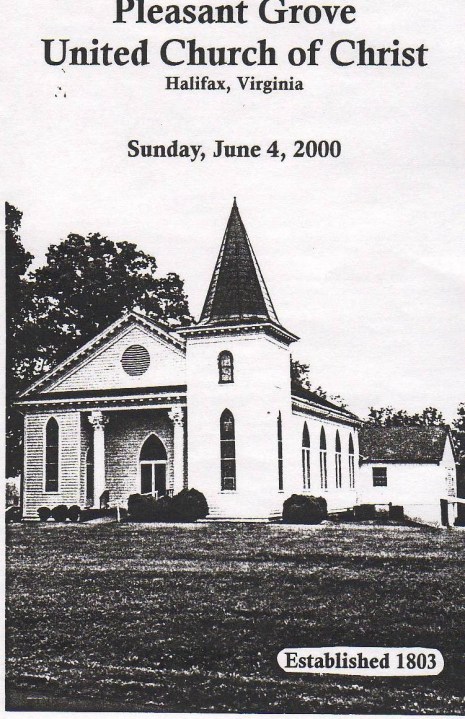
In 1801, the name was changed to “The Christian Church” and in 1803 they founded what is today the Pleasant Grove United Church of Christ in Halifax County, just down the road three and a half miles from where William lived.

William Moore Pleasant Grove map.png

William’s Ordination

In 1805, William Moore with James O’Kelly together attended the Conference or General Meeting for their new religion at Shiloh in Halifax County. William Moore served upon the presbytery of ordination at that event and was recorded as having been a minister more than 30 years, which dates his preaching career to before 1775.

We don’t know exactly when William Moore was ordained, but if he did not go to England, then I wonder if his ordination was “made official” at the 1784 Christmas Conference because the next general Methodist conference was not held until 1791 or 1792 and then every 4 years afterward.

William is recorded as having filed a marriage return with the county clerk in 1786 and produced his ordination papers in court in 1789. We know that he was present at the 1784 Christmas Conference where 12 ministers were ordained. If he was ordained earlier, it’s unclear how that could have happened unless he traveled to England for his ordination or was unofficially ordained by the other ministers. If that had happened, then how would he have had ordination papers?

What I wouldn’t give for a copy of those ordination papers submitted to the court or William’s probably threadbare copy of “The Sunday Services of the Methodists in the United States of America,” written by Wesley, typically presented to ministers at the time of their ordination.

The following quote about William Moore from “The Lives of Christian Ministers” hints that he may have been ordained during the Revolutionary War and before the Christmas Conference in 1784. When the War broke out, Asbury stopped circuit riding and took refuge in Delaware in the home of Mr. White and did not return to circuit riding until immediately following the Christmas Conference in 1784.

“Whether dissatisfied with the circuit assigned him, after Mr. Asbury came to the Conference, we know not. He was admitted however while Asbury was under the protection of his friend Mr. White’s roof in the state of Delaware.”

So if not Asbury, then who “admitted” William Moore?

According to Asbury’s transcribed notes, on page 381, in a footnote, he states that in 1778, at Broken Back Church in Leesburg, VA, the following questions were asked:

Ques.: What are our reasons for taking up the administration of the ordinances among us? Ans.: Because our Episcopal Establishment is now dissolved, and, therefore, in almost all our circuits the members are without the ordinances.” Eighteen preachers approved. They were Isham Tatum, Charles Hopkins, Nelson Reed, Reuben Ellis, Philip Gatch, Thomas Morris, James Morris, James Foster, John Major, Andrew Yeargin, Henry Willis, Francis Poythress, John Sigman, Leroy Cole, Carter Cole, James O’Kelly, William Monroe (or Moore, Lednum, op. cit., 280), Samuel Roe. Other questions were: “What form of ordination shall be observed to authorize any preacher to administer? Ans. By that of a presbytery. Ques. Who are the presbytery? Ans. Philip Gatch, Reuben Ellis, James Foster and in case of necessity, Leroy Cole. What power is vested in the presbytery by this choice? First to administer the ordinances themselves; second, to authorize any other preacher or preachers, approved by them, by the form of laying on of hands.

Asbury disproved, but it happened nonetheless.

Was this “approval” William’s ordination? This 1778 date correlates with the information provided in the “Lives of Christian Ministers.” William could have been preaching prior to 1778 before being ordained.

According to the History of Methodism in the US discussing the American Revolution:

Up until this time, with the exception of Strawbridge, none of the missionaries or American preachers was ordained. Consequently, the Methodist people received the sacraments at the hands of ministers from established Anglican churches. Most of the Anglican priests were Loyalists who fled to England, New York or Canada during the war. In the absence of Anglican ordination, a group of native preachers ordained themselves. This caused a split between the Asbury faction and the southern preachers. Asbury mediated the crisis by convincing the southern preachers to wait for Wesley’s response to the sacramental crisis. That response came in 1784.

Was William one of the self-ordained ministers? What the 1784 answer to officially ordain William Moore at the Christmas Conference?

It’s known that William Moore and James O’Kelly were fast friends. In 1786, O’Kelly was assigned to preside over the circuit that included Halifax County.

William Moore produced his ordination papers in court in Halifax County, VA in 1789 and was licensed as one of the 3 “dissenting ministers” allowed to each county after the Revolutionary War. In order to qualify, each minister had to produce their ordination papers and then they were licensed to perform marriages, baptisms and other ministerial functions.

Most importantly, they could register the marriages they performed. We know that William was marrying people in Halifax before this date, at least as early as 1786 when he married Bolling Hamlett and Polly Combes and registered the marriage with the clerk of court, so his ordination was clearly prior to 1786, one way or another.

The Moore Meeting House and Neighborhood

William moved to Halifax County with his father, likely farming part of his father’s land for several years. William and Lucy were married by about 1772, so the marriage likely occurred in Halifax County sometime after William moved there about 1770.

The Revolutionary War and William’s circuit riding likely interrupted plans for land ownership, but in 1797, Ransom Day sold William Moore 100 acres on Polecat and Birches Creeks for 75 pounds, with the “meeting house excluded.” It’s worth noting that Thomas Moore witnessed this purchase, given that Thomas is believed to be one of William’s children, perhaps his eldest. If Thomas Moore was not William’s son, Thomas was probably William’s youngest brother.

William and Lucy owned this tract of land until 1801 when they sold it to Arthur Slaton, again, excepting “where the meeting house stands.” They couldn’t sell what they didn’t own.

Two of William’s daughters married Slayte/Slate men.

In deeds later in the 1800s, the meeting house is referred to as the “Moore Meeting House” even though William never officially owned it.

In 1798, James Moore sold 200 acres for 65 pounds on the Second Fork of Birches Creek to William. Thomas Moore witnessed that transaction too. The Ferguson family, neighbors with whom an alliance from Amelia County is suspected, along with Henderson family members served as witnesses.

William Moore meeting house property.png

William Moore’s 1797 land purchase from Ransom Day, “meeting house excepted,” today includes the land where the Vernon Hill post office is located, a contemporary brick house and probably the white house to the east as well.

William Moore meeting house location.png

William’s property included the land where the Mount Vernon Baptist Church is currently located, directly across the road from the brick house which is the parsonage.

William Moore Mount Vernon Baptist Church.png

On the map below, the red arrow points to the Mount Vernon Baptist Church which did not exist when William Moore owned this land.

William Moore Mount Vernon aerial.png

Where star #1 is placed is the original location of the Moore Meeting House, and star #2 marks the location of an old abandoned cemetery, probably permanently lost to time by now.

The person who took me to the old cemetery probably 15 years ago told me that when he was a child, they played in the cemetery, but recently backhoes and bulldozers had all but obliterated what was left. There were at one time “old stones” but none were either there or readable when I visited. True to form, Yucca plants and Periwinkle revealed that this location had once been a burial ground, even though when I visited piles of logging debris were pretty much all that was left.

I doubt this is where William and Lucy are buried, given that this land was sold in 1801. Assuredly, William preached funerals in this forgotten cemetery though as his neighbors were laid to rest.

William Moore Mt. Vernon cemetery.jpg

The cemetery across the road beside the Mt. Vernon Church did not exist in 1909 when the land was split between the heirs of Mrs. I. C. Saterfield who inherited the land from her father, an Anderson. The cemetery was founded in 1936, so William clearly isn’t buried here either. He’s probably buried on the land owned by his father, James, located just to the south.

William Moore Henderson cemetery.png

At one time, pretty much all of this land was owned by James Moore, William Moore or Edward Henderson. Today, the land south of the intersection of Mountain Road (360) and 683 (Oak Level), on the west side of the road is owned by the Henderson family. The old cemetery, probably shared between Edward Henderson and his father-in-law, James Moore is located approximately where star #3 is placed.

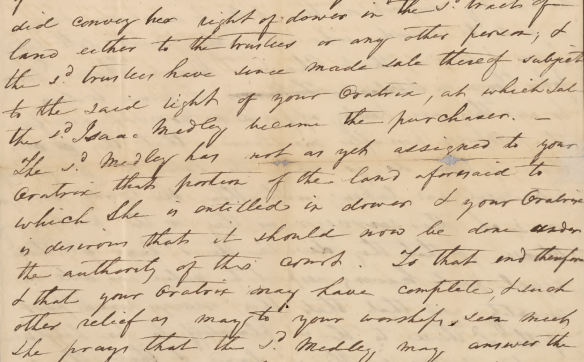
We’re fortunate that after William’s death in 1826, Lucy contested William’s 1822 transaction which resulted in him losing their land and sued for her share of the property. She won and the court ordered a survey which was included in the chancery papers.

William Moore Lucy survey.jpg

The acreage doesn’t exactly add up to 200, so clearly either the entire tract does not equal 174 acres, or 25 acres were split earlier and never recorded.

William’s land is probably where the Mount Vernon Baptist Church stands today, given that in 1851, Lucy’s land is referenced as being directly across the road from the Vernon Meeting House. The Vernon Meeting House was originally the Moore Meeting House, located on the north side of the road, probably renamed when the original building was torn down and a “new” one constructed in its place.

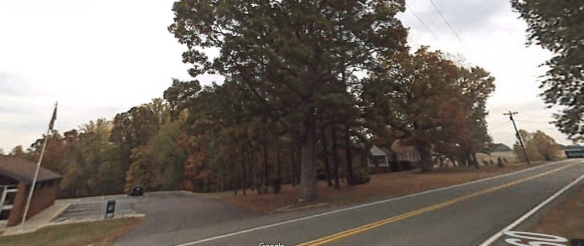
Across the street from today’s church where the parsonage stands is where the original Moore meeting house was located, surrounded by William’s 100 acres that he bought from Ransom Day, “excepting the meeting house,” as shown in the photo below on the north side of Mountain Road.

William Moore parsonage.jpg

Researching this land further, the deeds explicitly mention the headwaters of Polecat Creek which originates on this piece of land. The deed also mentioned the waters of Birches Creek which is on the south side of the road, so William’s 100 acres spanned the road.

Furthermore, the minister at the Mt. Vernon Baptist Church explained the church’s history, indicating that the “original” church was on the north side of the road in the 1800s, which is confirmed by various deeds.

William Moore Polecat Creek source.jpg

The headwaters of Polecat Creek are behind the dog house, which sits where the old Moore Meeting House used to be. I can see the church-goers wandering to the stream after the sermon to drink from the gourd dipper shared by all.

William Moore buildings.jpg

Apparently, the “Moore Meeting House,” as it would come to be called, was the predecessor to the “original” Mt. Vernon Baptist Church that was built on the north side of the road and torn down after the church on the south side of the road was built in the early 1900s.

Looking to the east of the original meeting house location today, we see an old house which probably dates to the 1800s, but not from the early 1800s. Those would have been log cabins.

William Moore white house

This home with its old barn is beautiful and likely stands on the 100 acres that William once owned.

William Moore white house close.jpg

In 1801, William Moore and his wife Lucy sold this land “except where the meeting house stands.” In deeds as late as 1854 references are made to both the “lines of Lucy Moore” which apparently intersected with this land across the road and where the “old Moore Meeting House” stood.

William Moore barn.jpg

Buildings in Halifax County aren’t replaced because they are old. They are simply re-appropriated for something else. I surely wish the old Moore Meeting house still existed. It was probably a small log cabin that was built sometime before 1790 was torn down in the 1800s.

William Moore Halifax.jpg

I love these old buildings. Many of the original cabins were turned into barns and are still in use.

William Moore field.jpg

Driving south on 683, Oak Level Road, William’s land is stunningly beautiful. The land here is gently rolling and occasionally, rocky.

William Moore back of property.png

The back side of the Moore land is 663, also known as Carlbrook Road. Although the road is paved, it probably resembles the region when William first settled here and began to clear the trees to farm.

William Moore fields.jpg

William’s fields. James Moore bought land that had just been patented, so no fields would have existed then. James and William cleared the land for farming. Back-breaking work.

William Moore Henderson field.jpg

Houses are visible, scattered widely, in the distance. Many structures date from the 1800s and some even earlier. I believe this is the old Henderson property, above.

William Moore old structure.jpg

Historic structures peek at you from fields and woods, whispers from the past.

William Moore hill.jpg

A misty morning on Oak Level Road, I wonder if William would recognize his land today?

Just down Mountain Road, slightly west of High Point Road, we find a place the locals call Top of the World. Looking north, you can see for 50 miles to the Peaks of Otter in the distance.

William Moore top of the world.png

All can say is that it’s a good thing that the one lot for sale along Mountain Road didn’t have a very good view, or I might be a Virginia resident today, following in the footsteps of William Moore. I was truly tempted.

William Moore rolling hills.jpg

Driving down the road, you can see timeless visages of yesteryear. Not much has changed except there are more fields and fewer trees.

William Moore Birches Creek

What stories these old barns and houses could tell, if they could just speak.

William Moore old barn

Foundations were made of gathered stones, as were early gravestones.

William Moore old house

Who lived here? Did William know them? Are they family?

William Moore spring

Pioneers looked to settle on land with a fresh spring, assuring clean water that had not been contaminated by human or animal waste.

William-Moore-creek.jpg

Soon the spring formed a little creek, like this one on the old Moore land

William Moore log cabin

There’s every possibility that this log building stood when William lived. Given his role as a minister for half a century, comforting families in times of grief, he was probably in every home in this part of Halifax County at one time or another.

Road Hands

Road hand lists are invaluable sources of information. Episodically, the court would order certain “hands” to labor on the various roads, which of course were dirt and full of ruts at that time. Those lists tell us who the neighbors were. In 1801, we find this court entry:

Jacob Farguson surveyor from Martin’s Fork to County Line, hands James Farrell Jr. and Sr., Josiah Young, Exekiel Foulke, Frederick Ferrell, James Watson, Sherwood Watson, Edward Henderson, John Henderson, Hudson Butler, Arter Slayton, Hudson Farguson, William Moore, Robert Walton, Isac Wilson, William Womack, William Farguson, David Wilson, Richard McGrigor, Bartlett Chaves (listed twice).

Of these surnames, we know that the Fergusons lived in Amelia County when the Moore family did, Edward Henderson is believed to be William’s brother-in-law, Arthur Slayton bought land from William Moore and two of William’s daughters married Slayte men.

The most interesting aspect of this list is that somehow my DNA is connected to the Womack family through the Moore line. Not just once but matching roughly 30 descendants. This means there’s smoke and probably fire if I could just unravel the web.

We don’t know the surname of William Moore’s wife, Lucy, or the identity of 3 of William’s grandparents. Lots of opportunity for a Womack connection. The Womack family is also found in Amelia and Prince Edward Counties interacting with both the Moore family and the Rice’s.

There’s a story there yet to be told!

The Split!

Religion is nothing if not contentious.

The Rev. William Moore was apparently very close to the Rev. James O’Kelly.  Both were probably at the Christmas Conference in 1784 where O’Kelly was ordained.

William was destined to split with the Methodist Church, and probably did so when his friend James O’Kelly left the church. William then participated in founding both a new religious sect and a new church.

On August 4, 1794, O’Kelly and his ministerial secessionists from the Methodist church met in Surry County, VA to organize and form their own church.

From the Pleasant Grove Church, a few miles east of the Mt. Vernon Baptist Church, I was provided with the following information:

At the end of the 18th century, and the Christian Church in America was only 6 years old. At this time Reverend James O’Kelly who had broken from the Methodist Church because of a dispute with Francis Asbury came into Halifax County, Va. preaching the Word. Finding a number of people attracted to his preaching and being interested in the new Church movement called “Just Plain Christian,” the Rev. O’Kelly proposed that a Christian Church be organized, and Pleasant Grove Church, just off Mountain Road, was organized by the Rev. O’Kelly in 1803.

William Moore Pleasant Grove Church.jpg

In a flyer for their 197th anniversary, Sunday June 4, 2000, they indicate that their church was established in 1803 and that the first two ministers were Rev. James O’Kelly followed by Rev. William Moore. The first building was constructed of logs and stood just south of the present building. Unfortunately, their older church minutes no longer exist, having departed with one of the previous ministers.

William Moore Pleasant Grove today.png

The original building stood where the circular driveway is today, with the steps remaining in the center of the circle. In the photos above, they are to the right of the tree and resemble a pile of rocks. When I first visited, I was told that they left the steps so that the ladies could use them to mount horses or climb into wagons or buggies.

Motivation

Information about James O’ Kelly written by J.F. Burnett, Minister in the Christian Church, helps us understand the issues that motivated both O’Kelly and by inference, William Moore, to split with the Methodist Church.

The question as to whether or not preachers should be allowed to administer the communion, baptize candidates, marry people, and bury the dead, always found Mr. O’Kelly on one side, and the rule of the Church on the other. Bishop Asbury’s insistence that the laymen were to “pay, pray and obey” was always objectionable to Mr. O’Kelly and the divergence increased and the chasm widened, and the point of cleavage became more prominent, so that by the time the General Conference met in 1792 a crisis  was inevitable. By this time too, Mr. O’Kelly had reached a high place in the favor of the church. He had presided over some of the largest and most important districts within the territory then occupied by the Methodist Church, and only two men out-ranked him in authority. He had, in all probability, accumulated means sufficient to put him above the necessity of salary and most certainly he had reached a well established leadership among his brethren. But it was not these that gave him prestige in the conference. It was his devotion to the right, his indomitable will, and his Christian courage. He would have been impressive had he been clothed in rags, and walking bearfoot. The craven had no place in his makeup, either as a man or a preacher.

On December 1, 1789 James O’Kelly sat in the body of the conference where the bishops proposed that a council of presiding elders be convened and strongly opposed some of the measures. Notwithstanding, Bishop Asbury, who was in favor of them, deemed it wise to call a second, but only 10 elders attended and a third was never held. O’Kelly labored heartily in favor of a general conference and to him the Methodist church owes “that essential and valuable constitutent of its polity.” He wrote letters to Thomas Coke, Wesley’s ambassador securing his cooperation, and in consequence bringing these two fathers of American Methodism to the verge of antagonism. Seeing that a crisis had been reached, which he could not prudently ignore, Asbury sacrificed his personal wishes and consented to the holding of a general conference. It was called for November 1, 1792 and O’Kelly introduced a resolution to modify the bishop’s power of appointment to the extent of allowing any preacher who should feel dissatisfied with the place assigned to him an appeal to the conference. This was rejected by a large majority and O’Kelly sent in his resignation and withdrew. Several of O’Kelly’s adherents also left the conference and he subsequently organized a “Republican Methodist Church,” afterward called the “Christian Church.” In 1829 it included several thousands in its membership, mostly in North Carolina and Virginia. O’Kelly focused his efforts primarily in Virginia where he oversaw the best circuits.

At one point, Thomas Coke reported that he had prevailed upon O’Kelly and “his 36 ministers” to remain within the church, but that was not to be. The split occurred and O’Kelly held conferences in his new group of churches.

William Moore was clearly one of O’Kelly’s band of 36 merry ministers.

The General Meeting for 1805 was held at Shiloh church on the line of Pittsylvania and Halifax counties. The presbytery appointed to ordain Rev. Thomas E. Jeter was composed of the following Elders: James O’Kelly, Clement Nance, Joseph Hackett, William Moore, and Coleman Pendleton.

The General Meeting of the Conference was held at Raleigh, North Carolina, in 1807 and 1808.

The General Meeting in 1809 was held June 4th at Shiloh, in Virginia, where O’Kelly preached at Apple’s chapel and administered the Lord’s Supper. Five other ministers were present. It’s likely that William Moore attended and based on the meeting locations, we can gain insight into what William was doing at that time. He traveled far more than most men of his generation.

In 1810, the General Meeting of the Conference was held at Pine Stake church in Orange County, Virginia. It was there that a division occurred due to a difference of opinion in respect to “the mode and subjects of water baptism, which led to the organization of the North Carolina and Virginia Conference.”

Mr. O’Kelly was a strong effusionist. In his book entitled “The Prospect before Us by Way of Address to the Christian Church,” he says, “But to illustrate the figures still further. The ark may be a figure of Christ’s Church; the family that entered into the ark and were saved so as by water, may answer as a figure of household baptism under the gospel dispensation.”

Translated, this meant that O’Kelly strongly preferred sprinkling as opposed to baptismal immersion, and he felt that the Father, Son and Holy Ghost were three separate literal beings, not one tri-partite Holy Being.

If O’Kelly held those beliefs, it’s likely that William Moore did too, given that they co-founded a new church in Halifax County in 1803.

1811’s Virginia Conference was held in Caroline County. As it pertained to religion, it’s a safe bet that William Moore and O’Kelly were probably at the same conferences as long as both attended.

O’Kelly died in October 1826, the same year as William Moore. It’s a safe bet that those two men reunited on the other side!

O’Kelly published pamphlets and books throughout his life, including a hymnal. Reading O’Kelly’s writings would probably enlighten William Moore’s descendants about his beliefs as well.

Slavery

Another influencing factor in the split from the Methodist Church may have been O’Kelly’s strict opposition to slavery. He was known as a “heroic opposer of slavery and enforced the anti-slavery law of the church.”

Francis Asbury stated in his “Journal,” volume 1, page 384, “Brother O’Kelly let fly at them (about slavery) and they were made mad enough.” In 1789, O’Kelly published his Essay on Negro-Slavery after having manumitted his only slave in 1785.

William Moore did not own slaves, nor did his father nor most of his children. Ironically, his refusal to participate in that wicked institution may have contributed to his financial issues that resulted in losing his property.

I get the sense that William Moore was a very strong, very determined man.

William’s Trail

In 1782 and 1799, one William Moore signed petitions protesting the glebe land provided to the ministers of the Anglican church. I don’t know if my William was the one who signed, but it would make perfect sense that a man who received no benefits from the Anglican church wouldn’t want his tax money to provide a farm for their minister. William certainly didn’t get a farm paid for by the government. In fact, the petition William signed was to sell the glebe land.

It seems that perhaps William Moore’s strength wasn’t paperwork. A loose paper filed in the Clerk’s office in Halifax County shows that William “saved” the records of 5 different couples between August of 1790 and March of 1791, writing a single note to record all 5. The good news is that this is clearly his own handwriting.

William Moore list of marriages 1790-1791.jpg

William married dozens of people between 1786 and 1797 when the records abruptly stop, which of course suggests that these couples were also dissenters or members of dissenting families. That makes sense, because at least 3 families have connections in some way to the family of John R. Estes who William’s daughter, Ann Moore, known as Nancy, married in 1811.

The marriage records found at the courthouse may have stopped because when William withdrew from the Methodist religion, he also lost his official “blessing” as a dissenting minister. That didn’t stop him from preaching, and I doubt it stopped him from marrying people either. It certainly didn’t stop anyone from being buried or baptized!

As a minister and respected member of the community, William was peripherally involved in many lawsuits and transactions, typically as a witness. I’m sure as a minister, his testimony was fairly unimpeachable. Probably the most interesting of these cases were the ones for hog-stealing and slander where Edward Henderson (probably his brother-in-law) alleged that someone was “drunk and out of humor.”

William didn’t avoid lawsuits entirely though. In 1795, Uzza Pankey sued William Moore for slander and in 1796, William sued Benjamin Huddleston, Usse Pankey and Stephen Pankey. We don’t know the outcomes, but the Pankeys were neighbors and William had performed the marriage of one family member. William Moore and the Pankeys shared a property line, so life must have been interesting during this time.

I’d love to know what the slander suit was about. Looking at William’s 1819 deposition, he didn’t mince words.

No matter the century, there’s always neighborhood drama.

In 1796, the overseers of the poor bound John Chambers, the son of Sarah Chambers to “William Moore, preacher.”

In 1797, William Moore was a witness for Isaac Medley against Bolling Hamlett, whose wedding William had performed. Isaac Medley is an important figure in William’s life, so stay tuned.

In 1813, William Moore, along with Azariah are found with “effects insufficient to pay taxes,” but this William mentioned could be William’s son, William.

In 1812, 1813 and 1814, Azariah and William are deputy sheriffs, but I suspect this record pertains to the younger William Moore.

In 1814, William is sued for debt, twice. Early Virginia was very litigious.

In 1815, William Moore is taxed for his 200 acres on the Second Fork of Birches Creek, so we know how much land he owns.

Drunk or Insane

The most humorous document was an 1819 chancery suit regarding a wedding over which William presided in 1817 where he opined that the groom was either drunk or insane, but let’s look at William’s own words.

Deposition of William Moore in the suit between Isabel Dodson and John Dodson…Reverend William Moore saith that:

“on the 4th day of July 1817 I was sent for to marry a cupple in Milton (NC). There were a number of people collected together about the tavern. I took a seat in the Pizza and asked who was to be married. Some person replied “you’ll see directly” and in a very quick time John F. Dodson led Isabel Baines to the Pizza (probably piazza). I asked him for his license, he said he had them, and some person replied “you have them not” but that Thomas Turner who has them who had gone up to Jack’s Woods Tavern for dinner. I then told Dodson that he might lead back his bride until I got the license and he said so. I saw Thomas Denaho and he delivered me a lawful license. I then walked into the room the noon? and told him I was ready to wait on him, he led up his bride and I married the pair. I then took a seat in the pizza, there was a decanter of spirits setting on the shelf, he asked me if I would take a drink of grog and I told him no, he then took a drink and pulled out a red morocco pocketbook and gave me a dollar. In the time that I was performing the ceremony he said something it set the poeple a laughtin (sic) but I did not hear what it was that he said. I concur him to be in a state of intoxication at the time of the marriage or in a state of insanity. I have been acquainted with him for several years and I always considered him a person of weak intellects.”

Sworn October 19, 1819 William Moore (signed.)

William Moore 1819 signature.jpg

William certainly didn’t pull any punches. I’d wager the entire Dodson family, some of whom also lived on the Second Fork of Birches Creek, were permanently aggravated with William.

Debt

In 1820, there were 2 debt cases, one by and one against William Moore, but we can’t tell based on the little information we have which William Moore was involved.

In 1824, William Moore signed a debt document.

William Moore 1824 signature.jpg

By this time, William’s signature was quite shaky. He would have been on the north side of 70, probably 75.

William Moore 1824 signature close.jpg

This signature really makes me wonder. My presumption was that it was shaky because William was elderly, but the signature on an 1825 document looks quite different.

Another debt was incurred by William in 1825 as well and he conveyed to William Minor a deed of trust for 50 acres of his land.

In 1827, “James Young of Halifax County to Isaac Medley of Halifax whereas William Moore by a certain indenture bearing date March 26, 1822 did convey to James Young a tract of 200 acres bounded by the lines of Joseph Dunman, estate of Jacob Farguson, Jane Wilson, James Moore and Edward Henderson Sr. as described in said deed. James Young did expose to sale on November 25, 1825 and sold for $200 to Isaac Medley.”

On March 4th, 1827, William’s land was conveyed by trustee to Isaac Medley.

The conveyance does not say that William is deceased, but we know that by November 1826 William had expired because Lucy’s suit states that “sometime in the current year her husband William Moore disposed of some land to Isaac Medley for debt but that Lucy never conveyed her right of dower. William subsequently died.” The court ordered Lucy’s dower portion surveyed and she received 50 acres that included the mansion house.

Mansion house at that time meant main dwelling. I’ve seen descriptions of mansion houses that were 10X14 or 12X16, so not a mansion as we think of them today.

The Tobacco Lawsuit

A suit filed in Halifax County chancery court in 1825 reached back to 1812. In this suit which is clearly our William, based on both the other witnesses and the fact that he is referred to as the Reverend William Moore, he files suit regarding 1360 pounds of tobacco which was valued at $5 per hundred pounds which would be $68, a lot of money at that time.

The original company went out of business and was purchased by William Baily. William Moore alleges that he was never credited with the amount he was owed which was supposed to have been credited to his account.

In this suit, William appeared before the clerk on October 20, 1825. On March 12, 1825, William Henderson stated that he went to Manchester, VA with Reverend William Moore where the tobacco was inspected at Johnson’s warehouse and the amount of $5 per hundred was offered.

On February 25, 1825, William Moore notified William Bailey of the time and location that William Moore Junior and William Henderson were to be deposed at the homes of Nathaniel Wilson in Dansville, VA and at the house of William Minor, respectively.

William signed this notice, shown below.

William Moore 1825 signature.jpg

I wonder if someone wrote and signed this notification for William. It surely is not the signature of the same person who signed in 1824 with palsied writing.

We have additional signatures of William Moore when he signed for his daughters to marry.

Kids and Marriage

The known children of Rev. William and Lucy Moore:

  • Thomas Moore was born between 1771 and 1777, taken from the 1792 personal tax data. This is probably the Thomas who married Polly Baker in 1798 given that his granddaughter’s middle name is Baker. Thomas died in 1801 leaving orphans Rawley and William who were bound by the overseers of the poor to Anderson Moore who had also come from Prince Edward County and bought land from Nimrod Ferguson near James and William Moore. However, the Y DNA of one of Anderson’s Moore descendants doesn’t match the William Moore line DNA. In the 1840 census, Raleigh Moore is living beside Edward Henderson.

William Moore Raleigh cemetery.jpg

Raleigh is buried in a cemetery in a very overgrown clump of trees (above) on his land (below) at Vernon Hill where he also maintained a tavern.

William Moore Raleigh cemetery overgrown

  • Elizabeth Moore born between 1770-1780. She apparently winds up with her mother’s land and doesn’t marry.
  • Azariah Moore was born in 1783 or before and served in the War of 1812, dying in 1866. He married Letitia Johnson in 1818 in Pittsylvania County, having four daughters and two sons. Letitia’s father left her money but stipulated that Azariah couldn’t touch it, nor could it be used to pay his debts of which there seemed to be many. According to the census, one son apparently died young, but James F. Moore who was born in about 1822 survived. In 1880 we find Letitia S. Moore age 79 living with her son James F. Moore, age 58. It appears that James never married, or he married after his mother’s death sometime after 1880.
  • William Moore, born 1775-1785, moved to Pittsylvania County before 1815 and had business dealings with his brother, Azariah. William probably married Sarah (or Sally) and had at least 2 sons and 3 daughters. By 1850 William had died, but his wife Sarah was shown as age 64 (which could be in error) along with Nancy Jenkins age 36 (born about 1814), Sarah Jenkins age 11 (born about 1839) and a son William Moore born about 1820, age 30.
  • Ann Moore, known as Nancy, born about 1785 married John R. Estes on November 25, 1811 and moved to Claiborne Co., TN about 1820 where she died between 1860-1870.

John R Estes Ann Moore marriage

  • James Moore born about 1785 married Lucy Akin in 1817, lived beside Edward Henderson in the 1820 census and was dead before 1830 with no known children. In 1827 James lost his land by debt to Isaac Medley, the same man who purchased William Moore’s land the same year. By 1831, Lucy Akin Moore, James Moore’s widow, had married James Ives.
  • Kitty Moore born about 1788 married Francis Slate in 1805 and lives in Surry Co., NC in 1850.

William Moore 1805 signature Kitty Moore to Francis Slate.jpg

  • Jane Moore born about 1803 married James Blackstock in 1823.

William Moore 1823 signature Jane Moore to James Blackstock.jpg

  • Rebecca Moore born about 1805 married William G. Slayte (Slate) in 1825.

William Moore 1825 signature Rebecca Moore to William Slayte.jpg

Note that William Slayte is the same person (or at least the same name) that signed the debt document with William Moore in 1824.

Possible additional children of William Moore:

  • Lemuel born before 1791, perhaps as early as 1770-1780, appears in 1812 on the Halifax County tax list. In 1830 we find a Lemuel in Grainger Co. TN beside Mastin Moore, known to be a grandson of William’s brother. Sometimes Lemuel is written as Samuel. Furthermore, a Lemuel Moore married Anna Stubblefield in 1804 in Grainger County and died in 1859 in Laurel County, Kentucky. In 1797, Lemuel Moore is found in Greene County, TN beside Rice Moore, William Moore’s brother. I have DNA matches through 3 of Lemuel’s children at what would be (1) 4C1R, (2) 5C and (4) 5C1R if the Lemuel in Laurel County, KY is indeed William’s son. If that Lemuel is more distantly related, the relationships would be more distant. The connection could also be through the Stubblefield line, which may be connected through either William’s wife, Lucy, or William Moore’s parents.
  • Isaac born in 1793 or before, assigned as a road hand in 1814 with James Moore and Samuel (Lemuel?).
  • Israel born in 1791 or earlier, appears 1 time on the tax list in 1812 the same day as William.
  • Mary Moore born in 1775, found in 1850 census living with William B. Moore (the orphan of Thomas Moore and brother to Raleigh Moore).

Foreclosure

By 1820 William was encountering financial difficulties. He would have been in his 70s by this time and probably less likely to preach. His income while not completely dependent on preaching was probably affected somewhat.

William took a loan using his land as collateral in 1822. He was unable to repay the loan, and his land was deeded to Isaac Medley by trustee in 1827 after he died. Those documents do give us a list of his meager holdings though, one wagon and gear, 4 horses, 3 cattle, 12 hogs, 3 feather beds, furniture, 2 bedsteads, all household and kitchen furniture and plantation tools, which he includes in with the land to secure the debt of $560.58. That would have left his wife, Lucy, with absolutely nothing – not even a pan to cook in, let alone anything else. This is the act of a truly desperate man.

However, Lucy never released her dower when he obtained the fateful loan in 1822.

After William’s death, Lucy sued Isaac Medley, the person who purchased William’s land (or debt) for $200 to obtain her 1/3 share of the dower rights and won. Actually, Isaac agreed to allow her the widow’s dower share. We’ll never know of course whether he did that because it was the right thing to do, or because he knew unquestionably that he would lose the suit if it went to trial.

I do know that hard feelings between the Moore and Medley families continued into the 2000s, but no one seems to remember why. As one Moore descendant in Halifax County says, “maybe that explains why the Moores have always disliked the Medleys,” except his language was stronger.

In addition to the actual documents of the lawsuit, we also have a survey showing William’s initial holdings and the portions with the “mansion house” apportioned to Lucy.  She held this land free and clear, not as a life estate and it began right across the road from the old Moore Meeting House.

Given that Lucy didn’t sign, I wonder if Lucy even knew that William had used their property as collateral for the 1822 loan.

While this may have, in part, been due to the lingering 1812 tobacco issue, it surely wasn’t entirely due to that. William owed far more than $68 plus interest would have covered. I can’t help but wonder how he came to owe so much money.

The 1824 debt to William Bailey for $100 as a result of a lawsuit would have complicated William’s financial situation further.

The 1824 document is the only signature of William’s that is shaky. Was he simply that upset? He certainly could have been if they just finished in the courtroom and another $100 issue was added to his already insurmountable debt. Was he an old man who saw the writing on the wall and knew that he was sinking?

My heart aches for William. No one wants to be vulnerable and watch everything you’ve worked for your entire life slip beyond your grasp.

No one wants to leave their elderly spouse of 50+ years unable to receive the basics of food and shelter without having to depend on their children.

William’s other signatures really don’t match each other either, although we don’t know why. It’s possible that his only authentic signature in the last few years of his life was the 1824 debt paper because everyone involved knew how legally critical that signature was.

He could have signed with an X and had the signature witnessed, but William was probably too proud to submit to that indignity on top of the debt indignity he was already suffering.

Y DNA

William Moore had several sons, but his Y DNA signature isn’t found through his sons, but from his brother’s descendants, plus a matching genetic signature from a descendant of Thomas who was probably William’s son.

William’s brother, Mackness Moore (c1766-1829) married Sarah Thompson and moved to Grainger County, Tennessee along with the Thompsons and Stubblefields. Mackness had son Richard, who had son Mastin Moore, shown below.

William Moore Mastin Moore

Mastin, William’s great-nephew, seated, is the closest we’ll ever get to seeing a Moore male. He probably resembled William, at least somewhat.

Viewing the Moore Worldwide Y DNA project at Family Tree DNA, we see that the descendants of James Moore are assigned as Group 19.

William Moore Y DNA.png

In addition to the 3 men who descend from James Moore and the one from Thomas Moore, we see another individual whose ancestor was John L. Moore, born in 1866 in Tennessee and married Lillie Whitaker.

John L. Moore’s death certificate shows that he died on September 14, 1932 in Nashville. He was a farmer and his father is given as Jim Moore.

The 1870 census shows John L. Moore, age 4, with brother Samuel, age 2, sister Amanda J. age 15 and brother William C., age 18, with James Moore, 39, and wife Mary, age 25, living in Putnam County, TN. It’s clear that William and Amanda aren’t Mary’s children, but John and Samuel look to be.

In 1880, James and Mary are living in Morgan County, with James working for the railroad. They now have additional children, Frances, 9, Mary, 7, Lydia 4, and James 1. John’s mother has been attributed as Mary Scott, but the delayed birth certificate for the James Moore whose mother was Mary Scott was born on October 2, 1882 in Sparta, White County, unless the James Moore who was in the 1880 census died.

James Moore, the father was born in 1831 in Tennessee. The name James looks quite familiar, of course. We know that Moore men migrated to Grainger County, but we have no idea if James descends from the Grainger group or whether, if we could simply pierce the brick wall of the identity of James’s parents, we might be able to push William Moore’s brick wall right over too.

After waiting 15 years, in 2018 a new Moore match appeared. The match isn’t exact, but a genetic distance of 3 at 67 markers. That man hails from Scotland, although I don’t know where in Scotland and he has yet to answer.

At least we have a Moore match that reaches back in time before James Moore, which answers unspoken questions about his paternal line.

Questions, so many Questions…

As I review William’s life, I’m left with so many questions.

  • How did William and apparently his brothers and father avoid the Revolutionary War? If William was born in 1750, he would have been the perfect age to have served between 1775-1780. The Methodists were not pietists. One William Moore swore an oath of allegiance in Pittsylvania County in 1777. This could have been our William, given how close he lived to the county line, but we don’t know.
  • Why did William become exempt from taxes in 1797, and was sporadically exempt for 7 of the 12 years we have records for between 1797-1810?
  • Why did William stop returning marriage documents in 1797? Was it related to a disability or the fact that he withdrew from the Methodist Conference? If so, that should have been in 1793, unless William didn’t withdraw when O’Kelly did. However, we know that by 1794, William was involved in the formation of the new religion, and that predates the 1797 discontinuance by 3 years.

My guess is a disability of some sort given the exact correlation with the first tax exemption year. However, we know that William was still attending the annual conference in 1805 and marrying people in 1817, according to his deposition, so the source of his disability might have resulted from an accident of some sort as opposed to dementia, strokes or related diseases.

  • Why did William allows the overseers of the poor to bind Thomas’s young children to Anderson Moore after Thomas’s death instead of taking them to raise? Was whatever happened to William in 1797 a factor?
  • When William left the Methodist Church, did his new denomination have their own ordination practices? If so, did O’Kelly ordain him again? Was he both twice dissenting and twice ordained?
  • How was William, or was he related to the Womacks, Stubblefields and Fergusons? DNA matches suggest strongly that either he was descended from the Womack family. Records of all three of those families are intermixed in Prince Edward and Amelia Counties and earlier.
  • The name Azariah is very unusual, yet we find Azariah Baily in 1780 as a witness to a deed with Charles Spradling and Edward Henderson, neighbors of both James and William Moore. Azariah Moore was born between 1780 and 1790. Was Azariah Baily related to William Moore or his wife? DNA shows no apparent matches to the Baily family of Halifax County.
  • The name Lemuel isn’t common either. We find a Lemuel Ferguson witnessing a deed with William Moore on Sandy Creek in 1793 when Nimrod Ferguson (Farguson) sells land to Hudson Farguson, his son. Nimrod Farguson appears as early as 1771 on a road list with James Moore. There are several DNA matches to descendants of both Nimrod and Isaac Ferguson, born in the early 1700s, but these matches could be a result of other lines. The name Isaac is possibly found in William Moore’s family but Nimrod doesn’t appear in the children of either James or William.
  • I know this is impossible to answer, but I’d surely like to know where William is buried. I’m guessing with his father in the Henderson Cemetery located on private land.

The Reverend William Moore, apparently a tenacious man who dissented not once, but twice, still stubbornly guards his secrets some 200 years later.

______________________________________________________________

Disclosure

I receive a small contribution when you click on the link to one of the vendors in my articles. This does NOT increase the price you pay but helps me to keep the lights on and this informational blog free for everyone. Please click on the links in the articles or to the vendors below if you are purchasing products or DNA testing.

Thank you so much.

DNA Purchases and Free Transfers

Genealogy Services

Genealogy Research

County Formation Petitions Resolve Long-Standing Mystery: Which William Crumley Got Married? – 52 Ancestors #244

Recently, I became aware of petitions in the Tennessee State Library and Archives (TSLA), by county, when reading this article by Judy Russell, the Legal Genealogist. If you have ancestors in Tennessee, check this resource.

Between 1840 and 1850, several of my ancestors lived in the area of Claiborne and Hawkins County, Tennessee that would become Hancock County in 1848 when the Tennessee Supreme Court overruled attempts to block the formation of the new county.

This process of forming Hancock County was not straightforward and resulted in numerous petitions being filed, which was probably terribly frustrating at the time and probably divisive within the community. However, the petitions are a goldmine of information now. Not only can we discover how our ancestors felt about the county’s formation but even more importantly, signatures are found on the petitions.

In order to sign a petition, one must be a registered voter. I know for sure that voters had to be white and male, but they may have also been required to be landowners although I have some doubt about that.

Some signatures appear to be original, and others appear to be transcribed from a list.

I ordered the petitions from the Tennessee State Archives and they arrived a couple weeks later.

Who Lived in Hancock County, Tennessee?

My ancestors who lived in this region between 1840 and 1850 included the following men who were old enough to sign the petitions in the 1840s.

Ancestor 1840 County 1850 County Signs Petitions
Joel Vannoy 1813-1895 Claiborne, the part that became Hancock Moved to Little Sycamore Community in Claiborne County Yes 1841 (2), 1843 (2)
Elijah Vannoy c 1784->1850 Claiborne, part that became Hancock Hancock County Yes 1841 (2), 1843 (2)
William Crumley III 1788-c1852 Claiborne, part that became Hancock Hancock County, on Blackwater, the portion that was previously Hawkins Yes 1841 (second petition), 1843 (2)
Joseph Preston Bolton (1816-1887) Giles, VA but received at Thompson Settlement Church in 1842 by experience, suggesting he is living in what would become Hancock by this time Hancock County, on 4 Mile Creek No
William Herrell (c1789-1859) Claiborne, part that became Hancock Hancock on Powell River No
Michael McDowell Claiborne, part that became Hancock Lived on Powell River, died before 1850, may have died before petitions No
Fairwick Claxton/Clarkson (c1799-1874) Claiborne, part that became Hancock Hancock on Powell River No

The Crumley and Vannoy families intermarried, and the Bolton, Herrell, McDowell and Clarkson families lived adjacent on the Powell River very near the Virginia border and intermarried as well. The Crumley/Vannoy group signed the petitions, and the Bolton/Herrell/McDowell/Claxton/Clarkson group did not.

I’m sure there was some underlying reason for how these two groups of residents felt, that that information has not trickled down to us today.

There is a very unexpected surprise involving the signature of William Crumley on this petition.

First, let’s look at the petitions themselves.

The Petitions

In total, 6 petitions existed between 1839 and 1844. In 1848, the Tennessee Supreme Court finally decided the fate of Hancock County and since it exists today, we know that they voted in favor of the county formation.

On these petitions, the introductory paragraphs stated the purpose of the petition, followed by the signers. Not all petitions had signature pages nor were productive, so I’ve included the petition pages that included names of my ancestors.

Petition 2

TSLA Summary:

Claiborne County petition from 311 signatures from Hawkins and Claiborne Counties asking they be allowed to form a new county. (Hancock County)

  • Roll – 16
  • Year – 1841
  • Petition – 122a

Detail from actual petition:

On September 2, 1841, residents petitioned for the following, the verbiage extracted.

“Petition as a result of the inconveniences under which we labor traveling some 25 miles over large cragged mountains to serve as jurors or in other cases and at great expense and trouble, we heretofore employed a surveyor to run out the boundary of a new county composed of the parts, Hawkins and Claiborne. He returned 389 square miles in said bounds, which is 30 square miles over and above the constitutional number of square miles prescribed for any new county.”

This first petition was not granted. However, there were six total pages of signatures that appear to be the original signatures, not a transcribed list, dated September 2, 1841.

Hancock petition 1841

Elijah Vannoy is signature #5

Hancock petition 1841-5

Joel Vannoy’s signature is #99.

Petition 3

TSLA petition summary:

Claiborne County – new county  –  Petition from certain citizens of Claiborne County asking they be permitted to form a new county.

  • Roll – 16
  • Year – 1841
  • Petition – 85

From the petition signed Dec. 22, 1841, submitted on Dec. 31, 1841, heard on January 25, 1842.

“Petitioners of Claiborne County secondly petition your honorable body that we are a people far remote from the county cits (seats) Tazewell and that we employed a surveyor will qualified and after being duly sworn…”

Followed by a description of the proposed county bounds and signatures of petitioners within the pounds of the territory of the county” that appear to be original. They state they have 160 qualified voter signatures and ask if the petition is not granted, “if the ballot box says we have, let us hear it and if not, let us not trouble your honors further.” They state they have an overwhelming majority and a constitutional right to establish a new county.

Only 93 signatures are included.

Hancock petition 1841 second

William Crumley signed at #21 and his son John Crumley at #23.

Hancock petition 1841 second 2

Joel Vannoy signed at #73, his father Elijah Vannoy Sr. at #92 and Joel’s brother, Elijah Vannoy Jr. at #93.

Petition 4

TSLA Summary:

Claiborne County  –  Petition from 246 citizens Claiborne and Hawkins Counties to form a new county to be known as Hancock County. Map of proposed county and statement of Richard Mitchell, deputy surveyor, included in the folder.

  • Roll – 16
  • Year – 1843
  • Petition – 61

From the petition:

November 1843 – Petitioners of Hawkins and Claiborne County living at a remote distance from the seat of justice of each county and often having to attend as jurors and in other business, over cragged mountains and high waters, we pray your honorable body to grand unto us a new county composed in the parts of Hawkins and Claiborne. We have not approached closer than 12 miles to the existing county seats. We have  at least 600 qualified voters in the bounds of the new contemplated county and this being our third petition…”

Hancock petition 1843

Joel Vannoy signed at #12 and Elijah Vannoy at #33.

Hancock petition 1843 2

E Vannoy signs at #69, but either this one or the signature at #33 would be Jr. Many of these signatures look very similar, causing me to wonder if some of the signatures were transcribed from an original list, not actually signed on this document.

Hancock petition 1843 3

William Crumley signs at #202, but it matches the rest and does not appear to be an original signature. William’s son, Aaron F. Crumley signs at #194.

This document is followed by the survey dated by the surveyor as to its accuracy November 11, 1843. I wonder if some of the signature papers were lost, although at the end of the signature section there were 34 more that said “signed over legend” which I presume means people who signed with an X witnessed by another individual.

That does not equate to the 600 mentioned, but perhaps this is in addition to an earlier petition.

Petition 5

TSLA Summary:

Claiborne County – new county – Petition from 106 citizens of Claiborne County asking they be allowed to form a new county.

  • Roll – 17
  • Year – 1843
  • Petition – 146

From the petition:

Nov 25, 1843 – Petitioners of Claiborne County who reside in the part in the bounds and in favor of a new county.

Hancock petition 1843 second

William Crumly signed at #14, with son Aaron F. Crumley at #13, son John Crumley at #19 and Elijah Vanoy at #18. Of course, we don’t know the order of the homes of the people involved, but Elijah’s son, Joel married William’s daughter, Phoebe, in 1845.

Some of these signatures appear to be original, but the Aaron and William Crumley signatures appear to be the same.

Hancock petition 1843 second 2

Elijah Vanoy Sr. or Jr. signed at #28 and Elijah Sr.’s son, Joel signed at #85.

There were a total of 106 signatures on 3 pages. Only the people in the affected area needed to sign one way or another.

William Crumley’s Signature Solves a Mystery

With 4 William Crumleys in successive generations, keeping them straight has been a challenge, to put it mildly.

In the article about William Crumley (the third born 1788), son of William Crumley (the second born 1767/8), I discussed the fact that both men lived in Greene County, TN, and one of them married Elizabeth Johnson in October 1817.

For a very long time, it was presumed, based on her probable age, if Elizabeth was who we thought she was, that she had married the younger William Crumley, and that his wife, Lydia Brown had died shortly after giving birth to a child in April of 1817. Speedy remarriages weren’t uncommon in that time and place.

The only somewhat unusual circumstance is that Elizabeth Johnson would have gotten pregnant in June, because the next child born to William Crumley (the third) and his wife was my ancestor Phoebe who arrived in March of 1818. It was also a little unusual that Lydia Brown’s mother’s name was Phoebe Cole and Elizabeth named her first child Phoebe. But then again, the Johnsons and Browns were intermarried too or maybe Elizabeth was just incredibly generous.

Or, maybe Lydia didn’t die after all and Elizabeth married a different William Crumley and was not the mother of Phoebe.

By testing the mitochondrial DNA of the descendants of the child born in April of 1817, Phoebe’s descendants along with the descendants of the next child, Malinda, born in 1820, we confirmed that their mitochondrial DNA was identical. Now granted, this could happen if the two women, Lydia and Elizabeth shared a common matrilineal ancestor.

That’s rather unlikely since Phoebe Cole was from New Jersey and Elizabeth Johnson’s father, Zopher, was from Pennsylvania – but with genealogy you never know for sure. Stranger things have happened.

However, William Crumley’s signature on this petition is corroborating data for the mitochondrial evidence.

William Crumley who married in 1817 has a different signature than two other documents signed in Greene County by a William Crumley as well.

William Crumley the third would have been called Jr. in Greene County, given that William Crumley (the first) was already long deceased by 1817, so William Crumley the second would have been William Crumley Sr. in Green County.

I had to make a chart to keep all of the Williams and their signatures straight.

Who In Greene County, TN Signed What
William Crumley I, 1735/6-1793 Never in Greene County, TN Nothing in Greene County
William Crumley II, 1767/8-c 1839 Sr. 1796 court order in the Territory South of the Ohio, possibly 1807 marriage document for William III, possibly 1817 marriage document.
William Crumley III, 1788-1859 Jr. Married in 1807 as Jr., signed War of 1812 affidavit in 1814, marriage of Aaron Crumley in 1814 and signs as William Jr., 1816 marriage for Isaac Crumley where he signs as Jr.
William Crumley IV, 1811-1864 Married in 1840 in Greene Co.

We don’t know which William Crumley married in 1817. What I really NEED to know if if William the third married in 1817, because my ancestor, Phoebe, was born in 1818.

We know unquestionably that the 1796 document was signed by William Crumley II because the older William Crumley was dead by then, and the younger one still a minor. This does of course assume the signature is actually Williams.

William Crumley 1796 signatureA comparison of the various signatures, assembled by researcher Stevie Hughes some years ago shows us the following variations.

Crumley signature comparisons

The next signature is William Crumley from the 1841 petition and looks to be nearly an exact match to the 1816 signature but NOT to the 1817 marriage signature.

Hancock County 1841 Crumley signature

The signature from William Crumley’s 1814 power of attorney having to do with his War of 1812 service is shown below. This signature looks to be identical to the 1814 signature, again, assuming this is his actual signature and the clerk did not transcribe it. the clerk would have been the same person if these signatures are transcribed, so the signatures would “match.” No wonder I’m confused.

william-crumley-poa 1814

We know that William Crumley in 1807 is in fact the man who married Lydia Brown and that signature does not match the man who signed the 1796 document just a decade earlier. What we don’t know for sure, at least without further analysis, is that the first bondsman in 1807 was the groom and not the groom’s father.

The signature in 1807 and 1817 looks more alike than the other two signatures, who also resemble each other. This 1807/1817 resemblance is what led researchers for years to assume that the William who married Lydia Brown is the same William that married Elizabeth Johnson.

The surnames look very similar, but the Ws look different. The W in 1817 looks a bit wobbly.

William Crumley Lydia Brown marriage

Jotham Brown was Lydia’s brother, and William Crumley Sr. would have been the father of William Crumley Jr. who married Lydia Brown. How do we know that?

William Crumley who married in 1807 was underage, so his father had to sign for him. He could not sign for himself. So clearly, there is some confusion about who is being called Jr. and Sr. and who is marrying who in 1817.

What we still don’t know positively is if the man in 1817 who married Elizabeth Johnson was William the second or third.

The signature on the petition in Hancock County matches exactly to that of William Crumley the third (Jr. in Greene County, born 1788) and not that of the man who married Elizabeth Johnson in 1817.

We know the man who signed the Hancock County petition in 1841 was William the third born in 1788 (Jr. in Greene County) because this William died between 1837 and 1840 in Lee County, VA, right across the county line from Hancock County, TN.

My Unexpected Gift

When I requested this petition, I thought I might learn something interesting about my ancestors and the history of the region where they lived, generally.

I never expected to solve a long-standing mystery. I didn’t even realize what I had, at first, and then the light bulb clicked on and I retrieved the various signatures for comparison.

We now have two important independent pieces of evidence that point to the same conclusion. We have full sequence mitochondrial DNA results from Family Tree DNA that match, strongly suggesting that Phoebe Crumley had the same mother as both her older sister who was born in 1817 before William Crumley married Elizabeth Johnson and Phoebe’s younger sister born in 1820. Furthermore, we have a signature for William Crumley (born in 1788) in Hancock County in 1841 which is not the signature of the William Crumley who married in Greene County in 1817.

William Crumley (the older of the two men in 1817) would have been 50 years old, marrying for the second time, and did not need a separate bondman. He had enough money to be his own bondsman while his son who had been a minor in 1807 did not. William Crumley born in 1788, the younger of the two William’s would also have been marrying for the second time, and he wouldn’t have needed a secondary bondsman either in 1817.

Regardless of the signatures, given the question about originality, I’m extremely grateful for the mitochondrial DNA test results.

You just never know what one single signature, DNA test or piece of information will do for you and more information is always better.

Order everything!

______________________________________________________________

Disclosure

I receive a small contribution when you click on the link to one of the vendors in my articles. This does NOT increase the price you pay but helps me to keep the lights on and this informational blog free for everyone. Please click on the links in the articles or to the vendors below if you are purchasing products or DNA testing.

Thank you so much.

DNA Purchases and Free Transfers

Genealogy Services

Genealogy Research

Evaline Louise Miller Ferverda’s Will, Estate and Legacy – 52 Ancestors #243

Evaline Louise Miller was my great-grandmother who married Hiram Bauke Ferverda.

Eva Miller Ferverda

This charcoal drawing of Evaline was sent to me electronically some years ago by a generous cousin and was restored by a talented friend.

Eva, as she was called by the family, pronounced Ev-uh with the ev sounding like the ev in Chevy, was the 4th ancestor I wrote about in the 52 Ancestors series back in January of 2014. That seems like such a long time ago, and I’ve learned so much since then.

While researching Eva’s husband, Hiram Bauke Ferverda, I discovered a lot of previously unknown information about Eva herself.

Much of Eva’s story is told in Hiram’s articles after his immigration to the US:

I was able to flesh out the lives of both Hiram and Eva through many newspaper articles that provided a window into their lives day to day. I feel like I know Hiram and Eva better than most of my other ancestors for this very reason.

I thought I had reached the end of the line when I found Hiram’s will and estate information, even though Eva lived for another 14 years.

Due to the common practice of the husband leaving their wife a “life-estate” in the husband’s property, assuring that the property would eventually be divided among his children after the wife’s death, it had never occurred to me that Eva might actually have had a separate will.

Never assume.

This couple was anything but traditional or conservative, especially not for a Brethren couple. They seemed to be Brethren on their own terms, although they were clearly devout in their beliefs and church attendance and are buried in the Cemetery at Salem Church of the Brethren.

During a visit to Kosciusko County in May of 2019, I obtained Hiram’s will and estate papers and while I was there, I checked for Eva’s too, more as an afterthought than a pre-planned task.

Surprise

The first surprise was that Hiram left everything to Eva, but not as a life estate. He left everything in fee simple, conferring total ownership, simply expressing his “wish” that she leave the remainder, whatever that might be, to the children. He also stated that his wish should not be construed in any way as binding, specifically indicating that she should have “full, entire and complete right and title.”

It’s hard to be more explicit than that.

Of course, that left me scurrying off to see if Eva had a will, which she did.

Hurray!

Hiram wrote his will on the 10th of February 1925. Even though he was 70 years old, he probably didn’t believe his death was imminent until that time.

The newspapers held reports of him becoming increasingly ill, and he passed away in a heat wave on June 7, 1925, four months after he wrote the will.

Hiram’s will meant that Eva in essence could do anything she wanted with his estate, or any portion thereof, including the property.

Following Hiram’s will in the will book is an affidavit of death and then the “Widow’s Election.” By law, Eva was legally entitled to one third, but Hiram left her 100% of everything instead, so she had to sign to accept the provision in his will in lieu of her legal right to one third.

No decision to make there at all.

Hiram Ferverda widow's election

The Kosciusko County Historical Society was very nice and sent me both Hiram’s and Eva’s estate paperwork, beginning with the inventory which detailed what Eva inherited at Hiram’s death.

Hiram’s Estate Inventory

Hiram Ferverda estate inventory

In Hiram’s inventory, the farm they had purchased for $8000 in 1893 had almost doubled in value.

What’s missing is the land they jointly purchased in Leesburg in 1909 where they lived from that time on. Where is that property?

Hiram died as the vice-president of the bank, so it’s no surprise that he owned significant stock.

Hiram’s “old car” was only worth $50. Ironic that Eva never drove. Perhaps her children used the car to shuttle her from place to place.

The settlement of Hiram’s estate is shown thus:

Hiram Ferverda estate settlement

In this final settlement, the farm is missing too. What happened and why was it not accounted for? Generally, the administrator has to account for everything in the inventory, so this is very unusual.

However, that’s not the most interesting part, at least not to me.

Eva’s son, John Ferverda, my grandfather, is mentioned in a way that poses many unanswered questions. Rather astounding ones, actually.

John Ferverda

It appears that for some reason, in 1924, John Ferverda, Hiram’ and Eva’s son, had encountered financial difficulties. My mother would have been about 18 months old. John and his wife, Edith, also had a son, Lore, who would have been about 9.

On June 21, 1924, Hiram signed for a note for John payable to Indiana Loan and Trust in Warsaw for $1600 plus interest, due 60 days later. Why didn’t Hiram do business with his own bank? Was he protecting John from embarrassment?

I initially wondered if John borrowed money to purchase his house in Silver Lake, but I believe that they already lived in that home when my mother was born in 1922, so that wouldn’t explain the 1924 and 1925 loans. A mortgage would have been secured and for a much longer duration. These loans were short term, with the terms indicating that they expected to be repaid shortly – but weren’t.

One hint might be this notice, on April 11, 1924 in the Warsaw Daily Times and the Northern Indianian:

John Ferverda 1924 hardware store sale

I thought that John had already sold or otherwise exited the hardware business, because a 1922 newspaper article refers to him once again as the local railroad station agent, and that Eva had returned home because John had been quite ill and she had been caring for him.

Adding 2+2, it appears like John was working as the station agent to supplement his income in 1922 while his wife was pregnant and possibly not working. Add to that the family oral history that John “lost” the hardware business – even though the story timeline had morphed to be during the Great Depression. Perhaps later people simply assumed that the cause was the Depression that occurred just a handful of years later.

I suspect John was having his own depression by this time because he apparently not only “lost” the business but was left quite in debt in the process. His business partner seems to have gone with the business to the new location. It sounds like John was somehow on the wrong or at least the losing end of that deal.

On April 11, 1925, exactly a year after the newspaper article and 10 months after the first loan, Hiram signed for a second note for son John in the amount of $3900 plus interest to People’s Bank, his own bank, due in 6 months. The total of those two notes is $5500, without interest.

Apparently neither of these notes were paid by either man. Hiram was clearly gravely ill and died before the second note was due, and John was obviously unable to pay.

By the time Hiram’s estate settled, the total of John’s notes was $6096.84 – nearly one third of the total value of Hiram’s estate, including the farm.

Eva paid those notes in order that the land and other assets not have to be sold in order to pay the balance.

I wonder where she obtained the funds to pay that huge bill. That’s an awful lot of “egg money” for a Brethren woman.

Eva’s Will

Eva’s will and estate settlement takes up in early 1940 where Hiram’s left off 15 years earlier. Eva died on December 20, 1939, just before Christmas.

Eva Miller Ferverda will

Eva Miller Ferverda will 2

According to Eva’s will, she owned the 4 lots in Leesburg herself. At some point, that property had to be deeded from Hiram to Eva, because in 1909, it was deeded to both Hiram and Eva and it was absent from Hiram’s estate in 1925.

Eva wrote her will long before she died, about a year after Hiram’s estate was settled. Her will is dated October 5, 1927.

In her will, Eva left the city lots to her daughter, Edith Dye, with whom (I believe) she lived the rest of her life, but something must have changed between the time Eva made her will in 1927 and her death in December 1939. Eva apparently sold the land she owned in Leesburg during her lifetime. Did she sell it to Edith Dye and husband or someone else?

I found no deed during my visit, but then again, I wasn’t specifically looking either and the Kosciusko County Auditor’s office was anything but helpful. When I later called to ask them to simply look in the deed index, they refused, stating that was “research” and suggested I hire a title company.

Eva’s inventory, provided by the Kosciusko County genealogy society listed assets and debts, as normal.

This may be the first time I’ve seen a gravedigger’s services listed, and it was almost as much as the doctor. Eva was elderly, almost 83 years old, and there wasn’t much a doctor could have done.

Eva Miller Ferverda death certificate

Eva died of a heart attack and had apparently been ill for about 6 months.

I suspect that Eva’s son, Donald’s death in early 1937, almost 3 years earlier of kidney cancer which spread throughout his body would have been very difficult on Eva, then 79 years old. She probably cared for him during his illness, kidney removal and death.

Eva’s son Irv had died in 1933 at age 52 after suffering for 17 years with cardiorenal disease. That means he would have become ill in at age 37 in 1917, several years before Hiram died, and gotten progressively worse. This might explain why Irv wound up with the farm, perhaps being Eva’s way of taking care of her son’s family. She probably took care of Irv too as his illness progressed.

Eva Miller Ferverda estate

Eva Miller Ferverda estate 2

Eva Miller Ferverda estate 3

By the time Eva died, she had sold the city lots and the farm, leaving only personal items and debts owed to her.

Ira’s Plight

By 1940, at age 62, Eva’s son Ira was probably very ill with a disease he most likely contracted during his service in the Spanish American War when he served in the Philippines. His health issues were complicated by a car accident in 1938 where he and his wife were injured on their way home from the “Soldiers Home” where they visited or lived in Lafayette, Indiana, for many years.

Ira eventually died of gangrene in 1950, probably a miserable death, with co-morbid conditions including a type of advanced cerebrospinal syphilis, generally termed today as Neurosyphilis. He was certified as disabled in June of 1918 and received a military pension, according to the military pension index, but when he registered for the draft 3 months later, he did not declare a physical disability. He probably didn’t want to announce that type of sensitive health issue.

Of this three children born, two died as infants, one in 1920.

Clearly, the family knew Ira had challenges given that he had been disabled more than 20 years when Eva died. Ira’s obituary, found in the Ferverda Bible, stated such, although according to the census, he worked. The family may not, however, have understood the nature of his underlying illness. Amazingly, Ira live to age 72, some 47 years after he would have contracted the disease in the military. Unfortunately, Ira’s condition appeared to have been too far advanced by 1947 after Penicillin had been discovered and began to be used against early Syphilis. His was late stage.

In 1940, Ira’s debt to his mother for $570 was deemed uncollectible and a compromise amount of $200 was reached, which he paid.

Two of Eva’s children had died prior to her death, along with Ira’s protracted and incurable illness. And then there was John’s problem.

Poor Eva.

John’s Debt

The executors declared John’s note “of no value and uncollectible” and stated that John would not share in the distribution of Eva’s estate.

On the other land, Ira’s note said that his debt was of doubtful value and that the executors consulted with all of the heirs and adjusted the balance due on his note to $200, which amount was paid, and that in exchange for the discounted amount, Ira relinquished his share of Eva’s estate. In essence, between the $200 and the amount of his inheritance, Ira paid his debt in full. Perhaps Ira and his wife were living off of his disability pension from the military or had funds left from the sale of their farm in Wyoming, or both.

The balance of Eva’s estate was $3,139.71 and her children (or their heirs), except John and Ira, received $348.85 each.

What Happened?

What happened to the balance of roughly $15,000 in the value of the farm plus at least $2000 in value of the city lots and house between the end of 1927 when Eva wrote her will and Eva’s death in December of 1939? What about the bank stock? That’s at least $20,000 in assets that are unaccounted for in 1940, which would be equivalent to roughly $365,000 today simply from inflation alone, not if invested.

Did Eva deed the farm to Irv, who subsequently died? Did he purchase the farm? If so, where did that money go? Had Eva had already divided that money between her children? If John had received roughly $2000 as his share, he still would have owed his mother money.

When Hiram died, Eva paid his estate just over $6000 on John’s behalf, yet when she died, John owed her estate $5900 which included interest. Clearly, either he had paid something, or he had already received some funds, because he owned less in 1940 than in 1925 and interest would have been accruing that entire time.

There is clearly a chapter or two I’m missing, including why the family, meaning ALL of the children, were so willing to simply forgive their brother John Ferverda his debt – apparently without having to discuss it. The discussion and agreement was mentioned regarding Ira’s debt, discounted $330 which is roughly the amount he would have inherited, but nothing at all was said about John’s $5900 debt. Furthermore, Ira signed a release, but John did not.

There was no discussion. No negotiation. Nothing. Had Eva made her intentions clear to her children?

John’s debt was HUGE compared to Ira’s and the distribution received by his siblings. $5900 for John’s forgiven debt compared to $348 each for the rest of his siblings.

John wound up with more than the rest of the heirs combined, who shared a total of $3139.71. John’s $5900 was almost double that.

There seemed to be no animosity or hard feelings, then or later. I NEVER heard one peep about this, and neither did Roscoe’s children who are still living. No one mentioned it at the 2010 reunion either.

If my mother had known something, she would likely have mentioned it, although John was probably quite embarrassed about whatever the situation was. I know his wife, my grandmother, Edith, would have been mortified.

The potential reasons that John may have been forgiven his debts are as follows:

  • John had vision problems, necessitating surgery on his eyes when he was a young man. Given this, I’m not at all sure he ever was able to see properly, but he clearly was not blind.
  • John studied to be a teacher, but never taught, which could have been related to his sight issue. Instead, he mastered telegraphy and became a train station agent until he bought a hardware store.
  • John purchased the hardware business in 1916 along with partner R. M. Frye. The family story mentioned that he lost it during the Depression, but in reality, he was out of the hardware business before the Depression hit. In 1920, he was in the hardware business according to the census, but by November of 1922, he is once again mentioned as the Big 4 Agent at Silver Lake in a news article that said he was very ill and his mother had been caring for him.
  • In November of 1922, Edith, John’s wife, was very pregnant for my mother while working and already had Lore, age 7, so I’m sure she welcomed her mother-in-law’s help with open arms.
  • In 1924, John went to work as a salesman for the Ford Dealership. The newspaper article states that he had sold the hardware business and he clearly is no longer station agent either. He worked at the Ford Dealership the rest of his life. I remember him still working in the late 1950s when he would have been in his late 70s. In essence, he worked until he literally could no longer.
  • In the 1930 census, John is a salesman for the Ford Garage. The family also raised chickens. Mother was paid a nickel for every chicken she cleaned and she cleaned so many that she hated cleaning chickens for the rest of her life. John is shown below with his favorite chicken.

John Ferverda and chicken

  • The Depression beginning in 1929 was financially devastating to John’s family. No one was buying cars or tractors and without a farm, John had nothing to sell, except chickens. Mom said they traded chickens for food and other essentials.
  • My mother had contracted Rheumatic Fever and was critically ill for months spanning into years. Her heart was damaged and she was not expected to live, initially. She was cared for by her father, John, and her grandmother Eva for months in about 1932 because her mother Edith’s income was the only stable income for the family. Mother said that the doctor had recommended that she have her tonsils removed because they became infected so often, which eventually led to the Rheumatic Fever, but her parents could not afford the surgery. Her parents always felt terrible, like they nearly killed her. While mother did recover, that recovery was very slow because her heart was weak. She danced for years to strengthen her heart.
  • John, shook, terribly – so severely that he could not lift a cup to drink without badly spilling the liquid. Eating was difficult for him and he was shaved at the barber shop because he couldn’t shave himself. We thought it was familial tremor, because other family members, including my mother had it as well. Mother never mentioned when her father began shaking, but now I wonder if his neurological issue might have been more than we realized. Did he perhaps have either MS or early onset Parkinson’s? How long had he shaken? Did that have anything to do with why he stopped working for the railroad in 1924? Could he not reliably tap out Morse Code? This might not explain why he needed the loan in 1924 and 1925, at age 42, but might explain why his siblings were willing to cut him so much slack and be so incredibly generous in 1941 when John would have been 59 years old with no hope of repaying his loan.

Was John attempting to pay off debts in 1924 from the failed hardware business? It appears so.

Maybe another trip to Kosciusko County to look at the court records, and deeds, is in order.

John and his mother were close life-long. After Hiram’s death, Eva spent a lot of time with John and family. When my mother was so gravely ill as a child, Eva lived with the family for some time. Mother said that Eva never drove an automobile, so other family members would take her where she needed to go, and she rotated between her children.

Eva often stayed with family members, and always helped when someone was ill. Mother was ill when her grandmother died and was unable to attend her funeral. She also couldn’t visit Eva when she was so gravely ill before her death and never got to say goodbye, for fear of infecting Eva. Mom was heartbroken.

However, not all of Eva passed away with her body.

Eva’s Mitochondrial DNA

We don’t have Eva’s mitochondrial DNA which could tell us so much about the history of her direct matrilineal line, meaning that of her mother Margaret Lentz, and Margaret’s mother Johanna Frederica Ruhle, and on up the direct line through all mothers. We know they were German, but nothing beyond a few generations. Mitochondrial DNA holds the key to unlocking that history.

All of Eva’s children inherited her mitochondrial DNA, but only females pass it on, so to view her mitochondrial DNA today, we have to test someone who descends from either her mother (or other direct matrilineal female ancestors) through all females, or from Eva through all females.

Eva had two half-sisters through her mother whose female children would have passed on the same mitochondrial DNA to their children that Eva carried.

  • Lucinda Whitehead (1842-1935) married Joseph Haney and had 3 daughters
    • Cecil Marie Haney (1884-1977) married Bert Eugene Dausman and had 3 daughters
      • Dorothy Dausman (1903-1987) married Edward Pippenger
      • Helen Dausman (1906-1994) married Joseph Perkins
      • Trella Dausman (1909-1983) married Ladsie Straka

Any children of Dorothy, Helen or Trella carry their mothers’ mitochondrial DNA, and female children pass it on to the next generation.

  • Mary Jane Whitehead (1852-1931) married John D. Ulery and had 1 daughter
    • Margaret Elizabeth Ulery (1872-1959) married Albert Mutschler and had 1 daughter
      • Mary Laureme Mutschler (1898-1990) would have passed her mitochondrial DNA to her children and female children pass it on to the next generation.

Eva had 4 daughters:

  • Edith Ferverda (1879-1955) married Thomas Dye and had 1 daughter
    • Ruth Evaline Dye (1987-1992) who married Robert Kelly and had 2 sons, either of which would carry Eva’s mitochondrial DNA, but neither would pass it to their children. If they are both deceased, this line is dead for Eva’s mitochondrial DNA.
      • Roger Kelly
      • Allen Kelly
  • Elizabeth Gertrude “Gertie” Ferverda (1884-1966) married Louis Hartman and had two daughters, but only one had children
    • Louisa Hartman (1903-1970) married Ora Tenney and had 3 children, but only two who are living or are female and passed on the mitochondrial DNA.
      • Richard Tenney
      • Roberta Tenney who married Rulo Frush
  • Chloe Evaline Ferverda (1886-1984) married Rolland Robison and had one daughter
    • Charlotte Robison (1924-2003) married Bruce Howard and had 5 children.
      • Susan Howard married Richard Higg
      • Mary Carol Howard married David Bryan
      • James Howard
      • Thomas Howard
      • Sally Howard
  • Margaret Ferverda (1902-1984) married Chester Glant and had 4 children
    • George Glant
    • Chester Glant
    • Mary Glant married Varrill Wigner
    • Joyce Glant married Delferd Zimmerman

Any of Eva’s descendants listed above who are living carry her mitochondrial DNA. The females passed it on to their offspring.

I have a fully paid DNA testing scholarship for the first person to contact me that carries the mitochondrial DNA of Eva Miller Ferverda. Are you the lucky person? Is so, please leave a comment on this article or drop me a line at robertajestes@att.net.

Eva’s Legacy

About 15 years ago, I went to Elkhart County, Indiana and met with cousin Rex Miller.

Rex Miller

Rex passed away this week, on his 99th birthday, as I was writing this article.

Rex was the only person I ever met that knew Eva, except my mother of course. Unfortunately, I didn’t ask my mother enough questions while she was alive. Rex, on the other hand, as one of the trustees of the Baintertown Cemetery where our ancestors are buried was interested in family history and he volunteered so much information.

Eva died when Rex was 19 years old. He knew her. He told me that they had regular family reunions, and he remembered her well both at the house in town and on the Ferverda farm. He said that Eva was an extremely kind and wonderful Christian lady.

Everyone who ever spoke of Eva mentioned her kindness and caring. The fact that she had so little to give after her death spoke to the fact that she gave so much during her life.

The fact that she went from family to family caring for the ill, especially after Hiram’s death spoke volumes about the priorities of this woman.

The fact that in her 7-page hand-written letter or article (of which page 6 is missing), Eva says, “It is the little deeds we do which count for so much…” speaks volumes.

Indeed, the big things are made up of countless little things – and Eva will always be remembered for her kindness. To quote Rex, “She was a fine, fine lady.”

That, indeed, is Eva’s legacy.

Autosomal DNA – Rex’s Gift to Eva

Rex Miller was Eva’s great nephew.

Rex Miller and Mom pedigree

Rex was the same generation as my mother.

His DNA was invaluable to mother and Eva’s genealogy – because Rex’s autosomal DNA matches that of Eva’s descendants as well as descendants of John David Miller and Margaret Elizabeth Lentz, Eva’s parents. These matches make it easy to tell which segments of DNA come from the Lentz/Miller line.

The chromosome browser above shows some of the segments that mother matches in common with Rex, in blue. Those segments were inherited by both Mom and Rex from John David Miller and Margaret Lentz, their common ancestral couple.

After immediate family, Rex is Mom’s third closest autosomal DNA match, following her 2 first cousins who are the children of John Ferverda’s sibling. Looking at who Rex matches “in common with” mother, I see that 149 people match both Mom and Rex at Family Tree DNA and 318 at MyHeritage. That means that barring a very unexpected double relationship from two different countries, those matches can be assigned to mother’s Lentz or Miller side, assuming they are not identical by chance. If they also match a relative who descends from only the Lentz or Miller line – I can be even more specific in my family line assignment of that match.

Mother’s 3C1R, Charles Lentz fits that bill.

A common match between Mother, another person and Charles Lentz allows me to tell which side of the Lentz/Miller marriage the person matching Mom and Charles and their common segments are from, and assign the match a generation further up the tree beyond Margaret Lentz.

Lentz, Miller Mom pedigree

A common match on a segment between Rex, Mom and Charles would mean that segment originated on the Lentz side of the marriage between Margaret Lentz and John David Miller.

Rex’s DNA test is at Family Tree DNA, MyHeritage and GedMatch, as is mothers and two other individuals who are descended from Evaline and the same generation as my mother.

There is no documented case of second cousins or closer not matching autosomal DNA with each other. Mom and Rex are second cousins. 90% of third cousins match as well, so the fact that Rex, Mom and two more cousins of the same generation have tested is a huge boon to Miller and Lentz genealogists.

If you are descended from the Miller, Lentz or Ferverda line, search for DNA matches with Rex Miller, Barbara Ferverda or any other Ferverda/Fervida. The surname is rare and you can pretty much bet, in the US, if you match a Ferverda, there’s a good chance it’s from Hiram and Eva’s line.

The ability for Eva and Rex’s DNA, combined, to shine the light backwards in time, pinpointing ancestors is the genetic legacy of both of these fine people.

——————————————————————–

Disclosure

I receive a small contribution when you click on the link to one of the vendors in my articles. This does NOT increase the price you pay but helps me to keep the lights on and this informational blog free for everyone. Please click on the links in the articles or to the vendors below if you are purchasing products or DNA testing.

Thank you so much.

DNA Purchases and Free Transfers

Genealogy Services

Genealogy Research

Taking Time to Say I Love You – 52 Ancestors #242

It’s Father’s Day, and of course, we’re either with our fathers or missing them.

This Father’s Day, I can’t help but think of my step-father, Dean Long.

Me Dad wedding

This is us together at my wedding. Can you tell that we utterly adored each other, without reservation?

And while this is my favorite picture of him, wearing one of only 2 suits he ever owned, that’s not how I really remember him best.

Dad was full of life and levity.

dad9

He started early as a prankster – in his teens, seen here with his never-smiling sister Verma. He had obviously done something to deserve that “disproving glare” and you can bet he was very proud of himself!

He spent his entire life “in trouble” for some kind of escapade or practical joke.

dad11

This, this is how I remember Dad, having appropriated an old cast-off coat and created a fashion-statement hat.

Dad Halloween.jpg

And this, as I was getting my kids ready to go trick or treating. They wore matching masks.

Dad Halloween daughter.jpg

Hugging my daughter. He would have laid his life down for that child and very nearly did.

Butch and Dad

His step-grandchildren had no idea he wasn’t “blood related.” They completely adored him. This baby, my son, tells me that “Pawpaw” still visits him in his dreams.

dad6 crop

Dad in his first suit, complete with wig. No, I have no idea “why.” He never needed a reason to laugh or make you laugh either! He was known to appear, comically, at the most unexpected times, places and in completely out of context ways. Like…in a suit at some “event” he didn’t particularly want to attend, wearing a wig.

He was even late to his own funeral. We suspect he paid of the funeral director in advance for that tone!

Dad pregnant

And here’s Dad, wearing MY orange dress, “pregnant,” in 1978. Look at that farmer’s tan!

dad4

He played that for all it was worth including waddling and groaning! I had to provide lessons and the requisite pillow! I laughed so hard I was gasping for air and crying. I think we both did!

dad5

This grainy out-of-focus picture taken at some long-forgotten fundraiser tells the story. A man of modest means, he was always doing something for someone else even if it did require being pregnant. Believe me, lots of people paid to see that!

Dad was a farmer but raised orphan animals. He rescued creatures with no hope, bringing them home to me and Mom.

Dad chose me as his daughter, telling me that when he married my mother, he “got his baby girl back.” Linda would have been about my age and died 2 days after Christmas in 1959. He never stopped grieving her death.

His first wife, Linda’s mother, died 9 years later. He never stopped grieving Martha either, always visiting and cleaning their graves on Memorial Day. We never accompanied him. It was a trip he needed to make alone.

Dad and Frosty.jpg

Here Dad is taking his daily 20 minute after-lunch nap with Frosty, his constant companion, a 3-legged cat that broke her back as a kitten in the barn. He thought there was no saving Frosty, but she outlived him. Love works miracles sometimes.

They are together now.

Dad was quite the practical jokester, participating in Rendezvous’ and Encampments throughout Indiana.

dad7

Schoolchildren attended on field trips and he educated them about pioneers and using everything at your disposal, wasting nothing. You could say he was an early recycler. It wasn’t “fashionable” then, but born of lifelong necessity. It was just the way life had always been on the farm.

dad10

Of course, there was always some funny tall tale to be told – like the yarn about the bull with the one red eye. I shudder to think. Those kids probably still have nightmares!

I made Dad’s Rendezvous clothes by hand in true pioneer style.

Dad's buttons.jpg

He carved buttons and fasteners out of bone and wood. We made such a good team. After his death, I mounted a few in a frame so they wouldn’t get lost. I can still see him intently working with his gnarled old hands.

dad8

The stories around the campfire as the “pioneer” mountainmen gathered in the evenings were less family friendly, but quite humorous, nonetheless.

One time his buddies even hung him, after a mock trial, for molesting a groundhog – all in good fun. (No groundhogs were actually molested.)

He was, of course, rescued at the last minute. I think mother and I coincidentally happened to arrive, in costume, and leapt into action just in time to save him from sure and certain death. Complete with righteous indignation of course. Mother playing the “Well, I never…what have you done now???” role with me sneaking in with a hatchet hidden under my skirt in the nick of time to spontaneously chop the gallows rope from around his neck, facilitating his escape!

Those were the days.

Dad loved the encampments which afforded opportunities to work with his hands, somewhat raucous camaraderie and to connect with and educate young people.

Dad's Indiana banner.jpg

I cross-stitched Dad a “banner” with the location of each of the encampments he frequented for him to hang and display at his campsite, but he hung it on the door at home instead. Mom said he was afraid it would be damaged or stained, although I viewed that as “seasoning.” I wanted him to use it, but I was secretly pleased that he loved it so much. It still hangs in my house now, 25 years after his passing.

Dad was too ill to “camp” the last summer before he passed away on Labor Day weekend, 1994. The following summer, the “rendezvous farewell ritual” took place.

Dad's encampment.jpg

Dad’s campsite was set up by his friends just like always, but was of course vacant. On Saturday evening, a fire was built in his fire pit, and everyone gathered round, telling stories and regaling tales about Dad, whose nickname was “Hoot” – because he was.

I absolutely had to attend, traveling from out of state, but mother just couldn’t. The grief was still too raw. His son didn’t bother.

Each person took turns telling stories that evening.

I laughed. I cried. A lot. Sometimes at the same time. Is that even possible?

I said, in a quiet moment, as the firelight flickered and the wood crackled, that I simply could not have had a better father if I had been his own blood.

The comfortable silence continued with everyone lost in their own thoughts when finally one of his buddies said, softly, barely audibly, “We had no idea he wasn’t your father. We knew that one of his two children was a step-child, but we thought you were his daughter. You’re the one who always came with him and made his things.”

You know why they thought that? Because I am, in my heart, and in his too.

I loved that man to depths I still can’t fathom. The grief is still new and palpable and raw, even 25 years later – especially on “those days,” like Father’s Day, his birthday, Christmas, and the anniversary of his death.

Also on days when I see cornfields, barns, cows, pigs, weeds, dandelions, snow, cats, dogs, tractors or flowers, especially his ferns growing in my garden, waist high this year.

Yes, pretty much everyday.

Dads-ferns-2019.jpg

I’ve passed on some of the ferns and flowers from Dad’s garden, having passed through two of mine, to those grandchildren, now adults. His ferns, joyful reminders of carefree childhood summers spent on the farm.

I am eternally, sorrowfully, grateful.

I wish I had told him more often and could tell him, in person, just one more time. It didn’t seem necessary. I thought I had forever. I didn’t.

All I can do now is visit his grave.

Mom, Dad, grave.jpg

Thank you, Dad.

I love you.

______________________________________________________________

Disclosure

I receive a small contribution when you click on some (but not all) of the links to vendors in my articles. This does NOT increase the price you pay but helps me to keep the lights on and this informational blog free for everyone. Please click on the links in the articles or to the vendors below if you are purchasing products or DNA testing.

Thank you so much.

DNA Purchases and Free Transfers

Genealogy Services

Genealogy Research

Hiram Ferverda, Part 3: Banker, Marshall and Yes, Still Brethren – 52 Ancestors #241

Hiram was born in the Netherlands in 1854.

His first article, Hiram Bauke Ferverda (1854-1925), Part 1: Baker’s Apprentice chronicled his life in the Netherlands.

In 1868, at age 13, Bauke immigrated to the US with his family. His life after immigration, as a farmer in Elkhart and Kosciusko Counties in Indiana, was documented in Hiram Bauke Ferverda (1854-1925), Part 2: American Farmer.

Part 3 begins with Hiram’s move to town and new career, beginning at age 54, and takes several entirely unexpected turns. You might want to make a cup of tea, because this one is both fascinating and long. It’s amazing what you can find in local newspapers that allows us to time travel and visit our ancestors in the time and place where they lived.

I must say that I had NO IDEA of most of the events that both influenced and changed Hiram’s life before I mined the newspaper articles. This man was alive 100 years ago, so I thought I knew about him through my family, but I didn’t. I would never have expected many of these discoveries because of his Brethren religion, but here they are, in black and white. A complete dichotomy.

I feel like I actually know Hiram today – and I thought I knew him before but all I had was a sketchy outline, a couple fuzzy stories and a few paragraphs in a book.

  • Hiram both upheld the law and broke the law.
  • Hiram eschewed violence but was a lawman.
  • Hiram was a pacifist, yet 4 of his sons proudly served their country.

This man was a study in opposites and perhaps in conflict as well.

Come along on Hiram’s amazing “second act” journey!

The Move to Leesburg, Indiana

In 1908, Hiram’s life took a dramatic change – and not one you’d expect for a farmer and certainly not for a farmer past the half century mark.

Hiram moved to town. Not a big town, but Leesburg with about 800 people, the closest town to his farm – more like a village. Hiram gave up farming, with his son moving to his farm and taking over day to day operations.

According to the Ferverda booklet written in 1978, Hiram supervised the laying of the brick streets in Leesburg which vehicles still drive on every day. I visited Leesburg in May of 2019 and found those same brick streets which remain beautiful, a tribute to his work more than 100 years ago.

Hiram-Ferverda-brick-prairie-street.jpg

Prairie Street in Leesburg, Indiana

Hiram became a director of the Peoples State Bank in 1908 and later Vice-President. Yep, he became a banker. Farmer to banker – now THAT’S a career change!

Son Donald Ferverda became Cashier a decade later, after his high school graduation, and eventually Director before his untimely death. In later years, another son, Ray Ferverda, became a Director and Vice-President as well.

It’s unclear where the actual bank property was located, although it may have been where the Freedom Express office building is found today.

Hiram’s Property

Hiram owned the entire section between Main on the west, Church on the south, the right side of this graphic and the alley between Church and Prairie on the north.

Hiram Ferverda google map Church Street.png

Today, that’s the gas pump area of the Freedom Express convenience store and gas station – along with the lots to the right along Church Street.

Note that in this aerial, you can still see the red bricks on Prairie Street. It’s possible that Hiram owned the area noted with the Freedom Express too. The deeds are not clear.

Hiram Ferverda google map Church Street aerial.png

The Kosciusko County Surveyor’s office was extremely gracious, providing me with the 1938 flyover image of these properties.

It’s possible but uncertain if Hiram also owned the top portion of the lot, now 201, then referred to as 117, that includes the Freedom Express building itself today.

Hiram Ferverda Church Street 1938 flyover.png

These images are grainy and difficult to see, but we can discern structures.

The deed for this property is confusing. Between the Auditor’s office, the Recorder’s office and the Surveyor, I think we have it straight.

Hiram Ferverda 1909 deed.jpg

The problem begins with the fact that the lot numbers given in the deed are not the same as the lot numbers today. To help map this, a rod equals 16.5 feet.

Lot 117 was originally what is showing today as both 201 and 205, which provides us with a place of beginning and is shown on their GIS system below.

Hiram Ferverda Leesburg GIS.jpg

However, based on the deed metes and bounds, lot 117 does NOT appear to encompass both 201 and 205, only 201. There was some confusion about this when I was in the Recorder and Auditor’s offices too. Based on the metes and bounds, it appears that lot 117 incorporated 201 and lot 116 incorporated 211 and possibly 209/207 as well. Perhaps lot numbers has not been assigned to 205, 305, 208 and 206, the properties it appears that Hiram owned.

201 and 205 are addresses today, on Main. 305 is on Hickory. 206 and 208 are on Church and 207, 209 and 211 are on Prairie.

Based on the metes and bounds, it appears that Hiram owned the red area, 205 below, and not 201.

Hiram Ferverda GIS land.png

One of the offices told me that lot 201 or 205 had been the Farmer’s State Bank before it was purchased for a gas station and convenience store. This building, below, on lot 201 would be the best candidate.

Hiram Ferverda Lot 201.jpg

However, the most recent Farmer’s State Bank building was directly across Main Street from this location, so the person may have been recalling that.

Hiram Ferverda Leesburg 1938 structures.png

In this 1938 flyover, we can see that there are two buildings on this group of lots owned by Hiram. One on the main property, at the left, and one on Hickory at the alley, which probably wasn’t Hiram’s home based on other evidence. I wish these were clearer, but it’s great to have anything from 1938. Eva would still have been living then, probably in this house. Maybe she was inside when the picture was taken!

Perhaps Hiram did not actually own the bank itself which could have been on lot 201, or even downtown. My brother John told me that Hiram and Eva lived “on the main road” which would reflect a house on the corner of Church and Main. In any event, today, I pumped gas where their house once stood – where my mother went to play as a child.

Hiram Ferverda Citgo.jpg

This photo is taken from across Main Street, looking at lot 205. The convenience store part of the building, and the small office building facing Prairie behind the convenience store sits on lot 201 today.

Hiram Ferverda 201-205.jpg

Hiram and Eva’s home would have been right about where that canopy shields people who pump gas today. I didn’t realize that when I was gassing up on “their” land.

Hiram Ferverda 205 only.jpg

Looking down Church Street from the East end of Hiram’s property back towards Main, we can see that only modern buildings exist today.

Hiram Ferverda Church street lots.jpg

No houses were present in 1938 except on 205, which had to be Hiram’s house.

Let’s take a look at Hiram’s life through the newspapers.

1908

January 11, 1908 – Warsaw Daily Times – Margaret Ferverda, who has been quite sick, is improving.

Margaret turned 6 on January 12th.

April 2, 1908 – The Northern Indianian

Hiram Ferverda April 1908.png

Hiram’s father, Bauke, known as Baker in the US, is Grandpa Ferverda whose wife had died in 1906.

Hiram Becomes a Banker

April 17, 1908 – Warsaw Daily Time

Hiram Ferverda April 1908 banker.png

I can’t even begin to imagine what possessed Hiram to open a bank! It looks like the new bank was in the same building as an existing bank with the same people involved, given that Joel Hall is president of the new bank.

Brethren typically wanted nothing to do with government, nothing to do with “swearing oaths” or signing documents. Many deeds were never registered nor were licenses obtained for marriages in Brethren families. Even for a progressive Brethren, owning a bank was a huge step. Had I not known better, I would immediately eliminate the Brethren religion for any person owning a bank, being involved with government, law enforcement or warfare of any kind. This was very out of character and unexpected.

Hiram would die before the economic crash of 1929, and maybe that’s a good thing, because that might just have killed him. Banks didn’t fare well although this one survived.

And a Politician

June 2, 1908 – Warsaw Daily Times – Republican County Convention – Representatives if Party Assemble in Auditorium at Winona Lake and Choose County Ticket – (many names including) Plain Township – first precinct – Hiram Ferverda

Winona Lake is threaded throughout the news. Not only was it a recreational area, but many conferences were held there, making it a destination area throughout Indiana. Apparently, the Winona Lake region, located nearby, had facilities to handle, and house, crowds.

June 11, 1908 – Northern Indianian – Republican Convention held at Plymouth Indiana for congressional nominee. Speeches were given and the seat is contested. The convention is being held in the open air on the lawn of the old Henry C. Thayer property. Those Kosciuskoans who went to the Plymouth on the Pennsylvania train leaving this city at 8:20 a include…Hiram Ferverda.

Death is Ever Present

Especially in large families, death is an ever-present fact of life. Penicillin wasn’t discovered until 1928. People died then of infections and diseases that would be easily curable today.

October 22, 1908 – Hiram’s sister, Melvinda, died on October 12, 1899, leaving husband James Gibson and daughters, Minnie, Gertrude and Alma. James Gibson died on May 30, 1907, and daughter Alma died on September 10, 1908 of tetanus.

Hiram’s brother, William, became the guardian of both surviving daughters, replacing Peter Bucher, with Hiram posting his performance bond in the amount of $2000. Hiram signed this bond, providing us with his only actual signature.

Hiram Ferverda October 1908 bond.jpg

I love Hiram’s signature, below that of his brother, William. He actually signed in two different places on that document

Hiram Ferverda signature.jpg

Nov. 12, 1908 – Warsaw Daily Union. Marriage license issued to Rolland Z. Robison and Chloe Ferverda, both of Leesburg.

Rolland, known as Rollie, and Chloe would have an unnamed stillborn son in 1911, then Robert Robinson, Earl Robinson and Charlotte Robinson.

Hiram Ferverda, Eva, Chloe, Margaret.jpg

This photo, brought to the 2010 reunion shows Eva, Chloe, Hiram, Margaret, Bob (Robert) and Earl.

Robert was born in 1913 and Earl in November 1916, so I’d guess this was taken about 1917 or perhaps 1918. Hiram would have been about 64.

Dec. 24, 1908 – Northern Indianian – H. B. Ferverda allowed $48.24 for the gravel road in Plain Twp.

1909

February 3, 1910 – Northern Indianian – Hiram B. Ferverda of Leesburg was in the city (Warsaw) Thursday.

Hiram Ferverda Warsaw courthouse.jpg

I visited the courthouse in Warsaw in May of 2019, knowing that Hiram would have been in this building many times, attending to business.

February 5, 1909 – Warsaw Daily Times – Samuel Ulery, George W. Cummings, Hiram Ferverda and Charles Matthews, of Salem and vicinity will all move to Leesburg.

Samuel Ulery was related to Hiram’s wife, Eva Miller, in multiple ways.

Hiram opened the bank in 1908 and moved to Leesburg a year later in 1909, probably to be closer to business affairs. As reported on the Farmers State Bank web page, local people and farmers had confidence in people they knew. I do wonder why these several families moved to Leesburg at the same time. Leesburg was then and still is small, the downtown extending all of a block.

Hiram Ferverda Leesburg business district.jpg

I love the bricked-in windows that give us a hint of what these building used to look like.

Hiram Ferverda Leesburg business district center.jpg

These old buildings speak of times that were. This entire business district is all of one block long.

Hiram Ferverda Leesburg business district end.jpg

I’d like to know what these buildings where when Hiram lived in Leesburg.

Hiram Ferverda Leesburg 1907 building.jpg

At the top of this building, you can see that it was built in 1907, so it was brand-spanking new when Hiram lived here.

One of these buildings was assuredly the Town Hall where Hiram would conduct many of his duties.

It seems that Sundays were church and then social days.

February 11, 1909 – Warsaw Daily Union – Hiram Ferverda, wife and little daughter Margaret were Sunday guests of Erve Ferverda.

Moved to Leesburg

March 10, 1909 – Warsaw Daily Union – Hiram Ferverda moved to Leesburg Wednesday and Thursday Erve Ferverda moved on the home place.

On March 19, 1909, Hiram bought the lots in Leesburg.

This seal in the old courthouse was probably used on many of Hiram’s documents, including his deeds.
Hiram-Ferverda-seal.jpg

May 6, 1909 – Commissioners allowances to John Pound to view Ferverda road – $4.

This is an interesting entry, because no place else have I found mention of Ferverda Road.

1910 

On the 1910 census, Hiram and Eva lived in Plain Twp., west of Big 4 which was the description for all of Leesburg. The railroad tracks ran just east of town, along “Old 15.”

Hiram Ferverda 1910 census.png

January 27, 1910 – Warsaw Daily Times – Hiram B. Ferverda of Leesburg was in the city (Warsaw) Thursday.

Feb. 3, 1910 – Northern Indianian – Hiram B. Ferverda of Leesburg was in this city (Warsaw) Thursday.

The Paternity Suit

Feb 9, 1910 – Warsaw Daily Union – This would be Ray, not Roy. There was no Roy Ferverda that I’m aware of. Maybe Ray was pleased to be misidentified, all things considered.

Hiram Ferverda Ray trial.png

This is a very suggestive entry in the paper which makes me suspect paternity. Rape would not have been a civil suit, although this does not say specifically.

Hiram-Ferverda-courthouse-Lake-Street-door.jpg

The old courthouse doors still remain. Hiram surely accompanied his son to court.

Hiram-Ferverda-courthouse-stairs.jpg

And climbed the stairs to the second floor.

On February 12th, the following:

Hiram Ferverda Ray transcript.png

Confirming that the name is Ray, not Roy.

Sept 7, 1910 – State against Ferverda set for trial Sept. 23rd.

Aha, indeed, it was paternity! This means that there are potentially additional DNA relatives out there!

September 19, 1910:

Hiram Ferverda Ray paternity.png

Typically, at that time, people in this situation married. I wonder why Ray and Lucretia chose not to. Or maybe, just one chose not to.

The 1910 census shows a Lucretia Brown, of the right age and location, but with no child.

Hiram Ferverda Lucretia 1910 census.png

Did the child die? I didn’t find either a birth or death record. Perhaps placed for adoption? Being raised by someone else?

Lucretia married George Eldridge in 1914 and was living in Wabash in the 1920 census with two children, ages 3 and 4, but no child that would have been 10 or over. I wonder if an eventual DNA match will provide the answer.

The Great Bluegill Caper

I tried not to laugh at this, but especially given the earlier political commentary about the unfair fish laws – I just couldn’t help myself.

March 22, 1910:

Hiram Ferverda bluegills.png

This incident was reported by the Warsaw Daily Union using exactly the same words, but with much larger headlines

Bluegills huh? I’m thinking there is more to this story that we will never know.

Cheryl told me that the edge of Hiram’s farm touched Lake Tippecanoe because Don or Roscoe fell through the ice at one point.

March 21, 1910 – Warsaw Daily Time

Hiram Ferverda fined for fish.png

March 24, 1910 – Warsaw Union – It cost Hiram Ferverda $75 for taking 5 bluegills from Tippecanoe lake with a net. He entered a plea of guilty to the charge against him.

Also reported in the Northern Indianian, of course. This would have been great gossip!

I can just see Hiram’s teeth clenching!

Most expensive fish per ounce EVER.

Hiram-Ferverda-courthouse-cupboards.jpg

Hiram would have passed these old cupboards in the Warsaw courthouse on his way to answer for his fish crimes. Maybe the evidence was even held here!

March 31, 1910 – Warsaw Daily Times – Rollin Robinson and wife spent Easter with the latter’s parents, Hiram Ferverda and wife of Leesburg.

July 7, 1910 – Fort Wayne Journal Gazette via a “special correspondent.”

Hiram Ferverda July 1910.png

Mr. and Mrs. Hiram Ferverda spent the day with Mr. and Mrs. John Ulery of Nappanee who are at their cottage at Government point, at Tippecanoe Lake.

They may have had no idea they are related to the Ulery family through the Millers, because they are also related to the Ullery family through Eva’s mother’s first husband’s family. They are also related to the Ullery family because Eva’s half-sibling, Emanual Whitehead married Elizabeth Ulery and her half sister, Mary Jane Whitehead married John D. Ulery. Yes this is a family vine!

July 12, 1910 – Warsaw Daily Union – Mr. and Mrs. Hiram Ferverda attended church at Salem, Sunday and took dinner with their daughter, Mrs. Louis Hartman and family.

Sister-In-Law Dies

July 19, 1910 – Warsaw Daily Union – Hiram Ferverda received a message Sunday morning stating that his sister-in-law, Mrs. Fannie Ferverda died at her home near Nappanee Saturday evening.

This would have been his brother, William’s, wife.

While Hiram and Eva appeared to be quite social, there are surprisingly few mentions of Hiram’s brother and family. I suspect that part of this may be due to the fact that William’s side of the family appear to have remained more conservative in the traditional Brethren ways, while Hiram became increasingly progressive throughout his life. Distance was probably also a factor, although they clearly do keep in touch.

August 10, 1910 – Warsaw Daily Union – Boyd Whitehead of Goshen is visiting Hiram Ferverda and family.

Off to Kansas

August 18, 1910 – Warsaw Daily Union – Hiram Ferverda, Frank Bortz, Charles Dye and Henry Kinsey started on a 10-days pleasure trip for various points in Kansas Tuesday morning.

Then, later in the same article about Leesburg residents:

Mr. and Mrs. Hiram Ferverda were Warsaw visitors Monday.

August 25, 1910: Frank Borts II, E. Kinsey, Hiram Ferverda and Charles Dye arrived home Monday afternoon after a 10 day pleasure trip through Kansas and Colorado.

So, what happened to Illinois and Missouri??  What did 4 men do? I wish they had told more of the story!

Sept 23, 1910 – Warsaw Daily Times – Ulery Family Reunion – Descendants of Daniel Ulery Held Enjoyable Meeting at the Home of John D. Ulery – The descendants of the Daniel Ulery family met at the home of John D. Ulery at Government Point on Tippecanoe Lake Thursdays. Those present were: (long list including) Hiram Ferverda and wife of Leesburg.

I notice that Emanual Whitehead was also present. I thought perhaps that this would lend itself to breaking down brick walls, but one Daniel Ulrich was born in 1811 in PA and died in 1834 in Elkhart County, His father was Jacob Ulrich who died young, but his wife Susan Leer remarried and died in Elkhart County. Jacob’s father was Daniel Ulrich (1756-1813) and Susannah Miller (1759-1831) who was the daughter of Philip Jacob Miller and wife Magdalena, ancestors of Hiram’s wife, Eva Miller, which may be the family connection.

This Emanual Whitehead was Eva’s half brother who married an Ulery, and John D. Ulery was married to Eva’s half-sister. This is enough to cause any genealogist to bang their head against the wall.

September 23, 1910 – Warsaw Daily Union – Mr. Violette of Goshen visited with Hiram Ferverda Wednesday.

Sept. 29, 1910 – Northern Indianian

Hiram Ferverda 1910 Ulery reunion.png

Nov. 3, 1910 – Warsaw Daily Times – Mr. and Mrs. Hiram Ferverda spent Sunday with Mr. and Mrs. R. Robinsin (sic) east of Oswego.

Mrs. R. Robinson (actually Robison) was Hiram’s daughter, Chloe.

1911

Feb. 2, 1911 – Warsaw Union – Rolly Robinson and wife spent Sunday with the latter’s parents, Hiram Ferverda and wife, of Leesburg.

Feb. 5, 1911 – Warsaw Daily Union – Andy Vanderford of Whitley County, a former deputy fish and game cop has filed with the auditor of Kosciusko county a bill for $134 for seizing and destroying nets, spears, etc. taken from alleged illegal fishermen during the past 7 years. Cases mentioned include…Hiram Ferverda. Amounts range from 1-10 dollars, in the majority of instances $5.

Hiram must have groaned and rolled his eyes!

Here it is AGAIN!

It. Won’t. Die.

Or maybe by this time it was a big family joke. “Hey Dad, want to go fishing for some bluegills?” Maybe they gave him “nets” for his birthday after his were confiscated.

Hiram Ferverda 1911.png

Mr. and Mrs. John Ferverda of Silver Lake visited with Hiram Ferverda and family over Sunday. John is my grandfather, but my mother and uncle weren’t yet born.

It wasn’t far from Leesburg to Silver Lake – about 18 miles. I wonder if the families had automobiles by then. I’m guessing so.

Attendance Award

May 8, 1911 – Warsaw Daily Union

Hiram Ferverda 1911 attendance.png

I think this was the predecessor of “walked uphill, in the snow, both ways” – except it was true. What an amazing record. School was very important to the Ferverda family – which isn’t surprising given that Hiram’s father, Bauke, was a teacher in the Netherlands.

Hiram Becomes a Marshall

October 19, 1911 – Northern Indianian

Hiram Ferverda 1911 marshall.png

This is the first mention of Hiram being a Marshall which is extremely unusual for a Brethren man. Brethren eschew public office and generally refuse to fight in wars or participate in any other type of activity which conflicts with their pacifist doctrine. Yet, Hiram continued to be Brethren. This must have caused some very interesting conversations!

1912

March 14, 1912 – Northern Indianian – Hiram B. Ferverda of Leesburg, visited n Warsaw on Tuesday.

Hiram Ferverda Warsaw courthouse back.jpg

The courthouse in Warsaw is beautiful from all sides.

March 16, 1912 – Warsaw Daily Times – Hiram B. Ferverda of Leesburg transacted business in Warsaw on Saturday.

March 21, 1912 – Northern Indianian – Hiram B. Ferverda of Leesburg transacted business in Warsaw on Saturday.

I can’t help but wonder what kind of business he was transacting or was this just the stock commentary. He could have been shopping.

May 25, 1912 – Warsaw Daily Times – Hiram B. Ferverda of Leesburg transacted business here (Warsaw) on Saturday.

May 30, 1912 – Northern Indianian – Hiram B. Ferverda of Leesburg transacted business here (Warsaw) on Saturday.

Leesburg to Warsaw was 12 miles and Hiram is going to Warsaw on Saturdays for something, but what, and why Saturday?

Progressive Republicans

June 6, 1912 – Northern Indianian – County Convention Personnel, Second Precinct, H. B. Ferverda

July 26, 1912 – Warsaw Daily Times – The Progressive Republicans of Kosciusko formed a county organization on Thursday afternoon in city hall in Warsaw. Notices were sent to the men who were delegates at the last district convention in Warsaw and asked each to bring friends. When called to order, nearly 60 were present. At the outset, Mr. Vail explained the purpose of the meeting which he said, was to form an organization which could legally send delegates to the state and district conventions of the progressive party for the purpose of naming national delegates to nominate Theodore Roosevelt or some other progressive and for the purpose of selecting progressive national electors. The purpose is to give the voters a chance to express their actual sentiments at the polls in November by having a progressive ticket in the field. After that, various men expressed their opinions, including Hiram Ferverda from Plain Township.

I wish they had recorded the various opinions expressed.

Now, Hiram, a Brethren who is supposed to avoid politics is a “Progressive Republican,” and active to boot!

The Progressive Party was a third party in the US formed in 1912 by former President Theodore Roosevelt after he lost the presidential nomination of the Republican Party to his former protégé, incumbent President William Howard Taft. This party was considered to be center-left and was dissolved in 1918, but in 1912, it was quite the sensation.

Proposals on the platform included restrictions on campaign finance contributions, a reduction of the tariff and the establishment of a social insurance system, an eight-hour workday and women’s suffrage.

In 1916, the conventions of both the Republican and Progressive Republican parties were held in conjunction with each other, with Roosevelt being the nominee of both. He refused the Progressive nomination, accepting the Republican nomination, after which the Progressive Party collapsed.

August 1, 1912 – Northern Indianian – Progressive Republicans Meet in City Hall at Warsaw, Form an Organization, Differ Only On National Issue, No Third County Ticket to be Placed in Field, Nor is Third State Ticket Favored

Hiram Ferverda 1912 delegate.png

Hiram B. Ferverda was present as a delegate.

October 11, 1912 – Mr. and Mrs. John Ferverda of Silver Lake are here for a two weeks visit with his parents, Mr. and Mrs. H.B. Ferverda.

Wow, that’s a long visit.

1913

January 3, 1913 – Warsaw Daily Times – Commissioners allowed Hiram B. Ferverda 56.70 for road repair.

Horseshoes Anyone?

May 17, 1913 – Warsaw Daily Union – An old fashioned game of horseshoe has opened up in town. Games are going all of the time. Hiram Ferverda is champion pitcher.

A horseshoe champion – who knew! I wish there had been pictures. In 1913, Hiram would have been 59 years old.

1914

January 8, 1914 – Warsaw Daily Union – H. B. Ferverda allowed 109.20 for gravel road repair.

January 15, 1914 –- Northern Indianian – H. B. Ferverda allowed 109.20 for gravel road repairs.

January 29, 1914 – Northern Indianian – Plain Township trustee report shows the following disbursements…Hiram Ferverda, labor, $24.

April 2, 1914 – Warsaw Union – H. Ferverda and family were the guests of Bert Frederickson and family on Sunday.

May 6, 1914 – Warsaw Daily Union – Rolin Robison and family and Hiram Ferverda and family were the guests of the latter’s brother, William Ferverda at Nappanee, Sunday.

June 11, 1914 – Northern Indianian – Allowed H. B. Ferverda $5.00 for gravel road repair.

August 13, 1914 – Warsaw Union – the Progressives of Plain Township met Wednesday and elected the following township ticket: Trustee – Hiram Ferverda.

August 21, 1914 – The town council has bucked up against a proposition that is causing the members much worry. At the meeting last week a sidewalk was ordered along the east side of Main Street at the west end of H.B. Ferverda’s property and when Mr. Ferverda went to stretch the line for his walk it was discovered the Winona Interurban station freight house watercloset are all out about 4 feet past the walk line. What action the council will take in the matter is being watched with much interest.

Hiram Ferverda 1914 watercloset.png

Apparently Hiram had public toilets on the west side of his property. Apparently the Winona Interurban lines ran along what is now State Road 15 and the offices, probably pictured here, sat on the west side of Hiram’s land. The automobiles look like 1909 Model Ts, although I’m clearly no expert.

Winona Interurban an Leesburg

The Winona Interurban didn’t last long, being placed into receivership in 1916, so this photo of the “freight house” at Leesburg must have been taken about the time Hiram lived there.

Nov. 12, 1914 – Northern Indianian – Allowed H. B. Ferverda 140.75 for highway repair.

1915

January 28, 1915 – H. B. Ferverda allowed $23.27 for labor for roads.

March 18, 1915 – Warsaw Union – Adopts City Airs – People who visit Leesburg this summer must run their cars up to the curb in an angling position according to instructions issued to Town Marshall, Ferverda.

Angle parking is still in effect in front of the heritage “business district” buildings. Who knew this was a “city air.”

Hiram Ferverda angle parking.png

March 31, 1915 – Warsaw Daily Times – Hiram Ferverda Jr. had the misfortune to badly bruise his finger while playing with a corn sheller.

This would be Hiram’s grandson through his son Irvin and wife Jesse Hartman. Young Hiram would have been about 3.

April 8, 1915 – Northern Indianian – H. B. Ferverda and S. V. Robison and their families visited Rollin Robinson and family Sunday.

May 6, 1915 – H. B. Ferverda and S. V. Robison and their families visited Rollin Robinson and family Sunday.

May 6, 1915 – Warsaw Union – Allowed H. B Ferverda asst road supt. $5.64.

Hiram is noted as the Assistant Road Superintendent.

Marshall Drama

June 7, 1915 – Warsaw Union – Leesburg Marshall Resigns – H. B. Ferverda, marshal of Leesburg, has resigned because the office made too many enemies. He states that many people refuse to speak to him because he did his duty.

Dec. 23, 1915 – Warsaw Union

Hiram Ferverda 1915 Marshall resign.png

Hiram was Marshall for 4 years and a few months.

1916

January 7, 1916 –- Warsaw Union – H. B. Ferverda allowed 186.20 for gravel road repair.

Jan 20, 1916 – Warsaw Union

Hiram Ferverda 1916 tramp.png

I find this amusing because Brethren are supposed to avoid physical conflict, which is why they do not participate in wars and historically, would not even defend themselves or their families from frontier attacks. But here Hiram is dealing with a man that “showed fight.”

I wonder if the tramp was sent alone or accompanied.

More Drama – Throws Down Star

Hiram Ferverda 1916 marshall drama.png

I can sense his frustration, even today, 103 years removed.

Jan. 21, 1916 – Warsaw Daily Times – H. B. Ferverda, assnt road supt – allowed $5.64.

No Marshall, By Heck

Not only was this getting juicy, the word was also spreading!

January 24, 1916 – Rochester Sentinel (Fulton Co., Indiana)

Hiram Ferverda 1916 no marshall by heck.png

January 29, 1916 – Warsaw Union – H. B. Ferverda allowed $7.50 labor on roads

Feb. 1, 1916 – Warsaw Daily Times – Calvin Baugher is serving as town marshal of Leesburg. Baugher was chosen by the town board following a meeting on considerable friction. H. B. Ferverda previously held the position.

Feb. 3, 1916 – Warsaw Daily Times – Calvin Baugher has been appointed town marshal by the town council to fill the vacancy made by the resignation of H.B. Ferverda who quit when someone stated at a board meeting that the town did not need a marshal. The job pays $75 per year and the holder is supposed to serve as street commissioner peace officer and several other jobs.

Feb. 5, 1916 – Rochester Sentinel

Hiram Ferverda 1916 pay.png

“Not to pump the water.” That’s just about the only thing the Marshall doesn’t do.

Each of these articles tells the story in a slightly different way, and includes different tidbits of information.

February 10, 1916

Hiram Ferverda February 1916.png

I’m sure that Hiram was just glad to have this entire chapter closed. It sounds miserable and it had to affect his banking business.

The rest of 1916 seemed to be settling down a bit. Maybe Hiram found peace working on the roads.

Feb. 10, 1916 – Northern Indianian – H. B. Ferverda allowed $7.50 for labor on roads.

May 3, 1916 – Kosciusko Union – H. B. Ferverda allowed $20 for repair of gravel road.

Ira Ferverda Saves General Pershing’s Life

May 4, 1916 – Northern Indianian

Hiram Ferverda Ira saved Gen Pershing.png

Hiram must have been very, very proud of his son.

This from the Indianapolis News on May 10th:

Hiram Ferverda 1916 Ira 2.png

Hiram Ferverda 1916 Ira 3.png

Hiram Ferverda 1916 Ira 4.png

Hiram Ferverda 1916 Ira 5.png

This event didn’t happen in 1916, but during the Mexican American War between 1901-1904.

1916 wasn’t going to stay calm for long.

But Then There was that Cow Incident…

May 21, 1916 – Warsaw Union – An affidavit was filed Saturday in the court of Squire Garty by Ola A. Harris against H. B. Ferverda, retired farmer, bank director and business man of Leesburg, charging him with injury and cruelty to animals. Saturday morning when Ferverda and F.J. Filbert of the Leesburg Journal and their wives were driving to this city, they approached the Ola Harris farm two miles west of town.  A son of Mr. Harris was herding several cattle which were browsing along the highway. The auto driver, Mr. Ferverda, slowed up and endeavored to get around the cattle, but one Holstein heifer, valued at $100 by Mr. Harris, jumped into the machine and from the contact with the bumper its hind leg was broken, while a lamp on the auto was damaged. Harris demanded $100 of Ferverda in return for the cow, which had to be killed, but the Leesburg gentleman refused any settlement on the ground that he was in no wise to blame. Ferverda and his party drove on to Columbia City after giving Harris their names and addresses and upon reaching town, Ferverda was arrested on the about mentioned charge. He plead not guilty and arranged for a hearing on Friday, June 3. He has employed Levi. R. Stookey of Warsaw to defend him and gave bond for appearance.

Hmmm, interesting to note that there is or was a Leesburg Journal.

We now know that by 1916, Hiram did own an automobile.

May 31, 1916 – Warsaw Union

Hiram Ferverda 1916 cow trial.png

June 3, 1916 – The case of the state of Indiana vs H. B. Ferverda of Leesburg on the charge of injury to animals was tried in the circuit court rooms Friday afternoon by Justice Theordore Garty. Deputy prosecutor Joseph R. Harrison was assisted by attorney D.V. Whiteleather and Ferverda was defended by attorney L. R. Stookey or Warsaw. The defendant was found guilty and fined $10 and costs.  An appeal was taken by the defense and the case will be heard in the next circuit court term. Several days ago Mr. Ferverda, a wealthy and prominent citizen of Leesburg, in company with his wife and friends, while driving past the Ola Harris farm, west of town, in an auto, struck a young cow, which later had to be shot on account of a broken leg sustained from the collision. The present case is an outgrowth of a confrontation between Mr. Harris and Mr. Ferverda. Harris claimed Ferverda should pay him $100 damages on the cow and may decide later to file a damage suit.

I think the term “wealthy and prominent” might just say it all about the motivation for this lawsuit.

It’s interesting that Hiram was found at fault for hitting a cow that was in the road. Very different from today.

June 8, 1916 – Northern Indianian

Hiram Ferverda 1916 cow fine.png

September 9, 1916 – Warsaw Union

Hiram Ferverda 1916 cow attorney.png

I never did discover the outcome.

Hiram Ferverda courthouse seat.jpg

I did, however, discover this vintage seat in the Warsaw courthouse and couldn’t help but wonder if Hiram sat here during one of his many visits, maybe impatiently tapping his toe on the ground.

1917

World War I had begun in 1914, but by 1917, the action in Europe had really heated up.

In January, in violation of international law, Germany declared unrestricted submarine warfare, hoping to starve the British out of the war. The Germans understood that their actions would probably draw the US into the war, but thought the damage to Great Britain would be so devastating that it wouldn’t matter.

According to the Chicago Tribune in a 2016 article, prices had soared. Bread was 20 cents a loaf and flour jumped $3 a barrel. The country came to understand food conservation with “meatless Mondays” and “wheatless Wednesdays.”

A headline in the Indianapolis News on April 10, 1917, told readers “Patriotic Wave is Sweeping Indiana.” The article reported that “thousands of native and foreign-born citizens are showing their fealty to the flag by taking part in great street demonstrations which include parades, salutes to Old Glory and the singing of patriotic songs.”

In April, Hiram’s son, George volunteered.

Hiram Ferverda 1917 George volunteer.png

April 12, 1917 – Warsaw Daily Times

The headlines looked like this:

Hiram Ferverda 1917 headlines.png

That Thursday, the entire county shut down to go to Warsaw.

Hiram Ferverda 1917 war.pngHiram Ferverda 1917 war 2.pngHiram Ferverda 1917 war 3.png

George was obviously very inspired.

May 10, 1917 – Warsaw Union – allowed H. B. Ferverda, Sept roads, $14.35.

And still, Hiram works on the roads.

May 10, 1917 – Warsaw Union

Hiram Ferverda 1917 George enlists.png

May 11, 1917 – Warsaw Union – allowed H. B. Ferverda, roads $13.35.

Commencement

Meanwhile, as the President was calling for young men to volunteer for the military, Hiram’s youngest son, Donald, was graduating from high school.

May 22, 1917

Hiram Ferverda 1917 Donald graduation.png

How I would love to hear what Donald’s speech.

Wyoming

June 1, 1917 – Warsaw Union

Hiram Ferverda 1917 Wyoming.png

Hiram and Eva set off for Wyoming. I wonder if they took the train or drove. Trains were a lot more reliable than automobiles at that time.

Ira had married Ada Pearl Frederickson in 1904 and moved to Wyoming sometime between the birth of their son in July of 1907 and the 1910 census.

The wave of patriotism may have been responsible for the surfacing of the General Pershing story once again.

July 9, 1917 – Warsaw Daily Times

Hiram Ferverda 1917 Ira saves Pershing.png

August 9, 1917 – Northern Indianian– Lists of Volunteer troops from Kosciusko County

Hiram Ferverda 1917 George.png

This list confirms that Hiram’s father, Bauke, was known as Baker in the US.

Aug. 23, 1917 – Warsaw Union

Hiram Ferverda 1917 Wyoming return.png

I’d guess that Ira and his wife were just plain homesick and when Hiram, Eva and Treva, Ira’s wife’s sister were preparing to leave – Ira decided to go with them. However, Ira’s health was deteriorating too.

Sept. 10, 1917 – Warsaw Daily Times – Warsaw Boys Off For Fort Benjamin Harrison (list includes) George Ferverda

Dec. 21, 1917 – Warsaw Union – George Ferverda arrived on Friday from Camp Shelby to spend Christmas with relatives.

Dec. 29, 1917 – Warsaw Union

Hiram Ferverda 1917 all home for Christmas.png

I would bet this is when the picture was taken – especially since John Ferverda is without his family in the photo and in this article too.

Hiram Ferverda 1917 photo.jpg

Hiram would have been 63 in December of 1917.

The next photo looks to have been taken at the same time but included the other family members in attendance as well.

Hiram Ferverda 1917 photo all.jpg

There’s a bit of confusion about the house.

Hiram Ferverda old home place.jpg

This could have been the same building, with an extended porch. It’s difficult to tell because it certainly is not the house on the farm and it doesn’t look like the house above. However, whichever of Hiram’s grandchildren that wrote the Ferverda book would surely have known.

In 1917, the second draft registration known as the “Old Man’s Draft” was put into place. Hiram’s brother, William, then age 45, registered.

Hiram Ferverda 1917 William Fervida registration.png

His registration tells us that William has blue eyes and light hair.

Hiram Ferverda William 2

I wish Hiram had registered, but he was beyond the age cutoff. Given that my grandfather, John, had blue eyes, I suspect that Hiram did too.

1918

Feb. 7, 1918 – The Northern Indianian – Hiram Ferverda of Leesburg transacted business at Warsaw on Tuesday.

Feb. 8, 1918 – Warsaw Union – H. B. Ferverda allowed $228 for gravel road repair.

Feb 16, 1918 – Warsaw Union- Mrs. H. B. Ferverda of Leesburg spent Friday in Warsaw on business.

Roscoe Enlists and Marries Without Telling His Parents

Hiram Ferverda Roscoe enlists.png

February 28, 1918 – Friends and relatives here had just learned of the marriage last month of Roscoe Ferverda, son of Mr. and Mrs. H. B. Ferverda of Leesburg and Miss Effie Ringo of North Vernon, Indiana. Mr. Ferverda who was a telegrapher at North Vernon enlisted in the signal corps and just before being called for examination was taken sick with measles. He came home for two weeks and immediately upon his return to North Vernon was examined and sent to the training camp at Vancouver, Washington. The wedding took place while at North Vernon for the examination. The bride is expected here tomorrow for a visit with his parents.

Whoo boy! Not only did Roscoe marry without telling his parents and didn’t tell them for a month, but his bride wasn’t Brethren. Not only that, she was coming to meet his parents alone – and pregnant! Their son, Harold was born on August 5th.

Hiram’s Not a Citizen!

April 27, 1918 – Warsaw Daily Times

Hiram Ferverda 1917 not citizen.png

Imagine Hiram’s surprise to discover that he wasn’t an American.

I should probably have requested his naturalization papers when I was in Warsaw.

Don Ferverda Enlists

June 27, 1918 – Warsaw Union – Don Ferverda son of Mr. and Mrs. H. B. Ferverda and…left on Thursday for Fort Wayne where they expect to enlist in the regulars.

This makes 3 of Hiram and Eva’s sons who have enlisted in WWI, plus Ira who served in the Spanish American War. I can’t help but wonder, as Brethren, how Hiram and Eva felt about this, other than praying for their safe return.

I have been unable to find Donald’s military records.

June 29, 1918 – Don Ferverda, son of Mr. and Mrs. H. B. Ferverda, and James Kohler, son of Mr. and Mrs. W.A. Kohler, of Leesburg, left on Thursday for Fort Wayne where they expect to enlist in the regulars.

October 28, 1918 – Warsaw Union – Among the many patriotic residents of Plain township are three men who each have 3 sons in military service. These men are…George Ferverda who is in France, Donald Ferverda who is at Jefferson Barracks, Mo., and Roscoe Ferverda who is in the Signal corps and located somewhere int the state of Washington, sons of Hiram Ferverda of Leesburg. Ira Ferverda, another son, was a soldier in the Spanish-American war and was responsible for saving the life of a captain who belonged to the same cavalry company as Mr. Ferverda.  They were crossing a flooded river when Captain Wiltshire lost his balance and started to sink, but was rescued by Ira Ferverda.

Hiram Ferverda 1918 George Roscoe Don in uniform.jpg

The photo above shows the three Ferverda boys who served in WWI and was brought to the Ferverda reunion held in 2010.  Roscoe is seated in the middle, George on the left and Don, at right. I don’t know if this picture was dear to Eva Miller Ferverda or broke her heart that her sons were serving in a war, giving her Brethren heritage and that her grandmother was born in Germany.

1919

April 23, 1919 – Warsaw Daily Times – H. B. Ferverda and wife of Leesburg and Erv Ferverda and family spent Sunday with Ira Ferverda and family.

June 12, 1919 – The Northern Indianaian – Mr. and Mrs. Hiram Ferverda of Leesburg and Mr. and Mrs. John Ulrey of Napanee were guests of Mrs. Sarah Whitehead on Monday afternoon.

June 19, 1919 – Northern Indianian – H. B. Ferverda allowed $12.65 for road repairs

Aug 13, 1919 – Warsaw Daily Times – Rollin Robinson and family, Rosco Ferverda and family, Hiram Ferverda and wife of Leesburg, John Ferverda ad family and Mrs. McCormick of Silver Lake spent Sunday with Lewis Hartman and family.

Mrs. McCormick is John Ferverda’s mother-in-law.

Ladies Aid Society

November 5, 1919 – On Wednesday the Ladies Aid society of the New Salem church met at the home of Mrs. H. B. Ferverda.

I wonder if this meant that Hiram was absent until the meeting was over. Maybe he went to the bank or to see one of his sons. My Dad used to go to the barn or the mill when these “hen gatherings” happened at our house.

This is the first mention of the Ladies Aid Society, and I wonder if it was formed in response to the War effort.

Nov. 12, 1919 – Warsaw Union – Mrs. H. B. Ferverda and Mrs. Thomas Dye, of Leesburg were in Warsaw Wednesday morning enroute for Fort Wayne where they will visit for several days with the former’s daughter, Mrs. Louis Hartman.

This tells us that daughter Gertrude, known as Gertie, had moved to Fort Wayne.

1920

In the 1920 Census, Hiram clearly lives on Church Street – probably in the last house before the census-taker turned the corner and started down Prairie, which runs parallel. This confirms the location of his house.

Hiram Ferverda 1920 census.png

June 11, 1920 – Warsaw Daily Times – B. Ferverda, gravel road repair $13.75

Dec. 21, 1920 – According to the Warsaw Daily Times, Roscoe and his wife were living in Leesburg at this time.

1921

January 19, 1921 – H. B. Ferverda, road work, $17.80.

July 8, 1921 – H. B. Ferverda for gravel road repair $36.42.

Sept 10, 1921 – H. B. Ferverda gravel road repair $20.05.

Oct. 13, 1921 – Roscoe Ferverda, new agent for the Big 4 has moved his family into the Burdge property on Main Street.

The railroad ran parallel to Old 15, on the east side of Leesburg.

1922

Feb. 10, 1922 –- Warsaw Daily Times –  H. B. Ferverda grading road $1.75.

Hiram is still grading roads!

May 9, 1922 – Warsaw Union

Hiram Ferverda 1922 bank.png

This is the first in a series of bank statements published. I suspect this began in reaction to something – but have no idea what. Hiram is now vice-president. Mr. Hall is still president and has been since the beginning. It’s odd that there are no social interactions between the Hall and Ferverda families.

Donald is now cashier, which I suspect means that he runs the day to day business of the bank.

June 27, 1922 – Warsaw Daily Times – H. B. Ferverda and wife spent Saturday at the David Miller home new New Paris. Mr. Miller, brother to Mrs. Ferverda is in very poor health.

David B. Miller died on September 25, 1922 of chronic kidney disease with bronchitis contributing.

July 3, 1922 – Warsaw Union

Hiram Ferverda 1922 bank 2.png

Sept. 20, 1922 – Warsaw Union

Hiram Ferverda 1922 bank 3.png

Oct. 13, 1922 – Warsaw Union – Commissioner’s allowances – Hiram Ferverda, gravel road repair – $5

Nov. 16, 1922 – H. Ferverda, C Long Road $72.00.

This is the last road maintenance we find for Hiram. He’s 68 years old.

Dec. 26, 1922 – Warsaw Union

Hiram Ferverda 1922 Christmas.png

It’s interesting that they went visiting on Christmas Day. I’m surprised, although many German families actually celebrated Christmas on Christmas Eve, and Eva’s parents were German.

1923

Jan 5, 1923 – Warsaw Union

Hiram Ferverda 1923 bank.png

March 30, 1923 – Mr. and Mrs. Ferverda of Leesburg spent Sunday evening with Albert Heckaman and family.

April 9, 1923 – Warsaw Union

Hiram Ferverda 1923 bank 2.png

April 30, 1923 – Warsaw Union

Hiram Ferverda Whitehead funeral.png

Samuel Whitehead was Eva’s half sibling through her mother’s first husband and died of chronic bronchitis.

July 30, 1923 – Warsaw Daily Times and the Northern Indianian

Hiram Ferverda 1923.png

August 21, 1923 – Warsaw Daily Times and the Northern Indianian – The 4th annual reunion of the Hartman family was held August 19th at the home of Pearl Hartman near Larwill, Indiana. At the noon hour, a picnic dinner was served under the trees. A program consisted of music and songs followed the dinner. Games were played and ice cream was served late in the afternoon. There were 119 relatives which came from far and near to enjoy this happy reunion. Present were…(long list including) Mr. and Mrs. Hiram Ferverda of Leesburg.

September 3, 1923 – Warsaw Daily Times – Will Ferverda and family, living north of Gravelton, were Sunday guests of his brother, H. B. Ferverda and wife.

Sept 22, 1923 – Warsaw Daily Times

Hiram Ferverda 1923 bank 3.png

October 3, 1923 – Warsaw Union

Hiram Ferverda October 1923.png

John’s wife was Edith.

Nov. 10, 1923 – Warsaw Union

Hiram Ferverda 1923 bank 4.png

Nov. 12, 1923 – Warsaw Union – Ira Ferverda and family of Oswego expect to move to Leesburg next Monday.

Nov. 22, 1923 – Warsaw Daily Times – Mr. and Mrs. H. B. Ferverda spent Wednesday in the John Ulery home. Mr. Ulery is quite poorly.

1924

January 5. 1924 – Warsaw Union

Hiram Ferverda 1924 bank.png

April 11, 1924 – Warsaw Daily Times and the Northern Indianian – Mr. and Mrs. H. B. Ferverda spent Thursday at Silver Lake with their son, John and family.

April 11, 1924 – Warsaw Union

Hiram Ferverda Emanual Whitehead funeral.png

Eva’s brother Emanuel was 75 years old and died of a stroke.

April 24, 1924 – Warsaw Union

Hiram Ferverda 1924 bank 2.png

July 22, 1924 – Warsaw Daily Times – Mr. and Mrs. Roscoe Ferverda and two children of Silver Lake spent Sunday at the home of his parents, H. B. Ferverda and wife.

Sept 23, 1924 – Warsaw Union

Hiram Ferverda 1924 bank 3.png

These bank notices stopped at this point.

Sept. 27, 1924 – Warsaw Daily Times and Northern Indianian – Mrs. George Han?? (possibly Haney) of Milford Junction and Will Ferverda, living near Gravelton were here Friday to see H. B. Ferverda who has been seriously ill for several days.

This is the first indication that Hiram is ill.

October 7, 1924 – Warsaw Daily Times and Northern Indianian

Hiram Ferverda 1924 large family.png

Fifty descendants – how amazing!

October 8, 1924 – Warsaw Daily Times and Northern Indianian – Mrs. Gertrude Dausman returned Tuesday to her home at Nappanee after spending a week here with her brother, H. B. Ferverda.

Looks like the family is all coming to say goodbye.

October 16, 1924 – Warsaw Union – Mr. and Mrs. Roscoe Ferverda were at Leesburg Saturday with the former’s parents.

Dec. 29, 1924 – Warsaw Daily Times and Northern Indianian

Hiram Ferverda 1924 Don cashier.png

1925

April 13, 1925 – Warsaw Daily Times and Northern Indianian

Hiram Ferverda 1925 Easter.png

I wonder if my grandmother was at home with my mother who may have been ill.

It’s interesting to learn that Easter gathering was a Ferverda tradition.

Hiram’s Death

June 5, 1925 – Warsaw Daily Times and Northern Indianian

Hiram Ferverda death.png

That day’s headline:

Hiram Ferverda heat wave.png

Two days later, on the 7th, Hiram died.

June 8, 1925 – Warsaw Union

Hiram Ferverda obituary.png

The handwriting was on the wall.

June 8, 1925 – Warsaw Daily Times and the Northern Indianian

Hiram Ferverda death article.png

Hiram Ferverda death article 2.png

Hiram had 7 sons, why only 6 as pallbearers? Maybe there was only room for 6 men?

June 9, 1925 – Warsaw Union

Hiram Ferverda services.png

June 10, 1925 – Warsaw Union

HIram Ferverda funeral attendee.png

June 10, 1925 – Warsaw Daily Times and the Northern Indianian

Hiram Ferverda funeral.png

The national magazine, the Brethren Church Gospel Messenger, Vol. 74 no. 1-52, page 478, published once yearly carried the news of his death as well. It’s interesting that we learn that he joined the church when he was 18. His father’s death is not recorded in the messenger, but his half-brother, William Fervida is noted a number of times over the years.

From the Silver Lake Record, June 11, 1925, Page 1 column 1:

Leesburg Man Dead – H.B. Ferverda, Father of Two Silver Lake Boys Passed Away – Survived by Widow and 11 Children

Sunday afternoon in Leesburg occurred the death of Hiram B. Ferverda following a long illness of tuberculosis.

He had been up and around until only a few days prior to his death and he was here in Silver Lake on Saturday – Decoration Day – visiting with his sons Roscoe and John Ferverda and families.

Mr. Ferverda was past 70 years of age and was born in Holland coming to this country when only about 13 years of age. He and the faithful wife resided on a farm near Leesburg and there they reared 11 children all of whom were at the parental home on Sunday.

Mr. Ferverda is survived by the widow, the children, one brother, two sisters besides many other relatives.

The funeral was held Wednesday at the New Salem Church near Leesburg and interment was made in the church cemetery. The 6 sons acted as pall bearers, which was the father’s request.

This mention of Tuberculosis is very interesting, because Hiram’s son, John contracted TB in the late 1950s. It’s possible for TB to lie dormant for years.

Hiram’s death certificate says he died of heart exhaustion and a contributory cause of chronic bronchitis. He was a retired farmer. Book H-22, page 50, local nu 6.  Died in Leesburg. Age 70 years 8 months 16 days.

Hiram Ferverda death certificate.png

The great irony is that after I finished this article, I realized I had completed it on the cold, rainy 94th anniversary of his death.

June 11, 1925 – Warsaw Union

Hiram Ferverda 1925 sons called.png

They were a little behind.

June 12, 1925 – Warsaw Daily Times and Northern Indianian

Hiram Ferverda card.png

Hiram’s Will and Estate

June 13, 1925 – Warsaw Union

Hiram Ferverda estate to widow.png

June 18, 1925 – Warsaw Daily Times and Northern Indianian – Roy G. and Donald D. Ferverda have been appointed executors of the estate of Hiram W. Ferverda who died at his home in Leesburg recently.

During a visit to Kosciusko County in May of 2019, I obtained Hiram’s will and estate papers.Hiram Ferverda will.jpgHiram wrote his will on the 10th of February. Even though he was 70 years old, he probably didn’t believe his death was imminent until that time.

Hiram left everything to Eva, in fee simple, meaning that she in essence could do anything she wanted with this estate, or any portion thereof.

Following Hiram’s will in the will book is an affidavit of death.Hiram Ferverda affidavit of death.jpgFollowed by the widow’s election:Hiram Ferverda widow's election.jpgThe clerk’s office wasn’t helpful, but the Historical Society was very nice and sent me Hiram’s estate paperwork, beginning with the inventory.

Hiram Ferverda estate inventory.jpg

As expected, Hiram owned stock in the bank. He also had a couple of CDs and some cash.

His “old car” was only worth $50, and I surely wish they had said what kind of car it was. It would be worth far, far more today.

The land Hiram had purchased for $8000 in 1893 had almost doubled in value.

Given that Hiram owned 4 tons of hay, I’d wager that Irv paid his rent in a percentage of crops.

What’s missing is the land Hiram owned in Leesburg. Where is that?

The settlement of Hiram’s estate is shown thus:

Hiram Ferverda estate settlement.jpg

There were crops not inventoried, probably because they hadn’t yet been grown or harvested in June when Hiram died. The inventory was settled more than a year later, in November of 1926.

Hiram’s funeral cost a whopping $700, 14 times more than the value of his car, but his medical care, only $30.

Ironic that the insurance was only on the farm buildings, not the houses, or at least not the house in Leesburg.

John Ferverda’s Debt

It appears that for some reason, in 1924, John Ferverda, Hiram’s son, had fallen on hard times. My mother would have been about 18 months old.

On June 21, 1924, Hiram in essence co-signed for a note for John due to Indiana Loan and Trust in Warsaw for $1600 plus interest, due 60 days later. Why didn’t Hiram do business with his own bank?

On April 11, 1925, Hiram signed for a note for son John for a second note in the amount of $3900 plus interest to People’s Bank, his own bank, due in 6 months.

Apparently neither of these notes was paid by either man. Hiram was clearly gravely ill and John was obviously unable to pay.

By the time the estate settled, the total of John’s notes was $6096.84 – nearly one third of the total value of Hiram’s estate, including Hiram’s farm.

I wondered if John borrowed money to purchase his house, but I believe that they lived in that home when my mother was born in 1922, so that wouldn’t explain the 1924 and 1925 loans. These loans look short term, like they expected to be repaid shortly – but weren’t.

Eva paid those notes in order that the land and other assets not have to be sold in order to pay the balance.

I wonder where she obtained the funds to pay that huge bill.

Louise’s Will

This story isn’t finished, because Louise’s will and estate settlement takes up in early 1940 where Hiram’s story left off. Louise died on December 20, 1939 and her will as probated shortly thereafter – but for the rest of the story, you’ll have to join me for the article “Evaline Louise Miller’s Will, Estate and Legacy,” to be published shortly.

Love Letter from Eva

This love letter from Eva was found in Hiram’s Bible, given to him in 1900.

Hiram Ferverda 1900 note from Eva

In it, Eva says:

“Search the scriptures for in them you shall find eternal life.”

Followed by:

Remember me when this you see,
While traveling o’er life’s troubled sea,
If death our lives should separate,
I pray we’ll meet at the Golden Gate.

Your wife,

Eva

Hiram and Eva Together

Hiram Ferverda Salem Cemetery.jpg

After leaving Hiram and Eva’s farm and property in Leesburg, I drove to the Salem Cemetery, across the road from the New Salem Church of the Brethren to visit them.

Hiram has been residing here for almost 94 years and Eva for almost 80 with three of their sons, Irv, Ray and Don.

Hiram Ferverda New Salem Church.jpg

The creation of this church was reported in the Gospel Messenger, as follows

The Gospel Messenger Feb. 1911 page 92

Bethel congregation met Jan. 28, in 1 special council for the purpose of dividing the congregation into districts. Before this work was taken up. Eld. John Stout and wife, were received by letter, and two were granted.  We had with us adjoining elders, Brethren Henry Wysong, James Neff and Amsey Clem. Bro. Wysong officiated. The question of division was taken up and after discussion the vote was taken, which resulted in a line being drawn east and west between the two country churches. Salem and Pleasant View Chapel, thus placing Pleasant View Chapel and the Milford church in the northern congregation still retain in the name of Bethel, Pleasant View Chapel being the mother church. The Salem congregations then decided to meet in council Feb. 9, to effect a new organization. It is our earnest desire that both congregations may be benefited by the change made, and that both may prosper in the cause of the Master.

Hiram and Eva had likely been members at Bethel, formed in 1859.

Hiram Ferverda Salem gate.jpg

Across from the church, wrought iron gates beckon visitors into the cemetery.

Hiram Ferverda stone and church.jpg

I have taken several photos of their stone in order that others can locate their final resting place without walking the entire cemetery😊

Hiram and Eva’s stone is almost directly down the row in front of the gate across from the church.

Hiram-Ferverda-stone-with-tree.jpg

In front of a large pine tree.

Hiram Ferverda gravestone.jpg

Hiram Bauke and Eva Miller Ferverda’s resting place in the New Salem Cemetery, Kosciusko County, Indiana. I wonder if Eva visited often, talking to Hiram, in the 14 years she outlived him.

Based on the estates, I believe the stone was purchased when she died, not when he died. Eva certainly didn’t need a stone to find him.

Hiram-Ferverda-gravestone-and-me.jpg

I’m terrible at selfies, but I couldn’t resist. I felt like I was representing several people that day; my grandfather, John, Mom, her brother, me, my brother and my children.

I also realize that based on how far distant my life is today from this farm crossroads in Indiana, I’m probably also saying goodbye…that is…until I see them all at the Golden Gate.

______________________________________________________________

Disclosure

I receive a small contribution when you click on some (but not all) of the links to vendors in my articles. This does NOT increase the price you pay but helps me to keep the lights on and this informational blog free for everyone. Please click on the links in the articles or to the vendors below if you are purchasing products or DNA testing.

Thank you so much.

DNA Purchases and Free Transfers

Genealogy Services

Genealogy Research

Hiram Bauke Ferverda (1854-1925), Part 2: American Farmer– 52 Ancestors #240

My introduction to the Ferverda genealogy came in the form of a small blue booklet that my mother obtained at a family reunion. How I desperately wish I had attended that reunion, but I was preoccupied in the summer of 1978 with 2 small children – one that was a newborn.

With a beastly hot summer, a new baby and no air conditioning – my greatest wish was for sleep – not meeting new people and certainly not this thing called genealogy😊

The Blue Ferverda Booklet

Ferverda-blue-book.jpg

In 1978, one of the Ferverda family members authored a small blue-covered book after visiting the Netherlands in 1977. I’m extremely grateful, because most of the photos and a lot of the original information about the Ferverda family came from their booklet. However, no place are the authors identified, so I don’t know who to thank.

From the Ferverda book:

Hiram and Eva were married March 10, 1876 by Rev. Bigler of Goshen Indiana. Their early married life was spent on farms near New Paris and Milford where all of their children were born except George, Donald and Margaret. They were born in Kosciusko County, Plain Twp.

In 1894 they bought a 160 acre farm 3 miles east of Leesburg, Indiana and lived there until the spring of 1908 when they moved into town. Hiram supervised the laying the brick streets in Leesburg. He became a director of People’s State Bank in 1908 and later became Vice President. Donald Ferverda was a director and cashier. In later years, Ray Ferverda became a director and Vice President of Peoples State Bank.

Ira was a rancher and later had a chicken hatchery. They lived in Wyoming for a time, then moved to Leesburg. He served in the Spanish American War.

Edith’s husband Tom (Dye) farmed and later worked with this son-in-law who was an undertaker and had a furniture store. They made their home in the Leesburg area.

Irvin was a farmer with a love for horses. He farmed in the Oswego community and moved to the home place after his parents moved into town.

John was in the hardware business and later became an auto salesman. He lived in Silver Lake all his married life.

Gertrude’s husband Lewis (Hartman) was a farmer and an experienced butcher. They lived on a rented farm until they bought 80 acres south of Oswego. Their last years were spent in Leesburg.

Chloe’s husband Rollie (Roland Robinson) was in the hardware and plumbing and heating business which he took over from his father. They lived in Leesburg.

Ray was a farmer who entered politics. He was a township trustee and then a county commissioner. They owned a farm in Van Buren Twp. near the New Salem Church.

Roscoe was a railroad man, station agent at Silver Lake where he lived. He had a love for baseball. He served in WWI.

Donald was cashier at the Leesburg bank. His future looked bright, but death took him when he was a young man. They owned a home in Leesburg. He was the third member of the family to serve in WWI.

Margaret’s husband Chet (Glant) was a railroad man for 37 years and they made their home in Warsaw, Indiana.

Hiram and Eva were faithful members of the New Salem Church of the Brethren, Milford, Indiana.

The blue Ferverda booklet was written by people who probably knew Hiram, and assuredly knew his children. The photos in the book refer to Hiram and Eva as their grandparents. Thankfully they recorded what they knew.

Hiram Immigrates from The Netherlands

In our first article, Hiram Bauke Ferverda (1854-1925), Part 1: The Baker’s Apprentice – 52 Ancestors #222, we met Hiram in the Netherlands.

We left Hiram Bauke Ferverda, as he was called in the US, setting sail as Harmen Bauke Ferwerda in 1868 at the age of 14. He had been apprenticed to a baker, his mother’s sister’s husband, Johannes Jousma in the tiny village of “Fiifhus” translated at 5 Houses.

Hiram Ferverda 5 Houses canal

Yes, there were literally 5 houses in this little picturesque village on a canal.

Hiram Ferverda 5 Houses Cheryl

Hiram returned from his apprenticeship in time to sail for America in August of 1868 with his father, Bauke Hendrick Ferverda, step-mother Minke, younger brother Hendrick Ferwerda, known as Henry Ferverda in the US, age 10, half-sisters Lysbeth age 4 and Geertje, apparently named after Hiram’s deceased mother, age 15 months. What a lovely gesture by Bauke’s second wife.

From the “History of Kosciusko County”

The second piece of published information that I found about Hiram came from the History of Kosciusko County, published in 1919.

Hiram B. Ferverda has been a resident of Kosciusko County a quarter of a century, grew up in Indiana from early boyhood and had many hardships and difficulties to contend with in his earlier days. Industry and a determined ambition have brought him an enviable station in life and among other interests he is now vice-president of the People’s Bank at Leesburg and owns some fine farming land in the county.

Mr. Ferverda was born in Holland, Sept. 21, 1854, son of Banks and Gertrude D. Young Ferverda. His parents were also natives of Holland, married there, and the mother died in Holland leaving two sons, Henry and Hiram B. The father was a man of excellent education and very talented as a musician and in other pursuits.  He taught music. After the death of his first wife he again married and had two daughters by the second wife. He brought his family to the US and located in Union Township of Elkhart County, Indiana where he spent the rest of his life. He was a member of the Lutheran Church in Holland.

Hiram B. Ferverda was 13 years old when his father came to Elkhart County. He had begun his education in his native country and finished in the public schools of Elkhart County. The family were poor and he lived at home and gave most of his wages earned by farm work to the support of the family until he was nearly 21 years old.

Mr. Ferverda married Evaline Miller who was born in Elkhart Co., Indiana, March 29, 1857, daughter of John D. and Margaret Lentz Miller. Her parents were both natives of America and her maternal grandparents were born in Germany.

After their marriage, Mr. and Mrs. Ferverda moved to a farm 4 miles west of New Paris, Indiana and 2 years later, in 1893, came to Kosciusko County and established their home on a farm near Oswego. Mr. Ferverda bought 160 acres and developed a splendid farm. He yet owns the farm, but since March 1909 has lived in Leesburg.

Mr. and Mrs. Ferverda have 11 children. Ira O. is a graduate of the common schools and was a student in the North Manchester College and beginning with the Spanish-American war saw 3 years of active service in the American army as a quartermaster sergeant. He now lives at Oswego. Edith E. is a graduate of the common schools and is the wife of Thomas Dye of Plain Township. Irvin G. is a farmer in Plain Township. John W. is a high school graduate and is engaged in the hardware business at Silver Lake, Indiana. Gertrude E. is a graduate of high school and the wife of Rollin V. Robinson. Ray E. a graduate of high school is a farmer in Van Buren Township. Roscoe H. is a graduate of high school and is now serving as a train dispatcher with the Southern Pacific Railroad. George likewise completed his education in high school and is in the army. Donald who attended school 12 years and in all that time never missed a day nor was tardy now is in the US service at Jefferson Barracks, Missouri. Margaret is a high school student. The family are members of the Church of the Brethren and Mr. Ferverda is a republican. He was at one time captain of the local Horse Thief Detective Association, and in now an inspector of the streets of Leesburg.

What can we learn from this information?

First, not everything is accurate, including the spelling of Hiram’s father’s name. His mother’s name was “semi-translated” from Dutch to English. His parents names were Bauke Hendrick Ferwerda, known as Baker in the US, and Geertje Harmens de Jong. De Jong in Dutch means “younger” or “the younger.”

His brother, William, by his father’s second marriage was omitted which caused me to not search for him, for several years.

The years are “off” for Hiram’s early married life in Elkhart County.

I wish they had been more specific about the many hardships and difficulties Hiram had to contend with. It’s very interesting that he contributed his wages to the family from the time they arrived until he married.

I had no idea that Ira had attended Manchester College, an institution associated with the Brethren religion. Ironic that he attended that college and also served in the war. Brethren are opposed to warfare.

My grandfather John also attended the Normal School in Angola, Indiana, a college for teachers, and obtained his teaching certificate, but never taught.

The Horse Thief Detective Association was a local detective and law enforcement group of vigilantes formed about 1840. Many had an element of Masonic influence within the organization. During that time in Indiana, near Wingate, Indiana, horse stealing had become so rampant that folks had to completely give up the idea of farming. Arrests were nigh on nonexistant, so the men banded together to not only discover who was stealing the horses, but to apprehend them and put an end to it. They did, becoming relatively well respected, and also becoming investigators, police officers, judge, jury and executioner all in one – sometimes all in the same night or raid. Later in the early 1900s, they became heavily associated with the KKK. Some say they were infiltrated by the KKK, hastening their decline. In the early 1920s, this group met its demise with the downfall of one of their leaders who was convicted of the murder of a woman. They primarily operated throughout Indiana, but also to some extent in surrounding states.

In essence the Horse Thief Detective Association was a volunteer police force with state laws giving the group arrest powers. The HDTA could chase thieves across county and state lines where the local Sheriff and Marshall could not. The HDTA was organized into groups of about 50 men each and there were typically several groups in each county.

The mention of the KKK chills me to the bone. Hopefully that’s when Hiram left that organization. Written in 1919, this article says he had “at one time” been the local Captain, not that he currently was.

Note that the description of 4 miles west of New Paris doesn’t fit the location of either Eva’s nor Hiram’s parents land. Four miles would locate the couple about 1 mile into Union Township, directly west of New Paris.

Hiram Ferverda New Paris.png

The best we can say is that it was in this general location, probably someplace between their parents.

Hiram Ferverda parents.png

This had to be where they lived before they purchased land in 1890, because we know where the farm they bought was located.

Let’s walk Hiram through his life, with the assistance of newspapers. I found a huge treasure trove through my subscription at MyHeritage.

Bauke Purchases Land

There’s nothing between 1868 and 1870 aside from the fact that Bauke, Hiram’s father, bought land on December 7, 1868, in Union Township, Elkhart County, from the de Boer family, almost immediately upon arrival.

Bauke Ferwerda 1868 deed

That farm would stay in the family until the present day. You can read about the farm here.

1870

The first census was taken about 18 months after Hiram’s arrival. Neither of the 2 boys, Hiram nor Henry, were living with their father and step-mother. Hiram was living a nearby, working on the farm, but brother Henry was missing from the census.

I checked several spellings of both first and last names of Harmen, Hiram, Ferwerda, Ferverda and Fervida, and the only one I found in 1870 was for our Hiram who was living a couple houses away from his father and step-mother, with the Simeon Smith family.

Hiram Ferverda 1870 census Click to view a larger image.

In 1870, the Ferverda family was living in Union Township, not far from New Paris, Indiana by the Postma’s and the Krulls, other families from the Netherlands. They were also neighbors with Ephriam Miller, and the Miller family was Brethren.

The Ferverda family was Brethren here in the states, with Hiram eventually marrying Eva Miller who was also Brethren. Eva would have been 13 in 1870 and might have thought Hiram was mighty cute! They probably saw each other at church and farm functions.

Where was Hiram’s brother, Henry? Why was neither boy living with Bauke and the rest of the family?

Henry was 3 years younger than Hiram, so 11 when they arrived. And neither boy spoke English, at least not upon arrival.

Henry & Hiram Ferverda

Hiram (Harmen Bauke) Ferverda (Ferwerda) at left, Henry (Hendrik) Ferverda at right, assuming the Ferverda booklet is labeled correctly.

From the Ferverda book, this is the only known photo of Hiram and his brother Henry (Hendrick). I can’t believe how much alike they look.

Henry’s sad story can be read here.

1874

This 1874 plat map shows the land of Bauke Ferwerda in Union Township, Elkhart County.

Bauke Ferwerda 1874 map

Note the Miller influence across the road. Hiram’s eventual wife, Eva Miller, lived about three and a half miles up the road, current County Road 15.

Naturalization

By 1876, Hiram, now of age, applied to become a citizen.

Hiram Ferverda naturalization.jpg

According to Hiram’s Naturalization application found in Elkhart County, the family sailed for America on August 1, 1868 and arrived in September. Hiram applied for citizenship on October 4, 1876, age 21. His father applied on the 7th of the same month.

Ironically, Hiram never completed his citizenship process until during WWI, as reported by the local newspaper.

A Confusing Record

Of course, this information begs the question of this next record. How many Harmen Ferwerdas can there be immigrating from the Netherlands in 1868 or 1869? Did the family arrive by train in Chicago and connect to Indiana from there? It seems that the train would have traveled right through northern Indiana on the way to Chicago, so that doesn’t exactly make sense either.

Hiram Ferverda Chicago arrival.png

This record’s arrival location could simply be incorrect. We would need to see the original to know and it seems a rather moot point because we know where Hiram settled. This record did beg the question of whether he actually immigrated separately from the rest of his family, but the ship’s records, discovered by Yvette Hoitink in the Netherlands tell us otherwise.

Marriage

Hiram Ferverda marriage.jpg

On March 7th, 1876 Hiram Ferverda obtained a license to marry Evaline Miller in Elkhart, Indiana. Two days later, on March 9, they were married by Andrew Bigler, a minister of the gospel. The couple must have been busy happily preparing!

Andrew Bigler was an elder in the Brethren Church in the 1870s and 1880s in Elkhart County.

Hiram Ferverda and Eva Miller early.jpg

Based on the caption of the photo from the Ferverda booklet, it’s obvious that the author was the Hiram’s grandchild.

The early married life of Hiram Ferverda and Eva Miller Ferverda was spent on farms near New Paris and Milford where all of their children were born except George, Donald and Margaret who were born in Plain Township in Kosciusko County, according to the Ferverda booklet.

At least part of this is confirmed by the locations given in their various children’s marriage applications where Ray, born in 1891 and Chloe born in 1886 were listed as having been born in Milford, and Roscoe is listed as having been born in Leesburg in 1893.

Try as I might, I cannot find this family in the 1880 census. By this time, Hiram and Eva would have had two children, Ira Otto born on November 2, 1877 and Edith born on August 27, 1879.

The next hints we find are in the local newspaper.

In the News

I found several articles that shed light on Hiram’s life in the states. I love old newspaper articles. They flesh out so much about our ancestor’s lives and the times in which they lived.

I searched for Hiram’s name, then Fervida, Ferwerda and Ferverda beginning in 1860 at MyHeritage.

My ancestor, Hiram’s son, John, was born in 1884 but where, exactly? I suspect, based on the fact that his siblings born in 1886 and 1891 were born near Milford in Elkhart County, John was too. However, the family did move in 1885, so John could have been born “4 miles west of” New Paris, the first location given for Hiram’s home in Elkhart County. New Paris was very close to Eva Miller’s father – and all of the locations didn’t mean the actual village, but in that vicinity.

On March 5, 1885, the Indianian Republican reported that “Wash Miller is moving west of Goshen. He intends to take his family Thursday. Hiram Fervida gets the farm Mr. Miller is leaving.”

What does the verb “gets” mean in this context?

Wash Miller was George Washington Miller, Eva’s brother, Hiram’s brother-in-law.

A friend, Ann, did me a wonderful favor a few weeks ago and checked the deeds for Elkhart County. There was no Ferverda (or similar spelling) deed at that time, and none from a Miller at any time.

There is an old plat map of Elkhart County in 1874, but I wasn’t able to find a property owned by either George Miller, Wash Miller or G. W. Miller in 1874. I’m assuming that Hiram and Eva probably lived not far from Eva’s parents, John David Miller and Elizabeth Lentz, or may had even lived with them.

Wash Miller could have been renting or “share farming” and Hiram Ferverda was probably doing the same.

Their Own Farm

In 1890, Hiram Ferverda did purchase a farm in Elkhart County, recorded on page 317 of the deed book.

Hiram Ferverda Elkhart deed index.pngHiram Ferverda Elkhart deed entry.pngHiram Ferverda Elkhart deed.png

Based on the deed description, I was able to find this land, first on the old plat map, then today using Google maps.

Hiram Ferverda Elkhart Co deed 1874 map

Jackson Twp – Elkhart Co. – Elkhart Co 1874 Jackson Twp section 22 w half of SE qtr 80 ac

In 1890, John would have been 7 years old. He would have played the games that boys played on this farm.

Hiram Ferverda Elkhart Co aerial.png


The field to the north is probably much the same. The house on the plat map is gone today of course. This area south of the road looks to be mined, possibly for sand.

Hiram Ferverda Elkhart Co aerial close.png


The house looks like it might have been about where the red star is in the closeup above.

John certainly wouldn’t recognize the property today. I wonder if a few hearty Daffodils still bloom in the springtime where the old homestead used to be. Daffodils and other perennials are a surefire hint for locating former houses. Women have always loved flowers it seems.

Three years later, in February 1893, Hiram sold this 80-acre farm and moved to Kosciusko County, the next county over.

Hiram Ferverda 1893 deed index.png

Hiram Ferverda 1893 Elkhart deed Click to view a larger image.

Kosciusko County, Indiana

In March 1893, just a few days after selling their farm in Elkhart County, Hiram and Eva bought a 160-acre farm near Oswego, Indiana, doubling the size of their land.

March 9, 1893 – Indianian-Republican and Warsaw Times – Real estate transfers: William D. Wood to Hiram B. Ferverda 160 acres Section 11 Plain Twp, $8,000

John would turn 11 the day after Christmas that year.

This 1914 map of Plain Township shows the location of Hiram’s farm. Hiram’s son, Irvin was living there in 1914, but Hiram still owned the property.

Hiram Ferverda 1914 Plain Twp map.png

Hiram Ferverda 1914 map close.png

You can see Hiram’s land in the upper right hand quadrant of section 11.

Google maps lets us look at the area today.

Hiram Ferverda Plain Twp aerial.png

This explains why John Ferverda went to Oswego Schools.

Hiram Ferverda Plain Twp aerial red.png

Their farm included the area, above in red, shown in a closeup below.

Hiram Ferverda Plain twp close.png

The upper right hand corner is wet and swampy, and the lower right hand corner may have actually touched or included the edge of Lake Tippecanoe. The bottom third of the property is still wooded.

The Surveyor’s office in Kosciusko County was exceedingly helpful, providing me with this image of the 1938 flyover from their GIS system which shows the house at that time to be west of a newer house today.

Hiram Ferverda 1938 Plain Twp flyover.png

The flyover image shows us where the original house stood, allowing me to find it on Google Maps today.

Hiram Ferverda 1938 Plain Twp flyover today.png

This looks to be the same house as in the flyover.

When I visited Kosciusko County in May of 2019, I thought perhaps this was a possibility, and took a photo, just in case. I’m so glad now that I did.

Hiram Ferverda Plain Twp house.jpg

I love to find and walk my ancestor’s land.

The white barn to the rear is probably not original. I don’t see it in the aerial, but this is the view that Hiram would have seen, minus the irrigation equipment, of course.

Hiram Ferverda Plain Twp land.jpg

This would have been Hiram’s view of his fields from the house.

Hiram Ferverda land.png

This is Hiram’s land at the southwest corner of the intersection of 700N and 300E. Looking across his property, toward the houses today. Hiram’s house is the one furthest to the left.

Hiram Ferverda land looking at houses.png

Hiram Ferverda land 2.png

The images above are from Google Maps Street View, but the ones below I took when I visited.

Hiram Ferverda land 3.jpg

Standing on 300, looking west across Hiram’s land.

Hiram Ferverda land rains.jpg

The rains had been torrential and the land everyplace was simply saturated. This view above is looking south across Hiram’s fields.

Hiram Ferverda land mud.jpg

While this entrance provided access for the farmer to the field, it was a sure and certain mud quagmire for me, so I pulled to the side of the road, off as far as possible, and turned on my flashers.

Hiram Ferverda land pipeline.jpg

You can see the back of Hiram’s old house in the distance, with the white barn to the rear.

There’s a pipeline of some sort on this land today. You can see part of it in front of the woods, and another part stood directly beside me as I took this picture, at the beginning of the planks.

Hiram Ferverda plank.jpg

A plank walkway had been constructed that headed towards the wetlands on the corner.

Hiram Ferverda skull.jpg

Is it safe to walk here? Am I trespassing, or is the walkway in the right-of-way or on an easement? I’m in the open, with my car and flashers, so I’ve decided to “ask forgiveness” if I need to. I grew up on a farm and most farmers are quite reasonable, especially if you explain why you are there.

Hiram Ferverda bulldozed.jpg

At the end of the plank walkway, several old trees had been bulldozed into a pile. I wonder if any of these trees lived when Hiram owned this land. From the aerial, it looks more wooded today than then.

Hiram Ferverda rocks.jpg

Hiram’s rocks. How I would have loved to take those home, but they are MUCH too big. I did find a couple smaller hand-sized rocks near the road to take and leave at his son John’s gravestone, as well as my mother’s the following day.

Hiram Ferverda creek.jpg

A tiny creek runs beneath the foliage and muck.

Hiram Ferverda bog.jpg

This corner land is very boggy.

Hiram Ferverda stump.jpg

But it surely is beautiful. I think that’s Skunk Cabbage which earned its name.

Hiram Ferverda wetlands.jpg

Rounding the corner onto 700, you can see the wet area from the other side.

Hiram Ferverda wetlands 2.jpg

You can hear the creek gurgling through the underbrush.

Hiram Ferverda 3.jpg

It was hard to tear myself away from the peacefulness here, especially knowing it has changed little since Hiram walked these lands himself.

Hiram Ferverda road.jpg

However, the sky was darkening again, even though it was the middle of the afternoon, and that’s AFTER lightening this photo, taken from the wetlands looking east on 700. The new house sits on the hill on the left, and Hiram’s home would be beyond this maybe a quarter mile. This was one of the gravel roads when Hiram maintained it.

Hiram-Ferverda-mud.jpg

Uh oh, I’m sinking. Time to leave. The rains are beginning again.

Hiram Ferverda land looking southwest.jpg

Hiram’s land looking southwest. I had to take one last look. Goodbyes are difficult.

Hiram Ferverda land south end.jpg

Hiram’s land appeared to continue south into the trees, about 30% of the depth of his property, into this forest. I wonder if it wasn’t cleared because it was simply too wet.

Hiram Ferverda land one last look.jpg

Looking back across the land, I see Hiram’s old house in the center that rang with the laughter of children for 15 years. I wonder if Hiram built this house or if it existed before he purchased the farm.

As I drive on south on 300, passing the corner of Hiram’s property closest to the lake, the streams feeding Lake Tippecanoe from Hiram’s and other properties are flooded.

Hiram Ferverda Lake Tippecanoe.jpg

Was this old tree here when Hiram lived, and when John assuredly played in these waters on his way to school perhaps? What stories it could tell!

The Lawsuit

Not long after Hiram purchased his farm, he was involved in a lawsuit, apparently having to do with the property he purchased. The print is difficult to read.

Sept. 28, 1893 – Indianian-Republican

Hiram Ferverda lawsuit.png

Life on the Farm

By the time that Hiram and Eva bought the farm in Plain Township near Oswego, they had 7 children with number 8 arriving on March 30, 1893, just days after they purchased the new farm. In fact, Roscoe may not have been born on the new farm, depending on when they actually took possession and if a house was already built. According to the blue Ferverda book, Roscoe was born in Elkhart County, but according to his own documents, he was born in Leesburg. It’s certainly possible that Eva, 9 months pregnant had no desire to move to the new farm 3 weeks before delivering her 8th child.

On April 1, 1893, Hiram’s sister, Melvinda would marry James Gibson. However, this might have been a bit of a scandal, since their first child would be born on November 7th, the same year.

Given that Eva had just given birth, it’s not likely that the family attended Melvinda’s wedding. Brethren weddings tended to occur in the home by the minister, with no celebration. Simplicity was a way of life.

The Oswego School

Hiram and Eva’s children attended the old school in Oswego. In April 2019, I visited the Kosciusko County, Indiana courthouse where the surveyor graciously provided me with a photo of the old schoolhouse.

Hiram Ferverda Oswego school.jpg

The schoolhouse is shown standing near the top of the photo – the tallest building in town at that time – and it would be now as well.

Ferverda Oswego students.jpg

My grandfather, John Ferverda, pictured in this photo, graduated from the Oswego school. In 1900, a class photo was taken that included 4 Ferverda children and later published in a yearbook. He probably graduated that year or a year later.

Ferverda Oswego

The building is long gone, replaced by a church today.

Hiram Ferverda Oswego school today.png

However, the surveyor was kind enough to show me on a contemporary map where the old building stood so I could visit.

I pulled into the parking lot of the church, located on the corner. The school probably sat partly where the church does today.

Hiram Ferverda Oswego school parking lot.jpg

The yard behind the church sported a few flowers, suggesting that at one time, this yard hosted a building of some sort, now only a memory.

Hiram Ferverda grape hyacinth.jpg

These grape hyacinth hardy perennials are probably left over from the old building. Today, they bloom alone in the middle of a yard, beside the church.

Hiram Ferverda grape hyacinth school.jpg

Looking at the field behind and beside the church. John played here or saw this very field as it was plowed and grew.

Hiram Ferverda schoolyard.jpg

One way or the other, John and his siblings spend many years on this exact spot, walking the mile and a half to and from school, in all types of weather – past that aged tree beside the flooded creek.

The school wasn’t terribly far from the Ferverda farm, but in the winter, it had to be a miserable walk.

Hiram Ferverda farm to school.png

Hiram’s farm in red, above, and the location of the school at the red dot, right lower area.

1895

Around 1895, Hiram’s epileptic brother, Henry, who was also an alcoholic, would wind up in the poor house in Marion, Indiana. We know very little about Henry, other than he was never found living with the family after they immigrated to America – and we have no idea how he got to Marion, or the poor house. While I told as much of Henry’s story as I could, there is clearly a great deal that we’ll never know.

In 1895, Eva would deliver child number 9 and a year later, in 1896, Hiram and Eva’s older children would begin marrying.

1896

Hiram Ferverda 1896 farm photo.jpgAccording to the information from the Ferverda book, this would be the farm near Leesburg. Hiram is holding the baby, and Eva is in the dark dress. My grandfather, John, was on the horse at far right.

On May 30, 1896, Hiram’s baby brother, William Fervida, married Fannie Whitehead who would die in 1910. Fannie Whitehead was collaterally related to Hiram’s wife, Eva Miller, through her mother’s first husband’s family.

William Fervida later married Maude Fulmer and who would give birth to the Fervida line who owns Bauke’s property today.

Just a few months later, Hiram’s first child would marry as well.

Aug. 6, 1896 – Northern Indianian – Marriage licenses – Thomas W. Dye and Edith Ferverda. Thomas Dye and Edith Ferverda were married Sunday. Our best wishes go with them.

Hiram’s daughter, Edith would have two children, Ruth Dye born in 1897 and Dewey Dye born in 1898.

Hiram and Eva weren’t finished having children themselves and would have two more children, Donald (1899) and Margaret (1902), after Edith’s children were born, so Donald and Margaret’s niece and nephew were older than they were.

1897

On April 29th, Hiram’s sister, Melvinda’s son, Levi Gibson died at 10 months and 3 days of age. A day or so later, Hiram and family would have stood at the graveside in Union Center Cemetery, near Bauke Ferwerda’s home as the baby boy was buried.

Melvinda was also known as Malinda, Lijsbert, Elizabeth and Bettie by various spellings. It’s only through her birth, census and death information that we were able to verify that this was one and the same person.

We know that Hiram subscribed to the newspaper.

June 29, 1897 – Northern Indianian

Hiram Ferverda 1897 newspaper.png

Does this mean Hiram’s subscription was in arrears?

In October 1897, Hiram’s sister, Clara would marry Cletus Miller, Eva’s half first cousin. Clara and Cletus would set up housekeeping next door to Hiram’s father, Bauke and have 5 children; Minnie Miller, Noah Miller, Lucy Miller, Esther Miller and Clara Miller.

They’ve only been here less than one generation and the family is already intermarried!

1898

On April 11, 1898, Hiram’s brother, Henry would pass away in Marion, Indiana of epilepsy. Hiram and his father, Bauke, were both notified, but the family elected to have Henry buried in Marion.

Something else was going on in the family at this time as well, but it’s difficult to tell exactly what. Eight days after Henry died, on April 19th, Hiram’s father, Bauke, sold his farm to Hiram’s half-brother, William. There was no mortgage or loans.

Fifteen months later, William sold the farm back to his mother, Minnie, Hiram’s step-mother. This arrangement allowed Minnie to own the farm without Bauke deeding it directly to her.

This also effectively shut Hiram, Bauke’s only living child from his first marriage, out of an inheritance since Minnie was not his mother. Minnie’s will in 1906 left everything except Bauke’s widower’s share to her biological children who then sold their portions to their brother William. For all we know, this may have been worked out in advance, but the unusual sequence of events does leave me wondering. It would have been a lot easier for Hiram to simply quitclaim his share if that was the agreement.

1899

In July of 1899, 4 years and 1 day after their last child was born, Eva blessed Hiram with child number 10, Donald.

I did wonder if they lost a baby in 1897, based on the birth order. However, looking at the 1900 census, Eva reports that she birthed 10 children and 10 are living.

Aside from the new baby, it seems that the Ferverda family had a bit of excitement in 1899.

Assault and Battery

October 8, 1899 – Warsaw Daily Times – A large amount of business was conducted at Squire Young’s court Saturday. Ira Ferverda was before Squire Young last Saturday charged with assault and battery on the person of Vern Miller. The young man was found guilty and was fined $1 and costs, amounting to $13.15 which he paid.

This was also reported in the Warsaw Times – except the reverse:

A young man by the name of Verne Miller was before Squire Eiler last Saturday charged with assault and battery on the person of Ira Ferverda. The affidavit against young Miller was filed by Joel Wilkinson, marshal of Leesburg. The young man was found guilty and was fined $1 and costs, which amounted to $15 in all. Both parties reside northeast of this city.

It looks like both boys were fined and probably told to go home and straighten up.

On October 12th, Hiram’s sister, Melvinda, died leaving a husband, James Gibson and 3 children who would be raised by foster families and then other family members. Unfortunately, there is no record of Melvinda’s cause of death. Melvinda was buried in the Union Center Cemetery with the name of Malinda E. on her tombstone. Hiram’s father would eventually be buried at Union Center too.

According to the newspaper, Hiram was maintaining the roads in Plain Township, or at least the ones that bordered his property.

Nov. 16, 1899 – Northern Indianian – Allowances made by Kosciusko board of commissioners (includes) Hiram Ferverda, gravel roads work in Plain Twp., $7.50.

This would be the first of many such notices.

I think Hiram would be pleased that most of the roads are paved today.

1900

Hiram Ferverda 1900 census Click to view a larger image.

The 1900 census provides confirmation of Hiram’s children that attended the Oswego School.

March 1, 1900 – Warsaw Daily Times – Chloe Ferverda has sore throat at this writing.

It must have been a slow news day as Chloe’s sore throat was also reported in The Daily Indianian. I wonder if these types of notices is how the newspapers maintained the interest of their readership – and subscribers.

When duplicate newspaper entries occur I have eliminated all but one. The local newspapers seemed to have a bit of rivalry. Often, the same event was reported in both – sometimes in the exact same words.

April 26, 1900 – Northern Indianian

Hiram Ferverda 1900 jury duty.png

I bet this made for an interesting story around the dinner table!

May 17, 1900 – Northern Indianian – Jurors April term paid: Hiram Ferverda

The Love Note

This note was found in Hiram’s Bible, given to him by Eva for his 46th birthday. Based on this, it appears that Eva and Hiram had their own Bibles, and I’d wager that the large “family” Bible, now in the possession of descendants, was just for home, meaning it was not portable and was not taken to church.

Hiram Ferverda 1900 note from Eva.jpg

Indeed, Hiram and Eva are together now, beyond the Golden Gate, along with all of their children and many of their grandchildren.

I wonder what happened to Hiram’s Bible.

Nov. 15, 1900 – Plain Township – entire Republican ticket elected – Road Supervisors – 1. Hiram Ferverda $9.20

It appears that 1900 was the year that Hiram began dabbling in politics.

1901

On March 26, 1901, Hiram’s son, Ira enlisted in the military to serve in the Spanish American War.

This from the Army Register of Enlistments.

Hiram Ferverda 1901 Ira enlist.png

Ira was age 23 and a farmer, with blue eyes, light brown hair and a fair complexion. 5’10” tall, he was assigned to the 15th Cavalry, company F.

Hiram Ferverda 1901 Ira enlist 2.png

Ira was discharged at the end of his service as a Sergeant with excellent service.

Hiram Ferverda 1901 Ira enlist 3.png

I believe Ira was the first Ferverda to serve in the military, bucking the norms of the Brethren religion.

There’s more to this story that we’ll discover in 1916!

Nov. 4, 1901 – Northern Indianian – George Curry and Miss Mary Leedy spent Wednesday evening with Hiram Ferverda and family.

Nov. 21, 1901 – Northern Indianian – Allowances of Kosciusko County board of commissioners (includes) Hiram Ferverda, $5.25 labor for maintaining gravel road.

Another entry, same date shows Hiram 5.25, Hiram .90, Irvin Ferverda 3.00 and 3.15.

I wonder how much time Hiram spent per dollar at that time. Maintaining gravel roads is hard physical labor.

1902

Hiram and Eva’s final child, Margaret, was born January 12, 1902. Eva would be 45 years old 2 months later.

January 15, 1902 – Warsaw Daily Times – Hiram Ferverda and wife – girl.

Less than a month later, Eva’s father died.

February 11, 1902 – Warsaw Daily Times – Mrs. Hiram Ferverda was called to Nappanee Friday on account of the death of her father.

May 27, 1902 – Warsaw Daily Times – Delegate to Kosciusko County Republican convention – H. B. Ferverda from First Precinct, Plain Township

June 19, 1902 – Northern Indianian – Wind Accompanying Storm of Thursday Night Causes Damage North and East of Warsaw.

The article lists quite a bit of damage including a house blown off if its foundation and a tree split by lightening. Then, “windpumps on the Ferverda and White farms were blown down.”

Windpumps are another name for windmills that are used to pump water out of the ground.

October 23, 1902 – Northern Indianian – William Jones spent Sunday with Hiram Ferverda and family.

Nov. 13, 1902 – Warsaw Daily Times – George Curry and Mrs. Mary Leedy spent Wednesday evening with Hiram Ferverda and family.

It seem that Hiram and Eva were entertaining quite a bit.

1903

January 7, 1903 – John Ferverda and Roy Huffman left for Angola Monday where they will attend school.

I wonder if John had tried farming to no avail. John would receive his teaching certificate but never teach, instead opting to become a station agent for the railroad.

Two years later, John was reported in school in Goshen, but by 1906 he was living in Carthage in Rush County where he would meet his future wife.

July 8, 1903 – Warsaw Daily Times – Mrs. Miller, an aged lady, died at the home of her daughter, Mrs. Ferverda.

Just a year after Eva’s father died, her mother passed away as well and had been living with Hiram and Eva. Elizabeth Lentz Miller was 81 years old. Three generations had been living under the same roof, and 4 were probably often gathered when Hiram and Eva’s grandchildren were present.

July 29, 1903 – Warsaw Daily Times – Ben Hartman’s young people and William Parker and family were the guests of Hiram Ferverda and family on Sunday.

In September, Hiram’s daughter, Elizabeth Gertrude as written in her mother’s Bible, or Gertrude Elizabeth Ferverda as written by others, known as “Gertie,” married one of those Hartman young people.

Sept. 2, 1903 – Warsaw Daily Times – Marriage License for Lewis E. Hartman and G. Ferverda.

Lewis and Gertie would have Louisa Hartman, Earl Hartman, Merritt Hartman, Roberta Hartman and Raymond Hartman, and would then raise two of Louisa’s children as well.

Sept. 9, 1903 – Warsaw Daily Times – On petition of Charles B. Thompson for a road in Turkey Creek Township, Charles D. Beatty, Hiram B. Ferverda and Charles O. Gawthrop were appointed viewers to meet at Oswego Sept. 23.

Sept. 23, 1903 – Warsaw Daily Times – Thomas Dye and wife, Lewis Hartman, wife and two sisters spent Sunday with Hiram Ferverda and family.

October 7, 1903 – Warsaw Daily Times – Hiram Ferverda and wife and William Parker and family took dinner with Henry Lentz and family.

Henry Lentz was Eva’s first cousin, born in 1853. Henry’s wife was Mary Rebecca Parker.

Nov. 18, 1903 – Warsaw Daily Times – Ed Whitehead and wife, of (New) Paris, Anna Beagle, Tom Dye and family and Roy Huffman were the guests of Hiram Ferverda and family on Sunday.

1904

January 27, 1904 – Warsaw Daily Times – Mrs. Hiram Ferverda was the guest of Mrs. Myer Hartman Saturday.

Feb. 17, 1904 – Warsaw Daily Times

Hiram Ferverda 1904 Irvin marries.png

Another child married!

Irve would have three children; Mira Ferverda, Rolland Ferverda and Hiram B. Ferverda.

Based on his draft description, Irve had brown hair and brown eyes.

March 9, 1904 – Warsaw Daily Times – Mrs. Edith Dye visited her parents, Hiram Ferverda and wife last Friday.

March 14, 1904 – Warsaw Daily Times – Hiram Ferverda was elected an alternate designate for the State Republican Senatorial convention committee from Plain Twp.

On March 31st, Hiram’s family was mentioned 3 times in the paper.

March 31, 1904 – Warsaw Daily Times – Mrs. Tom Dye and son Eldon spent Monday with her parents, Hiram Ferverda and wife.

Hiram Ferverda and wife were the guests of Thomas Dye and family one day last week.

Ira Ferverda who has for the past 3 years been serving in the army is again at home shaking hands with his many friends.

Ira had served in the Spanish American War, gaining no small amount of notoriety by saving the life of General Pershing. Ira broke his leg in the war, subsequently being declared disabled in June of 1918 due to a medical issue.

April 5, 1904 – Warsaw Daily Times – Lewis Hartman, wife and daughter, Ira Miller and family, of New Paris, Ben Hartman and family, Tom Dye and family, Irve Ferverda and wife, Roy Huffman, Parmelia Gawthrop, Mae Dye and Ira Ferverda spent Sunday with Hiram Ferverda and family.

Hiram and Eva had a houseful!

April 13, 1904 – Warsaw Daily Times – Hiram Ferverda, Ben Hartman, Will Parker, Augustus Neibert and Mrs. Mary Lentz are quite sick.

Sounds like something was “going around.”

April 20, 1904 – Warsaw Daily Times – Hiram Ferverda who has been very sick is improving.

May 5, 1904 – Warsaw Daily Times – Mrs. Tom Dye and children spent Monday with Hiram Ferverda and family.

June 2, 1904 – Warsaw Daily Times – Mrs. Dora Method and 2 children, of Milford, Lewis Hartman and wife, of New Paris, Hiram Ferverda and family, Mrs. Myra Hartman and family, spent Monday with Irve Ferverda and wife.

June 7, 1904 – Warsaw Daily Times – Delegate to the county Republican convention at Winona endorses Roosevelt administration. Hiram Ferverda was a delegate from the first precinct of Plain Township.

On June 29th, Ira Ferverda married Ada Pearl Frederickson. Ira and Ada had either 2 or 3 children, with only Dean living to adulthood. Mary Evelyn died in 1920 the same day she was born, and another child, Frederick is reported to have died as an infant.

July 6, 1904 – Warsaw Daily Times – Hiram Ferverda and wife are entertaining relatives from New Paris and Goshen.

The New Paris address tells us that the guests are Eva’s family.

July 7, 1904 – Warsaw Daily Times – Marriage license granted to Ira Ferverda and Pearl Fredrickson.

The paper was running a few days behind.

July 27, 1904 – Warsaw Daily Times – Under Oswego heading – Mrs. Hiram Ferverda was the guest of Mrs. Myer Hartman Saturday.

August 31, 1904 – Warsaw Daily Times – Mrs. Hiram Ferverda is visiting friends in Goshen.

September 7, 1904 – Warsaw Daily Times – Mrs. Hiram Ferverda has returned from a visit in New Paris and Goshen.

Mrs. Tom Dye and children spent Monday with Hiram Ferverda and family.

November 9, 1904 – Warsaw Daily Times – Mrs. Hiram Ferverda and two children and Ira Ferverda and wife visited Mrs. Tom Dye on Monday.

Tom Dye was married to their oldest daughter, Edith. Daughters are often referred to by Mrs. plus their husband’s names. At that time, it was a badge of honor of being married and called by your husband’s name.

1905

Jan. 12, 1905 – Northern Indianian – Kosciusko commissioners allowed H. B. Ferverda $6 labor for gravel road.

January 26, 1905 – Northern Indianian – H. B. Ferverda allowed $18 for labor and grading the road

Feb. 2, 1905 – Northern Indianian – Marshal Dye and family of North Webster, J. W. Dye and wife of Ligonier, Hiram Ferverda and family, Thomas Dye and family, Effie Dorsey and Georgia Traster took dinner with Charles Dye and family on Sunday.

March 9, 1905 – Northern Indianian – Ditch notice see below

March 16, 1905 – Northern Indianian – In the matter of the Ditch Petition of Stephen V. Rosbrugh et al in Plain, Wayne and Harrison Townships, to dredge the Tippecanoe River. No 304. Notice is hereby given that the viewers appointed by the Kosciusko have filed their report and will report on April 4, 1905. The ditch affects the lands owned by (long list, including) Hiram B. Ferverda

July 27, 1905 – Northern Indianian – Hiram Ferverda and family; Charles Dye and family; Tom Dye and family; Irve Ferverda, wife and daughter, Myra, Lewis Hartman, wife and daughter, Louise, Winnie Dye and wife; Mr. Shadt and Miss McLaughen held a picnic west of Kalorama Sunday.

Kalorama seems to be on the back side of Lake Tippecanoe, so maybe a mile from where Hiram lived.

In the same paper:

Hiram Ferverda buggies.png

I love old newspapers! I wonder when Hiram purchased his first car. Now THAT would have been newsworthy! Oldsmobiles were mass produced beginning in 1901, but Model T’s not until 1908. Hiram probably didn’t have a “horseless carriage” until after that.

August 24, 1905 – Northern Indianian – Mrs. Hiram Ferverda spent Wednesday last with her son, Irve and wife.

Dec. 7, 1905 – Northern Indianian – Mrs. Tom Dye spent one day last week with her parents, Hiram Ferverda and wife.

October 12, 1905 – Northern Indianian – Irve Ferverda and wife took dinner with Hiram Ferverda and family on last Sunday.

October 19, 1905 – Northern Indianian – Hiram Ferverda and wife spent Sunday with Henry Lentz and wife.

Dec. 7, 1905 – Northern Indianian – Mrs. Tom Dye spent one day last week with her parents, Hiram Ferverda and wife.

1906

Jan. 4, 1906 – The Northern Indianian – Tom Dye and family took Sunday dinner with Charles Dye and family. Irve Ferverda and wife were guests of their parents, Hiram Ferverda and wife.

June 5, 1906 – Warsaw Daily Times – Delegate to the county Republican Convention in Winona Lake – Largest Delegate Body in History of Party Assembled to Select County Ticket – Immense Auditorium is Filled to OverFlowing – Resolutions passed endorsing the administration of President Roosevelt, Governor Hanly, Senators Beveridge and Hemenway and the Work of the Indiana Delegation in Congress – Strong Expression in Favor of Modification of Present Drainage and Fish Laws is Also Embodied – (list of delegates include) Hiram Ferverda.

The verbiage reads that they “condemn the present fish law in its severity and ask the passage of such a law that will so benefit the common people that they will support and obey.”

This fish law, which can be read here, may be strangely relevant!

In essence, this unpopular law prohibits the use of seine, dip nets, gill nets or other kinds of nets, spear, gig or trap and the fine is not less than $5 nor more than $200 for each offense, to which jail time can be added. This does not apply to minnows or private ponds.

June 7, 1906 – Northern Indianian – Republican County Convention ticket is nominated – Plain Township, first precinct, Hiram Ferverda

Hiram’s son John was also a life-long Republican. Of course, the Republican and Democratic parties were both quite different in 1906 than they are now.

September 6, 1906 – Warsaw Daily Times – Mrs. Jane Pollick of Goshen is the guest of Hiram Ferverda and family.

In Elkhart County, Eva’s parents’ estate was finally being closed with their property being sold.

December 22, 1906 – Eva Ferveda (sic) and Hiram Ferveda (sic) her husband of Kosciusko County, Ira J. Miller and Rebecca his wife, Edward E Whitehead and Hattie E. his wife of Elkhart Co. to Calvin Cripe, sect 5 tw 35 – r 6 80 acres Book 114-375 for $3500

1907

Feb. 7, 1907 – Hiram B. Ferverda allowed $7 for hauling tiles working on road.

The tiles would have been for ditching.

March 25, 1907 – Warsaw Daily Union – Hiram B. Fervida, Petit jury for the Circuit Court.

March 28, 1907 – Northern Indianian – Paper reports that a grand jury must be called at least once yearly and the following people’s names were drawn: Hiram Ferverda, petit jury, Plain Twp.

May 2, 1907 – Warsaw Union – Hiram Ferverda and family took Sunday dinner with Ira Ferverda and family.

Accusations and Drama!

June 5, 1907 – Northern Indianian

Hiram Ferverda 1907 railroad.pngHiram Ferverda 1907 railroad 2.png

June 7, 1907 – Warsaw Daily Union

Hiram Ferverda 1907 appraiser.png

June 12, 1907 – Warsaw Daily Union (paper cost 2 cents).

Hiram Ferverda 1907 conspiracy.png

How closely related was Eva Miller to William Miller? According to family history, William Crowell Miller (1857-1934) was married to Lydia Yoder and lived very close to Hiram Ferverda. William’s father was John J. Miller who married Elizabeth Crowell and John’s father was John B. Miller who married his cousin, Esther L. Miller. John B. was the son of Daniel Miller and Elizabeth Ulrich. Esther Miller was the daughter of Daniel’s brother, David.

Hiram Ferverda 1907 relationships.png

Eva’s grandfather was first cousins to both John B. Miller and Esther Miller, so Eva was double third cousins to William Crowell Miller. While they did share a family connection the fact that their fathers were both staunch members of the Brethren church might have done more to unite them than their shared ancestors. But then, everyone in that part of the county was related at about this same level.

Was Hiram prejudiced, or did he have an opinion based on his duties as an appraiser? Or were the allegations simply false? We will never know.

German Brethren Annual Meeting

For Hiram, the trip to California to the German Baptist Annual Meeting in Los Angeles must have been the trip of a lifetime – second only to his immigration journey. We don’t typically think of our ancestors in this time period taking long trips, but Hiram did.

Based on these newspaper dates, below and above, it’s hard to know exactly when this trip occurred, or how long Hiram was gone.

June 13, 1907

Hiram Ferverda 1907 California.png

Lordsburg, which is today more of a neighborhood, is located about 25 miles east of Lost Angeles, up against the mountains along the Foothills Freeway.

Hiram Ferverda 1907 foothills.png

I visited Los Angeles, taking my mother and my son, in 1981 or 1982. Never in our wildest dreams did we ever suspect that Mother’s grandfather had made the trip as well, assuredly via train. By 1876, with the introduction of a train called the Transcontinental Express, a trip from NYC to San Francisco took only three and a half days. Mom and I flew, something Hiram very probably never did.

After returning from his trip, Hiram settled back into daily life.

July 18, 1907 – Warsaw Union – H. B. Ferverda allowed $2 for being a juror

Oct. 31, 1907 – Warsaw Daily Times – The following persons licensed to hunt by the County Clerk: H. B. Ferverda

I wonder why the fact that Hiram was licensed to hunt was worthy of mention in 1907, but never before. Did he not hunt before? Hunting licenses were required in Indiana beginning in 1901.

A Big Change

1908 would bring big changes for Hiram and his family, in more ways than one.

My Brethren ancestor would move to Leesburg and become a Marshall. Yes, Marshall, with a capital M and a badge.

Hiram Ferverda Marshall.jpg

And that’s not all!

Join me for Hiram Ferverda: Part 3 in a few weeks.

______________________________________________________________

Disclosure

I receive a small contribution when you click on some (but not all) of the links to vendors in my articles. This does NOT increase the price you pay but helps me to keep the lights on and this informational blog free for everyone. Please click on the links in the articles or to the vendors below if you are purchasing products or DNA testing.

Thank you so much.

DNA Purchases and Free Transfers

Genealogy Services

Genealogy Research

Robert Vernon Estes (1931-1951): MIA, POW, Military Records – 52 Ancestors #239

When I first discovered that my father’s nephew, Robert Vernon Estes, was a prisoner of war in North Korea and died, probably of starvation, in their hands during his captivity, I was determined to discover as much as possible about Robert’s short life – and death. Maybe after all of these years more information would be available, although many of his records burned in the Records Center fire in St Louis in 1973.

I asked a research firm to find and obtain as many of his military records as possible, from as many sources as possible.

I felt that this is the very least I could do for Robert, known as Bobby in the family, 68 years after he was robbed of life by an inhumane enemy.

Killed in warfare is one thing – but starvation is another. I just don’t understand how humans WITH food could deprive other starving humans – to the point of death. How could they not only observe that horrific suffering, but be responsible for inflicting it willfully upon the miserable and dying who were probably begging for any morsel of food?

That’s not war – it’s torture, pure and simple.

Bobby’s Records

The packet of information arrived in an e-mail while I was speaking at a conference last week. I was almost afraid to open the document for fear of what might be inside, but I had to know.

The first record reveals the date that Bobby’s Missing in Action (MIA) status was communicated to his family. He became MIA and was taken prisoner on November 30th, 1950 but the family wasn’t notified until January 4th, 1951 using message “68.”

Robert Vernon Estes record 1

MyHeritage shows that Bobby was a truck driver.

Robert Vernon Estes record 2

I was hopeful that the MyHeritage yearbook collection would include Bobby’s photo, but neither Bobby nor his brother Charles is shown in any yearbook from their collection. I called the local Monon library as well, and while there are some years missing in the Monon yearbook collection, there are also years present where Bobby should have been included. Perhaps the Estes boys attended a different school system, or maybe they dropped out early to farm. In any case, sadly, there is no known photo of Bobby.

Joseph Dode Estes in WWI.jpg

The closest I can get is a photo of Joseph “Dode” Estes, Bobby’s father, taken during WWI. Bobby probably looked something like Joe.

Bobby was an Army Corporal, promoted during his captivity. His address was given as Route 1 in Monon, Indiana, which indicates that he lived in the country.

Robert Vernon Estes record 3.png

Bobby’s mother, Lucille Latta, had remarried to Harry Stockdale in 1941. She died at age 45 of a stroke on August 18, 1952 where her obituary states that Robert is MIA and had been since November 30, 1950.

Robert Vernon Estes record 4

Lucille was not notified in person that Bobby was missing, but by an impersonal letter, even after a several weeks delay.

Robert Vernon Estes record 5

Robert Vernon Estes record 6Robert Vernon Estes record 7Robert Vernon Estes record 8

My heart aches to think about Lucille opening this letter. Did she know as soon as she saw the envelope in the mailbox, standing on that country road that cold January day?

By the time the military sent the letter, Bobby had been missing for all of December and into January. By the time his mother received it, another week or so.

Did Lucille wonder why she hadn’t received any mail from Bobby, especially given the Christmas holiday? Or was mail so scarce from the front that no mail was normal?

Unbeknownst to the family, Bobby had probably been starving since his capture, was laboring in a mining camp, and may have already died by the time this letter reached his mother.

Did her mother’s sixth sense tell her that her son was in trouble and was being tortured?

All Lucille could do was wait half a world away.

Robert Vernon Estes record 9

By June, even though Lucille wasn’t aware, the military was requesting dental information which suggests that they had no information that he was alive. They probably had no information at all.

1952

In June of 1952, Lucille was apparently very frustrated with the lack of response from the military and engaged her elected representatives for assistance.

Robert Vernon Estes record 10

Based on dates, letters seemed to have crossed in the mail.

Robert Vernon Estes record 11Robert Vernon Estes record 12

Lucille just wanted Bobby’s things, whatever remained with the military. He certainly couldn’t use them whether he was missing, dead or in captivity.

At this point, Lucille didn’t know if he had been captured or killed. What she did know was that he didn’t reappear after being considered MIA, so he wasn’t just lost, injured or displaced.

Robert Vernon Estes record 13Robert Vernon Estes record 14

Bobby’s personal items were going to come home. Lucille, as a mother, would have been hopeful that Bobby would return home too, eventually.

Robert Vernon Estes record 15Robert Vernon Estes record 16

The letter to Lucille’s Congressman was written by the Army a few days before the letter to her.

Robert Vernon Estes record 17Robert Vernon Estes record 18

“Period of anxiety.” That’s an incredible understatement.

Robert Vernon Estes record 19Robert Vernon Estes record 20

Finally!

Robert Vernon Estes record 21

It’s interesting to note that Lucille’s Congressional inquiry did serve to expedite things.

Robert Vernon Estes record 22

Dirty towels and worn, torn socks. Lucille probably cherished them since they carried part of Bobby.

Apparently, these items had been sitting someplace since April.

Robert Vernon Estes record 23

The shipment inventory of effects is dated May 16, 1952.

Robert Vernon Estes record 24

These few items were sent to Bobby’s mother. The bottom items appear to have been sent in July, but the top 2 were sent in a second, later, shipment.

In October of 1952, the Army requested his dental information, again.

Robert Vernon Estes record 25

Lucille died in August 1952. When I made that discovery, I wondered if the stress of Bobby’s captivity in any way contributed to her early death of a stroke.

Bobby’s Bible and “misc brass” weren’t returned until after Lucille had passed away.

Robert Vernon Estes record 26Robert Vernon Estes record 27

Given that Lucille had died, Harry wrote to the military on her behalf.

Robert Vernon Estes record 28Robert Vernon Estes record 29Robert Vernon Estes record 30

Where’s Joseph “Dode” Estes?

Reading this letter from Harry, I realized that no-place in Bobby’s records is his father, Joseph “Dode” Estes either mentioned or communicated with. In fact, it’s Bobby’s step-father who wrote this letter, which leads me to wonder about the absence of Dode.

Where was Bobby’s father and why was he not involved at some level? One would think the military would communicate with a father before a step-father, although Harry married Lucille when Bobby was 10 years old.

The Estes family knew, at least eventually, that Bobby had died. Somehow, someplace, Joe had been told. I noticed in one of my father’s records that the authorities in Lafayette, Indiana in 1938 were asking my father if he had seen Joe. My father stated that he had not seen Joe since the previous Christmas at their mother’s house in Chicago.

This makes me wonder if Joe was in some sort of legal trouble.

Regardless, it tells us that by 1938, Joe was not in the area, assuming my father was truthful, which might not be a valid assumption.

Joe Estes 1940

This September 1940 newspaper clipping tells us that Lucille and Joe were getting divorced and had been separated for a decade. In fact, their separation date is in September 1930 and Bobby’s birth date is March 27, 1931, telling us that they separated when Lucille was 3 months pregnant. Joe may never have been involved much in Bobby’s life.

This might, just might, have something to do with the fact that Lucille wanted to marry Harry Stockdale. Joe seemed to be chronically in trouble and clearly failed to provide for his family.

In 1926, Joe had been in trouble for stealing a car, although he wasn’t convicted because the prosecution’s witness failed to appear.

However, in February 1930, Joe was jailed due to intoxication.

Joe Estes 1930

The State Penal Farm isn’t the local jail, so this sentence must have been non-trivial, although we know he had been released by late June 1930 when Bobby was conceived.

On September 27, 1930, Joe went to jail once again for stealing chickens.

Joe Estes chicken thief

This date coincides with the separation date in Lucille’s divorce pleading. She had had enough, pregnant or not. Joe was still in jail, unless he accrued “good time,” when Bobby was born.

Apparently, in 1930, Joe escaped and returned home. He was obviously caught and returned to prison.

The daughter of Bobby’s brother, Charles, told me years ago that Charles remembered that, as a child, between the ages of 8-10, a group of men with guns came and took Joe away in a vehicle. If Charles’ memory is accurate, that would put that event between 1935 and 1937. The family was shrouded in secrets, and Charles, born in 1927, didn’t see Joe again until he was an adult and somehow found his father.

I’d wager that the event between 1935 and 1937 was yet another jail episode. If the White County newspapers are ever indexed, maybe we’ll find out.

Aunt Margaret sent a photo of Joe in San Pedro, California in 1942.

Estes, Joe Dode 1942 Dan Pedro Ca..jpg

Joe’s location in 1950/51 is a mystery but Aunt Margaret’s letter says that prior to her mother’s death in 1955, she had been sending Joe money to help with his medical bills. He had reportedly been hit by a car in Indiana or near Chicago. My father thought Joe had died, either then or eventually, as did the rest of the family. Joe didn’t pass away until 1988 in Fairfield, Illinois. More secrets.

Another of Margaret’s letters places Joe in Claiborne County, Tennessee in 1957.

“I also chewed him out in 57 when Ed and I visited Eppersons and Dode was working in the cain patch after telling me he was down and couldn’t get up. We went after him and when Aunt Corny Epperson told me Joe had come there splurging money received from his son’s death in the armed service – yet crying hard luck to me, I flipped my lid and really laid him out flat with a good lecture.”

Unfortunately, there are no records regarding payment of any funds related to Bobby’s death.

1953

Robert Vernon Estes record 31Robert Vernon Estes record 32

Bobby’s Bible wasn’t returned until after Lucille died. $1.47 and a Bible – all the makings of an appropriately sad country song.

Robert Vernon Estes record 33

The Bible was worn from usage. I hope Bobby found solace and comfort there.

Robert Vernon Estes record 34

The months must have dragged on for Harry after Lucille’s death and the interminable waiting on word about Bobby’s whereabouts.

Hopefully, Bobby was just a prisoner of war and would be released or exchanged after the war ended. If Harry was a praying man, that would have been his daily prayer.

The Korean conflict ended in 1953. Other men who were missing and actually POWs were released, but still nothing about Bobby.

1954

Then the inevitable…

Robert Vernon Estes record 35

Word had come that Bobby was dead, not informed by the Koreans diplomatically, but from a friend of another soldier who had direct knowledge of Bobby’s death. The soldier grapevine.

And then this entry in Bobby’s file.

Robert Vernon Estes record 36Another antiseptic letter. You’d think a personal visit would have been much more respectful to deliver this type of devastating news.

Robert Vernon Estes record 37Robert Vernon Estes record 38

Word came, albeit through the grapevine, that Bobby had died of dysentery and pneumonia. I have to wonder if this was secondary to starvation, or his body was unable to heal due to lack of food. We know that other men died of starvation in these camps days on either side of Bobby’s death.

Clearly, the North Koreans were not interested in the health and welfare of their captives – or even basic human decency.

The money that Joe was spending that he received from Bobby’s death was likely Bobby’s pay for the time that he was captured in November 1950 until he was declared dead in January 1954. Bobby’s pay would have been $83.20 per month, plus $8 for foreign duty pay as a private, and slightly more as a corporal. That promotion was actually posthumous.

Three years and a couple months pay was certainly a windfall to Bobby’s father, equivalent to about $30,500 today. One family member said Joe purchased a restaurant in Tazewell, Tennessee, but I found no documentation of that rumor.

This card in Bobby’s file documents the source of the determination that he had died.

Robert Vernon Estes record 39Robert Vernon Estes record 40Robert Vernon Estes record 41

“The Letter,” direct, to the point, short and final.

Robert Vernon Estes record 42Robert Vernon Estes record 43

Pneumonia – not starvation directly – although other men did starve at this camp during this time.

I wonder if the family actually accepted this letter as final. If one wanted to continue to hope, there is enough ambiguity with the notification being a friend of a friend that one could possibly refuse to abandon hope. Lucille was gone, Harry as a step-parent might have been more accepting, but I wonder about Bobby’s brother, Charles.

Robert Vernon Estes record 44Robert Vernon Estes record 45Robert Vernon Estes record 46

An identical letter was sent to Charles, Bobby’s brother, but nothing was sent to Bobby’s father. The military may have had no information about Joe. Joe was known to drink and was reported to have been hit by a car, incurring amnesia. Joe could also have been in jail someplace. The Estes men of Joe’s generation were not known for their good behavior.

1956

January 1956 brought this letter.

Robert Vernon Estes record 47Robert Vernon Estes record 48Robert Vernon Estes record 49Robert Vernon Estes record 50

Nonrecoverable.

Such a final verdict.

Bobby was held in North Korea, not in the DMZ. The Koreans never tracked their prisoners, never informed anyone of their capture, and never kept records of their location, treatment, deaths or burials. Bobby may be in a mass grave someplace with the other men that died each day.

In short, the Koreans never had any intention of these men surviving to release.

Bobby’s remains would never leave Korean soil. He is literally buried at the feet of his tortuous captors.

The only saving grace is that Lucille had joined Bobby and she already knew. She no longer cared about bodies.

Mining Camps

I narrowed the possible POW camps based on the description of the camp where Bobby was held as a mining camp which helped immensely. I found the following candidates.

  • Pukchin Mining Camp – between Kunu-ri and Pyoktong – (aka. Death Valley Camp).
  • Suan Mining Camp – P’yong-yang
  • Koksan Mining Camp

Based on the location, near Kunu-ri where Bobby was captured, he was most likely at the Pukchin Camp, also known as the Death Valley Camp.

I wish Bobby’s records had said specifically where he was held and died. Surely Eugene Inman, the soldier who provided the death information, knew.

Eugene provided the following description of the Death Valley Camp in the book, American POWs in Korea, Sixteen Personal Accounts.

Robert Vernon Estes Death Valley Camp

Eugene Inman, POW

Eugene Inman was the soldier and fellow POW who informed the military that Bobby had died. Eugene and Bobby were in the same unit when they were captured.

Eugene Inman is honored as a veteran and former Korean POW on this page. I want to thank Mr. Inman, now deceased, for his sacrifices and for telling the story of his capture and subsequent POW experience – which is also Bobby’s story.

I am quoting the full portions of Eugene’s biography relevant to Bobby, below, because Bobby can’t tell his own story:

I served with the Army’s 2nd Infantry Division, 9th Infantry Ret. I saw action in various parts of Korea from the Naktong River Line in last of July-Aug. 1950 as a member of an RCT plugging holes here and there under highly stressed and traumatic scenes until Chongchon River Line in November 1950.

The early activities in July were struggles to beat back probing and breakthrough efforts of the Koreans. Then my capture running the gauntlet at the pass in the Kunu-ri-Sunchon roadblock of the Kuni-ri area November 30, 1950, when the Chinese entered the conflict. Years of torment and abuse followed, thinking only of survival. Finally my freedom when I was repatriated at “Big Switch,” crossing “Freedom Bridge” Aug. 30, 1953.

The last week or so before capture was very difficult and dangerous. The extreme cold and confusion of the ambushes at roadblocks had cut us off from our own lines. At the time of capture we were separated from the main company, and my outfit was cut off by the enemy forces. Resultant conditions forced our surrender by ones, twos and small handfuls. Broken up into small groups we were to seek our own way out. We were out of ammunition and supplies, and the way to our lines was totally blocked. As the battle of Kunu-ri receded, there were many wounded and dead lying on all sides of us on the hillsides, on the road and in the ditches. The pass was blocked with all kinds of equipment, a mass of destroyed junk.

We were gathered up and placed into a holding area of animal sheds and vacant huts without any protection from the cold. The chill factor drove the cold deep into our bodies to the point that it was debilitating pain and restricted movement, thinking and reaction. The weather was at its worst, for the area was mountainous and it was bitter cold. The temperature was well below zero, in the 30- below-or-more area.

We lost all our warm clothing we had to the enemy who took off of us whatever they wanted. I was left with only light clothing, a field jacket being the heaviest article with a fatigue cap and a tattered scarf. I used the scarf, which was very long, to wrap around my face and neck covering all the exposed area I could. My breath caused a layer of ice to form from my jaw down to my waist. It acted somewhat as an insulator in the area it formed. There was no real protection from the extreme cold, even the equipment, rifles, machine guns, trucks, jeeps and most things with oil turned to glue in the punishing cold refusing to function.

We were forced to march under these frightening conditions for 15 or so days from sundown to sunup. We walked without food, and as we passed civilians they would stone us. Many of the stones found their mark and caused serious injuries. The police and home guard were especially brutal. The wounded and the exhausted among us began to suffer. It was unbelievable. If they fell out and could not go on they were indiscriminately shot, bayoneted, or clubbed to death. During the march we truly had no shelter from the elements, and food, as such was provided, only on irregular intervals of days. It consisted of cracked corn and sometimes was mixed with soybeans. This kind of food did two things to me on each intake; (1) a case of dysentery, fever, bowel discharge of mucus and blood. I was always thirsty, that never really stopped, (2) abdominal cramps and rectal pain. No time of the day or night freed one from the constant urge to purge oneself.

In what I believe was the month December in 1950 we arrived in a deserted mining town in the Pukchin area. The place was called “Death Valley.” We faced the inclement weather, lack of shelter, food, death, and the attempts to indoctrinate us, with “Marxism” given in small groups. It was here that various conditions of fear, beatings and death of many from lack of proper food, potable water and bowel discharge of mucus and blood increased. It took a large toll in lives.

The huts and animal shelters were made from mud, stones and thatched roofs. The room was made of dried mud and the floors were large flat rocks and mud. The rooms were extremely small and we were packed into them in such a manner as to have no room to rest. It seemed that every time a guard wanted to express his anger at the world in general and me in particular he would strike, shove or kick me in the same areas and I never seemed to completely heal. The favorite areas for the guards on the march and/or in the camps seemed to be the arms, shoulders, leg joints and back area.

These areas always seemed to be re-injured by the repeated hits and falls when carrying heavy wood products in the slippery ice and snow.

We left the “Valley” and marched to Camp Five at Pyoktong, arriving Dec 25,1950. I stayed there until Aug 12, 1952. The cold in the marches and food of poorest quality of whole kernel corn, sometimes mixed with soybeans, given every 24 to 72 hours didn’t help matters either. There was little change in food to corn and millet with a little rice on special days. But still men died of starvation.

Then the camp authorities added bean curd and seaweed, which helped those not too weak to make a recovery. Malnutrition was very ghastly in the period from Jan. 1951 to August 1952. I experienced profound changes in the condition of my body. My ankles and legs swelled, and the pain in time became acute. This “bone ache” pain was not in the swelling but seemed to center in the very bones that no rubbing or any other efforts could relieve.

This condition never seemed to let up. It acted up through the day and at night followed up by leg cramps. Then the work details began with long trips to carry wood back on my person over ice and snow causing many slips and falls causing much pain to my extremities. The pain drove me with the insanity of it, to argue and/or resist the camp authorities. It was at this time a guard knocked out some of my teeth when I failed to satisfy him. I was made to stand at the proper figure of attention in the cold and snow, without shoes until the guard was satisfied that I learned to be humble and obedient after knocking me around.

I could barely read these words, dreading each next one, because I knew that Bobby’s experience was even worse. He died. It would have been better, more humane, had Bobby been killed outright.

The Korean War Legacy Foundation provides additional information on the Korean War, including interviews with former POWs, here. I will tell you that I cannot watch these at this point. If any of you watch the videos, please tell me if by some remote possibility, Bobby is mentioned, which video, and where.

Honoring Corporal Robert Vernon Estes

The American Battle Monuments Commission maintains a page honoring each missing soldier in addition to operating and maintaining military cemeteries.

Robert Vernon Estes memorial page.png

Bobby’s page lists his service and military awards. I wonder if anyone in the family ever received those.

Robert Vernon Estes memorial.png

Family can print Memorial Certificates.

Robert Vernon Estes wall.jpg

Photo of Bobby’s name, along with others in “Court 4” of the missing.

I’m glad his service to his country is memorialized.

Epilogue

I believe I have all of Bobby’s extant records from the military now. Anything else will have to be accomplished using DNA on recovered remains, if we would be that fortunate.

More than 7,800 men were lost who remain unrecovered in North Korea. Eugene’s story explains why, given the conditions. Many POWs were probably not buried in “graves,” per se, but along roads and wherever was expeditious at the time to dispose of a body.

I’m still hopeful, in spite of seemingly insurmountable odds, that Bobby’s remains will be found, identified and brought home. He did reportedly die in a “camp,” although North Korea never acknowledged that soldiers were held at Pukchin, shown below. In an effort to conceal the site, bodies were removed from the camp known as “Death Valley” and were reburied or sealed up in nearly abandoned mine shafts.

Robert Vernon Estes Pukchin location

Bobby’s remains, such as they are, are probably someplace in this photo in North Korea, far, far from home.

Robert Vernon Estes North Korea Pukchin

Pukchin is located about 40 mountainous miles south of the North Korean border with China as the crow flies, in an inhospitable region. Access is only via roads following rivers and valleys.

I don’t carry Bobby’s mitochondrial DNA, typically used to identify the remains of soldiers, but I assuredly would match him autosomally if enough DNA could be recovered for that type of comparison.

I stand ready to claim Bobby, for whom I was named after the family was notified of his death.

Ready to welcome Bobby home and watch his flag covered coffin roll off of the airplane into a waiting Honor Guard.

Ready to thank Bobby for his service and ultimate sacrifice, as tardy and insignificant as that might be.

Ready to proudly stand at his grave site as Taps is played and Bobby is truly laid to rest, a hero, on American soil.

I will remain ready all the days of my life.

I still pray for the return of Corporal Robert Vernon Estes.

Robert Vernon Estes name wall.jpg

______________________________________________________________

Disclosure

I receive a small contribution when you click on some (but not all) of the links to vendors in my articles. This does NOT increase the price you pay but helps me to keep the lights on and this informational blog free for everyone. Please click on the links in the articles or to the vendors below if you are purchasing products or DNA testing.

Thank you so much.

DNA Purchases and Free Transfers

Genealogy Services

Genealogy Research

Mother’s Day and the White Cross – 52 Ancestors #238

This Mother’s Day morning I woke up half way home from St. Louis. I had been speaking at the 2019 NGS Conference in St. Charles, Missouri and drove part way yesterday after my luncheon session.

The rain has been incessant not for hours, not days, but weeks. The rivers aren’t just swollen, they have crested and then crested their crests. Entire farms are underwater, half way up grain silos and barns.

Those farmers won’t recover.

I anticipated a difficult drive in the rain, which is why I stopped as dusk fell – outside Indianapolis last evening.

Indy is about an hour from where I grew up – and I was NOT driving through my hometown.

Mother’s Day is difficult enough without that on top of the fact that the only thing left there to visit is Mother’s grave. I made that stop on my way to St. Louis, taking Mom flowers and rocks from her ancestors’ land.

Barbara Ferverda grave 2019

Mother

I didn’t immediately remember that it was Mother’s Day when I woke up in my roadside hotel this morning but was quickly reminded at the first place I stopped for coffee. I needed coffee to stay awake in the four and a half hours of grey drizzle.

Of course, I immediately began thinking about mother. It IS Mother’s Day, after all.

Barbara Jean Ferverda high school photo 1940

Mom’s high school graduation photo in 1940. You’ll pardon me if I say that she was beautiful and reminds me so much of my daughter.

I pondered memories of the farm, my kids spending summers there with Mom – and when my son dropped his pop upside down in Mom’s purse. Such fun but all memories since she is gone.

Just over 4 hours to home, now.

The rain increased, the sun hiding forever. Boring grey windshield time.

I remembered earlier Mother’s Days; ones that mother celebrated with us.

Often, we drove to Fort Wayne or Auburn, Indiana, about 3 hours each way to meet Mom for lunch on Mother’s Day. We generally met at the Ponderosa in Auburn. Ponderosa had a buffet AND a senior discount. Never mind that Mom wasn’t paying – that’s where she wanted to go.

I also recalled the miserable Mother’s Day, also raining, that I loaded the last of the items from her apartment into a rental truck, a couple weeks after her death. I do believe that was literally the worst Mother’s Day I ever had. I tried not to think about that today – actively having to put those thoughts out of my mind as they snuck in from time to time.

I drove past State Road 18, the road that if I turned west would take me past the cemetery where Mom is buried and another 20 miles or so on down that road, to the farm that I loved so much. Such wonderful memories there.

Yes, State Road 18 had always been the road home – but not today. In fact, not for the past many years. My mind wandered down 18, reliving memories, regardless of whether I wanted it to or not.

Mother’s Day tribute songs were playing on the radio.

I decided that I needed a bathroom break near Auburn, but there are too many memories there, so I decided to bypass that exit and stop at the rest stop up the road.

As I drove past the Ponderosa at the Auburn exit, I noticed the sign on the building that said “Available.” The Ponderosa had closed – just one more thing that connects me to Mom gone.

I cried and pulled in at the rest area, needing a break and a walk. The rain wasn’t the only difficult part of this drive today.

State of Indiana seal

Inside the rest area was the seal of the State of Indiana, laid into the tile floor.

I smiled, realizing that I was literally driving through a lifetime of memories – from my birth to this very day.

On the road again, I remembered little things.

Like when I made my own clothes and Mom marked the hems while I stood on a kitchen chair. She would tell me to stand still. I don’t think those hems were ever straight!

Or when a date would arrive to pick me up – he had to come to the door and converse with my mother before we could leave. The date always looked incredibly uncomfortable. That just might have been the idea.

One certainly did NOT go outside and just get into the car. And if any young man would have had the bad judgement to honk the horn, I wasn’t going anyplace with him then or ever.

Thank goodness the boys all had more common sense than that.

I had to smile as I remember Mom shaking her finger and lecturing one young man about something as he repeated “Yes Ma’am” over and over. I don’t think he ever asked me out again. That too was probably the idea:)

I passed by tractors with their plows attached, abandoned in the fields, and I knew the farmers had started plowing and couldn’t go further. I also know what that means – they’re probably stuck, and stuck or not – they aren’t doing anything until the land has an opportunity to dry. Every day lost in the spring can’t be recovered and the farmers try not to show their worry or emotion – but you can hear it in their voices.

I crossed the state line into Michigan, glad to leave Indiana and her memories behind.

Just 2 and a half hours to go now.

Crossing the Line

No one tells you when your mother dies that you never “get over” the grief. No one explains that while you may be a mother yourself, and you cherish your own children recognizing Mother’s Day and spending time with you, that your smile is hiding the tears you shed earlier for your own mother.

No, it’s never over and it never ends.

I try very hard to salve the grief with the good memories, but good memories are gateways to the tears – because there are no new good memories.

I had to focus on the road construction and the rain. Maybe that was a good thing.

I passed Lansing where I moved when I left Indiana. Mom visited often and we set out on new adventures. She loved antique shops and there were lots to explore in Michigan.

Now, half an hour east of Lansing, the grey rain continued as did the construction. However, there seemed to be a problem.

The Cross

Across the median I noticed a car pulled over with its doors open as if someone exited hurriedly. I slowed, immediately thinking that someone might need help. I saw people in the median.

Glancing back and forth between the median and the road with the orange barrels, I caught a quick glimpse of the scene – now seared into my memory in those brief seconds.

First, I saw two dark grey shapes, silhouettes of people, along with bright colors, which confused me.

Then, I realized that one person was on their knees, on the ground in the rain, their back towards me, with the other person bent over them from the right, hand on their shoulder. What looked like flowers were on both sides of the person on the ground.

Flowers?

What is someone doing on their knees in the rain?

Was someone or something hurt?

Had someone been hit?

Was there also a car in the median someplace?

Did I need to call 911?

Did I need to stop and help?

I slowed, preparing to stop, when I saw it…

A white cross in front of the person on their knees.

A few months ago, there was a horrific accident in that stretch of highway involving many cars and semis which resulted in 3 fatalities.

That white cross was not there before.

Those people get to spend this Mother’s Day remembering – in the rain, in the median, on their knees, head bowed, in front of the white cross, planting colorful flowers.

They can’t take their mother flowers anymore.

Or, is the person kneeling the mother who is marking the location of her child’s death? Two young people died that terrible day.

I don’t have the answer, and it only matters to them. Grief is grief regardless.

I wished I could have taken a quick photo in the cold rain. Nothing could ever be more effective or poignant in promoting safe driving, but I would never have intruded into such a private space.

I realized in that soul searing moment that the sadness I carry about my mother’s death – and will for the rest of my life – can’t be compared to the agonizing grief these people must surely feel. In the median of an expressway, alone but at the same time, on public display.

Mother passed over at 83, she wasn’t ripped from me, from the prime of her life, in a horrific pileup accident that took nearly a day to clear.

I’m suddenly grateful for my flavor of grief.

I’m fortunate that I can grieve softly, and slowly, knowing that mother completed her life. Realizing that missing her and wanting more goodness is normal. I’m not grieving for what could have and should have been but that I was robbed of by someone else’s negligence. Her life was not cut short – it just wasn’t long enough for me.

Not everyone celebrates this or other holidays which surface painful memories, or sometimes lack of them. Those who cannot bear children or have lost children or parents tragically. I need to be more cognizant of this situation, my words and what silence might mean.

I hold those people in the median into the light along with all others who suffer in a river of unrelenting grief.

______________________________________________________________

Disclosure

I receive a small contribution when you click on some (but not all) of the links to vendors in my articles. This does NOT increase the price you pay but helps me to keep the lights on and this informational blog free for everyone. Please click on the links in the articles or to the vendors below if you are purchasing products or DNA testing.

Thank you so much.

DNA Purchases and Free Transfers

Genealogy Services

Genealogy Research